EP3720893B2 - Antioxidant for low-density polyurethane foam - Google Patents
Antioxidant for low-density polyurethane foam Download PDFInfo
- Publication number
- EP3720893B2 EP3720893B2 EP18819035.9A EP18819035A EP3720893B2 EP 3720893 B2 EP3720893 B2 EP 3720893B2 EP 18819035 A EP18819035 A EP 18819035A EP 3720893 B2 EP3720893 B2 EP 3720893B2
- Authority
- EP
- European Patent Office
- Prior art keywords
- antioxidant
- polyol
- foam
- ppmw
- mol
- Prior art date
- Legal status (The legal status is an assumption and is not a legal conclusion. Google has not performed a legal analysis and makes no representation as to the accuracy of the status listed.)
- Active
Links
Classifications
-
- C—CHEMISTRY; METALLURGY
- C08—ORGANIC MACROMOLECULAR COMPOUNDS; THEIR PREPARATION OR CHEMICAL WORKING-UP; COMPOSITIONS BASED THEREON
- C08G—MACROMOLECULAR COMPOUNDS OBTAINED OTHERWISE THAN BY REACTIONS ONLY INVOLVING UNSATURATED CARBON-TO-CARBON BONDS
- C08G18/00—Polymeric products of isocyanates or isothiocyanates
- C08G18/06—Polymeric products of isocyanates or isothiocyanates with compounds having active hydrogen
- C08G18/28—Polymeric products of isocyanates or isothiocyanates with compounds having active hydrogen characterised by the compounds used containing active hydrogen
- C08G18/40—High-molecular-weight compounds
- C08G18/48—Polyethers
-
- C—CHEMISTRY; METALLURGY
- C08—ORGANIC MACROMOLECULAR COMPOUNDS; THEIR PREPARATION OR CHEMICAL WORKING-UP; COMPOSITIONS BASED THEREON
- C08G—MACROMOLECULAR COMPOUNDS OBTAINED OTHERWISE THAN BY REACTIONS ONLY INVOLVING UNSATURATED CARBON-TO-CARBON BONDS
- C08G18/00—Polymeric products of isocyanates or isothiocyanates
- C08G18/06—Polymeric products of isocyanates or isothiocyanates with compounds having active hydrogen
- C08G18/08—Processes
- C08G18/14—Manufacture of cellular products
-
- C—CHEMISTRY; METALLURGY
- C08—ORGANIC MACROMOLECULAR COMPOUNDS; THEIR PREPARATION OR CHEMICAL WORKING-UP; COMPOSITIONS BASED THEREON
- C08G—MACROMOLECULAR COMPOUNDS OBTAINED OTHERWISE THAN BY REACTIONS ONLY INVOLVING UNSATURATED CARBON-TO-CARBON BONDS
- C08G18/00—Polymeric products of isocyanates or isothiocyanates
- C08G18/06—Polymeric products of isocyanates or isothiocyanates with compounds having active hydrogen
- C08G18/08—Processes
- C08G18/16—Catalysts
- C08G18/161—Catalysts containing two or more components to be covered by at least two of the groups C08G18/166, C08G18/18 or C08G18/22
- C08G18/163—Catalysts containing two or more components to be covered by at least two of the groups C08G18/166, C08G18/18 or C08G18/22 covered by C08G18/18 and C08G18/22
- C08G18/165—Catalysts containing two or more components to be covered by at least two of the groups C08G18/166, C08G18/18 or C08G18/22 covered by C08G18/18 and C08G18/22 covered by C08G18/18 and C08G18/24
-
- C—CHEMISTRY; METALLURGY
- C08—ORGANIC MACROMOLECULAR COMPOUNDS; THEIR PREPARATION OR CHEMICAL WORKING-UP; COMPOSITIONS BASED THEREON
- C08G—MACROMOLECULAR COMPOUNDS OBTAINED OTHERWISE THAN BY REACTIONS ONLY INVOLVING UNSATURATED CARBON-TO-CARBON BONDS
- C08G18/00—Polymeric products of isocyanates or isothiocyanates
- C08G18/06—Polymeric products of isocyanates or isothiocyanates with compounds having active hydrogen
- C08G18/08—Processes
- C08G18/16—Catalysts
- C08G18/18—Catalysts containing secondary or tertiary amines or salts thereof
-
- C—CHEMISTRY; METALLURGY
- C08—ORGANIC MACROMOLECULAR COMPOUNDS; THEIR PREPARATION OR CHEMICAL WORKING-UP; COMPOSITIONS BASED THEREON
- C08G—MACROMOLECULAR COMPOUNDS OBTAINED OTHERWISE THAN BY REACTIONS ONLY INVOLVING UNSATURATED CARBON-TO-CARBON BONDS
- C08G18/00—Polymeric products of isocyanates or isothiocyanates
- C08G18/06—Polymeric products of isocyanates or isothiocyanates with compounds having active hydrogen
- C08G18/08—Processes
- C08G18/16—Catalysts
- C08G18/22—Catalysts containing metal compounds
- C08G18/24—Catalysts containing metal compounds of tin
- C08G18/244—Catalysts containing metal compounds of tin tin salts of carboxylic acids
-
- C—CHEMISTRY; METALLURGY
- C08—ORGANIC MACROMOLECULAR COMPOUNDS; THEIR PREPARATION OR CHEMICAL WORKING-UP; COMPOSITIONS BASED THEREON
- C08G—MACROMOLECULAR COMPOUNDS OBTAINED OTHERWISE THAN BY REACTIONS ONLY INVOLVING UNSATURATED CARBON-TO-CARBON BONDS
- C08G18/00—Polymeric products of isocyanates or isothiocyanates
- C08G18/06—Polymeric products of isocyanates or isothiocyanates with compounds having active hydrogen
- C08G18/28—Polymeric products of isocyanates or isothiocyanates with compounds having active hydrogen characterised by the compounds used containing active hydrogen
- C08G18/40—High-molecular-weight compounds
- C08G18/48—Polyethers
- C08G18/4833—Polyethers containing oxyethylene units
-
- C—CHEMISTRY; METALLURGY
- C08—ORGANIC MACROMOLECULAR COMPOUNDS; THEIR PREPARATION OR CHEMICAL WORKING-UP; COMPOSITIONS BASED THEREON
- C08G—MACROMOLECULAR COMPOUNDS OBTAINED OTHERWISE THAN BY REACTIONS ONLY INVOLVING UNSATURATED CARBON-TO-CARBON BONDS
- C08G18/00—Polymeric products of isocyanates or isothiocyanates
- C08G18/06—Polymeric products of isocyanates or isothiocyanates with compounds having active hydrogen
- C08G18/28—Polymeric products of isocyanates or isothiocyanates with compounds having active hydrogen characterised by the compounds used containing active hydrogen
- C08G18/40—High-molecular-weight compounds
- C08G18/48—Polyethers
- C08G18/4833—Polyethers containing oxyethylene units
- C08G18/4837—Polyethers containing oxyethylene units and other oxyalkylene units
- C08G18/4841—Polyethers containing oxyethylene units and other oxyalkylene units containing oxyethylene end groups
-
- C—CHEMISTRY; METALLURGY
- C08—ORGANIC MACROMOLECULAR COMPOUNDS; THEIR PREPARATION OR CHEMICAL WORKING-UP; COMPOSITIONS BASED THEREON
- C08G—MACROMOLECULAR COMPOUNDS OBTAINED OTHERWISE THAN BY REACTIONS ONLY INVOLVING UNSATURATED CARBON-TO-CARBON BONDS
- C08G18/00—Polymeric products of isocyanates or isothiocyanates
- C08G18/06—Polymeric products of isocyanates or isothiocyanates with compounds having active hydrogen
- C08G18/70—Polymeric products of isocyanates or isothiocyanates with compounds having active hydrogen characterised by the isocyanates or isothiocyanates used
- C08G18/72—Polyisocyanates or polyisothiocyanates
- C08G18/74—Polyisocyanates or polyisothiocyanates cyclic
- C08G18/76—Polyisocyanates or polyisothiocyanates cyclic aromatic
- C08G18/7614—Polyisocyanates or polyisothiocyanates cyclic aromatic containing only one aromatic ring
- C08G18/7621—Polyisocyanates or polyisothiocyanates cyclic aromatic containing only one aromatic ring being toluene diisocyanate including isomer mixtures
-
- C—CHEMISTRY; METALLURGY
- C08—ORGANIC MACROMOLECULAR COMPOUNDS; THEIR PREPARATION OR CHEMICAL WORKING-UP; COMPOSITIONS BASED THEREON
- C08K—Use of inorganic or non-macromolecular organic substances as compounding ingredients
- C08K5/00—Use of organic ingredients
- C08K5/0008—Organic ingredients according to more than one of the "one dot" groups of C08K5/01 - C08K5/59
- C08K5/005—Stabilisers against oxidation, heat, light, ozone
-
- C—CHEMISTRY; METALLURGY
- C08—ORGANIC MACROMOLECULAR COMPOUNDS; THEIR PREPARATION OR CHEMICAL WORKING-UP; COMPOSITIONS BASED THEREON
- C08K—Use of inorganic or non-macromolecular organic substances as compounding ingredients
- C08K5/00—Use of organic ingredients
- C08K5/04—Oxygen-containing compounds
- C08K5/13—Phenols; Phenolates
- C08K5/134—Phenols containing ester groups
- C08K5/1345—Carboxylic esters of phenolcarboxylic acids
-
- C—CHEMISTRY; METALLURGY
- C08—ORGANIC MACROMOLECULAR COMPOUNDS; THEIR PREPARATION OR CHEMICAL WORKING-UP; COMPOSITIONS BASED THEREON
- C08L—COMPOSITIONS OF MACROMOLECULAR COMPOUNDS
- C08L71/00—Compositions of polyethers obtained by reactions forming an ether link in the main chain; Compositions of derivatives of such polymers
- C08L71/02—Polyalkylene oxides
-
- C—CHEMISTRY; METALLURGY
- C08—ORGANIC MACROMOLECULAR COMPOUNDS; THEIR PREPARATION OR CHEMICAL WORKING-UP; COMPOSITIONS BASED THEREON
- C08L—COMPOSITIONS OF MACROMOLECULAR COMPOUNDS
- C08L75/00—Compositions of polyureas or polyurethanes; Compositions of derivatives of such polymers
- C08L75/04—Polyurethanes
- C08L75/08—Polyurethanes from polyethers
-
- C—CHEMISTRY; METALLURGY
- C08—ORGANIC MACROMOLECULAR COMPOUNDS; THEIR PREPARATION OR CHEMICAL WORKING-UP; COMPOSITIONS BASED THEREON
- C08G—MACROMOLECULAR COMPOUNDS OBTAINED OTHERWISE THAN BY REACTIONS ONLY INVOLVING UNSATURATED CARBON-TO-CARBON BONDS
- C08G2110/00—Foam properties
- C08G2110/0008—Foam properties flexible
-
- C—CHEMISTRY; METALLURGY
- C08—ORGANIC MACROMOLECULAR COMPOUNDS; THEIR PREPARATION OR CHEMICAL WORKING-UP; COMPOSITIONS BASED THEREON
- C08G—MACROMOLECULAR COMPOUNDS OBTAINED OTHERWISE THAN BY REACTIONS ONLY INVOLVING UNSATURATED CARBON-TO-CARBON BONDS
- C08G2110/00—Foam properties
- C08G2110/0041—Foam properties having specified density
- C08G2110/005—< 50kg/m3
-
- C—CHEMISTRY; METALLURGY
- C08—ORGANIC MACROMOLECULAR COMPOUNDS; THEIR PREPARATION OR CHEMICAL WORKING-UP; COMPOSITIONS BASED THEREON
- C08G—MACROMOLECULAR COMPOUNDS OBTAINED OTHERWISE THAN BY REACTIONS ONLY INVOLVING UNSATURATED CARBON-TO-CARBON BONDS
- C08G2110/00—Foam properties
- C08G2110/0083—Foam properties prepared using water as the sole blowing agent
Definitions
- the present invention relates to a process for preparing a polyurethane foam.
- Polyurethane foams such as flexible polyurethane foams
- Flexible polyurethane foams are widely used in numerous applications. Main sectors of application are automotive and aircraft industry, upholstered furniture and technical articles. For instance, full foam seats, top pads for the seats and restraints for back and head, all made from flexible polyurethane foam, are widely used in cars and aeroplanes. Other applications include the use of flexible polyurethane foam as carpet backings, bedding and mattresses, textile lamination, packaging, foamed seat saddles for motorbikes, gaskets between a car body and its lights, lip seals of air filters for engines and insulating layers on car parts and engine parts to reduce sound and vibration.
- Polyurethane foams are made by reacting a polyether polyol and a polyisocyanate in the presence of a blowing agent. It is known to add an antioxidant to the polyether polyol prior to reacting it with a polyisocyanate. Adding an antioxidant increases the storage stability of the polyether polyol. Polyether polyols are prone to oxidation and an antioxidant prevents or inhibits such oxidation.
- antioxidants may also increase the scorch resistance during the preparation of polyurethane foams.
- corch reference is made to an oxidative degradation process induced by a high temperature. Since the reaction of a polyether polyol with a polyisocyanate is exothermic, heat is released resulting in a temperature increase in the (developing) foam. The temperature is highest in the core of the foam. Such high temperature may result in an increased formation of free radicals (oxidation). These free radicals in turn may react with the polymers making up the polyurethane foam. This may also result in an undesired discoloration of the foam, especially in the core of the foam. Therefore, antioxidants have traditionally been added to react with said free radicals and thereby increase the scorch resistance during the preparation of polyurethane foams.
- antioxidant systems To increase both the storage stability of polyether polyols and the scorch resistance during the preparation of polyurethane foams, various antioxidant systems have been developed in the past. Such antioxidant systems generally comprise 2 or more different antioxidants, at least one of which is a phenolic antioxidant, such as a sterically hindered phenolic antioxidant.
- the other antioxidant or at least one of the other antioxidants is a non-phenolic antioxidant, such as an aminic antioxidant.
- antioxidants such as: a) hindered phenols - alkylated diphenylamines, b) hindered phenols - alkylated diphenylamines-phenothiazine, and c) hindered phenols - phenothiazine.
- antioxidant systems which comprise 2 or more antioxidants one of which is a phenolic antioxidant and another is an aminic antioxidant, have several disadvantages.
- aminic antioxidants effect a relatively high VOC/FOG emission from polyurethane foams which is undesired.
- VOC Volatile Organic Compounds
- FOG mist
- aminic antioxidants may result in polyurethane foams having a relatively low UV and light resistance.
- aminic antioxidants are known for their negative influence on the NOx resistance of polyurethane foams which contain them. Further, in case an antioxidant system comprises an aminic antioxidant, it is generally difficult to get approval from the "FDA”, i.e. the United States “Food and Drug Administration”, for such antioxidant system. For example, Irganox 5057 which is an aminic antioxidant, does not have such FDA approval.
- Such amine-free antioxidant systems comprise generally a phenolic antioxidant and a non-phenolic/non-aminic antioxidant, e.g. one or more of phenothiazine, lactones and phosphites.
- a non-phenolic/non-aminic antioxidant e.g. one or more of phenothiazine, lactones and phosphites.
- said commercial availability of low VOC/FOG emission, amine-free antioxidant systems is limited.
- said amine-free antioxidant systems are relatively expensive as compared to the more commonly used antioxidant systems comprising a phenolic antioxidant and an aminic antioxidant as described above.
- an antioxidant for use in the preparation of polyurethane foams, especially polyurethane foams prepared by using a chemical blowing agent (such as water), more especially low-density polyurethane foams prepared by using such chemical blowing agent, which antioxidant has a good performance in terms of polyether polyol storage stability and/or scorch resistance during the preparation of polyurethane foams.
- a chemical blowing agent such as water
- an object of the invention to provide an antioxidant for the above-mentioned use, such that the resistance of the foam thus obtained against light, for example UV light, and/or the resistance of the foam against NOx may be improved. It is especially desired that discoloration of the foam due to light (e.g. UV light) and/or NOx is prevented or deferred as much as possible.
- one or more of the above-mentioned objects may be achieved by a process for preparing a polyurethane foam having a density which is at most 23 kg/m 3 , wherein only one or more phenolic antioxidants are used as the antioxidant(s) in an amount of from 3,300 to less than 10,000 parts per million by weight (ppmw) based on the polyether polyol.
- the present invention relates to a process for preparing a polyurethane foam comprising reacting a polyether polyol and a polyisocyanate in the presence of a blowing agent and an antioxidant, wherein:
- a polyether polyol and a polyisocyanate are reacted in the presence of a blowing agent and an antioxidant.
- antioxidant reference is made to a compound that prevents or inhibits the oxidation of other compounds. Oxidation is a chemical reaction that can produce free radicals, leading to chain reactions. Antioxidants may terminate these chain reactions by reaction with the free radicals.
- the antioxidant is added to the polyether polyol and/or the polyisocyanate, preferably to the polyether polyol, prior to reacting the polyether polyol with the polyisocyanate.
- the antioxidant may be added during reacting the polyether polyol with the polyisocyanate.
- these antioxidants may be added separately or as a blend, for example by adding to one or more than one different polyether polyol(s) which may be used in the present invention.
- the antioxidant consists of one phenolic antioxidant ortwo or more phenolic antioxidants.
- the antioxidant consists of one, two or three phenolic antioxidants, more preferably one or two phenolic antioxidants.
- the antioxidant consists of one phenolic antioxidant. This means that in the present invention only one or more phenolic antioxidants are used as the antioxidant(s). This implies that in the present invention, substantially no non-phenolic antioxidant is present. Within the present specification, "substantially no" means that no detectible amount of the component in question is present.
- the one or more phenolic antioxidants may be used in an amount of from 3,300 to less than 10,000 parts per million by weight (ppmw) based on the polyether polyol, which still has a good performance in terms of polyether polyol storage stability and/or scorch resistance during the preparation of polyurethane foams.
- ppmw parts per million by weight
- the temperature that can still be tolerated during such preparation is relatively high.
- the maximum temperature during the preparation of the polyurethane foam is higher than 140 °C.
- the isocyanate index may be relatively high. In the present invention, said index is of from 110 to 150.
- cooling additive reference is made to a compound that is capable of effecting heat absorption thereby reducing the temperature of the mixture wherein it is present.
- cooling additive does not include physical blowing agents.
- An example of a cooling additive is calcium carbonate (CaCO 3 ).
- Other examples of cooling additives are hydrates of inorganic compounds, such as those as disclosed in US2006293402 .
- substantially no hydrate of an inorganic compound is present, or that substantially no inorganic compound is present.
- phenolic antioxidant refers to an antioxidant which comprises one or more benzene rings, wherein the benzene ring or at least one of the benzene rings is a benzene ring which is substituted by one or more groups, which group or at least one of which groups is a hydroxyl (-OH) group.
- the one or more phenolic antioxidants contain no atoms other than carbon, hydrogen and oxygen.
- the amount of the one or more phenolic antioxidants is of from 3,300 to less than 10,000 parts per million by weight (ppmw), based on the polyether polyol, preferably of from 3,300 to 8,000 ppmw, more preferably of from 3,300 to 7,000 ppmw, more preferably of from 3,300 to 6,000 ppmw, more preferably of from 3,500 to 5,500 ppmw, most preferably of from 4,000 to 5,000 ppmw.
- the antioxidant consists of two or more phenolic antioxidants
- the amount as defined herein refers to the total amount of these two or more phenolic antioxidants.
- the amount of the one or more phenolic antioxidants is at least 3,300 ppmw, preferably at least 3,500 ppmw, more preferably at least 3,700 ppmw, more preferably at least 4,000 ppmw, more preferably at least 4,200 ppmw, most preferably at least 4,300 ppmw.
- the amount of the one or more phenolic antioxidants is at least 3,300 ppmw, preferably at least 3,500 ppmw, more preferably at least 3,700 ppmw, more preferably at least 4,000 ppmw, more preferably at least 4,200 ppmw, most preferably at least 4,300 ppmw.
- the amount of the one or more phenolic antioxidants is less than 10,000 ppmw, preferably at most 9,000 ppmw, more preferably at most 8,000 ppmw, more preferably at most 7,000 ppmw, more preferably at most 6,000 ppmw, more preferably at most 5,500 ppmw, more preferably at most 5,300 ppmw, more preferably at most 5,000 ppmw, more preferably at most 4,800 ppmw, most preferably at most 4,700 ppmw.
- the one phenolic antioxidant or at least one of the phenolic antioxidants is a compound of Formula (II): wherein
- R 1 is hydrogen or C 1 -C 8 alkyl.
- R 1 is C 1 -C 8 alkyl, more preferably C 1 -C 4 alkyl, more preferably C 4 alkyl.
- R 1 may be methyl or tertiary butyl. Most preferably, R 1 is tertiary butyl.
- n may be 1, 2 or 4. Preferably, n is 1.
- R 2 is C 4 -C 24 alkyl, more preferably C 6 -C 20 alkyl, most preferably C 8 -C 18 alkyl. Further, R 2 may be C 6 -C 24 alkyl or C 8 -C 24 alkyl or C 10 -C 24 alkyl or C 12 -C 24 alkyl or C 14 -C 22 alkyl or C 16 -C 20 alkyl. Said alkyl groups may be branched or linear, preferably linear.
- Suitable examples of said alkyl groups comprise n-butyl, sec-butyl, isobutyl, tert-butyl, 2-ethylbutyl, n-pentyl, isopentyl, 1-methylpentyl, 1,3-dimethylbutyl, n-hexyl, 1-methylhexyl, n-heptyl, isoheptyl, 1,1,3,3-tetramethylbutyl, 1-methylheptyl, 3-methylheptyl, n-octyl, 2-ethylhexyl, 1,1,3-trimethylhexyl, 1,1,3,3-tetramethylpentyl, nonyl, decyl, undecyl, 1-methylundecyl, dodecyl, 1,1,3,3,5,5-hexamethylhexyl, tridecyl, tetradecyl, pentadecyl, hexadecyl,
- R 2 is C 2 -C 12 alkylene or C 4 -C 12 alkylene interrupted by oxygen. If R 2 is C 2 -C 12 alkylene, R 2 is preferably C 2 -C 10 alkylene, more preferably C 2 -C 8 alkylene, more preferably C 4 -C 8 alkylene, most preferably C 4 -C 6 alkylene. Said alkylene groups may be branched or linear, preferably linear. Suitable examples of said alkylene groups comprise ethylene, propylene, tetramethylene, pentamethylene, hexamethylene, heptamethylene, octamethylene, decamethylene or dodecamethylene.
- R 2 is C 4 -C 12 alkylene interrupted by oxygen, it can be interrupted by oxygen one or more times, and R 2 is preferably C 4 -C 10 alkylene interrupted by oxygen, more preferably C 4 -C 8 alkylene interrupted by oxygen, most more preferably C 4 -C 6 alkylene interrupted by oxygen.
- Suitable examples of said alkylene groups interrupted by oxygen comprise -CH 2 -O-CH 2 CH 2 -O-CH 2 -, -CH 2 -(O-CH 2 CH 2 -) 2 O-CH 2 -,-CH 2 -(O-CH 2 CH 2 -) 3 O-CH 2 -, -CH 2 -(O-CH 2 CH 2 -) 4 O-CH 2 -, -CH 2 CH 2 -O-CH 2 CH 2 -, -CH 2 CH 2 -O-CH 2 CH 2 -O-CH 2 CH 2 -, -CH 2 CH 2 - (O-CH 2 CH 2 -) 2 O-CH 2 CH 2 -, and -CH 2 CH 2 -(O-CH 2 CH 2 -) 3 O-CH 2 CH 2 -.
- said alkylene group interrupted by oxygen is -CH 2 CH 2 -O-CH 2 CH 2 - or -CH 2 CH 2 -O-CH 2 CH 2 -O-CH 2 CH 2 -, more preferably -CH 2 CH 2 -O-CH 2 CH 2 -O-CH 2 CH 2 -.
- R 2 is C 4 -C 10 alkanetetrayl.
- Suitable examples of C 4 -C 10 alkanetetrayl groups comprise (pentaerythrityl), and Pentaerythrityl is preferred.
- the one phenolic antioxidant or at least one of the phenolic antioxidants is selected from the group consisting of:
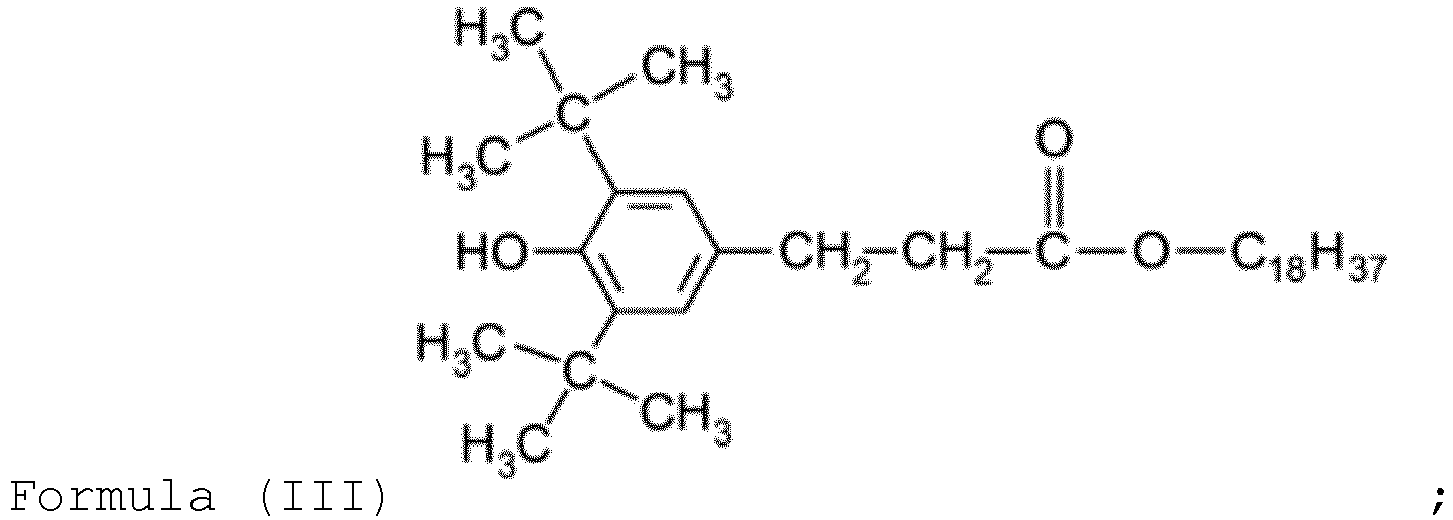
- the one phenolic antioxidant or at least one of the phenolic antioxidants is octadecyl-3-(3,5-di-tert-butyl-4-hydroxyphenyl) propionate of Formula (III).
- the latter phenolic antioxidant is especially advantageous, also because this antioxidant does not significantly contribute to the above-mentioned VOC/FOG emission in a polyurethane foam industry wide accepted test called "VDA-278".
- the VDA-278 test involves a thermal desorption analysis of organic emissions for the characterization of non-metallic materials for automobiles. No VOC/FOG emission (or a reduced VOC/FOG emission) is relevant in case where consumers (e.g.
- said phenolic antioxidant of Formula (III) enables polyurethane foam containing it to pass said VDA-278 test
- polyurethane foam containing "PUR55” which is a commercial antioxidant system comprising a phenolic antioxidant and an aminic antioxidant
- said phenolic antioxidant of Formula (III) has been approved by the above-mentioned "FDA”. This means that the polyurethane foam made using said antioxidant alone may advantageously be used in food applications.
- said antioxidant is a commodity antioxidant which is widely available.
- the one phenolic antioxidant or at least one of the phenolic antioxidants has a molecular weight which is preferably higher than 250 g/mol, more preferably at least 300 g/mol, more preferably at least 350 g/mol, more preferably at least 390 g/mol, more preferably at least 450 g/mol, more preferably at least 500 g/mol.
- the molecular weight is at most 1,500 g/mol, more suitably at most 1,200 g/mol, more suitably at most 1,000 g/mol, more suitably at most 800 g/mol, more suitably at most 700 g/mol, most suitably at most 600 g/mol.
- a polyurethane foam is prepared by reacting a polyether polyol with a polyisocyanate.
- a polyether polyol hereinafter also referred to as "polyol”
- polyisocyanate the polyether polyol
- molecular weight is used herein to refer to number average molecular weight, unless otherwise specified or context requires otherwise.
- the number average molecular weight of a polyol can be measured by gel permeation chromatography (GPC) or vapor pressure osmometry (VPO).
- hydroxyl value is used herein to refer to the milligrams of potassium hydroxide equivalent to the hydroxyl content in one gram of polyol determined by wet method titration.
- equivalent weight is used herein to refer to the weight of polyol per reactive site.
- the equivalent weight is 56100 divided by the hydroxyl value of the polyol.
- the term "functionality" is used herein to refer to the average number of reactive sites per molecule of polyol. The functionality is determined by the number average molecular weight of the polyol divided by the equivalent weight of the polyol.
- one or more polyols may be used. Further, one or more polymers may be dispersed in said one or more polyols. If 2 or more polyols are used, they may be provided as a polyol mixture, or the polyols may be provided separately to form a polyol mixture in situ.
- the polyol may be prepared by ring-opening polymerization of alkylene oxide, in particular by reacting a hydroxyl containing compound with an alkylene oxide, such as for example ethylene oxide, propylene oxide, butylene oxide and/or mixtures thereof.
- the alkylene oxide may, for example, be propylene oxide, optionally together with one or more other alkylene oxides like ethylene oxide or butylene oxide.
- Suitable hydroxyl containing starting compounds include polyfunctional alcohols, generally containing from 2 to 8 hydroxyl groups. Examples of such alcohols comprise glycols, glycerol, pentaerythritol, trimethylolpropane, triethanolamine, sorbitol and mannitol.
- propylene glycol MPG
- glycerol glycerol
- a strong base like potassium hydroxide or a similar metal hydroxide salt may be used as a catalyst in ring-opening polymerization of alkylene oxide to obtain a polyol.
- catalysts such as composite metal cyanide complex catalysts can also be used.
- a polyether polyol is used (herein also referred to as "polyol").
- said polyether polyol does not contain carbonate linkages (or carbonate units). It is especially preferred that said polyether polyol does not contain ester linkages (or ester units). Further, preferably, said polyether polyol consists of ether linkages.
- the polyol may be prepared by ring-opening polymerization of alkylene oxide in the presence of a composite metal cyanide complex catalyst.
- Composite metal cyanide complex catalysts are frequently also referred to as double metal cyanide (DMC) catalysts.
- a composite metal cyanide complex catalyst is typically represented by the following formula (1) : (1) M 1 a [M 2 b (CN) c ] d .e(M 1 f X g ).h(H 2 0).i(R) wherein each of M 1 and M 2 is a metal, X is a halogen atom, R is an organic ligand, and each of a, b, c, d, e, f, g, h and i is a number which is variable depending upon the atomic balances of the metals, the number of organic ligands to be coordinated, etc.
- M 1 is preferably a metal selected from Zn(II) or Fe(II).
- M 2 is preferably a metal selected from Co(III) or Fe(III).
- other metals and oxidation states may also be used, as is known in the art.
- R is an organic ligand and is preferably at least one compound selected from the group consisting of an alcohol, an ether, a ketone, an ester, an amine and an amide.
- an organic ligand a watersoluble one may be used.
- the dioxane may be 1,4-dioxane or 1,3-dioxane and is preferably 1,4-dioxane.
- the organic ligand or one of the organic ligands in the composite metal cyanide complex catalyst is tert-butyl alcohol.
- a polyol preferably a polyether polyol may be used.
- a poly (propylene glycol) having a number average molecular weight in the range of from 500 to 2,500 Dalton, preferably 800 to 2,200 Dalton may be used as the organic ligand or one of the organic ligands.
- such poly(propylene glycol) is used in combination with tert-butyl alcohol as organic ligands.
- the composite metal cyanide complex catalyst can be produced by known production methods.
- the one or more polyols may have a number average molecular weight in the range of from 300 to 12000 Daltons, suitably of from 300 to 8000 Daltons, more suitably of from 500 to 6000 Daltons, most suitably of from 500 to 4000 Daltons.
- the one or more polyols may have a functionality in the range of from 2 to 6, suitably of from 2 to 5.
- the functionality of the one or more polyols is higher than 2, more preferably of from 2.5 to 4, most preferably of from 2.5 to 3.5.
- the one or more polyols may have a hydroxyl value of from 10 to 600 mg KOH/g, suitably of from 20 to 500 mg KOH/g, more suitably of from 30 to 300 mg KOH/g.
- the one or more polyols may advantageously be propylene oxide (PO)- and optionally ethylene oxide (EO)-derived, i.e. comprise PO and/or EO derived oxyalkene moieties.
- PO propylene oxide
- EO ethylene oxide
- the one or more polyols only contain PO derived oxyalkene moieties or PO and EO derived oxyalkene moieties.
- the one or more polyols contain PO and EO derived oxyalkene moieties, it is preferred that the EO derived oxyalkene moieties are randomly distributed in said one or more polyols.
- the polyol may comprise only PO moieties (in combination with a hydroxyl containing starting compound). Where EO moieties are present in the polyol they may be randomly co-polymerised with PO moieties.
- the polyol may contain EO moieties in an amount in the range of from 1 to 25 wt.%, suitably of from 5 to 20 wt.%. The amount of EO moieties in wt.% is based on the total of oxyalkylene units present and may be measured, for example, according to ASTM D4875.
- the polyol may comprise primary hydroxyl groups.
- the percentage of primary hydroxyl groups (also referred to as "primary hydroxyl content (PHC)") in the range of from 1 to 100, suitably of from 5 to 90, more suitably of from 10 to 70, most suitably of from 10 to 50.
- one or more polymers may be dispersed in the polyol(s).
- a solid polymer may be dispersed in the polyol, thereby forming a "polymer polyol".
- the base polyol of such polymer polyol may have properties as described above for the polyo(s) in general.
- a polymer polyol is a dispersion of a solid polymer in a liquid polyol.
- Such systems are well known in the art and are normally prepared by polymerising one or more ethylenically unsaturated monomers in the presence of a free radical catalyst.
- polymer polyol systems and methods for their preparation are disclosed in, for instance, EP076491A2 , EP0343907A2 and EP0495551A2 .
- Polyurea or polyurethane polymers are also known to be useful as the dispersed polymer in polymer polyols instead of the polymers based on ethylenically unsaturated monomers.
- the polymer dispersed in the base polyol may in principle be any such polymer known to be applicable for this purpose.
- suitable polymers include the polymers based on ethylenically unsaturated monomers and particularly polymers of vinyl aromatic hydrocarbons, like styrene, alphamethyl styrene, methyl styrene and various other alkylsubstituted styrenes. Of these, the use of styrene is preferred.
- the vinyl aromatic monomer may be used alone or in combination with other ethylenically unsaturated monomers, such as acrylonitrile, methacrylonitrile, vinylidene chloride, various acrylates and conjugated dienes like 1,3-butadiene and isoprene.
- Preferred polymers are polystyrene and styrene-acrylonitrile (SAN) copolymers.
- Another suitable class of polymers are the polyurea and polyurethane polymers. Particularly the condensation products of primary amines or polyhydric alcohol amines and aromatic diisocyanates are very useful in this respect.
- One suitable polymer is the condensation product of triethanolamine and toluene diisocyanate (TDI).
- the dispersed polymer is suitably present in an amount of from 10 to 55 wt.%, suitably 15 to 55 wt.%, more suitably 30 to 45 wt.%, based on total weight of the polyol and polymer.
- the present specification also describes a polyether polyol composition, comprising a polyether polyol and an antioxidant, wherein the antioxidant consists of one phenolic antioxidant or two or more phenolic antioxidants, the one or more phenolic antioxidants contain no atoms other than carbon, hydrogen and oxygen, and the amount of the one or more phenolic antioxidants is of from 4,200 to less than 10,000 parts per million by weight (ppmw) based on the polyether polyol.
- composition in a case where a composition comprises two or more components, these components are to be selected in an overall amount not to exceed 100 wt.%.
- process and composition may be described in terms of “comprising”, “containing” or “including” one or more various described steps and components, respectively, they can also “consist essentially of” or “consist of” said one or more various described steps and components, respectively.
- the polyether polyol is reacted with a polyisocyanate in the presence of a blowing agent.
- the polyisocyanate may be an aromatic polyisocyanate or an aliphatic polyisocyanate, preferably an aromatic polyisocyanate.
- the aromatic polyisocyanate may for example comprise tolylene diisocyanate (TDI) or polymeric TDI, xylylene diisocyanate, tetramethylxylylene diisocyanate, methylene diphenyl diisocyanate (MDI) or polymeric MDI (i.e. polymethylene polyphenyl isocyanate), or a modified product thereof.
- the aromatic polyisocyanate comprises tolylene diisocyanate (TDI), i.e. non-polymeric TDI.
- the TDI may be a mixture of 80 wt.% of 2,4-TDI and 20 wt.% of 2,6-TDI, which mixture is sold as "TDI-80".
- the aliphatic polyisocyanate may for example comprise hexamethylene diisocyanate, dicyclohexylmethane diisocyanate, lysine diisocyanate or isophorone diisocyanate, or a modified product thereof.
- the polyisocyanate may be any mixture of two or more of the polyisocyanates mentioned above.
- the polyisocyanate may be a mixture of TDI and MDI, in particular a mixture wherein the weight ratio of TDI:MDI varies from 10:90 to 90:10.
- the blowing agent comprises water which is a chemical blowing agent.
- chemical blowing agent reference is made to a blowing agent that may only provide a blowing effect after it has chemically reacted with another compound.
- water reacts with isocyanate groups of the polyisocyanate, thereby releasing carbon dioxide which causes the blowing to occur.
- substantially no physical (non-chemical) blowing agent is added in the present process.
- blowing agents such as for example, acetone, gaseous or liquid carbon dioxide, halogenated hydrocarbons, aliphatic alkanes and alicyclic alkanes may be employed additionally or alternatively.
- fluorinated alkanes Due to the ozone depleting effect of fully chlorinated, fluorinated alkanes (CFC's) the use of this type of blowing agent is generally not preferred, although it is possible to use them within the scope of the present invention.
- Halogenated alkanes, wherein at least one hydrogen atom has not been substituted by a halogen atom (the so-called HCFC's) have no or hardly any ozone depleting effect and therefore are the preferred halogenated hydrocarbons to be used in physically blown foams.
- One suitable HCFC type blowing agent is 1-chloro-l,1-difluoroethane.
- blowing agents may be used singly or in mixtures of two or more.
- the amount of the blowing agent(s) is determined by the density of the polyurethane foam to be prepared which should be lower than 25 kg/m 3 .
- Such relatively low density can be obtained by using a relatively high amount of the blowing agent(s).
- a skilled person can readily determine the amount of blowing agent (physical and/or chemical blowing agent) needed to obtain a foam density which is at most 23 kg/m 3 or lower than any one of the other above-mentioned upper limits.
- water is used in an amount of at least 4 parts per hundred parts by weight of polyol (pphp), preferably of from 4 to 10 pphp, more preferably of from 4 to 8 pphp, more preferably of from 4 to 7 pphp, most preferably of from 4 to 6 pphp.
- pphp polyol
- water is used in an amount which is at least 4.5 pphp, more preferably at least 5 pphp.
- water is used in an amount which is at most 10 pphp, more preferably at most 9 pphp, more preferably at most 8 pphp, more preferably at most 7 pphp, most preferably at most 6 pphp.
- the amount of the blowing agent may be of from 1 to 50 parts per hundred parts by weight of polyol (pphp), suitably of from 1 to 30 pphp, more suitably of from 1 to 20 pphp.
- the density of the polyurethane foam to be prepared is at most 23 kg/m 3 , preferably at most 22 kg/m 3 , more preferably at most 21 kg/m 3 , more preferably at most 20 kg/m 3 , more preferably at most 19 kg/m 3 , more preferably at most 18 kg/m 3 , most preferably at most 17 kg/m 3 .
- the density is at least 6 kg/m 3 , more preferably at least 8 kg/m 3 , more preferably at least 10 kg/m 3 , more preferably at least 12 kg/m 3 , more preferably at least 13 kg/m 3 , more preferably at least 14 kg/m 3 , most preferably at least 15 kg/m 3 .
- the density of the polyurethane foam to be prepared may be of from 6 to 23 kg/m 3 , preferably of from 10 to 23 kg/m 3 , more preferably of from 12 to 22 kg/m 3 , more preferably of from 13 to 20 kg/m 3 , most preferably of from 14 to 18 kg/m 3 .
- the density may be determined by measuring the weight of a 10 cm * 10 cm * 5 cm cube of foam, for example, according to ASTM D3574.
- the polyurethane foam to be prepared in the present process is a flexible polyurethane foam.
- said flexible polyurethane foam is suitably a slabstock foam.
- slabstock foam reference is made to a foam that is made by applying a free rise (unconstrained rise) of the foam.
- Polyether polyols which are suitable for preparing flexible polyurethane foams therefrom (also referred to as flexible polyether polyols), have a relatively high molecular weight (for example 3,000 to 6,500 Dalton) and a relatively low nominal functionality (Fn; for example 2 to 3 hydroxyl groups per molecule). Reference is made to M. Ionescu, "Chemistry and Technology of Polyols for Polyurethanes", Rapra Technology Limited, 2005, page 8 .
- the isocyanate index is higher than 100.
- “isocyanate index” is calculated as 100 times the mole ratio of -NCO groups (isocyanate groups) to NCO-reactive groups in the reaction mixture.
- the “isocyanate index is defined as: [(actual amount of isocyanate)/(theoretical amount of isocyanate)]*100, wherein the "theoretical amount of isocyanate” equals 1 equivalent isocyanate (NCO) group per 1 equivalent isocyanate-reactive group.
- isocyanate-reactive groups include for example OH groups from the polyol and from any water that may be used as a blowing agent. Isocyanate groups also react with water.
- the isocyanate index (or NCO index) is of from 110 to 150, and may be at most 140, more suitably at most 130, most suitably at most 125.
- the isocyanate index is preferably higher than 110. More suitably, it is of from 110 to 140, more suitably of from 110 to 130, most suitably of from 110 to 125.
- the maximum temperature during the preparation of the polyurethane foam is higher than 140 °C.
- said “maximum temperature” reference is made to the maximum temperature in the (developing) foam. Said maximum temperature can be measured in the core of the (developing) foam.
- the maximum temperature during the preparation of the polyurethane foam is higher than 140 °C.
- it is at most 200 °C, more preferably at most 190 °C, most preferably at most 185 °C.
- said maximum temperature is of from 150 to 190 °C, more preferably of from 160 to 190 °C.
- polyurethane preparation process of the present invention may also be present during the polyurethane preparation process of the present invention, such as one or more polyurethane catalysts, surfactants and/or cross-linking agents.
- polyurethane catalysts are known in the art and include many different compounds.
- suitable catalysts include tin-, lead- or titanium-based catalysts, preferably tin-based catalysts, such as tin salts and dialkyl tin salts of carboxylic acids.
- tin-based catalysts such as tin salts and dialkyl tin salts of carboxylic acids.
- Specific examples are stannous octoate, stannous oleate, dibutyltin dilaureate, dibutyltin acetate and dibutyltin diacetate.
- Other suitable catalysts are tertiary amines, such as, for instance, bis(2,2'-dimethylamino)ethyl ether, trimethylamine, triethylamine, triethylenediamine and dimethylethanolamine (DMEA).
- tertiary amine catalysts examples are those sold under the tradenames Niax, Tegoamin and Dabco (all trademarks).
- the catalyst is typically used in an amount of from 0.01 to 2.0 parts by weight per hundred parts by weight of polyether polyol (php).
- Preferred amounts of catalyst are from 0.05 to 1.0 php.
- foam stabilisers surfactants
- Organosilicone surfactants are most conventionally applied as foam stabilisers in polyurethane production.
- a large variety of such organosilicone surfactants is commercially available.
- foam stabiliser is used in an amount of from 0.01 to 5.0 parts by weight per hundred parts by weight of polyol (pphp).
- Preferred amounts of stabiliser are from 0.25 to 2.0 pphp, more preferably of from 0.25 to 1.0 pphp.
- cross-linking agents in the production of polyurethane foams is also well known.
- Polyfunctional glycol amines are known to be useful for this purpose.
- the polyfunctional glycol amine which is most frequently used and is also useful in the preparation of polyurethane foams, especially flexible polyurethane foams, is diethanol amine, often abbreviated as DEOA.
- DEOA diethanol amine
- the cross-linking agent is applied in amounts up to 2 parts by weight per hundred parts by weight of polyol (pphp), but amounts in the range of from 0.01 to 0.5 pphp are most suitably applied.
- auxiliaries such as colorants, flame retardants and fillers, may also be used during the polyurethane preparation process of the present invention.
- the process of the invention may involve combining the polyol, the polyisocyanate, the blowing agent, a catalyst and optionally surfactant, crosslinker, flame retardant, colorant and/or filler, in any suitable manner to obtain the polyurethane foam.
- the present process may comprise stirring the polyol, the blowing agent, a catalyst and any other optional component(s) except the polyisocyanate together for a period of at least 1 minute; and adding the polyisocyanate under stirring.
- the process of the invention may comprise forming the foam into a shaped article before it fully sets.
- forming the foam may comprise pouring the liquid mixture containing all components into a mould before gelling is complete.
- Polyol A contained two antioxidants: 1) Irganox 1076 which is a phenolic antioxidant of above Formula (III); and 2) Irganox 5057 which is an aminic antioxidant.
- Irganox 5057 is a technical mixture obtained by the reaction of diphenylamine with diisobutylene and is commercially available at BASF.
- Polyol C also contained two antioxidants: 1) Irganox 1135 which is a phenolic antioxidant of above Formula (IV); and 2) said Irganox 5057.
- Polyol B only contained a phenolic antioxidant, namely said Irganox 1076.
- the non-isocyanate components shown in Table 2 below were mixed in a high speed mixer at about 900 rpm for 60 seconds. Then the isocyanate (TDI) component was added and the mixture was stirred for around 10 seconds and then poured into a box of dimensions of 1 m * 1 m * 1 m to form a foam. By using such relatively large box, the exotherm in large scale foam production is mimicked. The maximum temperature during the polyurethane foam preparation was observed to be 172 °C (foams 1 and 2) and 184 °C (foams 3 and 4). After about 24 hours, the foam was sliced as per the requirements and its physical properties, scorch and UV discoloration were measured. The results of these measurements are also shown in Table 2 below.
- the foams produced in accordance with the present invention have comparable scorch performance, without significantly affecting other important flexible foam properties such as density, CLD40% and resilience, when compared to the cases where instead of a phenolic antioxidant (present invention) a combination of a phenolic antioxidant and an aminic antioxidant was used (comparison).
- a phenolic antioxidant present invention
- a combination of a phenolic antioxidant and an aminic antioxidant was used (comparison).
- the foams produced in accordance with the present invention have a better UV resistance.
- any discoloration due to light, especially UV light, of the polyurethane foam produced in accordance with the present invention is significantly deferred in time as compared to the foam wherein a combination of a phenolic antioxidant and an aminic antioxidant was used. This can be seen by comparing foam 1 (invention) with foam 2 (comparison) and by comparing foam 3 (invention) with foam 4 (comparison).
- VDA-278 has been applied to foams 3 and 4.
- the results are shown in Table 3 below from which it appears that for foam 3 (invention) there was no contribution by antioxidant (“AO") to VOC and FOG, whereas there was such contribution for foam 4 (comparison).
- the criteria for passing said "VDA-278" test are: VOC ⁇ 100 ppmw and FOG ⁇ 250 ppmw.
- foam 4 did not pass the test whereas foam 3 did.
- this makes it possible to use the polyether polyol composition in low VOC/FOG foam applications.
- Table 3 AO contribution to VOC (ppmw) AO contribution to FOG (ppmw) Foam 3 0 0 Foam 4 28 555
Landscapes
- Chemical & Material Sciences (AREA)
- Health & Medical Sciences (AREA)
- Chemical Kinetics & Catalysis (AREA)
- Medicinal Chemistry (AREA)
- Polymers & Plastics (AREA)
- Organic Chemistry (AREA)
- Engineering & Computer Science (AREA)
- Manufacturing & Machinery (AREA)
- Polyurethanes Or Polyureas (AREA)
- Compositions Of Macromolecular Compounds (AREA)
- Manufacture Of Porous Articles, And Recovery And Treatment Of Waste Products (AREA)
Description
- The present invention relates to a process for preparing a polyurethane foam.
- Polyurethane foams, such as flexible polyurethane foams, have found extensive use in a multitude of industrial and consumer applications. Flexible polyurethane foams are widely used in numerous applications. Main sectors of application are automotive and aircraft industry, upholstered furniture and technical articles. For instance, full foam seats, top pads for the seats and restraints for back and head, all made from flexible polyurethane foam, are widely used in cars and aeroplanes. Other applications include the use of flexible polyurethane foam as carpet backings, bedding and mattresses, textile lamination, packaging, foamed seat saddles for motorbikes, gaskets between a car body and its lights, lip seals of air filters for engines and insulating layers on car parts and engine parts to reduce sound and vibration.
- Polyurethane foams are made by reacting a polyether polyol and a polyisocyanate in the presence of a blowing agent. It is known to add an antioxidant to the polyether polyol prior to reacting it with a polyisocyanate. Adding an antioxidant increases the storage stability of the polyether polyol. Polyether polyols are prone to oxidation and an antioxidant prevents or inhibits such oxidation.
- The use of antioxidants in relation to polyether polyols and polyurethane foams is well known and has been disclosed in many publications. Reference is made to the following publications:
- 1)
US20110230581 ;US2006293402 ;US20170267914 ;WO2006111492 ;US4178420 ;US5869565 ;WO201737204 WO2017162520 ;CN106117537 ;US2013030068 ;CN103275296 ;JP2013227490 US2014155506 ;US2012264839 ;US2012238657 ;US2013203880 ;KR20120060672 WO2011125952 ;US2004143028 ;US2002123536 ;US5182310 ; - 2) M. Clauss et al., "Antioxidant Systems for Stabilization of Flexible Polyurethane Slabstock Foams", Journal of Cellular Plastics, Volume 33, September/October 1997, pages 457-476;
- 3) G.L. Statton et al., "Evaluation of hindered phenols for minimization of foam discoloration using the microwave scorch test", Journal of Cellular Plastics, September-October 1984, pages 346-350;
- 4) R.L. Gray et al., "Low Volatility Antioxidants for Scorch Protection of Polyurethane Foams", Journal of Vinyl & Additive Technology, Vol. 2, No. 3, September 1996, pages 265-269;
- 5) M. Ionescu, "Chemistry and Technology of Polyols for Polyurethanes", Rapra Technology Limited, 2005, pages 134-137;
- 6) R.L. Gray et al., "New Scorch Inhibitors for Flexible Polyurethane Bunstock", 35th Annual Polyurethane Technical/Marketing Conference, October 9-12, 1994, pages 333-337.
- In addition to increasing the storage stability of polyether polyols (at room temperature), antioxidants may also increase the scorch resistance during the preparation of polyurethane foams.
- By "scorch" reference is made to an oxidative degradation process induced by a high temperature. Since the reaction of a polyether polyol with a polyisocyanate is exothermic, heat is released resulting in a temperature increase in the (developing) foam. The temperature is highest in the core of the foam. Such high temperature may result in an increased formation of free radicals (oxidation). These free radicals in turn may react with the polymers making up the polyurethane foam. This may also result in an undesired discoloration of the foam, especially in the core of the foam. Therefore, antioxidants have traditionally been added to react with said free radicals and thereby increase the scorch resistance during the preparation of polyurethane foams.
- Further, over the years, water has become an important blowing agent in making polyurethane foams. Water is a so-called chemical blowing agent. Water reacts with isocyanate groups of the polyisocyanate, thereby releasing carbon dioxide which causes the blowing to occur. As this reaction is also exothermic, the temperature during the preparation of a polyurethane foam is even further increased. This in turn results in a further increased risk of scorch during the preparation of a polyurethane foam.
- Still further, when it is desired to make low-density polyurethane foams using a chemical blowing agent (such as water), a relatively large amount of the blowing agent needs to be used. Such increased amount of a chemical blowing agent further contributes to a higher temperature and accordingly to an increased risk of scorch during the preparation of a polyurethane foam. A similar effect is achieved by increasing the isocyanate index.
- To increase both the storage stability of polyether polyols and the scorch resistance during the preparation of polyurethane foams, various antioxidant systems have been developed in the past. Such antioxidant systems generally comprise 2 or more different antioxidants, at least one of which is a phenolic antioxidant, such as a sterically hindered phenolic antioxidant. The other antioxidant or at least one of the other antioxidants is a non-phenolic antioxidant, such as an aminic antioxidant. For example, at page 134 of the above-mentioned reference by M. Ionescu, a synergism between two or three antioxidants is noted, such as: a) hindered phenols - alkylated diphenylamines, b) hindered phenols - alkylated diphenylamines-phenothiazine, and c) hindered phenols - phenothiazine.
- However, antioxidant systems which comprise 2 or more antioxidants one of which is a phenolic antioxidant and another is an aminic antioxidant, have several disadvantages. Firstly, aminic antioxidants effect a relatively high VOC/FOG emission from polyurethane foams which is undesired. By "VOC" reference is made to "Volatile Organic Compounds". And by "FOG" reference is made to compounds which evaporate at a slightly higher temperature than VOC compounds and which may result in a mist ("fog") build up (condensation) on displays and windows, for example inside a car. Further, aminic antioxidants may result in polyurethane foams having a relatively low UV and light resistance. Further, aminic antioxidants are known for their negative influence on the NOx resistance of polyurethane foams which contain them. Further, in case an antioxidant system comprises an aminic antioxidant, it is generally difficult to get approval from the "FDA", i.e. the United States "Food and Drug Administration", for such antioxidant system. For example, Irganox 5057 which is an aminic antioxidant, does not have such FDA approval.
- Therefore, in the industry there has been a strong focus on developing aminic antioxidant free systems. Such amine-free antioxidant systems comprise generally a phenolic antioxidant and a non-phenolic/non-aminic antioxidant, e.g. one or more of phenothiazine, lactones and phosphites. However, the commercial availability of low VOC/FOG emission, amine-free antioxidant systems is limited. In addition, said amine-free antioxidant systems are relatively expensive as compared to the more commonly used antioxidant systems comprising a phenolic antioxidant and an aminic antioxidant as described above.
- Therefore, it is an object of the invention to provide an antioxidant for use in the preparation of polyurethane foams, especially polyurethane foams prepared by using a chemical blowing agent (such as water), more especially low-density polyurethane foams prepared by using such chemical blowing agent, which antioxidant has a good performance in terms of polyether polyol storage stability and/or scorch resistance during the preparation of polyurethane foams.
- In addition, it is an object of the invention to provide an antioxidant for the above-mentioned use, such that the resistance of the foam thus obtained against light, for example UV light, and/or the resistance of the foam against NOx may be improved. It is especially desired that discoloration of the foam due to light (e.g. UV light) and/or NOx is prevented or deferred as much as possible.
- Surprisingly it was found that one or more of the above-mentioned objects may be achieved by a process for preparing a polyurethane foam having a density which is at most 23 kg/m3, wherein only one or more phenolic antioxidants are used as the antioxidant(s) in an amount of from 3,300 to less than 10,000 parts per million by weight (ppmw) based on the polyether polyol.
- Accordingly, the present invention relates to a process for preparing a polyurethane foam comprising reacting a polyether polyol and a polyisocyanate in the presence of a blowing agent and an antioxidant, wherein:
- the antioxidant consists of one phenolic antioxidant or two or more phenolic antioxidants, wherein the one or more phenolic antioxidants contain no atoms other than carbon, hydrogen and oxygen, and the amount of the one or more phenolic antioxidants is of from 3,300 to less than 10,000 parts per million by weight (ppmw) based on the polyether polyol;
- the one phenolic antioxidant or at least one of the phenolic antioxidants is a compound of Formula (II):

- wherein
- R1 is hydrogen or C1-C8 alkyl,
- n is 1, 2 or 4,
- X is -CH2CH2-C(=O)-O- where -CH2CH2 is bonded to the benzene ring and C(=O)-O- is bonded to R2, and
- if n is 1: R2 is C4-C24 alkyl, or
- if n is 2: R2 is C2-C12 alkylene or C4-C12 alkylene interrupted by oxygen, or
- if n is 4: R2 is C4-C10 alkanetetrayl;
- the isocyanate index is of from 110 to 150, preferably of from 110 to 140, more preferably of from 110 to 130, most preferably of from 110 to 125;
- the blowing agent comprises water, and water is used in an amount of at least 4 parts per hundred parts by weight of polyol (pphp);
- the maximum temperature during the preparation of the polyurethane foam is higher than 140 °C, preferably of from 150 to 190 °C, more preferably of from 160 to 190 °C; and
- the density of the polyurethane foam is at most 23 kg/m3, preferably of from 6 to 23 kg/m3, more preferably of from 10 to 23 kg/m3, more preferably of from 12 to 22 kg/m3, more preferably of from 13 to 20 kg/m3, most preferably of from 14 to 18 kg/m3.
- In the present invention, a polyether polyol and a polyisocyanate are reacted in the presence of a blowing agent and an antioxidant.
- Within the present specification, by "antioxidant" reference is made to a compound that prevents or inhibits the oxidation of other compounds. Oxidation is a chemical reaction that can produce free radicals, leading to chain reactions. Antioxidants may terminate these chain reactions by reaction with the free radicals.
- Preferably, the antioxidant is added to the polyether polyol and/or the polyisocyanate, preferably to the polyether polyol, prior to reacting the polyether polyol with the polyisocyanate. Alternatively, the antioxidant may be added during reacting the polyether polyol with the polyisocyanate. Further, in case the antioxidant consists of two or more phenolic antioxidants, these antioxidants may be added separately or as a blend, for example by adding to one or more than one different polyether polyol(s) which may be used in the present invention.
- In the present invention, the antioxidant consists of one phenolic antioxidant ortwo or more phenolic antioxidants. Preferably, the antioxidant consists of one, two or three phenolic antioxidants, more preferably one or two phenolic antioxidants. Most preferably, the antioxidant consists of one phenolic antioxidant. This means that in the present invention only one or more phenolic antioxidants are used as the antioxidant(s). This implies that in the present invention, substantially no non-phenolic antioxidant is present. Within the present specification, "substantially no" means that no detectible amount of the component in question is present.
- It has been found in the present invention that in the preparation of preparing a polyurethane foam having a relatively low density, i.e. lower than 25 kg/m3, the one or more phenolic antioxidants may be used in an amount of from 3,300 to less than 10,000 parts per million by weight (ppmw) based on the polyether polyol, which still has a good performance in terms of polyether polyol storage stability and/or scorch resistance during the preparation of polyurethane foams. In addition, it has been found that the foam thus obtained has a good performance in terms of resistance of the foam against light, for example UV light.
- Due to the above-mentioned good scorch resistance during the preparation of polyurethane foams in accordance with the present invention, the temperature that can still be tolerated during such preparation is relatively high. In the present invention, the maximum temperature during the preparation of the polyurethane foam is higher than 140 °C. Furthermore, the isocyanate index may be relatively high. In the present invention, said index is of from 110 to 150.
- Yet another consequence is that, advantageously, no cooling additive needs to be added to decrease the temperature during the preparation of the polyurethane foam. Therefore, it is preferred that in the present invention, substantially no cooling additive is present. Within the present specification, by "cooling additive" reference is made to a compound that is capable of effecting heat absorption thereby reducing the temperature of the mixture wherein it is present. Further, within the present specification, the term "cooling additive" does not include physical blowing agents. An example of a cooling additive is calcium carbonate (CaCO3). Other examples of cooling additives are hydrates of inorganic compounds, such as those as disclosed in
US2006293402 . Thus, it is preferred that in the present invention, substantially no hydrate of an inorganic compound is present, or that substantially no inorganic compound is present. - Within the present specification, by a "phenolic antioxidant" reference is made to an antioxidant which comprises one or more benzene rings, wherein the benzene ring or at least one of the benzene rings is a benzene ring which is substituted by one or more groups, which group or at least one of which groups is a hydroxyl (-OH) group.
- In the present invention, the one or more phenolic antioxidants contain no atoms other than carbon, hydrogen and oxygen.
- Further, in the present invention, the amount of the one or more phenolic antioxidants is of from 3,300 to less than 10,000 parts per million by weight (ppmw), based on the polyether polyol, preferably of from 3,300 to 8,000 ppmw, more preferably of from 3,300 to 7,000 ppmw, more preferably of from 3,300 to 6,000 ppmw, more preferably of from 3,500 to 5,500 ppmw, most preferably of from 4,000 to 5,000 ppmw. In case the antioxidant consists of two or more phenolic antioxidants, the amount as defined herein refers to the total amount of these two or more phenolic antioxidants. The amount of the one or more phenolic antioxidants is at least 3,300 ppmw, preferably at least 3,500 ppmw, more preferably at least 3,700 ppmw, more preferably at least 4,000 ppmw, more preferably at least 4,200 ppmw, most preferably at least 4,300 ppmw. When using one or more phenolic antioxidants in an amount of 10,000 ppmw or higher, based on the polyether polyol, there may be an increased risk of the formation of colored bodies from the phenolic antioxidant(s) itself, which may give rise to an undesired color of the foam. In the present invention, the amount of the one or more phenolic antioxidants is less than 10,000 ppmw, preferably at most 9,000 ppmw, more preferably at most 8,000 ppmw, more preferably at most 7,000 ppmw, more preferably at most 6,000 ppmw, more preferably at most 5,500 ppmw, more preferably at most 5,300 ppmw, more preferably at most 5,000 ppmw, more preferably at most 4,800 ppmw, most preferably at most 4,700 ppmw.
- In the present invention, the one phenolic antioxidant or at least one of the phenolic antioxidants is a compound of Formula (II):

- R1 is hydrogen or C1-C8 alkyl,
- n is 1, 2 or 4,
- X is -CH2CH2-C(=O)-O- where -CH2CH2 is bonded to the benzene ring and C(=O)-O- is bonded to R2, and
- if n is 1: R2 is C4-C24 alkyl, or
- if n is 2: R2 is C2-C12 alkylene or C4-C12 alkylene interrupted by oxygen, or
- if n is 4: R2 is C4-C10 alkanetetrayl.
- In Formula (II), R1 is hydrogen or C1-C8 alkyl. Preferably, R1 is C1-C8 alkyl, more preferably C1-C4 alkyl, more preferably C4 alkyl. For example, R1 may be methyl or tertiary butyl. Most preferably, R1 is tertiary butyl.
- In Formula (II), n may be 1, 2 or 4. Preferably, n is 1.
- In Formula (II), X is -CH2CH2-C(=O)-O- where -CH2CH2 is bonded to the benzene ring and C(=O)-O- is bonded to R2.
- If in Formula (II) n is 1, R2 is C4-C24 alkyl, more preferably C6-C20 alkyl, most preferably C8-C18 alkyl. Further, R2 may be C6-C24 alkyl or C8-C24 alkyl or C10-C24 alkyl or C12-C24 alkyl or C14-C22 alkyl or C16-C20 alkyl. Said alkyl groups may be branched or linear, preferably linear. Suitable examples of said alkyl groups comprise n-butyl, sec-butyl, isobutyl, tert-butyl, 2-ethylbutyl, n-pentyl, isopentyl, 1-methylpentyl, 1,3-dimethylbutyl, n-hexyl, 1-methylhexyl, n-heptyl, isoheptyl, 1,1,3,3-tetramethylbutyl, 1-methylheptyl, 3-methylheptyl, n-octyl, 2-ethylhexyl, 1,1,3-trimethylhexyl, 1,1,3,3-tetramethylpentyl, nonyl, decyl, undecyl, 1-methylundecyl, dodecyl, 1,1,3,3,5,5-hexamethylhexyl, tridecyl, tetradecyl, pentadecyl, hexadecyl, heptadecyl, octadecyl, eicosyl and docosyl. Most preferably, said alkyl group is a linear C18 alkyl groep (n-octadecyl).
- If in Formula (II) n is 2, R2 is C2-C12 alkylene or C4-C12 alkylene interrupted by oxygen. If R2 is C2-C12 alkylene, R2 is preferably C2-C10 alkylene, more preferably C2-C8 alkylene, more preferably C4-C8 alkylene, most preferably C4-C6 alkylene. Said alkylene groups may be branched or linear, preferably linear. Suitable examples of said alkylene groups comprise ethylene, propylene, tetramethylene, pentamethylene, hexamethylene, heptamethylene, octamethylene, decamethylene or dodecamethylene. If R2 is C4-C12 alkylene interrupted by oxygen, it can be interrupted by oxygen one or more times, and R2 is preferably C4-C10 alkylene interrupted by oxygen, more preferably C4-C8 alkylene interrupted by oxygen, most more preferably C4-C6 alkylene interrupted by oxygen. Suitable examples of said alkylene groups interrupted by oxygen comprise -CH2-O-CH2CH2-O-CH2-, -CH2-(O-CH2CH2-)2O-CH2-,-CH2-(O-CH2CH2-)3O-CH2-, -CH2-(O-CH2CH2-)4O-CH2-, -CH2CH2-O-CH2CH2-, -CH2CH2-O-CH2CH2-O-CH2CH2-, -CH2CH2- (O-CH2CH2-)2O-CH2CH2-, and -CH2CH2-(O-CH2CH2-)3O-CH2CH2-. Preferably, said alkylene group interrupted by oxygen is -CH2CH2-O-CH2CH2- or -CH2CH2-O-CH2CH2-O-CH2CH2-, more preferably -CH2CH2-O-CH2CH2-O-CH2CH2-.
- If in Formula (II) n is 4, R2 is C4-C10 alkanetetrayl. Suitable examples of C4-C10 alkanetetrayl groups comprise


- Preferably, in the present invention, the one phenolic antioxidant or at least one of the phenolic antioxidants is selected from the group consisting of:
- 1) octadecyl-3-(3,5-di-tert-butyl-4-hydroxyphenyl) propionate which is a compound of Formula (III) and which is commercially available as Irganox 1076 at BASF:
- 2) C13-15-alkyl-3-(3,5-di-tert-butyl-4-hydroxyphenyl) propionate which is a mixture of compounds of Formula (III) wherein the octadecyl (C18H37) group is replaced by a C13-15-alkyl group and which is commercially available as Anox 1315 at Addivant;
- 3) iso-C8-alkyl-3-(3,5-di-tert-butyl-4-hydroxyphenyl) propionate which is a compound of Formula (IV), wherein iso-C8-alkyl is 2-ethylhexyl, and which is commercially available as Irganox 1135 at BASF:

- 4) triethylene glycol bis(3-tert-butyl-4-hydroxy-5-methylphenyl) propionate which is a compound of Formula (V) and which is commercially available as Irganox 245 at BASF:

- 5) pentaerythritol tetrakis(3-(3,5-di-tert-butyl-4-hydroxyphenyl) propionate which is a compound of Formula (VI) and which is commercially available as Irganox 1010 at BASF:

- Most preferably, in the present invention, the one phenolic antioxidant or at least one of the phenolic antioxidants is octadecyl-3-(3,5-di-tert-butyl-4-hydroxyphenyl) propionate of Formula (III). The latter phenolic antioxidant is especially advantageous, also because this antioxidant does not significantly contribute to the above-mentioned VOC/FOG emission in a polyurethane foam industry wide accepted test called "VDA-278". The VDA-278 test involves a thermal desorption analysis of organic emissions for the characterization of non-metallic materials for automobiles. No VOC/FOG emission (or a reduced VOC/FOG emission) is relevant in case where consumers (e.g. in automobiles, airplanes) come into close contact with the final polyurethane foam product. Whereas said phenolic antioxidant of Formula (III) enables polyurethane foam containing it to pass said VDA-278 test, polyurethane foam containing "PUR55", which is a commercial antioxidant system comprising a phenolic antioxidant and an aminic antioxidant, fails that same test. Furthermore, advantageously, said phenolic antioxidant of Formula (III) has been approved by the above-mentioned "FDA". This means that the polyurethane foam made using said antioxidant alone may advantageously be used in food applications. Finally, advantageously, said antioxidant is a commodity antioxidant which is widely available.
- In the present invention, the one phenolic antioxidant or at least one of the phenolic antioxidants has a molecular weight which is preferably higher than 250 g/mol, more preferably at least 300 g/mol, more preferably at least 350 g/mol, more preferably at least 390 g/mol, more preferably at least 450 g/mol, more preferably at least 500 g/mol. Suitably, the molecular weight is at most 1,500 g/mol, more suitably at most 1,200 g/mol, more suitably at most 1,000 g/mol, more suitably at most 800 g/mol, more suitably at most 700 g/mol, most suitably at most 600 g/mol.
- In the present process, a polyurethane foam is prepared by reacting a polyether polyol with a polyisocyanate. First, the polyether polyol (hereinafter also referred to as "polyol") is further described below, followed by a description of the polyisocyanate. The following definitions for some polyol features apply.
- The term "molecular weight" is used herein to refer to number average molecular weight, unless otherwise specified or context requires otherwise. The number average molecular weight of a polyol can be measured by gel permeation chromatography (GPC) or vapor pressure osmometry (VPO).
- The term "hydroxyl value" is used herein to refer to the milligrams of potassium hydroxide equivalent to the hydroxyl content in one gram of polyol determined by wet method titration.
- The term "equivalent weight" is used herein to refer to the weight of polyol per reactive site. The equivalent weight is 56100 divided by the hydroxyl value of the polyol.
- The term "functionality" is used herein to refer to the average number of reactive sites per molecule of polyol. The functionality is determined by the number average molecular weight of the polyol divided by the equivalent weight of the polyol.
- In the present invention, one or more polyols may be used. Further, one or more polymers may be dispersed in said one or more polyols. If 2 or more polyols are used, they may be provided as a polyol mixture, or the polyols may be provided separately to form a polyol mixture in situ.
- In general, the polyol may be prepared by ring-opening polymerization of alkylene oxide, in particular by reacting a hydroxyl containing compound with an alkylene oxide, such as for example ethylene oxide, propylene oxide, butylene oxide and/or mixtures thereof. The alkylene oxide may, for example, be propylene oxide, optionally together with one or more other alkylene oxides like ethylene oxide or butylene oxide. Suitable hydroxyl containing starting compounds include polyfunctional alcohols, generally containing from 2 to 8 hydroxyl groups. Examples of such alcohols comprise glycols, glycerol, pentaerythritol, trimethylolpropane, triethanolamine, sorbitol and mannitol. Advantageously, propylene glycol (MPG), glycerol or a combination of both may be is used as starting compound. A strong base like potassium hydroxide or a similar metal hydroxide salt may be used as a catalyst in ring-opening polymerization of alkylene oxide to obtain a polyol. However, catalysts such as composite metal cyanide complex catalysts can also be used.
- In the present invention, a polyether polyol is used (herein also referred to as "polyol"). Preferably, in the present invention, said polyether polyol does not contain carbonate linkages (or carbonate units). It is especially preferred that said polyether polyol does not contain ester linkages (or ester units). Further, preferably, said polyether polyol consists of ether linkages.
- The polyol may be prepared by ring-opening polymerization of alkylene oxide in the presence of a composite metal cyanide complex catalyst. Composite metal cyanide complex catalysts are frequently also referred to as double metal cyanide (DMC) catalysts. A composite metal cyanide complex catalyst is typically represented by the following formula (1) :
(1) M1 a[M2 b(CN)c]d.e(M1 fXg).h(H20).i(R)
wherein each of M1 and M2 is a metal, X is a halogen atom, R is an organic ligand, and each of a, b, c, d, e, f, g, h and i is a number which is variable depending upon the atomic balances of the metals, the number of organic ligands to be coordinated, etc. - In the above formula (1), M1 is preferably a metal selected from Zn(II) or Fe(II). In the above formula, M2 is preferably a metal selected from Co(III) or Fe(III). However, other metals and oxidation states may also be used, as is known in the art.
- In the above formula (1), R is an organic ligand and is preferably at least one compound selected from the group consisting of an alcohol, an ether, a ketone, an ester, an amine and an amide. As such an organic ligand, a watersoluble one may be used. Specifically, one or more compounds selected from tert-butyl alcohol, n-butyl alcohol, iso-butyl alcohol, tert-pentyl alcohol, isopentyl alcohol, N, N-dimethyl acetamide, glyme (ethylene glycol dimethyl ether), diglyrste (diethylene glycol dimethyl ether), triglyme (triethylene glycol dimethyl ether), ethylene glycol mono-tert-butylether, iso-propyl alcohol and dioxane, may be used as organic ligand(s). The dioxane may be 1,4-dioxane or 1,3-dioxane and is preferably 1,4-dioxane. Most preferably, the organic ligand or one of the organic ligands in the composite metal cyanide complex catalyst is tert-butyl alcohol. Further, as an alcohol organic ligand, a polyol, preferably a polyether polyol may be used. More preferably, a poly (propylene glycol) having a number average molecular weight in the range of from 500 to 2,500 Dalton, preferably 800 to 2,200 Dalton, may be used as the organic ligand or one of the organic ligands. Most preferably, such poly(propylene glycol) is used in combination with tert-butyl alcohol as organic ligands. The composite metal cyanide complex catalyst can be produced by known production methods.
- The one or more polyols may have a number average molecular weight in the range of from 300 to 12000 Daltons, suitably of from 300 to 8000 Daltons, more suitably of from 500 to 6000 Daltons, most suitably of from 500 to 4000 Daltons.
- Further, the one or more polyols may have a functionality in the range of from 2 to 6, suitably of from 2 to 5. Preferably, the functionality of the one or more polyols is higher than 2, more preferably of from 2.5 to 4, most preferably of from 2.5 to 3.5.
- Further, the one or more polyols may have a hydroxyl value of from 10 to 600 mg KOH/g, suitably of from 20 to 500 mg KOH/g, more suitably of from 30 to 300 mg KOH/g.
- The one or more polyols may advantageously be propylene oxide (PO)- and optionally ethylene oxide (EO)-derived, i.e. comprise PO and/or EO derived oxyalkene moieties. Preferably, in the present invention, the one or more polyols only contain PO derived oxyalkene moieties or PO and EO derived oxyalkene moieties. In case the one or more polyols contain PO and EO derived oxyalkene moieties, it is preferred that the EO derived oxyalkene moieties are randomly distributed in said one or more polyols.
- The polyol (or one of the polyols) may comprise only PO moieties (in combination with a hydroxyl containing starting compound). Where EO moieties are present in the polyol they may be randomly co-polymerised with PO moieties. The polyol may contain EO moieties in an amount in the range of from 1 to 25 wt.%, suitably of from 5 to 20 wt.%. The amount of EO moieties in wt.% is based on the total of oxyalkylene units present and may be measured, for example, according to ASTM D4875.
- The polyol (or one of the polyols) may comprise primary hydroxyl groups. The percentage of primary hydroxyl groups (also referred to as "primary hydroxyl content (PHC)") in the range of from 1 to 100, suitably of from 5 to 90, more suitably of from 10 to 70, most suitably of from 10 to 50.
- As mentioned above, one or more polymers may be dispersed in the polyol(s). In particular, a solid polymer may be dispersed in the polyol, thereby forming a "polymer polyol". The base polyol of such polymer polyol may have properties as described above for the polyo(s) in general. Thus, in general, a polymer polyol is a dispersion of a solid polymer in a liquid polyol. Such systems are well known in the art and are normally prepared by polymerising one or more ethylenically unsaturated monomers in the presence of a free radical catalyst.
- Examples of such polymer polyol systems and methods for their preparation are disclosed in, for instance,
EP076491A2 EP0343907A2 andEP0495551A2 . Polyurea or polyurethane polymers are also known to be useful as the dispersed polymer in polymer polyols instead of the polymers based on ethylenically unsaturated monomers. - The polymer dispersed in the base polyol, may in principle be any such polymer known to be applicable for this purpose. Thus, suitable polymers include the polymers based on ethylenically unsaturated monomers and particularly polymers of vinyl aromatic hydrocarbons, like styrene, alphamethyl styrene, methyl styrene and various other alkylsubstituted styrenes. Of these, the use of styrene is preferred. The vinyl aromatic monomer may be used alone or in combination with other ethylenically unsaturated monomers, such as acrylonitrile, methacrylonitrile, vinylidene chloride, various acrylates and conjugated dienes like 1,3-butadiene and isoprene. Preferred polymers, however, are polystyrene and styrene-acrylonitrile (SAN) copolymers. Another suitable class of polymers are the polyurea and polyurethane polymers. Particularly the condensation products of primary amines or polyhydric alcohol amines and aromatic diisocyanates are very useful in this respect. One suitable polymer is the condensation product of triethanolamine and toluene diisocyanate (TDI).
- The dispersed polymer is suitably present in an amount of from 10 to 55 wt.%, suitably 15 to 55 wt.%, more suitably 30 to 45 wt.%, based on total weight of the polyol and polymer.
- The present specification also describes a polyether polyol composition, comprising a polyether polyol and an antioxidant, wherein the antioxidant consists of one phenolic antioxidant or two or more phenolic antioxidants, the one or more phenolic antioxidants contain no atoms other than carbon, hydrogen and oxygen, and the amount of the one or more phenolic antioxidants is of from 4,200 to less than 10,000 parts per million by weight (ppmw) based on the polyether polyol.
- All of the above-described features, embodiments and preferences in relation to the polyether polyol and the one or more phenolic antioxidants as used in the present polyurethane preparation process, are equally applicable to the polyether polyol and the one or more phenolic antioxidants from the above-mentioned polyether polyol composition.
- In the context of the present invention, in a case where a composition comprises two or more components, these components are to be selected in an overall amount not to exceed 100 wt.%.
- Further, while the process and composition may be described in terms of "comprising", "containing" or "including" one or more various described steps and components, respectively, they can also "consist essentially of" or "consist of" said one or more various described steps and components, respectively.
- In the present process, the polyether polyol is reacted with a polyisocyanate in the presence of a blowing agent. The polyisocyanate may be an aromatic polyisocyanate or an aliphatic polyisocyanate, preferably an aromatic polyisocyanate.
- The aromatic polyisocyanate may for example comprise tolylene diisocyanate (TDI) or polymeric TDI, xylylene diisocyanate, tetramethylxylylene diisocyanate, methylene diphenyl diisocyanate (MDI) or polymeric MDI (i.e. polymethylene polyphenyl isocyanate), or a modified product thereof. Preferably, the aromatic polyisocyanate comprises tolylene diisocyanate (TDI), i.e. non-polymeric TDI. The TDI may be a mixture of 80 wt.% of 2,4-TDI and 20 wt.% of 2,6-TDI, which mixture is sold as "TDI-80".
- Further, the aliphatic polyisocyanate may for example comprise hexamethylene diisocyanate, dicyclohexylmethane diisocyanate, lysine diisocyanate or isophorone diisocyanate, or a modified product thereof.
- Further, the polyisocyanate may be any mixture of two or more of the polyisocyanates mentioned above. For example, the polyisocyanate may be a mixture of TDI and MDI, in particular a mixture wherein the weight ratio of TDI:MDI varies from 10:90 to 90:10.
- In the present invention, the blowing agent comprises water which is a chemical blowing agent. Within the present specification, by "chemical blowing agent" reference is made to a blowing agent that may only provide a blowing effect after it has chemically reacted with another compound.
- As also mentioned above, water reacts with isocyanate groups of the polyisocyanate, thereby releasing carbon dioxide which causes the blowing to occur. Further, preferably, substantially no physical (non-chemical) blowing agent is added in the present process.
- However, other suitable blowing agents, such as for example, acetone, gaseous or liquid carbon dioxide, halogenated hydrocarbons, aliphatic alkanes and alicyclic alkanes may be employed additionally or alternatively.
- Due to the ozone depleting effect of fully chlorinated, fluorinated alkanes (CFC's) the use of this type of blowing agent is generally not preferred, although it is possible to use them within the scope of the present invention. Halogenated alkanes, wherein at least one hydrogen atom has not been substituted by a halogen atom (the so-called HCFC's) have no or hardly any ozone depleting effect and therefore are the preferred halogenated hydrocarbons to be used in physically blown foams. One suitable HCFC type blowing agent is 1-chloro-l,1-difluoroethane.
- The above blowing agents may be used singly or in mixtures of two or more.
- In the present invention, the amount of the blowing agent(s) is determined by the density of the polyurethane foam to be prepared which should be lower than 25 kg/m3. Such relatively low density can be obtained by using a relatively high amount of the blowing agent(s). A skilled person can readily determine the amount of blowing agent (physical and/or chemical blowing agent) needed to obtain a foam density which is at most 23 kg/m3 or lower than any one of the other above-mentioned upper limits.
- In the present invention, water is used in an amount of at least 4 parts per hundred parts by weight of polyol (pphp), preferably of from 4 to 10 pphp, more preferably of from 4 to 8 pphp, more preferably of from 4 to 7 pphp, most preferably of from 4 to 6 pphp. Preferably, water is used in an amount which is at least 4.5 pphp, more preferably at least 5 pphp. Further, preferably, water is used in an amount which is at most 10 pphp, more preferably at most 9 pphp, more preferably at most 8 pphp, more preferably at most 7 pphp, most preferably at most 6 pphp.
- In case of halogenated hydrocarbons, aliphatic alkanes and alicyclic alkanes, the amount of the blowing agent may be of from 1 to 50 parts per hundred parts by weight of polyol (pphp), suitably of from 1 to 30 pphp, more suitably of from 1 to 20 pphp.
- In the present invention, the density of the polyurethane foam to be prepared is at most 23 kg/m3, preferably at most 22 kg/m3, more preferably at most 21 kg/m3, more preferably at most 20 kg/m3, more preferably at most 19 kg/m3, more preferably at most 18 kg/m3, most preferably at most 17 kg/m3. Further, preferably, the density is at least 6 kg/m3, more preferably at least 8 kg/m3, more preferably at least 10 kg/m3, more preferably at least 12 kg/m3, more preferably at least 13 kg/m3, more preferably at least 14 kg/m3, most preferably at least 15 kg/m3. Thus, the density of the polyurethane foam to be prepared may be of from 6 to 23 kg/m3, preferably of from 10 to 23 kg/m3, more preferably of from 12 to 22 kg/m3, more preferably of from 13 to 20 kg/m3, most preferably of from 14 to 18 kg/m3. The density may be determined by measuring the weight of a 10 cm * 10 cm * 5 cm cube of foam, for example, according to ASTM D3574.
- Further, preferably, the polyurethane foam to be prepared in the present process is a flexible polyurethane foam. Further, said flexible polyurethane foam is suitably a slabstock foam. Within the present specification, by "slabstock" foam reference is made to a foam that is made by applying a free rise (unconstrained rise) of the foam. Polyether polyols, which are suitable for preparing flexible polyurethane foams therefrom (also referred to as flexible polyether polyols), have a relatively high molecular weight (for example 3,000 to 6,500 Dalton) and a relatively low nominal functionality (Fn; for example 2 to 3 hydroxyl groups per molecule). Reference is made to M. Ionescu, "Chemistry and Technology of Polyols for Polyurethanes", Rapra Technology Limited, 2005, page 8.
- In the present process, the isocyanate index is higher than 100. Within the present specification, "isocyanate index" is calculated as 100 times the mole ratio of -NCO groups (isocyanate groups) to NCO-reactive groups in the reaction mixture. In other words, the "isocyanate index is defined as: [(actual amount of isocyanate)/(theoretical amount of isocyanate)]*100, wherein the "theoretical amount of isocyanate" equals 1 equivalent isocyanate (NCO) group per 1 equivalent isocyanate-reactive group.
- Such "isocyanate-reactive groups" as referred to above include for example OH groups from the polyol and from any water that may be used as a blowing agent. Isocyanate groups also react with water.
- In the present invention, the isocyanate index (or NCO index) is of from 110 to 150, and may be at most 140, more suitably at most 130, most suitably at most 125. The isocyanate index is preferably higher than 110. More suitably, it is of from 110 to 140, more suitably of from 110 to 130, most suitably of from 110 to 125.
- Further, in the present process, the maximum temperature during the preparation of the polyurethane foam is higher than 140 °C. Within the present specification, by said "maximum temperature" reference is made to the maximum temperature in the (developing) foam. Said maximum temperature can be measured in the core of the (developing) foam.
- In the present process, the maximum temperature during the preparation of the polyurethane foam is higher than 140 °C. Preferably, it is at most 200 °C, more preferably at most 190 °C, most preferably at most 185 °C. Further, preferably, said maximum temperature is of from 150 to 190 °C, more preferably of from 160 to 190 °C.
- Additionally, other components may also be present during the polyurethane preparation process of the present invention, such as one or more polyurethane catalysts, surfactants and/or cross-linking agents.
- Polyurethane catalysts are known in the art and include many different compounds. For the purpose of the present invention, suitable catalysts include tin-, lead- or titanium-based catalysts, preferably tin-based catalysts, such as tin salts and dialkyl tin salts of carboxylic acids. Specific examples are stannous octoate, stannous oleate, dibutyltin dilaureate, dibutyltin acetate and dibutyltin diacetate. Other suitable catalysts are tertiary amines, such as, for instance, bis(2,2'-dimethylamino)ethyl ether, trimethylamine, triethylamine, triethylenediamine and dimethylethanolamine (DMEA). Examples of commercially available tertiary amine catalysts are those sold under the tradenames Niax, Tegoamin and Dabco (all trademarks). The catalyst is typically used in an amount of from 0.01 to 2.0 parts by weight per hundred parts by weight of polyether polyol (php). Preferred amounts of catalyst are from 0.05 to 1.0 php.
- The use of foam stabilisers (surfactants) is well known. Organosilicone surfactants are most conventionally applied as foam stabilisers in polyurethane production. A large variety of such organosilicone surfactants is commercially available. Usually, such foam stabiliser is used in an amount of from 0.01 to 5.0 parts by weight per hundred parts by weight of polyol (pphp). Preferred amounts of stabiliser are from 0.25 to 2.0 pphp, more preferably of from 0.25 to 1.0 pphp.
- The use of cross-linking agents in the production of polyurethane foams is also well known. Polyfunctional glycol amines are known to be useful for this purpose. The polyfunctional glycol amine which is most frequently used and is also useful in the preparation of polyurethane foams, especially flexible polyurethane foams, is diethanol amine, often abbreviated as DEOA. If used at all, the cross-linking agent is applied in amounts up to 2 parts by weight per hundred parts by weight of polyol (pphp), but amounts in the range of from 0.01 to 0.5 pphp are most suitably applied.
- In addition, other well known auxiliaries, such as colorants, flame retardants and fillers, may also be used during the polyurethane preparation process of the present invention.
- The process of the invention may involve combining the polyol, the polyisocyanate, the blowing agent, a catalyst and optionally surfactant, crosslinker, flame retardant, colorant and/or filler, in any suitable manner to obtain the polyurethane foam. For example, the present process may comprise stirring the polyol, the blowing agent, a catalyst and any other optional component(s) except the polyisocyanate together for a period of at least 1 minute; and adding the polyisocyanate under stirring.
- Further, the process of the invention may comprise forming the foam into a shaped article before it fully sets. Suitably, forming the foam may comprise pouring the liquid mixture containing all components into a mould before gelling is complete.
- The invention is further illustrated by the following Examples.
- The materials (polyols, polyisocyanate and other components) used in the polyurethane foam experiments are described in Table 1 below.
Table 1 POLYOLS Polyol A EO/PO based polyether polyol: MW = 3,500 g/mole; OH number = 48 mg KOH/g; EO content = 10.5%; PHC = 10%; nominal functionality = 2.8; 1,500 ppmw of Irganox 5057 (aminic antioxidant) and 3,000 ppmw of Irganox 1076 (phenolic antioxidant) Polyol B Polyol B was the same as Polyol A except that it did not contain Irganox 5057 but only 4,500 ppmw of Irganox 1076 (phenolic antioxidant) Polyol C Polyol C was the same as Polyol A except that it did not contain Irganox 1076 but 3,000 ppmw of Irganox 1135 (phenolic antioxidant). POLYISOCYANATE TDI-80 80:20 (by weight) blend of 2,4- and 2,6-isomers of TD I commercially available from Mitsui; free NCO content = 48.3% OTHER COMPONENTS Dabco T-9 Stannous octoate catalyst, commercially available from Air Products and Chemicals Niax A33 Amine based catalyst available from Momentive Performance Materials Niax L580 Silicone based surfactant commercially available from Momentive Performance Materials MW = molecular weight ppmw = parts per million by weight PHC = pimary hydroxyl content - Polyol A contained two antioxidants: 1) Irganox 1076 which is a phenolic antioxidant of above Formula (III); and 2) Irganox 5057 which is an aminic antioxidant. Irganox 5057 is a technical mixture obtained by the reaction of diphenylamine with diisobutylene and is commercially available at BASF. Polyol C also contained two antioxidants: 1) Irganox 1135 which is a phenolic antioxidant of above Formula (IV); and 2) said Irganox 5057. Polyol B only contained a phenolic antioxidant, namely said Irganox 1076.
- One or more of the following properties of the foams thus obtained were measured:
- 1) Density according to ASTM D3574 (sample size 100*100*50 mm3, 2 samples/foam).
- 2) Resilience according to ASTM D3574 - Test H (sample size 100*100*50 mm3, 2 samples/foam), which involves dropping a 16 mm diameter steel ball bearing onto a sample and measuring the percentage height that the ball bearing rebounded.
- 3) Hardness Compression Load Deflection at 40% compression (CLD40%) according to DIN 53577 (sample size 100*100*50 mm3, 2 samples/foam), which involves measuring the force required to compress a sample by 40 %.
- 4) Foam scorch measurement: A foam sample of 1 meter cube size (1*1*1 m3) is made and is then cut right across the centre into two halves. And then a chromometer is used to measure the discoloration at the centre ("scorch") and at the furthest corner of the sample ("no scorch"). The extent of scorching is represented by ΔEab which in turn is measured as a function of the following three parameters: "L" = lightness; "a" = blue index; "b" = yellowness index. ΔEab is calculated using formula (2):


- 5) UV discoloration test: 50*100*30 mm3 foam samples are placed inside a UV oven at 50 °C. The difference in discoloration at t = 0 and at t = 6 hours is measured using a chromometer in the same way as done for scorch testing.
- The non-isocyanate components shown in Table 2 below were mixed in a high speed mixer at about 900 rpm for 60 seconds. Then the isocyanate (TDI) component was added and the mixture was stirred for around 10 seconds and then poured into a box of dimensions of 1 m * 1 m * 1 m to form a foam. By using such relatively large box, the exotherm in large scale foam production is mimicked. The maximum temperature during the polyurethane foam preparation was observed to be 172 °C (foams 1 and 2) and 184 °C (foams 3 and 4). After about 24 hours, the foam was sliced as per the requirements and its physical properties, scorch and UV discoloration were measured. The results of these measurements are also shown in Table 2 below.
Table 2 Formulation Invention Comparison Invention Comparison Polyol A (pbw) 0 100 0 0 Polyol B (pbw) 100 0 100 0 Polyol C (pbw) 0 0 0 100 Irganox 5057 in polyol (ppmw) 0 1,500 0 1,500 Irganox 1076 in polyol (ppmw) 4,500 3,000 4,500 0 Irganox 1135 in polyol (ppmw) 0 0 0 3,000 Water (pphp) 5.5 5.5 6.0 6.0 Niax A33 (pphp) 0.18 0.18 0.14 0.14 Niax L580 (pphp) 1.3 1.3 1.8 1.8 Dabco T-9 (pphp) 0.19 0.19 0.21 0.21 TDI-80 (isocyanate index) 115 115 115 115 Properties Foam 1 Foam 2 Foam 3 Foam 4 Density (kg/m3) 16.3 16.3 15.3 15.0 CLD40% (kPa) 2.8 3.0 3.8 3.8 Resilience (%) 34 31 32 25 Total scorch performance (ΔEab) 1.5 1.6 2.3 3.0 Yellowness index (Δb) 1.3 1.1 1.7 1.3 UV discoloration (ΔE) 6.4 8.2 5.7 7.2 - Regarding Table 2:
- 1) pbw = parts by weight
- 2) pphp = parts per 100 parts of polyol (by weight)
- 3) A difference between 2 foams in relation to 1 or more of the above-mentioned properties ΔEab, Δb and ΔE which is up to 1, is still within the experimental error margin and is acceptable as such difference is not recognized by the human eye.
- As can be seen from Table 2 above, the foams produced in accordance with the present invention have comparable scorch performance, without significantly affecting other important flexible foam properties such as density, CLD40% and resilience, when compared to the cases where instead of a phenolic antioxidant (present invention) a combination of a phenolic antioxidant and an aminic antioxidant was used (comparison). This can be seen by comparing foam 1 (invention) with foam 2 (comparison) and by comparing foam 3 (invention) with foam 4 (comparison). Thus, advantageously, no non-phenolic antioxidant (like the above-mentioned aminic antioxidant) is needed in addition to the phenolic antioxidant to provide sufficient scorch protection for low-density polyurethane foam production. Thus, surprisingly, no synergistic effect in relation to scorch protection in preparing low-density polyurethane foam was observed by using a combination of phenolic and aminic antioxidants (comparison) instead of a phenolic antioxidant without any aminic antioxidant (present invention). This is even more surprising when considering that the total molar antioxidant amount used in producing foams in accordance with the present invention (foams 1 and 3) is lower than the total molar antioxidant amounts used in producing the comparison foams (foams 2 and 4). The molecular weights of the 3 antioxidants are as follows: Irganox 1076 = 531 g/mol; Irganox 1135 = 390 g/mol; Irganox 5057 = 361 g/mol.
- Furthermore, advantageously, as appears from the UV discoloration test, the foams produced in accordance with the present invention (foams 1 and 3) have a better UV resistance. This implies that advantageously, any discoloration due to light, especially UV light, of the polyurethane foam produced in accordance with the present invention (using only a phenolic antioxidant) is significantly deferred in time as compared to the foam wherein a combination of a phenolic antioxidant and an aminic antioxidant was used. This can be seen by comparing foam 1 (invention) with foam 2 (comparison) and by comparing foam 3 (invention) with foam 4 (comparison).
- Still further, the above-described "VDA-278" test has been applied to foams 3 and 4. The results are shown in Table 3 below from which it appears that for foam 3 (invention) there was no contribution by antioxidant ("AO") to VOC and FOG, whereas there was such contribution for foam 4 (comparison). The criteria for passing said "VDA-278" test are: VOC <100 ppmw and FOG <250 ppmw. Thus, foam 4 did not pass the test whereas foam 3 did. Advantageously, this makes it possible to use the polyether polyol composition in low VOC/FOG foam applications.
Table 3 AO contribution to VOC (ppmw) AO contribution to FOG (ppmw) Foam 3 0 0 Foam 4 28 555
Claims (5)
- Process for preparing a polyurethane foam comprising reacting a polyether polyol and a polyisocyanate in the presence of a blowing agent and an antioxidant, wherein:the antioxidant consists of one phenolic antioxidant or two or more phenolic antioxidants, wherein the one or more phenolic antioxidants contain no atoms other than carbon, hydrogen and oxygen, and the amount of the one or more phenolic antioxidants is of from 3,300 to less than 10,000 parts per million by weight (ppmw) based on the polyether polyol;the one phenolic antioxidant or at least one of the phenolic antioxidants is a compound of Formula (II):wherein
 R1 is hydrogen or C1-C8 alkyl,n is 1, 2 or 4,X is -CH2CH2-C(=O)-O- where -CH2CH2 is bonded to the benzene ring and C(=O)-O- is bonded to R2, andif n is 1: R2 is C4-C24 alkyl, orif n is 2: R2 is C2-C12 alkylene or C4-C12 alkylene interrupted by oxygen, orif n is 4: R2 is C4-C10 alkanetetrayl;the isocyanate index is of from 110 to 150, preferably of from 110 to 140, more preferably of from 110 to 130, most preferably of from 110 to 125;the blowing agent comprises water, and water is used in an amount of at least 4 parts per hundred parts by weight of polyol (pphp);the maximum temperature during the preparation of the polyurethane foam is higher than 140 °C, preferably of from 150 to 190 °C, more preferably of from 160 to 190 °C; andthe density of the polyurethane foam is at most 23 kg/m3, preferably of from 6 to 23 kg/m3, more preferably of from 10 to 23 kg/m3, more preferably of from 12 to 22 kg/m3, more preferably of from 13 to 20 kg/m3, most preferably of from 14 to 18 kg/m3.
 - Process according to claim 1, wherein the amount of the one or more phenolic antioxidants is of from 3,300 to 8,000 ppmw, preferably of from 3,300 to 7,000 ppmw, more preferably of from 3,300 to 6,000 ppmw, more preferably of from 3,500 to 5,500 ppmw, most preferably of from 4,000 to 5,000 ppmw.
- Process according to claim 1 or 2, wherein the one phenolic antioxidant or at least one of the phenolic antioxidants is octadecyl-3-(3,5-di-tert-butyl-4-hydroxyphenyl) propionate.
- Process according to any one of the preceding claims, wherein the one phenolic antioxidant or at least one of the phenolic antioxidants has a molecular weight which is higher than 250 g/mol, preferably at least 300 g/mol, more preferably at least 390 g/mol, more preferably at least 450 g/mol, most preferably at least 500 g/mol, and which is at most 1,500 g/mol, preferably at most 1,000 g/mol, more preferably at most 700 g/mol, most preferably at most 600 g/mol.
- Process according to any one of the preceding claims, wherein the polyol has a functionality in the range of from 2 to 6, preferably of from 2.5 to 4, more preferably of from 2.5 to 3.5.
Priority Applications (1)
| Application Number | Priority Date | Filing Date | Title |
|---|---|---|---|
| PL18819035.9T PL3720893T5 (en) | 2017-12-08 | 2018-12-06 | Antioxidants for low-density polyurethane foam |
Applications Claiming Priority (2)
| Application Number | Priority Date | Filing Date | Title |
|---|---|---|---|
| IN201741044114 | 2017-12-08 | ||
| PCT/EP2018/083777 WO2019110726A1 (en) | 2017-12-08 | 2018-12-06 | Antioxidant for low-density polyurethane foam |
Publications (3)
| Publication Number | Publication Date |
|---|---|
| EP3720893A1 EP3720893A1 (en) | 2020-10-14 |
| EP3720893B1 EP3720893B1 (en) | 2021-06-23 |
| EP3720893B2 true EP3720893B2 (en) | 2024-10-23 |
Family
ID=64664731
Family Applications (1)
| Application Number | Title | Priority Date | Filing Date |
|---|---|---|---|
| EP18819035.9A Active EP3720893B2 (en) | 2017-12-08 | 2018-12-06 | Antioxidant for low-density polyurethane foam |
Country Status (10)
| Country | Link |
|---|---|
| US (1) | US12391786B2 (en) |
| EP (1) | EP3720893B2 (en) |
| KR (1) | KR102766772B1 (en) |
| CN (1) | CN111417663A (en) |
| LT (1) | LT3720893T (en) |
| PL (1) | PL3720893T5 (en) |
| PT (1) | PT3720893T (en) |
| RU (1) | RU2020117720A (en) |
| SG (1) | SG11202004869PA (en) |
| WO (1) | WO2019110726A1 (en) |
Families Citing this family (5)
| Publication number | Priority date | Publication date | Assignee | Title |
|---|---|---|---|---|
| GB2579405B (en) | 2018-11-30 | 2022-09-14 | Si Group Switzerland Chaa Gmbh | Antioxidant compositions |
| CN116118303A (en) * | 2023-01-30 | 2023-05-16 | 威睿电动汽车技术(宁波)有限公司 | Preparation method of low-VOC (volatile organic compound) composite fabric for automobile roofs |
| WO2025132927A1 (en) | 2023-12-22 | 2025-06-26 | Momentive Performance Materials Gmbh | Polyurethane foaming additive compositions |
| WO2025141028A1 (en) | 2023-12-27 | 2025-07-03 | Momentive Performance Materials Gmbh | Surfactant composition for flexible polyurethane foam |
| KR20250139025A (en) * | 2024-03-14 | 2025-09-23 | 한화솔루션 주식회사 | additive for of isocyanate compound of long-term storage, isocyanate mixture comprising the same and storage method for isocyanate compound using the same |
Citations (3)
| Publication number | Priority date | Publication date | Assignee | Title |
|---|---|---|---|---|
| EP1630185A1 (en) † | 2004-08-25 | 2006-03-01 | Basf Aktiengesellschaft | Process of manufacture of polyurethane slabstock foam |
| US20130203880A1 (en) † | 2012-02-02 | 2013-08-08 | Bayer Materialscience Llc | Polyurethane foams with decreased aldehyde emissions, a process for preparing these foams and a method for decreasing aldehyde in polyurethane foams |
| WO2015162125A1 (en) † | 2014-04-24 | 2015-10-29 | Bayer Material Science Ag | Polyurethane foams based on polyether carbonate polyols |
Family Cites Families (39)
| Publication number | Priority date | Publication date | Assignee | Title |
|---|---|---|---|---|
| US3751375A (en) * | 1972-02-29 | 1973-08-07 | Goodyear Tire & Rubber | Stabilization of polyurethane compositions and resins used to prepare polyurethane compositions |
| GB1554291A (en) * | 1976-08-23 | 1979-10-17 | Goldschmidt Ag Th | Process for the manufacture of highly elastic polyurethane foams |
| US4178420A (en) | 1978-07-21 | 1979-12-11 | Stauffer Chemical Company | Amine antioxidants as antiscorch agents in flame retarded polyurethane foams |
| US4357430A (en) | 1981-10-02 | 1982-11-02 | Union Carbide Corporation | Polymer/polyols, methods for making same and polyurethanes based thereon |
| US4855330A (en) | 1988-05-24 | 1989-08-08 | Arco Chemical Technology, Inc. | High styrene content stable polymer polyols using epoxy resin-modified polyols as base polyols |
| US5011908A (en) * | 1988-07-12 | 1991-04-30 | Arco Chemical Technology, Inc. | Polymer polyol compositions and their use in the preparation of polyurethane foams |
| GB9100988D0 (en) | 1991-01-17 | 1991-02-27 | Shell Int Research | Polyether polyols containing polymer dispersions for polyurethane foams,and/or polyisocyanurate foams |
| US5182310A (en) | 1991-07-25 | 1993-01-26 | Dow Chemical Company | Isocyanate-reactive composition and process for preparing a flexible polyurethane foam |
| US5373028A (en) | 1991-08-20 | 1994-12-13 | The Dow Chemical Company | Polyurethane foams having reduced visible emissions during curing |
| TW399079B (en) | 1995-05-12 | 2000-07-21 | Ciba Sc Holding Ag | Polyether polyol and polyurethane compositions protected against oxidation and core scorching |
| KR100419820B1 (en) | 1995-05-12 | 2005-01-17 | 헌츠만 아이씨아이 케미칼스, 엘엘씨 | New Flexible Polyurethane Foams |
| AU7480896A (en) | 1995-12-04 | 1997-06-27 | Minnesota Mining And Manufacturing Company | Abrasive article back up pad with foam layer |
| US6348514B1 (en) | 1997-09-30 | 2002-02-19 | Uniroyal Chemical Company, Inc. | Stabilized polyether polyol and polyurethane foam obtained therefrom |
| US20020123536A1 (en) * | 1998-03-18 | 2002-09-05 | Hideya Kinoshita | Soft polyurethane foam |
| EP1178061A1 (en) | 2000-08-01 | 2002-02-06 | Huntsman International Llc | Process for preparing a polyurethane material |
| JP4355307B2 (en) * | 2000-09-28 | 2009-10-28 | 三洋化成工業株式会社 | Active hydrogen compound or active hydrogen component and method for producing foam |
| JP2004211032A (en) | 2003-01-08 | 2004-07-29 | Inoac Corp | Polyurethane foam |
| JP4737967B2 (en) | 2004-10-13 | 2011-08-03 | 株式会社イノアックコーポレーション | Polyurethane foam and method for producing the same |
| EP1874853B2 (en) | 2005-04-19 | 2012-07-04 | Basf Se | Polyether polyols, polyester polyols and polyurethanes of low residual aldehyde content |
| JP4629589B2 (en) | 2005-06-28 | 2011-02-09 | 株式会社イノアックコーポレーション | Polyurethane foam |
| US8063113B2 (en) * | 2008-04-23 | 2011-11-22 | Momentive Performance Materials Inc. | Polyurethane foam-forming compositions containing polysilsesquioxane cell opening agents |
| KR20120082407A (en) * | 2009-09-18 | 2012-07-23 | 아사히 가라스 가부시키가이샤 | Process for production of flexible polyurethane foam |
| US20110230581A1 (en) | 2010-03-17 | 2011-09-22 | Bayer Materialscience Llc | Process for the production of polyether polyols with a high ethylene oxide content |
| CN102812065A (en) | 2010-04-02 | 2012-12-05 | 旭硝子株式会社 | Flexible polyurethane foam and method for producing the same |
| JP2013127011A (en) | 2010-04-02 | 2013-06-27 | Asahi Glass Co Ltd | Flexible polyurethane foam for hot-press molding, production method therefor, hot-press molded article, and production method therefor |
| KR101181253B1 (en) | 2010-08-12 | 2012-09-10 | 에스디코리아(주) | Polyurethane Additive Composition for Suppressing the Scorching Phenomenon Occurred When Polyurethane Foam is Discharged and Method for Preparing the Same |
| KR20120060672A (en) | 2010-12-02 | 2012-06-12 | 금호석유화학 주식회사 | TDI-based Non-yellowish urethane foam and manufacturng method thereof |
| US9309366B2 (en) | 2011-03-16 | 2016-04-12 | Chemtura Corporation | Reactive flame retardants blends for flexible polyurethane foams |
| US20120264839A1 (en) | 2011-04-14 | 2012-10-18 | Chemtura Corporation | Flame retardant blends for flexible polyurethane foams |
| MY169863A (en) | 2011-07-26 | 2019-05-24 | Mitsui Chemicals Inc | Composition for polyurethane foam, preparation for polyurethane foam, polymer polyol preparation for polyurethane foam, production processes therefor, and polyurethane foam |
| JP2013227490A (en) | 2012-03-29 | 2013-11-07 | Sanyo Chem Ind Ltd | Method for producing flexible polyurethane foam |
| US20140275310A1 (en) | 2013-03-14 | 2014-09-18 | Bayer Materialscience, Llc | Novel polymer polyols based on natural oils polyols |
| CN103275296B (en) | 2013-04-16 | 2015-05-06 | 无锡吉兴木桥高分子材料科技有限公司 | Polyurethane foam for wet-method preparation and preparation method thereof |
| CN104774306A (en) | 2015-03-26 | 2015-07-15 | 天津嘉博泡沫有限公司 | Environmentally friendly polyurethane foam |
| GB2549061B (en) | 2015-09-03 | 2020-04-01 | Si Group Switzerland Chaa Gmbh | Stabilising Compositions |
| CN108779241B (en) | 2016-03-21 | 2021-03-12 | 科思创德国股份有限公司 | Flame-retardant flexible ether foams |
| CN106117537A (en) | 2016-06-29 | 2016-11-16 | 句容宁武新材料股份有限公司 | The polyurethane foam preparation method of low volatile matter polyethers and the application of prepared product |
| EP3293218A1 (en) | 2016-09-13 | 2018-03-14 | Covestro Deutschland AG | Method for lowering the aldehyde emissions of polyurethane foams |
| US20170267914A1 (en) | 2017-06-08 | 2017-09-21 | Shell Oil Company | Alkoxylated alcohol composition and preparation of same |
-
2018
- 2018-12-06 PL PL18819035.9T patent/PL3720893T5/en unknown
- 2018-12-06 CN CN201880077021.XA patent/CN111417663A/en active Pending
- 2018-12-06 KR KR1020207015892A patent/KR102766772B1/en active Active
- 2018-12-06 LT LTEPPCT/EP2018/083777T patent/LT3720893T/en unknown
- 2018-12-06 US US16/769,562 patent/US12391786B2/en active Active
- 2018-12-06 SG SG11202004869PA patent/SG11202004869PA/en unknown
- 2018-12-06 WO PCT/EP2018/083777 patent/WO2019110726A1/en not_active Ceased
- 2018-12-06 EP EP18819035.9A patent/EP3720893B2/en active Active
- 2018-12-06 PT PT188190359T patent/PT3720893T/en unknown
- 2018-12-06 RU RU2020117720A patent/RU2020117720A/en unknown
Patent Citations (3)
| Publication number | Priority date | Publication date | Assignee | Title |
|---|---|---|---|---|
| EP1630185A1 (en) † | 2004-08-25 | 2006-03-01 | Basf Aktiengesellschaft | Process of manufacture of polyurethane slabstock foam |
| US20130203880A1 (en) † | 2012-02-02 | 2013-08-08 | Bayer Materialscience Llc | Polyurethane foams with decreased aldehyde emissions, a process for preparing these foams and a method for decreasing aldehyde in polyurethane foams |
| WO2015162125A1 (en) † | 2014-04-24 | 2015-10-29 | Bayer Material Science Ag | Polyurethane foams based on polyether carbonate polyols |
Also Published As
| Publication number | Publication date |
|---|---|
| PL3720893T3 (en) | 2021-12-13 |
| WO2019110726A1 (en) | 2019-06-13 |
| KR102766772B1 (en) | 2025-02-17 |
| US20200339727A1 (en) | 2020-10-29 |
| LT3720893T (en) | 2021-08-25 |
| RU2020117720A (en) | 2022-01-10 |
| BR112020010522A2 (en) | 2020-11-10 |
| EP3720893B1 (en) | 2021-06-23 |
| SG11202004869PA (en) | 2020-06-29 |
| KR20200091874A (en) | 2020-07-31 |
| CN111417663A (en) | 2020-07-14 |
| EP3720893A1 (en) | 2020-10-14 |
| PT3720893T (en) | 2021-09-02 |
| PL3720893T5 (en) | 2025-11-24 |
| US12391786B2 (en) | 2025-08-19 |
Similar Documents
| Publication | Publication Date | Title |
|---|---|---|
| EP3720893B1 (en) | Antioxidant for low-density polyurethane foam | |
| US10189965B2 (en) | Production of viscoelastic polyurethane systems using block polymers having bonded siloxane blocks as cell openers | |
| CA2864245A1 (en) | Additive for adjusting the glass transition temperature of visco-elastic polyurethane soft foams | |
| EP3044244B1 (en) | Pipa polyol based conventional flexible foam | |
| DK3067343T3 (en) | Antioxidants for the production of low emission pur systems | |
| US20240360278A1 (en) | Process for preparing a polyether polyol with a high ethylene oxide content | |
| US20250250388A1 (en) | Polyurethane foams | |
| US20120214888A1 (en) | Process for preparing a polyurethane foam | |
| US11572435B2 (en) | Method for reducing the aldehyde emissions of polyurethane foams | |
| EP3385293B1 (en) | Catalyst composition for manufacturing polyurethane foam, and method for producing flexible polyurethane foam using it | |
| KR20230169180A (en) | Preparation of rigid polyurethane or polyisocyanurate foam | |
| AU2017334874B2 (en) | Reduced flammability flexible polyurethane foam | |
| US20240384050A1 (en) | Shaped flexible pu foam articles | |
| US20230002541A1 (en) | Composition for forming polyurethane foam | |
| EP3204438B1 (en) | Improvements relating to polyurethanes | |
| BR112020010522B1 (en) | PROCESS FOR PREPARING A POLYURETHANE FOAM, POLYURETHANE FOAM, AND, CONFORMED ARTICLE | |
| EP4288473A1 (en) | Two-component system for preparing deodorant polyurethane foams |
Legal Events
| Date | Code | Title | Description |
|---|---|---|---|
| STAA | Information on the status of an ep patent application or granted ep patent |
Free format text: STATUS: UNKNOWN |
|
| STAA | Information on the status of an ep patent application or granted ep patent |
Free format text: STATUS: THE INTERNATIONAL PUBLICATION HAS BEEN MADE |
|
| PUAI | Public reference made under article 153(3) epc to a published international application that has entered the european phase |
Free format text: ORIGINAL CODE: 0009012 |
|
| STAA | Information on the status of an ep patent application or granted ep patent |
Free format text: STATUS: REQUEST FOR EXAMINATION WAS MADE |
|
| 17P | Request for examination filed |
Effective date: 20200423 |
|
| AK | Designated contracting states |
Kind code of ref document: A1 Designated state(s): AL AT BE BG CH CY CZ DE DK EE ES FI FR GB GR HR HU IE IS IT LI LT LU LV MC MK MT NL NO PL PT RO RS SE SI SK SM TR |
|
| AX | Request for extension of the european patent |
Extension state: BA ME |
|
| STAA | Information on the status of an ep patent application or granted ep patent |
Free format text: STATUS: EXAMINATION IS IN PROGRESS |
|
| 17Q | First examination report despatched |
Effective date: 20201118 |
|
| DAV | Request for validation of the european patent (deleted) | ||
| DAX | Request for extension of the european patent (deleted) | ||
| GRAP | Despatch of communication of intention to grant a patent |
Free format text: ORIGINAL CODE: EPIDOSNIGR1 |
|
| STAA | Information on the status of an ep patent application or granted ep patent |
Free format text: STATUS: GRANT OF PATENT IS INTENDED |
|
| INTG | Intention to grant announced |
Effective date: 20210324 |
|
| GRAS | Grant fee paid |
Free format text: ORIGINAL CODE: EPIDOSNIGR3 |
|
| GRAA | (expected) grant |
Free format text: ORIGINAL CODE: 0009210 |
|
| STAA | Information on the status of an ep patent application or granted ep patent |
Free format text: STATUS: THE PATENT HAS BEEN GRANTED |
|
| AK | Designated contracting states |
Kind code of ref document: B1 Designated state(s): AL AT BE BG CH CY CZ DE DK EE ES FI FR GB GR HR HU IE IS IT LI LT LU LV MC MK MT NL NO PL PT RO RS SE SI SK SM TR |
|
| REG | Reference to a national code |
Ref country code: GB Ref legal event code: FG4D |
|
| REG | Reference to a national code |
Ref country code: CH Ref legal event code: EP |
|
| REG | Reference to a national code |
Ref country code: DE Ref legal event code: R096 Ref document number: 602018019122 Country of ref document: DE Ref country code: AT Ref legal event code: REF Ref document number: 1404256 Country of ref document: AT Kind code of ref document: T Effective date: 20210715 |
|
| REG | Reference to a national code |
Ref country code: IE Ref legal event code: FG4D |
|
| REG | Reference to a national code |
Ref country code: NL Ref legal event code: FP |
|
| REG | Reference to a national code |
Ref country code: SE Ref legal event code: TRGR |
|
| REG | Reference to a national code |
Ref country code: PT Ref legal event code: SC4A Ref document number: 3720893 Country of ref document: PT Date of ref document: 20210902 Kind code of ref document: T Free format text: AVAILABILITY OF NATIONAL TRANSLATION Effective date: 20210827 |
|
| REG | Reference to a national code |
Ref country code: RO Ref legal event code: EPE |
|
| PG25 | Lapsed in a contracting state [announced via postgrant information from national office to epo] |
Ref country code: BG Free format text: LAPSE BECAUSE OF FAILURE TO SUBMIT A TRANSLATION OF THE DESCRIPTION OR TO PAY THE FEE WITHIN THE PRESCRIBED TIME-LIMIT Effective date: 20210923 Ref country code: HR Free format text: LAPSE BECAUSE OF FAILURE TO SUBMIT A TRANSLATION OF THE DESCRIPTION OR TO PAY THE FEE WITHIN THE PRESCRIBED TIME-LIMIT Effective date: 20210623 Ref country code: FI Free format text: LAPSE BECAUSE OF FAILURE TO SUBMIT A TRANSLATION OF THE DESCRIPTION OR TO PAY THE FEE WITHIN THE PRESCRIBED TIME-LIMIT Effective date: 20210623 |
|
| REG | Reference to a national code |
Ref country code: AT Ref legal event code: MK05 Ref document number: 1404256 Country of ref document: AT Kind code of ref document: T Effective date: 20210623 |
|
| PG25 | Lapsed in a contracting state [announced via postgrant information from national office to epo] |
Ref country code: RS Free format text: LAPSE BECAUSE OF FAILURE TO SUBMIT A TRANSLATION OF THE DESCRIPTION OR TO PAY THE FEE WITHIN THE PRESCRIBED TIME-LIMIT Effective date: 20210623 Ref country code: LV Free format text: LAPSE BECAUSE OF FAILURE TO SUBMIT A TRANSLATION OF THE DESCRIPTION OR TO PAY THE FEE WITHIN THE PRESCRIBED TIME-LIMIT Effective date: 20210623 Ref country code: NO Free format text: LAPSE BECAUSE OF FAILURE TO SUBMIT A TRANSLATION OF THE DESCRIPTION OR TO PAY THE FEE WITHIN THE PRESCRIBED TIME-LIMIT Effective date: 20210923 Ref country code: GR Free format text: LAPSE BECAUSE OF FAILURE TO SUBMIT A TRANSLATION OF THE DESCRIPTION OR TO PAY THE FEE WITHIN THE PRESCRIBED TIME-LIMIT Effective date: 20210924 |
|
| PG25 | Lapsed in a contracting state [announced via postgrant information from national office to epo] |
Ref country code: SM Free format text: LAPSE BECAUSE OF FAILURE TO SUBMIT A TRANSLATION OF THE DESCRIPTION OR TO PAY THE FEE WITHIN THE PRESCRIBED TIME-LIMIT Effective date: 20210623 Ref country code: CZ Free format text: LAPSE BECAUSE OF FAILURE TO SUBMIT A TRANSLATION OF THE DESCRIPTION OR TO PAY THE FEE WITHIN THE PRESCRIBED TIME-LIMIT Effective date: 20210623 Ref country code: AT Free format text: LAPSE BECAUSE OF FAILURE TO SUBMIT A TRANSLATION OF THE DESCRIPTION OR TO PAY THE FEE WITHIN THE PRESCRIBED TIME-LIMIT Effective date: 20210623 Ref country code: SK Free format text: LAPSE BECAUSE OF FAILURE TO SUBMIT A TRANSLATION OF THE DESCRIPTION OR TO PAY THE FEE WITHIN THE PRESCRIBED TIME-LIMIT Effective date: 20210623 Ref country code: ES Free format text: LAPSE BECAUSE OF FAILURE TO SUBMIT A TRANSLATION OF THE DESCRIPTION OR TO PAY THE FEE WITHIN THE PRESCRIBED TIME-LIMIT Effective date: 20210623 Ref country code: EE Free format text: LAPSE BECAUSE OF FAILURE TO SUBMIT A TRANSLATION OF THE DESCRIPTION OR TO PAY THE FEE WITHIN THE PRESCRIBED TIME-LIMIT Effective date: 20210623 |
|
| REG | Reference to a national code |
Ref country code: DE Ref legal event code: R026 Ref document number: 602018019122 Country of ref document: DE |
|
| PLBI | Opposition filed |
Free format text: ORIGINAL CODE: 0009260 |
|
| PLAX | Notice of opposition and request to file observation + time limit sent |
Free format text: ORIGINAL CODE: EPIDOSNOBS2 |
|
| 26 | Opposition filed |
Opponent name: BASF SE Effective date: 20220323 |
|
| PG25 | Lapsed in a contracting state [announced via postgrant information from national office to epo] |
Ref country code: DK Free format text: LAPSE BECAUSE OF FAILURE TO SUBMIT A TRANSLATION OF THE DESCRIPTION OR TO PAY THE FEE WITHIN THE PRESCRIBED TIME-LIMIT Effective date: 20210623 |
|
| PG25 | Lapsed in a contracting state [announced via postgrant information from national office to epo] |
Ref country code: AL Free format text: LAPSE BECAUSE OF FAILURE TO SUBMIT A TRANSLATION OF THE DESCRIPTION OR TO PAY THE FEE WITHIN THE PRESCRIBED TIME-LIMIT Effective date: 20210623 |
|
| PLAF | Information modified related to communication of a notice of opposition and request to file observations + time limit |
Free format text: ORIGINAL CODE: EPIDOSCOBS2 |
|
| PG25 | Lapsed in a contracting state [announced via postgrant information from national office to epo] |
Ref country code: MC Free format text: LAPSE BECAUSE OF FAILURE TO SUBMIT A TRANSLATION OF THE DESCRIPTION OR TO PAY THE FEE WITHIN THE PRESCRIBED TIME-LIMIT Effective date: 20210623 |
|
| REG | Reference to a national code |
Ref country code: CH Ref legal event code: PL |
|
| PLBB | Reply of patent proprietor to notice(s) of opposition received |
Free format text: ORIGINAL CODE: EPIDOSNOBS3 |
|
| PG25 | Lapsed in a contracting state [announced via postgrant information from national office to epo] |
Ref country code: LU Free format text: LAPSE BECAUSE OF NON-PAYMENT OF DUE FEES Effective date: 20211206 Ref country code: IE Free format text: LAPSE BECAUSE OF NON-PAYMENT OF DUE FEES Effective date: 20211206 |
|
| PG25 | Lapsed in a contracting state [announced via postgrant information from national office to epo] |
Ref country code: LI Free format text: LAPSE BECAUSE OF NON-PAYMENT OF DUE FEES Effective date: 20211231 Ref country code: CH Free format text: LAPSE BECAUSE OF NON-PAYMENT OF DUE FEES Effective date: 20211231 |
|
| P01 | Opt-out of the competence of the unified patent court (upc) registered |
Effective date: 20230425 |
|
| PG25 | Lapsed in a contracting state [announced via postgrant information from national office to epo] |
Ref country code: CY Free format text: LAPSE BECAUSE OF FAILURE TO SUBMIT A TRANSLATION OF THE DESCRIPTION OR TO PAY THE FEE WITHIN THE PRESCRIBED TIME-LIMIT Effective date: 20210623 |
|
| PG25 | Lapsed in a contracting state [announced via postgrant information from national office to epo] |
Ref country code: HU Free format text: LAPSE BECAUSE OF FAILURE TO SUBMIT A TRANSLATION OF THE DESCRIPTION OR TO PAY THE FEE WITHIN THE PRESCRIBED TIME-LIMIT; INVALID AB INITIO Effective date: 20181206 |
|
| APAH | Appeal reference modified |
Free format text: ORIGINAL CODE: EPIDOSCREFNO |
|
| APBM | Appeal reference recorded |
Free format text: ORIGINAL CODE: EPIDOSNREFNO |
|
| APBP | Date of receipt of notice of appeal recorded |
Free format text: ORIGINAL CODE: EPIDOSNNOA2O |
|
| PG25 | Lapsed in a contracting state [announced via postgrant information from national office to epo] |
Ref country code: MK Free format text: LAPSE BECAUSE OF FAILURE TO SUBMIT A TRANSLATION OF THE DESCRIPTION OR TO PAY THE FEE WITHIN THE PRESCRIBED TIME-LIMIT Effective date: 20210623 |
|
| APBU | Appeal procedure closed |
Free format text: ORIGINAL CODE: EPIDOSNNOA9O |
|
| PUAH | Patent maintained in amended form |
Free format text: ORIGINAL CODE: 0009272 |
|
| STAA | Information on the status of an ep patent application or granted ep patent |
Free format text: STATUS: PATENT MAINTAINED AS AMENDED |
|
| PG25 | Lapsed in a contracting state [announced via postgrant information from national office to epo] |
Ref country code: MT Free format text: LAPSE BECAUSE OF FAILURE TO SUBMIT A TRANSLATION OF THE DESCRIPTION OR TO PAY THE FEE WITHIN THE PRESCRIBED TIME-LIMIT Effective date: 20210623 |
|
| 27A | Patent maintained in amended form |
Effective date: 20241023 |
|
| AK | Designated contracting states |
Kind code of ref document: B2 Designated state(s): AL AT BE BG CH CY CZ DE DK EE ES FI FR GB GR HR HU IE IS IT LI LT LU LV MC MK MT NL NO PL PT RO RS SE SI SK SM TR |
|
| REG | Reference to a national code |
Ref country code: DE Ref legal event code: R102 Ref document number: 602018019122 Country of ref document: DE |
|
| REG | Reference to a national code |
Ref country code: NL Ref legal event code: FP |
|
| REG | Reference to a national code |
Ref country code: SE Ref legal event code: RPEO |
|
| PGFP | Annual fee paid to national office [announced via postgrant information from national office to epo] |
Ref country code: FR Payment date: 20250930 Year of fee payment: 8 |
|
| PGFP | Annual fee paid to national office [announced via postgrant information from national office to epo] |
Ref country code: NL Payment date: 20251003 Year of fee payment: 8 |
|
| PGFP | Annual fee paid to national office [announced via postgrant information from national office to epo] |
Ref country code: DE Payment date: 20250930 Year of fee payment: 8 |
|
| PGFP | Annual fee paid to national office [announced via postgrant information from national office to epo] |
Ref country code: LT Payment date: 20251023 Year of fee payment: 8 Ref country code: GB Payment date: 20251001 Year of fee payment: 8 |
|
| PGFP | Annual fee paid to national office [announced via postgrant information from national office to epo] |
Ref country code: PT Payment date: 20251208 Year of fee payment: 8 |
|
| PGFP | Annual fee paid to national office [announced via postgrant information from national office to epo] |
Ref country code: IT Payment date: 20251121 Year of fee payment: 8 |
|
| PGFP | Annual fee paid to national office [announced via postgrant information from national office to epo] |
Ref country code: TR Payment date: 20251203 Year of fee payment: 8 Ref country code: BE Payment date: 20251003 Year of fee payment: 8 |
|
| PGFP | Annual fee paid to national office [announced via postgrant information from national office to epo] |
Ref country code: SE Payment date: 20251001 Year of fee payment: 8 |
|
| PGFP | Annual fee paid to national office [announced via postgrant information from national office to epo] |
Ref country code: PL Payment date: 20250912 Year of fee payment: 8 |
|
| PGFP | Annual fee paid to national office [announced via postgrant information from national office to epo] |
Ref country code: RO Payment date: 20251105 Year of fee payment: 8 |