EP3720864B1 - Salts of diphosphate phosphoramidate of nucleosides as anticancer compounds - Google Patents
Salts of diphosphate phosphoramidate of nucleosides as anticancer compounds Download PDFInfo
- Publication number
- EP3720864B1 EP3720864B1 EP18819340.3A EP18819340A EP3720864B1 EP 3720864 B1 EP3720864 B1 EP 3720864B1 EP 18819340 A EP18819340 A EP 18819340A EP 3720864 B1 EP3720864 B1 EP 3720864B1
- Authority
- EP
- European Patent Office
- Prior art keywords
- compound
- alkyl
- cancer
- independently
- leukaemia
- Prior art date
- Legal status (The legal status is an assumption and is not a legal conclusion. Google has not performed a legal analysis and makes no representation as to the accuracy of the status listed.)
- Active
Links
- 0 **C(O[C@](C1O)[n]2c(Cl)nc3c(N)ncnc23)=C1O Chemical compound **C(O[C@](C1O)[n]2c(Cl)nc3c(N)ncnc23)=C1O 0.000 description 13
- QESNDMGLSVKKAO-ZOPAWLOZSA-N CCCCCCOC([C@H](C)NP(Oc1ccccc1CCN(CC)CC)(OP(O)(OC[C@H]([C@@H](C12)O)OC1[C@H]2[n]1c2nc(Cl)nc(N)c2nc1)=O)=O)=O Chemical compound CCCCCCOC([C@H](C)NP(Oc1ccccc1CCN(CC)CC)(OP(O)(OC[C@H]([C@@H](C12)O)OC1[C@H]2[n]1c2nc(Cl)nc(N)c2nc1)=O)=O)=O QESNDMGLSVKKAO-ZOPAWLOZSA-N 0.000 description 1
- PRWIKRRKCDRVFK-ZJXFTUPMSA-N C[C@H](C(C1(F)F)O)O[C@H]1N(C=CC(N)=N1)C1=O Chemical compound C[C@H](C(C1(F)F)O)O[C@H]1N(C=CC(N)=N1)C1=O PRWIKRRKCDRVFK-ZJXFTUPMSA-N 0.000 description 1
Images


Classifications
-
- C—CHEMISTRY; METALLURGY
- C07—ORGANIC CHEMISTRY
- C07H—SUGARS; DERIVATIVES THEREOF; NUCLEOSIDES; NUCLEOTIDES; NUCLEIC ACIDS
- C07H19/00—Compounds containing a hetero ring sharing one ring hetero atom with a saccharide radical; Nucleosides; Mononucleotides; Anhydro-derivatives thereof
- C07H19/02—Compounds containing a hetero ring sharing one ring hetero atom with a saccharide radical; Nucleosides; Mononucleotides; Anhydro-derivatives thereof sharing nitrogen
- C07H19/04—Heterocyclic radicals containing only nitrogen atoms as ring hetero atom
- C07H19/16—Purine radicals
- C07H19/20—Purine radicals with the saccharide radical esterified by phosphoric or polyphosphoric acids
- C07H19/207—Purine radicals with the saccharide radical esterified by phosphoric or polyphosphoric acids the phosphoric or polyphosphoric acids being esterified by a further hydroxylic compound, e.g. flavine adenine dinucleotide or nicotinamide-adenine dinucleotide
-
- C—CHEMISTRY; METALLURGY
- C07—ORGANIC CHEMISTRY
- C07H—SUGARS; DERIVATIVES THEREOF; NUCLEOSIDES; NUCLEOTIDES; NUCLEIC ACIDS
- C07H19/00—Compounds containing a hetero ring sharing one ring hetero atom with a saccharide radical; Nucleosides; Mononucleotides; Anhydro-derivatives thereof
- C07H19/02—Compounds containing a hetero ring sharing one ring hetero atom with a saccharide radical; Nucleosides; Mononucleotides; Anhydro-derivatives thereof sharing nitrogen
- C07H19/04—Heterocyclic radicals containing only nitrogen atoms as ring hetero atom
- C07H19/06—Pyrimidine radicals
- C07H19/10—Pyrimidine radicals with the saccharide radical esterified by phosphoric or polyphosphoric acids
-
- A—HUMAN NECESSITIES
- A61—MEDICAL OR VETERINARY SCIENCE; HYGIENE
- A61K—PREPARATIONS FOR MEDICAL, DENTAL OR TOILETRY PURPOSES
- A61K31/00—Medicinal preparations containing organic active ingredients
- A61K31/70—Carbohydrates; Sugars; Derivatives thereof
- A61K31/7042—Compounds having saccharide radicals and heterocyclic rings
- A61K31/7052—Compounds having saccharide radicals and heterocyclic rings having nitrogen as a ring hetero atom, e.g. nucleosides, nucleotides
-
- A—HUMAN NECESSITIES
- A61—MEDICAL OR VETERINARY SCIENCE; HYGIENE
- A61K—PREPARATIONS FOR MEDICAL, DENTAL OR TOILETRY PURPOSES
- A61K31/00—Medicinal preparations containing organic active ingredients
- A61K31/70—Carbohydrates; Sugars; Derivatives thereof
- A61K31/7042—Compounds having saccharide radicals and heterocyclic rings
- A61K31/7052—Compounds having saccharide radicals and heterocyclic rings having nitrogen as a ring hetero atom, e.g. nucleosides, nucleotides
- A61K31/706—Compounds having saccharide radicals and heterocyclic rings having nitrogen as a ring hetero atom, e.g. nucleosides, nucleotides containing six-membered rings with nitrogen as a ring hetero atom
- A61K31/7064—Compounds having saccharide radicals and heterocyclic rings having nitrogen as a ring hetero atom, e.g. nucleosides, nucleotides containing six-membered rings with nitrogen as a ring hetero atom containing condensed or non-condensed pyrimidines
- A61K31/7068—Compounds having saccharide radicals and heterocyclic rings having nitrogen as a ring hetero atom, e.g. nucleosides, nucleotides containing six-membered rings with nitrogen as a ring hetero atom containing condensed or non-condensed pyrimidines having oxo groups directly attached to the pyrimidine ring, e.g. cytidine, cytidylic acid
-
- A—HUMAN NECESSITIES
- A61—MEDICAL OR VETERINARY SCIENCE; HYGIENE
- A61K—PREPARATIONS FOR MEDICAL, DENTAL OR TOILETRY PURPOSES
- A61K31/00—Medicinal preparations containing organic active ingredients
- A61K31/70—Carbohydrates; Sugars; Derivatives thereof
- A61K31/7042—Compounds having saccharide radicals and heterocyclic rings
- A61K31/7052—Compounds having saccharide radicals and heterocyclic rings having nitrogen as a ring hetero atom, e.g. nucleosides, nucleotides
- A61K31/706—Compounds having saccharide radicals and heterocyclic rings having nitrogen as a ring hetero atom, e.g. nucleosides, nucleotides containing six-membered rings with nitrogen as a ring hetero atom
- A61K31/7064—Compounds having saccharide radicals and heterocyclic rings having nitrogen as a ring hetero atom, e.g. nucleosides, nucleotides containing six-membered rings with nitrogen as a ring hetero atom containing condensed or non-condensed pyrimidines
- A61K31/7076—Compounds having saccharide radicals and heterocyclic rings having nitrogen as a ring hetero atom, e.g. nucleosides, nucleotides containing six-membered rings with nitrogen as a ring hetero atom containing condensed or non-condensed pyrimidines containing purines, e.g. adenosine, adenylic acid
-
- A—HUMAN NECESSITIES
- A61—MEDICAL OR VETERINARY SCIENCE; HYGIENE
- A61P—SPECIFIC THERAPEUTIC ACTIVITY OF CHEMICAL COMPOUNDS OR MEDICINAL PREPARATIONS
- A61P35/00—Antineoplastic agents
-
- A—HUMAN NECESSITIES
- A61—MEDICAL OR VETERINARY SCIENCE; HYGIENE
- A61P—SPECIFIC THERAPEUTIC ACTIVITY OF CHEMICAL COMPOUNDS OR MEDICINAL PREPARATIONS
- A61P35/00—Antineoplastic agents
- A61P35/02—Antineoplastic agents specific for leukemia
-
- C—CHEMISTRY; METALLURGY
- C07—ORGANIC CHEMISTRY
- C07H—SUGARS; DERIVATIVES THEREOF; NUCLEOSIDES; NUCLEOTIDES; NUCLEIC ACIDS
- C07H19/00—Compounds containing a hetero ring sharing one ring hetero atom with a saccharide radical; Nucleosides; Mononucleotides; Anhydro-derivatives thereof
- C07H19/02—Compounds containing a hetero ring sharing one ring hetero atom with a saccharide radical; Nucleosides; Mononucleotides; Anhydro-derivatives thereof sharing nitrogen
- C07H19/04—Heterocyclic radicals containing only nitrogen atoms as ring hetero atom
- C07H19/16—Purine radicals
- C07H19/20—Purine radicals with the saccharide radical esterified by phosphoric or polyphosphoric acids
Definitions
- the present invention provides compounds useful in the treatment of cancer, e.g. leukaemia.
- the compounds comprise a salt of a diphosphate phosphoramidate.
- the present invention also provides formulations of said compounds and said compounds for use in the treatment of cancer.
- Nucleoside based drugs have become a powerful tool in the treatment of human disease.
- nucleoside drugs such as gemcitabine, clofarabine, cytarabine, fludarabine is widespread.
- nucleoside drugs can be improved by administration as a drug of the ProTide class.
- Drugs of the ProTide class are prodrugs of monophosphorylated nucleosides and have been shown to be particularly potent therapeutic agents in the fields of both antivirals and oncology. These compounds appear to avoid many of the resistance mechanisms which limit the utility of the parent nucleosides (see, for example, 'Application of ProTide Technology to Gemcitabine: A Successful Approach to Overcome the Key Cancer Resistance Mechanisms Leads to a New Agent (NUC-1031) in Clinical Development'; Slusarczyk et al; J. Med.
- An exemplary ProTide is NUC-1031, a ProTide of gemcitabine:
- Drugs of the ProTide class can also be poorly soluble in aqueous solvents and this can make administration challenging.
- WO2014124430 discloses nucleotide and nucleoside therapeutic compositions and uses related thereto.
- the disclosure relates to halogenated nucleosides optionally conjugated to a phosphorus oxide or pharmaceutically acceptable salts thereof.
- the disclosure relates to conjugate compounds or pharmaceutically acceptable salts thereof comprising an amino acid ester or a sphingolipid or derivative linked by a phosphorus oxide to a nucleotide or nucleoside.
- the disclosure contemplates pharmaceutical compositions comprising these compounds for uses in treating infectious diseases, viral infections, and cancer.
- WO 2016099982 discloses compounds to the treatment of infectious diseases and methods of treating such diseases.
- the compounds are derivatives of clevudine.
- Jessen et al discloses a new prodrug approach developed to facilitate the diffusion of highly polar polyphosphorylated nucleosides across cell membranes. Inside the cell, the masking groups on the nucleoside diphosphate should be cleaved rapidly by enzymes to release the antiviral active cargo.
- Pradere et al discusses the synthesis of nucleoside phosphate and phosphonate prodrugs.
- phosphoramidated diphosphates of formula (I) have good activities against a range of cancer cell lines, including solid tumour and haematological cancer cell lines. In many cases the diphosphates of formula (I) are more active than the corresponding ProTide.
- Diphosphate prodrugs reported in the literature such as for example nucleoside pyrophosphate diesters based on glicerides ( K. Y. Hostetler et al. J. Biol. Chem. 1990, 265, 6112-6117 ; G. M. T. can Wijk, K. Y.Hostetler et al. Biochim. Biophys. Acta Lipids Lipid Metab. 1991, 1084, 307-310 ) are known to be unstable due to cleavage of a bond of the P-O-P group, thus releasing the corresponding nucleoside monophosphate instead of desired diphosphate.
- the inventors have found, however, that deprotonation of the ⁇ -phosphate group of diphosphate phosphoramidates provides high stability.
- the ionic nature of the compounds of the invention also means that they are more soluble in water than the corresponding ProTide.
- a number of enzymatic processes are needed to convert a ProTide into the corresponding monophosphate nucleotide, including ester cleavage by carboxylesterases and cleavage of the resultant amino acid from the monophosphate nucleoside phosphoramidase-type enzymes.
- the diphosphate phosphoramidates of the invention are larger molecules, having a different shape and they are ionic, casting doubt over whether they will interact with the relevant enzymes in the same way for conversion to the diphosphate nucleotide.
- the inventors have shown that the diphosphate phosphoramidates of formula (I) are stable with respect to carboxypeptidases, for example, carboxypeptidase Y, the enzymes that carry out the ester cleavage step in the conversion of drugs of the ProTide class to monophosphates. Nevertheless, the diphosphate phosphoramidates of formula (I) are still active in cells, suggesting that an alternative mechanism of action is taking place compared to drugs of the ProTide class. The inventors have also shown that where there is an alkyloxy group on the phosphoramidate phosphorous (OR 5 in Formula I) the compounds of the invention are active.
- drugs of the ProTide class this is not typically the case and only compounds having aryloxy groups at this position provide good activity. This is understood to be because the aryloxy group acts as a leaving group during the activation of drugs of the ProTide class. Again, this indicates that the diphosphate phosphoramidates of the invention are activated via a different mechanism to drugs of the ProTide class.
- the compound of formula ( I ) is a compound of formula ( II ):
- Diphosphate phosphoramidates of clofarabine such as those of formula (II) were more active than the corresponding ProTide against a number of cancer cell lines, including the haematological cell lines.
- the compound of formula (I) is a compound of formula (III):
- the compound of formula (I) is a compound of formula (IV):
- the compound of formula (I) is a compound of formula (V):
- the compound of formula (I) is a compound of formula (VI):
- the compound of formula (I) is a compound of formula ( VII ): In these embodiments, it may be that R 1 , R 2 , R 3 , R 5 and X are the same at both occurrences.
- R 1 may be independently at each occurrence selected from: C 1 -C 24 -alkyl, C 3 -C 24 -alkenyl, C 3 -C 24 -alkynyl, C 0 -C 4 -alkylene-C 3 -C 6 -cycloalkyl and C 0 -C 4 -alkylene-aryl.
- R 1 may be independently at each occurrence selected from: C 1 -C 24 -alkyl, C 0 -C 4 -alkylene-C 3 -C 8 -cycloalkyl and CH 2 -aryl.
- R 1 may be independently at each occurrence selected from: C 1 -C 10 -alkyl, C 4 -C 6 -cycloalkyl and benzyl.
- R 1 may be independently at each occurrence selected from: C 1 -C 8 -alkyl, C 6 -cycloalkyl and benzyl.
- R 1 may be C 1 -C 8 alkyl.
- R 1 may be selected such that it comprises three or more carbon atoms.
- R 1 may be selected such that it comprises five or more carbon atoms.
- R 1 may therefore be selected such that it includes six or more carbon atoms.
- R 1 is preferably selected such that it comprises only carbon and hydrogen atoms.
- R 1 may be selected from C 5 -C 7 -cycloalkyl, C 5 -C 8 -alkyl and benzyl, optionally wherein said groups are unsubstituted.
- R 1 may be unsubstituted benzyl.
- R 1 may be neopentyl.
- R 1 may be ethyl.
- R 3 is H. It may be that R 3 is C 1 -C 4 -alkyl. It may be that R 3 is methyl. It may be that R 2 is selected from C 1 -C 6 -alkyl and C 1 -C 3 -alkylene-R 7 . It may be that R 2 is C 1 -C 4 -alkyl. It may be that R 2 is selected from methyl and isopropyl. R 2 may be methyl. R 2 may be H.
- R 4 is preferably H.
- R 4 a group selected from R 2 and R 3 , and the atoms to which they are attached form a 3- to 6-membered heterocycloalkyl group. It may be that R 4 , a group selected from R 2 and R 3 , and the atoms to which they are attached do not form a 3- to 6-membered heterocycloalkyl group.
- R 2 and R 3 are each independently at each occurrence selected from H, C 1 -C 6 -alkyl and C 1 -C 3 -alkylene-R 7 ; or R 2 and R 3 together with the atom to which they are attached form a 3- to 6-membered heterocycloalkyl group; and R 4 is independently at each occurrence H or C 1 -C 4 -alkyl.
- R 5 is substituted or unsubstituted phenyl, which may be optionally fused to a C 3 -C 3 -cycloalkyl ring, e.g. a cyclohexane ring. It may be that R 5 is substituted or unsubstituted phenyl. It may be that R 5 is substituted or unsubstituted naphthyl (e.g. 1-naphthyl). Preferably, R 5 is selected from unsubstituted phenyl or unsubstituted naphthyl (e.g. 1-naphthyl). Thus, R 5 may be unsubstituted phenyl. Alternatively, R 5 may be unsubstituted naphthyl (e.g. 1-naphthyl).
- R 6 may be
- R 6 may be
- R 6 may be
- R 6 may be Y may be H. Y may be F.
- R 8 may be H.
- R 8 may be Z 2 may be S.
- Z 2 may be O.
- R 8 it may be that R 1 , R 2 , R 3 , R 5 , X and Z 2 are the same at both occurrences.
- R 6 may be
- R 6 may be
- R 6 may be
- the compound of formula ( I ) may be selected from:
- X + may be a metal cation or it may be an ammonium cation.
- X + may be a metal cation, e.g. a cation of an alkali or alkali earth metal.
- X + may be an ammonium cation, e.g. a trialkylammonium cation or an ammonium cation of a nitrogen heterocycle.
- Illustrative cations include those derived from aluminium, arginine, benzathine, calcium, choline, diethylamine, diolamine, glycine, lysine, magnesium, meglumine, olamine, potassium, sodium, tromethamine, triethylamine and zinc cations.
- X + may be a triethylamine cation.
- Compounds of the invention comprise a chiral centre at the phosphorus atom ( ⁇ -phosphorus) that is bonded to OR 5 .
- the compound may be present as a mixture of phosphate diastereoisomers, as the ( S )-epimer at the phosphorus atom in substantially diastereomerically pure form or as the ( R )-epimer at the phosphorus atom in substantially diastereomerically pure form.
- 'Substantially diastereomerically pure' is defined for the purposes of this invention as a diastereomeric purity of greater than about 90%.
- the compound may have a diastereoisomeric purity of greater than 95%, 98%, 99%, or even 99.5%.
- the compound may be present as a mixture of phosphate diastereoisomers.
- the ( R )- and/or ( S )-epimers of the compound can be obtained in substantially diastereomerically pure form by chromatography, e.g. HPLC optionally using a chiral column.
- the ( R )- and/or ( S )-epimers of the compound can be obtained in substantially diastereomerically pure form by crystallisation from an appropriate solvent or solvent system.
- a compound of formula (I), or a pharmaceutically acceptable salt thereof for use in a method of treatment.
- a compound of formula (I), or a pharmaceutically acceptable salt thereof for use in the prophylaxis or treatment of cancer.
- a compound of formula (I), or a pharmaceutically acceptable salt thereof in the manufacture of a medicament for the prophylaxis or treatment of cancer.
- a compound of formula (I) for use in a method of prophylaxis or treatment of cancer comprising administration to a patient in need of such treatment an effective dose of a compound of formula (I), or a pharmaceutically acceptable salt thereof.
- Any references in the description to methods of treatment refer to the compounds, pharmaceutical compositions or medicaments of the present invention for use in a method for treatment of the human (or animal) body by therapy.
- embodiments of the invention comprise a cancer selected from but not restricted to the group consisting of: pancreatic cancer, bladder cancer, other urothelial cancers (e.g. cancers of ureter and renal pelvis), gastrointestinal cancers (also known as cancer of the digestive tract, including: oesophageal cancer, gastric cancer, stomach cancer, bowel cancer, small intestine cancer, colon cancer, colorectal cancer, appendix mucinous, goblet cell carcinoid, liver cancer, biliary cancer, gallbladder cancer, anal cancer and rectal cancer), lung cancer, renal (or kidney) cancer, biliary cancer, prostate cancer, cholangiocarcinoma, neuroendocrine cancer, sarcoma, lymphoma, thymic cancer, glioblastoma multiforme, a cancer of an unknown primary origin, mesothelioma, adrenal cancer, testicular cancer, cancer of the central nervous
- pancreatic cancer bladder cancer
- the cancer is a leukaemia or a lymphoma.
- the cancer may be a leukaemia.
- AML acute myeloblastic leukaemia
- ALL acute lymphoblastic leukaemia
- CML chronic myelogenous leukaemia
- CLL chronic lymphocytic leukaemia
- BAL biphenotypic acute leukaemia
- the leukaemia is selected from the group consisting of: acute myeloblastic leukaemia (AML), acute lymphoblastic leukaemia (ALL), chronic myelogenous leukaemia (CML), chronic lymphocytic leukaemia (CLL) and biphenotypic acute leukaemia (BAL; which is a mix of AML and ALL).
- AML acute myeloblastic leukaemia
- ALL acute lymphoblastic leukaemia
- CML chronic myelogenous leukaemia
- CLL chronic lymphocytic leukaemia
- BAL biphenotypic acute leukaemia
- Chronic lymphocytic leukaemia includes the subtypes: B-cell CLL (B-CLL), B-cell prolymphocytic leukaemia (PLL) and T-cell chronic prolymphocytic leukaemia (T-PLL) and several subtypes that differ at the genetic level.
- ALL Acute lymphoblastic leukaemia
- BALL precursor B-cell ALL
- T-ALL precursor T-cell ALL
- BCR-ABL fusion Philadelphia chromosome positive ALL
- Acute myeloblastic leukaemia includes the subtypes: myeloid leukaemia, monocytic leukaemia and acute promyelocytic leukaemia (APL).
- Chronic myelogenous leukaemia includes the subtypes: chronic granulocytic leukaemia (CGL) (CGL), Juvenile CML (JCML), chronic neutrophilic leukaemia (CNL), chronic myelomonocytic leukaemia (CMML) and atypical CML (aCML).
- any of the above sub-types of CLL, ALL, AML and CML are suitable for treatment with the compounds of the invention or pharmaceutical compositions containing them
- leukemia forms of leukemia that can be considered to sit outside of these four main groups include: erythroleukemia, arising from red blood cell precursors; and a lymphoma that has gone into the blood.
- the cancer may be a lymphoma, e.g. a solid lymphoma.
- lymphoma There are two main types of lymphoma: Hodgkin's lymphoma and non-Hodgkin's lymphoma. Within each of these there are various subtypes.
- the lymphoma is selected from the group consisting of: Hodgkin's lymphoma and non-Hodgkin's lymphoma.
- the lymphoma is selected from the group consisting of: Burkitt's lymphoma (BL), mantle cell lymphoma (MCL), follicular lymphoma (FL), small lymphocytic lymphoma (SLL) indolent B-cell non-Hodgkin's lymphoma, histiocytic lymphoma (aka immunoblastic lymphoma; IBL) and diffuse large B-cell lymphoma (DLBCL), including activated-cell like diffuse large B-cell lymphoma (DLBCL-ABC) and germinal center B-cell like diffuse large B-cell lymphoma (DLBCL-GCB).
- BL Burkitt's lymphoma
- MCL mantle cell lymphoma
- FL follicular lymphoma
- SLL small lymphocytic lymphoma indolent B-cell non-Hodgkin's lymphoma
- IBL immunoblastic lymphoma
- the cancer is a gastrointestinal cancer and can be selected from the group consisting of: oesophageal cancer, gastric cancer, stomach cancer, bowel cancer, small intestine cancer, colon cancer, colorectal cancer, appendix mucinous, goblet cell carcinoid, liver cancer, biliary cancer, gallbladder cancer, anal cancer and rectal cancer.
- the cancer is of gynaecological origin and can be selected from the group consisting of: a cancer of the uterus, cancer of the fallopian tube, cancer of the endometrium, cancer of the ovary, cancer of the peritoneum and cancer of the cervix).
- the ovarian cancer may be epithelial ovarian cancer.
- the peritoneal cancer may be primary peritoneal cancer.
- the cancer may be selected from, but not restricted to pancreatic cancer, lung cancer, bladder cancer, breast cancer, biliary cancer, lymphoma, a leukaemia, a gastrointestinal cancer and a gynaecological cancer.
- the compounds of the invention have been found to retain activity even under hypoxic conditions. Cancers particularly associated with hypoxia are pancreatic and renal (or kidney) cancers.
- the cancer may be relapsed.
- the cancer may be metastatic.
- the cancer may be previously untreated.
- the cancer may be refractory cancer that has previously been treated but has proven unresponsive to prior treatment.
- the cancer patient may be intolerant of a previous therapy, for example, may develop side effects that make the patient intolerant to further treatment with the agent being administered.
- a pharmaceutical composition comprising a compound of formula (I), or a pharmaceutically acceptable salt thereof, and at least one pharmaceutically acceptable excipient.
- the pharmaceutical composition may be for use in the prophylaxis or treatment of cancer, e.g. a cancer or group of cancers mentioned above.
- the compound of formula (I) may be as described in the following numbered paragraphs:
- 'saline' is intended to refer to an aqueous solution of sodium chloride.
- Saline solutions of the present invention will typically be sterile and will typically be at a concentration suitable for use in parenteral administration. Suitable concentrations are up to 2 w/v% or up to 1 w/v%. To optimise osmolarity different concentrations of saline can be used in the formulations of the invention, e.g. 0.9% or 0.45%.
- formulations of the present invention can be for use in the treatment of the human body. They may be for use in the treatment of the animal body.
- Suitable pharmaceutically acceptable salts include, but are not limited to, salts of pharmaceutically acceptable inorganic acids such as hydrochloric, sulphuric, phosphoric, nitric, carbonic, boric, sulfamic, and hydrobromic acids, or salts of pharmaceutically acceptable organic acids such as acetic, propionic, butyric, tartaric, maleic, hydroxymaleic, fumaric, malic, citric, lactic, mucic, gluconic, benzoic, succinic, oxalic, phenylacetic, methanesulphonic, toluenesulphonic, benzenesulphonic, salicylic, sulphanilic, aspartic, glutamic, edetic, stearic, palmitic, oleic, lauric, pantothenic, tannic, ascorbic and valeric acids.
- pharmaceutically acceptable inorganic acids such as hydrochloric, sulphuric, phosphoric, n
- Suitable base salts are formed from bases which form non-toxic salts. Examples include the aluminium, arginine, benzathine, calcium, choline, diethylamine, diolamine, glycine, lysine, magnesium, meglumine, olamine, potassium, sodium, tromethamine and zinc salts. Hemisalts of acids and bases may also be formed, for example, hemisulfate, hemioxalate and hemicalcium salts.
- the dosage administered will, of course, vary with the compound employed, the precise mode of administration, the treatment desired and the disorder indicated. Dosage levels, dose frequency, and treatment durations of compounds of the invention are expected to differ depending on the formulation and clinical indication, age, and co-morbid medical conditions of the patient.
- the size of the dose for therapeutic purposes of compounds of the invention will naturally vary according to the nature and severity of the conditions, the age and sex of the animal or patient and the route of administration, according to well known principles of medicine.
- a pharmaceutical formulation typically takes the form of a composition in which active compounds, or pharmaceutically acceptable salts thereof, are in association with a pharmaceutically acceptable adjuvant, diluent or carrier.
- a pharmaceutically acceptable adjuvant, diluent or carrier in the formulations of the invention is the polar aprotic solvent.
- Conventional procedures for the selection and preparation of suitable pharmaceutical formulations are described in, for example, " Pharmaceuticals - The Science of Dosage Form Designs", M. E. Aulton, Churchill Livingstone, 1988 .
- the formulations may be suitable for topical application (e.g. to the skin or bladder), for oral administration or for parenteral (e.g. intravenous administration).
- Any solvents used in pharmaceutical formulations of the invention should be pharmaceutical grade, by which it is meant that they have an impurity profile which renders them suitable for administration (e.g. intravenous administration) to humans.
- the formulations of the invention may comprise the active compound admixed with an adjuvant or a carrier, for example, lactose, saccharose, sorbitol, mannitol; a starch, for example, potato starch, corn starch or amylopectin; a cellulose derivative; a binder, for example, gelatine or polyvinylpyrrolidone; and/or a lubricant, for example, magnesium stearate, calcium stearate, polyethylene glycol, a wax, paraffin, and the like, and then compressed into tablets.
- an adjuvant or a carrier for example, lactose, saccharose, sorbitol, mannitol
- a starch for example, potato starch, corn starch or amylopectin
- a cellulose derivative for example, gelatine or polyvinylpyrrolidone
- a lubricant for example, magnesium stearate, calcium stearate, polyethylene glycol
- the cores may be coated with a concentrated sugar solution which may contain, for example, gum arabic, gelatine, talcum and titanium dioxide.
- a concentrated sugar solution which may contain, for example, gum arabic, gelatine, talcum and titanium dioxide.
- the tablet may be coated with a suitable polymer dissolved in a readily volatile organic solvent.
- the active compounds may be admixed with, for example, a vegetable oil or polyethylene glycol.
- Hard gelatine capsules may contain granules of the compound using either the above-mentioned excipients for tablets.
- liquid or semisolid formulations of the active compounds may be filled into hard gelatine capsules.
- Liquid preparations for oral application may be in the form of syrups or suspensions, for example, solutions containing the compound of the invention, the balance being sugar and a mixture of ethanol, water, glycerol and propylene glycol.
- Such liquid preparations may contain colouring agents, flavouring agents, sweetening agents (such as saccharine), preservative agents and/or carboxymethylcellulose as a thickening agent or other excipients known to those skilled in art.
- the formulations may be for parenteral (e.g. intravenous) administration.
- parenteral (e.g. intravenous) administration the active compounds may be administered as a sterile aqueous or oily solution.
- the active compounds are administered as a sterile aqueous solution.
- the aqueous solution may further comprise at least one surfactant and/or organic solvent.
- organic solvents include dimethylacetamide, ethanol, ethyleneglycol, N -methyl-pyrrolidinone, dimethylsulfoxide, dimethylformamide and isopropanol.
- surfactants include polyethoxylated fatty acids and fatty acid esters and mixtures thereof.
- Suitable surfactants include polyethoxylated castor oil (e.g. that sold under the trade name Kolliphor ® ELP); or polyethoxylated stearic acid (e.g. that sold under the trade names Solutol ® or Kolliphor ® HS15); or polyethoxylated (e.g. polyoxyethylene (20)) sorbitan monooleate, (e.g. that are sold under the trade names Polysorbate 80 or Tween ® 80).
- polyethoxylated castor oil e.g. that sold under the trade name Kolliphor ® ELP
- polyethoxylated stearic acid e.g. that sold under the trade names Solutol ® or Kolliphor ® HS15
- polyethoxylated e.g. polyoxyethylene (20)
- sorbitan monooleate e.g. that are sold under the trade names Polysorbate 80 or Tween ® 80.
- the pharmaceutical composition of the invention will preferably comprise from 0.05 to 99 %w (per cent by weight) compound of the invention, more preferably from 0.05 to 80 %w compound of the invention, still more preferably from 0.10 to 70 %w compound of the invention, and even more preferably from 0.10 to 50 %w compound of the invention, all percentages by weight being based on total composition.
- Cyclodextrins have been shown to find wide application in drug delivery ( Rasheed et al, Sci. Pharm., 2008, 76, 567-598 ). Cyclodextrins are a family of cyclic oligosaccharides. They act as a 'molecular cage' which encapsulates drug molecules and alters properties of those drug molecules such as solubility. Cyclodextrins comprise ( ⁇ -1,4)-linked ⁇ -D-glucopyranose units. Cyclodextrins may contains 6, 7 or 8 glucopyranose units (designated ⁇ -, ⁇ - and ⁇ -cyclodextrins respectively).
- Cyclodextrins used in pharmaceutical formulations are often ⁇ -cydodextrins.
- the pendant hydroxyl groups can be alkylated with a C 1 -C 6 substituted or unsubstituted alkyl group.
- Examples of cyclodextrins are ⁇ -cydodextrin, ⁇ -cydodextrin, ⁇ -cyclodextrin, 2-hydroxypropyl- ⁇ -cyclodextrin (HP- ⁇ -CD), sulfobutylether ⁇ -cyclodextrin sodium salt, partially methylated ⁇ -cydodextrin.
- the formulations of the invention may also comprise at least one cyclodextrin.
- C m -C n refers to a group with m to n carbon atoms.
- alkyl refers to a linear or branched hydrocarbon group.
- An alkyl group is monovalent.
- C 1 -C 6 -alkyl may refer to methyl, ethyl, n -propyl, iso -propyl, n -butyl, sec -butyl, tert-butyl, n -pentyl and n -hexyl.
- the alkyl groups are preferably unsubstituted.
- alkylene refers to a linear hydrocarbon chain.
- An alkylene group is divalent.
- C 1- alkylene may refer to a CH 2 group.
- C 2 -alkylene may refer to -CH 2 CH 2 - group.
- the alkylene groups are preferably unsubstituted.
- haloalkyl refers to a hydrocarbon chain substituted with at least one halogen atom independently chosen at each occurrence from: fluorine, chlorine, bromine and iodine.
- the halogen atom may be present at any position on the hydrocarbon chain.
- C 1 -C 4 -haloalkyl may refer to chloromethyl, fluoromethyl, trifluoromethyl, chloroethyl e.g. 1-chloromethyl and 2-chloroethyl, trichloroethyl e.g. 1,2,2-trichloroethyl, 2,2,2-trichloroethyl, fluoroethyl e.g.
- a halo alkyl group may be a fluoroalkyl group, i.e. a hydrocarbon chain substituted with at least one fluorine atom.
- alkenyl refers to a branched or linear hydrocarbon chain containing at least one carbon-carbon double bond.
- the double bond(s) may be present as the E or Z isomer.
- the double bond may be at any possible position of the hydrocarbon chain.
- C 2 -C 4 -alkenyl may refer to ethenyl, allyl and butenyl.
- the alkenyl groups are preferably unsubstituted.
- alkynyl refers to a branched or linear hydrocarbon chain containing at least one carbon-carbon triple bond.
- the triple bond may be at any possible position of the hydrocarbon chain.
- C 2 -C 6 -alkynyl may refer to ethynyl, propynyl, butynyl.
- the alkynyl groups are preferably unsubstituted.
- cycloalkyl refers to a saturated hydrocarbon ring system containing 3, 4, 5 or 6 carbon atoms.
- 3- to 6- membered cycloalkyl may refer to cyclopropyl, cyclobutyl, cyclopentyl, cyclohexyl.
- the cycloalkyl groups are preferably unsubstituted.
- heterocycloalkyl may refer to a saturated or partially saturated monocyclic group comprising 1 or 2 heteroatoms independently selected from O, S and N in the ring system (in other words 1 or 2 of the atoms forming the ring system are selected from O, S and N).
- heterocycloalkyl groups include; piperidine, piperazine, morpholine, thiomorpholine, pyrrolidine, tetrahydrofuran, tetrahydrothiophene, tetrahydropyran, dihydropyran, dioxane, azepine.
- the heterocycloalkyl groups are preferably unsubstituted or substituted.
- the present invention also includes formulations of all pharmaceutically acceptable isotopically-labelled forms of compound wherein one or more atoms are replaced by atoms having the same atomic number, but an atomic mass or mass number different from the atomic mass or mass number of the predominant isotope usually found in nature.
- isotopes suitable for inclusion in the compounds of the invention include isotopes of hydrogen, such as 2 H and 3 H, carbon, such as 11 C, 13 C and 14 C, chlorine, such as 36 Cl, fluorine, such as 18 F, iodine, such as 123 I and 125 I, nitrogen, such as 13 N and 15 N, oxygen, such as 15 O, 17 O and 18 O, phosphorus, such as 32 P, and sulphur, such as 35 S.
- Radioactive isotopes tritium, i.e. 3 H, and carbon-14, i.e. 14 C, and 18 F are particularly useful for this purpose in view of their ease of incorporation and ready means of detection.
- substitution with heavier isotopes such as deuterium, i.e. 2 H, may afford certain therapeutic advantages resulting from greater metabolic stability, for example, increased in vivo half-life or reduced dosage requirements, and hence may be preferred in some circumstances.
- Isotopically-labelled compounds can generally be prepared by conventional techniques known to those skilled in the art or by processes analogous to those described using an appropriate isotopically-labelled reagent in place of the non-labelled reagent previously employed.
- the formulation for use in the treatment of cancer including lymphoma or leukaemia may involve, in addition to the formulations of the invention, conventional surgery or radiotherapy or chemotherapy.
- Such chemotherapy may include the administration of one or more other active agents.
- combination treatment may be achieved by way of the simultaneous, sequential or separate dosing of the individual components of the treatment.
- Such combination products employ the compounds of this invention within a therapeutically effective dosage range described hereinbefore and the one or more other pharmaceutically-active agent(s) within its approved dosage range.
- the pharmaceutical formulations of the invention may comprise another active agent.
- the one or more other active agents may be one or more of the following categories of anti-tumour agents:
- the one or more other active agents may also be antibiotic.
- Dry nucleoside A ( ⁇ 1.0 mmol, 1.0 eq.) was dissolved in 5 mL of triethylphosphate (TEP) and stirred for 5 min at room temperature.
- TEP triethylphosphate
- the reaction mixture was cooled to 4°C and dry 1,8-bis(dimethylamino)naphthalene (Proton Sponge ® , 1.5 eq.) was added, followed by dropwise addition of POCl 3 (1.3 eq.).
- POCl 3 1.3 eq.
- nucleoside 5'-monophosphate triethylammonium salt B was prepared by negative ion mass spectrometry.
- TEAB triethylamine
- nucleoside 5'-monophosphate triethylammonium salt in the first step was accomplished following modified reference: El-Tayeb A. et al. J. Med. Chem. 2006, 49(24), 7076-7087 .
- nucleoside 5'-monophosphate triethylammonium salt B (1 mmol) in 1:1 mixture of 1,4-dioxane/acetonitrile (20 mL) was stirred at room temperature (rt) under an argon atmosphere and an appropriate phosphorochloridate C (1.0 eq.) dissolved in anhydrous acetonitrile was added dropwise. The resulting reaction mixture was stirred for 18 h at rt. The crude mixture was evaporated under reduced pressure and the residue was re-dissolved in DCM and adsorbed on silica gel deactivated with TEA (3%) in a mixture of DCM/MeOH (92%/5%).
- Example 1 2-Chloro-9-(2'-Deoxy-2'-fluoro- ⁇ -D-arabinofuranosyl)adenine-5'-O-[phenyl(benzoxy-L-alaninyl)] diphosphate triethylammonium salt.
- Example 2 2-Chloro-9-(2'-Deoxy-2'-fluoro- ⁇ -D-arabinofuranosyl)adenine-5'-O-[phenyl(ethoxy-L-alaninyl)] diphosphate triethylammonium salt.
- Example 3 2-Chloro-9-(2'-Deoxy-2'-fluoro- ⁇ -o-arabinofuranosyl)adenine-5'-O-[phenyl(benzoxy-L-glycinyl)] diphosphate triethylammonium salt.
- Example 4 5- Fluoro-2' -deoxyuridine-5'-O-[1-naphthyl-(benzoxy- L-alaninyl)] diphosphate triethylammonium salt.
- Example 5 8-Chloroadenosine-5'-O-[1-naphthyl-(benzoxy-L-alaninyl)]diphosphate triethylammonium salt.
- Examples 6 and 7 3'-Deoxyadenosine-5'- O -[phenyl(benzoxy-L-alaninyl)]diphosphate triethylammonium salt (6 ) and 3'-Deoxyadenosine-5',2'-bis- O -[phenyl(benzoxy-L-alaninyl)]-diphosphate triethylammonium salt ( 7 ).
- Example 8 2'-Deoxy-2',2'-difluoro- D -cytidine-5'-O-[phenyl(benzoxy-L-alaninyl)] diphosphate triethylammonium salt.
- Example 9 2-Chloro-9-(2'-Deoxy-2'-fluoro- ⁇ -D-arabinofuranosyl)adenine-5 '- O-[phenyl(neopentoxy-L-alaninyl)] diphosphate triethylammonium salt.
- Example 10 2-Chloro-9-(2'-Deoxy-2'-fluoro- ⁇ -D-arabinofuranosyl)adenine-5'-O-[phenyl(benzoxy-dimethylglycinyl)] diphosphate triethylammonium salt.
- Example 11 2-Chloro-9-(2'-Deoxy-2'-fluoro- ⁇ -D-arabinofuranosyl)adenine-5'-O-[1-naphthyl(benzoxy-dimethylglycinyl)] diphosphate triethylammonium salt.
- Example 12 2-Chloro-9-(2'-Deoxy-2'-fluoro- ⁇ -D-arabinofuranosyl)adenine-5'-O-[phenyl(cyclohexoxy-L-valinyl)] diphosphate triethylammonium salt.
- Example 13 2-Chloro-9-(2'-Deoxy-2'-fluoro- ⁇ -D-arabinofuranosyl)adenine-5'-O-[1-naphthyl(neopentoxy-L-alaninyl)] diphosphate triethylammonium salt.
- Example 14 2-Chloro-9-(2'-Deoxy-2'-fluoro- ⁇ -D-arabinofuranosyl)adenine-5'-O-[phenyl(neopentoxy-D-alaninyl)] diphosphate triethylammonium salt.
- Example 15 2-Chloro-9-(2'-Deoxy-2'-fluoro- ⁇ -D-arabinofuranosyl)adenine-5'-O-[1-phenyl(isopropoxy-L-alaninyl)] diphosphate triethylammonium salt.
- Example 16 2-Chloro-9-(2'-Deoxy-2'-fluoro- ⁇ -D-arabinofuranosyl)adenine-5'-O-[1-phenyl(methoxy-L-alaninyl)] diphosphate triethylammonium salt.
- Example 17 2-Chloro-9-(2'-Deoxy-2'-fluoro- ⁇ -D-arabinofuranosyl)adenine-5'-O-[1-1-naphthyl(benzoxy-L-alaninyl)] diphosphate triethylammonium salt.
- Example 18 2-Chloro-9-(2'-Deoxy-2'-fluoro- ⁇ -D-arabinofuranosyl)adenine-5'-O-[1-phenyl(hexoxy-L-alaninyl)] diphosphate triethylammonium salt.
- Example 19 2-Chloro-9-(2'-Deoxy-2'-fluoro- ⁇ -D-arabinofuranosyl)adenine-5'-O-[1-5,6,7,8-tetrahydro-1-naphthyl(benzoxy-L-alaninyl)] diphosphate triethylammonium salt.
- Example 20 2-Chloro-9-(2'-Deoxy-2'-flluoro- ⁇ -D-arabinofuranosyl)adenine-5'-O-[1-ethyl(benzoxy-L-alaninyl)] diphosphate triethylammonium salt.
- Example 21 2-Chloro-9-(2'-Deoxy-2'-fluoro- ⁇ -D-arabinofuranosyl)adenine-5'-O-[1-phenyl(benzoxy-L-leucinyl)] diphosphate triethylammonium salt.
- Example 22 2-Chloro-9-(2'-Deoxy-2'fluoro- ⁇ -D-arabinofuranosyl)adenine-5'-O-[1-phenyl(benzoxy-L-phenylalaninyl)] diphosphate triethylammonium salt.
- Example 23 2-Chloro-9-(2'-Deoxy-2'-fluoro- ⁇ -D-arabinofuranosyl)adenine-5'-O-[1-phenyl(benzoxy-L-prolinyl)] diphosphate triethylammonium salt.
- Example 24 2-Chloro-9-(2'-Deoxy-2'-fluoro- ⁇ -D-arabinofuranosyl)adenine-5'-O-[1-phenyl(methoxy-L-metioninyl)] diphosphate triethylammonium salt.
- Example 25 2-Chloro-9-(2'-Deoxy-2'-fluoro- ⁇ -D-arabinofuranosyl)adenine-5'-O-[1-phenyl(ethoxy-L-isoleucinyl)] diphosphate triethylammonium salt.
- Example 26 2-Chloro-9-(2'-Deoxy-2'-fluoro- ⁇ -D-arabinofuranosyl)adenine-5'-O-[1-naphthyl(benzoxy-L-alaninyl)] phosphorothiol-phosphate triethylammonium salt.
- a subset of compounds of the invention were assayed for their cytotoxic activity in an array of different solid tumours and haematological malignancies using the following assay.
- In vitro viability assay were performed to assess the effects of compounds on cell viability in selected cell lines over 72 h using the CellTiterGlo (CTG, Promega-G7573) assay. The tests were performed in duplicates with treatment of compounds at 9 points, 3.16 folds titration in 96 well plates over ⁇ 72 h. The compound starting concentrations were 198 ⁇ M. Cell viability assay using CellTiterGlo in 96-well plate were performed. Compound treatment 72 h, standard growth conditions, duplicates. Compounds were dissolved to 40mM with thawed 100%.
- Table 1 Cell line Malignancy Cell line Malignancy MOLT-4 Acute T lymphoblastic leukaemia MCF-7 Breast adenocarcinoma CCRF-CEM Acute lymphoblastic leukaemia HL-60 Promyelocytic leukaemia RL Non-Hodgkin's lymphoma MV4-11 Biphenotypic B myelomonocytic leukaemia RPMI-8226 Human multiple myeloma HepG2 Hepatocellular carcinoma K562 Chronic myelogenous leukaemia HT29 Colon adenocarcinoma OVCAR-3 Ovarian adenocarcinoma Mia-Pa-Ca-2 Pancreatic carcinoma KG-1 Acute myelogenous leukaemia
- A represents an EC 50 of no more than 0.2 ⁇ m
- B represents an EC 50 of greater than 0.2 ⁇ m but no more than 2 ⁇ m
- C represents an EC 50 of greater than 2 ⁇ m but no more than 5 ⁇ m
- D represents an EC 50 of greater than 5 ⁇ m but no more than 10 ⁇ m
- E represents an EC 50 of greater than 10 ⁇ m.
- A represents an EC 50 of no more than 0.2 ⁇ m
- B represents an EC 50 of greater than 0.2 ⁇ m but no more than 1 ⁇ m
- C represents an EC 50 of greater than 1 ⁇ m but no more than 5 ⁇ m
- D represents an EC 50 of greater than 5 ⁇ m but no more than 10 ⁇ m
- E represents an EC 50 of greater than 10 ⁇ m.
- Letters in bold represent an EC 50 less than that of the exemplary ProTide A.
- 'Ab EC 50 ' refers to the absolute EC50 and 'Top inhibit' refers to the percentage inhibition achieved at the highest concentration tested.
- the assay was performed according to the published procedure ( Kuhnz, W.; Gieschen, H. Drug Metab. Dispos. 1998, 26, 1120-1127 ).
- Table 5 Compound Human hepatocytes Mean half-life (min.) D 53 5 18 8-Cl-Adenosine >120 B 139 8 27 Gemcitabine - C 24 4 15 FUDR 69 E 90 7 27 Cordycepin 48
- Table 6 Compound Human hepatocytes Mean half-life (min.) A 24 1 In the range 20 to 100 2 In the range 20 to 100 3 In the range 20 to 100 Clofarabine >120
- Example 29 Evaluation of clofarabine and selected clofarabine diphosphate phosphoramidates in a KG1a cell line model of acute myeloid leukaemia (AML)
- Clofarabine and Examples 1 and 2 were selected for analysis to determine whether: (1) the compounds of the invention possessed increased potency when compared to the parental compound and (2) the compounds of the invention preferentially targeted leukaemic stem cells (LSCs).
- LSCs leukaemic stem cells
- the acute myeloid leukaemia cell line, KG1a was employed as it manifests a minor stem cell-like compartment with a distinct immunophenotype (Lin - /CD34 + /CD38 - /CD123 + ).
- the compounds were evaluated over an extended dose range.
- the effects of the compounds on the stem cell compartment were evaluated over the entire dose range.
- the mean clofarabine LD 50 (the concentration of drug required to kill 50% of the cells) was 1.69 ⁇ 10 -8 M.
- Example 1 showed a similar mean LD 50 value (1.37 ⁇ 10 -8 M), whereas Example 2 showed significantly increased mean LD 50 values (4.38 ⁇ 10 -8 M and 7.10 ⁇ 10 -8 M respectively
- the LSC (Lin - /CD34 + /CD38 - /CD123 + ) compartment constituted ⁇ 3.5% of the total cell line.
- hypoxic conditions 1% and 5% oxygen
- the proportion of LSCs showed a time-dependent increase (up to 23.7%).
- Example 1 showed no significant difference in mean LD 50 values.
- the acute myeloid leukaemia (AML) KG1a cell line was maintained in RPMI medium (Invitrogen, Paisley, UK) supplemented with 100 units/mL penicillin, 100 ⁇ g/mL streptomycin and 20% foetal calf serum.
- Cells were subsequently aliquoted (10 5 cells/100 ⁇ L) into 96-well plates and were incubated at 37°C in a humidified normoxic (20% oxygen) or hypoxic (1% or 5% oxygen) atmosphere for 48h in the presence of clofarabine , or clofarabine diphosphate phosphoramidates of the invention (1 ⁇ 10 -10 M - 1 ⁇ 10 -6 M).
- control cultures were carried out to which no drug was added.
- Cells were subsequently harvested by centrifugation and were analysed by flow cytometry using the Annexin V assay.
- KG1a cells were cultured for 48h in the presence of a wide range of concentrations of each nucleoside analogue and their respective diphosphate phosphramidate. Cells were then harvested and labelled with a cocktail of anti-lineage antibodies (PE-cy7), anti-CD34 (FITC), anti-CD38 (PE) and anti-CD123 (PERCP cy5). The sub-population expressing a leukaemic stem cell (LSC) phenotype were subsequently identified and were expressed as a percentage of all viable cells left in the culture. The percentages of stem cells remaining were then plotted on a dose-response graph and the effects of the diphosphate phosphoramidate were compared with the parental nucleosides.
- LSC leukaemic stem cell
- Lin - /CD34 + /CD38 - /CD123 + LSCs and Lin - /CD34 + /CD38 + /CD123 + 'bulk' tumour cells were purified by high speed cell sorting using a FACS Melody cell sorter (Becton Dickenson) and were placed back into hypoxic cell culture conditions prior to the addition of clofarabine or clofarabine diphosphate phosphoramidates.
- the ⁇ H2A.X Phosphorylation Assay Kit (Flow cytometry) is a cell-based assay formatted for flow cytometric detection of levels of phosphorylated Histone ⁇ H2A.X (Merck, UK). LSC and 'bulk tumour' cells were cultured in 96-well plates in the presence of clofarabine or clofarabine diphosphate phosphoramidates. After 2h of exposure to drug, the cells were harvested by centrifugation and then fixed and permeabilised in preparation for staining and detection.
- Histone ⁇ H2A.X phosphorylated at serine 139 is detected by the addition of the antiphospho-Histone ⁇ H2A.X conjugated to APC. Cells were then run on a flow cytometer to quantitate the number of cells staining positive for phosphorylated Histone ⁇ H2A.X.
- Clofarabine and the compounds of the invention showed potency in the nanomolar range; clofarabine and Example 1 had similar LD 50 values with Example 1 being slightly more potent.
- the fraction of KG1a cells expressing an LSC phenotype is modulated by hypoxia
- KG1a cells were grown under normoxic and hypoxic conditions and the LSC phenotype was monitored over time.
- the LSC phenotype was stably maintained in approximately 3.5% of the cells in culture.
- the fraction of the cells in culture expressing the LSC phenotype increased in a time-dependent manner ( Figure 3A ).
- the fraction of cells expressing the LSC phenotype returned to ⁇ 3.5%, again in a time-dependent manner ( Figure 3B ).
- clofarabine showed a significant reduction in potency when used on cells cultured under hypoxic conditions. This reduction in potency was not observed when Examples 1 and 2 were used under the same hypoxic conditions.
- Clofarabine induces significantly less DNA damage in LSCs than bulk tumour cells under hypoxic conditions
Landscapes
- Health & Medical Sciences (AREA)
- Chemical & Material Sciences (AREA)
- Life Sciences & Earth Sciences (AREA)
- Organic Chemistry (AREA)
- General Health & Medical Sciences (AREA)
- Molecular Biology (AREA)
- Medicinal Chemistry (AREA)
- Veterinary Medicine (AREA)
- Public Health (AREA)
- Animal Behavior & Ethology (AREA)
- Pharmacology & Pharmacy (AREA)
- Biotechnology (AREA)
- Genetics & Genomics (AREA)
- Biochemistry (AREA)
- Engineering & Computer Science (AREA)
- General Chemical & Material Sciences (AREA)
- Nuclear Medicine, Radiotherapy & Molecular Imaging (AREA)
- Chemical Kinetics & Catalysis (AREA)
- Epidemiology (AREA)
- Hematology (AREA)
- Oncology (AREA)
- Pharmaceuticals Containing Other Organic And Inorganic Compounds (AREA)
- Saccharide Compounds (AREA)
Description
- The present invention provides compounds useful in the treatment of cancer, e.g. leukaemia. The compounds comprise a salt of a diphosphate phosphoramidate. The present invention also provides formulations of said compounds and said compounds for use in the treatment of cancer.
- Nucleoside based drugs have become a powerful tool in the treatment of human disease. In the treatment of cancer, in particular, the use of nucleoside drugs such as gemcitabine, clofarabine, cytarabine, fludarabine is widespread.
- The effectiveness of all nucleoside drugs however can be limited by both inherent and acquired resistance mechanisms.
- One way in which the efficacy of nucleoside drugs can be improved is by administration as a drug of the ProTide class. Drugs of the ProTide class are prodrugs of monophosphorylated nucleosides and have been shown to be particularly potent therapeutic agents in the fields of both antivirals and oncology. These compounds appear to avoid many of the resistance mechanisms which limit the utility of the parent nucleosides (see, for example, 'Application of ProTide Technology to Gemcitabine: A Successful Approach to Overcome the Key Cancer Resistance Mechanisms Leads to a New Agent (NUC-1031) in Clinical Development'; Slusarczyk et al; J. Med. Chem.; 2014, 57, 1531-1542; McGuigan et al.; Phosphoramidate ProTides of the anticancer agent FUDR successfully deliver the preformed bioactive monophosphate in cells and confer advantage over the parent nucleoside; J. Med. Chem.; 2011, 54, 7247-7258; and Vande Voorde et al.; The cytostatic activity of NUC-3073, a phosphoramidate prodrug of 5-fluoro-2'-deoxyuridine, is independent of activation by thymidine kinase and insensitive to degradation by phosphorolytic enzymes; Biochem. Pharmacol.; 2011, 82, 441-452;
WO2005/012327 ;WO2006/100439 ;WO2012/117246 andWO2016/083830 ). An exemplary ProTide is NUC-1031, a ProTide of gemcitabine:
- Whilst the ProTide strategy has proved to be very effective for certain nucleosides, it is not as effective with other nucleoside drugs. There is therefore a need to find further methods of potentiating nucleoside drug molecules.
- Drugs of the ProTide class can also be poorly soluble in aqueous solvents and this can make administration challenging.
- It is an aim of certain embodiments of the present invention to provide a therapeutic agent that, in use, has therapeutic efficacy in the prophylaxis or treatment of cancer.
- It is an aim of certain embodiments of the present invention to provide a therapeutic agent that, in use, has a greater therapeutic efficacy in the prophylaxis or treatment of cancer than the parent nucleotide or the corresponding ProTide.
- It is an aim of certain embodiments of the present invention to provide a therapeutic agent that is more conveniently administered than the corresponding ProTide.
- Certain embodiments of the present invention solve some or all of the above stated objects.
-
WO2014124430 discloses nucleotide and nucleoside therapeutic compositions and uses related thereto. In certain embodiments, the disclosure relates to halogenated nucleosides optionally conjugated to a phosphorus oxide or pharmaceutically acceptable salts thereof. In certain embodiments, the disclosure relates to conjugate compounds or pharmaceutically acceptable salts thereof comprising an amino acid ester or a sphingolipid or derivative linked by a phosphorus oxide to a nucleotide or nucleoside. In certain embodiments, the disclosure contemplates pharmaceutical compositions comprising these compounds for uses in treating infectious diseases, viral infections, and cancer. - Shelton et al (Chem. Rev. 2016, 116, 23, 14379-14455) discloses the chemical synthesis and biology of anticancer nucleoside, nucleotide, and base analogs that are FDA-approved and in clinical development since 2000. The cellular biology and clinical biology of analogs, drug resistance mechanisms, and compound specificity towards different cancer types are highlighted. Analog syntheses as well as improved and scale-up syntheses are explored.
-
WO 2016099982 discloses compounds to the treatment of infectious diseases and methods of treating such diseases. The compounds are derivatives of clevudine. - Jessen et al (Angew Chem Int Ed Engl. 2008;47(45):8719-22) discloses a new prodrug approach developed to facilitate the diffusion of highly polar polyphosphorylated nucleosides across cell membranes. Inside the cell, the masking groups on the nucleoside diphosphate should be cleaved rapidly by enzymes to release the antiviral active cargo.
- Pradere et al (Chem. Rev. 2014, 114, 18, 9154-9218) discusses the synthesis of nucleoside phosphate and phosphonate prodrugs.
- In a first aspect of the invention there is provided a compound of formula (I), or a pharmaceutically acceptable salt thereof:

- R1 is independently at each occurrence selected from: C1-C24-alkyl, C3-C24-alkenyl, C3-C24-alkynyl, C0-C4-alkylene-C3-C8-cycloalkyl and C0-C4-alkylene-aryl;
- R2 and R3 are each independently at each occurrence selected from H, C1-C6-alkyl and C1-C3-alkylene-R7; or R2 and R3 together with the atom to which they are attached form a 3- to 6-membered cycloalkyl or heterocycloalkyl group;
- R4 is independently at each occurrence H or C1-C4-alkyl;
- or R4, a group selected from R2 and R3 and the atoms to which they are attached may form a 3-to 6-membered heterocycloalkyl group;
- R5 is independently at each occurrence selected from aryl, 5-, 6-, 9- or 10-membered heteroaryl, C3-C3-cycloalkyl, 3- to 7-membered heterocycloalkyl, C1-C3-alkylene-R5a and C1-C8-alkyl; said aryl being optionally fused to C6-C8-cycloalkyl;
- R5a is independently at each occurrence selected from aryl, 5-, 6-, 9- or 10-membered heteroaryl, C3-C3-cycloalkyl, 3- to 7-membered heterocycloalkyl, said aryl being optionally fused to C6-C8-cycloalkyl;
- R6 is independently selected from:


- R7 is independently at each occurrence selected from aryl, imidazole, indole, SRa, ORa, CO2Ra, CO2NRaRa, NRaRb and NH(=NH)NH2;
- R8 is independently selected from H and

- Z1 and Z2 are each independently selected from O and S;
- Y is independently selected from H, F, Cl and OMe;
- X is independently at each occurrence a pharmaceutically acceptable cation;
- wherein any aryl group is either phenyl or naphthyl;
- wherein where any of R1, R2, R3, R4, R5 or R7 is an alkyl, cycloalkyl, heterocycloalkyl, aryl or heteroaryl, that alkyl, cycloalkyl, heterocycloalkyl, aryl or heteroaryl group is optionally substituted with from 1 to 4 substituents selected from: halo, nitro, cyano, NRaRa, NRaS(O)2Ra, NRaC(O)Ra, NRaCONRaRa, NRaCO2Ra, ORa; SRa, SORa, SO3Ra , SO2Ra, SO2NRaRa, CO2Ra, C(O)Ra, CONRaRa, CRaRaNRaRa, C1-C4-alkyl, C2-C4-alkenyl, C2-C4-alkynyl and C1-C4-haloalkyl;
- wherein Ra is independently at each occurrence selected from: H and C1-C4-alkyl; and Rb is independently at each occurrence selected from: H, C1-C4-alkyl and C(O)-C1-C4-alkyl.
- The inventors have found that phosphoramidated diphosphates of formula (I) have good activities against a range of cancer cell lines, including solid tumour and haematological cancer cell lines. In many cases the diphosphates of formula (I) are more active than the corresponding ProTide.
- Diphosphate prodrugs reported in the literature such as for example nucleoside pyrophosphate diesters based on glicerides (K. Y. Hostetler et al. J. Biol. Chem. 1990, 265, 6112-6117; G. M. T. can Wijk, K. Y.Hostetler et al. Biochim. Biophys. Acta Lipids Lipid Metab. 1991, 1084, 307-310) are known to be unstable due to cleavage of a bond of the P-O-P group, thus releasing the corresponding nucleoside monophosphate instead of desired diphosphate. The inventors have found, however, that deprotonation of the α-phosphate group of diphosphate phosphoramidates provides high stability. The ionic nature of the compounds of the invention also means that they are more soluble in water than the corresponding ProTide.
- A number of enzymatic processes are needed to convert a ProTide into the corresponding monophosphate nucleotide, including ester cleavage by carboxylesterases and cleavage of the resultant amino acid from the monophosphate nucleoside phosphoramidase-type enzymes. The diphosphate phosphoramidates of the invention are larger molecules, having a different shape and they are ionic, casting doubt over whether they will interact with the relevant enzymes in the same way for conversion to the diphosphate nucleotide. Indeed, in preliminary data, the inventors have shown that the diphosphate phosphoramidates of formula (I) are stable with respect to carboxypeptidases, for example, carboxypeptidase Y, the enzymes that carry out the ester cleavage step in the conversion of drugs of the ProTide class to monophosphates. Nevertheless, the diphosphate phosphoramidates of formula (I) are still active in cells, suggesting that an alternative mechanism of action is taking place compared to drugs of the ProTide class. The inventors have also shown that where there is an alkyloxy group on the phosphoramidate phosphorous (OR5 in Formula I) the compounds of the invention are active. In drugs of the ProTide class, this is not typically the case and only compounds having aryloxy groups at this position provide good activity. This is understood to be because the aryloxy group acts as a leaving group during the activation of drugs of the ProTide class. Again, this indicates that the diphosphate phosphoramidates of the invention are activated via a different mechanism to drugs of the ProTide class.
- In embodiments, the compound of formula (I) is a compound of formula (II):

- Diphosphate phosphoramidates of clofarabine such as those of formula (II) were more active than the corresponding ProTide against a number of cancer cell lines, including the haematological cell lines.
- In embodiments, the compound of formula (I) is a compound of formula (III):

- In embodiments, the compound of formula (I) is a compound of formula (IV):

- In embodiments, the compound of formula (I) is a compound of formula (V):

- In embodiments, the compound of formula (I) is a compound of formula (VI):

- In embodiments, the compound of formula (I) is a compound of formula (VII):

- The following statements apply to compounds of any of formulae (I) to (VII). These statements are independent and interchangeable. In other words, any of the features described in any one of the following statements may (where chemically allowable) be combined with the features described in one or more other statements below. In particular, where a compound is exemplified or illustrated in this specification, any two or more of the statements below which describe a feature of that compound, expressed at any level of generality, may be combined so as to represent subject matter which is contemplated as forming part of the disclosure of this invention in this specification.
- R1 may be independently at each occurrence selected from: C1-C24-alkyl, C3-C24-alkenyl, C3-C24-alkynyl, C0-C4-alkylene-C3-C6-cycloalkyl and C0-C4-alkylene-aryl.
- R1 may be independently at each occurrence selected from: C1-C24-alkyl, C0-C4-alkylene-C3-C8-cycloalkyl and CH2-aryl. R1 may be independently at each occurrence selected from: C1-C10-alkyl, C4-C6-cycloalkyl and benzyl. R1 may be independently at each occurrence selected from: C1-C8-alkyl, C6-cycloalkyl and benzyl.
- R1 may be C1-C8 alkyl.
- R1 may be selected such that it comprises three or more carbon atoms. R1 may be selected such that it comprises five or more carbon atoms. R1 may therefore be selected such that it includes six or more carbon atoms. R1 is preferably selected such that it comprises only carbon and hydrogen atoms. R1 may be selected from C5-C7-cycloalkyl, C5-C8-alkyl and benzyl, optionally wherein said groups are unsubstituted. R1 may be unsubstituted benzyl. R1 may be neopentyl. R1 may be ethyl.
- It may be that R3 is H. It may be that R3 is C1-C4-alkyl. It may be that R3 is methyl. It may be that R2 is selected from C1-C6-alkyl and C1-C3-alkylene-R7. It may be that R2 is C1-C4-alkyl. It may be that R2 is selected from methyl and isopropyl. R2 may be methyl. R2 may be H.
- R4 is preferably H.
- It may be that R4, a group selected from R2 and R3, and the atoms to which they are attached form a 3- to 6-membered heterocycloalkyl group. It may be that R4, a group selected from R2 and R3, and the atoms to which they are attached do not form a 3- to 6-membered heterocycloalkyl group. It may be that R2 and R3 are each independently at each occurrence selected from H, C1-C6-alkyl and C1-C3-alkylene-R7; or R2 and R3 together with the atom to which they are attached form a 3- to 6-membered heterocycloalkyl group; and R4 is independently at each occurrence H or C1-C4-alkyl.
- It may be that R5 is substituted or unsubstituted phenyl, which may be optionally fused to a C3-C3-cycloalkyl ring, e.g. a cyclohexane ring. It may be that R5 is substituted or unsubstituted phenyl. It may be that R5 is substituted or unsubstituted naphthyl (e.g. 1-naphthyl). Preferably, R5 is selected from unsubstituted phenyl or unsubstituted naphthyl (e.g. 1-naphthyl). Thus, R5 may be unsubstituted phenyl. Alternatively, R5 may be unsubstituted naphthyl (e.g. 1-naphthyl).
- R6 may be

- R6 may be

- R6 may be

- R6 may be

- R8 may be H. R8 may be

- Where R8 is

- R6 may be

- R6 may be

- R6 may be

- The compound of formula (I) may be selected from:


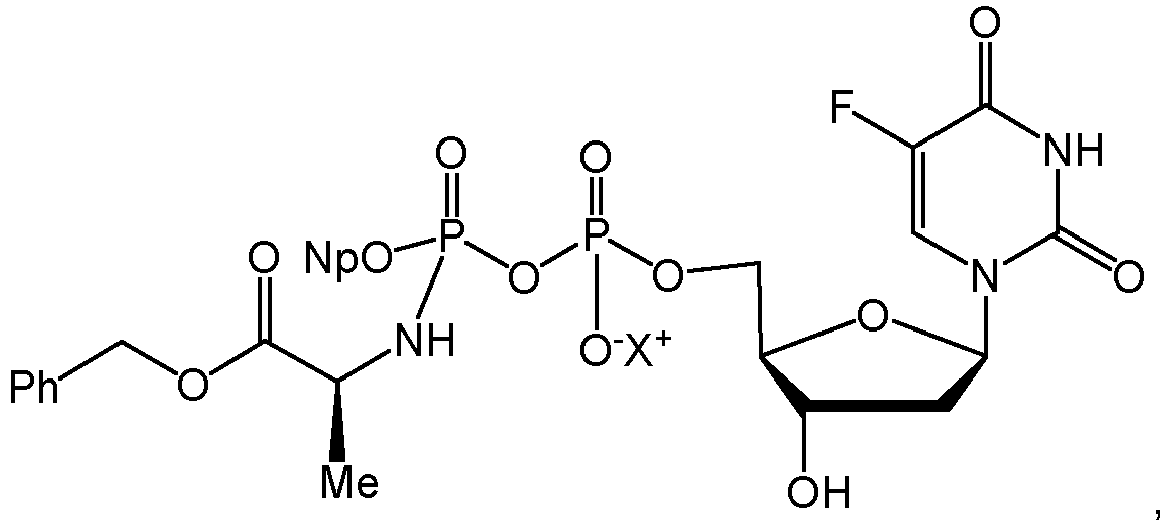

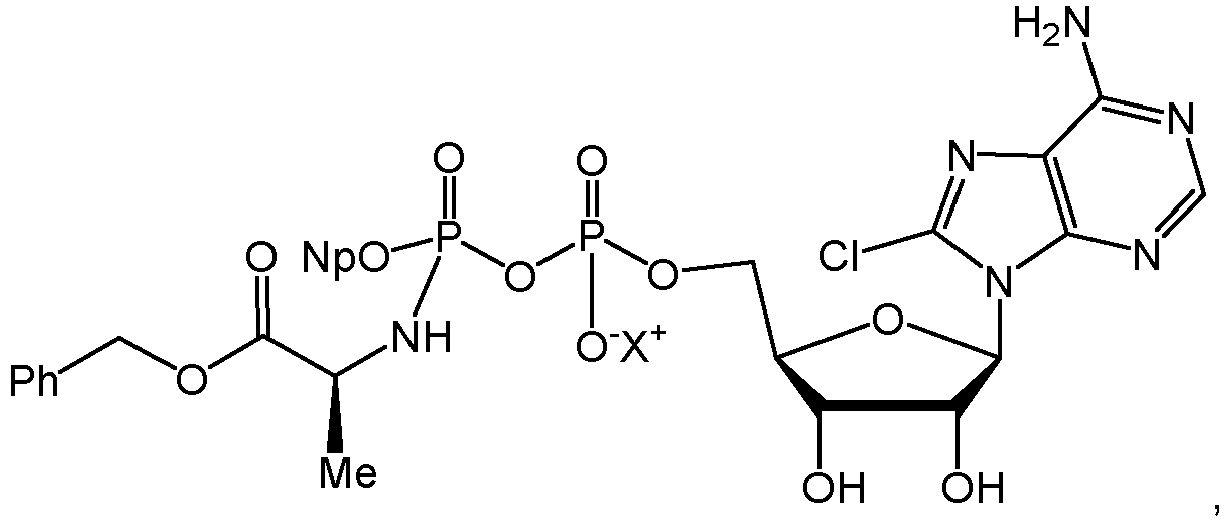


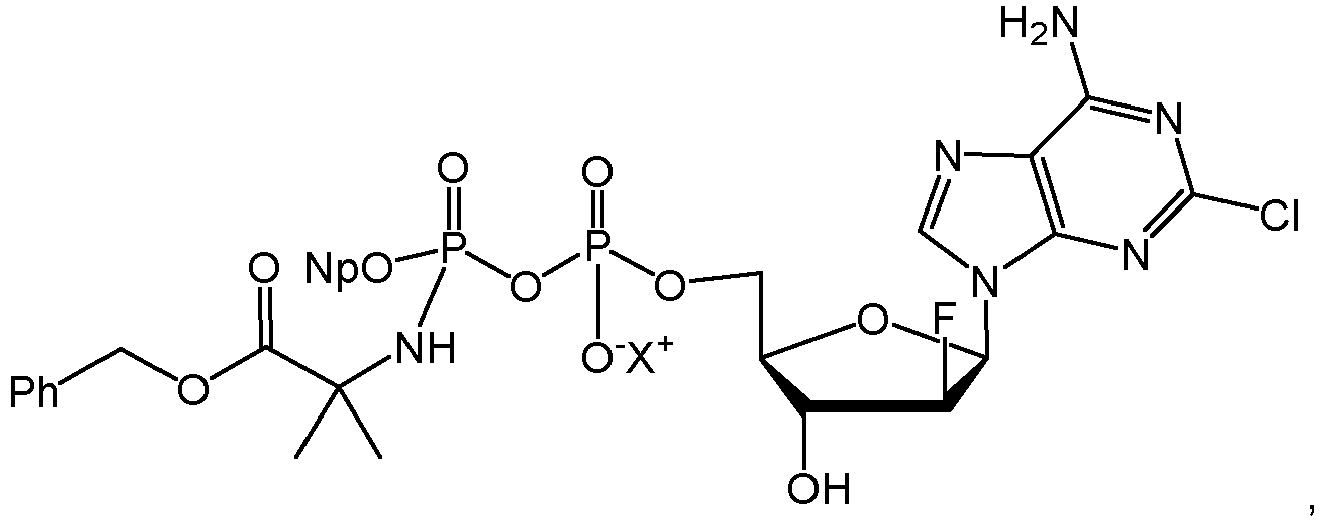


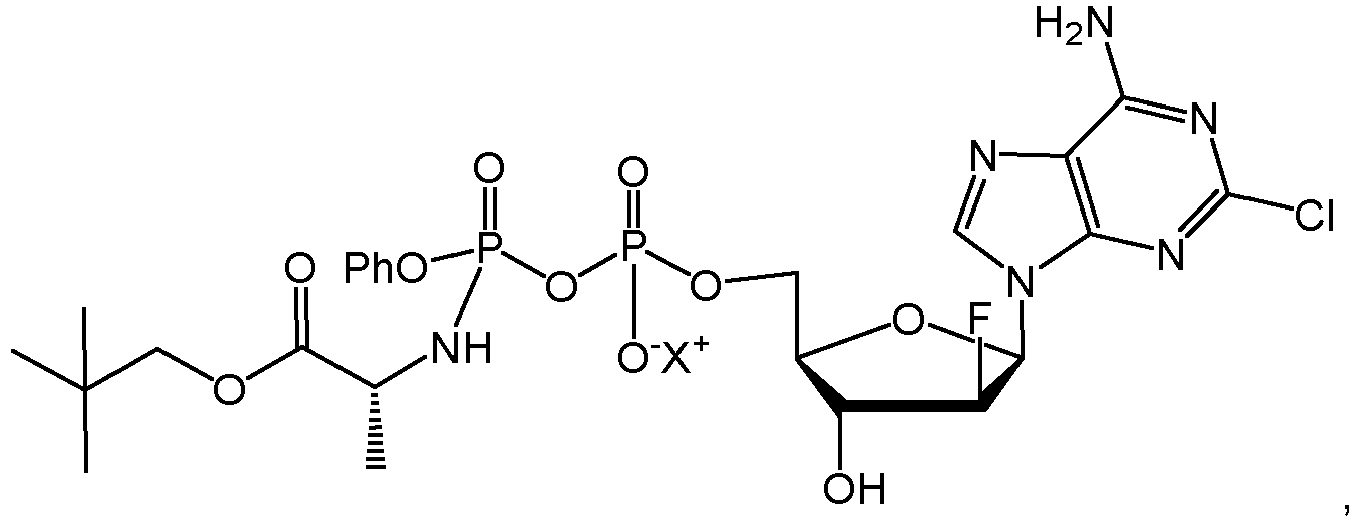


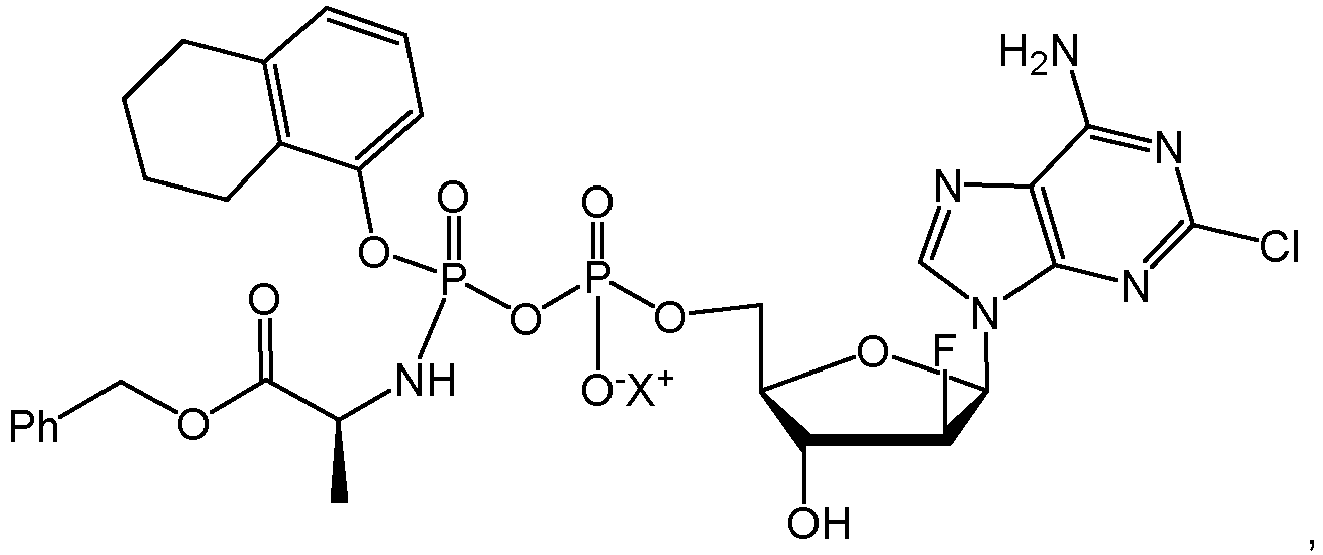
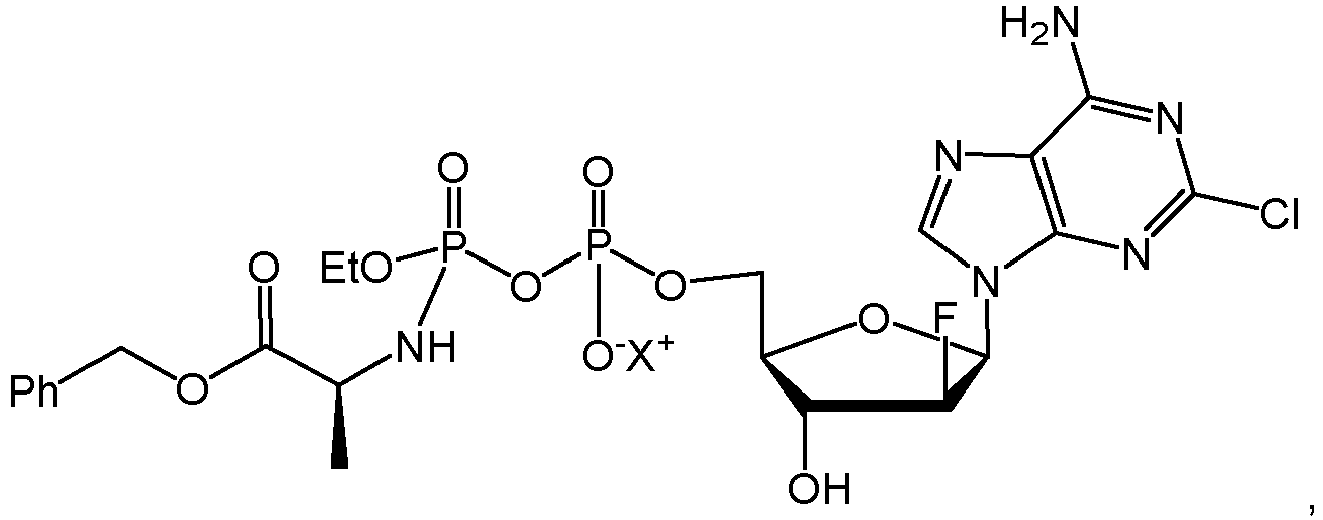


- X+ may be a metal cation or it may be an ammonium cation. X+ may be a metal cation, e.g. a cation of an alkali or alkali earth metal. X+ may be an ammonium cation, e.g. a trialkylammonium cation or an ammonium cation of a nitrogen heterocycle. Illustrative cations include those derived from aluminium, arginine, benzathine, calcium, choline, diethylamine, diolamine, glycine, lysine, magnesium, meglumine, olamine, potassium, sodium, tromethamine, triethylamine and zinc cations. X+ may be a triethylamine cation.
- Compounds of the invention comprise a chiral centre at the phosphorus atom (β-phosphorus) that is bonded to OR5. The compound may be present as a mixture of phosphate diastereoisomers, as the (S)-epimer at the phosphorus atom in substantially diastereomerically pure form or as the (R)-epimer at the phosphorus atom in substantially diastereomerically pure form. 'Substantially diastereomerically pure' is defined for the purposes of this invention as a diastereomeric purity of greater than about 90%. If present as a substantially diastereoisomerically pure form, the compound may have a diastereoisomeric purity of greater than 95%, 98%, 99%, or even 99.5%. Alternatively, the compound may be present as a mixture of phosphate diastereoisomers.
- The (R)- and/or (S)-epimers of the compound can be obtained in substantially diastereomerically pure form by chromatography, e.g. HPLC optionally using a chiral column. Alternatively, the (R)- and/or (S)-epimers of the compound can be obtained in substantially diastereomerically pure form by crystallisation from an appropriate solvent or solvent system.
- According to a second aspect of the present invention, there is provided a compound of formula (I), or a pharmaceutically acceptable salt thereof, for use in a method of treatment.
- According to a third aspect of the present invention, there is provided a compound of formula (I), or a pharmaceutically acceptable salt thereof, for use in the prophylaxis or treatment of cancer.
- According to a fourth aspect of the present invention there is provided use of a compound of formula (I), or a pharmaceutically acceptable salt thereof, in the manufacture of a medicament for the prophylaxis or treatment of cancer.
- According to a fifth aspect of the present invention, there is provided a compound of formula (I) for use in a method of prophylaxis or treatment of cancer comprising administration to a patient in need of such treatment an effective dose of a compound of formula (I), or a pharmaceutically acceptable salt thereof. Any references in the description to methods of treatment refer to the compounds, pharmaceutical compositions or medicaments of the present invention for use in a method for treatment of the human (or animal) body by therapy.
- With respect to each of the third, fourth, and fifth aspects of the present invention, embodiments of the invention comprise a cancer selected from but not restricted to the group consisting of: pancreatic cancer, bladder cancer, other urothelial cancers (e.g. cancers of ureter and renal pelvis), gastrointestinal cancers (also known as cancer of the digestive tract, including: oesophageal cancer, gastric cancer, stomach cancer, bowel cancer, small intestine cancer, colon cancer, colorectal cancer, appendix mucinous, goblet cell carcinoid, liver cancer, biliary cancer, gallbladder cancer, anal cancer and rectal cancer), lung cancer, renal (or kidney) cancer, biliary cancer, prostate cancer, cholangiocarcinoma, neuroendocrine cancer, sarcoma, lymphoma, thymic cancer, glioblastoma multiforme, a cancer of an unknown primary origin, mesothelioma, adrenal cancer, testicular cancer, cancer of the central nervous system, basal cell carcinoma, Bowens disease, other skin cancers (such as malignant melanoma, merckel cell tumour and rare appendage tumours), ocular surface squamous neoplasia, germ cell tumours, leukaemia, multiple myeloma, lung cancer, liver cancer, breast cancer, head and neck cancer, neuroblastoma, thyroid carcinoma, oral squamous cell carcinoma, urinary bladder cancer, Leydig cell tumour, and gynaecological cancers (including ovarian cancer, cancer of the fallopian tube, peritoneal cancer, endometrial cancer, uterine cancer and cervical cancer, including epithelia cervix carcinoma).
- In certain embodiments, the cancer is a leukaemia or a lymphoma.
- The cancer may be a leukaemia.
- There are four main types of leukaemia depending on whether they are chronic or acute, and myeloid or lymphoid in origin. These are: acute myeloblastic leukaemia (AML), acute lymphoblastic leukaemia (ALL), chronic myelogenous leukaemia (CML) and chronic lymphocytic leukaemia (CLL).
- Mixtures of these are also known; e.g. biphenotypic acute leukaemia (BAL; which is a mix of AML and ALL).
- In particular embodiments, the leukaemia is selected from the group consisting of: acute myeloblastic leukaemia (AML), acute lymphoblastic leukaemia (ALL), chronic myelogenous leukaemia (CML), chronic lymphocytic leukaemia (CLL) and biphenotypic acute leukaemia (BAL; which is a mix of AML and ALL).
- Chronic lymphocytic leukaemia (CLL) includes the subtypes: B-cell CLL (B-CLL), B-cell prolymphocytic leukaemia (PLL) and T-cell chronic prolymphocytic leukaemia (T-PLL) and several subtypes that differ at the genetic level.
- Acute lymphoblastic leukaemia (ALL) includes the subtypes: precursor B-cell ALL (BALL), precursor T-cell ALL (T-ALL), Burkitt-type ALL and Philadelphia chromosome positive (BCR-ABL fusion) ALL.
- Acute myeloblastic leukaemia (AML) includes the subtypes: myeloid leukaemia, monocytic leukaemia and acute promyelocytic leukaemia (APL).
- Chronic myelogenous leukaemia (CML) includes the subtypes: chronic granulocytic leukaemia (CGL) (CGL), Juvenile CML (JCML), chronic neutrophilic leukaemia (CNL), chronic myelomonocytic leukaemia (CMML) and atypical CML (aCML).
- In particular embodiments, any of the above sub-types of CLL, ALL, AML and CML are suitable for treatment with the compounds of the invention or pharmaceutical compositions containing them
- Other forms of leukemia that can be considered to sit outside of these four main groups include: erythroleukemia, arising from red blood cell precursors; and a lymphoma that has gone into the blood.
- The cancer may be a lymphoma, e.g. a solid lymphoma.
- There are two main types of lymphoma: Hodgkin's lymphoma and non-Hodgkin's lymphoma. Within each of these there are various subtypes.
- In particular embodiments, the lymphoma is selected from the group consisting of: Hodgkin's lymphoma and non-Hodgkin's lymphoma.
- In particular embodiments, the lymphoma is selected from the group consisting of: Burkitt's lymphoma (BL), mantle cell lymphoma (MCL), follicular lymphoma (FL), small lymphocytic lymphoma (SLL) indolent B-cell non-Hodgkin's lymphoma, histiocytic lymphoma (aka immunoblastic lymphoma; IBL) and diffuse large B-cell lymphoma (DLBCL), including activated-cell like diffuse large B-cell lymphoma (DLBCL-ABC) and germinal center B-cell like diffuse large B-cell lymphoma (DLBCL-GCB).
- In certain embodiments, the cancer is a gastrointestinal cancer and can be selected from the group consisting of: oesophageal cancer, gastric cancer, stomach cancer, bowel cancer, small intestine cancer, colon cancer, colorectal cancer, appendix mucinous, goblet cell carcinoid, liver cancer, biliary cancer, gallbladder cancer, anal cancer and rectal cancer.
- In certain embodiments, the cancer is of gynaecological origin and can be selected from the group consisting of: a cancer of the uterus, cancer of the fallopian tube, cancer of the endometrium, cancer of the ovary, cancer of the peritoneum and cancer of the cervix). Suitably the ovarian cancer may be epithelial ovarian cancer. Suitably the peritoneal cancer may be primary peritoneal cancer.
- In particular, the cancer may be selected from, but not restricted to pancreatic cancer, lung cancer, bladder cancer, breast cancer, biliary cancer, lymphoma, a leukaemia, a gastrointestinal cancer and a gynaecological cancer.
- The compounds of the invention have been found to retain activity even under hypoxic conditions. Cancers particularly associated with hypoxia are pancreatic and renal (or kidney) cancers.
- The cancer may be relapsed. The cancer may be metastatic. The cancer may be previously untreated.
- The cancer may be refractory cancer that has previously been treated but has proven unresponsive to prior treatment. Alternatively, the cancer patient may be intolerant of a previous therapy, for example, may develop side effects that make the patient intolerant to further treatment with the agent being administered.
- According to a sixth aspect of the present invention, there is provided a pharmaceutical composition comprising a compound of formula (I), or a pharmaceutically acceptable salt thereof, and at least one pharmaceutically acceptable excipient. The pharmaceutical composition may be for use in the prophylaxis or treatment of cancer, e.g. a cancer or group of cancers mentioned above.
- The compound of formula (I) may be as described in the following numbered paragraphs:
- 1. In a first aspect of the invention is provided a compound of formula (I), or a pharmaceutically acceptable salt thereof:

- R1 is independently at each occurrence selected from: C1-C24-alkyl, C3-C24-alkenyl, C3-C24-alkynyl, C0-C4-alkylene-C3-C6-cycloalkyl or C0-C4-alkylene-aryl;
- R2 and R3 are each independently at each occurrence selected from H, C1-C6-alkyl and C1-C3-alkylene-R7; or R2 and R3 together with the atom to which they are attached form a 3- to 6-membered cycloalkyl or heterocycloalkyl group;
- R4 is independently at each occurrence H or C1-C4-alkyl;
- R5 is independently at each occurrence selected from aryl and 5-, 6-, 9- or 10-membered heteroaryl;
- R6 is independently selected from:


- R7 is independently at each occurrence selected from aryl, imidazole, indole, SRa, ORa, CO2Ra, CO2NRaRa, NRaRb and NH(=NH)NH2;
- R8 is independently selected from H and

- Y is independently selected from H, F, Cl and OMe;
- X is independently at each occurrence a pharmaceutically acceptable cation;
- wherein any aryl group is either phenyl or naphthyl;
- wherein where any of R1, R2, R3, R4, R5 or R7 is an alkyl, cycloalkyl, heterocycloalkyl, aryl or heteroaryl, that alkyl, cycloalkyl, heterocycloalkyl, aryl or heteroaryl group is optionally substituted with from 1 to 4 substituents selected from: halo, nitro, cyano, NRaRa, NRaS(O)2Ra, NRaC(O)Ra, NRaCONRaRa, NRaCO2Ra, ORa; SRa, SORa, SO3Ra, SO2R,a SO2NRaRa, CO2Ra, C(O)Ra, CONRaRa, CRaRaNRaRa, C1-C4-alkyl, C2-C4-alkenyl, C2-C4-alkynyl and C1-C4-haloalkyl;
- wherein Ra is independently at each occurrence selected from: H and C1-C4-alkyl; and Rb is independently at each occurrence selected from: H, and C1-C4-alkyl and C(O)-C1-C4-alkyl.
- 2. A compound of
paragraph 1, wherein R4 is H. - 3. A compound of
paragraph 1 orparagraph 2, wherein R6 is
- 4. A compound of
paragraph 1 orparagraph 2, wherein R6 is
- 5. A compound of
paragraph 1 orparagraph 2, wherein R6 is
- 6. A compound of
paragraph 1 orparagraph 2, wherein R6 is
- 7. A compound of
paragraph 6, wherein Y is H. - 8. A compound of
paragraph 6, wherein Y is F. - 9. A compound of any one of
paragraphs 6 to 8, wherein R8 is H. - 10. A compound of any one of
paragraphs 6 to 8, wherein R8 is
- 11. A compound of
paragraph 1 orparagraph 2, wherein R6 is
- 12. A compound of
paragraph 1 orparagraph 2, wherein R6 is
- 13. A compound of
paragraph 1 orparagraph 2, wherein R6 is
- 14. A compound of any one of
paragraphs 1 to 13, wherein R1 is selected from C5-C7-cycloalkyl, C1-C8-alkyl and benzyl. - 15. A compound of paragraph 14, wherein R1 is benzyl.
- 16. A compound of paragraph 14, wherein R1 is C1-C8-alkyl, e.g. ethyl.
- 17. A compound of any one of
paragraphs 1 to 16, wherein R3 is H. - 18. A compound of any one of
paragraphs 1 to 17, wherein R2 is C1-C4-alkyl. - 19. A compound of any one of
paragraphs 1 to 17, wherein R2 is H. - 20. A compound of any one of
paragraphs 1 to 19, wherein R5 is phenyl. - 21. A compound of any one of
paragraphs 1 to 19, wherein R5 is naphthyl. - 22. A compound of any one of
paragraphs 1 to 21 wherein X+ is a metal cation or an ammonium cation. - 23. A compound of any one of
paragraphs 1 to 22 for medical use. - 24. A compound of any one of
paragraphs 1 to 23 for use in treating cancer. - 25. A compound for use of
paragraph 24, wherein the cancer is leukaemia or lymphoma. - 26. A compound for use of
paragraph 25, wherein the cancer is a leukaemia selected from the group consisting of acute lymphoblastic leukaemia, acute myelogenous leukaemia, myelodysplastic syndromes, acute promyelocytic leukaemia, acute lymphocytic leukaemia, chronic myelogenous leukaemia, chronic lymphocytic leukaemia, monoblastic leukaemia and hairy cell leukaemia. - 27. A pharmaceutical composition comprising compounds of any one of
claims 1 to 22 and at least one pharmaceutically acceptable excipient. - Embodiments of the invention are further described hereinafter with reference to the accompanying drawings, in which:
-
Figure 1 shows sigmoidal dose-response curves for (A) clofarabine, (B) Example 1 and (C) Example 2. Clofarabine and Example 1 showed the highest potency. All assays were carried out using KG1a cells and data are presented as mean (±SD) of three independent experiments. -
Figure 2 shows analysis of the LSC targeting capacity of clofarabine Example 1 and Example 2. Under normoxic conditions, all of the compounds showed stem cell targeting at concentrations above 1×10⁻⁷M. All data are the mean (± SD) of three independent experiments. -
Figure 3 shows comparison of the fraction of KG1a cells expressing an LSC phenotype under normoxic and hypoxic conditions. (A) KG1a cells show a time-dependent increase in cells expressing an LSC phenotype under hypoxic conditions, which was (B) reversed when the cells were transferred into normoxic culture conditions. All data are the mean (± SD) of four independent experiments. -
Figure 4 shows comparison of the mean LD50 values for (A) clofarabine, (B) Example 1, and (C) Example 2 under normoxic and hypoxic conditions. Clofarabine showed a significant loss in potency under hypoxic conditions. In contrast, the compounds of the invention maintained their potency under hypoxic conditions. All data are the mean (± SD) of three independent experiments. -
Figure 5 shows comparison of the DNA damage, as measured by γH2A.X phosphorylation assay, induced in purified LSCs and bulk tumour cells following 2-hour exposure to (A) clofarabine, (B) Example 1 and (C) Example 2 under hypoxic conditions (5% O2). All data are the mean (± SD) of three independent experiments. - The term 'saline' is intended to refer to an aqueous solution of sodium chloride. Saline solutions of the present invention will typically be sterile and will typically be at a concentration suitable for use in parenteral administration. Suitable concentrations are up to 2 w/v% or up to 1 w/v%. To optimise osmolarity different concentrations of saline can be used in the formulations of the invention, e.g. 0.9% or 0.45%.
- The formulations of the present invention can be for use in the treatment of the human body. They may be for use in the treatment of the animal body.
- The compounds in the formulations of the invention may be obtained, stored and/or administered in the form of a pharmaceutically acceptable salt. Suitable pharmaceutically acceptable salts include, but are not limited to, salts of pharmaceutically acceptable inorganic acids such as hydrochloric, sulphuric, phosphoric, nitric, carbonic, boric, sulfamic, and hydrobromic acids, or salts of pharmaceutically acceptable organic acids such as acetic, propionic, butyric, tartaric, maleic, hydroxymaleic, fumaric, malic, citric, lactic, mucic, gluconic, benzoic, succinic, oxalic, phenylacetic, methanesulphonic, toluenesulphonic, benzenesulphonic, salicylic, sulphanilic, aspartic, glutamic, edetic, stearic, palmitic, oleic, lauric, pantothenic, tannic, ascorbic and valeric acids. Suitable base salts are formed from bases which form non-toxic salts. Examples include the aluminium, arginine, benzathine, calcium, choline, diethylamine, diolamine, glycine, lysine, magnesium, meglumine, olamine, potassium, sodium, tromethamine and zinc salts. Hemisalts of acids and bases may also be formed, for example, hemisulfate, hemioxalate and hemicalcium salts.
- For the above-mentioned formulations of the invention the dosage administered will, of course, vary with the compound employed, the precise mode of administration, the treatment desired and the disorder indicated. Dosage levels, dose frequency, and treatment durations of compounds of the invention are expected to differ depending on the formulation and clinical indication, age, and co-morbid medical conditions of the patient. The size of the dose for therapeutic purposes of compounds of the invention will naturally vary according to the nature and severity of the conditions, the age and sex of the animal or patient and the route of administration, according to well known principles of medicine.
- A pharmaceutical formulation typically takes the form of a composition in which active compounds, or pharmaceutically acceptable salts thereof, are in association with a pharmaceutically acceptable adjuvant, diluent or carrier. One such pharmaceutically acceptable adjuvant, diluent or carrier in the formulations of the invention is the polar aprotic solvent. Conventional procedures for the selection and preparation of suitable pharmaceutical formulations are described in, for example, "Pharmaceuticals - The Science of Dosage Form Designs", M. E. Aulton, Churchill Livingstone, 1988.
- The formulations may be suitable for topical application (e.g. to the skin or bladder), for oral administration or for parenteral (e.g. intravenous administration).
- Any solvents used in pharmaceutical formulations of the invention should be pharmaceutical grade, by which it is meant that they have an impurity profile which renders them suitable for administration (e.g. intravenous administration) to humans.
- For oral administration the formulations of the invention may comprise the active compound admixed with an adjuvant or a carrier, for example, lactose, saccharose, sorbitol, mannitol; a starch, for example, potato starch, corn starch or amylopectin; a cellulose derivative; a binder, for example, gelatine or polyvinylpyrrolidone; and/or a lubricant, for example, magnesium stearate, calcium stearate, polyethylene glycol, a wax, paraffin, and the like, and then compressed into tablets. If coated tablets are required, the cores, prepared as described above, may be coated with a concentrated sugar solution which may contain, for example, gum arabic, gelatine, talcum and titanium dioxide. Alternatively, the tablet may be coated with a suitable polymer dissolved in a readily volatile organic solvent.
- For the preparation of soft gelatine capsules, the active compounds may be admixed with, for example, a vegetable oil or polyethylene glycol. Hard gelatine capsules may contain granules of the compound using either the above-mentioned excipients for tablets. Also liquid or semisolid formulations of the active compounds may be filled into hard gelatine capsules.
- Liquid preparations for oral application may be in the form of syrups or suspensions, for example, solutions containing the compound of the invention, the balance being sugar and a mixture of ethanol, water, glycerol and propylene glycol. Optionally such liquid preparations may contain colouring agents, flavouring agents, sweetening agents (such as saccharine), preservative agents and/or carboxymethylcellulose as a thickening agent or other excipients known to those skilled in art.
- The formulations may be for parenteral (e.g. intravenous) administration. For parenteral (e.g. intravenous) administration the active compounds may be administered as a sterile aqueous or oily solution. Preferably, the active compounds are administered as a sterile aqueous solution. The aqueous solution may further comprise at least one surfactant and/or organic solvent. Illustrative organic solvents include dimethylacetamide, ethanol, ethyleneglycol, N-methyl-pyrrolidinone, dimethylsulfoxide, dimethylformamide and isopropanol. Illustrative surfactants include polyethoxylated fatty acids and fatty acid esters and mixtures thereof. Suitable surfactants include polyethoxylated castor oil (e.g. that sold under the trade name Kolliphor® ELP); or polyethoxylated stearic acid (e.g. that sold under the trade names Solutol® or Kolliphor® HS15); or polyethoxylated (e.g. polyoxyethylene (20)) sorbitan monooleate, (e.g. that are sold under the
trade names Polysorbate 80 or Tween® 80). - The pharmaceutical composition of the invention will preferably comprise from 0.05 to 99 %w (per cent by weight) compound of the invention, more preferably from 0.05 to 80 %w compound of the invention, still more preferably from 0.10 to 70 %w compound of the invention, and even more preferably from 0.10 to 50 %w compound of the invention, all percentages by weight being based on total composition.
- Cyclodextrins have been shown to find wide application in drug delivery (Rasheed et al, Sci. Pharm., 2008, 76, 567-598). Cyclodextrins are a family of cyclic oligosaccharides. They act as a 'molecular cage' which encapsulates drug molecules and alters properties of those drug molecules such as solubility. Cyclodextrins comprise (α-1,4)-linked α-D-glucopyranose units. Cyclodextrins may contains 6, 7 or 8 glucopyranose units (designated α-, β- and γ-cyclodextrins respectively). Cyclodextrins used in pharmaceutical formulations are often β-cydodextrins. The pendant hydroxyl groups can be alkylated with a C1-C6 substituted or unsubstituted alkyl group. Examples of cyclodextrins are α-cydodextrin, β-cydodextrin, γ-cyclodextrin, 2-hydroxypropyl-β-cyclodextrin (HP-β-CD), sulfobutylether β-cyclodextrin sodium salt, partially methylated β-cydodextrin. The formulations of the invention may also comprise at least one cyclodextrin.
- The term Cm-Cn refers to a group with m to n carbon atoms.
- The term "alkyl" refers to a linear or branched hydrocarbon group. An alkyl group is monovalent. For example, C1-C6-alkyl may refer to methyl, ethyl, n-propyl, iso-propyl, n-butyl, sec-butyl, tert-butyl, n-pentyl and n-hexyl. The alkyl groups are preferably unsubstituted.
- The term "alkylene" refers to a linear hydrocarbon chain. An alkylene group is divalent. For example, C1-alkylene may refer to a CH2 group. C2-alkylene may refer to -CH2CH2- group. The alkylene groups are preferably unsubstituted.
- The term "haloalkyl" refers to a hydrocarbon chain substituted with at least one halogen atom independently chosen at each occurrence from: fluorine, chlorine, bromine and iodine. The halogen atom may be present at any position on the hydrocarbon chain. For example, C1-C4-haloalkyl may refer to chloromethyl, fluoromethyl, trifluoromethyl, chloroethyl e.g. 1-chloromethyl and 2-chloroethyl, trichloroethyl e.g. 1,2,2-trichloroethyl, 2,2,2-trichloroethyl, fluoroethyl e.g. 1-fluoromethyl and 2-fluoroethyl, trifluoroethyl e.g. 1,2,2-trifluoroethyl and 2,2,2-trifluoroethyl, chloropropyl, trichloropropyl, fluoropropyl, trifluoropropyl. A halo alkyl group may be a fluoroalkyl group, i.e. a hydrocarbon chain substituted with at least one fluorine atom.
- The term "alkenyl" refers to a branched or linear hydrocarbon chain containing at least one carbon-carbon double bond. The double bond(s) may be present as the E or Z isomer. The double bond may be at any possible position of the hydrocarbon chain. For example, "C2-C4-alkenyl" may refer to ethenyl, allyl and butenyl. The alkenyl groups are preferably unsubstituted.
- The term "alkynyl" refers to a branched or linear hydrocarbon chain containing at least one carbon-carbon triple bond. The triple bond may be at any possible position of the hydrocarbon chain. For example, "C2-C6-alkynyl" may refer to ethynyl, propynyl, butynyl. The alkynyl groups are preferably unsubstituted.
- The term "cycloalkyl" refers to a saturated hydrocarbon ring system containing 3, 4, 5 or 6 carbon atoms. For example, "3- to 6- membered cycloalkyl" may refer to cyclopropyl, cyclobutyl, cyclopentyl, cyclohexyl. The cycloalkyl groups are preferably unsubstituted.
- The term "heterocycloalkyl" may refer to a saturated or partially saturated monocyclic group comprising 1 or 2 heteroatoms independently selected from O, S and N in the ring system (in
other words - The present invention also includes formulations of all pharmaceutically acceptable isotopically-labelled forms of compound wherein one or more atoms are replaced by atoms having the same atomic number, but an atomic mass or mass number different from the atomic mass or mass number of the predominant isotope usually found in nature.
- Examples of isotopes suitable for inclusion in the compounds of the invention include isotopes of hydrogen, such as 2H and 3H, carbon, such as 11C, 13C and 14C, chlorine, such as 36Cl, fluorine, such as 18F, iodine, such as 123I and 125I, nitrogen, such as 13N and 15N, oxygen, such as 15O, 17O and 18O, phosphorus, such as 32P, and sulphur, such as 35S.
- Certain isotopically-labelled compounds, for example, those incorporating a radioactive isotope, are useful in drug and/or substrate tissue distribution studies. The radioactive isotopes tritium, i.e. 3H, and carbon-14, i.e. 14C, and 18F are particularly useful for this purpose in view of their ease of incorporation and ready means of detection.
- Substitution with heavier isotopes such as deuterium, i.e. 2H, may afford certain therapeutic advantages resulting from greater metabolic stability, for example, increased in vivo half-life or reduced dosage requirements, and hence may be preferred in some circumstances.
- Isotopically-labelled compounds can generally be prepared by conventional techniques known to those skilled in the art or by processes analogous to those described using an appropriate isotopically-labelled reagent in place of the non-labelled reagent previously employed.
- The formulation for use in the treatment of cancer including lymphoma or leukaemia, may involve, in addition to the formulations of the invention, conventional surgery or radiotherapy or chemotherapy. Such chemotherapy may include the administration of one or more other active agents.
- Where a further active agent is to be administered as part of a method of treatment, such combination treatment may be achieved by way of the simultaneous, sequential or separate dosing of the individual components of the treatment. Such combination products employ the compounds of this invention within a therapeutically effective dosage range described hereinbefore and the one or more other pharmaceutically-active agent(s) within its approved dosage range.
- Thus, the pharmaceutical formulations of the invention may comprise another active agent.
- The one or more other active agents may be one or more of the following categories of anti-tumour agents:
- (i) antiproliferative/antineoplastic drugs and combinations thereof, such as alkylating agents (for example cyclophosphamide, nitrogen mustard, bendamustin, melphalan, chlorambucil, busulphan, temozolamide and nitrosoureas); antimetabolites (for example gemcitabine and antifolates such as fluoropyrimidines like 5-fluorouracil and tegafur, raltitrexed, methotrexate, pemetrexed, cytosine arabinoside, and hydroxyurea); antibiotics (for example anthracyclines like adriamycin, bleomycin, doxorubicin, daunomycin, epirubicin, idarubicin, mitomycin-C, dactinomycin and mithramycin); antimitotic agents (for example vinca alkaloids like vincristine, vinblastine, vindesine and vinorelbine and taxoids like taxol and taxotere and polokinase inhibitors); proteasome inhibitors, for example carfilzomib and bortezomib; interferon therapy; and topoisomerase inhibitors (for example epipodophyllotoxins like etoposide and teniposide, amsacrine, topotecan, mitoxantrone and camptothecin);
- (ii) cytostatic agents such as antiestrogens (for example tamoxifen, fulvestrant, toremifene, raloxifene, droloxifene and iodoxyfene), antiandrogens (for example bicalutamide, flutamide, nilutamide and cyproterone acetate), LHRH antagonists or LHRH agonists (for example goserelin, leuprorelin and buserelin), progestogens (for example megestrol acetate), aromatase inhibitors (for example as anastrozole, letrozole, vorazole and exemestane) and inhibitors of 5α -reductase such as finasteride;
- (iii) anti-invasion agents, for example dasatinib and bosutinib (SKI-606), and metalloproteinase inhibitors, inhibitors of urokinase plasminogen activator receptor function or antibodies to Heparanase;
- (iv) inhibitors of growth factor function: for example such inhibitors include growth factor antibodies and growth factor receptor antibodies, for example the anti-erbB2 antibody trastuzumab [Herceptin™], the anti-EGFR antibody panitumumab, the anti-erbB1 antibody cetuximab, tyrosine kinase inhibitors, for example inhibitors of the epidermal growth factor family (for example EGFR family tyrosine kinase inhibitors such as gefitinib, erlotinib and 6-acrylamido-N-(3-chloro-4-fluorophenyl)-7-(3-morpholinopropoxy)-quinazolin-4-amine (CI 1033), erbB2 tyrosine kinase inhibitors such as lapatinib); inhibitors of the hepatocyte growth factor family; inhibitors of the insulin growth factor family; modulators of protein regulators of cell apoptosis (for example Bcl-2 inhibitors); inhibitors of the platelet-derived growth factor family such as imatinib and/or nilotinib (AMN107); inhibitors of serine/threonine kinases (for example Ras/Raf signalling inhibitors such as farnesyl transferase inhibitors, for example sorafenib , tipifarnib and lonafarnib), inhibitors of cell signalling through MEK and/or AKT kinases, c-kit inhibitors, abl kinase inhibitors, PI3 kinase inhibitors, Plt3 kinase inhibitors, CSF-1R kinase inhibitors, IGF receptor, kinase inhibitors; aurora kinase inhibitors and cyclin dependent kinase inhibitors such as CDK2 and/or CDK4 inhibitors;
- (v) antiangiogenic agents such as those which inhibit the effects of vascular endothelial growth factor, [for example the anti-vascular endothelial cell growth factor antibody bevacizumab (Avastin™); thalidomide; lenalidomide; and for example, a VEGF receptor tyrosine kinase inhibitor such as vandetanib, vatalanib, sunitinib, axitinib and pazopanib;
- (vi) gene therapy approaches, including for example approaches to replace aberrant genes such as aberrant p53 or aberrant BRCA1 or BRCA2;
- (vii) immunotherapy approaches, including for example adoptive cell transfer, such as CAR T-cell therapy; antibody therapy such as alemtuzumab, rituximab, ibritumomab tiuxetan (Zevalin®) and ofatumumab; interferons such as interferon a; interleukins such as IL-2 (aldesleukin); interleukin inhibitors for example IRAK4 inhibitors; cancer vaccines including prophylactic and treatment vaccines such as HPV vaccines, for example Gardasil, Cervarix, Oncophage and Sipuleucel-T (Provenge); and toll-like receptor modulators for example TLR-7 or TLR-9 agonists;
- (viii) cytotoxic agents for example fludarabine (fludara), cladribine, pentostatin (Nipent™);
- (ix) steroids such as corticosteroids, including glucocorticoids and mineralocorticoids, for example aclometasone, aclometasone dipropionate, aldosterone, amcinonide, beclomethasone, beclomethasone dipropionate, betamethasone, betamethasone dipropionate, betamethasone sodium phosphate, betamethasone valerate, budesonide, clobetasone, clobetasone butyrate, clobetasol propionate, cloprednol, cortisone, cortisone acetate, cortivazol, deoxycortone, desonide, desoximetasone, dexamethasone, dexamethasone sodium phosphate, dexamethasone isonicotinate, difluorocortolone, fluclorolone, flumethasone, flunisolide, fluocinolone, fluocinolone acetonide, fluocinonide, fluocortin butyl, fluorocortisone, fluorocortolone, fluocortolone caproate, fluocortolone pivalate, fluorometholone, fluprednidene, fluprednidene acetate, flurandrenolone, fluticasone, fluticasone propionate, halcinonide, hydrocortisone, hydrocortisone acetate, hydrocortisone butyrate, hydrocortisone aceponate, hydrocortisone buteprate, hydrocortisone valerate, icomethasone, icomethasone enbutate, meprednisone, methylprednisolone, mometasone paramethasone, mometasone furoate monohydrate, prednicarbate, prednisolone, prednisone, tixocortol, tixocortol pivalate, triamcinolone, triamcinolone acetonide, triamcinolone alcohol and their respective pharmaceutically acceptable derivatives. A combination of steroids may be used, for example a combination of two or more steroids mentioned in this paragraph;
- (x) targeted therapies, for example PI3Kd inhibitors, for example idelalisib and perifosine; or checkpoint inhibitor compounds including anti-PD-1, anti- PD-L1 and anti-CTLA4 molecules, such as nivolumab, pembrolizumab, pidilizumab, atezolizumab, durvalumab and avelumab.
- The one or more other active agents may also be antibiotic.
- Throughout the description and claims of this specification, the words "comprise" and "contain" and variations of them mean "including but not limited to", and they are not intended to (and do not) exclude other moieties, additives, components, integers or steps. Throughout the description and claims of this specification, the singular encompasses the plural unless the context otherwise requires. In particular, where the indefinite article is used, the specification is to be understood as contemplating plurality as well as singularity, unless the context requires otherwise.
- The invention is defined by the appended claims. Features, integers, characteristics, compounds, chemical moieties or groups described in conjunction with a particular aspect, embodiment or example of the invention are to be understood to be applicable to any other aspect, embodiment or example described herein unless incompatible therewith. All of the features disclosed in this specification (including any accompanying claims, abstract and drawings), and/or all of the steps of any method or process so disclosed, may be combined in any combination, except combinations where at least some of such features and/or steps are mutually exclusive. The invention is not restricted to the details of any foregoing embodiments as long as they fall under the scope of the claims. The invention extends to any novel one, or any novel combination, of the features disclosed in this specification (including any accompanying claims, abstract and drawings), or to any novel one, or any novel combination, of the steps of any method or process so disclosed as long as they fall under the scope of the claims.
- The reader's attention is directed to all papers and documents which are filed concurrently with or previous to this specification in connection with this application and which are open to public inspection with this specification.
-
AcCN acetonitrile MS mass spectrometry aq aqueous NMR nuclear magnetic resonance DCM dichloromethane Np 1-naphthyl DMSO dimethylsulphoxide rt room temperature EC50 Half maximal effective concentration TEA triethylamine eq. equivalents TEAB triethylammonium hydrogen carbonate buffer HPLC high pressure liquid chromatography TEP triethyl phosphate h hours t R retention time IC50 half maximal inhibitory concentration -

- Dry nucleoside A (∼1.0 mmol, 1.0 eq.) was dissolved in 5 mL of triethylphosphate (TEP) and stirred for 5 min at room temperature. The reaction mixture was cooled to 4°C and dry 1,8-bis(dimethylamino)naphthalene (Proton Sponge®, 1.5 eq.) was added, followed by dropwise addition of POCl3 (1.3 eq.). The resulting suspension was stirred at 4°C for 2-3 hours. After this time, to the reaction mixture was added cold 0.5 M aq. triethylammonium hydrogen carbonate buffer (TEAB) (pH 7.5) and the resulting mixture was stirred for 30 minutes and then allowed to warm to room temperature and stirred for additional 1h. TEP was extracted with tert-butylmethyl ether (4 × 50 mL), and aqueous solution was evaporated and dried under high vacuum overnight to yield the corresponding nucleoside 5'-monophosphate triethylammonium salt B as glassy colourless oil or white powder, which was used in the next step without further purification. The formation of the nucleoside 5'-monophosphate was confirmed by negative ion mass spectrometry.
- A 0.5 M solution of TEAB was prepared by bubbling CO2 through a 0.5 M triethylamine (TEA) solution in water at 0-4°C for 30-45 min (pH of approximately 7.4-7.6, unless stated otherwise)
- A synthesis of nucleoside 5'-monophosphate triethylammonium salt in the first step was accomplished following modified reference: El-Tayeb A. et al. J. Med. Chem. 2006, 49(24), 7076-7087.
- A mixture of nucleoside 5'-monophosphate triethylammonium salt B (1 mmol) in 1:1 mixture of 1,4-dioxane/acetonitrile (20 mL) was stirred at room temperature (rt) under an argon atmosphere and an appropriate phosphorochloridate C (1.0 eq.) dissolved in anhydrous acetonitrile was added dropwise. The resulting reaction mixture was stirred for 18 h at rt. The crude mixture was evaporated under reduced pressure and the residue was re-dissolved in DCM and adsorbed on silica gel deactivated with TEA (3%) in a mixture of DCM/MeOH (92%/5%). Purification of crude materials (prepared for dry load) by automatic Biotage Isolera One on SNAP Ultra 50 g cartridge pre-primed with 3CV of TEA (3%) in a mixture of DCM/MeOH (92%/5%) with a gradient of MeOH in DCM (2% to 20%,
flow 50 mL/min) afforded desired compounds, which were further re-purified on Biotage Isolera One (C18 SNAP Ultra 30 g cartridge with gradient of 0.1 M TEAB in AcCN (acetonitrile) from 100 to 0% as an eluent in 60 min.,flow 15 mL/min.) or by HPLC on semi-preparative column (Varian Pursuit XRs 5C18, 150 x 21.22 mm) using gradient of 0.1 M TEAB in AcCN from 90/10 to 0/100 in 30 min. -

31 P NMR (202 MHz, MeOD): δP - 7.73 (d, J = 21.0 Hz), - 7.93 (d, J = 21.2 Hz), -11.96 (d, J = 18.4 Hz), -12.06 (d, J = 20.8 Hz). 1 H NMR (500 MHz, MeOD): δH 8.29, 8.28 (2 × 0.5H, H-8), 7.33 - 7.24 (9H, m, H-Ar), 7.18 - 7.14 (1H, m, H-Ar), 6.44, 6.41 (2 × 0.5H, 2 × d, J = 3.5 Hz, H-1'), 5.20 - 5.19 (0.5H, m, H-2'), 5.11 (2H, apparent s, OCH 2Ph), 5.10 - 5.08 (0.5H, m, H-2'), 4.58 - 4.54 (1H, m, H-3'), 4.26 - 4.24 (2H, m, 2 × H-5'), 4.16 - 4.13 (2H, m, H-4', NHCHCH3), 3.08 (6H, q, J = 7.0 Hz, 3 × CH 2CH3), 1.39, 1.35 (3H, 2 × d, J = 7.0 Hz, NHCHCH 3), 1.26 (9H, t, J = 7.0 Hz, 3 × CH2CH 3). MS (ES) negative mode m/z: 699 ([M-H]-), Accurate mass: C25H28ClFN6O10P2 required 700.93 found 699.20 ([M - H]-). Reverse-phase HPLC, eluting with 0.1 M TEAB/AcCN from 90/10 to 0/100 in 30 min, F = 1 mL/min, λ = 254 nm, t R= 14.05 min. -

31 P NMR (202 MHz, MeOD): δP - 7.72 (d, J = 20.2 Hz), -7.89 (d, J = 20.2 Hz), -11.94 (d, J = 18.2 Hz), -12.10 (d, J = 18.2 Hz). 1 H NMR (500 MHz, MeOD): δH 8.29 (1H, s, H-8), 7.34 - 7.27 (4H, m, H-Ar), 7.17 - 7.15 (1H, m, H-Ar), 6.45, 6.42 (2 × 0.5H, 2 × apparent t, J = 1.5 Hz, H-1'), 5.24, 5.10 (2 × 0.5H, 2 × apparent t, J = 1.5 Hz, H-2'), 4.59, 4.55 (2 × 0.5H, 2 × apparent t, J = 2.0 Hz, H-3'), 4.26 - 4.24 (2H, m, OCH 2CH3), 4.17 - 4.07 (4H, m, H-5', NHCHCH3, H-4'), 3.05 (6H, q, J = 7.0 Hz, 3 × CH 2CH3), 1.39, 1.34 (2 × 1.5H, 2 × d, J = 7.0 NHCHCH 3), 1.26 - 1.20 (12H, m, OCH2CH 3, 3 × CH2CH 3). MS (ES) negative mode m/z: 637 ([M - H]-), Accurate mass: C21H26ClFN6O10P2 required 638.86 found 637.12 ([M - H]-). Reverse-phase HPLC, eluting with H2O/AcCN from 90/10 to 0/100 in 30 min, F = 1 mL/min, λ = 254 nm, two peaks for two diastereoisomers with t R= 14.20 min. -

31 P NMR (202 MHz, MeOD): δP-6.70 (d, J = 20.2 Hz), -11.86 (d, J = 22.2 Hz). 1 H NMR (500 MHz, MeOD): δH 8.30, 8.29 (2 × 0.5H, 2 × d, J = 2.0 Hz, H-8), 7.36 - 7.28 (9H, m, H-Ar), 7.18-7.14 (1H, m, H-Ar), 6.44, 6.41 (2 × 0.5H, 2 × d, J = 4.5 Hz, H-1'), 5.20 - 5.18 (0.5H, m, H-2'), 5.16 (2H, apparent s, OCH 2Ph), 5.09 - 5.07 (0.5H, m, H-2'), 4.61 - 4.55 (1H, m, H-3'), 4.29-4.25 (2H, m, 2 × H-5'), 4.17 - 4.13 (1H, m, H-4'), 3.96 - 3.84 (2H, m, NHCH 2), 2.89 (6H, q, J = 7.0 Hz, 3 × CH 2CH3), 1.19 (9H, t, J = 7.0 Hz, 3 × CH2CH 3). MS (ES) negative mode m/z: 685 ([M - H]-), Accurate mass: C25H26ClFN6O10P2 required 686 found 685.119 ([M - H]-). Reverse-phase HPLC, eluting with 0.1 M TEAB/AcCN from 90/10 to 0/100 in 30 min, F = 1 mL/min, λ = 254 nm, t R= 13.6 min. -

31 P NMR (202 MHz, MeOD): δP - 7.43 (d, J = 22.2 Hz), - 7.79 (d, J = 22.2 Hz), -11.89 (d, J = 20.2 Hz), -12.02 (d, J = 20.2 Hz). 1H-NMR (MeOD, 500 MHz) δH 8.39 - 8.35 (1H, m, H-Ar), 7.99 (1H, apparent t, J = 6.0 Hz, H-Ar), 7.87 - 7.86 (1H, m, H-Ar), 7.69 (1H, t, J = 7.0 Hz, H-Ar), 7.58 (1H, apparent d, J = 7.0 Hz, H-Ar), 7.53 - 7.51 (2H, m, H-Ar, H-6), 7.43 - 7.36 (1H, m, H-Ar), 7.29 - 7.26 (5H, m, H-Ar), 6.26 (1H, apparent q, J = 6.5 Hz, H-1'), 5.02 - 4.94 (2H, 2 × apparent d, J = 13.5, J = 12.5 Hz, OCH 2Ph), 4.46 - 4.43 (1H, m, H-3'), 4.24 - 4.16 (3H, m, 3H, 2 × H-5', NHCHCH3), 4.03 (1H, apparent s, H-4'), 3.09 (6H, q, J = 7.0 Hz, 3 × CH 2CH3), 2.22 - 2.19 (1H, m, H-2'), 2.16 - 2.4 (1H, m, H-2'), 1.37 (1.5H, d, J = 7.0 Hz, NHCHCH 3), 1.29 (1.5H, d, J = 7.0 Hz, NHCHCH 3), 1.26 (9H, t, J = 7.0 Hz, 3 × CH2CH 3). MS (ES) negative mode m/z: 692 ([M - H]-), Accurate mass: C29H30FN3O12P2 required 693 found 692.128 ([M - H]-). Reverse-phase HPLC, eluting with 0.1 M TEAB/AcCN from 90/10 to 0/100 in 30 min, F = 1 mL/min, λ = 254 nm, t R = 14.24 min., 14.34 min. -

31 P NMR (202 MHz, MeOD): δP - 7.58 (d, J = 22.2 Hz), - 8.0 (d, J = 20.2 Hz), -11.85 (d, J = 22.2 Hz), -12.05 (d, J = 20.2 Hz). 1H NMR (500 MHz, CD3OD): δH 8.36 - 8.33 (1H, m, H-Ar), 8.14, 8.10 (2 × 0.5H, 2 × s, H-2), 7.86 - 7.84 (1H, m, H-Ar), 7.66 (1H, d, J = 8.0 Hz, H-Ar), 7.56 - 7.45 (3H, m, H-Ar), 7.38 - 7.33 (1H, m, H-Ar), 7.29 - 7.24 (5H, m, H-Ar), 6.02 (1H, t, J = 6.0 Hz, H-1'), 5.35 - 5.32 (1H, m, H-2'), 5.00, 4.98, 4.97, 4.94 (2H, AB, J AB = 12.3 Hz, OCH 2Ph), 4.54 - 4.50 (1H, m, H-3'), 4.40 - 4.33 (1H, m, H-5'), 4.26 - 4.13 (3H, m, H-5', H-4', NHCHCH3), 3.06 (6H, q, J = 7.0 Hz, 3 × CH 2CH3), 1.36 (1.5H, d, J = 7.0 Hz, NHCHCH3), 1.26 (1.5H, d, J = 7.0 Hz, NHCHCH3), 1.25 (9H, t, J = 7.0 Hz, 3 × CH2 CH 3). MS (ES) negative mode m/z: 747 ([M - H]-), Accurate mass: C30H31ClN6O11P2 required 749 found 747.1102 ([M - H]-). Reverse-phase HPLC, eluting with 0.1 M TEAB/AcCN from 90/10 to 0/100 in 30 min, F = 1 mL/min, λ = 245 nm, t R = 14.32, 14.48 min. - Prepared according to the general procedure from 3'-deoxyadenosine-5'-monophosphate TEA salt (0.63 g, 1.186 mmol), phenyl(benzoxy-L-alaninyl)phosphorochloridate (0.42 g, 1.186 mmol). Two products were isolated: 3'-deoxyadenosine-5',2'-O-[phenyl(benzoxy-L-alaninyl)]diphosphate triethylammonium salt (0.05 g, 5%) and 3'-deoxyadenosine-5'-O-[phenyl(benzoxy-L-alaninyl)] diphosphate as a colorless film (0.01 g, 1.3%).


-

31 P NMR (202 MHz, MeOD): δP -7.65 (d, J = 21.0 Hz), -7.87 (d, J = 21.0 Hz), -12.12 (d, J = 16.9 Hz), -12.21 (d, J = 21.4 Hz). 1H NMR (500 MHz, MeOD): δH 7.83 (1H, d, J = 7.5 Hz, H-6), 7.35 - 7.25 (9H, m, H-Ar), 7.16 (1H, apparent t, J = 7.0 Hz, H-Ar), 6.27 - 6.24 (1H, m, H-1'), 5.96, 5.95 (1H, 2 × d, J = 5.0 Hz, H-5), 5.13 (2H, AB system, apparent s, OCH 2Ph), 4.37 - 4.25 (3H, m, 2 × H-5', H-3'), 4.18 - 4.12 (1H, m, H-4'), 4.00 - 3.97 (1H, m, NHCHCH3), 3.20 (6H, q, J = 7.0 Hz, 3 × CH 2CH3), 1.40, 1.35 (3H, 2 × d, J= 7.5 Hz, NHCHCH 3), 1.31 (9H, t, J = 7.5 Hz, 3 × CH2CH 3). MS (ES) negative mode m/z: 659 ([M - H]-), Accurate mass: C25H28F2N4O11P4 required 660 found 659 ([M - H]-). Reverse-phase HPLC, eluting with 0.1 M TEAB/AcCN from 90/10 to 0/100 in 30 min, F = 1 mL/min, λ = 254 nm, t R= 12.55 min, 12.85 min. -
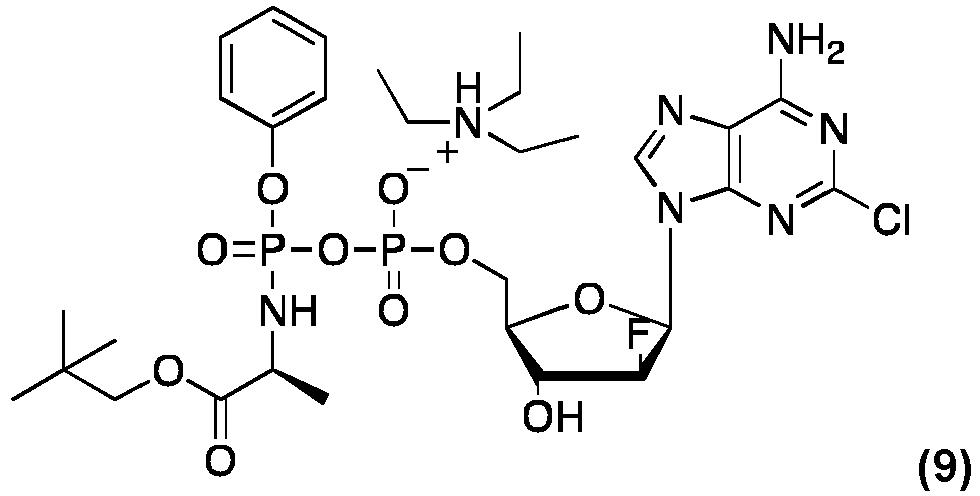
31P NMR (202 MHz, CD3OD): δP -7.67 (d, J = 21.0 Hz), -7.93 (d, J = 21.0 Hz), -11.93 (d, J = 21.21 Hz), -12.04 (d, J = 21.21 Hz).
1H NMR (500 MHz, CD3OD): δH 8.18 (0.5H, s, H-8), 8.17 (0.5H, s, H-8), 7.22 - 7.15 (4H, m, H-Ar), 7.12 - 7.09 (1H, m, H-Ar), 6.33 (0.5H, t, J = 1.5 Hz, H-1'), 6.30 (0.5H, t, J = 1.5 Hz, H-1'), 5.08 (0.5H, apparent t, J = 1.5 Hz, H-2'), 4.96 (0.5H, apparent t, J = 1.5 Hz, H-2'), 4.46 (0.5H, apparent t, J = 2.0 Hz, H-3'), 4.43 (0.5H, apparent t, J = 2.0 Hz, H-3'), 4.15 - 4.11 (2H, m, H-5'), 4.05 - 3.99 (2H, m, NHCHCH3, H-4'), 3.72, 3.69, 3.63, 3.61 (2H, AB system, J = 10.50 Hz, OCH 2C(CH3)3), 3.05 (6H, q, J = 7.0 Hz, N(CH 2CH3)3), 1.31, 1.25 (2 × 1.5H, 2 × d, J = 7.0 NHCHCH 3), 1.31 (9H, t, J = 7.5 Hz, N(CH2CH 3)3), 0.80 (9H, s, OCH2C(CH 3)3).
13C NMR (125 MHz, CD3OD): δC 175.10 (d, 3 J C-P = 6.4 Hz, C=O, ester), 173.56 (d, 3 J C-P = 6.4 Hz, C=O, ester), 156.72 (C-6), 154.16 (C-2), 153.42 (d, 2 J C-P = 3.8 Hz, C-Ar), 150.90 (d, 2 J C-P = 5.8 Hz, C-Ar), 150.26 (C-4), 142.68 (C-8), 129.26, 128.73, 124.65, 124.60, 122.40 (CH-Ar), 120.38, 120.15 (2 × d, 3 J C-P = 4.6 Hz, CH-Ar), 117.15 (C-5), 94.99 (d, 1 J C-F = 191.4 Hz, C-2'), 82.92 (d, 3 J C-F = 8.25 Hz, C-4'), 82.78 (d, 2 J C-F = 8.5 Hz, C-1'), 73.96, 73.66 (OCH2C(CH3)3), 73.61 (d, 2 J C-F = 24.5 Hz, C-3'), 65.05 (C-5'), 50.59, 50.29 (NHCHCH3), 46.26 (N(CH2CH3)3), 30.91 (OCH2 C(CH3)3), 25.36 (OCH2C(CH3)3), 19.75, 19.63 (2 × d, 3 J C-P = 5.4 Hz, NHCHCH3), 7.84 (N(CH2 CH3)3).
C24H32ClFNr6O10P2 mass required m/z 680.94; found MS (ES-) m/z: 679.19 ([M - H]-).
Reverse-phase HPLC, eluting with 0.1 M TEAB/AcCN from 90/10 to 0/100 in 30 min, F = 1 mL/min, λ = 254 nm, one peak for two diastereoisomers with t R = 15.83 min. -

31P NMR (202 MHz, CD3OD): δP -9.79 (d, J = 22.6 Hz), -9.82 (d, J = 22.6 Hz), -12.17 (d, J = 21.20 Hz), -12.20 (d, J = 21.0 Hz).
1H NMR (500 MHz, CD3OD): δH 8.29 (0.5H, s, H-8), 8.27 (0.5H, s, H-8), 7.36 - 7.26 (9H, m, H-Ar), 7.16 - 7.13 (1H, m, H-Ar), 6.43 (0.5H, d, J = 1.5 Hz, H-1'), 6.39 (0.5H, d, J = 1.5 Hz, H-1'), 5.20 - 5.17 (0.5H, m, H-2'), 5.15 - 5.13 (2H, m, OCH 2Ph), 5.11 - 5.07 (0.5H, m, H-2'), 4.60 - 4.52 (1H, m, H-3'), 4.26 - 4.23 (2H, m, H-5'), 4.15 - 4.11 (1H, m, H-4'), 3.05 (6H, q, J = 7.0 Hz, N(CH2CH3)3), 1.54 (6H, s, NHC(CH 3)2), 1.31 (9H, t, J = 7.5 Hz, N(CH2CH 3)3).
13C NMR (125 MHz, CD3OD): δC 174.96 (d, 3 J C-P = 6.6 Hz, C=O, ester), 156.69 (C-6), 154.13 (C-2), 151.06 (d, 2 J C-P = 7.3 Hz, C-Ar), 150.22 (C-4), 140.21 (C-8), 136.04 (C-Ar), 129.15. 128.12. 127.76, 127.68, 124.48, 120.47, 120.43 (CH-Ar), 117.12 (C-5), 95.49 (d, 1 J C-F = 192.5 Hz, C-2'), 82.84 (d, 3 J C-F = 3.6 Hz, C-4'), 82.68 (d, 2 J C-F = 11.5 Hz, C-1'), 73.59 (d, 2 J C-F = 11.5 Hz, C-3'), 73.41 (d, 2 J C-F = 10.5 Hz, C-3'), 66.74 (OCH2Ph), 64.90 (C-5'), 48.47 (NHC(CH3)2), 46.35 (N(CH2CH3)3), 26.14, 26.12 (NHC(CH3)2, 9.85 (N(CH2 CH3)3).
C27H30ClFNr6O10P2 mass required m/z 714.96; found MS (ES-) m/z: 713.13 ([M - H]-).
Reverse-phase HPLC, eluting with 0.1 M TEAB/AcCN from 90/10 to 0/100 in 30 min, F = 1 mL/min, λ = 254 nm, one peak for two diastereoisomers with t R= 14.51 min. -

31P NMR (202 MHz, CD3OD): δP -9.79 (d, J = 22.6 Hz), -9.82 (d, J = 22.6 Hz), -12.17 (d, J = 21.20 Hz), -12.20 (d, J = 21.0 Hz).
1H NMR (500 MHz, CD3OD): δH 8.38 - 8.34 (2H, m, H-Ar), 8.24 (0.5H, d, 5 J H-F = 2.0 Hz, H-8), 8.22 (0.5H, d, 5 J H-F = 2.0 Hz, H-8), 7.85 - 7.83 (2H, m, H-Ar), 7.65 - 7.60 (3H, m, H-Ar), 7.48 - 7.44 (3H, m, H-Ar), 7.38 - 7.29 (2H, m, H-Ar), 6.39 (0.5H, t, J = 1.5 Hz, H-1'), 6.36 (0.5H, t, J = 1.5 Hz, H-1'), 5.17 - 5.15 (0.5H, m, H-2'), 5.14 - 5.07 (2H, m, OCH 2Ph), 5.05 - 5.02 (0.5H, m, H-2'), 4.57 - 4.50 (1H, m, H-3'), 4.27 - 4.24 (2H, m, H-5'), 4.15 - 4.10 (1H, m, H-4'), 3.05 (6H, q, J = 7.0 Hz, N(CH 2CH3)3), 1.90 (6H, s, NHC(CH 3)2), 1.31 (9H, t, J = 7.5 Hz, N(CH2CH 3)3).
13C NMR (125 MHz, CD3OD): δC 176.53, 174.95 (2 x d, 3 J C-P= 6.7 Hz, C=O, ester), 156.64 (C-6), 154.08 (C-2), 150.16, 149.36 (2 × d, 3 J C-P= 7.0 Hz, C-Ar), 146.91, 146.85 (C-4), 142.89 (C-8), 136.23, 135.99, 134.79 (C-Ar), 128.07, 127.70, 127.65, 127.61, 127.16, 126.99, 126.18, 125.83, 125.59, 125.43, 125.06, 124.76, 124.20, 122.57, 122.25, 122.20, 121.44 (CH-Ar), 117.07 (C-5), 115.9 (d, 4 J C-P= 3.2 Hz, CH-Ar), 113.15 (d, 4 J C-P = 3.2 Hz, CH-Ar), 94.98, 94.95 (2 × d, 1 J C-F = 191.5 Hz, C-2'), 82.80 (d, 3 J C-F = 3.8 Hz C-4'), 82.68 (d, 2 J C-F = 24.5 Hz C-1'), 73.57, 73.45 (2 × d, 2 J C-F = 24.5 Hz, C-3'), 66.69, 66.37 (OCH2Ph), 64.94 (C-5'), 56.95, 55.87 (NHC(CH3)2), 46.28 (N(CH2CH3)3), 26.10 (d, 3 J C-P= 4.1 Hz, NHC(CH3)2), 7.86 (N(CH2 CH3)3).
C31H32ClFN6O10P2 mass required m/z 764.13; found MS (ES-) m/z: 763.15 ([M - H]-).
Reverse-phase HPLC, eluting with 0.1 M TEAB/AcCN from 90/10 to 0/100 in 30 min, F = 1 mL/min, λ = 254 nm, one peak for two diastereoisomers with t R= 14.85 min. -

31P NMR (202 MHz, CD3OD): δP -6.74 (d, J = 21.2 Hz), -6.78 (d, J = 21.0 Hz), -12.0 (d, J = 21.4 Hz).
1 H NMR (500 MHz, CD3OD): δH 8.18 (0.5H, d, 5 J H-F = 1.0 Hz, H-8), 8.17 (0.5H, d, 5 J H-F = 1.0 Hz, H-8), 7.22 - 7.15 (4H, m, H-Ar), 7.01 - 6.98 (1H, m, H-Ar), 6.34 (0.5H, t, J = 1.5 Hz, H-1'), 6.30 (0.5H, t, J = 1.5 Hz, H-1'), 5.08 - 5.06 (0.5H, m, H-2'), 4.97 - 4.96 (0.5H, m, H-2'), 4.62 - 4.54 (1H, m, OCH), 4.46 (0.5H, apparent t, J = 2.0 Hz, H-3'), 4.43 (0.5H, apparent t, J = 2.0 Hz, H-3'), 4.15 - 4.12 (2H, m, H-5'), 4.06 - 4.02 (1H, m, H-4'), 3.68 (0.5H, apparent dd, J = 10.0 Hz, J = 5.5 Hz, NHCHCH(CH3)2), 3.64 (0.5H, apparent dd, J = 10.0 Hz, J = 5.5 Hz, NHCHCH(CH3)2), 3.05 (6H, q, J = 7.0 Hz, N(CH 2CH3)3), 1.91 - 1.80 (1H, m, NHCHCH(CH3)3), 1.67 - 1.58 (5H, m, CH 2), 1.39 - 1.37 (1H, m, CH 2), 1.36 - 1.31 (3H, m, CH 2), 1.31 (9H, t, J = 7.5 Hz, N(CH2CH 3)3), 0.86 - 0.78 (6H, m, NHCHCH(CH 3)2).
13C NMR (125 MHz, CD3OD): δC 171.98, 171.95 (2 × d, 3 J C-P= 4.5 Hz, C=O, ester), 156.69 (C-6), 154.14 (C-2), 151.02 (d, 2 J C-P = 3.8 Hz, C-Ar), 150.23 (C-4), 142.25 (C-8), 129.16, 128.60, 124.56, 124.47, 120.44 (CH-Ar), 117.13 (C-5), 94.96 (d, 1 J C-F = 191.4 Hz, C-2'), 82.90 (d, 3 J C-F = 3.8 Hz C-4'), 82.81 (d, 2 J C-F = 32.5 Hz C-1'), 73.59, (d, 2 J C-F = 24.5 Hz, C-3'), 73.42 (d, 2 J C-F = 16.8 Hz, C-3'), 62.88 (d, 2 J C-P = 7.5 Hz, C-C-5'), 60.45, 60.20 (NHCHCH(CH3)2), 46.42 (N(CH2CH3)3), 32.56, 32.09 (NHCHCH(CH3)2), 31.14 (CH2), 25.00 (CH2), 23.25 (CH2), 17.79, 16.76 (NHCHCHCH3), 7.82 (N(CH2 CH3)3).
C27H36ClFN6O10P2 mass required m/z 720.16; found MS (ES-) m/z: 719.17 ([M - H]-).
Reverse-phase HPLC, eluting with 0.1 M TEAB/AcCN from 90/10 to 0/100 in 30 min, F = 1 mL/min, λ = 254 nm, one peak for two diastereoisomers with t R = 15.73 min. -

31P NMR (202 MHz, CD3OD): δP -7.41 (d, J = 23.5 Hz), -7.82 (d, J = 22.5 Hz), -11.82 (d, J = 22.69 Hz), -11.95 (d, J = 21.80 Hz).
1H NMR (500 MHz, CD3OD): δH 8.36 - 8.25 (2H, m, H-Ar), 7.85 - 7.79 (2H, m, H-Ar), 7.68 - 7.65 (2H, m, H-8), 7.58 - 7.36 (2H, m, H-Ar), (6H, m, H-Ar), 6.4 (1H, dd J = 16.68 Hz, 4.1 Hz, H-1'), 5.19 - 5.05 (1H, m, H-2'), 4.58 - 4.53 (1H m, H-3'), 4.29 - 4.25 (2H, m, H-5'), 4.17 - 4.14 (1.5H, m, H-4' and NHCHCH3), 4.06 - 4.01 (0.5H, m, NHCHCH3), 3.75-3.66 (2H, m, OCH 2C(CH3)3), 3.14 (6H, q, J = 7.0 Hz, N(CH 2CH3)3), 1.31 - 1.26 (12H, m, NHCHCH 3, N(CH2CH 3)3).
C28H34CIFN6O10P2 mass required m/z 730.15; found MS (ES-) m/z: 729.09 ([M - H]-).
Reverse-phase HPLC, eluting with 0.1 M TEAB (pH 7.2) /AcCN from 90/10 to 0/100 in 30 min, F = 1 mL/min, λ = 254 nm, one peak for two diastereoisomers with t R = 14.63 min. -

31P NMR (202 MHz, CD3OD): δP -7.68 (d, J = 21.0 Hz), -7.91 (d, J = 21.0 Hz), -12.04 (d, J = 20.08 Hz), -12.14 (d, J = 20.08 Hz).
1H NMR (500 MHz, CD3OD): δH 8.30 (0.5H, d, J H-F = 2.0 Hz, H-8), 8.29 (0.5H, d, J H-F = 2.0 Hz, H-8), 7.35 - 7.27 (4H, m, H-Ar), 7.18 - 7.14 (1H, m, H-Ar), 6.45 (0.5H, t, J = 3.5 Hz, H-1'), 6.42 (0.5H, t, J = 3.5 Hz, H-1'), 5.20 (0.5H, apparent t, J = 3.5 Hz, H-2'), 5.09 (0.5H, apparent t, J = 3.5 Hz, H-2'), 4.61 - 4.54 (1H, m, H-3'), 4.27 - 4.23 (2H, m, H-5'), 4.17 - 4.10 (2H, m, NHCHCH3, H-4'), 3.80 - 3.72 (2H, m, OCH 2C(CH3)3), 3.33 (6H, q, J = 7.0 Hz, N(CH 2CH3)3), 1.42 (1.5H, dd, J = 7.0 Hz, J = 0.5 Hz, NHCHCH 3), 1.36 (1.5H, dd, J = 7.0 Hz, J = 0.5 Hz, NHCHCH 3), 1.31 (9H, t, J = 7.5 Hz, N(CH2CH 3)3), 0.80 (9H, s, OCH2C(CH 3)3).
13C NMR (125 MHz, CD3OD): δC 173.56, 173.48 (apparent t, 3 J C-P = 7.6 Hz, C=O, ester), 156.70 (C-6), 154.13 (C-2), 150.89 (apparent t, 2 J C-P = 6.6 Hz, C-Ar), 150.24 (C-4), 142.68 (C-8), 129.22, 128.67, 124.65, 124.60, 122.34 (CH-Ar), 120.38, 120.36 (2 × d, 3 J C-P = 4.6 Hz, CH-Ar), 117.14 (C-5), 95.0, 94.99 (2 × d, 1 J C-F = 191.6 Hz, C-2'), 82.76 (d, 3 J C-F = 8.25 Hz, C-4'), 82.68 (d, 2 J C-F = 8.5 Hz, C-1'), 73.95, 73.92 (OCH2C(CH3)3), 73.58, 73.50 (2 × d, 2 J C-F = 24.5 Hz, C-3'), 64.98, 64.86 (2 × d, 2 J C-P = 4.6 Hz, C-5'), 50.36, 50.27 (2 × d, 3 J C-P = 2.4 Hz, NHCHCH3), 46.36 (N(CH2CH3)3), 30.92, 30.89 (OCH2 C(CH3)3), 25.35, 25.33 (OCH2C(CH3)3), 19.75, 19.61 (2 × d, 3 J C-P= 5.6 Hz, NHCHCH 3), 7.82 (N(CH2 CH3)3).
C24H32ClFN6O10P2 mass required m/z 680.94; found MS (ES-) m/z: 679.19 ([M - H]-).
Reverse-phase HPLC, eluting with 0.1 M TEAB/AcCN from 90/10 to 0/100 in 30 min, F = 1 mL/min, λ = 254 nm, one peak for two diastereoisomers with t R = 14.23 min. -

31P NMR (202 MHz, CD3OD): δP -7.62 (d, J = 21.0 Hz), -7.85 (d, J = 21.0 Hz), -12.14 (apparent t, J = 20.2 Hz).
1H NMR (500 MHz, CD3OD): δH 8.30 (1H, d, 5 J H-F = 2.0 Hz, H-8), 7.35 - 7.27 (4H, m, H-Ar), 7.18 - 7.14 (1H, m, H-Ar), 6.45 (0.5H, t, J = 3.5 Hz, H-1'), 6.42 (0.5H, t, J = 3.5 Hz, H-1'), 5.22 (0.5H, q, J = 3.5 Hz, H-2'), 5.13 (0.5H, q, J = 3.5 Hz, H-2'), 4.96 - 4.94 (1H, m, OCH(CH3)2), 4.61 - 4.58 (0.5H, m, H-3'), 4.57 - 4.55 (0.5H, m, H-3'), 4.29 - 4.25 (2H, m, H-5'), 4.19 - 4.15 (1H, m, NHCHCH3), 4.07 - 4.00 (1H, m, H-4'), 3.33 (6H, q, J = 7.0 Hz, N(CH 2CH3)3), 1.38 (1H, d, J = 7.5 Hz, NHCHCH 3), 1.33 (2H, dd, J = 7.5 Hz, NHCHCH 3), 1.31 (9H, t, J = 7.5 Hz, N(CH2CH 3)3), 1.20 (6H, apparent t, J = 6.0 Hz, OCH(CH 3)2).
13C NMR (125 MHz, CD3OD): δC 173.10 (d, 3 J C-P = 7.1 Hz, C=O, ester), 173.02 (C=O, ester), 156.73 (C-6), 154.16 (C-2), 150.92, 150.86 (2 × d, 2 J C-P = 5.2 Hz, C-Ar), 150.24 (C-4), 142.55 (C-8), 129.26, 124.64, 124.62 (CH-Ar), 120.34 (d, 3 J C-P = 4.5 Hz, CH-Ar), 117.16 (C-5), 95.00 (d, 1 J C-F = 191.5 Hz, C-2'), 82.90 (d, 3 J C-F = 6.5 Hz C-4'), 82.80, 82.76 (2 × d, 2 J C-F = 10.5 Hz C-1'), 73.60, 73.59 (2 × d, 2 J C-F = 24.5 Hz C-3'), 68.71 (OCH(CH3)2), 65.08 (d, 2 J C-P= 4.2 Hz, C-5'), 50.39, 50.34 (2 × d, 2 J C-P = 1.8 Hz, NHCHCH3), 46.23 (N(CH2CH3)3), 20.61, 20.54 (OCH(CH3)2), 19.60, 19.47 (2 × d, 3 J C-P = 6.0 Hz, NHCHCH 3), 7.86 (N(CH2 CH3)3).
C22H28CIFN6O10P2 mass required m/z 652.10; found MS (ES-) m/z: 651.13 ([M - H]-).
Reverse-phase HPLC, eluting with 0.1 M TEAB/AcCN from 90/10 to 0/100 in 30 min, F = 1 mL/min, λ = 254 nm, one peak for two diastereoisomers with t R = 12.32 min. -

31P NMR (202 MHz, CD3OD): δP -7.73 (d, J = 20.7 Hz), -7.84 (d, J = 20.8 Hz), -12.04 (d, J = 21.0 Hz), -12.11 (d, J = 20.8 Hz).
1H NMR (500 MHz, CD3OD): δH 8.31 (0.5H, d, J H-F = 2.5 Hz, H-8), 8.30 (0.5H, d, J H-F = 2.0 Hz, H-8), 7.35 - 7.27 (4H, m, H-Ar), 7.18 - 7.14 (1H, m, H-Ar), 6.44 (0.5H, dd, J H-F = 16.4 Hz, J = 3.9 Hz, H-1'), 6.42 (0.5H, dd, J H-F = 16.4 Hz, J = 3.7 Hz, H-1'), 5.20 - 5.09 (1H, m, H-2'), 4.68 - 4.52 (1H, m, H-3'), 4.28 - 4.24 (2H, m, H-5'), 4.18 - 4.15 (1H, m, H-4'), 4.12 - 4.07 (1H, m, NHCHCH3), 3.66 (1.5H, s, OCH 3), 3.65 (1.5H, s, OCH 3), 3.78 (6H, q, J = 7.0 Hz, N(CH 2CH3)3), 1.37 (1.5H, dd, J = 7.0 Hz, J = 0.5 Hz, NHCHCH 3), 1.32 (1.5H, dd, J = 7.0 Hz, J = 0.5 Hz, NHCHCH 3), 1.14 (9H, t, J = 7.5 Hz, N(CH2CH 3)3).
C20H24CIFN6O10P2 mass required m/z 724.07; found MS (ES-) m/z: 723.01 ([M - H]-).
Reverse-phase HPLC, eluting with 0.1 M TEAB/AcCN from 90/10 to 0/100 in 30 min, F = 1 mL/min, λ = 254 nm, one peak for two diastereoisomers with t R = 12.24 min. -

31P NMR (202 MHz, CD3OD): δP -7.26 (d, J = 20.2 Hz), -7.61 (d, J = 20.2 Hz), -12.07 (d, J = 20.40 Hz), -12.27 (d, J = 20.40 Hz).
1H NMR (500 MHz, CD3OD): δH 8.19 - 8.17 (2H, m, H-Ar), 8.13 (0.5H, d, J H-F = 2.0 Hz, H-8), 8.12 (0.5H, d, J H-F = 2.0 Hz, H-8), 7.72 - 7.68 (2H, m, H-Ar), 7.54 - 7.52 (1H, apparent d, J = 9.5 Hz, H-Ar), 7.44 - 7.40 (4H, m, H-Ar), 7.37 - 7.35 (1H, m, H-Ar), 6.28 (0.5H, t, J = 4.0 Hz, H-1'), 6.25 (0.5H, t, J = 4.0 Hz, H-1'), 5.06 - 5.02 (0.5H, m, H-2'), 4.95 - 4.93 (0.5H, m, H-2'), 4.89 - 4. 80 (2H, OCH 2Ph), 4.43 - 4.43 (0.5H, m, H-3'), 4.41 - 4.40 (0.5H, m, H-3'), 4.15 - 4.12 (2H, m, H-5'), 4.09 - 4.06 (1H, m, NHCHCH3), 4.03 - 4.01 (1H, m, H-4'), 3.33 (6H, q, J = 7.0 Hz, N(CH 2CH3)3), 1.23 (1.5H, dd, J = 7.0 Hz, J = 0.5 Hz, NHCHCH 3), 1.20 (1.5H, dd, J = 7.0 Hz, J = 0.5 Hz, NHCHCH 3), 1.31 (9H, t, J = 7.5 Hz, N(CH2CH 3)3).
C30H30CIFN6O10P2 mass required m/z 750.99; found MS (ES-) m/z: 749.19 ([M - H]-).
Reverse-phase HPLC, eluting with 0.1 M TEAB/AcCN from 90/10 to 0/100 in 30 min, F = 1 mL/min, λ = 254 nm, t R = 14.69, 14.81 min. -

31P NMR (202 MHz, CD3OD): δP -7.55 (d, J = 23.00 Hz), -7.77 (d, J = 19.40 Hz), -12.09 (d, J = 19.40 Hz), -12.19 (d, J = 20.10 Hz).
1H NMR (500 MHz, CD3OD): δH 8.18 (0.5H, d, J H-F = 2.0 Hz, H-8), 8.17 (0.5H, d, J H-F = 2.0 Hz, H-8), 7.23 - 7.11 (4H, m, H-Ar), 7.08 - 7.03 (1H, m, H-Ar), 6.33 (0.5H, dd, J = 4.0, 1.5 Hz, H-1'), 6.29 (0.5H, dd, J = 4.0 Hz, J = 1.5 Hz, H-1'), 5.08 - 5.06 (0.5H, m, H-2'), 4.98 - 4.96 (0.5H, m, H-2'), 4.47 - 4.45 (0.5H, m, H-3'), 4.44 - 4.42 (0.5H, m, H-3'), 4.15 - 4.11 (2H, m, H-5'), 4.06 - 4.03 (1H, m, NHCHCH3), 3.97 - 3.90 (5H, m, H-4', 2 × CH 2, OCH 2(CH 2)4CH3), 3.84 - 3.78 (1H, m, OCH2(CH 2)4CH3), 3.33 (6H, q, J = 7.0 Hz, N(CH 2CH3)3, 1.50 - 1.43 (4H, m, 2 × CH2, OCH2(CH 2)4CH3), 1.31 - 1.22 (6H, m, CH 2, OCH2(CH 2)4CH3, NHCHCH 3), 1.31 (9H, t, J = 7.5 Hz, N(CH2CH 3)3), 0.81 - 0.76 (3H, m, OCH2(CH2)4CH 3).
C25H34CIFN6O10P2 mass required m/z 694.97; found MS (ES-) m/z: 693.14 ([M - H]-).
Reverse-phase HPLC, eluting with 0.1 M TEAB/AcCN from 90/10 to 0/100 in 30 min, F = 1 mL/min, λ = 254 nm, t R = 15.13 and 15.21 min. -
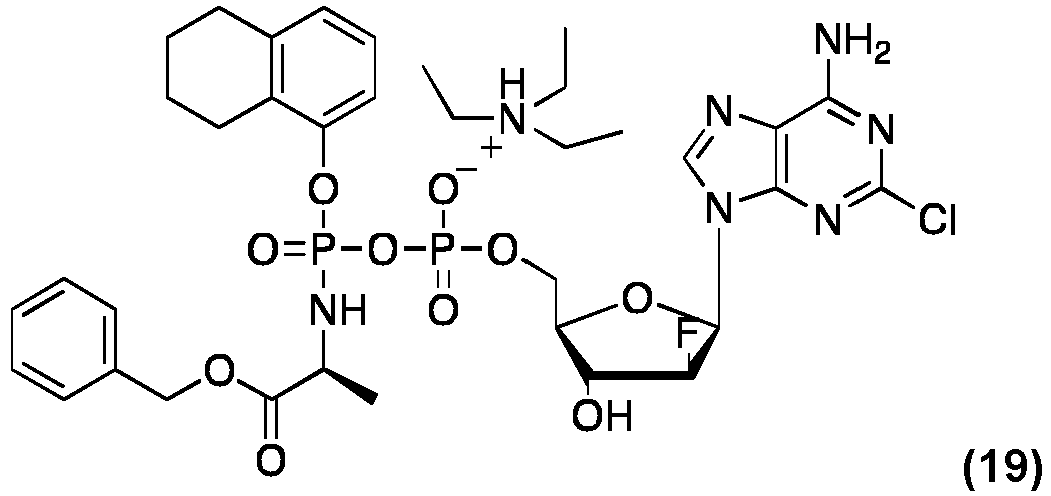
31P NMR (202 MHz, CD3OD): δP -7.06 (d, J = 24.0 Hz), -7.55 (d, J = 21.2 Hz), -11.24 (d, J = 21.2 Hz), -11.38 (d, J = 24.0 Hz).
1H NMR (500 MHz, CD3OD): δH 8.27 (0.5H, d, J H-F = 2.0 Hz, H-8), 8.25 (0.5H, d, J H-F = 2.0 Hz, H-8), 7.33 - 7.30 (3H, m, H-Ar), 7.22 - 7.18 (2H, m, H-Ar), 7.00 - 6.93 (2H, m, H-Ar), 6.84 (1H, apparent t, J = 6.5 Hz, H-Ar), 6.72 (1H, apparent d, J = 7.5 Hz, H-Ar), 6.43 (0.5H, dd, J = 4.0 Hz, J = 2.0 Hz, H-1'), 6.39 (0.5H, dd, J = 4.0 Hz, J = 2.0 Hz, H-1'), 5.19 - 5.16 (0.5H, m, H-2'), 5.09 - 5.06 (0.5H, m, H-2'), 5.06 - 5.03 (2H, m, OCH 2Ph), 4.56 - 4.49 (1H, m, H-3'), 4.27 - 4.10 (3H, m, H-5', H-4'), 4.02 - 3.97 (1H, m, NHCHCH3), 3.33 (6H, q, J = 7.0 Hz, N(CH 2CH3)3), 2.73 (4H, bt, 2 × CH 2), 1.75 - 1.72 (4, m, 2 × CH 2), 1.42 (1.5H, d, J = 7.5 Hz, NHCHCH 3), 1.38 (1.5H, dd, J = 7.0 Hz, NHCHCH 3), 1.31 (9H, t, J = 7.5 Hz, N(CH2CH 3)3).
C30H34CIFN6O10P2 mass required m/z 754.15; found MS (ES-) m/z: 753.23 ([M - H]-).
Reverse-phase HPLC, eluting with 0.1 M TEAB/AcCN from 90/10 to 0/100 in 30 min, F = 1 mL/min, λ = 254 nm, t R = 15.32 and 15.44 min. -

31P NMR (202 MHz, CD3OD): δP -2.73 (d, J = 20.2 Hz), -3.04 (d, J = 20.4 Hz), -11.96 (d, J = 20.2 Hz), -12.07 (d, J = 20.04 Hz).
1H NMR (500 MHz, CD3OD): δH 8.32 (0.5H, d, J H-F = 2.0 Hz, H-8), 8.31 (0.5H, d, J H-F = 2.0 Hz, H-8), 7.37 - 7.27 (5H, m, H-Ar), 6.46 (0.5 H, dd, J = 4.0 Hz, J = 2.0 Hz, H-1'), 6.43 (0.5H, dd, J = 4.0 Hz, J = 2.0 Hz, H-1'), 5.24 - 5.22 (0.5H, m, H-2'), 5.20 - 5.14 (2H, m, OCH 2Ph), 5.13-5. 11 (0.5H, m, H-2'), 4.62 - 4.60 (0.5H, m, H-3'), 4.59- 4.57 (0.5H, m, H-3'), 4.29 - 4.26 (2H, m, H-5'), 4.19 - 4.17 (2H, m, NHCHCH3), 4.12- 4.04 (3H, m, H-4', OCH 2CH3), 2.86 (6H, q, J = 7.0 Hz, N(CH 2CH3)3), 1.43 (1.5H, dd, J = 7.0 Hz, J = 0.5 Hz, NHCHCH 3), 1.42 (1.5H, dd, J = 7.0 Hz, J = 0.5 Hz, NHCHCH 3), 1.27 - 1.23 (3H, m, OCH2CH 3), 1.19 (9H, t, J = 7.5 Hz, N(CH2CH 3)3).
C22H28CIFN6O10P2 mass required m/z 652.89; found MS (ES-) m/z: 651.15 ([M - H]-).
Reverse-phase HPLC, eluting with 0.1 M TEAB/AcCN from 90/10 to 0/100 in 30 min, F = 1 mL/min, λ = 254 nm, one peak for two diastereoisomers with t R = 14.12 min. -

31P NMR (202 MHz, CD3OD): δP - 7.28 (d, J = 21.4 Hz), -7.57 (d, J = 21.6 Hz), -12.18 (d, J = 21.6 Hz).
1H NMR (500 MHz, CD3OD): δH 8.18 (1H, s, H-8), 7.19 - 7.10 (8H, m, H-Ar), 7.06 - 6.99 (2H, m, H-Ar), 6.32 (0.5H, t, J = 3.5 Hz, H-1'), 6.29 (0.5H, t, J = 3.5 Hz, H-1'), 5.10 - 5.08 (0.5H, m, H-2'), 4.97 - 4.88 (2.5H, m, H-2', OCH 2Ph), 4.46 (0.5H, apparent t, J = 3.5 Hz, H-3'), 4.43 (0.5H, apparent t, J = 3.5 Hz, H-3'), 4.17 - 4.13 (2H, m, H-5'), 4.06 - 4.04 (1H, m, H-4'), 3.94 - 3.88 (1H, m, NHCHCH2CH(CH3)2), 3.33 (6H, q, J = 7.0 Hz, N(CH 2CH3)3), 1.13 (9H, t, J = 7.5 Hz, N(CH2CH 3)3), 1.43 - 1.37 (3H, m, NHCHCH 2CH(CH3)2), 0.75 - 0.72 (3H, m, NHCHCH2CH(CH 3)2), 0.65 - 0.64 (3H, apparent dd, J = 14.0 Hz, J = 6.0 Hz, NHCHCH2CH(CH 3)2).
13C NMR (125 MHz, CD3OD): δC 173.43, 173.22 (2 × d, 3 J C-P = 3.5 Hz, C=O, ester), 156.78, 156.72 (C-6), 154.16 (C-2), 150.92 (d, 2 J C-P = 7.0 Hz, C-Ar), 150.24 (C-4), 135.84, 84, 135.81 (C-8), 129.26, 128.74, 128.26, 128.13, 127.95, 127.90, 127.88, 127.83, 124.68, 124.57, 122.30 (CH-Ar), 120.44 (d, 3 J C-P = 4.6 Hz, CH-Ar), 120.27 (d, 3 J C-P = 5.2 Hz, CH-Ar), 119.98, 119.94 (CH-Ar), 117.17 (C-5), 95.00 (d, 1 J C-F = 191.6 Hz, C-2'), 82.90 (d, 3 J C-F = 4.1 Hz C-4'), 82.74 (d, 2 J C-F = 11.0 Hz C-1'), 73.63, 73.58 (2 × d, 2 J C-F = 24.5 Hz, C-3'), 66.43, 66.05 (OCH2Ph), 65.10 (d, 2 J C-P = 5.5 Hz, C-5'), 53.70 (NHCH), 53.31 (d, 2 J C-P = 5.5 Hz, NHCH), 46.21 (N(CH2CH3)3), 43.20, 43.00 (2 × d, 3 J C-P = 7.0 Hz, NHCHCH2), 24.13, 24.08 (NHCHCH2 CH(CH3)2), 21.66, 21.45, 21.07, 20.99 (NHCHCH2CH(CH3)2), 7.83 (N(CH2 CH3)3).
C29H34CIFN6O10P2 mass required m/z 742.15; found MS (ES-) m/z: 741.18 ([M - H]-).
Reverse-phase HPLC, eluting with 0.1 M TEAB/AcCN from 90/10 to 0/100 in 30 min, F = 1 mL/min, λ = 254 nm, one peak for two diastereoisomers with t R = 14.91 min. -

31P NMR (202 MHz, CD3OD): δP - 7.88 (d, J = 20.6 Hz), -7.98 (d, J = 20.0 Hz), -12.00 (d, J = 21.21 Hz).
1H NMR (500 MHz, CD3OD): δH 8.17 (0.5H, d, 5 J H-F = 2.5 Hz, H-8), 8.14 (0.5H, d, 5 J H-F = 2.5 Hz, H-8), 7.18 - 7.08 (10, m, H-Ar), 6.97 - 6.87 (5H, m, H-Ar), 6.30 (0.5 H, dd, J = 4.0 Hz, J = 1.5 Hz, H-1'), 6.27 0.5H dd, J = 4.0 Hz, J = 1.5 Hz, H-1'), 5.08 - 5.05 0.5H m, H-2' 4.97 - 4.95 (0.5H, m, H-2'), 4.86 - 4.77 (4H, m OCH 2Ph, NHCHCH 2Ph), 4.46 - 4.44 (0.5H, m, H-3'), 4.43 - 4.41 (0.5H, m, H-3'), 4.25 - 4.17 (1H, m, NHCHCH2Ph), 4.16 - 4.12 (2H, m, H-5'), 4.10 - 4.05 (1H, m, H-4'), 3.33 (6H, q, J = 7.0 Hz, N(CH 2CH3)3), 1.31 (9H, t, J = 7.5 Hz, N(CH2CH 3)3).
13C NMR (125 MHz, CD3OD): δC 173.46 (d, 3 J C-P = 4.6 Hz, C=O, ester), 172.05 (d, 3 J C-P = 4.5 Hz, C=O, ester), 156.68 (C-6), 154.13 (C-2), 153.36 (d, 2 J C-P = 7.1 Hz, C-Ar), 150.85, 150.83 (C-4), 150.23 (C-Ar), 136.73, 136.11 (d, 2 J C-P = 4.7 Hz, C-Ar), 135.69 (C-8), 135.52, 135.50 (CAr), 129.20 (d, 3 J C-P = 3.1 Hz, CH-Ar), 128.74, 128.09, 128.05 (d, 3 J C-P = 2.8 Hz, CH-Ar), 127.90, 127.84, 127.78, 126.44, 126.25, 124.59, 122.40, 120.38, 120.34, 120.30, 120.26, 120.15, 120.11 (CH-Ar), 117.15 (C-5), 95.01 (d, 1 J C-F = 191.0 Hz, C-2'), 95.00 (d, 1 J C-F = 191.0 Hz, C-2'), 82.84 (d, 3 J C-F = 3.8 Hz C-4'), 82.68 (d, 2 J C-F = 32.5 Hz C-1'), 73.58 (d, 2 J C-F = 24.5 Hz C-3'), 66.45, 66.44 (OCH2Ph), 66.11 (OCH2Ph), 65.04 (d, 2 J C-P = 4.8 Hz, C-5'), 56.44 (NHCHCH2Ph), 56.19 (NHCHCH2Ph), 46.21 (N(CH2CH3)3), 40.79, 40.74 (CH2Ph), 9.85 (N(CH2 CH3)3).
C32H32CIFN6O10P2 mass required m/z 776.13; found MS (ES-) m/z: 775.17 ([M - H]-).
Reverse-phase HPLC, eluting with 0.1 M TEAB/AcCN from 90/10 to 0/100 in 30 min, F = 1 mL/min, λ = 254 nm, one peak for two diastereoisomers with t R = 24.28 min. -

31P NMR (202 MHz, CD3OD): δP - 9.05 (d, J = 17.6 Hz), - 9.72 (d, J = 21.6 Hz), -11.75 (d, J = 17.6 Hz), - 12.12 (d, J = 21.6 Hz).
1H NMR (500 MHz, CD3OD): δH 8.17 (0.5H, d, J H-F = 2.5 Hz, H-8), 8.16 (0.5H, d, J H-F = 2.5 Hz, H-8), 7.21 - 7.15 (8H, m, H-Ar), 7.11 - 7.09 (1H, m, H-Ar), 7.04 - 7.00 (1H, m, H-Ar), 6.32 (0.5H, d, J = 4.0 Hz, H-1'), 6.31 (0.5H, d, J = 4.0 Hz, H-1'), 5.08 - 5.06 (0.5H, m, H-2'), 5.01 - 4.99 (0.5H, m, H-2'), 4.98 - 4.91 (2H, m, OCH 2Ph), 4.48 - 4.45 (1H, m, NCH), 4.43 - 4.41 (0.5H, m, H-3'), 4.34 - 4.30 (0.5H, m, H-3'), 4.16 - 4.09 (2H, m, H-5'), 4.05 - 4.00 (1H, m, H-4'), 3.46 - 3.38 (2H, m, NCH 2), 2.21 - 2.05 (1H, m, one H of NCH2CH 2), 1.85 - 1.76 (3H, m, 1 × H, NCH2CH 2, 2 × H, NCH2CH2CH 2), 3.33 (6H, q, J = 7.0 Hz, N(CH 2CH3)3, 1.31 (9H, t, J = 7.5 Hz, N(CH2CH 3)3).
13C NMR (125 MHz, CD3OD): δC 173.60, 173.31 (C=O, ester), 156.69 (C-6), 154.14 (C-2), 150.78 (d, 2 J C-P = 3.8 Hz, C-Ar), 150.22 (C-4), 136.37 (C-8), 136.03, 135.96 (C-Ar), 129.29, 129.23, 128.13, 127.80, 127.76, 127.67, 124.57 (CH-Ar), 120.15 (d, 3 J C-P = 5.2 Hz, CH-Ar), 119.96 (d, 3 J C-P = 5.2 Hz, CH-Ar), 117.14 (C-5), 95.02 (d, 1 J C-F = 191.7 Hz, C-2'), 94.99 (d, 1 J C-F = 191.7 Hz, C-2'), 82.85 (d, 3 J C-F = 5.6 Hz C-4'), 82.71 (d, 2 J C-F = 32.5 Hz, C-1'), 73.59 (d, 2 J C-F = 24.5 Hz, C-3'), 73.55 (d, 2 J C-F = 24.5 Hz, C-3'), 66.32, 66.25 (OCH2Ph), 65.02 (d, 2 J C-P = 4.0 Hz, C-5'), 64.90 (d, 2 J C-P = 4.0 Hz, C-5'), 60.72 (2 J C-P = 7.75 Hz, NCH), 60.35 (2 J C-P = 7.75 Hz, NCH), 46.31 (N(CH2CH3)3), 30.99 (2 J C-P = 11.0 Hz, NCH2), 30.89 (2 J C-P = 11.0 Hz, NCH2), 24.84 (3 J C-P = 9.0 Hz, NCH2 CH2), 24.40 (3 J C-P = 9.0 Hz, NCHCH2), 7.85 (N(CH2 CH3)3).
C28H30CIFN6O10P2 mass required m/z 726.97; found MS (ES-) m/z: 725.67 ([M - H]-).
Reverse-phase HPLC, eluting with 0.1 M TEAB/AcCN from 90/10 to 0/100 in 30 min, F = 1 mL/min, λ = 254 nm, one peak for two diastereoisomers with t R = 15.39 min. -

31P NMR (202 MHz, CD3OD): δP - 7.41 (d, J = 21.33 Hz), - 7.69 (d, J = 21.6 Hz), -12.29 (d, J = 20.6 Hz).
1H NMR (500 MHz, CD3OD): δH 8.19 (0.5H, d, J H-F = 2.1 Hz, H-8), 8.18 (0.5H, d, J H-F = 2.0 Hz, H-8), 7.21 - 7.16 (4H, m, H-Ar), 7.09 - 7.02 (1H, m, H-Ar), 6.32 (0.5H, dd, J H-F = 16.6 Hz, J = 4.3 Hz, H-1'), 6.31 (0.5H, dd, J H-F = 16.6 Hz, J = 4.2 Hz, H-1'), 5.02 (0.5H, dd J H-F = 51.9 Hz, J H-F = 2.2 Hz, H-2') 5.00 (0.5H, dd, J H-F = 51.9 Hz, J H-H = 2.2 Hz, H-2'), 4.48 - 4.43 (1H, m, H-3'), 4.17 - 4.13 (2H, m, H-5'), 4.08 - 4.00 (m, 2H, NHCHCH3, H-4'), 3.56, 3.43 (3H, 2s, OCH 3), 2.80 (6H, q, J = 7.0 Hz, N(CH 2CH3)3, 2.42 - 2.39 (1H, m, CH3SCH2CH 2a), 2.28 - 2.24 (1H, m, CH3SCH2CH 2b), 1.90, 1.86 (3H, 2 × s, SCH 3), 1.90 - 1.71 (2H, m, CH3SCH 2CH2a). C22H28CIFN6O10P2S mass required 684.96; found MS (ES-) m/z: 683 ([M - H]-).
Reverse-phase HPLC, eluting with 0.1 M TEAB/AcCN from 90/10 to 0/100 in 30 min, F = 1 mL/min, λ = 254 nm, one peak for two diastereoisomers with t R = 12.28 min. -

31P NMR (202 MHz, CD3OD): δP - 6.84 (d, J = 21.5 Hz), -6.99 (d, J = 22.3 Hz), -12.00 (d, J = 21.6 Hz).
1H NMR (500 MHz, CD3OD): δH 8.30, (0.5H, d, J H-F = 2.4 Hz, H-8), 8.29 (0.5H, d, J H-F = 2.3 Hz, H-8), 7.35 - 7.23 (4H, m, H-Ar), 7.19 - 7.13 (1H, m, H-Ar), 6.44 (0.5H, dd, J H-F = 16.7 Hz, J = 3.9 Hz, H-1'), 6.43 (0.5H, dd, J H-F = 16.7 Hz, J H-H = 4.2 Hz, H-1'), 5.21 -5.08 (1H, m, H-2'), 4.59 - 4.54 (1H, m, H-3'), 4.28 - 4.25 (2H, m, OCH 2CH3), 4.18 - 4.07 (3H, m, H-5'a, H-4', NHCHCH3), 3.83 (0.5H, dd, J = 9.8 Hz, J = 5.7 Hz, H-5'b ,), 3.82 (0.5H, dd, J = 9.8 Hz, J = 5.7 Hz, Hb-5'), 3.33 (6H, q, J = 7.0 Hz, N(CH 2CH3)3, 1.77 - 1.68 (1H, m, CHCH3), 1.55 - 1.42 (1H, m, CHCH 2a), 1.15 - 1.09 (1H, m, CHCH 2b), 1.27 - 1.20 (12H, m, N(CH2CH 3)3, OCH2CH 3), 0.91 - 0.82 (6H, CHCH 3, CH2CH 3).
C24H32CIFN6O10P2 mass required 680.14; found MS (ES-) m/z: 680.18 ([M - H]-).
Reverse-phase HPLC, eluting with 0.1 M TEAB/AcCN from 90/10 to 0/100 in 30 min, F = 1 mL/min, λ = 254 nm, one peak for two diastereoisomers with t R = 13.57 min. -

31P NMR (202 MHz, CD3OD): δP 55.05 (d, J = 28.5 Hz), 53.71 (d, J = 28.5 Hz), -12.24 (broad d, J = 28.7 Hz).
1H NMR (500 MHz, CD3OD): δH 8.37 - 8. 34 (1H, m, H-Ar), 8.28 (0.5H, d, J H-F = 2.0 Hz, H-8), 8.26 (0.5H, d, J H-F = 2.0 Hz, H-8), 7.85 - 7.82 (1H, m, H-Ar), 7.66 - 7.64 (2H, m, H-Ar), 7.50 - 7.43 (2H, m, H-Ar), 7.38 - 7.19 (5H, m, H-Ar), 6.42 (0.5H, t, J = 4.0 Hz, H-1'), 6.39 (0.5H, t, J = 4.0 Hz, H-1'), 5.19 - 5.16 (1H, m, H-2'), 5.11 - 5.02 (2H, m, OCH 2Ph), 4.60 - 4.57 (0.5H, m, H-3'), 4.56 - 4.54 (0.5H, m, H-3'), 4.44 - 4.28 (3H, m, H-5', NHCHCH3), 4.20 - 4.17 (1H, m, H-4'), 3.33 (6H, q, J = 7.0 Hz, N(CH 2CH3)3), 1.47 - 1.41 (3H, m, NHCHCH 3), 1.31 (9H, t, J = 7.5 Hz, N(CH2CH 3)3).
C30H30CIFN6O9P2S mass required m/z 767.06; found MS (ES-) m/z 766.12 ([M - H]-).
Reverse-phase HPLC, eluting with 0.1 M TEAB/AcCN from 90/10 to 0/100 in 30 min, F = 1 mL/min, λ = 254 nm, one peak for two diastereoisomers with t R = 16.39 min. - A subset of compounds of the invention were assayed for their cytotoxic activity in an array of different solid tumours and haematological malignancies using the following assay.
- Solid tumour and haematological malignancy assay.
- In vitro viability assay were performed to assess the effects of compounds on cell viability in selected cell lines over 72 h using the CellTiterGlo (CTG, Promega-G7573) assay. The tests were performed in duplicates with treatment of compounds at 9 points, 3.16 folds titration in 96 well plates over ∼72 h. The compound starting concentrations were 198 µM. Cell viability assay using CellTiterGlo in 96-well plate were performed. Compound treatment 72 h, standard growth conditions, duplicates. Compounds were dissolved to 40mM with thawed 100%. Compounds were serially diluted at 3.16 fold in thawed DMSO, and warmed to 37°C before being dissolved in media (2µL+200µL). After compounds were dissolved in media, media containing compounds were warmed to 37°C in incubator and then compounds in media were added to cell plates (50µL+50µL) in duplicates. The compounds' final concentrations were from 198µM to 19.8nM. All compound solubilities were checked and recorded again, then the plates were transferred to CO2 tissue culture incubator immediately and incubated for 3 days. DMSO final concentration is 0.5%. The parent nucleoside in each case was tested as a comparator, as was an exemplary ProTide. The drugs of the ProTide class that were tested were as follows:


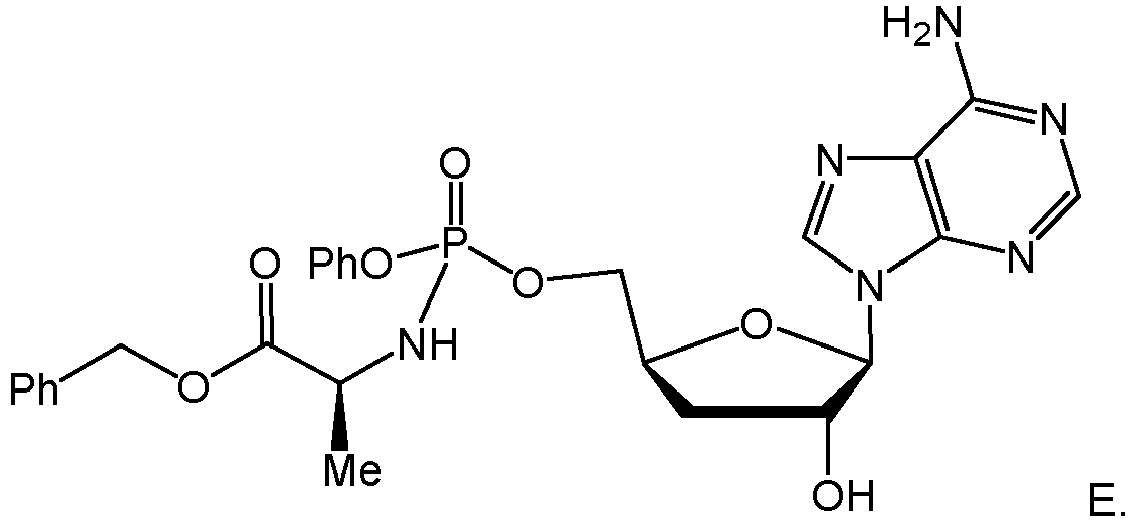
- The following cell lines were tested and are referred to in the Table 1 below:
Table 1 Cell line Malignancy Cell line Malignancy MOLT-4 Acute T lymphoblastic leukaemia MCF-7 Breast adenocarcinoma CCRF-CEM Acute lymphoblastic leukaemia HL-60 Promyelocytic leukaemia RL Non-Hodgkin's lymphoma MV4-11 Biphenotypic B myelomonocytic leukaemia RPMI-8226 Human multiple myeloma HepG2 Hepatocellular carcinoma K562 Chronic myelogenous leukaemia HT29 Colon adenocarcinoma OVCAR-3 Ovarian adenocarcinoma Mia-Pa-Ca-2 Pancreatic carcinoma KG-1 Acute myelogenous leukaemia - The results of this screening are presented in Tables 2, 3 and 4.
- In Table 3, A represents an EC50 of no more than 0.2 µm; B represents an EC50 of greater than 0.2 µm but no more than 2 µm; C represents an EC50 of greater than 2 µm but no more than 5 µm; D represents an EC50 of greater than 5 µm but no more than 10 µm; and E represents an EC50 of greater than 10 µm. No entry means that screening of the indicated compound against the indicated cell line was not carried out.
- In Table 4, A represents an EC50 of no more than 0.2 µm; B represents an EC50 of greater than 0.2 µm but no more than 1 µm; C represents an EC50 of greater than 1 µm but no more than 5 µm; D represents an EC50 of greater than 5 µm but no more than 10 µm; and E represents an EC50 of greater than 10 µm. Letters in bold represent an EC50 less than that of the exemplary ProTide A.
- In Tables 2, 3 and 4, 'Ab EC50 'refers to the absolute EC50 and 'Top inhibit' refers to the percentage inhibition achieved at the highest concentration tested.


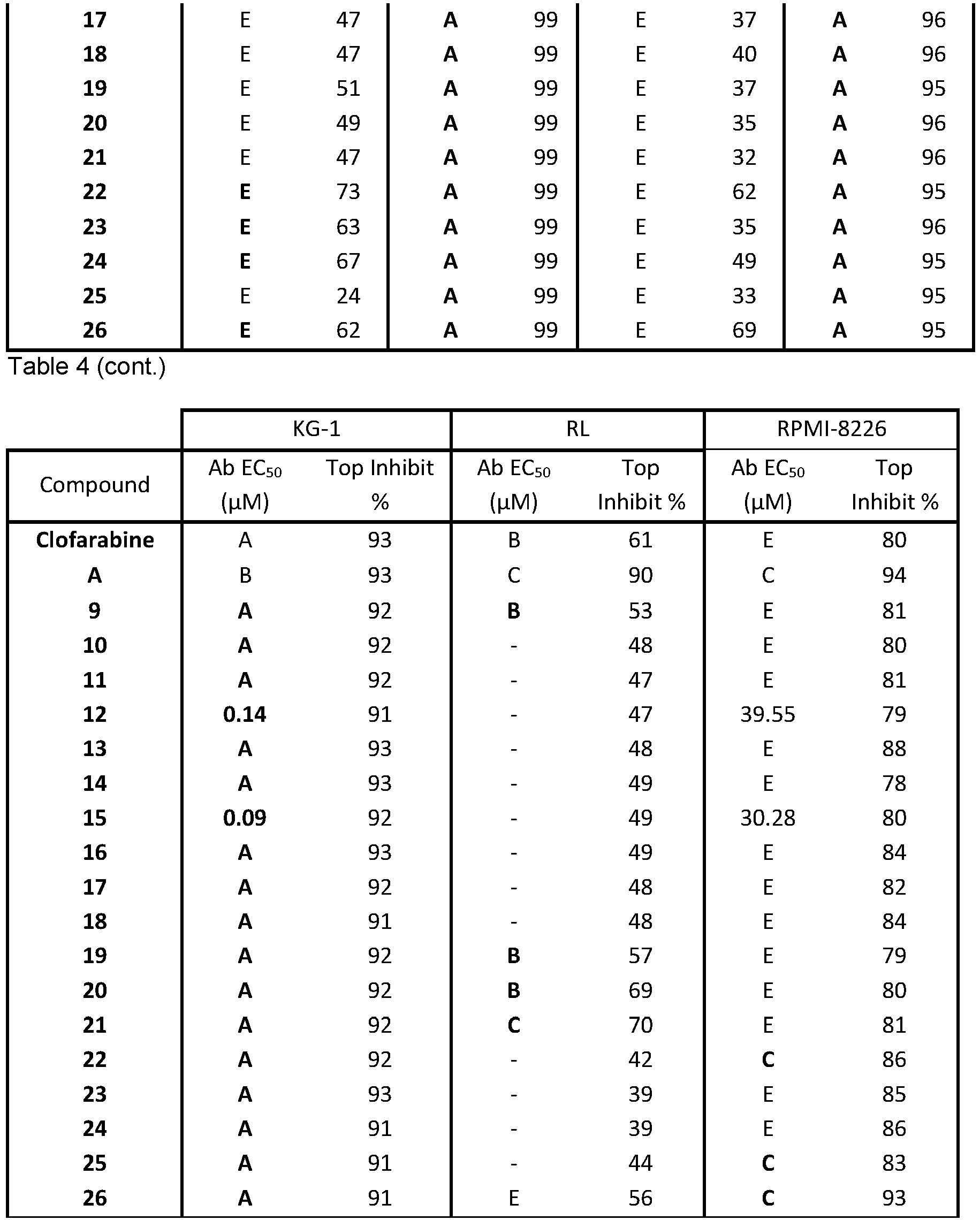
- As can be seen from Tables 3 and 4, certain compounds of the invention were more active than the ProTide A against a range of different cancer cell lines.
- The assay was performed according to the published procedure (Kuhnz, W.; Gieschen, H. Drug Metab. Dispos. 1998, 26, 1120-1127).
- Pooled cryopreserved hepatocytes were thawed, washed, and re-suspended in Krebs-Henseleit buffer (pH 7.3). The reaction was initiated by adding the test compound (1 µM final concentration) into cell suspension and incubated in a final volume of 100 µL on a flat-bottom 96-well plate for 0 and 120 min, respectively, at 37 °C/5% CO2. The reaction was stopped by adding 100 µL of acetonitrile into the incubation mixture. Samples were then mixed gently and briefly on a plate shaker, transferred completely to a 0.8 mL V-bottom 96-well plate, and centrifuged at 2500 × g for 15 min at room temperature. Each supernatant (150 µL) was transferred to a clean cluster tube, followed by HPLC-MS/MS analysis on a Thermo Electron triplequadrupole system.
- For comparison, the parent nucleoside and a corresponding ProTide were tested in the same assay
- The results are shown in Tables 5 and 6:
Table 5 Compound Human hepatocytes Mean half-life (min.) D 53 5 18 8-Cl-Adenosine >120 B 139 8 27 Gemcitabine - C 24 4 15 FUDR 69 E 90 7 27 Cordycepin 48 Table 6 Compound Human hepatocytes Mean half-life (min.) A 24 1 In the range 20 to 1002 In the range 20 to 1003 In the range 20 to 100Clofarabine >120 - Clofarabine and Examples 1 and 2 were selected for analysis to determine whether: (1) the compounds of the invention possessed increased potency when compared to the parental compound and (2) the compounds of the invention preferentially targeted leukaemic stem cells (LSCs). In order to establish this, the acute myeloid leukaemia cell line, KG1a, was employed as it manifests a minor stem cell-like compartment with a distinct immunophenotype (Lin- /CD34+/CD38-/CD123+). The compounds were evaluated over an extended dose range. In addition, the effects of the compounds on the stem cell compartment were evaluated over the entire dose range. The mean clofarabine LD50 (the concentration of drug required to kill 50% of the cells) was 1.69 × 10⁻⁸M. Example 1 showed a similar mean LD50 value (1.37 × 10⁻⁸M), whereas Example 2 showed significantly increased mean LD50 values (4.38 × 10⁻⁸M and 7.10 × 10⁻⁸M respectively).
- Under normoxic conditions, the LSC (Lin-/CD34+/CD38-/CD123+) compartment constituted ~3.5% of the total cell line. However, under hypoxic conditions (1% and 5% oxygen) the proportion of LSCs showed a time-dependent increase (up to 23.7%). Furthermore, this was reversed when the cell line was transferred back into normoxic conditions. There was no significant difference in the fraction of LSCs in the cultures between 1% and 5% oxygen. When considering the relative potency of the compounds under normoxic and hypoxic conditions (5% oxygen), clofarabine showed a significant increase in mean LD50 under hypoxic conditions (1.69×10⁻⁸M to 5.31×10⁻⁸M; P = 0.01). In contrast, Example 1 showed no significant difference in mean LD50 values.
-
- 1. To generate a complete cytotoxicity dose-response curve for a series of selected compounds and their respective parental nucleoside in KG1a cells
- 2. To establish the effects of the tested compounds on the LSC compartment over the entire range of concentrations used
- 3. To compare the effects of the tested compounds under hypoxic conditions (1% and 5% oxygen)
- 4. To investigate the persistence of yH2A.X foci in LSCs and bulk tumour cells following treatment with clofarabine and the tested compounds under hypoxic conditions
- The acute myeloid leukaemia (AML) KG1a cell line was maintained in RPMI medium (Invitrogen, Paisley, UK) supplemented with 100 units/mL penicillin, 100µg/mL streptomycin and 20% foetal calf serum. Cells were subsequently aliquoted (105 cells/100µL) into 96-well plates and were incubated at 37°C in a humidified normoxic (20% oxygen) or hypoxic (1% or 5% oxygen) atmosphere for 48h in the presence of clofarabine , or clofarabine diphosphate phosphoramidates of the invention (1×10⁻¹⁰M - 1×10⁻⁶M). In addition, control cultures were carried out to which no drug was added. Cells were subsequently harvested by centrifugation and were analysed by flow cytometry using the Annexin V assay.
- Cultured cells were harvested by centrifugation and then resuspended in 195µL of calcium-rich buffer. Subsequently, 5 µL of Annexin V (Caltag Medsystems, Botolph Claydon, UK) was added to the cell suspension and cells were incubated in the dark for 10 mins prior to washing. Cells were finally resuspended in 190µL of calcium-rich buffer together with 10µL of propidium iodide. Apoptosis was assessed by dual-colour immunofluorescent flow cytometry as described previously. Subsequently LD50 values (the dose required to kill 50% of the cells in a culture) were calculated for each nucleoside analogue and diphosphate phosphoramidate.
- KG1a cells were cultured for 48h in the presence of a wide range of concentrations of each nucleoside analogue and their respective diphosphate phosphramidate. Cells were then harvested and labelled with a cocktail of anti-lineage antibodies (PE-cy7), anti-CD34 (FITC), anti-CD38 (PE) and anti-CD123 (PERCP cy5). The sub-population expressing a leukaemic stem cell (LSC) phenotype were subsequently identified and were expressed as a percentage of all viable cells left in the culture. The percentages of stem cells remaining were then plotted on a dose-response graph and the effects of the diphosphate phosphoramidate were compared with the parental nucleosides.
- KG1a cells were grown under hypoxic conditions for 7 days in order to generate 107 cells and increase the percentage of cells expressing an LSC phenotype. Subsequently, Lin- /CD34+/CD38-/CD123+ LSCs and Lin-/CD34+/CD38+/CD123+ 'bulk' tumour cells were purified by high speed cell sorting using a FACS Melody cell sorter (Becton Dickenson) and were placed back into hypoxic cell culture conditions prior to the addition of clofarabine or clofarabine diphosphate phosphoramidates.
- Phosphorylation of the histone variant γH2A.X occurs as a rapid response to double strand DNA breaks. The γH2A.X Phosphorylation Assay Kit (Flow cytometry) is a cell-based assay formatted for flow cytometric detection of levels of phosphorylated Histone γH2A.X (Merck, UK). LSC and 'bulk tumour' cells were cultured in 96-well plates in the presence of clofarabine or clofarabine diphosphate phosphoramidates. After 2h of exposure to drug, the cells were harvested by centrifugation and then fixed and permeabilised in preparation for staining and detection. Histone γH2A.X phosphorylated at
serine 139 is detected by the addition of the antiphospho-Histone γH2A.X conjugated to APC. Cells were then run on a flow cytometer to quantitate the number of cells staining positive for phosphorylated Histone γH2A.X. - The data obtained in these experiments were evaluated using one-way ANOVA. All data was confirmed as Gaussian or a Gaussian approximation using the omnibus K2 test. LD50 values were calculated from the non-linear regression and line of best-fit analysis of the sigmoidal dose-response curves. All statistical analyses were performed using Graphpad Prism 6.0 software (Graphpad Software Inc., San Diego, CA).
- The in vitro drug sensitivity of KG1a cells was assessed using the Annexin V / propidium iodide assay. The sigmoidal dose-response curves for each compound tested are shown in
Figure 1A-C . The results are summarised in Table 7.Table 7 Compound Mean LD50 (nM) Clofarabine 16.9 Example 1 13.7 Example 2 71.0 - Clofarabine and the compounds of the invention showed potency in the nanomolar range; clofarabine and Example 1 had similar LD50 values with Example 1 being slightly more potent.
- KG1a cells were grown under normoxic and hypoxic conditions and the LSC phenotype was monitored over time. Under normoxic conditions, the LSC phenotype was stably maintained in approximately 3.5% of the cells in culture. In contrast, under hypoxic conditions, the fraction of the cells in culture expressing the LSC phenotype increased in a time-dependent manner (
Figure 3A ). When cells were then transferred back into normoxic culture conditions, the fraction of cells expressing the LSC phenotype returned to ~3.5%, again in a time-dependent manner (Figure 3B ). - Given the observed increase in an LSC phenotype under hypoxic conditions, the relative potency of clofarabine and the compounds was assessed in KG1a cells cultured under normoxic and hypoxic (5% O2) conditions.
Figure 4 shows the overlaid sigmoidal dose-response curves for clofarabine and the compounds of the invention. The results are summarised in Table 8:Compound Normoxia Mean LD50 (nM) Hypoxia Mean LD50 (nM) Ratio Normoxia/Hypoxia Clofarabine 16.9 53.1 31.8 Example 1 13.7 16.3 84.0 Example 2 71.0 95.0 74.7 - As can be seen, clofarabine showed a significant reduction in potency when used on cells cultured under hypoxic conditions. This reduction in potency was not observed when Examples 1 and 2 were used under the same hypoxic conditions.
- In an attempt to understand why clofarabine-treated cells were less sensitive to the effects of the drug under hypoxic conditions, cells were grown under hypoxic conditions and then the LSC and bulk tumour fractions were purified using high-speed cell sorting. The purified cells were then exposed to drug for 2 hours and the amount of DNA damage was quantified using a yH2A.X phosphorylation assay.
Figure 5 shows that the level of DNA damage in the LSCs was significantly lower than the bulk tumour cells following treatment with clofarabine. In contrast, Examples 1 and 2 induced similar levels of DNA damage in both the LSCs and the bulk tumour cells. - 1. In terms of stem cell targeting, all of the compounds tested showed evidence of stem cell targeting at concentrations above 10-8M . Example 1 showed a trend towards increased selectivity against Lin-/CD34+/CD38-/CD123+ LSCs.
- 2. The LSC phenotype was shown to be inducible under hypoxic conditions and this was reversed when the cells were reintroduced to normoxic culture conditions. The dynamics of the changes in LSC fraction suggests a plasticity in the phenotype rather than a selective expansion/contraction in a fixed LSC sub-population.
- 3. Clofarabine showed a significant reduction in potency when used on cells cultured under hypoxic conditions. This reduction in potency was not observed when Examples 1 and 2 were used under the same hypoxic conditions. Many cancers exist in a hypoxic state in the human body.
- 4. One explanation for the reduced clofarabine potency under hypoxic conditions is that there is a significant expansion of the LSC fraction under these conditions and LSCs showed significantly lower DNA damage, as measured by phosphorylation of yH2A.X, following short-term exposure to clofarabine. In contrast, Examples 1 and 2 induced similar levels of DNA damage in the bulk tumour cells and LSCs under the same conditions.
Claims (17)
- A compound of formula (I), or a pharmaceutically acceptable salt thereof:
 R1 is independently at each occurrence selected from: C1-C24-alkyl, C3-C24-alkenyl, C3-C24-alkynyl, C0-C4-alkylene-C3-C8-cycloalkyl and C0-C4-alkylene-aryl;R2 and R3 are each independently at each occurrence selected from H, C1-C6-alkyl and C1-C3-alkylene-R7; or R2 and R3 together with the atom to which they are attached form a 3- to 6-membered cycloalkyl or heterocycloalkyl group;R4 is independently at each occurrence H or C1-C4-alkyl;or R4, a group selected from R2 and R3 and the atoms to which they are attached may form a 3- to 6-membered heterocycloalkyl group;R5 is independently at each occurrence selected from aryl, 5-, 6-, 9- or 10-membered heteroaryl, C3-C8-cycloalkyl, 3- to 7-membered heterocycloalkyl, C1-C3-alkylene-R5a and C1-C8-alkyl, said aryl being optionally fused to C6-C8-cycloalkyl;R5a is independently at each occurrence selected from aryl, 5-, 6-, 9- or 10-membered heteroaryl, C3-C8-cycloalkyl, 3- to 7-membered heterocycloalkyl, said aryl being optionally fused to C6-C8-cycloalkyl;R6 is independently selected from: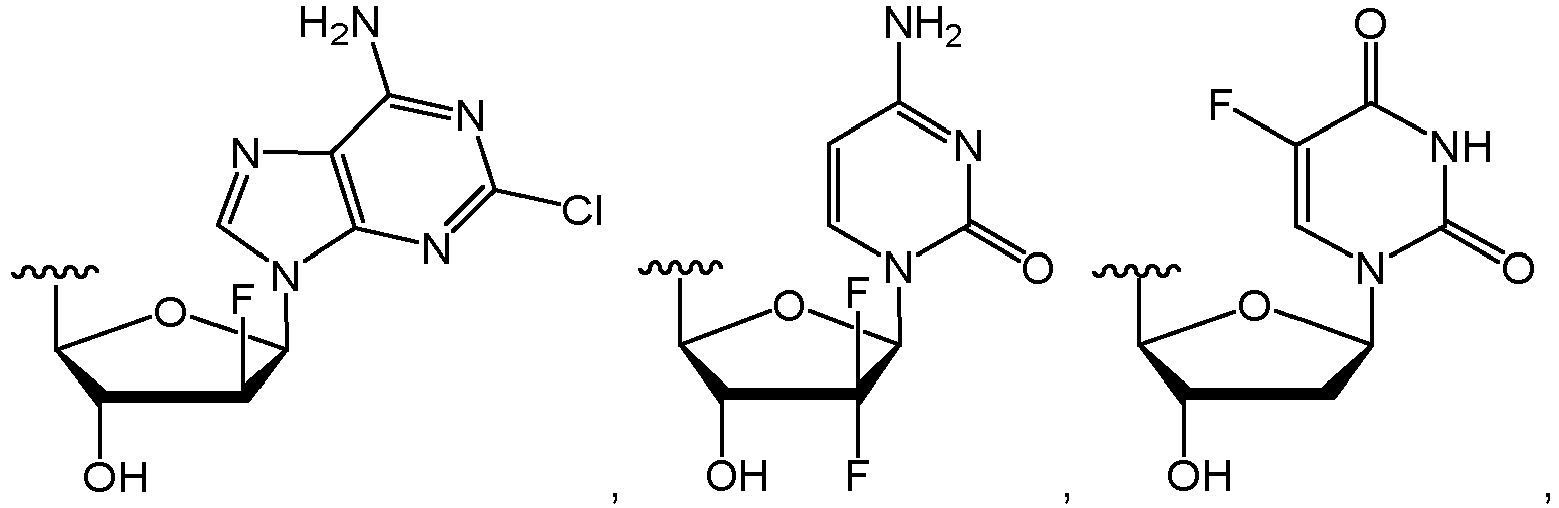

 R7 is independently at each occurrence selected from aryl, imidazole, indole, SRa, ORa, CO2Ra, CO2NRaRa, NRaRb and NH(=NH)NH2;R8 is independently selected from H and
 Z1 and Z2 are each independently selected from O and S;Y is independently selected from H, F, Cl and OMe;X is independently at each occurrence a pharmaceutically acceptable cation;wherein any aryl group is either phenyl or naphthyl;wherein where any of R1, R2, R3, R4, R5 or R7 is an alkyl, cycloalkyl, heterocycloalkyl, aryl or heteroaryl, that alkyl, cycloalkyl, heterocycloalkyl, aryl or heteroaryl group is optionally substituted with from 1 to 4 substituents selected from: halo, nitro, cyano, NRaRa, NRaS(O)2Ra, NRaC(O)Ra, NRaCONRaRa, NRaCO2Ra, ORa; SRa, SORa, SO3Ra, SO2Ra, SO2NRaRa, CO2Ra C(O)Ra, CONRaRa, CRaRaNRaRa, C1-C4-alkyl, C2-C4-alkenyl, C2-C4-alkynyl and C1-C4-haloalkyl;wherein Ra is independently at each occurrence selected from: H and C1-C4-alkyl; and Rb is independently at each occurrence selected from: H, and C1-C4-alkyl and C(O)-C1-C4-alkyl.
 - A compound of claim 1, wherein R4 is H.
- A compound of claim 1 or claim 2, wherein R6 is

- A compound of claim 1 or claim 2, wherein R6 is


- A compound of any one of claims 1 to 4, wherein R1 is selected from C5-C7-cycloalkyl, C1-C8-alkyl and benzyl.
- A compound of claim 5, wherein R1 is benzyl.
- A compound of claim 5, wherein R1 is C1-C8-alkyl, e.g. ethyl.
- A compound of any one of claims 1 to 7, wherein R3 is H.
- A compound of any one of claims 1 to 8, wherein R2 is C1-C4-alkyl.
- A compound of any one of claims 1 to 8, wherein R2 is H.
- A compound of any one of claims 1 to 10, wherein R5 is phenyl.
- A compound of any one of claims 1 to 10, wherein R5 is naphthyl.
- A compound of claim 1, wherein the compound of formula (I) is selected from:


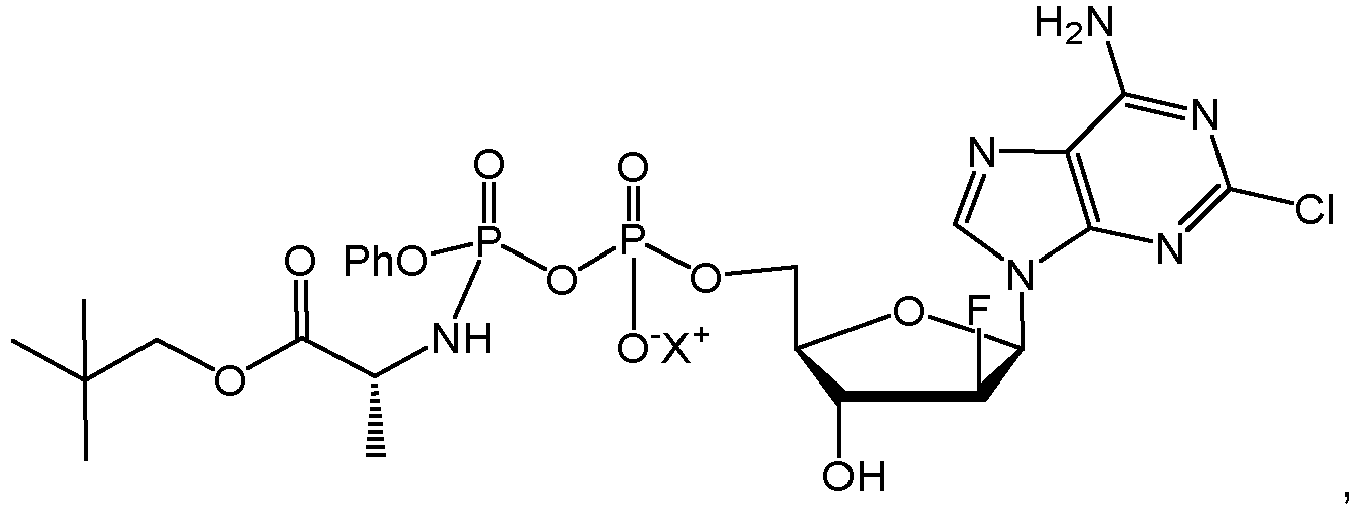


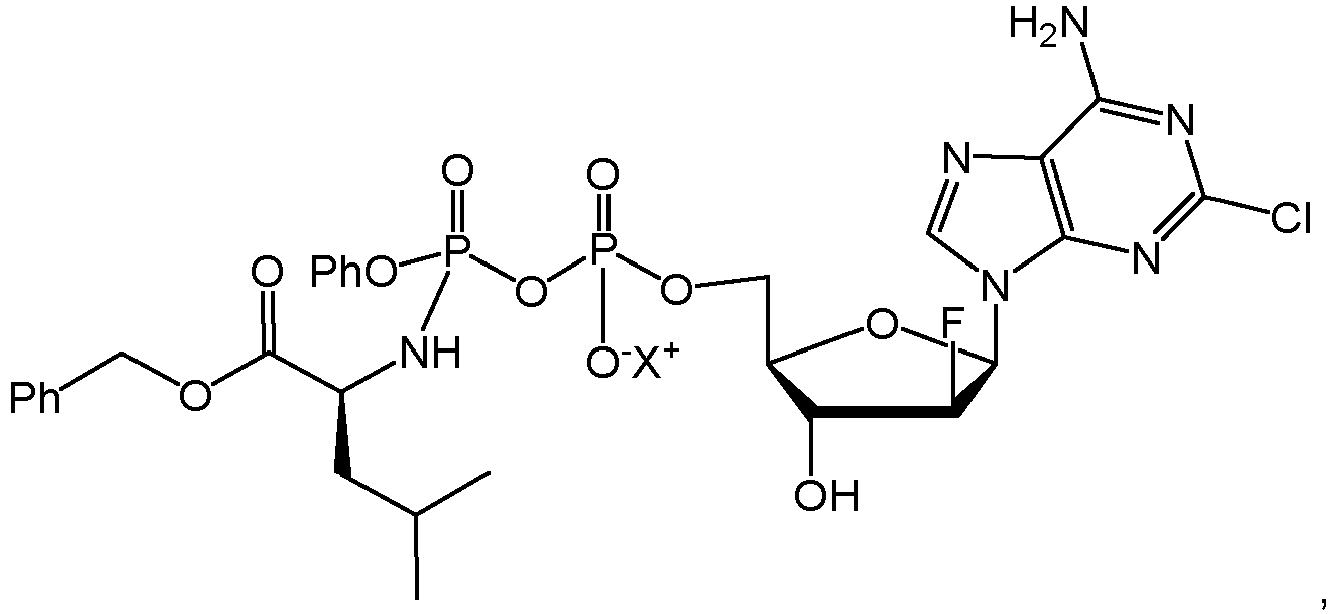
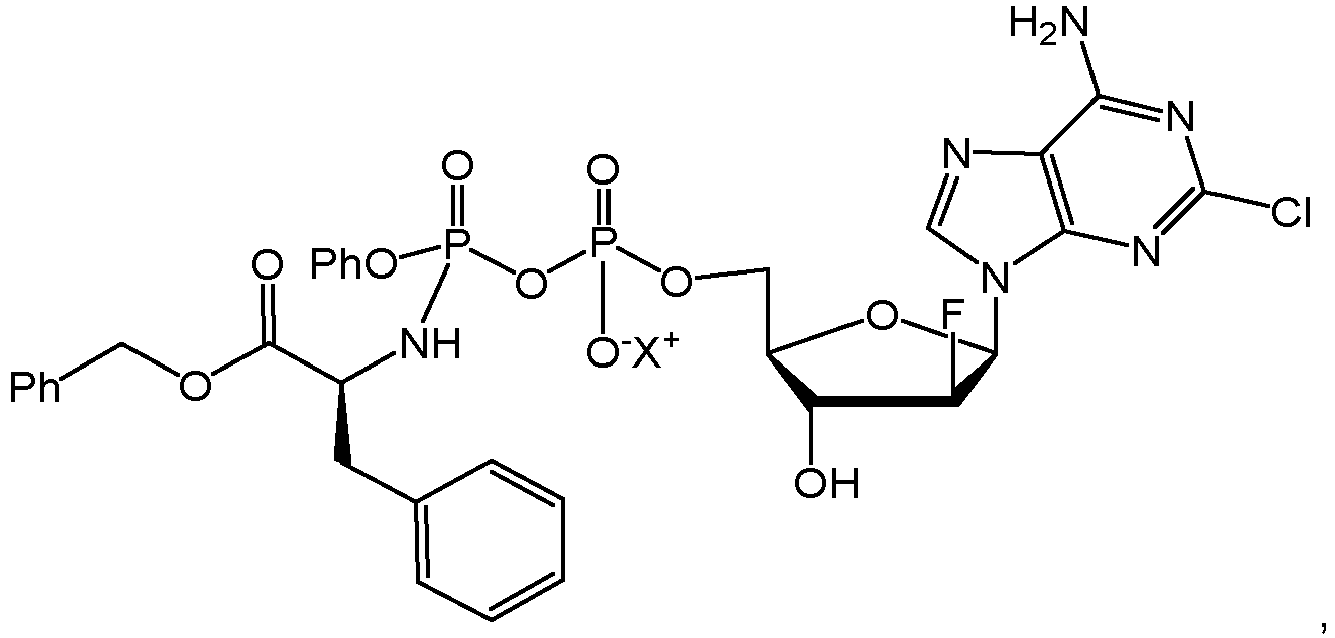


- A compound of any one of claims 1 to 13 wherein X+ is a metal cation or an ammonium cation.
- A compound of any one of claims 1 to 14 for medical use.
- A compound of any one of claims 1 to 14 for use in treating cancer; optionally
wherein the cancer is leukaemia or lymphoma; further optionallywherein the cancer is a leukaemia selected from the group consisting of acute myeloid leukaemia (AML), acute lymphoid leukaemia (ALL), chronic myeloid leukaemia (CML), chronic lymphoid leukaemia (CLL) and biphenotypic acute leukaemia (BAL); orwherein the cancer is a lymphoma selected from the group consisting of Hodgkin's lymphoma and non-Hodgkin's lymphoma. - A pharmaceutical composition comprising compounds of any one of claims 1 to 14 and at least one pharmaceutically acceptable excipient.
Priority Applications (3)
| Application Number | Priority Date | Filing Date | Title |
|---|---|---|---|
| PL18819340T PL3720864T3 (en) | 2017-12-05 | 2018-12-05 | Salts of diphosphate phosphoramidate of nucleosides as anticancer compounds |
| HRP20220451TT HRP20220451T1 (en) | 2017-12-05 | 2018-12-05 | Salts of diphosphate phosphoramidate of nucleosides as anticancer compounds |
| EP21218125.9A EP4043471A1 (en) | 2017-12-05 | 2018-12-05 | Salts of diphosphate phosphoramidate of nucleosides as anticancer compounds |
Applications Claiming Priority (2)
| Application Number | Priority Date | Filing Date | Title |
|---|---|---|---|
| GBGB1720279.7A GB201720279D0 (en) | 2017-12-05 | 2017-12-05 | Anticancer compounds |
| PCT/GB2018/053525 WO2019110991A1 (en) | 2017-12-05 | 2018-12-05 | Salts of diphosphate phosphoramidate of nucleosides as anticancer compounds |
Related Child Applications (1)
| Application Number | Title | Priority Date | Filing Date |
|---|---|---|---|
| EP21218125.9A Division EP4043471A1 (en) | 2017-12-05 | 2018-12-05 | Salts of diphosphate phosphoramidate of nucleosides as anticancer compounds |
Publications (2)
| Publication Number | Publication Date |
|---|---|
| EP3720864A1 EP3720864A1 (en) | 2020-10-14 |
| EP3720864B1 true EP3720864B1 (en) | 2022-01-05 |
Family
ID=60950385
Family Applications (2)
| Application Number | Title | Priority Date | Filing Date |
|---|---|---|---|
| EP21218125.9A Withdrawn EP4043471A1 (en) | 2017-12-05 | 2018-12-05 | Salts of diphosphate phosphoramidate of nucleosides as anticancer compounds |
| EP18819340.3A Active EP3720864B1 (en) | 2017-12-05 | 2018-12-05 | Salts of diphosphate phosphoramidate of nucleosides as anticancer compounds |
Family Applications Before (1)
| Application Number | Title | Priority Date | Filing Date |
|---|---|---|---|
| EP21218125.9A Withdrawn EP4043471A1 (en) | 2017-12-05 | 2018-12-05 | Salts of diphosphate phosphoramidate of nucleosides as anticancer compounds |
Country Status (22)
| Country | Link |
|---|---|
| US (2) | US11560400B2 (en) |
| EP (2) | EP4043471A1 (en) |
| JP (1) | JP7268819B2 (en) |
| KR (1) | KR20200092980A (en) |
| CN (1) | CN111527098A (en) |
| AU (1) | AU2018379713A1 (en) |
| BR (1) | BR112020011221A2 (en) |
| CA (1) | CA3082269A1 (en) |
| CL (1) | CL2020001479A1 (en) |
| DK (1) | DK3720864T3 (en) |
| EA (1) | EA202091218A1 (en) |
| ES (1) | ES2910165T3 (en) |
| GB (1) | GB201720279D0 (en) |
| HR (1) | HRP20220451T1 (en) |
| IL (1) | IL274808B2 (en) |
| MA (2) | MA51006A (en) |
| MX (1) | MX2020005850A (en) |
| PH (1) | PH12020550728A1 (en) |
| PL (1) | PL3720864T3 (en) |
| PT (1) | PT3720864T (en) |
| SG (1) | SG11202004342TA (en) |
| WO (1) | WO2019110991A1 (en) |
Families Citing this family (3)
| Publication number | Priority date | Publication date | Assignee | Title |
|---|---|---|---|---|
| CN111909231B (en) | 2014-11-28 | 2025-10-17 | 努卡那有限公司 | Novel 2' -and/or 5' -amino acid ester phosphoramidate 3' -deoxyadenosine derivatives as anticancer compounds |
| JP2020164521A (en) * | 2019-03-29 | 2020-10-08 | 国立大学法人 長崎大学 | Antiviral drug |
| CN116768949B (en) * | 2022-07-12 | 2026-03-03 | 南京工业大学 | Compound with anticancer effect based on chemical modification of 3' -deoxyadenosine |
Family Cites Families (15)
| Publication number | Priority date | Publication date | Assignee | Title |
|---|---|---|---|---|
| GB0317009D0 (en) | 2003-07-21 | 2003-08-27 | Univ Cardiff | Chemical compounds |
| GB0505781D0 (en) | 2005-03-21 | 2005-04-27 | Univ Cardiff | Chemical compounds |
| TW201107342A (en) | 2009-05-20 | 2011-03-01 | Chimerix Inc | Compounds, compositions and methods for treating viral infection |
| GB201016855D0 (en) | 2010-10-06 | 2010-11-17 | Nucana Biomed Ltd | Chemical compounds |
| DK3447061T3 (en) | 2011-03-01 | 2022-01-03 | NuCana plc | PHARMACEUTICAL FORMULATION INCLUDING A PHOSPHORAMIDATE DERIVATIVE OF 5-FLUORO-2'-DEOXYURIDINE FOR USE IN CANCER TREATMENT |
| WO2014124430A1 (en) * | 2013-02-11 | 2014-08-14 | Emory University | Nucleotide and nucleoside therapeutic compositions and uses related thereto |
| DK3043803T3 (en) | 2013-09-11 | 2022-08-01 | Univ Emory | Nucleotide and nucleoside compounds and their applications |
| CN105646629A (en) | 2014-11-25 | 2016-06-08 | 广州市恒诺康医药科技有限公司 | L-nucleoside compounds and application thereof |
| CN111909231B (en) | 2014-11-28 | 2025-10-17 | 努卡那有限公司 | Novel 2' -and/or 5' -amino acid ester phosphoramidate 3' -deoxyadenosine derivatives as anticancer compounds |
| AU2015363042B2 (en) * | 2014-12-15 | 2021-02-25 | Emory University | Phosphoramidates for the treatment of Hepatitis B virus |
| IL296496B2 (en) | 2014-12-26 | 2024-10-01 | Univ Emory | N4-hydroxycytidine, history and related antiviral uses |
| WO2017106710A1 (en) | 2015-12-17 | 2017-06-22 | Emory University | Nucleotide and nucleoside therapeutic compositions and uses related thereto |
| WO2017155923A1 (en) | 2016-03-07 | 2017-09-14 | Emory University | Nucleotide and nucleoside therapeutic compositions and uses related thereto |
| GB201609602D0 (en) | 2016-06-01 | 2016-07-13 | Nucuna Biomed Ltd | Chemical compounds |
| GB201609601D0 (en) | 2016-06-01 | 2016-07-13 | Nucana Biomed Ltd | Phosphoramidate compounds |
-
2017
- 2017-12-05 GB GBGB1720279.7A patent/GB201720279D0/en not_active Ceased
-
2018
- 2018-12-05 MA MA051006A patent/MA51006A/en unknown
- 2018-12-05 WO PCT/GB2018/053525 patent/WO2019110991A1/en not_active Ceased
- 2018-12-05 CA CA3082269A patent/CA3082269A1/en active Pending
- 2018-12-05 EP EP21218125.9A patent/EP4043471A1/en not_active Withdrawn
- 2018-12-05 BR BR112020011221-6A patent/BR112020011221A2/en not_active IP Right Cessation
- 2018-12-05 ES ES18819340T patent/ES2910165T3/en active Active
- 2018-12-05 EP EP18819340.3A patent/EP3720864B1/en active Active
- 2018-12-05 US US16/769,635 patent/US11560400B2/en active Active
- 2018-12-05 CN CN201880078576.6A patent/CN111527098A/en active Pending
- 2018-12-05 PT PT188193403T patent/PT3720864T/en unknown
- 2018-12-05 AU AU2018379713A patent/AU2018379713A1/en not_active Abandoned
- 2018-12-05 MA MA051007A patent/MA51007A/en unknown
- 2018-12-05 SG SG11202004342TA patent/SG11202004342TA/en unknown
- 2018-12-05 KR KR1020207016514A patent/KR20200092980A/en not_active Withdrawn
- 2018-12-05 DK DK18819340.3T patent/DK3720864T3/en active
- 2018-12-05 PL PL18819340T patent/PL3720864T3/en unknown
- 2018-12-05 MX MX2020005850A patent/MX2020005850A/en unknown
- 2018-12-05 EA EA202091218A patent/EA202091218A1/en unknown
- 2018-12-05 JP JP2020530585A patent/JP7268819B2/en active Active
- 2018-12-05 HR HRP20220451TT patent/HRP20220451T1/en unknown
-
2020
- 2020-05-20 IL IL274808A patent/IL274808B2/en unknown
- 2020-05-28 PH PH12020550728A patent/PH12020550728A1/en unknown
- 2020-06-03 CL CL2020001479A patent/CL2020001479A1/en unknown
-
2022
- 2022-12-16 US US18/083,089 patent/US20230192750A1/en not_active Abandoned
Also Published As
| Publication number | Publication date |
|---|---|
| EP3720864A1 (en) | 2020-10-14 |
| CL2020001479A1 (en) | 2020-12-18 |
| IL274808B2 (en) | 2023-08-01 |
| AU2018379713A1 (en) | 2020-07-23 |
| DK3720864T3 (en) | 2022-04-11 |
| MX2020005850A (en) | 2020-09-07 |
| JP2021505578A (en) | 2021-02-18 |
| MA51007A (en) | 2020-10-14 |
| CA3082269A1 (en) | 2019-06-13 |
| IL274808A (en) | 2020-07-30 |
| CN111527098A (en) | 2020-08-11 |
| WO2019110991A1 (en) | 2019-06-13 |
| BR112020011221A2 (en) | 2020-11-17 |
| HRP20220451T1 (en) | 2022-05-27 |
| PT3720864T (en) | 2022-04-06 |
| US20230192750A1 (en) | 2023-06-22 |
| PL3720864T3 (en) | 2022-05-02 |
| MA51006A (en) | 2020-10-14 |
| ES2910165T3 (en) | 2022-05-11 |
| US20210171566A1 (en) | 2021-06-10 |
| SG11202004342TA (en) | 2020-06-29 |
| US11560400B2 (en) | 2023-01-24 |
| KR20200092980A (en) | 2020-08-04 |
| PH12020550728A1 (en) | 2021-02-15 |
| EA202091218A1 (en) | 2020-09-14 |
| IL274808B1 (en) | 2023-04-01 |
| EP4043471A1 (en) | 2022-08-17 |
| JP7268819B2 (en) | 2023-05-08 |
| GB201720279D0 (en) | 2018-01-17 |
Similar Documents
| Publication | Publication Date | Title |
|---|---|---|
| US20230192750A1 (en) | Salts of diphosphate phosphoramidate of nucleosides as anticancer compounds | |
| EP3464309B1 (en) | Phosphoramidate nucleoside derivatives as anticancer agents | |
| AU2024203637B2 (en) | Formulations of phosphoramidate derivatives of nucleoside drugs | |
| TWI758728B (en) | Prodrug | |
| WO2017109444A1 (en) | Combination therapy | |
| EP3947408B1 (en) | Salt of triphosphate phosphoramidates of nucleotides as anticancer compounds | |
| HK40070782A (en) | Salts of diphosphate phosphoramidate of nucleosides as anticancer compounds | |
| HK40028717A (en) | Salts of diphosphate phosphoramidate of nucleosides as anticancer compounds | |
| HK40028717B (en) | Salts of diphosphate phosphoramidate of nucleosides as anticancer compounds | |
| EA042712B1 (en) | NUCLEOSIDE DIPHOSPHATE-PHOSPHORAMIDATE SALTS AS ANTI-CANCER COMPOUNDS | |
| HK1262307B (en) | Phosphoramidate nucleoside derivatives as anticancer agents | |
| HK1262307A1 (en) | Phosphoramidate nucleoside derivatives as anticancer agents |
Legal Events
| Date | Code | Title | Description |
|---|---|---|---|
| REG | Reference to a national code |
Ref country code: HR Ref legal event code: TUEP Ref document number: P20220451 Country of ref document: HR |
|
| STAA | Information on the status of an ep patent application or granted ep patent |
Free format text: STATUS: UNKNOWN |
|
| STAA | Information on the status of an ep patent application or granted ep patent |
Free format text: STATUS: THE INTERNATIONAL PUBLICATION HAS BEEN MADE |
|
| PUAI | Public reference made under article 153(3) epc to a published international application that has entered the european phase |
Free format text: ORIGINAL CODE: 0009012 |
|
| STAA | Information on the status of an ep patent application or granted ep patent |
Free format text: STATUS: REQUEST FOR EXAMINATION WAS MADE |
|
| 17P | Request for examination filed |
Effective date: 20200619 |
|
| AK | Designated contracting states |
Kind code of ref document: A1 Designated state(s): AL AT BE BG CH CY CZ DE DK EE ES FI FR GB GR HR HU IE IS IT LI LT LU LV MC MK MT NL NO PL PT RO RS SE SI SK SM TR |
|
| AX | Request for extension of the european patent |
Extension state: BA ME |
|
| REG | Reference to a national code |
Ref country code: HK Ref legal event code: DE Ref document number: 40028717 Country of ref document: HK |
|
| GRAP | Despatch of communication of intention to grant a patent |
Free format text: ORIGINAL CODE: EPIDOSNIGR1 |
|
| STAA | Information on the status of an ep patent application or granted ep patent |
Free format text: STATUS: GRANT OF PATENT IS INTENDED |
|
| RIC1 | Information provided on ipc code assigned before grant |
Ipc: C07H 19/10 20060101AFI20210711BHEP Ipc: C07H 19/20 20060101ALI20210711BHEP Ipc: A61K 31/7064 20060101ALI20210711BHEP Ipc: A61K 31/7076 20060101ALI20210711BHEP Ipc: A61P 35/00 20060101ALI20210711BHEP |
|
| INTG | Intention to grant announced |
Effective date: 20210806 |
|
| GRAS | Grant fee paid |
Free format text: ORIGINAL CODE: EPIDOSNIGR3 |
|
| GRAA | (expected) grant |
Free format text: ORIGINAL CODE: 0009210 |
|
| STAA | Information on the status of an ep patent application or granted ep patent |
Free format text: STATUS: THE PATENT HAS BEEN GRANTED |
|
| AK | Designated contracting states |
Kind code of ref document: B1 Designated state(s): AL AT BE BG CH CY CZ DE DK EE ES FI FR GB GR HR HU IE IS IT LI LT LU LV MC MK MT NL NO PL PT RO RS SE SI SK SM TR |
|
| REG | Reference to a national code |
Ref country code: GB Ref legal event code: FG4D |
|
| REG | Reference to a national code |
Ref country code: CH Ref legal event code: EP |
|
| REG | Reference to a national code |
Ref country code: AT Ref legal event code: REF Ref document number: 1460480 Country of ref document: AT Kind code of ref document: T Effective date: 20220115 |
|
| REG | Reference to a national code |
Ref country code: DE Ref legal event code: R096 Ref document number: 602018029289 Country of ref document: DE |
|
| REG | Reference to a national code |
Ref country code: IE Ref legal event code: FG4D |
|
| REG | Reference to a national code |
Ref country code: PT Ref legal event code: SC4A Ref document number: 3720864 Country of ref document: PT Date of ref document: 20220406 Kind code of ref document: T Free format text: AVAILABILITY OF NATIONAL TRANSLATION Effective date: 20220331 |
|
| REG | Reference to a national code |
Ref country code: FI Ref legal event code: FGE |
|
| REG | Reference to a national code |
Ref country code: DK Ref legal event code: T3 Effective date: 20220405 |
|
| REG | Reference to a national code |
Ref country code: NL Ref legal event code: FP |
|
| REG | Reference to a national code |
Ref country code: LT Ref legal event code: MG9D |
|
| REG | Reference to a national code |
Ref country code: SE Ref legal event code: TRGR |
|
| REG | Reference to a national code |
Ref country code: ES Ref legal event code: FG2A Ref document number: 2910165 Country of ref document: ES Kind code of ref document: T3 Effective date: 20220511 |
|
| REG | Reference to a national code |
Ref country code: HR Ref legal event code: T1PR Ref document number: P20220451 Country of ref document: HR |
|
| REG | Reference to a national code |
Ref country code: GR Ref legal event code: EP Ref document number: 20220400750 Country of ref document: GR Effective date: 20220509 |
|
| REG | Reference to a national code |
Ref country code: NO Ref legal event code: T2 Effective date: 20220105 |
|
| PG25 | Lapsed in a contracting state [announced via postgrant information from national office to epo] |
Ref country code: RS Free format text: LAPSE BECAUSE OF FAILURE TO SUBMIT A TRANSLATION OF THE DESCRIPTION OR TO PAY THE FEE WITHIN THE PRESCRIBED TIME-LIMIT Effective date: 20220105 Ref country code: LT Free format text: LAPSE BECAUSE OF FAILURE TO SUBMIT A TRANSLATION OF THE DESCRIPTION OR TO PAY THE FEE WITHIN THE PRESCRIBED TIME-LIMIT Effective date: 20220105 Ref country code: BG Free format text: LAPSE BECAUSE OF FAILURE TO SUBMIT A TRANSLATION OF THE DESCRIPTION OR TO PAY THE FEE WITHIN THE PRESCRIBED TIME-LIMIT Effective date: 20220405 |
|
| PG25 | Lapsed in a contracting state [announced via postgrant information from national office to epo] |
Ref country code: LV Free format text: LAPSE BECAUSE OF FAILURE TO SUBMIT A TRANSLATION OF THE DESCRIPTION OR TO PAY THE FEE WITHIN THE PRESCRIBED TIME-LIMIT Effective date: 20220105 |
|
| PG25 | Lapsed in a contracting state [announced via postgrant information from national office to epo] |
Ref country code: IS Free format text: LAPSE BECAUSE OF FAILURE TO SUBMIT A TRANSLATION OF THE DESCRIPTION OR TO PAY THE FEE WITHIN THE PRESCRIBED TIME-LIMIT Effective date: 20220505 |
|
| REG | Reference to a national code |
Ref country code: DE Ref legal event code: R097 Ref document number: 602018029289 Country of ref document: DE |
|
| PG25 | Lapsed in a contracting state [announced via postgrant information from national office to epo] |
Ref country code: SM Free format text: LAPSE BECAUSE OF FAILURE TO SUBMIT A TRANSLATION OF THE DESCRIPTION OR TO PAY THE FEE WITHIN THE PRESCRIBED TIME-LIMIT Effective date: 20220105 Ref country code: SK Free format text: LAPSE BECAUSE OF FAILURE TO SUBMIT A TRANSLATION OF THE DESCRIPTION OR TO PAY THE FEE WITHIN THE PRESCRIBED TIME-LIMIT Effective date: 20220105 Ref country code: RO Free format text: LAPSE BECAUSE OF FAILURE TO SUBMIT A TRANSLATION OF THE DESCRIPTION OR TO PAY THE FEE WITHIN THE PRESCRIBED TIME-LIMIT Effective date: 20220105 Ref country code: EE Free format text: LAPSE BECAUSE OF FAILURE TO SUBMIT A TRANSLATION OF THE DESCRIPTION OR TO PAY THE FEE WITHIN THE PRESCRIBED TIME-LIMIT Effective date: 20220105 Ref country code: CZ Free format text: LAPSE BECAUSE OF FAILURE TO SUBMIT A TRANSLATION OF THE DESCRIPTION OR TO PAY THE FEE WITHIN THE PRESCRIBED TIME-LIMIT Effective date: 20220105 |
|
| VS25 | Lapsed in a validation state [announced via postgrant information from nat. office to epo] |
Ref country code: MD Free format text: LAPSE BECAUSE OF FAILURE TO SUBMIT A TRANSLATION OF THE DESCRIPTION OR TO PAY THE FEE WITHIN THE PRESCRIBED TIME-LIMIT Effective date: 20220105 |
|
| PLBE | No opposition filed within time limit |
Free format text: ORIGINAL CODE: 0009261 |
|
| STAA | Information on the status of an ep patent application or granted ep patent |
Free format text: STATUS: NO OPPOSITION FILED WITHIN TIME LIMIT |
|
| PG25 | Lapsed in a contracting state [announced via postgrant information from national office to epo] |
Ref country code: AL Free format text: LAPSE BECAUSE OF FAILURE TO SUBMIT A TRANSLATION OF THE DESCRIPTION OR TO PAY THE FEE WITHIN THE PRESCRIBED TIME-LIMIT Effective date: 20220105 |
|
| REG | Reference to a national code |
Ref country code: HR Ref legal event code: ODRP Ref document number: P20220451 Country of ref document: HR Payment date: 20221108 Year of fee payment: 5 |
|
| 26N | No opposition filed |
Effective date: 20221006 |
|
| PGFP | Annual fee paid to national office [announced via postgrant information from national office to epo] |
Ref country code: TR Payment date: 20221107 Year of fee payment: 5 Ref country code: SE Payment date: 20221213 Year of fee payment: 5 Ref country code: PT Payment date: 20221107 Year of fee payment: 5 Ref country code: NO Payment date: 20221216 Year of fee payment: 5 Ref country code: NL Payment date: 20221215 Year of fee payment: 5 Ref country code: LU Payment date: 20221216 Year of fee payment: 5 Ref country code: IT Payment date: 20221205 Year of fee payment: 5 Ref country code: IE Payment date: 20221208 Year of fee payment: 5 Ref country code: GB Payment date: 20221115 Year of fee payment: 5 Ref country code: FR Payment date: 20221207 Year of fee payment: 5 Ref country code: FI Payment date: 20221203 Year of fee payment: 5 Ref country code: DK Payment date: 20221206 Year of fee payment: 5 Ref country code: DE Payment date: 20221130 Year of fee payment: 5 |
|
| PG25 | Lapsed in a contracting state [announced via postgrant information from national office to epo] |
Ref country code: SI Free format text: LAPSE BECAUSE OF FAILURE TO SUBMIT A TRANSLATION OF THE DESCRIPTION OR TO PAY THE FEE WITHIN THE PRESCRIBED TIME-LIMIT Effective date: 20220105 |
|
| PGFP | Annual fee paid to national office [announced via postgrant information from national office to epo] |
Ref country code: PL Payment date: 20221108 Year of fee payment: 5 Ref country code: HR Payment date: 20221108 Year of fee payment: 5 Ref country code: GR Payment date: 20221202 Year of fee payment: 5 Ref country code: BE Payment date: 20221205 Year of fee payment: 5 |
|
| PGFP | Annual fee paid to national office [announced via postgrant information from national office to epo] |
Ref country code: ES Payment date: 20230111 Year of fee payment: 5 Ref country code: CH Payment date: 20230105 Year of fee payment: 5 |
|
| PG25 | Lapsed in a contracting state [announced via postgrant information from national office to epo] |
Ref country code: CY Free format text: LAPSE BECAUSE OF FAILURE TO SUBMIT A TRANSLATION OF THE DESCRIPTION OR TO PAY THE FEE WITHIN THE PRESCRIBED TIME-LIMIT Effective date: 20220105 |
|
| PG25 | Lapsed in a contracting state [announced via postgrant information from national office to epo] |
Ref country code: MK Free format text: LAPSE BECAUSE OF FAILURE TO SUBMIT A TRANSLATION OF THE DESCRIPTION OR TO PAY THE FEE WITHIN THE PRESCRIBED TIME-LIMIT Effective date: 20220105 Ref country code: HU Free format text: LAPSE BECAUSE OF FAILURE TO SUBMIT A TRANSLATION OF THE DESCRIPTION OR TO PAY THE FEE WITHIN THE PRESCRIBED TIME-LIMIT; INVALID AB INITIO Effective date: 20181205 |
|
| REG | Reference to a national code |
Ref country code: HR Ref legal event code: PBON Ref document number: P20220451 Country of ref document: HR Effective date: 20231205 |
|
| PG25 | Lapsed in a contracting state [announced via postgrant information from national office to epo] |
Ref country code: MC Free format text: LAPSE BECAUSE OF FAILURE TO SUBMIT A TRANSLATION OF THE DESCRIPTION OR TO PAY THE FEE WITHIN THE PRESCRIBED TIME-LIMIT Effective date: 20220105 |
|
| PG25 | Lapsed in a contracting state [announced via postgrant information from national office to epo] |
Ref country code: MC Free format text: LAPSE BECAUSE OF FAILURE TO SUBMIT A TRANSLATION OF THE DESCRIPTION OR TO PAY THE FEE WITHIN THE PRESCRIBED TIME-LIMIT Effective date: 20220105 |
|
| REG | Reference to a national code |
Ref country code: DE Ref legal event code: R119 Ref document number: 602018029289 Country of ref document: DE |
|
| REG | Reference to a national code |
Ref country code: DK Ref legal event code: EBP Effective date: 20231231 |
|
| REG | Reference to a national code |
Ref country code: SE Ref legal event code: EUG |
|
| PG25 | Lapsed in a contracting state [announced via postgrant information from national office to epo] |
Ref country code: FI Free format text: LAPSE BECAUSE OF NON-PAYMENT OF DUE FEES Effective date: 20231205 |
|
| REG | Reference to a national code |
Ref country code: CH Ref legal event code: PL |
|
| PG25 | Lapsed in a contracting state [announced via postgrant information from national office to epo] |
Ref country code: PT Free format text: LAPSE BECAUSE OF NON-PAYMENT OF DUE FEES Effective date: 20240605 |
|
| REG | Reference to a national code |
Ref country code: NL Ref legal event code: MM Effective date: 20240101 |
|
| PG25 | Lapsed in a contracting state [announced via postgrant information from national office to epo] |
Ref country code: LU Free format text: LAPSE BECAUSE OF NON-PAYMENT OF DUE FEES Effective date: 20231205 |
|
| GBPC | Gb: european patent ceased through non-payment of renewal fee |
Effective date: 20231205 |
|
| REG | Reference to a national code |
Ref country code: BE Ref legal event code: MM Effective date: 20231231 |
|
| PG25 | Lapsed in a contracting state [announced via postgrant information from national office to epo] |
Ref country code: PT Free format text: LAPSE BECAUSE OF NON-PAYMENT OF DUE FEES Effective date: 20240605 Ref country code: LU Free format text: LAPSE BECAUSE OF NON-PAYMENT OF DUE FEES Effective date: 20231205 |
|
| PG25 | Lapsed in a contracting state [announced via postgrant information from national office to epo] |
Ref country code: NL Free format text: LAPSE BECAUSE OF NON-PAYMENT OF DUE FEES Effective date: 20240101 |
|
| PG25 | Lapsed in a contracting state [announced via postgrant information from national office to epo] |
Ref country code: NL Free format text: LAPSE BECAUSE OF NON-PAYMENT OF DUE FEES Effective date: 20240101 Ref country code: MT Free format text: LAPSE BECAUSE OF FAILURE TO SUBMIT A TRANSLATION OF THE DESCRIPTION OR TO PAY THE FEE WITHIN THE PRESCRIBED TIME-LIMIT Effective date: 20220105 |
|
| REG | Reference to a national code |
Ref country code: IE Ref legal event code: MM4A |
|
| PG25 | Lapsed in a contracting state [announced via postgrant information from national office to epo] |
Ref country code: HR Free format text: LAPSE BECAUSE OF NON-PAYMENT OF DUE FEES Effective date: 20231205 Ref country code: DE Free format text: LAPSE BECAUSE OF NON-PAYMENT OF DUE FEES Effective date: 20240702 Ref country code: IE Free format text: LAPSE BECAUSE OF NON-PAYMENT OF DUE FEES Effective date: 20231205 |
|
| PG25 | Lapsed in a contracting state [announced via postgrant information from national office to epo] |
Ref country code: GR Free format text: LAPSE BECAUSE OF NON-PAYMENT OF DUE FEES Effective date: 20240712 |
|
| PG25 | Lapsed in a contracting state [announced via postgrant information from national office to epo] |
Ref country code: GB Free format text: LAPSE BECAUSE OF NON-PAYMENT OF DUE FEES Effective date: 20231205 |
|
| PG25 | Lapsed in a contracting state [announced via postgrant information from national office to epo] |
Ref country code: BE Free format text: LAPSE BECAUSE OF NON-PAYMENT OF DUE FEES Effective date: 20231231 |
|
| PG25 | Lapsed in a contracting state [announced via postgrant information from national office to epo] |
Ref country code: FR Free format text: LAPSE BECAUSE OF NON-PAYMENT OF DUE FEES Effective date: 20231231 |
|
| PG25 | Lapsed in a contracting state [announced via postgrant information from national office to epo] |
Ref country code: CH Free format text: LAPSE BECAUSE OF NON-PAYMENT OF DUE FEES Effective date: 20231231 |
|
| PG25 | Lapsed in a contracting state [announced via postgrant information from national office to epo] |
Ref country code: NO Free format text: LAPSE BECAUSE OF NON-PAYMENT OF DUE FEES Effective date: 20231231 Ref country code: IE Free format text: LAPSE BECAUSE OF NON-PAYMENT OF DUE FEES Effective date: 20231205 Ref country code: HR Free format text: LAPSE BECAUSE OF NON-PAYMENT OF DUE FEES Effective date: 20231205 Ref country code: GR Free format text: LAPSE BECAUSE OF NON-PAYMENT OF DUE FEES Effective date: 20240712 Ref country code: GB Free format text: LAPSE BECAUSE OF NON-PAYMENT OF DUE FEES Effective date: 20231205 Ref country code: FR Free format text: LAPSE BECAUSE OF NON-PAYMENT OF DUE FEES Effective date: 20231231 Ref country code: DE Free format text: LAPSE BECAUSE OF NON-PAYMENT OF DUE FEES Effective date: 20240702 Ref country code: CH Free format text: LAPSE BECAUSE OF NON-PAYMENT OF DUE FEES Effective date: 20231231 Ref country code: BE Free format text: LAPSE BECAUSE OF NON-PAYMENT OF DUE FEES Effective date: 20231231 |
|
| PG25 | Lapsed in a contracting state [announced via postgrant information from national office to epo] |
Ref country code: DK Free format text: LAPSE BECAUSE OF NON-PAYMENT OF DUE FEES Effective date: 20231231 |
|
| REG | Reference to a national code |
Ref country code: ES Ref legal event code: FD2A Effective date: 20250124 |
|
| PG25 | Lapsed in a contracting state [announced via postgrant information from national office to epo] |
Ref country code: DK Free format text: LAPSE BECAUSE OF NON-PAYMENT OF DUE FEES Effective date: 20231231 |
|
| REG | Reference to a national code |
Ref country code: AT Ref legal event code: UEP Ref document number: 1460480 Country of ref document: AT Kind code of ref document: T Effective date: 20220105 Ref country code: AT Ref legal event code: MM01 Ref document number: 1460480 Country of ref document: AT Kind code of ref document: T Effective date: 20231205 |
|
| PG25 | Lapsed in a contracting state [announced via postgrant information from national office to epo] |
Ref country code: ES Free format text: LAPSE BECAUSE OF NON-PAYMENT OF DUE FEES Effective date: 20231206 |
|
| PG25 | Lapsed in a contracting state [announced via postgrant information from national office to epo] |
Ref country code: AT Free format text: LAPSE BECAUSE OF NON-PAYMENT OF DUE FEES Effective date: 20231205 |
|
| PG25 | Lapsed in a contracting state [announced via postgrant information from national office to epo] |
Ref country code: PL Free format text: LAPSE BECAUSE OF NON-PAYMENT OF DUE FEES Effective date: 20231205 |
|
| PG25 | Lapsed in a contracting state [announced via postgrant information from national office to epo] |
Ref country code: IT Free format text: LAPSE BECAUSE OF NON-PAYMENT OF DUE FEES Effective date: 20231205 |
|
| PG25 | Lapsed in a contracting state [announced via postgrant information from national office to epo] |
Ref country code: SE Free format text: LAPSE BECAUSE OF NON-PAYMENT OF DUE FEES Effective date: 20231206 |
|
| VS25 | Lapsed in a validation state [announced via postgrant information from nat. office to epo] |
Ref country code: MA Free format text: FAILURE TO ELECT DOMICILE IN THE NATIONAL COUNTRY Effective date: 20220406 |
|
| PGFP | Annual fee paid to national office [announced via postgrant information from national office to epo] |
Ref country code: AT Payment date: 20260410 Year of fee payment: 5 |