EP3719798A1 - Voiceprint recognition method and device based on memorability bottleneck feature - Google Patents
Voiceprint recognition method and device based on memorability bottleneck feature Download PDFInfo
- Publication number
- EP3719798A1 EP3719798A1 EP19750725.4A EP19750725A EP3719798A1 EP 3719798 A1 EP3719798 A1 EP 3719798A1 EP 19750725 A EP19750725 A EP 19750725A EP 3719798 A1 EP3719798 A1 EP 3719798A1
- Authority
- EP
- European Patent Office
- Prior art keywords
- feature
- layer
- bottleneck
- memory
- dnn
- Prior art date
- Legal status (The legal status is an assumption and is not a legal conclusion. Google has not performed a legal analysis and makes no representation as to the accuracy of the status listed.)
- Granted
Links
Images

Classifications
-
- G—PHYSICS
- G10—MUSICAL INSTRUMENTS; ACOUSTICS
- G10L—SPEECH ANALYSIS TECHNIQUES OR SPEECH SYNTHESIS; SPEECH RECOGNITION; SPEECH OR VOICE PROCESSING TECHNIQUES; SPEECH OR AUDIO CODING OR DECODING
- G10L17/00—Speaker identification or verification techniques
- G10L17/02—Preprocessing operations, e.g. segment selection; Pattern representation or modelling, e.g. based on linear discriminant analysis [LDA] or principal components; Feature selection or extraction
-
- G—PHYSICS
- G06—COMPUTING OR CALCULATING; COUNTING
- G06F—ELECTRIC DIGITAL DATA PROCESSING
- G06F21/00—Security arrangements for protecting computers, components thereof, programs or data against unauthorised activity
- G06F21/30—Authentication, i.e. establishing the identity or authorisation of security principals
- G06F21/31—User authentication
- G06F21/32—User authentication using biometric data, e.g. fingerprints, iris scans or voiceprints
-
- G—PHYSICS
- G06—COMPUTING OR CALCULATING; COUNTING
- G06N—COMPUTING ARRANGEMENTS BASED ON SPECIFIC COMPUTATIONAL MODELS
- G06N3/00—Computing arrangements based on biological models
- G06N3/02—Neural networks
- G06N3/04—Architecture, e.g. interconnection topology
- G06N3/044—Recurrent networks, e.g. Hopfield networks
-
- G—PHYSICS
- G06—COMPUTING OR CALCULATING; COUNTING
- G06N—COMPUTING ARRANGEMENTS BASED ON SPECIFIC COMPUTATIONAL MODELS
- G06N3/00—Computing arrangements based on biological models
- G06N3/02—Neural networks
- G06N3/04—Architecture, e.g. interconnection topology
- G06N3/044—Recurrent networks, e.g. Hopfield networks
- G06N3/0442—Recurrent networks, e.g. Hopfield networks characterised by memory or gating, e.g. long short-term memory [LSTM] or gated recurrent units [GRU]
-
- G—PHYSICS
- G06—COMPUTING OR CALCULATING; COUNTING
- G06N—COMPUTING ARRANGEMENTS BASED ON SPECIFIC COMPUTATIONAL MODELS
- G06N3/00—Computing arrangements based on biological models
- G06N3/02—Neural networks
- G06N3/04—Architecture, e.g. interconnection topology
- G06N3/045—Combinations of networks
-
- G—PHYSICS
- G06—COMPUTING OR CALCULATING; COUNTING
- G06N—COMPUTING ARRANGEMENTS BASED ON SPECIFIC COMPUTATIONAL MODELS
- G06N3/00—Computing arrangements based on biological models
- G06N3/02—Neural networks
- G06N3/06—Physical realisation, i.e. hardware implementation of neural networks, neurons or parts of neurons
- G06N3/063—Physical realisation, i.e. hardware implementation of neural networks, neurons or parts of neurons using electronic means
-
- G—PHYSICS
- G06—COMPUTING OR CALCULATING; COUNTING
- G06N—COMPUTING ARRANGEMENTS BASED ON SPECIFIC COMPUTATIONAL MODELS
- G06N3/00—Computing arrangements based on biological models
- G06N3/02—Neural networks
- G06N3/08—Learning methods
-
- G—PHYSICS
- G06—COMPUTING OR CALCULATING; COUNTING
- G06N—COMPUTING ARRANGEMENTS BASED ON SPECIFIC COMPUTATIONAL MODELS
- G06N3/00—Computing arrangements based on biological models
- G06N3/02—Neural networks
- G06N3/08—Learning methods
- G06N3/09—Supervised learning
-
- G—PHYSICS
- G06—COMPUTING OR CALCULATING; COUNTING
- G06N—COMPUTING ARRANGEMENTS BASED ON SPECIFIC COMPUTATIONAL MODELS
- G06N5/00—Computing arrangements using knowledge-based models
- G06N5/04—Inference or reasoning models
- G06N5/046—Forward inferencing; Production systems
-
- G—PHYSICS
- G10—MUSICAL INSTRUMENTS; ACOUSTICS
- G10L—SPEECH ANALYSIS TECHNIQUES OR SPEECH SYNTHESIS; SPEECH RECOGNITION; SPEECH OR VOICE PROCESSING TECHNIQUES; SPEECH OR AUDIO CODING OR DECODING
- G10L17/00—Speaker identification or verification techniques
- G10L17/18—Artificial neural networks; Connectionist approaches
-
- G—PHYSICS
- G10—MUSICAL INSTRUMENTS; ACOUSTICS
- G10L—SPEECH ANALYSIS TECHNIQUES OR SPEECH SYNTHESIS; SPEECH RECOGNITION; SPEECH OR VOICE PROCESSING TECHNIQUES; SPEECH OR AUDIO CODING OR DECODING
- G10L25/00—Speech or voice analysis techniques not restricted to a single one of groups G10L15/00 - G10L21/00
- G10L25/27—Speech or voice analysis techniques not restricted to a single one of groups G10L15/00 - G10L21/00 characterised by the analysis technique
- G10L25/30—Speech or voice analysis techniques not restricted to a single one of groups G10L15/00 - G10L21/00 characterised by the analysis technique using neural networks
-
- G—PHYSICS
- G06—COMPUTING OR CALCULATING; COUNTING
- G06N—COMPUTING ARRANGEMENTS BASED ON SPECIFIC COMPUTATIONAL MODELS
- G06N20/00—Machine learning
- G06N20/10—Machine learning using kernel methods, e.g. support vector machines [SVM]
-
- G—PHYSICS
- G06—COMPUTING OR CALCULATING; COUNTING
- G06N—COMPUTING ARRANGEMENTS BASED ON SPECIFIC COMPUTATIONAL MODELS
- G06N7/00—Computing arrangements based on specific mathematical models
- G06N7/01—Probabilistic graphical models, e.g. probabilistic networks
-
- G—PHYSICS
- G10—MUSICAL INSTRUMENTS; ACOUSTICS
- G10L—SPEECH ANALYSIS TECHNIQUES OR SPEECH SYNTHESIS; SPEECH RECOGNITION; SPEECH OR VOICE PROCESSING TECHNIQUES; SPEECH OR AUDIO CODING OR DECODING
- G10L25/00—Speech or voice analysis techniques not restricted to a single one of groups G10L15/00 - G10L21/00
- G10L25/03—Speech or voice analysis techniques not restricted to a single one of groups G10L15/00 - G10L21/00 characterised by the type of extracted parameters
- G10L25/24—Speech or voice analysis techniques not restricted to a single one of groups G10L15/00 - G10L21/00 characterised by the type of extracted parameters the extracted parameters being the cepstrum
Definitions
- One or more implementations of the present specification relate to the field of computer technologies, and in particular, to voiceprint recognition.
- Voiceprints are acoustic features extracted based on spectral features of sound waves of a speaker. As with fingerprints, voiceprints, as a biological feature, can reflect the speech features and identity information of the speaker.
- Voiceprint recognition also known as speaker recognition, is a biometric authentication technology that automatically recognizes the identity of a speaker using specific speaker information included in a speech signal. The biometric authentication technology has wide application prospects in many fields and scenarios such as identity authentication and security check.
- An identity vector (i-vector) model is a common model in a voiceprint recognition system.
- the i-vector model considers that the speaker and the channel information in the speech are included in a low-dimensional linear subspace, and each speech can be represented by a vector of a fixed length in the low-dimensional space, where the vector is the identity vector (i-vector).
- the i-vector can provide solid distinguishability, includes the identity feature information of the speaker, and is an important feature for voiceprint recognition and speech recognition.
- I-vector-based voiceprint recognition generally includes the following steps: calculating acoustic statistics based on spectral features, extracting an identity vector (i-vector) from the acoustic statistics, and then performing speaker recognition based on the i-vector.
- One or more implementations of the present specification describe a method and device capable of obtaining more comprehensive acoustic features from speaker audio, thereby making the extraction of identity authentication vectors more comprehensive and improving the accuracy of voiceprint recognition.
- a voiceprint recognition method including: extracting a first spectral feature from speaker audio; inputting the speaker audio to a memory deep neural network (DNN), and extracting a bottleneck feature from a bottleneck layer of the memory DNN, the memory DNN including at least one temporal recurrent layer and the bottleneck layer, an output of the at least one temporal recurrent layer being connected to the bottleneck layer, and the number of dimensions of the bottleneck layer being less than the number of dimensions of any other hidden layer in the memory DNN; forming an acoustic feature of the speaker audio based on the first spectral feature and the bottleneck feature; extracting an identity authentication vector corresponding to the speaker audio based on the acoustic feature; and performing speaker recognition by using a classification model and based on the identity authentication vector.
- DNN memory deep neural network
- the first spectral feature includes a Mel frequency cepstral coefficient (MFCC) feature, and a first order difference feature and a second order difference feature of the MFCC feature.
- MFCC Mel frequency cepstral coefficient
- the at least one temporal recurrent layer includes a hidden layer based on a long-short term memory (LSTM) model, or a hidden layer based on an LSTMP model, where the LSTMP model is an LSTM model with a recurrent projection layer.
- LSTM long-short term memory
- the at least one temporal recurrent layer includes a hidden layer based on a feedforward sequence memory FSMN model, or a hidden layer based on a cFSMN model, the cFSMN model being a compact FSMN model.
- inputting the speaker audio to a memory deep neural network includes: extracting a second spectral feature from a plurality of consecutive speech frames of the speaker audio, and inputting the second spectral feature to the memory DNN.
- the second spectral feature is a Mel scale filter bank (FBank) feature.
- FBank Mel scale filter bank
- the forming an acoustic feature of the speaker audio includes: concatenating the first spectral feature and the bottleneck feature to form the acoustic feature.
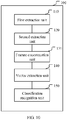
- a voiceprint recognition device including: a first extraction unit, configured to extract a first spectral feature from speaker audio; a second extraction unit, configured to: input the speaker audio to a memory deep neural network (DNN), and extract a bottleneck feature from a bottleneck layer of the memory DNN, the memory DNN including at least one temporal recurrent layer and the bottleneck layer, an output of the at least one temporal recurrent layer being connected to the bottleneck layer, and the number of dimensions of the bottleneck layer being less than the number of dimensions of any other hidden layer in the memory DNN; a feature concatenation unit, configured to form an acoustic feature of the speaker audio based on the first spectral feature and the bottleneck feature; a vector extraction unit, configured to extract an identity authentication vector corresponding to the speaker audio based on the acoustic feature; and a classification recognition unit, configured to perform speaker recognition by using a classification model and based on the identity authentication vector.
- DNN memory deep neural network
- a computer readable storage medium where the medium stores a computer program, and when the computer program is executed on a computer, the computer is enabled to perform the method according to the first aspect.
- a computing device including a memory and a processor, where the memory stores executable code, and when the processor executes the executable code, the method of the first aspect is implemented.
- a deep neural network (DNN) with a memory function is designed, and a bottleneck feature with a memory effect is extracted from a bottleneck layer of such a deep neural network and included in the acoustic features.
- DNN deep neural network
- Such acoustic features better reflect timing-dependent prosodic features of the speaker.
- the identity authentication vector (i-vector) extracted based on such acoustic features can better represent the speaker's speech traits, in particular prosodic features, so that the accuracy of speaker recognition is improved.
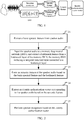
- FIG. 1 is a schematic diagram illustrating an application scenario of an implementation disclosed in the present specification.
- a speaker speaks to form speaker audio.
- the speaker audio is input to a spectrum extraction unit, and the spectrum extraction unit extracts basic spectral features.
- the speaker audio is input to a deep neural network (DNN).
- the deep neural network (DNN) is a neural network with a memory function and having a bottleneck layer. Accordingly, the features of the bottleneck layer are features with a memory effect.
- the bottleneck features are extracted from the bottleneck layer of the DNN with a memory function, and are then concatenated with the basic spectral features to form acoustic features.
- the acoustic features are input to an identity authentication vector (i-vector) model, in which acoustic statistics are calculated based on the acoustic features, and i-vector extraction is performed based on the measured i-vector, and then speaker recognition is performed.
- i-vector identity authentication vector
- FIG. 2 is a flowchart illustrating a voiceprint recognition method, according to an implementation.
- the method process can be executed by any device, equipment or system with computing and processing capabilities.
- the voiceprint recognition method of this implementation includes the following steps: Step 21, Extract a spectral feature from speaker audio; Step 22, Input the speaker audio to a memory deep neural network (DNN), and extract a bottleneck feature from a bottleneck layer of the memory DNN, the memory DNN including at least one temporal recurrent layer and the bottleneck layer, an output of the at least one temporal recurrent layer being connected to the bottleneck layer, and the number of dimensions of the bottleneck layer being less than the number of dimensions of any other hidden layer in the memory DNN; Step 23, Form an acoustic feature of the speaker audio based on the spectral feature and the bottleneck feature; Step 24, Extract an identity authentication vector corresponding to the speaker audio based on the acoustic feature; and Step 25, Perform speaker recognition based on the identity authentication vector.
- Step 21 Extract a spectral
- a spectral feature is extracted from the speaker audio. It can be understood that the speaker audio is formed when the speaker speaks and can be divided into a plurality of speech segments.
- the spectral feature extracted at step 21 is a basic spectral feature, in particular a (single-frame) short-term spectral feature.
- the spectral feature is a Mel frequency cepstral coefficient (MFCC) feature.
- the Mel frequency is proposed based on human auditory features, and has a non-linear correspondence with Hertz (Hz) frequency.
- Extracting an MFCC feature from the speaker audio generally includes the following steps: pre-emphasis, framing, windowing, Fourier transform, Mel filter bank, discrete cosine transform (DCT), etc.
- Pre-emphasis is used to boost the high frequency part to a certain extent so that the frequency spectrum of the signal becomes flat.
- Framing is used to temporally divide the speech into a series of frames. Windowing is to use a windowing function to enhance continuity of the left end and right end of the frames.
- the first-order and second-order differential features of the MFCC are also obtained based on the extracted MFCC features. For example, if the Mel cepstrum feature is characterized by 20 dimensions, then a first order difference feature of 20 dimensions and a second order difference feature of 20 dimensions are also obtained in the difference parameter extraction phase, so as to form a 60-dimensional vector.
- the basic spectral feature extracted at step 21 includes linear predictive coding (LPC) feature or perceptual linear predictive (PLP) feature.
- LPC linear predictive coding
- PLP perceptual linear predictive
- Such feature can be extracted by using a conventional method. It is also possible to extract other short-term spectral feature(s) as the basic feature.
- MFCC features do not well reflect speaker feature information in the high frequency domain.
- conventional technologies have complemented the overall acoustic features by introducing bottleneck features of the deep neural network (DNN).
- DNN deep neural network
- DNN Deep neural network
- GMM-HMM Gaussian mixture model-hidden Markov model
- the input is an acoustic feature that concatenates a plurality of earlier and later frames
- the output layer typically uses a softmax function to represent a posteriori probability for predicting a phoneme in an HMM state, so that phoneme states can be classified.
- Deep neural network has such a classification capability, because it obtains, based on supervised data, feature representations that are advantageous for a particular classification task.
- the feature of the bottleneck layer is a good representation of the above feature.
- the bottleneck layer is a hidden layer in the DNN model that includes a significantly reduced number of nodes (referred to as dimensions), compared to other hidden layers.
- the bottleneck layer includes fewer nodes than the other layers in the deep neural network (DNN).
- FIG. 3 is a schematic diagram illustrating a bottleneck layer of a deep neural network.
- the deep neural network includes a plurality of hidden layers, and the hidden layer in which the number of nodes is significantly reduced compared to other hidden layers is the bottleneck layer.
- the activation value of a node at the bottleneck layer can be considered as a low-dimensional representation of the input signal, which is also referred to as a bottleneck feature.
- the bottleneck feature can include additional speaker speech information.
- an improvement is made based on a conventional deep neural network (DNN), that is, a memory function is introduced to form a deep neural network (DNN) with memory.
- DNN deep neural network
- the deep neural network (DNN) with memory is designed to include at least one temporal recurrent layer and a bottleneck layer, and the output of the temporal recurrent layer is connected to the bottleneck layer, so that the feature(s) of the bottleneck layer can reflect temporal feature(s), thereby having a "memory" function.
- the speaker audio is input to the memory DNN, and the memory bottleneck feature is extracted from the bottleneck layer of the memory DNN
- the temporal recurrent layer described above employs a hidden layer in a recurrent neural network (RNN). More specifically, in an implementation, the temporal recurrent layer employs a Long-Short Term Memory (LSTM) model.
- RNN recurrent neural network
- LSTM Long-Short Term Memory
- Recurrent neural network is a temporal recurrent neural network that can be used to process sequence data.
- the current output of a sequence is associated with its previous output.
- the RNN memorizes the previous information and applies it to the calculation of the current output; that is, the nodes between the hidden layers are connected, and the input of the hidden layer includes not only the output of the input layer, but also the output of the hidden layer from a previous time.
- the RNN loops the previous state back to the current input, thus taking into account the timing effect of the input sequence.
- RNN has a long-term dependence issue, and training is difficult, for example, the issue of gradient overflow may easily occur.
- the LSTM model proposed based on the RNN further resolves the issue of long-term dependence.
- the forget gate can be arranged to filter information, to discard certain information that is no longer needed, so as to better analyze and process the long-term data by determining and screening unnecessary interference information from input.
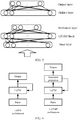
- FIG. 4 is a schematic structural diagram illustrating a memory DNN, according to an implementation.
- the deep neural network includes an input layer, an output layer, and a plurality of hidden layers. These hidden layers include a temporal recurrent layer formed based on the LSTM model. The output of the LSTM layer is connected to a bottleneck layer, and the bottleneck layer is followed by a conventional hidden layer.
- the bottleneck layer has a significantly reduced number of dimensions, for example, 64 or 128 dimensions.
- the number of dimensions of other hidden layers are, for example, 1024, 1500, etc., which is far greater than the number of dimensions of the bottleneck layer.
- the number of dimensions of the LSTM can be the same as or different from the number of dimensions of any other conventional hidden layer, but is also far greater than the number of dimensions of the bottleneck layer.
- the number of dimensions of each conventional hidden layer is 1024
- the number of dimensions of the LSTM layer is 800
- the number of dimensions of the bottleneck layer is 64, thus forming a deep neural network (DNN) with a dimension topology of 1024-1024-800-64-1024-1024.
- DNN deep neural network
- FIG. 5 is a schematic structural diagram illustrating a memory DNN, according to another implementation.
- the deep neural network includes an input layer, an output layer, and a plurality of hidden layers, where the hidden layers include an LSTM projection (LSTMP) layer as a temporal recurrent layer.
- the LSTMP layer is an LSTM architecture with a recurrent projection layer.
- FIG. 6 illustrates a comparison between an LSTM and an LSTMP.
- the recurrent connection of the LSTM layer is implemented by the LSTM itself, that is, via direct connection from the output unit to the input unit.
- a separate linear projection layer is added after the LSTM layer.
- the recurrent connection is an input from the recurrent projection layer to the LSTM layer.
- the output of the recurrent projection layer in the LSTMP layer is connected to the bottleneck layer, and the bottleneck layer is followed by a conventional hidden layer.
- the bottleneck layer has a significantly reduced number of dimensions
- the other hidden layers, including the LSTMP layer have a far greater number of dimensions.
- the number of dimensions of each conventional hidden layer is 1024
- the number of dimensions of the LSTM layer is 800
- the number of dimensions of the recurrent projection layer on which projection-based dimension reduction is performed is 512, thus forming a depth neural network (DNN) with a dimension topology of 1024-800-512-64-1024-1024.
- DNN depth neural network
- the input layer is directly connected to the LSTM/LSTMP temporal recurrent layer, it can be understood that other conventional hidden layers can also precede the temporal recurrent layer.
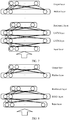
- FIG. 7 is a schematic structural diagram illustrating a memory DNN, according to another implementation.
- the deep neural network includes an input layer, an output layer, and a plurality of hidden layers. These hidden layers include two LSTM layers, the output of the second LSTM layer is connected to the bottleneck layer, and the bottleneck layer is followed by a conventional hidden layer. Similarly, the bottleneck layer has a significantly reduced number of dimensions, and any other hidden layer (including the two LSTM layers) has a far greater number of dimensions.
- the number of dimensions of each conventional hidden layer is 1024
- the number of dimensions of each of the two LSTM layers is 800
- the number of dimensions of the bottleneck layer is 64, thus forming a depth neural network (DNN) with a dimension topology of 1024-800-800-64-1024-1024.
- DNN depth neural network
- the LSTM layer in FIG. 7 can be replaced with an LSTMP layer. In another implementation, more LSTM layers can be included in the DNN
- a temporal recurrent layer is formed in the deep neural network (DNN) by using a Feedforward Sequential Memory Networks (FSMN) model.
- FSMN Feedforward Sequential Memory Networks
- some learning memory modules are added at the hidden layer of a standard feedforward fully connected neural network, and these memory modules use a tap delay line structure to encode long-term context information into a fixed-size expression as a short-term memory mechanism. Therefore, the FSMN models the long-term dependency in the time sequence signal without using a feedback connection.
- the FSMN has solid performance, and its training process is simpler and more efficient.
- a compact FSMN (compact FSMN) is also proposed based on the FSMN
- the cFSMN has a more simplified model structure.
- first projection-based dimension reduction is performed on the input data (for example, the number of dimensions is reduced to 512) by a projection layer, then the data is processed by using a memory model, and finally the feature data (for example, 1024 dimensions) is output after processing by using the memory model.
- the FSMN model or cFSMN model can be introduced in the deep neural network (DNN), so that the DNN has a memory function.
- DNN deep neural network
- FIG. 8 is a schematic structural diagram illustrating a memory DNN, according to an implementation.
- the deep neural network includes an input layer, an output layer, and a plurality of hidden layers. These hidden layers include a temporal recurrent layer formed by the FSMN model.
- the output of the FSMN layer is connected to a bottleneck layer, and the bottleneck layer is followed by a conventional hidden layer.
- the bottleneck layer has a significantly reduced number of dimensions.
- the number of dimensions of any other hidden layer is greater than the number of dimensions of the bottleneck layer, for example, 1024 dimensions, 1500 dimensions, etc.
- the number of dimensions of the FSMN layer is 1024
- the number of any other hidden layer is 2048
- the number of dimensions of the bottleneck layer dimension is 64, thus forming a deep neural network (DNN) with a dimension topology of 2048-1024-64-2048-2048.
- DNN deep neural network
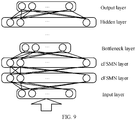
- FIG. 9 is a schematic structural diagram illustrating a memory DNN, according to another implementation.
- the deep neural network includes an input layer, an output layer, and a plurality of hidden layers. These hidden layers include two cFSMN layers, the output of the second cFSMN layer is connected to the bottleneck layer, and the bottleneck is followed by a conventional hidden layer. Similarly, the bottleneck layer has a significantly reduced number of dimensions, and any other hidden layer (including the two cFSMN layers) has a far greater number of dimensions.
- the number of dimensions of each conventional hidden layer is 2048
- the number of dimensions of each of the two cFSMN layers is 1024
- the number of dimensions of the bottleneck layer is 64, thus forming a depth neural network (DNN) with a dimension topology of 2048-1024-1024-64-2048-2048.
- DNN depth neural network
- cFSMN layer in FIG. 9 can be replaced with an FSMN layer.
- more FSMN/cFSMN layers can be included in the DNN
- other temporal recurrent models can be employed in the deep neural network (DNN) to form a DNN with a memory function.
- the DNN with a memory function includes one or more temporal recurrent layers, and the temporal recurrent layer(s) is directly connected to a bottleneck layer, so that the features of the bottleneck layer can reflect the timing effect and have a memory effect.
- the greater the number of temporal recurrent layers the better the performance, but the higher the network complexity; and the fewer the number of temporal recurrent layers, the simpler the training of the network model.
- a DNN with 1 to 5 temporal recurrent layers is often used.
- a deep neural network can be designed to have temporal recurrent layer(s) before a bottleneck layer.
- a deep neural network DNN
- speech recognition training can be performed in a conventional way.
- the bottleneck feature(s) included in the trained DNN can reflect more abundant speech information than the basic spectral feature(s).
- the bottleneck feature(s) also has a memory function, which reflects the time sequence effect of speech.
- the feature(s) of the bottleneck layer in the deep neural network (DNN) with a memory function is extracted, so that the bottleneck feature(s) with a memory function is obtained.
- the speaker audio is input to the memory DNN.
- a plurality of consecutive speech frames of the speaker audio are input to the DNN, where the plurality of consecutive speech frames include, for example, 16 frames: 10 preceding frames, 1 present frame, and 5 subsequent frames.
- the basic spectral features are generally input to the memory DNN.
- the basic spectral feature input to the DNN is a Mel frequency cepstral coefficient (MFCC) feature.
- the basic spectral feature input to the DNN is an Mel scale filter bank (FBank) feature.
- the FBank feature is a spectral feature obtained by using a Mel filter bank map the frequency of a frequency domain signal to a Mel scale.
- the MFCC feature is obtained by performing discrete cosine transform on the FBank feature
- the FBank feature is a MFCC feature prior to the discrete cosine transform.
- the basic spectral feature input to the memory DNN is processed through calculation by the DNN to form a series of bottleneck features at the bottleneck layer.
- the bottleneck layer includes a plurality of nodes with a small number of dimensions, and these nodes are assigned activation values during the forward calculation when the spectral features are processed in the DNN.
- the bottleneck feature(s) is extracted by reading the activation values of the nodes at the bottleneck layer.
- the basic spectral feature is extracted from the speaker audio; and at step 22, the bottleneck feature is extracted from the deep neural network (DNN) with a memory function. Based on this, at step 23, the spectral feature and the bottleneck feature are concatenated to form an acoustic feature of the speaker audio. In an implementation, the bottleneck feature and the basic spectral feature are concatenated to form the acoustic feature of the speaker audio.
- DNN deep neural network
- the basic spectral feature includes a 20-dimensional MFCC feature, a 20-dimensional MFCC first-order differential feature, and a 20-dimensional MFCC second-order differential feature
- the number of dimensions of the bottleneck feature is the same as the number of dimensions of the bottleneck layer, for example, 64
- the 60-dimensional feature of the MFCC and its differential can be concatenated with the 64-dimensional bottleneck feature to form a 124-dimensional vector as the acoustic feature Ot.
- the acoustic feature Ot can include more features obtained based on other factors.
- the identity authentication vector corresponding to the speaker audio that is, the i-vector, is extracted based on the acoustic feature.
- the i-vector model is built based on the Gaussian mean supervector space in the Gaussian mixture model-universal background model (GMM-UBM), and considers that both the speaker information and the channel information are included in a low-dimensional subspace.
- GMM-UBM Gaussian mixture model-universal background model
- M m + T ⁇
- m a component independent of a speaker and a channel, which can be usually replaced with the mean supervector of the UBM
- T is a total variability subspace matrix
- ⁇ is a variation factor including the speaker and channel information, that is, i-vector.
- N c k , F c k , and S c k respectively denote the zero-order statistics
- o t k denotes the acoustic feature of the speech segment k at the time index t
- ⁇ c is the mean value of the c th GMM mixed component
- ⁇ c , t k denotes the posterior probability of the acoustic feature o t k for the c th G
- the extraction of the i-vector is based on the calculation of the above sufficient statistics, which is based on the acoustic feature o t k .
- the acoustic feature o t k includes not only the basic spectral information of the speaker's audio, but also the bottleneck feature of the deep neural network (DNN) with a memory function.
- the acoustic feature o t k can better reflect the prosodic information of the speech segments, and correspondingly, the i-vector extracted based on the acoustic feature o t k can more fully reflect the speaker's speech traits.
- speaker identification is performed based on the extracted identity authentication vector (i-vector).
- the extracted i-vector can be input to a classification model as an identity feature for classification and speaker identification.
- the classification model is, for example, a probabilistic linear discriminant analysis (PLDA) model.
- the model is used to calculate a score of likelihood ratio between different i-vectors and make a decision based on the score.
- the classification model is, for example, a support vector machine (SVM) model.
- SVM support vector machine
- the model is a supervised classification algorithm, which achieves classification of i-vectors by finding a classification plane and separating data on both sides of the plane.
- the acoustic feature includes a memory bottleneck feature
- the prosodic information of the speech segment is better reflected, and correspondingly, the i-vector extracted based on the acoustic feature more fully reflects the speaker's speech traits, and therefore, the speaker recognition performed based on such i-vectors has higher recognition accuracy.
- FIG. 10 is a schematic block diagram illustrating a voiceprint recognition device, according to an implementation.
- the device 100 includes: a first extraction unit 110, configured to extract a first spectral feature from speaker audio; a second extraction unit 120, configured to: input the speaker audio to a memory deep neural network (DNN), and extract a bottleneck feature from a bottleneck layer of the memory DNN, the memory DNN including at least one temporal recurrent layer and the bottleneck layer, an output of the at least one temporal recurrent layer being connected to the bottleneck layer, and the number of dimensions of the bottleneck layer being less than the number of dimensions of any other hidden layer in the memory DNN; a feature concatenation unit 130, configured to form an acoustic feature of the speaker audio based on the first spectral feature and the bottleneck feature; a vector extraction unit 140, configured to extract an identity authentication vector corresponding to the speaker audio based on the a
- DNN memory deep neural network
- the first spectral feature extracted by the first extraction unit 110 includes a Mel frequency cepstral coefficient (MFCC) feature, and a first order difference feature and a second order difference feature of the MFCC feature.
- MFCC Mel frequency cepstral coefficient
- the temporal recurrent layer in the memory DNN on which the second extraction unit 120 is based includes a hidden layer based on a long-short term memory (LSTM) model, or a hidden layer based on an LSTMP model, where the LSTMP model is an LSTM model with a recurrent projection layer.
- LSTM long-short term memory
- the temporal recurrent layer can further include a hidden layer based on a feedforward sequence memory FSMN model, or a hidden layer based on a cFSMN model, the cFSMN model being a compact FSMN model.
- the second extraction unit 120 is configured to: extract a second spectral feature from a plurality of consecutive speech frames of the speaker audio, and input the second spectral feature to the deep neural network (DNN).
- DNN deep neural network
- the second spectral feature is a Mel scale filter bank (FBank) feature.
- FBank Mel scale filter bank
- the feature concatenation unit 130 is configured to concatenate the first spectral feature and the bottleneck feature to form the acoustic feature.
- a deep neural network (DNN) with a memory function is designed, and a bottleneck feature with a memory effect is extracted from a bottleneck layer of such a deep neural network and included in the acoustic features.
- DNN deep neural network
- Such acoustic features better reflect timing-dependent prosodic features of the speaker.
- the identity authentication vector (i-vector) extracted based on such acoustic features can better represent the speaker's speech traits, in particular prosodic features, so that the accuracy of speaker recognition is improved.
- a computer readable storage medium stores a computer program, and when the computer program is executed in a computer, the computer is enabled to perform the method described with reference to FIG. 2 .
- a computing device including a memory and a processor, where the memory stores executable code, and when the processor executes the executable code, the method described with reference to FIG. 2 is implemented.
Landscapes
- Engineering & Computer Science (AREA)
- Physics & Mathematics (AREA)
- Theoretical Computer Science (AREA)
- Health & Medical Sciences (AREA)
- Artificial Intelligence (AREA)
- Evolutionary Computation (AREA)
- Computational Linguistics (AREA)
- General Physics & Mathematics (AREA)
- Software Systems (AREA)
- General Engineering & Computer Science (AREA)
- Multimedia (AREA)
- Acoustics & Sound (AREA)
- Human Computer Interaction (AREA)
- Audiology, Speech & Language Pathology (AREA)
- Life Sciences & Earth Sciences (AREA)
- Mathematical Physics (AREA)
- Biomedical Technology (AREA)
- Data Mining & Analysis (AREA)
- Computing Systems (AREA)
- Biophysics (AREA)
- Molecular Biology (AREA)
- General Health & Medical Sciences (AREA)
- Computer Vision & Pattern Recognition (AREA)
- Signal Processing (AREA)
- Computer Security & Cryptography (AREA)
- Neurology (AREA)
- Computer Hardware Design (AREA)
- Image Analysis (AREA)
- Telephonic Communication Services (AREA)
- Management, Administration, Business Operations System, And Electronic Commerce (AREA)
Abstract
Description
- This patent application claims priority to Chinese Patent Application No.
201810146310.2, filed February 12, 2018 - One or more implementations of the present specification relate to the field of computer technologies, and in particular, to voiceprint recognition.
- Voiceprints are acoustic features extracted based on spectral features of sound waves of a speaker. As with fingerprints, voiceprints, as a biological feature, can reflect the speech features and identity information of the speaker. Voiceprint recognition, also known as speaker recognition, is a biometric authentication technology that automatically recognizes the identity of a speaker using specific speaker information included in a speech signal. The biometric authentication technology has wide application prospects in many fields and scenarios such as identity authentication and security check.
- An identity vector (i-vector) model is a common model in a voiceprint recognition system. The i-vector model considers that the speaker and the channel information in the speech are included in a low-dimensional linear subspace, and each speech can be represented by a vector of a fixed length in the low-dimensional space, where the vector is the identity vector (i-vector). The i-vector can provide solid distinguishability, includes the identity feature information of the speaker, and is an important feature for voiceprint recognition and speech recognition. I-vector-based voiceprint recognition generally includes the following steps: calculating acoustic statistics based on spectral features, extracting an identity vector (i-vector) from the acoustic statistics, and then performing speaker recognition based on the i-vector. Therefore, extraction of the i-vector is very important. However, the extraction of the i-vector in the existing voiceprint recognition process is not comprehensive. Therefore, there is a need for a more efficient solution for obtaining more comprehensive voiceprint features, to improve the accuracy of voiceprint recognition.
- One or more implementations of the present specification describe a method and device capable of obtaining more comprehensive acoustic features from speaker audio, thereby making the extraction of identity authentication vectors more comprehensive and improving the accuracy of voiceprint recognition.
- According to a first aspect, a voiceprint recognition method is provided, including: extracting a first spectral feature from speaker audio; inputting the speaker audio to a memory deep neural network (DNN), and extracting a bottleneck feature from a bottleneck layer of the memory DNN, the memory DNN including at least one temporal recurrent layer and the bottleneck layer, an output of the at least one temporal recurrent layer being connected to the bottleneck layer, and the number of dimensions of the bottleneck layer being less than the number of dimensions of any other hidden layer in the memory DNN; forming an acoustic feature of the speaker audio based on the first spectral feature and the bottleneck feature; extracting an identity authentication vector corresponding to the speaker audio based on the acoustic feature; and performing speaker recognition by using a classification model and based on the identity authentication vector.
- In an implementation, the first spectral feature includes a Mel frequency cepstral coefficient (MFCC) feature, and a first order difference feature and a second order difference feature of the MFCC feature.
- In a possible design, the at least one temporal recurrent layer includes a hidden layer based on a long-short term memory (LSTM) model, or a hidden layer based on an LSTMP model, where the LSTMP model is an LSTM model with a recurrent projection layer.
- In another possible design, the at least one temporal recurrent layer includes a hidden layer based on a feedforward sequence memory FSMN model, or a hidden layer based on a cFSMN model, the cFSMN model being a compact FSMN model.
- According to an implementation, inputting the speaker audio to a memory deep neural network (DNN) includes: extracting a second spectral feature from a plurality of consecutive speech frames of the speaker audio, and inputting the second spectral feature to the memory DNN.
- Further, in an example, the second spectral feature is a Mel scale filter bank (FBank) feature.
- According to an implementation, the forming an acoustic feature of the speaker audio includes: concatenating the first spectral feature and the bottleneck feature to form the acoustic feature.
- According to a second aspect, a voiceprint recognition device is provided, including: a first extraction unit, configured to extract a first spectral feature from speaker audio; a second extraction unit, configured to: input the speaker audio to a memory deep neural network (DNN), and extract a bottleneck feature from a bottleneck layer of the memory DNN, the memory DNN including at least one temporal recurrent layer and the bottleneck layer, an output of the at least one temporal recurrent layer being connected to the bottleneck layer, and the number of dimensions of the bottleneck layer being less than the number of dimensions of any other hidden layer in the memory DNN; a feature concatenation unit, configured to form an acoustic feature of the speaker audio based on the first spectral feature and the bottleneck feature; a vector extraction unit, configured to extract an identity authentication vector corresponding to the speaker audio based on the acoustic feature; and a classification recognition unit, configured to perform speaker recognition by using a classification model and based on the identity authentication vector.
- According to a third aspect, a computer readable storage medium is provided, where the medium stores a computer program, and when the computer program is executed on a computer, the computer is enabled to perform the method according to the first aspect.
- According to a fourth aspect, a computing device is provided, including a memory and a processor, where the memory stores executable code, and when the processor executes the executable code, the method of the first aspect is implemented.
- According to the method and device provided in the present specification, a deep neural network (DNN) with a memory function is designed, and a bottleneck feature with a memory effect is extracted from a bottleneck layer of such a deep neural network and included in the acoustic features. Such acoustic features better reflect timing-dependent prosodic features of the speaker. The identity authentication vector (i-vector) extracted based on such acoustic features can better represent the speaker's speech traits, in particular prosodic features, so that the accuracy of speaker recognition is improved.
- To describe the technical solutions in the implementations of the present invention more clearly, the following is a brief introduction of the accompanying drawings used for describing the implementations. Clearly, the accompanying drawings in the following description are merely some implementations of the present invention, and a person of ordinary skill in the field can derive other drawings from these accompanying drawings without making innovative efforts.
-
FIG. 1 is a schematic diagram illustrating an application scenario of an implementation disclosed in the present specification; -
FIG. 2 is a flowchart illustrating a voiceprint recognition method, according to an implementation; -
FIG. 3 is a schematic diagram illustrating a bottleneck layer of a deep neural network; -
FIG. 4 is a schematic structural diagram illustrating a memory DNN, according to an implementation; -
FIG. 5 is a schematic structural diagram illustrating a memory DNN, according to another implementation; -
FIG. 6 illustrates a comparison between an LSTM and an LSTMP; -
FIG. 7 is a schematic structural diagram illustrating a memory DNN, according to another implementation; -
FIG. 8 is a schematic structural diagram illustrating a memory DNN, according to an implementation; -
FIG. 9 is a schematic structural diagram illustrating a memory DNN, according to another implementation; and -
FIG. 10 is a schematic block diagram illustrating a voiceprint recognition device, according to an implementation. - The solutions provided in the present specification are described below with reference to the accompanying drawings.
-
FIG. 1 is a schematic diagram illustrating an application scenario of an implementation disclosed in the present specification. First, a speaker speaks to form speaker audio. The speaker audio is input to a spectrum extraction unit, and the spectrum extraction unit extracts basic spectral features. In addition, the speaker audio is input to a deep neural network (DNN). In the implementation ofFIG. 1 , the deep neural network (DNN) is a neural network with a memory function and having a bottleneck layer. Accordingly, the features of the bottleneck layer are features with a memory effect. The bottleneck features are extracted from the bottleneck layer of the DNN with a memory function, and are then concatenated with the basic spectral features to form acoustic features. Then, the acoustic features are input to an identity authentication vector (i-vector) model, in which acoustic statistics are calculated based on the acoustic features, and i-vector extraction is performed based on the measured i-vector, and then speaker recognition is performed. As such, the result of the voiceprint recognition is output. -
FIG. 2 is a flowchart illustrating a voiceprint recognition method, according to an implementation. The method process can be executed by any device, equipment or system with computing and processing capabilities. As shown inFIG. 2 , the voiceprint recognition method of this implementation includes the following steps:Step 21, Extract a spectral feature from speaker audio; Step 22, Input the speaker audio to a memory deep neural network (DNN), and extract a bottleneck feature from a bottleneck layer of the memory DNN, the memory DNN including at least one temporal recurrent layer and the bottleneck layer, an output of the at least one temporal recurrent layer being connected to the bottleneck layer, and the number of dimensions of the bottleneck layer being less than the number of dimensions of any other hidden layer in the memory DNN;Step 23, Form an acoustic feature of the speaker audio based on the spectral feature and the bottleneck feature;Step 24, Extract an identity authentication vector corresponding to the speaker audio based on the acoustic feature; andStep 25, Perform speaker recognition based on the identity authentication vector. The following describes a specific execution process of each step. - First, at
step 21, a spectral feature is extracted from the speaker audio. It can be understood that the speaker audio is formed when the speaker speaks and can be divided into a plurality of speech segments. The spectral feature extracted atstep 21 is a basic spectral feature, in particular a (single-frame) short-term spectral feature. - In an implementation, the spectral feature is a Mel frequency cepstral coefficient (MFCC) feature. The Mel frequency is proposed based on human auditory features, and has a non-linear correspondence with Hertz (Hz) frequency. Extracting an MFCC feature from the speaker audio generally includes the following steps: pre-emphasis, framing, windowing, Fourier transform, Mel filter bank, discrete cosine transform (DCT), etc. Pre-emphasis is used to boost the high frequency part to a certain extent so that the frequency spectrum of the signal becomes flat. Framing is used to temporally divide the speech into a series of frames. Windowing is to use a windowing function to enhance continuity of the left end and right end of the frames. Next, Fourier transform is performed on the audio, so that a time domain signal is converted to a frequency domain signal. Then, the frequency of the frequency-domain signal is mapped to a Mel scale by using a Mel filter bank, so as to obtain a Mel spectrum. Then, the cepstrum coefficient of the Mel spectrum is obtained through discrete cosine transform, and then the Mel cepstrum can be obtained. Further, dynamic differential parameters can be extracted from standard cepstrum parameter MFCC, thereby obtaining differential features reflecting the dynamic variation features between frames. Therefore, in general, the first-order and second-order differential features of the MFCC are also obtained based on the extracted MFCC features. For example, if the Mel cepstrum feature is characterized by 20 dimensions, then a first order difference feature of 20 dimensions and a second order difference feature of 20 dimensions are also obtained in the difference parameter extraction phase, so as to form a 60-dimensional vector.
- In another implementation, the basic spectral feature extracted at
step 21 includes linear predictive coding (LPC) feature or perceptual linear predictive (PLP) feature. Such feature can be extracted by using a conventional method. It is also possible to extract other short-term spectral feature(s) as the basic feature. - However, the basic short-term spectral feature is often insufficient to express the full information of the speaker. For example, MFCC features do not well reflect speaker feature information in the high frequency domain. Thus, conventional technologies have complemented the overall acoustic features by introducing bottleneck features of the deep neural network (DNN).
- Conventional deep neural network (DNN) is an extension of conventional feedforward artificial neural network, which has more hidden layers and a stronger expression capability, and has been applied in the field of speech recognition in recent years. In speech recognition, the deep neural network (DNN) replaces the GMM part in the Gaussian mixture model-hidden Markov model (GMM-HMM) acoustic model to represent the probability of different states that occur in the HMM model. Generally, for a DNN for speech recognition, the input is an acoustic feature that concatenates a plurality of earlier and later frames, and the output layer typically uses a softmax function to represent a posteriori probability for predicting a phoneme in an HMM state, so that phoneme states can be classified.
- Deep neural network (DNN) has such a classification capability, because it obtains, based on supervised data, feature representations that are advantageous for a particular classification task. In a DNN including a bottleneck layer, the feature of the bottleneck layer is a good representation of the above feature. Specifically, the bottleneck layer is a hidden layer in the DNN model that includes a significantly reduced number of nodes (referred to as dimensions), compared to other hidden layers. Alternatively, the bottleneck layer includes fewer nodes than the other layers in the deep neural network (DNN). For example, in a deep neural network (DNN), the number of nodes at any other hidden layer is 1024, and the number of nodes at a certain layer is only 64, forming a DNN structure with a hidden layer topology of 1024-1024-64-1024-1024. The hidden layer in which the number of nodes is only 64 is referred to as a bottleneck layer.
FIG. 3 is a schematic diagram illustrating a bottleneck layer of a deep neural network. As shown inFIG. 3 , the deep neural network includes a plurality of hidden layers, and the hidden layer in which the number of nodes is significantly reduced compared to other hidden layers is the bottleneck layer. - The activation value of a node at the bottleneck layer can be considered as a low-dimensional representation of the input signal, which is also referred to as a bottleneck feature. In a DNN trained for speech recognition, the bottleneck feature can include additional speaker speech information.
- In an implementation, to better reflect the context dependency of the sequence of speech frames with acoustic features and better grasp the timing variation of the speech prosody in the speaker's audio, an improvement is made based on a conventional deep neural network (DNN), that is, a memory function is introduced to form a deep neural network (DNN) with memory. Specifically, the deep neural network (DNN) with memory is designed to include at least one temporal recurrent layer and a bottleneck layer, and the output of the temporal recurrent layer is connected to the bottleneck layer, so that the feature(s) of the bottleneck layer can reflect temporal feature(s), thereby having a "memory" function. Then, at step 22, the speaker audio is input to the memory DNN, and the memory bottleneck feature is extracted from the bottleneck layer of the memory DNN
- In an implementation, the temporal recurrent layer described above employs a hidden layer in a recurrent neural network (RNN). More specifically, in an implementation, the temporal recurrent layer employs a Long-Short Term Memory (LSTM) model.
- Recurrent neural network (RNN) is a temporal recurrent neural network that can be used to process sequence data. In the RNN, the current output of a sequence is associated with its previous output. Specifically, the RNN memorizes the previous information and applies it to the calculation of the current output; that is, the nodes between the hidden layers are connected, and the input of the hidden layer includes not only the output of the input layer, but also the output of the hidden layer from a previous time. That is, the tth state of the hidden layer can be expressed as:

- In the case of processing long-term memory, RNN has a long-term dependence issue, and training is difficult, for example, the issue of gradient overflow may easily occur. The LSTM model proposed based on the RNN further resolves the issue of long-term dependence.
- According to the LSTM model, calculation of three gates (input gate, output gate, and forget gate) is implemented in recurrent network module(s). The forget gate can be arranged to filter information, to discard certain information that is no longer needed, so as to better analyze and process the long-term data by determining and screening unnecessary interference information from input.
-
FIG. 4 is a schematic structural diagram illustrating a memory DNN, according to an implementation. As shown inFIG. 4 , the deep neural network (DNN) includes an input layer, an output layer, and a plurality of hidden layers. These hidden layers include a temporal recurrent layer formed based on the LSTM model. The output of the LSTM layer is connected to a bottleneck layer, and the bottleneck layer is followed by a conventional hidden layer. The bottleneck layer has a significantly reduced number of dimensions, for example, 64 or 128 dimensions. The number of dimensions of other hidden layers are, for example, 1024, 1500, etc., which is far greater than the number of dimensions of the bottleneck layer. The number of dimensions of the LSTM can be the same as or different from the number of dimensions of any other conventional hidden layer, but is also far greater than the number of dimensions of the bottleneck layer. In a typical example, the number of dimensions of each conventional hidden layer is 1024, the number of dimensions of the LSTM layer is 800, and the number of dimensions of the bottleneck layer is 64, thus forming a deep neural network (DNN) with a dimension topology of 1024-1024-800-64-1024-1024. -
FIG. 5 is a schematic structural diagram illustrating a memory DNN, according to another implementation. As shown inFIG. 5 , the deep neural network (DNN) includes an input layer, an output layer, and a plurality of hidden layers, where the hidden layers include an LSTM projection (LSTMP) layer as a temporal recurrent layer. The LSTMP layer is an LSTM architecture with a recurrent projection layer.FIG. 6 illustrates a comparison between an LSTM and an LSTMP. In a conventional LSTM architecture, the recurrent connection of the LSTM layer is implemented by the LSTM itself, that is, via direct connection from the output unit to the input unit. In the LSTMP architecture, a separate linear projection layer is added after the LSTM layer. As such, the recurrent connection is an input from the recurrent projection layer to the LSTM layer. By setting the number of units at the recurrent projection layer, projection-based dimension reduction can be performed on the number of nodes at the LSTM layer. - The output of the recurrent projection layer in the LSTMP layer is connected to the bottleneck layer, and the bottleneck layer is followed by a conventional hidden layer. Similarly, the bottleneck layer has a significantly reduced number of dimensions, and the other hidden layers, including the LSTMP layer, have a far greater number of dimensions. In a typical example, the number of dimensions of each conventional hidden layer is 1024, the number of dimensions of the LSTM layer is 800, and the number of dimensions of the recurrent projection layer on which projection-based dimension reduction is performed is 512, thus forming a depth neural network (DNN) with a dimension topology of 1024-800-512-64-1024-1024.
- Although in the examples of
FIG. 4 andFIG. 5 , the input layer is directly connected to the LSTM/LSTMP temporal recurrent layer, it can be understood that other conventional hidden layers can also precede the temporal recurrent layer. -
FIG. 7 is a schematic structural diagram illustrating a memory DNN, according to another implementation. As shown inFIG. 7 , the deep neural network (DNN) includes an input layer, an output layer, and a plurality of hidden layers. These hidden layers include two LSTM layers, the output of the second LSTM layer is connected to the bottleneck layer, and the bottleneck layer is followed by a conventional hidden layer. Similarly, the bottleneck layer has a significantly reduced number of dimensions, and any other hidden layer (including the two LSTM layers) has a far greater number of dimensions. In a typical example, the number of dimensions of each conventional hidden layer is 1024, the number of dimensions of each of the two LSTM layers is 800, and the number of dimensions of the bottleneck layer is 64, thus forming a depth neural network (DNN) with a dimension topology of 1024-800-800-64-1024-1024. - In an implementation, the LSTM layer in
FIG. 7 can be replaced with an LSTMP layer. In another implementation, more LSTM layers can be included in the DNN - In an implementation, a temporal recurrent layer is formed in the deep neural network (DNN) by using a Feedforward Sequential Memory Networks (FSMN) model. In the FSMN model, some learning memory modules are added at the hidden layer of a standard feedforward fully connected neural network, and these memory modules use a tap delay line structure to encode long-term context information into a fixed-size expression as a short-term memory mechanism. Therefore, the FSMN models the long-term dependency in the time sequence signal without using a feedback connection. For speech recognition, the FSMN has solid performance, and its training process is simpler and more efficient.
- A compact FSMN (compact FSMN) is also proposed based on the FSMN The cFSMN has a more simplified model structure. In the cFSMN, first projection-based dimension reduction is performed on the input data (for example, the number of dimensions is reduced to 512) by a projection layer, then the data is processed by using a memory model, and finally the feature data (for example, 1024 dimensions) is output after processing by using the memory model.
- The FSMN model or cFSMN model can be introduced in the deep neural network (DNN), so that the DNN has a memory function.
-
FIG. 8 is a schematic structural diagram illustrating a memory DNN, according to an implementation. As shown inFIG. 8 , the deep neural network (DNN) includes an input layer, an output layer, and a plurality of hidden layers. These hidden layers include a temporal recurrent layer formed by the FSMN model. The output of the FSMN layer is connected to a bottleneck layer, and the bottleneck layer is followed by a conventional hidden layer. The bottleneck layer has a significantly reduced number of dimensions. The number of dimensions of any other hidden layer (including the FSMN layer) is greater than the number of dimensions of the bottleneck layer, for example, 1024 dimensions, 1500 dimensions, etc. In a typical example, the number of dimensions of the FSMN layer is 1024, the number of any other hidden layer is 2048, and the number of dimensions of the bottleneck layer dimension is 64, thus forming a deep neural network (DNN) with a dimension topology of 2048-1024-64-2048-2048. -
FIG. 9 is a schematic structural diagram illustrating a memory DNN, according to another implementation. As shown inFIG. 9 , the deep neural network (DNN) includes an input layer, an output layer, and a plurality of hidden layers. These hidden layers include two cFSMN layers, the output of the second cFSMN layer is connected to the bottleneck layer, and the bottleneck is followed by a conventional hidden layer. Similarly, the bottleneck layer has a significantly reduced number of dimensions, and any other hidden layer (including the two cFSMN layers) has a far greater number of dimensions. In a typical example, the number of dimensions of each conventional hidden layer is 2048, the number of dimensions of each of the two cFSMN layers is 1024, and the number of dimensions of the bottleneck layer is 64, thus forming a depth neural network (DNN) with a dimension topology of 2048-1024-1024-64-2048-2048. - It can be understood that the cFSMN layer in
FIG. 9 can be replaced with an FSMN layer. In another implementation, more FSMN/cFSMN layers can be included in the DNN - In an implementation, other temporal recurrent models can be employed in the deep neural network (DNN) to form a DNN with a memory function. In general, the DNN with a memory function includes one or more temporal recurrent layers, and the temporal recurrent layer(s) is directly connected to a bottleneck layer, so that the features of the bottleneck layer can reflect the timing effect and have a memory effect. It can be understood that the greater the number of temporal recurrent layers, the better the performance, but the higher the network complexity; and the fewer the number of temporal recurrent layers, the simpler the training of the network model. Typically, a DNN with 1 to 5 temporal recurrent layers is often used.
- As can be seen from the above description, a deep neural network (DNN) can be designed to have temporal recurrent layer(s) before a bottleneck layer. For such a deep neural network (DNN) with a memory function, speech recognition training can be performed in a conventional way. The bottleneck feature(s) included in the trained DNN can reflect more abundant speech information than the basic spectral feature(s). In addition, because the DNN includes temporal recurrent layer(s) before the bottleneck layer, the bottleneck feature(s) also has a memory function, which reflects the time sequence effect of speech. Correspondingly, at step 22 of
FIG. 2 , the feature(s) of the bottleneck layer in the deep neural network (DNN) with a memory function is extracted, so that the bottleneck feature(s) with a memory function is obtained. - Specifically, at step 22, the speaker audio is input to the memory DNN. In an implementation, a plurality of consecutive speech frames of the speaker audio are input to the DNN, where the plurality of consecutive speech frames include, for example, 16 frames: 10 preceding frames, 1 present frame, and 5 subsequent frames. For the plurality of consecutive speech frames, the basic spectral features are generally input to the memory DNN. In an implementation, the basic spectral feature input to the DNN is a Mel frequency cepstral coefficient (MFCC) feature. In another implementation, the basic spectral feature input to the DNN is an Mel scale filter bank (FBank) feature. The FBank feature is a spectral feature obtained by using a Mel filter bank map the frequency of a frequency domain signal to a Mel scale. In other words, the MFCC feature is obtained by performing discrete cosine transform on the FBank feature, and the FBank feature is a MFCC feature prior to the discrete cosine transform.
- The basic spectral feature input to the memory DNN is processed through calculation by the DNN to form a series of bottleneck features at the bottleneck layer. Specifically, the bottleneck layer includes a plurality of nodes with a small number of dimensions, and these nodes are assigned activation values during the forward calculation when the spectral features are processed in the DNN. The bottleneck feature(s) is extracted by reading the activation values of the nodes at the bottleneck layer.
- As such, at
step 21, the basic spectral feature is extracted from the speaker audio; and at step 22, the bottleneck feature is extracted from the deep neural network (DNN) with a memory function. Based on this, atstep 23, the spectral feature and the bottleneck feature are concatenated to form an acoustic feature of the speaker audio. In an implementation, the bottleneck feature and the basic spectral feature are concatenated to form the acoustic feature of the speaker audio. - For example, assuming that the basic spectral feature includes a 20-dimensional MFCC feature, a 20-dimensional MFCC first-order differential feature, and a 20-dimensional MFCC second-order differential feature, and that the number of dimensions of the bottleneck feature is the same as the number of dimensions of the bottleneck layer, for example, 64, then the 60-dimensional feature of the MFCC and its differential can be concatenated with the 64-dimensional bottleneck feature to form a 124-dimensional vector as the acoustic feature Ot. Of course, in other examples, the acoustic feature Ot can include more features obtained based on other factors.
- Next, at
step 24, the identity authentication vector corresponding to the speaker audio, that is, the i-vector, is extracted based on the acoustic feature. - The i-vector model is built based on the Gaussian mean supervector space in the Gaussian mixture model-universal background model (GMM-UBM), and considers that both the speaker information and the channel information are included in a low-dimensional subspace. Given a segment of speech, its Gaussian mean supervector M can be decomposed as follows:

- To calculate and extract the i-vector, sufficient statistics (that is, Baum-Welch statistics) for each speech segment need to be calculated:


- It can be seen that the extraction of the i-vector is based on the calculation of the above sufficient statistics, which is based on the acoustic feature

FIG. 2 , the acoustic feature


- Next, at
step 25, speaker identification is performed based on the extracted identity authentication vector (i-vector). Specifically, the extracted i-vector can be input to a classification model as an identity feature for classification and speaker identification. The classification model is, for example, a probabilistic linear discriminant analysis (PLDA) model. The model is used to calculate a score of likelihood ratio between different i-vectors and make a decision based on the score. In another example, the classification model is, for example, a support vector machine (SVM) model. The model is a supervised classification algorithm, which achieves classification of i-vectors by finding a classification plane and separating data on both sides of the plane. - As can be seen from the above description, because the acoustic feature includes a memory bottleneck feature, the prosodic information of the speech segment is better reflected, and correspondingly, the i-vector extracted based on the acoustic feature more fully reflects the speaker's speech traits, and therefore, the speaker recognition performed based on such i-vectors has higher recognition accuracy.
- According to another aspect, an implementation of the present specification further provides a voiceprint recognition device.
FIG. 10 is a schematic block diagram illustrating a voiceprint recognition device, according to an implementation. As shown inFIG. 10 , thedevice 100 includes: afirst extraction unit 110, configured to extract a first spectral feature from speaker audio; asecond extraction unit 120, configured to: input the speaker audio to a memory deep neural network (DNN), and extract a bottleneck feature from a bottleneck layer of the memory DNN, the memory DNN including at least one temporal recurrent layer and the bottleneck layer, an output of the at least one temporal recurrent layer being connected to the bottleneck layer, and the number of dimensions of the bottleneck layer being less than the number of dimensions of any other hidden layer in the memory DNN; afeature concatenation unit 130, configured to form an acoustic feature of the speaker audio based on the first spectral feature and the bottleneck feature; avector extraction unit 140, configured to extract an identity authentication vector corresponding to the speaker audio based on the acoustic feature; and aclassification recognition unit 150, configured to perform speaker recognition by using a classification model and based on the identity authentication vector. - According to an implementation, the first spectral feature extracted by the
first extraction unit 110 includes a Mel frequency cepstral coefficient (MFCC) feature, and a first order difference feature and a second order difference feature of the MFCC feature. - In an implementation, the temporal recurrent layer in the memory DNN on which the
second extraction unit 120 is based includes a hidden layer based on a long-short term memory (LSTM) model, or a hidden layer based on an LSTMP model, where the LSTMP model is an LSTM model with a recurrent projection layer. - In another implementation, the temporal recurrent layer can further include a hidden layer based on a feedforward sequence memory FSMN model, or a hidden layer based on a cFSMN model, the cFSMN model being a compact FSMN model.
- In an implementation, the
second extraction unit 120 is configured to: extract a second spectral feature from a plurality of consecutive speech frames of the speaker audio, and input the second spectral feature to the deep neural network (DNN). - Further, in an example, the second spectral feature is a Mel scale filter bank (FBank) feature.
- In an implementation, the
feature concatenation unit 130 is configured to concatenate the first spectral feature and the bottleneck feature to form the acoustic feature. - According to the method and device provided in the present specification, a deep neural network (DNN) with a memory function is designed, and a bottleneck feature with a memory effect is extracted from a bottleneck layer of such a deep neural network and included in the acoustic features. Such acoustic features better reflect timing-dependent prosodic features of the speaker. The identity authentication vector (i-vector) extracted based on such acoustic features can better represent the speaker's speech traits, in particular prosodic features, so that the accuracy of speaker recognition is improved.
- According to an implementation of another aspect, a computer readable storage medium is further provided, where the computer readable storage medium stores a computer program, and when the computer program is executed in a computer, the computer is enabled to perform the method described with reference to
FIG. 2 . - According to an implementation of yet another aspect, a computing device is further provided, including a memory and a processor, where the memory stores executable code, and when the processor executes the executable code, the method described with reference to
FIG. 2 is implemented. - A person skilled in the field should be aware that, in one or more of the above examples, the functions described in the present invention can be implemented in hardware, software, firmware, or any combination thereof. When these functions are implemented by software, they can be stored in a computer readable medium or transmitted as one or more instructions or code lines on the computer readable medium.
- The specific implementations mentioned above further describe the object, technical solutions and beneficial effects of the present invention. It should be understood that the above descriptions are merely specific implementations of the present invention and are not intended to limit the protection scope of the present invention. Any modification, equivalent replacement and improvement made based on the technical solution of the present invention shall fall within the protection scope of the present invention.
Claims (16)
- A voiceprint recognition method, comprising:extracting a first spectral feature from speaker audio;inputting the speaker audio to a memory deep neural network (DNN), and extracting a bottleneck feature from a bottleneck layer of the memory DNN, the memory DNN including at least one temporal recurrent layer and the bottleneck layer, an output of the at least one temporal recurrent layer being connected to the bottleneck layer, and the number of dimensions of the bottleneck layer being less than the number of dimensions of any other hidden layer in the memory DNN;forming an acoustic feature of the speaker audio based on the first spectral feature and the bottleneck feature;extracting an identity authentication vector corresponding to the speaker audio based on the acoustic feature; andperforming speaker recognition by using a classification model and based on the identity authentication vector.
- The method according to claim 1, wherein the first spectral feature comprises a Mel frequency cepstral coefficient (MFCC) feature, and a first order difference feature and a second order difference feature of the MFCC feature.
- The method according to claim 1, wherein the at least one temporal recurrent layer comprises a hidden layer based on a long-short term memory (LSTM) model, or a hidden layer based on an LSTMP model, the LSTMP model being an LSTM model with a recurrent projection layer.
- The method according to claim 1, wherein the at least one temporal recurrent layer comprises a hidden layer based on a feedforward sequence memory FSMN model, or a hidden layer based on a cFSMN model, the cFSMN model being a compact FSMN model.
- The method according to claim 1, wherein inputting the speaker audio to a memory deep neural network (DNN) comprises: extracting a second spectral feature from a plurality of consecutive speech frames of the speaker audio, and inputting the second spectral feature to the memory DNN
- The method according to claim 5, wherein the second spectral feature is a Mel scale filter bank (FBank) feature.
- The method according to claim 1, wherein the forming an acoustic feature of the speaker audio comprises: concatenating the first spectral feature and the bottleneck feature to form the acoustic feature.
- A voiceprint recognition device, comprising:a first extraction unit, configured to extract a first spectral feature from speaker audio;a second extraction unit, configured to: input the speaker audio to a memory deep neural network (DNN), and extract a bottleneck feature from a bottleneck layer of the memory DNN, the memory DNN including at least one temporal recurrent layer and the bottleneck layer, an output of the at least one temporal recurrent layer is connected to the bottleneck layer, and the number of dimensions of the bottleneck layer is less than the number of dimensions of any other hidden layer in the memory DNN;a feature concatenation unit, configured to form an acoustic feature of the speaker audio based on the first spectral feature and the bottleneck feature;a vector extraction unit, configured to extract an identity authentication vector corresponding to the speaker audio based on the acoustic feature; anda classification recognition unit, configured to perform speaker recognition by using a classification model and based on the identity authentication vector.
- The device according to claim 8, wherein the first spectral feature extracted by the first extraction unit comprises a Mel frequency cepstral coefficient (MFCC) feature, and a first order difference feature and a second order difference feature of the MFCC feature.
- The device according to claim 8, wherein the at least one temporal recurrent layer comprises a hidden layer based on a long-short term memory (LSTM) model, or a hidden layer based on an LSTMP model, the LSTMP model being an LSTM model with a recurrent projection layer.
- The device according to claim 8, wherein the at least one temporal recurrent layer comprises a hidden layer based on a feedforward sequence memory FSMN model, or a hidden layer based on a cFSMN model, the cFSMN model being a compact FSMN model.
- The device according to claim 8, wherein the second extraction unit is configured to: extract a second spectral feature from a plurality of consecutive speech frames of the speaker audio, and input the second spectral feature to the memory DNN
- The device according to claim 12, wherein the second spectral feature is a Mel scale filter bank (FBank) feature.
- The device according to claim 8, wherein the feature concatenation unit is configured to concatenate the first spectral feature and the bottleneck feature to form the acoustic feature.
- A computer readable storage medium, wherein the medium stores a computer program, and when the computer program is executed on a computer, the computer is enabled to perform a method according to any one of claims 1 to 7.
- A computing device, comprising a memory and a processor, wherein the memory stores executable code, and when the processor executes the executable code, a method according to any one of claims 1 to 7 is implemented.
Priority Applications (1)
| Application Number | Priority Date | Filing Date | Title |
|---|---|---|---|
| EP21198758.1A EP3955246B1 (en) | 2018-02-12 | 2019-01-25 | Voiceprint recognition method and device based on memory bottleneck feature |
Applications Claiming Priority (2)
| Application Number | Priority Date | Filing Date | Title |
|---|---|---|---|
| CN201810146310.2A CN108447490B (en) | 2018-02-12 | 2018-02-12 | Method and device for voiceprint recognition based on memory bottleneck feature |
| PCT/CN2019/073101 WO2019154107A1 (en) | 2018-02-12 | 2019-01-25 | Voiceprint recognition method and device based on memorability bottleneck feature |
Related Child Applications (2)
| Application Number | Title | Priority Date | Filing Date |
|---|---|---|---|
| EP21198758.1A Division EP3955246B1 (en) | 2018-02-12 | 2019-01-25 | Voiceprint recognition method and device based on memory bottleneck feature |
| EP21198758.1A Division-Into EP3955246B1 (en) | 2018-02-12 | 2019-01-25 | Voiceprint recognition method and device based on memory bottleneck feature |
Publications (3)
| Publication Number | Publication Date |
|---|---|
| EP3719798A1 true EP3719798A1 (en) | 2020-10-07 |
| EP3719798A4 EP3719798A4 (en) | 2021-03-24 |
| EP3719798B1 EP3719798B1 (en) | 2022-09-21 |
Family
ID=63192672
Family Applications (2)
| Application Number | Title | Priority Date | Filing Date |
|---|---|---|---|
| EP19750725.4A Active EP3719798B1 (en) | 2018-02-12 | 2019-01-25 | Voiceprint recognition method and device based on memorability bottleneck feature |
| EP21198758.1A Active EP3955246B1 (en) | 2018-02-12 | 2019-01-25 | Voiceprint recognition method and device based on memory bottleneck feature |
Family Applications After (1)
| Application Number | Title | Priority Date | Filing Date |
|---|---|---|---|
| EP21198758.1A Active EP3955246B1 (en) | 2018-02-12 | 2019-01-25 | Voiceprint recognition method and device based on memory bottleneck feature |
Country Status (6)
| Country | Link |
|---|---|
| US (1) | US20200321008A1 (en) |
| EP (2) | EP3719798B1 (en) |
| CN (1) | CN108447490B (en) |
| SG (1) | SG11202006090RA (en) |
| TW (1) | TW201935464A (en) |
| WO (1) | WO2019154107A1 (en) |
Cited By (1)
| Publication number | Priority date | Publication date | Assignee | Title |
|---|---|---|---|---|
| CN112992126A (en) * | 2021-04-22 | 2021-06-18 | 北京远鉴信息技术有限公司 | Voice authenticity verification method and device, electronic equipment and readable storage medium |
Families Citing this family (27)
| Publication number | Priority date | Publication date | Assignee | Title |
|---|---|---|---|---|
| CN108447490B (en) * | 2018-02-12 | 2020-08-18 | 阿里巴巴集团控股有限公司 | Method and device for voiceprint recognition based on memory bottleneck feature |
| KR102637339B1 (en) * | 2018-08-31 | 2024-02-16 | 삼성전자주식회사 | Method and apparatus of personalizing voice recognition model |
| CN109036467B (en) * | 2018-10-26 | 2021-04-16 | 南京邮电大学 | CFFD extraction method, speech emotion recognition method and system based on TF-LSTM |
| JP7024691B2 (en) * | 2018-11-13 | 2022-02-24 | 日本電信電話株式会社 | Non-verbal utterance detector, non-verbal utterance detection method, and program |
| US11315550B2 (en) * | 2018-11-19 | 2022-04-26 | Panasonic Intellectual Property Corporation Of America | Speaker recognition device, speaker recognition method, and recording medium |
| CN109360553B (en) * | 2018-11-20 | 2023-06-20 | 华南理工大学 | Delay recurrent neural network for speech recognition |
| CN109754812A (en) * | 2019-01-30 | 2019-05-14 | 华南理工大学 | A kind of voiceprint authentication method of the anti-recording attack detecting based on convolutional neural networks |
| WO2020199013A1 (en) * | 2019-03-29 | 2020-10-08 | Microsoft Technology Licensing, Llc | Speaker diarization with early-stop clustering |
| KR102294638B1 (en) * | 2019-04-01 | 2021-08-27 | 한양대학교 산학협력단 | Combined learning method and apparatus using deepening neural network based feature enhancement and modified loss function for speaker recognition robust to noisy environments |
| CN112333545B (en) * | 2019-07-31 | 2022-03-22 | Tcl科技集团股份有限公司 | Television content recommendation method, system, storage medium and smart television |
| CN110379412B (en) * | 2019-09-05 | 2022-06-17 | 腾讯科技(深圳)有限公司 | Voice processing method and device, electronic equipment and computer readable storage medium |
| CN111028847B (en) * | 2019-12-17 | 2022-09-09 | 广东电网有限责任公司 | A back-end model-based voiceprint recognition optimization method and related device |
| US11899765B2 (en) | 2019-12-23 | 2024-02-13 | Dts Inc. | Dual-factor identification system and method with adaptive enrollment |
| CN111354364B (en) * | 2020-04-23 | 2023-05-02 | 上海依图网络科技有限公司 | Voiceprint recognition method and system based on RNN aggregation mode |
| CN111653270B (en) * | 2020-08-05 | 2020-11-20 | 腾讯科技(深圳)有限公司 | Voice processing method and device, computer readable storage medium and electronic equipment |
| CN112241467A (en) * | 2020-12-18 | 2021-01-19 | 北京爱数智慧科技有限公司 | Method and device for checking audio frequency |
| CN113411723A (en) * | 2021-01-13 | 2021-09-17 | 神盾股份有限公司 | Voice assistant system |
| CN112951256B (en) * | 2021-01-25 | 2023-10-31 | 北京达佳互联信息技术有限公司 | Voice processing method and device |
| CN113284508B (en) * | 2021-07-21 | 2021-11-09 | 中国科学院自动化研究所 | Hierarchical differentiation based generated audio detection system |
| CN114333900B (en) * | 2021-11-30 | 2023-09-05 | 南京硅基智能科技有限公司 | Method for extracting BNF (BNF) characteristics end to end, network model, training method and training system |
| CN115101091B (en) * | 2022-05-11 | 2025-03-07 | 上海事凡物联网科技有限公司 | Sound data classification method, terminal and medium based on multi-dimensional feature weighted fusion |
| CN115206326B (en) * | 2022-05-27 | 2025-09-16 | 厦门中创环保科技股份有限公司 | Voiceprint recognition method, voiceprint recognition system, voiceprint recognition storage medium, and voiceprint recognition program product |
| CN114882906A (en) * | 2022-06-30 | 2022-08-09 | 广州伏羲智能科技有限公司 | Novel environmental noise identification method and system |
| CN115798458A (en) * | 2022-11-28 | 2023-03-14 | 中国银行股份有限公司 | Classified language recognition method and device |
| CN116072123B (en) * | 2023-03-06 | 2023-06-23 | 南昌航天广信科技有限责任公司 | Broadcasting information playing method, device, readable storage medium and electronic equipment |
| CN116631433B (en) * | 2023-05-24 | 2025-11-04 | 平安科技(深圳)有限公司 | Audio separation methods, apparatus, electronic devices and storage media |
| CN117238320B (en) * | 2023-11-16 | 2024-01-09 | 天津大学 | A noise classification method based on multi-feature fusion convolutional neural network |
Family Cites Families (10)
| Publication number | Priority date | Publication date | Assignee | Title |
|---|---|---|---|---|
| CN103971690A (en) * | 2013-01-28 | 2014-08-06 | 腾讯科技(深圳)有限公司 | Voiceprint recognition method and device |
| US9324320B1 (en) * | 2014-10-02 | 2016-04-26 | Microsoft Technology Licensing, Llc | Neural network-based speech processing |
| CN105575394A (en) * | 2016-01-04 | 2016-05-11 | 北京时代瑞朗科技有限公司 | Voiceprint identification method based on global change space and deep learning hybrid modeling |
| CN107492382B (en) * | 2016-06-13 | 2020-12-18 | 阿里巴巴集团控股有限公司 | Method and device for extracting voiceprint information based on neural network |
| US9824692B1 (en) * | 2016-09-12 | 2017-11-21 | Pindrop Security, Inc. | End-to-end speaker recognition using deep neural network |
| CN106448684A (en) * | 2016-11-16 | 2017-02-22 | 北京大学深圳研究生院 | Deep-belief-network-characteristic-vector-based channel-robust voiceprint recognition system |
| CN107610707B (en) * | 2016-12-15 | 2018-08-31 | 平安科技(深圳)有限公司 | A kind of method for recognizing sound-groove and device |
| CN106875942B (en) * | 2016-12-28 | 2021-01-22 | 中国科学院自动化研究所 | Acoustic model adaptation method based on accent bottleneck features |
| CN106952644A (en) * | 2017-02-24 | 2017-07-14 | 华南理工大学 | A kind of complex audio segmentation clustering method based on bottleneck characteristic |
| CN108447490B (en) * | 2018-02-12 | 2020-08-18 | 阿里巴巴集团控股有限公司 | Method and device for voiceprint recognition based on memory bottleneck feature |
-
2018
- 2018-02-12 CN CN201810146310.2A patent/CN108447490B/en not_active Expired - Fee Related
- 2018-12-21 TW TW107146358A patent/TW201935464A/en unknown
-
2019
- 2019-01-25 WO PCT/CN2019/073101 patent/WO2019154107A1/en not_active Ceased
- 2019-01-25 EP EP19750725.4A patent/EP3719798B1/en active Active
- 2019-01-25 SG SG11202006090RA patent/SG11202006090RA/en unknown
- 2019-01-25 EP EP21198758.1A patent/EP3955246B1/en active Active
-
2020
- 2020-06-18 US US16/905,354 patent/US20200321008A1/en not_active Abandoned
Cited By (1)
| Publication number | Priority date | Publication date | Assignee | Title |
|---|---|---|---|---|
| CN112992126A (en) * | 2021-04-22 | 2021-06-18 | 北京远鉴信息技术有限公司 | Voice authenticity verification method and device, electronic equipment and readable storage medium |
Also Published As
| Publication number | Publication date |
|---|---|
| EP3719798A4 (en) | 2021-03-24 |
| EP3955246B1 (en) | 2023-03-29 |
| CN108447490B (en) | 2020-08-18 |
| WO2019154107A1 (en) | 2019-08-15 |
| EP3719798B1 (en) | 2022-09-21 |
| EP3955246A1 (en) | 2022-02-16 |
| US20200321008A1 (en) | 2020-10-08 |
| TW201935464A (en) | 2019-09-01 |
| CN108447490A (en) | 2018-08-24 |
| SG11202006090RA (en) | 2020-07-29 |
Similar Documents
| Publication | Publication Date | Title |
|---|---|---|
| EP3719798B1 (en) | Voiceprint recognition method and device based on memorability bottleneck feature | |
| US8160877B1 (en) | Hierarchical real-time speaker recognition for biometric VoIP verification and targeting | |
| Nayana et al. | Comparison of text independent speaker identification systems using GMM and i-vector methods | |
| Almaadeed et al. | Text-independent speaker identification using vowel formants | |
| Chaudhary et al. | Gender identification based on voice signal characteristics | |
| Yücesoy et al. | A new approach with score-level fusion for the classification of a speaker age and gender | |
| Todkar et al. | Speaker recognition techniques: A review | |
| Mantena et al. | Use of articulatory bottle-neck features for query-by-example spoken term detection in low resource scenarios | |
| Xu et al. | Speaker recognition and speech emotion recognition based on GMM | |
| Gao | Audio deepfake detection based on differences in human and machine generated speech | |
| Musaev et al. | Advanced feature extraction method for speaker identification using a classification algorithm | |
| Sinha et al. | Acoustic-phonetic feature based dialect identification in Hindi Speech | |
| Wu et al. | Speaker identification based on the frame linear predictive coding spectrum technique | |
| Petrovska-Delacrétaz et al. | Text-independent speaker verification: state of the art and challenges | |
| Rozario et al. | Performance comparison of multiple speech features for speaker recognition using artifical neural network | |
| Drgas et al. | Speaker recognition based on multilevel speech signal analysis on Polish corpus | |
| Mohammed et al. | Advantages and disadvantages of automatic speaker recognition systems | |
| Hannani et al. | Text-independent speaker verification | |
| CN116504275A (en) | Speech emotion recognition method, device and storage medium integrating multi-level acoustic information | |
| Dustor et al. | Influence of feature dimensionality and model complexity on speaker verification performance | |
| KR20040028790A (en) | Speaker recognition systems | |
| Utomo et al. | Spoken word and speaker recognition using MFCC and multiple recurrent neural networks | |
| Correia et al. | Anti-spoofing: Speaker verification vs. voice conversion | |
| Nidhyananthan et al. | A framework for multilingual text-independent speaker identification system | |
| Misra et al. | Analysis and extraction of LP-residual for its application in speaker verification system under uncontrolled noisy environment |
Legal Events
| Date | Code | Title | Description |
|---|---|---|---|
| STAA | Information on the status of an ep patent application or granted ep patent |
Free format text: STATUS: THE INTERNATIONAL PUBLICATION HAS BEEN MADE |
|
| PUAI | Public reference made under article 153(3) epc to a published international application that has entered the european phase |
Free format text: ORIGINAL CODE: 0009012 |
|
| STAA | Information on the status of an ep patent application or granted ep patent |
Free format text: STATUS: REQUEST FOR EXAMINATION WAS MADE |
|
| 17P | Request for examination filed |
Effective date: 20200629 |
|
| AK | Designated contracting states |
Kind code of ref document: A1 Designated state(s): AL AT BE BG CH CY CZ DE DK EE ES FI FR GB GR HR HU IE IS IT LI LT LU LV MC MK MT NL NO PL PT RO RS SE SI SK SM TR |
|
| AX | Request for extension of the european patent |
Extension state: BA ME |
|
| RAP1 | Party data changed (applicant data changed or rights of an application transferred) |
Owner name: ADVANCED NEW TECHNOLOGIES CO., LTD. |
|
| A4 | Supplementary search report drawn up and despatched |
Effective date: 20210219 |
|
| RIC1 | Information provided on ipc code assigned before grant |
Ipc: G10L 17/18 20130101AFI20210215BHEP Ipc: G10L 25/24 20130101ALI20210215BHEP Ipc: G06N 3/04 20060101ALI20210215BHEP Ipc: G10L 17/02 20130101ALI20210215BHEP Ipc: G10L 25/30 20130101ALI20210215BHEP Ipc: G06N 3/08 20060101ALI20210215BHEP |
|
| DAV | Request for validation of the european patent (deleted) | ||
| DAX | Request for extension of the european patent (deleted) | ||
| REG | Reference to a national code |
Ref country code: DE Ref legal event code: R079 Ref document number: 602019019832 Country of ref document: DE Free format text: PREVIOUS MAIN CLASS: G10L0017020000 Ipc: G06N0007000000 |
|
| GRAP | Despatch of communication of intention to grant a patent |
Free format text: ORIGINAL CODE: EPIDOSNIGR1 |
|
| RIC1 | Information provided on ipc code assigned before grant |
Ipc: G06N 3/08 20060101ALI20211025BHEP Ipc: G06N 3/04 20060101ALI20211025BHEP Ipc: G10L 25/24 20130101ALI20211025BHEP Ipc: G10L 25/30 20130101ALI20211025BHEP Ipc: G10L 17/02 20130101ALI20211025BHEP Ipc: G10L 17/18 20130101ALI20211025BHEP Ipc: G06N 7/00 20060101AFI20211025BHEP |
|
| STAA | Information on the status of an ep patent application or granted ep patent |
Free format text: STATUS: GRANT OF PATENT IS INTENDED |
|
| INTG | Intention to grant announced |
Effective date: 20211202 |
|
| GRAJ | Information related to disapproval of communication of intention to grant by the applicant or resumption of examination proceedings by the epo deleted |
Free format text: ORIGINAL CODE: EPIDOSDIGR1 |
|
| STAA | Information on the status of an ep patent application or granted ep patent |
Free format text: STATUS: REQUEST FOR EXAMINATION WAS MADE |
|
| INTC | Intention to grant announced (deleted) | ||
| GRAP | Despatch of communication of intention to grant a patent |
Free format text: ORIGINAL CODE: EPIDOSNIGR1 |
|
| STAA | Information on the status of an ep patent application or granted ep patent |
Free format text: STATUS: GRANT OF PATENT IS INTENDED |
|
| INTG | Intention to grant announced |
Effective date: 20220509 |
|
| GRAS | Grant fee paid |
Free format text: ORIGINAL CODE: EPIDOSNIGR3 |
|
| GRAA | (expected) grant |
Free format text: ORIGINAL CODE: 0009210 |
|
| STAA | Information on the status of an ep patent application or granted ep patent |
Free format text: STATUS: THE PATENT HAS BEEN GRANTED |
|
| AK | Designated contracting states |
Kind code of ref document: B1 Designated state(s): AL AT BE BG CH CY CZ DE DK EE ES FI FR GB GR HR HU IE IS IT LI LT LU LV MC MK MT NL NO PL PT RO RS SE SI SK SM TR |
|
| REG | Reference to a national code |
Ref country code: GB Ref legal event code: FG4D |
|
| REG | Reference to a national code |
Ref country code: CH Ref legal event code: EP |
|
| REG | Reference to a national code |
Ref country code: IE Ref legal event code: FG4D |
|
| REG | Reference to a national code |
Ref country code: DE Ref legal event code: R096 Ref document number: 602019019832 Country of ref document: DE |
|
| REG | Reference to a national code |
Ref country code: AT Ref legal event code: REF Ref document number: 1520321 Country of ref document: AT Kind code of ref document: T Effective date: 20221015 |
|
| REG | Reference to a national code |
Ref country code: LT Ref legal event code: MG9D |
|
| REG | Reference to a national code |
Ref country code: NL Ref legal event code: MP Effective date: 20220921 |
|
| PG25 | Lapsed in a contracting state [announced via postgrant information from national office to epo] |
Ref country code: SE Free format text: LAPSE BECAUSE OF FAILURE TO SUBMIT A TRANSLATION OF THE DESCRIPTION OR TO PAY THE FEE WITHIN THE PRESCRIBED TIME-LIMIT Effective date: 20220921 Ref country code: RS Free format text: LAPSE BECAUSE OF FAILURE TO SUBMIT A TRANSLATION OF THE DESCRIPTION OR TO PAY THE FEE WITHIN THE PRESCRIBED TIME-LIMIT Effective date: 20220921 Ref country code: NO Free format text: LAPSE BECAUSE OF FAILURE TO SUBMIT A TRANSLATION OF THE DESCRIPTION OR TO PAY THE FEE WITHIN THE PRESCRIBED TIME-LIMIT Effective date: 20221221 Ref country code: LV Free format text: LAPSE BECAUSE OF FAILURE TO SUBMIT A TRANSLATION OF THE DESCRIPTION OR TO PAY THE FEE WITHIN THE PRESCRIBED TIME-LIMIT Effective date: 20220921 Ref country code: LT Free format text: LAPSE BECAUSE OF FAILURE TO SUBMIT A TRANSLATION OF THE DESCRIPTION OR TO PAY THE FEE WITHIN THE PRESCRIBED TIME-LIMIT Effective date: 20220921 Ref country code: FI Free format text: LAPSE BECAUSE OF FAILURE TO SUBMIT A TRANSLATION OF THE DESCRIPTION OR TO PAY THE FEE WITHIN THE PRESCRIBED TIME-LIMIT Effective date: 20220921 |
|
| REG | Reference to a national code |
Ref country code: AT Ref legal event code: MK05 Ref document number: 1520321 Country of ref document: AT Kind code of ref document: T Effective date: 20220921 |
|
| PG25 | Lapsed in a contracting state [announced via postgrant information from national office to epo] |
Ref country code: HR Free format text: LAPSE BECAUSE OF FAILURE TO SUBMIT A TRANSLATION OF THE DESCRIPTION OR TO PAY THE FEE WITHIN THE PRESCRIBED TIME-LIMIT Effective date: 20220921 Ref country code: GR Free format text: LAPSE BECAUSE OF FAILURE TO SUBMIT A TRANSLATION OF THE DESCRIPTION OR TO PAY THE FEE WITHIN THE PRESCRIBED TIME-LIMIT Effective date: 20221222 |
|
| PG25 | Lapsed in a contracting state [announced via postgrant information from national office to epo] |
Ref country code: SM Free format text: LAPSE BECAUSE OF FAILURE TO SUBMIT A TRANSLATION OF THE DESCRIPTION OR TO PAY THE FEE WITHIN THE PRESCRIBED TIME-LIMIT Effective date: 20220921 Ref country code: RO Free format text: LAPSE BECAUSE OF FAILURE TO SUBMIT A TRANSLATION OF THE DESCRIPTION OR TO PAY THE FEE WITHIN THE PRESCRIBED TIME-LIMIT Effective date: 20220921 Ref country code: PT Free format text: LAPSE BECAUSE OF FAILURE TO SUBMIT A TRANSLATION OF THE DESCRIPTION OR TO PAY THE FEE WITHIN THE PRESCRIBED TIME-LIMIT Effective date: 20230123 Ref country code: ES Free format text: LAPSE BECAUSE OF FAILURE TO SUBMIT A TRANSLATION OF THE DESCRIPTION OR TO PAY THE FEE WITHIN THE PRESCRIBED TIME-LIMIT Effective date: 20220921 Ref country code: CZ Free format text: LAPSE BECAUSE OF FAILURE TO SUBMIT A TRANSLATION OF THE DESCRIPTION OR TO PAY THE FEE WITHIN THE PRESCRIBED TIME-LIMIT Effective date: 20220921 Ref country code: AT Free format text: LAPSE BECAUSE OF FAILURE TO SUBMIT A TRANSLATION OF THE DESCRIPTION OR TO PAY THE FEE WITHIN THE PRESCRIBED TIME-LIMIT Effective date: 20220921 |
|
| PG25 | Lapsed in a contracting state [announced via postgrant information from national office to epo] |
Ref country code: SK Free format text: LAPSE BECAUSE OF FAILURE TO SUBMIT A TRANSLATION OF THE DESCRIPTION OR TO PAY THE FEE WITHIN THE PRESCRIBED TIME-LIMIT Effective date: 20220921 Ref country code: PL Free format text: LAPSE BECAUSE OF FAILURE TO SUBMIT A TRANSLATION OF THE DESCRIPTION OR TO PAY THE FEE WITHIN THE PRESCRIBED TIME-LIMIT Effective date: 20220921 Ref country code: IS Free format text: LAPSE BECAUSE OF FAILURE TO SUBMIT A TRANSLATION OF THE DESCRIPTION OR TO PAY THE FEE WITHIN THE PRESCRIBED TIME-LIMIT Effective date: 20230121 Ref country code: EE Free format text: LAPSE BECAUSE OF FAILURE TO SUBMIT A TRANSLATION OF THE DESCRIPTION OR TO PAY THE FEE WITHIN THE PRESCRIBED TIME-LIMIT Effective date: 20220921 |
|
| REG | Reference to a national code |
Ref country code: DE Ref legal event code: R097 Ref document number: 602019019832 Country of ref document: DE |
|
| P01 | Opt-out of the competence of the unified patent court (upc) registered |
Effective date: 20230524 |
|
| PG25 | Lapsed in a contracting state [announced via postgrant information from national office to epo] |
Ref country code: NL Free format text: LAPSE BECAUSE OF FAILURE TO SUBMIT A TRANSLATION OF THE DESCRIPTION OR TO PAY THE FEE WITHIN THE PRESCRIBED TIME-LIMIT Effective date: 20220921 Ref country code: AL Free format text: LAPSE BECAUSE OF FAILURE TO SUBMIT A TRANSLATION OF THE DESCRIPTION OR TO PAY THE FEE WITHIN THE PRESCRIBED TIME-LIMIT Effective date: 20220921 |
|
| PLBE | No opposition filed within time limit |
Free format text: ORIGINAL CODE: 0009261 |
|
| STAA | Information on the status of an ep patent application or granted ep patent |
Free format text: STATUS: NO OPPOSITION FILED WITHIN TIME LIMIT |
|
| PG25 | Lapsed in a contracting state [announced via postgrant information from national office to epo] |
Ref country code: DK Free format text: LAPSE BECAUSE OF FAILURE TO SUBMIT A TRANSLATION OF THE DESCRIPTION OR TO PAY THE FEE WITHIN THE PRESCRIBED TIME-LIMIT Effective date: 20220921 |
|
| 26N | No opposition filed |
Effective date: 20230622 |
|
| PG25 | Lapsed in a contracting state [announced via postgrant information from national office to epo] |
Ref country code: SI Free format text: LAPSE BECAUSE OF FAILURE TO SUBMIT A TRANSLATION OF THE DESCRIPTION OR TO PAY THE FEE WITHIN THE PRESCRIBED TIME-LIMIT Effective date: 20220921 |
|
| REG | Reference to a national code |
Ref country code: CH Ref legal event code: PL |
|
| GBPC | Gb: european patent ceased through non-payment of renewal fee |
Effective date: 20230125 |
|
| PG25 | Lapsed in a contracting state [announced via postgrant information from national office to epo] |
Ref country code: LU Free format text: LAPSE BECAUSE OF NON-PAYMENT OF DUE FEES Effective date: 20230125 |
|
| REG | Reference to a national code |
Ref country code: BE Ref legal event code: MM Effective date: 20230131 |
|
| PG25 | Lapsed in a contracting state [announced via postgrant information from national office to epo] |
Ref country code: LI Free format text: LAPSE BECAUSE OF NON-PAYMENT OF DUE FEES Effective date: 20230131 Ref country code: GB Free format text: LAPSE BECAUSE OF NON-PAYMENT OF DUE FEES Effective date: 20230125 Ref country code: CH Free format text: LAPSE BECAUSE OF NON-PAYMENT OF DUE FEES Effective date: 20230131 |
|
| PG25 | Lapsed in a contracting state [announced via postgrant information from national office to epo] |
Ref country code: FR Free format text: LAPSE BECAUSE OF NON-PAYMENT OF DUE FEES Effective date: 20230131 Ref country code: BE Free format text: LAPSE BECAUSE OF NON-PAYMENT OF DUE FEES Effective date: 20230131 |
|
| PG25 | Lapsed in a contracting state [announced via postgrant information from national office to epo] |
Ref country code: IE Free format text: LAPSE BECAUSE OF NON-PAYMENT OF DUE FEES Effective date: 20230125 |
|
| PGFP | Annual fee paid to national office [announced via postgrant information from national office to epo] |
Ref country code: DE Payment date: 20231220 Year of fee payment: 6 |
|
| PG25 | Lapsed in a contracting state [announced via postgrant information from national office to epo] |
Ref country code: IT Free format text: LAPSE BECAUSE OF FAILURE TO SUBMIT A TRANSLATION OF THE DESCRIPTION OR TO PAY THE FEE WITHIN THE PRESCRIBED TIME-LIMIT Effective date: 20220921 |
|
| PG25 | Lapsed in a contracting state [announced via postgrant information from national office to epo] |
Ref country code: MC Free format text: LAPSE BECAUSE OF FAILURE TO SUBMIT A TRANSLATION OF THE DESCRIPTION OR TO PAY THE FEE WITHIN THE PRESCRIBED TIME-LIMIT Effective date: 20220921 |
|
| PG25 | Lapsed in a contracting state [announced via postgrant information from national office to epo] |
Ref country code: MC Free format text: LAPSE BECAUSE OF FAILURE TO SUBMIT A TRANSLATION OF THE DESCRIPTION OR TO PAY THE FEE WITHIN THE PRESCRIBED TIME-LIMIT Effective date: 20220921 |
|
| PG25 | Lapsed in a contracting state [announced via postgrant information from national office to epo] |
Ref country code: BG Free format text: LAPSE BECAUSE OF FAILURE TO SUBMIT A TRANSLATION OF THE DESCRIPTION OR TO PAY THE FEE WITHIN THE PRESCRIBED TIME-LIMIT Effective date: 20220921 |
|
| PG25 | Lapsed in a contracting state [announced via postgrant information from national office to epo] |
Ref country code: BG Free format text: LAPSE BECAUSE OF FAILURE TO SUBMIT A TRANSLATION OF THE DESCRIPTION OR TO PAY THE FEE WITHIN THE PRESCRIBED TIME-LIMIT Effective date: 20220921 |
|
| PG25 | Lapsed in a contracting state [announced via postgrant information from national office to epo] |
Ref country code: CY Free format text: LAPSE BECAUSE OF FAILURE TO SUBMIT A TRANSLATION OF THE DESCRIPTION OR TO PAY THE FEE WITHIN THE PRESCRIBED TIME-LIMIT; INVALID AB INITIO Effective date: 20190125 |
|
| REG | Reference to a national code |
Ref country code: DE Ref legal event code: R119 Ref document number: 602019019832 Country of ref document: DE |
|
| PG25 | Lapsed in a contracting state [announced via postgrant information from national office to epo] |
Ref country code: HU Free format text: LAPSE BECAUSE OF FAILURE TO SUBMIT A TRANSLATION OF THE DESCRIPTION OR TO PAY THE FEE WITHIN THE PRESCRIBED TIME-LIMIT; INVALID AB INITIO Effective date: 20190125 |
|
| PG25 | Lapsed in a contracting state [announced via postgrant information from national office to epo] |
Ref country code: DE Free format text: LAPSE BECAUSE OF NON-PAYMENT OF DUE FEES Effective date: 20250801 |
|
| PG25 | Lapsed in a contracting state [announced via postgrant information from national office to epo] |
Ref country code: TR Free format text: LAPSE BECAUSE OF FAILURE TO SUBMIT A TRANSLATION OF THE DESCRIPTION OR TO PAY THE FEE WITHIN THE PRESCRIBED TIME-LIMIT Effective date: 20220921 |