EP3717533B1 - Emulsion polymerization stabilized with a block copolymer having a hydrophobic block and an amphiphilic random copolymer block - Google Patents
Emulsion polymerization stabilized with a block copolymer having a hydrophobic block and an amphiphilic random copolymer block Download PDFInfo
- Publication number
- EP3717533B1 EP3717533B1 EP18819418.7A EP18819418A EP3717533B1 EP 3717533 B1 EP3717533 B1 EP 3717533B1 EP 18819418 A EP18819418 A EP 18819418A EP 3717533 B1 EP3717533 B1 EP 3717533B1
- Authority
- EP
- European Patent Office
- Prior art keywords
- block
- methacrylate
- acrylate
- copolymer
- groups
- Prior art date
- Legal status (The legal status is an assumption and is not a legal conclusion. Google has not performed a legal analysis and makes no representation as to the accuracy of the status listed.)
- Active
Links
Images


Classifications
-
- C—CHEMISTRY; METALLURGY
- C08—ORGANIC MACROMOLECULAR COMPOUNDS; THEIR PREPARATION OR CHEMICAL WORKING-UP; COMPOSITIONS BASED THEREON
- C08F—MACROMOLECULAR COMPOUNDS OBTAINED BY REACTIONS ONLY INVOLVING CARBON-TO-CARBON UNSATURATED BONDS
- C08F293/00—Macromolecular compounds obtained by polymerisation on to a macromolecule having groups capable of inducing the formation of new polymer chains bound exclusively at one or both ends of the starting macromolecule
- C08F293/005—Macromolecular compounds obtained by polymerisation on to a macromolecule having groups capable of inducing the formation of new polymer chains bound exclusively at one or both ends of the starting macromolecule using free radical "living" or "controlled" polymerisation, e.g. using a complexing agent
-
- C—CHEMISTRY; METALLURGY
- C08—ORGANIC MACROMOLECULAR COMPOUNDS; THEIR PREPARATION OR CHEMICAL WORKING-UP; COMPOSITIONS BASED THEREON
- C08F—MACROMOLECULAR COMPOUNDS OBTAINED BY REACTIONS ONLY INVOLVING CARBON-TO-CARBON UNSATURATED BONDS
- C08F2/00—Processes of polymerisation
- C08F2/12—Polymerisation in non-solvents
- C08F2/16—Aqueous medium
- C08F2/22—Emulsion polymerisation
- C08F2/24—Emulsion polymerisation with the aid of emulsifying agents
-
- C—CHEMISTRY; METALLURGY
- C08—ORGANIC MACROMOLECULAR COMPOUNDS; THEIR PREPARATION OR CHEMICAL WORKING-UP; COMPOSITIONS BASED THEREON
- C08F—MACROMOLECULAR COMPOUNDS OBTAINED BY REACTIONS ONLY INVOLVING CARBON-TO-CARBON UNSATURATED BONDS
- C08F212/00—Copolymers of compounds having one or more unsaturated aliphatic radicals, each having only one carbon-to-carbon double bond, and at least one being terminated by an aromatic carbocyclic ring
- C08F212/02—Monomers containing only one unsaturated aliphatic radical
- C08F212/04—Monomers containing only one unsaturated aliphatic radical containing one ring
- C08F212/06—Hydrocarbons
- C08F212/08—Styrene
-
- C—CHEMISTRY; METALLURGY
- C08—ORGANIC MACROMOLECULAR COMPOUNDS; THEIR PREPARATION OR CHEMICAL WORKING-UP; COMPOSITIONS BASED THEREON
- C08F—MACROMOLECULAR COMPOUNDS OBTAINED BY REACTIONS ONLY INVOLVING CARBON-TO-CARBON UNSATURATED BONDS
- C08F287/00—Macromolecular compounds obtained by polymerising monomers on to block polymers
-
- C—CHEMISTRY; METALLURGY
- C08—ORGANIC MACROMOLECULAR COMPOUNDS; THEIR PREPARATION OR CHEMICAL WORKING-UP; COMPOSITIONS BASED THEREON
- C08F—MACROMOLECULAR COMPOUNDS OBTAINED BY REACTIONS ONLY INVOLVING CARBON-TO-CARBON UNSATURATED BONDS
- C08F2438/00—Living radical polymerisation
- C08F2438/02—Stable Free Radical Polymerisation [SFRP]; Nitroxide Mediated Polymerisation [NMP] for, e.g. using 2,2,6,6-tetramethylpiperidine-1-oxyl [TEMPO]
Definitions
- the present technology relates to the field of water-based polymer dispersions. More specifically, the present technology relates to the emulsion polymer stabilizer having a hydrophobic block and a random copolymer block.
- small molecule surfactants are well understood, inexpensive, and provide stability to the emulsions and resulting latexes.
- small molecule surfactants can have negative impacts on the final products. For example, charged, small molecule surfactants are generally required, however can be easily extracted or leeched from a cured film and result in negative changes to the film performance such as water sensitivity.
- small molecule surfactants are undesirable in applications such as food contact.
- a method of emulsion polymerization including providing water and a water dispersible block copolymer to form an emulsion polymerization stabilizing system; and adding monomers to the emulsion polymerization system.
- the block copolymer has a hydrophobic block (“Block A”) and a random amphiphilic block (“Block B"), where Block B includes hydrophobic repeat units and ionizable repeat units; and the method uses less than 1 wt.% of a small molecule surfactant. In some embodiments, the method uses less than 0.5 wt.% of a small molecule surfactant. In other embodiment, the method is entirely free of the use of a small molecule surfactant.
- the small molecule surfactants are those surfactants that have a molecular weight of about 3000 g/mol or less.
- the monomers used in the methods include styrenic monomers, methacrylate monomers, acrylate monomers, (vinyl) acetate monomers, or a mixture of any two or more thereof.
- Block A may include styrenic, acrylate, or methacrylate repeat units.
- Block A may include a homopolymer based upon styrenic repeat units.
- Block A may be a copolymer block with two or more of styrenic, acrylate, or methacrylate repeat units.
- the styrenic repeat units may be styrene, ⁇ -methyl styrene, or a copolymer thereof.
- the hydrophobic repeat units may include styrene, ⁇ -methyl styrene, an acrylate, a methacrylate, or a copolymer of any two or more thereof.
- the hydrophobic repeat units may include styrenic repeat units.
- Block B includes ionizable repeat units that may include a carboxylic acid.
- the ionizable repeat units include methacrylic acid, acrylic acid, vinyl benzoic acid, vinyl acetic acid, maleic anhydride, maleic acid, maleate, fumarate, crotonic acid, itaconic acid, fumaric acid, citraconic anhydride, mono 2-(methacryloyloxy)ethyl phthalate, mono 2-(methacryloyloxy)ethyl succinate, mono 2-(acryloyloxy)ethyl succinate, salts thereof, or a combination of any two or more thereof.
- Block A and/or Block B hydrophobic repeat units comprise styrene, ⁇ -methyl styrene, ethyl acrylate, n-propyl acrylate, isopropyl acrylate, n-butyl acrylate, n-butyl acrylate, iso-butyl acrylate, t-butyl acrylate, n-amyl acrylate, iso-amyl acrylate, isobornyl acrylate, n-hexyl acrylate, 2-ethylbutyl acrylate, 2-ethylhexyl acrylate, n-octyl acrylate, n-decyl acrylate, methylcyclohexyl acrylate, cyclopentyl acrylate, cyclohexyl acrylate, methyl methacrylate, ethyl methacrylate, n-propyl methacrylate,
- Block B includes acrylic acid, and the mole percentage of acrylic acid units in Block B (f AA ) is from about 10% to about 90%; and overall mole percentage of acrylic acid units in the block copolymer (F AA ) is from about 5% to about 80%.
- Block B includes acrylic acid, and the mole percentage of acrylic acid units in Block B (f AA ) is from about 21% to about 52%; and overall mole percentage of acrylic acid units in the block copolymer (F AA ) is from about 14% to about 26%.
- the block copolymer may have a number average molecular weight from about 5,000 to about 30,000 g/mol. In any of the above embodiments, the block copolymer may have a number average molecular weight from about 5,000 to about 25,000 g/mol. In any of the above embodiments, the block copolymer may have a number average molecular weight from about 10,000 to about 20,000 g/mol.
- Block A may be a polymer block of polystyrene, poly- ⁇ -methyl styrene, an acrylate, a methacrylate, or a copolymer of any two or more thereof; and Block B may be a random copolymer of a first monomer selected from the group consisting of styrene, ⁇ -methyl styrene, an acrylate, a methacrylate, or a mixture of any two or more thereof; and a second monomer having an ionizable group selected from the group consisting of a carboxylic acid.
- the block copolymer may include polystyrene-b-(poly(styrene-r-acrylic acid)), poly- ⁇ -methylstyrene-b-(poly(styrene-r-acrylic acid)), poly(butyl acrylate)-b-poly(styrene-r-acrylic acid), poly(butyl acrylate)-b-poly(butyl acrylate-r-acrylic acid), or polystyrene-b-poly(butyl acrylate-r-acrylic acid).
- the block copolymer may be present in the emulsion polymerization system from about 1 wt.% to about 30 wt.%.
- a polymer-stabilized emulsion polymerization system that includes water; and a block copolymer including a hydrophobic block (“Block A”); and a random amphiphilic block (“Block B”) comprising a random distribution of hydrophobic repeat units and ionizable repeat units.
- the block copolymer may be any of those as described herein.
- “functional groups” includes, but is not limited to, halides, alcohols, ethers, carbonyls (including aldehydes, ketones, and carboxyl groups), amines, amides, cyanos, ureas, thiols, and combinations of two or more thereof.
- the functional groups may include one or more carboxyl, hydroxyl, amino, uredo, acetoacetoxy, or diacetone group, or mixtures of two or more thereof.
- a range includes each individual member.
- a group having 1-3 atoms refers to groups having 1, 2, or 3 atoms.
- a group having 1-5 atoms refers to groups having 1, 2, 3, 4, or 5 atoms, and so forth.
- substituted refers to an alkyl, alkenyl, alkynyl, aryl, or ether group, as defined below (e.g., an alkyl group) in which one or more bonds to a hydrogen atom contained therein are replaced by a bond to non-hydrogen or non-carbon atoms.
- Substituted groups also include groups in which one or more bonds to a carbon(s) or hydrogen(s) atom are replaced by one or more bonds, including double or triple bonds, to a heteroatom.
- a substituted group will be substituted with one or more substituents, unless otherwise specified.
- a substituted group is substituted with 1, 2, 3, 4, 5, or 6 substituents.
- substituent groups include: halogens (i.e., F, Cl, Br, and I); hydroxyls; alkoxy, alkenoxy, alkynoxy, aryloxy, aralkyloxy, heterocyclyloxy, and heterocyclylalkoxy groups; carbonyls (oxo); carboxyls; esters; urethanes; oximes; hydroxylamines; alkoxyamines; aralkoxyamines; thiols; sulfides; sulfoxides; sulfones; sulfonyls; sulfonamides; amines; N-oxides; hydrazines; hydrazides; hydrazones; azides; amides; ureas; amidines; guanidines; enamines; imides; isocyanates; isothiocyanates; cyanates; thiocyanates; imines; nitro groups; nitriles (i.
- alkyl groups include straight chain and branched alkyl groups having from 1 to about 20 carbon atoms, and typically from 1 to 12 carbons or, in some embodiments, from 1 to 8 carbon atoms.
- alkyl groups include cycloalkyl groups as defined below. Alkyl groups may be substituted or unsubstituted. Examples of straight chain alkyl groups include methyl, ethyl, n-propyl, n-butyl, n-pentyl, n-hexyl, n-heptyl, and n-octyl groups.
- branched alkyl groups include, but are not limited to, isopropyl, sec-butyl, tert-butyl, neopentyl, and isopentyl groups.
- Representative substituted alkyl groups may be substituted one or more times with, for example, amino, thio, hydroxy, cyano, alkoxy, and/or halo groups such as F, Cl, Br, and I groups.
- haloalkyl is an alkyl group having one or more halo groups. In some embodiments, haloalkyl refers to a perhaloalkyl group.
- Cycloalkyl groups are cyclic alkyl groups such as, but not limited to, cyclopropyl, cyclobutyl, cyclopentyl, cyclohexyl, cycloheptyl, and cyclooctyl groups.
- the cycloalkyl group has 3 to 8 ring members, whereas in other embodiments the number of ring carbon atoms range from 3 to 5, 6, or 7. Cycloalkyl groups may be substituted or unsubstituted.
- Cycloalkyl groups further include polycyclic cycloalkyl groups such as, but not limited to, norbornyl, adamantyl, bornyl, camphenyl, isocamphenyl, and carenyl groups, and fused rings such as, but not limited to, decalinyl, and the like. Cycloalkyl groups also include rings that are substituted with straight or branched chain alkyl groups as defined above.
- Representative substituted cycloalkyl groups may be mono-substituted or substituted more than once, such as, but not limited to: 2,2-; 2,3-; 2,4-; 2,5-; or 2,6-disubstituted cyclohexyl groups or mono-, di-, or tri-substituted norbornyl or cycloheptyl groups, which may be substituted with, for example, alkyl, alkoxy, amino, thio, hydroxy, cyano, and/or halo groups.
- aryl or “aromatic,” groups are cyclic aromatic hydrocarbons that do not contain heteroatoms.
- Aryl groups include monocyclic, bicyclic and polycyclic ring systems.
- aryl groups include, but are not limited to, phenyl, azulenyl, heptalenyl, biphenylenyl, indacenyl, fluorenyl, phenanthrenyl, triphenylenyl, pyrenyl, naphthacenyl, chrysenyl, biphenyl, anthracenyl, indenyl, indanyl, pentalenyl, and naphthyl groups.
- aryl group with one or more alkyl groups may also be referred to as alkaryl groups.
- aryl groups contain 6-14 carbons, and in others from 6 to 12 or even 6-10 carbon atoms in the ring portions of the groups.
- the phrase "aryl groups” includes groups containing fused rings, such as fused aromatic-aliphatic ring systems (e.g., indanyl, tetrahydronaphthyl, and the like).
- Aryl groups may be substituted or unsubstituted.
- Heterocyclyl or heterocycle refers to both aromatic and nonaromatic ring compounds including monocyclic, bicyclic, and polycyclic ring compounds containing 3 or more ring members of which one or more is a heteroatom such as, but not limited to, N, O, and S.
- heterocyclyl groups include, but are not limited to: unsaturated 3 to 8 membered rings containing 1 to 4 nitrogen atoms such as, but not limited to pyrrolyl, pyrrolinyl, imidazolyl, pyrazolyl, pyridinyl, dihydropyridinyl, pyrimidinyl, pyrazinyl, pyridazinyl, triazolyl (e.g.
- unsaturated 3 to 8 membered rings containing 1 to 3 sulfur atoms and 1 to 3 nitrogen atoms such as, but not limited to, thiazolyl, isothiazolyl, thiadiazolyl (e.g.
- Heterocyclyl group also include those described above in which one or more S atoms in the ring is double-bonded to one or two oxygen atoms (sulfoxides and sulfones).
- heterocyclyl groups include tetrahydrothiophene oxide and tetrahydrothiophene 1,1-dioxide.
- Typical heterocyclyl groups contain 5 or 6 ring members.
- heterocyclyl groups include morpholinyl, piperazinyl, piperidinyl, pyrrolidinyl, imidazolyl, pyrazolyl, 1,2,3-triazolyl, 1,2,4-triazolyl, tetrazolyl, thiophenyl, thiomorpholinyl, thiomorpholinyl in which the S atom of the thiomorpholinyl is bonded to one or more O atoms, pyrrolyl, pyridinyl homopiperazinyl, oxazolidin-2-onyl, pyrrolidin-2-onyl, oxazolyl, quinuclidinyl, thiazolyl, isoxazolyl, furanyl, dibenzylfuranyl, and tetrahydrofuranyl. Heterocyclyl or heterocycles may be substituted.
- Heteroaryl groups are aromatic ring compounds containing 5 or more ring members, of which, one or more is a heteroatom such as, but not limited to, N, O, and S.
- Heteroaryl groups include, but are not limited to, groups such as pyrrolyl, pyrazolyl, triazolyl, tetrazolyl, oxazolyl, isoxazolyl, thiazolyl, pyridinyl, pyridazinyl, pyrimidinyl, pyrazinyl, thiophenyl, benzothiophenyl, furanyl, benzofuranyl, dibenzofuranyl, indolyl, azaindolyl (pyrrolopyridinyl), indazolyl, benzimidazolyl, imidazopyridinyl (azabenzimidazolyl), pyrazolopyridinyl, triazolopyridinyl, benzotriazolyl, benzo
- Heteroaryl groups include fused ring compounds in which all rings are aromatic such as indolyl groups and include fused ring compounds in which only one of the rings is aromatic, such as 2,3-dihydro indolyl groups.
- heteroaryl groups includes fused ring compounds, the phrase does not include heteroaryl groups that have other groups bonded to one of the ring members, such as alkyl groups. Rather, heteroaryl groups with such substitution are referred to as "substituted heteroaryl groups.”
- Representative substituted heteroaryl groups may be substituted one or more times with various substituents such as those listed above.
- Aralkyl groups are alkyl groups as defined above in which a hydrogen or carbon bond of an alkyl group is replaced with a bond to an aryl group as defined above.
- aralkyl groups contain 7 to 16 carbon atoms, 7 to 14 carbon atoms, or 7 to 10 carbon atoms.
- Aralkyl groups may be substituted or unsubstituted. Substituted aralkyl groups may be substituted at the alkyl, the aryl or both the alkyl and aryl portions of the group.
- Representative aralkyl groups include but are not limited to benzyl and phenethyl groups and fused (cycloalkylaryl)alkyl groups such as 4-indanylethyl.
- Representative substituted aralkyl groups may be substituted one or more times with substituents such as those listed above.
- Carboxyl or “carboxylate” as used herein refers to a -C(O)OH group or to its ionized form, -C(O)O - .
- esters refers to -C(O)OR 60 groups.
- R 60 is a substituted or unsubstituted alkyl, cycloalkyl, alkenyl, alkynyl, aryl, aralkyl, heterocyclylalkyl or heterocyclyl group as defined herein.
- amine refers to -NR 65 R 66 R 67 groups, where the R 67 group may or may not be present, but when present the amino group is a cationic group.
- R 65 and R 66 , and R 67 when present are independently hydrogen, or a substituted or unsubstituted alkyl, alkenyl, alkynyl, cycloalkyl, aryl, aralkyl, heterocyclylalkyl or heterocyclyl group as defined herein.
- the amine is alkylamino, dialkylamino, trialkylamino arylamino, or alkylarylamino.
- partial neutralization refers to neutralization of from about 20 mol% to about 95 mol% of the acid groups. This may include in various embodiments at least about 5 mol% of the acid groups, at least about 10 mol% of the acid groups, from about 10 mol% to about 95 mol% of the acid groups, from about 8 mol% to about 85 mol% of the acid groups, or from about 15 mol% to about 50 mol% of the acid groups. In some embodiments, about 30 mol% of the acid groups on the acid-functional resin may be neutralized.
- BRCs water dispersible block random copolymers
- Block A anchoring hydrophobic block
- Block B stabilizing block
- non-neutralized acid groups are significantly more hydrophobic than the neutralized acid group, the hydrophobic group of the stabilizing block could be a non-neutralized acid.
- the anchoring block anchors to a polymerizing emulsion particle, while the stabilizing block provides the acid groups for stabilization of the particle.
- the high solids content may be from about 40 wt% to about 90 wt%. The high solids content is based upon the total weight of all components in the system.
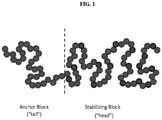
- FIG. 1 is an illustration of an BRC as disclosed herein.
- the anchoring block, or “tail” is shown as being attached to a stabilizing block, or “head,” where the stabilizing block is a random copolymer of hydrophilic and ionizable repeat units in the block.
- the design of the BRCs is similar to that of a gradient copolymer, except the BRCs have distinct block compositions, rather than a composition that varies continuously over the entire chain.
- water dispersible BRCs When applied in an emulsion polymerization, water dispersible BRCs are bound to a latex particle (i.e. the particle being polymerized in the emulsion) by the anchoring block.
- the stabilizing random copolymer block may lay along the surface of the emulsion particle, resulting in a reduced hydrodynamic radius. As a result, the solids content can be increased while maintaining kinetic stability, and reducing the mobility of the stabilizers in the final product.
- a polymer-stabilized emulsion polymerization system (or “polymer dispersion system”) is provided.
- the polymerization systems include water and a water dispersible BRC, where the BRC includes a hydrophobic block (“Block A”) and a random amphiphilic block (“Block B”).
- Block B includes a random distribution of hydrophobic repeat units and ionizable repeat units.
- the BRC may have a number average molecular weight from about 5,000 to about 30,000 g/mol.
- the emulsion polymerization systems are also essentially free of small molecule surfactants, which may be defined in some instances as surfactants having a molecular weight of up to about 3000 g/mol ( i.e. about 3000 g/mol or less).
- Block A of the BRC is a hydrophobic block.
- the repeat units that make up Block A are hydrophobic.
- Illustrative hydrophobic repeat units include, but are not limited to, styrenic, acrylate, or methacrylate repeat units, or a mixture of any two or more thereof.
- Block A may be a homopolymeric block or a copolymeric block.
- the hydrophobic block includes styrenic repeat units.
- Illustrative styrenic repeat units include, but are not limited to, those derived from styrene, ⁇ -methylstyrene, derivatives of styrene or ⁇ -methylstyrene, or a mixture of any two or more thereof.
- Block A may be a homopolymer block based upon styrenic repeat units.
- Block A may be a copolymer block that includes two or more of styrenic, acrylate, or methacrylate repeat units.
- one of the repeat units is a styrenic repeat unit.
- Block A includes an acrylate or methacrylate as a repeat unit
- illustrative such materials include, but are not limited to, ethyl acrylate, n-propyl acrylate, iso-propyl acrylate, n-butyl acrylate, n-butyl acrylate, iso-butyl acrylate, t-butyl acrylate, n-amyl acrylate, iso-amyl acrylate, isobornyl acrylate, n-hexyl acrylate, 2-ethylbutyl acrylate, 2-ethylhexyl acrylate, n-octyl acrylate, n-decyl acrylate, methylcyclohexyl acrylate, cyclopentyl acrylate, cyclohexyl acrylate, methyl methacrylate, ethyl methacrylate, n-propyl methacrylate, n
- Block B of the BRC is a random amphiphilic block that has a random distribution of hydrophobic and ionizable repeat units. While the hydrophobic units may be selected from those described above with regard to Block A, the ionizable repeat units include those with a carboxyl group.
- Illustrative ionizable repeat units may be derived from monomers such as, but not limited to, methacrylic acid, acrylic acid, vinyl benzoic acid, vinyl acetic acid, maleic anhydride, maleic acid, maleate, fumarate, crotonic acid, itaconic acid, fumaric acid, citraconic anhydride, mono 2-(methacryloyloxy)ethyl phthalate, mono 2-(methacryloyloxy)ethyl succinate, mono 2-(acryloyloxy)ethyl succinate, or a combination of any two or more thereof.
- monomers such as, but not limited to, methacrylic acid, acrylic acid, vinyl benzoic acid, vinyl acetic acid, maleic anhydride, maleic acid, maleate, fumarate, crotonic acid, itaconic acid, fumaric acid, citraconic anhydride, mono 2-(methacryloyloxy)ethyl phthalate, mono 2-(methacryloyl
- the emulsion polymerization system may include a BRC where Block A is a polystyrene, poly- ⁇ -methyl styrene, acrylate, methacrylate, or a copolymer of any two or more thereof, and where Block B is a random amphiphilic copolymer of polystyrene, poly- ⁇ -methyl styrene, an acrylate, a methacrylate, or a copolymer of any two or more thereof.
- Block A is a polystyrene, poly- ⁇ -methyl styrene, acrylate, methacrylate, or a copolymer of any two or more thereof
- Block B is a random amphiphilic copolymer of polystyrene, poly- ⁇ -methyl styrene, an acrylate, a methacrylate, or a copolymer of any two or more thereof.
- BRCs include, but are not limited to, polystyrene-b-(poly(styrene-r-acrylic acid)), poly- ⁇ -methylstyrene-b-(poly(styrene-r-acrylic acid)), poly(butyl acrylate)-b-poly(styrene-r-acrylic acid), poly(butyl acrylate)-b-poly(butyl acrylate-r-acrylic acid), polystyrene-b-poly(butyl acrylate-r-acrylic acid), poly(methyl methacrylate-r-butyl acrylate)-b-poly(butyl acrylate-r-acrylic acid), or poly(styrene-r-butyl acrylate)-b-poly(butyl acrylate-r-acrylic acid).
- the ratio of Block A to Block B may vary.
- the copolymer may include, on a total molar ratio of the copolymer, from 20% to 60% Block A, and from 40% to 80% Block B. This may include from 30% to 50% Block A, and from 50% to 70% Block B. Such percentages are based upon mol percent.
- At a least a partial neutralization of the ionizable groups in Block B may be conducted.
- the ionizable group is an acid
- neutralization may be accomplished by addition of a base, including, but not limited to, ammonium hydroxide, alkali metal hydroxides, alkaline earth hydroxides, alkali metal oxides, alkaline earth oxides, ammonia, trialkylamine ( i.e. trimethylamine, trimethylamine, triethanolamine, etc.), or a mixture of any two or more thereof.
- a base including, but not limited to, ammonium hydroxide, alkali metal hydroxides, alkaline earth hydroxides, alkali metal oxides, alkaline earth oxides, ammonia, trialkylamine ( i.e. trimethylamine, trimethylamine, triethanolamine, etc.), or a mixture of any two or more thereof.
- from greater than 5% to about 100% of the ionizable groups may be neutralized. This may include from about 20% to about
- the polymerization systems are high solids systems. Accordingly, as much of the polymer should be dispersed as possible. In some embodiments, at least 40 wt% of the polymer is dispersed in the system.
- the BRC may be present from about 0.5 wt % to about 50 wt%, based upon the weight of the emulsion polymer. This may include from about 1 wt.% to about 30 wt.%. Additionally, the polymerization system may contain from about 1 wt% to about 60 wt% solids. This may include from about 1 wt.% to about 50 wt.% solids.
- Living polymerizations provide a means of synthesizing complex polymeric structures of predictable molecular mass and low molecular mass distributions. Living polymerization can be achieved through numerous synthetic strategies, including anionic, cationic, ring-opening metathesis, and free radical polymerization, and chain-growth polycondensation.
- the synthesis of BRCs is not limited to any one type of living polymerization, and will depend on the applicability of the technique to the specific monomers to be polymerized, the desired control of the molecular weight distribution, and the final chain-end functionalities.
- NMP Nitroxide-mediated polymerization
- NMP provides a thermally activated reversible termination step, where a living radical exists in the active or dormant state. When active, propagation ensues until the radical is capped with the nitroxide, and the process then repeats as propagation ensues. Nitroxide-capped polymer chains may then be purified and used later to initiate the polymerization of different monomers. The result is a polymer chain with "blocks" - regions of the chain with distinct compositions. In cases where Block A is first synthesized, the purification of Block A may not be necessary if the monomers of Block A will also be contained in Block B.
- a method of emulsion polymerization includes mixing water and a BRC to form any of the emulsion polymerization systems as described herein, and adding to the polymerization system, with agitation, monomers and initiator(s) at a temperature sufficient to effect polymerization of the monomers.
- the BRCs used in this method may be any of those as described herein.
- a neutralization step may be conducted.
- the methods remain essentially free of, or only with low amounts of, small molecule surfactants. Additionally, the polymerization systems of the present application do not require water soluble co-monomers to compatibilize otherwise non-soluble monomers with an aqueous solution during the polymerization process. Accordingly, hydrophobic polymerizations may be conducted in water using the BRCs as polymerization stabilizers.
- Illustrative monomers that may be polymerized in such methods include, but are not limited to: styrenic monomers, methacrylate monomers, acrylate monomers, (vinyl) acetate monomers, or a mixture of any two or more thereof.
- Illustrative monomers include, but are not limited to, styrene, ⁇ -methyl styrene, methacrylic acid, acrylic acid, vinyl benzoic acid, vinyl acetic acid, maleic anhydride, maleic acid, maleate, fumarate, crotonic acid, itaconic acid, fumaric acid, citraconic anhydride, mono 2-(methacryloyloxy)ethyl phthalate, mono 2-(methacryloyloxy)ethyl succinate, mono 2-(acryloyloxy)ethyl succinate, hydrophobic, ethyl acrylate, n-propyl acrylate, iso-propyl acrylate, n-butyl acrylate, n-butyl acrylate, iso-butyl acrylate, t-butyl acrylate, n-amyl acrylate, iso-amyl acrylate, isobornyl acrylate, n-hex
- Such emulsion polymerizations may be conducted by a wide variety of methods. Such methods may include, but are not limited to, batch, semi-batch, and continuous polymerization.
- the BRC may be added all at the beginning, fed during the polymerization, or added at discrete intervals.
- Nitroxide-capped polystyrene macroinitiators (M1, M2) were prepared by the following procedure. Alkoxyamine initiator (18.5 g, 0.049 mol) and styrene (500 g, 4.8 mol) were added to a 1000 mL 3-necked round bottom flask with an attached condenser. This solution was bubbled with nitrogen for 30 minutes with stirring, followed by immersion in a 120 °C bath of silicone oil. The temperature of the solution was monitored with a mercury thermometer inserted into a side neck of the flask; after 15 minutes the temperature reached 110 °C where it remained for either 1.5 hours (M1) or 3 hours (M2) before being cooled in an ice bath. The viscous product was precipitated in methanol.
- Residual monomer was removed by redissolving the polymer in a minimal amount of THF followed by reprecipitation in methanol and drying under vacuum for one day, as confirmed by the absence of any vinyl peaks in the 1 H NMR spectrum of the purified macroinitiator.
- Example 1 Chain Extensions with Styrene and Acrylic Acid.
- a variety of block (BC) and block-random copolymers (BRC) were synthesized with varying stabilizing block compositions, and the formulations are presented in Table 1.
- macroinitiator, styrene, 1,4-dioxane and N-tert-butyl-N-[1-diethylphosphono-(2,2-dimethylpropyl) nitroxide] (“N-BDDN”; 10% excess based on macroinitiator) were mixed in a 20-mL glass vial. After homogenizing, acrylic acid was added and the reaction mixture was degassed under nitrogen for 30 minutes.
- Block Copolymer M2 (mol/L) N-BDDN (mol/L) Styrene (mol/L) Acrylic Acid (mol/L) Dioxane (mol/L) Reaction Time (hours) Reaction Temp (°C) B1 0.031 0.0031 0 2.8 8.3 2 115 B2 0.019 (M1) 0.0019 0 2.9 8.6 1 115 B3 0.019 (M1) 0.0019 0 2.9 8.6 2 115 B4 0.019 (M1) 0.0019 0 2.9 8.6 3 115 BR1 0.030 0.003 3.2 1.3 4.4 1.5 125 BR2 0.030 0.003 3.2 1.3 4.5 0.5 125 BR3 0.030 0.003 3.3 1.1 4.4 1.5 125 BR4 0.046 (M1) 0.005 3.2 1.4 4.6 1.5 125 BR5 0.030 0.003 3.0 1.5 4.5 1.5 125 BR6 0.030 0.008 2.5 1.7 5.1 1.5 125 BR7 0.0
- Example 2 Block and Block-Random Copolymer Stock Dispersions. Upon isolating the stabilizers, a stock dispersion was prepared at 0.7 g/L (block copolymers) or 50 g/L (block-random copolymers). Each block (“B#" in Table 1) and block-random copolymer (“BR#" in Table 1) was added to a 20 mL glass flask with a stoichiometric amount of 1 M sodium hydroxide relative to acrylic acid, and a balance of water to bring the final volume to 15 mL. The mixture was then stirred and heated in a silicone oil bath at 90° C up to 24 hours, or until dispersed. The resulting transparent dispersions were filtered (0.2 ⁇ m) before being analyzed and used in emulsion polymerizations.
- block copolymers block copolymers
- BR# block-random copolymer
- Example 3 Styrene Emulsion Polymerization.
- a batch emulsion polymerization of styrene was used as a standard test procedure wherein either a block or block-random copolymer was used as the stabilizer.
- the general procedure began by adding styrene monomer (1 g), deionized water, sodium hydroxide (0.1 g of 1 M solution), and ammonium persulfate (0.1 g of 30 g/L solution) to an aqueous copolymer dispersion, such that the mixture was 50% styrene by weight.
- This mixture was then sealed in a 5 mL round bottom flask and immersed in an 85 °C bath of silicone oil with stirring.
- Emulsion polymerizations were closely monitored and allowed to continue for 4 hours unless significant coagulum was noticed in which case the polymerization was stopped earlier.
- Example 4 Characterization. Gel-permeation chromatograph. The BCs and BRCs were added to chromatography vials at 20 mg in 1.5 mL of THF. The carboxylic acid groups were methylated to avoid chemical or physical interaction with the columns. A drop of methanol and (trimethylsilyl)diazomethane were added to methylate the carboxylic acid groups of the acrylic acid units. The polymers being analyzed were thus, polystyrene-b-(polystyrene-r-poly(methyl acrylate)). The calibration used for analysis used polystyrene standards. Therefore, all molecular weights reported are a polystyrene equivalent. Tables 2 and 3 present the characterization/testing results for select copolymers.
- Dynamic Light Scattering Hydrodynamic particle size was evaluated through dynamic light scattering (DLS) using a Malvern Zetasizer Nano ZS at 25°C with non-invasive backscatter optics (173°), using a 4 mW He-Ne (633 nm) laser. Stock solutions at 50 g/L were added directly to a quartz cuvette for measurement. Latex samples were diluted as one drop to 1 mL of purified water in a quartz cuvette. The Malvern Dispersion Technology Software (version 7.11) was used to process all data. Reported sizes are an average of 35-40 measurements per sample.
- Table 2 A summary of all block and block-random copolymers studied. Molecular weights and molecular weight dispersities were determined through GPC and are polystyrene equivalents. NMR and GPC allowed for elucidation of random block composition.
- ⁇ M w M n , where M w is the weight average molecular weight
- PS polystyrene
- PAA poly(acrylic acid).
- d Molar fraction of acrylic acid in the entire polymer.
- e Molar fraction of acrylic acid in the stabilizing block.
- Example 5 Aqueous Dispersions. After characterization, stock dispersions of each BRC were prepared at 50 g/L. Block-random copolymers with an f AA between 21 and 52%, and an F AA between 14 and 26% could be dispersed in water. Block-random copolymers BR8-13 were not dispersible in water. Block copolymers B1-4 could be dispersed in water at low (0.7 g/L) concentration.
- Dispersions of BR5 were prepared at 100 g/L, 150 g/L, 200 g/L and 300 g/L maintaining stoichiometric equivalence of sodium hydroxide to acrylic acid units.
- the upper concentration limit for magnetic stirring was found between 200 g/L and 300 g/L.
- More stabilizer produces a larger number of smaller particles as expected, and this implies a substantial increase in total surface area.
- Example 6 To test the concentration limit of the BRCS's, a series was prepared using BR5 from 50 to 300 g/L. It was found that between 200 and 300 g/L was the upper limit of magnetic stirring. The high viscosity of the 300 g/L dispersion caused magnetic stirring to stop.
- Example 7 High Solids Emulsion Polymerization Procedure.
- a batch emulsion polymerization of styrene was used as a standard test procedure wherein either a block or block-random copolymer was used as the stabilizer.
- the general procedure began by adding styrene monomer (1 g), deionized water, sodium hydroxide (0.1 g of 1 M solution), and ammonium persulfate (0.1 g of 30 g/L solution) to an aqueous copolymer dispersion, such that the mixture was 50% styrene by weight.
- This mixture was then sealed in a 5 mL round bottom flask and immersed in an 85 °C bath of silicone oil with stirring.
- Emulsion polymerizations were closely monitored and allowed to continue for 4 hours unless significant coagulum was noticed in which case the polymerization was stopped earlier.
- Dispersions of B1-4, BR1, and BR4 were used to stabilize high solids content emulsion polymerizations of styrene with a target solids content of 50 wt%.
- the weight fraction of block-random copolymer of 5 wt% based on monomer led to stable emulsion polymerizations at high solids content, while all block copolymers failed to stabilize an emulsion polymerization beyond a solids content of 40 wt%.
- Block copolymers with a longer hydrophilic block resulted in lower solids content compared to those with shorter hydrophilic blocks. Characteristics of the emulsion polymerizations are reported in Table 6. Table 6.
Landscapes
- Chemical & Material Sciences (AREA)
- Health & Medical Sciences (AREA)
- Chemical Kinetics & Catalysis (AREA)
- Medicinal Chemistry (AREA)
- Polymers & Plastics (AREA)
- Organic Chemistry (AREA)
- Graft Or Block Polymers (AREA)
Description
- This application claims the benefit of priority to
U.S. Provisional Patent Application No. 62/591,518, filed on November 28, 2017 - In general, the present technology relates to the field of water-based polymer dispersions. More specifically, the present technology relates to the emulsion polymer stabilizer having a hydrophobic block and a random copolymer block.
- The most common stabilizers in emulsion polymerizations are small molecule surfactants. They are well understood, inexpensive, and provide stability to the emulsions and resulting latexes. However, small molecule surfactants can have negative impacts on the final products. For example, charged, small molecule surfactants are generally required, however can be easily extracted or leeched from a cured film and result in negative changes to the film performance such as water sensitivity. In addition, small molecule surfactants are undesirable in applications such as food contact.
- Therefore, the industry has sought a polymeric stabilizer for emulsion polymerization that exhibits lower water sensitivity to reduce the inherent issues with low MW surfactants. A number of approaches are known to address this problem, including the use of protective colloids. Commonly these are low molecular weight resins with acid functionality for example styrene/acrylic or acrylic copolymers. The disadvantage of these systems is that a large amount of stabilizer is normally required, thereby limiting the water resistance properties. Further refinements have been block copolymers with distinct hydrophobic blocks and hydrophilic blocks. However, these systems have typically been limited to relatively low solids content of the emulsions, limiting their usefulness for industrial applications. Therefore, the industry requires polymeric stabilizers that enable high solids at the low stabilizer loading that is needed for resistance properties.
- In one aspect, a method of emulsion polymerization is provided, the method including providing water and a water dispersible block copolymer to form an emulsion polymerization stabilizing system; and adding monomers to the emulsion polymerization system. The block copolymer has a hydrophobic block ("Block A") and a random amphiphilic block ("Block B"), where Block B includes hydrophobic repeat units and ionizable repeat units; and the method uses less than 1 wt.% of a small molecule surfactant. In some embodiments, the method uses less than 0.5 wt.% of a small molecule surfactant. In other embodiment, the method is entirely free of the use of a small molecule surfactant. As used herein, the small molecule surfactants are those surfactants that have a molecular weight of about 3000 g/mol or less.
- According to various embodiments, the monomers used in the methods include styrenic monomers, methacrylate monomers, acrylate monomers, (vinyl) acetate monomers, or a mixture of any two or more thereof.
- In the block co-polymer, Block A may include styrenic, acrylate, or methacrylate repeat units. In any of the embodiments herein, Block A may include a homopolymer based upon styrenic repeat units. In any of the embodiments herein, Block A may be a copolymer block with two or more of styrenic, acrylate, or methacrylate repeat units. In any of the embodiments herein, the styrenic repeat units may be styrene, α-methyl styrene, or a copolymer thereof. In Block B, the hydrophobic repeat units may include styrene, α-methyl styrene, an acrylate, a methacrylate, or a copolymer of any two or more thereof. In some embodiments, the hydrophobic repeat units may include styrenic repeat units. In any of the embodiments herein, Block B includes ionizable repeat units that may include a carboxylic acid. In some embodiments, the ionizable repeat units include methacrylic acid, acrylic acid, vinyl benzoic acid, vinyl acetic acid, maleic anhydride, maleic acid, maleate, fumarate, crotonic acid, itaconic acid, fumaric acid, citraconic anhydride, mono 2-(methacryloyloxy)ethyl phthalate, mono 2-(methacryloyloxy)ethyl succinate, mono 2-(acryloyloxy)ethyl succinate, salts thereof, or a combination of any two or more thereof.
- In some embodiments, the Block A and/or Block B hydrophobic repeat units comprise styrene, α-methyl styrene, ethyl acrylate, n-propyl acrylate, isopropyl acrylate, n-butyl acrylate, n-butyl acrylate, iso-butyl acrylate, t-butyl acrylate, n-amyl acrylate, iso-amyl acrylate, isobornyl acrylate, n-hexyl acrylate, 2-ethylbutyl acrylate, 2-ethylhexyl acrylate, n-octyl acrylate, n-decyl acrylate, methylcyclohexyl acrylate, cyclopentyl acrylate, cyclohexyl acrylate, methyl methacrylate, ethyl methacrylate, n-propyl methacrylate, n-butyl methacrylate, isopropyl methacrylate, isobutyl methacrylate, n-amyl methacrylate, n-hexyl methacrylate, isoamyl methacrylate, sec-butyl-methacrylate, tert-butyl methacrylate, 2-ethylbutyl methacrylate, methylcyclohexyl methacrylate, cinnamyl methacrylate, crotyl methacrylate, cyclohexyl methacrylate, cyclopentyl methacrylate, 2-ethoxyethyl methacrylate, isobornyl methacrylate, or a combination of any two or more thereof.
- In some embodiments, Block B includes acrylic acid, and the mole percentage of acrylic acid units in Block B (fAA) is from about 10% to about 90%; and overall mole percentage of acrylic acid units in the block copolymer (FAA) is from about 5% to about 80%.
- In some embodiments, Block B includes acrylic acid, and the mole percentage of acrylic acid units in Block B (fAA) is from about 21% to about 52%; and overall mole percentage of acrylic acid units in the block copolymer (FAA) is from about 14% to about 26%.
- In any of the above embodiments, the block copolymer may have a number average molecular weight from about 5,000 to about 30,000 g/mol. In any of the above embodiments, the block copolymer may have a number average molecular weight from about 5,000 to about 25,000 g/mol. In any of the above embodiments, the block copolymer may have a number average molecular weight from about 10,000 to about 20,000 g/mol.
- In any of the above embodiments, Block A may be a polymer block of polystyrene, poly-α-methyl styrene, an acrylate, a methacrylate, or a copolymer of any two or more thereof; and Block B may be a random copolymer of a first monomer selected from the group consisting of styrene, α-methyl styrene, an acrylate, a methacrylate, or a mixture of any two or more thereof; and a second monomer having an ionizable group selected from the group consisting of a carboxylic acid. In some embodiments, the block copolymer may include polystyrene-b-(poly(styrene-r-acrylic acid)), poly-α-methylstyrene-b-(poly(styrene-r-acrylic acid)), poly(butyl acrylate)-b-poly(styrene-r-acrylic acid), poly(butyl acrylate)-b-poly(butyl acrylate-r-acrylic acid), or polystyrene-b-poly(butyl acrylate-r-acrylic acid).
- In the method, from greater than 5% to about 100% of the ionizable groups may be neutralized, or from about 20% to about 100% of the ionizable groups may be neutralized. The block copolymer may be present in the emulsion polymerization system from about 1 wt.% to about 30 wt.%.
- In another aspect, a polymer-stabilized emulsion polymerization system is provided, that includes water; and a block copolymer including a hydrophobic block ("Block A"); and a random amphiphilic block ("Block B") comprising a random distribution of hydrophobic repeat units and ionizable repeat units. The block copolymer may be any of those as described herein.
-
-
FIG. 1 is an illustration of a block-random-copolymer as disclosed herein. -
FIG. 2 is a graph of total available surface area of a styrene latex as a function of block-copolymer concentration. Assuming the stabilizer covers all available surface area, the performance of stabilization can be determined through the slope. In the case of BR5, the area of coverage per chain is 11 nm2. -
FIG. 3 is a graph of particle number versus block co-polymer concentration profiles of all emulsion polymerizations, according to Example 2. Those increasing more rapidly have higher stabilization areas on a per chain basis. - Various embodiments are described hereinafter. It should be noted that the specific embodiments are not intended as an exhaustive description or as a limitation to the broader aspects discussed herein. One aspect described in conjunction with a particular embodiment is not necessarily limited to that embodiment and may be practiced with any other embodiment(s).
- As used herein, "about" will be understood by persons of ordinary skill in the art and will vary to some extent depending upon the context in which it is used. If there are uses of the term which are not clear to persons of ordinary skill in the art, given the context in which it is used, "about" will mean up to plus or minus 10% or up to plus or minus 5% of the stated value.
- As used herein, "functional groups" includes, but is not limited to, halides, alcohols, ethers, carbonyls (including aldehydes, ketones, and carboxyl groups), amines, amides, cyanos, ureas, thiols, and combinations of two or more thereof. In some embodiments, the functional groups may include one or more carboxyl, hydroxyl, amino, uredo, acetoacetoxy, or diacetone group, or mixtures of two or more thereof.
- As will be understood by one skilled in the art, a range includes each individual member. Thus, for example, a group having 1-3 atoms refers to groups having 1, 2, or 3 atoms. Similarly, a group having 1-5 atoms refers to groups having 1, 2, 3, 4, or 5 atoms, and so forth.
- In general, as used herein, "substituted" refers to an alkyl, alkenyl, alkynyl, aryl, or ether group, as defined below (e.g., an alkyl group) in which one or more bonds to a hydrogen atom contained therein are replaced by a bond to non-hydrogen or non-carbon atoms. Substituted groups also include groups in which one or more bonds to a carbon(s) or hydrogen(s) atom are replaced by one or more bonds, including double or triple bonds, to a heteroatom. Thus, a substituted group will be substituted with one or more substituents, unless otherwise specified. In some embodiments, a substituted group is substituted with 1, 2, 3, 4, 5, or 6 substituents. Examples of substituent groups include: halogens (i.e., F, Cl, Br, and I); hydroxyls; alkoxy, alkenoxy, alkynoxy, aryloxy, aralkyloxy, heterocyclyloxy, and heterocyclylalkoxy groups; carbonyls (oxo); carboxyls; esters; urethanes; oximes; hydroxylamines; alkoxyamines; aralkoxyamines; thiols; sulfides; sulfoxides; sulfones; sulfonyls; sulfonamides; amines; N-oxides; hydrazines; hydrazides; hydrazones; azides; amides; ureas; amidines; guanidines; enamines; imides; isocyanates; isothiocyanates; cyanates; thiocyanates; imines; nitro groups; nitriles (i.e., CN); and the like.
- As used herein, "alkyl" groups include straight chain and branched alkyl groups having from 1 to about 20 carbon atoms, and typically from 1 to 12 carbons or, in some embodiments, from 1 to 8 carbon atoms. As employed herein, "alkyl groups" include cycloalkyl groups as defined below. Alkyl groups may be substituted or unsubstituted. Examples of straight chain alkyl groups include methyl, ethyl, n-propyl, n-butyl, n-pentyl, n-hexyl, n-heptyl, and n-octyl groups. Examples of branched alkyl groups include, but are not limited to, isopropyl, sec-butyl, tert-butyl, neopentyl, and isopentyl groups. Representative substituted alkyl groups may be substituted one or more times with, for example, amino, thio, hydroxy, cyano, alkoxy, and/or halo groups such as F, Cl, Br, and I groups. As used herein the term haloalkyl is an alkyl group having one or more halo groups. In some embodiments, haloalkyl refers to a perhaloalkyl group.
- Cycloalkyl groups are cyclic alkyl groups such as, but not limited to, cyclopropyl, cyclobutyl, cyclopentyl, cyclohexyl, cycloheptyl, and cyclooctyl groups. In some embodiments, the cycloalkyl group has 3 to 8 ring members, whereas in other embodiments the number of ring carbon atoms range from 3 to 5, 6, or 7. Cycloalkyl groups may be substituted or unsubstituted. Cycloalkyl groups further include polycyclic cycloalkyl groups such as, but not limited to, norbornyl, adamantyl, bornyl, camphenyl, isocamphenyl, and carenyl groups, and fused rings such as, but not limited to, decalinyl, and the like. Cycloalkyl groups also include rings that are substituted with straight or branched chain alkyl groups as defined above. Representative substituted cycloalkyl groups may be mono-substituted or substituted more than once, such as, but not limited to: 2,2-; 2,3-; 2,4-; 2,5-; or 2,6-disubstituted cyclohexyl groups or mono-, di-, or tri-substituted norbornyl or cycloheptyl groups, which may be substituted with, for example, alkyl, alkoxy, amino, thio, hydroxy, cyano, and/or halo groups.
- As used herein, "aryl," or "aromatic," groups are cyclic aromatic hydrocarbons that do not contain heteroatoms. Aryl groups include monocyclic, bicyclic and polycyclic ring systems. Thus, aryl groups include, but are not limited to, phenyl, azulenyl, heptalenyl, biphenylenyl, indacenyl, fluorenyl, phenanthrenyl, triphenylenyl, pyrenyl, naphthacenyl, chrysenyl, biphenyl, anthracenyl, indenyl, indanyl, pentalenyl, and naphthyl groups. An aryl group with one or more alkyl groups may also be referred to as alkaryl groups. In some embodiments, aryl groups contain 6-14 carbons, and in others from 6 to 12 or even 6-10 carbon atoms in the ring portions of the groups. The phrase "aryl groups" includes groups containing fused rings, such as fused aromatic-aliphatic ring systems (e.g., indanyl, tetrahydronaphthyl, and the like). Aryl groups may be substituted or unsubstituted.
- Heterocyclyl or heterocycle refers to both aromatic and nonaromatic ring compounds including monocyclic, bicyclic, and polycyclic ring compounds containing 3 or more ring members of which one or more is a heteroatom such as, but not limited to, N, O, and S. Examples of heterocyclyl groups include, but are not limited to: unsaturated 3 to 8 membered rings containing 1 to 4 nitrogen atoms such as, but not limited to pyrrolyl, pyrrolinyl, imidazolyl, pyrazolyl, pyridinyl, dihydropyridinyl, pyrimidinyl, pyrazinyl, pyridazinyl, triazolyl (e.g. 4H-1,2,4-triazolyl, 1H-1,2,3-triazolyl, 2H-1,2,3-triazolyl etc.), tetrazolyl, (e.g. 1H-tetrazolyl, 2H tetrazolyl, etc.); saturated 3 to 8 membered rings containing 1 to 4 nitrogen atoms such as, but not limited to, pyrrolidinyl, imidazolidinyl, piperidinyl, piperazinyl; condensed unsaturated heterocyclic groups containing 1 to 4 nitrogen atoms such as, but not limited to, indolyl, isoindolyl, indolinyl, indolizinyl, benzimidazolyl, quinolyl, isoquinolyl, indazolyl, benzotriazolyl; unsaturated 3 to 8 membered rings containing 1 to 2 oxygen atoms and 1 to 3 nitrogen atoms such as, but not limited to, oxazolyl, isoxazolyl, oxadiazolyl (e.g. 1,2,4-oxadiazolyl, 1,3,4-oxadiazolyl, 1,2,5-oxadiazolyl, etc.); saturated 3 to 8 membered rings containing 1 to 2 oxygen atoms and 1 to 3 nitrogen atoms such as, but not limited to, morpholinyl; unsaturated condensed heterocyclic groups containing 1 to 2 oxygen atoms and 1 to 3 nitrogen atoms, for example, benzoxazolyl, benzoxadiazolyl, benzoxazinyl (e.g. 2H-1,4-benzoxazinyl etc.); unsaturated 3 to 8 membered rings containing 1 to 3 sulfur atoms and 1 to 3 nitrogen atoms such as, but not limited to, thiazolyl, isothiazolyl, thiadiazolyl (e.g. 1,2,3-thiadiazolyl, 1,2,4-thiadiazolyl, 1,3,4-thiadiazolyl, 1,2,5-thiadiazolyl, etc.); saturated 3 to 8 membered rings containing 1 to 2 sulfur atoms and 1 to 3 nitrogen atoms such as, but not limited to, thiazolodinyl; saturated and unsaturated 3 to 8 membered rings containing 1 to 2 sulfur atoms such as, but not limited to, thienyl, dihydrodithiinyl, dihydrodithionyl, tetrahydrothiophene, tetrahydrothiopyran; unsaturated condensed heterocyclic rings containing 1 to 2 sulfur atoms and 1 to 3 nitrogen atoms such as, but not limited to, benzothiazolyl, benzothiadiazolyl, benzothiazinyl (e.g. 2H-1,4-benzothiazinyl, etc.), dihydrobenzothiazinyl (e.g. 2H-3,4-dihydrobenzothiazinyl, etc.), unsaturated 3 to 8 membered rings containing oxygen atoms such as, but not limited to furyl; unsaturated condensed heterocyclic rings containing 1 to 2 oxygen atoms such as benzodioxolyl (e.g., 1,3-benzodioxoyl, etc.); unsaturated 3 to 8 membered rings containing an oxygen atom and 1 to 2 sulfur atoms such as, but not limited to, dihydrooxathiinyl; saturated 3 to 8 membered rings containing 1 to 2 oxygen atoms and 1 to 2 sulfur atoms such as 1,4-oxathiane; unsaturated condensed rings containing 1 to 2 sulfur atoms such as benzothienyl, benzodithiinyl; and unsaturated condensed heterocyclic rings containing an oxygen atom and 1 to 2 oxygen atoms such as benzoxathiinyl. Heterocyclyl group also include those described above in which one or more S atoms in the ring is double-bonded to one or two oxygen atoms (sulfoxides and sulfones). For example, heterocyclyl groups include tetrahydrothiophene oxide and tetrahydrothiophene 1,1-dioxide. Typical heterocyclyl groups contain 5 or 6 ring members. Thus, for example, heterocyclyl groups include morpholinyl, piperazinyl, piperidinyl, pyrrolidinyl, imidazolyl, pyrazolyl, 1,2,3-triazolyl, 1,2,4-triazolyl, tetrazolyl, thiophenyl, thiomorpholinyl, thiomorpholinyl in which the S atom of the thiomorpholinyl is bonded to one or more O atoms, pyrrolyl, pyridinyl homopiperazinyl, oxazolidin-2-onyl, pyrrolidin-2-onyl, oxazolyl, quinuclidinyl, thiazolyl, isoxazolyl, furanyl, dibenzylfuranyl, and tetrahydrofuranyl. Heterocyclyl or heterocycles may be substituted.
- Heteroaryl groups are aromatic ring compounds containing 5 or more ring members, of which, one or more is a heteroatom such as, but not limited to, N, O, and S. Heteroaryl groups include, but are not limited to, groups such as pyrrolyl, pyrazolyl, triazolyl, tetrazolyl, oxazolyl, isoxazolyl, thiazolyl, pyridinyl, pyridazinyl, pyrimidinyl, pyrazinyl, thiophenyl, benzothiophenyl, furanyl, benzofuranyl, dibenzofuranyl, indolyl, azaindolyl (pyrrolopyridinyl), indazolyl, benzimidazolyl, imidazopyridinyl (azabenzimidazolyl), pyrazolopyridinyl, triazolopyridinyl, benzotriazolyl, benzoxazolyl, benzothiazolyl, benzothiadiazolyl, imidazopyridinyl, isoxazolopyridinyl, thianaphthyl, purinyl, xanthinyl, adeninyl, guaninyl, quinolinyl, isoquinolinyl, tetrahydroquinolinyl, quinoxalinyl, and quinazolinyl groups. Heteroaryl groups include fused ring compounds in which all rings are aromatic such as indolyl groups and include fused ring compounds in which only one of the rings is aromatic, such as 2,3-dihydro indolyl groups. Although the phrase "heteroaryl groups" includes fused ring compounds, the phrase does not include heteroaryl groups that have other groups bonded to one of the ring members, such as alkyl groups. Rather, heteroaryl groups with such substitution are referred to as "substituted heteroaryl groups." Representative substituted heteroaryl groups may be substituted one or more times with various substituents such as those listed above.
- Aralkyl groups are alkyl groups as defined above in which a hydrogen or carbon bond of an alkyl group is replaced with a bond to an aryl group as defined above. In some embodiments, aralkyl groups contain 7 to 16 carbon atoms, 7 to 14 carbon atoms, or 7 to 10 carbon atoms. Aralkyl groups may be substituted or unsubstituted. Substituted aralkyl groups may be substituted at the alkyl, the aryl or both the alkyl and aryl portions of the group. Representative aralkyl groups include but are not limited to benzyl and phenethyl groups and fused (cycloalkylaryl)alkyl groups such as 4-indanylethyl. Representative substituted aralkyl groups may be substituted one or more times with substituents such as those listed above.
- The term "carboxyl" or "carboxylate" as used herein refers to a -C(O)OH group or to its ionized form, -C(O)O-.
- The term "ester" as used herein refers to -C(O)OR60 groups. R60 is a substituted or unsubstituted alkyl, cycloalkyl, alkenyl, alkynyl, aryl, aralkyl, heterocyclylalkyl or heterocyclyl group as defined herein.
- The term "amine" (or "amino") as used herein refers to -NR65R66R67 groups, where the R67 group may or may not be present, but when present the amino group is a cationic group. In the formula, R65 and R66, and R67 when present, are independently hydrogen, or a substituted or unsubstituted alkyl, alkenyl, alkynyl, cycloalkyl, aryl, aralkyl, heterocyclylalkyl or heterocyclyl group as defined herein. In some embodiments, the amine is alkylamino, dialkylamino, trialkylamino arylamino, or alkylarylamino.
- As used herein, the term "partially neutralized" is intended to refer to neutralization of about 5 mol% or more, up to an including about 95%, of the acid groups on the acid-functional resin. However, in some embodiments, partial neutralization refers to neutralization of from about 20 mol% to about 95 mol% of the acid groups. This may include in various embodiments at least about 5 mol% of the acid groups, at least about 10 mol% of the acid groups, from about 10 mol% to about 95 mol% of the acid groups, from about 8 mol% to about 85 mol% of the acid groups, or from about 15 mol% to about 50 mol% of the acid groups. In some embodiments, about 30 mol% of the acid groups on the acid-functional resin may be neutralized.
- It has been found that water dispersible block random copolymers ("BRCs") consisting of one "anchoring" hydrophobic block ("Block A") and one "stabilizing" block ("Block B") that is a random copolymer of at least one neutralizable group and at least one hydrophobic group are able to stabilize emulsion polymerization at low levels, and enable high solids (>40 wt% solid content) emulsions without destabilization, and without the use of, or with only minimal amounts of, small molecule surfactants. Since non-neutralized acid groups are significantly more hydrophobic than the neutralized acid group, the hydrophobic group of the stabilizing block could be a non-neutralized acid. The anchoring block anchors to a polymerizing emulsion particle, while the stabilizing block provides the acid groups for stabilization of the particle. The high solids content may be from about 40 wt% to about 90 wt%. The high solids content is based upon the total weight of all components in the system.
-
FIG. 1 is an illustration of an BRC as disclosed herein. InFIG. 1 , the anchoring block, or "tail," is shown as being attached to a stabilizing block, or "head," where the stabilizing block is a random copolymer of hydrophilic and ionizable repeat units in the block. The design of the BRCs is similar to that of a gradient copolymer, except the BRCs have distinct block compositions, rather than a composition that varies continuously over the entire chain. - When applied in an emulsion polymerization, water dispersible BRCs are bound to a latex particle (i.e. the particle being polymerized in the emulsion) by the anchoring block. Without being bound by theory, it is believed that the stabilizing random copolymer block may lay along the surface of the emulsion particle, resulting in a reduced hydrodynamic radius. As a result, the solids content can be increased while maintaining kinetic stability, and reducing the mobility of the stabilizers in the final product.
- In one aspect, a polymer-stabilized emulsion polymerization system (or "polymer dispersion system") is provided. The polymerization systems include water and a water dispersible BRC, where the BRC includes a hydrophobic block ("Block A") and a random amphiphilic block ("Block B"). Block B includes a random distribution of hydrophobic repeat units and ionizable repeat units. According to various embodiments described herein, the BRC may have a number average molecular weight from about 5,000 to about 30,000 g/mol. The emulsion polymerization systems are also essentially free of small molecule surfactants, which may be defined in some instances as surfactants having a molecular weight of up to about 3000 g/mol (i.e. about 3000 g/mol or less).
- As noted above, Block A of the BRC is a hydrophobic block. Accordingly, the repeat units that make up Block A are hydrophobic. Illustrative hydrophobic repeat units include, but are not limited to, styrenic, acrylate, or methacrylate repeat units, or a mixture of any two or more thereof. Block A may be a homopolymeric block or a copolymeric block. In some embodiments, the hydrophobic block includes styrenic repeat units. Illustrative styrenic repeat units include, but are not limited to, those derived from styrene, α-methylstyrene, derivatives of styrene or α-methylstyrene, or a mixture of any two or more thereof. Thus, in some embodiments, Block A may be a homopolymer block based upon styrenic repeat units. In other embodiments, Block A may be a copolymer block that includes two or more of styrenic, acrylate, or methacrylate repeat units. In some embodiments where Block A is copolymer block, one of the repeat units is a styrenic repeat unit. Where Block A includes an acrylate or methacrylate as a repeat unit, illustrative such materials include, but are not limited to, ethyl acrylate, n-propyl acrylate, iso-propyl acrylate, n-butyl acrylate, n-butyl acrylate, iso-butyl acrylate, t-butyl acrylate, n-amyl acrylate, iso-amyl acrylate, isobornyl acrylate, n-hexyl acrylate, 2-ethylbutyl acrylate, 2-ethylhexyl acrylate, n-octyl acrylate, n-decyl acrylate, methylcyclohexyl acrylate, cyclopentyl acrylate, cyclohexyl acrylate, methyl methacrylate, ethyl methacrylate, n-propyl methacrylate, n-butyl methacrylate, i-propyl methacrylate, i-butyl methacrylate, n-amyl methacrylate, n-hexyl methacrylate, i-amyl methacrylate, s-butyl-methacrylate, t-butyl methacrylate, 2-ethylbutyl methacrylate, methylcyclohexyl methacrylate, cinnamyl methacrylate, crotyl methacrylate, cyclohexyl methacrylate, cyclopentyl methacrylate, 2-ethoxyethyl methacrylate, isobornyl methacrylate, or a combination of any two or more thereof.
- As noted above, Block B of the BRC is a random amphiphilic block that has a random distribution of hydrophobic and ionizable repeat units. While the hydrophobic units may be selected from those described above with regard to Block A, the ionizable repeat units include those with a carboxyl group. Within Block B, there is a target ratio of hydrophobic to ionizable groups. The ratio may be about 0% to about 90% hydrophobic groups and about 10% to about 100% ionizable groups, where the percentages are based upon mol percent. In some embodiments, the ratio may be about 60% to about 80% hydrophobic groups and about 20% to about 40% ionizable groups.
- Illustrative ionizable repeat units may be derived from monomers such as, but not limited to, methacrylic acid, acrylic acid, vinyl benzoic acid, vinyl acetic acid, maleic anhydride, maleic acid, maleate, fumarate, crotonic acid, itaconic acid, fumaric acid, citraconic anhydride, mono 2-(methacryloyloxy)ethyl phthalate, mono 2-(methacryloyloxy)ethyl succinate, mono 2-(acryloyloxy)ethyl succinate, or a combination of any two or more thereof.
- In some embodiments, the emulsion polymerization system may include a BRC where Block A is a polystyrene, poly-α-methyl styrene, acrylate, methacrylate, or a copolymer of any two or more thereof, and where Block B is a random amphiphilic copolymer of polystyrene, poly-α-methyl styrene, an acrylate, a methacrylate, or a copolymer of any two or more thereof. Illustrative, specific BRCs include, but are not limited to, polystyrene-b-(poly(styrene-r-acrylic acid)), poly-α-methylstyrene-b-(poly(styrene-r-acrylic acid)), poly(butyl acrylate)-b-poly(styrene-r-acrylic acid), poly(butyl acrylate)-b-poly(butyl acrylate-r-acrylic acid), polystyrene-b-poly(butyl acrylate-r-acrylic acid), poly(methyl methacrylate-r-butyl acrylate)-b-poly(butyl acrylate-r-acrylic acid), or poly(styrene-r-butyl acrylate)-b-poly(butyl acrylate-r-acrylic acid).
- In the BRC, the ratio of Block A to Block B may vary. For example, the copolymer may include, on a total molar ratio of the copolymer, from 20% to 60% Block A, and from 40% to 80% Block B. This may include from 30% to 50% Block A, and from 50% to 70% Block B. Such percentages are based upon mol percent.
- In order to achieve acceptable dispersion and/or dissolution of the BRC in the water of the emulsion polymerization system, at a least a partial neutralization of the ionizable groups in Block B may be conducted. If the ionizable group is an acid, neutralization may be accomplished by addition of a base, including, but not limited to, ammonium hydroxide, alkali metal hydroxides, alkaline earth hydroxides, alkali metal oxides, alkaline earth oxides, ammonia, trialkylamine (i.e. trimethylamine, trimethylamine, triethanolamine, etc.), or a mixture of any two or more thereof. Accordingly, in any of the embodiments described herein, from greater than 5% to about 100% of the ionizable groups may be neutralized. This may include from about 20% to about 100% of the ionizable groups are neutralized.
- The polymerization systems are high solids systems. Accordingly, as much of the polymer should be dispersed as possible. In some embodiments, at least 40 wt% of the polymer is dispersed in the system.
- In the polymerization system, the BRC may be present from about 0.5 wt % to about 50 wt%, based upon the weight of the emulsion polymer. This may include from about 1 wt.% to about 30 wt.%. Additionally, the polymerization system may contain from about 1 wt% to about 60 wt% solids. This may include from about 1 wt.% to about 50 wt.% solids.
- In forming the BRCs, living polymerization is employed. Living polymerizations provide a means of synthesizing complex polymeric structures of predictable molecular mass and low molecular mass distributions. Living polymerization can be achieved through numerous synthetic strategies, including anionic, cationic, ring-opening metathesis, and free radical polymerization, and chain-growth polycondensation. The synthesis of BRCs is not limited to any one type of living polymerization, and will depend on the applicability of the technique to the specific monomers to be polymerized, the desired control of the molecular weight distribution, and the final chain-end functionalities.
- Nitroxide-mediated polymerization (NMP) is an example of a commonly employed living radical polymerization technique. NMP provides a thermally activated reversible termination step, where a living radical exists in the active or dormant state. When active, propagation ensues until the radical is capped with the nitroxide, and the process then repeats as propagation ensues. Nitroxide-capped polymer chains may then be purified and used later to initiate the polymerization of different monomers. The result is a polymer chain with "blocks" - regions of the chain with distinct compositions. In cases where Block A is first synthesized, the purification of Block A may not be necessary if the monomers of Block A will also be contained in Block B.
- In another aspect, a method of emulsion polymerization is provided. The method includes mixing water and a BRC to form any of the emulsion polymerization systems as described herein, and adding to the polymerization system, with agitation, monomers and initiator(s) at a temperature sufficient to effect polymerization of the monomers. The BRCs used in this method may be any of those as described herein. As also noted above, if neutralization of the BRC is required for compatibilization with the water, a neutralization step may be conducted.
- The methods, as with the polymerization systems, remain essentially free of, or only with low amounts of, small molecule surfactants. Additionally, the polymerization systems of the present application do not require water soluble co-monomers to compatibilize otherwise non-soluble monomers with an aqueous solution during the polymerization process. Accordingly, hydrophobic polymerizations may be conducted in water using the BRCs as polymerization stabilizers.
- Illustrative monomers that may be polymerized in such methods include, but are not limited to: styrenic monomers, methacrylate monomers, acrylate monomers, (vinyl) acetate monomers, or a mixture of any two or more thereof. Illustrative monomers include, but are not limited to, styrene, α-methyl styrene, methacrylic acid, acrylic acid, vinyl benzoic acid, vinyl acetic acid, maleic anhydride, maleic acid, maleate, fumarate, crotonic acid, itaconic acid, fumaric acid, citraconic anhydride, mono 2-(methacryloyloxy)ethyl phthalate, mono 2-(methacryloyloxy)ethyl succinate, mono 2-(acryloyloxy)ethyl succinate, hydrophobic, ethyl acrylate, n-propyl acrylate, iso-propyl acrylate, n-butyl acrylate, n-butyl acrylate, iso-butyl acrylate, t-butyl acrylate, n-amyl acrylate, iso-amyl acrylate, isobornyl acrylate, n-hexyl acrylate, 2-ethylbutyl acrylate, 2-ethylhexyl acrylate, n-octyl acrylate, n-decyl acrylate, methylcyclohexyl acrylate, cyclopentyl acrylate, cyclohexyl acrylate, methyl methacrylate, ethyl methacrylate, n-propyl methacrylate, n-butyl methacrylate, i-propyl methacrylate, i-butyl methacrylate, n-amyl methacrylate, n-hexyl methacrylate, i-amyl methacrylate, s-butyl-methacrylate, t-butyl methacrylate, 2-ethylbutyl methacrylate, methylcyclohexyl methacrylate, cinnamyl methacrylate, crotyl methacrylate, cyclohexyl methacrylate, cyclopentyl methacrylate, 2-ethoxyethyl methacrylate, isobornyl methacrylate, or a combination of any two or more thereof.
- As will be understood, such emulsion polymerizations may be conducted by a wide variety of methods. Such methods may include, but are not limited to, batch, semi-batch, and continuous polymerization.
- During the polymerization process, the BRC may be added all at the beginning, fed during the polymerization, or added at discrete intervals.
- The present invention, thus generally described, will be understood more readily by reference to the following examples, which are provided by way of illustration and are not intended to be limiting of the present invention.
- Materials. N-tert-butyl-N-[1-diethylphosphono-(2,2-dimethylpropyl) nitroxide] (85%), N-(tert-butyl)-N-(1-diethylphosphono-2,2-dimethylpropyl)-O-(2-carboxylprop-2-yl) hydroxylamine, styrene (4-tert-butylcatehol as stabilizer, ≥99%), acrylic acid (anhydrous, 180-200 ppm MEHQ as inhibitor, 99%), ammonium persulfate (>98%) and sodium hydroxide (>98%), dimethyl sulfoxide-D6 (100%, 99.96% D), 1,4-dioxane (99.9%), hydroquinone (crystalline, laboratory grade), tetrahydrofuran (99%), methanol (99.8%), hexanes (98.5%) were used as received. In-house distilled water was further purified (18 MΩ-cm) with a Millipore Synergy purification system running with SynergyPak purification cartridges.
- Nitroxide-capped polystyrene macroinitiators (M1, M2) were prepared by the following procedure. Alkoxyamine initiator (18.5 g, 0.049 mol) and styrene (500 g, 4.8 mol) were added to a 1000 mL 3-necked round bottom flask with an attached condenser. This solution was bubbled with nitrogen for 30 minutes with stirring, followed by immersion in a 120 °C bath of silicone oil. The temperature of the solution was monitored with a mercury thermometer inserted into a side neck of the flask; after 15 minutes the temperature reached 110 °C where it remained for either 1.5 hours (M1) or 3 hours (M2) before being cooled in an ice bath. The viscous product was precipitated in methanol. Residual monomer was removed by redissolving the polymer in a minimal amount of THF followed by reprecipitation in methanol and drying under vacuum for one day, as confirmed by the absence of any vinyl peaks in the 1H NMR spectrum of the purified macroinitiator. The dried polymer was easily crushed into a white powder (M1, Mn=3300 g/mol, Ð=1.13; M2, Mn=5600 g/mol, Ð=1.10; from GPC analysis).
- Example 1. Chain Extensions with Styrene and Acrylic Acid. A variety of block (BC) and block-random copolymers (BRC) were synthesized with varying stabilizing block compositions, and the formulations are presented in Table 1. In general, macroinitiator, styrene, 1,4-dioxane and N-tert-butyl-N-[1-diethylphosphono-(2,2-dimethylpropyl) nitroxide] ("N-BDDN"; 10% excess based on macroinitiator) were mixed in a 20-mL glass vial. After homogenizing, acrylic acid was added and the reaction mixture was degassed under nitrogen for 30 minutes. Subsequently, the vial was tightly sealed with a plastic cap and placed in a silicone oil bath at 115-125° C with stirring. After the desired reaction time, the polymer was precipitated in hexanes. After decanting the hexanes, two more washings were conducted with hexanes to remove residual monomer. The polymer was then dried overnight under vacuum at 40° C. Purification was determined by the absence of vinyl peaks in the 1H NMR spec-tra.
Table 1: Formulations for block and block-random copolymers. Block Copolymer M2 (mol/L) N-BDDN (mol/L) Styrene (mol/L) Acrylic Acid (mol/L) Dioxane (mol/L) Reaction Time (hours) Reaction Temp (°C) B1 0.031 0.0031 0 2.8 8.3 2 115 B2 0.019 (M1) 0.0019 0 2.9 8.6 1 115 B3 0.019 (M1) 0.0019 0 2.9 8.6 2 115 B4 0.019 (M1) 0.0019 0 2.9 8.6 3 115 BR1 0.030 0.003 3.2 1.3 4.4 1.5 125 BR2 0.030 0.003 3.2 1.3 4.5 0.5 125 BR3 0.030 0.003 3.3 1.1 4.4 1.5 125 BR4 0.046 (M1) 0.005 3.2 1.4 4.6 1.5 125 BR5 0.030 0.003 3.0 1.5 4.5 1.5 125 BR6 0.030 0.008 2.5 1.7 5.1 1.5 125 BR7 0.017 0.002 1.3 1.3 7.8 1.5 125 BR8 0.018 0.002 1.1 1.6 7.9 8.0 120 BR9 0.030 0.003 3.1 1.3 4.5 1.5 125 BRIO 0.030 0.003 3.0 1.4 4.5 1.5 125 BR11 0.029 0.003 3.9 0.4 4.3 1.5 125 BR12 0.029 0.003 3.5 0.9 4.4 1.5 125 BR13 0.029 0.003 3.7 0.6 4.3 1.5 125 BR14 0.018 0.002 0.8 1.9 8.0 1.5 125 BR15 0.013 0.001 1.8 0.8 7.8 4.0 125 - Example 2. Block and Block-Random Copolymer Stock Dispersions. Upon isolating the stabilizers, a stock dispersion was prepared at 0.7 g/L (block copolymers) or 50 g/L (block-random copolymers). Each block ("B#" in Table 1) and block-random copolymer ("BR#" in Table 1) was added to a 20 mL glass flask with a stoichiometric amount of 1 M sodium hydroxide relative to acrylic acid, and a balance of water to bring the final volume to 15 mL. The mixture was then stirred and heated in a silicone oil bath at 90° C up to 24 hours, or until dispersed. The resulting transparent dispersions were filtered (0.2 µm) before being analyzed and used in emulsion polymerizations.
- Example 3. Styrene Emulsion Polymerization. A batch emulsion polymerization of styrene was used as a standard test procedure wherein either a block or block-random copolymer was used as the stabilizer. The general procedure began by adding styrene monomer (1 g), deionized water, sodium hydroxide (0.1 g of 1 M solution), and ammonium persulfate (0.1 g of 30 g/L solution) to an aqueous copolymer dispersion, such that the mixture was 50% styrene by weight. This mixture was then sealed in a 5 mL round bottom flask and immersed in an 85 °C bath of silicone oil with stirring. Emulsion polymerizations were closely monitored and allowed to continue for 4 hours unless significant coagulum was noticed in which case the polymerization was stopped earlier.
- Example 4. Characterization. Gel-permeation chromatograph. The BCs and BRCs were added to chromatography vials at 20 mg in 1.5 mL of THF. The carboxylic acid groups were methylated to avoid chemical or physical interaction with the columns. A drop of methanol and (trimethylsilyl)diazomethane were added to methylate the carboxylic acid groups of the acrylic acid units. The polymers being analyzed were thus, polystyrene-b-(polystyrene-r-poly(methyl acrylate)). The calibration used for analysis used polystyrene standards. Therefore, all molecular weights reported are a polystyrene equivalent. Tables 2 and 3 present the characterization/testing results for select copolymers.
- Nuclear Magnetic Resonance. 1H NMR spectroscopy was conducted on an FT-NMR Bruker Avance 400 MHz spectrometer at room temperature. A total of 60 scans produced each spectra of the block copolymers at 5 mg/mL in DMSO-d 6 . To determine the composition, the carboxylic acid peaks (11-12 ppm) expressed by the poly(acrylic acid) and the aromatic peaks (6.5-8.0 ppm) were integrated.
- Dynamic Light Scattering. Hydrodynamic particle size was evaluated through dynamic light scattering (DLS) using a Malvern Zetasizer Nano ZS at 25°C with non-invasive backscatter optics (173°), using a 4 mW He-Ne (633 nm) laser. Stock solutions at 50 g/L were added directly to a quartz cuvette for measurement. Latex samples were diluted as one drop to 1 mL of purified water in a quartz cuvette. The Malvern Dispersion Technology Software (version 7.11) was used to process all data. Reported sizes are an average of 35-40 measurements per sample.
- Thermal Gravimetric Analysis. Gravimetric analysis required comparing the weight of wet and dry samples. This was conducted by mixing 500 µL of the latex and 100 µL of a 0.1 M solution of hydroquinone and drying under vacuum at 40° C overnight. Hydroquinone acts as an inhibitor to further polymerization while the sample is heated. Coupling the hydrodynamic radius measured through DLS with the solids content from thermal gravimetric analysis gives the number of particles in a latex.

Table 2: A summary of all block and block-random copolymers studied. Molecular weights and molecular weight dispersities were determined through GPC and are polystyrene equivalents. NMR and GPC allowed for elucidation of random block composition. Copolymer Mn (g/mol)a Ðb Formulac FAA(% mol/mol)d fAA (%mol/mol)e B1 7500 1.12 PS51-b-PAA22 30% 100% B2 5100 1.19 PS29-b-PAA22 43% 100% B3 8400 1.33 PS29-b-PAA61 68% 100% B4 12100 1.57 PS29-b-PAA103 78% 100% BR1 16,600 1.16 PS51-b-(PS86-r-PAA23) 14% 21% BR2 9,800 1.24 PS51-b-(PS29-r-PAA14) 15% 33% BR3 13,900 1.2 PS51-b-(PS62-r-PAA20) 15% 24% BR4 9,400 1.14 PS29-b-(PS48-r-PAA16) 17% 25% BR5 15,500 1.19 PS51-b-(PS70-r-PAA29) 19% 29% BR6 11,400 1.18 PS51-b-(PS38-r-PAA21) 19% 36% BR7 10,400 1.2 PS51-b-(PS24-r-PAA26) 26% 52% BR8 17,000 1.32 PS51-b-(PS65-r-PAA53) 31% 45% BR9 7,000 1.60 PS51-b-(PS3-r-PAA12) 18% 80% BR10 16,700 1.13 PS51-b-(PS99-r-PAA9) 6% 8% BR11 16,300 1.15 PS51-b-(PS88-r-PAA17) 11% 16% BR12 16,000 1.14 PS51-b-(PS87-r-PAA15) 10% 15% BR13 8,600 1.47 PS51-b-(PS1-r-PAA33) 97% 39% a Polystyrene equivalent number average molecular weight.
b Molecular weight dispersity index, defined as:
c PS = polystyrene, PAA = poly(acrylic acid).
d Molar fraction of acrylic acid in the entire polymer.
e Molar fraction of acrylic acid in the stabilizing block. - In establishing a compositional operating range, the mole percentage of acrylic acid units in the stabilizing block (fAA) and overall (FAA) were considered.
- Example 5. Aqueous Dispersions. After characterization, stock dispersions of each BRC were prepared at 50 g/L. Block-random copolymers with an fAA between 21 and 52%, and an FAA between 14 and 26% could be dispersed in water. Block-random copolymers BR8-13 were not dispersible in water. Block copolymers B1-4 could be dispersed in water at low (0.7 g/L) concentration.
- Rayleigh scattering was observed for the samples since the particle sizes are small relative to the wavelength of light used in measurements. Moreover, the intensity of scattered light is proportional to the particle diameter to the sixth power. This means that small particles will be a relatively insignificant fraction of the intensity average sizes. Similarly, the intensity of scattered light scales directly with volume, therefore, assuming spherical particles, with radius to the third power. So, the volume average size will account for larger particles significantly more than smaller particles. Because of this, the most important measure is the number average diameter which implies most particles are this reported size.
Table 3: Particle hydrodynamic diameters measured through DLS. All number average peaks were 100% of the measured peaks, which confirms that most particles in the system were these diameters. Inadequate filtering is a possible cause of the large sizes measured on a volume and intensity average. Copolymer Peaks by Number (nm) Z-Avg (nm)a PDI b Peaks by Volume (nm) BR1 5.0 20.25 0.5 42.8 (75%), 7.5 (22.3%), 3706 (2.3%) BR2 3.3 14.95 0.4 32.1 (98%), 3884 (2%) BR3 3.9 21.91 0.7 204.7 (43%), 24.5 (39%), 6.0 (18%) BR4 2.4 15.06 0.4 3.8 (38%), 12.4 (31%), 211.4 (16%) BR5 2.8 26.76 0.7 26.4 (55%), 208.3 (34%), 3.8 (3.6%) BR6 5.0 20.34 0.4 46.9 (99%), 4119 (1%) BR7 9.2 45.75 0.8 783.6 (58%), 22.4 (42%) a Intensity average hydrodynamic diameter.
b Polydispersity index of the particle size, defined as: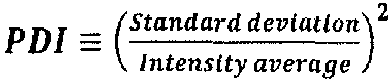
- An estimation of particle diameters can be determined assuming pure polystyrene chains are completely collapsed in water (a non-solvent for polystyrene). The assumption of a pure polystyrene approximates BRC chains which contain around 70% - 80% styrene. Considering this, the diameter can be estimated (Eq. 2) using the volume of one monomer unit (vm = 0.163 nm3) and the degree of polymerization (DP).

- Diameters of the particles as measured by DLS and those estimated by Eq. 2 (3 to 4 nm) correlate well, suggesting single- or few-chain nanoparticles are forming. Further analysis through AFM agree with the DLS measurements.
- Another exciting result of the dispersions is the high concentrations that are achievable. In the literature, single-chain nanoparticles are usually dispersed at less than 1 g/L. BRC dispersions are prepared at 50 g/L, which is substantially higher than 1 g/L. The upper extent of achievable dispersion concentration was briefly investigated using BR5.
- Dispersions of BR5 were prepared at 100 g/L, 150 g/L, 200 g/L and 300 g/L maintaining stoichiometric equivalence of sodium hydroxide to acrylic acid units. The upper concentration limit for magnetic stirring was found between 200 g/L and 300 g/L.
-
Table 4: Characterization of styrene emulsions conducted using BR5. The targeted polystyrene solids content was 15% in all cases. Higher solids contents are due to the stabilizer contribution. Emulsion [S] (mM)a wt% BOMb Dn (nm)c PDId Solids Content (%) Np (L-1) (×1016)e Surface Area (cm2/L) (×107) BR5-E1 0.27 3 396 0.09 13 0.39 1.9 BR5-E2 0.54 6 189 0.02 14 3.7 4.2 BR5-E3 0.81 8 162 0.02 15 63 5.2 BR5-E4 1.07 11 144 0.02 17 10 6.7 BR5-E5 1.34 14 116 0.05 18 20 8.6 BR5-E6 1.61 17 86 0.03 17 48 11 BR5-E7 1.88 19 81 0.02 18 62 13 BR5-E8 2.15 22 81 0.04 19 67 14 a BRC stabilizer concentration.
b Weight percentage of BRC stabilizer based on monomer (styrene).
c Number average particle size as measured through DLS.
d Polydispersity index of the particle size as measured through DLS.
e Number of latex particles in the system calculated through Eq. 1.
f Total surface area of the latex particles assuming monodisperse spheres. - More stabilizer produces a larger number of smaller particles as expected, and this implies a substantial increase in total surface area. These trends are observed for all emulsion polymerizations. The relationship of BRC concentration to total particle surface area was found to be linear (
FIG. 2 ). - A similar treatment of emulsion polymerization results for all other BRCPs provides a means of evaluating the effects of composition and molecular weight of the stabilizing block on BRCP performance. In all cases the total surface area in the system was directly proportional to the concentration of stabilizer added.
Table 5: Area of stabilization for all copolymers on a per chain, gram and acrylic acid unit basis. Stabilizer Stabilizing Block Composition Stabilization Areas a DPS b DPAA c as (nm2/chain) d as,g(nm2/g) (×1020) e as,AA (nm2/AA) BR1 86 23 11.7 4.2 0.51 BR2 29 14 6.0 3.7 0.43 BR3 62 20 8.6 3.7 0.43 BR4 48 16 6.8 4.4 0.43 BR5 70 29 10.8 4.2 0.37 BR6 38 21 8.6 4.5 0.40 BR7 24 26 5.1 3.0 0.20 a Degree of polymerization of styrene in the stabilizing block.
b Degree of polymerization of acrylic acid in the stabilizing block.
c Surface area of stabilizer coverage on a per chain basis.
d Surface area of stabilizer coverage on a mass basis.
e Surface area of stabilizer coverage per acrylic acid unit in the stabilizing block (i.e. DPAA). - Example 6. To test the concentration limit of the BRCS's, a series was prepared using BR5 from 50 to 300 g/L. It was found that between 200 and 300 g/L was the upper limit of magnetic stirring. The high viscosity of the 300 g/L dispersion caused magnetic stirring to stop.
- An interesting observation was made with respect to BR4, which had a shorter anchoring block (PS29). That is, dispersion occurred readily within about 10 minutes of heating and stirring at 90°C, whereas those with anchoring blocks at PS52 took the entire 6 hours.
- All emulsion polymerizations stabilized by BR1-7 were successful and the results are shown in
FIG. 3 . All plots of surface area versus stabilizer concentration are linear, with R2 values between 0.993 and 0.953.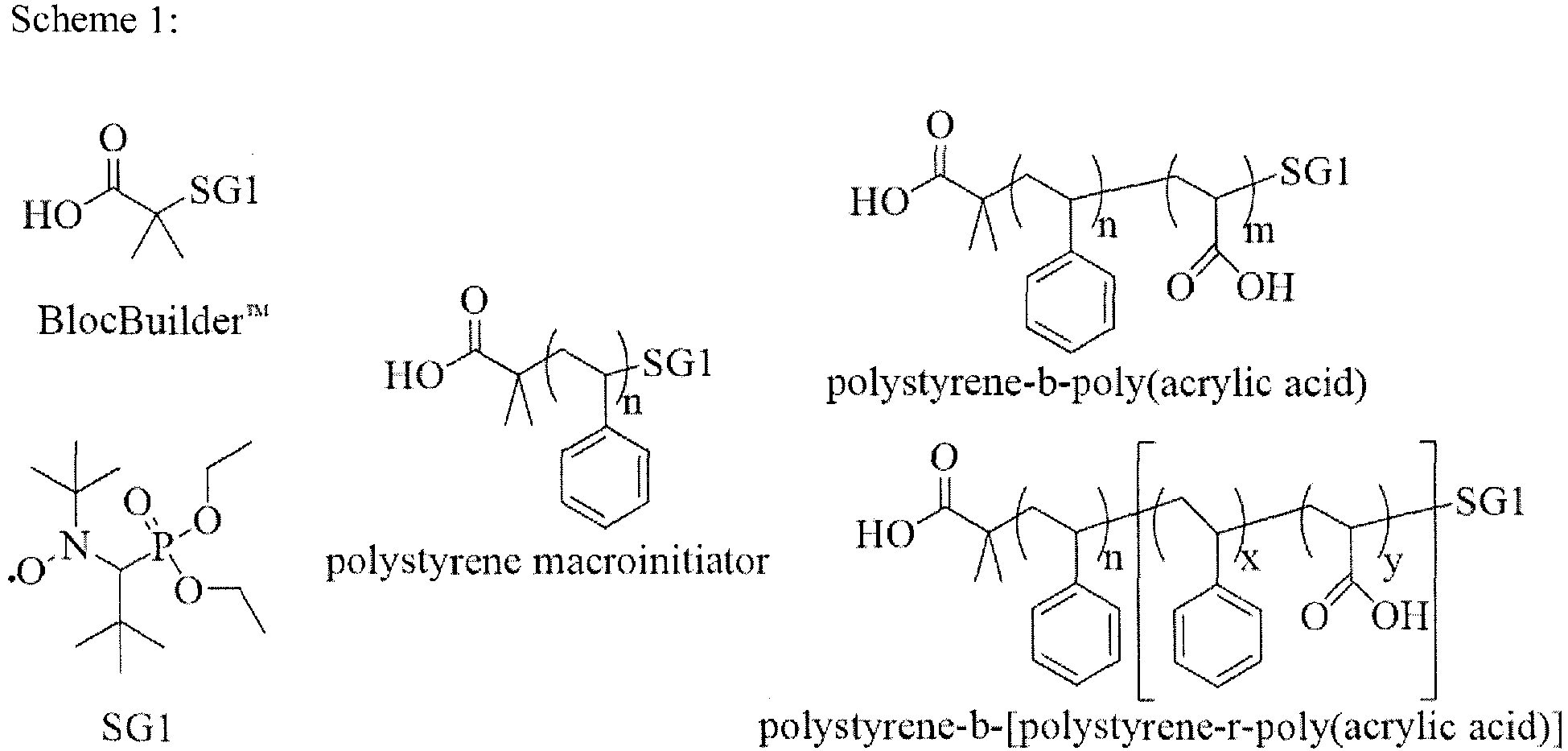
- Example 7. High Solids Emulsion Polymerization Procedure. A batch emulsion polymerization of styrene was used as a standard test procedure wherein either a block or block-random copolymer was used as the stabilizer. The general procedure began by adding styrene monomer (1 g), deionized water, sodium hydroxide (0.1 g of 1 M solution), and ammonium persulfate (0.1 g of 30 g/L solution) to an aqueous copolymer dispersion, such that the mixture was 50% styrene by weight. This mixture was then sealed in a 5 mL round bottom flask and immersed in an 85 °C bath of silicone oil with stirring. Emulsion polymerizations were closely monitored and allowed to continue for 4 hours unless significant coagulum was noticed in which case the polymerization was stopped earlier.
- Dispersions of B1-4, BR1, and BR4 were used to stabilize high solids content emulsion polymerizations of styrene with a target solids content of 50 wt%. The weight fraction of block-random copolymer of 5 wt% based on monomer led to stable emulsion polymerizations at high solids content, while all block copolymers failed to stabilize an emulsion polymerization beyond a solids content of 40 wt%. Block copolymers with a longer hydrophilic block resulted in lower solids content compared to those with shorter hydrophilic blocks. Characteristics of the emulsion polymerizations are reported in Table 6.
Table 6. Characterization of emulsion polymerizations stabilized by block and block-random copolymers. Target solids content was 50%. Stabilizer [stabilizer] (mM) wt% BOMa Dh,n (nm)b PDIc Solids Content (%)d Np (L-1) (×1016) IPD (nm) (eq 6.2) B1 1.16 1.7 137 0.13 36e 25.2 31 B2 0.04 0.04 259 0.01 38e 4.0 53 B3 0.04 0.07 144 0.06 31e 18.6 42 B4 0.04 0.1 133 0.27 24e 18.6 53 BR4 2.8 5 214 0.06 48 8.9 24 BR1 1.6 5 227 0.02 50 7.7 23 a Weight fraction of a copolymer stabilizer based on monomer
b Number-average hydrodynamic diameter calculated by DLS.
c Polydispersity Index of particles calculated by DLS.
d Weight fraction of solids at end of emulsion polymerizationdetermined gravimetrically.
eMaximum achievable weight fraction. - Other embodiments are set forth in the following claims.
Claims (15)
- A method of emulsion polymerization, the method comprising:providing water and a water-dispersible block copolymer to form an emulsion polymerization stabilizing system; andadding monomers and initiator(s) to the emulsion polymerization system; wherein:the block copolymer comprises a hydrophobic block ("Block A") and a random amphiphilic block ("Block B") comprising hydrophobic repeat units and ionizable repeat units; andthe method uses less than 1 wt.% of a surfactant having a molecular weight of 3000 g/mol or less.
- The method of Claim 1, wherein the monomers are styrenic monomers, methacrylate monomers, acrylate monomers, (vinyl) acetate monomers, or a mixture of any two or more thereof.
- The method of Claim 1 or 2, wherein Block A comprises styrenic, acrylate, or methacrylate repeat units.
- The method of any one of Claims 1-3, wherein Block A comprises a homopolymer based upon styrenic repeat units.
- The method of any one of Claims 1-3, wherein Block A is a copolymer block comprising two or more of styrenic, acrylate, or methacrylate repeat units.
- The method of any one of Claims 1-5, wherein the hydrophobic repeat units are styrenic repeat units.
- The method of any one of Claims 1-6, wherein the hydrophobic repeat units comprise styrene, α-methyl styrene, an acrylate, a methacrylate or a copolymer of any two or more thereof.
- The method of any one of Claims 1-7, wherein Block B comprises a carboxyl group, a sulfonate group, a phosphate group, an amino group, or a combination of any two or more thereof.
- The method of any of Claims 1-8, wherein Block B comprises acrylic acid, and the mole percentage of acrylic acid units in Block B (fAA) is from 21% to 52%; and overall mole percentage of acrylic acid units in the block copolymer (FAA) is from 14% to 26%.
- The method of any of Claims 1-9, wherein the block copolymer has a number average molecular weight from 5,000 to 20,000 g/mol.
- The method of any of Claims 1-10, wherein:Block A is polystyrene, poly-α-methyl styrene, an acrylate, a methacrylate, or a copolymer of any two or more thereof; andBlock B is a random copolymer of:a first monomer selected from the group consisting of styrene, α-methyl styrene, an acrylate, a methacrylate, or a mixture of any two or more thereof; anda second monomer having an ionizable group selected from the group consisting of a carboxylic acid.
- The method of any of Claims 1-11, wherein the method is free surfactants having a molecular weight of 3000 g/mol or less.
- The method of any one of Claims 1-12, wherein from greater than 5% to 100% of the ionizable groups are neutralized.
- The method of any one of Claims 1-13, wherein polymerization system comprises from 1 wt.% to 30 wt.% of the block copolymer.
- The method of any one of Claims 1-14, wherein the emulsion polymerization system has a solids content of 40 wt% to 90 wt%.
Applications Claiming Priority (2)
| Application Number | Priority Date | Filing Date | Title |
|---|---|---|---|
| US201762591518P | 2017-11-28 | 2017-11-28 | |
| PCT/US2018/062788 WO2019108608A1 (en) | 2017-11-28 | 2018-11-28 | Hydrophobic block – random block copolymer emulsion polymer stabilizers |
Publications (2)
| Publication Number | Publication Date |
|---|---|
| EP3717533A1 EP3717533A1 (en) | 2020-10-07 |
| EP3717533B1 true EP3717533B1 (en) | 2022-03-16 |
Family
ID=64665406
Family Applications (1)
| Application Number | Title | Priority Date | Filing Date |
|---|---|---|---|
| EP18819418.7A Active EP3717533B1 (en) | 2017-11-28 | 2018-11-28 | Emulsion polymerization stabilized with a block copolymer having a hydrophobic block and an amphiphilic random copolymer block |
Country Status (4)
| Country | Link |
|---|---|
| US (2) | US11396573B2 (en) |
| EP (1) | EP3717533B1 (en) |
| CN (1) | CN111406080A (en) |
| WO (1) | WO2019108608A1 (en) |
Families Citing this family (1)
| Publication number | Priority date | Publication date | Assignee | Title |
|---|---|---|---|---|
| WO2019108608A1 (en) * | 2017-11-28 | 2019-06-06 | Basf Se | Hydrophobic block – random block copolymer emulsion polymer stabilizers |
Family Cites Families (9)
| Publication number | Priority date | Publication date | Assignee | Title |
|---|---|---|---|---|
| US5434030A (en) * | 1994-09-28 | 1995-07-18 | Xerox Corporation | Toner compositions containing complexes of ionic dyes and ionophoric or ionomeric polymers |
| US6472486B2 (en) * | 1999-03-09 | 2002-10-29 | Symyx Technologies, Inc. | Controlled stable free radical emulsion polymerization processes |
| WO2000053640A1 (en) * | 1999-03-09 | 2000-09-14 | Symyx Technologies, Inc. | Controlled free radical emulsion and water-based polymerizations and seeded methodologies |
| JP2004530751A (en) * | 2001-05-04 | 2004-10-07 | ローディア インコーポレイティド | Latex manufacturing process using block copolymer as surfactant |
| JP2006348128A (en) * | 2005-06-15 | 2006-12-28 | Kuraray Co Ltd | Aqueous dispersion |
| CN101945972A (en) * | 2007-12-21 | 2011-01-12 | 3M创新有限公司 | Handle the method for hydrocarbon containing formation with the fluorinated anionic surfactant composition |
| KR101908907B1 (en) * | 2008-10-28 | 2018-10-17 | 알케마 인코포레이티드 | Water flux polymer membranes |
| JP5831779B2 (en) * | 2013-12-10 | 2015-12-09 | Dic株式会社 | Aqueous pigment dispersion, pigment dispersant, and core-shell polymer particles |
| WO2019108608A1 (en) * | 2017-11-28 | 2019-06-06 | Basf Se | Hydrophobic block – random block copolymer emulsion polymer stabilizers |
-
2018
- 2018-11-28 WO PCT/US2018/062788 patent/WO2019108608A1/en not_active Ceased
- 2018-11-28 CN CN201880076620.XA patent/CN111406080A/en active Pending
- 2018-11-28 US US16/767,321 patent/US11396573B2/en active Active
- 2018-11-28 EP EP18819418.7A patent/EP3717533B1/en active Active
-
2022
- 2022-06-28 US US17/851,601 patent/US20220332877A1/en not_active Abandoned
Also Published As
| Publication number | Publication date |
|---|---|
| CN111406080A (en) | 2020-07-10 |
| EP3717533A1 (en) | 2020-10-07 |
| US11396573B2 (en) | 2022-07-26 |
| WO2019108608A1 (en) | 2019-06-06 |
| US20200392274A1 (en) | 2020-12-17 |
| US20220332877A1 (en) | 2022-10-20 |
Similar Documents
| Publication | Publication Date | Title |
|---|---|---|
| Feil et al. | Mutual influence of pH and temperature on the swelling of ionizable and thermosensitive hydrogels | |
| Gurney et al. | Mechanical properties of a waterborne pressure-sensitive adhesive with a percolating poly (acrylic acid)-based diblock copolymer network: Effect of pH | |
| Fu et al. | Thermoreversible physically crosslinked hydrogels from UCST-type thermosensitive ABA linear triblock copolymers | |
| EP2794672B1 (en) | Method of preparing acrylic polymers and products produced thereby | |
| van Hees et al. | Temperature-responsive polyelectrolyte complexes for bio-inspired underwater adhesives | |
| JP2012530603A (en) | Branched polymer dispersant | |
| US20220332877A1 (en) | Hydrophobic block – random block copolymer emulsion polymer stabilizers | |
| Konefał et al. | Thermoresponsive poly (2-oxazoline) homopolymers and copolymers in aqueous solutions studied by NMR spectroscopy and dynamic light scattering | |
| Glatzel et al. | Well-defined synthetic polymers with a protein-like gelation behavior in water | |
| Soer et al. | Surfactant-free artificial latexes from modified styrene–maleic anhydride (SMA) copolymers | |
| Hanyková et al. | Phase transition in hydrogels of thermoresponsive semi-interpenetrating and interpenetrating networks of poly (N, N-diethylacrylamide) and polyacrylamide | |
| Dai et al. | Free radical polymerization of poly (ethylene glycol) diacrylate macromers: impact of macromer hydrophobicity and initiator chemistry on polymerization efficiency | |
| Martinez et al. | Nano-sized latex particles obtained by emulsion polymerization using an amphiphilic block copolymer as surfactant | |
| Huo et al. | Synthesis and self-assembly of CO 2-responsive dendronized triblock copolymers | |
| AK et al. | Self-stabilized styrene-acrylic copolymer latex with heteroatom function for improved water and corrosion resistant coatings | |
| Thomson et al. | Particle nucleation in high solids nitroxide mediated emulsion polymerization of n-butyl acrylate with a difunctional alkoxyamine initiator | |
| Rämö et al. | Preparation of aqueous crosslinked dispersions of functionalized poly (d, l-lactic acid) with a thermomechanical method | |
| Itoh et al. | Surface structure of stimuli-responsive polystyrene particles prepared by dispersion polymerization with a polystyrene/poly (L-lysine) block copolymer as a stabilizer | |
| Yoo et al. | Characterization of stimuli‐sensitive polymers for biomedical applications | |
| JP3975895B2 (en) | O / W emulsion | |
| Dundua et al. | Facile synthesis of tunable alkali soluble latexes | |
| Khaojanta et al. | Synthesis and characterization of styrene‐maleic acid block copolymers with acrylic and methacrylic acids for potential use in membrane protein extraction | |
| Serkhacheva et al. | Facile synthesis of temperature-sensitive ABA triblock copolymers by dispersion RAFT polymerization | |
| Penrhyn-Lowe et al. | Controlling the pH-response of branched copolymer nanoprecipitates synthesised by transfer-dominated branching radical telomerisation (TBRT) through telogen chemistry and spatial distribution of tertiary amine functionality | |
| Bin et al. | Synthesis of associating poly (acrylic acid) in supercritical carbon dioxide and its solution properties |
Legal Events
| Date | Code | Title | Description |
|---|---|---|---|
| STAA | Information on the status of an ep patent application or granted ep patent |
Free format text: STATUS: UNKNOWN |
|
| STAA | Information on the status of an ep patent application or granted ep patent |
Free format text: STATUS: THE INTERNATIONAL PUBLICATION HAS BEEN MADE |
|
| PUAI | Public reference made under article 153(3) epc to a published international application that has entered the european phase |
Free format text: ORIGINAL CODE: 0009012 |
|
| STAA | Information on the status of an ep patent application or granted ep patent |
Free format text: STATUS: REQUEST FOR EXAMINATION WAS MADE |
|
| 17P | Request for examination filed |
Effective date: 20200629 |
|
| AK | Designated contracting states |
Kind code of ref document: A1 Designated state(s): AL AT BE BG CH CY CZ DE DK EE ES FI FR GB GR HR HU IE IS IT LI LT LU LV MC MK MT NL NO PL PT RO RS SE SI SK SM TR |
|
| AX | Request for extension of the european patent |
Extension state: BA ME |
|
| DAV | Request for validation of the european patent (deleted) | ||
| DAX | Request for extension of the european patent (deleted) | ||
| REG | Reference to a national code |
Ref country code: DE Ref legal event code: R079 Ref document number: 602018032435 Country of ref document: DE Free format text: PREVIOUS MAIN CLASS: C08F0287000000 Ipc: C08F0002320000 |
|
| GRAP | Despatch of communication of intention to grant a patent |
Free format text: ORIGINAL CODE: EPIDOSNIGR1 |
|
| STAA | Information on the status of an ep patent application or granted ep patent |
Free format text: STATUS: GRANT OF PATENT IS INTENDED |
|
| RIC1 | Information provided on ipc code assigned before grant |
Ipc: C08F 212/08 20060101ALI20210907BHEP Ipc: C08F 287/00 20060101ALI20210907BHEP Ipc: C08F 293/00 20060101ALI20210907BHEP Ipc: C08F 2/32 20060101AFI20210907BHEP |
|
| INTG | Intention to grant announced |
Effective date: 20211007 |
|
| GRAS | Grant fee paid |
Free format text: ORIGINAL CODE: EPIDOSNIGR3 |
|
| GRAA | (expected) grant |
Free format text: ORIGINAL CODE: 0009210 |
|
| STAA | Information on the status of an ep patent application or granted ep patent |
Free format text: STATUS: THE PATENT HAS BEEN GRANTED |
|
| AK | Designated contracting states |
Kind code of ref document: B1 Designated state(s): AL AT BE BG CH CY CZ DE DK EE ES FI FR GB GR HR HU IE IS IT LI LT LU LV MC MK MT NL NO PL PT RO RS SE SI SK SM TR |
|
| REG | Reference to a national code |
Ref country code: GB Ref legal event code: FG4D |
|
| REG | Reference to a national code |
Ref country code: CH Ref legal event code: EP |
|
| REG | Reference to a national code |
Ref country code: DE Ref legal event code: R096 Ref document number: 602018032435 Country of ref document: DE |
|
| REG | Reference to a national code |
Ref country code: IE Ref legal event code: FG4D |
|
| REG | Reference to a national code |
Ref country code: AT Ref legal event code: REF Ref document number: 1475834 Country of ref document: AT Kind code of ref document: T Effective date: 20220415 |
|
| REG | Reference to a national code |
Ref country code: LT Ref legal event code: MG9D |
|
| REG | Reference to a national code |
Ref country code: NL Ref legal event code: MP Effective date: 20220316 |
|
| PG25 | Lapsed in a contracting state [announced via postgrant information from national office to epo] |
Ref country code: SE Free format text: LAPSE BECAUSE OF FAILURE TO SUBMIT A TRANSLATION OF THE DESCRIPTION OR TO PAY THE FEE WITHIN THE PRESCRIBED TIME-LIMIT Effective date: 20220316 Ref country code: RS Free format text: LAPSE BECAUSE OF FAILURE TO SUBMIT A TRANSLATION OF THE DESCRIPTION OR TO PAY THE FEE WITHIN THE PRESCRIBED TIME-LIMIT Effective date: 20220316 Ref country code: NO Free format text: LAPSE BECAUSE OF FAILURE TO SUBMIT A TRANSLATION OF THE DESCRIPTION OR TO PAY THE FEE WITHIN THE PRESCRIBED TIME-LIMIT Effective date: 20220616 Ref country code: LT Free format text: LAPSE BECAUSE OF FAILURE TO SUBMIT A TRANSLATION OF THE DESCRIPTION OR TO PAY THE FEE WITHIN THE PRESCRIBED TIME-LIMIT Effective date: 20220316 Ref country code: HR Free format text: LAPSE BECAUSE OF FAILURE TO SUBMIT A TRANSLATION OF THE DESCRIPTION OR TO PAY THE FEE WITHIN THE PRESCRIBED TIME-LIMIT Effective date: 20220316 Ref country code: BG Free format text: LAPSE BECAUSE OF FAILURE TO SUBMIT A TRANSLATION OF THE DESCRIPTION OR TO PAY THE FEE WITHIN THE PRESCRIBED TIME-LIMIT Effective date: 20220616 |
|
| REG | Reference to a national code |
Ref country code: AT Ref legal event code: MK05 Ref document number: 1475834 Country of ref document: AT Kind code of ref document: T Effective date: 20220316 |
|
| PG25 | Lapsed in a contracting state [announced via postgrant information from national office to epo] |
Ref country code: LV Free format text: LAPSE BECAUSE OF FAILURE TO SUBMIT A TRANSLATION OF THE DESCRIPTION OR TO PAY THE FEE WITHIN THE PRESCRIBED TIME-LIMIT Effective date: 20220316 Ref country code: GR Free format text: LAPSE BECAUSE OF FAILURE TO SUBMIT A TRANSLATION OF THE DESCRIPTION OR TO PAY THE FEE WITHIN THE PRESCRIBED TIME-LIMIT Effective date: 20220617 Ref country code: FI Free format text: LAPSE BECAUSE OF FAILURE TO SUBMIT A TRANSLATION OF THE DESCRIPTION OR TO PAY THE FEE WITHIN THE PRESCRIBED TIME-LIMIT Effective date: 20220316 |
|
| PG25 | Lapsed in a contracting state [announced via postgrant information from national office to epo] |
Ref country code: NL Free format text: LAPSE BECAUSE OF FAILURE TO SUBMIT A TRANSLATION OF THE DESCRIPTION OR TO PAY THE FEE WITHIN THE PRESCRIBED TIME-LIMIT Effective date: 20220316 |
|
| PG25 | Lapsed in a contracting state [announced via postgrant information from national office to epo] |
Ref country code: SM Free format text: LAPSE BECAUSE OF FAILURE TO SUBMIT A TRANSLATION OF THE DESCRIPTION OR TO PAY THE FEE WITHIN THE PRESCRIBED TIME-LIMIT Effective date: 20220316 Ref country code: SK Free format text: LAPSE BECAUSE OF FAILURE TO SUBMIT A TRANSLATION OF THE DESCRIPTION OR TO PAY THE FEE WITHIN THE PRESCRIBED TIME-LIMIT Effective date: 20220316 Ref country code: RO Free format text: LAPSE BECAUSE OF FAILURE TO SUBMIT A TRANSLATION OF THE DESCRIPTION OR TO PAY THE FEE WITHIN THE PRESCRIBED TIME-LIMIT Effective date: 20220316 Ref country code: PT Free format text: LAPSE BECAUSE OF FAILURE TO SUBMIT A TRANSLATION OF THE DESCRIPTION OR TO PAY THE FEE WITHIN THE PRESCRIBED TIME-LIMIT Effective date: 20220718 Ref country code: ES Free format text: LAPSE BECAUSE OF FAILURE TO SUBMIT A TRANSLATION OF THE DESCRIPTION OR TO PAY THE FEE WITHIN THE PRESCRIBED TIME-LIMIT Effective date: 20220316 Ref country code: EE Free format text: LAPSE BECAUSE OF FAILURE TO SUBMIT A TRANSLATION OF THE DESCRIPTION OR TO PAY THE FEE WITHIN THE PRESCRIBED TIME-LIMIT Effective date: 20220316 Ref country code: CZ Free format text: LAPSE BECAUSE OF FAILURE TO SUBMIT A TRANSLATION OF THE DESCRIPTION OR TO PAY THE FEE WITHIN THE PRESCRIBED TIME-LIMIT Effective date: 20220316 Ref country code: AT Free format text: LAPSE BECAUSE OF FAILURE TO SUBMIT A TRANSLATION OF THE DESCRIPTION OR TO PAY THE FEE WITHIN THE PRESCRIBED TIME-LIMIT Effective date: 20220316 |
|
| PG25 | Lapsed in a contracting state [announced via postgrant information from national office to epo] |
Ref country code: PL Free format text: LAPSE BECAUSE OF FAILURE TO SUBMIT A TRANSLATION OF THE DESCRIPTION OR TO PAY THE FEE WITHIN THE PRESCRIBED TIME-LIMIT Effective date: 20220316 Ref country code: IS Free format text: LAPSE BECAUSE OF FAILURE TO SUBMIT A TRANSLATION OF THE DESCRIPTION OR TO PAY THE FEE WITHIN THE PRESCRIBED TIME-LIMIT Effective date: 20220716 Ref country code: AL Free format text: LAPSE BECAUSE OF FAILURE TO SUBMIT A TRANSLATION OF THE DESCRIPTION OR TO PAY THE FEE WITHIN THE PRESCRIBED TIME-LIMIT Effective date: 20220316 |
|
| REG | Reference to a national code |
Ref country code: DE Ref legal event code: R097 Ref document number: 602018032435 Country of ref document: DE |
|
| PLBE | No opposition filed within time limit |
Free format text: ORIGINAL CODE: 0009261 |
|
| STAA | Information on the status of an ep patent application or granted ep patent |
Free format text: STATUS: NO OPPOSITION FILED WITHIN TIME LIMIT |
|
| PG25 | Lapsed in a contracting state [announced via postgrant information from national office to epo] |
Ref country code: DK Free format text: LAPSE BECAUSE OF FAILURE TO SUBMIT A TRANSLATION OF THE DESCRIPTION OR TO PAY THE FEE WITHIN THE PRESCRIBED TIME-LIMIT Effective date: 20220316 |
|
| 26N | No opposition filed |
Effective date: 20221219 |
|
| PG25 | Lapsed in a contracting state [announced via postgrant information from national office to epo] |
Ref country code: SI Free format text: LAPSE BECAUSE OF FAILURE TO SUBMIT A TRANSLATION OF THE DESCRIPTION OR TO PAY THE FEE WITHIN THE PRESCRIBED TIME-LIMIT Effective date: 20220316 |
|
| PG25 | Lapsed in a contracting state [announced via postgrant information from national office to epo] |
Ref country code: MC Free format text: LAPSE BECAUSE OF FAILURE TO SUBMIT A TRANSLATION OF THE DESCRIPTION OR TO PAY THE FEE WITHIN THE PRESCRIBED TIME-LIMIT Effective date: 20220316 |
|
| REG | Reference to a national code |
Ref country code: CH Ref legal event code: PL |
|
| GBPC | Gb: european patent ceased through non-payment of renewal fee |
Effective date: 20221128 |
|
| REG | Reference to a national code |
Ref country code: BE Ref legal event code: MM Effective date: 20221130 |
|
| PG25 | Lapsed in a contracting state [announced via postgrant information from national office to epo] |
Ref country code: LI Free format text: LAPSE BECAUSE OF NON-PAYMENT OF DUE FEES Effective date: 20221130 Ref country code: IT Free format text: LAPSE BECAUSE OF FAILURE TO SUBMIT A TRANSLATION OF THE DESCRIPTION OR TO PAY THE FEE WITHIN THE PRESCRIBED TIME-LIMIT Effective date: 20220316 Ref country code: CH Free format text: LAPSE BECAUSE OF NON-PAYMENT OF DUE FEES Effective date: 20221130 |
|
| PG25 | Lapsed in a contracting state [announced via postgrant information from national office to epo] |
Ref country code: LU Free format text: LAPSE BECAUSE OF NON-PAYMENT OF DUE FEES Effective date: 20221128 |
|
| PG25 | Lapsed in a contracting state [announced via postgrant information from national office to epo] |
Ref country code: IE Free format text: LAPSE BECAUSE OF NON-PAYMENT OF DUE FEES Effective date: 20221128 Ref country code: GB Free format text: LAPSE BECAUSE OF NON-PAYMENT OF DUE FEES Effective date: 20221128 |
|
| PG25 | Lapsed in a contracting state [announced via postgrant information from national office to epo] |
Ref country code: BE Free format text: LAPSE BECAUSE OF NON-PAYMENT OF DUE FEES Effective date: 20221130 |
|
| PG25 | Lapsed in a contracting state [announced via postgrant information from national office to epo] |
Ref country code: CY Free format text: LAPSE BECAUSE OF FAILURE TO SUBMIT A TRANSLATION OF THE DESCRIPTION OR TO PAY THE FEE WITHIN THE PRESCRIBED TIME-LIMIT Effective date: 20220316 |
|
| PG25 | Lapsed in a contracting state [announced via postgrant information from national office to epo] |
Ref country code: MK Free format text: LAPSE BECAUSE OF FAILURE TO SUBMIT A TRANSLATION OF THE DESCRIPTION OR TO PAY THE FEE WITHIN THE PRESCRIBED TIME-LIMIT Effective date: 20220316 Ref country code: HU Free format text: LAPSE BECAUSE OF FAILURE TO SUBMIT A TRANSLATION OF THE DESCRIPTION OR TO PAY THE FEE WITHIN THE PRESCRIBED TIME-LIMIT; INVALID AB INITIO Effective date: 20181128 |
|
| PG25 | Lapsed in a contracting state [announced via postgrant information from national office to epo] |
Ref country code: TR Free format text: LAPSE BECAUSE OF FAILURE TO SUBMIT A TRANSLATION OF THE DESCRIPTION OR TO PAY THE FEE WITHIN THE PRESCRIBED TIME-LIMIT Effective date: 20220316 |
|
| PG25 | Lapsed in a contracting state [announced via postgrant information from national office to epo] |
Ref country code: MT Free format text: LAPSE BECAUSE OF FAILURE TO SUBMIT A TRANSLATION OF THE DESCRIPTION OR TO PAY THE FEE WITHIN THE PRESCRIBED TIME-LIMIT Effective date: 20220316 |
|
| PGFP | Annual fee paid to national office [announced via postgrant information from national office to epo] |
Ref country code: DE Payment date: 20251126 Year of fee payment: 8 |
|
| PGFP | Annual fee paid to national office [announced via postgrant information from national office to epo] |
Ref country code: FR Payment date: 20251124 Year of fee payment: 8 |