EP3716952B1 - Dosage forms comprising a plasma kallikrein inhibitor - Google Patents
Dosage forms comprising a plasma kallikrein inhibitor Download PDFInfo
- Publication number
- EP3716952B1 EP3716952B1 EP18815293.8A EP18815293A EP3716952B1 EP 3716952 B1 EP3716952 B1 EP 3716952B1 EP 18815293 A EP18815293 A EP 18815293A EP 3716952 B1 EP3716952 B1 EP 3716952B1
- Authority
- EP
- European Patent Office
- Prior art keywords
- compound
- formula
- dosage form
- solid dosage
- oral solid
- Prior art date
- Legal status (The legal status is an assumption and is not a legal conclusion. Google has not performed a legal analysis and makes no representation as to the accuracy of the status listed.)
- Active
Links
Images


Classifications
-
- A—HUMAN NECESSITIES
- A61—MEDICAL OR VETERINARY SCIENCE; HYGIENE
- A61K—PREPARATIONS FOR MEDICAL, DENTAL OR TOILETRY PURPOSES
- A61K9/00—Medicinal preparations characterised by special physical form
- A61K9/48—Preparations in capsules, e.g. of gelatin, of chocolate
- A61K9/4841—Filling excipients; Inactive ingredients
- A61K9/4858—Organic compounds
-
- A—HUMAN NECESSITIES
- A61—MEDICAL OR VETERINARY SCIENCE; HYGIENE
- A61K—PREPARATIONS FOR MEDICAL, DENTAL OR TOILETRY PURPOSES
- A61K31/00—Medicinal preparations containing organic active ingredients
-
- A—HUMAN NECESSITIES
- A61—MEDICAL OR VETERINARY SCIENCE; HYGIENE
- A61K—PREPARATIONS FOR MEDICAL, DENTAL OR TOILETRY PURPOSES
- A61K31/00—Medicinal preparations containing organic active ingredients
- A61K31/33—Heterocyclic compounds
- A61K31/395—Heterocyclic compounds having nitrogen as a ring hetero atom, e.g. guanethidine or rifamycins
- A61K31/435—Heterocyclic compounds having nitrogen as a ring hetero atom, e.g. guanethidine or rifamycins having six-membered rings with one nitrogen as the only ring hetero atom
- A61K31/44—Non condensed pyridines; Hydrogenated derivatives thereof
- A61K31/4427—Non condensed pyridines; Hydrogenated derivatives thereof containing further heterocyclic ring systems
- A61K31/444—Non condensed pyridines; Hydrogenated derivatives thereof containing further heterocyclic ring systems containing a six-membered ring with nitrogen as a ring heteroatom, e.g. amrinone
-
- A—HUMAN NECESSITIES
- A61—MEDICAL OR VETERINARY SCIENCE; HYGIENE
- A61K—PREPARATIONS FOR MEDICAL, DENTAL OR TOILETRY PURPOSES
- A61K9/00—Medicinal preparations characterised by special physical form
- A61K9/14—Particulate form, e.g. powders, Processes for size reducing of pure drugs or the resulting products, Pure drug nanoparticles
- A61K9/16—Agglomerates; Granulates; Microbeadlets ; Microspheres; Pellets; Solid products obtained by spray drying, spray freeze drying, spray congealing,(multiple) emulsion solvent evaporation or extraction
-
- A—HUMAN NECESSITIES
- A61—MEDICAL OR VETERINARY SCIENCE; HYGIENE
- A61K—PREPARATIONS FOR MEDICAL, DENTAL OR TOILETRY PURPOSES
- A61K9/00—Medicinal preparations characterised by special physical form
- A61K9/14—Particulate form, e.g. powders, Processes for size reducing of pure drugs or the resulting products, Pure drug nanoparticles
- A61K9/16—Agglomerates; Granulates; Microbeadlets ; Microspheres; Pellets; Solid products obtained by spray drying, spray freeze drying, spray congealing,(multiple) emulsion solvent evaporation or extraction
- A61K9/1605—Excipients; Inactive ingredients
- A61K9/1629—Organic macromolecular compounds
- A61K9/1652—Polysaccharides, e.g. alginate, cellulose derivatives; Cyclodextrin
-
- A—HUMAN NECESSITIES
- A61—MEDICAL OR VETERINARY SCIENCE; HYGIENE
- A61K—PREPARATIONS FOR MEDICAL, DENTAL OR TOILETRY PURPOSES
- A61K9/00—Medicinal preparations characterised by special physical form
- A61K9/20—Pills, tablets, discs, rods
-
- A—HUMAN NECESSITIES
- A61—MEDICAL OR VETERINARY SCIENCE; HYGIENE
- A61K—PREPARATIONS FOR MEDICAL, DENTAL OR TOILETRY PURPOSES
- A61K9/00—Medicinal preparations characterised by special physical form
- A61K9/20—Pills, tablets, discs, rods
- A61K9/2004—Excipients; Inactive ingredients
- A61K9/2022—Organic macromolecular compounds
- A61K9/205—Polysaccharides, e.g. alginate, gums; Cyclodextrin
- A61K9/2054—Cellulose; Cellulose derivatives, e.g. hydroxypropyl methylcellulose
-
- A—HUMAN NECESSITIES
- A61—MEDICAL OR VETERINARY SCIENCE; HYGIENE
- A61K—PREPARATIONS FOR MEDICAL, DENTAL OR TOILETRY PURPOSES
- A61K9/00—Medicinal preparations characterised by special physical form
- A61K9/20—Pills, tablets, discs, rods
- A61K9/28—Dragees; Coated pills or tablets, e.g. with film or compression coating
-
- A—HUMAN NECESSITIES
- A61—MEDICAL OR VETERINARY SCIENCE; HYGIENE
- A61K—PREPARATIONS FOR MEDICAL, DENTAL OR TOILETRY PURPOSES
- A61K9/00—Medicinal preparations characterised by special physical form
- A61K9/20—Pills, tablets, discs, rods
- A61K9/28—Dragees; Coated pills or tablets, e.g. with film or compression coating
- A61K9/2806—Coating materials
- A61K9/2833—Organic macromolecular compounds
- A61K9/284—Organic macromolecular compounds obtained by reactions only involving carbon-to-carbon unsaturated bonds, e.g. polyvinyl pyrrolidone
- A61K9/2846—Poly(meth)acrylates
-
- A—HUMAN NECESSITIES
- A61—MEDICAL OR VETERINARY SCIENCE; HYGIENE
- A61K—PREPARATIONS FOR MEDICAL, DENTAL OR TOILETRY PURPOSES
- A61K9/00—Medicinal preparations characterised by special physical form
- A61K9/20—Pills, tablets, discs, rods
- A61K9/28—Dragees; Coated pills or tablets, e.g. with film or compression coating
- A61K9/2806—Coating materials
- A61K9/2833—Organic macromolecular compounds
- A61K9/2853—Organic macromolecular compounds obtained otherwise than by reactions only involving carbon-to-carbon unsaturated bonds, e.g. polyethylene glycol, polyethylene oxide, poloxamers, poly(lactide-co-glycolide)
-
- A—HUMAN NECESSITIES
- A61—MEDICAL OR VETERINARY SCIENCE; HYGIENE
- A61K—PREPARATIONS FOR MEDICAL, DENTAL OR TOILETRY PURPOSES
- A61K9/00—Medicinal preparations characterised by special physical form
- A61K9/48—Preparations in capsules, e.g. of gelatin, of chocolate
-
- A—HUMAN NECESSITIES
- A61—MEDICAL OR VETERINARY SCIENCE; HYGIENE
- A61K—PREPARATIONS FOR MEDICAL, DENTAL OR TOILETRY PURPOSES
- A61K9/00—Medicinal preparations characterised by special physical form
- A61K9/48—Preparations in capsules, e.g. of gelatin, of chocolate
- A61K9/4841—Filling excipients; Inactive ingredients
- A61K9/4866—Organic macromolecular compounds
-
- A—HUMAN NECESSITIES
- A61—MEDICAL OR VETERINARY SCIENCE; HYGIENE
- A61K—PREPARATIONS FOR MEDICAL, DENTAL OR TOILETRY PURPOSES
- A61K9/00—Medicinal preparations characterised by special physical form
- A61K9/48—Preparations in capsules, e.g. of gelatin, of chocolate
- A61K9/4891—Coated capsules; Multilayered drug free capsule shells
-
- A—HUMAN NECESSITIES
- A61—MEDICAL OR VETERINARY SCIENCE; HYGIENE
- A61P—SPECIFIC THERAPEUTIC ACTIVITY OF CHEMICAL COMPOUNDS OR MEDICINAL PREPARATIONS
- A61P27/00—Drugs for disorders of the senses
- A61P27/02—Ophthalmic agents
-
- A—HUMAN NECESSITIES
- A61—MEDICAL OR VETERINARY SCIENCE; HYGIENE
- A61P—SPECIFIC THERAPEUTIC ACTIVITY OF CHEMICAL COMPOUNDS OR MEDICINAL PREPARATIONS
- A61P9/00—Drugs for disorders of the cardiovascular system
-
- C—CHEMISTRY; METALLURGY
- C07—ORGANIC CHEMISTRY
- C07D—HETEROCYCLIC COMPOUNDS
- C07D401/00—Heterocyclic compounds containing two or more hetero rings, having nitrogen atoms as the only ring hetero atoms, at least one ring being a six-membered ring with only one nitrogen atom
- C07D401/14—Heterocyclic compounds containing two or more hetero rings, having nitrogen atoms as the only ring hetero atoms, at least one ring being a six-membered ring with only one nitrogen atom containing three or more hetero rings
-
- A—HUMAN NECESSITIES
- A61—MEDICAL OR VETERINARY SCIENCE; HYGIENE
- A61K—PREPARATIONS FOR MEDICAL, DENTAL OR TOILETRY PURPOSES
- A61K45/00—Medicinal preparations containing active ingredients not provided for in groups A61K31/00 - A61K41/00
- A61K45/06—Mixtures of active ingredients without chemical characterisation, e.g. antiphlogistics and cardiaca
-
- A—HUMAN NECESSITIES
- A61—MEDICAL OR VETERINARY SCIENCE; HYGIENE
- A61K—PREPARATIONS FOR MEDICAL, DENTAL OR TOILETRY PURPOSES
- A61K9/00—Medicinal preparations characterised by special physical form
- A61K9/0012—Galenical forms characterised by the site of application
- A61K9/0053—Mouth and digestive tract, i.e. intraoral and peroral administration
-
- C—CHEMISTRY; METALLURGY
- C07—ORGANIC CHEMISTRY
- C07B—GENERAL METHODS OF ORGANIC CHEMISTRY; APPARATUS THEREFOR
- C07B2200/00—Indexing scheme relating to specific properties of organic compounds
- C07B2200/13—Crystalline forms, e.g. polymorphs
Definitions
- the present invention relates to oral solid dosage forms comprising a plasma kallikrein inhibitor, in particular a solid form (Form 1) of the compound of Formula A. Also provided are methods of preparing oral solid dosage forms comprising the compound of Formula A using Form 1 of the compound of Formula A.
- Inhibitors of plasma kallikrein have a number of therapeutic applications, particularly in the treatment of retinal vascular permeability associated with diabetic retinopathy, diabetic macular edema and hereditary angioedema.
- Plasma kallikrein is a trypsin-like serine protease that can liberate kinins from kininogens (see K. D. Bhoola et al., "Kallikrein-Kinin Cascade", Encyclopedia of Respiratory Medicine, p483-493 ; J. W. Bryant et al., "Human plasma kallikrein-kinin system: physiological and biochemical parameters” Cardiovascular and haematological agents in medicinal chemistry, 7, p234-250, 2009 ; K. D. Bhoola et al., Pharmacological Rev., 1992, 44, 1 ; and D. J.
- Plasma prekallikrein is encoded by a single gene and synthesized in the liver. It is secreted by hepatocytes as an inactive plasma prekallikrein that circulates in plasma as a heterodimer complex bound to high molecular weight kininogen which is activated to give the active plasma kallikrein.
- Kinins are potent mediators of inflammation that act through G protein-coupled receptors and antagonists of kinins (such as bradykinin antagonists) have previously been investigated as potential therapeutic agents for the treatment of a number of disorders ( F. Marceau and D. Regoli, Nature Rev., Drug Discovery, 2004, 3, 845-852 ).
- Plasma kallikrein is thought to play a role in a number of inflammatory disorders.
- the major inhibitor of plasma kallikrein is the serpin C1 esterase inhibitor.
- Patients who present with a genetic deficiency in C1 esterase inhibitor suffer from hereditary angioedema (HAE) which results in intermittent swelling of face, hands, throat, gastro-intestinal tract and genitals.
- HAE hereditary angioedema
- Blisters formed during acute episodes contain high levels of plasma kallikrein which cleaves high molecular weight kininogen liberating bradykinin leading to increased vascular permeability.
- Treatment with a large protein plasma kallikrein inhibitor has been shown to effectively treat HAE by preventing the release of bradykinin which causes increased vascular permeability ( A.
- the plasma kallikrein-kinin system is abnormally abundant in patients with advanced diabetic macular edema. It has been recently published that plasma kallikrein contributes to retinal vascular dysfunctions in diabetic rats ( A. Clermont et al. "Plasma kallikrein mediates retinal vascular dysfunction and induces retinal thickening in diabetic rats" Diabetes, 2011, 60, p1590-98 ). Furthermore, administration of the plasma kallikrein inhibitor ASP-440 ameliorated both retinal vascular permeability and retinal blood flow abnormalities in diabetic rats. Therefore a plasma kallikrein inhibitor should have utility as a treatment to reduce retinal vascular permeability associated with diabetic retinopathy and diabetic macular edema.
- Plasma kallikrein also plays a role in blood coagulation.
- the intrinsic coagulation cascade may be activated by factor XII (FXII). Once FXII is activated (to FXIIa), FXIIa triggers fibrin formation through the activation of factor XI (FXI) thus resulting in blood coagulation.
- Plasma kallikrein is a key component in the intrinsic coagulation cascade because it activates FXII to FXIIa, thus resulting in the activation of the intrinsic coagulation pathway. Furthermore, FXlla also activates further plasma prekallikrein resulting in plasma kallikrein.
- FXIIa contact of FXII in the blood with negatively charged surfaces (such as the surfaces of external pipes or the membrane of the oxygenator that the blood passes during cardiopulmonary bypass surgery) induces a conformational change in zymogen FXII resulting in a small amount of active FXII (FXIIa).
- the formation of FXlla triggers the formation of plasma kallikrein resulting in blood coagulation, as described above.
- Activation of FXII to FXlla can also occur in the body by contact with negatively charged surfaces on various sources (e.g. bacteria during sepsis, RNA from degrading cells), thus resulting in disseminated intravascular coagulation ( Tanaka et al. (Thrombosis Research 2004, 113, 333-339 )).
- Ecallantide a plasma kallikrein inhibitor
- Plasma kallikrein also plays a role in the inhibition of platelet activation, and therefore the cessation of bleeding.
- Platelet activation is one of the earliest steps in hemostasis, which leads to platelet plug formation and the rapid cessation of bleeding following damage to blood vessels.
- the interaction between the exposed collagen and platelets is critical for the retention and activation of platelets, and the subsequent cessation of bleeding.
- plasma kallikrein binds to collagen and thereby interferes with collagen-mediated activation of platelets mediated by GPVI receptors ( Liu et al. (Nat Med., 2011, 17, 206-210 )).
- plasma kallikrein inhibitors reduce plasma prekallikrein activation by inhibiting plasma kallikrein-mediated activation of factor XII and thereby reducing the positive feedback amplification of the kallikrein system by the contact activation system.
- plasma kallikrein inhibitors would be useful in the treatment of treating cerebral haemorrhage and bleeding from post operative surgery.
- Liu et al. (Nat Med., 2011, 17, 206-210 ) demonstrated that systemic administration of a small molecule PK inhibitor, ASP-440, reduced hematoma expansion in rats. Cerebral hematoma may occur following intracerebral haemorrhage and is caused by bleeding from blood vessels into the surrounding brain tissue as a result of vascular injury.
- Ecallantide is formulated as a solution for injection. It is a large protein plasma kallikrein inhibitor that presents a risk of anaphylactic reactions.
- Other plasma kallikrein inhibitors known in the art are generally small molecules, some of which include highly polar and ionisable functional groups, such as guanidines or amidines.
- plasma kallikrein inhibitors that do not feature guanidine or amidine functionalities have been reported. For example Brandl et al.
- the active compound In the manufacture of pharmaceutical formulations, it is important that the active compound be in a form in which it can be conveniently handled and processed in order to obtain a commercially viable manufacturing process. Accordingly, the chemical stability and the physical stability of the active compound are important factors.
- the active compound, and formulations containing it, must be capable of being effectively stored over appreciable periods of time, without exhibiting any significant change in the physico-chemical characteristics (e.g. chemical composition, density, hygroscopicity and solubility) of the active compound.
- the applicant has developed a novel series of compounds that are inhibitors of plasma kallikrein, which are disclosed in WO2016/083820 ( PCT/GB2015/053615 ). These compounds demonstrate good selectivity for plasma kallikrein and are potentially useful in the treatment of diabetic retinopathy, macular edema and hereditary angioedema.
- One such compound is N-[(3-fluoro-4-methoxypyridiri-2-yl)methyl]-3-(methoxymethyl)-1-( ⁇ 4-[(2-oxopyridin-1-yl)methyl]phenyl ⁇ methyl)pyrazole-4-carboxamide.
- N-[(3-fluoro-4-methoxypyridin-2-yl)methyl]-3-(methoxymethyl)-1-( ⁇ 4-[(2-oxopyridin-1-yl)methyl]phenyl ⁇ methyl)pyrazole-4-carboxamide denotes the structure depicted in Formula A.
- the invention is also concerned with providing methods of preparing oral solid dosage forms comprising the compound of Formula A using Form 1 of the compound of Formula A.
- the invention is also concerned with providing methods of preparing oral solid dosage forms comprising the compound of Formula A using Form 3 of the compound of Formula A.
- an oral solid dosage form comprising a solid form of the compound of Formula A, wherein the solid form of the compound of Formula A exhibits at least the following characteristic X-ray powder diffraction peaks (Cu K ⁇ radiation, expressed in degrees 2 ⁇ ) at approximately 11.2, 12.5, 13.2, 14.5 and 16.3, wherein the term "approximately” means that there is an uncertainty in the measurements of the degrees 2 ⁇ of ⁇ 0.3 (expressed in degrees 2 ⁇ ).
- this solid form may be referred to as 'Form 1'.
- Form 1 of the compound of Formula A has advantageous physico-chemical properties that render it suitable for development.
- Gravimetric Vapour Sorption (GVS) data for Form 1 of the compound of Formula A, Figure 4 shows that, under normal conditions (for example, up to 70% relative humidity) there is only a relatively gradual increase in water content. This is consistent with the absence of significant hygroscopicity. In contrast, amorphous materials are typically significantly hygroscopic, or even deliquescent, often rendering the material into an unworkable gum.
- the absence of weight loss before melt of the sample of Form 1 indicates that Form 1 is not hydrated or solvated.
- Stable hydrates may be unsuitable for pharmaceutical development because they may induce an undesirable transformation of the administered anhydrous form of the drug once the drug meets the aqueous environment of the human body.
- Another advantage of Form 1 of the compound of Formula A is that it is more easily processable. That is, its preparation by crystallisation (see Examples) is a common and easily scalable procedure to remove undesirable impurities.
- X-ray powder diffraction peaks (expressed in degrees 2 ⁇ ) are measured using Cu K ⁇ radiation.
- the present invention provides an oral solid dosage form comprising a solid form of the compound of Formula A
- the present invention provides a method of preparing an oral solid dosage form comprising a compound of Formula A comprising the steps of
- the present invention provides a method of preparing an oral solid dosage form comprising a compound of Formula A comprising the steps of
- the present invention provides a method of preparing an oral solid dosage form comprising a compound of Formula A comprising loading a capsule with a solid form of the compound of Formula A which exhibits at least the following characteristic X-ray powder diffraction peaks (Cu K ⁇ radiation, expressed in degrees 2 ⁇ ) at approximately 11.2, 12.5, 13.2, 14.5 and 16.3, wherein the term "approximately” means that there is an uncertainty in the measurements of the degrees 2 ⁇ of ⁇ 0.3 (expressed in degrees 2 ⁇ ).
- the present invention provides an oral solid dosage form comprising a solid form (Form 1) of the compound of Formula A, wherein the solid form of the compound of Formula A exhibits at least the following characteristic X-ray powder diffraction peaks (Cu K ⁇ radiation, expressed in degrees 2 ⁇ ) at approximately:
- the present invention also provides an oral solid dosage form comprising a solid form of the compound of Formula A, wherein the solid form of the compound of Formula A has an X ray powder diffraction pattern comprising characteristic peaks (expressed in degrees 2 ⁇ ) at approximately 4.4, 11.2, 12.5, 13.2, 14.5, 16.3, 17.4, 17.9, 21.2, 22.0 and 22.6.
- the present invention also provides an oral solid dosage form comprising a solid form of the compound of Formula A, wherein the solid form of the compound of Formula A has an X-ray powder diffraction pattern substantially the same as that shown in Figure 1a .
- the X-ray powder diffraction pattern of a solid form may be described herein as "substantially" the same as that depicted in a Figure. It will be appreciated that the peaks in X-ray powder diffraction patterns may be slightly shifted in their positions and relative intensities due to various factors known to the skilled person. For example, shifts in peak positions or the relative intensities of the peaks of a pattern can occur because of the equipment used, method of sample preparation, preferred packing and orientations, the radiation source, and method and length of data collection. However, the skilled person will be able to compare the X-ray powder diffraction patterns shown in the figures herein with those of an unknown solid form to confirm the identity of the solid form.
- the X-ray powder diffraction pattern of the sample of compound may be recorded using a Philips X-Pert MPD diffractometer with the following experimental conditions:
- the present invention provides an oral solid dosage form comprising a solid form of the compound of Formula A, wherein the solid form of the compound of Formula A exhibits an endothermic peak in its DSC thermograph at 151 ⁇ 3 °C, preferably 151 ⁇ 2 °C, more preferably 151 ⁇ 1 °C.
- the present invention provides an oral solid dosage form comprising a solid form of the compound of Formula A, wherein the solid form of the compound of Formula A has a DSC thermograph substantially the same as that shown in Figure 3 .
- DSC thermograph of the sample of compound may be recorded by
- the present invention provides an oral solid dosage form comprising a solid form of the compound of Formula A, wherein the solid form of the compound of Formula A has an X-ray powder diffraction pattern as described above, and a DSC thermograph as described above.
- the present disclosure also provides an oral solid dosage form comprising a solid form of the compound of Formula A, wherein the solid form of the compound of Formula A has an X-ray powder diffraction pattern substantially the same as that shown in Figure 6a .
- a reference to a particular compound also includes all isotopic variants.
- solid forms described herein includes crystalline forms.
- the solid forms of the invention are crystalline forms.
- the amount of the solid form of the compound of Formula A in the solid oral dosage form is between about 0.1 mg and about 1,000 mg, optionally between about 1 mg and about 1,000 mg, between about 5 mg and about 500 mg, between about 8 mg and about 200 mg, or between about 10 mg and about 100 mg.
- the solid form of the compound of Formula A may be present in an amount of between about 1wt% and about 70wt%, optionally between about 5wt% and about 60wt%, or between about 5wt% and about 50wt% based on the total weight of the oral solid dosage form.
- the oral solid dosage form may comprise a binder.
- the binder may comprise one or more of: methylcellulose, hydroxypropyl cellulose, hydroxypropyl methylcellulose, povidone, copovidone, gelatin, gum arabic, ethyl cellulose, polyvinyl alcohol, starch, pregelatinized starch, agar, tragacanth and sodium alginate.
- the binder is povidone.
- the binder is Kollidon K25 (a povidone formulation available from BASF Corporation).
- the weight ratio of the compound of Formula A to the binder may be between about 1:0.01 and about 1:1, optionally between about 1:0.03 and about 1:0.5 or between about 1:0.05 and about 1:0.3.
- the binder may be present in an amount of between about 0.1wt% and about 30wt%, optionally between about 0.5wt% and about 10wt%, or between about 1wt% and about 5wt% based on the total weight of the oral solid dosage form.
- the oral solid dosage form may comprise a diluent.
- the diluent may comprise one or more of: calcium carbonate, calcium phosphate-dibasic, calcium phosphate-tribasic, calcium sulfate, microcrystalline cellulose, powdered cellulose, dextrates, dextrins, dextrose excipients, fructose, kaolin, lactitol, lactose, lactose monohydrate, mannitol, sorbitol, maltitol, starch, pregelatinized starch and sucrose.
- the diluent is microcrystalline cellulose.
- the diluent is Avicel PH 101 and/or Avicel PH 102 (which are both microcrystalline cellulose excipients available from FMC Corporation).
- the weight ratio of the solid form of the compound of Formula A to the diluent may be between about 1:0.1 and about 1:500, optionally between about 1:0.2 and about 1:100, between about 1:0.5 and about 1:50, between about 1:0.75 and about 1:20, or between about 1:1 and about 1:5.
- the diluent may be present in an amount of between about 1wt% and about 99wt%, optionally between about 10wt% and about 70wt%, or about 20wt% and about 60wt%, or about 40wt% and about 60wt% based on the total weight of the oral solid dosage form.
- the oral solid dosage form may comprise a disintegrant.
- the disintegrant may comprise one or more of: carboxymethylcellulose calcium, carboxymethylcellulose sodium, croscarmellose sodium, cross-linked polyvinyl pyrrolidone, sodium starch glycolate, magnesium aluminum silicate, powdered cellulose, microcrystalline cellulose, low-substituted hydroxypropyl cellulose, polacrilin potassium, starch, pregelatinized starch, alginic acid and sodium alginate.
- the disintegrant is croscarmellose sodium.
- the disintegrant is AcDiSol (a croscarmellose sodium formulation available from FMC Corporation).
- the weight ratio of the solid form of the compound of Formula A to the disintegrant may be between about 1:0.01 and about 1:1, optionally between about 1:0.03 and about 1:0.5, between about 1:0.05 and about 1:0.3 or between about 1:0.08 and about 1:0.16.
- the disintegrant may be present in an amount of between about 0.1wt% or about 50wt%, optionally between about 0.5wt% and about 30wt%, or between about 1wt% and about 20wt%, or between about 1wt% and about 10wt% based on the total weight of the oral solid dosage form.
- the oral solid dosage form may comprise a lubricant.
- the lubricant may comprise one or more of: magnesium stearate, calcium stearate, glyceryl monostearate, glycerylpalmitostearate, hydrogenated castor oil, hydrogenated vegetable oil, mineral oil, polyethylene glycol, sodium benzoate, sodium lauryl sulfate, sodium stearyl fumarate, stearic acid, talc and zinc stearate.
- the lubricant is magnesium stearate.
- the weight ratio of the solid form of the compound of Formula A to the lubricant may be between about 1:0.001 and about 1:1, optionally between about 1:0.005 and about 1:0.5, between about 1:0.0075 and about 1:0.2 or between about 1:0.01 and about 1:0.1.
- the lubricant may be present in an amount of between about 0.1wt% and about 10wt%, optionally between about 0.2wt% and about 5wt%, or between about 0.5wt% and about 2wt% based on the total weight of the oral solid dosage form.
- the oral solid dosage form may comprise a glidant.
- the glidant may comprise one or more of: talc, colloidal silicon dioxide, magnesium trisilicate, powdered cellulose, starch and tribasic calcium phosphate.
- the weight ratio of the solid form of the compound of Formula A to the glidant may be between about 1:0.01 and about 1:1.
- the glidant may be present in an amount of between about 0.1wt% and about 10wt%, optionally between about 0.2wt% and about 5wt%, or between about 0.5wt% and about 2wt% based on the total weight of the oral solid dosage form.
- the oral solid dosage form may comprise an acid.
- the acid may comprise one or more of: tartaric acid, maleic acid, succinic acid and citric acid.
- the acid is tartaric acid.
- the acid may be maleic acid.
- the weight ratio of the solid form of the compound of Formula A to the acid may be between about 1:0.1 and about 1:2, optionally between about 1:0.2 and about 1:1.
- the acid may be present in an amount of between about 1wt% and about 40wt%, optionally between about 2wt% and about 30wt%, or about 5wt% and about 20wt% based on the total weight of the oral solid dosage form.
- the oral solid dosage form may comprise a surfactant.
- the surfactant may be an ionic surfactant or a non-ionic surfactant.
- the surfactant may comprise one or more of: sodium lauryl sulfate, polysorbate 20, polysorbate 40 and polysorbate 80.
- the surfactant is selected from sodium lauryl sulfate and polysorbate 80.
- the surfactant is sodium lauryl sulfate.
- the surfactant may be polysorbate 80.
- the weight ratio of the solid form of the compound of Formula A to the surfactant may be between about 1:0.01 and about 1:1, optionally between about 1:0.03 and about 1:0.5 or between about 1:0.05 and about 1:0.3.
- the surfactant may be present in an amount of between about 1wt% and about 20wt%, optionally between about 0.5wt% and about 10wt%, or between about 1wt% and about 5wt% based on the total weight of the oral solid dosage form.
- the oral solid dosage form may comprise a lipid excipient.
- the lipid excipient may comprise one or more of: sucrose fatty acid esters, such as sucrose stearate, sucrose palmitate, sucrose laurate, sucrose behenate, sucrose oleate, sucrose erucate, and the like, and mixtures thereof; phospholipid derivatives, phosphatidyl derivatives, glycosylceramides derivatives, fatty acid derivatives, nonionic surfactants, vitamin E tocopheryl succinate polyethylene glycol derivatives (including D- ⁇ -Tocopherol polyethylene glycol succinate (TPGS)), glyceryl monooleate, Gelucire ® series surfactants (which include, for example, Gelucire 44/14, Gelucire 33/01, and Gelucire 50/13), and glyceride derivatives.
- sucrose fatty acid esters such as sucrose stearate, sucrose palmitate, sucrose laurate, sucrose behenate, sucrose
- the lipid excipient is Gelucire 44/14 and/or D- ⁇ -Tocopherol polyethylene glycol succinate (TPGS).
- TPGS D- ⁇ -Tocopherol polyethylene glycol succinate
- the lipid excipient is Gelucire 44/14.
- the melting point of the lipid excipient may be greater than about 25 °C, greater than about 30 °C, greater than about 35 °C or greater than about 40 °C.
- the melting point of the lipid excipient may be greater than about 35 °C.
- the melting point of the lipid excipient may be less than about 100 °C, less than about 70 °C, less than about 60 °C or less than about 50 °C.
- the melting point of the lipid excipient may be less than about 50 °C.
- the weight ratio of the solid form of the compound of Formula A to the lipid excipient may be between about 1:0.1 and about 1:100, optionally between about 1:0.5 and about 1:50, between about 1:1 and about 1:50, or between about 1:1 and about 1:20.
- the lipid excipient may be present in an amount of between about 10wt% and about 99wt%, optionally between about 50wt% and about 95wt%, or between about 60wt% and about 90wt% based on the total weight of the oral solid dosage form.
- the oral solid dosage form of the present invention may be in the form of a capsule.
- the capsule shell may be made from gelatin, hydroxypropyl methylcellulose or starch.
- the capsule shell is made from gelatin.
- the capsule shell is made from hydroxypropyl methylcellulose.
- the oral solid dosage form of the present invention may be in the form of a tablet.
- the oral solid dosage form of the present invention may comprise a coating, which may be in the form of a film.
- the coating may be an enteric coating.
- An enteric coating is insoluble at the strongly acid pH of the stomach, but soluble in the less acidic conditions in the small intestine.
- the coating may have mass/area of between about 1 mg/cm 2 and about 10 mg/cm 2 , optionally between about 2 mg/cm 2 and about 8 mg/cm 2 , or between about 3 mg/cm 2 and about 7 mg/cm 2 .
- the coating may have a mass of between about 10 mg and about 100 mg, optionally between about 20 mg and about 80 mg, or between about 30 mg and about 70 mg.
- the mass of the coating per surface area of a size 0 dosage form may be between about 10 mg and about 100 mg, optionally between about 20 mg and about 80 mg, or between about 30 mg and about 70 mg.
- the enteric coating may comprise an enteric polymer which may comprise one or more of: shellac, cellulose acetate, cellulose acetate phthalate, hydroxypropyl methycellulose phthalate, trimellitate, polyvinyl acetate phthalate, or methacrylate-based polymers such as Eudragit L, Eudragit L100, Eudragit S, Eudragit S100, Eudragit L30D, and Eudragit L30-D55.
- the enteric coating is Eudragit L30-D.55.
- the enteric coating may also comprise a plasticiser.
- the plasticiser may comprise one or more of: triethyl citrate, dibutyl phthalate, polyethylene glycols, propylene glycol, diethylphthalate, acetyl triethyl citrate.
- the plasticiser is triethyl citrate.
- the oral solid dosage form of the present invention may comprise a film wrapped around the core of the dosage form.
- suitable film materials include HPMC, gelatin and Eudragit polymers.
- the film material is HPMC.
- the oral solid dosage form of the present invention may comprise one or more further active ingredients.
- the present invention also provides a method of preparing an oral solid dosage form comprising a compound of Formula A, comprising the steps of
- the granulation fluid may further comprise water.
- the drying in step (c) may be performed at a temperature greater than about 45 °C, preferably greater than about 55 °C.
- the drying in step (c) may be performed at a temperature of between about 45 °C and about 90 °C, preferably between about 50 °C and about 80 °C.
- step (e) the granules or blended granules may be compressed into a solid oral dosage form in the form of a tablet.
- the present invention also provides a method of preparing an oral solid dosage form comprising a compound of Formula A, comprising the steps of
- the present invention also provides a method of preparing an oral solid dosage form comprising a compound of Formula A, comprising loading a capsule with a crystalline form of the compound of Formula A which exhibits at least the following characteristic X-ray powder diffraction peaks (Cu K ⁇ radiation, expressed in degrees 2 ⁇ ) at approximately 11.2, 12.5, 13.2, 14.5 and 16.3.
- the components used in the methods of the present invention are the same components as described for the oral solid dosage forms of the present invention, and any definitions and/or limitations described for these components may apply equally to the components used in the methods of the present invention.
- the present invention also provides an oral solid dosage form obtainable by any one of the methods of the present invention.
- the oral solid dosage form of the present invention has a number of therapeutic applications, particularly in the treatment of diseases or conditions mediated by plasma kallikrein.
- the present invention provides an oral solid dosage form comprising Form 1 of the compound of Formula A, for use in therapy.
- the present invention also provides an oral solid dosage form as described herein for use in a method of treatment of a disease or condition mediated by plasma kallikrein.
- the present disclosure also provides a method of treatment of a disease or condition mediated by plasma kallikrein, said method comprising administering to a mammal in need of such treatment an oral solid dosage form as described herein.
- the present invention also provides a use of an oral solid dosage form as described herein in the manufacture of a medicament for the treatment of a disease or condition mediated by plasma kallikrein.
- the disease or condition mediated by plasma kallikrein is selected from impaired visual acuity, diabetic retinopathy, retinal vascular permeability associated with diabetic retinopathy, diabetic macular edema, hereditary angioedema, retinal vein occlusion, diabetes, pancreatitis, cerebral haemorrhage, nephropathy, cardiomyopathy, neuropathy, inflammatory bowel disease, arthritis, inflammation, septic shock, hypotension, cancer, adult respiratory distress syndrome, disseminated intravascular coagulation, blood coagulation during cardiopulmonary bypass surgery, and bleeding from post-operative surgery.
- the disease or condition mediated by plasma kallikrein is diabetic macular edema.
- the disease or condition mediated by plasma kallikrein is hereditary angioedema.
- the disease or condition mediated by plasma kallikrein may be selected from retinal vascular permeability associated with diabetic retinopathy, diabetic macular edema and hereditary angioedema.
- the disease or condition mediated by plasma kallikrein may be retinal vascular permeability associated with diabetic retinopathy or diabetic macular edema.
- references herein to "treatment” include references to curative, palliative and prophylactic treatment, unless there are specific indications to the contrary.
- the terms “therapy”, “therapeutic” and “therapeutically” should be construed in the same way.
- the oral solid dosage form of the present invention may be administered alone or in combination with one or more other pharmaceutical actives.
- the oral solid dosage form may further comprise another pharmaceutical active ingredient.
- the oral dosage form of the invention may be co-administered (concurrently, consecutively or sequentially) with one or more further separate dosage forms incorporating the other pharmaceutical active(s).
- oral solid dosage form of the present invention may be administered in combination with laser treatment of the retina.
- the total daily dose of the compound of Formula A is typically in the range about 0.1 mg and about 10,000 mg, or between about 1 mg and about 5000 mg, or between about 10 mg and about 1000 mg depending, of course, on the mode of administration.
- the total daily dose may be administered in single or divided doses and may, at the physician's discretion, fall outside of the typical range given herein. These dosages are based on an average human subject having a weight of about 60kg to 70kg. The physician will readily be able to determine doses for subjects whose weight falls outside this range, such as infants and the elderly.
- oral solid dosage form of the present invention is intended to be administered orally.
- Oral administration may involve swallowing, so that the compound enters the gastrointestinal tract, and/or buccal, lingual, or sublingual administration by which the compound enters the blood stream directly from the mouth.
- LCMS Chrolith Speedrod RP-18e column, 50 x 4.6 mm, with a linear gradient 10% to 90% 0.1% HCO 2 H/MeCN into 0.1% HCO 2 H/H 2 O over 13 min, flow rate 1.5 mL/min, or using Agilent, X-Select, acidic, 5-95% MeCN/water over 4 min.
- Data was collected using a Thermofinnigan Surveyor MSQ mass spectrometer with electospray ionisation in conjunction with a Thermofinnigan Surveyor LC system.
- molecular ions were obtained using LCMS which was carried out using an Agilent Poroshell 120 EC-C18 (2.7 ⁇ m, 3.0 x 50mm) column with 0.1% v/v Formic acid in water [eluent A]; MeCN [eluent B]; Flow rate 0.8mL/min and 1.5 minutes equilibration time between samples, gradient shown below.
- Mass detection was afforded with API 2000 mass spectrometer (electrospray). Gradient: Time (min) Eluent A (%) Eluent B (%) 0.00 95 5 0.20 95 5 2.00 5 95 3.00 5 95 3.25 95 5 3.50 95 5
- silica gel for chromatography 0.035 to 0.070 mm (220 to 440 mesh) (e.g. Merck silica gel 60), and an applied pressure of nitrogen up to 10 p.s.i accelerated column elution.
- Reverse phase preparative HPLC purifications were carried out using a Waters 2525 binary gradient pumping system at flow rates of typically 20 mL/min using a Waters 2996 photodiode array detector.
- Chemical names were generated using automated software such as the Autonom software provided as part of the ISIS Draw package from MDL Information Systems or the Chemaxon software provided as a component of MarvinSketch or as a component of the IDBS E-WorkBook.
- the standard sample holder (0.1mm cavity in (510) silicon wafer) has a minimal contribution to the background signal.
- the measurement conditions scan range 5-45° 2 ⁇ , sample rotation 5 rpm, 0.5s/step, 0.010°/step, 3.0mm detector slit; and all measuring conditions are logged in the instrument control file.
- the software used for data collection is Diffrac.Commander v4.0. Data analysis is performed using Diffrac.Eva V4.1 evaluation software. No background correction or smoothing is applied to the patterns.
- DSC data were collected using the following method: Approximately 5 mg of each sample was weighed into an aluminium DSC pan and sealed non-hermetically with an aluminium lid. The sample was then loaded into a Perkin-Elmer Jade DSC and held at 30°C. Once a stable heat-flow response was obtained, the sample was then heated to a temperature between 200 and 300°C at a scan rate of 10°C/min and the resulting heat flow response was monitored. A 20 cm 3 /min helium purge was used. Prior to analysis, the instrument was temperature and heat flow verified using an indium standard.
- Simultaneous Thermal Analysis (STA) data were collected using the following method: Approximately 5 mg of sample was accurately weighed into a ceramic crucible and it was placed into the chamber of Perkin-Elmer STA 600 TGA/DTA analyzer at ambient temperature. The sample was then heated at a rate of 10°C/min, typically from 25°C to 300°C, during which time the change in weight was monitored as well as DTA signal. The purge gas used was nitrogen at a flow rate of 20 cm 3 /min.
- Peak position table No. Pos. [°2Th.] Rel. Int. [%] 1 4.436 32.36 2 5.0471 58.74 3 10.2255 43.07 4 11.2061 48.44 5 12.0101 16.4 6 12.5494 37.17 7 13.165 67.26 8 14.4984 38.94 9 15.8919 23.54 10 16.2983 34.56 11 17.4492 36.63 12 17.8564 71.49 13 18.6888 21.9 14 20.285 26.12 15 21.1598 100 16 22.04 87.76 17 22.5857 36.38 18 23.4408 14.33 19 24.3045 31.11 20 25.1655 78.97 21 25.3728 93.91 22 26.4946 56.79 23 27.991 76.91 24 28.7495 22.99 25 30.7611 13.4 26 32.413 17.2 27 37.2144 14.13 2.8 38.1171 14.14
- the STA data for Form 1 are shown in Figure 2 .
- the DSC data for Form 1 are shown in Figure 3 .
- the GVS data for Form 1 are listed in the table below and shown in Figure 4 .
- %-RH %-Wt(dry basis) 0.0335 0.047222 9.9791 0.229954 20.0169 0.354118 30.0091 0.712554 39.9998 0.825004 49.991 1.206867 59.9808 1.698837 70.0195 1.912025 80.0136 2.186122 90.0039 3.226288 85.0063 2.546901 75.0151 2.115841 64.9759 1.86517 54.9837 1.684781 44.9954 1.525476 35.0052 1.017107 25.0135 0.70084 15.0203 0.501709 4.9801 0.126875 0.0335 0.000368
- Form 1 (20 mg) was suspended in 90/10 IPA/water (200 ⁇ L or 300 ⁇ L) and shaken at ambient temperature for 72 hrs. The supernatant was evaporated rather than filtered due to the small volume and the resulting solid was examined by XRPD ( Figure 5 ). The resulting XRPD ( Figure 5 ) was different to that of Figure 1a which indicated that the free base probably has a tendency to form hydrate(s).
- Form 1 (10mg) was weighed into a glass vial and water was added in 100 ⁇ L portions up to 3mL then 1mL portions thereafter. Solubility was assessed visually following a brief period of equilibration.
- Form 1 did not give any indication it was dissolving at all in 20mL water ( ⁇ 0.5mg/mL).
- the reaction was cooled to rt and added dropwise to a 3:1 mixture of water and saturated NaHCO 3 (aq) (4000 mL). The resulting suspension was stirred for 30 min before isolating the solids by filtration. The solids were washed with water (2x500 mL) before drying in a vacuum oven to give 119 g of the crude product.
- the crude product was combined with two other separate batches (starting with 0.173 mol and 0.0874 mol of the acid starting material respectively) and slurried together in IPA (1400 mL) and heated to reflux. Additional portions of IPA were added until all of the material had dissolved at reflux (total of 2000 mL IPA added).
- a sample of Form 1 was packed in double polyethylene bags and sealed in a HDPE bottle and stored at conditions of 25 °C / 60%RH. The sample was reanalysed after 1 month and 3 months by XRPD (using Method B). The data is shown in Figure 7 . No change in the XRPD diffractogram was observed when the sample was stored at 25 °C / 60%RH after either 1 month or 3 months.
- a second sample of Form 1 was packed in double polyethylene bags and sealed in a HDPE bottle and stored under accelerated stability conditions of 40 °C / 75%RH.
- the sample was reanalysed after 1 month and 3 months by XRPD (using Method B). The data is shown in Figure 8 . No change in the XRPD diffractogram was observed when the sample was stored at 40 °C / 75%RH after either 1 month or 3 months.
- Form 5 is less stable than Forms 1, 2 or 3 and it converts into polymorph Form 3, over time. Performing an XRPD measurement on Form 5 resulted in Form 3.
- TGA/DSC studies were performed using a Mettler Toledo TGA/DSC1 Stare System, equipment #1547, auto-sampler equipped, using pin-holed Al-crucibles of 40 ⁇ l. Measurement conditions: 5 min 30.0 °C, 30.0 - 350.0 °C with 10 °C/min., N2 flow of 40 ml/min.
- the software used for instrument control and data analysis is STARe v12.10.
- the TGA/DSC data for Form 5 are shown in Figure 6c
- Form 5 is hygroscopic with a mass uptake of 2.3%, as determined by Gravimetric Vapour Sorption (GVS) studies.
- the GVS studies were performed using a Surface Measurement Systems Ltd. DVS-1 No Video, equipment #2126.
- the sample was loaded into a balance pan, typically 20-30 mg, and equilibrated at 0% RH. After the material was dried, the RH was increased with 10% per step for 1 hour per increment, ending at 95% RH. After completion of the sorption cycle, the sample was dried using the same method.
- the software used for data collection was DVSWin v3.01 No Video. Data analysis was performed using DVS Standard Analysis Suite v6.3.0 (Standard). The resulting GVS is shown in Figure 6e .
- Example 5A (Form 1 of the compound of Formula A in a capsule)
- Form 1 of N-[(3-fluoro-4-methoxypyridin-2-yl)methyl]-3-(methoxymethyl)-1-( ⁇ 4-[(2-oxopyridin-1-yl)methyl]phenyl ⁇ methyl)pyrazole-4-carboxamide as prepared in Example 3 was passed through a 1.0 mm sieve. 100 mg of the resulting powder was then weighed into a size 0 gelatin capsule, and the capsule closed.
- the density (tapped and bulk) of the API was determined in duplicate according to USP [616] 2012 using tapped density apparatus. Carr's Index and Hausner ratio values were calculated from the tapped and bulk density figures recorded in accordance with USP [1174] 2010.
- a Hausner ratio of less than 1.25 and a Carr's index value of between 5 to 15 % indicate good/excellent flow properties ( M.E. Aulton, Aulton's pharmaceutics the design and manufacture of medicines, 3rd Ed, Churchill Livingstone Elsevier, Hungary, 2007, p356 ).
- the results in Table 3 for Form 1 indicate poor flow characteristics based on the Carr's Index and Hausner ratio.
- the powder of Form 1 of the compound of Formula A did not flow through either a 25 mm or a 10 mm orifice without tapping and only the former with tapping, confirming the result obtained for the Carr's Index and Hausner ratio (Table 3).
- the powder of Form 1 of the compound of Formula A stuck to the spatula and sieves even though the humidity was relatively high. This behaviour may be impacted by humidity conditions.
- the bulk density value measured for Form 1 of the compound of Formula A is low which means it is difficult to achieve high doses using simple powder blends (either directly encapsulated or compressed into tablets) because there will be limited available volume for the excipients that are needed to ensure adequate flow (within the constraints of suitable dose size).
- the particle size distribution of the powder prepared by passing Form 1 of N-[(3-fluoro-4-methoxypyridin-2-yl)methyl]-3-(methoxymethyl)-1-( ⁇ 4-[(2-oxopyridin-1-yl)methyl]phenyl ⁇ methyl)pyrazole-4-carboxamide as prepared in Example 3 through a 1.0 mm sieve was determined in duplicate by sieve analysis using a sieve shaker set at amplitude of 1 mm for 5 mins.
- the sieve sizes used were 1 mm, 710 ⁇ m, 500 ⁇ m, 355 ⁇ m , 250 ⁇ m, 125 ⁇ m , 63 ⁇ m and pan.
- Example 5B (Form 1 of the compound of Formula A in a capsule)
- Example 6 TPGS formulation of Form 1 of the compound of Formula A
- Tocopherol polyethylene glycol succinate (172 g) was heated to 65 °C using a water bath then Form 1 of the compound of Formula A (28 g) added to the molten TPGS with mixing using a Silverson mixer (Form 1 was added over 26 minutes with 4 minutes additional mixing, Silverson mixer set to 5400 RPM). The temperature of the mixture was adjusted to 55 °C for encapsulation. An aliquot of the mixture was drawn up using a Gilson pipette (set to 710 ⁇ L), dispensed into a size 0 gelatin capsule and allowed to cool to room temperature.
- TPGS Tocopherol polyethylene glycol succinate
- the drug loading of Form 1 of the compound of Formula A in the TPGS was 14.0% (w/w), and the fill weight of the mixture in the capsule was 719.0 mg.
- the dose for Form 1 of the compound of Formula A in the capsule was 100.7 mg.
- the dissolution testing was performed according to Ph. Eur. 2.9.3 using a Distek dissolution apparatus using dissolution media of 0.1 M HCl, or pH 3 citric acid - phosphate buffer. Dissolution is run at 37 °C with paddle speed of 50 rpm. Samples (2 mL) are collected through a 4 ⁇ m cannula filter and processed through a 0.2 ⁇ m PVDF syringe filter into a UPLC vial for off line analysis. UPLC analysis is performed using 1.5 ⁇ L injection of sample on to a Waters CSH C18, 2.1 x 75 mm, 1.7 ⁇ m column with UV detection and an acetonitrile: water gradient over 2.5 minutes.
- Gelucire 44/14 (172 g) was heated to 65 °C using a water bath then Form 1 of the compound of Formula A (28 g) added to the molten Gelucire 44/14 with mixing using a Silverson mixer (Form 1 was added over 17 minutes with 5 minutes additional mixing, Silverson mixer set to 5400 RPM). The temperature of the mixture was adjusted to 55 °C for encapsulation. An aliquot of the mixture was drawn up using a Gilson pipette (set to 710 ⁇ L), dispensed into a size 0 gelatin capsule and allowed to cool to room temperature.
- a Gilson pipette set to 710 ⁇ L
- the drug loading of Form 1 of the compound of Formula A in the Gelucire 44/14 was 14.0% (w/w), and the fill weight of the mixture in the capsule was 713.0 mg.
- the dose for Form 1 of the compound of Formula A in the capsule was 99.8 mg.
- the dissolution testing was performed according to Ph. Eur. 2.9.3 using a Distek dissolution apparatus using dissolution media of 0.1 M HCl, or pH 3 citric acid - phosphate buffer. Dissolution is run at 37 °C with paddle speed of 50 rpm. Samples (2 mL) are collected through a 4 ⁇ m cannula filter and processed through a 0.2 ⁇ m PVDF syringe filter into a UPLC vial for off line analysis. UPLC analysis is performed using 1.5 ⁇ L injection of sample on to a Waters CSH C18, 2.1 x 75 mm, 1.7 ⁇ m column with UV detection and an acetonitrile: water gradient over 2.5 minutes.
- Example 8 - TPGS formulation of Form 1 of the compound of Formula A (HPMC capsule)
- Tocopherol polyethylene glycol succinate (172 g) was heated to 78.4 °C using a water bath then Form 1 of the compound of Formula A (28 g) added to the molten TPGS (Form 1 was added over 26 minutes with 4 minutes additional mixing, Silverson mixer set to 5400 RPM). The temperature of the mixture was adjusted to 55 °C, then subjected to high-shear homogenisation (174 min @ 1200 RPM then 230 min @ 2600 RPM). An aliquot of the mixture was drawn up using a Gilson pipette (set to 710 ⁇ L), dispensed into a size 0 HPMC capsule and allowed to cool to room temperature.
- TPGS Tocopherol polyethylene glycol succinate
- the drug loading of Form 1 of the compound of Formula A in the TPGS was 14.0% (w/w), and the fill weight of the mixture in the capsule was 717.8 mg.
- the dose for Form 1 of the compound of Formula A in the capsule was 100.5 mg.
- WG A WG B , WG C and WG D Four granule formulations (referred to as WG A WG B , WG C and WG D ) were prepared according to the following method using the amounts described in Table 6 and Table 7: Primary granulation fluid was prepared by adding the components according to Table 6 into a mixing vessel (250 g for WG A and 200 g for WG B , WG C and WG D ). The primary granulation fluid was stirred until homogeneous using either a magnetic flea, or an overhead stirrer.
- Form 1 of the compound of Formula A, Avicel PH101 and AcDiSol were added to a Multipro high shear blender and blended at high speed for 5 minutes. While continuing to blend at high speed, the primary granulation fluid was poured into the mixture over the course of another 5 minutes.
- the wet granule was mixed for another minute. Secondary granulation fluid was then slowly added with mixing over the course of another 5 minutes.
- the resulting wet granule was passed through a 4.0 mm mesh.
- the wet granule was then placed into a stainless steel tray and dried in an oven overnight at the specified temperature.
- the dried granules were then passed through a 1 mm mesh and allowed to stand under ambient conditions for 2 hours to equilibrate.
- Granule formulations WG A WG B , WGc and WG D were isolated.
- Table 6 Granulation fluid formulation Compositions (% w/w) Formulation Code WG A WG B WG C WG D Povidone (Kollidon K25) 6.67% 6.06% 6.67% 6.06% Tween 80 - 6.06% - 6.06% Water 93.33% 87.88% 93.33% 87.88% Total 100.00% 100.00% 100.00% 100.00% Table 7 - Granule formulation g per batch Granule Formulation WG A WG B WG C WG D Solid form of the compound of Formula A 66.66 50.00 100.00 50.00 Microcrystalline cellulose (Avicel PH 101) 87.34 65.51 131.00 65.51 Croscarmellose sodium (AcDiSol) 8.00 6.00 12.00 6.00 Primary Granulation Fluid (Table 6) 90.00 74.25 135.00 74.25 Additional Secondary Granulation Fluid (Deionised Water) Sublot 1: 80.2 Sublot 2: 81.5 60.30 51.20 Nil Overnight drying temperature 40 °C 40
- the LOD of the granules was determined using a 5 g sample of the granules using a Sartorius Moisture Balance at 105 °C.
- the density (tapped and bulk) of the granules was determined in duplicate according to USP [616] 2012 using tapped density apparatus. Carr's Index and Hausner ratio values were calculated from the tapped and bulk density figures recorded in accordance with USP [1174] 2010.
- Determination of powder flow (grams/second) of the granules was performed in duplicate using 'flow through an orifice apparatus' (25 mm and 10 mm in duplicate). The measurements were first performed without agitation of the flow meter. If no flow occurred, the test was repeated with gentle and repetitive tapping of the flow meter with a steel spatula (using a consistent strength each time).
- the particle size distribution of the granules was determined in duplicate by sieve analysis using a sieve shaker set at amplitude of 1 mm for 5 mins.
- the sieve sizes used were 1 mm, 710 ⁇ m, 500 ⁇ m , 355 ⁇ m, 250 ⁇ m, 125 ⁇ m , 63 ⁇ m and pan.
- Table 8 - Granule characterisation data Granule formulation WG A WG B WG C WG D Solid form of the compound of Formula A Form 3 Form 1 Form 1 Form 1 LOD (% w/w) Sublot 1: 3.46 3.33 1.51 1.12 Sublot 2: 2.78 Bulk Density (g/mL) 0.51 0.50 0.42 0.59 Tapped Density (g/mL) 0.584 0.603 0.50 0.69 Carr's Index 12.7 16.9 14.8 14.8 Hausner Ratio 1.15 1.21 1.18 1.18 Flow through 25 mm Orifice (g/s) 60 75 49 69 Flow through 10 mm Orifice (g/s) 8 7 5 25 Range of Humidity During Tests (% RH) 35-43 56-57 40-47 36-40 Retention on Sieves (% w/w) 1.0 mm 0.8 0.8 3.0 2.3 710 ⁇ m 8.4 13.6 13.3 22.6 500 ⁇ m 19.0 15.5 7.6 28.0 355 ⁇ m 37.6
- the physical characterisation data shows that all the batches of granules were dry (i.e. ⁇ 3.5% w/w) with good flow properties - the values for the Carr's Index and Hausner Ratio are both low, and the mass flow through the orifice was significant, even at 10 mm. Drying the granules at a temperature of 60 °C reduced the water content of the granules compared to the granules dried at 40 °C. The granules were dense (bulk density > 0.4 g/mL) and granular (the majority of the material retained on the 250 and 355 ⁇ m meshes during sieve analysis) and so are suitable for tabletting.
- T1 to T5A Eight tabletting formulations (referred to as T1 to T5, T1A, T2A and T5A, 95 g of each) were prepared according to the following method using the amounts described in Table 9: The required amount of granule and each of the extra-granular excipients (except for the magnesium stearate) were dispensed into the blending vessel of an Erweka AR401 blender. The mixture was blended at 15 RPM for 15 minutes. Magnesium stearate was added to the blending vessel and the mixture blended for a further 5 minutes at 15 RPM.
- Each resulting mixture was then pressed into tablets according to the following method: A Manesty F3 press was used to press the tablets.
- the press was set to 60 TPM with no tooling, then set up with round, normal concave tooling with a diameter of 8.3 mm, and an overload setting of 11 kN.
- the press was set up to produce tablets at a target of 300 mg weight against the overload spring.
- the cam setting was adjusted to the setting shown in Table 10.
- Tablet formulations T1A, T2A and T5A were selected for enteric coating.
- the coating and physical testing of the T1A, T2A and T5A tablets was performed using an Aeromatic Strea-1 fluid bed dryer at controlled temperature range and average spray rate of 1.2 grams per minute to achieve a final weight gain of appropriately 50 mg coating.
- the coating material is an aqueous suspension of Eudragit L30-D55 plasticised by Plasacryl HTP20 (at 33% of dry polymer substance containing triethyl citrate (TEC) as plasticiser and glycerol monostearate as anti-tacking agent). Components are manufactured by Evonik.
- a coating formulation was prepared using the amounts described in Table 13.
- the Eudragit L30-D55 was added to the deionised water with overhead stirring.
- the Plasacryl HTP20 was slowly added with stirring taking care not to aerate the liquid.
- the mixture was stirred for at least a further 10 minutes until the mixture was homogeneous.
- the suspension was passed through a 500 ⁇ m mesh.
- the T1A, T2A and T5A tablets were sprayed with the coating formulation using an Aeromatic Strea-1 fluid bed dryer using the parameters described in Table 14 to produce coated tablets CT1A, CT2A and CT5A.
- Table 13 - Coating formulation Ingredient % (w/w) Mass (g) Component Component % (w/w) Coating solids composition after drying (% w/w) Eudragit L30-D55 51.28 153.84 Dry polymer 13.85 69.2 Sodium lauryl sulfate 0.36 1.8 Polysorbate 80 1.18 5.9 Water 35.90 - Plasacryl HTP20 23.08 69.23 TEC and glycerol monostearate 4.62 23.1 Water 18.46 - Deionised water 25.64 76.93 Water 25.64 - Table 14 Coated tablet Tablet Measured Weight Gain (mg/Unit) Overall Coating Efficiency Spray Rate (g/min) Coat Time (min) Product Temperature range (°C) Atomising air range (bar) Initial
- the enteric coat had to meet the following criteria in the two stages of disintegration/dissolution testing (based on Ph. Eur. 2.9.1):
- the dissolution testing was performed according to Ph. Eur. 2.9.3 using a Distek dissolution apparatus using dissolution media of pH 3 citric acid - phosphate buffer. Dissolution is run at 37 °C with paddle speed of 50 rpm. Samples (2 mL) are collected through a 4 ⁇ m cannula filter and processed through a 0.2 ⁇ m PVDF syringe filter into a UPLC vial for off line analysis. UPLC analysis is performed using 1.5 ⁇ L injection of sample on to a Waters CSH C18, 2.1 x 75 mm, 1.7 ⁇ m column with UV detection and an acetonitrile: water gradient over 2.5 minutes.
- the enteric polymer had penetrated the cores either during coating or during disintegration testing and had become neutralised by the presence of the tartaric acid. In its neutral form, the polymer is insoluble and may act as a binder preventing disintegration of the cores.
- Example 6 The capsules of Example 6 were hand-banded using HPMC 606 ethanol/water solution, and subsequently coated with an aqueous dispersion of Eudragit L30-55 in a Caleva mini coater to achieve a 5.5 mg/cm 2 polymer weight gain. The capsules were coated in two batches of 14 capsules each.
- the coating solution composition is provided in Table 16.
- triethyl citrate was pre-mixed with water at high sheer speed for 10 minutes, then the Eudragit suspension was added into the solution and gently mixed using a Heidolph mixer. The mixture was passed through a 0.5 mm sieve prior to use and continuously stirred during coating.
- the coating parameters are provided in Table 17.
- Table 16 Composition of Eudragit L30-55 coating solution Function Ingredient Quantity based on dry polymer (%) Quantity to be weighed (g) Polymer Eudragit L.30-55 - 41.67 Plasticiser Triethyl citrate 10.0 1.25 Water - 50.83 Table 17 - Enteric coating parameters Batch Size 14 size 0 capsules Agitator (Hz) 12.2 Fan speed (m/s) 16.0 Inlet air temperature (oC) 33 Flow rate of coating solution (mL/min) 0.1 ⁇ 0.2 Atomising air pressure (bar) 0.8 ⁇ 0.9 Drying 1h at 38 oC
- the granule formulations WG A and WG A" were prepared according to the following method using the amounts described in Table 18 and Table 19: Primary granulation fluid was prepared by adding the components according to Table 18 into a mixing vessel (600 g). The primary granulation fluid was stirred until homogeneous using either a magnetic flea, or an overhead stirrer.
- Form 1 of the compound of Formula A, Avicel PH101 and AcDiSol were added to a Multipro high shear blender and blended at high speed for 5 minutes. While continuing to blend at high speed, the primary granulation fluid was poured into the mixture over the course of another 5 minutes. If material stuck to the side of the Multipro high shear blender, the process was interrupted and the material scraped down the vessel before recommencing the mixing & fluid addition.
- the wet granule was mixed for another minute. Secondary granulation fluid was then slowly added with mixing over the course of another 5 minutes.
- the resulting wet granule was passed through a 4.0 mm mesh.
- the wet granule was then placed into a stainless steel tray and dried in an oven overnight at 60 °C.
- the dried granules were then passed through a 1 mm mesh and allowed to stand under ambient conditions overnight to equilibrate.
- Granule formulations WG A' and WG A" were isolated.
- Table 18 Granulation fluid formulation Compositions (% w/w) Formulation Code WG A' WG A" Povidone (Kollidon K25) 6.67% 6.67% Water 93.33% 93.33% Total 100% 100% Table 19 - Granule formulation g per batch Granule Formulation WG A' WG A” Solid form of the compound of Formula A 100.00 100.00 Microcrystalline cellulose (Avicel PH 101) 176.00 176.00 Croscarmellose sodium (AcDiSol) 12.00 6.00 Primary Granulation Fluid (Table 18) 135.00 135.00 Additional Secondary Granulation Fluid (Deionised Water) 55.1 55.1 Number of Sublots 1 1
- the WG A' and WG A" granules were characterised, and the results shown in Table 20. The methods used to measure each of the parameters are described below.
- the LOD of the granules was determined using a 5 g sample of the granules using a Sartorius Moisture Balance at 105 °C.
- the density (tapped and bulk) of the granules was determined in duplicate according to USP [616] 2012 using tapped density apparatus. Carr's Index and Hausner ratio values were calculated from the tapped and bulk density figures recorded in accordance with USP [1174] 2010.
- Determination of powder flow (grams/second) of the granules was performed in duplicate using 'flow through an orifice apparatus' (25 mm and 10 mm in duplicate). The measurements were first performed without agitation of the flow meter. If no flow occurred, the test was repeated with gentle and repetitive tapping of the flow meter with a steel spatula (using a consistent strength each time).
- the particle size distribution of the granules was determined in duplicate by sieve analysis using a sieve shaker set at amplitude of 1 mm for 5 mins.
- the sieve sizes used were 1 mm, 710 ⁇ m, 500 ⁇ m, 355 ⁇ m , 250 ⁇ m , 125 ⁇ m, 63 ⁇ m and pan.
- T1A' and T1A Two tabletting formulations (referred to as T1A' and T1A", 150 g of each) were prepared according to the following method using the amounts described in Table 21: The required amount of granule and each of the extra-granular excipients (except for the magnesium stearate) were dispensed into the blending vessel of an Erweka AR401 blender. The mixture was blended at 15 RPM for 15 minutes. Magnesium stearate was added to the blending vessel and the mixture blended for a further 5 minutes at 15 RPM.
- Table 21 - Tablet formulation Composition (% w/w) Tablet formulation code T1A' T1A" Granule formulation used WG A' WG A" Intra-granular Solid form of the compound of Formula A 33.33 33.33 Microcrystalline cellulose (Avicel PH 101) 58.67 58.67 Croscarmellose sodium (AcDiSol) 4.00 2.00 Povidone (Kollidon K25) 3.00 3.00 Granule Total 99.00 97.00 Extra-granular Croscarmellose sodium (AcDiSol) - 2.00 Magnesium stearate 1.00 1.00 Total 100.00 100.00
- Each resulting mixture was then pressed into tablets according to the following method: A Manesty F3 press was used to press the tablets.
- the press was set to 40 TPM with no tooling, then set up with round, normal concave tooling with a diameter of 8.3 mm, and an overload setting as shown in Table 22.
- the press was set up to produce tablets at a target of 300 mg weight against the overload spring.
- the cam setting was adjusted to the setting shown in Table 22.
- the T1A' tablets were produced between 77 ⁇ 15 N (low hardness), and 162 ⁇ 20 N (high hardness). All set of tablets were close to target weight with good RSD, acceptable friability ( ⁇ 0.5 %) and good disintegration times in water ( ⁇ 15 minutes).
- T1A' successfully compressed with granule having high level of fines
- T1A" not compressed from granule with low levels of fines
- the ability of the compound of Formula A to inhibit plasma kallikrein may be determined using the following biological assays:
- Plasma kallikrein inhibitory activity in vitro was determined using standard published methods (see e.g. Johansen et al., Int. J. Tiss. Reac. 1986, 8, 185 ; Shori et al., Biochem. Pharmacol., 1992, 43, 1209 ; S.zebecher et al., Biol. Chem. Hoppe-Seyler, 1992, 373, 1025 ).
- Human plasma kallikrein (Protogen) was incubated at 25 °C with the fluorogenic substrate H-DPro-Phe-Arg-AFC and various concentrations of the test compound. Residual enzyme activity (initial rate of reaction) was determined by measuring the change in optical absorbance at 410nm and the IC 50 value for the test compound was determined.
- the compound of Formula A When tested in this assay, the compound of Formula A showed an IC 50 (human PKal) of 3.3 nM.
- the compound of Formula A was also screened for inhibitory activity against the related enzyme KLK1 using the following biological assay:
- KLK1 inhibitory activity in vitro was determined using standard published methods (see e.g. Johansen et al., Int. J. Tiss. Reac. 1986, 8, 185 ; Shori et al., Biochem. Pharmacol., 1992, 43, 1209 ; S.zebecher et al., Biol. Chem. Hoppe-Seyler, 1992, 373, 1025 ).
- Human KLK1 (Callbiochem) was incubated at 2.5 °C with the fluorogenic substrate H-DVal-Leu-Arg-AFC and various concentrations of the test compound. Residual enzyme activity (initial rate of reaction) was determined by measuring the change in optical absorbance at 410nm and the IC 50 value for the test compound was determined.
- the compound of Formula A When tested in this assay, the compound of Formula A showed an IC 50 (human KLK1) of >40000 nM.
- the compound of Formula A was also screened for inhibitory activity against the related enzyme FXIa using the following biological assay:
- FXIa inhibitory activity in vitro was determined using standard published methods (see e.g. Johansen et al., Int. J. Tiss. Reac. 1986, 8, 185 ; Shori et al., Biochem. Pharmacol., 1992, 43, 1209 ; S.zebecher et al., Biol. Chem. Hoppe-Seyler, 1992, 373, 1025 ).
- Human FXIa (Enzyme Research Laboratories) was incubated at 25 °C with the fluorogenic substrate Z-Gly-Pro-Arg-AFC and 40 ⁇ M of the test compound. Residual enzyme activity (initial rate of reaction) was determined by measuring the change in optical absorbance at 410nm.
- the compound of Formula A When tested in this assay, the compound of Formula A showed a % inhibition @ 40 ⁇ M (human FXIa) of 0%.
- a pharmacokinetic study of the compound of Formula A was performed to assess the pharmacokinetics following a single oral dose in male Sprague-Dawley rats. Two rats were given a single po dose of 5 mL/kg of a nominal 2 mg/mL (10 mg/kg) composition of test compound in vehicle. Following dosing, blood samples were collected over a period of 24 hrs. Sample times were 5, 15 and 30 minutes then 1, 2, 4, 6, 8 and 12 hrs. Following collection, blood samples were centrifuged and the plasma fraction analysed for concentration of test compound by LCMS.
- test species was Cynomologous monkey. Oral solid dosage forms were administered by direct placement into the animal's stomach using a gavage tube and air displacement. Nominal 1mL blood draws were collected into blood tubes containing 3.2% trisodium citrate as anticoagulant. Blood samples were processed by centrifugation to prepare plasma samples. Plasma samples were stored at less than -50°C prior to analysis.
- Plasma analysis was performed by the following method: Quantification of the compound of Formula A from citrate preserved plasma was performed by protein precipitation using 4% acetic acid in acetonitrile. A Biotage ISOLUTE ® PPT+ protein precipitation plate was used to filter out the precipitated proteins. Quantification of the compound of Formula A by LC-MS was performed on a Waters Quattro Micro API instrument with a calibration range of 1 to 3,160 ng/mL. Plasma concentration data analysis was performed using a non-compartmental model in WinNonlin.
- PK screen Formulation Description Compound of Formula A (mg) Cmax (ng/mL) Tmax (min) T1 ⁇ 2 (h) AUC 0-last h*ng/mL D API PIC (Example 5A) 100 1280 60 4.12 2590 E Tween-80 tablet (T5) (Example 9) 100 3209 60 3.00 5720 F TPGS Solid Dispersion (Example 6) 100 3530 60 2.95 5500 G API Tablet (T1) (Example 9) 100 1340 70 5.90 3410 H Tartaric acid tablet (T2) (Example 9) 100 2354 1.00 3.16 4030 I API PIC (Example 5B) 10 167 60 J CT1A (Tablet) (Example 10) 100 292 480 K CT5A (Tween 80) (Example 10) 100 89 360 L Enteric TPGS (Example 11) 100 411 280 M T1 (Tablet) + CT1A Enteric (Examples 9 and 10) 200 1580 100
Landscapes
- Health & Medical Sciences (AREA)
- Chemical & Material Sciences (AREA)
- Public Health (AREA)
- Veterinary Medicine (AREA)
- Medicinal Chemistry (AREA)
- Pharmacology & Pharmacy (AREA)
- General Health & Medical Sciences (AREA)
- Life Sciences & Earth Sciences (AREA)
- Animal Behavior & Ethology (AREA)
- Epidemiology (AREA)
- Engineering & Computer Science (AREA)
- Bioinformatics & Cheminformatics (AREA)
- Organic Chemistry (AREA)
- Chemical Kinetics & Catalysis (AREA)
- General Chemical & Material Sciences (AREA)
- Nuclear Medicine, Radiotherapy & Molecular Imaging (AREA)
- Ophthalmology & Optometry (AREA)
- Cardiology (AREA)
- Heart & Thoracic Surgery (AREA)
- Pharmaceuticals Containing Other Organic And Inorganic Compounds (AREA)
- Medicinal Preparation (AREA)
Description
- The present invention relates to oral solid dosage forms comprising a plasma kallikrein inhibitor, in particular a solid form (Form 1) of the compound of Formula A. Also provided are methods of preparing oral solid dosage forms comprising the compound of Formula
A using Form 1 of the compound of Formula A. - Inhibitors of plasma kallikrein have a number of therapeutic applications, particularly in the treatment of retinal vascular permeability associated with diabetic retinopathy, diabetic macular edema and hereditary angioedema.
- Plasma kallikrein is a trypsin-like serine protease that can liberate kinins from kininogens (see K. D. Bhoola et al., "Kallikrein-Kinin Cascade", Encyclopedia of Respiratory Medicine, p483-493; J. W. Bryant et al., "Human plasma kallikrein-kinin system: physiological and biochemical parameters" Cardiovascular and haematological agents in medicinal chemistry, 7, p234-250, 2009; K. D. Bhoola et al., Pharmacological Rev., 1992, 44, 1; and D. J. Campbell, "Towards understanding the kallikrein-kinin system: insights from the measurement of kinin peptides", Brazilian Journal of Medical and ). It is an essential member of the intrinsic blood coagulation cascade although its role in this cascade does not involve the release of bradykinin or enzymatic cleavage. Plasma prekallikrein is encoded by a single gene and synthesized in the liver. It is secreted by hepatocytes as an inactive plasma prekallikrein that circulates in plasma as a heterodimer complex bound to high molecular weight kininogen which is activated to give the active plasma kallikrein. Kinins are potent mediators of inflammation that act through G protein-coupled receptors and antagonists of kinins (such as bradykinin antagonists) have previously been investigated as potential therapeutic agents for the treatment of a number of disorders (F. Marceau and D. Regoli, Nature Rev., Drug Discovery, 2004, 3, 845-852).
- Plasma kallikrein is thought to play a role in a number of inflammatory disorders. The major inhibitor of plasma kallikrein is the serpin C1 esterase inhibitor. Patients who present with a genetic deficiency in C1 esterase inhibitor suffer from hereditary angioedema (HAE) which results in intermittent swelling of face, hands, throat, gastro-intestinal tract and genitals. Blisters formed during acute episodes contain high levels of plasma kallikrein which cleaves high molecular weight kininogen liberating bradykinin leading to increased vascular permeability. Treatment with a large protein plasma kallikrein inhibitor has been shown to effectively treat HAE by preventing the release of bradykinin which causes increased vascular permeability (A. Lehmann "Ecallantide (DX-88), a plasma kallikrein inhibitor for the treatment of hereditary angioedema and the prevention of blood loss in on-pump cardiothoracic surgery" Expert Opin. Biol. Ther. 8, p1187-99).
- The plasma kallikrein-kinin system is abnormally abundant in patients with advanced diabetic macular edema. It has been recently published that plasma kallikrein contributes to retinal vascular dysfunctions in diabetic rats (A. Clermont et al. "Plasma kallikrein mediates retinal vascular dysfunction and induces retinal thickening in diabetic rats" Diabetes, 2011, 60, p1590-98). Furthermore, administration of the plasma kallikrein inhibitor ASP-440 ameliorated both retinal vascular permeability and retinal blood flow abnormalities in diabetic rats. Therefore a plasma kallikrein inhibitor should have utility as a treatment to reduce retinal vascular permeability associated with diabetic retinopathy and diabetic macular edema.
- Plasma kallikrein also plays a role in blood coagulation. The intrinsic coagulation cascade may be activated by factor XII (FXII). Once FXII is activated (to FXIIa), FXIIa triggers fibrin formation through the activation of factor XI (FXI) thus resulting in blood coagulation. Plasma kallikrein is a key component in the intrinsic coagulation cascade because it activates FXII to FXIIa, thus resulting in the activation of the intrinsic coagulation pathway. Furthermore, FXlla also activates further plasma prekallikrein resulting in plasma kallikrein. This results in positive feedback amplification of the plasma kallikrein system and the intrinsic coagulation pathway (Tanaka et al. (Thrombosis Research 2004, 113, 333-339); Bird et al. (Thrombosis and Haemostasis, 2012, 107, 1141-50).
- Contact of FXII in the blood with negatively charged surfaces (such as the surfaces of external pipes or the membrane of the oxygenator that the blood passes during cardiopulmonary bypass surgery) induces a conformational change in zymogen FXII resulting in a small amount of active FXII (FXIIa). The formation of FXlla triggers the formation of plasma kallikrein resulting in blood coagulation, as described above. Activation of FXII to FXlla can also occur in the body by contact with negatively charged surfaces on various sources (e.g. bacteria during sepsis, RNA from degrading cells), thus resulting in disseminated intravascular coagulation (Tanaka et al. (Thrombosis Research 2004, 113, 333-339)).
- Therefore, inhibition of plasma kallikrein would inhibit the blood coagulation cascade described above, and so would be useful in the treatment of disseminated intravascular coagulation and blood coagulation during cardiopulmonary bypass surgery where blood coagulation is not desired. For example, Katsuura et al. (Thrombosis Research, 1996, 82, 361-368) showed that administration of a plasma kallikrein inhibitor, PKSI-527, for LPS-induced disseminated intravascular coagulation significantly suppressed the decrease in platelet count and fibrinogen level as well as the increase in FDP level which usually occur in disseminated intravascular coagulation. Bird et al. (Thrombosis and Haemostasis, 2012, 107, 1141-50) showed that clotting time increased, and thrombosis was significantly reduced in plasma kallikrein-deficient mice. Revenko et al. (Blood, 2011, 118, 5302-5311) showed that the reduction of plasma prekallikrein levels in mice using antisense oligonucleotide treatment resulted in antithrombotic effects. Tanaka et al. (Thrombosis Research 2004, 113, 333-339) showed that contacting blood with DX-88 (a plasma kallikrein inhibitor) resulted in an increase in activated clotting time (ACT). Lehmann et al. (Expert Opin. Biol. Ther. 2008, 1187-99) showed that Ecallantide (a plasma kallikrein inhibitor) was found to delay contact activated induced coagulation. Lehmann et al. conclude that Ecallantide "had in vitro anticoagulant effects as it inhibited the intrinsic pathway of coagulation by inhibiting plasma kallikrein".
- Plasma kallikrein also plays a role in the inhibition of platelet activation, and therefore the cessation of bleeding. Platelet activation is one of the earliest steps in hemostasis, which leads to platelet plug formation and the rapid cessation of bleeding following damage to blood vessels. At the site of vascular injury, the interaction between the exposed collagen and platelets is critical for the retention and activation of platelets, and the subsequent cessation of bleeding.
- Once activated, plasma kallikrein binds to collagen and thereby interferes with collagen-mediated activation of platelets mediated by GPVI receptors (Liu et al. (Nat Med., 2011, 17, 206-210)). As discussed above, plasma kallikrein inhibitors reduce plasma prekallikrein activation by inhibiting plasma kallikrein-mediated activation of factor XII and thereby reducing the positive feedback amplification of the kallikrein system by the contact activation system.
- Therefore, inhibition of plasma kallikrein reduces the binding of plasma kallikrein to collagen, thus reducing the interference of plasma kallikrein in the cessation of bleeding. Therefore plasma kallikrein inhibitors would be useful in the treatment of treating cerebral haemorrhage and bleeding from post operative surgery. For example, Liu et al. (Nat Med., 2011, 17, 206-210) demonstrated that systemic administration of a small molecule PK inhibitor, ASP-440, reduced hematoma expansion in rats. Cerebral hematoma may occur following intracerebral haemorrhage and is caused by bleeding from blood vessels into the surrounding brain tissue as a result of vascular injury. Bleeding in the cerebral haemorrhage model reported by Liu et al. was induced by surgical intervention involving an incision in the brain parenchyma that damaged blood vessels. These data demonstrate that plasma kallikrein inhibition reduced bleeding and hematoma volume from post operative surgery. Björkqvist et al. (Thrombosis and Haemostasis, 2013, 110, 399-407) demonstrated that aprotinin (a protein that inhibits serine proteases including plasma kallikrein) may be used to decrease postoperative bleeding.
- Other complications of diabetes such as cerebral haemorrhage, nephropathy, cardiomyopathy and neuropathy, all of which have associations with plasma kallikrein may also be considered as targets for a plasma kallikrein inhibitor.
- Synthetic and small molecule plasma kallikrein inhibitors have been described previously, for example by Garrett et al. ("Peptide aldehyde...." J. Peptide Res. 52, p62-71 (1998)), T. Griesbacher et al. ("Involvement of tissue kallikrein but not plasma kallikrein in the development of symptoms mediated by endogenous kinins in acute pancreatitis in rats" British Journal of Pharmacology 137, p692-700 (2002)), Evans ("Selective dipeptide inhibitors of kallikrein"
WO03/076458 WO92/04371 WO95/07921 WO94/29335 WO2005/123680 ), J. Stürzbecher et al. (Brazilian J. Med. Biol. Res 27, p1929-34 (1994)),Kettner et al. (US 5,187,157 ), N. Teno et al. (Chem. Pharm. Bull. 41, p1079-1090 (1993)), W. B. Young et al. ("Small molecule inhibitors of plasma kallikrein" Bioorg. Med. Chem. Letts. 16, p2034-2036 (2006)), Okada et al. ("Development of potent and selective plasmin and plasma kallikrein inhibitors and studies on the structure-activity relationship" Chem. Pharm. Bull. 48, p1964-72 (2000)),Steinmetzer et al. ("Trypsin-like serine protease inhibitors and their preparation and use" WO08/049595 Sinha et al. ("Inhibitors of plasma kallikrein" WO08/016883 Shigenaga et al. ("Plasma Kallikrein Inhibitors" WO2011/118672 ), and Kolte et al. ("Biochemical characterization of a novel high-affinity and specific kallikrein inhibitor", British Journal of Pharmacology (2011), 162(7), 1639-1649). Also,Steinmetzer et al. ("Serine protease inhibitors" WO2012/004678 ) describes cyclized peptide analogs which are inhibitors of human plasmin and plasma kallikrein. - To date, the only selective plasma kallikrein inhibitor approved for medical use is Ecallantide. Ecallantide is formulated as a solution for injection. It is a large protein plasma kallikrein inhibitor that presents a risk of anaphylactic reactions. Other plasma kallikrein inhibitors known in the art are generally small molecules, some of which include highly polar and ionisable functional groups, such as guanidines or amidines. Recently, plasma kallikrein inhibitors that do not feature guanidine or amidine functionalities have been reported. For example
Brandl et al. ("N-((6-amino-pyridin-3-yl)methyl)-heteroaryl-carboxamides as inhibitors of plasma kallikrein" WO2012/017020 ),Evans et al. ("Benzylamine derivatives as inhibitors of plasma kallikrein" WO2013/005045 ),Allan et al. ("Benzylamine derivatives" WO2014/108679 ),Davie et al. ("Heterocyclic derivates" WO2014/188211 ), andDavie et al. ("N-((het)arylmethyl)-heteroaryl-carboxamides compounds as plasma kallikrein inhibitors" WO2016/083820 ). - In the manufacture of pharmaceutical formulations, it is important that the active compound be in a form in which it can be conveniently handled and processed in order to obtain a commercially viable manufacturing process. Accordingly, the chemical stability and the physical stability of the active compound are important factors. The active compound, and formulations containing it, must be capable of being effectively stored over appreciable periods of time, without exhibiting any significant change in the physico-chemical characteristics (e.g. chemical composition, density, hygroscopicity and solubility) of the active compound.
- It is known that manufacturing a particular solid-state form of a pharmaceutical ingredient can affect many aspects of its solid state properties and offer advantages in aspects of solubility, dissolution rate, chemical stability, mechanical properties, technical feasibility, processability, pharmacokinetics and bioavailability. Some of these are described in "Handbook of Pharmaceutical Salts; Properties, Selection and Use", P. Heinrich Stahl, Camille G. Wermuth (Eds.) (Verlag Helvetica Chimica Acta, Zurich). Methods of manufacturing solid-state forms are also described in "Practical Process Research and Development", Neal G. Anderson (Academic Press, San Diego) and "Polymorphism: In the Pharmaceutical Industry", Rolf Hilfiker (Ed) (Wiley VCH). Polymorphism in pharmaceutical crystals is described in Byrn (Byrn, S.R., Pfeiffer, R.R., Stowell, J.G., "Solid-State Chemistry of Drugs", SSCI Inc., West Lafayette, Indiana, 1999), Brittain,H.G., "Polymorphism in Pharmaceutical Solids", Marcel Dekker, Inc., New York, Basel, 1999) or Bernstein (Bernstein, J., "Polymorphism in Molecular Crystals", Oxford University Press, 2002).
- The applicant has developed a novel series of compounds that are inhibitors of plasma kallikrein, which are disclosed in
WO2016/083820 (PCT/GB2015/053615 
- Initial attempts to prepare the compound of Formula A were performed by evaporation of the 1% ammonia-methanol/DCM solvent used during chromatography to yield a foam with XRPD data that shows mainly amorphous content. The applicant developed a novel solid form of this compound (herein referred to as 'Form 1') which has advantageous physico-chemical properties that render it suitable for development.
Form 1 is disclosed inPCT/GB2017/051579 Form 1. The applicant also developed a novel solid form of this compound (herein referred to as 'Form 3') which has advantageous physico-chemical properties that render it suitable for development.Form 3 is disclosed inPCT/GB2017/051579 Form 3. - Four solid forms of the compound of Formula A have been isolated and characterised to date, which are disclosed in
PCT/GB2017/051579 PCT/GB2017/051579 - It is an object of the present invention to provide an oral solid dosage
form comprising Form 1 of the compound of Formula A. The invention is also concerned with providing methods of preparing oral solid dosage forms comprising the compound of FormulaA using Form 1 of the compound of Formula A. - It is a further object of the present invention to provide an oral solid dosage
form comprising Form 3 of the compound of Formula A. The invention is also concerned with providing methods of preparing oral solid dosage forms comprising the compound of FormulaA using Form 3 of the compound of Formula A. - Thus, in accordance with an aspect of the present invention, there is provided an oral solid dosage form comprising a solid form of the compound of Formula A, wherein the solid form of the compound of Formula A exhibits at least the following characteristic X-ray powder diffraction peaks (Cu Kα radiation, expressed in degrees 2θ) at approximately 11.2, 12.5, 13.2, 14.5 and 16.3, wherein the term "approximately" means that there is an uncertainty in the measurements of the degrees 2θ of ± 0.3 (expressed in degrees 2θ). In the present application this solid form may be referred to as 'Form 1'.
-
Form 1 of the compound of Formula A has advantageous physico-chemical properties that render it suitable for development. For example, Gravimetric Vapour Sorption (GVS) data forForm 1 of the compound of Formula A,Figure 4 , shows that, under normal conditions (for example, up to 70% relative humidity) there is only a relatively gradual increase in water content. This is consistent with the absence of significant hygroscopicity. In contrast, amorphous materials are typically significantly hygroscopic, or even deliquescent, often rendering the material into an unworkable gum. Furthermore, the absence of weight loss before melt of the sample of Form 1 (see STA data,Figure 2 ) indicates thatForm 1 is not hydrated or solvated. Stable hydrates may be unsuitable for pharmaceutical development because they may induce an undesirable transformation of the administered anhydrous form of the drug once the drug meets the aqueous environment of the human body. Another advantage ofForm 1 of the compound of Formula A is that it is more easily processable. That is, its preparation by crystallisation (see Examples) is a common and easily scalable procedure to remove undesirable impurities. - Further evidence of the suitability of
Form 1 of the compound of Formula A for pharmaceutical development is provided by the stability data disclosed herein. Two samples ofForm 1 of the compound of Formula A were stored at 25°C/60% RH and 40°C/75% RH packed in double polyethylene bags and sealed in a HDPE bottle. At the initial timepoint, XRPD showed the sample to be crystalline and consistent withForm 1. Under the storage conditions of 25°C/60% RH and 40°C/75% RH, XRPD showed no change after 1 month and after 3 months (Figures 7 and8 ). - In the present specification, X-ray powder diffraction peaks (expressed in degrees 2θ) are measured using Cu Kα radiation.
- The present invention is defined by the appended claims.
- In particular, the present invention provides an oral solid dosage form comprising a solid form of the compound of Formula A
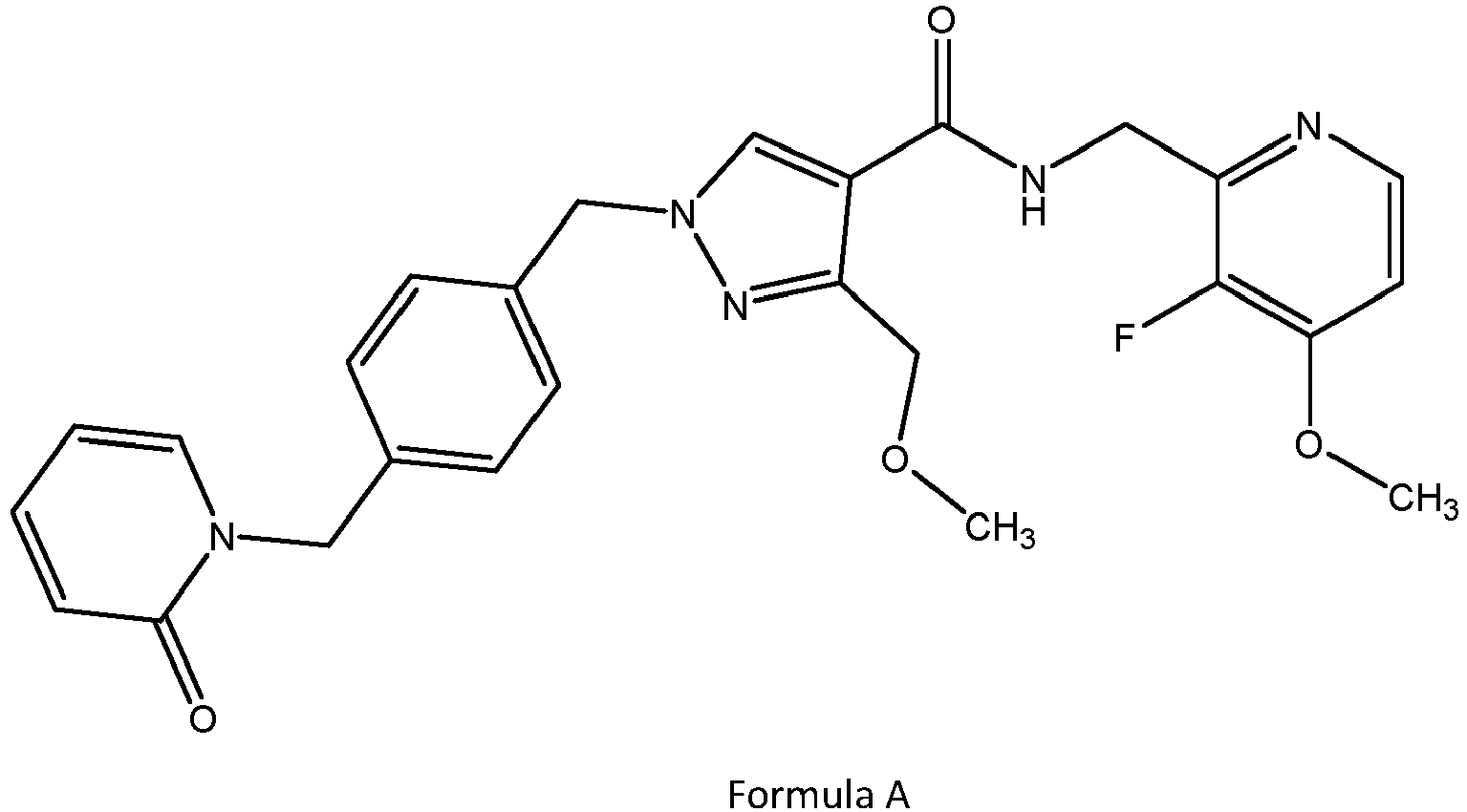
- wherein the solid form of the compound of Formula A exhibits at least the following characteristic X-ray powder diffraction peaks (Cu Kα radiation, expressed in degrees 2θ) at approximately 11.2, 12.5, 13.2, 14.5 and 16.3,
- wherein the term "approximately" means that there is an uncertainty in the measurements of the degrees 2θ of ± 0.3 (expressed in degrees 2θ).
- In particular, the present invention provides a method of preparing an oral solid dosage form comprising a compound of Formula A

- (a) mixing a solid form of the compound of Formula A which exhibits at least the following characteristic X-ray powder diffraction peaks (Cu Kα radiation, expressed in degrees 2θ) at approximately 11.2, 12.5, 13.2, 14.5 and 16.3 with a granulation fluid comprising a binder, and optionally a diluent, a disintegrant, and/or a surfactant;
- (b) granulating the dispersion of step (a) to form granules;
- (c) drying the granules;
- (d) optionally blending the granules of step (b) or (c) with a diluent, an acid, a surfactant, and/or a lubricant to form blended granules; and
- (e) compressing or filling the granules or blended granules into a solid oral dosage form,
- In particular, the present invention provides a method of preparing an oral solid dosage form comprising a compound of Formula A

- (a) dispersing a solid form of the compound of Formula A which exhibits at least the following characteristic X-ray powder diffraction peaks (Cu Kα radiation, expressed in degrees 2θ) at approximately 11.2, 12.5, 13.2, 14.5 and 16.3 in molten lipid excipient;
- (b) loading the molten dispersion into a capsule,
- In particular, the present invention provides a method of preparing an oral solid dosage form comprising a compound of Formula A

wherein the term "approximately" means that there is an uncertainty in the measurements of the degrees 2θ of ± 0.3 (expressed in degrees 2θ). - The present invention provides an oral solid dosage form comprising a solid form (Form 1) of the compound of Formula A, wherein the solid form of the compound of Formula A exhibits at least the following characteristic X-ray powder diffraction peaks (Cu Kα radiation, expressed in degrees 2θ) at approximately:
- (1) 11.2, 12.5, 13.2, 14.5 and 16.3; or
- (2) 11.2, 12.5, 13.2, 14.5, 16.3, 17.4 and 17.9; or
- (3) 11.2, 12.5, 13.2, 14.5, 16.3, 17.4, 17.9, 21.2 and 22.0.
- The term "approximately" means in this context that there is an uncertainty in the measurements of the degrees 2θ of ± 0.3 (expressed in degrees 2θ), preferably ± 0.2 (expressed in degrees 2θ).
- The present invention also provides an oral solid dosage form comprising a solid form of the compound of Formula A, wherein the solid form of the compound of Formula A has an X ray powder diffraction pattern comprising characteristic peaks (expressed in degrees 2θ) at approximately 4.4, 11.2, 12.5, 13.2, 14.5, 16.3, 17.4, 17.9, 21.2, 22.0 and 22.6.
- The present invention also provides an oral solid dosage form comprising a solid form of the compound of Formula A, wherein the solid form of the compound of Formula A has an X-ray powder diffraction pattern substantially the same as that shown in
Figure 1a . - The X-ray powder diffraction pattern of a solid form may be described herein as "substantially" the same as that depicted in a Figure. It will be appreciated that the peaks in X-ray powder diffraction patterns may be slightly shifted in their positions and relative intensities due to various factors known to the skilled person. For example, shifts in peak positions or the relative intensities of the peaks of a pattern can occur because of the equipment used, method of sample preparation, preferred packing and orientations, the radiation source, and method and length of data collection. However, the skilled person will be able to compare the X-ray powder diffraction patterns shown in the figures herein with those of an unknown solid form to confirm the identity of the solid form.
- The skilled person is familiar with techniques for measuring XRPD patterns. In particular, the X-ray powder diffraction pattern of the sample of compound may be recorded using a Philips X-Pert MPD diffractometer with the following experimental conditions:
- Tube anode: Cu;
- Generator tension: 40 kV;
- Tube current: 40 mA;
- Wavelength alpha1: 1.5406 Å;
- Wavelength alpha2: 1.5444 Å;
- Sample: 2 mg of sample under analysis gently compressed on the XRPD zero back ground single obliquely cut silica sample holder.
- The present invention provides an oral solid dosage form comprising a solid form of the compound of Formula A, wherein the solid form of the compound of Formula A exhibits an endothermic peak in its DSC thermograph at 151 ± 3 °C, preferably 151 ± 2 °C, more preferably 151 ± 1 °C.
- The present invention provides an oral solid dosage form comprising a solid form of the compound of Formula A, wherein the solid form of the compound of Formula A has a DSC thermograph substantially the same as that shown in
Figure 3 . - The skilled person is familiar with techniques for measuring DSC thermographs. In particular, the DSC thermograph of the sample of compound may be recorded by
- (a) weighing 5 mg of the sample into an aluminium DSC pan and sealing non-hermetically with an aluminium lid;
- (b) loading the sample into a Perkin-Elmer Jade DSC and holding the sample at 30°C until a stable heat-flow response is obtained while using a 20 cm3/min helium purge;
- (c) heating the sample to a temperature of between 200 and 300°C at a scan rate of 10°C/min and monitoring the resulting heat flow response while using a 20 cm3/min helium purge.
- The present invention provides an oral solid dosage form comprising a solid form of the compound of Formula A, wherein the solid form of the compound of Formula A has an X-ray powder diffraction pattern as described above, and a DSC thermograph as described above.
- The present disclosure also provides an oral solid dosage form comprising a solid form of the compound of Formula A, wherein the solid form of the compound of Formula A has an X-ray powder diffraction pattern substantially the same as that shown in
Figure 6a . - A reference to a particular compound also includes all isotopic variants.
- The term "solid forms" described herein includes crystalline forms. Optionally, the solid forms of the invention are crystalline forms.
- In an embodiment, the amount of the solid form of the compound of Formula A in the solid oral dosage form is between about 0.1 mg and about 1,000 mg, optionally between about 1 mg and about 1,000 mg, between about 5 mg and about 500 mg, between about 8 mg and about 200 mg, or between about 10 mg and about 100 mg.
- The solid form of the compound of Formula A may be present in an amount of between about 1wt% and about 70wt%, optionally between about 5wt% and about 60wt%, or between about 5wt% and about 50wt% based on the total weight of the oral solid dosage form.
- The oral solid dosage form may comprise a binder. Where present, the binder may comprise one or more of: methylcellulose, hydroxypropyl cellulose, hydroxypropyl methylcellulose, povidone, copovidone, gelatin, gum arabic, ethyl cellulose, polyvinyl alcohol, starch, pregelatinized starch, agar, tragacanth and sodium alginate. Preferably, the binder is povidone. Optionally, the binder is Kollidon K25 (a povidone formulation available from BASF Corporation).
- The weight ratio of the compound of Formula A to the binder may be between about 1:0.01 and about 1:1, optionally between about 1:0.03 and about 1:0.5 or between about 1:0.05 and about 1:0.3.
- The binder may be present in an amount of between about 0.1wt% and about 30wt%, optionally between about 0.5wt% and about 10wt%, or between about 1wt% and about 5wt% based on the total weight of the oral solid dosage form.
- Alternatively or in addition, the oral solid dosage form may comprise a diluent. The diluent may comprise one or more of: calcium carbonate, calcium phosphate-dibasic, calcium phosphate-tribasic, calcium sulfate, microcrystalline cellulose, powdered cellulose, dextrates, dextrins, dextrose excipients, fructose, kaolin, lactitol, lactose, lactose monohydrate, mannitol, sorbitol, maltitol, starch, pregelatinized starch and sucrose. Preferably, the diluent is microcrystalline cellulose. Optionally, the diluent is Avicel PH 101 and/or Avicel PH 102 (which are both microcrystalline cellulose excipients available from FMC Corporation).
- The weight ratio of the solid form of the compound of Formula A to the diluent may be between about 1:0.1 and about 1:500, optionally between about 1:0.2 and about 1:100, between about 1:0.5 and about 1:50, between about 1:0.75 and about 1:20, or between about 1:1 and about 1:5.
- The diluent may be present in an amount of between about 1wt% and about 99wt%, optionally between about 10wt% and about 70wt%, or about 20wt% and about 60wt%, or about 40wt% and about 60wt% based on the total weight of the oral solid dosage form.
- Alternatively or in addition, the oral solid dosage form may comprise a disintegrant. The disintegrant may comprise one or more of: carboxymethylcellulose calcium, carboxymethylcellulose sodium, croscarmellose sodium, cross-linked polyvinyl pyrrolidone, sodium starch glycolate, magnesium aluminum silicate, powdered cellulose, microcrystalline cellulose, low-substituted hydroxypropyl cellulose, polacrilin potassium, starch, pregelatinized starch, alginic acid and sodium alginate. Preferably, the disintegrant is croscarmellose sodium. Optionally, the disintegrant is AcDiSol (a croscarmellose sodium formulation available from FMC Corporation).
- The weight ratio of the solid form of the compound of Formula A to the disintegrant may be between about 1:0.01 and about 1:1, optionally between about 1:0.03 and about 1:0.5, between about 1:0.05 and about 1:0.3 or between about 1:0.08 and about 1:0.16.
- The disintegrant may be present in an amount of between about 0.1wt% or about 50wt%, optionally between about 0.5wt% and about 30wt%, or between about 1wt% and about 20wt%, or between about 1wt% and about 10wt% based on the total weight of the oral solid dosage form.
- Alternatively or in addition, the oral solid dosage form may comprise a lubricant. The lubricant may comprise one or more of: magnesium stearate, calcium stearate, glyceryl monostearate, glycerylpalmitostearate, hydrogenated castor oil, hydrogenated vegetable oil, mineral oil, polyethylene glycol, sodium benzoate, sodium lauryl sulfate, sodium stearyl fumarate, stearic acid, talc and zinc stearate. Preferably, the lubricant is magnesium stearate.
- The weight ratio of the solid form of the compound of Formula A to the lubricant may be between about 1:0.001 and about 1:1, optionally between about 1:0.005 and about 1:0.5, between about 1:0.0075 and about 1:0.2 or between about 1:0.01 and about 1:0.1.
- The lubricant may be present in an amount of between about 0.1wt% and about 10wt%, optionally between about 0.2wt% and about 5wt%, or between about 0.5wt% and about 2wt% based on the total weight of the oral solid dosage form.
- Alternatively or in addition, the oral solid dosage form may comprise a glidant. The glidant may comprise one or more of: talc, colloidal silicon dioxide, magnesium trisilicate, powdered cellulose, starch and tribasic calcium phosphate.
- The weight ratio of the solid form of the compound of Formula A to the glidant may be between about 1:0.01 and about 1:1.
- The glidant may be present in an amount of between about 0.1wt% and about 10wt%, optionally between about 0.2wt% and about 5wt%, or between about 0.5wt% and about 2wt% based on the total weight of the oral solid dosage form.
- Alternatively or in addition, the oral solid dosage form may comprise an acid. The acid may comprise one or more of: tartaric acid, maleic acid, succinic acid and citric acid. Preferably the acid is tartaric acid. Alternatively, the acid may be maleic acid.
- The weight ratio of the solid form of the compound of Formula A to the acid may be between about 1:0.1 and about 1:2, optionally between about 1:0.2 and about 1:1.
- The acid may be present in an amount of between about 1wt% and about 40wt%, optionally between about 2wt% and about 30wt%, or about 5wt% and about 20wt% based on the total weight of the oral solid dosage form.
- Alternatively or in addition, the oral solid dosage form may comprise a surfactant. The surfactant may be an ionic surfactant or a non-ionic surfactant. The surfactant may comprise one or more of: sodium lauryl sulfate,
polysorbate 20,polysorbate 40 andpolysorbate 80. Optionally, the surfactant is selected from sodium lauryl sulfate andpolysorbate 80. Optionally, the surfactant is sodium lauryl sulfate. Alternatively, the surfactant may bepolysorbate 80. - The weight ratio of the solid form of the compound of Formula A to the surfactant may be between about 1:0.01 and about 1:1, optionally between about 1:0.03 and about 1:0.5 or between about 1:0.05 and about 1:0.3.
- The surfactant may be present in an amount of between about 1wt% and about 20wt%, optionally between about 0.5wt% and about 10wt%, or between about 1wt% and about 5wt% based on the total weight of the oral solid dosage form.
- The oral solid dosage form may comprise a lipid excipient. The lipid excipient may comprise one or more of: sucrose fatty acid esters, such as sucrose stearate, sucrose palmitate, sucrose laurate, sucrose behenate, sucrose oleate, sucrose erucate, and the like, and mixtures thereof; phospholipid derivatives, phosphatidyl derivatives, glycosylceramides derivatives, fatty acid derivatives, nonionic surfactants, vitamin E tocopheryl succinate polyethylene glycol derivatives (including D-α-Tocopherol polyethylene glycol succinate (TPGS)), glyceryl monooleate, Gelucire® series surfactants (which include, for example, Gelucire 44/14, Gelucire 33/01, and
Gelucire 50/13), and glyceride derivatives. Optionally, the lipid excipient is Gelucire 44/14 and/or D-α-Tocopherol polyethylene glycol succinate (TPGS). Preferably, the lipid excipient is D-α-Tocopherol polyethylene glycol succinate (TPGS). Alternatively, the lipid excipient is Gelucire 44/14. - The melting point of the lipid excipient may be greater than about 25 °C, greater than about 30 °C, greater than about 35 °C or greater than about 40 °C. Optionally, the melting point of the lipid excipient may be greater than about 35 °C.
- The melting point of the lipid excipient may be less than about 100 °C, less than about 70 °C, less than about 60 °C or less than about 50 °C. Optionally, the melting point of the lipid excipient may be less than about 50 °C.
- The weight ratio of the solid form of the compound of Formula A to the lipid excipient may be between about 1:0.1 and about 1:100, optionally between about 1:0.5 and about 1:50, between about 1:1 and about 1:50, or between about 1:1 and about 1:20.
- The lipid excipient may be present in an amount of between about 10wt% and about 99wt%, optionally between about 50wt% and about 95wt%, or between about 60wt% and about 90wt% based on the total weight of the oral solid dosage form.
- The oral solid dosage form of the present invention may be in the form of a capsule. The capsule shell may be made from gelatin, hydroxypropyl methylcellulose or starch. Optionally, the capsule shell is made from gelatin. Optionally, the capsule shell is made from hydroxypropyl methylcellulose.
- Alternatively, the oral solid dosage form of the present invention may be in the form of a tablet.
- The oral solid dosage form of the present invention may comprise a coating, which may be in the form of a film. The coating may be an enteric coating. An enteric coating is insoluble at the strongly acid pH of the stomach, but soluble in the less acidic conditions in the small intestine. The coating may have mass/area of between about 1 mg/cm2 and about 10 mg/cm2, optionally between about 2 mg/cm2 and about 8 mg/cm2, or between about 3 mg/cm2 and about 7 mg/cm2.
- The coating may have a mass of between about 10 mg and about 100 mg, optionally between about 20 mg and about 80 mg, or between about 30 mg and about 70 mg.
- The mass of the coating per surface area of a
size 0 dosage form, optionally in the form of a capsule, may be between about 10 mg and about 100 mg, optionally between about 20 mg and about 80 mg, or between about 30 mg and about 70 mg. - The enteric coating may comprise an enteric polymer which may comprise one or more of: shellac, cellulose acetate, cellulose acetate phthalate, hydroxypropyl methycellulose phthalate, trimellitate, polyvinyl acetate phthalate, or methacrylate-based polymers such as Eudragit L, Eudragit L100, Eudragit S, Eudragit S100, Eudragit L30D, and Eudragit L30-D55. Preferably, the enteric coating is Eudragit L30-D.55.
- The enteric coating may also comprise a plasticiser. The plasticiser may comprise one or more of: triethyl citrate, dibutyl phthalate, polyethylene glycols, propylene glycol, diethylphthalate, acetyl triethyl citrate. Preferably, the plasticiser is triethyl citrate.
- The oral solid dosage form of the present invention may comprise a film wrapped around the core of the dosage form. Example of suitable film materials include HPMC, gelatin and Eudragit polymers. Preferably, the film material is HPMC.
- The oral solid dosage form of the present invention may comprise one or more further active ingredients.
- The present invention also provides a method of preparing an oral solid dosage form comprising a compound of Formula A, comprising the steps of
- (a) mixing a solid form of the compound of Formula A which exhibits at least the following characteristic X-ray powder diffraction peaks (Cu Kα radiation, expressed in degrees 2θ) at approximately 11.2, 12.5, 13.2, 14.5 and 16.3 with a granulation fluid comprising a binder, and optionally a diluent, a disintegrant, and/or a surfactant;
- (b) granulating the dispersion of step (a) to form granules;
- (c) drying the granules;
- (d) optionally blending the granules of step (b) or (c) with a diluent, an acid, a surfactant, and/or a lubricant to form blended granules; and
- (e) compressing or filling the granules or blended granules into a solid oral dosage form.
- The granulation fluid may further comprise water.
- The drying in step (c) may be performed at a temperature greater than about 45 °C, preferably greater than about 55 °C. The drying in step (c) may be performed at a temperature of between about 45 °C and about 90 °C, preferably between about 50 °C and about 80 °C.
- In step (e), the granules or blended granules may be compressed into a solid oral dosage form in the form of a tablet.
- The present invention also provides a method of preparing an oral solid dosage form comprising a compound of Formula A, comprising the steps of
- (a) dispersing a crystalline form of the compound of Formula A which exhibits at least the following characteristic X-ray powder diffraction peaks (Cu Kα radiation, expressed in degrees 2θ) at approximately 11.2, 12.5, 13.2, 14.5 and 16.3 in molten lipid excipient; and
- (b) loading the molten dispersion into a capsule.
- The present invention also provides a method of preparing an oral solid dosage form comprising a compound of Formula A, comprising loading a capsule with a crystalline form of the compound of Formula A which exhibits at least the following characteristic X-ray powder diffraction peaks (Cu Kα radiation, expressed in degrees 2θ) at approximately 11.2, 12.5, 13.2, 14.5 and 16.3.
- It is to be understood that the components used in the methods of the present invention (e.g. binder, diluent, disintegrant, surfactant, acid, and lipid excipient) are the same components as described for the oral solid dosage forms of the present invention, and any definitions and/or limitations described for these components may apply equally to the components used in the methods of the present invention.
- The present invention also provides an oral solid dosage form obtainable by any one of the methods of the present invention.
- The oral solid dosage form of the present invention has a number of therapeutic applications, particularly in the treatment of diseases or conditions mediated by plasma kallikrein.
- Accordingly, the present invention provides an oral solid dosage
form comprising Form 1 of the compound of Formula A, for use in therapy. - The present invention also provides an oral solid dosage form as described herein for use in a method of treatment of a disease or condition mediated by plasma kallikrein.
- The present disclosure also provides a method of treatment of a disease or condition mediated by plasma kallikrein, said method comprising administering to a mammal in need of such treatment an oral solid dosage form as described herein.
- The present invention also provides a use of an oral solid dosage form as described herein in the manufacture of a medicament for the treatment of a disease or condition mediated by plasma kallikrein.
- In an aspect, the disease or condition mediated by plasma kallikrein is selected from impaired visual acuity, diabetic retinopathy, retinal vascular permeability associated with diabetic retinopathy, diabetic macular edema, hereditary angioedema, retinal vein occlusion, diabetes, pancreatitis, cerebral haemorrhage, nephropathy, cardiomyopathy, neuropathy, inflammatory bowel disease, arthritis, inflammation, septic shock, hypotension, cancer, adult respiratory distress syndrome, disseminated intravascular coagulation, blood coagulation during cardiopulmonary bypass surgery, and bleeding from post-operative surgery. In a preferred embodiment, the disease or condition mediated by plasma kallikrein is diabetic macular edema. In another preferred embodiment, the disease or condition mediated by plasma kallikrein is hereditary angioedema.
- Alternatively, the disease or condition mediated by plasma kallikrein may be selected from retinal vascular permeability associated with diabetic retinopathy, diabetic macular edema and hereditary angioedema. Alternatively, the disease or condition mediated by plasma kallikrein may be retinal vascular permeability associated with diabetic retinopathy or diabetic macular edema.
- In the context of the present invention, references herein to "treatment" include references to curative, palliative and prophylactic treatment, unless there are specific indications to the contrary. The terms "therapy", "therapeutic" and "therapeutically" should be construed in the same way.
- The oral solid dosage form of the present invention may be administered alone or in combination with one or more other pharmaceutical actives. In this regard, the oral solid dosage form may further comprise another pharmaceutical active ingredient. Alternatively, the oral dosage form of the invention may be co-administered (concurrently, consecutively or sequentially) with one or more further separate dosage forms incorporating the other pharmaceutical active(s).
- In another aspect, the oral solid dosage form of the present invention may be administered in combination with laser treatment of the retina.
- For administration to human patients, the total daily dose of the compound of Formula A is typically in the range about 0.1 mg and about 10,000 mg, or between about 1 mg and about 5000 mg, or between about 10 mg and about 1000 mg depending, of course, on the mode of administration.
- The total daily dose may be administered in single or divided doses and may, at the physician's discretion, fall outside of the typical range given herein. These dosages are based on an average human subject having a weight of about 60kg to 70kg. The physician will readily be able to determine doses for subjects whose weight falls outside this range, such as infants and the elderly.
- The oral solid dosage form of the present invention is intended to be administered orally. Oral administration may involve swallowing, so that the compound enters the gastrointestinal tract, and/or buccal, lingual, or sublingual administration by which the compound enters the blood stream directly from the mouth.
- The invention will now be illustrated by the following non-limiting examples. In the examples the following figures are presented:
- Figure 1a:
- X-ray powder diffraction pattern of
Form 1 of the compound of Formula A (Example 1). - Figure 1b:
- X-ray powder diffraction pattern of
Form 1 of the compound of Formula A (Example 2). - Figure 1c:
- X-ray powder diffraction pattern of
Form 1 of the compound of Formula A (Example 3). - Figure 2:
- STA of
Form 1 of the compound of Formula A (Example 1). - Figure 3:
- DSC thermograph of
Form 1 of the compound of Formula A (Example 1). - Figure 4:
- Gravimetric vapour sorption isotherms (adsorption and desorption) of
Form 1 of the compound of Formula A (Example 1). - Figure 5:
- X-ray powder diffraction pattern (top) of the compound of Formula A following slurry of
Form 1 with 90:10 IPA:water. The bottom X-ray powder diffraction pattern is ofForm 1 as a reference (Example 1). - Figure 6a:
- X-ray powder diffraction pattern of
Form 3 of the compound of Formula A (Example 4a). - Figure 6b:
- X-ray powder diffraction pattern of
Form 5 of the compound of Formula A (Example 4c). - Figure 6c:
- DSC thermograph of
Form 5 of the compound of Formula A (Example 4c). - Figure 6d:
- Particle size distribution of
Form 5 of the compound of Formula A. - Figure 6e:
- Gravimetric vapour sorption isotherms (adsorption and desorption) of
Form 5 of the compound of Formula A (Example 4c). - Figure 7:
- X-ray powder diffraction patterns of
Form 1 of the compound of Formula A during a 25 °C / 60%RH stability study at 0 days (top), 1 month (middle) and 3 months (bottom). - Figure 8:
- X-ray powder diffraction patterns of
Form 1 of the compound of Formula A during a 40 °C / 75%RH stability study at 0 days (top), 1 month (middle) and 3 months (bottom). - Figure 9:
- Dissolution curves of the TPGS filled capsule in 0.1 M HCl and
pH 3 buffer, initially and after storage at 25 °C and 40 °C. - Figure 10:
- Dissolution curves of the Gelucire 44/14 filled capsule in 0.1 M HCl and
pH 3 buffer, initially and after storage at 25 °C and 40 °C. - In the following examples, the following abbreviations and definitions are used:
Aq Aqueous solution DCM Dichloromethane DMF N,N-Dimethylformamide DMSO Dimethyl sulfoxide DSC Differential Scanning Calorimetry EtOAc Ethyl Acetate HATU 2-(3H-[1,2,3]triazolo[4,5-b]pyridin-3-yl)-1,1,3,3-tetramethylisouronium hexafluorophosphate(V) Hrs Hours HOBt Hydroxybenzotriazole IPA 2-Propanol/Propan-2-ol/Iso-propanol LCMS Liquid chromatography mass spectrometry Me Methyl MeCN Acetonitrile MeOH Methanol Min Minutes MS Mass spectrum NMR Nuclear magnetic resonance spectrum - NMR spectra were recorded at a frequency of 400MHz unless otherwise indicated Pet. Ether Petroleum ether fraction boiling at 60-80°C Ph Phenyl STA Simultaneous Thermal Analysis SWFI Sterile water for injection Rt room temperature THF Tetrahydrofuran TFA Trifluoroacetic acid XRPD X-ray powder diffraction - All reactions were carried out under an atmosphere of nitrogen unless specified otherwise.
- 1H NMR spectra were recorded on a Bruker (400MHz) or on a JEOL (400MHz) spectrometer with reference to deuterium solvent and at rt.
- Molecular ions were obtained using LCMS which was carried out using a Chromolith Speedrod RP-18e column, 50 x 4.6 mm, with a
linear gradient 10% to 90% 0.1% HCO2H/MeCN into 0.1% HCO2H/H2O over 13 min, flow rate 1.5 mL/min, or using Agilent, X-Select, acidic, 5-95% MeCN/water over 4 min. Data was collected using a Thermofinnigan Surveyor MSQ mass spectrometer with electospray ionisation in conjunction with a Thermofinnigan Surveyor LC system. - Alternatively, molecular ions were obtained using LCMS which was carried out using an
Agilent Poroshell 120 EC-C18 (2.7µm, 3.0 x 50mm) column with 0.1% v/v Formic acid in water [eluent A]; MeCN [eluent B]; Flow rate 0.8mL/min and 1.5 minutes equilibration time between samples, gradient shown below. Mass detection was afforded withAPI 2000 mass spectrometer (electrospray).Gradient: Time (min) Eluent A (%) Eluent B (%) 0.00 95 5 0.20 95 5 2.00 5 95 3.00 5 95 3.25 95 5 3.50 95 5 - Where products were purified by flash chromatography, 'silica' refers to silica gel for chromatography, 0.035 to 0.070 mm (220 to 440 mesh) (e.g. Merck silica gel 60), and an applied pressure of nitrogen up to 10 p.s.i accelerated column elution. Reverse phase preparative HPLC purifications were carried out using a Waters 2525 binary gradient pumping system at flow rates of typically 20 mL/min using a Waters 2996 photodiode array detector.
- All solvents and commercial reagents were used as received.
- Chemical names were generated using automated software such as the Autonom software provided as part of the ISIS Draw package from MDL Information Systems or the Chemaxon software provided as a component of MarvinSketch or as a component of the IDBS E-WorkBook.
- X-Ray Powder Diffraction patterns were collected on a Philips X-Pert MPD diffractometer and analysed using the following experimental conditions (Method A), unless otherwise specified:
- Tube anode: Cu
- Generator tension: 40 kV
- Tube current: 40 mA
- Wavelength alpha1: 1.5406 Å
- Wavelength alpha2: 1.5444 Å
- Start angle [2θ]: 4
- End angle [2θ]: 40
- Continuous scan
- Approximately 2 mg of sample under analysis was gently compressed on the XRPD zero back ground single obliquely cut silica sample holder. The sample was then loaded into the diffractometer for analysis.
- Where specified, X-Ray Powder Diffraction patterns were collected using the following method (Method B):
X-ray powder diffraction studies were performed using a Bruker AXS D2 PHASER (D2-205355) in Bragg-Brentano configuration, equipment #2353. A Cu anode at 30kV, 10 mA, sample stage standard rotating (5/min) with beam stop and monochromatisation by a Kβ-filter (0.59% Ni) are used. The slits that are used are fixed divergence slits 1.0mm (=0.61°), primary axial Soller slit 2.5° and secondary axial Soller slit 2.5°. The detector is a linear detector LYNXEYE with receiving slit 5° detector opening. The standard sample holder (0.1mm cavity in (510) silicon wafer) has a minimal contribution to the background signal. The measurement conditions: scan range 5-45° 2θ,sample rotation 5 rpm, 0.5s/step, 0.010°/step, 3.0mm detector slit; and all measuring conditions are logged in the instrument control file. The software used for data collection is Diffrac.Commander v4.0. Data analysis is performed using Diffrac.Eva V4.1 evaluation software. No background correction or smoothing is applied to the patterns. - DSC data were collected using the following method: Approximately 5 mg of each sample was weighed into an aluminium DSC pan and sealed non-hermetically with an aluminium lid. The sample was then loaded into a Perkin-Elmer Jade DSC and held at 30°C. Once a stable heat-flow response was obtained, the sample was then heated to a temperature between 200 and 300°C at a scan rate of 10°C/min and the resulting heat flow response was monitored. A 20 cm3/min helium purge was used. Prior to analysis, the instrument was temperature and heat flow verified using an indium standard.
- Gravimetric Vapour Sorption (GVS) data were collected using the following method: Approximately 10 mg of sample was placed into a wire-mesh vapour sorption balance pan and loaded into an 'IgaSorp' vapour sorption balance (Hiden Analytical Instruments). The sample was then dried by maintaining a 0% humidity environment until no further weight change was recorded. Subsequently, the sample was then subjected to a ramping profile from 0 - 90 % RH at 10 % RH increments, maintaining the sample at each step until equilibration had been attained (99% step completion). Upon reaching equilibration, the % RH within the apparatus was ramped to the next step and the equilibration procedure repeated. After completion of the sorption cycle, the sample was then dried using the same procedure. The weight change during the sorption/desorption cycles were then monitored, allowing for the hygroscopic nature of the sample to be determined.
- Simultaneous Thermal Analysis (STA) data were collected using the following method: Approximately 5 mg of sample was accurately weighed into a ceramic crucible and it was placed into the chamber of Perkin-
Elmer STA 600 TGA/DTA analyzer at ambient temperature. The sample was then heated at a rate of 10°C/min, typically from 25°C to 300°C, during which time the change in weight was monitored as well as DTA signal. The purge gas used was nitrogen at a flow rate of 20 cm3/min. - 4-(Chloromethyl)benzylalcohol (5.0 g, 31.93 mmol) was dissolved in acetone (150 mL). 2-hydroxypyridine (3.64 g, 38.3 mmol) and potassium carbonate (13.24 g, 95.78 mmol) were added and the reaction mixture was stirred at 50 °C for 3 hrs after which time the solvent was removed in vacuo and the residue taken up in chloroform (100 mL). This solution was washed with water (30 mL), brine (30 mL), dried (Na2SO4) and evaporated in vacuo. The residue was purified by flash chromatography (silica),
eluent 3% MeOH / 97% CHCl3, to give a white solid identified as 1-(4-hydroxymethyl-benzyl)-1H-pyridin-2-one (5.30g, 24.62mmol, 77% yield).
[M+Na]+ = 238 - 1-(4-Hydroxymethyl-benzyl)-1H-pyridin-2-one (8.45 g, 39.3 mmol), dry DCM (80 mL) and triethylamine (7.66 ml, 55.0 mmol) were cooled in an ice bath. Methanesulfonyl chloride (3.95 ml, 51.0 mmol) was added and stirred in ice bath for 15 min. The ice bath was removed and stirring continued at rt temperature overnight. The reaction mixture was partitioned between DCM (100 mL) and saturated aqueous NH4Cl solution (1.00 mL). The aqueous layer was extracted with further DCM (2 x 50 mL) and the combined organics washed with brine (50 mL), dried over Na2SO4, filtered and concentrated to give 1-(4-chloromethyl-benzyl)-1H-pyridin-2-one (8.65 g, 36.6 mmol, 93 % yield) as a pale yellow solid.
[MH]+ = 234.1 - Potassium carbonate (519 mg, 3.76 mmol) was added to a solution of methyl 3-(methoxymethyl)-1H-pyrazole-4-carboxylate (320 mg, 1.88 mmol; CAS no. 318496-66-1 (synthesised according to the method described in
WO2012/009009 )) and 1-(4-(chloromethyl)benzyl)pyridin-2(1H)-one (527 mg, 2.26 mmol) in DMF (5 mL) and heated at 60 °C overnight. The reaction mixture was diluted with EtOAc (50 mL) and washed with brine (2 x 100 mL), dried over magnesium sulfate, filtered and reduced in vacuo. The crude product was purified by flash chromatography (40 g column, 0-100% EtOAc in isohexanes) to afford two regioisomers. The second isomer off the column was collected to afford methyl 3-(methoxymethyl)-1-(4-((2-oxopyridin-1(2H)-yl)methyl)benzyl)-1H-pyrazole-4-carboxylate (378 mg, 1.01 mmol, 53.7 % yield) as a colourless gum.
[MH]+ = 368.2 - To methyl 3-(methoxymethyl)-1-(4-((2-oxopyridin-1(2H)-yl)methyl)benzyl)-1H-pyrazole-4-carboxylate (3.77 g, 10.26 mmol) in THF (5 mL) and MeOH (5 mL) was added 2M NaOH solution (15.39 ml, 30.8 mmol) and stirred at rt overnight. 1M HCl (50 mL) was added and extracted with EtOAc (50 mL). The organic layer was washed with brine (50 mL), dried over magnesium sulfate, filtered and reduced in vacuo to give 3-(methoxymethyl)-1-(4-((2-oxopyridin-1(2H)-yl)methyl)benzy!)-1H-pyrazole-4-carboxylic acid (1.22 g, 3.45 mmol, 33.6 % yield) as a white powder.
[MH]+ = 354.2 - To a large microwave vial, copper (I) cyanide (1.304 g, 14.56 mmol) was added to a solution of 2-bromo-3-fluoro-4-methoxypyridine (1 g, 4.85 mmol) in DMF (5 mL). The reaction vial was sealed and heated to 100 °C for 16 hrs. The reaction mixture was diluted with water (20 mL) and EtOAc (20 mL). The thick suspension was sonicated and required additional water (40 mL) and EtOAc (2 x 50 mL) with sonication to break-up the solid precipitated. The combined layers were filtered through a plug of celite and the organic layer isolated, washed with brine (50 mL), dried over magnesium sulfate, filtered and the solvent removed under reduced pressure to give a pale green solid identified as the desired compound 3-fluoro-4-methoxy-pyridine-2-carbonitrile (100 mg, 0.578 mmol, 12 % yield)
- 3-Fluoro-4-methoxy-pyridine-2-carbonitrile (100 mg, 0.578 mmol) was dissolved in anhydrous methanol (10 mL, 247 mmol) and nickel chloride hexahydrate (14 mg, 0.058 mmol) was added followed by di-tert-butyl dicarbonate (255 mg, 1.157 mmol). The resulting pale green solution was cooled in an ice-salt bath to -5 °C and then sodium borohydride (153 mg, 4.05 mmol) was added portionwise maintaining the
reaction temperature ~0 °C. The deep brown solution was left to stir at 0 °C and slowly allowed to warm to rt and then left to stir at rt for 3 hrs. The reaction mixture was evaporated to dryness at 40 °C to afford a black residue which was diluted with DCM (10 mL) and washed with sodium hydrogen carbonate (10 mL). An emulsion formed so the organics were separated via a phase separating cartridge and concentrated. The crude liquid was purified by chromatography eluting with EtOAc / iso-Hexane to afford the title compound, (3-fluoro-4-methoxy-pyridin-2-ylmethyl)-carbamic acid tert-butyl ester as a clear yellow oil (108 mg, 62 % yield)
[MH]+= 257 - (3-Fluoro-4-methoxy-pyridin-2-ylmethyl)-carbamic acid tert-butyl ester (108mg, 0.358mmol) was taken up in iso-propyl alcohol (1 mL) and then HCl (6N in iso-propyl alcohol) (1 mL, 0.578 mmol) was added at rt and left to stir at 40 °C for 2 hrs. The reaction mixture was concentrated under reduced pressure and then triturated with ether, sonicated and then decanted to give a cream coloured solid (75 mg, 55% yield) identified as C-(3-fluoro-4-methoxy-pyridin-2-yl)-methylamine hydrochloride salt.
[MH]+= 157 - 3-(Methoxymethyl)-1-(4-((2-oxopyridin-1(2H)-yl)methyl)benzyl)-1H-pyrazole-4-carboxylic acid (825 mg, 2.34 mmol) and C-(3-fluoro-4-methoxy-pyridin-2-yl)-methylamine hydrochloride salt (450 mg, 2.34 mmol) were dissolved in DCM while cooling to 0°C. 1-Ethyl-3-(3-dimethylaminopropyl)carbodiimide hydrochloride (627.0 mg, 3.27 mmol), HOBt (378.8 mg, 2.80 mmol) and triethylamine (1.63 mL, 1182 mmol) were added while stirring, the mixture allowed to warm to rt and stirring continued for 20 hrs. Chloroform (50 mL) was added, the mixture was washed with saturated NaHCO3(aq) and reduced in vacuo. The crude material was purified by chromatography eluting with methanol/DCM. The solvent was removed in vacuo and the resulting solid triturated with diethyl ether. The resulting solids were collected by filtration to afford the title compound.
[MH]+ = 492.0
NMR (CD3OD) δ: 3.41 (3H, s), 4.03 (3H, s), 4.65 (2H, s), 4.72 (2H, d, J=2.3Hz), 5.24 (2H, s), 5.37 (2H, s), 6.44 (1H, td, J = 1.4, 6.8Hz), 6.62 (1H, d, J = 9.0Hz), 7.18-7.22 (1H, m), 7.31-7.38 (4H, m), 7.56-7.60 (1H, m), 7.75 (1H, dd, J = 1.9, 7.1Hz), 8.18 (1H, s), 8.27 (1H, d, J = 5.6Hz) ppm. - An XRPD diffractogram of the compound of Formula A (Form 1) is shown in
Figure 1a . - Peak position table:
No. Pos. [°2Th.] Rel. Int. [%] 1 4.436 32.36 2 5.0471 58.74 3 10.2255 43.07 4 11.2061 48.44 5 12.0101 16.4 6 12.5494 37.17 7 13.165 67.26 8 14.4984 38.94 9 15.8919 23.54 10 16.2983 34.56 11 17.4492 36.63 12 17.8564 71.49 13 18.6888 21.9 14 20.285 26.12 15 21.1598 100 16 22.04 87.76 17 22.5857 36.38 18 23.4408 14.33 19 24.3045 31.11 20 25.1655 78.97 21 25.3728 93.91 22 26.4946 56.79 23 27.991 76.91 24 28.7495 22.99 25 30.7611 13.4 26 32.413 17.2 27 37.2144 14.13 2.8 38.1171 14.14 - The STA data for
Form 1 are shown inFigure 2 . - The DSC data for
Form 1 are shown inFigure 3 . - The GVS data for
Form 1 are listed in the table below and shown inFigure 4 .%-RH %-Wt(dry basis) 0.0335 0.047222 9.9791 0.229954 20.0169 0.354118 30.0091 0.712554 39.9998 0.825004 49.991 1.206867 59.9808 1.698837 70.0195 1.912025 80.0136 2.186122 90.0039 3.226288 85.0063 2.546901 75.0151 2.115841 64.9759 1.86517 54.9837 1.684781 44.9954 1.525476 35.0052 1.017107 25.0135 0.70084 15.0203 0.501709 4.9801 0.126875 0.0335 0.000368 - Form 1 (20 mg) was suspended in 90/10 IPA/water (200µL or 300µL) and shaken at ambient temperature for 72 hrs. The supernatant was evaporated rather than filtered due to the small volume and the resulting solid was examined by XRPD (
Figure 5 ). The resulting XRPD (Figure 5 ) was different to that ofFigure 1a which indicated that the free base probably has a tendency to form hydrate(s). - Form 1 (10mg) was weighed into a glass vial and water was added in 100µL portions up to 3mL then 1mL portions thereafter. Solubility was assessed visually following a brief period of equilibration.
-
Form 1 did not give any indication it was dissolving at all in 20mL water (<< 0.5mg/mL). - 3-(Methoxymethyl)-1-(4-((2-oxopyridin-1(2H)-yl)methyl)benzyl)-1H-pyrazole-4-carboxylic acid (825 mg, 2.34 mmol) and C-(3-fluoro-4-methoxy-pyridin-2-yl)-methylamine hydrochloride salt (450 mg, 2.34 mmol) were dissolved in DCM while cooling to 0°C. 1-Ethyl-3-(3-dimethylaminopropyl)carbodiimide hydrochloride (627.0 mg, 3.27 mmol), HOBt (378.8 mg, 2.80 mmol) and triethylamine (1.63 mL, 1182 mmol) were added while stirring, the mixture allowed to warm to rt and stirring continued for 20 hrs. Chloroform (50 mL) was added, the mixture was washed with saturated NaHCO3(aq) and reduced in vacuo. The crude material was purified by chromatography eluting with methanol/DCM. The resulting solid was dissolved in hot MeCN, allowed to cool and precipitate, and the resulting solids were collected by filtration to afford the title compound as a white solid (1.30 mg, 11% yield).
- An XRPD diffractogram (recorded using Method B) of the compound of Formula A (Form 1) is shown in
Figure 1b . The XRPD diffractogram (Figure 1b ) of the isolated solids confirmed that they were of the same solid form as Form 1 (Example 1) (Figure 1a ).Peak position table: No. Pos. [°2Th.] Rel. Int. [%] 1 4.3928 34.22 2 11.108 43.43 3 12.4938 29.35 4 13.1205 36.63 5 13.3366 100 6 14.4197 49.36 7 15.5175 14.68 8 15.8379 17.4 9 16.2139 51.86 10 17.3752 44.76 11 17.7813 72.85 12 18.6993 39.41 13 20.2369 23.49 14 21.126 95.26 15 22.012 39.31 16 22.5384 38.64 17 23.3774 25.27 18 24.2866 80.45 19 24.7288 52.68 20 25.0623 70.87 21 25.9156 37.33 22 26.5143 48.56 23 27.9517 49.02 24 28.7252 17.67 25 30.7541 34.12 26 34.8799 20.8 27 37.1548 15.95 28 38.1305 28 - 3-(Methoxymethyl)-1-(4-((2-oxopyridin-1(2H)-yl)methyl)benzyl)-1H-pyrazole-4-carboxylic acid (61 g, 0.173 mol) was dissolved in DMF (400 mL) and 1,1'-carbonyldiimidazole (27.99 g, 0.173 mol) was added portion wise. Once the addition was complete, the reaction was heated to 50 °C for 2 hrs. C-(3-fluoro-4-methoxy-pyridin-2-yl)-methylamine (26.95 g, 0.17 3mol) was added to the reaction mixture portion wise. The reaction was heated to 50 °C overnight. The reaction was cooled to rt and added dropwise to a 3:1 mixture of water and saturated NaHCO3(aq) (4000 mL). The resulting suspension was stirred for 30 min before isolating the solids by filtration. The solids were washed with water (2x500 mL) before drying in a vacuum oven to give 119 g of the crude product. The crude product was combined with two other separate batches (starting with 0.173 mol and 0.0874 mol of the acid starting material respectively) and slurried together in IPA (1400 mL) and heated to reflux. Additional portions of IPA were added until all of the material had dissolved at reflux (total of 2000 mL IPA added). The solution was held at reflux for 30 min before it was cooled to rt. The mixture was cooled further with an ice/water bath for 30 min before the product was collected by filtration. The solids were washed with IPA and dried to give 167.2 g of the title product (78.5% yield).
[MH]+ = 491.9 - NMR (CD3OD) spectrum conformed to the NMR spectrum of Form A.
- An XRPD diffractogram (recorded using Method B) of the isolated solids (
Figure 1c ) confirmed that they were of the same solid form as Form 1 (Example 1 and Example 2) (Figures 1a and1b ).
Peak position table:No. Pos. [°2Th.] Rel. Int. [%] 1 11.153 44.44 2 12.539 22.25 3 13.273 100.00 4 14.476 66.10 5 15.556 14.81 6 15.818 14.67 7 16.218 34.47 8 17.487 48.43 9 17.762 88.32 10 18.699 20.94 11 20.255 22.68 12 21.098 83.19 13 21.971 29.63 14 22.453 35.33 15 23.351 12.22 16 24.197 19.69 17 24.801 25.67 18 25.165 99.15 19 25.813 31.62 20 26.474 20.37 21 27.947 14.19 22 28.092 13.22 23 28.843 12.51 24 30.724 15.50 25 34.938 11.91 - A sample of
Form 1 was packed in double polyethylene bags and sealed in a HDPE bottle and stored at conditions of 25 °C / 60%RH. The sample was reanalysed after 1 month and 3 months by XRPD (using Method B). The data is shown inFigure 7 . No change in the XRPD diffractogram was observed when the sample was stored at 25 °C / 60%RH after either 1 month or 3 months. - Further tests on the sample of
Form 1 stored at 25 °C / 60%RH were carried out as described in Table 1:Table 1 Testing intervals rest Initial 1 month 3 months Appearance Off-white solid Off-white solid Off-white solid Identity by retention ratio 1.00 1.00 1.00 Purity by HPLC (area %) 99.70 99.62 99.70 Total impurities (area %) 0.30 0.38 0.30 Assay by HPLC (on an anhydrous and solvent free basis) (% w/w) 101.0 99.5 99.6 HPLC assay (on an "as is" basis) (% w/w) 100.9 99.4 99.5 Water by Karl Fischer analysis (% w/w) < 0.1 < 0.1 < 0.1 Solid form of compound A by XRPD Conforms to reference standard (Form 1) Conforms to reference standard (Form 1) Conforms to reference standard (Form 1) DSC Tpeak (°C) 152.9 152.4 152.2 DSC Tonset (°C) 151.3 151.1 150.8 - A second sample of
Form 1 was packed in double polyethylene bags and sealed in a HDPE bottle and stored under accelerated stability conditions of 40 °C / 75%RH. The sample was reanalysed after 1 month and 3 months by XRPD (using Method B). The data is shown inFigure 8 . No change in the XRPD diffractogram was observed when the sample was stored at 40 °C / 75%RH after either 1 month or 3 months. - Further tests on the sample of
Form 1 stored at 40 °C / 75%RH were carried out as described in Table 2:Table 2 Testing intervals Test Initial 1 month 3 months Appearance Off-white solid Off-white solid Off-white solid Identity by retention ratio 1.00 1.00 1.00 Purity by HPLC (area %) 99.70 99.57 99.71 Total impurities (area %) 0.30 0.43 0.29 Assay by HPLC (on an anhydrous and solvent free basis) (% w/w) 101.0 99.5 100.0 HPLC assay (on an "as is" basis) (% w/w) 100.9 99.4 99.9 Water by Karl Fischer analysis (% w/w) < 0.1 < 0.1 0.1 Solid form of compound A by XRPD Conforms to reference standard (Form 1) Conforms to reference standard (Form 1) Conforms to reference standard (Form 1) DSC Tpeak (°C) 152.9 152.3 152.5 DSC Tonset (°C) 151.3 151.1 150.6 - A suspension of N-[(3-fluoro-4-methoxypyridin-2-yl)methyl]-3-(methoxymethyl)-1-({4-[(2-oxopyridin-1-yl)methyl]phenyl}methyl)pyrazole-4-carboxamide (30 mg) in 50/50 methanol/water (100 µL) was matured by temperature cycling for 2 days. The resulting solids were isolated to afford N-[(3-fluoro-4-methoxypyridin-2-yl)methyl]-3-(methoxymethyl)-1-({4-[(2-oxopyridin-1-yl)methyl]phenyl}methyl)pyrazole-4-carboxamide (Form 3).
- An XRPD diffractogram of N-[(3-fluoro-4-methoxypyridin-2-yl)methyl]-3-(methoxymethyl)-1-({4-[(2-oxopyridin-1-yl)methyl]phenyl}methyl)pyrazole-4-carboxamide (Form 3) is shown in
Figure 6a .
Peak position table:No. Pos. [°2Th.] Rel. Int. [%] 1 5.0236 100 2 10.0456 33.5 3 10.1526 38.94 4 12.6705 6.8 5 14.8188 2.96 6 15.2588 2.89 7 16.3621 5.53 8 17.5026 3.79 9 19.792 2.31 10 20.0456 3.56 11 20.6393 2.71 12 24.1662 2.7 13 25.6434 1.49 14 26.8451 8.57 15 27.6821 1.13 16 35.3459 3.38 - A suspension of N-[(3-fluoro-4-methoxypyridin-2-yl)methyl]-3-(methoxymethyl)-1-({4-[(2-oxopyridin-1-yl)methyl]phenyl}methyl)pyrazole-4-carboxamide (500 mg) in 50/50 methanol/water (2.5 mL) was matured by temperature cycling from 20°C to 50°C for 24 hours. The resulting solids were isolated to afford N-[(3-fluoro-4-methoxypyridin-2-yl)methyl]-3-(methoxymethyl)-1-({4-[(2-oxopyridin-1-yl)methyl]phenyl}methyl)pyrazole-4-carboxamide (Form 5).
- A solution of N-[(3-fluoro-4-methoxypyridin-2-yl)methyl]-3-(methoxymethyl)-1-({4-[(2-oxopyridin-1-yl)methyl]phenyl}methyl)pyrazole-4-carboxamide (500 mg) in 50/50 methanol/water (20 mL) was prepared. The solution was allowed to evaporate to dryness under vacuum to afford N-[(3-fluoro-4-methoxypyridin-2-yl)methyl]-3-(methoxymethyl)-1-({4-[(2-oxopyridin-1-yl)methyl]phenyl}methyl)pyrazole-4-carboxamide (Form 5).
- An XRPD diffractogram of N-[(3-fluoro-4-methoxypyridin-2-yl)methyl]-3-(methoxymethyl)-1-({4-[(2-oxopyridin-1-yl)methyl]phenyl}methyl)pyrazole-4-carboxamide (Form 5) obtained from Example 4C is shown in
Figure 6b . This XRPD diffractogram was obtained using Method B above.
Peak position table of most prominent peaks:No. Pos. [°2Th.] Rel. Int. [%] 1 8.53 11.56 2 9.38 100 3 11.29 3.80 4 12.19 10.37 5 12.81 16.63 6 14.08 23.24 7 16.60 5.03 8 16.98 5.91 9 18.27 5.82 10 18.91 2.87 11 21.06 3.45 12 21.25 5.03 13 22.25 2.80 14 23.59 2.73 15 25.63 7.35 16 27.58 3.03 -
Form 5 is less stable thanForms polymorph Form 3, over time. Performing an XRPD measurement onForm 5 resulted inForm 3. - TGA/DSC studies were performed using a Mettler Toledo TGA/DSC1 Stare System, equipment #1547, auto-sampler equipped, using pin-holed Al-crucibles of 40 µl. Measurement conditions: 5 min 30.0 °C, 30.0 - 350.0 °C with 10 °C/min., N2 flow of 40 ml/min. The software used for instrument control and data analysis is STARe v12.10. The TGA/DSC data for
Form 5 are shown inFigure 6c - Particle size distribution studies were performed using a Malvern Instruments Mastersizer, equipment #1712. The Mastersizer used a 300RF lens range of 0.05 µm - 900 mm. Polydisperse was used as analysis model. A background measurement was performed before each sample measurement, the background scan time was 12 seconds (12000 snaps). Each sample was dispersed in Multipar G, refractive index of 1.42. The obscuration range on sample dispersion was between 10%-30%. Each sample was measured 6 times at t=0 and t=30 minutes and the measurement scan time was 10 seconds (10000 snaps). The targeted stirring speed of the sample dispersion unit was 2000±10 rpm. Data collection and evaluation was performed using Mastersizer S Version 2.19 software. The resulting particle size distribution analysis of
polymorph Form 5 is shown infigure 6d . -
Form 5 is hygroscopic with a mass uptake of 2.3%, as determined by Gravimetric Vapour Sorption (GVS) studies. The GVS studies were performed using a Surface Measurement Systems Ltd. DVS-1 No Video, equipment #2126. The sample was loaded into a balance pan, typically 20-30 mg, and equilibrated at 0% RH. After the material was dried, the RH was increased with 10% per step for 1 hour per increment, ending at 95% RH. After completion of the sorption cycle, the sample was dried using the same method. The software used for data collection was DVSWin v3.01 No Video. Data analysis was performed using DVS Standard Analysis Suite v6.3.0 (Standard). The resulting GVS is shown inFigure 6e . - The data for
Form 5 is summarised in the following table.DSC (Tpeak °C) TGA (mass loss %) Particle Size Distribution GVS (mass uptake %) Dv(10) (µm) Dv(50) (µm) Dv(90) (µm) 75.6 (melt) 1.11 (40°C-80°C) 4.38 13.3 29.4 23 88.7 (recryst) 0.62 (80°C-100°C) 151.9 (melt) 0.42 (100°C-170°C) -
Form 1 of N-[(3-fluoro-4-methoxypyridin-2-yl)methyl]-3-(methoxymethyl)-1-({4-[(2-oxopyridin-1-yl)methyl]phenyl}methyl)pyrazole-4-carboxamide as prepared in Example 3 was passed through a 1.0 mm sieve. 100 mg of the resulting powder was then weighed into asize 0 gelatin capsule, and the capsule closed. - The flow and density characteristics, and particle size distribution of the powder prepared by passing
Form 1 of N-[(3-fluoro-4-methoxypyridin-2-yl)methyl]-3-(methoxymethyl)-1-({4-[(2-oxopyridin-1-yl)methyl]phenyl}methyl)pyrazole-4-carboxamide as prepared in Example 3 through a 1.0 mm sieve were determined as follows. The range of humidity during the characterisation was 42 - 65%. - The density (tapped and bulk) of the API was determined in duplicate according to USP [616] 2012 using tapped density apparatus. Carr's Index and Hausner ratio values were calculated from the tapped and bulk density figures recorded in accordance with USP [1174] 2010.
- The mean results obtained from the duplicate measurements and calculations of bulk density, tap density, Carr's index and Hausner ratio are summarised in Table 3.
Table 3 Result Mean Test Rep 1 Rep 2 Bulk Density (g/cm3) 0.18 0.18 0.18 Tap Density (g/cm3) 0.25 0.26 0.26 Carr's index (%) 27.5 32.4 30.0 Hausner ratio 1.38 1.48 1.43 - A Hausner ratio of less than 1.25 and a Carr's index value of between 5 to 15 % indicate good/excellent flow properties (M.E. Aulton, Aulton's pharmaceutics the design and manufacture of medicines, 3rd Ed, Churchill Livingstone Elsevier, Hungary, 2007, p356). The results in Table 3 for
Form 1 indicate poor flow characteristics based on the Carr's Index and Hausner ratio. - Determination of powder flow (grams/second) of the powder prepared by passing
Form 1 of N-[(3-fluoro-4-methoxypyridin-2-yl)methyl]-3-(methoxymethyl)-1-({4-[(2-oxopyridin-1-yl)methyl]phenyl}methyl)pyrazole-4-carboxamide as prepared in Example 3 through a 1.0 mm sieve was performed in duplicate using 'flow through an orifice apparatus' (25 mm and 10 mm in duplicate). The measurements were first performed without agitation of the flow meter. If no flow occurred, the test was repeated with gentle and repetitive tapping of the flow meter with a steel spatula (using a consistent strength each time). The results obtained for powder flow through a 25 mm and 10 mm orifice are shown in Table 4.Table 4 Test Result - Without Tapping Result - With Tapping Rep 1 Rep 2 Rep 1Rep 2 Flow (25 mm) (g/s) DNF* DNF* 1.33 1.84 Flow (10 mm) (g/s) DNF* DNF* DNF* DNF* *DNF = Did not flow - The powder of
Form 1 of the compound of Formula A did not flow through either a 25 mm or a 10 mm orifice without tapping and only the former with tapping, confirming the result obtained for the Carr's Index and Hausner ratio (Table 3). The powder ofForm 1 of the compound of Formula A stuck to the spatula and sieves even though the humidity was relatively high. This behaviour may be impacted by humidity conditions. - The bulk density value measured for
Form 1 of the compound of Formula A is low which means it is difficult to achieve high doses using simple powder blends (either directly encapsulated or compressed into tablets) because there will be limited available volume for the excipients that are needed to ensure adequate flow (within the constraints of suitable dose size). - The particle size distribution of the powder prepared by passing
Form 1 of N-[(3-fluoro-4-methoxypyridin-2-yl)methyl]-3-(methoxymethyl)-1-({4-[(2-oxopyridin-1-yl)methyl]phenyl}methyl)pyrazole-4-carboxamide as prepared in Example 3 through a 1.0 mm sieve was determined in duplicate by sieve analysis using a sieve shaker set at amplitude of 1 mm for 5 mins. The sieve sizes used were 1 mm, 710 µm, 500 µm, 355 µm , 250 µm, 125 µm , 63 µm and pan. - The results obtained for particle size determination are shown in Table 5.
Table 5 Sieve (µm) % of particles retained Rep 1Rep 2 1000 8.2 5.1 710 6.1 4.7 500 4.5 7.7 355 12.4 15.7 250 20.7 24.8 125 39.2 42.1 63 8.7 2.5 Base Pan 0.3 0.1 - The material retained in the higher aperture meshes appeared to be soft agglomerates. The fact that material was retained in the 1.0 mm mesh after the powder of
Form 1 of the compound of Formula A had already been screened through a 1.0 mm mesh supports this observation and implies that the powder ofForm 1 of the compound of Formula A spontaneously agglomerates. The majority ofForm 1 was retained on the 125 and 250 µm sieves. -
Form 1 of N-[(3-fluoro-4-methoxypyridin-2-yl)methyl]-3-(methoxymethyl)-1-({4-[(2-oxopyridin-1-yl)methyl]phenyl}methyl)pyrazole-4-carboxamide as prepared in Example 3 was passed through a 1.0 mm sieve. 10 mg of the resulting powder was then weighed into asize 0 gelatin capsule, and the capsule closed. -
Form 1 of N-[(3-fluoro-4-methoxypyridin-2-yl)methyl]-3-(methoxymethyl)-1-({4-[(2-oxopyridin-1-yl)methyl]phenyl}methyl)pyrazole-4-carboxamide as prepared in Example 3 was passed through a 1.0 mm sieve. - Tocopherol polyethylene glycol succinate (TPGS) (172 g) was heated to 65 °C using a water bath then Form 1 of the compound of Formula A (28 g) added to the molten TPGS with mixing using a Silverson mixer (
Form 1 was added over 26 minutes with 4 minutes additional mixing, Silverson mixer set to 5400 RPM). The temperature of the mixture was adjusted to 55 °C for encapsulation. An aliquot of the mixture was drawn up using a Gilson pipette (set to 710 µL), dispensed into asize 0 gelatin capsule and allowed to cool to room temperature. - The drug loading of
Form 1 of the compound of Formula A in the TPGS was 14.0% (w/w), and the fill weight of the mixture in the capsule was 719.0 mg. The dose forForm 1 of the compound of Formula A in the capsule was 100.7 mg. - The results of dissolution testing of the resulting capsule in 0.1 M HCl and
pH 3 buffer, initially and after storage at 25 °C and 40 °C are shown inFigure 9 . - The dissolution testing was performed according to Ph. Eur. 2.9.3 using a Distek dissolution apparatus using dissolution media of 0.1 M HCl, or
pH 3 citric acid - phosphate buffer. Dissolution is run at 37 °C with paddle speed of 50 rpm. Samples (2 mL) are collected through a 4 µm cannula filter and processed through a 0.2 µm PVDF syringe filter into a UPLC vial for off line analysis. UPLC analysis is performed using 1.5 µL injection of sample on to a Waters CSH C18, 2.1 x 75 mm, 1.7 µm column with UV detection and an acetonitrile: water gradient over 2.5 minutes. -
Form 1 of N-[(3-Fluoro-4-methoxypyridin-2-yl)methyl]-3-(methoxymethyl)-1-({4-[(2-oxopyridin-1-yl)methyl]phenyl}methyl)pyrazole-4-carboxamide as prepared in Example 3 was passed through a 1.0 mm sieve. - Gelucire 44/14 (172 g) was heated to 65 °C using a water bath then Form 1 of the compound of Formula A (28 g) added to the molten Gelucire 44/14 with mixing using a Silverson mixer (
Form 1 was added over 17 minutes with 5 minutes additional mixing, Silverson mixer set to 5400 RPM). The temperature of the mixture was adjusted to 55 °C for encapsulation. An aliquot of the mixture was drawn up using a Gilson pipette (set to 710 µL), dispensed into asize 0 gelatin capsule and allowed to cool to room temperature. - The drug loading of
Form 1 of the compound of Formula A in the Gelucire 44/14 was 14.0% (w/w), and the fill weight of the mixture in the capsule was 713.0 mg. The dose forForm 1 of the compound of Formula A in the capsule was 99.8 mg. - The results of dissolution testing of the resulting capsule in 0.1 M HCl and
pH 3 buffer, initially and after storage at 25 °C and 40 °C are shown inFigure 10 . - The dissolution testing was performed according to Ph. Eur. 2.9.3 using a Distek dissolution apparatus using dissolution media of 0.1 M HCl, or
pH 3 citric acid - phosphate buffer. Dissolution is run at 37 °C with paddle speed of 50 rpm. Samples (2 mL) are collected through a 4 µm cannula filter and processed through a 0.2 µm PVDF syringe filter into a UPLC vial for off line analysis. UPLC analysis is performed using 1.5 µL injection of sample on to a Waters CSH C18, 2.1 x 75 mm, 1.7 µm column with UV detection and an acetonitrile: water gradient over 2.5 minutes. -
Form 1 of N-[(3-Fluoro-4-methoxypyridin-2-yl)methyl]-3-(methoxymethyl)-1-({4-[(2-oxopyridin-1-yl)methyl]phenyl}methyl)pyrazole-4-carboxamide as prepared in Example 3 was passed through a 1.0 mm sieve. - Tocopherol polyethylene glycol succinate (TPGS) (172 g) was heated to 78.4 °C using a water bath then Form 1 of the compound of Formula A (28 g) added to the molten TPGS (
Form 1 was added over 26 minutes with 4 minutes additional mixing, Silverson mixer set to 5400 RPM). The temperature of the mixture was adjusted to 55 °C, then subjected to high-shear homogenisation (174 min @ 1200 RPM then 230 min @ 2600 RPM). An aliquot of the mixture was drawn up using a Gilson pipette (set to 710 µL), dispensed into asize 0 HPMC capsule and allowed to cool to room temperature. - The drug loading of
Form 1 of the compound of Formula A in the TPGS was 14.0% (w/w), and the fill weight of the mixture in the capsule was 717.8 mg. The dose forForm 1 of the compound of Formula A in the capsule was 100.5 mg. - Four granule formulations (referred to as WGA WGB, WGC and WGD) were prepared according to the following method using the amounts described in Table 6 and Table 7:
Primary granulation fluid was prepared by adding the components according to Table 6 into a mixing vessel (250 g for WGA and 200 g for WGB, WGC and WGD). The primary granulation fluid was stirred until homogeneous using either a magnetic flea, or an overhead stirrer. - For each sublot,
Form 1 of the compound of Formula A, Avicel PH101 and AcDiSol were added to a Multipro high shear blender and blended at high speed for 5 minutes. While continuing to blend at high speed, the primary granulation fluid was poured into the mixture over the course of another 5 minutes. - If material stuck to the side of the Multipro high shear blender, the process was interrupted and the material scraped down the vessel before recommencing the mixing & fluid addition.
- At the end of the addition of the primary granulation fluid, the wet granule was mixed for another minute. Secondary granulation fluid was then slowly added with mixing over the course of another 5 minutes.
- The resulting wet granule was passed through a 4.0 mm mesh. The wet granule was then placed into a stainless steel tray and dried in an oven overnight at the specified temperature. The dried granules were then passed through a 1 mm mesh and allowed to stand under ambient conditions for 2 hours to equilibrate. Granule formulations WGA WGB, WGc and WGD were isolated.
Table 6 - Granulation fluid formulation Compositions (% w/w) Formulation Code WGA WGB WGC WGD Povidone (Kollidon K25) 6.67% 6.06% 6.67% 6.06% Tween 80 - 6.06% - 6.06% Water 93.33% 87.88% 93.33% 87.88% Total 100.00% 100.00% 100.00% 100.00% Table 7 - Granule formulation g per batch Granule Formulation WGA WGB WGC WGD Solid form of the compound of Formula A 66.66 50.00 100.00 50.00 Microcrystalline cellulose (Avicel PH 101) 87.34 65.51 131.00 65.51 Croscarmellose sodium (AcDiSol) 8.00 6.00 12.00 6.00 Primary Granulation Fluid (Table 6) 90.00 74.25 135.00 74.25 Additional Secondary Granulation Fluid (Deionised Water) Sublot 1: 80.2 Sublot 2: 81.5 60.30 51.20 Nil Overnight drying temperature 40 ° C 40 ° C 60 ° C 60 °C Number of Sublots 2 1 1 1 - The resulting WGA WGB, WGC and WGD granules were characterised, and the results shown in Table 8. The methods used to measure each of the parameters are described below.
- The LOD of the granules was determined using a 5 g sample of the granules using a Sartorius Moisture Balance at 105 °C.
- The density (tapped and bulk) of the granules was determined in duplicate according to USP [616] 2012 using tapped density apparatus. Carr's Index and Hausner ratio values were calculated from the tapped and bulk density figures recorded in accordance with USP [1174] 2010.
- Determination of powder flow (grams/second) of the granules was performed in duplicate using 'flow through an orifice apparatus' (25 mm and 10 mm in duplicate). The measurements were first performed without agitation of the flow meter. If no flow occurred, the test was repeated with gentle and repetitive tapping of the flow meter with a steel spatula (using a consistent strength each time).
- The particle size distribution of the granules was determined in duplicate by sieve analysis using a sieve shaker set at amplitude of 1 mm for 5 mins. The sieve sizes used were 1 mm, 710 µm, 500 µm , 355 µm, 250 µm, 125 µm , 63 µm and pan.
Table 8 - Granule characterisation data Granule formulation WGA WGB WGC WGD Solid form of the compound of Formula A Form 3Form 1Form 1Form 1LOD (% w/w) Sublot 1: 3.46 3.33 1.51 1.12 Sublot 2: 2.78 Bulk Density (g/mL) 0.51 0.50 0.42 0.59 Tapped Density (g/mL) 0.584 0.603 0.50 0.69 Carr's Index 12.7 16.9 14.8 14.8 Hausner Ratio 1.15 1.21 1.18 1.18 Flow through 25 mm Orifice (g/s) 60 75 49 69 Flow through 10 mm Orifice (g/s) 8 7 5 25 Range of Humidity During Tests (% RH) 35-43 56-57 40-47 36-40 Retention on Sieves (% w/w) 1.0 mm 0.8 0.8 3.0 2.3 710 µm 8.4 13.6 13.3 22.6 500 µm 19.0 15.5 7.6 28.0 355 µm 37.6 26.1 6.7 22.5 250 µm 23.5 28.4 10.7 10.4 125 µm 10.1 14.4 47.1 10.8 63 µm 0.9 1.0 11.0 4.0 Base Pan 0.1 0.4 1.2 0.3 - The physical characterisation data shows that all the batches of granules were dry (i.e. < 3.5% w/w) with good flow properties - the values for the Carr's Index and Hausner Ratio are both low, and the mass flow through the orifice was significant, even at 10 mm. Drying the granules at a temperature of 60 °C reduced the water content of the granules compared to the granules dried at 40 °C. The granules were dense (bulk density > 0.4 g/mL) and granular (the majority of the material retained on the 250 and 355 µm meshes during sieve analysis) and so are suitable for tabletting.
- Eight tabletting formulations (referred to as T1 to T5, T1A, T2A and T5A, 95 g of each) were prepared according to the following method using the amounts described in Table 9:
The required amount of granule and each of the extra-granular excipients (except for the magnesium stearate) were dispensed into the blending vessel of an Erweka AR401 blender. The mixture was blended at 15 RPM for 15 minutes. Magnesium stearate was added to the blending vessel and the mixture blended for a further 5 minutes at 15 RPM.Table 9 - Tablet formulation Composition (% w/w) Tablet formulation code T1 T2 T3 T4 T5 T1A T2A T5A Granule formulation used WGA WGA WGA WGA WGB WGC WGC WGD Intra-granular Solid form of the compound of Formula A 33.33 33.33 33.33 33.33 Microcrystalline cellulose (Avicel PH 101) 43.67 43.67 43.67 43.67 Croscarmellose sodium (AcDiSol) 4.00 4.00 4.00 4.00 Povidone (Kollidon K25) 3.00 3.00 3.00 3.00 Tween 803.00 3.00 Granule Total 84.00 84.00 84.00 87.00 87.00 84.00 84.00 87.00 Extra-granular Microcrystalline cellulose (Avicel PH 102) 15.00 12.00 12.00 15.00 12.00 Tartaric acid 15.00 15.00 Maleic acid 15.00 Sodium lauryl sulphate 3.00 Magnesium stearate 1.00 1.00 1.00 1.00 1.00 1.00 1.00 1.00 Total 100.00 100.00 100.00 100.00 100.00 100.00 100.00 100.00 - Each resulting mixture was then pressed into tablets according to the following method:
A Manesty F3 press was used to press the tablets. The press was set to 60 TPM with no tooling, then set up with round, normal concave tooling with a diameter of 8.3 mm, and an overload setting of 11 kN. The press was set up to produce tablets at a target of 300 mg weight against the overload spring. The cam setting was adjusted to the setting shown in Table 10. - 250 tablets were prepared of each tablet formulation. At the start, middle and end of the tabletting process, the thickness, weight and hardness of 5 units were measured.
- The physical characterisation data of the tablet formulations T1-T5, T1A, T2A and T5A are shown in Table 10.
- The data in Table 10 were generated using the following standard procedures:
- Hardness: Ph. Eur. 2.9.8
- Friability: Ph. Eur. 2.9.7
- Disintegration: Ph. Eur. 2.9.1
- The physical stability of the tablet formulations after storage at 25 °C and 40 °C for 4 weeks is compared to the initial data (Table 10) in Table 11. Formulations T1, T4 and T5 experience little or no change from initial.
Table 11 - Comparison of physical characteristics of the tablet batches before and after 4 week storage Batch Reference Timepoint Weight (mg) Tablet thickness (mm) Hardness (N) Disintegration Times in 0.1M HCl (min:sec) First* Last* T1 Initial 294.4 4.82 77.0 07:07 08:22 4 wk at 25°C 300.3 4.87 66.6 05:20 09:48 4 wk at 40°C 289.1 4.85 60.7 06:24 08:52 T2 Initial 303.7 4.86 56.1 07:13 08:15 4 wk at 25°C 308.3 4.96 54.6 11:54 13:38 4 wk at 40°C 308.2 4.81 58.3 10:52 13:04 T3 Initial 312.4 5.24 33.7 06:27 07:08 4 wk at 25°C 316.7 5.32 45.6 16:03 >30 min 4 wk at 40°C 309.8 5.43 125.2 > 30 min T4 Initial 300.6 4.92 62.1 03:03 03:41 4 wk at 25°C 289.4 4.96 52.5 03:11 06:02 4 wk at 40°C 297.0 5.02 60.2 05:07 06:24 T5 Initial 303.4 4.97 59.6 04:08 05:25 4 wk at 25°C 304.1 5.01 65.7 03:33 04:08 4 wk at 40°C 304.0 5.01 67.8 02:10 03:23 * Indicates the times for the first tablet and last tablet to disintegrate from the n=3 tested for each timepoint. The disintegration times for the initial timepoints were taken as the average from the tablets at the start of tableting and those at the end of tableting. - The content uniformity of the dosage forms was determined using the following standard procedure: Eur. Ph. 2.9.40 (Uniformity of Dosage Units). Results are shown in Table 12.
Table 12 - Content uniformity Sample T1 T1A T2 T2A T3 T4 T5 T5A Example 6 (TPGS) Example 8 (TPGS) Example 7 (Gelucire) Mean (%) 105.6 99.1 101.9 98.9 101.3 101.5 105.8 105.6 95.6 101.0 99.7 Standard Deviation (%) 1.8 1.3 1.9 1.1 3.8 2.5 1.8 1.4 5.6 0.8 2.0 AV 8.5 3.1 4.9 2.6 9.2 6.1 8.5 6.8 16.3 1.8 2.9 Minimum (%) 101.5 97.6 98.8 97.8 97.7 97.2 104.2 101.5 87.3 100.1 97.7 Maximum (%) 107.4 102.3 105.2 101.0 109.1 104.2 110.3 106.6 104.1 102.2 103.0 Pass/Fail Pass Pass Pass Pass Pass Pass Pass Pass Fail Pass Pass - Tablet formulations T1A, T2A and T5A were selected for enteric coating.
The coating and physical testing of the T1A, T2A and T5A tablets was performed using an Aeromatic Strea-1 fluid bed dryer at controlled temperature range and average spray rate of 1.2 grams per minute to achieve a final weight gain of appropriately 50 mg coating.
The coating material is an aqueous suspension of Eudragit L30-D55 plasticised by Plasacryl HTP20 (at 33% of dry polymer substance containing triethyl citrate (TEC) as plasticiser and glycerol monostearate as anti-tacking agent). Components are manufactured by Evonik. - A coating formulation was prepared using the amounts described in Table 13. The Eudragit L30-D55 was added to the deionised water with overhead stirring. The Plasacryl HTP20 was slowly added with stirring taking care not to aerate the liquid. The mixture was stirred for at least a further 10 minutes until the mixture was homogeneous. The suspension was passed through a 500 µm mesh.
- The T1A, T2A and T5A tablets were sprayed with the coating formulation using an Aeromatic Strea-1 fluid bed dryer using the parameters described in Table 14 to produce coated tablets CT1A, CT2A and CT5A.
Table 13 - Coating formulation Ingredient % (w/w) Mass (g) Component Component % (w/w) Coating solids composition after drying (% w/w) Eudragit L30-D55 51.28 153.84 Dry polymer 13.85 69.2 Sodium lauryl sulfate 0.36 1.8 Polysorbate 801.18 5.9 Water 35.90 - Plasacryl HTP20 23.08 69.23 TEC and glycerol monostearate 4.62 23.1 Water 18.46 - Deionised water 25.64 76.93 Water 25.64 - Table 14 Coated tablet Tablet Measured Weight Gain (mg/Unit) Overall Coating Efficiency Spray Rate (g/min) Coat Time (min) Product Temperature range (°C) Atomising air range (bar) Initial (Max) Min Mean CT1A T1A 48.6 30.4 2.75 0.6 1.2 73 22 - 35 1.2 - 1.5 CT2A T2A 47.1 45.6 2.2 1.1 1.3 40 23.0 - 32.6 1.4 - 1.5 CT5A T5A 49.0 37.2 2.2 0.8 1.1 63 21.7 - 32.2 1.3 - 1.6 - The enteric coat had to meet the following criteria in the two stages of disintegration/dissolution testing (based on Ph. Eur. 2.9.1):
- 1.
pH 3 citrate buffer: (a) no disintegration of the dose form within 2 hours and (b) < 10% of API release during dissolution testing within 2 hours. - 2. pH 6 phosphate buffer: the dose form should disintegrate within one hour.
- The dissolution testing was performed according to Ph. Eur. 2.9.3 using a Distek dissolution apparatus using dissolution media of
pH 3 citric acid - phosphate buffer. Dissolution is run at 37 °C with paddle speed of 50 rpm. Samples (2 mL) are collected through a 4 µm cannula filter and processed through a 0.2 µm PVDF syringe filter into a UPLC vial for off line analysis. UPLC analysis is performed using 1.5 µL injection of sample on to a Waters CSH C18, 2.1 x 75 mm, 1.7 µm column with UV detection and an acetonitrile: water gradient over 2.5 minutes.Table 15 Coated tablet Measured Weight Gain (mg/Unit) 2hr Disintegration Test at pH 3: Result and Observations Disintegration Time (min) at pH 6 CT1A 48.6 6/6 Pass 17-19 CT2A 47.1 6/6 Pass 3/6 Fail Times: 44, 46, 55, > 1 hr CT5A 49.0 6/6 Pass 31-40 - The coat weight applied (48.6 mg) was close to the target (49.5 mg), and no defects in the coat were apparent. These tablets passed the
pH 3 test (no rupture within 2 hours) and the pH 6 test where disintegration was complete within 19 minutes. Six tablets were tested for dissolution inpH 3, but no dissolved API was detected within six hours. Hence these tablets passed specification of <10% dissolved within 2 hours. - The coat weight applied (47.1 mg) was close to the target (49.5 mg), and no defects in the coat were apparent. These tablets passed the
pH 3 test (no rupture within 2 hours). However three of the six tablets failed the pH 6 test (i.e. disintegration time > 1 hour) with the remaining three tablets giving significantly slower disintegration than CT1A. While the functional coat had apparently fully disintegrated at 23-24 minutes in pH 6, large fragments of the core remained after 1 hour of testing. It should be noted that the disintegration of the pre-coated cores is very fast in all disintegration media, and so the coat must be causing the slow disintegration of the cores in pH 6. - The most likely explanation for the overly slow disintegration of the tablet cores is that the enteric polymer had penetrated the cores either during coating or during disintegration testing and had become neutralised by the presence of the tartaric acid. In its neutral form, the polymer is insoluble and may act as a binder preventing disintegration of the cores.
- The coat weight applied (49.0 mg) was close to the target (49.5 mg), and no defects in the coat were apparent. These tablets passed the
pH 3 test (no rupture within 2 hours) and the pH 6 test where disintegration was complete within 31-40 minutes. Six tablets were tested for dissolution in pH3, but no dissolved API was detected within six hours. Hence these tablets passed specification of <10% API dissolved within 2 hours. - The capsules of Example 6 were hand-banded using HPMC 606 ethanol/water solution, and subsequently coated with an aqueous dispersion of Eudragit L30-55 in a Caleva mini coater to achieve a 5.5 mg/cm2 polymer weight gain. The capsules were coated in two batches of 14 capsules each. The coating solution composition is provided in Table 16.
- First, triethyl citrate was pre-mixed with water at high sheer speed for 10 minutes, then the Eudragit suspension was added into the solution and gently mixed using a Heidolph mixer. The mixture was passed through a 0.5 mm sieve prior to use and continuously stirred during coating. The coating parameters are provided in Table 17.
Table 16 - Composition of Eudragit L30-55 coating solution Function Ingredient Quantity based on dry polymer (%) Quantity to be weighed (g) Polymer Eudragit L.30-55 - 41.67 Plasticiser Triethyl citrate 10.0 1.25 Water - 50.83 Table 17 - Enteric coating parameters Batch Size 14 size 0 capsulesAgitator (Hz) 12.2 Fan speed (m/s) 16.0 Inlet air temperature (ºC) 33 Flow rate of coating solution (mL/min) 0.1∼0.2 Atomising air pressure (bar) 0.8∼0.9 Drying 1h at 38 ºC - The granule formulations WGA and WGA" were prepared according to the following method using the amounts described in Table 18 and Table 19:
Primary granulation fluid was prepared by adding the components according to Table 18 into a mixing vessel (600 g). The primary granulation fluid was stirred until homogeneous using either a magnetic flea, or an overhead stirrer. - For each sublot,
Form 1 of the compound of Formula A, Avicel PH101 and AcDiSol were added to a Multipro high shear blender and blended at high speed for 5 minutes. While continuing to blend at high speed, the primary granulation fluid was poured into the mixture over the course of another 5 minutes. If material stuck to the side of the Multipro high shear blender, the process was interrupted and the material scraped down the vessel before recommencing the mixing & fluid addition. - At the end of the addition of the primary granulation fluid, the wet granule was mixed for another minute. Secondary granulation fluid was then slowly added with mixing over the course of another 5 minutes.
- The resulting wet granule was passed through a 4.0 mm mesh. The wet granule was then placed into a stainless steel tray and dried in an oven overnight at 60 °C. The dried granules were then passed through a 1 mm mesh and allowed to stand under ambient conditions overnight to equilibrate. Granule formulations WGA' and WGA" were isolated.
Table 18 - Granulation fluid formulation Compositions (% w/w) Formulation Code WGA' WGA" Povidone (Kollidon K25) 6.67% 6.67% Water 93.33% 93.33 % Total 100% 100% Table 19 - Granule formulation g per batch Granule Formulation WGA' WGA" Solid form of the compound of Formula A 100.00 100.00 Microcrystalline cellulose (Avicel PH 101) 176.00 176.00 Croscarmellose sodium (AcDiSol) 12.00 6.00 Primary Granulation Fluid (Table 18) 135.00 135.00 Additional Secondary Granulation Fluid (Deionised Water) 55.1 55.1 Number of Sublots 1 1 - The WGA' and WGA" granules were characterised, and the results shown in Table 20. The methods used to measure each of the parameters are described below.
- The LOD of the granules was determined using a 5 g sample of the granules using a Sartorius Moisture Balance at 105 °C.
- The density (tapped and bulk) of the granules was determined in duplicate according to USP [616] 2012 using tapped density apparatus. Carr's Index and Hausner ratio values were calculated from the tapped and bulk density figures recorded in accordance with USP [1174] 2010.
- Determination of powder flow (grams/second) of the granules was performed in duplicate using 'flow through an orifice apparatus' (25 mm and 10 mm in duplicate). The measurements were first performed without agitation of the flow meter. If no flow occurred, the test was repeated with gentle and repetitive tapping of the flow meter with a steel spatula (using a consistent strength each time).
- The particle size distribution of the granules was determined in duplicate by sieve analysis using a sieve shaker set at amplitude of 1 mm for 5 mins. The sieve sizes used were 1 mm, 710 µm, 500 µm, 355 µm , 250 µm , 125 µm, 63 µm and pan.
Table 20 Granule formulation WGA' WGA" Solid form of the compound of Formula A Form 1Form 1LOD (% w/w) 2.10 2.01 LOD after 2 h equilibration (% w/w) 2.87 2.40 Bulk Density (g/mL) 0.424 0.562 Tapped Density (g/mL) 0.503 0.654 Carr's Index 15.6 14.1 Hausner Ratio 1.19 1.17 Flow through 25 mm Orifice (g/s) 51 79 Flow through 10 mm Orifice (g/s) 5 8 Range of Humidity During Tests (% RH) 53-62.5 53-62.5 Retention on Sieves (% w/w) 1.0 mm 0.4 0.2 710 µm 6.5 1.7 500 µm 5.4 3.6 355 µm 4.3 7.6 250 µm 5.7 27.0 125 µm 41.9 49.0 63 µm 30.6 9.9 Base Pan 5.3 1.4 - Two tabletting formulations (referred to as T1A' and T1A", 150 g of each) were prepared according to the following method using the amounts described in Table 21:
The required amount of granule and each of the extra-granular excipients (except for the magnesium stearate) were dispensed into the blending vessel of an Erweka AR401 blender. The mixture was blended at 15 RPM for 15 minutes. Magnesium stearate was added to the blending vessel and the mixture blended for a further 5 minutes at 15 RPM.Table 21 - Tablet formulation Composition (% w/w) Tablet formulation code T1A' T1A" Granule formulation used WGA' WGA" Intra-granular Solid form of the compound of Formula A 33.33 33.33 Microcrystalline cellulose (Avicel PH 101) 58.67 58.67 Croscarmellose sodium (AcDiSol) 4.00 2.00 Povidone (Kollidon K25) 3.00 3.00 Granule Total 99.00 97.00 Extra-granular Croscarmellose sodium (AcDiSol) - 2.00 Magnesium stearate 1.00 1.00 Total 100.00 100.00 - Each resulting mixture was then pressed into tablets according to the following method:
A Manesty F3 press was used to press the tablets. The press was set to 40 TPM with no tooling, then set up with round, normal concave tooling with a diameter of 8.3 mm, and an overload setting as shown in Table 22. The press was set up to produce tablets at a target of 300 mg weight against the overload spring. The cam setting was adjusted to the setting shown in Table 22. - 100 tablets were prepared of each tablet formulation. At the start, middle and end of the tabletting process, the thickness, weight and hardness of 5 units were measured.
- The data in Table 22 were generated using the following standard procedures:
- Hardness: Ph. Eur. 2.9.8
- Friability: Ph. Eur. 2.9.7
- Disintegration: Ph. Eur. 2.9.1
- The T1A' tablets were produced between 77 ± 15 N (low hardness), and 162 ± 20 N (high hardness). All set of tablets were close to target weight with good RSD, acceptable friability (<0.5 %) and good disintegration times in water (<15 minutes).
- During the tabletting of the T1A" batch, it was not possible to achieve tablets to meet the lower hardness target and the tablets produced were not any harder than 40 kN. The tablets appeared soft. T1A' (successfully compressed with granule having high level of fines) and T1A" (not compressed from granule with low levels of fines) only differed in terms of the point of addition of the AcDiSol.
- The ability of the compound of Formula A to inhibit plasma kallikrein may be determined using the following biological assays:
- Plasma kallikrein inhibitory activity in vitro was determined using standard published methods (see e.g. Johansen et al., Int. J. Tiss. Reac. 1986, 8, 185; Shori et al., Biochem. Pharmacol., 1992, 43, 1209; Stürzebecher et al., Biol. Chem. Hoppe-Seyler, 1992, 373, 1025). Human plasma kallikrein (Protogen) was incubated at 25 °C with the fluorogenic substrate H-DPro-Phe-Arg-AFC and various concentrations of the test compound. Residual enzyme activity (initial rate of reaction) was determined by measuring the change in optical absorbance at 410nm and the IC50 value for the test compound was determined.
- When tested in this assay, the compound of Formula A showed an IC50 (human PKal) of 3.3 nM.
- The compound of Formula A was also screened for inhibitory activity against the related enzyme KLK1 using the following biological assay:
- KLK1 inhibitory activity in vitro was determined using standard published methods (see e.g. Johansen et al., Int. J. Tiss. Reac. 1986, 8, 185; Shori et al., Biochem. Pharmacol., 1992, 43, 1209; Stürzebecher et al., Biol. Chem. Hoppe-Seyler, 1992, 373, 1025). Human KLK1 (Callbiochem) was incubated at 2.5 °C with the fluorogenic substrate H-DVal-Leu-Arg-AFC and various concentrations of the test compound. Residual enzyme activity (initial rate of reaction) was determined by measuring the change in optical absorbance at 410nm and the IC50 value for the test compound was determined.
- When tested in this assay, the compound of Formula A showed an IC50 (human KLK1) of >40000 nM.
- The compound of Formula A was also screened for inhibitory activity against the related enzyme FXIa using the following biological assay:
- FXIa inhibitory activity in vitro was determined using standard published methods (see e.g. Johansen et al., Int. J. Tiss. Reac. 1986, 8, 185; Shori et al., Biochem. Pharmacol., 1992, 43, 1209; Stürzebecher et al., Biol. Chem. Hoppe-Seyler, 1992, 373, 1025). Human FXIa (Enzyme Research Laboratories) was incubated at 25 °C with the fluorogenic substrate Z-Gly-Pro-Arg-AFC and 40 µM of the test compound. Residual enzyme activity (initial rate of reaction) was determined by measuring the change in optical absorbance at 410nm.
- When tested in this assay, the compound of Formula A showed a % inhibition @ 40 µM (human FXIa) of 0%.
- A pharmacokinetic study of the compound of Formula A was performed to assess the pharmacokinetics following a single oral dose in male Sprague-Dawley rats. Two rats were given a single po dose of 5 mL/kg of a nominal 2 mg/mL (10 mg/kg) composition of test compound in vehicle. Following dosing, blood samples were collected over a period of 24 hrs. Sample times were 5, 15 and 30 minutes then 1, 2, 4, 6, 8 and 12 hrs. Following collection, blood samples were centrifuged and the plasma fraction analysed for concentration of test compound by LCMS.
- Oral exposure data acquired from this study for the compound of Formula A is shown in Table 23:
Table 23 - Oral exposure data Vehicle Dose po (mg/kg) Cmax (ng/mL) Tmax (min) 10% DMSO / 10% cremophor / 80% SWFI 10.5 1534 180 D-α- Tocopherol polyethylene glycol 1000 succinate (TPGS) solution (20% aq. w/v)10.1 1942 70 - The test species was Cynomologous monkey. Oral solid dosage forms were administered by direct placement into the animal's stomach using a gavage tube and air displacement. Nominal 1mL blood draws were collected into blood tubes containing 3.2% trisodium citrate as anticoagulant. Blood samples were processed by centrifugation to prepare plasma samples. Plasma samples were stored at less than -50°C prior to analysis.
- Plasma analysis was performed by the following method:
Quantification of the compound of Formula A from citrate preserved plasma was performed by protein precipitation using 4% acetic acid in acetonitrile. A Biotage ISOLUTE® PPT+ protein precipitation plate was used to filter out the precipitated proteins. Quantification of the compound of Formula A by LC-MS was performed on a Waters Quattro Micro API instrument with a calibration range of 1 to 3,160 ng/mL. Plasma concentration data analysis was performed using a non-compartmental model in WinNonlin.PK screen Formulation Description Compound of Formula A (mg) Cmax (ng/mL) Tmax (min) T½ (h) AUC0-last h*ng/mL D API PIC (Example 5A) 100 1280 60 4.12 2590 E Tween-80 tablet (T5) (Example 9) 100 3209 60 3.00 5720 F TPGS Solid Dispersion (Example 6) 100 3530 60 2.95 5500 G API Tablet (T1) (Example 9) 100 1340 70 5.90 3410 H Tartaric acid tablet (T2) (Example 9) 100 2354 1.00 3.16 4030 I API PIC (Example 5B) 10 167 60 J CT1A (Tablet) (Example 10) 100 292 480 K CT5A (Tween 80) (Example 10) 100 89 360 L Enteric TPGS (Example 11) 100 411 280 M T1 (Tablet) + CT1A Enteric (Examples 9 and 10) 200 1580 100
| Disintegration time in 0.1M HCl (min:sec) | Disintegration time in pH 6 (min:sec) | |||||||||||
| Tableting Start | Tableting End | |||||||||||
| Batch Reference | Cam Setting | Point of measurement | Mean Weight (mg) | Mean Thickness (mm) | Mean Hardness (N) | Friability at the start, end (%)1 | First | Last | First | Last | First | Last |
| T1 | 25 | Across entire batch | 294.4 | 4.82 | 77.0 | 0.09, 0.17 | 6:43 | 8:43 | 7:32 | 8:01 | ||
| T2 | N/R* | Across entire batch | 303.7 | 4.86 | 56.1 | 0.30, 0.12 | 6:27 | 7:16 | 7:59 | 9:14 | ||
| T3 | 26.5 | Across entire batch | 312.4 | 5.24 | 33.6 | 0.13, 0.04 | 5:46 | 6:13 | 7:09 | 8:04 | ||
| T4 | 25 | Across entire batch | 300.6 | 4.92 | 62.1 | 0.12, 0.23 | 2:53 | 3:20 | 3:13 | 4:02 | ||
| T5 | 26 | Across entire batch | 303.4 | 4.96 | 59.6 | 0.15, 0.17 | 4:24 | 5:03 | 3:52 | 5:47 | ||
| T1A | 35 | Start of run | 305.8 | 5.05 | 151.2 | 0.70 | 04:41 | 05:45 | ||||
| Middle of run | 295.5 | 4.87 | 163.7 | 0.29 | ||||||||
| End of run | 297.7 | 4.96 | 170.6 | 0.11 | 04:53 | 05:37 | ||||||
| T2A | 31 | Start of run | 295.3 | 5.63 | 31.1 | 0.3 | 00:10 | 00:21 | ||||
| Middle of run | 293.2 | 5.66 | 30.6 | N/A | ||||||||
| Final, random sample | 296.4 | 5.63 | 31.7 | 0.31 0.29 | 00:14 | 00:18 | 00:14 | 00:14 | ||||
| T5A | 26 | Start of run | 300.5 | 4.93 | 75.3 | 0.01 | 08:25 | 11:14 | ||||
| Middle of run | 300.8 | 5.16 | 39.1 | N/A | ||||||||
| End of run | 296.9 | 5.03 | N/A | 0.04 | 01:44 | 02:39 | ||||||
| *N/R = not recorded 1 Friability of 10 tablets was measured on a sample prepared at the start and another at the end of tabletting. |
| Disintegration time in 0.1M HCl (min:sec) | Disintegration time in deionised water (min:sec) | ||||||||||||
| Batch Reference | Overload setting (kN) | Cam Setting | Point of measurement | Mean Weight / mg, (RSD%) | Mean Thickness (mm) | Mean Hardness (N) | Tensile strength (MPa) | Friability at the start, end (%)1 | LOD (% w/w) | First Tablet | Last Tablet | First Tablet | Last Tablet |
| T1A' | 11 | 36 | Start of run | 306.7 (0.6%) | 5.00 | 175.2 | 1.78 | 0.12 | 4.10 | 22:58 | 26:20 | 08:38 | 08:42 |
| End of run | 303.9 (0.5%) | 4.97 | 166.3 | 1.73 | 0.07 | 21:41 | 22:01 | 07:58 | 08:27 | ||||
| T1A' | 4 | 33 | Start of run | 310.4 (1.1%) | 5.56 | 79.6 | 0.73 | 0.06 | 4.78 | 0:11 | 0:14 | 01:00 | 01:10 |
| End of run | 303.4 (0.8%) | 5.51 | 69.0 | 0.63 | 0.14 | 0:15 | 1:02 | 01:05 | 01:15 | ||||
| T1A' | 7 | 33 | Start of run | 309.7 (0.6%) | 5.23 | 130.9 | 1.28 | 0.33 | 4.25 | 01:10 | 01:20 | 00:11 | 00:15 |
| End of run | 311.6 (0.5%) | 5.25 | 131.8 | 1.28 | 0.04 | 01:40 | 01:53 | 00:13 | 00:15 | ||||
Claims (15)
- An oral solid dosage form comprising a solid form of the compound of Formula A
 wherein the solid form of the compound of Formula A exhibits at least the following characteristic X-ray powder diffraction peaks (Cu Kα radiation, expressed in degrees 2θ) at approximately 11.2, 12.5, 13.2, 14.5 and 16.3,wherein the term "approximately" means that there is an uncertainty in the measurements of the degrees 2θ of ± 0.3 (expressed in degrees 2θ).
 - The oral solid dosage form of claim 1, wherein the amount of the solid form of the compound of Formula A in the dosage form is between 0.1 mg and 1,000 mg; and/or
wherein the solid form of the compound of Formula A is present in an amount of between 1wt% and 70wt% based on the total weight of the oral solid dosage form. - The oral solid dosage form of any one of the preceding claims, further comprising:(i) a binder, optionally wherein the binder comprises one or more of: methylcellulose, hydroxypropyl cellulose, hydroxypropyl methylcellulose, povidone, copovidone, gelatin, gum arabic, ethyl cellulose, polyvinyl alcohol, starch, pregelatinized starch, agar, tragacanth and sodium alginate; and/orwherein the binder is present in an amount of between 0.1wt% and 30wt% based on the total weight of the oral solid dosage form; and/orwherein the weight ratio of the compound of Formula A to the binder is between 1:0.01 and 1:1; and/or(ii) a diluent, optionally wherein the diluent comprises one or more of: calcium carbonate, calcium phosphate-dibasic, calcium phosphate-tribasic, calcium sulfate, microcrystalline cellulose, powdered cellulose, dextrates, dextrins, dextrose excipients, fructose, kaolin, lactitol, lactose, lactose monohydrate, mannitol, sorbitol, maltitol, starch, pregelatinized starch and sucrose; and/or
wherein the diluent is present in an amount of between 1wt% and 99wt% based on the total weight of the oral solid dosage form; and/or
wherein the weight ratio of the compound of Formula A to the diluent is between 1:0.1 and 1:500; and/or(iii) a disintegrant; and/or(iv) a lubricant and/or glidant; and/or(v) an acid, optionally wherein the acid comprises one or more of: maleic acid, tartaric acid, succinic acid and citric acid; and/orwherein the acid is present in an amount of between 1wt% and 40wt% based on the total weight of the oral solid dosage form; and/orwherein the weight ratio of the compound of Formula A to the acid is between 1:0.1 and 1:2; and/or(vi) a surfactant, optionally wherein the surfactant comprises sodium lauryl sulfate and/or Tween 80; and/orwherein the surfactant is present in an amount of between 1wt% and 20wt% based on the total weight of the oral solid dosage form; and/orwherein the weight ratio of the compound of Formula A to the surfactant is between 1:0.01 and 1:1; and/or(vii) a coating, optionally wherein the coating is an enteric coating; and/or(viii) one or more further active ingredients. - The oral solid dosage form of any one of claims 1-2, further comprising a lipid excipient, optionally wherein the lipid excipient comprises one or more of: sucrose fatty acid esters, such as sucrose stearate, sucrose palmitate, sucrose laurate, sucrose behenate, sucrose oleate, sucrose erucate, and mixtures thereof; phospholipids, phosphatidyls, glycosylceramides, fatty acids, nonionic surfactants, vitamin E tocopheryl succinate polyethylene glycol (TPGS) (including D- α-Tocopherol polyethylene glycol succinate (IPGS)), glyceryl monooleate, Gelucire® series surfactants, glycerides and mixtures thereof; and/or wherein the lipid excipient is present in an amount of between 10wt% and 99% based on the total weight of the oral solid dosage form; and/or wherein the weight ratio of the compound of Formula A to the lipid excipient is between 1:0.1 and 1:100; and/ora coating, optionally wherein the coating is an enteric coating; and/orone or more further active ingredients.
- The oral solid dosage form of any one of the preceding claims, wherein:(i) the oral solid dosage form is in the form of a capsule, optionally wherein the capsule shell is made from gelatin, hydroxypropyl methylcellulose or starch, or(ii) the oral solid dosage form is in the form of a tablet.
- A method of preparing an oral solid dosage form comprising a compound of Formula A
 (a) mixing a solid form of the compound of Formula A which exhibits at least the following characteristic X-ray powder diffraction peaks (Cu Kα radiation, expressed in degrees 2θ) at approximately 11.2, 12.5, 13.2, 14.5 and 16.3 with a granulation fluid comprising a binder, and optionally a diluent, a disintegrant, and/or a surfactant;(b) granulating the dispersion of step (a) to form granules;(c) drying the granules;(d) optionally blending the granules of step (b) or (c) with a diluent, an acid, a surfactant, and/or a lubricant to form blended granules; and(e) compressing or filling the granules or blended granules into a solid oral dosage form,wherein the term "approximately" means that there is an uncertainty in the measurements of the degrees 2θ of ± 0.3 (expressed in degrees 2θ).
 - The method of claim 6,wherein the granulation fluid further comprises water; and/orwherein the drying in step (c) is performed at a temperature greater than 45 °C, preferably greater than 55 °C; and/orwherein, in step (e), the granules or blended granules are compressed into a solid oral dosage form in the form of a tablet.
- A method of preparing an oral solid dosage form comprising a compound of Formula A
 (a) dispersing a solid form of the compound of Formula A which exhibits at least the following characteristic X-ray powder diffraction peaks (Cu Kα radiation, expressed in degrees 2θ) at approximately 11.2, 12.5, 13.2, 14.5 and 16.3 in molten lipid excipient;(b) loading the molten dispersion into a capsule,wherein the term "approximately" means that there is an uncertainty in the measurements of the degrees 2θ of ± 0.3 (expressed in degrees 2θ).
 - The method of claim 8,wherein the lipid excipient is TPGS or Gelucire 44/14, preferably TPGS;and/orwherein the capsule shell is made from gelatin, hydroxypropyl methylcellulose or starch.
- A method of preparing an oral solid dosage form comprising a compound of Formula A

wherein the term "approximately" means that there is an uncertainty in the measurements of the degrees 2θ of ± 0.3 (expressed in degrees 2θ). - An oral solid dosage form obtainable by the method of any one of claims 6-10.
- The oral solid dosage form of any one of claims 1-5 or the method of any one of claims 6-10 wherein:(i) the solid form of the compound of Formula A has an X-ray powder diffraction pattern substantially the same as that shown in Figure 1a; and/or(ii) the solid form of the compound of Formula A exhibits an endothermic peak in its DSC thermograph at 151 ± 3°C; and/orthe solid form of the compound of Formula A has a DSC thermograph substantially the same as that shown in Figure 3.
- An oral solid dosage form as claimed in any one of claims 1 to 5 and 11, for use in therapy.
- An oral solid dosage form as claimed in any one of claims 1 to 5 and 11, for use in the treatment of a disease or condition mediated by plasma kallikrein wherein:(i) the disease or condition mediated by plasma kallikrein is selected from impaired visual acuity, diabetic retinopathy, retinal vascular permeability associated with diabetic retinopathy, diabetic macular edema, hereditary angioedema, retinal vein occlusion, diabetes, pancreatitis, cerebral haemorrhage, nephropathy, cardiomyopathy, neuropathy, inflammatory bowel disease, arthritis, inflammation, septic shock, hypotension, cancer, adult respiratory distress syndrome, disseminated intravascular coagulation, blood coagulation during cardiopulmonary bypass surgery and bleeding from post-operative surgery; or,(ii) the disease or condition mediated by plasma kallikrein is selected from retinal vascular permeability associated with diabetic retinopathy, diabetic macular edema and hereditary angioedema; or,(iii) the disease or condition mediated by plasma kallikrein is selected from retinal vascular permeability associated with diabetic retinopathy, and diabetic macular edema; or,(iv) the disease or condition mediated by plasma kallikrein is diabetic macular edema.
- The oral solid dosage form for use according to claim 14, wherein the disease or condition mediated by plasma kallikrein is hereditary angioedema.
Priority Applications (5)
| Application Number | Priority Date | Filing Date | Title |
|---|---|---|---|
| SM20220112T SMT202200112T1 (en) | 2017-11-29 | 2018-11-28 | Dosage forms comprising a plasma kallikrein inhibitor |
| PL18815293T PL3716952T3 (en) | 2017-11-29 | 2018-11-28 | Dosage forms comprising a plasma kallikrein inhibitor |
| SI201830613T SI3716952T1 (en) | 2017-11-29 | 2018-11-28 | Dosage forms comprising a plasma kallikrein inhibitor |
| RS20220166A RS63069B1 (en) | 2017-11-29 | 2018-11-28 | Dosage forms comprising a plasma kallikrein inhibitor |
| HRP20220367TT HRP20220367T1 (en) | 2017-11-29 | 2018-11-28 | Dosage forms comprising a plasma kallikrein inhibitor |
Applications Claiming Priority (3)
| Application Number | Priority Date | Filing Date | Title |
|---|---|---|---|
| US201762592242P | 2017-11-29 | 2017-11-29 | |
| GBGB1721515.3A GB201721515D0 (en) | 2017-12-21 | 2017-12-21 | Dosage forms comprising a plasma kallikrein inhibtor |
| PCT/GB2018/053443 WO2019106361A1 (en) | 2017-11-29 | 2018-11-28 | Dosage forms comprising a plasma kallikrein inhibitor |
Publications (2)
| Publication Number | Publication Date |
|---|---|
| EP3716952A1 EP3716952A1 (en) | 2020-10-07 |
| EP3716952B1 true EP3716952B1 (en) | 2022-01-05 |
Family
ID=61131610
Family Applications (1)
| Application Number | Title | Priority Date | Filing Date |
|---|---|---|---|
| EP18815293.8A Active EP3716952B1 (en) | 2017-11-29 | 2018-11-28 | Dosage forms comprising a plasma kallikrein inhibitor |
Country Status (9)
| Country | Link |
|---|---|
| EP (1) | EP3716952B1 (en) |
| KR (1) | KR102696615B1 (en) |
| CN (1) | CN111432803B (en) |
| AU (1) | AU2018376817B2 (en) |
| CA (1) | CA3083856A1 (en) |
| GB (1) | GB201721515D0 (en) |
| MA (1) | MA51204B1 (en) |
| TW (1) | TWI800567B (en) |
| WO (1) | WO2019106361A1 (en) |
Families Citing this family (18)
| Publication number | Priority date | Publication date | Assignee | Title |
|---|---|---|---|---|
| GB201609607D0 (en) | 2016-06-01 | 2016-07-13 | Kalvista Pharmaceuticals Ltd | Polymorphs of N-(3-Fluoro-4-methoxypyridin-2-yl)methyl)-3-(methoxymethyl)-1-({4-((2-oxopy ridin-1-yl)methyl)phenyl}methyl)pyrazole-4-carboxamide and salts |
| GB201719881D0 (en) | 2017-11-29 | 2018-01-10 | Kalvista Pharmaceuticals Ltd | Solid forms of plasma kallikrein inhibitor and salts thereof |
| GB201910116D0 (en) * | 2019-07-15 | 2019-08-28 | Kalvista Pharmaceuticals Ltd | Treatments of hereditary angioedema |
| GB201910125D0 (en) * | 2019-07-15 | 2019-08-28 | Kalvista Pharmaceuticals Ltd | Treatments of angioedema |
| WO2021028645A1 (en) | 2019-08-09 | 2021-02-18 | Kalvista Pharmaceuticals Limited | Plasma kallikrein inhibitors |
| EP4116299A4 (en) * | 2020-03-04 | 2024-03-27 | Medshine Discovery Inc. | HETEROCYCLIC COMPOUND |
| CN112089710B (en) * | 2020-08-07 | 2022-04-01 | 郑州大学 | Application of 4-hydroxyisoleucine in preparation of antitumor drugs |
| WO2022079446A1 (en) * | 2020-10-15 | 2022-04-21 | Kalvista Pharmaceuticals Limited | Treatments of angioedema |
| JP2022069377A (en) * | 2020-10-23 | 2022-05-11 | カルビスタ・ファーマシューティカルズ・リミテッド | Treatment of angioedema |
| EP4232031A1 (en) | 2020-10-23 | 2023-08-30 | Kalvista Pharmaceuticals Limited | Treatments of angioedema |
| US20240122909A1 (en) * | 2021-02-09 | 2024-04-18 | Kalvista Pharmaceuticals Limited | Treatments of hereditary angioedema |
| WO2023144030A1 (en) | 2022-01-31 | 2023-08-03 | Oxurion NV | Plasma kallikrein inhibitor therapy for anti-vegf sensitization |
| CA3255900A1 (en) | 2022-04-27 | 2023-11-02 | Kalvista Pharmaceuticals Limited | Formulations of a plasma kallikrein inhibitor |
| US20240182427A1 (en) * | 2022-11-22 | 2024-06-06 | Rezolute, Inc. | Solid dosage forms of a plasma kallikrein inhibitor |
| EP4673437A1 (en) | 2023-02-27 | 2026-01-07 | Kalvista Pharmaceuticals Limited | New solid form of a plasma kallikrein inhibitor |
| WO2025172692A1 (en) | 2024-02-13 | 2025-08-21 | Kalvista Pharmaceuticals Limited | Oral sebetralstat for the treatment of an attack of hereditary angioedema |
| WO2025172693A1 (en) | 2024-02-13 | 2025-08-21 | Kalvista Pharmaceuticals Limited | Oral sebetralstat for the treatment of an attack of hereditary angioedema |
| WO2026003532A1 (en) | 2024-06-28 | 2026-01-02 | Kalvista Pharmaceuticals Limited | Sebetralstat for the treatment of anxiety associated with hereditary angioedema |
Family Cites Families (6)
| Publication number | Priority date | Publication date | Assignee | Title |
|---|---|---|---|---|
| US9290485B2 (en) * | 2010-08-04 | 2016-03-22 | Novartis Ag | N-((6-amino-pyridin-3-yl)methyl)-heteroaryl-carboxamides |
| CA2920815C (en) * | 2013-08-14 | 2021-09-21 | Kalvista Pharmaceuticals Limited | Inhibitors of plasma kallikrein |
| LT3113772T (en) * | 2014-03-07 | 2020-12-28 | Biocryst Pharmaceuticals, Inc. | Trifluoromethyl substituted pyrazoles as human plasma kallikrein inhibitors |
| GB201421088D0 (en) * | 2014-11-27 | 2015-01-14 | Kalvista Pharmaceuticals Ltd | New enzyme inhibitors |
| GB201421085D0 (en) * | 2014-11-27 | 2015-01-14 | Kalvista Pharmaceuticals Ltd | New enzyme inhibitors |
| GB201421083D0 (en) * | 2014-11-27 | 2015-01-14 | Kalvista Pharmaceuticals Ltd | Enzyme inhibitors |
-
2017
- 2017-12-21 GB GBGB1721515.3A patent/GB201721515D0/en not_active Ceased
-
2018
- 2018-11-28 CA CA3083856A patent/CA3083856A1/en active Pending
- 2018-11-28 WO PCT/GB2018/053443 patent/WO2019106361A1/en not_active Ceased
- 2018-11-28 CN CN201880077253.5A patent/CN111432803B/en active Active
- 2018-11-28 EP EP18815293.8A patent/EP3716952B1/en active Active
- 2018-11-28 TW TW107142516A patent/TWI800567B/en active
- 2018-11-28 MA MA51204A patent/MA51204B1/en unknown
- 2018-11-28 AU AU2018376817A patent/AU2018376817B2/en active Active
- 2018-11-28 KR KR1020207015189A patent/KR102696615B1/en active Active
Also Published As
| Publication number | Publication date |
|---|---|
| MA51204B1 (en) | 2022-02-28 |
| KR102696615B1 (en) | 2024-08-19 |
| TW201924682A (en) | 2019-07-01 |
| CA3083856A1 (en) | 2019-06-06 |
| TWI800567B (en) | 2023-05-01 |
| AU2018376817B2 (en) | 2024-02-15 |
| CN111432803A (en) | 2020-07-17 |
| EP3716952A1 (en) | 2020-10-07 |
| BR112020010154A2 (en) | 2020-11-10 |
| AU2018376817A1 (en) | 2020-06-04 |
| GB201721515D0 (en) | 2018-02-07 |
| CN111432803B (en) | 2022-08-26 |
| WO2019106361A1 (en) | 2019-06-06 |
| MA51204A (en) | 2020-10-07 |
| KR20200093553A (en) | 2020-08-05 |
Similar Documents
| Publication | Publication Date | Title |
|---|---|---|
| AU2018376817B2 (en) | Dosage forms comprising a plasma kallikrein inhibitor | |
| US20240199573A1 (en) | Polymorphs of n-[(3-fluoro-4-methoxypyridin-2-yl)methyl]-3-(methoxymethyl)-1-({4-[(2-oxopyridin-1-yl)methyl]phenyl}methyl)pyrazole-4-carboxamide and salts thereof | |
| US10752607B2 (en) | Polymorphs of N-[(6-cyano-2-fluoro)-3-methoxyphenyl)methyl]-3-(methoxymethyl)-1-({4-[(2-oxopyridin-1-yl)methyl]phenyl}methyl)pyrazole-4-carboxamide as kallikrein inhibitors | |
| AU2020293614B2 (en) | Treatments of hereditary angioedema | |
| US20200317639A1 (en) | Polymorphs of n-[(2,6-difluoro-3-methoxyphenyl)methyl]-3-(methoxymethyl)-1-({4-[(2-oxopyridin-1yl)methyl]phenyl}methyl)pyrazole-4-carboxamide | |
| US11234939B2 (en) | Dosage forms comprising a plasma kallikrein inhibitor | |
| HK40035163A (en) | Dosage forms comprising a plasma kallikrein inhibitor | |
| HK40035163B (en) | Dosage forms comprising a plasma kallikrein inhibitor | |
| BR112020010154B1 (en) | ORAL SOLID DOSAGE FORM, ITS USES AND PREPARATION METHODS | |
| HK40088831A (en) | Polymorphs of n-[(3-fluoro-4-methoxypyridin-2-yl)methyl]-3-(methoxymethyl)-1-({4-[2-oxopyridin-1-yl)methyl]phenyl}methyl)pyrazole-4-carboxamide as kallikrein inhibitors | |
| WO2024180100A1 (en) | New solid form of a plasma kallikrein inhibitor | |
| HK40005630B (en) | Polymorphs of n-[(3-fluoro-4-methoxypyridin-2-yl)methyl]-3-(methoxymethyl)-1-({4-[2-oxopyridin-1-yl)methyl]phenyl}methyl)pyrazole-4-carboxamide as kallikrein inhibitors | |
| HK40005630A (en) | Polymorphs of n-[(3-fluoro-4-methoxypyridin-2-yl)methyl]-3-(methoxymethyl)-1-({4-[2-oxopyridin-1-yl)methyl]phenyl}methyl)pyrazole-4-carboxamide as kallikrein inhibitors | |
| NZ788605A (en) | Polymorphs of n-[(3-fluoro-4-methoxypyridin-2-yl)methyl]-3-(methoxymethyl)-1-({4-[(2-oxopyridin-1-yl)methyl]phenyl}methyl)pyrazole-4-carboxamide and salts thereof | |
| WO2007095523A2 (en) | Stable dosage formulations of imidazolylalkyl-pyridines |
Legal Events
| Date | Code | Title | Description |
|---|---|---|---|
| REG | Reference to a national code |
Ref country code: HR Ref legal event code: TUEP Ref document number: P20220367 Country of ref document: HR |
|
| STAA | Information on the status of an ep patent application or granted ep patent |
Free format text: STATUS: UNKNOWN |
|
| STAA | Information on the status of an ep patent application or granted ep patent |
Free format text: STATUS: THE INTERNATIONAL PUBLICATION HAS BEEN MADE |
|
| PUAI | Public reference made under article 153(3) epc to a published international application that has entered the european phase |
Free format text: ORIGINAL CODE: 0009012 |
|
| STAA | Information on the status of an ep patent application or granted ep patent |
Free format text: STATUS: REQUEST FOR EXAMINATION WAS MADE |
|
| 17P | Request for examination filed |
Effective date: 20200610 |
|
| AK | Designated contracting states |
Kind code of ref document: A1 Designated state(s): AL AT BE BG CH CY CZ DE DK EE ES FI FR GB GR HR HU IE IS IT LI LT LU LV MC MK MT NL NO PL PT RO RS SE SI SK SM TR |
|
| AX | Request for extension of the european patent |
Extension state: BA ME |
|
| REG | Reference to a national code |
Ref country code: HK Ref legal event code: DE Ref document number: 40035163 Country of ref document: HK |
|
| REG | Reference to a national code |
Ref country code: DE Ref legal event code: R079 Ref document number: 602018029279 Country of ref document: DE Free format text: PREVIOUS MAIN CLASS: A61K0009160000 Ipc: A61K0009200000 |
|
| RIC1 | Information provided on ipc code assigned before grant |
Ipc: A61K 9/20 20060101AFI20210623BHEP Ipc: A61K 9/28 20060101ALI20210623BHEP Ipc: A61K 9/48 20060101ALI20210623BHEP Ipc: A61K 9/16 20060101ALI20210623BHEP Ipc: A61K 31/00 20060101ALI20210623BHEP Ipc: A61K 31/444 20060101ALI20210623BHEP |
|
| GRAP | Despatch of communication of intention to grant a patent |
Free format text: ORIGINAL CODE: EPIDOSNIGR1 |
|
| STAA | Information on the status of an ep patent application or granted ep patent |
Free format text: STATUS: GRANT OF PATENT IS INTENDED |
|
| INTG | Intention to grant announced |
Effective date: 20210803 |
|
| GRAS | Grant fee paid |
Free format text: ORIGINAL CODE: EPIDOSNIGR3 |
|
| GRAA | (expected) grant |
Free format text: ORIGINAL CODE: 0009210 |
|
| STAA | Information on the status of an ep patent application or granted ep patent |
Free format text: STATUS: THE PATENT HAS BEEN GRANTED |
|
| AK | Designated contracting states |
Kind code of ref document: B1 Designated state(s): AL AT BE BG CH CY CZ DE DK EE ES FI FR GB GR HR HU IE IS IT LI LT LU LV MC MK MT NL NO PL PT RO RS SE SI SK SM TR |
|
| REG | Reference to a national code |
Ref country code: GB Ref legal event code: FG4D Ref country code: TN Ref legal event code: VAGR Ref document number: TN/P/2022/000041 Country of ref document: TN |
|
| REG | Reference to a national code |
Ref country code: CH Ref legal event code: EP |
|
| REG | Reference to a national code |
Ref country code: AT Ref legal event code: REF Ref document number: 1459911 Country of ref document: AT Kind code of ref document: T Effective date: 20220115 |
|
| REG | Reference to a national code |
Ref country code: DE Ref legal event code: R096 Ref document number: 602018029279 Country of ref document: DE |
|
| REG | Reference to a national code |
Ref country code: IE Ref legal event code: FG4D |
|
| REG | Reference to a national code |
Ref country code: MA Ref legal event code: VAGR Ref document number: 51204 Country of ref document: MA Kind code of ref document: B1 |
|
| REG | Reference to a national code |
Ref country code: RO Ref legal event code: EPE |
|
| REG | Reference to a national code |
Ref country code: DK Ref legal event code: T3 Effective date: 20220308 |
|
| REG | Reference to a national code |
Ref country code: FI Ref legal event code: FGE |
|
| REG | Reference to a national code |
Ref country code: NL Ref legal event code: FP |
|
| REG | Reference to a national code |
Ref country code: NO Ref legal event code: T2 Effective date: 20220105 |
|
| REG | Reference to a national code |
Ref country code: SE Ref legal event code: TRGR |
|
| REG | Reference to a national code |
Ref country code: PT Ref legal event code: SC4A Ref document number: 3716952 Country of ref document: PT Date of ref document: 20220414 Kind code of ref document: T Free format text: AVAILABILITY OF NATIONAL TRANSLATION Effective date: 20220404 |
|
| REG | Reference to a national code |
Ref country code: GR Ref legal event code: EP Ref document number: 20220400580 Country of ref document: GR Effective date: 20220418 |
|
| REG | Reference to a national code |
Ref country code: ES Ref legal event code: FG2A Ref document number: 2909893 Country of ref document: ES Kind code of ref document: T3 Effective date: 20220510 |
|
| REG | Reference to a national code |
Ref country code: EE Ref legal event code: FG4A Ref document number: E022089 Country of ref document: EE Effective date: 20220329 |
|
| REG | Reference to a national code |
Ref country code: HR Ref legal event code: T1PR Ref document number: P20220367 Country of ref document: HR |
|
| REG | Reference to a national code |
Ref country code: HU Ref legal event code: AG4A Ref document number: E057912 Country of ref document: HU |
|
| REG | Reference to a national code |
Ref country code: MD Ref legal event code: VAGR Ref document number: 3716952 Country of ref document: MD Date of ref document: 20220630 Kind code of ref document: T2 |
|
| REG | Reference to a national code |
Ref country code: DE Ref legal event code: R097 Ref document number: 602018029279 Country of ref document: DE |
|
| PLBE | No opposition filed within time limit |
Free format text: ORIGINAL CODE: 0009261 |
|
| STAA | Information on the status of an ep patent application or granted ep patent |
Free format text: STATUS: NO OPPOSITION FILED WITHIN TIME LIMIT |
|
| 26N | No opposition filed |
Effective date: 20221006 |
|
| REG | Reference to a national code |
Ref country code: HR Ref legal event code: ODRP Ref document number: P20220367 Country of ref document: HR Payment date: 20221124 Year of fee payment: 5 |
|
| VSFP | Annual fee paid to validation state [announced via postgrant information from national office to epo] |
Ref country code: MD Payment date: 20221013 Year of fee payment: 5 |
|
| REG | Reference to a national code |
Ref country code: AT Ref legal event code: UEP Ref document number: 1459911 Country of ref document: AT Kind code of ref document: T Effective date: 20220105 |
|
| P01 | Opt-out of the competence of the unified patent court (upc) registered |
Effective date: 20230511 |
|
| REG | Reference to a national code |
Ref country code: HR Ref legal event code: ODRP Ref document number: P20220367 Country of ref document: HR Payment date: 20231005 Year of fee payment: 6 |
|
| VSFP | Annual fee paid to validation state [announced via postgrant information from national office to epo] |
Ref country code: MD Payment date: 20231006 Year of fee payment: 6 |
|
| REG | Reference to a national code |
Ref country code: HR Ref legal event code: ODRP Ref document number: P20220367 Country of ref document: HR Payment date: 20240927 Year of fee payment: 7 |
|
| REG | Reference to a national code |
Ref country code: GB Ref legal event code: 732E Free format text: REGISTERED BETWEEN 20241114 AND 20241120 |
|
| VSFP | Annual fee paid to validation state [announced via postgrant information from national office to epo] |
Ref country code: MD Payment date: 20241016 Year of fee payment: 7 |
|
| PGFP | Annual fee paid to national office [announced via postgrant information from national office to epo] |
Ref country code: PL Payment date: 20250901 Year of fee payment: 8 |
|
| PGFP | Annual fee paid to national office [announced via postgrant information from national office to epo] |
Ref country code: BG Payment date: 20250916 Year of fee payment: 8 |
|
| PGFP | Annual fee paid to national office [announced via postgrant information from national office to epo] |
Ref country code: HR Payment date: 20250924 Year of fee payment: 8 |
|
| PGFP | Annual fee paid to national office [announced via postgrant information from national office to epo] |
Ref country code: FR Payment date: 20250930 Year of fee payment: 8 |
|
| VSFP | Annual fee paid to validation state [announced via postgrant information from national office to epo] |
Ref country code: MA Payment date: 20231110 Year of fee payment: 6 |
|
| PGFP | Annual fee paid to national office [announced via postgrant information from national office to epo] |
Ref country code: LV Payment date: 20250919 Year of fee payment: 8 |
|
| VSFP | Annual fee paid to validation state [announced via postgrant information from national office to epo] |
Ref country code: MA Payment date: 20221021 Year of fee payment: 5 |
|
| PGFP | Annual fee paid to national office [announced via postgrant information from national office to epo] |
Ref country code: SI Payment date: 20250923 Year of fee payment: 8 |
|
| PGFP | Annual fee paid to national office [announced via postgrant information from national office to epo] |
Ref country code: MK Payment date: 20250923 Year of fee payment: 8 |
|
| PGFP | Annual fee paid to national office [announced via postgrant information from national office to epo] |
Ref country code: NL Payment date: 20251003 Year of fee payment: 8 |
|
| VSFP | Annual fee paid to validation state [announced via postgrant information from national office to epo] |
Ref country code: MA Payment date: 20241029 Year of fee payment: 7 |
|
| REG | Reference to a national code |
Ref country code: CH Ref legal event code: U11 Free format text: ST27 STATUS EVENT CODE: U-0-0-U10-U11 (AS PROVIDED BY THE NATIONAL OFFICE) Effective date: 20251201 |
|
| REG | Reference to a national code |
Ref country code: HR Ref legal event code: ODRP Ref document number: P20220367 Country of ref document: HR Payment date: 20250924 Year of fee payment: 8 |
|
| PGFP | Annual fee paid to national office [announced via postgrant information from national office to epo] |
Ref country code: PT Payment date: 20251124 Year of fee payment: 8 |
|
| PGFP | Annual fee paid to national office [announced via postgrant information from national office to epo] |
Ref country code: HU Payment date: 20251105 Year of fee payment: 8 |
|
| PGFP | Annual fee paid to national office [announced via postgrant information from national office to epo] |
Ref country code: LU Payment date: 20251113 Year of fee payment: 8 |
|
| REG | Reference to a national code |
Ref country code: GB Ref legal event code: 732E Free format text: REGISTERED BETWEEN 20251127 AND 20251203 |
|
| PGFP | Annual fee paid to national office [announced via postgrant information from national office to epo] |
Ref country code: IS Payment date: 20251117 Year of fee payment: 8 Ref country code: DE Payment date: 20250930 Year of fee payment: 8 |
|
| PGFP | Annual fee paid to national office [announced via postgrant information from national office to epo] |
Ref country code: LT Payment date: 20251023 Year of fee payment: 8 Ref country code: GB Payment date: 20251001 Year of fee payment: 8 |
|
| PGFP | Annual fee paid to national office [announced via postgrant information from national office to epo] |
Ref country code: NO Payment date: 20251113 Year of fee payment: 8 Ref country code: MC Payment date: 20251028 Year of fee payment: 8 |
|
| PGFP | Annual fee paid to national office [announced via postgrant information from national office to epo] |
Ref country code: SM Payment date: 20251030 Year of fee payment: 8 Ref country code: AT Payment date: 20251027 Year of fee payment: 8 |
|
| PGFP | Annual fee paid to national office [announced via postgrant information from national office to epo] |
Ref country code: FI Payment date: 20251113 Year of fee payment: 8 Ref country code: DK Payment date: 20251112 Year of fee payment: 8 Ref country code: IT Payment date: 20251022 Year of fee payment: 8 |
|
| VSFP | Annual fee paid to validation state [announced via postgrant information from national office to epo] |
Ref country code: MD Payment date: 20251024 Year of fee payment: 8 |
|
| PGFP | Annual fee paid to national office [announced via postgrant information from national office to epo] |
Ref country code: TR Payment date: 20251121 Year of fee payment: 8 Ref country code: AL Payment date: 20251113 Year of fee payment: 8 Ref country code: GR Payment date: 20251014 Year of fee payment: 8 Ref country code: BE Payment date: 20251003 Year of fee payment: 8 |
|
| PGFP | Annual fee paid to national office [announced via postgrant information from national office to epo] |
Ref country code: CH Payment date: 20251201 Year of fee payment: 8 Ref country code: SE Payment date: 20251001 Year of fee payment: 8 |
|
| PGFP | Annual fee paid to national office [announced via postgrant information from national office to epo] |
Ref country code: IE Payment date: 20251001 Year of fee payment: 8 Ref country code: CY Payment date: 20251007 Year of fee payment: 8 Ref country code: CZ Payment date: 20251121 Year of fee payment: 8 |
|
| PGFP | Annual fee paid to national office [announced via postgrant information from national office to epo] |
Ref country code: MT Payment date: 20251121 Year of fee payment: 8 |
|
| PGFP | Annual fee paid to national office [announced via postgrant information from national office to epo] |
Ref country code: EE Payment date: 20251024 Year of fee payment: 8 |
|
| PGFP | Annual fee paid to national office [announced via postgrant information from national office to epo] |
Ref country code: SK Payment date: 20251013 Year of fee payment: 8 Ref country code: RO Payment date: 20251027 Year of fee payment: 8 |
|
| PGFP | Annual fee paid to national office [announced via postgrant information from national office to epo] |
Ref country code: RS Payment date: 20251110 Year of fee payment: 8 |
|
| PGFP | Annual fee paid to national office [announced via postgrant information from national office to epo] |
Ref country code: ES Payment date: 20251210 Year of fee payment: 8 |
|
| VSFP | Annual fee paid to validation state [announced via postgrant information from national office to epo] |
Ref country code: MA Payment date: 20251203 Year of fee payment: 8 |