EP3716114A1 - Method and system for remote load of on-board certified software - Google Patents
Method and system for remote load of on-board certified software Download PDFInfo
- Publication number
- EP3716114A1 EP3716114A1 EP20162013.5A EP20162013A EP3716114A1 EP 3716114 A1 EP3716114 A1 EP 3716114A1 EP 20162013 A EP20162013 A EP 20162013A EP 3716114 A1 EP3716114 A1 EP 3716114A1
- Authority
- EP
- European Patent Office
- Prior art keywords
- software
- source
- file
- data update
- update module
- Prior art date
- Legal status (The legal status is an assumption and is not a legal conclusion. Google has not performed a legal analysis and makes no representation as to the accuracy of the status listed.)
- Pending
Links
Images



Classifications
-
- G—PHYSICS
- G06—COMPUTING OR CALCULATING; COUNTING
- G06F—ELECTRIC DIGITAL DATA PROCESSING
- G06F8/00—Arrangements for software engineering
- G06F8/60—Software deployment
- G06F8/65—Updates
-
- G—PHYSICS
- G06—COMPUTING OR CALCULATING; COUNTING
- G06F—ELECTRIC DIGITAL DATA PROCESSING
- G06F21/00—Security arrangements for protecting computers, components thereof, programs or data against unauthorised activity
- G06F21/60—Protecting data
- G06F21/64—Protecting data integrity, e.g. using checksums, certificates or signatures
-
- G—PHYSICS
- G06—COMPUTING OR CALCULATING; COUNTING
- G06F—ELECTRIC DIGITAL DATA PROCESSING
- G06F8/00—Arrangements for software engineering
- G06F8/60—Software deployment
- G06F8/61—Installation
-
- G—PHYSICS
- G06—COMPUTING OR CALCULATING; COUNTING
- G06F—ELECTRIC DIGITAL DATA PROCESSING
- G06F8/00—Arrangements for software engineering
- G06F8/70—Software maintenance or management
-
- H—ELECTRICITY
- H04—ELECTRIC COMMUNICATION TECHNIQUE
- H04B—TRANSMISSION
- H04B7/00—Radio transmission systems, i.e. using radiation field
- H04B7/14—Relay systems
- H04B7/15—Active relay systems
- H04B7/185—Space-based or airborne stations; Stations for satellite systems
- H04B7/18502—Airborne stations
- H04B7/18506—Communications with or from aircraft, i.e. aeronautical mobile service
-
- H—ELECTRICITY
- H04—ELECTRIC COMMUNICATION TECHNIQUE
- H04L—TRANSMISSION OF DIGITAL INFORMATION, e.g. TELEGRAPHIC COMMUNICATION
- H04L63/00—Network architectures or network communication protocols for network security
- H04L63/04—Network architectures or network communication protocols for network security for providing a confidential data exchange among entities communicating through data packet networks
- H04L63/0428—Network architectures or network communication protocols for network security for providing a confidential data exchange among entities communicating through data packet networks wherein the data content is protected, e.g. by encrypting or encapsulating the payload
-
- H—ELECTRICITY
- H04—ELECTRIC COMMUNICATION TECHNIQUE
- H04L—TRANSMISSION OF DIGITAL INFORMATION, e.g. TELEGRAPHIC COMMUNICATION
- H04L63/00—Network architectures or network communication protocols for network security
- H04L63/12—Applying verification of the received information
- H04L63/123—Applying verification of the received information received data contents, e.g. message integrity
-
- H—ELECTRICITY
- H04—ELECTRIC COMMUNICATION TECHNIQUE
- H04L—TRANSMISSION OF DIGITAL INFORMATION, e.g. TELEGRAPHIC COMMUNICATION
- H04L63/00—Network architectures or network communication protocols for network security
- H04L63/12—Applying verification of the received information
- H04L63/126—Applying verification of the received information the source of the received data
-
- H—ELECTRICITY
- H04—ELECTRIC COMMUNICATION TECHNIQUE
- H04W—WIRELESS COMMUNICATION NETWORKS
- H04W12/00—Security arrangements; Authentication; Protecting privacy or anonymity
- H04W12/03—Protecting confidentiality, e.g. by encryption
- H04W12/033—Protecting confidentiality, e.g. by encryption of the user plane, e.g. user's traffic
-
- H—ELECTRICITY
- H04—ELECTRIC COMMUNICATION TECHNIQUE
- H04W—WIRELESS COMMUNICATION NETWORKS
- H04W12/00—Security arrangements; Authentication; Protecting privacy or anonymity
- H04W12/06—Authentication
- H04W12/068—Authentication using credential vaults, e.g. password manager applications or one time password [OTP] applications
-
- H—ELECTRICITY
- H04—ELECTRIC COMMUNICATION TECHNIQUE
- H04W—WIRELESS COMMUNICATION NETWORKS
- H04W12/00—Security arrangements; Authentication; Protecting privacy or anonymity
- H04W12/10—Integrity
- H04W12/106—Packet or message integrity
-
- G—PHYSICS
- G06—COMPUTING OR CALCULATING; COUNTING
- G06F—ELECTRIC DIGITAL DATA PROCESSING
- G06F21/00—Security arrangements for protecting computers, components thereof, programs or data against unauthorised activity
- G06F21/30—Authentication, i.e. establishing the identity or authorisation of security principals
- G06F21/31—User authentication
-
- G—PHYSICS
- G06—COMPUTING OR CALCULATING; COUNTING
- G06F—ELECTRIC DIGITAL DATA PROCESSING
- G06F21/00—Security arrangements for protecting computers, components thereof, programs or data against unauthorised activity
- G06F21/50—Monitoring users, programs or devices to maintain the integrity of platforms, e.g. of processors, firmware or operating systems
- G06F21/57—Certifying or maintaining trusted computer platforms, e.g. secure boots or power-downs, version controls, system software checks, secure updates or assessing vulnerabilities
-
- G—PHYSICS
- G06—COMPUTING OR CALCULATING; COUNTING
- G06F—ELECTRIC DIGITAL DATA PROCESSING
- G06F21/00—Security arrangements for protecting computers, components thereof, programs or data against unauthorised activity
- G06F21/50—Monitoring users, programs or devices to maintain the integrity of platforms, e.g. of processors, firmware or operating systems
- G06F21/57—Certifying or maintaining trusted computer platforms, e.g. secure boots or power-downs, version controls, system software checks, secure updates or assessing vulnerabilities
- G06F21/572—Secure firmware programming, e.g. of basic input output system [BIOS]
-
- G—PHYSICS
- G06—COMPUTING OR CALCULATING; COUNTING
- G06F—ELECTRIC DIGITAL DATA PROCESSING
- G06F21/00—Security arrangements for protecting computers, components thereof, programs or data against unauthorised activity
- G06F21/50—Monitoring users, programs or devices to maintain the integrity of platforms, e.g. of processors, firmware or operating systems
- G06F21/57—Certifying or maintaining trusted computer platforms, e.g. secure boots or power-downs, version controls, system software checks, secure updates or assessing vulnerabilities
- G06F21/575—Secure boot
-
- G—PHYSICS
- G06—COMPUTING OR CALCULATING; COUNTING
- G06F—ELECTRIC DIGITAL DATA PROCESSING
- G06F21/00—Security arrangements for protecting computers, components thereof, programs or data against unauthorised activity
- G06F21/70—Protecting specific internal or peripheral components, in which the protection of a component leads to protection of the entire computer
- G06F21/71—Protecting specific internal or peripheral components, in which the protection of a component leads to protection of the entire computer to assure secure computing or processing of information
- G06F21/72—Protecting specific internal or peripheral components, in which the protection of a component leads to protection of the entire computer to assure secure computing or processing of information in cryptographic circuits
- G06F21/725—Protecting specific internal or peripheral components, in which the protection of a component leads to protection of the entire computer to assure secure computing or processing of information in cryptographic circuits operating on a secure reference time value
-
- G—PHYSICS
- G06—COMPUTING OR CALCULATING; COUNTING
- G06F—ELECTRIC DIGITAL DATA PROCESSING
- G06F2221/00—Indexing scheme relating to security arrangements for protecting computers, components thereof, programs or data against unauthorised activity
- G06F2221/03—Indexing scheme relating to G06F21/50, monitoring users, programs or devices to maintain the integrity of platforms
- G06F2221/033—Test or assess software
-
- G—PHYSICS
- G08—SIGNALLING
- G08G—TRAFFIC CONTROL SYSTEMS
- G08G5/00—Traffic control systems for aircraft
- G08G5/20—Arrangements for acquiring, generating, sharing or displaying traffic information
- G08G5/26—Transmission of traffic-related information between aircraft and ground stations
Definitions
- the present invention relates to remotely updating software.
- the present invention relates to wirelessly updating executable files via a wireless link in a highly regulated environment without human intervention.
- OEM original equipment manufacturer
- asset industry owner such as an airline
- one step in the process requires a person (e.g., a human resource) to physically go to the airplane to manually install or release the software, or provide permission to load it.
- FIG. 1 illustrates a conventional system 100 for transmitting and uploading executable software to an airplane 102 in a highly regulated environment.
- the airplane 102 includes an embedded LRU 104 scheduled to receive a software update.
- the LRU 104 could be an ACMS configured to receive the software update.
- the software update includes executable files and would likely have been wirelessly transmitted to the LRU 104 via a wireless link (not shown).
- the software Although wirelessly transmitted, the software nonetheless remains inactive within the LRU 104.
- a human operator such as maintenance person 106, must physically and manually activate the software via a mechanism such as GSE 108.
- the maintenance person 106 manually performs software load verification check, along with any other required software security procedures.
- GSE 108 a mechanism such as GSE 108.
- an embodiment of the present invention includes a method for remotely uploading certified software from a source to a data update module on an asset via a wireless communications link.
- the method includes encrypting the communications link between the source and the data update module to form a secure tunnel and verifying credentials of the source via the data update module when a software update file is transmitted.
- a load assurance check is performed on a portion of the transmitted update file to confirm integrity of the transmitted file when the credentials of the source are verified.
- the uploading of the certified software is immediately activated when the file integrity is verified, the activating occurring automatically and being devoid of human intervention.
- the term regulated asset could apply to a number of different types of devices in various industry sectors.
- the Department of Homeland Security has identified 16 critical infrastructure sectors, with one of these being the transportation sector.
- the airline industry is one industry within the transportation sector.
- Invention, or embodiments thereof, may also apply to other industries within the transportation sector, such as self-driving cars.
- the invention may also apply to other critical infrastructure sectors entirely, such as the energy sector (e.g., power generation), and the healthcare sector (e.g., medical equipment), to name a few.
- a commercial airplane is the most highly regulated assets in perhaps the most highly regulated environment the world, in which the public participates on a day-to-day basis.
- the average airplane includes a plurality of software-based systems that require periodic updating the software.
- the ACMS on-board the airplane monitors critical parameters and anomalies output from aircraft engines, flight control systems, and electrical power systems etc.
- the ACMS performs a limited amount of processing, based on these monitored systems, and creates reports that are transmitted from the airplane summarizing the airplane's behavior.
- ACMSs ACMS software platforms, and vendors.
- a new type of report if an operator desired a new type of report, the operator would be required to submit a request to the vendor, or the avionics provider, requesting the new report.
- the new report for example, could request that existing data be processed in some new or unique way. Only the vendor would possess the tools and skills to rewrite the software to modify the report and upload the new software into the ACMS.
- the embodiments of the invention can function using any object-oriented, high-level programming language suitable for developing desktop and/or web-based applications.
- Python is an example of one such modern programming language with broad familiarity in airline or airframe IT departments, and with software developers.
- Object-oriented, high-level programming languages typically support modularity and code readability. As such, with the level of modularity in the programming language and the level of automation built into the data update module, the operator, the airframer, or the system manager or can create and deploy the new software.
- Embodiments of the invention also have proper security features including trusted sources and load assurance checks. These features reduce the possibility of bad actors (e.g., passengers and other non-airline personnel) transmitting malicious software to trigger undesirable avionics consequences or influence other behaviors that would have adverse effects on aircraft performance.
- bad actors e.g., passengers and other non-airline personnel
- Embodiments of the invention also expand the types of wireless mechanisms by which software updates can be transmitted to an asset. For example, in some cases only WiFi is available in others only cellular is available. The embodiments expand these mechanisms to any suitable wireless transmission medium.
- Illustrative embodiments may take form in various components and arrangements of components. Illustrative embodiments are shown in the accompanying drawings, throughout which like reference numerals may indicate corresponding or similar parts in the various drawings.
- the drawings are for purposes of illustrating the embodiments and are not to be construed as limiting the disclosure. Given the following enabling description of the drawings, the novel aspects of the present disclosure should become evident to a person of ordinary skill in the relevant art(s).
- Embodiments of the present invention provide features (a) - (f) below, discussed in greater detail herein in relation to FIGs. 1-7 :
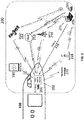
- FIG. 2 is an exemplary illustration of a system 200 constructed and arranged in accordance with the embodiments.
- the airplane 100 of FIG. 1 has been upgraded to include the system 200 in accordance with the embodiments.
- the system 200 is configured to allow an operator to remotely transmit software to an asset, such as the airplane 100, and initiate execution of the software completely autonomously in real-time.
- the system 200 enables remote load and activation without human intervention, which is the ability to remotely send new software to the airplane 100 via wireless means and activate that software without requiring a human to go to the airplane 100.
- the system 200 includes a data update module 202 configured to receive the uploading of executable files in the highly regulated FAA environment of the airplane 100.
- the system 200 permits a human operator 204, such as an OEM, an integrator (e.g., airframer), a customer, a system manager or any of the authorized operators to create applications (or use third party applications) on a device, such as a laptop computer 205.
- the human operator 204 can transmit those applications to the data update module 202.
- the data update module 202 may be configured to receive and monitor critical aircraft systems data 208 (explained in greater detail below).
- the software update 206 change the manner in which the aircraft systems data 208 is analyzed or reported.
- the human operator 204 has a large number of wireless communication paths through which to transmit the software update 206 to the data update module 202.
- links such as Bluetooth 210, satellite radio frequency (RF) communications 212, cloud-based 213, cellular 214, optical communications 216, WiFi/wireless access point 218, and other suitable wireless means and standards, can be used 2 transmit the software update 206 the data update module 202.
- RF radio frequency
- the human operator 204 transmits the software update 206 to the update module 202.
- the software update 206 can include configuration data, content, and/or executable software, which could include applications, algorithms, or various functions. Configuration data and content have previously been transmitted to airplanes and uploaded/activated without user intervention, in limited circumstances. Executable software, however, has always required human intervention at the airplane to execute the software. The embodiments move executable software into the realm of excluding human intervention to automatically execute the software update 206 at the airplane 100.
- configuration data within the context used herein, could include several types of reports generated by the airplane 100.
- the configuration would take one of these reports for autonomous transmission from the airplane 100 or for manual retrieval.
- Embodiments of the present invention would not impact the functionality or the content of these reports.
- the embodiments of the present invention function as a software switch, controlling whether the report will be transmitted from the airplane 100, or not.
- NDB navigation database
- the NDB formed of data in accordance with the ARINC 424 Navigation System Database Standard, is considered to be content that can be uploaded into data upload module 202 and used.
- Executable software is considered to be software performing mathematical calculations that produce a result that can be accessed in a report or through some human interface.
- Embodiments of the present invention allow an operator to create, remotely deploy to the update module 202, and autonomously activate executable software without the need for any human intervention.
- the software update 206 does not need to be new. Instead, the update 206 can be a new update to existing functions (e.g., version 2, version 3 of existing software). That is, the update 206 can overwrite, or delete, older software.
- existing functions e.g., version 2, version 3 of existing software.
- the system 200 of FIG. 2 utilizing the wireless RF and optical communications methodologies, is applicable to all software criticality levels (A-E) associated with the DO-178 guidelines of the Airborne Systems and Equipment Certification process. These software criticality levels are often referred to as DALs.
- the data update module 202 can perform remote activation and deactivation. That is, the data update module 202 communicates to an application, currently running on the airplane 100, that the application may be temporarily deactivated and potentially reactivated at a later time. This feature can be useful in the example of when a user has been notified that an update has been performed but has reason to believe that the update may be fraudulent or contain malicious code.
- the remote activation/deactivation enables the user to deactivate new update until additional verifications can be performed.
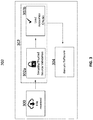
- FIG. 3 is an illustration of the exemplary data update module 202 of FIG. 2 in greater detail in accordance with the embodiments.
- the data update module 202 includes computer logic to perform the steps of receiving software update files 300, to execute a security check logic 302, and perform a software execute step 304.
- the update when wireless transmission of the software update 206 occurs, the update is received as an input to data update module 202, as verified by the file received logic step 300. If the source (i.e., the human operator 204) of the transmission passes proper security checks and verified, the software update 206 is security verified and validated at the security check logic 302.
- the security check logic 302 is performed to protect the airplane 100 from the potentially catastrophic consequences of malicious software transmitted by nefarious actors.
- the security check logic 302 includes a security/trusted source validation sub-step 302a and a load assurance sub-step 302b, discussed in greater detail below.
- the sequence of the security/trusted source validation sub-step 302a and the load assurance sub-step 302b occur automatically, without a human intervening or being in the loop.
- the security/trusted source validation sub-step 302a begins with reference to FIG. 2 and the data update module 202.
- the data update module 202 on the aircraft 100 has a secure encrypted connection to the ground system, such as the laptop computer 205, the personal electronic device 210, and the cloud-based computing platform 213.
- Each of the lightning bolts in FIG. 2 going to the airplane 100 that includes an image of a lock includes an end-to-end encryption from the corresponding ground system to the data update module 202.
- This end-to-end encryption provides a secure tunnel through which the security/trusted source validation sub-step 302a of FIG. 3 can occur.
- the sub-step 302a provides the data update module 202 with the ability to verify that any source transmitting software to the aircraft 100 is authorized to do so and has the proper credentials to send software.
- the authorized (i.e., proper) credentials e.g., permissions
- SIM subscriber identification module
- the SIM card like storage device could be plugged into the data update module 202, prior to initiation of a software update.
- the load assurance checks step 302b ensures the information (i.e., data update 206) initially transmitted to the data update module 202 was actually received.
- load assurance checks can be implemented using a checksum, hash function, or some other type of digital data integrity verification function.
- a version of a cryptographic hash function would be calculated on a portion of the received software update 206 for comparison to a check value provided by the transmitting ground system, or source of the update.
- the purpose of the comparison is to ensure the payload arrives with full integrity, and with no errors in the transmission.
- the load assurance checks sub-step 302b has completed its operations and the load integrity is confirmed, a software execute command is issued within update module 202, and the software update 206 immediately commences.
- the majority of the communication occurs travels from the ground (e.g., the human operator 204) to the aircraft 100, or from the personal device 210 to the aircraft 100, where new or updated software is being loaded.
- Alternative embodiments permit the data update module 202 on the aircraft 100 to optionally respond with a validation or acknowledgment message 220 that the software and that everything checked out.
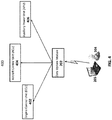
- FIG. 4 is an exemplary illustration of a deployment 400 of an embodiment of a single update module of the present invention in a hub configuration.
- the exemplary deployment 400 is for purposes of illustration only, as the present invention is not limited to a single hub configuration.
- the exemplary deployment 400 is demonstrated using three of the most critical aircraft systems represented by: engine control unit (ECU) 402, aircraft control unit (ACU) 404 and auxiliary power unit (APU) 406.
- ECU engine control unit
- ACU aircraft control unit
- APU auxiliary power unit
- the human operator 204 uses the laptop computer 205, transmits a software update via a secure encrypted connection to data update module 202 (on the aircraft 100).
- the data update module 202 acts as a single hub, or a front-end, for all software updates sent to each of the ECU 402, the ACU 404 and the APU 406.
- FIG. 5 is an exemplary illustration of a deployment 500 of an alternative deployment of multiple update modules respectively coupled to multiple aircraft systems.
- the exemplary deployment 500 is similar to the deployment 400 of FIG. 4 and as such, the similarities will not be repeated here.
- the data update module 200 of FIG. 4 is implemented three times (202a, 202b, 202c) to cover the three systems: the ECU 402, the ACU 404, the APU 406.
- the data update module 202a performs the file receiving, the source validation, the load assurance checks, and provides the pathway to the ECU 402
- the data update module 202b performs the file receiving, the source validation, and the load assurance checks for the ACU 404.
- the data update module 202c performs the file receiving, the source validation, and the load assurance checks for the APU 406.
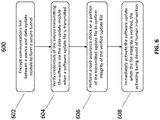
- FIG. 6 is an exemplary illustration of a flow chart of an exemplary method 600 of practicing an embodiment of the present invention.
- the method 600 begins with step 602 where the communication link between the ground systems and the data module is encrypted to form a secure tunnel.
- the data update module verifies the credentials of the source transmitting the software when an update file is transmitted.
- a load assurance check is performed on a portion of the transmitted update file to confirm integrity of the verified file, in step 606.
- the software update is immediately activated in step 608, when the file integrity is verified, wherein the activation is devoid of human intervention.
- FIG. 7 shows a block diagram of security check logic 302, including a processor 702 having a specific structure.
- the specific structure is imparted to the processor 702 by instructions stored in a memory 704 included therein and/or by instructions 720 that can be fetched by the processor 702 from a storage medium 718.
- the storage medium 718 may be co-located with the security check logic 302 as shown or can be located elsewhere and be communicatively coupled to the security check logic 302.
- the security check logic 302 can be a stand-alone programmable system, or it can be a programmable module located in a much larger system.
- the security check logic 302 may be integrated into, or embedded within the data module 202.
- the security check logic 302 may include one or more hardware and/or software components configured to fetch, decode, execute, store, analyze, distribute, evaluate, diagnose, and/or categorize information. Furthermore, the security check logic 302 can include an (input/output) I/O module 714 configured to interface with a plurality of remote devices, such as a driver controller module of a variable frequency drive. The I/O module 714 can also interface with a switch matrix or a by-pass module. In one embodiment, the I/O module can include one or more data acquisition modules.
- the processor 702 may include one or more processing devices or cores (not shown). In some embodiments, the processor 702 may be a plurality of processors, each having either one or more cores.
- the processor 702 can be configured to execute instructions fetched from the memory 704, i.e. from one of memory block 712, memory block 710, load assurance checks module 708, or memory block security/trusted source validation module 706. The instructions can be fetched from storage medium 718, or from a remote device connected to the security check logic 302 via communication interface 716.
- the storage medium 718 and/or the memory 704 may include a volatile or non-volatile, magnetic, semiconductor, tape, optical, removable, non-removable, read-only, random-access, or any type of non-transitory computer-readable computer medium.
- the storage medium 718 and/or the memory 704 may include programs and/or other information that may be used by the processor 702.
- the storage medium 718 may be configured to log data processed, recorded, or collected during the operation of the security check logic 302.
- the storage medium 718 may store historical patterns, predetermined thresholds, for each of the measurable variables associated with the security check logic 302.
- the data may be time-stamped, location-stamped, cataloged, indexed, or organized in a variety of ways consistent with data storage practice.
- the memory block 706 may be a dynamic parameter limiting memory module, and the memory block 708 may be a measurement memory module.
- the security check logic 302 may fetch instructions from these modules, which, when executed by the processor 702, cause the processor 702 to perform certain operations.
- the operations may include receiving status data from a control unit coupled to the security check logic 302 through a plurality of sensors that terminate the I/O module 714, for example.
- the operations may further include performing a diagnostic test on the status data, and subsequently instructing a driver of the control unit to alter a control regimen of the control unit based on results of the diagnostics test.
- the instructions can be sent though the communication interface 716, for example.
- the status data may include measured data associated with at least one of a temperature of one avionics system sensed by the control unit, a vibrational signature of another avionics system, and an insulation integrity of a third related system.
- the diagnostic test may include comparing the status data with either a historical pattern or a predetermined threshold, or both, based on information stored in the storage medium 718.
Landscapes
- Engineering & Computer Science (AREA)
- Computer Security & Cryptography (AREA)
- Theoretical Computer Science (AREA)
- General Engineering & Computer Science (AREA)
- Software Systems (AREA)
- Physics & Mathematics (AREA)
- General Physics & Mathematics (AREA)
- Computer Hardware Design (AREA)
- Signal Processing (AREA)
- Computer Networks & Wireless Communication (AREA)
- Health & Medical Sciences (AREA)
- Bioethics (AREA)
- General Health & Medical Sciences (AREA)
- Computing Systems (AREA)
- Astronomy & Astrophysics (AREA)
- Aviation & Aerospace Engineering (AREA)
- Stored Programmes (AREA)
Abstract
Description
- The present invention relates to remotely updating software. In particular, the present invention relates to wirelessly updating executable files via a wireless link in a highly regulated environment without human intervention.
- Historically, an original equipment manufacturer (OEM) or an asset industry owner, such as an airline, would initiate procedures to deploy new software to the asset. Depending on the level of criticality of the software, one step in the process requires a person (e.g., a human resource) to physically go to the airplane to manually install or release the software, or provide permission to load it.
- As understood by those of skill in the art, there are a variety of different approaches to transmitting new software to airplanes wirelessly using, for example, Wi-Fi, cellular, Bluetooth, optical, or the like. However, once the software has been transmitted to the airplane, it remains dormant until the human resource physically approaches the airplane and activates the software, causing it to begin executing. Thus, in conventional systems, a human resource remains in the loop. Thus, new software deployment in an airplane is a very manually driven process requiring the customer or another person, to directly interact with the airplane.
- As airports become more congested, a person obtaining the necessary access to the airplane can be problematic. Also, in some cases the human resource that has the required expertise and the authority to perform the software load could be in one place, with the software ready to upload, while the airplane could be in another place.
- There is also a limit in the number of human resources that can perform the update. For example, sending one person to accurately update, and verify etc., a fleet of 100 airplanes can be challenging. Even assuming an adequate number of human resources updating the fleet of 100 airplanes, there are issues of latency. After the update has been performed, the OEM or airline will want to immediately see results of the software update. However, because humans are still in the loop, realization of actual results will always be limited to the bandwidth of the number of people required to touch each of the aircraft being serviced.
- As an example of a conventional software update based on a small sample of software-based systems, most commercial airplanes include a flight data recorder (FDR), and an aircraft communication and reporting system (ACARS), along with many other software-based line replaceable units (LRUs). Another commonly encountered system is the aircraft condition monitoring system (ACMS). Software updates can be transmitted by operator to these systems remotely. However, these software updates cannot be activated until maintenance personnel physically connect to each of the systems, or LRUs, in every airplane and initiate or execute the software. This update function may be performed using some type of ground support equipment (GSE), or using a built-in interface, such as a maintenance terminal.
-
FIG. 1 illustrates aconventional system 100 for transmitting and uploading executable software to anairplane 102 in a highly regulated environment. InFIG. 1 , theairplane 102 includes an embedded LRU 104 scheduled to receive a software update. The LRU 104, for example, could be an ACMS configured to receive the software update. In the example ofFIG. 1 , the software update includes executable files and would likely have been wirelessly transmitted to the LRU 104 via a wireless link (not shown). - Although wirelessly transmitted, the software nonetheless remains inactive within the LRU 104. A human operator, such as
maintenance person 106, must physically and manually activate the software via a mechanism such as GSE 108. In theconventional system 100, themaintenance person 106 manually performs software load verification check, along with any other required software security procedures. Historically, there has always been a human on the airplane verifying the software load, running the software update and releasing the executable files. - Given the aforementioned deficiencies, a need exists for methods and systems that facilitate the autonomous uploading of executable files into a system functioning in a highly regulated environment, such as a commercial airplane. More specifically, methods and systems are needed for a basic systemic structure to develop an application on a desktop and deploy it wirelessly to the highly regulated asset, such as an aircraft, for execution without human intervention. Methods and systems are also needed that allow an operator to remotely transmit software to an asset and initiate execution of the software completely autonomously, in real-time, with the appropriate level of security being provided to verify the software is coming from a trusted source.
- Under certain circumstances, an embodiment of the present invention includes a method for remotely uploading certified software from a source to a data update module on an asset via a wireless communications link. The method includes encrypting the communications link between the source and the data update module to form a secure tunnel and verifying credentials of the source via the data update module when a software update file is transmitted. A load assurance check is performed on a portion of the transmitted update file to confirm integrity of the transmitted file when the credentials of the source are verified. The uploading of the certified software is immediately activated when the file integrity is verified, the activating occurring automatically and being devoid of human intervention.
- As understood by those of skill in the art, the term regulated asset could apply to a number of different types of devices in various industry sectors. For example, the Department of Homeland Security has identified 16 critical infrastructure sectors, with one of these being the transportation sector. The airline industry is one industry within the transportation sector. Invention, or embodiments thereof, may also apply to other industries within the transportation sector, such as self-driving cars. The invention, however, may also apply to other critical infrastructure sectors entirely, such as the energy sector (e.g., power generation), and the healthcare sector (e.g., medical equipment), to name a few.
- A commercial airplane is the most highly regulated assets in perhaps the most highly regulated environment the world, in which the public participates on a day-to-day basis. The average airplane includes a plurality of software-based systems that require periodic updating the software.
- By way of example, the ACMS on-board the airplane monitors critical parameters and anomalies output from aircraft engines, flight control systems, and electrical power systems etc. The ACMS performs a limited amount of processing, based on these monitored systems, and creates reports that are transmitted from the airplane summarizing the airplane's behavior. There are various types of ACMSs, ACMS software platforms, and vendors.
- In a conventional ACMS, if an operator desired a new type of report, the operator would be required to submit a request to the vendor, or the avionics provider, requesting the new report. The new report, for example, could request that existing data be processed in some new or unique way. Only the vendor would possess the tools and skills to rewrite the software to modify the report and upload the new software into the ACMS.
- The embodiments of the invention, however, can function using any object-oriented, high-level programming language suitable for developing desktop and/or web-based applications. Python is an example of one such modern programming language with broad familiarity in airline or airframe IT departments, and with software developers. Object-oriented, high-level programming languages typically support modularity and code readability. As such, with the level of modularity in the programming language and the level of automation built into the data update module, the operator, the airframer, or the system manager or can create and deploy the new software.
- Embodiments of the invention also have proper security features including trusted sources and load assurance checks. These features reduce the possibility of bad actors (e.g., passengers and other non-airline personnel) transmitting malicious software to trigger undesirable avionics consequences or influence other behaviors that would have adverse effects on aircraft performance.
- Embodiments of the invention also expand the types of wireless mechanisms by which software updates can be transmitted to an asset. For example, in some cases only WiFi is available in others only cellular is available. The embodiments expand these mechanisms to any suitable wireless transmission medium.
- Additional features, modes of operations, advantages, and other aspects of various embodiments are described below with reference to the accompanying drawings. It is noted that the present disclosure is not limited to the specific embodiments described herein. These embodiments are presented for illustrative purposes. Additional embodiments, or modifications of the embodiments disclosed, will be readily apparent to persons skilled in the relevant art(s) based on the teachings provided.
- Illustrative embodiments may take form in various components and arrangements of components. Illustrative embodiments are shown in the accompanying drawings, throughout which like reference numerals may indicate corresponding or similar parts in the various drawings. The drawings are for purposes of illustrating the embodiments and are not to be construed as limiting the disclosure. Given the following enabling description of the drawings, the novel aspects of the present disclosure should become evident to a person of ordinary skill in the relevant art(s).
-
FIG. 1 illustrates a conventional system for uploading executable software to an airplane. -
FIG. 2 illustrates a system constructed in accordance with embodiments of the present invention. -
FIG. 3 illustrates the exemplary update module ofFIG. 2 in greater detail in accordance with the illustrious embodiments. -
FIG. 4 is an exemplary illustration of a deployment of an embodiment of a single update module of the present invention in a hub configuration servicing three aircraft systems. -
FIG. 5 is an exemplary illustration of a deployment of an alternative deployment of multiple update modules respectively coupled to multiple aircraft systems. -
FIG. 6 is an exemplary illustration of a flow chart of an exemplary method of practicing an embodiment of the present invention. -
FIG. 7 is an illustration of an exemplary computer system on which embodiments of the present invention can be implemented. - While the illustrative embodiments are described herein for particular applications, it should be understood that the present disclosure is not limited thereto. Those skilled in the art and with access to the teachings provided herein will recognize additional applications, modifications, and embodiments within the scope thereof and additional fields in which the present disclosure would be of significant utility.
- Embodiments of the present invention provide features (a) - (f) below, discussed in greater detail herein in relation to
FIGs. 1-7 : - a. remote load and activation (no human at the asset);
- b. option to be deployed by equipment provider;
- c. leveraging wireless methods including RF or optical methods applicable to all design assurance levels (DALs), or similar regulatory design requirements;
- d. includes both configuration content and executable software;
- e. deployment of new software, updates, remote deactivation, and deletion;
- f. security features to ensure updates originate from a trusted source; and
- g. checksum or equivalent quality/load assurance checks onboard to confirm software load integrity.
-
FIG. 2 is an exemplary illustration of asystem 200 constructed and arranged in accordance with the embodiments. InFIG. 2 , theairplane 100 ofFIG. 1 , has been upgraded to include thesystem 200 in accordance with the embodiments. Thesystem 200 is configured to allow an operator to remotely transmit software to an asset, such as theairplane 100, and initiate execution of the software completely autonomously in real-time. In other words, thesystem 200 enables remote load and activation without human intervention, which is the ability to remotely send new software to theairplane 100 via wireless means and activate that software without requiring a human to go to theairplane 100. - The
system 200 includes adata update module 202 configured to receive the uploading of executable files in the highly regulated FAA environment of theairplane 100. Thesystem 200 permits ahuman operator 204, such as an OEM, an integrator (e.g., airframer), a customer, a system manager or any of the authorized operators to create applications (or use third party applications) on a device, such as alaptop computer 205. Thehuman operator 204 can transmit those applications to thedata update module 202. Thedata update module 202 may be configured to receive and monitor critical aircraft systems data 208 (explained in greater detail below). In this example, thesoftware update 206 change the manner in which theaircraft systems data 208 is analyzed or reported. - The
human operator 204 has a large number of wireless communication paths through which to transmit thesoftware update 206 to thedata update module 202. By way of example, and not limitation, links such asBluetooth 210, satellite radio frequency (RF) communications 212, cloud-based 213, cellular 214, optical communications 216, WiFi/wireless access point 218, and other suitable wireless means and standards, can be used 2 transmit thesoftware update 206 thedata update module 202. - More specifically, in
FIG. 2 , thehuman operator 204 transmits thesoftware update 206 to theupdate module 202. Thesoftware update 206 can include configuration data, content, and/or executable software, which could include applications, algorithms, or various functions. Configuration data and content have previously been transmitted to airplanes and uploaded/activated without user intervention, in limited circumstances. Executable software, however, has always required human intervention at the airplane to execute the software. The embodiments move executable software into the realm of excluding human intervention to automatically execute thesoftware update 206 at theairplane 100. - Different types of digital information can be sent to the
airplane 100 that may loosely fall within the category of software. Therefore, for purposes of clarity, configuration data, content, and executable software are clarified below within the context of the embodiments of the present invention. - By way of example and not limitation, configuration data, within the context used herein, could include several types of reports generated by the
airplane 100. The configuration would take one of these reports for autonomous transmission from theairplane 100 or for manual retrieval. Embodiments of the present invention would not impact the functionality or the content of these reports. Instead, with respect to configuration data, the embodiments of the present invention function as a software switch, controlling whether the report will be transmitted from theairplane 100, or not. - An example of content, within the context of the embodiments, would be a navigation database (NDB), or the like. By way of background, the NDB includes elements from which flight plans are constructed and is typically updated every 28 days to ensure its contents are accurate. The NDB, formed of data in accordance with the ARINC 424 Navigation System Database Standard, is considered to be content that can be uploaded into data upload
module 202 and used. - Executable software is considered to be software performing mathematical calculations that produce a result that can be accessed in a report or through some human interface. Embodiments of the present invention allow an operator to create, remotely deploy to the
update module 202, and autonomously activate executable software without the need for any human intervention. - The
software update 206 does not need to be new. Instead, theupdate 206 can be a new update to existing functions (e.g., version 2, version 3 of existing software). That is, theupdate 206 can overwrite, or delete, older software. - The
system 200 ofFIG. 2 , utilizing the wireless RF and optical communications methodologies, is applicable to all software criticality levels (A-E) associated with the DO-178 guidelines of the Airborne Systems and Equipment Certification process. These software criticality levels are often referred to as DALs. - In another example, the
data update module 202 can perform remote activation and deactivation. That is, thedata update module 202 communicates to an application, currently running on theairplane 100, that the application may be temporarily deactivated and potentially reactivated at a later time. This feature can be useful in the example of when a user has been notified that an update has been performed but has reason to believe that the update may be fraudulent or contain malicious code. The remote activation/deactivation enables the user to deactivate new update until additional verifications can be performed. -
FIG. 3 is an illustration of the exemplarydata update module 202 ofFIG. 2 in greater detail in accordance with the embodiments. Thedata update module 202 includes computer logic to perform the steps of receiving software update files 300, to execute asecurity check logic 302, and perform a software executestep 304. - In the embodiments, when wireless transmission of the
software update 206 occurs, the update is received as an input todata update module 202, as verified by the file receivedlogic step 300. If the source (i.e., the human operator 204) of the transmission passes proper security checks and verified, thesoftware update 206 is security verified and validated at thesecurity check logic 302. - The
security check logic 302 is performed to protect theairplane 100 from the potentially catastrophic consequences of malicious software transmitted by nefarious actors. Thesecurity check logic 302 includes a security/trustedsource validation sub-step 302a and a load assurance sub-step 302b, discussed in greater detail below. In the embodiments, the sequence of the security/trustedsource validation sub-step 302a and the load assurance sub-step 302b occur automatically, without a human intervening or being in the loop. - The security/trusted
source validation sub-step 302a begins with reference toFIG. 2 and thedata update module 202. Specifically, thedata update module 202 on theaircraft 100 has a secure encrypted connection to the ground system, such as thelaptop computer 205, the personalelectronic device 210, and the cloud-basedcomputing platform 213. Each of the lightning bolts inFIG. 2 going to theairplane 100 that includes an image of a lock includes an end-to-end encryption from the corresponding ground system to thedata update module 202. - This end-to-end encryption provides a secure tunnel through which the security/trusted
source validation sub-step 302a ofFIG. 3 can occur. The sub-step 302a provides thedata update module 202 with the ability to verify that any source transmitting software to theaircraft 100 is authorized to do so and has the proper credentials to send software. By way of example, the authorized (i.e., proper) credentials (e.g., permissions) could be preloaded onto a storage device, similar to a subscriber identification module (SIM) card used in a cell phone. The SIM card like storage device could be plugged into thedata update module 202, prior to initiation of a software update. - The load
assurance checks step 302b ensures the information (i.e., data update 206) initially transmitted to thedata update module 202 was actually received. By way of example, load assurance checks can be implemented using a checksum, hash function, or some other type of digital data integrity verification function. A version of a cryptographic hash function would be calculated on a portion of the receivedsoftware update 206 for comparison to a check value provided by the transmitting ground system, or source of the update. - The purpose of the comparison is to ensure the payload arrives with full integrity, and with no errors in the transmission. When the load assurance checks sub-step 302b has completed its operations and the load integrity is confirmed, a software execute command is issued within
update module 202, and thesoftware update 206 immediately commences. - In the embodiments, the majority of the communication occurs travels from the ground (e.g., the human operator 204) to the
aircraft 100, or from thepersonal device 210 to theaircraft 100, where new or updated software is being loaded. Alternative embodiments permit thedata update module 202 on theaircraft 100 to optionally respond with a validation or acknowledgment message 220 that the software and that everything checked out. -
FIG. 4 is an exemplary illustration of adeployment 400 of an embodiment of a single update module of the present invention in a hub configuration. Theexemplary deployment 400 is for purposes of illustration only, as the present invention is not limited to a single hub configuration. InFIG. 4 , theexemplary deployment 400 is demonstrated using three of the most critical aircraft systems represented by: engine control unit (ECU) 402, aircraft control unit (ACU) 404 and auxiliary power unit (APU) 406. - In the
exemplary deployment 400, thehuman operator 204, using thelaptop computer 205, transmits a software update via a secure encrypted connection to data update module 202 (on the aircraft 100). In this example, thedata update module 202 acts as a single hub, or a front-end, for all software updates sent to each of theECU 402, theACU 404 and theAPU 406. -
FIG. 5 is an exemplary illustration of adeployment 500 of an alternative deployment of multiple update modules respectively coupled to multiple aircraft systems. - The
exemplary deployment 500 is similar to thedeployment 400 ofFIG. 4 and as such, the similarities will not be repeated here. InFIG. 5 , thedata update module 200 ofFIG. 4 is implemented three times (202a, 202b, 202c) to cover the three systems: theECU 402, theACU 404, theAPU 406. Thus, in thedeployment 500 and thedata update module 202a performs the file receiving, the source validation, the load assurance checks, and provides the pathway to theECU 402 and thedata update module 202b performs the file receiving, the source validation, and the load assurance checks for theACU 404. Thedata update module 202c performs the file receiving, the source validation, and the load assurance checks for theAPU 406. - Many other implementations including various pluralities of the
data update module 202 would be within the spirit and scope of the present invention. -
FIG. 6 is an exemplary illustration of a flow chart of anexemplary method 600 of practicing an embodiment of the present invention. InFIG. 6 , themethod 600 begins withstep 602 where the communication link between the ground systems and the data module is encrypted to form a secure tunnel. Instep 604, the data update module verifies the credentials of the source transmitting the software when an update file is transmitted. A load assurance check is performed on a portion of the transmitted update file to confirm integrity of the verified file, instep 606. The software update is immediately activated instep 608, when the file integrity is verified, wherein the activation is devoid of human intervention. -
FIG. 7 shows a block diagram ofsecurity check logic 302, including aprocessor 702 having a specific structure. The specific structure is imparted to theprocessor 702 by instructions stored in amemory 704 included therein and/or byinstructions 720 that can be fetched by theprocessor 702 from astorage medium 718. - The
storage medium 718 may be co-located with thesecurity check logic 302 as shown or can be located elsewhere and be communicatively coupled to thesecurity check logic 302. Thesecurity check logic 302 can be a stand-alone programmable system, or it can be a programmable module located in a much larger system. For example, thesecurity check logic 302 may be integrated into, or embedded within thedata module 202. - The
security check logic 302 may include one or more hardware and/or software components configured to fetch, decode, execute, store, analyze, distribute, evaluate, diagnose, and/or categorize information. Furthermore, thesecurity check logic 302 can include an (input/output) I/O module 714 configured to interface with a plurality of remote devices, such as a driver controller module of a variable frequency drive. The I/O module 714 can also interface with a switch matrix or a by-pass module. In one embodiment, the I/O module can include one or more data acquisition modules. - The
processor 702 may include one or more processing devices or cores (not shown). In some embodiments, theprocessor 702 may be a plurality of processors, each having either one or more cores. Theprocessor 702 can be configured to execute instructions fetched from thememory 704, i.e. from one ofmemory block 712,memory block 710, loadassurance checks module 708, or memory block security/trustedsource validation module 706. The instructions can be fetched fromstorage medium 718, or from a remote device connected to thesecurity check logic 302 viacommunication interface 716. - Furthermore, without loss of generality, the
storage medium 718 and/or thememory 704 may include a volatile or non-volatile, magnetic, semiconductor, tape, optical, removable, non-removable, read-only, random-access, or any type of non-transitory computer-readable computer medium. Thestorage medium 718 and/or thememory 704 may include programs and/or other information that may be used by theprocessor 702. - Moreover, the
storage medium 718 may be configured to log data processed, recorded, or collected during the operation of thesecurity check logic 302. For example, thestorage medium 718 may store historical patterns, predetermined thresholds, for each of the measurable variables associated with thesecurity check logic 302. The data may be time-stamped, location-stamped, cataloged, indexed, or organized in a variety of ways consistent with data storage practice. - In one embodiment, the
memory block 706 may be a dynamic parameter limiting memory module, and thememory block 708 may be a measurement memory module. As such, thesecurity check logic 302 may fetch instructions from these modules, which, when executed by theprocessor 702, cause theprocessor 702 to perform certain operations. - The operations may include receiving status data from a control unit coupled to the
security check logic 302 through a plurality of sensors that terminate the I/O module 714, for example. The operations may further include performing a diagnostic test on the status data, and subsequently instructing a driver of the control unit to alter a control regimen of the control unit based on results of the diagnostics test. The instructions can be sent though thecommunication interface 716, for example. - The status data may include measured data associated with at least one of a temperature of one avionics system sensed by the control unit, a vibrational signature of another avionics system, and an insulation integrity of a third related system. The diagnostic test may include comparing the status data with either a historical pattern or a predetermined threshold, or both, based on information stored in the
storage medium 718. - Those skilled in the relevant art(s) will appreciate that various adaptations and modifications of the embodiments described above can be configured without departing from the scope and spirit of the disclosure. Therefore, it is to be understood that, within the scope of the appended claims, the teachings set forth in the present disclosure may be practiced other than as specifically described herein.
- Further aspects of the invention are provided by the subject matter of the following clauses:
- 1. A method for remotely uploading certified software from a source to a data update module on an asset via a wireless communications link, the method comprising: encrypting the communications link between the source and the data update module to form a secure tunnel; verifying credentials of the source via the data update module when a software update file is transmitted; performing a load assurance check on a portion of the transmitted update file to confirm integrity of the transmitted file when the credentials of the source are verified; and immediately activating the uploading of the certified software when the file integrity is verified, the activating occurring automatically and being devoid of human intervention.
- 2. The method of any preceding clause, wherein the source is a ground unit.
- 3. The method of any preceding clause, wherein the verifying includes security/trusted source validation.
- 4. The method of any preceding clause, wherein at least one data update module performs security checking for all aircraft critical function control modules.
- 5. The method of any preceding clause, wherein each data update module forms a path to only one corresponding aircraft critical function control module.
- 6. The method of any preceding clause, wherein the load assurance check includes at least one of a check-sum and a hash function.
- 7. The method of any preceding clause, further comprising sending a validation message from the data update module notifying the source of a final disposition of the software update.
- 8. The method of any preceding clause, wherein the uploading includes at least one of uploading new software, updating old software, and deactivating at least a portion of the software update.
- 9. A tangible computer-readable medium having stored thereon, computer executable instructions that, if executed by a computing device, cause the computing device to perform a method for remotely uploading certified software from a source to a data update module on an asset via a wireless communications link comprising: encrypting the communications link between the source and the data update module to form a secure tunnel; verifying credentials of the source via the data update module when a software update file is transmitted; performing a load assurance check on a portion of the transmitted update file to confirm integrity of the transmitted file when the credentials of the source are verified; and immediately activating the uploading of the certified software when the file integrity is verified, the activating occurring automatically and being devoid of human intervention.
- 10. The tangible computer-readable medium of any preceding clause, wherein the source is a ground unit.
- 11. The tangible computer-readable medium of any preceding clause, wherein the verifying includes security/trusted source validation and load assurance checks.
- 12. The tangible computer-readable medium of any preceding clause, wherein at least one data update module performs security checking for all aircraft critical function control modules.
- 13. The tangible computer-readable medium of any preceding clause, wherein each data update module forms a path to only one corresponding aircraft critical function control module.
- 14. The tangible computer-readable medium of any preceding clause, wherein the load assurance check includes at least one of a check-sum and a hash function.
- 15. The tangible computer-readable medium of any preceding clause, further comprising sending a validation message from the data update module notifying the source of a final disposition of the software update.
- 16. The tangible computer-readable medium of any preceding clause, wherein the uploading includes at least one of uploading new software, updating old software, and deactivating at least a portion of the software update.
- 17. A system for remotely updating certified software from a source to an airplane comprising: a data update module configured for placement on the airplane and for receiving a file transmitted from the source and representative of a software update; a wireless communications link forming an encrypted tunnel between the source and the data module placed on the airplane; wherein the data update module is configured to (i) verify credentials of the source via the data update module when a software update file is transmitted and (ii) perform a load assurance check on a portion of the transmitted update file to confirm integrity of the transmitted file when the credentials of the source are verified; and wherein the data update module immediately activates the uploading of the certified software update when the file integrity is verified, the activating occurring automatically and devoid of human intervention.
- 18. The system of any preceding clause, wherein the source is a ground unit.
- 19. The system of any preceding clause, wherein the verifying includes security/trusted source validation.
- 20. The system of any preceding clause, wherein the load assurance check includes at least one of a check-sum and a hash function.
Claims (15)
- A method for remotely uploading certified software from a source to a data update module on an asset via a wireless communications link, the method comprising:encrypting the communications link between the source and the data update module to form a secure tunnel;verifying credentials of the source via the data update module when a software update file is transmitted;performing a load assurance check on a portion of the transmitted update file to confirm integrity of the transmitted file when the credentials of the source are verified; andimmediately activating the uploading of the certified software when the file integrity is verified, the activating occurring automatically and being devoid of human intervention.
- The method of claim 1, wherein the source is a ground unit.
- The method of claim 1 or 2, wherein the verifying includes security/trusted source validation.
- The method of any of claims 1 to 3, wherein at least one data update module performs security checking for all aircraft critical function control modules.
- The method of any of claims 1 to 4, wherein each data update module forms a path to only one corresponding aircraft critical function control module.
- The method of any of claims 1 to 5, wherein the load assurance check includes at least one of a check-sum and a hash function.
- The method of any of claims 1 to 6, further comprising sending a validation message from the data update module notifying the source of a final disposition of the software update.
- The method of any of claims 1 to 7, wherein the uploading includes at least one of uploading new software, updating old software, and deactivating at least a portion of the software update.
- A tangible computer-readable medium having stored thereon, computer executable instructions that, if executed by a computing device, cause the computing device to perform a method for remotely uploading certified software from a source to a data update module on an asset via a wireless communications link comprising:encrypting the communications link between the source and the data update module to form a secure tunnel;verifying credentials of the source via the data update module when a software update file is transmitted;performing a load assurance check on a portion of the transmitted update file to confirm integrity of the transmitted file when the credentials of the source are verified; andimmediately activating the uploading of the certified software when the file integrity is verified, the activating occurring automatically and being devoid of human intervention.
- The tangible computer-readable medium of claim 9, wherein the source is a ground unit.
- The tangible computer-readable medium of claim 9 or 10, wherein the verifying includes security/trusted source validation and load assurance checks.
- The tangible computer-readable medium of any of claims 9 to 11, wherein at least one data update module performs security checking for all aircraft critical function control modules.
- The tangible computer-readable medium of any of claims 9 to 12, wherein each data update module forms a path to only one corresponding aircraft critical function control module.
- The tangible computer-readable medium of any of claims 9 to 13, wherein the uploading includes at least one of uploading new software, updating old software, and deactivating at least a portion of the software update.
- A system for remotely updating certified software from a source to an airplane comprising:a data update module configured for placement on the airplane and for receiving a file transmitted from the source and representative of a software update;a wireless communications link forming an encrypted tunnel between the source and the data module placed on the airplane;wherein the data update module is configured to (i) verify credentials of the source via the data update module when a software update file is transmitted and (ii) perform a load assurance check on a portion of the transmitted update file to confirm integrity of the transmitted file when the credentials of the source are verified; andwherein the data update module immediately activates the uploading of the certified software update when the file integrity is verified, the activating occurring automatically and devoid of human intervention.
Applications Claiming Priority (1)
| Application Number | Priority Date | Filing Date | Title |
|---|---|---|---|
| US201962826912P | 2019-03-29 | 2019-03-29 |
Publications (1)
| Publication Number | Publication Date |
|---|---|
| EP3716114A1 true EP3716114A1 (en) | 2020-09-30 |
Family
ID=69784283
Family Applications (1)
| Application Number | Title | Priority Date | Filing Date |
|---|---|---|---|
| EP20162013.5A Pending EP3716114A1 (en) | 2019-03-29 | 2020-03-10 | Method and system for remote load of on-board certified software |
Country Status (3)
| Country | Link |
|---|---|
| US (2) | US11487525B2 (en) |
| EP (1) | EP3716114A1 (en) |
| CN (1) | CN111753305A (en) |
Families Citing this family (3)
| Publication number | Priority date | Publication date | Assignee | Title |
|---|---|---|---|---|
| US20210103439A1 (en) * | 2018-06-14 | 2021-04-08 | Sony Corporation | Methods, wireless modules, electronic devices and server devices |
| WO2021217559A1 (en) * | 2020-04-30 | 2021-11-04 | 华为技术有限公司 | Data protection method and apparatus |
| CN112270010B (en) * | 2020-11-17 | 2024-04-12 | 上海好连网络科技有限公司 | Remote safe loading method for executable file |
Citations (3)
| Publication number | Priority date | Publication date | Assignee | Title |
|---|---|---|---|---|
| US20130318357A1 (en) * | 2011-02-11 | 2013-11-28 | Siemens Health Care Diagnostics Inc. | System and Method for Secure Software Update |
| US20160328978A1 (en) * | 2015-04-30 | 2016-11-10 | Ge Aviation Systems Llc | Systems and methods of providing a data update to an aircraft |
| US20170308371A1 (en) * | 2016-04-21 | 2017-10-26 | Thales | Method for processing an update file of an avionic equipment of an aircraft, a computer program product, related processing electronic device and processing system |
Family Cites Families (37)
| Publication number | Priority date | Publication date | Assignee | Title |
|---|---|---|---|---|
| US6438468B1 (en) * | 2000-11-28 | 2002-08-20 | Honeywell International Inc. | Systems and methods for delivering data updates to an aircraft |
| US7908042B2 (en) | 2001-02-13 | 2011-03-15 | The Boeing Company | Methods and apparatus for wireless upload and download of aircraft data |
| US6671589B2 (en) | 2001-02-13 | 2003-12-30 | William Holst | Method and apparatus to support remote and automatically initiated data loading and data acquisition of airborne computers using a wireless spread spectrum aircraft data services link |
| US6816728B2 (en) | 2002-04-24 | 2004-11-09 | Teledyne Technologies Incorporated | Aircraft data communication system and method |
| US6894611B2 (en) * | 2002-09-23 | 2005-05-17 | General Electric Company | Method and system for uploading and downloading engine control data |
| US7636568B2 (en) | 2002-12-02 | 2009-12-22 | The Boeing Company | Remote aircraft manufacturing, monitoring, maintenance and management system |
| US7325126B2 (en) | 2004-03-05 | 2008-01-29 | Microsoft Corporation | System and method for distributed module authentication |
| US7489992B2 (en) | 2004-04-12 | 2009-02-10 | Sagem Avionics, Inc. | Method and system for remotely communicating and interfacing with aircraft condition monitoring systems |
| US8136149B2 (en) | 2004-06-07 | 2012-03-13 | Check Point Software Technologies, Inc. | Security system with methodology providing verified secured individual end points |
| US9576404B2 (en) | 2004-09-16 | 2017-02-21 | Harris Corporation | System and method of transmitting data from an aircraft |
| US8423009B2 (en) * | 2006-05-12 | 2013-04-16 | The Boeing Company | Automated delivery of flight data to aircraft cockpit devices |
| FR2913122B1 (en) * | 2007-02-22 | 2010-10-15 | Airbus France | AUTOMATIC RESTORING INFORMATION SYSTEM |
| US8165930B2 (en) * | 2007-11-27 | 2012-04-24 | The Boeing Company | Crate tool |
| US20090222497A1 (en) | 2008-02-29 | 2009-09-03 | Schlumberger Technology Corp. | Method, system and apparatus for remote software upgrade of an embedded device |
| FR2937437B1 (en) * | 2008-10-20 | 2011-09-16 | Airbus France | METHOD FOR OPERATING AN ONBOARD EQUIPMENT, ASSOCIATED EQUIPMENT AND AN AIRCRAFT INCLUDING SUCH AN EQUIPMENT |
| US9494933B1 (en) * | 2009-06-19 | 2016-11-15 | The Boeing Company | Processing packets in an aircraft network data processing system |
| US20110085667A1 (en) | 2009-10-09 | 2011-04-14 | Adgregate Markets, Inc. | Various methods and apparatuses for securing an application container |
| FR2959633B1 (en) * | 2010-04-29 | 2012-08-31 | Airbus Operations Sas | METHOD FOR UPGRADING AN AIRCRAFT |
| US9350708B2 (en) | 2010-06-01 | 2016-05-24 | Good Technology Corporation | System and method for providing secured access to services |
| US8881294B2 (en) * | 2011-02-18 | 2014-11-04 | Honeywell International Inc. | Methods and systems for securely uploading files onto aircraft |
| US20130036103A1 (en) * | 2011-08-04 | 2013-02-07 | The Boeing Company | Software Part Validation Using Hash Values |
| US9218741B2 (en) * | 2012-04-06 | 2015-12-22 | Saab-Sensis Corporation | System and method for aircraft navigation based on diverse ranging algorithm using ADS-B messages and ground transceiver responses |
| US8966248B2 (en) * | 2012-04-06 | 2015-02-24 | GM Global Technology Operations LLC | Secure software file transfer systems and methods for vehicle control modules |
| US10080136B2 (en) | 2012-12-25 | 2018-09-18 | At&T Mobility Ip, Llc | Credibility token system for over the air multi-programming of a wireless device and method of operation |
| US9495560B2 (en) | 2013-04-29 | 2016-11-15 | Sri International | Polymorphic virtual appliance rule set |
| US9300669B2 (en) | 2013-06-14 | 2016-03-29 | Dell Products L.P. | Runtime API framework for client-server communication |
| EP2854332A1 (en) * | 2013-09-27 | 2015-04-01 | Gemalto SA | Method for securing over-the-air communication between a mobile application and a gateway |
| US9008868B1 (en) | 2013-10-09 | 2015-04-14 | Satcom Direct, Inc. | Cloud based management of aircraft avionics |
| CA2899996C (en) | 2013-12-11 | 2020-04-14 | Intralinks, Inc. | Customizable secure data exchange environment |
| US9811657B2 (en) * | 2014-06-06 | 2017-11-07 | The Boeing Company | Security information for software parts |
| WO2016040920A1 (en) * | 2014-09-14 | 2016-03-17 | Thompson Aerospace, Inc. | Method and system for security and authentication of aircraft data transmissions |
| US10015281B2 (en) | 2015-07-06 | 2018-07-03 | The Boeing Company | Wireless software loader |
| US10470114B2 (en) | 2016-06-30 | 2019-11-05 | General Electric Company | Wireless network selection |
| US10380899B2 (en) * | 2016-09-13 | 2019-08-13 | Honeywell International Inc. | Ground direction of aircraft datalinks |
| US9954967B1 (en) | 2016-10-24 | 2018-04-24 | Honeywell International Inc. | Methods and apparatus for using a wireless access point storage device onboard an aircraft |
| FR3065945B1 (en) | 2017-05-04 | 2021-04-16 | Thales Sa | METHOD AND ELECTRONIC DEVICE FOR MONITORING AN AVIONICS SOFTWARE APPLICATION, COMPUTER PROGRAM AND ASSOCIATED AVIONICS SYSTEM |
| US11562073B2 (en) | 2018-11-28 | 2023-01-24 | The Boeing Company | Systems and methods of software load verification |
-
2020
- 2020-03-10 EP EP20162013.5A patent/EP3716114A1/en active Pending
- 2020-03-24 CN CN202010211547.1A patent/CN111753305A/en active Pending
- 2020-03-30 US US16/835,121 patent/US11487525B2/en active Active
-
2022
- 2022-09-26 US US17/952,478 patent/US12461734B2/en active Active
Patent Citations (3)
| Publication number | Priority date | Publication date | Assignee | Title |
|---|---|---|---|---|
| US20130318357A1 (en) * | 2011-02-11 | 2013-11-28 | Siemens Health Care Diagnostics Inc. | System and Method for Secure Software Update |
| US20160328978A1 (en) * | 2015-04-30 | 2016-11-10 | Ge Aviation Systems Llc | Systems and methods of providing a data update to an aircraft |
| US20170308371A1 (en) * | 2016-04-21 | 2017-10-26 | Thales | Method for processing an update file of an avionic equipment of an aircraft, a computer program product, related processing electronic device and processing system |
Also Published As
| Publication number | Publication date |
|---|---|
| CN111753305A (en) | 2020-10-09 |
| US11487525B2 (en) | 2022-11-01 |
| US12461734B2 (en) | 2025-11-04 |
| US20200310781A1 (en) | 2020-10-01 |
| US20230014326A1 (en) | 2023-01-19 |
Similar Documents
| Publication | Publication Date | Title |
|---|---|---|
| US12461734B2 (en) | Method and system for remote load of on-board certified software | |
| CA2903634C (en) | Software aircraft part installation system | |
| US9916701B2 (en) | Vehicle auditing and control of maintenance and diagnosis for vehicle systems | |
| US7636568B2 (en) | Remote aircraft manufacturing, monitoring, maintenance and management system | |
| US11492132B2 (en) | Gas turbine engine configuration data synchronization with a ground-based system | |
| US10120785B2 (en) | Automatic generation of data coupling and control coupling test conditions | |
| CN112555029B (en) | Device, system and method for securely initializing an embedded system | |
| US20130066515A1 (en) | Methods and systems for cost-based control of aircraft health data reporting | |
| US10311171B2 (en) | Multi-component and mixed-reality simulation environments | |
| US9639443B2 (en) | Multi-component and mixed-reality simulation environments | |
| US11755737B2 (en) | Reporting and configuration enhancements of on-board certified software | |
| US20260106775A1 (en) | Diagnostic system for engine management system | |
| CN104238958A (en) | Methods and systems for both static and dynamic identification data for writing, updating and reading aviation equipment | |
| CN112632570A (en) | Device, system and method for modifying access permission level | |
| EP3958529A1 (en) | Systems and methods for multi-factor digital authentication of aircraft operations | |
| US20240111872A1 (en) | Devices, systems, and methods for securely loading embedded software using a manifest | |
| CN119473431A (en) | Civil aircraft cabin system multi-software package fusion loading system, method, device and medium | |
| O'Dell | The Gulfstream G650 Aircraft Health and Trend Monitoring System | |
| KR20190030326A (en) | Computing resource and processing method performed by computing resource for updating vibration control software of flight vehicle |
Legal Events
| Date | Code | Title | Description |
|---|---|---|---|
| PUAI | Public reference made under article 153(3) epc to a published international application that has entered the european phase |
Free format text: ORIGINAL CODE: 0009012 |
|
| STAA | Information on the status of an ep patent application or granted ep patent |
Free format text: STATUS: THE APPLICATION HAS BEEN PUBLISHED |
|
| AK | Designated contracting states |
Kind code of ref document: A1 Designated state(s): AL AT BE BG CH CY CZ DE DK EE ES FI FR GB GR HR HU IE IS IT LI LT LU LV MC MK MT NL NO PL PT RO RS SE SI SK SM TR |
|
| AX | Request for extension of the european patent |
Extension state: BA ME |
|
| STAA | Information on the status of an ep patent application or granted ep patent |
Free format text: STATUS: REQUEST FOR EXAMINATION WAS MADE |
|
| 17P | Request for examination filed |
Effective date: 20210215 |
|
| RBV | Designated contracting states (corrected) |
Designated state(s): AL AT BE BG CH CY CZ DE DK EE ES FI FR GB GR HR HU IE IS IT LI LT LU LV MC MK MT NL NO PL PT RO RS SE SI SK SM TR |
|
| STAA | Information on the status of an ep patent application or granted ep patent |
Free format text: STATUS: EXAMINATION IS IN PROGRESS |
|
| 17Q | First examination report despatched |
Effective date: 20211216 |