EP3715509A1 - Cellulose acetate fiber, cellulose acetate tow band, and method for producing cellulose acetate tow band - Google Patents
Cellulose acetate fiber, cellulose acetate tow band, and method for producing cellulose acetate tow band Download PDFInfo
- Publication number
- EP3715509A1 EP3715509A1 EP19833290.0A EP19833290A EP3715509A1 EP 3715509 A1 EP3715509 A1 EP 3715509A1 EP 19833290 A EP19833290 A EP 19833290A EP 3715509 A1 EP3715509 A1 EP 3715509A1
- Authority
- EP
- European Patent Office
- Prior art keywords
- cellulose acetate
- band
- fiber
- content
- titanium oxide
- Prior art date
- Legal status (The legal status is an assumption and is not a legal conclusion. Google has not performed a legal analysis and makes no representation as to the accuracy of the status listed.)
- Granted
Links
Images

Classifications
-
- D—TEXTILES; PAPER
- D01—NATURAL OR MAN-MADE THREADS OR FIBRES; SPINNING
- D01F—CHEMICAL FEATURES IN THE MANUFACTURE OF ARTIFICIAL FILAMENTS, THREADS, FIBRES, BRISTLES OR RIBBONS; APPARATUS SPECIALLY ADAPTED FOR THE MANUFACTURE OF CARBON FILAMENTS
- D01F2/00—Monocomponent artificial filaments or the like of cellulose or cellulose derivatives; Manufacture thereof
- D01F2/24—Monocomponent artificial filaments or the like of cellulose or cellulose derivatives; Manufacture thereof from cellulose derivatives
- D01F2/28—Monocomponent artificial filaments or the like of cellulose or cellulose derivatives; Manufacture thereof from cellulose derivatives from organic cellulose esters or ethers, e.g. cellulose acetate
-
- A—HUMAN NECESSITIES
- A24—TOBACCO; CIGARS; CIGARETTES; SIMULATED SMOKING DEVICES; SMOKERS' REQUISITES
- A24D—CIGARS; CIGARETTES; TOBACCO SMOKE FILTERS; MOUTHPIECES OF CIGARS OR CIGARETTES; MANUFACTURE OF TOBACCO SMOKE FILTERS OR MOUTHPIECES
- A24D3/00—Tobacco smoke filters, e.g. filter tips or filtering inserts; Filters specially adapted for simulated smoking devices; Mouthpieces of cigars or cigarettes
- A24D3/06—Use of materials for tobacco smoke filters
- A24D3/16—Use of materials for tobacco smoke filters of inorganic materials
-
- C—CHEMISTRY; METALLURGY
- C08—ORGANIC MACROMOLECULAR COMPOUNDS; THEIR PREPARATION OR CHEMICAL WORKING-UP; COMPOSITIONS BASED THEREON
- C08B—POLYSACCHARIDES; DERIVATIVES THEREOF
- C08B3/00—Preparation of cellulose esters of organic acids
- C08B3/06—Cellulose acetate, e.g. mono-acetate, di-acetate or tri-acetate
-
- C—CHEMISTRY; METALLURGY
- C08—ORGANIC MACROMOLECULAR COMPOUNDS; THEIR PREPARATION OR CHEMICAL WORKING-UP; COMPOSITIONS BASED THEREON
- C08L—COMPOSITIONS OF MACROMOLECULAR COMPOUNDS
- C08L1/00—Compositions of cellulose, modified cellulose or cellulose derivatives
- C08L1/08—Cellulose derivatives
- C08L1/10—Esters of organic acids, i.e. acylates
- C08L1/12—Cellulose acetate
-
- D—TEXTILES; PAPER
- D01—NATURAL OR MAN-MADE THREADS OR FIBRES; SPINNING
- D01F—CHEMICAL FEATURES IN THE MANUFACTURE OF ARTIFICIAL FILAMENTS, THREADS, FIBRES, BRISTLES OR RIBBONS; APPARATUS SPECIALLY ADAPTED FOR THE MANUFACTURE OF CARBON FILAMENTS
- D01F1/00—General methods for the manufacture of artificial filaments or the like
- D01F1/02—Addition of substances to the spinning solution or to the melt
- D01F1/04—Pigments
-
- D—TEXTILES; PAPER
- D01—NATURAL OR MAN-MADE THREADS OR FIBRES; SPINNING
- D01F—CHEMICAL FEATURES IN THE MANUFACTURE OF ARTIFICIAL FILAMENTS, THREADS, FIBRES, BRISTLES OR RIBBONS; APPARATUS SPECIALLY ADAPTED FOR THE MANUFACTURE OF CARBON FILAMENTS
- D01F1/00—General methods for the manufacture of artificial filaments or the like
- D01F1/02—Addition of substances to the spinning solution or to the melt
- D01F1/10—Other agents for modifying properties
-
- A—HUMAN NECESSITIES
- A24—TOBACCO; CIGARS; CIGARETTES; SIMULATED SMOKING DEVICES; SMOKERS' REQUISITES
- A24D—CIGARS; CIGARETTES; TOBACCO SMOKE FILTERS; MOUTHPIECES OF CIGARS OR CIGARETTES; MANUFACTURE OF TOBACCO SMOKE FILTERS OR MOUTHPIECES
- A24D3/00—Tobacco smoke filters, e.g. filter tips or filtering inserts; Filters specially adapted for simulated smoking devices; Mouthpieces of cigars or cigarettes
- A24D3/06—Use of materials for tobacco smoke filters
- A24D3/08—Use of materials for tobacco smoke filters of organic materials as carrier or major constituent
- A24D3/10—Use of materials for tobacco smoke filters of organic materials as carrier or major constituent of cellulose or cellulose derivatives
-
- D—TEXTILES; PAPER
- D10—INDEXING SCHEME ASSOCIATED WITH SUBLASSES OF SECTION D, RELATING TO TEXTILES
- D10B—INDEXING SCHEME ASSOCIATED WITH SUBLASSES OF SECTION D, RELATING TO TEXTILES
- D10B2201/00—Cellulose-based fibres, e.g. vegetable fibres
- D10B2201/20—Cellulose-derived artificial fibres
- D10B2201/28—Cellulose esters or ethers, e.g. cellulose acetate
-
- D—TEXTILES; PAPER
- D10—INDEXING SCHEME ASSOCIATED WITH SUBLASSES OF SECTION D, RELATING TO TEXTILES
- D10B—INDEXING SCHEME ASSOCIATED WITH SUBLASSES OF SECTION D, RELATING TO TEXTILES
- D10B2505/00—Industrial
- D10B2505/04—Filters
Definitions
- the present invention relates to cellulose acetate fiber, a cellulose acetate band, and a method for producing a cellulose acetate band.
- Fibers made of cellulose acetate, in particular, cellulose diacetate, are useful as materials, such as materials for cigarette filters used in cigarettes including electronic cigarettes, and materials for absorbers of hygiene products.
- Cellulose acetate when used in these applications, is used as a cellulose acetate band composed of a cellulose acetate fiber.
- a spinning dope (also referred to as a "dope") prepared by dissolving cellulose acetate in an organic solvent is extruded from spinneret holes of a spinneret. The solvent in the spinning dope is then evaporated to spin (form a shape of) cellulose acetate.
- acetone is often used as the organic solvent included in the spinning dope (Non-Patent Document 1).
- a yarn is formed of a plurality of cellulose acetate fibers.
- a plurality of yarns is combined to form a tow.
- the tow is crimped to produce a band.
- the band is packed in a packaging sleeve and compression-packed.
- Non-Patent Document 2 a sulfuric acid catalyst is used for cellulose acetate in acetylation of the cellulose acetate and is neutralized with calcium acetate or the like in hydrolysis of the cellulose acetate or the like. Furthermore, to prevent hydrolysis of cellulose acetate in drying, an alkaline earth metal is added (Non-Patent Document 2).
- the band is required to look beautiful in appearance, thus titanium oxide is added to a spinning dope of the related art to impart a matting effect to the spinning dope, and thus the band looks white.
- titanium oxide is normally included in the dope in the related art.
- Patent Document 2 describes: "Provided is a cellulose ester fiber combined with a pigment, the pigment acting as a photo-oxidation catalyst, the cellulose ester fiber having a moderate degree of substitution per anhydroglucose (DS/AGU). This fiber is useful as a filter material for tobacco products. The filter material thus provided is easily dispersed and biodegraded and does not remain in the environment.”
- Patent Document 2 discloses adding an anatase titanium oxide for this purpose.
- Patent Document 2 discloses examples of a metal useful for increasing thermal oxidation, the metal allowed to coexist as a salt with the anatase titanium oxide, including Cu, Fe, or Ni contained in a form of a salt, such as a nitrate, an acetate, a propionate, a benzoate, or a chloride; or Ca, Mg, Ba, or Zn preferably present as a sulfate or a phosphate; or sodium or potassium present as a sulfate.
- Improving the production rate of the tow or band means increasing the spinning rate.
- increasing the spinning rate while producing the tow or band composed of a fiber with the same single fiber diameter (filament denier) means increasing the rate at which the spinning dope (dope) passes through spinneret holes (the extrusion rate [extrusion amount per unit time] of the dope).
- the fluidity of the dope has become unstable at the spinneret holes probably due to a problem with solution viscosity of the dope, leading to a problem of an increased frequency of fiber interruption, in particular, fiber interruption immediately below the spinneret (before drying).
- the present inventors have found that the cause of this problem is due to titanium oxide dispersed in the spinning dope (dope).
- the titanium oxide content is reduced to a certain amount, the frequency of fiber interruption does not increase also in performing a high-speed spinning.
- the tow spun using such a spinning dope has certain problems. It has been revealed that when the titanium oxide content is reduced, the spinneret holes are significantly clogged with the passage of spinning time, which is probably due to the loss of the abrasive effect of titanium oxide. In addition, the cellulose acetate band produced by extruding and spinning cellulose acetate from the spinneret holes thus clogged as the passage of spinning time has a reduced pressure drop and thus has a change in quality. In particular, in using the cellulose acetate band as a cigarette filter or the like, its pressure drop will not be stable.
- An object of the present invention is to mitigate clogging of spinneret holes which occurs as the passage of spinning time even though cellulose acetate has a small titanium oxide content or contains no titanium oxide and to prevent a reduction in pressure drop of a cellulose acetate band.
- a first of the present disclosure relates to a cellulose acetate fiber, in which a titanium oxide content is not greater than 0.05 wt.%, a calcium content is not greater than 20 ppm, and a magnesium content is not less than 30 ppm.
- a feret area of the cellulose acetate fiber may be not greater than 0.50.
- the cellulose acetate fiber may have a filament denier of not less than 1.0 and not greater than 12.0.
- a second of the present disclosure relates to a cellulose acetate band composed of the cellulose acetate fiber.
- the cellulose acetate band may have a total denier of not less than 8000 and not greater than 44000.
- a third aspect of the present disclosure relates to a method for producing a cellulose acetate band, the method including: preparing a spinning dope by dissolving cellulose acetate having a calcium content of not greater than 20 ppm and a magnesium content of not less than 30 ppm; filtering the spinning dope; and spinning the cellulose acetate using the filtered spinning dope; in which titanium oxide is not added until the spinning.
- An embodiment of the present invention can mitigate clogging of spinneret holes which occurs as the passage of spinning time even though cellulose acetate has a small titanium oxide content or contains no titanium oxide and to prevent a reduction in pressure drop of a cellulose acetate band.
- TD An abbreviation of a total denier referring to denier (the number of grams per 9000 m) of an assembly of tows (band).
- FD An abbreviation of filament denier, that is, a denier per filament, referring to denier (the number of grams per 9000 m) of a single fiber (one piece of filament). Also referred to as single fiber denier.
- Filament A continuous long fiber; particularly referring to a single fiber extruded from the spinneret hole described below.
- Band Formed by crimping tows (an assembly of filaments). Tows, which are assemblies of filaments (single fibers) that are extruded from each of a plurality of cabinets, are combined, and a TD is set to a predetermined value. The combined crimped tows are called a band. That is, the band has a TD and a crimp-index. The band is packed in a bale form.
- Tow An assembly of the plurality of filaments extruded from spinneret holes. An end and a yarn are each an aspect of the tow.
- An assembly of filaments having a predetermined total denier obtained by combining (bundling) a plurality of filaments extruded from a plurality of spinneret holes.
- Yarn A bundle of filaments spun from one cabinet.
- the yarn is an assembly of filaments before combining.
- Cellulose acetate fiber of the present disclosure has a titanium oxide content of not greater than 0.05 wt.%, a calcium content of not greater than 20 ppm, and a magnesium content of not less than 30 ppm.
- the cellulose acetate fiber of the present disclosure has a titanium oxide content of not greater than 0.05 wt.%, preferably not greater than 0.03 wt.%, and more preferably not greater than 0.01 wt.%.
- the titanium oxide content is most preferably 0 wt.%. This is because fiber interruption, in particular, fiber interruption immediately below a spinneret (before drying), can be reduced. Note that the "0 wt.%" described above includes a case where titanium oxide is not included and a case where only a trace amount of titanium oxide not greater than the detection limit is included.
- the titanium oxide content in the cellulose acetate fiber can be measured by atomic absorption spectrometry or the like.
- the titanium oxide content in the cellulose acetate can be measured according to "Testing methods for man-made filament yarns" specified in JIS L 1013: 2010.
- an instrument specified in JIS K 0050 can be used.
- the titanium oxide content can be also measured by gravimetry besides the atomic absorption spectrometry and the JIS method described above.
- Calcium and magnesium included in the cellulose acetate fiber of the present disclosure may be derived from a neutralizing agent, a stabilizer, or a wash water used in the production of cellulose acetate. Calcium and magnesium are present, for example, due to deposition on the cellulose acetate flake surface; and due to electrostatic interaction with a carboxyl group included in the cellulose fiber or a sulfate ester moiety formed during production.
- the cellulose acetate fiber according to the present disclosure have a calcium content of not greater than 20 ppm, preferably not greater than 10 ppm, and more preferably not greater than 5 ppm.
- the calcium content is most preferably 0 wt.%. This is because a reduction in pressure drop in cellulose acetate band can be further prevented. On the other hand, an excess calcium content would readily cause clogging of spinneret holes and would not be able to prevent the reduction in pressure drop of the cellulose acetate band.
- the cellulose acetate fiber according to the present disclosure has a magnesium content of not less than 30 ppm and may have a magnesium content of not less than 40 ppm or not less than 60 ppm.
- the magnesium content is preferably not greater than 80 ppm because the reduction in pressure drop of the cellulose acetate band can be further prevented.
- a calcium compound such as calcium hydroxide
- a magnesium compound such as magnesium acetate
- the contents of calcium and magnesium in the cellulose acetate fiber can be adjusted according to the amounts of the calcium compound and magnesium compound added at this time.
- the calcium content and the magnesium content in the cellulose acetate fiber each can be measured by the following method.
- the moisture in the sample can be measured using, for example, a Kett moisture meter (METTLER TOLEDO HB43). About 2.0 g of a sample in a water-containing state is placed on an aluminum sample pan of the Kett moisture meter and heated at 120°C until the weight does not change, and the moisture (wt.%) in the sample can be calculated from the weight change before and after heating.
- Content of Ca or Mg in sample ppm Content of Ca or Mg in test liquid ppm ⁇ 200 Sample weight g ⁇ 1 ⁇ Moisture wt . % / 100
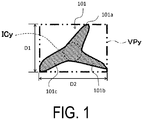
- the cross-sectional shape of the cellulose acetate fiber is not particularly limited and may be any of following shapes; a circle, an ellipse, a polygon, a hollow shape, and a heteromorphic shape, such as a Y shape, but is preferably a Y shape.
- the cellulose acetate fiber with a Y-shaped cross section is highly effective in blocking an airflow and exhibits pressure drop very well, thus providing suitable pressure drop of the cellulose acetate band.
- FIG. 1 illustrates an example of a Y-shaped cross section of a cellulose acetate fiber.
- regions of the cross section excluding an inscribed circle (ICy) protrude outward from a plurality of portions (three portions) on the circumference of the inscribed circle ICy, and the plurality of portions is separated from each other in the circumferential direction.
- the plurality of portions is, for example, protrusions 101a, 101b, and 101c.
- the cross-sectional shape of the fiber can be observed using an optical microscope, for example, as follows.
- a pencil-like filament sample is produced from the band. That is, fiber bundles are partially sampled from the band, and the fiber bundles are wrapped with paraffin to place the fiber bundles at a position corresponding to that of the lead in a pencil.
- the filament sample thus produced is sliced with a microtome into a thickness of 1 ⁇ m to 10 ⁇ m to form a sample slice, and the sample slice can be observed with an optical microscope ("BX-51", available from Olympus Corporation).
- the spinning dope is extruded from a plurality of spinneret holes in a spinneret in which a plurality of spinneret holes is formed as described below, and the cross-sectional shape of the fiber depends on the shape of the spinneret hole.
- the shape of the spinneret hole may be triangular.
- the feret area of the cellulose acetate fiber is not particularly limited but is preferably not greater than 0.5.
- the Y-shaped cross section results from the contraction of the triangular shape of the spinneret hole, and thus the feret area is less than 0.5.
- the feret area of the present disclosure is preferably not greater than 0.48, more preferably not greater than 0.43, and particularly preferably not greater than 0.42.
- the feret area greater than 0.5 would cause difficulty in achieving pressure drop.
- the lower limit is not particularly limited but is not less than 0.35. To make the feret area less than 0.35, the shape of the spinneret would be complicated, and this would readily cause clogging or interruption at the spinneret.
- Fiber area is an index that can be utilized to assess the heteromorphism of the fiber cross section.
- the feret area will be described with reference to FIG. 1 , which illustrates an example of a Y-shaped cross section of a cellulose acetate fiber.
- the fiber is cut at any point perpendicularly to the fiber long axis direction and its cross section can be realized. And then, a virtual parallelogram that circumscribes this cross section is conceived.
- one of the two pairs of facing sides is two parallel lines circumscribing the cross section and having an inter-line distance (D2) that is a maximum value (what is called a "maximum feret diameter")
- another pair is two parallel lines circumscribing the cross-section and having an inter-line distance (D1) that is a minimum value (what is called a "minimum feret diameter").
- the feret area is an area ratio determined by dividing the cross-sectional area S of the fiber by the area (D1 x D2) of the virtual parallelogram, in other words, the occupancy rate of the fiber cross section in the virtual parallelogram.
- the configuration of the virtual parallelogram VPy circumscribing the cross section of the fiber, the cross-sectional area S of the fiber, and the area (D1 x D2) of the virtual parallelogram can be measured by processing electronic data of an image captured through a microscope using a well-known image processing technique or by manual calculation based on the captured image.
- the filament denier (FD) of the cellulose acetate fiber of the present disclosure is preferably not less than 1.0 and not greater than 12.0, more preferably not less than 1.5 and not greater than 10.0, and even more preferably not less than 2.0 and not greater than 5.0.
- a production method of the present disclosure can mitigate clogging of spinneret holes which occurs as the passage of spinning time and thus is suitable for producing a thin cellulose acetate fiber as described herein.
- the filament denier depends on the diameter of the spinneret hole. To adjust the filament denier to approximately not less than 1.0 and not greater than 12.0, the diameter of the spinneret hole may be approximately not less than 40 ⁇ m and not greater than 100 ⁇ m.
- the total degree of acetyl substitution of cellulose acetate of the cellulose acetate fiber of the present disclosure is preferably not less than 2.41 and not greater than 2.49, more preferably not less than 2.43 and not greater than 2.47, and even more preferably not less than 2.44 and not greater than 2.46. This is because the smaller variation in the degree of substitution can stabilize the extrusion from the spinneret holes.
- the total degree of acetyl substitution can be measured by the following method.
- the total degree of acetyl substitution is the sum of each degree of substitution at the 2-, 3-, and 6-positions of the glucose ring of cellulose acetate.
- the each degree of acetyl substitution at the 2-, 3-, and 6-positions of the glucose ring of cellulose acetate particles can be measured by NMR according to the method of Tezuka ( Tezuka, Carbonydr. Res. 273, 83 (1995 )). That is, a free hydroxyl group of a cellulose diacetate sample is propionylated with propionic anhydride in pyridine. The resulting sample is dissolved in deuteriochloroform, and the 13 C-NMR spectrum is measured.
- the carbon signals of the acetyl group appear in the region from 169 ppm to 171 ppm in the order of the 2-, 3-, and 6-positions from the high magnetic field; and the carbonyl carbon signals of the propionyl group appear in the region from 172 ppm to 174 ppm in the same order.
- Each degree of acetyl substitution at the 2-, 3-, and 6-positions of the glucose ring in the original cellulose diacetate can be determined from the presence ratio of the acetyl group and the propionyl group at the respective corresponding positions.
- the degree of acetyl substitution can be analyzed by 1 H-NMR in addition to 13 C-NMR
- the total degree of acetyl substitution is determined by converting the degree of acetylation determined according to the method for measuring degree of acetylation in ASTM: D-817-91 (Testing methods for cellulose acetate, etc.). This is the most common procedure to determine the degree of substitution of cellulose acetate.
- DS 162.14 ⁇ AV ⁇ 0.01 / 60.052 ⁇ 42.037 ⁇ AV ⁇ 0.01
- DS is the total degree of acetyl substitution
- AV is the degree of acetylation (%). Note that the value of the degree of substitution obtained by the conversion usually has a slight error from the value measured by NMR described above. When the converted value and the value measured by NMR are different, the value measured by NMR is adopted. In addition, if the value varies among the specific methods of NMR measurement, the value measured by NMR according to the method of Tezuka described above is adopted.
- the method for measuring the degree of acetylation according to ASTM: D-817-91 (Testing method for cellulose acetate, etc.) is outlined as follows. First, 1.9 g of dried cellulose acetate is sampled and accurately weighed and dissolved in 150 mL of a mixed solution of acetone and dimethyl sulfoxide (a volume ratio of 4:1), then 30 mL of a 1 N aqueous sodium hydroxide solution is added, and the cellulose acetate is saponified at 25°C for 2 hours. Phenol phthalein is added as an indicator, and excess sodium hydroxide is titrated with a 1 N sulfuric acid (concentration factor: F).
- a cellulose acetate band may be composed of the cellulose acetate fiber of the present disclosure.
- the total denier (TD) of the cellulose acetate band is preferably not less than 8000 and not greater than 44000, more preferably not less than 15000 and not greater than 40000, and even more preferably not less than 25000 and not greater than 35000. This is because stable crimping can be applied to the tow and the nonuniformity in exhibiting pressure drop can be reduced.
- the method for producing a cellulose acetate band of the present disclosure includes: preparing a spinning dope by dissolving cellulose acetate having a calcium content of not greater than 20 ppm and a magnesium content of not less than 30 ppm; filtering the spinning dope; and spinning the cellulose acetate using the filtered spinning dope; in which titanium oxide is not added until the spinning.
- the preparation of the spinning dope by dissolving cellulose acetate having a calcium content of not greater than 20 ppm and a magnesium content of not less than 30 ppm will be described.
- the spinning dope is prepared by dissolving cellulose acetate used as a raw material in a solvent that can dissolve cellulose acetate.
- a solvent that can dissolve cellulose acetate.
- organic solvents such as acetone and dichloromethane.
- the concentration of cellulose acetate in the spinning dope needs to be adjusted to, for example, not lower than 20 wt.% and not higher than 30 wt.%.
- the temperature of the spinning dope needs to be adjusted to, for example, not lower than 45°C and not higher than 55°C.
- titanium oxide is preferably not added, in other words, titanium oxide is preferably not included, but a trace amount of titanium oxide with a content of not greater than approximately 0.05 wt.% may be included in the cellulose acetate band.
- cellulose acetate used as a raw material can be produced as follows. So-called an acetic acid method can be used, in which acetic anhydride is used as an acetylating agent, acetic acid as a diluent, and sulfuric acid as a catalyst. In pretreatments, a cellulose material, such as pulp or linter, is ground, and acetic acid containing or not containing a sulfuric acid catalyst is added. Then, acetic acid, acetic anhydride, and a sulfuric acid catalyst that have been cooled are added to perform acetylation with a kneader while the temperature is controlled with an external jacket (acetylation).
- acetic acid method in which acetic anhydride is used as an acetylating agent, acetic acid as a diluent, and sulfuric acid as a catalyst.
- a cellulose material such as pulp or linter
- Fully trisubstituted cellulose acetate (primary acetate) is produced by acetylation, then the viscous, fully trisubstituted cellulose acetate is charged into a hydrolysis vessel, a neutralizing agent, such as a magnesium acetate solution, is added to neutralize (fully neutralize or partially neutralize) sulfuric acid with magnesium or the like and to inactivate and hydrolyze acetic anhydride with moisture contained in the magnesium acetate solution or the like, and cellulose acetate with a desired degree of acetylation is produced (aging). A large amount of water is added to this cellulose acetate (secondary acetate) to precipitate cellulose acetate (precipitation).
- a neutralizing agent such as a magnesium acetate solution
- the precipitated cellulose acetate is separated by solid-liquid separation and washed (purification), and dried to obtain cellulose acetate (drying).
- an alkali metal compound and/or an alkaline earth metal compound in particular, a magnesium acetate solution and a calcium compound, such as calcium hydroxide, may be added as a stabilizer.
- the contents of calcium and magnesium in the cellulose acetate fiber and cellulose acetate band can be adjusted according to the amounts of the calcium compound and magnesium compound added at this time.
- magnesium acetate is preferably used as a stabilizer. This is because use of calcium hydroxide would readily increase the calcium contents in the cellulose acetate fiber and cellulose acetate band, causing difficulty in preventing the reduction in pressure drop.
- the method of filtration is not particularly limited. Examples of the method of filtration include filter filtration.
- Examples of a filter medium for the filter filtration include filter media made of cellulose, synthetic fiber, and a metal material, such as stainless steel, as the main material.
- the filter filtration preferably includes a plurality of filtrations. This is because a filtration performed in a single filtration would significantly shorten the life of the filter media and would readily reduce productivity. In including a plurality of filtrations, a multi-stage filtration method is preferably employed.
- the spinning of cellulose acetate using the spinning dope will be described.
- the spinning dope is extruded from a plurality of spinneret holes in a spinneret in which a plurality of spinneret holes is formed.
- the organic solvent in the extruded spinning dope is evaporated with hot air to dry the cellulose acetate. Then, the cellulose acetate is wound with a roll to obtain the cellulose acetate band.
- the diameter of the spinneret hole may be set to not less than 40 ⁇ m and not greater than 100 ⁇ m, and the extrusion rate in extruding the spinning dope from the spinneret holes may be set to a range of not lower than 500 m/min and not higher than 900 m/min.
- the diameter of the spinneret hole may be set to not less than 40 ⁇ m and not greater than 100 ⁇ m, and the number of spinneret holes may be set to a range of not less than 100 and not greater than 1000.
- titanium oxide is not added until the spinning, and thus titanium oxide is not included, or, if included, the titanium oxide content can be greatly reduced.
- the frequency of fiber interruption does not increase even when a high-speed spinning is performed.
- increasing the extrusion rate in extruding the spinning dope (dope) from the spinneret holes may problematically destabilize the fluidity of the dope in the spinneret holes, probably due to a problem of solution viscosity of the spinning dope (dope), but this problem can also be solved.
- FIG. 2 is a general view of a production apparatus 1 for cellulose acetate band (hereinafter, also referred to as "the production apparatus 1").
- the production apparatus 1 produces a band 33 by a dry spinning method.
- a spinning dope 22 in which cellulose acetate flakes used as a raw material are dissolved in an organic solvent is used.
- This spinning dope 22 is mixed in a mixing apparatus 2 and then filtered in a filtration apparatus 3.
- the spinning dope 22 that has passed through the filtration apparatus 3 is extruded from a plurality of spinneret holes of a spinneret 15 provided on a cabinet 14 of a spinning unit 4.
- the cabinet 14 may be cylindrical.
- the spinning dope 22 extruded from each spinneret hole is dried by evaporating the organic solvent with hot air supplied into the cabinet 14 from a drying unit (not illustrated). Solid filaments 30 are thus formed.
- the filaments 30 are guided with guide pins 7 and 8, which are guiding devices (also referred to as a "guiding").
- a width of a line of a plurality of the filaments 30 is adjusted by a width-adjusting guide.
- the plurality of the filaments 30 that has passed through one cabinet 14 are gathered by the width-adjusting guide and formed into a yarn 31.
- the yarn 31 may be subjected to application of a lubricant (herein, a lubricant emulsion) by a lubrication unit 5 (as an example, a rotating roll) while the yarn 31 is being guided by the guide pins 7 and 8.
- a lubricant herein, a lubricant emulsion
- a lubrication unit 5 as an example, a rotating roll
- the width of a line of the yarn 31 is then adjusted and further narrowed by the guide pins 7 and 8. Thereafter, the yarn 31 is wound with a godet roll 6.
- the yarn 31 travels around the roll surface of the godet roll 6 only for about 3/4 of the surface and then is taken up by a predetermined winding apparatus.
- a series of units for producing the yarn 31, that is, the spinning unit 4 extruding the spinning dope 22 from the spinneret 15 to spin the filaments 30, the drying unit, the lubrication unit 5, and a winding unit having the godet roll 6, is collectively referred to as a "station".
- a plurality of stations is arranged in a line.
- the yarn 31 is taken up from the roll surface of the godet roll 6 in a horizontal direction by the winding apparatus.
- the guide pins 7 and 8 change the direction of guiding the yarn 31, which passed through each station, by 90°.
- Each yarn 31 is transported along the arrangement direction of the stations and sequentially accumulated or stacked.
- a plurality of the yarns 31 is thus bundled to form an end (a tow) 32, which is a flat assembly of the yarns 31.
- the end 32 is formed by bundling a plurality of the yarns 31 and finally setting a total denier to a predetermined total denier.
- the end 32 is transported in a horizontal state and guided to a crimping apparatus 9.
- the crimping apparatus 9 has a pair of nip rolls 16 and 17 for pushing the end 32 into a stuffing box (crimping box) 18. As the pair of the nip rolls 16 and 17 push the end 32 into the stuffing box 18, the end 32 receives resistance from inside of the stuffing box 18. However, the pair of the nip rolls 16 pushes the end 32 into the stuffing box 18 with a force larger than this resistance, imparting crimping to the end 32. A band 33 is thus produced.
- the band 33 that has passed through the crimping apparatus 9 is dried with a drying apparatus 10.
- the band 33 that has passed through the drying apparatus 10 is accumulated, then subjected to compression packing to produce a bale.
- the titanium oxide content in cellulose acetate band was measured as follows.
- the moisture in the sample can be measured using, for example, a Kett moisture meter (METTLER TOLEDO HB43). About 2.0 g of a sample in a water-containing state is placed on an aluminum sample pan of the Kett moisture meter and heated at 120°C until the weight does not change, and the moisture (wt.%) in the sample can be calculated from the weight change before and after heating.
- Content of Ca or Mg in sample ppm Content of Ca or Mg in test liquid ppm ⁇ 200 Sample weight g ⁇ 1 ⁇ Moisture wt . % / 100
- a band was cut to a predetermined length and formed into a plug.
- the length (mm), circumference (mm), and net tow weight (NTW: g/rod) were determined in advance, and pressure drop (PD, mmWG) was measured at an air flow rate of 17.5 ml/sec using an automatic pressure drop meter ("QTM-6", available from CERULEAN, UK). This measurement result is a measured value of the pressure drop.
- a reduction rate (%) of the pressure drop in the average number of days of use (days) of the spinneret and the reduction rate (%) of the pressure drop per day were determined by the following method.
- Reduction rate % of pressure drop in average number of days of use of spinneret measured value mmWG of pressure drop ⁇ corrected value mmWG of pressure drop / corrected value mmWG of pressure drop ⁇ 100 Corrected value mmWG of pressure drop : Measured value of pressure drop ⁇ 1 + 0.003 ⁇ FD day 0 ⁇ FD relevant day / 0.01 + crimp-index day 0 ⁇ crimp-index relevant day
- Crimp-index measured according to a measurement method described in JP 07-316975 A by capturing an image of a surface of a band illuminated with light by imaging means and processing the captured image with a computer.
- the average number of days of use of the spinneret is the average value of the number of days of using one or two or more spinnerets when the cellulose acetate bands are continuously produced.
- the average number of days of use was calculated by counting the day of the replacement as day 0.
- the reduction rate (%) of the pressure drop per day is a slope of a regression line with an intercept of 0 prepared by plotting the average number of days of use (days) of the spinneret in the horizontal axis and the reduction rate (%) of the pressure drop in the vertical axis and determined by the least squares method.
- a spinning dope was prepared by dissolving 29.0 parts by weight of cellulose acetate (total degree of acetyl substitution: 2.45) having a calcium content of 12 ppm and a magnesium content of 71 ppm in 68.5 parts by weight of acetone and 2.5 parts by weight of water. Titanium oxide was not added, and thus the content of the titanium oxide in the spinning dope was 0 wt.%.
- 27 cabinets having a spinneret in which 400 spinneret holes each having a triangular orifice with a side length of 50 ⁇ m were formed were prepared.
- the spinning dope was heated to 50°C and filtered with a filtration apparatus, then extruded from the spinneret holes of the spinneret, and cellulose acetate was spun.
- the spinning speed (winding rate of a pair of nip rolls) at this time was set to 600 m/min.
- the spinning dope was extruded, and from the formed single fiber (filament), an end was produced.
- the ends were crimped with a crimping apparatus, and a cellulose acetate band was obtained.
- the filament denier (FD) of the cellulose acetate fiber was set to 2.6, and the total denier (TD) was set to 27000.
- the crimp-index of the cellulose acetate band was set to 34.0 per inch.
- Table 1 The evaluation results of the resulting cellulose acetate band are shown in Table 1.
- a spinning dope was prepared by dissolving 29.0 parts by weight of cellulose acetate (total degree of acetyl substitution: 2.45) having a calcium content of 11 ppm and a magnesium content of 39 ppm in place of the cellulose acetate in Example 1 in 68.5 parts by weight of acetone and 2.5 parts by weight of water. Titanium oxide was not added, and thus the content of the titanium oxide in the spinning dope was 0 wt.%.
- 34 cabinets having a spinneret in which 320 spinneret holes each having a triangular orifice with a side length of 56 ⁇ m were formed were prepared.
- the spinning dope was heated to 50°C and filtered with a filtration apparatus, then extruded from the spinneret holes of the spinneret, and cellulose acetate was spun.
- the spinning speed (winding rate of a pair of nip rolls) at this time was set to 600 m/min.
- the spinning dope was extruded, and from the formed single fiber (filament), an end was produced.
- the ends were crimped with a crimping apparatus, and a cellulose acetate band was obtained.
- the filament denier (FD) of the cellulose acetate fiber was set to 3.0, and the total denier (TD) was set to 30000.
- the crimp-index of the cellulose acetate band was set to 36.0 per inch.
- Table 1 The evaluation results of the resulting cellulose acetate band are shown in Table 1.
- a cellulose acetate band was produced in the same manner as in Example 2 except for using cellulose acetate (total degree of acetyl substitution: 2.45) having a calcium content of 60 ppm and a magnesium content of 5 ppm in place of the cellulose acetate in Example 2.
- the evaluation results of the resulting cellulose acetate band are shown in Table 1.
- a cellulose acetate band was produced in the same manner as in Example 2 except for using a spinning dope prepared by dissolving 28.9 parts by weight of cellulose acetate (total degree of acetyl substitution: 2.45) having a titanium oxide content of 0 wt.%, a calcium content of 60 ppm, and a magnesium content of 5 ppm in place of the spinning dope in Example 2 in 68.5 parts by weight of acetone and 2.5 parts by weight of water, and further adding 0.1 parts by weight of titanium oxide.
- the evaluation results of the resulting cellulose acetate band are shown in Table 1.
- the band of Comparative Example had a titanium oxide content of 0 wt.% and thus had a very large reduction rate of the pressure drop (%/day).
- the production method of Examples despite the titanium oxide content of 0 wt.%, achieves a small reduction rate of the pressure drop (%/day) over the spinning time, the reduction rate equivalent to that of a band having a titanium oxide content of greater than 0.05 wt.% (Reference Example 1), and can prevent the reduction in pressure drop of the cellulose acetate band.
Landscapes
- Chemical & Material Sciences (AREA)
- Engineering & Computer Science (AREA)
- Chemical Kinetics & Catalysis (AREA)
- General Chemical & Material Sciences (AREA)
- Textile Engineering (AREA)
- Manufacturing & Machinery (AREA)
- Materials Engineering (AREA)
- Polymers & Plastics (AREA)
- Medicinal Chemistry (AREA)
- Organic Chemistry (AREA)
- Health & Medical Sciences (AREA)
- Life Sciences & Earth Sciences (AREA)
- Biochemistry (AREA)
- Inorganic Chemistry (AREA)
- Artificial Filaments (AREA)
- Polysaccharides And Polysaccharide Derivatives (AREA)
- Spinning Methods And Devices For Manufacturing Artificial Fibers (AREA)
Abstract
Description
- The present invention relates to cellulose acetate fiber, a cellulose acetate band, and a method for producing a cellulose acetate band.
- Fibers made of cellulose acetate, in particular, cellulose diacetate, are useful as materials, such as materials for cigarette filters used in cigarettes including electronic cigarettes, and materials for absorbers of hygiene products. Cellulose acetate, when used in these applications, is used as a cellulose acetate band composed of a cellulose acetate fiber.
- Typically, in dry-spinning cellulose acetate, a spinning dope (also referred to as a "dope") prepared by dissolving cellulose acetate in an organic solvent is extruded from spinneret holes of a spinneret. The solvent in the spinning dope is then evaporated to spin (form a shape of) cellulose acetate. In spinning a cellulose acetate fiber, acetone is often used as the organic solvent included in the spinning dope (Non-Patent Document 1).
- As disclosed in
Patent Document 1, in producing a cellulose acetate band (hereinafter, also referred to simply as a "band"), a yarn is formed of a plurality of cellulose acetate fibers. A plurality of yarns is combined to form a tow. The tow is crimped to produce a band. The band is packed in a packaging sleeve and compression-packed. - In addition, a sulfuric acid catalyst is used for cellulose acetate in acetylation of the cellulose acetate and is neutralized with calcium acetate or the like in hydrolysis of the cellulose acetate or the like. Furthermore, to prevent hydrolysis of cellulose acetate in drying, an alkaline earth metal is added (Non-Patent Document 2).
- The band is required to look beautiful in appearance, thus titanium oxide is added to a spinning dope of the related art to impart a matting effect to the spinning dope, and thus the band looks white. Thus, titanium oxide is normally included in the dope in the related art.
- For example,
Patent Document 2 describes: "Provided is a cellulose ester fiber combined with a pigment, the pigment acting as a photo-oxidation catalyst, the cellulose ester fiber having a moderate degree of substitution per anhydroglucose (DS/AGU). This fiber is useful as a filter material for tobacco products. The filter material thus provided is easily dispersed and biodegraded and does not remain in the environment." - The object of
Patent Document 2 is to increase biodegradability, andPatent Document 2 discloses adding an anatase titanium oxide for this purpose. In addition,Patent Document 2 discloses examples of a metal useful for increasing thermal oxidation, the metal allowed to coexist as a salt with the anatase titanium oxide, including Cu, Fe, or Ni contained in a form of a salt, such as a nitrate, an acetate, a propionate, a benzoate, or a chloride; or Ca, Mg, Ba, or Zn preferably present as a sulfate or a phosphate; or sodium or potassium present as a sulfate. -
- Patent Document 1:
JP 2004-068198 A - Patent Document 2:
JP 08-500152 A -
- Non-Patent Document 1: Issue edited by: P. Rustemeyer. March 2004. Cellulose Acetates: Properties and Applications. Pages 266-281
- Non-Patent Document 2: Macromol. Symp. 2004, Cellulose Acetates: Properties and Applications, 208, Pages 49-60
- Improving the production rate of the tow or band means increasing the spinning rate. Thus, increasing the spinning rate while producing the tow or band composed of a fiber with the same single fiber diameter (filament denier) means increasing the rate at which the spinning dope (dope) passes through spinneret holes (the extrusion rate [extrusion amount per unit time] of the dope). However, in attempting to increase the extrusion rate of the dope, the fluidity of the dope has become unstable at the spinneret holes probably due to a problem with solution viscosity of the dope, leading to a problem of an increased frequency of fiber interruption, in particular, fiber interruption immediately below the spinneret (before drying).
- The present inventors have found that the cause of this problem is due to titanium oxide dispersed in the spinning dope (dope). In addition, it has been found that when the titanium oxide content is reduced to a certain amount, the frequency of fiber interruption does not increase also in performing a high-speed spinning.
- However, it has also been found that the tow spun using such a spinning dope (dope) has certain problems. It has been revealed that when the titanium oxide content is reduced, the spinneret holes are significantly clogged with the passage of spinning time, which is probably due to the loss of the abrasive effect of titanium oxide. In addition, the cellulose acetate band produced by extruding and spinning cellulose acetate from the spinneret holes thus clogged as the passage of spinning time has a reduced pressure drop and thus has a change in quality. In particular, in using the cellulose acetate band as a cigarette filter or the like, its pressure drop will not be stable.
- An object of the present invention is to mitigate clogging of spinneret holes which occurs as the passage of spinning time even though cellulose acetate has a small titanium oxide content or contains no titanium oxide and to prevent a reduction in pressure drop of a cellulose acetate band.
- A first of the present disclosure relates to a cellulose acetate fiber, in which a titanium oxide content is not greater than 0.05 wt.%, a calcium content is not greater than 20 ppm, and a magnesium content is not less than 30 ppm.
- A feret area of the cellulose acetate fiber may be not greater than 0.50.
- The cellulose acetate fiber may have a filament denier of not less than 1.0 and not greater than 12.0.
- A second of the present disclosure relates to a cellulose acetate band composed of the cellulose acetate fiber.
- The cellulose acetate band may have a total denier of not less than 8000 and not greater than 44000.
- A third aspect of the present disclosure relates to a method for producing a cellulose acetate band, the method including: preparing a spinning dope by dissolving cellulose acetate having a calcium content of not greater than 20 ppm and a magnesium content of not less than 30 ppm; filtering the spinning dope; and spinning the cellulose acetate using the filtered spinning dope; in which titanium oxide is not added until the spinning.
- An embodiment of the present invention can mitigate clogging of spinneret holes which occurs as the passage of spinning time even though cellulose acetate has a small titanium oxide content or contains no titanium oxide and to prevent a reduction in pressure drop of a cellulose acetate band.
-
-
FIG. 1 is a diagram illustrating a method of deriving a feret area. -
FIG. 2 is a conceptual diagram illustrating an apparatus and method for producing a cellulose acetate band according to an embodiment. - In the present specification, terms defined as described below are used.
- TD: An abbreviation of a total denier referring to denier (the number of grams per 9000 m) of an assembly of tows (band).
- FD: An abbreviation of filament denier, that is, a denier per filament, referring to denier (the number of grams per 9000 m) of a single fiber (one piece of filament). Also referred to as single fiber denier.
- Filament: A continuous long fiber; particularly referring to a single fiber extruded from the spinneret hole described below.
- Spinneret hole: An orifice of the spinneret described below that extrudes a filament.
- Band: Formed by crimping tows (an assembly of filaments). Tows, which are assemblies of filaments (single fibers) that are extruded from each of a plurality of cabinets, are combined, and a TD is set to a predetermined value. The combined crimped tows are called a band. That is, the band has a TD and a crimp-index. The band is packed in a bale form.
- Tow: An assembly of the plurality of filaments extruded from spinneret holes. An end and a yarn are each an aspect of the tow.
- End: An assembly of filaments having a predetermined total denier obtained by combining (bundling) a plurality of filaments extruded from a plurality of spinneret holes.
- Yarn: A bundle of filaments spun from one cabinet. Thus, the yarn is an assembly of filaments before combining.
- Cellulose acetate fiber of the present disclosure has a titanium oxide content of not greater than 0.05 wt.%, a calcium content of not greater than 20 ppm, and a magnesium content of not less than 30 ppm.
- The cellulose acetate fiber of the present disclosure has a titanium oxide content of not greater than 0.05 wt.%, preferably not greater than 0.03 wt.%, and more preferably not greater than 0.01 wt.%. In addition, the titanium oxide content is most preferably 0 wt.%. This is because fiber interruption, in particular, fiber interruption immediately below a spinneret (before drying), can be reduced. Note that the "0 wt.%" described above includes a case where titanium oxide is not included and a case where only a trace amount of titanium oxide not greater than the detection limit is included.
- The titanium oxide content in the cellulose acetate fiber can be measured by atomic absorption spectrometry or the like. In addition, the titanium oxide content in the cellulose acetate can be measured according to "Testing methods for man-made filament yarns" specified in JIS L 1013: 2010. As an instrument used in the testing method specified in this JIS L 1013, an instrument specified in JIS K 0050 can be used. The titanium oxide content can be also measured by gravimetry besides the atomic absorption spectrometry and the JIS method described above.
- Calcium and magnesium included in the cellulose acetate fiber of the present disclosure may be derived from a neutralizing agent, a stabilizer, or a wash water used in the production of cellulose acetate. Calcium and magnesium are present, for example, due to deposition on the cellulose acetate flake surface; and due to electrostatic interaction with a carboxyl group included in the cellulose fiber or a sulfate ester moiety formed during production.
- The cellulose acetate fiber according to the present disclosure have a calcium content of not greater than 20 ppm, preferably not greater than 10 ppm, and more preferably not greater than 5 ppm. In addition, the calcium content is most preferably 0 wt.%. This is because a reduction in pressure drop in cellulose acetate band can be further prevented. On the other hand, an excess calcium content would readily cause clogging of spinneret holes and would not be able to prevent the reduction in pressure drop of the cellulose acetate band.
- The cellulose acetate fiber according to the present disclosure has a magnesium content of not less than 30 ppm and may have a magnesium content of not less than 40 ppm or not less than 60 ppm. The magnesium content is preferably not greater than 80 ppm because the reduction in pressure drop of the cellulose acetate band can be further prevented.
- As described below, in the production of cellulose acetate used as a raw material, when an acidic catalyst, such as sulfuric acid, is used as a catalyst, a calcium compound, such as calcium hydroxide; a magnesium compound, such as magnesium acetate; and the like may be added as a neutralizing agent or a stabilizer, or as a neutralizing agent and stabilizer. The contents of calcium and magnesium in the cellulose acetate fiber can be adjusted according to the amounts of the calcium compound and magnesium compound added at this time.
- The calcium content and the magnesium content in the cellulose acetate fiber each can be measured by the following method.
- To a crucible, 3.0 g of an undried sample is weighed, carbonized on an electric heater, and then incinerated to ash in an electric furnace at not lower than 750°C and 850°C for approximately two hours. The sample is allowed to cool for about 30 minutes, then 25 mL of a 0.07 wt.% hydrochloric acid solution is added, and the sample is heat-dissolved at 220 to 230°C. The solution is allowed to cool, then made to 200 mL with distilled water, and this solution is used as a test liquid. The test liquid and a standard liquid are measured using an atomic absorption spectrophotometer to determine the calcium (Ca) content or the magnesium (Mg) content in the test liquid. These values are converted by the following equation, and the calcium (Ca) content or the magnesium (Mg) content in the sample can be determined. The moisture in the sample can be measured using, for example, a Kett moisture meter (METTLER TOLEDO HB43). About 2.0 g of a sample in a water-containing state is placed on an aluminum sample pan of the Kett moisture meter and heated at 120°C until the weight does not change, and the moisture (wt.%) in the sample can be calculated from the weight change before and after heating.

- The cross-sectional shape of the cellulose acetate fiber is not particularly limited and may be any of following shapes; a circle, an ellipse, a polygon, a hollow shape, and a heteromorphic shape, such as a Y shape, but is preferably a Y shape. The cellulose acetate fiber with a Y-shaped cross section is highly effective in blocking an airflow and exhibits pressure drop very well, thus providing suitable pressure drop of the cellulose acetate band.
- The Y shape will be described with reference to
FIG. 1 , which illustrates an example of a Y-shaped cross section of a cellulose acetate fiber. In acellulose acetate fiber 101 with a Y-shaped cross section, regions of the cross section excluding an inscribed circle (ICy) protrude outward from a plurality of portions (three portions) on the circumference of the inscribed circle ICy, and the plurality of portions is separated from each other in the circumferential direction. The plurality of portions is, for example,protrusions - The cross-sectional shape of the fiber can be observed using an optical microscope, for example, as follows. A pencil-like filament sample is produced from the band. That is, fiber bundles are partially sampled from the band, and the fiber bundles are wrapped with paraffin to place the fiber bundles at a position corresponding to that of the lead in a pencil. The filament sample thus produced is sliced with a microtome into a thickness of 1 µm to 10 µm to form a sample slice, and the sample slice can be observed with an optical microscope ("BX-51", available from Olympus Corporation).
- To produce the fiber by spinning cellulose acetate, the spinning dope is extruded from a plurality of spinneret holes in a spinneret in which a plurality of spinneret holes is formed as described below, and the cross-sectional shape of the fiber depends on the shape of the spinneret hole. To form the cellulose acetate fiber with the Y-shaped cross section, the shape of the spinneret hole may be triangular.
- The feret area of the cellulose acetate fiber is not particularly limited but is preferably not greater than 0.5.
- When the cross-sectional shape of the cellulose acetate fiber is Y-shaped, the Y-shaped cross section results from the contraction of the triangular shape of the spinneret hole, and thus the feret area is less than 0.5. The feret area of the present disclosure is preferably not greater than 0.48, more preferably not greater than 0.43, and particularly preferably not greater than 0.42. The feret area greater than 0.5 would cause difficulty in achieving pressure drop. The lower limit is not particularly limited but is not less than 0.35. To make the feret area less than 0.35, the shape of the spinneret would be complicated, and this would readily cause clogging or interruption at the spinneret.
- "Feret area" is an index that can be utilized to assess the heteromorphism of the fiber cross section. The feret area will be described with reference to
FIG. 1 , which illustrates an example of a Y-shaped cross section of a cellulose acetate fiber. In deriving the feret area, the fiber is cut at any point perpendicularly to the fiber long axis direction and its cross section can be realized. And then, a virtual parallelogram that circumscribes this cross section is conceived. In this virtual parallelogram, one of the two pairs of facing sides is two parallel lines circumscribing the cross section and having an inter-line distance (D2) that is a maximum value (what is called a "maximum feret diameter"), and another pair is two parallel lines circumscribing the cross-section and having an inter-line distance (D1) that is a minimum value (what is called a "minimum feret diameter"). The feret area is an area ratio determined by dividing the cross-sectional area S of the fiber by the area (D1 x D2) of the virtual parallelogram, in other words, the occupancy rate of the fiber cross section in the virtual parallelogram. - The configuration of the virtual parallelogram VPy circumscribing the cross section of the fiber, the cross-sectional area S of the fiber, and the area (D1 x D2) of the virtual parallelogram can be measured by processing electronic data of an image captured through a microscope using a well-known image processing technique or by manual calculation based on the captured image.
- The filament denier (FD) of the cellulose acetate fiber of the present disclosure is preferably not less than 1.0 and not greater than 12.0, more preferably not less than 1.5 and not greater than 10.0, and even more preferably not less than 2.0 and not greater than 5.0. A production method of the present disclosure can mitigate clogging of spinneret holes which occurs as the passage of spinning time and thus is suitable for producing a thin cellulose acetate fiber as described herein.
- The filament denier depends on the diameter of the spinneret hole. To adjust the filament denier to approximately not less than 1.0 and not greater than 12.0, the diameter of the spinneret hole may be approximately not less than 40 µm and not greater than 100 µm.
- The total degree of acetyl substitution of cellulose acetate of the cellulose acetate fiber of the present disclosure is preferably not less than 2.41 and not greater than 2.49, more preferably not less than 2.43 and not greater than 2.47, and even more preferably not less than 2.44 and not greater than 2.46. This is because the smaller variation in the degree of substitution can stabilize the extrusion from the spinneret holes.
- The total degree of acetyl substitution can be measured by the following method. First, the total degree of acetyl substitution is the sum of each degree of substitution at the 2-, 3-, and 6-positions of the glucose ring of cellulose acetate. The each degree of acetyl substitution at the 2-, 3-, and 6-positions of the glucose ring of cellulose acetate particles can be measured by NMR according to the method of Tezuka (Tezuka, Carbonydr. Res. 273, 83 (1995)). That is, a free hydroxyl group of a cellulose diacetate sample is propionylated with propionic anhydride in pyridine. The resulting sample is dissolved in deuteriochloroform, and the 13C-NMR spectrum is measured. The carbon signals of the acetyl group appear in the region from 169 ppm to 171 ppm in the order of the 2-, 3-, and 6-positions from the high magnetic field; and the carbonyl carbon signals of the propionyl group appear in the region from 172 ppm to 174 ppm in the same order. Each degree of acetyl substitution at the 2-, 3-, and 6-positions of the glucose ring in the original cellulose diacetate can be determined from the presence ratio of the acetyl group and the propionyl group at the respective corresponding positions. The degree of acetyl substitution can be analyzed by 1H-NMR in addition to 13C-NMR
- Furthermore, the total degree of acetyl substitution is determined by converting the degree of acetylation determined according to the method for measuring degree of acetylation in ASTM: D-817-91 (Testing methods for cellulose acetate, etc.). This is the most common procedure to determine the degree of substitution of cellulose acetate.

- In the above equation, DS is the total degree of acetyl substitution, and AV is the degree of acetylation (%). Note that the value of the degree of substitution obtained by the conversion usually has a slight error from the value measured by NMR described above. When the converted value and the value measured by NMR are different, the value measured by NMR is adopted. In addition, if the value varies among the specific methods of NMR measurement, the value measured by NMR according to the method of Tezuka described above is adopted.
- The method for measuring the degree of acetylation according to ASTM: D-817-91 (Testing method for cellulose acetate, etc.) is outlined as follows. First, 1.9 g of dried cellulose acetate is sampled and accurately weighed and dissolved in 150 mL of a mixed solution of acetone and dimethyl sulfoxide (a volume ratio of 4:1), then 30 mL of a 1 N aqueous sodium hydroxide solution is added, and the cellulose acetate is saponified at 25°C for 2 hours. Phenol phthalein is added as an indicator, and excess sodium hydroxide is titrated with a 1 N sulfuric acid (concentration factor: F). In addition, a blank test is performed in the same manner as described above, and the degree of acetylation is calculated according to the following equation.

- A cellulose acetate band may be composed of the cellulose acetate fiber of the present disclosure.
- The total denier (TD) of the cellulose acetate band is preferably not less than 8000 and not greater than 44000, more preferably not less than 15000 and not greater than 40000, and even more preferably not less than 25000 and not greater than 35000. This is because stable crimping can be applied to the tow and the nonuniformity in exhibiting pressure drop can be reduced.
- A method for producing a cellulose acetate band of the present disclosure will be described in detail. The method for producing a cellulose acetate band of the present disclosure includes: preparing a spinning dope by dissolving cellulose acetate having a calcium content of not greater than 20 ppm and a magnesium content of not less than 30 ppm; filtering the spinning dope; and spinning the cellulose acetate using the filtered spinning dope; in which titanium oxide is not added until the spinning.
- The preparation of the spinning dope by dissolving cellulose acetate having a calcium content of not greater than 20 ppm and a magnesium content of not less than 30 ppm will be described.
- The spinning dope is prepared by dissolving cellulose acetate used as a raw material in a solvent that can dissolve cellulose acetate. Examples of such a solvent include organic solvents, such as acetone and dichloromethane.
- The concentration of cellulose acetate in the spinning dope needs to be adjusted to, for example, not lower than 20 wt.% and not higher than 30 wt.%.
- The temperature of the spinning dope needs to be adjusted to, for example, not lower than 45°C and not higher than 55°C.
- In the preparation of the spinning dope, titanium oxide is preferably not added, in other words, titanium oxide is preferably not included, but a trace amount of titanium oxide with a content of not greater than approximately 0.05 wt.% may be included in the cellulose acetate band.
- In addition, cellulose acetate used as a raw material can be produced as follows. So-called an acetic acid method can be used, in which acetic anhydride is used as an acetylating agent, acetic acid as a diluent, and sulfuric acid as a catalyst. In pretreatments, a cellulose material, such as pulp or linter, is ground, and acetic acid containing or not containing a sulfuric acid catalyst is added. Then, acetic acid, acetic anhydride, and a sulfuric acid catalyst that have been cooled are added to perform acetylation with a kneader while the temperature is controlled with an external jacket (acetylation). Fully trisubstituted cellulose acetate (primary acetate) is produced by acetylation, then the viscous, fully trisubstituted cellulose acetate is charged into a hydrolysis vessel, a neutralizing agent, such as a magnesium acetate solution, is added to neutralize (fully neutralize or partially neutralize) sulfuric acid with magnesium or the like and to inactivate and hydrolyze acetic anhydride with moisture contained in the magnesium acetate solution or the like, and cellulose acetate with a desired degree of acetylation is produced (aging). A large amount of water is added to this cellulose acetate (secondary acetate) to precipitate cellulose acetate (precipitation). The precipitated cellulose acetate is separated by solid-liquid separation and washed (purification), and dried to obtain cellulose acetate (drying). In washing with water in washing the precipitated cellulose acetate, an alkali metal compound and/or an alkaline earth metal compound, in particular, a magnesium acetate solution and a calcium compound, such as calcium hydroxide, may be added as a stabilizer.
- The contents of calcium and magnesium in the cellulose acetate fiber and cellulose acetate band can be adjusted according to the amounts of the calcium compound and magnesium compound added at this time.
- In the production of cellulose acetate that is used as a raw material, magnesium acetate is preferably used as a stabilizer. This is because use of calcium hydroxide would readily increase the calcium contents in the cellulose acetate fiber and cellulose acetate band, causing difficulty in preventing the reduction in pressure drop.
- Filtration of the spinning dope will be described. To remove foreign matter in the spinning dope, the method of filtration is not particularly limited. Examples of the method of filtration include filter filtration.
- Examples of a filter medium for the filter filtration include filter media made of cellulose, synthetic fiber, and a metal material, such as stainless steel, as the main material.
- In addition, the filter filtration preferably includes a plurality of filtrations. This is because a filtration performed in a single filtration would significantly shorten the life of the filter media and would readily reduce productivity. In including a plurality of filtrations, a multi-stage filtration method is preferably employed.
- The spinning of cellulose acetate using the spinning dope will be described. The spinning dope is extruded from a plurality of spinneret holes in a spinneret in which a plurality of spinneret holes is formed. The organic solvent in the extruded spinning dope is evaporated with hot air to dry the cellulose acetate. Then, the cellulose acetate is wound with a roll to obtain the cellulose acetate band.
- For example, to adjust the filament denier of the cellulose acetate fiber to not less than 1.0 and not greater than 12.0, for example, the diameter of the spinneret hole may be set to not less than 40 µm and not greater than 100 µm, and the extrusion rate in extruding the spinning dope from the spinneret holes may be set to a range of not lower than 500 m/min and not higher than 900 m/min.
- In addition, to adjust the total denier of the cellulose acetate band to not less than 8000 and not greater than 44000, the diameter of the spinneret hole may be set to not less than 40 µm and not greater than 100 µm, and the number of spinneret holes may be set to a range of not less than 100 and not greater than 1000.
- In the method for producing a cellulose acetate band of the present disclosure, titanium oxide is not added until the spinning, and thus titanium oxide is not included, or, if included, the titanium oxide content can be greatly reduced. Thus, the frequency of fiber interruption does not increase even when a high-speed spinning is performed. Furthermore, in extruding the spinning dope (dope) containing titanium oxide from the spinneret holes, increasing the extrusion rate in extruding the spinning dope (dope) from the spinneret holes may problematically destabilize the fluidity of the dope in the spinneret holes, probably due to a problem of solution viscosity of the spinning dope (dope), but this problem can also be solved.
-
FIG. 2 is a general view of aproduction apparatus 1 for cellulose acetate band (hereinafter, also referred to as "theproduction apparatus 1"). Theproduction apparatus 1 produces aband 33 by a dry spinning method. - In the
production apparatus 1, aspinning dope 22 in which cellulose acetate flakes used as a raw material are dissolved in an organic solvent is used. Thisspinning dope 22 is mixed in amixing apparatus 2 and then filtered in afiltration apparatus 3. The spinningdope 22 that has passed through thefiltration apparatus 3 is extruded from a plurality of spinneret holes of aspinneret 15 provided on acabinet 14 of aspinning unit 4. Thecabinet 14 may be cylindrical. The spinningdope 22 extruded from each spinneret hole is dried by evaporating the organic solvent with hot air supplied into thecabinet 14 from a drying unit (not illustrated).Solid filaments 30 are thus formed. - The
filaments 30 are guided withguide pins 7 and 8, which are guiding devices (also referred to as a "guiding"). In these guiding devices, a width of a line of a plurality of thefilaments 30 is adjusted by a width-adjusting guide. The plurality of thefilaments 30 that has passed through onecabinet 14 are gathered by the width-adjusting guide and formed into ayarn 31. Theyarn 31 may be subjected to application of a lubricant (herein, a lubricant emulsion) by a lubrication unit 5 (as an example, a rotating roll) while theyarn 31 is being guided by the guide pins 7 and 8. - The width of a line of the
yarn 31 is then adjusted and further narrowed by the guide pins 7 and 8. Thereafter, theyarn 31 is wound with agodet roll 6. Theyarn 31 travels around the roll surface of thegodet roll 6 only for about 3/4 of the surface and then is taken up by a predetermined winding apparatus. A series of units for producing theyarn 31, that is, thespinning unit 4 extruding thespinning dope 22 from thespinneret 15 to spin thefilaments 30, the drying unit, thelubrication unit 5, and a winding unit having thegodet roll 6, is collectively referred to as a "station". Typically, a plurality of stations is arranged in a line. - The
yarn 31 is taken up from the roll surface of thegodet roll 6 in a horizontal direction by the winding apparatus. The guide pins 7 and 8 change the direction of guiding theyarn 31, which passed through each station, by 90°. Eachyarn 31 is transported along the arrangement direction of the stations and sequentially accumulated or stacked. A plurality of theyarns 31 is thus bundled to form an end (a tow) 32, which is a flat assembly of theyarns 31. Theend 32 is formed by bundling a plurality of theyarns 31 and finally setting a total denier to a predetermined total denier. Theend 32 is transported in a horizontal state and guided to a crimpingapparatus 9. - The crimping
apparatus 9 has a pair of nip rolls 16 and 17 for pushing theend 32 into a stuffing box (crimping box) 18. As the pair of the nip rolls 16 and 17 push theend 32 into thestuffing box 18, theend 32 receives resistance from inside of thestuffing box 18. However, the pair of the nip rolls 16 pushes theend 32 into thestuffing box 18 with a force larger than this resistance, imparting crimping to theend 32. Aband 33 is thus produced. Theband 33 that has passed through the crimpingapparatus 9 is dried with a dryingapparatus 10. Theband 33 that has passed through the dryingapparatus 10 is accumulated, then subjected to compression packing to produce a bale. - Hereinafter, the present invention will be described specifically with reference to examples, but the technical scope of the present invention is not limited by these examples.
- Each physical property of Examples, Comparative Example, and Reference Example described below were evaluated according to the following methods.
- The titanium oxide content in cellulose acetate band was measured as follows.
- a) The absolute dry weight of about 5 g of a sample was determined, and the sample was incinerated to ash in an electric furnace while avoiding intense heat. The ash was transferred into a 200-mL beaker with a small amount of water, and then water was removed by heating the beaker. Thereafter, 15 mL of concentrated sulfuric acid (guaranteed reagent; specific gravity: 1.84) stipulated in JIS K 8951 and approximately 10 g of ammonium sulfate (guaranteed reagent) stipulated in JIS K 8960 were added and covered by a watch glass. The mixture was heated on a sand bath gradually at the beginning and intensely at the end until the liquid turned transparent.
- b) The liquid was allowed to cool, then water was carefully added to make the total amount approximately 100 mL while ensuring the liquid temperature not to reach 50°C or higher. The mixture was transferred to a 1-L volumetric flask and diluted with water up to the graduation marking. From this liquid, A mL (an amount which gives absorbance of a color reagent to be from 0.3 to 0.5, depending on the content of titanium oxide and the thickness of a cell) of the liquid was transferred to a 50 mL volumetric flask using a pipet. Then, 5 mL of hydrogen peroxide (3%, guaranteed reagent) stipulated in
JIS K 8230 and 10 mL of 1 mol/L sulfuric acid (guaranteed reagent) stipulated in JIS K 8951 were added to the liquid in the volumetric flask to develop a color. Thereafter, the liquid was diluted with water up to the graduated marking. - c) This liquid in the volumetric flask was transferred to a cell, and the absorbance at a wavelength of 420 nm was measured with a photoelectric colorimeter. Using a calibration curve produced in advance, the titanium oxide concentration (g/50 mL) was determined based on the measurement. The percentage of the titanium oxide was then calculated by the following Equation. An average value of two measurements was rounded to two decimal places by Rule B specified in JIS Z 8401 (rounding method).

- Into a crucible, 3.0 g of an undried sample was weighed and carbonized on an electric heater, and then incinerated to ash in an electric furnace at not lower than 750°C and 850°C for approximately 2 hours. The sample was allowed to cool for about 30 minutes, then 25 mL of a 0.07 wt.% hydrochloric acid solution was added, and the sample was heat-dissolved at not lower than 220°C and not higher than 230°C. The solution was allowed to cool, then made to 200 mL with distilled water, and this solution was used as a test liquid. The test liquid and a standard liquid were measured using an atomic absorption spectrophotometer to determine the calcium (Ca) content or the magnesium (Mg) content in the test liquid. These values were converted by the following equation, and the calcium (Ca) content or the magnesium (Mg) content in the sample were determined. The moisture in the sample can be measured using, for example, a Kett moisture meter (METTLER TOLEDO HB43). About 2.0 g of a sample in a water-containing state is placed on an aluminum sample pan of the Kett moisture meter and heated at 120°C until the weight does not change, and the moisture (wt.%) in the sample can be calculated from the weight change before and after heating.

- A band was cut to a predetermined length and formed into a plug. The length (mm), circumference (mm), and net tow weight (NTW: g/rod) were determined in advance, and pressure drop (PD, mmWG) was measured at an air flow rate of 17.5 ml/sec using an automatic pressure drop meter ("QTM-6", available from CERULEAN, UK). This measurement result is a measured value of the pressure drop.
- In addition, to evaluate a change in a pressure drop due to the time of use of the spinneret, that is, a change in pressure drop which occurs as the passage of spinning time, a reduction rate (%) of the pressure drop in the average number of days of use (days) of the spinneret and the reduction rate (%) of the pressure drop per day were determined by the following method.


- Crimp-index: measured according to a measurement method described in
JP 07-316975 A - In addition, the average number of days of use of the spinneret (days) is the average value of the number of days of using one or two or more spinnerets when the cellulose acetate bands are continuously produced. When one or some spinnerets were replaced with a new spinneret or spinnerets during the production of cellulose acetate bands, the average number of days of use (days) was calculated by counting the day of the replacement as day 0.
- The reduction rate (%) of the pressure drop per day is a slope of a regression line with an intercept of 0 prepared by plotting the average number of days of use (days) of the spinneret in the horizontal axis and the reduction rate (%) of the pressure drop in the vertical axis and determined by the least squares method.
- A spinning dope was prepared by dissolving 29.0 parts by weight of cellulose acetate (total degree of acetyl substitution: 2.45) having a calcium content of 12 ppm and a magnesium content of 71 ppm in 68.5 parts by weight of acetone and 2.5 parts by weight of water. Titanium oxide was not added, and thus the content of the titanium oxide in the spinning dope was 0 wt.%.
- In addition, 27 cabinets having a spinneret in which 400 spinneret holes each having a triangular orifice with a side length of 50 µm were formed were prepared. The spinning dope was heated to 50°C and filtered with a filtration apparatus, then extruded from the spinneret holes of the spinneret, and cellulose acetate was spun. The spinning speed (winding rate of a pair of nip rolls) at this time was set to 600 m/min.
- The spinning dope was extruded, and from the formed single fiber (filament), an end was produced. The ends were crimped with a crimping apparatus, and a cellulose acetate band was obtained. The filament denier (FD) of the cellulose acetate fiber was set to 2.6, and the total denier (TD) was set to 27000. In addition, the crimp-index of the cellulose acetate band was set to 34.0 per inch. The evaluation results of the resulting cellulose acetate band are shown in Table 1.
- A spinning dope was prepared by dissolving 29.0 parts by weight of cellulose acetate (total degree of acetyl substitution: 2.45) having a calcium content of 11 ppm and a magnesium content of 39 ppm in place of the cellulose acetate in Example 1 in 68.5 parts by weight of acetone and 2.5 parts by weight of water. Titanium oxide was not added, and thus the content of the titanium oxide in the spinning dope was 0 wt.%.
- In addition, 34 cabinets having a spinneret in which 320 spinneret holes each having a triangular orifice with a side length of 56 µm were formed were prepared. The spinning dope was heated to 50°C and filtered with a filtration apparatus, then extruded from the spinneret holes of the spinneret, and cellulose acetate was spun. The spinning speed (winding rate of a pair of nip rolls) at this time was set to 600 m/min.
- The spinning dope was extruded, and from the formed single fiber (filament), an end was produced. The ends were crimped with a crimping apparatus, and a cellulose acetate band was obtained. The filament denier (FD) of the cellulose acetate fiber was set to 3.0, and the total denier (TD) was set to 30000. In addition, the crimp-index of the cellulose acetate band was set to 36.0 per inch. The evaluation results of the resulting cellulose acetate band are shown in Table 1.
- A cellulose acetate band was produced in the same manner as in Example 2 except for using cellulose acetate (total degree of acetyl substitution: 2.45) having a calcium content of 60 ppm and a magnesium content of 5 ppm in place of the cellulose acetate in Example 2. The evaluation results of the resulting cellulose acetate band are shown in Table 1.
- A cellulose acetate band was produced in the same manner as in Example 2 except for using a spinning dope prepared by dissolving 28.9 parts by weight of cellulose acetate (total degree of acetyl substitution: 2.45) having a titanium oxide content of 0 wt.%, a calcium content of 60 ppm, and a magnesium content of 5 ppm in place of the spinning dope in Example 2 in 68.5 parts by weight of acetone and 2.5 parts by weight of water, and further adding 0.1 parts by weight of titanium oxide. The evaluation results of the resulting cellulose acetate band are shown in Table 1.


- As shown in Table 1, the band of Comparative Example had a titanium oxide content of 0 wt.% and thus had a very large reduction rate of the pressure drop (%/day). In contrast, the production method of Examples, despite the titanium oxide content of 0 wt.%, achieves a small reduction rate of the pressure drop (%/day) over the spinning time, the reduction rate equivalent to that of a band having a titanium oxide content of greater than 0.05 wt.% (Reference Example 1), and can prevent the reduction in pressure drop of the cellulose acetate band.
Claims (6)
- A cellulose acetate fiber, wherein
a titanium oxide content is not greater than 0.05 wt.%;
a calcium content is not greater than 20 ppm; and
a magnesium content is not less than 30 ppm. - The cellulose acetate fiber according to claim 1, wherein a feret area of the cellulose acetate fiber is not greater than 0.50.
- The cellulose acetate fiber according to claim 1 or 2, wherein a filament denier is not less than 1.0 and not greater than 12.0.
- A cellulose acetate band comprising the cellulose acetate fiber described in any one of claims 1 to 3.
- The cellulose acetate band according to claim 4, wherein a total denier is not less than 8000 and not greater than 44000.
- A method for producing a cellulose acetate band, the method comprising:preparing a spinning dope by dissolving cellulose acetate having a calcium content of not greater than 20 ppm and a magnesium content of not less than 30 ppm;filtering the spinning dope; andspinning the cellulose acetate using the filtered spinning dope;wherein titanium oxide is not added until the spinning.
Applications Claiming Priority (2)
| Application Number | Priority Date | Filing Date | Title |
|---|---|---|---|
| JP2018132666A JP7217099B2 (en) | 2018-07-12 | 2018-07-12 | Cellulose acetate fiber, cellulose acetate tow band, and method for producing cellulose acetate tow band |
| PCT/JP2019/027400 WO2020013248A1 (en) | 2018-07-12 | 2019-07-10 | Cellulose acetate fiber, cellulose acetate tow band, and method for producing cellulose acetate tow band |
Publications (3)
| Publication Number | Publication Date |
|---|---|
| EP3715509A1 true EP3715509A1 (en) | 2020-09-30 |
| EP3715509A4 EP3715509A4 (en) | 2021-07-07 |
| EP3715509B1 EP3715509B1 (en) | 2022-04-13 |
Family
ID=69142638
Family Applications (1)
| Application Number | Title | Priority Date | Filing Date |
|---|---|---|---|
| EP19833290.0A Active EP3715509B1 (en) | 2018-07-12 | 2019-07-10 | Cellulose acetate fiber, cellulose acetate tow band, and method for producing cellulose acetate tow band |
Country Status (6)
| Country | Link |
|---|---|
| US (1) | US20210079561A1 (en) |
| EP (1) | EP3715509B1 (en) |
| JP (1) | JP7217099B2 (en) |
| KR (1) | KR102677634B1 (en) |
| CN (1) | CN111684115B (en) |
| WO (1) | WO2020013248A1 (en) |
Cited By (1)
| Publication number | Priority date | Publication date | Assignee | Title |
|---|---|---|---|---|
| EP4085770A4 (en) * | 2020-12-22 | 2023-01-18 | Daicel Corporation | SMOKING ARTICLE WICK STRIP, SMOKING ARTICLE FILTER, SMOKING ARTICLE AND SMOKING ARTICLE CARTRIDGE |
Families Citing this family (4)
| Publication number | Priority date | Publication date | Assignee | Title |
|---|---|---|---|---|
| US9851341B2 (en) * | 2014-06-27 | 2017-12-26 | Eastman Chemical Company | Fibers with chemical markers used for coding |
| CA3146892A1 (en) | 2019-08-27 | 2021-03-04 | Acetate International Llc | Cellulose acetate tow with high dpf and low titanium dioxide content |
| MX2022002456A (en) * | 2019-08-27 | 2022-03-22 | Acetate Int Llc | Cellulose acetate tow with low dpf and low titanium dioxide content. |
| WO2024229061A2 (en) * | 2023-05-04 | 2024-11-07 | Eastman Chemical Company | Methods of converting assets to increase cellulosic yarn production |
Family Cites Families (17)
| Publication number | Priority date | Publication date | Assignee | Title |
|---|---|---|---|---|
| JPS63309173A (en) * | 1987-06-12 | 1988-12-16 | ダイセル化学工業株式会社 | Tobacco filter |
| JPH04246438A (en) * | 1991-01-30 | 1992-09-02 | Mitsubishi Rayon Co Ltd | Cellulose acetate solution composition and its molding product |
| CA2135798A1 (en) | 1992-05-27 | 1993-12-09 | Charles M. Buchanan | Environmentally non-persistant cellulose ester fibers |
| JPH07316975A (en) | 1994-05-19 | 1995-12-05 | Daicel Chem Ind Ltd | Measurement of crimping characteristics of fiber and apparatus therefor |
| JP3390278B2 (en) * | 1994-12-05 | 2003-03-24 | ダイセル化学工業株式会社 | Cellulose ester composition and molded article |
| JPH09103281A (en) * | 1995-08-04 | 1997-04-22 | Mitsubishi Rayon Co Ltd | Filter material and cigarette filter using the same |
| TWI274556B (en) * | 1999-03-11 | 2007-03-01 | Japan Tobacco Inc | Biodegradable cellulose acetate structures and tobacco filters |
| JP3944021B2 (en) | 2002-08-06 | 2007-07-11 | ダイセル化学工業株式会社 | Filamentous guide device and guide method |
| JP4093048B2 (en) * | 2002-12-19 | 2008-05-28 | 東レ株式会社 | Thermoplastic cellulose ester composition excellent in molding processability and fiber obtained therefrom |
| US20120325233A1 (en) * | 2011-06-23 | 2012-12-27 | Eastman Chemical Company | Cellulose esters having mixed-phase titanium dioxide particles for improved degradation |
| KR101455006B1 (en) * | 2013-09-26 | 2014-10-27 | 코오롱인더스트리 주식회사 | Lyocell Material Cigarette Filter and Method for the Same |
| US20170006912A1 (en) * | 2014-03-13 | 2017-01-12 | Daicel Corporation | Cellulose acetate tow band for use in cigarette filter, cigarette filter, apparatus for manufacturing tow band, and method of manufacturing tow band |
| JP6415077B2 (en) * | 2014-04-01 | 2018-10-31 | 株式会社ダイセル | Hydrophilic cellulose acetate tow band and absorber using the same |
| JP6580348B2 (en) * | 2015-03-04 | 2019-09-25 | 株式会社ダイセル | Cellulose acetate fiber, production method thereof, and filter tow for tobacco |
| CN109195995B (en) * | 2016-03-15 | 2021-07-16 | 株式会社大赛璐 | Cellulose acetate |
| JP7143055B2 (en) * | 2016-08-22 | 2022-09-28 | 株式会社ダイセル | Cellulose acetate and method for producing the same |
| JP2018058941A (en) * | 2016-10-03 | 2018-04-12 | 株式会社ダイセル | Cellulose acetate and method for producing cellulose acetate |
-
2018
- 2018-07-12 JP JP2018132666A patent/JP7217099B2/en active Active
-
2019
- 2019-07-10 WO PCT/JP2019/027400 patent/WO2020013248A1/en not_active Ceased
- 2019-07-10 US US16/959,649 patent/US20210079561A1/en not_active Abandoned
- 2019-07-10 KR KR1020207022716A patent/KR102677634B1/en active Active
- 2019-07-10 CN CN201980011715.8A patent/CN111684115B/en active Active
- 2019-07-10 EP EP19833290.0A patent/EP3715509B1/en active Active
Cited By (2)
| Publication number | Priority date | Publication date | Assignee | Title |
|---|---|---|---|---|
| EP4085770A4 (en) * | 2020-12-22 | 2023-01-18 | Daicel Corporation | SMOKING ARTICLE WICK STRIP, SMOKING ARTICLE FILTER, SMOKING ARTICLE AND SMOKING ARTICLE CARTRIDGE |
| EP4085770B1 (en) | 2020-12-22 | 2024-03-20 | Daicel Corporation | Tow band for smoking article, filter for smoking article, smoking article, and cartridge for smoking article |
Also Published As
| Publication number | Publication date |
|---|---|
| EP3715509A4 (en) | 2021-07-07 |
| KR102677634B1 (en) | 2024-06-21 |
| US20210079561A1 (en) | 2021-03-18 |
| JP2020007686A (en) | 2020-01-16 |
| KR20210029135A (en) | 2021-03-15 |
| EP3715509B1 (en) | 2022-04-13 |
| WO2020013248A1 (en) | 2020-01-16 |
| CN111684115B (en) | 2023-07-11 |
| JP7217099B2 (en) | 2023-02-02 |
| CN111684115A (en) | 2020-09-18 |
Similar Documents
| Publication | Publication Date | Title |
|---|---|---|
| EP3715509B1 (en) | Cellulose acetate fiber, cellulose acetate tow band, and method for producing cellulose acetate tow band | |
| JP5921762B2 (en) | Low substituted cellulose acetate | |
| EP3653765B1 (en) | Cellulose acetate tow band, and method for producing cellulose acetate tow band | |
| US11920261B2 (en) | Cellulose acetate fiber, cellulose acetate band, and method for manufacturing cellulose acetate band | |
| EP3117724B2 (en) | Cellulose acetate tow band for use in cigarette filters and cigarette filter | |
| DE112014006175T5 (en) | Cellulose acetate fiber, cellulose acetate fiber molded article, and processes for producing the cellulose acetate fiber and cellulose acetate fiber molded article | |
| JP5171859B2 (en) | Cellulose acetate and method for producing the same | |
| CN112272685B (en) | Cellulose acetate composition for thermoforming, molded body, and method for producing cellulose acetate composition for thermoforming | |
| JP7176885B2 (en) | Cellulose acetate composition and molded article | |
| RU2778645C1 (en) | Cellulose acetate fibre, cellulose acetate tape, and method for producing cellulose acetate tape | |
| CN104872816B (en) | A method of with lyocell tow preparings for cigarette filter rod | |
| Zahan et al. | X-ray diffraction pattern profiling and sustainable production of crystalline nano-cellulose acetate from waste cotton linter: Crystallite size analysis insights | |
| EP3431509A1 (en) | Cellulose acetate | |
| JPH10317227A (en) | Cellulose acetate solution | |
| Schneider | Determination of the relation between the particle size of viscose and the physical properties of the rayon produced: development of a practical method for measuring the change of particle size |
Legal Events
| Date | Code | Title | Description |
|---|---|---|---|
| STAA | Information on the status of an ep patent application or granted ep patent |
Free format text: STATUS: THE INTERNATIONAL PUBLICATION HAS BEEN MADE |
|
| PUAI | Public reference made under article 153(3) epc to a published international application that has entered the european phase |
Free format text: ORIGINAL CODE: 0009012 |
|
| STAA | Information on the status of an ep patent application or granted ep patent |
Free format text: STATUS: REQUEST FOR EXAMINATION WAS MADE |
|
| 17P | Request for examination filed |
Effective date: 20200623 |
|
| AK | Designated contracting states |
Kind code of ref document: A1 Designated state(s): AL AT BE BG CH CY CZ DE DK EE ES FI FR GB GR HR HU IE IS IT LI LT LU LV MC MK MT NL NO PL PT RO RS SE SI SK SM TR |
|
| AX | Request for extension of the european patent |
Extension state: BA ME |
|
| STAA | Information on the status of an ep patent application or granted ep patent |
Free format text: STATUS: EXAMINATION IS IN PROGRESS |
|
| A4 | Supplementary search report drawn up and despatched |
Effective date: 20210609 |
|
| RIC1 | Information provided on ipc code assigned before grant |
Ipc: D01F 2/28 20060101AFI20210603BHEP Ipc: C08B 3/06 20060101ALI20210603BHEP Ipc: D01F 1/10 20060101ALI20210603BHEP Ipc: D01F 1/04 20060101ALI20210603BHEP |
|
| 17Q | First examination report despatched |
Effective date: 20210621 |
|
| DAV | Request for validation of the european patent (deleted) | ||
| DAX | Request for extension of the european patent (deleted) | ||
| RIC1 | Information provided on ipc code assigned before grant |
Ipc: C08L 1/12 20060101ALI20211102BHEP Ipc: A24D 3/16 20060101ALI20211102BHEP Ipc: A24D 3/10 20060101ALI20211102BHEP Ipc: D01F 1/04 20060101ALI20211102BHEP Ipc: D01F 1/10 20060101ALI20211102BHEP Ipc: C08B 3/06 20060101ALI20211102BHEP Ipc: D01F 2/28 20060101AFI20211102BHEP |
|
| GRAP | Despatch of communication of intention to grant a patent |
Free format text: ORIGINAL CODE: EPIDOSNIGR1 |
|
| STAA | Information on the status of an ep patent application or granted ep patent |
Free format text: STATUS: GRANT OF PATENT IS INTENDED |
|
| INTG | Intention to grant announced |
Effective date: 20211215 |
|
| GRAS | Grant fee paid |
Free format text: ORIGINAL CODE: EPIDOSNIGR3 |
|
| GRAA | (expected) grant |
Free format text: ORIGINAL CODE: 0009210 |
|
| STAA | Information on the status of an ep patent application or granted ep patent |
Free format text: STATUS: THE PATENT HAS BEEN GRANTED |
|
| AK | Designated contracting states |
Kind code of ref document: B1 Designated state(s): AL AT BE BG CH CY CZ DE DK EE ES FI FR GB GR HR HU IE IS IT LI LT LU LV MC MK MT NL NO PL PT RO RS SE SI SK SM TR |
|
| REG | Reference to a national code |
Ref country code: GB Ref legal event code: FG4D |
|
| REG | Reference to a national code |
Ref country code: CH Ref legal event code: EP |
|
| REG | Reference to a national code |
Ref country code: DE Ref legal event code: R096 Ref document number: 602019013764 Country of ref document: DE |
|
| REG | Reference to a national code |
Ref country code: IE Ref legal event code: FG4D |
|
| REG | Reference to a national code |
Ref country code: AT Ref legal event code: REF Ref document number: 1483483 Country of ref document: AT Kind code of ref document: T Effective date: 20220515 |
|
| REG | Reference to a national code |
Ref country code: LT Ref legal event code: MG9D |
|
| REG | Reference to a national code |
Ref country code: NL Ref legal event code: MP Effective date: 20220413 |
|
| REG | Reference to a national code |
Ref country code: AT Ref legal event code: MK05 Ref document number: 1483483 Country of ref document: AT Kind code of ref document: T Effective date: 20220413 |
|
| PG25 | Lapsed in a contracting state [announced via postgrant information from national office to epo] |
Ref country code: NL Free format text: LAPSE BECAUSE OF FAILURE TO SUBMIT A TRANSLATION OF THE DESCRIPTION OR TO PAY THE FEE WITHIN THE PRESCRIBED TIME-LIMIT Effective date: 20220413 |
|
| PG25 | Lapsed in a contracting state [announced via postgrant information from national office to epo] |
Ref country code: SE Free format text: LAPSE BECAUSE OF FAILURE TO SUBMIT A TRANSLATION OF THE DESCRIPTION OR TO PAY THE FEE WITHIN THE PRESCRIBED TIME-LIMIT Effective date: 20220413 Ref country code: PT Free format text: LAPSE BECAUSE OF FAILURE TO SUBMIT A TRANSLATION OF THE DESCRIPTION OR TO PAY THE FEE WITHIN THE PRESCRIBED TIME-LIMIT Effective date: 20220816 Ref country code: NO Free format text: LAPSE BECAUSE OF FAILURE TO SUBMIT A TRANSLATION OF THE DESCRIPTION OR TO PAY THE FEE WITHIN THE PRESCRIBED TIME-LIMIT Effective date: 20220713 Ref country code: LT Free format text: LAPSE BECAUSE OF FAILURE TO SUBMIT A TRANSLATION OF THE DESCRIPTION OR TO PAY THE FEE WITHIN THE PRESCRIBED TIME-LIMIT Effective date: 20220413 Ref country code: HR Free format text: LAPSE BECAUSE OF FAILURE TO SUBMIT A TRANSLATION OF THE DESCRIPTION OR TO PAY THE FEE WITHIN THE PRESCRIBED TIME-LIMIT Effective date: 20220413 Ref country code: GR Free format text: LAPSE BECAUSE OF FAILURE TO SUBMIT A TRANSLATION OF THE DESCRIPTION OR TO PAY THE FEE WITHIN THE PRESCRIBED TIME-LIMIT Effective date: 20220714 Ref country code: FI Free format text: LAPSE BECAUSE OF FAILURE TO SUBMIT A TRANSLATION OF THE DESCRIPTION OR TO PAY THE FEE WITHIN THE PRESCRIBED TIME-LIMIT Effective date: 20220413 Ref country code: ES Free format text: LAPSE BECAUSE OF FAILURE TO SUBMIT A TRANSLATION OF THE DESCRIPTION OR TO PAY THE FEE WITHIN THE PRESCRIBED TIME-LIMIT Effective date: 20220413 Ref country code: BG Free format text: LAPSE BECAUSE OF FAILURE TO SUBMIT A TRANSLATION OF THE DESCRIPTION OR TO PAY THE FEE WITHIN THE PRESCRIBED TIME-LIMIT Effective date: 20220713 Ref country code: AT Free format text: LAPSE BECAUSE OF FAILURE TO SUBMIT A TRANSLATION OF THE DESCRIPTION OR TO PAY THE FEE WITHIN THE PRESCRIBED TIME-LIMIT Effective date: 20220413 |
|
| PG25 | Lapsed in a contracting state [announced via postgrant information from national office to epo] |
Ref country code: RS Free format text: LAPSE BECAUSE OF FAILURE TO SUBMIT A TRANSLATION OF THE DESCRIPTION OR TO PAY THE FEE WITHIN THE PRESCRIBED TIME-LIMIT Effective date: 20220413 Ref country code: PL Free format text: LAPSE BECAUSE OF FAILURE TO SUBMIT A TRANSLATION OF THE DESCRIPTION OR TO PAY THE FEE WITHIN THE PRESCRIBED TIME-LIMIT Effective date: 20220413 Ref country code: LV Free format text: LAPSE BECAUSE OF FAILURE TO SUBMIT A TRANSLATION OF THE DESCRIPTION OR TO PAY THE FEE WITHIN THE PRESCRIBED TIME-LIMIT Effective date: 20220413 Ref country code: IS Free format text: LAPSE BECAUSE OF FAILURE TO SUBMIT A TRANSLATION OF THE DESCRIPTION OR TO PAY THE FEE WITHIN THE PRESCRIBED TIME-LIMIT Effective date: 20220813 |
|
| REG | Reference to a national code |
Ref country code: DE Ref legal event code: R097 Ref document number: 602019013764 Country of ref document: DE |
|
| PG25 | Lapsed in a contracting state [announced via postgrant information from national office to epo] |
Ref country code: SM Free format text: LAPSE BECAUSE OF FAILURE TO SUBMIT A TRANSLATION OF THE DESCRIPTION OR TO PAY THE FEE WITHIN THE PRESCRIBED TIME-LIMIT Effective date: 20220413 Ref country code: SK Free format text: LAPSE BECAUSE OF FAILURE TO SUBMIT A TRANSLATION OF THE DESCRIPTION OR TO PAY THE FEE WITHIN THE PRESCRIBED TIME-LIMIT Effective date: 20220413 Ref country code: RO Free format text: LAPSE BECAUSE OF FAILURE TO SUBMIT A TRANSLATION OF THE DESCRIPTION OR TO PAY THE FEE WITHIN THE PRESCRIBED TIME-LIMIT Effective date: 20220413 Ref country code: EE Free format text: LAPSE BECAUSE OF FAILURE TO SUBMIT A TRANSLATION OF THE DESCRIPTION OR TO PAY THE FEE WITHIN THE PRESCRIBED TIME-LIMIT Effective date: 20220413 Ref country code: DK Free format text: LAPSE BECAUSE OF FAILURE TO SUBMIT A TRANSLATION OF THE DESCRIPTION OR TO PAY THE FEE WITHIN THE PRESCRIBED TIME-LIMIT Effective date: 20220413 Ref country code: CZ Free format text: LAPSE BECAUSE OF FAILURE TO SUBMIT A TRANSLATION OF THE DESCRIPTION OR TO PAY THE FEE WITHIN THE PRESCRIBED TIME-LIMIT Effective date: 20220413 |
|
| PLBE | No opposition filed within time limit |
Free format text: ORIGINAL CODE: 0009261 |
|
| STAA | Information on the status of an ep patent application or granted ep patent |
Free format text: STATUS: NO OPPOSITION FILED WITHIN TIME LIMIT |
|
| PG25 | Lapsed in a contracting state [announced via postgrant information from national office to epo] |
Ref country code: MC Free format text: LAPSE BECAUSE OF FAILURE TO SUBMIT A TRANSLATION OF THE DESCRIPTION OR TO PAY THE FEE WITHIN THE PRESCRIBED TIME-LIMIT Effective date: 20220413 |
|
| REG | Reference to a national code |
Ref country code: CH Ref legal event code: PL |
|
| 26N | No opposition filed |
Effective date: 20230116 |
|
| PG25 | Lapsed in a contracting state [announced via postgrant information from national office to epo] |
Ref country code: AL Free format text: LAPSE BECAUSE OF FAILURE TO SUBMIT A TRANSLATION OF THE DESCRIPTION OR TO PAY THE FEE WITHIN THE PRESCRIBED TIME-LIMIT Effective date: 20220413 |
|
| PG25 | Lapsed in a contracting state [announced via postgrant information from national office to epo] |
Ref country code: LU Free format text: LAPSE BECAUSE OF NON-PAYMENT OF DUE FEES Effective date: 20220710 Ref country code: LI Free format text: LAPSE BECAUSE OF NON-PAYMENT OF DUE FEES Effective date: 20220731 Ref country code: FR Free format text: LAPSE BECAUSE OF NON-PAYMENT OF DUE FEES Effective date: 20220731 Ref country code: CH Free format text: LAPSE BECAUSE OF NON-PAYMENT OF DUE FEES Effective date: 20220731 |
|
| PG25 | Lapsed in a contracting state [announced via postgrant information from national office to epo] |
Ref country code: SI Free format text: LAPSE BECAUSE OF FAILURE TO SUBMIT A TRANSLATION OF THE DESCRIPTION OR TO PAY THE FEE WITHIN THE PRESCRIBED TIME-LIMIT Effective date: 20220413 |
|
| PG25 | Lapsed in a contracting state [announced via postgrant information from national office to epo] |
Ref country code: IE Free format text: LAPSE BECAUSE OF NON-PAYMENT OF DUE FEES Effective date: 20220710 |
|
| PG25 | Lapsed in a contracting state [announced via postgrant information from national office to epo] |
Ref country code: IT Free format text: LAPSE BECAUSE OF FAILURE TO SUBMIT A TRANSLATION OF THE DESCRIPTION OR TO PAY THE FEE WITHIN THE PRESCRIBED TIME-LIMIT Effective date: 20220413 |
|
| GBPC | Gb: european patent ceased through non-payment of renewal fee |
Effective date: 20230710 |
|
| PG25 | Lapsed in a contracting state [announced via postgrant information from national office to epo] |
Ref country code: MK Free format text: LAPSE BECAUSE OF FAILURE TO SUBMIT A TRANSLATION OF THE DESCRIPTION OR TO PAY THE FEE WITHIN THE PRESCRIBED TIME-LIMIT Effective date: 20220413 Ref country code: CY Free format text: LAPSE BECAUSE OF FAILURE TO SUBMIT A TRANSLATION OF THE DESCRIPTION OR TO PAY THE FEE WITHIN THE PRESCRIBED TIME-LIMIT Effective date: 20220413 Ref country code: GB Free format text: LAPSE BECAUSE OF NON-PAYMENT OF DUE FEES Effective date: 20230710 |
|
| PG25 | Lapsed in a contracting state [announced via postgrant information from national office to epo] |
Ref country code: HU Free format text: LAPSE BECAUSE OF FAILURE TO SUBMIT A TRANSLATION OF THE DESCRIPTION OR TO PAY THE FEE WITHIN THE PRESCRIBED TIME-LIMIT; INVALID AB INITIO Effective date: 20190710 |
|
| PG25 | Lapsed in a contracting state [announced via postgrant information from national office to epo] |
Ref country code: TR Free format text: LAPSE BECAUSE OF FAILURE TO SUBMIT A TRANSLATION OF THE DESCRIPTION OR TO PAY THE FEE WITHIN THE PRESCRIBED TIME-LIMIT Effective date: 20220413 |
|
| PG25 | Lapsed in a contracting state [announced via postgrant information from national office to epo] |
Ref country code: MT Free format text: LAPSE BECAUSE OF FAILURE TO SUBMIT A TRANSLATION OF THE DESCRIPTION OR TO PAY THE FEE WITHIN THE PRESCRIBED TIME-LIMIT Effective date: 20220413 |
|
| PG25 | Lapsed in a contracting state [announced via postgrant information from national office to epo] |
Ref country code: BG Free format text: LAPSE BECAUSE OF FAILURE TO SUBMIT A TRANSLATION OF THE DESCRIPTION OR TO PAY THE FEE WITHIN THE PRESCRIBED TIME-LIMIT Effective date: 20220413 |
|
| PG25 | Lapsed in a contracting state [announced via postgrant information from national office to epo] |
Ref country code: BG Free format text: LAPSE BECAUSE OF FAILURE TO SUBMIT A TRANSLATION OF THE DESCRIPTION OR TO PAY THE FEE WITHIN THE PRESCRIBED TIME-LIMIT Effective date: 20220413 |
|
| PGFP | Annual fee paid to national office [announced via postgrant information from national office to epo] |
Ref country code: DE Payment date: 20250722 Year of fee payment: 7 |
|
| PGFP | Annual fee paid to national office [announced via postgrant information from national office to epo] |
Ref country code: BE Payment date: 20250718 Year of fee payment: 7 |