EP3715464A1 - Greenhouse gas improved fermentation - Google Patents
Greenhouse gas improved fermentation Download PDFInfo
- Publication number
- EP3715464A1 EP3715464A1 EP19165775.8A EP19165775A EP3715464A1 EP 3715464 A1 EP3715464 A1 EP 3715464A1 EP 19165775 A EP19165775 A EP 19165775A EP 3715464 A1 EP3715464 A1 EP 3715464A1
- Authority
- EP
- European Patent Office
- Prior art keywords
- bioreactors
- fermentation
- organic feedstock
- variance
- threshold value
- Prior art date
- Legal status (The legal status is an assumption and is not a legal conclusion. Google has not performed a legal analysis and makes no representation as to the accuracy of the status listed.)
- Granted
Links
Images





Classifications
-
- C—CHEMISTRY; METALLURGY
- C12—BIOCHEMISTRY; BEER; SPIRITS; WINE; VINEGAR; MICROBIOLOGY; ENZYMOLOGY; MUTATION OR GENETIC ENGINEERING
- C12M—APPARATUS FOR ENZYMOLOGY OR MICROBIOLOGY; APPARATUS FOR CULTURING MICROORGANISMS FOR PRODUCING BIOMASS, FOR GROWING CELLS OR FOR OBTAINING FERMENTATION OR METABOLIC PRODUCTS, i.e. BIOREACTORS OR FERMENTERS
- C12M23/00—Constructional details, e.g. recesses, hinges
- C12M23/36—Means for collection or storage of gas; Gas holders
-
- C—CHEMISTRY; METALLURGY
- C12—BIOCHEMISTRY; BEER; SPIRITS; WINE; VINEGAR; MICROBIOLOGY; ENZYMOLOGY; MUTATION OR GENETIC ENGINEERING
- C12M—APPARATUS FOR ENZYMOLOGY OR MICROBIOLOGY; APPARATUS FOR CULTURING MICROORGANISMS FOR PRODUCING BIOMASS, FOR GROWING CELLS OR FOR OBTAINING FERMENTATION OR METABOLIC PRODUCTS, i.e. BIOREACTORS OR FERMENTERS
- C12M29/00—Means for introduction, extraction or recirculation of materials, e.g. pumps
- C12M29/18—External loop; Means for reintroduction of fermented biomass or liquid percolate
-
- C—CHEMISTRY; METALLURGY
- C12—BIOCHEMISTRY; BEER; SPIRITS; WINE; VINEGAR; MICROBIOLOGY; ENZYMOLOGY; MUTATION OR GENETIC ENGINEERING
- C12N—MICROORGANISMS OR ENZYMES; COMPOSITIONS THEREOF; PROPAGATING, PRESERVING, OR MAINTAINING MICROORGANISMS; MUTATION OR GENETIC ENGINEERING; CULTURE MEDIA
- C12N1/00—Microorganisms; Compositions thereof; Processes of propagating, maintaining or preserving microorganisms or compositions thereof; Processes of preparing or isolating a composition containing a microorganism; Culture media therefor
-
- C—CHEMISTRY; METALLURGY
- C12—BIOCHEMISTRY; BEER; SPIRITS; WINE; VINEGAR; MICROBIOLOGY; ENZYMOLOGY; MUTATION OR GENETIC ENGINEERING
- C12P—FERMENTATION OR ENZYME-USING PROCESSES TO SYNTHESISE A DESIRED CHEMICAL COMPOUND OR COMPOSITION OR TO SEPARATE OPTICAL ISOMERS FROM A RACEMIC MIXTURE
- C12P3/00—Preparation of elements or inorganic compounds except carbon dioxide
-
- C—CHEMISTRY; METALLURGY
- C12—BIOCHEMISTRY; BEER; SPIRITS; WINE; VINEGAR; MICROBIOLOGY; ENZYMOLOGY; MUTATION OR GENETIC ENGINEERING
- C12P—FERMENTATION OR ENZYME-USING PROCESSES TO SYNTHESISE A DESIRED CHEMICAL COMPOUND OR COMPOSITION OR TO SEPARATE OPTICAL ISOMERS FROM A RACEMIC MIXTURE
- C12P7/00—Preparation of oxygen-containing organic compounds
- C12P7/02—Preparation of oxygen-containing organic compounds containing a hydroxy group
-
- C—CHEMISTRY; METALLURGY
- C12—BIOCHEMISTRY; BEER; SPIRITS; WINE; VINEGAR; MICROBIOLOGY; ENZYMOLOGY; MUTATION OR GENETIC ENGINEERING
- C12P—FERMENTATION OR ENZYME-USING PROCESSES TO SYNTHESISE A DESIRED CHEMICAL COMPOUND OR COMPOSITION OR TO SEPARATE OPTICAL ISOMERS FROM A RACEMIC MIXTURE
- C12P7/00—Preparation of oxygen-containing organic compounds
- C12P7/02—Preparation of oxygen-containing organic compounds containing a hydroxy group
- C12P7/04—Preparation of oxygen-containing organic compounds containing a hydroxy group acyclic
- C12P7/06—Ethanol, i.e. non-beverage
- C12P7/08—Ethanol, i.e. non-beverage produced as by-product or from waste or cellulosic material substrate
-
- C—CHEMISTRY; METALLURGY
- C12—BIOCHEMISTRY; BEER; SPIRITS; WINE; VINEGAR; MICROBIOLOGY; ENZYMOLOGY; MUTATION OR GENETIC ENGINEERING
- C12P—FERMENTATION OR ENZYME-USING PROCESSES TO SYNTHESISE A DESIRED CHEMICAL COMPOUND OR COMPOSITION OR TO SEPARATE OPTICAL ISOMERS FROM A RACEMIC MIXTURE
- C12P7/00—Preparation of oxygen-containing organic compounds
- C12P7/40—Preparation of oxygen-containing organic compounds containing a carboxyl group including Peroxycarboxylic acids
-
- Y—GENERAL TAGGING OF NEW TECHNOLOGICAL DEVELOPMENTS; GENERAL TAGGING OF CROSS-SECTIONAL TECHNOLOGIES SPANNING OVER SEVERAL SECTIONS OF THE IPC; TECHNICAL SUBJECTS COVERED BY FORMER USPC CROSS-REFERENCE ART COLLECTIONS [XRACs] AND DIGESTS
- Y02—TECHNOLOGIES OR APPLICATIONS FOR MITIGATION OR ADAPTATION AGAINST CLIMATE CHANGE
- Y02E—REDUCTION OF GREENHOUSE GAS [GHG] EMISSIONS, RELATED TO ENERGY GENERATION, TRANSMISSION OR DISTRIBUTION
- Y02E50/00—Technologies for the production of fuel of non-fossil origin
- Y02E50/10—Biofuels, e.g. bio-diesel
-
- Y—GENERAL TAGGING OF NEW TECHNOLOGICAL DEVELOPMENTS; GENERAL TAGGING OF CROSS-SECTIONAL TECHNOLOGIES SPANNING OVER SEVERAL SECTIONS OF THE IPC; TECHNICAL SUBJECTS COVERED BY FORMER USPC CROSS-REFERENCE ART COLLECTIONS [XRACs] AND DIGESTS
- Y02—TECHNOLOGIES OR APPLICATIONS FOR MITIGATION OR ADAPTATION AGAINST CLIMATE CHANGE
- Y02P—CLIMATE CHANGE MITIGATION TECHNOLOGIES IN THE PRODUCTION OR PROCESSING OF GOODS
- Y02P20/00—Technologies relating to chemical industry
- Y02P20/141—Feedstock
Definitions
- the present invention relates to a method for cultivating a microorganism capable of utilizing an organic feedstock. According to another aspect, the present invention relates to a system for cultivating a microorganism capable of utilizing an organic feedstock.
- Microorganisms are used on large scale for industrial production of the microorganisms itself or metabolites produced by the microorganisms. These industrial fermentation processes and the flanking operations embedded in a factory or biorefinery, are energy intensive and CO 2 is emitted because of energy use as well as metabolism of microorganisms itself. In view of climate change there is an urgent need for industrial fermentation processes with a reduced CO 2 emission, or without CO 2 emission, or even with negative CO 2 emissions.
- the present invention relates to a method for cultivating a microorganism capable of utilizing an organic feedstock, comprising the steps of:
- a 'CO 2 capturing unit' is a physical means suitable for capturing CO 2 from the from the off-gas of the one or more bioreactors (1).
- a CO 2 reduction unit' is a physical means, like an apparatus or equipment, that is suitable for the reduction of CO 2 to an organic feedstock.
- Microorganisms capable of utilizing an organic feedstock as used in the present context means microorganisms that can assimilate the organic feedstock.
- Organic feedstocks' as used in the present context are carbon containing raw materials resulting from reduction of CO 2 .
- the present organic feedstock is derivable from CO 2 .
- the present organic feedstock is derivable from CO 2 using electrochemical reduction of CO 2 , microbial reduction of CO 2 , enzymatic process converting CO 2 , or an organic synthesis process.
- organic feedstocks as used in the present context can be defined as CO 2 derived energy carrier.
- the present organic feedstock, CO 2 derived energy carrier is chosen from the group consisting of formic acid (HCOOH), methanol (CH 3 OH), ethylene (C 2 H 4 ), ethanol (C 2 H 5 OH), 1-propanol (CH 3 CH 2 CH 2 OH) and carbon monoxide (CO). More preferably the present organic feedstock is formic acid.
- the advantage of using formic acid is that it can be efficiently produced from CO 2 , and microorganisms could be capable of utilizing formic acid. Microorganisms can either utilize formic acid inherently, or microorganisms can be engineered to be capable of utilizing formic acid. Hence, the present microorganism is preferably capable of utilizing formic acid.
- the present organic feedstock is not formate.
- formate is an anion that needs to be balanced with a cation, that needs to be supplied via titration. Subsequently in the fermentation, uptake of formic acid results in the need for back-titration to balance the cation. As a result, a salt will be produced as co-product, which is highly undesired for economic and environmental reasons.
- 'Cultivating the microorganism' as used in the present context comprises the production of biomass and/or the production of a compound of interest, like extracellular metabolites and/or intracellular metabolites, including complex compounds such as enzymes, lipids, polysaccharides, vitamins and antibiotics.
- the fermentation is at industrial scale.
- the one or more bioreactors (1) each have a volume of more than 10 liter, more preferably more than 100 liter, even more preferably more than 1000 liter, most preferably more than 10.000 liter.
- Step (i) of cultivating the microorganism in one or more bioreactors (1) can be anaerobic fermentation and/or aerobic fermentation.
- Step (ii) of capturing CO 2 from the one or more bioreactors (1) and reducing the CO 2 to an organic feedstock in a reduction unit (3) means capturing CO 2 from the off-gas of the one or more bioreactors (1) and reducing the captured CO 2 to organic feedstock.
- Capturing and reducing the CO 2 to an organic feedstock in a reduction unit (3) can be carried out by known methods and equipment.
- the reduction of CO 2 is electrochemical reduction of CO 2 .
- reducing the CO 2 to an organic feedstock in a reduction unit (3) is photoelectrochemical reduction of CO 2 , an enzymatic reduction of CO 2 , or a microbial reduction of CO 2 .
- Step (iii) of feeding at least a part of the organic feedstock from the reduction unit into the one or more bioreactors (1) comprising feeding at least 10% (w/w) of the organic feedstock from the reduction unit (3). More preferably, feeding at least 20% (w/w), at least 30% (w/w), at least 40% (w/w), at least 50% (w/w), at least 60% (w/w), at least 70% (w/w), at least 80% (w/w), at least 90% (w/w), at least 95% (w/w) or at least 99% (w/w) of the organic feedstock from the reduction unit (3) to the bioreactors (1). More preferably 100% of the formed organic feedstock is fed into the one or more bioreactors (1).
- the present method can be optimized in that the amount of organic feedstock that is reduced from CO 2 matches the amount of organic feedstock than can be used for cofeeding into the bioreactors.
- This provides an improved method that reduces CO 2 emission, and can be implemented at lower costs because the needed equipment for CO 2 reduction can be smaller.
- it might be advantageous to reduce all CO 2 formed to organic feedstock. Any surplus of organic feedstock, i.e. feedstock than cannot be cofed to the bioreactors (1), can be used for other commercial purposes.
- the present method may comprise a step of collecting organic feedstock formed and packaging and/or transporting it.
- the present method uses two or at least two bioreactors, more preferably three or at least three bioreactors, most preferably four or at least four bioreactors.
- the bioreactors can ferment the same microorganism, or each bioreactor can ferment a different type of microorganism.
- the same microorganisms can be fermented, but also two different type of microorganisms can be fermented.
- the advantage of combining different type of microorganisms is that a combination can be chosen that efficiently makes use of waste streams from each other. Or different type organic feedstocks reduced from CO 2 can be used by the different microorganisms because one microorganism might be better in utilizing a type of organic feedstock than another. This flexibility increases the applicability of the present invention.
- the present microorganism is chosen from the group consisting of yeast, filamentous fungi, bacteria and algae.
- the microorganism comprises two different microorganisms from the group consisting of yeast, filamentous fungi, bacteria and algae. More preferably, the microorganism comprises three of even four different microorganisms from the group consisting of yeast, filamentous fungi, bacteria and algae.
- the present microorganism comprises yeast and filamentous fungi. More preferably, the present method comprises cultivating yeast in one bioreactor, and cultivating a filamentous fungus in a second bioreactor.
- a yeast cell is preferably a yeast belonging to the genus of Candida, Hansenula, Kluyveromyces, Pichia, Saccharomyces, Schizosaccharomyces, or Yarrowia. More preferably, the present yeast is Kluyveromyces lactis, Saccharomyces cerevisiae, Hansenula polymorpha, Yarrowia lipolytica or Pichia pastoris.
- Filamentous fungi include all filamentous forms of the subdivision Eumycota and Oomycota (as defined by Hawksworth et al., In, Ainsworth and Bisby's Dictionary of The Fungi, 8th edition, 1995, CAB International, University Press, Cambridge, UK ).
- the filamentous fungi are characterized by a mycelial wall composed of chitin, cellulose, glucan, chitosan, mannan, and other complex polysaccharides. Vegetative growth is by hyphal elongation and carbon catabolism is obligately aerobic.
- Filamentous fungal strains include, but are not limited to, strains of Acremonium, Agaricus, Aspergillus, Aureobasidium, Chrysosporium, Coprinus, Cryptococcus, Filibasidium, Fusarium, Humicola, Magnaporthe, Mucor, Myceliophthora, Neocallimastix, Neurospora, Paecilomyces, Penicillium, Piromyces, Panerochaete, Pleurotus, Schizophyllum, Talaromyces, Rasamsonia, Thermoascus, Thielavia, Tolypocladium, and Trichoderma.
- Preferred filamentous fungi belong to a species of an Acremonium, Aspergillus, Chrysosporium, Myceliophthora, Penicillium, Talaromyces, Rasamsonia, Thielavia, Fusarium or Trichoderma genus, and most preferably a species of Aspergillus niger, Acremonium alabamense, Aspergillus awamori, Aspergillus foetidus, Aspergillus sojae, Aspergillus fumigatus, Talaromyces emersonii, Rasamsonia emersonii, Aspergillus oryzae, Chrysosporium lucknowense, Fusarium oxysporum, Myceliophthora thermophila, Trichoderma reesei, Thielavia terrestris or Penicillium chrysogenum.
- a more preferred filamentous fungi belongs to the genus Aspergillus, more
- bacteria includes both Gram-negative and Gram-positive microorganisms. Suitable bacteria may be selected from e.g. Escherichia, Anabaena, Caulobactert, Gluconobacter, Rhodobacter, Pseudomonas, Paracoccus, Bacillus, Brevibacterium, Corynebacterium, Rhizobium (Sinorhizobium), Flavobacterium, Klebsiella, Enterobacter, Lactobacillus, Lactococcus, Methylobacterium, Staphylococcus, Streptomyces, Actinomycetes, Xanthomonas or Sphingomonas.
- the bacterial cell is selected from the group consisting of B . subtilis, B. amyloliquefaciens, B. licheniformis, B. puntis, B. megaterium, B. halodurans, B. pumilus, G. oxydans, Caulobactert crescentus CB 15, Methylobacterium extorquens, Rhodobacter sphaeroides, Pseudomonas zeaxanthinifaciens, Paracoccus denitrificans, E. coli, C. glutamicum, Staphylococcus carnosus, Streptomyces lividans, Sinorhizobium melioti and Rhizobium radiobacter.
- the present algae are preferably chosen from the group consisting of glaucophytes, rhodoplasts and chloroplasts. More preferably the present algae are heterotrophic algae, more preferably heterotrophic algae like Chlorella, Nannochloropsys, Nitzschia, Thraustochytrium or Schizochyttrium.
- the microorganisms according to the invention comprises at least one polynucleotide coding for a compound of interest or at least one polynucleotide coding for a compound involved in the production of a compound of interest by the cell.
- the compound of interest can be any biological compound.
- the biological compound may be biomass or a biopolymer or metabolite.
- the biological compound may be encoded by a single polynucleotide or a series of polynucleotides composing a biosynthetic or metabolic pathway or may be the direct result of the product of a single polynucleotide or products of a series of polynucleotides.
- the biological compound may be native to the host cell or heterologous.
- heterologous biological compound is defined herein as a biological compound which is not native to the cell; or a native biological compound in which structural modifications have been made to alter the native biological compound.
- biopolymer is defined herein as a chain (or polymer) of identical, similar, or dissimilar subunits (monomers).
- the biopolymer may be any biopolymer.
- the biopolymer may for example be, but is not limited to, a nucleic acid, polyamine, polyol, polypeptide (or polyamide), or polysaccharide.
- the biopolymer may be a polypeptide.
- the polypeptide may be any polypeptide having a biological activity of interest.
- the term "polypeptide" is not meant herein to refer to a specific length of the encoded product and, therefore, encompasses peptides, oligopeptides, and proteins. Polypeptides further include naturally occurring allelic and engineered variations of the above- mentioned polypeptides and hybrid polypeptides.
- the polypeptide may be native or may be heterologous to the host cell.
- the polypeptide may be a collagen or gelatin, or a variant or hybrid thereof.
- the polypeptide may be an antibody or parts thereof, an antigen, a clotting factor, an enzyme, a hormone or a hormone variant, a receptor or parts thereof, a regulatory protein, a structural protein, a reporter, or a transport protein, protein involved in secretion process, protein involved in folding process, chaperone, peptide amino acid transporter, glycosylation factor, transcription factor, synthetic peptide or oligopeptide, intracellular protein.
- the intracellular protein may be an enzyme such as, a protease, ceramidases, epoxide hydrolase, aminopeptidase, acylases, aldolase, hydroxylase, aminopeptidase, lipase.
- the polypeptide may also be an enzyme secreted extracellularly.
- Such enzymes may belong to the groups of oxidoreductase, transferase, hydrolase, lyase, isomerase, ligase, catalase, cellulase, chitinase, cutinase, deoxyribonuclease, dextranase, esterase.
- the enzyme may be a carbohydrase, e.g.
- cellulases such as endoglucanases, ⁇ -glucanases, cellobiohydrolases or ⁇ -glucosidases, hemicellulases or pectinolytic enzymes such as xylanases, xylosidases, mannanases, galactanases, galactosidases, pectin methyl esterases, pectin lyases, pectate lyases, endo polygalacturonases, exopolygalacturonases rhamnogalacturonases, arabanases, arabinofuranosidases, arabinoxylan hydrolases, galacturonases, lyases, or amylolytic enzymes; hydrolase, isomerase, or ligase, phosphatases such as phytases, esterases such as lipases, proteolytic enzymes, oxidoreductases such as oxidases,, transfera
- the enzyme may be a phytase.
- the enzyme may be an aminopeptidase, asparaginase, amylase, a maltogenic amylase, carbohydrase, carboxypeptidase, endo-protease, metallo-protease, serine-protease catalase, chitinase, cutinase, cyclodextrin glycosyltransferase, deoxyribonuclease, esterase, alpha-galactosidase, beta-galactosidase, glucoamylase, alpha-glucosidase, beta-glucosidase, haloperoxidase, protein deaminase, invertase, laccase, lipase, mannosidase, mutanase, oxidase, pectinolytic enzyme, peroxidase, phospholipase, galactolipase, chloro
- the compound of interest is a heterologous product.
- the compound of interest is a glucose oxidase. More preferably the compound of interest is a heterologous glucose oxidase.
- the compound of interest is a lipolytic enzyme, e.g. a lipolytic enzyme having one or more of the activities selected from the group consisting of: lipase (triacyl glycerol lipase), phospholipase (e.g phospholipase A1 and/or phospholipase A2 and/or phospholipase B and/or phospholipase C), galactolipase.
- lipase triacyl glycerol lipase
- phospholipase e.g phospholipase A1 and/or phospholipase A2 and/or phospholipase B and/or phospholipase C
- galactolipase e.g. phospholipase A1 and/or
- a polypeptide or enzyme also can be a product as described in WO2010/102982 .
- a polypeptide can also be a fused or hybrid polypeptide to which another polypeptide is fused at the N-terminus or the C-terminus of the polypeptide or fragment thereof.
- a fused polypeptide is produced by fusing a nucleic acid sequence (or a portion thereof) encoding one polypeptide to a nucleic acid sequence (or a portion thereof) encoding another polypeptide.
- fusion polypeptides include, ligating the coding sequences encoding the polypeptides so that they are in frame and expression of the fused polypeptide is under control of the same promoter (s) and terminator.
- the hybrid polypeptides may comprise a combination of partial or complete polypeptide sequences obtained from at least two different polypeptides wherein one or more may be heterologous to the host cell.
- Example of fusion polypeptides and signal sequence fusions are for example as described in WO2010/121933 .
- the biopolymer may be a polysaccharide.
- the polysaccharide may be any polysaccharide, including, but not limited to, a mucopolysaccharide (e. g., heparin and hyaluronic acid) and nitrogen-containing polysaccharide (eg., chitin).
- the polysaccharide is hyaluronic acid.
- the polysaccharide is a hydrocolloid, e.g. xanthan, gellan, pectin, welan or another polysaccharide.
- the polynucleotide coding for the compound of interest or coding for a compound involved in the production of the compound of interest according to the invention may encode an enzyme involved in the synthesis of a primary or secondary metabolite, such as organic acids, alcohols, lipids, carotenoids, beta-lactam, antibiotics, and vitamins. Such metabolite may be considered as a biological compound according to the present invention.
- a primary or secondary metabolite such as organic acids, alcohols, lipids, carotenoids, beta-lactam, antibiotics, and vitamins.
- metabolite may be considered as a biological compound according to the present invention.
- the present compound of interest is beta-lactam.
- the present compound of interest is ethanol.
- metabolite encompasses both primary and secondary metabolites; the metabolite may be any metabolite.
- Preferred metabolites are citric acid, gluconic acid, adipic acid, fumaric acid, itaconic acid and succinic acid.
- the metabolite may be encoded by one or more genes, such as in a biosynthetic or metabolic pathway.
- Primary metabolites are products of primary or general metabolism of a cell, which are concerned with energy metabolism, growth, and structure.
- Secondary metabolites are products of secondary metabolism (see, for example, R. B. Herbert, The Biosynthesis of Secondary Metabolites, Chapman and Hall, New York, 1981 ).
- the primary metabolite may be, but is not limited to, an amino acid, fatty acid, nucleoside, nucleotide, sugar, triglyceride, or vitamin.
- an amino acid for example, vitamin A, B2, C, D or E.
- the secondary metabolite may be, but is not limited to, an alkaloid, coumarin, flavonoid, polyketide, quinine, steroid, peptide, or terpene.
- the secondary metabolite may be an antibiotic, antifeedant, attractant, bacteriocide, fungicide, hormone, insecticide, or rodenticide.
- Preferred antibiotics are cephalosporins and beta-lactams.
- Other preferred metabolites are exo-metabolites.
- exo-metabolites examples include Aurasperone B, Funalenone, Kotanin, Nigragillin, Orlandin, Other naphtho- ⁇ -pyrones, Pyranonigrin A, Tensidol B, Fumonisin B2 and Ochratoxin A.
- the biological compound may also be the product of a selectable marker.
- a selectable marker is a product of a polynucleotide of interest which product provides for biocide or viral resistance, resistance to heavy metals, prototrophy to auxotrophs, and the like.
- Selectable markers include, but are not limited to, amdS (acetamidase), argB (ornithinecarbamoyltransferase), bar (phosphinothricinacetyltransferase), hygB (hygromycin phosphotransferase), niaD (nitrate reductase), pyrG (orotidine-5'-phosphate decarboxylase), sC (sulfate adenyltransferase), trpC (anthranilate synthase), ble (phleomycin resistance protein), hyg (hygromycin), NAT or NTC (Nourseothricin) as well as equivalents thereof.
- amdS acetamidase
- argB ornithinecarbamoyltransferase
- bar phosphinothricinacetyltransferase
- hygB hygromycin
- the compound of interest is preferably a polypeptide as described in the list of compounds of interest.
- the polypeptide is an enzyme as described in the list of compounds of interest.
- a glucose oxidase Preferably a glucose oxidase.
- the enzyme is a lipolytic enzyme.
- the compound of interest is preferably a metabolite.
- the compound of interest is biogas.
- the present microorganism may already be capable of producing the compound of interest.
- the microorganism may also be provided with a homologous or heterologous nucleic acid construct that encodes a polypeptide wherein the polypeptide may be the compound of interest or a polypeptide involved in the production of the compound of interest.
- the person skilled in the art knows how to modify a microorganism such that it is capable of producing the compound of interest.
- the present method further comprises the step: (iv) electrolyzing water into H 2 and O 2 in an electrolysis unit (4), and feeding at least a part of the H 2 into the reduction unit (3) for reducing the CO 2 to the organic feedstock.
- the advantage of electrolyzing water into H 2 and O 2 is that no H 2 needs to be sourced from external sources.
- the electricity needed for electrolysis unit (4) can advantageously be obtained from surplus electricity of other equipment on site, to provide a sustainable solution for the needed electricity.
- the electricity is generated from renewable energy, such as solar, wind or hydro energy.
- the present method further comprises the step: (v) feeding at least a part of the O 2 into the one or more bioreactors (1).
- the O 2 is the by product of the electrolysis of water. It can advantageously be used in the one or more bioreactors, for example for aerobic fermentation. Furthermore, it was found that all aeration of the one or more bioreactors can be realized by using the O 2 from the electrolysis unit (4). Hence, no O 2 from a different source is needed anymore, which provides a further sustainability improvement. For example, no compressor for air is needed anymore, or a smaller compressor can be used, because the electrolysis unit (4) can deliver the O 2 under pressure that is comparable with the pressure by a conventional compressor.
- the step (iv) of electrolyzing water into H 2 and O 2 in an electrolysis unit (4) is carried out at a pressure within the range of 0.5 to 10 bar, preferably 1 to 8 bar, more preferably 1.5 to 6 bar, most preferably 2 to 4 bar, preferably bar absolute pressure.
- the present method further comprises the step: (v) feeding at least a part of the H 2 into the one or more bioreactors (1).
- Any surplus of H 2 i.e. H 2 that is not needed for reducing of CO 2 can advantageously be cofed into the one or more bioreactors.
- Microorganisms that can utilize H 2 can be fermented by cofeeding with H 2 . By doing so the amount of CO 2 resulting from metabolism of the microorganism can be reduced. This provides a further sustainability advantage.
- the amount of sugar or other carbon containing feedstock needed for fermentation can be reduced, which provides a significant cost improvement.
- the present microorganism is preferably capable of utilizing H 2 . More preferably, the present microorganism is capable of utilizing the present organic feedstock and H 2 . Alternatively, one microorganism is capable of utilizing the present organic feedstock and another type of microorganisms is capable of utilizing H 2 .
- the present method comprises a step of fermentation a yeast capable of utilizing formic acid in one bioreactor, and fermentation a filamentous fungus capable of utilizing H 2 in another bioreactor.
- the present method comprises a step of cultivating a Saccharomyces cerevisiae capable of utilizing formic acid in one bioreactor, and cultivating a Penicillium chrysogenum capable of utilizing H 2 , or cultivating a Saccharomyces cerevisiae capable of utilizing H 2 in one bioreactor, and cultivating a Penicillium chrysogenum capable of utilizing formic acid in another bioreactor.
- cultivating a yeast produces yeast biomass
- cultivating a filamentous fungi produces a compound of interest.
- the present method preferably comprises a step of harvesting biomass or yeast biomass and/or comprises a step of harvesting a compound of interest.
- the present method can be further improved by monitoring the fermentation process.
- the present method further comprises the steps of:
- various environmental and/or process parameters can be regulated and controlled for the respective fermentation process, such as pH value, temperature, CO 2 supply, H 2 supply, oxygen supply, nitrogen supply, sugar content, organic feedstock content and/or mixer settings.
- fermentation processes are biologically complex and very sensitive. Constant close monitoring of the fermentation process is therefore necessary to maintain the corresponding environmental conditions in the one or more bioreactors for a consistent and optimal course of the process and so that the biomass or the bioactive cells used in the nutrient solution grow and can produce the desired biomass and/or compound of interest.
- a process parameter of the fermentation process for which during the course of the fermentation process measured values can be determined approximately in real time, is selected as the process parameter to be measured.
- the variance between the process model and the course of the fermentation process can be determined approximately in real time, particularly if the process model is calculated in parallel with the ongoing fermentation process.
- a direct comparison between the measured value of the selected process parameter and the estimated value calculated or predicted by the process model can thus be performed for the process parameter.
- a near-instant intervention is thus also enabled if there is an error in the fermentation process.
- steps (vii) to (ix) of the present method are performed, i.e., comparison between measured value and estimated value of the selected process parameter.
- comparisons of the variance with the predetermined threshold value and modification of the model parameter of the process model when the threshold value is exceeded are performed with the respective modified model parameter at short intervals in time such as every 10 seconds.
- the process model can thus be rapidly adjusted, e.g., with the presence of biological variability or variability in the process control (e.g., differences in the raw materials, or fluctuations in the composition of the substrate) so that a correspondingly valid prediction of the fermentation process can be performed for the further course of the process.
- a near-instant response can occur.
- a near-instant intervention allows damage to the bioprocess and/or to the equipment, for instance, to be avoided or prevented.
- the respiratory quotient is selected as a process parameter that is measured during the course of the fermentation process.
- the respiratory quotient is a process parameter in fermentation processes, which represents an indicator of the processes within a bioactive cell.
- the respiratory quotient describes a ratio of the CO 2 produced at a given time to the O 2 consumed at the same time.
- the respiratory quotient can be measured very easily in real time, e.g., using what is known as off-gas analysis.
- a concentration of the biomass and/or a concentration of the substrate can be selected as process parameters, which are measured during the course of the fermentation process.
- the determination of the current measured values of the concentration of the biomass during the course of the fermentation process occurs, for instance, based on the electrical properties of the biomass.
- Current measured values for the concentration of the substrate e.g., sugar etc.
- the steps (vi) to (ix) are carried out by a computer implemented method, more preferably a computer implemented method using algorithms.
- the aid from a computer and algorithms is beneficial in that variations in process parameters can be easily compared with data from historical fermentation processes, and that these historical data can be used for a correct interpretation of the variation in the process parameter.
- the present invention relates, according to another aspect, to a system for cultivating a microorganism capable of utilizing an organic feedstock, said system comprises one or more bioreactors (1) for cultivating said microorganism, a CO 2 (2) capturing unit for capturing CO 2 from the one or more bioreactors (1), a CO 2 reduction unit (3) for reducing the CO 2 to formic acid, and/or one more conduits (10) to introduce the organic feedstock into the one more bioreactors (1).
- the present system further comprises an electrolysis unit (4) for electrolysis of water and/or a conduit (11) to introduce H 2 from the electrolysis unit (4) to the CO 2 reduction unit (3).
- the present electrolysis unit (4) comprises means for pressurizing the O 2 and or the electrolysis reaction. This is advantageous in that pressurized O 2 can be introduced into the one or more bioreactors (1).
- the present system further comprises one or more conduits (12) for introducing H 2 and/or O 2 into the one or more bioreactors (1).
- one or more conduits (12) for introducing H 2 and/or O 2 into the one or more bioreactors (1) is advantageous in that an optimal use can be made of both products, between the CO 2 reducing unit (3) and the one or more bioreactors (1).
- the amount of H 2 feeding into the CO 2 reducing unit (3) and/or the amount of H 2 and/or O 2 feeding into the one or more bioreactors (1) can be adjusted to achieve an optimal CO 2 reduction, optimal outlet, and/or reduced intake of substrate.
- the present system further comprises one or more inlets (13) for introducing substrate into the one or more bioreactors (1) and one or more outlets (14) for product formed in the one or more bioreactors (1).
- the present system further comprises a computer implemented system for a fermentation monitoring tool for simulating and/or monitoring the fermentation method as defined in any of the preceding claims, said computer implemented system comprises at least one processor, a user interface, a control system interface configured to adjust one or more process parameters of the fermentation method, a memory comprising computer readable medium storing instructions for simulating and/or monitoring the fermentation method, wherein the instructions for simulating and/or monitoring the fermentation method configure the processor to:
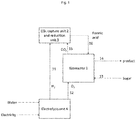
- the substrate sugar is introduced via conduits 13 into bioreactor 1.
- the bioreactor 1 provides the conditions allowing fermentation of microorganisms capable of utilizing organic feedstock.
- the produced product like the microorganism or a compound of interests produced by the microorganisms, leaves the bioreactors 1 via conduits 14.
- CO 2 formed in the bioreactors 1 is introduced into a CO 2 capture unit 2 via conduits 15.
- reduction unit 3 the CO 2 is reduced towards organic feedstock, utilizing H 2 .
- the organic feedstock is introduced into bioreactors 1 via conduits 10, enabling fermentation of the microorganisms that are capable to utilize the organic feedstock.
- the advantage is that CO 2 is not released into the environment, and the amount of sugar needed for the fermentation process can be reduced.
- the H 2 needed for reduction of CO 2 into organic feedstock can be introduced into reduction 3 and can be sourced from a supplier.
- the electrolysis unit 4 electrolyzes water into H 2 and O 2 .
- the H 2 can be introduced into reduction unit 3 via conduit 11.
- the O 2 can be introduced into bioreactor 1.
- air can be introduced into bioreactor 1 for aerobic processes.
- a second bioreactor 1' is present.
- the electrolysis unit 4 electrolyzes water into H 2 and O 2 .
- the H 2 can be introduced into reduction unit 3 via conduit 11.
- H 2 can be introduced in a bioreactor 1' for fermentation of microorganisms capable of utilizing H 2 . This is advantageous in that H 2 cofeeding reduces the amount of sugar needed, and can reduce the amount of CO 2 formed by the microorganisms in bioreactor 1'.
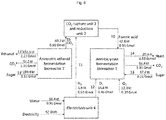
- Figure 3 shows a calculation of required substrate and O 2 , the produced ethanol and yeast, and the emitted CO 2 , in a conventional system.
- aerobic yeast bioreactor 1 produces yeast via outlet 14, using sugar via inlet 13 and O 2 via inlet 12.
- the O 2 is produced by electrolysis unit 4.
- the electrolysis unit 4 produces H 2 that is introduced in reduction unit 3 via conduit 11.
- CO 2 from the aerobic yeast bioreactor 1 is captured in unit 2, via conduit 15.
- the CO 2 is reduced to formic acid in reduction unit 3 and introduced into yeast bioreactor 1 via conduit 10.
- the embodiment of figure 4 allows production of the same amount of yeast as in figure 3 . However, no CO 2 is released into the environment, and the amount of sugar and O 2 needed for yeast fermentation is significantly reduced.
- an aerobic yeast fermentation in bioreactor 1 is combined with anaerobic ethanol fermentation in bioreactor 1'.
- O 2 produced by electrolysis unit 4 is introduced into aerobic yeast bioreactor 1 via conduit 12.
- H 2 produced by electrolysis unit 4 is introduced into anaerobic ethanol bioreactor 1' via conduit 12' and into reduction unit 3 via conduit 11.
- CO 2 is only captured from aerobic yeast bioreactor 1 via conduit 15.
- Formic acid is introduced in aerobic yeast bioreactor 1 only via conduit 10, and any surplus formic acid is collected for external use.
- figure 5 allows the production of ethanol without production of CO 2 . Further the amount of sugar needed for production of ethanol is reduced due to feeding the H 2 .
- the aerobic yeast fermentation produces the same amount of yeast using a reduced amount of sugar. No CO 2 is released into the environment. The O 2 needed for fermentation is totally derived from the electrolysis unit.
- figure 5 shows a system allowing a CO 2 neutral fermentation process.
- an aerobic yeast fermentation in bioreactor 1 is combined with anaerobic ethanol fermentation in bioreactor 1'.
- O 2 produced by electrolysis unit 4 is introduced into aerobic yeast bioreactor 1 via conduit 12.
- H 2 produced by electrolysis unit 4 is introduced into reduction unit 3 via conduit 11.
- CO 2 is only captured from anaerobic ethanol bioreactor 1' via conduit 15.
- Formic acid is introduced in aerobic yeast bioreactor 1 only via conduit 10.
- the embodiment of figure 6 only produces the amount of formic acid required for the aerobic yeast fermentation in bioreactor 1. Any surplus CO 2 from both bioreactors 1 that is not needed for production of formic acid is released. This embodiment allows a reduction of sugar needed for fermentation of yeast, while it minimizes the energy needed for electrolysis of water in electrolysis unit 4.
- aerobic yeast bioreactor 1 produces yeast via outlet 14, using sugar via inlet 13 and O 2 via inlet 12.
- Anaerobic ethanol fermentation bioreactor 1' produces ethanol via outlet 14' using sugar via inlet 13'.
- CO 2 from both the aerobic yeast bioreactor 1 and anaerobic ethanol fermentation bioreactor 1' is captured in unit 2, via conduits 15.
- the CO 2 is reduced to formic acid in reduction unit 3 and introduced into both the aerobic yeast bioreactor 1 and anaerobic ethanol fermentation bioreactor 1' using conduits 10. Any surplus formic acid is collected via an outlet on conduit 10.
- Electrolysis unit 4 electrolyzes water into H 2 and O 2 .
- the H 2 is introduced in reduction unit 3 via conduit 11.
- the O 2 is introduced in the aerobic yeast fermentation bioreactor 1. Any surplus O 2 leaves the system via conduit 16.
- the embodiment of figure 7 reaches ethanol and yeast production using minimal amounts of sugar. All CO 2 is captured and reduced to formic acid.
- the microorganisms grown in the bioreactors are capable in utilizing formic acid.
- CO 2 from both the aerobic yeast bioreactor 1 and anaerobic ethanol fermentation bioreactor 1' is captured in unit 2, via conduits 15.
- the CO 2 is reduced to formic acid in reduction unit 3 and introduced into both the aerobic yeast bioreactor 1 and anaerobic ethanol fermentation bioreactor 1' using conduits 10.
- Electrolysis unit 4 electrolyzes water into H 2 and O 2 .
- the H 2 is introduced in reduction unit 3 via conduit 11.
- the O 2 is introduced in the aerobic yeast fermentation bioreactor 1. Any surplus O 2 leaves the system via conduit 16.
- the embodiment of figure 8 reaches ethanol and yeast production using minimal amounts of sugar.
- the amount of CO 2 that is captured and reduced to formic acid is adapted to the amount needed for the production of formic acid. Any CO 2 surplus is emitted.
- the microorganisms grown in the bioreactors only need to be capable in utilizing formic acid.
- the electricity is reduced to what is needed for the minimal electrolysis of water for formation of formic acid.
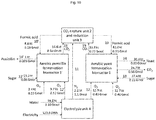
- Figure 9 shows a calculation of required substrate and O 2 , the produced penicillin and yeast, and the emitted CO 2 , in a conventional system.
- FIG 10 shows an embodiment of the invention wherein CO 2 from both the aerobic yeast bioreactor 1 and aerobic penicillin bioreactor 1' is captured in unit 2 via conduits 15.
- the CO 2 is reduced to formic acid in reduction unit 3 and introduced into both the aerobic yeast bioreactor 1 and aerobic penicillin bioreactor 1' using conduits 10.
- Electrolysis unit 4 electrolyzes water into H 2 and O 2 .
- the H 2 is introduced in reduction unit 3 via conduit 11.
- the O 2 is introduced in the aerobic yeast fermentation bioreactor 1 and the aerobic penicillin bioreactor 1'.
- the yeast in bioreactor 1 is capable of utilizing formic acid.
- the penicillium in bioreactor 1' is capable of utilizing formic acid.
- the embodiment of figure 10 produces the same amount of penicillium and yeast as in comparative figure 9 , while the amount of sugar needed to produce the same yield is reduced from 63.3 kt to 48.6 kt, and the amount of externally supplied O 2 is reduced from 31.8 kt to 16.1 kt.
Landscapes
- Chemical & Material Sciences (AREA)
- Organic Chemistry (AREA)
- Engineering & Computer Science (AREA)
- Life Sciences & Earth Sciences (AREA)
- Wood Science & Technology (AREA)
- Zoology (AREA)
- Health & Medical Sciences (AREA)
- Bioinformatics & Cheminformatics (AREA)
- Biotechnology (AREA)
- Genetics & Genomics (AREA)
- Microbiology (AREA)
- General Engineering & Computer Science (AREA)
- General Health & Medical Sciences (AREA)
- Biochemistry (AREA)
- Biomedical Technology (AREA)
- General Chemical & Material Sciences (AREA)
- Chemical Kinetics & Catalysis (AREA)
- Sustainable Development (AREA)
- Clinical Laboratory Science (AREA)
- Virology (AREA)
- Tropical Medicine & Parasitology (AREA)
- Medicinal Chemistry (AREA)
- Preparation Of Compounds By Using Micro-Organisms (AREA)
- Apparatus Associated With Microorganisms And Enzymes (AREA)
Abstract
Description
- The present invention relates to a method for cultivating a microorganism capable of utilizing an organic feedstock. According to another aspect, the present invention relates to a system for cultivating a microorganism capable of utilizing an organic feedstock.
- Microorganisms are used on large scale for industrial production of the microorganisms itself or metabolites produced by the microorganisms. These industrial fermentation processes and the flanking operations embedded in a factory or biorefinery, are energy intensive and CO2 is emitted because of energy use as well as metabolism of microorganisms itself. In view of climate change there is an urgent need for industrial fermentation processes with a reduced CO2 emission, or without CO2 emission, or even with negative CO2 emissions.
- According to a first aspect, the present invention relates to a method for cultivating a microorganism capable of utilizing an organic feedstock, comprising the steps of:
- (i) cultivating the microorganism in one or more bioreactors (1);
- (ii) capturing CO2 from the one or more bioreactors (1), preferably in a capturing unit (2), and reducing the CO2 to an organic feedstock, preferably in a reduction unit (3); and
- (iii) feeding at least a part of the organic feedstock, preferably from the reduction unit (3) into the one or more bioreactors (1). The present inventors found that the invention
- A 'CO2 capturing unit' is a physical means suitable for capturing CO2 from the from the off-gas of the one or more bioreactors (1).
- A CO2 reduction unit' is a physical means, like an apparatus or equipment, that is suitable for the reduction of CO2 to an organic feedstock.
- Microorganisms capable of utilizing an organic feedstock as used in the present context means microorganisms that can assimilate the organic feedstock.
- 'Organic feedstocks' as used in the present context are carbon containing raw materials resulting from reduction of CO2. Preferably, the present organic feedstock is derivable from CO2. More preferably, the present organic feedstock is derivable from CO2 using electrochemical reduction of CO2, microbial reduction of CO2, enzymatic process converting CO2, or an organic synthesis process. Alternatively, organic feedstocks as used in the present context can be defined as CO2 derived energy carrier.
- In a preferred embodiment, the present organic feedstock, CO2 derived energy carrier, is chosen from the group consisting of formic acid (HCOOH), methanol (CH3OH), ethylene (C2H4), ethanol (C2H5OH), 1-propanol (CH3CH2CH2OH) and carbon monoxide (CO). More preferably the present organic feedstock is formic acid. The advantage of using formic acid is that it can be efficiently produced from CO2, and microorganisms could be capable of utilizing formic acid. Microorganisms can either utilize formic acid inherently, or microorganisms can be engineered to be capable of utilizing formic acid. Hence, the present microorganism is preferably capable of utilizing formic acid.
- In a preferred embodiment, the present organic feedstock is not formate. The disadvantage of formate is that formate is an anion that needs to be balanced with a cation, that needs to be supplied via titration. Subsequently in the fermentation, uptake of formic acid results in the need for back-titration to balance the cation. As a result, a salt will be produced as co-product, which is highly undesired for economic and environmental reasons.
- 'Cultivating the microorganism' as used in the present context comprises the production of biomass and/or the production of a compound of interest, like extracellular metabolites and/or intracellular metabolites, including complex compounds such as enzymes, lipids, polysaccharides, vitamins and antibiotics.
- Preferably, the fermentation is at industrial scale. More preferably, the one or more bioreactors (1) each have a volume of more than 10 liter, more preferably more than 100 liter, even more preferably more than 1000 liter, most preferably more than 10.000 liter.
- Step (i) of cultivating the microorganism in one or more bioreactors (1) can be anaerobic fermentation and/or aerobic fermentation.
- Step (ii) of capturing CO2 from the one or more bioreactors (1) and reducing the CO2 to an organic feedstock in a reduction unit (3) means capturing CO2 from the off-gas of the one or more bioreactors (1) and reducing the captured CO2 to organic feedstock. Capturing and reducing the CO2 to an organic feedstock in a reduction unit (3) can be carried out by known methods and equipment. Preferably the reduction of CO2 is electrochemical reduction of CO2. Alternatively, reducing the CO2 to an organic feedstock in a reduction unit (3) is photoelectrochemical reduction of CO2, an enzymatic reduction of CO2, or a microbial reduction of CO2.
- Step (iii) of feeding at least a part of the organic feedstock from the reduction unit into the one or more bioreactors (1) comprising feeding at least 10% (w/w) of the organic feedstock from the reduction unit (3). More preferably, feeding at least 20% (w/w), at least 30% (w/w), at least 40% (w/w), at least 50% (w/w), at least 60% (w/w), at least 70% (w/w), at least 80% (w/w), at least 90% (w/w), at least 95% (w/w) or at least 99% (w/w) of the organic feedstock from the reduction unit (3) to the bioreactors (1). More preferably 100% of the formed organic feedstock is fed into the one or more bioreactors (1). Advantageously, the present method can be optimized in that the amount of organic feedstock that is reduced from CO2 matches the amount of organic feedstock than can be used for cofeeding into the bioreactors. This provides an improved method that reduces CO2 emission, and can be implemented at lower costs because the needed equipment for CO2 reduction can be smaller. On the other hand, in view of carbon pricing, it might be advantageous to reduce all CO2 formed to organic feedstock. Any surplus of organic feedstock, i.e. feedstock than cannot be cofed to the bioreactors (1), can be used for other commercial purposes. Hence, the present method may comprise a step of collecting organic feedstock formed and packaging and/or transporting it.
- In a preferred embodiment, the present method uses two or at least two bioreactors, more preferably three or at least three bioreactors, most preferably four or at least four bioreactors. The bioreactors can ferment the same microorganism, or each bioreactor can ferment a different type of microorganism. For example, in the event two bioreactors are used, the same microorganisms can be fermented, but also two different type of microorganisms can be fermented. The advantage of combining different type of microorganisms is that a combination can be chosen that efficiently makes use of waste streams from each other. Or different type organic feedstocks reduced from CO2 can be used by the different microorganisms because one microorganism might be better in utilizing a type of organic feedstock than another. This flexibility increases the applicability of the present invention.
- In a preferred embodiment, the present microorganism is chosen from the group consisting of yeast, filamentous fungi, bacteria and algae. In a further preferred embodiment, the microorganism comprises two different microorganisms from the group consisting of yeast, filamentous fungi, bacteria and algae. More preferably, the microorganism comprises three of even four different microorganisms from the group consisting of yeast, filamentous fungi, bacteria and algae. For example, the present microorganism comprises yeast and filamentous fungi. More preferably, the present method comprises cultivating yeast in one bioreactor, and cultivating a filamentous fungus in a second bioreactor.
- A yeast cell is preferably a yeast belonging to the genus of Candida, Hansenula, Kluyveromyces, Pichia, Saccharomyces, Schizosaccharomyces, or Yarrowia. More preferably, the present yeast is Kluyveromyces lactis, Saccharomyces cerevisiae, Hansenula polymorpha, Yarrowia lipolytica or Pichia pastoris.
- Filamentous fungi include all filamentous forms of the subdivision Eumycota and Oomycota (as defined by Hawksworth et al., In, Ainsworth and Bisby's Dictionary of The Fungi, 8th edition, 1995, CAB International, University Press, Cambridge, UK). The filamentous fungi are characterized by a mycelial wall composed of chitin, cellulose, glucan, chitosan, mannan, and other complex polysaccharides. Vegetative growth is by hyphal elongation and carbon catabolism is obligately aerobic. Filamentous fungal strains include, but are not limited to, strains of Acremonium, Agaricus, Aspergillus, Aureobasidium, Chrysosporium, Coprinus, Cryptococcus, Filibasidium, Fusarium, Humicola, Magnaporthe, Mucor, Myceliophthora, Neocallimastix, Neurospora, Paecilomyces, Penicillium, Piromyces, Panerochaete, Pleurotus, Schizophyllum, Talaromyces, Rasamsonia, Thermoascus, Thielavia, Tolypocladium, and Trichoderma.
- Preferred filamentous fungi belong to a species of an Acremonium, Aspergillus, Chrysosporium, Myceliophthora, Penicillium, Talaromyces, Rasamsonia, Thielavia, Fusarium or Trichoderma genus, and most preferably a species of Aspergillus niger, Acremonium alabamense, Aspergillus awamori, Aspergillus foetidus, Aspergillus sojae, Aspergillus fumigatus, Talaromyces emersonii, Rasamsonia emersonii, Aspergillus oryzae, Chrysosporium lucknowense, Fusarium oxysporum, Myceliophthora thermophila, Trichoderma reesei, Thielavia terrestris or Penicillium chrysogenum. A more preferred filamentous fungi belongs to the genus Aspergillus, more preferably the filamentous fungi belongs to the species Aspergillus niger or is Aspergillus niger.
- The term "bacteria" includes both Gram-negative and Gram-positive microorganisms. Suitable bacteria may be selected from e.g. Escherichia, Anabaena, Caulobactert, Gluconobacter, Rhodobacter, Pseudomonas, Paracoccus, Bacillus, Brevibacterium, Corynebacterium, Rhizobium (Sinorhizobium), Flavobacterium, Klebsiella, Enterobacter, Lactobacillus, Lactococcus, Methylobacterium, Staphylococcus, Streptomyces, Actinomycetes, Xanthomonas or Sphingomonas. Preferably, the bacterial cell is selected from the group consisting of B. subtilis, B. amyloliquefaciens, B. licheniformis, B. puntis, B. megaterium, B. halodurans, B. pumilus, G. oxydans,
Caulobactert crescentus CB 15, Methylobacterium extorquens, Rhodobacter sphaeroides, Pseudomonas zeaxanthinifaciens, Paracoccus denitrificans, E. coli, C. glutamicum, Staphylococcus carnosus, Streptomyces lividans, Sinorhizobium melioti and Rhizobium radiobacter. - The present algae are preferably chosen from the group consisting of glaucophytes, rhodoplasts and chloroplasts. More preferably the present algae are heterotrophic algae, more preferably heterotrophic algae like Chlorella, Nannochloropsys, Nitzschia, Thraustochytrium or Schizochyttrium.
- In a preferred embodiment, the microorganisms according to the invention comprises at least one polynucleotide coding for a compound of interest or at least one polynucleotide coding for a compound involved in the production of a compound of interest by the cell.
- The compound of interest can be any biological compound. The biological compound may be biomass or a biopolymer or metabolite. The biological compound may be encoded by a single polynucleotide or a series of polynucleotides composing a biosynthetic or metabolic pathway or may be the direct result of the product of a single polynucleotide or products of a series of polynucleotides. The biological compound may be native to the host cell or heterologous.
- The term "heterologous biological compound" is defined herein as a biological compound which is not native to the cell; or a native biological compound in which structural modifications have been made to alter the native biological compound.
- The term "biopolymer" is defined herein as a chain (or polymer) of identical, similar, or dissimilar subunits (monomers). The biopolymer may be any biopolymer. The biopolymer may for example be, but is not limited to, a nucleic acid, polyamine, polyol, polypeptide (or polyamide), or polysaccharide.
- The biopolymer may be a polypeptide. The polypeptide may be any polypeptide having a biological activity of interest. The term "polypeptide" is not meant herein to refer to a specific length of the encoded product and, therefore, encompasses peptides, oligopeptides, and proteins. Polypeptides further include naturally occurring allelic and engineered variations of the above- mentioned polypeptides and hybrid polypeptides. The polypeptide may be native or may be heterologous to the host cell. The polypeptide may be a collagen or gelatin, or a variant or hybrid thereof. The polypeptide may be an antibody or parts thereof, an antigen, a clotting factor, an enzyme, a hormone or a hormone variant, a receptor or parts thereof, a regulatory protein, a structural protein, a reporter, or a transport protein, protein involved in secretion process, protein involved in folding process, chaperone, peptide amino acid transporter, glycosylation factor, transcription factor, synthetic peptide or oligopeptide, intracellular protein. The intracellular protein may be an enzyme such as, a protease, ceramidases, epoxide hydrolase, aminopeptidase, acylases, aldolase, hydroxylase, aminopeptidase, lipase. The polypeptide may also be an enzyme secreted extracellularly. Such enzymes may belong to the groups of oxidoreductase, transferase, hydrolase, lyase, isomerase, ligase, catalase, cellulase, chitinase, cutinase, deoxyribonuclease, dextranase, esterase. The enzyme may be a carbohydrase, e.g. cellulases such as endoglucanases, β-glucanases, cellobiohydrolases or β-glucosidases, hemicellulases or pectinolytic enzymes such as xylanases, xylosidases, mannanases, galactanases, galactosidases, pectin methyl esterases, pectin lyases, pectate lyases, endo polygalacturonases, exopolygalacturonases rhamnogalacturonases, arabanases, arabinofuranosidases, arabinoxylan hydrolases, galacturonases, lyases, or amylolytic enzymes; hydrolase, isomerase, or ligase, phosphatases such as phytases, esterases such as lipases, proteolytic enzymes, oxidoreductases such as oxidases,, transferases, or isomerases. The enzyme may be a phytase. The enzyme may be an aminopeptidase, asparaginase, amylase, a maltogenic amylase, carbohydrase, carboxypeptidase, endo-protease, metallo-protease, serine-protease catalase, chitinase, cutinase, cyclodextrin glycosyltransferase, deoxyribonuclease, esterase, alpha-galactosidase, beta-galactosidase, glucoamylase, alpha-glucosidase, beta-glucosidase, haloperoxidase, protein deaminase, invertase, laccase, lipase, mannosidase, mutanase, oxidase, pectinolytic enzyme, peroxidase, phospholipase, galactolipase, chlorophyllase, polyphenoloxidase, ribonuclease, transglutaminase, or glucose oxidase, hexose oxidase or monooxygenase.
- Preferably the compound of interest is a heterologous product. Preferably the compound of interest is a glucose oxidase. More preferably the compound of interest is a heterologous glucose oxidase. In another preferred embodiment the compound of interest is a lipolytic enzyme, e.g. a lipolytic enzyme having one or more of the activities selected from the group consisting of: lipase (triacyl glycerol lipase), phospholipase (e.g phospholipase A1 and/or phospholipase A2 and/or phospholipase B and/or phospholipase C), galactolipase.
- According to the present invention, a polypeptide or enzyme also can be a product as described in
WO2010/102982 . According to the present invention, a polypeptide can also be a fused or hybrid polypeptide to which another polypeptide is fused at the N-terminus or the C-terminus of the polypeptide or fragment thereof. A fused polypeptide is produced by fusing a nucleic acid sequence (or a portion thereof) encoding one polypeptide to a nucleic acid sequence (or a portion thereof) encoding another polypeptide. - Techniques for producing fusion polypeptides are known in the art, and include, ligating the coding sequences encoding the polypeptides so that they are in frame and expression of the fused polypeptide is under control of the same promoter (s) and terminator. The hybrid polypeptides may comprise a combination of partial or complete polypeptide sequences obtained from at least two different polypeptides wherein one or more may be heterologous to the host cell. Example of fusion polypeptides and signal sequence fusions are for example as described in
WO2010/121933 . - The biopolymer may be a polysaccharide. The polysaccharide may be any polysaccharide, including, but not limited to, a mucopolysaccharide (e. g., heparin and hyaluronic acid) and nitrogen-containing polysaccharide (eg., chitin). In a more preferred option, the polysaccharide is hyaluronic acid. In another preferred option, the polysaccharide is a hydrocolloid, e.g. xanthan, gellan, pectin, welan or another polysaccharide.
- The polynucleotide coding for the compound of interest or coding for a compound involved in the production of the compound of interest according to the invention may encode an enzyme involved in the synthesis of a primary or secondary metabolite, such as organic acids, alcohols, lipids, carotenoids, beta-lactam, antibiotics, and vitamins. Such metabolite may be considered as a biological compound according to the present invention. Preferably, the present compound of interest is beta-lactam. Preferably, the present compound of interest is ethanol.
- The term "metabolite" encompasses both primary and secondary metabolites; the metabolite may be any metabolite. Preferred metabolites are citric acid, gluconic acid, adipic acid, fumaric acid, itaconic acid and succinic acid.
- The metabolite may be encoded by one or more genes, such as in a biosynthetic or metabolic pathway. Primary metabolites are products of primary or general metabolism of a cell, which are concerned with energy metabolism, growth, and structure. Secondary metabolites are products of secondary metabolism (see, for example, R. B. Herbert, The Biosynthesis of Secondary Metabolites, Chapman and Hall, New York, 1981).
- The primary metabolite may be, but is not limited to, an amino acid, fatty acid, nucleoside, nucleotide, sugar, triglyceride, or vitamin. For example, vitamin A, B2, C, D or E.
- The secondary metabolite may be, but is not limited to, an alkaloid, coumarin, flavonoid, polyketide, quinine, steroid, peptide, or terpene. The secondary metabolite may be an antibiotic, antifeedant, attractant, bacteriocide, fungicide, hormone, insecticide, or rodenticide. Preferred antibiotics are cephalosporins and beta-lactams. Other preferred metabolites are exo-metabolites. Examples of exo-metabolites are Aurasperone B, Funalenone, Kotanin, Nigragillin, Orlandin, Other naphtho-γ-pyrones, Pyranonigrin A, Tensidol B, Fumonisin B2 and Ochratoxin A.
- The biological compound may also be the product of a selectable marker. A selectable marker is a product of a polynucleotide of interest which product provides for biocide or viral resistance, resistance to heavy metals, prototrophy to auxotrophs, and the like. Selectable markers include, but are not limited to, amdS (acetamidase), argB (ornithinecarbamoyltransferase), bar (phosphinothricinacetyltransferase), hygB (hygromycin phosphotransferase), niaD (nitrate reductase), pyrG (orotidine-5'-phosphate decarboxylase), sC (sulfate adenyltransferase), trpC (anthranilate synthase), ble (phleomycin resistance protein), hyg (hygromycin), NAT or NTC (Nourseothricin) as well as equivalents thereof.
- According to the invention, the compound of interest is preferably a polypeptide as described in the list of compounds of interest.
- Preferably, the polypeptide is an enzyme as described in the list of compounds of interest. Preferably a glucose oxidase. In another embodiment the enzyme is a lipolytic enzyme.
- According to another embodiment of the invention, the compound of interest is preferably a metabolite.
- According to yet another embodiment, the compound of interest is biogas.
- The present microorganism may already be capable of producing the compound of interest. The microorganism may also be provided with a homologous or heterologous nucleic acid construct that encodes a polypeptide wherein the polypeptide may be the compound of interest or a polypeptide involved in the production of the compound of interest. The person skilled in the art knows how to modify a microorganism such that it is capable of producing the compound of interest.
- In a further preferred embodiment, the present method further comprises the step:
(iv) electrolyzing water into H2 and O2 in an electrolysis unit (4), and feeding at least a part of the H2 into the reduction unit (3) for reducing the CO2 to the organic feedstock. - The advantage of electrolyzing water into H2 and O2 is that no H2 needs to be sourced from external sources. The electricity needed for electrolysis unit (4) can advantageously be obtained from surplus electricity of other equipment on site, to provide a sustainable solution for the needed electricity. Alternatively, the electricity is generated from renewable energy, such as solar, wind or hydro energy.
- In a further preferred embodiment, the present method further comprises the step:
(v) feeding at least a part of the O2 into the one or more bioreactors (1). The O2 is the by product of the electrolysis of water. It can advantageously be used in the one or more bioreactors, for example for aerobic fermentation. Furthermore, it was found that all aeration of the one or more bioreactors can be realized by using the O2 from the electrolysis unit (4). Hence, no O2 from a different source is needed anymore, which provides a further sustainability improvement. For example, no compressor for air is needed anymore, or a smaller compressor can be used, because the electrolysis unit (4) can deliver the O2 under pressure that is comparable with the pressure by a conventional compressor. Preferably, the step (iv) of electrolyzing water into H2 and O2 in an electrolysis unit (4) is carried out at a pressure within the range of 0.5 to 10 bar, preferably 1 to 8 bar, more preferably 1.5 to 6 bar, most preferably 2 to 4 bar, preferably bar absolute pressure. - In a further preferred embodiment, the present method further comprises the step:
(v) feeding at least a part of the H2 into the one or more bioreactors (1). Any surplus of H2, i.e. H2 that is not needed for reducing of CO2 can advantageously be cofed into the one or more bioreactors. Microorganisms that can utilize H2 can be fermented by cofeeding with H2. By doing so the amount of CO2 resulting from metabolism of the microorganism can be reduced. This provides a further sustainability advantage. Moreover, by cofeeding by H2, the amount of sugar or other carbon containing feedstock needed for fermentation can be reduced, which provides a significant cost improvement. Hence, the present microorganism, or one of the present microorganisms, is preferably capable of utilizing H2. More preferably, the present microorganism is capable of utilizing the present organic feedstock and H2. Alternatively, one microorganism is capable of utilizing the present organic feedstock and another type of microorganisms is capable of utilizing H2. For example, the present method comprises a step of fermentation a yeast capable of utilizing formic acid in one bioreactor, and fermentation a filamentous fungus capable of utilizing H2 in another bioreactor. More specifically, the present method comprises a step of cultivating a Saccharomyces cerevisiae capable of utilizing formic acid in one bioreactor, and cultivating a Penicillium chrysogenum capable of utilizing H2, or cultivating a Saccharomyces cerevisiae capable of utilizing H2 in one bioreactor, and cultivating a Penicillium chrysogenum capable of utilizing formic acid in another bioreactor. - In a further preferred embodiment, cultivating a yeast produces yeast biomass, whereas cultivating a filamentous fungi produces a compound of interest. Hence, the present method preferably comprises a step of harvesting biomass or yeast biomass and/or comprises a step of harvesting a compound of interest.
- The present method can be further improved by monitoring the fermentation process. In a preferred embodiment, the present method further comprises the steps of:
- (vi) selecting at least one process parameter of the fermentation process, for which current measured values are determined during the course of the fermentation process;
- (vii) comparing a respective current measured value of the at least one selected process parameter with a corresponding estimated value of a model parameter estimated by a process model for this at least one process parameter;
- (viii) comparing a variance between the respective current measured value and the corresponding estimated value for the at least one selected process parameter with a predetermined threshold value; and
- (ix) changing at least one defined model parameter employed in the process model when the predetermined threshold value is exceeded by the variance:
- wherein step (vii) to (ix) with a respective changed model parameter are executed until the variance is placed below a predetermined threshold value; and optionally
- wherein in cases that, after a predetermined number of repetitions of steps (vii) to (ix) the threshold value is met by the variance, the method is discontinued and a warning is generated as output.
- In the one or more bioreactors (1), CO2 capturing unit (2), CO2 reduction unit (3), and/or in the electrolysis unit (4), various environmental and/or process parameters can be regulated and controlled for the respective fermentation process, such as pH value, temperature, CO2 supply, H2 supply, oxygen supply, nitrogen supply, sugar content, organic feedstock content and/or mixer settings. However, fermentation processes are biologically complex and very sensitive. Constant close monitoring of the fermentation process is therefore necessary to maintain the corresponding environmental conditions in the one or more bioreactors for a consistent and optimal course of the process and so that the biomass or the bioactive cells used in the nutrient solution grow and can produce the desired biomass and/or compound of interest.
- It is favorable if a process parameter of the fermentation process, for which during the course of the fermentation process measured values can be determined approximately in real time, is selected as the process parameter to be measured. For this reason, the variance between the process model and the course of the fermentation process can be determined approximately in real time, particularly if the process model is calculated in parallel with the ongoing fermentation process. A direct comparison between the measured value of the selected process parameter and the estimated value calculated or predicted by the process model can thus be performed for the process parameter. A near-instant intervention is thus also enabled if there is an error in the fermentation process.
- Expediently the repetitions of steps (vii) to (ix) of the present method are performed, i.e., comparison between measured value and estimated value of the selected process parameter. Here, comparisons of the variance with the predetermined threshold value and modification of the model parameter of the process model when the threshold value is exceeded, are performed with the respective modified model parameter at short intervals in time such as every 10 seconds. The process model can thus be rapidly adjusted, e.g., with the presence of biological variability or variability in the process control (e.g., differences in the raw materials, or fluctuations in the composition of the substrate) so that a correspondingly valid prediction of the fermentation process can be performed for the further course of the process. In case of errors in the bioprocess, a near-instant response can occur. A near-instant intervention allows damage to the bioprocess and/or to the equipment, for instance, to be avoided or prevented.
- In a preferred embodiment of the invention, what is known as the respiratory quotient, also abbreviated to RQ, is selected as a process parameter that is measured during the course of the fermentation process. The respiratory quotient is a process parameter in fermentation processes, which represents an indicator of the processes within a bioactive cell. The respiratory quotient describes a ratio of the CO2 produced at a given time to the O2 consumed at the same time. During the course of a fermentation process, the respiratory quotient can be measured very easily in real time, e.g., using what is known as off-gas analysis.
- As an alternative or additionally, a concentration of the biomass and/or a concentration of the substrate can be selected as process parameters, which are measured during the course of the fermentation process. The determination of the current measured values of the concentration of the biomass during the course of the fermentation process occurs, for instance, based on the electrical properties of the biomass. Current measured values for the concentration of the substrate (e.g., sugar etc.) can likewise be determined in the course of the fermentation process, such as based on spectroscopic properties using spectroscopy, in particular using reflection spectroscopy.
- Furthermore, it is advantageous if what is known as a deterministic process model is employed to estimate the process parameters of the fermentation process. With a deterministic approach for an illustration of a fermentation process as a model, the knowledge of the respective process-specific, biochemical processes inside and outside of the biomass or cells employed is converted into mathematical equations during the course of the fermentation process.
- In a further preferred embodiment, the steps (vi) to (ix) are carried out by a computer implemented method, more preferably a computer implemented method using algorithms. The aid from a computer and algorithms is beneficial in that variations in process parameters can be easily compared with data from historical fermentation processes, and that these historical data can be used for a correct interpretation of the variation in the process parameter.
- Given the beneficial sustainability achievements of the present invention, the present invention relates, according to another aspect, to a system for cultivating a microorganism capable of utilizing an organic feedstock, said system comprises one or more bioreactors (1) for cultivating said microorganism, a CO2 (2) capturing unit for capturing CO2 from the one or more bioreactors (1), a CO2 reduction unit (3) for reducing the CO2 to formic acid, and/or one more conduits (10) to introduce the organic feedstock into the one more bioreactors (1).
- In a preferred embodiment, the present system further comprises an electrolysis unit (4) for electrolysis of water and/or a conduit (11) to introduce H2 from the electrolysis unit (4) to the CO2 reduction unit (3). Preferably the present electrolysis unit (4) comprises means for pressurizing the O2 and or the electrolysis reaction. This is advantageous in that pressurized O2 can be introduced into the one or more bioreactors (1).
- In yet another preferred embodiment, the present system further comprises one or more conduits (12) for introducing H2 and/or O2 into the one or more bioreactors (1). This is advantageous in that an optimal use can be made of both products, between the CO2 reducing unit (3) and the one or more bioreactors (1). Dependent of the course of the fermentation process, the amount of H2 feeding into the CO2 reducing unit (3) and/or the amount of H2 and/or O2 feeding into the one or more bioreactors (1) can be adjusted to achieve an optimal CO2 reduction, optimal outlet, and/or reduced intake of substrate.
- In a preferred embodiment, the present system further comprises one or more inlets (13) for introducing substrate into the one or more bioreactors (1) and one or more outlets (14) for product formed in the one or more bioreactors (1).
- In yet another preferred embodiment, the present system further comprises a computer implemented system for a fermentation monitoring tool for simulating and/or monitoring the fermentation method as defined in any of the preceding claims, said computer implemented system comprises at least one processor, a user interface, a control system interface configured to adjust one or more process parameters of the fermentation method, a memory comprising computer readable medium storing instructions for simulating and/or monitoring the fermentation method, wherein the instructions for simulating and/or monitoring the fermentation method configure the processor to:
- (vi) selecting at least one process parameter of the fermentation method, for which current measured values are determined during the course of the fermentation method;
- (vii) comparing a respective current measured value of the at least one selected process parameter of the fermentation method with a corresponding estimated value of a model parameter estimated by a process model for this at least one process parameter;
- (viii) comparing a variance between the respective current measured value and the corresponding estimated value for the at least one selected process parameter with a predetermined threshold value; and
- (ix) changing at least one defined model parameter employed in the process model when the predetermined threshold value is exceeded by the variance:
- wherein step (vii) to (ix) with a respective changed model parameter are executed until the variance is placed below a predetermined threshold value; and optionally
- wherein in cases that, after a predetermined number of repetitions of steps (vii) to (ix) the threshold value is met by the variance, the method is discontinued and a warning is generated as output on the user interface.
- In the embodiment of
figure 1 , the substrate sugar is introduced viaconduits 13 intobioreactor 1. Thebioreactor 1 provides the conditions allowing fermentation of microorganisms capable of utilizing organic feedstock. The produced product, like the microorganism or a compound of interests produced by the microorganisms, leaves thebioreactors 1 viaconduits 14. CO2 formed in thebioreactors 1 is introduced into a CO2 capture unit 2 viaconduits 15. Inreduction unit 3 the CO2 is reduced towards organic feedstock, utilizing H2. The organic feedstock is introduced intobioreactors 1 viaconduits 10, enabling fermentation of the microorganisms that are capable to utilize the organic feedstock. The advantage is that CO2 is not released into the environment, and the amount of sugar needed for the fermentation process can be reduced. The H2 needed for reduction of CO2 into organic feedstock can be introduced intoreduction 3 and can be sourced from a supplier. Preferably, theelectrolysis unit 4 electrolyzes water into H2 and O2. The H2 can be introduced intoreduction unit 3 viaconduit 11. The O2 can be introduced intobioreactor 1. Alternatively, air can be introduced intobioreactor 1 for aerobic processes. - In the embodiment of
figure 2 , in addition to the embodiment offigure 1 , a second bioreactor 1' is present. Theelectrolysis unit 4 electrolyzes water into H2 and O2. The H2 can be introduced intoreduction unit 3 viaconduit 11. Advantageously, H2 can be introduced in a bioreactor 1' for fermentation of microorganisms capable of utilizing H2. This is advantageous in that H2 cofeeding reduces the amount of sugar needed, and can reduce the amount of CO2 formed by the microorganisms in bioreactor 1'. -
Figure 3 shows a calculation of required substrate and O2, the produced ethanol and yeast, and the emitted CO2, in a conventional system. - In the embodiment of
figure 4 ,aerobic yeast bioreactor 1 produces yeast viaoutlet 14, using sugar viainlet 13 and O2 viainlet 12. The O2 is produced byelectrolysis unit 4. Theelectrolysis unit 4 produces H2 that is introduced inreduction unit 3 viaconduit 11. CO2 from theaerobic yeast bioreactor 1 is captured inunit 2, viaconduit 15. The CO2 is reduced to formic acid inreduction unit 3 and introduced intoyeast bioreactor 1 viaconduit 10. - In operation, the embodiment of
figure 4 allows production of the same amount of yeast as infigure 3 . However, no CO2 is released into the environment, and the amount of sugar and O2 needed for yeast fermentation is significantly reduced. - In the embodiment of
figure 5 , an aerobic yeast fermentation inbioreactor 1 is combined with anaerobic ethanol fermentation in bioreactor 1'. O2 produced byelectrolysis unit 4 is introduced intoaerobic yeast bioreactor 1 viaconduit 12. H2 produced byelectrolysis unit 4 is introduced into anaerobic ethanol bioreactor 1' via conduit 12' and intoreduction unit 3 viaconduit 11. CO2 is only captured fromaerobic yeast bioreactor 1 viaconduit 15. Formic acid is introduced inaerobic yeast bioreactor 1 only viaconduit 10, and any surplus formic acid is collected for external use. - In operation, the embodiment of
figure 5 allows the production of ethanol without production of CO2. Further the amount of sugar needed for production of ethanol is reduced due to feeding the H2. The aerobic yeast fermentation produces the same amount of yeast using a reduced amount of sugar. No CO2 is released into the environment. The O2 needed for fermentation is totally derived from the electrolysis unit. Hence,figure 5 shows a system allowing a CO2 neutral fermentation process. - In the embodiment of
figure 6 , an aerobic yeast fermentation inbioreactor 1 is combined with anaerobic ethanol fermentation in bioreactor 1'. O2 produced byelectrolysis unit 4 is introduced intoaerobic yeast bioreactor 1 viaconduit 12. H2 produced byelectrolysis unit 4 is introduced intoreduction unit 3 viaconduit 11. CO2 is only captured from anaerobic ethanol bioreactor 1' viaconduit 15. Formic acid is introduced inaerobic yeast bioreactor 1 only viaconduit 10. - In operation, the embodiment of
figure 6 only produces the amount of formic acid required for the aerobic yeast fermentation inbioreactor 1. Any surplus CO2 from bothbioreactors 1 that is not needed for production of formic acid is released. This embodiment allows a reduction of sugar needed for fermentation of yeast, while it minimizes the energy needed for electrolysis of water inelectrolysis unit 4. - In the embodiment of
figure 7 ,aerobic yeast bioreactor 1 produces yeast viaoutlet 14, using sugar viainlet 13 and O2 viainlet 12. Anaerobic ethanol fermentation bioreactor 1' produces ethanol via outlet 14' using sugar via inlet 13'. CO2 from both theaerobic yeast bioreactor 1 and anaerobic ethanol fermentation bioreactor 1' is captured inunit 2, viaconduits 15. The CO2 is reduced to formic acid inreduction unit 3 and introduced into both theaerobic yeast bioreactor 1 and anaerobic ethanol fermentation bioreactor 1' using conduits 10. Any surplus formic acid is collected via an outlet onconduit 10.Electrolysis unit 4 electrolyzes water into H2 and O2. The H2 is introduced inreduction unit 3 viaconduit 11. The O2 is introduced in the aerobicyeast fermentation bioreactor 1. Any surplus O2 leaves the system viaconduit 16. - In operation, the embodiment of
figure 7 reaches ethanol and yeast production using minimal amounts of sugar. All CO2 is captured and reduced to formic acid. The microorganisms grown in the bioreactors are capable in utilizing formic acid. - In the embodiment of
figure 8 , CO2 from both theaerobic yeast bioreactor 1 and anaerobic ethanol fermentation bioreactor 1' is captured inunit 2, viaconduits 15. The CO2 is reduced to formic acid inreduction unit 3 and introduced into both theaerobic yeast bioreactor 1 and anaerobic ethanol fermentation bioreactor 1' using conduits 10.Electrolysis unit 4 electrolyzes water into H2 and O2. The H2 is introduced inreduction unit 3 viaconduit 11. The O2 is introduced in the aerobicyeast fermentation bioreactor 1. Any surplus O2 leaves the system viaconduit 16. - In operation, the embodiment of
figure 8 reaches ethanol and yeast production using minimal amounts of sugar. The amount of CO2 that is captured and reduced to formic acid is adapted to the amount needed for the production of formic acid. Any CO2 surplus is emitted. The microorganisms grown in the bioreactors only need to be capable in utilizing formic acid. In this embodiment, the electricity is reduced to what is needed for the minimal electrolysis of water for formation of formic acid. -
Figure 9 shows a calculation of required substrate and O2, the produced penicillin and yeast, and the emitted CO2, in a conventional system. -
Figure 10 shows an embodiment of the invention wherein CO2 from both theaerobic yeast bioreactor 1 and aerobic penicillin bioreactor 1' is captured inunit 2 viaconduits 15. The CO2 is reduced to formic acid inreduction unit 3 and introduced into both theaerobic yeast bioreactor 1 and aerobic penicillin bioreactor 1' using conduits 10.Electrolysis unit 4 electrolyzes water into H2 and O2. The H2 is introduced inreduction unit 3 viaconduit 11. The O2 is introduced in the aerobicyeast fermentation bioreactor 1 and the aerobic penicillin bioreactor 1'. The yeast inbioreactor 1 is capable of utilizing formic acid. The penicillium in bioreactor 1' is capable of utilizing formic acid. - In operation, the embodiment of
figure 10 produces the same amount of penicillium and yeast as in comparativefigure 9 , while the amount of sugar needed to produce the same yield is reduced from 63.3 kt to 48.6 kt, and the amount of externally supplied O2 is reduced from 31.8 kt to 16.1 kt.
Claims (14)
- Method for cultivating a microorganism capable of utilizing an organic feedstock, comprising the steps of:(i) cultivating the microorganism in one or more bioreactors (1);(ii) capturing CO2 from the one or more bioreactors (1) and reducing the CO2 to an organic feedstock in a reduction unit (3); and(iii) feeding at least a part of the organic feedstock from the reduction unit (3) into the one or more bioreactors (1).
- Method according to claim 1, wherein the organic feedstock is chosen from the group consisting of formic acid, methanol, ethylene, ethanol, 1-propanol and carbon monoxide.
- Method according to claim 1 or claim 2, wherein the organic feedstock is formic acid.
- Method according to any of the preceding claims, wherein the microorganism is chosen from the group consisting of yeast, filamentous fungi, bacteria and heterotrophic algae.
- Method according to any of the preceding claims, further comprising the step:
(iv) electrolyzing water into H2 and O2 in an electrolysis unit (4), and feeding at least a part of the H2 into the reduction unit (3) for reducing the CO2 to the organic feedstock. - Method according to claim 5, further comprising the step:
(v) feeding at least a part of the O2 into the one or more bioreactors (1). - Method according to claim 5 or claim 6, further comprising the step:
(v) feeding at least a part of the H2 into the one or more bioreactors (1). - Method according to any of the preceding claims, wherein the microorganism capable of utilizing an organic feedstock comprises at least one polynucleotide coding for a compound of interest or at least one polynucleotide coding for a compound involved in the production of a compound of interest by the cell.
- Method according to any of the preceding claims, comprising monitoring the fermentation process comprising the steps of:(vi) selecting at least one process parameter of the fermentation process, for which current measured values are determined during the course of the fermentation process;(vii) comparing a respective current measured value of the at least one selected process parameter with a corresponding estimated value of a model parameter estimated by a process model for this at least one process parameter;(viii) comparing a variance between the respective current measured value and the corresponding estimated value for the at least one selected process parameter with a predetermined threshold value; and(ix) changing at least one defined model parameter employed in the process model when the predetermined threshold value is exceeded by the variance:wherein step (vii) to (ix) with a respective changed model parameter are executed until the variance is placed below a predetermined threshold value; and optionallywherein in cases that, after a predetermined number of repetitions of steps (vii) to (ix) the threshold value is met by the variance, the method is discontinued and a warning is generated as output.
- System for cultivating a microorganism capable of utilizing an organic feedstock, said system comprises one or more bioreactors (1) for cultivating said microorganism, a CO2 (2) capturing unit for capturing CO2 from the one or more bioreactors (1), a CO2 reduction unit (3) for reducing the CO2 to organic feedstock, and one more conduits (10) to introduce the organic feedstock into the one more bioreactors (1).
- System according to the preceding claim, further comprising an electrolysis unit (4) for electrolysis of water and a conduit (11) to introduce H2 from the electrolysis unit (4) to the CO2 reduction unit (3).
- System according to any of the preceding claims, further comprising one or more conduits (12) for introducing H2 and/or O2 into the one or more bioreactors (1).
- System according to any of the preceding claims, further comprising one or more inlets (13) for introducing substrate into the one or more bioreactors (1) and one or more outlets (14) for product formed in the one or more bioreactors (1).
- System according to any of the preceding claims, further comprising a computer implemented system for a fermentation simulation tool for simulating the fermentation method as defined in any of the preceding claims, said computer implemented system comprises at least one processor, a user interface, a control system interface configured to adjust one or more process parameters of the fermentation method, a memory comprising computer readable medium storing instructions for simulating the fermentation method, wherein the instructions for simulating the fermentation method configure the processor to:(vi) selecting at least one process parameter of the fermentation method, for which current measured values are determined during the course of the fermentation method;(vii) comparing a respective current measured value of the at least one selected process parameter of the fermentation method with a corresponding estimated value of a model parameter estimated by a process model for this at least one process parameter;(viii) comparing a variance between the respective current measured value and the corresponding estimated value for the at least one selected process parameter with a predetermined threshold value; and(ix) changing at least one defined model parameter employed in the process model when the predetermined threshold value is exceeded by the variance:wherein step (vii) to (ix) with a respective changed model parameter are executed until the variance is placed below a predetermined threshold value; and optionallywherein in cases that, after a predetermined number of repetitions of steps (vii) to (ix) the threshold value is met by the variance, the method is discontinued and a warning is generated as output on the user interface.
Priority Applications (7)
| Application Number | Priority Date | Filing Date | Title |
|---|---|---|---|
| DK19165775.8T DK3715464T3 (en) | 2019-03-28 | 2019-03-28 | GREENHOUSE GAS IMPROVED FERMENTATION |
| EP19165775.8A EP3715464B1 (en) | 2019-03-28 | 2019-03-28 | Greenhouse gas improved fermentation |
| US17/442,709 US20220169967A1 (en) | 2019-03-28 | 2020-03-24 | Greenhouse gas improved fermentation |
| KR1020217034671A KR102915520B1 (en) | 2019-03-28 | 2020-03-24 | Greenhouse gas-improved fermentation |
| CN202080024671.5A CN113646437A (en) | 2019-03-28 | 2020-03-24 | Greenhouse Gas Improves Fermentation |
| BR112021018944-0A BR112021018944B1 (en) | 2019-03-28 | 2020-03-24 | IMPROVED FERMENTATION OF GREENHOUSE GAS |
| PCT/EP2020/058097 WO2020193516A1 (en) | 2019-03-28 | 2020-03-24 | Greenhouse gas improved fermentation |
Applications Claiming Priority (1)
| Application Number | Priority Date | Filing Date | Title |
|---|---|---|---|
| EP19165775.8A EP3715464B1 (en) | 2019-03-28 | 2019-03-28 | Greenhouse gas improved fermentation |
Publications (2)
| Publication Number | Publication Date |
|---|---|
| EP3715464A1 true EP3715464A1 (en) | 2020-09-30 |
| EP3715464B1 EP3715464B1 (en) | 2021-05-05 |
Family
ID=66000989
Family Applications (1)
| Application Number | Title | Priority Date | Filing Date |
|---|---|---|---|
| EP19165775.8A Active EP3715464B1 (en) | 2019-03-28 | 2019-03-28 | Greenhouse gas improved fermentation |
Country Status (6)
| Country | Link |
|---|---|
| US (1) | US20220169967A1 (en) |
| EP (1) | EP3715464B1 (en) |
| KR (1) | KR102915520B1 (en) |
| CN (1) | CN113646437A (en) |
| DK (1) | DK3715464T3 (en) |
| WO (1) | WO2020193516A1 (en) |
Cited By (2)
| Publication number | Priority date | Publication date | Assignee | Title |
|---|---|---|---|---|
| WO2022101182A1 (en) | 2020-11-10 | 2022-05-19 | Dsm Ip Assets B.V. | Sustainable biomass production |
| WO2022122817A1 (en) * | 2020-12-08 | 2022-06-16 | Calidris Bio | Method for producing a fermentation product |
Families Citing this family (3)
| Publication number | Priority date | Publication date | Assignee | Title |
|---|---|---|---|---|
| EP4291671A1 (en) | 2021-02-15 | 2023-12-20 | DSM IP Assets B.V. | Process for fermenting yeast |
| AT526749B1 (en) * | 2022-12-12 | 2026-03-15 | Circe Biotechnologie Gmbh | Coupled gas fermentation |
| WO2025132393A1 (en) | 2023-12-19 | 2025-06-26 | Covestro Deutschland Ag | Production of aminobenzoic acid |
Citations (5)
| Publication number | Priority date | Publication date | Assignee | Title |
|---|---|---|---|---|
| WO2010102982A1 (en) | 2009-03-10 | 2010-09-16 | Dsm Ip Assets B.V. | Method for improving the yield of a polypeptide |
| WO2010121933A1 (en) | 2009-04-22 | 2010-10-28 | Dsm Ip Assets B.V. | Process for the production of a recombinant polypeptide of interest |
| WO2011139804A2 (en) * | 2010-04-27 | 2011-11-10 | Sequesco | Use of oxyhydrogen microorganisms for non-photosynthetic carbon capture and conversion of inorganic and/or c1 carbon sources into useful organic compounds |
| WO2013076294A1 (en) * | 2011-11-25 | 2013-05-30 | Air Fuel Synthesis Limited | Process for the conversion of carbon dioxide to methanol |
| US20180179559A1 (en) * | 2008-11-06 | 2018-06-28 | Kiverdi, Inc. | Biological and Chemical Process Utilizing Chemoautotrophic Microorganisms for the Chemosynthetic Fixation of Carbon Dioxide and/or Other Inorganic Carbon Sources into Organic Compounds and the Generation of Additional Useful Products |
Family Cites Families (14)
| Publication number | Priority date | Publication date | Assignee | Title |
|---|---|---|---|---|
| NZ553984A (en) * | 2007-03-19 | 2009-07-31 | Lanzatech New Zealand Ltd | Alcohol production process |
| WO2013148348A1 (en) * | 2012-03-28 | 2013-10-03 | Kiverdi, Inc. | Engineered co2-fixing chemotrophic microorganisms producing carbon-based products and methods of using the same |
| US9879290B2 (en) * | 2008-11-06 | 2018-01-30 | Kiverdi, Inc. | Industrial fatty acid engineering general system for modifying fatty acids |
| US8497105B2 (en) * | 2009-06-26 | 2013-07-30 | Cobalt Technologies, Inc. | Integrated system and process for bioproduct production |
| US8562811B2 (en) * | 2011-03-09 | 2013-10-22 | Liquid Light, Inc. | Process for making formic acid |
| US8818562B2 (en) * | 2011-06-04 | 2014-08-26 | Invensys Systems, Inc. | Simulated fermentation process |
| WO2013006710A2 (en) | 2011-07-06 | 2013-01-10 | Liquid Light, Inc. | Carbon dioxide capture and conversion to organic products |
| EP2753700B1 (en) * | 2011-09-08 | 2020-02-19 | Lanzatech New Zealand Limited | A fermentation process |
| US20150132810A1 (en) * | 2011-09-23 | 2015-05-14 | Coskata, Inc. | Integrated processes for anaerobically bioconverting hydrogen and carbon oxides to oxygenated organic compounds |
| WO2013090769A2 (en) * | 2011-12-14 | 2013-06-20 | Kiverdi, Inc. | Method and apparatus for growing microbial cultures that require gaseous electron donors, electron acceptors, carbon sources, or other nutrients |
| EP2929038A4 (en) * | 2012-12-05 | 2016-07-20 | Lanzatech New Zealand Ltd | FERMENTATION PROCESS |
| US10370685B2 (en) * | 2014-07-09 | 2019-08-06 | Synata Bio, Inc. | Processes for controlling the concentration of co-produced oxygenated organics in anaerobic fermentation broths for the bioconversion of syngas to product oxygenated organic compound |
| EP3296387B1 (en) * | 2016-09-16 | 2019-05-15 | Siemens Aktiengesellschaft | Method for monitoring bio processes |
| US11180779B2 (en) * | 2017-04-12 | 2021-11-23 | The Board Of Regents For Oklahoma State University | System and method of biocatalytic conversion for production of alcohols, ketones, and organic acids |
-
2019
- 2019-03-28 EP EP19165775.8A patent/EP3715464B1/en active Active
- 2019-03-28 DK DK19165775.8T patent/DK3715464T3/en active
-
2020
- 2020-03-24 US US17/442,709 patent/US20220169967A1/en active Pending
- 2020-03-24 WO PCT/EP2020/058097 patent/WO2020193516A1/en not_active Ceased
- 2020-03-24 CN CN202080024671.5A patent/CN113646437A/en active Pending
- 2020-03-24 KR KR1020217034671A patent/KR102915520B1/en active Active
Patent Citations (5)
| Publication number | Priority date | Publication date | Assignee | Title |
|---|---|---|---|---|
| US20180179559A1 (en) * | 2008-11-06 | 2018-06-28 | Kiverdi, Inc. | Biological and Chemical Process Utilizing Chemoautotrophic Microorganisms for the Chemosynthetic Fixation of Carbon Dioxide and/or Other Inorganic Carbon Sources into Organic Compounds and the Generation of Additional Useful Products |
| WO2010102982A1 (en) | 2009-03-10 | 2010-09-16 | Dsm Ip Assets B.V. | Method for improving the yield of a polypeptide |
| WO2010121933A1 (en) | 2009-04-22 | 2010-10-28 | Dsm Ip Assets B.V. | Process for the production of a recombinant polypeptide of interest |
| WO2011139804A2 (en) * | 2010-04-27 | 2011-11-10 | Sequesco | Use of oxyhydrogen microorganisms for non-photosynthetic carbon capture and conversion of inorganic and/or c1 carbon sources into useful organic compounds |
| WO2013076294A1 (en) * | 2011-11-25 | 2013-05-30 | Air Fuel Synthesis Limited | Process for the conversion of carbon dioxide to methanol |
Non-Patent Citations (2)
| Title |
|---|
| HAWKSWORTH ET AL.: "Ainsworth and Bisby's Dictionary of The Fungi", 1995, CAB INTERNATIONAL, UNIVERSITY PRESS |
| R. B. HERBERT: "The Biosynthesis of Secondary Metabolites", 1981, CHAPMAN AND HALL |
Cited By (2)
| Publication number | Priority date | Publication date | Assignee | Title |
|---|---|---|---|---|
| WO2022101182A1 (en) | 2020-11-10 | 2022-05-19 | Dsm Ip Assets B.V. | Sustainable biomass production |
| WO2022122817A1 (en) * | 2020-12-08 | 2022-06-16 | Calidris Bio | Method for producing a fermentation product |
Also Published As
| Publication number | Publication date |
|---|---|
| CN113646437A (en) | 2021-11-12 |
| KR20210145206A (en) | 2021-12-01 |
| KR102915520B1 (en) | 2026-01-21 |
| US20220169967A1 (en) | 2022-06-02 |
| BR112021018944A2 (en) | 2021-11-30 |
| EP3715464B1 (en) | 2021-05-05 |
| WO2020193516A1 (en) | 2020-10-01 |
| DK3715464T3 (en) | 2021-07-26 |
Similar Documents
| Publication | Publication Date | Title |
|---|---|---|
| EP3715464B1 (en) | Greenhouse gas improved fermentation | |
| CN105308171B (en) | AGSE deficient strains | |
| CN105189730B (en) | Amylase-deficient strain | |
| US9574199B2 (en) | Simultaneous site-specific integrations of multiple gene-copies in filamentous fungi | |
| EP3293264A1 (en) | Improved host cell for the production of a compound of interest | |
| CN109790510A (en) | Albumen in the case where inducing substrate is not present in filamentous fungal cells generates | |
| US20200063166A1 (en) | Zinc binuclear cluster transcriptional regulator-deficient strain | |
| RU2701642C1 (en) | Yeast strain pichia pastoris - producer of xylanase | |
| US9410175B2 (en) | Process for microbial production of a valuable compound | |
| US20240318123A1 (en) | Process for fermenting yeast | |
| Moukouli et al. | Cloning and optimized expression of a GH-11 xylanase from Fusarium oxysporum in Pichia pastoris | |
| RU2701308C1 (en) | Recombinant yeast strain pichia pastoris - producer of xylanase | |
| BR112021018944B1 (en) | IMPROVED FERMENTATION OF GREENHOUSE GAS | |
| US20220267783A1 (en) | Filamentous fungal expression system | |
| WO2021228880A1 (en) | Fed-batch fermentation process | |
| US20240271074A1 (en) | Fed-batch fermentation process | |
| Joseph et al. | Filamentous Fungi: Heterologous Protein Expression | |
| RU2728033C1 (en) | Transformant of pichia pastoris yeast, producing endo-1,4-β-xylanase from paenibacillus brasilensis | |
| RU2714113C1 (en) | Pichia pastoris yeast transformer producing xylanase | |
| US20250250530A1 (en) | Process for fermenting yeast | |
| Moukouli et al. | Cloning and optimized expression of | |
| de Castro Ribeiro | Physiological characterization of Ashbya gossypii and strain development for recombinant protein production | |
| WO2002002825A1 (en) | Method for the production of proteins and polypeptides using fungal cells, in particular aspergillus vadensis |
Legal Events
| Date | Code | Title | Description |
|---|---|---|---|
| PUAI | Public reference made under article 153(3) epc to a published international application that has entered the european phase |
Free format text: ORIGINAL CODE: 0009012 |
|
| STAA | Information on the status of an ep patent application or granted ep patent |
Free format text: STATUS: REQUEST FOR EXAMINATION WAS MADE |
|
| 17P | Request for examination filed |
Effective date: 20200330 |
|
| AK | Designated contracting states |
Kind code of ref document: A1 Designated state(s): AL AT BE BG CH CY CZ DE DK EE ES FI FR GB GR HR HU IE IS IT LI LT LU LV MC MK MT NL NO PL PT RO RS SE SI SK SM TR |
|
| AX | Request for extension of the european patent |
Extension state: BA ME |
|
| GRAP | Despatch of communication of intention to grant a patent |
Free format text: ORIGINAL CODE: EPIDOSNIGR1 |
|
| STAA | Information on the status of an ep patent application or granted ep patent |
Free format text: STATUS: GRANT OF PATENT IS INTENDED |
|
| INTG | Intention to grant announced |
Effective date: 20201203 |
|
| GRAS | Grant fee paid |
Free format text: ORIGINAL CODE: EPIDOSNIGR3 |
|
| GRAA | (expected) grant |
Free format text: ORIGINAL CODE: 0009210 |
|
| STAA | Information on the status of an ep patent application or granted ep patent |
Free format text: STATUS: THE PATENT HAS BEEN GRANTED |
|
| AK | Designated contracting states |
Kind code of ref document: B1 Designated state(s): AL AT BE BG CH CY CZ DE DK EE ES FI FR GB GR HR HU IE IS IT LI LT LU LV MC MK MT NL NO PL PT RO RS SE SI SK SM TR |
|
| REG | Reference to a national code |
Ref country code: GB Ref legal event code: FG4D |
|
| REG | Reference to a national code |
Ref country code: CH Ref legal event code: EP |
|
| REG | Reference to a national code |
Ref country code: AT Ref legal event code: REF Ref document number: 1389880 Country of ref document: AT Kind code of ref document: T Effective date: 20210515 |
|
| REG | Reference to a national code |
Ref country code: IE Ref legal event code: FG4D |
|
| REG | Reference to a national code |
Ref country code: DE Ref legal event code: R096 Ref document number: 602019004375 Country of ref document: DE |
|
| REG | Reference to a national code |
Ref country code: FI Ref legal event code: FGE |
|
| REG | Reference to a national code |
Ref country code: RO Ref legal event code: EPE |
|
| REG | Reference to a national code |
Ref country code: DK Ref legal event code: T3 Effective date: 20210721 |
|
| REG | Reference to a national code |
Ref country code: NL Ref legal event code: FP |
|
| REG | Reference to a national code |
Ref country code: SE Ref legal event code: TRGR |
|
| REG | Reference to a national code |
Ref country code: LT Ref legal event code: MG9D |
|
| PG25 | Lapsed in a contracting state [announced via postgrant information from national office to epo] |
Ref country code: BG Free format text: LAPSE BECAUSE OF FAILURE TO SUBMIT A TRANSLATION OF THE DESCRIPTION OR TO PAY THE FEE WITHIN THE PRESCRIBED TIME-LIMIT Effective date: 20210805 Ref country code: LT Free format text: LAPSE BECAUSE OF FAILURE TO SUBMIT A TRANSLATION OF THE DESCRIPTION OR TO PAY THE FEE WITHIN THE PRESCRIBED TIME-LIMIT Effective date: 20210505 Ref country code: HR Free format text: LAPSE BECAUSE OF FAILURE TO SUBMIT A TRANSLATION OF THE DESCRIPTION OR TO PAY THE FEE WITHIN THE PRESCRIBED TIME-LIMIT Effective date: 20210505 |
|
| PG25 | Lapsed in a contracting state [announced via postgrant information from national office to epo] |
Ref country code: PT Free format text: LAPSE BECAUSE OF FAILURE TO SUBMIT A TRANSLATION OF THE DESCRIPTION OR TO PAY THE FEE WITHIN THE PRESCRIBED TIME-LIMIT Effective date: 20210906 Ref country code: RS Free format text: LAPSE BECAUSE OF FAILURE TO SUBMIT A TRANSLATION OF THE DESCRIPTION OR TO PAY THE FEE WITHIN THE PRESCRIBED TIME-LIMIT Effective date: 20210505 Ref country code: LV Free format text: LAPSE BECAUSE OF FAILURE TO SUBMIT A TRANSLATION OF THE DESCRIPTION OR TO PAY THE FEE WITHIN THE PRESCRIBED TIME-LIMIT Effective date: 20210505 Ref country code: NO Free format text: LAPSE BECAUSE OF FAILURE TO SUBMIT A TRANSLATION OF THE DESCRIPTION OR TO PAY THE FEE WITHIN THE PRESCRIBED TIME-LIMIT Effective date: 20210805 Ref country code: PL Free format text: LAPSE BECAUSE OF FAILURE TO SUBMIT A TRANSLATION OF THE DESCRIPTION OR TO PAY THE FEE WITHIN THE PRESCRIBED TIME-LIMIT Effective date: 20210505 Ref country code: IS Free format text: LAPSE BECAUSE OF FAILURE TO SUBMIT A TRANSLATION OF THE DESCRIPTION OR TO PAY THE FEE WITHIN THE PRESCRIBED TIME-LIMIT Effective date: 20210905 Ref country code: GR Free format text: LAPSE BECAUSE OF FAILURE TO SUBMIT A TRANSLATION OF THE DESCRIPTION OR TO PAY THE FEE WITHIN THE PRESCRIBED TIME-LIMIT Effective date: 20210806 |
|
| REG | Reference to a national code |
Ref country code: AT Ref legal event code: UEP Ref document number: 1389880 Country of ref document: AT Kind code of ref document: T Effective date: 20210505 |
|
| PG25 | Lapsed in a contracting state [announced via postgrant information from national office to epo] |
Ref country code: ES Free format text: LAPSE BECAUSE OF FAILURE TO SUBMIT A TRANSLATION OF THE DESCRIPTION OR TO PAY THE FEE WITHIN THE PRESCRIBED TIME-LIMIT Effective date: 20210505 Ref country code: EE Free format text: LAPSE BECAUSE OF FAILURE TO SUBMIT A TRANSLATION OF THE DESCRIPTION OR TO PAY THE FEE WITHIN THE PRESCRIBED TIME-LIMIT Effective date: 20210505 Ref country code: SK Free format text: LAPSE BECAUSE OF FAILURE TO SUBMIT A TRANSLATION OF THE DESCRIPTION OR TO PAY THE FEE WITHIN THE PRESCRIBED TIME-LIMIT Effective date: 20210505 Ref country code: SM Free format text: LAPSE BECAUSE OF FAILURE TO SUBMIT A TRANSLATION OF THE DESCRIPTION OR TO PAY THE FEE WITHIN THE PRESCRIBED TIME-LIMIT Effective date: 20210505 Ref country code: CZ Free format text: LAPSE BECAUSE OF FAILURE TO SUBMIT A TRANSLATION OF THE DESCRIPTION OR TO PAY THE FEE WITHIN THE PRESCRIBED TIME-LIMIT Effective date: 20210505 |
|
| REG | Reference to a national code |
Ref country code: DE Ref legal event code: R097 Ref document number: 602019004375 Country of ref document: DE |
|
| PLBE | No opposition filed within time limit |
Free format text: ORIGINAL CODE: 0009261 |
|
| STAA | Information on the status of an ep patent application or granted ep patent |
Free format text: STATUS: NO OPPOSITION FILED WITHIN TIME LIMIT |
|
| 26N | No opposition filed |
Effective date: 20220208 |
|
| PG25 | Lapsed in a contracting state [announced via postgrant information from national office to epo] |
Ref country code: IS Free format text: LAPSE BECAUSE OF FAILURE TO SUBMIT A TRANSLATION OF THE DESCRIPTION OR TO PAY THE FEE WITHIN THE PRESCRIBED TIME-LIMIT Effective date: 20210905 Ref country code: AL Free format text: LAPSE BECAUSE OF FAILURE TO SUBMIT A TRANSLATION OF THE DESCRIPTION OR TO PAY THE FEE WITHIN THE PRESCRIBED TIME-LIMIT Effective date: 20210505 |
|
| PG25 | Lapsed in a contracting state [announced via postgrant information from national office to epo] |
Ref country code: MC Free format text: LAPSE BECAUSE OF FAILURE TO SUBMIT A TRANSLATION OF THE DESCRIPTION OR TO PAY THE FEE WITHIN THE PRESCRIBED TIME-LIMIT Effective date: 20210505 |
|
| REG | Reference to a national code |
Ref country code: CH Ref legal event code: PL |
|
| PG25 | Lapsed in a contracting state [announced via postgrant information from national office to epo] |
Ref country code: LU Free format text: LAPSE BECAUSE OF NON-PAYMENT OF DUE FEES Effective date: 20220328 Ref country code: LI Free format text: LAPSE BECAUSE OF NON-PAYMENT OF DUE FEES Effective date: 20220331 Ref country code: IE Free format text: LAPSE BECAUSE OF NON-PAYMENT OF DUE FEES Effective date: 20220328 Ref country code: CH Free format text: LAPSE BECAUSE OF NON-PAYMENT OF DUE FEES Effective date: 20220331 |
|
| P01 | Opt-out of the competence of the unified patent court (upc) registered |
Effective date: 20230520 |
|
| PG25 | Lapsed in a contracting state [announced via postgrant information from national office to epo] |
Ref country code: MK Free format text: LAPSE BECAUSE OF FAILURE TO SUBMIT A TRANSLATION OF THE DESCRIPTION OR TO PAY THE FEE WITHIN THE PRESCRIBED TIME-LIMIT Effective date: 20210505 Ref country code: CY Free format text: LAPSE BECAUSE OF FAILURE TO SUBMIT A TRANSLATION OF THE DESCRIPTION OR TO PAY THE FEE WITHIN THE PRESCRIBED TIME-LIMIT Effective date: 20210505 |
|
| PG25 | Lapsed in a contracting state [announced via postgrant information from national office to epo] |
Ref country code: HU Free format text: LAPSE BECAUSE OF FAILURE TO SUBMIT A TRANSLATION OF THE DESCRIPTION OR TO PAY THE FEE WITHIN THE PRESCRIBED TIME-LIMIT; INVALID AB INITIO Effective date: 20190328 |
|
| PG25 | Lapsed in a contracting state [announced via postgrant information from national office to epo] |
Ref country code: MT Free format text: LAPSE BECAUSE OF FAILURE TO SUBMIT A TRANSLATION OF THE DESCRIPTION OR TO PAY THE FEE WITHIN THE PRESCRIBED TIME-LIMIT Effective date: 20210505 |
|
| PG25 | Lapsed in a contracting state [announced via postgrant information from national office to epo] |
Ref country code: TR Free format text: LAPSE BECAUSE OF FAILURE TO SUBMIT A TRANSLATION OF THE DESCRIPTION OR TO PAY THE FEE WITHIN THE PRESCRIBED TIME-LIMIT Effective date: 20210505 |
|
| PGFP | Annual fee paid to national office [announced via postgrant information from national office to epo] |
Ref country code: FI Payment date: 20251230 Year of fee payment: 8 |
|
| PGFP | Annual fee paid to national office [announced via postgrant information from national office to epo] |
Ref country code: NL Payment date: 20260106 Year of fee payment: 8 |
|
| PGFP | Annual fee paid to national office [announced via postgrant information from national office to epo] |
Ref country code: SE Payment date: 20260105 Year of fee payment: 8 |
|
| PGFP | Annual fee paid to national office [announced via postgrant information from national office to epo] |
Ref country code: GB Payment date: 20260313 Year of fee payment: 8 |
|
| PGFP | Annual fee paid to national office [announced via postgrant information from national office to epo] |
Ref country code: DK Payment date: 20260313 Year of fee payment: 8 Ref country code: DE Payment date: 20260312 Year of fee payment: 8 |
|
| PGFP | Annual fee paid to national office [announced via postgrant information from national office to epo] |
Ref country code: AT Payment date: 20260225 Year of fee payment: 8 |
|
| PGFP | Annual fee paid to national office [announced via postgrant information from national office to epo] |
Ref country code: RO Payment date: 20260213 Year of fee payment: 8 Ref country code: BE Payment date: 20260105 Year of fee payment: 8 Ref country code: IT Payment date: 20260220 Year of fee payment: 8 |
|
| PGFP | Annual fee paid to national office [announced via postgrant information from national office to epo] |
Ref country code: FR Payment date: 20260309 Year of fee payment: 8 |