EP3715322A1 - Graphene nanoribbon precursor and method for producing graphene nanoribbon - Google Patents
Graphene nanoribbon precursor and method for producing graphene nanoribbon Download PDFInfo
- Publication number
- EP3715322A1 EP3715322A1 EP20162695.9A EP20162695A EP3715322A1 EP 3715322 A1 EP3715322 A1 EP 3715322A1 EP 20162695 A EP20162695 A EP 20162695A EP 3715322 A1 EP3715322 A1 EP 3715322A1
- Authority
- EP
- European Patent Office
- Prior art keywords
- gnr
- graphene nanoribbon
- precursor
- precursors
- producing
- Prior art date
- Legal status (The legal status is an assumption and is not a legal conclusion. Google has not performed a legal analysis and makes no representation as to the accuracy of the status listed.)
- Granted
Links
Images






Classifications
-
- C—CHEMISTRY; METALLURGY
- C01—INORGANIC CHEMISTRY
- C01B—NON-METALLIC ELEMENTS; COMPOUNDS THEREOF; METALLOIDS OR COMPOUNDS THEREOF NOT COVERED BY SUBCLASS C01C
- C01B32/00—Carbon; Compounds thereof
- C01B32/15—Nano-sized carbon materials
-
- C—CHEMISTRY; METALLURGY
- C01—INORGANIC CHEMISTRY
- C01B—NON-METALLIC ELEMENTS; COMPOUNDS THEREOF; METALLOIDS OR COMPOUNDS THEREOF NOT COVERED BY SUBCLASS C01C
- C01B32/00—Carbon; Compounds thereof
- C01B32/15—Nano-sized carbon materials
- C01B32/182—Graphene
- C01B32/184—Preparation
-
- C—CHEMISTRY; METALLURGY
- C07—ORGANIC CHEMISTRY
- C07C—ACYCLIC OR CARBOCYCLIC COMPOUNDS
- C07C25/00—Compounds containing at least one halogen atom bound to a six-membered aromatic ring
- C07C25/18—Polycyclic aromatic halogenated hydrocarbons
- C07C25/22—Polycyclic aromatic halogenated hydrocarbons with condensed rings
-
- C—CHEMISTRY; METALLURGY
- C08—ORGANIC MACROMOLECULAR COMPOUNDS; THEIR PREPARATION OR CHEMICAL WORKING-UP; COMPOSITIONS BASED THEREON
- C08G—MACROMOLECULAR COMPOUNDS OBTAINED OTHERWISE THAN BY REACTIONS ONLY INVOLVING UNSATURATED CARBON-TO-CARBON BONDS
- C08G61/00—Macromolecular compounds obtained by reactions forming a carbon-to-carbon link in the main chain of the macromolecule
- C08G61/02—Macromolecular compounds containing only carbon atoms in the main chain of the macromolecule, e.g. polyxylylenes
- C08G61/10—Macromolecular compounds containing only carbon atoms in the main chain of the macromolecule, e.g. polyxylylenes only aromatic carbon atoms, e.g. polyphenylenes
-
- C—CHEMISTRY; METALLURGY
- C01—INORGANIC CHEMISTRY
- C01B—NON-METALLIC ELEMENTS; COMPOUNDS THEREOF; METALLOIDS OR COMPOUNDS THEREOF NOT COVERED BY SUBCLASS C01C
- C01B2204/00—Structure or properties of graphene
- C01B2204/06—Graphene nanoribbons
-
- C—CHEMISTRY; METALLURGY
- C08—ORGANIC MACROMOLECULAR COMPOUNDS; THEIR PREPARATION OR CHEMICAL WORKING-UP; COMPOSITIONS BASED THEREON
- C08G—MACROMOLECULAR COMPOUNDS OBTAINED OTHERWISE THAN BY REACTIONS ONLY INVOLVING UNSATURATED CARBON-TO-CARBON BONDS
- C08G2261/00—Macromolecular compounds obtained by reactions forming a carbon-to-carbon link in the main chain of the macromolecule
- C08G2261/10—Definition of the polymer structure
- C08G2261/14—Side-groups
- C08G2261/146—Side-chains containing halogens
Definitions
- the embodiments discussed herein are related to a graphene nanoribbon precursor and a method for producing a graphene nanoribbon.
- GNR graphene nanoribbon
- the GNR As an application of the GNR, there is a semiconductor device having a PN junction.
- the GNR tends to operate as a P-type semiconductor due to doping derived from oxygen in the atmosphere.
- H hydrogen
- F fluorine
- Japanese Laid-open Patent Publication No. 2017-57182 Japanese Laid-open Patent Publication No. 2017-50424 and ACS Nano 11, 6204 (2017 ) are disclosed as related art.
- a graphene nanoribbon precursor having a structural formula represented by a following chemical formula (1), wherein in the following chemical formula (1): n is an integer greater than or equal to 0; X is bromine, iodine or chlorine; and Y is hydrogen or fluorine.
- a graphene nanoribbon precursor that is capable of stably producing a graphene nanoribbon whose edge structure is of armchair type and whose edge hydrogen is replaced with fluorine, and a method for producing the graphene nanoribbon.
- a first embodiment relates to a graphene nanoribbon (GNR) precursor that is suitable for producing a GNR.
- FIG. 1 is a diagram illustrating a structural formula of the GNR precursor according to the first embodiment.
- a GNR precursor 100 according to the first embodiment has the structural formula illustrated in FIG. 1 .
- n is an integer greater than or equal to 0
- X is bromine (Br), iodine (I) or chlorine (CI)
- Y is hydrogen (H) or fluorine (F).
- FIGs. 2A and 2B are diagrams illustrating a method for producing the GNR using the GNR precursors according to the first embodiment.
- a surface cleaning process of a catalytic metal substrate on which the GNR is grown is performed in an ultrahigh vacuum.
- organic contaminants on the surface of the catalytic metal substrate may be removed and the surface flatness may be enhanced.
- the catalytic metal substrate for example, a gold (Au) substrate, a silver (Ag) substrate or a copper (Cu) substrate having a Miller index on the surface of (111), (110), (100) or (788) may be used.
- the catalytic metal substrate is heated such that the surface temperature of the catalytic metal substrate is a first temperature which is equal to or higher than the elimination temperature Tx of X and lower than the elimination temperature T Y of Y atoms, for example, 200°C to 300°C, under an ultra-high vacuum, and the surface temperature of the catalytic metal substrate is held at the first temperature.
- the GNR precursors 100 are vacuum-deposited on the surface of the catalytic metal substrate. It is desirable to control a deposition amount of the GNR precursors 100 so that about one-molecule layer will be formed.
- the catalytic metal substrate is heated such that the surface temperature thereof is a second temperature, which is equal to or higher than the elimination temperature T H of H, for example, 350°C to 450°C, and the surface temperature of the catalytic metal substrate is held at the second temperature.
- T H of H for example, 350°C to 450°C
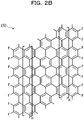
- H and Y are eliminated from the polymer 110 and a C-C binding reaction is induced to aromatize the polymer 110, and a GNR 150 whose edge structure is of armchair type and whose edge H is replaced with F is formed.
- the sequence of the GNR precursors 100 is determined by bonding of C's, to which X's have been bound, with each other, and then the structure of the GNR 150 is fixed by subsequent bonding of C's, to which H's have been bound, with each other and bonding of C's, to which Y's have been bound, with each other. Therefore, it is possible to stably produce the GNR 150 whose edge structure is of armchair type and whose edge H is replaced with F.
- FIGs. 3A and 3B are diagrams illustrating the method for producing the GNR precursor 100 according to the first embodiment.
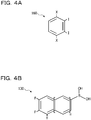
- the substance 160 illustrated in FIG. 4A is 1,4-dibromo-2,3-diiodobenzene
- the substance 130 illustrated in FIG. 4B is a boronic acid of benzene or an acene.
- acene for example, naphthalene, anthracene, naphthacene, pentacene or hexacene may be used.
- the substance 140 illustrated in FIG. 3A and the substance 130 are dissolved in a solvent, a catalyst is added thereto and the mixture is stirred in the presence of a base to cause a Suzuki coupling reaction.
- the GNR precursor 100 obtainable by monocoupling of iodine (I) contained in the substance 140 with the substance 130 may be obtained.
- purification of the GNR precursor 100 is carried out, for example, by column chromatography.
- the GNR precursor 100 may be produced by a bottom-up method.
- 1,4-dibromo-2,3-diiodobenzene may be synthesized, for example, by the following method.
- FIG. 5 is a diagram illustrating a method for synthesizing 1,4-dibromo-2,3-diiodobenzene.
- 1,4-dibromo-2,3-diiodobenzene may be synthesized.
- n is not particularly limited as long as it is an integer greater than or equal to 0, but in order to obtain a stable GNR precursor 100, n is preferably an integer greater than or equal to 0 and less than or equal to 5. Furthermore, the length of a GNR is not particularly limited, and may be, for example, several tens of nanometers. When iodine is used as X, it is easy to produce a long GNR.
- a second embodiment relates to a GNR precursor that is suitable for producing a GNR.
- FIG. 6 is a diagram illustrating a structural formula of the GNR precursor according to the second embodiment.
- a GNR precursor 200 according to the second embodiment has the structural formula illustrated in FIG. 6 . That is, the GNR precursor 200 according to the second embodiment has the structural formula illustrated in FIG. 1 where n is 0, X is Br, and Y is F.
- the GNR precursor 200 is, so to speak, 3',6'-dibromo-3',3",4',4",5',5"-hexafluoro-1,1':2',1"-terphenyl.
- FIGs. 7A and 7B are diagrams illustrating a method for producing the GNR using the GNR precursors according to the second embodiment.
- a surface cleaning process of a catalytic metal substrate on which the GNR is grown is performed in an ultrahigh vacuum.
- Ar ion sputtering to the surface and annealing under an ultra-high vacuum are set as one cycle, and this cycle is performed for a plurality of cycles.
- the ion acceleration voltage is set to 1.0 kV
- the ion current is set to 10 ⁇ A
- the time is set to 1 minute
- the temperature is set to 400°C to 500°C and the time is set to 10 minutes.
- the number of cycles is three (three cycles).
- organic contaminants on the surface of the catalytic metal substrate may be removed and the surface flatness may be enhanced.
- a gold (Au) substrate having a Miller index on the surface of (111) is used as the catalytic metal substrate.
- the (111) plane of the Au substrate is sometimes referred to as an "Au (111) plane".
- the catalytic metal substrate is heated such that the surface temperature of the catalytic metal substrate is a first temperature which is equal to or higher than the elimination temperature of Br and lower than the elimination temperature of H, for example, 200°C, under an ultra-high vacuum, and the surface temperature of the catalytic metal substrate is held at the first temperature.
- the GNR precursors 200 are vacuum-deposited on the surface of the catalytic metal substrate. It is desirable to control a deposition amount of the GNR precursors 200 so that about one-molecule layer will be formed.
- the catalytic metal substrate is heated such that the surface temperature thereof is a second temperature, which is equal to or higher than the elimination temperature T H of H, for example, 400°C, and the surface temperature of the catalytic metal substrate is held at the second temperature.
- T H of H for example, 400°C
- the surface temperature of the catalytic metal substrate is held at the second temperature.
- H and F are eliminated from the polymer 210 and a C-C binding reaction is induced to aromatize the polymer 210, and a GNR 250 whose edge structure is of armchair type and whose edge H is replaced with F is formed.
- the sequence of the GNR precursors 200 is determined by bonding of C's, to which Br's have been bound, with each other, and then the structure of the GNR 250 is fixed by subsequent bonding of C's, to which H's have been bound, with each other and bonding of C's, to which F's have been bound, with each other. Therefore, it is possible to stably produce the GNR 250 whose edge structure is of armchair type and whose edge H is replaced with F.
- 3,4,5-Trifluorophenylboronic acid has a structural formula illustrated in FIG. 4B in which n is 0.
- the GNR precursor 200 may be produced by a bottom-up method.
- FIG. 8A illustrates a scanning tunneling microscope (STM) image of the GNR produced according to the second embodiment.
- FIG. 8B is a diagram schematically illustrating the contents of the STM photograph illustrated in FIG. 8A .
- STM scanning tunneling microscope
- a one-dimensional structure having a width of slightly less than 1.5 nm, a length of about 10 nm to about 20 nm, and a thickness of about a monoatomic layer was obtained. That is, it was confirmed that a GNR was produced.
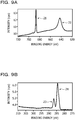
- FIGs. 9A and 9B illustrate X-ray photoelectron spectroscopy (XPS) spectra of the produced GNR.
- XPS X-ray photoelectron spectroscopy
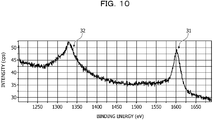
- FIG. 10 illustrates a microscopic Raman optical spectrum of the produced GNR. As illustrated in FIG. 10 , a peak 31 of the G band indicating the presence of graphene was confirmed. Furthermore, a peak 32 of the D band indicating that the GNR was of armchair type was also confirmed.
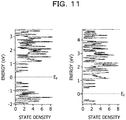
- FIG. 11 illustrates electronic structures of 9AGNR and F-9AGNR side by side.
- 9AGNR is a GNR of armchair type in which four six-membered rings are arranged in the ribbon width direction and which has a width of nine carbon atoms.
- F-9AGNR is obtainable from 9AGNR by replacing the edge H of 9AGNR with F.
- DFT density functional theory
Landscapes
- Chemical & Material Sciences (AREA)
- Organic Chemistry (AREA)
- Engineering & Computer Science (AREA)
- Materials Engineering (AREA)
- Nanotechnology (AREA)
- Inorganic Chemistry (AREA)
- Health & Medical Sciences (AREA)
- Chemical Kinetics & Catalysis (AREA)
- Medicinal Chemistry (AREA)
- Polymers & Plastics (AREA)
- Organic Low-Molecular-Weight Compounds And Preparation Thereof (AREA)
- Carbon And Carbon Compounds (AREA)
- Low-Molecular Organic Synthesis Reactions Using Catalysts (AREA)
Abstract
Description
- The embodiments discussed herein are related to a graphene nanoribbon precursor and a method for producing a graphene nanoribbon.
- As nano-sized graphene, a quasi-one-dimensional graphene of a ribbon shape with a width of several nanometers, which is called a graphene nanoribbon (GNR) is known. It is known that the GNR has a band gap whose size is roughly inversely proportional to the width.
- As an application of the GNR, there is a semiconductor device having a PN junction. The GNR tends to operate as a P-type semiconductor due to doping derived from oxygen in the atmosphere. On the other hand, it is difficult to produce a GNR that operates as an N-type semiconductor. Theoretically, it is considered possible to make a GNR operate as an N-type semiconductor by replacing hydrogen (H) at an edge of a GNR whose edge structure is of armchair type with fluorine (F). However, it has been impossible to stably produce a GNR whose edge structure is of armchair type and whose edge hydrogen is replaced with fluorine. In view of the above, it is desirable to be able to provide a graphene nanoribbon precursor that is capable of stably producing a graphene nanoribbon whose edge structure is of armchair type and whose edge hydrogen is replaced with fluorine, and a method for producing the graphene nanoribbon.
- Japanese Laid-open Patent Publication No.
2017-57182 2017-50424 - In one aspect, it is an object of the present embodiment to provide a graphene nanoribbon precursor that is capable of stably producing a graphene nanoribbon whose edge structure is of armchair type and whose edge hydrogen is replaced with fluorine, and a method for producing the graphene nanoribbon.
- According to an aspect of the embodiments, a graphene nanoribbon precursor having a structural formula represented by a following chemical formula (1), wherein in the following chemical formula (1): n is an integer greater than or equal to 0; X is bromine, iodine or chlorine; and Y is hydrogen or fluorine.

- In one aspect, it is possible to provide a graphene nanoribbon precursor that is capable of stably producing a graphene nanoribbon whose edge structure is of armchair type and whose edge hydrogen is replaced with fluorine, and a method for producing the graphene nanoribbon.
-
-
FIG. 1 is a diagram illustrating a structural formula of a GNR precursor according to a first embodiment; -
FIG. 2A is a diagram (part 1) illustrating a method for producing a GNR using the GNR precursors according to the first embodiment; -
FIG. 2B is a diagram (part 2) illustrating the method for producing the GNR using the GNR precursors according to the first embodiment; -
FIG. 3A is a diagram (part 1) illustrating a method for producing the GNR precursor according to the first embodiment; -
FIG. 3B is a diagram (part 2) illustrating the method for producing the GNR precursor according to the first embodiment; -
FIG. 4A is a diagram (part 1) illustrating a structural formula of a material of the GNR precursor according to the first embodiment; -
FIG. 4B is a diagram (part 2) illustrating a structural formula of a material of the GNR precursor according to the first embodiment; -
FIG. 5 is a diagram illustrating a method for synthesizing 1,4-dibromo-2,3-diiodobenzene; -
FIG. 6 is a diagram illustrating a structural formula of a GNR precursor according to a second embodiment; -
FIG. 7A is a diagram (part 1) illustrating a method for producing a GNR using the GNR precursors according to the second embodiment; -
FIG. 7B is a diagram (part 2) illustrating the method for producing the GNR using the GNR precursors according to the second embodiment; -
FIG. 8A is a diagram illustrating a scanning tunneling microscope (STM) image of the GNR according to the second embodiment; -
FIG. 8B is a diagram schematically illustrating the contents of the STM photograph illustrated inFIG. 8A ; -
FIG. 9A is a diagram (part 1) illustrating an X-ray photoelectron spectroscopy spectrum; -
FIG. 9B is a diagram (part 2) illustrating an X-ray photoelectron spectroscopy spectrum; -
FIG. 9C is a schematic diagram illustrating the arrangement of C atoms between a pair of armchairs; -
FIG. 10 is a diagram illustrating a microscopic Raman optical spectrum; and -
FIG. 11 is a diagram illustrating the electronic structures of 9AGNR and F-9AGNR side by side. - Embodiments of the present disclosure will be specifically described below with reference to the accompanying drawings. Note that, in this specification and the drawings, components having substantially the same functional configuration are denoted by the same reference numerals, and explanation thereof will not be unnecessarily repeated.
- A first embodiment relates to a graphene nanoribbon (GNR) precursor that is suitable for producing a GNR.
FIG. 1 is a diagram illustrating a structural formula of the GNR precursor according to the first embodiment. - A GNR
precursor 100 according to the first embodiment has the structural formula illustrated inFIG. 1 . InFIG. 1 , n is an integer greater than or equal to 0, X is bromine (Br), iodine (I) or chlorine (CI), and Y is hydrogen (H) or fluorine (F). - Here, a method for producing the GNR using the
GNR precursors 100 according to the first embodiment will be described.FIGs. 2A and2B are diagrams illustrating a method for producing the GNR using the GNR precursors according to the first embodiment. - First, a surface cleaning process of a catalytic metal substrate on which the GNR is grown is performed in an ultrahigh vacuum. By the surface cleaning process, organic contaminants on the surface of the catalytic metal substrate may be removed and the surface flatness may be enhanced. As the catalytic metal substrate, for example, a gold (Au) substrate, a silver (Ag) substrate or a copper (Cu) substrate having a Miller index on the surface of (111), (110), (100) or (788) may be used.
- Next, without exposing the catalytic metal substrate subjected to the surface cleaning process to the atmosphere, the catalytic metal substrate is heated such that the surface temperature of the catalytic metal substrate is a first temperature which is equal to or higher than the elimination temperature Tx of X and lower than the elimination temperature TY of Y atoms, for example, 200°C to 300°C, under an ultra-high vacuum, and the surface temperature of the catalytic metal substrate is held at the first temperature. Then, the
GNR precursors 100 are vacuum-deposited on the surface of the catalytic metal substrate. It is desirable to control a deposition amount of theGNR precursors 100 so that about one-molecule layer will be formed. On the surface of the catalytic metal substrate whose temperature is the first temperature, X atoms are eliminated from theGNR precursors 100 to cause an Ullmann reaction, and a C-C binding reaction is induced. As a result, as illustrated inFIG. 2A , apolymer 110 in which aromatic compounds are connected and in which a plurality of molecules of theGNR precursors 100 are arranged in one direction while reversing the direction of protrusion, is stably formed. - Next, the catalytic metal substrate is heated such that the surface temperature thereof is a second temperature, which is equal to or higher than the elimination temperature TH of H, for example, 350°C to 450°C, and the surface temperature of the catalytic metal substrate is held at the second temperature. As a result, as illustrated in
FIG. 2B , H and Y are eliminated from thepolymer 110 and a C-C binding reaction is induced to aromatize thepolymer 110, and aGNR 150 whose edge structure is of armchair type and whose edge H is replaced with F is formed. - In this way, upon heating the
GNR precursors 100, X's are eliminated and C's, to which X's have been bound, are bound with each other between theGNR precursors 100, and thereafter, H's and Y's are eliminated and then C's, to which H's have been bound, are bound with each other between theGNR precursors 100 and C's, to which Y's have been bound, are bound with each other between theGNR precursors 100. The sequence of theGNR precursors 100 is determined by bonding of C's, to which X's have been bound, with each other, and then the structure of theGNR 150 is fixed by subsequent bonding of C's, to which H's have been bound, with each other and bonding of C's, to which Y's have been bound, with each other. Therefore, it is possible to stably produce theGNR 150 whose edge structure is of armchair type and whose edge H is replaced with F. - Next, a method for producing the
GNR precursor 100 according to the first embodiment will be described.FIGs. 3A and 3B are diagrams illustrating the method for producing theGNR precursor 100 according to the first embodiment. - First, a
substance 160 whose structural formula is illustrated inFIG. 4A and asubstance 130 whose structural formula is illustrated inFIG. 4B are prepared. Thesubstance 160 illustrated inFIG. 4A is 1,4-dibromo-2,3-diiodobenzene, and thesubstance 130 illustrated inFIG. 4B is a boronic acid of benzene or an acene. As the acene, for example, naphthalene, anthracene, naphthacene, pentacene or hexacene may be used. - Next, these substances are dissolved in a solvent, a catalyst is added thereto and the mixture is stirred in the presence of a base to cause a Suzuki coupling reaction. By continuing stirring to evaporate the solvent, as illustrated in
FIG. 3A , asubstance 140 obtainable by monocoupling of one iodine (I) contained in thesubstance 160 with thesubstance 130 may be obtained. - Thereafter, the
substance 140 illustrated inFIG. 3A and thesubstance 130 are dissolved in a solvent, a catalyst is added thereto and the mixture is stirred in the presence of a base to cause a Suzuki coupling reaction. By continuing stirring to evaporate the solvent, as illustrated inFIG. 3B , theGNR precursor 100 obtainable by monocoupling of iodine (I) contained in thesubstance 140 with thesubstance 130 may be obtained. - Then, purification of the
GNR precursor 100 is carried out, for example, by column chromatography. - In this way, the
GNR precursor 100 may be produced by a bottom-up method. - 1,4-dibromo-2,3-diiodobenzene may be synthesized, for example, by the following method.
FIG. 5 is a diagram illustrating a method for synthesizing 1,4-dibromo-2,3-diiodobenzene. - First, 2,5-dibromoaniline (compound 11), chloral hydrate (compound 12) and hydroxylammonium chloride (compound 13) are reacted in an aqueous solution of ethanol to give (2,5-dibromophenyl)-2-(hydroxyimino)acetamide (compound 14). This reaction is carried out, for example, at 80°C for 12 hours.
- Next, (2,5-dibromophenyl)-2-(hydroxyimino)acetamide (compound 14) is added to concentrated sulfuric acid and the mixture is heated to give 4,7-dibromoindoline-2,3-dione (compound 15). This reaction is carried out, for example, at 100°C for 30 minutes.
- Thereafter, 4,7-dibromoindoline-2,3-dione (compound 15) is dissolved in a sodium hydroxide aqueous solution, a hydrogen peroxide solution is added dropwise thereto and the mixture is stirred. Subsequently, filtration is performed, hydrogen is added to the carboxyl group using hydrochloric acid, and the pH is adjusted to 4. Then, filtration is carried out to give 2-amino-3,6-dibromobenzoic acid (compound 16).
- Next, 2-amino-3,6-dibromobenzoic acid (compound 16) is added dropwise to a solution of 1,2-dichloromethane, iodine and isoamyl nitrite to give 1,4-dibromo-2,3-diiodobenzene (compound 17). This reaction is carried out, for example, at 80°C for 16 hours.
- In this way, 1,4-dibromo-2,3-diiodobenzene may be synthesized.
- Note that n is not particularly limited as long as it is an integer greater than or equal to 0, but in order to obtain a
stable GNR precursor 100, n is preferably an integer greater than or equal to 0 and less than or equal to 5. Furthermore, the length of a GNR is not particularly limited, and may be, for example, several tens of nanometers. When iodine is used as X, it is easy to produce a long GNR. - A second embodiment relates to a GNR precursor that is suitable for producing a GNR.
FIG. 6 is a diagram illustrating a structural formula of the GNR precursor according to the second embodiment. - A
GNR precursor 200 according to the second embodiment has the structural formula illustrated inFIG. 6 . That is, theGNR precursor 200 according to the second embodiment has the structural formula illustrated inFIG. 1 where n is 0, X is Br, and Y is F. TheGNR precursor 200 is, so to speak, 3',6'-dibromo-3',3",4',4",5',5"-hexafluoro-1,1':2',1"-terphenyl. - Here, a method for producing the GNR using the
GNR precursors 200 according to the second embodiment will be described.FIGs. 7A and 7B are diagrams illustrating a method for producing the GNR using the GNR precursors according to the second embodiment. - First, a surface cleaning process of a catalytic metal substrate on which the GNR is grown is performed in an ultrahigh vacuum. In this surface cleaning process, for example, Ar ion sputtering to the surface and annealing under an ultra-high vacuum are set as one cycle, and this cycle is performed for a plurality of cycles. For example, in each cycle, in the Ar ion sputtering, the ion acceleration voltage is set to 1.0 kV, the ion current is set to 10 µA, and the time is set to 1 minute, and in the annealing, while maintaining the degree of vacuum of 5 × 10⁻⁷ Pa or less, the temperature is set to 400°C to 500°C and the time is set to 10 minutes. For example, the number of cycles is three (three cycles). By the surface cleaning process, organic contaminants on the surface of the catalytic metal substrate may be removed and the surface flatness may be enhanced. Here, a gold (Au) substrate having a Miller index on the surface of (111) is used as the catalytic metal substrate. Hereinafter, the (111) plane of the Au substrate is sometimes referred to as an "Au (111) plane".
- Next, without exposing the catalytic metal substrate subjected to the surface cleaning process to the atmosphere, the catalytic metal substrate is heated such that the surface temperature of the catalytic metal substrate is a first temperature which is equal to or higher than the elimination temperature of Br and lower than the elimination temperature of H, for example, 200°C, under an ultra-high vacuum, and the surface temperature of the catalytic metal substrate is held at the first temperature. Then, the
GNR precursors 200 are vacuum-deposited on the surface of the catalytic metal substrate. It is desirable to control a deposition amount of theGNR precursors 200 so that about one-molecule layer will be formed. On the surface of the catalytic metal substrate whose temperature is the first temperature, Br is eliminated from theGNR precursors 200 to cause an Ullmann reaction, and a C-C binding reaction is induced. As a result, as illustrated inFIG. 7A , apolymer 210 in which aromatic compounds are connected and in which a plurality of molecules of theGNR precursors 200 are arranged in one direction while reversing the direction of protrusion, is stably formed. - Next, the catalytic metal substrate is heated such that the surface temperature thereof is a second temperature, which is equal to or higher than the elimination temperature TH of H, for example, 400°C, and the surface temperature of the catalytic metal substrate is held at the second temperature. As a result, as illustrated in
FIG. 7B , H and F are eliminated from thepolymer 210 and a C-C binding reaction is induced to aromatize thepolymer 210, and aGNR 250 whose edge structure is of armchair type and whose edge H is replaced with F is formed. - In this way, upon heating the
GNR precursors 200, Br's are eliminated and C's, to which Br's have been bound, are bound with each other between theGNR precursors 200, and thereafter, H's and F's are eliminated and then C's, to which H's have been bound, are bound with each other between theGNR precursors 200 and C's, to which F's have been bound, are bound with each other between theGNR precursors 200. The sequence of theGNR precursors 200 is determined by bonding of C's, to which Br's have been bound, with each other, and then the structure of theGNR 250 is fixed by subsequent bonding of C's, to which H's have been bound, with each other and bonding of C's, to which F's have been bound, with each other. Therefore, it is possible to stably produce theGNR 250 whose edge structure is of armchair type and whose edge H is replaced with F. - Next, a method for producing the
GNR precursor 200 according to the second embodiment will be described. - First, 1,4-dibromo-2,3-diiodobenzene and 3,4,5-trifluorophenylboronic acid are prepared. 3,4,5-Trifluorophenylboronic acid has a structural formula illustrated in
FIG. 4B in which n is 0. - Next, by a method similar to that of the method for producing the
GNR precursor 100 according to the first embodiment, Suzuki coupling reactions are caused twice and the solvent is evaporated to give theGNR precursor 200. Then, purification of theGNR precursor 200 is carried out, for example, by column chromatography. - In this way, the
GNR precursor 200 may be produced by a bottom-up method. -
FIG. 8A illustrates a scanning tunneling microscope (STM) image of the GNR produced according to the second embodiment.FIG. 8B is a diagram schematically illustrating the contents of the STM photograph illustrated inFIG. 8A . - As illustrated in
FIGs. 8A and 8B , a one-dimensional structure having a width of slightly less than 1.5 nm, a length of about 10 nm to about 20 nm, and a thickness of about a monoatomic layer was obtained. That is, it was confirmed that a GNR was produced. -
FIGs. 9A and 9B illustrate X-ray photoelectron spectroscopy (XPS) spectra of the produced GNR. As illustrated inFIG. 9A , apeak 21 of the 1s orbit of fluorine was confirmed in addition to apeak 22 of the 4p orbit of Au of the catalytic metal substrate. Furthermore, as illustrated inFIG. 9B , apeak 23 of C-F bond and apeak 24 of C of the 1s orbit located inside edges were confirmed. The intensity of thepeak 24 is 3.4 times the intensity of thepeak 23. As illustrated inFIG. 9C , when focusing on a pair of armchairs, the number ofC atoms 26 located inside edges is 14, and the number ofC atoms 25 located at the edges and bound to F atoms is 4. Therefore, the number of theC atoms 26 is 3.5 times the number of theC atoms 25. From this, it may be said that F atoms are bound to almost all theC atoms 25 located at the edges. -
FIG. 10 illustrates a microscopic Raman optical spectrum of the produced GNR. As illustrated inFIG. 10 , apeak 31 of the G band indicating the presence of graphene was confirmed. Furthermore, apeak 32 of the D band indicating that the GNR was of armchair type was also confirmed. - From the results illustrated in
FIGs. 9A, 9B and10 , it was confirmed that a GNR whose edge structure is of armchair type and whose edge H is replaced with F was produced. -
FIG. 11 illustrates electronic structures of 9AGNR and F-9AGNR side by side. 9AGNR is a GNR of armchair type in which four six-membered rings are arranged in the ribbon width direction and which has a width of nine carbon atoms. F-9AGNR is obtainable from 9AGNR by replacing the edge H of 9AGNR with F. When the electronic states of 9AGNR and F-9AGNR were calculated by density functional theory (DFT), the work function of F-9AGNR was 4.75 eV, and the work function of 9AGNR was 3.50 eV. This indicates that a PN junction may be realized by joining 9AGNR and F-9AGNR. -
- 100, 200
- GNR precursor
- 110, 210
- Polymer
- 150, 250
- Graphene nanoribbon
Claims (6)
- A graphene nanoribbon precursor having a structural formula represented by a following chemical formula (1), wherein in the following chemical formula (1):n is an integer greater than or equal to 0;X is bromine, iodine or chlorine; andY is hydrogen or fluorine.

- The graphene nanoribbon precursor according to claim 1,
wherein n is an integer greater than or equal to 0 and less than or equal to 5. - The graphene nanoribbon precursor according to claim 1 or 2,
wherein Y is fluorine. - A method for producing a graphene nanoribbon, the method comprising:heating the graphene nanoribbon precursor according to any one of claims 1 to 3 to a first temperature on a substrate to induce elimination of X and a C-C binding reaction to obtain a polymer on the substrate; andheating the polymer to a second temperature that is higher than the first temperature to induce elimination of H and Y and a C-C binding reaction.
- The method according to claim 4,
wherein the C-C binding reaction is induced by an Ullmann reaction caused by eliminating the X atoms from the graphene nanoribbon precursors. - The method according to claim 4 or 5,
wherein the polymer is a polymer in which aromatic compounds are connected and in which a plurality of molecules of the graphene nanoribbon precursors are arranged in one direction while reversing the direction of protrusion.
Applications Claiming Priority (1)
| Application Number | Priority Date | Filing Date | Title |
|---|---|---|---|
| JP2019063818A JP7226017B2 (en) | 2019-03-28 | 2019-03-28 | Graphene nanoribbon precursor and method for producing graphene nanoribbon |
Publications (2)
| Publication Number | Publication Date |
|---|---|
| EP3715322A1 true EP3715322A1 (en) | 2020-09-30 |
| EP3715322B1 EP3715322B1 (en) | 2022-03-16 |
Family
ID=69810648
Family Applications (1)
| Application Number | Title | Priority Date | Filing Date |
|---|---|---|---|
| EP20162695.9A Active EP3715322B1 (en) | 2019-03-28 | 2020-03-12 | Graphene nanoribbon precursor and method for producing graphene nanoribbon |
Country Status (3)
| Country | Link |
|---|---|
| US (1) | US11305999B2 (en) |
| EP (1) | EP3715322B1 (en) |
| JP (1) | JP7226017B2 (en) |
Families Citing this family (1)
| Publication number | Priority date | Publication date | Assignee | Title |
|---|---|---|---|---|
| CN116102455B (en) * | 2021-11-10 | 2024-12-03 | 南通泰禾化工股份有限公司 | Preparation method of 2- (hydroxyimino) -N- (2-nitrophenyl) acetamide |
Citations (4)
| Publication number | Priority date | Publication date | Assignee | Title |
|---|---|---|---|---|
| JP2017050424A (en) | 2015-09-02 | 2017-03-09 | 富士通株式会社 | Electronic device and manufacturing method therefor |
| JP2017057182A (en) | 2015-09-18 | 2017-03-23 | 国立大学法人 奈良先端科学技術大学院大学 | Production method of graphene nanoribbon precursor |
| US20170081192A1 (en) * | 2014-05-15 | 2017-03-23 | Basf Se | Ortho-terphenyls for the preparation of graphene nanoribbons |
| US20180362703A1 (en) * | 2017-06-16 | 2018-12-20 | Fujitsu Limited | Compound, compound fabrication method, and graphene nanoribbon fabrication method |
Family Cites Families (2)
| Publication number | Priority date | Publication date | Assignee | Title |
|---|---|---|---|---|
| JP6842042B2 (en) | 2017-03-31 | 2021-03-17 | 富士通株式会社 | Graphene nanoribbons and precursor molecules used in their production |
| JP6973208B2 (en) | 2018-03-15 | 2021-11-24 | 富士通株式会社 | Graphene nanoribbon precursor, graphene nanoribbon and electronic device, graphene nanoribbon precursor manufacturing method and graphene nanoribbon manufacturing method |
-
2019
- 2019-03-28 JP JP2019063818A patent/JP7226017B2/en active Active
-
2020
- 2020-03-09 US US16/812,424 patent/US11305999B2/en active Active
- 2020-03-12 EP EP20162695.9A patent/EP3715322B1/en active Active
Patent Citations (4)
| Publication number | Priority date | Publication date | Assignee | Title |
|---|---|---|---|---|
| US20170081192A1 (en) * | 2014-05-15 | 2017-03-23 | Basf Se | Ortho-terphenyls for the preparation of graphene nanoribbons |
| JP2017050424A (en) | 2015-09-02 | 2017-03-09 | 富士通株式会社 | Electronic device and manufacturing method therefor |
| JP2017057182A (en) | 2015-09-18 | 2017-03-23 | 国立大学法人 奈良先端科学技術大学院大学 | Production method of graphene nanoribbon precursor |
| US20180362703A1 (en) * | 2017-06-16 | 2018-12-20 | Fujitsu Limited | Compound, compound fabrication method, and graphene nanoribbon fabrication method |
Non-Patent Citations (2)
| Title |
|---|
| ACS NANO, vol. 11, 2017, pages 6204 |
| ZONGPING CHEN ET AL: "Chemical Vapor Deposition Synthesis and Terahertz Photoconductivity of Low-Band-Gap N = 9 Armchair Graphene Nanoribbons", JOURNAL OF THE AMERICAM SOCIETY, vol. 139, no. 10, 6 March 2017 (2017-03-06), US, pages 3635 - 3638, XP055722734, ISSN: 0002-7863, DOI: 10.1021/jacs.7b00776 * |
Also Published As
| Publication number | Publication date |
|---|---|
| JP7226017B2 (en) | 2023-02-21 |
| EP3715322B1 (en) | 2022-03-16 |
| US20200308004A1 (en) | 2020-10-01 |
| JP2020164427A (en) | 2020-10-08 |
| US11305999B2 (en) | 2022-04-19 |
Similar Documents
| Publication | Publication Date | Title |
|---|---|---|
| Jeong et al. | Recent trends in covalent functionalization of 2D materials | |
| Kolmer et al. | Fluorine-programmed nanozipping to tailored nanographenes on rutile TiO2 surfaces | |
| Hou et al. | On-surface synthesis of unsaturated carbon nanostructures with regularly fused pentagon–heptagon pairs | |
| Chou et al. | Controlling the metal to semiconductor transition of MoS2 and WS2 in solution | |
| Qi et al. | CO2-induced phase engineering: protocol for enhanced photoelectrocatalytic performance of 2D MoS2 nanosheets | |
| Lin et al. | Preparation of fluorescent tellurium nanowires at room temperature | |
| Simpson et al. | Nanosized molecular propellers by cyclodehydrogenation of polyphenylene dendrimers | |
| Li et al. | Photochemical chlorination of graphene | |
| Azizi et al. | Freestanding van der Waals heterostructures of graphene and transition metal dichalcogenides | |
| Gao et al. | Heat-initiated chemical functionalization of graphene | |
| Wan et al. | High-quality large-area graphene from dehydrogenated polycyclic aromatic hydrocarbons | |
| Zhou et al. | Intrinsic structural defects in monolayer molybdenum disulfide | |
| Tahara et al. | Self-assembled monolayers as templates for linearly nanopatterned covalent chemical functionalization of graphite and graphene surfaces | |
| Yang et al. | Single-crystal atomic-layered molybdenum disulfide nanobelts with high surface activity | |
| Zou et al. | Heterogeneous lollipop-like V2O5/ZnO array: a promising composite nanostructure for visible light photocatalysis | |
| Liao et al. | Oxidative etching of hexagonal boron nitride toward nanosheets with defined edges and holes | |
| Tian et al. | Utilization of MoS2 nanosheets to enhance the photocatalytic activity of ZnO for the aerobic oxidation of benzyl halides under visible light | |
| Chattopadhyay et al. | Graphite epoxide | |
| Weng et al. | Wafer‐scale graphene anodes replace indium tin oxide in organic light‐emitting diodes | |
| Zhang et al. | Lithium-assisted self-assembly of aluminum carbide nanowires and nanoribbons | |
| Yano et al. | Step-growth annulative π-extension polymerization for synthesis of cove-type graphene nanoribbons | |
| KR20150095749A (en) | Edge halogenation of graphene materials | |
| Morag et al. | Transparent, conductive gold nanowire networks assembled from soluble Au thiocyanate | |
| Wang et al. | Unveiling three-dimensional stacking sequences of 1T phase MoS2 monolayers by electron diffraction | |
| Derrouiche et al. | Optimization of routes for the synthesis of bismuth nanotubes: implications for nanostructure form and selectivity |
Legal Events
| Date | Code | Title | Description |
|---|---|---|---|
| PUAI | Public reference made under article 153(3) epc to a published international application that has entered the european phase |
Free format text: ORIGINAL CODE: 0009012 |
|
| STAA | Information on the status of an ep patent application or granted ep patent |
Free format text: STATUS: THE APPLICATION HAS BEEN PUBLISHED |
|
| AK | Designated contracting states |
Kind code of ref document: A1 Designated state(s): AL AT BE BG CH CY CZ DE DK EE ES FI FR GB GR HR HU IE IS IT LI LT LU LV MC MK MT NL NO PL PT RO RS SE SI SK SM TR |
|
| AX | Request for extension of the european patent |
Extension state: BA ME |
|
| STAA | Information on the status of an ep patent application or granted ep patent |
Free format text: STATUS: REQUEST FOR EXAMINATION WAS MADE |
|
| 17P | Request for examination filed |
Effective date: 20210114 |
|
| RBV | Designated contracting states (corrected) |
Designated state(s): AL AT BE BG CH CY CZ DE DK EE ES FI FR GB GR HR HU IE IS IT LI LT LU LV MC MK MT NL NO PL PT RO RS SE SI SK SM TR |
|
| GRAP | Despatch of communication of intention to grant a patent |
Free format text: ORIGINAL CODE: EPIDOSNIGR1 |
|
| STAA | Information on the status of an ep patent application or granted ep patent |
Free format text: STATUS: GRANT OF PATENT IS INTENDED |
|
| INTG | Intention to grant announced |
Effective date: 20211210 |
|
| GRAS | Grant fee paid |
Free format text: ORIGINAL CODE: EPIDOSNIGR3 |
|
| GRAA | (expected) grant |
Free format text: ORIGINAL CODE: 0009210 |
|
| STAA | Information on the status of an ep patent application or granted ep patent |
Free format text: STATUS: THE PATENT HAS BEEN GRANTED |
|
| AK | Designated contracting states |
Kind code of ref document: B1 Designated state(s): AL AT BE BG CH CY CZ DE DK EE ES FI FR GB GR HR HU IE IS IT LI LT LU LV MC MK MT NL NO PL PT RO RS SE SI SK SM TR |
|
| REG | Reference to a national code |
Ref country code: GB Ref legal event code: FG4D |
|
| REG | Reference to a national code |
Ref country code: CH Ref legal event code: EP |
|
| REG | Reference to a national code |
Ref country code: DE Ref legal event code: R096 Ref document number: 602020002189 Country of ref document: DE |
|
| REG | Reference to a national code |
Ref country code: IE Ref legal event code: FG4D |
|
| REG | Reference to a national code |
Ref country code: AT Ref legal event code: REF Ref document number: 1475755 Country of ref document: AT Kind code of ref document: T Effective date: 20220415 |
|
| REG | Reference to a national code |
Ref country code: LT Ref legal event code: MG9D |
|
| REG | Reference to a national code |
Ref country code: NL Ref legal event code: MP Effective date: 20220316 |
|
| PG25 | Lapsed in a contracting state [announced via postgrant information from national office to epo] |
Ref country code: SE Free format text: LAPSE BECAUSE OF FAILURE TO SUBMIT A TRANSLATION OF THE DESCRIPTION OR TO PAY THE FEE WITHIN THE PRESCRIBED TIME-LIMIT Effective date: 20220316 Ref country code: RS Free format text: LAPSE BECAUSE OF FAILURE TO SUBMIT A TRANSLATION OF THE DESCRIPTION OR TO PAY THE FEE WITHIN THE PRESCRIBED TIME-LIMIT Effective date: 20220316 Ref country code: NO Free format text: LAPSE BECAUSE OF FAILURE TO SUBMIT A TRANSLATION OF THE DESCRIPTION OR TO PAY THE FEE WITHIN THE PRESCRIBED TIME-LIMIT Effective date: 20220616 Ref country code: LT Free format text: LAPSE BECAUSE OF FAILURE TO SUBMIT A TRANSLATION OF THE DESCRIPTION OR TO PAY THE FEE WITHIN THE PRESCRIBED TIME-LIMIT Effective date: 20220316 Ref country code: HR Free format text: LAPSE BECAUSE OF FAILURE TO SUBMIT A TRANSLATION OF THE DESCRIPTION OR TO PAY THE FEE WITHIN THE PRESCRIBED TIME-LIMIT Effective date: 20220316 Ref country code: BG Free format text: LAPSE BECAUSE OF FAILURE TO SUBMIT A TRANSLATION OF THE DESCRIPTION OR TO PAY THE FEE WITHIN THE PRESCRIBED TIME-LIMIT Effective date: 20220616 |
|
| REG | Reference to a national code |
Ref country code: AT Ref legal event code: MK05 Ref document number: 1475755 Country of ref document: AT Kind code of ref document: T Effective date: 20220316 |
|
| PG25 | Lapsed in a contracting state [announced via postgrant information from national office to epo] |
Ref country code: LV Free format text: LAPSE BECAUSE OF FAILURE TO SUBMIT A TRANSLATION OF THE DESCRIPTION OR TO PAY THE FEE WITHIN THE PRESCRIBED TIME-LIMIT Effective date: 20220316 Ref country code: GR Free format text: LAPSE BECAUSE OF FAILURE TO SUBMIT A TRANSLATION OF THE DESCRIPTION OR TO PAY THE FEE WITHIN THE PRESCRIBED TIME-LIMIT Effective date: 20220617 Ref country code: FI Free format text: LAPSE BECAUSE OF FAILURE TO SUBMIT A TRANSLATION OF THE DESCRIPTION OR TO PAY THE FEE WITHIN THE PRESCRIBED TIME-LIMIT Effective date: 20220316 |
|
| PG25 | Lapsed in a contracting state [announced via postgrant information from national office to epo] |
Ref country code: NL Free format text: LAPSE BECAUSE OF FAILURE TO SUBMIT A TRANSLATION OF THE DESCRIPTION OR TO PAY THE FEE WITHIN THE PRESCRIBED TIME-LIMIT Effective date: 20220316 |
|
| PG25 | Lapsed in a contracting state [announced via postgrant information from national office to epo] |
Ref country code: SM Free format text: LAPSE BECAUSE OF FAILURE TO SUBMIT A TRANSLATION OF THE DESCRIPTION OR TO PAY THE FEE WITHIN THE PRESCRIBED TIME-LIMIT Effective date: 20220316 Ref country code: SK Free format text: LAPSE BECAUSE OF FAILURE TO SUBMIT A TRANSLATION OF THE DESCRIPTION OR TO PAY THE FEE WITHIN THE PRESCRIBED TIME-LIMIT Effective date: 20220316 Ref country code: RO Free format text: LAPSE BECAUSE OF FAILURE TO SUBMIT A TRANSLATION OF THE DESCRIPTION OR TO PAY THE FEE WITHIN THE PRESCRIBED TIME-LIMIT Effective date: 20220316 Ref country code: PT Free format text: LAPSE BECAUSE OF FAILURE TO SUBMIT A TRANSLATION OF THE DESCRIPTION OR TO PAY THE FEE WITHIN THE PRESCRIBED TIME-LIMIT Effective date: 20220718 Ref country code: ES Free format text: LAPSE BECAUSE OF FAILURE TO SUBMIT A TRANSLATION OF THE DESCRIPTION OR TO PAY THE FEE WITHIN THE PRESCRIBED TIME-LIMIT Effective date: 20220316 Ref country code: EE Free format text: LAPSE BECAUSE OF FAILURE TO SUBMIT A TRANSLATION OF THE DESCRIPTION OR TO PAY THE FEE WITHIN THE PRESCRIBED TIME-LIMIT Effective date: 20220316 Ref country code: CZ Free format text: LAPSE BECAUSE OF FAILURE TO SUBMIT A TRANSLATION OF THE DESCRIPTION OR TO PAY THE FEE WITHIN THE PRESCRIBED TIME-LIMIT Effective date: 20220316 Ref country code: AT Free format text: LAPSE BECAUSE OF FAILURE TO SUBMIT A TRANSLATION OF THE DESCRIPTION OR TO PAY THE FEE WITHIN THE PRESCRIBED TIME-LIMIT Effective date: 20220316 |
|
| PG25 | Lapsed in a contracting state [announced via postgrant information from national office to epo] |
Ref country code: PL Free format text: LAPSE BECAUSE OF FAILURE TO SUBMIT A TRANSLATION OF THE DESCRIPTION OR TO PAY THE FEE WITHIN THE PRESCRIBED TIME-LIMIT Effective date: 20220316 Ref country code: IS Free format text: LAPSE BECAUSE OF FAILURE TO SUBMIT A TRANSLATION OF THE DESCRIPTION OR TO PAY THE FEE WITHIN THE PRESCRIBED TIME-LIMIT Effective date: 20220716 Ref country code: AL Free format text: LAPSE BECAUSE OF FAILURE TO SUBMIT A TRANSLATION OF THE DESCRIPTION OR TO PAY THE FEE WITHIN THE PRESCRIBED TIME-LIMIT Effective date: 20220316 |
|
| REG | Reference to a national code |
Ref country code: DE Ref legal event code: R097 Ref document number: 602020002189 Country of ref document: DE |
|
| PLBE | No opposition filed within time limit |
Free format text: ORIGINAL CODE: 0009261 |
|
| STAA | Information on the status of an ep patent application or granted ep patent |
Free format text: STATUS: NO OPPOSITION FILED WITHIN TIME LIMIT |
|
| PG25 | Lapsed in a contracting state [announced via postgrant information from national office to epo] |
Ref country code: DK Free format text: LAPSE BECAUSE OF FAILURE TO SUBMIT A TRANSLATION OF THE DESCRIPTION OR TO PAY THE FEE WITHIN THE PRESCRIBED TIME-LIMIT Effective date: 20220316 |
|
| 26N | No opposition filed |
Effective date: 20221219 |
|
| PG25 | Lapsed in a contracting state [announced via postgrant information from national office to epo] |
Ref country code: SI Free format text: LAPSE BECAUSE OF FAILURE TO SUBMIT A TRANSLATION OF THE DESCRIPTION OR TO PAY THE FEE WITHIN THE PRESCRIBED TIME-LIMIT Effective date: 20220316 |
|
| PG25 | Lapsed in a contracting state [announced via postgrant information from national office to epo] |
Ref country code: IT Free format text: LAPSE BECAUSE OF FAILURE TO SUBMIT A TRANSLATION OF THE DESCRIPTION OR TO PAY THE FEE WITHIN THE PRESCRIBED TIME-LIMIT Effective date: 20220316 |
|
| PG25 | Lapsed in a contracting state [announced via postgrant information from national office to epo] |
Ref country code: MC Free format text: LAPSE BECAUSE OF FAILURE TO SUBMIT A TRANSLATION OF THE DESCRIPTION OR TO PAY THE FEE WITHIN THE PRESCRIBED TIME-LIMIT Effective date: 20220316 |
|
| REG | Reference to a national code |
Ref country code: CH Ref legal event code: PL |
|
| REG | Reference to a national code |
Ref country code: BE Ref legal event code: MM Effective date: 20230331 |
|
| PG25 | Lapsed in a contracting state [announced via postgrant information from national office to epo] |
Ref country code: LU Free format text: LAPSE BECAUSE OF NON-PAYMENT OF DUE FEES Effective date: 20230312 |
|
| REG | Reference to a national code |
Ref country code: IE Ref legal event code: MM4A |
|
| PG25 | Lapsed in a contracting state [announced via postgrant information from national office to epo] |
Ref country code: LI Free format text: LAPSE BECAUSE OF NON-PAYMENT OF DUE FEES Effective date: 20230331 Ref country code: IE Free format text: LAPSE BECAUSE OF NON-PAYMENT OF DUE FEES Effective date: 20230312 Ref country code: CH Free format text: LAPSE BECAUSE OF NON-PAYMENT OF DUE FEES Effective date: 20230331 |
|
| PG25 | Lapsed in a contracting state [announced via postgrant information from national office to epo] |
Ref country code: BE Free format text: LAPSE BECAUSE OF NON-PAYMENT OF DUE FEES Effective date: 20230331 |
|
| PG25 | Lapsed in a contracting state [announced via postgrant information from national office to epo] |
Ref country code: CY Free format text: LAPSE BECAUSE OF FAILURE TO SUBMIT A TRANSLATION OF THE DESCRIPTION OR TO PAY THE FEE WITHIN THE PRESCRIBED TIME-LIMIT; INVALID AB INITIO Effective date: 20200312 |
|
| PG25 | Lapsed in a contracting state [announced via postgrant information from national office to epo] |
Ref country code: HU Free format text: LAPSE BECAUSE OF FAILURE TO SUBMIT A TRANSLATION OF THE DESCRIPTION OR TO PAY THE FEE WITHIN THE PRESCRIBED TIME-LIMIT; INVALID AB INITIO Effective date: 20200312 |
|
| PG25 | Lapsed in a contracting state [announced via postgrant information from national office to epo] |
Ref country code: TR Free format text: LAPSE BECAUSE OF FAILURE TO SUBMIT A TRANSLATION OF THE DESCRIPTION OR TO PAY THE FEE WITHIN THE PRESCRIBED TIME-LIMIT Effective date: 20220316 |
|
| PGFP | Annual fee paid to national office [announced via postgrant information from national office to epo] |
Ref country code: GB Payment date: 20260220 Year of fee payment: 7 |
|
| PGFP | Annual fee paid to national office [announced via postgrant information from national office to epo] |
Ref country code: DE Payment date: 20260219 Year of fee payment: 7 |
|
| PGFP | Annual fee paid to national office [announced via postgrant information from national office to epo] |
Ref country code: FR Payment date: 20260219 Year of fee payment: 7 |