EP3713001B1 - Non-polar all-solid battery and electronic device - Google Patents
Non-polar all-solid battery and electronic device Download PDFInfo
- Publication number
- EP3713001B1 EP3713001B1 EP18875640.7A EP18875640A EP3713001B1 EP 3713001 B1 EP3713001 B1 EP 3713001B1 EP 18875640 A EP18875640 A EP 18875640A EP 3713001 B1 EP3713001 B1 EP 3713001B1
- Authority
- EP
- European Patent Office
- Prior art keywords
- active material
- electrode
- solid
- state battery
- negative electrode
- Prior art date
- Legal status (The legal status is an assumption and is not a legal conclusion. Google has not performed a legal analysis and makes no representation as to the accuracy of the status listed.)
- Active
Links
Images
Classifications
-
- H—ELECTRICITY
- H01—ELECTRIC ELEMENTS
- H01M—PROCESSES OR MEANS, e.g. BATTERIES, FOR THE DIRECT CONVERSION OF CHEMICAL ENERGY INTO ELECTRICAL ENERGY
- H01M10/00—Secondary cells; Manufacture thereof
- H01M10/05—Accumulators with non-aqueous electrolyte
- H01M10/052—Li-accumulators
-
- H—ELECTRICITY
- H01—ELECTRIC ELEMENTS
- H01M—PROCESSES OR MEANS, e.g. BATTERIES, FOR THE DIRECT CONVERSION OF CHEMICAL ENERGY INTO ELECTRICAL ENERGY
- H01M10/00—Secondary cells; Manufacture thereof
- H01M10/05—Accumulators with non-aqueous electrolyte
- H01M10/058—Construction or manufacture
- H01M10/0585—Construction or manufacture of accumulators having only flat construction elements, i.e. flat positive electrodes, flat negative electrodes and flat separators
-
- H—ELECTRICITY
- H01—ELECTRIC ELEMENTS
- H01M—PROCESSES OR MEANS, e.g. BATTERIES, FOR THE DIRECT CONVERSION OF CHEMICAL ENERGY INTO ELECTRICAL ENERGY
- H01M4/00—Electrodes
- H01M4/02—Electrodes composed of, or comprising, active material
- H01M4/13—Electrodes for accumulators with non-aqueous electrolyte, e.g. for lithium-accumulators; Processes of manufacture thereof
- H01M4/131—Electrodes based on mixed oxides or hydroxides, or on mixtures of oxides or hydroxides, e.g. LiCoOx
-
- H—ELECTRICITY
- H01—ELECTRIC ELEMENTS
- H01M—PROCESSES OR MEANS, e.g. BATTERIES, FOR THE DIRECT CONVERSION OF CHEMICAL ENERGY INTO ELECTRICAL ENERGY
- H01M4/00—Electrodes
- H01M4/02—Electrodes composed of, or comprising, active material
- H01M4/13—Electrodes for accumulators with non-aqueous electrolyte, e.g. for lithium-accumulators; Processes of manufacture thereof
- H01M4/136—Electrodes based on inorganic compounds other than oxides or hydroxides, e.g. sulfides, selenides, tellurides, halogenides or LiCoFy
-
- H—ELECTRICITY
- H01—ELECTRIC ELEMENTS
- H01M—PROCESSES OR MEANS, e.g. BATTERIES, FOR THE DIRECT CONVERSION OF CHEMICAL ENERGY INTO ELECTRICAL ENERGY
- H01M4/00—Electrodes
- H01M4/02—Electrodes composed of, or comprising, active material
- H01M4/36—Selection of substances as active materials, active masses, active liquids
- H01M4/362—Composites
- H01M4/364—Composites as mixtures
-
- H—ELECTRICITY
- H01—ELECTRIC ELEMENTS
- H01M—PROCESSES OR MEANS, e.g. BATTERIES, FOR THE DIRECT CONVERSION OF CHEMICAL ENERGY INTO ELECTRICAL ENERGY
- H01M4/00—Electrodes
- H01M4/02—Electrodes composed of, or comprising, active material
- H01M4/36—Selection of substances as active materials, active masses, active liquids
- H01M4/48—Selection of substances as active materials, active masses, active liquids of inorganic oxides or hydroxides
- H01M4/483—Selection of substances as active materials, active masses, active liquids of inorganic oxides or hydroxides for non-aqueous cells
-
- H—ELECTRICITY
- H01—ELECTRIC ELEMENTS
- H01M—PROCESSES OR MEANS, e.g. BATTERIES, FOR THE DIRECT CONVERSION OF CHEMICAL ENERGY INTO ELECTRICAL ENERGY
- H01M4/00—Electrodes
- H01M4/02—Electrodes composed of, or comprising, active material
- H01M4/36—Selection of substances as active materials, active masses, active liquids
- H01M4/48—Selection of substances as active materials, active masses, active liquids of inorganic oxides or hydroxides
- H01M4/485—Selection of substances as active materials, active masses, active liquids of inorganic oxides or hydroxides of mixed oxides or hydroxides for inserting or intercalating light metals, e.g. LiTi2O4 or LiTi2OxFy
-
- H—ELECTRICITY
- H01—ELECTRIC ELEMENTS
- H01M—PROCESSES OR MEANS, e.g. BATTERIES, FOR THE DIRECT CONVERSION OF CHEMICAL ENERGY INTO ELECTRICAL ENERGY
- H01M4/00—Electrodes
- H01M4/02—Electrodes composed of, or comprising, active material
- H01M4/36—Selection of substances as active materials, active masses, active liquids
- H01M4/58—Selection of substances as active materials, active masses, active liquids of inorganic compounds other than oxides or hydroxides, e.g. sulfides, selenides, tellurides, halogenides or LiCoFy; of polyanionic structures, e.g. phosphates, silicates or borates
- H01M4/5825—Oxygenated metallic salts or polyanionic structures, e.g. borates, phosphates, silicates, olivines
-
- H—ELECTRICITY
- H01—ELECTRIC ELEMENTS
- H01M—PROCESSES OR MEANS, e.g. BATTERIES, FOR THE DIRECT CONVERSION OF CHEMICAL ENERGY INTO ELECTRICAL ENERGY
- H01M10/00—Secondary cells; Manufacture thereof
- H01M10/05—Accumulators with non-aqueous electrolyte
- H01M10/056—Accumulators with non-aqueous electrolyte characterised by the materials used as electrolytes, e.g. mixed inorganic/organic electrolytes
- H01M10/0561—Accumulators with non-aqueous electrolyte characterised by the materials used as electrolytes, e.g. mixed inorganic/organic electrolytes the electrolyte being constituted of inorganic materials only
- H01M10/0562—Solid materials
-
- H—ELECTRICITY
- H01—ELECTRIC ELEMENTS
- H01M—PROCESSES OR MEANS, e.g. BATTERIES, FOR THE DIRECT CONVERSION OF CHEMICAL ENERGY INTO ELECTRICAL ENERGY
- H01M10/00—Secondary cells; Manufacture thereof
- H01M10/42—Methods or arrangements for servicing or maintenance of secondary cells or secondary half-cells
- H01M2010/4292—Aspects relating to capacity ratio of electrodes/electrolyte or anode/cathode
-
- H—ELECTRICITY
- H01—ELECTRIC ELEMENTS
- H01M—PROCESSES OR MEANS, e.g. BATTERIES, FOR THE DIRECT CONVERSION OF CHEMICAL ENERGY INTO ELECTRICAL ENERGY
- H01M2220/00—Batteries for particular applications
- H01M2220/30—Batteries in portable systems, e.g. mobile phone, laptop
-
- Y—GENERAL TAGGING OF NEW TECHNOLOGICAL DEVELOPMENTS; GENERAL TAGGING OF CROSS-SECTIONAL TECHNOLOGIES SPANNING OVER SEVERAL SECTIONS OF THE IPC; TECHNICAL SUBJECTS COVERED BY FORMER USPC CROSS-REFERENCE ART COLLECTIONS [XRACs] AND DIGESTS
- Y02—TECHNOLOGIES OR APPLICATIONS FOR MITIGATION OR ADAPTATION AGAINST CLIMATE CHANGE
- Y02E—REDUCTION OF GREENHOUSE GAS [GHG] EMISSIONS, RELATED TO ENERGY GENERATION, TRANSMISSION OR DISTRIBUTION
- Y02E60/00—Enabling technologies; Technologies with a potential or indirect contribution to GHG emissions mitigation
- Y02E60/10—Energy storage using batteries
Definitions
- the present invention relates to an all-solid-state battery and an electronic device including the same.
- nonpolar all-solid-state battery which is nonpolar and has no distinction between a positive electrode and a negative electrode
- JP2011-216235 describes a nonpolar all-solid-state battery in which both first and second electrode layers include Li 2 MnO 3 as an active material.
- Li 2 MnO 3 When Li 2 MnO 3 is used as an active material, it is difficult to achieve a high-capacity all-solid-state battery. To achieve a high-capacity all-solid-state battery, it is conceivable to use an active material having a specific capacity higher than Li 2 MnO 3 (capacity per active material weight, amount of electricity (Ah/g) according to the number of lithium ions desorbed from the active material). Examples of the active material having a specific capacity higher than Li 2 MnO 3 includes, for example, Li 3 V 2 (PO 4 ) 3 .
- JP 2007-258165 describes an all-solid-state battery in which Li 3 V 2 (PO 4 ) 3 having a NASICON-type structure is commonly used as a positive electrode active material and a negative electrode active material.
- Li 3 V 2 (PO 4 ) 3 has a large difference in specific capacity when functioning as the positive electrode active material and when functioning as the negative electrode active material. Therefore, when only Li 3 V 2 (PO 4 ) 3 is commonly used as the positive electrode active material and the negative electrode active material, it is difficult to achieve a nonpolar all-solid-state battery having no distinction between the positive electrode and the negative electrode.
- EP1826861A1 discloses an all-solid battery having a high output power, exhibiting high safety, and capable of being produced at a low cost.
- the all-solid battery includes an internal electrode body having a cathode comprising a cathode material, an anode comprising an anode material, and a solid electrolyte layer comprising a solid electrolyte, the cathode material, the anode material, and the solid electrolyte being phosphoric acid compounds, the internal electrode body being integrated by firing the cathode, anode, and solid electrolyte layer, and the internal electrode body containing water.
- a lithium ion secondary battery includes a pair of electrodes and a solid electrolyte layer.
- the solid electrolyte layer is provided between the pair of electrodes and includes titanium aluminum lithium phosphate.
- At least one of the pair of electrodes includes vanadium lithium phosphate.
- At least one of the pair of electrodes includes at least one constituent of titanium and aluminum. The amount of the at least one constituent existing on a side opposite to the solid electrolyte layer is smaller than the amount of the at least one constituent existing on the solid electrolyte layer side.
- a solid-state rechargeable battery includes a pair of electrode layers and a solid electrolyte layer interposed between the pair of electrode layers.
- the pair of electrode layers each include a phosphate having an olivine crystal structure.
- the phosphate contains a transition metal and lithium.
- a nonpolar all-solid-state battery includes a first electrode, a second electrode, and a solid electrolyte layer.
- the solid electrolyte layer is provided between the first electrode and the second electrode.
- Each of the first electrode and the second electrode includes a first active material and at least one kind of negative electrode active material.
- the first active material functions as both a positive electrode active material and a negative electrode active material.
- the first active material is an active material having a larger specific capacity when functioning as the positive electrode active material than a specific capacity when functioning as the negative electrode active material.
- a ratio of the first active material to a total amount of active materials is more than 50% by mass and less than 100% by mass. A mass of each of the active materials is equal between the first electrode and the second electrode.
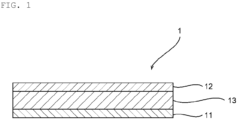
- FIG. 1 is a schematic cross-sectional view of a nonpolar all-solid-state battery according to one embodiment of the present invention.
- FIG. 1 is a schematic cross-sectional view of a nonpolar all-solid-state battery 1 according to the present embodiment.
- the nonpolar all-solid-state battery 1 includes a first electrode 11, a second electrode 12, and a solid electrolyte layer 13.
- the solid electrolyte layer 13 is provided between the first electrode 11 and the second electrode 12. Specifically, one main surface of the solid electrolyte layer 13 is in contact with the first electrode 11, and the other main surface is in contact with the second electrode 12.
- Each of the first electrode 11 and the second electrode 12 is joined to the solid electrolyte layer 13 by sintering. That is, the first electrode 11, the solid electrolyte layer 13, and the second electrode 12 are an integrated sintered body.
- the nonpolar all-solid-state battery 1 is a nonpolar all-solid-state battery that functions as a battery when the first electrode 11 is connected to a positive electrode and the second electrode 12 is connected to a negative electrode, and also when the first electrode 11 is connected to the negative electrode and the second electrode 12 is connected to the positive electrode.
- Each of the first electrode 11 and the second electrode 12 includes a first active material and at least one kind of negative electrode active material.
- the first active material is an active material that functions as both a positive electrode active material and a negative electrode active material.
- the specific capacity when the first active material functions as a positive electrode active material is larger than the specific capacity when the first active material functions as a negative electrode active material.
- Examples of such a first active material include, for example, Li( 3-x )V( 2-y )M y (PO 4 ) 3 (where M is at least one kind of element selected from the group consisting of Al, Ge, Ti, Zr, Mg, Fe, Nb, and Sn, 0 ⁇ x ⁇ 0.20, and 0 ⁇ y ⁇ 0.20).
- Li( 3-x )V( 2-y )M y (PO 4 ) 3 include NASICON-type Li 3 V 2 (PO 4 ) 3 , Li 3 Al 0.1 V 1.9 (PO 4 ) 3 , Li 3 Fe 0.1 V 1.9 (PO 4 ) 3 , Li 2.95 Ti 0.05 V 1.95 (PO 4 ) 3 , and Li 3 Ti 0.1 Mg 0.1 V 1.8 (PO 4 ) 3 .
- NASICON-type Li 3 V 2 (PO 4 ) 3 is more preferably used as the first active material.
- Each of the first electrode 11 and the second electrode 12 may include one kind of first active material, or may include a plurality of kinds of first active material.
- Each of the first electrode 11 and the second electrode 12 includes at least one kind of negative electrode active material in addition to the first active material.
- the "negative electrode active material” refers to an active material that functions as a negative electrode active material but does not substantially function as a positive electrode active material.
- the phrase “does not substantially function as a positive electrode active material” means that it is an active material that functions only from lithium insertion reaction, that is, no lithium detrimental reaction can occur during charging.
- the first electrode 11 and the second electrode 12 may each include, in addition to the first active material and the negative electrode active material, for example, a conductive material having electronic conductivity, a solid electrolyte, a structure holding material, a positive electrode active material, and the like.
- a conductive material having electronic conductivity for example, metals, carbons, conductive oxides, conductive organic substances.
- the structure holding material is not particularly limited as long as it does not deteriorate the functions of the active material, the solid electrolyte, and the conductive material by reacting with the solid electrolyte and the conductive material.
- Specific examples of the structure holding material preferably used include Al 2 O 3 , SiO 2 , ZrO 2 , and GeO 2 .
- the solid electrolyte included in each of the first electrode 11 and the second electrode 12 preferably has the same crystal structure as that of the solid electrolyte included in the solid electrolyte layer 13, and more preferably is the same solid electrolyte as the solid electrolyte included in the solid electrolyte layer 13.
- Specific examples of the positive electrode active material preferably used include, for example, LiVOPO 4 , and LiVP 2 O 7 .
- each of the first electrode 11 and the second electrode 12 includes the negative electrode active material in addition to the first active material having the larger specific capacity when functioning as a positive electrode active material than the specific capacity when functioning as a negative electrode active material. Therefore, for example, when the first electrode 11 is a positive electrode and the second electrode 12 is a negative electrode, the negative electrode active material included in the first electrode 11 does not function as an active material, and the negative electrode active material included in the second electrode 12 functions as an active material.
- the first electrode 11 is a negative electrode and the second electrode 12 is a positive electrode
- the negative electrode active material included in the first electrode 11 functions as an active material
- the negative electrode included in the second electrode 12 does not function as an active material.
- the capacity difference of the nonpolar all-solid-state battery 1 between the case where the first electrode 11 is a positive electrode and the case where the first electrode 11 is a negative electrode can be reduced.
- an active material such as NASICON-type Li 3 V 2 (PO 4 ) 3 , which has a large specific capacity but has the larger specific capacity when functioning as a positive electrode active material than the specific capacity when functioning as a negative electrode active material can be used in the nonpolar all-solid-state battery 1. Therefore, a high-capacity nonpolar all-solid-state battery 1 can be achieved.
- the ratio of the first active material to the total amount of the active materials needs to be more than 50% by mass and less than 100% by mass.
- the ratio of the first active material to the total amount of the active materials is more than 50% by mass, preferably more than 54% by mass, and more preferably 68% by mass or more.
- the ratio of the first active material to the total amount of the active materials is less than 100% by mass, preferably 99% by mass or less, and more preferably 84% by mass or less.
- the first active material having a large specific capacity.
- the first active material for example, Li( 3-x )V( 2-y )M y (PO 4 ) 3 (where M is at least one kind of element selected from the group consisting of Al, Ge, Ti, Zr, Mg, Fe, Nb, and Sn, 0 ⁇ x ⁇ 0.20, and 0 ⁇ y ⁇ 0.20), and among them, it is more preferable to use NASICON-type Li 3 V 2 (PO 4 ) 3 .
- the mass of each active material needs to be substantially equal between the first electrode 11 and the second electrode 12.
- the total amount of the specific capacity of the active material included in the first electrode 11 when the first electrode 11 is a positive electrode is substantially equal to the total amount of the specific capacity of the active material included in the second electrode 12 when the second electrode 12 is a positive electrode. It is preferable that the total amount of the specific capacity of the active material included in the first electrode 11 when the first electrode 11 is a negative electrode is substantially equal to the total amount of the specific capacity of the active material included in the second electrode 12 when the second electrode 12 is a negative electrode.
- the negative electrode active material included in the first electrode 11 and the second electrode 12 is not particularly limited.
- Examples of the negative electrode active material preferably used when Li( 3-x )V( 2-y )M y (PO 4 ) 3 (where M is at least one kind of element selected from the group consisting of Al, Ge, Ti, Zr, Mg, Fe, Nb, and Sn, 0 ⁇ x ⁇ 0.20, and 0 ⁇ y ⁇ 0.20) is used as the first active material include, for example, MO x (M is at least one kind of element selected from the group consisting of Ti, Nb, Mo and P, and 0.9 ⁇ x ⁇ 2.5).
- TiO 2 , PNb 9 O 25 , TiNb 2 O 7 , Ti 2 Nb 10 O 29 , and the like are preferably used as the negative electrode active material, and anatase-type TiO 2 is more preferably used.
- the negative electrode active material is difficult to react with Li (3-x) V (2-y) M y (PO 4 ) 3 (where M is at least one kind of element selected from the group consisting of Al, Ge, Ti, Zr, Mg, Fe, Nb, and Sn, 0 ⁇ x ⁇ 0.02, and 0 ⁇ y ⁇ 0.02).
- MO x includes those in which part of M is substituted with Si, Zr, Y, or the like, and those in which part of oxygen is lost (for example, TiO 1.99 or the like).
- the nonpolar all-solid-state battery 1 can be charged and discharged even at a voltage higher than zero volt, and can be charged and discharged at a voltage lower than zero volt.
- the solid electrolyte included in the solid electrolyte layer 13 is not particularly limited. From the viewpoint of increasing the close-contact property between the solid electrolyte layer 13 and the first electrode 11 or the second electrode 12, a solid electrolyte having the same crystal structure as the first electrolyte included in the first electrode 11 and the second electrode 12 is preferably used.
- the first electrolyte is a NASICON type
- NASICON-type solid electrolyte examples include, for example, Li 1.5 Al 0.5 Ge 1.5 (PO 4 ) 3 and Li 1.3 Al 0.3 Ti 1.7 (PO 4 ) 3 , Li 1.4 Na 0.1 Al 0.5 Ge 1.5 (PO 4 ) 3 .
- the nonpolar all-solid-state battery 1 of the present embodiment has a high capacity, a high-performance electronic device can be achieved by using the nonpolar all-solid-state battery 1.
- respective main materials were prepared as starting materials for the electrode layers 11 and 12 and the solid electrolyte layer 13 as follows. A slurry was produced from each of the prepared main materials, and a green sheet was produced using the slurry.
- Glass powder having a composition of Li 1.5 Al 0.5 Ge 1.5 (PO 4 ) 3 was used as a main material.
- Each of the main materials prepared above, polyacetal resin, and alcohol were mixed at a mass ratio of 100 : 15 : 140 to produce an electrode slurry and a solid electrolyte slurry.
- Each of the slurries produced above was coated on a polyethylene terephthalate (PET) film using a doctor blade method, and dried on a hot plate heated to a temperature of 40°C, and a sheet was formed to have a thickness of 10 ⁇ m.
- the sheet was cut so as to have a plane size of 20 mm ⁇ 20 mm to produce an electrode layer sheet to be the electrode layer 11, an electrode layer sheet to be the electrode layer 12, and a solid electrolyte layer sheet to be the solid electrolyte layer 13.
- a laminate was produced, in which the electrode layer sheet to be the electrode layer 11 was laminated on one surface of the solid electrolyte sheet obtained as described above, and the electrode layer sheet to be the electrode layer 12 was laminated on the other surface.
- This laminate was cut so as to have a plane size of 10 mm ⁇ 10 mm. Thereafter, each laminate was sandwiched between two porous ceramic plates and fired at a temperature of 500°C in an air atmosphere to remove the polyacetal resin. Thereafter, by firing the resultant at a temperature of 650°C in a nitrogen gas atmosphere, an all-solid-state battery element body of Comparative Example 1 was produced.
- the all-solid-state battery of Comparative Example 1 was charged to a voltage of 3.2 V at a current of 0.1 mA (held at 3.2 V for 5 hours after reaching 3.2 V), and then discharged to 0 V at a discharge current of 0.1 mA. This charge/discharge was repeated 10 cycles.
- the initial charge capacity or discharge capacity per unit weight of the active material and the initial charge capacity or discharge capacity per total active material weight included in the electrode layer 11 or 12 are values shown in Table 2, respectively.
- the initial charge/discharge efficiency which is the ratio between the initial discharge capacity and the initial charge capacity
- the capacity retention ratio after 10 cycles which is the ratio between the initial discharge capacity and the discharge capacity at the 10th cycle
- An all-solid-state battery was produced and evaluated in the same manner as in Comparative Example 1 except that, in the electrode layers 11 and 12, powder obtained by mixing powder having a NASICON-type structure crystal phase having a composition of Li 3 V 2 (PO 4 ) 3 as the active material 1 which is a positive electrode active material, powder having a composition of Li 4 Ti 5 O 12 as an active material 2 which is a negative electrode active material, glass powder having a composition of Li 1.5 Al 0.5 Ge 1.5 (PO 4 ) 3 as a solid electrolyte, and carbon powder as a conductive material at a mass ratio of 25 : 25 : 40 : 10 was used as a main material.
- An all-solid-state battery was produced and evaluated in the same manner as in Comparative Example 1 except that, in the electrode layers 11 and 12, powder obtained by mixing powder having a NASICON-type structure crystal phase having a composition of Li 3 V 2 (PO 4 ) 3 as the active material 1 which is a positive electrode active material, powder of anatase-type TiO 2 as an active material 2 which is a negative electrode active material, glass powder having a composition of Li 1.5 Al 0.5 Ge 1.5 (PO 4 ) 3 as a solid electrolyte, and carbon powder as a conductive material at a mass ratio of 25 : 25 : 40 : 10 was used as a main material.
- An all-solid-state battery was produced and evaluated in the same manner as in Comparative Example 1 except that, in the electrode layers 11 and 12, powder obtained by mixing powder having a composition of Li 2 MnO 3 as the active material 1 which is a positive electrode active material, glass powder having a composition of Li 1.5 Al 0.5 Ge 1.5 (PO 4 ) 3 as a solid electrolyte, and carbon powder as a conductive material at a mass ratio of 50 : 40 : 10 was used as a main material.
- An all-solid-state battery was produced and evaluated in the same manner as in Comparative Example 1 except that, in the electrode layers 11 and 12, powder obtained by mixing powder having a composition of Li 1.5 Al 0.5 Ti 1.5 (PO 4 ) 3 as the active material 2 which is a negative electrode active material, LiFePO 4 as an active material 3 which is a positive electrode active material that does not function as a negative electrode active material, glass powder having a composition of Li 1.5 Al 0.5 Ge 1.5 (PO 4 ) 3 as a solid electrolyte, and Ag-Pd powder as a conductive material at a mass ratio of 20 : 20 : 30 : 30 was used as a main material.
- An all-solid-state battery was produced and evaluated in the same manner as in Comparative Example 1 except that, in the electrode layers 11 and 12, powder obtained by mixing powder having a NASICON-type structure crystal phase having a composition of Li 3 V 2 (PO 4 ) 3 as the active material 1 which is a positive electrode active material, powder of anatase-type TiO 2 as the negative electrode active material 2, glass powder having a composition of Li 1.5 Al 0.5 Ge 1.5 (PO 4 ) 3 as a solid electrolyte, and carbon powder as a conductive material at a mass ratio of 40 : 10 : 40 : 10 was used as a main material.
- An all-solid-state battery was produced and evaluated in the same manner as in Example 1 except that powder of rutile-type TiO 2 was used as the active material 2 which is a negative electrode active material.
- An all-solid-state battery was produced and evaluated in the same manner as in Example 1 except that powder of Nb 2 O 5 was used as the active material 2 which is a negative electrode active material.
- An all-solid-state battery was produced and evaluated in the same manner as in Example 1 except that powder of PNb 9 O 25 was used as the active material 2 which is a negative electrode active material.
- An all-solid-state battery was produced and evaluated in the same manner as in Example 1 except that powder of TiNb 2 O 7 was used as the active material 2 which is a negative electrode active material.
- An all-solid-state battery was produced and evaluated in the same manner as in Example 1 except that powder of Ti 2 Nb 10 O 29 was used as the active material 2 which is a negative electrode active material.
- An all-solid-state battery was produced and evaluated in the same manner as in Comparative Example 1 except that, in the electrode layers 11 and 12, powder obtained by mixing powder having a NASICON-type structure crystal phase having a composition of Li 3 V 2 (PO 4 ) 3 as the active material 1 which is a positive electrode active material, powder of anatase-type TiO 2 as the active material 2 which is a negative electrode active material, powder of Ti 2 Nb 10 O 29 as the active material 3 which is a negative electrode active material, glass powder having a composition of Li 1.5 Al 0.5 Ge 1.5 (PO 4 ) 3 as a solid electrolyte, and carbon powder as a conductive material at a mass ratio of 40 : 5 : 5 : 40 : 10 was used as a main material.
- An all-solid-state battery was produced and evaluated in the same manner as in Comparative Example 1 except that, in the electrode layers 11 and 12, powder obtained by mixing powder having a NASICON-type structure crystal phase having a composition of Li 3 V 2 (PO 4 ) 3 as the active material 1 which is a positive electrode active material, powder of anatase-type TiO 2 as an active material 2 which is a negative electrode active material, glass powder having a composition of Li 1.5 Al 0.5 Ge 1.5 (PO 4 ) 3 as a solid electrolyte, and carbon powder as a conductive material at a mass ratio of 27.0 : 23.0 : 40 : 10 was used as a main material.
- An all-solid-state battery was produced and evaluated in the same manner as in Example 8 except that powder obtained by mixing the active material 1, the active material 2, the solid electrolyte, and the conductive material at a mass ratio of 32.5 : 17.5 : 40 : 10 was used as a main material.
- An all-solid-state battery was produced and evaluated in the same manner as in Example 8 except that powder obtained by mixing the active material 1, the active material 2, the solid electrolyte, and the conductive material at a mass ratio of 34.0 : 16.0 : 40 : 10 was used as a main material.
- An all-solid-state battery was produced and evaluated in the same manner as in Example 8 except that powder obtained by mixing the active material 1, the active material 2, the solid electrolyte, and the conductive material at a mass ratio of 37.5 : 12.5 : 40 : 10 was used as a main material.
- An all-solid-state battery was produced and evaluated in the same manner as in Example 8 except that powder obtained by mixing the active material 1, the active material 2, the solid electrolyte, and the conductive material at a mass ratio of 42.0 : 8.0 : 40 : 10 was used as a main material.
- An all-solid-state battery was produced and evaluated in the same manner as in Example 8 except that powder obtained by mixing the active material 1, the active material 2, the solid electrolyte, and the conductive material at a mass ratio of 43.0 : 7.0 : 40 : 10 was used as a main material.
- An all-solid-state battery was produced and evaluated in the same manner as in Example 8 except that powder obtained by mixing the active material 1, the active material 2, the solid electrolyte, and the conductive material at a mass ratio of 47.5 : 2.5 : 40 : 10 was used as a main material.
- An all-solid-state battery was produced and evaluated in the same manner as in Comparative Example 1 except that, in the electrode layers 11 and 12, powder obtained by mixing powder having a NASICON-type structure crystal phase having a composition of Li 3 V 2 (PO 4 ) 3 as the active material 1 which is a positive electrode active material, powder of TiNb 2 O 7 as the active material 2 which is a negative electrode active material, powder of LiVOPO 4 as the active material 3 which is a positive electrode active material, glass powder having a composition of Li 1.2 Na 0.1 Ti 1.7 Al 0.3 (PO 4 ) 3 as a solid electrolyte, and carbon powder as a conductive material at a mass ratio of 35 : 10 : 5 : 40 : 10 was used as a main material, and further, after polyacetal resin was removed, the resultant was fired at a temperature of 900°C in a nitrogen gas atmosphere.
- An all-solid-state battery was produced and evaluated in the same manner as in Comparative Example 1 except that, in the electrode layers 11 and 12, powder obtained by mixing powder having a NASICON-type structure crystal phase having a composition of Li 3 V 2 (PO 4 ) 3 as the active material 1 which is a positive electrode active material, powder of TiNb 2 O 7 as the active material 2 which is a negative electrode active material, powder of LiVOPO 4 as the active material 3 which is a positive electrode active material, powder of rutile-type TiO 2 as an active material 4 which is a negative electrode active material, glass powder having a composition of Li 1.3 Ti 1.7 Al 0.3 (PO 4 ) 3 as a solid electrolyte, and carbon powder as a conductive material at a mass ratio of 35.0 : 7.5 : 5.0 : 2.5 : 40 : 10 was used as a main material, and further, after polyacetal resin was removed, the resultant was fired at a temperature of 900°C in a nitrogen gas atmosphere.
- An all-solid-state battery was produced and evaluated in the same manner as in Comparative Example 1 except that, in the electrode layers 11 and 12, powder obtained by mixing powder having a NASICON-type structure crystal phase having a composition of Li 3 V 2 (PO 4 ) 3 as the active material 1 which is a positive electrode active material, powder of TiNb 2 O 7 as a negative electrode active material of the active material 2, powder of PNb 9 O 25 as a negative electrode active material of the active material 3, powder of rutile-type TiO 2 as a negative electrode active material of the active material 4, glass powder having a composition of Li 1.35 Al 0.35 Ge 1.15 Ti 0.50 (PO 4 ) 3 as a solid electrolyte, and carbon powder as a conductive material at a mass ratio of 37.5 : 9.0 : 2.5 : 1.0 : 40 : 10 was used as a main material, and further, after polyacetal resin was removed, the resultant was fired at a temperature of 900°C in a nitrogen gas atmosphere.
- An all-solid-state battery was produced and evaluated in the same manner as in Comparative Example 1 except that, in the electrode layers 11 and 12, powder obtained by mixing powder having a NASICON-type structure crystal phase having a composition of Li 3 V 2 (PO 4 ) 3 as the active material 1 which is a positive electrode active material, powder of PNb 9 O 25 as the active material 2 which is a negative electrode active material, glass powder having a composition of Li 0.1 Na 0.1 Ca 0.1 Zr 1.9 (PO 4 ) 3 as a solid electrolyte, and carbon powder as a conductive material at a mass ratio of 40 : 10 : 40 : 10 was used as a main material, and further, after polyacetal resin was removed, the resultant was fired at a temperature of 900°C in a nitrogen gas atmosphere.
- An all-solid-state battery was produced and evaluated in the same manner as in Comparative Example 1 except that, in the electrode layers 11 and 12, powder obtained by mixing powder having a NASICON-type structure crystal phase having a composition of Li 3 Al 0.1 V 1.9 (PO 4 ) 3 as the active material 1 which is a positive electrode active material, powder of anatase-type TiO 2 as the active material 2 which is a negative electrode active material, glass powder having a composition of Li 1.5 Al 0.5 Ge 1.5 (PO 4 ) 3 as a solid electrolyte, and carbon powder as a conductive material at a mass ratio of 40 : 10 : 40 : 10 was used as a main material, and further, after polyacetal resin was removed, the resultant was fired at a temperature of 650°C in a nitrogen gas atmosphere.
- An all-solid-state battery was produced and evaluated in the same manner as in Example 19 except that powder having a NASICON-type structure crystal phase having a composition of Li 2.95 Ge 0.05 V 1.95 (PO 4 ) 3 as the active material 1 which is a positive electrode active material was used.
- An all-solid-state battery was produced and evaluated in the same manner as in Example 19 except that powder having a NASICON-type structure crystal phase having a composition of Li 2.95 Ti 0.05 V 1.95 (PO 4 ) 3 as the active material 1 which is a positive electrode active material was used.
- An all-solid-state battery was produced and evaluated in the same manner as in Example 19 except that powder having a NASICON-type structure crystal phase having a composition of Li 2.95 Zr 0.05 V 1.95 (PO 4 ) 3 as the active material 1 which is a positive electrode active material was used.
- An all-solid-state battery was produced and evaluated in the same manner as in Example 19 except that powder having a NASICON-type structure crystal phase having a composition of Li 3 Ti 0.1 Mg 0.1 V 1.8 (PO 4 ) 3 as the active material 1 which is a positive electrode active material was used.
- An all-solid-state battery was produced and evaluated in the same manner as in Example 19 except that powder having a NASICON-type structure crystal phase having a composition of Li 3 Ti 0.05 Fe 0.05 V 1.9 (PO 4 ) 3 as the active material 1 which is a positive electrode active material was used.
- the ratio of the first active material to the total amount of the active materials is more than 54% by mass, preferably 99% by mass or less, more preferably 68% by mass or more, and more preferably 84% by mass or less.
- Example 7 From the results of Example 7, Example 16, and Example 17, it is found that a large initial discharge capacity, a high charge/discharge efficiency, and a high capacity retention rate can be achieved even when two or more kinds of negative electrode active materials are used.
- the nonpolar all-solid-state battery includes the first electrode, the second electrode, and the solid electrolyte layer.
- the solid electrolyte layer is provided between the first electrode and the second electrode.
- Each of the first electrode and the second electrode includes a first active material and at least one kind of negative electrode active material.
- the first active material functions as both a positive electrode active material and a negative electrode active material.
- the first active material is an active material having a larger specific capacity when functioning as the positive electrode active material than a specific capacity when functioning as the negative electrode active material.
- a ratio of the first active material to a total amount of active materials is more than 50% by mass and less than 100% by mass. A mass of each of the active materials is equal between the first electrode and the second electrode.
- the total amount of the specific capacities of all the active materials included in the first electrode (capacity per total active material weight included in the first electrode) when the first electrode is a positive material is equal to the total amount of the specific capacities of all the active materials included in the second electrode (capacity per total active material weight included in the second electrode) when the second electrode is a positive electrode. It is preferable that the total amount of the specific capacities of all the active materials included in the first electrode when the first electrode is a negative electrode is substantially equal to the total amount of the specific capacities of all the active materials included in the second electrode when the second electrode is a negative electrode.
- each of the first electrode and the second electrode includes, as the first active material, a NASICON-type active material Li (3-x) V (2-y) M y (PO 4 ) 3 (where M is at least one kind of element selected from the group consisting of Al, Ge, Ti, Zr, Mg, Fe, Nb, and Sn, 0 ⁇ x ⁇ 0.20, and 0 ⁇ y ⁇ 0.20).
- each of the first electrode and the second electrode includes, as the negative electrode active material, MO x (M is at least one kind of element selected from the group consisting of Ti, Nb, Mo, and P, and 0.9 ⁇ x ⁇ 2.5).
- each of the first electrode and the second electrode includes, as the negative electrode active material, at least one kind of active material selected from the group consisting of TiO 2 , PNb 9 O 25 , TiNb 2 O 7 , and Ti 2 Nb 10 O 29 .
- each of the first electrode and the second electrode includes anatase-type TiO 2 as the negative electrode active material.
- the ratio of the first active material to the total amount of the active materials is more than 54% by mass and 99% by mass or less.
- the ratio of the first active material to the total amount of the active materials is 68% by mass or more and 84% by mass or less.
- the solid electrolyte layer includes a NASICON-type solid electrolyte.
Landscapes
- Chemical & Material Sciences (AREA)
- Chemical Kinetics & Catalysis (AREA)
- Electrochemistry (AREA)
- General Chemical & Material Sciences (AREA)
- Inorganic Chemistry (AREA)
- Engineering & Computer Science (AREA)
- Composite Materials (AREA)
- Manufacturing & Machinery (AREA)
- Crystallography & Structural Chemistry (AREA)
- Materials Engineering (AREA)
- Physics & Mathematics (AREA)
- Condensed Matter Physics & Semiconductors (AREA)
- General Physics & Mathematics (AREA)
- Battery Electrode And Active Subsutance (AREA)
- Secondary Cells (AREA)
Description
- The present invention relates to an all-solid-state battery and an electronic device including the same.
- Conventionally, an all-solid-state battery which is nonpolar and has no distinction between a positive electrode and a negative electrode (hereinafter, sometimes referred to as a "nonpolar all-solid-state battery") has been known (for example,
Japanese Patent Application Laid-Open No. 2011-216235 JP2011-216235 - When Li2MnO3 is used as an active material, it is difficult to achieve a high-capacity all-solid-state battery. To achieve a high-capacity all-solid-state battery, it is conceivable to use an active material having a specific capacity higher than Li2MnO3 (capacity per active material weight, amount of electricity (Ah/g) according to the number of lithium ions desorbed from the active material). Examples of the active material having a specific capacity higher than Li2MnO3 includes, for example, Li3V2(PO4)3.
-
JP 2007-258165 -
EP1826861A1 discloses an all-solid battery having a high output power, exhibiting high safety, and capable of being produced at a low cost. The all-solid battery includes an internal electrode body having a cathode comprising a cathode material, an anode comprising an anode material, and a solid electrolyte layer comprising a solid electrolyte, the cathode material, the anode material, and the solid electrolyte being phosphoric acid compounds, the internal electrode body being integrated by firing the cathode, anode, and solid electrolyte layer, and the internal electrode body containing water. -
US2015/0333366A1 discloses that a lithium ion secondary battery includes a pair of electrodes and a solid electrolyte layer. The solid electrolyte layer is provided between the pair of electrodes and includes titanium aluminum lithium phosphate. At least one of the pair of electrodes includes vanadium lithium phosphate. At least one of the pair of electrodes includes at least one constituent of titanium and aluminum. The amount of the at least one constituent existing on a side opposite to the solid electrolyte layer is smaller than the amount of the at least one constituent existing on the solid electrolyte layer side. -
US2017/125841A1 discloses that a solid-state rechargeable battery includes a pair of electrode layers and a solid electrolyte layer interposed between the pair of electrode layers. The pair of electrode layers each include a phosphate having an olivine crystal structure. The phosphate contains a transition metal and lithium. - We have appreciated that it would be desirable to provide a high-capacity nonpolar all-solid-state battery.
- A nonpolar all-solid-state battery according to the present invention includes a first electrode, a second electrode, and a solid electrolyte layer. The solid electrolyte layer is provided between the first electrode and the second electrode. Each of the first electrode and the second electrode includes a first active material and at least one kind of negative electrode active material. The first active material functions as both a positive electrode active material and a negative electrode active material. The first active material is an active material having a larger specific capacity when functioning as the positive electrode active material than a specific capacity when functioning as the negative electrode active material. In each of the first electrode and the second electrode, a ratio of the first active material to a total amount of active materials is more than 50% by mass and less than 100% by mass. A mass of each of the active materials is equal between the first electrode and the second electrode.
-
FIG. 1 is a schematic cross-sectional view of a nonpolar all-solid-state battery according to one embodiment of the present invention. - Hereinafter, an example of a preferred embodiment of the present invention will be described. However, the following embodiment is merely an example. The present invention is not at all limited to the following embodiments.
-
FIG. 1 is a schematic cross-sectional view of a nonpolar all-solid-state battery 1 according to the present embodiment. The nonpolar all-solid-state battery 1 includes afirst electrode 11, asecond electrode 12, and asolid electrolyte layer 13. Thesolid electrolyte layer 13 is provided between thefirst electrode 11 and thesecond electrode 12. Specifically, one main surface of thesolid electrolyte layer 13 is in contact with thefirst electrode 11, and the other main surface is in contact with thesecond electrode 12. Each of thefirst electrode 11 and thesecond electrode 12 is joined to thesolid electrolyte layer 13 by sintering. That is, thefirst electrode 11, thesolid electrolyte layer 13, and thesecond electrode 12 are an integrated sintered body. - The nonpolar all-solid-
state battery 1 is a nonpolar all-solid-state battery that functions as a battery when thefirst electrode 11 is connected to a positive electrode and thesecond electrode 12 is connected to a negative electrode, and also when thefirst electrode 11 is connected to the negative electrode and thesecond electrode 12 is connected to the positive electrode. - Each of the
first electrode 11 and thesecond electrode 12 includes a first active material and at least one kind of negative electrode active material. - The first active material is an active material that functions as both a positive electrode active material and a negative electrode active material. However, the specific capacity when the first active material functions as a positive electrode active material is larger than the specific capacity when the first active material functions as a negative electrode active material. Examples of such a first active material include, for example, Li(3-x)V(2-y)My(PO4)3 (where M is at least one kind of element selected from the group consisting of Al, Ge, Ti, Zr, Mg, Fe, Nb, and Sn, 0 ≤ x ≤ 0.20, and 0 ≤ y ≤ 0.20). Specific examples of Li(3-x)V(2-y)My(PO4)3 include NASICON-type Li3V2(PO4)3, Li3Al0.1V1.9(PO4)3, Li3Fe0.1V1.9(PO4)3, Li2.95Ti0.05V1.95(PO4)3, and Li3Ti0.1Mg0.1V1.8(PO4)3. Among them, NASICON-type Li3V2(PO4)3 is more preferably used as the first active material.
- Each of the
first electrode 11 and thesecond electrode 12 may include one kind of first active material, or may include a plurality of kinds of first active material. - Each of the
first electrode 11 and thesecond electrode 12 includes at least one kind of negative electrode active material in addition to the first active material. In the present invention, the "negative electrode active material" refers to an active material that functions as a negative electrode active material but does not substantially function as a positive electrode active material. Here, the phrase "does not substantially function as a positive electrode active material" means that it is an active material that functions only from lithium insertion reaction, that is, no lithium detrimental reaction can occur during charging. - The
first electrode 11 and thesecond electrode 12 may each include, in addition to the first active material and the negative electrode active material, for example, a conductive material having electronic conductivity, a solid electrolyte, a structure holding material, a positive electrode active material, and the like. Specific examples of the conductive material preferably used include, for example, metals, carbons, conductive oxides, conductive organic substances. The structure holding material is not particularly limited as long as it does not deteriorate the functions of the active material, the solid electrolyte, and the conductive material by reacting with the solid electrolyte and the conductive material. Specific examples of the structure holding material preferably used include Al2O3, SiO2, ZrO2, and GeO2. The solid electrolyte included in each of thefirst electrode 11 and thesecond electrode 12 preferably has the same crystal structure as that of the solid electrolyte included in thesolid electrolyte layer 13, and more preferably is the same solid electrolyte as the solid electrolyte included in thesolid electrolyte layer 13. Specific examples of the positive electrode active material preferably used include, for example, LiVOPO4, and LiVP2O7. - In the nonpolar all-solid-
state battery 1 according to the present embodiment, each of thefirst electrode 11 and thesecond electrode 12 includes the negative electrode active material in addition to the first active material having the larger specific capacity when functioning as a positive electrode active material than the specific capacity when functioning as a negative electrode active material. Therefore, for example, when thefirst electrode 11 is a positive electrode and thesecond electrode 12 is a negative electrode, the negative electrode active material included in thefirst electrode 11 does not function as an active material, and the negative electrode active material included in thesecond electrode 12 functions as an active material. When thefirst electrode 11 is a negative electrode and thesecond electrode 12 is a positive electrode, the negative electrode active material included in thefirst electrode 11 functions as an active material, and the negative electrode included in thesecond electrode 12 does not function as an active material. For this reason, the capacity difference of the nonpolar all-solid-state battery 1 between the case where thefirst electrode 11 is a positive electrode and the case where thefirst electrode 11 is a negative electrode can be reduced. Thus, for example, an active material such as NASICON-type Li3V2(PO4)3, which has a large specific capacity but has the larger specific capacity when functioning as a positive electrode active material than the specific capacity when functioning as a negative electrode active material can be used in the nonpolar all-solid-state battery 1. Therefore, a high-capacity nonpolar all-solid-state battery 1 can be achieved. - However, when the content of the first active material having a large specific capacity is small, the capacity of the nonpolar all-solid-
state battery 1 cannot be sufficiently increased. Therefore, in each of thefirst electrode 11 and thesecond electrode 12, the ratio of the first active material to the total amount of the active materials needs to be more than 50% by mass and less than 100% by mass. - From the viewpoint of achieving a nonpolar all-solid-
state battery 1 having a larger capacity, in each of thefirst electrode 11 and thesecond electrode 12, the ratio of the first active material to the total amount of the active materials is more than 50% by mass, preferably more than 54% by mass, and more preferably 68% by mass or more. In each of thefirst electrode 11 and thesecond electrode 12, the ratio of the first active material to the total amount of the active materials is less than 100% by mass, preferably 99% by mass or less, and more preferably 84% by mass or less. - From the same viewpoint, it is preferable to use the first active material having a large specific capacity. Specifically, it is preferable to use, as the first active material, for example, Li(3-x)V(2-y)My(PO4)3 (where M is at least one kind of element selected from the group consisting of Al, Ge, Ti, Zr, Mg, Fe, Nb, and Sn, 0 ≤ x ≤ 0.20, and 0 ≤ y ≤ 0.20), and among them, it is more preferable to use NASICON-type Li3V2(PO4)3.
- Further, from the viewpoint of achieving the nonpolar all-solid-
state battery 1, the mass of each active material needs to be substantially equal between thefirst electrode 11 and thesecond electrode 12. - From the viewpoint of achieving a nonpolar all-solid-
state battery 1 having a smaller polarity, it is preferable that the total amount of the specific capacity of the active material included in thefirst electrode 11 when thefirst electrode 11 is a positive electrode is substantially equal to the total amount of the specific capacity of the active material included in thesecond electrode 12 when thesecond electrode 12 is a positive electrode. It is preferable that the total amount of the specific capacity of the active material included in thefirst electrode 11 when thefirst electrode 11 is a negative electrode is substantially equal to the total amount of the specific capacity of the active material included in thesecond electrode 12 when thesecond electrode 12 is a negative electrode. - The negative electrode active material included in the
first electrode 11 and thesecond electrode 12 is not particularly limited. Examples of the negative electrode active material preferably used when Li(3-x)V(2-y)My(PO4)3 (where M is at least one kind of element selected from the group consisting of Al, Ge, Ti, Zr, Mg, Fe, Nb, and Sn, 0 ≤ x ≤ 0.20, and 0 ≤ y ≤ 0.20) is used as the first active material include, for example, MOx (M is at least one kind of element selected from the group consisting of Ti, Nb, Mo and P, and 0.9 ≤ x ≤ 2.5). Among them, TiO2, PNb9O25, TiNb2O7, Ti2Nb10O29, and the like are preferably used as the negative electrode active material, and anatase-type TiO2 is more preferably used. This is because the negative electrode active material is difficult to react with Li(3-x)V(2-y)My(PO4)3 (where M is at least one kind of element selected from the group consisting of Al, Ge, Ti, Zr, Mg, Fe, Nb, and Sn, 0 ≤ x ≤ 0.02, and 0 ≤ y ≤ 0.02). - In the present invention, MOx includes those in which part of M is substituted with Si, Zr, Y, or the like, and those in which part of oxygen is lost (for example, TiO1.99 or the like).
- Since the
first electrode 11 and thesecond electrode 12 include the first active material that functions as both a positive electrode active material and a negative electrode active material, the nonpolar all-solid-state battery 1 can be charged and discharged even at a voltage higher than zero volt, and can be charged and discharged at a voltage lower than zero volt. - The solid electrolyte included in the
solid electrolyte layer 13 is not particularly limited. From the viewpoint of increasing the close-contact property between thesolid electrolyte layer 13 and thefirst electrode 11 or thesecond electrode 12, a solid electrolyte having the same crystal structure as the first electrolyte included in thefirst electrode 11 and thesecond electrode 12 is preferably used. For example, when the first electrolyte is a NASICON type, it is preferable to use a NASICON-type solid electrolyte. Specific examples of the NASICON-type solid electrolyte include, for example, Li1.5Al0.5Ge1.5(PO4)3 and Li1.3Al0.3Ti1.7(PO4)3, Li1.4Na0.1Al0.5Ge1.5(PO4)3. - As described above, since the nonpolar all-solid-
state battery 1 of the present embodiment has a high capacity, a high-performance electronic device can be achieved by using the nonpolar all-solid-state battery 1. - Hereinafter, the present invention will be described in more detail with reference to specific examples. However, the present invention is not limited to the following examples, and can be appropriately changed and carried out without departing from the gist thereof.
- In order to produce an all-solid-state battery, respective main materials were prepared as starting materials for the electrode layers 11 and 12 and the
solid electrolyte layer 13 as follows. A slurry was produced from each of the prepared main materials, and a green sheet was produced using the slurry. - Powder obtained by mixing powder having a NASICON-type structure crystal phase having a composition of Li3V2(PO4)3 as the
active material 1 which is a positive electrode active material, glass powder having a composition of Li1.5Al0.5Ge1.5(PO4)3 as a solid electrolyte, and carbon powder as a conductive material at a mass ratio of 50 : 40 : 10 was used as a main material. - Glass powder having a composition of Li1.5Al0.5Ge1.5(PO4)3 was used as a main material.
- Each of the main materials prepared above, polyacetal resin, and alcohol were mixed at a mass ratio of 100 : 15 : 140 to produce an electrode slurry and a solid electrolyte slurry.
- Each of the slurries produced above was coated on a polyethylene terephthalate (PET) film using a doctor blade method, and dried on a hot plate heated to a temperature of 40°C, and a sheet was formed to have a thickness of 10 µm. The sheet was cut so as to have a plane size of 20 mm × 20 mm to produce an electrode layer sheet to be the
electrode layer 11, an electrode layer sheet to be theelectrode layer 12, and a solid electrolyte layer sheet to be thesolid electrolyte layer 13. - A laminate was produced, in which the electrode layer sheet to be the
electrode layer 11 was laminated on one surface of the solid electrolyte sheet obtained as described above, and the electrode layer sheet to be theelectrode layer 12 was laminated on the other surface. This laminate was cut so as to have a plane size of 10 mm × 10 mm. Thereafter, each laminate was sandwiched between two porous ceramic plates and fired at a temperature of 500°C in an air atmosphere to remove the polyacetal resin. Thereafter, by firing the resultant at a temperature of 650°C in a nitrogen gas atmosphere, an all-solid-state battery element body of Comparative Example 1 was produced. - Thereafter, the resultant was dried at a temperature of 100°C to remove moisture, and then sealed with a 2032 type coin cell to produce an all-solid-state battery of Comparative Example 1.
- The all-solid-state battery of Comparative Example 1 was charged to a voltage of 3.2 V at a current of 0.1 mA (held at 3.2 V for 5 hours after reaching 3.2 V), and then discharged to 0 V at a discharge current of 0.1 mA. This charge/discharge was repeated 10 cycles.
- The initial charge capacity or discharge capacity per unit weight of the active material and the initial charge capacity or discharge capacity per total active material weight included in the
electrode layer - The initial charge/discharge efficiency, which is the ratio between the initial discharge capacity and the initial charge capacity, and the capacity retention ratio after 10 cycles, which is the ratio between the initial discharge capacity and the discharge capacity at the 10th cycle are values shown in Table 2, respectively.
- An all-solid-state battery was produced and evaluated in the same manner as in Comparative Example 1 except that, in the electrode layers 11 and 12, powder obtained by mixing powder having a NASICON-type structure crystal phase having a composition of Li3V2(PO4)3 as the
active material 1 which is a positive electrode active material, powder having a composition of Li4Ti5O12 as an active material 2 which is a negative electrode active material, glass powder having a composition of Li1.5Al0.5Ge1.5(PO4)3 as a solid electrolyte, and carbon powder as a conductive material at a mass ratio of 25 : 25 : 40 : 10 was used as a main material. - An all-solid-state battery was produced and evaluated in the same manner as in Comparative Example 1 except that, in the electrode layers 11 and 12, powder obtained by mixing powder having a NASICON-type structure crystal phase having a composition of Li3V2(PO4)3 as the
active material 1 which is a positive electrode active material, powder of anatase-type TiO2 as an active material 2 which is a negative electrode active material, glass powder having a composition of Li1.5Al0.5Ge1.5(PO4)3 as a solid electrolyte, and carbon powder as a conductive material at a mass ratio of 25 : 25 : 40 : 10 was used as a main material. - An all-solid-state battery was produced and evaluated in the same manner as in Comparative Example 1 except that, in the electrode layers 11 and 12, powder obtained by mixing powder having a composition of Li2MnO3 as the
active material 1 which is a positive electrode active material, glass powder having a composition of Li1.5Al0.5Ge1.5(PO4)3 as a solid electrolyte, and carbon powder as a conductive material at a mass ratio of 50 : 40 : 10 was used as a main material. - An all-solid-state battery was produced and evaluated in the same manner as in Comparative Example 1 except that, in the electrode layers 11 and 12, powder obtained by mixing powder having a composition of Li1.5Al0.5Ti1.5(PO4)3 as the active material 2 which is a negative electrode active material, LiFePO4 as an active material 3 which is a positive electrode active material that does not function as a negative electrode active material, glass powder having a composition of Li1.5Al0.5Ge1.5(PO4)3 as a solid electrolyte, and Ag-Pd powder as a conductive material at a mass ratio of 20 : 20 : 30 : 30 was used as a main material.
- An all-solid-state battery was produced and evaluated in the same manner as in Comparative Example 1 except that, in the electrode layers 11 and 12, powder obtained by mixing powder having a NASICON-type structure crystal phase having a composition of Li3V2(PO4)3 as the
active material 1 which is a positive electrode active material, powder of anatase-type TiO2 as the negative electrode active material 2, glass powder having a composition of Li1.5Al0.5Ge1.5(PO4)3 as a solid electrolyte, and carbon powder as a conductive material at a mass ratio of 40 : 10 : 40 : 10 was used as a main material. - An all-solid-state battery was produced and evaluated in the same manner as in Example 1 except that powder of rutile-type TiO2 was used as the active material 2 which is a negative electrode active material.
- An all-solid-state battery was produced and evaluated in the same manner as in Example 1 except that powder of Nb2O5 was used as the active material 2 which is a negative electrode active material.
- An all-solid-state battery was produced and evaluated in the same manner as in Example 1 except that powder of PNb9O25 was used as the active material 2 which is a negative electrode active material.
- An all-solid-state battery was produced and evaluated in the same manner as in Example 1 except that powder of TiNb2O7 was used as the active material 2 which is a negative electrode active material.
- An all-solid-state battery was produced and evaluated in the same manner as in Example 1 except that powder of Ti2Nb10O29 was used as the active material 2 which is a negative electrode active material.
- An all-solid-state battery was produced and evaluated in the same manner as in Comparative Example 1 except that, in the electrode layers 11 and 12, powder obtained by mixing powder having a NASICON-type structure crystal phase having a composition of Li3V2(PO4)3 as the
active material 1 which is a positive electrode active material, powder of anatase-type TiO2 as the active material 2 which is a negative electrode active material, powder of Ti2Nb10O29 as the active material 3 which is a negative electrode active material, glass powder having a composition of Li1.5Al0.5Ge1.5(PO4)3 as a solid electrolyte, and carbon powder as a conductive material at a mass ratio of 40 : 5 : 5 : 40 : 10 was used as a main material. - An all-solid-state battery was produced and evaluated in the same manner as in Comparative Example 1 except that, in the electrode layers 11 and 12, powder obtained by mixing powder having a NASICON-type structure crystal phase having a composition of Li3V2(PO4)3 as the
active material 1 which is a positive electrode active material, powder of anatase-type TiO2 as an active material 2 which is a negative electrode active material, glass powder having a composition of Li1.5Al0.5Ge1.5(PO4)3 as a solid electrolyte, and carbon powder as a conductive material at a mass ratio of 27.0 : 23.0 : 40 : 10 was used as a main material. - An all-solid-state battery was produced and evaluated in the same manner as in Example 8 except that powder obtained by mixing the
active material 1, the active material 2, the solid electrolyte, and the conductive material at a mass ratio of 32.5 : 17.5 : 40 : 10 was used as a main material. - An all-solid-state battery was produced and evaluated in the same manner as in Example 8 except that powder obtained by mixing the
active material 1, the active material 2, the solid electrolyte, and the conductive material at a mass ratio of 34.0 : 16.0 : 40 : 10 was used as a main material. - An all-solid-state battery was produced and evaluated in the same manner as in Example 8 except that powder obtained by mixing the
active material 1, the active material 2, the solid electrolyte, and the conductive material at a mass ratio of 37.5 : 12.5 : 40 : 10 was used as a main material. - An all-solid-state battery was produced and evaluated in the same manner as in Example 8 except that powder obtained by mixing the
active material 1, the active material 2, the solid electrolyte, and the conductive material at a mass ratio of 42.0 : 8.0 : 40 : 10 was used as a main material. - An all-solid-state battery was produced and evaluated in the same manner as in Example 8 except that powder obtained by mixing the
active material 1, the active material 2, the solid electrolyte, and the conductive material at a mass ratio of 43.0 : 7.0 : 40 : 10 was used as a main material. - An all-solid-state battery was produced and evaluated in the same manner as in Example 8 except that powder obtained by mixing the
active material 1, the active material 2, the solid electrolyte, and the conductive material at a mass ratio of 47.5 : 2.5 : 40 : 10 was used as a main material. - An all-solid-state battery was produced and evaluated in the same manner as in Comparative Example 1 except that, in the electrode layers 11 and 12, powder obtained by mixing powder having a NASICON-type structure crystal phase having a composition of Li3V2(PO4)3 as the
active material 1 which is a positive electrode active material, powder of TiNb2O7 as the active material 2 which is a negative electrode active material, powder of LiVOPO4 as the active material 3 which is a positive electrode active material, glass powder having a composition of Li1.2Na0.1Ti1.7Al0.3(PO4)3 as a solid electrolyte, and carbon powder as a conductive material at a mass ratio of 35 : 10 : 5 : 40 : 10 was used as a main material, and further, after polyacetal resin was removed, the resultant was fired at a temperature of 900°C in a nitrogen gas atmosphere. - An all-solid-state battery was produced and evaluated in the same manner as in Comparative Example 1 except that, in the electrode layers 11 and 12, powder obtained by mixing powder having a NASICON-type structure crystal phase having a composition of Li3V2(PO4)3 as the
active material 1 which is a positive electrode active material, powder of TiNb2O7 as the active material 2 which is a negative electrode active material, powder of LiVOPO4 as the active material 3 which is a positive electrode active material, powder of rutile-type TiO2 as an active material 4 which is a negative electrode active material, glass powder having a composition of Li1.3Ti1.7Al0.3(PO4)3 as a solid electrolyte, and carbon powder as a conductive material at a mass ratio of 35.0 : 7.5 : 5.0 : 2.5 : 40 : 10 was used as a main material, and further, after polyacetal resin was removed, the resultant was fired at a temperature of 900°C in a nitrogen gas atmosphere. - An all-solid-state battery was produced and evaluated in the same manner as in Comparative Example 1 except that, in the electrode layers 11 and 12, powder obtained by mixing powder having a NASICON-type structure crystal phase having a composition of Li3V2(PO4)3 as the
active material 1 which is a positive electrode active material, powder of TiNb2O7 as a negative electrode active material of the active material 2, powder of PNb9O25 as a negative electrode active material of the active material 3, powder of rutile-type TiO2 as a negative electrode active material of the active material 4, glass powder having a composition of Li1.35Al0.35Ge1.15Ti0.50(PO4)3 as a solid electrolyte, and carbon powder as a conductive material at a mass ratio of 37.5 : 9.0 : 2.5 : 1.0 : 40 : 10 was used as a main material, and further, after polyacetal resin was removed, the resultant was fired at a temperature of 900°C in a nitrogen gas atmosphere. - An all-solid-state battery was produced and evaluated in the same manner as in Comparative Example 1 except that, in the electrode layers 11 and 12, powder obtained by mixing powder having a NASICON-type structure crystal phase having a composition of Li3V2(PO4)3 as the
active material 1 which is a positive electrode active material, powder of PNb9O25 as the active material 2 which is a negative electrode active material, glass powder having a composition of Li0.1Na0.1Ca0.1Zr1.9(PO4)3 as a solid electrolyte, and carbon powder as a conductive material at a mass ratio of 40 : 10 : 40 : 10 was used as a main material, and further, after polyacetal resin was removed, the resultant was fired at a temperature of 900°C in a nitrogen gas atmosphere. - An all-solid-state battery was produced and evaluated in the same manner as in Comparative Example 1 except that, in the electrode layers 11 and 12, powder obtained by mixing powder having a NASICON-type structure crystal phase having a composition of Li3Al0.1V1.9(PO4)3 as the
active material 1 which is a positive electrode active material, powder of anatase-type TiO2 as the active material 2 which is a negative electrode active material, glass powder having a composition of Li1.5Al0.5Ge1.5(PO4)3 as a solid electrolyte, and carbon powder as a conductive material at a mass ratio of 40 : 10 : 40 : 10 was used as a main material, and further, after polyacetal resin was removed, the resultant was fired at a temperature of 650°C in a nitrogen gas atmosphere. - An all-solid-state battery was produced and evaluated in the same manner as in Example 19 except that powder having a NASICON-type structure crystal phase having a composition of Li2.95Ge0.05V1.95(PO4)3 as the
active material 1 which is a positive electrode active material was used. - An all-solid-state battery was produced and evaluated in the same manner as in Example 19 except that powder having a NASICON-type structure crystal phase having a composition of Li2.95Ti0.05V1.95(PO4)3 as the
active material 1 which is a positive electrode active material was used. - An all-solid-state battery was produced and evaluated in the same manner as in Example 19 except that powder having a NASICON-type structure crystal phase having a composition of Li2.95Zr0.05V1.95(PO4)3 as the
active material 1 which is a positive electrode active material was used. - An all-solid-state battery was produced and evaluated in the same manner as in Example 19 except that powder having a NASICON-type structure crystal phase having a composition of Li3Ti0.1Mg0.1V1.8(PO4)3 as the
active material 1 which is a positive electrode active material was used. - An all-solid-state battery was produced and evaluated in the same manner as in Example 19 except that powder having a NASICON-type structure crystal phase having a composition of Li3Ti0.05Fe0.05V1.9(PO4)3 as the
active material 1 which is a positive electrode active material was used.

- From the results of Comparative Example 1, Comparative Example 3, Example 1, and Examples 8 to 14, it is found that a large initial discharge capacity and a high capacity retention ratio can be achieved when the first active material that functions as both the positive electrode active material and the negative electrode active material and has the larger specific capacity when functioning as the positive electrode active material than the specific capacity when functioning as the negative electrode active material, and at least one kind of negative electrode active material are used, and when the ratio of the first active material to the total amount of the active materials is more than 50% by mass and less than 100% by mass in each of the first electrode and the second electrode.
- Further, from the results of Example 1 and Examples 8 to 14, it is found that, from the viewpoint of achieving a larger initial discharge capacity, a higher charge/discharge efficiency, and a high capacity retention ratio, in each of the first electrode and the second electrode, the ratio of the first active material to the total amount of the active materials is more than 54% by mass, preferably 99% by mass or less, more preferably 68% by mass or more, and more preferably 84% by mass or less.
- From the results of Examples 1 to 7, it is found that a large initial discharge capacity, a high charge/discharge efficiency, and a high capacity retention rate can be realized even when various negative electrode active materials represented by the general formula MOx (M is at least one kind of element selected from the group consisting of Ti, Nb, Mo, and P, and 0.9 ≤ x ≤ 2.5) are used.
- From the results of Example 7, Example 16, and Example 17, it is found that a large initial discharge capacity, a high charge/discharge efficiency, and a high capacity retention rate can be achieved even when two or more kinds of negative electrode active materials are used.
- The nonpolar all-solid-state battery according to the present embodiment includes the first electrode, the second electrode, and the solid electrolyte layer. The solid electrolyte layer is provided between the first electrode and the second electrode. Each of the first electrode and the second electrode includes a first active material and at least one kind of negative electrode active material. The first active material functions as both a positive electrode active material and a negative electrode active material. The first active material is an active material having a larger specific capacity when functioning as the positive electrode active material than a specific capacity when functioning as the negative electrode active material. In each of the first electrode and the second electrode, a ratio of the first active material to a total amount of active materials is more than 50% by mass and less than 100% by mass. A mass of each of the active materials is equal between the first electrode and the second electrode.
- In the nonpolar all-solid-state battery according to the present embodiment, it is preferable that the total amount of the specific capacities of all the active materials included in the first electrode (capacity per total active material weight included in the first electrode) when the first electrode is a positive material is equal to the total amount of the specific capacities of all the active materials included in the second electrode (capacity per total active material weight included in the second electrode) when the second electrode is a positive electrode. It is preferable that the total amount of the specific capacities of all the active materials included in the first electrode when the first electrode is a negative electrode is substantially equal to the total amount of the specific capacities of all the active materials included in the second electrode when the second electrode is a negative electrode.
- In the nonpolar all-solid-state battery according to the present embodiment, it is preferable that each of the first electrode and the second electrode includes, as the first active material, a NASICON-type active material Li(3-x)V(2-y)My(PO4)3 (where M is at least one kind of element selected from the group consisting of Al, Ge, Ti, Zr, Mg, Fe, Nb, and Sn, 0 ≤ x ≤ 0.20, and 0 ≤ y ≤ 0.20).
- In the nonpolar all-solid-state battery according to the present embodiment, it is preferable that each of the first electrode and the second electrode includes, as the negative electrode active material, MOx (M is at least one kind of element selected from the group consisting of Ti, Nb, Mo, and P, and 0.9 ≤ x ≤ 2.5).
- In the nonpolar all-solid-state battery according to the present embodiment, it is preferable that each of the first electrode and the second electrode includes, as the negative electrode active material, at least one kind of active material selected from the group consisting of TiO2, PNb9O25, TiNb2O7, and Ti2Nb10O29.
- In the nonpolar all-solid-state battery according to the present embodiment, it is preferable that each of the first electrode and the second electrode includes anatase-type TiO2 as the negative electrode active material.
- In the nonpolar all-solid-state battery according to the present embodiment, it is preferable that, in each of the first electrode and the second electrode, the ratio of the first active material to the total amount of the active materials is more than 54% by mass and 99% by mass or less.
- In the nonpolar all-solid-state battery according to the present embodiment, it is preferable that, in each of the first electrode and the second electrode, the ratio of the first active material to the total amount of the active materials is 68% by mass or more and 84% by mass or less.
- In the nonpolar all-solid-state battery according to the present embodiment, it is preferable that the solid electrolyte layer includes a NASICON-type solid electrolyte.
Claims (10)
- A nonpolar all-solid-state battery (1) comprising:a first electrode (11);a second electrode (12); anda solid electrolyte layer (13) provided between the first electrode (11) and the second electrode (12),wherein each of the first electrode (11) and the second electrode (12) includes:a first active material that functions as both a positive electrode active material and a negative electrode active material, and has a larger specific capacity when functioning as the positive electrode active material than a specific capacity when functioning as the negative electrode active material; andat least one kind of negative electrode active material, andin each of the first electrode (11) and the second electrode (12), a ratio of the first active material to a total amount of active materials is more than 50% by mass and less than 100% by mass, and a mass of each of the active materials is equal between the first electrode (11) and the second electrode (12).
- The nonpolar all-solid-state battery according to claim 1, whereina total amount of specific capacities of all the active materials included in the first electrode (11) when the first electrode is the positive electrode is equal to a total amount of specific capacities of all the active materials included in the second electrode (12) when the second electrode is the positive electrode, andwherein the total amount of the specific capacities of all the active materials included in the first electrode (11) when the first electrode is the negative electrode is substantially equal to the total amount of the specific capacities of all the active materials included in the second electrode (12) when the second electrode is the negative electrode.
- The nonpolar all-solid-state battery according to claim 1 or 2, wherein each of the first (11) and the second electrodes (12) includes, as the first active material, a NASICON-type active material Li(3-x)V(2-y)My(PO4)3 (where M is at least one kind of element selected from the group consisting of Al, Ge, Ti, Zr, Mg, Fe, Nb, and Sn, 0 ≤ x ≤ 0.20, and 0 ≤ y ≤ 0.20).
- The nonpolar all-solid-state battery according to claim 3, wherein each of the first (11) and second electrodes (12) includes, as the negative electrode active material, MOx (M is at least one kind of element selected from the group consisting of Ti, Nb, Mo, and P, and 0.9 ≤ x ≤ 2.5).
- The nonpolar all-solid-state battery according to claim 4, wherein each of the first (11) and second electrodes (12) includes, as the negative electrode active material, at least one kind of active material selected from the group consisting of TiO2, PNb9O25, TiNb2O7, and Ti2Nb10O29.
- The nonpolar all-solid-state battery according to claim 5, wherein each of the first (11) and second electrodes (12) includes anatase-type TiO2 as the negative electrode active material.
- The nonpolar all-solid-state battery according to any one of claims 1 to 6, wherein, in each of the first electrode (11) and the second electrode (12), the ratio of the first active material to the total amount of the active materials is more than 54% by mass and 99% by mass or less.
- The nonpolar all-solid-state battery according to claim 7, wherein, in each of the first electrode (11) and the second electrode (12), the ratio of the first active material to the total amount of the active materials is 68% by mass or more and 84% by mass or less.
- The nonpolar all-solid-state battery according to any one of claims 1 to 8, wherein the solid electrolyte layer (13) includes a NASICON-type solid electrolyte.
- An electronic device comprising the nonpolar all-solid-state battery according to any one of claims 1 to 9.
Applications Claiming Priority (2)
| Application Number | Priority Date | Filing Date | Title |
|---|---|---|---|
| JP2017218079 | 2017-11-13 | ||
| PCT/JP2018/041429 WO2019093404A1 (en) | 2017-11-13 | 2018-11-08 | Non-polar all-solid battery and electronic device |
Publications (3)
| Publication Number | Publication Date |
|---|---|
| EP3713001A1 EP3713001A1 (en) | 2020-09-23 |
| EP3713001A4 EP3713001A4 (en) | 2021-09-22 |
| EP3713001B1 true EP3713001B1 (en) | 2025-05-14 |
Family
ID=66438935
Family Applications (1)
| Application Number | Title | Priority Date | Filing Date |
|---|---|---|---|
| EP18875640.7A Active EP3713001B1 (en) | 2017-11-13 | 2018-11-08 | Non-polar all-solid battery and electronic device |
Country Status (5)
| Country | Link |
|---|---|
| US (1) | US11430982B2 (en) |
| EP (1) | EP3713001B1 (en) |
| JP (1) | JP6863471B2 (en) |
| CN (1) | CN111149248B (en) |
| WO (1) | WO2019093404A1 (en) |
Families Citing this family (9)
| Publication number | Priority date | Publication date | Assignee | Title |
|---|---|---|---|---|
| CN112771707A (en) * | 2018-09-27 | 2021-05-07 | 株式会社村田制作所 | Wire battery |
| GB202013576D0 (en) | 2020-08-28 | 2020-10-14 | Echion Tech Limited | Active electrode material |
| US12381210B2 (en) | 2019-10-18 | 2025-08-05 | Echion Technologies Limited | Li/Na-ion battery anode materials |
| GB2595745B (en) * | 2019-10-18 | 2022-06-08 | Echion Tech Limited | Active electrode material |
| JP7409826B2 (en) * | 2019-10-30 | 2024-01-09 | 太陽誘電株式会社 | all solid state battery |
| KR102411149B1 (en) * | 2019-11-28 | 2022-06-17 | 삼성전기주식회사 | All solid battery |
| GB2595761B (en) | 2020-06-03 | 2022-07-13 | Echion Tech Limited | Active electrode material |
| BR112022023084B1 (en) * | 2020-06-03 | 2023-12-12 | Echion Technologies Limited | ACTIVE ELECTRODE MATERIAL, ITS MANUFACTURING METHOD AND COMPOSITION |
| JP7665317B2 (en) * | 2020-11-11 | 2025-04-21 | 太陽誘電株式会社 | All-solid-state battery |
Family Cites Families (12)
| Publication number | Priority date | Publication date | Assignee | Title |
|---|---|---|---|---|
| JP5115920B2 (en) * | 2006-02-24 | 2013-01-09 | 日本碍子株式会社 | All solid battery |
| JP5078120B2 (en) * | 2006-02-24 | 2012-11-21 | 日本碍子株式会社 | All solid battery |
| US7914932B2 (en) | 2006-02-24 | 2011-03-29 | Ngk Insulators, Ltd. | All-solid-state battery |
| JP5164256B2 (en) * | 2007-11-12 | 2013-03-21 | 国立大学法人九州大学 | All solid state secondary battery |
| JP5540643B2 (en) * | 2009-02-03 | 2014-07-02 | ソニー株式会社 | Thin-film solid lithium ion secondary battery and manufacturing method thereof |
| JP5549192B2 (en) * | 2009-11-18 | 2014-07-16 | ソニー株式会社 | Solid electrolyte battery and positive electrode active material |
| JP5193248B2 (en) * | 2010-03-31 | 2013-05-08 | ナミックス株式会社 | Lithium ion secondary battery |
| JP2013004421A (en) | 2011-06-20 | 2013-01-07 | Namics Corp | Lithium ion secondary battery |
| JP6524775B2 (en) * | 2014-05-19 | 2019-06-05 | Tdk株式会社 | Lithium ion secondary battery |
| JP6651708B2 (en) | 2014-05-19 | 2020-02-19 | Tdk株式会社 | Lithium ion secondary battery |
| JP6623542B2 (en) * | 2014-05-19 | 2019-12-25 | Tdk株式会社 | Lithium ion secondary battery |
| JP6605917B2 (en) * | 2015-10-29 | 2019-11-13 | 太陽誘電株式会社 | All solid state secondary battery |
-
2018
- 2018-11-08 JP JP2019552368A patent/JP6863471B2/en active Active
- 2018-11-08 CN CN201880063776.4A patent/CN111149248B/en active Active
- 2018-11-08 WO PCT/JP2018/041429 patent/WO2019093404A1/en not_active Ceased
- 2018-11-08 EP EP18875640.7A patent/EP3713001B1/en active Active
-
2020
- 2020-04-09 US US16/844,014 patent/US11430982B2/en active Active
Also Published As
| Publication number | Publication date |
|---|---|
| JP6863471B2 (en) | 2021-04-21 |
| CN111149248B (en) | 2023-08-18 |
| CN111149248A (en) | 2020-05-12 |
| WO2019093404A1 (en) | 2019-05-16 |
| US20200235384A1 (en) | 2020-07-23 |
| EP3713001A1 (en) | 2020-09-23 |
| US11430982B2 (en) | 2022-08-30 |
| EP3713001A4 (en) | 2021-09-22 |
| JPWO2019093404A1 (en) | 2020-07-16 |
Similar Documents
| Publication | Publication Date | Title |
|---|---|---|
| EP3713001B1 (en) | Non-polar all-solid battery and electronic device | |
| JP5078120B2 (en) | All solid battery | |
| US9368828B2 (en) | All-solid battery and manufacturing method therefor | |
| CN111699582B (en) | All-solid battery | |
| US20130273437A1 (en) | All solid state battery | |
| CN111213276A (en) | All-solid-state battery | |
| WO2013137224A1 (en) | All solid state cell and method for producing same | |
| JP7181866B2 (en) | All-solid-state lithium-ion storage battery and manufacturing method thereof | |
| JP6194719B2 (en) | All solid battery | |
| CN109792080B (en) | All-solid lithium ion secondary battery | |
| CN103201893B (en) | All-solid-state battery and manufacture method thereof | |
| JP6262129B2 (en) | All-solid battery and method for manufacturing the same | |
| WO2013100000A1 (en) | All-solid-state battery, and manufacturing method therefor | |
| WO2012060349A1 (en) | All-solid-state battery | |
| WO2014038311A1 (en) | All-solid cell | |
| WO2013100002A1 (en) | All-solid-state battery, and manufacturing method therefor | |
| WO2012060402A1 (en) | All-solid-state battery and method for manufacturing same | |
| JP7812662B2 (en) | Lithium-ion secondary battery | |
| JP7594866B2 (en) | All-solid-state battery | |
| JP6213340B2 (en) | Solid electrolyte and all-solid battery | |
| JP6003982B2 (en) | All solid battery | |
| WO2013133394A1 (en) | All solid battery | |
| WO2024128034A1 (en) | Sodium ion secondary battery negative electrode and sodium ion secondary battery |
Legal Events
| Date | Code | Title | Description |
|---|---|---|---|
| STAA | Information on the status of an ep patent application or granted ep patent |
Free format text: STATUS: THE INTERNATIONAL PUBLICATION HAS BEEN MADE |
|
| PUAI | Public reference made under article 153(3) epc to a published international application that has entered the european phase |
Free format text: ORIGINAL CODE: 0009012 |
|
| STAA | Information on the status of an ep patent application or granted ep patent |
Free format text: STATUS: REQUEST FOR EXAMINATION WAS MADE |
|
| 17P | Request for examination filed |
Effective date: 20200309 |
|
| AK | Designated contracting states |
Kind code of ref document: A1 Designated state(s): AL AT BE BG CH CY CZ DE DK EE ES FI FR GB GR HR HU IE IS IT LI LT LU LV MC MK MT NL NO PL PT RO RS SE SI SK SM TR |
|
| AX | Request for extension of the european patent |
Extension state: BA ME |
|
| DAV | Request for validation of the european patent (deleted) | ||
| DAX | Request for extension of the european patent (deleted) | ||
| A4 | Supplementary search report drawn up and despatched |
Effective date: 20210819 |
|
| RIC1 | Information provided on ipc code assigned before grant |
Ipc: H01M 10/052 20100101ALI20210813BHEP Ipc: H01M 4/58 20100101ALI20210813BHEP Ipc: H01M 4/485 20100101ALI20210813BHEP Ipc: H01M 4/48 20100101ALI20210813BHEP Ipc: H01M 4/136 20100101ALI20210813BHEP Ipc: H01M 4/131 20100101ALI20210813BHEP Ipc: H01M 4/13 20100101ALI20210813BHEP Ipc: H01M 10/0562 20100101AFI20210813BHEP |
|
| GRAP | Despatch of communication of intention to grant a patent |
Free format text: ORIGINAL CODE: EPIDOSNIGR1 |
|
| STAA | Information on the status of an ep patent application or granted ep patent |
Free format text: STATUS: GRANT OF PATENT IS INTENDED |
|
| RIC1 | Information provided on ipc code assigned before grant |
Ipc: H01M 10/42 20060101ALI20241217BHEP Ipc: H01M 4/36 20060101ALI20241217BHEP Ipc: H01M 10/052 20100101ALI20241217BHEP Ipc: H01M 4/58 20100101ALI20241217BHEP Ipc: H01M 4/485 20100101ALI20241217BHEP Ipc: H01M 4/48 20100101ALI20241217BHEP Ipc: H01M 4/136 20100101ALI20241217BHEP Ipc: H01M 4/131 20100101ALI20241217BHEP Ipc: H01M 4/13 20100101ALI20241217BHEP Ipc: H01M 10/0562 20100101AFI20241217BHEP |
|
| INTG | Intention to grant announced |
Effective date: 20250107 |
|
| GRAS | Grant fee paid |
Free format text: ORIGINAL CODE: EPIDOSNIGR3 |
|
| GRAA | (expected) grant |
Free format text: ORIGINAL CODE: 0009210 |
|
| STAA | Information on the status of an ep patent application or granted ep patent |
Free format text: STATUS: THE PATENT HAS BEEN GRANTED |
|
| AK | Designated contracting states |
Kind code of ref document: B1 Designated state(s): AL AT BE BG CH CY CZ DE DK EE ES FI FR GB GR HR HU IE IS IT LI LT LU LV MC MK MT NL NO PL PT RO RS SE SI SK SM TR |
|
| REG | Reference to a national code |
Ref country code: GB Ref legal event code: FG4D |
|
| REG | Reference to a national code |
Ref country code: CH Ref legal event code: EP |
|
| REG | Reference to a national code |
Ref country code: IE Ref legal event code: FG4D |
|
| REG | Reference to a national code |
Ref country code: DE Ref legal event code: R096 Ref document number: 602018082007 Country of ref document: DE |
|
| REG | Reference to a national code |
Ref country code: NL Ref legal event code: MP Effective date: 20250514 |
|
| PG25 | Lapsed in a contracting state [announced via postgrant information from national office to epo] |
Ref country code: PT Free format text: LAPSE BECAUSE OF FAILURE TO SUBMIT A TRANSLATION OF THE DESCRIPTION OR TO PAY THE FEE WITHIN THE PRESCRIBED TIME-LIMIT Effective date: 20250915 Ref country code: FI Free format text: LAPSE BECAUSE OF FAILURE TO SUBMIT A TRANSLATION OF THE DESCRIPTION OR TO PAY THE FEE WITHIN THE PRESCRIBED TIME-LIMIT Effective date: 20250514 Ref country code: ES Free format text: LAPSE BECAUSE OF FAILURE TO SUBMIT A TRANSLATION OF THE DESCRIPTION OR TO PAY THE FEE WITHIN THE PRESCRIBED TIME-LIMIT Effective date: 20250514 |
|
| REG | Reference to a national code |
Ref country code: LT Ref legal event code: MG9D |
|
| PG25 | Lapsed in a contracting state [announced via postgrant information from national office to epo] |
Ref country code: NO Free format text: LAPSE BECAUSE OF FAILURE TO SUBMIT A TRANSLATION OF THE DESCRIPTION OR TO PAY THE FEE WITHIN THE PRESCRIBED TIME-LIMIT Effective date: 20250814 Ref country code: GR Free format text: LAPSE BECAUSE OF FAILURE TO SUBMIT A TRANSLATION OF THE DESCRIPTION OR TO PAY THE FEE WITHIN THE PRESCRIBED TIME-LIMIT Effective date: 20250815 |
|
| PG25 | Lapsed in a contracting state [announced via postgrant information from national office to epo] |
Ref country code: PL Free format text: LAPSE BECAUSE OF FAILURE TO SUBMIT A TRANSLATION OF THE DESCRIPTION OR TO PAY THE FEE WITHIN THE PRESCRIBED TIME-LIMIT Effective date: 20250514 Ref country code: NL Free format text: LAPSE BECAUSE OF FAILURE TO SUBMIT A TRANSLATION OF THE DESCRIPTION OR TO PAY THE FEE WITHIN THE PRESCRIBED TIME-LIMIT Effective date: 20250514 |
|
| REG | Reference to a national code |
Ref country code: AT Ref legal event code: MK05 Ref document number: 1795602 Country of ref document: AT Kind code of ref document: T Effective date: 20250514 |
|
| PG25 | Lapsed in a contracting state [announced via postgrant information from national office to epo] |
Ref country code: BG Free format text: LAPSE BECAUSE OF FAILURE TO SUBMIT A TRANSLATION OF THE DESCRIPTION OR TO PAY THE FEE WITHIN THE PRESCRIBED TIME-LIMIT Effective date: 20250514 |
|
| PG25 | Lapsed in a contracting state [announced via postgrant information from national office to epo] |
Ref country code: HR Free format text: LAPSE BECAUSE OF FAILURE TO SUBMIT A TRANSLATION OF THE DESCRIPTION OR TO PAY THE FEE WITHIN THE PRESCRIBED TIME-LIMIT Effective date: 20250514 |
|
| PG25 | Lapsed in a contracting state [announced via postgrant information from national office to epo] |
Ref country code: AT Free format text: LAPSE BECAUSE OF FAILURE TO SUBMIT A TRANSLATION OF THE DESCRIPTION OR TO PAY THE FEE WITHIN THE PRESCRIBED TIME-LIMIT Effective date: 20250514 |
|
| PG25 | Lapsed in a contracting state [announced via postgrant information from national office to epo] |
Ref country code: RS Free format text: LAPSE BECAUSE OF FAILURE TO SUBMIT A TRANSLATION OF THE DESCRIPTION OR TO PAY THE FEE WITHIN THE PRESCRIBED TIME-LIMIT Effective date: 20250814 |
|
| PG25 | Lapsed in a contracting state [announced via postgrant information from national office to epo] |
Ref country code: IS Free format text: LAPSE BECAUSE OF FAILURE TO SUBMIT A TRANSLATION OF THE DESCRIPTION OR TO PAY THE FEE WITHIN THE PRESCRIBED TIME-LIMIT Effective date: 20250914 |
|
| PG25 | Lapsed in a contracting state [announced via postgrant information from national office to epo] |
Ref country code: LV Free format text: LAPSE BECAUSE OF FAILURE TO SUBMIT A TRANSLATION OF THE DESCRIPTION OR TO PAY THE FEE WITHIN THE PRESCRIBED TIME-LIMIT Effective date: 20250514 |
|
| PGFP | Annual fee paid to national office [announced via postgrant information from national office to epo] |
Ref country code: DE Payment date: 20251126 Year of fee payment: 8 |
|
| PG25 | Lapsed in a contracting state [announced via postgrant information from national office to epo] |
Ref country code: DK Free format text: LAPSE BECAUSE OF FAILURE TO SUBMIT A TRANSLATION OF THE DESCRIPTION OR TO PAY THE FEE WITHIN THE PRESCRIBED TIME-LIMIT Effective date: 20250514 Ref country code: SM Free format text: LAPSE BECAUSE OF FAILURE TO SUBMIT A TRANSLATION OF THE DESCRIPTION OR TO PAY THE FEE WITHIN THE PRESCRIBED TIME-LIMIT Effective date: 20250514 |
|
| PG25 | Lapsed in a contracting state [announced via postgrant information from national office to epo] |
Ref country code: CZ Free format text: LAPSE BECAUSE OF FAILURE TO SUBMIT A TRANSLATION OF THE DESCRIPTION OR TO PAY THE FEE WITHIN THE PRESCRIBED TIME-LIMIT Effective date: 20250514 |
|
| PG25 | Lapsed in a contracting state [announced via postgrant information from national office to epo] |
Ref country code: EE Free format text: LAPSE BECAUSE OF FAILURE TO SUBMIT A TRANSLATION OF THE DESCRIPTION OR TO PAY THE FEE WITHIN THE PRESCRIBED TIME-LIMIT Effective date: 20250514 |
|
| PG25 | Lapsed in a contracting state [announced via postgrant information from national office to epo] |
Ref country code: RO Free format text: LAPSE BECAUSE OF FAILURE TO SUBMIT A TRANSLATION OF THE DESCRIPTION OR TO PAY THE FEE WITHIN THE PRESCRIBED TIME-LIMIT Effective date: 20250514 Ref country code: SK Free format text: LAPSE BECAUSE OF FAILURE TO SUBMIT A TRANSLATION OF THE DESCRIPTION OR TO PAY THE FEE WITHIN THE PRESCRIBED TIME-LIMIT Effective date: 20250514 |
|
| PG25 | Lapsed in a contracting state [announced via postgrant information from national office to epo] |
Ref country code: IT Free format text: LAPSE BECAUSE OF FAILURE TO SUBMIT A TRANSLATION OF THE DESCRIPTION OR TO PAY THE FEE WITHIN THE PRESCRIBED TIME-LIMIT Effective date: 20250514 |
|
| REG | Reference to a national code |
Ref country code: DE Ref legal event code: R097 Ref document number: 602018082007 Country of ref document: DE |
|
| PLBE | No opposition filed within time limit |
Free format text: ORIGINAL CODE: 0009261 |
|
| STAA | Information on the status of an ep patent application or granted ep patent |
Free format text: STATUS: NO OPPOSITION FILED WITHIN TIME LIMIT |
|
| REG | Reference to a national code |
Ref country code: CH Ref legal event code: L10 Free format text: ST27 STATUS EVENT CODE: U-0-0-L10-L00 (AS PROVIDED BY THE NATIONAL OFFICE) Effective date: 20260325 |
|
| 26N | No opposition filed |
Effective date: 20260217 |