EP3712157A1 - Pyridopyrimidine compounds acting as mtorc 1/2 double-kinase inhibitors - Google Patents
Pyridopyrimidine compounds acting as mtorc 1/2 double-kinase inhibitors Download PDFInfo
- Publication number
- EP3712157A1 EP3712157A1 EP18872475.1A EP18872475A EP3712157A1 EP 3712157 A1 EP3712157 A1 EP 3712157A1 EP 18872475 A EP18872475 A EP 18872475A EP 3712157 A1 EP3712157 A1 EP 3712157A1
- Authority
- EP
- European Patent Office
- Prior art keywords
- compound
- μmol
- reaction
- mmol
- isomer
- Prior art date
- Legal status (The legal status is an assumption and is not a legal conclusion. Google has not performed a legal analysis and makes no representation as to the accuracy of the status listed.)
- Withdrawn
Links
- 0 C**C(C)(**1)***1c1nc(N[C@](C=C2)C3=CCC=CC(*)=C/C=C3)c2c(N2C(*)C(*)OC(C)C2*)n1 Chemical compound C**C(C)(**1)***1c1nc(N[C@](C=C2)C3=CCC=CC(*)=C/C=C3)c2c(N2C(*)C(*)OC(C)C2*)n1 0.000 description 3
- PFFZJNPOMLCVKU-SFHVURJKSA-N C[C@@H](COCC1)N1c1nc(N2CC3(CC3)OCC2)nc2c1ccc(-c1cccc(-c3n[nH]cc3)c1)n2 Chemical compound C[C@@H](COCC1)N1c1nc(N2CC3(CC3)OCC2)nc2c1ccc(-c1cccc(-c3n[nH]cc3)c1)n2 PFFZJNPOMLCVKU-SFHVURJKSA-N 0.000 description 2
- FKDYIGBEQMFQRF-WFFHQLTOSA-N C[C@@H](COCC1)N1c1nc(N2CC3(COCC3)OCC2)nc2c1ccc(-c1cccc(C(N)=O)c1)n2 Chemical compound C[C@@H](COCC1)N1c1nc(N2CC3(COCC3)OCC2)nc2c1ccc(-c1cccc(C(N)=O)c1)n2 FKDYIGBEQMFQRF-WFFHQLTOSA-N 0.000 description 2
- UPJCBQLITBUPMD-UHFFFAOYSA-N C(C1)C11NCCOC1 Chemical compound C(C1)C11NCCOC1 UPJCBQLITBUPMD-UHFFFAOYSA-N 0.000 description 1
- NUGZEUCVEFEKRC-UHFFFAOYSA-N CNC(c1cc(-c(cc2)nc3c2c(N2CC(CC4)OC4C2)nc(N2CC4(CC4)OCC2)n3)ccc1)=O Chemical compound CNC(c1cc(-c(cc2)nc3c2c(N2CC(CC4)OC4C2)nc(N2CC4(CC4)OCC2)n3)ccc1)=O NUGZEUCVEFEKRC-UHFFFAOYSA-N 0.000 description 1
- XYPCQFFXCCFMAE-AJZOCDQUSA-N CNC(c1cc(C2=CC=C3C(N(CCOC4)[C@H]4C#C)=NC(N4C5(CC5)COCC4)=NC3N2)ccc1)=O Chemical compound CNC(c1cc(C2=CC=C3C(N(CCOC4)[C@H]4C#C)=NC(N4C5(CC5)COCC4)=NC3N2)ccc1)=O XYPCQFFXCCFMAE-AJZOCDQUSA-N 0.000 description 1
- YKBIXISJJGTTIW-NVHKAFQKSA-N C[C@@H](COCC1)N1C1=NC(N2CC3(CC3)OCC2)=NC2N(C)C(c3ccc4nc(N)ncc4c3)=CC=C12 Chemical compound C[C@@H](COCC1)N1C1=NC(N2CC3(CC3)OCC2)=NC2N(C)C(c3ccc4nc(N)ncc4c3)=CC=C12 YKBIXISJJGTTIW-NVHKAFQKSA-N 0.000 description 1
- QMZUWIHDPRBGIF-SFHVURJKSA-N C[C@@H](COCC1)N1c1nc(C(CC2)CCC22OCCO2)nc2c1ccc(-c1cc(C(NC)=O)ccc1)n2 Chemical compound C[C@@H](COCC1)N1c1nc(C(CC2)CCC22OCCO2)nc2c1ccc(-c1cc(C(NC)=O)ccc1)n2 QMZUWIHDPRBGIF-SFHVURJKSA-N 0.000 description 1
- NCRAZPRXECSHOS-LBPRGKRZSA-N C[C@@H](COCC1)N1c1nc(Cl)nc2c1ccc(-c1cccc(C(NC)=O)c1)n2 Chemical compound C[C@@H](COCC1)N1c1nc(Cl)nc2c1ccc(-c1cccc(C(NC)=O)c1)n2 NCRAZPRXECSHOS-LBPRGKRZSA-N 0.000 description 1
- HKIBNXPDMHGTKD-SFHVURJKSA-N C[C@@H](COCC1)N1c1nc(N(CC2)CCC22OCCO2)nc2c1ccc(-c1cccc(C(NC)=O)c1)n2 Chemical compound C[C@@H](COCC1)N1c1nc(N(CC2)CCC22OCCO2)nc2c1ccc(-c1cccc(C(NC)=O)c1)n2 HKIBNXPDMHGTKD-SFHVURJKSA-N 0.000 description 1
- IMXHANBWZXWESK-KRWDZBQOSA-N C[C@@H](COCC1)N1c1nc(N2C3(CC3)COCC2)nc2c1ccc(-c1cccc(C(NC)=O)c1)n2 Chemical compound C[C@@H](COCC1)N1c1nc(N2C3(CC3)COCC2)nc2c1ccc(-c1cccc(C(NC)=O)c1)n2 IMXHANBWZXWESK-KRWDZBQOSA-N 0.000 description 1
- PSIQISOQDWKEGF-FGQIBFDLSA-N C[C@@H](COCC1)N1c1nc(N2CC3(CC3)OCC2)nc2c1ccc(-c(cc1)cc(C(NCC(C3)C3(C3)OCCN3c3nc(nc(cc4)-c(cc5C(N)=O)ccc5OC)c4c(N4[C@@H](C)COCC4)n3)=O)c1OC)n2 Chemical compound C[C@@H](COCC1)N1c1nc(N2CC3(CC3)OCC2)nc2c1ccc(-c(cc1)cc(C(NCC(C3)C3(C3)OCCN3c3nc(nc(cc4)-c(cc5C(N)=O)ccc5OC)c4c(N4[C@@H](C)COCC4)n3)=O)c1OC)n2 PSIQISOQDWKEGF-FGQIBFDLSA-N 0.000 description 1
- NULCYQYVIFYCDG-KRWDZBQOSA-N C[C@@H](COCC1)N1c1nc(N2CC3(CC3)OCC2)nc2c1ccc(-c(cc1)cc(CO)c1OC)n2 Chemical compound C[C@@H](COCC1)N1c1nc(N2CC3(CC3)OCC2)nc2c1ccc(-c(cc1)cc(CO)c1OC)n2 NULCYQYVIFYCDG-KRWDZBQOSA-N 0.000 description 1
- GQQGHYSDXQPLCC-KRWDZBQOSA-N C[C@@H](COCC1)N1c1nc(N2CC3(CC3)OCC2)nc2c1ccc(-c1cc(C(C)=O)ccc1)n2 Chemical compound C[C@@H](COCC1)N1c1nc(N2CC3(CC3)OCC2)nc2c1ccc(-c1cc(C(C)=O)ccc1)n2 GQQGHYSDXQPLCC-KRWDZBQOSA-N 0.000 description 1
- YZSZKVXBDYSDPG-INIZCTEOSA-N C[C@@H](COCC1)N1c1nc(N2CC3(CC3)OCC2)nc2c1ccc(-c1ccc3nc(N)ncc3c1)n2 Chemical compound C[C@@H](COCC1)N1c1nc(N2CC3(CC3)OCC2)nc2c1ccc(-c1ccc3nc(N)ncc3c1)n2 YZSZKVXBDYSDPG-INIZCTEOSA-N 0.000 description 1
- BTPKXIATCKVTAN-KRWDZBQOSA-N C[C@@H](COCC1)N1c1nc(N2CC3(CC3)OCC2)nc2c1ccc(-c1cccc(-c3n[nH]cn3)c1)n2 Chemical compound C[C@@H](COCC1)N1c1nc(N2CC3(CC3)OCC2)nc2c1ccc(-c1cccc(-c3n[nH]cn3)c1)n2 BTPKXIATCKVTAN-KRWDZBQOSA-N 0.000 description 1
- NLZRMNLDXGXJMO-KRWDZBQOSA-N C[C@@H](COCC1)N1c1nc(N2CC3(CC3)OCC2)nc2c1ccc(-c1cccc(C(/N=C\N)=N)c1)n2 Chemical compound C[C@@H](COCC1)N1c1nc(N2CC3(CC3)OCC2)nc2c1ccc(-c1cccc(C(/N=C\N)=N)c1)n2 NLZRMNLDXGXJMO-KRWDZBQOSA-N 0.000 description 1
- DXLRNVJSZRLXJQ-INIZCTEOSA-N C[C@@H](COCC1)N1c1nc(N2CC3(CC3)OCC2)nc2c1ccc(-c1cccc(C(N)=O)c1)n2 Chemical compound C[C@@H](COCC1)N1c1nc(N2CC3(CC3)OCC2)nc2c1ccc(-c1cccc(C(N)=O)c1)n2 DXLRNVJSZRLXJQ-INIZCTEOSA-N 0.000 description 1
Classifications
-
- A—HUMAN NECESSITIES
- A61—MEDICAL OR VETERINARY SCIENCE; HYGIENE
- A61K—PREPARATIONS FOR MEDICAL, DENTAL OR TOILETRY PURPOSES
- A61K31/00—Medicinal preparations containing organic active ingredients
- A61K31/33—Heterocyclic compounds
- A61K31/395—Heterocyclic compounds having nitrogen as a ring hetero atom, e.g. guanethidine or rifamycins
- A61K31/535—Heterocyclic compounds having nitrogen as a ring hetero atom, e.g. guanethidine or rifamycins having six-membered rings with at least one nitrogen and one oxygen as the ring hetero atoms, e.g. 1,2-oxazines
- A61K31/5375—1,4-Oxazines, e.g. morpholine
- A61K31/5377—1,4-Oxazines, e.g. morpholine not condensed and containing further heterocyclic rings, e.g. timolol
-
- A—HUMAN NECESSITIES
- A61—MEDICAL OR VETERINARY SCIENCE; HYGIENE
- A61K—PREPARATIONS FOR MEDICAL, DENTAL OR TOILETRY PURPOSES
- A61K31/00—Medicinal preparations containing organic active ingredients
- A61K31/33—Heterocyclic compounds
- A61K31/395—Heterocyclic compounds having nitrogen as a ring hetero atom, e.g. guanethidine or rifamycins
- A61K31/535—Heterocyclic compounds having nitrogen as a ring hetero atom, e.g. guanethidine or rifamycins having six-membered rings with at least one nitrogen and one oxygen as the ring hetero atoms, e.g. 1,2-oxazines
- A61K31/5375—1,4-Oxazines, e.g. morpholine
- A61K31/5383—1,4-Oxazines, e.g. morpholine ortho- or peri-condensed with heterocyclic ring systems
-
- A—HUMAN NECESSITIES
- A61—MEDICAL OR VETERINARY SCIENCE; HYGIENE
- A61K—PREPARATIONS FOR MEDICAL, DENTAL OR TOILETRY PURPOSES
- A61K31/00—Medicinal preparations containing organic active ingredients
- A61K31/33—Heterocyclic compounds
- A61K31/395—Heterocyclic compounds having nitrogen as a ring hetero atom, e.g. guanethidine or rifamycins
- A61K31/535—Heterocyclic compounds having nitrogen as a ring hetero atom, e.g. guanethidine or rifamycins having six-membered rings with at least one nitrogen and one oxygen as the ring hetero atoms, e.g. 1,2-oxazines
- A61K31/5375—1,4-Oxazines, e.g. morpholine
- A61K31/5386—1,4-Oxazines, e.g. morpholine spiro-condensed or forming part of bridged ring systems
-
- A—HUMAN NECESSITIES
- A61—MEDICAL OR VETERINARY SCIENCE; HYGIENE
- A61P—SPECIFIC THERAPEUTIC ACTIVITY OF CHEMICAL COMPOUNDS OR MEDICINAL PREPARATIONS
- A61P35/00—Antineoplastic agents
-
- A—HUMAN NECESSITIES
- A61—MEDICAL OR VETERINARY SCIENCE; HYGIENE
- A61P—SPECIFIC THERAPEUTIC ACTIVITY OF CHEMICAL COMPOUNDS OR MEDICINAL PREPARATIONS
- A61P35/00—Antineoplastic agents
- A61P35/02—Antineoplastic agents specific for leukemia
-
- C—CHEMISTRY; METALLURGY
- C07—ORGANIC CHEMISTRY
- C07D—HETEROCYCLIC COMPOUNDS
- C07D471/00—Heterocyclic compounds containing nitrogen atoms as the only ring hetero atoms in the condensed system, at least one ring being a six-membered ring with one nitrogen atom, not provided for by groups C07D451/00 - C07D463/00
- C07D471/02—Heterocyclic compounds containing nitrogen atoms as the only ring hetero atoms in the condensed system, at least one ring being a six-membered ring with one nitrogen atom, not provided for by groups C07D451/00 - C07D463/00 in which the condensed system contains two hetero rings
- C07D471/04—Ortho-condensed systems
-
- C—CHEMISTRY; METALLURGY
- C07—ORGANIC CHEMISTRY
- C07D—HETEROCYCLIC COMPOUNDS
- C07D519/00—Heterocyclic compounds containing more than one system of two or more relevant hetero rings condensed among themselves or condensed with a common carbocyclic ring system not provided for in groups C07D453/00 or C07D455/00
Definitions
- the present disclosure relates to a series of pyridopyrimidine compounds and a use of same in the manufacture of medicaments associated with mTORC 1/2 dual inhibitors, specifically relates to a use of the compounds as shown in formula (IV), tautomers thereof or pharmaceutically acceptable salts thereof in the manufacture of medicaments associated with mTORC 1/2 dual inhibitors.
- the invention relates to a signaling pathway that plays a key role in tumor proliferation, invasive metastasis and anti-apoptosis, i.e. phosphatidylinositol 3-kinase (PI3K)-AKT- mammalian target of rapamycin (mTOR) signaling pathway.
- PI3K phosphatidylinositol 3-kinase
- mTOR mammalian target of rapamycin
- PI3K The activation of PI3K is largely involved in the substrate close to the inside of its plasma membrane.
- a variety of growth factors and signaling complexes including fibroblast growth factor (FGF), vascular endothelial growth factor (VEGF), human growth factor (HGF), angiopoietin-1 (Ang1), and insulin can initiate the PI3K activation process.
- FGF fibroblast growth factor
- VEGF vascular endothelial growth factor
- HGF human growth factor
- Ang1 angiopoietin-1
- RIK receptor tyrosine kinase
- the result of PI3K activation is to produce a second messenger PIP3 on the plasma membrane.
- PIP3 binds to the signaling proteins AKT and PDK1 (phosphoinositide dependent kinase-1) containing PH domain in the cell, causing PDK1 to phosphorylate Ser308 of AKT protein, which leads to AKT activation.
- Other PDK1 substrates include PKC (protein kinase C), S6K (p70S6) and SGK (serum/glucocorticoid regulated kinases).
- AKT also known as protein kinase B (PKB)
- PKT protein kinase B
- Activated AKT regulates cell function by phosphorifying downstream factors such as enzymes, kinases, and transcription factors.
- AKT exert anti-apoptotic effect by phosphorylating target proteins through multiple downstream pathways.
- PTEN phosphatase and tensin homology deleted on chromosome 10
- PTEN is mutated or deleted in a wide range of human tumors.
- PTEN is a PIP3-phosphatase that, contrary to the function of PI3K, can convert PIP3 into PIP2 by dephosphation. PTEN can reduce the activation of AKT and prevent all downstream signaling events regulated by AKT.
- mTOR As a downstream substrate of AKT, mTOR is relatively conservative in evolution, can integrate multiple signals of nutrition, energy and growth factors, participate in biological processes such as gene transcription, protein translation, ribosome synthesis and apoptosis, and plays an extremely important role in cell growth.
- Tor and KOG01 combine to form mTORC1, mTOR and AVO1/AVO2/AVO3/ and LST8 form mTORC2 which is insensitive to rapamycin.
- mTOR regulates downstream protein translation by phosphorylating downstream target protein S40S ribosomal S6 protein kinase, such as S6K1 and 4EBP1.
- mTOR binds to eIF3, phosphorylates S6K1, allows S6K1 to be released from eIF3 and activated, followed by phosphorylation of cell substrate such as p70S6 to promote protein translation and expression.
- 4EBP1 binds to eukaryotic transcription initiation factor 4E and inhibits its activity.
- mTOR phosphorylates 4E-BP1 to activate it and separate it from eif-4e to achieve eukaryotic cell transcription.
- mTORC2 can phosphorylate AKT, thereby up-regulating its kinase activity.
- any mutation or overexpression in the upstream of the PI3K/AKT/mTOR signaling pathway will lead to a series of downstream cascade reactions, eventually leading to occurrence, development and metastasis of tumor.
- mTOR is at the hub of the signaling pathway, the inhibition of mTORC1 and mTORC2 can effectively block the transmission of signals, thereby achieving the control of tumor development.
- this signaling pathway is found in a variety of solid tumors, such as breast cancer, prostate cancer, lung cancer, colon cancer, pancreatic cancer, liver cancer, gastric cancer, colorectal cancer, kidney cancer, thyroid cancer, meningitis cancer, and acute and chronic lymphocytic leukemia, Merkel cell tumor, etc. And it is closely related to treatment tolerance and poor prognosis. It can be seen that the development of fine molecular compounds to achieve inhibition of PI3K/AKT/mTOR signaling pathway has good development prospects.
- the present invention aims to find mTOR1/2 dual inhibitor targeting drugs, such compounds have good activity, and show excellent effects and functions.
- US20170281637 discloses compound AZD2014, which belongs to mTORC1 & mTORC2 kinase inhibitors, and its structural formula is as follows:
- the present disclosure provides a compound represented by formula (IV), a pharmaceutical acceptable salt thereof and an isomer thereof, wherein,
- the present disclosure provides the compound, the pharmaceutical acceptable salt thereof and the isomer thereof as described above, which is selected from wherein,
- the present disclosure provides a compound represented by formula (I), a pharmaceutical acceptable salt thereof and an isomer thereof, wherein,
- the R is respectively selected from F, Cl, Br, I, OH, NH 2 , Me, Et, wherein the Me, E, are optionally substituted by R', and the number of R' is 1 or 2, the other variables are as defined in the present disclosure.
- the R is respectively selected from F, Cl, Br, I, OH, NH 2 , Me, CF 3 , E, the other variables are as defined in the present disclosure.
- the moiety is selected from the other variables are as defined in the present disclosure.
- the R 1 and R 2 are linked together, and the moiety is selected from the other variables are as defined in the present disclosure.
- the R 3 is selected from NH 2 , 1 H -pyrazolyl and 1 H -1,2,4-triazolyl, wherein the NH 2 , 1 H -pyrazolyl and 1 H -1,2,4-triazolyl are optionally substituted by R, and the number of R is 1, 2 or 3, the other variables are as defined in the present disclosure.
- the R 3 is selected from NH 2 , 1 H -pyrazolyl and 1 H -1,2,4-triazolyl, wherein the NH 2 , 1 H -pyrazolyl and 1 H -1,2,4-triazolyl are optionally substituted by R, and the number of R is 1, 2 or 3, the other variables are as defined in the present disclosure.
- the R 3 is selected from NH 2 , wherein the NH 2 , and are optionally substituted by R, and the number of R is 1, 2 or 3, the other variables are as defined in the present disclosure.
- the R 3 is selected from NH 2 , wherein the NH 2 , are optionally substituted by R, and the number of R is 1, 2 or 3, the other variables are as defined in the present disclosure.
- the R 3 is selected from NH 2 , the other variables are as defined in the present disclosure.
- the R 3 is selected from NH 2 , the other variables are as defined in the present disclosure.
- the ring A is selected from phenyl, benzo[ d ]oxazole, quinolinyl and quinazolinyl, the other variables are as defined in the present disclosure.
- the ring A is selected from the other variables are as defined in the present disclosure.
- the ring A is selected from the other variables are as defined in the present disclosure.
- the moiety is selected from the other variables are as defined in the present disclosure.
- the moiety is selected from the other variables are as defined in the present disclosure.
- D 1 , D 2 , D 3 and D 4 described above are respectively selected from a single bond, -CH 2 -, -CH 2 CH 2 -, -O- and and at least one of D 1 , D 2 , D 3 and D 4 is not a single bond, the other variables are as defined in the present disclosure.
- D 5 , D 6 , D 7 and D 8 described above are respectively selected from a single bond, -CH 2 -, -O-, -NH-, and at least one of D 5 , D 6 , D 7 and D 8 is not a single bond, the other variables are as defined in the present disclosure.
- the moiety is selected from the other variables are as defined in the present disclosure.
- the moiety is selected from and the other variables are as defined in the present disclosure.
- the compound, the pharmaceutical acceptable salt thereof and the isomer thereof are selected from: wherein R 1 , R 2 , R 3 , R 4 and R 5 are as defined above, and X is selected from -CH 2 -, -NH-, -O-, and -S-.
- the present disclosure also has some embodiments derived from any combination of the variables described above.
- the invention also provides a compound as shown below, a pharmaceutical acceptable salt thereof and an isomer thereof,
- the present disclosure also provides a pharmaceutical composition, which comprises a therapeutically effective amount of the compound, the pharmaceutically acceptable salt thereof and the isomer thereof described above as an active ingredient, and a pharmaceutically acceptable carrier.
- the present disclosure also provides a use of the compound, the pharmaceutically acceptable salt thereof and the isomer thereof described above or the pharmaceutical composition described above in the manufacture of a medicament for treating mTORC1/2 dual complex-related diseases.
- the present disclosure also provides a use of the compound, the pharmaceutically acceptable salt thereof and the isomer thereof described above or the pharmaceutical composition described above in the manufacture of a medicament for treating breast cancer, breast cancer, head and neck cancer, and colorectal cancer.
- the compounds of the present disclosure were tested for mTORC1/2 kinase activity, and the data show that the compounds of the present disclosure have significant or even unexpected mTOR kinase inhibitory activity, which are superior to the current clinical compound AZD2014.
- the compounds of the present disclosure have obvious proliferative inhibitory activity against MCF-7, N87 and OE-21 cells, and have certain proliferative inhibitory activity against HT-29 cells.
- PK results show that the compounds of the present disclosure have a bioavailability of near 100%, and are excellent developable molecules for oral administration.
- pharmaceutically acceptable salt refers to a salt of the compound of the present disclosure that is prepared by reacting the compound having a specific substituent of the present disclosure with a relatively non-toxic acid or base.
- a base addition salt can be obtained by bringing the neutral form of the compound into contact with a sufficient amount of base in a pure solution or a suitable inert solvent.
- the pharmaceutically acceptable base addition salt includes a salt of sodium, potassium, calcium, ammonium, organic amine or magnesium or similar salts.
- an acid addition salt can be obtained by bringing the neutral form of the compound into contact with a sufficient amount of acid in a pure solution or a suitable inert solvent.
- the pharmaceutically acceptable acid addition salt include an inorganic acid salt, wherein the inorganic acid includes, for example, hydrochloric acid, hydrobromic acid, nitric acid, carbonic acid, bicarbonate, phosphoric acid, monohydrogen phosphate, dihydrogen phosphate, sulfuric acid, hydrogen sulfate, hydroiodic acid, phosphorous acid, and the like; and an organic acid salt, wherein the organic acid includes, for example, acetic acid, propionic acid, isobutyric acid, maleic acid, malonic acid, benzoic acid, succinic acid, suberic acid, fumaric acid, lactic acid, mandelic acid, phthalic acid, benzenesulfonic acid, p -toluenesulfonic acid, citric
- the pharmaceutically acceptable salt of the present disclosure can be prepared from the parent compound that contains an acidic or basic moiety by conventional chemical method.
- such salt can be prepared by reacting the free acid or base form of the compound with a stoichiometric amount of an appropriate base or acid in water or an organic solvent or a mixture thereof.
- the compounds of the present disclosure may exist in specific geometric or stereoisomeric forms.
- the present disclosure contemplates all such compounds, including cis- and trans -isomers, (-)-and (+)-enantiomers, ( R )-and ( S )-enantiomers, diastereomers, ( D )-isomers, ( L ) - isomers, and racemic and other mixtures thereof, such as enantiomers or diastereomers enriched mixtures, all of which are within the scope of the present disclosure.
- Additional asymmetric carbon atoms may be present in substituents such as alkyl. All these isomers and their mixtures are included within the scope of the present disclosure.
- enantiomers or “optical isomers” refer to stereoisomers which are mirror images of each other.
- cis / trans -isomer or "geometric isomer” are caused by the inability of a double bond or a single bond of a ring-forming carbon atom to rotate freely.
- diastereomer refers to a stereoisomer in which a molecule has two or more chiral centers, and there is non-mirror image relationship between molecules.
- a wedged solid bond ( ) and a wedged dashed bond ( ) represent the absolute configuration of a stereocenter
- a straight solid bond ( ) and a straight dashed bond ( ) represent the relative configuration of a stereocenter
- a wave line ( ) represents a wedged solid bond ( ) or a wedged dashed bond ( )
- a wave line ( ) represents a straight solid bond ( ) or a straight dashed bond ( ).
- tautomer or “tautomeric form” means that at room temperature, the isomers of different functional groups are in dynamic equilibrium and can be quickly converted to each other. If tautomer is possible (e.g. in solution), the chemical equilibrium of the tautomer can be reached
- proton tautomer also known as prototropic tautomer
- Valence tautomer includes interconversion formed by recombination of some bonding electrons.
- keto-enol tautomerization is the interconversion between two tautomers of pentane-2,4-dione and 4-hydroxypent-3-en-2-one.
- the term “enriched in an isomer”, “isomer enriched”, “enriched in an enantiomer” or “enantiomer enriched” refers to that the content of the isomer or enantiomer is less than 100%, and the content of the isomer or enantiomer is 60% or more, or 70% or more, or 80% or more, or 90% or more, or 95% or more, or 96% or more, or 97% or more, or 98% or more, or 99% or more, or 99.5% or more, or 99.6% or more, or 99.7% or more, or 99.8% or more, or 99.9% or more.
- the terms “isomer excess” or “enantiomer excess” refer to the difference between the relative percentages of two isomers or two enantiomers. For example, if the content of one isomer or enantiomer is 90%, and the content of the other isomer or enantiomer is 10%, the isomer or enantiomeric excess (ee value) is 80%.
- Optically active ( R )- and ( S )-isomer, or D and L isomer can be prepared using chiral synthesis or chiral reagents or other conventional techniques If one kind of enantiomer of certain compound of the present disclosure is to be obtained, the pure desired enantiomer can be obtained by asymmetric synthesis or derivative action of chiral auxiliary followed by separating the resulting diastereomeric mixture and cleaving the auxiliary group.
- the compound when the molecule contains a basic functional group (such as amino) or an acidic functional group (such as carboxyl), the compound reacts with an appropriate optically active acid or base to form a salt of the diastereomeric isomer which is then subjected to diastereomeric resolution through the conventional method in the art to give the pure enantiomer.
- the enantiomer and the diastereoisomer are generally isolated through chromatography which uses a chiral stationary phase and optionally combines with a chemical derivative method (such as carbamate generated from amine).
- the compounds of the present disclosure may contain atomic isotopes in unnatural proportions on one or more of the atoms constituting the compound.
- the compound can be radiolabeled with a radioactive isotope, such as tritium ( 3 H), iodine-125 ( 125 I) or C-14 ( 14 C).
- a radioactive isotope such as tritium ( 3 H), iodine-125 ( 125 I) or C-14 ( 14 C).
- deuterated drugs can be obtained by replacing hydrogen by deuterium. The bond between deuterium and carbon is stronger than the bond between ordinary hydrogen and carbon. Compared with non-deuterated drugs, deuterated drugs have the advantages of reduced toxic and side effects, increased drug stability, enhanced efficacy, prolonged biological half-life of drugs, and the like. Transformations of all isotopic compositions of the compounds of the present disclosure, whether radioactive or not, are included within the scope of the disclosure.
- pharmaceutically acceptable carrier refers to any agent or carrier medium which is capable of delivering an effective amount of the active substance of the present disclosure, does not interfere with the biological activity of the active substance and has no toxic side effect on the host or patient.
- the representative carrier includes water, oil, vegetable and mineral, cream base, lotion base, ointment base and the like.
- the base includes a suspending agent, a thickener, a penetration enhancer and the like. Their formulations are well known to those skilled in the cosmetic field or the topical pharmaceutical field.
- substituted means one or more than one hydrogen atom(s) on a specific atom are substituted by the substituent, including deuterium and hydrogen variants, as long as the valence of the specific atom is normal and the substituted compound is stable.
- it means two hydrogen atoms are substituted.
- Positions on an aromatic ring cannot be substituted by a ketone.
- optionally substituted means an atom can be substituted by a substituent or not, unless otherwise specified, the type and number of the substituent may be arbitrary as long as being chemically achievable.
- variable such as R
- the definition of the variable at each occurrence is independent.
- the group can be optionally substituted by up to two R, wherein the definition of R at each occurrence is independent.
- a combination of the substituent and/or the variant thereof is allowed only when the combination results in a stable compound.
- linking group When the number of a linking group is 0, such as -(CRR) 0 -, it means that the linking group is a single bond.
- one of the variables is a single bond, it means that the two groups linked by the single bond are connected directly.
- L in A-L-Z represents a single bond
- the structure of A-L-Z is actually A-Z.
- a substituent When a substituent is vacant, it means that the substituent does not exist. For example, when X is vacant in A-X, the structure of A-X is actually A. When a substituent is attachable to more than one atom on a ring, such substituent can be bonded to any atom of the ring.
- the structural unit means that the substituent R can be located at any position on cyclohexyl or cyclohexadiene.
- the enumerative substituent does not indicate by which atom it is linked to the group to be substituted, such substituent can be bonded by any atom thereof.
- pyridyl when pyridyl acts as a substituent, it can be linked to the group to be substituted by any carbon atom on the pyridine ring.
- the direction for linking is arbitrary, for example, the linking group L contained in is -M-W-, then -M-W- can link ring A and ring B to form in the direction same as left-to-right reading order, and form in the direction contrary to left-to-right reading order.
- a combination of the linking group, substituent and/or variants thereof is allowed only when such combination can result in a stable compound.
- heterocyclo refers to a stable monocyclic, bicyclic or tricyclic ring containing a heteroatom or a heteroatom group, which are saturated, and contain carbon atoms and 1, 2, 3 or 4 ring heteroatoms respectively selected from N, O and S.
- Nitrogen and sulfur heteroatoms can optionally be oxidized (i.e., NO and S(O)p, p is 1 or 2).
- Nitrogen atom can be substituted or unsubstituted (i.e., N or NR, wherein R is H or other substituents already defined herein).
- the heterocycle can be attached to the pendant group of any heteroatom or carbon atom to form a stable structure.
- the heterocycle described herein may have a substitution at a carbon or nitrogen position. Nitrogen atom on the heterocycle is optionally quaternized. In a preferred embodiment, when the total number of S and O atom of the heterocycle is more than 1, the heteroatom is not adjacent to each other. In another preferred embodiment, the total number of S and O atom of the heterocycle is not more than 1.
- heteroaryl refers to a stable 5-, 6- or 7-membered monocyclic or bicyclic or 7-, 8-, 9- or 10-membered bicyclic heterocyclic aromatic ring which contains carbon atoms and 1, 2, 3 or 4 ring heteroatoms respectively selected from N, O and S.
- Nitrogen atom can be substituted or unsubstituted (i.e., N or NR, wherein R is H or other substituents already defined herein). Nitrogen and sulfur heteroatoms may optionally be oxidized (i.e., NO and S(O)p, p is 1 or 2). It is worth noting that the total number of S and O atom of an aromatic heterocycle is not more than one.
- a bridged ring is formed when one or more than one atom (i.e, C, O, N or S) link two non-adjacent carbon or nitrogen atoms.
- a preferred bridged ring includes, but not limited to one carbon atom, two carbon atoms, one nitrogen atom, two nitrogen atoms and one carbon-nitrogen group. It is worth noting that a bridge always converts a monocyclic ring to a tricyclic ring. In a bridged ring, the substituent on the ring may also be present on the bridge.
- the term "5-6 membered heterocycloalkyl" by itself or in combination with other terms, refers to a saturated cyclic group consisting of 5 to 6 ring atoms, respectively, of which 1, 2, 3 or 4 ring atoms are independently selected from O, S and N heteroatoms, the rest are carbon atoms, wherein the nitrogen atom is optionally quatemized, and the nitrogen and sulfur heteroatoms are optionally oxidized (i.e. NO and S(O)p, p is 1 or 2). It includes both monocyclic and bicyclic systems, wherein the bicyclic system includes a spiro ring, a fused ring, and a bridge ring.
- a heteroatom may occupy connection position of the heterocycloalkyl to the rest of the molecule.
- the 5-6 membered heterocycloalkyl includes 5-membered and 6-membered heterocycloalkyl.
- 5-6 membered heterocycloalkyl examples include, but are not limited to, pyrrolidinyl, pyrazolidinyl, imidazolidinyl, tetrahydrothiophenyl (including tetrahydrothiophen-2-yl and tetrahydrothiophen-3-yl, etc.), tetrahydrofuranyl (including tetrahydrofuran-2-yl, etc.), tetrahydropyranyl, piperidinyl (including 1-piperidinyl, 2-piperidinyl and 3-piperidinyl, etc.), piperazinyl (including 1-piperazinyl and 2-piperazinyl, etc.), morpholinyl (including 3-morpholinyl and 4-morpholinyl, etc.), dioxanyl, dithianyl, isoxazolidinyl, isothiazolidinyl, 1.2-oxazinyl, 1,2-thiazinyl, hexahydr
- 6-10 membered heteroaryl ring and “6-10 membered heteroaryl” of the present disclosure can be used interchangeably.
- the term “6-10 membered heteroaryl” refers to a cyclic group consisting of 6 to 10 ring atoms with a ⁇ -conjugated electron system, wherein 1, 2, 3 or 4 ring atoms are heteroatoms respectively selected from O, S and N, the rest are carbon atoms. It can be monocyclic, fused bicyclic, or fused tricyclic system, wherein each ring is aromatic.
- the nitrogen atom is optionally quatemized, and the nitrogen and sulfur heteroatoms are optionally oxidized (i.e.
- the 6-10 membered heteroaryl can be connected to the rest part of the molecule via heteroatom or carbon atom.
- the 6-10 membered heteroaryl includes 6-8 membered, 6-7 membered, 6-9 membered, 6 membered, and 10 membered heteroaryl.
- Examples of the 6-10 membered heteroaryl include, but are not limited to, furanyl (including 2-furanyl and 3- furanyl, etc.), pyridyl (including 2-pyridyl, 3-pyridyl, 4-pyridyl, etc.), pyrazinyl, pyrimidinyl (including 2-pyrimidinyl and 4-pyrimidinyl, etc.), benzthiazolyl (including 5-benzothiazolyl, etc.), purinyl, benzimidazolyl (including 2-benzimidazolyl, etc.), benzoxazolyl, indolyl (including 5-indolyl, etc.), isoquinolinyl (including 1-isoquinolinyl and 5-isoquinolinyl, etc.), quinoxalinyl (including 2-quinoxalinyl and 5-quinoxalinyl, etc.) or quinolinyl (including 3-quinolinyl and 6-quinolinyl, etc.).
- 5-6 membered heteroaryl ring and “5-6 membered heteroaryl” of the present disclosure can be used interchangeably.
- the term “5-6 membered heteroaryl” refers to a cyclic group consisting of 5 to 6 ring atoms with a ⁇ -conjugated electron system, wherein 1, 2, 3 or 4 ring atoms are heteroatoms respectively selected from O, S and N, the rest are carbon atoms.
- the nitrogen atom is optionally quatemized, and the nitrogen and sulfur heteroatoms are optionally oxidized (i.e. NO and S(O)p, p is 1 or 2).
- the 5-6 membered heteroaryl can be connected to the rest part of the molecule via heteroatom or carbon atom.
- the 5-6 membered heteroaryl includes 5 membered and 6 membered heteroaryl.
- Examples of the 5-6 membered heteroaryl include, but are not limited to, pyrrolyl (including N -pyrrolyl, 2-pyrrolyl and 3-pyrrolyl etc.), pyrazolyl (including 2-pyrazolyl and 3-pyrazolyl etc.), imidazolyl (including N- imidazolyl, 2-imidazolyl, 4-imidazolyl and 5-imidazolyl, etc.), oxazolyl (including 2-oxazolyl, 4-oxazolyl and 5-oxazolyl, etc.), triazolyl (1 H -1,2,3-triazolyl, 2 H -1,2,3-triazolyl, 1 H -1,2,4-triazolyl and 4 H -1,2,4-triazolyl, etc.), tetrazolyl, isoxazolyl (3-isoxazolyl, 4-isoxazolyl
- C 3-6 cycloalkyl refers to a saturated cyclic hydrocarbyl consisting of 3 to 6 carbon atoms, which is a monocyclic and bicyclic system, and the C 3-6 cycloalkyl includes C 3-5 , C 4-5 and C 5-6 cycloalkyl, etc.; it can be monovalent, divalent or polyvalent.
- Examples of C 3-6 cycloalkyl include, but are not limited to, cyclopropyl, cyclobutyl, cyclopentyl, cyclohexyl, and the like.
- heteroalkyl by itself or in combination with another term refers to a stable linear chain, branched hydrocarbon radical or a combination thereof which has a specified number of carbon atoms and at least one heteroatom.
- a heteroatom is selected from B, O, N and S, wherein nitrogen and sulfur atoms are optionally oxidized and the nitrogen heteroatom is optionally quaternized.
- the heteroatom or heteroatom group can be located at any internal position of a heterohydrocarbyl, including the position where the hydrocarbyl connects to the rest part of the molecule.
- alkoxy alkylamino
- alkylthio or thioalkoxy
- Examples include, but are not limited to, -CH 2 -CH 2 -O-CH 3 , -CH 2 -CH 2 -NH-CH 3 , -CH 2 -CH 2 -N(CH 3 )-CH 3 , -CH 2 -S-CH 2 -CH 3 , -CH 2 -CH 2 , -S(O)-CH 3 , and -CH 2 -CH 2 -S(O) 2 -CH 3 .
- Up to two consecutive heteroatoms can be present, such as, -CH 2 -NH-OCH 3 .
- alkyl refers to a linear chain or branched saturated hydrocarbon group, can be mono-substituted (e.g. -CH 2 F) or poly-substituted (e.g. -CF 3 ), can be monovalent (e.g. methyl), divalent (e.g. methylene) or multivalent (e.g. methenyl).
- alkyl examples include methyl (Me), ethyl (Et), propyl (such as n -propyl and isopropyl), butyl (such as n- butyl, isobutyl, s -butyl, t -butyl), pentyl (such as n -pentyl, isopentyl, neopentyl) and the like.
- C 1-3 alkyl refers to a linear or branched saturated hydrocarbon group consisting of 1 to 3 carbon atoms.
- the C 1-3 alkyl includes C 1-2 and C 2-3 alkyl, etc.; it may be monovalent (such as methyl), divalent (such as methylene) or multivalent (such as methine).
- Examples of C 1-3 alkyl include, but are not limited to, methyl (Me), ethyl (Et), propyl (including n -propyl and isopropyl), and the like.
- C 1-3 alkoxy refers to those alkyl containing 1 to 3 carbon atoms that are connected to the rest of the molecule by one oxygen atom.
- the C 1-3 alkoxy group includes C 1-2 , C 2-3 , C 3 and C 2 alkoxy.
- Examples of C 1-3 alkoxy include, but are not limited to, methoxy, ethoxy, propoxy (including n -propoxy and isopropoxy) and the like.
- cycloalkyl includes any stable cyclic or polycyclic hydrocarbyl, and any carbon atom is saturated, can be mono-substituted or poly-substituted, and can be monovalent, divalent or multivalent.
- Examples of cycloalkyl include, but are not limited to, cyclopropyl, norbornanyl, [2.2.2]bicyclooctane, [4.4.0]bicyclodecanyl and the like.
- halo or “halogen” by itself or as part of another substituent refers to fluorine, chlorine, bromine or iodine atom.
- haloalkyl is meant to include monohaloalkyl and polyhaloalkyl.
- halo (C 1 -C 4 )alkyl is meant to include, but not limited to, trifluoromethyl, 2,2,2-trifluoroethyl, 4-chlorobutyl, 3-bromopropyl and the like.
- haloalkyl include, but not limited to trifluoromethyl, trichloromethyl, pentafluoroethyl and pentachloroethyl.
- alkoxy represents any alkyl defined above having a specified number of carbon atoms attached by an oxygen bridge. Unless otherwise specified, C 1-6 alkoxy includes C 1 , C 2 , C 3 , C 4 , C 5 and C 6 alkoxy. Examples of alkoxy include, but not limited to methoxy, ethoxy, n- propoxy, isopropoxy, n -butoxy, sec -butoxy, tert -butoxy, n -pentyloxy and S -pentoxy.
- aryl refers to a polyunsaturated aromatic substituent, can be mono-, di- or poly-substituted, can be a monovalent, divalent or multivalent, can be a single ring or a multiple ring (e.g. one to three rings; wherein at least one ring is aromatic), which are fused together or connected covalently.
- heteroaryl refers to an aryl (or ring) containing one to four heteroatoms. In an illustrative example, the heteroatom is selected from B, N, O and S, wherein nitrogen and sulfur atoms are optionally oxidized and nitrogen atom is optionally quaternized.
- a heteroaryl may attach to the rest part of a molecule via a heteroatom.
- aryl or heteroaryl include phenyl, naphthyl, biphenyl, pyrrolyl, pyrazolyl, imidazolyl, pyrazinyl, oxazolyl, phenyl-oxazolyl, isoxazolyl, thiazolyl, furanyl, thienyl, pyridyl, pyrimidinyl benzothiazolyl, purinyl, benzimidazolyl, indolyl, isoquinolyl, quinoxalinyl, quinolyl, 1-naphthyl, 2-naphthyl, 4-biphenyl, 1-pyrrolyl, 2-pyrrolyl, 3-pyrrolyl, 3-pyrazolyl, 2-imidazolyl, 4-imidazolyl, pyrazinyl, 2-oxazolyl, 4-oxazolyl,
- C n-n+m or C n-Cn+m includes any specific case of n to n+m carbons, for example, C 1-12 includes C 1 , C 2 , C 3 , C 4 , C 5 , C 6 , C 7 , C 8 , C 9 , C 10 , C 11 , and C 12 , also includes any range from n to n+m, for example, C 1-12 includes C 1-3 , C 1-6 , C 1-9 , C 3-6 , C 3-9 , C 3-12 , C 6-9 , C 6-12 , and C 9-12 , etc.; in the same way, n to n+m means that the number of atoms in the ring is n to n+m, for example, 3-12 membered rings include 3 member ring, 4-membered ring, 5-membered ring, 6-membered ring, 7-membered ring, 8-membered ring, 9-membered ring, 10-
- the compounds of the present disclosure can be prepared by a variety of synthetic methods well known to those skilled in the art, including the specific embodiments listed below, the embodiments formed by combining the specific embodiments listed below with other chemical synthesis methods, and equivalent embodiments well known to those skilled in the art, preferred embodiments include, but are not limited to, the embodiments of the present disclosure.
- the compounds of the present disclosure may have various uses or indications, including but not limited to, the specific uses or indications listed in this application.
- the solvent used in the present disclosure is commercially available.
- Each embodiment of the present disclosure involves neutral purification for high performance liquid chromatography purification.
- aq represents water
- HATU O-(7 -azabenzotriazol-1-yl)- N,N,N' , N '-tetramethyluronium hexafluorophosphate
- EDC represents N -(3-dimethylaminopropyl)- N' -ethylcarbodiimide hydrochloride
- m -CPBA represents 3-chloroperoxybenzoic acid
- eq represents equal or equivalent
- CDI represents carbonyl diimidazole
- DCM represents dichloromethane
- PE represents petroleum ether
- DIAD represents diisopropyl azodicarboxylate
- DMF represents N,N- dimethylfortnamide
- DMSO represents dimethyl sulfoxide
- EtOAc represents ethyl acetate
- EtOH represents ethanol
- MeOH represents methanol
- CBz represents benzyloxycarbonyl, which is an amino protecting group
- BOC represents
- THF tetrahydrofuran
- BOC 2 O di- tert -butyldicarbonate
- TFA trifluoroacetic acid
- DIPEA diisopropylethylamine
- SOCl 2 thionyl chloride
- CS 2 carbon disulfide
- TsOH represents p -toluenesulfonic acid
- NFSI represents N -fluoro- N -(phenylsulfonyl)benzenesulfonamide
- n -Bu 4 NF represents tetrabutylammonium fluoride
- iPrOH represents 2-propanol
- mp melting point
- LDA represents lithium diisopropylamide
- Pd(PPh 3 ) 4 represents tetrakis(triphenylphosphine) palladium
- IV represents intravenous injection
- PO oral administration.
- reaction solution was concentrated to remove solvent, diluted with water (30 mL), extracted with ethyl acetate (20 mL ⁇ 3), and the organic phases were combined, dried over anhydrous sodium sulfate, filtered, subjected to rotary evaporation under reduced pressure to dryness, and purified by column chromatography (40% ethyl acetate) to give 22g.
- MS-ESI calculated for [M+H] + : 304, found: 304.
- 24b (16.0 g, 164 mmol, 1 eq ) was added into a solution of lithium aluminum hydride (8.19 g, 216 mmol, 1.5 eq) in tetrahydrofuran (300 mL) at 0 °C, and the mixture was allowed to react at 20 °C for 18 hours. After completion of the reaction, water (8.19 mL), 15% sodium hydroxide (8.19 mL) and water (25 mL) were sequentially added to the reaction solution, stirred for 15 minutes, filtered, and concentrated to give 24c.
- 1 H NMR 400MHz, CDCl 3 ) ⁇ : 2.74 (s, 2H), 1.90-1.55 (m, 9H), 1.54-1.47 (m, 2H).
- the solution contanining compound 25b was added with compound 25c (133 mg, 446 ⁇ mol, 1.0 eq ), tetrakis(triphenylphosphine) palladium (25.8 mg, 22.3 ⁇ mol, 0.05 eq ), and sodium carbonate (142 mg, 1.34 mmol, 3.0 eq ) dissolved in water (2 mL) and 1,4-dioxane (5 mL).
- the reaction solution was allowed to react at 80 °C for 17 hours under nitrogen protection. After completion of the reaction, the reaction solution was concentrated to remove solvent, diluted with water (10 mL), extracted with ethyl acetate (20 mL ⁇ 3),.
- the compound methyltriphenylphosphonium bromide (25.9 g, 72.6 mmol, 1.6 eq) was dissolved in 350 mL tetrahydrofuran, followed by additon of potassium tert -butoxide (1 M, 81.7 mL, 1.8 eq) at 20 °C.
- the reaction solution was allowed to react at 20 °C for 3 hours.
- 28a (8.0 g, 45.4 mmol, 1 eq ) was added to the reaction solution, and the reaction was carried out for 18 hours. After completion of the reaction, water (200 mL) and ethyl acetate (300 mL) were added thereto for extraction.
- NIS (2.32 g, 10.3 mmol, 1.2 eq) was added to a solution of 28b (1.5 g, 8.61 mmol, 640 ⁇ L, 1 eq ) and tert -butyl N -(2-hydroxyethyl) formate (1.67 g, 10.3 mmol, 1.60 mL, 1.2 eq ) in acetonitrile (14 mL), and the mixture was allowed to react at 20 °C for 4 hours. After completion of the reaction, the reaction solution was sequentially added with water (20 mL) and ethyl acetate (30 mL) for extraction, dried, filtered, and concentrated.
- Methyltriphenylphosphonium bromide (102 g, 285 mmol, 2 eq) and potassium tert- butoxide (1 M, 257 mL, 1.8 eq) were dissolved in tetrahydrofuran (500 mL), the mxiture was reacted at room temperature for an hour, followed by additon of compound 30a (10.0 g, 143 mmol, 10.7 mL, 1 eq). After reacting at room temperature for 17 hours, and the reaction mixture was distilled at 80 °C to give compound 30b distillate.
- Peak position of compound 32-1 2.105min (chiral column: AD-3 100 ⁇ 4.6mm, I.D., 3 ⁇ m, mobile phase: 40% ethanol (0.05% diethylamine) + carbon dioxide, flow rate: 2.8 mL/min, column temperature: 40 °C)
- Peak position of compound 32-2 2.632min (chiral column: AD-3 100 ⁇ 4.6mm, I.D., 3 ⁇ m, mobile phase: 40% ethanol (0.05% diethylamine) + carbon dioxide, flow rate: 2.8mL/min, column temperature: 40 °C)
- the compound methyltriphenylphosphonium bromide (32.4 g, 90.8 mmol, 1.6 eq ) was dissolved in a solution of potassium tert -butoxide (11.5 g, 102 mmol, 1.8 eq ) in anhydrous tetrahydrofuran (400 mL) at room temperature (20 °C).
- the mixed solution was allowed to react at room temperature for 3 hours, and then 33a (10.0 g, 56.8 mmol, 1 eq ) was added dropwise to the solution, and the mixed solution was allowed to react at 20 °C for 17 hours. After completion of the reaction, TLC detection showed that new compound spot appeared.
- Peak position of compound 33-1 1.672 min (chiral column: AD-3 100 ⁇ 4.6mm, I.D., 3 ⁇ m, mobile phase: 40% isopropanol (0.05% diethylamine) + carbon dioxide, flow rate: 2.8mL/min, column temperature: 40 °C)
- Peak position of compound 33-2 3.338 min (chiral column: AD-3 100 ⁇ 4.6mm, I.D., 3 ⁇ m, mobile phase: 40% isopropanol (0.05% diethylamine) + carbon dioxide, flow rate: 2.8mL/min, column temperature: 40 °C)
- Peak position of compound 34-1 2.407 minute (chiral column: OD-3 50 ⁇ 4.6mm, I.D., 3 ⁇ m, mobile phase: A: CO 2 , B: ethanol (0.05% diethylamine), the content of B was maintained at 5% for 0.2 minute, then increased from 5% to 40% gradient within 1.4 min, then maintained at 40% for 1.05 min, and finally maintained at 5% for 0.35 min, flow rate: 4mL/min, column temperature: 40 °C)
- Peak position of compound 34-2 1.807 minute (chiral column: OD-3 50 ⁇ 4.6mm, I.D., 3 ⁇ m, mobile phase: A: CO 2 , B: ethanol (0.05% diethylamine), the content of B was maintained at 5% for 0.2 min, then increased from 5% to 40% gradient within 1.4 min, then maintained at 40% for 1.05 min, and finally maintained at 5% for 0.35 min, flow rate: 4mL/min, column temperature: 40 °C)
- Lithium aluminum hydride (329 mg, 8.66 mmol, 1.5 eq ) was added to a solution of compound 45f (1.0 g, 5.77 mmol, 1.0 eq ) in anhydrous tetrahydrofuran (30.0 mL) at 0 °C.
- the mixed solution was allowed to react at 20 °C for an hour.
- 0.3 mL water, 0.3 mL 15% aqueous solution of sodium hydroxide, and 1 mL water were sequentially added to the reaction solution and filtered.
- the filter cake was rinsed with 10 mL ethyl acetate.
- the filtrate was concentrated to give 45 g.
- the crude product was directly used in the next step.
- Peak position of compound 45-1 0.950 min (chiral column: AD-3 50 ⁇ 4.6mm, I.D., 3 ⁇ m , mobile phase: 40% ethanol (0.05% diethylamine) +carbon dioxide, flow rate: 4 mL/min, column temperature: 40°C).
- Peak position of compound 45-2 1.168 min (chiral column: AD-3 50 ⁇ 4.6mm, I.D., 3 ⁇ m, mobile phase: 40% ethanol (0.05% diethylamine)+carbon dioxide, flow rate: 4 mL/min, column temperature: 40°C).
- Peak position of compound 46-1 5.297 minutes (chiral column: AD-3 150 ⁇ 4.6mm, I.D., 3 ⁇ m, mobile phase: 40% methanol (0.05% diethylamine)+carbon dioxide, flow rate: 2.5 mL/min, column temperature: 40°C).
- Peak position of compound 46-2 6.265 minutes (chiral column: AD-3 150 ⁇ 4.6mm, I.D., 3 ⁇ m, mobile phase: 40% methanol (0.05% diethylamine)+carbon dioxide, flow rate: 2.5 mL/min, column temperature: 40 °C).
- Peak position of compound 47-1 1.617 min (chiral column: AD-3 50 ⁇ 4.6mm, I.D., 3 ⁇ m , mobile phase: 40% ethanol (0.05% diethylamine) + carbon dioxide, flow rate: 4 mL/min, column temperature: 40°C).
- Peak position of compound 47-2 2.000 min (chiral column: AD-3 50 ⁇ 4.6mm, I.D., 3 ⁇ m , mobile phase: 40% ethanol (0.05% diethylamine) + carbon dioxide, flow rate: 4 mL/min, column temperature: 40°C).
- Methyltriphenylphosphonium bromide (83.0 g, 232 mmol, 2.0 eq) and potassium tert- butoxide (26.01, 232 mmol, 2.0 eq ) were dissolved in tetrahydrofuran (1.00 L), and the mixture was reacted at 20 °C for an hour.
- Compound 48a (10.0 g, 116.16 mmol, 1.0 eq) was added to the reaction solution, and the mixture was reacted at 20 °C for 17 hours.
- the reaction solution was distilled at 80°C under normal pressure to give a distillate of compound 48b.
- reaction solution was extracted with ethyl acetate (150 mL ⁇ 3), and the organic phase was dried over anhydrous sodium sulfate, filtered, subjected to rotary evaporation under reduced pressure to dryness, and purified by column chromatography (1: 1 ethyl acetate/petroleum ether) to give compound 48d.
- MS-ESI calculated for [M+H] + : 386, found: 386.
- Peak position of compound 48-1 3.301 minutes (chiral column: AS-H 150 ⁇ 4.6mm, I.D., 5 ⁇ m, mobile phase: A: CO 2 , B: ethanol (0.05% diethylamine), the content of B was maintained at 5% for 0.5 min, then increased from 5% to 40% gradient within 3.5 min, then maintained at 40% for 2.5 min, and finally maintained at 5% for 1.5 min, flow rate: 3 mL/min, column temperature: 40 °C).
- Peak position of compound 48-2 3.608 min (chiral column: AS-H 150 ⁇ 4.6mm, I.D., 5 ⁇ m, mobile phase: A: CO 2 , B: ethanol (0.05% diethylamine), the content of B was maintained at 5% for 0.5 min, then increased from 5% to 40% gradient within 3.5 min, then maintained at 40% for 2.5 min, and finally maintained at 5% for 1.5 min, flow rate: 3 mL/min, column temperature: 40 °C).
- Peak position of 50-1 3.491 min (chiral column: OJ-3 100 ⁇ 4.6mm, I.D., 3 ⁇ m, mobile phase: A: CO 2 , B: methanol (0.05% diethylamine), the content of B was increased from 5% to 40% gradient within 4.5 min, then maintained at 5% for 1.0 min, flow rate: 2.8mL/min, column temperature: 40°C).
- 50-1 MS-ESI calculated for [M+H] + : 491, found: 491.
- Peak position of 50-2 3.846 min (chiral column: OJ-3 100 ⁇ 4.6 mm, I.D., 3 ⁇ m, mobile phase: A: CO 2 , B: methanol (0.05% diethylamine), the content of B was increased from 5% to 40% gradient within 4.5 min, and then maintained at 5% for 1.0 min, flow rate: 2.8mL/min, column temperature: 40°C).
- Dess-martin periodinane (1.31 g, 3.08 mmol, 1.5 eq ) was added to a solution of compound 53a (0.5 g, 2.06 mmol, 1.0 eq ) in dichloromethane (5 mL) at 0°C, and the mixture was reacted at 25°C for 4 hours. The reaction solution was concentrated. The crude product was diluted with 10.0 mL of 1 M sodium hydroxide solution, extracted with ethyl acetate (20.0 mL ⁇ 3).
- Peak position of compound 53-1 2.589 min (chiral column: AS-3 150 ⁇ 4.6 mm, mobile phase: A: CO 2 , B: methanol (0.05% diethylamine), flow rate: 25mL/min, column temperature: 40 °C).
- Peak position of compound 53-2 5.877 min (chiral column: AS-3 150 ⁇ 4.6 mm, mobile phase: A: CO 2 , B: methanol (0.05% diethylamine), flow rate: 25 mL/min, column temperature: 40 °C).
- Table 1 The activity test results of mTORC1 and mTORC2 kinase complex Test compound (the compound prepared by each embodiment) mTORC1 and mTORC2 kinase complex inhibitory activity Kd (nM) Embodiment 1 0.85 Embodiment 2 0.15 Embodiment 3 0.32 Embodiment 4 0.22 Embodiment 5 0.66 Embodiment 6 12 Embodiment 7 6.4 Embodiment 8 5.9 Embodiment 9 0.34 Embodiment 10 7.8 Embodiment 11 1.2 Embodiment 12 0.75 Embodiment 13 0.64 Embodiment 14 0.25 Embodiment 15 3.3 Embodiment 16 1.5 Embodiment 17 3.4 Embodiment 18-1 3 Embodiment 18-2 0.5 Embodiment 19 3 Embodiment 20 0.97 Embodiment 21 0.47 Embodiment 22 1.5 Embodiment 23 0.38 Embodiment 24 0.41 Embodiment 25 1.4 Embodiment 26 1 Embodiment 27 6.6 Embod
- the compounds of the present invention have significant or unexpected mTOR kinase inhibitory activity.
- the luciferase in the Cell-Titer-Glo reagent produces oxyluciferin using luciferin, oxygen and ATP as reaction substrates, and releases energy in the form of light. Since the reaction of luciferase requires ATP, the total amount of light generated by the reaction is proportional to the total amount of ATP that reflects cell viability.
- the cells were inoculated in a 384- or 96-well plate with a density of 1000 cells per well and 25 ⁇ L per well according to the instructions of the cell inoculating plate.
- the edge wells were not inoculated with cells,and was supplemented with 25 ⁇ L PBS.
- the cell plate was taken out from the incubator and equilibrated at room temperature for 30 minutes. 25 ⁇ L Cell-Titer-Glo reagent was added to each well, shaken for one minute to mix throughly, centrifuged at 1000 rpm for 1 minute. After 10 minutes, the plate was read on PerkinElmer Envision with a fluorescence reading time was set at 0.2 second.
- Test results The test results are shown in Table 2
- Table 2 Screening test results of in vitro cell proliferation inhibitory activity of the compound of the present invention
- 262 ND ND ND Embodiment 12 251 ND ND Embodiment 13 255 ND ND ND Embodiment 18 258 ND ND ND Embodiment 21 190 ND ND Embodiment 23 163 607 257 94 Embodiment 24 206 ND ND ND Embodiment 26 431 ND ND ND Embodiment 30
- the compounds of the present invention have significant proliferation inhibitory activity against of MCF-7, N87 and OE-21 cells, and have certain proliferation inhibitory activity against HT-29 cells.
- test compound was mixed with 5% DMSO/95% 10% polyoxyethylene castor oil (Cremophor EL), vortexed and sonicated to prepare a 1 mg/mL near-clear solution, which was filtered with a microporous filter membrane for future use.
- Female Balb/c mice of 18 to 20 grams were selected and the solution of the test compound was administered intravenously at a dose of 1 or 2 mg/kg.
- the test compound was mixed with an aqueous solution of 1% Tween 80, 9% polyethylene glycol 400, and 90% water, vortexed and sonicated to prepare 1 mg/mL near-clear solution, which was filtered with a microporous filter membrane for future use.
- mice Female Balb/c mice of 18 to 20 grams were selected, and the solution of the test compound was orally administered at a dose of 2 or 10 mg/kg. The whole blood was collected at a centain time, and prepared into plasma. The drug concentration was analyzed by LC-MS/MS, and the pharmacokinetic parameters were calculated using Phoenix WinNonlin software (Pharsight Corporation, USA).
- PK parameters in plasma of the compounds of the embodiments PK parameters in plasma of reference compound (AZD2014) PK parameters IV (1 mg/kg) IV (2 mg/kg) PO (2 mg/kg) PO (10 mg/kg) Rsq_adj 0.996 0.999 0.972 0.966 No.
- test compounds exhibit the same or even better pharmacokinetic properties as the reference compound; the compounds of the present invention have bioavailability of close to 100%, which are excellent developable molecules for oral administration.
- mice Female BALB/c nude mice, 6-8 weeks old, weighing 18-22 grams; supplier: Shanghai Xipuer-Bikai Experimental Animal Co., Ltd.
- Human breast cancer MCF-7 cells (ECACC, article number: 86012803) were subjected to in vitro monolayer culture under the conditions of EMEM (EBSS) + 2mM glutamic acid + 1% Non Essential Amino Acids (NEAA) medium containing 10% fetal bovine serum, 100 U/mL penicillin and 100 ⁇ g/mL streptomycin, and 37 °C, 5% CO 2 incubator. Conventional digestion treatment was carried out with trypsin-EDTA twice a week for cell passage. When the cell saturation was 80%-90%, and the quantity reached the requirement, the cells were collected, counted and inoculated.
- EBSS EMEM
- NEAA Non Essential Amino Acids
- Estrogen tablets (0.18 mg) were inoculated into the left back of each mouse three days before cell inoculation, 0.2 mL (1 ⁇ 10 7 ) MCF-7 cells (added with matrigel, volume ratio of 1: 1) were subcutaneously inoculated into the right back of each mouse. When the average volume of tumor reached 142 mm 3 , the mice were divided into groups and began to be administrated.
- test compounds were prepared into clear solutions of 0.75 mg/mL, 1.5 mg/mL and 3 mg/mL.
- the vehicles were 5% DMSO + 30% polyethylene glycol 300 + 65% water.
- the experimental indexes were used for investigating whether the growth of the tumors had been inhibited, delayed or cured.
- the diameters of the tumors were measured with vernier calipers twice a week.
- TGI (%) [1-(average tumor volume at the end of administration in the treatment group - average tumor volume at the beginning of administration in the treatment group) / (average tumor volume at the end of treatment in the vehicle control group- average tumor volume at the beginning of treatment in the vehicle control group)] ⁇ control group.
- T/C (%) TRTV/CRTV at the beginning of the treatment (TRTV: treatment group RTV; CRTV: negative control group RTV).
- the relative tumor volume (RTV) was calculated according to the results of tumor measurement.
- T weight and C weight represent the tumor weight of the administration group and the vehicle control group, respectively.
- Statistical analysis included the mean and standard error (SEM) of tumor volume at each time point in each group.
- the treatment group showed the best treatment effect on the 21 st day after administration at the end of the trial, so statistical analysis was performed based on this data to evaluate the differences between the groups.
- the comparison between two groups was analyzed by T-test, and the comparison between three or more groups was analyzed by one-way ANOVA. If there was significant difference in F value, the Games-Howell method was used to testify. If there was no significant difference in F value, Dunnet (2-sided) method was used for analysis. SPSS 17.0 was used for analysis of all data. p ⁇ 0.05 was considered to be a significant difference.
- TGI (%) [1-(T 21 -T 0 )/ (V 21 -V 0 )] x100).
- TGI (%) [1-(T 21 -T 0 )/ (V 21 -V 0 )] x100).
- the p -value was based on the tumor volume.
- AZD2014 had a significant difference at a dose of 15 mg/kg and embodiment 23 had a significant difference at a dose of 30 mg/kg compared with the vehicle control group.
- the TGI thereof were 104 % and 98%.
Landscapes
- Chemical & Material Sciences (AREA)
- Organic Chemistry (AREA)
- Health & Medical Sciences (AREA)
- Life Sciences & Earth Sciences (AREA)
- Veterinary Medicine (AREA)
- Public Health (AREA)
- General Health & Medical Sciences (AREA)
- Animal Behavior & Ethology (AREA)
- Medicinal Chemistry (AREA)
- Pharmacology & Pharmacy (AREA)
- Nuclear Medicine, Radiotherapy & Molecular Imaging (AREA)
- General Chemical & Material Sciences (AREA)
- Chemical Kinetics & Catalysis (AREA)
- Epidemiology (AREA)
- Oncology (AREA)
- Hematology (AREA)
- Pharmaceuticals Containing Other Organic And Inorganic Compounds (AREA)
- Nitrogen And Oxygen Or Sulfur-Condensed Heterocyclic Ring Systems (AREA)
- Nitrogen Condensed Heterocyclic Rings (AREA)
Abstract
Description
- This application claims the priorities of the following applications:
-
CN201711080753.8, filing date 2017-11-06 -
CN201810136962.8 filing date 2018-02-09 ; -
CN201810661825.6, filing date 2018-06-25 - The present disclosure relates to a series of pyridopyrimidine compounds and a use of same in the manufacture of medicaments associated with mTORC 1/2 dual inhibitors, specifically relates to a use of the compounds as shown in formula (IV), tautomers thereof or pharmaceutically acceptable salts thereof in the manufacture of medicaments associated with mTORC 1/2 dual inhibitors.
- Tumors, especially malignant tumors, are currently one of the most serious diseases that endanger human health. With the development of science and technology and the deepening of people's research on tumor treatment, rapid progress in tumor occurrence and development mechanism and tumor treatment has been made. Many new mechanisms and biological markers have been discovered. The invention relates to a signaling pathway that plays a key role in tumor proliferation, invasive metastasis and anti-apoptosis, i.e. phosphatidylinositol 3-kinase (PI3K)-AKT- mammalian target of rapamycin (mTOR) signaling pathway.
- The activation of PI3K is largely involved in the substrate close to the inside of its plasma membrane. A variety of growth factors and signaling complexes, including fibroblast growth factor (FGF), vascular endothelial growth factor (VEGF), human growth factor (HGF), angiopoietin-1 (Ang1), and insulin can initiate the PI3K activation process. These factors activate the receptor tyrosine kinase (RTK), which causes auto-phosphorylation. The result of PI3K activation is to produce a second messenger PIP3 on the plasma membrane. PIP3 binds to the signaling proteins AKT and PDK1 (phosphoinositide dependent kinase-1) containing PH domain in the cell, causing PDK1 to phosphorylate Ser308 of AKT protein, which leads to AKT activation. Other PDK1 substrates include PKC (protein kinase C), S6K (p70S6) and SGK (serum/glucocorticoid regulated kinases). AKT, also known as protein kinase B (PKB), is the main downstream effector of PI3K. Activated AKT regulates cell function by phosphorifying downstream factors such as enzymes, kinases, and transcription factors. AKT exert anti-apoptotic effect by phosphorylating target proteins through multiple downstream pathways. PTEN (phosphatase and tensin homology deleted on chromosome 10), a tumor suppressor gene, is mutated or deleted in a wide range of human tumors. PTEN is a PIP3-phosphatase that, contrary to the function of PI3K, can convert PIP3 into PIP2 by dephosphation. PTEN can reduce the activation of AKT and prevent all downstream signaling events regulated by AKT. As a downstream substrate of AKT, mTOR is relatively conservative in evolution, can integrate multiple signals of nutrition, energy and growth factors, participate in biological processes such as gene transcription, protein translation, ribosome synthesis and apoptosis, and plays an extremely important role in cell growth. There are two kinds of highly homologous complexes, Tor and KOG01 combine to form mTORC1, mTOR and AVO1/AVO2/AVO3/ and LST8 form mTORC2 which is insensitive to rapamycin. mTOR regulates downstream protein translation by phosphorylating downstream target protein S40S ribosomal S6 protein kinase, such as S6K1 and 4EBP1. mTOR binds to eIF3, phosphorylates S6K1, allows S6K1 to be released from eIF3 and activated, followed by phosphorylation of cell substrate such as p70S6 to promote protein translation and expression. 4EBP1 binds to eukaryotic transcription initiation factor 4E and inhibits its activity. mTOR phosphorylates 4E-BP1 to activate it and separate it from eif-4e to achieve eukaryotic cell transcription. mTORC2 can phosphorylate AKT, thereby up-regulating its kinase activity.
- As can be seen from the above, any mutation or overexpression in the upstream of the PI3K/AKT/mTOR signaling pathway will lead to a series of downstream cascade reactions, eventually leading to occurrence, development and metastasis of tumor. While mTOR is at the hub of the signaling pathway, the inhibition of mTORC1 and mTORC2 can effectively block the transmission of signals, thereby achieving the control of tumor development.
- Studies have found that this signaling pathway is found in a variety of solid tumors, such as breast cancer, prostate cancer, lung cancer, colon cancer, pancreatic cancer, liver cancer, gastric cancer, colorectal cancer, kidney cancer, thyroid cancer, meningitis cancer, and acute and chronic lymphocytic leukemia, Merkel cell tumor, etc. And it is closely related to treatment tolerance and poor prognosis. It can be seen that the development of fine molecular compounds to achieve inhibition of PI3K/AKT/mTOR signaling pathway has good development prospects.
- The present invention aims to find mTOR1/2 dual inhibitor targeting drugs, such compounds have good activity, and show excellent effects and functions.
-
US20170281637 discloses compound AZD2014, which belongs to mTORC1 & mTORC2 kinase inhibitors, and its structural formula is as follows:
- The present disclosure provides a compound represented by formula (IV), a pharmaceutical acceptable salt thereof and an isomer thereof,

- R1 is H;
- R2 is Me;
- alternatively, R1, R2 and the N atom on the morpholine ring form a 5-6 membered heterocycloalkyl;
- R3 is selected from NH2,

- n is selected from 1 and 2;
- ring A is selected from phenyl and 6-10 membered heteroaryl;
- R4 is H;
- R5 is H;
- alternatively, R4 and R5 are linked together to form a 5-6 membered heterocycloalkyl;
- D1, D2, D3 and D4 are respectively selected from single bond, -CH2-, -CH2CH2- and -O-, and at least one of D1, D2, D3 and D4 is not a single bond, wherein the -CH2- or- CH2CH2- is optionally substituted by R, and the number of R is 1 or 2;
- D5, D6, D7 and D8 are respectively selected from single bond, -CH2-, -O- and -NH-, and at least one of D5, D6, D7 and D8 is not a single bond, wherein -CH2- is optionally substituted by R, and the number of R is 1 or 2, -NH- is optionally substituted by R;
- T1 is selected from CH and N;
- T2 is selected from -CH2-, -NH-, -O-,

- R is respectively selected from F, Cl, Br, I, OH, NH2, C1-3 alkyl, C1-3 alkoxy and C3-6 cycloalkyl, wherein the C1-3 alkyl, C1-3 alkoxy and C3-6 cycloalkyl are optionally substituted by R', and the number of R' is 1 or 2;
- R' is respectively selected from F, Cl, Br, I, OH and NH2;
- the C1-3 heteroalkyl, 5-6 membered heteroaryl and 6-10 membered heteroaryl respectively contain 1, 2 or 3 heteroatoms or heteroatom groupsindenpendently selected from -O-, -S-, -NH-, N, -C(=O)-, -C(=O)NH- and -C(=S) NH-.
- The present disclosure provides the compound, the pharmaceutical acceptable salt thereof and the isomer thereof as described above, which is selected from

- R1 is H;
- R2 is Me;
- alternatively, R1, R2 and the N atom on the morpholine ring form a 5-6 membered heterocycloalkyl;
- R3 is selected from NH2,

- ring A is selected from phenyl and 6-10 membered heteroaryl;
- R4 is selected from H;
- R5 is selected from H;
- alternatively, R4 and R5 are linked together to form a 5-6 membered heterocycloalkyl;
- D1, D2, D3 and D4 are respectively selected from a single bond, -CH2-, -CH2CH2- and -O-, and at least one of D1, D2, D3 and D4 is not a single bond, wherein the -CH2- or -CH2CH2- is optionally substituted by R, and the number of R is 1 or 2;
- D5, D6, D7 and D8 are respectively selected from single bond, -CH2-, -O- and -NH-, and at least one of D1, D2, D3 and D4 is not single bond, wherein the -CH2- is optionally substituted by R, and the number of R is 1 or 2, -NH- is optionally substituted by R;
- T1 is selected from CH and N;
- T2 is selected from -CH2-, -NH-, -O-,

- R is respectively selected from F, Cl, Br, I, OH, NH2, C1-3 alkyl, C1-3 alkoxy and C3-6 cycloalkyl, wherein the C1-3 alkyl, C1-3 alkoxy and C3-6 cycloalkyl are optionally substituted by R', and the number of R' is 1 or 2;
- R' is respectively selected from F, Cl, Br, I, OH and NH2;
- the C1-3 heteroalkyl, 5-6 membered heteroaryl and 6-10 membered heteroaryl respectively contain 1, 2 or 3 heteroatoms or heteroatom groups indenpendently selected from -O-, -S-, -NH-, N, -C(=O)-, -C(=O)NH- and -C(=S)NH-.
- The present disclosure provides a compound represented by formula (I), a pharmaceutical acceptable salt thereof and an isomer thereof,

- R1 is selected from H;
- R2 is selected from Me;
- alternatively, R1 and R2 are linked together to form a 5-6 membered heterocycloalkyl;
- R3 is selected from NH2,

- C3-6 cycloalkyl-NH-C(=O)- are optionally substituted by R, and the number of R is 1, 2 or 3;
- ring A is selected from phenyl and 6-10 membered heteroaryl;
- R4 is selected from H;
- R5 is selected from H;
- D1, D2, D3 and D4 are respectively selected from a single bond, -CH2-, -CH2CH2- and -O-, wherein the -CH2- or -CH2CH2- are optionally substituted by R, and the number of R is 1 or 2;
- D5, D6, D7 and D8 are respectively selected from a single bond, -CH2-, -O- and -NH-, wherein the - CH2- is optionally substituted by R, and the number of R is 1 or 2, and the -NH- is optionally substituted by R;
- T1 is selected from CH and N;
- T2 is selected from single bond, CH2 and -O-;
- R is respectively selected from F, Cl, Br, I, OH, NH2, C1-3 alkyl, C1-3 alkoxy and C3-6 cycloalkyl, wherein the C1-3 alkyl, C1-3 alkoxy and C3-6 cycloalkyl are optionally substituted by R', the number of R' is 1 or 2;
- R' is respectively selected from F, Cl, Br, I, OH and NH2;
- the C1-3 heteroalkyl, 5-6 membered heteroaryl and 6-10 membered heteroaryl respectively contain 1, 2 or 3 heteroatoms or heteroatom groupsindenpendently selected from -O-, -S-, -NH-, N, -C(=O)-, -C(=O)NH- and -C(=S)NH-.
- In some embodiments of the present disclosure, the R is respectively selected from F, Cl, Br, I, OH, NH2, Me, Et,


- In some embodiments of the present disclosure, the R is respectively selected from F, Cl, Br, I, OH, NH2, Me, CF3, E,

- In some embodiments of the present disclosure, the moiety


- In some embodiments of the present disclosure, the R1 and R2 are linked together, and the moiety


- In some embodiments of the present disclosure, the R3 is selected from NH2,


- In some embodiments of the present disclosure, the R3 is selected from NH2,


- In some embodiments of the present disclosure, the R3 is selected from NH2,


- In some embodiments of the present disclosure, the R3 is selected from NH2,


- In some embodiments of the present disclosure, the R3 is selected from NH2,



- In some embodiments of the present disclosure, the R3 is selected from NH2,


- In some embodiments of the present disclosure, the ring A is selected from phenyl, benzo[d]oxazole, quinolinyl and quinazolinyl, the other variables are as defined in the present disclosure.
- In some embodiments of the present disclosure, the ring A is selected from


- In some embodiments of the present disclosure, the ring A is selected from


- In some embodiments of the present disclosure, the moiety


- In some embodiments of the present disclosure, the moiety


- In some embodiments of the present disclosure, D1, D2, D3 and D4 described above are respectively selected from a single bond, -CH2-, -CH2CH2-, -O- and

- In some embodiments of the present disclosure, D5, D6, D7 and D8 described above are respectively selected from a single bond, -CH2-, -O-, -NH-,

- In some embodiments of the present disclosure, the moiety


- In some embodiments of the present disclosure, the moiety


- In some embodiments of the present disclosure, the compound, the pharmaceutical acceptable salt thereof and the isomer thereof are selected from:


- The present disclosure also has some embodiments derived from any combination of the variables described above.
- The invention also provides a compound as shown below, a pharmaceutical acceptable salt thereof and an isomer thereof,








- The present disclosure also provides a pharmaceutical composition, which comprises a therapeutically effective amount of the compound, the pharmaceutically acceptable salt thereof and the isomer thereof described above as an active ingredient, and a pharmaceutically acceptable carrier.
- The present disclosure also provides a use of the compound, the pharmaceutically acceptable salt thereof and the isomer thereof described above or the pharmaceutical composition described above in the manufacture of a medicament for treating mTORC1/2 dual complex-related diseases.
- The present disclosure also provides a use of the compound, the pharmaceutically acceptable salt thereof and the isomer thereof described above or the pharmaceutical composition described above in the manufacture of a medicament for treating breast cancer, breast cancer, head and neck cancer, and colorectal cancer.
- The compounds of the present disclosure were tested for mTORC1/2 kinase activity, and the data show that the compounds of the present disclosure have significant or even unexpected mTOR kinase inhibitory activity, which are superior to the current clinical compound AZD2014.
- The compounds of the present disclosure have obvious proliferative inhibitory activity against MCF-7, N87 and OE-21 cells, and have certain proliferative inhibitory activity against HT-29 cells.
- PK results show that the compounds of the present disclosure have a bioavailability of near 100%, and are excellent developable molecules for oral administration.
- In the MCF-7 transplanted tumor model, some compounds have the same efficacy as AZD2014. The compounds of the present disclosure have the potential to become inhibitors against a variety of tumors.
- Unless otherwise indicated, the following terms and phrases used herein are intended to have the following meanings. A specific term or phrase should not be considered indefinite or unclear in the absence of a particular definition, but should be understood in the ordinary sense. When a trade name appears herein, it is intended to refer to its corresponding commodity or active ingredient thereof. The term "pharmaceutically acceptable" is used herein in terms of those compounds, materials, compositions, and/or dosage forms, which are suitable for use in contact with human and animal tissues within the scope of reliable medical judgment, with no excessive toxicity, irritation, allergic reaction or other problems or complications, commensurate with a reasonable benefit/risk ratio.
- The term "pharmaceutically acceptable salt" refers to a salt of the compound of the present disclosure that is prepared by reacting the compound having a specific substituent of the present disclosure with a relatively non-toxic acid or base. When the compound of the present disclosure contains a relatively acidic functional group, a base addition salt can be obtained by bringing the neutral form of the compound into contact with a sufficient amount of base in a pure solution or a suitable inert solvent. The pharmaceutically acceptable base addition salt includes a salt of sodium, potassium, calcium, ammonium, organic amine or magnesium or similar salts. When the compound of the present disclosure contains a relatively basic functional group, an acid addition salt can be obtained by bringing the neutral form of the compound into contact with a sufficient amount of acid in a pure solution or a suitable inert solvent. Examples of the pharmaceutically acceptable acid addition salt include an inorganic acid salt, wherein the inorganic acid includes, for example, hydrochloric acid, hydrobromic acid, nitric acid, carbonic acid, bicarbonate, phosphoric acid, monohydrogen phosphate, dihydrogen phosphate, sulfuric acid, hydrogen sulfate, hydroiodic acid, phosphorous acid, and the like; and an organic acid salt, wherein the organic acid includes, for example, acetic acid, propionic acid, isobutyric acid, maleic acid, malonic acid, benzoic acid, succinic acid, suberic acid, fumaric acid, lactic acid, mandelic acid, phthalic acid, benzenesulfonic acid, p-toluenesulfonic acid, citric acid, tartaric acid, and methanesulfonic acid, and the like; and an salt of amino acid (such as arginine and the like), and a salt of an organic acid such as glucuronic acid and the like. Certain specific compounds of the present disclosure that contain both basic and acidic functional groups can be converted to any base or acid addition salt.
- The pharmaceutically acceptable salt of the present disclosure can be prepared from the parent compound that contains an acidic or basic moiety by conventional chemical method. Generally, such salt can be prepared by reacting the free acid or base form of the compound with a stoichiometric amount of an appropriate base or acid in water or an organic solvent or a mixture thereof.
- The compounds of the present disclosure may exist in specific geometric or stereoisomeric forms. The present disclosure contemplates all such compounds, including cis- and trans-isomers, (-)-and (+)-enantiomers, (R)-and (S)-enantiomers, diastereomers, (D)-isomers, (L) - isomers, and racemic and other mixtures thereof, such as enantiomers or diastereomers enriched mixtures, all of which are within the scope of the present disclosure. Additional asymmetric carbon atoms may be present in substituents such as alkyl. All these isomers and their mixtures are included within the scope of the present disclosure.
- Unless otherwise indicated, the terms "enantiomers" or "optical isomers" refer to stereoisomers which are mirror images of each other.
- Unless otherwise indicated, the terms "cis/trans-isomer" or "geometric isomer" are caused by the inability of a double bond or a single bond of a ring-forming carbon atom to rotate freely.
- Unless otherwise indicated, the term "diastereomer" refers to a stereoisomer in which a molecule has two or more chiral centers, and there is non-mirror image relationship between molecules.
- Unless otherwise indicated, a wedged solid bond () and a wedged dashed bond (
 ) represent the absolute configuration of a stereocenter, a straight solid bond (
 ) and a straight dashed bond (
 ) represent the relative configuration of a stereocenter, a wave line (
 ) represents a wedged solid bond (
 ) or a wedged dashed bond (
 ), or a wave line (
 ) represents a straight solid bond (
 ) or a straight dashed bond (
 ).
).
- The compounds of the disclosure may be specific Unless otherwise indicated, the term "tautomer" or "tautomeric form" means that at room temperature, the isomers of different functional groups are in dynamic equilibrium and can be quickly converted to each other. If tautomer is possible (e.g. in solution), the chemical equilibrium of the tautomer can be reached For example, proton tautomer (also known as prototropic tautomer) include interconversions via proton migration, such as keto-enol isomerization and imine-enamine isomerization. Valence tautomer includes interconversion formed by recombination of some bonding electrons. A specific example of the keto-enol tautomerization is the interconversion between two tautomers of pentane-2,4-dione and 4-hydroxypent-3-en-2-one.
- Unless otherwise indicated, the term "enriched in an isomer", "isomer enriched", "enriched in an enantiomer" or "enantiomer enriched" refers to that the content of the isomer or enantiomer is less than 100%, and the content of the isomer or enantiomer is 60% or more, or 70% or more, or 80% or more, or 90% or more, or 95% or more, or 96% or more, or 97% or more, or 98% or more, or 99% or more, or 99.5% or more, or 99.6% or more, or 99.7% or more, or 99.8% or more, or 99.9% or more.
- Unless otherwise indicated, the terms "isomer excess" or "enantiomer excess" refer to the difference between the relative percentages of two isomers or two enantiomers. For example, if the content of one isomer or enantiomer is 90%, and the content of the other isomer or enantiomer is 10%, the isomer or enantiomeric excess (ee value) is 80%.
- Optically active (R)- and (S)-isomer, or D and L isomer can be prepared using chiral synthesis or chiral reagents or other conventional techniques If one kind of enantiomer of certain compound of the present disclosure is to be obtained, the pure desired enantiomer can be obtained by asymmetric synthesis or derivative action of chiral auxiliary followed by separating the resulting diastereomeric mixture and cleaving the auxiliary group. Alternatively, when the molecule contains a basic functional group (such as amino) or an acidic functional group (such as carboxyl), the compound reacts with an appropriate optically active acid or base to form a salt of the diastereomeric isomer which is then subjected to diastereomeric resolution through the conventional method in the art to give the pure enantiomer. In addition, the enantiomer and the diastereoisomer are generally isolated through chromatography which uses a chiral stationary phase and optionally combines with a chemical derivative method (such as carbamate generated from amine). The compounds of the present disclosure may contain atomic isotopes in unnatural proportions on one or more of the atoms constituting the compound. For example, the compound can be radiolabeled with a radioactive isotope, such as tritium (3H), iodine-125 (125I) or C-14 (14C). As another example, deuterated drugs can be obtained by replacing hydrogen by deuterium. The bond between deuterium and carbon is stronger than the bond between ordinary hydrogen and carbon. Compared with non-deuterated drugs, deuterated drugs have the advantages of reduced toxic and side effects, increased drug stability, enhanced efficacy, prolonged biological half-life of drugs, and the like. Transformations of all isotopic compositions of the compounds of the present disclosure, whether radioactive or not, are included within the scope of the disclosure. The term "pharmaceutically acceptable carrier" refers to any agent or carrier medium which is capable of delivering an effective amount of the active substance of the present disclosure, does not interfere with the biological activity of the active substance and has no toxic side effect on the host or patient. The representative carrier includes water, oil, vegetable and mineral, cream base, lotion base, ointment base and the like. The base includes a suspending agent, a thickener, a penetration enhancer and the like. Their formulations are well known to those skilled in the cosmetic field or the topical pharmaceutical field.
- "Optional" or "optionally" means that the subsequent event or condition may occur but not requisite, that the term includes the instance in which the event or condition occurs and the instance in which the event or condition does not occur.
- The term "substituted" means one or more than one hydrogen atom(s) on a specific atom are substituted by the substituent, including deuterium and hydrogen variants, as long as the valence of the specific atom is normal and the substituted compound is stable. When the substituent is an oxygen (i.e. =O), it means two hydrogen atoms are substituted. Positions on an aromatic ring cannot be substituted by a ketone. The term "optionally substituted" means an atom can be substituted by a substituent or not, unless otherwise specified, the type and number of the substituent may be arbitrary as long as being chemically achievable.
- When any variable (such as R) occurs in the constitution or structure of the compound more than once, the definition of the variable at each occurrence is independent. Thus, for example, if a group is substituted by 0-2 R, the group can be optionally substituted by up to two R, wherein the definition of R at each occurrence is independent. Moreover, a combination of the substituent and/or the variant thereof is allowed only when the combination results in a stable compound.
- When the number of a linking group is 0, such as -(CRR)0-, it means that the linking group is a single bond.
- When one of the variables is a single bond, it means that the two groups linked by the single bond are connected directly. For example, when L in A-L-Z represents a single bond, the structure of A-L-Z is actually A-Z.
- When a substituent is vacant, it means that the substituent does not exist. For example, when X is vacant in A-X, the structure of A-X is actually A. When a substituent is attachable to more than one atom on a ring, such substituent can be bonded to any atom of the ring. For example, the structural unit


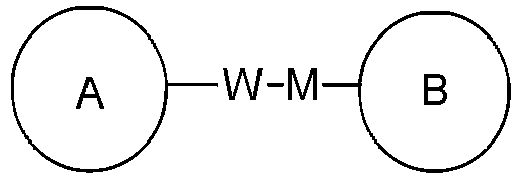
- Unless otherwise specified, the term "heterocyclo" refers to a stable monocyclic, bicyclic or tricyclic ring containing a heteroatom or a heteroatom group, which are saturated, and contain carbon atoms and 1, 2, 3 or 4 ring heteroatoms respectively selected from N, O and S. Nitrogen and sulfur heteroatoms can optionally be oxidized (i.e., NO and S(O)p, p is 1 or 2). Nitrogen atom can be substituted or unsubstituted (i.e., N or NR, wherein R is H or other substituents already defined herein). The heterocycle can be attached to the pendant group of any heteroatom or carbon atom to form a stable structure. If the resulting compound is stable, the heterocycle described herein may have a substitution at a carbon or nitrogen position. Nitrogen atom on the heterocycle is optionally quaternized. In a preferred embodiment, when the total number of S and O atom of the heterocycle is more than 1, the heteroatom is not adjacent to each other. In another preferred embodiment, the total number of S and O atom of the heterocycle is not more than 1. As used herein, the term "heteroaryl" refers to a stable 5-, 6- or 7-membered monocyclic or bicyclic or 7-, 8-, 9- or 10-membered bicyclic heterocyclic aromatic ring which contains carbon atoms and 1, 2, 3 or 4 ring heteroatoms respectively selected from N, O and S. Nitrogen atom can be substituted or unsubstituted (i.e., N or NR, wherein R is H or other substituents already defined herein). Nitrogen and sulfur heteroatoms may optionally be oxidized (i.e., NO and S(O)p, p is 1 or 2). It is worth noting that the total number of S and O atom of an aromatic heterocycle is not more than one. A bridged ring is formed when one or more than one atom (i.e, C, O, N or S) link two non-adjacent carbon or nitrogen atoms. A preferred bridged ring includes, but not limited to one carbon atom, two carbon atoms, one nitrogen atom, two nitrogen atoms and one carbon-nitrogen group. It is worth noting that a bridge always converts a monocyclic ring to a tricyclic ring. In a bridged ring, the substituent on the ring may also be present on the bridge.
- Unless otherwise specified, the term "5-6 membered heterocycloalkyl" by itself or in combination with other terms, refers to a saturated cyclic group consisting of 5 to 6 ring atoms, respectively, of which 1, 2, 3 or 4 ring atoms are independently selected from O, S and N heteroatoms, the rest are carbon atoms, wherein the nitrogen atom is optionally quatemized, and the nitrogen and sulfur heteroatoms are optionally oxidized (i.e. NO and S(O)p, p is 1 or 2). It includes both monocyclic and bicyclic systems, wherein the bicyclic system includes a spiro ring, a fused ring, and a bridge ring. In addition, for the "5-6 membered heterocycloalkyl", a heteroatom may occupy connection position of the heterocycloalkyl to the rest of the molecule. The 5-6 membered heterocycloalkyl includes 5-membered and 6-membered heterocycloalkyl. Examples of 5-6 membered heterocycloalkyl include, but are not limited to, pyrrolidinyl, pyrazolidinyl, imidazolidinyl, tetrahydrothiophenyl (including tetrahydrothiophen-2-yl and tetrahydrothiophen-3-yl, etc.), tetrahydrofuranyl (including tetrahydrofuran-2-yl, etc.), tetrahydropyranyl, piperidinyl (including 1-piperidinyl, 2-piperidinyl and 3-piperidinyl, etc.), piperazinyl (including 1-piperazinyl and 2-piperazinyl, etc.), morpholinyl (including 3-morpholinyl and 4-morpholinyl, etc.), dioxanyl, dithianyl, isoxazolidinyl, isothiazolidinyl, 1.2-oxazinyl, 1,2-thiazinyl, hexahydropyridazinyl, homopiperazinyl or homopiperidinyl and the like.
- Unless otherwise specified, the terms "6-10 membered heteroaryl ring" and "6-10 membered heteroaryl" of the present disclosure can be used interchangeably. The term "6-10 membered heteroaryl" refers to a cyclic group consisting of 6 to 10 ring atoms with a π-conjugated electron system, wherein 1, 2, 3 or 4 ring atoms are heteroatoms respectively selected from O, S and N, the rest are carbon atoms. It can be monocyclic, fused bicyclic, or fused tricyclic system, wherein each ring is aromatic. The nitrogen atom is optionally quatemized, and the nitrogen and sulfur heteroatoms are optionally oxidized (i.e. NO and S(O)p, p is 1 or 2). The 6-10 membered heteroaryl can be connected to the rest part of the molecule via heteroatom or carbon atom. The 6-10 membered heteroaryl includes 6-8 membered, 6-7 membered, 6-9 membered, 6 membered, and 10 membered heteroaryl. Examples of the 6-10 membered heteroaryl include, but are not limited to, furanyl (including 2-furanyl and 3- furanyl, etc.), pyridyl (including 2-pyridyl, 3-pyridyl, 4-pyridyl, etc.), pyrazinyl, pyrimidinyl (including 2-pyrimidinyl and 4-pyrimidinyl, etc.), benzthiazolyl (including 5-benzothiazolyl, etc.), purinyl, benzimidazolyl (including 2-benzimidazolyl, etc.), benzoxazolyl, indolyl (including 5-indolyl, etc.), isoquinolinyl (including 1-isoquinolinyl and 5-isoquinolinyl, etc.), quinoxalinyl (including 2-quinoxalinyl and 5-quinoxalinyl, etc.) or quinolinyl (including 3-quinolinyl and 6-quinolinyl, etc.).
- Unless otherwise specified, the terms "5-6 membered heteroaryl ring" and "5-6 membered heteroaryl" of the present disclosure can be used interchangeably. The term "5-6 membered heteroaryl" refers to a cyclic group consisting of 5 to 6 ring atoms with a π-conjugated electron system, wherein 1, 2, 3 or 4 ring atoms are heteroatoms respectively selected from O, S and N, the rest are carbon atoms. The nitrogen atom is optionally quatemized, and the nitrogen and sulfur heteroatoms are optionally oxidized (i.e. NO and S(O)p, p is 1 or 2). The 5-6 membered heteroaryl can be connected to the rest part of the molecule via heteroatom or carbon atom. The 5-6 membered heteroaryl includes 5 membered and 6 membered heteroaryl. Examples of the 5-6 membered heteroaryl include, but are not limited to, pyrrolyl (including N-pyrrolyl, 2-pyrrolyl and 3-pyrrolyl etc.), pyrazolyl (including 2-pyrazolyl and 3-pyrazolyl etc.), imidazolyl (including N-imidazolyl, 2-imidazolyl, 4-imidazolyl and 5-imidazolyl, etc.), oxazolyl (including 2-oxazolyl, 4-oxazolyl and 5-oxazolyl, etc.), triazolyl (1H-1,2,3-triazolyl, 2H-1,2,3-triazolyl, 1H-1,2,4-triazolyl and 4H-1,2,4-triazolyl, etc.), tetrazolyl, isoxazolyl (3-isoxazolyl, 4-isoxazolyl and 5-isoxazolyl, etc.), thiazolyl (including 2-thiazolyl, 4-thiazolyl and 5-thiazolyl, etc.), furanyl (including 2-furanyl and 3-furanyl, etc.), thienyl (including 2-thienyl and 3-thienyl, etc.), pyridyl (including 2-pyridyl, 3-pyridyl and 4-pyridyl, etc.), pyrazinyl or pyrimidyl (including 2- pyrimidyl and 4- pyrimidyl, etc.).
- Unless otherwise specified, "C3-6 cycloalkyl" refers to a saturated cyclic hydrocarbyl consisting of 3 to 6 carbon atoms, which is a monocyclic and bicyclic system, and the C3-6 cycloalkyl includes C3-5, C4-5 and C5-6 cycloalkyl, etc.; it can be monovalent, divalent or polyvalent. Examples of C3-6 cycloalkyl include, but are not limited to, cyclopropyl, cyclobutyl, cyclopentyl, cyclohexyl, and the like.
- In some embodiments, the term "heteroalkyl" by itself or in combination with another term refers to a stable linear chain, branched hydrocarbon radical or a combination thereof which has a specified number of carbon atoms and at least one heteroatom. In a specific embodiment, a heteroatom is selected from B, O, N and S, wherein nitrogen and sulfur atoms are optionally oxidized and the nitrogen heteroatom is optionally quaternized. The heteroatom or heteroatom group can be located at any internal position of a heterohydrocarbyl, including the position where the hydrocarbyl connects to the rest part of the molecule. However, the terms "alkoxy", "alkylamino" and "alkylthio" (or thioalkoxy) are used by the conventional expressions and refer to an alkyl group that is connected to the rest part of the molecule via an oxygen atom, an amino or a sulfur atom respectively. Examples include, but are not limited to, -CH2-CH2-O-CH3, -CH2-CH2-NH-CH3, -CH2-CH2-N(CH3)-CH3, -CH2-S-CH2-CH3, -CH2-CH2, -S(O)-CH3, and -CH2-CH2-S(O)2-CH3. Up to two consecutive heteroatoms can be present, such as, -CH2-NH-OCH3.
- Unless otherwise specified, the term "alkyl" refers to a linear chain or branched saturated hydrocarbon group, can be mono-substituted (e.g. -CH2F) or poly-substituted (e.g. -CF3), can be monovalent (e.g. methyl), divalent (e.g. methylene) or multivalent (e.g. methenyl). Examples of alkyl include methyl (Me), ethyl (Et), propyl (such as n-propyl and isopropyl), butyl (such as n-butyl, isobutyl, s-butyl, t-butyl), pentyl (such as n-pentyl, isopentyl, neopentyl) and the like.
- Unless otherwise specified, the term "C1-3 alkyl" refers to a linear or branched saturated hydrocarbon group consisting of 1 to 3 carbon atoms. The C1-3 alkyl includes C1-2 and C2-3 alkyl, etc.; it may be monovalent (such as methyl), divalent (such as methylene) or multivalent (such as methine). Examples of C1-3 alkyl include, but are not limited to, methyl (Me), ethyl (Et), propyl (including n-propyl and isopropyl), and the like.
- Unless otherwise specified, the term "C1-3 alkoxy" refers to those alkyl containing 1 to 3 carbon atoms that are connected to the rest of the molecule by one oxygen atom. The C1-3 alkoxy group includes C1-2, C2-3, C3 and C2 alkoxy. Examples of C1-3 alkoxy include, but are not limited to, methoxy, ethoxy, propoxy (including n-propoxy and isopropoxy) and the like.
- Unless otherwise specified, cycloalkyl includes any stable cyclic or polycyclic hydrocarbyl, and any carbon atom is saturated, can be mono-substituted or poly-substituted, and can be monovalent, divalent or multivalent. Examples of cycloalkyl include, but are not limited to, cyclopropyl, norbornanyl, [2.2.2]bicyclooctane, [4.4.0]bicyclodecanyl and the like.
- Unless otherwise specified, the term "halo" or "halogen" by itself or as part of another substituent refers to fluorine, chlorine, bromine or iodine atom. Furthermore, the term "haloalkyl" is meant to include monohaloalkyl and polyhaloalkyl. For example, the term "halo (C1-C4)alkyl" is meant to include, but not limited to, trifluoromethyl, 2,2,2-trifluoroethyl, 4-chlorobutyl, 3-bromopropyl and the like. Examples of haloalkyl include, but not limited to trifluoromethyl, trichloromethyl, pentafluoroethyl and pentachloroethyl.
- The term "alkoxy" represents any alkyl defined above having a specified number of carbon atoms attached by an oxygen bridge. Unless otherwise specified, C1-6 alkoxy includes C1, C2, C3, C4, C5 and C6 alkoxy. Examples of alkoxy include, but not limited to methoxy, ethoxy, n-propoxy, isopropoxy, n-butoxy, sec-butoxy, tert-butoxy, n-pentyloxy and S-pentoxy.
- Unless otherwise specified, the term "aryl" refers to a polyunsaturated aromatic substituent, can be mono-, di- or poly-substituted, can be a monovalent, divalent or multivalent, can be a single ring or a multiple ring (e.g. one to three rings; wherein at least one ring is aromatic), which are fused together or connected covalently. The term "heteroaryl" refers to an aryl (or ring) containing one to four heteroatoms. In an illustrative example, the heteroatom is selected from B, N, O and S, wherein nitrogen and sulfur atoms are optionally oxidized and nitrogen atom is optionally quaternized. A heteroaryl may attach to the rest part of a molecule via a heteroatom. Non-limiting examples of aryl or heteroaryl include phenyl, naphthyl, biphenyl, pyrrolyl, pyrazolyl, imidazolyl, pyrazinyl, oxazolyl, phenyl-oxazolyl, isoxazolyl, thiazolyl, furanyl, thienyl, pyridyl, pyrimidinyl benzothiazolyl, purinyl, benzimidazolyl, indolyl, isoquinolyl, quinoxalinyl, quinolyl, 1-naphthyl, 2-naphthyl, 4-biphenyl, 1-pyrrolyl, 2-pyrrolyl, 3-pyrrolyl, 3-pyrazolyl, 2-imidazolyl, 4-imidazolyl, pyrazinyl, 2-oxazolyl, 4-oxazolyl, 2-phenyl-4-oxazolyl, 5-oxazolyl, 3-isoxazolyl, 4-isoxazolyl, 5-isoxazolyl, 2-thiazolyl, 4-thiazolyl, 5-thiazolyl, 2-furanyl, 3-furanyl, 2-thienyl, 3-thienyl, 2-pyridyl, 3-pyridyl, 4-pyridyl, 2-pyrimidyl, 4-pyrimidyl, 5-benzothiazolyl, purinyl, 2-benzimidazolyl, 5-indolyl, 1-isoquinolyl, 5-isoquinolyl, 2-quinoxalinyl, 5-quinoxalinyl, 3-quinolyl and 6-quinolyl. The substituent of any of the above aryl and heteroaryl ring system is selected from the acceptable substituent described below.
- Unless otherwise specified, Cn-n+m or Cn-Cn+m includes any specific case of n to n+m carbons, for example, C1-12 includes C1, C2, C3, C4, C5, C6, C7, C8, C9, C10, C11, and C12, also includes any range from n to n+m, for example, C1-12 includes C1-3, C1-6, C1-9, C3-6, C3-9, C3-12, C6-9, C6-12, and C9-12, etc.; in the same way, n to n+m means that the number of atoms in the ring is n to n+m, for example, 3-12 membered rings include 3 member ring, 4-membered ring, 5-membered ring, 6-membered ring, 7-membered ring, 8-membered ring, 9-membered ring, 10-membered ring, 11-membered ring, and 12-membered ring, also includes any range from n to n+ m, for example, 3-12 membered rings include 3-6 member ring, 3-9 member ring, 5-6 member ring, 5-7 member ring, 6-7 member ring, 6-8 member ring, and 6-10 member ring, and the like.
- The compounds of the present disclosure can be prepared by a variety of synthetic methods well known to those skilled in the art, including the specific embodiments listed below, the embodiments formed by combining the specific embodiments listed below with other chemical synthesis methods, and equivalent embodiments well known to those skilled in the art, preferred embodiments include, but are not limited to, the embodiments of the present disclosure.
- The compounds of the present disclosure may have various uses or indications, including but not limited to, the specific uses or indications listed in this application.
- The solvent used in the present disclosure is commercially available.
- Each embodiment of the present disclosure involves neutral purification for high performance liquid chromatography purification.
- The present invention employs the following abbreviations: aq represents water; HATU represents O-(7 -azabenzotriazol-1-yl)-N,N,N',N'-tetramethyluronium hexafluorophosphate; EDC represents N-(3-dimethylaminopropyl)-N'-ethylcarbodiimide hydrochloride; m-CPBA represents 3-chloroperoxybenzoic acid; eq represents equal or equivalent; CDI represents carbonyl diimidazole; DCM represents dichloromethane; PE represents petroleum ether; DIAD represents diisopropyl azodicarboxylate; DMF represents N,N-dimethylfortnamide; DMSO represents dimethyl sulfoxide; EtOAc represents ethyl acetate; EtOH represents ethanol; MeOH represents methanol; CBz represents benzyloxycarbonyl, which is an amino protecting group; BOC represents tert-butylcarbonyl, which is an amino protecting group; HOAc represents acetic acid; NaCNBH3 represents sodium cyanoborohydride; r.t. represents room temperature; O/N represents overnight; THF represents tetrahydrofuran; BOC2O represents di-tert-butyldicarbonate; TFA represents trifluoroacetic acid; DIPEA represents diisopropylethylamine; SOCl2 represents thionyl chloride; CS2 represents carbon disulfide; TsOH represents p-toluenesulfonic acid; NFSI represents N-fluoro-N-(phenylsulfonyl)benzenesulfonamide; n-Bu4NF represents tetrabutylammonium fluoride; iPrOH represents 2-propanol; mp represents melting point; LDA represents lithium diisopropylamide; Pd(PPh3)4 represents tetrakis(triphenylphosphine) palladium; IV represents intravenous injection; PO represents oral administration.
- Compounds are named according to conventional naming principles in the art or by ChemDraw® software, the commercially available compounds use their vendor directory names.
- The present disclosure will be specifically described below by way of embodiments, but the scope of the present disclosure is not limited thereto. The present disclosure has been described in detail herein, and the embodiment of the present disclosure has been disclosed herein. Various modifications and changes may be made to the embodiment of the present disclosure without departing from the spirit and scope of the invention, which will be apparent to the skilled in the art.
-

- Compound 1a (20.0 g, 104 mmol, 1.00 eq) and concentrated ammonium hydroxide (200 mL, 1.45 mol, 14.0 eq) were sealed in an autoclave, and stirred at 130 °C for 24 hours under a pressure of about 0.9 MPa. The reaction solution was concentrated to give compound 1b.
MS-ESI calculated for [M+H]+: 173 and 175, found: 173 and 175.
1H NMR (400MHz, DMSO-d 6) δ: 8.03 (d, J=8.0 Hz, 1H), 7.56 (br s, 2H), 6.61 (d, J=8.0 Hz, 1H). - Compound 1b (17.0 g, 98.5 mmol, 1.00 eq), ammonium chloride (10.5 g, 197 mmol, 2.00 eq), 1-hydroxybenzotriazole (13.3 g, 98.5 mmol, 1.00 eq), 1-(3-dimethylaminopropyl)-3-ethylcarbodiimide hydrochloride (18.9 g, 98.5 mmol, 1.00 eq) and diisopropylethylamine (38.2 g, 296 mmol, 3.00 eq) were dissolved in N,N-dimethylformamide (200.0 mL). The mixture was stirred at 20 °C for 16 hours. After completion of the reaction, the solvent was removed by rotary evaporation under reduced pressure, followed by addition of water (200 mL) and extraction with ethyl acetate (200 mL × 3). The combined organic phase was dried with anhydrous sodium sulfate, filtered, and subjected to column chromatography (1: 1 petroleum ether/ethyl acetate, Rf = 0.4) to give a compound, which was slurried with ethyl acetate (50 mL) for ten minutes to give compound 1c.
1H NMR (400MHz, DMSO-d 6) δ: 7.96 (d, J=8.0 Hz, 2H), 7.62 (br s, 2H), 7.40 (br s, 1H), 6.61 (d, J=8.0 Hz, 1H). - Compound 1c (8.00 g, 46.6 mmol, 1.00 eq) and oxalyl chloride (7.1 g, 56.0 mmol, 4.9 mL, 1.00 eq) were sequentially added to toluene (200 mL). The mixture was stirred at 110 °C for 15 hours, then cooled to room temperature, filtered and dried to give compound 1d.
1H NMR (400MHz, DMSO-d 6) δ: 8.24 (d, J=8.0 Hz, 1H), 7.30 (d, J=8.0 Hz, 1H). - Compound 1d (6.00 g, 30.4 mmol, 1.00 eq) and diisopropylethylamine (11.8 g, 91.1 mmol, 15.9 mL, 3.00 eq) were sequentially added to toluene (100 mL). The mixture was stirred at 70°C for half an hour, and cooled to room temperature. Phosphorus oxychloride (14.0 g, 91.1 mmol, 8.5 mL, 3.00 eq) was dropwise added into the obtained mixture. The mixture was stirred at 100 °C for 2 hours, cooled to room temperature, concentrated, and purified by column chromatography (3: 1 petroleum ether/ethyl acetate, Rf= 0.4) to give compound 1e.
1H NMR (400MHz, DMSO-d 6) δ: 8.45 (d, J=8.0 Hz, 1H), 7.63 (d, J=8.3 Hz, 1H). - Compound 1e (1.90 g, 8.10 mmol, 1.00 eq), (S)-2-methylmorpholine (819 mg, 8.10 mmol, 1.00 eq) and diisopropylethylamine (2.09 g, 16.2 mmol, 2.83 mL , 2.00 eq) were dissolved in dichloromethane (50 mL), and the resulting solution was reacted at 25 °C for 2 hours. After completion of the reaction, the reaction solution was concentrated and subjected to column chromatography (3: 1 petroleum ether/ethyl acetate) to give compound If.
1H NMR (400MHz, DMSO-d 6) δ: 8.47 (d, J=8.8 Hz, 1H), 7.55 (d, J=8.8 Hz, 1H), 4.71-4.72 (m, 1H), 4.12-4.09 (m, 1H), 3.92-3.91 (m, 1H), 3.84 - 3.74 (m, 1H), 3.73 - 3.64 (m, 2H), 3.54-3.53 (m, 1H), 1.46 (d, J=6.8 Hz, 3H). - Compound 1f (1.2 g, 4.01 mmol, 1.00 eq), compound lg (1.15 g, 4.41 mmol, 1.10 eq), tetrakis(triphenylphosphine) palladium (232 mg, 200 µmοl, 0.05 eq) and potassium carbonate (1.66 g, 12.0 mmol, 3.00 eq) were dissolved in water (24 mL) and 1,4-dioxane (120 mL), and the mixture was reacted at 60 °C for 5 hours under nitrogen protection. After completion of the reaction, the reaction solution was concentrated to remove solvent, diluted with water (30 mL), and extracted with ethyl acetate (50 mL×2). The combined organic phase was dried over anhydrous sodium sulfate, filtered, and subjected to rotary evaporation under reduced pressure to dryness, and purified by column chromatography (100% ethyl acetate) to give compound 1h.
1H NMR (400MHz, DMSO-d 6) δ: 8.71 (s, 1H), 8.67 (d, J=4.8 Hz, 1H), 8.55 (d, J=8.8 Hz, 1H), 8.39 (d, J=8.0 Hz, 1H), 8.14 (d, J=8.8 Hz, 1H), 8.01 (d, J=8.0 Hz, 1H), 7.68 (t, J=7.6 Hz, 1H), 4.75 (d, J=6.4 Hz, 1H), 4.17-4.15 (m, 1H), 3.94-3.92 (m, 1H), 3.87 - 3.77 (m, 1H), 3.72 (s, 2H), 3.59-3.57 (m, 1H), 2.86-2.84 (m, 3H), 1.49 (d, J=6.8 Hz, 3H). - Compound 1h (50 mg, 126 µmοl, 1 eq), 1i (18.8 mg, 126 µmol, 1 eq) and DIPEA (16.2 mg, 126 µmol. 21.89 µL, 1 eq) were dissolved in DMSO (3 mL). The reaction solution was reacted at 70°C for 20 hours. After completion of the reaction, the reacion solution was purified by high performance liquid chromatography to give compound 1.
MS-ESI calculated for [M+H]+: 475, found: 475.
1H NMR (400 MHz, CD3OD) δ: 8.62 (s, 1H), 8.32 - 8.30 (m, 2H), 7.96 (d, J=7.2 Hz, 1H), 7.72-7.61 (m, 2H), 4.52 (br s, 1H), 4.09-3.92 (m, 6H), 3.91 -3.82(m, 3H), 3.76-3.74 (m, 3H), 2.99 (s, 3H), 1.49 (d, J=6.8 Hz, 3H), 0.81 (s, 2H), 0.71 (s, 2H). -

- Compound 1 (40 mg, 84.3 µmοl, 1.00 eq) was dissolved in xylene (2 mL) at 130°C, and then Lawesson's reagent (37.5 mg, 92.7 µmοl, 1.10 eq) was added to the above reaction solution in batches. Nitrogen replacement was performed for three times, and then the reaction was carried out at 130°C under nitrogen protection for 17 hours. After completion of the reaction, the reaction solution was subjected to rotary evaporation under reduced pressure to remove solvent. The crude product was added with water (10 mL) and extracted with dichloromethane (10 mL×3). The organic phases were combined and dried with anhydrous sodium sulfate, filtered, and subjected to rotary evaporation under reduced pressure to dryness. The residue was separated by preparative thin layer chromatography (100% ethyl acetate). The crude product was separated by preparative liquid chromatography to give compound 2.
MS-ESI calculated for [M+H]+: 491, found: 491.
1H NMR (400 MHz, CDCl3) δ: 8.47 (s, 1H), 8.15 (s, 1H), 8.05 (d, J=7.8 Hz, 1H), 8.02-7.95 (m, 2H), 7.47-7.36 (m, 2H), 4.30 (s, 1H), 4.04-3.83 (m, 5H), 3.80-3.78 (m, 4H), 3.73-3.60 (m, 3H), 3.33 (d, J=4.8 Hz, 3H), 1.41 (d, J=6.8 Hz, 3H), 0.80-0.74 (m, 2H), 0.60-0.59 (m, 2H). -

- Compound 1f (0.5 g, 1.37 mmol, 1 eq), 3a (246 mg, 1.37 mmol, 1 eq), tetrakis (triphenylphosphine) palladium (79.2 mg, 68.53 µmol. 0.05 eq) and anhydrous sodium carbonate (436 mg, 4.11 mmol, 3 eq) were dissolved in dioxane (6.0 mL) and water (2.0 mL). Nitrogen replacement was performed for three times. The reaction was carried out under nitrogen protection at 70°C for 3 hours. After completion of the reaction, the reaction solution was subjected to rotary evaporation under reduced pressure to remove solvent. The remaining solid was diluted with water (20 mL) and ethyl acetate (10 mL×3), filtered, and partitioned. The obtained organic phases were combined, dried over anhydrous sodium sulfate, filtered, and subjected to rotary evaporation to dryness, and purified by column chromatography (3: 1 petroleum ether/ethyl acetate) to give compound 3b.
- Compound 3b (180 mg, 375 µmοl, 1 eq), 1i (56.0 mg, 375 µmol, 1 eq, HCl) and DIPEA (145 mg, 1.12 mmol, 196 µL, 3 eq) were dissolved in DMSO (3 mL), and then the mixture was reacted at 70°C for 15 hours. After completion of the reaction, 3c was directly used in the reaction of next step without treatment.
- Compound 3c (30.0 mg, 65.0 µmol, 1 mL, 1 eq), 3d (10.9 mg, 130 µmol, 2 eq, HCl), DIPEA (25.2 mg, 195 µmol, 34.0 µL, 3 eq) and HATU (49.4 mg, 130 µmol, 2 eq) were dissolved in DMSO (2 mL) and then the mixture was reacted at 27°C for 20 hours. After completion of the reaction, the reaction solution was subjected to high performance liquid chromatography to give compound 3.
MS-ESI calculated for [M+H]+: 491, found: 491.
1H NMR: (400 MHz, CDCl3) δ: 9.29 (s, 1H), 8.49 (s, 1H), 8.13 (br d, J=7.6 Hz, 1H), 7.98 (d, J=8.4 Hz, 1H), 7.8 (d, J=7.6Hz, 1H), 7.49 (t, J=7.6 Hz, 1H), 7.37-7.46 (m, 1H), 4.22-4.37 (m, 1H), 3.89-4.06 (m, 3H), 3.75-3.89 (m, 9H), 3.60-3.73 (m, 3H), 1.41 (d, J=6.4 Hz, 3H), 0.74-0.81 (m, 2H), 0.61 (br s, 2H). -

- Compound 4a (180 mg, 375 µmοl, 1 eq), 1i (56.0 mg, 375 µmοl, 1 eq, HCl) and DIPEA (145 mg, 1.12 mmol, 196 µL, 3 eq) were dissolved in DMSO (3 mL), and then the mixture was reacted at 70°C for 15 hours. After completion of the reaction, compound 4b was obtained, which was directly used in the reaction of next step.
MS-ESI calculated for [M+H]+: 476, found: 476. - Compound 4b (178 mg, 374.31 µmοl, 1 eq) and LiOH (23.56 mg, 561.47 µmol, 1.5 eq) were dissolved in dimethyl sulfoxide (3 mL), and the mixture was reacted at room temperature for 24 hours. LC-MS detection found that compound 3 was not obtained. Sodium hydroxide (29.95 mg, 748.63 µmοl, 2 eq) was added to the reaction solution, and the reaction was continued for 20 hours. After completion of the reaction, the resulting mixture was directly purified by high performance liquid chromatography to give compound 4c.
- Compound 4c (20 mg, 42.9 µmol, 1 eq), 4d (5.99 mg, 47.2 µmol, 4.13 µL, 1.1 eq) and DMF (314 µg, 4.29 µmol. 0.33 µL, 0.1 eq) were dissolved in dichloromethane (2 mL), and the resulting solution was reacted at room temperature for an hour. After completion of the reaction, compound 4e was obtained, which was directly used in the reaction of next step without treatment.
- Compound 4f (60 mg, 125.01 µmοl, 1 eq) was added to a solution of 4e (86.9 mg, 1.25 mmol, 10 eq, HCl) and DIPEA (194 mg, 1.50 mmol, 261 µL, 12 eq) in dichloromethane (2 mL), then the mixture was reacted at room temperature for 2 hours. The resulting solution was purified by high performance liquid chromatography to give 4.
MS-ESI calculated for [M+H]+: 477, found: 477.
1H NMR (400 MHz, CD3OD) δ: 8.57 (s, 1H), 8.34-8.31 (m, 2H), 7.90 (d, J=7.6 Hz, 1H), 7.57-7.78 (m, 2H), 4.62-4.60 (m, 3H), 4.04-4.02 (m, 2H), 4.01-3.92 (m, 3H), 3.87-3.85 (m, 3H), 3.78-3.76 (m, 2H), 1.51 (d, J=6.8 Hz, 3H), 0.93-0.61 (m, 4H). -
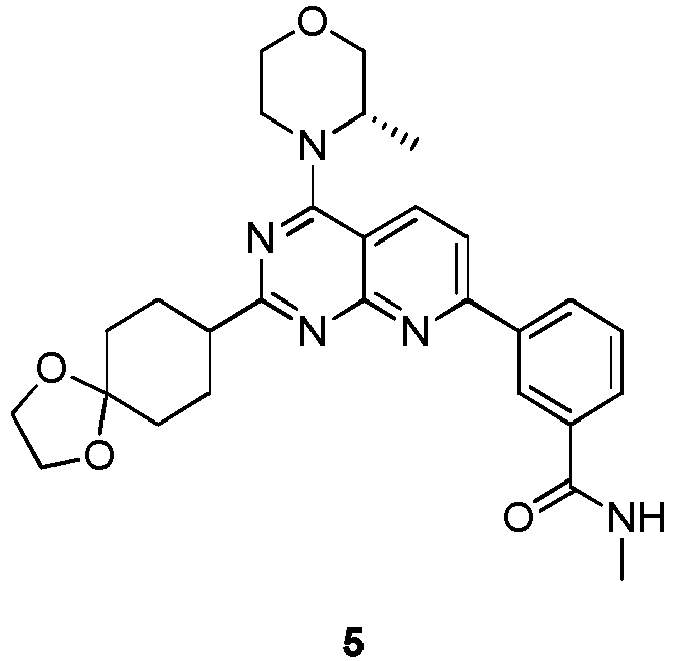

- 1h (300 mg, 754 µmοl, 1.00 eq), 5a (301 mg, 1.13 mmol, 1.50 eq), tetrakis(triphenylphosphine) palladium (43.6 mg, 37.7 µmol. 0.05 eq) and sodium carbonate (240 mg, 2.26 mmol, 3.00 eq) were dissolved in water (3 mL) and 1,4-dioxane (10 mL). The reaction was carried out at 90°C for 16 hours under nitrogen protection. After completion of the reaction, the reaction solution was concentrated to remove solvent, diluted with water (10 mL), and extracted with ethyl acetate (20 mL×3). The organic phases were combined, dried over anhydrous sodium sulfate, filtered, subjected to rotary evaporation under reduced pressure to dryness, and purified by column chromatography (100% ethyl acetate, Rf=0.4) to give a yellow solid (200 mg) with a purity of 63.8% and a yield of 27%. 40 mg thereof was separated and purified by preparative high performance liquid chromatography to give compound 5b.
MS-ESI calculated for [M+H]+: 502, found: 502.
1H NMR (400 MHz, CD3OD) δ: 8.70 (s, 1H), 8.44 (d, J = 8.8 Hz, 1H), 8.41 (br d, J = 8.0Hz, 1H), 8.02-7.92 (m, 2H) , 7.66 (t, J = 8.0 Hz, 1H), 7.35-7.25 (m, 1H), 4.68-4.66 (m, 1H), 4.21-4.210 (m, 1H), 4.05-3.96 (m, 5H), 3.90 -3.72 (m, 4H), 3.00 (s, 3H), 2.92 (br s, 2H), 2.56 (s, 2H), 1.94 (t, J = 6.4 Hz, 2H), 1.53 (d, J = 6.4 Hz , 3H). - Palladium on carbon (10 mg, content 10%, moisture: 50%) was added to a solution of 5b (80 mg, 160 µmol. 1.00 eq) in methanol (10 mL), and hydrogen replacement was performed for three times. The obtained mixture was reacted under hydrogen atmosphere (15 psi) at 20 °C for 16 hours, and filtered. The filter cake was washed with 10 mL methanol, and the filtrate was concentrated. The crude product was separated and purified by preparative high performance liquid chromatography to give compound 5.
MS-ESI calculated for [M+H]+: 504, found: 504.
1H NMR (400 MHz, CD3OD) δ: 8.73 (s, 1H), 8.48 (d, J=8.4 Hz, 1H), 8.45 (br d, J=8.0 Hz, 1H), 8.02 (d, J=8.4Hz, 1H), 7.98 (br d, J=8.0 Hz, 1H), 7.66 (t, J=8.0 Hz, 1H), 4.78-4.76 (m, 1H), 4.26-4.24 (m, 1H), 4.05-3.94 (m, 5H), 3.89-3.70 (m, 4H), 3.00 (s, 3H), 2.94-2.82 (m, 1H), 2.12-1.99 (m, 4H), 1.92-1.90 (m, 2H), 1.78-1.67 (m, 2H), 1.57 (d, J=6.8 Hz, 3H). -

- Compound lh (50.0 mg, 126 µmol, 1.00 eq), compound 6a (32.5 mg, 189 µmοl, 1.50 eq, 0.5 equivalent oxalate), and N, N-diisopropylethylamine (48.7 mg, 377 µmol. 3.00 eq) were dissolved in dimethyl sulfoxide (1.00 mL), and then the reaction solution was stirred at 70 °C for 16 hours. After completion of the reaction, the reaction solution was purified by preparative high performance liquid chromatography to give compound 6.
MS-ESI calculated for [M+H]+: 489, found: 489.
1H NMR (400MHz, DMSO-d 6) δ: 8.64 (s, 2H), 8.31 (d, J=7.6 Hz, 1H), 8.24 (d, J=8.4 Hz, 1H), 7.95 (d, J=7.6 Hz, 1H), 7.69 (d, J=8.4 Hz, 1H), 7.62 (t, J=7.6 Hz, 1H), 4.47-4.45 (m, 1H), 3.95 - 3.82 (m, 6H), 3.79 - 3.70 (m, 1H), 3.69 - 3.50 (m, 7H), 2.84 (d, J=4.8 Hz, 3H), 1.76 (br t, J=4.8 Hz, 4H), 1.38 (d, J=6.8 Hz, 3H). -

- Compound 1h (50.0 mg, 126 µmol, 1.00 eq), compound 7a (32.5 mg, 189 µmol, 1.50 eq, 0.5 equivalent oxalate) and diisopropylethylamine (48.7 mg, 377 µmοl, 3.00 eq) were dissolved in dimethyl sulfoxide (1.00 mL). The reaction solution was then stirred at 70°C for 16 hours. After completion of the reaction, the reaction solution was purified by preparative high performance liquid chromatography to give compound 7.
MS-ESI calculated for [M+H]+:489, found: 489.
1H NMR (400MHz, DMSO-d 6) δ: 8.70 - 8.60 (m, 2H), 8.30 (br d, J=8.0 Hz, 1H), 8.22 (d, J=8.4 Hz, 1H), 7.95 (d, J=8.0 Hz, 1H), 7.68 (d, J=8.4 Hz, 1H), 7.62 (t, J=8.0 Hz, 1H), 4.47 - 4.27 (m, 5H), 3.96 - 3.56 (m, 10H), 2.84 (d, J=4.4 Hz, 3H), 1.83 (brt, J=5.2 Hz, 4H), 1.37 (d, J=6.8 Hz, 3H). -

- Compound 1h (20 mg, 50.3 µmol, 1.00 eq), 8a (13.4 mg, 75.4 µmol, 1.50 eq, HCl) and N, N-diisopropylethylamine (19.5 mg, 151 µmol, 26.3 µL, 3.00 eq) were dissolved in dimethyl sulfoxide (1 mL), and the mixed solution was allowed to react at 70 °C for 40 hours. After completion of the reaction, the reaction solution was purified by high performance liquid chromatography to give compound 8.
MS-ESI calculated for [M+H]+: 503, found: 503.
1H NMR (400 MHz, CD3OD) δ: 8.62 (s, 1H), 8.33 (d, J=8.0 Hz, 1H), 8.26 (d, J=8.0 Hz, 1H), 7.95 (d, J=8.0 Hz, 1H), 7.67-7.61 (m, 2H), 4.51 (br d, J=7.03 Hz, 1H), 4.13-4.05 (m, 2H), 4.02-3.85 (m, 7H), 3.82-3.69 (m, 3H), 3.65 (s, 2H), 2.99 (s, 3H), 1.92 (t, J=7.2 Hz, 2H), 1.69 (t, J=5.6 Hz, 4H), 1.48 (d, J=6.8 Hz, 3H). -

- Compound 9a (100 mg, 175 µmol, 1 eq), 1i (26.28 mg, 175.67 µmol, 1 eq, HCl) and DIPEA (68.1 mg, 527 µmol, 91.8 µL, 3 eq) were dissolved in DMSO (5 mL), and then the mixture was reacted at 70 °C for 18 hours. After completion of the reaction, the reaction solution was diluted with water (10 mL), then extracted with ethyl acetate (15 mL ×5), and patitioned. The combined organic phases were dried over anhydrous sodium sulfate, filtered and subjected to rotary evaporation to dryness. The residue was purified by high performance liquid chromatography to give compound 9.
MS-ESI calculated for [M+H]+: 487, found: 487.
1H NMR (400 MHz, CDCl3) δ: 8.63 (s, 1H), 8.22 (d, J=8.0 Hz, 1H), 8.14 (d, J=8.0 Hz, 1H), 7.98 (d, J=8.0 Hz, 1H), 7.50-7.61 (m, 2H), 6.56 (s, 1H), 4.59 (s, 2H), 3.69-4.23 (m, 10H), 3.07 (d, J=4.8 Hz, 3H), 2.06-2.20 (m, 2H), 1.98-2.06 (m, 2H), 0.90(s, 2H), 0.69 (s, 2H). -

- Compound lh (50.0 mg, 126 µmol, 1.00 eq), 10a (20.9 mg, 188 µmol, 1.50 eq) and triethylamine (38.2 mg, 377 µmol. 52.3 µL, 3.00 eq) were dissolved in dimethyl sulfoxide (1.00 mL). Nitrogen replacement was performed for three times, and the reaction solution was stirred at 70 °C for 12 hours. After completion of the reaction, the reaction solution was purified by high performance liquid chromatography to give compound 10.
MS-ESI calculated for [M+H]+:473, found: 473.
1H NMR (400 MHz, CD3OD) δ: 8.61 (s, 1H), 8.32 (d, J=8.0 Hz, 1H), 8.23 (d, J=8.4 Hz, 1H), 7.95 (d, J=8.0 Hz, 1H), 7.59-7.66 (m, 2H), 4.49-4.47 (m, 1H), 4.00-4.07 (m, 4H), 4.00-3.92 (m, 2H), 3.89-3.87 (m, 1H), 3.82-3.67 (m, 3H), 2.99 (s, 3H), 1.49-1.46 (m, 7H), 0.43 (s, 4H). -


- Compound 11a (1.0 g, 3.41 mmol, 1 eq) and 11b (510 mg, 3.41 mmol, 1 eq, HCl) were dissolved in anhydrous dichloromethane (80 mL), followed by addition of DIPEA (441 mg, 3.41 mmol, 594 µL, 1 eq). The mixed solution was allowed to react at 20 °C for 18 hours. After completion of the reaction, the reaction solution was concentrated under reduced pressure, and the filter residue was purified by preparative thin layer chromatography (1: 1 petroleum ether/ethyl acetate) to give compound 11c.
MS-ESI calculated for [M+H]+: 311, 312 and 313, found: 311, 312 and 313.
1H NMR (400 MHz, CDCl3)δ: 8.14 (d, J=8.8 Hz, 1H), 7.36 (d, J=8.8 Hz, 1H), 4.84 (s, 2H), 3.97 (d, J=1 1.2 Hz, 2H), 3.83 (d, J=11.2Hz, 2H), 2.24-2.16 (m, 2H), 2.10-2.01 (m, 2H). - Compound 11c (200 mg, 643 µmol, 1 eq), 11d (167 mg, 643 µmol, 1 eq), K2CO3 (266 mg, 1.93 mmol, 3 eq) and Pd (PPh3)4 (37.1 mg, 32.1 µmol, 0.05 eq) were dissolved in anhydrous dioxane (30 mL) and water (6 mL). Nitrogen replacement was performed for three times, and the mixed solution was allowed to react at 90 °C for 2 hours under nitrogen atmosphere. After completion of the reaction, the reaction solution was concentrated under reduced pressure, and then added with 20 mL water, and extracted with ethyl acetate (20 mL×3). The organic phase was dried over anhydrous sodium sulfate, filtered, and the filtrate was concentrated under reduced pressure, and the filter residue was purified by plate chromatography (100% ethyl acetate) to give compound 11e.
MS-ESI calculated for [M+H]+: 409 and 411, found: 409 and 411. - Compound 11e (120 mg, 294 µmol, 1 eq), 1i (33.2 mg, 222 µmol, HCl) and DIPEA (37.9 mg, 294 µmοl, 51.1 µL, 1 eq) were dissolved in DMSO (6 mL), and the mixed solution was allowed to react at 70 °C for 17 hours under nitrogen atmosphere. After completion of the reaction, the reaction solution was purified by high performance liquid chromatography to give compound 11.
MS-ESI calculated for [M+H]+:486, found: 486.
1H NMR (400 MHz, CD3OD) δ: 8.38 (d, J=8.4 Hz, 1H), 8.24 (br s, 1H), 8.03 (d, J=1.2 Hz, 1H), 7.94-7.89 (m, 1H), 7.71 (d, J=8.4 Hz, 1H), 7.43 (d, J=8.4 Hz, 1H), 4.83 (s, 1H), 4.06-3.97 (m, 4H), 3.94 (s, 2H), 3.87 (t, J=4.8 Hz, 2H), 3.80 (br d, J=10.4 Hz, 2H), 2.17-2.00 (m, 4H), 0.86-0.80 (m, 2H), 0.76-0.70 (m, 2H). -


- Compound lh (80 mg, 201 µmol, 1 eq), 12a (28.8 mg, 201 µmol, 25.7 µL, 1 eq), and diisopropylethylamine (26.0 mg, 201 µmol, 35.0 µL, 1 eq) were dissolved in dimethyl sulfoxide (4.00 mL), the mixed solution was allowed to react at 70 °C for 1.5 hours. After completion of the reaction, the reaction solution was purified by high performance liquid chromatography to give compound 12.
MS-ESI calculated for [M+H]+: 505, found: 505.
1H NMR (400 MHz, CD3OD) δ: 8.62-8.60 (m, 1H), 8.31 (d, J=8.0 Hz, 1H), 8.24 (d, J=8.4 Hz, 1H), 7.95 (d, J=8.0 Hz, 1H), 7.65-7.60 (m, 2H), 4.50 (br d, J=6.8 Hz, 1H), 4.09-4.02 (m, 8H), 4.00-3.93 (m, 2H), 3.90-3.84 (m, 1H), 3.81-3.68 (m, 3H), 2.99 (s, 3H), 1.80-1.74 (m, 4H), 1.48 (d, J=6.8 Hz, 3H). -

- Compound lh (50.0 mg, 126 µmol, 1 eq), 13a (19.8 mg, 126 µmol, 1 eq) and N,N-diisopropylethylamine (48.7 mg, 377 µmol, 65.7 µL, 3 eq) were dissolved in dimethyl sulfoxide (2 mL), and the mixture was reacted at 70 °C for 16 hours. After completion of the reaction, the reaction solution was purified by high performance liquid chromatography to give compound 13.
MS-ESI calculated for [M+H]: 519, found: 519.
1H NMR (400 MHz, CDCl3) δ: 8.63 (s, 1H), 8.24 (d, J=8.00 Hz, 1H), 8.06 (d, J=8.00 Hz, 1H), 7.98 (d, J=8.00 Hz, 1H), 7.49-7.64 (m, 2H), 6.52 (br s, 1H), 4.40 (br d, J=6.8 Hz, 1H), 4.02 (br d, J=10.8 Hz, 3H), 3.83-3.94 (m, 6H), 3.66-3.83 (m, 7H), 3.08 (d, J=4.8 Hz, 3H), 1.80-1.93 (m, 2H), 1.73 (br s, 2H), 1.50 (d, J=6.8 Hz, 3H). -

- Compound 14a (0.08 g, 359 µmol, 1 eq), pinacol diborate (109 mg, 430 µmol, 1.2 eq), Pd(dppf)Cl2 (10.5 mg, 14.4 µmοl, 0.04 eq) and potassium acetate (106 mg, 1.08 mmol, 3 eq) were dissolved in 20 mL anhydrous dioxane, and the mixed solution was allowed to react at 90°C for 22 hours under nitrogen protection. After completion of the reaction, the reaction solution was concentrated to give 14b.
MS-ESI calculated for [M+H]+: 270, found: 270. - Compound 1f (0.1 g, 334 µmol, 1 eq), 14b (99.3 mg, 367 µmol, 1.1 eq), tetrakis(triphenylphosphine) palladium (19.3 mg, 16.7 µmol, 0.05 eq) and potassium carbonate (139 mg, 1.00 mmol, 3 eq) were dissolved in anhydrous dioxane (20 mL) and water (4 mL), and the mixed solution was allowed to react under nitrogen protection at 70 °C for 3.5 hours. After the reaction was complete and the reaction solution was cooled, 10 mL water and 60 mL (20 mL×3) ethyl acetate were added to the reaction solution for extraction. Then, the organic phase was dried over anhydrous sodium sulfate, concentrated, and purified by column chromatography to give 14c.
MS-ESI calculated for [M+H]+: 407, and 409, found: 407, and 409. - Compound 14c (0.04 g, 93.4 µmol, 1 eq), 1i (13.9 mg, 93.4 µmol, 1 eq, HCl) and diisopropylamine (12.1 mg, 93.4 µmol, 16.3 µL, 1 eq) were dissolved in dimethyl sulfoxide (3 mL). The reaction solution was allowed to react at 70°C for 17 hours. After completion of the reaction, the reaction solution was purified by high performance liquid chromatography to give compound 14.
MS-ESI calculated for [M+H]+: 484, found: 484.
1H NMR (400 MHz, CD3OD) δ:8.30 (d, J=8.4Hz, 1H), 8.21 (s, 1H), 8.08 (dd, J=1.6, 8.4 Hz, 1H), 8.01 (d, J=9.2 Hz, 1H), 7.80 (d, J=8.4 Hz, 1H), 7.71 (d, J=8.4 Hz, 1H), 6.90 (d, J=8.8 Hz, 1H), 4.52 (br s, 1H), 4.07-3.94 (m, 6H), 3.91-3.84 (m, 3H), 3.80-3.72 (m, 3H), 1.49 (d, J=6.8 Hz, 3H), 0.84-0.79 (m, 2H), 0.72 (s, 2H). -

- Compound lh (70 mg, 176 µmol, 1 eq), 15a (40.2 mg, 176 µmol, 1 eq) and diisopropylethylamine (22.7 mg, 176 µmol. 30.7 µL, 1 eq) were dissolved in dimethyl sulfoxide (5 mL). The mixed solution was allowed to react at 70 °C for 17 hours. After the reaction was complete and the reaction solution was cooled, 10 mL water and 30 mL ethyl acetate were added to the reaction solution for extraction. Then, the organic phase was added with water to extract excess dimethyl sulfoxide. The organic phase was dried over anhydrous sodium sulfate, concentrated, and subjected to planar chromatography (0/1 petroleum ether/ethyl acetate) to give compound 15b.
MS-ESI calculated for [M+H]+: 590, found: 590. - Compound 15b (100 mg, 169 µmοl, 1 eq) was dissolved in ethyl acetate (3 mL). The obtained solution was added with hydrochloric acid/ethyl acetate (4 M, 3 mL, 70.8 eq), and allowed to react at 20 °C for 3 hours. After completion of the reaction, the reaction solution was concentrated, and extracted with 10 mL water and 45 mL ethyl acetate (15 mL×3). The organic phase was dried over anhydrous sodium sulfate, and concentrated. A small amount of the reaction solution was purified by high performance liquid chromatography to give compound 15.
MS-ESI calculated for [M+H]+: 490, found: 490.
1H NMR (400 MHz, CD3OD) δ: 8.62 (s, 1H), 8.36-8.29 (m, 2H), 7.96 (d, J=7.8 Hz, 1H), 7.69 (d, J=8.4 Hz, 1H), 7.64 (t, J=7.8 Hz, 1H), 4.62 (br d, J=6.4 Hz, 1H), 4.19-3.86 (m, 7H), 3.81-3.72 (m, 5H), 3.65 (br d, J=9.2 Hz, 2H), 3.53 (br d, J=8.0 Hz, 2H), 2.99 (s, 3H), 1.51 (d, J=6.8 Hz, 3H). -

- Compound 16a (0.1 g, 446 µmol, 1 eq), pinacol borate (136 mg, 536 µmol, 1.2 eq), Pd(dppf)Cl2 (13.1 mg, 17.9 µmol, 0.04 eq) and potassium acetate (131 mg, 1.34 mmol, 3 eq) were dissolved in 10 mL anhydrous dioxane, and the mixed solution was allowed to react at 90 °C for 2.5 hours under nitrogen protection. The reaction was stopped when it was detected by mass spectrometry that 30% of the product was obtained. Then, the reaction solution was concentrated to give compound 16b.
MS-ESI calculated for [M+H]+: 272, found: 272. - Compound If (0.1 g, 334 µmol, 1 eq), 16b (90.6 mg, 334 µmol, 1 eq), tetrakis(triphenylphosphine) palladium (19.3 mg, 16.7 µmol, 0.05 eq) and potassium carbonate (139 mg, 1.00 mmol, 3 eq) were dissolved in anhydrous dioxane (20 mL) and water (4 mL), and the mixed solution was allowed to react at 70 °C for 15 hours under nitrogen protection. When the reaction was complete and the reaction solution was cooled, 10 mL water and 60 mL (20 mL×3) ethyl acetate were added to the reaction solution for extraction. Then the organic phase was dried over anhydrous sodium sulfate, concentrated, and separated by column chromatography (methanol/ethyl acetate) to give compound 16c.
MS-ESI calculated for [M+H]+: 408 and 410, found: 408 and 410. - Compound 16c (0.1 g, 153 µmol, 1 eq), 1i (22.9 mg, 153 µmol, 1 eq, HCl) and diisopropylamine (19.7 mg, 153 µmοl, 26.6 µL, 1 eq) were dissolved in dimethyl sulfoxide (4 mL), the reaction solution was allowed to react at 70°C for 15 hours. After completion of the reaction, the reaction solution was purified by high performance liquid chromatography to give compound 16.
MS-ESI calculated for [M+H]+: 485, found: 485.
1H NMR (400 MHz, CD3OD) δ: 9.21 (s, 1H), 8.61-8.55 (m, 2H), 8.23 (d, J=8.4 Hz, 1H), 7.69 (d, J=8.4 Hz, 1H), 7.61 (d, J=9.6 Hz, 1H), 4.50 (br d, J=6.8 Hz, 1H), 4.04 (q, J=4.4 Hz, 2H), 4.00-3.92 (m, 4H), 3.90-3.84 (m, 3H), 3.80-3.69 (m, 3H), 1.48 (d,J=6.8 Hz, 3H), 0.86-0.78 (m, 2H), 0.75-0.69 (m, 2H). -

- Compound 17a (100 mg, 448 µmol, 1.0 eq), bis(pinacolato)diboron (125 mg, 493 µmol, 1.1 eq), potassium acetate (132 mg, 1.34 mmol, 3.0 eq) and Pd(dppf)Cl2 (16.4 mg, 22.4 µmol, 0.05 eq) were dissolved in anhydrous dioxane (5 mL), followed by ventialation for three times. The mixed solution was allowed to react at 100 °C for 17 hours under nitrogen atmosphere. After completion of the reaction, the reaction solution was directly used in the next step.
MS-ESI calculated for [M+H]+: 271, found: 271. - Compound 17c (134 mg, 448 µmol, 1.0 eq), tetrakis(triphenylphosphine) palladium (25.9 mg, 22.4 µmol, 0.05 eq) and sodium carbonate (143 mg, 1.34 mmol , 3.0 eq) were added to the reaction solution containing compound 17b, the mixture was dissolved in water (2 mL) and 1,4-dioxane (5 mL). The reaction was carried out at 70 °C for 4 hours under nitrogen protection. After completion of the reaction, the reaction solution was concentrated to remove solvent, diluted with water (10 mL), extracted with ethyl acetate (10 mL×3). The organic phases were combined, dried over anhydrous sodium sulfate, filtered, and subjected to rotary evaporation under reduced pressure to dryness, and purified by planar chromatography (pure ethyl acetate) to give 17d.
MS-ESI calculated for [M+H]+: 407 and 409, found: 407 and 409.
1H NMR (400MHz, CDCl3) δ: 8.60 (s, 1H), 8.14 (d, J=8.8 Hz, 1H), 8.10 (br d, J=7.8 Hz, 1H), 7.85 (d, J=7.8 Hz, 1H), 7.79 (d, J=8.8 Hz, 1H), 7.62 (d, J=2.0 Hz, 1H), 7.54 - 7.45 (m, 1H), 6.68 (d, J=2.0 Hz, 1H), 4.62 (br d, J=4.3 Hz, 1H), 4.15 (br d, J=12.5 Hz, 1H), 3.98-3.92 (m, 1H), 3.81 - 3.67 (m, 4H), 1.53 (d, J=6.8 Hz, 3H). - Compound 17d (30 mg, 58.3 µmol, 1.00 eq), 1i (13.1 mg, 87.5 µmol, 1.50 eq) and DIPEA (22.6 mg, 175 µmol, 3.00 eq) were dissolved in DMSO (3 mL). The mixed solution was allowed to react at 70 °C for 17 hours. After completion of the reaction, the reaction solution was purified by high performance liquid chromatography to give compound 17.
MS-ESI calculated for [M+H]+: 484, found: 484.
1H NMR (400MHz, CDCl3) δ: 8.48 (s, 1H), 8.02 (d, J=8.0 Hz, 1H), 7.97 (d, J=8.3 Hz, 1H), 7.79 (br d, J=7.8 Hz, 1H), 7.59 (d, J=2.3 Hz, 1H), 7.49 - 7.42 (m, 2H), 6.67 (d, J=2.0 Hz, 1H), 4.30 (br s, 1H), 4.01 - 3.56 (m, 12H), 1.40 (d, J=6.8 Hz, 3H), 0.79 - 0.73 (m, 2H), 0.61 (br s, 2H). -
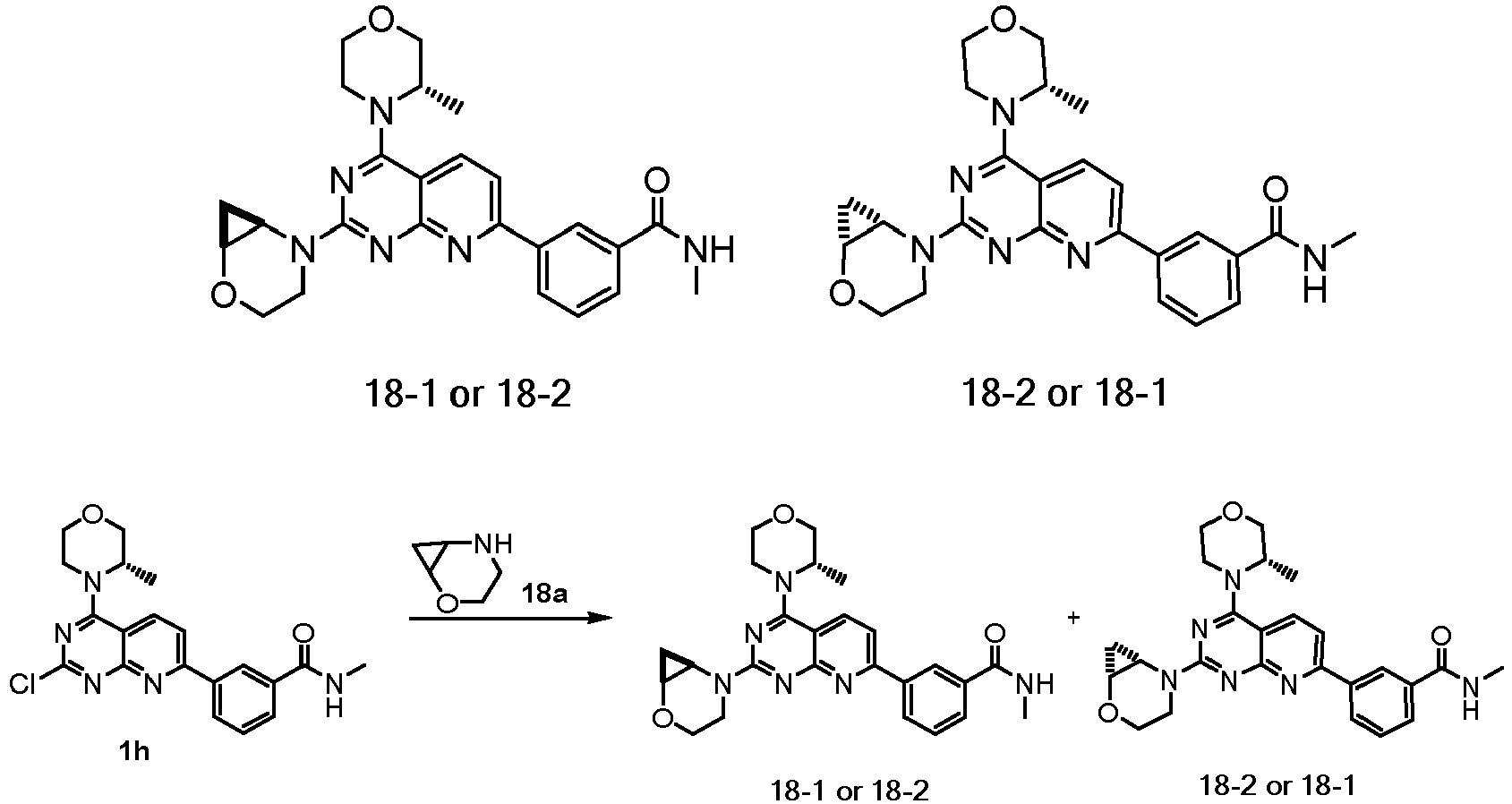
- Compound lh (100 mg, 251 µmol, 1 eq), 18a (34.1 mg, 251 µmol, 1 eq, HCl) and N, N-diisopropylethylamine (97.5 mg, 754 µmol, 131 µL, 3 eq) were dissloved in dimethyl sulfoxide (2 mL) and the mixture was reacted at 70 °C for 18 hours. After completion of the reaction, the reaction solution was purified by high performance liquid chromatography to give racemate, 50 mg of which was subjected to chiral separation to give compounds 18-1 and 18-2.
MS-ESI calculated for [M+H]+: 461, found: 461.
Peak position of compound 18-1: 3.032 min (chiral column: AD-3 150×4.6mm, mobile phase: 40% ethanol (0.05% diethylamine) + carbon dioxide, flow rate: 2.5 mL/min, column temperature: 40 °C).
18-1 NMR: 1H NMR (400 MHz, CDCl3) δ: 8.58 (br s, 1H), 7.84-8.23 (m, 3H), 7.41-7.59 (m, 2H), 6.52 (s, 1H), 4.39 (br s, 1H), 3.63-4.02 (m, 10H), 3.04-3.63 (m, 2H), 2.99 (d, J=4.8 Hz, 3H), 1.46 (s, 3H), 0.57-0.92 (m, 2H). - Peak position of compound 18-2: 3.587 min (chiral column: AD-3 150 × 4.6mm, mobile phase: 40% ethanol (0.05% diethylamine)+carbon dioxide, flow rate: 2.5 mL/min, column temperature: 40 °C).
18-2 NMR: 1H NMR (400 MHz, CDCl3) δ: 8.49-8.82 (m, 1H), 7.82-8.23 (m, 3H), 7.42-7.58 (m, 2H), 6.53 (br s, 1H), 4.39 (br s, 1H), 3.60-4.06 (m, 10H), 3.03-3.60 (m, 2H), 2.99 (d, J=4.8 Hz, 3H), 1.46 (s, 3H), 0.54-0.99 (m, 2H). -

- Compound 19a (50 mg, 223 µmol, 1eq), compound 19b (37.5 mg, 446 µmol, 40.8 µL, 2 eq), and p-toluenesulfonic acid (2.14 mg, 22.3 µmol, 1.59 µL, 0.1 eq) were dissolved in tetrahydrofuran (2 mL), and the mixture was reacted at 75 °C for 3 hours under nitrogen protection. After completion of the reaction, the reaction solution was concentrated to remove solvent, diluted with water (40 mL), added with saturated sodium bicarbonate solution (10 mL), extracted with ethyl acetate (20 mL×3). The organic phases were combined, dried over anhydrous sodium sulfate, filtered, and subjected to rotary evaporation under reduced pressure to dryness, and compound 19c was obtained.
MS-ESI calculated for [M+H]+ 308 and 310, found: 308 and 310. - Compound 19c (70 mg, 227µmol, 1 eq), bis(pinacolato)diboron (57.7 mg, 227 µmol, 1 eq), Pd (dppf)Cl2 (8.31 mg, 11.4 µmol, 0.05 eq), and sodium acetate (66.9 mg, 681 µmol, 3 eq) were dissolved in 1,4-dioxane (3 mL), and and the mixture was reacted at 100 °C for 16 hours under nitrogen protection. After completion of the reaction, 19e was obtained, which was directly used in the next step without treatment.
MS-ESI calculated for [M+H]+: 356, found: 356. - Compound 19d (80.7 mg, 227 µmol, 1 eq), compound 19e (68.0 mg, 227 µmol, 1 eq), tetrakis(triphenylphosphine) palladium (13.1 mg, 11.4 µmol, 0.05 eq) and sodium carbonate (72.2 mg, 681 µmol, 3 eq) were dissolved in water (1 mL) and 1,4-dioxane (3 mL), and the mxiture was reacted at 90 °C for 4 hours under nitrogen protection. After completion of the reaction, the reaction solution was concentrated to remove solvent, diluted with water (30 mL), and extracted with ethyl acetate (20 mL×3). The organic phases were combined, dried over anhydrous sodium sulfate, filtered, subjected to rotary evaporation under reduced pressure to dryness, and purified by column chromatography (100% ethyl acetate) to give 19f.
MS-ESI calculated for [M+H]+: 492 and 494, found: 492 and 494. - Compound 19f (90 mg, 166 µmol, 1 eq), 19g (24.9 mg, 166 µmol, 1 eq, HCl) and DIPEA (64.6 mg, 499 µmol, 87.0 µL, 3 eq) were dissolved in DMSO (2 mL). The mixed solution was allowed to react at 70 °C for 16 hours. After completion of the reaction, 19h was obtained, which was directly used in the reaction of next step without treatment.
MS-ESI calculated for [M+H]+: 569, found: 569. - HCl (6 M, 166.48 µL, 6 eq) was added to a solution of compound 19h (94.7 mg, 166 µmol, 1 eq) in DMSO (2 mL). The mixed solution was allowed to react at 20 °C for 66 hours. After completion of the reaction, the reaction solution was purified by high performance liquid chromatography to give 19.
MS-ESI calculated for [M+H]+:485, found: 485.
1H NMR (400 MHz, CDCl3) δ: 8.88 (s, 1H), 8.02-8.35 (m, 4H), 7.42-7.77 (m, 3H), 4.40 (br s, 1H), 4.01 (br d, J=10.4 Hz, 3H), 3.82-3.95 (m, 6H), 3.65-3.82 (m, 3H), 1.50 (d, J=6.8 Hz, 3H), 0.83 (s, 2H), 0.59-0.69 (m, 2H). -

- Compound 1f (60 mg, 151 µmol, 1 eq) and 20a (22.6 mg, 151 µmol, 1 eq) were dissolved in 0.8 mL tetrahydrofuran, followed by addtion of potassium tert-butoxide (29.0 mg, 302 µmol, 2 eq) and Ruphos-Pd-G3(12.6 mg, 15.1 µmol, 0.1 eq). The reaction solution was subjected to nitrogen replacement for 2 minutes, and allowed to react at 80 °C for an hour. After completion of the reaction, 1 mL water was added to the reaction solution, and the reaction solution was purified by high performance liquid chromatography to give 20.
1H NMR (400MHz, CDCl3) δ: 8.18 (s, 1H), 8.09 (d, J=8.0 Hz, 2H), 7.62-7.53 (m, 2H), 7.21 (s, 1H), 4.51-4.18 (m, 3H), 4.08-3.95 (m, 2H), 3.90-3.75 (m, 6H), 3.64 (s, 2H), 3.08 (d, J=5.0 Hz, 3H), 1.31 (s, 3H), 1.09-1.02 (m, 2H), 0.90 (s, 2H). -

- Compound 21a (5.46 g, 24.9 mmol, 3.27 mL, 1 eq) and sodium bicarbonate (6.27 g, 74.6 mmol, 2.90 mL, 3 eq) were dissolved in anhydrous tetrahydrofuran (80 mL), and then 21b (4.26 g , 74.6 mmol, 5.17 mL, 3 eq) was added dropwise. The mixed solution was allowed to react at 20 °C for 16 hours under nitrogen protection. After completion of the reaction, the reaction solution was filtered, and then the filtrate was concentrated to give 21c.
- Compound 21c (0.3 g, 1.25 mmol, 1 eq), 21d (476 mg, 1.87 mmol, 1.5 eq), Pd(dppf)Cl2 (36.6 mg, 50.0 µmol, 0.04 eq) and potassium acetate (368 mg, 3.75 mmol, 3 eq) were dissolved in anhydrous dioxane (25 mL), and the mixed solution was allowed to react at 90 °C for 2 hours under nitrogen protection. After the reaction was complete and the reaction solution was cooled, the reaction solution was concentrated under reduced pressure, followed by addition of 15 mL water and 60 mL (20 mL×3) ethyl acetate for extraction. The organic phase was then dried over anhydrous sodium sulfate, concentrated, and purified by column chromatography (42.5%-petroleum ether/ethyl acetate) to give 21e.
MS-ESI calculated for [M+H]+: 288, found: 288.
1H NMR (400 MHz, CDCl3) δ: 7.95-7.89 (m, 2H), 7.85 (d, J=7.6 Hz, 1H), 7.42-7.33 (m, 1H), 2.83 (qt, J=3.6, 7.07 Hz, 1H), 1.28 (s, 12H),.83-0.76 (m, 2H), 0.54-0.59 (m, 2H). - Compound 1f (0.1 g, 334 µmol, 1 eq), 21e (125 mg, 435 µmol, 1.3 eq), diisopropylamine tetrakis(triphenylphosphine) palladium (23.2 mg, 20.1 µmol, 0.06 eq) and potassium carbonate (139 mg, 1.00 mmol, 3 eq) were dissolved in anhydrous dioxane (10 mL) and water (2 mL), and the reaction solution was allowed to react at 70 °C for 4 hours. After completion of the reaction, the reaction solution was concentrated under reduced pressure, and then purified by column chromatography (20.2%-methanol/ethyl acetate) to give 21f.
MS-ESI calculated for [M+H]+: 424 and 426, found: 424 and 426. - Compound 21f (0.09 g, 212 µmol, 1 eq), 1i (31.8 mg, 212 µmol, 1 eq, HCl) and diisopropylamine (27.4 mg, 212 µmol, 37.0 µL, 1 eq) were dissolved in dimethyl sulfoxide (4 mL), the reaction solution was allowed to react at 70 °C for 15 hours. After completion of the reaction, the reaction solution was purified by high performance liquid chromatography to give 21.
MS-ESI calculated for [M+H]+: 501, found: 501.
1H NMR (400 MHz, CD3OD) δ: 8.60 (s, 1H), 8.31 (d, J=8 Hz, 1H), 8.28 (d, J=8.4 Hz, 1H), 4.52 (br d, J=6.0 Hz, 1H), 4.07-3.93 (m, 6H), 3.89-3.83 (m, 3H), 3.80-3.71 (m, 3H), 2.92-2.91 (m, 1H), 1.48 (d, J=6.8 Hz, 3H), 0.90-0.79 (m, 4H), 0.74-0.68 (m, 4H). -

- Compound 22a (5 g, 24.9 mmol, 1 eq) and compound 22b (3.79 g, 29.9 mmol, 2.61 mL, 1.2 eq) were dissolved in dichloromethane (50 mL), and DMF (18.2 mg, 249 µmol, 19.1 µL, 0.01 eq) was added dropwise. The reaction solution was allowed to react at room temperature for 2 hours. After completion of the reaction, compound 22c was obtained.
- Compound 22c (5.46 g, 29 mmol, 1 eq), compound 22d (7.28 g, 99.5 mmol, 10.5 mL, 4 eq) and DIPEA (12.9 g, 99.5 mmol, 17.3 mL, 4 eq) were dissolved in dichloromethane (50 mL), and the mxiture was reacted at room temperature for 5 hours. After completion of the reaction, the reaction solution was washed with water (50 mL×3). The organic phase was dried over anhydrous sodium sulfate, filtered, and subjected to rotary evaporation under reduced pressure to dryness to give 22e.
MS-ESI calculated for [M+H]+: 256 and 258, found: 256 and 258. - Compound 22e (300 mg, 1.17 mmol, 1 eq), compound 22f (356.9 mg, 1.41 mmol, 1.2 eq), potassium acetate (344 mg, 3.51 mmol, 3 eq) and Pd (dppf)Cl2 (42.9 mg, 58.6 µmol, 0.05 eq) were dissolved in 1,4-dioxane (10 mL). The reaction solution was allowed to react at 90 °C for 4 hours under nitrogen protection. After completion of the reaction, the reaction solution was concentrated to remove solvent, diluted with water (30 mL), extracted with ethyl acetate (20 mL×3), and the organic phases were combined, dried over anhydrous sodium sulfate, filtered, subjected to rotary evaporation under reduced pressure to dryness, and purified by column chromatography (40% ethyl acetate) to give 22g.
MS-ESI calculated for [M+H]+: 304, found: 304. - Compound 1f (98.7 mg, 330 µmol, 1 eq), 22g (100 mg, 330 µmol, 1 eq), sodium carbonate (105 mg, 989 µmol, 3 eq) and tetrakis(triphenylphosphine) palladium (19.1 mg, 16.5 µmol, 0.05 eq) were dissolved in 1,4-dioxane (3 mL) and water (1 mL). The reaction solution was allowed to react at 90 °C for 5 hours under nitrogen protection. After completion of the reaction, the reaction solution was concentrated to remove solvent, diluted with water (20 mL), and extracted with ethyl acetate (20 mL × 3). The organic phases were combined, dried over anhydrous sodium sulfate, filtered, subjected to rotary evaporation under reduced pressure to dryness, and purified by column chromatography (100% ethyl acetate) to give 22h.
MS-ESI calculated for [M+H]+ : 440 and 442, found: 440 and 442. - Compound 22h (60.0 mg, 136 µmol, 1 eq), 1i (20.4 mg, 136 µmol, 1 eq, HCl) and DIPEA (52.9 mg, 409 µmol, 71.3 µL, 3 eq) were dissolved in DMSO (3 mL). The mixed solution was allowed to react at 70 °C for 15 hours and purified by high performance liquid chromatography to give 22.
MS-ESI calculated for [M+H]+: 517, found: 517.
1H NMR (400 MHz, CDCl3) δ: 8.53 (s, 1H), 8.19 (d, J=8.0 Hz, 1H), 8.06 (d, J=8.6 Hz, 1H), 7.94 (d, J=7.8 Hz, 1H), 7.45-7.64 (m, 2H), 6.28 (br s, 1H), 4.32-4.48 (m, 1H), 3.62-4.24 (m, 12H), 1.43-1.61 (m, 12H), 0.58-0.95 (m, 4H). -

- Compound 23a (23.0 g, 328 mmol, 24.5 mL, 1.0 eq) and zinc diiodide (5.20 g, 16.4 mmol, 0.05 eq) were dissolved in 200 mL dichloromethane. The internal temperature thereof was lowered to 0 °C. Trimethylsilyl cyanide (39.1 g, 393 mmol, 49 mL, 1.2 eq) was added. The reaction solution was allowed to react at 25 °C for 18 hours. After completion of the reaction, the reaction solution was concentrated, followed by addition of 50 mL acetonitrile and 50 mL hydrochloric acid aqueous solution (1M). The reaction solution was stirred for 5 minutes at 25 °C, and extracted with ethyl acetate. The organic phase was dried, filtered, and concentrated by evaporation. The obtained residue was purified by silica gel chromatography (petroleum ether/ethyl acetate=100: 1-1: 1) to give 23b.
1H NMR (400 MHz, CDCl3) δ: 4.30 (s, 1H), 2.62-2.59 (m, 2H), 2.33-2.30 (m, 2H), 1.95-1.79 (m, 2H). - 23b (16.0 g, 164 mmol, 1 eq) was added into a solution of lithium aluminum hydride (9.38 g, 247 mmol, 1.5 eq) in tetrahydrofuran (300 mL) at 0 °C, and the mixture was allowed to react at 20 °C for 18 hours. After completion of the reaction, water (9.38 mL), 15% sodium hydroxide (9.38 mL) and water (28.1 mL) were sequentially added to the reaction solution, stirred for 15 minutes, filtered, and concentrated to give 23c.
1H NMR (400 MHz, CDCl3) δ: 2.72 (s, 2H), 2.12-1.76 (m, 7H), 1.7-1.63 (m, 1H), 1.49-1.33 (m, 1H). - Chloroacetyl chloride (2.23 g, 19.8 mmol, 1.6 mL, 1.0 eq) was added into a solution of 23c (2.0 g, 19.8 mmol, 1 eq) and diisopropylethylamine (4.0 g, 31.0 mmol, 5.4 mL, 1.6 eq) in dichloromethane (20.0 mL) at 0 °C. The reaction solution was reacted at 20 °C for 2 hours. After completion of the reaction, the reaction solution was concentrated and the residue was purified by silica gel chromatography (petroleum ether/ethyl acetate = 100: 1-1: 1) to give 23d.
1H NMR (400 MHz, CDCl3) δ: 6.99 (s, 1H), 4.17-4.02 (m, 2H), 3.50 (d, J = 6.0 Hz, 2H), 2.71 (s, 1H), 2.14-1.98 (m , 4H), 1.81-1.71 (m, 1H), 1.64-1.49 (m, 1H). - Compound 23d (2.2 g, 12.4 mmol, 1 eq) was added to anhydrous tetrahydrofuran (100 mL). The internal temperature thereof was lowered to 0 °C, and sodium hydride (1.49 g, 37.2 mmol, 60% purity, 3 eq) was added. The reaction solution was reacted at 20 °C for 18 hours. After completion of the reaction, water (15.0 mL) was added to the reaction solution. The reaction solution was extracted with ethyl acetate (20 mL×3), and the organic phases were combined, dried, filtered, and concentrated to give 23e.
1H NMR (400MHz, CDCl3) δ: 6.96 (s, 1H), 4.15 (s, 2H), 3.44-3.35 (m, 2H), 2.27-2.16 (m, 2H), 2.09-2.01 (m, 2H), 1.95-1.86 (m, 1H), 1.74-1.63 (m, 1H). - 23e (1.2 g, 8.5 mmol, 1 eq) was added to a solution of lithium aluminium hydride (645 mg, 17 mmol, 2 eq) in tetrahydrofuran (30 mL) at 0 °C, and the mixture was allowed to react at 20 °C for 18 hours. After completion of the reaction, water (0.7 mL), 15% sodium hydroxide (0.7 mL) and water (2.1 mL) were sequentially added to the reaction solution, stirred for 15 minutes, filtered, and concentrated to give 23f.
1H NMR (400 MHz, CDCl3) δ: 3.61-3.51 (m, 2H), 2.87-2.76 (m, 4H), 2.03-1.97 (m, 4H), 1.86-1.82 (m, 1H), 1.62-1.54 (m, 1H). - Compound 23f (53 mg, 414 µmol, 1.1 eq), 1h (150 mg, 377 µmol, 1 eq) and DIPEA (48 mg, 377 µmol, 66 µL, 1 eq) were dissolved in DMSO (4 mL). The mixed solution was allowed to react at 70 °C for 18 hours. After completion of the reaction, and the reaction solution was purified by high performance liquid chromatography to give 23.
MS-ESI calculated for [M+H]+: 489, found: 489.
1H NMR (400 MHz, CDCl3) δ: 8.63 (s, 1H), 8.22 (d, J=7.6 Hz, 1H), 8.05 (d, J=8.4 Hz, 1H), 7.97 (d, J=7.6 Hz, 1H), 7.65-7.41 (m, 2H), 6.53 (br s, 1H), 4.40 (d, J=6.8 Hz, 1H), 4.12-3.95 (m, 3H), 3.93-3.83 (m, 4H), 3.83-3.68 (m, 5H), 3.06 (d, J=4.8 Hz, 3H), 2.07-2.04 (m, , 4H), 1.91-1.80 (m, 1H), 1.77-1.70 (m, 1H), 1.50 (d, J=6.8 Hz, 3H). -

- Compound 24a (23.0 g, 273 mmol, 24.2 mL, 1 eq) and zinc diiodide (4.36 g, 13.7 mmol, 0.05 eq) were dissolved in 200 mL dichloromethane. The internal temperature thereof was cooled to 0 °C. Trimethylsilyl cyanide (32.6 g, 328 mmol, 41.1 mL, 1.2 eq) was added. The reaction solution was allowed to react at 25 °C for 18 hours. After completion of the reaction, the reaction solution was concentrated, followed by addition of 50 mL acetonitrile and 50 mL hydrochloric acid aqueous solution (1M). The reaction solution was stirred for 5 minutes at 25 °C, and extracted with ethyl acetate. The organic phase was dried, filtered, concentrated by evaporation. The obtained residue was purified by silica gel chromatography (petroleum ether/ethyl acetate=100: 1-1: 1) to give 24b.
1H NMR (400 MHz, CDCl3) δ: 3.27-3.20 (m, 1H), 2.10-2.06 (m, 4H), 1.87-1.80 (m, 4H). - 24b (16.0 g, 164 mmol, 1 eq) was added into a solution of lithium aluminum hydride (8.19 g, 216 mmol, 1.5 eq) in tetrahydrofuran (300 mL) at 0 °C, and the mixture was allowed to react at 20 °C for 18 hours. After completion of the reaction, water (8.19 mL), 15% sodium hydroxide (8.19 mL) and water (25 mL) were sequentially added to the reaction solution, stirred for 15 minutes, filtered, and concentrated to give 24c.
1H NMR (400MHz, CDCl3) δ: 2.74 (s, 2H), 1.90-1.55 (m, 9H), 1.54-1.47 (m, 2H). - Chloroacetyl chloride (1.96 g, 17.4 mmol, 1.38 mL, 1.0 eq) was added into a solution of 24c (2.0 g, 17.4 mmol, 1 eq) and diisopropylethylamine (3.37 g, 26.1 mmol, 4.54 mL, 1.5 eq) in dichloromethane (20 mL) at 0 °C. The reaction solution was reacted at 20 °C for 2 hours. After completion of the reaction, the reaction was concentrated and the residue was purified by silica gel chromatography (petroleum ether/ethyl acetate = 100: 1-1: 1) to give 24d.
1H NMR (400MHz, CDCl3) δ: 7.03 (s, 1H), 4.09 (s, 2H), 3.44 (d, J = 5.6 Hz, 2H), 2.00 (s, 1H), 1.89-1.77 (m, 2H), 1.67-1.64 (m, 6H). - Compound 24d (2.6 g, 13.6 mmol, 1 eq) was added to anhydrous tetrahydrofuran (100 mL). The internal temperature thereof was lowered to 0 °C, and sodium hydride (1.63 g, 40.7 mmol, 60%, 3 eq) was added. The reaction solution was allowed to react at 20 °C for 18 hours. After completion of the reaction, water (15.0 mL) was added to the reaction solution. The reaction solution was extracted with ethyl acetate (20 mL×3), and the organic phases were combined, dried, filtered, and concentrated to give 24e.
1H NMR (400MHz, CDCl3) δ: 6.79 (s, 1H), 4.19 (s, 2H), 3.38-3.33 (m, 2H), 1.74-1.64 (m, 8H). - 24e (1.8 g, 11.6 mmol, 1 eq) was added to a solution of lithium aluminium hydride (880.32 mg, 23.2 mmol, 2 eq) in tetrahydrofuran (50 mL) at 0 °C, and the mxiture was allowed to react at 20 °C for 18 hours. After completion of the reaction, water (0.9 mL), 15% sodium hydroxide (0.9 mL) and water (2.7 mL) were sequentially added to the reaction solution, stirred for 15 minutes, filtered, and concentrated to give crude product 24f.
- Compound 24f (159 mg, 1.13 mmol, 3 eq), 1h (150 mg, 377 µmol, 1 eq) and DIPEA (97.5 mg, 754 µmol, 131 µL, 2 eq) were dissolved in DMSO (4 mL). The mixed solution was allowed to react at 70 °C for 18 hours. After completion of the reaction, and the reaction solution was purified by high performance liquid chromatography to give 24.
MS-ESI calculated for [M+H]+: 503, found: 503.
1H NMR (400MHz, CDCl3) δ: 8.62 (s, 1H), 8.22 (d, J=8.0 Hz, 1H), 8.05 (d, J=8.4 Hz, 1H), 7.97 (d, J=8.0 Hz, 1H), 7.57 (t, J=8.0 Hz, 1H), 7.51 (d, J=8.4 Hz, 1H), 6.46 (s, 1H), 4.38 (d, J=5.6 Hz, 1H), 4.00 (d, J=10.8 Hz, 2H), 3.93-3.64 (m, 10H), 3.06 (d, J=4.8 Hz, 3H), 1.85-1.70 (m, 6H), 1.64 (s, 2H), 1.49 (d, J=6.8 Hz, 3H). -
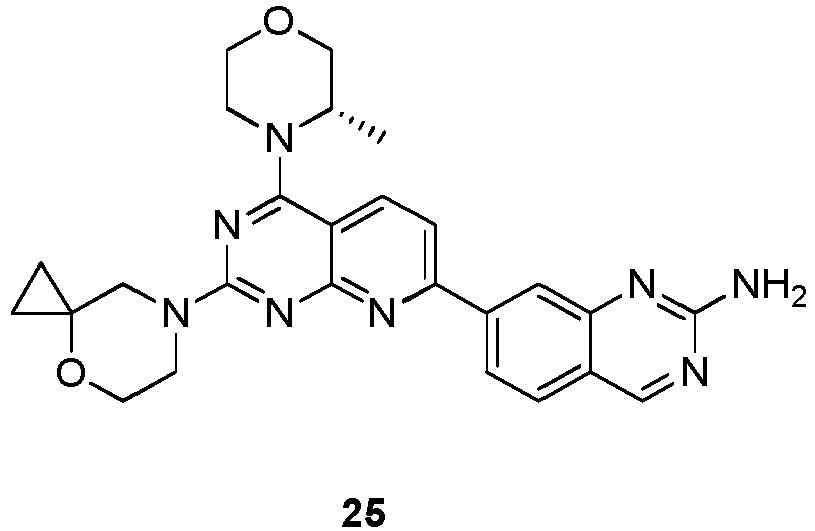

- Compound 25a (100 mg, 446 µmol, 1.0 eq), bis(pinacolato)diboron (136 mg, 536 µmol, 1.2 eq), potassium acetate (131 mg, 1.34 mmol, 3.0 eq) and Pd(dppf)Cl2 (16.4 mg, 22.4 µmol, 0.05 eq) were dissolved in anhydrous dioxane (5 mL), followed by ventilation for three times. The mixed solution was allowed to react at 90 °C for 16 hours under nitrogen atmosphere. After completion of the reaction, a reaction solution containing 25b was obtained, which was directly used in the next step.
MS-ESI calculated for [M+H]+: 190, found: 190. - The solution contanining compound 25b was added with compound 25c (133 mg, 446 µmol, 1.0 eq), tetrakis(triphenylphosphine) palladium (25.8 mg, 22.3 µmol, 0.05 eq), and sodium carbonate (142 mg, 1.34 mmol, 3.0 eq) dissolved in water (2 mL) and 1,4-dioxane (5 mL). The reaction solution was allowed to react at 80 °C for 17 hours under nitrogen protection. After completion of the reaction, the reaction solution was concentrated to remove solvent, diluted with water (10 mL), extracted with ethyl acetate (20 mL×3),. The organic phases were combined, dried over anhydrous sodium sulfate, filtered, subjected to rotary evaporation under reduced pressure to dryness, and purified by column chromatography (1:10 methanol/dichloromethane) to give 25d.
MS-ESI calculated for [M+H]+ 408, and 410, found: 408 and 410. - Compound 25d (30 mg, 73.5 µmol, 1.00 eq), 1i (10.0 mg, 66.8 µmol, 1.00 eq) and DIPEA (28.5 mg, 221 µmol, 3.00 eq) were dissolved in DMSO (2 mL). The mixed solution was allowed to react at 70 °C for 17 hours. After completion of the reaction, and the reaction solution was purified by high performance liquid chromatography to obtain compound 25.
MS-ESI calculated for [M+H]+: 485, found: 485.
1H NMR (400MHz, CDCl3) δ : 9.01 (s, 1H), 8.22 (br d, J=8.0 Hz, 1H), 8.09 (s, 1H), 8.01 (d, J=8.4 Hz, 1H), 7.75 (d, J=8.4 Hz, 1H), 7.50 (d, J=8.4 Hz, 1H), 5.18 (s, 2H), 4.31 (br s, 1H), 4.02 - 3.54 (m, 12H), 1.41 (d, J=6.4 Hz, 3H), 0.77 (s, 2H), 0.61 (br s, 2H). -


- Compound 26a (150 mg, 639 µmol, 1.00 eq), compound 26b (57.4 mg, 639 µmol, 1.00 eq) and diisopropylethylamine (248 mg, 1.92 mmol, 2.83 mL, 3.00 eq) were dissolved in dichloromethane (10 mL), and the mxiture was allowed to react at 20 °C for 2 hours. After completion of the reaction, the reaction solution was concentrated and purified by column chromatography (1: 5 methanol/dichloromethane) to give 26c.
- Compound 26c (0.12 g, 386 µmol, 1.00 eq), compound 26d (90.6 mg, 347 µmol, 0.90 eq), tetrakis (triphenylphosphine) palladium (22.3 mg, 19.3 µmol, 0.05 eq) and sodium carbonate (123 mg, 1.16 mmol, 3.00 eq) were dissolved in water (3 mL) and 1,4-dioxane (10 mL), and the mixture was allowed to react at 80 °C for 16 hours under nitrogen protection. After completion of the reaction, the reaction solution was concentrated to remove solvent, diluted with water (10 mL), extracted with ethyl acetate (20 mL × 3). The organic phases were combined, dried over anhydrous sodium sulfate, filtered, and subjected to rotary evaporation under reduced pressure to remove solvent, and purified by column chromatography (1: 5 methanol/dichloromethane) to give 26e.
- Compound 26e (70 mg, 171 µmol, 1.00 eq), 1i (30.7 mg, 205 µmol, 1.20 eq) and DIPEA (66.2 mg, 512 µmol, 89 µL, 3.00 eq) were dissolved in DMSO (3 mL). The mixed solution was allowed to react at 70 °C for 17 hours. After completion of the reaction, the reaction solution was purified by high performance liquid chromatography to give 26.
MS-ESI calculated for [M+H]+: 487, found: 487.
1H NMR (400MHz, CDCl3) δ : 8.62 (s, 1H), 8.21 (d, J=7.8 Hz, 1H), 8.06 (d, J=8.4 Hz, 1H), 7.98 (d, J=7.8 Hz, 1H), 7.56 (t, J=7.8 Hz, 1H), 7.49 (d, J=8.4 Hz, 1H), 6.59 (br s, 1H), 4.48 (br s, 2H), 4.13 (br d, J=12.8 Hz, 2H), 4.06 (br s, 2H), 3.94 (br s, 2H), 3.90-3.84 (m, 2H), 3.62 (br d, J=11.6 Hz, 2H), 3.06 (d, J=4.8 Hz, 3H), 2.06-1.90 (m, 4H), 0.89 - 0.82 (m, 2H), 0.69 (s, 2H). -

- Compound 15 (150 mg, 306 µmol, 1 eq) and formaldehyde (11.96 mg, 398 µmol, 11.0 µL, 1.3 eq) were dissolved in dichloroethane (10 mL) and acetic acid (2 mL), followed by addition of sodium cyanoborohydride (38.5 mg, 613 µmol, 2 eq). The mixed solution was allowed to react at 20 °C for 18 hours. After completion of the reaction, and the reaction solution was cooled, the reaction solution was concentrated under reduced pressure, and the obtained residue was purified by high performance liquid chromatography to give 27.
MS-ESI calculated for [M+H]+: 504, found: 504.
1H NMR (400 MHz, CD3OD) δ: 8.63 (s, 1H), 8.36-8.30 (m, 2H), 7.96 (d, J=8.0 Hz, 1H), 7.71 (d, J=8.6 Hz, 1H), 7.65 (t, J=7.8 Hz, 1H), 4.63 (br s, 2H), 4.17-3.85 (m, 7H), 3.83-3.67 (m, 8H), 2.99 (s, 3H), 2.61 (s, 3H), 1.51 (d, J=6.8 Hz, 3H). -
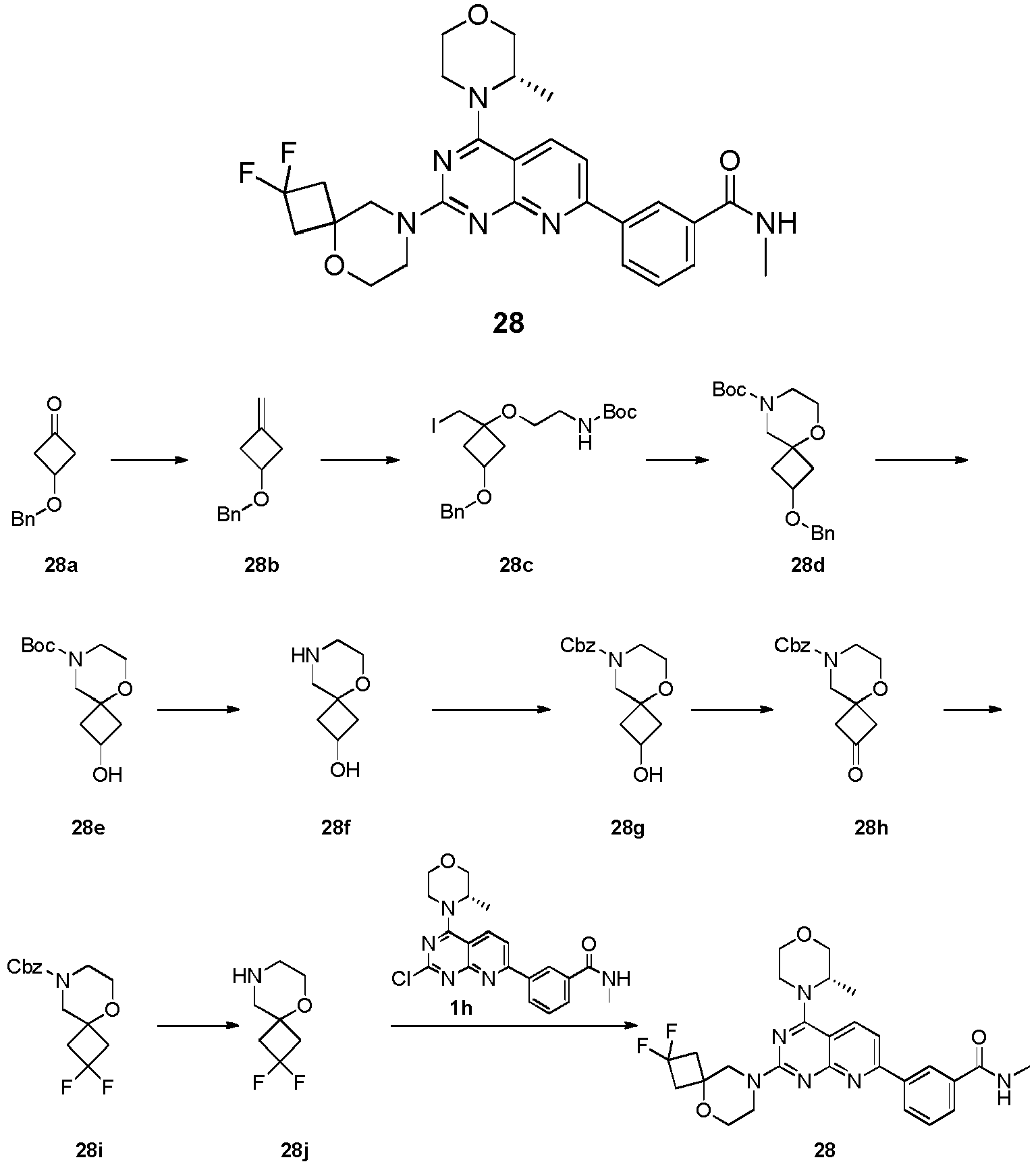
- The compound methyltriphenylphosphonium bromide (25.9 g, 72.6 mmol, 1.6 eq) was dissolved in 350 mL tetrahydrofuran, followed by additon of potassium tert-butoxide (1 M, 81.7 mL, 1.8 eq) at 20 °C. The reaction solution was allowed to react at 20 °C for 3 hours. 28a (8.0 g, 45.4 mmol, 1 eq) was added to the reaction solution, and the reaction was carried out for 18 hours. After completion of the reaction, water (200 mL) and ethyl acetate (300 mL) were added thereto for extraction. The organic phase was washed with saturated brine (100 mL×3), dried, filtered, and concentrated. The residue was purified by silica gel chromatography (petroleum ether/ethyl acetate = 100: 1-1: 1) to give 28b.
1H NMR (400 MHz, CDCl3) δ: 7.36-7.31 (m, 5H), 4.87-4.85 (m, 2H), 4.46 (s, 2H), 4.45-4.08 (m, 1H), 2.89-2.86 (m , 2H), 2.78-2.73 (m, 2H). - NIS (2.32 g, 10.3 mmol, 1.2 eq) was added to a solution of 28b (1.5 g, 8.61 mmol, 640 µL, 1 eq) and tert-butyl N-(2-hydroxyethyl) formate (1.67 g, 10.3 mmol, 1.60 mL, 1.2 eq) in acetonitrile (14 mL), and the mixture was allowed to react at 20 °C for 4 hours. After completion of the reaction, the reaction solution was sequentially added with water (20 mL) and ethyl acetate (30 mL) for extraction, dried, filtered, and concentrated. The residue was purified by silica gel chromatography (petroleum ether/ethyl acetate = 100: 1-1: 1) to give 28c.
1H NMR (400MHz, CDCl3) δ: 7.33-7.30 (m, 5H), 5.01-4.97 (m, 1H), 4.44-4.43 (m, 2H), 3.79-3.71 (m, 1H), 3.33-3.32 (m , 3H), 2.45-2.40 (m, 5H), 2.03-2.02 (m, 1H), 1.46 (s, 9H). - Compound 28c (1.8 g, 3.90 mmol, 1 eq) was added to anhydrous tetrahydrofuran (50 mL). The internal temperature was lowered to 0 °C, followed by addition of sodium hydride (312 mg, 7.80 mmol, 60%, 2 eq). The reaction solution was reacted at 20 °C for 18 hours. After completion of the reaction, the reaction solution was extracted with water (50.0 mL) and ethyl acetate (50 mL). The organic phases were combined, dried, filtered, and concentrated. The residue was purified by silica gel chromatography (petroleum ether/ethyl acetate = 100: 1-1: 1) to give 28d.
1H NMR (400MHz, CDCl3) δ: 7.33-7.20 (m, 5H), 4.63-4.09 (m, 3H), 3.52-3.50 (m, 2H), 3.37 (s, 1H), 3.30 (s, 2H), 3.18 (s, 1H), 2.35 (s, 1H), 2.28-2.15 (m, 1H), 1.97-1.85 (m, 2H), 1.43-1.28 (m, 9H). - Compound 28d (2.6 g, 13.6 mmol, 1 eq) was added to ethyl acetate (15 mL), and wet palladium on carbon (0.1 g, 10%) was added thereto. Nitrogen replacement was performed for three times. The reaction solution was allowed to react at 25 °C for 2 hours under this atmosphere (15 psi). After completion of the reaction, the reaction solution was filtered, and concentrated to give 28e. The crude product was directly used in the next step.
- HCl/EtOAc (4 M, 10 mL, 27 eq) was added to a reaction flask containing 28e (360 mg, 1.48 mmol, 1 eq) and ethyl acetate (4 mL), and the mxiture was reacted at 20 °C for 2 hours. After completion of the reaction, the reaction solution was concentrated to give crude product 28f, which was directly used in the next step.
- Compound 28f (210 mg, 1.47 mmol, 1 eq) and DIPEA (381 mg, 2.95 mmol, 513 µL, 2 eq) were dissolved in dichloromethane (5 mL), and benzyl chloroformate (302 mg, 1.77 mmol, 251 µL, 1.2 eq) was added to the reaction solution. The mixture was reacted at 20 °C for 18 hours. After completion of the reaction, the reaction solutin was added with water (30.0 mL) and ethyl acetate (20 mL×3) for extraction. The organic phases were combined, dried, filtered, and concentrated, and the residue was purified by silica gel chromatography (petroleum ether/ethyl acetate = 100 : 1-1: 1) to give 28g.
1H NMR (400MHz, CDCl3) δ: 7.43-7.29 (m, 5H), 5.23-5.10 (m, 2H), 4.55- 4.10 (m, 1H), 3.61 (s, 2H), 3.55 (s, 1H), 3.47-3.45 (m, 2H), 3.34 (s, 1H), 2.60-2.30 (m, 2H), 1.95-1.93 (m, 2H). - Compound 28g (320 mg, 1.15 mmol, 1 eq) was dissolved in dichloromethane (5 mL), and DMP (636 mg, 1.50 mmol, 1.3 eq) was added to the reaction solution. The reaction was carried out at 20 °C for 2 hours. After completion of the reaction, the reaction solution was concentrated, and the residue was purified by silica gel chromatography (petroleum ether/ethyl acetate = 100: 1-1: 1) to give 28h.
- 1H NMR (400MHz, CDCl3) δ: 7.46-7.30 (m, 5H), 5.16 (s, 2H), 3.71 (s, 2H), 3.62 (s, 2H), 3.58-3.52 (m, 2H), 3.15- 3.07 (m, 2H), 2.98 (s, 2H).
- Compound 28h (200 mg, 727 µmol, 1 eq) was dissolved in dichloromethane (1 mL), and N, N-diethylsulfur trifluoride (703 mg, 4.36 mmol, 576 µL, 6 eq) was added into the reaction solution. The reaction solution was carried out at 20 °C for 18 hours. After completion of the reaction, the reaction solution was added with water (40.0 mL) and dichloromethane (30 mL×3). The organic phases were combined, dried, filtered, concentrated, and the residue was purified by silica gel column chromatography (petroleum ether/ethyl acetate=100: 1-1: 1) to give 28i.
- Compound 28i (180 mg, 606 µmol, 1 eq) was added to methanol (5 mL), and wet palladium on carbon (0.01 g, 10%) was added thereto. Hydrogen replacement was performed for three times, and the reaction was carried out at 20 °C for 2 hours under this atmosphere (15 psi). After completion of the reaction, the reaction solution was filtered, and concentrated to give 28j. The crude product was directly used in the next step.
- Compound 28j (42 mg, 257 µmol, 1 eq), 1h (102 mg, 257 µmol, 1 eq) and N, N-diisopropylethylamine (66.5 mg, 514 µmol, 89.7 µL, 2 eq) were dissolved in DMSO (1 mL) and the obtained mixed solution was allowed to react at 70 °C for 18 hours. After completion of the reaction, the reaction solution was purified by high performance liquid chromatography to give 28.
MS-ESI calculated for [M+H]+: 525, found: 525.
1H NMR (400MHz, CDCl3) δ: 8.54 (s, 1H), 8.15 (d, J=8.0 Hz, 1H), 7.99 (d, J=8.4 Hz, 1H), 7.89 (d, J=8.0 Hz, 1H), 7.54-7.41 (m, 2H), 6.38 (br s, 1H), 4.36 (br s, 1H), 4.06-3.84 (m, 6H), 3.79-3.53 (m, 6H), 2.99 (d, J=4.8 Hz, 3H), 2.73-2.46 (m, 4H), 1.44 (d, J=6.8 Hz, 3H). -

- Compound 29a (109 mg, 257 µmol, 1 eq), 29b (42 mg, 257 µmol, 1 eq) and N, N-diisopropylethylamine (66.5 mg, 514.82 µmol, 89.7 µL, 2 eq) were dissloved in DMSO (1 mL), the mixed solution was allowed to react at 70 °C for 18 hours. After completion of the reaction, the reaction solution was purified by high performance liquid chromatography to give 29.
MS-ESI calculated for [M+H]+: 551, found: 551.
1H NMR (400MHz, CDCl3) δ: 8.57 (s, 1H), 8.20 (d, J=8.0 Hz, 1H), 8.07 (d, J=8.4 Hz, 1H), 7.98 (d, J=8.0 Hz, 1H), 7.61-7.47 (m, 2H), 6.56 (s, 1H), 4.43 (d, J=6.4 Hz, 1H), 4.12-4.05 (m, 2H), 4.03-3.92 (m, 4H), 3.88-3.83 (m, 1H), 3.80-3.70 (m, 5H), 3.01-2.92 (m, 1H), 2.76-2.57 (m, 4H), 1.53-1.50 (m, 3H), 0.98-0.87 (m, 2H), 0.76-0.60 (m, 2H). -

- Methyltriphenylphosphonium bromide (102 g, 285 mmol, 2 eq) and potassium tert-butoxide (1 M, 257 mL, 1.8 eq) were dissolved in tetrahydrofuran (500 mL), the mxiture was reacted at room temperature for an hour, followed by additon of compound 30a (10.0 g, 143 mmol, 10.7 mL, 1 eq). After reacting at room temperature for 17 hours, and the reaction mixture was distilled at 80 °C to give compound 30b distillate.
1H NMR (400 MHz, CDCl3) δ: 4.51 (dt, J= 1.13, 2.32 Hz, 2H), 3.71-3.48 (m, 2H), 2.61-2.46 (m, 2H), 1.81-1.74 (m, 2H) . - Compound 30b (30.0 g, 17.6 mmol, 1 eq), compound 30c (3.70 g, 21.1 mmol, 1.2 eq), N-iodosuccinimide (4.76 g, 21.1 mmol, 1.2 eq) were dissolved in tetrahydrofuran (10.0 mL), the mixture was reacted at room temperature for 24 hours. After completion of the reaction, the reaction solution was concentrated to remove solvent, diluted with water (100 mL), and extracted with ethyl acetate (50.0 mL×3). The organic phase was dried over anhydrous sodium sulfate, filtered, subjected to rotary evaporation under reduced pressure to dryness, and purified by column chromatography (20% ethyl acetate) to give compound 30d.
MS-ESI calculated for [M+H]+: 370, found: 270. - Compound 30d (30.9 g, 2.44 mmol, 1 eq), sodium hydride (195 mg, 4.87 mmol, 60% purity, 2 eq) were dissolved in tetrahydrofuran (10.0 mL), and the mxiture was reacted at 65 °C for 16 hours. After completion of the reaction, the reaction was terminated by addition of water (50.0 mL), extracted with ethyl acetate (50.0 mL × 3). The organic phases were combined, dried over anhydrous sodium sulfate, filtered, and subjected to rotary evaporation under reduced pressure to dryness, and compound 30e was obtained.
MS-ESI calculated for [M+H]+:242, found: 142. - Compound 30e (0.18 g, 746 µmol, 1 eq) was dissolved in hydrochloric acid/ethyl acetate (20.0 mL), and the mixture was reacted and strried for 5 hours. After completion of the reaction, the reaction solution was subjected to rotary evaporation to remove solvent, and 30f was obtained.
MS-ESI calculated for [M+H]+: 142, found: 142. - Compound 1h (141 mg, 354 µmol, 0.25 eq), 30f (200 mg, 1.42 mmol, 1 eq, HCl), and DIPEA (549 mg, 4.25 mmol, 740 µL, 3 eq) were dissolved in DMSO (5.00 mL). The mixed solution was allowed to react at 70 °C for 16 hours, and purified by high performance liquid chromatography to give 30.
MS-ESI calculated for [M+H]+: 503, found: 503.
1H NMR (400 MHz, CDCl3) δ: 8.65 (s, 1H), 8.22 (br d, J=7.8 Hz, 1H), 8.07 (d, J=8.4 Hz, 1H), 7.99 (br d, J=7.8 Hz, 1H), 7.63-7.48 (m, 2H), 6.56 (br s, 1H), 4.81 (br d, J=13.6 Hz, 2H), 4.42 (br d, J=5.6 Hz, 1H), 4.08-3.97 (m, 1H), 3.96-3.67 (m, 6H), 3.58 (d, J=11.6 Hz, 1H), 3.18 (br d, J=13.2 Hz, 1H), 3.08 (d, J=4.8 Hz, 3H), 2.26-1.93 (m, 4H), 1.93-1.77 (m, 2H), 1.52 (d, J=6.8 Hz, 3H), 1.36 (br d, J=6.8 Hz, 3H). -
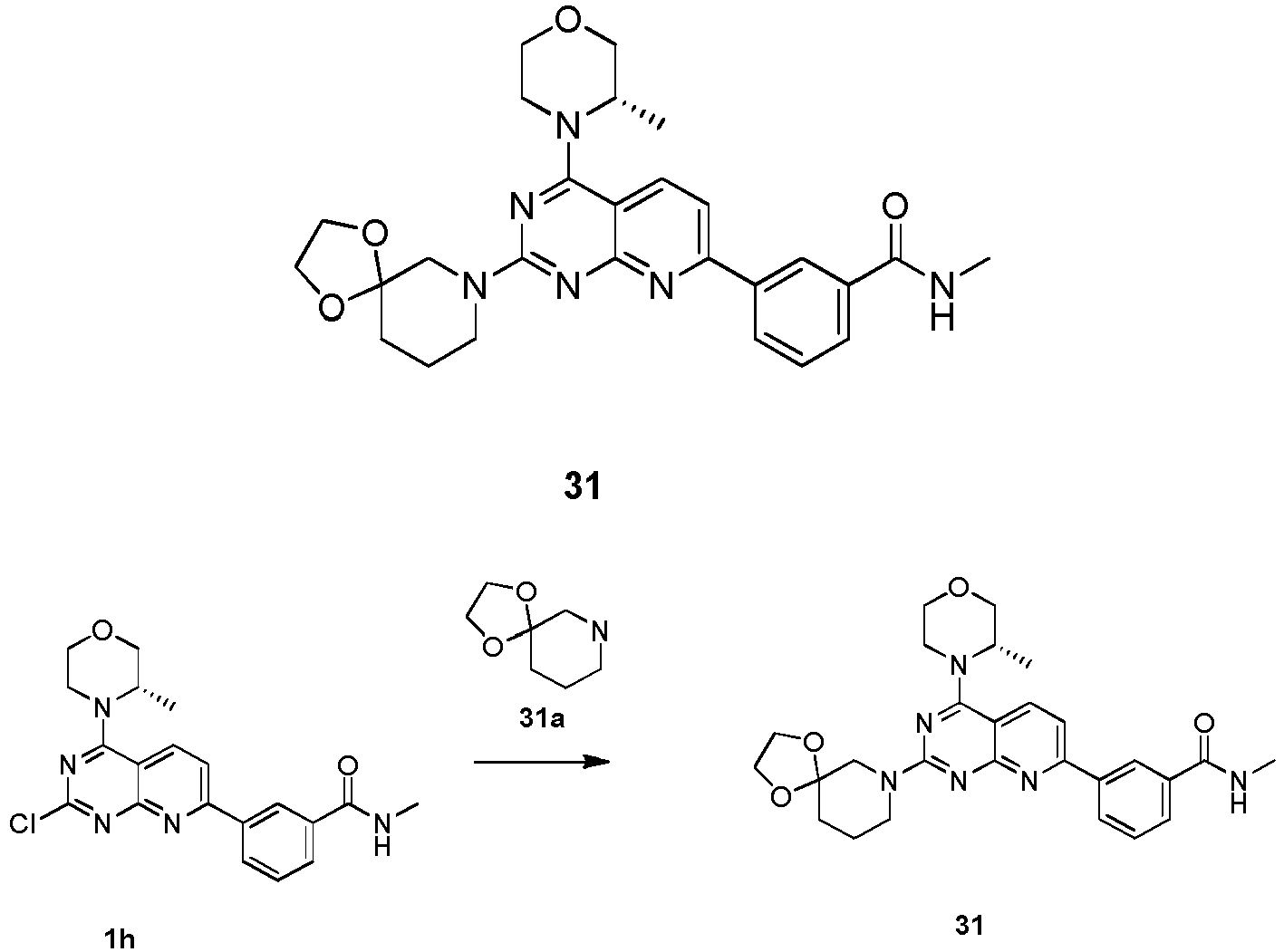
- Compound 1h (100 mg, 251 µmol, 1.00 eq), 31a (36.0 mg, 251 µmol, 1.00 eq), and DIPEA (97.5 mg, 754 µmol, 131 µL, 3.00 eq) were dissolved in DMSO (3.00 mL). The mixed solution was allowed to react at 90 °C for 18 hours. After completion of the reaction, the reaction solution was purified by high performance liquid chromatography to give 31.
MS-ESI calculated value [M+H]+: 505, found: 505.
1H NMR (400MHz, CDCl3) δ:8.57 (br s, 1H), 8.11 (br d, J=7.2Hz, 1H), 7.95 (br d, J=8.4 Hz, 1H), 7.91 (br d, J=8.0, 1H), 7.48 (br t, J=8.0, 1H), 7.41 (br d, J=8.4Hz, 1H), 6.53 (br s, 1H), 4.31 (br s, 1H), 4.01-3.52 (m,14H), 2.99 (d, J=4.8 Hz, 3H), 1.67 (br s, 4H), 1.41 (br d, J=6.8 Hz, 3H). -

- Compound 1h (280 mg, 704 µmol, 1.00 eq), 32a (101 mg, 703.8 µmol, 1.00 eq), and DIPEA (273 mg, 2.11 mmol, 131 µL, 3.00 eq) were dissolved in DMSO (5 mL). The mixed solution was allowed to react at 80 °C for 18 hours. After completion of the reaction, the reaction solution was purified by high performance liquid chromatography, further subjected to SFC chiral separation to give compounds 32-1 and 32-2.
- Peak position of compound 32-1: 2.105min (chiral column: AD-3 100 × 4.6mm, I.D., 3µm, mobile phase: 40% ethanol (0.05% diethylamine) + carbon dioxide, flow rate: 2.8 mL/min, column temperature: 40 °C)
- Compound 32-1 MS-ESI calculated for [M+H]+: 505, found: 505.
- Compound 32-1 1H NMR (400MHz, CDCl3) δ:.56 (s, 1H), 8.13 (br d, J=8.0 Hz, 1H), 7.98 (d, J=8.0z, 1H), 7.90 (d, J=7.8 Hz, 1H), 7.54-7.39 (m, 2H), 6.50 (br s, 1H), 4.34 (br d, J=7.2Hz, 1H), 4.03-3.55 (m, 16H), 2.99 (d, J=4.8 Hz, 3H), 2.09-1.87 (m, 2H), 1.42 (d, J=6.8 Hz, 3H).
- Peak position of compound 32-2: 2.632min (chiral column: AD-3 100 × 4.6mm, I.D., 3µm, mobile phase: 40% ethanol (0.05% diethylamine) + carbon dioxide, flow rate: 2.8mL/min, column temperature: 40 °C)
- Compound 32-2 MS-ESI calculated for [M+H]+: 505, found: 505.
- Compound 32-2 1H NMR (400MHz, CDCl3) δ: .56 (s, 1H), 8.13 (d, J=8.0 Hz, 1H), 7.98 (d, J=8.4Hz, 1H), 7.90 (d, J=7.8 Hz, 1H), 7.53-7.42 (m, 2H), 6.52 (br s, 1H), 4.34 (br d, J=6.4Hz, 1H), 4.04-3.54 (m, 16H), 2.98 (d, J=4.8 Hz, 3H), 2.08-1.88 (m, 2H), 1.42 (d, J=6.8 Hz, 3H).
-

- The compound methyltriphenylphosphonium bromide (32.4 g, 90.8 mmol, 1.6 eq) was dissolved in a solution of potassium tert-butoxide (11.5 g, 102 mmol, 1.8 eq) in anhydrous tetrahydrofuran (400 mL) at room temperature (20 °C). The mixed solution was allowed to react at room temperature for 3 hours, and then 33a (10.0 g, 56.8 mmol, 1 eq) was added dropwise to the solution, and the mixed solution was allowed to react at 20 °C for 17 hours. After completion of the reaction, TLC detection showed that new compound spot appeared. The reaction solution was added with water (100 mL), and extracted with ethyl acetate (200 mL×3). The organic phase was treated with anhydrous sodium sulfate, concentrated under reduced pressure, and purified by column chromatography (50%-ethyl acetate/petroleum ether) to give 33b.
1H NMR (400 MHz, CDCl3) δ: 7.23-7.13 (m, 5H), 4.74 (br s, 2H), 4.34-4.27 (m, 2H), 4.00-3.92 (m, 1H), 2.80-2.71 (m , 2H), 2.68-2.58 (m, 2H). - Compound 33b (8.7 g, 49.9 mmol, 1 eq) and N-Boc ethanolamine (9.66 g, 59.9 mmol, 9.29 mL, 1.2 eq) were dissolved in acetonitrile (90.0 mL), followed by addition of N-iodosuccinimide (13.5 g, 59.9 mmol, 1.2 eq). The mixed solution was allowed to react at 20 °C for 18 hours. After completion of the reaction, TLC detection showed that new compound spot appeared. The reaction solution was added with water (30.0 mL), extracted with ethyl acetate (30 mL × 2). The organic phase was treated with anhydrous sodium sulfate, concentrated under reduced pressure, and purified by column chromatography (35.5%-ethyl acetate/petroleum ether) to give 33c.
1H NMR (400 MHz, CDCl3) δ: 7.37-7.32 (m, 5H), 5.03 (br d, J = 10.8 Hz, 1H), 4.44 (d, J = 9.6 Hz, 2H), 3.79-3.67 (m, 1H), 3.34 (br d, J = 5.6 Hz, 3H), 2.59-2.37 (m, 3H), 2.31-2.11 (m, 2H), 2.08-1.98 (m, 1H), 1.52-1.42 (m, 9H). - Compound 33c (4 g, 8.67 mmol, 1 eq) was dissolved in N,N-dimethylacetamide (160 mL), and then sodium hydride (694 mg, 60% purity, 2 eq) was added to the obtained solution in ice bath. The reaction solution was allowed to react at 20 °C for 17 hours. After completion of the reaction, the reaction solution was poured into a saturated ammonium chloride aqueous solution (30 mL), added with water (60.0 mL), extracted with ethyl acetate (50 mL×3). The organic phase was treated with anhydrous sodium sulfate, concentrated under reduced pressure, and purified by column chromatography (30%-ethyl acetate/petroleum ether) to give 33d.
1H NMR (400 MHz, CDCl3) δ: 7.38-7.32 (m, 5H), 4.47-4.40 (m, 2H), 4.23-4.15 (m, 1H), 3.62-3.53 (m, 2H), 3.45 (s, 1H), 3.41-3.32 (m, 2H), 3.25 (s, 1H), 2.43 (br s, 1H), 2.35-2.27 (m, 1H), 2.04 (s, 2H), 1.46 (d, J = 5.2 Hz, 9H). - Compound 33d (1.00 g, 3.00 mmol, 1 eq) was dissolved in methanol (30.0 mL), and then palladium hydroxide (421 mg, 20% purity, 0.2 eq) was added to the solution under nitrogen atmosphere. Hydrogen replacement was performed for several times. The reaction solution was allowed to react at 50 °C for 50 hours under hydrogen atomsphere of 50 psi. After completion of the reaction, the reaction solution was filtered, and the filtrate was concentrated under reduced pressure to give 33e.
1H NMR (400 MHz, CDCl3) δ: 4.06-3.87 (m, 1H), 3.51 (br s, 2H), 3.42-3.36 (m, 2H), 3.34-3.26 (m, 2H), 3.21-3.14 (m , 1H), 2.47-2.38 (m, 1H), 2.35-2.25 (m, 1H), 1.92-1.79 (m, 2H), 1.39 (s, 9H). - Compound 33e (0.28 g, 1.15 mmol, 1 eq) was dissolved in ethyl acetate (10.0 mL), and then hydrochloric acid/ethyl acetate (4 M, 10 mL, 34.8 eq) was added to the solution. The reaction solution was allowed to react at 20 °C for 6 hours. After completion of the reaction, the reaction solution was concentrated under reduced pressure to give 33f.
- Compound 1h (0.3 g, 754 µmol, 1 eq) was dissolved in dimethyl sulfoxide (10.0 mL), and then N, N-diisopropylethylamine (292 mg, 2.26 mmol, 3 eq) and 33f (162 mg, 902 µmol, 1.20 eq, HCl) were added to the solution. The reaction solution was allowed to react at 70 °C for 25 hours. After completion of the reaction, water (12 mL) was added to the reaction solution, and extracted with ethyl acetate (10.0 mL × 3). The organic phase was treated with anhydrous sodium sulfate, concentrated under reduced pressure, purified by column chromatography (12.8%-methanol/dichloromethane), and subjected to chiral resolution to give 33-1 and 33-2.
- Peak position of compound 33-1: 1.672 min (chiral column: AD-3 100 × 4.6mm, I.D., 3 µm, mobile phase: 40% isopropanol (0.05% diethylamine) + carbon dioxide, flow rate: 2.8mL/min, column temperature: 40 °C)
- Compound 33-1 MS-ESI calculated for [M+H]+: 505, found: 505.
- Compound 33-1 1H NMR (400 MHz, CD3OD) δ: 8.62 (s, 1H), 8.34 (d, J=8.4 Hz, 1H), 8.29 (d, J=8.4 Hz, 1H), 7.96 (d, J=8.4 Hz, 1H), 7.68 (d, J=8.4 Hz, 1H), 7.66-7.62 (m, 1H), 4.54 (br d, J=7.2 Hz, 1H), 4.12 (br s, 1H), 4.04-3.93 (m, 3H), 3.93-3.70 (m, 10H), 3.02-2.97 (m, 3H), 2.56-2.52 (m, 2H), 1.96-1.92 (m, 2H), 1.51 (d, J=6.8 Hz, 3H).
- Peak position of compound 33-2: 3.338 min (chiral column: AD-3 100 × 4.6mm, I.D., 3µm, mobile phase: 40% isopropanol (0.05% diethylamine) + carbon dioxide, flow rate: 2.8mL/min, column temperature: 40 °C)
- Compound 33-2: MS-ESI calculated for [M+H]+: 505, found: 505.
- Compound 33-2 1H NMR (400 MHz, CD3OD) δ: 8.62 (s, 1H), 8.33 (d, J=7.8 Hz, 1H), 8.28 (d, J=8.4 Hz, 1H), 7.96 (d, J=7.8 Hz, 1H), 7.67 (d, J=8.4 Hz, 1H), 7.66-7.62 (m, 1H), 4.57 (br d, J=7.2 Hz, 1H), 4.44-4.36 (m, 1H), 4.08-3.95 (m, 4H), 3.95-3.85 (m, 3H), 3.82-3.70 (m, 5H), 2.99 (s, 3H), 2.43-2.40 (m, 2H), 2.04-1.95 (m, 2H), 1.51 (d, J=6.8 Hz, 3H).
-


- Compound 34a (0.27 g, 1.11 mmol, 1 eq) was dissolved in anhydrous tetrahydrofuran (20.0 mL). The obtain mixed solution was carefully added with sodium hydride (133 mg, 60% purity, 3 eq) and iodomethane (1.19 g, 522 µL, 7.55 eq) at 0 °C. The reaction solution was gradually warmed to room temperature, and the mixture was reacted at room temperature for 3 hours. After completion of the reaction, TLC detection showed that new compound spot appeared. The reaction solution was concentrated under reduced pressure to give 34b.
- Compound 34b (0.10 g, 389 µmol, 1 eq) was dissolved in ethyl acetate (8 mL). The obtained solution was added with hydrochloric acid/ethyl acetate (4 M, 8.0 mL, 82.34 eq). The mixed solution was allowed to react at 20 °C for 18 hours. After completion of the reaction TLC detection showed that new compound spot appeared. The reaction solution was concentrated under reduced pressure to give 34c.
- Compound 1h (0.1 g, 251 µmol, 1 eq) was dissolved in dimethyl sulfoxide (5.00 mL). The obtained solution was added with N, N-diisopropylethylamine (65.0 mg, 87.6 µL, 2 eq) and 34c (73.0 mg, 377 µmol, 1.5 eq, HCl). The reaction solution was allowed to react at 70 °C for 22 hours. After completion of the reaction, water (20.0 mL) was added to the reaction solution, and extracted with ethyl acetate (15.0 mL × 3). The organic phase was treated with anhydrous sodium sulfate, concentrated under reduced pressure, purified by column chromatography (100%-ethyl acetate/ petroleum ether), and subjected to chiral resolution to give 34-1 and 34-2.
- Peak position of compound 34-1: 2.407 minute (chiral column: OD-3 50 × 4.6mm, I.D., 3µm, mobile phase: A: CO2, B: ethanol (0.05% diethylamine), the content of B was maintained at 5% for 0.2 minute, then increased from 5% to 40% gradient within 1.4 min, then maintained at 40% for 1.05 min, and finally maintained at 5% for 0.35 min, flow rate: 4mL/min, column temperature: 40 °C)
- Compound 34-1 MS-ESI calculated for [M+H]+: 519, found: 519.
- Compound 34-1 1H NMR (400 MHz, CD3OD) δ: 8.64-8.60 (m, 1H), 8.34 (d, J=8.4 Hz, 1H), 8.29 (d, J=8.4 Hz, 1H), 7.96 (dd, J=1.2, 8.0 Hz, 1H), 7.68 (d, J=8.4 Hz, 1H), 7.66-7.61 (m, 1H), 4.55 (br d, J=7.2 Hz, 1H), 4.06-3.93 (m, 3H), 3.92-3.70 (m, 10H), 3.28 (s, 3H), 2.99 (s, 3H), 2.56-2.48 (m, 2H), 1.96-1.86 (m, 2H), 1.51 (d, J=6.8 Hz, 3H).
- Peak position of compound 34-2: 1.807 minute (chiral column: OD-3 50×4.6mm, I.D., 3µm, mobile phase: A: CO2, B: ethanol (0.05% diethylamine), the content of B was maintained at 5% for 0.2 min, then increased from 5% to 40% gradient within 1.4 min, then maintained at 40% for 1.05 min, and finally maintained at 5% for 0.35 min, flow rate: 4mL/min, column temperature: 40 °C)
- Compound 34-2 MS-ESI calculated for [M+H]+: 519, found: 519.
- Compound 34-2 1H NMR (400 MHz, CD3OD) δ: 8.62 (s, 1H), 8.33 (d, J=8.03 Hz, 1H), 8.29 (d, J=8.4 Hz, 1H), 7.96 (d, J=8.4 Hz, 1H), 7.68 (d, J=8.4 Hz, 1H), 7.66-7.62 (m, 1H), 4.57 (br d, J=6.0 Hz, 1H), 4.08-3.97 (m, 5H), 3.94-3.2 (m, 8H), 3.27 (s, 3H), 2.99 (s, 3H), 2.39-2.27 (m, 2H), 2.09-2.01(m, 2H), 1.51 (d, J=6.8 Hz, 3H).
-


- Compound 1f (2 g, 6.0 mmol, 1 eq), 35a (993 mg, 6.0 mmol, 1 eq), sodium carbonate (1.9 g, 18.1 mmol, 3 eq), dichlorobis(triphenylphosphine) palladium (211 mg, 301 µmol, 0.05 eq) were dissolved in anhydrous dioxane (35 mL) and water (7.0 mL), and the obtained solution was reacted at 70 °C for 19 hours under nitrogen atmosphere. After completion of the reaction, the reaction solution was concentrated under reduced pressure, then added with water (15 mL), and extracted with ethyl acetate (20 mL×3). The organic phase was treated with anhydrous sodium sulfate, collected under reduced pressure, and purified by column chromatography (methanol/ethyl acetate; Rf = 0.28) to give 35b.
MS-ESI calculated for [M+H]+ 384 and 386, found: 384 and 386. - Compound 35b (0.1 g, 261 µmol, 1 eq), 30f (73.6 mg, 414 µmol, 1.6 eq), N, N-diisopropylethylamine (33.7 mg, 261 µmol, 1 eq) were dissolved in dimethyl sulfoxide (5.00 mL). The reaction solution was allowed to react at 70 °C for 40 hours. After completion of the reaction, the reaction solution was filtered and purified by high performance liquid chromatography to give 35.
MS-ESI calculated for [M+H]+: 489, found: 489.
1H NMR (400 MHz, CD3OD) δ: 8.70 (s, 1H), 8.36 (d, J=8.0 Hz, 1H), 8.30 (d, J=8.8 Hz, 1H), 8.04 (d, J=8.0 Hz, 1H), 7.68 (d, J=8.8 Hz, 1H), 7.68-7.64 (m, 1H), 4.88 (s, 2H), 4.56 (d, J=6.4 Hz, 1H), 4.04-3.96 (m, 2H), 3.90 (dd, J=2.8, 11.6 Hz, 1H), 3.84 (dd, J=3.2, 11.6 Hz, 1H), 3.77-3.75 (m, 3H), 3.59 (d, J=11.6 Hz, 1H), 3.14 (dd, J=1.6, 13.6 Hz, 1H), 2.20-2.08 (m, 2H), 2.08-1.96 (m, 2H), 1.92-1.76 (m, 2H), 1.50 (d, J=6.8 Hz, 3H), 1.36 (d, J=6.8 Hz, 3H). -

- Sodium (3.66 g, 159 mmol, 3.77 mL, 2 eq) was dissolved in ethanol (147 mL). 36a (9 g, 79.6 mmol, 8.49 mL, 1 eq) was added, followed by addition of compound 36b (16.1 g, 79.6 mmol, 8.11 mL, 1 eq). The mixed solution was allowed to react at 80 °C for 3 hours, then subjected to rotary evaporation to remove ethanol, poured into water (500 mL), extracted with ethyl acetate (100 mL), dried over anhydrous sodium sulfate, filtered, subjected to rotary evaporation under reduced pressure to dryness, and purified by column chromatography (20% ethyl acetate) to give compound 36c.
1H NMR (400 MHz, CDCl3) δ: 4.26-4.14 (m, 2H), 2.67-2.56 (m, 4H), 2.20-2.04 (m, 2H), 1.28-1.25 (m, 3H). - Lithium aluminum hydride (1.98 g, 52.2 mmol, 2 eq) was dissolved in tetrahydrofuran (100 mL), compound 36c (4.00 g, 26.1 mmol, 1 eq) was added, and the mixed solution was allowed to react at 45 °C for 18 hours. After completion of the reaction, water (2.00 mL), 15% NaOH (2.00 mL), and water (6.00 mL) were sequentially added at 0-20 °C to terminate the reaction. Then the mxiture was stirred for 0.5 hours, filtered, and subjected to rotary evaporation under reduced pressure to dryness to give compound 36d.
1H NMR (400 MHz, CDCl3) δ: 3.75 (s, 2H), 2.97 (s, 2H), 1.93-1.73 (m, 6H). - Compound 36d (0.5 g, 4.34 mmol, 1 eq) was dissolved in dichloromethane (10.0 mL), sodium carbonate (920 mg, 8.68 mmol, 2 eq) and compound 36e (539 mg, 4.77 mmol, 380 µL, 1.1 eq) were added. The mixed solution was allowed to react at 20 °C for an hour. After the completion of the reaction, the reaction solution was subjected to rotary evaporation under reduced pressure to dryness, and purified by column chromatography (20% methanol/dichloromethane) to give compound 36f.
- 1H NMR (400 MHz, CDCl3) δ: 7.00 (s, 1H), 4.11-4.08 (m, 3H), 3.54-4.54 (m, 5H), 3.04-3.01 (m, 1H), 1.98-1.94 (m, 2H), 1.82-1.75 (m, 4H).
- Compound 36f (0.22 g, 1.15 mmol, 1 eq) was dissolved in tetrahydrofuran (22.0 mL), and sodium hydride (138 mg, 3.44 mmol, 60%, 3 eq) was added. The mixed solution was reacted at 20 °C for an hour. After completion of the reaction, the reaction solution was subjected to rotary evaporation under reduced pressure to dryness, and purified by column chromatography (20% methanol/dichloromethane) to give compound 36g.
MS-ESI calculated for [M+H]+: 156, found: 156. - Compound 36g (0.35 g, 2.26 mmol, 1 eq) was dissolved in tetrahydrofuran (10.0 mL), lithium aluminum hydride (257 mg, 6.77 mmol, 3 eq) was added. The mixed solution was allowed to react at 25 °C for 18 hours. After completion of the reaction, water (0.26 mL), 15% NaOH (0.26 mL), and water (0.78 mL) were sequentially added at 0-20 °C to terminate the reaction. The reaction solution was stirred for 0.5 hour, filtered, and subjected to rotary evaporation under reduced pressure to dryness to give compound 36h.
MS-ESI calculated for [M+H]+: 142, found: 142. - Compound 36h (0.1 g, 261 µmol, 1 eq), 35b (55.18 mg, 391 µmol, 1.5 eq), DIPEA(101 mg, 782 µmol, 136 µL, 3 eq) were dissolved in DMSO (3.00 mL). The mixed solution was allowed to react at 70°C for 16 hours and purified by high performance liquid chromatography to give 36.
MS-ESI calculated for [M+H]+: 489, found: 489.
1H NMR (400MHz, CDCl3) δ: 8.70 (br s, 1H), 8.24 (br d, J=7.6 Hz, 1H), 8.08-7.03 (m, 2H), 7.59 (t, J=7.6 Hz, 1H), 7.49 (d, J=8.4 Hz, 1H), 6.70 (br s, 1H), 5.76 (br s, 1H), 4.40 (br s, 1H), 4.16 (br d, J=12.4 Hz, 2H), 4.02 (br s, 2H), 3.99-3.81 (m, 5H), 3.81-3.61 (m, 5H), 1.92 (br s, 6H), 1.49 (d, J=6.8 Hz, 3H). -

- Compound 1h (0.1 g, 251 µmol, 1 eq), 36h (53.2 mg, 377 µmol, 1.5 eq), DIPEA(97.5 mg, 754 µmol, 131 µL, 3 eq) were dissolved in DMSO (5.00 mL). The mixed solution was allowed to react at 70°C for 16 hours, and purified by high performance liquid chromatography to give 37.
MS-ESI calculated for [M+H]+: 503, found: 503.
1H NMR (400MHz, CDCl3) δ: 8.64 (br s, 1H), 8.19 (br d, J=7.2 Hz, 1H), 8.06 (br d, J=8.4 Hz, 1H), 7.98 (br d, J=7.6 Hz, 1H), 7.57 (t, J=7.6 Hz, 1H), 7.49 (d, J=8.4 Hz, 1H), 6.70 (br s, 1H), 4.40 (br s, 1H), 4.16 (br d, J=12.0 Hz, 2H), 4.02 (br s, 2H), 3.96-3.84 (m, 4H), 3.84-3.59 (m, 6H), 3.07 (d, J=4.8 Hz, 3H), 2.11-1.84 (m, 6H), 1.49 (d, J=6.8 Hz, 3H). -

- Lithium aluminum hydride (3.91 g, 103 mmol, 2 eq) was dissolved in tetrahydrofuran (100 mL), and compound 38a (5.00 g, 51.5 mmol, 3.37 mL, 1 eq) was added. The mixed solution was allowed to react at 45 °C for 18 hours. After completion of the reaction, water (4.00 mL), 15% NaOH (4.00 mL), and water (8.00 mL) were sequentially added at 0-20 °C to terminate the reaction. The mixture was stirred for 0.5 hour, filtered, and subjected to rotary evaporation under reduced pressure to give 38b.
MS-ESI calculated for [M+H]+:102, found: 102. - Compound 38b (4 g, 39.6 mmol, 1 eq) was dissolved in dichloromethane (10.0 mL), sodium carbonate (8.38 g, 79.1 mmol, 2 eq) and compound 38c (4.47 g, 39.6 mmol, 3.15 mL, 1.0 eq) were added. The mixed solution was allowed to react at 20°C for an hour. After completion of the reaction, the reaction solution was subjected to rotary evaporation under reduced pressure to dryness, and purified by column chromatography (20% methanol/dichloromethane) to give compound 38d.
MS-ESI calculated for [M+H]+: 178, found: 178.
1H NMR (400 MHz, CDCl3) δ: 7.27 (s, 1H), 4.09 (s, 2H), 3.44 (d, J = 5.2 Hz, 2H), 3.32 (d, J = 5.6 Hz, 2H), 2.83- 2.81 (m, 1H), 0.52 (d, J = 3.6 Hz, 4H). - Compound 38d (4.70 g, 26.5 mmol, 1 eq) was dissolved in tetrahydrofuran (470 mL), and sodium hydride (3.18 g, 79.4 mmol, 60% purity, 3 eq) was added. The mixed solution was allowed to react at 20 °C for an hour. After the completion of the reaction, the reaction solution was added with hydrochloric acid to adjust the pH to 7, dried over anhydrous sodium sulfate to give compound 38e.
MS-ESI calculated for [M+H]+: 142, found: 142. - Compound 38e (0.5 g, 3.54 mmol, 1 eq) was dissolved in tetrahydrofuran (10 mL), and lithium aluminum hydride (269 mg, 7.08 mmol, 2 eq) was added. The mixed solution was allowed to react at 20°C for an hour. After the completion of the reaction, water (0.26 mL), 15% NaOH (0.26 mL), and water (0.78 mL) were sequentially added at 0-20 °C to terminate the reaction. The reaction solution was stirred for 0.5 hour, filtered, and subjected to rotary evaporation under reduced pressure to dryness to give compound 38f.
MS-ESI calculated for [M+H]+: 128, found: 128. - Compound 38f (48.2 mg, 126 µmol, 1 eq), 35b (159.84 mg, 1.26 mmol, 10 eq), DIPEA (48.7 mg, 377 µmol, 65.7 µL, 3 eq) were dissolved in DMSO (5.00 mL). The mixed solution was allowed to react at 70 °C for 16 hours, and purified by high performance liquid chromatography to give 38.
MS-ESI calculated for [M+H]+: 475, found: 475.
1H NMR (400MHz, CDCl3) δ: 8.69 (br s, 1H), 8.25 (br d, J=7.2 Hz, 1H), 8.06-8.03 (m, 2H), 7.71-7.40 (m, 2H), 6.63 (br s, 1H), 5.80 (br s, 1H), 4.48-4.17 (m, 3H), 4.07-3.94 (m, 2H), 3.87 (br s, 4H), 3.83-3.62 (m, 4H), 3.55 (s, 2H), 1.48 (br d, J=6.4 Hz, 3H), 0.85-0.31 (m, 4H). -


- Compound 38f (141 mg, 354 µmol, 0.25 eq), 1h (200 mg, 1.42 mmol, 1 eq, HCl), DIPEA (549 mg, 4.25 mmol, 740 µL, 3 eq) were dissolved in DMSO (5.00 mL). The mixed solution was allowed to react at 70 °C for 16 hours, and purified by high performance liquid chromatography to give 39.
MS-ESI calculated for [M+H]+: 489, found: 489.
1H NMR (400MHz, CDCl3) δ: 8.64 (br s, 1H), 8.21 (br d, J=7.6 Hz, 1H), 8.06 (d, J=8.4 Hz, 1H), 7.99 (br d, J=7.6 Hz, 1H), 7.58 (t, J=7.6 Hz, 1H), 7.50 (br d, J=8.4 Hz, 1H), 6.59 (br s, 1H), 4.38 (br d, J=6.8 Hz, 1H), 4.34-4.12 (m, 2H), 4.07-3.96 (m, 2H), 3.96-3.81 (m, 5H), 3.81-3.61 (m, 3H), 3.56 (s, 2H), 3.08 (d, J=4.8 Hz, 3H), 1.49 (br d, J=6.8 Hz, 3H), 0.80-0.54 (m, 4H). -


- Compound 40a (0.28 g, 1.13 mmol, 1 eq) was dissolved in trifluoroacetic acid (5.00 mL) and dichloromethane (10.0 mL). The reaction solution was stirred and reacted at room temperature for 2 hours. After the completion of the reaction, the reaction solution was subjected to rotary evaporation under reduced pressure to dryness, and 40b was obtained.
MS-ESI calculated for [M+H]+: 148, found: 148. - Compound 40b (300 mg, 1.15 mmol, 1 eq, TFA), compound 40c (320 mg, 804 µmol, 0.7 eq), DIPEA (445 mg, 3.45 mmol, 600 µL, 4 eq) were dissolved in dimethyl sulfoxide (5.00 mL), and the mxiture was reacted at 70°C for 16 hours. After completion of the reaction, the reaction solution was purified by high performance liquid chromatography to give 40d.
MS-ESI calculated for [M+H]+: 509, found: 509. - Compound 40d (100 mg, 197 µmol, 1 eq),p-toluenesulfonyl chloride (37.5 mg, 197 µmol, 1 eq) and sodium hydride (15.7 mg, 393 µmol, 60%, 2 eq) were dissolved in DMF (10.0 mL), the mixture was reacted at room temperature for 16 hours. After completion of the reaction, the reaction solution was purified by high performance liquid chromatography to give 40.
MS-ESI calculated for [M+H]+: 491, found: 491.
1H NMR (400 MHz, CDCl3) δ: 8.65 (s, 1H), 8.23 (br d, J=7.8 Hz, 1H), 8.09 (d, J=8.4 Hz, 1H), 7.99 (br d, J=7.8 Hz, 1H), 7.62-7.53 (m, 2H), 6.60 (br s, 1H), 4.66 (d, J=6.4 Hz, 2H), 4.57-4.41 (m, 3H), 4.32-4.14 (m, 2H), 4.08-3.85 (m, 5H), 3.83-3.75 (m, 5H), 3.08 (d,J=4.8 Hz, 3H), 1.52 (d, J=6.8 Hz, 3H). -

- Compound 41a (70.0 mg, 138 µmol, 1 eq), methanesulfonyl chloride (0.8 g, 6.98 mmol, 541 µL, 50.7 eq) and triethylamine (27.9 mg, 275 µmol, 38.3 µL, 2 eq) were dissolved in dichloromethane (10.0 mL), and the mxiture was reacted at room temperature for 16 hours. After completion of the reaction, the reaction solution was subjected to rotary evaporation under reduced pressure to dryness, and compound 41b was obtained.
MS-ESI calculated for [M+H]+: 665, found: 665. - Compound 41b (59.9 mg, 90.26 µmol, 1 eq), tetra-n-butylammonium iodide (3.33 mg, 9.03 µmol, 0.1 eq), sodium sulfide (21.1 mg, 271 µmol, 11.4 µL, 3 eq) were dissolved in N, N'-dimethylformamide (5.00 mL), and the mixture was reacted at 70 °C for 18 hours under nitrogen protection. After completion of the reaction, the reaction solution was washed with water (50.0 mL×3), and purified by high performance liquid chromatography to give 41.
MS-ESI calculated for [M+H]+: 507, found: 507.
1H NMR (400 MHz, CDCl3) δ: 8.67 (br s, 1H), 8.20 (br d, J=8.0 Hz, 1H), 8.10-8.03 (m, 1H), 7.99 (br d, J=8.0 Hz, 1H), 7.60-7.52 (m, 2H), 6.64 (br s, 1H), 4.46 (br d, J=5.6 Hz, 1H), 4.42-4.33 (m, 1H), 4.19 (br d, J=13.2 Hz, 1H), 4.09-3.91 (m, 3H), 3.91-3.69 (m, 7H), 3.42 (br d, J=10.0 Hz, 2H), 3.06 (d, J=4.8 Hz, 3H), 3.00 (br d, J=8.0 Hz, 2H), 1.53 (br d, J=6.8 Hz, 3H). -
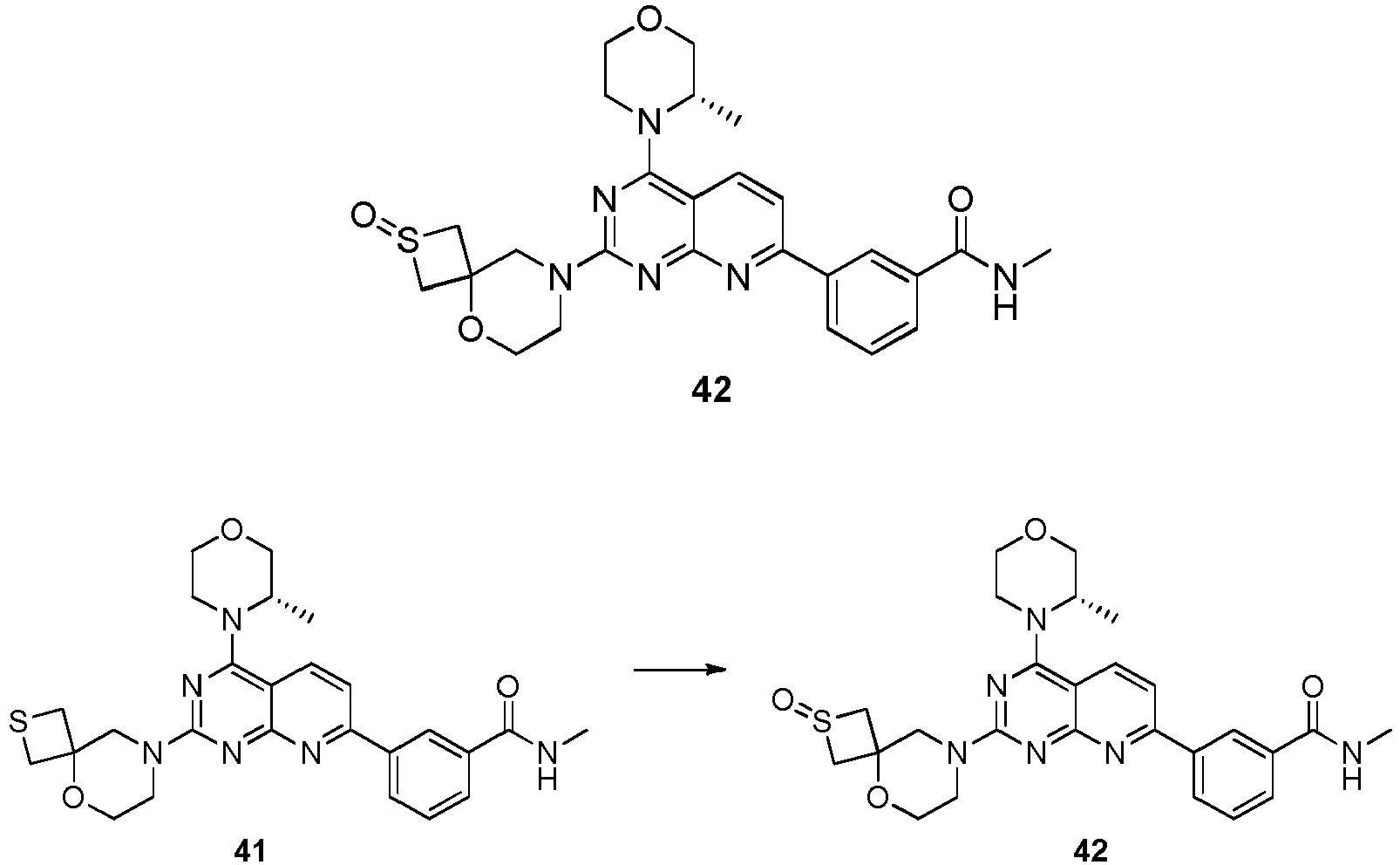
- Compound 41 (70.0 mg, 138 µmol, 1 eq) was dissolved in methanol (20.0 mL), an aqueous solution (10.0 mL) of potassium monopersulfate (84.9 mg, 138 µmol, 1 eq) was added dropwise. The reaction was carried out at room temperature for an hour. After the completion of the reaction, the reaction solution was purified by high performance liquid chromatography to give 42.
MS-ESI calculated for [M+H]+: 523, found: 523.
1H NMR (400 MHz, CDCl3) δ: 8.72-7.51 (m, 1H), 8.11 (br d, J=7.2 Hz, 1H), 8.00 (d, J=8.4 Hz, 1H), 7.93 (br d, J=7.8 Hz, 1H), 7.55-7.43 (m, 2H), 4.49-4.33 (m, 1H), 4.20 (s, 2H), 3.94 (br d, J=8.4 Hz, 3H), 3.82-3.74 (m, 1H), 3.74-3.60 (m, 5H), 3.52 (br d, J=13.6 Hz, 2H), 3.28-3.06 (m, 2H), 3.00-2.94 (m, 3H), 1.44 (d, J=6.8 Hz, 3H). -

- Compound 41 (120 mg, 237 µmol, 1 eq) was dissolved in methanol (5.00 mL), an aqueous solution (5.00 mL) of potassium monopersulfate (291 mg, 474 µmol, 2 eq) was added dropwise. The reaction was carried out at room temperature for 30 hours. After completion of the reaction, the reaction solution was purified by high performance liquid chromatography to give 43.
MS-ESI calculated for [M+H]+: 539, found: 539.
1H NMR (400 MHz, CDCl3) δ: 8.58 (br s, 1H), 8.14 (br d, J=8.0 Hz, 1H), 8.02 (d, J=8.4 Hz, 1H), 7.91 (br d, J=7.6 Hz, 1H), 7.60-7.44 (m, 2H), 6.57 (br s, 1H), 4.42 (br d, J=6.0 Hz, 1H), 4.27-3.85 (m, 10H), 3.82-3.60 (m, 6H), 2.99 (d, J=4.8 Hz, 3H), 1.46 (d, J=6.8 Hz, 3H). -

- Compound 35b (150 mg, 391 µmol, 1 eq), 23f (128 mg, 782 µmol, 1 eq) and DIPEA (152 mg, 1.17 mmol, 3 eq) were dissolved in DMSO (3.00 mL), and the mixed solution was allowed to react at 90 °C for 20 hours. After completion of the reaction, the reaction sollution was purified by high performance liquid chromatography to give 44.
MS-ESI calculated for [M+H]+: 475, found: 475.
1H NMR (400MHz, CDCl3) δ: 8.66 (br s, 1H), 8.18 (br d, J=7.6 Hz, 1H), 7.99 (d, J=8.4 Hz, 1H), 7.95 (br d, J=7.6 Hz, 1H), 7.51 (t, J=7.6 Hz, 1H), 7.46 (br d, J=8.4 Hz, 1H), 6.72-6.11 (m, 1H), 5.64 (br s, 1H), 4.35 (br s, 1H), 3.95-3.57 (m, 11H), 2.07-1.77 (m, 7H), 1.45 (br d, J=6.8 Hz, 3H). -
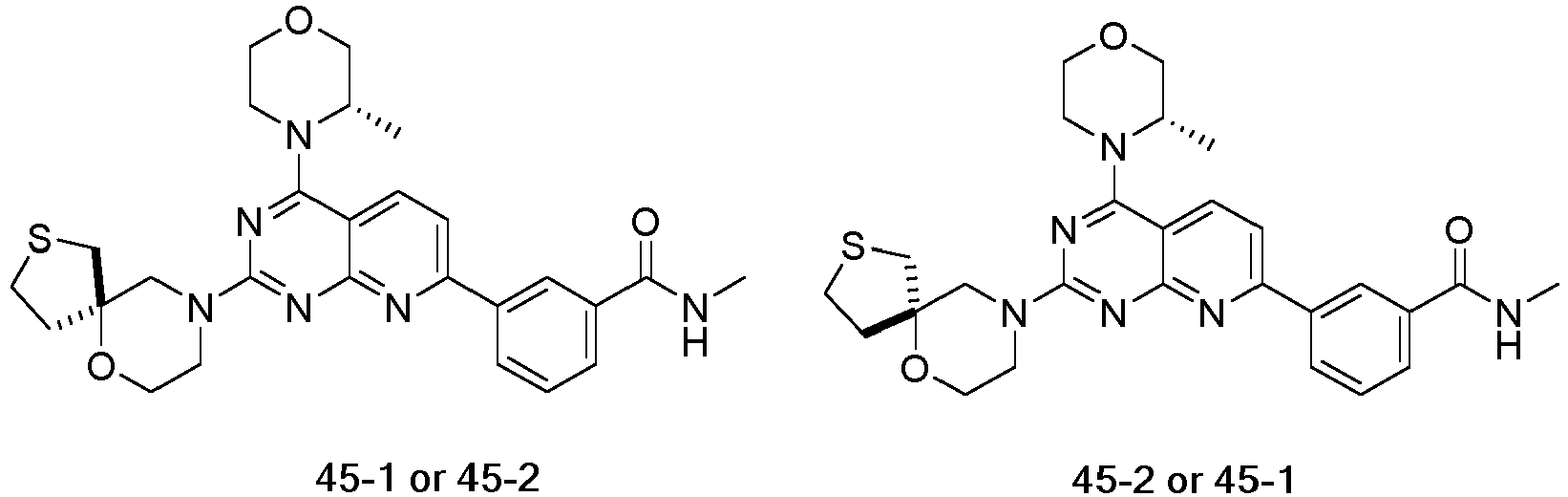

- TMSCN (18.9 g, 191 mmol, 1.5 eq) and boron trifluoride ether complex (18.1 g, 127 mmol, 1.0 eq) were sequentially added to a solution of compound 45a (13.0 g, 127 mmol, 1.0 eq) in dichloromethane (250 mL), and the mixutre was reacted at 20°C for 15 hours. After completion of the reaction, the reaction solution was concentrated, purified by column chromatography (2: 1 petroleum ether/ethyl acetate) to give 45b.
1H NMR (400MHz, CDCl3) δ: 3.34 (d, J = 12.0 Hz, 1H), 3.19 (s, 1H), 3.16 (dd, J = 1.6, 12.0 Hz, 1H), 3.13-3.01 (m, 2H), 2.59-2.47 (m, 1H), 2.32 (td, J = 8.8, 12.8 Hz, 1H). - Borane-tetrahydrofuran complex (1 M, 157 mL, 1.5 eq) was added dropwise to a solution of compound 45b in tetrahydrofuran (200 mL) at 0°C. The mixed solution was allowed to react at 20 °C for 17 hours. 10 mL methanol was added to the reaction solution to terminate the reaction. The reaction solution was concentrated to give 45c, and the crude product was directly used in the next step.
- Compound 45d (8.48 g, 75.1 mmol, 1.0 eq) was added dropwise to a solution of compound 45c (10.0 g, 75.1 mmol, 1.0 eq) and diisopropylethylamine (19.4 g, 150 mmol, 2.0 eq) in dichloromethane (150 mL) at 0 °C. The mixed solution was allowed to react at 20°C for 3 hours. 5mL water was added to the reaction solution to terminate the reaction. The reaction solution was concentrated, and purified by column chromatography (100% ethyl acetate) to give 45e.
1HNMR (400MHz, CDCl3) δ: 7.12-6.88 (m, 1H), 4.06-3.99 (m, 2H), 3.55 (d, J = 6.0 Hz, 2H), 3.01-2.84 (m, 3H), 2.82 (d, J = 11.2 Hz, 1H), 2.68 (dd, J = 1.6, 11.6 Hz, 1H), 2.08-1.99 (m, 1H), 1.81 (td, J = 9.2, 13.2 Hz, 1H). - Potassium tert-butoxide (9.63 g, 85.8 mmol, 3.0 eq) was added to a solution of compound 45e (6.0 g, 28.6 mmol, 1.0 eq) in tetrahydrofuran (500 mL) at 0 °C. The mixed solution was allowed to react at 20 °C for 2 hours. The reaction sollution was concentrated, and purified by column chromatography (1:10 methanol/ethyl acetate) to give 45f.
1HNMR (400MHz, CDCl3) δ: 6.43 (br s, 1H), 4.26 (s, 2H), 3.59-3.39 (m, 2H), 3.13-3.00 (m, 2H), 2.96-2.78 (m, 2H) , 2.47-2.32 (m, 1H), 2.02-1.88 (m, 1H). - Lithium aluminum hydride (329 mg, 8.66 mmol, 1.5 eq) was added to a solution of compound 45f (1.0 g, 5.77 mmol, 1.0 eq) in anhydrous tetrahydrofuran (30.0 mL) at 0 °C. The mixed solution was allowed to react at 20 °C for an hour. 0.3 mL water, 0.3 mL 15% aqueous solution of sodium hydroxide, and 1 mL water were sequentially added to the reaction solution and filtered. The filter cake was rinsed with 10 mL ethyl acetate. The filtrate was concentrated to give 45 g. The crude product was directly used in the next step.
- Compound 45g (92.1 mg, 578 µmol, 2.3 eq), 45h (100 mg, 251 µmol, 1.00 eq), DIPEA (97.5 mg, 754 µmol, 3.00 eq) were dissolved in DMSO (3.00 mL). The mixed solution was allowed to react at 80°C for 18 hours. After completion of the reaction, the reaction solution was diluted with water (10.0 mL) and extracted with ethyl acetate (20.0 mL×3). The combined organic phase was dried over anhydrous sodium sulfate, filtered, and subjected to rotary evaporation under reduced pressure to dryness, and purified by preparative thin layer chromatography (100% ethyl acetate) to give 45i, which was further subjected to SFC chiral separation to give compounds 45-1 and 45-2.
- Compound 45-1 MS-ESI calculated for [M+H]+: 521, found: 521.
- Peak position of compound 45-1: 0.950 min (chiral column: AD-3 50 × 4.6mm, I.D., 3µm , mobile phase: 40% ethanol (0.05% diethylamine) +carbon dioxide, flow rate: 4 mL/min, column temperature: 40°C).
- Compound 45-1 1H NMR (400MHz, CDCl3) δ: 8.57 (s, 1H), 8.13 (br d, J = 7.6 Hz, 1H), 7.98 (d, J = 8.4 Hz, 1H), 7.90 (d, J = 8.0 Hz, 1H), 7.52-7.42 (m, 2H), 6.57 (br s, 1H), 4.35 (br d, J = 6.8 Hz, 1H), 4.22 (d, J = 13.2 Hz, 1H), 4.13 (br s, 1H), 3.95-3.61 (m, 10H), 2.98 (d, J = 4.8 Hz, 3H), 2.97-2.78 (m, 4H), 2.21 (td, J = 6.0, 12.4 Hz, 1H), 1.99-1.88 (m, 1H), 1.43 (d, J = 6.8 Hz, 3H).
- Compound 45-2 MS-ESI calculated for [M+H]+: 521, found: 521.
- Peak position of compound 45-2: 1.168 min (chiral column: AD-3 50 × 4.6mm, I.D., 3µm, mobile phase: 40% ethanol (0.05% diethylamine)+carbon dioxide, flow rate: 4 mL/min, column temperature: 40°C).
- Compound 45-2 1H NMR (400MHz, CDCl3) δ: 8.57 (s, 1H), 8.13 (br d, J=7.6 Hz, 1H), 7.98 (d, J=8.4 Hz, 1H), 7.90 (d, J=8.0 Hz, 1H), 7.52-7.43 (m, 2H), 6.54 (br s, 1H), 4.34 (br d, J=6.8 Hz, 1H), 4.23 (br d, J=13.2 Hz, 1H), 4.17 (br s, 1H), 3.95-3.60 (m, 10H), 2.99 (d, J=4.8 Hz, 3H), 2.97-2.76 (m, 4H), 2.20 (td, J=6.0, 12.4 Hz, 1H), 2.00-1.89 (m, 1H), 1.42 (d, J=6.8 Hz, 3H).
-

- An aqueous solution (40.0 mL) of potassium monopersulfate (402 mg, 653 µmol, 0.85 eq) was added dropwise to a solution of compound 46a (400 mg, 768 µmol, 1.0 eq) in methanol (60.0 mL). The reaction was carried out at 25 °C for 1.5 hours, and terminated by addition of 10 mL saturated solution of sodium thiosulfate. The reaction solution was concentrated to a volume of about 50 mL, and extracted with ethyl acetate (30 mL×3). The combined organic phases were dried over anhydrous sodium sulfate, filtered, and subjected to rotary evaporation under reduced pressure to dryness, and purified by column chromatography (1:10 methanol/ethyl acetate) to give racemate, which was further subjected to SFC chiral separation to give compounds 46-1 and 46-2.
- Peak position of compound 46-1: 5.297 minutes (chiral column: AD-3 150 × 4.6mm, I.D., 3µm, mobile phase: 40% methanol (0.05% diethylamine)+carbon dioxide, flow rate: 2.5 mL/min, column temperature: 40°C).
- Compound 46-1 MS-ESI calculated for [M+H]+ 537, found: 537.
- Compound 46-1 1H NMR (400MHz, CDCl3) δ: 8.69 (br s, 1H), 8.13-7.91 (m, 3H), 7.53-7.40 (m, 2H), 4.46-4.22 (br d, J=6.8 Hz, 2H), 4.14 (br d, J=12.2 Hz, 1H), 3.97-3.62 (m, 10H), 3.17 (br s, 1H), 2.97 (d, J=4.8 Hz, 6H), 2.68 (br d, J=6.4 Hz, 1H), 2.49-2.38 (m, 1H), 1.43 (d, J=6.8 Hz, 3H).
- Peak position of compound 46-2: 6.265 minutes (chiral column: AD-3 150×4.6mm, I.D., 3µm, mobile phase: 40% methanol (0.05% diethylamine)+carbon dioxide, flow rate: 2.5 mL/min, column temperature: 40 °C).
- Compound 46-2 MS-ESI calculated for [M+H]+: 537, found: 537.
- Compound 46-2 1H NMR (400MHz, CDCl3) δ: 8.70 (br s, 1H), 8.13-7.91 (m, 3H), 7.55-7.39 (m, 2H), 4.45-4.22 (m, 2H), 4.20-4.08 (m, 1H), 3.94-3.63 (m, 10H), 3.17 (br s, 1H), 2.97 (d, J=4.8 Hz, 6H), 2.78-2.61 (m, 1H), 2.44 (br d, J=14.1 Hz, 1H), 1.41 (d, J=6.8 Hz, 3H).
-

- An aqueous solution (30.0 mL) of potassium monopersulfate (779 mg, 1.27 mmol, 3.3 eq) was added dropwise to a solution of compound 47a (200 mg, 384 µmol, 1.0 eq) in methanol (30.0 mL). The reaction was carried out at 25 °C for 5 hours, and terminated by addition of 10 mL saturated solution of sodium thiosulfate. The reaction solution was concentrated to a volume of about 40 mL, and extracted with dichloromethane (50.0 mL×4). The combined organic phase was dried over anhydrous sodium sulfate, filtered, and subjected to rotary evaporation under reduced pressure to dryness, and purified by preparative thin layer chromatography (1:20 methanol/dichloromethane) to give a racemic intermediate, which was further subjected to SFC chiral separation to give compounds 47-1 and 47-2.
- Compound 47-1 MS-ESI calculated for [M+H]+: 553, found: 553.
- Peak position of compound 47-1: 1.617 min (chiral column: AD-3 50 × 4.6mm, I.D., 3µm , mobile phase: 40% ethanol (0.05% diethylamine) + carbon dioxide, flow rate: 4 mL/min, column temperature: 40°C).
- Compound 47-1 1H NMR (400MHz, CDCl3) δ: 8.65 (s, 1H), 8.23 (d, J=8.0 Hz, 1H), 8.10 (d, J=8.4 Hz, 1H), 7.99 (d, J=8.0 Hz, 1H), 7.64-7.55 (m, 2H), 6.58 (br s, 1H), 4.66-4.34 (m, 3H), 4.07-3.55 (m, 10H), 3.45-3.18 (m, 4H), 3.08 (d, J=4.8 Hz, 3H), 2.57-2.45 (m, 1H), 2.38-2.26 (m, 1H), 1.53 (d, J=6.8 Hz, 3H).
- Compound 47-2 MS-ESI calculated for [M+H]+: 553, found: 553.
- Peak position of compound 47-2: 2.000 min (chiral column: AD-3 50 × 4.6mm, I.D., 3µm , mobile phase: 40% ethanol (0.05% diethylamine) + carbon dioxide, flow rate: 4 mL/min, column temperature: 40°C).
- Compound 47-2 1H NMR (400MHz, CDCl3) δ: 8.65 (s, 1H), 8.23 (d, J=8.0 Hz, 1H), 8.10 (d, J=8.4 Hz, 1H), 7.99 (d, J=8.0 Hz, 1H), 7.64-7.55 (m, 2H), 6.58 (br s, 1H), 4.66-4.34 (m, 3H), 4.07-3.55 (m, 10H), 3.45-3.18 (m, 4H), 3.08 (d, J=4.8 Hz, 3H), 2.57-2.45 (m, 1H), 2.38-2.26 (m, 1H), 1.53 (d, J=6.8 Hz, 3H).
-


- Methyltriphenylphosphonium bromide (83.0 g, 232 mmol, 2.0 eq) and potassium tert-butoxide (26.01, 232 mmol, 2.0 eq) were dissolved in tetrahydrofuran (1.00 L), and the mixture was reacted at 20 °C for an hour. Compound 48a (10.0 g, 116.16 mmol, 1.0 eq) was added to the reaction solution, and the mixture was reacted at 20 °C for 17 hours. The reaction solution was distilled at 80°C under normal pressure to give a distillate of compound 48b.
1H NMR (400MHz, CDCl3) δ: 5.05-4.91 (m, 2H), 4.26 (s, 2H), 3.90 (t, J = 6.8 Hz, 2H), 2.56 (br t, J = 6.8 Hz, 2H). - Compound 48b (6.00 g, 28.5 mmol, 4% purity, 1 eq), compound 48c (5.0 g, 28.5 mmol, 1.0 eq), and N-iodosuccinimide (6.42 g, 28.5 mmol, 1.0 eq) were dissolved in tetrahydrofuran (80.0 mL), and the mixture was reacted at 60 °C for 17 hours. After completion of the reaction, the reaction was terminated by 100 mL saturated aqueous solution of sodium thiosulfate. The reaction solution was extracted with ethyl acetate (150 mL× 3), and the organic phase was dried over anhydrous sodium sulfate, filtered, subjected to rotary evaporation under reduced pressure to dryness, and purified by column chromatography (1: 1 ethyl acetate/petroleum ether) to give compound 48d.
MS-ESI calculated for [M+H]+: 386, found: 386. - Compound 48d (0.2 g, 519 µmol, 1.0 eq) and sodium hydride (41.5 mg, 1.04 mmol, 60% purity, 2.0 eq) were dissloved in N, N-dimethylformamide (10.0 mL), and the mixture was reacted at 25 °C for 16 hours. After completion of the reaction, the reaction was terminated by addition of water (1.00 mL). The reaction solution was concentrated, diluted with 10.0 mL water, extracted with ethyl acetate (10.0 mL×3). The organic phases were combined, dried over anhydrous sodium sulfate, filtered, and subjected to rotary evaporation under reduced pressure to dryness to give 48e.
- Compound 48e (0.15 g, 583 µmol, 1 eq) was dissolved in hydrochloric acid/ethyl acetate (10.0 mL, 2M), and the mixture was reacted at 25°C for 17 hours under stirring. After completion of the reaction, the reaction solution was subjected to rotary evaporation under reduced pressure to dryness to give 48f.
- Compound 48f (90.0 mg, 465 µmol, 1.85 eq), compound 48g (100 mg, 251 µmol, 1.0 eq), and DIPEA (97.5 mg, 754 µmol, 3.0 eq) were dissolved in DMSO (5.00 mL). The mixed solution was allowed to react at 80°C for 18 hours, and purified by high performance liquid chromatography to give a racemate, which was further subjected to SFC chiral separation to give compounds 48-1 and 48-2.
- Peak position of compound 48-1: 3.301 minutes (chiral column: AS-H 150 × 4.6mm, I.D., 5µm, mobile phase: A: CO2, B: ethanol (0.05% diethylamine), the content of B was maintained at 5% for 0.5 min, then increased from 5% to 40% gradient within 3.5 min, then maintained at 40% for 2.5 min, and finally maintained at 5% for 1.5 min, flow rate: 3 mL/min, column temperature: 40 °C).
- Compound 48-1 MS-ESI calculated for [M+H]+: 519, found: 519.
- Compound 48-1 1H NMR (400MHz, CDCl3) δ: 8.54 (s, 1H), 8.13 (d, J=8.0 Hz, 1H), 7.99 (d, J=8.4 Hz, 1H), 7.89 (d, J=8.0 Hz, 1H), 7.49 (t, J=8.0 Hz, 1H), 7.45 (d, J=8.4 Hz, 1H), 6.50 (br s, 1H), 4.93 (br s, 1H), 4.59 (br d, J=13.2 Hz, 1H), 4.33 (br d, J=6.4 Hz, 1H), 3.94-3.54 (m, 12H), 3.23 (d, J=13.6 Hz, 1H), 2.99 (d, J=5.2 Hz, 3H), 2.14-2.00 (m, 1H), 1.98-1.88 (m, 1H), 1.42 (d, J=6.8 Hz, 3H), 1.29 (br d, J=6.4 Hz, 3H).
- Peak position of compound 48-2: 3.608 min (chiral column: AS-H 150 × 4.6mm, I.D., 5µm, mobile phase: A: CO2, B: ethanol (0.05% diethylamine), the content of B was maintained at 5% for 0.5 min, then increased from 5% to 40% gradient within 3.5 min, then maintained at 40% for 2.5 min, and finally maintained at 5% for 1.5 min, flow rate: 3 mL/min, column temperature: 40 °C).
- Compound 48-2 MS-ESI calculated for [M+H]+: 519, found: 519.
- Compound 48-2 1H NMR (400MHz, CDCl3) δ: 8.54 (s, 1H), 8.13 (d, J=8.0 Hz, 1H), 7.99 (d, J=8.4 Hz, 1H), 7.89 (d, J=8.0 Hz, 1H), 7.49 (t, J=8.0 Hz, 1H), 7.45 (d, J=8.4 Hz, 1H), 6.50 (br s, 1H), 4.93 (br s, 1H), 4.59 (br d, J=13.2 Hz, 1H), 4.33 (br d, J=6.4 Hz, 1H), 3.94-3.54 (m, 12H), 3.23 (d, J=13.6 Hz, 1H), 2.99 (d, J=5.2 Hz, 3H), 2.14-2.00 (m, 1H), 1.98-1.88 (m, 1H), 1.42 (d, J=6.8 Hz, 3H), 1.29 (br d, J=6.4 Hz, 3H).
-

- Compound 35b (100 mg, 261 µmol, 1.00 eq), 24f (92.6 mg, 522 µmol, 2.00 eq), DIPEA (101 mg, 782 µmol, 136 µL, 3.00 eq) were dissolved in DMSO (2.00 mL). The mixed solution was allowed to react at 80°C for 40 hours. After completion of the reaction, the reaction solution was purified by high performance liquid chromatography to give 49.
MS-ESI calculated for [M+H]+: 489, found: 489.
1H NMR (400MHz, CDCl3) δ: 8.62 (s, 1H), 8.18 (br d, J=7.6 Hz, 1H), 7.97 (d, J=8.4 Hz, 1H), 7.93 (br d, J=8.0 Hz, 1H), 7.51 (t, J=8.0 Hz, 1H), 7.43 (d, J=8.4 Hz, 1H), 6.52 (br s, 1H), 5.63 (br s, 1H), 4.29 (br s, 1H), 3.95-3.57 (m, 12H), 1.70 (br d, J=8.4 Hz, 8H), 1.41 (d, J=6.8 Hz, 3H). -

- Compound 35b (80.0 mg, 208 µmol, 1.00 eq), 50a (44.9 mg, 250 µmol, 1.20 eq) and DIPEA (80.8 mg, 625 µmol, 109 µL, 3 eq) were dissolved in DMSO (2.00 mL). The mixed solution was allowed to react at 80°C for 22 hours. After completion of the reaction, the reaction solution was purified by high performance liquid chromatography to give a racemate, which was further subjected to SFC chiral separation to give 50-1 and 50-2.
- Peak position of 50-1: 3.491 min (chiral column: OJ-3 100 × 4.6mm, I.D., 3µm, mobile phase: A: CO2, B: methanol (0.05% diethylamine), the content of B was increased from 5% to 40% gradient within 4.5 min, then maintained at 5% for 1.0 min, flow rate: 2.8mL/min, column temperature: 40°C).
50-1 MS-ESI calculated for [M+H]+: 491, found: 491.
50-1 1HNMR (400MHz, CDCl3) δ: 8.63 (s, 1H), 8.18 (br d, J=8.0 Hz, 1H), 7.99 (d, J=8.4 Hz, 1H), 7.94 (d, J=80 Hz, 1H), 7.51 (t, J=7.2 Hz, 1H), 7.46 (d, J=8.0 Hz, 1H), 6.61 (br s, 1H), 5.69 (br s, 1H), 4.33 (br d, J=6.4 Hz, 1H), 3.97-3.59 (m, 16H), 2.07-1.85 (m, 2H), 1.41 (d, J=6.8 Hz, 3H). - Peak position of 50-2: 3.846 min (chiral column: OJ-3 100 × 4.6 mm, I.D., 3 µm, mobile phase: A: CO2, B: methanol (0.05% diethylamine), the content of B was increased from 5% to 40% gradient within 4.5 min, and then maintained at 5% for 1.0 min, flow rate: 2.8mL/min, column temperature: 40°C).
50-2 MS-ESI calculated for [M+H]+: 491, found: 491.
50-2 1H NMR (400MHz, CDCl3) δ: 8.63 (s, 1H), 8.18 (br d, J=8.0 Hz, 1H), 7.99 (d, J=8.4 Hz, 1H), 7.94 (d, J=80 Hz, 1H), 7.51 (t, J=7.2 Hz, 1H), 7.46 (d, J=8.0 Hz, 1H), 6.61 (br s, 1H), 5.69 (br s, 1H), 4.33 (br d, J=6.4 Hz, 1H), 3.97-3.59 (m, 16H), 2.07-1.85 (m, 2H), 1.41 (d, J=6.8 Hz, 3H). -

- Compound 35b (100 mg, 261 µmol, 1.00 eq), 1i (46.8 mg, 313 µmol, 1.20 eq), and DIPEA (101 mg, 782 µmol, 136 µL, 3.00 eq) were dissolved in DMSO (2.00 mL). The mixed solution was allowed to react at 80°C for 18 hours. After completion of the reaction, the reaction solution was purified by high performance liquid chromatography to give 51.
MS-ESI calculated value [M+H]+: 461, found: 461.
1H NMR (400MHz, CDCl3) δ: 8.60 (s, 1H), 8.18 (br d, J=8.0 Hz, 1H), 7.98 (d, J=8.4 Hz, 1H), 7.92 (br d, J=8.0 Hz, 1H), 7.51 (t, J=8.0 Hz, 1H), 7.43 (d, J=8.4 Hz, 1H), 6.46 (br s, 1H), 5.62 (br s, 1H), 4.30 (br s, 1H), 4.05-3.59 (m, 12H), 1.40 (d, J=6.8 Hz, 3H), 0.80-0.73 (m, 2H), 0.61 (br s, 2H). -

- Compound 52a (900 mg, 2.11 mmol, 1 eq) was dissolved in methanol (20.0 mL), and palladium hydroxide (591 mg, 421 µmol, 0.2 eq) was added thereto. The mixed solution was allowed to react at 50°C for 42 hours under 50 psi hydrogen atomsphere, then filtered, subjected to rotary evaporation under reduced pressure to dryness to give compound 52b.
1H NMR (400MHz, CDCl3) δ: 3.80-3.58 (m, 6H), 3.52-3.50 (m, 1H), 3.51 (s, 1H), 3.50-3.38 (m, 4H), 1.49 (s, 9H). - Compound 52b (500 mg, 2.02 mmol, 1 eq) dissolved in hydrochloric acid-ethyl acetate solution (20.0 mL, 2 M), the mixture was allowed to react at 25 °C for an hour. After completion of the reaction, the reaction solution was subjected to rotary evaporation under reduced pressure to dryness, and a crude product of compound 52c was obtained.
1HNMR (400MHz, CD3OD) δ: 4.15-4.10 (m, 2H), 3.71-3.63 (m, 4H), 3.31 (s, 2H), 3.23-3.17 (m, 2H). - Compound 52c (350 mg, 1.91 mmol, 1 eq), 52d (531 mg, 1.33 mmol, 0.7 eq), and DIPEA (668 mg, 5.17 mmol, 0.9 mL, 2.71 eq) were dissolved in DMSO (7.00 mL). The mixed solution was allowed to react at 80°C for 23 hours, and purified by high performance liquid chromatography to give 52e.
MS-ESI calculated for [M+H]+ 509, found: 509.
1H NMR (400MHz, CDCl3) δ: 8.61 (s, 1H), 8.21 (br d, J = 8.0 Hz, 1H), 8.08 (d, J = 8.4 Hz, 1H), 7.99 (d, J = 8.0 Hz, 1H), 7.60-7.54 (m, 2H), 4.46 (br d, J = 4.8 Hz, 1H), 4.34-3.45 (m, 19H), 3.07 (d, J= 4.8 Hz, 3H), 1.52 (d, J = 6.8 Hz, 3H). - Compound 52e (300 mg, 590 µmol, 1 eq) was dissolved in ethanol (15.0 mL) and water (15.0 mL), sodium hydroxide (118 mg, 2.95 mmol, 5 eq) was added thereto. The mixed solution was allowed to react at 105 °C for 285 hours, and purified by high performance liquidchromatography to give a yellow solid 52f.
MS-ESI calculated for [M+H]+: 496, found: 496.
1H NMR (400MHz, DMSO-d6) δ: 8.78 (s, 1H), 8.28 (br d, J = 8.0 Hz, 1H), 8.23 (d, J = 8.4 Hz, 1H), 8.05 (br d, J= 8.0 Hz, 1H), 7.68 (d, J = 8.4 Hz, 1H), 7.58 (t, J = 8.0 Hz, 1H), 4.66-4.39 (m, 3H), 3.96-3.41 (m, 14H), 1.38 (d, J = 6.8 Hz, 3H). - Compound 52f (78 mg, 157 µmol, 1 eq), ammonium chloride (33.7 mg, 630 µmol, 4 eq), DIPEA (81.4 mg, 630 µmol, 110 µL, 4 eq), EDCI (60.4 mg, 315 µmol, 2 eq), and HOBt (42.5 mg, 315 µmol, 2 eq) were dissolved in dichloromethane (10.0 mL). The mixed solution was allowed to react at 30 °C for 16 hours. After completion of the reaction, water (3 mL) was added to terminate the reaction. The reaction solution was concentrated to remve solvent, diluted with water (20.0 mL) and extracted with ethyl acetate (20.0 mL×3) and methanol (5.00 mL). The combined organic phase was dried over anhydrous sodium sulfate, filtered, and subjected to rotary evaporation under reduced pressure to dryness, and 52 g was obtained.
MS-ESI calculated for [M+H]+ 495, found: 495. - Compound 52g (87.4 mg, 177 µmol, 1 eq), TosCl (50.5 mg, 265 µmol, 1.5 eq), and sodium hydride (35.3 mg, 884 µmol, 60% purity, 5 eq) were dissolved in DMF (4.00 mL). The mixed solution was allowed to react at 30 °C for 24 hours, and purified by high performance liquid chromatography to give 52.
MS-ESI calculated for [M+H]+ 477, found: 477.
1H NMR (400MHz, CDCl3) δ: 8.62 (s, 1H), 8.19 (br d, J=8.0 Hz, 1H), 8.00 (d, J=8.4 Hz, 1H), 7.94 (br d, J=8.0 Hz, 1H), 7.54-7.45 (m, 2H), 6.54 (br s, 1H), 5.73 (br s, 1H), 4.57 (d, J=6.8 Hz, 2H), 4.47-4.35 (m, 3H), 4.21-4.07 (m, 2H), 3.96-3.65 (m, 10H), 1.43 (d, J=6.8 Hz, 3H). -

- Dess-martin periodinane (1.31 g, 3.08 mmol, 1.5 eq) was added to a solution of compound 53a (0.5 g, 2.06 mmol, 1.0 eq) in dichloromethane (5 mL) at 0°C, and the mixture was reacted at 25°C for 4 hours. The reaction solution was concentrated. The crude product was diluted with 10.0 mL of 1 M sodium hydroxide solution, extracted with ethyl acetate (20.0 mL×3). The organic phase was dried over anhydrous sodium sulfate, filtered, subjected to rotary evaporation under reduced pressure to dryness, and purified by column chromatography (1: 4 ethyl acetate/petroleum ether) to give 53b.
1H NMR (400MHz, CDCl3) δ: 3.71 (br t, J= 4.8 Hz, 2H), 3.55 (s, 2H), 3.50 (br d, J = 4.8 Hz, 2H), 3.21-3.08 (m, 2H) , 3.06-2.91 (m, 2H), 1.49 (s, 9H). - Compound 53b (0.25 g, 1.04 mmol, 1 eq) was dissolved in hydrochloric acid/ethyl acetate (10.0 mL, 2M), and the mixture was reacted at 30°C for 15 hours under stirring. After completion of the reaction, the reaction solution was subjected to rotary evaporation under reduced pressure to dryness, and 53c was obtained. The crude product was directly used in the next step.
- Compound 53d (400 mg, 1.01 mmol, 1.0 eq), compound 53c (200 mg, 1.13 mmol, 1.12 eq), and DIPEA (390 mg, 302 µmol, 3.0 eq) were dissolved in DMSO (10.0 mL). The mixed solution was allowed to react at 80°C for 17 hours, diluted with 20.0 mL water, extracted with ethyl acetate (20 mL × 3). The organic phase was dried over anhydrous sodium sulfate, filtered, subjected to rotary evaporation under reduced pressure to dryness, and purified by column chromatography (100% ethyl acetate) to give 53e .
1H NMR (400MHz, CDCl3) δ: 8.53 (s, 1H), 8.15 (d, J=8.0 Hz, 1H), 7.99 (d, J=8.4 Hz, 1H), 7.89 (d, J=8.0 Hz, 1H), 7.52-7.48 (m, 1H), 7.48-7.44 (m, 1H), 6.41 (br s, 1H), 4.34 (br d, J=7.2 Hz, 1H), 4.03-3.90 (m, 4H), 3.82-3.59 (m, 8H), 3.13-3.00 (m, 4H), 2.99 (d, J=4.8 Hz, 3H), 1.42 (d, J=6.8 Hz, 3H). - Hydroxylamine hydrochloride (41.5 mg, 596.9 µmol, 3 eq) was added to a solution of compound 53e (100 mg, 199 µmmol. 1.0 eq) in methanol (3.00 mL), and the mixture was stirred at 70 °C for an hour. The reaction solution was concentrated. The crude product was diluted with 5 mL water, and extracted with ethyl acetate (10.0 mL × 3). The organic phase was dried over anhydrous sodium sulfate, filtered, and subjected to rorary evaporation under reduced pressure to dryness, and purified by preparative thin layer chromatography (100% ethyl acetate) to give 53f.
- Sodium hydroxide (101 mg, 2.51 mmol, 10.0 eq), p-toluenesulfonyl chloride (479 mg, 2.51 mmol, 10.0 eq) were sequentially added to a solution of compound 53f (130 mg, 251 µmol, 1.0 eq) in acetone (40 mL) and water (4 mL), the mixture was reacted at 30 °C for 16 hours. The reaction solution was concentrated. The crude product was diluted with 10 mL of water and washed with ethyl acetate (20 mL×3). The organic phase was discarded. The aqueous phase was concentrated and purified by preparative thin layer chromatography (1:10 methanol/ethyl acetate) to give a racemate, which was further subjected to SFC chiral separation to give compounds 53-1 and 53-2.
- Peak position of compound 53-1: 2.589 min (chiral column: AS-3 150 × 4.6 mm, mobile phase: A: CO2, B: methanol (0.05% diethylamine), flow rate: 25mL/min, column temperature: 40 °C).
- Compound 53-1 MS-ESI calculated for [M+H]+: 518, found: 518.
- Compound 53-1 1H NMR (400MHz, CDCl3) δ: 8.55 (s, 1H), 8.13 (d, J=8. 0 Hz, 1H), 7.99 (d, J=8.4 Hz, 1H), 7.90 (d, J=8.0 Hz, 1H), 7.53-7.43 (m, 2H), 6.52 (br s, 1H), 5.55 (br s, 1H), 4.34 (br d, J=6.4 Hz, 1H), 3.97-3.58 (m, 12H), 3.45-3.37 (m, 2H), 2.98 (d, J=5.2 Hz, 3H), 2.56-2.41 (m, 2H), 1.42 (d, J=6.8 Hz, 3H).
- Peak position of compound 53-2: 5.877 min (chiral column: AS-3 150 × 4.6 mm, mobile phase: A: CO2, B: methanol (0.05% diethylamine), flow rate: 25 mL/min, column temperature: 40 °C).
- Compound 53-2 MS-ESI calculated for [M+H]+: 518, found: 518.
- Compound 53-1 1H NMR (400MHz, CDCl3) δ: 8.55 (s, 1H), 8.13 (d, J=8.0 Hz, 1H), 7.99 (d, J=8.4 Hz, 1H), 7.90 (d, J=8.0 Hz, 1H), 7.53-7.43 (m, 2H), 6.52 (br s, 1H), 5.55 (br s, 1H), 4.34 (br d, J=6.4 Hz, 1H), 3.97-3.58 (m, 12H), 3.45-3.37 (m, 2H), 2.98 (d, J=5.2 Hz, 3H), 2.56-2.41 (m, 2H), 1.42 (d, J=6.8 Hz, 3H).
-


- Compound 1f (150 mg, 501 µmol, 1.00 eq), 54a (82.1 mg, 451 µmol, 0.90 eq), bis(triphenylphosphine) palladium dichloride (17.6 mg, 25.1 µmol, 0.05 eq) and sodium carbonate (106 mg, 1.0 mmol, 2.00 eq) were dissolved in water (2.00 mL) and 1,4-dioxane (4.00 mL), and the mixture was reacted at 70 °C for 15.5 hours under nitrogen protection. After completion of the reaction, the reaction solution was concentrated to remove solvent, diluted with water (5 mL) and extracted with ethyl acetate (10.0 mL × 3). The combined organic phase was dried over anhydrous sodium sulfate, filtered, and subjected to rotary evaporation under reduced pressure to dryness, and 54b was obtained.
- Compound 54b (100 mg, 249 µmol, 1.00 eq), 1i (33.9 mg, 299 µmol, 1.2 eq) and DIPEA (96.7 mg, 748 µmol, 130 µl, 3 eq) were dissolved in DMSO (3.00 mL). The mixed solution was allowed to react at 80°C for 17 hours. After completion of the reaction, the reaction solution was purified by high performance liquid chromatography to give 54.
MS-ESI calculated for [M+H]+: 478, found: 478.
1H NMR (400MHz, CDCl3) δ: 8.20-8.13 (m, 2H), 8.00 (d, J=8.4 Hz, 1H), 7.45 (d, J=8.4 Hz, 1H), 7.01 (d, J=8.4 Hz, 1H), 4.79 (s, 2H), 4.36 (br s, 1H), 4.08-3.63 (m, 15H), 1.47 (d, J=6.4 Hz, 3H), 0.85 (s, 2H), 0.70 (br s, 2H). -

- Compound 1f (100 mg, 334 µmol, 1.00 eq), compound 55a (65.5 mg, 334 µmol, 1.00 eq), bis(triphenylphosphine) palladium dichloride (11.7 mg, 16.7 µmol, 0.05 eq) and sodium carbonate (70.9 mg, 669 µmol, 2.00 eq) were dissolved in water (1.00 mL) and 1,4-dioxane (3.00 mL), and the mixture was reacted at 80°C for 15 hours under nitrogen protection. After completion of the reaction, the reaction solution was concentrated to remove solvent, diluter with water (15.0 mL) and extracted with ethyl acetate (50.0 mL×3). The combined organic phase was dried over anhydrous sodium sulfate, filtered, and subjected to rotary evaporation under reduced pressure to dryness, and 55b was obtained.
- Compound 55b (168 mg, 404 µmol, 1.00 eq), 1i (54.4 mg, 364 µmol, 0.90 eq) and DIPEA (157 mg, 1.21 mmol, 211 µL, 3.00 eq) were dissolved in DMSO (3.00 mL). The mixed solution was allowed to react at 80°C for 15 hours. After completion of the reaction, the reaction solution was concentrated to remove solvent to give 55c. The crude product was directly used in the next step.
- Compound 55c (99.0 mg, 201 µmol, 1.00 eq), 55d (24.5 mg, 363 µmol, 1.80 eq), DIPEA (104 mg, 806 µmol, 140 µL, 4.00 eq), EDCI (57.9 mg, 302 µmol, 1.50 eq), and HOBt (40.8 mg, 302 µmol, 1.50 eq) were dissolved in DMSO (4.00 mL). The mixed solution was allowed to react at 30 °C for 22 hours. After completion of the reaction, the reaction solution was purified by high performance liquidchromatography to give 55.
MS-ESI calculated for [M+H]+: 505, found: 505.
1H NMR (400MHz, CDCl3) δ: 8.75 (br s, 1H), 8.51 (br d, J=8.0 Hz, 1H), 7.94 (br d, J=8.4 Hz, 1H), 7.76 (br s, 1H), 7.50 (br d, J=8.4 Hz, 1H), 7.03 (br d, J=8.4 Hz, 1H), 4.29 (br s, 1H), 3.97 (s, 3H), 3.96-3.51 (m, 12H), 2.98 (br d, J=4.4 Hz, 3H), 1.38 (br d, J=6.8 Hz, 3H), 0.76 (br s, 2H), 0.61 (br s, 2H). -

- Compound 56c (99.0 mg, 201 µmol, 1.00 eq), ammonium chloride (43.1 mg, 806 µmol, 4.00 eq), DIPEA (104 mg, 806 µmol, 140 µL, 4.00 eq), EDCI (57.9 mg, 302 µmol, 1.50 eq), and HOBt (40.8 mg, 302 µmol, 1.50 eq) was dissolved in DMSO (4.00 mL). The mixed solution was allowed to react at 30 °C for 22 hours. After completion of the reaction, the reaction solution was purified by high performance liquid chromatography to give 56.
MS-ESI calculated for [M+H]+: 491, found: 491.
1H NMR (400MHz, CDCl3) δ: 8.76 (d, J=2.4 Hz, 1H), 8.55 (dd, J=2.4, 8.8 Hz, 1H), 7.93 (d, J=8.8 Hz, 1H), 7.67 (br s, 1H), 7.50 (d, J=8.8 Hz, 1H), 7.06 (d, J=8.8 Hz, 1H), 5.75 (br s, 1H), 4.28 (br d, J=5.6 Hz, 1H), 3.99 (s, 3H), 3.97-3.36 (m, 12H), 1.38 (d, J=6.8 Hz, 3H), 0.79-0.73 (m, 2H), 0.61 (br s, 2H). - This experiment was performed by DiscoverX. All materials and methods were obtained from DiscoverX.
- Kinase activity analysis.
- 1. Labeled mTOR kinase was stably expressed in HEK-293 cells.
- 3. Streptavidin magnetic beads were treated with biotinylated small molecule ligands at room temperature for 30 minutes to produce affinity resin for kinase analysis;
- 4. Ligand beads were blocked with excess biotin and washed with buffer (1% bovine serum albumin, 20 mL 0.05% Tween, 1 mL dithiothreitol) to remove unbound ligand and non-specifically bound ligand;
- 5. The assembly of kinase and ligand and affinity beads, and the binding reaction between the compound and the three were performed in buffer (20% blocking buffer, 0.17x phosphate buffer, 0.05% Tween 20, 6 mL dithiothreitol);
- 6. The test compounds were dissolved in dimethyl sulfoxide;
- 7. All test compounds were dissolved in DMSO, and then directly diluted to a concentration of 0.9%.
- 8. The solution was placed in a 384-well polypropylene plate,wherein the volume of each well was 0.02 mL;
- 9. The plate was shaked for an hour at room temperature;
- 10. The plate was washed with buffer (1x PBS, 0.05% Tween 20);
- 11. The affinity beads were resuspended in buffer (1x PBS, 0.05% Tween 20, 0.5 µm non-biotin affinity ligand) and incubated at room temperature for 30 minutes;
- 12. The kinase concentration in the eluate was deteced by qPCR.
-
Table 1: The activity test results of mTORC1 and mTORC2 kinase complex Test compound (the compound prepared by each embodiment) mTORC1 and mTORC2 kinase complex inhibitory activity Kd (nM) Embodiment 1 0.85 Embodiment 2 0.15 Embodiment 3 0.32 Embodiment 4 0.22 Embodiment 5 0.66 Embodiment 6 12 Embodiment 7 6.4 Embodiment 8 5.9 Embodiment 9 0.34 Embodiment 10 7.8 Embodiment 11 1.2 Embodiment 12 0.75 Embodiment 13 0.64 Embodiment 14 0.25 Embodiment 15 3.3 Embodiment 16 1.5 Embodiment 17 3.4 Embodiment 18-1 3 Embodiment 18-2 0.5 Embodiment 19 3 Embodiment 20 0.97 Embodiment 21 0.47 Embodiment 22 1.5 Embodiment 23 0.38 Embodiment 24 0.41 Embodiment 25 1.4 Embodiment 26 1 Embodiment 27 6.6 Embodiment 28 1.4 Embodiment 29 2.7 Embodiment 30 0.44 Embodiment 31 5 Embodiment 32-1 0.79 Embodiment 32-2 1.5 Embodiment 33-1 0.78 Embodiment 33-2 0.38 Embodiment 34-1 1 Embodiment 34-2 0.73 Embodiment 35 0.4 Embodiment 36 ND Embodiment 37 ND Embodiment 38 ND Embodiment 39 ND Embodiment 40 0.78 Embodiment 41 0.94 Embodiment 42 0.93 Embodiment 43 12 Embodiment 44 0.24 Embodiment 45-1 0.5 Embodiment 45-2 1.7 Embodiment 46-1 1 Embodiment 46-2 4.9 Embodiment 47-1 7.9 Embodiment 47-2 7.9 Embodiment 48-1 1.8 Embodiment 48-2 0.7 Embodiment 49 0.3 Embodiment 50-1 1.9 Embodiment 50-2 0.7 Embodiment 51 0.3 Embodiment 52 0.8 Embodiment 53-1 1.1 Embodiment 53-2 1.8 Embodiment 54 ND Embodiment 55 ND Embodiment 56 ND "ND" refers to undetected. - Conclusion: the compounds of the present invention have significant or unexpected mTOR kinase inhibitory activity.
- Experiment objective: To detect cell proliferation inhibitory activity of the tested compounds.
- Experimental principle: The luciferase in the Cell-Titer-Glo reagent produces oxyluciferin using luciferin, oxygen and ATP as reaction substrates, and releases energy in the form of light. Since the reaction of luciferase requires ATP, the total amount of light generated by the reaction is proportional to the total amount of ATP that reflects cell viability.
-
- Cell lines: MCF-7 cell line (ATCC-CRL-22), HT-29 cell line (ATCC-HTB-38), OE21 (ECACC-96062201), NCI-N87 cell line (ATCC-CRL-5822)
- Cell culture medium: (RPMI 1640 culture medium (Invitrogen # 1868546; 10% serum Invitrogen # 1804958; L-glutamine 1 ×, Invitrogen # 1830863; dual antibiotic Hyclone # J170012))
- Cell Titer-Glo® Luminescent Cell Viability Assay Kit (Promega # G7573)
- 384-well cell culture plate (Greiner # E15103MA)
- Compound plate (LABCYTE # 0006346665)
- CO2 incubator (Thermo # 371)
- Vi-cell cell counter (Beckman Coulter)
- Locomotive pipette (Eppendorf)
- Transfer pipette (Greiner)
- Pipetting gun (Eppendorf)
- Multifunctional enzyme marker (Envision Reader)
- ECHO Liquid-handling workstation (Labcyte-ECHO555)
- The cells were inoculated in a 384- or 96-well plate with a density of 1000 cells per well and 25 µL per well according to the instructions of the cell inoculating plate. The edge wells were not inoculated with cells,and was supplemented with 25 µL PBS.
-
- (i) The mother solution of the compound was 10 mM, and diluted with DMSO to an initial concentration of 4 mM. The compound was added to the compound mother solution,9 µL per well.
- (ii) The compound was diluted with ECHO liquid-handling workstation. Each well of the cell plate was added with 125 nL compound. Each well of the cell wells in 2nd column and 23rd column was added with 125 nL DMSO, and each of the PBS wells in 1st column and 24th column was added with 125 nL DMSO.
- (iii) Each well of the cell plate was supplemented with 25 µL culture medium, the final volume in each well of the cell plate was 50 µL, the concentration of compound was 1 µM, 3 times dilution, 10 concentrations, each concentration was duplacated in left and right wells, the final DMSO concentration was 0.25%.
- 2.3. After addtion of the compound, centrifugation was performed at 1000 rpm for 1 min, and the cell plate was placed in a 37 °C, 5% CO2 incubator for 3 days.
- The cell plate was taken out from the incubator and equilibrated at room temperature for 30 minutes. 25 µL Cell-Titer-Glo reagent was added to each well, shaken for one minute to mix throughly, centrifuged at 1000 rpm for 1 minute. After 10 minutes, the plate was read on PerkinElmer Envision with a fluorescence reading time was set at 0.2 second.
-
Table 2: Screening test results of in vitro cell proliferation inhibitory activity of the compound of the present invention Compound MCF-7 cell IC50 (nM) HT-29 cell IC50 (nM) OE21 cell IC50 (nM) N87 cell IC50 (nM) AZD2014 95 316 148 59 Embodiment 1 155 485 313 61 Embodiment 9 262 ND ND ND Embodiment 12 251 ND ND ND Embodiment 13 255 ND ND ND Embodiment 18 258 ND ND ND Embodiment 21 190 ND ND ND Embodiment 23 163 607 257 94 Embodiment 24 206 ND ND ND Embodiment 26 431 ND ND ND Embodiment 30 ND 442 158 ND Embodiment 32-1 ND 744 ND ND Embodiment 32-2 ND 1413 ND ND Embodiment 33-1 ND 1974 ND ND Embodiment 33-2 ND 1254 ND ND Embodiment 34-1 ND 1052 ND ND Embodiment 34-2 ND 833 ND ND Embodiment 35 105 ND ND 44 Embodiment 36 360 ND ND ND Embodiment 37 252 ND ND ND Embodiment 38 449 ND ND ND Embodiment 39 268 ND ND ND Embodiment 40 ND ND ND ND Embodiment 41 ND ND ND ND Embodiment 42 ND ND ND ND Embodiment 43 ND ND ND ND Embodiment 44 171 ND ND 89 Embodiment 45-1&45-2 ND ND ND ND Embodiment 46 ND ND ND ND Embodiment 47-1&47-2 ND ND ND ND Embodiment 48-1 ND ND ND ND Embodiment 48-2 176 ND ND ND Embodiment 49 ND ND ND ND Embodiment 50-1 ND ND ND ND Embodiment 50-2 636 ND ND ND Embodiment 51 208 ND ND 59 Embodiment 52 586 ND ND ND Embodiment 53-1&53-2 ND ND ND ND Embodiment 54 ND ND ND 119 Embodiment 55 ND ND ND 120 Embodiment 56 ND ND ND 167 "ND" refers to undetected. - Conclusion: The compounds of the present invention have significant proliferation inhibitory activity against of MCF-7, N87 and OE-21 cells, and have certain proliferation inhibitory activity against HT-29 cells.
- The test compound was mixed with 5% DMSO/95% 10% polyoxyethylene castor oil (Cremophor EL), vortexed and sonicated to prepare a 1 mg/mL near-clear solution, which was filtered with a microporous filter membrane for future use. Female Balb/c mice of 18 to 20 grams were selected and the solution of the test compound was administered intravenously at a dose of 1 or 2 mg/kg. The test compound was mixed with an aqueous solution of 1% Tween 80, 9% polyethylene glycol 400, and 90% water, vortexed and sonicated to prepare 1 mg/mL near-clear solution, which was filtered with a microporous filter membrane for future use. Female Balb/c mice of 18 to 20 grams were selected, and the solution of the test compound was orally administered at a dose of 2 or 10 mg/kg. The whole blood was collected at a centain time, and prepared into plasma. The drug concentration was analyzed by LC-MS/MS, and the pharmacokinetic parameters were calculated using Phoenix WinNonlin software (Pharsight Corporation, USA).
-
Table 3 Pharmacokinetic (PK) parameters in plasma of the compounds of the embodiments PK parameters in plasma of reference compound (AZD2014) PK parameters IV (1 mg/kg) IV (2 mg/kg) PO (2 mg/kg) PO (10 mg/kg) Rsq_adj 0.996 0.999 0.972 0.966 No. points used for T1/2 7.00 4.00 6.00 3.00 Co (nM) 4786 8067 -- -- Cmax (nM) -- -- 4370 16967 Tmax (h) -- -- 0.500 0.25 T1/2 (h) 0.967 1.05 1.14 3.46 Vdss (L/kg) 0.677 0.599 -- -- Cl (mL/min/kg) 8.41 8.08 -- -- Tlast (h) 8.00 8.00 12.0 24.0 AUC0-last (nM.h) 4270 8880 8237 41443 AUC0-inf (nM.h) 4281 8914 7241 41508 MRT 0-last (h) 0.268 1.20 1.95 2.45 MRT0-inf (h) 1.88 1.24 1.95 2.50 AUCExtra (%) -- 0.384 0.0496 0.156 AUMCExtra (%) -- 2.95 0.347 1.82 Bioavailability (%)a -- -- 96.2 93.1 Table 4 PK parameters in plasma of the compounds of the embodiments PK parameters in plasma of the compound of the embodiment 1 PK parameters IV (2 mg/kg) PO (10 mg/kg) Rsq_adj 0.995 0.979 No. points used for T1/2 3.00 4.00 Co (nM) 7200 -- Cmax (nM) -- 15067 Tmax (h) -- 0.25 T1/2 (h) 1.65 3.33 Vdss (L/kg) 0.793 -- Cl (mL/min/kg) 9.45 -- Tlast (h) 12 24.0 AUC0-last (nM.h) 7412 34973 AUC0-inf (nM.h) 7421 35034 MRT0-last (h) 1.20 2.69 MRT0-inf (h) 1.38 2.74 AUCExtra(%) 0.124 0.174 AUMCExtra (%) 1.27 1.83 Bioavailability (%)a -- 94.4 Table 5 PK parameters in plasma of the compounds of the embodiments PK parameters in plasma of the compound of embodiment 23 PK parameters IV (2 mg/kg) PO (10 mg/kg) Rsq_adj 0.995 0.782 No. points used for T1/2 3.00 8.00 Co (nM) 12185 -- Cmax (nM) -- 27850 Tmax (h) -- 0.25 T1/2 (h) 1.47 2.61 Vdss (L/kg) 0.414 -- Cl (mL/min/kg) 5.08 -- Tlast (h) 12.0 24.0 AUC0-last (nM.h) 13414 60052 AUC0-inf (nM.h) 13422 60302 MRT0-last (h) 1.35 2.39 MRT0-inf (h) 1.36 2.49 AUCExtra (%) 0.0592 0.414 AUMCExtra (%) 0.616 4.62 Bioavailability (%) -- 89.9 Table 6 PK parameters in plasma of the compounds of the embodiments PK parameters in plasma of the compound of embodiment 51 PK parameters IV (2 mg/kg) PO (10 mg/kg) Rsq_adj 0.993 0.903 No. points used for T1/2 9.00 4.00 Co (nM) 8237 -- Cmax (nM) -- 12850 Tmax (h) -- 0.25 T1/2 (h) 1.10 1.22 Vdss (L/kg) 0.739 -- Cl (mL/min/kg) 7.72 -- Tlast (h) 12.0 12.0 AUC0-last (nM.h) 9730 41869 AUC0-inf (nM.h) 9374 41963 MRT0-last (h) 1.59 3.02 MRT0-inf (h) 1.60 3.04 AUCExtra (%) 0.0469 0.225 AUMCExtra (%) 0.400 1.02 Bioavailability (%) -- 89.5 Table 7 PK parameters in plasma of the compounds of the embodiments PK parameters in plasma of the compound of embodiment 55 PK parameters IV (1 mg/kg) PO (2 mg/kg) Rsq_adj 0.972 0.989 No. points used for T1/2 9.00 6.00 Co (nM) 9696 -- Cmax (nM) -- 7725 Tmax (h) -- 0.500 T1/2 (h) 1.01 1.15 Vdss (L/kg) 0.272 -- Cl (mL/min/kg) 3.49 -- Tlast (h) 12 12.0 AUC0-last (nM.h) 9461 16295 AUC0-inf (nM.h) 9466 16306 MRT0-last (h) 1.29 1.86 MRT0-inf (h) 1.30 1.86 AUCExtra (%) 0.0522 0.0673 AUMCExtra (%) 0.540 0.493 Bioavailability (%) -- 86.1 Table 8 PK parameters in plasma of the compounds of the embodiments PK parameters in plasma of the compound of embodiment 35 PK parameters IV (1 mg/kg) PO (2 mg/kg) Rsq_adj 0.988 0.990 No. points used for T1/2 8.00 5.00 Co (nM) 2490 -- Cmax (nM) -- 3490 Tmax (h) -- 0.250 T1/2 (h) 1.38 1.33 Vdss (L/kg) 0.657 -- Cl (mL/min/kg) 5.07 -- Tlast (h) 12.0 8.00 AUC0-last (nM.h) 7382 8590 AUC0-inf (nM.h) 7400 8751 MRT0-last (h) 2.13 1.98 MRT0-inf (h) 2.16 2.13 AUCExtra (%) 0.246 1.84 AUMCExtra (%) 1.59 8.59 Bioavailability (%) -- 56.1 "- " refers to undetected or no data obtained. - Experimental conclusion: The test compounds exhibit the same or even better pharmacokinetic properties as the reference compound; the compounds of the present invention have bioavailability of close to 100%, which are excellent developable molecules for oral administration.
- Experimental objective: To study the efficacy of the test compounds on human breast cancer MCF-7 cell subcutaneous xenograft tumor in BALB/c nude mouse model.
- Experimental animals: Female BALB/c nude mice, 6-8 weeks old, weighing 18-22 grams; supplier: Shanghai Xipuer-Bikai Experimental Animal Co., Ltd.
- Human breast cancer MCF-7 cells (ECACC, article number: 86012803) were subjected to in vitro monolayer culture under the conditions of EMEM (EBSS) + 2mM glutamic acid + 1% Non Essential Amino Acids (NEAA) medium containing 10% fetal bovine serum, 100 U/mL penicillin and 100 µg/mL streptomycin, and 37 °C, 5% CO2 incubator. Conventional digestion treatment was carried out with trypsin-EDTA twice a week for cell passage. When the cell saturation was 80%-90%, and the quantity reached the requirement, the cells were collected, counted and inoculated.
- Estrogen tablets (0.18 mg) were inoculated into the left back of each mouse three days before cell inoculation, 0.2 mL (1×10⁷) MCF-7 cells (added with matrigel, volume ratio of 1: 1) were subcutaneously inoculated into the right back of each mouse. When the average volume of tumor reached 142 mm3, the mice were divided into groups and began to be administrated.
- The test compounds were prepared into clear solutions of 0.75 mg/mL, 1.5 mg/mL and 3 mg/mL. The vehicles were 5% DMSO + 30% polyethylene glycol 300 + 65% water.
- The experimental indexes were used for investigating whether the growth of the tumors had been inhibited, delayed or cured. The diameters of the tumors were measured with vernier calipers twice a week. The calculation formula of the tumor volume was: V = 0.5a ×b2 wherein a and b represent the long and short diameters of the tumor respectively.
- The antitumor efficacy of the compound was evaluated by TGI (%) or relative tumor proliferation rate T/C (%). TGI (%) reflects the inhibition rate of the tumor growth. Calculation of TGI (%): TGI (%) = [1-(average tumor volume at the end of administration in the treatment group - average tumor volume at the beginning of administration in the treatment group) / (average tumor volume at the end of treatment in the vehicle control group- average tumor volume at the beginning of treatment in the vehicle control group)] × control group.
- Relative tumor proliferation rate T/C (%): The calculation formula was as follows: T/C% = TRTV/CRTV at the beginning of the treatment (TRTV: treatment group RTV; CRTV: negative control group RTV). The relative tumor volume (RTV) was calculated according to the results of tumor measurement. The calculation formula was RTV = Vt/V0. wherein Vo is the average tumor volume measured during administration of the groups (i.e. do), and Vt is the average tumor volume during a certain measurement, the TRTV and CRTV were taken on the same day.
- After the experiment, the weight of the tumor would be detected and the T/weight percentage would be calculated. T weight and C weight represent the tumor weight of the administration group and the vehicle control group, respectively.
- Statistical analysis included the mean and standard error (SEM) of tumor volume at each time point in each group. The treatment group showed the best treatment effect on the 21st day after administration at the end of the trial, so statistical analysis was performed based on this data to evaluate the differences between the groups. The comparison between two groups was analyzed by T-test, and the comparison between three or more groups was analyzed by one-way ANOVA. If there was significant difference in F value, the Games-Howell method was used to testify. If there was no significant difference in F value, Dunnet (2-sided) method was used for analysis. SPSS 17.0 was used for analysis of all data. p <0.05 was considered to be a significant difference.
- In the MCF-7 xenograft tumor model, some compounds have the same efficacy as AZD2014.
Table 9: Tumor inhibition effect of compounds on human breast cancer MCF-7 cell subcutaneous xenograft model Groups Tumor volume (mm3)a (day 0) Tumor volume (mm3)a (27th day) RTV (27th day) T/Cb (%) TGIb (%) Vehicle 142±7 588±75 4.17±0.52 -- -- AZD2014 (7.5 mg/kg) 142±9 315±65 2.25±0.47 53.95 61.10 AZD2014 (15 mg/kg) 141±8 121±41 0.85±0.26 20.36 104.37 Embodiment 23 (7.5 mg/kg) 142±9 489±51 3.48±0.37 83.52 22.14 Embodiment 23 (15 mg/kg) 141±9 324±79 2.26±0.48 54.13 59.05 Embodiment 23 (30 mg/kg) 141±8 150±26 1.06±0.17 25.50 98.33 Embodiment 44 (15 mg/kg) 143±13 298±55 2.11±0.39 50.58 65.23 Embodiment 51 (15 mg/kg) 142±11 323±2 5 2.41±0.36 57.84 59.27 Embodiment 49 (15 mg/kg) 144±14 759±174 5.07±0.92 121.62 -37.89 Note:
"--" refers to no calculation
a. Mean ± SEM.
b. Inhibition of tumor growth was calculated by T/C and TGI (TGI (%) = [1-(T21-T0)/ (V21-V0)] x100).
c. The p-value was based on the tumor volume. - Compared with the vehicle group, in the nude mouse model of human breast cancer xenograft tumor, AZD2014 had a significant difference at a dose of 15 mg/kg and embodiment 23 had a significant difference at a dose of 30 mg/kg compared with the vehicle control group. The TGI thereof were 104 % and 98%.
Claims (21)
- A compound represented by formula (IV), a pharmaceutical acceptable salt thereof and an isomer thereof,
 R1 is H;R2 is Me;alternatively, R1, R2 and the N atom on the morpholine ring form a 5-6 membered heterocycloalkyl;R3 is selected from NH2,
 n is selected from 1 and 2;ring A is selected from phenyl and 6-10 membered heteroaryl;R4 is H;R5 is H;alternatively, R4 and R5 are linked together to form a 5-6 membered heterocycloalkyl;D1, D2, D3 and D4 are respectively selected from single bond, -CH2-, -CH2CH2- and -O-, and at least one of D1, D2, D3 and D4 is not a single bond, wherein the -CH2- or- CH2CH2- is optionally substituted by R, and the number of R is 1 or 2;D5, D6, D7 and D8 are respectively selected from a single bond, -CH2-, -O- and -NH-, and at least one of D5, D6, D7 and D8 is not a single bond, wherein the -CH2- is optionally substituted by R, and the number of R is 1 or 2, -NH- is optionally substituted by R;T1 is selected from CH and N;T2 is selected from -CH2-, -NH-, -O-,
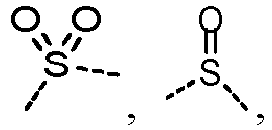 R is respectively selected from F, Cl, Br, I, OH, NH2, C1-3 alkyl, C1-3 alkoxy and C3-6 cycloalkyl, wherein the C1-3 alkyl, C1-3 alkoxy and C3-6 cycloalkyl are optionally substituted by R', and the number of R' is 1 or 2;R' is respectively selected from F, Cl, Br, I, OH and NH2;the C1-3 heteroalkyl, 5-6 membered heteroaryl and 6-10 membered heteroaryl respectively contain 1, 2 or 3 heteroatoms or heteroatom groups indenpendently selected from -O-, -S-, -NH-, N, -C(=O)-, -C(=O)NH- and -C(=S) NH-.
 - The compound, the pharmaceutical acceptable salt thereof and the isomer thereof as defined in claim 1, which is selected from
 R1 is H;R2 is Me;alternatively, R1, R2 and the N atom on the morpholine ring form a 5-6 membered heterocycloalkyl;R3 is selected from NH2,
 ring A is selected from phenyl and 6-10 membered heteroaryl;R4 is selected from H;R5 is selected from H;alternatively, R4 and R5 are linked together to form a 5-6 membered heterocycloalkyl;D1, D2, D3 and D4 are respectively selected from a single bond, -CH2-, -CH2CH2- and -O-, and at least one of D1, D2, D3 and D4 is not a single bond, wherein the -CH2- or -CH2CH2- is optionally substituted by R, and the number of R is 1 or 2;D5, D6, D7 and D8 are respectively selected from a single bond, -CH2-, -O- and -NH-, and at least one of D1, D2, D3 and D4 is not a single bond, wherein the -CH2- is optionally substituted by R, and the number of R is 1 or 2, -NH- is optionally substituted by R;T1 is selected from CH and N;T2 is selected from -CH2-, -NH-, -O-,
 R is respectively selected from F, Cl, Br, I, OH, NH2, C1-3 alkyl, C1-3 alkoxy and C3-6 cycloalkyl, wherein the C1-3 alkyl, C1-3 alkoxy and C3-6 cycloalkyl are optionally substituted by R', and the number of R' is 1 or 2;R' is respectively selected from F, Cl, Br, I, OH and NH2;the C1-3 heteroalkyl, 5-6 membered heteroaryl and 6-10 membered heteroaryl respectively contain 1, 2 or 3 heteroatoms or heteroatom groups indenpendently selected from -O-, -S-, -NH-, N, -C(=O)-, -C(=O)NH- and -C(=S)NH-.
 - The compound, the pharmaceutical acceptable salt thereof and the isomer thereof as defined in claim 2, wherein the R is respectively selected from F, Cl, Br, I, OH, NH2, Me, Et,


- The compound, the pharmaceutical acceptable salt thereof and the isomer thereof as defined in claim 3, wherein the R is respectively selected from F, Cl, Br, I, OH, NH2, Me, CF3, Et,


- The compound, the pharmaceutical acceptable salt thereof and the isomer thereof as defined in any one of claims 1 to 4, wherein the moiety


- The compound, the pharmaceutical acceptable salt thereof and the isomer thereof as defined in any one of claims 1 to 4, wherein the R3 is selected from NH2,

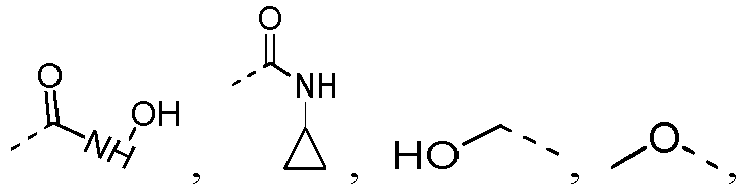

- The compound, the pharmaceutical acceptable salt thereof and the isomer thereof as defined in claim 6, wherein the R3 is selected from NH2,


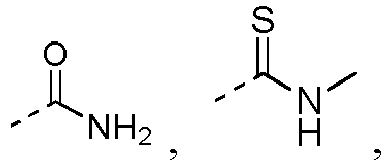

- The compound, the pharmaceutical acceptable salt thereof and the isomer thereof as defined in claim 7, wherein the R3 is selected from NH2,


- The compound, the pharmaceutical acceptable salt thereof and the isomer thereof as defined in any one of claims 1 to 4, wherein ring A is selected from phenyl, benzo[d|oxazole, quinolinyl and quinazolinyl.
- The compound, the pharmaceutical acceptable salt thereof and the isomer thereof as defined in claim 9, wherein ring A is selected from


- The compound, the pharmaceutical acceptable salt thereof and the isomer thereof as defined in claim 1 or 10, wherein the moiety


- The compound, the pharmaceutical acceptable salt thereof and the isomer thereof as defined in claim 2 or 10, wherein the moiety



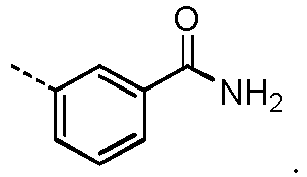
- The compound, the pharmaceutical acceptable salt thereof and the isomer thereof as defined in any one of claims 1 to 4, wherein D1, D2, D3 and D4 are respectively selected from a single bond, - CH2-, -CH2CH2-, -O- and

- The compound, the pharmaceutical acceptable salt thereof and the isomer thereof as defined in any one of claims 1 to 4, wherein D5, D6, D7 and D8 are respectively selected from a single bond, - CH2-, -O-, -NH-,
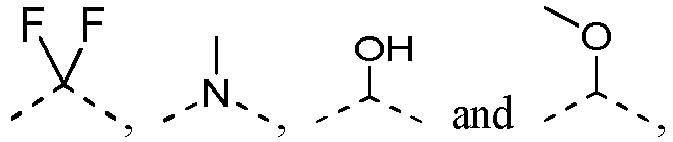
- The compound, the pharmaceutical acceptable salt thereof and the isomer thereof as defined in any one of claims 1 to 4, wherein the moiety





- The compound, the pharmaceutical acceptable salt thereof and the isomer thereof as defined in any one of claims 1 to 9, which is selected from:


 R1, R2, R3, R4 and R5 are as defined in claims 1 to 7;X is selected from -CH2-, -CF2-,

 Y is selected from -CH2- and -CH2CH2-.
 - The compound, the pharmaceutical acceptable salt thereof and the isomer thereof as defined in claim 1 or any one of claims 3 to 9, which is selected from:

- A compound as shown below, a pharmaceutical acceptable salt thereof and an isomer thereof,


- A pharmaceutical composition comprising a therapeutically effective amount of the compound, the pharmaceutically acceptable salt thereof and the isomer thereof as defined in any one of claims 1 to 18 as an active ingredient, and a pharmaceutically acceptable carrier.
- Use of the compound, the pharmaceutically acceptable salt thereof and the isomer thereof as defined in any one of claims 1 to 18 or the pharmaceutical composition defined in claim 19 in the manufacture of a medicament for treating mTOR dual complexs -related diseases.
- Use of the compound, the pharmaceutically acceptable salt thereof and the isomer thereof as defined in any one of claims 1 to 18 or the pharmaceutical composition defined in claim 19 in the manufacture of a medicament for treating breast cancer, breast cancer, head and neck cancer, and colorectal cancer.
Applications Claiming Priority (4)
| Application Number | Priority Date | Filing Date | Title |
|---|---|---|---|
| CN201711080753 | 2017-11-06 | ||
| CN201810136962 | 2018-02-09 | ||
| CN201810661825 | 2018-06-25 | ||
| PCT/CN2018/113683 WO2019085996A1 (en) | 2017-11-06 | 2018-11-02 | Pyridopyrimidine compounds acting as mtorc 1/2 double-kinase inhibitors |
Publications (2)
| Publication Number | Publication Date |
|---|---|
| EP3712157A1 true EP3712157A1 (en) | 2020-09-23 |
| EP3712157A4 EP3712157A4 (en) | 2021-04-28 |
Family
ID=66331374
Family Applications (1)
| Application Number | Title | Priority Date | Filing Date |
|---|---|---|---|
| EP18872475.1A Withdrawn EP3712157A4 (en) | 2017-11-06 | 2018-11-02 | PYRIDOPYRIMIDINE COMPOUNDS ACTING AS DOUBLE KINASE MTORC 1/2 INHIBITORS |
Country Status (7)
| Country | Link |
|---|---|
| US (1) | US11377444B2 (en) |
| EP (1) | EP3712157A4 (en) |
| JP (1) | JP7340519B2 (en) |
| CN (1) | CN111315750B (en) |
| BR (1) | BR112020008991A2 (en) |
| RU (1) | RU2771201C2 (en) |
| WO (1) | WO2019085996A1 (en) |
Families Citing this family (2)
| Publication number | Priority date | Publication date | Assignee | Title |
|---|---|---|---|---|
| WO2020147842A1 (en) * | 2019-01-18 | 2020-07-23 | 南京明德新药研发有限公司 | Use of pyridopyrimidine compounds in preparation of drug for treating nasopharyngeal carcinoma |
| JP7307817B2 (en) * | 2019-05-06 | 2023-07-12 | メッドシャイン ディスカバリー インコーポレイテッド | Salt form, crystal form of mTORC1/2 dual kinase activity inhibitor and method for producing the same |
Family Cites Families (7)
| Publication number | Priority date | Publication date | Assignee | Title |
|---|---|---|---|---|
| CN101360746B (en) * | 2005-11-22 | 2013-12-11 | 库多斯药物有限公司 | Pyrido-,pyrazo- and pyrimido-pyrimidine derivatives as mTOR inhibitors |
| KR101464384B1 (en) | 2005-11-22 | 2014-11-21 | 쿠도스 파마슈티칼스 리미티드 | As mTOR inhibitors, pyridopyrimidine, pyrazopyrimidine and pyrimidopyrimidine derivatives |
| CN101558067B (en) * | 2006-08-23 | 2014-05-28 | 库多斯药物有限公司 | 2-methylmorpholine pyrido-, pyrazo- and pyrimido-pyrimidine derivatives as mtor inhibitors |
| PT2057156T (en) * | 2006-08-23 | 2017-05-04 | Kudos Pharm Ltd | 2-methylmorpholine pyrido-,pyrazo- and pyrimido-pyrimidine derivatives as mtor inhibitors |
| EP2318377B1 (en) | 2008-07-31 | 2013-08-21 | Genentech, Inc. | Pyrimidine compounds, compositions and methods of use |
| GB201004200D0 (en) * | 2010-03-15 | 2010-04-28 | Univ Basel | Spirocyclic compounds and their use as therapeutic agents and diagnostic probes |
| CN103030653A (en) * | 2011-09-30 | 2013-04-10 | 上海恒瑞医药有限公司 | Heteroarylopyrimidine derivative, medicinal salt thereof, methods for preparing heteroarylopyrimidine derivative and medicinal salt thereof and medical applications of heteroarylopyrimidine derivative and medicinal salt thereof |
-
2018
- 2018-11-02 BR BR112020008991-5A patent/BR112020008991A2/en not_active Application Discontinuation
- 2018-11-02 US US16/760,740 patent/US11377444B2/en active Active
- 2018-11-02 CN CN201880071134.9A patent/CN111315750B/en active Active
- 2018-11-02 EP EP18872475.1A patent/EP3712157A4/en not_active Withdrawn
- 2018-11-02 RU RU2020118222A patent/RU2771201C2/en active
- 2018-11-02 JP JP2020524756A patent/JP7340519B2/en active Active
- 2018-11-02 WO PCT/CN2018/113683 patent/WO2019085996A1/en not_active Ceased
Also Published As
| Publication number | Publication date |
|---|---|
| JP7340519B2 (en) | 2023-09-07 |
| BR112020008991A2 (en) | 2020-11-17 |
| RU2771201C2 (en) | 2022-04-28 |
| JP2021501778A (en) | 2021-01-21 |
| CN111315750A (en) | 2020-06-19 |
| US20200339568A1 (en) | 2020-10-29 |
| US11377444B2 (en) | 2022-07-05 |
| WO2019085996A1 (en) | 2019-05-09 |
| RU2020118222A (en) | 2021-12-08 |
| EP3712157A4 (en) | 2021-04-28 |
| RU2020118222A3 (en) | 2021-12-08 |
| CN111315750B (en) | 2022-12-23 |
Similar Documents
| Publication | Publication Date | Title |
|---|---|---|
| EP3753937B1 (en) | Atr inhibitor and application thereof | |
| EP3750880B1 (en) | Pyrazine-2(1h)-ketone compound acting as fgfr inhibitor | |
| EP3845532B1 (en) | Quinolino-pyrrolidin-2-one derivative and application thereof | |
| JP6494624B2 (en) | Substituted 4,5,6,7-tetrahydropyrazolo [1,5-A] pyrazine derivatives as casein kinase 1D / E inhibitors | |
| EP4092024A1 (en) | Pyrimidine-4(3h)-ketone heterocyclic compound, preparation method therefor and use thereof in medicine and pharmacology | |
| EP2769980B1 (en) | Pyrazoloquinoline derivative as pde9 inhibitors | |
| EP4289835A1 (en) | Cdk inhibitor | |
| EP4332103A1 (en) | Sulfoximine-containing atr inhibitor compound | |
| EP3656769A1 (en) | Aryl-phosphorus-oxygen compound as egfr kinase inhibitor | |
| EP3848367A1 (en) | Tricyclic compounds acting on crbn proteins | |
| EP3805223A1 (en) | 2,3-dihydro-1h-pyrrolizine-7-formamide derivative and application thereof | |
| EP4043450A1 (en) | 2h-benzopyran derivatives as crac inhibitors | |
| CA3152690A1 (en) | Compound as small molecule inhibitor pd-1/pd-l1 and application thereof | |
| CN116917286A (en) | 6-carbamate substituted heteroaromatic derivatives | |
| EP4108663A1 (en) | Substituted aryl compound | |
| EP4046999A1 (en) | Aminopyrimidine compound as cdk2/4/6 triple inhibitor | |
| EP3992193A1 (en) | Pyrazolopyrimidine compound, preparation method for same, and applications thereof | |
| EP4667469A1 (en) | Compound containing trifluoromethylsulfonyl | |
| EP4596544A1 (en) | Ep300/cbp regulator, and preparation method therefor and use thereof | |
| US11377444B2 (en) | Pyridopyrimidine compounds acting as mTORC 1/2 dual inhibitors | |
| EP3978501A1 (en) | Tetracyclic compounds as cdc7 inhibitors | |
| CN113286594B (en) | Application of pyridopyrimidine compounds in the preparation of drugs for the treatment of nasopharyngeal cancer | |
| HK40032577B (en) | Pyridopyrimidine compounds acting as mtorc 1/2 double-kinase inhibitors | |
| HK40032577A (en) | Pyridopyrimidine compounds acting as mtorc 1/2 double-kinase inhibitors | |
| EP4471028A1 (en) | Hydrazino group-containing compound |
Legal Events
| Date | Code | Title | Description |
|---|---|---|---|
| STAA | Information on the status of an ep patent application or granted ep patent |
Free format text: STATUS: THE INTERNATIONAL PUBLICATION HAS BEEN MADE |
|
| PUAI | Public reference made under article 153(3) epc to a published international application that has entered the european phase |
Free format text: ORIGINAL CODE: 0009012 |
|
| STAA | Information on the status of an ep patent application or granted ep patent |
Free format text: STATUS: REQUEST FOR EXAMINATION WAS MADE |
|
| 17P | Request for examination filed |
Effective date: 20200519 |
|
| AK | Designated contracting states |
Kind code of ref document: A1 Designated state(s): AL AT BE BG CH CY CZ DE DK EE ES FI FR GB GR HR HU IE IS IT LI LT LU LV MC MK MT NL NO PL PT RO RS SE SI SK SM TR |
|
| AX | Request for extension of the european patent |
Extension state: BA ME |
|
| DAV | Request for validation of the european patent (deleted) | ||
| DAX | Request for extension of the european patent (deleted) | ||
| A4 | Supplementary search report drawn up and despatched |
Effective date: 20210330 |
|
| RIC1 | Information provided on ipc code assigned before grant |
Ipc: C07D 519/00 20060101AFI20210324BHEP Ipc: C07D 471/04 20060101ALI20210324BHEP Ipc: A61K 31/5386 20060101ALI20210324BHEP Ipc: A61K 31/5383 20060101ALI20210324BHEP Ipc: A61K 31/5377 20060101ALI20210324BHEP Ipc: A61P 35/00 20060101ALI20210324BHEP Ipc: A61P 35/02 20060101ALI20210324BHEP |
|
| STAA | Information on the status of an ep patent application or granted ep patent |
Free format text: STATUS: EXAMINATION IS IN PROGRESS |
|
| 17Q | First examination report despatched |
Effective date: 20221116 |
|
| GRAP | Despatch of communication of intention to grant a patent |
Free format text: ORIGINAL CODE: EPIDOSNIGR1 |
|
| STAA | Information on the status of an ep patent application or granted ep patent |
Free format text: STATUS: GRANT OF PATENT IS INTENDED |
|
| INTG | Intention to grant announced |
Effective date: 20240917 |
|
| STAA | Information on the status of an ep patent application or granted ep patent |
Free format text: STATUS: THE APPLICATION IS DEEMED TO BE WITHDRAWN |
|
| 18D | Application deemed to be withdrawn |
Effective date: 20250118 |