EP3712149A1 - Benzamide derivative compound, method for preparing same, and pharmaceutical composition for treating or preventing inflammatory disease containing same as active ingredient - Google Patents
Benzamide derivative compound, method for preparing same, and pharmaceutical composition for treating or preventing inflammatory disease containing same as active ingredient Download PDFInfo
- Publication number
- EP3712149A1 EP3712149A1 EP18878813.7A EP18878813A EP3712149A1 EP 3712149 A1 EP3712149 A1 EP 3712149A1 EP 18878813 A EP18878813 A EP 18878813A EP 3712149 A1 EP3712149 A1 EP 3712149A1
- Authority
- EP
- European Patent Office
- Prior art keywords
- carboxamide
- dimethoxyphenyl
- pyrimidine
- methylthio
- compound
- Prior art date
- Legal status (The legal status is an assumption and is not a legal conclusion. Google has not performed a legal analysis and makes no representation as to the accuracy of the status listed.)
- Granted
Links
- 0 CN(C1c(cc2OC)ccc2OC)C(*)=NC=C1C(NCCN1CCOCC1)=O Chemical compound CN(C1c(cc2OC)ccc2OC)C(*)=NC=C1C(NCCN1CCOCC1)=O 0.000 description 3
- XIHCVNDUFBZPDU-UHFFFAOYSA-N COc(c(OC)c1)ccc1-c1nc(C(F)(F)F)ncc1C(NC1CCOCC1)=O Chemical compound COc(c(OC)c1)ccc1-c1nc(C(F)(F)F)ncc1C(NC1CCOCC1)=O XIHCVNDUFBZPDU-UHFFFAOYSA-N 0.000 description 1
- UPYAVTDKDBSUQO-UHFFFAOYSA-N COc(c(OC)c1)ccc1-c1nc(C(F)(F)F)ncc1C(NCCN1CCOCC1)=O Chemical compound COc(c(OC)c1)ccc1-c1nc(C(F)(F)F)ncc1C(NCCN1CCOCC1)=O UPYAVTDKDBSUQO-UHFFFAOYSA-N 0.000 description 1
- UAPPBABBVUVLDL-UHFFFAOYSA-N COc(c(OC)c1)ccc1-c1nc(SC)ncc1C(Nc(c(Cl)cnc1)c1Cl)=O Chemical compound COc(c(OC)c1)ccc1-c1nc(SC)ncc1C(Nc(c(Cl)cnc1)c1Cl)=O UAPPBABBVUVLDL-UHFFFAOYSA-N 0.000 description 1
- HJORMJIFDVBMOB-UHFFFAOYSA-N COc(ccc(C(C1)CNC1=O)c1)c1OC1CCCC1 Chemical compound COc(ccc(C(C1)CNC1=O)c1)c1OC1CCCC1 HJORMJIFDVBMOB-UHFFFAOYSA-N 0.000 description 1
- UCCHUTIXGGVYOM-UHFFFAOYSA-N COc(ccc(NC(c1cnc(C(F)(F)F)nc1N1CCOCC1)=O)c1)c1OC Chemical compound COc(ccc(NC(c1cnc(C(F)(F)F)nc1N1CCOCC1)=O)c1)c1OC UCCHUTIXGGVYOM-UHFFFAOYSA-N 0.000 description 1
- JWVUZZOYAREZAI-UHFFFAOYSA-N COc1cc(OC)c(CN/C(/c2cnc(C(F)(F)F)nc2)=[O]/C2NCCOC2)cc1 Chemical compound COc1cc(OC)c(CN/C(/c2cnc(C(F)(F)F)nc2)=[O]/C2NCCOC2)cc1 JWVUZZOYAREZAI-UHFFFAOYSA-N 0.000 description 1
Images














Classifications
-
- C—CHEMISTRY; METALLURGY
- C07—ORGANIC CHEMISTRY
- C07D—HETEROCYCLIC COMPOUNDS
- C07D239/00—Heterocyclic compounds containing 1,3-diazine or hydrogenated 1,3-diazine rings
- C07D239/02—Heterocyclic compounds containing 1,3-diazine or hydrogenated 1,3-diazine rings not condensed with other rings
- C07D239/24—Heterocyclic compounds containing 1,3-diazine or hydrogenated 1,3-diazine rings not condensed with other rings having three or more double bonds between ring members or between ring members and non-ring members
- C07D239/28—Heterocyclic compounds containing 1,3-diazine or hydrogenated 1,3-diazine rings not condensed with other rings having three or more double bonds between ring members or between ring members and non-ring members with hetero atoms or with carbon atoms having three bonds to hetero atoms with at the most one bond to halogen, directly attached to ring carbon atoms
- C07D239/46—Two or more oxygen, sulphur or nitrogen atoms
- C07D239/47—One nitrogen atom and one oxygen or sulfur atom, e.g. cytosine
-
- C—CHEMISTRY; METALLURGY
- C07—ORGANIC CHEMISTRY
- C07D—HETEROCYCLIC COMPOUNDS
- C07D413/00—Heterocyclic compounds containing two or more hetero rings, at least one ring having nitrogen and oxygen atoms as the only ring hetero atoms
- C07D413/02—Heterocyclic compounds containing two or more hetero rings, at least one ring having nitrogen and oxygen atoms as the only ring hetero atoms containing two hetero rings
- C07D413/04—Heterocyclic compounds containing two or more hetero rings, at least one ring having nitrogen and oxygen atoms as the only ring hetero atoms containing two hetero rings directly linked by a ring-member-to-ring-member bond
-
- C—CHEMISTRY; METALLURGY
- C07—ORGANIC CHEMISTRY
- C07D—HETEROCYCLIC COMPOUNDS
- C07D239/00—Heterocyclic compounds containing 1,3-diazine or hydrogenated 1,3-diazine rings
- C07D239/02—Heterocyclic compounds containing 1,3-diazine or hydrogenated 1,3-diazine rings not condensed with other rings
- C07D239/24—Heterocyclic compounds containing 1,3-diazine or hydrogenated 1,3-diazine rings not condensed with other rings having three or more double bonds between ring members or between ring members and non-ring members
- C07D239/28—Heterocyclic compounds containing 1,3-diazine or hydrogenated 1,3-diazine rings not condensed with other rings having three or more double bonds between ring members or between ring members and non-ring members with hetero atoms or with carbon atoms having three bonds to hetero atoms with at the most one bond to halogen, directly attached to ring carbon atoms
- C07D239/32—One oxygen, sulfur or nitrogen atom
- C07D239/38—One sulfur atom
-
- A—HUMAN NECESSITIES
- A23—FOODS OR FOODSTUFFS; TREATMENT THEREOF, NOT COVERED BY OTHER CLASSES
- A23L—FOODS, FOODSTUFFS OR NON-ALCOHOLIC BEVERAGES, NOT OTHERWISE PROVIDED FOR; PREPARATION OR TREATMENT THEREOF
- A23L33/00—Modifying nutritive qualities of foods; Dietetic products; Preparation or treatment thereof
- A23L33/10—Modifying nutritive qualities of foods; Dietetic products; Preparation or treatment thereof using additives
-
- A—HUMAN NECESSITIES
- A61—MEDICAL OR VETERINARY SCIENCE; HYGIENE
- A61K—PREPARATIONS FOR MEDICAL, DENTAL OR TOILETRY PURPOSES
- A61K31/00—Medicinal preparations containing organic active ingredients
- A61K31/33—Heterocyclic compounds
- A61K31/395—Heterocyclic compounds having nitrogen as a ring hetero atom, e.g. guanethidine or rifamycins
- A61K31/495—Heterocyclic compounds having nitrogen as a ring hetero atom, e.g. guanethidine or rifamycins having six-membered rings with two or more nitrogen atoms as the only ring heteroatoms, e.g. piperazine or tetrazines
- A61K31/505—Pyrimidines; Hydrogenated pyrimidines, e.g. trimethoprim
-
- A—HUMAN NECESSITIES
- A61—MEDICAL OR VETERINARY SCIENCE; HYGIENE
- A61K—PREPARATIONS FOR MEDICAL, DENTAL OR TOILETRY PURPOSES
- A61K31/00—Medicinal preparations containing organic active ingredients
- A61K31/33—Heterocyclic compounds
- A61K31/395—Heterocyclic compounds having nitrogen as a ring hetero atom, e.g. guanethidine or rifamycins
- A61K31/495—Heterocyclic compounds having nitrogen as a ring hetero atom, e.g. guanethidine or rifamycins having six-membered rings with two or more nitrogen atoms as the only ring heteroatoms, e.g. piperazine or tetrazines
- A61K31/505—Pyrimidines; Hydrogenated pyrimidines, e.g. trimethoprim
- A61K31/506—Pyrimidines; Hydrogenated pyrimidines, e.g. trimethoprim not condensed and containing further heterocyclic rings
-
- A—HUMAN NECESSITIES
- A61—MEDICAL OR VETERINARY SCIENCE; HYGIENE
- A61K—PREPARATIONS FOR MEDICAL, DENTAL OR TOILETRY PURPOSES
- A61K31/00—Medicinal preparations containing organic active ingredients
- A61K31/33—Heterocyclic compounds
- A61K31/395—Heterocyclic compounds having nitrogen as a ring hetero atom, e.g. guanethidine or rifamycins
- A61K31/535—Heterocyclic compounds having nitrogen as a ring hetero atom, e.g. guanethidine or rifamycins having six-membered rings with at least one nitrogen and one oxygen as the ring hetero atoms, e.g. 1,2-oxazines
- A61K31/5375—1,4-Oxazines, e.g. morpholine
- A61K31/5377—1,4-Oxazines, e.g. morpholine not condensed and containing further heterocyclic rings, e.g. timolol
-
- A—HUMAN NECESSITIES
- A61—MEDICAL OR VETERINARY SCIENCE; HYGIENE
- A61P—SPECIFIC THERAPEUTIC ACTIVITY OF CHEMICAL COMPOUNDS OR MEDICINAL PREPARATIONS
- A61P17/00—Drugs for dermatological disorders
- A61P17/04—Antipruritics
-
- C—CHEMISTRY; METALLURGY
- C07—ORGANIC CHEMISTRY
- C07D—HETEROCYCLIC COMPOUNDS
- C07D239/00—Heterocyclic compounds containing 1,3-diazine or hydrogenated 1,3-diazine rings
- C07D239/02—Heterocyclic compounds containing 1,3-diazine or hydrogenated 1,3-diazine rings not condensed with other rings
- C07D239/24—Heterocyclic compounds containing 1,3-diazine or hydrogenated 1,3-diazine rings not condensed with other rings having three or more double bonds between ring members or between ring members and non-ring members
- C07D239/28—Heterocyclic compounds containing 1,3-diazine or hydrogenated 1,3-diazine rings not condensed with other rings having three or more double bonds between ring members or between ring members and non-ring members with hetero atoms or with carbon atoms having three bonds to hetero atoms with at the most one bond to halogen, directly attached to ring carbon atoms
-
- C—CHEMISTRY; METALLURGY
- C07—ORGANIC CHEMISTRY
- C07D—HETEROCYCLIC COMPOUNDS
- C07D239/00—Heterocyclic compounds containing 1,3-diazine or hydrogenated 1,3-diazine rings
- C07D239/02—Heterocyclic compounds containing 1,3-diazine or hydrogenated 1,3-diazine rings not condensed with other rings
- C07D239/24—Heterocyclic compounds containing 1,3-diazine or hydrogenated 1,3-diazine rings not condensed with other rings having three or more double bonds between ring members or between ring members and non-ring members
- C07D239/28—Heterocyclic compounds containing 1,3-diazine or hydrogenated 1,3-diazine rings not condensed with other rings having three or more double bonds between ring members or between ring members and non-ring members with hetero atoms or with carbon atoms having three bonds to hetero atoms with at the most one bond to halogen, directly attached to ring carbon atoms
- C07D239/32—One oxygen, sulfur or nitrogen atom
- C07D239/34—One oxygen atom
-
- C—CHEMISTRY; METALLURGY
- C07—ORGANIC CHEMISTRY
- C07D—HETEROCYCLIC COMPOUNDS
- C07D239/00—Heterocyclic compounds containing 1,3-diazine or hydrogenated 1,3-diazine rings
- C07D239/02—Heterocyclic compounds containing 1,3-diazine or hydrogenated 1,3-diazine rings not condensed with other rings
- C07D239/24—Heterocyclic compounds containing 1,3-diazine or hydrogenated 1,3-diazine rings not condensed with other rings having three or more double bonds between ring members or between ring members and non-ring members
- C07D239/28—Heterocyclic compounds containing 1,3-diazine or hydrogenated 1,3-diazine rings not condensed with other rings having three or more double bonds between ring members or between ring members and non-ring members with hetero atoms or with carbon atoms having three bonds to hetero atoms with at the most one bond to halogen, directly attached to ring carbon atoms
- C07D239/32—One oxygen, sulfur or nitrogen atom
- C07D239/38—One sulfur atom
- C07D239/40—One sulfur atom as doubly bound sulfur atom or as unsubstituted mercapto radical
-
- C—CHEMISTRY; METALLURGY
- C07—ORGANIC CHEMISTRY
- C07D—HETEROCYCLIC COMPOUNDS
- C07D239/00—Heterocyclic compounds containing 1,3-diazine or hydrogenated 1,3-diazine rings
- C07D239/02—Heterocyclic compounds containing 1,3-diazine or hydrogenated 1,3-diazine rings not condensed with other rings
- C07D239/24—Heterocyclic compounds containing 1,3-diazine or hydrogenated 1,3-diazine rings not condensed with other rings having three or more double bonds between ring members or between ring members and non-ring members
- C07D239/28—Heterocyclic compounds containing 1,3-diazine or hydrogenated 1,3-diazine rings not condensed with other rings having three or more double bonds between ring members or between ring members and non-ring members with hetero atoms or with carbon atoms having three bonds to hetero atoms with at the most one bond to halogen, directly attached to ring carbon atoms
- C07D239/46—Two or more oxygen, sulphur or nitrogen atoms
- C07D239/56—One oxygen atom and one sulfur atom
-
- C—CHEMISTRY; METALLURGY
- C07—ORGANIC CHEMISTRY
- C07D—HETEROCYCLIC COMPOUNDS
- C07D401/00—Heterocyclic compounds containing two or more hetero rings, having nitrogen atoms as the only ring hetero atoms, at least one ring being a six-membered ring with only one nitrogen atom
- C07D401/02—Heterocyclic compounds containing two or more hetero rings, having nitrogen atoms as the only ring hetero atoms, at least one ring being a six-membered ring with only one nitrogen atom containing two hetero rings
- C07D401/12—Heterocyclic compounds containing two or more hetero rings, having nitrogen atoms as the only ring hetero atoms, at least one ring being a six-membered ring with only one nitrogen atom containing two hetero rings linked by a chain containing hetero atoms as chain links
-
- C—CHEMISTRY; METALLURGY
- C07—ORGANIC CHEMISTRY
- C07D—HETEROCYCLIC COMPOUNDS
- C07D403/00—Heterocyclic compounds containing two or more hetero rings, having nitrogen atoms as the only ring hetero atoms, not provided for by group C07D401/00
- C07D403/02—Heterocyclic compounds containing two or more hetero rings, having nitrogen atoms as the only ring hetero atoms, not provided for by group C07D401/00 containing two hetero rings
- C07D403/12—Heterocyclic compounds containing two or more hetero rings, having nitrogen atoms as the only ring hetero atoms, not provided for by group C07D401/00 containing two hetero rings linked by a chain containing hetero atoms as chain links
-
- C—CHEMISTRY; METALLURGY
- C07—ORGANIC CHEMISTRY
- C07D—HETEROCYCLIC COMPOUNDS
- C07D405/00—Heterocyclic compounds containing both one or more hetero rings having oxygen atoms as the only ring hetero atoms, and one or more rings having nitrogen as the only ring hetero atom
- C07D405/02—Heterocyclic compounds containing both one or more hetero rings having oxygen atoms as the only ring hetero atoms, and one or more rings having nitrogen as the only ring hetero atom containing two hetero rings
- C07D405/12—Heterocyclic compounds containing both one or more hetero rings having oxygen atoms as the only ring hetero atoms, and one or more rings having nitrogen as the only ring hetero atom containing two hetero rings linked by a chain containing hetero atoms as chain links
-
- A—HUMAN NECESSITIES
- A23—FOODS OR FOODSTUFFS; TREATMENT THEREOF, NOT COVERED BY OTHER CLASSES
- A23V—INDEXING SCHEME RELATING TO FOODS, FOODSTUFFS OR NON-ALCOHOLIC BEVERAGES AND LACTIC OR PROPIONIC ACID BACTERIA USED IN FOODSTUFFS OR FOOD PREPARATION
- A23V2002/00—Food compositions, function of food ingredients or processes for food or foodstuffs
-
- A—HUMAN NECESSITIES
- A23—FOODS OR FOODSTUFFS; TREATMENT THEREOF, NOT COVERED BY OTHER CLASSES
- A23V—INDEXING SCHEME RELATING TO FOODS, FOODSTUFFS OR NON-ALCOHOLIC BEVERAGES AND LACTIC OR PROPIONIC ACID BACTERIA USED IN FOODSTUFFS OR FOOD PREPARATION
- A23V2200/00—Function of food ingredients
- A23V2200/30—Foods, ingredients or supplements having a functional effect on health
- A23V2200/324—Foods, ingredients or supplements having a functional effect on health having an effect on the immune system
-
- C—CHEMISTRY; METALLURGY
- C07—ORGANIC CHEMISTRY
- C07D—HETEROCYCLIC COMPOUNDS
- C07D239/00—Heterocyclic compounds containing 1,3-diazine or hydrogenated 1,3-diazine rings
- C07D239/02—Heterocyclic compounds containing 1,3-diazine or hydrogenated 1,3-diazine rings not condensed with other rings
- C07D239/24—Heterocyclic compounds containing 1,3-diazine or hydrogenated 1,3-diazine rings not condensed with other rings having three or more double bonds between ring members or between ring members and non-ring members
- C07D239/28—Heterocyclic compounds containing 1,3-diazine or hydrogenated 1,3-diazine rings not condensed with other rings having three or more double bonds between ring members or between ring members and non-ring members with hetero atoms or with carbon atoms having three bonds to hetero atoms with at the most one bond to halogen, directly attached to ring carbon atoms
- C07D239/32—One oxygen, sulfur or nitrogen atom
- C07D239/42—One nitrogen atom
Definitions
- the present invention relates to a benzamide derivative compound, a method for preparing the same, and a pharmaceutical composition for treating or preventing an inflammatory disease containing the same as an active ingredient.
- Atopic dermatitis is an inflammatory skin disease most commonly seen in young children, with a prevalence of 10-25% worldwide. Clinical features of atopic dermatitis include eczema, skin lesions, scaling and intolerable itching. The development of atopic dermatitis is related to complex interactions between genetic, environmental, and immunological factors.
- PDEs Phosphodiesterases
- PDEs are enzymes that hydrolyze cAMP and cGMP to 5'AMP and 5'GMP, respectively.
- PDEs are subdivided into 11 different groups based on sequence similarity, biochemical properties and inhibitor selectivity. Particularly, PDEs are classified as follows. (i) cAMP specific PDEs (PDE4, 7 and 8); (ii) cGMP specific PDEs (PDE5, 6 and 9); and (iii) cAMP or cGMP specific PDEs (PDE1, 2, 3, 10 and 11).
- PDE11 is known to be specific to both cAMP and cGMP.
- PDE4 is significantly expressed in inflammatory cells.
- PDE4B is known to be the major iso form of PDE4 expressed in lymphocytes and macrophages (non-patent literature 01: Wang, P., Wu, P., Ohleth, K.M., Egan, R.W. & Billah, M.M.
- Phosphodiesterase 4B2 is the predominant phosphodiesterase species and undergoes differential regulation of gene expression in human monocytes and neutrophils. Molecular pharmacology 56, 170-174 (1999 ).). Inhibition of PDE4B in lymphocytes and macrophages can effectively induce inhibition of expression of inflammatory cytokines by raising the intracellular cAMP level.
- a pharmaceutical composition capable of effectively inhibiting PDE4B is required, and the related research is also required. Accordingly, the present inventors have studied various compounds having a therapeutic effect on inflammatory diseases. During the study, the present inventors found that the benzamide derivative compound according to the present invention was effective in inhibiting the expression of PDE4B and completed this invention.
- the present invention provides a compound represented by formula 1, an optical isomer thereof, or a pharmaceutically acceptable salt thereof.
- the present invention also provides a preparation method of a compound represented by formula 1 comprising a step of preparing a compound represented by formula 1 by reacting a compound represented by formula 2 with a compound represented by formula 3, as shown in reaction formula 1 below.
- the present invention also provides a pharmaceutical composition
- a pharmaceutical composition comprising a compound represented by formula 1, an optical isomer thereof or a pharmaceutically acceptable salt thereof as an active ingredient for the prevention or treatment of inflammatory diseases.
- the present invention provides a health functional food composition
- a health functional food composition comprising a compound represented by formula 1, an optical isomer thereof or a pharmaceutically acceptable salt thereof as an active ingredient for preventing or ameliorating inflammatory diseases.
- the benzamide derivative compound according to the present invention inhibits the expression of PDE4 and regulates the expressions of inflammatory disease-related substances such as IL-4 (interleukin-4), IL-5 (interleukin-4), IFN- ⁇ (interferon- ⁇ ), IL-17 (interluekin-17), IgE (immunoglobulin E), and TNF- ⁇ (tumor necrosis factor- ⁇ ), and thus may be utilized as a pharmaceutical composition for treating or preventing inflammatory diseases.
- IL-4 interleukin-4
- IL-5 interleukin-4
- IFN- ⁇ interferon- ⁇
- IL-17 interluekin-17
- IgE immunoglobulin E
- TNF- ⁇ tumor necrosis factor- ⁇
- the present invention provides a compound represented by formula 1 below, an isomer thereof or a pharmaceutically acceptable salt thereof.
- L is single bond or straight or branched C 1 -C 6 alkylene;
- R 1 is hydrogen; C 3 -C 8 cycloalkyl; nonsubstituted or substituted C 6 -C 12 aryl; heteroaryl consisting of 6 to 12 atoms containing one or more heteroatoms selected from the group consisting of N and O; or heterocycloalkyl consisting of 6 to 10 atoms containing one or more heteroatoms selected from the group consisting of N and O; at this time, the substituted C 6 -C 12 aryl can be substituted with one or more substituents selected from the group consisting of halogen, -NH 2 , straight or branched C 1 -C 3 alkyl, and straight or branched C 1 -C 3 alkoxy, and the substituted heteroaryl consisting of 6 to 12 atoms can be substituted with one or more halogens;
- R 2 is hydrogen or straight or branched C 1 -C 3 alkyl;
- L is single bond or straight or branched C 1 -C 3 alkylene
- R 1 is hydrogen; C 3 -C 6 cycloalkyl; nonsubstituted or substituted C 6 -C 10 aryl; heteroaryl consisting of 6 to 10 atoms containing one or more heteroatoms selected from the group consisting of N and O; or heterocycloalkyl consisting of 6 to 8 atoms containing one or more heteroatoms selected from the group consisting of N and O; at this time, the substituted C 6 -C 10 aryl can be substituted with one or more substituents selected from the group consisting of fluoro, -NH 2 , methoxy and isopropyl, and the substituted heteroaryl consisting of 6 to 10 atoms can be substituted with one or more chloro;
- R 2 is hydrogen or straight or branched C 1 -C 3 alkyl;
- R 3 is C 6 -C 10 aryl nonsubstituted or substituted with one
- L is single bond, -CH 2 - or -CH 2 CH 2 -;
- R 1 is hydrogen, cyclopropyl, morpholinyl, tetrahydropyranyl, indolyl, phenyl or pyridinyl nonsubstituted or substituted with one or more chloro; at this time, phenyl can be substituted with one or more substituents selected from the group consisting of methoxy, fluoro, isopropyl and -NH 2 ;
- R 2 is hydrogen, methyl or ethyl;
- R 3 is morpholinyl; phenyl nonsubstituted or substituted with one or more methoxy; or piperazinyl nonsubstituted or substituted with one or more hydroxy ethyl groups; and
- R 4 is -CHF 2 , -CH 2 F, -CF 3 , -SCH 3 or -SO 2 CH 3 .
- L is single bond or -CH 2 CH 2 -;
- R 1 is hydrogen,
- R 2 is hydrogen or ethyl;
- R 3 is and
- R 4 is -CF 3 , -SCH 3 or -SO 2 CH 3 .
- the compound represented by formula 1 above can be any compound selected from the group consisting of the following compounds, an optical isomer thereof or a pharmaceutically acceptable salt thereof.
- the compound represented by formula 1 of the present invention can be used as a form of a pharmaceutically acceptable salt, in which the salt is preferably acid addition salt formed by pharmaceutically acceptable free acids.
- the acid addition salt herein can be obtained from inorganic acids such as hydrochloric acid, nitric acid, phosphoric acid, sulfuric acid, hydrobromic acid, hydroiodic acid, nitrous acid, and phosphorous acid; non-toxic organic acids such as aliphatic mono/dicarboxylate, phenyl-substituted alkanoate, hydroxy alkanoate, alkandioate, aromatic acids, and aliphatic/aromatic sulfonic acids; or organic acids such as acetic acid, benzoic acid, citric acid, lactic acid, maleic acid, gluconic acid, methanesulfonic acid, 4-toluenesulfonic acid, tartaric acid, and fumaric acid.
- inorganic acids such as hydrochloric acid, nitric
- the pharmaceutically non-toxic salts are exemplified by sulfate, pyrosulfate, bisulfate, sulphite, bisulphite, nitrate, phosphate, monohydrogen phosphate, dihydrogen phosphate, metaphosphate, pyrophosphate, chloride, bromide, iodide, fluoride, acetate, propionate, decanoate, caprylate, acrylate, formate, isobutylate, caprate, heptanoate, propiolate, oxalate, malonate, succinate, suberate, cabacate, fumarate, maliate, butyne-1,4-dioate, hexane-1,6-dioate, benzoate, chlorobenzoate, methylbenzoate, dinitrobenzoate, hydroxybenzoate, methoxybenzoate, phthalate, terephthalate, benzenesulfonate, tolu
- the acid addition salt in this invention can be prepared by the conventional method known to those in the art.
- the derivative represented by formula 1 is dissolved in an organic solvent such as methanol, ethanol, acetone, dichloromethane, and acetonitrile, to which organic acid or inorganic acid is added to induce precipitation.
- the precipitate is filtered and dried to give the salt.
- the solvent and the excessive acid are distillated under reduced pressure, and dried to give the salt.
- the precipitate is crystallized in an organic solvent to give the same.
- a pharmaceutically acceptable metal salt can be prepared by using a base.
- Alkali metal or alkali earth metal salt is obtained by the following processes: dissolving the compound in excessive alkali metal hydroxide or alkali earth metal hydroxide solution; filtering non-soluble compound salt; evaporating the remaining solution and drying thereof.
- the metal salt is preferably prepared in the pharmaceutically suitable form of sodium, potassium, or calcium salt.
- the corresponding silver salt is prepared by the reaction of alkali metal or alkali earth metal salt with proper silver salt (ex; silver nitrate).
- the compound represented by formula 1 according to the present invention, the optical isomer thereof or the pharmaceutically acceptable salt thereof inhibits the expression of PDE4, and has excellent ability to control the expressions of inflammatory disease-related substances such as IL-4 (Interleukin-4), IL-5 (Interleukin-5), IFN- ⁇ (Interferon- ⁇ ), IL-17 (Interleukin-17), IgE (immunoglobulin E) and TNF- ⁇ (Tumor necrosis factor- ⁇ ), so it can be effectively used for the treatment or prevention of inflammatory diseases (see Experimental Examples 1 ⁇ 5).
- inflammatory disease-related substances such as IL-4 (Interleukin-4), IL-5 (Interleukin-5), IFN- ⁇ (Interferon- ⁇ ), IL-17 (Interleukin-17), IgE (immunoglobulin E) and TNF- ⁇ (Tumor necrosis factor- ⁇ ), so it can be effectively used for the treatment or prevention of inflammatory diseases (see Experimental Examples 1 ⁇ 5).
- the present invention provides a preparation method of a compound represented by formula 1 comprising the step of preparing a compound represented by formula 1 by reacting the compound represented by formula 2 with a compound represented by formula 3, as shown in reaction formula 1 below.
- the preparation method represented by reaction formula 1 is a method to prepare the compound represented by formula 1 according to the present invention by reacting an aldehyde group of the compound represented by formula 2 with an amine compound represented by formula 3.
- reaction formula 2 a step of adding chloro to the aldehyde group of the compound represented by formula 2 can be added, as shown in reaction formula 2 below.
- oxalyl chloride and anhydrous DMF can be added to the solution and reacted by stirring.
- the compound represented by formula 2' is dissolved in a solvent in the next process, and the compound represented by formula 3 is added, followed by stirring the reaction mixture. Next, it is possible to react while slowly raising the reaction temperature to around room temperature for 1 hour. The resulting mixture can be concentrated under reduced pressure, and the concentrated mixture can be purified by column chromatography or the like. Upon completion of the purification, the target compound represented by formula 1 can be obtained.
- the present invention also provides a pharmaceutical composition
- a pharmaceutical composition comprising a compound represented by formula 1, an optical isomer thereof or a pharmaceutically acceptable salt thereof as an active ingredient for the prevention or treatment of inflammatory disease.
- the inflammatory disease includes dermatitis, atopic dermatitis, asthma, rhinitis, arthritis, rheumatoid arthritis, gastritis, enteritis, nephritis, hepatitis, allergy, gastric ulcer, duodenal ulcer, esophagitis, colitis, systemic edema, local edema, keratitis, bronchitis, pleurisy, peritonitis, spondylitis, inflammatory pain, urethritis, prostatitis, cystitis, periodontitis, gingivitis, chronic obstructive pulmonary disease (COPD), pulmonary fibrosis, irritable bowel syndrome, inflammatory pain, migraine, headache, low back pain, fibromyalgia, fascial disease, viral infections, bacterial infections, fungal infections, burns, wounds caused by surgical or dental operation, excessive PGE syndrome, atherosclerosis, gout, ankylosing spondy
- composition for the prevention or treatment of inflammatory disease can be characterized in that the compound represented by formula 1 inhibits the expression of PDE4.
- composition can effectively treat and prevent inflammatory disease through the selective response to PDE4B among PDE4 (see Experimental Example 6).
- the pharmaceutical composition for the prevention or treatment of inflammatory disease can be characterized in that the compound represented by formula 1 regulates the expressions of IL-4 (Interleukin-4), IL-5 (Interleukin-5), IFN- ⁇ (Interferon- ⁇ ), IL-17 (Interleukin-17), IgE (immunoglobulin E) and TNF- ⁇ (Tumor necrosis factor- ⁇ ).
- pharmacological profile PDE4B enzyme inhibitor assay, PDE4B-GFP fusion protein assay, molecular docking with PDE4B enzyme), anti-atopic profile (DNCB-induced AD-like skin inflammation in Nc/Nga mice)
- the compound represented by formula 1 or the pharmaceutically acceptable salt thereof included in the pharmaceutical composition of the present invention can be applied directly to the skin or administered orally or parenterally and be used in general forms of pharmaceutical formulation. That is, the composition of the present invention can be prepared for oral or parenteral administration by mixing with generally used diluents or excipients such as fillers, extenders, binders, wetting agents, disintegrating agents and surfactants.
- the formulations for oral administration are exemplified by tablets, pills, hard/soft capsules, solutions, suspensions, emulsions, syrups, granules, elixirs, and troches, etc.
- These formulations can include diluents (for example, lactose, dextrose, sucrose, mannitol, sorbitol, cellulose, and/or glycine) and lubricants (for example, silica, talc, stearate and its magnesium or calcium salt, and/or polyethylene glycol) in addition to the active ingredient.
- Tablets can include binding agents such as magnesium aluminum silicate, starch paste, gelatin, methylcellulose, sodium carboxymethylcellulose and/or polyvinylpyrolidone, and if necessary disintegrating agents such as starch, agarose, alginic acid or its sodium salt or azeotropic mixtures and/or absorbents, coloring agents, flavours, and sweeteners can be additionally included thereto.
- binding agents such as magnesium aluminum silicate, starch paste, gelatin, methylcellulose, sodium carboxymethylcellulose and/or polyvinylpyrolidone
- disintegrating agents such as starch, agarose, alginic acid or its sodium salt or azeotropic mixtures and/or absorbents, coloring agents, flavours, and sweeteners can be additionally included thereto.
- the pharmaceutical composition comprising the compound represented by formula 1 or the pharmaceutically acceptable salt thereof as an active ingredient can be administered by parenterally and the parenteral administration includes subcutaneous injection, intravenous injection, intramuscular injection, or intrathoracic injection.
- the composition can be applied directly to the skin.
- the composition can be prepared and applied in the form of ointment, spray, beauty wash, lotion, cream, massage cream, essence, cleansing product, pack, powder, patch, gel, etc.
- the application method is not particularly limited, and any conventional application method can be used.
- the compound represented by formula 1 or the pharmaceutically acceptable salt thereof is mixed with a stabilizer or a buffering agent in water to produce a solution or suspension, which is then formulated as ampoules or vials.
- the composition herein can be sterilized and additionally contains preservatives, stabilizers, wettable powders or emulsifiers, salts and/or buffers for the regulation of osmotic pressure, and other therapeutically useful materials, and the composition can be formulated by the conventional mixing, granulating or coating method.
- the effective dosage of the pharmaceutical composition comprising the compound represented by formula 1 or the pharmaceutically acceptable salt thereof as an active ingredient can be determined according to age, weight, gender, administration method, health condition, and severity of disease.
- the dosage is generally 0.1 ⁇ 1000 mg/day, and preferably 1 ⁇ 500 mg/day based on an adult patient weighing 70 kg, which can be administered once or several times a day at intervals of a certain time depending on the judgment of a doctor or a pharmacist.
- the pharmaceutical composition according to the present invention can be preferably administered by a method of directly applying to the skin among the above administration methods, and a remarkably high therapeutic effect on inflammatory disease is exhibited by skin application only without oral administration (Experimental Examples 1 ⁇ 5).
- the pharmaceutical composition according to the present invention has the advantage that no side effects such as vomiting, nausea, or dizziness may occur during oral administration, which has been a problem with conventional atopic medicines.
- the pharmaceutical composition comprising the compound represented by formula 1 or the pharmaceutically acceptable salt thereof as an active ingredient can be administered alone or together with surgical operation, hormone therapy, chemo-therapy and biological regulators to prevent or treat inflammatory disease.
- the present invention provides a health functional food composition
- a health functional food composition comprising a compound represented by formula 1, an optical isomer thereof or a pharmaceutically acceptable salt thereof as an active ingredient for preventing or ameliorating inflammatory diseases.
- the health functional food composition according to the present invention can be prepared by adding the compound of formula 1 above to food or beverages for the purpose of preventing or alleviating inflammatory diseases.
- composition of the present invention can be added to drinks, meats, sausages, breads, biscuits, rice cakes, chocolates, candies, snacks, pizza, ramyuns, flour products, gums, dairy products including ice cream, soups, beverages, alcohol drinks and vitamin complex, etc, and in wide sense, almost every health functional food can be included.
- the compound represented by formula 1 of the present invention can be used as food additive.
- the compound can be added as it is or as mixed with other food components according to the conventional method.
- the mixing ratio of active ingredients can be regulated according to the purpose of use (prevention or alleviation).
- the compound represented by formula 1 of the present invention can be added at 0.1 to 90 weight parts by the total food weight.
- the content can be lower than the above but higher content can be accepted as well since the compound has been proved to be very safe.
- the composition for health beverages of the present invention can additionally include various flavors or natural carbohydrates, etc, like other beverages in addition to the compound.
- the natural carbohydrates above can be one of monosaccharides such as glucose and fructose; disaccharides such as maltose and sucrose; polysaccharides such as dextrin and cyclodextrin; and sugar alcohols such as xilytole, sorbitol and erythritol.
- natural sweetening agents thaumatin, stevia extract, for example rebaudioside A, glycyrrhizin, etc.
- synthetic sweetening agents sacharin, aspartame, etc.
- the content of the natural carbohydrate is preferably 1-20 g and more preferably 5-12 g in 100 g of the composition of the present invention.
- the compound represented by formula 1 of the present invention can include in variety of nutrients, vitamins, minerals (electrolytes), flavors including natural flavors and synthetic flavors, coloring agents and extenders (cheese, chocolate, etc.), pectic acid and its salts, alginic acid and its salts, organic acid, protective colloidal viscosifiers, pH regulators, stabilizers, antiseptics, glycerin, alcohols, carbonators which used to be added to soda, etc.
- the pyrazole derivative represented by formula 1 of the present invention can also include natural fruit juice, fruit beverages and fruit flesh addable to vegetable beverages. All the mentioned ingredients can be added singly or together. The mixing ratio of those ingredients does not matter in fact, but in general, each can be added by 0.1-20 weight part per 100 weight part of the pyrazole derivative represented by formula 1 of the present invention.
- Step 1 Preparation of ethyl 4-chloro-2-(trifluoromethyl)pyrimidine-5-carboxylate
- Step 2 Preparation of ethyl 4-(3,4-dimethoxyphenyl)-2-(trifluoromethyl)pyrimidine-5-carboxylate
- 2-(Methylthio)-4-morpholinopyrimidine-5-carboxylic acid was prepared in the same manner as described in Preparative Example 1, except that methyl carbamidothioate (55.48 mmol) was used instead of 2,2,2-trifluoroacetimidamide in step 1 of Preparative Example 1, and morpholine (0.42 mL, 4.92 mmol) was used instead of 3,4-dimethoxyphenylboronic acid in step 2 of Preparative Example 1 (Yield: 98%).
- N-(3,4-dimethoxyphenyl)-2-(methylthio)-4-morpholinopyrimidine-5-carboxamide was prepared in the same manner as described in Example 25, except that 3,4-dimethoxyphenyl was used instead of 4-aminopyrimidine using the compound prepared in Preparative Example 4.
- N-(3,5-dichloropyridine-4-yl)-4-(3,4-dimethoxyphenyl)-2-(methylthio)pyrimidine-5-carboxamide was prepared in the same manner as described in Example 25, except that 3,5-dichloro-4-pyridinyl was used instead of 4-aminopyrimidine using the compound prepared in Preparative Example 2.
- N-(2-(1H-indole-3-yl)ethyl)-2-(methylthio)-4-morpholinopyrimidine-5-carboxamide was prepared in the same manner as described in Example 25, except that tryptamine was used instead of 4-aminopyrimidine using the compound prepared in Preparative Example 4.
- N-(4-fluorophenyl)-2-(methylthio)-4-morpholinopyrimidine-5-carboxamide was prepared in the same manner as described in Example 25, except that 4-fluorophenyl was used instead of 4-aminopyrimidine using the compound prepared in Preparative Example 4.
- N-(3,4-dimethoxyphenetyl)-2-(methylthio)-4-morpholinopyrimidine-5-carboxamide was prepared in the same manner as described in Example 25, except that 3,4-dimethoxyphenylethyl was used instead of 4-aminopyrimidine using the compound prepared in Preparative Example 4.
- N-(2,4-dimethoxybenzyl)-4-morpholino-2-(trifluoromethyl)pyridine-5-carboxamide was prepared in the same manner as described in Example 25, except that 2,4-dimethoxyphenylmethyl was used instead of 4-aminopyrimidine using the compound prepared in Preparative Example 3.
- N-(2,4-dimethoxybenzyl)-2-(methylthio)-4-morpholinopyrimidine-5-carboxamide was prepared in the same manner as described in Example 25, except that 2,4-dimethoxyphenylmethyl was used instead of 4-aminopyrimidine using the compound prepared in Preparative Example 4.
- N-(3,5-dichloropyridine-4-yl)-2-(methylthio)-4-morpholinopyrimidine-5-carboxamide was prepared in the same manner as described in Example 25, except that 3,5-dichloro-4-pyridyl was used instead of 4-aminopyrimidine using the compound prepared in Preparative Example 4.
- N-(3,4-dimethoxyphenyl)-4-morpholino-2-(trifluoromethyl)pyrimidine-5-carboxamide was prepared in the same manner as described in Example 25, except that 3,4-dimethoxyphenyl was used instead of 4-aminopyrimidine using the compound prepared in Preparative Example 3.
- N-cyclopropyl-4-(3,4-dimethoxyphenyl)-2-(trifluoromethyl)pyrimidine-5-carboxamide was prepared in the same manner as described in Example 25, except that cyclopropanamine was used instead of 4-aminopyrimidine using the compound prepared in Preparative Example 1.
- N-(3,5-dichloropyridine-4-yl)-4-(3,4-dimethoxyphenyl)-2-(trifluoromethyl)pyrimidine-5-carboxamide was prepared in the same manner as described in Example 25, except that 3,5-dichloro-4-pyridyl was used instead of 4-aminopyrimidine using the compound prepared in Preparative Example 1.
- N-cyclopropyl-4-(3,4-dimethoxyphenyl)-2-(methylthio)pyrimidine-5-carboxamide was prepared in the same manner as described in Example 25, except that cyclopropanamine was used instead of 4-aminopyrimidine using the compound prepared in Preparative Example 2.
- N-cyclopropyl-4-(3,4-dimethoxyphenyl)-2-(methylsulfonyl)pyrimidine-5-carboxamide was prepared in the same manner as described in Example 25, except that cyclopropanamine was used instead of 4-aminopyrimidine using the compound prepared in Preparative Example 2.
- N-(4-amino-3,5-diisopropylphenyl)-4-(3,4-dimethoxyphenyl)-2-(methylthio)pyrimidine-5-carboxamide was prepared in the same manner as described in Example 25, except that 2,6-diisopropylaniline was used instead of 4-aminopyrimidine using the compound prepared in Preparative Example 2.
- N-(4-amino-3,5-diisopropylphenyl)-4-(3,4-dimethoxyphenyl)-2-(trifluoromethyl)pyrimidine-5-carboxamide was prepared in the same manner as described in Example 25, except that 2,6-diisopropylaniline was used instead of 4-aminopyrimidine using the compound prepared in Preparative Example 1.
- N-(3,4-dimethoxyphenyl)-4-(4-(2-hydroxyethyl)piperazine-1-yl)-2-(methylthio)pyrimidine-5-carboxamide was prepared in the same manner as described in Example 25, except that 3,4-dimethoxyphenyl was used instead of 4-aminopyrimidine using the compound prepared in Preparative Example 4.
- N-(3,4-dimethoxyphenetyl)-4-morpholino-2-(trifluoromethyl)pyrimidine-5-carboxamide was prepared in the same manner as described in Example 25, except that 2-(3,4-dimethoxyphenylethyl)ethyl was used instead of 4-aminopyrimidine using the compound prepared in Preparative Example 3.
- N-(2-(1H-indole-3-yl)ethyl)-4-morpholino-2-(trifluoromethyl)pyrimidine-5-carboxamide was prepared in the same manner as described in Example 25, except that tryptamine was used instead of 4-aminopyrimidine using the compound prepared in Preparative Example 3.
- Oxalyl chloride (260 ⁇ l, 3.04 mmol) and anhydrous DMF (catalytic amount) were added to 5 ml of dry DCM in which the 4-(3,4-dimethoxyphenyl)-2-(trifluoromethyl)pyrimidine-5-carboxylic acid (500 mg, 1.52 mmol) prepared in Preparative Example 1 was dissolved at 0°C. The reaction mixture was stirred at 0°C for 30 minutes and left at room temperature for 1 hour.
- step 1 The 4-(3,4-dimethoxyphenyl)-2-(trifluoromethyl)pyrimidine-5-carbonyl chloride obtained in step 1 was dissolved in 5 ml of dry DCM, to which triethylamine (2.5 mmol) and 4-aminopyridine (0.2 g, 2.32 mmol) were added, which was maintained at 0°C.
- the reaction mixture was stirred at 0 °C for 15 minutes. Then, the reaction temperature was slowly raised to room temperature for 1 hour. The reaction was confirmed by TLC, and the reaction mixture was concentrated in vacuo. The concentrated mixture was purified by column chromatography using silica gel as a stationary phase.
- N-(3,4-Dimethoxyphenetyl)-4-(4-(2-hydroxyethyl)piperazine-1-yl)-2-(methylthio)pyrimidine-5-carboxamide was prepared in the same manner as described in Example 25, except that 2-(3,4-dimethoxyphenyl)ethyl was used instead of 4-aminopyrimidine using the compound prepared in Preparative Example 4.
- N,4-bis(3,4-dimethoxyphenyl)-2-(methylthio)pyrimidine-5-carboxamide was prepared in the same manner as described in Example 25, except that 3,4-dimethoxyphenyl was used instead of 4-aminopyrimidine using the compound prepared in Preparative Example 2.
- N,4-bis(3,4-dimethoxyphenyl)-2-(trifluoromethyl)pyrimidine-5-carboxamide was prepared in the same manner as described in Example 25, except that 3,4-dimethoxyphenyl was used instead of 4-aminopyrimidine using the compound prepared in Preparative Example 1.
- Example Chemical Structure Formula Name 1 N-(3,4-dimethoxyphenyl)-2-(methylthio)-4-morpholinopyrimidine-5-carboxamide 2 N-(3,5-dichloropyridine-4-yl)-4-(3,4-dimethoxyphenyl)-2-(methylthio)pyrimidine-5-carboxamide 3 4-(3,4-dimethoxyphenyl)-2-(methylthio)-N-(pyridine-4-yl)pyrimidine-5-carboxamide 4 N-(2-(1H-indole-3-yl)ethyl)-2-(methylthio)-4-morpholinopyrimidine-5-carboxamide 5 4-(3,4-dimethoxyphenyl)-2-(methylthio)-N-(tetrahydro-2H-pyran-4-yl)pyrimidine-5-carboxamide 6 N-(4-fluorophenyl)-2-(
- Rolipram (4-(3-(cyclopentyloxy)-4-methoxyphenyl)pyrrolidine-2-one), a compound conventionally used as an atopy medicine, was prepared.
- IC 50 values for the inhibitory activity of cAMP to 5'AMP of the compounds of Examples 1 to 30 are summarized and shown in Table 2 below. The IC 50 values were calculated based on the molar concentration of the PDE4B inhibitor compound required for 50% inhibition from cAMP to 5'AMP.
- the compounds of Examples 1 ⁇ 30 according to the present invention exhibited PDE4B IC 50 values at the nanomolar level. This means that the compounds of the present invention exhibited remarkably high PED4B inhibitory activity, compared to the IC 50 value of the compound of Comparative Example 1 (Rolipram, about 2.2 ⁇ M), the conventional atopic therapeutic agent. In particular, it was confirmed that the compounds of Examples 1, 3, 7, 8, 10, 11, 16, 25 and 30 all showed significantly lower IC 50 values less than 10 nM.
- the compound according to the present invention, the optical isomer thereof or the pharmaceutically acceptable salt thereof can be effectively used as a pharmaceutical composition for the treatment or prevention of inflammatory disease since it has a remarkably excellent inhibitory activity of PDE4B, an enzyme associated with inflammatory diseases.
- PDE4B GFP fusion protein-inhibitor assay was performed using GFP (green fluorescent protein).
- the DNA complementary to human PDE4B2A was amplified by PCR using the DNA genome extracted from the human blood sample (QIAamp DNA Blood Mini Kit, Qiagen, Valencia, CA, U.S.A.).
- 5'-CCGGAATTCGTTCTATGGCCCAGACCTCACA-3' was used as a forward primer
- 5'-CGCGGATCCTACCAGGGTTTGAGCTCAGC-3' was used as a reverse primer.
- the amplified PDE4B2A cDNA was cloned into pAcGFP1-N1, the mammalian expression mediator, between the EcoR1 and BamH1 restriction enzyme sites, which was transfected into E. coli DH5 ⁇ cells using chemical transformation reagents (Invitrogen, Carlsbad, CA, U.S.A.).
- Plasmids were isolated from the colonies with kanamycin using Plasmid Midi Kit (Qiagen, Valencia, CA, U.S.A.). Then, the plasmid cloned with PDE4B2A gene was transfected into HEK-293 cells (Korean Cell Line Bank, Seoul, Korea) using lipofectamine 3000 (Invitrogen).
- the transfected cells were cultured in DMEM at 37°C for 48 hours in a CO 2 incubator.
- the cells were then cultured with the compounds of Example 1, Example 25 and Comparative Example 1 at the concentrations of 10 nM, 100 nM and 500 nM at 37°C for 24 hours in a 5% CO 2 incubator.
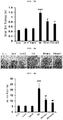
- the fluorescence emission of HEK-293 cells was measured by confocal microscopy to perform quantitative analysis, and the results are shown in Figures 1 and 2 .
- Figure 1 is a set of confocal photomicrographs of the fluorescence emission in PDE4B GFP fusion protein-inhibitor assay with the compounds of example 1, example 2 and comparative example 1.
- Figure 2 is a graph showing the fluorescence intensity of the PDE4B GFP fusion protein treated with the compounds of example 1, example 2 and comparative example 1 according to the present invention and the ratio of the total surface cover area of GFP to the total cell surface area.
- the bar graph represents the fluorescence intensity
- the line graph represents the GFP cover area.
- the compounds of Examples 1 and 25 according to the present invention exhibited a relatively weak fluorescence intensity compared to the control group not-treated with any inhibitor. In particular, it was confirmed that the fluorescence intensity was significantly reduced at the concentrations of 100 nM and 500 nM. This indicates that the compounds of Example 1 and Example 25 according to the present invention inhibited the expression of PDE4B2 effectively in cells, indicating that the compounds according to the present invention can be effectively used for atopic diseases associated with PDE4B2.
- DNCB dinitrochlorobenzene
- mice treated with the carrier alone mice treated with Example 1 compound, mice treated with Example 25 compound, mice treated with DNCB alone, mice treated with DNCB and Example 1 compound, and mice treated with DNCB and Example 25 compound.
- mice were applied with the compounds of Example 1 and Example 25 daily from the 6 th day of the experiment to the end of the experiment.
- Figure 3 is a set of photographs showing the dorsal skin of each mouse of the experimental group and control group taken on the last day of the experiment.
- the degree of atopic symptoms in the experimental group and control group mice was evaluated and quantified once a week for a period of 5 weeks. Scores were given as follows for the four items of erythema/bleeding, edema, threshing/corrosion, scaling/dryness, respectively: 1 (none); 2 (moderate); and 3 (serious). Each experimental group and control group was scored based on a total of 12 points. The score results measured for 5 weeks are shown in Figure 4 .
- Figure 4(a) , 4(b) are a set of graphs showing the results of scoring atopic symptoms of the mouse measured in the experimental results for 5 weeks.
- Figure 4(a) is a graph showing the dermatitis score for the compound of example 1
- Figure 4(b) is a graph showing the dermatitis score for the compound of example 25.
- Figure 5(a) is a graph showing the number of scratches for 20 minutes of each mouse of the experimental group and control group.
- Figure 5(b) is a graph showing the measured thickness of the dorsal skin of each mouse of the experimental group and control group incised.
- the skin thickness of the mouse treated with DNCB alone was 1.19 mm, which was significantly increased compared to that of the control group (0.45 mm), and the skin thickness of the mouse treated with the compounds of Example 1 and Example 25 was significantly reduced to 0.83 mm and 0.71 mm, respectively.
- the lymph node of each mouse of the experimental group and control group was separated and observed.
- the lymph node is an interaction site between the antigen and immune cells, and since the size of the lymph node increases during the development of inflammatory symptoms, it is possible to confirm the presence or absence of inflammatory disease depending on the size of the lymph node.
- the photographs of the separated lymph node of each mouse of the experimental group and control group are shown in Figure 6(a)
- the weight of the lymph node and the spleen of each mouse of the experimental group and control group are shown in Figure 6(b) and Figure 6(c) .
- Figure 6(a) is a set of photographs of the lymph nodes of the experimental and control group mice.
- Figure 6(b) is a graph showing the weight of the lymph nodes of the experimental and control group mice.
- Figure 6(c) is a graph showing the weight of the spleens of the experimental and control group mice.
- the lymph node of the mouse treated with DNCB alone was significantly enlarged compared to that of the control mouse.
- the lymph node of the mouse treated with the compounds of Example 1 and Example 25 was significantly reduced compared to that of the mouse treated with DNCB alone.
- the weight of the lymph node of the mouse treated with DNCB alone was significantly heavier than that of the control mouse.
- the weight of the lymph node of the mouse treated with the compounds of Example 1 and Example 25 was significantly reduced compared to that of the mouse treated with DNCB alone.
- the weight of the spleen was also significantly reduced by the treatment of the compounds of Example 1 and Example 25.
- the compounds according to the present invention inhibited the lymph node and spleen hypertrophy closely related to the development of inflammatory disease in vivo, and that the compounds according to the present invention were effective in the treatment of inflammatory disease.
- the dorsal skin tissue of the mouse was observed to confirm the effect of the compounds according to the invention on inflammatory disease.
- the dorsal skin samples were obtained from the experimental group and control group mice. The samples were fixed using 10% neutral buffered formalin and then embedded in paraffin. 4 ⁇ m thin tissue sections were prepared and stained with H & E (hematoxylin & eosin). Thin tissue sections (4 pm) were prepared and stained with H&E (hematoxylin & eosin). In addition, the sections were stained with toluidine blue to investigate mast cell infiltration. Then, the stained tissue sections were photographed using NikonAX70 optical microscope (Tokyo, Japan) .
- Figure 7 is a set of optical photomicrographs taken after H&E (hematoxylin & eosin) staining of the dorsal skin tissue sections of the experimental and control group mice.
- H&E hematoxylin & eosin
- Figure 9 is a graph showing the number of adipocytes in the dorsal skin tissue sections of the experimental group and control group mice.
- the skin tissue sections of the control group and the groups treated with the compounds of Example 1 and Example 25 showed the normal skin structure.
- the skin sections of the mouse treated with DNCB alone showed severe epidermal hyperplasia (acanthosis) and keratosis, and inflammatory cells penetrated deeply into both the epidermal and dermal regions at high density.
- epidermal hyperplasia and keratosis were significantly reduced, and there were almost no inflammatory cells.
- the number of mast cells was increased in the skin tissue of the mouse treated with DNCB alone, compared to that of the control group.
- the number of mast cells was significantly reduced in the skin tissue of the mouse treated with the compounds of Example 1 and Example 25, compared to that of the mouse treated with DNCB alone.
- Example 1 and Example 25 According to the present invention, it was confirmed that the acanthosis and keratosis in the skin were alleviated, the production of inflammatory cells was suppressed, and the increase of mast cells was reduced by the compounds of Example 1 and Example 25 according to the present invention, so they can be effectively used as a pharmaceutical composition for the treatment or prevention of inflammatory disease.
- mouse tissue CD4+ cells were stained to confirm the expressions of IL-17, IFN- ⁇ , IL-4 and IL-5.
- Figure 10(a) ⁇ Figure 10(d) are microphotographs showing the expression levels of IL-17, IFN- ⁇ , IL-4 and IL-5, respectively, after staining CD4+ cells of the dorsal skin tissues of the experimental group and control group mice.
- iii example 25
- vi DNCB+example 25
- IL-17, IL-4 and IL-5 are cytokines associated with the expression of inflammation, and when the compound according to the present invention is applied on the skin with inflammatory disease, the expressions of IL-17, IL-4 and IL-5 are suppressed. Therefore, the compound according to the present invention can be effectively used as a pharmaceutical composition for the treatment or prevention of inflammatory disease.
- IFN- ⁇ is a cytokine protein that suppresses viral proliferation in cells
- the expression of IFN- ⁇ is activated to suppress inflammatory diseases in cells. Therefore, the compound according to the present invention can be effectively used as a pharmaceutical composition for the treatment or prevention of inflammatory disease.
- ELISA Enzyme-Linked ImmunoSorbent Assay
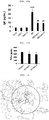
- Figure 11(a) ⁇ Figure 11(e) are graphs showing the expression levels of IL-4, IL-5, IFN- ⁇ , IL-17 and IgE, respectively, shown when performing sandwich ELISA (Enzyme-Linked ImmunoSorbent Assay) with the mouse skin tissues.
- IL-4, IL-5 and IL-17 are cytokines associated with the expression of inflammation, and when the compound according to the present invention is applied on the skin with inflammatory disease, the expressions of IL-17, IL-4 and IL-5 are suppressed. Therefore, the compound according to the present invention can be effectively used as a pharmaceutical composition for the treatment or prevention of inflammatory disease.
- the expression of IFN- ⁇ was high in the skin of the mouse treated with the compounds of Example 1 and Example 25.
- IFN- ⁇ is a cytokine protein that suppresses viral proliferation in cells, and when the compound according to the present invention is applied on the skin, the expression of IFN- ⁇ is activated to suppress inflammatory diseases in cells. Therefore, the compound according to the present invention can be effectively used as a pharmaceutical composition for the treatment or prevention of inflammatory disease.
- IgE immunoglobulin E
- Fc receptors on the surfaces of mast cells and basophils
- the compound according to the present invention when the compound according to the present invention is applied on the skin, the expression of IgE is inhibited to suppress inflammatory diseases in cells. Therefore, the compound according to the present invention can be effectively used as a pharmaceutical composition for the treatment or prevention of inflammatory disease.
- Example 1 and Example 25 in vitro assay was performed. Particularly, after culturing human PBMC cells, the secretion of TNF- ⁇ was stimulated using bacterial LPS, and the expression level of TNF- ⁇ was measured.
- Figure 11(f) is a graph showing the inhibitory effect of the compounds of Example 1 and Example 25 on the synthesis of TNF- ⁇ .
- TNF- ⁇ is a well-known pro-inflammatory mediator, and its synthesis is known to occur in T lymphocytes. Since the compound according to the present invention was confirmed to inhibit the expression of TNF- ⁇ through this experiment, the compound according to the present invention can be effectively used for the prevention or treatment of inflammatory diseases.
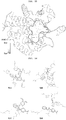
- Figure 12 is a Discovery Srudio photograph showing the binding between the ligand and PDE4B in the catalytic binding region.
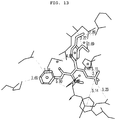
- Figure 13 is a diagram showing the binding distance between the compound of Example 25 and the PDE4B ligand.
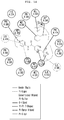
- Figure 14 is a two-dimensional diagram showing the binding between the compound of Example 25 and the PDE4B ligand.
- Figure 15 is an aromatic three-dimensional diagram showing the PDE4B catalyst binding site of the compound of Example 25.
- Figure 16 is a set of three-dimensional diagrams showing the binding structure of the compound of Example 25 in the active sites of PDE4A, PDE4B, PDE4C and PDE4D.
- the fluorine atom of the compound of Example 25 (fluorine atom represented by a in Figure 14 ) formed a strong hydrogen bond of 3.23 ⁇ with Gln 500 of PDE4B, and another fluorine atom (fluorine atom represented by b in Figure 14 ) formed a strong carbon hydrogen bond with His234 of PDE4B.
- Example 25 penetrated deeply into the active region of PDE4B and combined.
- Example 25 had a very limited binding property to PDE4A, PDE4C and PDE4D.
- Example 25 had the selectivity to PDE4B, so that it can more effectively inhibit PDE4B, an inflammatory disease-related enzyme.
- the compound of Example 25 had excellent and selective binding properties to PDE4B. It was also confirmed from the above results that the compound according to the present invention effectively inhibited the expression of PDE4B, an inflammatory disease-related enzyme, at the molecular level. Therefore, the compound according to the present invention can be effectively used for the treatment or prevention of inflammatory diseases.
- the benzamide derivative compound according to the present invention can be effectively used as a pharmaceutical composition for the treatment or prevention of inflammatory diseases.
Landscapes
- Chemical & Material Sciences (AREA)
- Organic Chemistry (AREA)
- Health & Medical Sciences (AREA)
- Life Sciences & Earth Sciences (AREA)
- Veterinary Medicine (AREA)
- Medicinal Chemistry (AREA)
- Pharmacology & Pharmacy (AREA)
- Animal Behavior & Ethology (AREA)
- General Health & Medical Sciences (AREA)
- Public Health (AREA)
- Epidemiology (AREA)
- Engineering & Computer Science (AREA)
- Mycology (AREA)
- Nutrition Science (AREA)
- Food Science & Technology (AREA)
- Polymers & Plastics (AREA)
- Bioinformatics & Cheminformatics (AREA)
- Dermatology (AREA)
- Chemical Kinetics & Catalysis (AREA)
- General Chemical & Material Sciences (AREA)
- Nuclear Medicine, Radiotherapy & Molecular Imaging (AREA)
- Pharmaceuticals Containing Other Organic And Inorganic Compounds (AREA)
- Plural Heterocyclic Compounds (AREA)
Abstract
Description
- This patent application claims the benefit of priority from Korean Patent Application No.
10-2017-0153106 filed on November 16th, 2017 - The present invention relates to a benzamide derivative compound, a method for preparing the same, and a pharmaceutical composition for treating or preventing an inflammatory disease containing the same as an active ingredient.
- Atopic dermatitis is an inflammatory skin disease most commonly seen in young children, with a prevalence of 10-25% worldwide. Clinical features of atopic dermatitis include eczema, skin lesions, scaling and intolerable itching. The development of atopic dermatitis is related to complex interactions between genetic, environmental, and immunological factors.
- Previous studies have reported that increased phosphodiesterase-4B (PDE4B) causes an increase of inflammatory disease mediators in leukocytes of atopic dermatitis patients. Therefore, the decrease of cAMP level can be a factor that exacerbates inflammation in the atopic skin disease. The intracellular cAMP homeostasis is regulated by the synthesis of cAMP by adenylcyclase and the synthesis of cAMP by PDE (phosphodiesterase) in response to extracellular signals.
- Phosphodiesterases (PDEs) are enzymes that hydrolyze cAMP and cGMP to 5'AMP and 5'GMP, respectively. PDEs are subdivided into 11 different groups based on sequence similarity, biochemical properties and inhibitor selectivity. Particularly, PDEs are classified as follows. (i) cAMP specific PDEs (PDE4, 7 and 8); (ii) cGMP specific PDEs (PDE5, 6 and 9); and (iii) cAMP or cGMP specific PDEs (PDE1, 2, 3, 10 and 11). Herein, PDE11 is known to be specific to both cAMP and cGMP. Among the cAMP specific PDEs, PDE4 is significantly expressed in inflammatory cells. PDE4B is known to be the major iso form of PDE4 expressed in lymphocytes and macrophages (non-patent literature 01: Wang, P., Wu, P., Ohleth, K.M., Egan, R.W. & Billah, M.M. Phosphodiesterase 4B2 is the predominant phosphodiesterase species and undergoes differential regulation of gene expression in human monocytes and neutrophils. Molecular pharmacology 56, 170-174 (1999).). Inhibition of PDE4B in lymphocytes and macrophages can effectively induce inhibition of expression of inflammatory cytokines by raising the intracellular cAMP level.
- Therefore, for the effective treatment of inflammatory diseases, a pharmaceutical composition capable of effectively inhibiting PDE4B is required, and the related research is also required. Accordingly, the present inventors have studied various compounds having a therapeutic effect on inflammatory diseases. During the study, the present inventors found that the benzamide derivative compound according to the present invention was effective in inhibiting the expression of PDE4B and completed this invention.
- It is an object of the present invention to provide a benzamide derivative compound and a preparation method thereof.
- It is another object of the present invention to provide a pharmaceutical composition for the prevention or treatment of inflammatory diseases.
- It is another object of the present invention to provide a health functional food composition for the prevention or amelioration of inflammatory diseases.
- To achieve the above objects, the present invention provides a compound represented by
formula 1, an optical isomer thereof, or a pharmaceutically acceptable salt thereof.
- (In
formula 1,
L, R1, R2, R3 and R4 are as defined in this specification). - The present invention also provides a preparation method of a compound represented by
formula 1 comprising a step of preparing a compound represented byformula 1 by reacting a compound represented byformula 2 with a compound represented byformula 3, as shown inreaction formula 1 below.
- (In
reaction formula 1,
R1, R2, R3 and R4 are as defined informula 1 of claim 1) . - The present invention also provides a pharmaceutical composition comprising a compound represented by
formula 1, an optical isomer thereof or a pharmaceutically acceptable salt thereof as an active ingredient for the prevention or treatment of inflammatory diseases. - In addition, the present invention provides a health functional food composition comprising a compound represented by
formula 1, an optical isomer thereof or a pharmaceutically acceptable salt thereof as an active ingredient for preventing or ameliorating inflammatory diseases. - The benzamide derivative compound according to the present invention inhibits the expression of PDE4 and regulates the expressions of inflammatory disease-related substances such as IL-4 (interleukin-4), IL-5 (interleukin-4), IFN-γ (interferon-γ), IL-17 (interluekin-17), IgE (immunoglobulin E), and TNF-α (tumor necrosis factor- α), and thus may be utilized as a pharmaceutical composition for treating or preventing inflammatory diseases.
-
-
Figure 1 is a set of confocal photomicrographs of the fluorescence emission in PDE4B GFP fusion protein-inhibitor assay with the compounds of example 1, example 2 and comparative example 1. -
Figure 2 is a graph showing the fluorescence intensity of the PDE4B GFP fusion protein treated with the compounds of example 1, example 2 and comparative example 1 according to the present invention and the ratio of the total surface cover area of GFP to the total cell surface area. InFigure 2 , the bar graph represents the fluorescence intensity, and the line graph represents the GFP cover area. -
Figure 3 is a set of photographs showing the dorsal skin of each mouse of the experimental group and control group taken on the last day of the experiment. -
Figure 4(a) ,4(b) are a set of graphs showing the results of scoring atopic symptoms of the mouse measured in the experimental results for 5 weeks.Figure 4(a) is a graph showing the dermatitis score for the compound of example 1, andFigure 4(b) is a graph showing the dermatitis score for the compound of example 25. -
Figure 5(a) is a graph showing the number of scratches for 20 minutes of each mouse of the experimental group and control group, andFigure 5(b) is a graph showing the measured thickness of the dorsal skin of each mouse of the experimental group and control group incised. -
Figure 6(a) is a set of photographs of the lymph nodes of the experimental and control group mice,Figure 6(b) is a graph showing the weight of the lymph nodes of the experimental and control group mice, andFigure 6(c) is a graph showing the weight of the spleens of the experimental and control group mice. -
Figure 7 is a set of optical photomicrographs taken after H&E (hematoxylin & eosin) staining of the dorsal skin tissue sections of the experimental and control group mice. (i=control group, ii=example 1, iii=example 25, iv=DNCB, v=DNCB+example 1, vi=DNCB+example 25) -
Figure 8 is a set of optical micrographs taken after toluidine blue staining of adipocytes of the dorsal skin tissue sections of the experimental and control group mice. (i=control group, ii=example 1, iii=example 25, iv=DNCB, v=DNCB+example 1, vi=DNCB+example 25) -
Figure 9 is a graph showing the number of adipocytes in the dorsal skin tissue sections of the experimental group and control group mice. -
Figure 10(a) ∼ Figure 10(d) are microphotographs showing the expression levels of IL-17, IFN-γ, IL-4 and IL-5, respectively, after staining CD4+ cells of the dorsal skin tissues of the experimental group and control group mice. (i=control group, ii=example 1, iii=example 25, iv=DNCB, v=DNCB+example 1, vi=DNCB+example 25) -
Figure 11(a) ∼ Figure 11(e) are graphs showing the expression levels of IL-4, IL-5, IFN-γ, IL-17 and IgE, respectively, shown when performing sandwich ELISA (Enzyme-Linked ImmunoSorbent Assay) with the mouse skin tissues. -
Figure 11(f) is a graph showing the inhibitory effect of the compounds of Example 1 and Example 25 on the synthesis of TNF-α. -
Figure 12 is a Discovery Srudio photograph showing the binding between the ligand and PDE4B in the catalytic binding region. -
Figure 13 is a three-dimensional diagram showing the binding distance between the compound of Example 25 and the PDE4B ligand. -
Figure 14 is a two-dimensional diagram showing the binding between the compound of Example 25 and the PDE4B ligand. -
Figure 15 is an aromatic three-dimensional diagram showing the PDE4B catalyst binding site of the compound of Example 25. -
Figure 16 is a set of three-dimensional diagrams showing the binding structure of the compound of Example 25 in the active sites of PDE4A, PDE4B, PDE4C and PDE4D. - Hereinafter, the present invention is described in detail.
- The present invention provides a compound represented by
formula 1 below, an isomer thereof or a pharmaceutically acceptable salt thereof.
- In
formula 1 above,
L is single bond or straight or branched C1-C6 alkylene;
R1 is hydrogen; C3-C8 cycloalkyl; nonsubstituted or substituted C6-C12 aryl; heteroaryl consisting of 6 to 12 atoms containing one or more heteroatoms selected from the group consisting of N and O; or heterocycloalkyl consisting of 6 to 10 atoms containing one or more heteroatoms selected from the group consisting of N and O; at this time, the substituted C6-C12 aryl can be substituted with one or more substituents selected from the group consisting of halogen, -NH2, straight or branched C1-C3 alkyl, and straight or branched C1-C3 alkoxy, and the substituted heteroaryl consisting of 6 to 12 atoms can be substituted with one or more halogens;
R2 is hydrogen or straight or branched C1-C3 alkyl;
R3 is nonsubstituted or substituted C6-C10 aryl; or heterocycloalkyl consisting of 6 to 8 atoms containing one or more heteroatoms selected from the group consisting of N and O; at this time, the substituted C6-C10 aryl can be substituted with one or more methoxy groups, the substituted heterocycloalkyl consisting of 6 to 8 atoms can be substituted with one or more hydroxyl ethyl groups; and
R4 is C1-C3 haloalkyl, -SR5 or -SO2R5, at this time, R5 is straight or branched C1-C6 alkyl. - In addition, in
formula 1 above,
L is single bond or straight or branched C1-C3 alkylene;
R1 is hydrogen; C3-C6 cycloalkyl; nonsubstituted or substituted C6-C10 aryl; heteroaryl consisting of 6 to 10 atoms containing one or more heteroatoms selected from the group consisting of N and O; or heterocycloalkyl consisting of 6 to 8 atoms containing one or more heteroatoms selected from the group consisting of N and O; at this time, the substituted C6-C10 aryl can be substituted with one or more substituents selected from the group consisting of fluoro, -NH2, methoxy and isopropyl, and the substituted heteroaryl consisting of 6 to 10 atoms can be substituted with one or more chloro;
R2 is hydrogen or straight or branched C1-C3 alkyl;
R3 is C6-C10 aryl nonsubstituted or substituted with one or more methoxy groups; or heterocycloalkyl consisting of 6 to 8 atoms nonsubstituted or substituted with one or more hydroxyl ethyl groups containing one or more heteroatoms selected from the group consisting of N and O; and
R4 is -CH2F, -CHF2, -CF3, -CH2Cl, -CHCl2, -CCl3, - CH2Br, -CHBr2, -CBr3, -SR5 or -SO2R5, at this time, R5 is straight or branched C1-C3 alkyl. - Further, in
formula 1 above,
L is single bond, -CH2- or -CH2CH2-;
R1 is hydrogen, cyclopropyl, morpholinyl, tetrahydropyranyl, indolyl, phenyl or pyridinyl nonsubstituted or substituted with one or more chloro; at this time, phenyl can be substituted with one or more substituents selected from the group consisting of methoxy, fluoro, isopropyl and -NH2;
R2 is hydrogen, methyl or ethyl;
R3 is morpholinyl; phenyl nonsubstituted or substituted with one or more methoxy; or piperazinyl nonsubstituted or substituted with one or more hydroxy ethyl groups; and
R4 is -CHF2, -CH2F, -CF3, -SCH3 or -SO2CH3. - Moreover, in
formula 1 above,
L is single bond or -CH2CH2-;
R1 is hydrogen,

R3 is
R4 is -CF3, -SCH3 or -SO2CH3. - Furthermore, the compound represented by
formula 1 above can be any compound selected from the group consisting of the following compounds, an optical isomer thereof or a pharmaceutically acceptable salt thereof. - (1) N-(3,4-dimethoxyphenyl)-2-(methylthio)-4-morpholinopyrimidine-5-carboxamide;
- (2) N-(3,5-dichloropyridine-4-yl)-4-(3,4-dimethoxyphenyl)-2-(methylthio)pyrimidine-5-carboxamide;
- (3) 4-(3,4-dimethoxyphenyl)-2-(methylthio)-N-(pyridine-4-yl)pyrimidine-5-carboxamide;
- (4) N-(2-(1H-indole-3-yl)ethyl)-2-(methylthio)-4-morpholinopyrimidine-5-carboxamide;
- (5) 4-(3,4-dimethoxyphenyl)-2-(methylthio)-N-(tetrahydro-2H-pyran-4-yl)pyrimidine-5-carboxamide;
- (6) N-(4-fluorophenyl)-2-(methylthio)-4-morpholinopyrimidine-5-carboxamide;
- (7) N-(3,4-dimethoxyphenetyl)-2-(methylthio)-4-morpholinopyrimidine-5-carboxamide;
- (8) N-(2,4-dimethoxybenzyl)-4-morpholino-2-(trifluoromethyl)pyridine-5-carboxamide;
- (9) N-(2,4-dimethoxybenzyl)-2-(methylthio)-4-morpholinopyrimidine-5-carboxamide;
- (10) N-(3,5-dichloropyridine-4-yl)-2-(methylthio)-4-morpholinopyrimidine-5-carboxamide;
- (11) N-(3,4-dimethoxyphenyl)-4-morpholino-2-(trifluoromethyl)pyrimidine-5-carboxamide;
- (12) 4-(3,4-dimethoxyphenyl)-N-(tetrahydro-2H-pyran-4-yl)-2-(trifluoromethyl)pyrimidine-5-carboxamide;
- (13) 4-(3,4-dimethoxyphenyl)-N,N-diethyl-2-(trifluoromethyl)pyrimidine-5-carboxamide;
- (14) 4-(3,4-dimethoxyphenyl)-2-(methylsulfonyl)-N-(tetrahydro-2H-pyran-4-yl)pyrimidine-5-carboxamide;
- (15) N-cyclopropyl-4-(3,4-dimethoxyphenyl)-2-(trifluoromethyl)pyrimidine-5-carboxamide;
- (16) N-(3,5-dichloropyridine-4-yl)-4-(3,4-dimethoxyphenyl)-2-(trifluoromethyl)pyrimidine-5-carboxamide;
- (17) 4-(3,4-dimethoxyphenyl)-N,N-diethyl-2-(methylthio)pyrimidine-5-carboxamide;
- (18) N-cyclopropyl-4-(3,4-dimethoxyphenyl)-2-(methylthio)pyrimidine-5-carboxamide;
- (19) N-cyclopropyl-4-(3,4-dimethoxyphenyl)-2-(methylsulfonyl)pyrimidine-5-carboxamide;
- (20) N-(4-amino-3,5-diisopropylphenyl)-4-(3,4-dimethoxyphenyl)-2-(methylthio)pyrimidine-5-carboxamide;
- (21) N-(4-amino-3,5-diisopropylphenyl)-4-(3,4-dimethoxyphenyl)-2-(trifluoromethyl)pyrimidine-5-carboxamide;
- (22) N-(3,4-dimethoxyphenyl)-4-(4-(2-hydroxyethyl)piperazine-1-yl)-2-(methylthio)pyrimidine-5-carboxamide;
- (23) N-(3,4-dimethoxyphenetyl)-4-morpholino-2-(trifluoromethyl)pyrimidine-5-carboxamide;
- (24) N-(2-(1H-indole-3-yl)ethyl)-4-morpholino-2-(trifluoromethyl)pyrimidine-5-carboxamide;
- (25) 4-(3,4-dimethoxyphenyl)-N-(pyridine-4-yl)-2-(trifluoromethyl)pyrimidine-5-carboxamide;
- (26) 4-(3,4-dimethoxyphenyl)-N-(2-morpholinoethyl)-2-(trifluoromethyl)pyrimidine-5-carboxamide;
- (27) 4-(3,4-dimethoxyphenyl)-2-(methylthio)-N-(2-morpholinoethyl)pyrimidine-5-carboxamide;
- (28) N-(3,4-dimethoxyphenetyl)-4-(4-(2-hydroxyethyl)piperazine-1-yl)-2-(methylthio)pyrimidine-5-carboxamide;
- (29) N,4-bis(3,4-dimethoxyphenyl)-2-(methylthio)pyrimidine-5-carboxamide; and
- (30) N,4-bis(3,4-dimethoxyphenyl)-2-(trifluoromethyl)pyrimidine-5-carboxamide.
- The compound represented by
formula 1 of the present invention can be used as a form of a pharmaceutically acceptable salt, in which the salt is preferably acid addition salt formed by pharmaceutically acceptable free acids. The acid addition salt herein can be obtained from inorganic acids such as hydrochloric acid, nitric acid, phosphoric acid, sulfuric acid, hydrobromic acid, hydroiodic acid, nitrous acid, and phosphorous acid; non-toxic organic acids such as aliphatic mono/dicarboxylate, phenyl-substituted alkanoate, hydroxy alkanoate, alkandioate, aromatic acids, and aliphatic/aromatic sulfonic acids; or organic acids such as acetic acid, benzoic acid, citric acid, lactic acid, maleic acid, gluconic acid, methanesulfonic acid, 4-toluenesulfonic acid, tartaric acid, and fumaric acid. The pharmaceutically non-toxic salts are exemplified by sulfate, pyrosulfate, bisulfate, sulphite, bisulphite, nitrate, phosphate, monohydrogen phosphate, dihydrogen phosphate, metaphosphate, pyrophosphate, chloride, bromide, iodide, fluoride, acetate, propionate, decanoate, caprylate, acrylate, formate, isobutylate, caprate, heptanoate, propiolate, oxalate, malonate, succinate, suberate, cabacate, fumarate, maliate, butyne-1,4-dioate, hexane-1,6-dioate, benzoate, chlorobenzoate, methylbenzoate, dinitrobenzoate, hydroxybenzoate, methoxybenzoate, phthalate, terephthalate, benzenesulfonate, toluenesulfonate, chlorobenzenesulfonate, xylenesulfonate, phenylacetate, phenylpropionate, phenylbutylate, citrate, lactate, hydroxybutylate, glycolate, malate, tartrate, methanesulfonate, propanesulfonate, naphthalene-1-sulfonate, naphthalene-2-sulfonate, and mandelate. - The acid addition salt in this invention can be prepared by the conventional method known to those in the art. For example, the derivative represented by
formula 1 is dissolved in an organic solvent such as methanol, ethanol, acetone, dichloromethane, and acetonitrile, to which organic acid or inorganic acid is added to induce precipitation. Then, the precipitate is filtered and dried to give the salt. Or the solvent and the excessive acid are distillated under reduced pressure, and dried to give the salt. Or the precipitate is crystallized in an organic solvent to give the same. - A pharmaceutically acceptable metal salt can be prepared by using a base. Alkali metal or alkali earth metal salt is obtained by the following processes: dissolving the compound in excessive alkali metal hydroxide or alkali earth metal hydroxide solution; filtering non-soluble compound salt; evaporating the remaining solution and drying thereof. At this time, the metal salt is preferably prepared in the pharmaceutically suitable form of sodium, potassium, or calcium salt. And the corresponding silver salt is prepared by the reaction of alkali metal or alkali earth metal salt with proper silver salt (ex; silver nitrate).
- The compound represented by
formula 1 according to the present invention, the optical isomer thereof or the pharmaceutically acceptable salt thereof inhibits the expression of PDE4, and has excellent ability to control the expressions of inflammatory disease-related substances such as IL-4 (Interleukin-4), IL-5 (Interleukin-5), IFN-γ (Interferon-γ), IL-17 (Interleukin-17), IgE (immunoglobulin E) and TNF-α (Tumor necrosis factor-α), so it can be effectively used for the treatment or prevention of inflammatory diseases (see Experimental Examples 1 ∼ 5). - In addition, since the ability to bind to PDE4B at the molecular level was confirmed through molecular docking experiments, it effectively suppresses the expression of PDE4B in the body, thereby enabling treatment or prevention of inflammatory diseases (see Experimental Example 6).
- In addition, the present invention provides a preparation method of a compound represented by
formula 1 comprising the step of preparing a compound represented byformula 1 by reacting the compound represented byformula 2 with a compound represented byformula 3, as shown inreaction formula 1 below.
- In
reaction formula 1, L, R1, R2, R3 and R4 are as defined informula 1 above. - Hereinafter, the preparation method according to the present invention is described in more detail.
- The preparation method represented by
reaction formula 1 is a method to prepare the compound represented byformula 1 according to the present invention by reacting an aldehyde group of the compound represented byformula 2 with an amine compound represented byformula 3. - At this time, to react the amine compound represented by
formula 3, a step of adding chloro to the aldehyde group of the compound represented byformula 2 can be added, as shown inreaction formula 2 below. - Particularly, after dissolving the compound of
formula 2 in a solvent such as DCM, oxalyl chloride and anhydrous DMF can be added to the solution and reacted by stirring. - Then, the resulting mixture is concentrated under reduced pressure to obtain a compound represented by formula 2' in which chloro is added to the aldehyde group.

- After the step of preparing the compound of formula 2' is completed, the compound represented by formula 2' is dissolved in a solvent in the next process, and the compound represented by
formula 3 is added, followed by stirring the reaction mixture. Next, it is possible to react while slowly raising the reaction temperature to around room temperature for 1 hour. The resulting mixture can be concentrated under reduced pressure, and the concentrated mixture can be purified by column chromatography or the like. Upon completion of the purification, the target compound represented byformula 1 can be obtained. - The present invention also provides a pharmaceutical composition comprising a compound represented by
formula 1, an optical isomer thereof or a pharmaceutically acceptable salt thereof as an active ingredient for the prevention or treatment of inflammatory disease. - At this time, the inflammatory disease includes dermatitis, atopic dermatitis, asthma, rhinitis, arthritis, rheumatoid arthritis, gastritis, enteritis, nephritis, hepatitis, allergy, gastric ulcer, duodenal ulcer, esophagitis, colitis, systemic edema, local edema, keratitis, bronchitis, pleurisy, peritonitis, spondylitis, inflammatory pain, urethritis, prostatitis, cystitis, periodontitis, gingivitis, chronic obstructive pulmonary disease (COPD), pulmonary fibrosis, irritable bowel syndrome, inflammatory pain, migraine, headache, low back pain, fibromyalgia, fascial disease, viral infections, bacterial infections, fungal infections, burns, wounds caused by surgical or dental operation, excessive PGE syndrome, atherosclerosis, gout, ankylosing spondylitis, Hodgkin's disease, pancreatitis, conjunctivitis, irisitis, scleritis, uveitis, eczema and multiple sclerosis, and if it is a common inflammatory disease, it is not limited to the above-mentioned types and may include all.
- In addition, the pharmaceutical composition for the prevention or treatment of inflammatory disease according to the present invention can be characterized in that the compound represented by
formula 1 inhibits the expression of PDE4. - In particular, the composition can effectively treat and prevent inflammatory disease through the selective response to PDE4B among PDE4 (see Experimental Example 6).
- In addition, the pharmaceutical composition for the prevention or treatment of inflammatory disease according to the present invention can be characterized in that the compound represented by
formula 1 regulates the expressions of IL-4 (Interleukin-4), IL-5 (Interleukin-5), IFN-γ (Interferon-γ), IL-17 (Interleukin-17), IgE (immunoglobulin E) and TNF-α (Tumor necrosis factor-α).
pharmacological profile (PDE4B enzyme inhibitor assay, PDE4B-GFP fusion protein assay, molecular docking with PDE4B enzyme), anti-atopic profile (DNCB-induced AD-like skin inflammation in Nc/Nga mice) - The compound represented by
formula 1 or the pharmaceutically acceptable salt thereof included in the pharmaceutical composition of the present invention can be applied directly to the skin or administered orally or parenterally and be used in general forms of pharmaceutical formulation. That is, the composition of the present invention can be prepared for oral or parenteral administration by mixing with generally used diluents or excipients such as fillers, extenders, binders, wetting agents, disintegrating agents and surfactants. - The formulations for oral administration are exemplified by tablets, pills, hard/soft capsules, solutions, suspensions, emulsions, syrups, granules, elixirs, and troches, etc. These formulations can include diluents (for example, lactose, dextrose, sucrose, mannitol, sorbitol, cellulose, and/or glycine) and lubricants (for example, silica, talc, stearate and its magnesium or calcium salt, and/or polyethylene glycol) in addition to the active ingredient. Tablets can include binding agents such as magnesium aluminum silicate, starch paste, gelatin, methylcellulose, sodium carboxymethylcellulose and/or polyvinylpyrolidone, and if necessary disintegrating agents such as starch, agarose, alginic acid or its sodium salt or azeotropic mixtures and/or absorbents, coloring agents, flavours, and sweeteners can be additionally included thereto.
- The pharmaceutical composition comprising the compound represented by
formula 1 or the pharmaceutically acceptable salt thereof as an active ingredient can be administered by parenterally and the parenteral administration includes subcutaneous injection, intravenous injection, intramuscular injection, or intrathoracic injection. In addition, the composition can be applied directly to the skin. In this case, the composition can be prepared and applied in the form of ointment, spray, beauty wash, lotion, cream, massage cream, essence, cleansing product, pack, powder, patch, gel, etc. The application method is not particularly limited, and any conventional application method can be used. - To prepare the compound represented by
formula 1 or the pharmaceutically acceptable salt thereof as a formulation for parenteral administration, the compound represented byformula 1 or the pharmaceutically acceptable salt thereof is mixed with a stabilizer or a buffering agent in water to produce a solution or suspension, which is then formulated as ampoules or vials. The composition herein can be sterilized and additionally contains preservatives, stabilizers, wettable powders or emulsifiers, salts and/or buffers for the regulation of osmotic pressure, and other therapeutically useful materials, and the composition can be formulated by the conventional mixing, granulating or coating method. - The effective dosage of the pharmaceutical composition comprising the compound represented by
formula 1 or the pharmaceutically acceptable salt thereof as an active ingredient can be determined according to age, weight, gender, administration method, health condition, and severity of disease. The dosage is generally 0.1 ∼ 1000 mg/day, and preferably 1 ∼ 500 mg/day based on an adult patient weighing 70 kg, which can be administered once or several times a day at intervals of a certain time depending on the judgment of a doctor or a pharmacist. - At this time, the pharmaceutical composition according to the present invention can be preferably administered by a method of directly applying to the skin among the above administration methods, and a remarkably high therapeutic effect on inflammatory disease is exhibited by skin application only without oral administration (Experimental Examples 1 ∼ 5).
- Accordingly, the pharmaceutical composition according to the present invention has the advantage that no side effects such as vomiting, nausea, or dizziness may occur during oral administration, which has been a problem with conventional atopic medicines.
- The pharmaceutical composition comprising the compound represented by
formula 1 or the pharmaceutically acceptable salt thereof as an active ingredient can be administered alone or together with surgical operation, hormone therapy, chemo-therapy and biological regulators to prevent or treat inflammatory disease. - In addition, the present invention provides a health functional food composition comprising a compound represented by
formula 1, an optical isomer thereof or a pharmaceutically acceptable salt thereof as an active ingredient for preventing or ameliorating inflammatory diseases. - The health functional food composition according to the present invention can be prepared by adding the compound of
formula 1 above to food or beverages for the purpose of preventing or alleviating inflammatory diseases. - The food herein is not limited. For example, the composition of the present invention can be added to drinks, meats, sausages, breads, biscuits, rice cakes, chocolates, candies, snacks, pizza, ramyuns, flour products, gums, dairy products including ice cream, soups, beverages, alcohol drinks and vitamin complex, etc, and in wide sense, almost every health functional food can be included.
- The compound represented by
formula 1 of the present invention can be used as food additive. In that case, the compound can be added as it is or as mixed with other food components according to the conventional method. The mixing ratio of active ingredients can be regulated according to the purpose of use (prevention or alleviation). In general, the compound represented byformula 1 of the present invention can be added at 0.1 to 90 weight parts by the total food weight. However, if long term administration is required for health and hygiene or regulating health condition, the content can be lower than the above but higher content can be accepted as well since the compound has been proved to be very safe. - The composition for health beverages of the present invention can additionally include various flavors or natural carbohydrates, etc, like other beverages in addition to the compound. The natural carbohydrates above can be one of monosaccharides such as glucose and fructose; disaccharides such as maltose and sucrose; polysaccharides such as dextrin and cyclodextrin; and sugar alcohols such as xilytole, sorbitol and erythritol. Besides, natural sweetening agents (thaumatin, stevia extract, for example rebaudioside A, glycyrrhizin, etc.) and synthetic sweetening agents (saccharin, aspartame, etc.) can be included as a sweetening agent. The content of the natural carbohydrate is preferably 1-20 g and more preferably 5-12 g in 100 g of the composition of the present invention.
- In addition to the ingredients mentioned above, the compound represented by
formula 1 of the present invention can include in variety of nutrients, vitamins, minerals (electrolytes), flavors including natural flavors and synthetic flavors, coloring agents and extenders (cheese, chocolate, etc.), pectic acid and its salts, alginic acid and its salts, organic acid, protective colloidal viscosifiers, pH regulators, stabilizers, antiseptics, glycerin, alcohols, carbonators which used to be added to soda, etc. The pyrazole derivative represented byformula 1 of the present invention can also include natural fruit juice, fruit beverages and fruit flesh addable to vegetable beverages. All the mentioned ingredients can be added singly or together. The mixing ratio of those ingredients does not matter in fact, but in general, each can be added by 0.1-20 weight part per 100 weight part of the pyrazole derivative represented byformula 1 of the present invention. - Hereinafter, the present invention will be described in detail by the following examples and experimental examples.
- However, the following examples and experimental examples are only for illustrating the present invention, and the contents of the present invention are not limited thereto.
-

- Sodium ethoxide (3.15 g, 46.24 mmol) was added to anhydrous EtOH (60 mL) containing diethyl (ethoxymethylene) malonate (10 g, 46.24 mmol) and trifluoroacetamidine (6.2 g, 55.48 mmol). The reaction mixture was refluxed at 80 °C for 9 hours in nitrogen atmosphere. Upon completion of the reaction, the reaction mixture was cooled to room temperature, and excess ethanol was evaporated using a rotavapor, and the rest was poured into ice water to obtain a solid. The solid was filtered, washed with DI water and hexane, and then dried in vacuo. As a result, ethyl 2-(trifluoromethyl)-1,6-dihydro-6-oxopyrimidine-5-carboxylate was obtained as a pale yellow solid (5 g, 60%), which was used in the next step without further purification. The intermediate (2.4 g) was slowly added to phosphoryl(V)oxychloride (25 ml) and the reaction mixture was heated at 100 °C for 3 hours. The reactant was cooled to room temperature, which was poured slowly into crushed ice. The reaction mixture was stirred slowly to obtain a solid. The solid was filtered, and purified by silica gel column chromatography (
EtOAc 5% hexane) to give a target compound as a white solid.
Yield: 2.5 g, 95%. 1H NMR (DMSO-d6, 400MHz): 9.41(1H, s), 4.41(2H, q), 1.36(3H, t). ESIMS: 255 (M+1). - 10 ml of THF solution containing P(t-Bu)3 (0.32 g, 1.57 mmol) and tris(dibenzylideneacetone)dipalladium(Pd2(dba)3 (0.72 g, 0.78 mmol) was stirred at room temperature for 30 minutes to form a dark red heterogeneous solution of Pd(P(t-Bu)3)2. Dry THF (50 ml) containing KF (2.74 g, 47.24 mmol) and 3,4-dimethoxyphenylboronic acid (2.15 g, 11.80 mmol) was added thereto. Finally, ethyl 4-chloro-2-(trifluoromethyl)pyrimidine-5-carboxylate (2g, 7.8 mmol) was added thereto in nitrogen atmosphere. The reaction mixture was heated at 55°C for 17 hours. Upon completion of the reaction, the mixture was cooled, concentrated in vacuo to obtain a crude residue. The crude residue was purified by silica gel column chromatography (ethyl acetate/hexane, 1: 3) to give a target compound as a white solid (74% yield).
- 1 N NaOH aqueous solution (5 ml) was added to ethyl 4-(3,4-dimethoxyphenyl)-2-(trifluoromethyl)pyrimidine-5-carboxylate (2.5 g, 7.61 mmol) in ethanol (25 mL). The reaction mixture was stirred at room temperature for overnight. Upon completion of the reaction, the organic solvent was evaporated, and 1 N HCl aqueous solution (5 ml) was added to the residue. The resulting precipitate was collected by filtration, which was dried under a high vacuum pump to give a target compound as a white solid. Yield: 2g, 90%.
-

- 4-(3,4-Dimethoxyphenyl)-2-(methylthio)pyrimidine-5-carboxylic acid was prepared in the same manner as described in Preparative Example 1, except that methyl carbamidothioate (55.48 mmol) was used instead of 2,2,2-trifluoroacetimidamide in
step 1 of Preparative Example 1 (Yield: 90%). -

- 4-Morpholino-2-(trifluoromethyl)pyrimidine-5-carboxylic acid was prepared in the same manner as described in Preparative Example 1, except that morpholine (0.42 mL, 4.92 mmol) was used instead of 3,4-dimethoxyphenylboronic acid in
step 2 of Preparative Example 1 (Yield: 98%). -

- 2-(Methylthio)-4-morpholinopyrimidine-5-carboxylic acid was prepared in the same manner as described in Preparative Example 1, except that methyl carbamidothioate (55.48 mmol) was used instead of 2,2,2-trifluoroacetimidamide in
step 1 of Preparative Example 1, and morpholine (0.42 mL, 4.92 mmol) was used instead of 3,4-dimethoxyphenylboronic acid instep 2 of Preparative Example 1 (Yield: 98%). -

- 4-(3,4-Dimethoxyphenyl)-2-(methylthio) pyrimidine-5-carboxylic acid was prepared in the same manner as described in Preparative Example 1 (Yield: 90%).
-

- 1-(2-Hydroxyethyl)piperazine (95 µl, 0.766 mmol) was added to dry THF (8 mL) containing ethyl 4-chloro-2-(methylthio)pyrimidine-5-carboxylate (250 mg, 0.766 mmol) and N,N-diisopropylethylamine (258 µl, 1.53 mmol) . The reaction mixture was stirred at room temperature for 24 hours. Upon completion of the reaction, the reaction mixture was concentrated in vacuo, and purified by column chromatography (ethyl acetate:hexane, 4:6) to give ethyl 4-(4-(2-hydroxyethyl)piperazine-1-yl)-2-(methylthio)pyrimidine-5-carboxylate as a white solid (300 mg, 88%). Then, the ester intermediate was used in the next step without further analysis. Ethyl 4-(4-(2-hydroxyethyl)piperazine-1-yl)-2-(methylthio)pyrimidine-5-carboxylate was dissolved in 5 ml of ethanol, to which 1 N NaOH aqueous solution (2 mL) was added. The reaction mixture was stirred at room temperature for overnight. Then, the organic solvent was evaporated, and 1 N HCl aqueous solution (2.5 ml) was added thereto (pH -7.0). The resulting precipitate was collected by filtration, which was dried under a high vacuum pump to give a target compound as a white solid.
- N-(3,4-dimethoxyphenyl)-2-(methylthio)-4-morpholinopyrimidine-5-carboxamide was prepared in the same manner as described in Example 25, except that 3,4-dimethoxyphenyl was used instead of 4-aminopyrimidine using the compound prepared in Preparative Example 4.
- N-(3,5-dichloropyridine-4-yl)-4-(3,4-dimethoxyphenyl)-2-(methylthio)pyrimidine-5-carboxamide was prepared in the same manner as described in Example 25, except that 3,5-dichloro-4-pyridinyl was used instead of 4-aminopyrimidine using the compound prepared in Preparative Example 2.
- 4-(3,4-Dimethoxyphenyl)-2-(methylthio)-N-(pyridine-4-yl)pyrimidine-5-carboxamide was prepared in the same manner as described in Example 25, except that 4-pyridinyl was used instead of 4-aminopyrimidine using the compound prepared in Preparative Example 2.
- N-(2-(1H-indole-3-yl)ethyl)-2-(methylthio)-4-morpholinopyrimidine-5-carboxamide was prepared in the same manner as described in Example 25, except that tryptamine was used instead of 4-aminopyrimidine using the compound prepared in Preparative Example 4.
- 4-(3,4-Dimethoxyphenyl)-2-(methylthio)-N-(tetrahydro-2H-pyran-4-yl)pyrimidine-5-carboxamide was prepared in the same manner as described in Example 25, except that 4-fluorophenyl was used instead of 4-aminopyrimidine using the compound prepared in Preparative Example 2.
- N-(4-fluorophenyl)-2-(methylthio)-4-morpholinopyrimidine-5-carboxamide was prepared in the same manner as described in Example 25, except that 4-fluorophenyl was used instead of 4-aminopyrimidine using the compound prepared in Preparative Example 4.
- N-(3,4-dimethoxyphenetyl)-2-(methylthio)-4-morpholinopyrimidine-5-carboxamide was prepared in the same manner as described in Example 25, except that 3,4-dimethoxyphenylethyl was used instead of 4-aminopyrimidine using the compound prepared in Preparative Example 4.
- N-(2,4-dimethoxybenzyl)-4-morpholino-2-(trifluoromethyl)pyridine-5-carboxamide was prepared in the same manner as described in Example 25, except that 2,4-dimethoxyphenylmethyl was used instead of 4-aminopyrimidine using the compound prepared in Preparative Example 3.
- N-(2,4-dimethoxybenzyl)-2-(methylthio)-4-morpholinopyrimidine-5-carboxamide was prepared in the same manner as described in Example 25, except that 2,4-dimethoxyphenylmethyl was used instead of 4-aminopyrimidine using the compound prepared in Preparative Example 4.
- N-(3,5-dichloropyridine-4-yl)-2-(methylthio)-4-morpholinopyrimidine-5-carboxamide was prepared in the same manner as described in Example 25, except that 3,5-dichloro-4-pyridyl was used instead of 4-aminopyrimidine using the compound prepared in Preparative Example 4.
- N-(3,4-dimethoxyphenyl)-4-morpholino-2-(trifluoromethyl)pyrimidine-5-carboxamide was prepared in the same manner as described in Example 25, except that 3,4-dimethoxyphenyl was used instead of 4-aminopyrimidine using the compound prepared in Preparative Example 3.
- 4-(3,4-Dimethoxyphenyl)-N-(tetrahydro-2H-pyran-4-yl)-2-(trifluoromethyl)pyrimidine-5-carboxamide was prepared in the same manner as described in Example 25, except that tetrahydropyran-4-amine was used instead of 4-aminopyrimidine using the compound prepared in Preparative Example 1.
- 4-(3,4-Dimethoxyphenyl)-N,N-diethyl-2-(trifluoromethyl)pyrimidine-5-carboxamide was prepared in the same manner as described in Example 25, except that N,N-diethylamine was used instead of 4-aminopyrimidine using the compound prepared in Preparative Example 1.
- 4-(3,4-Dimethoxyphenyl)-2-(methylsulfonyl)-N-(tetrahydro-2H-pyran-4-yl)pyrimidine-5-carboxamide was prepared in the same manner as described in Example 25, except that tetrahydropyran-4-amine was used instead of 4-aminopyrimidine using the compound prepared in Preparative Example 2.
- N-cyclopropyl-4-(3,4-dimethoxyphenyl)-2-(trifluoromethyl)pyrimidine-5-carboxamide was prepared in the same manner as described in Example 25, except that cyclopropanamine was used instead of 4-aminopyrimidine using the compound prepared in Preparative Example 1.
- N-(3,5-dichloropyridine-4-yl)-4-(3,4-dimethoxyphenyl)-2-(trifluoromethyl)pyrimidine-5-carboxamide was prepared in the same manner as described in Example 25, except that 3,5-dichloro-4-pyridyl was used instead of 4-aminopyrimidine using the compound prepared in Preparative Example 1.
- 4-(3,4-Dimethoxyphenyl)-N,N-diethyl-2-(methylthio)pyrimidine-5-carboxamide was prepared in the same manner as described in Example 25, except that N,N-diethylamine was used instead of 4-aminopyrimidine using the compound prepared in Preparative Example 2.
- N-cyclopropyl-4-(3,4-dimethoxyphenyl)-2-(methylthio)pyrimidine-5-carboxamide was prepared in the same manner as described in Example 25, except that cyclopropanamine was used instead of 4-aminopyrimidine using the compound prepared in Preparative Example 2.
- N-cyclopropyl-4-(3,4-dimethoxyphenyl)-2-(methylsulfonyl)pyrimidine-5-carboxamide was prepared in the same manner as described in Example 25, except that cyclopropanamine was used instead of 4-aminopyrimidine using the compound prepared in Preparative Example 2.
- N-(4-amino-3,5-diisopropylphenyl)-4-(3,4-dimethoxyphenyl)-2-(methylthio)pyrimidine-5-carboxamide was prepared in the same manner as described in Example 25, except that 2,6-diisopropylaniline was used instead of 4-aminopyrimidine using the compound prepared in Preparative Example 2.
- N-(4-amino-3,5-diisopropylphenyl)-4-(3,4-dimethoxyphenyl)-2-(trifluoromethyl)pyrimidine-5-carboxamide was prepared in the same manner as described in Example 25, except that 2,6-diisopropylaniline was used instead of 4-aminopyrimidine using the compound prepared in Preparative Example 1.
- N-(3,4-dimethoxyphenyl)-4-(4-(2-hydroxyethyl)piperazine-1-yl)-2-(methylthio)pyrimidine-5-carboxamide was prepared in the same manner as described in Example 25, except that 3,4-dimethoxyphenyl was used instead of 4-aminopyrimidine using the compound prepared in Preparative Example 4.
- N-(3,4-dimethoxyphenetyl)-4-morpholino-2-(trifluoromethyl)pyrimidine-5-carboxamide was prepared in the same manner as described in Example 25, except that 2-(3,4-dimethoxyphenylethyl)ethyl was used instead of 4-aminopyrimidine using the compound prepared in Preparative Example 3.
- N-(2-(1H-indole-3-yl)ethyl)-4-morpholino-2-(trifluoromethyl)pyrimidine-5-carboxamide was prepared in the same manner as described in Example 25, except that tryptamine was used instead of 4-aminopyrimidine using the compound prepared in Preparative Example 3.
- 4-(3,4-Dimethoxyphenyl)-N-(pyridine-4-yl)-2-(trifluoromethyl)pyrimidine-5-carboxamide was prepared through the synthesis process shown in
reaction formula 6 using the compound prepared in Preparative Example 1.
- Oxalyl chloride (260 µl, 3.04 mmol) and anhydrous DMF (catalytic amount) were added to 5 ml of dry DCM in which the 4-(3,4-dimethoxyphenyl)-2-(trifluoromethyl)pyrimidine-5-carboxylic acid (500 mg, 1.52 mmol) prepared in Preparative Example 1 was dissolved at 0°C. The reaction mixture was stirred at 0°C for 30 minutes and left at room temperature for 1 hour.
- Then, the reaction mixture was concentrated under reduced pressure to give crude 4-(3,4-dimethoxyphenyl)-2-(trifluoromethyl)pyrimidine-5-carbonyl chloride as a pale yellow solid (0.6 g, 1.73 mmol).
- The 4-(3,4-dimethoxyphenyl)-2-(trifluoromethyl)pyrimidine-5-carbonyl chloride obtained in
step 1 was dissolved in 5 ml of dry DCM, to which triethylamine (2.5 mmol) and 4-aminopyridine (0.2 g, 2.32 mmol) were added, which was maintained at 0°C. The reaction mixture was stirred at 0 °C for 15 minutes. Then, the reaction temperature was slowly raised to room temperature for 1 hour. The reaction was confirmed by TLC, and the reaction mixture was concentrated in vacuo. The concentrated mixture was purified by column chromatography using silica gel as a stationary phase. As a result, 4-(3,4-dimethoxyphenyl)-N-(pyridine-4-yl)-2-(trifluoromethyl)pyrimidine-5-carboxamide was obtained as a pale yellow solid (yield: 0.6 g, 70%).
TLC (CH2Cl2: CH3OH, 9:0.5 v/v)
Rf = 0.4
IR: 1687, 1591, 1266, 1146, 1024, 814 cm-1
1H NMR (500 MHz, CDCl3) δ9.06 (s, 1H), 8.43 - 8.38 (m, 2H), 8.07 (s, 1H), 7.48 (dd, J = 8.4, 2.2 Hz, 1H), 7.42 (d, J = 2.2 Hz, 1H), 7.37 - 7.32 (m, 2H), 6.93 (d, J = 8.4 Hz, 1H), 3.90 (s, 3H), 3.82 (s, 3H); 13C NMR (500 MHz, CDCl3) δ 164.61, 163.04, 158.74, 152.61, 150.83, 149.58, 144.06, 128.39, 126.61, 123.33, 120.30, 113.60, 111.76, 111.33, 56.12, 56.03, 31.57, 22.63, 14.10; Q-TOF MS (ESI+) C19H15F3N4O3 Calcd: 404.3492, found: 406.1403 (M+2). - 4-(3,4-Dimethoxyphenyl)-N-(2-morpholinoethyl)-2-(trifluoromethyl)pyrimidine-5-carboxamide was prepared in the same manner as described in Example 25, except that 2-morpholinoethane-1-amine was used instead of 4-aminopyrimidine using the compound prepared in Preparative Example 1.
- 4-(3,4-Dimethoxyphenyl)-2-(methylthio)-N-(2-morpholinoethyl)pyrimidine-5-carboxamide was prepared in the same manner as described in Example 25, except that 2-morpholinoethane-1-amine was used instead of 4-aminopyrimidine using the compound prepared in Preparative Example 2.
- N-(3,4-Dimethoxyphenetyl)-4-(4-(2-hydroxyethyl)piperazine-1-yl)-2-(methylthio)pyrimidine-5-carboxamide was prepared in the same manner as described in Example 25, except that 2-(3,4-dimethoxyphenyl)ethyl was used instead of 4-aminopyrimidine using the compound prepared in Preparative Example 4.
- N,4-bis(3,4-dimethoxyphenyl)-2-(methylthio)pyrimidine-5-carboxamide was prepared in the same manner as described in Example 25, except that 3,4-dimethoxyphenyl was used instead of 4-aminopyrimidine using the compound prepared in Preparative Example 2.
- N,4-bis(3,4-dimethoxyphenyl)-2-(trifluoromethyl)pyrimidine-5-carboxamide was prepared in the same manner as described in Example 25, except that 3,4-dimethoxyphenyl was used instead of 4-aminopyrimidine using the compound prepared in Preparative Example 1.
- The chemical structures and formula names of the example compounds are shown in Table 1 below.
[Table 1] Example Chemical Structure Formula Name 1 
N-(3,4-dimethoxyphenyl)-2-(methylthio)-4-morpholinopyrimidine-5-carboxamide 2 
N-(3,5-dichloropyridine-4-yl)-4-(3,4-dimethoxyphenyl)-2-(methylthio)pyrimidine-5-carboxamide 3 
4-(3,4-dimethoxyphenyl)-2-(methylthio)-N-(pyridine-4-yl)pyrimidine-5-carboxamide 4 
N-(2-(1H-indole-3-yl)ethyl)-2-(methylthio)-4-morpholinopyrimidine-5-carboxamide 5 
4-(3,4-dimethoxyphenyl)-2-(methylthio)-N-(tetrahydro-2H-pyran-4-yl)pyrimidine-5-carboxamide 6 
N-(4-fluorophenyl)-2-(methylthio)-4-morpholinopyrimidine-5-carboxamide 7 
N-(3,4-dimethoxyphenetyl)-2-(methylthio)-4-morpholinopyrimidine-5-carboxamide 8 
N-(2,4-dimethoxybenzyl)-4-morpholino-2-(trifluoromethyl)pyridine -5-carboxamide 9 
N-(2,4-dimethoxybenzyl)-2-(methylthio)-4-morpholinopyrimidine-5-carboxamide 10 
N-(3,5-dichloropyridine-4-yl)-2-(methylthio)-4-morpholinopyrimidine-5-carboxamide 11 
N-(3,4-dimethoxyphenyl)-4-morpholino-2-(trifluoromethyl)pyrimidi ne-5-carboxamide 12 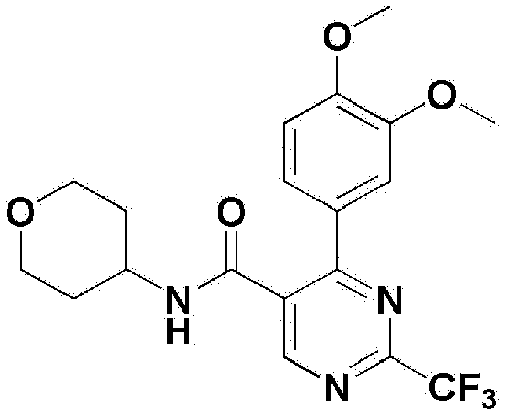
4-(3,4-dimethoxyphenyl)-N-(tetrahydro-2H-pyran-4-yl)-2-(trifluoromethyl)pyrimidi ne-5-carboxamide 13 
4-(3,4-dimethoxyphenyl)-N,N-diethyl-2-(trifluoromethyl)pyrimidi ne-5-carboxamide 14 
4-(3,4-dimethoxyphenyl)-2-(methylsulfonyl)-N-(tetrahydro-2H-pyran-4-yl)pyrimidine-5-carboxamide 15 
N-cyclopropyl-4-(3,4-dimethoxyphenyl)-2-(trifluoromethyl)pyrimidi ne-5-carboxamide 16 
N-(3,5-dichloropyridine-4-yl)-4-(3,4-dimethoxyphenyl)-2-(trifluoromethyl)pyrimidi ne-5-carboxamide 17 
4-(3,4-dimethoxyphenyl)-N,N-diethyl-2-(methylthio)pyrimidine-5-carboxamide 18 
N-cyclopropyl-4-(3,4-dimethoxyphenyl)-2-(methylthio)pyrimidine-5-carboxamide 19 
N-cyclopropyl-4-(3,4-dimethoxyphenyl)-2-(methylsulfonyl)pyrimidin e-5-carboxamide 20 
N-(4-amino-3,5-diisopropylphenyl)-4-(3,4-dimethoxyphenyl)-2-(methylthio)pyrimidine-5-carboxamide 21 
N-(4-amino-3,5-diisopropylphenyl)-4-(3,4-dimethoxyphenyl)-2-(trifluoromethyl)pyrimidi ne-5-carboxamide 22 
N-(3,4-dimethoxyphenyl)-4-(4-(2-hydroxyethyl)piperazine-1-yl)-2-(methylthio)pyrimidine-5-carboxamide 23 
N-(3,4-dimethoxyphenetyl)-4-morpholino-2-(trifluoromethyl)pyrimidi ne-5-carboxamide 24 
N-(2-(1H-indole-3-yl)ethyl)-4-morpholino-2-(trifluoromethyl)pyrimidi ne-5-carboxamide 25 
4-(3,4-dimethoxyphenyl)-N-(pyridine-4-yl)-2-(trifluoromethyl)pyrimidi ne-5-carboxamide 26 
4-(3,4-dimethoxyphenyl)-N-(2-morpholinoethyl)-2-(trifluoromethyl)pyrimidi ne-5-carboxamide 27 
4-(3,4-dimethoxyphenyl)-2-(methylthio)-N-(2-morpholinoethyl)pyrimidin e-5-carboxamide 28 
N-(3,4-dimethoxyphenetyl)-4-(4-(2-hydroxyethyl)piperazine-1-yl)-2-(methylthio)pyrimidine-5-carboxamide 29 
N,4-bis(3,4-dimethoxyphenyl)-2-(methylthio)pyrimidine-5-carboxamide 30 
N,4-bis(3,4-dimethoxyphenyl)-2-(trifluoromethyl)pyrimidi ne-5-carboxamide - NMR data of the compounds of Examples 1-30 are shown in
Figures 17-73 . - <1H-NMR of the compound of Example 1> is shown in
Figure 17 . - <13C-NMR of the compound of Example 1> is shown in
Figure 18 . - <1H-NMR of the compound of Example 2> is shown in
Figure 19 . - <13C-NMR of the compound of Example 2> is shown in
Figure 20 . - <1H-NMR of the compound of Example 3> is shown in
Figure 21 . - <13C-NMR of the compound of Example 3> is shown in
Figure 22 . - <1H-NMR of the compound of Example 4> is shown in
Figure 23 . - <13C-NMR of the compound of Example 4> is shown in
Figure 24 . - <1H-NMR of the compound of Example 5> is shown in
Figure 25 . - <13C-NMR of the compound of Example 5> is shown in
Figure 26 . - <1H-NMR of the compound of Example 6> is shown in
Figure 27 . - <13C-NMR of the compound of Example 6> is shown in
Figure 28 . - <1H-NMR of the compound of Example 7> is shown in
Figure 29 . - <13C-NMR of the compound of Example 7> is shown in
Figure 30 . - <1H-NMR of the compound of Example 8> is shown in
Figure 31 . - <13C-NMR of the compound of Example 8> is shown in
Figure 32 . - <1H-NMR of the compound of Example 9> is shown in
Figure 33 . - <13C-NMR of the compound of Example 9> is shown in
Figure 34 . - <1H-NMR of the compound of Example 10> is shown in
Figure 35 . - <13C-NMR of the compound of Example 10> is shown in
Figure 36 . - <1H-NMR of the compound of Example 11> is shown in
Figure 37 . - <13C-NMR of the compound of Example 11> is shown in
Figure 38 . - <1H-NMR of the compound of Example 12> is shown in
Figure 39 . - <13C-NMR of the compound of Example 12> is shown in
Figure 40 . - <1H-NMR of the compound of Example 13> is shown in
Figure 41 . - <13C-NMR of the compound of Example 13> is shown in
Figure 42 . - <1H-NMR of the compound of Example 14> is shown in
Figure 43 . - <13C-NMR of the compound of Example 14> is shown in
Figure 44 . - <1H-NMR of the compound of Example 15> is shown in
Figure 45 . - <13C-NMR of the compound of Example 15> is shown in
Figure 46 . - <1H-NMR of the compound of Example 16> is shown in
Figure 47 . - <13C-NMR of the compound of Example 16> is shown in
Figure 48 . - <1H-NMR of the compound of Example 17> is shown in
Figure 49 . - <13C-NMR of the compound of Example 17> is shown in
Figure 50 . - <13C-NMR of the compound of Example 18> is shown in
Figure 51 . - <1H-NMR of the compound of Example 19> is shown in
Figure 52 . - <13C-NMR of the compound of Example 19> is shown in
Figure 53 . - <1H-NMR of the compound of Example 20> is shown in
Figure 54 . - <13C-NMR of the compound of Example 20> is shown in
Figure 55 . - <1H-NMR of the compound of Example 21> is shown in
Figure 56 . - <13C-NMR of the compound of Example 21> is shown in
Figure 57 . - <1H-NMR of the compound of Example 22> is shown in
Figure 58 . - <13C-NMR of the compound of Example 22> is shown in
Figure 59 . - <1H-NMR of the compound of Example 23> is shown in
Figure 60 . - <13C-NMR of the compound of Example 23> is shown in
Figure 61 . - <1H-NMR of the compound of Example 24> is shown in
Figure 62 . - <13C-NMR of the compound of Example 24> is shown in
Figure 63 . - <13C-NMR of the compound of Example 25> is shown in
Figure 64 . - <1H-NMR of the compound of Example 26> is shown in
Figure 65 . - <13C-NMR of the compound of Example 26> is shown in
Figure 66 . - <1H-NMR of the compound of Example 27> is shown in
Figure 67 . - <13C-NMR of the compound of Example 27> is shown in
Figure 68 . - <1H-NMR of the compound of Example 28> is shown in
Figure 69 . - <1H-NMR of the compound of Example 29> is shown in
Figure 70 . - <13C-NMR of the compound of Example 29> is shown in
Figure 71 . - <1H-NMR of the compound of Example 30> is shown in
Figure 72 . - <13C-NMR of the compound of Example 30> is shown in
Figure 73 . - Rolipram (4-(3-(cyclopentyloxy)-4-methoxyphenyl)pyrrolidine-2-one), a compound conventionally used as an atopy medicine, was prepared.

- In order to evaluate the PDE4B inhibitory activity of the compounds according to the present invention, the following experiment was performed using LANCE Ultra cAMP assay kit (Perkin Elmer, U.S.A).
- Particularly, 5 µl of the 3 nM cAMP dissolved reaction buffer was added to each reaction well (LANCE Ultra cAMP assay kit). Then, each example compound dilution solution (2.5 µl) and PDE4B enzyme (0.1 ng/well, BPS Biosciences, San Diego, U.S.A) were added to the well, followed by incubation for 1 hour at 37°C. Next, 5 µl of ULight-anti-cAMP detection reactant supplemented with 5 µl of Eu-cAMP tracer and 1 mM IBMX (LANCE Ultra cAMP assay kit) was added thereto, followed by incubation for 1 hour at 37°C. Upon completion of the incubation, the signals excitated at 340 nm and emitted at 665 nm from the 384 micro well-plate were recorded using EnVision Multilabel Reader (Perkin Elmer, U.S.A.).
- IC50 values for the inhibitory activity of cAMP to 5'AMP of the compounds of Examples 1 to 30 are summarized and shown in Table 2 below. The IC50 values were calculated based on the molar concentration of the PDE4B inhibitor compound required for 50% inhibition from cAMP to 5'AMP.
[Table 2] Example Chemical Structure Formula Name PDE4B IC50 (nM) 1 
N-(3,4-dimethoxyphenyl)-2-(methylthio)-4-morpholinopyrimidin e-5-carboxamide 31 2 
N-(3,5-dichloropyridine-4-yl)-4-(3,4-dimethoxyphenyl)-2-(methylthio)pyrimid ine-5-carboxamide 178 3 
4-(3,4-dimethoxyphenyl)-2-(methylthio)-N-(pyridine-4-yl)pyrimidine-5-carboxamide 95 4 
N-(2-(1H-indole-3-yl)ethyl)-2-(methylthio)-4-morpholinopyrimidin e-5-carboxamide 166 5 
4-(3,4-dimethoxyphenyl)-2-(methylthio)-N-(tetrahydro-2H-pyran-4-yl)pyrimidine-5-carboxamide 239 6 
N-(4-fluorophenyl)-2-(methylthio)-4-morpholinopyrimidin e-5-carboxamide 367 7 
N-(3,4-dimethoxyphenetyl)-2-(methylthio)-4-morpholinopyrimidin e-5-carboxamide 61 8 
N-(2,4-dimethoxybenzyl)-4-morpholino-2-(trifluoromethyl)py ridine-5-carboxamide 74 9 
N-(2,4-dimethoxybenzyl)-2-(methylthio)-4-morpholinopyrimidin e-5-carboxamide 377 10 
N-(3,5-dichloropyridine-4-yl)-2-(methylthio)-4-morpholinopyrimidin e-5-carboxamide 73 11 
N-(3,4-dimethoxyphenyl)-4-morpholino-2-(trifluoromethyl)py rimidine-5-carboxamide 67 12 
4-(3,4-dimethoxyphenyl)-N-(tetrahydro-2H-pyran-4-yl)-2-(trifluoromethyl)py rimidine-5-carboxamide 266 13 
4-(3,4-dimethoxyphenyl)-N,N-diethyl-2-(trifluoromethyl)py rimidine-5-carboxamide 833 14 
4-(3,4-dimethoxyphenyl)-2-(methylsulfonyl)-N-(tetrahydro-2H-pyran-4-yl)pyrimidine-5-carboxamide 506 15 
N-cyclopropyl-4-(3,4-dimethoxyphenyl)-2-(trifluoromethyl)py rimidine-5-carboxamide 252 16 
N-(3,5-dichloropyridine-4-yl)-4-(3,4-dimethoxyphenyl)-2-(trifluoromethyl)py rimidine-5-carboxamide 44 17 
4-(3,4-dimethoxyphenyl)-N,N-diethyl-2-(methylthio)pyrimid ine-5-carboxamide NA 18 
N-cyclopropyl-4-(3,4-dimethoxyphenyl)-2-(methylthio)pyrimid ine-5-carboxamide 477 19 
N-cyclopropyl-4-(3,4-dimethoxyphenyl)-2-(methylsulfonyl)pyr imidine-5-carboxamide 189 20 
N-(4-amino-3,5-diisopropylphenyl)-4-(3,4-dimethoxyphenyl)-2-(methylthio)pyrimid ine-5-carboxamide 745 21 
N-(4-amino-3,5-diisopropylphenyl)-4-(3,4-dimethoxyphenyl)-2-(trifluoromethyl)py rimidine-5-carboxamide 222 22 
N-(3,4-dimethoxyphenyl)-4-(4-(2-hydroxyethyl)pipera zine-1-yl)-2-(methylthio)pyrimid ine-5-carboxamide 881 23 
N-(3,4-dimethoxyphenetyl)-4-morpholino-2-(trifluoromethyl)py rimidine-5-carboxamide 150 24 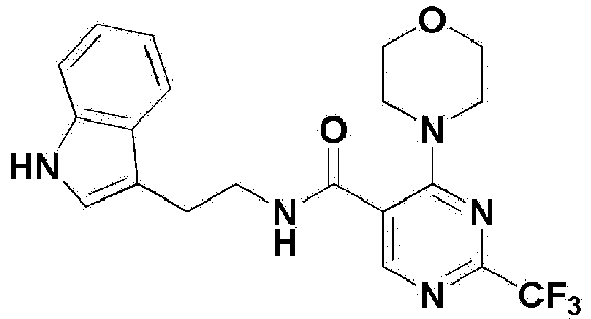
N-(2-(1H-indole-3-yl)ethyl)-4-morpholino-2-(trifluoromethyl)py rimidine-5-carboxamide 469 25 
4-(3,4-dimethoxyphenyl)-N-(pyridine-4-yl)-2-(trifluoromethyl)py rimidine-5-carboxamide 15 26 
4-(3,4-dimethoxyphenyl)-N-(2-morpholinoethyl)-2-(trifluoromethyl)py rimidine-5-carboxamide 195 27 
4-(3,4-dimethoxyphenyl)-2-(methylthio)-N-(2-morpholinoethyl)pyr imidine-5-carboxamide 860 28 
N-(3,4-dimethoxyphenetyl)-4-(4-(2-hydroxyethyl)pipera zine-1-yl)-2-(methylthio)pyrimid ine-5-carboxamide 238 29 
N,4-bis(3,4-dimethoxyphenyl)-2-(methylthio)pyrimid ine-5-carboxamide 634 30 
N,4-bis(3,4-dimethoxyphenyl)-2-(trifluoromethyl)py rimidine-5-carboxamide 61 Comparative Example 1(Rolip ram) 
4-(3-(cyclopentyloxy)-4-methoxyphenyl)pyrro lidine-2-one 2.2µM - As shown in Table 2, the compounds of Examples 1 ∼ 30 according to the present invention exhibited PDE4B IC50 values at the nanomolar level. This means that the compounds of the present invention exhibited remarkably high PED4B inhibitory activity, compared to the IC50 value of the compound of Comparative Example 1 (Rolipram, about 2.2 µM), the conventional atopic therapeutic agent. In particular, it was confirmed that the compounds of Examples 1, 3, 7, 8, 10, 11, 16, 25 and 30 all showed significantly lower IC50 values less than 10 nM.
- Therefore, the compound according to the present invention, the optical isomer thereof or the pharmaceutically acceptable salt thereof can be effectively used as a pharmaceutical composition for the treatment or prevention of inflammatory disease since it has a remarkably excellent inhibitory activity of PDE4B, an enzyme associated with inflammatory diseases.
- To evaluate the intracellular enzyme inhibitory activity of the compounds of Examples 1 and 25, PDE4B GFP fusion protein-inhibitor assay was performed using GFP (green fluorescent protein).
- The DNA complementary to human PDE4B2A was amplified by PCR using the DNA genome extracted from the human blood sample (QIAamp DNA Blood Mini Kit, Qiagen, Valencia, CA, U.S.A.).
- For DNA amplification, 5'-CCGGAATTCGTTCTATGGCCCAGACCTCACA-3' was used as a forward primer, and 5'-CGCGGATCCTACCAGGGTTTGAGCTCAGC-3' was used as a reverse primer.
- The amplified PDE4B2A cDNA was cloned into pAcGFP1-N1, the mammalian expression mediator, between the EcoR1 and BamH1 restriction enzyme sites, which was transfected into E. coli DH5α cells using chemical transformation reagents (Invitrogen, Carlsbad, CA, U.S.A.).
- Plasmids were isolated from the colonies with kanamycin using Plasmid Midi Kit (Qiagen, Valencia, CA, U.S.A.). Then, the plasmid cloned with PDE4B2A gene was transfected into HEK-293 cells (Korean Cell Line Bank, Seoul, Korea) using lipofectamine 3000 (Invitrogen).
- The transfected cells were cultured in DMEM at 37°C for 48 hours in a CO2 incubator. The cells were then cultured with the compounds of Example 1, Example 25 and Comparative Example 1 at the concentrations of 10 nM, 100 nM and 500 nM at 37°C for 24 hours in a 5% CO2 incubator. Upon completion of the culture, the fluorescence emission of HEK-293 cells was measured by confocal microscopy to perform quantitative analysis, and the results are shown in
Figures 1 and 2 . - In addition, the ratio of the surface cover area of GFP to the total cell surface area was measured using MetaMorph software, and the results are shown in
Figure 2 . -
Figure 1 is a set of confocal photomicrographs of the fluorescence emission in PDE4B GFP fusion protein-inhibitor assay with the compounds of example 1, example 2 and comparative example 1. -
Figure 2 is a graph showing the fluorescence intensity of the PDE4B GFP fusion protein treated with the compounds of example 1, example 2 and comparative example 1 according to the present invention and the ratio of the total surface cover area of GFP to the total cell surface area. InFigure 2 , the bar graph represents the fluorescence intensity, and the line graph represents the GFP cover area. - As shown in
Figures 1 and 1 , the compounds of Examples 1 and 25 according to the present invention exhibited a relatively weak fluorescence intensity compared to the control group not-treated with any inhibitor. In particular, it was confirmed that the fluorescence intensity was significantly reduced at the concentrations of 100 nM and 500 nM. This indicates that the compounds of Example 1 and Example 25 according to the present invention inhibited the expression of PDE4B2 effectively in cells, indicating that the compounds according to the present invention can be effectively used for atopic diseases associated with PDE4B2. - In order to confirm the atopic dermatitis alleviation effect of the compounds of Examples 1 and 25 according to the present invention, atopic symptom relief experiments were performed on the mice with atopic symptoms.
- DNCB (dinitrochlorobenzene) was applied on the back of Nc/Nga mouse to induce atopic dermatitis-like symptoms.
- As a carrier for treating DNCB, acetone-olive oil in which acetone and olive oil were mixed (3:1) was used. Six groups of mice were prepared as follows: mice treated with the carrier alone; mice treated with Example 1 compound, mice treated with Example 25 compound, mice treated with DNCB alone, mice treated with DNCB and Example 1 compound, and mice treated with DNCB and Example 25 compound.
- Particularly, 2 days before the start of the experiment, hair of the dorsal skin of the mouse was removed. After 2 days after removing the hair, 150 µl of 1% DNCB was dissolved in a carrier and applied on the dorsal skin of the mouse. Four days later, the same solution was applied on the dorsal skin of the mouse once again. Then, 150 µl of 0.2% DNCB solution was applied on the dorsal skin of the mouse once a week for 5 weeks. The experimental group mice were applied with the compounds of Example 1 and Example 25 daily from the 6th day of the experiment to the end of the experiment.
- Through the symptoms such as dryness of the dorsal skin, inflammation, erythema and bleeding, it was confirmed that the dorsal skin became atopic dermatitis-like skin, and it was also confirmed that the symptoms of atopic dermatitis were significantly increased after 2 weeks of the DNCB treatment.
-
Figure 3 is a set of photographs showing the dorsal skin of each mouse of the experimental group and control group taken on the last day of the experiment. - As shown in
Figure 3 , inflammation was induced on the dorsal skin of the mouse treated with DNCB alone. On the other hand, when the compounds of Example 1 and Example 25 were treated together with DNCB, the incidence of inflammation was significantly reduced compared to when only DNCB was treated. In addition, no side effects were observed in the mouse treated with the compound of Example 1 or Example 25 alone. Thus, it was confirmed that the compounds according to the present invention secured the stability in vivo. - The degree of atopic symptoms in the experimental group and control group mice was evaluated and quantified once a week for a period of 5 weeks. Scores were given as follows for the four items of erythema/bleeding, edema, threshing/corrosion, scaling/dryness, respectively: 1 (none); 2 (moderate); and 3 (serious). Each experimental group and control group was scored based on a total of 12 points. The score results measured for 5 weeks are shown in
Figure 4 . -
Figure 4(a) ,4(b) are a set of graphs showing the results of scoring atopic symptoms of the mouse measured in the experimental results for 5 weeks. -
Figure 4(a) is a graph showing the dermatitis score for the compound of example 1, andFigure 4(b) is a graph showing the dermatitis score for the compound of example 25. - As shown in
Figure 4(a) ,4(b) , when DNCB was treated alone, the dermatitis score atweek 5 was 12, whereas when the compounds of Example 1 and Example 25 were treated with DNCB, the dermatitis score atweek 5 was significantly different, less than about 3. From the above results, it was confirmed that the dermatitis disease symptoms were significantly alleviated by the compounds according to the present invention. - In order to confirm the effect of the compounds according to the present invention on relieving itching, the number of scratches for 20 minutes of each mouse of the experimental group and control group was measured, and the results are shown graphically in
Figure 5(a), (b) . -
Figure 5(a) is a graph showing the number of scratches for 20 minutes of each mouse of the experimental group and control group. - As shown in
Figure 5(a) , the number of scratches of the mouse treated with the compounds of Example 1 and Example 25 was significantly less than that of the mouse treated with DNCB alone. - After completing the experiment, the physical changes were observed by incising the dorsal skin of the experimental group and control group mice. As a result, hypertrophy and edema were clearly observed in the mouse treated with DNCB alone. In contrast, the skin of the mouse treated with the compounds of Example 1 and Example 25 showed no symptoms of hypertrophy and edema than that of the mouse treated with DNCB alone.
- In addition, to confirm the alleviating effect of the compounds according to the present invention on skin hypertrophy, the incised skin thickness was measured, and the results are shown graphically in
Figure 5(b) . -
Figure 5(b) is a graph showing the measured thickness of the dorsal skin of each mouse of the experimental group and control group incised. - As shown in
Figure 5(b) , the skin thickness of the mouse treated with DNCB alone was 1.19 mm, which was significantly increased compared to that of the control group (0.45 mm), and the skin thickness of the mouse treated with the compounds of Example 1 and Example 25 was significantly reduced to 0.83 mm and 0.71 mm, respectively. - In order to confirm the effect of the compounds according to the present invention, the lymph node of each mouse of the experimental group and control group was separated and observed. The lymph node is an interaction site between the antigen and immune cells, and since the size of the lymph node increases during the development of inflammatory symptoms, it is possible to confirm the presence or absence of inflammatory disease depending on the size of the lymph node. The photographs of the separated lymph node of each mouse of the experimental group and control group are shown in
Figure 6(a) , and the weight of the lymph node and the spleen of each mouse of the experimental group and control group are shown inFigure 6(b) and Figure 6(c) . -
Figure 6(a) is a set of photographs of the lymph nodes of the experimental and control group mice. -
Figure 6(b) is a graph showing the weight of the lymph nodes of the experimental and control group mice. -
Figure 6(c) is a graph showing the weight of the spleens of the experimental and control group mice. - As shown in
Figure 6(a) , the lymph node of the mouse treated with DNCB alone was significantly enlarged compared to that of the control mouse. In addition, it was confirmed that the lymph node of the mouse treated with the compounds of Example 1 and Example 25 was significantly reduced compared to that of the mouse treated with DNCB alone. - As shown in
Figure 6(b) , the weight of the lymph node of the mouse treated with DNCB alone was significantly heavier than that of the control mouse. On the other hand, it was confirmed that the weight of the lymph node of the mouse treated with the compounds of Example 1 and Example 25 was significantly reduced compared to that of the mouse treated with DNCB alone. - As shown in
Figure 6(c) , the weight of the spleen was also significantly reduced by the treatment of the compounds of Example 1 and Example 25. - Therefore, it was confirmed that the compounds according to the present invention inhibited the lymph node and spleen hypertrophy closely related to the development of inflammatory disease in vivo, and that the compounds according to the present invention were effective in the treatment of inflammatory disease.
- The dorsal skin tissue of the mouse was observed to confirm the effect of the compounds according to the invention on inflammatory disease.
- The dorsal skin samples were obtained from the experimental group and control group mice. The samples were fixed using 10% neutral buffered formalin and then embedded in paraffin. 4 µm thin tissue sections were prepared and stained with H & E (hematoxylin & eosin). Thin tissue sections (4 pm) were prepared and stained with H&E (hematoxylin & eosin). In addition, the sections were stained with toluidine blue to investigate mast cell infiltration. Then, the stained tissue sections were photographed using NikonAX70 optical microscope (Tokyo, Japan) .
-
Figure 7 is a set of optical photomicrographs taken after H&E (hematoxylin & eosin) staining of the dorsal skin tissue sections of the experimental and control group mice. (i=control group, ii=example 1, iii=example 25, iv=DNCB, v=DNCB+example 1, vi=DNCB+example 25) -
Figure 8 is a set of optical micrographs taken after toluidine blue staining of adipocytes of the dorsal skin tissue sections of the experimental and control group mice. (i=control group, ii=example 1, iii=example 25, iv=DNCB, v=DNCB+example 1, vi=DNCB+example 25) -
Figure 9 is a graph showing the number of adipocytes in the dorsal skin tissue sections of the experimental group and control group mice. - As shown in
Figure 7 , the skin tissue sections of the control group and the groups treated with the compounds of Example 1 and Example 25 showed the normal skin structure. On the other hand, the skin sections of the mouse treated with DNCB alone showed severe epidermal hyperplasia (acanthosis) and keratosis, and inflammatory cells penetrated deeply into both the epidermal and dermal regions at high density. In the skin sections of the mouse treated with the compounds of Example 1 and Example 25 with DNCB, epidermal hyperplasia and keratosis were significantly reduced, and there were almost no inflammatory cells. - As shown in
Figures 8 and9 , the number of mast cells was increased in the skin tissue of the mouse treated with DNCB alone, compared to that of the control group. On the other hand, the number of mast cells was significantly reduced in the skin tissue of the mouse treated with the compounds of Example 1 and Example 25, compared to that of the mouse treated with DNCB alone. - Therefore, it was confirmed that the acanthosis and keratosis in the skin were alleviated, the production of inflammatory cells was suppressed, and the increase of mast cells was reduced by the compounds of Example 1 and Example 25 according to the present invention, so they can be effectively used as a pharmaceutical composition for the treatment or prevention of inflammatory disease.
- In addition, the mouse tissue CD4+ cells were stained to confirm the expressions of IL-17, IFN-γ, IL-4 and IL-5.
-
Figure 10(a) ∼ Figure 10(d) are microphotographs showing the expression levels of IL-17, IFN-γ, IL-4 and IL-5, respectively, after staining CD4+ cells of the dorsal skin tissues of the experimental group and control group mice. (i=control group, ii=example 1, iii=example 25, iv=DNCB, v=DNCB+example 1, vi=DNCB+example 25) - As shown in
Figures 10(a), 10(c) and 10(d) , when the compounds of Example 1 and Example 25 were applied on the skin, the expressions of IL-17, IL-4 and IL-5 of CD4+ cells were more suppressed than when DNCB was treated alone. IL-17, IL-4 and IL-5 are cytokines associated with the expression of inflammation, and when the compound according to the present invention is applied on the skin with inflammatory disease, the expressions of IL-17, IL-4 and IL-5 are suppressed. Therefore, the compound according to the present invention can be effectively used as a pharmaceutical composition for the treatment or prevention of inflammatory disease. - As shown in
Figure 10(b) , when the compounds of Example 1 and Example 25 were applied on the skin, the expression of IFN-γ was activated in DC4+ cells. IFN-γ is a cytokine protein that suppresses viral proliferation in cells, and when the compound according to the present invention is applied on the skin, the expression of IFN-γ is activated to suppress inflammatory diseases in cells. Therefore, the compound according to the present invention can be effectively used as a pharmaceutical composition for the treatment or prevention of inflammatory disease. - To confirm the effect of the compounds according to the present invention on the synthesis of DNCB-induced IgE and inflammatory mediators, ELISA (Enzyme-Linked ImmunoSorbent Assay) was performed with the control group and the experimental group treated with the compounds of Example 1 and Example 25.
-
Figure 11(a) ∼ Figure 11(e) are graphs showing the expression levels of IL-4, IL-5, IFN-γ, IL-17 and IgE, respectively, shown when performing sandwich ELISA (Enzyme-Linked ImmunoSorbent Assay) with the mouse skin tissues. - As shown in
Figures 11(a) ,11(b) and 11(d) , the expressions of cytokines such as IL-4, IL-5 and IL-17 were significantly higher in the skin of the mouse treated with DNCB alone. On the other hand, when the compounds of Example 1 and Example 25 were treated, the expressions of IL-4, IL-5 and IL-17 were significantly suppressed. - IL-4, IL-5 and IL-17 are cytokines associated with the expression of inflammation, and when the compound according to the present invention is applied on the skin with inflammatory disease, the expressions of IL-17, IL-4 and IL-5 are suppressed. Therefore, the compound according to the present invention can be effectively used as a pharmaceutical composition for the treatment or prevention of inflammatory disease. In contrast, the expression of IFN-γ was high in the skin of the mouse treated with the compounds of Example 1 and Example 25.
- IFN-γ is a cytokine protein that suppresses viral proliferation in cells, and when the compound according to the present invention is applied on the skin, the expression of IFN-γ is activated to suppress inflammatory diseases in cells. Therefore, the compound according to the present invention can be effectively used as a pharmaceutical composition for the treatment or prevention of inflammatory disease.
- As shown in
Figure 11(e) , the expression of IgE (immunoglobulin E) in the skin of the mouse treated with DNCB alone was significantly higher than that of the control group mouse. On the other hand, when the compounds of Example 1 and Example 25 were treated with DNCB, the expression of IgE (immunoglobulin E) was significantly reduced. - IgE (immunoglobulin E) is a substance that initiates IgE-mediated allergic reaction by binding to Fc receptors on the surfaces of mast cells and basophils, and when the compound according to the present invention is applied on the skin, the expression of IgE is inhibited to suppress inflammatory diseases in cells. Therefore, the compound according to the present invention can be effectively used as a pharmaceutical composition for the treatment or prevention of inflammatory disease.
- In addition, to evaluate the inhibitory effect of the compounds of Example 1 and Example 25 on the synthesis of TNF-α, in vitro assay was performed. Particularly, after culturing human PBMC cells, the secretion of TNF-α was stimulated using bacterial LPS, and the expression level of TNF-α was measured.
-
Figure 11(f) is a graph showing the inhibitory effect of the compounds of Example 1 and Example 25 on the synthesis of TNF-α. - As shown in
Figure 11(f) , both the compounds of Example 1 and Example 25 effectively inhibited the synthesis of TNF-α in lymphocyte culture experiment. - TNF-α is a well-known pro-inflammatory mediator, and its synthesis is known to occur in T lymphocytes. Since the compound according to the present invention was confirmed to inhibit the expression of TNF-α through this experiment, the compound according to the present invention can be effectively used for the prevention or treatment of inflammatory diseases.
- Molecular docking experiment was performed to confirm the binding force of the compound of Example 25 to the cAMP binding site of PDE4B enzyme.
- Molecular docking of the compound of Example 25 to PDE4B (PDB: 1F0J) was observed using Accelrys Discovery Studio (v 4.0) implemented via the graphical interface DS-CDOCKER protocol.
-
Figure 12 is a Discovery Srudio photograph showing the binding between the ligand and PDE4B in the catalytic binding region. -
Figure 13 is a diagram showing the binding distance between the compound of Example 25 and the PDE4B ligand. -
Figure 14 is a two-dimensional diagram showing the binding between the compound of Example 25 and the PDE4B ligand. -
Figure 15 is an aromatic three-dimensional diagram showing the PDE4B catalyst binding site of the compound of Example 25. -
Figure 16 is a set of three-dimensional diagrams showing the binding structure of the compound of Example 25 in the active sites of PDE4A, PDE4B, PDE4C and PDE4D. - As shown in
Figures 13 and14 , the fluorine atom of the compound of Example 25 (fluorine atom represented by a inFigure 14 ) formed a strong hydrogen bond of 3.23Å withGln 500 of PDE4B, and another fluorine atom (fluorine atom represented by b inFigure 14 ) formed a strong carbon hydrogen bond with His234 of PDE4B. - As shown in
Figure 15 , the compound of Example 25 penetrated deeply into the active region of PDE4B and combined. - As shown in
Figure 16 , it was confirmed that the compound of Example 25 had a very limited binding property to PDE4A, PDE4C and PDE4D. - Therefore, it was confirmed that the compound of Example 25 had the selectivity to PDE4B, so that it can more effectively inhibit PDE4B, an inflammatory disease-related enzyme.
- Through the molecular docking experiment with the compound of Example 25 according to the present invention, it was confirmed that the compound of Example 25 had excellent and selective binding properties to PDE4B. It was also confirmed from the above results that the compound according to the present invention effectively inhibited the expression of PDE4B, an inflammatory disease-related enzyme, at the molecular level. Therefore, the compound according to the present invention can be effectively used for the treatment or prevention of inflammatory diseases.
- The benzamide derivative compound according to the present invention can be effectively used as a pharmaceutical composition for the treatment or prevention of inflammatory diseases.
Claims (11)
- A compound represented by formula 1 below, an isomer thereof or a pharmaceutically acceptable salt thereof:
 L is single bond or straight or branched C1-C6 alkylene;R1 is hydrogen; C3-C8 cycloalkyl; nonsubstituted or substituted C6-C12 aryl; heteroaryl consisting of 6 to 12 atoms containing one or more heteroatoms selected from the group consisting of N and O; or heterocycloalkyl consisting of 6 to 10 atoms containing one or more heteroatoms selected from the group consisting of N and O; at this time, the substituted C6-C12 aryl can be substituted with one or more substituents selected from the group consisting of halogen, -NH2, straight or branched C1-C3 alkyl, and straight or branched C1-C3 alkoxy, and the substituted heteroaryl consisting of 6 to 12 atoms can be substituted with one or more halogens;R2 is hydrogen or straight or branched C1-C3 alkyl;R3 is nonsubstituted or substituted C6-C10 aryl; or heterocycloalkyl consisting of 6 to 8 atoms containing one or more heteroatoms selected from the group consisting of N and O; at this time, the substituted C6-C10 aryl can be substituted with one or more methoxy groups, the substituted heterocycloalkyl consisting of 6 to 8 atoms can be substituted with one or more hydroxyl ethyl groups; andR4 is C1-C3 haloalkyl, -SR5 or -SO2R5, at this time, R5 is straight or branched C1-C6 alkyl).
 - The compound, the isomer thereof or the pharmaceutically acceptable salt thereof according to claim 1, wherein:L is single bond or straight or branched C1-C3 alkylene;R1 is hydrogen; C3-C6 cycloalkyl; nonsubstituted or substituted C6-C10 aryl; heteroaryl consisting of 6 to 10 atoms containing one or more heteroatoms selected from the group consisting of N and O; or heterocycloalkyl consisting of 6 to 8 atoms containing one or more heteroatoms selected from the group consisting of N and O; at this time, the substituted C6-C10 aryl can be substituted with one or more substituents selected from the group consisting of fluoro, -NH2, methoxy and isopropyl, and the substituted heteroaryl consisting of 6 to 10 atoms can be substituted with one or more chloro;R2 is hydrogen or straight or branched C1-C3 alkyl;R3 is C6-C10 aryl nonsubstituted or substituted with one or more methoxy groups; or heterocycloalkyl consisting of 6 to 8 atoms nonsubstituted or substituted with one or more hydroxyl ethyl groups containing one or more heteroatoms selected from the group consisting of N and O; andR4 is -CH2F, -CHF2, -CF3, -CH2Cl, -CHCl2, -CCl3,-CH2Br, -CHBr2, -CBr3, -SR5 or -SO2R5, at this time, R5 is straight or branched C1-C3 alkyl.
- The compound, the isomer thereof or the pharmaceutically acceptable salt thereof according to claim 1, wherein:L is single bond, -CH2- or -CH2CH2-;R1 is hydrogen, cyclopropyl, morpholinyl, tetrahydropyranyl, indolyl, phenyl or pyridinyl nonsubstituted or substituted with one or more chloro; at this time, phenyl can be substituted with one or more substituents selected from the group consisting of methoxy, fluoro, isopropyl and -NH2;R2 is hydrogen, methyl or ethyl;R3 is morpholinyl; phenyl nonsubstituted or substituted with one or more methoxy; or piperazinyl nonsubstituted or substituted with one or more hydroxy ethyl groups; andR4 is -CHF2, -CH2F, -CF3, -SCH3 or -SO2CH3.
- The compound, the isomer thereof or the pharmaceutically acceptable salt thereof according to claim 1, wherein:L is single bond or -CH2CH2-;R1 is hydrogen,

 R2 is hydrogen or ethyl;R3 is
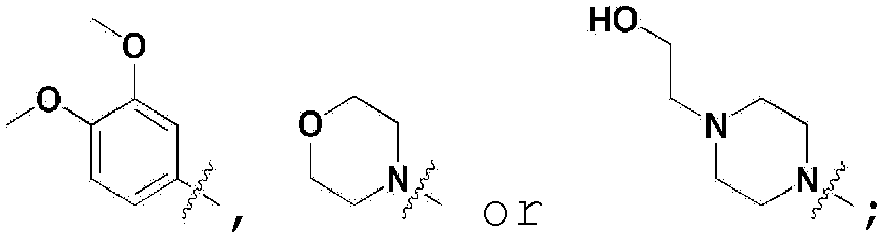 R4 is -CF3, -SCH3 or -SO2CH3.
 - The compound, the isomer thereof or the pharmaceutically acceptable salt thereof according to claim 1, wherein the compound represented by formula 1 is selected from the group consisting of the following compounds:(1) N-(3,4-dimethoxyphenyl)-2-(methylthio)-4-morpholinopyrimidine-5-carboxamide;(2) N-(3,5-dichloropyridine-4-yl)-4-(3,4-dimethoxyphenyl)-2-(methylthio)pyrimidine-5-carboxamide;(3) 4-(3,4-dimethoxyphenyl)-2-(methylthio)-N-(pyridine-4-yl)pyrimidine-5-carboxamide;(4) N-(2-(1H-indole-3-yl)ethyl)-2-(methylthio)-4-morpholinopyrimidine-5-carboxamide;(5) 4-(3,4-dimethoxyphenyl)-2-(methylthio)-N-(tetrahydro-2H-pyran-4-yl)pyrimidine-5-carboxamide;(6) N-(4-fluorophenyl)-2-(methylthio)-4-morpholinopyrimidine-5-carboxamide;(7) N-(3,4-dimethoxyphenetyl)-2-(methylthio)-4-morpholinopyrimidine-5-carboxamide;(8) N-(2,4-dimethoxybenzyl)-4-morpholino-2-(trifluoromethyl)pyridine-5-carboxamide;(9) N-(2,4-dimethoxybenzyl)-2-(methylthio)-4-morpholinopyrimidine-5-carboxamide;(10) N-(3,5-dichloropyridine-4-yl)-2-(methylthio)-4-morpholinopyrimidine-5-carboxamide;(11) N-(3,4-dimethoxyphenyl)-4-morpholino-2-(trifluoromethyl)pyrimidine-5-carboxamide;(12) 4-(3,4-dimethoxyphenyl)-N-(tetrahydro-2H-pyran-4-yl)-2-(trifluoromethyl)pyrimidine-5-carboxamide;(13) 4-(3,4-dimethoxyphenyl)-N,N-diethyl-2-(trifluoromethyl)pyrimidine-5-carboxamide;(14) 4-(3,4-dimethoxyphenyl)-2-(methylsulfonyl)-N-(tetrahydro-2H-pyran-4-yl)pyrimidine-5-carboxamide;(15) N-cyclopropyl-4-(3,4-dimethoxyphenyl)-2-(trifluoromethyl)pyrimidine-5-carboxamide;(16) N-(3,5-dichloropyridine-4-yl)-4-(3,4-dimethoxyphenyl)-2-(trifluoromethyl)pyrimidine-5-carboxamide;(17) 4-(3,4-dimethoxyphenyl)-N,N-diethyl-2-(methylthio)pyrimidine-5-carboxamide;(18) N-cyclopropyl-4-(3,4-dimethoxyphenyl)-2-(methylthio)pyrimidine-5-carboxamide;(19) N-cyclopropyl-4-(3,4-dimethoxyphenyl)-2-(methylsulfonyl)pyrimidine-5-carboxamide;(20) N-(4-amino-3,5-diisopropylphenyl)-4-(3,4-dimethoxyphenyl)-2-(methylthio)pyrimidine-5-carboxamide;(21) N-(4-amino-3,5-diisopropylphenyl)-4-(3,4-dimethoxyphenyl)-2-(trifluoromethyl)pyrimidine-5-carboxamide;(22) N-(3,4-dimethoxyphenyl)-4-(4-(2-hydroxyethyl)piperazine-1-yl)-2-(methylthio)pyrimidine-5-carboxamide;(23) N-(3,4-dimethoxyphenetyl)-4-morpholino-2-(trifluoromethyl)pyrimidine-5-carboxamide;(24) N-(2-(1H-indole-3-yl)ethyl)-4-morpholino-2-(trifluoromethyl)pyrimidine-5-carboxamide;(25) 4-(3,4-dimethoxyphenyl)-N-(pyridine-4-yl)-2-(trifluoromethyl)pyrimidine-5-carboxamide;(26) 4-(3,4-dimethoxyphenyl)-N-(2-morpholinoethyl)-2-(trifluoromethyl)pyrimidine-5-carboxamide;(27) 4-(3,4-dimethoxyphenyl)-2-(methylthio)-N-(2-morpholinoethyl)pyrimidine-5-carboxamide;(28) N-(3,4-dimethoxyphenetyl)-4-(4-(2-hydroxyethyl)piperazine-1-yl)-2-(methylthio)pyrimidine-5-carboxamide;(29) N,4-bis(3,4-dimethoxyphenyl)-2-(methylthio)pyrimidine-5-carboxamide; and(30) N,4-bis(3,4-dimethoxyphenyl)-2-(trifluoromethyl)pyrimidine-5-carboxamide.
- A preparation method of a compound represented by formula 1 of claim 1 comprising the step of preparing a compound represented by formula 1 by reacting the compound represented by formula 2 with a compound represented by formula 3, as shown in reaction formula 1 below.

- A pharmaceutical composition comprising a compound represented by formula 1 of claim 1, an optical isomer thereof or a pharmaceutically acceptable salt thereof as an active ingredient for use in preventing or treatmenting of inflammatory disease.
- The pharmaceutical composition according to claim 7, wherein the inflammatory disease is one or more diseases selected from the group consisting of dermatitis, atopic dermatitis, asthma, rhinitis, arthritis, rheumatoid arthritis, gastritis, enteritis, nephritis, hepatitis, allergy, gastric ulcer, duodenal ulcer, esophagitis, colitis, systemic edema, local edema, keratitis, bronchitis, pleurisy, peritonitis, spondylitis, inflammatory pain, urethritis, prostatitis, cystitis, periodontitis, gingivitis, chronic obstructive pulmonary disease (COPD), pulmonary fibrosis, irritable bowel syndrome, inflammatory pain, migraine, headache, low back pain, fibromyalgia, fascial disease, viral infections, bacterial infections, fungal infections, burns, wounds caused by surgical or dental operation, excessive PGE syndrome, atherosclerosis, gout, ankylosing spondylitis, Hodgkin's disease, pancreatitis, conjunctivitis, irisitis, scleritis, uveitis, eczema and multiple sclerosis.
- The pharmaceutical composition according to claim 7, wherein the compound represented by formula 1 inhibits the expression of PDE4.
- The pharmaceutical composition according to claim 7, wherein the compound represented by formula 1 regulates one or more substances selected from the group consisting of IL-4 (Interleukin-4), IL-5 (Interleukin-5), IFN-γ (Interferon-γ), IL-17 (Interleukin-17), IgE (immunoglobulin E) and TNF-α (Tumor necrosis factor-a).
- A health functional food composition comprising a compound represented by formula 1, an optical isomer thereof or a pharmaceutically acceptable salt thereof as an active ingredient for use in preventing or ameliorating inflammatory diseases.
Applications Claiming Priority (2)
| Application Number | Priority Date | Filing Date | Title |
|---|---|---|---|
| KR1020170153106A KR102006547B1 (en) | 2017-11-16 | 2017-11-16 | Benzamide derivatives compounds, preparation method thereof, and pharmaceutical composition for use in preventing or treating inflammatory disease as an active ingredient |
| PCT/KR2018/014076 WO2019098738A1 (en) | 2017-11-16 | 2018-11-16 | Benzamide derivative compound, method for preparing same, and pharmaceutical composition for treating or preventing inflammatory disease containing same as active ingredient |
Publications (4)
| Publication Number | Publication Date |
|---|---|
| EP3712149A1 true EP3712149A1 (en) | 2020-09-23 |
| EP3712149A4 EP3712149A4 (en) | 2020-12-23 |
| EP3712149C0 EP3712149C0 (en) | 2023-06-21 |
| EP3712149B1 EP3712149B1 (en) | 2023-06-21 |
Family
ID=66538735
Family Applications (1)
| Application Number | Title | Priority Date | Filing Date |
|---|---|---|---|
| EP18878813.7A Active EP3712149B1 (en) | 2017-11-16 | 2018-11-16 | Benzamide derivative compound, method for preparing same, and pharmaceutical composition for treating or preventing inflammatory disease containing same as active ingredient |
Country Status (5)
| Country | Link |
|---|---|
| US (1) | US12441690B2 (en) |
| EP (1) | EP3712149B1 (en) |
| KR (1) | KR102006547B1 (en) |
| CN (1) | CN111356690B (en) |
| WO (1) | WO2019098738A1 (en) |
Family Cites Families (10)
| Publication number | Priority date | Publication date | Assignee | Title |
|---|---|---|---|---|
| TW550258B (en) * | 1999-05-31 | 2003-09-01 | Hoffmann La Roche | 4-phenyl-pyrimidine derivatives |
| AU2700301A (en) * | 2000-01-31 | 2001-08-14 | Pfizer Products Inc. | Pyrimidine carboxamides useful as inhibitors of pde4 isozymes |
| US7176310B1 (en) * | 2002-04-09 | 2007-02-13 | Ucb Sa | Pyrimidinecarboxamide derivatives and their use as anti-inflammatory agents |
| WO2004039795A2 (en) | 2002-10-29 | 2004-05-13 | Fujisawa Pharmaceutical Co., Ltd. | Amide compounds for the treatment of hyperlipidemia |
| US7459460B2 (en) * | 2003-05-28 | 2008-12-02 | Bristol-Myers Squibb Company | Trisubstituted heteroaromatic compounds as calcium sensing receptor modulators |
| JP2008503446A (en) | 2004-05-06 | 2008-02-07 | プレキシコン,インコーポレーテッド | PDE4B inhibitor and use thereof |
| WO2006050476A2 (en) * | 2004-11-03 | 2006-05-11 | Vertex Pharmaceuticals Incorporated | Pyrimidine derivatives as ion channel modulators and methods of use |
| WO2011049520A1 (en) * | 2009-10-20 | 2011-04-28 | Astrazeneca Ab | Adamantyl iminocarbonyl-substituted pyrimidines as inhibitors of 1 1 betahsd1 |
| WO2011065800A2 (en) * | 2009-11-30 | 2011-06-03 | 주식회사 오스코텍 | Pyrimidine derivative, method for preparing same and pharmaceutical composition containing same |
| US8580805B2 (en) | 2010-08-31 | 2013-11-12 | Hubert Maehr | Pyrimidine carboxamide derivatives |
-
2017
- 2017-11-16 KR KR1020170153106A patent/KR102006547B1/en active Active
-
2018
- 2018-11-16 EP EP18878813.7A patent/EP3712149B1/en active Active
- 2018-11-16 CN CN201880073983.8A patent/CN111356690B/en active Active
- 2018-11-16 WO PCT/KR2018/014076 patent/WO2019098738A1/en not_active Ceased
- 2018-11-16 US US16/764,843 patent/US12441690B2/en active Active
Also Published As
| Publication number | Publication date |
|---|---|
| EP3712149C0 (en) | 2023-06-21 |
| EP3712149B1 (en) | 2023-06-21 |
| US12441690B2 (en) | 2025-10-14 |
| US20200339534A1 (en) | 2020-10-29 |
| CN111356690B (en) | 2023-09-29 |
| EP3712149A4 (en) | 2020-12-23 |
| CN111356690A (en) | 2020-06-30 |
| KR20190056070A (en) | 2019-05-24 |
| WO2019098738A1 (en) | 2019-05-23 |
| KR102006547B1 (en) | 2019-08-01 |
Similar Documents
| Publication | Publication Date | Title |
|---|---|---|
| US7514445B2 (en) | Heteroaryl amines as glycogen synthase kinase 3β inhibitors (GSK3 inhibitors) | |
| US10875837B2 (en) | Inhibitors of the fibroblast growth factor receptor | |
| AU2002363174B2 (en) | Amide derivatives as glycogen synthase kinase 3-beta inhibitors | |
| TWI552752B (en) | Heteroaryl compounds and uses thereof | |
| DE69724789T2 (en) | BICYCLIC HETEROAROMATIC COMPOUNDS AS PROTEIN TYROSIN KINASE INHIBITORS | |
| EP1442024B1 (en) | AMINOBENZAMIDE DERIVATIVES AS GLYCOGEN SYNTHASE KINASE 3$g(b) INHIBITORS | |
| JP6772360B2 (en) | Compounds as isocitrate dehydrogenase inhibitors and their applications | |
| EP3405192B1 (en) | Bruton's tyrosine kinase inhibitors | |
| JP6611358B2 (en) | Benzamide derivatives useful as FASN inhibitors for cancer treatment | |
| DE69718472T2 (en) | BICYCLIC HETEROAROMATIC COMPOUNDS AS PROTEIN TYROSINE KINASE INHIBITORS | |
| EP2125803B1 (en) | Pyrrolo[2,3-b]pyridine compounds, azaindole compounds used for synthesizing said pyrrolo[2,3-b]pyridine compounds, methods for the production thereof, and uses thereof | |
| KR20250167680A (en) | Irak degraders and uses thereof | |
| CN109843858A (en) | Certain chemical entities, composition and method | |
| CN107454898B (en) | Ghrelin O-acyltransferase inhibitors | |
| AU2002363176A1 (en) | Heteroaryl amines as glycogen synthase kinase 3Beta inhibitors (GSK3 inhibitors) | |
| KR20090090365A (en) | Pyridine derivatives or pyrimidine derivatives exhibiting excellent cell proliferation inhibitory and anti-tumor effects against HWFR gene amplified cell lines | |
| AU2002363174A1 (en) | Amide derivatives as glycogen synthase kinase 3-beta inhibitors | |
| EP2748164A1 (en) | Bicyclic heteroaromatic compounds | |
| CN106536510B (en) | Pyridine-substituted 2-aminopyridine protein kinase inhibitors | |
| JP2024050645A (en) | Heteroaryl-substituted pyrazole compounds and their medical uses | |
| US20240409538A1 (en) | Substituted triazoloheteroaryl compounds as usp1 inhibitors and the use thereof | |
| EP2869822B1 (en) | Inhibitors of phosphodiesterase 10 enzyme | |
| JP2023544431A (en) | Small molecule compounds and their uses as JAK kinase inhibitors | |
| JP2023545784A (en) | Small molecule compounds and their uses as JAK kinase inhibitors | |
| EP3712149B1 (en) | Benzamide derivative compound, method for preparing same, and pharmaceutical composition for treating or preventing inflammatory disease containing same as active ingredient |
Legal Events
| Date | Code | Title | Description |
|---|---|---|---|
| STAA | Information on the status of an ep patent application or granted ep patent |
Free format text: STATUS: THE INTERNATIONAL PUBLICATION HAS BEEN MADE |
|
| PUAI | Public reference made under article 153(3) epc to a published international application that has entered the european phase |
Free format text: ORIGINAL CODE: 0009012 |
|
| STAA | Information on the status of an ep patent application or granted ep patent |
Free format text: STATUS: REQUEST FOR EXAMINATION WAS MADE |
|
| 17P | Request for examination filed |
Effective date: 20200616 |
|
| AK | Designated contracting states |
Kind code of ref document: A1 Designated state(s): AL AT BE BG CH CY CZ DE DK EE ES FI FR GB GR HR HU IE IS IT LI LT LU LV MC MK MT NL NO PL PT RO RS SE SI SK SM TR |
|
| AX | Request for extension of the european patent |
Extension state: BA ME |
|
| A4 | Supplementary search report drawn up and despatched |
Effective date: 20201123 |
|
| RIC1 | Information provided on ipc code assigned before grant |
Ipc: C07D 413/04 20060101AFI20201117BHEP Ipc: C07D 401/12 20060101ALI20201117BHEP Ipc: A61K 31/506 20060101ALI20201117BHEP Ipc: A23L 33/10 20160101ALI20201117BHEP Ipc: C07D 403/12 20060101ALI20201117BHEP Ipc: A61K 31/5377 20060101ALI20201117BHEP |
|
| DAV | Request for validation of the european patent (deleted) | ||
| DAX | Request for extension of the european patent (deleted) | ||
| GRAP | Despatch of communication of intention to grant a patent |
Free format text: ORIGINAL CODE: EPIDOSNIGR1 |
|
| STAA | Information on the status of an ep patent application or granted ep patent |
Free format text: STATUS: GRANT OF PATENT IS INTENDED |
|
| RIC1 | Information provided on ipc code assigned before grant |
Ipc: C07D 239/47 20060101ALI20221129BHEP Ipc: C07D 405/12 20060101ALI20221129BHEP Ipc: C07D 239/42 20060101ALI20221129BHEP Ipc: C07D 239/38 20060101ALI20221129BHEP Ipc: C07D 239/28 20060101ALI20221129BHEP Ipc: C07D 401/12 20060101ALI20221129BHEP Ipc: C07D 403/12 20060101ALI20221129BHEP Ipc: A23L 33/10 20160101ALI20221129BHEP Ipc: A61K 31/506 20060101ALI20221129BHEP Ipc: A61K 31/5377 20060101ALI20221129BHEP Ipc: C07D 413/04 20060101AFI20221129BHEP |
|
| INTG | Intention to grant announced |
Effective date: 20230104 |
|
| GRAS | Grant fee paid |
Free format text: ORIGINAL CODE: EPIDOSNIGR3 |
|
| GRAA | (expected) grant |
Free format text: ORIGINAL CODE: 0009210 |
|
| STAA | Information on the status of an ep patent application or granted ep patent |
Free format text: STATUS: THE PATENT HAS BEEN GRANTED |
|
| AK | Designated contracting states |
Kind code of ref document: B1 Designated state(s): AL AT BE BG CH CY CZ DE DK EE ES FI FR GB GR HR HU IE IS IT LI LT LU LV MC MK MT NL NO PL PT RO RS SE SI SK SM TR |
|
| REG | Reference to a national code |
Ref country code: CH Ref legal event code: EP |
|
| REG | Reference to a national code |
Ref country code: DE Ref legal event code: R096 Ref document number: 602018052247 Country of ref document: DE |
|
| REG | Reference to a national code |
Ref country code: AT Ref legal event code: REF Ref document number: 1580838 Country of ref document: AT Kind code of ref document: T Effective date: 20230715 |
|
| REG | Reference to a national code |
Ref country code: IE Ref legal event code: FG4D |
|
| U01 | Request for unitary effect filed |
Effective date: 20230719 |
|
| REG | Reference to a national code |
Ref country code: LT Ref legal event code: MG9D |
|
| U07 | Unitary effect registered |
Designated state(s): AT BE BG DE DK EE FI FR IT LT LU LV MT NL PT SE SI Effective date: 20230918 |
|
| PG25 | Lapsed in a contracting state [announced via postgrant information from national office to epo] |
Ref country code: NO Free format text: LAPSE BECAUSE OF FAILURE TO SUBMIT A TRANSLATION OF THE DESCRIPTION OR TO PAY THE FEE WITHIN THE PRESCRIBED TIME-LIMIT Effective date: 20230921 |
|
| PG25 | Lapsed in a contracting state [announced via postgrant information from national office to epo] |
Ref country code: RS Free format text: LAPSE BECAUSE OF FAILURE TO SUBMIT A TRANSLATION OF THE DESCRIPTION OR TO PAY THE FEE WITHIN THE PRESCRIBED TIME-LIMIT Effective date: 20230621 Ref country code: HR Free format text: LAPSE BECAUSE OF FAILURE TO SUBMIT A TRANSLATION OF THE DESCRIPTION OR TO PAY THE FEE WITHIN THE PRESCRIBED TIME-LIMIT Effective date: 20230621 Ref country code: GR Free format text: LAPSE BECAUSE OF FAILURE TO SUBMIT A TRANSLATION OF THE DESCRIPTION OR TO PAY THE FEE WITHIN THE PRESCRIBED TIME-LIMIT Effective date: 20230922 |
|
| U20 | Renewal fee for the european patent with unitary effect paid |
Year of fee payment: 6 Effective date: 20231128 |
|
| PG25 | Lapsed in a contracting state [announced via postgrant information from national office to epo] |
Ref country code: SK Free format text: LAPSE BECAUSE OF FAILURE TO SUBMIT A TRANSLATION OF THE DESCRIPTION OR TO PAY THE FEE WITHIN THE PRESCRIBED TIME-LIMIT Effective date: 20230621 |
|
| PG25 | Lapsed in a contracting state [announced via postgrant information from national office to epo] |
Ref country code: ES Free format text: LAPSE BECAUSE OF FAILURE TO SUBMIT A TRANSLATION OF THE DESCRIPTION OR TO PAY THE FEE WITHIN THE PRESCRIBED TIME-LIMIT Effective date: 20230621 |
|
| PG25 | Lapsed in a contracting state [announced via postgrant information from national office to epo] |
Ref country code: IS Free format text: LAPSE BECAUSE OF FAILURE TO SUBMIT A TRANSLATION OF THE DESCRIPTION OR TO PAY THE FEE WITHIN THE PRESCRIBED TIME-LIMIT Effective date: 20231021 |
|
| PG25 | Lapsed in a contracting state [announced via postgrant information from national office to epo] |
Ref country code: SM Free format text: LAPSE BECAUSE OF FAILURE TO SUBMIT A TRANSLATION OF THE DESCRIPTION OR TO PAY THE FEE WITHIN THE PRESCRIBED TIME-LIMIT Effective date: 20230621 Ref country code: SK Free format text: LAPSE BECAUSE OF FAILURE TO SUBMIT A TRANSLATION OF THE DESCRIPTION OR TO PAY THE FEE WITHIN THE PRESCRIBED TIME-LIMIT Effective date: 20230621 Ref country code: RO Free format text: LAPSE BECAUSE OF FAILURE TO SUBMIT A TRANSLATION OF THE DESCRIPTION OR TO PAY THE FEE WITHIN THE PRESCRIBED TIME-LIMIT Effective date: 20230621 Ref country code: IS Free format text: LAPSE BECAUSE OF FAILURE TO SUBMIT A TRANSLATION OF THE DESCRIPTION OR TO PAY THE FEE WITHIN THE PRESCRIBED TIME-LIMIT Effective date: 20231021 Ref country code: ES Free format text: LAPSE BECAUSE OF FAILURE TO SUBMIT A TRANSLATION OF THE DESCRIPTION OR TO PAY THE FEE WITHIN THE PRESCRIBED TIME-LIMIT Effective date: 20230621 Ref country code: CZ Free format text: LAPSE BECAUSE OF FAILURE TO SUBMIT A TRANSLATION OF THE DESCRIPTION OR TO PAY THE FEE WITHIN THE PRESCRIBED TIME-LIMIT Effective date: 20230621 |
|
| PG25 | Lapsed in a contracting state [announced via postgrant information from national office to epo] |
Ref country code: PL Free format text: LAPSE BECAUSE OF FAILURE TO SUBMIT A TRANSLATION OF THE DESCRIPTION OR TO PAY THE FEE WITHIN THE PRESCRIBED TIME-LIMIT Effective date: 20230621 |
|
| REG | Reference to a national code |
Ref country code: DE Ref legal event code: R097 Ref document number: 602018052247 Country of ref document: DE |
|
| PLBE | No opposition filed within time limit |
Free format text: ORIGINAL CODE: 0009261 |
|
| STAA | Information on the status of an ep patent application or granted ep patent |
Free format text: STATUS: NO OPPOSITION FILED WITHIN TIME LIMIT |
|
| 26N | No opposition filed |
Effective date: 20240322 |
|
| REG | Reference to a national code |
Ref country code: CH Ref legal event code: PL |
|
| PG25 | Lapsed in a contracting state [announced via postgrant information from national office to epo] |
Ref country code: MC Free format text: LAPSE BECAUSE OF FAILURE TO SUBMIT A TRANSLATION OF THE DESCRIPTION OR TO PAY THE FEE WITHIN THE PRESCRIBED TIME-LIMIT Effective date: 20230621 |
|
| PG25 | Lapsed in a contracting state [announced via postgrant information from national office to epo] |
Ref country code: CH Free format text: LAPSE BECAUSE OF NON-PAYMENT OF DUE FEES Effective date: 20231130 |
|
| PG25 | Lapsed in a contracting state [announced via postgrant information from national office to epo] |
Ref country code: MC Free format text: LAPSE BECAUSE OF FAILURE TO SUBMIT A TRANSLATION OF THE DESCRIPTION OR TO PAY THE FEE WITHIN THE PRESCRIBED TIME-LIMIT Effective date: 20230621 Ref country code: CH Free format text: LAPSE BECAUSE OF NON-PAYMENT OF DUE FEES Effective date: 20231130 |
|
| REG | Reference to a national code |
Ref country code: IE Ref legal event code: MM4A |
|
| PG25 | Lapsed in a contracting state [announced via postgrant information from national office to epo] |
Ref country code: IE Free format text: LAPSE BECAUSE OF NON-PAYMENT OF DUE FEES Effective date: 20231116 |
|
| PG25 | Lapsed in a contracting state [announced via postgrant information from national office to epo] |
Ref country code: IE Free format text: LAPSE BECAUSE OF NON-PAYMENT OF DUE FEES Effective date: 20231116 |
|
| U20 | Renewal fee for the european patent with unitary effect paid |
Year of fee payment: 7 Effective date: 20241122 |
|
| PG25 | Lapsed in a contracting state [announced via postgrant information from national office to epo] |
Ref country code: CY Free format text: LAPSE BECAUSE OF FAILURE TO SUBMIT A TRANSLATION OF THE DESCRIPTION OR TO PAY THE FEE WITHIN THE PRESCRIBED TIME-LIMIT; INVALID AB INITIO Effective date: 20181116 |
|
| PG25 | Lapsed in a contracting state [announced via postgrant information from national office to epo] |
Ref country code: HU Free format text: LAPSE BECAUSE OF FAILURE TO SUBMIT A TRANSLATION OF THE DESCRIPTION OR TO PAY THE FEE WITHIN THE PRESCRIBED TIME-LIMIT; INVALID AB INITIO Effective date: 20181116 |
|
| REG | Reference to a national code |
Ref country code: GB Ref legal event code: 732E Free format text: REGISTERED BETWEEN 20250911 AND 20250917 |
|
| U1K | Transfer of rights of the unitary patent after the registration of the unitary effect |
Owner name: SJ CHEMMEDITECH CO., LTD.; KR |
|
| PGFP | Annual fee paid to national office [announced via postgrant information from national office to epo] |
Ref country code: GB Payment date: 20250909 Year of fee payment: 8 |
|
| PG25 | Lapsed in a contracting state [announced via postgrant information from national office to epo] |
Ref country code: TR Free format text: LAPSE BECAUSE OF FAILURE TO SUBMIT A TRANSLATION OF THE DESCRIPTION OR TO PAY THE FEE WITHIN THE PRESCRIBED TIME-LIMIT Effective date: 20230621 |
|
| U20 | Renewal fee for the european patent with unitary effect paid |
Year of fee payment: 8 Effective date: 20251124 |