EP3709379A1 - Organic light-emitting device and display apparatus including the same - Google Patents
Organic light-emitting device and display apparatus including the same Download PDFInfo
- Publication number
- EP3709379A1 EP3709379A1 EP20161422.9A EP20161422A EP3709379A1 EP 3709379 A1 EP3709379 A1 EP 3709379A1 EP 20161422 A EP20161422 A EP 20161422A EP 3709379 A1 EP3709379 A1 EP 3709379A1
- Authority
- EP
- European Patent Office
- Prior art keywords
- group
- substituted
- unsubstituted
- aromatic condensed
- monovalent non
- Prior art date
- Legal status (The legal status is an assumption and is not a legal conclusion. Google has not performed a legal analysis and makes no representation as to the accuracy of the status listed.)
- Granted
Links
Images



Classifications
-
- H—ELECTRICITY
- H10—SEMICONDUCTOR DEVICES; ELECTRIC SOLID-STATE DEVICES NOT OTHERWISE PROVIDED FOR
- H10K—ORGANIC ELECTRIC SOLID-STATE DEVICES
- H10K85/00—Organic materials used in the body or electrodes of devices covered by this subclass
- H10K85/60—Organic compounds having low molecular weight
- H10K85/615—Polycyclic condensed aromatic hydrocarbons, e.g. anthracene
- H10K85/626—Polycyclic condensed aromatic hydrocarbons, e.g. anthracene containing more than one polycyclic condensed aromatic rings, e.g. bis-anthracene
-
- H—ELECTRICITY
- H10—SEMICONDUCTOR DEVICES; ELECTRIC SOLID-STATE DEVICES NOT OTHERWISE PROVIDED FOR
- H10K—ORGANIC ELECTRIC SOLID-STATE DEVICES
- H10K50/00—Organic light-emitting devices
- H10K50/10—OLEDs or polymer light-emitting diodes [PLED]
- H10K50/11—OLEDs or polymer light-emitting diodes [PLED] characterised by the electroluminescent [EL] layers
- H10K50/12—OLEDs or polymer light-emitting diodes [PLED] characterised by the electroluminescent [EL] layers comprising dopants
-
- H—ELECTRICITY
- H10—SEMICONDUCTOR DEVICES; ELECTRIC SOLID-STATE DEVICES NOT OTHERWISE PROVIDED FOR
- H10K—ORGANIC ELECTRIC SOLID-STATE DEVICES
- H10K50/00—Organic light-emitting devices
- H10K50/10—OLEDs or polymer light-emitting diodes [PLED]
- H10K50/11—OLEDs or polymer light-emitting diodes [PLED] characterised by the electroluminescent [EL] layers
-
- H—ELECTRICITY
- H10—SEMICONDUCTOR DEVICES; ELECTRIC SOLID-STATE DEVICES NOT OTHERWISE PROVIDED FOR
- H10K—ORGANIC ELECTRIC SOLID-STATE DEVICES
- H10K50/00—Organic light-emitting devices
- H10K50/10—OLEDs or polymer light-emitting diodes [PLED]
- H10K50/11—OLEDs or polymer light-emitting diodes [PLED] characterised by the electroluminescent [EL] layers
- H10K50/125—OLEDs or polymer light-emitting diodes [PLED] characterised by the electroluminescent [EL] layers specially adapted for multicolour light emission, e.g. for emitting white light
- H10K50/13—OLEDs or polymer light-emitting diodes [PLED] characterised by the electroluminescent [EL] layers specially adapted for multicolour light emission, e.g. for emitting white light comprising stacked EL layers within one EL unit
-
- H—ELECTRICITY
- H10—SEMICONDUCTOR DEVICES; ELECTRIC SOLID-STATE DEVICES NOT OTHERWISE PROVIDED FOR
- H10K—ORGANIC ELECTRIC SOLID-STATE DEVICES
- H10K50/00—Organic light-emitting devices
- H10K50/10—OLEDs or polymer light-emitting diodes [PLED]
- H10K50/19—Tandem OLEDs
-
- H—ELECTRICITY
- H10—SEMICONDUCTOR DEVICES; ELECTRIC SOLID-STATE DEVICES NOT OTHERWISE PROVIDED FOR
- H10K—ORGANIC ELECTRIC SOLID-STATE DEVICES
- H10K59/00—Integrated devices, or assemblies of multiple devices, comprising at least one organic light-emitting element covered by group H10K50/00
- H10K59/10—OLED displays
- H10K59/12—Active-matrix OLED [AMOLED] displays
-
- H—ELECTRICITY
- H10—SEMICONDUCTOR DEVICES; ELECTRIC SOLID-STATE DEVICES NOT OTHERWISE PROVIDED FOR
- H10K—ORGANIC ELECTRIC SOLID-STATE DEVICES
- H10K85/00—Organic materials used in the body or electrodes of devices covered by this subclass
- H10K85/60—Organic compounds having low molecular weight
- H10K85/615—Polycyclic condensed aromatic hydrocarbons, e.g. anthracene
-
- H—ELECTRICITY
- H10—SEMICONDUCTOR DEVICES; ELECTRIC SOLID-STATE DEVICES NOT OTHERWISE PROVIDED FOR
- H10K—ORGANIC ELECTRIC SOLID-STATE DEVICES
- H10K85/00—Organic materials used in the body or electrodes of devices covered by this subclass
- H10K85/60—Organic compounds having low molecular weight
- H10K85/631—Amine compounds having at least two aryl rest on at least one amine-nitrogen atom, e.g. triphenylamine
-
- H—ELECTRICITY
- H10—SEMICONDUCTOR DEVICES; ELECTRIC SOLID-STATE DEVICES NOT OTHERWISE PROVIDED FOR
- H10K—ORGANIC ELECTRIC SOLID-STATE DEVICES
- H10K85/00—Organic materials used in the body or electrodes of devices covered by this subclass
- H10K85/60—Organic compounds having low molecular weight
- H10K85/631—Amine compounds having at least two aryl rest on at least one amine-nitrogen atom, e.g. triphenylamine
- H10K85/636—Amine compounds having at least two aryl rest on at least one amine-nitrogen atom, e.g. triphenylamine comprising heteroaromatic hydrocarbons as substituents on the nitrogen atom
-
- H—ELECTRICITY
- H10—SEMICONDUCTOR DEVICES; ELECTRIC SOLID-STATE DEVICES NOT OTHERWISE PROVIDED FOR
- H10K—ORGANIC ELECTRIC SOLID-STATE DEVICES
- H10K85/00—Organic materials used in the body or electrodes of devices covered by this subclass
- H10K85/60—Organic compounds having low molecular weight
- H10K85/649—Aromatic compounds comprising a hetero atom
- H10K85/654—Aromatic compounds comprising a hetero atom comprising only nitrogen as heteroatom
-
- H—ELECTRICITY
- H10—SEMICONDUCTOR DEVICES; ELECTRIC SOLID-STATE DEVICES NOT OTHERWISE PROVIDED FOR
- H10K—ORGANIC ELECTRIC SOLID-STATE DEVICES
- H10K85/00—Organic materials used in the body or electrodes of devices covered by this subclass
- H10K85/60—Organic compounds having low molecular weight
- H10K85/649—Aromatic compounds comprising a hetero atom
- H10K85/657—Polycyclic condensed heteroaromatic hydrocarbons
-
- H—ELECTRICITY
- H10—SEMICONDUCTOR DEVICES; ELECTRIC SOLID-STATE DEVICES NOT OTHERWISE PROVIDED FOR
- H10K—ORGANIC ELECTRIC SOLID-STATE DEVICES
- H10K85/00—Organic materials used in the body or electrodes of devices covered by this subclass
- H10K85/60—Organic compounds having low molecular weight
- H10K85/649—Aromatic compounds comprising a hetero atom
- H10K85/657—Polycyclic condensed heteroaromatic hydrocarbons
- H10K85/6572—Polycyclic condensed heteroaromatic hydrocarbons comprising only nitrogen in the heteroaromatic polycondensed ring system, e.g. phenanthroline or carbazole
-
- H—ELECTRICITY
- H10—SEMICONDUCTOR DEVICES; ELECTRIC SOLID-STATE DEVICES NOT OTHERWISE PROVIDED FOR
- H10K—ORGANIC ELECTRIC SOLID-STATE DEVICES
- H10K2101/00—Properties of the organic materials covered by group H10K85/00
-
- H—ELECTRICITY
- H10—SEMICONDUCTOR DEVICES; ELECTRIC SOLID-STATE DEVICES NOT OTHERWISE PROVIDED FOR
- H10K—ORGANIC ELECTRIC SOLID-STATE DEVICES
- H10K2101/00—Properties of the organic materials covered by group H10K85/00
- H10K2101/30—Highest occupied molecular orbital [HOMO], lowest unoccupied molecular orbital [LUMO] or Fermi energy values
-
- H—ELECTRICITY
- H10—SEMICONDUCTOR DEVICES; ELECTRIC SOLID-STATE DEVICES NOT OTHERWISE PROVIDED FOR
- H10K—ORGANIC ELECTRIC SOLID-STATE DEVICES
- H10K2101/00—Properties of the organic materials covered by group H10K85/00
- H10K2101/40—Interrelation of parameters between multiple constituent active layers or sublayers, e.g. HOMO values in adjacent layers
-
- H—ELECTRICITY
- H10—SEMICONDUCTOR DEVICES; ELECTRIC SOLID-STATE DEVICES NOT OTHERWISE PROVIDED FOR
- H10K—ORGANIC ELECTRIC SOLID-STATE DEVICES
- H10K50/00—Organic light-emitting devices
- H10K50/10—OLEDs or polymer light-emitting diodes [PLED]
- H10K50/14—Carrier transporting layers
- H10K50/15—Hole transporting layers
-
- H—ELECTRICITY
- H10—SEMICONDUCTOR DEVICES; ELECTRIC SOLID-STATE DEVICES NOT OTHERWISE PROVIDED FOR
- H10K—ORGANIC ELECTRIC SOLID-STATE DEVICES
- H10K50/00—Organic light-emitting devices
- H10K50/10—OLEDs or polymer light-emitting diodes [PLED]
- H10K50/14—Carrier transporting layers
- H10K50/16—Electron transporting layers
Definitions
- One or more embodiments relate to an organic light-emitting device and a display apparatus including the same.
- Organic light-emitting devices are self-emission devices that produce full-color images, and also have wide viewing angles, high contrast ratios, short response times, and excellent characteristics in terms of brightness, driving voltage, and response speed, as compared to other devices in the art.
- an organic light-emitting device includes a first electrode on a substrate, and a hole transport region, an emission layer, an electron transport region, and a second electrode, which are sequentially on the first electrode. Holes provided from the first electrode may move toward the emission layer through the hole transport region, and electrons provided from the second electrode may move toward the emission layer through the electron transport region. Carriers, such as holes and electrons, recombine in the emission layer to produce excitons.
- singlet excitons and triplet excitons are formed at a ratio of 1:3. Transition between the singlet excitons and the triplet excitons occurs due to inter-system crossing (ISC) or triplet-triplet fusion (TTF).
- ISC inter-system crossing
- TTF triplet-triplet fusion
- singlet excitons transit (e.g., transition or relax) from an excited state to a ground state, thereby generating light.
- triplet excitons transit (e.g., transition or relax) from an excited state to a ground state, thereby generating light.
- One or more embodiments include an organic light-emitting device and a display apparatus including the same.
- a display apparatus including: a thin-film transistor including a source electrode, a drain electrode, and an active layer; and the organic light-emitting device, wherein the first electrode of the organic light-emitting device is electrically coupled to one of the source electrode and the drain electrode of the thin-film transistor.
- organic layer refers to a single layer and/or a plurality of layers between the anode and the cathode of the organic light-emitting device.
- a material included in the "organic layer” is not limited to an organic material.
- the organic layer may include an inorganic material.
- (an organic layer) includes at least one first compound may include a case in which "(an organic layer) includes identical first compounds represented by Formula 1" or a case in which "(an organic layer) includes two or more different fist compounds represented by Formula 1".
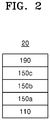
- FIGS. 1 to 5 are each a schematic view of an organic light-emitting device 10, 20, 30, 31, or 32, respectively, according to embodiments of the disclosure.
- the organic light-emitting device 10, 20, 30, 31, or 32 each includes a first electrode 110, an organic layer 150, and a second electrode 190.
- the organic light-emitting device 10 includes: a first electrode 110; a second electrode 190 facing the first electrode 110; and an organic layer 150 between the first electrode 110 and the second electrode 190.
- the organic layer 150 includes at least one light-emitting unit 153, 153-1, 153-2, and/or 153-3, wherein the light-emitting unit 153, 153-1, 153-2, and/or 153-3 includes: an emission layer.
- an emission layer 150b, 153-2b, and/or 153-3b may be included; and a hole transport region between the first electrode and the emission layer is included.
- the hole transport region includes a first hole transport (HT) layer 150a, 153-2a, and/or 153-3a.
- HT hole transport
- the emission layer 150b, 153-2b, and/or 153-3b includes a host
- the first HT layer 150a, 153-2a, or 153-3a includes a first compound.
- a bond dissociation energy (BDE 1HT ) of the first compound may be larger than a triplet energy (T 1,host ) of the host
- a bond dissociation energy (BDE host ) of the host may be larger than the triplet energy (T 1,host ) of the host.
- bond dissociation energy refers to the energy required to break a bond in a molecule.
- a chemical bond of an organic molecule used in the organic light-emitting device may receive energy from an exciton and be decomposed (e.g., dissociated).
- a decomposition rate of the organic molecule may depend on whether the molecule is in a cation state, an anion state, or a neutral state.
- the minimum bond dissociation energy (BDE) may refer to the lowest bond dissociation energy among bond dissociation energies in the cation state, bond dissociation energies in the anion state, and bond dissociation energies in the neutral state.
- a singlet energy (S 1,host ) of the host and the triplet energy (T 1,host ) of the host may satisfy Equation T below: S 1 , host ⁇ 2 ⁇ T 1 , host .
- a ratio of the TTF component to the total light emission component emitted from the emission layer may be 30% or more.
- 30% of the total light emitted from the emission layer is from the TTF component of the light.
- an absolute value of a lowest unoccupied molecular orbital (LUMO) energy (LUMO 1HT ) of the first compound may be smaller than an absolute value of a LUMO energy (LUMO host ) of the host.
- the LUMO energy (LUMO 1HT ) of the first compound and the LUMO energy (LUMO host ) of the host may satisfy Equation A below: LUMO 1 HT ⁇ LUMO host .
- an electron mobility ( ⁇ host ) of the host may be higher than an electron mobility ( ⁇ 1HT ) of the first compound.
- the electron mobility ( ⁇ host ) of the host and the electron mobility ( ⁇ 1HT ) of the first compound may satisfy Equation B below: ⁇ 1 HT ⁇ ⁇ host .
- the first HT layer may be in direct contact (e.g., physical contact) with the emission layer.
- a thickness (D 1HT ) of the first HT layer and a thickness (D E ) of the emission layer 150b may satisfy D E ⁇ D 1HT .
- the thickness (D 1HT ) of the first HT layer and the thickness (D E ) of the emission layer 150b may satisfy D E > D 1HT , but embodiments of the present disclosure are not limited thereto.
- the thickness (D 1HT ) of the first HT layer and the thickness (D E ) of the emission layer 150b are within this range, a suitable or satisfactory efficiency improvement effect may be obtained without a substantial increase in driving voltage of the organic light-emitting device.
- the thickness of the first HT layer may be in a range of about 10 ⁇ to about 200 ⁇ , for example about 10 ⁇ to about 100 ⁇ , but embodiments of the present disclosure are not limited thereto. When the thickness of the first HT layer is within this range, a suitable or satisfactory efficiency improvement effect may be obtained without a substantial increase in driving voltage of the organic light-emitting device.
- the organic light-emitting device 20 includes: a first electrode 110; a second electrode 190 facing the first electrode 110; and an organic layer between the first electrode 110 and the second electrode 190 and including at least one light-emitting unit, wherein the at least one light-emitting unit includes: an emission layer 150b; and a hole transport region between the first electrode and the emission layer and including a first hole transport (HT) layer 150a, the at least one light-emitting unit further includes an electron transport region between the second electrode and the emission layer and including a first electron transport (ET) layer 150c, and the first ET layer 150c includes a second compound.
- the at least one light-emitting unit includes: an emission layer 150b; and a hole transport region between the first electrode and the emission layer and including a first hole transport (HT) layer 150a
- the at least one light-emitting unit further includes an electron transport region between the second electrode and the emission layer and including a first electron transport (ET) layer 150c
- the first ET layer 150c includes a second compound
- an absolute value of a HOMO energy (HOMO host ) of the host may be smaller than an absolute value of a HOMO energy (HOMO 1ET ) of the second compound.
- the HOMO energy (HOMO host ) of the host and the HOMO energy (HOMO 1ET ) of the second compound may satisfy Equation C below: HOMO host ⁇ HOMO 1 ET .
- a triplet energy (T 1,1ET ) of the second compound may be larger than a triplet energy (T 1,host ) of the host.
- the triplet energy (T 1,1ET ) of the second compound and the triplet energy (T 1,host ) of the host may satisfy Equation D: T 1 , 1 ET > T 1 , host .
- a LUMO energy (LUMO host ) of the host and a LUMO energy (LUMO 1ET ) of the second compound may satisfy Equation E: LUMO 1 ET ⁇ LUMO host ⁇ 0.3 eV .
- the first ET layer may be in direct contact (e.g., physical contact) with the emission layer.
- the host may include a compound represented by Formula 301 which will be further described herein below.
- the host may include a compound represented by Formula 30:
- L 31 and L 32 are each independently a substituted or unsubstituted C 6 -C 60 ( e.g . C 6 -C 32 ) arylene group
- m31 and m32 are each independently an integer from 0 to 5
- Ar 31 , Ar 32 , and R 31 to R 38 are each independently selected from hydrogen, deuterium, -F, -CI, -Br, -I, a hydroxyl group, a cyano group, a nitro group, an amidino group, a hydrazino group, a hydrazono group, a substituted or unsubstituted C 1 -C 60 ( e.g.
- C 1 -C 20 alkyl group
- a substituted or unsubstituted C 2 -C 60 e.g. C 2 -C 20 ) alkenyl group
- a substituted or unsubstituted C 2 -C 60 e.g . C 2 -C 20 ) alkynyl group
- a substituted or unsubstituted C 1 -C 60 e.g . C 1 -C 20
- alkoxy group e.g. C 6 -C 60 (e.g. C 6 -C 30 ) aryl group
- a substituted or unsubstituted C 6 -C 60 e.g.
- C 6 -C 30 aryloxy group, a substituted or unsubstituted C 6 -C 60 ( e.g . C 6 -C 30 ) arylthio group, a substituted or unsubstituted C 1 -C 60 ( e.g .
- C 6 -C 30 aryl group, at least one substituent of the substituted C 6 -C 60 ( e.g . C 6 -C 32 ) arylene group, the substituted C 1 -C 60 ( e.g. C 1 -C 20 ) alkyl group, the substituted C 2 -C 60 ( e.g. C 2 -C 20 ) alkenyl group, the substituted C 2 -C 60 ( e.g . C 2 -C 20 ) alkynyl group, the substituted C 1 -C 60 (e.g. C 1 -C 20 ) alkoxy group, the substituted C 6 -C 60 (e.g.
- C 6 -C 30 aryl group, the substituted C 6 -C 60 ( e.g. C 6 -C 30 ) aryloxy group, the substituted C 6 -C 60 ( e.g. C 6 -C 30 ) arylthio group, the substituted C 1 -C 60 ( e.g .
- C 2 -C 20 alkynyl group, and a C1-C60 ( e.g . C 1 -C 20 ) alkoxy group; a C 1 -C 60 ( e.g. C 1 -C 20 ) alkyl group, a C 2 -C 60 ( e.g. C 2 -C 20 ) alkenyl group, a C2-C 60 ( e.g. C 2 -C 20 ) alkynyl group, and a C 1 -C 60 ( e.g.
- C 1 -C 20 alkoxy group, each substituted with at least one selected from deuterium, -F, -CI, -Br, -I, a hydroxyl group, a cyano group, a nitro group, an amidino group, a hydrazino group, a hydrazono group, a C 3 -C 10 cycloalkyl group, a C 1 -C 10 heterocycloalkyl group, a C 3 -C 10 cycloalkenyl group, a C 1 -C 10 heterocycloalkenyl group, a C 6 -C 60 ( e.g .
- C 6 -C 30 aryl group, a C 6 -C 60 ( e.g. C 6 -C 30 ) aryloxy group, a C 6 -C 60 ( e.g. C 6 -C 30 ) arylthio group, a C 1 -C 60 ( e.g.
- C 6 -C 30 aryl group, a C 6 -C 60 ( e.g. C 6 -C 30 ) aryloxy group, a C 6 -C 60 ( e.g. C 6 -C 30 ) arylthio group, a C 1 -C 60 ( e.g .
- C 1 -C 20 heteroaryl group, a monovalent non-aromatic condensed polycyclic group, and a monovalent non-aromatic condensed heteropolycyclic group; a C 3 -C 10 cycloalkyl group, a C 1 -C 10 heterocycloalkyl group, a C 3 -C 10 cycloalkenyl group, a C 1 -C 10 heterocycloalkenyl group, a C 6 -C 60 ( e.g . C 6 -C 30 ) aryl group, a C 6 -C 60 ( e.g. C 6 -C 30 ) aryloxy group, a C 6 -C 60 ( e.g.
- C 6 -C 30 arylthio group, a C 1 -C 60 ( e.g . C 1 -C 20 ) heteroaryl group, a monovalent non-aromatic condensed polycyclic group, and a monovalent non-aromatic condensed heteropolycyclic group, each substituted with at least one selected from deuterium, -F, -CI, -Br, -I, a hydroxyl group, a cyano group, a nitro group, an amidino group, a hydrazino group, a hydrazono group, a C 1 -C 60 ( e.g.
- C 1 -C 20 ) alkyl group a C 2 -C 60 ( e.g. C 2 -C 20 ) alkenyl group, a C 2 -C 60 ( e.g. C 2 -C 20 ) alkynyl group, a C 1 -C 60 ( e.g . C 1 -C 20 ) alkoxy group, a C 3 -C 10 cycloalkyl group, a C 1 -C 10 heterocycloalkyl group, a C 3 -C 10 cycloalkenyl group, a C 1 -C 10 heterocycloalkenyl group, a C 6 -C 60 ( e.g.
- C 6 -C 30 aryl group, a C 6 -C 60 ( e.g. C 6 -C 30 ) aryloxy group, a C 6 -C 60 ( e.g. C 6 -C 30 ) arylthio group, a C 1 -C 60 ( e.g.
- C 1 -C 20 ) alkyl group a C 2 -C 60 ( e.g. C 2 -C 20 ) alkenyl group, a C 2 -C 60 ( e.g. C 2 -C 20 ) alkynyl group, a C 1 -C 60 ( e.g . C 1 -C 20 ) alkoxy group, a C 3 -C 10 cycloalkyl group, a C 1 -C 10 heterocycloalkyl group, a C 3 -C 10 cycloalkenyl group, a C 1 -C 10 heterocycloalkenyl group, a C 6 -C 60 ( e.g .
- C 6 -C 30 aryl group, a C 1 -C 60 ( e.g . C 1 -C 20 ) heteroaryl group, a monovalent non-aromatic condensed polycyclic group, a monovalent non-aromatic condensed heteropolycyclic group, a biphenyl group, and a terphenyl group.
- m31 and m32 may each independently be 0, 1, or 2.
- L 31 is a single bond
- L 32 is a single bond
- L 31 and L 32 may each independently be a substituted or unsubstituted C 6 -C 32 arylene group.
- L 31 and L 32 may each independently be selected from a phenylene group, a pentalenylene group, an indenylene group, a naphthylene group, an azulenylene group, a heptalenylene group, an indacenylene group, an acenaphthylene group, a fluorenylene group, a spiro-bifluorenylene group, a spiro-fluorene-benzofluorenylene group, a benzofluorenylene group, a dibenzofluorenylene group, a phenalenylene group, a phenanthrenylene group, an anthracenylene group, a fluoranthenylene group, a triphenylenylene group, a pyrenylene group, a chrysenylene group, a naphthacenylene group, a picenylene group, a perylenylene
- L 31 and L 32 may each independently be a group represented by one selected from Formulae 3-1 to 3-26:
- Z 1 to Z 4 are each independently selected from hydrogen, deuterium, -F, -CI, - Br, -I, a hydroxyl group, a cyano group, a nitro group, an amino group, an amidino group, a hydrazine group, a hydrazone group, a carboxylic acid group or a salt thereof, a sulfonic acid group or a salt thereof, a phosphoric acid group or a salt thereof, a C 1 -C 20 ( e.g. C 1 -C 10 ) alkyl group, a C 1 -C 20 ( e.g.
- C 1 -C 10 alkoxy group, a phenyl group, a biphenyl group, a terphenyl group, a naphthyl group, a fluorenyl group, a spiro-bifluorenyl group, a benzofluorenyl group, a dibenzofluorenyl group, a phenanthrenyl group, an anthracenyl group, a pyrenyl group, a chrysenyl group, a pyridinyl group, a pyrazinyl group, a pyrimidinyl group, a pyridazinyl group, a quinolinyl group, an isoquinolinyl group, a quinoxalinyl group, a quinazolinyl group, a carbazolyl group, a dibenzofuranyl group, a dibenzothiophenyl group, a triazinyl group,
- Ar 31 , Ar 32 , and R 31 to R 38 may each independently be a group represented by one selected from Formulae 5-1 to 5-12:
- Z 31 and Z 32 are each independently selected from hydrogen, deuterium, -F, - Cl, -Br, -I, a hydroxyl group, a cyano group, a nitro group, an amidino group, a hydrazino group, a hydrazono group, a C 1 -C 20 ( e.g. C 1 -C 10 ) alkyl group, a C 1 -C 20 ( e.g. C 1 -C 10 ) alkenyl group, a C 1 -C 20 ( e.g. C 1 -C 10 ) alkynyl group, a C 1 -C 20 ( e.g.
- C 1 -C 10 alkoxy group, a phenyl group, a biphenyl group, a terphenyl group, a naphthyl group, a fluorenyl group, a spiro-bifluorenyl group, a phenanthrenyl group, an anthracenyl group, a triphenylenyl group, a pyridinyl group, a pyrimidinyl group, a carbazolyl group, and a triazinyl group, e2 is 1 or 2, e3 is an integer from 1 to 3, e4 is an integer from 1 to 4, e5 is an integer from 1 to 5, e6 is an integer from 1 to 6, e7 is an integer from 1 to 7, e9 is an integer from 1 to 9, and * indicates a binding site to a neighboring atom.
- At least one selected from Ar 31 and Ar 32 may be a substituted or unsubstituted naphthyl group.
- the host may include a compound represented by Formula 31 or 32:
- R 41 to R 47 are each independently selected from hydrogen, deuterium, -F, - Cl, -Br, -I, a hydroxyl group, a cyano group, a nitro group, an amidino group, a hydrazino group, a hydrazono group, a C 1 -C 60 ( e.g. C 1 -C 20 ) alkyl group, a C 2 -C 60 ( e.g.
- C 2 -C 20 alkenyl group, a C 2 -C 60 ( e.g. C 2 -C 20 ) alkynyl group, a C 1 -C 60 ( e.g. C 1 -C 20 ) alkoxy group, a C 6 -C 60 ( e.g . C 6 -C 30 ) aryl group, a monovalent non-aromatic condensed polycyclic group, a biphenyl group, and a terphenyl group, and at least two neighboring substituents selected from R 41 to R 47 are optionally be linked to form a substituted or unsubstituted C 6 -C 60 ( e.g . C 6 -C 30 ) carbocyclic group.
- the host may include at least one compound selected from Compounds H1 to H16, but embodiments of the present disclosure are not limited thereto:
- the host may be Compound H8.
- the first compound may include a compound represented by Formula 40:
- Y 1 is N or P
- X 1 to X 3 are each independently a single bond, O, S, N(R 2 ), C(R 2 )(R 3 ), or Si(R 2 )(R 3 )
- m1 is 0, 1, or 2 wherein, when m1 is 0, A 1 and A 2 are not linked with each other, A 1 to A 3 are each independently a C 5 -C 60 ( e.g . C 5 -C 30 ) carbocyclic group or a C1-C60 ( e.g .
- n1 is an integer from 2 to 4
- Ar 1 is a substituted or unsubstituted n1-valent C 3 -C 60 ( e.g . C 5 -C 60 or C 5 -C 32 ) carbocyclic group or a substituted or unsubstituted n1-valent C 1 -C 60 ( e.g .
- R 2 , R 3 , R 10 , R 20 , and R 30 are each independently selected from hydrogen, deuterium, -F, -CI, -Br, -I, a hydroxyl group, a cyano group, a nitro group, an amidino group, a hydrazino group, a hydrazono group, a substituted or unsubstituted C 1 -C 60 ( e.g. C 1 -C 20 ) alkyl group, a substituted or unsubstituted C 2 -C 60 ( e.g.
- C 2 -C 20 alkenyl group, a substituted or unsubstituted C 2 -C 60 ( e.g . C 2 -C 20 ) alkynyl group, a substituted or unsubstituted C 1 -C 60 ( e.g .
- C 1 -C 20 alkoxy group, a substituted or unsubstituted C 3 -C 10 cycloalkyl group, a substituted or unsubstituted C 1 -C 10 heterocycloalkyl group, a substituted or unsubstituted C 3 -C 10 cycloalkenyl group, a substituted or unsubstituted C 1 -C 10 heterocycloalkenyl group, a substituted or unsubstituted C 6 -C 60 ( e.g . C 6 -C 30 ) aryl group, a substituted or unsubstituted C 6 -C 60 ( e.g .
- C 6 -C 30 aryloxy group, a substituted or unsubstituted C 6 -C 60 ( e.g . C 6 -C 30 ) arylthio group, a substituted or unsubstituted C 1 -C 60 ( e.g .
- C 5 -C 30 carbocyclic group, the substituted C 1 -C 60 ( e.g . C 1 -C 20 ) heterocyclic group, the substituted C 1 -C 60 ( e.g. C 1 -C 20 ) alkyl group, the substituted C 2 -C 60 ( e.g. C 2 -C 20 ) alkenyl group, the substituted C 2 -C 60 ( e.g. C 2 -C 20 ) alkynyl group, the substituted C 1 -C 60 ( e.g.
- C 1 -C 20 alkoxy group, the substituted C 3 -C 10 cycloalkyl group, the substituted C 1 -C 10 heterocycloalkyl group, the substituted C 3 -C 10 cycloalkenyl group, the substituted C 1 -C 10 heterocycloalkenyl group, the substituted C 6 -C 60 ( e.g . C 6 -C 30 ) aryl group, the substituted C 6 -C 60 ( e.g. C 6 -C 30 ) aryloxy group, the substituted C 6 -C 60 ( e.g. C 6 -C 30 ) arylthio group, the substituted C 1 -C 60 ( e.g .
- C 2 -C 20 alkynyl group, and a C1-C60 ( e.g . C 1 -C 20 ) alkoxy group; a C 1 -C 60 ( e.g. C 1 -C 20 ) alkyl group, a C 2 -C 60 (e.g. C 2 -C 20 ) alkenyl group, a C2-C 60 ( e.g. C 2 -C 20 ) alkynyl group, and a C 1 -C 60 ( e.g.
- C 1 -C 20 alkoxy group, each substituted with at least one selected from deuterium, -F, -CI, -Br, -I, a hydroxyl group, a cyano group, a nitro group, an amidino group, a hydrazino group, a hydrazono group, a C 3 -C 10 cycloalkyl group, a C 1 -C 10 heterocycloalkyl group, a C 3 -C 10 cycloalkenyl group, a C 1 -C 10 heterocycloalkenyl group, a C 6 -C 60 ( e.g .
- C 6 -C 30 aryl group, a C 6 -C 60 ( e.g. C 6 -C 30 ) aryloxy group, a C 6 -C 60 ( e.g. C 6 -C 30 ) arylthio group, a C 1 -C 60 ( e.g.
- C 6 -C 30 aryl group, a C 6 -C 60 ( e.g. C 6 -C 30 ) aryloxy group, a C 6 -C 60 ( e.g. C 6 -C 30 ) arylthio group, a C 1 -C 60 ( e.g .
- C 1 -C 20 heteroaryl group, a monovalent non-aromatic condensed polycyclic group, and a monovalent non-aromatic condensed heteropolycyclic group; a C 3 -C 10 cycloalkyl group, a C 1 -C 10 heterocycloalkyl group, a C 3 -C 10 cycloalkenyl group, a C 1 -C 10 heterocycloalkenyl group, a C 6 -C 60 ( e.g . C 6 -C 30 ) aryl group, a C 6 -C 60 ( e.g. C 6 -C 30 ) aryloxy group, a C 6 -C 60 ( e.g.
- C 6 -C 30 arylthio group, a C 1 -C 60 ( e.g . C 1 -C 20 ) heteroaryl group, a monovalent non-aromatic condensed polycyclic group, and a monovalent non-aromatic condensed heteropolycyclic group, each substituted with at least one selected from deuterium, -F, -CI, -Br, -I, a hydroxyl group, a cyano group, a nitro group, an amidino group, a hydrazino group, a hydrazono group, a C 1 -C 60 ( e.g.
- C 1 -C 20 ) alkyl group a C 2 -C 60 ( e.g. C 2 -C 20 ) alkenyl group, a C 2 -C 60 ( e.g. C 2 -C 20 ) alkynyl group, a C 1 -C 60 ( e.g . C 1 -C 20 ) alkoxy group, a C 3 -C 10 cycloalkyl group, a C 1 -C 10 heterocycloalkyl group, a C 3 -C 10 cycloalkenyl group, a C 1 -C 10 heterocycloalkenyl group, a C 6 -C 60 ( e.g.
- C 6 -C 30 aryl group, a C 6 -C 60 ( e.g. C 6 -C 30 ) aryloxy group, a C 6 -C 60 ( e.g. C 6 -C 30 ) arylthio group, a C 1 -C 60 ( e.g.
- C 1 -C 20 ) alkyl group a C 2 -C 60 ( e.g. C 2 -C 20 ) alkenyl group, a C 2 -C 60 ( e.g. C 2 -C 20 ) alkynyl group, a C 1 -C 60 ( e.g . C 1 -C 20 ) alkoxy group, a C 3 -C 10 cycloalkyl group, a C 1 -C 10 heterocycloalkyl group, a C 3 -C 10 cycloalkenyl group, a C 1 -C 10 heterocycloalkenyl group, a C 6 -C 60 ( e.g.
- C 6 -C 30 aryl group, a C 1 -C 60 ( e.g. C 1 -C 20 ) heteroaryl group, a monovalent non-aromatic condensed polycyclic group, a monovalent non-aromatic condensed heteropolycyclic group, a biphenyl group, and a terphenyl group.
- the first compound may include a compound represented by Formula 41:
- X 11 to X 13 are each independently a single bond, O, S, N(R 4 ), C(R 4 )(R 5 ), or Si(R 4 )(R 5 ),
- X 21 to X 23 are each independently a single bond, O, S, N(R 6 ), C(R 6 )(R 7 ), or Si(R 6 )(R 7 )
- m11 and m21 are each independently 0, 1, or 2
- Ar 1 is selected from a substituted or unsubstituted C 3 -C 10 cycloalkylene group, a substituted or unsubstituted C 1 -C 10 heterocycloalkylene group, a substituted or unsubstituted C 3 -C 10 cycloalkenylene group, a substituted or unsubstituted C 1 -C 10 heterocycloalkenylene group, a substituted or unsubstituted C 6 -C 60 ( e.g .
- R 4 to R 7 , R 11 to R 18 , and R 21 to R 28 are each independently selected from a substituted or unsubstituted C 6 -C 60 ( e.g . C 6 -C 30 ) aryl group, a substituted or unsubstituted C 1 -C 60 ( e.g .
- Ar 1 may be selected from a phenylene group, a pentalenylene group, an indenylene group, a naphthylene group, an azulenylene group, a heptalenylene group, an indacenylene group, an acenaphthylene group, a fluorenylene group, a spiro-bifluorenylene group, a spiro-fluorene-benzofluorenylene group, a benzofluorenylene group, a dibenzofluorenylene group, a phenalenylene group, a phenanthrenylene group, an anthracenylene group, a fluoranthenylene group, a triphenylenylene group, a pyrenylene group, a chrysenylene group, a naphthacenylene group, a picenylene group, a perylenylene group, a pen
- Ar 1 may be a group represented by one selected from Formulae 3-1 to 3-26:
- Z 1 to Z 4 are each independently selected from hydrogen, deuterium, -F, -CI, - Br, -I, a hydroxyl group, a cyano group, a nitro group, an amino group, an amidino group, a hydrazine group, a hydrazone group, a carboxylic acid group or a salt thereof, a sulfonic acid group or a salt thereof, a phosphoric acid group or a salt thereof, a C 1 -C 20 ( e.g. C 1 -C 10 ) alkyl group, a C 1 -C 20 ( e.g.
- C 1 -C 10 alkoxy group, a phenyl group, a biphenyl group, a terphenyl group, a naphthyl group, a fluorenyl group, a spiro-bifluorenyl group, a benzofluorenyl group, a dibenzofluorenyl group, a phenanthrenyl group, an anthracenyl group, a pyrenyl group, a chrysenyl group, a pyridinyl group, a pyrazinyl group, a pyrimidinyl group, a pyridazinyl group, a quinolinyl group, an isoquinolinyl group, a quinoxalinyl group, a quinazolinyl group, a carbazolyl group, a dibenzofuranyl group, a dibenzothiophenyl group, a triazinyl group,
- R 4 to R 7 , R 11 to R 18 , and R 21 to R 28 may each independently be selected from hydrogen, deuterium, -F, -CI, -Br, -I, a hydroxyl group, a cyano group, a nitro group, an amidino group, a hydrazino group, a hydrazono group, a C 1 -C 20 ( e.g. C 1 -C 10 ) alkyl group, a C 1 -C 20 ( e.g. C 1 -C 10 ) alkoxy group, a phenyl group, a biphenyl group, a terphenyl group, and a naphthyl group.
- the first compound may include Compound B1, but embodiments of the present disclosure are not limited thereto:
- the second compound may include a compound represented by Formula 601 which will be further described herein below.
- the second compound may include a compound represented by Formula 50:
- Y 51 to Y 53 are each independently N or C(R 50 ), at least one selected from Y 51 to Y 53 is N, X 51 is O, S, N(R 59 ), C(R 59 )(R 60 ), or Si(R 59 )(R 60 ), Ar 51 is linked with one selected from R 51 to R 58 , Ar 52 , Ar 53 , and R 50 to R 60 are each independently selected from hydrogen, deuterium, -F, -CI, -Br, -I, a hydroxyl group, a cyano group, a nitro group, an amidino group, a hydrazino group, a hydrazono group, a substituted or unsubstituted C 1 -C 60 ( e.g.
- C 1 -C 20 alkyl group
- a substituted or unsubstituted C 2 -C 60 e.g. C 2 -C 20 ) alkenyl group
- a substituted or unsubstituted C 2 -C 60 e.g . C 2 -C 20 alkynyl group
- a substituted or unsubstituted C 1 -C 60 e.g .
- C 1 -C 20 alkoxy group, a substituted or unsubstituted C 3 -C 10 cycloalkyl group, a substituted or unsubstituted C 1 -C 10 heterocycloalkyl group, a substituted or unsubstituted C 3 -C 10 cycloalkenyl group, a substituted or unsubstituted C 1 -C 10 heterocycloalkenyl group, a substituted or unsubstituted C 6 -C 60 ( e.g . C 6 -C 30 ) aryl group, a substituted or unsubstituted C 6 -C 60 ( e.g .
- C 6 -C 30 aryloxy group, a substituted or unsubstituted C 6 -C 60 ( e.g . C 6 -C 30 ) arylthio group, a substituted or unsubstituted C 1 -C 60 ( e.g .
- R 59 and R 60 are optionally linked to form a substituted or unsubstituted C 5 -C 60 ( e.g.
- C 5 -C 30 carbocyclic group or a substituted or unsubstituted C 1 -C 60 ( e.g. C 1 -C 20 ) heterocyclic group, at least one substituent of the substituted C 5 -C 60 ( e.g . C 5 -C 30 ) carbocyclic group, the substituted C 1 -C 60 ( e.g . C 1 -C 20 ) heterocyclic group, the substituted C 1 -C 60 (e.g. C 1 -C 20 ) alkyl group, the substituted C 2 -C 60 ( e.g. C 2 -C 20 ) alkenyl group, the substituted C 2 -C 60 ( e.g.
- C 6 -C 30 arylthio group, the substituted C 1 -C 60 ( e.g . C 1 -C 20 ) heteroaryl group, the substituted monovalent non-aromatic condensed polycyclic group. and the substituted monovalent non-aromatic condensed heteropolycyclic group is selected from: deuterium, -F, -CI, -Br, -I, a hydroxyl group, a cyano group, a nitro group, an amidino group, a hydrazino group, a hydrazono group, a C 1 -C 60 ( e.g .
- C 1 -C 20 ) alkyl group a C 2 -C 60 ( e.g. C 2 -C 20 ) alkenyl group, a C 2 -C 60 ( e.g. C 2 -C 20 ) alkynyl group, and a C1-C60 ( e.g . C 1 -C 20 ) alkoxy group; a C 1 -C 60 ( e.g. C 1 -C 20 ) alkyl group, a C 2 -C 60 ( e.g. C 2 -C 20 ) alkenyl group, a C2-C 60 ( e.g.
- C 2 -C 20 alkynyl group
- a C 1 -C 60 e.g. C 1 -C 20 alkoxy group
- C 6 -C 30 aryl group, a C 6 -C 60 ( e.g. C 6 -C 30 ) aryloxy group, a C 6 -C 60 ( e.g. C 6 -C 30 ) arylthio group, a C 1 -C 60 (e.g.
- C 6 -C 30 aryl group, a C 6 -C 60 ( e.g. C 6 -C 30 ) aryloxy group, a C 6 -C 60 ( e.g. C 6 -C 30 ) arylthio group, a C 1 -C 60 ( e.g.
- C 1 -C 20 heteroaryl group, a monovalent non-aromatic condensed polycyclic group, and a monovalent non-aromatic condensed heteropolycyclic group; a C 3 -C 10 cycloalkyl group, a C 1 -C 10 heterocycloalkyl group, a C 3 -C 10 cycloalkenyl group, a C 1 -C 10 heterocycloalkenyl group, a C 6 -C 60 ( e.g . C 6 -C 30 ) aryl group, a C 6 -C 60 ( e.g. C 6 -C 30 ) aryloxy group, a C 6 -C 60 ( e.g.
- C 6 -C 30 arylthio group, a C 1 -C 60 ( e.g . C 1 -C 20 ) heteroaryl group, a monovalent non-aromatic condensed polycyclic group, and a monovalent non-aromatic condensed heteropolycyclic group, each substituted with at least one selected from deuterium, -F, -CI, -Br, -I, a hydroxyl group, a cyano group, a nitro group, an amidino group, a hydrazino group, a hydrazono group, a C 1 -C 60 ( e.g.
- C 1 -C 20 ) alkyl group a C 2 -C 60 ( e.g. C 2 -C 20 ) alkenyl group, a C 2 -C 60 ( e.g. C 2 -C 20 ) alkynyl group, a C 1 -C 60 ( e.g . C 1 -C 20 ) alkoxy group, a C 3 -C 10 cycloalkyl group, a C 1 -C 10 heterocycloalkyl group, a C 3 -C 10 cycloalkenyl group, a C 1 -C 10 heterocycloalkenyl group, a C 6 -C 60 ( e.g.
- C 6 -C 30 aryl group, a C 6 -C 60 ( e.g. C 6 -C 30 ) aryloxy group, a C 6 -C 60 ( e.g. C 6 -C 30 ) arylthio group, a C 1 -C 60 ( e.g.
- C 1 -C 20 ) alkyl group a C 2 -C 60 ( e.g. C 2 -C 20 ) alkenyl group, a C 2 -C 60 ( e.g. C 2 -C 20 ) alkynyl group, a C 1 -C 60 ( e.g . C 1 -C 20 ) alkoxy group, a C 3 -C 10 cycloalkyl group, a C 1 -C 10 heterocycloalkyl group, a C 3 -C 10 cycloalkenyl group, a C 1 -C 10 heterocycloalkenyl group, a C 6 -C 60 ( e.g.
- C 6 -C 30 aryl group, a C 1 -C 60 ( e.g. C 1 -C 20 ) heteroaryl group, a monovalent non-aromatic condensed polycyclic group, a monovalent non-aromatic condensed heteropolycyclic group, a biphenyl group, and a terphenyl group.
- Ar 52 , Ar 53 , and R 50 to R 60 in Formula 50 may each independently be selected from groups represented by one selected from Formulae 5-1 to 5-26 and Formulae 6-1 to 6-55:
- Y 31 and Y 32 are each independently selected from O, S, C(Z34)(Z35), N(Z34), or Si(Z 34 )(Z 35 ), Z 31 , Z 32 , Z 34 , and Z 35 are each independently selected from hydrogen, deuterium, -F, -CI, -Br, -I, a hydroxyl group, a cyano group, a nitro group, an amidino group, a hydrazino group, a hydrazono group, a C 1 -C 20 ( e.g . C 1 -C 10 ) alkyl group, a C 2 -C20 ( e.g.
- C 2 -C 10 alkenyl group, a C 2 -C 20 ( e.g. C 2 -C 10 ) alkynyl group, a C 1 -C 20 ( e.g. C 1 -C 10 ) alkoxy group, a phenyl group, a biphenyl group, a terphenyl group, a naphthyl group, a fluorenyl group, a spiro-bifluorenyl group, a phenanthrenyl group, an anthracenyl group, a triphenylenyl group, a pyridinyl group, a pyrimidinyl group, a carbazolyl group, and a triazinyl group, e2 is 1 or 2, e3 is an integer from 1 to 3, e4 is an integer from 1 to 4, e5 is an integer from 1 to 5, e6 is an integer from 1 to 6, e7 is an integer from 1 to 7, e
- the second compound may include a compound represented by Formula 51:
- Y 51 to Y 53 are each independently N or C(R 50 ), Ar 52 , Ar 53 , R 50 to R 52 , and R 54 to R 58 are each independently selected from hydrogen, deuterium, -F, -CI, -Br, -I, a hydroxyl group, a cyano group, a nitro group, an amidino group, a hydrazino group, a hydrazono group, a C 1 -C 20 ( e.g . C 1 -C 10 ) alkyl group, a C 1 -C 20 ( e.g .
- C 1 -C 10 alkoxy group, a phenyl group, a biphenyl group, a terphenyl group, and a naphthyl group, and R 59 and R 60 are linked to form a C 5 -C 60 ( e.g . C 5 -C 30 ) carbocyclic group.
- the second compound may include Compound E1, but embodiments of the present disclosure are not limited thereto:
- the emission layer may further include a dopant, and an amount of the host may be larger than an amount of the dopant.
- the dopant may include a fluorescent dopant
- the emission layer may be configured to emit fluorescence
- the dopant may include a compound represented by Formula 501 which will be further described herein below.
- the organic light-emitting devices 30, 31, and 32 may each include: light-emitting units 153-1, 153-2, and 153-3 in the number of m; and charge-generation layers 155, 155-1 and 155-2 in the number of m-1 between two neighboring light-emitting units among the light-emitting units in the number of m, the charge-generation layers 155, 155-1 and 155-2 may each include n-type charge-generation layers 155', 155'-1 and 155'-2 including an n-type charge-generation material, and p-type charge-generation layers 155", 155"-1 and 155"-2 including a hole transport material, and m may be an integer of 2 or more, and a maximum emission wavelength emitted by at least one light-emitting unit among the light-emitting units in the number of m may be different from a maximum emission wavelength emitted by at least one light-emitting unit among the remaining light-emitting units.
- a difference between an absolute value of a LUMO energy (LUMO nCGL ) of the n-type charge-generation material included in the n-type charge-generation layer and an absolute value of a HOMO energy (HOMO pCGL ) of the hole transport material included in the p-type charge-generation layer may be less than about 3.0 eV.
- the difference between the absolute value of the LUMO energy (LUMO nCGL ) of the n-type charge-generation material and the absolute value of the HOMO energy (HOMO pCGL ) of the hole transport material included in the p-type charge-generation layer is less than 3.0 eV, electrons generated in the p-type charge-generation layer are easily moved to the n-type charge-generation layer. Therefore, the driving voltage of the organic light-emitting device may be reduced and the efficiency of the organic light-emitting device may be increased.
- the difference between the absolute value of the LUMO energy (LUMO nCGL ) of the n-type charge-generation material included in the n-type charge-generation layer and the absolute value of the HOMO energy (HOMO pCGL ) of the hole transport material included in the p-type charge-generation layer may be less than about 2.8 eV.
- the n-type charge-generation material may include a metal-free compound (e.g., a compound that does not include a metal) including at least one ⁇ electron-depleted nitrogen-containing ring.
- a metal-free compound e.g., a compound that does not include a metal
- Examples of the ⁇ electron-depleted nitrogen-containing ring include an imidazole, a pyrazole, a thiazole, an isothiazole, an oxazole, an isoxazole, a pyridine, a pyrazine, a pyrimidine, a pyridazine, an indazole, a purine, a quinoline, an isoquinoline, a benzoquinoline, a phthalazine, a naphthyridine, a quinoxaline, a quinazoline, a cinnoline, a phenanthridine, an acridine, a phenanthroline, a phenazine, a benzimidazole, an isobenzothiazole, a benzoxazole, an isobenzoxazole, a triazole, a tetrazole, an oxadiazole, a triazine
- the n-type charge-generation material may include at least one selected from compounds represented by Formula 601, which will be further described herein below, but embodiments of the present disclosure are not limited thereto.
- the n-type charge-generation material may include a compound represented by one selected from Formulae 90 and 91:
- X 91 to X 100 are each independently N or C(R 90 ), at least one selected from X 91 to X 100 is N, L 91 and L 92 are each independently selected from a substituted or unsubstituted C 3 -C 10 cycloalkylene group, a substituted or unsubstituted C 1 -C 10 heterocycloalkylene group, a substituted or unsubstituted C 3 -C 10 cycloalkenylene group, a substituted or unsubstituted C 1 -C 10 heterocycloalkenylene group, a substituted or unsubstituted C 6 -C 60 ( e.g .
- C 6 -C 30 arylene group, a substituted or unsubstituted C 1 -C 60 ( e.g . C 1 -C 20 ) heteroarylene group, a substituted or unsubstituted divalent non-aromatic condensed polycyclic group, and a substituted or unsubstituted divalent non-aromatic condensed heteropolycyclic group, a91 and a92 are each independently an integer from 0 to 5, R 90 and R 91 are each independently selected from hydrogen, deuterium, -F, - Cl, -Br, -I, a hydroxyl group, a cyano group, a nitro group, an amidino group, a hydrazino group, a hydrazono group, a substituted or unsubstituted C 1 -C 20 ( e.g .
- C 1 -C 10 alkyl group
- a substituted or unsubstituted C 1 -C 20 e.g . C 1 -C 10 alkoxy group
- a substituted or unsubstituted C 3 -C 10 cycloalkyl group a substituted or unsubstituted C 1 -C 10 heterocycloalkyl group
- a substituted or unsubstituted C 3 -C 10 cycloalkenyl group a substituted or unsubstituted C 1 -C 10 heterocycloalkenyl group
- a substituted or unsubstituted C 6 -C 60 e.g .
- C 6 -C 30 aryl group, a substituted or unsubstituted C 6 -C 60 (e.g. C 6 -C 30 ) aryloxy group, a substituted or unsubstituted C 6 -C 60 (e.g. C 6 -C 30 ) arylthio group, a substituted or unsubstituted C 1 -C 60 ( e.g .
- At least one selected from X 91 to X 100 in Formula 90 may be C(R 90 ).
- a91 may be 0 or 1, and a92 may be 1.
- a91 is 0, -(L 91 ) a91 - is a single bond.
- L 91 and L 92 may each independently be a phenylene group.
- R 90 and R 91 may each independently be selected from hydrogen, deuterium, -F, -CI, -Br, -I, a hydroxyl group, a cyano group, a nitro group, an amidino group, a hydrazino group, a hydrazono group, a C 1 -C 20 ( e.g. C 1 -C 10 ) alkyl group, a C 1 -C 20 ( e.g. C 1 -C 10 ) alkoxy group, a phenyl group, a biphenyl group, a terphenyl group, and a naphthyl group.
- the n-type charge-generation material may include at least one selected from Compounds nCGL1 and nCGL2, but embodiments of the present disclosure are not limited thereto:
- the n-type charge-generation layer may further include a metal-containing material.
- the metal-containing material may have a work function in a range of about 2.0 eV to about 4.5 eV, and the metal-containing material may be a metal, a metal oxide, a metal halide, or any combination thereof.
- the metal-containing material may be at least one selected from Yb, Ag, Al, Sm, Mg, Li, and RbI.
- the hole transport material included in the p-type charge-generation layer may be selected from a cyano group-free compound (e.g., a compound that does not include a cyano group), an amine-based compound, and a carbazole-based compound, and a copper halide (copper halide: CuX, wherein X is F, Cl, or Br), which has an absolute value of a HOMO energy level in a range of greater than about 5.5 eV and less than or equal to 8.0 eV.
- a cyano group-free compound e.g., a compound that does not include a cyano group
- an amine-based compound e.g., an amine-based compound
- a carbazole-based compound e.g., a carbazole-based compound
- copper halide copper halide: CuX, wherein X is F, Cl, or Br
- the hole transport material included in the p-type charge-generation layer may be selected from groups represented by Formulae 201, 202, and 301-2 which will be further described herein below.
- the hole transport material included in the p-type charge-generation layer may be Compound HT1:
- the p-type charge-generation layer may further include a p-dopant which will be described below.
- the p-type charge-generation layer may further include Compound HAT-CN:
- the p-type charge-generation layer may have a multi-layered structure in which a first layer including the p-dopant and a second layer including the hole transport material are stacked.
- m may be 2, the light-emitting units in the number of m may include a first light-emitting unit and a second light-emitting unit, the first light-emitting unit and the second light-emitting unit may each independently be understood by referring to the description presented in relation to the light-emitting unit, the charge-generation layers in the number of m-1 may each include a first charge-generation layer, the first charge-generation layer may be between the first light-emitting unit and the second light-emitting unit, the first light-emitting unit may be between the first electrode and the first charge-generation layer, the second light-emitting unit may be between the first charge-generation layer and the second electrode, the first charge-generation layer may include a first n-type charge-generation layer and a first p-type charge-generation layer, the first n-type charge-generation layer may be between the first light-emitting unit and the second light-emitting unit, and the first p-type charge-generation layer may be between
- m may be 3, the light-emitting units in the number of m may include a first light-emitting unit, a second light-emitting unit, and a third light-emitting unit, the first light-emitting unit, the second light-emitting unit, and the third light-emitting unit may each independently be understood by referring to the description presented in relation to the light-emitting unit, the charge-generation layers in the number of m-1 may include a first charge-generation layer and a second charge-generation layer, the first charge-generation layer may be between the first light-emitting unit and the second light-emitting unit, the second charge-generation layer may be between the second light-emitting unit and the third light-emitting unit, the first light-emitting unit may be between the first electrode and the first charge-generation layer, the second light-emitting unit may be between the first charge-generation layer and the second charge-generation layer, the third light-emitting unit may be between the second charge-generation layer
- a display apparatus including: a thin-film transistor including a source electrode, a drain electrode, and an active layer; and the organic light-emitting device, wherein the first electrode of the organic light-emitting device is electrically coupled to one of the source electrode and the drain electrode of the thin-film transistor.
- a substrate may be additionally under the first electrode 110 or above the second electrode 190.
- the substrate may be a glass substrate or a plastic substrate, each having excellent mechanical strength, thermal stability, transparency, surface smoothness, ease of handling, and water resistance.
- the first electrode 110 may be formed by depositing or sputtering a material for forming the first electrode 110 on the substrate.
- the material for forming the first electrode 110 may be selected from materials having a high work function to facilitate hole injection.
- the first electrode 110 may be a reflective electrode, a semi-transmissive electrode, or a transmissive electrode.
- a material for forming a first electrode may be selected from indium tin oxide (ITO), indium zinc oxide (IZO), tin oxide (SnO 2 ), zinc oxide (ZnO), and any combinations thereof, but embodiments of the present disclosure are not limited thereto.
- a material for forming a first electrode may be selected from magnesium (Mg), silver (Ag), aluminium (Al), aluminium-lithium (Al-Li), calcium (Ca), magnesium-indium (Mg-In), magnesium-silver (Mg-Ag), and any combinations thereof, but embodiments of the present disclosure are not limited thereto.
- the first electrode 110 may have a single-layered structure, or a multi-layered structure including two or more layers.
- the first electrode 110 may have a three-layered structure of ITO/Ag/ITO, but the structure of the first electrode 110 is not limited thereto.
- the organic layer 150 may be on the first electrode 110, and may include an emission layer 150b.
- the organic layer may include a hole transport region between the first electrode 110 and the emission layer 150b and an electron transport region between the emission layer 150b and the second electrode 190.
- the hole transport region may include the first HT layer 150a, 153-2a, or 153-3a.
- the first compound included in the first HT layer 150a, 153-2a, or 153-3a will be further described herein below.
- the hole transport region may have i) a single-layered structure including a single layer including a single material, ii) a single-layered structure including a single layer including a plurality of different materials, or iii) a multi-layered structure having a plurality of layers including a plurality of different materials.
- the hole transport region may further include at least one layer selected from an electron blocking layer, a hole injection layer, a hole transport layer, and an emission auxiliary layer.
- the hole transport region may further include, in addition to the first HT layer 150a, 153-2a, or 153-3a, a single-layered structure including a single layer including a plurality of different materials, or may have a multi-layered structure of hole injection layer/hole transport layer, hole injection layer/hole transport layer/emission auxiliary layer, hole injection layer/emission auxiliary layer, hole injection layer/hole transport layer/electron blocking layer, hole injection layer/hole transport layer/emission auxiliary layer/ electron blocking layer, hole injection layer/emission auxiliary layer/electron blocking layer, or hole transport layer/emission auxiliary layer/electron blocking layer, wherein layers of each structure are sequentially stacked on the first electrode 110.
- embodiments of the present disclosure are not limited thereto.
- the hole transport region may include at least one compound selected from m-MTDATA, TDATA, 2-TNATA, NPB (NPD), ⁇ -NPB, TPD, spiro-TPD, spiro-NPB, methylated NPB, TAPC, HMTPD, 4,4',4"-tris(N-carbazolyl)triphenylamine (TCTA), polyaniline/dodecylbenzenesulfonic acid (PANI/DBSA), poly(3,4-ethylenedioxythiophene)/poly(4-styrenesulfonate) (PEDOT/PSS(, polyaniline/camphor sulfonic acid (PANI/CSA), polyaniline/poly(4-styrenesulfonate) (PANI/PSS), a compound represented by Formula 201, and a compound represented by Formula 202:
- L 201 to L 204 may each independently be selected from a substituted or unsubstituted C 3 -C 10 cycloalkylene group, a substituted or unsubstituted C 1 -C 10 heterocycloalkylene group, a substituted or unsubstituted C 3 -C 10 cycloalkenylene group, a substituted or unsubstituted C 1 -C 10 heterocycloalkenylene group, a substituted or unsubstituted C 6 -C 60 ( e.g . C 6 -C 32 ) arylene group, a substituted or unsubstituted C 1 -C 60 ( e.g .
- L 205 may be selected from *-O-*', *-S-*', *-N(Q 201 )-*', a substituted or unsubstituted C 1 -C 20 alkylene group, a substituted or unsubstituted C 2 -C 20 alkenylene group, a substituted or unsubstituted C 3 -C 10 cycloalkylene group, a substituted or unsubstituted C 1 -C 10 heterocycloalkylene group, a substituted or unsubstituted C 3 -C 10 cycloalkenylene group, a substituted or unsubstituted C 1 -C 10 heterocycloalkenylene group, a substituted or unsubstituted C 1 -C 10 heterocycloalkenylene group, a substituted or unsubstituted or unsubstituted C 1 -C 10 heterocycloalkenylene group, a substituted or unsubstituted or unsub
- arylene group a substituted or unsubstituted C 1 -C 60 ( e.g . C 1 -C 20 ) heteroarylene group, a substituted or unsubstituted divalent non-aromatic condensed polycyclic group, and a substituted or unsubstituted divalent non-aromatic condensed heteropolycyclic group
- xa1 to xa4 may each independently be an integer from 0 to 3
- xa5 may be an integer from 1 to 10
- R 201 to R 204 and Q 201 may each independently be selected from a substituted or unsubstituted C 3 -C 10 cycloalkyl group, a substituted or unsubstituted C 1 -C 10 heterocycloalkyl group, a substituted or unsubstituted C 3 -C 10 cycloalkenyl group, a substituted or unsubstituted C 1 -C 10 heterocycloalkenyl
- C 6 -C 32 aryl group, a substituted or unsubstituted C 6 -C 60 ( e.g. C 6 -C 32 ) aryloxy group, a substituted or unsubstituted C 6 -C 60 ( e.g. C 6 -C 32 ) arylthio group, a substituted or unsubstituted C 1 -C 60 ( e.g . C 1 -C 20 ) heteroaryl group, a substituted or unsubstituted monovalent non-aromatic condensed polycyclic group, and a substituted or unsubstituted monovalent non-aromatic condensed heteropolycyclic group.
- R 201 and R 202 may optionally be linked via a single bond, a dimethyl-methylene group, or a diphenyl-methylene group
- R 203 and R 204 may optionally be linked via a single bond, a dimethyl-methylene group, or a diphenyl-methylene group.
- L 201 to L 205 may each independently be selected from:
- xa1 to xa4 may each independently be 0, 1, or 2.
- xa5 may be 1, 2, 3, or 4.
- R 201 to R 204 and Q 201 may each independently be selected from:
- At least one selected from R 201 to R 203 in Formula 201 may each independently be selected from:
- R 201 and R 202 may be linked via a single bond, and/or ii) R 203 and R 204 may be linked via a single bond.
- At least one selected from R 201 to R 204 in Formula 202 may be selected from:
- the compound represented by Formula 201 may be represented by Formula 201A:
- the compound represented by Formula 201 may be represented by Formula 201 A(1) below, but embodiments of the present disclosure are not limited thereto:
- the compound represented by Formula 201 may be represented by Formula 201A-1 below, but embodiments of the present disclosure are not limited thereto:
- the compound represented by Formula 202 may be represented by Formula 202A:
- the compound represented by Formula 202 may be represented by Formula 202A-1:
- R 211 and R 212 may each independently the same as defined in connection with R 203
- R 213 to R 217 may each independently be selected from hydrogen, deuterium, -F, -CI, -Br, -I, a hydroxyl group, a cyano group, a nitro group, an amidino group, a hydrazino group, a hydrazono group, a C 1 -C 20 alkyl group, a C 1 -C 20 alkoxy group, a cyclopentyl group, a cyclohexyl group, a cycloheptyl group, a cyclopentenyl group, a cyclohexenyl group,
- the hole transport region may include at least one compound selected from Compounds HT1 to HT39, but embodiments of the present disclosure are not limited thereto:
- a thickness of the hole transport region may be in a range of about 100 ⁇ to about 10,000 ⁇ , for example, about 100 ⁇ to about 7000 ⁇ , about 100 ⁇ to about 5000 ⁇ , about 100 ⁇ to about 3000 ⁇ , about 100 ⁇ to about 1,000 ⁇ or about 100 ⁇ to about 500 ⁇ .
- the thickness of the hole injection layer may be in a range of about 100 ⁇ to about 9,000 ⁇ , and for example, about 100 ⁇ to about 7,000 ⁇ , about 100 ⁇ to about 5,000 ⁇ , about 100 ⁇ to about 3,000 ⁇ , about 100 ⁇ to about 2,000 ⁇ , about 100 ⁇ to about 1,000 ⁇ , or about 100 ⁇ to about 200 ⁇ , and the thickness of the hole transport layer may be in a range of about 50 ⁇ to about 2,000 ⁇ , and for example, about 100 ⁇ to about 1,500 ⁇ , or about 150 ⁇ to about 250 ⁇ .
- suitable or satisfactory hole transporting characteristics may be obtained without a substantial increase in driving voltage.
- the emission auxiliary layer may increase light-emission efficiency by compensating for an optical resonance distance according to the wavelength of light emitted by the emission layer 150b, and the electron blocking layer may block the flow of electrons from an electron transport region.
- the emission auxiliary layer and the electron blocking layer may include the materials as described herein above.
- the hole transport region may further include, in addition to these materials, a charge-generation material for the improvement of conductive (e.g., electrically conductive) properties.
- the charge-generation material may be homogeneously or non-homogeneously dispersed in the hole transport region.
- the charge-generation material may be, for example, a p-dopant.
- the p-dopant may have a lowest unoccupied molecular orbital (LUMO) energy level of -3.5 eV or less.
- LUMO lowest unoccupied molecular orbital
- the p-dopant may include at least one selected from a quinone derivative, a metal oxide, and a cyano group-containing compound, but embodiments of the present disclosure are not limited thereto.
- the p-dopant may include at least one selected from:
- R 221 to R 223 may each independently be selected from a substituted or unsubstituted C 3 -C 10 cycloalkyl group, a substituted or unsubstituted C 1 -C 10 heterocycloalkyl group, a substituted or unsubstituted C 3 -C 10 cycloalkenyl group, a substituted or unsubstituted C 1 -C 10 heterocycloalkenyl group, a substituted or unsubstituted C 6 -C 60 ( e.g . C 6 -C 32 ) aryl group, a substituted or unsubstituted C 1 -C 60 ( e.g .
- R 221 to R 223 may have at least one substituent selected from a cyano group, -F, -Cl, -Br, -I, a C 1 -C 20 alkyl group substituted with -F, a C 1 -C 20 alkyl group substituted with -CI, a C 1 -C 20 alkyl group substituted with -Br, and a C 1 -C 20 alkyl group substituted with -I.
- the emission layer 150b, 153-2b, or 153-3b may be patterned into a red emission layer, a green emission layer, or a blue emission layer, according to a subpixel.
- the emission layer 150b, 153-2b, or 153-3b may have a stacked structure of two or more layers selected from a red emission layer, a green emission layer, and a blue emission layer, in which the two or more layers contact each other or are separated from each other.
- the emission layer may include two or more materials selected from a red light-emitting material, a green light-emitting material, and a blue light-emitting material, in which the two or more materials are mixed with each other in a single layer to emit white light.
- the emission layer 150b, 153-2b, or 153-3b may include a host and a dopant.
- the dopant may be a phosphorescent dopant.
- an amount of the dopant may be in a range of about 0.01 parts by weight to about 15 parts by weight based on 100 parts by weight of the host, but embodiments of the present disclosure are not limited thereto.
- a thickness of the emission layer 150b may be in a range of about 100 ⁇ to about 1,000 ⁇ , for example, about 100 ⁇ to about 800 ⁇ , about 150 ⁇ to about 800 ⁇ , about 150 ⁇ to about 700 ⁇ , about 150 ⁇ to about 650 ⁇ , about 200 ⁇ to about 600 ⁇ or about 200 ⁇ to about 300 ⁇ .
- excellent light-emission characteristics may be obtained without a substantial increase in driving voltage.
- the host may include the compound described herein above.
- the host may further include a compound represented by Formula 301:
- Ar 301 may be a substituted or unsubstituted C 5 -C 60 carbocyclic group or a substituted or unsubstituted C 1 -C 60 heterocyclic group
- xb11 may be 0, 1, 2, or 3
- L 301 may be selected from a substituted or unsubstituted C 3 -C 10 cycloalkylene group, a substituted or unsubstituted C 1 -C 10 heterocycloalkylene group, a substituted or unsubstituted C 3 -C 10 cycloalkenylene group, a substituted or unsubstituted C 1 -C 10 heterocycloalkenylene group, a substituted or unsubstituted C 6 -C 60 arylene group, a substituted or unsubstituted C 1 -C 60 heteroarylene group, a substituted or unsubstituted divalent non-aromatic condensed polycyclic group, and a substituted or unsubstitute
- Ar 301 may be a substituted or unsubstituted C 6 -C 32 carbocyclic group or a substituted or unsubstituted C 1 -C 12 heterocyclic group, but embodiments are not limited thereto.
- Ar 301 in Formula 301 may be selected from:
- xb11 in Formula 301 is two or more, two or more Ar 301 (s) may be linked via a single bond.
- the compound represented by Formula 301 may be represented by Formula 301-1 or 301-2:
- ring A 301 to ring A 304 may each independently be selected from a benzene ring, a naphthalene ring, a phenanthrene ring, a fluoranthene ring, a triphenylene ring, a pyrene ring, a chrysene ring, a pyridine ring, a pyrimidine ring, an indene ring, a fluorene ring, a spiro-bifluorene ring, a benzofluorene ring, a dibenzofluorene ring, an indole ring, a carbazole ring, a benzocarbazole ring, a dibenzocarbazole ring, a furan ring, a benzofuran ring, a dibenzofuran ring, a naphthofuran ring, a benzonaphthofur
- L 301 to L 304 in Formulae 301, 301-1, and 301-2 may each independently be selected from:
- R 301 to R 304 in Formulae 301, 301-1, and 301-2 may each independently be selected from: deuterium, -F, -CI, -Br, -I, a hydroxyl group, a cyano group, a nitro group, an amidino group, a hydrazino group, a hydrazono group, a substituted or unsubstituted C 1 -C 60 ( e.g. C 1 -C 10 ) alkyl group, a substituted or unsubstituted C 2 -C 60 ( e.g. C 2 -C 10 ) alkenyl group, a substituted or unsubstituted C 2 -C 60 ( e.g.
- C 2 -C 10 alkynyl group, a substituted or unsubstituted C 1 -C 60 ( e.g. C 1 -C 10 ) alkoxy group, a substituted or unsubstituted C 3 -C 10 cycloalkyl group, a substituted or unsubstituted C 1 -C 10 heterocycloalkyl group, a substituted or unsubstituted C 3 -C 10 cycloalkenyl group, a substituted or unsubstituted C 1 -C 10 heterocycloalkenyl group, a substituted or unsubstituted C 6 -C 30 aryl group, a substituted or unsubstituted C 6 -C 30 aryloxy group, a substituted or unsubstituted C 6 -C 30 arylthio group, a substituted or unsubstituted C 1 -C 20 heteroaryl group, a substituted or unsubstituted C
- R 301 to R 304 may each independently be selected from:
- the host may further include an alkaline earth-metal complex.
- the host may include a complex selected from a Be complex (for example, Compound H55), a Mg complex, and a Zn complex.
- the host may further include at least one compound selected from a Be complex (for example, Compound H55), a Mg complex, and a Zn complex.
- the host may include at least one selected from 9,10-di(2-naphthyl)anthracene (ADN), 2-methyl-9,10-bis(naphthalen-2-yl)anthracene (MADN), 9,10-di-(2-naphthyl)-2-t-butyl-anthracene (TBADN), 4,4'-bis(N-carbazolyl)-1,1'-biphenyl (CBP), 1,3-di-9-carbazolylbenzene (mCP), 1,3,5-tri(carbazol-9-yl)benzene (TCP), and Compounds H1 to H55, but embodiments of the present disclosure are not limited thereto:
- the host may include at least one selected from a silicon-containing compound (for example, BCPDS or the like) and a phosphine oxide-containing compound (for example, POPCPA or the like).
- a silicon-containing compound for example, BCPDS or the like
- a phosphine oxide-containing compound for example, POPCPA or the like
- the host may include one type (or kind) of compounds only or two or more different types (or kinds) of compounds. As such, embodiments may be modified in various suitable ways.
- the emission layer may include a dopant, and the dopant may be configured to emit fluorescence by TTF.
- the dopant may be configured to emit thermally activated delayed fluorescence (TADF) or fluorescence.
- TADF thermally activated delayed fluorescence
- the dopant may further include an arylamine compound or a styrylamine compound.
- the dopant may include a compound represented by Formula 501:
- Ar 501 may be a substituted or unsubstituted C 5 -C 60 carbocyclic group or a substituted or unsubstituted C 1 -C 60 heterocyclic group
- L 501 to L 503 may each independently be selected from a substituted or unsubstituted C 3 -C 10 cycloalkylene group, a substituted or unsubstituted C 1 -C 10 heterocycloalkylene group, a substituted or unsubstituted C 3 -C 10 cycloalkenylene group, a substituted or unsubstituted C 1 -C 10 heterocycloalkenylene group, a substituted or unsubstituted C 6 -C 60 ( e.g .
- C 6 -C 30 arylene group, a substituted or unsubstituted C 1 -C 60 ( e.g . C 1 -C 20 ) heteroarylene group, a substituted or unsubstituted divalent non-aromatic condensed polycyclic group, and a substituted or unsubstituted divalent non-aromatic condensed heteropolycyclic group, xd1 to xd3 may each independently be an integer from 0 to 3, R 501 and R 502 may each independently be selected from a substituted or unsubstituted C 3 -C 10 cycloalkyl group, a substituted or unsubstituted C 1 -C 10 heterocycloalkyl group, a substituted or unsubstituted C 3 -C 10 cycloalkenyl group, a substituted or unsubstituted C 1 -C 10 heterocycloalkenyl group, a substituted or unsubstituted C 6 -
- C 6 -C 30 aryl group, a substituted or unsubstituted C 6 -C 60 ( e.g. C 6 -C 30 ) aryloxy group, a substituted or unsubstituted C 6 -C 60 ( e.g. C 6 -C 30 ) arylthio group, a substituted or unsubstituted C 1 -C 60 ( e.g .
- xd4 may be an integer from 1 to 6.
- Ar 501 may be a substituted or unsubstituted C 5 -C 30 carbocyclic group or a substituted or unsubstituted C 1 -C 20 heterocyclic group, but embodiments are not limited thereto.
- Ar 501 in Formula 501 may be selected from:
- L 501 to L 503 in Formula 501 may each independently be selected from:
- R 501 and R 502 in Formula 501 may each independently be selected from:
- xd4 in Formula 501 may be 2, but embodiments of the present disclosure are not limited thereto.
- the fluorescent dopant may be selected from Compounds FD1 to FD22:
- the fluorescent dopant may be selected from the following compounds, but embodiments of the present disclosure are not limited thereto:
- the electron transport region may include the first ET layer 150c, 153-2c, or 153-3c.
- the second compound included in the first ET layer 150c, 153-2c, or 153-3c may be understood by referring to the corresponding description presented herein.
- the electron transport region may have i) a single-layered structure including a single layer including a single material, ii) a single-layered structure including a single layer including a plurality of different materials, or iii) a multi-layered structure having a plurality of layers including a plurality of different materials.
- the electron transport region may further include, in addition to the first ET layer 150c, 153-2c, or 153-3c, at least one layer selected from a buffer layer, an electron control layer, an electron transport layer, and an electron injection layer, but embodiments of the present disclosure are not limited thereto.
- the electron transport region may include, in addition to the first ET layer 150c, 153-2c, or 153-3c, an electron transport layer/electron injection layer structure, an electron control layer/electron transport layer/electron injection layer structure, a buffer layer/electron transport layer/electron injection layer structure, a hole blocking layer/electron transport layer/electron injection layer structure, a hole blocking layer /electron control layer/electron transport layer/electron injection layer structure, or a hole blocking layer/buffer layer/electron transport layer/electron injection layer structure, wherein for each structure, constituting layers are sequentially stacked from the emission layer, but embodiments of the present disclosure are not limited thereto.
- a thickness of the first ET layer 150c, 153-2c, or 153-3c (D 1ET ) and a thickness of the emission layer 150b, 153-2b, or 153-3b (D E ) may satisfy D E ⁇ D 1ET .
- a thickness of the first ET layer 150c, 153-2c, or 153-3c (D 1ET ) and a thickness of the emission layer 150b, 153-2b, or 153-3b (D E ) may satisfy D E > D 1ET , but embodiments of the present disclosure are not limited thereto.
- the organic light-emitting device may have a desired efficiency improvement effect without increasing a driving voltage.
- a thickness of the first ET layer 150c, 153-2c, or 153-3c may be in a range of 10 ⁇ to 200 ⁇ , for example, about 10 ⁇ to about 100 ⁇ , but embodiments of the present disclosure are not limited thereto. When the thicknesses are satisfied within the ranges above, the organic light-emitting device may have a desired efficiency improvement effect without increasing a driving voltage.
- the electron transport region (for example, a buffer layer, a hole blocking layer, an electron control layer, or an electron transport layer in the electron transport region) may include a metal-free compound including at least one ⁇ electron-depleted nitrogen-containing ring.
- Examples of the ⁇ electron-depleted nitrogen-containing ring include an imidazole, a pyrazole, a thiazole, an isothiazole, an oxazole, an isoxazole, a pyridine, a pyrazine, a pyrimidine, a pyridazine, an indazole, a purine, a quinoline, an isoquinoline, a benzoquinoline, a phthalazine, a naphthyridine, a quinoxaline, a quinazoline, a cinnoline, a phenanthridine, an acridine, a phenanthroline, a phenazine, a benzimidazole, an isobenzothiazole, a benzoxazole, an isobenzoxazole, a triazole, a tetrazole, an oxadiazole, a triazine
- the electron transport region may include a compound represented by Formula 601:
- Ar 601 may be a substituted or unsubstituted C 5 -C 60 carbocyclic group or a substituted or unsubstituted C 1 -C 60 heterocyclic group
- xe11 may be 1, 2, or 3
- L 601 may be selected from a substituted or unsubstituted C 3 -C 10 cycloalkylene group, a substituted or unsubstituted C 1 -C 10 heterocycloalkylene group, a substituted or unsubstituted C 3 -C 10 cycloalkenylene group, a substituted or unsubstituted C 1 -C 10 heterocycloalkenylene group, a substituted or unsubstituted C 6 -C 60 arylene group, a substituted or unsubstituted C 1 -C 60 heteroarylene group, a substituted or unsubstituted divalent non-aromatic condensed polycyclic group, and a substituted or unsubstituted
- At least one of Ar 601 (s) in the number of xe11 and R 601 (s) in the number of xe21 may include the ⁇ electron-depleted nitrogen-containing ring.
- Ar 601 may be a substituted or unsubstituted C 5 -C 30 carbocyclic group or a substituted or unsubstituted C 1 -C 20 heterocyclic group, but embodiments are not limited thereto.
- Ar 601 in Formula 601 may be selected from:
- xe11 in Formula 601 is two or more, two or more Ar 601 (s) may be linked to each other via a single bond.
- Ar 601 in Formula 601 may be an anthracene group.
- a compound represented by Formula 601 may be represented by Formula 601-1:
- X614 may be N or C(R 614 ), X 615 may be N or C(R 615 ), X 616 may be N or C(R 616 ), and at least one selected from X614 to X616 may be N, L 611 to L 613 may each independently be the same as described in connection with L 601 , xe611 to xe613 may each independently be defined the same as xe1, R 611 to R 613 may each independently be the same as described in connection with R 601 , and R 614 to R 616 may each independently be selected from hydrogen, deuterium, -F, -CI, -Br, -I, a hydroxyl group, a cyano group, a nitro group, an amidino group, a hydrazino group, a hydrazono group, a C 1 -C 20 alkyl group, a C 1 -C 20 alkoxy group, a phenyl group,
- L 601 and L 611 to L 613 in Formulae 601 and 601-1 may each independently be selected from: a substituted or unsubstituted C 3 -C 10 cycloalkylene group, a substituted or unsubstituted C 1 -C 10 heterocycloalkylene group, a substituted or unsubstituted C 3 -C 10 cycloalkenylene group, a substituted or unsubstituted C 1 -C 10 heterocycloalkenylene group, a substituted or unsubstituted C 6 -C 30 arylene group, a substituted or unsubstituted C 1 -C 20 heteroarylene group, a substituted or unsubstituted divalent non-aromatic condensed polycyclic group, and a substituted or unsubstituted divalent non-aromatic condensed heteropolycyclic group, but embodiments are not limited thereto.
- L 601 and L 611 to L 613 in Formulae 601 and 601-1 may each independently be selected from:
- xe1 and xe611 to xe613 in Formulae 601 and 601-1 may each independently be 0, 1, or 2.
- R 601 and R 611 to R 613 in Formulae 601 and 601-1 may each independently be selected from: a substituted or unsubstituted C 3 -C 10 cycloalkyl group, a substituted or unsubstituted C 1 -C 10 heterocycloalkyl group, a substituted or unsubstituted C 3 -C 10 cycloalkenyl group, a substituted or unsubstituted C 1 -C 10 heterocycloalkenyl group, a substituted or unsubstituted C 6 -C 30 aryl group, a substituted or unsubstituted C 6 -C 30 aryloxy group, a substituted or unsubstituted C 6 -C 30 arylthio group, a substituted or unsubstituted C 1 -C 20 heteroaryl group, a substituted or unsubstituted monovalent non-aromatic condensed polycyclic group, a substituted or un
- R 601 and R 611 to R 613 in Formulae 601 and 601-1 may each independently be selected from:
- the electron transport region may include at least one compound selected from Compounds ET1 to ET36, but embodiments of the present disclosure are not limited thereto:
- the electron transport region may include at least one compound selected from 2,9-dimethyl-4,7-diphenyl-1,10-phenanthroline (BCP), 4,7-diphenyl-1,10-phenanthroline (Bphen), Alq 3 , BAlq, 3-(biphenyl-4-yl)-5-(4-tert-butylphenyl-4-phenyl-4H-1,2,4-triazole (TAZ), and NTAZ:
- the electron transport region may include a phosphine oxide-containing compound (for example, TSPO1 or the like), but embodiments of the present disclosure are not limited thereto.
- the phosphine oxide-containing compound may be used in a hole blocking layer in the electron transport region, but embodiments of the present disclosure are not limited thereto.
- Thicknesses of the buffer layer, the hole blocking layer, and the electron control layer may each be in a range of about 20 ⁇ to about 1,000 ⁇ , for example, about 20 ⁇ to about 700 ⁇ , about 20 ⁇ to about 500 ⁇ , about 20 ⁇ to about 400 ⁇ , about 30 ⁇ to about 400 ⁇ or about 30 ⁇ to about 300 ⁇ .
- the electron transport region may have excellent electron blocking characteristics or electron control characteristics without a substantial increase in driving voltage.
- a thickness of the electron transport layer may be in a range of about 100 ⁇ to about 1,000 ⁇ , for example, about 100 ⁇ to about 700 ⁇ , about 100 ⁇ to about 600 ⁇ , about 150 ⁇ to about 600 ⁇ , about 150 ⁇ to about 500 ⁇ or about 250 ⁇ to about 350 ⁇ .
- the electron transport layer may have suitable or satisfactory electron transport characteristics without a substantial increase in driving voltage.
- the electron transport region (for example, the electron transport layer in the electron transport region) may further include, in addition to the materials described herein above, a metal-containing material.
- the metal-containing material may include at least one selected from an alkali metal complex and an alkaline earth-metal complex.
- the alkali metal complex may include a metal ion selected from a Li ion, a Na ion, a K ion, a Rb ion, and a Cs ion
- the alkaline earth-metal complex may include a metal ion selected from a Be ion, a Mg ion, a Ca ion, a Sr ion, and a Ba ion.
- a ligand coordinated with the metal ion of the alkali metal complex or the alkaline earth-metal complex may be selected from a hydroxy quinoline, a hydroxy isoquinoline, a hydroxy benzoquinoline, a hydroxy acridine, a hydroxy phenanthridine, a hydroxy phenyloxazole, a hydroxy phenylthiazole, a hydroxy diphenyloxadiazole, a hydroxy diphenylthiadiazole, a hydroxy phenylpyridine, a hydroxy phenylbenzimidazole, a hydroxy phenylbenzothiazole, a bipyridine, a phenanthroline, and a cyclopentadiene, but embodiments of the present disclosure are not limited thereto.
- the metal-containing material may include a Li complex.
- the Li complex may include, for example, Compound ET-D1 (lithium quinolate, LiQ) or ET-D2:
- the electron transport region may include an electron injection layer that facilitates electron injection from the second electrode 190.
- the electron injection layer may have i) a single-layered structure including a single layer including a single material, ii) a single-layered structure including a single layer including a plurality of different materials, or iii) a multi-layered structure having a plurality of layers including a plurality of different materials.
- the electron injection layer may include an alkali metal, an alkaline earth metal, a rare earth metal, an alkali metal compound, an alkaline earth-metal compound, a rare earth metal compound, an alkali metal complex, an alkaline earth-metal complex, a rare earth metal complex, or any combinations thereof.
- the alkali metal may be selected from Li, Na, K, Rb, and Cs. In one embodiment, the alkali metal may be Li, Na, or Cs. In one or more embodiments, the alkali metal may be Li or Cs, but embodiments of the present disclosure are not limited thereto.
- the alkaline earth metal may be selected from Mg, Ca, Sr, and Ba.
- the rare earth metal may be selected from Sc, Y, Ce, Tb, Yb, and Gd.
- the alkali metal compound, the alkaline earth-metal compound, and the rare earth metal compound may be selected from oxides and halides (for example, fluorides, chlorides, bromides, or iodides) of the alkali metal, the alkaline earth-metal, and the rare earth metal.
- oxides and halides for example, fluorides, chlorides, bromides, or iodides
- the alkali metal compound may be selected from alkali metal oxides, such as Li 2 O, Cs 2 O, or K 2 O, and alkali metal halides, such as LiF, NaF, CsF, KF, Lil, Nal, Csl, or Kl.
- the alkali metal compound may be selected from LiF, Li 2 O, NaF, Lil, Nal, Csl, and Kl, but embodiments of the present disclosure are not limited thereto.
- the alkaline earth-metal compound may be selected from alkaline earth-metal oxides, such as BaO, SrO, CaO, Ba x Sr 1-x O (0 ⁇ x ⁇ 1), or Ba x Ca 1-x O (0 ⁇ x ⁇ 1).
- the alkaline earth-metal compound may be selected from BaO, SrO, and CaO, but embodiments of the present disclosure are not limited thereto.
- the rare earth metal compound may be selected from YbF 3 , ScF 3 , Sc 2 O 3 , Y 2 O 3 , Ce 2 O 3 , GdF 3 , and TbF 3 .
- the rare earth metal compound may be selected from YbF 3 , ScF 3 , TbF 3 , YbI 3 , ScI 3 , and TbI 3 , but embodiments of the present disclosure are not limited thereto.
- the alkali metal complex, the alkaline earth-metal complex, and the rare earth metal complex may include an ion of alkali metal, alkaline earth-metal, and rare earth metal as described herein above, and a ligand coordinated with a metal ion of the alkali metal complex, the alkaline earth-metal complex, or the rare earth metal complex may be selected from hydroxy quinoline, hydroxy isoquinoline, hydroxy benzoquinoline, hydroxy acridine, hydroxy phenanthridine, hydroxy phenyloxazole, hydroxy phenylthiazole, hydroxy diphenyloxadiazole, hydroxy diphenylthiadiazole hydroxy phenylpyridine, hydroxy phenylbenzimidazole, hydroxy phenylbenzothiazole, bipyridine, phenanthroline, and cyclopentadiene, but embodiments of the present disclosure are not limited thereto.
- the electron injection layer may include (or consist of) an alkali metal, an alkaline earth metal, a rare earth metal, an alkali metal compound, an alkaline earth-metal compound, a rare earth metal compound, an alkali metal complex, an alkaline earth-metal complex, a rare earth metal complex, or any combinations thereof, as described herein above.
- the electron injection layer may further include an organic material.
- an alkali metal, an alkaline earth metal, a rare earth metal, an alkali metal compound, an alkaline earth-metal compound, a rare earth metal compound, an alkali metal complex, an alkaline earth-metal complex, a rare earth metal complex, or any combinations thereof may be homogeneously or non-homogeneously dispersed in a matrix including the organic material.
- a thickness of the electron injection layer may be in a range of about 1 ⁇ to about 100 ⁇ , for example, about 3 ⁇ to about 90 ⁇ or about 3 ⁇ to about 20 ⁇ .
- the electron injection layer may have suitable or satisfactory electron injection characteristics without a substantial increase in driving voltage.
- the second electrode 190 may be on the organic layer 150 having such a structure.
- the second electrode 190 may be a cathode which is an electron injection electrode, and in this regard, a material for forming the second electrode 190 may be selected from a metal, an alloy, an electrically conductive compound, and a combination thereof, which have a relatively low work function.
- the second electrode 190 may include at least one selected from lithium (Li), silver (Ag), magnesium (Mg), aluminium (Al), aluminium-lithium (Al-Li), calcium (Ca), magnesium-indium (Mg-In), magnesium-silver (Mg-Ag), ITO, and IZO, but embodiments of the present disclosure are not limited thereto.
- the second electrode 190 may be a transmissive electrode, a semi-transmissive electrode, or a reflective electrode.
- the second electrode 190 may have a single-layered structure, or a multi-layered structure including two or more layers.
- the organic light-emitting devices 10, 20, 30, 31, and 32 may each further include a capping layer positioned in a direction in which light is emitted.
- the capping layer may increase external luminescent efficiency according to the principle of constructive interference.
- the capping layer may each independently be an organic capping layer including an organic material, an inorganic capping layer including an inorganic material, or a composite capping layer including an organic material and an inorganic material.
- the capping layer may include at least one material selected from a carbocyclic compound, a heterocyclic compound, an amine-based compound, a porphyrine derivative, a phthalocyanine derivative, a naphthalocyanine derivative, an alkali metal complex, and an alkaline earth metal complex.
- the carbocyclic compound, the heterocyclic compound, and the amine-based compound may be, optionally, substituted with a substituent containing at least one element selected from O, N, S, Se, Si, F, Cl, Br, and I.
- the capping layer may include an amine-based compound.
- the capping layer may include a compound represented by Formula 201 or a compound represented by Formula 202.
- the capping layer may include a compound selected from Compounds HT28 to HT33 and Compounds CP1 to CP5, but embodiments of the present disclosure are not limited thereto:
- Layers constituting the hole transport region, an emission layer, and layers constituting the electron transport region may be formed in a certain region by using one or more suitable methods selected from vacuum deposition, spin coating, casting, Langmuir-Blodgett (LB) deposition, ink-jet printing, laser-printing, and laser-induced thermal imaging.
- suitable methods selected from vacuum deposition, spin coating, casting, Langmuir-Blodgett (LB) deposition, ink-jet printing, laser-printing, and laser-induced thermal imaging.
- the deposition may be performed at a deposition temperature of about 100 °C to about 500 °C, a vacuum degree of about 10 -8 torr to about 10 -3 torr, and a deposition speed of about 0.01 ⁇ /sec to about 100 ⁇ /sec by taking into account a composition of a material to be included in a layer to be formed, and the structure of a layer to be formed.
- the spin coating may be performed at a coating speed of about 2,000 rpm to about 5,000 rpm and at a heat treatment temperature of about 80 °C to 200 °C by taking into account a composition of a material to be included in a layer to be formed, and the structure of a layer to be formed.
- a Corning 15 ⁇ /cm 2 (1,200 ⁇ ) ITO glass substrate was cut to a size of 50 mm x 50 mm x 0.7 mm, sonicated with isopropyl alcohol and pure water each for 5 minutes, and then cleaned by exposure to ultraviolet rays and ozone for 30 minutes. Then, the ITO glass substrate was provided to a vacuum deposition apparatus.
- HAT-CN was vacuum-deposited on the ITO glass substrate to form a hole injection layer having a thickness of 10 ⁇
- a hole transport compound HT1 was vacuum-deposited on the hole injection layer to form a hole transport layer having a thickness of 200 ⁇ .
- Compound B1 was vacuum-deposited on the hole transport layer to form a first hole transport (HT) layer having a thickness of 50 ⁇ .
- Compound H8 and Compound FD1 were co-deposited on the first HT layer to a weight ratio of 97:3 to form an emission layer having a thickness of 200 ⁇ .
- Compound E1 was vacuum-deposited on the emission layer to form a first electron transport (ET) layer having a thickness of 50 ⁇ .
- ET electron transport
- Compound ET1 electron transport layer compound
- LiQ LiQ
- Compound nCGL1 (n-type charge generation material) and Li were co-deposited on the first light-emitting unit to a weight ratio of 99:1 to form an n-type charge-generation layer having a thickness of 150 ⁇ .
- HAT-CN was deposited on the n-type charge-generation layer to a thickness of 100 ⁇ and Compound HT1 (hole transport material) was deposited to a thickness of 200 ⁇ , thereby forming a p-type charge-generation layer.
- Compound H8 and Compound FD1 (dopant compound) were co-deposited to a weight ratio of 97:3 to form an emission layer having a thickness of 200 ⁇ .
- Compound E1 was vacuum-deposited to a thickness of 50 ⁇ to form a first electron transport (ET) layer, and Compound ET1 (electron transport layer compound) and LiQ were co-deposited to a ratio of 5:5 to a thickness of 250 ⁇ , thereby forming a second light-emitting unit.
- ET electron transport layer compound
- An alkali metal halide LiQ was deposited on the second light-emitting unit to form an electron injection layer having a thickness of 10 ⁇ , and Al was vacuum-deposited to a thickness of 3,000 ⁇ (cathode electrode) to form an electrode, thereby completing the manufacture of an organic light-emitting device.
- An organic light-emitting device was manufactured in substantially the same manner as in Example 1, except that Compound CB1 was used instead of Compound B1 in forming a first hole transport (HT) layer.
- Compound CB1 was used instead of Compound B1 in forming a first hole transport (HT) layer.
- An organic light-emitting device was manufactured in substantially the same manner as in Example 1, except that Compound CH1 was used instead of Compound H8 in forming an emission layer.
- An organic light-emitting device was manufactured in substantially the same manner as in Example 1, except that Compound CB2 was used instead of Compound B1 in forming a first hole transport (HT) layer.
- Compound CB2 was used instead of Compound B1 in forming a first hole transport (HT) layer.
- An organic light-emitting device was manufactured in substantially the same manner as in Example 1, except that Compound CE1 was used instead of Compound E1 in forming a first electron transport (ET) layer.
- Compound CE1 was used instead of Compound E1 in forming a first electron transport (ET) layer.
- An organic light-emitting device was manufactured in substantially the same manner as in Example 1, except that Compound CE2 was used instead of Compound E1 in forming a first electron transport (ET) layer.
- Compound CE2 was used instead of Compound E1 in forming a first electron transport (ET) layer.
- An organic light-emitting device was manufactured in substantially the same manner as in Example 1, except that Compound nCGL2 was used instead of Compound nCGL1 in forming an n-type charge-generation layer.
- the driving voltage, luminescence efficiency, and color coordinates of the organic light-emitting devices manufactured according to Examples 1 to 4 and Comparative Examples 1 to 3 were measured at a current density of 10 mA/cm 2 by using a Keithley SMU 236 and a luminance meter PR650 (at 600 nit), and results thereof are shown in Table 1.
- the HOMO energy level, LUMO energy level, S 1 energy level, T 1 energy level, and minimum bond dissociation energy of the respective Compounds shown in Table 2 were simulated utilizing the Gaussian 09, revision B0.1, software package from Gaussian, Inc., and results thereof are shown in Table 2.
- the organic light-emitting devices of Examples 1 to 4 have excellent driving voltage, efficiency, and/or lifespan characteristics, as compared with those of the light-emitting devices of Comparative Examples 1 to 3.
- the organic light-emitting device may have a long lifespan.
- first,” “second,” “third,” etc. may be used herein to describe various elements, components, regions, layers and/or sections, these elements, components, regions, layers and/or sections should not be limited by these terms. These terms are used to distinguish one element, component, region, layer or section from another element, component, region, layer or section. Thus, a first element, component, region, layer or section described below could be termed a second element, component, region, layer or section, without departing from the spirit and scope of the present disclosure.
- spatially relative terms such as “beneath,” “below,” “lower,” “under,” “above,” “upper,” and the like, may be used herein for ease of explanation to describe one element or feature's relationship to another element(s) or feature(s) as illustrated in the figures. It will be understood that the spatially relative terms are intended to encompass different orientations of the device in use or in operation, in addition to the orientation depicted in the figures. For example, if the device in the figures is turned over, elements described as “below” or “beneath” or “under” other elements or features would then be oriented “above” the other elements or features. Thus, the example terms “below” and “under” can encompass both an orientation of above and below. The device may be otherwise oriented (e.g., rotated 90 degrees or at other orientations) and the spatially relative descriptors used herein should be interpreted accordingly.
- the term "and/or" includes any and all combinations of one or more of the associated listed items. Expressions such as “at least one of,” when preceding a list of elements, modify the entire list of elements and do not modify the individual elements of the list.
- the terms “substantially,” “about,” and similar terms are used as terms of approximation and not as terms of degree, and are intended to account for the inherent deviations in measured or calculated values that would be recognized by those of ordinary skill in the art. Further, the use of “may” when describing embodiments of the present disclosure refers to “one or more embodiments of the present disclosure.” As used herein, the terms “use,” “using,” and “used” may be considered synonymous with the terms “utilize,” “utilizing,” and “utilized,” respectively. Also, the term “exemplary” is intended to refer to an example or illustration.
- any numerical range recited herein is intended to include all subranges of the same numerical precision subsumed within the recited range.
- a range of "1.0 to 10.0" is intended to include all subranges between (and including) the recited minimum value of 1.0 and the recited maximum value of 10.0, that is, having a minimum value equal to or greater than 1.0 and a maximum value equal to or less than 10.0, such as, for example, 2.4 to 7.6.
- Any maximum numerical limitation recited herein is intended to include all lower numerical limitations subsumed therein, and any minimum numerical limitation recited in this specification is intended to include all higher numerical limitations subsumed therein.
Landscapes
- Physics & Mathematics (AREA)
- Engineering & Computer Science (AREA)
- Spectroscopy & Molecular Physics (AREA)
- Chemical & Material Sciences (AREA)
- Materials Engineering (AREA)
- Optics & Photonics (AREA)
- Microelectronics & Electronic Packaging (AREA)
- Electroluminescent Light Sources (AREA)
Abstract
Description
- One or more embodiments relate to an organic light-emitting device and a display apparatus including the same.
- Organic light-emitting devices are self-emission devices that produce full-color images, and also have wide viewing angles, high contrast ratios, short response times, and excellent characteristics in terms of brightness, driving voltage, and response speed, as compared to other devices in the art.
- In an example, an organic light-emitting device includes a first electrode on a substrate, and a hole transport region, an emission layer, an electron transport region, and a second electrode, which are sequentially on the first electrode. Holes provided from the first electrode may move toward the emission layer through the hole transport region, and electrons provided from the second electrode may move toward the emission layer through the electron transport region. Carriers, such as holes and electrons, recombine in the emission layer to produce excitons.
- According to electron spin statistics, singlet excitons and triplet excitons are formed at a ratio of 1:3. Transition between the singlet excitons and the triplet excitons occurs due to inter-system crossing (ISC) or triplet-triplet fusion (TTF). In the case of a device using a fluorescent light-emitting material, singlet excitons transit (e.g., transition or relax) from an excited state to a ground state, thereby generating light. In the case of a device using a phosphorescent light-emitting material, triplet excitons transit (e.g., transition or relax) from an excited state to a ground state, thereby generating light.
- One or more embodiments include an organic light-emitting device and a display apparatus including the same.
- Additional aspects of embodiments will be set forth in part in the description which follows and, in part, will be apparent from the description, or may be learned by practice of the presented embodiments.
- An aspect of an embodiment of the present disclosure provides an organic light-emitting device including:
- a first electrode;
- a second electrode facing the first electrode; and
- an organic layer between the first electrode and the second electrode and including at least one light-emitting unit,
- wherein the at least one light-emitting unit includes:
- an emission layer; and
- a hole transport region between the first electrode and the emission layer and including a first hole transport (HT) layer,
- the emission layer includes a host,
- the first HT layer includes a first compound,
- a minimum bond dissociation energy (BDE1HT) of the first compound is larger than a triplet energy (T1,host) of the host, and
- a minimum bond dissociation energy (BDEhost) of the host is larger than the triplet energy (T1,host) of the host.
- Another aspect of an embodiment of the present disclosure provides a display apparatus including: a thin-film transistor including a source electrode, a drain electrode, and an active layer; and the organic light-emitting device, wherein the first electrode of the organic light-emitting device is electrically coupled to one of the source electrode and the drain electrode of the thin-film transistor.
- At least some of the above and other features of the invention are set out in the claims.
- These and/or other aspects of embodiments will become apparent and more readily appreciated from the following description of the embodiments, taken in conjunction with the accompanying drawings in which:
-
FIG. 1 is a schematic view of an organic light-emitting device according to an embodiment; -
FIG. 2 is a schematic view of an organic light-emitting device according to another embodiment; -
FIG. 3 is a schematic view of an organic light-emitting device according to another embodiment; -
FIG. 4 is a schematic view of an organic light-emitting device according to another embodiment; and -
FIG. 5 is a schematic view of an organic light-emitting device according to another embodiment. - Embodiments of the present disclosure will now be described more fully with reference to embodiments. The subject matter of the disclosure may, however, be embodied in many different forms and should not be construed as being limited to the embodiments set forth herein; rather, these embodiments are provided so that this disclosure will be thorough and complete, and will fully convey the concept of the disclosure to those skilled in the art. Features of embodiments of the present disclosure, and how to achieve them, will become apparent by reference to the embodiment that will be described herein below in more detail, together with the accompanying drawings. The subject matter of the present disclosure may, however, be embodied in many different forms and should not be limited to the embodiments.
- Hereinafter, embodiments are described in more detail by referring to the attached drawings, and in the drawings, like reference numerals denote like elements, and a redundant explanation thereof will not be repeated herein.
- As used herein, the singular forms "a," "an" and "the" are intended to include the plural forms as well, unless the context clearly indicates otherwise.
- It will be further understood that the terms "comprises" and/or "comprising" used herein specify the presence of the stated features or components, but do not preclude the presence or addition of one or more other features or components.
- It will be understood that when a layer, region, or component is referred to as being "on" or "onto" another layer, region, or component, it may be directly or indirectly formed on the other layer, region, or component. For example, intervening layers, regions, or components may be present.
- Sizes of elements in the drawings may be exaggerated for convenience of explanation. In other words, because sizes and thicknesses of components in the drawings may be arbitrarily illustrated for convenience of explanation, the following embodiments of the present disclosure are not limited thereto.
- The term "organic layer," as used herein, refers to a single layer and/or a plurality of layers between the anode and the cathode of the organic light-emitting device. A material included in the "organic layer" is not limited to an organic material. For example, the organic layer may include an inorganic material.
- The expression "(an organic layer) includes at least one first compound," as used herein, may include a case in which "(an organic layer) includes identical first compounds represented by Formula 1" or a case in which "(an organic layer) includes two or more different fist compounds represented by Formula 1".
- An aspect of an embodiment of the present disclosure provides an organic light-emitting device including:
- a first electrode;
- a second electrode facing the first electrode; and
- an organic layer between the first electrode and the second electrode and including at least one light-emitting unit,
- wherein the at least one light-emitting unit includes:
- an emission layer; and
- a hole transport region between the first electrode and the emission layer and including a first hole transport (HT) layer,
- the emission layer includes a host,
- the first HT layer includes a first compound,
- a minimum bond dissociation energy (BDEIHT) of the first compound is larger than a triplet energy (T1,host) of the host, and
- a minimum bond dissociation energy (BDEhost) of the host is larger than the triplet energy (T1,host) of the host.
- Hereinafter, embodiments of the present disclosure will be described with reference to the accompanying drawings.
-
FIGS. 1 to 5 are each a schematic view of an organic light-emittingdevice device first electrode 110, anorganic layer 150, and asecond electrode 190. - Referring to
FIG. 1 , the organic light-emittingdevice 10 includes: afirst electrode 110; asecond electrode 190 facing thefirst electrode 110; and anorganic layer 150 between thefirst electrode 110 and thesecond electrode 190. As shown inFIGS. 3-5 , theorganic layer 150 includes at least one light-emittingunit 153, 153-1, 153-2, and/or 153-3, wherein the light-emittingunit 153, 153-1, 153-2, and/or 153-3 includes: an emission layer. For example, anemission layer 150b, 153-2b, and/or 153-3b may be included; and a hole transport region between the first electrode and the emission layer is included. The hole transport region includes a first hole transport (HT)layer 150a, 153-2a, and/or 153-3a. - The
emission layer 150b, 153-2b, and/or 153-3b includes a host, thefirst HT layer 150a, 153-2a, or 153-3a includes a first compound. A bond dissociation energy (BDE1HT) of the first compound may be larger than a triplet energy (T1,host) of the host, and a bond dissociation energy (BDEhost) of the host may be larger than the triplet energy (T1,host) of the host. - As used herein, the term "bond dissociation energy" (BDE) refers to the energy required to break a bond in a molecule. A chemical bond of an organic molecule used in the organic light-emitting device may receive energy from an exciton and be decomposed (e.g., dissociated). A decomposition rate of the organic molecule may depend on whether the molecule is in a cation state, an anion state, or a neutral state. The minimum bond dissociation energy (BDE) may refer to the lowest bond dissociation energy among bond dissociation energies in the cation state, bond dissociation energies in the anion state, and bond dissociation energies in the neutral state.
- When the first compound and the host satisfy the relationships of BDE1HT > T1,host and BDEhost > T1,host as described herein above, deterioration of the first compound and the host by triplet excitons in the emission layer may be prevented or reduced, and the lifespan of the organic light-emitting device may be increased.
- In addition, when the first compound and the host satisfy the relationships of BDE1HT > T1,host and BDEhost > T1,host as described herein above, the dissociation of the host material due to excitons excited in the host does not occur (or substantially does not occur), thereby increasing the efficiency of the organic light-emitting device. Because a narrow hole-electron recombination zone is formed at an interface between the first HT layer and the emission layer, triplet-triplet fusion (TTF) is more likely to occur, thereby increasing the efficiency of the organic light-emitting device.
- In one embodiment, a singlet energy (S1,host) of the host and the triplet energy (T1,host) of the host may satisfy Equation T below:

- When the host satisfies Equation T, light of the TTF component may be emitted from the emission layer.
- In one embodiment, a ratio of the TTF component to the total light emission component emitted from the emission layer may be 30% or more. For example, in some embodiments, 30% of the total light emitted from the emission layer is from the TTF component of the light.
- In one embodiment, an absolute value of a lowest unoccupied molecular orbital (LUMO) energy (LUMO1HT) of the first compound may be smaller than an absolute value of a LUMO energy (LUMOhost) of the host.
- For example, the LUMO energy (LUMO1HT) of the first compound and the LUMO energy (LUMOhost) of the host may satisfy Equation A below:

- In one or more embodiments, an electron mobility (µhost) of the host may be higher than an electron mobility (µ1HT) of the first compound.
- For example, the electron mobility (µhost) of the host and the electron mobility (µ1HT) of the first compound may satisfy Equation B below:

- When the first compound and the host satisfy Equation A and/or Equation B described herein above, leakage of electrons to the first HT layer may decrease, thereby increasing the efficiency of the organic light-emitting device. Because a narrow hole-electron recombination zone is formed at an interface between the first HT layer and the emission layer, TTF is more likely to occur, thereby increasing the efficiency of the organic light-emitting device.
- In one embodiment, the first HT layer may be in direct contact (e.g., physical contact) with the emission layer.
- In one embodiment, a thickness (D1HT) of the first HT layer and a thickness (DE) of the
emission layer 150b may satisfy DE ≥ D1HT. For example, the thickness (D1HT) of the first HT layer and the thickness (DE) of theemission layer 150b may satisfy DE > D1HT, but embodiments of the present disclosure are not limited thereto. When the thickness (D1HT) of the first HT layer and the thickness (DE) of theemission layer 150b are within this range, a suitable or satisfactory efficiency improvement effect may be obtained without a substantial increase in driving voltage of the organic light-emitting device. - In one or more embodiments, the thickness of the first HT layer may be in a range of about 10 Å to about 200 Å, for example about 10 Å to about 100 Å, but embodiments of the present disclosure are not limited thereto. When the thickness of the first HT layer is within this range, a suitable or satisfactory efficiency improvement effect may be obtained without a substantial increase in driving voltage of the organic light-emitting device.
- Referring to
FIG. 2 , the organic light-emittingdevice 20 includes: afirst electrode 110; asecond electrode 190 facing thefirst electrode 110; and an organic layer between thefirst electrode 110 and thesecond electrode 190 and including at least one light-emitting unit, wherein the at least one light-emitting unit includes: anemission layer 150b; and a hole transport region between the first electrode and the emission layer and including a first hole transport (HT)layer 150a, the at least one light-emitting unit further includes an electron transport region between the second electrode and the emission layer and including a first electron transport (ET)layer 150c, and thefirst ET layer 150c includes a second compound. - In one embodiment, an absolute value of a HOMO energy (HOMOhost) of the host may be smaller than an absolute value of a HOMO energy (HOMO1ET) of the second compound.
- For example, the HOMO energy (HOMOhost) of the host and the HOMO energy (HOMO1ET) of the second compound may satisfy Equation C below:

- In one embodiment, a triplet energy (T1,1ET) of the second compound may be larger than a triplet energy (T1,host) of the host.
- For example, the triplet energy (T1,1ET) of the second compound and the triplet energy (T1,host) of the host may satisfy Equation D:

- When the second compound and the host satisfy Equation C and/or Equation D described herein above, leakage of holes and/or excitons to the first ET layer decreases, and a narrow hole-electron recombination zone is formed at an interface between the first HT layer and the emission layer. Therefore, TTF is more likely to occur, thereby increasing the efficiency of the organic light-emitting device.
- In one embodiment, a LUMO energy (LUMOhost) of the host and a LUMO energy (LUMO1ET) of the second compound may satisfy Equation E:

- When the second compound and the host satisfy Equation E, injection of electrons to the emission layer increases, and a narrow hole-electron recombination zone is formed at an interface between the first HT layer and the emission layer. Therefore, TTF is more likely to occur, thereby increasing the efficiency of the organic light-emitting device.
- In addition, when the second compound and the host satisfy Equations C to E described herein above, leakage of holes and excitons to the first ET layer decreases, and injection of electrons to the emission layer increases. A narrow hole-electron recombination zone is formed at an interface between the first HT layer and the emission layer. Therefore, TTF is more likely to occur, thereby increasing the efficiency of the organic light-emitting device.
- In one embodiment, the first ET layer may be in direct contact (e.g., physical contact) with the emission layer.
- In one embodiment, the host may include a compound represented by Formula 301 which will be further described herein below.
- In one embodiment, the host may include a compound represented by Formula 30:

- In
Formula 30,
L31 and L32 are each independently a substituted or unsubstituted C6-C60 (e.g. C6-C32) arylene group,
m31 and m32 are each independently an integer from 0 to 5,
Ar31, Ar32, and R31 to R38 are each independently selected from hydrogen, deuterium, -F, -CI, -Br, -I, a hydroxyl group, a cyano group, a nitro group, an amidino group, a hydrazino group, a hydrazono group, a substituted or unsubstituted C1-C60 (e.g. C1-C20) alkyl group, a substituted or unsubstituted C2-C60 (e.g. C2-C20) alkenyl group, a substituted or unsubstituted C2-C60 (e.g. C2-C20) alkynyl group, a substituted or unsubstituted C1-C60 (e.g. C1-C20) alkoxy group, a substituted or unsubstituted C6-C60 (e.g. C6-C30) aryl group, a substituted or unsubstituted C6-C60 (e.g. C6-C30) aryloxy group, a substituted or unsubstituted C6-C60 (e.g. C6-C30) arylthio group, a substituted or unsubstituted C1-C60 (e.g. C1-C20) heteroaryl group, a substituted or unsubstituted monovalent non-aromatic condensed polycyclic group, a substituted or unsubstituted monovalent non-aromatic condensed heteropolycyclic group, -Si(Q1)(Q2)(Q3), - B(Q1)(Q2), -C(=O)(Q1), -N(Q1)(Q2), -P(=O)(Q1)(Q2), and -S(=O)2(Q1)(Q2),
at least one selected from Ar31 and Ar32 is a substituted or unsubstituted C6-C60 (e.g. C6-C30) aryl group,
at least one substituent of the substituted C6-C60 (e.g. C6-C32) arylene group, the substituted C1-C60 (e.g. C1-C20) alkyl group, the substituted C2-C60 (e.g. C2-C20) alkenyl group, the substituted C2-C60 (e.g. C2-C20) alkynyl group, the substituted C1-C60 (e.g. C1-C20) alkoxy group, the substituted C6-C60 (e.g. C6-C30) aryl group, the substituted C6-C60 (e.g. C6-C30) aryloxy group, the substituted C6-C60 (e.g. C6-C30) arylthio group, the substituted C1-C60 (e.g. C1-C20) heteroaryl group, the substituted monovalent non-aromatic condensed polycyclic group, and the substituted monovalent non-aromatic condensed heteropolycyclic group is selected from:
deuterium, -F, -CI, -Br, -I, a hydroxyl group, a cyano group, a nitro group, an amidino group, a hydrazino group, a hydrazono group, a C1-C60 (e.g. C1-C20) alkyl group, a C2-C60 (e.g. C2-C20) alkenyl group, a C2-C60 (e.g. C2-C20) alkynyl group, and a C1-C60 (e.g. C1-C20) alkoxy group;
a C1-C60 (e.g. C1-C20) alkyl group, a C2-C60 (e.g. C2-C20) alkenyl group, a C2-C60 (e.g. C2-C20) alkynyl group, and a C1-C60 (e.g. C1-C20) alkoxy group, each substituted with at least one selected from deuterium, -F, -CI, -Br, -I, a hydroxyl group, a cyano group, a nitro group, an amidino group, a hydrazino group, a hydrazono group, a C3-C10 cycloalkyl group, a C1-C10 heterocycloalkyl group, a C3-C10 cycloalkenyl group, a C1-C10 heterocycloalkenyl group, a C6-C60 (e.g. C6-C30) aryl group, a C6-C60 (e.g. C6-C30) aryloxy group, a C6-C60 (e.g. C6-C30) arylthio group, a C1-C60 (e.g. C1-C20) heteroaryl group, a monovalent non-aromatic condensed polycyclic group, a monovalent non-aromatic condensed heteropolycyclic group, -Si(O11)(Q12)(Q13), - N(Q11)(Q12), -B(Q11)(Q12), -C(=O)(Q11), -S(=O)2(Q11), and -P(=O)(Q11)(Q12);
a C3-C10 cycloalkyl group, a C1-C10 heterocycloalkyl group, a C3-C10 cycloalkenyl group, a C1-C10 heterocycloalkenyl group, a C6-C60 (e.g. C6-C30) aryl group, a C6-C60 (e.g. C6-C30) aryloxy group, a C6-C60 (e.g. C6-C30) arylthio group, a C1-C60 (e.g. C1-C20) heteroaryl group, a monovalent non-aromatic condensed polycyclic group, and a monovalent non-aromatic condensed heteropolycyclic group;
a C3-C10 cycloalkyl group, a C1-C10 heterocycloalkyl group, a C3-C10 cycloalkenyl group, a C1-C10 heterocycloalkenyl group, a C6-C60 (e.g. C6-C30) aryl group, a C6-C60 (e.g. C6-C30) aryloxy group, a C6-C60 (e.g. C6-C30) arylthio group, a C1-C60 (e.g. C1-C20) heteroaryl group, a monovalent non-aromatic condensed polycyclic group, and a monovalent non-aromatic condensed heteropolycyclic group, each substituted with at least one selected from deuterium, -F, -CI, -Br, -I, a hydroxyl group, a cyano group, a nitro group, an amidino group, a hydrazino group, a hydrazono group, a C1-C60 (e.g. C1-C20) alkyl group, a C2-C60 (e.g. C2-C20) alkenyl group, a C2-C60 (e.g. C2-C20) alkynyl group, a C1-C60 (e.g. C1-C20) alkoxy group, a C3-C10 cycloalkyl group, a C1-C10 heterocycloalkyl group, a C3-C10 cycloalkenyl group, a C1-C10 heterocycloalkenyl group, a C6-C60 (e.g. C6-C30) aryl group, a C6-C60 (e.g. C6-C30) aryloxy group, a C6-C60 (e.g. C6-C30) arylthio group, a C1-C60 (e.g. C1-C20) heteroaryl group, a monovalent non-aromatic condensed polycyclic group, a monovalent non-aromatic condensed heteropolycyclic group, -Si(Q21)(Q22)(Q23), -N(Q21)(Q22), - B(Q21)(Q22), -C(=O)(Q21), -S(=O)2(Q21), and -P(=O)(Q21)(Q22); and
-Si(Q31)(Q32)(Q33), -N(Q31)(Q32), -B(Q31)(Q32), -C(=O)(Q31), -S(=O)2(Q31), and -P(=O)(Q31)(Q32), and
Q1 to Q3, Q11 to Q13, Q21 to Q23, and Q31 to Q33 are each independently selected from hydrogen, deuterium, -F, -CI, -Br, -I, a hydroxyl group, a cyano group, a nitro group, an amidino group, a hydrazino group, a hydrazono group, a C1-C60 (e.g. C1-C20) alkyl group, a C2-C60 (e.g. C2-C20) alkenyl group, a C2-C60 (e.g. C2-C20) alkynyl group, a C1-C60 (e.g. C1-C20) alkoxy group, a C3-C10 cycloalkyl group, a C1-C10 heterocycloalkyl group, a C3-C10 cycloalkenyl group, a C1-C10 heterocycloalkenyl group, a C6-C60 (e.g. C6-C30) aryl group, a C1-C60 (e.g. C1-C20) heteroaryl group, a monovalent non-aromatic condensed polycyclic group, a monovalent non-aromatic condensed heteropolycyclic group, a biphenyl group, and a terphenyl group. - In one embodiment, m31 and m32 may each independently be 0, 1, or 2. When m31 is 0, L31 is a single bond, and when m32 is 0, L32 is a single bond.
- In one embodiment, L31 and L32 may each independently be a substituted or unsubstituted C6-C32 arylene group.
- In one embodiment, L31 and L32 may each independently be selected from a phenylene group, a pentalenylene group, an indenylene group, a naphthylene group, an azulenylene group, a heptalenylene group, an indacenylene group, an acenaphthylene group, a fluorenylene group, a spiro-bifluorenylene group, a spiro-fluorene-benzofluorenylene group, a benzofluorenylene group, a dibenzofluorenylene group, a phenalenylene group, a phenanthrenylene group, an anthracenylene group, a fluoranthenylene group, a triphenylenylene group, a pyrenylene group, a chrysenylene group, a naphthacenylene group, a picenylene group, a perylenylene group, a pentaphenylene group, a hexacenylene group, a pentacenylene group, a rubicenylene group, a coronenylene group, and an ovalenylene group.
- In one or more embodiments, L31 and L32 may each independently be a group represented by one selected from Formulae 3-1 to 3-26:


- In Formulae 3-1 to 3-26,
Z1 to Z4 are each independently selected from hydrogen, deuterium, -F, -CI, - Br, -I, a hydroxyl group, a cyano group, a nitro group, an amino group, an amidino group, a hydrazine group, a hydrazone group, a carboxylic acid group or a salt thereof, a sulfonic acid group or a salt thereof, a phosphoric acid group or a salt thereof, a C1-C20 (e.g. C1-C10) alkyl group, a C1-C20 (e.g. C1-C10) alkoxy group, a phenyl group, a biphenyl group, a terphenyl group, a naphthyl group, a fluorenyl group, a spiro-bifluorenyl group, a benzofluorenyl group, a dibenzofluorenyl group, a phenanthrenyl group, an anthracenyl group, a pyrenyl group, a chrysenyl group, a pyridinyl group, a pyrazinyl group, a pyrimidinyl group, a pyridazinyl group, a quinolinyl group, an isoquinolinyl group, a quinoxalinyl group, a quinazolinyl group, a carbazolyl group, a dibenzofuranyl group, a dibenzothiophenyl group, a triazinyl group, a benzimidazolyl group, a phenanthrolinyl group, and -Si(Q33)(Q34)(Q35),
Q33 to Q35 are each independently selected from a C1-C10 alkyl group, a C1-C10 alkoxy group, a phenyl group, a biphenyl group, a terphenyl group, and a naphthyl group,
d2 is an integer from 0 to 2,
d3 is an integer from 0 to 3,
d4 is an integer from 0 to 4,
d5 is an integer from 0 to 5,
d6 is an integer from 0 to 6,
d8 is an integer from 0 to 8, and
* and *' each indicate a binding site to a neighboring atom. - In one embodiment, Ar31, Ar32, and R31 to R38 may each independently be a group represented by one selected from Formulae 5-1 to 5-12:


- In Formulae 5-1 to 5-12,
Z31 and Z32 are each independently selected from hydrogen, deuterium, -F, - Cl, -Br, -I, a hydroxyl group, a cyano group, a nitro group, an amidino group, a hydrazino group, a hydrazono group, a C1-C20 (e.g. C1-C10) alkyl group, a C1-C20 (e.g. C1-C10) alkenyl group, a C1-C20 (e.g. C1-C10) alkynyl group, a C1-C20 (e.g. C1-C10) alkoxy group, a phenyl group, a biphenyl group, a terphenyl group, a naphthyl group, a fluorenyl group, a spiro-bifluorenyl group, a phenanthrenyl group, an anthracenyl group, a triphenylenyl group, a pyridinyl group, a pyrimidinyl group, a carbazolyl group, and a triazinyl group,
e2 is 1 or 2,
e3 is an integer from 1 to 3,
e4 is an integer from 1 to 4,
e5 is an integer from 1 to 5,
e6 is an integer from 1 to 6,
e7 is an integer from 1 to 7,
e9 is an integer from 1 to 9, and
* indicates a binding site to a neighboring atom. - In one embodiment, at least one selected from Ar31 and Ar32 may be a substituted or unsubstituted naphthyl group.
- In one embodiment, the host may include a compound represented by
Formula 31 or 32:
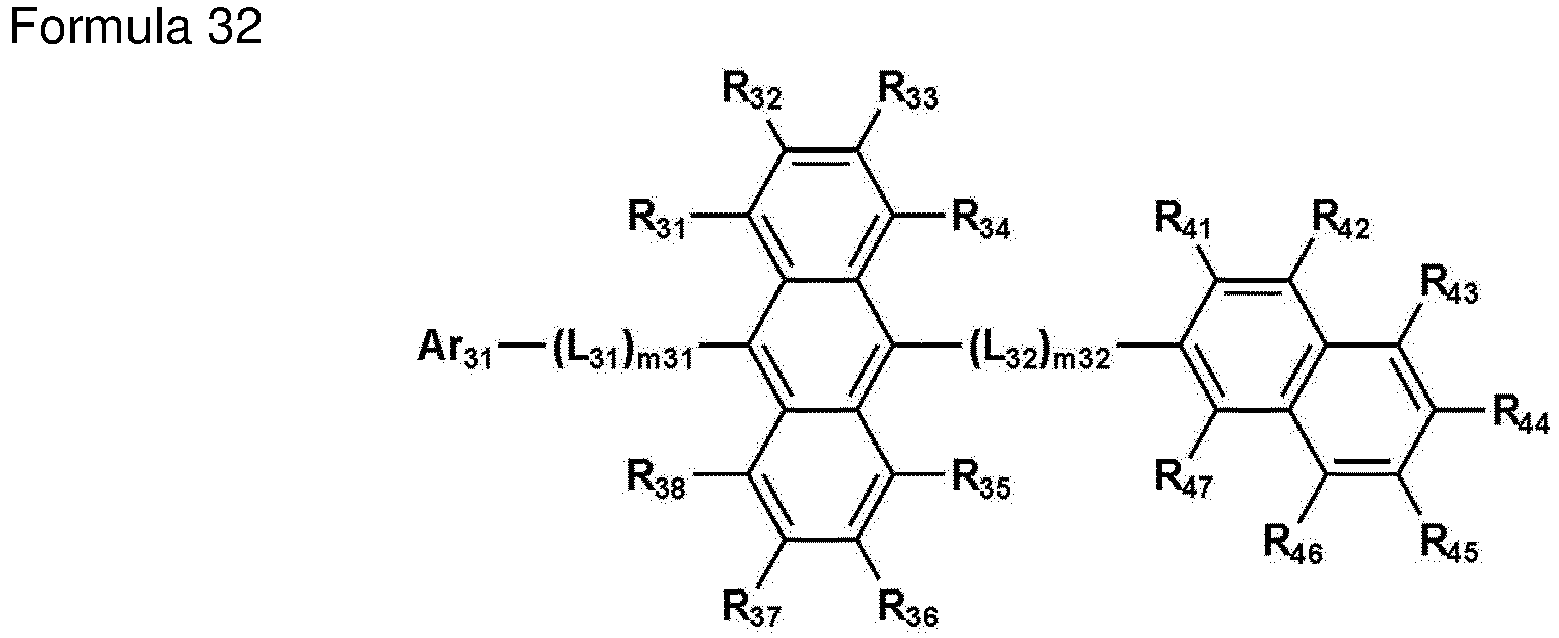
- In
Formulae
L31, L32, m31, m32, Ar31, and R31 to R38 may be understood by referring to the corresponding description presented herein,
R41 to R47 are each independently selected from hydrogen, deuterium, -F, - Cl, -Br, -I, a hydroxyl group, a cyano group, a nitro group, an amidino group, a hydrazino group, a hydrazono group, a C1-C60 (e.g. C1-C20) alkyl group, a C2-C60 (e.g. C2-C20) alkenyl group, a C2-C60 (e.g. C2-C20) alkynyl group, a C1-C60 (e.g. C1-C20) alkoxy group, a C6-C60 (e.g. C6-C30) aryl group, a monovalent non-aromatic condensed polycyclic group, a biphenyl group, and a terphenyl group, and
at least two neighboring substituents selected from R41 to R47 are optionally be linked to form a substituted or unsubstituted C6-C60 (e.g. C6-C30) carbocyclic group. - For example, the host may include at least one compound selected from Compounds H1 to H16, but embodiments of the present disclosure are not limited thereto:


- For example, the host may be Compound H8.
- In one embodiment, the first compound may include a compound represented by Formula 40:
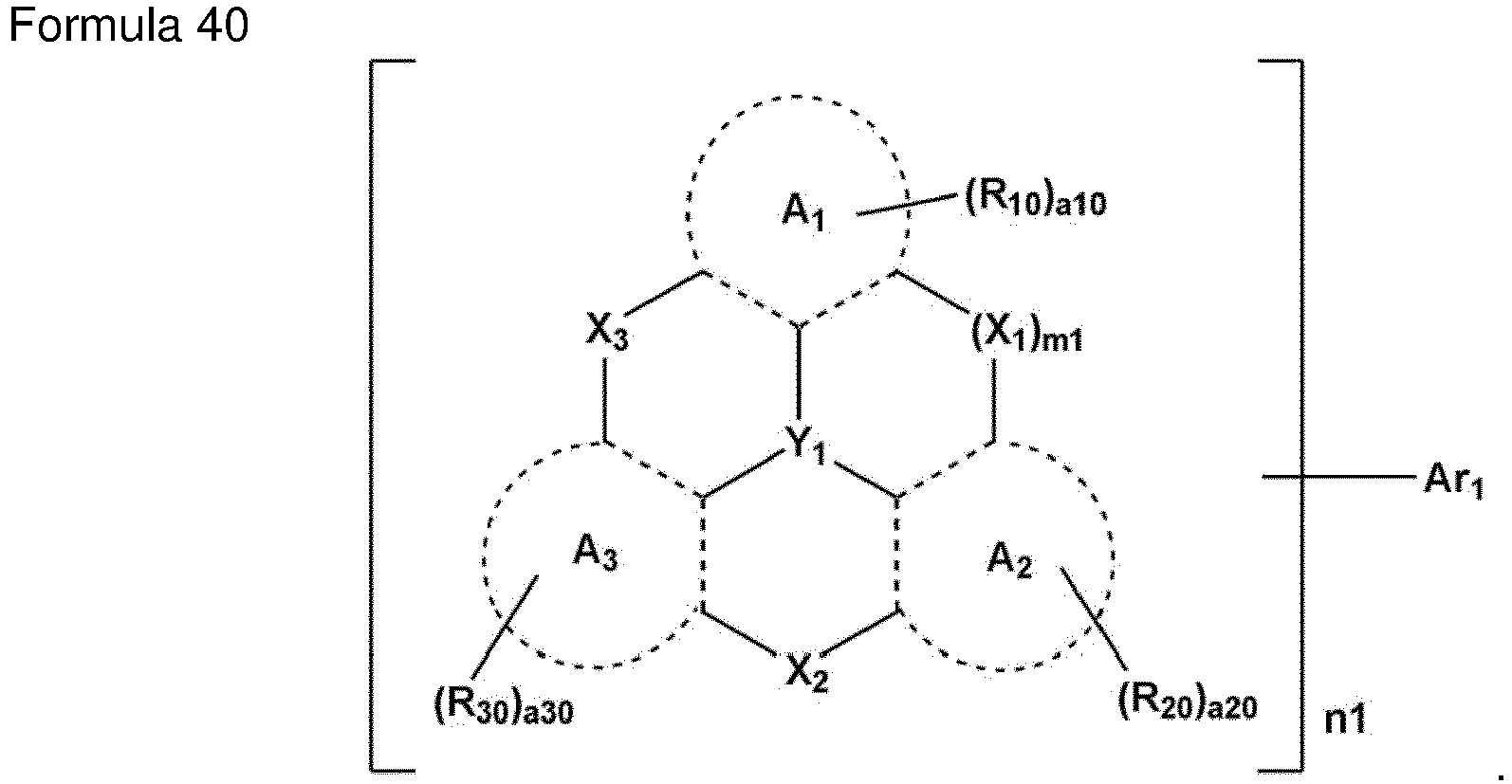
- In Formula 40,
Y1 is N or P,
X1 to X3 are each independently a single bond, O, S, N(R2), C(R2)(R3), or Si(R2)(R3),
m1 is 0, 1, or 2, wherein, when m1 is 0, A1 and A2 are not linked with each other,
A1 to A3 are each independently a C5-C60 (e.g. C5-C30) carbocyclic group or a C1-C60 (e.g. C2-C20) heterocyclic group,
n1 is an integer from 2 to 4,
Ar1 is a substituted or unsubstituted n1-valent C3-C60 (e.g. C5-C60 or C5-C32) carbocyclic group or a substituted or unsubstituted n1-valent C1-C60 (e.g. C1-C20) heterocyclic group,
R2, R3, R10, R20, and R30 are each independently selected from hydrogen, deuterium, -F, -CI, -Br, -I, a hydroxyl group, a cyano group, a nitro group, an amidino group, a hydrazino group, a hydrazono group, a substituted or unsubstituted C1-C60 (e.g. C1-C20) alkyl group, a substituted or unsubstituted C2-C60 (e.g. C2-C20) alkenyl group, a substituted or unsubstituted C2-C60 (e.g. C2-C20) alkynyl group, a substituted or unsubstituted C1-C60 (e.g. C1-C20) alkoxy group, a substituted or unsubstituted C3-C10 cycloalkyl group, a substituted or unsubstituted C1-C10 heterocycloalkyl group, a substituted or unsubstituted C3-C10 cycloalkenyl group, a substituted or unsubstituted C1-C10 heterocycloalkenyl group, a substituted or unsubstituted C6-C60 (e.g. C6-C30) aryl group, a substituted or unsubstituted C6-C60 (e.g. C6-C30) aryloxy group, a substituted or unsubstituted C6-C60 (e.g. C6-C30) arylthio group, a substituted or unsubstituted C1-C60 (e.g. C1-C20) heteroaryl group, a substituted or unsubstituted monovalent non-aromatic condensed polycyclic group, a substituted or unsubstituted monovalent non-aromatic condensed heteropolycyclic group, -Si(Q1)(Q2)(Q3), - B(Q1)(Q2), -C(=O)(Q1), -N(Q1)(Q2), -P(=O)(Q1)(Q2), and -S(=O)2(Q1)(Q2),
one selected from R10, R20, and R30 may be linked with Ar1,
at least one substituent of the substituted C5-C60 (e.g. C5-C30) carbocyclic group, the substituted C1-C60 (e.g. C1-C20) heterocyclic group, the substituted C1-C60 (e.g. C1-C20) alkyl group, the substituted C2-C60 (e.g. C2-C20) alkenyl group, the substituted C2-C60 (e.g. C2-C20) alkynyl group, the substituted C1-C60 (e.g. C1-C20) alkoxy group, the substituted C3-C10 cycloalkyl group, the substituted C1-C10 heterocycloalkyl group, the substituted C3-C10 cycloalkenyl group, the substituted C1-C10 heterocycloalkenyl group, the substituted C6-C60 (e.g. C6-C30) aryl group, the substituted C6-C60 (e.g. C6-C30) aryloxy group, the substituted C6-C60 (e.g. C6-C30) arylthio group, the substituted C1-C60 (e.g. C1-C20) heteroaryl group, the substituted monovalent non-aromatic condensed polycyclic group, and the substituted monovalent non-aromatic condensed heteropolycyclic group is selected from:
deuterium, -F, -CI, -Br, -I, a hydroxyl group, a cyano group, a nitro group, an amidino group, a hydrazino group, a hydrazono group, a C1-C60 (e.g. C1-C20) alkyl group, a C2-C60 (e.g. C2-C20) alkenyl group, a C2-C60 (e.g. C2-C20) alkynyl group, and a C1-C60 (e.g. C1-C20) alkoxy group;
a C1-C60 (e.g. C1-C20) alkyl group, a C2-C60 (e.g. C2-C20) alkenyl group, a C2-C60 (e.g. C2-C20) alkynyl group, and a C1-C60 (e.g. C1-C20) alkoxy group, each substituted with at least one selected from deuterium, -F, -CI, -Br, -I, a hydroxyl group, a cyano group, a nitro group, an amidino group, a hydrazino group, a hydrazono group, a C3-C10 cycloalkyl group, a C1-C10 heterocycloalkyl group, a C3-C10 cycloalkenyl group, a C1-C10 heterocycloalkenyl group, a C6-C60 (e.g. C6-C30) aryl group, a C6-C60 (e.g. C6-C30) aryloxy group, a C6-C60 (e.g. C6-C30) arylthio group, a C1-C60 (e.g. C1-C20) heteroaryl group, a monovalent non-aromatic condensed polycyclic group, a monovalent non-aromatic condensed heteropolycyclic group, -Si(O11)(Q12)(Q13), - N(Q11)(Q12), -B(Q11)(Q12), -C(=O)(Q11), -S(=O)2(Q11), and -P(=O)(Q11)(Q12);
a C3-C10 cycloalkyl group, a C1-C10 heterocycloalkyl group, a C3-C10 cycloalkenyl group, a C1-C10 heterocycloalkenyl group, a C6-C60 (e.g. C6-C30) aryl group, a C6-C60 (e.g. C6-C30) aryloxy group, a C6-C60 (e.g. C6-C30) arylthio group, a C1-C60 (e.g. C1-C20) heteroaryl group, a monovalent non-aromatic condensed polycyclic group, and a monovalent non-aromatic condensed heteropolycyclic group;
a C3-C10 cycloalkyl group, a C1-C10 heterocycloalkyl group, a C3-C10 cycloalkenyl group, a C1-C10 heterocycloalkenyl group, a C6-C60 (e.g. C6-C30) aryl group, a C6-C60 (e.g. C6-C30) aryloxy group, a C6-C60 (e.g. C6-C30) arylthio group, a C1-C60 (e.g. C1-C20) heteroaryl group, a monovalent non-aromatic condensed polycyclic group, and a monovalent non-aromatic condensed heteropolycyclic group, each substituted with at least one selected from deuterium, -F, -CI, -Br, -I, a hydroxyl group, a cyano group, a nitro group, an amidino group, a hydrazino group, a hydrazono group, a C1-C60 (e.g. C1-C20) alkyl group, a C2-C60 (e.g. C2-C20) alkenyl group, a C2-C60 (e.g. C2-C20) alkynyl group, a C1-C60 (e.g. C1-C20) alkoxy group, a C3-C10 cycloalkyl group, a C1-C10 heterocycloalkyl group, a C3-C10 cycloalkenyl group, a C1-C10 heterocycloalkenyl group, a C6-C60 (e.g. C6-C30) aryl group, a C6-C60 (e.g. C6-C30) aryloxy group, a C6-C60 (e.g. C6-C30) arylthio group, a C1-C60 (e.g. C1-C20) heteroaryl group, a monovalent non-aromatic condensed polycyclic group, a monovalent non-aromatic condensed heteropolycyclic group, -Si(Q21)(Q22)(Q23), -N(Q21)(Q22), - B(Q21)(Q22), -C(=O)(Q21), -S(=O)2(Q21), and -P(=O)(Q21)(Q22); and
-Si(Q31)(Q32)(Q33), -N(Q31)(Q32), -B(Q31)(Q32), -C(=O)(Q31), -S(=O)2(Q31), and -P(=O)(Q31)(Q32), and
Q1 to Q3, Q11 to Q13, Q21 to Q23, and Q31 to Q33 are each independently selected from hydrogen, deuterium, -F, -CI, -Br, -I, a hydroxyl group, a cyano group, a nitro group, an amidino group, a hydrazino group, a hydrazono group, a C1-C60 (e.g. C1-C20) alkyl group, a C2-C60 (e.g. C2-C20) alkenyl group, a C2-C60 (e.g. C2-C20) alkynyl group, a C1-C60 (e.g. C1-C20) alkoxy group, a C3-C10 cycloalkyl group, a C1-C10 heterocycloalkyl group, a C3-C10 cycloalkenyl group, a C1-C10 heterocycloalkenyl group, a C6-C60 (e.g. C6-C30) aryl group, a C1-C60 (e.g. C1-C20) heteroaryl group, a monovalent non-aromatic condensed polycyclic group, a monovalent non-aromatic condensed heteropolycyclic group, a biphenyl group, and a terphenyl group. - In one embodiment, the first compound may include a compound represented by Formula 41:

- In Formula 41,
X11 to X13 are each independently a single bond, O, S, N(R4), C(R4)(R5), or Si(R4)(R5),
X21 to X23 are each independently a single bond, O, S, N(R6), C(R6)(R7), or Si(R6)(R7),
m11 and m21 are each independently 0, 1, or 2,
Ar1 is selected from a substituted or unsubstituted C3-C10 cycloalkylene group, a substituted or unsubstituted C1-C10 heterocycloalkylene group, a substituted or unsubstituted C3-C10 cycloalkenylene group, a substituted or unsubstituted C1-C10 heterocycloalkenylene group, a substituted or unsubstituted C6-C60 (e.g. C6-C32) arylene group, a substituted or unsubstituted C1-C60 (e.g. C1-C20) heteroarylene group, a substituted or unsubstituted divalent non-aromatic condensed polycyclic group, and a substituted or unsubstituted divalent non-aromatic condensed heteropolycyclic group, and
R4 to R7, R11 to R18, and R21 to R28 are each independently selected from a substituted or unsubstituted C6-C60 (e.g. C6-C30) aryl group, a substituted or unsubstituted C1-C60 (e.g. C1-C20) heteroaryl group, a substituted or unsubstituted monovalent non-aromatic condensed polycyclic group, a substituted or unsubstituted monovalent non-aromatic condensed heteropolycyclic group, -Si(Q1)(Q2)(Q3), - B(Q1)(Q2), -C(=O)(Q1), -N(Q1)(Q2), -P(=O)(Q1)(Q2), and -S(=O)2(Q1)(Q2). - In one embodiment, Ar1 may be selected from a phenylene group, a pentalenylene group, an indenylene group, a naphthylene group, an azulenylene group, a heptalenylene group, an indacenylene group, an acenaphthylene group, a fluorenylene group, a spiro-bifluorenylene group, a spiro-fluorene-benzofluorenylene group, a benzofluorenylene group, a dibenzofluorenylene group, a phenalenylene group, a phenanthrenylene group, an anthracenylene group, a fluoranthenylene group, a triphenylenylene group, a pyrenylene group, a chrysenylene group, a naphthacenylene group, a picenylene group, a perylenylene group, a pentaphenylene group, a hexacenylene group, a pentacenylene group, a rubicenylene group, a coronenylene group, and an ovalenylene group.
- In one embodiment, Ar1 may be a group represented by one selected from Formulae 3-1 to 3-26:


- In Formulae 3-1 to 3-26,
Z1 to Z4 are each independently selected from hydrogen, deuterium, -F, -CI, - Br, -I, a hydroxyl group, a cyano group, a nitro group, an amino group, an amidino group, a hydrazine group, a hydrazone group, a carboxylic acid group or a salt thereof, a sulfonic acid group or a salt thereof, a phosphoric acid group or a salt thereof, a C1-C20 (e.g. C1-C10) alkyl group, a C1-C20 (e.g. C1-C10) alkoxy group, a phenyl group, a biphenyl group, a terphenyl group, a naphthyl group, a fluorenyl group, a spiro-bifluorenyl group, a benzofluorenyl group, a dibenzofluorenyl group, a phenanthrenyl group, an anthracenyl group, a pyrenyl group, a chrysenyl group, a pyridinyl group, a pyrazinyl group, a pyrimidinyl group, a pyridazinyl group, a quinolinyl group, an isoquinolinyl group, a quinoxalinyl group, a quinazolinyl group, a carbazolyl group, a dibenzofuranyl group, a dibenzothiophenyl group, a triazinyl group, a benzimidazolyl group, a phenanthrolinyl group, and -Si(Q33)(Q34)(Q35),
Q33 to Q35 are each independently selected from a C1-C10 alkyl group, a C1-C10 alkoxy group, a phenyl group, a biphenyl group, a terphenyl group, and a naphthyl group,
d2 is an integer from 0 to 2,
d3 is an integer from 0 to 3,
d4 is an integer from 0 to 4,
d5 is an integer from 0 to 5,
d6 is an integer from 0 to 6,
d8 is an integer from 0 to 8, and
* and *' each indicate a binding site to a neighboring atom. - In one embodiment, R4 to R7, R11 to R18, and R21 to R28 may each independently be selected from hydrogen, deuterium, -F, -CI, -Br, -I, a hydroxyl group, a cyano group, a nitro group, an amidino group, a hydrazino group, a hydrazono group, a C1-C20 (e.g. C1-C10) alkyl group, a C1-C20 (e.g. C1-C10) alkoxy group, a phenyl group, a biphenyl group, a terphenyl group, and a naphthyl group.
- For example, the first compound may include Compound B1, but embodiments of the present disclosure are not limited thereto:

- In one embodiment, the second compound may include a compound represented by Formula 601 which will be further described herein below.
- In one or more embodiments, the second compound may include a compound represented by Formula 50:

- In Formula 50,
Y51 to Y53 are each independently N or C(R50),
at least one selected from Y51 to Y53 is N,
X51 is O, S, N(R59), C(R59)(R60), or Si(R59)(R60),
Ar51 is linked with one selected from R51 to R58,
Ar52, Ar53, and R50 to R60 are each independently selected from hydrogen, deuterium, -F, -CI, -Br, -I, a hydroxyl group, a cyano group, a nitro group, an amidino group, a hydrazino group, a hydrazono group, a substituted or unsubstituted C1-C60 (e.g. C1-C20) alkyl group, a substituted or unsubstituted C2-C60 (e.g. C2-C20) alkenyl group, a substituted or unsubstituted C2-C60 (e.g. C2-C20) alkynyl group, a substituted or unsubstituted C1-C60 (e.g. C1-C20) alkoxy group, a substituted or unsubstituted C3-C10 cycloalkyl group, a substituted or unsubstituted C1-C10 heterocycloalkyl group, a substituted or unsubstituted C3-C10 cycloalkenyl group, a substituted or unsubstituted C1-C10 heterocycloalkenyl group, a substituted or unsubstituted C6-C60 (e.g. C6-C30) aryl group, a substituted or unsubstituted C6-C60 (e.g. C6-C30) aryloxy group, a substituted or unsubstituted C6-C60 (e.g. C6-C30) arylthio group, a substituted or unsubstituted C1-C60 (e.g. C1-C20) heteroaryl group, a substituted or unsubstituted monovalent non-aromatic condensed polycyclic group, a substituted or unsubstituted monovalent non-aromatic condensed heteropolycyclic group, -Si(Q1)(Q2)(Q3), - B(Q1)(Q2), -C(=O)(Q1), -N(Q1)(Q2), -P(=O)(Q1)(Q2), and -S(=O)2(Q1)(Q2),
R59 and R60 are optionally linked to form a substituted or unsubstituted C5-C60 (e.g. C5-C30) carbocyclic group or a substituted or unsubstituted C1-C60 (e.g. C1-C20) heterocyclic group,
at least one substituent of the substituted C5-C60 (e.g. C5-C30) carbocyclic group, the substituted C1-C60 (e.g. C1-C20) heterocyclic group, the substituted C1-C60 (e.g. C1-C20) alkyl group, the substituted C2-C60 (e.g. C2-C20) alkenyl group, the substituted C2-C60 (e.g. C2-C20) alkynyl group, the substituted C1-C60 (e.g. C1-C20) alkoxy group, the substituted C3-C10 cycloalkyl group, the substituted C1-C10 heterocycloalkyl group, the substituted C3-C10 cycloalkenyl group, the substituted C1-C10 heterocycloalkenyl group, the substituted C6-C60 (e.g. C6-C30) aryl group, the substituted C6-C60 (e.g. C6-C30) aryloxy group, the substituted C6-C60 (e.g. C6-C30) arylthio group, the substituted C1-C60 (e.g. C1-C20) heteroaryl group, the substituted monovalent non-aromatic condensed polycyclic group. and the substituted monovalent non-aromatic condensed heteropolycyclic group is selected from:
deuterium, -F, -CI, -Br, -I, a hydroxyl group, a cyano group, a nitro group, an amidino group, a hydrazino group, a hydrazono group, a C1-C60 (e.g. C1-C20) alkyl group, a C2-C60 (e.g. C2-C20) alkenyl group, a C2-C60 (e.g. C2-C20) alkynyl group, and a C1-C60 (e.g. C1-C20) alkoxy group;
a C1-C60 (e.g. C1-C20) alkyl group, a C2-C60 (e.g. C2-C20) alkenyl group, a C2-C60 (e.g. C2-C20) alkynyl group, and a C1-C60 (e.g. C1-C20) alkoxy group, each substituted with at least one selected from deuterium, -F, -CI, -Br, -I, a hydroxyl group, a cyano group, a nitro group, an amidino group, a hydrazino group, a hydrazono group, a C3-C10 cycloalkyl group, a C1-C10 heterocycloalkyl group, a C3-C10 cycloalkenyl group, a C1-C10 heterocycloalkenyl group, a C6-C60 (e.g. C6-C30) aryl group, a C6-C60 (e.g. C6-C30) aryloxy group, a C6-C60 (e.g. C6-C30) arylthio group, a C1-C60 (e.g. C1-C20) heteroaryl group, a monovalent non-aromatic condensed polycyclic group, a monovalent non-aromatic condensed heteropolycyclic group, -Si(O11)(Q12)(Q13), - N(Q11)(Q12), -B(Q11)(Q12), -C(=O)(Q11), -S(=O)2(Q11), and -P(=O)(Q11)(Q12);
a C3-C10 cycloalkyl group, a C1-C10 heterocycloalkyl group, a C3-C10 cycloalkenyl group, a C1-C10 heterocycloalkenyl group, a C6-C60 (e.g. C6-C30) aryl group, a C6-C60 (e.g. C6-C30) aryloxy group, a C6-C60 (e.g. C6-C30) arylthio group, a C1-C60 (e.g. C1-C20) heteroaryl group, a monovalent non-aromatic condensed polycyclic group, and a monovalent non-aromatic condensed heteropolycyclic group;
a C3-C10 cycloalkyl group, a C1-C10 heterocycloalkyl group, a C3-C10 cycloalkenyl group, a C1-C10 heterocycloalkenyl group, a C6-C60 (e.g. C6-C30) aryl group, a C6-C60 (e.g. C6-C30) aryloxy group, a C6-C60 (e.g. C6-C30) arylthio group, a C1-C60 (e.g. C1-C20) heteroaryl group, a monovalent non-aromatic condensed polycyclic group, and a monovalent non-aromatic condensed heteropolycyclic group, each substituted with at least one selected from deuterium, -F, -CI, -Br, -I, a hydroxyl group, a cyano group, a nitro group, an amidino group, a hydrazino group, a hydrazono group, a C1-C60 (e.g. C1-C20) alkyl group, a C2-C60 (e.g. C2-C20) alkenyl group, a C2-C60 (e.g. C2-C20) alkynyl group, a C1-C60 (e.g. C1-C20) alkoxy group, a C3-C10 cycloalkyl group, a C1-C10 heterocycloalkyl group, a C3-C10 cycloalkenyl group, a C1-C10 heterocycloalkenyl group, a C6-C60 (e.g. C6-C30) aryl group, a C6-C60 (e.g. C6-C30) aryloxy group, a C6-C60 (e.g. C6-C30) arylthio group, a C1-C60 (e.g. C1-C20) heteroaryl group, a monovalent non-aromatic condensed polycyclic group, a monovalent non-aromatic condensed heteropolycyclic group, -Si(Q21)(Q22)(Q23), -N(Q21)(Q22), - B(Q21)(Q22), -C(=O)(Q21), -S(=O)2(Q21), and -P(=O)(Q21)(Q22); and
-Si(Q31)(Q32)(Q33), -N(Q31)(Q32), -B(Q31)(Q32), -C(=O)(Q31), -S(=O)2(Q31), and -P(=O)(Q31)(Q32), and
Q1 to Q3, Q11 to Q13, Q21 to Q23, and Q31 to Q33 are each independently selected from hydrogen, deuterium, -F, -CI, -Br, -I, a hydroxyl group, a cyano group, a nitro group, an amidino group, a hydrazino group, a hydrazono group, a C1-C60 (e.g. C1-C20) alkyl group, a C2-C60 (e.g. C2-C20) alkenyl group, a C2-C60 (e.g. C2-C20) alkynyl group, a C1-C60 (e.g. C1-C20) alkoxy group, a C3-C10 cycloalkyl group, a C1-C10 heterocycloalkyl group, a C3-C10 cycloalkenyl group, a C1-C10 heterocycloalkenyl group, a C6-C60 (e.g. C6-C30) aryl group, a C1-C60 (e.g. C1-C20) heteroaryl group, a monovalent non-aromatic condensed polycyclic group, a monovalent non-aromatic condensed heteropolycyclic group, a biphenyl group, and a terphenyl group. - In one embodiment, Ar52, Ar53, and R50 to R60 in Formula 50 may each independently be selected from groups represented by one selected from Formulae 5-1 to 5-26 and Formulae 6-1 to 6-55:





- In Formulae 5-1 to 5-26 and Formula 6-1 to 6-55,
Y31 and Y32 are each independently selected from O, S, C(Z34)(Z35), N(Z34), or Si(Z34)(Z35),
Z31, Z32, Z34, and Z35 are each independently selected from hydrogen, deuterium, -F, -CI, -Br, -I, a hydroxyl group, a cyano group, a nitro group, an amidino group, a hydrazino group, a hydrazono group, a C1-C20 (e.g. C1-C10) alkyl group, a C2-C20 (e.g. C2-C10) alkenyl group, a C2-C20 (e.g. C2-C10) alkynyl group, a C1-C20 (e.g. C1-C10) alkoxy group, a phenyl group, a biphenyl group, a terphenyl group, a naphthyl group, a fluorenyl group, a spiro-bifluorenyl group, a phenanthrenyl group, an anthracenyl group, a triphenylenyl group, a pyridinyl group, a pyrimidinyl group, a carbazolyl group, and a triazinyl group,
e2 is 1 or 2,
e3 is an integer from 1 to 3,
e4 is an integer from 1 to 4,
e5 is an integer from 1 to 5,
e6 is an integer from 1 to 6,
e7 is an integer from 1 to 7,
e9 is an integer from 1 to 9, and
* indicates a binding site to a neighboring atom. - In one embodiment, the second compound may include a compound represented by Formula 51:

- In Formula 52,
Y51 to Y53 are each independently N or C(R50),
Ar52, Ar53, R50 to R52, and R54 to R58 are each independently selected from hydrogen, deuterium, -F, -CI, -Br, -I, a hydroxyl group, a cyano group, a nitro group, an amidino group, a hydrazino group, a hydrazono group, a C1-C20 (e.g. C1-C10) alkyl group, a C1-C20 (e.g. C1-C10) alkoxy group, a phenyl group, a biphenyl group, a terphenyl group, and a naphthyl group, and
R59 and R60 are linked to form a C5-C60 (e.g. C5-C30) carbocyclic group. - For example, the second compound may include Compound E1, but embodiments of the present disclosure are not limited thereto:

- In one embodiment, the emission layer may further include a dopant, and an amount of the host may be larger than an amount of the dopant.
- In one embodiment, the dopant may include a fluorescent dopant, and the emission layer may be configured to emit fluorescence.
- For example, the dopant may include a compound represented by Formula 501 which will be further described herein below.
- Referring to
FIGS. 3 to 5 , the organic light-emittingdevices generation layers 155, 155-1 and 155-2 in the number of m-1 between two neighboring light-emitting units among the light-emitting units in the number of m,
the charge-generation layers 155, 155-1 and 155-2 may each include n-type charge-generation layers 155', 155'-1 and 155'-2 including an n-type charge-generation material, and p-type charge-generation layers 155", 155"-1 and 155"-2 including a hole transport material, and
m may be an integer of 2 or more, and a maximum emission wavelength emitted by at least one light-emitting unit among the light-emitting units in the number of m may be different from a maximum emission wavelength emitted by at least one light-emitting unit among the remaining light-emitting units. - In one embodiment, a difference between an absolute value of a LUMO energy (LUMOnCGL) of the n-type charge-generation material included in the n-type charge-generation layer and an absolute value of a HOMO energy (HOMOpCGL) of the hole transport material included in the p-type charge-generation layer may be less than about 3.0 eV.
- When the difference between the absolute value of the LUMO energy (LUMOnCGL) of the n-type charge-generation material and the absolute value of the HOMO energy (HOMOpCGL) of the hole transport material included in the p-type charge-generation layer is less than 3.0 eV, electrons generated in the p-type charge-generation layer are easily moved to the n-type charge-generation layer. Therefore, the driving voltage of the organic light-emitting device may be reduced and the efficiency of the organic light-emitting device may be increased.
- In one embodiment, the difference between the absolute value of the LUMO energy (LUMOnCGL) of the n-type charge-generation material included in the n-type charge-generation layer and the absolute value of the HOMO energy (HOMOpCGL) of the hole transport material included in the p-type charge-generation layer may be less than about 2.8 eV.
- In one embodiment, the n-type charge-generation material may include a metal-free compound (e.g., a compound that does not include a metal) including at least one π electron-depleted nitrogen-containing ring.
- The term "π electron-depleted nitrogen-containing ring," as used herein, refers to a C1-C60 (e.g. C1-C20) heterocyclic group having at least one *-N=*' moiety as a ring-forming moiety.
- For example, the "π electron-depleted nitrogen-containing ring" may be i) a 5-membered to 7-membered heteromonocyclic group having at least one *-N=*' moiety, ii) a heteropolycyclic group in which two or more 5-membered to 7-membered heteromonocyclic groups each having at least one *-N=*' moiety are condensed with each other (e.g., combined together), or iii) a heteropolycyclic group in which at least one of 5-membered to 7-membered heteromonocyclic groups, each having at least one *-N=*' moiety, is condensed with (e.g., combined with) at least one C5-C60 (e.g. C5-C30) carbocyclic group.
- Examples of the π electron-depleted nitrogen-containing ring include an imidazole, a pyrazole, a thiazole, an isothiazole, an oxazole, an isoxazole, a pyridine, a pyrazine, a pyrimidine, a pyridazine, an indazole, a purine, a quinoline, an isoquinoline, a benzoquinoline, a phthalazine, a naphthyridine, a quinoxaline, a quinazoline, a cinnoline, a phenanthridine, an acridine, a phenanthroline, a phenazine, a benzimidazole, an isobenzothiazole, a benzoxazole, an isobenzoxazole, a triazole, a tetrazole, an oxadiazole, a triazine, a thiadiazole, an imidazopyridine, an imidazopyrimidine, and an azacarbazole, but embodiments of the present disclosure are not limited thereto.
- For example, the n-type charge-generation material may include at least one selected from compounds represented by Formula 601, which will be further described herein below, but embodiments of the present disclosure are not limited thereto.
- In one embodiment, the n-type charge-generation material may include a compound represented by one selected from Formulae 90 and 91:


- In Formulae 90 and 91,
X91 to X100 are each independently N or C(R90),
at least one selected from X91 to X100 is N,
L91 and L92 are each independently selected from a substituted or unsubstituted C3-C10 cycloalkylene group, a substituted or unsubstituted C1-C10 heterocycloalkylene group, a substituted or unsubstituted C3-C10 cycloalkenylene group, a substituted or unsubstituted C1-C10 heterocycloalkenylene group, a substituted or unsubstituted C6-C60 (e.g. C6-C30) arylene group, a substituted or unsubstituted C1-C60 (e.g. C1-C20) heteroarylene group, a substituted or unsubstituted divalent non-aromatic condensed polycyclic group, and a substituted or unsubstituted divalent non-aromatic condensed heteropolycyclic group,
a91 and a92 are each independently an integer from 0 to 5,
R90 and R91 are each independently selected from hydrogen, deuterium, -F, - Cl, -Br, -I, a hydroxyl group, a cyano group, a nitro group, an amidino group, a hydrazino group, a hydrazono group, a substituted or unsubstituted C1-C20 (e.g. C1-C10) alkyl group, a substituted or unsubstituted C1-C20 (e.g. C1-C10) alkoxy group, a substituted or unsubstituted C3-C10 cycloalkyl group, a substituted or unsubstituted C1-C10 heterocycloalkyl group, a substituted or unsubstituted C3-C10 cycloalkenyl group, a substituted or unsubstituted C1-C10 heterocycloalkenyl group, a substituted or unsubstituted C6-C60 (e.g. C6-C30) aryl group, a substituted or unsubstituted C6-C60 (e.g. C6-C30) aryloxy group, a substituted or unsubstituted C6-C60 (e.g. C6-C30) arylthio group, a substituted or unsubstituted C1-C60 (e.g. C1-C20) heteroaryl group, a substituted or unsubstituted monovalent non-aromatic condensed polycyclic group, a substituted or unsubstituted monovalent non-aromatic condensed heteropolycyclic group, -Si(Q91)(Q92)(Q93), -C(=O)(Q91), -S(=O)2(Q91), and -P(=O)(Q91)(Q92), and
Q91 to Q93 are each independently a C1-C10 alkyl group, a C1-C10 alkoxy group, a phenyl group, a biphenyl group, a terphenyl group, or a naphthyl group. - In one embodiment, at least one selected from X91 to X100 in Formula 90 may be C(R90).
- In one embodiment, in Formula 91, a91 may be 0 or 1, and a92 may be 1. When a91 is 0, -(L91)a91- is a single bond.
- In one embodiment, in Formula 91, L91 and L92 may each independently be a phenylene group.
- In one embodiment, in Formulae 90 and 91, R90 and R91 may each independently be selected from hydrogen, deuterium, -F, -CI, -Br, -I, a hydroxyl group, a cyano group, a nitro group, an amidino group, a hydrazino group, a hydrazono group, a C1-C20 (e.g. C1-C10) alkyl group, a C1-C20 (e.g. C1-C10) alkoxy group, a phenyl group, a biphenyl group, a terphenyl group, and a naphthyl group.
- For example, the n-type charge-generation material may include at least one selected from Compounds nCGL1 and nCGL2, but embodiments of the present disclosure are not limited thereto:

- In one embodiment, the n-type charge-generation layer may further include a metal-containing material.
- In one embodiment, the metal-containing material may have a work function in a range of about 2.0 eV to about 4.5 eV, and
the metal-containing material may be a metal, a metal oxide, a metal halide, or any combination thereof. - In one embodiment, the metal-containing material may be at least one selected from Yb, Ag, Al, Sm, Mg, Li, and RbI.
- In one embodiment, the hole transport material included in the p-type charge-generation layer may be selected from a cyano group-free compound (e.g., a compound that does not include a cyano group), an amine-based compound, and a carbazole-based compound, and a copper halide (copper halide: CuX, wherein X is F, Cl, or Br), which has an absolute value of a HOMO energy level in a range of greater than about 5.5 eV and less than or equal to 8.0 eV.
- In one embodiment, the hole transport material included in the p-type charge-generation layer may be selected from groups represented by Formulae 201, 202, and 301-2 which will be further described herein below.
- For example, the hole transport material included in the p-type charge-generation layer may be Compound HT1:

- In one embodiment, the p-type charge-generation layer may further include a p-dopant which will be described below.
- For example, the p-type charge-generation layer may further include Compound HAT-CN:

- In one embodiment, the p-type charge-generation layer may have a multi-layered structure in which a first layer including the p-dopant and a second layer including the hole transport material are stacked.
- In one embodiment, m may be 2,
the light-emitting units in the number of m may include a first light-emitting unit and a second light-emitting unit,
the first light-emitting unit and the second light-emitting unit may each independently be understood by referring to the description presented in relation to the light-emitting unit,
the charge-generation layers in the number of m-1 may each include a first charge-generation layer,
the first charge-generation layer may be between the first light-emitting unit and the second light-emitting unit,
the first light-emitting unit may be between the first electrode and the first charge-generation layer,
the second light-emitting unit may be between the first charge-generation layer and the second electrode,
the first charge-generation layer may include a first n-type charge-generation layer and a first p-type charge-generation layer, the first n-type charge-generation layer may be between the first light-emitting unit and the second light-emitting unit, and the first p-type charge-generation layer may be between the first n-type charge-generation layer and the second light-emitting unit,
the first light-emitting unit may be configured to emit a first color light, and the second light-emitting unit may be configured to emit a second color light,
a maximum emission wavelength of the first color light and a maximum emission wavelength of the second color light may be identical to or different from each other, and
the first color light and the second color light may be emitted in the form of mixed light. - In one or more embodiments, m may be 3,
the light-emitting units in the number of m may include a first light-emitting unit, a second light-emitting unit, and a third light-emitting unit,
the first light-emitting unit, the second light-emitting unit, and the third light-emitting unit may each independently be understood by referring to the description presented in relation to the light-emitting unit,
the charge-generation layers in the number of m-1 may include a first charge-generation layer and a second charge-generation layer,
the first charge-generation layer may be between the first light-emitting unit and the second light-emitting unit,
the second charge-generation layer may be between the second light-emitting unit and the third light-emitting unit,
the first light-emitting unit may be between the first electrode and the first charge-generation layer,
the second light-emitting unit may be between the first charge-generation layer and the second charge-generation layer,
the third light-emitting unit may be between the second charge-generation layer and the second electrode,
the first charge-generation layer may include a first n-type charge-generation layer and a first p-type charge-generation layer, the first n-type charge-generation layer may be between the first light-emitting unit and the second light-emitting unit, and the first p-type charge-generation layer may be between the first n-type charge-generation layer and the second light-emitting unit,
the second charge-generation layer may include a second n-type charge-generation layer and a second p-type charge-generation layer, the second n-type charge-generation layer may be between the second light-emitting unit and the third light-emitting unit, and the second p-type charge-generation layer may be between the second n-type charge generation layer and the third light-emitting unit,
the first light-emitting unit may be configured to emit a first color light, the second light-emitting unit may be configured to emit a second color light, and the third light-emitting unit may be configured to emit a third color light,
a maximum emission wavelength of the first color light, a maximum emission wavelength of the second color light, and a maximum emission wavelength of the third color light may be identical to or different from each other, and
the first color light, the second color light, and the third color light may be emitted in the form of mixed light. - Another aspect of an embodiment of the present disclosure provides a display apparatus including: a thin-film transistor including a source electrode, a drain electrode, and an active layer; and the organic light-emitting device, wherein the first electrode of the organic light-emitting device is electrically coupled to one of the source electrode and the drain electrode of the thin-film transistor.
- Hereinafter, the respective components of the organic light-emitting device according to one or more embodiments will be described in more detail with reference to
FIGS. 1 to 5 . - Referring to
FIGS. 1 to 5 , a substrate may be additionally under thefirst electrode 110 or above thesecond electrode 190. The substrate may be a glass substrate or a plastic substrate, each having excellent mechanical strength, thermal stability, transparency, surface smoothness, ease of handling, and water resistance. - The
first electrode 110 may be formed by depositing or sputtering a material for forming thefirst electrode 110 on the substrate. When thefirst electrode 110 is an anode, the material for forming thefirst electrode 110 may be selected from materials having a high work function to facilitate hole injection. - The
first electrode 110 may be a reflective electrode, a semi-transmissive electrode, or a transmissive electrode. When thefirst electrode 110 is a transmissive electrode, a material for forming a first electrode may be selected from indium tin oxide (ITO), indium zinc oxide (IZO), tin oxide (SnO2), zinc oxide (ZnO), and any combinations thereof, but embodiments of the present disclosure are not limited thereto. In one or more embodiments, when thefirst electrode 110 is a semi-transmissive electrode or a reflective electrode, a material for forming a first electrode may be selected from magnesium (Mg), silver (Ag), aluminium (Al), aluminium-lithium (Al-Li), calcium (Ca), magnesium-indium (Mg-In), magnesium-silver (Mg-Ag), and any combinations thereof, but embodiments of the present disclosure are not limited thereto. - The
first electrode 110 may have a single-layered structure, or a multi-layered structure including two or more layers. For example, thefirst electrode 110 may have a three-layered structure of ITO/Ag/ITO, but the structure of thefirst electrode 110 is not limited thereto. - The
organic layer 150 may be on thefirst electrode 110, and may include anemission layer 150b. - The organic layer may include a hole transport region between the
first electrode 110 and theemission layer 150b and an electron transport region between theemission layer 150b and thesecond electrode 190. - The hole transport region may include the
first HT layer 150a, 153-2a, or 153-3a. The first compound included in thefirst HT layer 150a, 153-2a, or 153-3a will be further described herein below. - The hole transport region may have i) a single-layered structure including a single layer including a single material, ii) a single-layered structure including a single layer including a plurality of different materials, or iii) a multi-layered structure having a plurality of layers including a plurality of different materials.
- The hole transport region may further include at least one layer selected from an electron blocking layer, a hole injection layer, a hole transport layer, and an emission auxiliary layer.
- For example, the hole transport region may further include, in addition to the
first HT layer 150a, 153-2a, or 153-3a, a single-layered structure including a single layer including a plurality of different materials, or may have a multi-layered structure of hole injection layer/hole transport layer, hole injection layer/hole transport layer/emission auxiliary layer, hole injection layer/emission auxiliary layer, hole injection layer/hole transport layer/electron blocking layer, hole injection layer/hole transport layer/emission auxiliary layer/ electron blocking layer, hole injection layer/emission auxiliary layer/electron blocking layer, or hole transport layer/emission auxiliary layer/electron blocking layer, wherein layers of each structure are sequentially stacked on thefirst electrode 110. However, embodiments of the present disclosure are not limited thereto. - The hole transport region may include at least one compound selected from m-MTDATA, TDATA, 2-TNATA, NPB (NPD), β-NPB, TPD, spiro-TPD, spiro-NPB, methylated NPB, TAPC, HMTPD, 4,4',4"-tris(N-carbazolyl)triphenylamine (TCTA), polyaniline/dodecylbenzenesulfonic acid (PANI/DBSA), poly(3,4-ethylenedioxythiophene)/poly(4-styrenesulfonate) (PEDOT/PSS(, polyaniline/camphor sulfonic acid (PANI/CSA), polyaniline/poly(4-styrenesulfonate) (PANI/PSS), a compound represented by Formula 201, and a compound represented by Formula 202:


- In Formulae 201 and 202,
L201 to L204 may each independently be selected from a substituted or unsubstituted C3-C10 cycloalkylene group, a substituted or unsubstituted C1-C10 heterocycloalkylene group, a substituted or unsubstituted C3-C10 cycloalkenylene group, a substituted or unsubstituted C1-C10 heterocycloalkenylene group, a substituted or unsubstituted C6-C60 (e.g. C6-C32) arylene group, a substituted or unsubstituted C1-C60 (e.g. C1-C20) heteroarylene group, a substituted or unsubstituted divalent non-aromatic condensed polycyclic group, and a substituted or unsubstituted divalent non-aromatic condensed heteropolycyclic group,
L205 may be selected from *-O-*', *-S-*', *-N(Q201)-*', a substituted or unsubstituted C1-C20 alkylene group, a substituted or unsubstituted C2-C20 alkenylene group, a substituted or unsubstituted C3-C10 cycloalkylene group, a substituted or unsubstituted C1-C10 heterocycloalkylene group, a substituted or unsubstituted C3-C10 cycloalkenylene group, a substituted or unsubstituted C1-C10 heterocycloalkenylene group, a substituted or unsubstituted C6-C60 (e.g. C6-C32) arylene group, a substituted or unsubstituted C1-C60 (e.g. C1-C20) heteroarylene group, a substituted or unsubstituted divalent non-aromatic condensed polycyclic group, and a substituted or unsubstituted divalent non-aromatic condensed heteropolycyclic group,
xa1 to xa4 may each independently be an integer from 0 to 3,
xa5 may be an integer from 1 to 10, and
R201 to R204 and Q201 may each independently be selected from a substituted or unsubstituted C3-C10 cycloalkyl group, a substituted or unsubstituted C1-C10 heterocycloalkyl group, a substituted or unsubstituted C3-C10 cycloalkenyl group, a substituted or unsubstituted C1-C10 heterocycloalkenyl group, a substituted or unsubstituted C6-C60 (e.g. C6-C32) aryl group, a substituted or unsubstituted C6-C60 (e.g. C6-C32) aryloxy group, a substituted or unsubstituted C6-C60 (e.g. C6-C32) arylthio group, a substituted or unsubstituted C1-C60 (e.g. C1-C20) heteroaryl group, a substituted or unsubstituted monovalent non-aromatic condensed polycyclic group, and a substituted or unsubstituted monovalent non-aromatic condensed heteropolycyclic group. - For example, in Formula 202, R201 and R202 may optionally be linked via a single bond, a dimethyl-methylene group, or a diphenyl-methylene group, and R203 and R204 may optionally be linked via a single bond, a dimethyl-methylene group, or a diphenyl-methylene group.
- In one embodiment, in Formulae 201 and 202,
L201 to L205 may each independently be selected from: - a phenylene group, a pentalenylene group, an indenylene group, a naphthylene group, an azulenylene group, a heptalenylene group, an indacenylene group, an acenaphthylene group, a fluorenylene group, a spiro-bifluorenylene group, a benzofluorenylene group, a dibenzofluorenylene group, a phenalenylene group, a phenanthrenylene group, an anthracenylene group, a fluoranthenylene group, a triphenylenylene group, a pyrenylene group, a chrysenylene group, a naphthacenylene group, a picenylene group, a perylenylene group, a pentaphenylene group, a hexacenylene group, a pentacenylene group, a rubicenylene group, a coronenylene group, an ovalenylene group, a thiophenylene group, a furanylene group, a carbazolylene group, an indolylene group, an isoindolylene group, a benzofuranylene group, a benzothiophenylene group, a dibenzofuranylene group, a dibenzothiophenylene group, a benzocarbazolylene group, a dibenzocarbazolylene group, a dibenzosilolylene group, and a pyridinylene group; and
- a phenylene group, a pentalenylene group, an indenylene group, a naphthylene group, an azulenylene group, a heptalenylene group, an indacenylene group, an acenaphthylene group, a fluorenylene group, a spiro-bifluorenylene group, a benzofluorenylene group, a dibenzofluorenylene group, a phenalenylene group, a phenanthrenylene group, an anthracenylene group, a fluoranthenylene group, a triphenylenylene group, a pyrenylene group, a chrysenylene group, a naphthacenylene group, a picenylene group, a perylenylene group, a pentaphenylene group, a hexacenylene group, a pentacenylene group, a rubicenylene group, a coronenylene group, an ovalenylene group, a thiophenylene group, a furanylene group, a carbazolylene group, an indolylene group, an isoindolylene group, a benzofuranylene group, a benzothiophenylene group, a dibenzofuranylene group, a dibenzothiophenylene group, a benzocarbazolylene group, a dibenzocarbazolylene group, a dibenzosilolylene group, and a pyridinylene group, each substituted with at least one selected from deuterium, -F, -CI, -Br, -I, a hydroxyl group, a cyano group, a nitro group, an amidino group, a hydrazino group, a hydrazono group, a C1-C20 alkyl group, a C1-C20 alkoxy group, a cyclopentyl group, a cyclohexyl group, a cycloheptyl group, a cyclopentenyl group, a cyclohexenyl group, a phenyl group, a biphenyl group, a terphenyl group, a phenyl group substituted with a C1-C10 alkyl group, a phenyl group substituted with -F, a pentalenyl group, an indenyl group, a naphthyl group, an azulenyl group, a heptalenyl group, an indacenyl group, an acenaphthyl group, a fluorenyl group, a spiro-bifluorenyl group, a benzofluorenyl group, a dibenzofluorenyl group, a phenalenyl group, a phenanthrenyl group, an anthracenyl group, a fluoranthenyl group, a triphenylenyl group, a pyrenyl group, a chrysenyl group, a naphthacenyl group, a picenyl group, a perylenyl group, a pentaphenyl group, a hexacenyl group, a pentacenyl group, a rubicenyl group, a coronenyl group, an ovalenyl group, a thiophenyl group, a furanyl group, a carbazolyl group, an indolyl group, an isoindolyl group, a benzofuranyl group, a benzothiophenyl group, a dibenzofuranyl group, a dibenzothiophenyl group, a benzocarbazolyl group, a dibenzocarbazolyl group, a dibenzosilolyl group, a pyridinyl group, -Si(Q31)(Q32)(Q33), and -N(Q31)(Q32), and
- Q31 to Q33 may each independently be selected from a C1-C10 alkyl group, a C1-C10 alkoxy group, a phenyl group, a biphenyl group, a terphenyl group, and a naphthyl group.
- In one or more embodiments, xa1 to xa4 may each independently be 0, 1, or 2.
- In one or more embodiments, xa5 may be 1, 2, 3, or 4.
- In one or more embodiments, R201 to R204 and Q201 may each independently be selected from:
- a phenyl group, a biphenyl group, a terphenyl group, a pentalenyl group, an indenyl group, a naphthyl group, an azulenyl group, a heptalenyl group, an indacenyl group, an acenaphthyl group, a fluorenyl group, a spiro-bifluorenyl group, a benzofluorenyl group, a dibenzofluorenyl group, a phenalenyl group, a phenanthrenyl group, an anthracenyl group, a fluoranthenyl group, a triphenylenyl group, a pyrenyl group, a chrysenyl group, a naphthacenyl group, a picenyl group, a perylenyl group, a pentaphenyl group, a hexacenyl group, a pentacenyl group, a rubicenyl group, a coronenyl group, an ovalenyl group, a thiophenyl group, a furanyl group, a carbazolyl group, an indolyl group, an isoindolyl group, a benzofuranyl group, a benzothiophenyl group, a dibenzofuranyl group, a dibenzothiophenyl group, a benzocarbazolyl group, a dibenzocarbazolyl group, a dibenzosilolyl group, and a pyridinyl group; and
- a phenyl group, a biphenyl group, a terphenyl group, a pentalenyl group, an indenyl group, a naphthyl group, an azulenyl group, a heptalenyl group, an indacenyl group, an acenaphthyl group, a fluorenyl group, a spiro-bifluorenyl group, a benzofluorenyl group, a dibenzofluorenyl group, a phenalenyl group, a phenanthrenyl group, an anthracenyl group, a fluoranthenyl group, a triphenylenyl group, a pyrenyl group, a chrysenyl group, a naphthacenyl group, a picenyl group, a perylenyl group, a pentaphenyl group, a hexacenyl group, a pentacenyl group, a rubicenyl group, a coronenyl group, an ovalenyl group, a thiophenyl group, a furanyl group, a carbazolyl group, an indolyl group, an isoindolyl group, a benzofuranyl group, a benzothiophenyl group, a dibenzofuranyl group, a dibenzothiophenyl group, a benzocarbazolyl group, a dibenzocarbazolyl group, a dibenzosilolyl group, and a pyridinyl group, each substituted with at least one selected from deuterium, -F, -CI, -Br, -I, a hydroxyl group, a cyano group, a nitro group, an amidino group, a hydrazino group, a hydrazono group, a C1-C20 alkyl group, a C1-C20 alkoxy group, a cyclopentyl group, a cyclohexyl group, a cycloheptyl group, a cyclopentenyl group, a cyclohexenyl group, a phenyl group, a biphenyl group, a terphenyl group, a phenyl group substituted with a C1-C10 alkyl group, a phenyl group substituted with -F, a pentalenyl group, an indenyl group, a naphthyl group, an azulenyl group, a heptalenyl group, an indacenyl group, an acenaphthyl group, a fluorenyl group, a spiro-bifluorenyl group, a benzofluorenyl group, a dibenzofluorenyl group, a phenalenyl group, a phenanthrenyl group, an anthracenyl group, a fluoranthenyl group, a triphenylenyl group, a pyrenyl group, a chrysenyl group, a naphthacenyl group, a picenyl group, a perylenyl group, a pentaphenyl group, a hexacenyl group, a pentacenyl group, a rubicenyl group, a coronenyl group, an ovalenyl group, a thiophenyl group, a furanyl group, a carbazolyl group, an indolyl group, an isoindolyl group, a benzofuranyl group, a benzothiophenyl group, a dibenzofuranyl group, a dibenzothiophenyl group, a benzocarbazolyl group, a dibenzocarbazolyl group, a dibenzosilolyl group, a pyridinyl group, -Si(Q31)(Q32)(Q33), and -N(Q31)(Q32),
- Q31 to Q33 are the same as described herein above.
- In one or more embodiments, at least one selected from R201 to R203 in Formula 201 may each independently be selected from:
- a fluorenyl group, a spiro-bifluorenyl group, a carbazolyl group, a dibenzofuranyl group, and a dibenzothiophenyl group; and
- a fluorenyl group, a spiro-bifluorenyl group, a carbazolyl group, a dibenzofuranyl group, and a dibenzothiophenyl group, each substituted with at least one selected from deuterium, -F, -CI, -Br, -I, a hydroxyl group, a cyano group, a nitro group, an amidino group, a hydrazino group, a hydrazono group, a C1-C20 alkyl group, a C1-C20 alkoxy group, a cyclopentyl group, a cyclohexyl group, a cycloheptyl group, a cyclopentenyl group, a cyclohexenyl group, a phenyl group, a biphenyl group, a terphenyl group, a phenyl group substituted with a C1-C10 alkyl group, a phenyl group substituted with -F, a naphthyl group, a fluorenyl group, a spiro-bifluorenyl group, a carbazolyl group, a dibenzofuranyl group, and a dibenzothiophenyl group,
- but embodiments of the present disclosure are not limited thereto.
- In one or more embodiments, in Formula 202, i) R201 and R202 may be linked via a single bond, and/or ii) R203 and R204 may be linked via a single bond.
- In one or more embodiments, at least one selected from R201 to R204 in Formula 202 may be selected from:
- a carbazolyl group; and
- a carbazolyl group substituted with at least one selected from deuterium, -F, -CI, -Br, -I, a hydroxyl group, a cyano group, a nitro group, an amidino group, a hydrazino group, a hydrazono group, a C1-C20 alkyl group, a C1-C20 alkoxy group, a cyclopentyl group, a cyclohexyl group, a cycloheptyl group, a cyclopentenyl group, a cyclohexenyl group, a phenyl group, a biphenyl group, a terphenyl group, a phenyl group substituted with a C1-C10 alkyl group, a phenyl group substituted with -F, a naphthyl group, a fluorenyl group, a spiro-bifluorenyl group, a carbazolyl group, a dibenzofuranyl group, and a dibenzothiophenyl group,
- but embodiments of the present disclosure are not limited thereto.
- The compound represented by Formula 201 may be represented by Formula 201A:

- In one embodiment, the compound represented by Formula 201 may be represented by Formula 201 A(1) below, but embodiments of the present disclosure are not limited thereto:

- In one embodiment, the compound represented by Formula 201 may be represented by Formula 201A-1 below, but embodiments of the present disclosure are not limited thereto:

- In one embodiment, the compound represented by Formula 202 may be represented by Formula 202A:
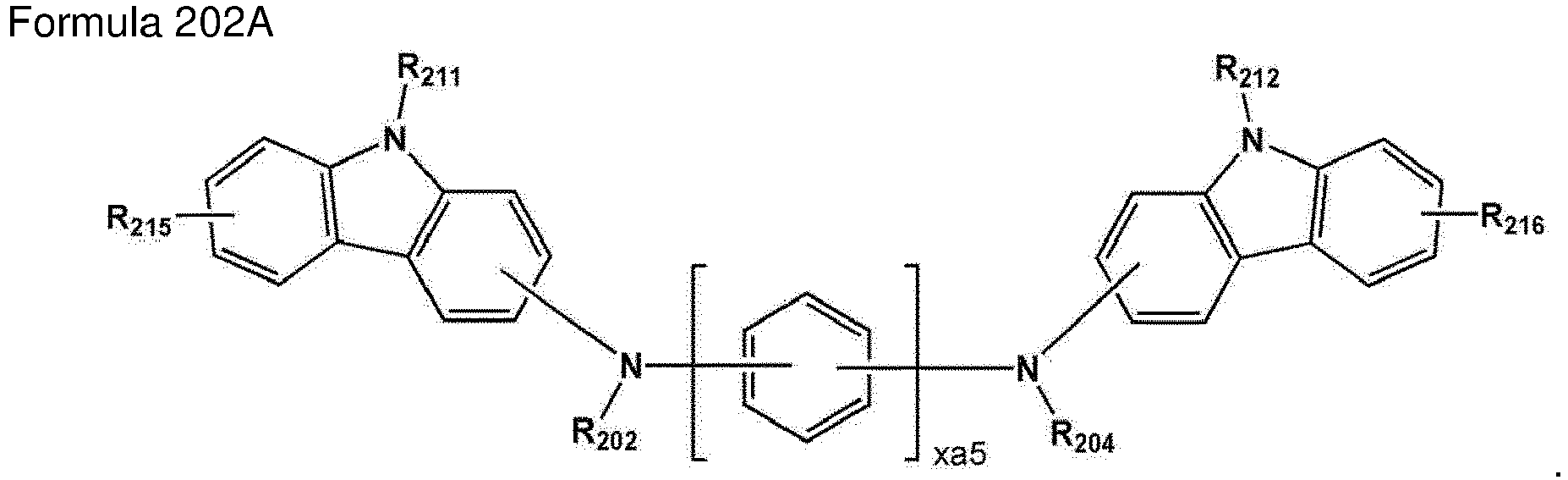
- In one embodiment, the compound represented by Formula 202 may be represented by Formula 202A-1:

- In Formulae 201A, 201A(1), 201A-1, 202A, and 202A-1,
L201 to L203, xa1 to xa3, xa5, and R202 to R204 may be understood by referring to the corresponding description presented herein,
R211 and R212 may each independently the same as defined in connection with R203, and
R213 to R217 may each independently be selected from hydrogen, deuterium, -F, -CI, -Br, -I, a hydroxyl group, a cyano group, a nitro group, an amidino group, a hydrazino group, a hydrazono group, a C1-C20 alkyl group, a C1-C20 alkoxy group, a cyclopentyl group, a cyclohexyl group, a cycloheptyl group, a cyclopentenyl group, a cyclohexenyl group, a phenyl group, a biphenyl group, a terphenyl group, a phenyl group substituted with a C1-C10 alkyl group, a phenyl group substituted with -F, a pentalenyl group, an indenyl group, a naphthyl group, an azulenyl group, a heptalenyl group, an indacenyl group, an acenaphthyl group, a fluorenyl group, a spiro-bifluorenyl group, a benzofluorenyl group, a dibenzofluorenyl group, a phenalenyl group, a phenanthrenyl group, an anthracenyl group, a fluoranthenyl group, a triphenylenyl group, a pyrenyl group, a chrysenyl group, a naphthacenyl group, a picenyl group, a perylenyl group, a pentaphenyl group, a hexacenyl group, a pentacenyl group, a rubicenyl group, a coronenyl group, an ovalenyl group, a thiophenyl group, a furanyl group, a carbazolyl group, an indolyl group, an isoindolyl group, a benzofuranyl group, a benzothiophenyl group, a dibenzofuranyl group, a dibenzothiophenyl group, a benzocarbazolyl group, a dibenzocarbazolyl group, a dibenzosilolyl group, and a pyridinyl group. - The hole transport region may include at least one compound selected from Compounds HT1 to HT39, but embodiments of the present disclosure are not limited thereto:
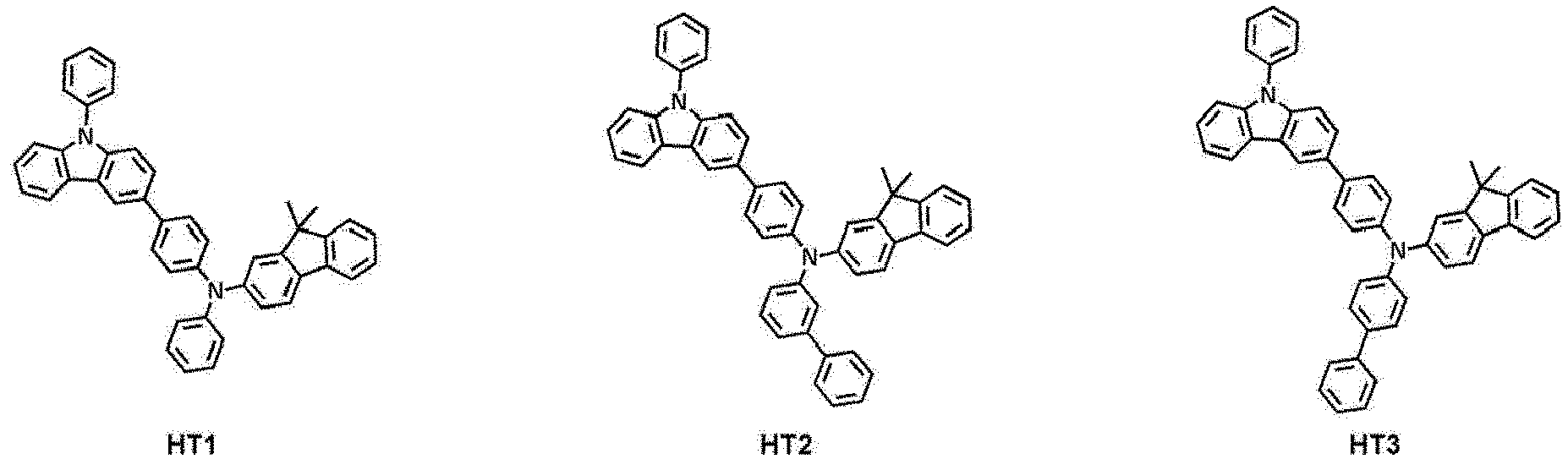


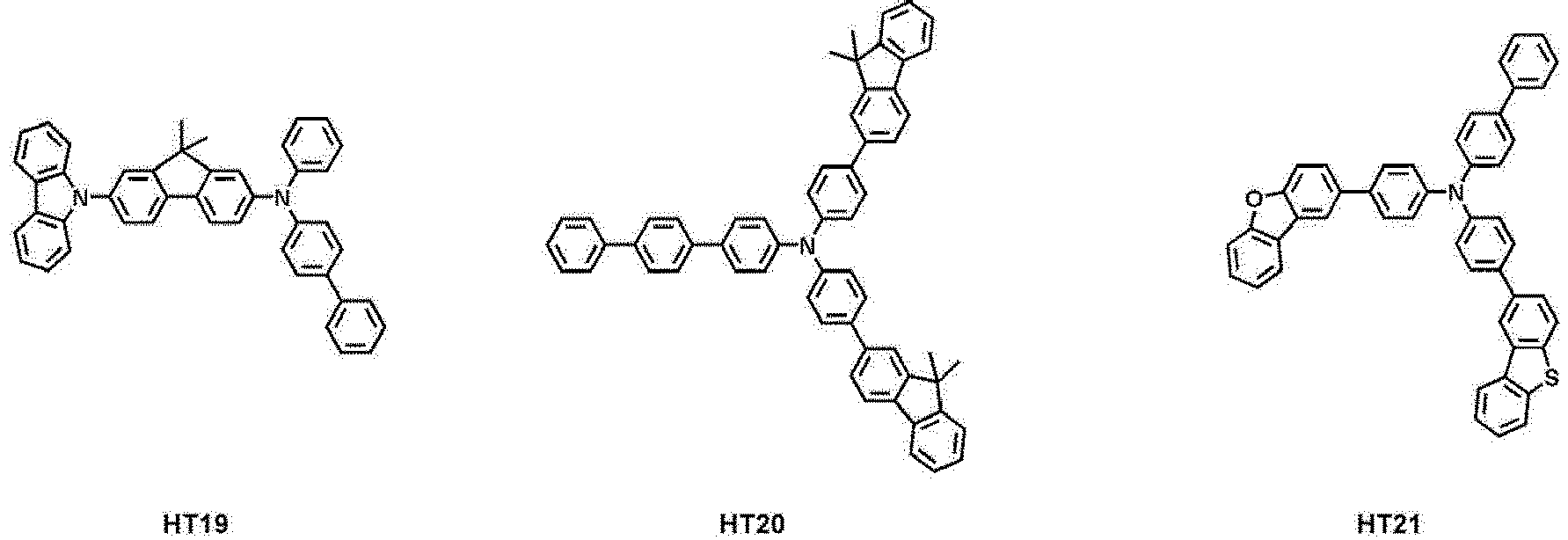


- A thickness of the hole transport region may be in a range of about 100 Å to about 10,000 Å, for example, about 100 Å to about 7000 Å, about 100 Å to about 5000 Å, about 100 Å to about 3000 Å, about 100 Å to about 1,000 Å or about 100 Å to about 500 Å. When the hole transport region includes at least one selected from a hole injection layer and a hole transport layer, the thickness of the hole injection layer may be in a range of about 100 Å to about 9,000 Å, and for example, about 100 Å to about 7,000 Å, about 100 Å to about 5,000 Å, about 100 Å to about 3,000 Å, about 100 Å to about 2,000 Å, about 100 Å to about 1,000 Å, or about 100 Å to about 200 Å, and the thickness of the hole transport layer may be in a range of about 50 Å to about 2,000 Å, and for example, about 100 Å to about 1,500 Å, or about 150 Å to about 250 Å. When the thicknesses of the hole transport region, the hole injection layer, and the hole transport layer are within these ranges, suitable or satisfactory hole transporting characteristics may be obtained without a substantial increase in driving voltage.
- The emission auxiliary layer may increase light-emission efficiency by compensating for an optical resonance distance according to the wavelength of light emitted by the
emission layer 150b, and the electron blocking layer may block the flow of electrons from an electron transport region. The emission auxiliary layer and the electron blocking layer may include the materials as described herein above. - The hole transport region may further include, in addition to these materials, a charge-generation material for the improvement of conductive (e.g., electrically conductive) properties. The charge-generation material may be homogeneously or non-homogeneously dispersed in the hole transport region.
- The charge-generation material may be, for example, a p-dopant.
- In one embodiment, the p-dopant may have a lowest unoccupied molecular orbital (LUMO) energy level of -3.5 eV or less.
- The p-dopant may include at least one selected from a quinone derivative, a metal oxide, and a cyano group-containing compound, but embodiments of the present disclosure are not limited thereto.
- In one embodiment, the p-dopant may include at least one selected from:
- a quinone derivative, such as tetracyanoquinodimethane (TCNQ) and 2,3,5,6-tetrafluoro-7,7,8,8-tetracyanoquinodimethane (F4-TCNQ);
- a metal oxide, such as tungsten oxide or molybdenum oxide;
- 1,4,5,8,9,11-hexaazatriphenylene-hexacarbonitrile (HAT-CN); and
- a compound represented by Formula 221,
- but embodiments of the present disclosure are not limited thereto:

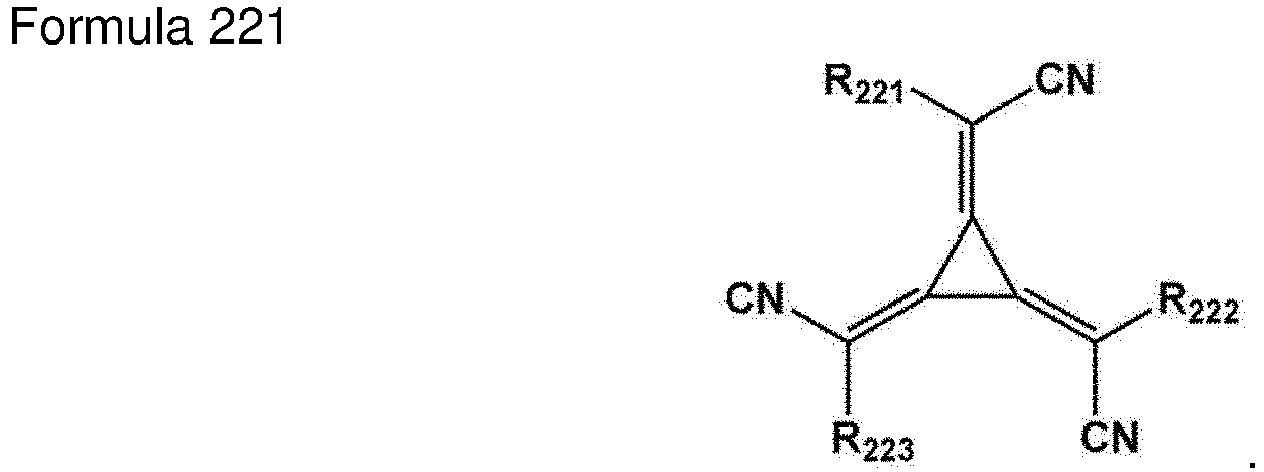
- In Formula 221,
R221 to R223 may each independently be selected from a substituted or unsubstituted C3-C10 cycloalkyl group, a substituted or unsubstituted C1-C10 heterocycloalkyl group, a substituted or unsubstituted C3-C10 cycloalkenyl group, a substituted or unsubstituted C1-C10 heterocycloalkenyl group, a substituted or unsubstituted C6-C60 (e.g. C6-C32) aryl group, a substituted or unsubstituted C1-C60 (e.g. C1-C20) heteroaryl group, a substituted or unsubstituted monovalent non-aromatic condensed polycyclic group, and a substituted or unsubstituted monovalent non-aromatic condensed heteropolycyclic group, wherein at least one selected from R221 to R223 may have at least one substituent selected from a cyano group, -F, -Cl, -Br, -I, a C1-C20 alkyl group substituted with -F, a C1-C20 alkyl group substituted with -CI, a C1-C20 alkyl group substituted with -Br, and a C1-C20 alkyl group substituted with -I. - When the organic light-emitting
device 10 is a full-color organic light-emitting device, theemission layer 150b, 153-2b, or 153-3b may be patterned into a red emission layer, a green emission layer, or a blue emission layer, according to a subpixel. In one or more embodiments, theemission layer 150b, 153-2b, or 153-3b may have a stacked structure of two or more layers selected from a red emission layer, a green emission layer, and a blue emission layer, in which the two or more layers contact each other or are separated from each other. In one or more embodiments, the emission layer may include two or more materials selected from a red light-emitting material, a green light-emitting material, and a blue light-emitting material, in which the two or more materials are mixed with each other in a single layer to emit white light. - The
emission layer 150b, 153-2b, or 153-3b may include a host and a dopant. The dopant may be a phosphorescent dopant. - In the
emission layer 150b, 153-2b, or 153-3b, an amount of the dopant may be in a range of about 0.01 parts by weight to about 15 parts by weight based on 100 parts by weight of the host, but embodiments of the present disclosure are not limited thereto. - A thickness of the
emission layer 150b may be in a range of about 100 Å to about 1,000 Å, for example, about 100 Å to about 800 Å, about 150 Å to about 800 Å, about 150 Å to about 700 Å, about 150 Å to about 650 Å, about 200 Å to about 600 Å or about 200 Å to about 300 Å. When the thickness of theemission layer 150b is within this range, excellent light-emission characteristics may be obtained without a substantial increase in driving voltage. - The host may include the compound described herein above.
- In one or more embodiments, the host may further include a compound represented by Formula 301:

- In Formula 301,
Ar301 may be a substituted or unsubstituted C5-C60 carbocyclic group or a substituted or unsubstituted C1-C60 heterocyclic group,
xb11 may be 0, 1, 2, or 3,
L301 may be selected from a substituted or unsubstituted C3-C10 cycloalkylene group, a substituted or unsubstituted C1-C10 heterocycloalkylene group, a substituted or unsubstituted C3-C10 cycloalkenylene group, a substituted or unsubstituted C1-C10 heterocycloalkenylene group, a substituted or unsubstituted C6-C60 arylene group, a substituted or unsubstituted C1-C60 heteroarylene group, a substituted or unsubstituted divalent non-aromatic condensed polycyclic group, and a substituted or unsubstituted divalent non-aromatic condensed heteropolycyclic group,
xb1 may be an integer from 0 to 5,
R301 may be selected from deuterium, -F, -CI, -Br, -I, a hydroxyl group, a cyano group, a nitro group, an amidino group, a hydrazino group, a hydrazono group, a substituted or unsubstituted C1-C60 alkyl group, a substituted or unsubstituted C2-C60 alkenyl group, a substituted or unsubstituted C2-C60 alkynyl group, a substituted or unsubstituted C1-C60 alkoxy group, a substituted or unsubstituted C3-C10 cycloalkyl group, a substituted or unsubstituted C1-C10 heterocycloalkyl group, a substituted or unsubstituted C3-C10 cycloalkenyl group, a substituted or unsubstituted C1-C10 heterocycloalkenyl group, a substituted or unsubstituted C6-C60 aryl group, a substituted or unsubstituted C6-C60 aryloxy group, a substituted or unsubstituted C6-C60 arylthio group, a substituted or unsubstituted C1-C60 heteroaryl group, a substituted or unsubstituted monovalent non-aromatic condensed polycyclic group, a substituted or unsubstituted monovalent non-aromatic condensed heteropolycyclic group, - Si(Q301)(Q302)(Q303), -N(Q301)(Q302), -B(Q301)(Q302), -C(=O)(Q301), -S(=O)2(Q301), and - P(=O)(Q301)(Q302),
xb21 may be an integer from 1 to 5, and
Q301 to Q303 may each independently be selected from a C1-C10 alkyl group, a C1-C10 alkoxy group, a phenyl group, a biphenyl group, a terphenyl group, and a naphthyl group, but embodiments of the present disclosure are not limited thereto. - For example, Ar301 may be a substituted or unsubstituted C6-C32 carbocyclic group or a substituted or unsubstituted C1-C12 heterocyclic group, but embodiments are not limited thereto.
- In one embodiment, Ar301 in Formula 301 may be selected from:
- a naphthalene group, a fluorene group, a spiro-bifluorene group, a benzofluorene group, a dibenzofluorene group, a phenalene group, a phenanthrene group, an anthracene group, a fluoranthene group, a triphenylene group, a pyrene group, a chrysene group, a naphthacene group, a picene group, a perylene group, a pentaphene group, an indenoanthracene group, a dibenzofuran group, and a dibenzothiophene group; and
- a naphthalene group, a fluorene group, a spiro-bifluorene group, a benzofluorene group, a dibenzofluorene group, a phenalene group, a phenanthrene group, an anthracene group, a fluoranthene group, a triphenylene group, a pyrene group, a chrysene group, a naphthacene group, a picene group, a perylene group, a pentaphene group, an indenoanthracene group, a dibenzofuran group, and a dibenzothiophene group, each substituted with at least one selected from deuterium, - F, -CI, -Br, -I, a hydroxyl group, a cyano group, a nitro group, an amidino group, a hydrazino group, a hydrazono group, a C1-C20 alkyl group, a C1-C20 alkoxy group, a phenyl group, a biphenyl group, a terphenyl group, a naphthyl group, - Si(Q31)(Q32)(Q33), -N(Q31)(Q32), -B(Q31)(Q32), -C(=O)(Q31), -S(=O)2(Q31), and - P(=O)(Q31)(Q32), and
- Q31 to Q33 may each independently be selected from a C1-C10 alkyl group, a C1-C10 alkoxy group, a phenyl group, a biphenyl group, a terphenyl group, and a naphthyl group, but embodiments of the present disclosure are not limited thereto.
- When xb11 in Formula 301 is two or more, two or more Ar301(s) may be linked via a single bond.
- In one or more embodiments, the compound represented by Formula 301 may be represented by Formula 301-1 or 301-2:


- In Formulae 301-1 and 301-2,
ring A301 to ring A304 may each independently be selected from a benzene ring, a naphthalene ring, a phenanthrene ring, a fluoranthene ring, a triphenylene ring, a pyrene ring, a chrysene ring, a pyridine ring, a pyrimidine ring, an indene ring, a fluorene ring, a spiro-bifluorene ring, a benzofluorene ring, a dibenzofluorene ring, an indole ring, a carbazole ring, a benzocarbazole ring, a dibenzocarbazole ring, a furan ring, a benzofuran ring, a dibenzofuran ring, a naphthofuran ring, a benzonaphthofuran ring, a dinaphthofuran ring, a thiophene ring, a benzothiophene ring, a dibenzothiophene ring, a naphthothiophene ring, a benzonaphthothiophene ring, and a dinaphthothiophene ring,
X301 may be O, S, or N-[(L304)xb4-R304],
R311 to R314 may each independently be selected from hydrogen, deuterium, -F, -CI, -Br, -I, a hydroxyl group, a cyano group, a nitro group, an amidino group, a hydrazino group, a hydrazono group, a C1-C20 alkyl group, a C1-C20 alkoxy group, a phenyl group, a biphenyl group, a terphenyl group, a naphthyl group, - Si(Q31)(Q32)(Q33), -N(Q31)(Q32), -B(Q31)(Q32), -C(=O)(Q31), -S(=O)2(Q31), and - P(=O)(Q31)(Q32),
xb22 and xb23 may each independently be 0, 1, or 2,
L301, xb1, R301, and Q31 to Q33 may be understood by referring to the corresponding description presented herein,
L302 to L304 may each independently be the same as defined in connection with L301,
xb2 to xb4 may each independently be the same as defined in connection with xb1, and
R302 to R304 may each independently be the same as defined in connection with R301. - For example, L301 to L304 in Formulae 301, 301-1, and 301-2 may each independently be selected from:
- a phenylene group, a naphthylene group, a fluorenylene group, a spiro-bifluorenylene group, a benzofluorenylene group, a dibenzofluorenylene group, a phenanthrenylene group, an anthracenylene group, a fluoranthenylene group, a triphenylenylene group, a pyrenylene group, a chrysenylene group, a perylenylene group, a pentaphenylene group, a hexacenylene group, a pentacenylene group, a thiophenylene group, a furanylene group, a carbazolylene group, an indolylene group, an isoindolylene group, a benzofuranylene group, a benzothiophenylene group, a dibenzofuranylene group, a dibenzothiophenylene group, a benzocarbazolylene group, a dibenzocarbazolylene group, a dibenzosilolylene group, a pyridinylene group, an imidazolylene group, a pyrazolylene group, a thiazolylene group, an isothiazolylene group, an oxazolylene group, an isoxazolylene group, a thiadiazolylene group, an oxadiazolylene group, a pyrazinylene group, a pyrimidinylene group, a pyridazinylene group, a triazinylene group, a quinolinylene group, an isoquinolinylene group, a benzoquinolinylene group, a phthalazinylene group, a naphthyridinylene group, a quinoxalinylene group, a quinazolinylene group, a cinnolinylene group, a phenanthridinylene group, an acridinylene group, a phenanthrolinylene group, a phenazinylene group, a benzimidazolylene group, an isobenzothiazolylene group, a benzoxazolylene group, an isobenzoxazolylene group, a triazolylene group, a tetrazolylene group, an imidazopyridinylene group, an imidazopyrimidinylene group, and an azacarbazolylene group; and
- a phenylene group, a naphthylene group, a fluorenylene group, a spiro-bifluorenylene group, a benzofluorenylene group, a dibenzofluorenylene group, a phenanthrenylene group, an anthracenylene group, a fluoranthenylene group, a triphenylenylene group, a pyrenylene group, a chrysenylene group, a perylenylene group, a pentaphenylene group, a hexacenylene group, a pentacenylene group, a thiophenylene group, a furanylene group, a carbazolylene group, an indolylene group, an isoindolylene group, a benzofuranylene group, a benzothiophenylene group, a dibenzofuranylene group, a dibenzothiophenylene group, a benzocarbazolylene group, a dibenzocarbazolylene group, a dibenzosilolylene group, a pyridinylene group, an imidazolylene group, a pyrazolylene group, a thiazolylene group, an isothiazolylene group, an oxazolylene group, an isoxazolylene group, a thiadiazolylene group, an oxadiazolylene group, a pyrazinylene group, a pyrimidinylene group, a pyridazinylene group, a triazinylene group, a quinolinylene group, an isoquinolinylene group, a benzoquinolinylene group, a phthalazinylene group, a naphthyridinylene group, a quinoxalinylene group, a quinazolinylene group, a cinnolinylene group, a phenanthridinylene group, an acridinylene group, a phenanthrolinylene group, a phenazinylene group, a benzimidazolylene group, an isobenzothiazolylene group, a benzoxazolylene group, an isobenzoxazolylene group, a triazolylene group, a tetrazolylene group, an imidazopyridinylene group, an imidazopyrimidinylene group, and an azacarbazolylene group, each substituted with at least one selected from deuterium, -F, -CI, -Br, -I, a hydroxyl group, a cyano group, a nitro group, an amidino group, a hydrazino group, a hydrazono group, a C1-C20 alkyl group, a C1-C20 alkoxy group, a phenyl group, a biphenyl group, a terphenyl group, a naphthyl group, a fluorenyl group, a spiro-bifluorenyl group, a benzofluorenyl group, a dibenzofluorenyl group, a phenanthrenyl group, an anthracenyl group, a fluoranthenyl group, a triphenylenyl group, a pyrenyl group, a chrysenyl group, a perylenyl group, a pentaphenyl group, a hexacenyl group, a pentacenyl group, a thiophenyl group, a furanyl group, a carbazolyl group, an indolyl group, an isoindolyl group, a benzofuranyl group, a benzothiophenyl group, a dibenzofuranyl group, a dibenzothiophenyl group, a benzocarbazolyl group, a dibenzocarbazolyl group, a dibenzosilolyl group, a pyridinyl group, an imidazolyl group, a pyrazolyl group, a thiazolyl group, an isothiazolyl group, an oxazolyl group, an isoxazolyl group, a thiadiazolyl group, an oxadiazolyl group, a pyrazinyl group, a pyrimidinyl group, a pyridazinyl group, a triazinyl group, a quinolinyl group, an isoquinolinyl group, a benzoquinolinyl group, a phthalazinyl group, a naphthyridinyl group, a quinoxalinyl group, a quinazolinyl group, a cinnolinyl group, a phenanthridinyl group, an acridinyl group, a phenanthrolinyl group, a phenazinyl group, a benzimidazolyl group, an isobenzothiazolyl group, a benzoxazolyl group, an isobenzoxazolyl group, a triazolyl group, a tetrazolyl group, an imidazopyridinyl group, an imidazopyrimidinyl group, an azacarbazolyl group, -Si(Q31)(Q32)(Q33), -N(Q31)(Q32), - B(Q31)(Q32), -C(=O)(Q31), -S(=O)2(Q31), and -P(=O)(Q31)(Q32), and
- Q31 to Q33 are the same as described herein above.
- As another example, R301 to R304 in Formulae 301, 301-1, and 301-2 may each independently be selected from: deuterium, -F, -CI, -Br, -I, a hydroxyl group, a cyano group, a nitro group, an amidino group, a hydrazino group, a hydrazono group, a substituted or unsubstituted C1-C60 (e.g. C1-C10) alkyl group, a substituted or unsubstituted C2-C60 (e.g. C2-C10) alkenyl group, a substituted or unsubstituted C2-C60 (e.g. C2-C10) alkynyl group, a substituted or unsubstituted C1-C60 (e.g. C1-C10) alkoxy group, a substituted or unsubstituted C3-C10 cycloalkyl group, a substituted or unsubstituted C1-C10 heterocycloalkyl group, a substituted or unsubstituted C3-C10 cycloalkenyl group, a substituted or unsubstituted C1-C10 heterocycloalkenyl group, a substituted or unsubstituted C6-C30 aryl group, a substituted or unsubstituted C6-C30 aryloxy group, a substituted or unsubstituted C6-C30 arylthio group, a substituted or unsubstituted C1-C20 heteroaryl group, a substituted or unsubstituted monovalent non-aromatic condensed polycyclic group, a substituted or unsubstituted monovalent non-aromatic condensed heteropolycyclic group, -Si(Q301)(Q302)(Q303), -N(Q301)(Q302),-B(Q301)(Q302), -C(=O)(O301), -S(=O)2(Q301), and -P(=O)(Q301)(Q302), but embodiments are not limited thereto.
- In one embodiment, in Formulae 301, 301-1, and 301-2, R301 to R304 may each independently be selected from:
- a phenyl group, a biphenyl group, a terphenyl group, a naphthyl group, a fluorenyl group, a spiro-bifluorenyl group, a benzofluorenyl group, a dibenzofluorenyl group, a phenanthrenyl group, an anthracenyl group, a fluoranthenyl group, a triphenylenyl group, a pyrenyl group, a chrysenyl group, a perylenyl group, a pentaphenyl group, a hexacenyl group, a pentacenyl group, a thiophenyl group, a furanyl group, a carbazolyl group, an indolyl group, an isoindolyl group, a benzofuranyl group, a benzothiophenyl group, a dibenzofuranyl group, a dibenzothiophenyl group, a benzocarbazolyl group, a dibenzocarbazolyl group, a dibenzosilolyl group, a pyridinyl group, an imidazolyl group, a pyrazolyl group, a thiazolyl group, an isothiazolyl group, an oxazolyl group, an isoxazolyl group, a thiadiazolyl group, an oxadiazolyl group, a pyrazinyl group, a pyrimidinyl group, a pyridazinyl group, a triazinyl group, a quinolinyl group, an isoquinolinyl group, a benzoquinolinyl group, a phthalazinyl group, a naphthyridinyl group, a quinoxalinyl group, a quinazolinyl group, a cinnolinyl group, a phenanthridinyl group, an acridinyl group, a phenanthrolinyl group, a phenazinyl group, a benzimidazolyl group, an isobenzothiazolyl group, a benzoxazolyl group, an isobenzoxazolyl group, a triazolyl group, a tetrazolyl group, an imidazopyridinyl group, an imidazopyrimidinyl group, and an azacarbazolyl group; and
- a phenyl group, a biphenyl group, a terphenyl group, a naphthyl group, a fluorenyl group, a spiro-bifluorenyl group, a benzofluorenyl group, a dibenzofluorenyl group, a phenanthrenyl group, an anthracenyl group, a fluoranthenyl group, a triphenylenyl group, a pyrenyl group, a chrysenyl group, a perylenyl group, a pentaphenyl group, a hexacenyl group, a pentacenyl group, a thiophenyl group, a furanyl group, a carbazolyl group, an indolyl group, an isoindolyl group, a benzofuranyl group, a benzothiophenyl group, a dibenzofuranyl group, a dibenzothiophenyl group, a benzocarbazolyl group, a dibenzocarbazolyl group, a dibenzosilolyl group, a pyridinyl group, an imidazolyl group, a pyrazolyl group, a thiazolyl group, an isothiazolyl group, an oxazolyl group, an isoxazolyl group, a thiadiazolyl group, an oxadiazolyl group, a pyrazinyl group, a pyrimidinyl group, a pyridazinyl group, a triazinyl group, a quinolinyl group, an isoquinolinyl group, a benzoquinolinyl group, a phthalazinyl group, a naphthyridinyl group, a quinoxalinyl group, a quinazolinyl group, a cinnolinyl group, a phenanthridinyl group, an acridinyl group, a phenanthrolinyl group, a phenazinyl group, a benzimidazolyl group, an isobenzothiazolyl group, a benzoxazolyl group, an isobenzoxazolyl group, a triazolyl group, a tetrazolyl group, an imidazopyridinyl group, an imidazopyrimidinyl group, and an azacarbazolyl group, each substituted with at least one selected from deuterium, -F, -CI, -Br, -I, a hydroxyl group, a cyano group, a nitro group, an amidino group, a hydrazino group, a hydrazono group, a C1-C20 alkyl group, a C1-C20 alkoxy group, a phenyl group, a biphenyl group, a terphenyl group, a naphthyl group, a fluorenyl group, a spiro-bifluorenyl group, a benzofluorenyl group, a dibenzofluorenyl group, a phenanthrenyl group, an anthracenyl group, a fluoranthenyl group, a triphenylenyl group, a pyrenyl group, a chrysenyl group, a perylenyl group, a pentaphenyl group, a hexacenyl group, a pentacenyl group, a thiophenyl group, a furanyl group, a carbazolyl group, an indolyl group, an isoindolyl group, a benzofuranyl group, a benzothiophenyl group, a dibenzofuranyl group, a dibenzothiophenyl group, a benzocarbazolyl group, a dibenzocarbazolyl group, a dibenzosilolyl group, a pyridinyl group, an imidazolyl group, a pyrazolyl group, a thiazolyl group, an isothiazolyl group, an oxazolyl group, an isoxazolyl group, a thiadiazolyl group, an oxadiazolyl group, a pyrazinyl group, a pyrimidinyl group, a pyridazinyl group, a triazinyl group, a quinolinyl group, an isoquinolinyl group, a benzoquinolinyl group, a phthalazinyl group, a naphthyridinyl group, a quinoxalinyl group, a quinazolinyl group, a cinnolinyl group, a phenanthridinyl group, an acridinyl group, a phenanthrolinyl group, a phenazinyl group, a benzimidazolyl group, an isobenzothiazolyl group, a benzoxazolyl group, an isobenzoxazolyl group, a triazolyl group, a tetrazolyl group, an imidazopyridinyl group, an imidazopyrimidinyl group, an azacarbazolyl group, -Si(Q31)(Q32)(Q33), -N(Q31)(Q32), - B(Q31)(Q32), -C(=O)(Q31), -S(=O)2(Q31), and -P(=O)(Q31)(Q32), and
- Q31 to Q33 are the same as described herein above.
- In one embodiment, the host may further include an alkaline earth-metal complex. For example, the host may include a complex selected from a Be complex (for example, Compound H55), a Mg complex, and a Zn complex. For example, the host may further include at least one compound selected from a Be complex (for example, Compound H55), a Mg complex, and a Zn complex.
- The host may include at least one selected from 9,10-di(2-naphthyl)anthracene (ADN), 2-methyl-9,10-bis(naphthalen-2-yl)anthracene (MADN), 9,10-di-(2-naphthyl)-2-t-butyl-anthracene (TBADN), 4,4'-bis(N-carbazolyl)-1,1'-biphenyl (CBP), 1,3-di-9-carbazolylbenzene (mCP), 1,3,5-tri(carbazol-9-yl)benzene (TCP), and Compounds H1 to H55, but embodiments of the present disclosure are not limited thereto:


- In one embodiment, the host may include at least one selected from a silicon-containing compound (for example, BCPDS or the like) and a phosphine oxide-containing compound (for example, POPCPA or the like).
- The host may include one type (or kind) of compounds only or two or more different types (or kinds) of compounds. As such, embodiments may be modified in various suitable ways.
- The emission layer may include a dopant, and the dopant may be configured to emit fluorescence by TTF. In one embodiment, the dopant may be configured to emit thermally activated delayed fluorescence (TADF) or fluorescence.
- The dopant may further include an arylamine compound or a styrylamine compound.
- The dopant may include a compound represented by Formula 501:

- In Formula 501,
Ar501 may be a substituted or unsubstituted C5-C60 carbocyclic group or a substituted or unsubstituted C1-C60 heterocyclic group,
L501 to L503 may each independently be selected from a substituted or unsubstituted C3-C10 cycloalkylene group, a substituted or unsubstituted C1-C10 heterocycloalkylene group, a substituted or unsubstituted C3-C10 cycloalkenylene group, a substituted or unsubstituted C1-C10 heterocycloalkenylene group, a substituted or unsubstituted C6-C60 (e.g. C6-C30) arylene group, a substituted or unsubstituted C1-C60 (e.g. C1-C20) heteroarylene group, a substituted or unsubstituted divalent non-aromatic condensed polycyclic group, and a substituted or unsubstituted divalent non-aromatic condensed heteropolycyclic group,
xd1 to xd3 may each independently be an integer from 0 to 3,
R501 and R502 may each independently be selected from a substituted or unsubstituted C3-C10 cycloalkyl group, a substituted or unsubstituted C1-C10 heterocycloalkyl group, a substituted or unsubstituted C3-C10 cycloalkenyl group, a substituted or unsubstituted C1-C10 heterocycloalkenyl group, a substituted or unsubstituted C6-C60 (e.g. C6-C30) aryl group, a substituted or unsubstituted C6-C60 (e.g. C6-C30) aryloxy group, a substituted or unsubstituted C6-C60 (e.g. C6-C30) arylthio group, a substituted or unsubstituted C1-C60 (e.g. C1-C20) heteroaryl group, a substituted or unsubstituted monovalent non-aromatic condensed polycyclic group, and a substituted or unsubstituted monovalent non-aromatic condensed heteropolycyclic group, and
xd4 may be an integer from 1 to 6. - For example, Ar501 may be a substituted or unsubstituted C5-C30 carbocyclic group or a substituted or unsubstituted C1-C20 heterocyclic group, but embodiments are not limited thereto.
- In one embodiment, Ar501 in Formula 501 may be selected from:
- a naphthalene group, a heptalene group, a fluorene group, a spiro-bifluorene group, a benzofluorene group, a dibenzofluorene group, a phenalene group, a phenanthrene group, an anthracene group, a fluoranthene group, a triphenylene group, a pyrene group, a chrysene group, a naphthacene group, a picene group, a perylene group, a pentaphene group, an indenoanthracene group, and an indenophenanthrene group; and
- a naphthalene group, a heptalene group, a fluorene group, a spiro-bifluorene group, a benzofluorene group, a dibenzofluorene group, a phenalene group, a phenanthrene group, an anthracene group, a fluoranthene group, a triphenylene group, a pyrene group, a chrysene group, a naphthacene group, a picene group, a perylene group, a pentaphene group, an indenoanthracene group, and an indenophenanthrene group, each substituted with at least one selected from deuterium, -F, -Cl, -Br, -I, a hydroxyl group, a cyano group, a nitro group, an amidino group, a hydrazino group, a hydrazono group, a C1-C20 alkyl group, a C1-C20 alkoxy group, a phenyl group, a biphenyl group, a terphenyl group, and a naphthyl group.
- In one or more embodiments, L501 to L503 in Formula 501 may each independently be selected from:
- a phenylene group, a naphthylene group, a fluorenylene group, a spiro-bifluorenylene group, a benzofluorenylene group, a dibenzofluorenylene group, a phenanthrenylene group, an anthracenylene group, a fluoranthenylene group, a triphenylenylene group, a pyrenylene group, a chrysenylene group, a perylenylene group, a pentaphenylene group, a hexacenylene group, a pentacenylene group, a thiophenylene group, a furanylene group, a carbazolylene group, an indolylene group, an isoindolylene group, a benzofuranylene group, a benzothiophenylene group, a dibenzofuranylene group, a dibenzothiophenylene group, a benzocarbazolylene group, a dibenzocarbazolylene group, a dibenzosilolylene group, and a pyridinylene group; and
- a phenylene group, a naphthylene group, a fluorenylene group, a spiro-bifluorenylene group, a benzofluorenylene group, a dibenzofluorenylene group, a phenanthrenylene group, an anthracenylene group, a fluoranthenylene group, a triphenylenylene group, a pyrenylene group, a chrysenylene group, a perylenylene group, a pentaphenylene group, a hexacenylene group, a pentacenylene group, a thiophenylene group, a furanylene group, a carbazolylene group, an indolylene group, an isoindolylene group, a benzofuranylene group, a benzothiophenylene group, a dibenzofuranylene group, a dibenzothiophenylene group, a benzocarbazolylene group, a dibenzocarbazolylene group, a dibenzosilolylene group, and a pyridinylene group, each substituted with at least one selected from deuterium, -F, -CI, -Br, -I, a hydroxyl group, a cyano group, a nitro group, an amidino group, a hydrazino group, a hydrazono group, a C1-C20 alkyl group, a C1-C20 alkoxy group, a phenyl group, a biphenyl group, a terphenyl group, a naphthyl group, a fluorenyl group, a spiro-bifluorenyl group, a benzofluorenyl group, a dibenzofluorenyl group, a phenanthrenyl group, an anthracenyl group, a fluoranthenyl group, a triphenylenyl group, a pyrenyl group, a chrysenyl group, a perylenyl group, a pentaphenyl group, a hexacenyl group, a pentacenyl group, a thiophenyl group, a furanyl group, a carbazolyl group, an indolyl group, an isoindolyl group, a benzofuranyl group, a benzothiophenyl group, a dibenzofuranyl group, a dibenzothiophenyl group, a benzocarbazolyl group, a dibenzocarbazolyl group, a dibenzosilolyl group, and a pyridinyl group.
- In one or more embodiments, R501 and R502 in Formula 501 may each independently be selected from:
- a phenyl group, a biphenyl group, a terphenyl group, a naphthyl group, a fluorenyl group, a spiro-bifluorenyl group, a benzofluorenyl group, a dibenzofluorenyl group, a phenanthrenyl group, an anthracenyl group, a fluoranthenyl group, a triphenylenyl group, a pyrenyl group, a chrysenyl group, a perylenyl group, a pentaphenyl group, a hexacenyl group, a pentacenyl group, a thiophenyl group, a furanyl group, a carbazolyl group, an indolyl group, an isoindolyl group, a benzofuranyl group, a benzothiophenyl group, a dibenzofuranyl group, a dibenzothiophenyl group, a benzocarbazolyl group, a dibenzocarbazolyl group, a dibenzosilolyl group, and a pyridinyl group; and
- a phenyl group, a biphenyl group, a terphenyl group, a naphthyl group, a fluorenyl group, a spiro-bifluorenyl group, a benzofluorenyl group, a dibenzofluorenyl group, a phenanthrenyl group, an anthracenyl group, a fluoranthenyl group, a triphenylenyl group, a pyrenyl group, a chrysenyl group, a perylenyl group, a pentaphenyl group, a hexacenyl group, a pentacenyl group, a thiophenyl group, a furanyl group, a carbazolyl group, an indolyl group, an isoindolyl group, a benzofuranyl group, a benzothiophenyl group, a dibenzofuranyl group, a dibenzothiophenyl group, a benzocarbazolyl group, a dibenzocarbazolyl group, a dibenzosilolyl group, and a pyridinyl group, each substituted with at least one selected from deuterium, -F, -CI, -Br, -I, a hydroxyl group, a cyano group, a nitro group, an amidino group, a hydrazino group, a hydrazono group, a C1-C20 alkyl group, a C1-C20 alkoxy group, a phenyl group, a biphenyl group, a terphenyl group, a naphthyl group, a fluorenyl group, a spiro-bifluorenyl group, a benzofluorenyl group, a dibenzofluorenyl group, a phenanthrenyl group, an anthracenyl group, a fluoranthenyl group, a triphenylenyl group, a pyrenyl group, a chrysenyl group, a perylenyl group, a pentaphenyl group, a hexacenyl group, a pentacenyl group, a thiophenyl group, a furanyl group, a carbazolyl group, an indolyl group, an isoindolyl group, a benzofuranyl group, a benzothiophenyl group, a dibenzofuranyl group, a dibenzothiophenyl group, a benzocarbazolyl group, a dibenzocarbazolyl group, a dibenzosilolyl group, a pyridinyl group, and - Si(Q31)(Q32)(Q33), and
- Q31 to Q33 may each independently be selected from a C1-C10 alkyl group, a C1-C10 alkoxy group, a phenyl group, a biphenyl group, a terphenyl group, and a naphthyl group.
- In one or more embodiments, xd4 in Formula 501 may be 2, but embodiments of the present disclosure are not limited thereto.
- For example, the fluorescent dopant may be selected from Compounds FD1 to FD22:


- In one embodiment, the fluorescent dopant may be selected from the following compounds, but embodiments of the present disclosure are not limited thereto:


- The electron transport region may include the
first ET layer 150c, 153-2c, or 153-3c. The second compound included in thefirst ET layer 150c, 153-2c, or 153-3c may be understood by referring to the corresponding description presented herein. - The electron transport region may have i) a single-layered structure including a single layer including a single material, ii) a single-layered structure including a single layer including a plurality of different materials, or iii) a multi-layered structure having a plurality of layers including a plurality of different materials.
- The electron transport region may further include, in addition to the
first ET layer 150c, 153-2c, or 153-3c, at least one layer selected from a buffer layer, an electron control layer, an electron transport layer, and an electron injection layer, but embodiments of the present disclosure are not limited thereto. - For example, the electron transport region may include, in addition to the
first ET layer 150c, 153-2c, or 153-3c, an electron transport layer/electron injection layer structure, an electron control layer/electron transport layer/electron injection layer structure, a buffer layer/electron transport layer/electron injection layer structure, a hole blocking layer/electron transport layer/electron injection layer structure, a hole blocking layer /electron control layer/electron transport layer/electron injection layer structure, or a hole blocking layer/buffer layer/electron transport layer/electron injection layer structure, wherein for each structure, constituting layers are sequentially stacked from the emission layer, but embodiments of the present disclosure are not limited thereto. - In one embodiment, a thickness of the
first ET layer 150c, 153-2c, or 153-3c (D1ET) and a thickness of theemission layer 150b, 153-2b, or 153-3b (DE) may satisfy DE ≥ D1ET. In more detail, a thickness of thefirst ET layer 150c, 153-2c, or 153-3c (D1ET) and a thickness of theemission layer 150b, 153-2b, or 153-3b (DE) may satisfy DE > D1ET, but embodiments of the present disclosure are not limited thereto. When the thicknesses are satisfied within the ranges above, the organic light-emitting device may have a desired efficiency improvement effect without increasing a driving voltage. - In one or more embodiments, a thickness of the
first ET layer 150c, 153-2c, or 153-3c may be in a range of 10 Å to 200 Å, for example, about 10 Å to about 100 Å, but embodiments of the present disclosure are not limited thereto. When the thicknesses are satisfied within the ranges above, the organic light-emitting device may have a desired efficiency improvement effect without increasing a driving voltage. - The electron transport region (for example, a buffer layer, a hole blocking layer, an electron control layer, or an electron transport layer in the electron transport region) may include a metal-free compound including at least one π electron-depleted nitrogen-containing ring.
- As noted herein above, the term "π electron-depleted nitrogen-containing ring," as used herein, refers to a C1-C60 (e.g. a C1-C30) heterocyclic group having at least one *-N=*' moiety as a ring-forming moiety.
- For example, as noted herein above, the "π electron-depleted nitrogen-containing ring" may be i) a 5-membered to 7-membered heteromonocyclic group having at least one *-N=*' moiety, ii) a heteropolycyclic group in which two or more 5-membered to 7-membered heteromonocyclic groups each having at least one *-N=*' moiety are condensed with each other (e.g., combined together), or iii) a heteropolycyclic group in which at least one of 5-membered to 7-membered heteromonocyclic groups, each having at least one *-N=*' moiety, is condensed with (e.g., combined with) at least one C5-C60 (e.g. a C5-C30) carbocyclic group.
- Examples of the π electron-depleted nitrogen-containing ring include an imidazole, a pyrazole, a thiazole, an isothiazole, an oxazole, an isoxazole, a pyridine, a pyrazine, a pyrimidine, a pyridazine, an indazole, a purine, a quinoline, an isoquinoline, a benzoquinoline, a phthalazine, a naphthyridine, a quinoxaline, a quinazoline, a cinnoline, a phenanthridine, an acridine, a phenanthroline, a phenazine, a benzimidazole, an isobenzothiazole, a benzoxazole, an isobenzoxazole, a triazole, a tetrazole, an oxadiazole, a triazine, thiadiazole, an imidazopyridine, an imidazopyrimidine, and an azacarbazole, but embodiments of the present disclosure are not limited thereto.
- For example, the electron transport region may include a compound represented by Formula 601:

- In Formula 601,
Ar601 may be a substituted or unsubstituted C5-C60 carbocyclic group or a substituted or unsubstituted C1-C60 heterocyclic group,
xe11 may be 1, 2, or 3,
L601 may be selected from a substituted or unsubstituted C3-C10 cycloalkylene group, a substituted or unsubstituted C1-C10 heterocycloalkylene group, a substituted or unsubstituted C3-C10 cycloalkenylene group, a substituted or unsubstituted C1-C10 heterocycloalkenylene group, a substituted or unsubstituted C6-C60 arylene group, a substituted or unsubstituted C1-C60 heteroarylene group, a substituted or unsubstituted divalent non-aromatic condensed polycyclic group, and a substituted or unsubstituted divalent non-aromatic condensed heteropolycyclic group,
xe1 may be an integer from 0 to 5,
R601 may be selected from a substituted or unsubstituted C3-C10 cycloalkyl group, a substituted or unsubstituted C1-C10 heterocycloalkyl group, a substituted or unsubstituted C3-C10 cycloalkenyl group, a substituted or unsubstituted C1-C10 heterocycloalkenyl group, a substituted or unsubstituted C6-C60 aryl group, a substituted or unsubstituted C6-C60 aryloxy group, a substituted or unsubstituted C6-C60 arylthio group, a substituted or unsubstituted C1-C60 heteroaryl group, a substituted or unsubstituted monovalent non-aromatic condensed polycyclic group, a substituted or unsubstituted monovalent non-aromatic condensed heteropolycyclic group, - Si(Q601)(Q602)(Q603), -C(=O)(Q601), -S(=O)2(Q601), and -P(=O)(Q601)(Q602), and
Q601 to Q603 may each independently be a C1-C10 alkyl group, a C1-C10 alkoxy group, a phenyl group, a biphenyl group, a terphenyl group, or a naphthyl group, and
xe21 may be an integer from 1 to 5. - In one embodiment, at least one of Ar601(s) in the number of xe11 and R601(s) in the number of xe21 may include the π electron-depleted nitrogen-containing ring.
- For example, Ar601 may be a substituted or unsubstituted C5-C30 carbocyclic group or a substituted or unsubstituted C1-C20 heterocyclic group, but embodiments are not limited thereto.
- In one embodiment, Ar601 in Formula 601 may be selected from:
- a benzene group, a naphthalene group, a fluorene group, a spiro-bifluorene group, a benzofluorene group, a dibenzofluorene group, a phenalene group, a phenanthrene group, an anthracene group, a fluoranthene group, a triphenylene group, a pyrene group, a chrysene group, a naphthacene group, a picene group, a perylene group, a pentaphene group, an indenoanthracene group, a dibenzofuran group, a dibenzothiophene group, a carbazole group, an imidazole group, a pyrazole group, a thiazole group, an isothiazole group, an oxazole group, an isoxazole group, a pyridine group, a pyrazine group, a pyrimidine group, a pyridazine group, an indazole group, a purine group, a quinoline group, an isoquinoline group, a benzoquinoline group, a phthalazine group, a naphthyridine group, a quinoxaline group, a quinazoline group, a cinnoline group, a phenanthridine group, an acridine group, a phenanthroline group, a phenazine group, a benzimidazole group, an isobenzothiazole group, a benzoxazole group, an isobenzoxazole group, a triazole group, a tetrazole group, an oxadiazole group, a triazine group, a thiadiazole group, an imidazopyridine group, an imidazopyrimidine group, and an azacarbazole group; and
- a benzene group, a naphthalene group, a fluorene group, a spiro-bifluorene group, a benzofluorene group, a dibenzofluorene group, a phenalene group, a phenanthrene group, an anthracene group, a fluoranthene group, a triphenylene group, a pyrene group, a chrysene group, a naphthacene group, a picene group, a perylene group, a pentaphene group, an indenoanthracene group, a dibenzofuran group, a dibenzothiophene group, a carbazole group, an imidazole group, a pyrazole group, a thiazole group, an isothiazole group, an oxazole group, an isoxazole group, a pyridine group, a pyrazine group, a pyrimidine group, a pyridazine group, an indazole group, a purine group, a quinoline group, an isoquinoline group, a benzoquinoline group, a phthalazine group, a naphthyridine group, a quinoxaline group, a quinazoline group, a cinnoline group, a phenanthridine group, an acridine group, a phenanthroline group, a phenazine group, a benzimidazole group, an isobenzothiazole group, a benzoxazole group, an isobenzoxazole group, a triazole group, a tetrazole group, an oxadiazole group, a triazine group, a thiadiazole group, an imidazopyridine group, an imidazopyrimidine group, and an azacarbazole group, each substituted with at least one selected from deuterium, -F, -CI, -Br, -I, a hydroxyl group, a cyano group, a nitro group, an amidino group, a hydrazino group, a hydrazono group, a C1-C20 alkyl group, a C1-C20 alkoxy group, a phenyl group, a biphenyl group, a terphenyl group, a naphthyl group, -Si(Q31)(Q32)(Q33), -S(=O)2(Q31), and -P(=O)(Q31)(Q32), and
- Q31 to Q33 may each independently be selected from a C1-C10 alkyl group, a C1-C10 alkoxy group, a phenyl group, a biphenyl group, a terphenyl group, and a naphthyl group.
- When xe11 in Formula 601 is two or more, two or more Ar601(s) may be linked to each other via a single bond.
- In one or more embodiments, Ar601 in Formula 601 may be an anthracene group.
- In one or more embodiments, a compound represented by Formula 601 may be represented by Formula 601-1:

- In Formula 601-1,
X614 may be N or C(R614), X615 may be N or C(R615), X616 may be N or C(R616), and at least one selected from X614 to X616 may be N,
L611 to L613 may each independently be the same as described in connection with L601,
xe611 to xe613 may each independently be defined the same as xe1,
R611 to R613 may each independently be the same as described in connection with R601, and
R614 to R616 may each independently be selected from hydrogen, deuterium, -F, -CI, -Br, -I, a hydroxyl group, a cyano group, a nitro group, an amidino group, a hydrazino group, a hydrazono group, a C1-C20 alkyl group, a C1-C20 alkoxy group, a phenyl group, a biphenyl group, a terphenyl group, and a naphthyl group. - For example, L601 and L611 to L613 in Formulae 601 and 601-1 may each independently be selected from: a substituted or unsubstituted C3-C10 cycloalkylene group, a substituted or unsubstituted C1-C10 heterocycloalkylene group, a substituted or unsubstituted C3-C10 cycloalkenylene group, a substituted or unsubstituted C1-C10 heterocycloalkenylene group, a substituted or unsubstituted C6-C30 arylene group, a substituted or unsubstituted C1-C20 heteroarylene group, a substituted or unsubstituted divalent non-aromatic condensed polycyclic group, and a substituted or unsubstituted divalent non-aromatic condensed heteropolycyclic group, but embodiments are not limited thereto.
- In one embodiment, L601 and L611 to L613 in Formulae 601 and 601-1 may each independently be selected from:
- a phenylene group, a naphthylene group, a fluorenylene group, a spiro-bifluorenylene group, a benzofluorenylene group, a dibenzofluorenylene group, a phenanthrenylene group, an anthracenylene group, a fluoranthenylene group, a triphenylenylene group, a pyrenylene group, a chrysenylene group, a perylenylene group, a pentaphenylene group, a hexacenylene group, a pentacenylene group, a thiophenylene group, a furanylene group, a carbazolylene group, an indolylene group, an isoindolylene group, a benzofuranylene group, a benzothiophenylene group, a dibenzofuranylene group, a dibenzothiophenylene group, a benzocarbazolylene group, a dibenzocarbazolylene group, a dibenzosilolylene group, a pyridinylene group, an imidazolylene group, a pyrazolylene group, a thiazolylene group, an isothiazolylene group, an oxazolylene group, an isoxazolylene group, a thiadiazolylene group, an oxadiazolylene group, a pyrazinylene group, a pyrimidinylene group, a pyridazinylene group, a triazinylene group, a quinolinylene group, an isoquinolinylene group, a benzoquinolinylene group, a phthalazinylene group, a naphthyridinylene group, a quinoxalinylene group, a quinazolinylene group, a cinnolinylene group, a phenanthridinylene group, an acridinylene group, a phenanthrolinylene group, a phenazinylene group, a benzimidazolylene group, an isobenzothiazolylene group, a benzoxazolylene group, an isobenzoxazolylene group, a triazolylene group, a tetrazolylene group, an imidazopyridinylene group, an imidazopyrimidinylene group, and an azacarbazolylene group; and
- a phenylene group, a naphthylene group, a fluorenylene group, a spiro-bifluorenylene group, a benzofluorenylene group, a dibenzofluorenylene group, a phenanthrenylene group, an anthracenylene group, a fluoranthenylene group, a triphenylenylene group, a pyrenylene group, a chrysenylene group, a perylenylene group, a pentaphenylene group, a hexacenylene group, a pentacenylene group, a thiophenylene group, a furanylene group, a carbazolylene group, an indolylene group, an isoindolylene group, a benzofuranylene group, a benzothiophenylene group, a dibenzofuranylene group, a dibenzothiophenylene group, a benzocarbazolylene group, a dibenzocarbazolylene group, a dibenzosilolylene group, a pyridinylene group, an imidazolylene group, a pyrazolylene group, a thiazolylene group, an isothiazolylene group, an oxazolylene group, an isoxazolylene group, a thiadiazolylene group, an oxadiazolylene group, a pyrazinylene group, a pyrimidinylene group, a pyridazinylene group, a triazinylene group, a quinolinylene group, an isoquinolinylene group, a benzoquinolinylene group, a phthalazinylene group, a naphthyridinylene group, a quinoxalinylene group, a quinazolinylene group, a cinnolinylene group, a phenanthridinylene group, an acridinylene group, a phenanthrolinylene group, a phenazinylene group, a benzimidazolylene group, an isobenzothiazolylene group, a benzoxazolylene group, an isobenzoxazolylene group, a triazolylene group, a tetrazolylene group, an imidazopyridinylene group, an imidazopyrimidinylene group, and an azacarbazolylene group, each substituted with at least one selected from deuterium, -F, -CI, -Br, -I, a hydroxyl group, a cyano group, a nitro group, an amidino group, a hydrazino group, a hydrazono group, a C1-C20 alkyl group, a C1-C20 alkoxy group, a phenyl group, a biphenyl group, a terphenyl group, a naphthyl group, a fluorenyl group, a spiro-bifluorenyl group, a benzofluorenyl group, a dibenzofluorenyl group, a phenanthrenyl group, an anthracenyl group, a fluoranthenyl group, a triphenylenyl group, a pyrenyl group, a chrysenyl group, a perylenyl group, a pentaphenyl group, a hexacenyl group, a pentacenyl group, a thiophenyl group, a furanyl group, a carbazolyl group, an indolyl group, an isoindolyl group, a benzofuranyl group, a benzothiophenyl group, a dibenzofuranyl group, a dibenzothiophenyl group, a benzocarbazolyl group, a dibenzocarbazolyl group, a dibenzosilolyl group, a pyridinyl group, an imidazolyl group, a pyrazolyl group, a thiazolyl group, an isothiazolyl group, an oxazolyl group, an isoxazolyl group, a thiadiazolyl group, an oxadiazolyl group, a pyrazinyl group, a pyrimidinyl group, a pyridazinyl group, a triazinyl group, a quinolinyl group, an isoquinolinyl group, a benzoquinolinyl group, a phthalazinyl group, a naphthyridinyl group, a quinoxalinyl group, a quinazolinyl group, a cinnolinyl group, a phenanthridinyl group, an acridinyl group, a phenanthrolinyl group, a phenazinyl group, a benzimidazolyl group, an isobenzothiazolyl group, a benzoxazolyl group, an isobenzoxazolyl group, a triazolyl group, a tetrazolyl group, an imidazopyridinyl group, an imidazopyrimidinyl group, and an azacarbazolyl group,
- but embodiments of the present disclosure are not limited thereto.
- In one or more embodiments, xe1 and xe611 to xe613 in Formulae 601 and 601-1 may each independently be 0, 1, or 2.
- For example, R601 and R611 to R613 in Formulae 601 and 601-1 may each independently be selected from: a substituted or unsubstituted C3-C10 cycloalkyl group, a substituted or unsubstituted C1-C10 heterocycloalkyl group, a substituted or unsubstituted C3-C10 cycloalkenyl group, a substituted or unsubstituted C1-C10 heterocycloalkenyl group, a substituted or unsubstituted C6-C30 aryl group, a substituted or unsubstituted C6-C30 aryloxy group, a substituted or unsubstituted C6-C30 arylthio group, a substituted or unsubstituted C1-C20 heteroaryl group, a substituted or unsubstituted monovalent non-aromatic condensed polycyclic group, a substituted or unsubstituted monovalent non-aromatic condensed heteropolycyclic group, - Si(Q601)(Q602)(Q603), -C(=O)(Q601), -S(=O)2(Q601), and -P(=O)(Q601)(Q602).
- In one or more embodiments, R601 and R611 to R613 in Formulae 601 and 601-1 may each independently be selected from:
- a phenyl group, a biphenyl group, a terphenyl group, a naphthyl group, a fluorenyl group, a spiro-bifluorenyl group, a benzofluorenyl group, a dibenzofluorenyl group, a phenanthrenyl group, an anthracenyl group, a fluoranthenyl group, a triphenylenyl group, a pyrenyl group, a chrysenyl group, a perylenyl group, a pentaphenyl group, a hexacenyl group, a pentacenyl group, a thiophenyl group, a furanyl group, a carbazolyl group, an indolyl group, an isoindolyl group, a benzofuranyl group, a benzothiophenyl group, a dibenzofuranyl group, a dibenzothiophenyl group, a benzocarbazolyl group, a dibenzocarbazolyl group, a dibenzosilolyl group, a pyridinyl group, an imidazolyl group, a pyrazolyl group, a thiazolyl group, an isothiazolyl group, an oxazolyl group, an isoxazolyl group, a thiadiazolyl group, an oxadiazolyl group, a pyrazinyl group, a pyrimidinyl group, a pyridazinyl group, a triazinyl group, a quinolinyl group, an isoquinolinyl group, a benzoquinolinyl group, a phthalazinyl group, a naphthyridinyl group, a quinoxalinyl group, a quinazolinyl group, a cinnolinyl group, a phenanthridinyl group, an acridinyl group, a phenanthrolinyl group, a phenazinyl group, a benzimidazolyl group, an isobenzothiazolyl group, a benzoxazolyl group, an isobenzoxazolyl group, a triazolyl group, a tetrazolyl group, an imidazopyridinyl group, an imidazopyrimidinyl group, and an azacarbazolyl group;
- a phenyl group, a biphenyl group, a terphenyl group, a naphthyl group, a fluorenyl group, a spiro-bifluorenyl group, a benzofluorenyl group, a dibenzofluorenyl group, a phenanthrenyl group, an anthracenyl group, a fluoranthenyl group, a triphenylenyl group, a pyrenyl group, a chrysenyl group, a perylenyl group, a pentaphenyl group, a hexacenyl group, a pentacenyl group, a thiophenyl group, a furanyl group, a carbazolyl group, an indolyl group, an isoindolyl group, a benzofuranyl group, a benzothiophenyl group, a dibenzofuranyl group, a dibenzothiophenyl group, a benzocarbazolyl group, a dibenzocarbazolyl group, a dibenzosilolyl group, a pyridinyl group, an imidazolyl group, a pyrazolyl group, a thiazolyl group, an isothiazolyl group, an oxazolyl group, an isoxazolyl group, a thiadiazolyl group, an oxadiazolyl group, a pyrazinyl group, a pyrimidinyl group, a pyridazinyl group, a triazinyl group, a quinolinyl group, an isoquinolinyl group, a benzoquinolinyl group, a phthalazinyl group, a naphthyridinyl group, a quinoxalinyl group, a quinazolinyl group, a cinnolinyl group, a phenanthridinyl group, an acridinyl group, a phenanthrolinyl group, a phenazinyl group, a benzimidazolyl group, an isobenzothiazolyl group, a benzoxazolyl group, an isobenzoxazolyl group, a triazolyl group, a tetrazolyl group, an imidazopyridinyl group, an imidazopyrimidinyl group, and an azacarbazolyl group, each substituted with at least one selected from deuterium, -F, -CI, -Br, -I, a hydroxyl group, a cyano group, a nitro group, an amidino group, a hydrazino group, a hydrazono group, a C1-C20 alkyl group, a C1-C20 alkoxy group, a phenyl group, a biphenyl group, a terphenyl group, a naphthyl group, a fluorenyl group, a spiro-bifluorenyl group, a benzofluorenyl group, a dibenzofluorenyl group, a phenanthrenyl group, an anthracenyl group, a fluoranthenyl group, a triphenylenyl group, a pyrenyl group, a chrysenyl group, a perylenyl group, a pentaphenyl group, a hexacenyl group, a pentacenyl group, a thiophenyl group, a furanyl group, a carbazolyl group, an indolyl group, an isoindolyl group, a benzofuranyl group, a benzothiophenyl group, a dibenzofuranyl group, a dibenzothiophenyl group, a benzocarbazolyl group, a dibenzocarbazolyl group, a dibenzosilolyl group, a pyridinyl group, an imidazolyl group, a pyrazolyl group, a thiazolyl group, an isothiazolyl group, an oxazolyl group, an isoxazolyl group, a thiadiazolyl group, an oxadiazolyl group, a pyrazinyl group, a pyrimidinyl group, a pyridazinyl group, a triazinyl group, a quinolinyl group, an isoquinolinyl group, a benzoquinolinyl group, a phthalazinyl group, a naphthyridinyl group, a quinoxalinyl group, a quinazolinyl group, a cinnolinyl group, a phenanthridinyl group, an acridinyl group, a phenanthrolinyl group, a phenazinyl group, a benzimidazolyl group, an isobenzothiazolyl group, a benzoxazolyl group, an isobenzoxazolyl group, a triazolyl group, a tetrazolyl group, an imidazopyridinyl group, an imidazopyrimidinyl group, and an azacarbazolyl group; and
- -S(=O)2(Q601) and -P(=O)(Q601)(Q602), and
- Q601 and Q602 are the same as described herein above.
- The electron transport region may include at least one compound selected from Compounds ET1 to ET36, but embodiments of the present disclosure are not limited thereto:


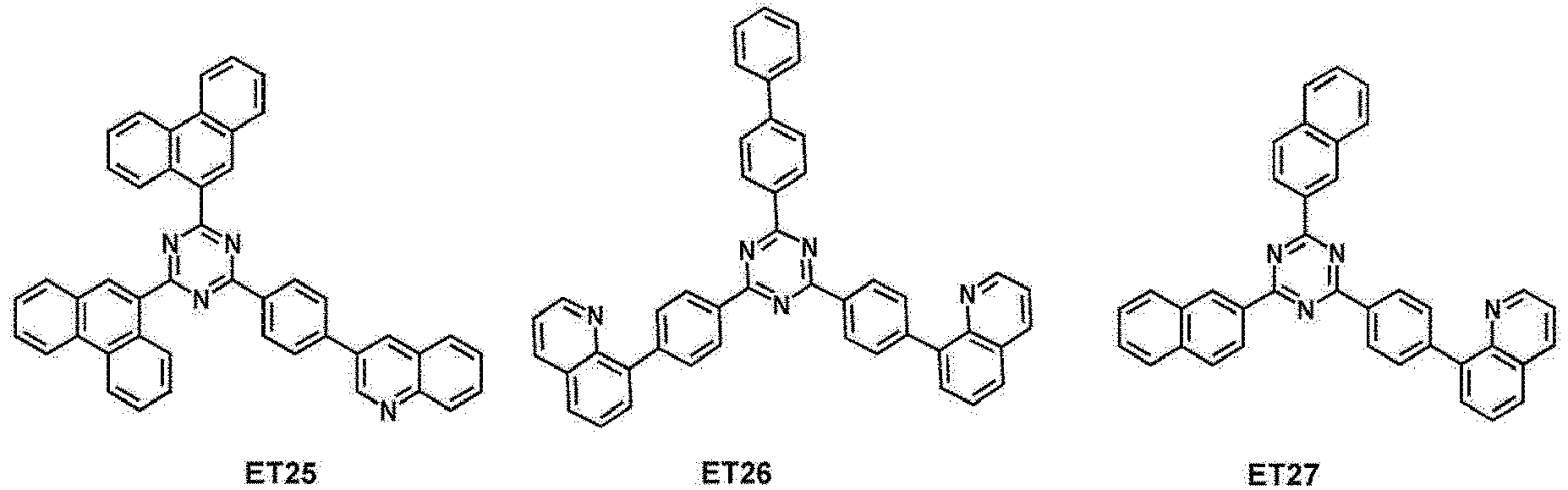


- In one or more embodiments, the electron transport region may include at least one compound selected from 2,9-dimethyl-4,7-diphenyl-1,10-phenanthroline (BCP), 4,7-diphenyl-1,10-phenanthroline (Bphen), Alq3, BAlq, 3-(biphenyl-4-yl)-5-(4-tert-butylphenyl-4-phenyl-4H-1,2,4-triazole (TAZ), and NTAZ:

- In one embodiment, the electron transport region may include a phosphine oxide-containing compound (for example, TSPO1 or the like), but embodiments of the present disclosure are not limited thereto. In one embodiment, the phosphine oxide-containing compound may be used in a hole blocking layer in the electron transport region, but embodiments of the present disclosure are not limited thereto.
- Thicknesses of the buffer layer, the hole blocking layer, and the electron control layer may each be in a range of about 20 Å to about 1,000 Å, for example, about 20 Å to about 700 Å, about 20 Å to about 500 Å, about 20 Å to about 400 Å, about 30 Å to about 400 Å or about 30 Å to about 300 Å. When the thicknesses of the buffer layer, the hole blocking layer, and the electron control layer are within these ranges, the electron transport region may have excellent electron blocking characteristics or electron control characteristics without a substantial increase in driving voltage.
- A thickness of the electron transport layer may be in a range of about 100 Å to about 1,000 Å, for example, about 100 Å to about 700 Å, about 100 Å to about 600 Å, about 150 Å to about 600 Å, about 150 Å to about 500 Å or about 250 Å to about 350 Å. When the thickness of the electron transport layer is within the range described herein above, the electron transport layer may have suitable or satisfactory electron transport characteristics without a substantial increase in driving voltage.
- The electron transport region (for example, the electron transport layer in the electron transport region) may further include, in addition to the materials described herein above, a metal-containing material.
- The metal-containing material may include at least one selected from an alkali metal complex and an alkaline earth-metal complex. The alkali metal complex may include a metal ion selected from a Li ion, a Na ion, a K ion, a Rb ion, and a Cs ion, and the alkaline earth-metal complex may include a metal ion selected from a Be ion, a Mg ion, a Ca ion, a Sr ion, and a Ba ion. A ligand coordinated with the metal ion of the alkali metal complex or the alkaline earth-metal complex may be selected from a hydroxy quinoline, a hydroxy isoquinoline, a hydroxy benzoquinoline, a hydroxy acridine, a hydroxy phenanthridine, a hydroxy phenyloxazole, a hydroxy phenylthiazole, a hydroxy diphenyloxadiazole, a hydroxy diphenylthiadiazole, a hydroxy phenylpyridine, a hydroxy phenylbenzimidazole, a hydroxy phenylbenzothiazole, a bipyridine, a phenanthroline, and a cyclopentadiene, but embodiments of the present disclosure are not limited thereto.
- For example, the metal-containing material may include a Li complex. The Li complex may include, for example, Compound ET-D1 (lithium quinolate, LiQ) or ET-D2:

- The electron transport region may include an electron injection layer that facilitates electron injection from the
second electrode 190. - The electron injection layer may have i) a single-layered structure including a single layer including a single material, ii) a single-layered structure including a single layer including a plurality of different materials, or iii) a multi-layered structure having a plurality of layers including a plurality of different materials.
- The electron injection layer may include an alkali metal, an alkaline earth metal, a rare earth metal, an alkali metal compound, an alkaline earth-metal compound, a rare earth metal compound, an alkali metal complex, an alkaline earth-metal complex, a rare earth metal complex, or any combinations thereof.
- The alkali metal may be selected from Li, Na, K, Rb, and Cs. In one embodiment, the alkali metal may be Li, Na, or Cs. In one or more embodiments, the alkali metal may be Li or Cs, but embodiments of the present disclosure are not limited thereto.
- The alkaline earth metal may be selected from Mg, Ca, Sr, and Ba.
- The rare earth metal may be selected from Sc, Y, Ce, Tb, Yb, and Gd.
- The alkali metal compound, the alkaline earth-metal compound, and the rare earth metal compound may be selected from oxides and halides (for example, fluorides, chlorides, bromides, or iodides) of the alkali metal, the alkaline earth-metal, and the rare earth metal.
- The alkali metal compound may be selected from alkali metal oxides, such as Li2O, Cs2O, or K2O, and alkali metal halides, such as LiF, NaF, CsF, KF, Lil, Nal, Csl, or Kl. In one embodiment, the alkali metal compound may be selected from LiF, Li2O, NaF, Lil, Nal, Csl, and Kl, but embodiments of the present disclosure are not limited thereto.
- The alkaline earth-metal compound may be selected from alkaline earth-metal oxides, such as BaO, SrO, CaO, BaxSr1-xO (0<x<1), or BaxCa1-xO (0<x<1). In one embodiment, the alkaline earth-metal compound may be selected from BaO, SrO, and CaO, but embodiments of the present disclosure are not limited thereto.
- The rare earth metal compound may be selected from YbF3, ScF3, Sc2O3, Y2O3, Ce2O3, GdF3, and TbF3. In one embodiment, the rare earth metal compound may be selected from YbF3, ScF3, TbF3, YbI3, ScI3, and TbI3, but embodiments of the present disclosure are not limited thereto.
- The alkali metal complex, the alkaline earth-metal complex, and the rare earth metal complex may include an ion of alkali metal, alkaline earth-metal, and rare earth metal as described herein above, and a ligand coordinated with a metal ion of the alkali metal complex, the alkaline earth-metal complex, or the rare earth metal complex may be selected from hydroxy quinoline, hydroxy isoquinoline, hydroxy benzoquinoline, hydroxy acridine, hydroxy phenanthridine, hydroxy phenyloxazole, hydroxy phenylthiazole, hydroxy diphenyloxadiazole, hydroxy diphenylthiadiazole hydroxy phenylpyridine, hydroxy phenylbenzimidazole, hydroxy phenylbenzothiazole, bipyridine, phenanthroline, and cyclopentadiene, but embodiments of the present disclosure are not limited thereto.
- The electron injection layer may include (or consist of) an alkali metal, an alkaline earth metal, a rare earth metal, an alkali metal compound, an alkaline earth-metal compound, a rare earth metal compound, an alkali metal complex, an alkaline earth-metal complex, a rare earth metal complex, or any combinations thereof, as described herein above. In one or more embodiments, the electron injection layer may further include an organic material. When the electron injection layer further includes an organic material, an alkali metal, an alkaline earth metal, a rare earth metal, an alkali metal compound, an alkaline earth-metal compound, a rare earth metal compound, an alkali metal complex, an alkaline earth-metal complex, a rare earth metal complex, or any combinations thereof may be homogeneously or non-homogeneously dispersed in a matrix including the organic material.
- A thickness of the electron injection layer may be in a range of about 1 Å to about 100 Å, for example, about 3 Å to about 90 Å or about 3 Å to about 20 Å. When the thickness of the electron injection layer is within the range described herein above, the electron injection layer may have suitable or satisfactory electron injection characteristics without a substantial increase in driving voltage.
- The
second electrode 190 may be on theorganic layer 150 having such a structure. Thesecond electrode 190 may be a cathode which is an electron injection electrode, and in this regard, a material for forming thesecond electrode 190 may be selected from a metal, an alloy, an electrically conductive compound, and a combination thereof, which have a relatively low work function. - The
second electrode 190 may include at least one selected from lithium (Li), silver (Ag), magnesium (Mg), aluminium (Al), aluminium-lithium (Al-Li), calcium (Ca), magnesium-indium (Mg-In), magnesium-silver (Mg-Ag), ITO, and IZO, but embodiments of the present disclosure are not limited thereto. Thesecond electrode 190 may be a transmissive electrode, a semi-transmissive electrode, or a reflective electrode. - The
second electrode 190 may have a single-layered structure, or a multi-layered structure including two or more layers. - In one embodiment, the organic light-emitting
devices - The capping layer may each independently be an organic capping layer including an organic material, an inorganic capping layer including an inorganic material, or a composite capping layer including an organic material and an inorganic material.
- The capping layer may include at least one material selected from a carbocyclic compound, a heterocyclic compound, an amine-based compound, a porphyrine derivative, a phthalocyanine derivative, a naphthalocyanine derivative, an alkali metal complex, and an alkaline earth metal complex. The carbocyclic compound, the heterocyclic compound, and the amine-based compound may be, optionally, substituted with a substituent containing at least one element selected from O, N, S, Se, Si, F, Cl, Br, and I.
- In one embodiment, the capping layer may include an amine-based compound.
- In one or more embodiments, the capping layer may include a compound represented by Formula 201 or a compound represented by Formula 202.
- In one or more embodiments, the capping layer may include a compound selected from Compounds HT28 to HT33 and Compounds CP1 to CP5, but embodiments of the present disclosure are not limited thereto:


- Hereinbefore, the organic light-emitting device according to an embodiment has been described in connection with
FIGS. 1 to 5 , but embodiments of the present disclosure are not limited thereto. - Layers constituting the hole transport region, an emission layer, and layers constituting the electron transport region may be formed in a certain region by using one or more suitable methods selected from vacuum deposition, spin coating, casting, Langmuir-Blodgett (LB) deposition, ink-jet printing, laser-printing, and laser-induced thermal imaging.
- When layers constituting the hole transport region, an emission layer, and layers constituting the electron transport region are formed by vacuum deposition, the deposition may be performed at a deposition temperature of about 100 °C to about 500 °C, a vacuum degree of about 10-8 torr to about 10-3 torr, and a deposition speed of about 0.01 Å/sec to about 100 Å/sec by taking into account a composition of a material to be included in a layer to be formed, and the structure of a layer to be formed.
- When layers constituting the hole transport region, an emission layer, and layers constituting the electron transport region are formed by spin coating, the spin coating may be performed at a coating speed of about 2,000 rpm to about 5,000 rpm and at a heat treatment temperature of about 80 °C to 200 °C by taking into account a composition of a material to be included in a layer to be formed, and the structure of a layer to be formed.
- Hereinafter, a compound according to embodiments and an organic light-emitting device according to embodiments will be described in more detail with reference to Examples. The expression "B was used instead of A" used in describing Examples means that an identical number of molar equivalents of B was used in place of molar equivalents of A.
- As an anode, a Corning 15 Ω/cm2 (1,200 Å) ITO glass substrate was cut to a size of 50 mm x 50 mm x 0.7 mm, sonicated with isopropyl alcohol and pure water each for 5 minutes, and then cleaned by exposure to ultraviolet rays and ozone for 30 minutes. Then, the ITO glass substrate was provided to a vacuum deposition apparatus.
- HAT-CN was vacuum-deposited on the ITO glass substrate to form a hole injection layer having a thickness of 10 Å, and a hole transport compound HT1 was vacuum-deposited on the hole injection layer to form a hole transport layer having a thickness of 200 Å.
- Compound B1 was vacuum-deposited on the hole transport layer to form a first hole transport (HT) layer having a thickness of 50 Å. Compound H8 and Compound FD1 (dopant compound) were co-deposited on the first HT layer to a weight ratio of 97:3 to form an emission layer having a thickness of 200 Å.
- Compound E1 was vacuum-deposited on the emission layer to form a first electron transport (ET) layer having a thickness of 50 Å.
- Compound ET1 (electron transport layer compound) and LiQ were co-deposited to a ratio of 5:5 to a thickness of 250 Å, thereby forming a first light-emitting unit.
- Compound nCGL1 (n-type charge generation material) and Li were co-deposited on the first light-emitting unit to a weight ratio of 99:1 to form an n-type charge-generation layer having a thickness of 150 Å. HAT-CN was deposited on the n-type charge-generation layer to a thickness of 100 Å and Compound HT1 (hole transport material) was deposited to a thickness of 200 Å, thereby forming a p-type charge-generation layer. Compound H8 and Compound FD1 (dopant compound) were co-deposited to a weight ratio of 97:3 to form an emission layer having a thickness of 200 Å. Compound E1 was vacuum-deposited to a thickness of 50 Å to form a first electron transport (ET) layer, and Compound ET1 (electron transport layer compound) and LiQ were co-deposited to a ratio of 5:5 to a thickness of 250 Å, thereby forming a second light-emitting unit.
- An alkali metal halide LiQ was deposited on the second light-emitting unit to form an electron injection layer having a thickness of 10 Å, and Al was vacuum-deposited to a thickness of 3,000 Å (cathode electrode) to form an electrode, thereby completing the manufacture of an organic light-emitting device.


- An organic light-emitting device was manufactured in substantially the same manner as in Example 1, except that Compound CB1 was used instead of Compound B1 in forming a first hole transport (HT) layer.

- An organic light-emitting device was manufactured in substantially the same manner as in Example 1, except that Compound CH1 was used instead of Compound H8 in forming an emission layer.

- An organic light-emitting device was manufactured in substantially the same manner as in Example 1, except that Compound CB2 was used instead of Compound B1 in forming a first hole transport (HT) layer.

- An organic light-emitting device was manufactured in substantially the same manner as in Example 1, except that Compound CE1 was used instead of Compound E1 in forming a first electron transport (ET) layer.

- An organic light-emitting device was manufactured in substantially the same manner as in Example 1, except that Compound CE2 was used instead of Compound E1 in forming a first electron transport (ET) layer.

- An organic light-emitting device was manufactured in substantially the same manner as in Example 1, except that Compound nCGL2 was used instead of Compound nCGL1 in forming an n-type charge-generation layer.
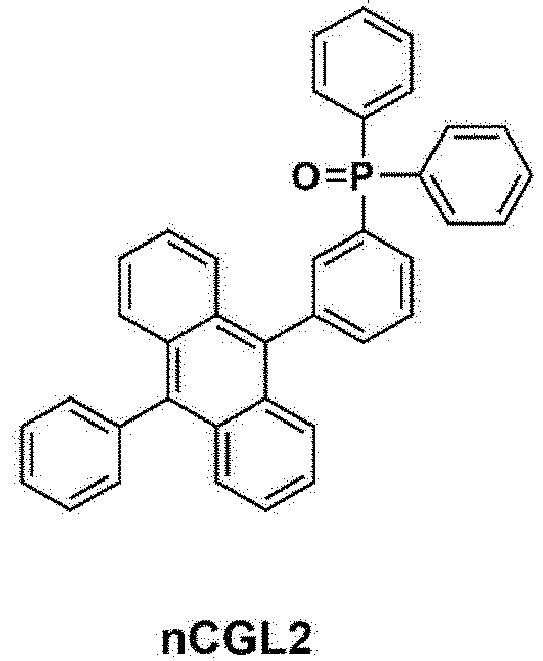
- The driving voltage, luminescence efficiency, and color coordinates of the organic light-emitting devices manufactured according to Examples 1 to 4 and Comparative Examples 1 to 3 were measured at a current density of 10 mA/cm2 by using a Keithley SMU 236 and a luminance meter PR650 (at 600 nit), and results thereof are shown in Table 1.
- In addition, the HOMO energy level, LUMO energy level, S1 energy level, T1 energy level, and minimum bond dissociation energy of the respective Compounds shown in Table 2 were simulated utilizing the Gaussian 09, revision B0.1, software package from Gaussian, Inc., and results thereof are shown in Table 2.
Table 1 First HT layer Emission layer host First ET layer n-type charge-generation laver Driving voltage (V) Luminance (cd/m2) Efficiency (cd/A) Emission color Half lifespan (hr @50 mA/cm2) Example 1 B1 H8 E1 nCGL1 7.1 1500 18.5 blue 1452 Example 2 B1 H8 CE1 nCGL1 7.2 1500 16.5 blue 1357 Example 3 B1 H8 CE2 nCGL1 7.4 1500 17.3 blue 1250 Example 4 B1 H8 E1 nCGL2 6.9 1500 18.4 blue 1350 Comparative Example 1 CB1 H8 E1 nCGL1 7.2 1500 17.5 blue 1350 Comparative Example 2 B1 CH1 E1 nCGL1 7.3 1500 18.1 blue 830 Comparative Example 3 CB2 H8 E1 nCGL1 7.5 1500 17.1 blue 1355 Table 2 Compound HOMO (eV) LUMO (eV) S1(eV) T1(eV) BDE (eV) @exciton+anio n HT1 -5.15 -1.86 3.2 2.5 1.55 B1 -5.42 -1.90 3.3 2.5 1.84 H8 -5.56 -2.53 3.1 1.7 4.12 E1 -6.11 -2.74 3.2 2.7 3.30 CE1 -5.60 -2.58 3.2 1.7 3.35 CE2 -6.30 -3.10 3.1 2.8 1.88 CB1 -5.38 -2.02 3.3 2.6 1.35 CH1 -5.50 -2.50 3.1 1.7 1.45 CB2 -5.42 -2.25 3.3 2.6 1.33 nCGL1 -5.58 -2.48 3.1 2.4 3.50 nCGL2 -5.59 -2.48 3.1 1.7 0.85 - Referring to Tables 1 and 2, it can be seen that the organic light-emitting devices of Examples 1 to 4 have excellent driving voltage, efficiency, and/or lifespan characteristics, as compared with those of the light-emitting devices of Comparative Examples 1 to 3.
- The organic light-emitting device may have a long lifespan.
- It should be understood that the embodiments described herein should be considered in a descriptive sense only and not for purposes of limitation. Descriptions of features or aspects within each embodiment should be considered as available for other similar features or aspects in other embodiments.
- It will be understood that, although the terms "first," "second," "third," etc., may be used herein to describe various elements, components, regions, layers and/or sections, these elements, components, regions, layers and/or sections should not be limited by these terms. These terms are used to distinguish one element, component, region, layer or section from another element, component, region, layer or section. Thus, a first element, component, region, layer or section described below could be termed a second element, component, region, layer or section, without departing from the spirit and scope of the present disclosure.
- Spatially relative terms, such as "beneath," "below," "lower," "under," "above," "upper," and the like, may be used herein for ease of explanation to describe one element or feature's relationship to another element(s) or feature(s) as illustrated in the figures. It will be understood that the spatially relative terms are intended to encompass different orientations of the device in use or in operation, in addition to the orientation depicted in the figures. For example, if the device in the figures is turned over, elements described as "below" or "beneath" or "under" other elements or features would then be oriented "above" the other elements or features. Thus, the example terms "below" and "under" can encompass both an orientation of above and below. The device may be otherwise oriented (e.g., rotated 90 degrees or at other orientations) and the spatially relative descriptors used herein should be interpreted accordingly.
- As used herein, the term "and/or" includes any and all combinations of one or more of the associated listed items. Expressions such as "at least one of," when preceding a list of elements, modify the entire list of elements and do not modify the individual elements of the list.
- As used herein, the terms "substantially," "about," and similar terms are used as terms of approximation and not as terms of degree, and are intended to account for the inherent deviations in measured or calculated values that would be recognized by those of ordinary skill in the art. Further, the use of "may" when describing embodiments of the present disclosure refers to "one or more embodiments of the present disclosure." As used herein, the terms "use," "using," and "used" may be considered synonymous with the terms "utilize," "utilizing," and "utilized," respectively. Also, the term "exemplary" is intended to refer to an example or illustration.
- Also, any numerical range recited herein is intended to include all subranges of the same numerical precision subsumed within the recited range. For example, a range of "1.0 to 10.0" is intended to include all subranges between (and including) the recited minimum value of 1.0 and the recited maximum value of 10.0, that is, having a minimum value equal to or greater than 1.0 and a maximum value equal to or less than 10.0, such as, for example, 2.4 to 7.6. Any maximum numerical limitation recited herein is intended to include all lower numerical limitations subsumed therein, and any minimum numerical limitation recited in this specification is intended to include all higher numerical limitations subsumed therein.
- While one or more embodiments have been described with reference to the figures, it will be understood by those of ordinary skill in the art that various suitable changes in form and details may be made therein without departing from the scope as defined by the following claims, and equivalents thereof.
Claims (15)
- An organic light-emitting device comprising:a first electrode;a second electrode facing the first electrode; andan organic layer between the first electrode and the second electrode and comprising at least one light-emitting unit,wherein the at least one light-emitting unit comprises:an emission layer; anda hole transport region between the first electrode and the emission layer and comprising a first hole transport layer,the emission layer comprises a host,the first hole transport layer comprises a first compound,a minimum bond dissociation energy (BDE1HT) of the first compound is larger than a triplet energy (T1,host) of the host, anda minimum bond dissociation energy (BDEhost) of the host is larger than the triplet energy (T1,host) of the host.
- An organic light-emitting device according to claim 1, wherein:
a singlet energy (S1,host) of the host and the triplet energy (T1,host) of the host satisfy Equation T:
a ratio of a triplet-triplet fusion (TTF) component to a total emission component emitted from the emission layer is 30 % or more. - An organic light-emitting device according to claim 1 or claim 2, wherein:a lowest unoccupied molecular orbital (LUMO) energy (LUMO1HT) of the first compound and a LUMO energy (LUMOhost) of the host satisfy Equation A, andan electron mobility (µhost) of the host and an electron mobility (µ1HT) of the first compound satisfy Equation B:

 the first hole transport layer is in direct contact with the emission layer.
 - An organic light-emitting device according to any one of claims 1 to 3, wherein:the at least one light-emitting unit further comprises an electron transport region between the second electrode and the emission layer and comprising a first electron transport (ET) layer,the first electron transport layer comprises a second compound, anda triplet energy (T1,1ET) of the second compound is larger than the triplet energy (T1,host) of the host, optionally wherein:
the LUMO energy (LUMOhost) of the host and the LUMO energy (LUMO1ET) of the second compound satisfy Equation E:
- An organic light-emitting device according to claim 4, wherein:
the first electron transport layer is in direct contact with the emission layer. - An organic light-emitting device according to any one of claims 1 to 5, wherein:
the host comprises a compound represented by Formula 30: L31 and L32 are each independently a substituted or unsubstituted C6-C60 arylene group,m31 and m32 are each independently an integer from 0 to 5,Ar31, Ar32, and R31 to R38 are each independently selected from hydrogen, deuterium, -F, -CI, -Br, -I, a hydroxyl group, a cyano group, a nitro group, an amidino group, a hydrazino group, a hydrazono group, a substituted or unsubstituted C1-C60 alkyl group, a substituted or unsubstituted C2-C60 alkenyl group, a substituted or unsubstituted C2-C60 alkynyl group, a substituted or unsubstituted C1-C60 alkoxy group, a substituted or unsubstituted C6-C60 aryl group, a substituted or unsubstituted C6-C60 aryloxy group, a substituted or unsubstituted C6-C60 arylthio group, a substituted or unsubstituted C1-C60 heteroaryl group, a substituted or unsubstituted monovalent non-aromatic condensed polycyclic group, a substituted or unsubstituted monovalent non-aromatic condensed heteropolycyclic group, -Si(Q1)(Q2)(Q3), -B(Q1)(Q2), -C(=O)(Q1), - N(Q1)(Q2), -P(=O)(Q1)(Q2), and -S(=O)2(Q1)(Q2),at least one selected from Ar31 and Ar32 is a substituted or unsubstituted C6-C60 aryl group,at least one substituent of the substituted C6-C60 arylene group, the substituted C1-C60 alkyl group, the substituted C2-C60 alkenyl group, the substituted C2-C60 alkynyl group, the substituted C1-C60 alkoxy group, the substituted C6-C60 aryl group, the substituted C6-C60 aryloxy group, the substituted C6-C60 arylthio group, the substituted C1-C60 heteroaryl group, the substituted monovalent non-aromatic condensed polycyclic group, and the substituted monovalent non-aromatic condensed heteropolycyclic group is selected from:deuterium, -F, -CI, -Br, -I, a hydroxyl group, a cyano group, a nitro group, an amidino group, a hydrazino group, a hydrazono group, a C1-C60 alkyl group, a C2-C60 alkenyl group, a C2-C60 alkynyl group, and a C1-C60 alkoxy group;a C1-C60 alkyl group, a C2-C60 alkenyl group, a C2-C60 alkynyl group, and a C1-C60 alkoxy group, each substituted with at least one selected from deuterium, -F, -CI, - Br, -I, a hydroxyl group, a cyano group, a nitro group, an amidino group, a hydrazino group, a hydrazono group, a C3-C10 cycloalkyl group, a C1-C10 heterocycloalkyl group, a C3-C10 cycloalkenyl group, a C1-C10 heterocycloalkenyl group, a C6-C60 aryl group, a C6-C60 aryloxy group, a C6-C60 arylthio group, a C1-C60 heteroaryl group, a monovalent non-aromatic condensed polycyclic group, a monovalent non-aromatic condensed heteropolycyclic group, -Si(Q11)(Q12)(Q13), -N(Q11)(Q12), -B(Q11)(Q12), -C(=O)(Q11), - S(=O)2(Q11), and -P(=O)(Q11)(Q12);a C3-C10 cycloalkyl group, a C1-C10 heterocycloalkyl group, a C3-C10 cycloalkenyl group, a C1-C10 heterocycloalkenyl group, a C6-C60 aryl group, a C6-C60 aryloxy group, a C6-C60 arylthio group, a C1-C60 heteroaryl group, a monovalent non-aromatic condensed polycyclic group, and a monovalent non-aromatic condensed heteropolycyclic group;a C3-C10 cycloalkyl group, a C1-C10 heterocycloalkyl group, a C3-C10 cycloalkenyl group, a C1-C10 heterocycloalkenyl group, a C6-C60 aryl group, a C6-C60 aryloxy group, a C6-C60 arylthio group, a C1-C60 heteroaryl group, a monovalent non-aromatic condensed polycyclic group, and a monovalent non-aromatic condensed heteropolycyclic group, each substituted with at least one selected from deuterium, -F, -CI, -Br, -I, a hydroxyl group, a cyano group, a nitro group, an amidino group, a hydrazino group, a hydrazono group, a C1-C60 alkyl group, a C2-C60 alkenyl group, a C2-C60 alkynyl group, a C1-C60 alkoxy group, a C3-C10 cycloalkyl group, a C1-C10 heterocycloalkyl group, a C3-C10 cycloalkenyl group, a C1-C10 heterocycloalkenyl group, a C6-C60 aryl group, a C6-C60 aryloxy group, a C6-C60 arylthio group, a C1-C60 heteroaryl group, a monovalent non-aromatic condensed polycyclic group, a monovalent non-aromatic condensed heteropolycyclic group, -Si(Q21)(Q22)(Q23), - N(Q21)(Q22), -B(Q21)(Q22), -C(=O)(Q21), -S(=O)2(Q21), and -P(=O)(Q21)(Q22); and-Si(Q31)(Q32)(Q33), -N(Q31)(Q32), -B(Q31)(Q32), -C(=O)(Q31), -S(=O)2(Q31), and - P(=O)(Q31)(Q32), andQ1 to Q3, Q11 to Q13, Q21 to Q23, and Q31 to Q33 are each independently selected from hydrogen, deuterium, -F, -CI, -Br, -I, a hydroxyl group, a cyano group, a nitro group, an amidino group, a hydrazino group, a hydrazono group, a C1-C60 alkyl group, a C2-C60 alkenyl group, a C2-C60 alkynyl group, a C1-C60 alkoxy group, a C3-C10 cycloalkyl group, a C1-C10 heterocycloalkyl group, a C3-C10 cycloalkenyl group, a C1-C10 heterocycloalkenyl group, a C6-C60 aryl group, a C1-C60 heteroaryl group, a monovalent non-aromatic condensed polycyclic group, a monovalent non-aromatic condensed heteropolycyclic group, a biphenyl group, and a terphenyl group, optionally wherein:
the host comprises a compound represented by Formula 31 or 32:
 L31, L32, m31, m32, Ar31, and R31 to R38 are each independently the same as respectively described in claim 9,R41 to R47 and R42 are each independently selected from hydrogen, deuterium,-F, -Cl, -Br, -I, a hydroxyl group, a cyano group, a nitro group, an amidino group, a hydrazino group, a hydrazono group, a C1-C60 alkyl group, a C2-C60 alkenyl group, a C2-C60 alkynyl group, a C1-C60 alkoxy group, a C6-C60 aryl group, a monovalent non-aromatic condensed polycyclic group, a biphenyl group, and a terphenyl group, andat least two neighboring substituents selected from R41 and R42 are optionally linked to form a substituted or unsubstituted C6-C60 carbocyclic group.
 - An organic light-emitting device according to any one of claims 1 to 6, wherein:
the first compound comprises a compound represented by Formula 40: Y1 is N or P,X1 to X3 are each independently a single bond, O, S, N(R2), C(R2)(R3), or Si(R2)(R3),m1 is 0, 1, or 2, wherein, when m1 is 0, A1 and A2 are not linked with each other,A1 to A3 are each independently a C5-C60 carbocyclic group or a C1-C60 heterocyclic group,n1 is an integer from 2 to 4,Ar1 is a substituted or unsubstituted n1-valent C3-C60 carbocyclic group or a substituted or unsubstituted n1-valent C1-C60 heterocyclic group,R2, R3, R10, R20, and R30 are each independently selected from hydrogen, deuterium, -F, -Cl, -Br, -I, a hydroxyl group, a cyano group, a nitro group, an amidino group, a hydrazino group, a hydrazono group, a substituted or unsubstituted C1-C60 alkyl group, a substituted or unsubstituted C2-C60 alkenyl group, a substituted or unsubstituted C2-C60 alkynyl group, a substituted or unsubstituted C1-C60 alkoxy group, a substituted or unsubstituted C3-C10 cycloalkyl group, a substituted or unsubstituted C1-C10 heterocycloalkyl group, a substituted or unsubstituted C3-C10 cycloalkenyl group, a substituted or unsubstituted C1-C10 heterocycloalkenyl group, a substituted or unsubstituted C6-C60 aryl group, a substituted or unsubstituted C6-C60 aryloxy group, a substituted or unsubstituted C6-C60 arylthio group, a substituted or unsubstituted C1-C60 heteroaryl group, a substituted or unsubstituted monovalent non-aromatic condensed polycyclic group, a substituted or unsubstituted monovalent non-aromatic condensed heteropolycyclic group, -Si(Q1)(Q2)(Q3), -B(Q1)(Q2), -C(=O)(Q1), -N(Q1)(Q2),-P(=O)(Q1)(Q2), and -S(=O)2(Q1)(Q2),at least one substituent of the substituted C5-C60 carbocyclic group, the substituted C1-C60 heterocyclic group, the substituted C1-C60 alkyl group, the substituted C2-C60 alkenyl group, the substituted C2-C60 alkynyl group, the substituted C1-C60 alkoxy group, the substituted C3-C10 cycloalkyl group, the substituted C1-C10 heterocycloalkyl group, the substituted C3-C10 cycloalkenyl group, the substituted C1-C10 heterocycloalkenyl group, the substituted C6-C60 aryl group, the substituted C6-C60 aryloxy group, the substituted C6-C60 arylthio group, the substituted C1-C60 heteroaryl group, the substituted monovalent non-aromatic condensed polycyclic group, and the substituted monovalent non-aromatic condensed heteropolycyclic group is selected from:deuterium, -F, -Cl, -Br, -I, a hydroxyl group, a cyano group, a nitro group, an amidino group, a hydrazino group, a hydrazono group, a C1-C60 alkyl group, a C2-C60 alkenyl group, a C2-C60 alkynyl group, and a C1-C60 alkoxy group;a C1-C60 alkyl group, a C2-C60 alkenyl group, a C2-C60 alkynyl group, and a C1-C60 alkoxy group, each substituted with at least one selected from deuterium, -F, -Cl,-Br, -I, a hydroxyl group, a cyano group, a nitro group, an amidino group, a hydrazino group, a hydrazono group, a C3-C10 cycloalkyl group, a C1-C10 heterocycloalkyl group, a C3-C10 cycloalkenyl group, a C1-C10 heterocycloalkenyl group, a C6-C60 aryl group, a C6-C60 aryloxy group, a C6-C60 arylthio group, a C1-C60 heteroaryl group, a monovalent non-aromatic condensed polycyclic group, a monovalent non-aromatic condensed heteropolycyclic group, -Si(Q11)(Q12)(Q13), -N(Q11)(Q12), -B(Q11)(Q12), -C(=O)(Q11),-S(=O)2(Q11), and -P(=O)(Q11)(Q12);a C3-C10 cycloalkyl group, a C1-C10 heterocycloalkyl group, a C3-C10 cycloalkenyl group, a C1-C10 heterocycloalkenyl group, a C6-C60 aryl group, a C6-C60 aryloxy group, a C6-C60 arylthio group, a C1-C60 heteroaryl group, a monovalent non-aromatic condensed polycyclic group, and a monovalent non-aromatic condensed heteropolycyclic group;a C3-C10 cycloalkyl group, a C1-C10 heterocycloalkyl group, a C3-C10 cycloalkenyl group, a C1-C10 heterocycloalkenyl group, a C6-C60 aryl group, a C6-C60 aryloxy group, a C6-C60 arylthio group, a C1-C60 heteroaryl group, a monovalent non-aromatic condensed polycyclic group, and a monovalent non-aromatic condensed heteropolycyclic group, each substituted with at least one selected from deuterium, -F, -Cl, -Br, -I, a hydroxyl group, a cyano group, a nitro group, an amidino group, a hydrazino group, a hydrazono group, a C1-C60 alkyl group, a C2-C60 alkenyl group, a C2-C60 alkynyl group, a C1-C60 alkoxy group, a C3-C10 cycloalkyl group, a C1-C10 heterocycloalkyl group, a C3-C10 cycloalkenyl group, a C1-C10 heterocycloalkenyl group, a C6-C60 aryl group, a C6-C60 aryloxy group, a C6-C60 arylthio group, a C1-C60 heteroaryl group, a monovalent non-aromatic condensed polycyclic group, a monovalent non-aromatic condensed heteropolycyclic group, -Si(Q21)(Q22)(Q23),-N(Q21)(Q22), -B(Q21)(Q22), -C(=O)(Q21), -S(=O)2(O21), and -P(=O)(Q21)(Q22); and-Si(Q31)(Q32)(Q33), -N(Q31)(Q32), -B(Q31)(Q32), -C(=O)(Q31), -S(=O)2(Q31), and-P(=O)(Q31)(Q32), andQ1 to Q3, Q11 to Q13, Q21 to Q23, and Q31 to Q33 are each independently selected from hydrogen, deuterium, -F, -Cl, -Br, -I, a hydroxyl group, a cyano group, a nitro group, an amidino group, a hydrazino group, a hydrazono group, a C1-C60 alkyl group, a C2-C60 alkenyl group, a C2-C60 alkynyl group, a C1-C60 alkoxy group, a C3-C10 cycloalkyl group, a C1-C10 heterocycloalkyl group, a C3-C10 cycloalkenyl group, a C1-C10 heterocycloalkenyl group, a C6-C60 aryl group, a C1-C60 heteroaryl group, a monovalent non-aromatic condensed polycyclic group, a monovalent non-aromatic condensed heteropolycyclic group, a biphenyl group, and a terphenyl group, optionally wherein:
the first compound comprises a compound represented by Formula 41: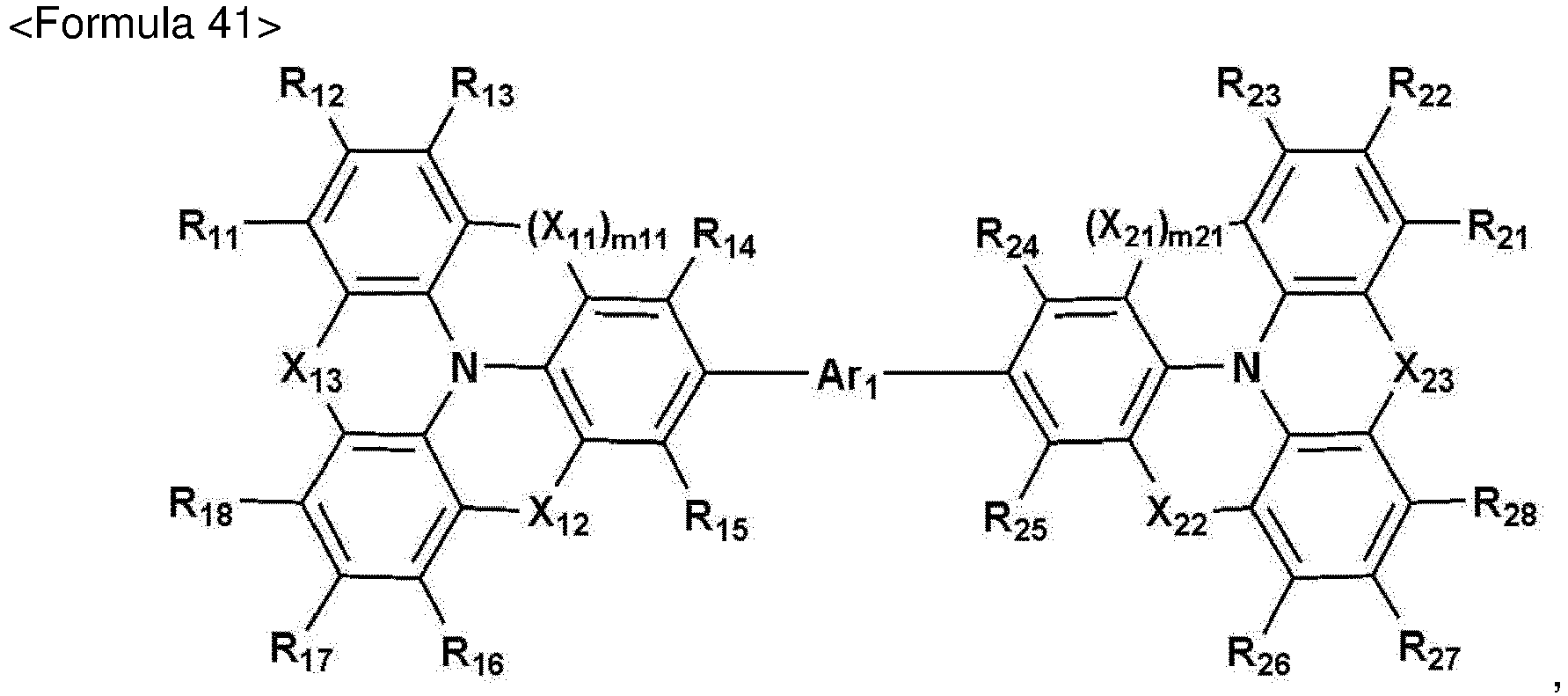 X11 to X13 are each independently a single bond, O, S, N(R4), C(R4)(R5), or Si(R4)(R5),X21 to X23 are each independently a single bond, O, S, N(R6), C(R6)(R7), or Si(R6)(R7),m11 and m21 are each independently 0, 1, or 2,Ar1 is selected from a substituted or unsubstituted C3-C10 cycloalkylene group, a substituted or unsubstituted C1-C10 heterocycloalkylene group, a substituted or unsubstituted C3-C10 cycloalkenylene group, a substituted or unsubstituted C1-C10 heterocycloalkenylene group, a substituted or unsubstituted C6-C60 arylene group, a substituted or unsubstituted C1-C60 heteroarylene group, a substituted or unsubstituted divalent non-aromatic condensed polycyclic group, and a substituted or unsubstituted divalent non-aromatic condensed heteropolycyclic group, andR4 to R7, R11 to R18, and R21 to R28 are each independently selected from a substituted or unsubstituted C6-C60 aryl group, a substituted or unsubstituted C1-C60 heteroaryl group, a substituted or unsubstituted monovalent non-aromatic condensed polycyclic group, a substituted or unsubstituted monovalent non-aromatic condensed heteropolycyclic group, -Si(Q1)(Q2)(Q3), -B(Q1)(Q2), -C(=O)(Q1), -N(Q1)(Q2),-P(=O)(Q1)(Q2), and -S(=O)2(Q1)(Q2).
 - An organic light-emitting device according to any one of claims 4 to 7, wherein:
the second compound comprises a compound represented by Formula 50: Y51 to Y53 are each independently N or C(R50),at least one selected from Y51 to Y53 is N,X51 is O, S, N(R59), C(R59)(R60), or Si(R59)(R60),Ar51 is linked with one selected from R51 to R58,Ar52, Ar53, and R50 to R60 are each independently selected from hydrogen, deuterium, -F, -Cl, -Br, -I, a hydroxyl group, a cyano group, a nitro group, an amidino group, a hydrazino group, a hydrazono group, a substituted or unsubstituted C1-C60 alkyl group, a substituted or unsubstituted C2-C60 alkenyl group, a substituted or unsubstituted C2-C60 alkynyl group, a substituted or unsubstituted C1-C60 alkoxy group, a substituted or unsubstituted C3-C10 cycloalkyl group, a substituted or unsubstituted C1-C10 heterocycloalkyl group, a substituted or unsubstituted C3-C10 cycloalkenyl group, a substituted or unsubstituted C1-C10 heterocycloalkenyl group, a substituted or unsubstituted C6-C60 aryl group, a substituted or unsubstituted C6-C60 aryloxy group, a substituted or unsubstituted C6-C60 arylthio group, a substituted or unsubstituted C1-C60 heteroaryl group, a substituted or unsubstituted monovalent non-aromatic condensed polycyclic group, a substituted or unsubstituted monovalent non-aromatic condensed heteropolycyclic group, -Si(Q1)(Q2)(Q3), -B(Q1)(Q2), -C(=O)(Q1), -N(Q1)(Q2),-P(=O)(Q1)(Q2), and -S(=O)2(Q1)(Q2),R59 and R60 are optionally linked to form a substituted or unsubstituted C5-C60 carbocyclic group or a substituted or unsubstituted C1-C60 heterocyclic group,at least one substituent of the substituted C5-C60 carbocyclic group, the substituted C1-C60 heterocyclic group, the substituted C1-C60 alkyl group, the substituted C2-C60 alkenyl group, the substituted C2-C60 alkynyl group, the substituted C1-C60 alkoxy group, the substituted C3-C10 cycloalkyl group, the substituted C1-C10 heterocycloalkyl group, the substituted C3-C10 cycloalkenyl group, the substituted C1-C10 heterocycloalkenyl group, the substituted C6-C60 aryl group, the substituted C6-C60 aryloxy group, the substituted C6-C60 arylthio group, the substituted C1-C60 heteroaryl group, the substituted monovalent non-aromatic condensed polycyclic group, and the substituted monovalent non-aromatic condensed heteropolycyclic group is selected from:deuterium, -F, -Cl, -Br, -I, a hydroxyl group, a cyano group, a nitro group, an amidino group, a hydrazino group, a hydrazono group, a C1-C60 alkyl group, a C2-C60 alkenyl group, a C2-C60 alkynyl group, and a C1-C60 alkoxy group;a C1-C60 alkyl group, a C2-C60 alkenyl group, a C2-C60 alkynyl group, and a C1-C60 alkoxy group, each substituted with at least one selected from deuterium, -F, -Cl,-Br, -I, a hydroxyl group, a cyano group, a nitro group, an amidino group, a hydrazino group, a hydrazono group, a C3-C10 cycloalkyl group, a C1-C10 heterocycloalkyl group, a C3-C10 cycloalkenyl group, a C1-C10 heterocycloalkenyl group, a C6-C60 aryl group, a C6-C60 aryloxy group, a C6-C60 arylthio group, a C1-C60 heteroaryl group, a monovalent non-aromatic condensed polycyclic group, a monovalent non-aromatic condensed heteropolycyclic group, -Si(Q11)(Q12)(Q13), -N(Q11)(Q12), -B(Q11)(Q12), -C(=O)(Q11),-S(=O)2(Q11), and -P(=O)(Q11)(Q12);a C3-C10 cycloalkyl group, a C1-C10 heterocycloalkyl group, a C3-C10 cycloalkenyl group, a C1-C10 heterocycloalkenyl group, a C6-C60 aryl group, a C6-C60 aryloxy group, a C6-C60 arylthio group, a C1-C60 heteroaryl group, a monovalent non-aromatic condensed polycyclic group, and a monovalent non-aromatic condensed heteropolycyclic group;a C3-C10 cycloalkyl group, a C1-C10 heterocycloalkyl group, a C3-C10 cycloalkenyl group, a C1-C10 heterocycloalkenyl group, a C6-C60 aryl group, a C6-C60 aryloxy group, a C6-C60 arylthio group, a C1-C60 heteroaryl group, a monovalent non-aromatic condensed polycyclic group, and a monovalent non-aromatic condensed heteropolycyclic group, each substituted with at least one selected from deuterium, -F, -Cl, -Br, -I, a hydroxyl group, a cyano group, a nitro group, an amidino group, a hydrazino group, a hydrazono group, a C1-C60 alkyl group, a C2-C60 alkenyl group, a C2-C60 alkynyl group, a C1-C60 alkoxy group, a C3-C10 cycloalkyl group, a C1-C10 heterocycloalkyl group, a C3-C10 cycloalkenyl group, a C1-C10 heterocycloalkenyl group, a C6-C60 aryl group, a C6-C60 aryloxy group, a C6-C60 arylthio group, a C1-C60 heteroaryl group, a monovalent non-aromatic condensed polycyclic group, a monovalent non-aromatic condensed heteropolycyclic group, -Si(Q21)(Q22)(Q23),-N(Q21)(Q22), -B(Q21)(Q22), -C(=O)(Q21), -S(=O)2(Q21), and -P(=O)(Q21)(Q22); and-Si(Q31)(Q32)(Q33), -N(Q31)(Q32), -B(Q31)(Q32), -C(=O)(Q31), -S(=O)2(Q31), and-P(=O)(Q31)(Q32), andQ1 to Q3, Q11 to Q13, Q21 to Q23, and Q31 to Q33 are each independently selected from hydrogen, deuterium, -F, -Cl, -Br, -I, a hydroxyl group, a cyano group, a nitro group, an amidino group, a hydrazino group, a hydrazono group, a C1-C60 alkyl group, a C2-C60 alkenyl group, a C2-C60 alkynyl group, a C1-C60 alkoxy group, a C3-C10 cycloalkyl group, a C1-C10 heterocycloalkyl group, a C3-C10 cycloalkenyl group, a C1-C10 heterocycloalkenyl group, a C6-C60 aryl group, a C1-C60 heteroaryl group, a monovalent non-aromatic condensed polycyclic group, a monovalent non-aromatic condensed heteropolycyclic group, a biphenyl group, and a terphenyl group.
 - The organic light-emitting device of claim 8, wherein:
the second compound comprises a compound represented by Formula 51: Y51 to Y53 are each independently the same as described in claim 13,Ar52, Ar53, R50 to R52, and R54 to R58 are each independently selected from hydrogen, deuterium, -F, -Cl, -Br, -I, a hydroxyl group, a cyano group, a nitro group, an amidino group, a hydrazino group, a hydrazono group, a C1-C20 alkyl group, a C1-C20 alkoxy group, a phenyl group, a biphenyl group, a terphenyl group, and a naphthyl group, andR59 and R60 are linked to form a C5-C60 carbocyclic group.
 - An organic light-emitting device according to any one of claims 1 to 9, wherein:the emission layer further comprises a dopant, andan amount of the host is larger than an amount of the dopant.
- An organic light-emitting device according to claim 10, wherein:
the dopant comprises a compound represented by Formula 501: Ar501 is a substituted or unsubstituted C5-C60 carbocyclic group or a substituted or unsubstituted C1-C60 heterocyclic group,L501 to L503 are each independently selected from a substituted or unsubstituted C3-C10 cycloalkylene group, a substituted or unsubstituted C1-C10 heterocycloalkylene group, a substituted or unsubstituted C3-C10 cycloalkenylene group, a substituted or unsubstituted C1-C10 heterocycloalkenylene group, a substituted or unsubstituted C6-C60 arylene group, a substituted or unsubstituted C1-C60 heteroarylene group, a substituted or unsubstituted divalent non-aromatic condensed polycyclic group, and a substituted or unsubstituted divalent non-aromatic condensed heteropolycyclic group,xd1 to xd3 are each independently an integer from 0 to 3,R501 and R502 are each independently selected from a substituted or unsubstituted C3-C10 cycloalkyl group, a substituted or unsubstituted C1-C10 heterocycloalkyl group, a substituted or unsubstituted C3-C10 cycloalkenyl group, a substituted or unsubstituted C1-C10 heterocycloalkenyl group, a substituted or unsubstituted C6-C60 aryl group, a substituted or unsubstituted C6-C60 aryloxy group, a substituted or unsubstituted C6-C60 arylthio group, a substituted or unsubstituted C1-C60 heteroaryl group, a substituted or unsubstituted monovalent non-aromatic condensed polycyclic group, and a substituted or unsubstituted monovalent non-aromatic condensed heteropolycyclic group, andxd4 is an integer from 1 to 6.
 - An organic light-emitting device according to any one of claims 1 to 11, wherein:the organic layer comprises:light-emitting units in a number of m; andcharge-generation layers in a number of m-1 between two neighboring light-emitting units among the light-emitting units in the number of m,the charge-generation layer comprises an n-type charge-generation layer and a p-type charge-generation layer, wherein the n-type charge-generation layer comprises an n-type charge-generation material, and the p-type charge-generation layer comprises a hole transport material,m is an integer of 2 or more,a maximum emission wavelength emitted by at least one light-emitting unit among the light-emitting units in the number of m is different from a maximum emission wavelength emitted by at least one light-emitting unit among the remaining light-emitting units; anda difference between an absolute value of a lowest unoccupied molecular orbital (LUMO) energy (LUMOnCGL) of the n-type charge-generation material comprised in the n-type charge-generation layer and an absolute value of highest occupied molecular orbital (HOMO) energy (HOMOpCGL) of the hole transport material comprised in the p-type charge-generation layer is less than about 3.0 eV.
- An organic light-emitting device according to claim 12, wherein:
the n-type charge-generation material comprises a compound represented by one selected from Formulae 90 and 91:
 X91 to X100 are each independently N or C(R90),at least one selected from X91 to X100 is N,L91 and L92 are each independently selected from a substituted or unsubstituted C3-C10 cycloalkylene group, a substituted or unsubstituted C1-C10 heterocycloalkylene group, a substituted or unsubstituted C3-C10 cycloalkenylene group, a substituted or unsubstituted C1-C10 heterocycloalkenylene group, a substituted or unsubstituted C6-C60 arylene group, a substituted or unsubstituted C1-C60 heteroarylene group, a substituted or unsubstituted divalent non-aromatic condensed polycyclic group, and a substituted or unsubstituted divalent non-aromatic condensed heteropolycyclic group,a91 and a92 are each independently an integer from 0 to 5,R90 and R91 are each independently selected from hydrogen, deuterium, -F, -Cl, -Br, -I, a hydroxyl group, a cyano group, a nitro group, an amidino group, a hydrazino group, a hydrazono group, a substituted or unsubstituted C1-C20 alkyl group, a substituted or unsubstituted C1-C20 alkoxy group, a substituted or unsubstituted C3-C10 cycloalkyl group, a substituted or unsubstituted C1-C10 heterocycloalkyl group, a substituted or unsubstituted C3-C10 cycloalkenyl group, a substituted or unsubstituted C1-C10 heterocycloalkenyl group, a substituted or unsubstituted C6-C60 aryl group, a substituted or unsubstituted C6-C60 aryloxy group, a substituted or unsubstituted C6-C60 arylthio group, a substituted or unsubstituted C1-C60 heteroaryl group, a substituted or unsubstituted monovalent non-aromatic condensed polycyclic group, a substituted or unsubstituted monovalent non-aromatic condensed heteropolycyclic group,-Si(Q91)(Q92)(Q93), -C(=O)(Q91), -S(=O)2(Q91), and -P(=O)(Q91)(Q92), andQ91 to Q93 are each independently a C1-C10 alkyl group, a C1-C10 alkoxy group, a phenyl group, a biphenyl group, a terphenyl group, or a naphthyl group.
 - An organic light-emitting device according to Claim 1 wherein:the organic layer comprises:light-emitting units in a number of m; andcharge-generation layers in a number of m-1 between two neighboring light-emitting units among the light-emitting units in the number of m,the light-emitting units each further comprise:an electron transport region between the second electrode and the emission layer and comprising a first electron transport layer,the first electron transport layer comprises a second compound,a triplet energy (T1,1ET) of the second compound is larger than the triplet energy (T1,host) of the host,the charge-generation layer comprises an n-type charge-generation layer and a p-type charge-generation layer, wherein the n-type charge-generation layer comprises an n-type charge-generation material, and the p-type charge-generation layer comprises a hole transport material,m is an integer of 2 or more,a maximum emission wavelength emitted by at least one light-emitting unit among the light-emitting units in the number of m is different from a maximum emission wavelength emitted by at least one light-emitting unit among the remaining light-emitting units; anda difference between an absolute value of a lowest unoccupied molecular orbital (LUMO) energy (LUMOnCGL) of the n-type charge-generation material comprised in the n-type charge-generation layer and an absolute value of highest occupied molecular orbital (HOMO) energy (HOMOpCGL) of the hole transport material comprised in the p-type charge-generation layer is less than about 3.0 eV, whereinthe host is Compound H8,the first compound is Compound B1,the second compound is Compound E1,the n-type charge-generation material comprised in the n-type charge-generation layer is Compound nCGL1 or nCGL2, andthe hole transport material comprised in the p-type charge-generation layer is Compound HT1:


- A display apparatus comprising:a thin-film transistor comprising a source electrode, a drain electrode, and an active layer; andthe organic light-emitting device according to any one of claims 1 to 14,wherein the first electrode of the organic light-emitting device is electrically coupled to one of the source electrode and the drain electrode of the thin-film transistor.
Applications Claiming Priority (1)
| Application Number | Priority Date | Filing Date | Title |
|---|---|---|---|
| KR1020190030025A KR102684269B1 (en) | 2019-03-15 | 2019-03-15 | Organic light emitting device and display apparatus comprising the same |
Publications (2)
| Publication Number | Publication Date |
|---|---|
| EP3709379A1 true EP3709379A1 (en) | 2020-09-16 |
| EP3709379B1 EP3709379B1 (en) | 2022-08-24 |
Family
ID=69779985
Family Applications (1)
| Application Number | Title | Priority Date | Filing Date |
|---|---|---|---|
| EP20161422.9A Active EP3709379B1 (en) | 2019-03-15 | 2020-03-06 | Organic light-emitting device and display apparatus including the same |
Country Status (4)
| Country | Link |
|---|---|
| US (2) | US11569454B2 (en) |
| EP (1) | EP3709379B1 (en) |
| KR (1) | KR102684269B1 (en) |
| CN (1) | CN111697143B (en) |
Cited By (1)
| Publication number | Priority date | Publication date | Assignee | Title |
|---|---|---|---|---|
| EP3848991A1 (en) * | 2020-01-08 | 2021-07-14 | Samsung Display Co., Ltd. | Light-emitting device, method of manufacturing the same, and apparatus including light-emitting device |
Families Citing this family (6)
| Publication number | Priority date | Publication date | Assignee | Title |
|---|---|---|---|---|
| KR102706309B1 (en) * | 2018-09-21 | 2024-09-19 | 삼성디스플레이 주식회사 | Organic electroluminescence device and manufacturing method of the same |
| KR102684269B1 (en) * | 2019-03-15 | 2024-07-12 | 삼성디스플레이 주식회사 | Organic light emitting device and display apparatus comprising the same |
| KR102308111B1 (en) * | 2019-12-04 | 2021-10-05 | 비피시 주식회사 | Hole Transfer Compound and Organic Light-Emitting Diodes Using The same |
| WO2022041200A1 (en) * | 2020-08-31 | 2022-03-03 | 京东方科技集团股份有限公司 | Organic electroluminescent device |
| CN114507254A (en) * | 2020-11-17 | 2022-05-17 | 上海和辉光电股份有限公司 | Compound and application thereof |
| CN113540374B (en) * | 2021-07-15 | 2023-01-13 | 京东方科技集团股份有限公司 | Light emitting device, display panel and display apparatus |
Citations (4)
| Publication number | Priority date | Publication date | Assignee | Title |
|---|---|---|---|---|
| US20090242877A1 (en) * | 2008-03-25 | 2009-10-01 | Eastman Kodak Company | Oled device with hole-transport and electron-transport materials |
| US20160126476A1 (en) * | 2013-01-30 | 2016-05-05 | Lms Co., Ltd | Novel compound, light emitting device comprising same, and electronic device |
| US20170331039A1 (en) * | 2016-05-12 | 2017-11-16 | Samsung Display Co., Ltd. | Organic light-emitting device |
| EP3670519A2 (en) * | 2018-12-17 | 2020-06-24 | Samsung Display Co., Ltd. | Condensed cyclic compound, organic light-emitting device including the same, and display apparatus including the organic light-emitting device |
Family Cites Families (14)
| Publication number | Priority date | Publication date | Assignee | Title |
|---|---|---|---|---|
| KR100787425B1 (en) * | 2004-11-29 | 2007-12-26 | 삼성에스디아이 주식회사 | Phenylcarbazole compound and organic electroluminescent device using same |
| KR100863905B1 (en) * | 2007-01-15 | 2008-10-17 | 삼성에스디아이 주식회사 | Fluorine-containing compound and organic light emitting device using same |
| US8476823B2 (en) | 2009-05-22 | 2013-07-02 | Idemitsu Kosan Co., Ltd. | Organic electroluminescent device |
| US20100295444A1 (en) | 2009-05-22 | 2010-11-25 | Idemitsu Kosan Co., Ltd. | Organic electroluminescence device |
| KR101311934B1 (en) * | 2009-06-08 | 2013-09-26 | 제일모직주식회사 | Composition for organic photoelectric device and organic photoelectric device using the same |
| KR20120029258A (en) * | 2010-09-16 | 2012-03-26 | 주식회사 알파켐 | Heteroaromatic cycle compound and organic light emitting diode using the same |
| JP5845599B2 (en) * | 2011-03-11 | 2016-01-20 | コニカミノルタ株式会社 | Organic electroluminescence element, display device and lighting device |
| KR102427671B1 (en) | 2015-09-07 | 2022-08-02 | 삼성디스플레이 주식회사 | Organic light emitting device |
| KR101579490B1 (en) * | 2015-09-17 | 2015-12-22 | 덕산네오룩스 주식회사 | Compound for organic electronic element, organic electronic element using the same, and an electronic device thereof |
| KR102393090B1 (en) | 2015-11-30 | 2022-04-29 | 엘지디스플레이 주식회사 | Organic light emitting diode |
| KR102419178B1 (en) * | 2015-12-29 | 2022-07-11 | 삼성디스플레이 주식회사 | Organic light-emitting device |
| KR102600474B1 (en) | 2016-03-10 | 2023-11-13 | 삼성디스플레이 주식회사 | Organic light emitting device |
| KR20170127101A (en) | 2016-05-10 | 2017-11-21 | 삼성디스플레이 주식회사 | Organic light emitting device |
| KR102684269B1 (en) * | 2019-03-15 | 2024-07-12 | 삼성디스플레이 주식회사 | Organic light emitting device and display apparatus comprising the same |
-
2019
- 2019-03-15 KR KR1020190030025A patent/KR102684269B1/en active Active
-
2020
- 2020-03-06 CN CN202010149617.5A patent/CN111697143B/en active Active
- 2020-03-06 EP EP20161422.9A patent/EP3709379B1/en active Active
- 2020-03-09 US US16/813,539 patent/US11569454B2/en active Active
-
2023
- 2023-01-27 US US18/160,631 patent/US12063857B2/en active Active
Patent Citations (4)
| Publication number | Priority date | Publication date | Assignee | Title |
|---|---|---|---|---|
| US20090242877A1 (en) * | 2008-03-25 | 2009-10-01 | Eastman Kodak Company | Oled device with hole-transport and electron-transport materials |
| US20160126476A1 (en) * | 2013-01-30 | 2016-05-05 | Lms Co., Ltd | Novel compound, light emitting device comprising same, and electronic device |
| US20170331039A1 (en) * | 2016-05-12 | 2017-11-16 | Samsung Display Co., Ltd. | Organic light-emitting device |
| EP3670519A2 (en) * | 2018-12-17 | 2020-06-24 | Samsung Display Co., Ltd. | Condensed cyclic compound, organic light-emitting device including the same, and display apparatus including the organic light-emitting device |
Non-Patent Citations (3)
| Title |
|---|
| NATHAN T TIERCE ET AL: "Exciton dynamics in heterojunction thin-film devices based on exciplex-sensitized triplet-triplet annihilation", PHYS. CHEM. CHEM. PHYS. PHYS. CHEM. CHEM. PHYS, vol. 20, no. 20, 1 January 2018 (2018-01-01), pages 27449 - 27455, XP055712293, DOI: 10.1039/c8cp05261a * |
| WANG DAN ET AL: "Highly efficient green organic light-emitting diodes from single exciplex emission", APPLIED PHYSICS LETTERS, A I P PUBLISHING LLC, US, vol. 92, no. 5, 5 February 2008 (2008-02-05), pages 53304 - 53304, XP012108113, ISSN: 0003-6951, DOI: 10.1063/1.2841060 * |
| WEN-YI HUNG ET AL: "Highly Efficient Bilayer Interface Exciplex For Yellow Organic Light-Emitting Diode", ACS APPLIED MATERIALS & INTERFACES, vol. 5, no. 15, 14 August 2013 (2013-08-14), US, pages 6826 - 6831, XP055263330, ISSN: 1944-8244, DOI: 10.1021/am402032z * |
Cited By (2)
| Publication number | Priority date | Publication date | Assignee | Title |
|---|---|---|---|---|
| EP3848991A1 (en) * | 2020-01-08 | 2021-07-14 | Samsung Display Co., Ltd. | Light-emitting device, method of manufacturing the same, and apparatus including light-emitting device |
| US11653517B2 (en) | 2020-01-08 | 2023-05-16 | Samsung Display Co., Ltd. | Light-emitting device, method of manufacturing the same, and apparatus including light-emitting device |
Also Published As
| Publication number | Publication date |
|---|---|
| US20200295271A1 (en) | 2020-09-17 |
| KR102684269B1 (en) | 2024-07-12 |
| KR20200110578A (en) | 2020-09-24 |
| US11569454B2 (en) | 2023-01-31 |
| CN111697143A (en) | 2020-09-22 |
| EP3709379B1 (en) | 2022-08-24 |
| CN111697143B (en) | 2025-01-07 |
| US12063857B2 (en) | 2024-08-13 |
| US20230180606A1 (en) | 2023-06-08 |
Similar Documents
| Publication | Publication Date | Title |
|---|---|---|
| EP3686947B1 (en) | Organic light-emitting device and display apparatus including the same | |
| EP3671884B1 (en) | Organic light-emitting device and display apparatus comprising the same | |
| KR102544981B1 (en) | Organic light emitting device and light emitting apparatus including the same | |
| EP3098873B1 (en) | Organic light-emitting device | |
| CN106981576B (en) | Organic light emitting device | |
| EP4225006B1 (en) | Organic light-emitting device | |
| EP3709379B1 (en) | Organic light-emitting device and display apparatus including the same | |
| CN107359257B (en) | Organic light emitting device | |
| EP3742510B1 (en) | Organic light-emitting device | |
| CN109994637B (en) | Organic light emitting device and display device including the same | |
| EP3525253B1 (en) | Organic light-emitting device and display apparatus including organic light-emitting device | |
| JP7250110B2 (en) | organic light emitting device | |
| CN112447922B (en) | Organic light emitting device and flat panel display apparatus including the same | |
| KR102932281B1 (en) | Organic light emitting device | |
| KR102643638B1 (en) | Condensed-cyclic compound and organic light emitting device comprising the same | |
| JP7296447B2 (en) | organic light emitting device | |
| EP3930017A1 (en) | Organic light-emitting device and apparatus including the same | |
| JP7543262B2 (en) | Organic light-emitting device | |
| US11903310B2 (en) | Organic light-emitting device and method of manufacturing the same | |
| CN112018252B (en) | Organic light emitting device and electronic device including the same |
Legal Events
| Date | Code | Title | Description |
|---|---|---|---|
| PUAI | Public reference made under article 153(3) epc to a published international application that has entered the european phase |
Free format text: ORIGINAL CODE: 0009012 |
|
| STAA | Information on the status of an ep patent application or granted ep patent |
Free format text: STATUS: THE APPLICATION HAS BEEN PUBLISHED |
|
| AK | Designated contracting states |
Kind code of ref document: A1 Designated state(s): AL AT BE BG CH CY CZ DE DK EE ES FI FR GB GR HR HU IE IS IT LI LT LU LV MC MK MT NL NO PL PT RO RS SE SI SK SM TR |
|
| AX | Request for extension of the european patent |
Extension state: BA ME |
|
| STAA | Information on the status of an ep patent application or granted ep patent |
Free format text: STATUS: REQUEST FOR EXAMINATION WAS MADE |
|
| 17P | Request for examination filed |
Effective date: 20210216 |
|
| RBV | Designated contracting states (corrected) |
Designated state(s): AL AT BE BG CH CY CZ DE DK EE ES FI FR GB GR HR HU IE IS IT LI LT LU LV MC MK MT NL NO PL PT RO RS SE SI SK SM TR |
|
| GRAP | Despatch of communication of intention to grant a patent |
Free format text: ORIGINAL CODE: EPIDOSNIGR1 |
|
| STAA | Information on the status of an ep patent application or granted ep patent |
Free format text: STATUS: GRANT OF PATENT IS INTENDED |
|
| INTG | Intention to grant announced |
Effective date: 20220303 |
|
| GRAS | Grant fee paid |
Free format text: ORIGINAL CODE: EPIDOSNIGR3 |
|
| GRAA | (expected) grant |
Free format text: ORIGINAL CODE: 0009210 |
|
| STAA | Information on the status of an ep patent application or granted ep patent |
Free format text: STATUS: THE PATENT HAS BEEN GRANTED |
|
| AK | Designated contracting states |
Kind code of ref document: B1 Designated state(s): AL AT BE BG CH CY CZ DE DK EE ES FI FR GB GR HR HU IE IS IT LI LT LU LV MC MK MT NL NO PL PT RO RS SE SI SK SM TR |
|
| REG | Reference to a national code |
Ref country code: CH Ref legal event code: EP |
|
| REG | Reference to a national code |
Ref country code: DE Ref legal event code: R096 Ref document number: 602020004628 Country of ref document: DE |
|
| REG | Reference to a national code |
Ref country code: IE Ref legal event code: FG4D |
|
| REG | Reference to a national code |
Ref country code: AT Ref legal event code: REF Ref document number: 1514275 Country of ref document: AT Kind code of ref document: T Effective date: 20220915 |
|
| REG | Reference to a national code |
Ref country code: DE Ref legal event code: R079 Ref document number: 602020004628 Country of ref document: DE Free format text: PREVIOUS MAIN CLASS: H01L0051540000 Ipc: H10K0085000000 |
|
| REG | Reference to a national code |
Ref country code: LT Ref legal event code: MG9D |
|
| REG | Reference to a national code |
Ref country code: NL Ref legal event code: MP Effective date: 20220824 |
|
| PG25 | Lapsed in a contracting state [announced via postgrant information from national office to epo] |
Ref country code: SE Free format text: LAPSE BECAUSE OF FAILURE TO SUBMIT A TRANSLATION OF THE DESCRIPTION OR TO PAY THE FEE WITHIN THE PRESCRIBED TIME-LIMIT Effective date: 20220824 Ref country code: RS Free format text: LAPSE BECAUSE OF FAILURE TO SUBMIT A TRANSLATION OF THE DESCRIPTION OR TO PAY THE FEE WITHIN THE PRESCRIBED TIME-LIMIT Effective date: 20220824 Ref country code: PT Free format text: LAPSE BECAUSE OF FAILURE TO SUBMIT A TRANSLATION OF THE DESCRIPTION OR TO PAY THE FEE WITHIN THE PRESCRIBED TIME-LIMIT Effective date: 20221226 Ref country code: NO Free format text: LAPSE BECAUSE OF FAILURE TO SUBMIT A TRANSLATION OF THE DESCRIPTION OR TO PAY THE FEE WITHIN THE PRESCRIBED TIME-LIMIT Effective date: 20221124 Ref country code: NL Free format text: LAPSE BECAUSE OF FAILURE TO SUBMIT A TRANSLATION OF THE DESCRIPTION OR TO PAY THE FEE WITHIN THE PRESCRIBED TIME-LIMIT Effective date: 20220824 Ref country code: LV Free format text: LAPSE BECAUSE OF FAILURE TO SUBMIT A TRANSLATION OF THE DESCRIPTION OR TO PAY THE FEE WITHIN THE PRESCRIBED TIME-LIMIT Effective date: 20220824 Ref country code: LT Free format text: LAPSE BECAUSE OF FAILURE TO SUBMIT A TRANSLATION OF THE DESCRIPTION OR TO PAY THE FEE WITHIN THE PRESCRIBED TIME-LIMIT Effective date: 20220824 Ref country code: FI Free format text: LAPSE BECAUSE OF FAILURE TO SUBMIT A TRANSLATION OF THE DESCRIPTION OR TO PAY THE FEE WITHIN THE PRESCRIBED TIME-LIMIT Effective date: 20220824 |
|
| REG | Reference to a national code |
Ref country code: AT Ref legal event code: MK05 Ref document number: 1514275 Country of ref document: AT Kind code of ref document: T Effective date: 20220824 |
|
| PG25 | Lapsed in a contracting state [announced via postgrant information from national office to epo] |
Ref country code: PL Free format text: LAPSE BECAUSE OF FAILURE TO SUBMIT A TRANSLATION OF THE DESCRIPTION OR TO PAY THE FEE WITHIN THE PRESCRIBED TIME-LIMIT Effective date: 20220824 Ref country code: IS Free format text: LAPSE BECAUSE OF FAILURE TO SUBMIT A TRANSLATION OF THE DESCRIPTION OR TO PAY THE FEE WITHIN THE PRESCRIBED TIME-LIMIT Effective date: 20221224 Ref country code: HR Free format text: LAPSE BECAUSE OF FAILURE TO SUBMIT A TRANSLATION OF THE DESCRIPTION OR TO PAY THE FEE WITHIN THE PRESCRIBED TIME-LIMIT Effective date: 20220824 Ref country code: GR Free format text: LAPSE BECAUSE OF FAILURE TO SUBMIT A TRANSLATION OF THE DESCRIPTION OR TO PAY THE FEE WITHIN THE PRESCRIBED TIME-LIMIT Effective date: 20221125 |
|
| PG25 | Lapsed in a contracting state [announced via postgrant information from national office to epo] |
Ref country code: SM Free format text: LAPSE BECAUSE OF FAILURE TO SUBMIT A TRANSLATION OF THE DESCRIPTION OR TO PAY THE FEE WITHIN THE PRESCRIBED TIME-LIMIT Effective date: 20220824 Ref country code: RO Free format text: LAPSE BECAUSE OF FAILURE TO SUBMIT A TRANSLATION OF THE DESCRIPTION OR TO PAY THE FEE WITHIN THE PRESCRIBED TIME-LIMIT Effective date: 20220824 Ref country code: ES Free format text: LAPSE BECAUSE OF FAILURE TO SUBMIT A TRANSLATION OF THE DESCRIPTION OR TO PAY THE FEE WITHIN THE PRESCRIBED TIME-LIMIT Effective date: 20220824 Ref country code: DK Free format text: LAPSE BECAUSE OF FAILURE TO SUBMIT A TRANSLATION OF THE DESCRIPTION OR TO PAY THE FEE WITHIN THE PRESCRIBED TIME-LIMIT Effective date: 20220824 Ref country code: CZ Free format text: LAPSE BECAUSE OF FAILURE TO SUBMIT A TRANSLATION OF THE DESCRIPTION OR TO PAY THE FEE WITHIN THE PRESCRIBED TIME-LIMIT Effective date: 20220824 Ref country code: AT Free format text: LAPSE BECAUSE OF FAILURE TO SUBMIT A TRANSLATION OF THE DESCRIPTION OR TO PAY THE FEE WITHIN THE PRESCRIBED TIME-LIMIT Effective date: 20220824 |
|
| REG | Reference to a national code |
Ref country code: DE Ref legal event code: R097 Ref document number: 602020004628 Country of ref document: DE |
|
| PG25 | Lapsed in a contracting state [announced via postgrant information from national office to epo] |
Ref country code: SK Free format text: LAPSE BECAUSE OF FAILURE TO SUBMIT A TRANSLATION OF THE DESCRIPTION OR TO PAY THE FEE WITHIN THE PRESCRIBED TIME-LIMIT Effective date: 20220824 Ref country code: EE Free format text: LAPSE BECAUSE OF FAILURE TO SUBMIT A TRANSLATION OF THE DESCRIPTION OR TO PAY THE FEE WITHIN THE PRESCRIBED TIME-LIMIT Effective date: 20220824 |
|
| P01 | Opt-out of the competence of the unified patent court (upc) registered |
Effective date: 20230516 |
|
| PG25 | Lapsed in a contracting state [announced via postgrant information from national office to epo] |
Ref country code: AL Free format text: LAPSE BECAUSE OF FAILURE TO SUBMIT A TRANSLATION OF THE DESCRIPTION OR TO PAY THE FEE WITHIN THE PRESCRIBED TIME-LIMIT Effective date: 20220824 |
|
| PLBE | No opposition filed within time limit |
Free format text: ORIGINAL CODE: 0009261 |
|
| STAA | Information on the status of an ep patent application or granted ep patent |
Free format text: STATUS: NO OPPOSITION FILED WITHIN TIME LIMIT |
|
| 26N | No opposition filed |
Effective date: 20230525 |
|
| PG25 | Lapsed in a contracting state [announced via postgrant information from national office to epo] |
Ref country code: SI Free format text: LAPSE BECAUSE OF FAILURE TO SUBMIT A TRANSLATION OF THE DESCRIPTION OR TO PAY THE FEE WITHIN THE PRESCRIBED TIME-LIMIT Effective date: 20220824 |
|
| PG25 | Lapsed in a contracting state [announced via postgrant information from national office to epo] |
Ref country code: MC Free format text: LAPSE BECAUSE OF FAILURE TO SUBMIT A TRANSLATION OF THE DESCRIPTION OR TO PAY THE FEE WITHIN THE PRESCRIBED TIME-LIMIT Effective date: 20220824 |
|
| REG | Reference to a national code |
Ref country code: CH Ref legal event code: PL |
|
| REG | Reference to a national code |
Ref country code: BE Ref legal event code: MM Effective date: 20230331 |
|
| PG25 | Lapsed in a contracting state [announced via postgrant information from national office to epo] |
Ref country code: LU Free format text: LAPSE BECAUSE OF NON-PAYMENT OF DUE FEES Effective date: 20230306 |
|
| REG | Reference to a national code |
Ref country code: IE Ref legal event code: MM4A |
|
| PG25 | Lapsed in a contracting state [announced via postgrant information from national office to epo] |
Ref country code: LI Free format text: LAPSE BECAUSE OF NON-PAYMENT OF DUE FEES Effective date: 20230331 Ref country code: IE Free format text: LAPSE BECAUSE OF NON-PAYMENT OF DUE FEES Effective date: 20230306 Ref country code: CH Free format text: LAPSE BECAUSE OF NON-PAYMENT OF DUE FEES Effective date: 20230331 |
|
| PG25 | Lapsed in a contracting state [announced via postgrant information from national office to epo] |
Ref country code: BE Free format text: LAPSE BECAUSE OF NON-PAYMENT OF DUE FEES Effective date: 20230331 |
|
| PG25 | Lapsed in a contracting state [announced via postgrant information from national office to epo] |
Ref country code: IT Free format text: LAPSE BECAUSE OF FAILURE TO SUBMIT A TRANSLATION OF THE DESCRIPTION OR TO PAY THE FEE WITHIN THE PRESCRIBED TIME-LIMIT Effective date: 20220824 |
|
| PG25 | Lapsed in a contracting state [announced via postgrant information from national office to epo] |
Ref country code: BG Free format text: LAPSE BECAUSE OF FAILURE TO SUBMIT A TRANSLATION OF THE DESCRIPTION OR TO PAY THE FEE WITHIN THE PRESCRIBED TIME-LIMIT Effective date: 20220824 |
|
| PG25 | Lapsed in a contracting state [announced via postgrant information from national office to epo] |
Ref country code: BG Free format text: LAPSE BECAUSE OF FAILURE TO SUBMIT A TRANSLATION OF THE DESCRIPTION OR TO PAY THE FEE WITHIN THE PRESCRIBED TIME-LIMIT Effective date: 20220824 |
|
| PG25 | Lapsed in a contracting state [announced via postgrant information from national office to epo] |
Ref country code: CY Free format text: LAPSE BECAUSE OF FAILURE TO SUBMIT A TRANSLATION OF THE DESCRIPTION OR TO PAY THE FEE WITHIN THE PRESCRIBED TIME-LIMIT; INVALID AB INITIO Effective date: 20200306 |
|
| PG25 | Lapsed in a contracting state [announced via postgrant information from national office to epo] |
Ref country code: HU Free format text: LAPSE BECAUSE OF FAILURE TO SUBMIT A TRANSLATION OF THE DESCRIPTION OR TO PAY THE FEE WITHIN THE PRESCRIBED TIME-LIMIT; INVALID AB INITIO Effective date: 20200306 |
|
| PG25 | Lapsed in a contracting state [announced via postgrant information from national office to epo] |
Ref country code: TR Free format text: LAPSE BECAUSE OF FAILURE TO SUBMIT A TRANSLATION OF THE DESCRIPTION OR TO PAY THE FEE WITHIN THE PRESCRIBED TIME-LIMIT Effective date: 20220824 |
|
| PGFP | Annual fee paid to national office [announced via postgrant information from national office to epo] |
Ref country code: GB Payment date: 20260224 Year of fee payment: 7 |
|
| PGFP | Annual fee paid to national office [announced via postgrant information from national office to epo] |
Ref country code: DE Payment date: 20260220 Year of fee payment: 7 |
|
| PGFP | Annual fee paid to national office [announced via postgrant information from national office to epo] |
Ref country code: FR Payment date: 20260224 Year of fee payment: 7 |