EP3707182B1 - Pu-prepolymer mixture derived from a co2-based polyol - Google Patents
Pu-prepolymer mixture derived from a co2-based polyol Download PDFInfo
- Publication number
- EP3707182B1 EP3707182B1 EP18796054.7A EP18796054A EP3707182B1 EP 3707182 B1 EP3707182 B1 EP 3707182B1 EP 18796054 A EP18796054 A EP 18796054A EP 3707182 B1 EP3707182 B1 EP 3707182B1
- Authority
- EP
- European Patent Office
- Prior art keywords
- mixture
- prepolymer
- mdi
- polyol
- weight
- Prior art date
- Legal status (The legal status is an assumption and is not a legal conclusion. Google has not performed a legal analysis and makes no representation as to the accuracy of the status listed.)
- Not-in-force
Links
- 239000000203 mixture Substances 0.000 title claims description 185
- 150000003077 polyols Chemical class 0.000 title claims description 80
- 229920005862 polyol Polymers 0.000 title claims description 79
- 239000004814 polyurethane Substances 0.000 claims description 106
- 229920002635 polyurethane Polymers 0.000 claims description 106
- UPMLOUAZCHDJJD-UHFFFAOYSA-N 4,4'-Diphenylmethane Diisocyanate Chemical compound C1=CC(N=C=O)=CC=C1CC1=CC=C(N=C=O)C=C1 UPMLOUAZCHDJJD-UHFFFAOYSA-N 0.000 claims description 57
- 238000009408 flooring Methods 0.000 claims description 53
- 238000000034 method Methods 0.000 claims description 38
- 229920001971 elastomer Polymers 0.000 claims description 24
- 239000008187 granular material Substances 0.000 claims description 23
- 239000000178 monomer Substances 0.000 claims description 21
- 238000002156 mixing Methods 0.000 claims description 16
- 238000004519 manufacturing process Methods 0.000 claims description 13
- 238000011065 in-situ storage Methods 0.000 claims description 12
- 125000002887 hydroxy group Chemical group [H]O* 0.000 claims description 10
- 230000000386 athletic effect Effects 0.000 claims description 9
- 229910052799 carbon Inorganic materials 0.000 claims description 9
- 239000000126 substance Substances 0.000 claims description 9
- OAICVXFJPJFONN-UHFFFAOYSA-N Phosphorus Chemical compound [P] OAICVXFJPJFONN-UHFFFAOYSA-N 0.000 claims description 3
- 239000002253 acid Substances 0.000 claims description 3
- 125000002947 alkylene group Chemical group 0.000 claims description 2
- 230000003197 catalytic effect Effects 0.000 claims description 2
- 238000007334 copolymerization reaction Methods 0.000 claims description 2
- 239000007858 starting material Substances 0.000 claims description 2
- CURLTUGMZLYLDI-UHFFFAOYSA-N Carbon dioxide Chemical compound O=C=O CURLTUGMZLYLDI-UHFFFAOYSA-N 0.000 description 69
- 239000001569 carbon dioxide Substances 0.000 description 65
- 229910002092 carbon dioxide Inorganic materials 0.000 description 65
- 239000011230 binding agent Substances 0.000 description 26
- 239000010410 layer Substances 0.000 description 25
- 229920005830 Polyurethane Foam Polymers 0.000 description 23
- 239000003921 oil Substances 0.000 description 19
- 235000019198 oils Nutrition 0.000 description 19
- NBIIXXVUZAFLBC-UHFFFAOYSA-N Phosphoric acid Chemical compound OP(O)(O)=O NBIIXXVUZAFLBC-UHFFFAOYSA-N 0.000 description 18
- 239000006260 foam Substances 0.000 description 16
- 239000007788 liquid Substances 0.000 description 12
- 239000003981 vehicle Substances 0.000 description 12
- 229920000642 polymer Polymers 0.000 description 11
- 238000006243 chemical reaction Methods 0.000 description 10
- 241000196324 Embryophyta Species 0.000 description 9
- 229910000147 aluminium phosphate Inorganic materials 0.000 description 9
- 239000011541 reaction mixture Substances 0.000 description 9
- 230000007613 environmental effect Effects 0.000 description 8
- 239000007789 gas Substances 0.000 description 8
- 230000008569 process Effects 0.000 description 8
- OKTJSMMVPCPJKN-UHFFFAOYSA-N Carbon Chemical compound [C] OKTJSMMVPCPJKN-UHFFFAOYSA-N 0.000 description 7
- KWYUFKZDYYNOTN-UHFFFAOYSA-M Potassium hydroxide Chemical compound [OH-].[K+] KWYUFKZDYYNOTN-UHFFFAOYSA-M 0.000 description 7
- 239000003570 air Substances 0.000 description 7
- 125000005442 diisocyanate group Chemical group 0.000 description 7
- -1 about 10%) Substances 0.000 description 6
- 239000000654 additive Substances 0.000 description 6
- XLYOFNOQVPJJNP-UHFFFAOYSA-N water Substances O XLYOFNOQVPJJNP-UHFFFAOYSA-N 0.000 description 6
- 239000013589 supplement Substances 0.000 description 5
- 150000001875 compounds Chemical class 0.000 description 4
- 239000000047 product Substances 0.000 description 4
- QTBSBXVTEAMEQO-UHFFFAOYSA-N Acetic acid Chemical compound CC(O)=O QTBSBXVTEAMEQO-UHFFFAOYSA-N 0.000 description 3
- 230000000694 effects Effects 0.000 description 3
- 238000002347 injection Methods 0.000 description 3
- 239000007924 injection Substances 0.000 description 3
- 239000012948 isocyanate Substances 0.000 description 3
- 150000002513 isocyanates Chemical class 0.000 description 3
- 239000000463 material Substances 0.000 description 3
- 239000003208 petroleum Substances 0.000 description 3
- 239000000049 pigment Substances 0.000 description 3
- 229920003023 plastic Polymers 0.000 description 3
- 239000004033 plastic Substances 0.000 description 3
- 238000006116 polymerization reaction Methods 0.000 description 3
- 239000010734 process oil Substances 0.000 description 3
- 230000036632 reaction speed Effects 0.000 description 3
- 239000007787 solid Substances 0.000 description 3
- 229920002943 EPDM rubber Polymers 0.000 description 2
- JOYRKODLDBILNP-UHFFFAOYSA-N Ethyl urethane Chemical compound CCOC(N)=O JOYRKODLDBILNP-UHFFFAOYSA-N 0.000 description 2
- 239000004606 Fillers/Extenders Substances 0.000 description 2
- 239000004721 Polyphenylene oxide Substances 0.000 description 2
- 125000004429 atom Chemical group 0.000 description 2
- 230000008901 benefit Effects 0.000 description 2
- 239000004359 castor oil Substances 0.000 description 2
- 235000019438 castor oil Nutrition 0.000 description 2
- 210000004027 cell Anatomy 0.000 description 2
- 239000011248 coating agent Substances 0.000 description 2
- 238000000576 coating method Methods 0.000 description 2
- 238000009826 distribution Methods 0.000 description 2
- 238000005516 engineering process Methods 0.000 description 2
- 239000000945 filler Substances 0.000 description 2
- 238000005187 foaming Methods 0.000 description 2
- ZEMPKEQAKRGZGQ-XOQCFJPHSA-N glycerol triricinoleate Natural products CCCCCC[C@@H](O)CC=CCCCCCCCC(=O)OC[C@@H](COC(=O)CCCCCCCC=CC[C@@H](O)CCCCCC)OC(=O)CCCCCCCC=CC[C@H](O)CCCCCC ZEMPKEQAKRGZGQ-XOQCFJPHSA-N 0.000 description 2
- 238000009499 grossing Methods 0.000 description 2
- 125000004435 hydrogen atom Chemical class [H]* 0.000 description 2
- 238000009434 installation Methods 0.000 description 2
- VNWKTOKETHGBQD-UHFFFAOYSA-N methane Chemical compound C VNWKTOKETHGBQD-UHFFFAOYSA-N 0.000 description 2
- 229920000570 polyether Polymers 0.000 description 2
- 230000002285 radioactive effect Effects 0.000 description 2
- 239000006254 rheological additive Substances 0.000 description 2
- 239000002689 soil Substances 0.000 description 2
- 238000003756 stirring Methods 0.000 description 2
- 229920001935 styrene-ethylene-butadiene-styrene Polymers 0.000 description 2
- 230000009466 transformation Effects 0.000 description 2
- 239000002028 Biomass Substances 0.000 description 1
- 240000002791 Brassica napus Species 0.000 description 1
- BJRMDQLATQGMCQ-UHFFFAOYSA-N C=C.C=CC=C.C=CC1=CC=CC=C1.C=CC1=CC=CC=C1 Chemical compound C=C.C=CC=C.C=CC1=CC=CC=C1.C=CC1=CC=CC=C1 BJRMDQLATQGMCQ-UHFFFAOYSA-N 0.000 description 1
- KXDHJXZQYSOELW-UHFFFAOYSA-M Carbamate Chemical group NC([O-])=O KXDHJXZQYSOELW-UHFFFAOYSA-M 0.000 description 1
- BVKZGUZCCUSVTD-UHFFFAOYSA-L Carbonate Chemical compound [O-]C([O-])=O BVKZGUZCCUSVTD-UHFFFAOYSA-L 0.000 description 1
- 241000233866 Fungi Species 0.000 description 1
- 244000068988 Glycine max Species 0.000 description 1
- 235000010469 Glycine max Nutrition 0.000 description 1
- 238000004566 IR spectroscopy Methods 0.000 description 1
- 229920001730 Moisture cure polyurethane Polymers 0.000 description 1
- 240000007594 Oryza sativa Species 0.000 description 1
- 235000007164 Oryza sativa Nutrition 0.000 description 1
- 235000019482 Palm oil Nutrition 0.000 description 1
- 235000019483 Peanut oil Nutrition 0.000 description 1
- 239000004972 Polyurethane varnish Substances 0.000 description 1
- 235000019484 Rapeseed oil Nutrition 0.000 description 1
- 235000019774 Rice Bran oil Nutrition 0.000 description 1
- 235000004443 Ricinus communis Nutrition 0.000 description 1
- 229920002323 Silicone foam Polymers 0.000 description 1
- NINIDFKCEFEMDL-UHFFFAOYSA-N Sulfur Chemical compound [S] NINIDFKCEFEMDL-UHFFFAOYSA-N 0.000 description 1
- 239000005864 Sulphur Substances 0.000 description 1
- 235000019486 Sunflower oil Nutrition 0.000 description 1
- 230000021736 acetylation Effects 0.000 description 1
- 238000006640 acetylation reaction Methods 0.000 description 1
- 239000000853 adhesive Substances 0.000 description 1
- 238000004026 adhesive bonding Methods 0.000 description 1
- 230000001070 adhesive effect Effects 0.000 description 1
- 239000012790 adhesive layer Substances 0.000 description 1
- 239000012080 ambient air Substances 0.000 description 1
- 238000004458 analytical method Methods 0.000 description 1
- 238000005102 attenuated total reflection Methods 0.000 description 1
- 229920001400 block copolymer Polymers 0.000 description 1
- 239000003054 catalyst Substances 0.000 description 1
- 210000003850 cellular structure Anatomy 0.000 description 1
- 235000013339 cereals Nutrition 0.000 description 1
- 239000003240 coconut oil Substances 0.000 description 1
- 235000019864 coconut oil Nutrition 0.000 description 1
- 230000001427 coherent effect Effects 0.000 description 1
- 238000001246 colloidal dispersion Methods 0.000 description 1
- 235000005687 corn oil Nutrition 0.000 description 1
- 239000002285 corn oil Substances 0.000 description 1
- 239000010779 crude oil Substances 0.000 description 1
- 230000007423 decrease Effects 0.000 description 1
- 230000001419 dependent effect Effects 0.000 description 1
- 150000002009 diols Chemical class 0.000 description 1
- 239000003995 emulsifying agent Substances 0.000 description 1
- BTWLSZLCUIXOIL-UHFFFAOYSA-N ethene;styrene Chemical compound C=C.C=CC1=CC=CC=C1.C=CC1=CC=CC=C1 BTWLSZLCUIXOIL-UHFFFAOYSA-N 0.000 description 1
- 238000001125 extrusion Methods 0.000 description 1
- 239000003063 flame retardant Substances 0.000 description 1
- 235000004426 flaxseed Nutrition 0.000 description 1
- 239000004872 foam stabilizing agent Substances 0.000 description 1
- 239000008202 granule composition Substances 0.000 description 1
- 239000005431 greenhouse gas Substances 0.000 description 1
- 239000008240 homogeneous mixture Substances 0.000 description 1
- 229930195733 hydrocarbon Natural products 0.000 description 1
- 150000002430 hydrocarbons Chemical class 0.000 description 1
- 239000001257 hydrogen Substances 0.000 description 1
- 229910052739 hydrogen Inorganic materials 0.000 description 1
- 238000010348 incorporation Methods 0.000 description 1
- 238000007373 indentation Methods 0.000 description 1
- 239000013067 intermediate product Substances 0.000 description 1
- IQPQWNKOIGAROB-UHFFFAOYSA-N isocyanate group Chemical group [N-]=C=O IQPQWNKOIGAROB-UHFFFAOYSA-N 0.000 description 1
- 239000000944 linseed oil Substances 0.000 description 1
- 235000021388 linseed oil Nutrition 0.000 description 1
- 229920002521 macromolecule Polymers 0.000 description 1
- 239000011159 matrix material Substances 0.000 description 1
- 238000002844 melting Methods 0.000 description 1
- 230000008018 melting Effects 0.000 description 1
- 238000010309 melting process Methods 0.000 description 1
- 239000003345 natural gas Substances 0.000 description 1
- 239000012299 nitrogen atmosphere Substances 0.000 description 1
- 230000003647 oxidation Effects 0.000 description 1
- 238000007254 oxidation reaction Methods 0.000 description 1
- 239000002540 palm oil Substances 0.000 description 1
- 239000002245 particle Substances 0.000 description 1
- 239000000312 peanut oil Substances 0.000 description 1
- 229920005906 polyester polyol Polymers 0.000 description 1
- 229920001228 polyisocyanate Polymers 0.000 description 1
- 239000005056 polyisocyanate Substances 0.000 description 1
- 229920002959 polymer blend Polymers 0.000 description 1
- 239000011496 polyurethane foam Substances 0.000 description 1
- RUOJZAUFBMNUDX-UHFFFAOYSA-N propylene carbonate Chemical compound CC1COC(=O)O1 RUOJZAUFBMNUDX-UHFFFAOYSA-N 0.000 description 1
- 230000001681 protective effect Effects 0.000 description 1
- 239000011241 protective layer Substances 0.000 description 1
- 238000004451 qualitative analysis Methods 0.000 description 1
- 238000004445 quantitative analysis Methods 0.000 description 1
- 239000002994 raw material Substances 0.000 description 1
- 230000035484 reaction time Effects 0.000 description 1
- 230000009257 reactivity Effects 0.000 description 1
- 235000009566 rice Nutrition 0.000 description 1
- 239000008165 rice bran oil Substances 0.000 description 1
- 238000007789 sealing Methods 0.000 description 1
- 239000013514 silicone foam Substances 0.000 description 1
- 238000007711 solidification Methods 0.000 description 1
- 230000008023 solidification Effects 0.000 description 1
- 239000003549 soybean oil Substances 0.000 description 1
- 235000012424 soybean oil Nutrition 0.000 description 1
- 238000003892 spreading Methods 0.000 description 1
- 230000007480 spreading Effects 0.000 description 1
- 239000003381 stabilizer Substances 0.000 description 1
- 238000003860 storage Methods 0.000 description 1
- 229920006132 styrene block copolymer Polymers 0.000 description 1
- 239000002600 sunflower oil Substances 0.000 description 1
- 229920002725 thermoplastic elastomer Polymers 0.000 description 1
- 230000001131 transforming effect Effects 0.000 description 1
- 230000007704 transition Effects 0.000 description 1
- 238000010792 warming Methods 0.000 description 1
- 239000002699 waste material Substances 0.000 description 1
- 238000009736 wetting Methods 0.000 description 1
Images



Classifications
-
- C—CHEMISTRY; METALLURGY
- C08—ORGANIC MACROMOLECULAR COMPOUNDS; THEIR PREPARATION OR CHEMICAL WORKING-UP; COMPOSITIONS BASED THEREON
- C08G—MACROMOLECULAR COMPOUNDS OBTAINED OTHERWISE THAN BY REACTIONS ONLY INVOLVING UNSATURATED CARBON-TO-CARBON BONDS
- C08G18/00—Polymeric products of isocyanates or isothiocyanates
- C08G18/06—Polymeric products of isocyanates or isothiocyanates with compounds having active hydrogen
- C08G18/28—Polymeric products of isocyanates or isothiocyanates with compounds having active hydrogen characterised by the compounds used containing active hydrogen
- C08G18/40—High-molecular-weight compounds
- C08G18/42—Polycondensates having carboxylic or carbonic ester groups in the main chain
- C08G18/44—Polycarbonates
-
- B—PERFORMING OPERATIONS; TRANSPORTING
- B32—LAYERED PRODUCTS
- B32B—LAYERED PRODUCTS, i.e. PRODUCTS BUILT-UP OF STRATA OF FLAT OR NON-FLAT, e.g. CELLULAR OR HONEYCOMB, FORM
- B32B27/00—Layered products comprising a layer of synthetic resin
- B32B27/40—Layered products comprising a layer of synthetic resin comprising polyurethanes
-
- C—CHEMISTRY; METALLURGY
- C08—ORGANIC MACROMOLECULAR COMPOUNDS; THEIR PREPARATION OR CHEMICAL WORKING-UP; COMPOSITIONS BASED THEREON
- C08G—MACROMOLECULAR COMPOUNDS OBTAINED OTHERWISE THAN BY REACTIONS ONLY INVOLVING UNSATURATED CARBON-TO-CARBON BONDS
- C08G18/00—Polymeric products of isocyanates or isothiocyanates
- C08G18/06—Polymeric products of isocyanates or isothiocyanates with compounds having active hydrogen
- C08G18/08—Processes
- C08G18/10—Prepolymer processes involving reaction of isocyanates or isothiocyanates with compounds having active hydrogen in a first reaction step
- C08G18/12—Prepolymer processes involving reaction of isocyanates or isothiocyanates with compounds having active hydrogen in a first reaction step using two or more compounds having active hydrogen in the first polymerisation step
-
- C—CHEMISTRY; METALLURGY
- C08—ORGANIC MACROMOLECULAR COMPOUNDS; THEIR PREPARATION OR CHEMICAL WORKING-UP; COMPOSITIONS BASED THEREON
- C08G—MACROMOLECULAR COMPOUNDS OBTAINED OTHERWISE THAN BY REACTIONS ONLY INVOLVING UNSATURATED CARBON-TO-CARBON BONDS
- C08G18/00—Polymeric products of isocyanates or isothiocyanates
- C08G18/06—Polymeric products of isocyanates or isothiocyanates with compounds having active hydrogen
- C08G18/28—Polymeric products of isocyanates or isothiocyanates with compounds having active hydrogen characterised by the compounds used containing active hydrogen
- C08G18/40—High-molecular-weight compounds
- C08G18/4009—Two or more macromolecular compounds not provided for in one single group of groups C08G18/42 - C08G18/64
- C08G18/4018—Mixtures of compounds of group C08G18/42 with compounds of group C08G18/48
-
- C—CHEMISTRY; METALLURGY
- C08—ORGANIC MACROMOLECULAR COMPOUNDS; THEIR PREPARATION OR CHEMICAL WORKING-UP; COMPOSITIONS BASED THEREON
- C08G—MACROMOLECULAR COMPOUNDS OBTAINED OTHERWISE THAN BY REACTIONS ONLY INVOLVING UNSATURATED CARBON-TO-CARBON BONDS
- C08G18/00—Polymeric products of isocyanates or isothiocyanates
- C08G18/06—Polymeric products of isocyanates or isothiocyanates with compounds having active hydrogen
- C08G18/28—Polymeric products of isocyanates or isothiocyanates with compounds having active hydrogen characterised by the compounds used containing active hydrogen
- C08G18/40—High-molecular-weight compounds
- C08G18/48—Polyethers
- C08G18/4825—Polyethers containing two hydroxy groups
-
- E—FIXED CONSTRUCTIONS
- E04—BUILDING
- E04F—FINISHING WORK ON BUILDINGS, e.g. STAIRS, FLOORS
- E04F15/00—Flooring
- E04F15/12—Flooring or floor layers made of masses in situ, e.g. seamless magnesite floors, terrazzo gypsum floors
-
- E—FIXED CONSTRUCTIONS
- E04—BUILDING
- E04F—FINISHING WORK ON BUILDINGS, e.g. STAIRS, FLOORS
- E04F21/00—Implements for finishing work on buildings
- E04F21/20—Implements for finishing work on buildings for laying flooring
- E04F21/24—Implements for finishing work on buildings for laying flooring of masses made in situ, e.g. smoothing tools
-
- B—PERFORMING OPERATIONS; TRANSPORTING
- B32—LAYERED PRODUCTS
- B32B—LAYERED PRODUCTS, i.e. PRODUCTS BUILT-UP OF STRATA OF FLAT OR NON-FLAT, e.g. CELLULAR OR HONEYCOMB, FORM
- B32B2471/00—Floor coverings
-
- C—CHEMISTRY; METALLURGY
- C08—ORGANIC MACROMOLECULAR COMPOUNDS; THEIR PREPARATION OR CHEMICAL WORKING-UP; COMPOSITIONS BASED THEREON
- C08G—MACROMOLECULAR COMPOUNDS OBTAINED OTHERWISE THAN BY REACTIONS ONLY INVOLVING UNSATURATED CARBON-TO-CARBON BONDS
- C08G2110/00—Foam properties
- C08G2110/0008—Foam properties flexible
-
- C—CHEMISTRY; METALLURGY
- C08—ORGANIC MACROMOLECULAR COMPOUNDS; THEIR PREPARATION OR CHEMICAL WORKING-UP; COMPOSITIONS BASED THEREON
- C08G—MACROMOLECULAR COMPOUNDS OBTAINED OTHERWISE THAN BY REACTIONS ONLY INVOLVING UNSATURATED CARBON-TO-CARBON BONDS
- C08G2110/00—Foam properties
- C08G2110/0041—Foam properties having specified density
- C08G2110/0066—≥ 150kg/m3
Definitions
- This invention relates to a method of producing a 1C PU system adapted for generating elastic floorings, and a corresponding 1C PU system and elastic PU-based flooring.
- Elastic floorings - for example, floorings for a sports ground, e.g., an athletic track, or a playground - are commonly made of polyurethane (PU).
- PU polyurethane
- the production of the PU mat within a manufacturing plant may include performing a chemical reaction that quickly, typically within minutes, generates a foamed, solid PU layer.
- the prefabricated PU roll is produced in a sports ground factory and is transported - potentially over long distances - to the sports area where it is to be installed. After the PU rolled mat is rolled out, the edges of the lanes need to be connected with each other and sealed to prevent the forming of open crevices between the lanes.
- the PU binder can be foamed into PU foam at the use site mechanically or chemically.
- the European patent application EP3216919A1 describes a method for producing a polyurethane flooring for a sports ground, wherein a polyurethane foam is applied to a ground.
- the said PU foam comprises a MDI based NCO terminal prepolymer based on a MDI isomeric mixture of 2,4'-; 4,4'- and 2,2'-MDI monomers with an NCO content of 1,5-18 wt.-% with an 2,2'-MDI content from 1 to 40 wt.-%, whereby the preferred polyol for said prepolymer is a standard or end-capped polyether polyol.
- the invention in a first aspect, relates to a method of producing a 1C polyurethane system adapted for creating an elastic flooring, e.g. an outdoor flooring for a sports field.
- the method comprises creating an initial mixture comprising a mixture of MDI (methylene diphenyl diisocyanate) monomers and a polyol component.
- MDI monomers comprise 2,2' MDI, 2,4' MDI and 4,4' MDI, wherein at least 5,9% by weight of the initial mixture consist of the 2,2' MDI.
- the polyol component comprises a CO 2 based polyethercarbonate polyol.
- the method further comprises reacting the initial mixture into a prepolymer mixture, the prepolymer mixture comprising a prepolymer, the prepolymer mixture being adapted for use as the 1C polyurethane system.
- Said features may be advantageous because the use of CO 2 based polyethercarbonate polyol in combination with a comparatively high 2,2' MDI concentration may allow generating a PU binder that "consumes" CO 2 gas and has physicochemical properties, in particular a viscosity, that allows using the prepolymer mixture as a 1C PU binder for generating an elastic PU based flooring.
- CO 2 -based polyols currently available have been observed to be particularly suited e.g. for the production of mattresses and upholstered furniture.
- Mattresses and related products have particular requirements regarding e.g. elasticity, resilience, and density of the polyol types used for manufacturing the same. These requirements differ from the requirements of other plastics products such as, for example, artificial turf backings and PU based running tracks.
- the available CO 2 -based polymers cannot be used as substitutes of the polymer types that are currently used for elastic PU based sport field grounds, because the PU binder made from a CO 2 -based polyethercarbonate polyol does not have the desired properties.
- one component PU systems also referred herein as “1C PU systems”, “1C prepolymer mixtures” or “1C PU binders”, derived from a dioxide-based polyol have been observed to be too viscous to allow using said polyols for the in-situ generation of elastic floorings, e.g. running tracks.
- the viscosity of the PU binder must not be too low, because in this case the CO 2 generated by the foaming reaction would leave the PU binder so fast that the resulting flooring is inelastic. It has been observed that by combining the comparatively viscous CO 2 -based polyethercarbonate polyol with an increased amount of 2,2' MDIs, the resulting prepolymer mixture has the appropriate viscosity for being used as a PU binder for in situ generation of elastic PU based floorings.
- PU binder must in addition fulfill specific requirements regarding reaction speed to allow for an in-situ installation of running tracks and other types of sports fields under various weather conditions (ambient moisture, temperature, etc.). It has been observed that the prepolymer mixture generated according to embodiments of the invention show the desired reaction speed that is fast enough to allow a hardening within several hours and is slow enough to allow homogeneous mixing of the prepolymer mixture with further components like rubber granules. As the moisture contained in the rubber granules may trigger or accelerate the curing process, an inhomogeneous mixing with the rubber may result in the generation of a flooring with an inhomogeneous distribution of rubber particles, an inhomogeneous density and an inhomogeneous curing speed.
- the MDI monomers of the initial mixture comprises the 2,2' monomeric MDI in an amount of 5.9% - 11.5% by weight of the initial mixture, the 2,4' monomeric MDI in an amount of 16.6% - 23.5% by weight of the initial mixture, and the 4,4' monomeric MDI in an amount of 16.1% - 17.0% by weight of the initial mixture.
- This MDI monomer mix is characterized by a particularly high amount of 2,2' MDI.
- the 2,2' MDI content of MDI premixes used for generating a prepolymer mixture comprise a significantly lower amount of 2,2' MDI, because the reaction speed of 2,2' MDI is comparatively low and also the speed of the transformation of the prepolymer mixture into a curated PU binder may be reduced. Nevertheless the above specified MDI monomer concentration was shown to be sufficiently reactive to allow the generation of a PU binder with hardening times of less than a day, typically only several hours.
- the CO 2 of the CO 2 based polyethercarbonate polyol is atmospheric CO 2 , CO 2 of industrial facilities and/or CO 2 of a renewable CO 2 source.
- the CO 2 obtained from a renewable CO 2 source may be generated by a bioreactor turning biomass into water and CO 2 . This may be advantageous, because the CO 2 footprint of the PU binder is reduced.
- the generated PU binder may at least partially be "recycled”.
- the CO 2 based polyethercarbonate polyol is generated by catalytic copolymerization of CO 2 with alkylene oxides in the presence of one or more H-functional starter substances. This process is described, for example, in EP3219741A1 . Typically, a level of CO 2 incorporation of 10%-20% by weight of the polyethercarbonate polyol is achieved.
- the prepolymer mixture comprises the prepolymer in an amount of 60-98%, preferably 70%-95%, in particular 88%-90% by weight of the mixture.
- the rest comprises non-reacted monomeric MDI and, optionally, oil (e.g. about 10%), pigments, and other additives.
- the CO 2 based polyethercarbonate polyol has a viscosity of 800 - 1200 mPa/s at 25°C, preferably a viscosity of 900-1100 mPa/s at 25°C.
- the CO 2 based polyethercarbonate polyol can have a viscosity of 1000 mPa/s at 25°C. This would typically yield a prepolymer mixture that is highly viscous and that cannot be processed properly.
- the high amount of 2,2' MDI monomers is adapted to compensate this effect.
- the CO 2 based polyethercarbonate polyol has an average molecular weight of 900-1100 g/mol and/or a hydroxyl number of 100-120 mg KOH/g.
- the CO 2 based polyethercarbonate polyol can have a molecular weight of 1000 g/mol and/or an OH number of 112.
- the initial mixture further comprises a plant-based oil or naphthenic oil or a mixture thereof in an amount of 10%-15% by weight of the initial mixture.
- the plant-based oil can be, for example, linseed oil from flax seeds, rice bran oil from rice grains, castor oil, corn oil, palm oil, soybean oil, rapeseed oil, sunflower oil, peanut oil, or coconut oil or other plant-derived oils. Adding oils may have the advantage that the oil further decreases viscosity of the prepolymer mixture and thus compensates the raise in viscosity induced by the CO 2 based polyethercarbonate polyol.
- plant-based oils reduce the size of the CO 2 footprint of the PU binder, because the oil is derived from plants. Plants transform atmospheric CO 2 into oil and other components.
- the initial mixture further comprising phosphor acid. This may allow increasing the shelf life of the generated prepolymer mixture.
- the generation of the initial mixture can comprise adding 0.005% - 0.01%, e.g. 0.009% by weight of the initial mixture phosphoric acid.
- the phosphoric acid is preferably a phosphoric acid having a concentration of about 85%.
- At least 10%, preferably 10%- 20% by weight of the polyol component consist of the CO 2 based polyethercarbonate polyol.
- At least 30%, preferably between 30% and 45% by weight of the polyol component consist of a further polyol having a viscosity of 200-500 mPas at 25°C.
- the use of a further polyol with comparatively low viscosity may further help compensating the high viscosity of the CO 2 based polyethercarbonate polyol.
- the further polyol has an average molecular weight of 1800 - 2200 g/mol.
- the further polyol is polypropylenglycol (PPG).
- PPG polypropylenglycol
- the PPG can have an OH- number 56, a viscosity of 350 mPas at 25°C, and an average molecular weight of 2000 g/mol. In one example, about 38% by weight of the polyol component consist of PPG.
- the initial mixture comprises:
- the initial mixture can further comprise pigments, rubber granules, dispersing aids, fillers, and rheology modifiers.
- the polyol component can comprise further polyols, in particular polyols manufactured at least partially from a renewable carbon source ("bio-polyols"), e.g. castor or soya or raps oil based polyesterpolyol. This may further reduce the size of the CO 2 footprint of the prepolymer mixture.
- bio-polyols e.g. castor or soya or raps oil based polyesterpolyol. This may further reduce the size of the CO 2 footprint of the prepolymer mixture.
- the invention relates to a method for creating an elastic flooring, e.g. an elastic flooring of an indoor or outdoor sports field.
- the method comprises applying the prepolymer mixture created according to any one of the embodiments described herein on a ground, and letting the applied prepolymer mixture harden to form the elastic flooring.
- the prepolymer mixture is leveled with a paving machine or a device after it was applied on the ground and before the hardening process has completed to ensure that the surface of the flooring is level.
- the prepolymer mixture is mixed with rubber granules for generating a "supplemented prepolymer mixture" or "PU-binder-granule mixture".
- the rubber granules are cheap and elastic and may provide flooring that is sufficiently thick to provide the desired cushioning effect.
- Pigments, dispersing aids, fillers, flame retardants, etc. can be added to the initial mixture and/or can be added to the prepolymer mixture before the prepolymer mixture is applied on the ground.
- the elastic flooring is selected from a group comprising:
- the invention relates to an elastic flooring manufactured by a method according to any one of the embodiments of the method for generating an elastic flooring described herein.
- the invention relates to a 1C PU system adapted for creating an elastic flooring, the 1C PU system being manufactured by a method according to any one of the embodiments described herein.
- the CO 2 based polyethercarbonate polyol is integrated, together with one or more further polyols, if any, in the prepolymer.
- the prepolymer and the elastic flooring made from the prepolymer thus may therefore not comprise the CO 2 based polyethercarbonate polyol in isolated form.
- a quantitative and qualitative analysis of the final material can be performed using NMR and ATR-IR (attenuated total reflection IR-spectroscopy) technology. Thus, it may be possible to determine whether a particular flooring was manufactured from a PU binder that was derived from a CO 2 based polyethercarbonate polyol.
- radiocarbon dating can be performed to determine if and in what amount a CO 2 based polyethercarbonate polyol was used for generating the PU binder for the flooring.
- Atmospheric CO 2 is the source of radioactive carbon C14.
- Fossil (petro-based) carbon sources comprise a lower amount of radioactive C14 isotopes and thus can be discerned from bio-based carbon sources by performing an isotope analysis (radiocarbon dating). Roughly half of all 14 C atoms decay after 5700 years.
- a flooring with a significant share of a PU binder whose polyol component was derived from a renewable, recent CO 2 source should comprise a lower fraction of 14 C atoms than purely petro-based floorings.
- a "polymer mixture” as used herein is a mixture of polymers with different compositions, capable of being differentiated by their physicochemical properties, also referred to as blend after extrusion melting.
- the melting process combines the individual and distinguishable components of the mixture homogeneously, such that a polymeric material is generated with specific capabilities.
- Polyurethanes as used herein are any type of polymer containing a urethane linkage.
- the urethane linkage (carbamate group) is -NH-CO-O.
- PUs are formed by reacting isocyanates with compounds that have an active hydrogen, such as diols, that contain hydroxyl-groups. Since there are many compounds containing active hydrogens and many different diisocyanates, the number of PUs that can be synthesized is very large. The specific properties of the PU can be tailored to a specific need by combining the appropriate compounds.
- Polymers are macromolecules made of smaller, repeating units known as monomers. Generally, they consist of a primary long-chain backbone molecule with attached side groups.
- a “1C PU system” or “1C system” as used herein is a reaction mixture that cures into polyurethane polymers, even in the absence of an extender (as required by 2C systems).
- the moisture of the environmental air or soil or the moisture in the supplements e.g., rubber granules
- the moisture of the environmental air or soil or the moisture in the supplements is sufficient for initializing and completing the reaction of transforming the prepolymer mixture into polyurethane.
- An “apparatus” as used herein is a portable device that can be carried by a user and used to apply the prepolymer mixture ("PU binder"), that was optionally mixed with further components, e.g. rubber granules, to the ground.
- the apparatus is used for in situ PU foam generation for smaller sports fields.
- a “sport field,” “pitch” or “sports ground” as used herein is an indoor or outdoor playing area for various sports, e.g., soccer, tennis, handball, sprint races and others.
- a “foam” as used herein is a colloidal dispersion of a gas in a liquid or solid medium.
- a "PU foam” as used herein is any liquid or hardened PU mass comprising gas bubbles or cells willed with gas.
- the CO 2 gas generated during the hardening process result in the generation of a cellular structure of the PU matrix of the binder.
- the cells will comprise the CO 2 or environmental air.
- the PU foam generated by the prepolymer mixture is a micro-foam as the mass of the binder in the rubber-granule-PU-binder mixture ("supplemented prepolymer mixture”) may be too low to result in a significant foam generation and the bubbles may be very small.
- the components of the prepolymer mixture start reacting with the water contained in the air and/or in the supplements, thereby generating PU molecules and CO 2 .
- the supplemented prepolymer mixture is typically a viscous liquid with gas bubbles, i.e., a foam.
- the polymerization and foaming reactions continue in the applied foam until the PU generation has completed and the elastic PU layer has completely hardened. At least a small fraction of the liquid reaction mixture may have already been transformed into PU at the moment of applying the liquid PU foam on the ground, whereby the remaining fraction of the reaction mixture may not yet have been transformed into PU.
- the "hydroxyl number” is the number of milligrams of potassium hydroxide required to neutralize the acetic acid taken up on the acetylation of one gram of a chemical substance that contains free hydroxyl groups.
- the hydroxyl value is a measure of the content of free hydroxyl groups in a chemical substance, usually expressed in units of the mass of potassium hydroxide (KOH) in milligrams equivalent to the hydroxyl content of one gram of the chemical substance.
- Figure 1 depicts the application of in situ generated prepolymer mixture 128, also referred herein as "1C PU system," on a sports field ground 104.
- a user 102 carries a portable apparatus 101 comprising a reaction tank 154 with a mixer 156 that is coupled with a nozzle 124 via a duct.
- the prepolymer mixture 128, applied via the nozzle on the base layer 104 can be a prepolymer mixture or a "supplemented prepolymer mixture" comprising the prepolymer and additional optional components, e.g., rubber granules.
- the system can comprise, for example, a single container holding the prepolymer mixture 128 or a supplemented prepolymer mixture.
- the system comprises a first container 160 with the prepolymer mixture and a second container 162 for rubber granules and/or other components to be mixed with the prepolymer mixture in the first container.
- the rubber granules may further increase the elasticity of the ground and may provide for a pleasant, natural haptic of the generated PU-based sports field.
- the solidified elastic PU layer will have a thickness of about 1 to 5 cm.
- the user 102 may wet the base layer 104 with water before applying the prepolymer mixture 129. However, this step is optional. In many cases, the humidity of the base layer or of the ambient air will be sufficient to allow the applied 1C PU mixture 128 to harden within several hours.
- the prepolymer mixture comes into contact with water, e.g., during the mixing process with (moist) rubber granules and/or with moist air and/or after being applied on a moist base layer, CO 2 and the PU polymer are continuously generated, yielding an elastic, foamed PU layer.
- the viscosity of the 1C PU system (“prepolymer mixture”) 128 is low enough to allow self-leveling of the viscous prepolymer mixture or PU foam 128 into a plane PU layer that slowly solidifies into an elastic PU-based flooring 129, e.g., of a sports field.
- an elastic PU-based flooring 129 e.g., of a sports field.
- the viscosity is preferably still high enough to retain the CO 2 bubbles to allow the PU foam to build.
- the PU foam is then allowed to dry and solidify completely. Depending on the temperature and other weather conditions, complete solidification is typically accomplished within 1 to 15 hours after the prepolymer mix was applied on the ground.
- the mixer When the mixer has mixed the supplemented prepolymer mixture 128 homogeneously, the mixture starts generating PU polymers and CO 2 gas bubbles.
- the chemical reactions for generating the PU foam may start immediately and may immediately generate some CO 2 bubbles.
- the supplemented prepolymer mixture is transported from the mixer to a nozzle 124 and is applied directly on the ground of a sports field.
- the user 102 may apply multiple lanes of the PU reaction mixture to generate the PU flooring for a larger area.
- the PU reaction mixture is applied on the ground outdoors, but it is also possible to apply the method for generating indoor sports field floorings.
- the PU foam 129 In its solidified and dried state, the PU foam 129 is used as the PU flooring of the sports field.
- the solidified PU layer 129 can be coated with a protective and waterrepellent layer 127 ("coating"), e.g., for increasing the resistance of the flooring to heat, UV light, rain, fungi and other factors, and/or to give the flooring a desired color.
- a protective and waterrepellent layer 127 e.g., for increasing the resistance of the flooring to heat, UV light, rain, fungi and other factors, and/or to give the flooring a desired color.
- the sealing coating may be a PU varnish.
- the prepolymer mixture is applied to the ground within 30 minutes after its generation.
- the foam generation may start immediately after the prepolymer mixture is mixed with supplements.
- the supplemented prepolymer mixture may already comprise some CO 2 bubbles when applied to the ground.
- the prepolymer mixture can still be characterized as a (viscous) liquid. While the chemical reactions for generating the CO 2 gas and the PU polymers continue, the liquid 1C PU system, having been applied on the ground, becomes more and more viscous, and is finally transformed into a solid PU mass, typically a PU foam, in particular micro-foam, that constitutes the elastic flooring.
- the in situ generated foam - at least right after its application on the floor - typically is sufficiently liquid to penetrate into small cracks in the ground, thereby mechanically fixing the PU floor when the PU has completely solidified.
- no additional leveling layer between the ground and the flooring layer may be necessary to compensate for surface irregularities on the ground.
- the applied 1C PU system and the resulting PU foam will fill depressions and indentations in the ground and will equalize when a sufficient amount is applied to the ground.
- embodiments of the invention may allow for the generation of huge, seamless sports floors that automatically compensate for surface irregularities in the ground, and firmly attach to the ground without any adhesive layer, over a wide temperature range, preferably between + 6°C and + 50 °C.
- Figure 2 schematically shows an athletic track comprising multiple lanes.
- the sports field is an oval track field.
- the user with the apparatus 101 or with the vehicle 100 moves around the field applying the mixture 128 on the ground.
- the mixture may have already started to slowly generate CO 2 bubbles and a viscous foam or micro-foam.
- the second lane 146 connects at the starting point of the first lane 144, whereby the apparatus or vehicle moves radially inwards so that the path of the apparatus 100 forms a spiral.
- the foam/mixture of the first lane 144 should be in a liquid state when the adjacent second lane is applied 146. If the foamed prepolymer mixtures 128 of the first and the second lanes 144, 146 are both liquid, not cured, the foam of both lanes 144, 146 will be mixed together in the contact zone and/or will firmly bond together to create an improved continuous PU flooring. Furthermore, the user 102 can use a leveling unit 126 on the vehicle or a mechanical tool to smooth the PU foam to produce an even and smooth surface 129. The mixture 128 for the second lane 146 is applied before the foam of the first lane 144 solidifies (is cured).
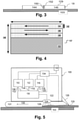
- Figure 4 shows one embodiment of a PU flooring of a sports field comprising multiple lanes
- figure 3 depicts the automatic intermixing of adjacent PU foam lanes.
- the ground 103 to be covered with a polyurethane flooring can be a rectangular sports field 137 with a length and a width 140.
- the ground 103 may be prepared, e.g., concreted and/or leveled, or unprepared.
- the user 102 may use a portable apparatus 101 as shown in Fig. 1 a or a vehicle 100 as shown in Fig. 5 for applying a lane of the liquid (optionally supplemented) prepolymer mixture 128 having a width 142 that is smaller than the width 140 of the sports ground 137.
- the mixture 128 is applied to the ground 103 in lanes 144, 146, 148, so that adjacent lanes 144, 146, 148 are in contact with each other.
- the liquid (supplemented) prepolymer mixture 128 of the second lane 146 immediately intermixes with and generates a coherent mass with the mixture 128 of the first lane 144 (see figure 3 ) so that a side edge 150 of the first lane 144 is in contact with the side edge 152 of the second lane 146.
- the side edge 135 would come into contact the side edge of lane 148 once said lane is applied on the ground.
- the vehicle may be equipped with a leveling unit 126 and an injection unit 126.
- the leveling unit is wider in shape than the injection unit 124 so that the leveling unit 126 can smooth the transition from the first lane 144 to the second lane 146.
- Figure 5 depicts a system 100, e.g., a paving machine that applies a supplemented or non-supplemented prepolymer mixture 128 on the ground, as depicted in Fig. 1 .
- the mixture 128 starts to generate CO 2 and to polymerize into PU upon being brought into contact with water, e.g., the moisture in the air or in the soil.
- the mixture 128 can comprise additives, e.g., emulsifiers and/or foam stabilizers, e.g., high sheer-resistant silicone foam stabilizers.
- the mixture 128 is preferably free of catalysts that are typically used to enhance the reactivity of 1C PU mixtures.
- An overview of available additives is given, for example, in G. Oertel, Polyurethane Handbook, 2nd Edition, Carl Hanser Verlag, Kunststoff, 1994, chapter 3.4 .
- the system 100 can comprise tanks 160, 162, wherein the first tank 160 contains the prepolymer mixture and the second tank 162 contains rubber granules and/or further components. Both tanks 160, 162 are connected with ducts 108, 110 to a mixing unit 156 in which the components are combined with a supplemented prepolymer mixture 128 for an elastic PU flooring. Each duct 108, 110 comprises a valve 112, 114 for dosing the amount of prepolymer mixture with rubber granules that flow from the respective tank 160, 162 to the mixing unit 156.
- the ducts 108, 110 may contain a supply unit, for example, a pump.
- the apparatus is a vehicle, but the portable apparatus depicted in Fig. 1a could likewise contain the same or functionally equivalent components as described for the vehicle in Fig. 5 .
- the system 100 can have an additional tank 116 containing water for wetting the base layer before the mixture 128 is applied.
- the additional tank 116 can be connected with a duct 118 to the mixing unit 156 or to the outside.
- the duct contains a valve 120.
- the system 100 may include various tanks for various additives, depending on the desired number of additives to be combined with the mixture 128 for the polyurethane flooring.
- the mixing unit 156 provides the means for producing a supplemented prepolymer mixture for in-situ generation of an elastic PU flooring.
- the mixing unit 106 is connected with a duct 122 to an application unit 124 that is configured for applying the prepolymer mixture 128 optionally comprising rubber granules to a ground 103.
- the application unit 124 may contain various nozzles for applying the mixture 128 to the ground 103. The nozzles may be spaced out evenly over the entire width of the application unit 124. Alternatively, there may be a single nozzle or a bundle of nozzles, and the user may have to move the nozzle smoothly from one side to the other to spread the mixture 128 evenly over the ground (see Fig. 1a ).
- the system 100 comprises a leveling unit 126 for leveling and smoothing the applied mixture 128.
- the leveling unit 126 may be a scraper, which is located in the drive direction 130 of the apparatus 100 behind the injection unit 124.
- the leveling unit 126 is configured for smoothing the surface of the applied mixture 128 and/or for taking up excess foam.
- the vehicle comprises a driving unit 131 for driving the apparatus 100 in the drive direction 130.
- a sensor 132 for measuring environmental conditions may be provided as part of the vehicle 100.
- the sensor 132 may be configured for measuring the air temperature, the ground temperature, the relative humidity or other climate conditions.
- Various sensors for determining various environmental data may be provided.
- the valves 112, 114, 120, the mixing unit 156, the application unit 124, the leveling unit 126, the drive unit and the sensor 132 are connected to a control unit 134.
- the control unit 134 is configured for receiving environmental data measured by the sensor 132 and/or to control the valves 112, 114, 120, the mixing unit 106, the application unit 124, the drive unit 131 and the leveling unit 126, depending on the environmental data received.
- the vehicle may stop applying the mixture when the measured environmental temperature is below +6°C and/or may take into account the geometry of the ground, the planned path, the respective length of each lane 144, 146, 148, the thickness of the polyurethane flooring and the speed of the system 100 (vehicle or portable apparatus) into the process of the determination of the mixture 128 in order to ensure that the foam of the first lane 144 is not cured before the foam of the second lane 146 is applied, and/or to ensure that a sufficient amount of PU foam is applied to reach the desired minimum thickness and elasticity of the PU flooring.
- the senor 132 is attached to the system 100 so that the environmental conditions are measured at the location of the apparatus 100. Therefore, the mixture and the process parameters can be adapted continuously to the current conditions so that the amount of prepolymer mixture applied per m 2 of the ground is constant and does not depend on the speed of the vehicle 100.
- Figure 6 is a flowchart of a method of creating a 1C PU system adapted for generating an elastic PU flooring.
- an initial reaction mixture is generated, e.g., an initial mixture 900 depicted in figure 7 .
- step 604 the initial reaction mixture is transformed into a prepolymer mixture.
- Steps 602 and 604 are typically performed in a factory at temperatures higher than room temperature, e.g., 30°C-60°C.
- a mixture of the 2,2', 2,4' and 4,4' MDI monomers is transferred into a reactor and heated to 30°C.
- the single components in particular the polyol(s) of the polyol component and the plant-based oil or naphthenic oil (commercially available e.g. as "Nyflex") are added stepwise and are mixed under stirring in a temperature in a range of 40°C-60°C, preferably 40°C-45°C.
- Further possible additives are, for example, extenders and rheology modifiers such as propylene carbonate (commercially available e.g. as Jeffsol PC), are added under stirring.
- a mixing time of about 15 minutes is kept.
- the phosphoric acid is added.
- the phosphoric acid will stop the reaction to provide a stable prepolymer mixture and to improve the storage stability.
- the phosphoric acid should be added not earlier than having stirred the otherwise complete initial mixture for at least 45 minutes, because otherwise the phosphoric acid would stop the polymerization reaction before the transformation of the components of the initial mixture in the prepolymer is complete. This would result in an undesired low median value of the molecular weight distribution of the prepolymer molecules.
- the prepolymer After a reaction time of 1 hour, the prepolymer contains 12-15% of monomeric MDI (2,4' MDI and 2,2'MDI) . After 24 hours (the reaction may slowly continue even after having added the phosphoric acid), the prepolymer mixture contains only 10-12% monomeric MDI, the remainder being prepolymer and oil.
- the generated prepolymer mixture has an NCO content of 2%-22% by weight of the prepolymer mixture, in particular 4%-17% by weight of the MDI/prepolymer mixture.
- the resulting prepolymer mixture is then cooled to room temperature and stored until it is used.
- the prepolymer mixture generated in step 604 is mixed with additional substances, rubber granules in particular.
- the rubber granules can be, for example, SBR, EPDM (in particular sulphur or peroxidic crosslinked EPDM) rubber granules, or rubber granules made from recycled tires, or thermoplastic elastomers like SEBS (styrene ethylene butadiene styrene block copolymer) or SES (styrene ethylene styrene block copolymer).
- the mixing step 606 will bring the components of the prepolymer mixture in contact with the moisture in the air and/or in the additional substances, thereby triggering the generation of CO 2 and PU foam.
- This step is typically performed at the use site and may take more than 10 minutes, e.g., more than 20 minutes to ensure the homogeneous mixing of all components.
- step 608 the homogeneous mixture generated in step 606 is applied on the ground 103.
- the PU polymerization reaction will continue in the applied prepolymer mixture 128.
- step 610 the applied supplemented prepolymer mixture is allowed to harden. Depending on the temperature and ambient moisture, this is typically achieved in less than 36 hours, or less than 18 hours, or even less than 12 hours.
- the ground is optionally smoothed and leveled to a predetermined roughness and level.
- the viscosity of the PU foam is small enough to allow self-leveling.
- the solidified, cured PU layer is coated with an additional, protective layer 127. A separate step to anneal edges of two adjacent lanes to each other is not necessary.
- Figure 7 illustrates the composition of an initial mixture 900 for generating a prepolymer mixture adapted for generating an elastic PU layer.
- a “prepolymer”, also referred to as “NCO prepolymer”, is a prepolymer generated by reacting an organic polyisocyanate, in particular a mixture of MDI monomers, with an excess of an NCO-reactive compound, in particular polyols.
- the initial mixture comprises about 10%-15% by weight oil, herein also referred to as "process oil", which is not an educt in the chemical reaction that generates the prepolymer.
- process oil is not an educt in the chemical reaction that generates the prepolymer.
- the resulting prepolymer mixture comprises the process oil, the monomeric MDI and the prepolymer. Adding process oil to the initial mixture may be advantageous, because it has been observed that oil reduces the viscosity of the prepolymer mixture, thereby easing the mixing of the prepolymer mixture with rubber granules and/or easing the even spreading of the prepolymer mixture over the ground.
- the following components were added to provide the initial mixture 900 (in % by weight of the initial mixture):
- the prepolymer mixture 128 is generated by reacting the monomeric and polymeric MDI component and the polyol component of the initial mixture 900 with each other.
- Polyurethane prepolymers are formed by combining an excess of diisocyanate monomers with a premix polyol.
- One of the NCO groups of the diisocyanate monomers reacts with one of the OH groups of the premix polyol.
- the other end of the polyol reacts with another diisocyanate.
- the resulting prepolymer has an isocyanate group on both ends.
- the prepolymer is a diisocyanate itself, and it reacts like a diisocyanate but with several important differences.
- the prepolymer When compared with the original diisocyanate, the prepolymer has a greater molecular weight, a higher viscosity, a lower isocyanate content by weight (%NCO), and a lower vapor pressure.
- Prepolymers can be made under controlled conditions in a manufacturing plant. A dry nitrogen atmosphere protects isocyanates from atmospheric moisture and protects polyols from oxidation.
- the NCO groups of the MDI monomers and polymeric MDI that may be formed as an intermediate product react with the OH groups of the polyol component in the initial mixture, changing the initial mixture into a prepolymer mixture comprising a prepolymer. Not all educts in the initial mixture react into the prepolymer, however; therefore, the prepolymer mixture comprises some remaining educts, in particular some monomeric MDI.
- the viscosity of the prepolymer mixture strongly depends on the type of prepolymer generated and hence strongly depends on the composition of the initial mixture.
- the generated prepolymer mixture can be stored at room temperature for several months or longer. Then, the prepolymer mixture and/or the supplemented prepolymer mixture with the rubber granules can be transported to the use site.
Landscapes
- Chemical & Material Sciences (AREA)
- Engineering & Computer Science (AREA)
- Architecture (AREA)
- Medicinal Chemistry (AREA)
- Polymers & Plastics (AREA)
- Organic Chemistry (AREA)
- Health & Medical Sciences (AREA)
- Chemical Kinetics & Catalysis (AREA)
- Civil Engineering (AREA)
- Structural Engineering (AREA)
- Polyurethanes Or Polyureas (AREA)
- Road Paving Structures (AREA)
- Compositions Of Macromolecular Compounds (AREA)
Description
- This invention relates to a method of producing a 1C PU system adapted for generating elastic floorings, and a corresponding 1C PU system and elastic PU-based flooring.
- Elastic floorings - for example, floorings for a sports ground, e.g., an athletic track, or a playground - are commonly made of polyurethane (PU).
- They are typically installed by unrolling a prefabricated PU rolled mat at its destination and gluing the PU mat onto the floor with a polyurethane adhesive. The production of the PU mat within a manufacturing plant may include performing a chemical reaction that quickly, typically within minutes, generates a foamed, solid PU layer. The prefabricated PU roll is produced in a sports ground factory and is transported - potentially over long distances - to the sports area where it is to be installed. After the PU rolled mat is rolled out, the edges of the lanes need to be connected with each other and sealed to prevent the forming of open crevices between the lanes.
- Meanwhile, some systems are available that allow generating and applying a PU binder directly at the use site ("in situ"), thereby reducing transport costs and easing the installation of the elastic PU-based flooring. For example, the PU binder can be foamed into PU foam at the use site mechanically or chemically.
- The majority of chemicals currently used for manufacturing elastic PU based layers for sport fields and running tracks are petrochemical substances originating from crude oil or petroleum oil or natural gas. They are products of the refinery process of petroleum oil. Today, a large number of petro-based polymers is available, including polyols with the desired properties for the production of artificial turf backings and elastic layers for sports fields, e.g. running tracks.
- However, the use of petroleum oil is problematic as a non-renewable energy source is consumed.
- The European patent application
EP3216919A1 describes a method for producing a polyurethane flooring for a sports ground, wherein a polyurethane foam is applied to a ground. The said PU foam comprises a MDI based NCO terminal prepolymer based on a MDI isomeric mixture of 2,4'-; 4,4'- and 2,2'-MDI monomers with an NCO content of 1,5-18 wt.-% with an 2,2'-MDI content from 1 to 40 wt.-%, whereby the preferred polyol for said prepolymer is a standard or end-capped polyether polyol. - It is an objective of the present invention to provide a method of manufacturing an improved one component polyurethane system, also referred herein as "1C PU binder", adapted for generating elastic floorings (e.g. for running tracks) with a smaller CO2 footprint as specified in the independent claims. Embodiments of the invention are given in the dependent claims. Embodiments of the present invention can be freely combined with each other if they are not mutually exclusive.
- In a first aspect, the invention relates to a method of producing a 1C polyurethane system adapted for creating an elastic flooring, e.g. an outdoor flooring for a sports field. The method comprises creating an initial mixture comprising a mixture of MDI (methylene diphenyl diisocyanate) monomers and a polyol component. The MDI monomers comprise 2,2' MDI, 2,4' MDI and 4,4' MDI, wherein at least 5,9% by weight of the initial mixture consist of the 2,2' MDI. The polyol component comprises a CO2 based polyethercarbonate polyol. The method further comprises reacting the initial mixture into a prepolymer mixture, the prepolymer mixture comprising a prepolymer, the prepolymer mixture being adapted for use as the 1C polyurethane system.
- Said features may be advantageous because the use of CO2 based polyethercarbonate polyol in combination with a comparatively high 2,2' MDI concentration may allow generating a PU binder that "consumes" CO2 gas and has physicochemical properties, in particular a viscosity, that allows using the prepolymer mixture as a 1C PU binder for generating an elastic PU based flooring.
- Meanwhile, new types of polyols are commercially available which are based on carbon dioxide (CO2). Carbon dioxide, one of the main sources of global warming, is abundantly available. Using carbon dioxide-based polymers for plastics product production benefits the environment by turning a waste greenhouse gas into a useful raw material. The overall carbon footprint is reduced and an alternative carbon source beyond fossil hydrocarbons and bio-based materials is provided. Emerging technologies, as described for instance in
EP 3219741 A1 , now allow to efficiently transform atmospheric carbon dioxide into polyols, thereby creating a circular, sustainable economy in plastics production. - However, these new "CO2 based" polyols are typically polyethercarbonate polyols. Applicant has observed that replacing the petro-based polyols currently used for generating elastic PU-based layers by polyethercarbonate polyols does not yield PU binders having the physicochemical properties desired in the context of the production of elastic sports floors, e.g. running tracks.
- CO2-based polyols currently available have been observed to be particularly suited e.g. for the production of mattresses and upholstered furniture. Mattresses and related products have particular requirements regarding e.g. elasticity, resilience, and density of the polyol types used for manufacturing the same. These requirements differ from the requirements of other plastics products such as, for example, artificial turf backings and PU based running tracks. It has been observed that the available CO2-based polymers cannot be used as substitutes of the polymer types that are currently used for elastic PU based sport field grounds, because the PU binder made from a CO2-based polyethercarbonate polyol does not have the desired properties. In particular, one component PU systems, also referred herein as "1C PU systems", "1C prepolymer mixtures" or "1C PU binders", derived from a dioxide-based polyol have been observed to be too viscous to allow using said polyols for the in-situ generation of elastic floorings, e.g. running tracks.
- For example, in one empirical test, it was observed that adding a CO2 based polyethercarbonate polyol to the standard mixtures of MDI monomer, a significant increase of viscosity was observed. The replacement of about 5% of the standard polyol by a CO2 based polyethercarbonate polyol resulted in an increase of the viscosity by ca. 2000 mPas at 25°C. Thus, already the replacement of small amounts of the standard polyol by a CO2 based polyethercarbonate polyol resulted in a prepolymer mixture that was unsuited for in situ generation of elastic outdoor floorings. However, an increased amount of 2,2' MDI monomers in the initial mixture was observed to successfully compensate this undesired effect.
- On the other hand, the viscosity of the PU binder must not be too low, because in this case the CO2 generated by the foaming reaction would leave the PU binder so fast that the resulting flooring is inelastic. It has been observed that by combining the comparatively viscous CO2-based polyethercarbonate polyol with an increased amount of 2,2' MDIs, the resulting prepolymer mixture has the appropriate viscosity for being used as a PU binder for in situ generation of elastic PU based floorings.
- PU binder must in addition fulfill specific requirements regarding reaction speed to allow for an in-situ installation of running tracks and other types of sports fields under various weather conditions (ambient moisture, temperature, etc.). It has been observed that the prepolymer mixture generated according to embodiments of the invention show the desired reaction speed that is fast enough to allow a hardening within several hours and is slow enough to allow homogeneous mixing of the prepolymer mixture with further components like rubber granules. As the moisture contained in the rubber granules may trigger or accelerate the curing process, an inhomogeneous mixing with the rubber may result in the generation of a flooring with an inhomogeneous distribution of rubber particles, an inhomogeneous density and an inhomogeneous curing speed.
- According to embodiments, the MDI monomers of the initial mixture comprises the 2,2' monomeric MDI in an amount of 5.9% - 11.5% by weight of the initial mixture, the 2,4' monomeric MDI in an amount of 16.6% - 23.5% by weight of the initial mixture, and the 4,4' monomeric MDI in an amount of 16.1% - 17.0% by weight of the initial mixture. This MDI monomer mix is characterized by a particularly high amount of 2,2' MDI. Typically, the 2,2' MDI content of MDI premixes used for generating a prepolymer mixture comprise a significantly lower amount of 2,2' MDI, because the reaction speed of 2,2' MDI is comparatively low and also the speed of the transformation of the prepolymer mixture into a curated PU binder may be reduced. Nevertheless the above specified MDI monomer concentration was shown to be sufficiently reactive to allow the generation of a PU binder with hardening times of less than a day, typically only several hours.
- According to embodiments, the CO2 of the CO2 based polyethercarbonate polyol is atmospheric CO2, CO2 of industrial facilities and/or CO2 of a renewable CO2 source. For example, the CO2 obtained from a renewable CO2 source may be generated by a bioreactor turning biomass into water and CO2. This may be advantageous, because the CO2 footprint of the PU binder is reduced. In fact, if artificial turf is incinerated in an incineration plant and if the generated CO2 is used for producing a CO2 based polyethercarbonate polyol, the generated PU binder may at least partially be "recycled".
- According to embodiments, the CO2 based polyethercarbonate polyol is generated by catalytic copolymerization of CO2 with alkylene oxides in the presence of one or more H-functional starter substances. This process is described, for example, in
EP3219741A1 . Typically, a level of CO2 incorporation of 10%-20% by weight of the polyethercarbonate polyol is achieved. - By reacting the components of the initial mixture into a prepolymer, a prepolymer mixture comprising a prepolymer and some unreacted components of the initial mixture is generated. According to embodiments, the prepolymer mixture comprises the prepolymer in an amount of 60-98%, preferably 70%-95%, in particular 88%-90% by weight of the mixture. The rest comprises non-reacted monomeric MDI and, optionally, oil (e.g. about 10%), pigments, and other additives.
- According to embodiments, the CO2 based polyethercarbonate polyol has a viscosity of 800 - 1200 mPa/s at 25°C, preferably a viscosity of 900-1100 mPa/s at 25°C. For example, the CO2 based polyethercarbonate polyol can have a viscosity of 1000 mPa/s at 25°C. This would typically yield a prepolymer mixture that is highly viscous and that cannot be processed properly. However, as mentioned above, the high amount of 2,2' MDI monomers is adapted to compensate this effect.
- According to embodiments, the CO2 based polyethercarbonate polyol has an average molecular weight of 900-1100 g/mol and/or a hydroxyl number of 100-120 mg KOH/g. For example, the CO2 based polyethercarbonate polyol can have a molecular weight of 1000 g/mol and/or an OH number of 112.
- According to embodiments, the initial mixture further comprises a plant-based oil or naphthenic oil or a mixture thereof in an amount of 10%-15% by weight of the initial mixture. The plant-based oil can be, for example, linseed oil from flax seeds, rice bran oil from rice grains, castor oil, corn oil, palm oil, soybean oil, rapeseed oil, sunflower oil, peanut oil, or coconut oil or other plant-derived oils. Adding oils may have the advantage that the oil further decreases viscosity of the prepolymer mixture and thus compensates the raise in viscosity induced by the CO2 based polyethercarbonate polyol. Moreover, plant-based oils reduce the size of the CO2 footprint of the PU binder, because the oil is derived from plants. Plants transform atmospheric CO2 into oil and other components.
- According to embodiments, the initial mixture further comprising phosphor acid. This may allow increasing the shelf life of the generated prepolymer mixture.
- For example, the generation of the initial mixture can comprise adding 0.005% - 0.01%, e.g. 0.009% by weight of the initial mixture phosphoric acid. The phosphoric acid is preferably a phosphoric acid having a concentration of about 85%.
- According to embodiments, at least 10%, preferably 10%- 20% by weight of the polyol component consist of the CO2 based polyethercarbonate polyol.
- According to embodiments, at least 30%, preferably between 30% and 45% by weight of the polyol component consist of a further polyol having a viscosity of 200-500 mPas at 25°C. The use of a further polyol with comparatively low viscosity may further help compensating the high viscosity of the CO2 based polyethercarbonate polyol.
- According to embodiments, the further polyol has an average molecular weight of 1800 - 2200 g/mol.
- According to embodiments, the further polyol is polypropylenglycol (PPG). For example, the PPG can have an OH- number 56, a viscosity of 350 mPas at 25°C, and an average molecular weight of 2000 g/mol. In one example, about 38% by weight of the polyol component consist of PPG.
- According to embodiments, the initial mixture comprises:
- the 2,2' monomeric MDI in an amount of 5.9% - 11.5% by weight of the initial mixture;
- the 2,4' monomeric MDI in an amount of 16.6% - 23.5%
- the 4,4' monomeric MDI in an amount of 16.1% -17.0%
- a further polyol (e.g. PPG) with a viscosity of 250 - 450 mPas at 25°C in an amount of 30% - 45% by weight of the initial mixture;
- the polyethercarbonate polyol with a viscosity of 800-900 mPas at 25 °C. functionality in an amount of 10% - 20% by weight of the initial mixture;
- oil (in particular plant-based oil, e.g. castor oil) in an amount of 10%-15% by weight of the initial mixture; and
- phosphor acid in an amount of 0.005% - 0.01% by weight of the initial mixture.
- The initial mixture can further comprise pigments, rubber granules, dispersing aids, fillers, and rheology modifiers. The polyol component can comprise further polyols, in particular polyols manufactured at least partially from a renewable carbon source ("bio-polyols"), e.g. castor or soya or raps oil based polyesterpolyol. This may further reduce the size of the CO2 footprint of the prepolymer mixture.
- In a further aspect, the invention relates to a method for creating an elastic flooring, e.g. an elastic flooring of an indoor or outdoor sports field. The method comprises applying the prepolymer mixture created according to any one of the embodiments described herein on a ground, and letting the applied prepolymer mixture harden to form the elastic flooring.
- Optionally, the prepolymer mixture is leveled with a paving machine or a device after it was applied on the ground and before the hardening process has completed to ensure that the surface of the flooring is level.
- According to some embodiments, the prepolymer mixture is mixed with rubber granules for generating a "supplemented prepolymer mixture" or "PU-binder-granule mixture". The rubber granules are cheap and elastic and may provide flooring that is sufficiently thick to provide the desired cushioning effect.
- Pigments, dispersing aids, fillers, flame retardants, etc. can be added to the initial mixture and/or can be added to the prepolymer mixture before the prepolymer mixture is applied on the ground.
- According to embodiments, the elastic flooring is selected from a group comprising:
- an elastic subconstruction layer for athletic tracks and playgrounds;
- an elastic base layer for athletic tracks and playgrounds;
- an in-situ foamed elastic athletic track or playground surface;
- an outdoor surface, in particular a tile, a matt, a lane.
- In a further aspect, the invention relates to an elastic flooring manufactured by a method according to any one of the embodiments of the method for generating an elastic flooring described herein.
- In a further aspect, the invention relates to a 1C PU system adapted for creating an elastic flooring, the 1C PU system being manufactured by a method according to any one of the embodiments described herein.
- When the initial mixture is transformed into the prepolymer mixture, the CO2 based polyethercarbonate polyol is integrated, together with one or more further polyols, if any, in the prepolymer. The prepolymer and the elastic flooring made from the prepolymer thus may therefore not comprise the CO2 based polyethercarbonate polyol in isolated form. However, a quantitative and qualitative analysis of the final material can be performed using NMR and ATR-IR (attenuated total reflection IR-spectroscopy) technology. Thus, it may be possible to determine whether a particular flooring was manufactured from a PU binder that was derived from a CO2 based polyethercarbonate polyol. Moreover, in case a renewable carbon source provided the CO2 that was used for generating the CO2 based polyether carbonate, radiocarbon dating can be performed to determine if and in what amount a CO2 based polyethercarbonate polyol was used for generating the PU binder for the flooring. Atmospheric CO2 is the source of radioactive carbon C14. Fossil (petro-based) carbon sources comprise a lower amount of radioactive C14 isotopes and thus can be discerned from bio-based carbon sources by performing an isotope analysis (radiocarbon dating). Roughly half of all14C atoms decay after 5700 years. Thus, a flooring with a significant share of a PU binder whose polyol component was derived from a renewable, recent CO2 source should comprise a lower fraction of 14C atoms than purely petro-based floorings.
- A "polymer mixture" as used herein is a mixture of polymers with different compositions, capable of being differentiated by their physicochemical properties, also referred to as blend after extrusion melting. The melting process combines the individual and distinguishable components of the mixture homogeneously, such that a polymeric material is generated with specific capabilities.
- In the following, embodiments of the invention are explained in greater detail, by way of example only, making reference to the following drawings:
"Polyurethanes" (PU) as used herein are any type of polymer containing a urethane linkage. The urethane linkage (carbamate group) is -NH-CO-O. PUs are formed by reacting isocyanates with compounds that have an active hydrogen, such as diols, that contain hydroxyl-groups. Since there are many compounds containing active hydrogens and many different diisocyanates, the number of PUs that can be synthesized is very large. The specific properties of the PU can be tailored to a specific need by combining the appropriate compounds. - Polymers are macromolecules made of smaller, repeating units known as monomers. Generally, they consist of a primary long-chain backbone molecule with attached side groups.
- A "1C PU system" or "1C system" as used herein is a reaction mixture that cures into polyurethane polymers, even in the absence of an extender (as required by 2C systems). In preferred embodiments, the moisture of the environmental air or soil or the moisture in the supplements (e.g., rubber granules) is sufficient for initializing and completing the reaction of transforming the prepolymer mixture into polyurethane.
- An "apparatus" as used herein is a portable device that can be carried by a user and used to apply the prepolymer mixture ("PU binder"), that was optionally mixed with further components, e.g. rubber granules, to the ground. Typically, the apparatus is used for in situ PU foam generation for smaller sports fields.
- A "sport field," "pitch" or "sports ground" as used herein is an indoor or outdoor playing area for various sports, e.g., soccer, tennis, handball, sprint races and others.
- A "foam" as used herein is a colloidal dispersion of a gas in a liquid or solid medium.
- A "PU foam" as used herein is any liquid or hardened PU mass comprising gas bubbles or cells willed with gas. The CO2 gas generated during the hardening process result in the generation of a cellular structure of the PU matrix of the binder. When the PU binder has hardened, the cells will comprise the CO2 or environmental air. Preferably, the PU foam generated by the prepolymer mixture is a micro-foam as the mass of the binder in the rubber-granule-PU-binder mixture ("supplemented prepolymer mixture") may be too low to result in a significant foam generation and the bubbles may be very small.
- When the prepolymer mixture is mixed with supplements, e.g., rubber granules, the components of the prepolymer mixture start reacting with the water contained in the air and/or in the supplements, thereby generating PU molecules and CO2. Thus, at the moment when the mixture of the prepolymer mixture and the supplements is applied on the ground, the supplemented prepolymer mixture is typically a viscous liquid with gas bubbles, i.e., a foam. The polymerization and foaming reactions continue in the applied foam until the PU generation has completed and the elastic PU layer has completely hardened. At least a small fraction of the liquid reaction mixture may have already been transformed into PU at the moment of applying the liquid PU foam on the ground, whereby the remaining fraction of the reaction mixture may not yet have been transformed into PU.
- The "hydroxyl number" is the number of milligrams of potassium hydroxide required to neutralize the acetic acid taken up on the acetylation of one gram of a chemical substance that contains free hydroxyl groups. The hydroxyl value is a measure of the content of free hydroxyl groups in a chemical substance, usually expressed in units of the mass of potassium hydroxide (KOH) in milligrams equivalent to the hydroxyl content of one gram of the chemical substance.
- In the following, embodiments of the invention are explained in greater detail, by way of example only, making reference to the drawings in which:
- Figure 1
- depicts the application of in situ generated PU foam on a sports field ground;
- Figure 2
- depicts an athletic track comprising multiple lanes;
- Figure 3
- depicts the automatic intermixing of adjacent PU foam lanes;
- Figure 4
- depicts three fresh PU foam lanes;
- Figure 5
- depicts a paving machine that applies PU foam on the ground;
- Figure 6
- is a flowchart of a method of generating a prepolymer mixture from a CO2-based polyol that is adapted for generating an elastic PU layer; and
- Figure 7
- depicts the composition of an initial mixture for generating a 1C PU based binder.
-
Figure 1 depicts the application of in situ generatedprepolymer mixture 128, also referred herein as "1C PU system," on a sports field ground 104. Auser 102 carries aportable apparatus 101 comprising areaction tank 154 with amixer 156 that is coupled with anozzle 124 via a duct. Theprepolymer mixture 128, applied via the nozzle on the base layer 104, can be a prepolymer mixture or a "supplemented prepolymer mixture" comprising the prepolymer and additional optional components, e.g., rubber granules. - The system can comprise, for example, a single container holding the
prepolymer mixture 128 or a supplemented prepolymer mixture. - According to another example, the system comprises a
first container 160 with the prepolymer mixture and asecond container 162 for rubber granules and/or other components to be mixed with the prepolymer mixture in the first container. The rubber granules may further increase the elasticity of the ground and may provide for a pleasant, natural haptic of the generated PU-based sports field. - Typically, the solidified elastic PU layer will have a thickness of about 1 to 5 cm.
- The
user 102 may wet the base layer 104 with water before applying theprepolymer mixture 129. However, this step is optional. In many cases, the humidity of the base layer or of the ambient air will be sufficient to allow the applied1C PU mixture 128 to harden within several hours. When the prepolymer mixture comes into contact with water, e.g., during the mixing process with (moist) rubber granules and/or with moist air and/or after being applied on a moist base layer, CO2 and the PU polymer are continuously generated, yielding an elastic, foamed PU layer. - The viscosity of the 1C PU system ("prepolymer mixture") 128 is low enough to allow self-leveling of the viscous prepolymer mixture or
PU foam 128 into a plane PU layer that slowly solidifies into an elastic PU-basedflooring 129, e.g., of a sports field. Thus, uneven ground surfaces, damaged areas and hollows in the ground are filled by the PU layer that solidifies after some hours at low temperatures into an elastic flooring of the sports field. However, the viscosity is preferably still high enough to retain the CO2 bubbles to allow the PU foam to build. The PU foam is then allowed to dry and solidify completely. Depending on the temperature and other weather conditions, complete solidification is typically accomplished within 1 to 15 hours after the prepolymer mix was applied on the ground. - When the mixer has mixed the supplemented
prepolymer mixture 128 homogeneously, the mixture starts generating PU polymers and CO2 gas bubbles. The chemical reactions for generating the PU foam may start immediately and may immediately generate some CO2 bubbles. The supplemented prepolymer mixture is transported from the mixer to anozzle 124 and is applied directly on the ground of a sports field. Theuser 102 may apply multiple lanes of the PU reaction mixture to generate the PU flooring for a larger area. Preferentially, the PU reaction mixture is applied on the ground outdoors, but it is also possible to apply the method for generating indoor sports field floorings. In its solidified and dried state, thePU foam 129 is used as the PU flooring of the sports field. - Optionally, the solidified
PU layer 129 can be coated with a protective and waterrepellent layer 127 ("coating"), e.g., for increasing the resistance of the flooring to heat, UV light, rain, fungi and other factors, and/or to give the flooring a desired color. For example, the sealing coating may be a PU varnish. - Typically, the prepolymer mixture is applied to the ground within 30 minutes after its generation. The foam generation may start immediately after the prepolymer mixture is mixed with supplements. Hence, the supplemented prepolymer mixture may already comprise some CO2 bubbles when applied to the ground. Nevertheless, the prepolymer mixture can still be characterized as a (viscous) liquid. While the chemical reactions for generating the CO2 gas and the PU polymers continue, the liquid 1C PU system, having been applied on the ground, becomes more and more viscous, and is finally transformed into a solid PU mass, typically a PU foam, in particular micro-foam, that constitutes the elastic flooring. The in situ generated foam - at least right after its application on the floor - typically is sufficiently liquid to penetrate into small cracks in the ground, thereby mechanically fixing the PU floor when the PU has completely solidified. Thus, no additional leveling layer between the ground and the flooring layer may be necessary to compensate for surface irregularities on the ground. Rather, the applied 1C PU system and the resulting PU foam will fill depressions and indentations in the ground and will equalize when a sufficient amount is applied to the ground.
- Thus, embodiments of the invention may allow for the generation of huge, seamless sports floors that automatically compensate for surface irregularities in the ground, and firmly attach to the ground without any adhesive layer, over a wide temperature range, preferably between + 6°C and + 50 °C.
-
Figure 2 schematically shows an athletic track comprising multiple lanes. In this embodiment, the sports field is an oval track field. The user with theapparatus 101 or with thevehicle 100 moves around the field applying themixture 128 on the ground. The mixture may have already started to slowly generate CO2 bubbles and a viscous foam or micro-foam. Thesecond lane 146 connects at the starting point of thefirst lane 144, whereby the apparatus or vehicle moves radially inwards so that the path of theapparatus 100 forms a spiral. - Irrespective of the geometry in which the reaction mixture is applied to the ground, the foam/mixture of the
first lane 144 should be in a liquid state when the adjacent second lane is applied 146. If the foamedprepolymer mixtures 128 of the first and thesecond lanes lanes user 102 can use aleveling unit 126 on the vehicle or a mechanical tool to smooth the PU foam to produce an even andsmooth surface 129. Themixture 128 for thesecond lane 146 is applied before the foam of thefirst lane 144 solidifies (is cured). -
Figure 4 shows one embodiment of a PU flooring of a sports field comprising multiple lanes, andfigure 3 depicts the automatic intermixing of adjacent PU foam lanes. Theground 103 to be covered with a polyurethane flooring can be arectangular sports field 137 with a length and awidth 140. Theground 103 may be prepared, e.g., concreted and/or leveled, or unprepared. Theuser 102 may use aportable apparatus 101 as shown inFig. 1 a or avehicle 100 as shown inFig. 5 for applying a lane of the liquid (optionally supplemented)prepolymer mixture 128 having awidth 142 that is smaller than thewidth 140 of thesports ground 137. Therefore, themixture 128 is applied to theground 103 inlanes adjacent lanes prepolymer mixture 128 of thesecond lane 146 immediately intermixes with and generates a coherent mass with themixture 128 of the first lane 144 (seefigure 3 ) so that aside edge 150 of thefirst lane 144 is in contact with theside edge 152 of thesecond lane 146. Theside edge 135 would come into contact the side edge oflane 148 once said lane is applied on the ground. - In case a vehicle is used, the vehicle may be equipped with a
leveling unit 126 and aninjection unit 126. The leveling unit is wider in shape than theinjection unit 124 so that the levelingunit 126 can smooth the transition from thefirst lane 144 to thesecond lane 146. -
Figure 5 depicts asystem 100, e.g., a paving machine that applies a supplemented ornon-supplemented prepolymer mixture 128 on the ground, as depicted inFig. 1 . Themixture 128 starts to generate CO2 and to polymerize into PU upon being brought into contact with water, e.g., the moisture in the air or in the soil. Themixture 128 can comprise additives, e.g., emulsifiers and/or foam stabilizers, e.g., high sheer-resistant silicone foam stabilizers. Themixture 128 is preferably free of catalysts that are typically used to enhance the reactivity of 1C PU mixtures. An overview of available additives is given, for example, in G. Oertel, Polyurethane Handbook, 2nd Edition, Carl Hanser Verlag, München, 1994, chapter 3.4. - The
system 100 can comprisetanks first tank 160 contains the prepolymer mixture and thesecond tank 162 contains rubber granules and/or further components. Bothtanks ducts mixing unit 156 in which the components are combined with a supplementedprepolymer mixture 128 for an elastic PU flooring. Eachduct valve respective tank mixing unit 156. Theducts Fig. 5 , the apparatus is a vehicle, but the portable apparatus depicted inFig. 1a could likewise contain the same or functionally equivalent components as described for the vehicle inFig. 5 . - Optionally, the
system 100 can have anadditional tank 116 containing water for wetting the base layer before themixture 128 is applied. Theadditional tank 116 can be connected with aduct 118 to themixing unit 156 or to the outside. The duct contains avalve 120. Thesystem 100 may include various tanks for various additives, depending on the desired number of additives to be combined with themixture 128 for the polyurethane flooring. - The
mixing unit 156 provides the means for producing a supplemented prepolymer mixture for in-situ generation of an elastic PU flooring. The mixing unit 106 is connected with aduct 122 to anapplication unit 124 that is configured for applying theprepolymer mixture 128 optionally comprising rubber granules to aground 103. Theapplication unit 124 may contain various nozzles for applying themixture 128 to theground 103. The nozzles may be spaced out evenly over the entire width of theapplication unit 124. Alternatively, there may be a single nozzle or a bundle of nozzles, and the user may have to move the nozzle smoothly from one side to the other to spread themixture 128 evenly over the ground (seeFig. 1a ). - Furthermore, the
system 100 comprises aleveling unit 126 for leveling and smoothing the appliedmixture 128. The levelingunit 126 may be a scraper, which is located in thedrive direction 130 of theapparatus 100 behind theinjection unit 124. The levelingunit 126 is configured for smoothing the surface of the appliedmixture 128 and/or for taking up excess foam. - The vehicle comprises a
driving unit 131 for driving theapparatus 100 in thedrive direction 130. - Furthermore, a
sensor 132 for measuring environmental conditions may be provided as part of thevehicle 100. Thesensor 132 may be configured for measuring the air temperature, the ground temperature, the relative humidity or other climate conditions. Various sensors for determining various environmental data may be provided. - The
valves mixing unit 156, theapplication unit 124, the levelingunit 126, the drive unit and thesensor 132 are connected to acontrol unit 134. Thecontrol unit 134 is configured for receiving environmental data measured by thesensor 132 and/or to control thevalves application unit 124, thedrive unit 131 and theleveling unit 126, depending on the environmental data received. For example, the vehicle may stop applying the mixture when the measured environmental temperature is below +6°C and/or may take into account the geometry of the ground, the planned path, the respective length of eachlane mixture 128 in order to ensure that the foam of thefirst lane 144 is not cured before the foam of thesecond lane 146 is applied, and/or to ensure that a sufficient amount of PU foam is applied to reach the desired minimum thickness and elasticity of the PU flooring. - In the described embodiment, the
sensor 132 is attached to thesystem 100 so that the environmental conditions are measured at the location of theapparatus 100. Therefore, the mixture and the process parameters can be adapted continuously to the current conditions so that the amount of prepolymer mixture applied per m2 of the ground is constant and does not depend on the speed of thevehicle 100. -
Figure 6 is a flowchart of a method of creating a 1C PU system adapted for generating an elastic PU flooring. In thefirst step 602, an initial reaction mixture is generated, e.g., aninitial mixture 900 depicted infigure 7 . - Then in
step 604, the initial reaction mixture is transformed into a prepolymer mixture.Steps - For example, a mixture of the 2,2', 2,4' and 4,4' MDI monomers is transferred into a reactor and heated to 30°C. Hereafter the single components, in particular the polyol(s) of the polyol component and the plant-based oil or naphthenic oil (commercially available e.g. as "Nyflex") are added stepwise and are mixed under stirring in a temperature in a range of 40°C-60°C, preferably 40°C-45°C. Further possible additives are, for example, extenders and rheology modifiers such as propylene carbonate (commercially available e.g. as Jeffsol PC), are added under stirring.
- Between every step a mixing time of about 15 minutes is kept. After 45 to 60 minutes, the phosphoric acid is added. The phosphoric acid will stop the reaction to provide a stable prepolymer mixture and to improve the storage stability. The phosphoric acid should be added not earlier than having stirred the otherwise complete initial mixture for at least 45 minutes, because otherwise the phosphoric acid would stop the polymerization reaction before the transformation of the components of the initial mixture in the prepolymer is complete. This would result in an undesired low median value of the molecular weight distribution of the prepolymer molecules.
- After a reaction time of 1 hour, the prepolymer contains 12-15% of monomeric MDI (2,4' MDI and 2,2'MDI) . After 24 hours (the reaction may slowly continue even after having added the phosphoric acid), the prepolymer mixture contains only 10-12% monomeric MDI, the remainder being prepolymer and oil.
- In some embodiments, the generated prepolymer mixture has an NCO content of 2%-22% by weight of the prepolymer mixture, in particular 4%-17% by weight of the MDI/prepolymer mixture.
- The resulting prepolymer mixture is then cooled to room temperature and stored until it is used.
- In the
optional step 606, the prepolymer mixture generated instep 604 is mixed with additional substances, rubber granules in particular. The rubber granules can be, for example, SBR, EPDM (in particular sulphur or peroxidic crosslinked EPDM) rubber granules, or rubber granules made from recycled tires, or thermoplastic elastomers like SEBS (styrene ethylene butadiene styrene block copolymer) or SES (styrene ethylene styrene block copolymer). - The mixing
step 606 will bring the components of the prepolymer mixture in contact with the moisture in the air and/or in the additional substances, thereby triggering the generation of CO2 and PU foam. This step is typically performed at the use site and may take more than 10 minutes, e.g., more than 20 minutes to ensure the homogeneous mixing of all components. - Next in
step 608 the homogeneous mixture generated instep 606 is applied on theground 103. The PU polymerization reaction will continue in the appliedprepolymer mixture 128. Instep 610 the applied supplemented prepolymer mixture is allowed to harden. Depending on the temperature and ambient moisture, this is typically achieved in less than 36 hours, or less than 18 hours, or even less than 12 hours. - After applying the PU reaction mixture to the ground, the ground is optionally smoothed and leveled to a predetermined roughness and level. In preferred embodiments, the viscosity of the PU foam is small enough to allow self-leveling. Optionally, the solidified, cured PU layer is coated with an additional,
protective layer 127. A separate step to anneal edges of two adjacent lanes to each other is not necessary. -
Figure 7 illustrates the composition of aninitial mixture 900 for generating a prepolymer mixture adapted for generating an elastic PU layer. - A "prepolymer", also referred to as "NCO prepolymer", is a prepolymer generated by reacting an organic polyisocyanate, in particular a mixture of MDI monomers, with an excess of an NCO-reactive compound, in particular polyols.
- According to some embodiments, the initial mixture comprises about 10%-15% by weight oil, herein also referred to as "process oil", which is not an educt in the chemical reaction that generates the prepolymer. Thus, the resulting prepolymer mixture comprises the process oil, the monomeric MDI and the prepolymer. Adding process oil to the initial mixture may be advantageous, because it has been observed that oil reduces the viscosity of the prepolymer mixture, thereby easing the mixing of the prepolymer mixture with rubber granules and/or easing the even spreading of the prepolymer mixture over the ground.
- According to the depicted example, the following components were added to provide the initial mixture 900 (in % by weight of the initial mixture):
- 2,2' monomeric MDI: 5.9%-11,5%, in particular is 6,5 %;
- 2,4' monomeric MDI: 16.6 %-23.5%, in particular 17.2%;
- 4,4' monomeric MDI min. 16.1%-17.0%, in particular 16.5 %;
- PPG 2000: 30%-45%, in particular 38%;
- CO2 based polyethercarbonate polyol: 10%-20%, in particular 15%;
- Oil: 10%-15%, in particular 11%;
- Phosphoric acid (85%): 0.005%-0.01%, in particular 0.009%.
- According to embodiments, the
prepolymer mixture 128 is generated by reacting the monomeric and polymeric MDI component and the polyol component of theinitial mixture 900 with each other. Polyurethane prepolymers are formed by combining an excess of diisocyanate monomers with a premix polyol. One of the NCO groups of the diisocyanate monomers reacts with one of the OH groups of the premix polyol. The other end of the polyol reacts with another diisocyanate. The resulting prepolymer has an isocyanate group on both ends. The prepolymer is a diisocyanate itself, and it reacts like a diisocyanate but with several important differences. When compared with the original diisocyanate, the prepolymer has a greater molecular weight, a higher viscosity, a lower isocyanate content by weight (%NCO), and a lower vapor pressure. Prepolymers can be made under controlled conditions in a manufacturing plant. A dry nitrogen atmosphere protects isocyanates from atmospheric moisture and protects polyols from oxidation. - The NCO groups of the MDI monomers and polymeric MDI that may be formed as an intermediate product react with the OH groups of the polyol component in the initial mixture, changing the initial mixture into a prepolymer mixture comprising a prepolymer. Not all educts in the initial mixture react into the prepolymer, however; therefore, the prepolymer mixture comprises some remaining educts, in particular some monomeric MDI. The viscosity of the prepolymer mixture strongly depends on the type of prepolymer generated and hence strongly depends on the composition of the initial mixture.
- The generated prepolymer mixture can be stored at room temperature for several months or longer. Then, the prepolymer mixture and/or the supplemented prepolymer mixture with the rubber granules can be transported to the use site.
-
- 100
- vehicle
- 101
- portable apparatus
- 102
- user
- 103
- base layer
- 108
- duct
- 110
- duct
- 112
- valve
- 114
- valve
- 116
- tank
- 118
- duct
- 120
- valve
- 122
- duct
- 124
- nozzle
- 126
- leveling unit
- 128
- applied prepolymer mixture (with or without rubber granules)
- 129
- hardened elastic PU layer
- 130
- drive direction
- 131
- drive unit
- 132
- sensor
- 134
- control unit
- 135
- side edge of lane
- 136
- running track
- 137
- sports field
- 140
- width of sports field
- 142
- width of a lane
- 144
- lane
- 146
- lane
- 148
- lane
- 150
- side edge of lane
- 152
- side edge of lane
- 154
- mixing container
- 156
- stirrer
- 160
- first container
- 162
- second container
- 602-608
- steps
- 900
- initial mixture
- 922
- 2,2' MDI monomer
- 924
- 2,4' MDI monomer
- 926
- 4,4' MDI monomer
- 930
- PPG
- 932
- polyethercarbonate polyol
Claims (16)
- A method for producing a 1C polyurethane system (129) adapted for creating an elastic flooring, the method comprising:- creating (602) an initial mixture (900) comprising:• a mixture of MDI monomers, the MDI monomers comprising 2,2' MDI (922), 2,4' MDI (924) and 4,4' MDI (926), wherein at least 5,9% by weight of the initial mixture consist of the 2,2' MDI;• a polyol component comprising a CO2 based polyethercarbonate polyol (932) ;- reacting (604) the initial mixture into a prepolymer mixture, the prepolymer mixture comprising a prepolymer, the prepolymer mixture being adapted for use as the 1C polyurethane system.
- The method of claim 1, the MDI monomers of the initial mixture comprising:- the 2,2' monomeric MDI in an amount of 5.9% - 11.5% by weight of the initial mixture;- the 2,4' monomeric MDI in an amount of 16.6% - 23.5% by weight of the initial mixture; and- the 4,4' monomeric MDI in an amount of 16.1% - 17.0% by weight of the initial mixture.
- The method of any one of the previous claims, the CO2 of the CO2 based polyethercarbonate polyol being atmospheric CO2, CO2 of industrial facilities and/or CO2 of a renewable CO2 source.
- The method of any one of the previous claims, the CO2 based polyethercarbonate polyol being generated by catalytic copolymerization of CO2 with alkylene oxides in the presence of one or more H-functional starter substances.
- The method of any one of the previous claims the prepolymer mixture comprising:- the prepolymer in an amount of 60-98%, preferably 70%-95% by weight of the mixture.
- The method of any one of the previous claims,- the polyethercarbonate polyol having a viscosity of at least 800 mPa/s at 25°C, in particular a viscosity of 800 - 1200 mPa/s at 25°C, in particular a viscosity of 900-1100 mPa/s at 25°C; and/or- the polyethercarbonate polyol having an average molecular weight of 900-1100 g/mol and/or a hydroxyl number of 100-120 mg KOH/g.
- The method of any one of the previous claims,- the initial mixture further comprising a plant-based oil or a naphthenic oil in an amount of 10%-15% by weight of the initial mixture; and/or- the initial mixture further comprising phosphor acid
- The method of any one of the previous claims, wherein at least 10%, preferably 10%- 20% by weight of the polyol component consist of the polyethercarbonate polyol.
- The method of any one of the previous claims, wherein at least 30%, preferably between 30% and 45% by weight of the polyol component consist of a further polyol (930) having a viscosity of 200-500 mPas at 25°C.
- The method of claim 9, the further polyol having an average molecular weight of 1800-2200 g/mol.
- The method of claim 9 or 10, the further polyol being Polypropylenglycol (PPG).
- A method for creating an elastic flooring (129, 136), the method comprising:- applying (608) the prepolymer mixture created according to any one of claims 1-11 on a ground; and- letting (610) the applied prepolymer mixture harden to form the elastic flooring.
- The method of claim 12, the method comprising:- Mixing (606) the prepolymer mixture with rubber granules before the prepolymer mixture is applied on the ground.
- The method of any one of claims 12-13, the elastic flooring being selected from a group comprising:- an elastic subconstruction layer for athletic tracks and playgrounds;- an elastic base layer for athletic tracks and playgrounds;- an in-situ foamed elastic athletic track or playground surface;- an outdoor surface, in particular a tile, a matt, a lane.
- An elastic flooring (129, 136) manufactured by a method according to any one of claims 12-14.
- A 1C PU system adapted for creating an elastic flooring (129, 136) manufactured by a method according to any one of claims 1-11.
Applications Claiming Priority (2)
| Application Number | Priority Date | Filing Date | Title |
|---|---|---|---|
| EP17200329.5A EP3480230A1 (en) | 2017-11-07 | 2017-11-07 | Pu-prepolymer mixture derived from a co2-based polyol |
| PCT/EP2018/079989 WO2019091862A1 (en) | 2017-11-07 | 2018-11-02 | Pu-prepolymer mixture derived from a co2-based polyol |
Publications (2)
| Publication Number | Publication Date |
|---|---|
| EP3707182A1 EP3707182A1 (en) | 2020-09-16 |
| EP3707182B1 true EP3707182B1 (en) | 2022-02-16 |
Family
ID=60452359
Family Applications (2)
| Application Number | Title | Priority Date | Filing Date |
|---|---|---|---|
| EP17200329.5A Withdrawn EP3480230A1 (en) | 2017-11-07 | 2017-11-07 | Pu-prepolymer mixture derived from a co2-based polyol |
| EP18796054.7A Not-in-force EP3707182B1 (en) | 2017-11-07 | 2018-11-02 | Pu-prepolymer mixture derived from a co2-based polyol |
Family Applications Before (1)
| Application Number | Title | Priority Date | Filing Date |
|---|---|---|---|
| EP17200329.5A Withdrawn EP3480230A1 (en) | 2017-11-07 | 2017-11-07 | Pu-prepolymer mixture derived from a co2-based polyol |
Country Status (2)
| Country | Link |
|---|---|
| EP (2) | EP3480230A1 (en) |
| WO (1) | WO2019091862A1 (en) |
Families Citing this family (1)
| Publication number | Priority date | Publication date | Assignee | Title |
|---|---|---|---|---|
| KR102462720B1 (en) * | 2021-12-21 | 2022-11-04 | (주)방수하는사람들 | Polyurea composition for multi-functional layer and method for forming a water-proof structure |
Citations (2)
| Publication number | Priority date | Publication date | Assignee | Title |
|---|---|---|---|---|
| US20020004553A1 (en) * | 1998-07-28 | 2002-01-10 | Werner Temme | Use of aqueous polyurethane dispersions is formulations for sports floor coverings |
| WO2017158183A1 (en) * | 2016-03-18 | 2017-09-21 | Advanced Polymer Technology Corp. | Using a polyol mixture comprising pbd for creating a pu-based artificial turf |
Family Cites Families (2)
| Publication number | Priority date | Publication date | Assignee | Title |
|---|---|---|---|---|
| EP3216919B1 (en) * | 2016-03-11 | 2020-04-29 | Polytex Sportbeläge Produktions-GmbH | Method, apparatus and system for producing a polyurethane sports flooring |
| EP3219741A1 (en) | 2016-03-18 | 2017-09-20 | Covestro Deutschland AG | Method for manufacturing polyether carbonate polyols |
-
2017
- 2017-11-07 EP EP17200329.5A patent/EP3480230A1/en not_active Withdrawn
-
2018
- 2018-11-02 EP EP18796054.7A patent/EP3707182B1/en not_active Not-in-force
- 2018-11-02 WO PCT/EP2018/079989 patent/WO2019091862A1/en not_active Ceased
Patent Citations (2)
| Publication number | Priority date | Publication date | Assignee | Title |
|---|---|---|---|---|
| US20020004553A1 (en) * | 1998-07-28 | 2002-01-10 | Werner Temme | Use of aqueous polyurethane dispersions is formulations for sports floor coverings |
| WO2017158183A1 (en) * | 2016-03-18 | 2017-09-21 | Advanced Polymer Technology Corp. | Using a polyol mixture comprising pbd for creating a pu-based artificial turf |
Also Published As
| Publication number | Publication date |
|---|---|
| WO2019091862A1 (en) | 2019-05-16 |
| EP3707182A1 (en) | 2020-09-16 |
| EP3480230A1 (en) | 2019-05-08 |
Similar Documents
| Publication | Publication Date | Title |
|---|---|---|
| JP6645710B2 (en) | Manufacture of PU flooring for athletic stadiums | |
| US10865284B2 (en) | Floor pavement structure with gel layer | |
| US7255897B2 (en) | Use of aqueous polyurethane dispersions is formulations for sports floor coverings | |
| JP5385772B2 (en) | Manufacturing method of outdoor facility pavement, surface finishing material used therefor, and outdoor facility pavement obtained thereby | |
| BRPI0718335A2 (en) | PROCESS FOR PREPARING A FOAM-COVERED TEXTILE, PROCESS FOR PREPARING A CARPET MATERIAL AND ARTICLE | |
| JP6505871B2 (en) | Method, apparatus and system for producing polyurethane road surface material | |
| CN112409977A (en) | Polyurethane adhesive for manufacturing plastic track and prepreg thereof | |
| EP3480230A1 (en) | Pu-prepolymer mixture derived from a co2-based polyol | |
| WO2019081598A1 (en) | Polyurethane adhesive | |
| JP4083292B2 (en) | Polyurethane composition for coating cushioning base material and polyurethane coating film for cushioning base material | |
| KR100684162B1 (en) | Resin composition for urethane sheet and construction method of urethane sheet using same | |
| EP3477014A1 (en) | Prepolymer mixture for a pu flooring | |
| KR20150130716A (en) | Polyurethane track with eco-material and construction method thereof | |
| HK40005774A (en) | Pu flooring production for a sports field | |
| NZ747961A (en) | Pu flooring production for a sports field | |
| KR102375234B1 (en) | Eco-friendly Stadium Floor | |
| WO2024141480A1 (en) | Use of infinergy foam particles for the improvement of the sound-deadening effect for flooring applications | |
| JP2007113249A (en) | Parking lot floor and its construction method | |
| KR20230097248A (en) | Eco-friendly stadium flooring containing eco-friendly vegetable gel and its construction method | |
| JP2801592B2 (en) | High elasticity pavement method |
Legal Events
| Date | Code | Title | Description |
|---|---|---|---|
| STAA | Information on the status of an ep patent application or granted ep patent |
Free format text: STATUS: UNKNOWN |
|
| STAA | Information on the status of an ep patent application or granted ep patent |
Free format text: STATUS: THE INTERNATIONAL PUBLICATION HAS BEEN MADE |
|
| PUAI | Public reference made under article 153(3) epc to a published international application that has entered the european phase |
Free format text: ORIGINAL CODE: 0009012 |
|
| STAA | Information on the status of an ep patent application or granted ep patent |
Free format text: STATUS: REQUEST FOR EXAMINATION WAS MADE |
|
| 17P | Request for examination filed |
Effective date: 20200608 |
|
| AK | Designated contracting states |
Kind code of ref document: A1 Designated state(s): AL AT BE BG CH CY CZ DE DK EE ES FI FR GB GR HR HU IE IS IT LI LT LU LV MC MK MT NL NO PL PT RO RS SE SI SK SM TR |
|
| AX | Request for extension of the european patent |
Extension state: BA ME |
|
| DAV | Request for validation of the european patent (deleted) | ||
| DAX | Request for extension of the european patent (deleted) | ||
| GRAP | Despatch of communication of intention to grant a patent |
Free format text: ORIGINAL CODE: EPIDOSNIGR1 |
|
| STAA | Information on the status of an ep patent application or granted ep patent |
Free format text: STATUS: GRANT OF PATENT IS INTENDED |
|
| INTG | Intention to grant announced |
Effective date: 20210622 |
|
| GRAJ | Information related to disapproval of communication of intention to grant by the applicant or resumption of examination proceedings by the epo deleted |
Free format text: ORIGINAL CODE: EPIDOSDIGR1 |
|
| STAA | Information on the status of an ep patent application or granted ep patent |
Free format text: STATUS: REQUEST FOR EXAMINATION WAS MADE |
|
| INTC | Intention to grant announced (deleted) | ||
| GRAP | Despatch of communication of intention to grant a patent |
Free format text: ORIGINAL CODE: EPIDOSNIGR1 |
|
| STAA | Information on the status of an ep patent application or granted ep patent |
Free format text: STATUS: GRANT OF PATENT IS INTENDED |
|
| INTG | Intention to grant announced |
Effective date: 20211105 |
|
| RIN1 | Information on inventor provided before grant (corrected) |
Inventor name: LOHR, IVO Inventor name: HALLY, STEFAN Inventor name: FINDER, ZDENKA Inventor name: SICK, STEPHAN |
|
| GRAS | Grant fee paid |
Free format text: ORIGINAL CODE: EPIDOSNIGR3 |
|
| GRAA | (expected) grant |
Free format text: ORIGINAL CODE: 0009210 |
|
| STAA | Information on the status of an ep patent application or granted ep patent |
Free format text: STATUS: THE PATENT HAS BEEN GRANTED |
|
| AK | Designated contracting states |
Kind code of ref document: B1 Designated state(s): AL AT BE BG CH CY CZ DE DK EE ES FI FR GB GR HR HU IE IS IT LI LT LU LV MC MK MT NL NO PL PT RO RS SE SI SK SM TR |
|
| REG | Reference to a national code |
Ref country code: GB Ref legal event code: FG4D |
|
| REG | Reference to a national code |
Ref country code: CH Ref legal event code: EP |
|
| REG | Reference to a national code |
Ref country code: DE Ref legal event code: R096 Ref document number: 602018030962 Country of ref document: DE |
|
| REG | Reference to a national code |
Ref country code: AT Ref legal event code: REF Ref document number: 1468842 Country of ref document: AT Kind code of ref document: T Effective date: 20220315 |
|
| REG | Reference to a national code |
Ref country code: IE Ref legal event code: FG4D |
|
| REG | Reference to a national code |
Ref country code: LT Ref legal event code: MG9D |
|
| REG | Reference to a national code |
Ref country code: NL Ref legal event code: MP Effective date: 20220216 |
|
| REG | Reference to a national code |
Ref country code: AT Ref legal event code: MK05 Ref document number: 1468842 Country of ref document: AT Kind code of ref document: T Effective date: 20220216 |
|
| PG25 | Lapsed in a contracting state [announced via postgrant information from national office to epo] |
Ref country code: SE Free format text: LAPSE BECAUSE OF FAILURE TO SUBMIT A TRANSLATION OF THE DESCRIPTION OR TO PAY THE FEE WITHIN THE PRESCRIBED TIME-LIMIT Effective date: 20220216 Ref country code: RS Free format text: LAPSE BECAUSE OF FAILURE TO SUBMIT A TRANSLATION OF THE DESCRIPTION OR TO PAY THE FEE WITHIN THE PRESCRIBED TIME-LIMIT Effective date: 20220216 Ref country code: PT Free format text: LAPSE BECAUSE OF FAILURE TO SUBMIT A TRANSLATION OF THE DESCRIPTION OR TO PAY THE FEE WITHIN THE PRESCRIBED TIME-LIMIT Effective date: 20220616 Ref country code: NO Free format text: LAPSE BECAUSE OF FAILURE TO SUBMIT A TRANSLATION OF THE DESCRIPTION OR TO PAY THE FEE WITHIN THE PRESCRIBED TIME-LIMIT Effective date: 20220516 Ref country code: NL Free format text: LAPSE BECAUSE OF FAILURE TO SUBMIT A TRANSLATION OF THE DESCRIPTION OR TO PAY THE FEE WITHIN THE PRESCRIBED TIME-LIMIT Effective date: 20220216 Ref country code: LT Free format text: LAPSE BECAUSE OF FAILURE TO SUBMIT A TRANSLATION OF THE DESCRIPTION OR TO PAY THE FEE WITHIN THE PRESCRIBED TIME-LIMIT Effective date: 20220216 Ref country code: HR Free format text: LAPSE BECAUSE OF FAILURE TO SUBMIT A TRANSLATION OF THE DESCRIPTION OR TO PAY THE FEE WITHIN THE PRESCRIBED TIME-LIMIT Effective date: 20220216 Ref country code: ES Free format text: LAPSE BECAUSE OF FAILURE TO SUBMIT A TRANSLATION OF THE DESCRIPTION OR TO PAY THE FEE WITHIN THE PRESCRIBED TIME-LIMIT Effective date: 20220216 Ref country code: BG Free format text: LAPSE BECAUSE OF FAILURE TO SUBMIT A TRANSLATION OF THE DESCRIPTION OR TO PAY THE FEE WITHIN THE PRESCRIBED TIME-LIMIT Effective date: 20220516 |
|
| PG25 | Lapsed in a contracting state [announced via postgrant information from national office to epo] |
Ref country code: PL Free format text: LAPSE BECAUSE OF FAILURE TO SUBMIT A TRANSLATION OF THE DESCRIPTION OR TO PAY THE FEE WITHIN THE PRESCRIBED TIME-LIMIT Effective date: 20220216 Ref country code: LV Free format text: LAPSE BECAUSE OF FAILURE TO SUBMIT A TRANSLATION OF THE DESCRIPTION OR TO PAY THE FEE WITHIN THE PRESCRIBED TIME-LIMIT Effective date: 20220216 Ref country code: GR Free format text: LAPSE BECAUSE OF FAILURE TO SUBMIT A TRANSLATION OF THE DESCRIPTION OR TO PAY THE FEE WITHIN THE PRESCRIBED TIME-LIMIT Effective date: 20220517 Ref country code: FI Free format text: LAPSE BECAUSE OF FAILURE TO SUBMIT A TRANSLATION OF THE DESCRIPTION OR TO PAY THE FEE WITHIN THE PRESCRIBED TIME-LIMIT Effective date: 20220216 Ref country code: AT Free format text: LAPSE BECAUSE OF FAILURE TO SUBMIT A TRANSLATION OF THE DESCRIPTION OR TO PAY THE FEE WITHIN THE PRESCRIBED TIME-LIMIT Effective date: 20220216 |
|
| PG25 | Lapsed in a contracting state [announced via postgrant information from national office to epo] |
Ref country code: IS Free format text: LAPSE BECAUSE OF FAILURE TO SUBMIT A TRANSLATION OF THE DESCRIPTION OR TO PAY THE FEE WITHIN THE PRESCRIBED TIME-LIMIT Effective date: 20220617 |
|
| PG25 | Lapsed in a contracting state [announced via postgrant information from national office to epo] |
Ref country code: SM Free format text: LAPSE BECAUSE OF FAILURE TO SUBMIT A TRANSLATION OF THE DESCRIPTION OR TO PAY THE FEE WITHIN THE PRESCRIBED TIME-LIMIT Effective date: 20220216 Ref country code: SK Free format text: LAPSE BECAUSE OF FAILURE TO SUBMIT A TRANSLATION OF THE DESCRIPTION OR TO PAY THE FEE WITHIN THE PRESCRIBED TIME-LIMIT Effective date: 20220216 Ref country code: RO Free format text: LAPSE BECAUSE OF FAILURE TO SUBMIT A TRANSLATION OF THE DESCRIPTION OR TO PAY THE FEE WITHIN THE PRESCRIBED TIME-LIMIT Effective date: 20220216 Ref country code: EE Free format text: LAPSE BECAUSE OF FAILURE TO SUBMIT A TRANSLATION OF THE DESCRIPTION OR TO PAY THE FEE WITHIN THE PRESCRIBED TIME-LIMIT Effective date: 20220216 Ref country code: DK Free format text: LAPSE BECAUSE OF FAILURE TO SUBMIT A TRANSLATION OF THE DESCRIPTION OR TO PAY THE FEE WITHIN THE PRESCRIBED TIME-LIMIT Effective date: 20220216 Ref country code: CZ Free format text: LAPSE BECAUSE OF FAILURE TO SUBMIT A TRANSLATION OF THE DESCRIPTION OR TO PAY THE FEE WITHIN THE PRESCRIBED TIME-LIMIT Effective date: 20220216 |
|
| REG | Reference to a national code |
Ref country code: DE Ref legal event code: R097 Ref document number: 602018030962 Country of ref document: DE |
|
| PG25 | Lapsed in a contracting state [announced via postgrant information from national office to epo] |
Ref country code: AL Free format text: LAPSE BECAUSE OF FAILURE TO SUBMIT A TRANSLATION OF THE DESCRIPTION OR TO PAY THE FEE WITHIN THE PRESCRIBED TIME-LIMIT Effective date: 20220216 |
|
| PLBE | No opposition filed within time limit |
Free format text: ORIGINAL CODE: 0009261 |
|
| STAA | Information on the status of an ep patent application or granted ep patent |
Free format text: STATUS: NO OPPOSITION FILED WITHIN TIME LIMIT |
|
| 26N | No opposition filed |
Effective date: 20221117 |
|
| PGFP | Annual fee paid to national office [announced via postgrant information from national office to epo] |
Ref country code: GB Payment date: 20221125 Year of fee payment: 5 Ref country code: FR Payment date: 20221129 Year of fee payment: 5 Ref country code: DE Payment date: 20221123 Year of fee payment: 5 |
|
| PG25 | Lapsed in a contracting state [announced via postgrant information from national office to epo] |
Ref country code: SI Free format text: LAPSE BECAUSE OF FAILURE TO SUBMIT A TRANSLATION OF THE DESCRIPTION OR TO PAY THE FEE WITHIN THE PRESCRIBED TIME-LIMIT Effective date: 20220216 |
|
| PG25 | Lapsed in a contracting state [announced via postgrant information from national office to epo] |
Ref country code: MC Free format text: LAPSE BECAUSE OF FAILURE TO SUBMIT A TRANSLATION OF THE DESCRIPTION OR TO PAY THE FEE WITHIN THE PRESCRIBED TIME-LIMIT Effective date: 20220216 |
|
| REG | Reference to a national code |
Ref country code: CH Ref legal event code: PL |
|
| REG | Reference to a national code |
Ref country code: BE Ref legal event code: MM Effective date: 20221130 |
|
| PG25 | Lapsed in a contracting state [announced via postgrant information from national office to epo] |
Ref country code: LI Free format text: LAPSE BECAUSE OF NON-PAYMENT OF DUE FEES Effective date: 20221130 Ref country code: IT Free format text: LAPSE BECAUSE OF FAILURE TO SUBMIT A TRANSLATION OF THE DESCRIPTION OR TO PAY THE FEE WITHIN THE PRESCRIBED TIME-LIMIT Effective date: 20220216 Ref country code: CH Free format text: LAPSE BECAUSE OF NON-PAYMENT OF DUE FEES Effective date: 20221130 |
|
| PG25 | Lapsed in a contracting state [announced via postgrant information from national office to epo] |
Ref country code: LU Free format text: LAPSE BECAUSE OF NON-PAYMENT OF DUE FEES Effective date: 20221102 |
|
| PG25 | Lapsed in a contracting state [announced via postgrant information from national office to epo] |
Ref country code: IE Free format text: LAPSE BECAUSE OF NON-PAYMENT OF DUE FEES Effective date: 20221102 |
|
| PG25 | Lapsed in a contracting state [announced via postgrant information from national office to epo] |
Ref country code: BE Free format text: LAPSE BECAUSE OF NON-PAYMENT OF DUE FEES Effective date: 20221130 |
|
| PG25 | Lapsed in a contracting state [announced via postgrant information from national office to epo] |
Ref country code: CY Free format text: LAPSE BECAUSE OF FAILURE TO SUBMIT A TRANSLATION OF THE DESCRIPTION OR TO PAY THE FEE WITHIN THE PRESCRIBED TIME-LIMIT Effective date: 20220216 |
|
| PG25 | Lapsed in a contracting state [announced via postgrant information from national office to epo] |
Ref country code: MK Free format text: LAPSE BECAUSE OF FAILURE TO SUBMIT A TRANSLATION OF THE DESCRIPTION OR TO PAY THE FEE WITHIN THE PRESCRIBED TIME-LIMIT Effective date: 20220216 Ref country code: HU Free format text: LAPSE BECAUSE OF FAILURE TO SUBMIT A TRANSLATION OF THE DESCRIPTION OR TO PAY THE FEE WITHIN THE PRESCRIBED TIME-LIMIT; INVALID AB INITIO Effective date: 20181102 |
|
| REG | Reference to a national code |
Ref country code: DE Ref legal event code: R119 Ref document number: 602018030962 Country of ref document: DE |
|
| PG25 | Lapsed in a contracting state [announced via postgrant information from national office to epo] |
Ref country code: TR Free format text: LAPSE BECAUSE OF FAILURE TO SUBMIT A TRANSLATION OF THE DESCRIPTION OR TO PAY THE FEE WITHIN THE PRESCRIBED TIME-LIMIT Effective date: 20220216 |
|
| GBPC | Gb: european patent ceased through non-payment of renewal fee |
Effective date: 20231102 |
|
| PG25 | Lapsed in a contracting state [announced via postgrant information from national office to epo] |
Ref country code: MT Free format text: LAPSE BECAUSE OF FAILURE TO SUBMIT A TRANSLATION OF THE DESCRIPTION OR TO PAY THE FEE WITHIN THE PRESCRIBED TIME-LIMIT Effective date: 20220216 |
|
| PG25 | Lapsed in a contracting state [announced via postgrant information from national office to epo] |
Ref country code: DE Free format text: LAPSE BECAUSE OF NON-PAYMENT OF DUE FEES Effective date: 20240601 |
|
| PG25 | Lapsed in a contracting state [announced via postgrant information from national office to epo] |
Ref country code: GB Free format text: LAPSE BECAUSE OF NON-PAYMENT OF DUE FEES Effective date: 20231102 |
|
| PG25 | Lapsed in a contracting state [announced via postgrant information from national office to epo] |
Ref country code: FR Free format text: LAPSE BECAUSE OF NON-PAYMENT OF DUE FEES Effective date: 20231130 |
|
| PG25 | Lapsed in a contracting state [announced via postgrant information from national office to epo] |
Ref country code: GB Free format text: LAPSE BECAUSE OF NON-PAYMENT OF DUE FEES Effective date: 20231102 Ref country code: FR Free format text: LAPSE BECAUSE OF NON-PAYMENT OF DUE FEES Effective date: 20231130 Ref country code: DE Free format text: LAPSE BECAUSE OF NON-PAYMENT OF DUE FEES Effective date: 20240601 |