EP3705541A1 - Three-dimensional printing ink comprising phthalonitrile oligomers - Google Patents
Three-dimensional printing ink comprising phthalonitrile oligomers Download PDFInfo
- Publication number
- EP3705541A1 EP3705541A1 EP19863116.0A EP19863116A EP3705541A1 EP 3705541 A1 EP3705541 A1 EP 3705541A1 EP 19863116 A EP19863116 A EP 19863116A EP 3705541 A1 EP3705541 A1 EP 3705541A1
- Authority
- EP
- European Patent Office
- Prior art keywords
- group
- chemical formula
- independently
- hydrogen
- printing ink
- Prior art date
- Legal status (The legal status is an assumption and is not a legal conclusion. Google has not performed a legal analysis and makes no representation as to the accuracy of the status listed.)
- Granted
Links
- 0 C*c1ccccc1 Chemical compound C*c1ccccc1 0.000 description 10
- CRZSSXUMRNESCC-UHFFFAOYSA-N N#Cc(ccc(Oc1ccccc1)c1)c1C#N Chemical compound N#Cc(ccc(Oc1ccccc1)c1)c1C#N CRZSSXUMRNESCC-UHFFFAOYSA-N 0.000 description 3
- UOKZUTXLHRTLFH-UHFFFAOYSA-N NOc1ccccc1 Chemical compound NOc1ccccc1 UOKZUTXLHRTLFH-UHFFFAOYSA-N 0.000 description 2
- ISWSIDIOOBJBQZ-UHFFFAOYSA-N Oc1ccccc1 Chemical compound Oc1ccccc1 ISWSIDIOOBJBQZ-UHFFFAOYSA-N 0.000 description 2
- OCBPHGPUHPWFTJ-UHFFFAOYSA-N CC(C(C)(C)CN)c(cccc1)c1O Chemical compound CC(C(C)(C)CN)c(cccc1)c1O OCBPHGPUHPWFTJ-UHFFFAOYSA-N 0.000 description 1
- MQBLWYXBJNPNCS-UHFFFAOYSA-N CC(C)c(cc1)cc(C#N)c1C#N Chemical compound CC(C)c(cc1)cc(C#N)c1C#N MQBLWYXBJNPNCS-UHFFFAOYSA-N 0.000 description 1
- SYYOMBPQMFUVQX-UHFFFAOYSA-N CCC(C)[IH]c1ccccc1 Chemical compound CCC(C)[IH]c1ccccc1 SYYOMBPQMFUVQX-UHFFFAOYSA-N 0.000 description 1
- DJEQWXKKPSOOBC-UHFFFAOYSA-N CCC(C)c(cccc1)c1Oc(cc1)cc(C#N)c1C#N Chemical compound CCC(C)c(cccc1)c1Oc(cc1)cc(C#N)c1C#N DJEQWXKKPSOOBC-UHFFFAOYSA-N 0.000 description 1
- QTHVUMLZFIOVFR-UHFFFAOYSA-N CCc(cc1)cc(C#N)c1C#N Chemical compound CCc(cc1)cc(C#N)c1C#N QTHVUMLZFIOVFR-UHFFFAOYSA-N 0.000 description 1
- NTZMSBAAHBICLE-UHFFFAOYSA-N N#Cc(c(C#N)c1)ccc1[N+]([O-])=O Chemical compound N#Cc(c(C#N)c1)ccc1[N+]([O-])=O NTZMSBAAHBICLE-UHFFFAOYSA-N 0.000 description 1
- XQZYPMVTSDWCCE-UHFFFAOYSA-N N#Cc(cccc1)c1C#N Chemical compound N#Cc(cccc1)c1C#N XQZYPMVTSDWCCE-UHFFFAOYSA-N 0.000 description 1
- NIHQBAFMWZEJDI-UHFFFAOYSA-N OC1=CC(C2)C2C=C1 Chemical compound OC1=CC(C2)C2C=C1 NIHQBAFMWZEJDI-UHFFFAOYSA-N 0.000 description 1
Images




Classifications
-
- C—CHEMISTRY; METALLURGY
- C09—DYES; PAINTS; POLISHES; NATURAL RESINS; ADHESIVES; COMPOSITIONS NOT OTHERWISE PROVIDED FOR; APPLICATIONS OF MATERIALS NOT OTHERWISE PROVIDED FOR
- C09D—COATING COMPOSITIONS, e.g. PAINTS, VARNISHES OR LACQUERS; FILLING PASTES; CHEMICAL PAINT OR INK REMOVERS; INKS; CORRECTING FLUIDS; WOODSTAINS; PASTES OR SOLIDS FOR COLOURING OR PRINTING; USE OF MATERIALS THEREFOR
- C09D11/00—Inks
- C09D11/02—Printing inks
- C09D11/10—Printing inks based on artificial resins
- C09D11/102—Printing inks based on artificial resins containing macromolecular compounds obtained by reactions other than those only involving unsaturated carbon-to-carbon bonds
-
- B—PERFORMING OPERATIONS; TRANSPORTING
- B33—ADDITIVE MANUFACTURING TECHNOLOGY
- B33Y—ADDITIVE MANUFACTURING, i.e. MANUFACTURING OF THREE-DIMENSIONAL [3D] OBJECTS BY ADDITIVE DEPOSITION, ADDITIVE AGGLOMERATION OR ADDITIVE LAYERING, e.g. BY 3D PRINTING, STEREOLITHOGRAPHY OR SELECTIVE LASER SINTERING
- B33Y70/00—Materials specially adapted for additive manufacturing
-
- C—CHEMISTRY; METALLURGY
- C08—ORGANIC MACROMOLECULAR COMPOUNDS; THEIR PREPARATION OR CHEMICAL WORKING-UP; COMPOSITIONS BASED THEREON
- C08G—MACROMOLECULAR COMPOUNDS OBTAINED OTHERWISE THAN BY REACTIONS ONLY INVOLVING UNSATURATED CARBON-TO-CARBON BONDS
- C08G61/00—Macromolecular compounds obtained by reactions forming a carbon-to-carbon link in the main chain of the macromolecule
- C08G61/02—Macromolecular compounds containing only carbon atoms in the main chain of the macromolecule, e.g. polyxylylenes
-
- C—CHEMISTRY; METALLURGY
- C08—ORGANIC MACROMOLECULAR COMPOUNDS; THEIR PREPARATION OR CHEMICAL WORKING-UP; COMPOSITIONS BASED THEREON
- C08G—MACROMOLECULAR COMPOUNDS OBTAINED OTHERWISE THAN BY REACTIONS ONLY INVOLVING UNSATURATED CARBON-TO-CARBON BONDS
- C08G61/00—Macromolecular compounds obtained by reactions forming a carbon-to-carbon link in the main chain of the macromolecule
- C08G61/12—Macromolecular compounds containing atoms other than carbon in the main chain of the macromolecule
-
- C—CHEMISTRY; METALLURGY
- C08—ORGANIC MACROMOLECULAR COMPOUNDS; THEIR PREPARATION OR CHEMICAL WORKING-UP; COMPOSITIONS BASED THEREON
- C08K—Use of inorganic or non-macromolecular organic substances as compounding ingredients
- C08K5/00—Use of organic ingredients
-
- C—CHEMISTRY; METALLURGY
- C08—ORGANIC MACROMOLECULAR COMPOUNDS; THEIR PREPARATION OR CHEMICAL WORKING-UP; COMPOSITIONS BASED THEREON
- C08K—Use of inorganic or non-macromolecular organic substances as compounding ingredients
- C08K5/00—Use of organic ingredients
- C08K5/0008—Organic ingredients according to more than one of the "one dot" groups of C08K5/01 - C08K5/59
- C08K5/0025—Crosslinking or vulcanising agents; including accelerators
-
- C—CHEMISTRY; METALLURGY
- C08—ORGANIC MACROMOLECULAR COMPOUNDS; THEIR PREPARATION OR CHEMICAL WORKING-UP; COMPOSITIONS BASED THEREON
- C08K—Use of inorganic or non-macromolecular organic substances as compounding ingredients
- C08K5/00—Use of organic ingredients
- C08K5/16—Nitrogen-containing compounds
- C08K5/34—Heterocyclic compounds having nitrogen in the ring
-
- C—CHEMISTRY; METALLURGY
- C08—ORGANIC MACROMOLECULAR COMPOUNDS; THEIR PREPARATION OR CHEMICAL WORKING-UP; COMPOSITIONS BASED THEREON
- C08K—Use of inorganic or non-macromolecular organic substances as compounding ingredients
- C08K5/00—Use of organic ingredients
- C08K5/16—Nitrogen-containing compounds
- C08K5/34—Heterocyclic compounds having nitrogen in the ring
- C08K5/3412—Heterocyclic compounds having nitrogen in the ring having one nitrogen atom in the ring
- C08K5/3415—Five-membered rings
- C08K5/3417—Five-membered rings condensed with carbocyclic rings
-
- C—CHEMISTRY; METALLURGY
- C08—ORGANIC MACROMOLECULAR COMPOUNDS; THEIR PREPARATION OR CHEMICAL WORKING-UP; COMPOSITIONS BASED THEREON
- C08L—COMPOSITIONS OF MACROMOLECULAR COMPOUNDS
- C08L65/00—Compositions of macromolecular compounds obtained by reactions forming a carbon-to-carbon link in the main chain; Compositions of derivatives of such polymers
-
- C—CHEMISTRY; METALLURGY
- C09—DYES; PAINTS; POLISHES; NATURAL RESINS; ADHESIVES; COMPOSITIONS NOT OTHERWISE PROVIDED FOR; APPLICATIONS OF MATERIALS NOT OTHERWISE PROVIDED FOR
- C09D—COATING COMPOSITIONS, e.g. PAINTS, VARNISHES OR LACQUERS; FILLING PASTES; CHEMICAL PAINT OR INK REMOVERS; INKS; CORRECTING FLUIDS; WOODSTAINS; PASTES OR SOLIDS FOR COLOURING OR PRINTING; USE OF MATERIALS THEREFOR
- C09D11/00—Inks
- C09D11/02—Printing inks
- C09D11/03—Printing inks characterised by features other than the chemical nature of the binder
-
- C—CHEMISTRY; METALLURGY
- C09—DYES; PAINTS; POLISHES; NATURAL RESINS; ADHESIVES; COMPOSITIONS NOT OTHERWISE PROVIDED FOR; APPLICATIONS OF MATERIALS NOT OTHERWISE PROVIDED FOR
- C09D—COATING COMPOSITIONS, e.g. PAINTS, VARNISHES OR LACQUERS; FILLING PASTES; CHEMICAL PAINT OR INK REMOVERS; INKS; CORRECTING FLUIDS; WOODSTAINS; PASTES OR SOLIDS FOR COLOURING OR PRINTING; USE OF MATERIALS THEREFOR
- C09D11/00—Inks
- C09D11/30—Inkjet printing inks
- C09D11/38—Inkjet printing inks characterised by non-macromolecular additives other than solvents, pigments or dyes
-
- C—CHEMISTRY; METALLURGY
- C08—ORGANIC MACROMOLECULAR COMPOUNDS; THEIR PREPARATION OR CHEMICAL WORKING-UP; COMPOSITIONS BASED THEREON
- C08G—MACROMOLECULAR COMPOUNDS OBTAINED OTHERWISE THAN BY REACTIONS ONLY INVOLVING UNSATURATED CARBON-TO-CARBON BONDS
- C08G2261/00—Macromolecular compounds obtained by reactions forming a carbon-to-carbon link in the main chain of the macromolecule
- C08G2261/10—Definition of the polymer structure
- C08G2261/14—Side-groups
- C08G2261/142—Side-chains containing oxygen
- C08G2261/1424—Side-chains containing oxygen containing ether groups, including alkoxy
-
- C—CHEMISTRY; METALLURGY
- C08—ORGANIC MACROMOLECULAR COMPOUNDS; THEIR PREPARATION OR CHEMICAL WORKING-UP; COMPOSITIONS BASED THEREON
- C08G—MACROMOLECULAR COMPOUNDS OBTAINED OTHERWISE THAN BY REACTIONS ONLY INVOLVING UNSATURATED CARBON-TO-CARBON BONDS
- C08G2261/00—Macromolecular compounds obtained by reactions forming a carbon-to-carbon link in the main chain of the macromolecule
- C08G2261/10—Definition of the polymer structure
- C08G2261/14—Side-groups
- C08G2261/143—Side-chains containing nitrogen
-
- C—CHEMISTRY; METALLURGY
- C08—ORGANIC MACROMOLECULAR COMPOUNDS; THEIR PREPARATION OR CHEMICAL WORKING-UP; COMPOSITIONS BASED THEREON
- C08G—MACROMOLECULAR COMPOUNDS OBTAINED OTHERWISE THAN BY REACTIONS ONLY INVOLVING UNSATURATED CARBON-TO-CARBON BONDS
- C08G2261/00—Macromolecular compounds obtained by reactions forming a carbon-to-carbon link in the main chain of the macromolecule
- C08G2261/30—Monomer units or repeat units incorporating structural elements in the main chain
- C08G2261/31—Monomer units or repeat units incorporating structural elements in the main chain incorporating aromatic structural elements in the main chain
- C08G2261/312—Non-condensed aromatic systems, e.g. benzene
-
- C—CHEMISTRY; METALLURGY
- C08—ORGANIC MACROMOLECULAR COMPOUNDS; THEIR PREPARATION OR CHEMICAL WORKING-UP; COMPOSITIONS BASED THEREON
- C08G—MACROMOLECULAR COMPOUNDS OBTAINED OTHERWISE THAN BY REACTIONS ONLY INVOLVING UNSATURATED CARBON-TO-CARBON BONDS
- C08G2261/00—Macromolecular compounds obtained by reactions forming a carbon-to-carbon link in the main chain of the macromolecule
- C08G2261/50—Physical properties
- C08G2261/63—Viscosity
Definitions
- the present invention relates to three-dimensional printing ink.
- Three dimensional printing (hereinafter, referred to as "3D printing”) is a process of preparing a three-dimensional object by laying binder materials one layer after another on a powder bed containing inkjet printer head.
- 3D printing is advantageous for multiproduct small volume production, compared to conventional mass production methods such as injection molding, and can freely make various complicated shapes or forms.
- 3D printing technology may be classified into a liquid-based method such as stereolithography; a powder-based method such as selective laser sintering, direcct metal laser sintering; a solid-based method such as laminated object manufacturing, fused deposition modeling, according to the kind of raw material used.
- a liquid-based method such as stereolithography
- a powder-based method such as selective laser sintering, direcct metal laser sintering
- a solid-based method such as laminated object manufacturing, fused deposition modeling, according to the kind of raw material used.
- thermosetting resin As the material for 3D printing, thermosetting resin is mainly used.
- US Registered Patent No. 9,708,440 (2017.07.18) discloses high temperature 3D printing ink enabling 3D printing by two cure stages.
- three-dimensional printing ink which comprises (a) a phthalonitrile oligomer comprising one or more repeat units represented by the following Chemical Formula 1 and (b) a curing agent.
- R a and R b are each independently, hydrogen, a C 1 - 5 alkyl group, a C 1 - 3 hydroxyalkyl group, or a group represented by L is a direct bond or a C 1 - 5 alkylene group unsubstituted or substituted with a C 1 - 5 alkyl group
- Z a and Z b are each independently, hydrogen or a group of and at least one of Z a and Z b included the repeat unit represented by the Chemical Formula 1 is a group of p is 1 to 10, q is 0 or 1
- n is a degree of polymerization of the repeat unit represented by the Chemical Formula 1.
- the mark in the Chemical Formulas means a position where a corresponding group is connected to another group.
- three-dimensional printing ink which comprises (a) a phthalonitrile oligomer comprising one or more repeat units represented by the following Chemical Formula 1 and (b) a curing agent.
- R a and R b are each independently, hydrogen, a C 1 - 5 alkyl group, a C 1 - 3 hydroxyalkyl group, or a group represented by L is a direct bond or a C 1 - 5 alkylene group unsubstituted or substituted with a C 1 - 5 alkyl group
- Z a and Z b are each independently, hydrogen or a group of and at least one of Z a and Z b included the repeat unit represented by the Chemical Formula 1 is a group of p is 1 to 10, q is 0 or 1
- n is a degree of polymerization of the repeat unit represented by the Chemical Formula 1.
- a phthalonitrile oligomer comprising one or more repeat units represented by the Chemical Formula 1 has low softening point, and thus, can realize excellent processability.
- the phthalonitrile oligomer has large molecular weight compared to common phthalonitrile monomers, and thus, can maintain melt viscosity above a certain level even under melting condition.
- the phthalonitrile oligomer may have melt viscosity that can be controlled in a wide range through the control of the molecular weight.
- 3D printing ink comprising the phthalonitrile oligomer may simultaneously have excellent wettability to a filler and appropriate melt viscosity.
- the 3D printing ink may be not only used per se, but also exhibit excellent processability in 3D printing applying additional components such as metal.
- a phthalonitrile oligomer comprising one or more repeat units represented by the following Chemical Formula 1 is included.
- R a and R b are each independently hydrogen, a C 1 - 5 alkyl group, a C 1 - 3 hydroxyalkyl group, or a group represented by L is a direct bond or a C 1 - 5 alkylene group unsubstituted or substituted with a C 1 - 5 alkyl group
- Z a and Z b are each independently, hydrogen or a group of and at least one of Z a and Z b included in the repeat unit represented by the Chemical Formula 1 is a group of p is 1 to 10, q is 0 or 1
- n is a degree of polymerization of the repeat unit represented by the Chemical Formula 1.
- substituted or unsubstituted includes mono-substituted or multi-substituted with one or more substituent groups or unsubstituted.
- an "alkyl group” may be a linear chain or a branched chain.
- the alkyl group has a carbon number of 1 to 5, or 1 to 3.
- the alkyl group may be methyl, ethyl, propyl, n-propyl, isopropyl, butyl, n-butyl, isobutyl, tert-butyl, sec-butyl, 1-methyl-butyl, 1-ethyl-butyl, n-pentyl, isopentyl, neopentyl, and ter-pentyl, and the like.
- a "hydroxyalkyl group” means a group wherein an alkylene group is substituted with a hydroxy group at the end.
- the hydroxyalkyl group may be a hydroxymethyl group(-CH 2 OH), a hydroxyethyl group(-CH 2 CH 2 OH), a hydroxypropyl group(-CH 2 CH 2 CH 2 OH), and the like.
- an "aryl group” may be a monocyclic aryl group or a polycyclic aryl group.
- the aryl group has a carbon number of 6 to 30.
- the aryl group may be a phenyl group, a biphenyl group, a terphenyl group, a naphthyl group, an anthracenyl group, a phenanthryl group, a pyrenyl group, a perylenyl group, a chrysenyl group, and a fluorenyl group, and the like.
- a "direct bond” means that an atom does not exist at the corresponding position, and the groups of both sides are directly connected with each other.
- the (a) phthalonitrile oligomer comprises one or more repeat units represented by the Chemical Formula 1.
- the (a) phthalonitrile oligomer may comprise one, or two or three repeat units represented by the Chemical Formula 1.
- the structure of each repeat unit may be different from each other.
- R a and R b are each independently hydrogen, a C 1 - 5 alkyl group, a C 1-3 hydroxyalkyl group, or a group represented by wherein L is a direct bond or a C 1-5 alkylene group unsubstituted or substituted with a C 1 - 5 alkyl group.
- Z a and Z b are each independently, hydrogen or a group of provided that at least one of Z a and Z b included the repeat unit represented by the Chemical Formula 1 is a group of
- p is 1 to 10, or 1 to 5, or 1 to 2.
- q is 0 or 1.
- n is a degree of polymerization of the repeat unit.
- the phthalonitrile oligomer may be represented by one of the following Chemical Formulas A to D.
- R 1 to R 4 are each independently, hydrogen, a C 1 - 5 alkyl group, a C 1 - 3 hydroxyalkyl group, or a group represented by and L is a direct bond or a C 1-5 alkylene group unsubstituted or substituted with a C 1-5 alkyl group
- Z 1 to Z 5 are each independently, hydrogen or a group of and at least one of Z 1 to Z 5 in each Chemical Formula is a group of p is 1 to 10, and n and m are respectively, a degree of polymerization of each repeat unit.
- the Chemical Formula A may be represented by the following Chemical Formulas A-1 to A-3.
- Z 1 to Z 6 are each independently, hydrogen or a group of and at least one of Z 1 to Z 6 included in each Chemical Formula is a group of L 1 to L 3 are each independently, a C 1 - 5 alkylene group substituted with a C 1 - 5 alkyl group, and n is a degree of polymerization of each repeat unit.
- Chemical Formula A-3 may be represented by the following Chemical Formula (A-3)'.
- Z 1 to Z 6 are as defined in the Chemical Formula A-3.
- Chemical Formula B may be represented by the following Chemical Formula B-1.
- Z 1 to Z 5 and n are as defined in the Chemical Formula B.
- Chemical Formula C may be represented by the following Chemical Formula C-1.
- Chemical Formula D may be represented by the following Chemical Formula D-1.
- Z 1 to Z 3 , p and n are as defined in the Chemical Formula D.
- the (a) phthalonitrile oligomer may be prepared by reacting an oligomer comprising one or more repeat units represented by the following Chemical Formula 1'(hereinafter, referred to as an "oligomer of the Chemical Formula 1' ”) and a phthalonitrile compound(for example, 4-nitrophthalonitrile).
- R a and R b' are each independently, hydrogen, a C 1 - 5 alkyl group, a C 1 - 3 hydroxyalkyl group, or a group represented by L is a direct bond or a C 1 - 5 alkylene group unsubstituted or substituted with a C 1 - 5 alkyl group, p is 1 to 10, q is 0 or 1, and n is a degree of polymerization of the repeat unit represented by the Chemical Formula 1.
- the amount of groups (groups corresponding to Z a and Z b ) introduced in the repeat units of the Chemical Formula 1 may vary according to the reaction rate of the oligomer of the Chemical Formula 1' and the phthalonitrile compound.
- oligomer of the Chemical Formula 1' those prepared by a common method in the technical field to which the present invention pertains may be used.
- the (a) phthalonitrile oligomer may have a weight average molecular weight of 1,000 g/mol to 30,000 g/mol.
- weight average molecular weight is a numerical value converted in terms of standard polystyrene, measured by GPC(gel permeation chromatograph).
- molecular weight means weight average molecular weight unless otherwise described.
- molecular weight is measured using Agilent PL-GPC 220 equipped with PolarGel MIXED-L column of a length of 300 mm (Polymer Laboratories). The measurement temperature is 65 °C, dimethylformamide is used as a solvent, and flow rate is 1 mL/min. A sample is prepared at the concentration of 10mg/10mL, and then, fed in an amount of 100 ⁇ L. With reference to a calibration curve formed using polystyrene standard, Mw and Mn values are derived. As the polystyrene standard, 8 kinds having molecular weights(g/mol) of 580/ 3,940/ 8,450/ 31,400/ 70,950/ 316,500/ 956,000/ 4,230,000 are used.
- the (a) phthalonitrile oligomer may be given molecular weight in a wide range of 1,000 g/mol to 30,000 g/mol. Through the control of the molecular weight, rheological properties of the (a) phthalonitrile oligomer such as a softening point, melt viscosity, and the like may be controlled.
- the 3D printing ink may further comprise a phthalonitrile compound well known in the art, in addition to the (a) phthalonitrile oligomer.
- phthalonitrile compound compounds described in US Patent No. 4,408,035 , US Patent No. 5,003,039 , US Patent No. 5,003,078 , US Patent No. 5,004,801 , US Patent No. 5,132,396 , US Patent No. 5,139,054 , US Patent No. 5,208,318 , US Patent No. 5,237,045 , US Patent No. 5,292,854 , or US Patent No. 5,350,828 , and the like may be mentioned.
- the 3D printing ink may further comprise a (a') phthalonitrile compound represented by the following Chemical Formula P1.
- a (a') phthalonitrile compound represented by the following Chemical Formula P1.
- R P11 to R P16 are each independently, hydrogen, a C 1 - 5 alkyl group, a C 1-5 alkoxy group, a C 6-30 aryl group, a group of the following Chemical Formula P2, or a group of the following Chemical Formula P3, and two or more of R P11 to R P16 are a group of the following Chemical Formula P2 or a group of the following Chemical Formula P3,
- R P21 to R P25 are each independently, hydrogen, a C 1 - 5 alkyl group, a C 1 - 5 alkoxy group, a C 6-30 aryl group, or a cyano group, and two or more of R P21 to R P25 are cyano groups
- R P31 to R P35 are each independently, hydrogen, a C 1 - 5 alkyl group, a C 1 - 5 alkoxy group, a C 6-30 aryl group, or a
- the (a') phthalonitrile compound may be a compound represented by the following Chemical Formula P1'.
- R P11 to R P16 , R P21 to R P25 , and R P31 to R P35 are each independently, hydrogen, a C 1 - 5 alkyl group, a C 1 - 5 alkoxy group, or a C 6-30 aryl group.
- the 3D printing ink comprises the (a) phthalonitrile oligomer and the (a') phthalonitrile compound represented by the Chemical Formula P1
- the (a) phthalonitrile oligomer is included in the content of 20 wt% or more, based on the total weight of the phthalonitrile components.
- the (a) phthalonitrile oligomer is included in the content of 20 wt% or more, or 20 to 100 wt%, in the phthalonitrile components applied in the 3D printing ink.
- the content of the (a) phthalonitrile oligomer may be controlled in the range of 20 to 100 wt% in the phthalonitrile components, as necessary (for example, according to the melt viscosity range required).
- the 3D printing ink comprises a curing agent.
- the curing agent is a compound capable of reacting with the (a) phthalonitrile oligomer to form phthalonitrile resin.
- the curing agent may be a compound comprising a functional group capable of reacting with the cyano group of the (a) phthalonitrile oligomer.
- the curing agent may be a compound having one or more functional groups selected from the group consisting of an amine group, a hydroxy group and an imide group.
- the curing agent may be a compound represented by the following Chemical Formula 2.
- R 21 to R 26 are each independently, hydrogen, a C 1 - 5 alkyl group, a C 1 - 5 alkoxy group, a C 6-30 aryl group, an amine group, or a group of the following Chemical Formula 3 and two or more of R 21 to R 26 are an amine group or a group of the following Chemical Formula 3, in the Chemical Formula 3, L 30 is a direct bond, a C 1 - 5 alkylene group, -O- or -S-, R 31 to R 35 are each independently, hydrogen, a C 1 - 5 alkyl group, a C 1 - 5 alkoxy group, a C 6-30 aryl group, or an amine group, and at least one of R 31 to R 35 is an amine group.
- the curing agent may be a compound represented by the following Chemical Formula 2'.
- R 21 , R 23 , R 24 , and R 25 are each independently, hydrogen, a C 1 - 5 alkyl group, a C 1 - 5 alkoxy group, or a C 6-30 aryl group
- L 30 's are each independently, a direct bond, a C 1 - 5 alkylene group, -O- or -S-
- R 31 to R 35 are each independently, hydrogen, a C 1 - 5 alkyl group, a C 1 - 5 alkoxy group, a C 6-30 aryl group, or an amine group, and at least one of R 31 to R 35 are amine groups.
- the curing agent may be a compound represented by the following Chemical Formula 4.
- M is a tetravalent radical derived from a compound represented by any one of the following Chemical Formulas 5 to 7
- X 41 and X 42 are each independently, a divalent radical derived from a compound represented by any one of the following Chemical Formulas 8 and 9, and n is equal to or greater than 1
- R 50 to R 55 are each independently, hydrogen, a C 1 - 5 alkyl group, a C 1-5 alkoxy group, or a C 6-30 aryl group
- R 60 to R 67 are each independently, hydrogen, a C 1 - 5 alkyl group, a C 1 - 5 alkoxy group, or a C 6-30 aryl group
- R 70 to R 79 are each independently, hydrogen, a C 1-5 alkyl group, a C 1-5 alkoxy group, or a C 6-30 aryl group
- X is a direct bond
- the curing agent may be a compound represented by the following Chemical Formula 4' or Chemical Formula 4".
- the content of the curing agent may be controlled in a range where curability to be given to the 3D printing ink can be secured.
- the curing agent may be included at the mole ratio of 0.01 moles to 1.5 moles per one mole of the phthalonitrile oligomer.
- the curing agent may be included at the mole ratio of 0.01 moles to 1.5 moles pre one mole of the phthalonitilre components included in the 3D printing ink.
- the "phthalonitrile components” include the (a) phthalonitrile oligomer and (a') phthalonitrile compound included in the 3D printing ink.
- process window may become narrow, and thus, processabiltiy may be lowered, or high temperature curing condition may be required. And, if the mole ratio of the curing agent decreases, curability may become insufficient.
- the 3D printing ink may exhibit melt viscosity of 1000 Pa.s to 100000 Pa.s by a time sweep test under temperature of 200 to 280 °C and a frequency of 1 to 10Hz using rotational rheometer.
- the 3D printing ink may be provided in the state of a prepolymer, which is the reaction product of the (a) phthalonitrile oligomer and the (b) curing agent.
- the prepolymer means a state wherein the reaction of the phthalonitrile oligomer and curing agent occur to some degree in the 3D printing ink (for example, a state wherein polymerization of A or B stage occurs), but completely cured state is not reached and appropriate flowability is exhibited so as to be processed.
- the 3D printing ink may further comprise additives.
- the kind of the additives is not specifically limited.
- the content of the additives may be controlled in a range where the properties of the 3D printing ink are not hindered.
- metal fiber, carbon fiber, glass fiber, aramid fiber, potassium titanate fiber, celluloid fiber, sepiolite fiber, ceramic fiber, acrylic fiber, barium sulfate, calcium carbonate, zirconia, alumina, zirconium silicate, silicon dioxide, silicon carbide, graphite, carbon nanobute, titanium dioxide, polytetrafluoroethylene, tungsten disulfide, molybdenum disulfide, and milled carbon fiber, and the like may be used.
- three-dimensional printing ink that enables realization of viscosity suitable for three-dimensional printing and improved performance is provided.
- Fig.1 to Fig.8 respectively shows the 1H-NMR spectrum of each compound prepared in Preparation Examples 1 to 8.
- NMR analysis was conducted using 500 MHz NMR spectrometer of Agilent Inc., according to the manual of the manufacturing company.
- the samples for NMR analysis were prepared by dissolving compounds in DMSO(dimethyl sulfoxide)-d6.
- the measurement temperature was 65 °C, dimethylformamide was used as a solvent, and flow rate was 1 mL/min.
- a sample was prepared at the concentration of 10mg/10mL, and then, fed in an amount of 100 ⁇ L.
- Mw and Mn values are derived.
- the polystyrene standard 8 kinds having molecular weights(g/mol) of 580/ 3,940/ 8,450/ 31,400/ 70,950/ 316,500/ 956,000/ 4,230,000 were used.
- a phthalonitrile oligomer represented by the following Chemical Formula PN-1 was synthesized as follows.
- the cooled reaction solution was poured into 0.2 N hydrochloric acid aqueous solution to neutralize and precipitate. After filtering, it was washed with water. The filtered solution was dried in a vacuum oven of 100 °C for a day. After removing water and residual solvents, a phthalonitrile oligomer represented by the Chemical Formula PN-1 (weight average molecular weight 2,000 g/mol) was obtained with the yield of 95 wt%.
- Chemical Formula PN-1 weight average molecular weight 2,000 g/mol
- a phthalonitrile oligomer represented by the following Chemical Formula PN-2 was synthesized as follows.
- the cooled reaction solution was poured into 0.2 N hydrochloric acid aqueous solution to neutralize and precipitate. After filtering, it was washed with water. The filtered solution was dried in a vacuum oven of 100 °C for a day. After removing water and residual solvents, a phthalonitrile oligomer represented by the Chemical Formula PN-2 (weight average molecular weight 2,200 g/mol) was obtained with the yield of 95 wt%.
- Chemical Formula PN-2 weight average molecular weight 2,200 g/mol
- An oligomer(PN-3) represented by the Chemical Formula PN-2 and having weight average molecular weight of 2,400 g/mol was obtained with the yield of 96 wt% by the same method as Preparation Example 2, except that an oligomer represented by the Chemical Formula NE-1 and having weight average molecular weight of 1,700 g/mol was used instead of the oligomer represented by the Chemical Formula NE-1 (weight average molecular weight 1,600 g/mol).
- a phthalonitrile oligomer represented by the following Chemical Formula PN-4 was synthesized as follows.
- the cooled reaction solution was poured into 0.2 N hydrochloric acid aqueous solution to neutralize and precipitate. After filtering, it was washed with water. The filtered solution was dried in a vacuum oven of 100 °C for a day. After removing water and residual solvents, a phthalonitrile oligomer represented by the Chemical Formula PN-4 (weight average molecular weight 10,000 g/mol) was obtained with the yield of 90 wt%.
- a phthalonitrile oligomer represented by the following Chemical Formula PN-5 was synthesized as follows.
- the cooled reaction solution was poured into 0.2 N hydrochloric acid aqueous solution to neutralize and precipitate. After filtering, it was washed with water. The filtered solution was dried in a vacuum oven of 100 °C for a day. After removing water and residual solvents, a phthalonitrile oligomer represented by the Chemical Formula PN-5 (weight average molecular weight 3,500 g/mol) was obtained with the yield of 97 wt%.
- a compound represented by the Chemical Formula CA-2 (1,3-bis(3-aminophenoxy)benzene; m-APB, manufactured by TCI Co., Ltd.) was prepared as a curing agent without further purification process.
- the phthalonitrile oligomer PN-1 was completely molten on a hot plate of 240 °C using an aluminum dish.
- a curing agent of the compound of the Chemical Formula CA-1 was added thereto such that it existed in an amount of about 0.15 moles per 1 mole of the phthalonitrile oligomer PN-1. Additionally, the mixture was uniformly mixed on a hot plate of 240 °C, and then, cooled to prepare 3D printing ink in the state of a prepolymer.
- 3D printing ink in the state of a prepolymer was prepared by the same method as Example 1, except that a mixture of 50 wt% of the phthalonitrile oligomer PN-1 and 50 wt% of the phthalonitrile compound PN-7 was used instead of the phthalonitrile oligomer PN-1.
- the curing agent of the compound of CA-1 was added such that it existed in an amount of about 0.15 moles per 1 mole of the mixture of PN-1 and PN-7.
- 3D printing ink in the state of a prepolymer was prepared by the same method as Example 2, except that based on 100 parts by weight of the mixture of the phthalonitrile oligomer PN-1 and the phthalonitrile compound PN-7, 10 parts by weight of silicon dioxide and 10 parts by weight of graphite were further added.
- 3D printing ink in the state of a prepolymer was prepared by the same method as Example 1, except that a mixture of 75 wt% of the phthalonitrile oligomer PN-1 and 25 wt% of the phthalonitrile compound PN-7 was used instead of the phthalonitrile oligomer PN-1.
- the curing agent of the compound of CA-1 was added such that it existed in an amount of about 0.15 moles per 1 mole of the mixture of PN-1 and PN-7.
- 3D printing ink in the state of a prepolymer was prepared by the same method as Example 4, except that based on 100 parts by weight of the mixture of the phthalonitrile oligomer PN-1 and the phthalonitrile compound PN-7, 10 parts by weight of silicon dioxide and 10 parts by weight of graphite were further added.
- 3D printing ink in the state of a prepolymer was prepared by the same method as Example 1, except that the phthalonitrile compound PN-6 was used instead of the phthalonitrile oligomer PN-1.
- the melt viscosity was measured by a time sweep test under temperature of 200 to 280 °C and a frequency of 1 to 10Hz using rotational rheometer.
- the 3D printing was conducted under conditions of CO 2 laser, laser intensity 1 ⁇ 5%, and laser speed 100 ⁇ 1000mm/s, using a 3D printer(GEM-100, Coherent).
- the 3D printing ink of Examples 1 to 5 has remarkably high melt viscosity, compared to Comparative Examples 1 and 2. Particularly, it was confirmed that even if the 3D printing ink of Examples 1 to 5 is molten by laser during 3D printing, it is rapidly cured by laser scan without collapse of the shape of the molten part, thereby exhibiting excellent 3D printing performance.
Landscapes
- Chemical & Material Sciences (AREA)
- Organic Chemistry (AREA)
- Chemical Kinetics & Catalysis (AREA)
- Polymers & Plastics (AREA)
- Medicinal Chemistry (AREA)
- Health & Medical Sciences (AREA)
- Engineering & Computer Science (AREA)
- Materials Engineering (AREA)
- Life Sciences & Earth Sciences (AREA)
- Wood Science & Technology (AREA)
- General Chemical & Material Sciences (AREA)
- Manufacturing & Machinery (AREA)
- Organic Low-Molecular-Weight Compounds And Preparation Thereof (AREA)
- Macromolecular Compounds Obtained By Forming Nitrogen-Containing Linkages In General (AREA)
- Compositions Of Macromolecular Compounds (AREA)
- Phenolic Resins Or Amino Resins (AREA)
- Inks, Pencil-Leads, Or Crayons (AREA)
Abstract
Description
- This application claims the benefit of Korean Patent Application No.
10-2018-0114412 10-2018-0114413 filed on September 21, 2018 - The present invention relates to three-dimensional printing ink.
- Three dimensional printing (hereinafter, referred to as "3D printing") is a process of preparing a three-dimensional object by laying binder materials one layer after another on a powder bed containing inkjet printer head.
- 3D printing is advantageous for multiproduct small volume production, compared to conventional mass production methods such as injection molding, and can freely make various complicated shapes or forms.
- 3D printing technology may be classified into a liquid-based method such as stereolithography; a powder-based method such as selective laser sintering, direcct metal laser sintering; a solid-based method such as laminated object manufacturing, fused deposition modeling, according to the kind of raw material used.
- As the material for 3D printing, thermosetting resin is mainly used. For example,
US Registered Patent No. 9,708,440 - However, in general, it takes long time for the high temperature 3D printing ink for 3D printing to be cured, and it may not have viscosity suitable for 3D printing. Thus, there is a limitation in that additional components for accelerating curing should be used during 3D printing using high temperature 3D printing ink.
- It is an object of the present invention to provide three-dimensional printing ink that enables realization of viscosity suitable for three-dimensional printing and improved performance.
- According to the present invention, three-dimensional printing ink is provided, which comprises (a) a phthalonitrile oligomer comprising one or more repeat units represented by the following
Chemical Formula 1 and (b) a curing agent.
Ra and Rb are each independently, hydrogen, a C1-5 alkyl group, a C1-3 hydroxyalkyl group, or a group represented by
Za and Zb are each independently, hydrogen or a group of

q is 0 or 1, and
n is a degree of polymerization of the repeat unit represented by the Chemical Formula 1. - Hereinafter, three-dimensional printing ink according to the embodiments of the invention will be explained in detail.
- First, the technical the terms used herein are only to explain specific embodiments, and are not intended to limit the present invention.
- A singular expression includes a plural expression thereof, unless it is expressly stated or obvious from the context that such is not intended.
- As used herein, the term "comprise" is intended to designate the existence of practiced characteristic, number, step, constructional element or combinations thereof, and it is not intended to preclude the possibility of existence or addition of one or more other characteristics, numbers, steps, constructional elements or combinations thereof.
- As used herein, the mark

- According to one embodiment of the invention, three-dimensional printing ink is provided, which comprises (a) a phthalonitrile oligomer comprising one or more repeat units represented by the following Chemical Formula 1 and (b) a curing agent.

Ra and Rb are each independently, hydrogen, a C1-5 alkyl group, a C1-3 hydroxyalkyl group, or a group represented by
Za and Zb are each independently, hydrogen or a group of

q is 0 or 1, and
n is a degree of polymerization of the repeat unit represented by the Chemical Formula 1. - As the result of continuous studies, the present inventors confirmed that a phthalonitrile oligomer comprising one or more repeat units represented by the Chemical Formula 1 has low softening point, and thus, can realize excellent processability.
- The phthalonitrile oligomer has large molecular weight compared to common phthalonitrile monomers, and thus, can maintain melt viscosity above a certain level even under melting condition. Particularly, the phthalonitrile oligomer may have melt viscosity that can be controlled in a wide range through the control of the molecular weight.
- 3D printing ink comprising the phthalonitrile oligomer may simultaneously have excellent wettability to a filler and appropriate melt viscosity. Thus, the 3D printing ink may be not only used per se, but also exhibit excellent processability in 3D printing applying additional components such as metal.
- Hereinafter, components that can be included in the 3D printing ink will be explained.
- According to the embodiment of the invention, in the 3D printing ink, a phthalonitrile oligomer comprising one or more repeat units represented by the following Chemical Formula 1 is included.
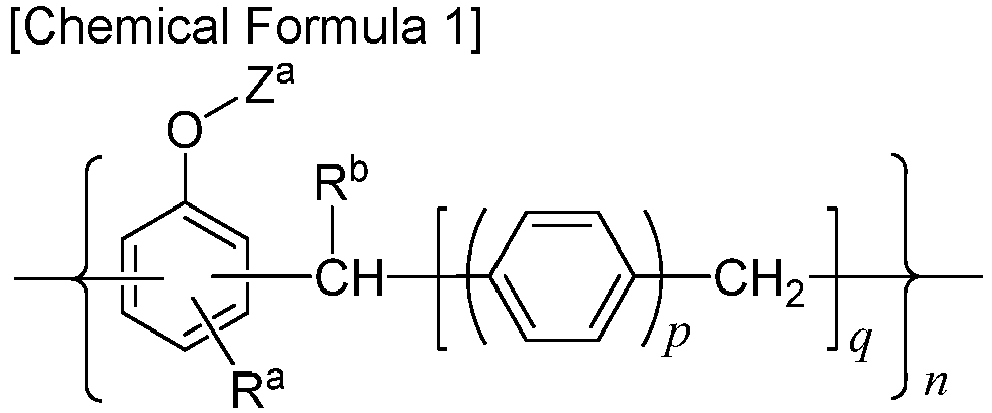
Ra and Rb are each independently hydrogen, a C1-5 alkyl group, a C1-3 hydroxyalkyl group, or a group represented by
Za and Zb are each independently, hydrogen or a group of

q is 0 or 1, and
n is a degree of polymerization of the repeat unit represented by the Chemical Formula 1. - As used herein, the term "substituted or unsubstituted"includes mono-substituted or multi-substituted with one or more substituent groups or unsubstituted.
- As used herein, an "alkyl group" may be a linear chain or a branched chain. Preferably, the alkyl group has a carbon number of 1 to 5, or 1 to 3. Specifically, the alkyl group may be methyl, ethyl, propyl, n-propyl, isopropyl, butyl, n-butyl, isobutyl, tert-butyl, sec-butyl, 1-methyl-butyl, 1-ethyl-butyl, n-pentyl, isopentyl, neopentyl, and ter-pentyl, and the like.
- As used herein, a "hydroxyalkyl group" means a group wherein an alkylene group is substituted with a hydroxy group at the end. For example, the hydroxyalkyl group may be a hydroxymethyl group(-CH2OH), a hydroxyethyl group(-CH2CH2OH), a hydroxypropyl group(-CH2CH2CH2OH), and the like.
- As used herein, an "aryl group" may be a monocyclic aryl group or a polycyclic aryl group. Preferably, the aryl group has a carbon number of 6 to 30. Specifically, the aryl group may be a phenyl group, a biphenyl group, a terphenyl group, a naphthyl group, an anthracenyl group, a phenanthryl group, a pyrenyl group, a perylenyl group, a chrysenyl group, and a fluorenyl group, and the like.
- As used herein, a "direct bond" means that an atom does not exist at the corresponding position, and the groups of both sides are directly connected with each other.
- The (a) phthalonitrile oligomer comprises one or more repeat units represented by the Chemical Formula 1.
- Preferably, the (a) phthalonitrile oligomer may comprise one, or two or three repeat units represented by the Chemical Formula 1.
- In case the (a) phthalonitrile oligomer comprises two or more repeat units represented by the
Chemical Formula 1, the structure of each repeat unit may be different from each other. - In the
Chemical Formula 1, Ra and Rb are each independently hydrogen, a C1-5 alkyl group, a C1-3 hydroxyalkyl group, or a group represented by
- In the
Chemical Formula 1, Za and Zb are each independently, hydrogen or a group of

- In the
Chemical Formula 1, p is 1 to 10, or 1 to 5, or 1 to 2. - In the
Chemical Formula 1, q is 0 or 1. - And, in the Chemical Formula 1, n is a degree of polymerization of the repeat unit.
- According to the embodiment of the invention, the phthalonitrile oligomer may be represented by one of the following Chemical Formulas A to D.


R1 to R4 are each independently, hydrogen, a C1-5 alkyl group, a C1-3 hydroxyalkyl group, or a group represented by
Z1 to Z5 are each independently, hydrogen or a group of

n and m are respectively, a degree of polymerization of each repeat unit. - According to the embodiment of the invention, the Chemical Formula A may be represented by the following Chemical Formulas A-1 to A-3.


Z1 to Z6 are each independently, hydrogen or a group of

n is a degree of polymerization of each repeat unit. - Specifically, the Chemical Formula A-3 may be represented by the following Chemical Formula (A-3)'.

- In the Chemical Formula (A-3)', Z1 to Z6 are as defined in the Chemical Formula A-3.
- According to the embodiment of the invention, the Chemical Formula B may be represented by the following Chemical Formula B-1.

- In the Chemical Formula B-1, Z1 to Z5 and n are as defined in the Chemical Formula B.
- According to the embodiment of the invention, the Chemical Formula C may be represented by the following Chemical Formula C-1.


- In the Chemical Formula C-1 Z1 to Z5, n, and m are as defined in the Chemical Formula C.
- According to the embodiment of the invention, the Chemical Formula D may be represented by the following Chemical Formula D-1.

- In the Chemical Formula D, Z1 to Z3, p and n are as defined in the Chemical Formula D.
- Meanwhile, the (a) phthalonitrile oligomer may be prepared by reacting an oligomer comprising one or more repeat units represented by the following Chemical Formula 1'(hereinafter, referred to as an "oligomer of the Chemical Formula 1' ") and a phthalonitrile compound(for example, 4-nitrophthalonitrile).

- In the Chemical Formula 1',
Ra and Rb' are each independently, hydrogen, a C1-5 alkyl group, a C1-3 hydroxyalkyl group, or a group represented by
p is 1 to 10,
q is 0 or 1, and
n is a degree of polymerization of the repeat unit represented by theChemical Formula 1. - By the reaction of the oligomer of the Chemical Formula 1' and the phthalonitrile compound, a phthalonitrile group bonds to the -OH group included in the oligomer of the Chemical Formula 1', thereby synthesizing the (a) phthalonitrile oligomer.
- In the above reaction, the amount of

Chemical Formula 1 may vary according to the reaction rate of the oligomer of the Chemical Formula 1' and the phthalonitrile compound. - As the oligomer of the Chemical Formula 1', those prepared by a common method in the technical field to which the present invention pertains may be used.
- And, as the oligomer of the Chemical Formula 1', commercial products comprising one or more repeat units represented by the Chemical Formula 1' may be used.
- Meanwhile, the (a) phthalonitrile oligomer may have a weight average molecular weight of 1,000 g/mol to 30,000 g/mol.
- Throughout the specification, the term "weight average molecular weight" is a numerical value converted in terms of standard polystyrene, measured by GPC(gel permeation chromatograph). In the specification, the term "molecular weight" means weight average molecular weight unless otherwise described.
- As non-limiting examples, molecular weight is measured using Agilent PL-GPC 220 equipped with PolarGel MIXED-L column of a length of 300 mm (Polymer Laboratories). The measurement temperature is 65 °C, dimethylformamide is used as a solvent, and flow rate is 1 mL/min. A sample is prepared at the concentration of 10mg/10mL, and then, fed in an amount of 100 µL. With reference to a calibration curve formed using polystyrene standard, Mw and Mn values are derived. As the polystyrene standard, 8 kinds having molecular weights(g/mol) of 580/ 3,940/ 8,450/ 31,400/ 70,950/ 316,500/ 956,000/ 4,230,000 are used.
- The (a) phthalonitrile oligomer may be given molecular weight in a wide range of 1,000 g/mol to 30,000 g/mol. Through the control of the molecular weight, rheological properties of the (a) phthalonitrile oligomer such as a softening point, melt viscosity, and the like may be controlled.
- Meanwhile, the 3D printing ink may further comprise a phthalonitrile compound well known in the art, in addition to the (a) phthalonitrile oligomer.
- As non-limiting examples, as the phthalonitrile compound, compounds described in
US Patent No. 4,408,035 ,US Patent No. 5,003,039 ,US Patent No. 5,003,078 ,US Patent No. 5,004,801 ,US Patent No. 5,132,396 ,US Patent No. 5,139,054 ,US Patent No. 5,208,318 ,US Patent No. 5,237,045 ,US Patent No. 5,292,854 , orUS Patent No. 5,350,828 , and the like may be mentioned. - Preferably, the 3D printing ink may further comprise a (a') phthalonitrile compound represented by the following Chemical Formula P1.

- In the Chemical Formula P1, RP11 to RP16 are each independently, hydrogen, a C1-5 alkyl group, a C1-5 alkoxy group, a C6-30 aryl group, a group of the following Chemical Formula P2, or a group of the following Chemical Formula P3, and two or more of RP11 to RP16 are a group of the following Chemical Formula P2 or a group of the following Chemical Formula P3,

- In the Chemical Formula P2,
LP2 is a direct bond, a C1-5 alkylene group, -O-, -S-, -C(=O)-, -S(=O)-, or -S(=O)2-,
RP21 to RP25 are each independently, hydrogen, a C1-5 alkyl group, a C1-5 alkoxy group, a C6-30 aryl group, or a cyano group, and two or more of RP21 to RP25 are cyano groups,
LP3 is a direct bond, a C1-5 alkylene group, -O-, -S-, -C(=O)-, -S(=O)-, or -S(=O)2-,
RP31 to RP35 are each independently, hydrogen, a C1-5 alkyl group, a C1-5 alkoxy group, a C6-30 aryl group, or a group of the Chemical Formula P2, and one or more of RP31 to RP35 are the groups of the Chemical Formula P2. - As non-limiting examples, the (a') phthalonitrile compound may be a compound represented by the following Chemical Formula P1'.

LP2 and LP3 are each independently, a direct bond, a C1-5 alkylene group, -O-, -S-, -C(=O)-, -S(=O)-, or -S(=O)2-. - RP11 to RP16, RP21 to RP25, and RP31 to RP35 are each independently, hydrogen, a C1-5 alkyl group, a C1-5 alkoxy group, or a C6-30 aryl group.
- In case the 3D printing ink comprises the (a) phthalonitrile oligomer and the (a') phthalonitrile compound represented by the Chemical Formula P1, it is preferable that the (a) phthalonitrile oligomer is included in the content of 20 wt% or more, based on the total weight of the phthalonitrile components.
- Namely, in order to sufficiently obtain the effect resulting from the application of the (a) phthalonitrile oligomer, it is preferable that the (a) phthalonitrile oligomer is included in the content of 20 wt% or more, or 20 to 100 wt%, in the phthalonitrile components applied in the 3D printing ink.
- The content of the (a) phthalonitrile oligomer may be controlled in the range of 20 to 100 wt% in the phthalonitrile components, as necessary (for example, according to the melt viscosity range required).
- According to the embodiment of the invention, the 3D printing ink comprises a curing agent.
- The curing agent is a compound capable of reacting with the (a) phthalonitrile oligomer to form phthalonitrile resin.
- For example, the curing agent may be a compound comprising a functional group capable of reacting with the cyano group of the (a) phthalonitrile oligomer.
- Preferably, the curing agent may be a compound having one or more functional groups selected from the group consisting of an amine group, a hydroxy group and an imide group.
- Specifically, the curing agent may be a compound represented by the following
Chemical Formula 2.
Chemical Formula 2, R21 to R26 are each independently, hydrogen, a C1-5 alkyl group, a C1-5 alkoxy group, a C6-30 aryl group, an amine group, or a group of the following Chemical Formula 3, and two or more of R21 to R26 are an amine group or a group of the following Chemical Formula 3,
L30 is a direct bond, a C1-5 alkylene group, -O- or -S-,
R31 to R35 are each independently, hydrogen, a C1-5 alkyl group, a C1-5 alkoxy group, a C6-30 aryl group, or an amine group, and at least one of R31 to R35 is an amine group. - As non-limiting examples, the curing agent may be a compound represented by the following
Chemical Formula 2'.

R21, R23, R24, and R25 are each independently, hydrogen, a C1-5 alkyl group, a C1-5 alkoxy group, or a C6-30 aryl group,
L30's are each independently, a direct bond, a C1-5 alkylene group, -O- or -S- , and
R31 to R35 are each independently, hydrogen, a C1-5 alkyl group, a C1-5 alkoxy group, a C6-30 aryl group, or an amine group, and at least one of R31 to R35 are amine groups. - And, the curing agent may be a compound represented by the following Chemical Formula 4.
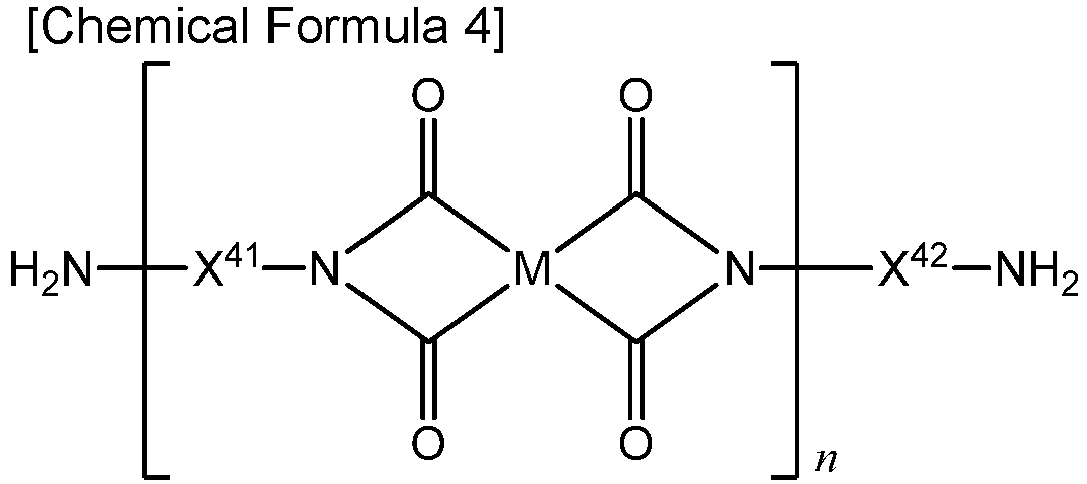
M is a tetravalent radical derived from a compound represented by any one of the following Chemical Formulas 5 to 7,
X41 and X42 are each independently, a divalent radical derived from a compound represented by any one of the following Chemical Formulas 8 and 9, and n is equal to or greater than 1;


R70 to R79 are each independently, hydrogen, a C1-5 alkyl group, a C1-5 alkoxy group, or a C6-30 aryl group,
X is a direct bond, a C1-5 alkylene group, -O-, -S-, -C(=O)-, -S(=O)-, -S(=O)2-, -C(=O)-O-L1-O-C(=O)-, -L2-C(=O)-O-L3-, -L4-O-C(=O)-L5-, or -L6-Ar1-L7-Ar2-L8-; wherein L1 to L8 are each independently, a direct bond, -O-, or a C1-5 alkylene group; and Ar1 and Ar2 are each independently, a C6-30 arylene group;


R90 to R99 are each independently, hydrogen, a C1-5 alkyl group, a C1-5 alkoxy group, a C6-30 aryl group, a hydroxy group, or a carboxyl group,
X'is a direct bond, a C1-5 alkylene group, -O-, -S-, -C(=O)-, -NRa-, -S(=O)-, -S(=O)2-, -L9-Ar3-L10-, or -L11-Ar4-L12-Ar5-L13-; wherein Ra is hydrogen, a C1-5 alkyl group, a C1-5 alkoxy group, or a C6-30 aryl group; L9 to L13 are each independently, a direct bond, -O-, or a C1-5 alkylene group; and Ar3 to Ar5 are each independently, a C6-30 arylene group. - As non-limiting examples, the curing agent may be a compound represented by the following Chemical Formula 4' or Chemical Formula 4".
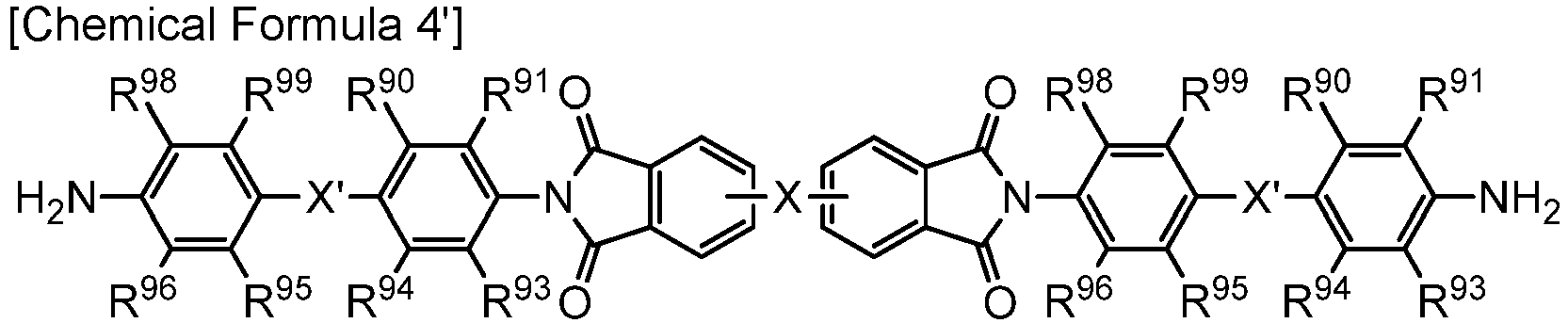


X and X' are each independently, a direct bond, a C1-5 alkylene group, -O-, -S-, -C(=O)-, -S(=O)-, -S(=O)2-, -C(=O)-O-L1-O-C(=O)-, -L2-C(=O)-O-L3-, -L4-O-C(=O)-L5-, or -L6-Ar1-L7-Ar2-L8-; wherein L1 to L8 are each independently, a direct bond, -O-, or a C1-5 alkylene group; Ar1 and Ar2 are each independently, a C6-30 arylene group, and
R90 to R99 are each independently, hydrogen, a C1-5 alkyl group, a C1-5 alkoxy group, a C6-30 aryl group, a hydroxyl group, or a carboxyl group. - Meanwhile, the content of the curing agent may be controlled in a range where curability to be given to the 3D printing ink can be secured.
- As non-limiting examples, the curing agent may be included at the mole ratio of 0.01 moles to 1.5 moles per one mole of the phthalonitrile oligomer.
- As non-limiting examples, the curing agent may be included at the mole ratio of 0.01 moles to 1.5 moles pre one mole of the phthalonitilre components included in the 3D printing ink. Wherein, the "phthalonitrile components" include the (a) phthalonitrile oligomer and (a') phthalonitrile compound included in the 3D printing ink.
- If the mole ratio of the curing agent increases, process window may become narrow, and thus, processabiltiy may be lowered, or high temperature curing condition may be required. And, if the mole ratio of the curing agent decreases, curability may become insufficient.
- According to the embodiment of the invention, the 3D printing ink may exhibit melt viscosity of 1000 Pa.s to 100000 Pa.s by a time sweep test under temperature of 200 to 280 °C and a frequency of 1 to 10Hz using rotational rheometer.
- Meanwhile, according to the embodiment of the invention, the 3D printing ink may be provided in the state of a prepolymer, which is the reaction product of the (a) phthalonitrile oligomer and the (b) curing agent.
- The prepolymer means a state wherein the reaction of the phthalonitrile oligomer and curing agent occur to some degree in the 3D printing ink (for example, a state wherein polymerization of A or B stage occurs), but completely cured state is not reached and appropriate flowability is exhibited so as to be processed.
- According to the embodiment of the invention, the 3D printing ink may further comprise additives.
- The kind of the additives is not specifically limited.
- And, the content of the additives may be controlled in a range where the properties of the 3D printing ink are not hindered.
- As non-limiting examples, as the additives, metal fiber, carbon fiber, glass fiber, aramid fiber, potassium titanate fiber, celluloid fiber, sepiolite fiber, ceramic fiber, acrylic fiber, barium sulfate, calcium carbonate, zirconia, alumina, zirconium silicate, silicon dioxide, silicon carbide, graphite, carbon nanobute, titanium dioxide, polytetrafluoroethylene, tungsten disulfide, molybdenum disulfide, and milled carbon fiber, and the like may be used.
- According to the present invention, three-dimensional printing ink that enables realization of viscosity suitable for three-dimensional printing and improved performance is provided.
-
Fig.1 to Fig.8 respectively shows the 1H-NMR spectrum of each compound prepared in Preparation Examples 1 to 8. - Hereinafter, preferable examples are presented for better understanding of the invention. However, these examples are presented only as the illustrations of the invention, and the present invention is not limited thereby.
- For the compounds prepared below, NMR analysis was conducted using 500 MHz NMR spectrometer of Agilent Inc., according to the manual of the manufacturing company. The samples for NMR analysis were prepared by dissolving compounds in DMSO(dimethyl sulfoxide)-d6.
- Using Agilent PL-GPC 220 equipped with 300 mm PolarGel MIXED-L column (Polymer Laboratories), the weight average molecular weights(Mw) of the phthalonitrile oligomers obtained in the following Preparation Examples were measured. The results were shown in each Preparation Example.
- The measurement temperature was 65 °C, dimethylformamide was used as a solvent, and flow rate was 1 mL/min. A sample was prepared at the concentration of 10mg/10mL, and then, fed in an amount of 100 µL. With reference to a calibration curve formed using polystyrene standard, Mw and Mn values are derived. As the polystyrene standard, 8 kinds having molecular weights(g/mol) of 580/ 3,940/ 8,450/ 31,400/ 70,950/ 316,500/ 956,000/ 4,230,000 were used.
- A phthalonitrile oligomer represented by the following Chemical Formula PN-1 was synthesized as follows.

- 41.1 g of the oligomer represented by the Chemical Formula KA-1 (weight average molecular weight 1,360 g/mol) and 165.0 g of DMF(dimethyl formamide) were introduced into a 3 neck round bottom flask, and the mixture was stirred at room temperature to dissolve. 51.9 g of 4-nitro phthalonitrile was added thereto, 70.0 g of DMF was added, and then, the mixture was stirred to dissolve. Subsequently, 49.8 g of potassium carbonate and 30.0 g of DMF were introduced together, and the temperature was raised to 85 °C while stirring. After progressing a reaction for about 5 hours, the reaction solution was cooled to room temperature. The cooled reaction solution was poured into 0.2 N hydrochloric acid aqueous solution to neutralize and precipitate. After filtering, it was washed with water. The filtered solution was dried in a vacuum oven of 100 °C for a day. After removing water and residual solvents, a phthalonitrile oligomer represented by the Chemical Formula PN-1 (weight average molecular weight 2,000 g/mol) was obtained with the yield of 95 wt%.
- The 1H-NMR analysis result of the phthalonitrile oligomer PN-1 was shown in
Fig. 1 . - A phthalonitrile oligomer represented by the following Chemical Formula PN-2 was synthesized as follows.

- 48.0 g of the oligomer represented by the Chemical Formula NE-1 (weight average molecular weight 1,600 g/mol) and 165.0 g of DMF(dimethyl formamide) were introduced into a 3 neck round bottom flask, and the mixture was stirred at room temperature to dissolve. 48.5 g of 4-nitro phthalonitrile was added thereto, 70.0 g of DMF was added, and then, the mixture was stirred to dissolve. Subsequently, 46.4 g of potassium carbonate and 30.0 g of DMF were introduced together, and the temperature was raised to 85 °C while stirring. After progressing a reaction for about 5 hours, the reaction solution was cooled to room temperature. The cooled reaction solution was poured into 0.2 N hydrochloric acid aqueous solution to neutralize and precipitate. After filtering, it was washed with water. The filtered solution was dried in a vacuum oven of 100 °C for a day. After removing water and residual solvents, a phthalonitrile oligomer represented by the Chemical Formula PN-2 (weight average molecular weight 2,200 g/mol) was obtained with the yield of 95 wt%.
- The 1H-NMR analysis result of the phthalonitrile oligomer PN-2 was shown in
Fig. 2 . - An oligomer(PN-3) represented by the Chemical Formula PN-2 and having weight average molecular weight of 2,400 g/mol was obtained with the yield of 96 wt% by the same method as Preparation Example 2, except that an oligomer represented by the Chemical Formula NE-1 and having weight average molecular weight of 1,700 g/mol was used instead of the oligomer represented by the Chemical Formula NE-1 (weight average molecular weight 1,600 g/mol).

- The 1H-NMR analysis result of the phthalonitrile oligomer PN-3 was shown in
Fig. 3 . - A phthalonitrile oligomer represented by the following Chemical Formula PN-4 was synthesized as follows.

- 48.6 g of the oligomer represented by the Chemical Formula NE-1 and having weight average molecular weight 8,800 g/mol, and 155.0 g of DMF(dimethyl formamide) were introduced into a 3 neck round bottom flask, and the mixture was stirred at room temperature to dissolve. 45.2 g of 4-nitrophthalonitrile was added thereto, 70.0 g of DMF was added, and then, the mixture was stirred to dissolve. Subsequently, 43.2 g of potassium carbonate and 30.0 g of DMF were introduced together, and the temperature was raised to 85 °C while stirring. After progressing a reaction for about 5 hours, the reaction solution was cooled to room temperature. The cooled reaction solution was poured into 0.2 N hydrochloric acid aqueous solution to neutralize and precipitate. After filtering, it was washed with water. The filtered solution was dried in a vacuum oven of 100 °C for a day. After removing water and residual solvents, a phthalonitrile oligomer represented by the Chemical Formula PN-4 (weight average molecular weight 10,000 g/mol) was obtained with the yield of 90 wt%.
- The 1H-NMR analysis result of the phthalonitrile oligomer PN-4 was shown in
Fig. 4 . - A phthalonitrile oligomer represented by the following Chemical Formula PN-5 was synthesized as follows.

- 33.9 g of an oligomer represented by the Chemical Formula TD-1 (weight average molecular weight 2,700 g/mol, and 164.0 g of DMF(dimethyl formamide) were introduced into a 3 neck round bottom flask, and the mixture was stirred at room temperature to dissolve. 55.4 g of 4-nitrophthalonitrile was added thereto, 70.0 g of DMF was added, and then, the mixture was stirred to dissolve. Subsequently, 53.1 g of potassium carbonate and 30.0 g of DMF were introduced together, and the temperature was raised to 85 °C while stirring. After progressing a reaction for about 5 hours, the reaction solution was cooled to room temperature. The cooled reaction solution was poured into 0.2 N hydrochloric acid aqueous solution to neutralize and precipitate. After filtering, it was washed with water. The filtered solution was dried in a vacuum oven of 100 °C for a day. After removing water and residual solvents, a phthalonitrile oligomer represented by the Chemical Formula PN-5 (weight average molecular weight 3,500 g/mol) was obtained with the yield of 97 wt%.
- The 1H-NMR analysis result of the phthalonitrile oligomer PN-5 was shown in
Fig. 5 . -

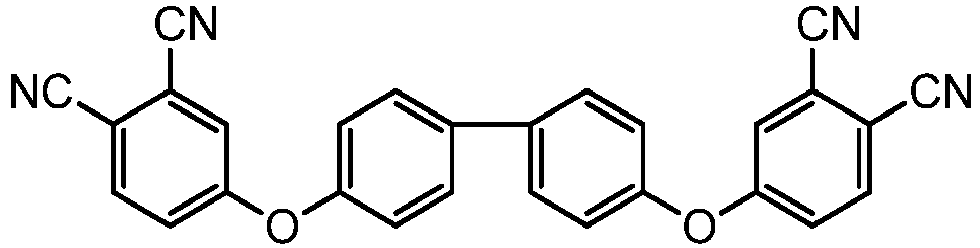
- 23.3 g of 4,4'-dihydroxybiphneyl and 140g of DMF(dimethyl formamide) were introduced into a 3 neck round bottom flask, and the mixture was stirred at room temperature to dissolve. 43.3 g of 4-nitrophthalonitrile was added thereto, 70.0 g of DMF was added, and then, the mixture was stirred to dissolve. Subsequently, 36.3 g of potassium carbonate and 30.0 g of DMF were introduced together, and the temperature was raised to 85 °C while stirring. After progressing a reaction for about 5 hours, the reaction solution was cooled to room temperature. The cooled reaction solution was poured into 0.2 N hydrochloric acid aqueous solution to neutralize and precipitate. After filtering, it was washed with water. The filtered solution was dried in a vacuum oven of 100 °C for a day. After removing water and residual solvents, a compound represented by the Chemical Formula PN-6 (4,4'-bis(3,4-dicyanophenoxy)biphenyl) was obtained with the yield of 90 wt%.
- The 1H-NMR analysis result of the PN-6 compound was shown in
Fig. 6 . -

- 28.0 g of bis(4-hydroxyphenyl)methane and 140g of DMF(dimethyl formamide) were introduced into a 3 neck round bottom flask, and the mixture was stirred at room temperature to dissolve. 48.5 g of 4-nitrophthalonitrile was added thereto, 50.0 g of DMF was added, and then, the mixture was stirred to dissolve. Subsequently, 46.4 g of potassium carbonate and 30.0 g of DMF were introduced together, and the temperature was raised to 85 °C while stirring. After progressing a reaction for about 5 hours, the reaction solution was cooled to room temperature. The cooled reaction solution was poured into 0.2 N hydrochloric acid aqueous solution to neutralize and precipitate. After filtering, it was washed with water. The filtered solution was dried in a vacuum oven of 100 °C for a day. After removing water and residual solvents, a compound represented by the Chemical Formula PN-7 (4,4'-((methylenebis(4,1-phenylene))bis(oxy))diphthalonitrile) was obtained with the yield of 95 wt%.
- The 1H-NMR analysis result of the PN-7 compound was shown in
Fig. 7 . -


- 24 g of a compound of the Chemical Formula a and 45 g of NMP(N-methyl-pyrrolidone) were introduced into a 3 neck round bottom flask, and the mixture was stirred at room temperature to dissolve. It was cooled with a water bath, and 12.4 g of a compound of the Chemical Formula b was added portionwise three times together with 45 g of NMP. When the introduced compounds were completely dissolved, 18 g of toluene was added to the reaction solution so as to form an azeotrope. Dean-Stark equipment and a reflux condenser were installed, and toluene was introduced and filled into the Dean-Stark equipment. 4.2 mL of pyridine was introduced as a dehydration condensation catalyst, the temperature was raised to 170 °C, and the mixture was stirred for 3 hours.
- While removing water generated with the formation of an imide ring with Dean-Stark equipment, the mixture was additionally stirred for 2 hours, and residual toluene and pyridine were removed. The reaction product was cooled to a room temperature, and precipitated in methanol to recover. The recovered precipitate was extracted with methanol to remove residual reactants, and dried in a vacuum oven to obtain a CA-1 compound represented by the Chemical Formula c with the yield of 81 wt%.
- The 1H-NMR analysis result of the CA-1 compound was shown in
Fig. 8 . -

- A compound represented by the Chemical Formula CA-2 (1,3-bis(3-aminophenoxy)benzene; m-APB, manufactured by TCI Co., Ltd.) was prepared as a curing agent without further purification process.
- The phthalonitrile oligomer PN-1 was completely molten on a hot plate of 240 °C using an aluminum dish. A curing agent of the compound of the Chemical Formula CA-1 was added thereto such that it existed in an amount of about 0.15 moles per 1 mole of the phthalonitrile oligomer PN-1. Additionally, the mixture was uniformly mixed on a hot plate of 240 °C, and then, cooled to prepare 3D printing ink in the state of a prepolymer.
- 3D printing ink in the state of a prepolymer was prepared by the same method as Example 1, except that a mixture of 50 wt% of the phthalonitrile oligomer PN-1 and 50 wt% of the phthalonitrile compound PN-7 was used instead of the phthalonitrile oligomer PN-1. Wherein, the curing agent of the compound of CA-1 was added such that it existed in an amount of about 0.15 moles per 1 mole of the mixture of PN-1 and PN-7.
- 3D printing ink in the state of a prepolymer was prepared by the same method as Example 2, except that based on 100 parts by weight of the mixture of the phthalonitrile oligomer PN-1 and the phthalonitrile compound PN-7, 10 parts by weight of silicon dioxide and 10 parts by weight of graphite were further added.
- 3D printing ink in the state of a prepolymer was prepared by the same method as Example 1, except that a mixture of 75 wt% of the phthalonitrile oligomer PN-1 and 25 wt% of the phthalonitrile compound PN-7 was used instead of the phthalonitrile oligomer PN-1. Wherein, the curing agent of the compound of CA-1 was added such that it existed in an amount of about 0.15 moles per 1 mole of the mixture of PN-1 and PN-7.
- 3D printing ink in the state of a prepolymer was prepared by the same method as Example 4, except that based on 100 parts by weight of the mixture of the phthalonitrile oligomer PN-1 and the phthalonitrile compound PN-7, 10 parts by weight of silicon dioxide and 10 parts by weight of graphite were further added.
- 3D printing ink in the state of a prepolymer was prepared by the same method as Example 1, except that the phthalonitrile compound PN-6 was used instead of the phthalonitrile oligomer PN-1.
- 3D printing ink in the state of a prepolymer was prepared by the same method as Example 1, except that the phthalonitrile compound PN-7 was used instead of the phthalonitrile oligomer PN-1.
[Table 1] Phthalonitrile components Curing agent Additives (a) (a') (b) (c) Example 1 PN-1 (100 wt%) - CA-1 - Example 2 PN-1 (50 wt%) PN-7 (50 wt%) CA-1 - Example 3 PN-1 (50 wt%) PN-7 (50 wt%) CA-1 SiO2, graphite Example 4 PN-1 (75 wt%) PN-7 (25 wt%) CA-1 - Example 5 PN-1 (75 wt%) PN-7 (25 wt%) CA-1 SiO2, graphite Comparative Example 1 - PN-6 (100 wt%) CA-1 - Comparative Example 2 - PN-7 (100 wt%) CA-1 - - The melt viscosity of 3D printing ink prepared in Examples and Comparative Examples was measured, and the results were shown in the following Table 2.
- The melt viscosity was measured by a time sweep test under temperature of 200 to 280 °C and a frequency of 1 to 10Hz using rotational rheometer.
- 3D printing performance of the 3D printing ink prepared in Examples and Comparative Examples was evaluated. The results were shown in the following Table 2.
- The 3D printing was conducted under conditions of CO2 laser,
laser intensity 1 ~ 5%, andlaser speed 100∼1000mm/s, using a 3D printer(GEM-100, Coherent). - The evaluation was made according to the following standard.
- ○: The 3D printing ink is cured by laser, and can form a 3D structure.
- Δ: The 3D printing ink is cured by laser, but cannot form a 3D structure (not laminated).
- X: The 3D printing ink is not molten by laser, or is molten by laser but is not cured.
- Referring to Table 2, it was confirmed that the 3D printing ink of Examples 1 to 5 has remarkably high melt viscosity, compared to Comparative Examples 1 and 2. Particularly, it was confirmed that even if the 3D printing ink of Examples 1 to 5 is molten by laser during 3D printing, it is rapidly cured by laser scan without collapse of the shape of the molten part, thereby exhibiting excellent 3D printing performance.
| Melt viscosity (Pa.s) | 3D printing property | |
| Example 1 | 10000 ∼ 100000 | ○ |
| Example 2 | 1000 ∼ 10000 | Δ |
| Example 3 | 10000 ∼ 100000 | ○ |
| Example 4 | 10000 ∼ 100000 | Δ |
| Example 5 | 10000 ∼ 100000 | ○ |
| Comparative Example 1 | < 1 | X |
| Comparative Example 2 | < 1 | X |
Claims (13)
- Three-dimensional printing ink comprising (a) a phthalonitrile oligomer comprising one or more repeat units represented by the following Chemical Formula 1 and (b) a curing agent.

Ra and Rb are each independently, hydrogen, a C1-5 alkyl group, a C1-3 hydroxyalkyl group, or a group represented by
Za and Zb are each independently, hydrogen or a group of

q is 0 or 1, and
n is a degree of polymerization of the repeat unit represented by the Chemical Formula 1. - The three-dimensional printing ink according to claim 1, wherein the phthalonitrile oligomer is represented by any one of the following Chemical Formulas A to D.

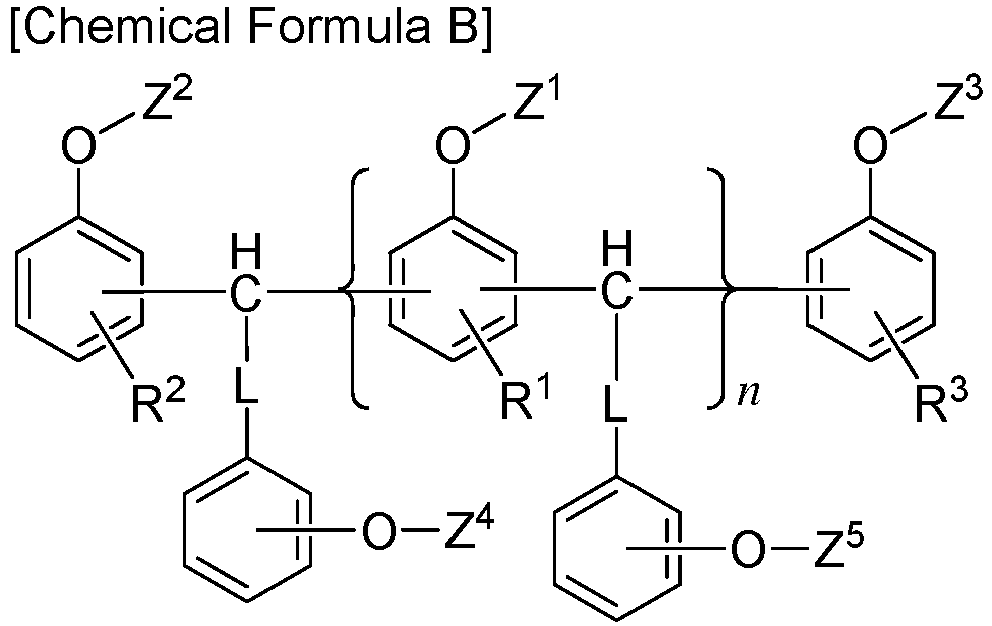
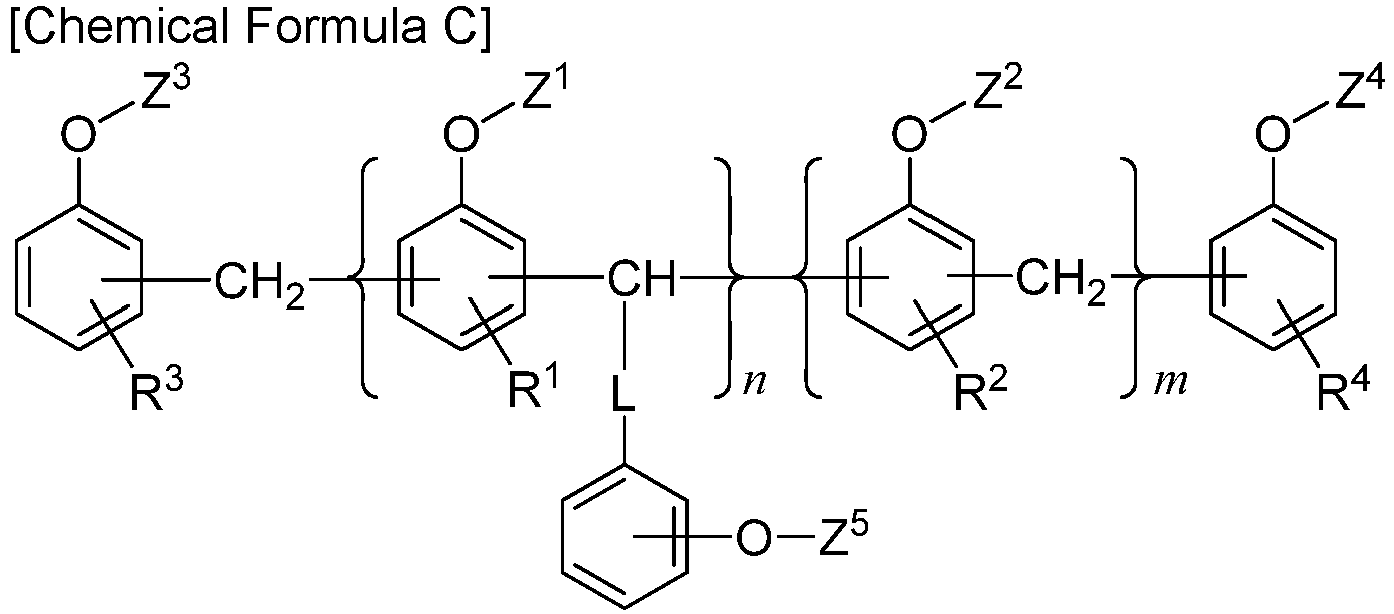

R1 to R4 are each independently, hydrogen, a C1-5 alkyl group, a C1-3 hydroxyalkyl group, or a group represented by
Z1 to Z5 are each independently, hydrogen or a group of

n and m are respectively, a degree of polymerization of each repeat unit. - The three-dimensional printing ink according to claim 2, wherein the Chemical Formula A is represented by any one of the following Chemical Formulas A-1 to A-3.


Z1 to Z6 are each independently, hydrogen or a group of

n is a degree of polymerization of each repeat unit. - The three-dimensional printing ink according to claim 2, wherein the Chemical Formula B is represented by the following Chemical Formula B-1.

Z1 to Z5 are each independently, hydrogen or a group of
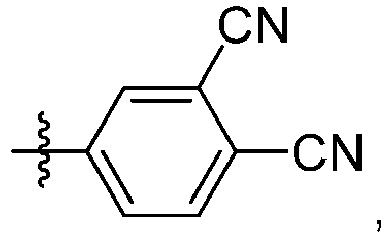
n is a degree of polymerization of the repeat unit. - The three-dimensional printing ink according to claim 2, wherein the Chemical Formula C is represented by the following Chemical Formula C-1.

Z1 to Z5 are each independently, hydrogen or a group of

n and m are respectively, a degree of polymerization of each repeat unit. - The three-dimensional printing ink according to claim 2, wherein the Chemical Formula D is represented by the following Chemical Formula D-1.

Z1 to Z3 are each independently, hydrogen or a group of

n is a degree of polymerization of the repeat unit. - The three-dimensional printing ink according to claim 1, wherein the phthalonitrile oligomer has a weight average molecular weight of 1,000 g/mol to 30,000 g/mol.
- The three-dimensional printing ink according to claim 1, further comprising (a') a phthalonitrile compound represented by the following Chemical Formula P1.


LP2 is a direct bond, a C1-5 alkylene group, -O-, -S-, -C(=O)-, -S(=O)-, or -S(=O)2-,
RP21 to RP25 are each independently, hydrogen, a C1-5 alkyl group, a C1-5 alkoxy group, a C6-30 aryl group, or a cyano group, and two or more of the RP21 to RP25 are cyano groups,
LP3 is a direct bond, a C1-5 alkylene group, -O-, -S-, -C(=O)-, -S(=O)-, or -S(=O)2-,
RP31 to RP35 are each independently, hydrogen, a C1-5 alkyl group, a C1-5 alkoxy group, a C6-30 aryl group, or a group of the Chemical Formula P2, and one or more of RP31 to RP35 are the groups of the Chemical Formula P2. - The three-dimensional printing ink according to claim 1, wherein the curing agent has one or more functional groups selected from the group consisting of an amine group, a hydroxy group and an imide group.
- The three-dimensional printing ink according to claim 9, wherein the curing agent is a compound represented by the following Chemical Formula 2.

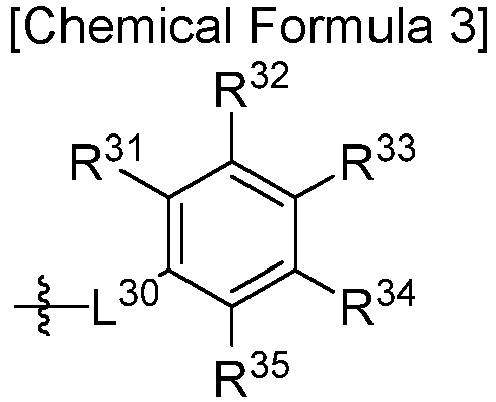
L30 is a direct bond, a C1-5 alkylene group, -O- or -S-, and
R31 to R35 are each independently, hydrogen, a C1-5 alkyl group, a C1-5 alkoxy group, a C6-30 aryl group, or an amine group, and at least one of R31 to R35 is an amine group. - The three-dimensional printing ink according to claim 9, wherein the curing agent is a compound represented by the following Chemical Formula 4.

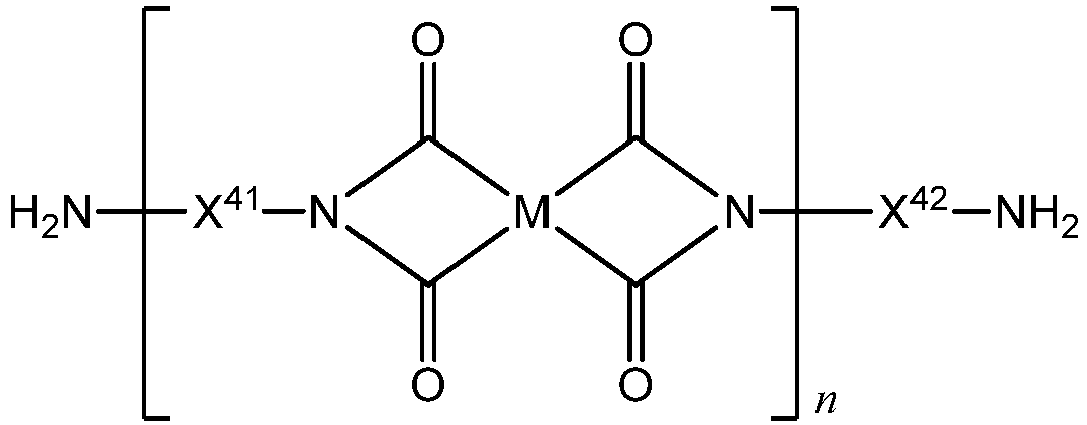
M is a tetravalent radical derived from a compound represented by any one of the following Chemical Formulas 5 to 7,
X41 and X42 are each independently, a divalent radical derived from a compound represented by any one of the following Chemical Formulas 8 and 9, and
n is equal to or greater than 1;


R70 to R79 are each independently, hydrogen, a C1-5 alkyl group, a C1-5 alkoxy group, or a C6-30 aryl group,
X is a direct bond, a C1-5 alkylene group, -O-, -S-, -C(=O)-, -S(=O)-, -S(=O)2-, -C(=O)-O-L1-O-C(=O)-, -L2-C(=O)-O-L3-, -L4-O-C(=O)-L5-, or -L6-Ar1-L7-Ar2-L8-; wherein L1 to L8 are each independently, a direct bond, -O-, or a C1-5 alkylene group; and Ar1 and Ar2 are each independently, a C6-30 arylene group;

R90 to R99 are each independently, hydrogen, a C1-5 alkyl group, a C1-5 alkoxy group, a C6-30 aryl group, a hydroxy group, or a carboxyl group,
X'is a direct bond, a C1-5 alkylene group, -O-, -S-, -C(=O)-, -NRa-, -S(=O)-, -S(=O)2-, -L9-Ar3-L10-, or -L11-Ar4-L12-Ar5-L13-; wherein Ra is hydrogen, a C1-5 alkyl group, a C1-5 alkoxy group, or a C6-30 aryl group; L9 to L13 are each independently, a direct bond, -O-, or a C1-5 alkylene group; and Ar3 to Ar5 are each independently, a C6-30 arylene group. - The three-dimensional printing ink according to claim 1, wherein the (b) curing agent is included at the mole ratio of 0.01 moles to 1.5 moles per one mole of the (a) phthalonitrile oligomer.
- The three-dimensional printing ink according to claim 1, wherein the three-dimensional printing ink exhibits melt viscosity of 1000 Pa.s to 100000 Pa.s by a time sweep test under temperature of 200 to 280 °C and a frequency of 1 to 10Hz using rotational rheometer.
Applications Claiming Priority (3)
| Application Number | Priority Date | Filing Date | Title |
|---|---|---|---|
| KR1020180114413A KR102323553B1 (en) | 2018-09-21 | 2018-09-21 | Three-dimensional printing ink comprising a phthalonitrile oligomer |
| KR1020180114412A KR102340253B1 (en) | 2018-09-21 | 2018-09-21 | A curable resin composition comprising a phthalonitrile oligomer and a prepolymer thereof |
| PCT/KR2019/012205 WO2020060266A1 (en) | 2018-09-21 | 2019-09-20 | Three-dimensional printing ink comprising phthalonitrile oligomers |
Publications (3)
| Publication Number | Publication Date |
|---|---|
| EP3705541A1 true EP3705541A1 (en) | 2020-09-09 |
| EP3705541A4 EP3705541A4 (en) | 2021-08-18 |
| EP3705541B1 EP3705541B1 (en) | 2023-09-06 |
Family
ID=69887582
Family Applications (1)
| Application Number | Title | Priority Date | Filing Date |
|---|---|---|---|
| EP19863116.0A Active EP3705541B1 (en) | 2018-09-21 | 2019-09-20 | Three-dimensional printing ink comprising phthalonitrile oligomer |
Country Status (5)
| Country | Link |
|---|---|
| US (2) | US11674045B2 (en) |
| EP (1) | EP3705541B1 (en) |
| JP (1) | JP7031939B2 (en) |
| CN (2) | CN111492017B (en) |
| WO (2) | WO2020060266A1 (en) |
Cited By (1)
| Publication number | Priority date | Publication date | Assignee | Title |
|---|---|---|---|---|
| WO2022087586A1 (en) * | 2020-10-20 | 2022-04-28 | The Boeing Company | Phthalonitrile-based high temperature resistive inks |
Family Cites Families (25)
| Publication number | Priority date | Publication date | Assignee | Title |
|---|---|---|---|---|
| US4244857A (en) | 1979-08-30 | 1981-01-13 | The United States Of America As Represented By The Administrator Of The National Aeronautics And Space Administration | Curing agent for polyepoxides and epoxy resins and composites cured therewith |
| US4408035A (en) | 1981-08-24 | 1983-10-04 | The United States Of America As Represented By The Secretary Of The Navy | Phthalonitrile resin from diphthalonitrile monomer and amine |
| US5003039A (en) | 1988-11-18 | 1991-03-26 | The United States Of America As Represented By The Secretary Of The Navy | Amino phenyl containing curing agent for high performance phthalonitrile resin |
| US5004801A (en) | 1988-11-21 | 1991-04-02 | The United States Of America As Represented By The Secretary Of The Navy | Polymer of dithioether-linked phthalonitrile |
| US5003078A (en) * | 1989-05-16 | 1991-03-26 | The United States Of America As Represented By The Secretary Of The Navy | Synthesis of phthalonitrile resins containing ether and imide linkages |
| US5159054A (en) | 1989-05-16 | 1992-10-27 | The United States Of America As Represented By The Secretary Of The Navy | Synthesis of phthalonitrile resins containing ether and imide linkages |
| US5132396A (en) | 1990-04-30 | 1992-07-21 | The United States Of America As Represented By The Secretary Of The Navy | Phthalonitrile monomers containing imide and/or phenoxy linkages, and polymers thereof |
| US5208318A (en) | 1991-03-15 | 1993-05-04 | Keller Teddy M | Phosphazene-containing amine as curing agent for phthalonitrile-base polymer |
| US5139054A (en) | 1991-06-28 | 1992-08-18 | Leggett & Platt, Incorporated | Spring interior forming and assembling apparatus |
| US5237045A (en) | 1992-01-09 | 1993-08-17 | The United States Of America As Represented By The Secretary Of The Navy | Curing phthalonitrile resins with acid and amine |
| US6756470B2 (en) | 2002-04-26 | 2004-06-29 | The United States Of America As Represented By The Secretary Of The Navy | Oligomeric hydroxy arylether phthalonitiles and synthesis thereof |
| JP2004296215A (en) | 2003-03-26 | 2004-10-21 | Toyota Industries Corp | Transparent substrate for planar light source, method for manufacturing transparent substrate, planar light source, and liquid crystal display device |
| SE530059C2 (en) | 2006-03-06 | 2008-02-19 | Perstorp Specialty Chem Ab | Process for Preparation of a Bisphthalonitrile Monomer |
| CN104086727B (en) | 2014-06-30 | 2016-08-17 | 中国科学院化学研究所 | A kind of phenol-formaldehyde resin modified of applicable RTM shaping and its preparation method and application |
| US9464170B2 (en) | 2014-12-15 | 2016-10-11 | The United States Of America, As Represented By The Secretary Of The Navy | Controlling crosslinking density and processing parameters of phthalonitriles |
| US9708440B2 (en) | 2015-06-18 | 2017-07-18 | Novoset, Llc | High temperature three dimensional printing compositions |
| WO2017172515A1 (en) * | 2016-03-31 | 2017-10-05 | 3M Innovative Properties Company | Bisphenol m diphthalonitrile ether resin, bisphenol p diphthalonitrile ether resin, methods of making same, resin blends, and two component systems |
| KR102053093B1 (en) | 2015-12-02 | 2019-12-06 | 주식회사 엘지화학 | Phthalonitrile compound |
| KR101953369B1 (en) * | 2015-12-04 | 2019-02-28 | 주식회사 엘지화학 | Polymerizable composition |
| US20190127525A1 (en) | 2016-01-07 | 2019-05-02 | Lg Chem, Ltd. | Phthalonitrile resin |
| CN105566629B (en) * | 2016-03-18 | 2018-05-15 | 中国科学院化学研究所 | A kind of porous o-phthalonitrile resin and its preparation method and application |
| US10927215B2 (en) | 2016-08-08 | 2021-02-23 | Lg Chem, Ltd. | Polymerizable composition |
| JP6900103B2 (en) | 2016-11-04 | 2021-07-07 | エルジー・ケム・リミテッド | Polymerizable composition |
| KR102167222B1 (en) * | 2016-11-29 | 2020-10-19 | 주식회사 엘지화학 | Curable Composition |
| CN107266336B (en) | 2017-06-08 | 2019-10-01 | 中国科学院化学研究所 | A kind of oligomer containing fluorine and phthalonitrile and its solidfied material and preparation method |
-
2019
- 2019-09-20 EP EP19863116.0A patent/EP3705541B1/en active Active
- 2019-09-20 US US16/964,391 patent/US11674045B2/en active Active
- 2019-09-20 CN CN201980006397.6A patent/CN111492017B/en active Active
- 2019-09-20 WO PCT/KR2019/012205 patent/WO2020060266A1/en not_active Ceased
- 2019-09-20 JP JP2020530947A patent/JP7031939B2/en active Active
- 2019-09-20 WO PCT/KR2019/012201 patent/WO2020060262A1/en not_active Ceased
- 2019-09-20 CN CN201980006385.3A patent/CN111479885B/en active Active
- 2019-09-20 US US16/964,529 patent/US11591487B2/en active Active
Cited By (3)
| Publication number | Priority date | Publication date | Assignee | Title |
|---|---|---|---|---|
| WO2022087586A1 (en) * | 2020-10-20 | 2022-04-28 | The Boeing Company | Phthalonitrile-based high temperature resistive inks |
| CN116323835A (en) * | 2020-10-20 | 2023-06-23 | 波音公司 | Phthalonitrile based high temperature resistive ink |
| US12187908B2 (en) | 2020-10-20 | 2025-01-07 | The Boeing Company | Phthalonitrile-based high temperature resistive inks |
Also Published As
| Publication number | Publication date |
|---|---|
| CN111479885A (en) | 2020-07-31 |
| US11674045B2 (en) | 2023-06-13 |
| CN111492017B (en) | 2022-06-07 |
| WO2020060266A1 (en) | 2020-03-26 |
| JP7031939B2 (en) | 2022-03-08 |
| JP2021505438A (en) | 2021-02-18 |
| EP3705541A4 (en) | 2021-08-18 |
| CN111479885B (en) | 2022-05-27 |
| WO2020060262A1 (en) | 2020-03-26 |
| CN111492017A (en) | 2020-08-04 |
| EP3705541B1 (en) | 2023-09-06 |
| US20210047528A1 (en) | 2021-02-18 |
| US20210206908A1 (en) | 2021-07-08 |
| US11591487B2 (en) | 2023-02-28 |
Similar Documents
| Publication | Publication Date | Title |
|---|---|---|
| EP3385302B1 (en) | Polymeric composition | |
| EP3299355B1 (en) | Phthalonitrile compound | |
| EP3299404B1 (en) | Phthalonitrile resin | |
| EP3536734B1 (en) | Polymerizable composition | |
| EP3354638A1 (en) | Phthalonitrile compound | |
| US10927215B2 (en) | Polymerizable composition | |
| EP3705541B1 (en) | Three-dimensional printing ink comprising phthalonitrile oligomer | |
| US4474932A (en) | Process for the production of aromatic ethers and aromatic polyethers | |
| KR102323553B1 (en) | Three-dimensional printing ink comprising a phthalonitrile oligomer | |
| KR102218559B1 (en) | Phthalonitrile-based resin with improved impact strength | |
| KR20180074043A (en) | Phthalonitrile resin | |
| KR102340924B1 (en) | A resin composition with improved impact strength | |
| KR102340253B1 (en) | A curable resin composition comprising a phthalonitrile oligomer and a prepolymer thereof | |
| KR102818598B1 (en) | Thermal curable resin composition and phenol resin composition prepared therefrom | |
| EP3549972B1 (en) | Polymerizable composition | |
| Relles et al. | Dichloromaleimide chemistry. IV. Preparation of poly (maleimide–ethers) from the reaction of bisdichloromaleimides with bisphenols | |
| KR20200036608A (en) | A phthalonitrile-based curable resin composition having excellent heat resistance and a prepolymer thereof |
Legal Events
| Date | Code | Title | Description |
|---|---|---|---|
| STAA | Information on the status of an ep patent application or granted ep patent |
Free format text: STATUS: THE INTERNATIONAL PUBLICATION HAS BEEN MADE |
|
| PUAI | Public reference made under article 153(3) epc to a published international application that has entered the european phase |
Free format text: ORIGINAL CODE: 0009012 |
|
| STAA | Information on the status of an ep patent application or granted ep patent |
Free format text: STATUS: REQUEST FOR EXAMINATION WAS MADE |
|
| 17P | Request for examination filed |
Effective date: 20200602 |
|
| AK | Designated contracting states |
Kind code of ref document: A1 Designated state(s): AL AT BE BG CH CY CZ DE DK EE ES FI FR GB GR HR HU IE IS IT LI LT LU LV MC MK MT NL NO PL PT RO RS SE SI SK SM TR |
|
| AX | Request for extension of the european patent |
Extension state: BA ME |
|
| A4 | Supplementary search report drawn up and despatched |
Effective date: 20210716 |
|
| RIC1 | Information provided on ipc code assigned before grant |
Ipc: C09D 11/102 20140101AFI20210712BHEP Ipc: B33Y 70/00 20200101ALI20210712BHEP Ipc: C09D 11/38 20140101ALI20210712BHEP Ipc: C09D 11/03 20140101ALI20210712BHEP Ipc: C08G 61/12 20060101ALI20210712BHEP Ipc: C08L 65/00 20060101ALI20210712BHEP Ipc: C08K 5/34 20060101ALI20210712BHEP Ipc: C08K 5/00 20060101ALI20210712BHEP |
|
| DAV | Request for validation of the european patent (deleted) | ||
| DAX | Request for extension of the european patent (deleted) | ||
| REG | Reference to a national code |
Ref country code: DE Ref legal event code: R079 Ref country code: DE Ref legal event code: R079 Ref document number: 602019037085 Country of ref document: DE Free format text: PREVIOUS MAIN CLASS: C09D0011380000 Ipc: C09D0011102000 |
|
| GRAP | Despatch of communication of intention to grant a patent |
Free format text: ORIGINAL CODE: EPIDOSNIGR1 |
|
| STAA | Information on the status of an ep patent application or granted ep patent |
Free format text: STATUS: GRANT OF PATENT IS INTENDED |
|
| RIC1 | Information provided on ipc code assigned before grant |
Ipc: C08K 5/00 20060101ALI20230515BHEP Ipc: C08K 5/34 20060101ALI20230515BHEP Ipc: C08L 65/00 20060101ALI20230515BHEP Ipc: C08G 61/12 20060101ALI20230515BHEP Ipc: C09D 11/03 20140101ALI20230515BHEP Ipc: C09D 11/38 20140101ALI20230515BHEP Ipc: B33Y 70/00 20200101ALI20230515BHEP Ipc: C09D 11/102 20140101AFI20230515BHEP |
|
| INTG | Intention to grant announced |
Effective date: 20230607 |
|
| GRAS | Grant fee paid |
Free format text: ORIGINAL CODE: EPIDOSNIGR3 |
|
| GRAA | (expected) grant |
Free format text: ORIGINAL CODE: 0009210 |
|
| STAA | Information on the status of an ep patent application or granted ep patent |
Free format text: STATUS: THE PATENT HAS BEEN GRANTED |
|
| AK | Designated contracting states |
Kind code of ref document: B1 Designated state(s): AL AT BE BG CH CY CZ DE DK EE ES FI FR GB GR HR HU IE IS IT LI LT LU LV MC MK MT NL NO PL PT RO RS SE SI SK SM TR |
|
| REG | Reference to a national code |
Ref country code: GB Ref legal event code: FG4D |
|
| REG | Reference to a national code |
Ref country code: CH Ref legal event code: EP |
|
| REG | Reference to a national code |
Ref country code: DE Ref legal event code: R096 Ref document number: 602019037085 Country of ref document: DE |
|
| REG | Reference to a national code |
Ref country code: IE Ref legal event code: FG4D |
|
| REG | Reference to a national code |
Ref country code: LT Ref legal event code: MG9D |
|
| REG | Reference to a national code |
Ref country code: NL Ref legal event code: MP Effective date: 20230906 |
|
| PG25 | Lapsed in a contracting state [announced via postgrant information from national office to epo] |
Ref country code: GR Free format text: LAPSE BECAUSE OF FAILURE TO SUBMIT A TRANSLATION OF THE DESCRIPTION OR TO PAY THE FEE WITHIN THE PRESCRIBED TIME-LIMIT Effective date: 20231207 |
|
| PG25 | Lapsed in a contracting state [announced via postgrant information from national office to epo] |
Ref country code: SE Free format text: LAPSE BECAUSE OF FAILURE TO SUBMIT A TRANSLATION OF THE DESCRIPTION OR TO PAY THE FEE WITHIN THE PRESCRIBED TIME-LIMIT Effective date: 20230906 Ref country code: RS Free format text: LAPSE BECAUSE OF FAILURE TO SUBMIT A TRANSLATION OF THE DESCRIPTION OR TO PAY THE FEE WITHIN THE PRESCRIBED TIME-LIMIT Effective date: 20230906 Ref country code: NO Free format text: LAPSE BECAUSE OF FAILURE TO SUBMIT A TRANSLATION OF THE DESCRIPTION OR TO PAY THE FEE WITHIN THE PRESCRIBED TIME-LIMIT Effective date: 20231206 Ref country code: LV Free format text: LAPSE BECAUSE OF FAILURE TO SUBMIT A TRANSLATION OF THE DESCRIPTION OR TO PAY THE FEE WITHIN THE PRESCRIBED TIME-LIMIT Effective date: 20230906 Ref country code: LT Free format text: LAPSE BECAUSE OF FAILURE TO SUBMIT A TRANSLATION OF THE DESCRIPTION OR TO PAY THE FEE WITHIN THE PRESCRIBED TIME-LIMIT Effective date: 20230906 Ref country code: HR Free format text: LAPSE BECAUSE OF FAILURE TO SUBMIT A TRANSLATION OF THE DESCRIPTION OR TO PAY THE FEE WITHIN THE PRESCRIBED TIME-LIMIT Effective date: 20230906 Ref country code: GR Free format text: LAPSE BECAUSE OF FAILURE TO SUBMIT A TRANSLATION OF THE DESCRIPTION OR TO PAY THE FEE WITHIN THE PRESCRIBED TIME-LIMIT Effective date: 20231207 Ref country code: FI Free format text: LAPSE BECAUSE OF FAILURE TO SUBMIT A TRANSLATION OF THE DESCRIPTION OR TO PAY THE FEE WITHIN THE PRESCRIBED TIME-LIMIT Effective date: 20230906 |
|
| REG | Reference to a national code |
Ref country code: AT Ref legal event code: MK05 Ref document number: 1608549 Country of ref document: AT Kind code of ref document: T Effective date: 20230906 |
|
| PG25 | Lapsed in a contracting state [announced via postgrant information from national office to epo] |
Ref country code: NL Free format text: LAPSE BECAUSE OF FAILURE TO SUBMIT A TRANSLATION OF THE DESCRIPTION OR TO PAY THE FEE WITHIN THE PRESCRIBED TIME-LIMIT Effective date: 20230906 |
|
| PG25 | Lapsed in a contracting state [announced via postgrant information from national office to epo] |
Ref country code: IS Free format text: LAPSE BECAUSE OF FAILURE TO SUBMIT A TRANSLATION OF THE DESCRIPTION OR TO PAY THE FEE WITHIN THE PRESCRIBED TIME-LIMIT Effective date: 20240106 |
|
| PG25 | Lapsed in a contracting state [announced via postgrant information from national office to epo] |
Ref country code: AT Free format text: LAPSE BECAUSE OF FAILURE TO SUBMIT A TRANSLATION OF THE DESCRIPTION OR TO PAY THE FEE WITHIN THE PRESCRIBED TIME-LIMIT Effective date: 20230906 |
|
| PG25 | Lapsed in a contracting state [announced via postgrant information from national office to epo] |
Ref country code: ES Free format text: LAPSE BECAUSE OF FAILURE TO SUBMIT A TRANSLATION OF THE DESCRIPTION OR TO PAY THE FEE WITHIN THE PRESCRIBED TIME-LIMIT Effective date: 20230906 |
|
| PG25 | Lapsed in a contracting state [announced via postgrant information from national office to epo] |
Ref country code: SM Free format text: LAPSE BECAUSE OF FAILURE TO SUBMIT A TRANSLATION OF THE DESCRIPTION OR TO PAY THE FEE WITHIN THE PRESCRIBED TIME-LIMIT Effective date: 20230906 Ref country code: RO Free format text: LAPSE BECAUSE OF FAILURE TO SUBMIT A TRANSLATION OF THE DESCRIPTION OR TO PAY THE FEE WITHIN THE PRESCRIBED TIME-LIMIT Effective date: 20230906 Ref country code: IS Free format text: LAPSE BECAUSE OF FAILURE TO SUBMIT A TRANSLATION OF THE DESCRIPTION OR TO PAY THE FEE WITHIN THE PRESCRIBED TIME-LIMIT Effective date: 20240106 Ref country code: ES Free format text: LAPSE BECAUSE OF FAILURE TO SUBMIT A TRANSLATION OF THE DESCRIPTION OR TO PAY THE FEE WITHIN THE PRESCRIBED TIME-LIMIT Effective date: 20230906 Ref country code: EE Free format text: LAPSE BECAUSE OF FAILURE TO SUBMIT A TRANSLATION OF THE DESCRIPTION OR TO PAY THE FEE WITHIN THE PRESCRIBED TIME-LIMIT Effective date: 20230906 Ref country code: CZ Free format text: LAPSE BECAUSE OF FAILURE TO SUBMIT A TRANSLATION OF THE DESCRIPTION OR TO PAY THE FEE WITHIN THE PRESCRIBED TIME-LIMIT Effective date: 20230906 Ref country code: AT Free format text: LAPSE BECAUSE OF FAILURE TO SUBMIT A TRANSLATION OF THE DESCRIPTION OR TO PAY THE FEE WITHIN THE PRESCRIBED TIME-LIMIT Effective date: 20230906 Ref country code: PT Free format text: LAPSE BECAUSE OF FAILURE TO SUBMIT A TRANSLATION OF THE DESCRIPTION OR TO PAY THE FEE WITHIN THE PRESCRIBED TIME-LIMIT Effective date: 20240108 Ref country code: SK Free format text: LAPSE BECAUSE OF FAILURE TO SUBMIT A TRANSLATION OF THE DESCRIPTION OR TO PAY THE FEE WITHIN THE PRESCRIBED TIME-LIMIT Effective date: 20230906 |
|
| REG | Reference to a national code |
Ref country code: CH Ref legal event code: PL |
|
| PG25 | Lapsed in a contracting state [announced via postgrant information from national office to epo] |
Ref country code: LU Free format text: LAPSE BECAUSE OF NON-PAYMENT OF DUE FEES Effective date: 20230920 |
|
| REG | Reference to a national code |
Ref country code: BE Ref legal event code: MM Effective date: 20230930 |
|
| PG25 | Lapsed in a contracting state [announced via postgrant information from national office to epo] |
Ref country code: PL Free format text: LAPSE BECAUSE OF FAILURE TO SUBMIT A TRANSLATION OF THE DESCRIPTION OR TO PAY THE FEE WITHIN THE PRESCRIBED TIME-LIMIT Effective date: 20230906 Ref country code: LU Free format text: LAPSE BECAUSE OF NON-PAYMENT OF DUE FEES Effective date: 20230920 Ref country code: IT Free format text: LAPSE BECAUSE OF FAILURE TO SUBMIT A TRANSLATION OF THE DESCRIPTION OR TO PAY THE FEE WITHIN THE PRESCRIBED TIME-LIMIT Effective date: 20230906 |
|
| REG | Reference to a national code |
Ref country code: DE Ref legal event code: R097 Ref document number: 602019037085 Country of ref document: DE |
|
| PG25 | Lapsed in a contracting state [announced via postgrant information from national office to epo] |
Ref country code: MC Free format text: LAPSE BECAUSE OF FAILURE TO SUBMIT A TRANSLATION OF THE DESCRIPTION OR TO PAY THE FEE WITHIN THE PRESCRIBED TIME-LIMIT Effective date: 20230906 |
|
| REG | Reference to a national code |
Ref country code: IE Ref legal event code: MM4A |
|
| PG25 | Lapsed in a contracting state [announced via postgrant information from national office to epo] |
Ref country code: IE Free format text: LAPSE BECAUSE OF NON-PAYMENT OF DUE FEES Effective date: 20230920 |
|
| PG25 | Lapsed in a contracting state [announced via postgrant information from national office to epo] |
Ref country code: DK Free format text: LAPSE BECAUSE OF FAILURE TO SUBMIT A TRANSLATION OF THE DESCRIPTION OR TO PAY THE FEE WITHIN THE PRESCRIBED TIME-LIMIT Effective date: 20230906 |
|
| PLBE | No opposition filed within time limit |
Free format text: ORIGINAL CODE: 0009261 |
|
| STAA | Information on the status of an ep patent application or granted ep patent |
Free format text: STATUS: NO OPPOSITION FILED WITHIN TIME LIMIT |
|
| PG25 | Lapsed in a contracting state [announced via postgrant information from national office to epo] |
Ref country code: CH Free format text: LAPSE BECAUSE OF NON-PAYMENT OF DUE FEES Effective date: 20230930 |
|
| PG25 | Lapsed in a contracting state [announced via postgrant information from national office to epo] |
Ref country code: MC Free format text: LAPSE BECAUSE OF FAILURE TO SUBMIT A TRANSLATION OF THE DESCRIPTION OR TO PAY THE FEE WITHIN THE PRESCRIBED TIME-LIMIT Effective date: 20230906 Ref country code: IE Free format text: LAPSE BECAUSE OF NON-PAYMENT OF DUE FEES Effective date: 20230920 Ref country code: DK Free format text: LAPSE BECAUSE OF FAILURE TO SUBMIT A TRANSLATION OF THE DESCRIPTION OR TO PAY THE FEE WITHIN THE PRESCRIBED TIME-LIMIT Effective date: 20230906 Ref country code: CH Free format text: LAPSE BECAUSE OF NON-PAYMENT OF DUE FEES Effective date: 20230930 Ref country code: SI Free format text: LAPSE BECAUSE OF FAILURE TO SUBMIT A TRANSLATION OF THE DESCRIPTION OR TO PAY THE FEE WITHIN THE PRESCRIBED TIME-LIMIT Effective date: 20230906 |
|
| 26N | No opposition filed |
Effective date: 20240607 |
|
| PG25 | Lapsed in a contracting state [announced via postgrant information from national office to epo] |
Ref country code: BE Free format text: LAPSE BECAUSE OF NON-PAYMENT OF DUE FEES Effective date: 20230930 |
|
| PG25 | Lapsed in a contracting state [announced via postgrant information from national office to epo] |
Ref country code: BG Free format text: LAPSE BECAUSE OF FAILURE TO SUBMIT A TRANSLATION OF THE DESCRIPTION OR TO PAY THE FEE WITHIN THE PRESCRIBED TIME-LIMIT Effective date: 20230906 |
|
| PG25 | Lapsed in a contracting state [announced via postgrant information from national office to epo] |
Ref country code: BG Free format text: LAPSE BECAUSE OF FAILURE TO SUBMIT A TRANSLATION OF THE DESCRIPTION OR TO PAY THE FEE WITHIN THE PRESCRIBED TIME-LIMIT Effective date: 20230906 |
|
| PG25 | Lapsed in a contracting state [announced via postgrant information from national office to epo] |
Ref country code: CY Free format text: LAPSE BECAUSE OF FAILURE TO SUBMIT A TRANSLATION OF THE DESCRIPTION OR TO PAY THE FEE WITHIN THE PRESCRIBED TIME-LIMIT; INVALID AB INITIO Effective date: 20190920 |
|
| PG25 | Lapsed in a contracting state [announced via postgrant information from national office to epo] |
Ref country code: HU Free format text: LAPSE BECAUSE OF FAILURE TO SUBMIT A TRANSLATION OF THE DESCRIPTION OR TO PAY THE FEE WITHIN THE PRESCRIBED TIME-LIMIT; INVALID AB INITIO Effective date: 20190920 |
|
| PGFP | Annual fee paid to national office [announced via postgrant information from national office to epo] |
Ref country code: DE Payment date: 20250820 Year of fee payment: 7 |
|
| PGFP | Annual fee paid to national office [announced via postgrant information from national office to epo] |
Ref country code: GB Payment date: 20250820 Year of fee payment: 7 |
|
| PGFP | Annual fee paid to national office [announced via postgrant information from national office to epo] |
Ref country code: FR Payment date: 20250821 Year of fee payment: 7 |
|
| PG25 | Lapsed in a contracting state [announced via postgrant information from national office to epo] |
Ref country code: TR Free format text: LAPSE BECAUSE OF FAILURE TO SUBMIT A TRANSLATION OF THE DESCRIPTION OR TO PAY THE FEE WITHIN THE PRESCRIBED TIME-LIMIT Effective date: 20230906 |