EP3705532A1 - Curable composition - Google Patents
Curable composition Download PDFInfo
- Publication number
- EP3705532A1 EP3705532A1 EP18874929.5A EP18874929A EP3705532A1 EP 3705532 A1 EP3705532 A1 EP 3705532A1 EP 18874929 A EP18874929 A EP 18874929A EP 3705532 A1 EP3705532 A1 EP 3705532A1
- Authority
- EP
- European Patent Office
- Prior art keywords
- group
- ocf
- sub
- curable composition
- compound
- Prior art date
- Legal status (The legal status is an assumption and is not a legal conclusion. Google has not performed a legal analysis and makes no representation as to the accuracy of the status listed.)
- Withdrawn
Links
- 239000000203 mixture Substances 0.000 title claims abstract description 112
- 150000001875 compounds Chemical class 0.000 claims abstract description 97
- 125000004435 hydrogen atom Chemical group [H]* 0.000 claims abstract description 57
- 229910052731 fluorine Inorganic materials 0.000 claims abstract description 54
- 239000003054 catalyst Substances 0.000 claims abstract description 42
- 150000003961 organosilicon compounds Chemical class 0.000 claims abstract description 41
- 125000001153 fluoro group Chemical group F* 0.000 claims abstract description 39
- 229910052710 silicon Inorganic materials 0.000 claims abstract description 26
- XUIMIQQOPSSXEZ-UHFFFAOYSA-N Silicon Chemical group [Si] XUIMIQQOPSSXEZ-UHFFFAOYSA-N 0.000 claims abstract description 25
- 125000003342 alkenyl group Chemical group 0.000 claims abstract description 19
- 125000001033 ether group Chemical group 0.000 claims abstract description 18
- 125000001309 chloro group Chemical group Cl* 0.000 claims abstract description 11
- 229910052801 chlorine Inorganic materials 0.000 claims abstract description 10
- 125000005010 perfluoroalkyl group Chemical group 0.000 claims description 23
- 125000000962 organic group Chemical group 0.000 claims description 19
- BASFCYQUMIYNBI-UHFFFAOYSA-N platinum Chemical compound [Pt] BASFCYQUMIYNBI-UHFFFAOYSA-N 0.000 claims description 10
- 125000000391 vinyl group Chemical group [H]C([*])=C([H])[H] 0.000 claims description 10
- 125000006551 perfluoro alkylene group Chemical group 0.000 claims description 7
- KDLHZDBZIXYQEI-UHFFFAOYSA-N Palladium Chemical compound [Pd] KDLHZDBZIXYQEI-UHFFFAOYSA-N 0.000 claims description 6
- 229910052751 metal Inorganic materials 0.000 claims description 6
- 239000002184 metal Substances 0.000 claims description 6
- 125000004429 atom Chemical group 0.000 claims description 5
- 229910052697 platinum Inorganic materials 0.000 claims description 4
- KJTLSVCANCCWHF-UHFFFAOYSA-N Ruthenium Chemical compound [Ru] KJTLSVCANCCWHF-UHFFFAOYSA-N 0.000 claims description 3
- 229910052741 iridium Inorganic materials 0.000 claims description 3
- GKOZUEZYRPOHIO-UHFFFAOYSA-N iridium atom Chemical compound [Ir] GKOZUEZYRPOHIO-UHFFFAOYSA-N 0.000 claims description 3
- 229910052763 palladium Inorganic materials 0.000 claims description 3
- 229910052703 rhodium Inorganic materials 0.000 claims description 3
- 239000010948 rhodium Substances 0.000 claims description 3
- MHOVAHRLVXNVSD-UHFFFAOYSA-N rhodium atom Chemical compound [Rh] MHOVAHRLVXNVSD-UHFFFAOYSA-N 0.000 claims description 3
- 229910052707 ruthenium Inorganic materials 0.000 claims description 3
- 229910052723 transition metal Inorganic materials 0.000 claims description 3
- 150000003624 transition metals Chemical group 0.000 claims description 3
- 125000004432 carbon atom Chemical group C* 0.000 description 66
- 125000002496 methyl group Chemical group [H]C([H])([H])* 0.000 description 54
- 239000000047 product Substances 0.000 description 36
- 125000002947 alkylene group Chemical group 0.000 description 35
- 125000001997 phenyl group Chemical group [H]C1=C([H])C([H])=C(*)C([H])=C1[H] 0.000 description 30
- 125000000217 alkyl group Chemical group 0.000 description 27
- YCKRFDGAMUMZLT-UHFFFAOYSA-N Fluorine atom Chemical compound [F] YCKRFDGAMUMZLT-UHFFFAOYSA-N 0.000 description 22
- 239000011737 fluorine Substances 0.000 description 22
- 150000002430 hydrocarbons Chemical group 0.000 description 22
- -1 perfluoro Chemical group 0.000 description 19
- 125000002023 trifluoromethyl group Chemical group FC(F)(F)* 0.000 description 19
- LCGLNKUTAGEVQW-UHFFFAOYSA-N Dimethyl ether Chemical compound COC LCGLNKUTAGEVQW-UHFFFAOYSA-N 0.000 description 16
- 239000002904 solvent Substances 0.000 description 15
- 125000004430 oxygen atom Chemical group O* 0.000 description 14
- RTZKZFJDLAIYFH-UHFFFAOYSA-N Diethyl ether Chemical compound CCOCC RTZKZFJDLAIYFH-UHFFFAOYSA-N 0.000 description 13
- VYPSYNLAJGMNEJ-UHFFFAOYSA-N Silicium dioxide Chemical compound O=[Si]=O VYPSYNLAJGMNEJ-UHFFFAOYSA-N 0.000 description 13
- 125000005375 organosiloxane group Chemical group 0.000 description 13
- 229910052799 carbon Inorganic materials 0.000 description 12
- 238000006460 hydrolysis reaction Methods 0.000 description 12
- 125000003545 alkoxy group Chemical group 0.000 description 11
- 125000001570 methylene group Chemical group [H]C([H])([*:1])[*:2] 0.000 description 11
- 125000003709 fluoroalkyl group Chemical group 0.000 description 10
- 230000007062 hydrolysis Effects 0.000 description 10
- 239000003921 oil Substances 0.000 description 10
- 150000001721 carbon Chemical group 0.000 description 9
- 239000003795 chemical substances by application Substances 0.000 description 9
- 238000001723 curing Methods 0.000 description 9
- 230000002349 favourable effect Effects 0.000 description 9
- 125000004169 (C1-C6) alkyl group Chemical group 0.000 description 8
- 125000001495 ethyl group Chemical group [H]C([H])([H])C([H])([H])* 0.000 description 8
- 239000000463 material Substances 0.000 description 8
- 239000010702 perfluoropolyether Substances 0.000 description 8
- 238000003860 storage Methods 0.000 description 7
- 125000001424 substituent group Chemical group 0.000 description 7
- 125000004191 (C1-C6) alkoxy group Chemical group 0.000 description 6
- 239000000945 filler Substances 0.000 description 6
- RIOQSEWOXXDEQQ-UHFFFAOYSA-N triphenylphosphine Chemical compound C1=CC=CC=C1P(C=1C=CC=CC=1)C1=CC=CC=C1 RIOQSEWOXXDEQQ-UHFFFAOYSA-N 0.000 description 6
- 125000001989 1,3-phenylene group Chemical group [H]C1=C([H])C([*:1])=C([H])C([*:2])=C1[H] 0.000 description 5
- 125000001140 1,4-phenylene group Chemical group [H]C1=C([H])C([*:2])=C([H])C([H])=C1[*:1] 0.000 description 5
- 230000015572 biosynthetic process Effects 0.000 description 5
- 239000007788 liquid Substances 0.000 description 5
- 239000003566 sealing material Substances 0.000 description 5
- 238000012360 testing method Methods 0.000 description 5
- 239000011800 void material Substances 0.000 description 5
- 125000006273 (C1-C3) alkyl group Chemical group 0.000 description 4
- UQSXHKLRYXJYBZ-UHFFFAOYSA-N Iron oxide Chemical compound [Fe]=O UQSXHKLRYXJYBZ-UHFFFAOYSA-N 0.000 description 4
- GWEVSGVZZGPLCZ-UHFFFAOYSA-N Titan oxide Chemical compound O=[Ti]=O GWEVSGVZZGPLCZ-UHFFFAOYSA-N 0.000 description 4
- 238000006243 chemical reaction Methods 0.000 description 4
- 239000007809 chemical reaction catalyst Substances 0.000 description 4
- 230000000052 comparative effect Effects 0.000 description 4
- 230000003247 decreasing effect Effects 0.000 description 4
- 125000005843 halogen group Chemical group 0.000 description 4
- 238000006459 hydrosilylation reaction Methods 0.000 description 4
- 238000005259 measurement Methods 0.000 description 4
- 125000006340 pentafluoro ethyl group Chemical group FC(F)(F)C(F)(F)* 0.000 description 4
- 230000002093 peripheral effect Effects 0.000 description 4
- 125000000843 phenylene group Chemical group C1(=C(C=CC=C1)*)* 0.000 description 4
- 230000000704 physical effect Effects 0.000 description 4
- 239000000843 powder Substances 0.000 description 4
- 125000001436 propyl group Chemical group [H]C([*])([H])C([H])([H])C([H])([H])[H] 0.000 description 4
- 239000000126 substance Substances 0.000 description 4
- 125000002030 1,2-phenylene group Chemical group [H]C1=C([H])C([*:1])=C([*:2])C([H])=C1[H] 0.000 description 3
- 125000003903 2-propenyl group Chemical group [H]C([*])([H])C([H])=C([H])[H] 0.000 description 3
- OKTJSMMVPCPJKN-UHFFFAOYSA-N Carbon Chemical compound [C] OKTJSMMVPCPJKN-UHFFFAOYSA-N 0.000 description 3
- LFQSCWFLJHTTHZ-UHFFFAOYSA-N Ethanol Chemical compound CCO LFQSCWFLJHTTHZ-UHFFFAOYSA-N 0.000 description 3
- 230000002292 Radical scavenging effect Effects 0.000 description 3
- 238000005299 abrasion Methods 0.000 description 3
- 239000000654 additive Substances 0.000 description 3
- 239000000853 adhesive Substances 0.000 description 3
- 230000001070 adhesive effect Effects 0.000 description 3
- 125000003710 aryl alkyl group Chemical group 0.000 description 3
- 125000003118 aryl group Chemical group 0.000 description 3
- 125000001797 benzyl group Chemical group [H]C1=C([H])C([H])=C(C([H])=C1[H])C([H])([H])* 0.000 description 3
- 125000000484 butyl group Chemical group [H]C([*])([H])C([H])([H])C([H])([H])C([H])([H])[H] 0.000 description 3
- 125000004122 cyclic group Chemical group 0.000 description 3
- 125000000113 cyclohexyl group Chemical group [H]C1([H])C([H])([H])C([H])([H])C([H])(*)C([H])([H])C1([H])[H] 0.000 description 3
- 230000002708 enhancing effect Effects 0.000 description 3
- 238000011049 filling Methods 0.000 description 3
- 230000009477 glass transition Effects 0.000 description 3
- 125000004051 hexyl group Chemical group [H]C([H])([H])C([H])([H])C([H])([H])C([H])([H])C([H])([H])C([H])([H])* 0.000 description 3
- 239000001257 hydrogen Substances 0.000 description 3
- 229910052739 hydrogen Inorganic materials 0.000 description 3
- 238000004519 manufacturing process Methods 0.000 description 3
- 238000000034 method Methods 0.000 description 3
- 125000000956 methoxy group Chemical group [H]C([H])([H])O* 0.000 description 3
- 125000004123 n-propyl group Chemical group [H]C([H])([H])C([H])([H])C([H])([H])* 0.000 description 3
- 125000002347 octyl group Chemical group [H]C([*])([H])C([H])([H])C([H])([H])C([H])([H])C([H])([H])C([H])([H])C([H])([H])C([H])([H])[H] 0.000 description 3
- 125000000286 phenylethyl group Chemical group [H]C1=C([H])C([H])=C(C([H])=C1[H])C([H])([H])C([H])([H])* 0.000 description 3
- 238000004382 potting Methods 0.000 description 3
- 238000012545 processing Methods 0.000 description 3
- 230000009257 reactivity Effects 0.000 description 3
- 239000000377 silicon dioxide Substances 0.000 description 3
- 239000000243 solution Substances 0.000 description 3
- 125000003944 tolyl group Chemical group 0.000 description 3
- 239000004034 viscosity adjusting agent Substances 0.000 description 3
- KSOCRXJMFBYSFA-UHFFFAOYSA-N 1,1,1,2,2,3,3,4,4,5,6,6,6-tridecafluoro-5-(1,1,1,2,3,3,4,4,5,5,6,6,6-tridecafluorohexan-2-yloxy)hexane Chemical compound FC(F)(F)C(F)(F)C(F)(F)C(F)(F)C(F)(C(F)(F)F)OC(F)(C(F)(F)F)C(F)(F)C(F)(F)C(F)(F)C(F)(F)F KSOCRXJMFBYSFA-UHFFFAOYSA-N 0.000 description 2
- PGISRKZDCUNMRX-UHFFFAOYSA-N 1,1,1,2,2,3,3,4,4-nonafluoro-4-(trifluoromethoxy)butane Chemical compound FC(F)(F)OC(F)(F)C(F)(F)C(F)(F)C(F)(F)F PGISRKZDCUNMRX-UHFFFAOYSA-N 0.000 description 2
- SJBBXFLOLUTGCW-UHFFFAOYSA-N 1,3-bis(trifluoromethyl)benzene Chemical compound FC(F)(F)C1=CC=CC(C(F)(F)F)=C1 SJBBXFLOLUTGCW-UHFFFAOYSA-N 0.000 description 2
- KWKAKUADMBZCLK-UHFFFAOYSA-N 1-octene Chemical group CCCCCCC=C KWKAKUADMBZCLK-UHFFFAOYSA-N 0.000 description 2
- 238000004293 19F NMR spectroscopy Methods 0.000 description 2
- UUEWCQRISZBELL-UHFFFAOYSA-N 3-trimethoxysilylpropane-1-thiol Chemical compound CO[Si](OC)(OC)CCCS UUEWCQRISZBELL-UHFFFAOYSA-N 0.000 description 2
- CSCPPACGZOOCGX-UHFFFAOYSA-N Acetone Chemical compound CC(C)=O CSCPPACGZOOCGX-UHFFFAOYSA-N 0.000 description 2
- IJGRMHOSHXDMSA-UHFFFAOYSA-N Atomic nitrogen Chemical compound N#N IJGRMHOSHXDMSA-UHFFFAOYSA-N 0.000 description 2
- VTYYLEPIZMXCLO-UHFFFAOYSA-L Calcium carbonate Chemical compound [Ca+2].[O-]C([O-])=O VTYYLEPIZMXCLO-UHFFFAOYSA-L 0.000 description 2
- CSNNHWWHGAXBCP-UHFFFAOYSA-L Magnesium sulfate Chemical compound [Mg+2].[O-][S+2]([O-])([O-])[O-] CSNNHWWHGAXBCP-UHFFFAOYSA-L 0.000 description 2
- 229910003849 O-Si Inorganic materials 0.000 description 2
- CTQNGGLPUBDAKN-UHFFFAOYSA-N O-Xylene Chemical compound CC1=CC=CC=C1C CTQNGGLPUBDAKN-UHFFFAOYSA-N 0.000 description 2
- 229910003872 O—Si Inorganic materials 0.000 description 2
- DTQVDTLACAAQTR-UHFFFAOYSA-N Trifluoroacetic acid Chemical compound OC(=O)C(F)(F)F DTQVDTLACAAQTR-UHFFFAOYSA-N 0.000 description 2
- 239000002318 adhesion promoter Substances 0.000 description 2
- PNEYBMLMFCGWSK-UHFFFAOYSA-N aluminium oxide Inorganic materials [O-2].[O-2].[O-2].[Al+3].[Al+3] PNEYBMLMFCGWSK-UHFFFAOYSA-N 0.000 description 2
- QVGXLLKOCUKJST-UHFFFAOYSA-N atomic oxygen Chemical compound [O] QVGXLLKOCUKJST-UHFFFAOYSA-N 0.000 description 2
- 150000001558 benzoic acid derivatives Chemical class 0.000 description 2
- 150000001565 benzotriazoles Chemical class 0.000 description 2
- 239000006229 carbon black Substances 0.000 description 2
- 229910000420 cerium oxide Inorganic materials 0.000 description 2
- 125000004218 chloromethyl group Chemical group [H]C([H])(Cl)* 0.000 description 2
- 239000003086 colorant Substances 0.000 description 2
- 238000004132 cross linking Methods 0.000 description 2
- 239000003431 cross linking reagent Substances 0.000 description 2
- 125000004956 cyclohexylene group Chemical group 0.000 description 2
- 238000001035 drying Methods 0.000 description 2
- 230000000694 effects Effects 0.000 description 2
- 125000003700 epoxy group Chemical group 0.000 description 2
- 150000002148 esters Chemical class 0.000 description 2
- 125000000816 ethylene group Chemical group [H]C([H])([*:1])C([H])([H])[*:2] 0.000 description 2
- 238000005227 gel permeation chromatography Methods 0.000 description 2
- 229910052736 halogen Inorganic materials 0.000 description 2
- 150000002367 halogens Chemical class 0.000 description 2
- 125000006341 heptafluoro n-propyl group Chemical group FC(F)(F)C(F)(F)C(F)(F)* 0.000 description 2
- ZQBFAOFFOQMSGJ-UHFFFAOYSA-N hexafluorobenzene Chemical compound FC1=C(F)C(F)=C(F)C(F)=C1F ZQBFAOFFOQMSGJ-UHFFFAOYSA-N 0.000 description 2
- 125000004836 hexamethylene group Chemical group [H]C([H])([*:2])C([H])([H])C([H])([H])C([H])([H])C([H])([H])C([H])([H])[*:1] 0.000 description 2
- 230000001771 impaired effect Effects 0.000 description 2
- JEIPFZHSYJVQDO-UHFFFAOYSA-N iron(III) oxide Inorganic materials O=[Fe]O[Fe]=O JEIPFZHSYJVQDO-UHFFFAOYSA-N 0.000 description 2
- 125000004433 nitrogen atom Chemical group N* 0.000 description 2
- BMMGVYCKOGBVEV-UHFFFAOYSA-N oxo(oxoceriooxy)cerium Chemical compound [Ce]=O.O=[Ce]=O BMMGVYCKOGBVEV-UHFFFAOYSA-N 0.000 description 2
- 239000001301 oxygen Substances 0.000 description 2
- 229910052760 oxygen Inorganic materials 0.000 description 2
- RVZRBWKZFJCCIB-UHFFFAOYSA-N perfluorotributylamine Chemical compound FC(F)(F)C(F)(F)C(F)(F)C(F)(F)N(C(F)(F)C(F)(F)C(F)(F)C(F)(F)F)C(F)(F)C(F)(F)C(F)(F)C(F)(F)F RVZRBWKZFJCCIB-UHFFFAOYSA-N 0.000 description 2
- 239000004033 plastic Substances 0.000 description 2
- 229920003023 plastic Polymers 0.000 description 2
- 239000004014 plasticizer Substances 0.000 description 2
- 150000003058 platinum compounds Chemical class 0.000 description 2
- 229920001343 polytetrafluoroethylene Polymers 0.000 description 2
- 239000004810 polytetrafluoroethylene Substances 0.000 description 2
- 125000004805 propylene group Chemical group [H]C([H])([H])C([H])([*:1])C([H])([H])[*:2] 0.000 description 2
- CYIDZMCFTVVTJO-UHFFFAOYSA-N pyromellitic acid Chemical compound OC(=O)C1=CC(C(O)=O)=C(C(O)=O)C=C1C(O)=O CYIDZMCFTVVTJO-UHFFFAOYSA-N 0.000 description 2
- 239000010453 quartz Substances 0.000 description 2
- 239000004065 semiconductor Substances 0.000 description 2
- 239000007787 solid Substances 0.000 description 2
- 239000003381 stabilizer Substances 0.000 description 2
- 238000005728 strengthening Methods 0.000 description 2
- 125000000383 tetramethylene group Chemical group [H]C([H])([*:1])C([H])([H])C([H])([H])C([H])([H])[*:2] 0.000 description 2
- OGIDPMRJRNCKJF-UHFFFAOYSA-N titanium oxide Inorganic materials [Ti]=O OGIDPMRJRNCKJF-UHFFFAOYSA-N 0.000 description 2
- VXUYXOFXAQZZMF-UHFFFAOYSA-N titanium(IV) isopropoxide Chemical compound CC(C)O[Ti](OC(C)C)(OC(C)C)OC(C)C VXUYXOFXAQZZMF-UHFFFAOYSA-N 0.000 description 2
- FRGPKMWIYVTFIQ-UHFFFAOYSA-N triethoxy(3-isocyanatopropyl)silane Chemical compound CCO[Si](OCC)(OCC)CCCN=C=O FRGPKMWIYVTFIQ-UHFFFAOYSA-N 0.000 description 2
- JXUKBNICSRJFAP-UHFFFAOYSA-N triethoxy-[3-(oxiran-2-ylmethoxy)propyl]silane Chemical compound CCO[Si](OCC)(OCC)CCCOCC1CO1 JXUKBNICSRJFAP-UHFFFAOYSA-N 0.000 description 2
- DQZNLOXENNXVAD-UHFFFAOYSA-N trimethoxy-[2-(7-oxabicyclo[4.1.0]heptan-4-yl)ethyl]silane Chemical compound C1C(CC[Si](OC)(OC)OC)CCC2OC21 DQZNLOXENNXVAD-UHFFFAOYSA-N 0.000 description 2
- PYOKUURKVVELLB-UHFFFAOYSA-N trimethyl orthoformate Chemical compound COC(OC)OC PYOKUURKVVELLB-UHFFFAOYSA-N 0.000 description 2
- 239000008096 xylene Substances 0.000 description 2
- HJIAMFHSAAEUKR-UHFFFAOYSA-N (2-hydroxyphenyl)-phenylmethanone Chemical class OC1=CC=CC=C1C(=O)C1=CC=CC=C1 HJIAMFHSAAEUKR-UHFFFAOYSA-N 0.000 description 1
- WYTZZXDRDKSJID-UHFFFAOYSA-N (3-aminopropyl)triethoxysilane Chemical compound CCO[Si](OCC)(OCC)CCCN WYTZZXDRDKSJID-UHFFFAOYSA-N 0.000 description 1
- NLOLSXYRJFEOTA-OWOJBTEDSA-N (e)-1,1,1,4,4,4-hexafluorobut-2-ene Chemical compound FC(F)(F)\C=C\C(F)(F)F NLOLSXYRJFEOTA-OWOJBTEDSA-N 0.000 description 1
- HMVBQEAJQVQOTI-SOFGYWHQSA-N (e)-3,5-dimethylhex-3-en-1-yne Chemical compound CC(C)\C=C(/C)C#C HMVBQEAJQVQOTI-SOFGYWHQSA-N 0.000 description 1
- GRGVQLWQXHFRHO-AATRIKPKSA-N (e)-3-methylpent-3-en-1-yne Chemical compound C\C=C(/C)C#C GRGVQLWQXHFRHO-AATRIKPKSA-N 0.000 description 1
- ZHJBJVPTRJNNIK-UPHRSURJSA-N (z)-1,2-dichloro-3,3,3-trifluoroprop-1-ene Chemical compound FC(F)(F)C(\Cl)=C\Cl ZHJBJVPTRJNNIK-UPHRSURJSA-N 0.000 description 1
- YOBOXHGSEJBUPB-MTOQALJVSA-N (z)-4-hydroxypent-3-en-2-one;zirconium Chemical compound [Zr].C\C(O)=C\C(C)=O.C\C(O)=C\C(C)=O.C\C(O)=C\C(C)=O.C\C(O)=C\C(C)=O YOBOXHGSEJBUPB-MTOQALJVSA-N 0.000 description 1
- POILWHVDKZOXJZ-ARJAWSKDSA-M (z)-4-oxopent-2-en-2-olate Chemical compound C\C([O-])=C\C(C)=O POILWHVDKZOXJZ-ARJAWSKDSA-M 0.000 description 1
- TYKCBTYOMAUNLH-MTOQALJVSA-J (z)-4-oxopent-2-en-2-olate;titanium(4+) Chemical compound [Ti+4].C\C([O-])=C\C(C)=O.C\C([O-])=C\C(C)=O.C\C([O-])=C\C(C)=O.C\C([O-])=C\C(C)=O TYKCBTYOMAUNLH-MTOQALJVSA-J 0.000 description 1
- SKRWRXWNQFQGRU-UHFFFAOYSA-N 1,1,1,2,2,3,3,4,4,5,5,6,6-tridecafluorooctane Chemical compound CCC(F)(F)C(F)(F)C(F)(F)C(F)(F)C(F)(F)C(F)(F)F SKRWRXWNQFQGRU-UHFFFAOYSA-N 0.000 description 1
- OKIYQFLILPKULA-UHFFFAOYSA-N 1,1,1,2,2,3,3,4,4-nonafluoro-4-methoxybutane Chemical compound COC(F)(F)C(F)(F)C(F)(F)C(F)(F)F OKIYQFLILPKULA-UHFFFAOYSA-N 0.000 description 1
- BYEAHWXPCBROCE-UHFFFAOYSA-N 1,1,1,3,3,3-hexafluoropropan-2-ol Chemical compound FC(F)(F)C(O)C(F)(F)F BYEAHWXPCBROCE-UHFFFAOYSA-N 0.000 description 1
- YJSLDPPMMSGNOX-UHFFFAOYSA-N 1,1,2,2,3,3,3-heptafluoropropyl-tris(trifluoromethoxy)silane Chemical compound FC(F)(F)O[Si](OC(F)(F)F)(OC(F)(F)F)C(F)(F)C(F)(F)C(F)(F)F YJSLDPPMMSGNOX-UHFFFAOYSA-N 0.000 description 1
- IDBYQQQHBYGLEQ-UHFFFAOYSA-N 1,1,2,2,3,3,4-heptafluorocyclopentane Chemical compound FC1CC(F)(F)C(F)(F)C1(F)F IDBYQQQHBYGLEQ-UHFFFAOYSA-N 0.000 description 1
- COWKRCCNQSQUGJ-UHFFFAOYSA-N 1,1,2,2,3-pentafluoropropan-1-ol Chemical compound OC(F)(F)C(F)(F)CF COWKRCCNQSQUGJ-UHFFFAOYSA-N 0.000 description 1
- QSSVZVNYQIGOJR-UHFFFAOYSA-N 1,1,2-trichloro-3,3,3-trifluoroprop-1-ene Chemical compound FC(F)(F)C(Cl)=C(Cl)Cl QSSVZVNYQIGOJR-UHFFFAOYSA-N 0.000 description 1
- QGYLHZMNVGBXDQ-UHFFFAOYSA-N 1,1-dichloro-2,3,3,3-tetrafluoroprop-1-ene Chemical compound ClC(Cl)=C(F)C(F)(F)F QGYLHZMNVGBXDQ-UHFFFAOYSA-N 0.000 description 1
- ISCYUDAHBJMFNT-UHFFFAOYSA-N 1,1-dichloro-3,3,3-trifluoroprop-1-ene Chemical compound FC(F)(F)C=C(Cl)Cl ISCYUDAHBJMFNT-UHFFFAOYSA-N 0.000 description 1
- BJDGSGIFQVXSGD-UHFFFAOYSA-N 1,2-dichloro-1,3,3,3-tetrafluoroprop-1-ene Chemical compound FC(Cl)=C(Cl)C(F)(F)F BJDGSGIFQVXSGD-UHFFFAOYSA-N 0.000 description 1
- KOMNUTZXSVSERR-UHFFFAOYSA-N 1,3,5-tris(prop-2-enyl)-1,3,5-triazinane-2,4,6-trione Chemical compound C=CCN1C(=O)N(CC=C)C(=O)N(CC=C)C1=O KOMNUTZXSVSERR-UHFFFAOYSA-N 0.000 description 1
- 150000000183 1,3-benzoxazoles Chemical class 0.000 description 1
- DFUYAWQUODQGFF-UHFFFAOYSA-N 1-ethoxy-1,1,2,2,3,3,4,4,4-nonafluorobutane Chemical compound CCOC(F)(F)C(F)(F)C(F)(F)C(F)(F)F DFUYAWQUODQGFF-UHFFFAOYSA-N 0.000 description 1
- QYLFHLNFIHBCPR-UHFFFAOYSA-N 1-ethynylcyclohexan-1-ol Chemical compound C#CC1(O)CCCCC1 QYLFHLNFIHBCPR-UHFFFAOYSA-N 0.000 description 1
- NBUKAOOFKZFCGD-UHFFFAOYSA-N 2,2,3,3-tetrafluoropropan-1-ol Chemical compound OCC(F)(F)C(F)F NBUKAOOFKZFCGD-UHFFFAOYSA-N 0.000 description 1
- 125000001731 2-cyanoethyl group Chemical group [H]C([H])(*)C([H])([H])C#N 0.000 description 1
- CEBKHWWANWSNTI-UHFFFAOYSA-N 2-methylbut-3-yn-2-ol Chemical compound CC(C)(O)C#C CEBKHWWANWSNTI-UHFFFAOYSA-N 0.000 description 1
- FYQFWFHDPNXORA-UHFFFAOYSA-N 3,3,4,4,5,5,6,6,7,7,8,8,8-tridecafluorooct-1-ene Chemical compound FC(F)(F)C(F)(F)C(F)(F)C(F)(F)C(F)(F)C(F)(F)C=C FYQFWFHDPNXORA-UHFFFAOYSA-N 0.000 description 1
- LFMZSQGESVNRLL-UHFFFAOYSA-N 3,3,4,4,5,5,6,6,7,7,8,8,9,9,9-pentadecafluorononan-2-one Chemical compound CC(=O)C(F)(F)C(F)(F)C(F)(F)C(F)(F)C(F)(F)C(F)(F)C(F)(F)F LFMZSQGESVNRLL-UHFFFAOYSA-N 0.000 description 1
- NECRQCBKTGZNMH-UHFFFAOYSA-N 3,5-dimethylhex-1-yn-3-ol Chemical compound CC(C)CC(C)(O)C#C NECRQCBKTGZNMH-UHFFFAOYSA-N 0.000 description 1
- HFYAEUXHCMTPOL-UHFFFAOYSA-N 3-Methyl-1-penten-3-ol Chemical compound CCC(C)(O)C=C HFYAEUXHCMTPOL-UHFFFAOYSA-N 0.000 description 1
- DOYKFSOCSXVQAN-UHFFFAOYSA-N 3-[diethoxy(methyl)silyl]propyl 2-methylprop-2-enoate Chemical compound CCO[Si](C)(OCC)CCCOC(=O)C(C)=C DOYKFSOCSXVQAN-UHFFFAOYSA-N 0.000 description 1
- OXYZDRAJMHGSMW-UHFFFAOYSA-N 3-chloropropyl(trimethoxy)silane Chemical compound CO[Si](OC)(OC)CCCCl OXYZDRAJMHGSMW-UHFFFAOYSA-N 0.000 description 1
- MQSZOZMNAJHVML-UHFFFAOYSA-N 3-phenylbut-1-yn-1-ol Chemical compound OC#CC(C)C1=CC=CC=C1 MQSZOZMNAJHVML-UHFFFAOYSA-N 0.000 description 1
- SJECZPVISLOESU-UHFFFAOYSA-N 3-trimethoxysilylpropan-1-amine Chemical compound CO[Si](OC)(OC)CCCN SJECZPVISLOESU-UHFFFAOYSA-N 0.000 description 1
- XDLMVUHYZWKMMD-UHFFFAOYSA-N 3-trimethoxysilylpropyl 2-methylprop-2-enoate Chemical compound CO[Si](OC)(OC)CCCOC(=O)C(C)=C XDLMVUHYZWKMMD-UHFFFAOYSA-N 0.000 description 1
- HQQTZCPKNZVLFF-UHFFFAOYSA-N 4h-1,2-benzoxazin-3-one Chemical class C1=CC=C2ONC(=O)CC2=C1 HQQTZCPKNZVLFF-UHFFFAOYSA-N 0.000 description 1
- ZCYVEMRRCGMTRW-UHFFFAOYSA-N 7553-56-2 Chemical group [I] ZCYVEMRRCGMTRW-UHFFFAOYSA-N 0.000 description 1
- 229910052582 BN Inorganic materials 0.000 description 1
- 239000005711 Benzoic acid Substances 0.000 description 1
- WPYMKLBDIGXBTP-UHFFFAOYSA-N Benzoic acid Natural products OC(=O)C1=CC=CC=C1 WPYMKLBDIGXBTP-UHFFFAOYSA-N 0.000 description 1
- PZNSFCLAULLKQX-UHFFFAOYSA-N Boron nitride Chemical compound N#B PZNSFCLAULLKQX-UHFFFAOYSA-N 0.000 description 1
- WKBOTKDWSSQWDR-UHFFFAOYSA-N Bromine atom Chemical group [Br] WKBOTKDWSSQWDR-UHFFFAOYSA-N 0.000 description 1
- 0 C*[Si](*)(*)C1C(C2)C(CC[S+](*)(*)*C)CC2C1 Chemical compound C*[Si](*)(*)C1C(C2)C(CC[S+](*)(*)*C)CC2C1 0.000 description 1
- 239000004970 Chain extender Substances 0.000 description 1
- 239000005046 Chlorosilane Substances 0.000 description 1
- VGGSQFUCUMXWEO-UHFFFAOYSA-N Ethene Chemical compound C=C VGGSQFUCUMXWEO-UHFFFAOYSA-N 0.000 description 1
- 239000005977 Ethylene Substances 0.000 description 1
- 239000005909 Kieselgur Substances 0.000 description 1
- YIKSCQDJHCMVMK-UHFFFAOYSA-N Oxamide Chemical class NC(=O)C(N)=O YIKSCQDJHCMVMK-UHFFFAOYSA-N 0.000 description 1
- CBENFWSGALASAD-UHFFFAOYSA-N Ozone Chemical compound [O-][O+]=O CBENFWSGALASAD-UHFFFAOYSA-N 0.000 description 1
- NFHFRUOZVGFOOS-UHFFFAOYSA-N Pd(PPh3)4 Substances [Pd].C1=CC=CC=C1P(C=1C=CC=CC=1)C1=CC=CC=C1.C1=CC=CC=C1P(C=1C=CC=CC=1)C1=CC=CC=C1.C1=CC=CC=C1P(C=1C=CC=CC=1)C1=CC=CC=C1.C1=CC=CC=C1P(C=1C=CC=CC=1)C1=CC=CC=C1 NFHFRUOZVGFOOS-UHFFFAOYSA-N 0.000 description 1
- 239000004793 Polystyrene Substances 0.000 description 1
- BLRPTPMANUNPDV-UHFFFAOYSA-N Silane Chemical compound [SiH4] BLRPTPMANUNPDV-UHFFFAOYSA-N 0.000 description 1
- 239000006087 Silane Coupling Agent Substances 0.000 description 1
- RHQDFWAXVIIEBN-UHFFFAOYSA-N Trifluoroethanol Chemical compound OCC(F)(F)F RHQDFWAXVIIEBN-UHFFFAOYSA-N 0.000 description 1
- FMRLDPWIRHBCCC-UHFFFAOYSA-L Zinc carbonate Chemical compound [Zn+2].[O-]C([O-])=O FMRLDPWIRHBCCC-UHFFFAOYSA-L 0.000 description 1
- ISKQADXMHQSTHK-UHFFFAOYSA-N [4-(aminomethyl)phenyl]methanamine Chemical compound NCC1=CC=C(CN)C=C1 ISKQADXMHQSTHK-UHFFFAOYSA-N 0.000 description 1
- TVJPBVNWVPUZBM-UHFFFAOYSA-N [diacetyloxy(methyl)silyl] acetate Chemical compound CC(=O)O[Si](C)(OC(C)=O)OC(C)=O TVJPBVNWVPUZBM-UHFFFAOYSA-N 0.000 description 1
- UKLDJPRMSDWDSL-UHFFFAOYSA-L [dibutyl(dodecanoyloxy)stannyl] dodecanoate Chemical compound CCCCCCCCCCCC(=O)O[Sn](CCCC)(CCCC)OC(=O)CCCCCCCCCCC UKLDJPRMSDWDSL-UHFFFAOYSA-L 0.000 description 1
- 239000002253 acid Substances 0.000 description 1
- 230000002378 acidificating effect Effects 0.000 description 1
- 150000001252 acrylic acid derivatives Chemical class 0.000 description 1
- 238000013006 addition curing Methods 0.000 description 1
- 238000007259 addition reaction Methods 0.000 description 1
- 230000000996 additive effect Effects 0.000 description 1
- 239000000443 aerosol Substances 0.000 description 1
- 150000001336 alkenes Chemical class 0.000 description 1
- 125000005370 alkoxysilyl group Chemical group 0.000 description 1
- 229910052782 aluminium Inorganic materials 0.000 description 1
- XAGFODPZIPBFFR-UHFFFAOYSA-N aluminium Chemical compound [Al] XAGFODPZIPBFFR-UHFFFAOYSA-N 0.000 description 1
- IKHOZNOYZQPPCK-UHFFFAOYSA-K aluminum;4,4-diethyl-3-oxohexanoate Chemical compound [Al+3].CCC(CC)(CC)C(=O)CC([O-])=O.CCC(CC)(CC)C(=O)CC([O-])=O.CCC(CC)(CC)C(=O)CC([O-])=O IKHOZNOYZQPPCK-UHFFFAOYSA-K 0.000 description 1
- 150000001412 amines Chemical class 0.000 description 1
- 125000000732 arylene group Chemical group 0.000 description 1
- 239000010425 asbestos Substances 0.000 description 1
- 239000000440 bentonite Substances 0.000 description 1
- 229910000278 bentonite Inorganic materials 0.000 description 1
- SVPXDRXYRYOSEX-UHFFFAOYSA-N bentoquatam Chemical compound O.O=[Si]=O.O=[Al]O[Al]=O SVPXDRXYRYOSEX-UHFFFAOYSA-N 0.000 description 1
- 235000010233 benzoic acid Nutrition 0.000 description 1
- 239000012965 benzophenone Substances 0.000 description 1
- 150000008366 benzophenones Chemical class 0.000 description 1
- YHWCPXVTRSHPNY-UHFFFAOYSA-N butan-1-olate;titanium(4+) Chemical compound [Ti+4].CCCC[O-].CCCC[O-].CCCC[O-].CCCC[O-] YHWCPXVTRSHPNY-UHFFFAOYSA-N 0.000 description 1
- BSDOQSMQCZQLDV-UHFFFAOYSA-N butan-1-olate;zirconium(4+) Chemical compound [Zr+4].CCCC[O-].CCCC[O-].CCCC[O-].CCCC[O-] BSDOQSMQCZQLDV-UHFFFAOYSA-N 0.000 description 1
- 125000004369 butenyl group Chemical group C(=CCC)* 0.000 description 1
- 229910000019 calcium carbonate Inorganic materials 0.000 description 1
- 125000005566 carbazolylene group Chemical group 0.000 description 1
- NQZFAUXPNWSLBI-UHFFFAOYSA-N carbon monoxide;ruthenium Chemical compound [Ru].[Ru].[Ru].[O+]#[C-].[O+]#[C-].[O+]#[C-].[O+]#[C-].[O+]#[C-].[O+]#[C-].[O+]#[C-].[O+]#[C-].[O+]#[C-].[O+]#[C-].[O+]#[C-].[O+]#[C-] NQZFAUXPNWSLBI-UHFFFAOYSA-N 0.000 description 1
- 125000002915 carbonyl group Chemical group [*:2]C([*:1])=O 0.000 description 1
- 150000001244 carboxylic acid anhydrides Chemical class 0.000 description 1
- UNJPQTDTZAKTFK-UHFFFAOYSA-K cerium(iii) hydroxide Chemical compound [OH-].[OH-].[OH-].[Ce+3] UNJPQTDTZAKTFK-UHFFFAOYSA-K 0.000 description 1
- 239000007795 chemical reaction product Substances 0.000 description 1
- KOPOQZFJUQMUML-UHFFFAOYSA-N chlorosilane Chemical compound Cl[SiH3] KOPOQZFJUQMUML-UHFFFAOYSA-N 0.000 description 1
- UUAGAQFQZIEFAH-UHFFFAOYSA-N chlorotrifluoroethylene Chemical group FC(F)=C(F)Cl UUAGAQFQZIEFAH-UHFFFAOYSA-N 0.000 description 1
- 239000004927 clay Substances 0.000 description 1
- 229910052570 clay Inorganic materials 0.000 description 1
- 239000011248 coating agent Substances 0.000 description 1
- 238000000576 coating method Methods 0.000 description 1
- 239000008119 colloidal silica Substances 0.000 description 1
- 238000001816 cooling Methods 0.000 description 1
- LDHQCZJRKDOVOX-NSCUHMNNSA-N crotonic acid Chemical class C\C=C\C(O)=O LDHQCZJRKDOVOX-NSCUHMNNSA-N 0.000 description 1
- 125000004093 cyano group Chemical group *C#N 0.000 description 1
- 125000002704 decyl group Chemical group [H]C([H])([H])C([H])([H])C([H])([H])C([H])([H])C([H])([H])C([H])([H])C([H])([H])C([H])([H])C([H])([H])C([H])([H])* 0.000 description 1
- 239000012024 dehydrating agents Substances 0.000 description 1
- CRHLEZORXKQUEI-UHFFFAOYSA-N dialuminum;cobalt(2+);oxygen(2-) Chemical compound [O-2].[O-2].[O-2].[O-2].[O-2].[Al+3].[Al+3].[Co+2].[Co+2] CRHLEZORXKQUEI-UHFFFAOYSA-N 0.000 description 1
- AYOHIQLKSOJJQH-UHFFFAOYSA-N dibutyltin Chemical compound CCCC[Sn]CCCC AYOHIQLKSOJJQH-UHFFFAOYSA-N 0.000 description 1
- 239000012975 dibutyltin dilaurate Substances 0.000 description 1
- 238000010790 dilution Methods 0.000 description 1
- 239000012895 dilution Substances 0.000 description 1
- NKSJNEHGWDZZQF-UHFFFAOYSA-N ethenyl(trimethoxy)silane Chemical compound CO[Si](OC)(OC)C=C NKSJNEHGWDZZQF-UHFFFAOYSA-N 0.000 description 1
- BITPLIXHRASDQB-UHFFFAOYSA-N ethenyl-[ethenyl(dimethyl)silyl]oxy-dimethylsilane Chemical compound C=C[Si](C)(C)O[Si](C)(C)C=C BITPLIXHRASDQB-UHFFFAOYSA-N 0.000 description 1
- 238000011156 evaluation Methods 0.000 description 1
- 239000000835 fiber Substances 0.000 description 1
- 239000010408 film Substances 0.000 description 1
- 238000009501 film coating Methods 0.000 description 1
- 238000005187 foaming Methods 0.000 description 1
- 229910021485 fumed silica Inorganic materials 0.000 description 1
- 239000005350 fused silica glass Substances 0.000 description 1
- 239000011521 glass Substances 0.000 description 1
- 239000003365 glass fiber Substances 0.000 description 1
- 125000006038 hexenyl group Chemical group 0.000 description 1
- 230000003301 hydrolyzing effect Effects 0.000 description 1
- 125000002887 hydroxy group Chemical group [H]O* 0.000 description 1
- 238000005470 impregnation Methods 0.000 description 1
- 239000003112 inhibitor Substances 0.000 description 1
- 239000001023 inorganic pigment Substances 0.000 description 1
- 229910052740 iodine Inorganic materials 0.000 description 1
- 125000000959 isobutyl group Chemical group [H]C([H])([H])C([H])(C([H])([H])[H])C([H])([H])* 0.000 description 1
- 125000000555 isopropenyl group Chemical group [H]\C([H])=C(\*)C([H])([H])[H] 0.000 description 1
- 125000001449 isopropyl group Chemical group [H]C([H])([H])C([H])(*)C([H])([H])[H] 0.000 description 1
- 125000005647 linker group Chemical group 0.000 description 1
- ZLNQQNXFFQJAID-UHFFFAOYSA-L magnesium carbonate Chemical compound [Mg+2].[O-]C([O-])=O ZLNQQNXFFQJAID-UHFFFAOYSA-L 0.000 description 1
- 239000001095 magnesium carbonate Substances 0.000 description 1
- 229910000021 magnesium carbonate Inorganic materials 0.000 description 1
- 235000014380 magnesium carbonate Nutrition 0.000 description 1
- 229910052943 magnesium sulfate Inorganic materials 0.000 description 1
- 235000019341 magnesium sulphate Nutrition 0.000 description 1
- 150000002690 malonic acid derivatives Chemical class 0.000 description 1
- 239000011656 manganese carbonate Substances 0.000 description 1
- 235000006748 manganese carbonate Nutrition 0.000 description 1
- 229940093474 manganese carbonate Drugs 0.000 description 1
- 229910000016 manganese(II) carbonate Inorganic materials 0.000 description 1
- XMWCXZJXESXBBY-UHFFFAOYSA-L manganese(ii) carbonate Chemical compound [Mn+2].[O-]C([O-])=O XMWCXZJXESXBBY-UHFFFAOYSA-L 0.000 description 1
- 150000002739 metals Chemical class 0.000 description 1
- OIRDBPQYVWXNSJ-UHFFFAOYSA-N methyl trifluoromethansulfonate Chemical compound COS(=O)(=O)C(F)(F)F OIRDBPQYVWXNSJ-UHFFFAOYSA-N 0.000 description 1
- QFWAHMAYYWUGTI-UHFFFAOYSA-N methyl-tris(prop-1-enoxy)silane Chemical compound CC=CO[Si](C)(OC=CC)OC=CC QFWAHMAYYWUGTI-UHFFFAOYSA-N 0.000 description 1
- BFXIKLCIZHOAAZ-UHFFFAOYSA-N methyltrimethoxysilane Chemical compound CO[Si](C)(OC)OC BFXIKLCIZHOAAZ-UHFFFAOYSA-N 0.000 description 1
- 239000010445 mica Substances 0.000 description 1
- 229910052618 mica group Inorganic materials 0.000 description 1
- 238000002156 mixing Methods 0.000 description 1
- 239000002808 molecular sieve Substances 0.000 description 1
- 238000000465 moulding Methods 0.000 description 1
- PHQOGHDTIVQXHL-UHFFFAOYSA-N n'-(3-trimethoxysilylpropyl)ethane-1,2-diamine Chemical compound CO[Si](OC)(OC)CCCNCCN PHQOGHDTIVQXHL-UHFFFAOYSA-N 0.000 description 1
- KBJFYLLAMSZSOG-UHFFFAOYSA-N n-(3-trimethoxysilylpropyl)aniline Chemical compound CO[Si](OC)(OC)CCCNC1=CC=CC=C1 KBJFYLLAMSZSOG-UHFFFAOYSA-N 0.000 description 1
- 125000004108 n-butyl group Chemical group [H]C([H])([H])C([H])([H])C([H])([H])C([H])([H])* 0.000 description 1
- 125000001624 naphthyl group Chemical group 0.000 description 1
- 229910052757 nitrogen Inorganic materials 0.000 description 1
- JRZJOMJEPLMPRA-UHFFFAOYSA-N olefin Natural products CCCCCCCC=C JRZJOMJEPLMPRA-UHFFFAOYSA-N 0.000 description 1
- 150000002903 organophosphorus compounds Chemical class 0.000 description 1
- TWNQGVIAIRXVLR-UHFFFAOYSA-N oxo(oxoalumanyloxy)alumane Chemical compound O=[Al]O[Al]=O TWNQGVIAIRXVLR-UHFFFAOYSA-N 0.000 description 1
- 229960004624 perflexane Drugs 0.000 description 1
- ZJIJAJXFLBMLCK-UHFFFAOYSA-N perfluorohexane Chemical compound FC(F)(F)C(F)(F)C(F)(F)C(F)(F)C(F)(F)C(F)(F)F ZJIJAJXFLBMLCK-UHFFFAOYSA-N 0.000 description 1
- 150000002989 phenols Chemical class 0.000 description 1
- ZQBAKBUEJOMQEX-UHFFFAOYSA-N phenyl salicylate Chemical class OC1=CC=CC=C1C(=O)OC1=CC=CC=C1 ZQBAKBUEJOMQEX-UHFFFAOYSA-N 0.000 description 1
- 239000000049 pigment Substances 0.000 description 1
- 229920000642 polymer Polymers 0.000 description 1
- 229920001296 polysiloxane Polymers 0.000 description 1
- 229920002223 polystyrene Polymers 0.000 description 1
- 238000002360 preparation method Methods 0.000 description 1
- 238000002203 pretreatment Methods 0.000 description 1
- XPGAWFIWCWKDDL-UHFFFAOYSA-N propan-1-olate;zirconium(4+) Chemical compound [Zr+4].CCC[O-].CCC[O-].CCC[O-].CCC[O-] XPGAWFIWCWKDDL-UHFFFAOYSA-N 0.000 description 1
- 125000004368 propenyl group Chemical group C(=CC)* 0.000 description 1
- 230000009467 reduction Effects 0.000 description 1
- 239000011347 resin Substances 0.000 description 1
- 229920005989 resin Polymers 0.000 description 1
- 229910052895 riebeckite Inorganic materials 0.000 description 1
- YGSDEFSMJLZEOE-UHFFFAOYSA-N salicylic acid Chemical class OC(=O)C1=CC=CC=C1O YGSDEFSMJLZEOE-UHFFFAOYSA-N 0.000 description 1
- 238000007789 sealing Methods 0.000 description 1
- 229910000077 silane Inorganic materials 0.000 description 1
- HBMJWWWQQXIZIP-UHFFFAOYSA-N silicon carbide Chemical compound [Si+]#[C-] HBMJWWWQQXIZIP-UHFFFAOYSA-N 0.000 description 1
- 229910010271 silicon carbide Inorganic materials 0.000 description 1
- URGAHOPLAPQHLN-UHFFFAOYSA-N sodium aluminosilicate Chemical compound [Na+].[Al+3].[O-][Si]([O-])=O.[O-][Si]([O-])=O URGAHOPLAPQHLN-UHFFFAOYSA-N 0.000 description 1
- 239000007921 spray Substances 0.000 description 1
- 230000000087 stabilizing effect Effects 0.000 description 1
- 125000000547 substituted alkyl group Chemical group 0.000 description 1
- 230000001629 suppression Effects 0.000 description 1
- 239000000454 talc Substances 0.000 description 1
- 229910052623 talc Inorganic materials 0.000 description 1
- 239000010409 thin film Substances 0.000 description 1
- 239000004408 titanium dioxide Substances 0.000 description 1
- 150000003918 triazines Chemical class 0.000 description 1
- 125000000876 trifluoromethoxy group Chemical group FC(F)(F)O* 0.000 description 1
- BPSIOYPQMFLKFR-UHFFFAOYSA-N trimethoxy-[3-(oxiran-2-ylmethoxy)propyl]silane Chemical compound CO[Si](OC)(OC)CCCOCC1CO1 BPSIOYPQMFLKFR-UHFFFAOYSA-N 0.000 description 1
- PZJJKWKADRNWSW-UHFFFAOYSA-N trimethoxysilicon Chemical compound CO[Si](OC)OC PZJJKWKADRNWSW-UHFFFAOYSA-N 0.000 description 1
- 238000005406 washing Methods 0.000 description 1
- 239000011667 zinc carbonate Substances 0.000 description 1
- 235000004416 zinc carbonate Nutrition 0.000 description 1
- 229910000010 zinc carbonate Inorganic materials 0.000 description 1
Classifications
-
- C—CHEMISTRY; METALLURGY
- C08—ORGANIC MACROMOLECULAR COMPOUNDS; THEIR PREPARATION OR CHEMICAL WORKING-UP; COMPOSITIONS BASED THEREON
- C08G—MACROMOLECULAR COMPOUNDS OBTAINED OTHERWISE THAN BY REACTIONS ONLY INVOLVING UNSATURATED CARBON-TO-CARBON BONDS
- C08G77/00—Macromolecular compounds obtained by reactions forming a linkage containing silicon with or without sulfur, nitrogen, oxygen or carbon in the main chain of the macromolecule
- C08G77/42—Block-or graft-polymers containing polysiloxane sequences
- C08G77/46—Block-or graft-polymers containing polysiloxane sequences containing polyether sequences
-
- C—CHEMISTRY; METALLURGY
- C08—ORGANIC MACROMOLECULAR COMPOUNDS; THEIR PREPARATION OR CHEMICAL WORKING-UP; COMPOSITIONS BASED THEREON
- C08G—MACROMOLECULAR COMPOUNDS OBTAINED OTHERWISE THAN BY REACTIONS ONLY INVOLVING UNSATURATED CARBON-TO-CARBON BONDS
- C08G65/00—Macromolecular compounds obtained by reactions forming an ether link in the main chain of the macromolecule
- C08G65/002—Macromolecular compounds obtained by reactions forming an ether link in the main chain of the macromolecule from unsaturated compounds
- C08G65/005—Macromolecular compounds obtained by reactions forming an ether link in the main chain of the macromolecule from unsaturated compounds containing halogens
- C08G65/007—Macromolecular compounds obtained by reactions forming an ether link in the main chain of the macromolecule from unsaturated compounds containing halogens containing fluorine
-
- C—CHEMISTRY; METALLURGY
- C08—ORGANIC MACROMOLECULAR COMPOUNDS; THEIR PREPARATION OR CHEMICAL WORKING-UP; COMPOSITIONS BASED THEREON
- C08G—MACROMOLECULAR COMPOUNDS OBTAINED OTHERWISE THAN BY REACTIONS ONLY INVOLVING UNSATURATED CARBON-TO-CARBON BONDS
- C08G65/00—Macromolecular compounds obtained by reactions forming an ether link in the main chain of the macromolecule
- C08G65/02—Macromolecular compounds obtained by reactions forming an ether link in the main chain of the macromolecule from cyclic ethers by opening of the heterocyclic ring
- C08G65/32—Polymers modified by chemical after-treatment
- C08G65/329—Polymers modified by chemical after-treatment with organic compounds
- C08G65/336—Polymers modified by chemical after-treatment with organic compounds containing silicon
-
- C—CHEMISTRY; METALLURGY
- C08—ORGANIC MACROMOLECULAR COMPOUNDS; THEIR PREPARATION OR CHEMICAL WORKING-UP; COMPOSITIONS BASED THEREON
- C08G—MACROMOLECULAR COMPOUNDS OBTAINED OTHERWISE THAN BY REACTIONS ONLY INVOLVING UNSATURATED CARBON-TO-CARBON BONDS
- C08G77/00—Macromolecular compounds obtained by reactions forming a linkage containing silicon with or without sulfur, nitrogen, oxygen or carbon in the main chain of the macromolecule
- C08G77/04—Polysiloxanes
- C08G77/045—Polysiloxanes containing less than 25 silicon atoms
-
- C—CHEMISTRY; METALLURGY
- C08—ORGANIC MACROMOLECULAR COMPOUNDS; THEIR PREPARATION OR CHEMICAL WORKING-UP; COMPOSITIONS BASED THEREON
- C08G—MACROMOLECULAR COMPOUNDS OBTAINED OTHERWISE THAN BY REACTIONS ONLY INVOLVING UNSATURATED CARBON-TO-CARBON BONDS
- C08G77/00—Macromolecular compounds obtained by reactions forming a linkage containing silicon with or without sulfur, nitrogen, oxygen or carbon in the main chain of the macromolecule
- C08G77/04—Polysiloxanes
- C08G77/06—Preparatory processes
- C08G77/08—Preparatory processes characterised by the catalysts used
-
- C—CHEMISTRY; METALLURGY
- C08—ORGANIC MACROMOLECULAR COMPOUNDS; THEIR PREPARATION OR CHEMICAL WORKING-UP; COMPOSITIONS BASED THEREON
- C08K—Use of inorganic or non-macromolecular organic substances as compounding ingredients
- C08K5/00—Use of organic ingredients
- C08K5/54—Silicon-containing compounds
- C08K5/541—Silicon-containing compounds containing oxygen
- C08K5/5415—Silicon-containing compounds containing oxygen containing at least one Si—O bond
- C08K5/5419—Silicon-containing compounds containing oxygen containing at least one Si—O bond containing at least one Si—C bond
-
- C—CHEMISTRY; METALLURGY
- C08—ORGANIC MACROMOLECULAR COMPOUNDS; THEIR PREPARATION OR CHEMICAL WORKING-UP; COMPOSITIONS BASED THEREON
- C08L—COMPOSITIONS OF MACROMOLECULAR COMPOUNDS
- C08L71/00—Compositions of polyethers obtained by reactions forming an ether link in the main chain; Compositions of derivatives of such polymers
-
- C—CHEMISTRY; METALLURGY
- C08—ORGANIC MACROMOLECULAR COMPOUNDS; THEIR PREPARATION OR CHEMICAL WORKING-UP; COMPOSITIONS BASED THEREON
- C08L—COMPOSITIONS OF MACROMOLECULAR COMPOUNDS
- C08L83/00—Compositions of macromolecular compounds obtained by reactions forming in the main chain of the macromolecule a linkage containing silicon with or without sulfur, nitrogen, oxygen or carbon only; Compositions of derivatives of such polymers
- C08L83/04—Polysiloxanes
-
- C—CHEMISTRY; METALLURGY
- C08—ORGANIC MACROMOLECULAR COMPOUNDS; THEIR PREPARATION OR CHEMICAL WORKING-UP; COMPOSITIONS BASED THEREON
- C08L—COMPOSITIONS OF MACROMOLECULAR COMPOUNDS
- C08L83/00—Compositions of macromolecular compounds obtained by reactions forming in the main chain of the macromolecule a linkage containing silicon with or without sulfur, nitrogen, oxygen or carbon only; Compositions of derivatives of such polymers
- C08L83/04—Polysiloxanes
- C08L83/08—Polysiloxanes containing silicon bound to organic groups containing atoms other than carbon, hydrogen and oxygen
-
- C—CHEMISTRY; METALLURGY
- C08—ORGANIC MACROMOLECULAR COMPOUNDS; THEIR PREPARATION OR CHEMICAL WORKING-UP; COMPOSITIONS BASED THEREON
- C08G—MACROMOLECULAR COMPOUNDS OBTAINED OTHERWISE THAN BY REACTIONS ONLY INVOLVING UNSATURATED CARBON-TO-CARBON BONDS
- C08G77/00—Macromolecular compounds obtained by reactions forming a linkage containing silicon with or without sulfur, nitrogen, oxygen or carbon in the main chain of the macromolecule
- C08G77/04—Polysiloxanes
- C08G77/12—Polysiloxanes containing silicon bound to hydrogen
-
- C—CHEMISTRY; METALLURGY
- C08—ORGANIC MACROMOLECULAR COMPOUNDS; THEIR PREPARATION OR CHEMICAL WORKING-UP; COMPOSITIONS BASED THEREON
- C08G—MACROMOLECULAR COMPOUNDS OBTAINED OTHERWISE THAN BY REACTIONS ONLY INVOLVING UNSATURATED CARBON-TO-CARBON BONDS
- C08G77/00—Macromolecular compounds obtained by reactions forming a linkage containing silicon with or without sulfur, nitrogen, oxygen or carbon in the main chain of the macromolecule
- C08G77/04—Polysiloxanes
- C08G77/22—Polysiloxanes containing silicon bound to organic groups containing atoms other than carbon, hydrogen and oxygen
- C08G77/24—Polysiloxanes containing silicon bound to organic groups containing atoms other than carbon, hydrogen and oxygen halogen-containing groups
-
- C—CHEMISTRY; METALLURGY
- C08—ORGANIC MACROMOLECULAR COMPOUNDS; THEIR PREPARATION OR CHEMICAL WORKING-UP; COMPOSITIONS BASED THEREON
- C08L—COMPOSITIONS OF MACROMOLECULAR COMPOUNDS
- C08L71/00—Compositions of polyethers obtained by reactions forming an ether link in the main chain; Compositions of derivatives of such polymers
- C08L71/02—Polyalkylene oxides
Definitions
- the present invention relates to a curable composition.
- Patent Literature 1 describes rubber where a cured film of a room temperature curing perfluoro(poly)ether composition is formed on the surface of the rubber, and describes the following: there is provided rubber to which releaseability, solvent resistance, chemical resistance, weather resistance, water-repellency, oil-repellency, and the like are imparted.
- the linear polyfluoro compound of Patent Literature 2 has not only the perfluoro(poly)ether structure, but also two or more alkenyl groups, in one molecule.
- Patent Literature 2 describes the following: the composition enables a cured product having favorable adhesiveness to various metals or plastic base materials to be formed.
- Such a composition may be demanded to enable a cured product which is usable at a low temperature (for example, a temperature of 0°C or less) to be formed, depending on the application thereof. It, however, has been found according to studies by the present inventor that a cured product of the composition described in Examples of Patent Literature 1 or 2 has a large elastic modulus when used at a low temperature and thus may be unsuitable for use at a low temperature.
- An object of the present invention is to provide a curable composition which is suitable for forming a cured product suitable for use at a low temperature, for example, a cured product which has low elastic modulus ratio at a low temperature (for example, the ratio of the elastic modulus at -50°C to the elastic modulus at 0°C) .
- a first aspect of the present invention provides a curable composition including
- the present invention can provide a curable composition which is suitable for forming a cured product suitable for use at a low temperature, for example, a cured product with low elastic modulus ratio at a low temperature (for example, the ratio of the elastic modulus at -50°C to the elastic modulus at 0°C) .
- the divalent organic group means a divalent group containing carbon.
- the divalent organic group is not limited, and examples thereof include a divalent group where 1 to 9 hydrogen atoms are further removed from a hydrocarbon group.
- the divalent organic group is not limited, and examples thereof include a divalent group where one hydrogen atom is further removed from a hydrocarbon group.
- the curable composition of the present invention includes
- the PFPE-containing compound (A) has two or more alkenyl groups, preferably two alkenyl groups, in one molecule.
- the alkenyl group is preferably a group having 2 to 8 carbon atoms, more preferably a group having 2 to 6 carbon atoms.
- Examples of the alkenyl group can include a vinyl group, an allyl group, a propenyl group, an isopropenyl group, a butenyl group and a hexenyl group, particularly a vinyl group or an allyl group.
- the alkenyl group is preferably present at each of both ends of a molecular backbone of the PFPE-containing compound (A).
- the molecular backbone here represents a relatively longest binding chain in a molecule of the PFPE-containing compound (A).
- the perfluoro(poly)ether group is a group represented by formula: - (OC 6 F 12 ) a -(OC 5 F 10 ) b -(OC 4 F 8 ) c -(OC 3 X 10 6 ) d -(OC 2 F 4 ) e -(OCF 2 ) f -
- a, b, c and d are each independently an integer of 0 or more and 30 or less
- e and f are each independently an integer of 1 or more and 200 or less, preferably 5 or more and 200 or less, more preferably 10 or more and 200 or less.
- the sum of a, b, c, d, e and f is 5 or more, more preferably 10 or more, for example, 10 or more and 200 or less.
- the occurrence order of the respective repeating units in parentheses with the subscript a, b, c, d, e or f is not limited in the formula.
- the ratio of e to f (hereinafter, referred to as "e/f ratio") is less than 1.0.
- Each X 10 at each occurrence, independently represents a hydrogen atom, a fluorine atom or a chlorine atom, preferably a hydrogen atom or a fluorine atom, more preferably a fluorine atom.
- the perfluoro(poly)ether group having such a structure is sometimes referred to as "PFPE 1 ".
- a and b are each independently preferably 0 or more and 30 or less, and, for example, may be 0.
- a, b, c and d are each independently preferably an integer of 0 or more and 30 or less, more preferably an integer of 20 or less, particularly preferably an integer of 10 or less, further preferably an integer of 5 or less, or, for example, may be 0.
- the sum of a, b, c and d is preferably 30 or less, more preferably 20 or less, further preferably 10 or less, particularly preferably 5 or less.
- the sum of e and f is preferably 30 or more, more preferably 40 or more, further preferably 50 or more.
- Such repeating units may, for example, be linear or branched, and are preferably linear.
- - (OC 6 F 12 ) - may be - (OCF 2 CF 2 CF 2 CF 2 CF 2 CF 2 )-, - (OCF(CF 3 )CF 2 CF 2 CF 2 )-, -(OCF 2 CF(CF 3 )CF 2 CF 2 CF 2 )-, - (OCF 2 CF 2 CF(CF 3 )CF 2 CF 2 )-, -(OCF 2 CF 2 CF 2 CF(CF 3 )CF 2 )-, - (OCF 2 CF 2 CF 2 CF(CF 3 )CF 2 )-, or the like, and is preferably - (OCF 2 CF 2 CF 2 CF 2 CF 2 CF 2 CF 2 )-.
- - (OC 5 F 10 ) - may be - (OCF 2 CF 2 CF 2 CF 2 CF 2 )-, -(OCF(CF 3 )CF 2 CF 2 CF 2 )-, - (OCF 2 CF(CF 3 )CF 2 CF 2 )-, -(OCF 2 CF 2 CF(CF 3 )CF 2 )-, - (OCF 2 CF 2 CF(CF 3 ))-, or the like, and is preferably - (OCF 2 CF 2 CF 2 CF 2 CF 2 )-.
- -(OC 4 F 8 )- may be any of - (OCF 2 CF 2 CF 2 CF 2 )-, -(OCF(CF 3 )CF 2 CF 2 )-, -(OCF 2 CF(CF 3 )CF 2 )-, - (OCF 2 CF 2 CF(CF 3 ))-, - (OC(CF 3 ) 2 CF 2 )-, - (OCF 2 C(CF 3 ) 2 )-, - (OCF(CF 3 )CF(CF 3 ))-, -(OCF(C 2 F 5 )CF 2 )- and -(OCF 2 CF(C 2 F 5 ))-, and is preferably -(OCF 2 CF 2 CF 2 CF 2 )-.
- -(OC 3 F 6 )- (namely, in the formulae, X 10 represents a fluorine atom) may be any of - (OCF 2 CF 2 CF 2 )-, -(OCF(CF 3 )CF 2 )- and - (OCF 2 CF(CF 3 ))-, and is preferably -(OCF 2 CF 2 CF 2 )-.
- -(OC 2 F 4 )- may be any of - (OCF 2 CF 2 )- and - (OCF(CF 3 ))-, and is preferably -(OCF 2 CF 2 )-.
- PFPE 1 has a linear repeating unit.
- the molecular mobility of the PFPE-containing compound (A) is hardly decreased at a low temperature.
- a linear repeating unit is contained, thereby enabling a physical property value (for example, elastic modulus at a low temperature) of the PFPE-containing compound (A) to be hardly decreased as compared with a value at room temperature.
- the "elastic modulus” indicates dynamic elastic modulus, more specifically storage elastic modulus.
- PFPE 1 is - (OC 4 F 8 ) c -(OC 3 F 6 ) d -(OC 2 F 4 ) e -(OCF 2 ) f -, wherein c and d are each independently an integer of 0 or more and 30 or less, e and f are each independently an integer of 1 or more and 200 or less, preferably 5 or more and 200 or less, more preferably 10 or more and 200 or less, and the occurrence order of the respective repeating units in parentheses with the subscript c, d, e or f is not limited in the formula.
- PFPE 1 is - (OCF 2 CF 2 CF 2 CF 2 ) c -(OCF 2 CF 2 CF 2 ) d -(OCF 2 CF 2 ) e -(OCF 2 ) f -.
- PFPE 1 may be - (OC 2 F 4 ) e -(OCF 2 ) f -, wherein e and f are each independently an integer of 1 or more and 200 or less, preferably 5 or more and 200 or less, more preferably 10 or more and 200 or less, and the occurrence order of the respective repeating units in parentheses with the subscript e or f is not limited in the formulae.
- PFPE 1 is -(OC 2 F 4 ) e -(OCF 2 ) f -, wherein e and f are each independently an integer of 1 or more and 200 or less, preferably 5 or more and 200 or less, more preferably 10 or more and 200 or less, and the occurrence order of the respective repeating units in parentheses with the subscript e or f is not limited in the formula.
- the ratio of the sum of e and f to the sum of a, b, c, d, e and f is preferably 0.80 or more, more preferably 0.90 or more, further preferably 0.98 or more, particularly preferably 0.99 or more.
- the e/f ratio is preferably 0.10 or more, more preferably 0.20 or more, further preferably 0.40 or more.
- the e/f ratio is preferably 0.90 or less, more preferably 0.85 or less, further preferably 0.80 or less.
- the e/f ratio is preferably 0.10 or more and less than 1.0, more preferably 0.20 or more and 0.90 or less, further preferably 0.40 or more and 0.85 or less, particularly preferably 0.40 or more and 0.80 or less.
- the curable composition of the present invention has such PFPE 1 , and thus a cured product of the curable compsition can have a low glass transition temperature (Tg) .
- a cured product of the curable composition of the present invention has above-mentioned PFPE 1 , and thus can have an appropriate elastic modulus when used even at a low temperature (for example, the ratio of the elastic modulus at -50°C to the elastic modulus at 0°C can be decreased). Accordingly, the curable composition of the present invention can contribute to formation of a cured product which can keep rubber properties even at a low temperature, and the cured product can be suitable for use at a low temperature.
- the number average molecular weight of the -PFPE 1 - moiety can be in the range from 2,000 to 200,000, and is preferably in the range from 3,000 to 100,000.
- the number average molecular weight is defined as a value obtained by 19 F-NMR measurement.
- the number average molecular weight of the -PFPE 1 - moiety can be in the range from 2,000 to 10,000, and is preferably in the range from 2,000 to 3,000. Such a number average molecular weight of the -PFPE 1 - moiety enables the curable composition to be low in viscosity and favorable in handleability.
- the curable composition having such a number average molecular weight of the -PFPE 1 - moiety is also advantageous from the viewpoint of suppression of viscosity in the case where the composition is used with a solvent to be thereby formed into a solution.
- the number average molecular weight of the -PFPE 1 - moiety can be in the range from 10,000 to 100,000, and is preferably in the range from 10,000 to 50,000.
- the compound can have such a number average molecular weight of the -PFPE 1 - moiety to thereby allow the curable composition to be improved in physical properties such as stretching properties after curing.
- the PFPE-containing compound (A) is preferably a compound represented by the following formula (I).
- PFPE 1 has the same meaning as described above.
- each R k1 at each occurrence, independently represents a single bond or a divalent organic group.
- R k1 is understood to be a linker which links a perfluoro (poly) ether moiety (namely, -PFPE 1 -moiety) mainly providing water-repellency, surface lubricity, and the like, and an alkenyl group. Accordingly, R k1 may be a single bond or any organic group as long as the PFPE-containing compound (A) can be stably present.
- R k1 can be X e .
- X e represents a single bond or a divalent organic group, preferably represents a single bond or a divalent organic group having at least one selected from the group consisting of -C 6 H 4 - (namely, -phenylene-, hereinafter, representing a phenylene group), -CO- (carbonyl group), -NR 4 - and -SO 2 -.
- Each R 4 independently represents a hydrogen atom, a phenyl group, or a C 1-6 alkyl group (preferably a methyl group), preferably represents a hydrogen atom or a methyl group.
- Such -C 6 H 4 -, -CO-, -NR 4 - or -SO 2 - is preferably contained in a molecular backbone of the PFPE-containing compound (A).
- the molecular backbone here represents a relatively longest binding chain in a molecule of the PFPE-containing compound (A).
- X e more preferably represents a single bond or a divalent organic group having at least one selected from the group consisting of -C 6 H 4 -, -CONR 4 -, -CONR 4 -C 6 H 4 -, -CO-, -CO-C 6 H 4 -, -SO 2 NR 4 -, -SO 2 NR 4 -C 6 H 4 -, -SO 2 -, and -SO 2 -C 6 H 4 -.
- Such -C 6 H 4 -, -CONR 4 -, -CONR 4 -C 6 H 4 -, -CO-, -CO-C 6 H 4 -, - SO 2 NR 4 -, -SO 2 NR 4 -C 6 H 4 -, -SO 2 -, or -SO 2 -C 6 H 4 - is preferably contained in a molecular backbone of the PFPE-containing compound (A).
- R k1 examples include a divalent group represented by the following formula: -(R 31 ) p' -(X a ) q' - wherein:
- l' is 1.
- R k1 is - (R 31 ) p' -(X a ) q' -R 32 .
- R 32 represents a single bond, -(CH 2 ) t' -, or an o-, m- or p-phenylene group, preferably -(CH 2 ) t' -.
- t' is an integer of 1 to 20, preferably an integer of 2 to 6, more preferably an integer of 2 to 3.
- t' is an integer of 1 to 6, more preferably an integer of 1 to 3, for example, 1 or 2, more specifically 1.
- R 32 (typically, any hydrogen atom in R 32 ) is optionally substituted with one or more substituents selected from a fluorine atom, a C 1-3 alkyl group and a C 1-3 fluoroalkyl group.
- R k1 can be
- R k1 is
- R k1 is
- X f is an alkylene group having 1 to 6 carbon atoms, preferably 1 to 4 carbon atoms, more preferably 1 to 2 carbon atoms, for example, a methylene group. Any hydrogen atom in X f is optionally substituted with one or more substituents selected from a fluorine atom, a C 1-3 alkyl group and a C 1-3 fluoroalkyl group, and is preferably substituted.
- X f may be linear or branched, and is preferably linear.
- R k1 is a group represented by
- R k1 is a group represented by
- R k1 can be,
- R k1 is
- -(C v H 2v )- is optionally linear or branched, and can be, for example, -CH 2 -, -CH 2 CH 2 -, - CH 2 CH 2 CH 2 -, -CH(CH 3 )- or -CH(CH 3 )CH 2 -.
- the R k1 group is optionally substituted with one or more substituents selected from a fluorine atom, a C 1-3 alkyl group and a C 1-3 fluoroalkyl group (preferably C 1-3 perfluoroalkyl group).
- the R k1 group can be other than a -O-C 1-6 alkylene group.
- examples of the R k1 group include the following groups: wherein each R 41 independently represents a hydrogen atom, a phenyl group, an alkyl group having 1 to 6 carbon atoms, or a C 1-6 alkoxy group, preferably a methyl group; D is a group selected from
- R k1 Specific examples include:
- R k1 is preferably
- examples of further preferable R k1 preferably include
- R k1 represents X e' .
- X e' is a single bond, an alkylene group having 1 to 6 carbon atoms, -R 51 -C 6 H 4 -R 52 -, -R 51 -CONR 4 -R 52 -, -R 51 -CONR 4 -C 6 H 4 -R 52 -, -R 51 -CO-R 52 -, -R 51 -CO-C 6 H 4 -R 52 -, -R 51 -SO 2 NR 4 -R 52 -, -R 51 -SO 2 NR 4 -C 6 H 4 -R 52 -, -R 51 -SO 2 -R 52 -, or -R 51 -SO 2 -C 6 H 4 -R 52 -.
- R 51 and R 52 each independently represent a single bond or an alkylene group having 1 to 6 carbon atoms, preferably a single bond or an alkylene group having 1 to 3 carbon atoms.
- R 4 has the same meaning as described above.
- the alkylene group is substituted or unsubstituted, preferably unsubstituted. Examples of the substituent of the alkylene group can include a halogen atom, preferably a fluorine atom.
- the alkylene group is linear or branched, preferably linear.
- X e' can be
- X e' can be preferably
- X e' can be more preferably
- examples of preferable X e' include a perfluoroalkylene group having 1 to 6 carbon atoms (for example, -CF 2 - and -(CF 2 ) 2 -),
- examples of more preferable X e' include
- X e' is a single bond.
- PFPE 1 and a group having a binding ability to the base material are directly bonded.
- R k1 is a group represented by formula: -(R 16 ) x -(CFR 17 ) y -(CH 2 ) z -.
- x, y and z are each independently an integer of 0 to 10, the sum of x, y and z is 1 or more, and the occurrence order of the respective repeating units in parentheses is not limited in the formula.
- each R 16 at each occurrence, independently represents an oxygen atom, phenylene, carbazolylene, -NR 18 -, wherein R 18 represents a hydrogen atom or an organic group, or a divalent organic group.
- R 16 is an oxygen atom or a divalent polar group.
- the "lower alkyl group” is, for example, an alkyl group having 1 to 6 carbon atoms, such as a methyl group, an ethyl group, or a n-propyl group, and such a group is optionally substituted with one or more fluorine atoms.
- each R 17 is independently a hydrogen atom, a fluorine atom or a lower fluoroalkyl group, preferably a fluorine atom.
- the "lower fluoroalkyl group” is, for example, a fluoroalkyl group having 1 to 6 carbon atoms, preferably 1 to 3 carbon atoms, preferably a perfluoroalkyl group having 1 to 3 carbon atoms, more preferably a trifluoromethyl group or a pentafluoroethyl group, further preferably a trifluoromethyl group.
- R k1 is preferably a group represented by formula: -(O) x -(CF 2 ) y -(CH 2 ) z -, wherein x, y and z have the same meanings as described above, and the occurrence order of the respective repeating units in parentheses is not limited in the formula.
- Examples of the group represented by formula: -(O) x -(CF 2 ) y -(CH 2 ) z - include any group represented by -(O) x' -(CH 2 ) z" -O-[(CH 2 ) z''' -O-] z"" , and -(O) x' -(CF 2 ) y" -(CH 2 ) z" -O-[(CH 2 ) z''' -O-] z"" , wherein x' is 0 or 1, y", z" and z''' are each independently an integer of 1 to 10, and z"" is 0 or 1.
- a left end of such a group is bonding to PFPE.
- R k1 is -O-CFR 20 -(CF 2 ) e''' .
- Each R 20 independently represents a fluorine atom or a lower fluoroalkyl group.
- the lower fluoroalkyl group is, for example, a fluoroalkyl group having 1 to 3 carbon atoms, preferably a perfluoroalkyl group having 1 to 3 carbon atoms, more preferably a trifluoromethyl group or a pentafluoroethyl group, further preferably a trifluoromethyl group.
- Each e''' is independently 0 or 1.
- R 20 is a fluorine atom and e'" is 1.
- examples of the R k1 group include the following groups: wherein each R 41 independently represents a hydrogen atom, a phenyl group, an alkyl group having 1 to 6 carbon atoms, or a C 1-6 alkoxy group, preferably a methyl group; any number of the Ts in each R k1 group is the following group bonding to PFPE as a molecular backbone:
- the radical scavenging group is not limited as long as it can scavenge a radical generated by light irradiation, and examples thereof include a residue of benzophenones, benzotriazoles, benzoates, phenyl salicylates, crotonic acids, malonates, organoacrylates, hindered amines, hindered phenols, or triazines.
- the UV absorbing group is not limited as long as it can absorb ultraviolet light, and examples thereof include a residue of benzotriazoles, hydroxybenzophenones, esters of substituted and unsubstituted benzoic acid or salicylic acid compounds, acrylates or alkoxy cinnamates, oxamides, oxanilides, benzoxazinones, and benzoxazoles.
- examples of a preferable radical scavenging group or an UV absorbing group include
- examples of R k1 can include any group represented by -R k2 -CH 2 -, -R k2 -OCH 2 -, -R k2 -CH 2 OCH 2 -, or -R k2 -CO-NR 1 -Y j2 -.
- a left portion of the formula of the divalent organic group (namely, R k2 portion) is bonding to PFPE 1 .
- R k2 is a single bond or a divalent hydrocarbon group having 1 to 15 carbon atoms, and may contain an ether bond.
- Examples of the hydrocarbon group in R k2 can include an alkylene group or an alkylene group optionally containing ether oxygen.
- the alkylene group is optionally substituted or unsubstituted, as described above.
- R k2 is a single bond.
- examples of R k2 can include a divalent hydrocarbon group, preferably an alkylene group where any hydrogen atom is at least partially substituted with a fluorine atom, such as -CFH-, -CF 2 -, -(CF 2 ) 2 - or -(CF 2 ) 3 -, specifically -CF 2 -.
- Y j2 is -CH 2 -, or an o, m or p-dimethylsilylphenylene group represented by the following formula.
- R 1 is a hydrogen atom or a substituted or unsubstituted monovalent hydrocarbon group.
- the substituted or unsubstituted monovalent hydrocarbon group is preferably a monovalent hydrocarbon group having 1 to 12 carbon atoms, more preferably a monovalent hydrocarbon group having 1 to 10 carbon atoms.
- a substituted or unsubstituted monovalent hydrocarbon group examples include alkyl groups such as a methyl group, an ethyl group, a propyl group, a butyl group, a hexyl group, a cyclohexyl group and an octyl group; aryl groups such as a phenyl group and a tolyl group; aralkyl groups such as a benzyl group and a phenylethyl group, or a monovalent hydrocarbon group where some or all hydrogen atoms are substituted with a halogen atom such as a fluorine atom.
- R 1 is preferably a hydrogen atom, a methyl group or a phenyl group.
- examples of the structure of a specific PFPE-containing compound (A) can include the following structures.
- PFPE 1 and R k2 have the same meanings as described above.
- the viscosity (25°C) of PFPE-containing compound (A) is preferably in the range from 5 to 100,000 mPa ⁇ s, more preferably in the range from 100 to 10,000 mPa-s, further preferably in the range from 300 to 3,000 mPa ⁇ s.
- the viscosity can be measured according to JIS K6249.
- the PFPE-containing compound (A) having such a viscosity, when used for sealing, potting, coating, impregnation or the like, can contribute to formation of a cured product having proper physical characteristics.
- the range of the viscosity of the PFPE-containing compound (A) can be appropriately selected within the range of the viscosity, depending on the application.
- the number average molecular weight of the PFPE-containing compound (A) is preferably in the range from 1,000 to 100,000, more preferably in the range from 2,000 to 20,000.
- the number average molecular weight of the PFPE-containing compound (A) can be any value measured by 19 F-NMR.
- the PFPE-containing compound (A) can be used singly or in combinations of two or more kinds thereof.
- the PFPE-containing compound (A) described above can be produced by a known method or an improved method thereof.
- the PFPE-containing compound (A) includes no Si-H bond in a molecular chain.
- the PFPE-containing compound (A) includes no Si atom in a molecular chain.
- the organosilicon compound (B) has two or more hydrogen atoms each bonding to a silicon atom (Si-H), in one molecule.
- the organosilicon compound (B) can serve as a cross-linking agent or a chain extender of the PFPE-containing compound (A).
- the organosilicon compound (B) can be included, thereby improving physical properties (for example, tensile strength and elastic modulus) of the curable composition of the present invention.
- the Si-H is preferably present at an end of a molecular chain of the organosilicon compound (B).
- the organosilicon compound (B) preferably has two or more silicon atoms each having a Si-H bond, in one molecule.
- the organosilicon compound (B) preferably has a fluorine-containing group such as one or more monovalent perfluoroalkyl groups, monovalent perfluorooxyalkyl groups, divalent perfluoroalkylene groups or divalent perfluorooxyalkylene groups, in a molecular structure.
- a fluorine-containing group such as one or more monovalent perfluoroalkyl groups, monovalent perfluorooxyalkyl groups, divalent perfluoroalkylene groups or divalent perfluorooxyalkylene groups, in a molecular structure.
- a fluorine-containing group such as one or more monovalent perfluoroalkyl groups, monovalent perfluorooxyalkyl groups, divalent perfluoroalkylene groups or divalent perfluorooxyalkylene groups, in a molecular structure.
- Such a structure can be contained to thereby improve miscibility and dispersibility of the organosilicon compound (B) and the PFPE-containing
- the number of carbon atoms in the monovalent perfluoroalkyl group is preferably 1 to 20, more preferably 2 to 10.
- the perfluoroalkyl group may be linear or branched, and is preferably linear.
- the monovalent perfluorooxyalkyl group is preferably a group represented by Rf-PFPE 2 -.
- PFPE 2 is represented by formula: -(OC 6 F 12 ) a" -(OC 5 F 10 ) b" -(OC 4 F 8 ) c" -(OC 3 F 6 ) d" -(OC 2 F 4 ) e" -(OCF 2 ) f" -.
- PFPE 2 may be linear or branched, and is preferably linear.
- a", b", c" and d" are each independently an integer of 0 or more and 30 or less, e" and f" are each independently an integer of 1 or more and 200 or less.
- the sum of a", b", c", d", e" and f" is 5 or more, more preferably 10 or more, for example, 10 or more and 200 or less.
- the occurrence order of the respective repeating units in parentheses with the subscript a", b", c", d", e" or f" is not limited in the formula.
- the ratio of e" to f" is less than 1.0.
- a", b", c", d", e" and f can have the same meanings as a, b, c, d, e and f of PFPE 1 , respectively.
- Examples of specific structures of the respective repeating units contained in PFPE 2 can include those exemplified as the respective repeating units of PFPE 1 .
- PFPE 2 is -(OC 4 F 8 ) c" -(OC 3 F 6 ) d" -(OC2F4) e" -(OCF 2 ) f" -, wherein c" and d" are each independently an integer of 0 or more and 30 or less, e" and f" are each independently an integer of 1 or more and 200 or less, preferably 5 or more and 200 or less, more preferably 10 or more and 200 or less, and the occurrence order of the respective repeating units in parentheses with the subscript c", d", e" or f" is not limited in the formula.
- PFPE 2 is - (OCF 2 CF 2 CF 2 CF 2 ) c" -(OCF 2 CF 2 CF 2 ) d" -(OCF 2 CF 2 ) e" -(OCF 2 ) f" -.
- PFPE 2 may be-(OC 2 F 4 ) e" -(OCF 2 ) f" -, wherein e" and f" are each independently an integer of 1 or more and 200 or less, preferably 5 or more and 200 or less, more preferably 10 or more and 200 or less, and the occurrence order of the respective repeating units in parentheses with the subscript e" or f" is not limited in the formula.
- each Rf at each occurrence, independently represents a chlorine atom, a fluorine atom, or an alkyl group having 1 to 16 carbon atoms, the group being optionally substituted with one or more fluorine atoms or chlorine atoms.
- alkyl group having 1 to 16 carbon atoms with respect to the alkyl group having 1 to 16 carbon atoms, the group being optionally substituted with one or more fluorine atoms, is optionally linear or branched, is preferably a linear or branched alkyl group having 1 to 6 carbon atoms, particularly 1 to 3 carbon atoms, more preferably a linear alkyl group having 1 to 3 carbon atoms.
- Rf is preferably a fluorine atom, or an alkyl group having 1 to 16 carbon atoms, the group being optionally substituted with one or more fluorine atoms, more preferably a CF 2 H-C 1-15 fluoroalkylene group or a C 1-16 perfluoroalkyl group, further preferably a C 1-16 perfluoroalkyl group.
- the perfluoroalkyl group having 1 to 16 carbon atoms may be linear or branched, and is preferably a linear or branched perfluoroalkyl group having 1 to 6 carbon atoms, in particular, 1 to 3 carbon atoms, more preferably a linear perfluoroalkyl group having 1 to 3 carbon atoms, specifically -CF 3 , -CF 2 CF 3 , or -CF 2 CF 2 CF 3 .
- the monovalent perfluorooxyalkyl group is Rf-(OC 2 F 4 ) e" -(OCF 2 ) f" -, wherein e" and f" are each independently an integer of 1 or more and 200 or less, preferably 5 or more and 200 or less, more preferably 10 or more and 200 or less, and the occurrence order of the respective repeating units in parentheses with the subscript e" or f" is not limited in the formula.
- the ratio of e" to f" in the monovalent perfluorooxyalkyl group is preferably 0.10 or more, more preferably 0.20 or more, further preferably 0.40 or more, and preferably less than 1.00, more preferably 0.85 or less, further preferably 0.80 or less.
- the ratio of e" to f" in the monovalent perfluorooxyalkyl group is preferably 0.1 or more and less than 1.0, more preferably 0.20 or more and 0.90 or less, further preferably 0.40 or more and 0.85 or less, particularly preferably 0.40 or more and 0.80 or less.
- the number of carbon atoms in the divalent perfluoroalkylene group is preferably 1 to 20, more preferably 2 to 10.
- the perfluoroalkylene group may be linear or branched, and is preferably linear.
- the divalent perfluorooxyalkylene group is preferably represented by -PFPE 2 -, and is more preferably a group represented by -(OC 4 F 8 ) c" -(OC 3 F 6 ) d" -(OC 2 F 4 ) e" -(OCF 2 ) f" -.
- c", d", e", and f" have the same meanings as described above.
- the perfluorooxyalkyl group may be linear or branched, and is preferably linear.
- PFPE 2 has the same meaning as described above.
- the fluorine-containing group is preferably the monovalent perfluoroalkyl group or the divalent perfluoroalkylene group.
- the fluorine-containing group and a silicon atom may be connected by a divalent organic group.
- the divalent organic group has the same meaning as described above.
- the divalent organic group may be any of an alkylene group, an arylene group, and a combination thereof, or may be such a group with an ether bond oxygen atom, an amide bond, a carbonyl bond, or the like interposed.
- Examples of such a divalent organic group include groups having 2 to 12 carbon atoms, such as
- examples of any group which is a monovalent substituent bonding to a silicon atom and which is other than the fluorine-containing group include substituted or unsubstituted hydrocarbon groups each having 1 to 20 carbon atoms such as alkyl groups such as a methyl group, an ethyl group, a propyl group, a butyl group, a hexyl group, a cyclohexyl group, an octyl group and a decyl group; alkenyl groups such as a vinyl group and an allyl group; aryl groups such as a phenyl group, a tolyl group and a naphthyl group; aralkyl groups such as a benzyl group and a phenylethyl group, and a group thereof where at least some or all hydrogen atoms of such a group are substituted with a chlorine atom, a cyano group or the like, such as
- the organosilicon compound (B) does not have any alkoxy group and epoxy group as a substituent bonding to a silicon atom.
- the organosilicon compound (B) may be a cyclic, linear or three-dimensional network compound, or a combination thereof.
- the number of silicon atoms included in the organosilicon compound (B) is not limited, and can be usually 2 to 60, preferably about 3 to 30.
- organosilicon compound (B) can include the following compounds. Such a compound may be used singly or in combinations of two or more kinds thereof.
- the content of the organosilicon compound (B) can be an amount effective for curing the PFPE-containing compound (A).
- the content of the organosilicon compound (B) is preferably in the range from 0.5 to 5.0 mol, more preferably in the range from 0.8 to 3.0 mol in terms of a hydrogen atom bonding to a silicon atom contained in the organosilicon compound (B) (hydrosilyl group, namely, SiH group) based on 1 mol of an alkenyl group contained in the PFPE-containing compound (A).
- the curable composition of the present invention can include such a content of the organosilicon compound (B) to thereby contribute to formation of a cured product having an appropriate degree of crosslinking, and prevent foaming when it is cured.
- the curable composition of the present invention further includes a catalyst (hereinafter, sometimes referred to as "catalyst (C)").
- the catalyst (C) can serve as a hydrosilylation reaction catalyst.
- Such a hydrosilylation reaction catalyst promotes an addition reaction of an alkenyl group in the PFPE-containing compound (A) and a hydrogen atom bonding to a silicon atom (hydrosilyl group) in the organosilicon compound (B).
- the catalyst (C) here used is preferably a transition metal catalyst.
- the transition metal contained in the catalyst (C) is preferably at least one selected from the group consisting of platinum, rhodium, ruthenium, iridium and palladium.
- Platinum or a platinum compound is preferably used as the catalyst (C).
- Such a catalyst (C) has the advantages of a reduction in catalyst cost and catalyst availability.
- platinum compound can include hydrogen chloroplatinate or a complex of hydrogen chloroplatinate and olefin such as ethylene, a complex thereof with alcohol or vinylsiloxane, and metallic platinum carried on silica, alumina, carbon or the like.
- Examples of the catalyst containing rhodium, ruthenium, iridium or palladium can include RhCl(PPh 3 ) 3 , RhCl(CO)(PPh 3 ) 2 , Ru 3 (CO) 12 , IrCl(CO)(PPh 3 ) 2 and Pd(PPh 3 ) 4 .
- Ph is a phenyl group.
- the catalyst (C) can be used in the form of a solid when the catalyst is a solid, and hydrogen chloroplatinate or a complex, dissolved in a proper solvent, is preferably used with being miscible with the PFPE-containing compound (A) in order to provide a more uniform cured product.
- the catalyst may be included in the curable composition of the present invention in an effective amount so as to be able to contribute to a reaction, for example, in an effective amount so as to be able to contribute to a reaction with serving as a hydrosilylation reaction catalyst.
- the content of the catalyst can be appropriately increased or decreased depending on a desired curing rate.
- the content of the catalyst is usually preferably 0.1 to 500 ppm by mass (in terms of metal atom) relative to the PFPE-containing compound (A).
- the curable composition of the present invention can further include an organosilicon compound which has one or more hydrolyzable groups each bonding to a silicon atom in one molecule (hereinafter, sometimes referred to as "organosilicon compound (D)").
- organosilicon compound (D) an organosilicon compound which has one or more hydrolyzable groups each bonding to a silicon atom in one molecule
- the organosilicon compound which has one or more hydrolyzable groups each bonding to a silicon atom in one molecule can serve as an adhesion-imparting agent which can impart self-adhesiveness in the composition.
- hydrolyzable group herein means a group which can undergo a hydrolysis reaction, namely, means a group which can be removed from a main backbone of the compound in a hydrolysis reaction.
- R examples include unsubstituted alkyl groups such as a methyl group, an ethyl group, a propyl group, an isopropyl group, a n-butyl group and an isobutyl group; and substituted alkyl groups such as a chloromethyl group.
- an alkyl group in particular, an unsubstituted alkyl group is preferable, and a methyl group or an ethyl group is more preferable.
- the hydroxyl group is not limited, and, may be generated by hydrolyzing the hydrolyzable group.
- the halogen can include a fluorine atom, a chlorine atom, a bromine atom and an iodine atom, and in particular, a chlorine atom is preferable.
- the organosilicon compound (D) may be used singly or in combinations of two or more kinds thereof.
- the organosilicon compound (D) may have one or more monovalent perfluoroalkyl groups or monovalent perfluorooxyalkyl groups. Such a structure can be contained to thereby particularly improve miscibility and dispersibility of the organosilicon compound (D) and the PFPE-containing compound (A) contained in the curable composition, and improve uniformity of a cured product of the curable composition.
- the organosilicon compound (D) may have one or more hydrogen atoms each bonding to a silicon atom in one molecule from the viewpoint of addition reactivity with the PFPE-containing compound (A).
- the organosilicon compound (D) is preferably organosiloxane or trialkoxysilane having one or more alkoxysilyl groups each bonding to a silicon atom via a carbon atom or a carbon atom and an oxygen atom.
- the siloxane backbone of the organosiloxane in the organosilicon compound (D) may be a cyclic, linear or branched backbone, or a combination thereof.
- the organosiloxane can be the organosiloxane represented by the following general formula.
- each j1, at each occurrence is preferably independently an integer of 0 to 50, more preferably an integer of 0 to 20.
- each j2, at each occurrence is preferably independently an integer of 0 to 50, more preferably an integer of 0 to 20.
- each j3, at each occurrence is preferably independently an integer of 1 to 50, more preferably an integer of 1 to 20.
- each j4, at each occurrence is preferably independently an integer of 0 to 50, more preferably an integer of 0 to 20.
- each j5, at each occurrence is preferably independently an integer of 0 to 50, more preferably an integer of 0 to 20.
- the sum of j1, j2, j3, j4 and j5 is an integer which allows the weight average molecular weight in terms of polystyrene according to gel permeation chromatography (GPC) to satisfy 500 to 20,000.
- each R j1 is independently a halogen-substituted or unsubstituted monovalent hydrocarbon group.
- the number of carbon atoms contained in the halogen-substituted or unsubstituted monovalent hydrocarbon group of R j1 is preferably in the range from 1 to 10, more preferably in the range from 1 to 8.
- Such a monovalent hydrocarbon group can include alkyl groups such as a methyl group, an ethyl group, a propyl group, a butyl group, a hexyl group, a cyclohexyl group and an octyl group; aryl groups such as a phenyl group and a tolyl group; aralkyl groups such as a benzyl group and a phenylethyl group, or a substituted monovalent hydrocarbon group where some or all hydrogen atoms of these groups are substituted with a halogen atom such as a fluorine atom.
- the monovalent hydrocarbon group is more preferably a methyl group.
- R j2 represents an alkoxysilyl group bonding to a silicon atom via a carbon atom or a carbon atom and an oxygen atom, and specific examples thereof include -R j5 -Si(OR j6 ) 3 , or a group represented by the following formula.
- R j5 is a divalent hydrocarbon group having 1 to 10 carbon atoms, in particular, 1 to 4 carbon atoms, specifically, an alkylene group such as a methylene group, an ethylene group, a propylene group, a butylene group, a hexylene group, a cyclohexylene group or an octylene group
- R j6 is a monovalent hydrocarbon group having 1 to 8 carbon atoms, in particular, 1 to 4 carbon atoms, specifically, for example, an alkyl group such as a methyl group, an ethyl group or a n-propyl group.
- R j7 is a monovalent hydrocarbon group having 1 to 8 carbon atoms, in particular, 1 to 4 carbon atoms, specifically, an alkyl group such as a methyl group, an ethyl group or a n-propyl group, R j8 is a hydrogen atom or a methyl group, and k is an integer of 2 to 10.
- R j3 is a group represented by the following general formula: -Z j1 -Rf j1 .
- a right portion of Z j1 is bonding to Rf j1 .
- Z j1 is a group represented by-(CH 2 ) j6 -, -(CH 2 ) j7 -X j1 , wherein X j1 is -OCH 2 -, or -Y j1 -NR j9 -CO-, wherein Y j1 is -CH 2 - or an o, m or p-dimethylsilylphenylene group represented by the following structural formula: wherein a phenylene group is bonding to a N atom, and R j9 is a hydrogen atom, or a substituted or unsubstituted monovalent hydrocarbon group preferably having 1 to 12 carbon atoms, in particular, 1 to 10 carbon atoms, and j6 and j7, at each occurrence, are each independently an integer of 1 to 10, preferably an integer of 1 to 5.
- Rf j1 represents a monovalent perfluoroalkyl group or a monovalent perfluorooxyal
- the monovalent perfluoroalkyl group or the monovalent perfluorooxyalkyl group has the same meaning as described above.
- R j4 is an epoxy group bonding to a silicon atom via a carbon atom or a carbon atom and an oxygen atom, and specific examples thereof can include the following groups: wherein R j10 is a divalent hydrocarbon group having 1 to 10 carbon atoms, in particular, 1 to 5 carbon atoms, optionally with an oxygen atom interposed, specifically, an alkylene group such as a methylene group, an ethylene group, a propylene group, a butylene group, a hexylene group, a cyclohexylene group or an octylene group.
- R j10 is a divalent hydrocarbon group having 1 to 10 carbon atoms, in particular, 1 to 5 carbon atoms, optionally with an oxygen atom interposed, specifically, an alkylene group such as a methylene group, an ethylene group, a propylene group, a butylene group, a hexylene group, a cyclohexylene group or an o
- organosiloxane used as the organosilicon compound (D) include any organosiloxane represented by the following structural formula.
- a group represented by PFPE 2 is bonding to a group represented by Rf, on an oxygen atom at an end.
- Me represents a methyl group
- p, q and r, at each occurrence are each independently an integer of 0 or more.
- PFPE 2 and Rf have the same meanings as described above.
- the trialkoxysilane used as the organosilicon compound (D) is not limited, and is preferably any silane having a reactive organic group other than an alkoxy group in the same molecule, such as vinyltrimethoxysilane, 3-glycidoxypropyltrimethoxysilane, 3-glycidoxypropyltriethoxysilane, 3-aminopropyltrimethoxysilane, 3-(methacryloxypropyl)trimethoxysilane, 2-(3,4-epoxycyclohexyl)ethyltrimethoxysilane, N-2-(aminoethyl)-3-aminopropyltrimethoxysilane, N-phenyl-3-aminopropyltrimethoxysilane, 3-mercaptopropyltrimethoxysilane or 3-isocyanatopropyltriethoxysilane, or fluorine-containing trialkoxysilane such as perfluoropropyltri
- the amount of the organosilicon compound (D) compounded is preferably in the range from 0.01 to 10 parts by mass, more preferably in the range from 0.05 to 5 parts by mass based on 100 parts by mass of the PFPE-containing compound (A).
- the organosilicon compound (D) can be included in the range to thereby allow the curable composition to have sufficient adhesiveness and have appropriate fluidity and curability. Such a curable composition can be favorable in physical hardness.
- the curable composition of the present invention can further include a hydrolysis catalyst (hereinafter, sometimes referred to as "hydrolysis catalyst (E)").
- the hydrolysis catalyst has a catalyst function for enhancing hydrolyzability of the organosilicon compound (D).
- the hydrolysis catalyst is not limited as long as the catalyst does not impair addition curability of the composition, and examples thereof include organotitanium compounds such as titanium tetraisopropoxide, titanium tetra-n-butoxide and titanium tetraacetylacetonate; organozirconium compounds such as zirconium tetra-n-propoxide, zirconium tetra-n-butoxide and zirconium tetraacetylacetonate; organotin compounds such as dibutyltin dilaurate, dibutyltin diacetate and dibutyltin acetylacetonate; organoaluminum compounds such as aluminum trisacetylacetonate, aluminum trisethylacetoacetate and diisopropoxy aluminum ethylacetoacetate; and other acidic catalysts and basic catalysts.
- organotitanium compounds such as titanium tetraisopropoxide, titanium te
- At least one selected from the group consisting of such organotitanium compounds, organozirconium compounds, organotin compounds and organoaluminum compounds is preferably used from the viewpoint of storage stability of the curable composition of the present invention.
- the hydrolysis catalyst may be used singly or in combinations of two or more kinds thereof.
- the amount of the hydrolysis catalyst compounded is preferably in the range from 0.001 to 5 parts by mass, more preferably in the range from 0.01 to 1 part by mass based on 100 parts by mass of the PFPE-containing compound (A).
- the hydrolysis catalyst can be included in the range in the curable composition of the present invention, thereby exerting a sufficient catalyst effect.
- the hydrolysis catalyst can be included in the range, thereby allowing the curable composition of the present invention to have appropriate fluidity.
- the hydrolysis catalyst can also be prevented from being cured into a gel.
- additives can be, if necessary, added to the curable composition of the present invention in order to enhance practicality of the composition.
- organosiloxane hereinafter, sometimes referred to as “component (F)
- component (F) organosiloxane
- component (F) acts as an adhesion-imparting agent and which has one or more epoxy groups each bonding to a silicon atom via a carbon atom or a carbon atom and an oxygen atom and no alkoxy group in one molecule.
- the component (F) is more preferably one having one or more monovalent perfluoroalkyl groups or monovalent perfluorooxyalkyl groups each bonding to a silicon atom via a carbon atom bonding to a silicon atom or via a carbon atom and an oxygen atom from the viewpoint of miscibility and dispersibility with PFPE-containing compound (A), uniformity after curing of the curable composition, and the like.
- the component (F) may have one or more hydrogen atoms each directly bonding to a silicon atom in one molecule from the viewpoint of addition reactivity with the PFPE-containing compound (A).
- the siloxane backbone of the organosiloxane of the component (F) can be the same as organosiloxane which can be used as the organosilicon compound (D), and may be a cyclic, linear or branched backbone, or a combination thereof.
- the organosiloxane of the component (F) can be organosiloxane represented by the following general formula.
- R j1 , R j6 , R j3 , R j4 , j1, j2, j3 and j4 have the same meanings as described above.
- organosiloxane used in the component (F) include any organosiloxane represented by the following structural formula. Such a compound may be used singly or in combinations of two or more kinds thereof.
- Me represents a methyl group
- p, q and r is an integer of 0 or more.
- Rf" has the same meaning as Rf, and is preferably a fluorine atom.
- PFPE 2 is bonding to a group represented by Rf", on an oxygen atom at an end.
- the amount of the component (F) compounded is preferably in the range from 0.01 to 10 parts by mass, more preferably in the range from 0.1 to 5 parts by mass based on 100 parts by mass of the PFPE-containing compound (A).
- the component (F) can be included in such an amount, thereby allowing the curable composition of the present invention to have particularly sufficient adhesiveness and also allowing the curable composition of the present invention to be particularly favorable in fluidity.
- the component (F) can be included in such an amount, thereby also allowing the curable composition of the present invention to be favorable in physical strength.
- the curable composition of the present invention may be used together with a solvent.
- the curable composition can be used, with being dissolved in a proper fluorine-based solvent so as to have a desired concentration depending on the application and the intended use.
- the concentration of the fluorine-based solvent may be, for example, 300 parts by mass or less, 100 parts by mass or less, or 50 parts by mass or less based on 100 parts by mass of the curable composition.
- the curable composition may be easy to control the shape of a cured product formed from the curable composition, and, for example, it may be easy to form a cured product in large thickness.
- the curable composition when used as the mixture, it may be easy to use the mixture in spray processing or dip processing, and then the degree of freedom in a processing step can be increased.
- the curable composition of the present invention may further include other component.
- other component is not limited, and may include, for example, various additives such as a (non-reactive) fluoropolyether compound which can be understood as a fluorine-containing oil, preferably a perfluoro(poly)ether compound (hereinafter, referred to as "fluorine-containing oil"), a stabilizing material (dehydrating agent, molecular sieve, magnesium sulfate or methyl orthoformate), a viscosity modifier, a filler, a fluorescent agent, a storage stabilizer, a filling agent, a colorant, a heat resistance improver, a cold resistance improver, a rust inhibitor, an adhesiveness improver, a liquid strengthening agent, a plasticizer, a viscosity modifier, a flexibility-imparting agent and an adhesion promoter.
- a (non-reactive) fluoropolyether compound which can be understood as a fluorine-containing oil,
- the amount of such an additive compounded is not limited as long as the object of the present invention is not impaired and characteristics of the composition and physical properties of a cured product are not impaired.
- the fluorine-containing oil is not limited, and examples thereof include a compound (perfluoro(poly)ether compound) represented by the following general formula (III) : Rf 5 -(OC 4 F 8 ) a' -(OC 3 F 6 ) b' -(OC 2 F 4 ) c' -(OCF 2 ) d' -Rf 6 ... (III)
- Examples of the perfluoro(poly)ether compound represented by general formula (III) include a compound represented by any of the following general formulae (IIIa) and (IIIb) (which may be adopted singly or as a mixture of two or more kinds thereof).
- IIIa Rf 5 -(OCF 2 CF 2 CF 2 CF 2 ) a" -(OCF 2 CF 2 CF 2 ) b" -(OCF 2 CF 2 )c " -(OCF 2 ) d" ,-Rf 6 ...
- Rf 5 and Rf 6 are as described above; in formula (IIIa), b'' is an integer of 1 or more and 100 or less; in formula (IIIb), a'' and b'' are each independently an integer of 1 or more and 30 or less, and c'' and d'' are each independently an integer of 1 or more and 300 or less, and the occurrence order of the respective repeating units in parentheses with subscript a'', b'', c'', d'' is not limited in the formulae.
- the fluorine-containing oil may have a number average molecular weight of 1,000 to 30,000.
- the number average molecular weight of the compound represented by formula (IIIa) is preferably 2,000 to 8,000.
- the number average molecular weight of the compound represented by formula (IIIb) is 3,000 to 8,000.
- the number average molecular weight of the compound represented by formula (IIIb) is 8,000 to 30,000.
- the curable composition can contain, for example, 0 to 500 parts by mass, preferably 0 to 100 parts by mass, more preferably 1 to 50 parts by mass, further preferably 1 to 5 parts by mass of the fluorine-containing oil based on 100 parts by mass of the PFPE-containing compound (A).
- the fluorine-containing oil may be a compound represented by general formula Rf'-F, wherein Rf' is C 5-16 perfluoroalkyl group, from another viewpoint.
- the fluorine-containing oil may be a chlorotrifluoroethylene oligomer.
- the curable composition can include such a fluorine-containing oil to be thereby formed into a more flexible curing composition.
- the average molecular weight of the fluorine-containing oil may be higher than the average molecular weight of the PFPE-containing compound (A) (for example, a compound represented by formula (I)).
- Such an average molecular weight can be set to thereby allow a cured product formed by using the curable composition of the present invention to achieve more excellent friction durability and surface lubricity.
- the average molecular weight of the fluorine-containing oil may be lower than the average molecular weight of the PFPE-containing compound (A) (for example, a compound represented by formula (I)).
- A for example, a compound represented by formula (I)
- Such an average molecular weight can be set to thereby allow the curable composition of the present invention to not only be inhibited from being reduced in transparency of a cured product formed by using the curable composition, but also contribute to formation of a cured product having high friction durability and high surface lubricity.
- Examples of the storage stabilizer can include methyltrimethoxysilane, methyltripropenoxysilane, vinyltributanoximesilane and methyltriacetoxysilane.
- the filler can include aerosol silica, precipitated silica, titanium dioxide, aluminum oxide, quartz powder, carbon powder, mica, clay, talc and bentonite.
- the filler which can be further added, is, for example, fumed silica, colloidal silica, a quartz powder, a fused quartz powder, diatomaceous earth, calcium carbonate or the like (the amount compounded is preferably 0.1 to 50 parts by mass, more preferably 1 to 25 parts by mass based on 100 parts by mass of the PFPE-containing compound (A).); an inorganic pigment such as titanium oxide, iron oxide, carbon black or cobalt aluminate; a heat resistance improver such as titanium oxide, iron oxide, carbon black, cerium oxide, cerium hydroxide, zinc carbonate, magnesium carbonate or manganese carbonate; or a thermal conductivity-imparting agent such as alumina, boron nitride, silicon carbide or a metal powder.
- the filling agent can include fibrous filling agents such as asbestos, glass fiber and an organic fiber.
- Examples of the colorant can include a pigment and a dye.
- Examples of the heat resistance improver can include colcothar and cerium oxide.
- Examples of the adhesiveness improver can include ⁇ -(3,4-epoxycyclohexyl)ethyltrimethoxysilane, ⁇ -glycidoxypropyltriethoxysilane, ⁇ -methacryloxypropyltrimethoxysilane, ⁇ -methacryloxypropylmethyldiethoxysilane, N- ⁇ -(aminoethyl)- ⁇ -aminopropyltrimethoxysilane, ⁇ -aminopropyltriethoxysilane, ⁇ -chloropropyltrimethoxysilane, ⁇ -mercaptopropyltrimethoxysilane and ⁇ -isocyanatopropyltriethoxysilane.
- liquid strengthening agent can include reticular polysiloxane having a triorganosiloxy unit and a SiO 2 unit.
- Examples of a controlling agent of the hydrosilylation reaction catalyst include acetylenic alcohol such as 1-ethynyl-1-hydroxycyclohexane, 3-methyl-1-butyn-3-ol, 3,5-dimethyl-1-hexyn-3-ol, 3-methyl-1-penten-3-ol or phenylbutynol, a reaction product of chlorosilane having the monovalent fluorine-containing substituent with such an acetylenic alcohol, 3-methyl-3-penten-1-yne, 3,5-dimethyl-3-hexen-1-yne, triallyl isocyanurate, polyvinylsiloxane, or an organophosphorus compound, and addition of such a compound enables curing reactivity and storage stability to be properly kept.
- acetylenic alcohol such as 1-ethynyl-1-hydroxycyclohexane, 3-methyl-1-butyn-3-ol, 3,5-dimethyl-1-hexyn-3-ol
- component (1) also referred to as “component (1)”
- the lower limit of the content of the component (2) based on the total of the component (1) and the component (2)
- the upper limit of the content of the component (2) based on the total of the component (1) and the component (2) is preferably 35% by mol, more preferably 30% by mol, further preferably 20% by mol, still more preferably 15% by mol, or can be 10% by mol.
- the content of the component (2) based on the total of the component (1) and the component (2) is preferably 0.1% by mol or more and 30% by mol or less, more preferably 0.1% by mol or more and 20% by mol or less, further preferably 0.2% by mol or more and 10% by mol or less, still more preferably 0.5% by mol or more and 10% by mol or less, particularly preferably 1% by mol or more and 10% by mol or less, for example, 2% by mol or more and 10% by mol or less or 5% by mol or more and 10% by mol or less.
- the contents of component (1) and the component (2) can be in such ranges to thereby allow the curable composition of the present invention to contribute to formation of a cured product favorable in friction durability.
- An adhesion promoter such as carboxylic anhydride or pyromellitic acid tetraallyl ester can be further added to the curable composition of the present invention.
- such a curable composition may be configured as one-liquid type composition where all the components designated as (A) to (E) and the component (F) and other any component are assumed to be one composition or may be configured as a two-liquid type composition where both these components and other any component are mixed in use, depending on the application.
- a cured product of the curable composition of the present invention can be used in, for example, a potting material or a sealing material.
- a cured product of the curable composition of the present invention can be used by, for example, filling any void (for example, a bonding section of a housing and a printed board, or a space between a metal terminal section and a mold resin subjected to resin-molding) of an electronic member with the cured product, and drying the resultant after such filling.
- the temperature in a treatment (for example, filling and/or drying) using the curable composition of the present invention is not limited as long as the temperature is in the range of 20°C or more and less than 200°C, and the temperature is preferably in the range of 50°C or more and less than 180°C.
- the curing time of the curable composition of the present invention can be appropriately selected as any time at which a crosslinking reaction and an adhesion reaction to the base material are completed, and can be generally preferably 5 minutes to 24 hours, more preferably 10 minutes to 12 hours.
- an object to be treated is preferably washed with acetone, hydrofluoroether or the like and thereafter dried for removal of an oily content on the wall of any void, before the treatment with the curable composition of the present invention.
- the object can be further subjected to a pre-treatment with UV ozone, oxygen plasma or the like, in addition to the washing, thereby allowing abrasion resistance of the cured product to be more enhanced.
- a primer treatment can be, if necessary, applied onto, for example, the wall of any void before the treatment with the curable composition of the present invention, thereby enhancing adhesiveness of a cured product formed from the curable composition and more enhancing abrasion resistance.
- the primer treatment may be performed in the same conditions as those of a primer treatment with a silane coupling agent, according to an ordinary method.
- various primers can also be used in combination in the case where the cured product obtained from the curable composition of the present invention is allowed to adhere to various base materials.
- the curable composition of the present invention when used, may be further diluted with a solvent and thus used, depending on the application and the intended use.
- a solvent such as 1,3-bis(trifluoromethyl)benzene, Fluorinert (manufactured by 3M), perfluorobutyl methyl ether or perfluorobutyl ethyl ether so that a desired concentration is achieved.
- the solvent is preferably used in the application of thin film coating.
- the curable composition of the present invention enables a cured product having favorable adhesiveness to a metal or a plastic base material to be formed, and thus can be useful particularly as an adhesive to be applied to peripherals of electrical and electronic components and peripherals of in-car members.
- the curable composition of the present invention has a favorable elastic modulus particularly even at a low temperature, and thus can be usefully used in, for example, an automobile member (for example, a sealing material, specifically, a gasket), particularly an automobile member usable in a cool region (for example, -50°C or less).
- a cured product of the curable composition of the present invention is favorable in chemical resistance, acid resistance and base resistance.
- Such a cured product of the curable composition of the present invention can also be used in a chemical plant or a member for semiconductor manufacturing equipment.
- the glass transition temperature of a cured product of the curable composition of the present invention can be a relatively low value.
- the reason for this is because the curable composition of the present invention includes the compound having the PFPE 1 .
- the curable composition of the present invention can be used in any application where the composition is used at a relatively low temperature, for example, an automobile member (for example, sealing material, specifically, gasket), particularly an automobile member usable in a cool region (for example, -50°C or less).
- a cured product of the curable composition of the present invention can be inhibited from being increased in elastic modulus at a low temperature.
- a cured product of the curable composition of the present invention can be inhibited from being increased in, for example, the ratio of the elastic modulus at -50°C to the elastic modulus at 0°C.
- the curable composition of the present invention can be used in any application where rubber properties are demanded even at a relatively low temperature, for example, a chemical plant, semiconductor manufacturing equipment or the like.
- the present invention is more specifically described with reference to the following Examples, but is not intended to be limited to such Examples.
- the occurrence order of repeating units constituting perfluoro(poly)ether is not limited in the present Examples.
- Compound (B) as a cross-linking agent and a xylene solution containing 2% of a Pt complex of 1,3-divinyl-1,1,3,3-tetramethyldisiloxane as a curing catalyst were weighed in a glass vessel for mixing in amounts of 4 parts by weight and 0.4 parts by weight, respectively, based on 100 parts by weight of perfluoropolyether compound (A), and stirred and mixed, to prepare a curable composition.
- the curable composition prepared in Example 1 was poured into a mold formed by polytetrafluoroethylene (PTFE), and heated at 150°C for 1 hour and thus cured, to produce a test piece having a size of 5 mm ⁇ 200 mm and a thickness of 0.2 mm.
- PTFE polytetrafluoroethylene
- the test piece obtained above was subjected to dynamic viscoelasticity measurement with a tension-type viscoelasticity measuring system (DMA). Liquid nitrogen was used for cooling and the measurement was performed at a frequency of 10 Hz and at a temperature-increasing rate of 2°C/min in the measurement temperature range from -140 to 50°C.
- the resulting storage elastic modulus was used to calculate the ratio of the elastic modulus at -50°C to the elastic modulus at 0°C (Elastic modulus at - 50°C/Elastic modulus at 0°C).
- the resulting storage elastic modulus plot was used to calculate the glass transition temperature (Tg).
- a curable composition was prepared in the same manner as in Example 1 except that perfluoropolyether compound (C) was used instead of perfluoropolyether compound (A).
- the resulting curable composition was cured to form a test piece and the dynamic viscoelasticity was measured, in the same manner as in Example 1.
- a curable composition was prepared in the same manner as in Example 1 except that perfluoropolyether compound (D) was used instead of perfluoropolyether compound (A).
- the resulting curable composition was cured to form a test piece and the dynamic viscoelasticity was measured, in the same manner as in Example 1.
- the curable composition of the present invention can be suitably utilized for forming a fluorine-containing sealing material for embedding any void (for example, a void at a display edge) between electronic members such as a display and a printed board in electronic equipment, and can be used as an adhesive to be applied to peripherals of electrical and electronic components and peripherals of in-car members.
- void for example, a void at a display edge
Landscapes
- Chemical & Material Sciences (AREA)
- Health & Medical Sciences (AREA)
- Chemical Kinetics & Catalysis (AREA)
- Medicinal Chemistry (AREA)
- Polymers & Plastics (AREA)
- Organic Chemistry (AREA)
- General Chemical & Material Sciences (AREA)
- Compositions Of Macromolecular Compounds (AREA)
Abstract
Description
- The present invention relates to a curable composition.
- A composition including a certain fluoropolyether-based compound has excellent water-repellency, oil-repellency, and the like. For example, Patent Literature 1 describes rubber where a cured film of a room temperature curing perfluoro(poly)ether composition is formed on the surface of the rubber, and describes the following: there is provided rubber to which releaseability, solvent resistance, chemical resistance, weather resistance, water-repellency, oil-repellency, and the like are imparted. Examples of Patent Literature 1 describe a composition using a compound having, as a perfluoro(poly)ether structure, (OCF2CF(CF3))mOCF2CF2O(CF(CF3)CF2O)n, wherein m + n = 90.
- Examples of Patent Literature 2 describe an addition-curing fluoropolyether-based adhesive composition including a linear polyfluoro compound having the same perfluoro(poly)ether structure (OCF2CF(CF3))mO(CF2)2O(CF(CF3)CF2O)n, wherein m + n = 90, as that in Patent Literature 1 above. The linear polyfluoro compound of Patent Literature 2 has not only the perfluoro(poly)ether structure, but also two or more alkenyl groups, in one molecule. Patent Literature 2 describes the following: the composition enables a cured product having favorable adhesiveness to various metals or plastic base materials to be formed.
-
- Patent Literature 1:
JP 2008-214566 A - Patent Literature 2:
JP 2011-168768 A - Such a composition may be demanded to enable a cured product which is usable at a low temperature (for example, a temperature of 0°C or less) to be formed, depending on the application thereof. It, however, has been found according to studies by the present inventor that a cured product of the composition described in Examples of Patent Literature 1 or 2 has a large elastic modulus when used at a low temperature and thus may be unsuitable for use at a low temperature.
- An object of the present invention is to provide a curable composition which is suitable for forming a cured product suitable for use at a low temperature, for example, a cured product which has low elastic modulus ratio at a low temperature (for example, the ratio of the elastic modulus at -50°C to the elastic modulus at 0°C) .
- A first aspect of the present invention provides a curable composition including
- (A) a compound which is a compound having two or more alkenyl groups and a perfluoro(poly)ether group in one molecule, wherein
the perfluoro(poly)ether group is a group represented by formula:
-(OC6F12)a- (OC5F10)b-(OC4F8)c-(OC3X10 6)d-(OC2F4)e-(OCF2)f-
wherein a, b, c and d are each independently an integer of 0 or more and 30 or less, e and f are each independently an integer of 1 or more and 200 or less, the sum of a, b, c, d, e and f is at least 5 or more, the occurrence order of the respective repeating units in parentheses with the subscript a, b, c, d, e or f is not limited in the formula, a ratio of e to f is less than 1.0, and each X10, at each occurrence, is independently a hydrogen atom, a fluorine atom or chlorine atom, - (B) an organosilicon compound which has two or more hydrogen atoms each bonding to a silicon atom, in one molecule, and
- (C) a catalyst.
- The present invention can provide a curable composition which is suitable for forming a cured product suitable for use at a low temperature, for example, a cured product with low elastic modulus ratio at a low temperature (for example, the ratio of the elastic modulus at -50°C to the elastic modulus at 0°C) .
- Hereinafter, the curable composition of the present invention will be described.
- The divalent organic group, as used herein, means a divalent group containing carbon. The divalent organic group is not limited, and examples thereof include a divalent group where 1 to 9 hydrogen atoms are further removed from a hydrocarbon group. The divalent organic group is not limited, and examples thereof include a divalent group where one hydrogen atom is further removed from a hydrocarbon group.
- The curable composition of the present invention includes
- (A) a compound which is a compound having two or more alkenyl groups and a perfluoro(poly)ether group in one molecule, wherein
the perfluoro(poly)ether group is a group represented by formula:
-(OC6F12)a-(OC5F10)b-(OC4F8)c-(OC3X10 6)d-(OC2F4)e-(OCF2)f-
wherein a, b, c and d are each independently an integer of 0 or more and 30 or less, e and f are each independently an integer of 1 or more and 200 or less, the sum of a, b, c, d, e and f is at least 5 or more, the occurrence order of the respective repeating units in parentheses with the subscript a, b, c, d, e or f is not limited in the formula, the ratio of e to f is less than 1.0, and each X10, at each occurrence, is independently a hydrogen atom, a fluorine atom or a chlorine atom (hereinafter, sometimes referred to as "PFPE-containing compound (A)"), - (B) an organosilicon compound which has two or more hydrogen atoms each bonding to a silicon atom, in one molecule (hereinafter, sometimes referred to as "organosilicon compound (B)"), and
- (C) a catalyst.
- The PFPE-containing compound (A) has two or more alkenyl groups, preferably two alkenyl groups, in one molecule.
- The alkenyl group is preferably a group having 2 to 8 carbon atoms, more preferably a group having 2 to 6 carbon atoms. Examples of the alkenyl group can include a vinyl group, an allyl group, a propenyl group, an isopropenyl group, a butenyl group and a hexenyl group, particularly a vinyl group or an allyl group.
- The alkenyl group is preferably present at each of both ends of a molecular backbone of the PFPE-containing compound (A). The molecular backbone here represents a relatively longest binding chain in a molecule of the PFPE-containing compound (A).
- The perfluoro(poly)ether group is a group represented by formula:
- (OC6F12)a-(OC5F10)b-(OC4F8)c-(OC3X10 6)d-(OC2F4)e-(OCF2)f-
In the formula, a, b, c and d are each independently an integer of 0 or more and 30 or less, and e and f are each independently an integer of 1 or more and 200 or less, preferably 5 or more and 200 or less, more preferably 10 or more and 200 or less. Preferably, the sum of a, b, c, d, e and f is 5 or more, more preferably 10 or more, for example, 10 or more and 200 or less. The occurrence order of the respective repeating units in parentheses with the subscript a, b, c, d, e or f is not limited in the formula. The ratio of e to f (hereinafter, referred to as "e/f ratio") is less than 1.0. Each X10, at each occurrence, independently represents a hydrogen atom, a fluorine atom or a chlorine atom, preferably a hydrogen atom or a fluorine atom, more preferably a fluorine atom. Hereinafter, the perfluoro(poly)ether group having such a structure is sometimes referred to as "PFPE1". - Here, a and b are each independently preferably 0 or more and 30 or less, and, for example, may be 0.
- In one embodiment, a, b, c and d are each independently preferably an integer of 0 or more and 30 or less, more preferably an integer of 20 or less, particularly preferably an integer of 10 or less, further preferably an integer of 5 or less, or, for example, may be 0.
- In one embodiment, the sum of a, b, c and d is preferably 30 or less, more preferably 20 or less, further preferably 10 or less, particularly preferably 5 or less.
- In one embodiment, the sum of e and f is preferably 30 or more, more preferably 40 or more, further preferably 50 or more.
- Such repeating units may, for example, be linear or branched, and are preferably linear. For example, - (OC6F12) - may be - (OCF2CF2CF2CF2CF2CF2)-, - (OCF(CF3)CF2CF2CF2CF2)-, -(OCF2CF(CF3)CF2CF2CF2)-, - (OCF2CF2CF(CF3)CF2CF2)-, -(OCF2CF2CF2CF(CF3)CF2)-, - (OCF2CF2CF2CF2CF(CF3))-, or the like, and is preferably - (OCF2CF2CF2CF2CF2CF2)-. For example, - (OC5F10) - may be - (OCF2CF2CF2CF2CF2)-, -(OCF(CF3)CF2CF2CF2)-, - (OCF2CF(CF3)CF2CF2)-, -(OCF2CF2CF(CF3)CF2)-, - (OCF2CF2CF2CF(CF3))-, or the like, and is preferably - (OCF2CF2CF2CF2CF2)-. -(OC4F8)- may be any of - (OCF2CF2CF2CF2)-, -(OCF(CF3)CF2CF2)-, -(OCF2CF(CF3)CF2)-, - (OCF2CF2CF(CF3))-, - (OC(CF3)2CF2)-, - (OCF2C(CF3)2)-, - (OCF(CF3)CF(CF3))-, -(OCF(C2F5)CF2)- and -(OCF2CF(C2F5))-, and is preferably -(OCF2CF2CF2CF2)-. -(OC3F6)- (namely, in the formulae, X10 represents a fluorine atom) may be any of - (OCF2CF2CF2)-, -(OCF(CF3)CF2)- and - (OCF2CF(CF3))-, and is preferably -(OCF2CF2CF2)-. -(OC2F4)- may be any of - (OCF2CF2)- and - (OCF(CF3))-, and is preferably -(OCF2CF2)-.
- In one embodiment, PFPE1 has a linear repeating unit. In the present embodiment, the molecular mobility of the PFPE-containing compound (A) is hardly decreased at a low temperature. A linear repeating unit is contained, thereby enabling a physical property value (for example, elastic modulus at a low temperature) of the PFPE-containing compound (A) to be hardly decreased as compared with a value at room temperature. Herein, the "elastic modulus" indicates dynamic elastic modulus, more specifically storage elastic modulus.
- Preferably, PFPE1 is - (OC4F8)c-(OC3F6)d-(OC2F4)e-(OCF2)f-, wherein c and d are each independently an integer of 0 or more and 30 or less, e and f are each independently an integer of 1 or more and 200 or less, preferably 5 or more and 200 or less, more preferably 10 or more and 200 or less, and the occurrence order of the respective repeating units in parentheses with the subscript c, d, e or f is not limited in the formula. Preferably, PFPE1 is - (OCF2CF2CF2CF2)c-(OCF2CF2CF2)d-(OCF2CF2)e-(OCF2)f-. In one embodiment, PFPE1 may be - (OC2F4)e-(OCF2)f-, wherein e and f are each independently an integer of 1 or more and 200 or less, preferably 5 or more and 200 or less, more preferably 10 or more and 200 or less, and the occurrence order of the respective repeating units in parentheses with the subscript e or f is not limited in the formulae.
- More preferably, PFPE1 is -(OC2F4)e-(OCF2)f-, wherein e and f are each independently an integer of 1 or more and 200 or less, preferably 5 or more and 200 or less, more preferably 10 or more and 200 or less, and the occurrence order of the respective repeating units in parentheses with the subscript e or f is not limited in the formula.
- In PFPE1, the ratio of the sum of e and f to the sum of a, b, c, d, e and f is preferably 0.80 or more, more preferably 0.90 or more, further preferably 0.98 or more, particularly preferably 0.99 or more.
- In PFPE1, the e/f ratio is preferably 0.10 or more, more preferably 0.20 or more, further preferably 0.40 or more. The e/f ratio is preferably 0.90 or less, more preferably 0.85 or less, further preferably 0.80 or less.
- In PFPE1, the e/f ratio is preferably 0.10 or more and less than 1.0, more preferably 0.20 or more and 0.90 or less, further preferably 0.40 or more and 0.85 or less, particularly preferably 0.40 or more and 0.80 or less.
- The curable composition of the present invention has such PFPE1, and thus a cured product of the curable compsition can have a low glass transition temperature (Tg) .
- A cured product of the curable composition of the present invention has above-mentioned PFPE1, and thus can have an appropriate elastic modulus when used even at a low temperature (for example, the ratio of the elastic modulus at -50°C to the elastic modulus at 0°C can be decreased). Accordingly, the curable composition of the present invention can contribute to formation of a cured product which can keep rubber properties even at a low temperature, and the cured product can be suitable for use at a low temperature.
- The number average molecular weight of the -PFPE1- moiety can be in the range from 2,000 to 200,000, and is preferably in the range from 3,000 to 100,000. The number average molecular weight is defined as a value obtained by 19F-NMR measurement.
- In one embodiment, the number average molecular weight of the -PFPE1- moiety can be in the range from 2,000 to 10,000, and is preferably in the range from 2,000 to 3,000. Such a number average molecular weight of the -PFPE1- moiety enables the curable composition to be low in viscosity and favorable in handleability. The curable composition having such a number average molecular weight of the -PFPE1- moiety is also advantageous from the viewpoint of suppression of viscosity in the case where the composition is used with a solvent to be thereby formed into a solution.
- In one embodiment, the number average molecular weight of the -PFPE1- moiety can be in the range from 10,000 to 100,000, and is preferably in the range from 10,000 to 50,000. The compound can have such a number average molecular weight of the -PFPE1- moiety to thereby allow the curable composition to be improved in physical properties such as stretching properties after curing.
- The PFPE-containing compound (A) is preferably a compound represented by the following formula (I).
CH2=CH-Rk1-PFPE1-Rk1-CH=CH2 (I)
- In formula (I), PFPE1 has the same meaning as described above.
- In formula (I), each Rk1, at each occurrence, independently represents a single bond or a divalent organic group.
- Rk1 is understood to be a linker which links a perfluoro (poly) ether moiety (namely, -PFPE1-moiety) mainly providing water-repellency, surface lubricity, and the like, and an alkenyl group. Accordingly, Rk1 may be a single bond or any organic group as long as the PFPE-containing compound (A) can be stably present. Herein, a left portion and a right portion of Rk1 are bonding to the group represented by PFPE1 and the -CH=CH2 moiety of formula (I), respectively.
- In another embodiment, Rk1 can be Xe. Xe represents a single bond or a divalent organic group, preferably represents a single bond or a divalent organic group having at least one selected from the group consisting of -C6H4- (namely, -phenylene-, hereinafter, representing a phenylene group), -CO- (carbonyl group), -NR4- and -SO2-. Each R4 independently represents a hydrogen atom, a phenyl group, or a C1-6 alkyl group (preferably a methyl group), preferably represents a hydrogen atom or a methyl group. Such -C6H4-, -CO-, -NR4- or -SO2- is preferably contained in a molecular backbone of the PFPE-containing compound (A). The molecular backbone here represents a relatively longest binding chain in a molecule of the PFPE-containing compound (A).
- Xe more preferably represents a single bond or a divalent organic group having at least one selected from the group consisting of -C6H4-, -CONR4-, -CONR4-C6H4-, -CO-, -CO-C6H4-, -SO2NR4-, -SO2NR4-C6H4-, -SO2-, and -SO2-C6H4-. Such -C6H4-, -CONR4-, -CONR4-C6H4-, -CO-, -CO-C6H4-, - SO2NR4-, -SO2NR4-C6H4-, -SO2-, or -SO2-C6H4- is preferably contained in a molecular backbone of the PFPE-containing compound (A).
- Examples of Rk1 are not limited, and include a divalent group represented by the following formula:
-(R31)p'-(Xa)q'-
wherein: - R31 represents a single bond, -(CH2)s'-, or an o-, m- or p-phenylene group, preferably represents -(CH2)s'-,
- s' is an integer of 1 to 20, preferably an integer of 1 to 6, more preferably an integer of 1 to 3, still more preferably 1 or 2,
- Xa represents, - (Xb)1'-,
- each Xb, at each occurrence, independently represents a group selected from the group consisting of -O-, -S-, o-, m- or p-phenylene group, -C(O)O-, -Si(R33)2-, - (Si(R33)2O)m'-Si(R33)2-, -CONR34-, -O-CONR34-, -NR34- and - (CH2)n'-,
- each R33, at each occurrence, independently represents a phenyl group, a C1-6 alkyl group or a C1-6 alkoxy group, preferably represents a phenyl group or a C1-6 alkyl group, more preferably represents a methyl group,
- each R34, at each occurrence, independently represents a hydrogen atom, a phenyl group, or a C1-6 alkyl group (preferably a methyl group),
- each m', at each occurrence, is independently an integer of 1 to 100, preferably an integer of 1 to 20,
- each n', at each occurrence, is independently an integer of 1 to 20, preferably an integer of 1 to 6, more preferably an integer of 1 to 3,
- l' is an integer of 1 to 10, preferably an integer of 1 to 5, more preferably an integer of 1 to 3,
- p' is 0 or 1, and
- q' is 0 or 1,
- provided that at least one of p' and q' is 1, and the occurrence order of the respective repeating units in parentheses with p' or q' is not limited. Here, R31 and Xa (typically, any hydrogen atom in R31 and Xa) are each optionally substituted with one or more substituents selected from a fluorine atom, a C1-3 alkyl group and a C1-3 fluoroalkyl group.
- In one embodiment, l' is 1.
- Preferably, Rk1 is - (R31)p'-(Xa)q'-R32. R32 represents a single bond, -(CH2)t'-, or an o-, m- or p-phenylene group, preferably -(CH2)t'-. Here, t' is an integer of 1 to 20, preferably an integer of 2 to 6, more preferably an integer of 2 to 3. In one embodiment, t' is an integer of 1 to 6, more preferably an integer of 1 to 3, for example, 1 or 2, more specifically 1. Here, R32 (typically, any hydrogen atom in R32) is optionally substituted with one or more substituents selected from a fluorine atom, a C1-3 alkyl group and a C1-3 fluoroalkyl group.
- Preferably, Rk1 can be
- a single bond,
- a C1-20 alkylene group,
- -R31-Xc-R32-, or
- -Xd-R32-
- wherein R31 and R32 have the same meanings as described above. Herein, such an alkylene group is a group having a - (CδH2δ) - structure, and is optionally substituted or unsubstituted and is optionally linear or branched.
- More preferably, Rk1 is
- a single bond,
- a C1-20 alkylene group,
- - (CH2)s'-Xc-,
- - (CH2)s-Xc-(CH2)t'-,
- -Xd-, or
- -Xd-(CH2)t'-
- wherein s' and t' have the same meanings as described above.
- Further preferably, Rk1 is
- -Xf-,
- a -Xf-C1-20 alkylene group,
- -Xf-(CH2)s'-Xc-,
- -Xf-(CH2)s'-Xc-(CH2)t'-
- -Xf-Xd-, or
- -Xf-Xd-(CH2)t'-
- wherein s' and t' have the same meanings as described above.
- In the formulae, Xf is an alkylene group having 1 to 6 carbon atoms, preferably 1 to 4 carbon atoms, more preferably 1 to 2 carbon atoms, for example, a methylene group. Any hydrogen atom in Xf is optionally substituted with one or more substituents selected from a fluorine atom, a C1-3 alkyl group and a C1-3 fluoroalkyl group, and is preferably substituted. Xf may be linear or branched, and is preferably linear.
- In the formulae, Xc represents
- -O-,
- -S-,
- -C(O)O-,
- -CONR34-,
- -O-CONR34-,
- -Si(R33)2-,
- -(Si(R33)2O)m'-Si(R33)2-,
- -O-(CH2)u'-(Si(R33)2O)m'-Si(R33)2-,
- -O-(CH2)u'-Si(R33)2-O-Si(R33)2-CH2CH2-Si(R33)2-O-Si(R33)2-,
- -O-(CH2)u'-Si(OCH3)2OSi(OCH3)2-,
- -CONR34-(CH2)u'-(Si(R33)2O)m'-Si(R33)2-,
- -CONR34-(CH2)u'-N(R34)-, or
- -CONR34-(o-, m- or p-phenylene) -Si (R33)2-
- wherein R33, R34 and m' have the same meanings as described above, and
u' is an integer of 1 to 20, preferably an integer of 2 to 6, more preferably an integer of 2 to 3. Xc is preferably -O-. - In the formulae, Xd represents
- -S-,
- -C(O)O-,
- -CONR34-,
- -CONR34-(CH2)u'-(Si(R33)2O)m'-Si(R33)2-,
- -CONR34-(CH2)u'-N(R34)-, or
- -CONR34-(o-, m- or p-phenylene) -Si(R33)2-
- wherein each symbol has the same meaning as described above.
- Particularly preferably, Rk1 is a group represented by
- -Xf-,
- a -Xf-C1-20 alkylene group,
- -Xf-(CH2)s'-Xc-,
- -Xf-(CH2)s-Xc-(CH2)t'-
- -Xf-Xd-, or
- -Xf-Xd-(CH2)t'-
- wherein Xf, s' and t' have the same meanings as described above;
Xc represents -O-, or -CONR34-,
Xd represents -CONR34-, and
each R34, at each occurrence, independently represents a hydrogen atom, a phenyl group, or a C1-6 alkyl group (preferably a methyl group). - In one embodiment, Rk1 is a group represented by
- -Xf-(CH2)s'-Xc-,
- -Xf-(CH2)s'-Xc-(CH2)t'-
- -Xf-Xd-, or
- -Xf-Xd-(CH2)t'-
- wherein Xf, s' and t' have the same meanings as described above;
Xc represents -O- or -CONR34-,
Xd represents -CONR34-, and
each R34, at each occurrence, independently represents a hydrogen atom, a phenyl group or a C1-6 alkyl group (preferably a methyl group). - In one embodiment, Rk1 can be,
- a single bond,
- a C1-20 alkylene group,
- -(CH2)s'-Xc-(CH2)t'-, or
- -Xd-(CH2)t'-
- wherein each symbol has the same meaning as described above.
- Preferably, Rk1 is
- a single bond,
- C1-2 alkylene group,
- - (CH2)s'-O-(CH2)t'-,
- - (CH2)s'-(Si(R33)2O)m'-Si(R33)2-(CH2)t'-,
- -(CH2)s'-O-(CH2)u'-(Si(R33)2O)m'-Si(R33 2-(CH2)t'-, or
- - (CH2)s'-O-(CH2)t'-Si(R33)2-(CH2)u'-Si(R33)2-(CvH2v)-
- wherein R33, m', s', t' and u' have the same meanings as described above, and v is an integer of 1 to 20, preferably an integer of 2 to 6, more preferably an integer of 2 to 3.
- In the formulae, -(CvH2v)- is optionally linear or branched, and can be, for example, -CH2-, -CH2CH2-, - CH2CH2CH2-, -CH(CH3)- or -CH(CH3)CH2-.
- The Rk1 group is optionally substituted with one or more substituents selected from a fluorine atom, a C1-3 alkyl group and a C1-3 fluoroalkyl group (preferably C1-3perfluoroalkyl group).
- In one embodiment, the Rk1 group can be other than a -O-C1-6 alkylene group.
- In another embodiment, examples of the Rk1 group include the following groups:


D is a group selected from - -CH2O(CH2)2-,
- -CH2O(CH2)3-,
- -CF2O(CH2)3-,
- -(CH2)2-,
- -(CH2)3-,
- -(CH2)4-,
- -CONH-(CH2)3-,
- -CON(CH3)-(CH2)3-,
- -CON(Ph)-(CH2)3-, wherein Ph means phenyl, and

- wherein each R42 independently represents a hydrogen atom, a C1-6 alkyl group or a C1-6 alkoxy group, preferably a methyl group or a methoxy group, more preferably a methyl group;
E is -(CH2)ne-(ne is an integer of 2 to 6),
D is bonding to PFPE1 of a molecular backbone, and E is bonding to a group opposite to PFPE1. - Specific examples of Rk1 include:
- a single bond,
- -CH2OCH2-,
- -CH2O(CH2)2-,
- -CH2O(CH2)3-,
- -CH2O(CH2)6-,
- -CF2-CH2-O-CH2-,
- -CF2-CH2-O-(CH2)2-,
- -CF2-CH2-O-(CH2)3-,
- -CF2-CH2-O-(CH2)6-,
- -CH2O(CH2)3Si(CH3)2OSi(CH3)2(CH2)2-,
- -CH2O(CH2)3Si(CH3)2OSi(CH3)2OSi(CH3)2(CH2)2-,
- -CH2O(CH2)3Si(CH3)2O(Si(CH3)2O)2Si(CH3)2(CH2)2-,
- -CH2O(CH2)3Si(CH3)2O(Si(CH3)2O)3Si(CH3)2(CH2)2-,
- -CH2O(CH2)3Si(CH3)2O(Si(CH3)2O)10Si(CH3)2(CH2)2-,
- -CH2O(CH2)3Si(CH3)2O(Si(CH3)2O)2OSi(CH3)2(CH2)2-,
- -CH2OCF2CHFOCF2-,
- -CH2OCF2CHFOCF2CF2-,
- -CH2OCF2CHFOCF2CF2CF2-,
- -CH2OCH2CF2CF2OCF2-,
- -CH2OCH2CF2CF2OCF2CF2-,
- -CH2OCH2CF2CF2OCF2CF2CF2-,
- - CH2OCH2CF2CF2OCF(CF3)CF2OCF2-,
- - CH2OCH2CF2CF2OCF(CF3)CF2OCF2CF2-,
- -CH2OCH2CF2CF2OCF(CF3)CF2OCF2CF2CF2,
- -CH2OCH2CHFCF2OCF2-,
- -CH2OCH2CHFCF2OCF2CF2-,
- -CH2OCH2CHFCF2OCF2CF2CF2-,
- -CH2OCH2CHFCF2OCF(CF3)CF2OCF2-,
- -CH2OCH2CHFCF2OCF(CF3)CF2OCF2CF2-,
- -CH2OCH2CHFCF2OCF(CF3)CF2OCF2CF2CF2-,
- -CH2OCF2CHFOCF2CF2CF2-C(O)NH-CH2-,
- CH2OCH2(CH2)7CH2Si(OCH3)2OSi(OCH3)2(CH2)2Si(OCH3)2OSi(OCH3)2(C H2)2-,
- -CH2OCH2CH2CH2Si(OCH3)2OSi(OCH3)2(CH2)3-,
- -CH2OCH2CH2CH2Si(OCH2CH3)2OSi(OCH2CH3)2(CH2)3-,
- -CH2OCH2CH2CH2Si(OCH3)2OSi(OCH3)2(CH2)2-,
- -CH2OCH2CH2CH2Si(OCH2CH3)2OSi(OCH2CH3)2(CH2)2-,
- -(CH2)2-Si(CH3)2-(CH2)2-,
- -CH2-,
- -(CH2)2-,
- -(CH2)3-,
- -(CH2)4-,
- -(CH2)5-,
- -(CH2)6-,
- -CF2-,
- -(CF2)2-,
- -CF2-CH2-,
- -CF2-(CH2)2-,
- -CF2-(CH2)3-,
- -CF2-(CH2)4-,
- -CF2-(CH2)5-,
- -CF2-(CH2)6-,
- -CO-,
- -CONH-,
- -CONH-CH2-,
- -CONH-(CH2)2-,
- -CONH-(CH2)3-,
- -CONH-(CH2)6-,
- -CF2CONH-,
- -CF2CONHCH2-,
- -CF2CONH(CH2)2-,
- -CF2CONH(CH2)3-,
- -CF2CONH(CH2)6-,
- -CON(CH3)-(CH2)3-,
- -CON(Ph)-(CH2)3-, wherein Ph means phenyl,
- -CON(CH3)-(CH2)6-,
- -CON(Ph)-(CH2)6-, wherein Ph means phenyl,
- -CF2-CON(CH3)-(CH2)3-,
- -CF2-CON(Ph)-(CH2)3-, wherein Ph means phenyl,
- -CF2-CON(CH3)-(CH2)6-,
- -CF2-CON(Ph)-(CH2)6-, wherein Ph means phenyl,
- -CONH-(CH2)2NH(CH2)3-,
- -CONH-(CH2)6NH(CH2)3-,
- - CH2O-CONH-(CH2)3-,
- -CH2O-CONH-(CH2)6-,
- -S-(CH2)3 -,
- -(CH2)2S(CH2)3-,
- -CONH-(CH2)3Si(CH3)2OSi(CH3)2(CH2)2-,
- -CONH-(CH2)3Si(CH3)2OSi(CH3)2OSi(CH3)2(CH2)2-,
- -CONH-(CH2)3Si(CH3)2O(Si(CH3)2O)2Si(CH3)2(CH2)2-,
- -CONH-(CH2)3Si(CH3)2O(Si(CH3)2O)3Si(CH3)2(CH2)2-,
- -CONH-(CH2)3Si(CH3)2O(Si(CH3)2O)10Si(CH3)2(CH2)2-,
- -CONH-(CH2)3Si(CH3)2O(Si(CH3)2O)2OSi(CH3)2(CH2)2-,
- -C(O)O-(CH2)3-,
- -C(O)O-(CH2)6-,
- -CH2-O-(CH2)3-Si(CH3)2-(CH2)2-Si(CH3)2-(CH2)2-,
- -CH2-O-(CH2)3-Si(CH3)2-(CH2)2-Si(CH3)2-CH(CH3)-,
- -CH2-O-(CH2)3-Si(CH3)2-(CH2)2-Si(CH3)2-(CH2)3-,
- -CH2-O(CH2)3-Si(CH3)2-(CH2)2-Si(CH3)2-CH(CH3)-CH2-,
- -OCH2-,
- -O(CH2)3-,
- -OCFHCF2-,

- In particular, Rk1 is preferably
- -CH2OCH2-,
- -CH2O(CH2)2-,
- -CH2O(CH2)3-,
- -CH2O(CH2)6-,
- -CF2-CH2-O-CH2-,
- -CF2-CH2-O-(CH2)2-,
- -CF2-CH2-O-(CH2)3-,
- -CF2-CH2-O-(CH2)6-,
- -CH2OCF2CHFOCF2-,
- -CH2OCF2CHFOCF2CF2-,
- -CH2OCF2CHFOCF2CF2CF2-,
- -CH2OCH2CF2CF2OCF2-,
- -CH2OCH2CF2CF2OCF2CF2-,
- -CH2OCH2CF2CF2OCF2CF2CF2-,
- - CH2OCH2CF2CF2OCF(CF3)CF2OCF2-,
- - CH2OCH2CF2CF2OCF(CF3)CF2OCF2CF2-,
- - CH2OCH2CF2CF2OCF(CF3)CF2OCF2CF2CF2-,
- -CH2OCH2CHFCF2OCF2-,
- -CH2OCH2CHFCF2OCF2CF2-,
- -CH2OCH2CHFCF2OCF2CF2CF2-,
- -CH2OCH2CHFCF2OCF(CF3)CF2OCF2-,
- -CH2OCH2CHFCF2OCF(CF3)CF2OCF2CF2-,
- -CH2OCH2CHFCF2OCF(CF3)CF2OCF2CF2CF2-,
- -CH2OCF2CHFOCF2CF2CF2-C(O)NH-CH2-,
- -CH2-,
- -(CH2)2-,
- -(CH2)3-,
- -(CH2)4-,
- -(CH2)5-,
- -(CH2)6-,
- -CF2-,
- -(CF2)2-,
- -CF2-CH2-,
- -CF2-(CH2)2-,
- -CF2-(CH2)3-,
- -CF2-(CH2)4-,
- -CF2-(CH2)5-,
- -CF2-(CH2)6-,
- -CONH-,
- -CONH-CH2-,
- -CONH-(CH2)2-,
- -CONH-(CH2)3-,
- -CONH-(CH2)6-,
- -CF2CONH-,
- -CF2CONHCH2-,
- -CF2CONH(CH2)2-,
- -CF2CONH(CH2)3-,
- -CF2CONH(CH2)6-,
- -CON(CH3)-(CH2)3-,
- -CON(Ph)-(CH2)3 -, wherein Ph means phenyl,
- -CON(CH3)-(CH2)6-,
- -CON(Ph)-(CH2)6-, wherein Ph means phenyl,
- -CF2-CON(CH3)-(CH2)3-,
- -CF2-CON(Ph)-(CH2)3-, wherein Ph means phenyl,
- -CF2-CON(CH3)-(CH2)6-,
- -CF2-CON(Ph)-(CH2)6-, wherein Ph means phenyl,
- -CONH-(CH2)2NH(CH2)3-,
- -CONH-(CH2)6NH(CH2)3-,
- -CH2O-CONH-(CH2)3-,
- -CH2O-CONH-(CH2)6
- -OCH2-,
- -O(CH2)3-,
- -OCFHCF2-.
- In the above list, examples of further preferable Rk1 preferably include
- -CH2OCH2-,
- -CH2O(CH2)2-,
- -CH2O(CH2)3-,
- -CH2O(CH2)6-,
- -CF2-CH2-O-CH2-,
- -CF2-CH2-O-(CH2)2-,
- -CF2-CH2-O-(CH2)3-,
- -CF2-CH2-O-(CH2)6-,
- -CH2OCF2CHFOCF2-,
- -CH2OCF2CHFOCF2CF2-,
- -CH2OCF2CHFOCF2CF2CF2-,
- -CH2OCH2CF2CF2OCF2-,
- -CH2OCH2CF2CF2OCF2CF2-,
- -CH2OCH2CF2CF2OCF2CF2CF2,
- -CH2OCH2CF2CF2OCF(CF3)CF2OCF2-,
- -CH2OCH2CF2CF2OCF(CF3)CF2OCF2CF2-,
- -CH2OCH2CF2CF2OCF(CF3)CF2OCF2CF2CF2-,
- -CH2OCH2CHFCF2OCF2-,
- -CH2OCH2CHFCF2OCF2CF2-,
- -CH2OCH2CHFCF2OCF2CF2CF2-,
- -CH2OCH2CHFCF2OCF(CF3)CF2OCF2-,
- -CH2OCH2CHFCF2OCF(CF3)CF2OCF2CF2-,
- -CH2OCH2CHFCF2OCF(CF3)CF2OCF2CF2CF2-,
- -CH2OCF2CHFOCF2CF2CF2-C(O)NH-CH2-,
- -CONH-,
- -CONH-CH2-,
- -CONH-(CH2)2-,
- -CONH-(CH2)3-,
- -CONH-(CH2)6-,
- -CF2CONH-,
- -CF2CONHCH2-,
- -CF2CONH(CH2)2-,
- -CF2CONH(CH2)3-,
- -CF2CONH(CH2)6-,
- -CON(CH3)-(CH2)3-,
- -CON(Ph)-(CH2)3-, wherein Ph means phenyl,
- -CON(CH3)-(CH2)6-,
- -CON(Ph)-(CH2)6-, wherein Ph means phenyl,
- -CF2-CON(CH3)-(CH2)3-,
- -CF2-CON(Ph)-(CH2)3-, wherein Ph means phenyl,
- -CF2-CON(CH3)-(CH2)6-,
- -CF2-CON(Ph)-(CH2)6-, wherein Ph means phenyl,
- -CONH-(CH2)2NH(CH2)3-,
- -CONH-(CH2)6NH(CH2)3-.
- In one embodiment, Rk1 represents Xe'. Xe' is a single bond, an alkylene group having 1 to 6 carbon atoms, -R51-C6H4-R52-, -R51-CONR4-R52-, -R51-CONR4-C6H4-R52-, -R51-CO-R52-, -R51-CO-C6H4-R52-, -R51-SO2NR4-R52-, -R51-SO2NR4-C6H4-R52-, -R51-SO2-R52-, or -R51-SO2-C6H4-R52-. R51 and R52 each independently represent a single bond or an alkylene group having 1 to 6 carbon atoms, preferably a single bond or an alkylene group having 1 to 3 carbon atoms. R4 has the same meaning as described above. The alkylene group is substituted or unsubstituted, preferably unsubstituted. Examples of the substituent of the alkylene group can include a halogen atom, preferably a fluorine atom. The alkylene group is linear or branched, preferably linear.
- In a preferable embodiment, Xe' can be
- a single bond,
- -Xf-,
- an alkylene group having 1 to 6 carbon atoms, preferably 1 to 3 carbon atoms
- a -Xf-C1-6 alkylene group, preferably a -Xf-C1-3 alkylene group, more preferably
- a -Xf-C1-2 alkylene group,
- -C6H4-R52'-,
- -CONR4'-R52'-,
- -CONR4'-C6H4-R52'-,
- -Xf-CONR4'-R52'-,
- -Xf-CONR4'-C6H4-R52'-,
- -CO-R52'-,
- -CO-C6H4-R52'-,
- -SO2NR4'-R52'-,
- -SO2NR4'-C6H4-R52'-,
- -SO2-R52'-,
- -SO2-C6H4-R52'-,
- -R51'-C6H4-,
- -R51'-CONR4'-,
- -R51'-CONR4'-C6H4-,
- -R51'-CO-,
- -R51'-CO-C6H4-,
- -R51'-SO2NR4'-,
- -R51'-SO2NR4'-C6H4-,
- -R51'-SO2-,
- -R51'-SO2-C6H4-,
- -C6H4-,
- -CONR4'-,
- -CONR4'-C6H4-,
- -Xf-CONR4'-,
- -Xf-CONR4'-C6H4-,
- -CO-,
- -CO-C6H4-,
- -SO2NR4'-,
- -SO2NR4'-C6H4-,
- -SO2-, or
- -SO2-C6H4-
- wherein R51' and R52' are each independently a linear alkylene group having 1 to 6 carbon atoms, preferably 1 to 3 carbon atoms, the alkylene group is substituted or unsubstituted, as described above, and examples of the substituent of the alkylene group can include a halogen atom, preferably a fluorine atom, and
R4' is a hydrogen atom or a methyl group. - In particular, Xe' can be preferably
- -Xf-,
- an alkylene group having 1 to 6 carbon atoms, preferably 1 to 3 carbon atoms, or
- a -Xf-C1-6 alkylene group, preferably a -Xf-C1-3 alkylene group, more preferably
- a -Xf-C1-2 alkylene group,
- -CONR4'-R52'-,
- -CONR4'-C6H4-R52'-,
- -Xf-CONR4'-R52'-,
- -Xf-CONR4'-C6H4-R52'-,
- -R51'-CONR4'-,
- -R51'-CONR4'-C6H4-,
- -CONR4'-,
- -CONR4'-C6H4-,
- -Xf-CONR4'-,
- -Xf-CONR4'-C6H4-,
- -R51'-CONR4'-, or
- -R51'-CONR4'-C6H4-. In the formulae, Xf, R4', R51' and R52' each have the same meanings as described above.
- In particular, Xe' can be more preferably
- -CONR4'-R52'-,
- -CONR4'-C6H4-R52'-,
- -Xf-CONR4'-R52'-,
- -Xf-CONR4'-C6H4-R52'-,
- -R51'-CONR4'-,
- -R51'-CONR4'-C6H4-,
- -CONR4'-,
- -CONR4'-C6H4-,
- -Xf-CONR4'-, or
- -Xf-CONR4'-C6H4-.
- Specific examples of Xe' in the present embodiment include
- a single bond,
- a perfluoroalkylene group having 1 to 6 carbon atoms (for example, -CF2- and -(CF2)2-),
- an alkylene group having 1 to 6 carbon atoms,
- a -CF2-C1-6 alkylene group,
- -CONH-,
- -CONH-CH2-,
- -CONH-(CH2)2-,
- -CONH-(CH2)3-,
- -CF2-CONH-,
- -CF2CONHCH2-,
- -CF2CONH(CH2)2-,
- -CF2CONH(CH2)3-,
- -CON(CH3)-,
- -CON(CH3)-CH2-,
- -CON(CH3)-(CH2)2-
- -CON(CH3)-(CH2)3-,
- -CF2-CON(CH3)-,
- -CF2-CON(CH3)CH2-,
- -CF2-CON(CH3)-(CH2)2-,
- -CF2-CON(CH3)-(CH2)3-,
- -CH2-CONH-,
- -CH2-CONH-CH2-,
- -CH2-CONH-(CH2)2-,
- -CH2-CONH-(CH2)3-,
- -CF2-CH2-CONH-,
- -CF2-CH2-CONH-CH2-,
- -CF2-CH2-CONH-(CH2)2-,
- -CF2-CH2-CONH-(CH2)3-,
- -CONH-C6H4-,
- -CON(CH3)-C6H4-,
- -CH2-CON(CH3)-CH2-,
- -CH2-CON(CH3)-(CH2)2-,
- -CH2-CON(CH3)-(CH2)3-,
- -CON(CH3)-C6H4-,
- -CF2-CONH-C6H4-,
- -CF2-CON(CH3)-C6H4-,
- -CF2-CH2-CON(CH3)-CH2-,
- -CF2-CH2-CON(CH3)-(CH2)2-,
- -CF2-CH2-CON(CH3)-(CH2)3-,
- -CF2-CON(CH3)-C6H4-,
- -CO-,
- -CO-C6H4-,
- -C6H4-,
- -SO2NH-,
- -SO2NH-CH2-,
- -SO2NH-(CH2)2-,
- -SO2NH-(CH2)3-,
- -SO2NH-C6H4-,
- -SO2N(CH3)-,
- -SO2N(CH3)-CH2-,
- -SO2N(CH3)-(CH2)2-,
- -SO2N(CH3)-(CH2)3-,
- -SO2N(CH3)-C6H4-,
- -SO2-,
- -SO2-CH2-,
- -SO2-(CH2)2-,
- -SO2-(CH2)3-, or
- -SO2-C6H4-.
- In the above list, examples of preferable Xe' include a perfluoroalkylene group having 1 to 6 carbon atoms (for example, -CF2- and -(CF2)2-),
- an alkylene group having 1 to 6 carbon atoms,
- a -CF2-C1-6 alkylene group,
- -CONH-,
- -CONH-CH2-,
- -CONH-(CH2)2-,
- -CONH-(CH2)3-,
- -CF2CONH-,
- -CF2CONHCH2-,
- -CF2CONH(CH2)2-,
- -CF2CONH(CH2)3-,
- -CON(CH3)-,
- -CON(CH3)-CH2-,
- -CON(CH3)-(CH2)2-,
- -CON(CH3)-(CH2)3-,
- -CF2-CON(CH3)-,
- -CF2-CON(CH3)CH2-,
- -CF2-CON(CH3)- (CH2)2-,
- -CF2-CON(CH3)-(CH2)3-,
- -CH2-CONH-,
- -CH2-CONH-CH2-,
- -CH2-CONH-(CH2)2-,
- -CH2-CONH-(CH2)3-,
- -CF2-CH2-CONH-,
- -CF2-CH2-CONH-CH2-,
- -CF2-CH2-CONH-(CH2)2-,
- -CF2-CH2-CONH-(CH2)3-,
- -CONH-C6H4-,
- -CON(CH3)-C6H4-,
- -CH2-CON(CH3)-CH2-,
- -CH2-CON(CH3)-(CH2)2-,
- -CH2-CON(CH3)-(CH2)3-,
- -CON(CH3)-C6H4-
- -CF2-CONH-C6H4-,
- -CF2-CON(CH3)-C6H4-,
- -CF2-CH2-CON(CH3)-CH2-,
- -CF2-CH2-CON(CH3)-(CH2)2-,
- -CF2-CH2-CON(CH3)-(CH2)3-, and
- -CF2-CON(CH3)-C6H4-.
- In the above list, examples of more preferable Xe' include
- -CONH-,
- -CONH-CH2-,
- -CONH-(CH2)2-,
- -CONH-(CH2)3-,
- -CF2CONH-,
- -CF2CONHCH2-,
- -CF2CONH(CH2)2-,
- -CF2CONH(CH2)3-,
- -CON(CH3)-,
- -CON(CH3)-CH2-,
- -CON(CH3)-(CH2)2-,
- -CON(CH3)-(CH2)3-,
- -CF2-CON(CH3)-,
- -CF2-CON(CH3)CH2-,
- -CF2-CON(CH3)-(CH2)2-,
- -CF2-CON(CH3)-(CH2)3-,
- -CH2-CONH-,
- -CH2-CONH-CH2-,
- -CH2-CONH-(CH2)2-,
- -CH2-CONH-(CH2)3-,
- -CF2-CH2-CONH-,
- -CF2-CH2-CONH-CH2-,
- -CF2-CH2-CONH-(CH2)2-,
- -CF2-CH2-CONH-(CH2)3-,
- -CONH-C6H4-,
- -CON(CH3)-C6H4-,
- -CH2-CON(CH3)-CH2-,
- -CH2-CON(CH3)-(CH2)2-,
- -CH2-CON(CH3)-(CH2)3-,
- -CON(CH3)-C6H4-
- -CF2-CONH-C6H4-,
- -CF2-CON(CH3)-C6H4-,
- -CF2-CH2-CON(CH3)-CH2-,
- -CF2-CH2-CON(CH3)-(CH2)2-,
- -CF2-CH2-CON(CH3)-(CH2)3-, or
- -CF2-CON(CH3)-C6H4-.
- In one embodiment, Xe' is a single bond. In the present embodiment, PFPE1 and a group having a binding ability to the base material are directly bonded.
- In still another embodiment, Rk1 is a group represented by formula: -(R16)x-(CFR17)y-(CH2)z-. In the formula, x, y and z are each independently an integer of 0 to 10, the sum of x, y and z is 1 or more, and the occurrence order of the respective repeating units in parentheses is not limited in the formula.
- In the formula, each R16, at each occurrence, independently represents an oxygen atom, phenylene, carbazolylene, -NR18-, wherein R18 represents a hydrogen atom or an organic group, or a divalent organic group. Preferably, R16 is an oxygen atom or a divalent polar group.
- The "divalent polar group" is not limited, and examples thereof include -C(O)-, -C(=NR19)-, and-C(O)NR19-, wherein R19 represents a hydrogen atom or a lower alkyl group. The "lower alkyl group" is, for example, an alkyl group having 1 to 6 carbon atoms, such as a methyl group, an ethyl group, or a n-propyl group, and such a group is optionally substituted with one or more fluorine atoms.
- In the formula, each R17, at each occurrence, is independently a hydrogen atom, a fluorine atom or a lower fluoroalkyl group, preferably a fluorine atom. The "lower fluoroalkyl group" is, for example, a fluoroalkyl group having 1 to 6 carbon atoms, preferably 1 to 3 carbon atoms, preferably a perfluoroalkyl group having 1 to 3 carbon atoms, more preferably a trifluoromethyl group or a pentafluoroethyl group, further preferably a trifluoromethyl group.
- In this embodiment, Rk1 is preferably a group represented by formula: -(O)x-(CF2)y-(CH2)z-, wherein x, y and z have the same meanings as described above, and the occurrence order of the respective repeating units in parentheses is not limited in the formula.
- Examples of the group represented by formula: -(O)x-(CF2)y-(CH2)z- include any group represented by -(O)x'-(CH2)z"-O-[(CH2)z'''-O-]z"", and -(O)x'-(CF2)y"-(CH2)z"-O-[(CH2)z'''-O-]z"", wherein x' is 0 or 1, y", z" and z''' are each independently an integer of 1 to 10, and z"" is 0 or 1. Herein, a left end of such a group is bonding to PFPE.
- In another preferable embodiment, Rk1 is -O-CFR20-(CF2)e'''.
- Each R20 independently represents a fluorine atom or a lower fluoroalkyl group. The lower fluoroalkyl group is, for example, a fluoroalkyl group having 1 to 3 carbon atoms, preferably a perfluoroalkyl group having 1 to 3 carbon atoms, more preferably a trifluoromethyl group or a pentafluoroethyl group, further preferably a trifluoromethyl group.
- Each e''' is independently 0 or 1.
- In one specific example, R20 is a fluorine atom and e'" is 1.
- In still another embodiment, examples of the Rk1 group include the following groups:


each R41 independently represents a hydrogen atom, a phenyl group, an alkyl group having 1 to 6 carbon atoms, or a C1-6 alkoxy group, preferably a methyl group;
any number of the Ts in each Rk1 group is the following group bonding to PFPE as a molecular backbone: - -CH2O(CH2)2-,
- -CH2O(CH2)3-,
- -CF2O(CH2)3-,
- -CH2-,
- -(CH2)2-,
- -(CH2)3-,
- -(CH2)4-,
- -CONH-(CH2)3-,
- -CON(CH3)-(CH2)3-,
- -CON(Ph)-(CH2)3-, wherein Ph means phenyl, or

- wherein each R42 independently represents a hydrogen atom, a C1-6 alkyl group or a C1-6 alkoxy group, preferably a methyl group or a methoxy group, more preferably a methyl group,
- another of the Ts is -(CH2)n"- (n" is an integer of 2 to 6) bonding to a group opposite to PFPE as a molecular backbone, and the remaining of the Ts, if present, can be independently a methyl group, a phenyl group, a C1-6 alkoxy group, or a radical scavenging group or an UV absorbing group.
- The radical scavenging group is not limited as long as it can scavenge a radical generated by light irradiation, and examples thereof include a residue of benzophenones, benzotriazoles, benzoates, phenyl salicylates, crotonic acids, malonates, organoacrylates, hindered amines, hindered phenols, or triazines.
- The UV absorbing group is not limited as long as it can absorb ultraviolet light, and examples thereof include a residue of benzotriazoles, hydroxybenzophenones, esters of substituted and unsubstituted benzoic acid or salicylic acid compounds, acrylates or alkoxy cinnamates, oxamides, oxanilides, benzoxazinones, and benzoxazoles.
- In a preferable embodiment, examples of a preferable radical scavenging group or an UV absorbing group include

- In one embodiment, examples of Rk1 can include any group represented by -Rk2-CH2-, -Rk2-OCH2-, -Rk2-CH2OCH2-, or -Rk2-CO-NR1-Yj2-. A left portion of the formula of the divalent organic group (namely, Rk2 portion) is bonding to PFPE1.
- In the embodiment, Rk2 is a single bond or a divalent hydrocarbon group having 1 to 15 carbon atoms, and may contain an ether bond. Examples of the hydrocarbon group in Rk2 can include an alkylene group or an alkylene group optionally containing ether oxygen. The alkylene group is optionally substituted or unsubstituted, as described above.
- In one embodiment, Rk2 is a single bond. In another embodiment, examples of Rk2 can include a divalent hydrocarbon group, preferably an alkylene group where any hydrogen atom is at least partially substituted with a fluorine atom, such as -CFH-, -CF2-, -(CF2)2- or -(CF2)3-, specifically -CF2-.
- In the embodiment, Yj2 is -CH2-, or an o, m or p-dimethylsilylphenylene group represented by the following formula. In the following formula, a phenylene group is bonding to a N atom and a Si atom is bonding to a -CH=CH2 group in formula (I), respectively.

- In the embodiment, R1 is a hydrogen atom or a substituted or unsubstituted monovalent hydrocarbon group. The substituted or unsubstituted monovalent hydrocarbon group is preferably a monovalent hydrocarbon group having 1 to 12 carbon atoms, more preferably a monovalent hydrocarbon group having 1 to 10 carbon atoms. Specific examples of such a substituted or unsubstituted monovalent hydrocarbon group include alkyl groups such as a methyl group, an ethyl group, a propyl group, a butyl group, a hexyl group, a cyclohexyl group and an octyl group; aryl groups such as a phenyl group and a tolyl group; aralkyl groups such as a benzyl group and a phenylethyl group, or a monovalent hydrocarbon group where some or all hydrogen atoms are substituted with a halogen atom such as a fluorine atom. R1 is preferably a hydrogen atom, a methyl group or a phenyl group.
- In the embodiment, examples of the structure of a specific PFPE-containing compound (A) can include the following structures. In the following structures, PFPE1 and Rk2 have the same meanings as described above. CH2=CH-Rk2-PFPE1-Rk2-CH=CH2 CH2=CHCH2OCH2-Rk2-PFPE1-Rk2-CH2OCH2CH=CH2


- The viscosity (25°C) of PFPE-containing compound (A) is preferably in the range from 5 to 100,000 mPa·s, more preferably in the range from 100 to 10,000 mPa-s, further preferably in the range from 300 to 3,000 mPa·s. The viscosity can be measured according to JIS K6249. The PFPE-containing compound (A) having such a viscosity, when used for sealing, potting, coating, impregnation or the like, can contribute to formation of a cured product having proper physical characteristics. The range of the viscosity of the PFPE-containing compound (A) can be appropriately selected within the range of the viscosity, depending on the application.
- The number average molecular weight of the PFPE-containing compound (A) is preferably in the range from 1,000 to 100,000, more preferably in the range from 2,000 to 20,000. The number average molecular weight of the PFPE-containing compound (A) can be any value measured by 19F-NMR.
- The PFPE-containing compound (A) can be used singly or in combinations of two or more kinds thereof.
- The PFPE-containing compound (A) described above can be produced by a known method or an improved method thereof.
- The present invention is not limited to the following example, and, for example, the PFPE-containing compound (A), when represented by the following formula:
CH2=CH-Rk10-NHC(=O)-PFPE1-C(=O)NH-Rk10-CH=CH2
wherein a -C(=O)NH-Rk10- portion corresponds to Rk1, can be synthesized by reacting CH3OC(=O)-PFPE1-C(=O)OCH3 and CH2=CHRk10NH2. - In one embodiment, the PFPE-containing compound (A) includes no Si-H bond in a molecular chain.
- In one embodiment, the PFPE-containing compound (A) includes no Si atom in a molecular chain.
- The organosilicon compound (B) has two or more hydrogen atoms each bonding to a silicon atom (Si-H), in one molecule. The organosilicon compound (B) can serve as a cross-linking agent or a chain extender of the PFPE-containing compound (A). The organosilicon compound (B) can be included, thereby improving physical properties (for example, tensile strength and elastic modulus) of the curable composition of the present invention.
- The Si-H is preferably present at an end of a molecular chain of the organosilicon compound (B).
- The organosilicon compound (B) preferably has two or more silicon atoms each having a Si-H bond, in one molecule.
- The organosilicon compound (B) preferably has a fluorine-containing group such as one or more monovalent perfluoroalkyl groups, monovalent perfluorooxyalkyl groups, divalent perfluoroalkylene groups or divalent perfluorooxyalkylene groups, in a molecular structure. Such a structure can be contained to thereby improve miscibility and dispersibility of the organosilicon compound (B) and the PFPE-containing compound (A) included in the curable composition of the present invention, and also improve uniformity of a cured product of the curable composition of the present invention.
- The number of carbon atoms in the monovalent perfluoroalkyl group is preferably 1 to 20, more preferably 2 to 10. The perfluoroalkyl group may be linear or branched, and is preferably linear.
- The monovalent perfluorooxyalkyl group is preferably a group represented by Rf-PFPE2-. PFPE2 is represented by formula:
-(OC6F12)a"-(OC5F10)b"-(OC4F8)c"-(OC3F6)d"-(OC2F4)e"-(OCF2)f"-.
PFPE2 may be linear or branched, and is preferably linear. - In the formula, a", b", c" and d" are each independently an integer of 0 or more and 30 or less, e" and f" are each independently an integer of 1 or more and 200 or less. Preferably, the sum of a", b", c", d", e" and f" is 5 or more, more preferably 10 or more, for example, 10 or more and 200 or less. The occurrence order of the respective repeating units in parentheses with the subscript a", b", c", d", e" or f" is not limited in the formula. The ratio of e" to f" is less than 1.0.
- Here, a", b", c", d", e" and f" can have the same meanings as a, b, c, d, e and f of PFPE1, respectively. Examples of specific structures of the respective repeating units contained in PFPE2 can include those exemplified as the respective repeating units of PFPE1.
- Preferably, PFPE2 is -(OC4F8)c"-(OC3F6)d"-(OC2F4)e"-(OCF2)f"-, wherein c" and d" are each independently an integer of 0 or more and 30 or less, e" and f" are each independently an integer of 1 or more and 200 or less, preferably 5 or more and 200 or less, more preferably 10 or more and 200 or less, and the occurrence order of the respective repeating units in parentheses with the subscript c", d", e" or f" is not limited in the formula. Preferably, PFPE2 is - (OCF2CF2CF2CF2)c"-(OCF2CF2CF2)d"-(OCF2CF2)e"-(OCF2)f"-. In one embodiment, PFPE2 may be-(OC2F4)e"-(OCF2)f"-, wherein e" and f" are each independently an integer of 1 or more and 200 or less, preferably 5 or more and 200 or less, more preferably 10 or more and 200 or less, and the occurrence order of the respective repeating units in parentheses with the subscript e" or f" is not limited in the formula.
- In the formulae, each Rf, at each occurrence, independently represents a chlorine atom, a fluorine atom, or an alkyl group having 1 to 16 carbon atoms, the group being optionally substituted with one or more fluorine atoms or chlorine atoms.
- The "alkyl group having 1 to 16 carbon atoms" with respect to the alkyl group having 1 to 16 carbon atoms, the group being optionally substituted with one or more fluorine atoms, is optionally linear or branched, is preferably a linear or branched alkyl group having 1 to 6 carbon atoms, particularly 1 to 3 carbon atoms, more preferably a linear alkyl group having 1 to 3 carbon atoms.
- Rf is preferably a fluorine atom, or an alkyl group having 1 to 16 carbon atoms, the group being optionally substituted with one or more fluorine atoms, more preferably a CF2H-C1-15 fluoroalkylene group or a C1-16 perfluoroalkyl group, further preferably a C1-16 perfluoroalkyl group.
- The perfluoroalkyl group having 1 to 16 carbon atoms may be linear or branched, and is preferably a linear or branched perfluoroalkyl group having 1 to 6 carbon atoms, in particular, 1 to 3 carbon atoms, more preferably a linear perfluoroalkyl group having 1 to 3 carbon atoms, specifically -CF3, -CF2CF3, or -CF2CF2CF3.
- Preferably, the monovalent perfluorooxyalkyl group is Rf-(OC2F4)e"-(OCF2)f"-, wherein e" and f" are each independently an integer of 1 or more and 200 or less, preferably 5 or more and 200 or less, more preferably 10 or more and 200 or less, and the occurrence order of the respective repeating units in parentheses with the subscript e" or f" is not limited in the formula.
- The ratio of e" to f" in the monovalent perfluorooxyalkyl group is preferably 0.10 or more, more preferably 0.20 or more, further preferably 0.40 or more, and preferably less than 1.00, more preferably 0.85 or less, further preferably 0.80 or less.
- The ratio of e" to f" in the monovalent perfluorooxyalkyl group is preferably 0.1 or more and less than 1.0, more preferably 0.20 or more and 0.90 or less, further preferably 0.40 or more and 0.85 or less, particularly preferably 0.40 or more and 0.80 or less.
- The number of carbon atoms in the divalent perfluoroalkylene group is preferably 1 to 20, more preferably 2 to 10. The perfluoroalkylene group may be linear or branched, and is preferably linear.
- The divalent perfluorooxyalkylene group is preferably represented by -PFPE2-, and is more preferably a group represented by -(OC4F8)c"-(OC3F6)d"-(OC2F4)e"-(OCF2)f"-. Here, c", d", e", and f" have the same meanings as described above. The perfluorooxyalkyl group may be linear or branched, and is preferably linear. PFPE2 has the same meaning as described above.
- The fluorine-containing group is preferably the monovalent perfluoroalkyl group or the divalent perfluoroalkylene group.
- The fluorine-containing group and a silicon atom may be connected by a divalent organic group. The divalent organic group has the same meaning as described above.
- For example, the divalent organic group may be any of an alkylene group, an arylene group, and a combination thereof, or may be such a group with an ether bond oxygen atom, an amide bond, a carbonyl bond, or the like interposed. Examples of such a divalent organic group include groups having 2 to 12 carbon atoms, such as
- -CH2CH2-,
- -CH2CH2CH2-,
- -CH2CH2CH2OCH2-,
- -CH2CH2CH2-NH-CO-,
- -CH2CH2CH2-N(Ph)-CO- (provided that Ph is a phenyl group.),
- -CH2CH2CH2-N(CH3)-CO-,
- -CH2CH2CH2-O-CO-. A left portion of the divalent organic group is bonding to a Si atom and a right poriton of the divalent organic group is bonding to a fluorine-containing group, respectively.
- In the organosilicon compound (B), examples of any group which is a monovalent substituent bonding to a silicon atom and which is other than the fluorine-containing group include substituted or unsubstituted hydrocarbon groups each having 1 to 20 carbon atoms such as alkyl groups such as a methyl group, an ethyl group, a propyl group, a butyl group, a hexyl group, a cyclohexyl group, an octyl group and a decyl group; alkenyl groups such as a vinyl group and an allyl group; aryl groups such as a phenyl group, a tolyl group and a naphthyl group; aralkyl groups such as a benzyl group and a phenylethyl group, and a group thereof where at least some or all hydrogen atoms of such a group are substituted with a chlorine atom, a cyano group or the like, such as a chloromethyl group, a chloropropyl group and a cyanoethyl group.
- Preferably, the organosilicon compound (B) does not have any alkoxy group and epoxy group as a substituent bonding to a silicon atom.
- The organosilicon compound (B) may be a cyclic, linear or three-dimensional network compound, or a combination thereof.
- The number of silicon atoms included in the organosilicon compound (B) is not limited, and can be usually 2 to 60, preferably about 3 to 30.
- Examples of the organosilicon compound (B) can include the following compounds. Such a compound may be used singly or in combinations of two or more kinds thereof.
- In the following formulae:
- each PFPE2, at each occurrence, independently has the same meaning as described above (in the following formulae, a group represented by PFPE2 is bonding to a group represented by Rf on an oxygen atom at an end);
- each Rf, at each occurrence, independently has the same meaning as described above;
- each Rk3, at each occurrence, is independently an alkyl group having 1 to 10 carbon atoms or an alkoxy group represented by ORk7, preferably a methyl group or an alkoxy group represented by ORk7, more preferably a methyl group;
- each Rk4, at each occurrence, is independently a hydrogen atom, an alkyl group having 1 to 10 carbon atoms or an alkoxy group represented by ORk7, preferably a hydrogen atom or an alkoxy group represented by ORk7, more preferably a hydrogen atom;
- each Rk5, at each occurrence, is independently a hydrogen atom, an alkyl group having 1 to 10 carbon atoms or an alkoxy group represented by ORk7, preferably a hydrogen atom or an alkoxy group represented by ORk7, more preferably a hydrogen atom;
- each Rk6, at each occurrence, is independently a hydrogen atom, a fluorine atom, or an alkylene group where one or more hydrogen atoms are each substituted with a fluorine atom, preferably a hydrogen atom;
- each Rk7, at each occurrence, is independently an alkyl group having 1 to 10 carbon atoms, preferably an alkylene group having 1 to 6 carbon atoms;
- the number of carbon atoms contained in the alkylene group where one or more hydrogen atoms are each substituted with a fluorine atom is preferably 1 to 8, more preferably 1 to 6;
- Rk8 is represented by -(O-(CH2)α5)α6- (where an oxygen atom is bonding to a group represented by -(CRk6 2)α1);
- each α1, at each occurrence, is independently an integer of 1 to 10, preferably 2 or 3;
- each 2, at each occurrence, is independently an integer of 1 to 50, preferably 10;
- each a3, at each occurrence, is independently an integer of 1 to 50, preferably an integer of 3 to 5;
- each α4, at each occurrence, is independently an integer of 1 to 50, preferably an integer of 3 to 5;
- a5 is an integer of 1 to 6, preferably 1 to 3, more preferably 1; and
- α6 is 0 or 1.
- The content of the organosilicon compound (B) can be an amount effective for curing the PFPE-containing compound (A). The content of the organosilicon compound (B) is preferably in the range from 0.5 to 5.0 mol, more preferably in the range from 0.8 to 3.0 mol in terms of a hydrogen atom bonding to a silicon atom contained in the organosilicon compound (B) (hydrosilyl group, namely, SiH group) based on 1 mol of an alkenyl group contained in the PFPE-containing compound (A). The curable composition of the present invention can include such a content of the organosilicon compound (B) to thereby contribute to formation of a cured product having an appropriate degree of crosslinking, and prevent foaming when it is cured.
- The curable composition of the present invention further includes a catalyst (hereinafter, sometimes referred to as "catalyst (C)"). The catalyst (C) can serve as a hydrosilylation reaction catalyst. Such a hydrosilylation reaction catalyst promotes an addition reaction of an alkenyl group in the PFPE-containing compound (A) and a hydrogen atom bonding to a silicon atom (hydrosilyl group) in the organosilicon compound (B).
- The catalyst (C) here used is preferably a transition metal catalyst. The transition metal contained in the catalyst (C) is preferably at least one selected from the group consisting of platinum, rhodium, ruthenium, iridium and palladium.
- Platinum or a platinum compound is preferably used as the catalyst (C). Such a catalyst (C) has the advantages of a reduction in catalyst cost and catalyst availability.
- Examples of the platinum compound can include hydrogen chloroplatinate or a complex of hydrogen chloroplatinate and olefin such as ethylene, a complex thereof with alcohol or vinylsiloxane, and metallic platinum carried on silica, alumina, carbon or the like.
- Examples of the catalyst containing rhodium, ruthenium, iridium or palladium can include RhCl(PPh3)3, RhCl(CO)(PPh3)2, Ru3(CO)12, IrCl(CO)(PPh3)2 and Pd(PPh3)4. In the formulae, Ph is a phenyl group.
- The catalyst (C) can be used in the form of a solid when the catalyst is a solid, and hydrogen chloroplatinate or a complex, dissolved in a proper solvent, is preferably used with being miscible with the PFPE-containing compound (A) in order to provide a more uniform cured product.
- The catalyst may be included in the curable composition of the present invention in an effective amount so as to be able to contribute to a reaction, for example, in an effective amount so as to be able to contribute to a reaction with serving as a hydrosilylation reaction catalyst. The content of the catalyst can be appropriately increased or decreased depending on a desired curing rate. The content of the catalyst is usually preferably 0.1 to 500 ppm by mass (in terms of metal atom) relative to the PFPE-containing compound (A).
- The curable composition of the present invention can further include an organosilicon compound which has one or more hydrolyzable groups each bonding to a silicon atom in one molecule (hereinafter, sometimes referred to as "organosilicon compound (D)"). The organosilicon compound which has one or more hydrolyzable groups each bonding to a silicon atom in one molecule can serve as an adhesion-imparting agent which can impart self-adhesiveness in the composition.
- The "hydrolyzable group" herein means a group which can undergo a hydrolysis reaction, namely, means a group which can be removed from a main backbone of the compound in a hydrolysis reaction. Examples of the hydrolyzable group include -OR, -OCOR, -O-N=CR2, -NR2, -NHR and halogen, wherein R represents a substituted or unsubstituted alkyl group having 1 to 4 carbon atoms, and -OR (namely, an alkoxy group) is preferable and an alkoxy group is more preferable. Examples of R include unsubstituted alkyl groups such as a methyl group, an ethyl group, a propyl group, an isopropyl group, a n-butyl group and an isobutyl group; and substituted alkyl groups such as a chloromethyl group. Among them, an alkyl group, in particular, an unsubstituted alkyl group is preferable, and a methyl group or an ethyl group is more preferable. The hydroxyl group is not limited, and, may be generated by hydrolyzing the hydrolyzable group. Examples of the halogen can include a fluorine atom, a chlorine atom, a bromine atom and an iodine atom, and in particular, a chlorine atom is preferable.
- The organosilicon compound (D) may be used singly or in combinations of two or more kinds thereof.
- The organosilicon compound (D) may have one or more monovalent perfluoroalkyl groups or monovalent perfluorooxyalkyl groups. Such a structure can be contained to thereby particularly improve miscibility and dispersibility of the organosilicon compound (D) and the PFPE-containing compound (A) contained in the curable composition, and improve uniformity of a cured product of the curable composition.
- The organosilicon compound (D) may have one or more hydrogen atoms each bonding to a silicon atom in one molecule from the viewpoint of addition reactivity with the PFPE-containing compound (A).
- The organosilicon compound (D) is preferably organosiloxane or trialkoxysilane having one or more alkoxysilyl groups each bonding to a silicon atom via a carbon atom or a carbon atom and an oxygen atom.
- The siloxane backbone of the organosiloxane in the organosilicon compound (D) may be a cyclic, linear or branched backbone, or a combination thereof. The organosiloxane can be the organosiloxane represented by the following general formula.


- In the general formulae, each j1, at each occurrence, is preferably independently an integer of 0 to 50, more preferably an integer of 0 to 20. In the general formulae, each j2, at each occurrence, is preferably independently an integer of 0 to 50, more preferably an integer of 0 to 20. In the general formulae, each j3, at each occurrence, is preferably independently an integer of 1 to 50, more preferably an integer of 1 to 20. In the general formulae, each j4, at each occurrence, is preferably independently an integer of 0 to 50, more preferably an integer of 0 to 20. In the general formulae, each j5, at each occurrence, is preferably independently an integer of 0 to 50, more preferably an integer of 0 to 20. The sum of j1, j2, j3, j4 and j5 is an integer which allows the weight average molecular weight in terms of polystyrene according to gel permeation chromatography (GPC) to satisfy 500 to 20,000.
- In the general formulae, each Rj1, at each occurrence, is independently a halogen-substituted or unsubstituted monovalent hydrocarbon group. The number of carbon atoms contained in the halogen-substituted or unsubstituted monovalent hydrocarbon group of Rj1 is preferably in the range from 1 to 10, more preferably in the range from 1 to 8. Specific examples of such a monovalent hydrocarbon group can include alkyl groups such as a methyl group, an ethyl group, a propyl group, a butyl group, a hexyl group, a cyclohexyl group and an octyl group; aryl groups such as a phenyl group and a tolyl group; aralkyl groups such as a benzyl group and a phenylethyl group, or a substituted monovalent hydrocarbon group where some or all hydrogen atoms of these groups are substituted with a halogen atom such as a fluorine atom. In particular, the monovalent hydrocarbon group is more preferably a methyl group.
- In the general formulae, Rj2 represents an alkoxysilyl group bonding to a silicon atom via a carbon atom or a carbon atom and an oxygen atom, and specific examples thereof include
-Rj5-Si(ORj6)3, or a group represented by the following formula.
- In the formulae, Rj5 is a divalent hydrocarbon group having 1 to 10 carbon atoms, in particular, 1 to 4 carbon atoms, specifically, an alkylene group such as a methylene group, an ethylene group, a propylene group, a butylene group, a hexylene group, a cyclohexylene group or an octylene group, and Rj6 is a monovalent hydrocarbon group having 1 to 8 carbon atoms, in particular, 1 to 4 carbon atoms, specifically, for example, an alkyl group such as a methyl group, an ethyl group or a n-propyl group. Rj7 is a monovalent hydrocarbon group having 1 to 8 carbon atoms, in particular, 1 to 4 carbon atoms, specifically, an alkyl group such as a methyl group, an ethyl group or a n-propyl group, Rj8 is a hydrogen atom or a methyl group, and k is an integer of 2 to 10.
- In the general formulae, Rj3 is a group represented by the following general formula:
-Zj1-Rfj1.
Herein, a right portion of Zj1 is bonding to Rfj1. - In the formula, Zj1 is a group represented by-(CH2)j6-, -(CH2)j7-Xj1, wherein Xj1 is -OCH2-, or -Yj1-NRj9-CO-, wherein Yj1 is -CH2- or an o, m or p-dimethylsilylphenylene group represented by the following structural formula:

- The monovalent perfluoroalkyl group or the monovalent perfluorooxyalkyl group has the same meaning as described above.
- Rj4 is an epoxy group bonding to a silicon atom via a carbon atom or a carbon atom and an oxygen atom, and specific examples thereof can include the following groups:

- Specific examples of the organosiloxane used as the organosilicon compound (D) include any organosiloxane represented by the following structural formula. In the following, a group represented by PFPE2 is bonding to a group represented by Rf, on an oxygen atom at an end.


- In the formulae, Me represents a methyl group, and p, q and r, at each occurrence, are each independently an integer of 0 or more. PFPE2 and Rf have the same meanings as described above.
- The trialkoxysilane used as the organosilicon compound (D) is not limited, and is preferably any silane having a reactive organic group other than an alkoxy group in the same molecule, such as vinyltrimethoxysilane, 3-glycidoxypropyltrimethoxysilane, 3-glycidoxypropyltriethoxysilane, 3-aminopropyltrimethoxysilane, 3-(methacryloxypropyl)trimethoxysilane, 2-(3,4-epoxycyclohexyl)ethyltrimethoxysilane, N-2-(aminoethyl)-3-aminopropyltrimethoxysilane, N-phenyl-3-aminopropyltrimethoxysilane, 3-mercaptopropyltrimethoxysilane or 3-isocyanatopropyltriethoxysilane, or fluorine-containing trialkoxysilane such as perfluoropropyltrimethoxysilane.
- The amount of the organosilicon compound (D) compounded is preferably in the range from 0.01 to 10 parts by mass, more preferably in the range from 0.05 to 5 parts by mass based on 100 parts by mass of the PFPE-containing compound (A). The organosilicon compound (D) can be included in the range to thereby allow the curable composition to have sufficient adhesiveness and have appropriate fluidity and curability. Such a curable composition can be favorable in physical hardness.
- The curable composition of the present invention can further include a hydrolysis catalyst (hereinafter, sometimes referred to as "hydrolysis catalyst (E)"). The hydrolysis catalyst has a catalyst function for enhancing hydrolyzability of the organosilicon compound (D).
- The hydrolysis catalyst is not limited as long as the catalyst does not impair addition curability of the composition, and examples thereof include organotitanium compounds such as titanium tetraisopropoxide, titanium tetra-n-butoxide and titanium tetraacetylacetonate; organozirconium compounds such as zirconium tetra-n-propoxide, zirconium tetra-n-butoxide and zirconium tetraacetylacetonate; organotin compounds such as dibutyltin dilaurate, dibutyltin diacetate and dibutyltin acetylacetonate; organoaluminum compounds such as aluminum trisacetylacetonate, aluminum trisethylacetoacetate and diisopropoxy aluminum ethylacetoacetate; and other acidic catalysts and basic catalysts. In particular, at least one selected from the group consisting of such organotitanium compounds, organozirconium compounds, organotin compounds and organoaluminum compounds is preferably used from the viewpoint of storage stability of the curable composition of the present invention. The hydrolysis catalyst may be used singly or in combinations of two or more kinds thereof.
- The amount of the hydrolysis catalyst compounded is preferably in the range from 0.001 to 5 parts by mass, more preferably in the range from 0.01 to 1 part by mass based on 100 parts by mass of the PFPE-containing compound (A). The hydrolysis catalyst can be included in the range in the curable composition of the present invention, thereby exerting a sufficient catalyst effect. The hydrolysis catalyst can be included in the range, thereby allowing the curable composition of the present invention to have appropriate fluidity. The hydrolysis catalyst can also be prevented from being cured into a gel.
- Various additives can be, if necessary, added to the curable composition of the present invention in order to enhance practicality of the composition. For example, organosiloxane (hereinafter, sometimes referred to as "component (F)") can be added which acts as an adhesion-imparting agent and which has one or more epoxy groups each bonding to a silicon atom via a carbon atom or a carbon atom and an oxygen atom and no alkoxy group in one molecule.
- The component (F) is more preferably one having one or more monovalent perfluoroalkyl groups or monovalent perfluorooxyalkyl groups each bonding to a silicon atom via a carbon atom bonding to a silicon atom or via a carbon atom and an oxygen atom from the viewpoint of miscibility and dispersibility with PFPE-containing compound (A), uniformity after curing of the curable composition, and the like.
- The component (F) may have one or more hydrogen atoms each directly bonding to a silicon atom in one molecule from the viewpoint of addition reactivity with the PFPE-containing compound (A).
- The siloxane backbone of the organosiloxane of the component (F) can be the same as organosiloxane which can be used as the organosilicon compound (D), and may be a cyclic, linear or branched backbone, or a combination thereof.
- The organosiloxane of the component (F) can be organosiloxane represented by the following general formula.
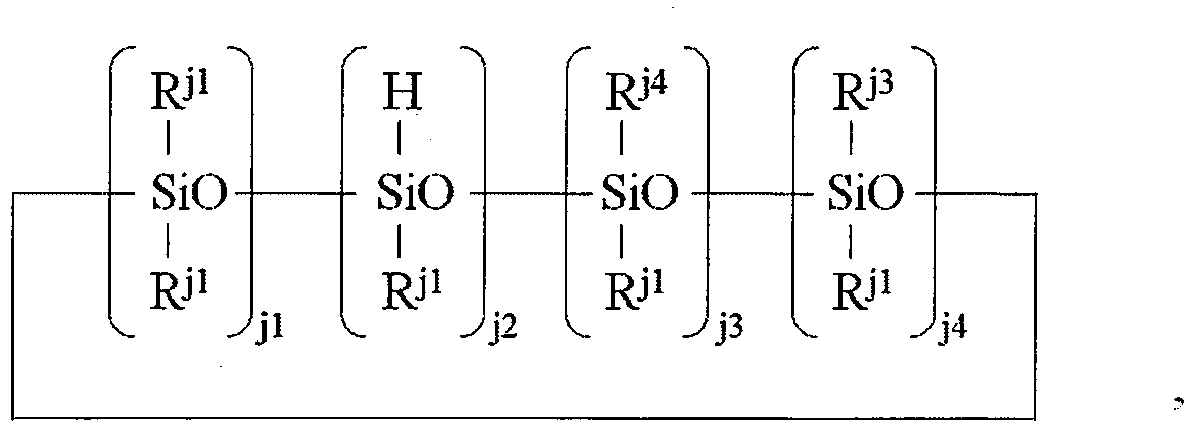


- In the formulae, Rj1, Rj6, Rj3, Rj4, j1, j2, j3 and j4 have the same meanings as described above.
- Specific examples of the organosiloxane used in the component (F) include any organosiloxane represented by the following structural formula. Such a compound may be used singly or in combinations of two or more kinds thereof. In the following formulae, Me represents a methyl group, and p, q and r is an integer of 0 or more. Rf" has the same meaning as Rf, and is preferably a fluorine atom. Hereinafter, a group represented by PFPE2 is bonding to a group represented by Rf", on an oxygen atom at an end.


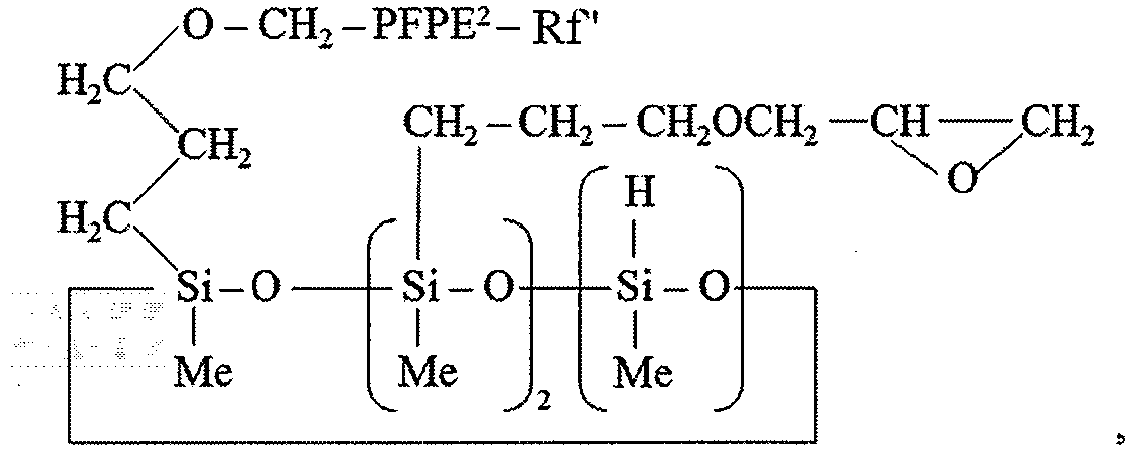


- The amount of the component (F) compounded is preferably in the range from 0.01 to 10 parts by mass, more preferably in the range from 0.1 to 5 parts by mass based on 100 parts by mass of the PFPE-containing compound (A). The component (F) can be included in such an amount, thereby allowing the curable composition of the present invention to have particularly sufficient adhesiveness and also allowing the curable composition of the present invention to be particularly favorable in fluidity. The component (F) can be included in such an amount, thereby also allowing the curable composition of the present invention to be favorable in physical strength.
- The curable composition of the present invention may be used together with a solvent. In such a case, the curable composition can be used, with being dissolved in a proper fluorine-based solvent so as to have a desired concentration depending on the application and the intended use. The concentration of the fluorine-based solvent may be, for example, 300 parts by mass or less, 100 parts by mass or less, or 50 parts by mass or less based on 100 parts by mass of the curable composition. When the curable composition and the solvent are used as a mixture, the viscosity of the mixture can be adjusted. When the curable composition is used with the solvent, the handleability of the mixture can be well. Additionally, it may be easy to control the shape of a cured product formed from the curable composition, and, for example, it may be easy to form a cured product in large thickness. When the curable composition is used as the mixture, it may be easy to use the mixture in spray processing or dip processing, and then the degree of freedom in a processing step can be increased.
- The solvent here used can also be any fluorine-based solvent selected from the group consisting of perfluorohexane, CF3CF2CHCl2, CF3CH2CF2CH3, CF3CHFCHFC2F5, 1,1,1,2,2,3,3,4,4,5,5,6,6-tridecafluorooctane, 1,1,2,2,3,3,4-heptafluorocyclopentane ((Zeorora H (trade name) or the like), C4F9OCH3, C4F9OC2H5, CF3CH2OCF2CHF2, C6F13CH=CH2, xylene hexafluoride, perfluorobenzene, methylpentadecafluoroheptylketone, trifluoroethanol, pentafluoropropanol, hexafluoroisopropanol, HCF2CF2CH2OH, methyltrifluoromethanesulfonate, trifluoroacetic acid, CF3O(CF2CF2O)m1(CF2O)n1CF2CF3, wherein m1 and n1 are each independently an integer of 0 or more and 1000 or less and the occurrence order of the respective repeating units in parentheses with m1 or n1 is not limited in the formula, provided that the sum of m1 and n1 is 1 or more, 1,1-dichloro-2,3,3,3-tetrafluoro-1-propene, 1,2-dichloro-1,3,3,3-tetrafluoro-1-propene, 1,2-dichloro-3,3,3-trifluoro-1-propene, 1,1-dichloro-3,3,3-trifluoro-1-propene, 1,1,2-trichloro-3,3,3-trifluoro-1-propene, 1,1,1,4,4,4-hexafluoro-2-butene, 1,3-bis(trifluoromethyl)benzene, Fluorinert (manufactured by 3M), perfluorobutyl methyl ether, and perfluorobutyl ethyl ether.
- The curable composition of the present invention may further include other component. Such other component is not limited, and may include, for example, various additives such as a (non-reactive) fluoropolyether compound which can be understood as a fluorine-containing oil, preferably a perfluoro(poly)ether compound (hereinafter, referred to as "fluorine-containing oil"), a stabilizing material (dehydrating agent, molecular sieve, magnesium sulfate or methyl orthoformate), a viscosity modifier, a filler, a fluorescent agent, a storage stabilizer, a filling agent, a colorant, a heat resistance improver, a cold resistance improver, a rust inhibitor, an adhesiveness improver, a liquid strengthening agent, a plasticizer, a viscosity modifier, a flexibility-imparting agent and an adhesion promoter.
- The amount of such an additive compounded is not limited as long as the object of the present invention is not impaired and characteristics of the composition and physical properties of a cured product are not impaired.
- The fluorine-containing oil is not limited, and examples thereof include a compound (perfluoro(poly)ether compound) represented by the following general formula (III) :
Rf5-(OC4F8)a'-(OC3F6)b'-(OC2F4)c'-(OCF2)d'-Rf6 ... (III)
- wherein Rf5 represents an alkyl group having 1 to 16 carbon atoms optionally substituted with one or more fluorine atoms (preferably C1-16 perfluoroalkyl group), Rf6 represents an alkyl group having 1 to 16 carbon atoms optionally substituted with one or more fluorine atoms (preferably C1-16 perfluoroalkyl group), a fluorine atom or a hydrogen atom, and Rf5 and Rf6 are more preferably, each independently, a C1-3 perfluoroalkyl group; and
- a', b', c' and d' represent the respective four numbers of repeating units in perfluoro(poly)ether constituting a main backbone of the polymer and are mutually independently an integer of 0 or more and 300 or less, the sum of a', b', c' and d' is at least 1, preferably 1 to 300, more preferably 20 to 300, the occurrence order of the respective repeating units in parentheses with the subscript a', b', c' or d' is not limited in the formula, and, among such repeating units, - (OC4F8)- may be any of -(OCF2CF2CF2CF2)-,-(OCF(CF3)CF2CF2)-, -(OCF2CF(CF3)CF2)-, -(OCF2CF2CF(CF3))-,-(OC(CF3)2CF2)-, -(OCF2C(CF3)2)-, -(OCF(CF3)CF(CF3))-,-(OCF(C2F5)CF2)- and -(OCF2CF(C2F5))-, and is preferably-(OCF2CF2CF2CF2)-, and -(OC3F6)- may be any of -(OCF2CF2CF2)-, -(OCF(CF3)CF2)- and -(OCF2CF(CF3))-, and is preferably-(OCF2CF2CF2)-, and, for example, -(OC2F4)- may be any of-(OCF2CF2)- and -(OCF(CF3))-, and is preferably -(OCF2CF2)-.
- Examples of the perfluoro(poly)ether compound represented by general formula (III) include a compound represented by any of the following general formulae (IIIa) and (IIIb) (which may be adopted singly or as a mixture of two or more kinds thereof).
Rf5-(OCF2CF2CF2)b''-Rf6 ... (IIIa)
Rf5-(OCF2CF2CF2CF2)a"-(OCF2CF2CF2)b"-(OCF2CF2)c"-(OCF2)d",-Rf6 ... (IIIb)
- In such formulae, Rf5 and Rf6 are as described above; in formula (IIIa), b'' is an integer of 1 or more and 100 or less; in formula (IIIb), a'' and b'' are each independently an integer of 1 or more and 30 or less, and c'' and d'' are each independently an integer of 1 or more and 300 or less, and the occurrence order of the respective repeating units in parentheses with subscript a'', b'', c'', d'' is not limited in the formulae.
- The fluorine-containing oil may have a number average molecular weight of 1,000 to 30,000. In particular, the number average molecular weight of the compound represented by formula (IIIa) is preferably 2,000 to 8,000. In one embodiment, the number average molecular weight of the compound represented by formula (IIIb) is 3,000 to 8,000. In another embodiment, the number average molecular weight of the compound represented by formula (IIIb) is 8,000 to 30,000.
- The curable composition can contain, for example, 0 to 500 parts by mass, preferably 0 to 100 parts by mass, more preferably 1 to 50 parts by mass, further preferably 1 to 5 parts by mass of the fluorine-containing oil based on 100 parts by mass of the PFPE-containing compound (A).
- The fluorine-containing oil may be a compound represented by general formula Rf'-F, wherein Rf' is C5-16 perfluoroalkyl group, from another viewpoint. The fluorine-containing oil may be a chlorotrifluoroethylene oligomer.
- The curable composition can include such a fluorine-containing oil to be thereby formed into a more flexible curing composition.
- In one embodiment, the average molecular weight of the fluorine-containing oil may be higher than the average molecular weight of the PFPE-containing compound (A) (for example, a compound represented by formula (I)). Such an average molecular weight can be set to thereby allow a cured product formed by using the curable composition of the present invention to achieve more excellent friction durability and surface lubricity.
- In one embodiment, the average molecular weight of the fluorine-containing oil may be lower than the average molecular weight of the PFPE-containing compound (A) (for example, a compound represented by formula (I)). Such an average molecular weight can be set to thereby allow the curable composition of the present invention to not only be inhibited from being reduced in transparency of a cured product formed by using the curable composition, but also contribute to formation of a cured product having high friction durability and high surface lubricity.
- Examples of the storage stabilizer can include methyltrimethoxysilane, methyltripropenoxysilane, vinyltributanoximesilane and methyltriacetoxysilane.
- Examples of the filler can include aerosol silica, precipitated silica, titanium dioxide, aluminum oxide, quartz powder, carbon powder, mica, clay, talc and bentonite. The filler, which can be further added, is, for example, fumed silica, colloidal silica, a quartz powder, a fused quartz powder, diatomaceous earth, calcium carbonate or the like (the amount compounded is preferably 0.1 to 50 parts by mass, more preferably 1 to 25 parts by mass based on 100 parts by mass of the PFPE-containing compound (A).); an inorganic pigment such as titanium oxide, iron oxide, carbon black or cobalt aluminate; a heat resistance improver such as titanium oxide, iron oxide, carbon black, cerium oxide, cerium hydroxide, zinc carbonate, magnesium carbonate or manganese carbonate; or a thermal conductivity-imparting agent such as alumina, boron nitride, silicon carbide or a metal powder.
- Examples of the filling agent can include fibrous filling agents such as asbestos, glass fiber and an organic fiber.
- Examples of the colorant can include a pigment and a dye.
- Examples of the heat resistance improver can include colcothar and cerium oxide.
- Examples of the adhesiveness improver can include β-(3,4-epoxycyclohexyl)ethyltrimethoxysilane, γ-glycidoxypropyltriethoxysilane, γ-methacryloxypropyltrimethoxysilane, γ-methacryloxypropylmethyldiethoxysilane, N-β-(aminoethyl)-γ-aminopropyltrimethoxysilane, γ-aminopropyltriethoxysilane, γ-chloropropyltrimethoxysilane, γ-mercaptopropyltrimethoxysilane and γ-isocyanatopropyltriethoxysilane.
- Examples of the liquid strengthening agent can include reticular polysiloxane having a triorganosiloxy unit and a SiO2 unit.
- Examples of a controlling agent of the hydrosilylation reaction catalyst include acetylenic alcohol such as 1-ethynyl-1-hydroxycyclohexane, 3-methyl-1-butyn-3-ol, 3,5-dimethyl-1-hexyn-3-ol, 3-methyl-1-penten-3-ol or phenylbutynol, a reaction product of chlorosilane having the monovalent fluorine-containing substituent with such an acetylenic alcohol, 3-methyl-3-penten-1-yne, 3,5-dimethyl-3-hexen-1-yne, triallyl isocyanurate, polyvinylsiloxane, or an organophosphorus compound, and addition of such a compound enables curing reactivity and storage stability to be properly kept.
- The plasticizer, viscosity modifier and flexibility-imparting agent here used can be each a compound represented by:
Rf-PFPE2-Rk1-CH=CH2
wherein: - Rf represents an alkyl group having 1 to 16 carbon atoms, optionally substituted with one or more fluorine atoms (preferably, C1-16 perfluoroalkyl group), a fluorine atom, or a hydrogen atom, preferably a C1-3 perfluoroalkyl group, more preferably a linear perfluoroalkyl group having 1 to 3 carbon atoms, specifically, -CF3, -CF2CF3 or -CF2CF2CF3;
- PFPE2 has the same meaning as described above;
- a group represented by PFPE2 is bonding to a group represented by Rf, on an oxygen atom at an end; and
- Rk1 has the same meaning as described above, and is preferably
- -CH2-O-CH2-,
- -C(=O)-NHCH2-,
- -C(=O)-N(Ph)-CH2-,
- -C(=O)-NHPh-Si(CH3)2-, or
- -C(=O)-N(CH3)Ph-Si(CH3)2-, wherein Ph represents a phenyl group.
- In one embodiment, the curable composition of the present invention includes 0.1% by mol or more and 35% by mol or less of a compound represented by formula:
Rf-PFPE2-Rk1-CH=CH2
(hereinafter, also referred to as "component (2)") based on the total of the compound represented by formula (I) (hereinafter, also referred to as "component (1)") and the component (2). The lower limit of the content of the component (2) based on the total of the component (1) and the component (2) is preferably 0.1% by mol, more preferably 0.2% by mol, further preferably 0.5% by mol, still more preferably 1% by mol, particularly preferably 2% by mol, and can be specially 5% by mol. The upper limit of the content of the component (2) based on the total of the component (1) and the component (2) is preferably 35% by mol, more preferably 30% by mol, further preferably 20% by mol, still more preferably 15% by mol, or can be 10% by mol. The content of the component (2) based on the total of the component (1) and the component (2) is preferably 0.1% by mol or more and 30% by mol or less, more preferably 0.1% by mol or more and 20% by mol or less, further preferably 0.2% by mol or more and 10% by mol or less, still more preferably 0.5% by mol or more and 10% by mol or less, particularly preferably 1% by mol or more and 10% by mol or less, for example, 2% by mol or more and 10% by mol or less or 5% by mol or more and 10% by mol or less. The contents of component (1) and the component (2) can be in such ranges to thereby allow the curable composition of the present invention to contribute to formation of a cured product favorable in friction durability. - An adhesion promoter such as carboxylic anhydride or pyromellitic acid tetraallyl ester can be further added to the curable composition of the present invention.
- For example, such a curable composition may be configured as one-liquid type composition where all the components designated as (A) to (E) and the component (F) and other any component are assumed to be one composition or may be configured as a two-liquid type composition where both these components and other any component are mixed in use, depending on the application.
- A cured product of the curable composition of the present invention can be used in, for example, a potting material or a sealing material. A cured product of the curable composition of the present invention can be used by, for example, filling any void (for example, a bonding section of a housing and a printed board, or a space between a metal terminal section and a mold resin subjected to resin-molding) of an electronic member with the cured product, and drying the resultant after such filling.
- The temperature in a treatment (for example, filling and/or drying) using the curable composition of the present invention is not limited as long as the temperature is in the range of 20°C or more and less than 200°C, and the temperature is preferably in the range of 50°C or more and less than 180°C.
- The curing time of the curable composition of the present invention can be appropriately selected as any time at which a crosslinking reaction and an adhesion reaction to the base material are completed, and can be generally preferably 5 minutes to 24 hours, more preferably 10 minutes to 12 hours.
- In order that a cured product (for example, a potting material or a sealing material) having higher abrasion resistance is formed, an object to be treated is preferably washed with acetone, hydrofluoroether or the like and thereafter dried for removal of an oily content on the wall of any void, before the treatment with the curable composition of the present invention. The object can be further subjected to a pre-treatment with UV ozone, oxygen plasma or the like, in addition to the washing, thereby allowing abrasion resistance of the cured product to be more enhanced.
- A primer treatment can be, if necessary, applied onto, for example, the wall of any void before the treatment with the curable composition of the present invention, thereby enhancing adhesiveness of a cured product formed from the curable composition and more enhancing abrasion resistance. The primer treatment may be performed in the same conditions as those of a primer treatment with a silane coupling agent, according to an ordinary method.
- Herein, various primers can also be used in combination in the case where the cured product obtained from the curable composition of the present invention is allowed to adhere to various base materials.
- In one embodiment, the curable composition of the present invention, when used, may be further diluted with a solvent and thus used, depending on the application and the intended use. Any of the fluorine-based solvents exemplified above can be used as the solvent for use in the dilution. For example, the composition may be used, with being dissolved in a solvent such as 1,3-bis(trifluoromethyl)benzene, Fluorinert (manufactured by 3M), perfluorobutyl methyl ether or perfluorobutyl ethyl ether so that a desired concentration is achieved. In particular, the solvent is preferably used in the application of thin film coating.
- The curable composition of the present invention enables a cured product having favorable adhesiveness to a metal or a plastic base material to be formed, and thus can be useful particularly as an adhesive to be applied to peripherals of electrical and electronic components and peripherals of in-car members. The curable composition of the present invention has a favorable elastic modulus particularly even at a low temperature, and thus can be usefully used in, for example, an automobile member (for example, a sealing material, specifically, a gasket), particularly an automobile member usable in a cool region (for example, -50°C or less).
- A cured product of the curable composition of the present invention is favorable in chemical resistance, acid resistance and base resistance. Such a cured product of the curable composition of the present invention can also be used in a chemical plant or a member for semiconductor manufacturing equipment.
- The glass transition temperature of a cured product of the curable composition of the present invention can be a relatively low value. The reason for this is because the curable composition of the present invention includes the compound having the PFPE1. The curable composition of the present invention can be used in any application where the composition is used at a relatively low temperature, for example, an automobile member (for example, sealing material, specifically, gasket), particularly an automobile member usable in a cool region (for example, -50°C or less).
- A cured product of the curable composition of the present invention can be inhibited from being increased in elastic modulus at a low temperature. A cured product of the curable composition of the present invention can be inhibited from being increased in, for example, the ratio of the elastic modulus at -50°C to the elastic modulus at 0°C. The curable composition of the present invention can be used in any application where rubber properties are demanded even at a relatively low temperature, for example, a chemical plant, semiconductor manufacturing equipment or the like.
- The present invention is more specifically described with reference to the following Examples, but is not intended to be limited to such Examples. The occurrence order of repeating units constituting perfluoro(poly)ether is not limited in the present Examples.
- Compound (B) as a cross-linking agent and a xylene solution containing 2% of a Pt complex of 1,3-divinyl-1,1,3,3-tetramethyldisiloxane as a curing catalyst were weighed in a glass vessel for mixing in amounts of 4 parts by weight and 0.4 parts by weight, respectively, based on 100 parts by weight of perfluoropolyether compound (A), and stirred and mixed, to prepare a curable composition.
- Perfluoropolyether compound (A)
CH2=CHCH2OCH2CF2(OC2F4)e-(OCF2)f-CF2CH2OCH2CH=CH2
wherein e = 40, f = 58, and e/f = 0.7 - Compound (B)

- The curable composition prepared in Example 1 was poured into a mold formed by polytetrafluoroethylene (PTFE), and heated at 150°C for 1 hour and thus cured, to produce a test piece having a size of 5 mm × 200 mm and a thickness of 0.2 mm.
- The test piece obtained above was subjected to dynamic viscoelasticity measurement with a tension-type viscoelasticity measuring system (DMA). Liquid nitrogen was used for cooling and the measurement was performed at a frequency of 10 Hz and at a temperature-increasing rate of 2°C/min in the measurement temperature range from -140 to 50°C. The resulting storage elastic modulus was used to calculate the ratio of the elastic modulus at -50°C to the elastic modulus at 0°C (Elastic modulus at - 50°C/Elastic modulus at 0°C). The resulting storage elastic modulus plot was used to calculate the glass transition temperature (Tg).
- A curable composition was prepared in the same manner as in Example 1 except that perfluoropolyether compound (C) was used instead of perfluoropolyether compound (A).
- Perfluoropolyether compound (C)
CH2=CHCH2OCH2CF2(OC2F4)e-(OCF2)f-CF2CH2OCH2CH=CH2
wherein e = 48, f = 37, and e/f = 1.3 - The resulting curable composition was cured to form a test piece and the dynamic viscoelasticity was measured, in the same manner as in Example 1.
- A curable composition was prepared in the same manner as in Example 1 except that perfluoropolyether compound (D) was used instead of perfluoropolyether compound (A).
- Perfluoropolyether compound (D)
CH2=CHCH2OCH2CF2(OCF2CF(CF3))mOCF2CF2O(CF(CF3)CF2O)n-CF2CH2OCH2CH=CH2
wherein m + n = 54 - The resulting curable composition was cured to form a test piece and the dynamic viscoelasticity was measured, in the same manner as in Example 1.
- The results are shown in Table 1. The "elastic modulus ratio" in Table 1 represents "Elastic modulus at -50°C/Elastic modulus at 0°C" .
[Table 1] Tg (°C) Elastic modulus ratio Example 1 -122 1.4 Comparative Example 1 -107 2.5 Comparative Example 2 -69 4.9 - The curable composition of the present invention can be suitably utilized for forming a fluorine-containing sealing material for embedding any void (for example, a void at a display edge) between electronic members such as a display and a printed board in electronic equipment, and can be used as an adhesive to be applied to peripherals of electrical and electronic components and peripherals of in-car members.


Claims (10)
- A curable composition comprising:(A) a compound which is a compound having two or more alkenyl groups and a perfluoro(poly)ether group in one molecule, wherein
the perfluoro(poly)ether group is a group represented by formula:
-(OC6F12)a-(OC5F10)b-(OC4F8)c-(OC3X10 6)d-(OC2F4)e-(OCF2)f-
wherein a, b, c and d are each independently an integer of 0 or more and 30 or less, e and f are each independently an integer of 1 or more and 200 or less, the sum of a, b, c, d, e and f is at least 5 or more, the occurrence order of the respective repeating units in parentheses with the subscript a, b, c, d, e or f is not limited in the formula, a ratio of e to f is less than 1.0, and each X10, at each occurrence, is independently a hydrogen atom, a fluorine atom or a chlorine atom;(B) an organosilicon compound which has two or more hydrogen atoms each bonding to a silicon atom, in one molecule; and(C) a catalyst. - The curable composition according to claim 1, wherein(A) the compound having two or more alkenyl groups and a perfluoro(poly)ether group in one molecule is a compound represented by formula (I):
CH2=CH-Rk1-PFPE1-Rk1-CH=CH2 (I)
wherein:each Rk1, at each occurrence, independently represents a single bond or a divalent organic group; andeach PFPE1, at each occurrence, independently represents
- (OC6F12)a-(OC5F10)b-(OC4F8)c-(OC3X10 6)d-(OC2F4)e-(OCF2)f-
wherein a, b, c and d are each independently an integer of 0 or more and 30 or less, e and f are each independently an integer of 1 or more and 200 or less, the sum of a, b, c, d, e and f is at least 5 or more, the occurrence order of the respective repeating units in parentheses with the subscript a, b, c, d, e or f is not limited in the formula, a ratio of e to f is less than 1.0, and each X10, at each occurrence, is independently a hydrogen atom, a fluorine atom or a chlorine atom. - The curable composition according to claim 1 or 2, wherein a hydrogen atom bonding to a silicon atom in (B) the organosilicon compound which has two or more hydrogen atoms each bonding to a silicon atom, in one molecule, is comprised in the range from 0.5 to 5.0 mol based on 1 mol of an alkenyl group in (A) the compound having two or more alkenyl groups and a perfluoro(poly)ether group in one molecule.
- The curable composition according to any one of claims 1 to 3, wherein (B) the organosilicon compound which has two or more hydrogen atoms each bonding to a silicon atom, in one molecule, has at least one selected from the group consisting of one or more monovalent perfluoroalkyl groups, monovalent perfluorooxyalkyl groups, divalent perfluoroalkylene groups and divalent perfluorooxyalkylene groups, in a molecular structure.
- The curable composition according to any one of claims 1 to 4, wherein the catalyst is a transition metal catalyst.
- The curable composition according to any one of claims 1 to 5, wherein the catalyst comprises at least one comprising platinum, rhodium, ruthenium, iridium and palladium.
- The curable composition according to any one of claims 1 to 6, wherein the catalyst comprises platinum.
- The curable composition according to any one of claims 1 to 7, comprising 0.1 to 500 ppm by mass of the catalyst in terms of metal atom relative to (A) the compound having two or more alkenyl groups and a perfluoro(poly)ether group in one molecule.
- The curable composition according to any one of claims 1 to 8, wherein a ratio of the sum of e and f to the sum of a, b, c, d, e and f is 0.80 or more in (A) the compound having two or more alkenyl groups and a perfluoro(poly)ether group in one molecule.
- The curable composition according to any one of claims 1 to 9, wherein X10 is a fluorine atom.
Applications Claiming Priority (2)
| Application Number | Priority Date | Filing Date | Title |
|---|---|---|---|
| JP2017211213 | 2017-10-31 | ||
| PCT/JP2018/040405 WO2019088132A1 (en) | 2017-10-31 | 2018-10-30 | Curable composition |
Publications (2)
| Publication Number | Publication Date |
|---|---|
| EP3705532A1 true EP3705532A1 (en) | 2020-09-09 |
| EP3705532A4 EP3705532A4 (en) | 2021-09-01 |
Family
ID=66333515
Family Applications (1)
| Application Number | Title | Priority Date | Filing Date |
|---|---|---|---|
| EP18874929.5A Withdrawn EP3705532A4 (en) | 2017-10-31 | 2018-10-30 | HARDENABLE COMPOSITION |
Country Status (6)
| Country | Link |
|---|---|
| US (2) | US20210189073A1 (en) |
| EP (1) | EP3705532A4 (en) |
| JP (1) | JP6982260B2 (en) |
| KR (1) | KR20200055782A (en) |
| CN (1) | CN111278919A (en) |
| WO (1) | WO2019088132A1 (en) |
Families Citing this family (2)
| Publication number | Priority date | Publication date | Assignee | Title |
|---|---|---|---|---|
| CN111171323B (en) * | 2020-01-14 | 2021-12-21 | 广东达志化学科技有限公司 | Oxidation-resistant strong acid-resistant organic silicon compound and synthesis method and application thereof |
| EP4516858A4 (en) | 2022-04-28 | 2026-04-22 | Shinetsu Chemical Co | Heat-hardenable perfluoropolyether rubber compound |
Family Cites Families (15)
| Publication number | Priority date | Publication date | Assignee | Title |
|---|---|---|---|---|
| US4565714B1 (en) * | 1984-06-14 | 1999-06-29 | Minnesota Mining & Mfg | Low surface energy material |
| JP3487744B2 (en) * | 1997-10-09 | 2004-01-19 | 信越化学工業株式会社 | Curable composition |
| JP2003183493A (en) * | 2001-08-29 | 2003-07-03 | Shin Etsu Chem Co Ltd | Rubber parts for aircraft |
| JP2003327820A (en) * | 2002-05-14 | 2003-11-19 | Shin Etsu Chem Co Ltd | Curable fluoropolyether rubber composition and rubber product |
| JP2008214566A (en) | 2007-03-07 | 2008-09-18 | Shin Etsu Chem Co Ltd | Rubber having cured film of curable fluoropolyether composition |
| JP5303864B2 (en) * | 2007-05-21 | 2013-10-02 | 信越化学工業株式会社 | Curable fluoropolyether composition and integrally molded product of cured rubber and organic resin using the same |
| JP5459232B2 (en) | 2010-01-19 | 2014-04-02 | 信越化学工業株式会社 | Addition-curing fluoropolyether adhesive composition |
| JP5246190B2 (en) * | 2010-03-24 | 2013-07-24 | 信越化学工業株式会社 | Fluorine-containing curable composition and rubber article |
| JP5246212B2 (en) * | 2010-07-14 | 2013-07-24 | 信越化学工業株式会社 | Curable perfluoropolyether gel composition and gel product using the cured product |
| WO2013146112A1 (en) * | 2012-03-30 | 2013-10-03 | ダイキン工業株式会社 | Fluoropolyether group-containing silicone compound |
| KR102230522B1 (en) * | 2013-06-27 | 2021-03-23 | 쓰리엠 이노베이티브 프로퍼티즈 컴파니 | Fluoropolyehter-polysiloxane elastomer compositions and shaped articles |
| JP6160540B2 (en) * | 2014-03-31 | 2017-07-12 | 信越化学工業株式会社 | Curable perfluoropolyether gel composition and gel product using the cured product |
| CN107001619B (en) * | 2014-11-28 | 2019-07-19 | 大金工业株式会社 | Fluorooxymethylene-containing perfluoropolyether modified body |
| WO2019088133A1 (en) * | 2017-10-31 | 2019-05-09 | ダイキン工業株式会社 | Curable composition |
| JP2025012751A (en) | 2023-07-14 | 2025-01-24 | 本田技研工業株式会社 | Rotor manufacturing method |
-
2018
- 2018-10-30 JP JP2019550431A patent/JP6982260B2/en active Active
- 2018-10-30 EP EP18874929.5A patent/EP3705532A4/en not_active Withdrawn
- 2018-10-30 US US16/757,467 patent/US20210189073A1/en not_active Abandoned
- 2018-10-30 KR KR1020207011923A patent/KR20200055782A/en not_active Ceased
- 2018-10-30 CN CN201880070032.5A patent/CN111278919A/en active Pending
- 2018-10-30 WO PCT/JP2018/040405 patent/WO2019088132A1/en not_active Ceased
-
2021
- 2021-09-24 US US17/485,138 patent/US12297325B2/en active Active
Also Published As
| Publication number | Publication date |
|---|---|
| CN111278919A (en) | 2020-06-12 |
| US20210189073A1 (en) | 2021-06-24 |
| EP3705532A4 (en) | 2021-09-01 |
| JPWO2019088132A1 (en) | 2020-04-23 |
| JP6982260B2 (en) | 2021-12-17 |
| WO2019088132A1 (en) | 2019-05-09 |
| KR20200055782A (en) | 2020-05-21 |
| US20220010075A1 (en) | 2022-01-13 |
| US12297325B2 (en) | 2025-05-13 |
Similar Documents
| Publication | Publication Date | Title |
|---|---|---|
| EP3705527B1 (en) | Use of a curable composition for forming a potting material or a sealing material | |
| EP3705531B1 (en) | Curable composition | |
| JP7007601B2 (en) | Curable composition | |
| EP3705528B1 (en) | Curable composition | |
| JP7089189B2 (en) | Curable composition | |
| JP7198891B2 (en) | laminate | |
| US12297325B2 (en) | Curable composition |
Legal Events
| Date | Code | Title | Description |
|---|---|---|---|
| STAA | Information on the status of an ep patent application or granted ep patent |
Free format text: STATUS: THE INTERNATIONAL PUBLICATION HAS BEEN MADE |
|
| PUAI | Public reference made under article 153(3) epc to a published international application that has entered the european phase |
Free format text: ORIGINAL CODE: 0009012 |
|
| STAA | Information on the status of an ep patent application or granted ep patent |
Free format text: STATUS: REQUEST FOR EXAMINATION WAS MADE |
|
| 17P | Request for examination filed |
Effective date: 20200408 |
|
| AK | Designated contracting states |
Kind code of ref document: A1 Designated state(s): AL AT BE BG CH CY CZ DE DK EE ES FI FR GB GR HR HU IE IS IT LI LT LU LV MC MK MT NL NO PL PT RO RS SE SI SK SM TR |
|
| AX | Request for extension of the european patent |
Extension state: BA ME |
|
| DAV | Request for validation of the european patent (deleted) | ||
| DAX | Request for extension of the european patent (deleted) | ||
| A4 | Supplementary search report drawn up and despatched |
Effective date: 20210802 |
|
| RIC1 | Information provided on ipc code assigned before grant |
Ipc: C08L 71/00 20060101AFI20210727BHEP Ipc: C08K 3/08 20060101ALI20210727BHEP Ipc: C08K 5/5419 20060101ALI20210727BHEP Ipc: C08L 83/05 20060101ALI20210727BHEP Ipc: C08G 65/00 20060101ALI20210727BHEP Ipc: C08G 65/336 20060101ALI20210727BHEP Ipc: C08G 77/24 20060101ALI20210727BHEP |
|
| RAP3 | Party data changed (applicant data changed or rights of an application transferred) |
Owner name: DAIKIN INDUSTRIES, LTD. |
|
| P01 | Opt-out of the competence of the unified patent court (upc) registered |
Effective date: 20230525 |
|
| STAA | Information on the status of an ep patent application or granted ep patent |
Free format text: STATUS: EXAMINATION IS IN PROGRESS |
|
| 17Q | First examination report despatched |
Effective date: 20240415 |
|
| STAA | Information on the status of an ep patent application or granted ep patent |
Free format text: STATUS: THE APPLICATION HAS BEEN WITHDRAWN |
|
| 18W | Application withdrawn |
Effective date: 20240723 |