EP3705509A1 - Essential oil microparticles for powder coating applications - Google Patents
Essential oil microparticles for powder coating applications Download PDFInfo
- Publication number
- EP3705509A1 EP3705509A1 EP20160802.3A EP20160802A EP3705509A1 EP 3705509 A1 EP3705509 A1 EP 3705509A1 EP 20160802 A EP20160802 A EP 20160802A EP 3705509 A1 EP3705509 A1 EP 3705509A1
- Authority
- EP
- European Patent Office
- Prior art keywords
- poly
- composition
- essential oil
- microparticles
- bisphenol
- Prior art date
- Legal status (The legal status is an assumption and is not a legal conclusion. Google has not performed a legal analysis and makes no representation as to the accuracy of the status listed.)
- Withdrawn
Links
- 239000000341 volatile oil Substances 0.000 title claims abstract description 116
- 239000011859 microparticle Substances 0.000 title claims abstract description 55
- 238000000576 coating method Methods 0.000 title claims abstract description 42
- 239000000843 powder Substances 0.000 title claims abstract description 42
- 239000011248 coating agent Substances 0.000 title claims abstract description 28
- 239000000203 mixture Substances 0.000 claims abstract description 81
- 239000002245 particle Substances 0.000 claims abstract description 65
- 229920001225 polyester resin Polymers 0.000 claims abstract description 17
- 239000004645 polyester resin Substances 0.000 claims abstract description 17
- -1 pinene Natural products 0.000 claims description 98
- 238000000034 method Methods 0.000 claims description 60
- 239000012530 fluid Substances 0.000 claims description 34
- 230000008569 process Effects 0.000 claims description 33
- 150000001875 compounds Chemical class 0.000 claims description 25
- XLYOFNOQVPJJNP-UHFFFAOYSA-N water Substances O XLYOFNOQVPJJNP-UHFFFAOYSA-N 0.000 claims description 25
- 239000003960 organic solvent Substances 0.000 claims description 23
- 241000196324 Embryophyta Species 0.000 claims description 21
- 229930185605 Bisphenol Natural products 0.000 claims description 19
- IISBACLAFKSPIT-UHFFFAOYSA-N bisphenol A Chemical compound C=1C=C(O)C=CC=1C(C)(C)C1=CC=C(O)C=C1 IISBACLAFKSPIT-UHFFFAOYSA-N 0.000 claims description 19
- 239000003381 stabilizer Substances 0.000 claims description 18
- 239000000758 substrate Substances 0.000 claims description 18
- OSWPMRLSEDHDFF-UHFFFAOYSA-N methyl salicylate Chemical compound COC(=O)C1=CC=CC=C1O OSWPMRLSEDHDFF-UHFFFAOYSA-N 0.000 claims description 17
- WTEVQBCEXWBHNA-JXMROGBWSA-N geranial Chemical compound CC(C)=CCC\C(C)=C\C=O WTEVQBCEXWBHNA-JXMROGBWSA-N 0.000 claims description 10
- 239000007788 liquid Substances 0.000 claims description 10
- 229920002451 polyvinyl alcohol Polymers 0.000 claims description 10
- GLZPCOQZEFWAFX-UHFFFAOYSA-N Geraniol Chemical compound CC(C)=CCCC(C)=CCO GLZPCOQZEFWAFX-UHFFFAOYSA-N 0.000 claims description 8
- VYPSYNLAJGMNEJ-UHFFFAOYSA-N Silicium dioxide Chemical compound O=[Si]=O VYPSYNLAJGMNEJ-UHFFFAOYSA-N 0.000 claims description 8
- 238000010438 heat treatment Methods 0.000 claims description 8
- 238000009826 distribution Methods 0.000 claims description 7
- 238000001256 steam distillation Methods 0.000 claims description 7
- QTBSBXVTEAMEQO-UHFFFAOYSA-N Acetic acid Chemical compound CC(O)=O QTBSBXVTEAMEQO-UHFFFAOYSA-N 0.000 claims description 6
- WTEVQBCEXWBHNA-UHFFFAOYSA-N Citral Natural products CC(C)=CCCC(C)=CC=O WTEVQBCEXWBHNA-UHFFFAOYSA-N 0.000 claims description 6
- LYCAIKOWRPUZTN-UHFFFAOYSA-N Ethylene glycol Chemical compound OCCO LYCAIKOWRPUZTN-UHFFFAOYSA-N 0.000 claims description 6
- ZMXDDKWLCZADIW-UHFFFAOYSA-N N,N-Dimethylformamide Chemical compound CN(C)C=O ZMXDDKWLCZADIW-UHFFFAOYSA-N 0.000 claims description 6
- 229960001047 methyl salicylate Drugs 0.000 claims description 6
- 239000002798 polar solvent Substances 0.000 claims description 6
- 229920001223 polyethylene glycol Polymers 0.000 claims description 6
- 235000013855 polyvinylpyrrolidone Nutrition 0.000 claims description 6
- 238000000197 pyrolysis Methods 0.000 claims description 6
- 229920002554 vinyl polymer Polymers 0.000 claims description 6
- FXHOOIRPVKKKFG-UHFFFAOYSA-N N,N-Dimethylacetamide Chemical compound CN(C)C(C)=O FXHOOIRPVKKKFG-UHFFFAOYSA-N 0.000 claims description 5
- 239000000077 insect repellent Substances 0.000 claims description 5
- 150000002894 organic compounds Chemical class 0.000 claims description 5
- QTBSBXVTEAMEQO-UHFFFAOYSA-M Acetate Chemical compound CC([O-])=O QTBSBXVTEAMEQO-UHFFFAOYSA-M 0.000 claims description 4
- QQRSPHJOOXUALR-UHFFFAOYSA-N Apiole Chemical compound COC1=CC(CC=C)=C(OC)C2=C1OCO2 QQRSPHJOOXUALR-UHFFFAOYSA-N 0.000 claims description 4
- UBJVUCKUDDKUJF-UHFFFAOYSA-N Diallyl sulfide Chemical compound C=CCSCC=C UBJVUCKUDDKUJF-UHFFFAOYSA-N 0.000 claims description 4
- ZFMSMUAANRJZFM-UHFFFAOYSA-N Estragole Chemical compound COC1=CC=C(CC=C)C=C1 ZFMSMUAANRJZFM-UHFFFAOYSA-N 0.000 claims description 4
- 241000207923 Lamiaceae Species 0.000 claims description 4
- 241000219926 Myrtaceae Species 0.000 claims description 4
- MVZZUMCHPFHUOS-UHFFFAOYSA-N Patchoulane Chemical compound CC1CCC(C2(C)C)CC3C12CCC3C MVZZUMCHPFHUOS-UHFFFAOYSA-N 0.000 claims description 4
- JUJWROOIHBZHMG-UHFFFAOYSA-N Pyridine Chemical compound C1=CC=NC=C1 JUJWROOIHBZHMG-UHFFFAOYSA-N 0.000 claims description 4
- UAHWPYUMFXYFJY-UHFFFAOYSA-N beta-myrcene Chemical compound CC(C)=CCCC(=C)C=C UAHWPYUMFXYFJY-UHFFFAOYSA-N 0.000 claims description 4
- ULDHMXUKGWMISQ-UHFFFAOYSA-N carvone Chemical compound CC(=C)C1CC=C(C)C(=O)C1 ULDHMXUKGWMISQ-UHFFFAOYSA-N 0.000 claims description 4
- HQKQRXZEXPXXIG-VJOHVRBBSA-N chembl2333940 Chemical compound C1[C@]23[C@H](C)CC[C@H]3C(C)(C)[C@H]1[C@@](OC(C)=O)(C)CC2 HQKQRXZEXPXXIG-VJOHVRBBSA-N 0.000 claims description 4
- QMVPMAAFGQKVCJ-UHFFFAOYSA-N citronellol Chemical compound OCCC(C)CCC=C(C)C QMVPMAAFGQKVCJ-UHFFFAOYSA-N 0.000 claims description 4
- PFRGXCVKLLPLIP-UHFFFAOYSA-N diallyl disulfide Chemical compound C=CCSSCC=C PFRGXCVKLLPLIP-UHFFFAOYSA-N 0.000 claims description 4
- UBAXRAHSPKWNCX-UHFFFAOYSA-N diallyl trisulfide Chemical compound C=CCSSSCC=C UBAXRAHSPKWNCX-UHFFFAOYSA-N 0.000 claims description 4
- 239000001866 hydroxypropyl methyl cellulose Substances 0.000 claims description 4
- 235000010979 hydroxypropyl methyl cellulose Nutrition 0.000 claims description 4
- 229920003088 hydroxypropyl methyl cellulose Polymers 0.000 claims description 4
- XMGQYMWWDOXHJM-UHFFFAOYSA-N limonene Chemical compound CC(=C)C1CCC(C)=CC1 XMGQYMWWDOXHJM-UHFFFAOYSA-N 0.000 claims description 4
- 229940068917 polyethylene glycols Drugs 0.000 claims description 4
- 229920000036 polyvinylpyrrolidone Polymers 0.000 claims description 4
- NDVASEGYNIMXJL-UHFFFAOYSA-N sabinene Chemical compound C=C1CCC2(C(C)C)C1C2 NDVASEGYNIMXJL-UHFFFAOYSA-N 0.000 claims description 4
- 229920003169 water-soluble polymer Polymers 0.000 claims description 4
- NPNUFJAVOOONJE-ZIAGYGMSSA-N β-(E)-Caryophyllene Chemical compound C1CC(C)=CCCC(=C)[C@H]2CC(C)(C)[C@@H]21 NPNUFJAVOOONJE-ZIAGYGMSSA-N 0.000 claims description 4
- WEEGYLXZBRQIMU-UHFFFAOYSA-N 1,8-cineole Natural products C1CC2CCC1(C)OC2(C)C WEEGYLXZBRQIMU-UHFFFAOYSA-N 0.000 claims description 3
- 108010010803 Gelatin Proteins 0.000 claims description 3
- 229920001213 Polysorbate 20 Polymers 0.000 claims description 3
- 229960005233 cineole Drugs 0.000 claims description 3
- ZDKZHVNKFOXMND-UHFFFAOYSA-N cis-Nepetalactone Natural products O=C1OC=C(C)C2C1C(C)CC2 ZDKZHVNKFOXMND-UHFFFAOYSA-N 0.000 claims description 3
- 229940113088 dimethylacetamide Drugs 0.000 claims description 3
- 230000032050 esterification Effects 0.000 claims description 3
- 238000005886 esterification reaction Methods 0.000 claims description 3
- 229920000159 gelatin Polymers 0.000 claims description 3
- 235000019322 gelatine Nutrition 0.000 claims description 3
- 235000011852 gelatine desserts Nutrition 0.000 claims description 3
- 230000036571 hydration Effects 0.000 claims description 3
- 238000006703 hydration reaction Methods 0.000 claims description 3
- 238000005984 hydrogenation reaction Methods 0.000 claims description 3
- 229930003658 monoterpene Natural products 0.000 claims description 3
- 150000002773 monoterpene derivatives Chemical class 0.000 claims description 3
- 235000002577 monoterpenes Nutrition 0.000 claims description 3
- 229920003229 poly(methyl methacrylate) Polymers 0.000 claims description 3
- 239000002861 polymer material Substances 0.000 claims description 3
- 239000004926 polymethyl methacrylate Substances 0.000 claims description 3
- 239000000256 polyoxyethylene sorbitan monolaurate Substances 0.000 claims description 3
- 235000010486 polyoxyethylene sorbitan monolaurate Nutrition 0.000 claims description 3
- 235000010482 polyoxyethylene sorbitan monooleate Nutrition 0.000 claims description 3
- 229920000053 polysorbate 80 Polymers 0.000 claims description 3
- 239000001267 polyvinylpyrrolidone Substances 0.000 claims description 3
- 150000003505 terpenes Chemical class 0.000 claims description 3
- VZCYOOQTPOCHFL-UHFFFAOYSA-N trans-butenedioic acid Natural products OC(=O)C=CC(O)=O VZCYOOQTPOCHFL-UHFFFAOYSA-N 0.000 claims description 3
- WTVHAMTYZJGJLJ-UHFFFAOYSA-N (+)-(4S,8R)-8-epi-beta-bisabolol Natural products CC(C)=CCCC(C)C1(O)CCC(C)=CC1 WTVHAMTYZJGJLJ-UHFFFAOYSA-N 0.000 claims description 2
- NOOLISFMXDJSKH-UTLUCORTSA-N (+)-Neomenthol Chemical compound CC(C)[C@@H]1CC[C@@H](C)C[C@@H]1O NOOLISFMXDJSKH-UTLUCORTSA-N 0.000 claims description 2
- DTGKSKDOIYIVQL-WEDXCCLWSA-N (+)-borneol Chemical compound C1C[C@@]2(C)[C@@H](O)C[C@@H]1C2(C)C DTGKSKDOIYIVQL-WEDXCCLWSA-N 0.000 claims description 2
- NZGWDASTMWDZIW-MRVPVSSYSA-N (+)-pulegone Chemical compound C[C@@H]1CCC(=C(C)C)C(=O)C1 NZGWDASTMWDZIW-MRVPVSSYSA-N 0.000 claims description 2
- NDVASEGYNIMXJL-NXEZZACHSA-N (+)-sabinene Natural products C=C1CC[C@@]2(C(C)C)[C@@H]1C2 NDVASEGYNIMXJL-NXEZZACHSA-N 0.000 claims description 2
- ITYNGVSTWVVPIC-DHGKCCLASA-N (-)-allo-Aromadendrene Chemical compound C([C@@H]1[C@H]2C1(C)C)CC(=C)[C@@H]1[C@H]2[C@H](C)CC1 ITYNGVSTWVVPIC-DHGKCCLASA-N 0.000 claims description 2
- RGZSQWQPBWRIAQ-CABCVRRESA-N (-)-alpha-Bisabolol Chemical compound CC(C)=CCC[C@](C)(O)[C@H]1CCC(C)=CC1 RGZSQWQPBWRIAQ-CABCVRRESA-N 0.000 claims description 2
- REPVLJRCJUVQFA-UHFFFAOYSA-N (-)-isopinocampheol Natural products C1C(O)C(C)C2C(C)(C)C1C2 REPVLJRCJUVQFA-UHFFFAOYSA-N 0.000 claims description 2
- 239000001306 (7E,9E,11E,13E)-pentadeca-7,9,11,13-tetraen-1-ol Substances 0.000 claims description 2
- KJPRLNWUNMBNBZ-QPJJXVBHSA-N (E)-cinnamaldehyde Chemical compound O=C\C=C\C1=CC=CC=C1 KJPRLNWUNMBNBZ-QPJJXVBHSA-N 0.000 claims description 2
- QMVPMAAFGQKVCJ-SNVBAGLBSA-N (R)-(+)-citronellol Natural products OCC[C@H](C)CCC=C(C)C QMVPMAAFGQKVCJ-SNVBAGLBSA-N 0.000 claims description 2
- DSSYKIVIOFKYAU-XCBNKYQSSA-N (R)-camphor Chemical compound C1C[C@@]2(C)C(=O)C[C@@H]1C2(C)C DSSYKIVIOFKYAU-XCBNKYQSSA-N 0.000 claims description 2
- RYHBNJHYFVUHQT-UHFFFAOYSA-N 1,4-Dioxane Chemical compound C1COCCO1 RYHBNJHYFVUHQT-UHFFFAOYSA-N 0.000 claims description 2
- VUYMIDJFKFLTIP-UHFFFAOYSA-N 1,5,5,9-tetramethylspiro[5.5]undecane Chemical compound C1CC(C)CCC21C(C)(C)CCCC2C VUYMIDJFKFLTIP-UHFFFAOYSA-N 0.000 claims description 2
- 239000001169 1-methyl-4-propan-2-ylcyclohexa-1,4-diene Substances 0.000 claims description 2
- NVEQFIOZRFFVFW-UHFFFAOYSA-N 9-epi-beta-caryophyllene oxide Natural products C=C1CCC2OC2(C)CCC2C(C)(C)CC21 NVEQFIOZRFFVFW-UHFFFAOYSA-N 0.000 claims description 2
- 241001081440 Annonaceae Species 0.000 claims description 2
- 241000208173 Apiaceae Species 0.000 claims description 2
- MGYMHQJELJYRQS-UHFFFAOYSA-N Ascaridole Chemical compound C1CC2(C)OOC1(C(C)C)C=C2 MGYMHQJELJYRQS-UHFFFAOYSA-N 0.000 claims description 2
- 241000208838 Asteraceae Species 0.000 claims description 2
- 235000003932 Betula Nutrition 0.000 claims description 2
- 241000219429 Betula Species 0.000 claims description 2
- FZZNNPQZDRVKLU-YTFOTSKYSA-N Cadinane Chemical compound C1C[C@H](C)C[C@H]2[C@H](C(C)C)CC[C@H](C)[C@@H]21 FZZNNPQZDRVKLU-YTFOTSKYSA-N 0.000 claims description 2
- 229920002134 Carboxymethyl cellulose Polymers 0.000 claims description 2
- 239000005973 Carvone Substances 0.000 claims description 2
- 229920000623 Cellulose acetate phthalate Polymers 0.000 claims description 2
- 241000723346 Cinnamomum camphora Species 0.000 claims description 2
- 241000218691 Cupressaceae Species 0.000 claims description 2
- 241000931332 Cymbopogon Species 0.000 claims description 2
- FEPOUSPSESUQPD-UHFFFAOYSA-N Cymbopogon Natural products C1CC2(C)C(C)C(=O)CCC2C2(C)C1C1(C)CCC3(C)CCC(C)C(C)C3C1(C)CC2 FEPOUSPSESUQPD-UHFFFAOYSA-N 0.000 claims description 2
- NOOLISFMXDJSKH-UHFFFAOYSA-N DL-menthol Natural products CC(C)C1CCC(C)CC1O NOOLISFMXDJSKH-UHFFFAOYSA-N 0.000 claims description 2
- WEEGYLXZBRQIMU-WAAGHKOSSA-N Eucalyptol Chemical compound C1C[C@H]2CC[C@]1(C)OC2(C)C WEEGYLXZBRQIMU-WAAGHKOSSA-N 0.000 claims description 2
- VGAJNILINWUWOP-UHFFFAOYSA-N Eudesmane Natural products COC(=O)C(=C)C1C(O)C2C(=O)CCC(O)C2(C)CC1OC(=O)C(=C)CO VGAJNILINWUWOP-UHFFFAOYSA-N 0.000 claims description 2
- 241000735588 Gaultheria Species 0.000 claims description 2
- 241000134874 Geraniales Species 0.000 claims description 2
- 239000005792 Geraniol Substances 0.000 claims description 2
- GLZPCOQZEFWAFX-YFHOEESVSA-N Geraniol Natural products CC(C)=CCC\C(C)=C/CO GLZPCOQZEFWAFX-YFHOEESVSA-N 0.000 claims description 2
- MCNAURNYDFSEML-UHFFFAOYSA-N Guaiane Natural products CC1CCC(C(C)=C)C(O)C2=C(C)C(=O)CC12 MCNAURNYDFSEML-UHFFFAOYSA-N 0.000 claims description 2
- 241000218195 Lauraceae Species 0.000 claims description 2
- GLZPCOQZEFWAFX-JXMROGBWSA-N Nerol Natural products CC(C)=CCC\C(C)=C\CO GLZPCOQZEFWAFX-JXMROGBWSA-N 0.000 claims description 2
- 241000218641 Pinaceae Species 0.000 claims description 2
- 235000011613 Pinus brutia Nutrition 0.000 claims description 2
- 241000758706 Piperaceae Species 0.000 claims description 2
- 239000002202 Polyethylene glycol Substances 0.000 claims description 2
- 229920002873 Polyethylenimine Polymers 0.000 claims description 2
- 241000208966 Polygala Species 0.000 claims description 2
- 229920002367 Polyisobutene Polymers 0.000 claims description 2
- NZGWDASTMWDZIW-UHFFFAOYSA-N Pulegone Natural products CC1CCC(=C(C)C)C(=O)C1 NZGWDASTMWDZIW-UHFFFAOYSA-N 0.000 claims description 2
- 241001093501 Rutaceae Species 0.000 claims description 2
- 241000221035 Santalaceae Species 0.000 claims description 2
- CBSRFDQDBGGSEA-UHFFFAOYSA-N Selinene Natural products CC(=C1CCC2(C)CCCC(=C)C2(C)C1)C CBSRFDQDBGGSEA-UHFFFAOYSA-N 0.000 claims description 2
- NZPVJSYXTQHIMS-UHFFFAOYSA-N Seychellane Natural products CC1CCC2(C)C(C)C3CCC2(C)C1C3 NZPVJSYXTQHIMS-UHFFFAOYSA-N 0.000 claims description 2
- 229920002125 Sokalan® Polymers 0.000 claims description 2
- 241001092387 Spiraea Species 0.000 claims description 2
- 241000234299 Zingiberaceae Species 0.000 claims description 2
- ZUAAPNNKRHMPKG-UHFFFAOYSA-N acetic acid;butanedioic acid;methanol;propane-1,2-diol Chemical compound OC.CC(O)=O.CC(O)CO.OC(=O)CCC(O)=O ZUAAPNNKRHMPKG-UHFFFAOYSA-N 0.000 claims description 2
- RGZSQWQPBWRIAQ-LSDHHAIUSA-N alpha-Bisabolol Natural products CC(C)=CCC[C@@](C)(O)[C@@H]1CCC(C)=CC1 RGZSQWQPBWRIAQ-LSDHHAIUSA-N 0.000 claims description 2
- FAMPSKZZVDUYOS-UHFFFAOYSA-N alpha-Caryophyllene Natural products CC1=CCC(C)(C)C=CCC(C)=CCC1 FAMPSKZZVDUYOS-UHFFFAOYSA-N 0.000 claims description 2
- VYBREYKSZAROCT-UHFFFAOYSA-N alpha-myrcene Natural products CC(=C)CCCC(=C)C=C VYBREYKSZAROCT-UHFFFAOYSA-N 0.000 claims description 2
- WUOACPNHFRMFPN-UHFFFAOYSA-N alpha-terpineol Chemical compound CC1=CCC(C(C)(C)O)CC1 WUOACPNHFRMFPN-UHFFFAOYSA-N 0.000 claims description 2
- KQAZVFVOEIRWHN-UHFFFAOYSA-N alpha-thujene Natural products CC1=CCC2(C(C)C)C1C2 KQAZVFVOEIRWHN-UHFFFAOYSA-N 0.000 claims description 2
- USMNOWBWPHYOEA-UHFFFAOYSA-N alpha-thujone Natural products CC1C(=O)CC2(C(C)C)C1C2 USMNOWBWPHYOEA-UHFFFAOYSA-N 0.000 claims description 2
- UIDUJXXQMGYOIN-UHFFFAOYSA-N aromadendrin Natural products CC1(C)C2C1CCC(C)C1C2C(C)CC1 UIDUJXXQMGYOIN-UHFFFAOYSA-N 0.000 claims description 2
- MGYMHQJELJYRQS-ZJUUUORDSA-N ascaridole Natural products C1C[C@]2(C)OO[C@@]1(C(C)C)C=C2 MGYMHQJELJYRQS-ZJUUUORDSA-N 0.000 claims description 2
- NOPLRNXKHZRXHT-YFVJMOTDSA-N beta-Sinensal Chemical compound O=CC(/C)=C/CCC(/C)=C/CCC(=C)C=C NOPLRNXKHZRXHT-YFVJMOTDSA-N 0.000 claims description 2
- NPNUFJAVOOONJE-UHFFFAOYSA-N beta-cariophyllene Natural products C1CC(C)=CCCC(=C)C2CC(C)(C)C21 NPNUFJAVOOONJE-UHFFFAOYSA-N 0.000 claims description 2
- JGQFVRIQXUFPAH-UHFFFAOYSA-N beta-citronellol Natural products OCCC(C)CCCC(C)=C JGQFVRIQXUFPAH-UHFFFAOYSA-N 0.000 claims description 2
- HHGZABIIYIWLGA-UHFFFAOYSA-N bisabolol Natural products CC1CCC(C(C)(O)CCC=C(C)C)CC1 HHGZABIIYIWLGA-UHFFFAOYSA-N 0.000 claims description 2
- 229940036350 bisabolol Drugs 0.000 claims description 2
- CKDOCTFBFTVPSN-UHFFFAOYSA-N borneol Natural products C1CC2(C)C(C)CC1C2(C)C CKDOCTFBFTVPSN-UHFFFAOYSA-N 0.000 claims description 2
- 229940116229 borneol Drugs 0.000 claims description 2
- 229930005334 cadinane Natural products 0.000 claims description 2
- 229930008380 camphor Natural products 0.000 claims description 2
- 229960000846 camphor Drugs 0.000 claims description 2
- 235000010948 carboxy methyl cellulose Nutrition 0.000 claims description 2
- 239000001768 carboxy methyl cellulose Substances 0.000 claims description 2
- 239000008112 carboxymethyl-cellulose Substances 0.000 claims description 2
- NPNUFJAVOOONJE-UONOGXRCSA-N caryophyllene Natural products C1CC(C)=CCCC(=C)[C@@H]2CC(C)(C)[C@@H]21 NPNUFJAVOOONJE-UONOGXRCSA-N 0.000 claims description 2
- 229940117948 caryophyllene Drugs 0.000 claims description 2
- 229940081734 cellulose acetate phthalate Drugs 0.000 claims description 2
- 229930003494 chamigrane Natural products 0.000 claims description 2
- KJPRLNWUNMBNBZ-UHFFFAOYSA-N cinnamic aldehyde Natural products O=CC=CC1=CC=CC=C1 KJPRLNWUNMBNBZ-UHFFFAOYSA-N 0.000 claims description 2
- 229940117916 cinnamic aldehyde Drugs 0.000 claims description 2
- ZDKZHVNKFOXMND-NBEYISGCSA-N cis-trans-nepetalactone Chemical compound O=C1OC=C(C)[C@@H]2[C@H]1[C@@H](C)CC2 ZDKZHVNKFOXMND-NBEYISGCSA-N 0.000 claims description 2
- WTEVQBCEXWBHNA-YFHOEESVSA-N citral B Natural products CC(C)=CCC\C(C)=C/C=O WTEVQBCEXWBHNA-YFHOEESVSA-N 0.000 claims description 2
- 235000000484 citronellol Nutrition 0.000 claims description 2
- LJVYOZJXUGFDJA-CEPSBPATSA-N copaane Chemical compound C1CC(C)[C@H]2C3(C)CC[C@H](C(C)C)C2C31 LJVYOZJXUGFDJA-CEPSBPATSA-N 0.000 claims description 2
- 229920001531 copovidone Polymers 0.000 claims description 2
- 229930015303 daucane Natural products 0.000 claims description 2
- 150000001620 daucane derivatives Chemical class 0.000 claims description 2
- SQIFACVGCPWBQZ-UHFFFAOYSA-N delta-terpineol Natural products CC(C)(O)C1CCC(=C)CC1 SQIFACVGCPWBQZ-UHFFFAOYSA-N 0.000 claims description 2
- SBZXBUIDTXKZTM-UHFFFAOYSA-N diglyme Chemical compound COCCOCCOC SBZXBUIDTXKZTM-UHFFFAOYSA-N 0.000 claims description 2
- DTGKSKDOIYIVQL-UHFFFAOYSA-N dl-isoborneol Natural products C1CC2(C)C(O)CC1C2(C)C DTGKSKDOIYIVQL-UHFFFAOYSA-N 0.000 claims description 2
- 125000001513 elemane group Chemical group 0.000 claims description 2
- LKBQARGGDFBGFF-UHFFFAOYSA-N eremophilane Natural products CC1C(O)CCC2C(=O)CC(CC12C)C(=C)C LKBQARGGDFBGFF-UHFFFAOYSA-N 0.000 claims description 2
- AJWBFJHTFGRNDG-GBJTYRQASA-N eremophilane Chemical compound C1CC[C@H](C)[C@@]2(C)C[C@H](C(C)C)CC[C@H]21 AJWBFJHTFGRNDG-GBJTYRQASA-N 0.000 claims description 2
- DYEQPYSFRWUNNV-APIJFGDWSA-N eudesmane Chemical compound C1CC[C@@H](C)[C@@H]2C[C@H](C(C)C)CC[C@]21C DYEQPYSFRWUNNV-APIJFGDWSA-N 0.000 claims description 2
- 239000008273 gelatin Substances 0.000 claims description 2
- 229940014259 gelatin Drugs 0.000 claims description 2
- 229940113087 geraniol Drugs 0.000 claims description 2
- 230000009477 glass transition Effects 0.000 claims description 2
- 229920000578 graft copolymer Polymers 0.000 claims description 2
- QAQCPAHQVOKALN-RMEBNNNOSA-N guaiane Chemical compound C1[C@H](C(C)C)CC[C@H](C)[C@@H]2CC[C@H](C)[C@@H]21 QAQCPAHQVOKALN-RMEBNNNOSA-N 0.000 claims description 2
- GNOIPBMMFNIUFM-UHFFFAOYSA-N hexamethylphosphoric triamide Chemical compound CN(C)P(=O)(N(C)C)N(C)C GNOIPBMMFNIUFM-UHFFFAOYSA-N 0.000 claims description 2
- UFVKGYZPFZQRLF-UHFFFAOYSA-N hydroxypropyl methyl cellulose Chemical compound OC1C(O)C(OC)OC(CO)C1OC1C(O)C(O)C(OC2C(C(O)C(OC3C(C(O)C(O)C(CO)O3)O)C(CO)O2)O)C(CO)O1 UFVKGYZPFZQRLF-UHFFFAOYSA-N 0.000 claims description 2
- 229960003943 hypromellose Drugs 0.000 claims description 2
- 235000001510 limonene Nutrition 0.000 claims description 2
- 229940087305 limonene Drugs 0.000 claims description 2
- CDOSHBSSFJOMGT-UHFFFAOYSA-N linalool Chemical compound CC(C)=CCCC(C)(O)C=C CDOSHBSSFJOMGT-UHFFFAOYSA-N 0.000 claims description 2
- 229940041616 menthol Drugs 0.000 claims description 2
- XVDBWWRIXBMVJV-UHFFFAOYSA-N n-[bis(dimethylamino)phosphanyl]-n-methylmethanamine Chemical compound CN(C)P(N(C)C)N(C)C XVDBWWRIXBMVJV-UHFFFAOYSA-N 0.000 claims description 2
- 150000007823 ocimene derivatives Chemical class 0.000 claims description 2
- 229930007459 p-menth-8-en-3-one Natural products 0.000 claims description 2
- 150000007875 phellandrene derivatives Chemical class 0.000 claims description 2
- 229930015704 phenylpropanoid Natural products 0.000 claims description 2
- XNGIFLGASWRNHJ-UHFFFAOYSA-L phthalate(2-) Chemical compound [O-]C(=O)C1=CC=CC=C1C([O-])=O XNGIFLGASWRNHJ-UHFFFAOYSA-L 0.000 claims description 2
- 229920000075 poly(4-vinylpyridine) Polymers 0.000 claims description 2
- 229920000435 poly(dimethylsiloxane) Polymers 0.000 claims description 2
- 229920000196 poly(lauryl methacrylate) Polymers 0.000 claims description 2
- 229920002432 poly(vinyl methyl ether) polymer Polymers 0.000 claims description 2
- 229920002401 polyacrylamide Polymers 0.000 claims description 2
- 229920002239 polyacrylonitrile Polymers 0.000 claims description 2
- 229920000193 polymethacrylate Polymers 0.000 claims description 2
- 239000000244 polyoxyethylene sorbitan monooleate Substances 0.000 claims description 2
- 229920001155 polypropylene Polymers 0.000 claims description 2
- 229940068977 polysorbate 20 Drugs 0.000 claims description 2
- 229940068968 polysorbate 80 Drugs 0.000 claims description 2
- 229920002689 polyvinyl acetate Polymers 0.000 claims description 2
- 239000011118 polyvinyl acetate Substances 0.000 claims description 2
- 229940100467 polyvinyl acetate phthalate Drugs 0.000 claims description 2
- 229920000915 polyvinyl chloride Polymers 0.000 claims description 2
- 239000004800 polyvinyl chloride Substances 0.000 claims description 2
- UMJSCPRVCHMLSP-UHFFFAOYSA-N pyridine Natural products COC1=CC=CN=C1 UMJSCPRVCHMLSP-UHFFFAOYSA-N 0.000 claims description 2
- 229930006696 sabinene Natural products 0.000 claims description 2
- ZMQAAUBTXCXRIC-UHFFFAOYSA-N safrole Chemical compound C=CCC1=CC=C2OCOC2=C1 ZMQAAUBTXCXRIC-UHFFFAOYSA-N 0.000 claims description 2
- VPQBJIRQUUEAFC-UHFFFAOYSA-N selinene Natural products C1CC=C(C)C2CC(C(C)C)CCC21C VPQBJIRQUUEAFC-UHFFFAOYSA-N 0.000 claims description 2
- 150000003598 selinene derivatives Chemical class 0.000 claims description 2
- 229930004725 sesquiterpene Natural products 0.000 claims description 2
- 229930000308 sinensal Natural products 0.000 claims description 2
- 229930006978 terpinene Natural products 0.000 claims description 2
- 150000003507 terpinene derivatives Chemical class 0.000 claims description 2
- 229940116411 terpineol Drugs 0.000 claims description 2
- XJPBRODHZKDRCB-UHFFFAOYSA-N trans-alpha-ocimene Natural products CC(=C)CCC=C(C)C=C XJPBRODHZKDRCB-UHFFFAOYSA-N 0.000 claims description 2
- RRAFCDWBNXTKKO-UHFFFAOYSA-N eugenol Chemical compound COC1=CC(CC=C)=CC=C1O RRAFCDWBNXTKKO-UHFFFAOYSA-N 0.000 claims 2
- MGSRCZKZVOBKFT-UHFFFAOYSA-N thymol Chemical compound CC(C)C1=CC=C(C)C=C1O MGSRCZKZVOBKFT-UHFFFAOYSA-N 0.000 claims 2
- NPBVQXIMTZKSBA-UHFFFAOYSA-N Chavibetol Natural products COC1=CC=C(CC=C)C=C1O NPBVQXIMTZKSBA-UHFFFAOYSA-N 0.000 claims 1
- 239000005770 Eugenol Substances 0.000 claims 1
- 239000004698 Polyethylene Substances 0.000 claims 1
- 239000004743 Polypropylene Substances 0.000 claims 1
- UVMRYBDEERADNV-UHFFFAOYSA-N Pseudoeugenol Natural products COC1=CC(C(C)=C)=CC=C1O UVMRYBDEERADNV-UHFFFAOYSA-N 0.000 claims 1
- 239000005844 Thymol Substances 0.000 claims 1
- 229940105329 carboxymethylcellulose Drugs 0.000 claims 1
- RECUKUPTGUEGMW-UHFFFAOYSA-N carvacrol Chemical compound CC(C)C1=CC=C(C)C(O)=C1 RECUKUPTGUEGMW-UHFFFAOYSA-N 0.000 claims 1
- HHTWOMMSBMNRKP-UHFFFAOYSA-N carvacrol Natural products CC(=C)C1=CC=C(C)C(O)=C1 HHTWOMMSBMNRKP-UHFFFAOYSA-N 0.000 claims 1
- 235000007746 carvacrol Nutrition 0.000 claims 1
- 229960002217 eugenol Drugs 0.000 claims 1
- WYXXLXHHWYNKJF-UHFFFAOYSA-N isocarvacrol Natural products CC(C)C1=CC=C(O)C(C)=C1 WYXXLXHHWYNKJF-UHFFFAOYSA-N 0.000 claims 1
- 229920000573 polyethylene Polymers 0.000 claims 1
- 239000000377 silicon dioxide Substances 0.000 claims 1
- 229960000790 thymol Drugs 0.000 claims 1
- 229920000728 polyester Polymers 0.000 abstract description 20
- 238000001556 precipitation Methods 0.000 abstract description 7
- 239000012296 anti-solvent Substances 0.000 description 19
- 239000000463 material Substances 0.000 description 18
- 239000003921 oil Substances 0.000 description 11
- 235000019198 oils Nutrition 0.000 description 11
- 229920000642 polymer Polymers 0.000 description 10
- 239000000243 solution Substances 0.000 description 10
- 239000002667 nucleating agent Substances 0.000 description 8
- 239000002904 solvent Substances 0.000 description 8
- 239000004372 Polyvinyl alcohol Substances 0.000 description 7
- 239000000654 additive Substances 0.000 description 7
- 238000009835 boiling Methods 0.000 description 7
- 229920005989 resin Polymers 0.000 description 7
- 239000011347 resin Substances 0.000 description 7
- 244000166675 Cymbopogon nardus Species 0.000 description 6
- 241000238631 Hexapoda Species 0.000 description 6
- 241000607479 Yersinia pestis Species 0.000 description 6
- 229910021641 deionized water Inorganic materials 0.000 description 6
- 230000009471 action Effects 0.000 description 5
- 239000008199 coating composition Substances 0.000 description 5
- 239000008119 colloidal silica Substances 0.000 description 5
- 238000010297 mechanical methods and process Methods 0.000 description 5
- 230000005226 mechanical processes and functions Effects 0.000 description 5
- 239000000049 pigment Substances 0.000 description 5
- 235000018791 Cymbopogon nardus Nutrition 0.000 description 4
- 241000255925 Diptera Species 0.000 description 4
- GWEVSGVZZGPLCZ-UHFFFAOYSA-N Titan oxide Chemical compound O=[Ti]=O GWEVSGVZZGPLCZ-UHFFFAOYSA-N 0.000 description 4
- 150000005690 diesters Chemical class 0.000 description 4
- MTHSVFCYNBDYFN-UHFFFAOYSA-N diethylene glycol Chemical compound OCCOCCO MTHSVFCYNBDYFN-UHFFFAOYSA-N 0.000 description 4
- 239000010642 eucalyptus oil Substances 0.000 description 4
- 229940044949 eucalyptus oil Drugs 0.000 description 4
- 238000004817 gas chromatography Methods 0.000 description 4
- 239000002994 raw material Substances 0.000 description 4
- 239000000454 talc Substances 0.000 description 4
- 229910052623 talc Inorganic materials 0.000 description 4
- CURLTUGMZLYLDI-UHFFFAOYSA-N Carbon dioxide Chemical compound O=C=O CURLTUGMZLYLDI-UHFFFAOYSA-N 0.000 description 3
- 240000004784 Cymbopogon citratus Species 0.000 description 3
- 235000017897 Cymbopogon citratus Nutrition 0.000 description 3
- 240000001238 Gaultheria procumbens Species 0.000 description 3
- 230000000996 additive effect Effects 0.000 description 3
- 239000003054 catalyst Substances 0.000 description 3
- 235000020971 citrus fruits Nutrition 0.000 description 3
- 229920001577 copolymer Chemical class 0.000 description 3
- 239000008367 deionised water Substances 0.000 description 3
- 150000002009 diols Chemical class 0.000 description 3
- 235000013399 edible fruits Nutrition 0.000 description 3
- 238000000605 extraction Methods 0.000 description 3
- 235000013305 food Nutrition 0.000 description 3
- 239000007789 gas Substances 0.000 description 3
- 239000010410 layer Substances 0.000 description 3
- 238000004519 manufacturing process Methods 0.000 description 3
- 238000001000 micrograph Methods 0.000 description 3
- 238000002156 mixing Methods 0.000 description 3
- 238000002360 preparation method Methods 0.000 description 3
- 230000001846 repelling effect Effects 0.000 description 3
- 239000007787 solid Substances 0.000 description 3
- 238000002411 thermogravimetry Methods 0.000 description 3
- 239000009637 wintergreen oil Substances 0.000 description 3
- PUPZLCDOIYMWBV-UHFFFAOYSA-N (+/-)-1,3-Butanediol Chemical compound CC(O)CCO PUPZLCDOIYMWBV-UHFFFAOYSA-N 0.000 description 2
- 241000238421 Arthropoda Species 0.000 description 2
- VTYYLEPIZMXCLO-UHFFFAOYSA-L Calcium carbonate Chemical compound [Ca+2].[O-]C([O-])=O VTYYLEPIZMXCLO-UHFFFAOYSA-L 0.000 description 2
- 241000207199 Citrus Species 0.000 description 2
- NIQCNGHVCWTJSM-UHFFFAOYSA-N Dimethyl phthalate Chemical compound COC(=O)C1=CC=CC=C1C(=O)OC NIQCNGHVCWTJSM-UHFFFAOYSA-N 0.000 description 2
- 241000208421 Ericaceae Species 0.000 description 2
- 238000005033 Fourier transform infrared spectroscopy Methods 0.000 description 2
- VZCYOOQTPOCHFL-OWOJBTEDSA-N Fumaric acid Chemical compound OC(=O)\C=C\C(O)=O VZCYOOQTPOCHFL-OWOJBTEDSA-N 0.000 description 2
- 235000007297 Gaultheria procumbens Nutrition 0.000 description 2
- 244000165082 Lavanda vera Species 0.000 description 2
- 235000010663 Lavandula angustifolia Nutrition 0.000 description 2
- 235000013500 Melia azadirachta Nutrition 0.000 description 2
- 235000004357 Mentha x piperita Nutrition 0.000 description 2
- MMOXZBCLCQITDF-UHFFFAOYSA-N N,N-diethyl-m-toluamide Chemical compound CCN(CC)C(=O)C1=CC=CC(C)=C1 MMOXZBCLCQITDF-UHFFFAOYSA-N 0.000 description 2
- 241000209504 Poaceae Species 0.000 description 2
- 244000178231 Rosmarinus officinalis Species 0.000 description 2
- KDYFGRWQOYBRFD-UHFFFAOYSA-N Succinic acid Natural products OC(=O)CCC(O)=O KDYFGRWQOYBRFD-UHFFFAOYSA-N 0.000 description 2
- KKEYFWRCBNTPAC-UHFFFAOYSA-N Terephthalic acid Chemical compound OC(=O)C1=CC=C(C(O)=O)C=C1 KKEYFWRCBNTPAC-UHFFFAOYSA-N 0.000 description 2
- XLOMVQKBTHCTTD-UHFFFAOYSA-N Zinc monoxide Chemical compound [Zn]=O XLOMVQKBTHCTTD-UHFFFAOYSA-N 0.000 description 2
- WNLRTRBMVRJNCN-UHFFFAOYSA-N adipic acid Chemical compound OC(=O)CCCCC(O)=O WNLRTRBMVRJNCN-UHFFFAOYSA-N 0.000 description 2
- 230000002411 adverse Effects 0.000 description 2
- 150000001447 alkali salts Chemical class 0.000 description 2
- VSCWAEJMTAWNJL-UHFFFAOYSA-K aluminium trichloride Chemical compound Cl[Al](Cl)Cl VSCWAEJMTAWNJL-UHFFFAOYSA-K 0.000 description 2
- 239000008346 aqueous phase Substances 0.000 description 2
- WERYXYBDKMZEQL-UHFFFAOYSA-N butane-1,4-diol Chemical compound OCCCCO WERYXYBDKMZEQL-UHFFFAOYSA-N 0.000 description 2
- KDYFGRWQOYBRFD-NUQCWPJISA-N butanedioic acid Chemical compound O[14C](=O)CC[14C](O)=O KDYFGRWQOYBRFD-NUQCWPJISA-N 0.000 description 2
- 239000006229 carbon black Substances 0.000 description 2
- 229910002092 carbon dioxide Inorganic materials 0.000 description 2
- 238000005119 centrifugation Methods 0.000 description 2
- 229940043350 citral Drugs 0.000 description 2
- 239000000470 constituent Substances 0.000 description 2
- 239000002537 cosmetic Substances 0.000 description 2
- 238000001514 detection method Methods 0.000 description 2
- FLKPEMZONWLCSK-UHFFFAOYSA-N diethyl phthalate Chemical compound CCOC(=O)C1=CC=CC=C1C(=O)OCC FLKPEMZONWLCSK-UHFFFAOYSA-N 0.000 description 2
- LDCRTTXIJACKKU-ONEGZZNKSA-N dimethyl fumarate Chemical compound COC(=O)\C=C\C(=O)OC LDCRTTXIJACKKU-ONEGZZNKSA-N 0.000 description 2
- 229960004419 dimethyl fumarate Drugs 0.000 description 2
- WOZVHXUHUFLZGK-UHFFFAOYSA-N dimethyl terephthalate Chemical compound COC(=O)C1=CC=C(C(=O)OC)C=C1 WOZVHXUHUFLZGK-UHFFFAOYSA-N 0.000 description 2
- SNRUBQQJIBEYMU-UHFFFAOYSA-N dodecane Chemical compound CCCCCCCCCCCC SNRUBQQJIBEYMU-UHFFFAOYSA-N 0.000 description 2
- 238000002290 gas chromatography-mass spectrometry Methods 0.000 description 2
- 238000005227 gel permeation chromatography Methods 0.000 description 2
- 238000010191 image analysis Methods 0.000 description 2
- QQVIHTHCMHWDBS-UHFFFAOYSA-N isophthalic acid Chemical compound OC(=O)C1=CC=CC(C(O)=O)=C1 QQVIHTHCMHWDBS-UHFFFAOYSA-N 0.000 description 2
- 239000001102 lavandula vera Substances 0.000 description 2
- 235000018219 lavender Nutrition 0.000 description 2
- 238000011068 loading method Methods 0.000 description 2
- 238000004949 mass spectrometry Methods 0.000 description 2
- 238000005259 measurement Methods 0.000 description 2
- 239000012528 membrane Substances 0.000 description 2
- VNWKTOKETHGBQD-UHFFFAOYSA-N methane Chemical compound C VNWKTOKETHGBQD-UHFFFAOYSA-N 0.000 description 2
- BDJRBEYXGGNYIS-UHFFFAOYSA-N nonanedioic acid Chemical compound OC(=O)CCCCCCCC(O)=O BDJRBEYXGGNYIS-UHFFFAOYSA-N 0.000 description 2
- 230000006911 nucleation Effects 0.000 description 2
- 238000010899 nucleation Methods 0.000 description 2
- XNGIFLGASWRNHJ-UHFFFAOYSA-N phthalic acid Chemical compound OC(=O)C1=CC=CC=C1C(O)=O XNGIFLGASWRNHJ-UHFFFAOYSA-N 0.000 description 2
- WLJVNTCWHIRURA-UHFFFAOYSA-N pimelic acid Chemical compound OC(=O)CCCCCC(O)=O WLJVNTCWHIRURA-UHFFFAOYSA-N 0.000 description 2
- 229920000867 polyelectrolyte Polymers 0.000 description 2
- 239000002244 precipitate Substances 0.000 description 2
- 238000003825 pressing Methods 0.000 description 2
- 239000000047 product Substances 0.000 description 2
- 239000005871 repellent Substances 0.000 description 2
- 230000002940 repellent Effects 0.000 description 2
- 150000003839 salts Chemical class 0.000 description 2
- 238000000926 separation method Methods 0.000 description 2
- 150000004760 silicates Chemical class 0.000 description 2
- 239000012798 spherical particle Substances 0.000 description 2
- 239000007921 spray Substances 0.000 description 2
- 238000003756 stirring Methods 0.000 description 2
- TYFQFVWCELRYAO-UHFFFAOYSA-N suberic acid Chemical compound OC(=O)CCCCCCC(O)=O TYFQFVWCELRYAO-UHFFFAOYSA-N 0.000 description 2
- 239000000725 suspension Substances 0.000 description 2
- QHGNHLZPVBIIPX-UHFFFAOYSA-N tin(ii) oxide Chemical compound [Sn]=O QHGNHLZPVBIIPX-UHFFFAOYSA-N 0.000 description 2
- 239000004408 titanium dioxide Substances 0.000 description 2
- 235000013311 vegetables Nutrition 0.000 description 2
- 239000011701 zinc Substances 0.000 description 2
- 229910052725 zinc Inorganic materials 0.000 description 2
- DNIAPMSPPWPWGF-VKHMYHEASA-N (+)-propylene glycol Chemical compound C[C@H](O)CO DNIAPMSPPWPWGF-VKHMYHEASA-N 0.000 description 1
- DNIAPMSPPWPWGF-GSVOUGTGSA-N (R)-(-)-Propylene glycol Chemical compound C[C@@H](O)CO DNIAPMSPPWPWGF-GSVOUGTGSA-N 0.000 description 1
- YPFDHNVEDLHUCE-UHFFFAOYSA-N 1,3-propanediol Substances OCCCO YPFDHNVEDLHUCE-UHFFFAOYSA-N 0.000 description 1
- YTPMCWYIRHLEGM-BQYQJAHWSA-N 1-[(e)-2-propylsulfonylethenyl]sulfonylpropane Chemical compound CCCS(=O)(=O)\C=C\S(=O)(=O)CCC YTPMCWYIRHLEGM-BQYQJAHWSA-N 0.000 description 1
- RTBFRGCFXZNCOE-UHFFFAOYSA-N 1-methylsulfonylpiperidin-4-one Chemical compound CS(=O)(=O)N1CCC(=O)CC1 RTBFRGCFXZNCOE-UHFFFAOYSA-N 0.000 description 1
- QYSGMOBJQRGWAP-UHFFFAOYSA-N 2,2,3-trimethylhexane-1,1-diol Chemical compound CCCC(C)C(C)(C)C(O)O QYSGMOBJQRGWAP-UHFFFAOYSA-N 0.000 description 1
- QPYKYDBKQYZEKG-UHFFFAOYSA-N 2,2-dimethylpropane-1,1-diol Chemical compound CC(C)(C)C(O)O QPYKYDBKQYZEKG-UHFFFAOYSA-N 0.000 description 1
- JAHNSTQSQJOJLO-UHFFFAOYSA-N 2-(3-fluorophenyl)-1h-imidazole Chemical compound FC1=CC=CC(C=2NC=CN=2)=C1 JAHNSTQSQJOJLO-UHFFFAOYSA-N 0.000 description 1
- FALRKNHUBBKYCC-UHFFFAOYSA-N 2-(chloromethyl)pyridine-3-carbonitrile Chemical compound ClCC1=NC=CC=C1C#N FALRKNHUBBKYCC-UHFFFAOYSA-N 0.000 description 1
- YLAXZGYLWOGCBF-UHFFFAOYSA-N 2-dodecylbutanedioic acid Chemical compound CCCCCCCCCCCCC(C(O)=O)CC(O)=O YLAXZGYLWOGCBF-UHFFFAOYSA-N 0.000 description 1
- YAXXOCZAXKLLCV-UHFFFAOYSA-N 3-dodecyloxolane-2,5-dione Chemical compound CCCCCCCCCCCCC1CC(=O)OC1=O YAXXOCZAXKLLCV-UHFFFAOYSA-N 0.000 description 1
- CSCPPACGZOOCGX-UHFFFAOYSA-N Acetone Chemical class CC(C)=O CSCPPACGZOOCGX-UHFFFAOYSA-N 0.000 description 1
- 102000009027 Albumins Human genes 0.000 description 1
- 108010088751 Albumins Proteins 0.000 description 1
- 239000005995 Aluminium silicate Substances 0.000 description 1
- 241000878022 Anopheles funestus Species 0.000 description 1
- 241000239223 Arachnida Species 0.000 description 1
- 241000239290 Araneae Species 0.000 description 1
- 240000005343 Azadirachta indica Species 0.000 description 1
- 229910052582 BN Inorganic materials 0.000 description 1
- 206010004194 Bed bug infestation Diseases 0.000 description 1
- 241000219495 Betulaceae Species 0.000 description 1
- 241001674044 Blattodea Species 0.000 description 1
- 241000394761 Blumea lacera Species 0.000 description 1
- 241000907223 Bruchinae Species 0.000 description 1
- GHTWQVIIEILKHL-UHFFFAOYSA-N CC(C)C1=CC=C(C)C(O)=C1.CC(C)C1=CC=C(C)C=C1O.COC1=CC(CC=C)=CC=C1O Chemical compound CC(C)C1=CC=C(C)C(O)=C1.CC(C)C1=CC=C(C)C=C1O.COC1=CC(CC=C)=CC=C1O GHTWQVIIEILKHL-UHFFFAOYSA-N 0.000 description 1
- GAWIXWVDTYZWAW-UHFFFAOYSA-N C[CH]O Chemical group C[CH]O GAWIXWVDTYZWAW-UHFFFAOYSA-N 0.000 description 1
- 241001313742 Callosobruchus chinensis Species 0.000 description 1
- 241001327638 Cimex lectularius Species 0.000 description 1
- 241001414835 Cimicidae Species 0.000 description 1
- 235000005979 Citrus limon Nutrition 0.000 description 1
- 244000131522 Citrus pyriformis Species 0.000 description 1
- 241000254173 Coleoptera Species 0.000 description 1
- 244000107602 Corymbia citriodora Species 0.000 description 1
- 244000007835 Cyamopsis tetragonoloba Species 0.000 description 1
- 244000166652 Cymbopogon martinii Species 0.000 description 1
- 235000018793 Cymbopogon martinii Nutrition 0.000 description 1
- 229920002307 Dextran Polymers 0.000 description 1
- IEPRKVQEAMIZSS-UHFFFAOYSA-N Di-Et ester-Fumaric acid Natural products CCOC(=O)C=CC(=O)OCC IEPRKVQEAMIZSS-UHFFFAOYSA-N 0.000 description 1
- IEPRKVQEAMIZSS-WAYWQWQTSA-N Diethyl maleate Chemical compound CCOC(=O)\C=C/C(=O)OCC IEPRKVQEAMIZSS-WAYWQWQTSA-N 0.000 description 1
- UDSFAEKRVUSQDD-UHFFFAOYSA-N Dimethyl adipate Chemical compound COC(=O)CCCCC(=O)OC UDSFAEKRVUSQDD-UHFFFAOYSA-N 0.000 description 1
- MUXOBHXGJLMRAB-UHFFFAOYSA-N Dimethyl succinate Chemical compound COC(=O)CCC(=O)OC MUXOBHXGJLMRAB-UHFFFAOYSA-N 0.000 description 1
- LFQSCWFLJHTTHZ-UHFFFAOYSA-N Ethanol Chemical compound CCO LFQSCWFLJHTTHZ-UHFFFAOYSA-N 0.000 description 1
- 239000001856 Ethyl cellulose Substances 0.000 description 1
- ZZSNKZQZMQGXPY-UHFFFAOYSA-N Ethyl cellulose Chemical compound CCOCC1OC(OC)C(OCC)C(OCC)C1OC1C(O)C(O)C(OC)C(CO)O1 ZZSNKZQZMQGXPY-UHFFFAOYSA-N 0.000 description 1
- 235000004722 Eucalyptus citriodora Nutrition 0.000 description 1
- 244000166124 Eucalyptus globulus Species 0.000 description 1
- 244000004281 Eucalyptus maculata Species 0.000 description 1
- 240000006361 Eucalyptus saligna Species 0.000 description 1
- MBMLMWLHJBBADN-UHFFFAOYSA-N Ferrous sulfide Chemical compound [Fe]=S MBMLMWLHJBBADN-UHFFFAOYSA-N 0.000 description 1
- 230000005526 G1 to G0 transition Effects 0.000 description 1
- 241000208152 Geranium Species 0.000 description 1
- DGAQECJNVWCQMB-PUAWFVPOSA-M Ilexoside XXIX Chemical compound C[C@@H]1CC[C@@]2(CC[C@@]3(C(=CC[C@H]4[C@]3(CC[C@@H]5[C@@]4(CC[C@@H](C5(C)C)OS(=O)(=O)[O-])C)C)[C@@H]2[C@]1(C)O)C)C(=O)O[C@H]6[C@@H]([C@H]([C@@H]([C@H](O6)CO)O)O)O.[Na+] DGAQECJNVWCQMB-PUAWFVPOSA-M 0.000 description 1
- 240000005183 Lantana involucrata Species 0.000 description 1
- 235000013628 Lantana involucrata Nutrition 0.000 description 1
- WHXSMMKQMYFTQS-UHFFFAOYSA-N Lithium Chemical compound [Li] WHXSMMKQMYFTQS-UHFFFAOYSA-N 0.000 description 1
- FYYHWMGAXLPEAU-UHFFFAOYSA-N Magnesium Chemical compound [Mg] FYYHWMGAXLPEAU-UHFFFAOYSA-N 0.000 description 1
- 240000007228 Mangifera indica Species 0.000 description 1
- 244000237986 Melia azadirachta Species 0.000 description 1
- 235000006679 Mentha X verticillata Nutrition 0.000 description 1
- 235000016257 Mentha pulegium Nutrition 0.000 description 1
- 244000246386 Mentha pulegium Species 0.000 description 1
- 235000002899 Mentha suaveolens Nutrition 0.000 description 1
- 241001479543 Mentha x piperita Species 0.000 description 1
- 235000001636 Mentha x rotundifolia Nutrition 0.000 description 1
- 241001465754 Metazoa Species 0.000 description 1
- 235000006677 Monarda citriodora ssp. austromontana Nutrition 0.000 description 1
- 240000009215 Nepeta cataria Species 0.000 description 1
- 235000010679 Nepeta cataria Nutrition 0.000 description 1
- 241001529734 Ocimum Species 0.000 description 1
- 235000011205 Ocimum Nutrition 0.000 description 1
- 235000019502 Orange oil Nutrition 0.000 description 1
- 229910019142 PO4 Inorganic materials 0.000 description 1
- 241000517307 Pediculus humanus Species 0.000 description 1
- 241000517308 Pediculus humanus capitis Species 0.000 description 1
- 241000208181 Pelargonium Species 0.000 description 1
- 241000238661 Periplaneta Species 0.000 description 1
- LGRFSURHDFAFJT-UHFFFAOYSA-N Phthalic anhydride Natural products C1=CC=C2C(=O)OC(=O)C2=C1 LGRFSURHDFAFJT-UHFFFAOYSA-N 0.000 description 1
- 244000062785 Pogonatherum paniceum Species 0.000 description 1
- 229920002319 Poly(methyl acrylate) Polymers 0.000 description 1
- 241000208977 Polygalaceae Species 0.000 description 1
- 239000004793 Polystyrene Substances 0.000 description 1
- NPYPAHLBTDXSSS-UHFFFAOYSA-N Potassium ion Chemical compound [K+] NPYPAHLBTDXSSS-UHFFFAOYSA-N 0.000 description 1
- OFOBLEOULBTSOW-UHFFFAOYSA-N Propanedioic acid Natural products OC(=O)CC(O)=O OFOBLEOULBTSOW-UHFFFAOYSA-N 0.000 description 1
- 235000004789 Rosa xanthina Nutrition 0.000 description 1
- 241000220222 Rosaceae Species 0.000 description 1
- XUIMIQQOPSSXEZ-UHFFFAOYSA-N Silicon Chemical compound [Si] XUIMIQQOPSSXEZ-UHFFFAOYSA-N 0.000 description 1
- 241000254152 Sitophilus oryzae Species 0.000 description 1
- 229920002472 Starch Polymers 0.000 description 1
- 235000007303 Thymus vulgaris Nutrition 0.000 description 1
- 240000002657 Thymus vulgaris Species 0.000 description 1
- WGLPBDUCMAPZCE-UHFFFAOYSA-N Trioxochromium Chemical compound O=[Cr](=O)=O WGLPBDUCMAPZCE-UHFFFAOYSA-N 0.000 description 1
- 241001078984 Zanthoxylum americanum Species 0.000 description 1
- 244000038013 Zanthoxylum limonella Species 0.000 description 1
- 235000001357 Zanthoxylum rhetsa Nutrition 0.000 description 1
- HCHKCACWOHOZIP-UHFFFAOYSA-N Zinc Chemical compound [Zn] HCHKCACWOHOZIP-UHFFFAOYSA-N 0.000 description 1
- VZUAUHWZIKOMFC-ONEGZZNKSA-N [(e)-4-acetyloxybut-2-enyl] acetate Chemical compound CC(=O)OC\C=C\COC(C)=O VZUAUHWZIKOMFC-ONEGZZNKSA-N 0.000 description 1
- LUSFFPXRDZKBMF-UHFFFAOYSA-N [3-(hydroxymethyl)cyclohexyl]methanol Chemical compound OCC1CCCC(CO)C1 LUSFFPXRDZKBMF-UHFFFAOYSA-N 0.000 description 1
- YIMQCDZDWXUDCA-UHFFFAOYSA-N [4-(hydroxymethyl)cyclohexyl]methanol Chemical compound OCC1CCC(CO)CC1 YIMQCDZDWXUDCA-UHFFFAOYSA-N 0.000 description 1
- YKQNAVQGHPWUAG-UHFFFAOYSA-J [B+3].C(C1=CC=CC=C1)(=O)[O-].[Na+].C(C1=CC=CC=C1)(=O)[O-].C(C1=CC=CC=C1)(=O)[O-].C(C1=CC=CC=C1)(=O)[O-] Chemical compound [B+3].C(C1=CC=CC=C1)(=O)[O-].[Na+].C(C1=CC=CC=C1)(=O)[O-].C(C1=CC=CC=C1)(=O)[O-].C(C1=CC=CC=C1)(=O)[O-] YKQNAVQGHPWUAG-UHFFFAOYSA-J 0.000 description 1
- UKLDJPRMSDWDSL-UHFFFAOYSA-L [dibutyl(dodecanoyloxy)stannyl] dodecanoate Chemical compound CCCCCCCCCCCC(=O)O[Sn](CCCC)(CCCC)OC(=O)CCCCCCCCCCC UKLDJPRMSDWDSL-UHFFFAOYSA-L 0.000 description 1
- DPXJVFZANSGRMM-UHFFFAOYSA-N acetic acid;2,3,4,5,6-pentahydroxyhexanal;sodium Chemical compound [Na].CC(O)=O.OCC(O)C(O)C(O)C(O)C=O DPXJVFZANSGRMM-UHFFFAOYSA-N 0.000 description 1
- 239000002253 acid Substances 0.000 description 1
- 239000001361 adipic acid Substances 0.000 description 1
- 235000011037 adipic acid Nutrition 0.000 description 1
- 150000001298 alcohols Chemical class 0.000 description 1
- 150000001299 aldehydes Chemical class 0.000 description 1
- 229920000615 alginic acid Polymers 0.000 description 1
- 235000010443 alginic acid Nutrition 0.000 description 1
- 125000001931 aliphatic group Chemical group 0.000 description 1
- 239000003513 alkali Substances 0.000 description 1
- 229910052783 alkali metal Inorganic materials 0.000 description 1
- 150000001340 alkali metals Chemical class 0.000 description 1
- ZOJBYZNEUISWFT-UHFFFAOYSA-N allyl isothiocyanate Chemical compound C=CCN=C=S ZOJBYZNEUISWFT-UHFFFAOYSA-N 0.000 description 1
- 229910052782 aluminium Inorganic materials 0.000 description 1
- 235000012211 aluminium silicate Nutrition 0.000 description 1
- JFCQEDHGNNZCLN-UHFFFAOYSA-N anhydrous glutaric acid Natural products OC(=O)CCCC(O)=O JFCQEDHGNNZCLN-UHFFFAOYSA-N 0.000 description 1
- 125000000129 anionic group Chemical group 0.000 description 1
- 230000000844 anti-bacterial effect Effects 0.000 description 1
- 230000003110 anti-inflammatory effect Effects 0.000 description 1
- 230000000845 anti-microbial effect Effects 0.000 description 1
- 239000004599 antimicrobial Substances 0.000 description 1
- 239000003963 antioxidant agent Substances 0.000 description 1
- 230000003078 antioxidant effect Effects 0.000 description 1
- 239000007864 aqueous solution Substances 0.000 description 1
- 125000003118 aryl group Chemical group 0.000 description 1
- 239000002585 base Substances 0.000 description 1
- 235000012216 bentonite Nutrition 0.000 description 1
- WPYMKLBDIGXBTP-UHFFFAOYSA-N benzoic acid Chemical class OC(=O)C1=CC=CC=C1 WPYMKLBDIGXBTP-UHFFFAOYSA-N 0.000 description 1
- RWCCWEUUXYIKHB-UHFFFAOYSA-N benzophenone Chemical class C=1C=CC=CC=1C(=O)C1=CC=CC=C1 RWCCWEUUXYIKHB-UHFFFAOYSA-N 0.000 description 1
- 239000012965 benzophenone Chemical class 0.000 description 1
- 235000013361 beverage Nutrition 0.000 description 1
- 230000004071 biological effect Effects 0.000 description 1
- 230000015572 biosynthetic process Effects 0.000 description 1
- 210000000133 brain stem Anatomy 0.000 description 1
- BMRWNKZVCUKKSR-UHFFFAOYSA-N butane-1,2-diol Chemical compound CCC(O)CO BMRWNKZVCUKKSR-UHFFFAOYSA-N 0.000 description 1
- JHIWVOJDXOSYLW-UHFFFAOYSA-N butyl 2,2-difluorocyclopropane-1-carboxylate Chemical compound CCCCOC(=O)C1CC1(F)F JHIWVOJDXOSYLW-UHFFFAOYSA-N 0.000 description 1
- WIHMDCQAEONXND-UHFFFAOYSA-M butyl-hydroxy-oxotin Chemical compound CCCC[Sn](O)=O WIHMDCQAEONXND-UHFFFAOYSA-M 0.000 description 1
- 229910052793 cadmium Inorganic materials 0.000 description 1
- BDOSMKKIYDKNTQ-UHFFFAOYSA-N cadmium atom Chemical compound [Cd] BDOSMKKIYDKNTQ-UHFFFAOYSA-N 0.000 description 1
- 229910000019 calcium carbonate Inorganic materials 0.000 description 1
- 239000001506 calcium phosphate Substances 0.000 description 1
- 229910000389 calcium phosphate Inorganic materials 0.000 description 1
- 235000011010 calcium phosphates Nutrition 0.000 description 1
- 239000001569 carbon dioxide Substances 0.000 description 1
- 150000004649 carbonic acid derivatives Chemical class 0.000 description 1
- 150000001735 carboxylic acids Chemical class 0.000 description 1
- 235000010418 carrageenan Nutrition 0.000 description 1
- 239000000679 carrageenan Substances 0.000 description 1
- 229920001525 carrageenan Polymers 0.000 description 1
- 229940113118 carrageenan Drugs 0.000 description 1
- 239000005018 casein Substances 0.000 description 1
- BECPQYXYKAMYBN-UHFFFAOYSA-N casein, tech. Chemical compound NCCCCC(C(O)=O)N=C(O)C(CC(O)=O)N=C(O)C(CCC(O)=N)N=C(O)C(CC(C)C)N=C(O)C(CCC(O)=O)N=C(O)C(CC(O)=O)N=C(O)C(CCC(O)=O)N=C(O)C(C(C)O)N=C(O)C(CCC(O)=N)N=C(O)C(CCC(O)=N)N=C(O)C(CCC(O)=N)N=C(O)C(CCC(O)=O)N=C(O)C(CCC(O)=O)N=C(O)C(COP(O)(O)=O)N=C(O)C(CCC(O)=N)N=C(O)C(N)CC1=CC=CC=C1 BECPQYXYKAMYBN-UHFFFAOYSA-N 0.000 description 1
- 235000021240 caseins Nutrition 0.000 description 1
- 230000015556 catabolic process Effects 0.000 description 1
- 125000002091 cationic group Chemical group 0.000 description 1
- 229920002678 cellulose Polymers 0.000 description 1
- 239000001913 cellulose Substances 0.000 description 1
- 235000010980 cellulose Nutrition 0.000 description 1
- 238000004587 chromatography analysis Methods 0.000 description 1
- 229910000423 chromium oxide Inorganic materials 0.000 description 1
- 229930007050 cineol Natural products 0.000 description 1
- 239000010632 citronella oil Substances 0.000 description 1
- 239000004927 clay Substances 0.000 description 1
- 238000004140 cleaning Methods 0.000 description 1
- 238000005354 coacervation Methods 0.000 description 1
- 239000011247 coating layer Substances 0.000 description 1
- 239000010941 cobalt Substances 0.000 description 1
- 229910017052 cobalt Inorganic materials 0.000 description 1
- GUTLYIVDDKVIGB-UHFFFAOYSA-N cobalt atom Chemical compound [Co] GUTLYIVDDKVIGB-UHFFFAOYSA-N 0.000 description 1
- 239000003086 colorant Substances 0.000 description 1
- 125000004122 cyclic group Chemical group 0.000 description 1
- PDXRQENMIVHKPI-UHFFFAOYSA-N cyclohexane-1,1-diol Chemical compound OC1(O)CCCCC1 PDXRQENMIVHKPI-UHFFFAOYSA-N 0.000 description 1
- 239000001941 cymbopogon citratus dc and cymbopogon flexuosus oil Substances 0.000 description 1
- 238000010908 decantation Methods 0.000 description 1
- 238000006731 degradation reaction Methods 0.000 description 1
- 238000001212 derivatisation Methods 0.000 description 1
- 238000010586 diagram Methods 0.000 description 1
- JGFBRKRYDCGYKD-UHFFFAOYSA-N dibutyl(oxo)tin Chemical compound CCCC[Sn](=O)CCCC JGFBRKRYDCGYKD-UHFFFAOYSA-N 0.000 description 1
- 239000012975 dibutyltin dilaurate Substances 0.000 description 1
- 150000001991 dicarboxylic acids Chemical class 0.000 description 1
- JLVWYWVLMFVCDI-UHFFFAOYSA-N diethyl benzene-1,3-dicarboxylate Chemical compound CCOC(=O)C1=CC=CC(C(=O)OCC)=C1 JLVWYWVLMFVCDI-UHFFFAOYSA-N 0.000 description 1
- ONIHPYYWNBVMID-UHFFFAOYSA-N diethyl benzene-1,4-dicarboxylate Chemical compound CCOC(=O)C1=CC=C(C(=O)OCC)C=C1 ONIHPYYWNBVMID-UHFFFAOYSA-N 0.000 description 1
- IEPRKVQEAMIZSS-AATRIKPKSA-N diethyl fumarate Chemical compound CCOC(=O)\C=C\C(=O)OCC IEPRKVQEAMIZSS-AATRIKPKSA-N 0.000 description 1
- 229960001673 diethyltoluamide Drugs 0.000 description 1
- HZKZKJNBPVNYJN-UHFFFAOYSA-N dimethyl 2-dodecylbutanedioate Chemical compound CCCCCCCCCCCCC(C(=O)OC)CC(=O)OC HZKZKJNBPVNYJN-UHFFFAOYSA-N 0.000 description 1
- ZWWQRMFIZFPUAA-UHFFFAOYSA-N dimethyl 2-methylidenebutanedioate Chemical compound COC(=O)CC(=C)C(=O)OC ZWWQRMFIZFPUAA-UHFFFAOYSA-N 0.000 description 1
- VNGOYPQMJFJDLV-UHFFFAOYSA-N dimethyl benzene-1,3-dicarboxylate Chemical compound COC(=O)C1=CC=CC(C(=O)OC)=C1 VNGOYPQMJFJDLV-UHFFFAOYSA-N 0.000 description 1
- LDCRTTXIJACKKU-ARJAWSKDSA-N dimethyl maleate Chemical compound COC(=O)\C=C/C(=O)OC LDCRTTXIJACKKU-ARJAWSKDSA-N 0.000 description 1
- XTDYIOOONNVFMA-UHFFFAOYSA-N dimethyl pentanedioate Chemical compound COC(=O)CCCC(=O)OC XTDYIOOONNVFMA-UHFFFAOYSA-N 0.000 description 1
- FBSAITBEAPNWJG-UHFFFAOYSA-N dimethyl phthalate Natural products CC(=O)OC1=CC=CC=C1OC(C)=O FBSAITBEAPNWJG-UHFFFAOYSA-N 0.000 description 1
- 229960001826 dimethylphthalate Drugs 0.000 description 1
- SZXQTJUDPRGNJN-UHFFFAOYSA-N dipropylene glycol Chemical compound OCCCOCCCO SZXQTJUDPRGNJN-UHFFFAOYSA-N 0.000 description 1
- 239000002270 dispersing agent Substances 0.000 description 1
- GTZOYNFRVVHLDZ-UHFFFAOYSA-N dodecane-1,1-diol Chemical compound CCCCCCCCCCCC(O)O GTZOYNFRVVHLDZ-UHFFFAOYSA-N 0.000 description 1
- 230000000694 effects Effects 0.000 description 1
- 230000009881 electrostatic interaction Effects 0.000 description 1
- 238000007590 electrostatic spraying Methods 0.000 description 1
- 239000003995 emulsifying agent Substances 0.000 description 1
- 239000000839 emulsion Substances 0.000 description 1
- 230000007613 environmental effect Effects 0.000 description 1
- 150000002170 ethers Chemical class 0.000 description 1
- 229920001249 ethyl cellulose Polymers 0.000 description 1
- 235000019325 ethyl cellulose Nutrition 0.000 description 1
- 238000001704 evaporation Methods 0.000 description 1
- 230000008020 evaporation Effects 0.000 description 1
- 238000001914 filtration Methods 0.000 description 1
- 239000012467 final product Substances 0.000 description 1
- 239000000796 flavoring agent Substances 0.000 description 1
- 235000013355 food flavoring agent Nutrition 0.000 description 1
- 238000009920 food preservation Methods 0.000 description 1
- 238000009472 formulation Methods 0.000 description 1
- 238000005194 fractionation Methods 0.000 description 1
- 238000004108 freeze drying Methods 0.000 description 1
- 239000001530 fumaric acid Substances 0.000 description 1
- 239000010647 garlic oil Substances 0.000 description 1
- 239000010648 geranium oil Substances 0.000 description 1
- 235000019717 geranium oil Nutrition 0.000 description 1
- VANNPISTIUFMLH-UHFFFAOYSA-N glutaric anhydride Chemical compound O=C1CCCC(=O)O1 VANNPISTIUFMLH-UHFFFAOYSA-N 0.000 description 1
- 150000004676 glycans Chemical class 0.000 description 1
- 238000000227 grinding Methods 0.000 description 1
- MHIBEGOZTWERHF-UHFFFAOYSA-N heptane-1,1-diol Chemical compound CCCCCCC(O)O MHIBEGOZTWERHF-UHFFFAOYSA-N 0.000 description 1
- ACCCMOQWYVYDOT-UHFFFAOYSA-N hexane-1,1-diol Chemical compound CCCCCC(O)O ACCCMOQWYVYDOT-UHFFFAOYSA-N 0.000 description 1
- 239000008240 homogeneous mixture Substances 0.000 description 1
- 235000001050 hortel pimenta Nutrition 0.000 description 1
- 150000004679 hydroxides Chemical class 0.000 description 1
- 238000005286 illumination Methods 0.000 description 1
- 238000003384 imaging method Methods 0.000 description 1
- 239000012535 impurity Substances 0.000 description 1
- 238000009616 inductively coupled plasma Methods 0.000 description 1
- 238000001802 infusion Methods 0.000 description 1
- 239000004615 ingredient Substances 0.000 description 1
- 230000000977 initiatory effect Effects 0.000 description 1
- 229910052500 inorganic mineral Inorganic materials 0.000 description 1
- 239000002917 insecticide Substances 0.000 description 1
- 230000003993 interaction Effects 0.000 description 1
- NLYAJNPCOHFWQQ-UHFFFAOYSA-N kaolin Chemical compound O.O.O=[Al]O[Si](=O)O[Si](=O)O[Al]=O NLYAJNPCOHFWQQ-UHFFFAOYSA-N 0.000 description 1
- 150000002576 ketones Chemical class 0.000 description 1
- 230000002147 killing effect Effects 0.000 description 1
- 208000028454 lice infestation Diseases 0.000 description 1
- 230000000670 limiting effect Effects 0.000 description 1
- 239000011344 liquid material Substances 0.000 description 1
- 239000007791 liquid phase Substances 0.000 description 1
- 229910001416 lithium ion Inorganic materials 0.000 description 1
- 239000001095 magnesium carbonate Substances 0.000 description 1
- 229910000021 magnesium carbonate Inorganic materials 0.000 description 1
- 239000000395 magnesium oxide Substances 0.000 description 1
- CPLXHLVBOLITMK-UHFFFAOYSA-N magnesium oxide Inorganic materials [Mg]=O CPLXHLVBOLITMK-UHFFFAOYSA-N 0.000 description 1
- AXZKOIWUVFPNLO-UHFFFAOYSA-N magnesium;oxygen(2-) Chemical compound [O-2].[Mg+2] AXZKOIWUVFPNLO-UHFFFAOYSA-N 0.000 description 1
- VZCYOOQTPOCHFL-UPHRSURJSA-N maleic acid Chemical compound OC(=O)\C=C/C(O)=O VZCYOOQTPOCHFL-UPHRSURJSA-N 0.000 description 1
- 239000011976 maleic acid Substances 0.000 description 1
- 239000011159 matrix material Substances 0.000 description 1
- 239000000155 melt Substances 0.000 description 1
- 239000001771 mentha piperita Substances 0.000 description 1
- 239000001525 mentha piperita l. herb oil Substances 0.000 description 1
- 229910052751 metal Inorganic materials 0.000 description 1
- 239000002184 metal Substances 0.000 description 1
- 229920000609 methyl cellulose Polymers 0.000 description 1
- 125000002496 methyl group Chemical group [H]C([H])([H])* 0.000 description 1
- 239000001923 methylcellulose Substances 0.000 description 1
- 235000010981 methylcellulose Nutrition 0.000 description 1
- LVHBHZANLOWSRM-UHFFFAOYSA-N methylenebutanedioic acid Natural products OC(=O)CC(=C)C(O)=O LVHBHZANLOWSRM-UHFFFAOYSA-N 0.000 description 1
- 230000000813 microbial effect Effects 0.000 description 1
- 238000000386 microscopy Methods 0.000 description 1
- 239000011707 mineral Substances 0.000 description 1
- CWQXQMHSOZUFJS-UHFFFAOYSA-N molybdenum disulfide Chemical compound S=[Mo]=S CWQXQMHSOZUFJS-UHFFFAOYSA-N 0.000 description 1
- 229910052982 molybdenum disulfide Inorganic materials 0.000 description 1
- 239000000178 monomer Substances 0.000 description 1
- DNIAPMSPPWPWGF-UHFFFAOYSA-N monopropylene glycol Natural products CC(O)CO DNIAPMSPPWPWGF-UHFFFAOYSA-N 0.000 description 1
- 239000008164 mustard oil Substances 0.000 description 1
- 239000002105 nanoparticle Substances 0.000 description 1
- 239000003345 natural gas Substances 0.000 description 1
- 239000002018 neem oil Substances 0.000 description 1
- 210000000653 nervous system Anatomy 0.000 description 1
- 239000010502 orange oil Substances 0.000 description 1
- 239000011368 organic material Substances 0.000 description 1
- 238000011192 particle characterization Methods 0.000 description 1
- 239000001814 pectin Substances 0.000 description 1
- 235000010987 pectin Nutrition 0.000 description 1
- 229920001277 pectin Polymers 0.000 description 1
- UWJJYHHHVWZFEP-UHFFFAOYSA-N pentane-1,1-diol Chemical compound CCCCC(O)O UWJJYHHHVWZFEP-UHFFFAOYSA-N 0.000 description 1
- 235000019477 peppermint oil Nutrition 0.000 description 1
- 239000003209 petroleum derivative Substances 0.000 description 1
- 239000012071 phase Substances 0.000 description 1
- 238000005191 phase separation Methods 0.000 description 1
- 239000010452 phosphate Substances 0.000 description 1
- 239000010665 pine oil Substances 0.000 description 1
- 239000000088 plastic resin Substances 0.000 description 1
- 238000006068 polycondensation reaction Methods 0.000 description 1
- 238000006116 polymerization reaction Methods 0.000 description 1
- 229920001282 polysaccharide Polymers 0.000 description 1
- 239000005017 polysaccharide Substances 0.000 description 1
- 229920002223 polystyrene Polymers 0.000 description 1
- 229920000166 polytrimethylene carbonate Polymers 0.000 description 1
- 229910001414 potassium ion Inorganic materials 0.000 description 1
- 239000003755 preservative agent Substances 0.000 description 1
- 235000013772 propylene glycol Nutrition 0.000 description 1
- 230000001681 protective effect Effects 0.000 description 1
- 238000010298 pulverizing process Methods 0.000 description 1
- 230000036632 reaction speed Effects 0.000 description 1
- 230000002829 reductive effect Effects 0.000 description 1
- 238000005057 refrigeration Methods 0.000 description 1
- 230000000717 retained effect Effects 0.000 description 1
- 239000010668 rosemary oil Substances 0.000 description 1
- 229940058206 rosemary oil Drugs 0.000 description 1
- 235000002020 sage Nutrition 0.000 description 1
- 150000004354 sesquiterpene derivatives Chemical class 0.000 description 1
- 229910052710 silicon Inorganic materials 0.000 description 1
- 239000010703 silicon Substances 0.000 description 1
- 239000002002 slurry Substances 0.000 description 1
- 239000011734 sodium Substances 0.000 description 1
- WXMKPNITSTVMEF-UHFFFAOYSA-M sodium benzoate Chemical compound [Na+].[O-]C(=O)C1=CC=CC=C1 WXMKPNITSTVMEF-UHFFFAOYSA-M 0.000 description 1
- 239000004299 sodium benzoate Substances 0.000 description 1
- 235000010234 sodium benzoate Nutrition 0.000 description 1
- 229910001415 sodium ion Inorganic materials 0.000 description 1
- HHJJPFYGIRKQOM-UHFFFAOYSA-N sodium;oxido-oxo-phenylphosphanium Chemical compound [Na+].[O-][P+](=O)C1=CC=CC=C1 HHJJPFYGIRKQOM-UHFFFAOYSA-N 0.000 description 1
- 239000002910 solid waste Substances 0.000 description 1
- 235000019698 starch Nutrition 0.000 description 1
- 238000003860 storage Methods 0.000 description 1
- 238000000859 sublimation Methods 0.000 description 1
- 230000008022 sublimation Effects 0.000 description 1
- 239000000126 substance Substances 0.000 description 1
- 229940014800 succinic anhydride Drugs 0.000 description 1
- 150000003467 sulfuric acid derivatives Chemical class 0.000 description 1
- 239000004094 surface-active agent Substances 0.000 description 1
- 239000010677 tea tree oil Substances 0.000 description 1
- 229940111630 tea tree oil Drugs 0.000 description 1
- 239000001585 thymus vulgaris Substances 0.000 description 1
- 230000001988 toxicity Effects 0.000 description 1
- 231100000419 toxicity Toxicity 0.000 description 1
- QORWJWZARLRLPR-UHFFFAOYSA-H tricalcium bis(phosphate) Chemical compound [Ca+2].[Ca+2].[Ca+2].[O-]P([O-])([O-])=O.[O-]P([O-])([O-])=O QORWJWZARLRLPR-UHFFFAOYSA-H 0.000 description 1
- 125000000391 vinyl group Chemical group [H]C([*])=C([H])[H] 0.000 description 1
- 239000002023 wood Substances 0.000 description 1
- 239000000230 xanthan gum Substances 0.000 description 1
- 229920001285 xanthan gum Polymers 0.000 description 1
- 235000010493 xanthan gum Nutrition 0.000 description 1
- 229940082509 xanthan gum Drugs 0.000 description 1
- 239000011787 zinc oxide Substances 0.000 description 1
- UHVMMEOXYDMDKI-JKYCWFKZSA-L zinc;1-(5-cyanopyridin-2-yl)-3-[(1s,2s)-2-(6-fluoro-2-hydroxy-3-propanoylphenyl)cyclopropyl]urea;diacetate Chemical compound [Zn+2].CC([O-])=O.CC([O-])=O.CCC(=O)C1=CC=C(F)C([C@H]2[C@H](C2)NC(=O)NC=2N=CC(=CC=2)C#N)=C1O UHVMMEOXYDMDKI-JKYCWFKZSA-L 0.000 description 1
Images

Classifications
-
- C—CHEMISTRY; METALLURGY
- C09—DYES; PAINTS; POLISHES; NATURAL RESINS; ADHESIVES; COMPOSITIONS NOT OTHERWISE PROVIDED FOR; APPLICATIONS OF MATERIALS NOT OTHERWISE PROVIDED FOR
- C09D—COATING COMPOSITIONS, e.g. PAINTS, VARNISHES OR LACQUERS; FILLING PASTES; CHEMICAL PAINT OR INK REMOVERS; INKS; CORRECTING FLUIDS; WOODSTAINS; PASTES OR SOLIDS FOR COLOURING OR PRINTING; USE OF MATERIALS THEREFOR
- C09D167/00—Coating compositions based on polyesters obtained by reactions forming a carboxylic ester link in the main chain; Coating compositions based on derivatives of such polymers
-
- A—HUMAN NECESSITIES
- A01—AGRICULTURE; FORESTRY; ANIMAL HUSBANDRY; HUNTING; TRAPPING; FISHING
- A01N—PRESERVATION OF BODIES OF HUMANS OR ANIMALS OR PLANTS OR PARTS THEREOF; BIOCIDES, e.g. AS DISINFECTANTS, AS PESTICIDES OR AS HERBICIDES; PEST REPELLANTS OR ATTRACTANTS; PLANT GROWTH REGULATORS
- A01N25/00—Biocides, pest repellants or attractants, or plant growth regulators, characterised by their forms, or by their non-active ingredients or by their methods of application, e.g. seed treatment or sequential application; Substances for reducing the noxious effect of the active ingredients to organisms other than pests
- A01N25/12—Powders or granules
-
- A—HUMAN NECESSITIES
- A01—AGRICULTURE; FORESTRY; ANIMAL HUSBANDRY; HUNTING; TRAPPING; FISHING
- A01N—PRESERVATION OF BODIES OF HUMANS OR ANIMALS OR PLANTS OR PARTS THEREOF; BIOCIDES, e.g. AS DISINFECTANTS, AS PESTICIDES OR AS HERBICIDES; PEST REPELLANTS OR ATTRACTANTS; PLANT GROWTH REGULATORS
- A01N25/00—Biocides, pest repellants or attractants, or plant growth regulators, characterised by their forms, or by their non-active ingredients or by their methods of application, e.g. seed treatment or sequential application; Substances for reducing the noxious effect of the active ingredients to organisms other than pests
- A01N25/08—Biocides, pest repellants or attractants, or plant growth regulators, characterised by their forms, or by their non-active ingredients or by their methods of application, e.g. seed treatment or sequential application; Substances for reducing the noxious effect of the active ingredients to organisms other than pests containing solids as carriers or diluents
- A01N25/10—Macromolecular compounds
-
- A—HUMAN NECESSITIES
- A01—AGRICULTURE; FORESTRY; ANIMAL HUSBANDRY; HUNTING; TRAPPING; FISHING
- A01N—PRESERVATION OF BODIES OF HUMANS OR ANIMALS OR PLANTS OR PARTS THEREOF; BIOCIDES, e.g. AS DISINFECTANTS, AS PESTICIDES OR AS HERBICIDES; PEST REPELLANTS OR ATTRACTANTS; PLANT GROWTH REGULATORS
- A01N65/00—Biocides, pest repellants or attractants, or plant growth regulators containing material from algae, lichens, bryophyta, multi-cellular fungi or plants, or extracts thereof
- A01N65/08—Magnoliopsida [dicotyledons]
-
- A—HUMAN NECESSITIES
- A01—AGRICULTURE; FORESTRY; ANIMAL HUSBANDRY; HUNTING; TRAPPING; FISHING
- A01N—PRESERVATION OF BODIES OF HUMANS OR ANIMALS OR PLANTS OR PARTS THEREOF; BIOCIDES, e.g. AS DISINFECTANTS, AS PESTICIDES OR AS HERBICIDES; PEST REPELLANTS OR ATTRACTANTS; PLANT GROWTH REGULATORS
- A01N65/00—Biocides, pest repellants or attractants, or plant growth regulators containing material from algae, lichens, bryophyta, multi-cellular fungi or plants, or extracts thereof
- A01N65/08—Magnoliopsida [dicotyledons]
- A01N65/16—Ericaceae [Heath or Blueberry family], e.g. rhododendron, arbutus, pieris, cranberry or bilberry
-
- B—PERFORMING OPERATIONS; TRANSPORTING
- B01—PHYSICAL OR CHEMICAL PROCESSES OR APPARATUS IN GENERAL
- B01J—CHEMICAL OR PHYSICAL PROCESSES, e.g. CATALYSIS OR COLLOID CHEMISTRY; THEIR RELEVANT APPARATUS
- B01J13/00—Colloid chemistry, e.g. the production of colloidal materials or their solutions, not otherwise provided for; Making microcapsules or microballoons
- B01J13/02—Making microcapsules or microballoons
- B01J13/06—Making microcapsules or microballoons by phase separation
- B01J13/08—Simple coacervation, i.e. addition of highly hydrophilic material
-
- C—CHEMISTRY; METALLURGY
- C08—ORGANIC MACROMOLECULAR COMPOUNDS; THEIR PREPARATION OR CHEMICAL WORKING-UP; COMPOSITIONS BASED THEREON
- C08J—WORKING-UP; GENERAL PROCESSES OF COMPOUNDING; AFTER-TREATMENT NOT COVERED BY SUBCLASSES C08B, C08C, C08F, C08G or C08H
- C08J3/00—Processes of treating or compounding macromolecular substances
- C08J3/12—Powdering or granulating
- C08J3/14—Powdering or granulating by precipitation from solutions
-
- C—CHEMISTRY; METALLURGY
- C08—ORGANIC MACROMOLECULAR COMPOUNDS; THEIR PREPARATION OR CHEMICAL WORKING-UP; COMPOSITIONS BASED THEREON
- C08K—Use of inorganic or non-macromolecular organic substances as compounding ingredients
- C08K3/00—Use of inorganic substances as compounding ingredients
- C08K3/34—Silicon-containing compounds
- C08K3/36—Silica
-
- C—CHEMISTRY; METALLURGY
- C08—ORGANIC MACROMOLECULAR COMPOUNDS; THEIR PREPARATION OR CHEMICAL WORKING-UP; COMPOSITIONS BASED THEREON
- C08K—Use of inorganic or non-macromolecular organic substances as compounding ingredients
- C08K5/00—Use of organic ingredients
- C08K5/01—Hydrocarbons
-
- C—CHEMISTRY; METALLURGY
- C08—ORGANIC MACROMOLECULAR COMPOUNDS; THEIR PREPARATION OR CHEMICAL WORKING-UP; COMPOSITIONS BASED THEREON
- C08K—Use of inorganic or non-macromolecular organic substances as compounding ingredients
- C08K5/00—Use of organic ingredients
- C08K5/04—Oxygen-containing compounds
- C08K5/05—Alcohols; Metal alcoholates
-
- C—CHEMISTRY; METALLURGY
- C08—ORGANIC MACROMOLECULAR COMPOUNDS; THEIR PREPARATION OR CHEMICAL WORKING-UP; COMPOSITIONS BASED THEREON
- C08K—Use of inorganic or non-macromolecular organic substances as compounding ingredients
- C08K5/00—Use of organic ingredients
- C08K5/04—Oxygen-containing compounds
- C08K5/06—Ethers; Acetals; Ketals; Ortho-esters
-
- C—CHEMISTRY; METALLURGY
- C08—ORGANIC MACROMOLECULAR COMPOUNDS; THEIR PREPARATION OR CHEMICAL WORKING-UP; COMPOSITIONS BASED THEREON
- C08K—Use of inorganic or non-macromolecular organic substances as compounding ingredients
- C08K5/00—Use of organic ingredients
- C08K5/04—Oxygen-containing compounds
- C08K5/10—Esters; Ether-esters
- C08K5/101—Esters; Ether-esters of monocarboxylic acids
-
- C—CHEMISTRY; METALLURGY
- C08—ORGANIC MACROMOLECULAR COMPOUNDS; THEIR PREPARATION OR CHEMICAL WORKING-UP; COMPOSITIONS BASED THEREON
- C08K—Use of inorganic or non-macromolecular organic substances as compounding ingredients
- C08K5/00—Use of organic ingredients
- C08K5/04—Oxygen-containing compounds
- C08K5/13—Phenols; Phenolates
-
- C—CHEMISTRY; METALLURGY
- C09—DYES; PAINTS; POLISHES; NATURAL RESINS; ADHESIVES; COMPOSITIONS NOT OTHERWISE PROVIDED FOR; APPLICATIONS OF MATERIALS NOT OTHERWISE PROVIDED FOR
- C09D—COATING COMPOSITIONS, e.g. PAINTS, VARNISHES OR LACQUERS; FILLING PASTES; CHEMICAL PAINT OR INK REMOVERS; INKS; CORRECTING FLUIDS; WOODSTAINS; PASTES OR SOLIDS FOR COLOURING OR PRINTING; USE OF MATERIALS THEREFOR
- C09D5/00—Coating compositions, e.g. paints, varnishes or lacquers, characterised by their physical nature or the effects produced; Filling pastes
- C09D5/03—Powdery paints
- C09D5/031—Powdery paints characterised by particle size or shape
-
- C—CHEMISTRY; METALLURGY
- C09—DYES; PAINTS; POLISHES; NATURAL RESINS; ADHESIVES; COMPOSITIONS NOT OTHERWISE PROVIDED FOR; APPLICATIONS OF MATERIALS NOT OTHERWISE PROVIDED FOR
- C09D—COATING COMPOSITIONS, e.g. PAINTS, VARNISHES OR LACQUERS; FILLING PASTES; CHEMICAL PAINT OR INK REMOVERS; INKS; CORRECTING FLUIDS; WOODSTAINS; PASTES OR SOLIDS FOR COLOURING OR PRINTING; USE OF MATERIALS THEREFOR
- C09D5/00—Coating compositions, e.g. paints, varnishes or lacquers, characterised by their physical nature or the effects produced; Filling pastes
- C09D5/03—Powdery paints
- C09D5/033—Powdery paints characterised by the additives
-
- C—CHEMISTRY; METALLURGY
- C09—DYES; PAINTS; POLISHES; NATURAL RESINS; ADHESIVES; COMPOSITIONS NOT OTHERWISE PROVIDED FOR; APPLICATIONS OF MATERIALS NOT OTHERWISE PROVIDED FOR
- C09D—COATING COMPOSITIONS, e.g. PAINTS, VARNISHES OR LACQUERS; FILLING PASTES; CHEMICAL PAINT OR INK REMOVERS; INKS; CORRECTING FLUIDS; WOODSTAINS; PASTES OR SOLIDS FOR COLOURING OR PRINTING; USE OF MATERIALS THEREFOR
- C09D5/00—Coating compositions, e.g. paints, varnishes or lacquers, characterised by their physical nature or the effects produced; Filling pastes
- C09D5/03—Powdery paints
- C09D5/033—Powdery paints characterised by the additives
- C09D5/036—Stabilisers
-
- C—CHEMISTRY; METALLURGY
- C09—DYES; PAINTS; POLISHES; NATURAL RESINS; ADHESIVES; COMPOSITIONS NOT OTHERWISE PROVIDED FOR; APPLICATIONS OF MATERIALS NOT OTHERWISE PROVIDED FOR
- C09D—COATING COMPOSITIONS, e.g. PAINTS, VARNISHES OR LACQUERS; FILLING PASTES; CHEMICAL PAINT OR INK REMOVERS; INKS; CORRECTING FLUIDS; WOODSTAINS; PASTES OR SOLIDS FOR COLOURING OR PRINTING; USE OF MATERIALS THEREFOR
- C09D7/00—Features of coating compositions, not provided for in group C09D5/00; Processes for incorporating ingredients in coating compositions
- C09D7/40—Additives
- C09D7/60—Additives non-macromolecular
- C09D7/63—Additives non-macromolecular organic
-
- C—CHEMISTRY; METALLURGY
- C08—ORGANIC MACROMOLECULAR COMPOUNDS; THEIR PREPARATION OR CHEMICAL WORKING-UP; COMPOSITIONS BASED THEREON
- C08J—WORKING-UP; GENERAL PROCESSES OF COMPOUNDING; AFTER-TREATMENT NOT COVERED BY SUBCLASSES C08B, C08C, C08F, C08G or C08H
- C08J2367/00—Characterised by the use of polyesters obtained by reactions forming a carboxylic ester link in the main chain; Derivatives of such polymers
- C08J2367/02—Polyesters derived from dicarboxylic acids and dihydroxy compounds
-
- C—CHEMISTRY; METALLURGY
- C08—ORGANIC MACROMOLECULAR COMPOUNDS; THEIR PREPARATION OR CHEMICAL WORKING-UP; COMPOSITIONS BASED THEREON
- C08J—WORKING-UP; GENERAL PROCESSES OF COMPOUNDING; AFTER-TREATMENT NOT COVERED BY SUBCLASSES C08B, C08C, C08F, C08G or C08H
- C08J2429/00—Characterised by the use of homopolymers or copolymers of compounds having one or more unsaturated aliphatic radicals, each having only one carbon-to-carbon double bond, and at least one being terminated by an alcohol, ether, aldehydo, ketonic, acetal, or ketal radical; Hydrolysed polymers of esters of unsaturated alcohols with saturated carboxylic acids; Derivatives of such polymer
- C08J2429/02—Homopolymers or copolymers of unsaturated alcohols
- C08J2429/04—Polyvinyl alcohol; Partially hydrolysed homopolymers or copolymers of esters of unsaturated alcohols with saturated carboxylic acids
-
- C—CHEMISTRY; METALLURGY
- C08—ORGANIC MACROMOLECULAR COMPOUNDS; THEIR PREPARATION OR CHEMICAL WORKING-UP; COMPOSITIONS BASED THEREON
- C08J—WORKING-UP; GENERAL PROCESSES OF COMPOUNDING; AFTER-TREATMENT NOT COVERED BY SUBCLASSES C08B, C08C, C08F, C08G or C08H
- C08J2439/00—Characterised by the use of homopolymers or copolymers of compounds having one or more unsaturated aliphatic radicals, each having only one carbon-to-carbon double bond, and at least one being terminated by a single or double bond to nitrogen or by a heterocyclic ring containing nitrogen; Derivatives of such polymers
- C08J2439/04—Homopolymers or copolymers of monomers containing heterocyclic rings having nitrogen as ring member
- C08J2439/06—Homopolymers or copolymers of N-vinyl-pyrrolidones
Definitions
- Essential oils are known for use in a number of applications, including as flavoring agents, preservatives, cosmetics, antimicrobial agents, and insecticides. Plants naturally contain EO compounds to protect themselves from phytophagous (plant eating) insects, as these compounds have a high vapor toxicity to insects. EO compounds such as orange oil and oil of lemon eucalyptus have been gaining in popularity as insect repellants as an alternative to N,N-diethyl-meta-toluamide (DEET), which is present in many insect repellents currently on the market but has been found to be harmful to brain and nervous system function.
- DEET N,N-diethyl-meta-toluamide
- Essential oils have been prepared for use in cosmetic and pharmaceutical applications through microencapsulation, mainly coacervation.
- EOs have also been produced as microparticles in spray dried form, though such particles lack uniformity and can only handle low oil loading levels.
- Microparticles used in coatings are typically made by mixing a plastic resin with a pigment or other additive, melt extruding the mixture, and then pulverizing or grinding it to form a powder, but such methods are not well suited to use with essential oils due to their high volatility.
- the present powder coating composition which includes spherical microparticles formed from a polymer material that have one or more essential oil compounds incorporated in the polymer.
- the essential oil compounds are organic compounds which are liquid at room temperature, soluble in organic solvents, insoluble in water, and can be extracted from plants by steam distillation, dry distillation, or mechanical processing without heating, as well as isomers thereof and derivatives made by esterification, hydrogenation, or hydration.
- the essential oil compounds can be included in these microparticles in amounts of between about 0.01% and about 20% by weight of the microparticles.
- the microparticles themselves can have an average particle size of between about 0.01 microns and about 100 microns and a circularity of between about 0.93 and about 0.999.
- the present microparticles can be produced by combining an amorphous polyester resin, a polymeric stabilizer comprising a water-soluble polymer, and the one or more essential oils, and then dissolving the polyester resin and polymeric stabilizer into a water-miscible organic solvent together with the essential oils to form a first fluid mixture.
- a polar solvent is added to this first fluid mixture at a predetermined rate to form a second fluid mixture comprising precipitated microparticles, and the precipitated microparticles are then collected.
- the present microparticles can be applied to a substrate to form an insect-repellant coating on the substrate.
- the microparticles are applied to a surface of the substrate, such as with an electrostatic powder coating applicator, and the applied coating is then cured on the substrate.
- Aspect ratio refers to a dimensionless quantity used in image analysis and microscopy to numerically describe the shape of a particle independent of its size.
- the aspect ratio can be expressed as the ratio of the width (the maximum observed particle dimension) to the height (the minimum observed particle dimension orthogonal to the width) of an image of a particle.
- An aspect ratio of 1 could thus represent a circle or a square, while a line has an aspect ratio close to 0.
- “Circularity” refers to the circumference of a circle of equivalent area divided by the actual perimeter of a central cross-section of a particle. The more spherical a particle is, the closer the circularity is to 1, while the more elongated or rough-edged a particle is, the lower the circularity will be.
- Constants refers to the performance of a particular action or step of a process during the same period of time as another action or step, or within a predetermined period of time before or after the other action or step, where performance of the particular action or step within the predetermined period of time does not adversely affect the final result of the process.
- Essential oil and “EO” refer to a material consisting entirely or essentially of one or more organic compounds which is liquid at room temperature, is soluble in organic solvents, is insoluble in water, and can be extracted from plants by steam distillation, dry distillation, or a suitable mechanical process without heating.
- Essential oils include synthetically produced versions of such compounds, as well as isomers thereof and derivatives made by esterification, hydrogenation, or hydration.
- Microroparticle for purposes of the present composition, refers generally to particles that have particle sizes in the range of from about 1 to about 500 microns, for example from about 50 to about 300 microns, from about 70 to about 270 microns, or from about 100 to about 220 microns.
- Organic solvent refers to a liquid material comprising primarily one or more organic compounds.
- Particle size refers to the diameter of a sphere that has the same volume or surface area as a given particle.
- Pest refers to a land-dwelling invertebrate, generally an arthropod such as an insect or arachnid, for example a mosquito, fly, spider, tick, or flea.
- Powder refers to a material composed primarily of a number of loose solid particles capable of flowing, such that particles of the powder material are able to move with respect to each other.
- Resin refers to a noncrystalline polymer material, typically one which is a solid or viscous liquid at room temperature.
- Spherical refers to a shape which is generally spherical, i.e. to have a central cross section which has a circularity of between about 0.93 and about 0.999.
- a composition consisting primarily of spherical particles will be understood to be heterogeneous and to include particles which are ovoid or comprise other shapes.
- Substrate refers to an article or layer onto which the present powder coating is applied.
- a process for preparing the present essential oil-containing microparticle composition for use in powder coating applications is generally described in Figure 1 .
- This process involves the creation of a first solution by dissolving a polyester resin and a polymeric stabilizer in a water-miscible organic solvent together with the essential oil, and then adding a polar solvent as an antisolvent to precipitate the EO-containing microparticles.
- Essential oils are organic compounds which are liquid at room temperature, soluble in organic solvents, insoluble in water, and can be extracted from plants by steam distillation, dry distillation, or a suitable mechanical process without heating. Essential oils are usually separated from the aqueous phase by a physical process that does not significantly affect their composition. Typically, essential oils are less dense than water (i.e., a density of less than 1) and have relatively low molecular weights, e.g. of less than about 300. Although the boiling points of essential oils are generally in the range of about 150°C to about 225°C, they are generally sufficiently volatile at room temperature to produce a distinctive odor.
- EOs are generally soluble in organic solvents such as alcohols, acetones, ketones, ethers, and aldehydes.
- Essential oils can be found in a variety of plants, in particular plants in the following families: Apiaceae, Asteraceae, Cupressaceae, Lamiaceae, Lauraceae, Myrtaceae, Pinaceae, Piperaceae, Santalaceae, Cardiopteridacea (citronella), Rutaceae (citrus), Annonaceae, Labiatae (mint, lavender, thyme, rosemary) and Zingiberaceae.
- Essential oils such as oil of wintergreen (methyl salicylate) can also be found in plants in the following families: Ericaceae (e.g., the genus Gaultheria), Betulaceae (e.g., the genus Betula), Rosaceae (e.g., the genus Spiraea), and Polygalaceae (e.g., the genus Polygala).
- EOs can be found in various parts of a plant, such as in flowers, fruits, seeds, leaves, stems, rhizomes, bark, wood, and/or roots.
- the plant raw material used to produce an EO can be fresh, wilted, dry, whole, bruised or powdered, except for fruits from the Citrus genus that must be processed fresh.
- EOs often contain a number of different compounds.
- GC-MS analysis showed that methyl salicylate (61.14%) was the main volatile constituents of the isolated volatile oil.
- essential oil compositions include wintergreen oil, rosemary oil, pine oil, neem oil, eucalyptus oil, citronella oil, tea tree oil, peppermint oil, mustard oil, lemongrass oil, geranium oil, garlic oil, and catnip.
- EOs are terpenoid or phenylpropanoid compounds, and may be aliphatic, cyclic, or aromatic.
- Essential oils can be obtained in ways known to the art, such as the methods detailed in the European Pharmacopoeia (e.g., Ph. Eur., 9th Editi on), namely steam distillation, dry distillation, and mechanical processes. Other methods can also be used, such as methods which use liquid carbon dioxide or microwaves to extract EOs.
- the essential oil is produced by the passage of steam through the plant raw material in a suitable apparatus.
- the steam can be introduced from an external source or generated by boiling water below the raw material, or by boiling water in which the raw material is immersed.
- the steam and oil vapors are condensed, and the water and essential oil are then separated by decantation.
- plant materials are placed on a perforated base or sieve at a predetermined distance over a distilling tank.
- the tank contains water at a level less than the depth of the sieve which is heated.
- the steam flows at a low pressure and penetrates the vegetable matter, for example for 3-4 hours.
- the component parts volatilize and are then condensed in a refrigeration tube and collected in a flask where water and oil are separated due to difference in density.
- the essential oil is produced by high-temperature heating of stems or bark in a suitable apparatus without the addition of water or steam.
- Mechanical processes for obtaining essential oils generally use a mechanical device without any heating, also known as cold-pressing. Mechanical processes are usually applied to citrus fruits and involve the expression of the essential oil from the pericarp and subsequent separation by physical means. Conventional cold-pressing methods apply abrasive action to the entire surface of a fruit under a stream of water. After removal of solid waste, the essential oil is separated from the aqueous phase by centrifugation.
- a further method for extracting EOs involves extraction using organic solvents. These penetrate the vegetable matter and dissolve the EOs, which are then evaporated and concentrated at low temperature. Then the solvent is eliminated, leaving only the desired fraction.
- An alternative is extraction using gases in super-critical conditions. Gases (usually CO 2 ) at a temperature and pressure above their critical points are used.
- essential oil materials are generally further processed in order to remove impurities and/or obtain a desired fraction of the extracted material.
- Techniques known to the art can be employed, such as fractionation and filtration.
- the identity of the compounds contained in the extracted material can be determined using methods known to the art, such as gas chromatography on polar, apolar or chiral stationary phases, mass spectrometry, and/or Fourier transform infra-red (FTIR) detection.
- FTIR Fourier transform infra-red
- the polyester used in the present process for producing an EO microparticle composition is a branched or linear amorphous polyester resin.
- the amorphous polyester resin can be formed by reacting a diol with a diacid in the presence of an optional catalyst.
- diacids or diesters including vinyl diacids or vinyl diesters utilized for the preparation of amorphous polyesters include dicarboxylic acids or diesters such as terephthalic acid, phthalic acid, isophthalic acid, fumaric acid, dimethyl fumarate, dimethyl itaconate, cis, 1,4-diacetoxy-2-butene, diethyl fumarate, diethyl maleate, maleic acid, succinic acid, itaconic acid, succinic acid, succinic anhydride, dodecylsuccinic acid, dodecylsuccinic anhydride, glutaric acid, glutaric anhydride, adipic acid, pimelic acid, sub
- the amount of diol selected can vary,
- Polycondensation catalysts which can be utilized in forming amorphous polyesters for use in the present process include tetraalkyl titanates, dialkyltin oxides such as dibutyltin oxide, tetraalkyltins such as dibutyltin dilaurate, and dialkyltin oxide hydroxides such as butyltin oxide hydroxide, aluminum alkoxides, alkyl zinc, dialkyl zinc, zinc oxide, stannous oxide, or combinations thereof.
- Such catalysts can be utilized in amounts of, for example, from about 0.01 mole percent to about 5 mole percent based on the starting diacid or diester used to generate the polyester resin.
- amorphous polyester resins which can be used in the present process include, but are not limited to, unsaturated amorphous polyester resins such as poly(propoxylated bisphenol co-fumarate), poly(ethoxylated bisphenol co-fumarate), poly(butyloxylated bisphenol co-fumarate), poly(co-propoxylated bisphenol co-ethoxylated bisphenol co-fumarate), poly(1,2-propylene fumarate), poly(propoxylated bisphenol co-maleate), poly(ethoxylated bisphenol co-maleate), poly(butyloxylated bisphenol co-maleate), poly(co-propoxylated bisphenol co-ethoxylated bisphenol co-maleate), poly(1,2-propylene maleate), poly(propoxylated bisphenol co-itaconate), poly(ethoxylated bisphenol co-itaconate), poly(butyloxylated bisphenol co-itaconate), poly(co-propoxylated bisphenol
- Alkali sulfonated polyester resins can also be useful in some embodiments, such as the metal or alkali salts of copoly(ethylene-terephthalate)-copoly(ethylene-5-sulfo-isophthalate), copoly(propylene-terephthalate)-copoly(propylene-5-sulfo-isophthalate), copoly(diethylene-terephthalate)-copoly(diethylene-5-sulfo-isophthalate), copoly(propylene-diethylene-terephthalate)-copoly(propylene-diethylene-5-sulfoisophthalate), copoly(propylene-butylene- terephthalate)-copoly(propylene-butylene-5-sulfo-isophthalate), copoly(propoxylated bisphenol-A-fumarate)-copoly(propoxylated bisphenol A-5-sulfo-isophthalate), copoly
- the amorphous polyester used in the present process can advantageously have a glass transition temperature of between about 40°C and about 90°C, or between about 45°C and about 75°C.
- the polyester can also have a melt viscosity of from about 10 to about 1,000,000 Pa ⁇ s at about 130°C, or from about 20 to about 100,000 Pa ⁇ s at about 130°C.
- the average molecular weight of the amorphous polyester can also be from about 2,000 to about 25,000, as determined by gel permeation chromatography (GPC) using polystyrene standards. Polyester in powder or particulate form is generally used in the present process, though liquid polyester resin can also be used.
- Non-limiting exemplary polymeric stabilizers include poly(vinyl acetate), poly(methyl methacrylate), poly(acrylonitrile), poly(dimethylsiloxane), poly(vinyl chloride), poly(ethylene), poly(propylene), poly(lauryl methacrylate), poly(oxyethylene), poly(acrylamide), poly(vinyl alcohol), poly(acrylic acid), poly(methacrylic acid), poly(vinyl pyrrolidone), poly(ethylene imine), poly(vinyl methyl ether), poly(4-vinylpyridine), poly(12-hydroxystearic acid), poly(isobutylene), cis-1:4-poly(isoprene), carboxymethyl cellulose, gelatin, polysorbate 80 (such as TWEEN 80, available from Millipore Sigma/Merck KGaA, Darmstadt, Germany), polysorbate 20 (such as
- the forgoing polymers include hydrophilic groups in the backbone of the polymer.
- the hydrophilic groups can be nonionic, anionic, cationic or amphoteric.
- Such water-soluble polymers can also be either synthetic (produced by the polymerization of monomers synthesized from petroleum or natural gas), semisynthetic (manufactured by chemical derivatization of natural organic materials such as polysaccharides or cellulose), or natural (materials derived from microbial, plant or animal material such as xanthan gum, pectins, dextran, carrageenan, guar, sodium CMC, hylaluronic acid (HA) and albumin).
- synthetic produced by the polymerization of monomers synthesized from petroleum or natural gas
- semisynthetic manufactured by chemical derivatization of natural organic materials such as polysaccharides or cellulose
- natural materials derived from microbial, plant or animal material such as xanthan gum, pectins, dextran, carrageen
- Polymeric stabilizers are typically surfactants, which lower surface tension, and/or dispersing agents such as polyelectrolytes and some inorganic salts, which stabilize particles by providing a surface charge (electro-static interaction or electro-steric hindrance).
- polyelectrolytes include alkali salts of poly(methyl acrylate) and poly(methyl methacrylate), magnesium and calcium carbonate, calcium phosphate, and aluminum chloride.
- Other stabilizers include water soluble, non-micelle-forming polymers such as methyl and ethyl cellulose, poly(vinyl alcohol), gums, alginates, casein, gelatins, starches and nanoparticles such as talc, silicates, clays and bentonites.
- the water-miscible organic solvent for use in the present process can be chosen from solvents known in the art. Such organic solvents can form a homogenous mixture with water without separation of liquid phases (e.g., into polar and nonpolar phases) for a predetermined period of time under the conditions of the present process.
- the solvent can be selected from the group consisting of an alcohol, dimethyl acetamide, acetic acid, diethylene glycol dimethyl ether, dimethyl formamide, 1,4-dioxane, ethylene glycol, hexamethyl phosphoramide, hexamethyl phosphorous triamide, pyridine, water, and combinations thereof.
- the water-miscible organic solvent should remain fluid and preferably has a relatively low viscosity under the conditions of the present process in order to avoid impeding the process.
- the particular water-miscible organic solvent and the amount of this component used in the present process also should be chosen to avoid precipitation of the solvent.
- Flory-Huggins interaction parameters can be used to evaluate the compatibility of the polymer(s) and water-miscible organic solvent(s) used in the present process. (see, P. van de Witte, et al., Phase separation processes in polymer solutions in relation to membrane formation, J. Membrane Science, 117 (1996 )).
- a polar solvent is also used in the present process as an antisolvent to induce precipitation of EO microparticles from solution.
- Deionized water can be used for example, optionally with other additives such as polyvinyl alcohol.
- additives should be chosen to avoid precipitation of the additives or undesirably increasing the viscosity of the liquid mixture.
- polyvinyl alcohol having a molecular weight of between about 10,000 and about 100,000 can be used as an additive, typically in an amount of between about 0.01% and about 3% by weight, or between about 0.05% and about 2% by weight.
- Other aqueous solutions or polar solvents can also be used.
- one or more essential oils are combined with polyester and a polymeric stabilizer to form a first fluid mixture.
- the polyester is preferably in solid form, e.g. powdered or pelletized, and can be combined first with an essential oil material or can alternatively be first dissolved in a solvent before being combined with the essential oil.
- These components can be combined in a variety of ways with other materials used to prepare the present microparticles, for example prior to contacting them with a water-miscible organic solvent, contemporaneously with the addition of the water-miscible organic solvent, or alternatively the essential oil component can be pre-mixed in the water-miscible organic solvent and then added to the polyester and polymeric stabilizer components.
- the fluid mixture is an emulsion due to the presence of the essential oil in the mixture.
- Essential oils can be included in the present powder coating in amounts of between about 0.01% and about 20% by weight, or between about 0.1% and about 10% by weight, or between about 1% and about 5% by weight based on the total weight of the microparticles produced by the present process.
- one or more essential oils should be added to the first fluid mixture in amounts of between about 0.01% and about 20% by weight, or between about 0.1% and about 10% by weight, or between about 1% and about 5% by weight, based on the total weight of the polyester in the first fluid mixture.
- the essential oil, polyester, and stabilizer components at this stage can be combined in amounts ranging (in parts per hundred) from 2-60 parts essential oil, 50-90 parts polyester, and 8-25 parts stabilizer. In one embodiment, for example, the ratios of essential oil/polyester/stabilizer can be 11:73:16 parts per hundred.
- the essential oil, polyester, polymeric stabilizer and water-miscible organic solvent should be heated to a temperature at which the polyester and polymeric stabilizer components are dissolved into the organic solvent to form a first fluid mixture, if a temperature above ambient temperature is required for this.
- the components of the fluid mixture can be heated after being combined, or alternatively one or more of the components can be heated before being combined with other components of the first fluid mixture.
- the first fluid mixture can be heated, for example, to a temperature of between about 70°C and about 100°C, or between about 80°C and about 90°C. Processing temperatures in the present process should be maintained the below the boiling points of the essential oils being incorporated into the final microparticle composition.
- a polar solvent is added the first fluid mixture in order to form a second fluid mixture.
- the antisolvent is preferably added in a metered fashion, i.e. in controlled amounts over a predetermined of time.
- the antisolvent can be added in dropwise fashion to the first fluid mixture.
- the second fluid mixture is preferably stirred, agitated, or otherwise being mixed during addition of the antisolvent.
- Antisolvent can be added to the first fluid mixture, for example, at rates of 0.5-20 g/min., 1-15 g/min., or 3-10 g/min., for time periods of between 30-120 minutes, 45-90 minutes, or 60-75 minutes.
- the second fluid mixture can be maintained at temperatures of between about 70°C and about 100°C, or between about 80°C and about 90°C, for a predetermined period of time, for example for between about 15 minutes and about 4 hours following the initiation of antisolvent addition to the first fluid mixture, or for between about 30 minutes and about 2 hours, or for between about 45 minutes and about 1 hour. Following such heating, the second fluid mixture can be allowed to cool, in order to facilitate precipitation.
- a nucleating agent can also be added to the in-process liquid mixture in order to facilitate precipitation of the essential oil powder coating product of the present process.
- the nucleating agent can be added before the addition of the antisolvent, after the addition of the antisolvent, or contemporaneously with the antisolvent.
- An example of such a nucleating agent is colloidal silica, which can be added after or together with the addition of the antisolvent.
- nucleating agents that can be used include minerals such as chalk, clay, kaolin, talc and silicates, and pigments such as cadmium red, cobalt yellow, then chromium oxide, titanium dioxide, magnesium oxide, carbonates, sulfates, carbon black, salts of carboxylic acids, benzophenone, and some polymers and other organic liquids.
- Other nucleating agents that can be used include molybdenum disulfide, iron sulfide, titanium dioxide, talc and sodium phenylphosphinate, sodium benzoate boron nitride, aromatic carboxylic acid salts, sodium benzoate, talc and some pigment colorants.
- Newer nucleating agents that can be used include phosphate ester salts and hyper nucleating agents having faster processing speeds.
- colloidal silica in water is added to the first fluid mixture to pre-nucleate or "pre-seed" the first fluid mixture.
- the nucleating agent can be included in the antisolvent.
- an antisolvent containing up to about 30% by weight colloidal silica can be added to the second fluid mixture. Nucleation affects the reaction speed and the microparticle size and distribution.
- a precipitate comprising an essential oil is formed in the second fluid mixture.
- the particles of this precipitate are separated from the second fluid mixture in ways known to the art, such as by centrifugation.
- the separated particles can be washed and further centrifuged in order to prepare the final essential oil powder coating, and/or the particles can be subjected to freeze drying in order to prepare the essential oil powder coating.
- Spherical particles comprising essential oil such as those produced by the present process were not previously known for use in powder coating applications.
- the solvent/antisolvent system of the present method allows better control over the properties of such powder coatings, which can be smaller and more spherical than current essential oil powder particles.
- the final product can be altered by changes to the degree of loading of polymer to essential oil, leading to particles of different concentrations of essential oil in the microparticles of the composition.
- the foregoing process is unique to the powder coating industry, in particular the process of making microparticles based on the precipitation of amorphous polyester.
- essential oils act as emulsifiers during the process of forming microparticles.
- the infusion of a polymeric material with an essential oil was not previously known, and no prior powder coating contained an essential oil.
- the ability to fine-tune the size and size distribution of the present microparticles also makes it feasible to produce thinner or thicker coatings as needed on various substrates.
- the present essential oil microparticle composition generally comprises essential oil incorporated within and on the surface of polymeric particles.
- An advantageous characteristic of the particles of the present essential oil powder coating is that they are generally spherical. This can be seen for example in Figures 2 and 3 , which are scanning electron microscope (SEM) images (micrographs) of two samples of microparticles produced according to the present process. Greater sphericity provides improved flow characteristics to the present essential oil-containing powder coating composition and facilitates the application of the composition by an electrostatic powder coating applicator, for example.
- the spherical nature of the particles of the present essential oil powder coating can be measured by their circularity. These particles can have a circularity of between about 0.93 and about 0.999, between about 0.95 and about 0.995, or between about 0.96 and about 0.990, for example.
- Circularity can be determined for example with a Sysmex FPIA-3000 Particle Characterization System or a Sysmex FPIA-2100 Flow Particle Image Analyzer, both available from Malvern Instruments Ltd. (Worcestershire, UK).
- flow particle image analysis a sample is taken from a dilute suspension of particles, and this suspension is then passed through a measurement cell where images of the particles are captured, such as with stroboscopic illumination and a CCD camera.
- a digital image of each particle is extracted and quantified, such as by identifying particle pixels from background pixels using differences in greyscale levels ("thresholding") and by tracing the perimeters of individual particles and calculating their areas by edge definition.
- the particles of the present powder coating composition also advantageously have a narrow particle size distribution (geometric standard deviation or GSD), such as a GSD of between about 1.3 and about 2.0.
- GSD geometric standard deviation
- the size of such particles can be determined by a photographic method, such as through the use of a Particle Image Analyzer as described above, and the GSD can then be calculated using methods known to the art based on such size data.
- the parameter Dv0.9 [or Dv(90)] signifies the point in the size distribution, up to and including which, 90% of the total volume of material in the sample is contained.
- a narrow size distribution is better for evenly dispersing the particles from an electrostatic applicator onto a substrate and creating a thin layer of the powder on the substrate surface.
- the average size of the particles comprising the present powder coating will vary, depending in part on the size of the essential oil used to form the powder coating, but can be for example between about 0.01 microns and about 100 microns, between about 0.1 microns and about 50 microns, between about 1 micron and about 30 microns, or between about 5 microns and about 15 microns.
- the average particle size can be the D50, i.e. the size at which half of the particles are larger and half smaller, and can be determined using a Multisizer 3 Coulter Counter made by Beckman Coulter (Indianapolis, IN), for example.
- the aspect ratio of particles produced by the present process is preferably in the range of about 1.
- the particles have an aspect ratio of between about 0.93 and about 0.999, between about 0.95 and about 0.995, or between about 0.96 and about 0.990.
- the average of the aspect ratios of the particles is also preferably between about 0.93 and about 0.999, between about 0.95 and about 0.995, or between about 0.96 and about 0.990.
- the minimum size of the present pigment particles is preferably between 1 and 200 ⁇ m in diameter.
- thermogravimetric analysis TGA
- mass spectrometry MS
- gas chromatography GC
- GC-flame ionization detection GC-MS
- GC-MS gas chromatography-mass spectrometry
- An individual EO compounds such as methyl salicylate, can be included in the present microparticles, or the microparticles can be formed from an EO material containing a mixture of essential oils, such as a mixture of between 20 and 60 EO components or more, though usually in plant-derived EO materials usually 2-3 compounds make up the majority of the EO components.
- the essential oil compounds can be present in concentrations between about 20% and about 70% by weight of the composition or more, for example, with the remaining compounds being present in trace amounts.
- the present microparticles are able to contain more essential oil material than prior processes for producing EO particular materials, such as spray draying. This allows the present particle composition to deliver higher amounts of essential oils to a powder coating formed with this composition, thereby providing improved pest repellent properties to such coatings.
- the present EO microparticle composition can be applied as a powder coating to a variety of articles and surfaces, including furniture, household items, manufactured goods, and building or other architectural surfaces. Articles used outdoors, where invertebrate pests are more prevalent, for example, are particularly suitable for coating with the present powder coating composition. Patio furniture, lawn and garden equipment, decorative outdoor items, and consumable items such as beverage containers (bottles, cans, and the like) can be advantageously coated with the present composition, for example.
- the present powder coating composition can be applied to a surface of a substrate by electrostatic spraying with an electrostatic applicator device.
- electrostatic applicator device Such devices can make use of tribo or corona charging, for example.
- corona charging a high voltage potential is developed at an electrode located in or near a stream of powder comprising the present composition.
- the powder particles become negatively charged and are attracted to the grounded substrate.
- substrates can be coated with the present composition using a fluidized bed, by passing the substrate through an electrically charged cloud of powder comprising the present microparticle composition, or using other techniques known to the art.
- the applied coating layer is heat-cured, for example at a temperature of between about 90°C and about 180°C, or between about 100°C and about 130°C.
- the ability to cure the present composition at relatively low temperatures saves energy and also prevents degradation or evaporation of the essential oils contained on and within the microparticles of the present composition. Due to the high volatility of most of these essential oils (e.g., Eucalyptus 175 °C, Lavender 204 °C, Tea Tree 165 °C, Citronella 222 °C), the efficacy of the repellent functionality of the powder coated product is preserved. Since the essential oil is infused within the polymeric matrix, normal cleaning of the coated surfaces should not result in any significant loss of the essential oil.
- Essential oils have been used in a variety of ways. For example, oils from oregano, rosemary, and sage have been used for food preservation. Such oils can advantageously be used in coatings for items that are intended to come in contact with food, such as food storage containers or items for use in a commercial or household kitchen. Other oils, such as eucalyptus oil, have been identified as having antibacterial activity. Such oils can also be used in coatings for items intended to come in contact with food, as well as with items used in medical or veterinary applications.
- Essential oils are known in addition for repelling pests such as insects. Studies have demonstrated that these compounds possess biological activity capable of eliciting adverse effects in arthropod pests.
- Gaultheria oil (Ericaceae) and Eucalyptus oil (Myrtaceae) are highly effective at killing or repelling insects such as the rice weevil Sitophilus oryzae and the beetles Callosobruchus chinensis (Coleoptera, Bruchidae), S. paniceum, and M. domestica.
- Eucalyptus saligna (Myrtaceae) oil has similarly been found to kill the following pests within 2 to 30 minutes of contact: Pediculus capitis (head lice), Anopheles funestus (mosquitoes), Cimex lectularius (bed bugs), and Periplaneta orientalis (cockroaches).
- EO mosquito repellents such as EOs from the plant Cymbopogon nardus.
- Other EO mosquito repellant compositions are listed in Table 2 below. Table 2.
- the polymer/oil solution was heated up to 90°C and a solution of PVA in deionized water (6.45 grams 27K PVA in 225.6 grams DIW, deionized water) was added dropwise to the flask with a metering pump (Fluid Metering, Inc.) while stirring at 370 RPM. After about 10 minutes of adding the aq. PVA solution, the solvent solution went from clear light yellow to a white opaque. After about 1.5 hours the aqueous PVP solution was all added and the addition of colloidal silica (37.9 grams, 30 wt.%, aqueous, LUDOX AM available from W.R. Grace, Columbia, MD) was begun by drop funnel. Within 12 minutes all the colloidal silica was added.
- the heating was stopped within 10 minutes.
- the opaque solution was left to cool and left stirring overnight at 300 RPM.
- the next day the solution was transferred to a 1L centrifuge bottle and centrifuged at 3000 RPM for 15 minutes to remove the DMAc/DIW mixture.
- the particles were resuspended in DIW and mixed by shaking for about 30 seconds before centrifuging again at 3000 RPM for 15 minutes.
- This wash/centrifuge procedure was repeated one more time before concentrating the microparticles and transferring them to a freeze-drier bottle.
- the particle slurry was rapidly frozen and then placed on freeze drier which subjected the bottled particles to a high vacuum that removes ice by sublimation.
- Table 3 shows a summary of the particle composition of four batches of the present microparticles.
- Table 3 Composition of Essential Oil Microparticles Particle Formulation Batch 1 Batch 2 Batch 3 Batch 4 Ratio of low to high molecular weight polyester 1:1 0:1 0:1 0:1 Type of Essential Oil Wintergreen Wintergreen Wintergreen Citronella % Oil in Particles (as detected by Gas Chromatography) 5.0% 4.9% 5.9% 6.6% Pigment (wt.
Landscapes
- Chemical & Material Sciences (AREA)
- Health & Medical Sciences (AREA)
- Life Sciences & Earth Sciences (AREA)
- Organic Chemistry (AREA)
- Engineering & Computer Science (AREA)
- General Health & Medical Sciences (AREA)
- Wood Science & Technology (AREA)
- Chemical Kinetics & Catalysis (AREA)
- Medicinal Chemistry (AREA)
- Polymers & Plastics (AREA)
- Environmental Sciences (AREA)
- Zoology (AREA)
- Agronomy & Crop Science (AREA)
- Plant Pathology (AREA)
- Dentistry (AREA)
- Materials Engineering (AREA)
- Natural Medicines & Medicinal Plants (AREA)
- Biotechnology (AREA)
- Microbiology (AREA)
- Pest Control & Pesticides (AREA)
- Toxicology (AREA)
- Mycology (AREA)
- Dispersion Chemistry (AREA)
- Agricultural Chemicals And Associated Chemicals (AREA)
- Paints Or Removers (AREA)
- Catching Or Destruction (AREA)
- Manufacturing Of Micro-Capsules (AREA)
- Fats And Perfumes (AREA)
Abstract
Description
- Essential oils (EOs) are known for use in a number of applications, including as flavoring agents, preservatives, cosmetics, antimicrobial agents, and insecticides. Plants naturally contain EO compounds to protect themselves from phytophagous (plant eating) insects, as these compounds have a high vapor toxicity to insects. EO compounds such as orange oil and oil of lemon eucalyptus have been gaining in popularity as insect repellants as an alternative to N,N-diethyl-meta-toluamide (DEET), which is present in many insect repellents currently on the market but has been found to be harmful to brain and nervous system function.
- Essential oils have been prepared for use in cosmetic and pharmaceutical applications through microencapsulation, mainly coacervation. EOs have also been produced as microparticles in spray dried form, though such particles lack uniformity and can only handle low oil loading levels. Microparticles used in coatings are typically made by mixing a plastic resin with a pigment or other additive, melt extruding the mixture, and then pulverizing or grinding it to form a powder, but such methods are not well suited to use with essential oils due to their high volatility.
- It is desired to provide powder coatings which confer the benefits of essential oils, such as repelling insects and conferring antimicrobial, antioxidant, and/or antiinflammatory activity. It is further desired to provide functional powder coatings containing essential oils made by an environmentally-sound process.
- The above desired properties can be obtained with the present powder coating composition, which includes spherical microparticles formed from a polymer material that have one or more essential oil compounds incorporated in the polymer. The essential oil compounds are organic compounds which are liquid at room temperature, soluble in organic solvents, insoluble in water, and can be extracted from plants by steam distillation, dry distillation, or mechanical processing without heating, as well as isomers thereof and derivatives made by esterification, hydrogenation, or hydration. The essential oil compounds can be included in these microparticles in amounts of between about 0.01% and about 20% by weight of the microparticles. The microparticles themselves can have an average particle size of between about 0.01 microns and about 100 microns and a circularity of between about 0.93 and about 0.999.
- The present microparticles can be produced by combining an amorphous polyester resin, a polymeric stabilizer comprising a water-soluble polymer, and the one or more essential oils, and then dissolving the polyester resin and polymeric stabilizer into a water-miscible organic solvent together with the essential oils to form a first fluid mixture. A polar solvent is added to this first fluid mixture at a predetermined rate to form a second fluid mixture comprising precipitated microparticles, and the precipitated microparticles are then collected.
- In use, the present microparticles can be applied to a substrate to form an insect-repellant coating on the substrate. The microparticles are applied to a surface of the substrate, such as with an electrostatic powder coating applicator, and the applied coating is then cured on the substrate.
-
Figure 1 is a diagram illustrating the steps of an embodiment of the present process for making essential oil-containing microparticles. -
Figure 2 is a scanning electron microscope (SEM) image (micrograph) of a sample produced according to the present process (Batch 1). -
Figure 3 is a scanning electron microscope (SEM) image (micrograph) of another sample produced according to the present process (Batch 2). - As used herein, the following terms and variations thereof have the meanings given below, unless a different meaning is clearly intended by the context in which such term is used.
- "About" and "approximately" refer to a quantity within 10% of the referenced quantity, unless the circumstances of such usage would indicate a different meaning.
- "Aspect ratio" refers to a dimensionless quantity used in image analysis and microscopy to numerically describe the shape of a particle independent of its size. The aspect ratio (AR) of particles in a sample is defined by the following formula:

- "Circularity" refers to the circumference of a circle of equivalent area divided by the actual perimeter of a central cross-section of a particle. The more spherical a particle is, the closer the circularity is to 1, while the more elongated or rough-edged a particle is, the lower the circularity will be.
- "Contemporaneously" refers to the performance of a particular action or step of a process during the same period of time as another action or step, or within a predetermined period of time before or after the other action or step, where performance of the particular action or step within the predetermined period of time does not adversely affect the final result of the process.
- "Essential oil" and "EO" refer to a material consisting entirely or essentially of one or more organic compounds which is liquid at room temperature, is soluble in organic solvents, is insoluble in water, and can be extracted from plants by steam distillation, dry distillation, or a suitable mechanical process without heating. Essential oils include synthetically produced versions of such compounds, as well as isomers thereof and derivatives made by esterification, hydrogenation, or hydration.
- "Microparticle," for purposes of the present composition, refers generally to particles that have particle sizes in the range of from about 1 to about 500 microns, for example from about 50 to about 300 microns, from about 70 to about 270 microns, or from about 100 to about 220 microns.
- "Organic solvent" refers to a liquid material comprising primarily one or more organic compounds.
- "Particle size" refers to the diameter of a sphere that has the same volume or surface area as a given particle.
- "Pest" as used herein refers to a land-dwelling invertebrate, generally an arthropod such as an insect or arachnid, for example a mosquito, fly, spider, tick, or flea.
- "Powder" refers to a material composed primarily of a number of loose solid particles capable of flowing, such that particles of the powder material are able to move with respect to each other.
- "Resin" refers to a noncrystalline polymer material, typically one which is a solid or viscous liquid at room temperature.
- "Spherical" refers to a shape which is generally spherical, i.e. to have a central cross section which has a circularity of between about 0.93 and about 0.999. A composition consisting primarily of spherical particles will be understood to be heterogeneous and to include particles which are ovoid or comprise other shapes.
- "Substrate" refers to an article or layer onto which the present powder coating is applied.
- The term "comprise" and variations of the term, such as "comprising" and "comprises," are not intended to exclude other additives, components, integers or steps. The terms "a," "an," and "the" and similar referents used herein are to be construed to cover both the singular and the plural unless their usage in context indicates otherwise. Ranges which are described as being "between" two values include the indicated values.
- A process for preparing the present essential oil-containing microparticle composition for use in powder coating applications is generally described in
Figure 1 . This process involves the creation of a first solution by dissolving a polyester resin and a polymeric stabilizer in a water-miscible organic solvent together with the essential oil, and then adding a polar solvent as an antisolvent to precipitate the EO-containing microparticles. - Essential oils ("EOs") are organic compounds which are liquid at room temperature, soluble in organic solvents, insoluble in water, and can be extracted from plants by steam distillation, dry distillation, or a suitable mechanical process without heating. Essential oils are usually separated from the aqueous phase by a physical process that does not significantly affect their composition. Typically, essential oils are less dense than water (i.e., a density of less than 1) and have relatively low molecular weights, e.g. of less than about 300. Although the boiling points of essential oils are generally in the range of about 150°C to about 225°C, they are generally sufficiently volatile at room temperature to produce a distinctive odor. In addition, in the presence of water, the boiling points of EOs are reduced, and they can generally be volatilized at temperatures close to 100°C at atmospheric pressure, such as in the presence of or when combined with steam or boiling water. EOs are generally soluble in organic solvents such as alcohols, acetones, ketones, ethers, and aldehydes.
- Essential oils can be found in a variety of plants, in particular plants in the following families: Apiaceae, Asteraceae, Cupressaceae, Lamiaceae, Lauraceae, Myrtaceae, Pinaceae, Piperaceae, Santalaceae, Cardiopteridacea (citronella), Rutaceae (citrus), Annonaceae, Labiatae (mint, lavender, thyme, rosemary) and Zingiberaceae. Essential oils such as oil of wintergreen (methyl salicylate) can also be found in plants in the following families: Ericaceae (e.g., the genus Gaultheria), Betulaceae (e.g., the genus Betula), Rosaceae (e.g., the genus Spiraea), and Polygalaceae (e.g., the genus Polygala). Some plants in the Poaceae family, in particular from the genus Cymbopogon such as lemon grass, also contain essential oils. EOs can be found in various parts of a plant, such as in flowers, fruits, seeds, leaves, stems, rhizomes, bark, wood, and/or roots. The plant raw material used to produce an EO can be fresh, wilted, dry, whole, bruised or powdered, except for fruits from the Citrus genus that must be processed fresh.
- EOs often contain a number of different compounds. An EO obtained from aerial parts of the Gaultheria procumbens shrub, for example, contains 18 volatile constituents, of which seven are monoterpenes (19.5%) and eleven non-terpenic constitutents (80.5%). GC-MS analysis showed that methyl salicylate (61.14%) was the main volatile constituents of the isolated volatile oil. Examples of essential oil compositions include wintergreen oil, rosemary oil, pine oil, neem oil, eucalyptus oil, citronella oil, tea tree oil, peppermint oil, mustard oil, lemongrass oil, geranium oil, garlic oil, and catnip.
- Most EOs are terpenoid or phenylpropanoid compounds, and may be aliphatic, cyclic, or aromatic. A variety of terpenoids, such as compounds derived from monoterpenes and sesquiterpenes, can be extracted from plants and used as essential oils in the present composition. Examples of such compounds are included in Table 1 below.
Table 1. Examples of Essential Oils Name Chemical Structure cintronellal 
citronellol 
limonene 
myrcene 
phellandrene 
pinene 
ocimene 
sabinene 
terpinene 
selinene 
terpineol 
linalol 
ascaridol 
eucalyptol (cineol) 
menthol 
bisabolol 
thymol 
carvacrol 
eugenol 
safrol 
santalol 
apiol 
anetol 
metilchavicol 
estragol 
geraniol 
geranial (part of citral) 
nerol 
neral (part of citral) 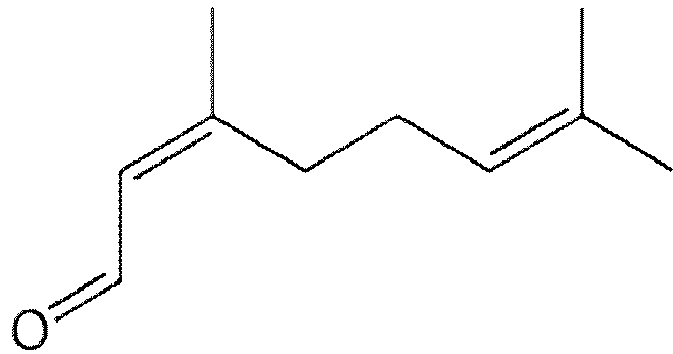
camphor 
thuyone 
carvone 
pulegone 
Oil of Wintergreen (methyl salicylate) 
bornile acetate 
borneol 
linalile acetate 
cedryl acetate 
sinensal 
cinnamaldehyde 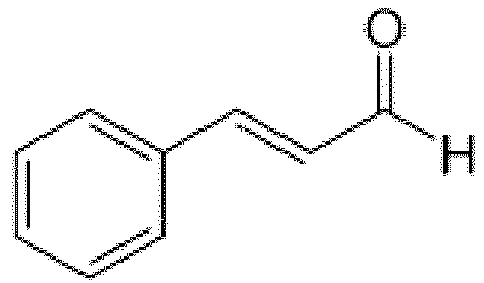
diallyl sulfide 
diallyl disulfide 
diallyl trisulfide 
nepetalactone 
bisbolane 
elemane 
termacrane 
humulcne 
bergamotane 
cadinane 
eudesmane 
eremophilane 
guaiane 
daucane 
himalachane 
caryophyllene 
chamigrane 
cupranane 
copaane 
patchoulane 
aromadendrane 
bourbonane 
silphiperfolane 
cedreane 
seychellane 
- Essential oils can be obtained in ways known to the art, such as the methods detailed in the European Pharmacopoeia (e.g., Ph. Eur., 9th Edition), namely steam distillation, dry distillation, and mechanical processes. Other methods can also be used, such as methods which use liquid carbon dioxide or microwaves to extract EOs.
- In a steam distillation method, the essential oil is produced by the passage of steam through the plant raw material in a suitable apparatus. The steam can be introduced from an external source or generated by boiling water below the raw material, or by boiling water in which the raw material is immersed. The steam and oil vapors are condensed, and the water and essential oil are then separated by decantation.
- In one method of steam distillation, plant materials are placed on a perforated base or sieve at a predetermined distance over a distilling tank. The tank contains water at a level less than the depth of the sieve which is heated. The steam flows at a low pressure and penetrates the vegetable matter, for example for 3-4 hours. The component parts volatilize and are then condensed in a refrigeration tube and collected in a flask where water and oil are separated due to difference in density.
- In dry distillation methods, the essential oil is produced by high-temperature heating of stems or bark in a suitable apparatus without the addition of water or steam. Mechanical processes for obtaining essential oils generally use a mechanical device without any heating, also known as cold-pressing. Mechanical processes are usually applied to citrus fruits and involve the expression of the essential oil from the pericarp and subsequent separation by physical means. Conventional cold-pressing methods apply abrasive action to the entire surface of a fruit under a stream of water. After removal of solid waste, the essential oil is separated from the aqueous phase by centrifugation.
- A further method for extracting EOs involves extraction using organic solvents. These penetrate the vegetable matter and dissolve the EOs, which are then evaporated and concentrated at low temperature. Then the solvent is eliminated, leaving only the desired fraction. An alternative is extraction using gases in super-critical conditions. Gases (usually CO2) at a temperature and pressure above their critical points are used.
- Following extraction, essential oil materials are generally further processed in order to remove impurities and/or obtain a desired fraction of the extracted material. Techniques known to the art can be employed, such as fractionation and filtration. The identity of the compounds contained in the extracted material can be determined using methods known to the art, such as gas chromatography on polar, apolar or chiral stationary phases, mass spectrometry, and/or Fourier transform infra-red (FTIR) detection.
- The polyester used in the present process for producing an EO microparticle composition is a branched or linear amorphous polyester resin. The amorphous polyester resin can be formed by reacting a diol with a diacid in the presence of an optional catalyst. Examples of diacids or diesters including vinyl diacids or vinyl diesters utilized for the preparation of amorphous polyesters include dicarboxylic acids or diesters such as terephthalic acid, phthalic acid, isophthalic acid, fumaric acid, dimethyl fumarate, dimethyl itaconate, cis, 1,4-diacetoxy-2-butene, diethyl fumarate, diethyl maleate, maleic acid, succinic acid, itaconic acid, succinic acid, succinic anhydride, dodecylsuccinic acid, dodecylsuccinic anhydride, glutaric acid, glutaric anhydride, adipic acid, pimelic acid, suberic acid, azelaic acid, dodecane diacid, dimethyl terephthalate, diethyl terephthalate, dimethylisophthalate, diethylisophthalate, dimethylphthalate, phthalic anhydride, diethylphthalate, dimethylsuccinate, dimethylfumarate, dimethylmaleate, dimethylglutarate, dimethyladipate, dimethyl dodecylsuccinate, and combinations thereof. The diacid or diester can be present, for example, in an amount of from about 40 to about 60 mole percent of the resin, from about 42 to about 52 mole percent of the resin, or from about 45 to about 50 mole percent of the resin.
- Examples of diols which can be utilized in generating the amorphous polyester include 1,2-propanediol, 1,3-propanediol, 1,2-butanediol, 1,3-butanediol, 1,4-butanediol, pentanediol, hexanediol, 2,2-dimethylpropanediol, 2,2,3-trimethylhexanediol, heptanediol, dodecanediol, bis(hydroxyethyl)-bisphenol A, bis(2-hydroxypropyl)-bisphenol A, 1,4-cyclohexanedimethanol, 1,3-cyclohexanedimethanol, xylenedimethanol, cyclohexanediol, diethylene glycol, bis(2-hydroxyethyl) oxide, dipropylene glycol, dibutylene, and combinations thereof. The amount of diol selected can vary, and can be present, for example, in an amount from about 40 to about 60 mole percent of the resin, from about 42 to about 55 mole percent of the resin, or from about 45 to about 53 mole percent of the resin.
- Polycondensation catalysts which can be utilized in forming amorphous polyesters for use in the present process include tetraalkyl titanates, dialkyltin oxides such as dibutyltin oxide, tetraalkyltins such as dibutyltin dilaurate, and dialkyltin oxide hydroxides such as butyltin oxide hydroxide, aluminum alkoxides, alkyl zinc, dialkyl zinc, zinc oxide, stannous oxide, or combinations thereof. Such catalysts can be utilized in amounts of, for example, from about 0.01 mole percent to about 5 mole percent based on the starting diacid or diester used to generate the polyester resin.
- Examples of amorphous polyester resins which can be used in the present process include, but are not limited to, unsaturated amorphous polyester resins such as poly(propoxylated bisphenol co-fumarate), poly(ethoxylated bisphenol co-fumarate), poly(butyloxylated bisphenol co-fumarate), poly(co-propoxylated bisphenol co-ethoxylated bisphenol co-fumarate), poly(1,2-propylene fumarate), poly(propoxylated bisphenol co-maleate), poly(ethoxylated bisphenol co-maleate), poly(butyloxylated bisphenol co-maleate), poly(co-propoxylated bisphenol co-ethoxylated bisphenol co-maleate), poly(1,2-propylene maleate), poly(propoxylated bisphenol co-itaconate), poly(ethoxylated bisphenol co-itaconate), poly(butyloxylated bisphenol co-itaconate), poly(co-propoxylated bisphenol co-ethoxylated bisphenol co-itaconate), poly(1,2-propylene itaconate), and combinations thereof.
- Alkali sulfonated polyester resins can also be useful in some embodiments, such as the metal or alkali salts of copoly(ethylene-terephthalate)-copoly(ethylene-5-sulfo-isophthalate), copoly(propylene-terephthalate)-copoly(propylene-5-sulfo-isophthalate), copoly(diethylene-terephthalate)-copoly(diethylene-5-sulfo-isophthalate), copoly(propylene-diethylene-terephthalate)-copoly(propylene-diethylene-5-sulfoisophthalate), copoly(propylene-butylene- terephthalate)-copoly(propylene-butylene-5-sulfo-isophthalate), copoly(propoxylated bisphenol-A-fumarate)-copoly(propoxylated bisphenol A-5-sulfo-isophthalate), copoly(ethoxylated bisphenol-A-fumarate)-copoly(ethoxylated bisphenol-A-5-sulfo- isophthalate), and copoly(ethoxylated bisphenol-A-maleate)-copoly(ethoxylated bisphenol-A-5-sulfo-isophthalate), wherein the alkali metal is, for example, a sodium, lithium or potassium ion.
- The amorphous polyester used in the present process can advantageously have a glass transition temperature of between about 40°C and about 90°C, or between about 45°C and about 75°C. The polyester can also have a melt viscosity of from about 10 to about 1,000,000 Pa·s at about 130°C, or from about 20 to about 100,000 Pa·s at about 130°C. The average molecular weight of the amorphous polyester can also be from about 2,000 to about 25,000, as determined by gel permeation chromatography (GPC) using polystyrene standards. Polyester in powder or particulate form is generally used in the present process, though liquid polyester resin can also be used.
- The present process for producing an essential oil microparticle also makes use of a water-soluble polymer as a polymeric stabilizer. Non-limiting exemplary polymeric stabilizers include poly(vinyl acetate), poly(methyl methacrylate), poly(acrylonitrile), poly(dimethylsiloxane), poly(vinyl chloride), poly(ethylene), poly(propylene), poly(lauryl methacrylate), poly(oxyethylene), poly(acrylamide), poly(vinyl alcohol), poly(acrylic acid), poly(methacrylic acid), poly(vinyl pyrrolidone), poly(ethylene imine), poly(vinyl methyl ether), poly(4-vinylpyridine), poly(12-hydroxystearic acid), poly(isobutylene), cis-1:4-poly(isoprene), carboxymethyl cellulose, gelatin, polysorbate 80 (such as TWEEN 80, available from Millipore Sigma/Merck KGaA, Darmstadt, Germany), polysorbate 20 (such as TWEEN 20, available from Millipore Sigma/Merck KGaA, Darmstadt, Germany), hydroxypropylmethylcellulose, copovidone and polyvinylpyrrolidone, polyethyleneglycols (PEG), polymethacrylates, hypromellose acetate succinate, hypromellose phthalate, a polyvinyl caprolactam-polyvinyl acetate-polyethylene glycol graft copolymer such as SOLUPLUS (available from BASF, Ludwigshafen, Germany), polyvinyl acetate phthalate, cellulose acetate phthalate, and combinations thereof.
- The forgoing polymers include hydrophilic groups in the backbone of the polymer. The hydrophilic groups can be nonionic, anionic, cationic or amphoteric. Such water-soluble polymers can also be either synthetic (produced by the polymerization of monomers synthesized from petroleum or natural gas), semisynthetic (manufactured by chemical derivatization of natural organic materials such as polysaccharides or cellulose), or natural (materials derived from microbial, plant or animal material such as xanthan gum, pectins, dextran, carrageenan, guar, sodium CMC, hylaluronic acid (HA) and albumin).
- Polymeric stabilizers are typically surfactants, which lower surface tension, and/or dispersing agents such as polyelectrolytes and some inorganic salts, which stabilize particles by providing a surface charge (electro-static interaction or electro-steric hindrance). Examples of polyelectrolytes include alkali salts of poly(methyl acrylate) and poly(methyl methacrylate), magnesium and calcium carbonate, calcium phosphate, and aluminum chloride. Other stabilizers include water soluble, non-micelle-forming polymers such as methyl and ethyl cellulose, poly(vinyl alcohol), gums, alginates, casein, gelatins, starches and nanoparticles such as talc, silicates, clays and bentonites.
- The water-miscible organic solvent for use in the present process can be chosen from solvents known in the art. Such organic solvents can form a homogenous mixture with water without separation of liquid phases (e.g., into polar and nonpolar phases) for a predetermined period of time under the conditions of the present process. For example, the solvent can be selected from the group consisting of an alcohol, dimethyl acetamide, acetic acid, diethylene glycol dimethyl ether, dimethyl formamide, 1,4-dioxane, ethylene glycol, hexamethyl phosphoramide, hexamethyl phosphorous triamide, pyridine, water, and combinations thereof.
- The water-miscible organic solvent should remain fluid and preferably has a relatively low viscosity under the conditions of the present process in order to avoid impeding the process. The particular water-miscible organic solvent and the amount of this component used in the present process also should be chosen to avoid precipitation of the solvent. Flory-Huggins interaction parameters can be used to evaluate the compatibility of the polymer(s) and water-miscible organic solvent(s) used in the present process. (see, P. van de Witte, et al., Phase separation processes in polymer solutions in relation to membrane formation, J. Membrane Science, 117 (1996)).
- A polar solvent is also used in the present process as an antisolvent to induce precipitation of EO microparticles from solution. Deionized water can be used for example, optionally with other additives such as polyvinyl alcohol. Such additives should be chosen to avoid precipitation of the additives or undesirably increasing the viscosity of the liquid mixture. For example, polyvinyl alcohol having a molecular weight of between about 10,000 and about 100,000 can be used as an additive, typically in an amount of between about 0.01% and about 3% by weight, or between about 0.05% and about 2% by weight. Other aqueous solutions or polar solvents can also be used.
- In the present process for preparing an essential oil powder coating, one or more essential oils are combined with polyester and a polymeric stabilizer to form a first fluid mixture. The polyester is preferably in solid form, e.g. powdered or pelletized, and can be combined first with an essential oil material or can alternatively be first dissolved in a solvent before being combined with the essential oil. These components can be combined in a variety of ways with other materials used to prepare the present microparticles, for example prior to contacting them with a water-miscible organic solvent, contemporaneously with the addition of the water-miscible organic solvent, or alternatively the essential oil component can be pre-mixed in the water-miscible organic solvent and then added to the polyester and polymeric stabilizer components. The fluid mixture is an emulsion due to the presence of the essential oil in the mixture.
- Essential oils can be included in the present powder coating in amounts of between about 0.01% and about 20% by weight, or between about 0.1% and about 10% by weight, or between about 1% and about 5% by weight based on the total weight of the microparticles produced by the present process. To produce such powder coatings, one or more essential oils should be added to the first fluid mixture in amounts of between about 0.01% and about 20% by weight, or between about 0.1% and about 10% by weight, or between about 1% and about 5% by weight, based on the total weight of the polyester in the first fluid mixture. The essential oil, polyester, and stabilizer components at this stage can be combined in amounts ranging (in parts per hundred) from 2-60 parts essential oil, 50-90 parts polyester, and 8-25 parts stabilizer. In one embodiment, for example, the ratios of essential oil/polyester/stabilizer can be 11:73:16 parts per hundred.
- The essential oil, polyester, polymeric stabilizer and water-miscible organic solvent should be heated to a temperature at which the polyester and polymeric stabilizer components are dissolved into the organic solvent to form a first fluid mixture, if a temperature above ambient temperature is required for this. The components of the fluid mixture can be heated after being combined, or alternatively one or more of the components can be heated before being combined with other components of the first fluid mixture. The first fluid mixture can be heated, for example, to a temperature of between about 70°C and about 100°C, or between about 80°C and about 90°C. Processing temperatures in the present process should be maintained the below the boiling points of the essential oils being incorporated into the final microparticle composition.
- Following the creation of the first fluid mixture, a polar solvent (antisolvent) is added the first fluid mixture in order to form a second fluid mixture. The antisolvent is preferably added in a metered fashion, i.e. in controlled amounts over a predetermined of time. For example, the antisolvent can be added in dropwise fashion to the first fluid mixture. The second fluid mixture is preferably stirred, agitated, or otherwise being mixed during addition of the antisolvent. Antisolvent can be added to the first fluid mixture, for example, at rates of 0.5-20 g/min., 1-15 g/min., or 3-10 g/min., for time periods of between 30-120 minutes, 45-90 minutes, or 60-75 minutes. When antisolvent is added at a faster rate, the supersaturation level is higher and smaller particles are formed, while adding antisolvent at a slower rate generally leads to larger particles. Homogeneous mixing also influences the degree of supersaturation of the second fluid mixture, which impacts the nucleation and particle growth rate.
- The second fluid mixture can be maintained at temperatures of between about 70°C and about 100°C, or between about 80°C and about 90°C, for a predetermined period of time, for example for between about 15 minutes and about 4 hours following the initiation of antisolvent addition to the first fluid mixture, or for between about 30 minutes and about 2 hours, or for between about 45 minutes and about 1 hour. Following such heating, the second fluid mixture can be allowed to cool, in order to facilitate precipitation.
- A nucleating agent can also be added to the in-process liquid mixture in order to facilitate precipitation of the essential oil powder coating product of the present process. The nucleating agent can be added before the addition of the antisolvent, after the addition of the antisolvent, or contemporaneously with the antisolvent. An example of such a nucleating agent is colloidal silica, which can be added after or together with the addition of the antisolvent. Other nucleating agents that can be used include minerals such as chalk, clay, kaolin, talc and silicates, and pigments such as cadmium red, cobalt yellow, then chromium oxide, titanium dioxide, magnesium oxide, carbonates, sulfates, carbon black, salts of carboxylic acids, benzophenone, and some polymers and other organic liquids. Other nucleating agents that can be used include molybdenum disulfide, iron sulfide, titanium dioxide, talc and sodium phenylphosphinate, sodium benzoate boron nitride, aromatic carboxylic acid salts, sodium benzoate, talc and some pigment colorants. Newer nucleating agents that can be used include phosphate ester salts and hyper nucleating agents having faster processing speeds.
- In one embodiment, colloidal silica in water is added to the first fluid mixture to pre-nucleate or "pre-seed" the first fluid mixture. In another embodiment, the nucleating agent can be included in the antisolvent. For example, an antisolvent containing up to about 30% by weight colloidal silica can be added to the second fluid mixture. Nucleation affects the reaction speed and the microparticle size and distribution.
- Following the addition of antisolvent to the first fluid mixture, a precipitate comprising an essential oil is formed in the second fluid mixture. The particles of this precipitate are separated from the second fluid mixture in ways known to the art, such as by centrifugation. The separated particles can be washed and further centrifuged in order to prepare the final essential oil powder coating, and/or the particles can be subjected to freeze drying in order to prepare the essential oil powder coating.
- Spherical particles comprising essential oil such as those produced by the present process were not previously known for use in powder coating applications. The solvent/antisolvent system of the present method allows better control over the properties of such powder coatings, which can be smaller and more spherical than current essential oil powder particles. The final product can be altered by changes to the degree of loading of polymer to essential oil, leading to particles of different concentrations of essential oil in the microparticles of the composition.
- The foregoing process is unique to the powder coating industry, in particular the process of making microparticles based on the precipitation of amorphous polyester. Advantageously, essential oils act as emulsifiers during the process of forming microparticles. The infusion of a polymeric material with an essential oil was not previously known, and no prior powder coating contained an essential oil. The ability to fine-tune the size and size distribution of the present microparticles also makes it feasible to produce thinner or thicker coatings as needed on various substrates.
- The present essential oil microparticle composition generally comprises essential oil incorporated within and on the surface of polymeric particles. An advantageous characteristic of the particles of the present essential oil powder coating is that they are generally spherical. This can be seen for example in
Figures 2 and3 , which are scanning electron microscope (SEM) images (micrographs) of two samples of microparticles produced according to the present process. Greater sphericity provides improved flow characteristics to the present essential oil-containing powder coating composition and facilitates the application of the composition by an electrostatic powder coating applicator, for example. The spherical nature of the particles of the present essential oil powder coating can be measured by their circularity. These particles can have a circularity of between about 0.93 and about 0.999, between about 0.95 and about 0.995, or between about 0.96 and about 0.990, for example. - Circularity can be determined for example with a Sysmex FPIA-3000 Particle Characterization System or a Sysmex FPIA-2100 Flow Particle Image Analyzer, both available from Malvern Instruments Ltd. (Worcestershire, UK). In flow particle image analysis, a sample is taken from a dilute suspension of particles, and this suspension is then passed through a measurement cell where images of the particles are captured, such as with stroboscopic illumination and a CCD camera. A digital image of each particle is extracted and quantified, such as by identifying particle pixels from background pixels using differences in greyscale levels ("thresholding") and by tracing the perimeters of individual particles and calculating their areas by edge definition. The particles of the present powder coating composition also advantageously have a narrow particle size distribution (geometric standard deviation or GSD), such as a GSD of between about 1.3 and about 2.0. The size of such particles can be determined by a photographic method, such as through the use of a Particle Image Analyzer as described above, and the GSD can then be calculated using methods known to the art based on such size data. One way to express distribution width is as the span, which can be expressed by the following formula:
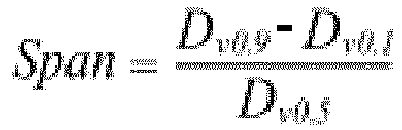
- The average size of the particles comprising the present powder coating will vary, depending in part on the size of the essential oil used to form the powder coating, but can be for example between about 0.01 microns and about 100 microns, between about 0.1 microns and about 50 microns, between about 1 micron and about 30 microns, or between about 5 microns and about 15 microns. The average particle size can be the D50, i.e. the size at which half of the particles are larger and half smaller, and can be determined using a Multisizer 3 Coulter Counter made by Beckman Coulter (Indianapolis, IN), for example.
- The aspect ratio of particles produced by the present process is preferably in the range of about 1. Preferably, the particles have an aspect ratio of between about 0.93 and about 0.999, between about 0.95 and about 0.995, or between about 0.96 and about 0.990. The average of the aspect ratios of the particles is also preferably between about 0.93 and about 0.999, between about 0.95 and about 0.995, or between about 0.96 and about 0.990. The minimum size of the present pigment particles is preferably between 1 and 200 µm in diameter.
- To determine how much essential oil is retained within the particles, thermogravimetric analysis (TGA), mass spectrometry (MS), gas chromatography (GC), GC-flame ionization detection, or gas chromatography-mass spectrometry (GC-MS) can be performed. An individual EO compounds, such as methyl salicylate, can be included in the present microparticles, or the microparticles can be formed from an EO material containing a mixture of essential oils, such as a mixture of between 20 and 60 EO components or more, though usually in plant-derived EO materials usually 2-3 compounds make up the majority of the EO components. In EO compositions that include non-essential oil compounds, the essential oil compounds can be present in concentrations between about 20% and about 70% by weight of the composition or more, for example, with the remaining compounds being present in trace amounts.
- The present microparticles are able to contain more essential oil material than prior processes for producing EO particular materials, such as spray draying. This allows the present particle composition to deliver higher amounts of essential oils to a powder coating formed with this composition, thereby providing improved pest repellent properties to such coatings.
- The present EO microparticle composition can be applied as a powder coating to a variety of articles and surfaces, including furniture, household items, manufactured goods, and building or other architectural surfaces. Articles used outdoors, where invertebrate pests are more prevalent, for example, are particularly suitable for coating with the present powder coating composition. Patio furniture, lawn and garden equipment, decorative outdoor items, and consumable items such as beverage containers (bottles, cans, and the like) can be advantageously coated with the present composition, for example.
- The present powder coating composition can be applied to a surface of a substrate by electrostatic spraying with an electrostatic applicator device. Such devices can make use of tribo or corona charging, for example. During corona charging, a high voltage potential is developed at an electrode located in or near a stream of powder comprising the present composition. The powder particles become negatively charged and are attracted to the grounded substrate. Alternatively, substrates can be coated with the present composition using a fluidized bed, by passing the substrate through an electrically charged cloud of powder comprising the present microparticle composition, or using other techniques known to the art.
- The present microparticle composition can be applied in a variety of thicknesses, depending on the particular application for the coating. In applications for items expected to experience significant wear and tear or harsher environmental conditions, coatings can be applied in greater thicknesses, while decorative coatings can be thinner. Decorative coatings are typically applied in thickness of, for example, 0.025 mm to 0.10 mm, such as in thicknesses of from 1.5 to 3.5 mils (0.038 mm - 0.089 mm) or between 2.5 and 3 mils (0.064 mm - 0.076 mm) (with 1 mil = 0.0254 mm). Coatings which need to be more protective can be thicker, such as from 0.25 mm to 0.76 mm.
- Following the application of a layer of the present composition to a substrate, the applied coating layer is heat-cured, for example at a temperature of between about 90°C and about 180°C, or between about 100°C and about 130°C. The ability to cure the present composition at relatively low temperatures saves energy and also prevents degradation or evaporation of the essential oils contained on and within the microparticles of the present composition. Due to the high volatility of most of these essential oils (e.g., Eucalyptus 175 °C, Lavender 204 °C, Tea Tree 165 °C, Citronella 222 °C), the efficacy of the repellent functionality of the powder coated product is preserved. Since the essential oil is infused within the polymeric matrix, normal cleaning of the coated surfaces should not result in any significant loss of the essential oil.
- Essential oils have been used in a variety of ways. For example, oils from oregano, rosemary, and sage have been used for food preservation. Such oils can advantageously be used in coatings for items that are intended to come in contact with food, such as food storage containers or items for use in a commercial or household kitchen. Other oils, such as eucalyptus oil, have been identified as having antibacterial activity. Such oils can also be used in coatings for items intended to come in contact with food, as well as with items used in medical or veterinary applications.
- Essential oils are known in addition for repelling pests such as insects. Studies have demonstrated that these compounds possess biological activity capable of eliciting adverse effects in arthropod pests. For example, Gaultheria oil (Ericaceae) and Eucalyptus oil (Myrtaceae) are highly effective at killing or repelling insects such as the rice weevil Sitophilus oryzae and the beetles Callosobruchus chinensis (Coleoptera, Bruchidae), S. paniceum, and M. domestica. Eucalyptus saligna (Myrtaceae) oil has similarly been found to kill the following pests within 2 to 30 minutes of contact: Pediculus capitis (head lice), Anopheles funestus (mosquitoes), Cimex lectularius (bed bugs), and Periplaneta orientalis (cockroaches).
- Essential oils belonging to plants in the citronella genus (Poaceae) are commonly used as ingredients of plant-based mosquito repellents, such as EOs from the plant Cymbopogon nardus. Other EO mosquito repellant compositions are listed in Table 2 below.
Table 2. Essential Oils used as Mosquito Repellants Essential Oil Plant Citronella grass, Lemon grass Cympobogon spp., Cymbopogon citratus, Cymbopogon martini Eucalyptus oil Eucalyptus citriodora Geranium Pelargonium citrosum Peppermint Mentha piperita Holy Basil Ocimum spp Toothache Tree Zanthoxylum limonella Kakronda Blumea lacera Neem Azadirachta indica - Into a 1L, three-necked round bottom flask was added 55 grams of polyester resin and 12 grams of polyvinyl alcohol (27K, PVA) in dimethyl acetamide (DMAc, 372.8 grams, water miscible, high boiling solvent). Mixing at about 300 rpm was started to start dissolving the polymers. While still at ambient temperature (23°C), about 14 grams of Wintergreen Essential Oil (methyl salicylate) was added to the flask. The polymer/oil solution was heated up to 90°C and a solution of PVA in deionized water (6.45 grams 27K PVA in 225.6 grams DIW, deionized water) was added dropwise to the flask with a metering pump (Fluid Metering, Inc.) while stirring at 370 RPM. After about 10 minutes of adding the aq. PVA solution, the solvent solution went from clear light yellow to a white opaque. After about 1.5 hours the aqueous PVP solution was all added and the addition of colloidal silica (37.9 grams, 30 wt.%, aqueous, LUDOX AM available from W.R. Grace, Columbia, MD) was begun by drop funnel. Within 12 minutes all the colloidal silica was added. The heating was stopped within 10 minutes. The opaque solution was left to cool and left stirring overnight at 300 RPM. The next day, the solution was transferred to a 1L centrifuge bottle and centrifuged at 3000 RPM for 15 minutes to remove the DMAc/DIW mixture. The particles were resuspended in DIW and mixed by shaking for about 30 seconds before centrifuging again at 3000 RPM for 15 minutes. This wash/centrifuge procedure was repeated one more time before concentrating the microparticles and transferring them to a freeze-drier bottle. The particle slurry was rapidly frozen and then placed on freeze drier which subjected the bottled particles to a high vacuum that removes ice by sublimation.
- The particles were submitted for thermogravimetry and gas chromatographic analysis to ensure the presence of the essential oil additive. Table 3 below shows a summary of the particle composition of four batches of the present microparticles.
Table 3. Composition of Essential Oil Microparticles Particle Formulation Batch 1 Batch 2 Batch 3 Batch 4 Ratio of low to high molecular weight polyester 1:1 0:1 0:1 0:1 Type of Essential Oil Wintergreen Wintergreen Wintergreen Citronella % Oil in Particles (as detected by Gas Chromatography) 5.0% 4.9% 5.9% 6.6% Pigment (wt. %) Carbon Black None added None added 9.50% None added ppm Silicon (as detected by Inductively Coupled Plasma) None added 66.4 536.6 222.1 Particle size range 0.5 - 5.5 µm 14 - 33 µm potato-shaped 5 - 50 µm TBD spherical 1 -10 µm - Although the present invention has been described in considerable detail with reference to certain preferred embodiments, other embodiments are possible. The steps disclosed for the present methods, for example, are not intended to be limiting nor are they intended to indicate that each step is necessarily essential to the method, but instead are exemplary steps only. Therefore, the scope of the appended claims should not be limited to the description of preferred embodiments contained in this disclosure.
- Recitation of value ranges herein is merely intended to serve as a shorthand method for referring individually to each separate value falling within the range. Unless otherwise indicated herein, each individual value is incorporated into the specification as if it were individually recited herein. All references cited herein are incorporated by reference in their entirety.
Claims (19)
- A composition comprising spherical microparticles for use as a powder coating, the microparticles comprising a polymer material with one or more essential oil compounds incorporated therein in an amount of between about 0.01% and about 20% by weight of the microparticles, wherein the microparticles have an average particle size of between about 0.01 microns and about 100 microns and a circularity of between about 0.93 and about 0.999, and wherein the essential oil compounds are organic compounds which are liquid at room temperature, soluble in organic solvents, insoluble in water, and can be extracted from plants by steam distillation, dry distillation, or mechanical processing without heating, including isomers thereof and derivatives made by esterification, hydrogenation, or hydration.
- The composition of claim 1, wherein the one or more essential oil compounds are selected from the group consisting of cintronellal, citronellol, limonene, myrcene, phellandrene, pinene, ocimene, sabinene, terpinene, selinene, terpineol, linalol, ascaridol, eucalyptol, menthol, , bisabolol, thymol, carvacrol, eugenol, safrol, santalol, apiol, anetol, metilchavicol, estragol, geraniol, geranial, nerol, neral, camphor, thuyone, carvone, pulegone, methyl salicylate, bornile acetate , borneol, linalile acetate, cedryl acetate, sinensal, cinnamaldehyde, diallyl sulfide, diallyl disulfide, diallyl trisulfide, nepetalactone, bisbolane, elemane, termacrane, humulcne, bergamotane, cadinane, eudesmane , eremophilane, guaiane, daucane, himalachane, caryophyllene, chamigrane, cupranane, copaane, patchoulane, aromadendrane, bourbonane , silphiperfolane, cedreane, and seychellane.
- The composition of claim 1, wherein the one or more essential oil compounds comprise a terpenoid or phenylpropanoid compound.
- The composition of claim 1, wherein the one or more essential oil compounds comprise a monoterpene or a sesquiterpene compound.
- The composition of claim 1, wherein the one or more essential oil compounds can be extracted from a plant from a family selected from the group consisting of Apiaceae, Asteraceae, Cupressaceae, Lamiaceae, Lauraceae, Myrtaceae, Pinaceae, Piperaceae, Santalaceae, Cardiopteridacea, Rutaceae, Annonaceae, Labiatae and Zingiberaceae.
- The composition of claim 1, wherein the one or more essential oil compounds can be extracted from a plant from a genus selected from the group consisting of Gaultheria, Betula, Spiraea, Polygala, and Cymbopogon.
- The composition of claim 1, wherein the microparticles have a geometric size distribution of between about 1.3 and about 2.0.
- The composition of claim 1, wherein the microparticles have a circularity of between about 0.96 and about 0.99.
- The composition of claim 1, wherein the microparticles have an average particle size of between about 0.1 microns and about 50 microns.
- The composition of claim 1, wherein the one or more essential oil compounds are produced synthetically.
- A process for producing a composition comprising spherical microparticles containing one or more essential oils, comprising the steps of:providing an amorphous polyester resin, a polymeric stabilizer comprising a water-soluble polymer, and the one or more essential oils;dissolving the polyester resin and polymeric stabilizer into a water-miscible organic solvent together with the essential oils to form a first fluid mixture;adding a polar solvent to the first fluid mixture at a predetermined rate, thereby forming a second fluid mixture comprising precipitated microparticles;collecting the precipitated microparticles.
- The method of claim 11, further comprising the step of adding silica to the first or second fluid mixture.
- The method of claim 11, wherein the polyester resin, the polymeric stabilizer, and the essential oils are added together before being placed in contact with the water-miscible organic solvent.
- The method of claim 11, wherein:(a) the polymeric stabilizer is selected from the group consisting of polyvinyl acetate, poly(methyl methacrylate), poly(acrylonitrile), poly(dimethylsiloxane), polyvinyl chloride, polyethylene, polypropylene), poly(lauryl methacrylate), poly(oxyethylene), poly(acrylamide), poly(vinyl alcohol), poly(acrylic acid), poly(methacrylic acid), polyvinyl pyrrolidone), polyethylene imine), poly(vinyl methyl ether), poly(4-vinylpyridine), poly(12-hydroxystearic acid), poly(isobutylene), cis-1:4-poly(isoprene), carboxymethyl cellulose, gelatin, polysorbate 80, polysorbate 20, hydroxypropylmethylcellulose, copovidone and polyvinylpyrrolidone, polyethyleneglycols (PEG), polymethacrylates, hypromellose acetate succinate, hypromellose phthalate, polyvinyl caprolactam-polyvinyl acetate-polyethylene glycol graft copolymer, polyvinyl acetate phthalate, cellulose acetate phthalate, and combinations thereof;(b) the water miscible organic solvent is selected from the group consisting of dimethyl acetamide, acetic acid, diethylene glycol dimethyl ether, dimethyl formamide, 1,4-dioxane, ethylene glycol, hexamethyl phosphoramide, hexamethyl phosphorous triamide, pyridine, water, and combinations thereof; and(c) the polyester resin is selected from the group consisting of poly(propoxylated bisphenol co-fumarate), poly(ethoxylated bisphenol co-fumarate), poly(butyloxylated bisphenol co-fumarate), poly(co-propoxylated bisphenol co-ethoxylated bisphenol co-fumarate), poly(1,2-propylene fumarate), poly(propoxylated bisphenol co-maleate), poly(ethoxylated bisphenol co-maleate), poly(butyloxylated bisphenol co-maleate), poly(co-propoxylated bisphenol co-ethoxylated bisphenol co- maleate), poly(1,2-propylene maleate), poly(propoxylated bisphenol co-itaconate), poly(ethoxylated bisphenol co-itaconate), poly(butyloxylated bisphenol co-itaconate), poly(co-propoxylated bisphenol co-ethoxylated bisphenol co-itaconate), poly(1,2-propylene itaconate), and combinations thereof.
- The method of claim 11, wherein the polyester resin has a glass transition temperature of between about 45°C and about 75°C.
- The method of claim 11, wherein the second fluid mixture is heated to a temperature of between about 70°C and about 100°C.
- A method of forming an insect-repellant coating on a substrate, comprising:applying the composition of claim 1 to the substrate with an electrostatic powder coating applicator; andcuring the composition on the substrate.
- The method of claim 17, wherein the coating is electrostatically transferred to the substrate through tribo or corona charging.
- The method of claim 17, wherein the substrate is an item of furniture.
Applications Claiming Priority (1)
| Application Number | Priority Date | Filing Date | Title |
|---|---|---|---|
| US16/292,247 US20200281195A1 (en) | 2019-03-04 | 2019-03-04 | Essential oil microparticles for powder coating applications |
Publications (1)
| Publication Number | Publication Date |
|---|---|
| EP3705509A1 true EP3705509A1 (en) | 2020-09-09 |
Family
ID=69770550
Family Applications (1)
| Application Number | Title | Priority Date | Filing Date |
|---|---|---|---|
| EP20160802.3A Withdrawn EP3705509A1 (en) | 2019-03-04 | 2020-03-03 | Essential oil microparticles for powder coating applications |
Country Status (4)
| Country | Link |
|---|---|
| US (2) | US20200281195A1 (en) |
| EP (1) | EP3705509A1 (en) |
| JP (1) | JP2020142231A (en) |
| CA (1) | CA3074131C (en) |
Cited By (2)
| Publication number | Priority date | Publication date | Assignee | Title |
|---|---|---|---|---|
| CN112294870A (en) * | 2020-11-06 | 2021-02-02 | 江苏省中医药研究院 | Cinnamon oil microsphere inclusion compound and preparation method and application thereof |
| EP4141061A1 (en) * | 2021-08-25 | 2023-03-01 | Xerox Corporation | Powder particulates comprising a water-soluble polymer and production thereof by melt emulsification |
Families Citing this family (2)
| Publication number | Priority date | Publication date | Assignee | Title |
|---|---|---|---|---|
| KR102610598B1 (en) * | 2021-06-04 | 2023-12-08 | 양훈상 | Ship Paint Additive Composition |
| JP7789542B2 (en) * | 2021-12-17 | 2025-12-22 | 倉敷紡績株式会社 | Linear object gripping device and linear object gripping system |
Citations (3)
| Publication number | Priority date | Publication date | Assignee | Title |
|---|---|---|---|---|
| EP1698944A1 (en) * | 2003-12-10 | 2006-09-06 | Sanyo Chemical Industries, Ltd. | Polyester resin for toner, toner composition and resin particles |
| EP2296046A1 (en) * | 2009-09-15 | 2011-03-16 | Xerox Corporation | Curable toner compositions and processes |
| WO2018065481A1 (en) * | 2016-10-07 | 2018-04-12 | Basf Se | Spherical microparticles |
Family Cites Families (14)
| Publication number | Priority date | Publication date | Assignee | Title |
|---|---|---|---|---|
| JPS528795B2 (en) * | 1971-12-30 | 1977-03-11 | ||
| JPH0699244B2 (en) * | 1985-04-10 | 1994-12-07 | 日本ペイント株式会社 | Fine resin particles with anti-pest properties |
| ES2084698T5 (en) * | 1989-05-04 | 2005-03-01 | Southern Research Institute | ENCAPSULATION PROCEDURE. |
| JP3547058B2 (en) * | 1995-03-31 | 2004-07-28 | 株式会社パル | Antibacterial wooden building materials |
| US6218023B1 (en) * | 1997-04-21 | 2001-04-17 | Montell North America, Inc. | Co-extruded laminate comprising at least one propylene graft copolymer layer |
| US6063827A (en) * | 1998-07-22 | 2000-05-16 | Xerox Corporation | Polyester process |
| US6547841B2 (en) * | 2001-04-02 | 2003-04-15 | Ciba Specialty Chemicals Corporation | Transition-metal-catalyzed process for the preparation of sterically hindered N-substituted alkoxy amines |
| US20060079613A1 (en) * | 2004-10-13 | 2006-04-13 | Rob Hanssen | Blended nucleating agent compositions and methods |
| WO2006127454A2 (en) * | 2005-05-23 | 2006-11-30 | Appleton Papers Inc. | Oil-in-water capsule manufacture process and microcapsules produced by such process |
| US20160166480A1 (en) * | 2009-09-18 | 2016-06-16 | International Flavors & Fragrances Inc. | Microcapsule compositions |
| JP2011156181A (en) * | 2010-02-02 | 2011-08-18 | Sri Sports Ltd | Golf ball |
| US10485739B2 (en) * | 2014-10-16 | 2019-11-26 | Encapsys Llc | High strength microcapsules |
| JP2016169333A (en) * | 2015-03-13 | 2016-09-23 | 新中村化学工業株式会社 | Powder coating, coated article, method for producing powder coating and microcapsule |
| US9428622B1 (en) * | 2015-04-24 | 2016-08-30 | Xerox Corporation | Hybrid latex via phase inversion emulsification |
-
2019
- 2019-03-04 US US16/292,247 patent/US20200281195A1/en not_active Abandoned
-
2020
- 2020-02-05 JP JP2020017530A patent/JP2020142231A/en active Pending
- 2020-02-28 CA CA3074131A patent/CA3074131C/en active Active
- 2020-03-03 EP EP20160802.3A patent/EP3705509A1/en not_active Withdrawn
-
2024
- 2024-05-10 US US18/660,727 patent/US20240324588A1/en active Pending
Patent Citations (3)
| Publication number | Priority date | Publication date | Assignee | Title |
|---|---|---|---|---|
| EP1698944A1 (en) * | 2003-12-10 | 2006-09-06 | Sanyo Chemical Industries, Ltd. | Polyester resin for toner, toner composition and resin particles |
| EP2296046A1 (en) * | 2009-09-15 | 2011-03-16 | Xerox Corporation | Curable toner compositions and processes |
| WO2018065481A1 (en) * | 2016-10-07 | 2018-04-12 | Basf Se | Spherical microparticles |
Non-Patent Citations (2)
| Title |
|---|
| CHOI M J ET AL: "Physical and light oxidative properties of eugenol encapsulated by molecular inclusion and emulsion-diffusion method", FOOD RESEARCH INTERNATIONAL, ELSEVIER, AMSTERDAM, NL, vol. 42, no. 1, 1 January 2009 (2009-01-01), pages 148 - 156, XP025769659, ISSN: 0963-9969, [retrieved on 20081010], DOI: 10.1016/J.FOODRES.2008.09.011 * |
| P. VAN DE WITTE ET AL.: "Phase separation processes in polymer solutions in relation to membrane formation", J. MEMBRANE SCIENCE, vol. 117, 1996, XP000732601, DOI: 10.1016/0376-7388(96)00088-9 |
Cited By (3)
| Publication number | Priority date | Publication date | Assignee | Title |
|---|---|---|---|---|
| CN112294870A (en) * | 2020-11-06 | 2021-02-02 | 江苏省中医药研究院 | Cinnamon oil microsphere inclusion compound and preparation method and application thereof |
| EP4141061A1 (en) * | 2021-08-25 | 2023-03-01 | Xerox Corporation | Powder particulates comprising a water-soluble polymer and production thereof by melt emulsification |
| US12129372B2 (en) | 2021-08-25 | 2024-10-29 | Xerox Corporation | Powder particulates comprising a water-soluble polymer and production thereof by melt emulsification |
Also Published As
| Publication number | Publication date |
|---|---|
| CA3074131C (en) | 2022-08-02 |
| JP2020142231A (en) | 2020-09-10 |
| US20200281195A1 (en) | 2020-09-10 |
| US20240324588A1 (en) | 2024-10-03 |
| CA3074131A1 (en) | 2020-09-04 |
Similar Documents
| Publication | Publication Date | Title |
|---|---|---|
| US20240324588A1 (en) | Essential oil microparticles for powder coating applications | |
| Abd El-Kader et al. | Encapsulation techniques of food bioproduct | |
| Yang et al. | Development and evaluation of novel flavour microcapsules containing vanilla oil using complex coacervation approach | |
| JP5913563B2 (en) | Method for encapsulating flavors | |
| CN104206393A (en) | Abamectin B2 microsphere and preparation method of abamectin B2 microsphere | |
| CN107041549B (en) | A kind of preparation method of garlic oil microcapsule powder | |
| Abdul Aziz et al. | Microencapsulation of citronella oil by complex coacervation using chitosan-gelatin (b) system: Operating design, preparation and characterization | |
| Khoshdouni Farahani et al. | Performance of spray‐dried Ziziphus jujuba extract using insoluble fraction of Persian gum–sodium alginate and whey protein: Microstructural and physicochemical attributes of micro‐and nano‐capsules | |
| KR102049795B1 (en) | Compositions of emulsion particles containing fragrance oils and preparation method thereof | |
| CN106172445A (en) | Abamectin B2 chitosan microspheres and its preparation method and application | |
| US7488703B2 (en) | System and method for a fragrant polymer configured for use in a growing medium | |
| JPH06503259A (en) | Method for producing collagen particles and their use as carriers for active substrates | |
| KR102048201B1 (en) | Nano capsule containing natural dye and preparing method thereof | |
| CN114081869B (en) | Microcapsule-embedded chitosan solid fragrance and preparation method and application thereof | |
| Moreira da Silva et al. | Lemongrass essential oil micro‐and nanoencapsulation for industrial application: Production techniques and potential applications | |
| Subaşı et al. | Microencapsulation methods for food antioxidants | |
| CN116102892A (en) | Janus particle based on natural biological macromolecules and controllable preparation method and application thereof | |
| EP4489592B1 (en) | Biodegradable microcapsules and a method for their preparation | |
| KR20250075656A (en) | Biodegradable microcapsules and method for producing the same | |
| CN107029639A (en) | Casein sodium alginate is used for slow odor type polyelectrolyte multiplayer microcapsule of compound wall materialses and preparation method thereof | |
| Saroch et al. | Delivery Systems for Flavors and Fragrances: Quality by Design-Based Considerations | |
| CN104434824A (en) | Method for preparing xanthophylls solid dispersion | |
| CN106954646A (en) | A kind of pest repellant and preparation method thereof | |
| Martins | Microencapsulation of thyme oil by coacervation: production, characterization and release evaluation | |
| Golpira | Encapsulation of bioactive compounds of saffron in gelatin using electrospinning and freeze-drying techniques |
Legal Events
| Date | Code | Title | Description |
|---|---|---|---|
| PUAI | Public reference made under article 153(3) epc to a published international application that has entered the european phase |
Free format text: ORIGINAL CODE: 0009012 |
|
| STAA | Information on the status of an ep patent application or granted ep patent |
Free format text: STATUS: THE APPLICATION HAS BEEN PUBLISHED |
|
| AK | Designated contracting states |
Kind code of ref document: A1 Designated state(s): AL AT BE BG CH CY CZ DE DK EE ES FI FR GB GR HR HU IE IS IT LI LT LU LV MC MK MT NL NO PL PT RO RS SE SI SK SM TR |
|
| AX | Request for extension of the european patent |
Extension state: BA ME |
|
| STAA | Information on the status of an ep patent application or granted ep patent |
Free format text: STATUS: REQUEST FOR EXAMINATION WAS MADE |
|
| 17P | Request for examination filed |
Effective date: 20210309 |
|
| RBV | Designated contracting states (corrected) |
Designated state(s): AL AT BE BG CH CY CZ DE DK EE ES FI FR GB GR HR HU IE IS IT LI LT LU LV MC MK MT NL NO PL PT RO RS SE SI SK SM TR |
|
| STAA | Information on the status of an ep patent application or granted ep patent |
Free format text: STATUS: EXAMINATION IS IN PROGRESS |
|
| 17Q | First examination report despatched |
Effective date: 20231201 |
|
| STAA | Information on the status of an ep patent application or granted ep patent |
Free format text: STATUS: THE APPLICATION IS DEEMED TO BE WITHDRAWN |
|
| 18D | Application deemed to be withdrawn |
Effective date: 20240403 |