EP3703802B9 - Nasal delivery devices and methods of use thereof - Google Patents
Nasal delivery devices and methods of use thereof Download PDFInfo
- Publication number
- EP3703802B9 EP3703802B9 EP18808487.5A EP18808487A EP3703802B9 EP 3703802 B9 EP3703802 B9 EP 3703802B9 EP 18808487 A EP18808487 A EP 18808487A EP 3703802 B9 EP3703802 B9 EP 3703802B9
- Authority
- EP
- European Patent Office
- Prior art keywords
- catheter
- medicament
- patient
- chamber
- intranasal
- Prior art date
- Legal status (The legal status is an assumption and is not a legal conclusion. Google has not performed a legal analysis and makes no representation as to the accuracy of the status listed.)
- Active
Links
Images






Classifications
-
- A—HUMAN NECESSITIES
- A61—MEDICAL OR VETERINARY SCIENCE; HYGIENE
- A61B—DIAGNOSIS; SURGERY; IDENTIFICATION
- A61B17/00—Surgical instruments, devices or methods
- A61B17/24—Surgical instruments, devices or methods for use in the oral cavity, larynx, bronchial passages or nose; Tongue scrapers
-
- A—HUMAN NECESSITIES
- A61—MEDICAL OR VETERINARY SCIENCE; HYGIENE
- A61M—DEVICES FOR INTRODUCING MEDIA INTO, OR ONTO, THE BODY; DEVICES FOR TRANSDUCING BODY MEDIA OR FOR TAKING MEDIA FROM THE BODY; DEVICES FOR PRODUCING OR ENDING SLEEP OR STUPOR
- A61M11/00—Sprayers or atomisers specially adapted for therapeutic purposes
- A61M11/02—Sprayers or atomisers specially adapted for therapeutic purposes operated by air or other gas pressure applied to the liquid or other product to be sprayed or atomised
-
- A—HUMAN NECESSITIES
- A61—MEDICAL OR VETERINARY SCIENCE; HYGIENE
- A61M—DEVICES FOR INTRODUCING MEDIA INTO, OR ONTO, THE BODY; DEVICES FOR TRANSDUCING BODY MEDIA OR FOR TAKING MEDIA FROM THE BODY; DEVICES FOR PRODUCING OR ENDING SLEEP OR STUPOR
- A61M15/00—Inhalators
- A61M15/0086—Inhalation chambers
-
- A—HUMAN NECESSITIES
- A61—MEDICAL OR VETERINARY SCIENCE; HYGIENE
- A61M—DEVICES FOR INTRODUCING MEDIA INTO, OR ONTO, THE BODY; DEVICES FOR TRANSDUCING BODY MEDIA OR FOR TAKING MEDIA FROM THE BODY; DEVICES FOR PRODUCING OR ENDING SLEEP OR STUPOR
- A61M15/00—Inhalators
- A61M15/08—Inhaling devices inserted into the nose
-
- A—HUMAN NECESSITIES
- A61—MEDICAL OR VETERINARY SCIENCE; HYGIENE
- A61M—DEVICES FOR INTRODUCING MEDIA INTO, OR ONTO, THE BODY; DEVICES FOR TRANSDUCING BODY MEDIA OR FOR TAKING MEDIA FROM THE BODY; DEVICES FOR PRODUCING OR ENDING SLEEP OR STUPOR
- A61M19/00—Local anaesthesia; Hypothermia
-
- A—HUMAN NECESSITIES
- A61—MEDICAL OR VETERINARY SCIENCE; HYGIENE
- A61M—DEVICES FOR INTRODUCING MEDIA INTO, OR ONTO, THE BODY; DEVICES FOR TRANSDUCING BODY MEDIA OR FOR TAKING MEDIA FROM THE BODY; DEVICES FOR PRODUCING OR ENDING SLEEP OR STUPOR
- A61M25/00—Catheters; Hollow probes
- A61M25/0021—Catheters; Hollow probes characterised by the form of the tubing
- A61M25/0041—Catheters; Hollow probes characterised by the form of the tubing pre-formed, e.g. specially adapted to fit with the anatomy of body channels
-
- A—HUMAN NECESSITIES
- A61—MEDICAL OR VETERINARY SCIENCE; HYGIENE
- A61M—DEVICES FOR INTRODUCING MEDIA INTO, OR ONTO, THE BODY; DEVICES FOR TRANSDUCING BODY MEDIA OR FOR TAKING MEDIA FROM THE BODY; DEVICES FOR PRODUCING OR ENDING SLEEP OR STUPOR
- A61M25/00—Catheters; Hollow probes
- A61M25/01—Introducing, guiding, advancing, emplacing or holding catheters
- A61M25/0105—Steering means as part of the catheter or advancing means; Markers for positioning
-
- A—HUMAN NECESSITIES
- A61—MEDICAL OR VETERINARY SCIENCE; HYGIENE
- A61M—DEVICES FOR INTRODUCING MEDIA INTO, OR ONTO, THE BODY; DEVICES FOR TRANSDUCING BODY MEDIA OR FOR TAKING MEDIA FROM THE BODY; DEVICES FOR PRODUCING OR ENDING SLEEP OR STUPOR
- A61M5/00—Devices for bringing media into the body in a subcutaneous, intra-vascular or intramuscular way; Accessories therefor, e.g. filling or cleaning devices, arm-rests
- A61M5/46—Devices for bringing media into the body in a subcutaneous, intra-vascular or intramuscular way; Accessories therefor, e.g. filling or cleaning devices, arm-rests having means for controlling depth of insertion
-
- A—HUMAN NECESSITIES
- A61—MEDICAL OR VETERINARY SCIENCE; HYGIENE
- A61M—DEVICES FOR INTRODUCING MEDIA INTO, OR ONTO, THE BODY; DEVICES FOR TRANSDUCING BODY MEDIA OR FOR TAKING MEDIA FROM THE BODY; DEVICES FOR PRODUCING OR ENDING SLEEP OR STUPOR
- A61M16/00—Devices for influencing the respiratory system of patients by gas treatment, e.g. ventilators; Tracheal tubes
- A61M16/04—Tracheal tubes
- A61M16/0488—Mouthpieces; Means for guiding, securing or introducing the tubes
- A61M16/049—Mouthpieces
-
- A—HUMAN NECESSITIES
- A61—MEDICAL OR VETERINARY SCIENCE; HYGIENE
- A61M—DEVICES FOR INTRODUCING MEDIA INTO, OR ONTO, THE BODY; DEVICES FOR TRANSDUCING BODY MEDIA OR FOR TAKING MEDIA FROM THE BODY; DEVICES FOR PRODUCING OR ENDING SLEEP OR STUPOR
- A61M2202/00—Special media to be introduced, removed or treated
- A61M2202/02—Gases
- A61M2202/0241—Anaesthetics; Analgesics
-
- A—HUMAN NECESSITIES
- A61—MEDICAL OR VETERINARY SCIENCE; HYGIENE
- A61M—DEVICES FOR INTRODUCING MEDIA INTO, OR ONTO, THE BODY; DEVICES FOR TRANSDUCING BODY MEDIA OR FOR TAKING MEDIA FROM THE BODY; DEVICES FOR PRODUCING OR ENDING SLEEP OR STUPOR
- A61M2205/00—General characteristics of the apparatus
- A61M2205/07—General characteristics of the apparatus having air pumping means
- A61M2205/071—General characteristics of the apparatus having air pumping means hand operated
- A61M2205/075—Bulb type
-
- A—HUMAN NECESSITIES
- A61—MEDICAL OR VETERINARY SCIENCE; HYGIENE
- A61M—DEVICES FOR INTRODUCING MEDIA INTO, OR ONTO, THE BODY; DEVICES FOR TRANSDUCING BODY MEDIA OR FOR TAKING MEDIA FROM THE BODY; DEVICES FOR PRODUCING OR ENDING SLEEP OR STUPOR
- A61M2205/00—General characteristics of the apparatus
- A61M2205/33—Controlling, regulating or measuring
- A61M2205/332—Force measuring means
-
- A—HUMAN NECESSITIES
- A61—MEDICAL OR VETERINARY SCIENCE; HYGIENE
- A61M—DEVICES FOR INTRODUCING MEDIA INTO, OR ONTO, THE BODY; DEVICES FOR TRANSDUCING BODY MEDIA OR FOR TAKING MEDIA FROM THE BODY; DEVICES FOR PRODUCING OR ENDING SLEEP OR STUPOR
- A61M2205/00—General characteristics of the apparatus
- A61M2205/33—Controlling, regulating or measuring
- A61M2205/3375—Acoustical, e.g. ultrasonic, measuring means
-
- A—HUMAN NECESSITIES
- A61—MEDICAL OR VETERINARY SCIENCE; HYGIENE
- A61M—DEVICES FOR INTRODUCING MEDIA INTO, OR ONTO, THE BODY; DEVICES FOR TRANSDUCING BODY MEDIA OR FOR TAKING MEDIA FROM THE BODY; DEVICES FOR PRODUCING OR ENDING SLEEP OR STUPOR
- A61M2205/00—General characteristics of the apparatus
- A61M2205/35—Communication
- A61M2205/3546—Range
- A61M2205/3553—Range remote, e.g. between patient's home and doctor's office
-
- A—HUMAN NECESSITIES
- A61—MEDICAL OR VETERINARY SCIENCE; HYGIENE
- A61M—DEVICES FOR INTRODUCING MEDIA INTO, OR ONTO, THE BODY; DEVICES FOR TRANSDUCING BODY MEDIA OR FOR TAKING MEDIA FROM THE BODY; DEVICES FOR PRODUCING OR ENDING SLEEP OR STUPOR
- A61M2205/00—General characteristics of the apparatus
- A61M2205/35—Communication
- A61M2205/3576—Communication with non implanted data transmission devices, e.g. using external transmitter or receiver
- A61M2205/3584—Communication with non implanted data transmission devices, e.g. using external transmitter or receiver using modem, internet or Bluetooth®
-
- A—HUMAN NECESSITIES
- A61—MEDICAL OR VETERINARY SCIENCE; HYGIENE
- A61M—DEVICES FOR INTRODUCING MEDIA INTO, OR ONTO, THE BODY; DEVICES FOR TRANSDUCING BODY MEDIA OR FOR TAKING MEDIA FROM THE BODY; DEVICES FOR PRODUCING OR ENDING SLEEP OR STUPOR
- A61M2205/00—General characteristics of the apparatus
- A61M2205/35—Communication
- A61M2205/3576—Communication with non implanted data transmission devices, e.g. using external transmitter or receiver
- A61M2205/3592—Communication with non implanted data transmission devices, e.g. using external transmitter or receiver using telemetric means, e.g. radio or optical transmission
-
- A—HUMAN NECESSITIES
- A61—MEDICAL OR VETERINARY SCIENCE; HYGIENE
- A61M—DEVICES FOR INTRODUCING MEDIA INTO, OR ONTO, THE BODY; DEVICES FOR TRANSDUCING BODY MEDIA OR FOR TAKING MEDIA FROM THE BODY; DEVICES FOR PRODUCING OR ENDING SLEEP OR STUPOR
- A61M2205/00—General characteristics of the apparatus
- A61M2205/50—General characteristics of the apparatus with microprocessors or computers
- A61M2205/502—User interfaces, e.g. screens or keyboards
-
- A—HUMAN NECESSITIES
- A61—MEDICAL OR VETERINARY SCIENCE; HYGIENE
- A61M—DEVICES FOR INTRODUCING MEDIA INTO, OR ONTO, THE BODY; DEVICES FOR TRANSDUCING BODY MEDIA OR FOR TAKING MEDIA FROM THE BODY; DEVICES FOR PRODUCING OR ENDING SLEEP OR STUPOR
- A61M2205/00—General characteristics of the apparatus
- A61M2205/50—General characteristics of the apparatus with microprocessors or computers
- A61M2205/52—General characteristics of the apparatus with microprocessors or computers with memories providing a history of measured variating parameters of apparatus or patient
-
- A—HUMAN NECESSITIES
- A61—MEDICAL OR VETERINARY SCIENCE; HYGIENE
- A61M—DEVICES FOR INTRODUCING MEDIA INTO, OR ONTO, THE BODY; DEVICES FOR TRANSDUCING BODY MEDIA OR FOR TAKING MEDIA FROM THE BODY; DEVICES FOR PRODUCING OR ENDING SLEEP OR STUPOR
- A61M2205/00—General characteristics of the apparatus
- A61M2205/58—Means for facilitating use, e.g. by people with impaired vision
- A61M2205/581—Means for facilitating use, e.g. by people with impaired vision by audible feedback
-
- A—HUMAN NECESSITIES
- A61—MEDICAL OR VETERINARY SCIENCE; HYGIENE
- A61M—DEVICES FOR INTRODUCING MEDIA INTO, OR ONTO, THE BODY; DEVICES FOR TRANSDUCING BODY MEDIA OR FOR TAKING MEDIA FROM THE BODY; DEVICES FOR PRODUCING OR ENDING SLEEP OR STUPOR
- A61M2205/00—General characteristics of the apparatus
- A61M2205/58—Means for facilitating use, e.g. by people with impaired vision
- A61M2205/582—Means for facilitating use, e.g. by people with impaired vision by tactile feedback
-
- A—HUMAN NECESSITIES
- A61—MEDICAL OR VETERINARY SCIENCE; HYGIENE
- A61M—DEVICES FOR INTRODUCING MEDIA INTO, OR ONTO, THE BODY; DEVICES FOR TRANSDUCING BODY MEDIA OR FOR TAKING MEDIA FROM THE BODY; DEVICES FOR PRODUCING OR ENDING SLEEP OR STUPOR
- A61M2205/00—General characteristics of the apparatus
- A61M2205/58—Means for facilitating use, e.g. by people with impaired vision
- A61M2205/583—Means for facilitating use, e.g. by people with impaired vision by visual feedback
-
- A—HUMAN NECESSITIES
- A61—MEDICAL OR VETERINARY SCIENCE; HYGIENE
- A61M—DEVICES FOR INTRODUCING MEDIA INTO, OR ONTO, THE BODY; DEVICES FOR TRANSDUCING BODY MEDIA OR FOR TAKING MEDIA FROM THE BODY; DEVICES FOR PRODUCING OR ENDING SLEEP OR STUPOR
- A61M2205/00—General characteristics of the apparatus
- A61M2205/82—Internal energy supply devices
- A61M2205/8206—Internal energy supply devices battery-operated
-
- A—HUMAN NECESSITIES
- A61—MEDICAL OR VETERINARY SCIENCE; HYGIENE
- A61M—DEVICES FOR INTRODUCING MEDIA INTO, OR ONTO, THE BODY; DEVICES FOR TRANSDUCING BODY MEDIA OR FOR TAKING MEDIA FROM THE BODY; DEVICES FOR PRODUCING OR ENDING SLEEP OR STUPOR
- A61M2210/00—Anatomical parts of the body
- A61M2210/06—Head
- A61M2210/0618—Nose
Definitions
- the present disclosure relates to nasal delivery devices, and more particularly, to improved nasal delivery devices and methods for self-administering medicament.
- the sphenopalatine ganglion is a nerve bundle located toward the center of the head.
- the SPG is bilateral, and one is located behind each side of the nose.
- the SPG plays a unique role in headache disorders as a key structure responsible for the expression of cranial autonomic symptoms, most commonly seen in trigeminal autonomic cephalalgia.
- Cluster headache which is one type of trigeminal autonomic cephalalgia, is a severe headache characterized by recurrent episodes of excruciating pain, often on one side of the head.
- anesthetic is applied to the SPG or its surrounding area by a trained medical professional, who typically inserts a cotton-tipped applicator soaked in the anesthetic into the nostril of the patient.
- Nasal catheter devices have also been used by physicians to administer medicament to the SPG or its surrounding area. The success of these methods depends heavily on the skill and experience of the physician, and patients experiencing severe pain are typically unable to receive treatment from a physician before the pain escalates.
- a challenge for self-administered intranasal delivery devices is to ensure a safe and substantially pain-free insertion without having a trained professional position the delivery device and administer the medicament.
- a device capable of (1) sensing, via integrated sensors, a clear sinus passageway and autonomously steering itself into position; and/or (2) providing an external datum and direction-finding system to guide the patient in positioning the device so that insertion may be effected without the additional need for steering the catheter; and/or (3) steering itself automatically, and storing all motions during a training session performed by, and controlled by, a trained medical professional such that the device can subsequently "replay" the motions automatically when needed during self-administration.
- an intranasal device for the self-administration of medicament includes a body, a catheter, a feedback mechanism, and a delivery system.
- the body has a chamber to store the medicament.
- the catheter is configured to extend from the body and is in fluid communication with the chamber.
- a distal end of the catheter is configured for entry into a nasal passage of a patient.
- the feedback mechanism is configured to indicate a position of the distal end of the catheter within the nasal passage.
- the delivery system is configured to deliver the medicament from the chamber into the nasal passage via the catheter, wherein the delivery system comprises a centrifugal pump, a peristaltic pump, a piezoelectric pump, a motorized syringe, a pneumatically controlled syringe, a hydraulically controlled syringe, a pressurized reservoir using a software controlled valve arrangement or combinations thereof.
- delivery or administration of medicament "toward the SPG” and similar such phrases are intended to include the SPG itself and/or the surrounding region in proximity to the SPG, e.g., the pterygopalatine fossa which houses the SPG, which may include nearby tissue or mucous membranes.
- medicaments suitable for introduction at or in the vicinity of the SPG are contemplated for use in accordance with the present invention.
- the term medicament is used herein to refer to a pharmaceutical formulation comprising one or more pharmaceutically active compound(s).
- suitable medicaments in accordance with the present invention include those that alleviate or eliminate pain associated with a facial ache or headache (e.g., cluster headache or migraine), such as anesthetics.
- Suitable medicaments may comprise one or more pharmaceutically active compound(s) selected from the group comprising or consisting of lidocaine, zolmitriptan, sumatriptan, ambucaine, amolanone, amylocaine, benoxinate, betoxycaine, biphenamine, bupivacaine, butacaine, butamben, butanilicicaine, butethamine, butoxycaine, carticaine, cocaethylene, cocaine, cyclomethycaine, dibucaine, dimethisoquin, dimethocaine, diperodon, dyclonine, ecgonidine, ecgonine, ethyl aminobenzoate, ethyl chloride, etidocaine, eucaine, euprocin, fenalcomine, fomocaine, hexylcaine, hydroxyprocaine, hydroxytetracaine, isobutyl p-aminobenzoate, leucinocaine
- the medicament comprises lidocaine or a pharmaceutically acceptable salt thereof, wherein the medicament is used to treat, for example, pain associated with cluster headache.
- Non-limiting examples of pain that may be treated by methods of the present invention include: cluster headache, sphenopalatine neuralgia, migraine headache, atypical facial pain, cancer pain of the head and/or neck, tongue and/or mouth pain, temporomandibular joint (TMJ) pain, Sluder's neuralgia, paroxysmal hemicranias, herpes zoster, postherpetic neuralgia, vasomotor rhinitis, complex regional pain syndrome (CRPS), reflex sympathetic dystrophy (RSD), lower back pain, post-traumatic headache, fibromyalgia and postdural puncture headache.
- cluster headache sphenopalatine neuralgia, migraine headache, atypical facial pain, cancer pain of the head and/or neck, tongue and/or mouth pain
- TMJ temporomandibular joint
- Sluder's neuralgia paroxysmal hemicranias
- herpes zoster postherpetic neuralgia
- therapeutically effective amount may refer to an amount that, when administered to a particular subject, achieves a therapeutic effect by inhibiting, alleviating or curing a disease, disorder or symptom(s) in the subject or by prophylactically inhibiting, preventing or delaying the onset of a disease, disorder or symptom(s).
- a therapeutically effective amount may be an amount which relieves to some extent one or more symptoms of a disease or disorder in a subject; and/or returns to normal either partially or completely one or more physiological or biochemical parameters associated with or causative of the disease or disorder; and/or reduces the likelihood of the onset of the disease, disorder or symptom(s).
- a therapeutically effective amount is an amount which achieves a therapeutic effect by alleviating or eliminating pain associated with a facial ache or headache, such as a cluster headache or migraine headache, e.g., by administering a medicament comprising lidocaine or a pharmaceutically acceptable salt thereof.
- Intranasal devices for insertion into a nasal passage for treating pain in a patient, such as pain associated with a cluster headache, are described. Unlike prior intranasal devices, the devices described herein may be used to self-administer a medicament in a home setting by a patient.
- the intranasal devices may be patient operated, and may be configured (programmed) based on the anatomy of the patient.
- the devices preferably include feedback mechanisms and controls to help the patient position the device within their nasal passage (e.g. nasal cavity).
- proximal and distal generally refer to positions or directions toward and away from, respectively, an individual or patient operating an intranasal device.
- axial,” “vertical,” “transverse,” “left,” “right,” “above,” and “below” designate directions in the drawings to which reference is made.
- substantially is intended to mean considerable in extent or largely but not necessarily wholly that which is specified.
- the terminology includes the above-listed words, derivatives thereof and words of similar import.
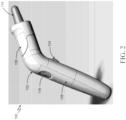
- FIGS. 1 and 2 provide a front perspective view and a back perspective view, respectively, of an intranasal delivery device 100, according to a first aspect of this disclosure.
- the intranasal delivery device 100 includes a body 102 and a position controller 104.
- the body 102 has an upper portion 106 and a lower portion 108 (e.g. grip portion or handle portion).
- the upper portion 106 preferably extends at an angle from the lower portion 108.
- the upper portion 106 includes a nostril insertion tip 110 configured for entry into a nostril of the patient. While not expressly illustrated in FIGS. 1 and 2 , the upper portion 106 is preferably a replaceable medicament cartridge that comprises the medicament reservoir, and preferably both the catheter and medicament reservoir.
- the nostril insertion tip 110 defines a channel 112 that extends from an interior of the body 102 to an exterior of the body 102.
- the channel 112 is configured to receive a tube (not shown) within.
- the tube may be, for example, a thin flexible tube such as a catheter.
- the catheter may be rigid, flexible, or a combination of rigid and flexible, such that the balance between rigidity and flexibility allows for advancement of the catheter into a nasal cavity without turning or getting caught.
- the catheter is also configured to minimize pain, discomfort, and injury during insertion.
- the configuration of the catheter may depend on, for example, the configuration of the delivery device to which the catheter is coupled, the method of treatment being performed, or other factors to facilitate positioning of the catheter. It will be appreciated that the embodiments of delivery devices described herein may include one or more configurations of the catheters.
- the nostril insertion tip 110 may be coupled to a stopper surface 114 of the upper portion 106.
- the nostril insertion tip 110 may be removable, washable, replaceable, and sanitizable.
- the upper surface 114 may be a substantially flat surface, and the nostril insertion tip 110 may extend substantially perpendicular from the upper surface 114.
- the nostril insertion tip 110 may include a single unit through which the catheter passes, or alternatively, the nostril insertion tip 110 may be telescopic and include two or more pieces which advance into the nasal cavity.
- the single unit insertion tip 110 may include a more rigid form so as to allow advancement of a more flexible catheter.
- the telescopic insertion tip 110 may include a series of one or more units which extend telescopically from the upper surface 114.
- the one or more units may be rigid to allow for guidance of a flexible catheter inside the nasal cavity to a desired location.
- the telescopic insertion tip 110 may be stored within the delivery device 100, such that the insertion tip 110 does not extend beyond the upper surface 114 until the device 100 is activated.
- the lower portion 108 of the body 102 is configured to be gripped or held by a patient.
- the lower portion 108 is agnostic as to which hand or side the patient is using to grip the lower portion 108.
- the lower portion 108 includes the position controller 104, a medicament delivery control 116 (e.g. actuator), and a chamber (not visible in the figures).
- the position controller 104 is configured to control the movement of the catheter through the channel 112. The movement includes advancing and retracting the catheter from the body 102.
- the position controller 104 includes a thumbwheel that can be rotated by the patient to advance and retract the catheter.
- the position controller 104 may also include a linear actuator, such as a motorized rack, piezoelectric motor (e.g. squiggle motor), pneumatic or hydraulic piston, or another controller configured to advance and retract a catheter.
- the position controller 104 may include a small motor, such as a direct current (DC) brush or stepper motor, along with a pinch roller mechanism configured to grip the catheter to advance and retract the catheter with precision position control.
- the position controller 104 is preferably sized to at least partially fit within the body 102 of the device 100.
- the chamber is configured to store a medicament within.
- the chamber may be defined by the body 102, or may be defined by a replaceable cartridge 106, the replaceable cartridge being removable from the body 102.
- the catheter is coupled, removably or non-removably, to the replaceable cartridge such that the catheter is in fluid communication with the chamber.
- the catheter may be attached to the replaceable cartridge such that the replaceable cartridge and the catheter are removable from the body 102 as a single unit.
- the device 100 also preferably includes a feedback mechanism (not shown), a delivery system (not shown), and a power source (not shown).
- the feedback mechanism is configured to indicate a position of a distal end of the catheter within the nasal passage of the patient, as discussed in more detail below.
- the power source such as a battery, is configured to provide power to either or all of the position controller 104, the feedback mechanism, and the delivery system.
- the delivery system is operatively coupled to the chamber, and is configured to deliver the medicament from the chamber into the nasal passage via the catheter.
- the delivery system may include a centrifugal pump, peristaltic pump, piezoelectric pump, motorized syringe, pneumatically controlled syringe, hydraulically controlled syringe, spring or memory metal controlled syringe, a pressurized reservoir using a software controlled-valve arrangement, combinations thereof, or other delivery system configured to deliver medicament.
- a method for using the intranasal delivery device 100 for administering the medicament comprises the patient aligning the nostril insertion tip 110 with one of their nostrils.
- the nostril insertion tip 110 may be inserted into the nostril as far it can comfortably go or up until the nostril contacts the upper surface 114 of the upper portion 106.
- the nostril insertion tip 110 may be made of a soft, conforming material or a material that is custom molded to the specific shape of the nostril for each patient.
- the catheter may be advanced through the channel 112 of the tip 110 and inserted into the nostril and the nasal cavity.
- the catheter may be advanced by a first actuation of the position controller 104, such as manually rotating the position controller 104.
- the catheter may be advanced by pressing a button or an on/off switch to activate, for example, a motor operatively coupled to the catheter.
- the catheter may then be positioned adjacent to or in close proximity to the sphenopalatine ganglion (SPG).
- the positioning of the catheter is aided by the feedback mechanism, which provides feedback to the patient indicating whether the catheter is in position or needs adjustment.
- the feedback mechanism could indicate the position of the distal end of the catheter by using visual or audible indicators, such as light indicators, textual information, audible feedback such as tone patterns and/or synthesized speech, vibration, combinations thereof, or other indicators to inform the patient of the position of the catheter.
- the device is programmed with instructions from a prior training session with a trained medical professional to guide the distal end of the catheter toward the SPG.
- the medicament is delivered from the chamber toward the SPG region.
- the patient may deliver the medicament through the catheter using the delivery system.
- the delivery system may be activated by actuating the medicament delivery control 116 (e.g. second actuation).
- the medicament delivery control 116 may include a button or an on/off switch that activates, for example, a motor.
- the medicament delivery control 116 may include a pump, which may be manually operated to pump the medicament into the nasal cavity.
- the delivery energy could also be supplied by way of a pre-pressurized drug reservoir wherein the user controls a valve to release the medicament allowing the drug to be delivered by the stored pressure.
- the medicament delivery control 116 may also be activated based on catheter advancement. For example, after the catheter advances a predetermined distance (e.g. minimal distance) into the nasal cavity, the delivery control 116 may be automatically activated.
- the catheter After the delivery of the medicament toward the SPG, the catheter is retracted from the nasal cavity.
- the catheter may be retracted by the patient by manually rotating the position controller 104 in a direction opposite to the rotation for advancement. Alternatively, if the catheter is advanced by pressing a button or an on/off switch to activate, a reverse or retract button or switch may be activated by the patient to retract the catheter.
- the nostril insertion tip 110 is removed from the nostril of the patient.
- the nostril insertion tip 110, the catheter, the replaceable cartridge, and any remaining medicament may be removed from the intranasal delivery device 100 and discarded.
- FIGS. 3 and 4 illustrate an alternate aspect of an intranasal delivery device. Portions of the aspect disclosed in FIGS. 3 and 4 are similar to aspects described above in FIGS. 1 and 2 and those portions function similarly to those described above unless specified otherwise.
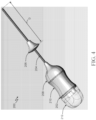
- FIGS. 3 and 4 provide a front perspective view and a back perspective view, respectively, of an intranasal delivery device 200, according to an aspect of this disclosure.
- the intranasal delivery device 200 includes a body 202, a catheter 204, and a stopper 206.
- the body 202 includes an upper portion 208, a middle portion 210 (e.g. grip portion or handle portion), and a lower portion 212.
- the upper portion 208 defines a channel (not visible in the figures) that extends from an interior of the body 202 to an exterior of the body 202.
- the channel is configured to receive the catheter 204 within.
- the middle portion 210 is positioned proximal to the upper portion 208.
- the middle portion 210 may be shaped or configured to be easily held by the patient.
- a diameter of the center of the middle portion 210 may be less than a diameter of upper and lower ends of the middle portion 210, forming a curvature that may be gripped, for example, between a thumb and index finger.
- the middle portion 210 is substantially hollow and comprises a flexible material that is compressible and expandable.
- the lower portion 212 of the body 202 is positioned proximal to the middle portion 210 and defines a chamber 214.
- the medicament is stored within a medicament chamber in the upper portion 208, wherein the chamber 214 is a bulb containing air that can pressurize the contents of the reservoir when the patient squeezes it.
- the upper portion 208 and the catheter may comprise a disposable portion that is fitted to the reusable portion (210 and 214), which may contain medicament delivery sensing and user feedback electronics.
- the catheter 204 is coupled, removably or non-removably, to the upper portion 208 such that the catheter 204 is in fluid communication with the medicament chamber contained within the upper portion 208.
- the chamber 214 may be configured to store the medicament within.
- the lower portion 212 is a replaceable cartridge that may be removed from the intranasal delivery device 200 and replaced with another cartridge.
- the catheter 204 is coupled, removably or non-removably, to the lower portion 212 such that the catheter 204 is in fluid communication with the chamber 214.
- the catheter 204 extends through the upper portion 208 and the middle portion 210 of the body 202.
- the catheter 204 may be attached to the lower portion 212 such that the lower portion 212 and the catheter 204 are removable from the body 202 as a single unit.
- the catheter 204 may be axially fixed to the body 202, such that translation of the catheter 204 in and out of the body 202 through the channel is substantially prevented.
- the middle portion 210 is only rigid in one plane, and flexible in the other plane. This allows pressure/squeezing in the flexible plane, and does not require the lower portion 212 to be flexible.
- the complete delivery device 200 may be disposable.
- the stopper 206 is slidably attached to the catheter 204.
- the position of the stopper 206 may be adjusted by translating the stopper 206 along the catheter 204 to a desired position, and may be configured based on the left or right nostril.
- the stopper 206 may be fixed or locked to the catheter 204 at that position.
- the desired position may be based on the anatomy of the patient, and may be determined by the prescribing physician.
- the desired position of the stopper 206 may be based on the length and/or size of the nostril and the nasal cavity of the patient.
- the stopper 206 is sized to substantially prevent entry of the stopper 206 into the nasal passage.
- the device 200 may also include a delivery system (not shown), a power source (not shown), and a sensor 216.
- the delivery system and the power source may be configured substantially similarly as the delivery system and the power source of the intranasal delivery device 100.
- the stopper 206 and the sensor 216 may each compose a feedback mechanism configured to indicate a position of a distal end 218 of the catheter 204 within the nasal passage of the patient.
- the intranasal delivery device 200 may include either one of the stopper 206 or the sensor 216, or both the stopper 206 and the sensor 216.
- the stopper 206 may provide the patient with a tactile feedback.
- the desired position of the stopper 206 on the catheter 204 may be at a position that defines a distal length (D) of the catheter 204 that is substantially the same as a distance from an opening of the nostril to the SPG region.
- FIG. 5 illustrates a schematic of a feedback mechanism 250 that includes the sensor 216.
- the feedback mechanism 250 includes a controller, such as an electronic control unit, which may facilitate the positioning of the catheter 204.
- the feedback mechanism 250 further includes a processor 252, a memory 254, a display 256, and an actuator 258. While the feedback mechanism 250 is represented as a single unit, in other aspects the feedback mechanism 250 may be distributed as a plurality of distinct but interoperating units, incorporated into another component, or located at different locations on or off the intranasal delivery device 200.
- the sensor 216 is coupled to the distal end 218 of the catheter 204.
- the sensor 216 may sense the position and orientation of the distal end 218 and provide feedback to the processor 252.
- the sensor 216 may include, for example, an Inertial Measurement Unit (IMU), which is an electronic device that integrates the functions of both a 3D accelerometer and a 3D gyroscope.
- the processor 252 may be configured to output signals to the actuator 258 in response to signals received from the sensor 216.
- the actuator 258 may include one or more actuators configured to actuate, for example, the delivery system and/or the position controller.
- the display 256 may also be coupled to the processor 252 to display various data to the patient relating to, for example, the position of the catheter 204 within the nasal cavity.
- Action may be taken in response to the data, including advancing or retracting the catheter 204.
- the processor 252 may record usage information in memory 254 and provide the usage information to a mobile device (not shown) via, for example, a wireless link over a cloud network.
- the usage information may also be transferred to a healthcare provider for adherence, compliance, and/or emergency use information.
- the method of operating the intranasal delivery device 200 may be substantially similar to the method of operating the intranasal delivery device 100.
- a method for using the intranasal delivery device 200 for administering the medicament comprises positioning the stopper 206 on the catheter 204 at the desired position. The stopper 206 is then locked to the catheter 204 at the desired position. After the stopper 206 is locked, the patient aligns the distal end 218 of the catheter 204 with one of their nostrils, and inserts the catheter 204 into the nostril.
- the catheter 204 is axially fixed to the body 202, such that insertion of the catheter 204 involves the patient moving the entire body 202 of the intranasal delivery device 200 towards the nasal cavity so that the catheter 204 is pushed into the nasal cavity.
- the catheter 204 may be inserted using a position controller as described above. The catheter 204 is inserted into the nasal cavity until the stopper 206 contacts the nostril.
- the patient may then deliver the medicament toward the SPG. Delivery of the medicament toward the SPG may be performed using a delivery system as described above. Alternatively, delivery of the medicament may be performed manually by squeezing the lower portion 212, which acts as a squeeze bulb, so that medicament is pumped out of the upper portion 208 and through the catheter 204. In this embodiment, as described above, the medicament is stored in the upper portion 208, wherein the chamber 214 is a bulb containing air that can pressurize the contents of the reservoir when the patient squeezes it.
- the medicament may be pumped out of the chamber 214 by squeezing the middle portion 210 causing the medicament to be pushed through the catheter 204.
- the middle portion 210 functions as a squeeze bulb.
- the lower portion 212 may be formed of a rigid material, such that squeezing the middle portion 210 increases the pressure within the lower portion 212 causing the medicament to be pushed out of the chamber 214.
- the lower portion 212 may be formed of a flexible material, and the medicament may be pumped through the catheter 204 by squeezing the lower portion 212.
- the delivery device 200 provides for consistent delivery of a medicament to a desired location regardless of variable individual application of pressure.
- the catheter 204 is retracted from the nasal cavity.
- the catheter may be retracted by the patient using the position controller as described above.
- the patient may manually retract the catheter 204 by pulling the body 202 of the intranasal delivery device 200 away from the nasal cavity.
- the catheter 204 and the replaceable cartridge 212 may be removed from the body 202 and discarded.
- the entire intranasal delivery device 100 may be discarded.
- FIG. 6 illustrates another alternate aspect of an intranasal delivery device. Portions of the aspect disclosed in FIG. 6 are similar to aspects described above in FIGS. 1 through 5 and those portions function similarly to those described above unless specified otherwise.
- FIG. 6 provides a front perspective view of an intranasal delivery device 300, according to an aspect of this disclosure.
- the intranasal delivery device 300 includes a body 302 and a position controller 304.
- the body 302 has an upper portion 306 and a lower portion 308 (e.g. grip portion or handle portion).
- the upper portion 306 includes a nostril insertion tip 310 and an interlock switch 311.
- the upper portion 306 is a replaceable cartridge that also contains the medicament chamber and catheter.
- the nostril insertion tip 310 is configured for entry into a nostril of the patient.
- the nostril insertion tip 310 defines a channel 312 that extends from an interior of the body 302 to an exterior of the body 302.
- the channel 312 is configured to receive a catheter (not shown) within.
- the nostril insertion tip 310 of the intranasal delivery device 300 may be configured substantially similarly to the nostril insertion tip 110 of the intranasal delivery device 100.
- the lower portion 308 of the body 302 is configured to be gripped or held by the patient.
- the lower portion 308 includes the position controller 304 and a medicament delivery control 316 (not visible in the figures).
- the medicament chamber of the upper portion 306 (not visible in the figures) is preferably disposed within the lower portion 308.
- the position controller 304, the medicament delivery control 316, and the chamber of the intranasal delivery device 300 may be configured substantially similarly to the position controller 104, the medicament delivery control 116, and the chamber of the intranasal delivery device 100, respectively.
- the device 400 may also include a feedback mechanism (not shown) and a power source (not shown) configured substantially similarly to the feedback mechanisms and power sources of intranasal delivery devices 100, 200, 300, and 400 described above.
- the method of operating the intranasal delivery device 300 may be substantially similar to the method of operating either of the intranasal delivery devices 100 and 200 described above. Additionally, during the insertion of the nostril insertion tip 310 into the nostril of the patient, the interlock switch 311 may provide an indication to the patient that the intranasal delivery device 300 has been inserted fully into the nostril. In an aspect, the interlock switch 311 may be locked, and released only when the catheter is in the desired location. The interlock switch 311 may be spring loaded, and configured to compress against the upper lip of the patient.
- FIGS. 7 and 8 illustrate another alternate aspect of an intranasal delivery device. Portions of the aspect disclosed in FIGS. 7 and 8 are similar to aspects described above in FIGS. 1 through 6 and those portions function similarly to those described above unless specified otherwise.
- FIGS. 7 and 8 provide a front perspective view and a back perspective view, respectively, of an intranasal delivery device 400, according to an aspect of this disclosure.
- the intranasal delivery device 400 includes a body 402 and a controller 404.
- the body 402 has an upper portion 406 and a lower portion 408 (e.g. grip portion or handle portion).
- the upper portion 406 is preferably a replaceable cartridge comprising the medicament chamber and catheter(s).
- the upper portion 406 includes a pair of insertion tips 410, an advance/retract switch 404, a mouth member 413 (e.g. bite block), and a power control 415.
- the mouth member 413 is configured to contact a mouth of the patient operating the device 400, and may include a breathing window 416, a teeth shelf 417, or other features to facilitate positioning of the delivery device 400.
- the mouth member 413 may be adjustable based on the anatomy of the patient.
- the mouth member 413 may be custom molded to the patient and preferably remains as part of the reusable body.
- the mouth member 413 may be configured to be removed and sanitized.
- the power control 415 is configured to actuate a power source of the device 400 between an "on" position and an "off' position.
- the insertion tips 410 are configured to align with each nostril of the patient.
- the insertion tips 410 define channels 412 that extend from an interior of the body 402 to an exterior of the body 402.
- the channels 412 are each configured to receive a catheter (not shown) within.
- each of the insertion tips 410 of the intranasal delivery device 400 may be configured substantially similarly to the nostril insertion tips 110 and 310 of the intranasal delivery devices 100 and 300.
- the lower portion 408 of the body 402 is configured to be gripped or held by the patient.
- the lower portion 408 includes the controller 404.
- the medicament chamber contained in the upper portion 406 is preferably disposed within the lower portion 408.
- the chamber is configured to store a medicament within, as described above.
- One or two catheters may be coupled to the chamber, such that each catheter is in fluid communication with a medicament stored within the chamber.
- Each of the one or two catheters extend from the chamber and through a respective channel 412.
- the controller 404 is configured to control a position controller to move the catheters through the channels 412, and further configured to control a delivery system to deliver the medicament from the chamber into the nasal cavity via the one or two catheters.
- the position controller and the delivery system may be configured substantially similarly to the position controllers and delivery systems of the intranasal delivery devices 100, 200, and 300.
- the controller 404 may comprise a "trigger," that may be actuated by the patient while holding the lower portion 408 of the body 402.
- Switch 411 is used to select which side (left or right) is treated. Advancement and retraction of a single catheter along with dispensing of the medicament are preferably automatic in this embodiment once the patient presses and holds the trigger switch. Treatment is preferably applied one side at a time.
- the device 400 may also include a feedback mechanism (not shown) and a power source (not shown) configured substantially similarly to the feedback mechanisms and power sources of intranasal delivery devices 100 and 200 described above.
- the method of operating the intranasal delivery device 400 may be substantially similar to the methods of operating any of the intranasal delivery devices 100, 200, and 300 described above. Additionally, during alignment of the insertion tips 410 with each respective nostril, the patient also aligns the mouth member 413 with their mouth. In alternative aspects, the mouth member 413 may be aligned with, for example, the patient's teeth and/or chin. The patient may grip the mouth member 413 with their teeth. After alignment of the insertion tips 410 and the mouth member 413, the intranasal delivery device 400 may be operated as discussed above.
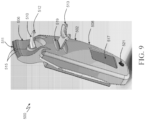
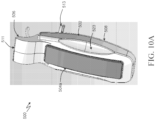
- FIGS. 9-10B illustrate another alternate aspect of an intranasal delivery device. Portions of the aspect disclosed in FIGS. 9-10B are similar to aspects described above in FIGS. 1 through 8 and those portions function similarly to those described above unless specified otherwise.
- FIG. 9 provides a front perspective view
- FIG. 10A provides a back perspective view with a medicament cartridge attached
- FIG. 10B provides a back perspective view with a training cartridge attached, respectively, of an intranasal delivery device 500, according to an aspect of this disclosure.
- the intranasal delivery device 500 includes a body 502 and a replaceable medicament cartridge 504a or training cartridge 504b.
- the body 502 has an upper portion 506 and a lower portion 508 (e.g. grip portion or handle portion).
- the upper portion 506 may extend at an angle from the lower portion 508 and/or be rotatable relative to the lower portion 508.
- the upper portion 506 includes a nostril insertion tip 510 and a nose stop 511.
- the nostril insertion tip 510 is configured for entry into a nostril of the patient, and may be rotatable (e.g. ball joint) to align with a respective nostril.
- the nostril insertion tip 510 defines a channel 512 that extends from an interior of the body 502 to an exterior of the body 502.
- the channel 512 is configured to receive a catheter 501 within.
- the nostril insertion tip 510 of the intranasal delivery device 500 may be configured substantially similarly to the nostril insertion tips 110 and 310 of the intranasal delivery devices 100 and 300.
- the nose stop 511 includes at least one light emitting diode (LED) 515.
- the nose stop 511 is configured to provide feedback to the patient during use of the intranasal delivery device 500 regarding the position and/or path of the catheter within the nasal cavity.
- the at least one LED 515 may include different colored lights. One light may light when inserting the catheter, and once the catheter reaches a desired position, the light may turn off and another light may turn on, indicating to the patient that the catheter is positioned properly.
- the lower portion 508 of the body 502 is configured to be gripped or held by the patient.
- the lower portion 508 includes the replacement medicament cartridge 504a ( FIG. 10A ) or the training cartridge 504b ( FIG. 10b ), a mouth member 513 (e.g. bite block), an liquid crystal display (LCD) display 517, a lip recess 519, a power control 521, and a grip recess 523.
- the mouth member 513 and the power control 521 may be configured substantially similarly to the mouth member 413 and the power control 415 of the intranasal delivery device 400, respectively.
- the LCD display 517 may be configured substantially similarly to the display 256 of the intranasal delivery device 200.
- the lip recess 519 is configured to contact a lip of the patient when the mouth member 513 is positioned proximate to the mouth of the patient.
- the grip recess 525 is configured for ambidextrous gripping of the lower portion 508
- the replaceable medicament cartridge 504a and the training cartridge 504b are removable from the intranasal delivery device 500.
- the replaceable medicament cartridge 504a includes a chamber (not visible in the figures), and the training cartridge 504b may include a chamber, a position controller 524 and a medicament delivery control 526.
- the position controller 524, the medicament delivery control 526, and the chamber of the intranasal delivery device 500 may be configured substantially similarly to the position controllers 104, 304, and 404, the medicament delivery control 116, 316, and the chambers of the intranasal delivery device 100, 300, and 400, respectively.
- FIG. 10B shows an embodiment of a device that may be used during a training session by a physician, which includes a display 528.
- the device 500 may also include a feedback mechanism (not shown), a delivery system (not shown), and a power source (not shown) configured substantially similarly to the feedback mechanisms, delivery systems, and power sources of intranasal delivery devices 100, 200, 300, and 400 described above.
- each delivery device 100, 200, 300, 400, and 500 described herein may include one or more configurations of catheters.
- each delivery device 100, 200, 300, 400, and 500 may include a catheter that is either rigid, flexible, or a combination of rigid and flexible, such that the balance between rigidity and flexibility allows for advancement of the catheter into a nasal cavity without turning or getting caught, as described in detail above.
- FIG. 11 illustrates the intranasal delivery device 500 in an inserted position with the catheter 501 extended within the nasal cavity.
- the intranasal delivery devices described herein are ergonomically designed so that the patient can comfortably hold and maintain a position of the device at the nostril during self-administration of a medicament.
- the patient does not have to know how far or how hard to insert and push the catheter to reach the desired position, which prevents injury.
- An advantage of a motorized intranasal delivery device is safety.
- the possibility of injury is greatly reduced with speed, position, and force feedback provided by a feedback mechanism in real time. For example, if excessive insertion force is detected, the device may be configured to stop advancement of the catheter and/or retract the catheter. The device may then provide information to the patient regarding a corrective action. Speed of inserting the catheter may also be controlled to avoid tissue injury.
- kits comprising: (a) an intranasal device as described herein (optionally without the medicament chamber attached to the device) and (b) one or more replaceable cartridges, each replaceable cartridge comprising the chamber comprising the medicament.
- a kit comprises (a) an intranasal device as described herein (optionally without the medicament chamber and catheter attached to the device) and (b) one or more replaceable cartridges, each replaceable cartridge comprising the catheter and the chamber comprising the medicament.
- a kit comprises (a) an intranasal device as described herein (optionally without the medicament chamber and catheter attached to the device), (b) one or more replaceable cartridges, each replaceable cartridge comprising the chamber comprising the medicament, and (c) one or more catheters.
- the patient then assembles components of the kit before self-administering medicament; for example, by attaching the replaceable cartridge to the intranasal device.
- Each kit may include one or more replaceable cartridges comprising the medicament chamber and optionally one or more catheters (if the catheter is not included as part of the replaceable cartridge) to be used with the device for multiple dosing sessions.
- Each kit may also include one or more sanitizing wipes in a single package or individually packed.
Landscapes
- Health & Medical Sciences (AREA)
- Life Sciences & Earth Sciences (AREA)
- Engineering & Computer Science (AREA)
- Veterinary Medicine (AREA)
- Anesthesiology (AREA)
- Biomedical Technology (AREA)
- Heart & Thoracic Surgery (AREA)
- Animal Behavior & Ethology (AREA)
- General Health & Medical Sciences (AREA)
- Public Health (AREA)
- Hematology (AREA)
- Pulmonology (AREA)
- Bioinformatics & Cheminformatics (AREA)
- Biophysics (AREA)
- Otolaryngology (AREA)
- Surgery (AREA)
- Vascular Medicine (AREA)
- Dentistry (AREA)
- Oral & Maxillofacial Surgery (AREA)
- Nuclear Medicine, Radiotherapy & Molecular Imaging (AREA)
- Medical Informatics (AREA)
- Molecular Biology (AREA)
- Infusion, Injection, And Reservoir Apparatuses (AREA)
- Media Introduction/Drainage Providing Device (AREA)
- Surgical Instruments (AREA)
Description
- The present disclosure relates to nasal delivery devices, and more particularly, to improved nasal delivery devices and methods for self-administering medicament.
- Certain types of pain associated with headaches and facial aches are known to respond to treatment by the direct application of anesthetic to the sphenopalatine ganglion or its surrounding region. The sphenopalatine ganglion (SPG) is a nerve bundle located toward the center of the head. The SPG is bilateral, and one is located behind each side of the nose. The SPG plays a unique role in headache disorders as a key structure responsible for the expression of cranial autonomic symptoms, most commonly seen in trigeminal autonomic cephalalgia. Cluster headache, which is one type of trigeminal autonomic cephalalgia, is a severe headache characterized by recurrent episodes of excruciating pain, often on one side of the head.
- Conventional methods for treating pain associated with headaches and facial aches have many safety and efficacy problems, and patients experiencing severe pain are typically unable to travel to a physician's office for treatment before the pain intensifies. It is especially difficult to mitigate a full-blown cluster headache attack if the pain is not treated when the headache begins.
- Although the anatomical position of the SPG makes it difficult to treat with a local anesthetic, a nerve block of the SPG has been known to provide effective relief in a variety of pain conditions. With this approach, anesthetic is applied to the SPG or its surrounding area by a trained medical professional, who typically inserts a cotton-tipped applicator soaked in the anesthetic into the nostril of the patient. Nasal catheter devices have also been used by physicians to administer medicament to the SPG or its surrounding area. The success of these methods depends heavily on the skill and experience of the physician, and patients experiencing severe pain are typically unable to receive treatment from a physician before the pain escalates.
- Therefore, there is a need for improved nasal delivery devices and methods that enable patients to apply medicament on-demand for fast relief from head or facial pain, and to lessen or prevent reoccurrence. Document
US2013/158475 A1 discloses an example of nasal delivery devices and methods that enable patients to apply medicament on-demand. - Painful episodes associated with facial aches and headaches, such as cluster headaches and migraines, occur at varying frequencies from patient to patient. When a cluster headache occurs, it often takes too long for a patient to travel to a physician in order to receive local administration of medicament to the SPG, or its surrounding area, in order to prevent or mitigate a full-blown cluster headache attack. Therefore, it is desirable for a patient to be able to self-administer the medicament locally to the SPG or surrounding area using a compact and portable device for treating the cluster headache in a home setting, without the need of a physician or other trained medical professional.
- A challenge for self-administered intranasal delivery devices is to ensure a safe and substantially pain-free insertion without having a trained professional position the delivery device and administer the medicament. There are several aspects of the present invention that help ensure proper positioning and medicament delivery, including, for example: a device capable of (1) sensing, via integrated sensors, a clear sinus passageway and autonomously steering itself into position; and/or (2) providing an external datum and direction-finding system to guide the patient in positioning the device so that insertion may be effected without the additional need for steering the catheter; and/or (3) steering itself automatically, and storing all motions during a training session performed by, and controlled by, a trained medical professional such that the device can subsequently "replay" the motions automatically when needed during self-administration.
- In an aspect of the present invention, there is provided an intranasal device for the self-administration of medicament includes a body, a catheter, a feedback mechanism, and a delivery system. The body has a chamber to store the medicament. The catheter is configured to extend from the body and is in fluid communication with the chamber. A distal end of the catheter is configured for entry into a nasal passage of a patient. The feedback mechanism is configured to indicate a position of the distal end of the catheter within the nasal passage. The delivery system is configured to deliver the medicament from the chamber into the nasal passage via the catheter, wherein the delivery system comprises a centrifugal pump, a peristaltic pump, a piezoelectric pump, a motorized syringe, a pneumatically controlled syringe, a hydraulically controlled syringe, a pressurized reservoir using a software controlled valve arrangement or combinations thereof.
- As used herein, delivery or administration of medicament "toward the SPG" and similar such phrases are intended to include the SPG itself and/or the surrounding region in proximity to the SPG, e.g., the pterygopalatine fossa which houses the SPG, which may include nearby tissue or mucous membranes.
- All manner of medicaments suitable for introduction at or in the vicinity of the SPG are contemplated for use in accordance with the present invention. The term medicament is used herein to refer to a pharmaceutical formulation comprising one or more pharmaceutically active compound(s). Examples of suitable medicaments in accordance with the present invention include those that alleviate or eliminate pain associated with a facial ache or headache (e.g., cluster headache or migraine), such as anesthetics. Suitable medicaments may comprise one or more pharmaceutically active compound(s) selected from the group comprising or consisting of lidocaine, zolmitriptan, sumatriptan, ambucaine, amolanone, amylocaine, benoxinate, betoxycaine, biphenamine, bupivacaine, butacaine, butamben, butanilicicaine, butethamine, butoxycaine, carticaine, cocaethylene, cocaine, cyclomethycaine, dibucaine, dimethisoquin, dimethocaine, diperodon, dyclonine, ecgonidine, ecgonine, ethyl aminobenzoate, ethyl chloride, etidocaine, eucaine, euprocin, fenalcomine, fomocaine, hexylcaine, hydroxyprocaine, hydroxytetracaine, isobutyl p-aminobenzoate, leucinocaine mesylate, levoxadrol, meperidine, mepivacaine, meprylcaine, metabutoxycaine, methyl chloride, myrtecaine, naepaine, octacaine, orthocaine, oxethazaine, parethoxycaine, phenacaine, phenol, a pipecoloxylidide, piperocaine, piridocaine, polidocanol, pramoxine, sameridine, prilocaine, propanocaine, proparacaine, propipocaine, propoxycaine, pseudococaine, pyrrocaine, quinine urea, risocaine, ropivacaine, salicyl alcohol, tetracaine, tolycaine, trimecaine, veratridine, zolamine, all pharmaceutically acceptable salts thereof, and combinations thereof.
- According to an exemplary embodiment, the medicament comprises lidocaine or a pharmaceutically acceptable salt thereof, wherein the medicament is used to treat, for example, pain associated with cluster headache.
- Non-limiting examples of pain that may be treated by methods of the present invention include: cluster headache, sphenopalatine neuralgia, migraine headache, atypical facial pain, cancer pain of the head and/or neck, tongue and/or mouth pain, temporomandibular joint (TMJ) pain, Sluder's neuralgia, paroxysmal hemicranias, herpes zoster, postherpetic neuralgia, vasomotor rhinitis, complex regional pain syndrome (CRPS), reflex sympathetic dystrophy (RSD), lower back pain, post-traumatic headache, fibromyalgia and postdural puncture headache.
- As used herein, the term therapeutically effective amount may refer to an amount that, when administered to a particular subject, achieves a therapeutic effect by inhibiting, alleviating or curing a disease, disorder or symptom(s) in the subject or by prophylactically inhibiting, preventing or delaying the onset of a disease, disorder or symptom(s). A therapeutically effective amount may be an amount which relieves to some extent one or more symptoms of a disease or disorder in a subject; and/or returns to normal either partially or completely one or more physiological or biochemical parameters associated with or causative of the disease or disorder; and/or reduces the likelihood of the onset of the disease, disorder or symptom(s). According to one embodiment, a therapeutically effective amount is an amount which achieves a therapeutic effect by alleviating or eliminating pain associated with a facial ache or headache, such as a cluster headache or migraine headache, e.g., by administering a medicament comprising lidocaine or a pharmaceutically acceptable salt thereof.
- This summary is provided to introduce a selection of concepts in a simplified form that are further described below in the Detailed Description. This Summary is not intended to identify key features or essential features of the claimed subject matter, nor is it intended to be used to limit the scope of the claimed subject matter. Furthermore, the claimed subject matter is not constrained to limitations that solve any or all disadvantages noted in any part of this disclosure.
- A more detailed understanding may be had from the following description, given by way of example in conjunction with the accompanying drawings, wherein:
-
FIG. 1 illustrates a front perspective view of an intranasal delivery device, according to an aspect of this disclosure. -
FIG. 2 illustrates a back perspective view of the intranasal delivery device shown inFIG. 1 . -
FIG. 3 illustrates a front perspective view of an intranasal delivery device, according to another aspect of this disclosure. -
FIG. 4 illustrates a back perspective view of the intranasal delivery device shown inFIG. 3 . -
FIG. 5 illustrates a schematic of a feedback mechanism, according to an aspect of this disclosure. -
FIG. 6 illustrates a front perspective view of an intranasal delivery device, according to yet another aspect of this disclosure. -
FIG. 7 illustrates a front perspective view of an intranasal delivery device, according to still another aspect of this disclosure. -
FIG. 8 illustrates a back perspective view of the intranasal delivery device shown inFIG. 7 . -
FIG. 9 illustrates a front perspective view of an intranasal delivery device, according to another aspect of this disclosure. -
FIG. 10A illustrates a back perspective view of the intranasal delivery device shown inFIG. 9 with a medicament cartridge attached. -
FIG. 10B illustrates a back perspective view of the intranasal delivery device shown inFIG. 9 with a training cartridge attached. -
FIG. 11 illustrates a cross-sectional side view of the intranasal delivery device shown inFIG. 9 positioned within a patient. - Intranasal devices for insertion into a nasal passage for treating pain in a patient, such as pain associated with a cluster headache, are described. Unlike prior intranasal devices, the devices described herein may be used to self-administer a medicament in a home setting by a patient. The intranasal devices may be patient operated, and may be configured (programmed) based on the anatomy of the patient. The devices preferably include feedback mechanisms and controls to help the patient position the device within their nasal passage (e.g. nasal cavity).
- Certain terminology is used in the description for convenience only and is not limiting. The words "proximal" and "distal" generally refer to positions or directions toward and away from, respectively, an individual or patient operating an intranasal device. The words "axial," "vertical," "transverse," "left," "right," "above," and "below" designate directions in the drawings to which reference is made. The term "substantially" is intended to mean considerable in extent or largely but not necessarily wholly that which is specified. The terminology includes the above-listed words, derivatives thereof and words of similar import.
-
FIGS. 1 and2 provide a front perspective view and a back perspective view, respectively, of anintranasal delivery device 100, according to a first aspect of this disclosure. Theintranasal delivery device 100 includes abody 102 and aposition controller 104. Thebody 102 has anupper portion 106 and a lower portion 108 (e.g. grip portion or handle portion). Theupper portion 106 preferably extends at an angle from the lower portion 108. Theupper portion 106 includes anostril insertion tip 110 configured for entry into a nostril of the patient. While not expressly illustrated inFIGS. 1 and2 , theupper portion 106 is preferably a replaceable medicament cartridge that comprises the medicament reservoir, and preferably both the catheter and medicament reservoir. Thenostril insertion tip 110 defines achannel 112 that extends from an interior of thebody 102 to an exterior of thebody 102. Thechannel 112 is configured to receive a tube (not shown) within. The tube may be, for example, a thin flexible tube such as a catheter. The catheter may be rigid, flexible, or a combination of rigid and flexible, such that the balance between rigidity and flexibility allows for advancement of the catheter into a nasal cavity without turning or getting caught. The catheter is also configured to minimize pain, discomfort, and injury during insertion. The configuration of the catheter may depend on, for example, the configuration of the delivery device to which the catheter is coupled, the method of treatment being performed, or other factors to facilitate positioning of the catheter. It will be appreciated that the embodiments of delivery devices described herein may include one or more configurations of the catheters. - The
nostril insertion tip 110 may be coupled to astopper surface 114 of theupper portion 106. Thenostril insertion tip 110 may be removable, washable, replaceable, and sanitizable. Theupper surface 114 may be a substantially flat surface, and thenostril insertion tip 110 may extend substantially perpendicular from theupper surface 114. Thenostril insertion tip 110 may include a single unit through which the catheter passes, or alternatively, thenostril insertion tip 110 may be telescopic and include two or more pieces which advance into the nasal cavity. The singleunit insertion tip 110 may include a more rigid form so as to allow advancement of a more flexible catheter. Thetelescopic insertion tip 110 may include a series of one or more units which extend telescopically from theupper surface 114. The one or more units may be rigid to allow for guidance of a flexible catheter inside the nasal cavity to a desired location. In an aspect, thetelescopic insertion tip 110 may be stored within thedelivery device 100, such that theinsertion tip 110 does not extend beyond theupper surface 114 until thedevice 100 is activated. - The lower portion 108 of the
body 102 is configured to be gripped or held by a patient. In an aspect, the lower portion 108 is agnostic as to which hand or side the patient is using to grip the lower portion 108. The lower portion 108 includes theposition controller 104, a medicament delivery control 116 (e.g. actuator), and a chamber (not visible in the figures). Theposition controller 104 is configured to control the movement of the catheter through thechannel 112. The movement includes advancing and retracting the catheter from thebody 102. In an aspect, theposition controller 104 includes a thumbwheel that can be rotated by the patient to advance and retract the catheter. In an alternative aspect, theposition controller 104 may also include a linear actuator, such as a motorized rack, piezoelectric motor (e.g. squiggle motor), pneumatic or hydraulic piston, or another controller configured to advance and retract a catheter. In another alternative aspect, theposition controller 104 may include a small motor, such as a direct current (DC) brush or stepper motor, along with a pinch roller mechanism configured to grip the catheter to advance and retract the catheter with precision position control. Theposition controller 104 is preferably sized to at least partially fit within thebody 102 of thedevice 100. - The chamber is configured to store a medicament within. The chamber may be defined by the
body 102, or may be defined by areplaceable cartridge 106, the replaceable cartridge being removable from thebody 102. The catheter is coupled, removably or non-removably, to the replaceable cartridge such that the catheter is in fluid communication with the chamber. In an aspect, the catheter may be attached to the replaceable cartridge such that the replaceable cartridge and the catheter are removable from thebody 102 as a single unit. - The
device 100 also preferably includes a feedback mechanism (not shown), a delivery system (not shown), and a power source (not shown). The feedback mechanism is configured to indicate a position of a distal end of the catheter within the nasal passage of the patient, as discussed in more detail below. The power source, such as a battery, is configured to provide power to either or all of theposition controller 104, the feedback mechanism, and the delivery system. - The delivery system is operatively coupled to the chamber, and is configured to deliver the medicament from the chamber into the nasal passage via the catheter. The delivery system may include a centrifugal pump, peristaltic pump, piezoelectric pump, motorized syringe, pneumatically controlled syringe, hydraulically controlled syringe, spring or memory metal controlled syringe, a pressurized reservoir using a software controlled-valve arrangement, combinations thereof, or other delivery system configured to deliver medicament.
- A method for using the
intranasal delivery device 100 for administering the medicament comprises the patient aligning thenostril insertion tip 110 with one of their nostrils. Thenostril insertion tip 110 may be inserted into the nostril as far it can comfortably go or up until the nostril contacts theupper surface 114 of theupper portion 106. Thenostril insertion tip 110 may be made of a soft, conforming material or a material that is custom molded to the specific shape of the nostril for each patient. After inserting thetip 110, the catheter may be advanced through thechannel 112 of thetip 110 and inserted into the nostril and the nasal cavity. The catheter may be advanced by a first actuation of theposition controller 104, such as manually rotating theposition controller 104. Alternatively, the catheter may be advanced by pressing a button or an on/off switch to activate, for example, a motor operatively coupled to the catheter. The catheter may then be positioned adjacent to or in close proximity to the sphenopalatine ganglion (SPG). The positioning of the catheter is aided by the feedback mechanism, which provides feedback to the patient indicating whether the catheter is in position or needs adjustment. For example, the feedback mechanism could indicate the position of the distal end of the catheter by using visual or audible indicators, such as light indicators, textual information, audible feedback such as tone patterns and/or synthesized speech, vibration, combinations thereof, or other indicators to inform the patient of the position of the catheter. According to an embodiment, the device is programmed with instructions from a prior training session with a trained medical professional to guide the distal end of the catheter toward the SPG. - After the catheter is positioned within the nasal cavity, the medicament is delivered from the chamber toward the SPG region. The patient may deliver the medicament through the catheter using the delivery system. The delivery system may be activated by actuating the medicament delivery control 116 (e.g. second actuation). The
medicament delivery control 116 may include a button or an on/off switch that activates, for example, a motor. Alternatively, themedicament delivery control 116 may include a pump, which may be manually operated to pump the medicament into the nasal cavity. The delivery energy could also be supplied by way of a pre-pressurized drug reservoir wherein the user controls a valve to release the medicament allowing the drug to be delivered by the stored pressure. Themedicament delivery control 116 may also be activated based on catheter advancement. For example, after the catheter advances a predetermined distance (e.g. minimal distance) into the nasal cavity, thedelivery control 116 may be automatically activated. - After the delivery of the medicament toward the SPG, the catheter is retracted from the nasal cavity. The catheter may be retracted by the patient by manually rotating the
position controller 104 in a direction opposite to the rotation for advancement. Alternatively, if the catheter is advanced by pressing a button or an on/off switch to activate, a reverse or retract button or switch may be activated by the patient to retract the catheter. Once the catheter has retracted, thenostril insertion tip 110 is removed from the nostril of the patient. Thenostril insertion tip 110, the catheter, the replaceable cartridge, and any remaining medicament may be removed from theintranasal delivery device 100 and discarded. -
FIGS. 3 and4 illustrate an alternate aspect of an intranasal delivery device. Portions of the aspect disclosed inFIGS. 3 and4 are similar to aspects described above inFIGS. 1 and2 and those portions function similarly to those described above unless specified otherwise. -
FIGS. 3 and4 provide a front perspective view and a back perspective view, respectively, of anintranasal delivery device 200, according to an aspect of this disclosure. Theintranasal delivery device 200 includes abody 202, acatheter 204, and a stopper 206. Thebody 202 includes anupper portion 208, a middle portion 210 (e.g. grip portion or handle portion), and alower portion 212. Theupper portion 208 defines a channel (not visible in the figures) that extends from an interior of thebody 202 to an exterior of thebody 202. The channel is configured to receive thecatheter 204 within. Themiddle portion 210 is positioned proximal to theupper portion 208. Themiddle portion 210 may be shaped or configured to be easily held by the patient. A diameter of the center of themiddle portion 210 may be less than a diameter of upper and lower ends of themiddle portion 210, forming a curvature that may be gripped, for example, between a thumb and index finger. In an aspect, themiddle portion 210 is substantially hollow and comprises a flexible material that is compressible and expandable. Thelower portion 212 of thebody 202 is positioned proximal to themiddle portion 210 and defines achamber 214. - According to a first embodiment, the medicament is stored within a medicament chamber in the
upper portion 208, wherein thechamber 214 is a bulb containing air that can pressurize the contents of the reservoir when the patient squeezes it. Theupper portion 208 and the catheter may comprise a disposable portion that is fitted to the reusable portion (210 and 214), which may contain medicament delivery sensing and user feedback electronics. Thecatheter 204 is coupled, removably or non-removably, to theupper portion 208 such that thecatheter 204 is in fluid communication with the medicament chamber contained within theupper portion 208. - According to a second embodiment, the
chamber 214 may be configured to store the medicament within. In this embodiment, thelower portion 212 is a replaceable cartridge that may be removed from theintranasal delivery device 200 and replaced with another cartridge. Thecatheter 204 is coupled, removably or non-removably, to thelower portion 212 such that thecatheter 204 is in fluid communication with thechamber 214. Thecatheter 204 extends through theupper portion 208 and themiddle portion 210 of thebody 202. Thecatheter 204 may be attached to thelower portion 212 such that thelower portion 212 and thecatheter 204 are removable from thebody 202 as a single unit. In an aspect, thecatheter 204 may be axially fixed to thebody 202, such that translation of thecatheter 204 in and out of thebody 202 through the channel is substantially prevented. - In other alternative embodiments, the
middle portion 210 is only rigid in one plane, and flexible in the other plane. This allows pressure/squeezing in the flexible plane, and does not require thelower portion 212 to be flexible. Thecomplete delivery device 200 may be disposable. - In accordance with the aforementioned embodiments described in connection with
FIG. 3 and4 , the stopper 206 is slidably attached to thecatheter 204. The position of the stopper 206 may be adjusted by translating the stopper 206 along thecatheter 204 to a desired position, and may be configured based on the left or right nostril. When the desired position is achieved, the stopper 206 may be fixed or locked to thecatheter 204 at that position. The desired position may be based on the anatomy of the patient, and may be determined by the prescribing physician. For example, the desired position of the stopper 206 may be based on the length and/or size of the nostril and the nasal cavity of the patient. The stopper 206 is sized to substantially prevent entry of the stopper 206 into the nasal passage. - The
device 200 may also include a delivery system (not shown), a power source (not shown), and asensor 216. The delivery system and the power source may be configured substantially similarly as the delivery system and the power source of theintranasal delivery device 100. - The stopper 206 and the
sensor 216 may each compose a feedback mechanism configured to indicate a position of adistal end 218 of thecatheter 204 within the nasal passage of the patient. It will be appreciated that theintranasal delivery device 200 may include either one of the stopper 206 or thesensor 216, or both the stopper 206 and thesensor 216. The stopper 206 may provide the patient with a tactile feedback. For example, the desired position of the stopper 206 on thecatheter 204 may be at a position that defines a distal length (D) of thecatheter 204 that is substantially the same as a distance from an opening of the nostril to the SPG region. When the patient inserts thecatheter 204 into the nasal cavity, the patient will receive a tactile feedback when the stopper 206 contacts the nostril of the patient. -
FIG. 5 illustrates a schematic of afeedback mechanism 250 that includes thesensor 216. Thefeedback mechanism 250 includes a controller, such as an electronic control unit, which may facilitate the positioning of thecatheter 204. Thefeedback mechanism 250 further includes aprocessor 252, amemory 254, adisplay 256, and anactuator 258. While thefeedback mechanism 250 is represented as a single unit, in other aspects thefeedback mechanism 250 may be distributed as a plurality of distinct but interoperating units, incorporated into another component, or located at different locations on or off theintranasal delivery device 200. - The
sensor 216 is coupled to thedistal end 218 of thecatheter 204. Thesensor 216 may sense the position and orientation of thedistal end 218 and provide feedback to theprocessor 252. Thesensor 216 may include, for example, an Inertial Measurement Unit (IMU), which is an electronic device that integrates the functions of both a 3D accelerometer and a 3D gyroscope. Theprocessor 252 may be configured to output signals to theactuator 258 in response to signals received from thesensor 216. Theactuator 258 may include one or more actuators configured to actuate, for example, the delivery system and/or the position controller. Thedisplay 256 may also be coupled to theprocessor 252 to display various data to the patient relating to, for example, the position of thecatheter 204 within the nasal cavity. Action may be taken in response to the data, including advancing or retracting thecatheter 204. In addition to feedback during use, theprocessor 252 may record usage information inmemory 254 and provide the usage information to a mobile device (not shown) via, for example, a wireless link over a cloud network. The usage information may also be transferred to a healthcare provider for adherence, compliance, and/or emergency use information. - The method of operating the
intranasal delivery device 200 may be substantially similar to the method of operating theintranasal delivery device 100. Alternatively, a method for using theintranasal delivery device 200 for administering the medicament comprises positioning the stopper 206 on thecatheter 204 at the desired position. The stopper 206 is then locked to thecatheter 204 at the desired position. After the stopper 206 is locked, the patient aligns thedistal end 218 of thecatheter 204 with one of their nostrils, and inserts thecatheter 204 into the nostril. In an aspect, thecatheter 204 is axially fixed to thebody 202, such that insertion of thecatheter 204 involves the patient moving theentire body 202 of theintranasal delivery device 200 towards the nasal cavity so that thecatheter 204 is pushed into the nasal cavity. Alternatively, thecatheter 204 may be inserted using a position controller as described above. Thecatheter 204 is inserted into the nasal cavity until the stopper 206 contacts the nostril. - After the stopper 206 contacts the nostril, the patient may then deliver the medicament toward the SPG. Delivery of the medicament toward the SPG may be performed using a delivery system as described above. Alternatively, delivery of the medicament may be performed manually by squeezing the
lower portion 212, which acts as a squeeze bulb, so that medicament is pumped out of theupper portion 208 and through thecatheter 204. In this embodiment, as described above, the medicament is stored in theupper portion 208, wherein thechamber 214 is a bulb containing air that can pressurize the contents of the reservoir when the patient squeezes it. - Alternatively, the medicament may be pumped out of the
chamber 214 by squeezing themiddle portion 210 causing the medicament to be pushed through thecatheter 204. In this aspect, themiddle portion 210 functions as a squeeze bulb. In this instance, thelower portion 212 may be formed of a rigid material, such that squeezing themiddle portion 210 increases the pressure within thelower portion 212 causing the medicament to be pushed out of thechamber 214. Alternatively, thelower portion 212 may be formed of a flexible material, and the medicament may be pumped through thecatheter 204 by squeezing thelower portion 212. Thedelivery device 200 provides for consistent delivery of a medicament to a desired location regardless of variable individual application of pressure. - After the delivery of the medicament toward the SPG, the
catheter 204 is retracted from the nasal cavity. The catheter may be retracted by the patient using the position controller as described above. Alternatively, the patient may manually retract thecatheter 204 by pulling thebody 202 of theintranasal delivery device 200 away from the nasal cavity. Once the catheter has retracted, thecatheter 204 and thereplaceable cartridge 212 may be removed from thebody 202 and discarded. Alternatively, the entireintranasal delivery device 100 may be discarded. -
FIG. 6 illustrates another alternate aspect of an intranasal delivery device. Portions of the aspect disclosed inFIG. 6 are similar to aspects described above inFIGS. 1 through 5 and those portions function similarly to those described above unless specified otherwise. -
FIG. 6 provides a front perspective view of anintranasal delivery device 300, according to an aspect of this disclosure. Theintranasal delivery device 300 includes abody 302 and aposition controller 304. Thebody 302 has anupper portion 306 and a lower portion 308 (e.g. grip portion or handle portion). Theupper portion 306 includes anostril insertion tip 310 and aninterlock switch 311. Preferably, theupper portion 306 is a replaceable cartridge that also contains the medicament chamber and catheter. Thenostril insertion tip 310 is configured for entry into a nostril of the patient. Thenostril insertion tip 310 defines achannel 312 that extends from an interior of thebody 302 to an exterior of thebody 302. Thechannel 312 is configured to receive a catheter (not shown) within. In an aspect, thenostril insertion tip 310 of theintranasal delivery device 300 may be configured substantially similarly to thenostril insertion tip 110 of theintranasal delivery device 100. - The
lower portion 308 of thebody 302 is configured to be gripped or held by the patient. Thelower portion 308 includes theposition controller 304 and a medicament delivery control 316 (not visible in the figures). The medicament chamber of the upper portion 306 (not visible in the figures) is preferably disposed within thelower portion 308. Theposition controller 304, themedicament delivery control 316, and the chamber of theintranasal delivery device 300 may be configured substantially similarly to theposition controller 104, themedicament delivery control 116, and the chamber of theintranasal delivery device 100, respectively. - The
device 400 may also include a feedback mechanism (not shown) and a power source (not shown) configured substantially similarly to the feedback mechanisms and power sources ofintranasal delivery devices - The method of operating the
intranasal delivery device 300 may be substantially similar to the method of operating either of theintranasal delivery devices nostril insertion tip 310 into the nostril of the patient, theinterlock switch 311 may provide an indication to the patient that theintranasal delivery device 300 has been inserted fully into the nostril. In an aspect, theinterlock switch 311 may be locked, and released only when the catheter is in the desired location. Theinterlock switch 311 may be spring loaded, and configured to compress against the upper lip of the patient. -
FIGS. 7 and8 illustrate another alternate aspect of an intranasal delivery device. Portions of the aspect disclosed inFIGS. 7 and8 are similar to aspects described above inFIGS. 1 through 6 and those portions function similarly to those described above unless specified otherwise. -
FIGS. 7 and8 provide a front perspective view and a back perspective view, respectively, of anintranasal delivery device 400, according to an aspect of this disclosure. Theintranasal delivery device 400 includes abody 402 and acontroller 404. Thebody 402 has anupper portion 406 and a lower portion 408 (e.g. grip portion or handle portion). Theupper portion 406 is preferably a replaceable cartridge comprising the medicament chamber and catheter(s). Theupper portion 406 includes a pair ofinsertion tips 410, an advance/retractswitch 404, a mouth member 413 (e.g. bite block), and apower control 415. The mouth member 413 is configured to contact a mouth of the patient operating thedevice 400, and may include abreathing window 416, ateeth shelf 417, or other features to facilitate positioning of thedelivery device 400. The mouth member 413 may be adjustable based on the anatomy of the patient. The mouth member 413 may be custom molded to the patient and preferably remains as part of the reusable body. The mouth member 413 may be configured to be removed and sanitized. Thepower control 415 is configured to actuate a power source of thedevice 400 between an "on" position and an "off' position. - The
insertion tips 410 are configured to align with each nostril of the patient. Theinsertion tips 410 definechannels 412 that extend from an interior of thebody 402 to an exterior of thebody 402. Thechannels 412 are each configured to receive a catheter (not shown) within. In an aspect, each of theinsertion tips 410 of theintranasal delivery device 400 may be configured substantially similarly to thenostril insertion tips intranasal delivery devices - The
lower portion 408 of thebody 402 is configured to be gripped or held by the patient. Thelower portion 408 includes thecontroller 404. The medicament chamber contained in theupper portion 406 is preferably disposed within thelower portion 408. The chamber is configured to store a medicament within, as described above. One or two catheters may be coupled to the chamber, such that each catheter is in fluid communication with a medicament stored within the chamber. Each of the one or two catheters extend from the chamber and through arespective channel 412. - The
controller 404 is configured to control a position controller to move the catheters through thechannels 412, and further configured to control a delivery system to deliver the medicament from the chamber into the nasal cavity via the one or two catheters. The position controller and the delivery system may be configured substantially similarly to the position controllers and delivery systems of theintranasal delivery devices controller 404 may comprise a "trigger," that may be actuated by the patient while holding thelower portion 408 of thebody 402.Switch 411 is used to select which side (left or right) is treated. Advancement and retraction of a single catheter along with dispensing of the medicament are preferably automatic in this embodiment once the patient presses and holds the trigger switch. Treatment is preferably applied one side at a time. - The
device 400 may also include a feedback mechanism (not shown) and a power source (not shown) configured substantially similarly to the feedback mechanisms and power sources ofintranasal delivery devices - The method of operating the
intranasal delivery device 400 may be substantially similar to the methods of operating any of theintranasal delivery devices insertion tips 410 with each respective nostril, the patient also aligns the mouth member 413 with their mouth. In alternative aspects, the mouth member 413 may be aligned with, for example, the patient's teeth and/or chin. The patient may grip the mouth member 413 with their teeth. After alignment of theinsertion tips 410 and the mouth member 413, theintranasal delivery device 400 may be operated as discussed above. -
FIGS. 9-10B illustrate another alternate aspect of an intranasal delivery device. Portions of the aspect disclosed inFIGS. 9-10B are similar to aspects described above inFIGS. 1 through 8 and those portions function similarly to those described above unless specified otherwise. -
FIG. 9 provides a front perspective view,FIG. 10A provides a back perspective view with a medicament cartridge attached, andFIG. 10B provides a back perspective view with a training cartridge attached, respectively, of anintranasal delivery device 500, according to an aspect of this disclosure. Theintranasal delivery device 500 includes abody 502 and a replaceable medicament cartridge 504a ortraining cartridge 504b. Thebody 502 has anupper portion 506 and a lower portion 508 (e.g. grip portion or handle portion). Theupper portion 506 may extend at an angle from thelower portion 508 and/or be rotatable relative to thelower portion 508. Theupper portion 506 includes anostril insertion tip 510 and anose stop 511. Thenostril insertion tip 510 is configured for entry into a nostril of the patient, and may be rotatable (e.g. ball joint) to align with a respective nostril. Thenostril insertion tip 510 defines achannel 512 that extends from an interior of thebody 502 to an exterior of thebody 502. Thechannel 512 is configured to receive acatheter 501 within. In an aspect, thenostril insertion tip 510 of theintranasal delivery device 500 may be configured substantially similarly to thenostril insertion tips intranasal delivery devices - The
nose stop 511 includes at least one light emitting diode (LED) 515. Thenose stop 511 is configured to provide feedback to the patient during use of theintranasal delivery device 500 regarding the position and/or path of the catheter within the nasal cavity. For example, the at least oneLED 515 may include different colored lights. One light may light when inserting the catheter, and once the catheter reaches a desired position, the light may turn off and another light may turn on, indicating to the patient that the catheter is positioned properly. - The
lower portion 508 of thebody 502 is configured to be gripped or held by the patient. Thelower portion 508 includes the replacement medicament cartridge 504a (FIG. 10A ) or thetraining cartridge 504b (FIG. 10b ), a mouth member 513 (e.g. bite block), an liquid crystal display (LCD)display 517, alip recess 519, apower control 521, and agrip recess 523. Themouth member 513 and thepower control 521 may be configured substantially similarly to the mouth member 413 and thepower control 415 of theintranasal delivery device 400, respectively. TheLCD display 517 may be configured substantially similarly to thedisplay 256 of theintranasal delivery device 200. Thelip recess 519 is configured to contact a lip of the patient when themouth member 513 is positioned proximate to the mouth of the patient. The grip recess 525 is configured for ambidextrous gripping of thelower portion 508 - The replaceable medicament cartridge 504a and the
training cartridge 504b are removable from theintranasal delivery device 500. The replaceable medicament cartridge 504a includes a chamber (not visible in the figures), and thetraining cartridge 504b may include a chamber, aposition controller 524 and amedicament delivery control 526. Theposition controller 524, themedicament delivery control 526, and the chamber of theintranasal delivery device 500 may be configured substantially similarly to theposition controllers medicament delivery control intranasal delivery device FIG. 10B shows an embodiment of a device that may be used during a training session by a physician, which includes a display 528. - The
device 500 may also include a feedback mechanism (not shown), a delivery system (not shown), and a power source (not shown) configured substantially similarly to the feedback mechanisms, delivery systems, and power sources ofintranasal delivery devices - It will be appreciated that the embodiments of
delivery devices delivery device - The method of operating the
intranasal delivery device 500 may be substantially similar to the methods of operating any of theintranasal delivery devices FIG. 11 illustrates theintranasal delivery device 500 in an inserted position with thecatheter 501 extended within the nasal cavity. - The intranasal delivery devices described herein are ergonomically designed so that the patient can comfortably hold and maintain a position of the device at the nostril during self-administration of a medicament. The patient does not have to know how far or how hard to insert and push the catheter to reach the desired position, which prevents injury. An advantage of a motorized intranasal delivery device is safety. The possibility of injury is greatly reduced with speed, position, and force feedback provided by a feedback mechanism in real time. For example, if excessive insertion force is detected, the device may be configured to stop advancement of the catheter and/or retract the catheter. The device may then provide information to the patient regarding a corrective action. Speed of inserting the catheter may also be controlled to avoid tissue injury.
- An additional embodiment of the present invention is a kit comprising: (a) an intranasal device as described herein (optionally without the medicament chamber attached to the device) and (b) one or more replaceable cartridges, each replaceable cartridge comprising the chamber comprising the medicament. According to another embodiment, a kit comprises (a) an intranasal device as described herein (optionally without the medicament chamber and catheter attached to the device) and (b) one or more replaceable cartridges, each replaceable cartridge comprising the catheter and the chamber comprising the medicament. According to another embodiment, a kit comprises (a) an intranasal device as described herein (optionally without the medicament chamber and catheter attached to the device), (b) one or more replaceable cartridges, each replaceable cartridge comprising the chamber comprising the medicament, and (c) one or more catheters. The patient then assembles components of the kit before self-administering medicament; for example, by attaching the replaceable cartridge to the intranasal device. Each kit may include one or more replaceable cartridges comprising the medicament chamber and optionally one or more catheters (if the catheter is not included as part of the replaceable cartridge) to be used with the device for multiple dosing sessions. Each kit may also include one or more sanitizing wipes in a single package or individually packed.
- The scope of protection of the present invention is defined by the appended claims.
Claims (15)
- An intranasal device (200) for self-administration of a therapeutically effective amount of medicament toward the SPG, the intranasal device comprising:a body (202) having a chamber configured to store the medicament;a catheter (204) configured to extend from the body, a distal end of the catheter being configured for entry into a nasal passage of a patient, the catheter being in fluid communication with the chamber;a feedback mechanism (206) configured to indicate a position of the distal end of the catheter within the nasal passage; anda delivery system configured to deliver the medicament from the chamber into the nasal passage via the catheter,
wherein the delivery system comprises a centrifugal pump, a peristaltic pump, a piezoelectric pump, a motorized syringe, a pneumatically controlled syringe, a hydraulically controlled syringe, a pressurized reservoir using a software controlled-valve arrangement or combinations thereof. - The intranasal device of claim 1, wherein the chamber is defined by a replaceable cartridge, the replaceable cartridge being removable from the body, preferably wherein the catheter is coupled to the replaceable cartridge such that the replaceable cartridge and the catheter are removable from the body as a single unit.
- The intranasal device of claim 1, wherein the catheter is axially fixed within a channel of the body.
- The intranasal device of claim 1, further comprising a position controller coupled to the body, the position controller being configured to advance and retract the catheter from the body.
- The intranasal device of claim 1, wherein the delivery system comprises a pump configured to deliver the medicament from the chamber into the nasal passage via the catheter.
- The intranasal device of claim 5, further comprising an actuator configured to be manipulated by the patient, the actuator causing the delivery of the medicament from the chamber into the nasal passage via the catheter.
- The intranasal device of claim 1, further comprising a handle configured to be gripped by the patient when the distal end of the catheter enters into the nasal passage of the patient and the medicament is delivered from the chamber into the nasal passage via the catheter.
- The intranasal device of claim 1, wherein the feedback mechanism is further configured to visually or audibly indicate the position of the distal end of the catheter within the nasal passage.
- The intranasal device of claim 1, wherein the intranasal device is used to treat a cluster headache using a therapeutically effective amount of the medicament.
- The intranasal device of claim 1, wherein the medicament comprises lidocaine or a pharmaceutically acceptable salt thereof.
- A kit comprising: (a) the intranasal device of any of claims 1 to 9 and (b) one or more replaceable cartridges, each replaceable cartridge comprising the chamber comprising the medicament.
- A kit comprising: (a) the intranasal device of any of claims 1 to 9 and (b) one or more replaceable cartridges, each replaceable cartridge comprising the catheter and the chamber comprising the medicament.
- The intranasal device of any of claims 1 to 9, wherein the device is programmed according to the patient's anatomy to guide the distal end of the catheter toward the SPG.
- The kit of any of claims 11 or 12, wherein the device is programmed according to the patient's anatomy to guide the distal end of the catheter toward the SPG.
- The intranasal device of any of claims 1 to 9, wherein the medicament comprises one or more pharmaceutically active compounds selected from the group comprising or consisting of : lidocaine, zolmitriptan, sumatriptan, ambucaine, amolanone, amylocaine, benoxinate, betoxycaine, biphenamine, bupivacaine, butacaine, butamben, butanilicicaine, butethamine, butoxycaine, carticaine, cocaethylene, cocaine, cyclomethycaine, dibucaine, dimethisoquin, dimethocaine, diperodon, dyclonine, ecgonidine, ecgonine, ethyl aminobenzoate, ethyl chloride, etidocaine, eucaine, euprocin, fenalcomine, fomocaine, hexylcaine, hydroxyprocaine, hydroxytetracaine, isobutyl p-aminobenzoate, leucinocaine mesylate, levoxadrol, meperidine, mepivacaine, meprylcaine, metabutoxycaine, methyl chloride, myrtecaine, naepaine, octacaine, orthocaine, oxethazaine, parethoxycaine, phenacaine, phenol, a pipecoloxylidide, piperocaine, piridocaine, polidocanol, pramoxine, sameridine, prilocaine, propanocaine, proparacaine, propipocaine, propoxycaine, pseudococaine, pyrrocaine, quinine urea, risocaine, ropivacaine, salicyl alcohol, tetracaine, tolycaine, trimecaine, veratridine, zolamine, pharmaceutically acceptable salts thereof, and combinations thereof, for use in the self-treatment of pain.
Applications Claiming Priority (2)
| Application Number | Priority Date | Filing Date | Title |
|---|---|---|---|
| US201762579723P | 2017-10-31 | 2017-10-31 | |
| PCT/IB2018/058500 WO2019087071A1 (en) | 2017-10-31 | 2018-10-30 | Nasal delivery devices and methods of use thereof |
Publications (3)
| Publication Number | Publication Date |
|---|---|
| EP3703802A1 EP3703802A1 (en) | 2020-09-09 |
| EP3703802B1 EP3703802B1 (en) | 2024-10-16 |
| EP3703802B9 true EP3703802B9 (en) | 2024-12-04 |
Family
ID=64477217
Family Applications (1)
| Application Number | Title | Priority Date | Filing Date |
|---|---|---|---|
| EP18808487.5A Active EP3703802B9 (en) | 2017-10-31 | 2018-10-30 | Nasal delivery devices and methods of use thereof |
Country Status (4)
| Country | Link |
|---|---|
| US (1) | US20200338287A1 (en) |
| EP (1) | EP3703802B9 (en) |
| JP (1) | JP2021500984A (en) |
| WO (1) | WO2019087071A1 (en) |
Families Citing this family (8)
| Publication number | Priority date | Publication date | Assignee | Title |
|---|---|---|---|---|
| EP4406582B1 (en) * | 2019-03-28 | 2026-02-18 | The Board of Trustees of the Leland Stanford Junior University | Nasal drug delivery system |
| US20210196903A1 (en) * | 2019-12-26 | 2021-07-01 | Merit Medical Systems, Inc. | Catheter test apparatus, kits, and methods |
| CN114587616B (en) * | 2022-02-23 | 2023-04-25 | 上海奥朋医疗科技有限公司 | Guide wire catheter conveying device |
| USD1024328S1 (en) | 2023-02-14 | 2024-04-23 | Pro Cell Therapies, LLC | Micro-needle tip assembly |
| USD1042823S1 (en) | 2023-02-14 | 2024-09-17 | Pro Cell Therapies, LLC | Needle tip connector |
| USD1036669S1 (en) * | 2023-02-14 | 2024-07-23 | ProCell Therapies, LLC | Micro-channeling device |
| US12053608B1 (en) | 2023-02-14 | 2024-08-06 | ProCell Therapies, LLC | Micro-needling array treatment assembly |
| US20240325039A1 (en) * | 2023-04-03 | 2024-10-03 | Pietro Maniaci | Nasal Scraper |
Family Cites Families (11)
| Publication number | Priority date | Publication date | Assignee | Title |
|---|---|---|---|---|
| SE9704769D0 (en) * | 1997-12-19 | 1997-12-19 | Astra Ab | Medical device |
| US6413499B1 (en) * | 2000-01-06 | 2002-07-02 | Bryan M. Clay | Methods and kits for maxillary dental anesthesia by means of a nasal deliverable anesthetic |
| US8690839B2 (en) * | 2008-08-01 | 2014-04-08 | Tian Xia | Devices for delivering a medicament and connector for same |
| US8905980B2 (en) * | 2008-08-01 | 2014-12-09 | Tian Xia | Devices for delivering a medicament and methods for ameliorating pain |
| EP2408509B1 (en) * | 2009-03-18 | 2023-08-09 | Corindus, Inc. | Remote catheter system with steerable catheter |
| AU2014352997B2 (en) * | 2013-11-21 | 2017-11-30 | Jet Medical, Inc. | System for facilitating intranasal guidance |
| US20150290439A1 (en) * | 2014-04-14 | 2015-10-15 | Stephen Eldredge | Methods for bilateral central autonomic neuromodulation |
| US20160361507A1 (en) * | 2015-06-11 | 2016-12-15 | Bruce H. Levin | Nasal Delivery Device and Methods of Use |
| US10123685B2 (en) * | 2015-08-25 | 2018-11-13 | Acclarent, Inc. | Apparatus and method to illuminate and orient guidewire |
| KR101812567B1 (en) * | 2016-04-05 | 2017-12-29 | 주식회사 지에스엠티 | Nasal endoscopy drug injection apparatus |
| US11793946B2 (en) * | 2016-04-14 | 2023-10-24 | Novaplast Corporation | Delivery device and method for intranasal administration of topical therapeutic agents |
-
2018
- 2018-10-30 WO PCT/IB2018/058500 patent/WO2019087071A1/en not_active Ceased
- 2018-10-30 EP EP18808487.5A patent/EP3703802B9/en active Active
- 2018-10-30 US US16/759,884 patent/US20200338287A1/en not_active Abandoned
- 2018-10-30 JP JP2020524050A patent/JP2021500984A/en active Pending
Also Published As
| Publication number | Publication date |
|---|---|
| EP3703802A1 (en) | 2020-09-09 |
| EP3703802B1 (en) | 2024-10-16 |
| WO2019087071A1 (en) | 2019-05-09 |
| JP2021500984A (en) | 2021-01-14 |
| US20200338287A1 (en) | 2020-10-29 |
Similar Documents
| Publication | Publication Date | Title |
|---|---|---|
| EP3703802B1 (en) | Nasal delivery devices and methods of use thereof | |
| TWI478741B (en) | Devices for delivering a medicament and methods for ameliorating pain | |
| JP5520950B2 (en) | Device for delivering drugs to the butterfly palate ganglion | |
| US8690839B2 (en) | Devices for delivering a medicament and connector for same | |
| JP7094288B2 (en) | Nasal fluid dosing device assembly | |
| US20180296740A1 (en) | Nasal irrigator | |
| CN1259031A (en) | eye drops applicator | |
| US20200038594A1 (en) | Drug delivery system | |
| HK1189522B (en) | Devices for delivering a medicament and methods for ameliorating pain | |
| HK1159534B (en) | Methods for ameliorating pain and devices for delivering a medicament |
Legal Events
| Date | Code | Title | Description |
|---|---|---|---|
| STAA | Information on the status of an ep patent application or granted ep patent |
Free format text: STATUS: UNKNOWN |
|
| STAA | Information on the status of an ep patent application or granted ep patent |
Free format text: STATUS: THE INTERNATIONAL PUBLICATION HAS BEEN MADE |
|
| PUAI | Public reference made under article 153(3) epc to a published international application that has entered the european phase |
Free format text: ORIGINAL CODE: 0009012 |
|
| STAA | Information on the status of an ep patent application or granted ep patent |
Free format text: STATUS: REQUEST FOR EXAMINATION WAS MADE |
|
| 17P | Request for examination filed |
Effective date: 20200417 |
|
| AK | Designated contracting states |
Kind code of ref document: A1 Designated state(s): AL AT BE BG CH CY CZ DE DK EE ES FI FR GB GR HR HU IE IS IT LI LT LU LV MC MK MT NL NO PL PT RO RS SE SI SK SM TR |
|
| AX | Request for extension of the european patent |
Extension state: BA ME |
|
| DAV | Request for validation of the european patent (deleted) | ||
| RIN1 | Information on inventor provided before grant (corrected) |
Inventor name: ERDOSI, ERNEST Inventor name: KIRKPATRICK, JR, ALAN D. Inventor name: WEITZEL, DOUGLAS Inventor name: RUDOLPH, JAMES Inventor name: CARLSON, MORGAN Inventor name: CHAN, PHILIP Inventor name: LONGAN, JOHN Inventor name: MAJEWSKI, JOHN P. |
|
| REG | Reference to a national code |
Ref country code: DE Ref legal event code: R079 Ipc: A61M0011020000 Ref country code: DE Ref legal event code: R079 Ref document number: 602018075557 Country of ref document: DE Free format text: PREVIOUS MAIN CLASS: A61M0025000000 Ipc: A61M0011020000 |
|
| GRAP | Despatch of communication of intention to grant a patent |
Free format text: ORIGINAL CODE: EPIDOSNIGR1 |
|
| STAA | Information on the status of an ep patent application or granted ep patent |
Free format text: STATUS: GRANT OF PATENT IS INTENDED |
|
| RIC1 | Information provided on ipc code assigned before grant |
Ipc: A61M 25/00 20060101ALI20231211BHEP Ipc: A61M 5/46 20060101ALI20231211BHEP Ipc: A61B 17/24 20060101ALI20231211BHEP Ipc: A61M 19/00 20060101ALI20231211BHEP Ipc: A61M 15/08 20060101ALI20231211BHEP Ipc: A61M 11/02 20060101AFI20231211BHEP |
|
| INTG | Intention to grant announced |
Effective date: 20240103 |
|
| RIN1 | Information on inventor provided before grant (corrected) |
Inventor name: RUDOLPH, JAMES Inventor name: LONGAN, JOHN Inventor name: CARLSON, MORGAN Inventor name: WEITZEL, DOUGLAS Inventor name: MAJEWSKI, JOHN P. Inventor name: KIRKPATRICK, JR, ALAN D. Inventor name: ERDOSI, ERNEST Inventor name: CHAN, PHILIP |
|
| GRAJ | Information related to disapproval of communication of intention to grant by the applicant or resumption of examination proceedings by the epo deleted |
Free format text: ORIGINAL CODE: EPIDOSDIGR1 |
|
| STAA | Information on the status of an ep patent application or granted ep patent |
Free format text: STATUS: REQUEST FOR EXAMINATION WAS MADE |
|
| GRAP | Despatch of communication of intention to grant a patent |
Free format text: ORIGINAL CODE: EPIDOSNIGR1 |
|
| STAA | Information on the status of an ep patent application or granted ep patent |
Free format text: STATUS: GRANT OF PATENT IS INTENDED |
|
| INTC | Intention to grant announced (deleted) | ||
| INTG | Intention to grant announced |
Effective date: 20240528 |
|
| RAP3 | Party data changed (applicant data changed or rights of an application transferred) |
Owner name: CLEXIO BIOSCIENCES LTD. |
|
| GRAS | Grant fee paid |
Free format text: ORIGINAL CODE: EPIDOSNIGR3 |
|
| GRAA | (expected) grant |
Free format text: ORIGINAL CODE: 0009210 |
|
| STAA | Information on the status of an ep patent application or granted ep patent |
Free format text: STATUS: THE PATENT HAS BEEN GRANTED |
|
| AK | Designated contracting states |
Kind code of ref document: B1 Designated state(s): AL AT BE BG CH CY CZ DE DK EE ES FI FR GB GR HR HU IE IS IT LI LT LU LV MC MK MT NL NO PL PT RO RS SE SI SK SM TR |
|
| REG | Reference to a national code |
Ref country code: GB Ref legal event code: FG4D |
|
| REG | Reference to a national code |
Ref country code: CH Ref legal event code: EP |
|
| REG | Reference to a national code |
Ref country code: IE Ref legal event code: FG4D |
|
| REG | Reference to a national code |
Ref country code: DE Ref legal event code: R096 Ref document number: 602018075557 Country of ref document: DE |
|
| REG | Reference to a national code |
Ref country code: CH Ref legal event code: PK Free format text: BERICHTIGUNG B9 |
|
| REG | Reference to a national code |
Ref country code: LT Ref legal event code: MG9D |
|
| REG | Reference to a national code |
Ref country code: NL Ref legal event code: MP Effective date: 20241016 |
|
| REG | Reference to a national code |
Ref country code: AT Ref legal event code: MK05 Ref document number: 1732429 Country of ref document: AT Kind code of ref document: T Effective date: 20241016 |
|
| PG25 | Lapsed in a contracting state [announced via postgrant information from national office to epo] |
Ref country code: NL Free format text: LAPSE BECAUSE OF FAILURE TO SUBMIT A TRANSLATION OF THE DESCRIPTION OR TO PAY THE FEE WITHIN THE PRESCRIBED TIME-LIMIT Effective date: 20241016 |
|
| PG25 | Lapsed in a contracting state [announced via postgrant information from national office to epo] |
Ref country code: NL Free format text: LAPSE BECAUSE OF FAILURE TO SUBMIT A TRANSLATION OF THE DESCRIPTION OR TO PAY THE FEE WITHIN THE PRESCRIBED TIME-LIMIT Effective date: 20241016 |
|
| PG25 | Lapsed in a contracting state [announced via postgrant information from national office to epo] |
Ref country code: PT Free format text: LAPSE BECAUSE OF FAILURE TO SUBMIT A TRANSLATION OF THE DESCRIPTION OR TO PAY THE FEE WITHIN THE PRESCRIBED TIME-LIMIT Effective date: 20250217 Ref country code: HR Free format text: LAPSE BECAUSE OF FAILURE TO SUBMIT A TRANSLATION OF THE DESCRIPTION OR TO PAY THE FEE WITHIN THE PRESCRIBED TIME-LIMIT Effective date: 20241016 Ref country code: IS Free format text: LAPSE BECAUSE OF FAILURE TO SUBMIT A TRANSLATION OF THE DESCRIPTION OR TO PAY THE FEE WITHIN THE PRESCRIBED TIME-LIMIT Effective date: 20250216 |
|
| PG25 | Lapsed in a contracting state [announced via postgrant information from national office to epo] |
Ref country code: FI Free format text: LAPSE BECAUSE OF FAILURE TO SUBMIT A TRANSLATION OF THE DESCRIPTION OR TO PAY THE FEE WITHIN THE PRESCRIBED TIME-LIMIT Effective date: 20241016 |
|
| PG25 | Lapsed in a contracting state [announced via postgrant information from national office to epo] |
Ref country code: BG Free format text: LAPSE BECAUSE OF FAILURE TO SUBMIT A TRANSLATION OF THE DESCRIPTION OR TO PAY THE FEE WITHIN THE PRESCRIBED TIME-LIMIT Effective date: 20241016 |
|
| PG25 | Lapsed in a contracting state [announced via postgrant information from national office to epo] |
Ref country code: ES Free format text: LAPSE BECAUSE OF FAILURE TO SUBMIT A TRANSLATION OF THE DESCRIPTION OR TO PAY THE FEE WITHIN THE PRESCRIBED TIME-LIMIT Effective date: 20241016 |
|
| PG25 | Lapsed in a contracting state [announced via postgrant information from national office to epo] |
Ref country code: NO Free format text: LAPSE BECAUSE OF FAILURE TO SUBMIT A TRANSLATION OF THE DESCRIPTION OR TO PAY THE FEE WITHIN THE PRESCRIBED TIME-LIMIT Effective date: 20250116 |
|
| PG25 | Lapsed in a contracting state [announced via postgrant information from national office to epo] |
Ref country code: LV Free format text: LAPSE BECAUSE OF FAILURE TO SUBMIT A TRANSLATION OF THE DESCRIPTION OR TO PAY THE FEE WITHIN THE PRESCRIBED TIME-LIMIT Effective date: 20241016 Ref country code: AT Free format text: LAPSE BECAUSE OF FAILURE TO SUBMIT A TRANSLATION OF THE DESCRIPTION OR TO PAY THE FEE WITHIN THE PRESCRIBED TIME-LIMIT Effective date: 20241016 Ref country code: GR Free format text: LAPSE BECAUSE OF FAILURE TO SUBMIT A TRANSLATION OF THE DESCRIPTION OR TO PAY THE FEE WITHIN THE PRESCRIBED TIME-LIMIT Effective date: 20250117 |
|
| PG25 | Lapsed in a contracting state [announced via postgrant information from national office to epo] |
Ref country code: PL Free format text: LAPSE BECAUSE OF FAILURE TO SUBMIT A TRANSLATION OF THE DESCRIPTION OR TO PAY THE FEE WITHIN THE PRESCRIBED TIME-LIMIT Effective date: 20241016 |
|
| PG25 | Lapsed in a contracting state [announced via postgrant information from national office to epo] |
Ref country code: RS Free format text: LAPSE BECAUSE OF FAILURE TO SUBMIT A TRANSLATION OF THE DESCRIPTION OR TO PAY THE FEE WITHIN THE PRESCRIBED TIME-LIMIT Effective date: 20250116 |
|
| REG | Reference to a national code |
Ref country code: DE Ref legal event code: R119 Ref document number: 602018075557 Country of ref document: DE |
|
| REG | Reference to a national code |
Ref country code: CH Ref legal event code: PL |
|
| PG25 | Lapsed in a contracting state [announced via postgrant information from national office to epo] |
Ref country code: SM Free format text: LAPSE BECAUSE OF FAILURE TO SUBMIT A TRANSLATION OF THE DESCRIPTION OR TO PAY THE FEE WITHIN THE PRESCRIBED TIME-LIMIT Effective date: 20241016 |
|
| PG25 | Lapsed in a contracting state [announced via postgrant information from national office to epo] |
Ref country code: MC Free format text: LAPSE BECAUSE OF FAILURE TO SUBMIT A TRANSLATION OF THE DESCRIPTION OR TO PAY THE FEE WITHIN THE PRESCRIBED TIME-LIMIT Effective date: 20241016 |
|
| PG25 | Lapsed in a contracting state [announced via postgrant information from national office to epo] |
Ref country code: DE Free format text: LAPSE BECAUSE OF NON-PAYMENT OF DUE FEES Effective date: 20250501 |
|
| PG25 | Lapsed in a contracting state [announced via postgrant information from national office to epo] |
Ref country code: DK Free format text: LAPSE BECAUSE OF FAILURE TO SUBMIT A TRANSLATION OF THE DESCRIPTION OR TO PAY THE FEE WITHIN THE PRESCRIBED TIME-LIMIT Effective date: 20241016 |
|
| PG25 | Lapsed in a contracting state [announced via postgrant information from national office to epo] |
Ref country code: BE Free format text: LAPSE BECAUSE OF NON-PAYMENT OF DUE FEES Effective date: 20241031 Ref country code: LU Free format text: LAPSE BECAUSE OF NON-PAYMENT OF DUE FEES Effective date: 20241030 |
|
| PG25 | Lapsed in a contracting state [announced via postgrant information from national office to epo] |
Ref country code: EE Free format text: LAPSE BECAUSE OF FAILURE TO SUBMIT A TRANSLATION OF THE DESCRIPTION OR TO PAY THE FEE WITHIN THE PRESCRIBED TIME-LIMIT Effective date: 20241016 |
|
| PG25 | Lapsed in a contracting state [announced via postgrant information from national office to epo] |
Ref country code: CH Free format text: LAPSE BECAUSE OF NON-PAYMENT OF DUE FEES Effective date: 20241031 |
|
| PG25 | Lapsed in a contracting state [announced via postgrant information from national office to epo] |
Ref country code: RO Free format text: LAPSE BECAUSE OF FAILURE TO SUBMIT A TRANSLATION OF THE DESCRIPTION OR TO PAY THE FEE WITHIN THE PRESCRIBED TIME-LIMIT Effective date: 20241016 |
|
| PG25 | Lapsed in a contracting state [announced via postgrant information from national office to epo] |
Ref country code: SK Free format text: LAPSE BECAUSE OF FAILURE TO SUBMIT A TRANSLATION OF THE DESCRIPTION OR TO PAY THE FEE WITHIN THE PRESCRIBED TIME-LIMIT Effective date: 20241016 |
|
| PG25 | Lapsed in a contracting state [announced via postgrant information from national office to epo] |
Ref country code: CZ Free format text: LAPSE BECAUSE OF FAILURE TO SUBMIT A TRANSLATION OF THE DESCRIPTION OR TO PAY THE FEE WITHIN THE PRESCRIBED TIME-LIMIT Effective date: 20241016 |
|
| PG25 | Lapsed in a contracting state [announced via postgrant information from national office to epo] |
Ref country code: IT Free format text: LAPSE BECAUSE OF FAILURE TO SUBMIT A TRANSLATION OF THE DESCRIPTION OR TO PAY THE FEE WITHIN THE PRESCRIBED TIME-LIMIT Effective date: 20241016 |
|
| REG | Reference to a national code |
Ref country code: BE Ref legal event code: MM Effective date: 20241031 |
|
| PLBE | No opposition filed within time limit |
Free format text: ORIGINAL CODE: 0009261 |
|
| STAA | Information on the status of an ep patent application or granted ep patent |
Free format text: STATUS: NO OPPOSITION FILED WITHIN TIME LIMIT |
|
| PG25 | Lapsed in a contracting state [announced via postgrant information from national office to epo] |
Ref country code: SE Free format text: LAPSE BECAUSE OF FAILURE TO SUBMIT A TRANSLATION OF THE DESCRIPTION OR TO PAY THE FEE WITHIN THE PRESCRIBED TIME-LIMIT Effective date: 20241016 |
|
| 26N | No opposition filed |
Effective date: 20250717 |
|
| GBPC | Gb: european patent ceased through non-payment of renewal fee |
Effective date: 20250116 |
|
| PG25 | Lapsed in a contracting state [announced via postgrant information from national office to epo] |
Ref country code: GB Free format text: LAPSE BECAUSE OF NON-PAYMENT OF DUE FEES Effective date: 20250116 |
|
| PG25 | Lapsed in a contracting state [announced via postgrant information from national office to epo] |
Ref country code: FR Free format text: LAPSE BECAUSE OF NON-PAYMENT OF DUE FEES Effective date: 20241216 |
|
| PG25 | Lapsed in a contracting state [announced via postgrant information from national office to epo] |
Ref country code: IE Free format text: LAPSE BECAUSE OF NON-PAYMENT OF DUE FEES Effective date: 20241030 |
|
| PG25 | Lapsed in a contracting state [announced via postgrant information from national office to epo] |
Ref country code: HU Free format text: LAPSE BECAUSE OF FAILURE TO SUBMIT A TRANSLATION OF THE DESCRIPTION OR TO PAY THE FEE WITHIN THE PRESCRIBED TIME-LIMIT; INVALID AB INITIO Effective date: 20181030 |
|
| PG25 | Lapsed in a contracting state [announced via postgrant information from national office to epo] |
Ref country code: CY Free format text: LAPSE BECAUSE OF FAILURE TO SUBMIT A TRANSLATION OF THE DESCRIPTION OR TO PAY THE FEE WITHIN THE PRESCRIBED TIME-LIMIT; INVALID AB INITIO Effective date: 20181030 |