EP3703332A1 - Graph structure model training and junk account identification - Google Patents
Graph structure model training and junk account identification Download PDFInfo
- Publication number
- EP3703332A1 EP3703332A1 EP19768037.4A EP19768037A EP3703332A1 EP 3703332 A1 EP3703332 A1 EP 3703332A1 EP 19768037 A EP19768037 A EP 19768037A EP 3703332 A1 EP3703332 A1 EP 3703332A1
- Authority
- EP
- European Patent Office
- Prior art keywords
- node
- account
- data
- structure model
- graph
- Prior art date
- Legal status (The legal status is an assumption and is not a legal conclusion. Google has not performed a legal analysis and makes no representation as to the accuracy of the status listed.)
- Granted
Links
Images


Classifications
-
- G—PHYSICS
- G06—COMPUTING OR CALCULATING; COUNTING
- G06F—ELECTRIC DIGITAL DATA PROCESSING
- G06F21/00—Security arrangements for protecting computers, components thereof, programs or data against unauthorised activity
- G06F21/50—Monitoring users, programs or devices to maintain the integrity of platforms, e.g. of processors, firmware or operating systems
- G06F21/55—Detecting local intrusion or implementing counter-measures
- G06F21/552—Detecting local intrusion or implementing counter-measures involving long-term monitoring or reporting
-
- G—PHYSICS
- G06—COMPUTING OR CALCULATING; COUNTING
- G06F—ELECTRIC DIGITAL DATA PROCESSING
- G06F16/00—Information retrieval; Database structures therefor; File system structures therefor
- G06F16/90—Details of database functions independent of the retrieved data types
- G06F16/901—Indexing; Data structures therefor; Storage structures
- G06F16/9024—Graphs; Linked lists
-
- G—PHYSICS
- G06—COMPUTING OR CALCULATING; COUNTING
- G06F—ELECTRIC DIGITAL DATA PROCESSING
- G06F18/00—Pattern recognition
- G06F18/20—Analysing
- G06F18/21—Design or setup of recognition systems or techniques; Extraction of features in feature space; Blind source separation
- G06F18/214—Generating training patterns; Bootstrap methods, e.g. bagging or boosting
-
- G—PHYSICS
- G06—COMPUTING OR CALCULATING; COUNTING
- G06F—ELECTRIC DIGITAL DATA PROCESSING
- G06F21/00—Security arrangements for protecting computers, components thereof, programs or data against unauthorised activity
- G06F21/30—Authentication, i.e. establishing the identity or authorisation of security principals
- G06F21/31—User authentication
-
- G—PHYSICS
- G06—COMPUTING OR CALCULATING; COUNTING
- G06F—ELECTRIC DIGITAL DATA PROCESSING
- G06F21/00—Security arrangements for protecting computers, components thereof, programs or data against unauthorised activity
- G06F21/50—Monitoring users, programs or devices to maintain the integrity of platforms, e.g. of processors, firmware or operating systems
- G06F21/55—Detecting local intrusion or implementing counter-measures
- G06F21/554—Detecting local intrusion or implementing counter-measures involving event detection and direct action
-
- G—PHYSICS
- G06—COMPUTING OR CALCULATING; COUNTING
- G06F—ELECTRIC DIGITAL DATA PROCESSING
- G06F21/00—Security arrangements for protecting computers, components thereof, programs or data against unauthorised activity
- G06F21/50—Monitoring users, programs or devices to maintain the integrity of platforms, e.g. of processors, firmware or operating systems
- G06F21/57—Certifying or maintaining trusted computer platforms, e.g. secure boots or power-downs, version controls, system software checks, secure updates or assessing vulnerabilities
- G06F21/577—Assessing vulnerabilities and evaluating computer system security
-
- G—PHYSICS
- G06—COMPUTING OR CALCULATING; COUNTING
- G06N—COMPUTING ARRANGEMENTS BASED ON SPECIFIC COMPUTATIONAL MODELS
- G06N20/00—Machine learning
-
- G—PHYSICS
- G06—COMPUTING OR CALCULATING; COUNTING
- G06N—COMPUTING ARRANGEMENTS BASED ON SPECIFIC COMPUTATIONAL MODELS
- G06N3/00—Computing arrangements based on biological models
- G06N3/02—Neural networks
- G06N3/04—Architecture, e.g. interconnection topology
- G06N3/0464—Convolutional networks [CNN, ConvNet]
-
- G—PHYSICS
- G06—COMPUTING OR CALCULATING; COUNTING
- G06N—COMPUTING ARRANGEMENTS BASED ON SPECIFIC COMPUTATIONAL MODELS
- G06N3/00—Computing arrangements based on biological models
- G06N3/02—Neural networks
- G06N3/08—Learning methods
- G06N3/084—Backpropagation, e.g. using gradient descent
-
- G—PHYSICS
- G06—COMPUTING OR CALCULATING; COUNTING
- G06N—COMPUTING ARRANGEMENTS BASED ON SPECIFIC COMPUTATIONAL MODELS
- G06N3/00—Computing arrangements based on biological models
- G06N3/02—Neural networks
- G06N3/08—Learning methods
- G06N3/09—Supervised learning
-
- G—PHYSICS
- G06—COMPUTING OR CALCULATING; COUNTING
- G06N—COMPUTING ARRANGEMENTS BASED ON SPECIFIC COMPUTATIONAL MODELS
- G06N5/00—Computing arrangements using knowledge-based models
- G06N5/04—Inference or reasoning models
-
- H—ELECTRICITY
- H04—ELECTRIC COMMUNICATION TECHNIQUE
- H04L—TRANSMISSION OF DIGITAL INFORMATION, e.g. TELEGRAPHIC COMMUNICATION
- H04L63/00—Network architectures or network communication protocols for network security
- H04L63/14—Network architectures or network communication protocols for network security for detecting or protecting against malicious traffic
- H04L63/1408—Network architectures or network communication protocols for network security for detecting or protecting against malicious traffic by monitoring network traffic
-
- H—ELECTRICITY
- H04—ELECTRIC COMMUNICATION TECHNIQUE
- H04L—TRANSMISSION OF DIGITAL INFORMATION, e.g. TELEGRAPHIC COMMUNICATION
- H04L63/00—Network architectures or network communication protocols for network security
- H04L63/14—Network architectures or network communication protocols for network security for detecting or protecting against malicious traffic
- H04L63/1408—Network architectures or network communication protocols for network security for detecting or protecting against malicious traffic by monitoring network traffic
- H04L63/1416—Event detection, e.g. attack signature detection
-
- H—ELECTRICITY
- H04—ELECTRIC COMMUNICATION TECHNIQUE
- H04L—TRANSMISSION OF DIGITAL INFORMATION, e.g. TELEGRAPHIC COMMUNICATION
- H04L63/00—Network architectures or network communication protocols for network security
- H04L63/14—Network architectures or network communication protocols for network security for detecting or protecting against malicious traffic
- H04L63/1408—Network architectures or network communication protocols for network security for detecting or protecting against malicious traffic by monitoring network traffic
- H04L63/1425—Traffic logging, e.g. anomaly detection
-
- H—ELECTRICITY
- H04—ELECTRIC COMMUNICATION TECHNIQUE
- H04L—TRANSMISSION OF DIGITAL INFORMATION, e.g. TELEGRAPHIC COMMUNICATION
- H04L63/00—Network architectures or network communication protocols for network security
- H04L63/14—Network architectures or network communication protocols for network security for detecting or protecting against malicious traffic
- H04L63/1441—Countermeasures against malicious traffic
- H04L63/1483—Countermeasures against malicious traffic service impersonation, e.g. phishing, pharming or web spoofing
-
- G—PHYSICS
- G06—COMPUTING OR CALCULATING; COUNTING
- G06N—COMPUTING ARRANGEMENTS BASED ON SPECIFIC COMPUTATIONAL MODELS
- G06N3/00—Computing arrangements based on biological models
- G06N3/02—Neural networks
- G06N3/04—Architecture, e.g. interconnection topology
- G06N3/047—Probabilistic or stochastic networks
Definitions
- the present specification relates to the technical field of computer software, and in particular, to graph structure model training and junk account identification methods, apparatuses, and devices.
- Some users or organizations register a large quantity of accounts for undesirable purposes and use these accounts to perform abnormal operations, such as messaging, publishing false advertisements, brushing, etc. Such accounts can pose risks to the platform and are of low value to the platform and are considered junk accounts.
- a junk account is generally determined and dealt with correspondingly, such as freezing and canceling, after being reported by a user.
- Implementations of the present specification provide graph structure model training and junk account identification methods, apparatuses, and devices, to provide a more reliable solution for identifying a junk account.
- An implementation of the present specification provides a graph structure model training method, including: obtaining an account medium network graph, a node in the account medium network graph representing an account and a medium, and at least some edges indicating that a login behavior relationship exists between nodes connected by the edges; obtaining feature data and risk labeling data of the node, the feature data reflecting a login behavior of the corresponding node in a time sequence; and training, based on the account medium network graph, the feature data, and the risk labeling data, a predefined graph structure model for identifying a junk account.
- An implementation of the present specification provides a junk account identification method, including: obtaining feature data of a to-be-identified account, and obtaining an account medium network graph that contains the to-be-identified account; inputting the feature data of the to-be-identified account and a topology corresponding to the to-be-identified account in the account medium network graph, into a graph structure model for calculation, the graph structure model being trained using the above graph structure model training method; and determining whether the to-be-identified account is a junk account based on prediction data output by the trained graph structure model.
- An implementation of the present specification provides a graph structure model training apparatus, including: a first acquisition module, configured to obtain an account medium network graph, a node in the account medium network graph representing an account and a medium, and at least some edges indicating that a login behavior relationship exists between nodes connected by the edges; a second acquisition module, configured to obtain feature data and risk labeling data of the node, the feature data reflecting a login behavior of the corresponding node in a time sequence; and a training and identification module, configured to train, based on the account medium network graph, the feature data, and the risk labeling data, a predefined graph structure model for identifying a junk account.
- An implementation of the present specification provides a junk account identification apparatus, including: an acquisition module, configured to obtain feature data of a to-be-identified account, and obtain an account medium network graph that contains the to-be-identified account; an input module, configured to input the feature data of the to-be-identified account and a topology corresponding to the to-be-identified account in the account medium network graph, into a graph structure model for calculation, the graph structure model being trained using the above graph structure model training method; and a determining module, configured to determine whether the to-be-identified account is a junk account based on prediction data output by the trained graph structure model.
- An implementation of the present specification provides a graph structure model training device, including at least one processor, and a memory communicatively connected to the at least one processor.
- the memory stores instructions that can be executed by the at least one processor, and the instructions are executed by the at least one processor to enable the at least one processor to: obtain an account medium network graph, a node in the account medium network graph representing an account and a medium, and at least some edges indicating that a login behavior relationship exists between nodes connected by the edges; obtain feature data and risk labeling data of the node, the feature data reflecting a login behavior of the corresponding node in a time sequence; and train, based on the account medium network graph, the feature data, and the risk labeling data, a predefined graph structure model for identifying a junk account.
- a junk account can be effectively identified based on the media aggregation and time aggregation of the junk account and by using the above graph embedding solution based on the account medium network graph.
- Implementations of the present specification provide graph structure model training and junk account identification methods, apparatuses, and devices.
- accounts involving abnormal behavior can be considered junk accounts, such as a large quantity of accounts that are automatically registered by a machine, etc.
- identifying a junk account is essential to risk control security, and the difficulty is that the newly registered account does not have enough account portrait information to determine whether the account is a junk account.
- the present specification provides a junk account identification scheme based on supervised graph embedding, which can effectively identify a junk account.
- graph embedding means that some original data of the nodes in the graph is mapped in a specified feature space (referred to as a hidden feature space in the present specification) to obtain a corresponding embedded vector for representing the nodes.
- Medium aggregation means that a plurality of junk accounts registered by the same malicious user are often registered by using the same medium or a few media.
- the reason for media aggregation is that, malicious users usually intend to pursue their gains, and do not have sufficient resources to register a large number of accounts through a large number of media.
- Time aggregation means that the junk accounts controlled by the same malicious user usually perform a large quantity of abnormal behaviors within a certain short period of time.
- the reason for time aggregation is that malicious users tend to pursue short-term interest goals, and therefore the accounts under their control must perform a large quantity of abnormal behaviors in a short time.
- FIG. 1 is a schematic diagram illustrating an overall architecture involved in an actual application scenario of solutions of the present specification.
- the overall architecture mainly involves a supervised learning server including the predefined graph structure model, and three types of data that can be used to train the graph structure model: an account medium network graph that reflects a specified behavior relationship, feature data of a node in the account medium network graph that reflects a specified behavior in a time sequence, and risk labeling data of the node.
- the specified behavior is, for example, a login behavior, a registration behavior, a transaction behavior, etc.
- the trained graph structure model can be used to identify a junk account.
- the training data can be generated by a supervised learning server or other devices, or can be written manually.
- FIG. 2 is a schematic flowchart illustrating a graph structure model training method, according to an implementation of the present specification. The process in FIG. 2 includes following steps.
- S202 Obtain an account medium network graph, a node in the account medium network graph representing an account and a medium, and at least some edges indicating that a login behavior relationship exists between nodes connected by the edges.
- the account medium network graph is a heterogeneous network graph.
- Being heterogeneous means differences in node properties; for example, some nodes in the diagram can represent accounts and some nodes can represent account-related media.
- the account is registered or subsequent behaviors are performed through a medium, where the medium is, for example, a device, an IP network, a physical address, etc.
- the account medium network graph can be generated based on historical data generated by the account over a certain period of time.
- the historical data can include registration behavior data of the account, such as a medium used for registering the account and registration information entered for registering the account.
- the historical data can also include behavior data after the account is registered, such as login behavior data and transaction behavior data of the account.
- the certain period of time is not specified here, and can be predetermined, for example, to be the last several days.
- an account medium network graph can be generated based on account registration behavior data, and/or specified behavior data within a certain period of time (typically a certain short period of time) after registration, to identity a junk account as early as possible.
- a medium is a device
- the specified behavior is a login behavior
- the account medium network graph is specifically an account-device network graph.
- each account to be represented and each device to be represented can be determined first.
- Each account to be represented is represented by one node, and each device can also be represented by one node; that is, each node represents an account or a device. Further, if there is a login relationship between the two nodes, an edge representing the login behavior relationship is established between the two nodes, so that an account-device network graph is generated.
- the login behavior relationship mainly refers to a relationship between an account and a device. If an account has been used for logging in through a certain device within a certain period of time, it can be considered that there is a login behavior relationship between the account and the device. It is worthwhile to note that, in practice, the specific meaning of the login behavior relationship can also be widened as needed.
- the login behavior relationship can also include a relationship between accounts. If two accounts have been logging in through the same device within a certain period of time, it can be considered that there is a login behavior relationship between the two accounts.
- the account medium network graph can be an undirected diagram or a directed diagram, which is not specifically limited here.
- an undirected graph is used.
- a directed graph can be used.
- a direction of an edge indicates a business relationship direction. For example, if node A represents a buyer's account and node B represents a seller's account, an edge indicating a transaction behavior relationship between node A and node B can designate a node B from a node A, and the direction can also reflect a capital flow direction.
- the account medium network graph can be represented by a matrix. Different single rows and single columns of the matrix can be used to represent different nodes in the account medium network graph, and different elements in the matrix can represent login behavior relationships between nodes represented by the rows and columns in which the elements are located.
- a matrix For example, for a matrix representing an account-device network graph, a matrix is denoted as G ⁇ R n , n , and the matrix includes n rows and n columns, where n indicates the quantity of accounts/devices.
- an edge may exist only between a node indicating an account and a node indicating a device. If there is an edge, the corresponding element is 1; otherwise, the corresponding element is 0.
- S204 Obtain feature data and risk labeling data of the node, the feature data reflecting a login behavior of the corresponding node in a time sequence.
- the nodes involved in step S204 can be some of the nodes in the account medium network graph, and not necessarily all of the nodes.
- the nodes can be at least some of the nodes representing accounts.
- feature data of at least some of the nodes representing media can also be obtained, and the feature data of a node representing a medium does not necessarily reflect the login behavior of the corresponding node in a time sequence, which is not specifically limited here.
- the medium is a device
- the feature data can reflect, for example, device information such as a device type or a device manufacturer.
- the feature data can be generated based on historical data generated by the account over a certain period of time.
- time aggregation during generation of the feature data, not only the login behavior of the account itself is considered, but also the relationship between the login behavior of the account and the time is considered.
- the time can be serialized (for example, a plurality of time intervals are obtained through division, or sampling is performed at discrete time points), and the distribution of the login behavior of the account in the time sequence can be determined, for example, the specific time, the duration, and the quantity of times the login behavior occurs per unit time.
- the feature data can be generally represented as a vector or a matrix. Some implementations below are mainly described based on an example in which the feature data is represented as a vector.
- the nodes in the account-device network graph are used as an example. Some nodes can represent junk accounts, and some nodes can represent devices that have been logged into junk accounts. Specific scenarios or situations of the nodes are not determined. At least some specific scenarios or situations of the nodes need to be determined by using specific means, so that training samples with training labels can be obtained for subsequent supervised learning. Specific means are not specifically limited here, for example, means such as sampling-based accurate tracking analysis or user reporting can be used.
- risk labeling data can be marked for some nodes in advance or in real time, and the risk labeling data can indicate a risk existing in a node, for example, whether the node represents a junk account or whether the node represents a device that has been used to logged into a junk account.
- the risk here is not limited to junk account related content.
- the risk can represent that a normal account is vulnerable to an attack.
- the training label described above can be obtained based on the risk labeling data.
- the risk labeling data can be directly used as a training label.
- the risk labeling data can be represented in various forms, which are not specifically limited here. For example, if it is determined that a node is associated with a junk account, the risk labeling data of the node can be recorded as 1; or if it is determined that a node represents a junk account or represents a device that has been used to log into a junk account, the risk labeling data of the node can be recorded as 0.
- At least some of the parameters of the graph structure model are based on the graph structure, and such parameters can be assigned values based on at least some of the account medium network graphs and/or feature data. Some of the parameters of the graph structure model need to be optimized and solved through training.
- the graph structure model is used to calculate the embedded vector of the node in the hidden feature space after a plurality of iterations based on the feature data of the node and the topology corresponding to the node in the account medium network graph; further, the graph structure model is used to calculate prediction data of the node based on the embedded vector, the prediction data representing a possibility that the node corresponds to a junk account.
- the prediction data can be represented in various forms, which are not specifically limited here.
- the prediction data can be represented by a probability value, a score, or a classification identifier.
- the trained graph structure model can be used for classification or regression to predict the risk property of the input data.
- the input data can be feature data corresponding to the to-be-identified account and a topology corresponding to an account medium network graph (not necessarily the account medium network graph in step S202) that contains the to-be-identified account.
- the prediction data can be output through calculation of the trained graph structure model, and it can be determined whether the to-be-identified account is a junk account.
- the to-be-identified account can be represented by a node in the account medium network graph in step S202, or can be outside the account medium network graph. In the former case, the input data has been determined, and therefore can be directly identified, while in the latter case, the input data is not determined, and the solution of the present specification can be used to determine the input data before identification.
- the graph structure model can be used to predict the risks of other aspects in addition to the identification of the junk account.
- the principles are the same, and details are omitted here for simplicity.
- the junk account can be effectively identified based on the media aggregation and time aggregation of the junk account.
- an implementation of the present specification further provides some implementation solutions of the method, as well as extension solutions, which are described below.
- the identification of the junk account can include: obtaining feature data of a to-be-identified account, and obtaining an account medium network graph that contains the to-be-identified account; inputting the feature data of the to-be-identified account and a topology corresponding to the to-be-identified account in the account medium network graph, into the trained graph structure model for calculation; and obtaining prediction data output after the calculation is performed based on the trained graph structure model calculation, to determine whether the to-be-identified account is a junk account.
- the time sequence can be obtained by dividing a period of time.
- the obtaining of the feature data of the node can specifically include: obtaining login behavior data of the node within a certain period of time; dividing the certain period of time to obtain a time sequence; and generating, based on a distribution of the login behavior data in the time sequence, a feature vector as the feature data of the node.
- m ⁇ 24 time sequences formed by time segments can be obtained and d -dimensional feature vector x i can be generated based on the quantity of logins of account i within the time segments.
- the specific construction method of x i is not limited.
- d can be equal to m ⁇ 24, each element of x i can represent the quantity of logins of the account i within one time segment, and the elements of x i can be normalized.
- the embedded vector of the node after a t th iteration in the hidden feature space is calculated based on the feature data of the node, the topology corresponding to the node in the account medium network graph, and the embedded vector of the node after a t -1 th iteration in the hidden feature space. More intuitively, based on some of the above examples, an example graph structure model is defined and trained as follows:
- G G ⁇ R n , n , where G indicates a complete topology of the account medium network graph.
- X can indicate the feature data of all the nodes in the account medium network graph
- ⁇ can indicate the embedded vectors of all the nodes in the account medium network graph.
- X ⁇ R n , d where each row of X indicates the feature data of one node
- ⁇ ⁇ R n , k where k indicates the dimension of the embedded hidden feature space, and each row of ⁇ indicates the embedded vector of one node.
- G can alternatively represent a part of the complete topology of the account medium network graph; and correspondingly, X and ⁇ can alternatively include the data of some nodes in the account medium network graph.
- the graph structure model can be trained to maximize a consistency between the prediction data and the corresponding risk labeling data.
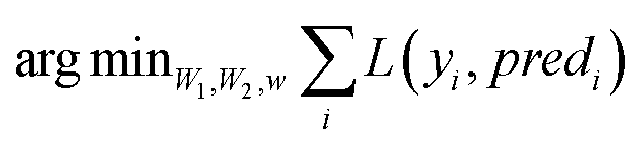
- the training of the predefined graph structure model can specifically include: optimizing arg min W 1 , W 2 , w ⁇ i L y i pred i based on a backpropagation algorithm and the risk labeling data, to obtain optimum W 1 , W 2 , and w .
- Equation 1 Equation 1, Equation 2, and Equation 3 above are examples and are not the only solutions.
- the terms in which X and G are respectively located in Equation 1 can be transformed by performing operations such as multiplication, exponent operation, or logarithm operation; or the two terms can be combined; or one of the two terms can be deleted.
- the function softmax can be used to quantitize ⁇ i .
- the loss function in Equation 3 represents the consistency between the prediction data and the corresponding risk prediction data, a maximum value can be calculated in Equation 3.
- An implementation of the present specification further provides a schematic flowchart illustrating a junk account identification method based on the above graph structure model, as shown in FIG. 3 .
- the process in FIG. 3 includes the following steps.
- S302 Obtain feature data of a to-be-identified account, and obtain an account medium network graph that contains the to-be-identified account.
- S304 Input the feature data of the to-be-identified account and a topology corresponding to the to-be-identified account in the account medium network graph, into a graph structure model for calculation, the graph structure model being trained using the above graph structure model training method.
- S306 Determine whether the to-be-identified account is a junk account based on prediction data output by the trained graph structure model.
- an implementation of the present specification further provides a schematic diagram illustrating an implementation solution of the above methods, as shown in FIG. 4 .
- the solution of FIG. 4 can include the following steps: obtaining an account-device network graph generated in the last m days, and login behavior data and risk labeling data of each account; training a predefined graph structure model through supervised learning to obtain a trained graph structure model; for the to-be-predicted data (for example, one or more accounts), obtaining a corresponding account-device network graph and login behavior data of each account; and performing prediction by using the trained graph structure model to obtain a prediction result.
- implementations of the present specification further provide a corresponding apparatus and device, as shown in FIG. 5 to FIG. 8 .
- FIG. 5 is a schematic structural diagram illustrating a graph structure model training apparatus corresponding to FIG. 2 , according to an implementation of the present specification.
- the apparatus can be located in an execution body of the process in FIG. 2 .
- the apparatus includes: a first acquisition module 501, configured to obtain an account medium network graph, a node in the account medium network graph representing an account and a medium, and at least some edges indicating that a login behavior relationship exists between nodes connected by the edges; a second acquisition module 502, configured to obtain feature data and risk labeling data of the node, the feature data reflecting a login behavior of the corresponding node in a time sequence; and a training and identification module 503, configured to train, based on the account medium network graph, the feature data, and the risk labeling data, a predefined graph structure model for identifying a junk account.
- a first acquisition module 501 configured to obtain an account medium network graph, a node in the account medium network graph representing an account and a medium, and at least some edges indicating that a
- the media includes a device.
- the graph structure model is used to calculate an embedded vector of the node after a plurality of iterations in a hidden feature space based on the feature data of the node and a topology corresponding to the node in the account medium network graph.
- the graph structure model is further used to calculate prediction data of the node based on the embedded vector, the prediction data representing a possibility that the node corresponds to a junk account.
- the training identification module 503 identifies a junk account specifically includes: obtaining, by the training identification module 503, a to-be-identified account, and obtaining an account medium network graph that contains the to-be-identified account; inputting the feature data of the to-be-identified account and a topology corresponding to the to-be-identified account in the account medium network graph, into the trained graph structure model for calculation; and obtaining prediction data output after the calculation is performed based on the trained graph structure model calculation, to determine whether the to-be-identified account is a junk account.
- the second acquisition module 502 obtains feature data of the node specifically includes: obtaining, by the second acquisition module 502, login behavior data of the node within a certain period of time; dividing the certain period of time to obtain a time sequence; and generating, based on a distribution of the login behavior data in the time sequence, a feature vector as the feature data of the node.
- the embedded vector of the node after a t th iteration in the hidden feature space is calculated based on the feature data of the node, the topology corresponding to the node in the account medium network graph, and the embedded vector of the node after a t -1 th iteration in the hidden feature space.
- ⁇ ( t +1) indicates an embedded vector of at least one node in the hidden feature space after a t +1 th iteration; ⁇ indicates a non-linear transformation function; W 1 and W 2 each indicate weight matrices; X indicates the feature data of the at least one node; and G indicates a topology corresponding to the at least one node in the account medium network graph.
- pred i indicates the prediction data of an i th node that is obtained through iteration;
- ⁇ i indicates an embedded vector of the i th node in the hidden feature space that is obtained through the plurality of iterations;
- i indicates a parameter vector that is obtained by quantitizing ⁇ i ; and
- T indicates a transposition operation.
- training and identification module 503 trains a predefined graph structure model specifically includes: training, by the training and identification module 503, the predefined graph structure model to maximize a consistency between the prediction data and the corresponding risk labeling data.
- the training and identification module 503 trains a predefined graph structure model specifically includes: optimizing, by the training and identification module 503, arg min W 1 , W 2 , w ⁇ i L y i pred i based on a backpropagation algorithm and the risk labeling data, to obtain optimum W 1 , W 2 , and w .
- y i indicates the risk labeling data of the i th node; and L indicates a loss function for measuring a consistency difference between the prediction data and corresponding risk labeling data.
- FIG. 6 is a schematic structural diagram illustrating a junk account identification apparatus corresponding to FIG. 3 , according to an implementation of the present specification.
- the apparatus can be located in an execution body of the process in FIG. 3 .
- the apparatus includes: an acquisition module 601, configured to obtain feature data of a to-be-identified account, and obtain an account medium network graph that contains the to-be-identified account; an input module 602, configured to input the feature data of the to-be-identified account and a topology corresponding to the to-be-identified account in the account medium network graph, into a graph structure model for calculation, the graph structure model being trained using the above graph structure model training method; and a determining module 603, configured to determine whether the to-be-identified account is a junk account based on prediction data output by the trained graph structure model.
- FIG. 7 is a schematic structural diagram illustrating a graph structure model training device corresponding to FIG. 2 , according to an implementation of the present specification.
- the device includes at least one processor, and a memory communicatively connected to the at least one processor.
- the memory stores instructions that can be executed by the at least one processor, and the instructions are executed by the at least one processor to enable the at least one processor to: obtain an account medium network graph, a node in the account medium network graph representing an account and a medium, and at least some edges indicating that a login behavior relationship exists between nodes connected by the edges; obtain feature data and risk labeling data of the node, the feature data reflecting a login behavior of the corresponding node in a time sequence; and train, based on the account medium network graph, the feature data, and the risk labeling data, a predefined graph structure model for identifying a junk account.
- FIG. 8 is a schematic structural diagram illustrating a junk account identification device corresponding to FIG. 3 , according to an implementation of the present specification.
- the device includes at least one processor, and a memory communicatively connected to the at least one processor.
- the memory stores instructions that can be executed by the at least one processor, and the instructions are executed by the at least one processor to enable the at least one processor to: obtain feature data of a to-be-identified account, and obtain an account medium network graph that contains the to-be-identified account; input the feature data of the to-be-identified account and a topology corresponding to the to-be-identified account in the account medium network graph, into a graph structure model for calculation, the graph structure model being trained using the above graph structure model training method; and determine whether the to-be-identified account is a junk account based on prediction data output by the trained graph structure model.
- an implementation of the present specification further provides a non-volatile computer storage medium corresponding to FIG. 2 .
- the storage medium stores computer-executable instructions, and the computer-executable instructions are used to: obtain an account medium network graph, a node in the account medium network graph representing an account and a medium, and at least some edges indicating that a login behavior relationship exists between nodes connected by the edges; obtain feature data and risk labeling data of the node, the feature data reflecting a login behavior of the corresponding node in a time sequence; and train, based on the account medium network graph, the feature data, and the risk labeling data, a predefined graph structure model for identifying a junk account.
- an implementation of the present specification further provides a non-volatile computer storage medium corresponding to FIG. 3 .
- the storage medium stores computer-executable instructions, and the computer-executable instructions are used to: obtain feature data of a to-be-identified account, and obtain an account medium network graph that contains the to-be-identified account; input the feature data of the to-be-identified account and a topology corresponding to the to-be-identified account in the account medium network graph, into a graph structure model for calculation, the graph structure model being trained using the above graph structure model training method; and determine whether the to-be-identified account is a junk account based on prediction data output by the trained graph structure model.
- the apparatus, device, and non-volatile computer storage medium provided in the implementations of the present specification correspond to the method. Therefore, the apparatus, device, and non-volatile computer storage medium also have beneficial technical effects that are similar to those of corresponding method. Because the beneficial technical effects of the method have been described in detail above, the beneficial technical effects of the corresponding apparatus, device, and non-volatile computer storage medium details are omitted here for simplicity.
- a method procedure can be improved by using a hardware entity module.
- a programmable logic device for example, a field programmable gate array (FPGA)
- FPGA field programmable gate array
- the designer performs programming to "integrate" a digital system to a PLD without requesting a chip manufacturer to design and produce an application-specific integrated circuit chip.
- this type of programming is mostly implemented by using "logic compiler” software.
- the programming is similar to a software compiler used to develop and write a program. Original code needs to be written in a particular programming language for compilation. The language is referred to as a hardware description language (HDL).
- HDL hardware description language
- HDLs such as the Advanced Boolean Expression Language (ABEL), the Altera Hardware Description Language (AHDL), Confluence, the Cornell University Programming Language (CUPL), HDCal, the Java Hardware Description Language (JHDL), Lava, Lola, MyHDL, PALASM, and the Ruby Hardware Description Language (RHDL).
- ABEL Advanced Boolean Expression Language
- AHDL Altera Hardware Description Language
- CUPL Cornell University Programming Language
- HDCal the Java Hardware Description Language
- JHDL Java Hardware Description Language
- Lava Lola
- MyHDL MyHDL
- PALASM Ruby Hardware Description Language
- RHDL Ruby Hardware Description Language
- VHDL very-high-speed integrated circuit hardware description language
- Verilog Verilog
- a controller can be implemented by using any appropriate method.
- the controller can be a microprocessor or a processor, or a computer-readable medium that stores computer readable program code (such as software or firmware) that can be executed by the microprocessor or the processor, a logic gate, a switch, an application-specific integrated circuit (ASIC), a programmable logic controller, or a built-in microprocessor.
- Examples of the controller include but are not limited to the following microprocessors: ARC 625D, Atmel AT91SAM, Microchip PIC18F26K20, and Silicone Labs C8051F320.
- the memory controller can also be implemented as a part of the control logic of the memory.
- the controller can be considered a hardware component, and a device configured to implement various functions in the controller can also be considered a structure in the hardware component.
- the device configured to implement various functions can even be considered both a software module implementing the method and a structure in the hardware component.
- the system, device, module, or unit illustrated in the previous implementations can be implemented by using a computer chip or an entity, or can be implemented by using a product having a certain function.
- a typical implementation device is a computer.
- a specific form of the computer can be a personal computer, a laptop computer, a cellular phone, a camera phone, an intelligent phone, a personal digital assistant, a media player, a navigation device, an email transceiver device, a game console, a tablet computer, a wearable device, or any combination thereof.
- implementations of the present specification can be provided as methods, systems, or computer program products. Therefore, the implementations of the present specification can take a form of complete hardware implementations, complete software implementations, or implementations combining software and hardware aspects. Further, the implementations of the present specification can take a form of a computer program product implemented on one or more computer-usable storage media (including but not limited to disk storage, CD-ROM, and optical storage) containing computer-usable program code.
- computer-usable storage media including but not limited to disk storage, CD-ROM, and optical storage
- These computer program instructions can be provided for a general-purpose computer, a dedicated computer, an embedded processor, or a processor of another programmable data processing device to generate a machine, so the instructions executed by the computer or the processor of the another programmable data processing device generate a device for implementing a specific function in one or more processes in the flowcharts and/or in one or more blocks in the block diagrams.
- These computer program instructions can be stored in a computer readable memory that can instruct the computer or the another programmable data processing device to work in a specific way, so the instructions stored in the computer readable memory generate an artifact that includes an instruction device.
- the instruction device implements a specific function in one or more processes in the flowcharts and/or in one or more blocks in the block diagrams.
- a computing device includes one or more processors (CPUs), an input/output interface, a network interface, and a memory.
- the memory can include a non-persistent memory, a random access memory (RAM), a non-volatile memory, and/or another form that are in a computer readable medium, for example, a read-only memory (ROM) or a flash memory (flash RAM).
- ROM read-only memory
- flash RAM flash memory
- the computer readable medium includes persistent, non-persistent, movable, and unmovable media that can store information by using any method or technology.
- the information can be a computer readable instruction, a data structure, a program module, or other data.
- Examples of the computer storage medium include but are not limited to a phase change random access memory (PRAM), a static random access memory (SRAM), a dynamic random access memory (DRAM), another type of RAM, a ROM, an electrically erasable programmable read-only memory (EEPROM), a flash memory or another memory technology, a compact disc read-only memory (CD-ROM), a digital versatile disc (DVD) or another optical storage, a cassette magnetic tape, a magnetic tape/magnetic disk storage, another magnetic storage device, or any other non-transmission medium.
- the computer storage medium can be used to store information accessible by a computing device. Based on the definition in the present specification, the computer readable medium does not include transitory media such as a modulated data signal and carrier.
- the implementations of the present specification can be provided as methods, systems or computer program products. Therefore, the present specification can take a form of complete hardware implementations, complete software implementations, or implementations combining software and hardware. Further, the present specification can take a form of a computer program product implemented on one or more computer-usable storage media (including but not limited to disk storage, CD-ROM, and optical storage) containing computer-usable program code.
- computer-usable storage media including but not limited to disk storage, CD-ROM, and optical storage
- the present specification can be described in the general context of computer executable instructions executed by a computer, for example, a program module.
- the program module includes a routine, a program, an object, a component, a data structure, etc. executing a specific task or implementing a specific abstract data type.
- the present specification can also be practiced in distributed computing environments. In the distributed computing environments, tasks are performed by remote processing devices connected through a communications network. In a distributed computing environment, the program module can be located in both local and remote computer storage media including storage devices.
Landscapes
- Engineering & Computer Science (AREA)
- Computer Security & Cryptography (AREA)
- Theoretical Computer Science (AREA)
- General Engineering & Computer Science (AREA)
- Software Systems (AREA)
- Physics & Mathematics (AREA)
- Computer Hardware Design (AREA)
- Computing Systems (AREA)
- General Physics & Mathematics (AREA)
- Data Mining & Analysis (AREA)
- Signal Processing (AREA)
- Computer Networks & Wireless Communication (AREA)
- Evolutionary Computation (AREA)
- Artificial Intelligence (AREA)
- Mathematical Physics (AREA)
- Computational Linguistics (AREA)
- Life Sciences & Earth Sciences (AREA)
- Biomedical Technology (AREA)
- Molecular Biology (AREA)
- General Health & Medical Sciences (AREA)
- Biophysics (AREA)
- Health & Medical Sciences (AREA)
- Databases & Information Systems (AREA)
- Computer Vision & Pattern Recognition (AREA)
- Medical Informatics (AREA)
- Bioinformatics & Computational Biology (AREA)
- Bioinformatics & Cheminformatics (AREA)
- Evolutionary Biology (AREA)
- Data Exchanges In Wide-Area Networks (AREA)
- Information Retrieval, Db Structures And Fs Structures Therefor (AREA)
- Management, Administration, Business Operations System, And Electronic Commerce (AREA)
Abstract
Description
- This patent application claims priority to Chinese Patent Application No.
201810209270.1, filed on March 14, 2018 - The present specification relates to the technical field of computer software, and in particular, to graph structure model training and junk account identification methods, apparatuses, and devices.
- With the rapid development of computer and Internet technologies, many services can be carried out on the Internet. To use these services, users often need to register corresponding accounts, such as e-commerce platform accounts, third-party payment platform accounts, forum platform accounts, etc.
- Some users or organizations register a large quantity of accounts for undesirable purposes and use these accounts to perform abnormal operations, such as messaging, publishing false advertisements, brushing, etc. Such accounts can pose risks to the platform and are of low value to the platform and are considered junk accounts.
- In the existing technology, a junk account is generally determined and dealt with correspondingly, such as freezing and canceling, after being reported by a user.
- Based on the existing technology, a more reliable solution for identifying a junk account is needed.
- Implementations of the present specification provide graph structure model training and junk account identification methods, apparatuses, and devices, to provide a more reliable solution for identifying a junk account.
- To resolve the previously technical problem, the implementations of the present specification provide the following solutions.
- An implementation of the present specification provides a graph structure model training method, including: obtaining an account medium network graph, a node in the account medium network graph representing an account and a medium, and at least some edges indicating that a login behavior relationship exists between nodes connected by the edges; obtaining feature data and risk labeling data of the node, the feature data reflecting a login behavior of the corresponding node in a time sequence; and training, based on the account medium network graph, the feature data, and the risk labeling data, a predefined graph structure model for identifying a junk account.
- An implementation of the present specification provides a junk account identification method, including: obtaining feature data of a to-be-identified account, and obtaining an account medium network graph that contains the to-be-identified account; inputting the feature data of the to-be-identified account and a topology corresponding to the to-be-identified account in the account medium network graph, into a graph structure model for calculation, the graph structure model being trained using the above graph structure model training method; and determining whether the to-be-identified account is a junk account based on prediction data output by the trained graph structure model.
- An implementation of the present specification provides a graph structure model training apparatus, including: a first acquisition module, configured to obtain an account medium network graph, a node in the account medium network graph representing an account and a medium, and at least some edges indicating that a login behavior relationship exists between nodes connected by the edges; a second acquisition module, configured to obtain feature data and risk labeling data of the node, the feature data reflecting a login behavior of the corresponding node in a time sequence; and a training and identification module, configured to train, based on the account medium network graph, the feature data, and the risk labeling data, a predefined graph structure model for identifying a junk account.
- An implementation of the present specification provides a junk account identification apparatus, including: an acquisition module, configured to obtain feature data of a to-be-identified account, and obtain an account medium network graph that contains the to-be-identified account; an input module, configured to input the feature data of the to-be-identified account and a topology corresponding to the to-be-identified account in the account medium network graph, into a graph structure model for calculation, the graph structure model being trained using the above graph structure model training method; and a determining module, configured to determine whether the to-be-identified account is a junk account based on prediction data output by the trained graph structure model.
- An implementation of the present specification provides a graph structure model training device, including at least one processor, and a memory communicatively connected to the at least one processor. The memory stores instructions that can be executed by the at least one processor, and the instructions are executed by the at least one processor to enable the at least one processor to: obtain an account medium network graph, a node in the account medium network graph representing an account and a medium, and at least some edges indicating that a login behavior relationship exists between nodes connected by the edges; obtain feature data and risk labeling data of the node, the feature data reflecting a login behavior of the corresponding node in a time sequence; and train, based on the account medium network graph, the feature data, and the risk labeling data, a predefined graph structure model for identifying a junk account.
- The above at least one technical solution adopted in the implementations of the present specification can achieve the following beneficial effects: a junk account can be effectively identified based on the media aggregation and time aggregation of the junk account and by using the above graph embedding solution based on the account medium network graph.
- To describe the technical solutions in the implementations of the present specification or in the existing technology more clearly, the following outlines the accompanying drawings for illustrating such technical solutions. Clearly, the accompanying drawings outlined below are some implementations of the present specification and a person skilled in the art can derive other drawings from such accompanying drawings without creative efforts.
-
FIG. 1 is a schematic diagram illustrating an overall architecture involved in an actual application scenario of solutions of the present specification; -
FIG. 2 is a schematic flowchart illustrating a graph structure model training method, according to an implementation of the present specification; -
FIG. 3 is a schematic flowchart illustrating a junk account identification method, according to an implementation of the present specification. -
FIG. 4 is a schematic diagram illustrating an implementation solution of the above methods, according to an implementation of the present specification; -
FIG. 5 is a schematic structural diagram illustrating a graph structure model training apparatus corresponding toFIG. 2 , according to an implementation of the present specification; -
FIG. 6 is a schematic structural diagram illustrating a junk account identification apparatus corresponding toFIG. 3 , according to an implementation of the present specification; -
FIG. 7 is a schematic structural diagram illustrating a graph structure model training device corresponding toFIG. 2 , according to an implementation of the present specification; and -
FIG. 8 is a schematic structural diagram illustrating a junk account identification device corresponding toFIG. 3 , according to an implementation of the present specification. - Implementations of the present specification provide graph structure model training and junk account identification methods, apparatuses, and devices.
- To enable a person skilled in the art to better understand technical solutions in the present specification, the following clearly and completely describes the technical solutions in the implementations of the present specification with reference to accompanying drawings in the implementations of the present specification. Clearly, the described implementations are merely some rather than all of the implementations of the present application. Based on the implementations of the present specification, all other implementations obtained by a person of ordinary skill in the art without creative efforts shall fall in the protection scope of the present application.
- In general, accounts involving abnormal behavior can be considered junk accounts, such as a large quantity of accounts that are automatically registered by a machine, etc. In the risk control systems of most service platforms, identifying a junk account is essential to risk control security, and the difficulty is that the newly registered account does not have enough account portrait information to determine whether the account is a junk account. Considering the two features of a junk account, that is, media aggregation and time aggregation, the present specification provides a junk account identification scheme based on supervised graph embedding, which can effectively identify a junk account. Here, graph embedding means that some original data of the nodes in the graph is mapped in a specified feature space (referred to as a hidden feature space in the present specification) to obtain a corresponding embedded vector for representing the nodes.
- Medium aggregation means that a plurality of junk accounts registered by the same malicious user are often registered by using the same medium or a few media. The reason for media aggregation is that, malicious users usually intend to pursue their gains, and do not have sufficient resources to register a large number of accounts through a large number of media.
- Time aggregation means that the junk accounts controlled by the same malicious user usually perform a large quantity of abnormal behaviors within a certain short period of time. The reason for time aggregation is that malicious users tend to pursue short-term interest goals, and therefore the accounts under their control must perform a large quantity of abnormal behaviors in a short time.
-
FIG. 1 is a schematic diagram illustrating an overall architecture involved in an actual application scenario of solutions of the present specification. The overall architecture mainly involves a supervised learning server including the predefined graph structure model, and three types of data that can be used to train the graph structure model: an account medium network graph that reflects a specified behavior relationship, feature data of a node in the account medium network graph that reflects a specified behavior in a time sequence, and risk labeling data of the node. The specified behavior is, for example, a login behavior, a registration behavior, a transaction behavior, etc. The trained graph structure model can be used to identify a junk account. - The training data can be generated by a supervised learning server or other devices, or can be written manually.
- The following describes in detail the solutions of the present specification based on the example structure shown in
FIG. 1 . -
FIG. 2 is a schematic flowchart illustrating a graph structure model training method, according to an implementation of the present specification. The process inFIG. 2 includes following steps. - S202: Obtain an account medium network graph, a node in the account medium network graph representing an account and a medium, and at least some edges indicating that a login behavior relationship exists between nodes connected by the edges.
- In this implementation of the present specification, the account medium network graph is a heterogeneous network graph. Being heterogeneous means differences in node properties; for example, some nodes in the diagram can represent accounts and some nodes can represent account-related media. The account is registered or subsequent behaviors are performed through a medium, where the medium is, for example, a device, an IP network, a physical address, etc.
- In this implementation of the present specification, the account medium network graph can be generated based on historical data generated by the account over a certain period of time. The historical data can include registration behavior data of the account, such as a medium used for registering the account and registration information entered for registering the account. The historical data can also include behavior data after the account is registered, such as login behavior data and transaction behavior data of the account. The certain period of time is not specified here, and can be predetermined, for example, to be the last several days.
- For newly registered accounts, for example, an account medium network graph can be generated based on account registration behavior data, and/or specified behavior data within a certain period of time (typically a certain short period of time) after registration, to identity a junk account as early as possible.
- For ease of description, the following implementations are mainly described based on an example in which a medium is a device, the specified behavior is a login behavior, and the account medium network graph is specifically an account-device network graph.
- During generation of the account-device network graph, each account to be represented and each device to be represented can be determined first. Each account to be represented is represented by one node, and each device can also be represented by one node; that is, each node represents an account or a device. Further, if there is a login relationship between the two nodes, an edge representing the login behavior relationship is established between the two nodes, so that an account-device network graph is generated.
- Here, the login behavior relationship mainly refers to a relationship between an account and a device. If an account has been used for logging in through a certain device within a certain period of time, it can be considered that there is a login behavior relationship between the account and the device. It is worthwhile to note that, in practice, the specific meaning of the login behavior relationship can also be widened as needed. For example, the login behavior relationship can also include a relationship between accounts. If two accounts have been logging in through the same device within a certain period of time, it can be considered that there is a login behavior relationship between the two accounts.
- In this implementation, the account medium network graph can be an undirected diagram or a directed diagram, which is not specifically limited here. Generally, if only the login behavior relationship is reflected, an undirected graph is used. If more relationships such as a transaction behavior relationship are also reflected, a directed graph can be used. In the directed graph, a direction of an edge indicates a business relationship direction. For example, if node A represents a buyer's account and node B represents a seller's account, an edge indicating a transaction behavior relationship between node A and node B can designate a node B from a node A, and the direction can also reflect a capital flow direction.
- In this implementation of the present specification, for ease of graph calculation, the account medium network graph can be represented by a matrix. Different single rows and single columns of the matrix can be used to represent different nodes in the account medium network graph, and different elements in the matrix can represent login behavior relationships between nodes represented by the rows and columns in which the elements are located.
- For example, for a matrix representing an account-device network graph, a matrix is denoted as

- S204: Obtain feature data and risk labeling data of the node, the feature data reflecting a login behavior of the corresponding node in a time sequence.
- In this implementation of the present specification, the nodes involved in step S204 can be some of the nodes in the account medium network graph, and not necessarily all of the nodes. For example, the nodes can be at least some of the nodes representing accounts. Of course, feature data of at least some of the nodes representing media can also be obtained, and the feature data of a node representing a medium does not necessarily reflect the login behavior of the corresponding node in a time sequence, which is not specifically limited here. If the medium is a device, the feature data can reflect, for example, device information such as a device type or a device manufacturer.
- In this implementation of the present specification, the feature data can be generated based on historical data generated by the account over a certain period of time. With regard to the above time aggregation, during generation of the feature data, not only the login behavior of the account itself is considered, but also the relationship between the login behavior of the account and the time is considered. For example, the time can be serialized (for example, a plurality of time intervals are obtained through division, or sampling is performed at discrete time points), and the distribution of the login behavior of the account in the time sequence can be determined, for example, the specific time, the duration, and the quantity of times the login behavior occurs per unit time. The feature data can be generally represented as a vector or a matrix. Some implementations below are mainly described based on an example in which the feature data is represented as a vector.
- In this implementation of the present specification, the nodes in the account-device network graph are used as an example. Some nodes can represent junk accounts, and some nodes can represent devices that have been logged into junk accounts. Specific scenarios or situations of the nodes are not determined. At least some specific scenarios or situations of the nodes need to be determined by using specific means, so that training samples with training labels can be obtained for subsequent supervised learning. Specific means are not specifically limited here, for example, means such as sampling-based accurate tracking analysis or user reporting can be used.
- With some specific scenarios or situations being known, risk labeling data can be marked for some nodes in advance or in real time, and the risk labeling data can indicate a risk existing in a node, for example, whether the node represents a junk account or whether the node represents a device that has been used to logged into a junk account. In practice, the risk here is not limited to junk account related content. For example, the risk can represent that a normal account is vulnerable to an attack. The training label described above can be obtained based on the risk labeling data. In general, the risk labeling data can be directly used as a training label.
- The risk labeling data can be represented in various forms, which are not specifically limited here. For example, if it is determined that a node is associated with a junk account, the risk labeling data of the node can be recorded as 1; or if it is determined that a node represents a junk account or represents a device that has been used to log into a junk account, the risk labeling data of the node can be recorded as 0.
- In addition, in practice, only a node representing an account has the risk labeling data, and a node representing a medium does not have the risk labeling data.
- S206: Train, based on the account medium network graph, the feature data, and the risk labeling data, a predefined graph structure model for identifying a junk account.
- In this implementation of the present specification, at least some of the parameters of the graph structure model are based on the graph structure, and such parameters can be assigned values based on at least some of the account medium network graphs and/or feature data. Some of the parameters of the graph structure model need to be optimized and solved through training.
- For example, in an actual application scenario, the graph structure model is used to calculate the embedded vector of the node in the hidden feature space after a plurality of iterations based on the feature data of the node and the topology corresponding to the node in the account medium network graph; further, the graph structure model is used to calculate prediction data of the node based on the embedded vector, the prediction data representing a possibility that the node corresponds to a junk account.
- The prediction data can be represented in various forms, which are not specifically limited here. For example, the prediction data can be represented by a probability value, a score, or a classification identifier.
- In practice, it is not necessary to calculate the prediction data for the graph structure model, and the calculated embedded vector can be output to another model for use. The present specification does not analyze this case. The following implementations are mainly described based on the above example.
- In this implementation of the present specification, the trained graph structure model can be used for classification or regression to predict the risk property of the input data.
- For example, the input data can be feature data corresponding to the to-be-identified account and a topology corresponding to an account medium network graph (not necessarily the account medium network graph in step S202) that contains the to-be-identified account. The prediction data can be output through calculation of the trained graph structure model, and it can be determined whether the to-be-identified account is a junk account. The to-be-identified account can be represented by a node in the account medium network graph in step S202, or can be outside the account medium network graph. In the former case, the input data has been determined, and therefore can be directly identified, while in the latter case, the input data is not determined, and the solution of the present specification can be used to determine the input data before identification.
- Of course, based on the specific content of the risk labeling data, the graph structure model can be used to predict the risks of other aspects in addition to the identification of the junk account. The principles are the same, and details are omitted here for simplicity.
- According to the method of
FIG. 2 , by using the above graph embedding scheme based on the account medium network graph, the junk account can be effectively identified based on the media aggregation and time aggregation of the junk account. - Based on the method shown in
FIG. 2 , an implementation of the present specification further provides some implementation solutions of the method, as well as extension solutions, which are described below. - In this implementation of the present specification, it can be seen from the above example that, for step S206, the identification of the junk account can include: obtaining feature data of a to-be-identified account, and obtaining an account medium network graph that contains the to-be-identified account; inputting the feature data of the to-be-identified account and a topology corresponding to the to-be-identified account in the account medium network graph, into the trained graph structure model for calculation; and obtaining prediction data output after the calculation is performed based on the trained graph structure model calculation, to determine whether the to-be-identified account is a junk account.
- In this implementation of the present specification, it has been mentioned that the time sequence can be obtained by dividing a period of time. In this case, for step S204, the obtaining of the feature data of the node can specifically include: obtaining login behavior data of the node within a certain period of time; dividing the certain period of time to obtain a time sequence; and generating, based on a distribution of the login behavior data in the time sequence, a feature vector as the feature data of the node.
- For example, assuming that a certain period of time is set to be the last m days and divided into hours, then m ∗24 time sequences formed by time segments can be obtained and d-dimensional feature vector xi can be generated based on the quantity of logins of account i within the time segments. The specific construction method of xi is not limited. For example, d can be equal to m ∗24, each element of xi can represent the quantity of logins of the account i within one time segment, and the elements of xi can be normalized.
- In this implementation of the present specification, the embedded vector of the node after a t th iteration in the hidden feature space is calculated based on the feature data of the node, the topology corresponding to the node in the account medium network graph, and the embedded vector of the node after a t-1th iteration in the hidden feature space. More intuitively, based on some of the above examples, an example graph structure model is defined and trained as follows:
- Initializing the parameters to be optimized and solved for the graph structure model:


- Performing iterative training for a predetermined quantity of times or until the training converges:


wherein, Φ(t+1) indicates an embedded vector of at least one node in the hidden feature space after a t+1th iteration; σ indicates a non-linear transformation function (for example, a function such as Relu, Sigmoid, Tanh, etc.); W 1 and W 2 each indicate weight matrices; X indicates the feature data of the at least one node; G indicates a topology corresponding to the at least one node in the account medium network graph; predi indicates the prediction data of an i th node that is obtained through iteration; φi indicates an embedded vector of the i th node in the hidden feature space that is obtained through the plurality of iterations; wT indicates a parameter vector that is obtained by quantitizing φi ; T indicates a transposition operation; yi indicates the risk labeling data of the i th node; and L indicates a loss function for measuring a consistency difference between the prediction data and corresponding risk labeling data. The specific loss function is not limited here; for example, loss functions such as logistic loss, hinge loss, and cross _ entropy can be used. - In the above example,


- Of course, G can alternatively represent a part of the complete topology of the account medium network graph; and correspondingly, X and Φ can alternatively include the data of some nodes in the account medium network graph.
- In this implementation of the present specification, the graph structure model can be trained to maximize a consistency between the prediction data and the corresponding risk labeling data. Then, in the scenario of the above example, for step S206, the training of the predefined graph structure model can specifically include: optimizing
-
Equation 1,Equation 2, andEquation 3 above are examples and are not the only solutions. For example, the terms in which X and G are respectively located inEquation 1 can be transformed by performing operations such as multiplication, exponent operation, or logarithm operation; or the two terms can be combined; or one of the two terms can be deleted. For another example, inEquation 2, the function softmax can be used to quantitize φi . For still another example, if the loss function inEquation 3 represents the consistency between the prediction data and the corresponding risk prediction data, a maximum value can be calculated inEquation 3. - An implementation of the present specification further provides a schematic flowchart illustrating a junk account identification method based on the above graph structure model, as shown in
FIG. 3 . The process inFIG. 3 includes the following steps. - S302: Obtain feature data of a to-be-identified account, and obtain an account medium network graph that contains the to-be-identified account.
- S304: Input the feature data of the to-be-identified account and a topology corresponding to the to-be-identified account in the account medium network graph, into a graph structure model for calculation, the graph structure model being trained using the above graph structure model training method.
- S306: Determine whether the to-be-identified account is a junk account based on prediction data output by the trained graph structure model.
- Based on the above description, an implementation of the present specification further provides a schematic diagram illustrating an implementation solution of the above methods, as shown in
FIG. 4 . - The solution of
FIG. 4 can include the following steps: obtaining an account-device network graph generated in the last m days, and login behavior data and risk labeling data of each account; training a predefined graph structure model through supervised learning to obtain a trained graph structure model; for the to-be-predicted data (for example, one or more accounts), obtaining a corresponding account-device network graph and login behavior data of each account; and performing prediction by using the trained graph structure model to obtain a prediction result. - The methods provided in the present specification have been described above. Based on the same idea, implementations of the present specification further provide a corresponding apparatus and device, as shown in
FIG. 5 to FIG. 8 . -
FIG. 5 is a schematic structural diagram illustrating a graph structure model training apparatus corresponding toFIG. 2 , according to an implementation of the present specification. The apparatus can be located in an execution body of the process inFIG. 2 . The apparatus includes: afirst acquisition module 501, configured to obtain an account medium network graph, a node in the account medium network graph representing an account and a medium, and at least some edges indicating that a login behavior relationship exists between nodes connected by the edges; asecond acquisition module 502, configured to obtain feature data and risk labeling data of the node, the feature data reflecting a login behavior of the corresponding node in a time sequence; and a training andidentification module 503, configured to train, based on the account medium network graph, the feature data, and the risk labeling data, a predefined graph structure model for identifying a junk account. - Optionally, the media includes a device.
- Optionally, the graph structure model is used to calculate an embedded vector of the node after a plurality of iterations in a hidden feature space based on the feature data of the node and a topology corresponding to the node in the account medium network graph.
- Optionally, the graph structure model is further used to calculate prediction data of the node based on the embedded vector, the prediction data representing a possibility that the node corresponds to a junk account.
- Optionally, that the
training identification module 503 identifies a junk account specifically includes: obtaining, by thetraining identification module 503, a to-be-identified account, and obtaining an account medium network graph that contains the to-be-identified account; inputting the feature data of the to-be-identified account and a topology corresponding to the to-be-identified account in the account medium network graph, into the trained graph structure model for calculation; and obtaining prediction data output after the calculation is performed based on the trained graph structure model calculation, to determine whether the to-be-identified account is a junk account. - Optionally, that the
second acquisition module 502 obtains feature data of the node specifically includes: obtaining, by thesecond acquisition module 502, login behavior data of the node within a certain period of time; dividing the certain period of time to obtain a time sequence; and generating, based on a distribution of the login behavior data in the time sequence, a feature vector as the feature data of the node. - Optionally, the embedded vector of the node after a t th iteration in the hidden feature space is calculated based on the feature data of the node, the topology corresponding to the node in the account medium network graph, and the embedded vector of the node after a t-1th iteration in the hidden feature space.
- Optionally, the calculating the embedded vector of the node after the plurality of iterations in the hidden feature space based on the feature data of the node and the topology corresponding to the node in the account medium network graph specifically includes calculating the embedded vector of the node after the plurality of iterations in the hidden feature space based on the following equation:

- Φ(t+1) indicates an embedded vector of at least one node in the hidden feature space after a t+1th iteration; σ indicates a non-linear transformation function; W 1 and W 2 each indicate weight matrices; X indicates the feature data of the at least one node; and G indicates a topology corresponding to the at least one node in the account medium network graph.
- Optionally, the calculating the prediction data of the node based on the embedded vector includes calculating the prediction data of the node based on the following equation:

- predi indicates the prediction data of an i th node that is obtained through iteration; φi indicates an embedded vector of the i th node in the hidden feature space that is obtained through the plurality of iterations; i indicates a parameter vector that is obtained by quantitizing φi ; and T indicates a transposition operation.
- Optionally, that the training and
identification module 503 trains a predefined graph structure model specifically includes: training, by the training andidentification module 503, the predefined graph structure model to maximize a consistency between the prediction data and the corresponding risk labeling data. - Optionally, that the training and
identification module 503 trains a predefined graph structure model specifically includes: optimizing, by the training andidentification module 503,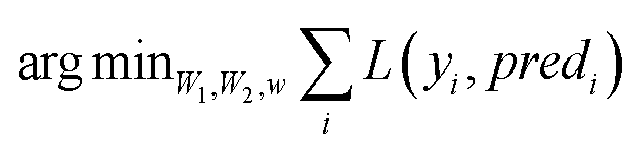
-
FIG. 6 is a schematic structural diagram illustrating a junk account identification apparatus corresponding toFIG. 3 , according to an implementation of the present specification. The apparatus can be located in an execution body of the process inFIG. 3 . The apparatus includes: anacquisition module 601, configured to obtain feature data of a to-be-identified account, and obtain an account medium network graph that contains the to-be-identified account; aninput module 602, configured to input the feature data of the to-be-identified account and a topology corresponding to the to-be-identified account in the account medium network graph, into a graph structure model for calculation, the graph structure model being trained using the above graph structure model training method; and a determiningmodule 603, configured to determine whether the to-be-identified account is a junk account based on prediction data output by the trained graph structure model. -
FIG. 7 is a schematic structural diagram illustrating a graph structure model training device corresponding toFIG. 2 , according to an implementation of the present specification. The device includes at least one processor, and a memory communicatively connected to the at least one processor. The memory stores instructions that can be executed by the at least one processor, and the instructions are executed by the at least one processor to enable the at least one processor to: obtain an account medium network graph, a node in the account medium network graph representing an account and a medium, and at least some edges indicating that a login behavior relationship exists between nodes connected by the edges; obtain feature data and risk labeling data of the node, the feature data reflecting a login behavior of the corresponding node in a time sequence; and train, based on the account medium network graph, the feature data, and the risk labeling data, a predefined graph structure model for identifying a junk account. -
FIG. 8 is a schematic structural diagram illustrating a junk account identification device corresponding toFIG. 3 , according to an implementation of the present specification. The device includes at least one processor, and a memory communicatively connected to the at least one processor. The memory stores instructions that can be executed by the at least one processor, and the instructions are executed by the at least one processor to enable the at least one processor to: obtain feature data of a to-be-identified account, and obtain an account medium network graph that contains the to-be-identified account; input the feature data of the to-be-identified account and a topology corresponding to the to-be-identified account in the account medium network graph, into a graph structure model for calculation, the graph structure model being trained using the above graph structure model training method; and determine whether the to-be-identified account is a junk account based on prediction data output by the trained graph structure model. - Based on the same idea, an implementation of the present specification further provides a non-volatile computer storage medium corresponding to
FIG. 2 . The storage medium stores computer-executable instructions, and the computer-executable instructions are used to: obtain an account medium network graph, a node in the account medium network graph representing an account and a medium, and at least some edges indicating that a login behavior relationship exists between nodes connected by the edges; obtain feature data and risk labeling data of the node, the feature data reflecting a login behavior of the corresponding node in a time sequence; and train, based on the account medium network graph, the feature data, and the risk labeling data, a predefined graph structure model for identifying a junk account. - Based on the same idea, an implementation of the present specification further provides a non-volatile computer storage medium corresponding to
FIG. 3 . The storage medium stores computer-executable instructions, and the computer-executable instructions are used to: obtain feature data of a to-be-identified account, and obtain an account medium network graph that contains the to-be-identified account; input the feature data of the to-be-identified account and a topology corresponding to the to-be-identified account in the account medium network graph, into a graph structure model for calculation, the graph structure model being trained using the above graph structure model training method; and determine whether the to-be-identified account is a junk account based on prediction data output by the trained graph structure model. - Specific implementations of the present specification are described above. Other implementations fall within the scope of the appended claims. In some situations, the actions or steps described in the claims can be performed in an order different from the order in the implementation and the desired results can still be achieved. In addition, the process depicted in the accompanying drawings does not necessarily require a particular execution order to achieve the desired results. In some implementations, multi-tasking and parallel processing can be advantageous.
- The implementations of the present specification are described in a progressive way. For same or similar parts of the implementations, mutual references can be made to the implementations. Each implementation focuses on a difference from the other implementations. In particular, for implementations of an apparatus, a device, and a non-volatile computer storage medium, because implementations of an apparatus, a device, and a non-volatile computer storage medium are basically similar to method implementation, description is relatively simple, and references can be made to partial descriptions of the method implementation.
- The apparatus, device, and non-volatile computer storage medium provided in the implementations of the present specification correspond to the method. Therefore, the apparatus, device, and non-volatile computer storage medium also have beneficial technical effects that are similar to those of corresponding method. Because the beneficial technical effects of the method have been described in detail above, the beneficial technical effects of the corresponding apparatus, device, and non-volatile computer storage medium details are omitted here for simplicity.
- In the 1990s, whether technology improvement is hardware improvement (for example, improvement of a circuit structure, such as a diode, a transistor, or a switch) or software improvement (improvement of a method procedure) can be clearly distinguished. However, as technologies develop, the current improvement for many method procedures can be considered a direct improvement of a hardware circuit structure. A designer usually programs an improved method procedure to a hardware circuit, to obtain a corresponding hardware circuit structure. Therefore, a method procedure can be improved by using a hardware entity module. For example, a programmable logic device (PLD) (for example, a field programmable gate array (FPGA)) is such an integrated circuit, and a logical function of the programmable logic device is determined by a user through device programming. The designer performs programming to "integrate" a digital system to a PLD without requesting a chip manufacturer to design and produce an application-specific integrated circuit chip. In addition, at present, instead of manually manufacturing an integrated chip, this type of programming is mostly implemented by using "logic compiler" software. The programming is similar to a software compiler used to develop and write a program. Original code needs to be written in a particular programming language for compilation. The language is referred to as a hardware description language (HDL). There are many HDLs, such as the Advanced Boolean Expression Language (ABEL), the Altera Hardware Description Language (AHDL), Confluence, the Cornell University Programming Language (CUPL), HDCal, the Java Hardware Description Language (JHDL), Lava, Lola, MyHDL, PALASM, and the Ruby Hardware Description Language (RHDL). The very-high-speed integrated circuit hardware description language (VHDL) and Verilog are most commonly used. A person skilled in the art should also understand that a hardware circuit that implements a logical method procedure can be readily obtained once the method procedure is logically programmed by using the several described hardware description languages and is programmed into an integrated circuit.
- A controller can be implemented by using any appropriate method. For example, the controller can be a microprocessor or a processor, or a computer-readable medium that stores computer readable program code (such as software or firmware) that can be executed by the microprocessor or the processor, a logic gate, a switch, an application-specific integrated circuit (ASIC), a programmable logic controller, or a built-in microprocessor. Examples of the controller include but are not limited to the following microprocessors: ARC 625D, Atmel AT91SAM, Microchip PIC18F26K20, and Silicone Labs C8051F320. The memory controller can also be implemented as a part of the control logic of the memory. A person skilled in the art also knows that, in addition to implementing the controller by using the computer readable program code, logic programming can be performed on method steps to allow the controller to implement the same function in forms of the logic gate, the switch, the application-specific integrated circuit, the programmable logic controller, and the built-in microcontroller. Therefore, the controller can be considered a hardware component, and a device configured to implement various functions in the controller can also be considered a structure in the hardware component. Alternatively, the device configured to implement various functions can even be considered both a software module implementing the method and a structure in the hardware component.
- The system, device, module, or unit illustrated in the previous implementations can be implemented by using a computer chip or an entity, or can be implemented by using a product having a certain function. A typical implementation device is a computer. A specific form of the computer can be a personal computer, a laptop computer, a cellular phone, a camera phone, an intelligent phone, a personal digital assistant, a media player, a navigation device, an email transceiver device, a game console, a tablet computer, a wearable device, or any combination thereof.
- For convenience of description, the above devices are described separately in terms of their functions. Certainly, functions of the units can be implemented in the same or different software or hardware when the present specification is implemented.
- A person skilled in the art should understand that the implementations of the present specification can be provided as methods, systems, or computer program products. Therefore, the implementations of the present specification can take a form of complete hardware implementations, complete software implementations, or implementations combining software and hardware aspects. Further, the implementations of the present specification can take a form of a computer program product implemented on one or more computer-usable storage media (including but not limited to disk storage, CD-ROM, and optical storage) containing computer-usable program code.
- The present specification is described with reference to at least one of a flowchart or block diagram of the method, device (system), and computer program product according to the implementations of the present specification. It is worthwhile to note that computer program instructions can be used to implement each process and/or each block in the flowcharts and/or the block diagrams and a combination of a process and/or a block in the flowcharts and/or the block diagrams. These computer program instructions can be provided for a general-purpose computer, a dedicated computer, an embedded processor, or a processor of another programmable data processing device to generate a machine, so the instructions executed by the computer or the processor of the another programmable data processing device generate a device for implementing a specific function in one or more processes in the flowcharts and/or in one or more blocks in the block diagrams.
- These computer program instructions can be stored in a computer readable memory that can instruct the computer or the another programmable data processing device to work in a specific way, so the instructions stored in the computer readable memory generate an artifact that includes an instruction device. The instruction device implements a specific function in one or more processes in the flowcharts and/or in one or more blocks in the block diagrams.
- These computer program instructions can be loaded onto the computer or another programmable data processing device, so that a series of operations and steps are performed on the computer or the another programmable device, thereby generating computer-implemented processing. Therefore, the instructions executed on the computer or the other programmable device provide steps for implementing a specific function in one or more processes in the flowcharts and/or in one or more blocks in the block diagrams.
- In a typical configuration, a computing device includes one or more processors (CPUs), an input/output interface, a network interface, and a memory.
- The memory can include a non-persistent memory, a random access memory (RAM), a non-volatile memory, and/or another form that are in a computer readable medium, for example, a read-only memory (ROM) or a flash memory (flash RAM). The memory is an example of the computer readable medium.
- The computer readable medium includes persistent, non-persistent, movable, and unmovable media that can store information by using any method or technology. The information can be a computer readable instruction, a data structure, a program module, or other data. Examples of the computer storage medium include but are not limited to a phase change random access memory (PRAM), a static random access memory (SRAM), a dynamic random access memory (DRAM), another type of RAM, a ROM, an electrically erasable programmable read-only memory (EEPROM), a flash memory or another memory technology, a compact disc read-only memory (CD-ROM), a digital versatile disc (DVD) or another optical storage, a cassette magnetic tape, a magnetic tape/magnetic disk storage, another magnetic storage device, or any other non-transmission medium. The computer storage medium can be used to store information accessible by a computing device. Based on the definition in the present specification, the computer readable medium does not include transitory media such as a modulated data signal and carrier.
- It is also worthwhile to note that terms "include", "comprise", or any other variant thereof is intended to cover non-exclusive inclusion, so that processes, methods, commodities or devices that include a series of elements include not only those elements but also other elements that are not explicitly listed, or elements inherent in such processes, methods, commodities or devices. An element described by "includes a ..." further includes, without more constraints, another identical element in the process, method, product, or device that includes the element.
- A person skilled in the art should understand that the implementations of the present specification can be provided as methods, systems or computer program products. Therefore, the present specification can take a form of complete hardware implementations, complete software implementations, or implementations combining software and hardware. Further, the present specification can take a form of a computer program product implemented on one or more computer-usable storage media (including but not limited to disk storage, CD-ROM, and optical storage) containing computer-usable program code.
- The present specification can be described in the general context of computer executable instructions executed by a computer, for example, a program module. Generally, the program module includes a routine, a program, an object, a component, a data structure, etc. executing a specific task or implementing a specific abstract data type. The present specification can also be practiced in distributed computing environments. In the distributed computing environments, tasks are performed by remote processing devices connected through a communications network. In a distributed computing environment, the program module can be located in both local and remote computer storage media including storage devices.
- The implementations of the present specification are described in a progressive way. For same or similar parts of the implementations, mutual references can be made to the implementations. Each implementation focuses on a difference from the other implementations. Particularly, a system implementation is basically similar to a method implementation, and therefore is described briefly. For related parts, references can be made to related descriptions in the method implementation.
- The above descriptions are merely examples of the present specification and are not intended to limit the present application. For a person skilled in the art, the present application can be subject to various modifications and variations. Any modification, equivalent replacement or improvement made within spirit and principles of the present application shall be included in claims of the present application.
Claims (24)
- A graph structure model training method, comprising:obtaining an account medium network graph, nodes in the account medium network graph representing accounts and media, and at least some edges in the account medium network graph indicating that a login behavior relationship exists between nodes connected by the edges;obtaining a feature data and a risk labeling data of a node of the nodes, the feature data reflecting a login behavior of the corresponding node in a time sequence; andtraining, based on the account medium network graph, the feature data, and the risk labeling data, a predefined graph structure model to identify a junk account.
- The method according to claim 1, wherein the medium comprises a device.
- The method according to claim 1, wherein the graph structure model is used to calculate, based on the feature data of the node and a topology corresponding to the node in the account medium network graph, an embedded vector of the node in a hidden feature space after a plurality of iterations.
- The method according to claim 3, wherein the graph structure model is further used to calculate a prediction data of the node based on the embedded vector, the prediction data representing a possibility that the node corresponds to a junk account.
- The method according to claim 1, wherein the obtaining the feature data of the node specifically comprises:obtaining a login behavior data of the node within a certain period of time;dividing the certain period of time to obtain a time sequence; andgenerating, based on a distribution of the login behavior data in the time sequence, a feature vector as the feature data of the node.
- The method according to claim 3, wherein the embedded vector of the node in the hidden feature space after a t th iteration is calculated based on the feature data of the node, the topology corresponding to the node in the account medium network graph, and the embedded vector of the node in the hidden feature space after a t-1th iteration.
- The method according to claim 4, wherein the calculating, based on the feature data of the node and the topology corresponding to the node in the account medium network graph, the embedded vector of the node in the hidden feature space after the plurality of iterations specifically comprises:calculating the embedded vector of the node after the plurality of iterations in the hidden feature space based on an equation that follows:
 wherein Φ(t+1) indicates an embedded vector of at least one node in the hidden feature space after a t+1th iteration;σ indicates a non-linear transformation function;W 1 and W 2 each indicate weight matrices;X indicates the feature data of the at least one node; andG indicates a topology corresponding to the at least one node in the account medium network graph.
 - The method according to claim 7, wherein the calculating the prediction data of the node based on the embedded vector comprises:
calculating the prediction data of the node based on an equation that follows: wherein predi indicates the prediction data of an i th node that is obtained through iteration;φi indicates an embedded vector of the i th node in the hidden feature space that is obtained through the plurality of iterations;wT indicates a parameter vector that is obtained by quantitizing φi ; andT indicates a transposition operation.
 - The method according to claim 4, wherein the training the predefined graph structure model specifically comprises:
training the predefined graph structure model to maximize a consistency between the prediction data and the corresponding risk labeling data. - The method according to claim 8, wherein the training the predefined graph structure model specifically comprises:optimizing
 wherein yi indicates the risk labeling data of the i th node;L indicates a loss function for measuring an inconsistency between the prediction data and corresponding risk labeling data.
 - A junk account identification method, comprising:obtaining a feature data of a to-be-identified account, and obtaining the account medium network graph that contains the to-be-identified account;inputting the feature data of the to-be-identified account and a topology corresponding to the to-be-identified account in the account medium network graph into a graph structure model for calculation, the graph structural model being trained using the method according to any one of claims 1 to 10; anddetermining whether the to-be-identified account is a junk account based on prediction data output by the trained graph structure model.
- A graph structure model training apparatus, comprising:a first acquisition module, configured to obtain an account medium network graph, nodes in the account medium network graph representing accounts and a media, and at least some edges in the account medium network graph indicating that a login behavior relationship exists between nodes connected by the edges;a second acquisition module, configured to obtain a feature data and a risk labeling data of a node of the nodes, the feature data reflecting a login behavior of the corresponding node in a time sequence; anda training and identification module, configured to train, based on the account medium network graph, the feature data, and the risk labeling data, a predefined graph structure model to identify a junk account.
- The apparatus according to claim 12, wherein the medium comprises a device.
- The apparatus according to claim 12, wherein the graph structure model is used to calculate, based on the feature data of the node and a topology corresponding to the node in the account medium network graph, an embedded vector of the node in a hidden feature space after a plurality of iterations.
- The apparatus according to claim 14, wherein the graph structure model is further used to calculate a prediction data of the node based on the embedded vector, the prediction data representing a possibility that the node corresponds to a junk account.
- The apparatus according to claim 12, wherein that the second acquisition module obtains the feature data of the node specifically comprises:obtaining, by the second acquisition module, a login behavior data of the node within a certain period of time;dividing the certain period of time to obtain a time sequence; andgenerating, based on a distribution of the login behavior data in the time sequence, a feature vector as the feature data of the node.
- The apparatus according to claim 14, wherein the embedded vector of the node in the hidden feature space after a t th iteration is calculated based on the feature data of the node, the topology corresponding to the node in the account medium network graph, and the embedded vector of the node after a t-1th iteration in the hidden feature space.
- The apparatus according to claim 15, wherein the calculating, based on the feature data of the node and the topology corresponding to the node in the account medium network graph, the embedded vector of the node in the hidden feature space after the plurality of iterations specifically comprises:
calculating the embedded vector of the node after the plurality of iterations in the hidden feature space based on an equation that follows: wherein Φ(t+1) indicates an embedded vector of at least one node in the hidden feature space after a t+1th iteration;σ indicates a non-linear transformation function;W 1 and W 2 each indicate weight matrices;X indicates the feature data of the at least one node; andG indicates a topology corresponding to the at least one node in the account medium network graph.
 - The apparatus according to claim 18, wherein the calculating the prediction data of the node based on the embedded vector comprises:
calculating the prediction data of the node based on an equation that follows: wherein predi indicates the prediction data of an i th node that is obtained through iteration;φi indicates the embedded vector of the i th node in the hidden feature space that is obtained through the plurality of iterations;wT indicates a parameter vector that is obtained by quantitizing φi ; andT indicates a transposition operation.
 - The apparatus according to claim 15, wherein that the training and identification module trains the predefined graph structure model specifically comprises:
training, by the training and identification module, the predefined graph structure model to maximize a consistency between the prediction data and the corresponding risk labeling data. - The apparatus according to claim 19, wherein that the training and identification module trains the predefined graph structure model specifically comprises:optimizing, by the training and identification module,
 wherein yi indicates the risk labeling data of the i th node,L indicates a loss function for measuring an inconsistency between the prediction data and corresponding risk labeling data.
 - A junk account identification apparatus, comprising:an acquisition module, configured to obtain a feature data of a to-be-identified account, and obtain an account medium network graph that contains the to-be-identified account;an input module, configured to input the feature data of the to-be-identified account and a topology corresponding to the to-be-identified account in the account medium network graph, into a graph structure model for calculation, the graph structure model being trained using the method according to any one of claims 1 to 10; anda determining module, configured to determine whether the to-be-identified account is a junk account based on a prediction data output by the trained graph structure model.
- A graph structure model training device, comprising:at least one processor; anda memory communicatively connected to the at least one processor; wherein,the memory stores instructions that can be executed by the at least one processor, and the instructions are executed by the at least one processor to enable the at least one processor to:obtain an account medium network graph, nodes in the account medium network graph representing accounts and a media, and at least some edges in the account medium network graph indicating that a login behavior relationship exists between nodes connected by the edges;obtain feature data and risk labeling data of a node of the nodes, the feature data reflecting a login behavior of the corresponding node in a time sequence; andtrain, based on the account medium network graph, the feature data, and the risk labeling data, a predefined graph structure model to identify a junk account.
- A junk account identification device, comprising:at least one processor, anda memory communicatively connected to the at least one processor, whereinthe memory stores instructions that can be executed by the at least one processor, and the instructions are executed by the at least one processor to enable the at least one processor to:obtain a feature data of a to-be-identified account, and obtain an account medium network graph that contains the to-be-identified account;input the feature data of the to-be-identified account and a topology corresponding to the to-be-identified account in the account medium network graph, into a graph structure model for calculation, the graph structure model being trained using the method according to any one of claims 1 to 10.
Applications Claiming Priority (2)
| Application Number | Priority Date | Filing Date | Title |
|---|---|---|---|
| CN201810209270.1A CN110278175B (en) | 2018-03-14 | 2018-03-14 | Graph structure model training and garbage account identification method, device and equipment |
| PCT/CN2019/071868 WO2019174393A1 (en) | 2018-03-14 | 2019-01-16 | Graph structure model training and junk account identification |
Publications (3)
| Publication Number | Publication Date |
|---|---|
| EP3703332A1 true EP3703332A1 (en) | 2020-09-02 |
| EP3703332A4 EP3703332A4 (en) | 2020-12-16 |
| EP3703332B1 EP3703332B1 (en) | 2021-11-10 |
Family
ID=67907357
Family Applications (1)
| Application Number | Title | Priority Date | Filing Date |
|---|---|---|---|
| EP19768037.4A Active EP3703332B1 (en) | 2018-03-14 | 2019-01-16 | Graph structure model training and junk account identification |
Country Status (6)
| Country | Link |
|---|---|
| US (1) | US10917425B2 (en) |
| EP (1) | EP3703332B1 (en) |
| CN (1) | CN110278175B (en) |
| SG (1) | SG11202004182WA (en) |
| TW (1) | TWI690191B (en) |
| WO (1) | WO2019174393A1 (en) |
Cited By (1)
| Publication number | Priority date | Publication date | Assignee | Title |
|---|---|---|---|---|
| CN112861140A (en) * | 2021-01-26 | 2021-05-28 | 上海德启信息科技有限公司 | Business data processing method and device and readable storage medium |
Families Citing this family (28)
| Publication number | Priority date | Publication date | Assignee | Title |
|---|---|---|---|---|
| CN110705629A (en) * | 2019-09-27 | 2020-01-17 | 北京市商汤科技开发有限公司 | Data processing method and related device |
| CN112861120A (en) * | 2019-11-27 | 2021-05-28 | 深信服科技股份有限公司 | Identification method, device and storage medium |
| CN111210279B (en) * | 2020-01-09 | 2022-08-16 | 支付宝(杭州)信息技术有限公司 | Target user prediction method and device and electronic equipment |
| CN111311076B (en) * | 2020-01-20 | 2022-07-29 | 支付宝(杭州)信息技术有限公司 | Account risk management method, device, equipment and medium |
| CN111340612B (en) * | 2020-02-25 | 2022-12-06 | 支付宝(杭州)信息技术有限公司 | Account risk identification method, device and electronic equipment |
| CN111340112B (en) * | 2020-02-26 | 2023-09-26 | 腾讯科技(深圳)有限公司 | Classification method, classification device and classification server |
| CN111382403A (en) * | 2020-03-17 | 2020-07-07 | 同盾控股有限公司 | Training method, device, equipment and storage medium of user behavior recognition model |
| CN111488494B (en) * | 2020-04-13 | 2023-08-25 | 中国工商银行股份有限公司 | Method and device for coloring account fund transfer network graph |
| CN111506895A (en) * | 2020-04-17 | 2020-08-07 | 支付宝(杭州)信息技术有限公司 | A method and device for constructing an application login graph |
| CN113554438B (en) * | 2020-04-23 | 2023-12-05 | 北京京东振世信息技术有限公司 | Account identification methods, devices, electronic equipment and computer-readable media |
| CN111612039B (en) * | 2020-04-24 | 2023-09-29 | 平安直通咨询有限公司上海分公司 | Abnormal user identification method and device, storage medium and electronic equipment |
| CN111639687B (en) * | 2020-05-19 | 2024-03-01 | 北京三快在线科技有限公司 | Model training and abnormal account number identification method and device |
| CN114201655B (en) * | 2020-09-02 | 2023-08-25 | 腾讯科技(深圳)有限公司 | Account classification method, device, equipment and storage medium |
| CN111915381B (en) * | 2020-09-14 | 2024-11-22 | 北京嘀嘀无限科技发展有限公司 | Method, device, electronic device and storage medium for detecting cheating behavior |
| CN114338416B (en) * | 2020-09-29 | 2023-04-07 | 中国移动通信有限公司研究院 | Space-time multi-index prediction method and device and storage medium |
| CN112699217B (en) * | 2020-12-29 | 2023-04-18 | 西安九索数据技术股份有限公司 | Behavior abnormal user identification method based on user text data and communication data |
| CN114723571B (en) * | 2021-01-05 | 2025-10-21 | 腾讯科技(深圳)有限公司 | Account identification method, device, computer equipment, storage medium and program product |
| CN112929348B (en) * | 2021-01-25 | 2022-11-25 | 北京字节跳动网络技术有限公司 | Information processing method and device, electronic equipment and computer readable storage medium |
| CN112818257B (en) * | 2021-02-19 | 2022-09-02 | 北京邮电大学 | Account detection method, device and equipment based on graph neural network |
| CN113609337B (en) * | 2021-02-24 | 2025-03-07 | 腾讯科技(深圳)有限公司 | Pre-training method, training method, device, equipment and medium for graph neural network |
| CN113283925B (en) * | 2021-04-13 | 2022-08-02 | 支付宝(杭州)信息技术有限公司 | Network experiment distribution and node relation prediction method, device and equipment |
| EP4405863A1 (en) * | 2021-09-21 | 2024-07-31 | British Telecommunications public limited company | Graph-based condition identification |
| CN113935407B (en) * | 2021-09-29 | 2025-03-28 | 光大科技有限公司 | A method and device for determining an abnormal behavior recognition model |
| KR20230086045A (en) * | 2021-12-08 | 2023-06-15 | 고려대학교 산학협력단 | Lightweight real-time anomaly detection method using can message analysis and neural network model |
| CN115018280B (en) * | 2022-05-24 | 2024-06-18 | 支付宝(杭州)信息技术有限公司 | Risk graph pattern mining method, risk identification method and corresponding device |
| CN115131143A (en) * | 2022-06-23 | 2022-09-30 | 中国银联股份有限公司 | Risk transaction detection method and device and computer readable storage medium |
| CN115660105B (en) * | 2022-10-28 | 2026-03-31 | 支付宝(杭州)数字服务技术有限公司 | A method for model training, a method and apparatus for business risk control |
| CN115883172B (en) * | 2022-11-25 | 2025-09-23 | 中国工商银行股份有限公司 | Abnormality monitoring method, device, computer equipment and storage medium |
Family Cites Families (19)
| Publication number | Priority date | Publication date | Assignee | Title |
|---|---|---|---|---|
| CN1106771C (en) * | 1996-11-22 | 2003-04-23 | 西门子公司 | Method and routing system of dynamic trafic control in communication network |
| CN110009372B (en) * | 2012-08-03 | 2023-08-18 | 创新先进技术有限公司 | User risk identification method and device |
| CN102946331B (en) * | 2012-10-10 | 2016-01-20 | 北京交通大学 | A kind of social networks zombie user detection method and device |
| CN103778151B (en) * | 2012-10-23 | 2017-06-09 | 阿里巴巴集团控股有限公司 | The method and device and searching method and device of a kind of identification feature colony |
| CN103294833B (en) * | 2012-11-02 | 2016-12-28 | 中国人民解放军国防科学技术大学 | The junk user of concern relation based on user finds method |
| US10009358B1 (en) * | 2014-02-11 | 2018-06-26 | DataVisor Inc. | Graph based framework for detecting malicious or compromised accounts |
| US9396332B2 (en) * | 2014-05-21 | 2016-07-19 | Microsoft Technology Licensing, Llc | Risk assessment modeling |
| CN104090961B (en) * | 2014-07-14 | 2017-07-04 | 福州大学 | A kind of social networks junk user filter method based on machine learning |
| CN104318268B (en) * | 2014-11-11 | 2017-09-08 | 苏州晨川通信科技有限公司 | A kind of many trading account recognition methods based on local distance metric learning |
| CN104615658B (en) * | 2014-12-31 | 2018-01-16 | 中国科学院深圳先进技术研究院 | A kind of method for determining user identity |
| CN106355405A (en) * | 2015-07-14 | 2017-01-25 | 阿里巴巴集团控股有限公司 | Method and device for identifying risks and system for preventing and controlling same |
| CN106503562A (en) * | 2015-09-06 | 2017-03-15 | 阿里巴巴集团控股有限公司 | A kind of Risk Identification Method and device |
| CN105279086B (en) * | 2015-10-16 | 2018-01-19 | 山东大学 | A kind of method of the automatic detection e-commerce website logic leak based on flow chart |
| CN106803178B (en) * | 2015-11-26 | 2020-09-18 | 阿里巴巴集团控股有限公司 | Method and equipment for processing entity |
| WO2017223522A1 (en) * | 2016-06-23 | 2017-12-28 | Mohammad Shami | Neural network systems and methods for generating distributed representations of electronic transaction information |
| CN107066616B (en) * | 2017-05-09 | 2020-12-22 | 京东数字科技控股有限公司 | Account processing method and device and electronic equipment |
| CN107153847A (en) * | 2017-05-31 | 2017-09-12 | 北京知道创宇信息技术有限公司 | Predict method and computing device of the user with the presence or absence of malicious act |
| US10505954B2 (en) * | 2017-06-14 | 2019-12-10 | Microsoft Technology Licensing, Llc | Detecting malicious lateral movement across a computer network |
| CN107633263A (en) * | 2017-08-30 | 2018-01-26 | 清华大学 | Network embedding grammar based on side |
-
2018
- 2018-03-14 CN CN201810209270.1A patent/CN110278175B/en active Active
- 2018-12-28 TW TW107147678A patent/TWI690191B/en not_active IP Right Cessation
-
2019
- 2019-01-16 WO PCT/CN2019/071868 patent/WO2019174393A1/en not_active Ceased
- 2019-01-16 SG SG11202004182WA patent/SG11202004182WA/en unknown
- 2019-01-16 EP EP19768037.4A patent/EP3703332B1/en active Active
-
2020
- 2020-05-22 US US16/882,084 patent/US10917425B2/en active Active
Cited By (2)
| Publication number | Priority date | Publication date | Assignee | Title |
|---|---|---|---|---|
| CN112861140A (en) * | 2021-01-26 | 2021-05-28 | 上海德启信息科技有限公司 | Business data processing method and device and readable storage medium |
| CN112861140B (en) * | 2021-01-26 | 2024-03-22 | 上海德启信息科技有限公司 | Service data processing method and device and readable storage medium |
Also Published As
| Publication number | Publication date |
|---|---|
| US10917425B2 (en) | 2021-02-09 |
| CN110278175B (en) | 2020-06-02 |
| WO2019174393A1 (en) | 2019-09-19 |
| EP3703332B1 (en) | 2021-11-10 |
| EP3703332A4 (en) | 2020-12-16 |
| CN110278175A (en) | 2019-09-24 |
| SG11202004182WA (en) | 2020-06-29 |
| TW201939917A (en) | 2019-10-01 |
| TWI690191B (en) | 2020-04-01 |
| US20200287926A1 (en) | 2020-09-10 |
Similar Documents
| Publication | Publication Date | Title |
|---|---|---|
| US10917425B2 (en) | Graph structure model training and junk account identification | |
| EP3654610B1 (en) | Graphical structure model-based method for prevention and control of abnormal accounts, and device | |
| US11526766B2 (en) | Graphical structure model-based transaction risk control | |
| US11526936B2 (en) | Graphical structure model-based credit risk control | |
| US11157782B2 (en) | Anomaly detection in multidimensional time series data | |
| CN108418825B (en) | Risk model training, spam account detection method, device and equipment | |
| US20210256355A1 (en) | Evolving graph convolutional networks for dynamic graphs | |
| US9582895B2 (en) | Real-time object analysis with occlusion handling | |
| US20190340615A1 (en) | Cognitive methodology for sequence of events patterns in fraud detection using event sequence vector clustering | |
| CN110119860B (en) | Rubbish account detection method, device and equipment | |
| CN109214436A (en) | A kind of prediction model training method and device for target scene | |
| US20250278649A1 (en) | Interpretable supervised anomaly detection for determining reasons for unsupervised anomaly decision | |
| US20190340614A1 (en) | Cognitive methodology for sequence of events patterns in fraud detection using petri-net models | |
| US12505350B2 (en) | Adaptive self-adversarial negative sampling for graph neural network training | |
| CN110009365B (en) | User group detection method, device and equipment for abnormally transferring electronic assets | |
| CN111738441B (en) | Prediction model training method and device considering prediction precision and privacy protection | |
| US10339471B2 (en) | Ensemble based labeling | |
| US20230206114A1 (en) | Fair selective classification via a variational mutual information upper bound for imposing sufficiency | |
| CN109740054A (en) | It is a kind of for determining the method and apparatus of the association financial information of target user | |
| US12093814B2 (en) | Hyper-parameter management | |
| US12423619B2 (en) | Class-specific predictor importance | |
| CN110851600A (en) | Text data processing method and device based on deep learning | |
| US12199828B2 (en) | Network topology monitoring | |
| US11556952B2 (en) | Determining transaction-related user intentions using artificial intelligence techniques | |
| HK40000731B (en) | Account status identification method, device and server |
Legal Events
| Date | Code | Title | Description |
|---|---|---|---|
| STAA | Information on the status of an ep patent application or granted ep patent |
Free format text: STATUS: THE INTERNATIONAL PUBLICATION HAS BEEN MADE |
|
| PUAI | Public reference made under article 153(3) epc to a published international application that has entered the european phase |
Free format text: ORIGINAL CODE: 0009012 |
|
| STAA | Information on the status of an ep patent application or granted ep patent |
Free format text: STATUS: REQUEST FOR EXAMINATION WAS MADE |
|
| 17P | Request for examination filed |
Effective date: 20200527 |
|
| AK | Designated contracting states |
Kind code of ref document: A1 Designated state(s): AL AT BE BG CH CY CZ DE DK EE ES FI FR GB GR HR HU IE IS IT LI LT LU LV MC MK MT NL NO PL PT RO RS SE SI SK SM TR |
|
| AX | Request for extension of the european patent |
Extension state: BA ME |
|
| RAP1 | Party data changed (applicant data changed or rights of an application transferred) |
Owner name: ADVANCED NEW TECHNOLOGIES CO., LTD. |
|
| RAP1 | Party data changed (applicant data changed or rights of an application transferred) |
Owner name: ALIBABA GROUP HOLDING LIMITED |
|
| A4 | Supplementary search report drawn up and despatched |
Effective date: 20201116 |
|
| RIC1 | Information provided on ipc code assigned before grant |
Ipc: G06N 20/00 20190101ALI20201110BHEP Ipc: G06F 21/31 20130101ALI20201110BHEP Ipc: G06F 16/901 20190101ALI20201110BHEP Ipc: G06N 5/00 20060101ALI20201110BHEP Ipc: H04L 29/06 20060101AFI20201110BHEP Ipc: G06K 9/62 20060101ALI20201110BHEP Ipc: G06F 21/55 20130101ALI20201110BHEP Ipc: G06F 21/57 20130101ALI20201110BHEP |
|
| RAP1 | Party data changed (applicant data changed or rights of an application transferred) |
Owner name: ADVANCED NEW TECHNOLOGIES CO., LTD. |
|
| REG | Reference to a national code |
Ref country code: DE Ref legal event code: R079 Ref document number: 602019009219 Country of ref document: DE Free format text: PREVIOUS MAIN CLASS: H04L0029060000 Ipc: G06N0003040000 |
|
| GRAP | Despatch of communication of intention to grant a patent |
Free format text: ORIGINAL CODE: EPIDOSNIGR1 |
|
| STAA | Information on the status of an ep patent application or granted ep patent |
Free format text: STATUS: GRANT OF PATENT IS INTENDED |
|
| RIC1 | Information provided on ipc code assigned before grant |
Ipc: G06N 3/04 20060101AFI20210512BHEP Ipc: G06N 3/08 20060101ALI20210512BHEP Ipc: G06F 21/55 20130101ALI20210512BHEP Ipc: H04L 29/06 20060101ALI20210512BHEP Ipc: G06F 21/57 20130101ALI20210512BHEP Ipc: G06F 21/31 20130101ALI20210512BHEP |
|
| DAV | Request for validation of the european patent (deleted) | ||
| DAX | Request for extension of the european patent (deleted) | ||
| INTG | Intention to grant announced |
Effective date: 20210604 |
|
| GRAS | Grant fee paid |
Free format text: ORIGINAL CODE: EPIDOSNIGR3 |
|
| GRAA | (expected) grant |
Free format text: ORIGINAL CODE: 0009210 |
|
| STAA | Information on the status of an ep patent application or granted ep patent |
Free format text: STATUS: THE PATENT HAS BEEN GRANTED |
|
| AK | Designated contracting states |
Kind code of ref document: B1 Designated state(s): AL AT BE BG CH CY CZ DE DK EE ES FI FR GB GR HR HU IE IS IT LI LT LU LV MC MK MT NL NO PL PT RO RS SE SI SK SM TR |
|
| REG | Reference to a national code |
Ref country code: GB Ref legal event code: FG4D |
|
| REG | Reference to a national code |
Ref country code: AT Ref legal event code: REF Ref document number: 1446767 Country of ref document: AT Kind code of ref document: T Effective date: 20211115 Ref country code: CH Ref legal event code: EP |
|
| REG | Reference to a national code |
Ref country code: DE Ref legal event code: R096 Ref document number: 602019009219 Country of ref document: DE |
|
| REG | Reference to a national code |
Ref country code: IE Ref legal event code: FG4D |
|
| REG | Reference to a national code |
Ref country code: LT Ref legal event code: MG9D |
|
| REG | Reference to a national code |
Ref country code: NL Ref legal event code: MP Effective date: 20211110 |
|
| REG | Reference to a national code |
Ref country code: AT Ref legal event code: MK05 Ref document number: 1446767 Country of ref document: AT Kind code of ref document: T Effective date: 20211110 |
|
| PG25 | Lapsed in a contracting state [announced via postgrant information from national office to epo] |
Ref country code: RS Free format text: LAPSE BECAUSE OF FAILURE TO SUBMIT A TRANSLATION OF THE DESCRIPTION OR TO PAY THE FEE WITHIN THE PRESCRIBED TIME-LIMIT Effective date: 20211110 Ref country code: LT Free format text: LAPSE BECAUSE OF FAILURE TO SUBMIT A TRANSLATION OF THE DESCRIPTION OR TO PAY THE FEE WITHIN THE PRESCRIBED TIME-LIMIT Effective date: 20211110 Ref country code: FI Free format text: LAPSE BECAUSE OF FAILURE TO SUBMIT A TRANSLATION OF THE DESCRIPTION OR TO PAY THE FEE WITHIN THE PRESCRIBED TIME-LIMIT Effective date: 20211110 Ref country code: BG Free format text: LAPSE BECAUSE OF FAILURE TO SUBMIT A TRANSLATION OF THE DESCRIPTION OR TO PAY THE FEE WITHIN THE PRESCRIBED TIME-LIMIT Effective date: 20220210 Ref country code: AT Free format text: LAPSE BECAUSE OF FAILURE TO SUBMIT A TRANSLATION OF THE DESCRIPTION OR TO PAY THE FEE WITHIN THE PRESCRIBED TIME-LIMIT Effective date: 20211110 |
|
| PG25 | Lapsed in a contracting state [announced via postgrant information from national office to epo] |
Ref country code: IS Free format text: LAPSE BECAUSE OF FAILURE TO SUBMIT A TRANSLATION OF THE DESCRIPTION OR TO PAY THE FEE WITHIN THE PRESCRIBED TIME-LIMIT Effective date: 20220310 Ref country code: SE Free format text: LAPSE BECAUSE OF FAILURE TO SUBMIT A TRANSLATION OF THE DESCRIPTION OR TO PAY THE FEE WITHIN THE PRESCRIBED TIME-LIMIT Effective date: 20211110 Ref country code: PT Free format text: LAPSE BECAUSE OF FAILURE TO SUBMIT A TRANSLATION OF THE DESCRIPTION OR TO PAY THE FEE WITHIN THE PRESCRIBED TIME-LIMIT Effective date: 20220310 Ref country code: PL Free format text: LAPSE BECAUSE OF FAILURE TO SUBMIT A TRANSLATION OF THE DESCRIPTION OR TO PAY THE FEE WITHIN THE PRESCRIBED TIME-LIMIT Effective date: 20211110 Ref country code: NO Free format text: LAPSE BECAUSE OF FAILURE TO SUBMIT A TRANSLATION OF THE DESCRIPTION OR TO PAY THE FEE WITHIN THE PRESCRIBED TIME-LIMIT Effective date: 20220210 Ref country code: NL Free format text: LAPSE BECAUSE OF FAILURE TO SUBMIT A TRANSLATION OF THE DESCRIPTION OR TO PAY THE FEE WITHIN THE PRESCRIBED TIME-LIMIT Effective date: 20211110 Ref country code: LV Free format text: LAPSE BECAUSE OF FAILURE TO SUBMIT A TRANSLATION OF THE DESCRIPTION OR TO PAY THE FEE WITHIN THE PRESCRIBED TIME-LIMIT Effective date: 20211110 Ref country code: HR Free format text: LAPSE BECAUSE OF FAILURE TO SUBMIT A TRANSLATION OF THE DESCRIPTION OR TO PAY THE FEE WITHIN THE PRESCRIBED TIME-LIMIT Effective date: 20211110 Ref country code: GR Free format text: LAPSE BECAUSE OF FAILURE TO SUBMIT A TRANSLATION OF THE DESCRIPTION OR TO PAY THE FEE WITHIN THE PRESCRIBED TIME-LIMIT Effective date: 20220211 |
|
| PG25 | Lapsed in a contracting state [announced via postgrant information from national office to epo] |
Ref country code: SM Free format text: LAPSE BECAUSE OF FAILURE TO SUBMIT A TRANSLATION OF THE DESCRIPTION OR TO PAY THE FEE WITHIN THE PRESCRIBED TIME-LIMIT Effective date: 20211110 Ref country code: SK Free format text: LAPSE BECAUSE OF FAILURE TO SUBMIT A TRANSLATION OF THE DESCRIPTION OR TO PAY THE FEE WITHIN THE PRESCRIBED TIME-LIMIT Effective date: 20211110 Ref country code: RO Free format text: LAPSE BECAUSE OF FAILURE TO SUBMIT A TRANSLATION OF THE DESCRIPTION OR TO PAY THE FEE WITHIN THE PRESCRIBED TIME-LIMIT Effective date: 20211110 Ref country code: ES Free format text: LAPSE BECAUSE OF FAILURE TO SUBMIT A TRANSLATION OF THE DESCRIPTION OR TO PAY THE FEE WITHIN THE PRESCRIBED TIME-LIMIT Effective date: 20211110 Ref country code: EE Free format text: LAPSE BECAUSE OF FAILURE TO SUBMIT A TRANSLATION OF THE DESCRIPTION OR TO PAY THE FEE WITHIN THE PRESCRIBED TIME-LIMIT Effective date: 20211110 Ref country code: DK Free format text: LAPSE BECAUSE OF FAILURE TO SUBMIT A TRANSLATION OF THE DESCRIPTION OR TO PAY THE FEE WITHIN THE PRESCRIBED TIME-LIMIT Effective date: 20211110 Ref country code: CZ Free format text: LAPSE BECAUSE OF FAILURE TO SUBMIT A TRANSLATION OF THE DESCRIPTION OR TO PAY THE FEE WITHIN THE PRESCRIBED TIME-LIMIT Effective date: 20211110 |
|
| REG | Reference to a national code |
Ref country code: DE Ref legal event code: R097 Ref document number: 602019009219 Country of ref document: DE |
|
| PG25 | Lapsed in a contracting state [announced via postgrant information from national office to epo] |
Ref country code: MC Free format text: LAPSE BECAUSE OF FAILURE TO SUBMIT A TRANSLATION OF THE DESCRIPTION OR TO PAY THE FEE WITHIN THE PRESCRIBED TIME-LIMIT Effective date: 20211110 |
|
| REG | Reference to a national code |
Ref country code: CH Ref legal event code: PL |
|
| PLBE | No opposition filed within time limit |
Free format text: ORIGINAL CODE: 0009261 |
|
| STAA | Information on the status of an ep patent application or granted ep patent |
Free format text: STATUS: NO OPPOSITION FILED WITHIN TIME LIMIT |
|
| REG | Reference to a national code |
Ref country code: BE Ref legal event code: MM Effective date: 20220131 |
|
| 26N | No opposition filed |
Effective date: 20220811 |
|
| PG25 | Lapsed in a contracting state [announced via postgrant information from national office to epo] |
Ref country code: LU Free format text: LAPSE BECAUSE OF NON-PAYMENT OF DUE FEES Effective date: 20220116 Ref country code: AL Free format text: LAPSE BECAUSE OF FAILURE TO SUBMIT A TRANSLATION OF THE DESCRIPTION OR TO PAY THE FEE WITHIN THE PRESCRIBED TIME-LIMIT Effective date: 20211110 |
|
| PG25 | Lapsed in a contracting state [announced via postgrant information from national office to epo] |
Ref country code: SI Free format text: LAPSE BECAUSE OF FAILURE TO SUBMIT A TRANSLATION OF THE DESCRIPTION OR TO PAY THE FEE WITHIN THE PRESCRIBED TIME-LIMIT Effective date: 20211110 Ref country code: FR Free format text: LAPSE BECAUSE OF NON-PAYMENT OF DUE FEES Effective date: 20220131 Ref country code: BE Free format text: LAPSE BECAUSE OF NON-PAYMENT OF DUE FEES Effective date: 20220131 |
|
| PG25 | Lapsed in a contracting state [announced via postgrant information from national office to epo] |
Ref country code: LI Free format text: LAPSE BECAUSE OF NON-PAYMENT OF DUE FEES Effective date: 20220131 Ref country code: CH Free format text: LAPSE BECAUSE OF NON-PAYMENT OF DUE FEES Effective date: 20220131 |
|
| PG25 | Lapsed in a contracting state [announced via postgrant information from national office to epo] |
Ref country code: IE Free format text: LAPSE BECAUSE OF NON-PAYMENT OF DUE FEES Effective date: 20220116 |
|
| PG25 | Lapsed in a contracting state [announced via postgrant information from national office to epo] |
Ref country code: IT Free format text: LAPSE BECAUSE OF FAILURE TO SUBMIT A TRANSLATION OF THE DESCRIPTION OR TO PAY THE FEE WITHIN THE PRESCRIBED TIME-LIMIT Effective date: 20211110 |
|
| P01 | Opt-out of the competence of the unified patent court (upc) registered |
Effective date: 20230524 |
|
| GBPC | Gb: european patent ceased through non-payment of renewal fee |
Effective date: 20230116 |
|
| PG25 | Lapsed in a contracting state [announced via postgrant information from national office to epo] |
Ref country code: GB Free format text: LAPSE BECAUSE OF NON-PAYMENT OF DUE FEES Effective date: 20230116 |
|
| PG25 | Lapsed in a contracting state [announced via postgrant information from national office to epo] |
Ref country code: MK Free format text: LAPSE BECAUSE OF FAILURE TO SUBMIT A TRANSLATION OF THE DESCRIPTION OR TO PAY THE FEE WITHIN THE PRESCRIBED TIME-LIMIT Effective date: 20211110 Ref country code: CY Free format text: LAPSE BECAUSE OF FAILURE TO SUBMIT A TRANSLATION OF THE DESCRIPTION OR TO PAY THE FEE WITHIN THE PRESCRIBED TIME-LIMIT Effective date: 20211110 |
|
| PG25 | Lapsed in a contracting state [announced via postgrant information from national office to epo] |
Ref country code: HU Free format text: LAPSE BECAUSE OF FAILURE TO SUBMIT A TRANSLATION OF THE DESCRIPTION OR TO PAY THE FEE WITHIN THE PRESCRIBED TIME-LIMIT; INVALID AB INITIO Effective date: 20190116 |
|
| PG25 | Lapsed in a contracting state [announced via postgrant information from national office to epo] |
Ref country code: TR Free format text: LAPSE BECAUSE OF FAILURE TO SUBMIT A TRANSLATION OF THE DESCRIPTION OR TO PAY THE FEE WITHIN THE PRESCRIBED TIME-LIMIT Effective date: 20211110 |
|
| PG25 | Lapsed in a contracting state [announced via postgrant information from national office to epo] |
Ref country code: MT Free format text: LAPSE BECAUSE OF FAILURE TO SUBMIT A TRANSLATION OF THE DESCRIPTION OR TO PAY THE FEE WITHIN THE PRESCRIBED TIME-LIMIT Effective date: 20211110 |
|
| PGFP | Annual fee paid to national office [announced via postgrant information from national office to epo] |
Ref country code: DE Payment date: 20251119 Year of fee payment: 8 |