EP3703309A1 - Efficient cloud-based secure computation of the median using homomorphic encryption - Google Patents
Efficient cloud-based secure computation of the median using homomorphic encryption Download PDFInfo
- Publication number
- EP3703309A1 EP3703309A1 EP19211186.2A EP19211186A EP3703309A1 EP 3703309 A1 EP3703309 A1 EP 3703309A1 EP 19211186 A EP19211186 A EP 19211186A EP 3703309 A1 EP3703309 A1 EP 3703309A1
- Authority
- EP
- European Patent Office
- Prior art keywords
- server
- client
- clients
- encrypted
- median
- Prior art date
- Legal status (The legal status is an assumption and is not a legal conclusion. Google has not performed a legal analysis and makes no representation as to the accuracy of the status listed.)
- Granted
Links
Images


Classifications
-
- H—ELECTRICITY
- H04—ELECTRIC COMMUNICATION TECHNIQUE
- H04L—TRANSMISSION OF DIGITAL INFORMATION, e.g. TELEGRAPHIC COMMUNICATION
- H04L9/00—Cryptographic mechanisms or cryptographic arrangements for secret or secure communications; Network security protocols
- H04L9/008—Cryptographic mechanisms or cryptographic arrangements for secret or secure communications; Network security protocols involving homomorphic encryption
-
- H—ELECTRICITY
- H04—ELECTRIC COMMUNICATION TECHNIQUE
- H04L—TRANSMISSION OF DIGITAL INFORMATION, e.g. TELEGRAPHIC COMMUNICATION
- H04L9/00—Cryptographic mechanisms or cryptographic arrangements for secret or secure communications; Network security protocols
- H04L9/30—Public key, i.e. encryption algorithm being computationally infeasible to invert or user's encryption keys not requiring secrecy
-
- H—ELECTRICITY
- H04—ELECTRIC COMMUNICATION TECHNIQUE
- H04L—TRANSMISSION OF DIGITAL INFORMATION, e.g. TELEGRAPHIC COMMUNICATION
- H04L2209/00—Additional information or applications relating to cryptographic mechanisms or cryptographic arrangements for secret or secure communication H04L9/00
- H04L2209/46—Secure multiparty computation, e.g. millionaire problem
Definitions
- the subject matter described herein relates to securely computing the median of the union of private datasets using homomorphic encryption.
- Benchmarking is a management process where a company compares its Key Performance Indicators (KPI) to the statistics of the same KPIs of a group of competitors, named peer group.
- KPI Key Performance Indicators
- a KPI is a statistical quantity which measures the performance of a business process. Examples of KPI from different company operations are make cycle time (manufacturing), cash flow (financial) and employee fluctuation rate (human resources).
- a peer group is a group of (usually competing) companies that are interested in comparing their KPIs based on some similarity of the companies. Examples formed along different characteristics include car manufacturers (industry sector), Fortune 500 companies in the United States (revenue and location), or airline vs. railway vs. haulage (sales market).
- a big challenge for benchmarking is that the KPIs are very sensitive and highly confidential, even within one company.
- a server receives a corresponding data value encrypted using a common threshold public key from each of a plurality of clients.
- the server distributes the received data values to the clients for evaluating comparison of values.
- the server receives the encrypted comparison results from each of the clients in response to the distribution of the received encrypted data values.
- the comparison results are encrypted using the common key.
- the server homomorphically determines a ciphertext encrypting the rank of each client's data value using the comparison results. Further, the server can compute a ciphertext encrypting the median of the datasets. Thereafter, the server can initiate a threshold decryption to generate a final result.
- the received data values can be compared by each pair of clients using a Damgard, Geisler and Kroigaard (DGK) comparison protocol.
- DGK Damgard, Geisler and Kroigaard
- the threshold decryption can include transmitting, by the server, an encrypted evaluation result to each of t clients, receiving, by the server, a partial decryption of the transmitted encrypted evaluation result from each of the t clients, and combining the t values to result in the final result.
- the final result can be transmitted to each of the clients.
- the median value is a middle value in the sorted datasets. If a size of the datasets is even, the median value is a mean of two middle values in the sorted datasets.
- a first client can encrypt a data value of interest using a public key of the first client.
- the first client can transmit the encrypted data value of the first client to the server.
- the server can forward the encrypted data value of the first client to a second client.
- the second client can homomorphically evaluatea comparison circuit on its own data value of interest and the encrypted data value of the first client.
- the second client can generate corresponding ciphertexts.
- the second client can send the generated ciphertexts to the server.
- the server can then forward the generated ciphertexts to the first client.
- the first client using the generated ciphertexts can compute a final encrypted comparison bit.
- the first client can then send the final encrypted comparison bit to the server.
- a server receives, from each of a plurality of pairs of clients, a corresponding data values encrypted using a common threshold public key. The server then can determined a median of the data values. Thereafter, the server homomorphically computinges a ciphertext encrypting the median of the data values. The ciphertext is then distributed to the clients so that the clients can jointly decrypt the ciphertext to determine the median.
- Non-transitory computer program products i.e., physically embodied computer program products
- store instructions which when executed by one or more data processors of one or more computing systems, cause at least one data processor to perform operations herein.
- computer systems are also described that may include one or more data processors and memory coupled to the one or more data processors.
- the memory may temporarily or permanently store instructions that cause at least one processor to perform one or more of the operations described herein.
- methods can be implemented by one or more data processors either within a single computing system or distributed among two or more computing systems.
- Such computing systems can be connected and can exchange data and/or commands or other instructions or the like via one or more connections, including but not limited to a connection over a network (e.g., the Internet, a wireless wide area network, a local area network, a wide area network, a wired network, or the like), via a direct connection between one or more of the multiple computing systems, etc.
- a network e.g., the Internet, a wireless wide area network, a local area network, a wide area network, a wired network, or the like
- a direct connection between one or more of the multiple computing systems etc.
- the current subject matter allows for the computation of a median for diverse private data sets while, at the same time, preserving the confidentiality of the underlying data.
- the current subject matter is directed to securely computing the median of the union of many private datasets. This is a special case of the problem of computing the k-th ranked element. It is an instance of secure multiparty computation protocol where several parties wish to compute a public known function on their private input while revealing only the output of the computation to a designated subset of parties and nothing else.
- the computation of the k-th ranked element is of particular interest in settings such as collaborative benchmarking where the individual datasets may contain proprietary information, yet where the k th-ranked element is of mutual interest to the participating companies.
- a service provider as described herein can be characterized as an organization which offers server-based services to its customers. It may control several servers running the service or parts of it, by acting as software as a service (SaaS) provider.
- SaaS software as a service
- the service provider is a regular participant without any input, and it is therefore not allowed to learn plaintext KPIs from the participants. This means the service provider remains oblivious in the computation process.
- the clients can only communicate with the service provider, but never amongst each other directly. It is also beneficial to keep anonymity among the participants, which can only be guaranteed, if they do not need to address messages to each other directly.
- the explicit requirement for anonymity is that a subscriber does not know (or refer to) any static identifier of other subscribers (e.g. IP addresses, public keys, etc.). Any static identifier can disclose the composition of the peer group to the subscribers, and it may break the privacy of the complete system.
- any static identifier can disclose the composition of the peer group to the subscribers, and it may break the privacy of the complete system.
- threshold homomorphic encryption including two efficient protocols for securely and privately computing the median with the help of an oblivious central server: namely threshold additive homomorphic encryption (TH-AHE) and threshold fully homomorphic encryption approach (TH-FHE).
- TH-AHE threshold additive homomorphic encryption
- TH-FHE threshold fully homomorphic encryption approach
- parties i.e., client computing devices, etc.
- parties i.e., client computing devices, etc.
- the clients use the common public key to send their encrypted input to the server.
- the clients can compare their input pairwise using DGK (Damgard, Geisler and Kroigaard) comparison and the help of the server.
- the comparison results can then be revealed to the server encrypted with the common public key.
- the server homomorphically computes the ciphertext encrypting the median and runs a threshold decryption with the help of the clients. Instantiating this scheme with ElGamal encryption on an elliptic curve can result in a more efficient protocol.
- parties can share the private key of a fully homomorphic encryption scheme. They parties use the common public key to send their encrypted input to the server.
- the server homomorphically compares the inputs, computes the rank of each input and computes the ciphertext encrypting the median of the encrypted clients' inputs. Finally, the parties only interact to jointly decrypt the result.
- This scheme is efficient in the number of rounds (only 2), in communication and in client computation. The computation at the server is highly parallelizable.
- TTP trusted third party
- the parties can emulate the ideal model by executing a cryptographic protocol.
- a SMC protocol is then said to be secure if the adversary can learn only the result y and nothing else.
- Security models can be semi-honest and malicious. Semi-honest adversaries follow the protocol but try to learn more information, while malicious adversaries may deviate from the protocol specification.
- a homomorphic encryption (HE) scheme as provided herein is an encryption scheme that allows computations on ciphertexts by generating an encrypted result whose decryption matches the result of a function on the corresponding plaintexts.
- a HE scheme as provided herein can include the following:
- the scheme can be characterized as additively homomorphic encryption (AHE) (e.g., Paillier, etc.). If the evaluation algorithm allows only the multiplication as function then the scheme is multiplicatively homomorphic encryption (e.g., RSA, ElGamal, etc.). If the evaluation algorithm allows both addition and multiplication, then the scheme is fully homomorphic encryption (FHE).
- AHE additively homomorphic encryption
- FHE fully homomorphic encryption
- Threshold Homomorphic Encryption allows for the sharing of the private key to the parties such that a subset of parties is required for decryption.
- ID ⁇ ..., idi, ... ⁇ be the set of identities of the n clients (1 ⁇ i ⁇ n ) .
- a THE scheme includes: PK , SK , EK ⁇ KeyGen ⁇ t ID :
- Eval EK , f , c 1 , ... , c n Enc PK , f m 1 , ... , m n .
- the party i.e., computing device
- the combiner can be any protocol participant or a server.
- Mean, median, and mode are measures of central tendency. These measures provide an overall indication of how a population looks like.
- the median value refers to the division of the data set into two halves. To compute the median of any dataset the dataset values are sorted in ascending order. Then there are two possibilities depending on the size of the dataset, either it can be even or odd. When the size of the dataset is odd, the median is exactly the middle value of the sorted dataset. Otherwise, the median is calculated by computing the mean of the two middle values.
- x 1 , x 2 ,..., x n be the n data values.
- the data values are sorted in ascending order. If n is odd, then the median is the value that lies exactly in the middle of the dataset. That is, the median m is the data value at the position n + 1 2 of the ordered list:
- the median is the mean of the two middle values of the ordered list. That is, m is the mean of the data values in positions n 2 and n 2 + 1 of the ordered list:
- the distinction between the even and odd cases can be avoided by the setting the middle as ⁇ n 2 ⁇ .
- the median is a fundamental business operation in the collaborative benchmarking. It facilitates to compute the mutual interest of peers.
- the median can be calculated for n ( n ⁇ 2) confidential datasets in the service provider model. This computation can be important for many different scenarios. For example, several companies may wish to compute the median salary of their employees without revealing to each other their individual salaries. In another example, a number of different hospitals may be interested in determining the median life expectancy of their patients affected by a particular disease without revealing to each other their private information. In the airline industry, competitive airlines may want to determine the median maintenance cost of their aircraft parts, where the individual number of aircraft parts and maintenance cost are private.
- a computation model can be implemented using two mutually distrustful servers.
- the clients can submit their inputs to one server only using a special proxy Oblivious Transfer protocol.
- the overall protocol can, for example, used a GC protocol in which one server creates and encrypts the circuit and the other server evaluates the circuit.
- Multiple servers lead to different business models for the service provider of a privacy-preserving service.
- the service provider can share benefits with an almost equal peer offering its computational power.
- the service provider can offer the service by himself. In practice, it can be very difficult to verify that two servers are really organizationally separated, although arrangement can be provided such that special service providers are dedicated for privacy-preserving services as described herein.
- the server can be a regular participant without any input. While privacy protects the confidentiality of the KPIs for the companies, it alleviates the server from the burden of storing and handling them and protects it from potential embarrassment due to accidental revelation.
- Another important aspect of the service provider model is that the subscribed companies only communicate with the service provider, but never amongst each other. Anonymity among the subscribed companies is a beneficial feature and can only be achieved, if they do not need to address messages to each other. The precise requirement for anonymity is that subscribers do not know or refer to any static identifier of other customers (e.g., IP addresses, public keys, etc.).
- the protocol runs between n clients and one server.
- the clients can communicate only through the server which has no input and must remain oblivious, i.e. the server should not learn clients' inputs.
- the scheme consists of two main steps. In the initialization, parties generate and exchange necessary cryptographic keys through the server.
- the main protocol allows the clients with the help of the server to run a sorting protocol. This then allows to compute the rank of each element and later the median. After the protocol the parties should learn only the expected result and nothing else.
- the protocol is secure in the semi-honest model, hence it can be assumed that the parties follow the protocol specification, but may try to learn more information than allowed.
- SM-AHE secure median protocol based on threshold additive homomorphic encryption
- Threshold homomorphic encryption allows the clients to share the private key such that a subset of clients is required for decryption.
- the initialization requires a trusted dealer that is not allowed to participate in the main protocol. This step is also called the dealing phase in which the trusted dealer D generates a public/private key pair (PK, SK ) for an additively homomorphic encryption. Then the private key SK is split in n shares SK 1 , ... , SK n such that at least t shares are required to reconstruct SK. Finally, the trusted dealer distributes the n shares SK 1 , ... , SK n to the n clients (client C i receiving SK i ) and delete any local memory referring to the secret key and the secret shares.
- PK public/private key pair
- a protocol is provided, it is also possible to run a protocol, that allows each client to choose a secret SK i and to jointly compute a common PK with other clients such that at least t clients are required for the decryption.
- the dealing phase depends on the underlying homomorphic encryption.
- each client C i generates its own public/private key pair ( pk i , sk i ) and and sends the public key to the server. The server then distributes the pk i to all clients.
- x and y be two l -bit integers
- x x l ... x 1
- pairs of clients run the DGK comparison protocol through the server which is only used to forward messages as we do not have direct link between clients.
- Algorithm 1 below can be used to pair clients and set the role of each client in a pair.
- Protocol 2 The comparison is illustrated in Protocol 2 below. If a pair ( i , j ) satisfies the PAIRED predicate (Algorithm 1), then client C i runs the DGK protocol as generator and client C j is the evaluator. After the computation, parties C i and C j get shares ⁇ i and ⁇ j of the result, which is encrypted under the common public key as ⁇ i ⁇ ⁇ j and revealed to the server.
- Algorithm 1 the PAIRED predicate
- Protocol 5 The main scheme for computing the median is described in Protocol 5 and starts by requiring the clients to upload their ciphertexts (step 2) as described above. Then in step 4, the parties run the DGK comparison using Protocol 2.
- the server can use algorithm 3 to compute the rank for each input x i by just homomorphically adding the comparison results involving x i .
- PAIRED( i,j ) is true then the server computes r i ⁇ r i + b ij . Otherwise r i ⁇ r i + 1 - b ij can be computed.
- ⁇ can be chosen such that l ⁇
- step 8 of Protocol 5 the server distributes the result R 1 , ..., R n of Algorithm 3 to the clients for threshold decryption.
- the ciphertexts each client must decrypt are computed by the server using algorithm 4 below.
- Proposition 1 shows that the ciphertexts generated from Algorithm 4 allow for the correct decryption of R 1 , ..., R n .
- the first part shows that each client receives exactly a subset of t elements of ⁇ R 1 , ..., R n ⁇ .
- the second part shows that each R i will be distributed to exactly t different clients which allows a correct threshold decryption.
- the server receives the partial decryption from the clients (step 10), recombines them (step 12) and selects the plaintext whose bit length is smaller or equal to l as the median (step 13) and sends it to the clients (step 15).
- x, y be two l -bit integers with binary representation x l ... x 1 , y l , ... y 1 .
- the above comparison circuit has multiplicative depth log( l - 1) + 1 and can be homomorphically evaluated on two l -bits integers in O ( l log l ) homomorphic computations.
- FHECOMPARE( x , y ) is used to denote the homomorphic evaluation of the comparison circuit.
- the initialization is similar to the previous case with the difference that only the threshold key generation is required.
- a public key PK whose corresponding private key SK is split in n shares SK 1 ,..., SK n such that at least t shares are required to reconstruct SK .
- the shares of the private key are then distributed to the clients.
- the main protocol relies on the following proposition.
- the server can homomorphically compute the median from the ranks of the inputs.
- the server has ciphertexts x 1 ,..., x n of plaintext x 1 ,..., x n and the ciphertext r 1 ,..., r n of their corresponding rank.
- the server knows only the public key used to encrypt the input and the evaluation key, but not the private key.
- the server computation is described in Algorithm 6.
- the algorithm gets fully homomorphic encrypted inputs, evaluates pairwise comparisons, computes the ranks and finally performs the computation described above to return the ciphertext of the element with rank k .
- Protocol 7 The complete SM-FHE scheme is described in Protocol 7.
- each client C i just upload x i encrypted under PK (step 2).
- the server runs algorithm 6 to get a ciphertext encrypting the median (step 3).
- the server runs a threshold decryption with a random set of t clients and reveals the final result.
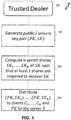
- FIG. 1 is a process flow diagram 100 illustrating threshold key generation by a trusted dealer 110 (e.g., a computing device, etc.) which is not allowed to take part to the secure median protocol.
- the trusted dealer 110 initially, at 120, generates a public / private key pair ( PK, SK ) . Thereafter, at 130, the trusted dealer 110 computes n secret shares SK 1 ,..., SK n of SK such that at least t shares are required to recover SK (the secret key).
- the trusted dealer 110 then, at 140, distributes the public key and respective private shares to clients C 1 , ..., C n and the public key to a server S.
- FIG. 2 is a process flow diagram 200 illustrating interaction between a client, 210 i and a server 220.
- each client 210 i generates its respective public / private key pair and, at 240, sends its public key, at 240, to the server 220.
- the server 220 at 250, then distributes the public keys received from all of the clients 210 l .. n to the respective clients (at 260) omitting, for each client 210 i its respective public key.
- FIG. 3 is a process flow diagram 300 illustrating interaction among a first client 210 i , the server 220, and a second client 210 j as part of a DGK comparison protocol.
- This diagram 300 corresponds to Protocol 2 above.
- client C i 210 i knows its own private input x i , the threshold public key PK, its share of the secret key SK i , its own public/private key ( pk i , sk i ), the public keys of all other clients 210.
- the input x i has bit representation x il ... x i 1 .
- the server 220 knows all public keys PK, pk 1 , ..., pk n .
- the client 210 i encrypts bitwise (i.e., for each single bit, a ciphertext is generated) the data value x i of interest using its own public key pk i , and sends the encrypted bits Enc ( pk i ,x il ), ..., Enc ( pk i , x i 1 ) to the server 220.
- the server 220 then, at 320, forwards the encrypted data bits to a second client 210 j .
- the random bit ⁇ ji is used to secret share the result of the comparison with client 210 i .
- the ciphertexts Enc ( pk i , z l ),..., Enc ( pk i , z 1 ) and Enc ( PK, ⁇ ji ) are sent back to the server 220 and forwarded to client 210 i at 350.
- client 210 i decrypts the ciphertexts Enc ( pk i , z l ),..., Enc ( pk i , z 1 ).
- client 210 i computes Enc(PK, ⁇ ij ⁇ ⁇ _ji ), as the final encrypted comparison bit between x i and x j , and sends it back to the server 220.
- FIG. 4 is a process flow diagram 400 illustrating interaction between the client 210 i and the server 220.
- this diagram 400 relates to threshold decryption as used in Protocol 5 (Steps 8 and 10).
- the server 220 chooses t clients to decrypt the result Enc ( PK, y ) of an evaluation (i.e., Enc ( PK, y ) is ciphertext as computed by Algorithm 3).
- the client 210 i receives the result Enc ( PK, y ) and computes a partial decryption using SK i (Step 8).
- the client 210 i then, at 430, sends the partial decryption h i to the server 220 (Step 10).
- the server 220 at 440, receive t values h i from the participating clients 220 combine them to get y .
- FIG. 5 is a process flow diagram 500 that relates to the activities of the client 210 as part of Protocol 5 shown above.
- the process starts, at 510, with the client 210, at 520, sending the encrypted dataset for analysis to the server 220.
- a loop commences, at 530, that iterates for each client. If, at 540, a pair of clients ( i , j ) satisfies the PAIRED predicate (Algorithm 1), then, at 550, client C i runs the DGK protocol as generator and client C j is the evaluator.
- Algorithm 1 a pair of clients ( i , j ) satisfies the PAIRED predicate
- clients C i and C j After the computation, clients C i and C j get shares ⁇ ij and ⁇ ji of the result, which is encrypted under the common public key as ⁇ ij ⁇ ⁇ ji and revealed to the server 220.
- the server 220 can then, at 560, run the threshold decryption using the encrypted results received from the clients 220 and, at 570, the final result is provided, and the process can terminate at 580.
- FIG. 6 is a process flow diagram 600 that relates to the activities of the server 220 as part of Protocol 5 shown above.
- the process starts, at 610, with the server 220, at 620, receiving the ciphertexts from the clients i .. .j 210.
- a loop commences, at 630, that iterates for each client. If, at 640, a pair of clients ( i,j ) satisfies the PAIRED predicate (Algorithm 1), then, at 650, the server 220 runs the DGK protocol with client C i as generator and client C j as the evaluator.
- Algorithm 1 the PAIRED predicate
- clients C i and C j After the computation, clients C i and C j get shares ⁇ ij and ⁇ ji of the result, which is encrypted under the common public key as ⁇ ij ⁇ ⁇ ji and revealed to the server 220.
- the server executes Algorithm 3 to compute the ranks and n ciphertexts among which exactly one is encrypting the median while the others are encrypting random plaintexts.
- the server 220 can then, at 670, run the threshold decryption using t clients and, at 680, the final result is provided by the server 220 to the clients 210 and the process can terminate at 690.
- FIG. 7 is a diagram 700 illustrating a sample computing device architecture for implementing various aspects described herein.
- a bus 704 can serve as the information highway interconnecting the other illustrated components of the hardware.
- a processing system 708 labeled CPU (central processing unit) e.g., one or more computer processors / data processors at a given computer or at multiple computers
- CPU central processing unit
- a non-transitory processor-readable storage medium such as read only memory (ROM) 712 and random access memory (RAM) 716, can be in communication with the processing system 708 and can include one or more programming instructions for the operations specified here.
- program instructions can be stored on a non-transitory computer-readable storage medium such as a magnetic disk, optical disk, recordable memory device, flash memory, or other physical storage medium.
- a disk controller 748 can interface with one or more optional disk drives to the system bus 704.
- These disk drives can be external or internal floppy disk drives such as 760, external or internal CD-ROM, CD-R, CD-RW or DVD, or solid state drives such as 752, or external or internal hard drives 756. As indicated previously, these various disk drives 752, 756, 760 and disk controllers are optional devices.
- the system bus 704 can also include at least one communication port 720 to allow for communication with external devices either physically connected to the computing system or available externally through a wired or wireless network. In some cases, the at least one communication port 720 includes or otherwise comprises a network interface.
- a computing device having a display device 740 (e.g., a CRT (cathode ray tube) or LCD (liquid crystal display) monitor) for displaying information obtained from the bus 704 via a display interface 714 to the user and an input device 732 such as keyboard and/or a pointing device (e.g., a mouse or a trackball) and/or a touchscreen by which the user can provide input to the computer.
- a display device 740 e.g., a CRT (cathode ray tube) or LCD (liquid crystal display) monitor
- an input device 732 such as keyboard and/or a pointing device (e.g., a mouse or a trackball) and/or a touchscreen by which the user can provide input to the computer.
- input devices 732 can be used to provide for interaction with a user as well; for example, feedback provided to the user can be any form of sensory feedback (e.g., visual feedback, auditory feedback by way of a microphone 736, or tactile feedback); and input from the user can be received in any form, including acoustic, speech, or tactile input.
- the input device 732 and the microphone 736 can be coupled to and convey information via the bus 704 by way of an input device interface 728.
- Other computing devices such as dedicated servers, can omit one or more of the display 740 and display interface 714, the input device 732, the microphone 736, and input device interface 728.
- One or more aspects or features of the subject matter described herein can be realized in digital electronic circuitry, integrated circuitry, specially designed application specific integrated circuits (ASICs), field programmable gate arrays (FPGAs) computer hardware, firmware, software, and/or combinations thereof.
- ASICs application specific integrated circuits
- FPGAs field programmable gate arrays
- These various aspects or features can include implementation in one or more computer programs that are executable and/or interpretable on a programmable system including at least one programmable processor, which can be special or general purpose, coupled to receive data and instructions from, and to transmit data and instructions to, a storage system, at least one input device, and at least one output device.
- the programmable system or computing system may include clients and servers.
- a client and server are generally remote from each other and typically interact through a communication network. The relationship of client and server arises by virtue of computer programs running on the respective computers and having a client-server relationship to each other.
- machine-readable signal refers to any signal used to provide machine instructions and/or data to a programmable processor.
- the machine-readable medium can store such machine instructions non-transitorily, such as for example as would a non-transient solid-state memory or a magnetic hard drive or any equivalent storage medium.
- the machine-readable medium can alternatively or additionally store such machine instructions in a transient manner, such as for example as would a processor cache or other random access memory associated with one or more physical processor cores.
- the subject matter described herein may be implemented on a computer having a display device (e.g., a CRT (cathode ray tube) or LCD (liquid crystal display) monitor) for displaying information to the user and a keyboard and a pointing device (e.g., a mouse or a trackball) and/or a touch screen by which the user may provide input to the computer.
- a display device e.g., a CRT (cathode ray tube) or LCD (liquid crystal display) monitor
- a keyboard and a pointing device e.g., a mouse or a trackball
- Other kinds of devices may be used to provide for interaction with a user as well; for example, feedback provided to the user may be any form of sensory feedback (e.g., visual feedback, auditory feedback, or tactile feedback); and input from the user may be received in any form, including acoustic, speech, or tactile input.
- phrases such as "at least one of” or “one or more of” may occur followed by a conjunctive list of elements or features.
- the term “and/or” may also occur in a list of two or more elements or features. Unless otherwise implicitly or explicitly contradicted by the context in which it is used, such a phrase is intended to mean any of the listed elements or features individually or any of the recited elements or features in combination with any of the other recited elements or features.
- the phrases “at least one of A and B;” “one or more of A and B;” and “A and/or B” are each intended to mean "A alone, B alone, or A and B together.”
- a similar interpretation is also intended for lists including three or more items.
- phrases “at least one of A, B, and C;” “one or more of A, B, and C;” and “A, B, and/or C” are each intended to mean “A alone, B alone, C alone, A and B together, A and C together, B and C together, or A and B and C together.”
- use of the term “based on,” above and in the claims is intended to mean, “based at least in part on,” such that an unrecited feature or element is also permissible.
Landscapes
- Engineering & Computer Science (AREA)
- Computer Security & Cryptography (AREA)
- Computer Networks & Wireless Communication (AREA)
- Signal Processing (AREA)
- Computing Systems (AREA)
- Theoretical Computer Science (AREA)
- Data Exchanges In Wide-Area Networks (AREA)
- Information Retrieval, Db Structures And Fs Structures Therefor (AREA)
Abstract
Description
- The subject matter described herein relates to securely computing the median of the union of private datasets using homomorphic encryption.
- Benchmarking is a management process where a company compares its Key Performance Indicators (KPI) to the statistics of the same KPIs of a group of competitors, named peer group. A KPI is a statistical quantity which measures the performance of a business process. Examples of KPI from different company operations are make cycle time (manufacturing), cash flow (financial) and employee fluctuation rate (human resources). A peer group is a group of (usually competing) companies that are interested in comparing their KPIs based on some similarity of the companies. Examples formed along different characteristics include car manufacturers (industry sector), Fortune 500 companies in the United States (revenue and location), or airline vs. railway vs. haulage (sales market). A big challenge for benchmarking is that the KPIs are very sensitive and highly confidential, even within one company.
- Privacy is one of the biggest concerns in benchmarking. Companies are hesitant to share their business performance data due to the risk of losing a competitive advantage or being embarrassed. There exist privacy-preserving protocols, that can be used for benchmarking that keep the KPIs confidential within one company. However, they all require a communication link between any pair of parties, resulting in high communication overhead when the number of parties becomes very large.
- In a first aspect, a server receives a corresponding data value encrypted using a common threshold public key from each of a plurality of clients. The server distributes the received data values to the clients for evaluating comparison of values. The server receives the encrypted comparison results from each of the clients in response to the distribution of the received encrypted data values. The comparison results are encrypted using the common key. The server homomorphically determines a ciphertext encrypting the rank of each client's data value using the comparison results. Further, the server can compute a ciphertext encrypting the median of the datasets. Thereafter, the server can initiate a threshold decryption to generate a final result.
- The received data values can be compared by each pair of clients using a Damgard, Geisler and Kroigaard (DGK) comparison protocol.
- The threshold decryption can include transmitting, by the server, an encrypted evaluation result to each of t clients, receiving, by the server, a partial decryption of the transmitted encrypted evaluation result from each of the t clients, and combining the t values to result in the final result. The final result can be transmitted to each of the clients.
- If a size of the datasets is odd, the median value is a middle value in the sorted datasets. If a size of the datasets is even, the median value is a mean of two middle values in the sorted datasets.
- A first client can encrypt a data value of interest using a public key of the first client. The first client can transmit the encrypted data value of the first client to the server. The server can forward the encrypted data value of the first client to a second client. The second client can choose a random bit δji and compute s = 1 - 2δji such that the random bit δji is used to secret share a result of a comparison. The second client can homomorphically evaluatea comparison circuit on its own data value of interest and the encrypted data value of the first client. The second client can generate corresponding ciphertexts. The second client can send the generated ciphertexts to the server. The server can then forward the generated ciphertexts to the first client. The first client using the generated ciphertexts can compute a final encrypted comparison bit. The first client can then send the final encrypted comparison bit to the server.
- In a second aspect, a server receives, from each of a plurality of pairs of clients, a corresponding data values encrypted using a common threshold public key. The server then can determined a median of the data values. Thereafter, the server homomorphically computinges a ciphertext encrypting the median of the data values. The ciphertext is then distributed to the clients so that the clients can jointly decrypt the ciphertext to determine the median.
- Non-transitory computer program products (i.e., physically embodied computer program products) are also described that store instructions, which when executed by one or more data processors of one or more computing systems, cause at least one data processor to perform operations herein. Similarly, computer systems are also described that may include one or more data processors and memory coupled to the one or more data processors. The memory may temporarily or permanently store instructions that cause at least one processor to perform one or more of the operations described herein. In addition, methods can be implemented by one or more data processors either within a single computing system or distributed among two or more computing systems. Such computing systems can be connected and can exchange data and/or commands or other instructions or the like via one or more connections, including but not limited to a connection over a network (e.g., the Internet, a wireless wide area network, a local area network, a wide area network, a wired network, or the like), via a direct connection between one or more of the multiple computing systems, etc.
- The subject matter described herein provides many technical advantages. For example, the current subject matter allows for the computation of a median for diverse private data sets while, at the same time, preserving the confidentiality of the underlying data.
- The details of one or more variations of the subject matter described herein are set forth in the accompanying drawings and the description below. Other features and advantages of the subject matter described herein will be apparent from the description and drawings, and from the claims.
-
-
FIG. 1 is a process flow diagram illustrating generation of public / private key pairs by a client, and the distribution of public keys to the clients; -
FIG. 2 is a process flow diagram illustrating distribution of public / private key pairs to clients; -
FIG. 3 is a process flow diagram illustrating a DGK comparison protocol process as used herein; -
FIG. 4 is a process flow diagram illustrating threshold decryption in which t shares of a private key are required to decrypt an encrypted value; -
FIG. 5 is a process flow diagram illustrating the secure computation of a median of datasets from a client perspective; -
FIG. 6 is a process flow diagram illustrating the secure computation of a median of datasets from a server perspective; -
FIG. 7 is a diagram illustrating aspects of a computing device that can be used for implementing subject matter described herein. - The current subject matter is directed to securely computing the median of the union of many private datasets. This is a special case of the problem of computing the k-th ranked element. It is an instance of secure multiparty computation protocol where several parties wish to compute a public known function on their private input while revealing only the output of the computation to a designated subset of parties and nothing else. The computation of the k-th ranked element is of particular interest in settings such as collaborative benchmarking where the individual datasets may contain proprietary information, yet where the kth-ranked element is of mutual interest to the participating companies.
- A service provider as described herein can be characterized as an organization which offers server-based services to its customers. It may control several servers running the service or parts of it, by acting as software as a service (SaaS) provider. During the multi-party computation of the median computation protocols, the service provider is a regular participant without any input, and it is therefore not allowed to learn plaintext KPIs from the participants. This means the service provider remains oblivious in the computation process. As in a star network, the clients can only communicate with the service provider, but never amongst each other directly. It is also beneficial to keep anonymity among the participants, which can only be guaranteed, if they do not need to address messages to each other directly. The explicit requirement for anonymity is that a subscriber does not know (or refer to) any static identifier of other subscribers (e.g. IP addresses, public keys, etc.). Any static identifier can disclose the composition of the peer group to the subscribers, and it may break the privacy of the complete system.
- The current subject matter is directed to the use of threshold homomorphic encryption including two efficient protocols for securely and privately computing the median with the help of an oblivious central server: namely threshold additive homomorphic encryption (TH-AHE) and threshold fully homomorphic encryption approach (TH-FHE).
- With TH-AHE as provided herein, parties (i.e., client computing devices, etc.) share the private key of an additive homomorphic encryption scheme. The clients use the common public key to send their encrypted input to the server. The clients can compare their input pairwise using DGK (Damgard, Geisler and Kroigaard) comparison and the help of the server. The comparison results can then be revealed to the server encrypted with the common public key. The server homomorphically computes the ciphertext encrypting the median and runs a threshold decryption with the help of the clients. Instantiating this scheme with ElGamal encryption on an elliptic curve can result in a more efficient protocol.
- With TH-FHE as provided herein, parties can share the private key of a fully homomorphic encryption scheme. They parties use the common public key to send their encrypted input to the server. The server homomorphically compares the inputs, computes the rank of each input and computes the ciphertext encrypting the median of the encrypted clients' inputs. Finally, the parties only interact to jointly decrypt the result. This scheme is efficient in the number of rounds (only 2), in communication and in client computation. The computation at the server is highly parallelizable.
- Secure multiparty computation (SMC) can allows n parties P 1 ,...,P n , with private input x 1 ,...,x n to compute the function y = f(x 1 ,...,x n ) such that only y is revealed and nothing else. Security in SMC is defined by comparison to an ideal model in which a trusted third party (TTP) receives x 1 ,...,x n computes and outputs y = f(x 1 ,...,x n ). The parties can emulate the ideal model by executing a cryptographic protocol. A SMC protocol is then said to be secure if the adversary can learn only the result y and nothing else. Security models can be semi-honest and malicious. Semi-honest adversaries follow the protocol but try to learn more information, while malicious adversaries may deviate from the protocol specification.
- A homomorphic encryption (HE) scheme as provided herein is an encryption scheme that allows computations on ciphertexts by generating an encrypted result whose decryption matches the result of a function on the corresponding plaintexts. A HE scheme as provided herein can include the following:
- PK, SK, EK ← KeyGen(λ): The probabilistic key generation algorithm takes a security parameter λ and generates a public key PK and the corresponding private key SK and an evaluation key EK.
- c ← Enc(PK, m): The probabilistic encryption algorithm encrypts a message m using the public key PK producing a ciphertext c.
- m' ← Dec(SK, c): The deterministic decryption algorithm decrypts a ciphertext c using the private key SK producing a message m'.
- c ←Eval(EK,f,c 1,...,cn ): The evaluation algorithm takes the evaluation key EK, an n-ary function f and n ciphertexts c 1,..., cn and returns a ciphertext c.
- For each message m and for each message tuple m 1,...,mn such that ci = Enc(PK, mi ), the following correctness conditions can apply:


- If the evaluation algorithm allows only the addition as function then the scheme can be characterized as additively homomorphic encryption (AHE) (e.g., Paillier, etc.). If the evaluation algorithm allows only the multiplication as function then the scheme is multiplicatively homomorphic encryption (e.g., RSA, ElGamal, etc.). If the evaluation algorithm allows both addition and multiplication, then the scheme is fully homomorphic encryption (FHE).
- Threshold Homomorphic Encryption (THE) as provided herein allows for the sharing of the private key to the parties such that a subset of parties is required for decryption. Formally, let ID = {..., idi, ...} be the set of identities of the n clients (1 ≤ i ≤ n). A THE scheme includes:


- c ← Enc(PK,m): The encryption algorithm encrypts a message m using the public key PK producing a ciphertext c.
-


-


- Furthermore, there is a homomorphic property:

- When used in a protocol, the party (i.e., computing device) that is responsible to execute the reconstruction algorithm can be referred to as the combiner. Depending on the protocol, the combiner can be any protocol participant or a server. The combiner can receive a set


- Mean, median, and mode are measures of central tendency. These measures provide an overall indication of how a population looks like. The median value refers to the division of the data set into two halves. To compute the median of any dataset the dataset values are sorted in ascending order. Then there are two possibilities depending on the size of the dataset, either it can be even or odd. When the size of the dataset is odd, the median is exactly the middle value of the sorted dataset. Otherwise, the median is calculated by computing the mean of the two middle values.
- Formally, let x 1,x 2,...,xn be the n data values. To determine the median, the data values are sorted in ascending order. If n is odd, then the median is the value that lies exactly in the middle of the dataset. That is, the median m is the data value at the position


- In the even case, the median is the mean of the two middle values of the ordered list. That is, m is the mean of the data values in positions


- The distinction between the even and odd cases can be avoided by the setting the middle as

- A computation model can be implemented using two mutually distrustful servers. The clients can submit their inputs to one server only using a special proxy Oblivious Transfer protocol. The overall protocol can, for example, used a GC protocol in which one server creates and encrypts the circuit and the other server evaluates the circuit. Multiple servers lead to different business models for the service provider of a privacy-preserving service. The service provider can share benefits with an almost equal peer offering its computational power. In the one server model the service provider can offer the service by himself. In practice, it can be very difficult to verify that two servers are really organizationally separated, although arrangement can be provided such that special service providers are dedicated for privacy-preserving services as described herein.
- In a server-aided privacy-preserving protocol as provided herein, the server can be a regular participant without any input. While privacy protects the confidentiality of the KPIs for the companies, it alleviates the server from the burden of storing and handling them and protects it from potential embarrassment due to accidental revelation. Another important aspect of the service provider model is that the subscribed companies only communicate with the service provider, but never amongst each other. Anonymity among the subscribed companies is a beneficial feature and can only be achieved, if they do not need to address messages to each other. The precise requirement for anonymity is that subscribers do not know or refer to any static identifier of other customers (e.g., IP addresses, public keys, etc.).
- The protocol runs between n clients and one server. The clients can communicate only through the server which has no input and must remain oblivious, i.e. the server should not learn clients' inputs. The scheme consists of two main steps. In the initialization, parties generate and exchange necessary cryptographic keys through the server. The main protocol allows the clients with the help of the server to run a sorting protocol. This then allows to compute the rank of each element and later the median. After the protocol the parties should learn only the expected result and nothing else. The protocol is secure in the semi-honest model, hence it can be assumed that the parties follow the protocol specification, but may try to learn more information than allowed.
- A secure median protocol (SM-AHE) based on threshold additive homomorphic encryption is provided herein. Threshold homomorphic encryption allows the clients to share the private key such that a subset of clients is required for decryption.
- The initialization requires a trusted dealer that is not allowed to participate in the main protocol. This step is also called the dealing phase in which the trusted dealer D generates a public/private key pair (PK, SK) for an additively homomorphic encryption. Then the private key SK is split in n shares SK 1, ... , SKn such that at least t shares are required to reconstruct SK. Finally, the trusted dealer distributes the n shares SK 1,..., SKn to the n clients (client Ci receiving SKi ) and delete any local memory referring to the secret key and the secret shares. However, in some variations, a protocol is provided, it is also possible to run a protocol, that allows each client to choose a secret SKi and to jointly compute a common PK with other clients such that at least t clients are required for the decryption. The dealing phase depends on the underlying homomorphic encryption. Additionally, each client Ci generates its own public/private key pair (pki , ski ) and and sends the public key to the server. The server then distributes the pki to all clients.
- With an efficient comparison protocol, let x and y be two l-bit integers, x = xl ... x 1 and y = yl...y 1 be their binary representations, where xl,yl are the more significant bits. To determine whether x ≤ y or x > y, one computes for each 1 ≤ i ≤ l the following numbers zi :

- The sum of exclusive-ors
 x
x denote Enc(pkA,x). To check whether x ≤ y holds the protocol works as follows:
- A sends xl
 ,...,
,..., x 1
x 1 to party B
- B computes a function DGKEVAL(xl
 ,...,
,..., x1
x1 ) as follows:
-

- Choose a random bit δB and set s := 1 - 2 · δB

- Blind the number zi
 : ∀i (1 ≤ i ≤ l) :
 zi
zi :=
:= zi
zi ri, for a random ri
- Set (z 1
 ,...,
,..., zl
zl ) := π(
 z 1
z 1 ,....,
 z l
z l ), where π is a permutation
- Return δB and (z 1
 ,...,
,..., zl
zl )
)
-
- B sends (z 1
 ,...,
,..., zl
zl ) to A and outputs δB
- A computes a function DGKDECRYPT(z 1
 , ... ,
 z l
z l ) as follows:

- For simplicity, letm
 i = Enc(pki,m) and
 x
x = Enc(PK,m). For an l-bit integer x, we use
 x
x to denote the ciphertext of the integer representation of x and (
 xl
xl , ...,
 x 1
x 1 ) to denote the ciphertext of the binary representation xl... x 1 of x. Each party Ci encrypts the integer representation of its input xi under the common public key PK and the binary representation of xi under its own public key pki and sends these ciphertexts to the server. Hence Ci sends
 x
x and (
and ( xil
xil i ,...,
 x i1
x i1 i ) to the server as illustrated in step 2 of protocol 5.
- With step 2, pairs of clients run the DGK comparison protocol through the server which is only used to forward messages as we do not have direct link between clients.
Algorithm 1 below can be used to pair clients and set the role of each client in a pair.
- The comparison is illustrated in Protocol 2 below. If a pair (i,j) satisfies the PAIRED predicate (Algorithm 1), then client Ci runs the DGK protocol as generator and client Cj is the evaluator. After the computation, parties Ci and Cj get shares δi and δj of the result, which is encrypted under the common public key asδi ⊕ δj
 and revealed to the server.

- The main scheme for computing the median is described in Protocol 5 and starts by requiring the clients to upload their ciphertexts (step 2) as described above. Then in step 4, the parties run the DGK comparison using Protocol 2.
- After all admissible comparisons have been computed, the server can use
algorithm 3 to compute the rank for each input xi by just homomorphically adding the comparison results involving xi. Letri be a ciphertext initially encrypting 0 and let bij = δij ⊕ δji . For each j, if PAIRED(i,j) is true then the server computes
 ri
ri ←
← ri + bij
 . Otherwise
 ri
ri ←
← ri + 1 - bij
 can be computed.
- Now the server has the encrypted rankr 1
 ,...,
,..., rn
rn , where exactly one
 ri
ri encrypts
 ri
ri ·
· k
k -1)αi ·
 xi
xi =
= (ri - k)αi + xi
 for all i. α can be chosen such that l < | α | < λ, where |α|,|n| are the bit length of α,n and λ is the bit length of any ciphertext. Therefore, for the ciphertext
 ri
ri encrypting k, Ri is equal to
 xi
xi . Otherwise Ri encrypts a random plaintext.

- In
step 8 of Protocol 5, the server distributes the result R 1, ..., Rn ofAlgorithm 3 to the clients for threshold decryption. The ciphertexts each client must decrypt are computed by the server using algorithm 4 below.Proposition 1 shows that the ciphertexts generated from Algorithm 4 allow for the correct decryption of R 1, ..., Rn . The first part shows that each client receives exactly a subset of t elements of {R 1, ..., Rn }. The second part shows that each Ri will be distributed to exactly t different clients which allows a correct threshold decryption. - Proposition 1: Let S = {α1, ..., αn}, t ≤ n and Si = {ai-t+1, ..., ai), 1 ≤ i ≤ n, where the indexes in Si are computed modulo n. Then:
- (i) Each subset Si contains exactly t elements of S and
- (ii) Each a ∈S is in exactly t subsets Si.
- Proof: It is clear from the definition that Si ⊆ S for all i and since i-(i-t+1)+1 = t, Si has exactly t elements. Let ai be in S, from the definition ai is element of only the subsets Si , S i+1, ..., S i+t-1, where the indexes of the Si are computed modulo n. Again, (i + t - 1) - i + 1 = t is shows that ai is in exactly t subsets.

- In the remaining steps of Protocol 5, the server receives the partial decryption from the clients (step 10), recombines them (step 12) and selects the plaintext whose bit length is smaller or equal to l as the median (step 13) and sends it to the clients (step 15).

- The following describes the use of SM-FHE. With this variation, the plaintext values are, therefore, encrypted using FHE. Hence,x
 now represents an FHE ciphertext of the plaintext x. The notation of the algorithm Eval can be as follows:

- Let x, y be two l-bit integers with binary representation xl ... x 1, yl, ... y 1. To check whether x is greater than y, one can evaluate the following circuit

 x
x ,
, y
y ) is used to denote the homomorphic evaluation of the comparison circuit.
- The initialization is similar to the previous case with the difference that only the threshold key generation is required. Hence, there is a public key PK, whose corresponding private key SK is split in n shares SK 1,...,SKn such that at least t shares are required to reconstruct SK. The shares of the private key are then distributed to the clients. The main protocol relies on the following proposition.
- Proposition 2: Let x 1,...,xn be n integers, r 1,...,rn ∈ {1,...,n} their corresponding rank and


- Proof. For all ri ∈ {1,...,n}, there is:


- The following relates to how the server can homomorphically compute the median from the ranks of the inputs. Assume the server has ciphertextsx 1
 ,...,
,..., xn
xn of plaintext x 1,...,xn and the ciphertext
 r 1
r 1 ,...,
,..., rn
rn of their corresponding rank. Moreover, assume the server knows only the public key used to encrypt the input and the evaluation key, but not the private key. The server can compute a ciphertext [x i*] such that ri* = k, 1 ≤ k ≤ n.
- Let
 f(ri )
 by first evaluating
 dij
dij =
= ri - j
 for all j and then
 1
1 if ri = k and
 0
0 otherwise. Finally, the server computes the encrypted inner product
 x 1
x 1 ,...,
,..., x n
x n ), (
), ( y 1
y 1 ,...,
,..., yn
yn ). If i* is such that ri* = k then we have

- The server computation is described in Algorithm 6. The algorithm gets fully homomorphic encrypted inputs, evaluates pairwise comparisons, computes the ranks and finally performs the computation described above to return the ciphertext of the element with rank k.

- The complete SM-FHE scheme is described in Protocol 7. In the first step of the protocol each client Ci just uploadxi
 encrypted under PK (step 2). Then the server runs algorithm 6 to get a ciphertext encrypting the median (step 3). In the remaining steps, the server runs a threshold decryption with a random set of t clients and reveals the final result.

-
FIGs. 1 - 6 provide further illustrations helpful for understanding the techniques described herein.FIG. 1 is a process flow diagram 100 illustrating threshold key generation by a trusted dealer 110 (e.g., a computing device, etc.) which is not allowed to take part to the secure median protocol. Thetrusted dealer 110 initially, at 120, generates a public / private key pair (PK, SK). Thereafter, at 130, thetrusted dealer 110 computes n secret shares SK 1,..., SKn of SK such that at least t shares are required to recover SK (the secret key). Thetrusted dealer 110 then, at 140, distributes the public key and respective private shares to clients C 1, ..., Cn and the public key to a server S. -
FIG. 2 is a process flow diagram 200 illustrating interaction between a client, 210 i and aserver 220. Initially, at 230, eachclient 210 i generates its respective public / private key pair and, at 240, sends its public key, at 240, to theserver 220. Theserver 220, at 250, then distributes the public keys received from all of theclients 210 l..n to the respective clients (at 260) omitting, for eachclient 210 i its respective public key. -
FIG. 3 is a process flow diagram 300 illustrating interaction among afirst client 210 i , theserver 220, and asecond client 210 j as part of a DGK comparison protocol. This diagram 300 corresponds to Protocol 2 above. With this arrangement,client Ci 210 i knows its own private input xi , the threshold public key PK, its share of the secret key SKi, its own public/private key (pki, ski ), the public keys of allother clients 210. The input xi has bit representation xil ... x i1. Theserver 220 knows all public keys PK, pk 1, ..., pkn. Initially, at 310, theclient 210 i encrypts bitwise (i.e., for each single bit, a ciphertext is generated) the data value xi of interest using its own public key pki, and sends the encrypted bits Enc(pki,xil ), ..., Enc(pki, x i1) to theserver 220. Theserver 220 then, at 320, forwards the encrypted data bits to asecond client 210 j . Thesecond client 210 j then, at 330, chooses a random bit δji and computes s = 1 - 2δji . The random bit δji is used to secret share the result of the comparison withclient 210 i . Thenclient 210 j , at 340, homomorphically evaluates a comparison circuit on its own input bits xjl ... x j1 and the encrypted bits Enc(pki, xil ), ..., Enc(pki, xi1 ) by computing ciphertexts Enc(pki, zl ), ..., Enc(pki, z 1), where
server 220 and forwarded toclient 210 i at 350. At 360,client 210 i decrypts the ciphertexts Enc(pki, zl ),..., Enc(pki, z 1). At 370,client 210 i sets δij = 1 if one decryption at 360 has returned 0, otherwise δij = 0. At 380,client 210 i computes Enc(PK, δij ⊕ δ_ji), as the final encrypted comparison bit between xi and xj, and sends it back to theserver 220. Finally, at 390 theserver 220 receives the encrypted comparison bit Enc(PK, δij ⊕ δji ) = Enc(PK, bij ) and uses it to compute Enc(PK, bji ) = Enc(PK, 1 - bij ). -
FIG. 4 is a process flow diagram 400 illustrating interaction between theclient 210 i and theserver 220. In particular, this diagram 400 relates to threshold decryption as used in Protocol 5 (Steps 8 and 10). Initially, theserver 220, at 410, chooses t clients to decrypt the result Enc(PK, y) of an evaluation (i.e., Enc(PK, y) is ciphertext as computed by Algorithm 3). Theclient 210 i , at 420, receives the result Enc(PK, y) and computes a partial decryption using SKi (Step 8). Theclient 210 i then, at 430, sends the partial decryption hi to the server 220 (Step 10). Theserver 220, at 440, receive t values hi from the participatingclients 220 combine them to get y. -
FIG. 5 is a process flow diagram 500 that relates to the activities of theclient 210 as part of Protocol 5 shown above. The process starts, at 510, with theclient 210, at 520, sending the encrypted dataset for analysis to theserver 220. A loop commences, at 530, that iterates for each client. If, at 540, a pair of clients (i,j) satisfies the PAIRED predicate (Algorithm 1), then, at 550, client Ci runs the DGK protocol as generator and client Cj is the evaluator. After the computation, clients Ci and Cj get shares δij and δji of the result, which is encrypted under the common public key asδij ⊕ δji and revealed to the
server 220. Theserver 220 can then, at 560, run the threshold decryption using the encrypted results received from theclients 220 and, at 570, the final result is provided, and the process can terminate at 580. -
FIG. 6 is a process flow diagram 600 that relates to the activities of theserver 220 as part of Protocol 5 shown above. The process starts, at 610, with theserver 220, at 620, receiving the ciphertexts from theclients i...j 210. A loop commences, at 630, that iterates for each client. If, at 640, a pair of clients (i,j) satisfies the PAIRED predicate (Algorithm 1), then, at 650, theserver 220 runs the DGK protocol with client Ci as generator and client Cj as the evaluator. After the computation, clients Ci and Cj get shares δij and δji of the result, which is encrypted under the common public key asδij ⊕ δji and revealed to the
server 220. Next, at 660, the server executesAlgorithm 3 to compute the ranks and n ciphertexts among which exactly one is encrypting the median while the others are encrypting random plaintexts. Theserver 220 can then, at 670, run the threshold decryption using t clients and, at 680, the final result is provided by theserver 220 to theclients 210 and the process can terminate at 690. -
FIG. 7 is a diagram 700 illustrating a sample computing device architecture for implementing various aspects described herein. Abus 704 can serve as the information highway interconnecting the other illustrated components of the hardware. Aprocessing system 708 labeled CPU (central processing unit) (e.g., one or more computer processors / data processors at a given computer or at multiple computers), can perform calculations and logic operations required to execute a program. A non-transitory processor-readable storage medium, such as read only memory (ROM) 712 and random access memory (RAM) 716, can be in communication with theprocessing system 708 and can include one or more programming instructions for the operations specified here. Optionally, program instructions can be stored on a non-transitory computer-readable storage medium such as a magnetic disk, optical disk, recordable memory device, flash memory, or other physical storage medium. - In one example, a
disk controller 748 can interface with one or more optional disk drives to thesystem bus 704. These disk drives can be external or internal floppy disk drives such as 760, external or internal CD-ROM, CD-R, CD-RW or DVD, or solid state drives such as 752, or external or internalhard drives 756. As indicated previously, thesevarious disk drives system bus 704 can also include at least onecommunication port 720 to allow for communication with external devices either physically connected to the computing system or available externally through a wired or wireless network. In some cases, the at least onecommunication port 720 includes or otherwise comprises a network interface. - To provide for interaction with a user, the subject matter described herein can be implemented on a computing device having a display device 740 (e.g., a CRT (cathode ray tube) or LCD (liquid crystal display) monitor) for displaying information obtained from the
bus 704 via adisplay interface 714 to the user and aninput device 732 such as keyboard and/or a pointing device (e.g., a mouse or a trackball) and/or a touchscreen by which the user can provide input to the computer. Other kinds ofinput devices 732 can be used to provide for interaction with a user as well; for example, feedback provided to the user can be any form of sensory feedback (e.g., visual feedback, auditory feedback by way of amicrophone 736, or tactile feedback); and input from the user can be received in any form, including acoustic, speech, or tactile input. Theinput device 732 and themicrophone 736 can be coupled to and convey information via thebus 704 by way of aninput device interface 728. Other computing devices, such as dedicated servers, can omit one or more of thedisplay 740 anddisplay interface 714, theinput device 732, themicrophone 736, andinput device interface 728. - One or more aspects or features of the subject matter described herein can be realized in digital electronic circuitry, integrated circuitry, specially designed application specific integrated circuits (ASICs), field programmable gate arrays (FPGAs) computer hardware, firmware, software, and/or combinations thereof. These various aspects or features can include implementation in one or more computer programs that are executable and/or interpretable on a programmable system including at least one programmable processor, which can be special or general purpose, coupled to receive data and instructions from, and to transmit data and instructions to, a storage system, at least one input device, and at least one output device. The programmable system or computing system may include clients and servers. A client and server are generally remote from each other and typically interact through a communication network. The relationship of client and server arises by virtue of computer programs running on the respective computers and having a client-server relationship to each other.
- These computer programs, which can also be referred to as programs, software, software applications, applications, components, or code, include machine instructions for a programmable processor, and can be implemented in a high-level procedural language, an object-oriented programming language, a functional programming language, a logical programming language, and/or in assembly/machine language. As used herein, the term "machine-readable medium" refers to any computer program product, apparatus and/or device, such as for example magnetic discs, optical disks, memory, and Programmable Logic Devices (PLDs), used to provide machine instructions and/or data to a programmable processor, including a machine-readable medium that receives machine instructions as a machine-readable signal. The term "machine-readable signal" refers to any signal used to provide machine instructions and/or data to a programmable processor. The machine-readable medium can store such machine instructions non-transitorily, such as for example as would a non-transient solid-state memory or a magnetic hard drive or any equivalent storage medium. The machine-readable medium can alternatively or additionally store such machine instructions in a transient manner, such as for example as would a processor cache or other random access memory associated with one or more physical processor cores.
- To provide for interaction with a user, the subject matter described herein may be implemented on a computer having a display device (e.g., a CRT (cathode ray tube) or LCD (liquid crystal display) monitor) for displaying information to the user and a keyboard and a pointing device (e.g., a mouse or a trackball) and/or a touch screen by which the user may provide input to the computer. Other kinds of devices may be used to provide for interaction with a user as well; for example, feedback provided to the user may be any form of sensory feedback (e.g., visual feedback, auditory feedback, or tactile feedback); and input from the user may be received in any form, including acoustic, speech, or tactile input.
- In the descriptions above and in the claims, phrases such as "at least one of" or "one or more of" may occur followed by a conjunctive list of elements or features. The term "and/or" may also occur in a list of two or more elements or features. Unless otherwise implicitly or explicitly contradicted by the context in which it is used, such a phrase is intended to mean any of the listed elements or features individually or any of the recited elements or features in combination with any of the other recited elements or features. For example, the phrases "at least one of A and B;" "one or more of A and B;" and "A and/or B" are each intended to mean "A alone, B alone, or A and B together." A similar interpretation is also intended for lists including three or more items. For example, the phrases "at least one of A, B, and C;" "one or more of A, B, and C;" and "A, B, and/or C" are each intended to mean "A alone, B alone, C alone, A and B together, A and C together, B and C together, or A and B and C together." In addition, use of the term "based on," above and in the claims is intended to mean, "based at least in part on," such that an unrecited feature or element is also permissible.
- The subject matter described herein can be embodied in systems, apparatus, methods, and/or articles depending on the desired configuration. The implementations set forth in the foregoing description do not represent all implementations consistent with the subject matter described herein. Instead, they are merely some examples consistent with aspects related to the described subject matter. Although a few variations have been described in detail above, other modifications or additions are possible. In particular, further features and/or variations can be provided in addition to those set forth herein. For example, the implementations described above can be directed to various combinations and subcombinations of the disclosed features and/or combinations and subcombinations of several further features disclosed above. In addition, the logic flows depicted in the accompanying figures and/or described herein do not necessarily require the particular order shown, or sequential order, to achieve desirable results. Other implementations may be within the scope of the following claims.

Claims (14)
- A computer-implemented method comprising:receiving, by a server from each of a plurality of clients, a corresponding data value encrypted using a common threshold public key;distributing, by the server, the received data values to the clients for evaluating comparison of values;receiving, by the server, encrypted comparison results from each of the clients in response to the distribution of the received encrypted data values, the comparison results being encrypted using the common key;determining, by the server, a ciphertext encrypting the rank of each client's data value using the comparison results;computing a ciphertext encrypting the median of the datasets; andinitiating, by the server using the clients, a threshold decryption to generate a final result.
- The method of claim 1 further comprising:
comparing, by each pair of clients, the received data values using a Damgard, Geisler and Kroigaard (DGK) comparison protocol. - The method of claim 1 or 2, wherein the threshold decryption comprises:transmitting, by the server, an encrypted evaluation result to each of t clients;receiving, by the server, a partial decryption of the transmitted encrypted evaluation result from each of the t clients; andcombining the t values to result in the final result.
- The method of claim 3 further comprising:
transmitting the final result to each of the clients. - The method of any one of claims 1 to 4, wherein if a size of the datasets is odd, the median value is a middle value in the sorted datasets.
- The method of any one of claims 1 to 5, wherein if a size of the datasets is even, the median value is a mean of two middle values in the sorted datasets.
- The method of any one of claims 1 to 6 further comprising:encrypting, by a first client, a data value of interest using a public key of the first client;transmitting, by the first client, the encrypted data value of the first client to the server;forwarding, by the server, the encrypted data value of the first client to a second client.
- The method of claim 7 further comprising:
choosing, by the second client, a random bit δji and computing s = 1 - 2δji, the random bit δji being used to secret share a result of a comparison. - The method of claim 8 further comprising:homomorphically evaluating, by the second client, a comparison circuit on its own data value of interest and the encrypted data value of the first client; andgenerating, by the second client, corresponding ciphertexts.
- The method of claim 9 further comprising:sending, by the second client, the generated ciphertexts to the server;forwarding, by the server, the generated ciphertexts to the first client;computing, by the first client using the generated ciphertexts, a final encrypted comparison bit; andsending, by the first client, the final encrypted comparison bit to the server.
- A computer-implemented method comprising:receiving, by a server from each of a plurality of pairs of clients, a corresponding data values encrypted using a common threshold public key;determining, by the server, a median of the data values;homomorphically computing, by the server, a ciphertext encrypting the median of the data values; anddistributing the ciphertext to the clients so that the clients can jointly decrypt the ciphertext to determine the median.
- The method of claim 11, wherein if a size of the datasets is odd, the median value is a middle value in the sorted datasets.
- The method of claim 11 or 12, wherein if a size of the datasets is even, the median value is a mean of two middle values in the sorted datasets.
- A system comprising:at least one data processor; andmemory storing instructions which, when executed by the at least one data processor, result in operations according to the method of any one of claims 1 to 13.
Applications Claiming Priority (1)
| Application Number | Priority Date | Filing Date | Title |
|---|---|---|---|
| US16/289,399 US11218290B2 (en) | 2019-02-28 | 2019-02-28 | Efficient cloud-based secure computation of the median using homomorphic encryption |
Publications (3)
| Publication Number | Publication Date |
|---|---|
| EP3703309A1 true EP3703309A1 (en) | 2020-09-02 |
| EP3703309C0 EP3703309C0 (en) | 2024-08-28 |
| EP3703309B1 EP3703309B1 (en) | 2024-08-28 |
Family
ID=68655355
Family Applications (1)
| Application Number | Title | Priority Date | Filing Date |
|---|---|---|---|
| EP19211186.2A Active EP3703309B1 (en) | 2019-02-28 | 2019-11-25 | Efficient cloud-based secure computation of the median using homomorphic encryption |
Country Status (2)
| Country | Link |
|---|---|
| US (1) | US11218290B2 (en) |
| EP (1) | EP3703309B1 (en) |
Cited By (3)
| Publication number | Priority date | Publication date | Assignee | Title |
|---|---|---|---|---|
| CN112487481A (en) * | 2020-12-09 | 2021-03-12 | 重庆邮电大学 | Verifiable multi-party k-means federal learning method with privacy protection |
| CN115834113A (en) * | 2022-10-11 | 2023-03-21 | 北京密码云芯科技有限公司 | OT communication method, OT communication device, electronic device, and storage medium |
| CN118337359A (en) * | 2024-03-18 | 2024-07-12 | 河南农业大学 | Cross-domain access control method for heterogeneous multi-chain data based on threshold homomorphic encryption |
Families Citing this family (11)
| Publication number | Priority date | Publication date | Assignee | Title |
|---|---|---|---|---|
| US11218290B2 (en) * | 2019-02-28 | 2022-01-04 | Sap Se | Efficient cloud-based secure computation of the median using homomorphic encryption |
| US11646877B2 (en) * | 2019-05-14 | 2023-05-09 | Samsung Sds Co., Ltd. | Apparatus and method for generating secret key, apparatus and method for generating evaluation key |
| US12099997B1 (en) | 2020-01-31 | 2024-09-24 | Steven Mark Hoffberg | Tokenized fungible liabilities |
| WO2022094829A1 (en) * | 2020-11-05 | 2022-05-12 | 深圳技术大学 | Data security comparison protocol implementation method and system, electronic apparatus, and storage medium |
| US12081644B2 (en) * | 2021-02-01 | 2024-09-03 | Sap Se | Efficient distributed privacy-preserving computations |
| CN113051590B (en) * | 2021-03-19 | 2024-03-26 | 华为技术有限公司 | Data processing method and related equipment |
| CN113141248B (en) * | 2021-04-25 | 2023-06-16 | 重庆都会信息科技有限公司 | Threshold decryption method and system based on homomorphic encryption and readable storage medium |
| US12229304B2 (en) * | 2021-05-04 | 2025-02-18 | International Business Machines Corporation | Secure data analytics |
| CN114003781B (en) * | 2021-09-18 | 2025-10-03 | 阿里巴巴(中国)有限公司 | Data processing method, device, computer equipment and computer readable storage medium |
| KR102736490B1 (en) * | 2022-10-26 | 2024-11-29 | 하이파이브랩 주식회사 | Financial transaction system using individual distribution keys based on multi-party computation and method thereof |
| CN118972831B (en) * | 2024-07-26 | 2025-10-17 | 西安电子科技大学 | Privacy protection road network information sharing method based on crowd sensing |
Family Cites Families (17)
| Publication number | Priority date | Publication date | Assignee | Title |
|---|---|---|---|---|
| CN1875569A (en) * | 2003-11-03 | 2006-12-06 | 皇家飞利浦电子股份有限公司 | Method and device for efficient multiparty multiplication |
| WO2005119960A2 (en) * | 2004-06-01 | 2005-12-15 | Ben-Gurion University Of The Negev Research And Development Authority | Structure preserving database encryption method and system |
| US20120121080A1 (en) * | 2010-11-11 | 2012-05-17 | Sap Ag | Commutative order-preserving encryption |
| US8526603B2 (en) * | 2011-07-08 | 2013-09-03 | Sap Ag | Public-key encrypted bloom filters with applications to private set intersection |
| WO2014069998A1 (en) * | 2012-10-30 | 2014-05-08 | Nederlandse Organisatie Voor Toegepast-Natuurwetenschappelijk Onderzoek Tno | Method and system for protected exchange of data |
| US9524370B2 (en) * | 2014-11-03 | 2016-12-20 | Ecole Polytechnique Federale De Lausanne (Epfl) | Method for privacy-preserving medical risk test |
| KR102349605B1 (en) * | 2014-11-17 | 2022-01-11 | 삼성전자 주식회사 | Method and apparatus for providing services based on identifier of user device |
| US10333696B2 (en) * | 2015-01-12 | 2019-06-25 | X-Prime, Inc. | Systems and methods for implementing an efficient, scalable homomorphic transformation of encrypted data with minimal data expansion and improved processing efficiency |
| GB2558271B (en) * | 2016-12-23 | 2021-09-08 | Imagination Tech Ltd | Median determination |
| EP3419211B1 (en) * | 2017-06-23 | 2022-03-30 | Flytxt B.V. | Privacy preserving computation protocol for data analytics |
| EP3462667A1 (en) * | 2017-09-27 | 2019-04-03 | Banco Bilbao Vizcaya Argentaria, S.A. | Blockchain based joint blind key escrow |
| US10764048B2 (en) * | 2017-12-20 | 2020-09-01 | Nxp B.V. | Privacy-preserving evaluation of decision trees |
| US10460234B2 (en) * | 2018-01-19 | 2019-10-29 | Microsoft Technology Licensing, Llc | Private deep neural network training |
| US10630486B2 (en) * | 2018-09-12 | 2020-04-21 | Unbound Tech Ltd. | Multiparty computation for approving digital transaction by utilizing groups of key shares |
| US11218290B2 (en) * | 2019-02-28 | 2022-01-04 | Sap Se | Efficient cloud-based secure computation of the median using homomorphic encryption |
| US11250140B2 (en) * | 2019-02-28 | 2022-02-15 | Sap Se | Cloud-based secure computation of the median |
| US11368296B2 (en) * | 2020-04-15 | 2022-06-21 | Sap Se | Communication-efficient secret shuffle protocol for encrypted data based on homomorphic encryption and oblivious transfer |
-
2019
- 2019-02-28 US US16/289,399 patent/US11218290B2/en active Active
- 2019-11-25 EP EP19211186.2A patent/EP3703309B1/en active Active
Non-Patent Citations (3)
| Title |
|---|
| BLASS ERIK-OLIVER ET AL: "Strain: A Secure Auction for Blockchains", 8 August 2018, INTERNATIONAL CONFERENCE ON FINANCIAL CRYPTOGRAPHY AND DATA SECURITY; [LECTURE NOTES IN COMPUTER SCIENCE; LECT.NOTES COMPUTER], SPRINGER, BERLIN, HEIDELBERG, PAGE(S) 87 - 110, ISBN: 978-3-642-17318-9, XP047482362 * |
| DAN BOGDANOV ET AL: "Rmind: a tool for cryptographically secure statistical analysis", IACR, INTERNATIONAL ASSOCIATION FOR CRYPTOLOGIC RESEARCH, vol. 20140630:165415, 30 June 2014 (2014-06-30), pages 1 - 35, XP061016368 * |
| KILIAN BECHER ET AL: "An Enhanced Approach to Cloud-based Privacy-preserving Benchmarking (Long Version)", ARXIV.ORG, CORNELL UNIVERSITY LIBRARY, 201 OLIN LIBRARY CORNELL UNIVERSITY ITHACA, NY 14853, 11 October 2018 (2018-10-11), XP081064500 * |
Cited By (4)
| Publication number | Priority date | Publication date | Assignee | Title |
|---|---|---|---|---|
| CN112487481A (en) * | 2020-12-09 | 2021-03-12 | 重庆邮电大学 | Verifiable multi-party k-means federal learning method with privacy protection |
| CN112487481B (en) * | 2020-12-09 | 2022-06-10 | 重庆邮电大学 | A verifiable multi-party k-means federated learning method with privacy protection |
| CN115834113A (en) * | 2022-10-11 | 2023-03-21 | 北京密码云芯科技有限公司 | OT communication method, OT communication device, electronic device, and storage medium |
| CN118337359A (en) * | 2024-03-18 | 2024-07-12 | 河南农业大学 | Cross-domain access control method for heterogeneous multi-chain data based on threshold homomorphic encryption |
Also Published As
| Publication number | Publication date |
|---|---|
| US11218290B2 (en) | 2022-01-04 |
| EP3703309C0 (en) | 2024-08-28 |
| EP3703309B1 (en) | 2024-08-28 |
| US20200280430A1 (en) | 2020-09-03 |
Similar Documents
| Publication | Publication Date | Title |
|---|---|---|
| EP3703309B1 (en) | Efficient cloud-based secure computation of the median using homomorphic encryption | |
| EP3703304B1 (en) | Cloud-based secure computation of the median | |
| Liu et al. | Towards practical privacy-preserving decision tree training and evaluation in the cloud | |
| US11606203B2 (en) | Method for faster secure multiparty inner product with SPDZ | |
| Carter et al. | Secure outsourced garbled circuit evaluation for mobile devices | |
| Liu et al. | Secure skyline queries on cloud platform | |
| US11356241B2 (en) | Verifiable secret shuffle protocol for encrypted data based on homomorphic encryption and secret sharing | |
| EP3075098B1 (en) | Server-aided private set intersection (psi) with data transfer | |
| US11368296B2 (en) | Communication-efficient secret shuffle protocol for encrypted data based on homomorphic encryption and oblivious transfer | |
| Kara et al. | A fully homomorphic encryption based on magic number fragmentation and El‐Gamal encryption: Smart healthcare use case | |
| Zhu et al. | Improving the security of protocols of quantum key agreement solely using Bell states and Bell measurement | |
| EP3737030A1 (en) | Privacy-preserving benchmarking with interval statistics reducing leakage | |
| Hamlin et al. | Cryptography for Big Data Security. | |
| US20210328763A1 (en) | Computation-efficient secret shuffle protocol for encrypted data based on homomorphic encryption | |
| Liu et al. | Provably secure three-party password-based authenticated key exchange from RLWE | |
| Traverso et al. | Dynamic and verifiable hierarchical secret sharing | |
| Tueno et al. | Secure Computation of the-Ranked Element in a Star Network | |
| Bao et al. | Secure multiparty computation protocol based on homomorphic encryption and its application in blockchain | |
| Aloufi et al. | Collaborative homomorphic computation on data encrypted under multiple keys | |
| Liu et al. | Quantum protocol for millionaire problem | |
| Wei et al. | Efficient and secure outsourced approximate pattern matching protocol | |
| Di Crescenzo et al. | Efficient and private three-party publish/subscribe | |
| Zhang et al. | Privacy-preserving two-party distributed association rules mining on horizontally partitioned data | |
| Dou et al. | Efficient private subset computation | |
| Yang et al. | An improved scheme for outsourced computation with attribute‐based encryption |
Legal Events
| Date | Code | Title | Description |
|---|---|---|---|
| PUAI | Public reference made under article 153(3) epc to a published international application that has entered the european phase |
Free format text: ORIGINAL CODE: 0009012 |
|
| STAA | Information on the status of an ep patent application or granted ep patent |
Free format text: STATUS: THE APPLICATION HAS BEEN PUBLISHED |
|
| AK | Designated contracting states |
Kind code of ref document: A1 Designated state(s): AL AT BE BG CH CY CZ DE DK EE ES FI FR GB GR HR HU IE IS IT LI LT LU LV MC MK MT NL NO PL PT RO RS SE SI SK SM TR |
|
| AX | Request for extension of the european patent |
Extension state: BA ME |
|
| STAA | Information on the status of an ep patent application or granted ep patent |
Free format text: STATUS: REQUEST FOR EXAMINATION WAS MADE |
|
| 17P | Request for examination filed |
Effective date: 20210302 |
|
| RBV | Designated contracting states (corrected) |
Designated state(s): AL AT BE BG CH CY CZ DE DK EE ES FI FR GB GR HR HU IE IS IT LI LT LU LV MC MK MT NL NO PL PT RO RS SE SI SK SM TR |
|
| STAA | Information on the status of an ep patent application or granted ep patent |
Free format text: STATUS: EXAMINATION IS IN PROGRESS |
|
| 17Q | First examination report despatched |
Effective date: 20231009 |
|
| GRAP | Despatch of communication of intention to grant a patent |
Free format text: ORIGINAL CODE: EPIDOSNIGR1 |
|
| STAA | Information on the status of an ep patent application or granted ep patent |
Free format text: STATUS: GRANT OF PATENT IS INTENDED |
|
| INTG | Intention to grant announced |
Effective date: 20240319 |
|
| GRAS | Grant fee paid |
Free format text: ORIGINAL CODE: EPIDOSNIGR3 |
|
| GRAA | (expected) grant |
Free format text: ORIGINAL CODE: 0009210 |
|
| STAA | Information on the status of an ep patent application or granted ep patent |
Free format text: STATUS: THE PATENT HAS BEEN GRANTED |
|
| AK | Designated contracting states |
Kind code of ref document: B1 Designated state(s): AL AT BE BG CH CY CZ DE DK EE ES FI FR GB GR HR HU IE IS IT LI LT LU LV MC MK MT NL NO PL PT RO RS SE SI SK SM TR |
|
| REG | Reference to a national code |
Ref country code: GB Ref legal event code: FG4D |
|
| REG | Reference to a national code |
Ref country code: CH Ref legal event code: EP |
|
| REG | Reference to a national code |
Ref country code: DE Ref legal event code: R096 Ref document number: 602019057797 Country of ref document: DE |
|
| REG | Reference to a national code |
Ref country code: IE Ref legal event code: FG4D |
|
| U01 | Request for unitary effect filed |
Effective date: 20240828 |
|
| U07 | Unitary effect registered |
Designated state(s): AT BE BG DE DK EE FI FR IT LT LU LV MT NL PT RO SE SI Effective date: 20240903 |
|
| U20 | Renewal fee for the european patent with unitary effect paid |
Year of fee payment: 6 Effective date: 20241126 |
|
| PG25 | Lapsed in a contracting state [announced via postgrant information from national office to epo] |
Ref country code: NO Free format text: LAPSE BECAUSE OF FAILURE TO SUBMIT A TRANSLATION OF THE DESCRIPTION OR TO PAY THE FEE WITHIN THE PRESCRIBED TIME-LIMIT Effective date: 20241128 |
|
| PG25 | Lapsed in a contracting state [announced via postgrant information from national office to epo] |
Ref country code: GR Free format text: LAPSE BECAUSE OF FAILURE TO SUBMIT A TRANSLATION OF THE DESCRIPTION OR TO PAY THE FEE WITHIN THE PRESCRIBED TIME-LIMIT Effective date: 20241129 Ref country code: PL Free format text: LAPSE BECAUSE OF FAILURE TO SUBMIT A TRANSLATION OF THE DESCRIPTION OR TO PAY THE FEE WITHIN THE PRESCRIBED TIME-LIMIT Effective date: 20240828 |
|
| PG25 | Lapsed in a contracting state [announced via postgrant information from national office to epo] |
Ref country code: IS Free format text: LAPSE BECAUSE OF FAILURE TO SUBMIT A TRANSLATION OF THE DESCRIPTION OR TO PAY THE FEE WITHIN THE PRESCRIBED TIME-LIMIT Effective date: 20241228 |
|
| PG25 | Lapsed in a contracting state [announced via postgrant information from national office to epo] |
Ref country code: HR Free format text: LAPSE BECAUSE OF FAILURE TO SUBMIT A TRANSLATION OF THE DESCRIPTION OR TO PAY THE FEE WITHIN THE PRESCRIBED TIME-LIMIT Effective date: 20240828 |
|
| PG25 | Lapsed in a contracting state [announced via postgrant information from national office to epo] |
Ref country code: RS Free format text: LAPSE BECAUSE OF FAILURE TO SUBMIT A TRANSLATION OF THE DESCRIPTION OR TO PAY THE FEE WITHIN THE PRESCRIBED TIME-LIMIT Effective date: 20241128 Ref country code: ES Free format text: LAPSE BECAUSE OF FAILURE TO SUBMIT A TRANSLATION OF THE DESCRIPTION OR TO PAY THE FEE WITHIN THE PRESCRIBED TIME-LIMIT Effective date: 20240828 |
|
| PG25 | Lapsed in a contracting state [announced via postgrant information from national office to epo] |
Ref country code: RS Free format text: LAPSE BECAUSE OF FAILURE TO SUBMIT A TRANSLATION OF THE DESCRIPTION OR TO PAY THE FEE WITHIN THE PRESCRIBED TIME-LIMIT Effective date: 20241128 Ref country code: PL Free format text: LAPSE BECAUSE OF FAILURE TO SUBMIT A TRANSLATION OF THE DESCRIPTION OR TO PAY THE FEE WITHIN THE PRESCRIBED TIME-LIMIT Effective date: 20240828 Ref country code: NO Free format text: LAPSE BECAUSE OF FAILURE TO SUBMIT A TRANSLATION OF THE DESCRIPTION OR TO PAY THE FEE WITHIN THE PRESCRIBED TIME-LIMIT Effective date: 20241128 Ref country code: IS Free format text: LAPSE BECAUSE OF FAILURE TO SUBMIT A TRANSLATION OF THE DESCRIPTION OR TO PAY THE FEE WITHIN THE PRESCRIBED TIME-LIMIT Effective date: 20241228 Ref country code: HR Free format text: LAPSE BECAUSE OF FAILURE TO SUBMIT A TRANSLATION OF THE DESCRIPTION OR TO PAY THE FEE WITHIN THE PRESCRIBED TIME-LIMIT Effective date: 20240828 Ref country code: GR Free format text: LAPSE BECAUSE OF FAILURE TO SUBMIT A TRANSLATION OF THE DESCRIPTION OR TO PAY THE FEE WITHIN THE PRESCRIBED TIME-LIMIT Effective date: 20241129 Ref country code: ES Free format text: LAPSE BECAUSE OF FAILURE TO SUBMIT A TRANSLATION OF THE DESCRIPTION OR TO PAY THE FEE WITHIN THE PRESCRIBED TIME-LIMIT Effective date: 20240828 |
|
| PG25 | Lapsed in a contracting state [announced via postgrant information from national office to epo] |
Ref country code: SM Free format text: LAPSE BECAUSE OF FAILURE TO SUBMIT A TRANSLATION OF THE DESCRIPTION OR TO PAY THE FEE WITHIN THE PRESCRIBED TIME-LIMIT Effective date: 20240828 |
|
| PG25 | Lapsed in a contracting state [announced via postgrant information from national office to epo] |
Ref country code: CZ Free format text: LAPSE BECAUSE OF FAILURE TO SUBMIT A TRANSLATION OF THE DESCRIPTION OR TO PAY THE FEE WITHIN THE PRESCRIBED TIME-LIMIT Effective date: 20240828 |
|
| PG25 | Lapsed in a contracting state [announced via postgrant information from national office to epo] |
Ref country code: SK Free format text: LAPSE BECAUSE OF FAILURE TO SUBMIT A TRANSLATION OF THE DESCRIPTION OR TO PAY THE FEE WITHIN THE PRESCRIBED TIME-LIMIT Effective date: 20240828 |
|
| REG | Reference to a national code |
Ref country code: CH Ref legal event code: PL |
|
| PLBE | No opposition filed within time limit |
Free format text: ORIGINAL CODE: 0009261 |
|
| STAA | Information on the status of an ep patent application or granted ep patent |
Free format text: STATUS: NO OPPOSITION FILED WITHIN TIME LIMIT |
|
| PG25 | Lapsed in a contracting state [announced via postgrant information from national office to epo] |
Ref country code: MC Free format text: LAPSE BECAUSE OF FAILURE TO SUBMIT A TRANSLATION OF THE DESCRIPTION OR TO PAY THE FEE WITHIN THE PRESCRIBED TIME-LIMIT Effective date: 20240828 |
|
| REG | Reference to a national code |
Ref country code: CH Ref legal event code: PL |
|
| PG25 | Lapsed in a contracting state [announced via postgrant information from national office to epo] |
Ref country code: CH Free format text: LAPSE BECAUSE OF NON-PAYMENT OF DUE FEES Effective date: 20241130 |
|
| 26N | No opposition filed |
Effective date: 20250530 |
|
| PG25 | Lapsed in a contracting state [announced via postgrant information from national office to epo] |
Ref country code: IE Free format text: LAPSE BECAUSE OF NON-PAYMENT OF DUE FEES Effective date: 20241125 |
|
| U20 | Renewal fee for the european patent with unitary effect paid |
Year of fee payment: 7 Effective date: 20251127 |
|
| PGFP | Annual fee paid to national office [announced via postgrant information from national office to epo] |
Ref country code: GB Payment date: 20251121 Year of fee payment: 7 |
|
| PG25 | Lapsed in a contracting state [announced via postgrant information from national office to epo] |
Ref country code: HU Free format text: LAPSE BECAUSE OF FAILURE TO SUBMIT A TRANSLATION OF THE DESCRIPTION OR TO PAY THE FEE WITHIN THE PRESCRIBED TIME-LIMIT; INVALID AB INITIO Effective date: 20191125 |
|
| PG25 | Lapsed in a contracting state [announced via postgrant information from national office to epo] |
Ref country code: CY Free format text: LAPSE BECAUSE OF FAILURE TO SUBMIT A TRANSLATION OF THE DESCRIPTION OR TO PAY THE FEE WITHIN THE PRESCRIBED TIME-LIMIT; INVALID AB INITIO Effective date: 20191125 |