EP3700089A1 - Touch-type button for vehicle - Google Patents
Touch-type button for vehicle Download PDFInfo
- Publication number
- EP3700089A1 EP3700089A1 EP19209015.7A EP19209015A EP3700089A1 EP 3700089 A1 EP3700089 A1 EP 3700089A1 EP 19209015 A EP19209015 A EP 19209015A EP 3700089 A1 EP3700089 A1 EP 3700089A1
- Authority
- EP
- European Patent Office
- Prior art keywords
- touch
- type button
- transparent electrode
- hidden cover
- transmissivity
- Prior art date
- Legal status (The legal status is an assumption and is not a legal conclusion. Google has not performed a legal analysis and makes no representation as to the accuracy of the status listed.)
- Granted
Links
Images









Classifications
-
- H—ELECTRICITY
- H03—ELECTRONIC CIRCUITRY
- H03K—PULSE TECHNIQUE
- H03K17/00—Electronic switching or gating, i.e. not by contact-making and –breaking
- H03K17/94—Electronic switching or gating, i.e. not by contact-making and –breaking characterised by the way in which the control signals are generated
- H03K17/96—Touch switches
- H03K17/962—Capacitive touch switches
- H03K17/9622—Capacitive touch switches using a plurality of detectors, e.g. keyboard
-
- G—PHYSICS
- G06—COMPUTING OR CALCULATING; COUNTING
- G06F—ELECTRIC DIGITAL DATA PROCESSING
- G06F3/00—Input arrangements for transferring data to be processed into a form capable of being handled by the computer; Output arrangements for transferring data from processing unit to output unit, e.g. interface arrangements
- G06F3/01—Input arrangements or combined input and output arrangements for interaction between user and computer
- G06F3/03—Arrangements for converting the position or the displacement of a member into a coded form
- G06F3/041—Digitisers, e.g. for touch screens or touch pads, characterised by the transducing means
- G06F3/044—Digitisers, e.g. for touch screens or touch pads, characterised by the transducing means by capacitive means
-
- B—PERFORMING OPERATIONS; TRANSPORTING
- B60—VEHICLES IN GENERAL
- B60K—ARRANGEMENT OR MOUNTING OF PROPULSION UNITS OR OF TRANSMISSIONS IN VEHICLES; ARRANGEMENT OR MOUNTING OF PLURAL DIVERSE PRIME-MOVERS IN VEHICLES; AUXILIARY DRIVES FOR VEHICLES; INSTRUMENTATION OR DASHBOARDS FOR VEHICLES; ARRANGEMENTS IN CONNECTION WITH COOLING, AIR INTAKE, GAS EXHAUST OR FUEL SUPPLY OF PROPULSION UNITS IN VEHICLES
- B60K35/00—Instruments specially adapted for vehicles; Arrangement of instruments in or on vehicles
- B60K35/10—Input arrangements, i.e. from user to vehicle, associated with vehicle functions or specially adapted therefor
-
- B—PERFORMING OPERATIONS; TRANSPORTING
- B60—VEHICLES IN GENERAL
- B60Q—ARRANGEMENT OF SIGNALLING OR LIGHTING DEVICES, THE MOUNTING OR SUPPORTING THEREOF OR CIRCUITS THEREFOR, FOR VEHICLES IN GENERAL
- B60Q3/00—Arrangement of lighting devices for vehicle interiors; Lighting devices specially adapted for vehicle interiors
- B60Q3/80—Circuits; Control arrangements
- B60Q3/82—Switches specially adapted for vehicle interior lighting, e.g. switching by tilting the lens
-
- F—MECHANICAL ENGINEERING; LIGHTING; HEATING; WEAPONS; BLASTING
- F21—LIGHTING
- F21V—FUNCTIONAL FEATURES OR DETAILS OF LIGHTING DEVICES OR SYSTEMS THEREOF; STRUCTURAL COMBINATIONS OF LIGHTING DEVICES WITH OTHER ARTICLES, NOT OTHERWISE PROVIDED FOR
- F21V23/00—Arrangement of electric circuit elements in or on lighting devices
- F21V23/04—Arrangement of electric circuit elements in or on lighting devices the elements being switches
- F21V23/0442—Arrangement of electric circuit elements in or on lighting devices the elements being switches activated by means of a sensor, e.g. motion or photodetectors
- F21V23/0485—Arrangement of electric circuit elements in or on lighting devices the elements being switches activated by means of a sensor, e.g. motion or photodetectors the sensor sensing the physical interaction between a user and certain areas located on the lighting device, e.g. a touch sensor
-
- H—ELECTRICITY
- H01—ELECTRIC ELEMENTS
- H01H—ELECTRIC SWITCHES; RELAYS; SELECTORS; EMERGENCY PROTECTIVE DEVICES
- H01H36/00—Switches actuated by change of magnetic field or of electric field, e.g. by change of relative position of magnet and switch, by shielding
-
- H—ELECTRICITY
- H03—ELECTRONIC CIRCUITRY
- H03K—PULSE TECHNIQUE
- H03K17/00—Electronic switching or gating, i.e. not by contact-making and –breaking
- H03K17/94—Electronic switching or gating, i.e. not by contact-making and –breaking characterised by the way in which the control signals are generated
- H03K17/96—Touch switches
- H03K17/962—Capacitive touch switches
-
- B—PERFORMING OPERATIONS; TRANSPORTING
- B60—VEHICLES IN GENERAL
- B60K—ARRANGEMENT OR MOUNTING OF PROPULSION UNITS OR OF TRANSMISSIONS IN VEHICLES; ARRANGEMENT OR MOUNTING OF PLURAL DIVERSE PRIME-MOVERS IN VEHICLES; AUXILIARY DRIVES FOR VEHICLES; INSTRUMENTATION OR DASHBOARDS FOR VEHICLES; ARRANGEMENTS IN CONNECTION WITH COOLING, AIR INTAKE, GAS EXHAUST OR FUEL SUPPLY OF PROPULSION UNITS IN VEHICLES
- B60K2360/00—Indexing scheme associated with groups B60K35/00 or B60K37/00 relating to details of instruments or dashboards
- B60K2360/141—Activation of instrument input devices by approaching fingers or pens
-
- B—PERFORMING OPERATIONS; TRANSPORTING
- B60—VEHICLES IN GENERAL
- B60K—ARRANGEMENT OR MOUNTING OF PROPULSION UNITS OR OF TRANSMISSIONS IN VEHICLES; ARRANGEMENT OR MOUNTING OF PLURAL DIVERSE PRIME-MOVERS IN VEHICLES; AUXILIARY DRIVES FOR VEHICLES; INSTRUMENTATION OR DASHBOARDS FOR VEHICLES; ARRANGEMENTS IN CONNECTION WITH COOLING, AIR INTAKE, GAS EXHAUST OR FUEL SUPPLY OF PROPULSION UNITS IN VEHICLES
- B60K2360/00—Indexing scheme associated with groups B60K35/00 or B60K37/00 relating to details of instruments or dashboards
- B60K2360/143—Touch sensitive instrument input devices
- B60K2360/1446—Touch switches
-
- B—PERFORMING OPERATIONS; TRANSPORTING
- B60—VEHICLES IN GENERAL
- B60K—ARRANGEMENT OR MOUNTING OF PROPULSION UNITS OR OF TRANSMISSIONS IN VEHICLES; ARRANGEMENT OR MOUNTING OF PLURAL DIVERSE PRIME-MOVERS IN VEHICLES; AUXILIARY DRIVES FOR VEHICLES; INSTRUMENTATION OR DASHBOARDS FOR VEHICLES; ARRANGEMENTS IN CONNECTION WITH COOLING, AIR INTAKE, GAS EXHAUST OR FUEL SUPPLY OF PROPULSION UNITS IN VEHICLES
- B60K2360/00—Indexing scheme associated with groups B60K35/00 or B60K37/00 relating to details of instruments or dashboards
- B60K2360/20—Optical features of instruments
- B60K2360/33—Illumination features
- B60K2360/34—Backlit symbols
-
- B—PERFORMING OPERATIONS; TRANSPORTING
- B60—VEHICLES IN GENERAL
- B60K—ARRANGEMENT OR MOUNTING OF PROPULSION UNITS OR OF TRANSMISSIONS IN VEHICLES; ARRANGEMENT OR MOUNTING OF PLURAL DIVERSE PRIME-MOVERS IN VEHICLES; AUXILIARY DRIVES FOR VEHICLES; INSTRUMENTATION OR DASHBOARDS FOR VEHICLES; ARRANGEMENTS IN CONNECTION WITH COOLING, AIR INTAKE, GAS EXHAUST OR FUEL SUPPLY OF PROPULSION UNITS IN VEHICLES
- B60K2360/00—Indexing scheme associated with groups B60K35/00 or B60K37/00 relating to details of instruments or dashboards
- B60K2360/60—Structural details of dashboards or instruments
- B60K2360/68—Features of instruments
- B60K2360/682—Arrangements to cover or hide instruments
-
- F—MECHANICAL ENGINEERING; LIGHTING; HEATING; WEAPONS; BLASTING
- F21—LIGHTING
- F21Y—INDEXING SCHEME ASSOCIATED WITH SUBCLASSES F21K, F21L, F21S and F21V, RELATING TO THE FORM OR THE KIND OF THE LIGHT SOURCES OR OF THE COLOUR OF THE LIGHT EMITTED
- F21Y2115/00—Light-generating elements of semiconductor light sources
- F21Y2115/10—Light-emitting diodes [LED]
-
- H—ELECTRICITY
- H03—ELECTRONIC CIRCUITRY
- H03K—PULSE TECHNIQUE
- H03K17/00—Electronic switching or gating, i.e. not by contact-making and –breaking
- H03K17/94—Electronic switching or gating, i.e. not by contact-making and –breaking characterised by the way in which the control signals are generated
- H03K17/96—Touch switches
- H03K2017/9602—Touch switches characterised by the type or shape of the sensing electrodes
-
- H—ELECTRICITY
- H03—ELECTRONIC CIRCUITRY
- H03K—PULSE TECHNIQUE
- H03K2217/00—Indexing scheme related to electronic switching or gating, i.e. not by contact-making or -breaking covered by H03K17/00
- H03K2217/94—Indexing scheme related to electronic switching or gating, i.e. not by contact-making or -breaking covered by H03K17/00 characterised by the way in which the control signal is generated
- H03K2217/96—Touch switches
- H03K2217/9607—Capacitive touch switches
- H03K2217/960755—Constructional details of capacitive touch and proximity switches
-
- H—ELECTRICITY
- H03—ELECTRONIC CIRCUITRY
- H03K—PULSE TECHNIQUE
- H03K2217/00—Indexing scheme related to electronic switching or gating, i.e. not by contact-making or -breaking covered by H03K17/00
- H03K2217/94—Indexing scheme related to electronic switching or gating, i.e. not by contact-making or -breaking covered by H03K17/00 characterised by the way in which the control signal is generated
- H03K2217/96—Touch switches
- H03K2217/9607—Capacitive touch switches
- H03K2217/960785—Capacitive touch switches with illumination
Definitions
- the present disclosure relates to a touch-type button for operating an electronic device, an air conditioning device or the like of a vehicle.
- buttons for operating an electronic device such as an audio, video, navigation (AVN) device and the like, or an air conditioning device, an illuminating device including a light emitting diode (LED), and the like, the buttons having different characters thereon through which a user can know functions of the buttons.
- an electronic device such as an audio, video, navigation (AVN) device and the like, or an air conditioning device, an illuminating device including a light emitting diode (LED), and the like, the buttons having different characters thereon through which a user can know functions of the buttons.
- a conventional mechanical button is configured such that light emitted from the LED is transmitted through an empty space of a button holding frame to allow the light to penetrate a surface of the button.
- the button is configured such that the light emitting from the LED can penetrate the button which is generally formed from light-transmitting plastic material (mainly, polycarbonate (PC)) and has transmissivity (5 to 18%) for visible light.
- light-transmitting plastic material mainly, polycarbonate (PC)
- PC polycarbonate
- an electrode for a touch-type button is used, which is made of a conductive material.
- the touch-type button detects a change in signal relative to initial capacitance to recognize whether the button is turned on or off.
- the touch-type button has an advantage in that material having a high electric conductivity can produce larger capacitance.
- a transparent electrode has been precisely manufactured through a deposition process or the like in order to provide a high-definition display device with a touch function.
- Silver (Ag) nanowire, silver metal mesh, copper, conductive polymer, indium tin oxide and the like are mainly used for the electrode of the touch-type button, and characteristics of button illumination of a vehicle are influenced by transmissivity of light-transmitting plastic material.
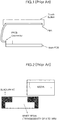
- a touch film in order for light of a LED located under a touch film to come out of the touch-type button, a touch film should have a shape in which a central portion thereof is pierced, so that the button has a shape of a button cover as shown in FIG. 2 .
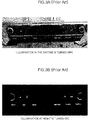
- black paint is applied on a surface of white resin formed by injection-molding polycarbonate to which white coloring agent is added, a surface portion of the white resin corresponding to a letter font is then laser-cut to manufacture a button cover, and a touch panel is formed on a rear surface of the button cover.
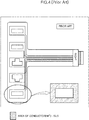
- a portion where a center hole is formed becomes a region through which the LED light is transmitted, and a region surrounding the center hole is the region where a touch electrode formed of copper is formed. Therefore, an area of the conductor is reduced due to the hole, so that there is a limitation in that touch sensitivity is inevitably weak.
- the letters such as "A/C” has a short font, but when the letters such as "TRACK” has a long font, it is difficult to form a large hole, so that there is a problem that the illumination region becomes smaller. If the illumination region becomes small as described above, uniformity of illumination on the font is deteriorated, and thus a restriction in terms of design such a size of the font and the like is also accompanied.
- FIG. 7A and FIG. 7B which is an enlarged view of FIG. 7A
- a flexible printed circuit board FPCB
- FIG. 7B which is an enlarged view of FIG. 7A
- foreign substances such as dust and the like are attached to a section portion of layer on which the adhesive is existed. This can cause quality degradation of the LED backlight illumination.
- the present disclosure has been made to solve the above-described problems, and the object of the present disclosure is to provide a touch-type button for a vehicle which can recognize a letter, day and night, using illumination, enlarge and uniformize an illumination region.
- a touch-type button for a vehicle may include: a hidden cover defining an external appearance of the touch-type button and having a pattern which corresponds to a letter font; and a transparent electrode attached to a rear surface of the hidden cover and configured to generate a signal in response to a change in capacitance.
- the transparent electrode transmits light emitted from a light source disposed behind thereof to allow the letter font to be revealed and recognized.
- the hidden cover may include a black film in which a portion corresponding to the letter font is cut, and a smoky resin injection molded product attached to the black film and containing polycarbonate base to which black coloring agent and light diffusing additive are added.
- the hidden cover may have a thickness of 1 to 3 mm.
- the hidden cover may have transmissivity of 30 to 45%.
- the hidden cover may have turbidity of 90% or more.
- the hidden cover may have brightness (L*) of less than 70.
- the transparent electrode may have a thickness of less than 150 ⁇ m.
- the transparent electrode may have transmissivity of 85% or more.
- the transparent electrode may have turbidity of less than 2%.
- the transparent electrode may have yellowness (b*) of less than 2.
- the transparent electrode may have a surface resistance of less than 200 ⁇ .
- the touch-type may further include a light diffusing film attached to the transparent electrode, and the light diffusing film may have transmissivity of 85% or more and turbidity of 90% or more.
- a touch-type button for a vehicle may include: a hidden cover defining an external appearance of the touch-type button and comprising a black film in which a portion corresponding to a letter font is cut, and a smoky resin injection molded product attached to the black film and containing a polycarbonate base to which a black coloring agent and a light diffusing additive are added, and a transparent electrode attached to a rear surface of the hidden cover and configured to generate a signal in response to a change in capacitance.
- the hidden cover may have transmissivity of 30 to 45%
- the transparent electrode may have transmissivity of 85% or more.
- FIG. 8 is a diagram showing an operating method of a touch-type button for a vehicle according to an exemplary embodiment of the present disclosure
- FIGS. 9A and 9B are diagrams illustrating the result of the touch-type button for the vehicle according to an exemplary embodiment of the present disclosure which is implemented by the method shown in FIG. 8 .
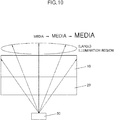
- FIG. 10 is a diagram schematically illustrating the touch-type button for the vehicle according to an exemplary embodiment of the present disclosure
- FIGS. 11 and 12 are diagrams illustrating one configuration of the touch-type button for the vehicle according to an exemplary embodiment of the present disclosure.
- FIGS. 8 , 9A , 9B , 10 , 11 , and 12 the touch-type button for the vehicle according to one exemplary embodiment of the present disclosure is described with reference to FIGS. 8 , 9A , 9B , 10 , 11 , and 12 .
- a conventional touch-type button for a vehicle adopts a simple method in which a font of button is appeared in white in the daytime and illumination is turned on only at night. According to the above, brightness of the night illumination should be thus low, because glare and light blur occur when illumination is bright. Therefore, the conventional touch-type button does not require high brightness.
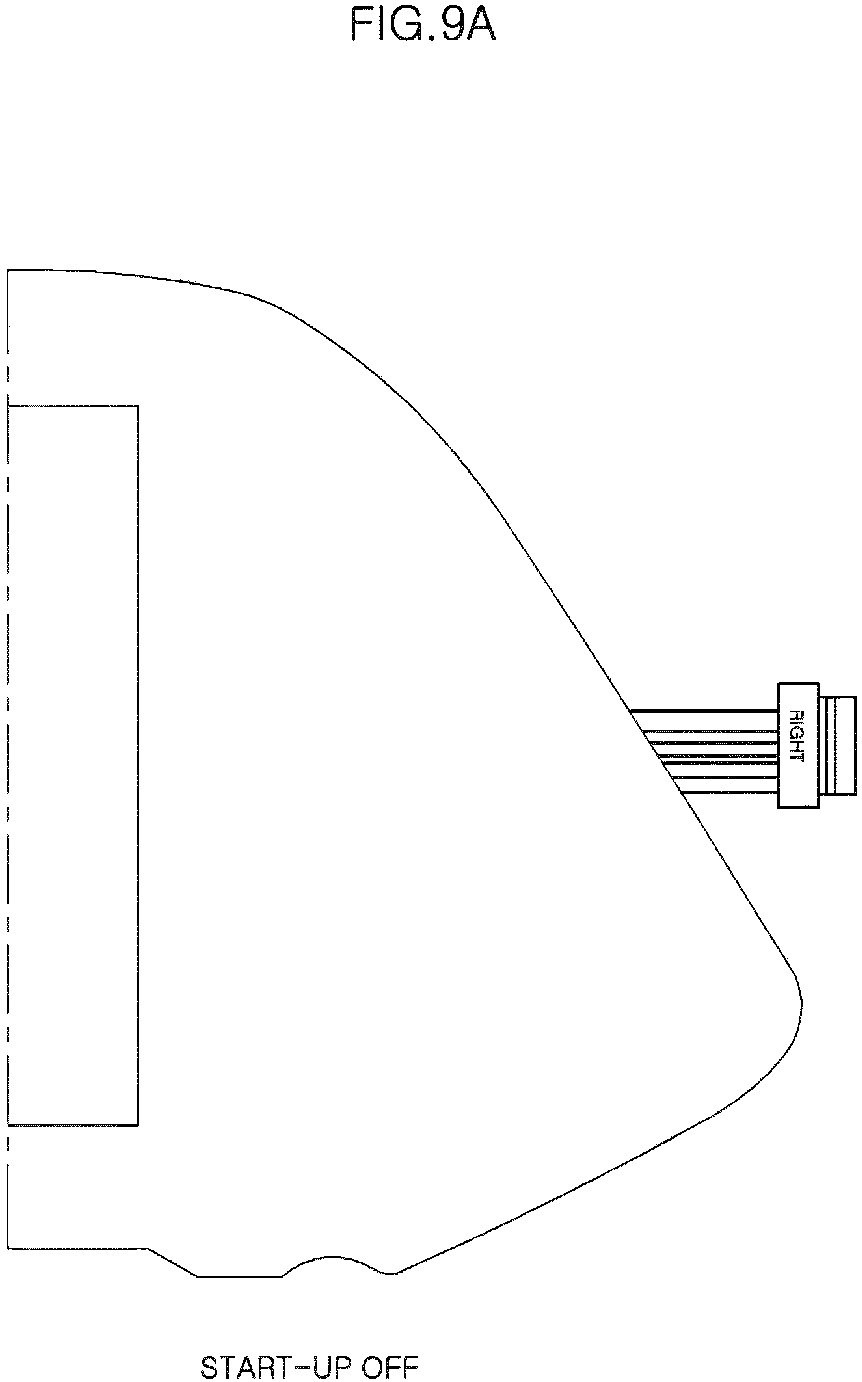
- a hidden function by which a font of letter is not visible as shown in FIG. 9A is realized in a state in which a vehicle has not started and illumination is turned off as shown in FIG. 8 , and when the vehicle starts, the illumination is turned-on day and night as shown in FIG. 9B to allow the font of letter to be revealed by the illumination, and high brightness is thus needed.
- the touch-type button for the vehicle includes a hidden cover 10 and a transparent electrode, for example, an indium tin oxide (ITO) touch film 20.
- a transparent adhesive such as an optical clear adhesive (OCA) may be interposed between the hidden cover 10 and the ITO touch film.
- the hidden cover 10 corresponds to an external appearance of the button which is exposed to the outside and allows a user to touch the hidden cover, and the transparent electrode is attached to a rear surface of the hidden cover 10, so that the amount of change in capacitance is transmitted through a printed circuit board (PCB) (not shown) connected to the transparent electrode, and a touch input is thus recognized.
- PCB printed circuit board
- the hidden cover 10 and the transparent electrode transmit light emitted from a light emitting diode (LED) 30, so that letter fonts patterned on the hidden cover 10 are brighter than surroundings thereof to enable the user to recognize the letter fonts.
- LED light emitting diode
- the hidden cover 10 is composed of an in-mold label (IML) film 11 and a smoky resin injection molded product 12.
- IML in-mold label
- the hidden cover 10 is manufactured by laser-cutting a black film in accordance with the letter fonts and then attaching the black film to the smoky resin injection molded product, which is a composition of polycarbonate (PC), black coloring agent and light diffusing additive, in an in-mold label (IML) process.
- PC polycarbonate
- IML in-mold label
- the hidden cover By configuring the hidden cover as above, the letter font is not exposed in the absence of illumination, and the illuminated region can be widened due to the high light transmittance of the transparent electrode. In addition, a conductor area is increased as shown in FIG. 12 , and touch sensitivity can be thus enhanced more than twice.
- Table 1 Hidden cover ITO touch film Thickness (mm) Transmissivity (%) Turbidity (%) Brightness (L*) Thickness ( ⁇ m) Transmissivity (%) Turbidity (%) Yellowness (b*) Sheet resistance ( ⁇ ) 1 ⁇ 3 30 ⁇ 45 90 or more Less than 70 Less than 150 85 or more Less than 2 Less than 2 Less than 200
- a thickness of the hidden cover 10 may be 1 to 3mm.
- the thickness of the hidden cover 10 When the thickness of the hidden cover 10 is out of the above range and is less than 1 mm, flexure of the hidden may be occurred after performing an environmental durability test, and when the thickness of the hidden cover exceeds 3 mm, a distance between the electrode and the user's finger is increased, and so the touch performance may be degraded.
- the hidden cover should have transmissivity of 30 to 45%.
- transmissivity of the hidden cover 10 When transmissivity of the hidden cover 10 is less than 30%, the light transmittance of the LED is deteriorated, and brightness performance of the illumination is thus degraded. In addition, if the transmissivity exceeds 45%, even when the lighting is turned off, the font is recognized with the naked eye and a hidden characteristic is thus degraded, and a hot spot phenomenon, in which the illumination is brightly looked as a point light source due to a straight advancing property of the LED illumination, occurs to lower uniformity of the illumination.
- Brightness can be determined according to the transmittance, and when the brightness L* exceeds 70, the font is also recognized with the naked eye and the hidden characteristic is thus degraded.
- the LED light is not diffused well in a condition of turbidity of less than 90%, and therefore, there is a problem that uniformity of the illumination is deteriorated.
- the total thickness of the ITO touch film 20 should not exceed 150 ⁇ m.
- transmissivity of the ITO touch film should be 85 % or more in accordance with Japanese Industrial Standard (JIS)-K-7361 which is the internal standard, and turbidity should be less than 2% in accordance with JIS-K-7136.
- the transmissivity is less than 85%, light loss of the LED light is increased, and so brightness of the illumination may be deteriorated. If the turbidity is 2% or more, the brightness of the illumination may be deteriorated due to light scattering of the LED light.
- Yellowness b* should be less than 2 in accordance with JIS-Z-8722 (Methods of colour measurement - Reflecting and transmitting objects).
- a color coordinate of the LED illumination color may be shifted due to yellowing of the film and the illumination color may be thus changed.
- a hidden function is realized when the illumination is turned off, and the light may be bright and uniform when the illumination is turned on and performance desired by the present disclosure can be achieved.
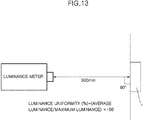
- FIG. 13 schematically illustrates a method of evaluating the illumination emitted through the touch-type button for the vehicle according to an exemplary embodiment of the present disclosure using a two-dimensional imaging type luminance measuring instrument, and the light uniformity of illumination should be 60% or more.
- the brightness at the button 1 which is 30 cm away from a lens of the measuring instrument should be more than 400cd/m 2 so that the touch-type button can be used in the daytime.
- the present disclosure includes the hidden cover 10 and the ITO touch film 20 having the above-described conditions, thereby functioning as a button configured to transmit a touch input signal to a controller (not shown) through a user's operation.
- the hidden cover 10 is a plastic insulator, and the touch film 20 made of ITO acts as an electrode. Basically, when a human's hand touches the electrode in a state where the electrode has constant capacitance, a touch signal is sensed by a change in capacitance.
- ITO Since as compared to a conventional flexible printed circuit board (FPCB), ITO has a large electrode area, ITO has a large capacitance and excellent touch sensitivity.
- the hidden cover 10 is provided for preventing the font from being revealed in the absence of illumination, and as shown in FIG. 14 , PC, which is base material of the hidden cover, contains black coloring agent and silicon dioxide (SiO x ) light diffusing agent as an additive.
- the transmissivity of the hidden cover can be adjusted by adjusting the content of black coloring agent. This is because the black coloring agent prevents the light of the LED from being transmitted.
- the hidden characteristic may be realized in a proper transmissivity range of the hidden cover.
- a part shown on a background indicates a state in which the illumination is turned off
- another part shown on an upper right corner indicates a state in which the illumination is turned on.
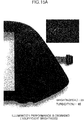
- FIG. 15A shows a case where the transmissivity is 8%, and it can be seen that the illumination performance is degraded (insufficient brightness).
- FIG. 15B shows a case where the transmissivity is 30% corresponding to the present disclosure, and it can be seen that a letter or a graphic is concealed and that the brightness and uniformity of illumination are satisfied.
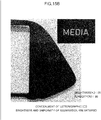
- FIG. 15C shows a case where the transmissivity is 51%, and it can be seen that the letter and the graphic are not concealed.
- FIG. 15D shows a case where the transmissivity is 73%, and it can be seen that the letter and the graphic are not concealed and a hot spot occurs in the illumination.
- the light diffusing agent is added.
- the optimum transmissivity range, turbidity range and brightness value of the hidden cover were derived.
- FIG. 16A shows a case in which a conventional FPCB type touch switch is used, an uneven phenomenon of the illumination occurs due to the LED light going straight through a perforated hole.
- the ITO touch film of the present disclosure is employed as shown in FIG. 16B , while the light passes through a transparent wide area of ITO, diffusion/scattering of the light through the film occurs, and the uniformity of illumination is thus improved by the light diffusion effect caused by the above.
- Comparative example 7 when turbidity of the cover is smaller than a certain value, the uniformity of illumination is deteriorated, and when brightness of the cover is higher than a certain value as in Comparative example 8, it is difficult to realize a hidden function to a level at which the font is recognized with the naked eye, and the transmissivity is somewhat decreased due to an addition of white coloring agent, so that the luminance of illumination is deteriorated.
- the transmissivity of the electrode is lowered to a certain value, so that the transmittance of the light of the LED is deteriorated and the luminance of the illumination is reduced.
- the turbidity of the electrode is increased to a certain value or more, a decrease in the luminance of illumination is generated.
- FIG. 17 schematically illustrates a touch-type button for a vehicle according to another exemplary embodiment of the present disclosure.
- optical characteristics can be further improved by adding a light diffusing film 40.
- the light diffusing film 40 attached to the ITO touch film 20 may have transmissivity of 85% or more and haze (turbidity) of 90% or more.
- a conventional touch-type button has been configured to be operated in a manner in which the font of the button is appeared in white in the daytime and the lighting is turned on only at night. Consequently, when night illumination is too bright, glare and light blur occur, so that brightness of the night illumination has to be low.
- the touch-type button for a vehicle of the present disclosure a hidden function by which the font is not visible before a vehicle is started-up is realized, and the font is illuminated by the illumination at the moment of starting-up the vehicle. Therefore, it is possible to recognize the font, day and night, using the illumination, and to obtain high brightness performance.
- the ITO touch film employed as the transparent electrode is directly attached to the rear surface of the hidden cover, the illumination area can be widened through the high light transmittance, and by realizing the uniform illumination, size of the font can be variously made.
Landscapes
- Engineering & Computer Science (AREA)
- General Engineering & Computer Science (AREA)
- Theoretical Computer Science (AREA)
- Human Computer Interaction (AREA)
- Physics & Mathematics (AREA)
- General Physics & Mathematics (AREA)
- Mechanical Engineering (AREA)
- Chemical & Material Sciences (AREA)
- Combustion & Propulsion (AREA)
- Transportation (AREA)
- Push-Button Switches (AREA)
- Switches That Are Operated By Magnetic Or Electric Fields (AREA)
- Arrangement Of Elements, Cooling, Sealing, Or The Like Of Lighting Devices (AREA)
- Input From Keyboards Or The Like (AREA)
Abstract

Description
- The present disclosure relates to a touch-type button for operating an electronic device, an air conditioning device or the like of a vehicle.
- A vehicle is provided with buttons for operating an electronic device, such as an audio, video, navigation (AVN) device and the like, or an air conditioning device, an illuminating device including a light emitting diode (LED), and the like, the buttons having different characters thereon through which a user can know functions of the buttons.
- A conventional mechanical button is configured such that light emitted from the LED is transmitted through an empty space of a button holding frame to allow the light to penetrate a surface of the button. When a user pushes such a button employing a push-pull type mechanical contact, electricity flows to allow a switch to be operated.
- The button is configured such that the light emitting from the LED can penetrate the button which is generally formed from light-transmitting plastic material (mainly, polycarbonate (PC)) and has transmissivity (5 to 18%) for visible light.
- In addition, instead of the above-described mechanical type button, an electrode for a touch-type button is used, which is made of a conductive material. When a human's hand approaches thereto, the touch-type button detects a change in signal relative to initial capacitance to recognize whether the button is turned on or off. The touch-type button has an advantage in that material having a high electric conductivity can produce larger capacitance.
- In recent years, a transparent electrode has been precisely manufactured through a deposition process or the like in order to provide a high-definition display device with a touch function.
- Silver (Ag) nanowire, silver metal mesh, copper, conductive polymer, indium tin oxide and the like are mainly used for the electrode of the touch-type button, and characteristics of button illumination of a vehicle are influenced by transmissivity of light-transmitting plastic material. Here, the higher brightness is and the more uniform a brightness distribution is, the better the quality of illumination is.
- Referring to
FIG. 1 , in a touch-type button according to a related art, in order for light of a LED located under a touch film to come out of the touch-type button, a touch film should have a shape in which a central portion thereof is pierced, so that the button has a shape of a button cover as shown inFIG. 2 . - In other words, black paint is applied on a surface of white resin formed by injection-molding polycarbonate to which white coloring agent is added, a surface portion of the white resin corresponding to a letter font is then laser-cut to manufacture a button cover, and a touch panel is formed on a rear surface of the button cover.
- Therefore, according to this conventional method, when illumination is turned off in the daytime, a white colored switch font letter is visible as shown in
FIG. 3A , and the illumination is turned on only at night as shown inFIG. 3B . - However, in the above-described conventional method, although the font is clearly visible in white by the white coloring agent in the daytime, the LED light is blocked by the coloring agent, whereby transmissivity is reduced.
- In addition, as shown in
FIGS. 4 and5 , a portion where a center hole is formed becomes a region through which the LED light is transmitted, and a region surrounding the center hole is the region where a touch electrode formed of copper is formed. Therefore, an area of the conductor is reduced due to the hole, so that there is a limitation in that touch sensitivity is inevitably weak. - In addition, because the LED light comes out through a portion on which the hole is formed, an illumination region is limited.
- In the letters used in the vehicle, that is, the letters such as "A/C" has a short font, but when the letters such as "TRACK" has a long font, it is difficult to form a large hole, so that there is a problem that the illumination region becomes smaller. If the illumination region becomes small as described above, uniformity of illumination on the font is deteriorated, and thus a restriction in terms of design such a size of the font and the like is also accompanied.
- Furthermore, as can be seen from
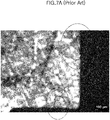
FIGS. 6A and6B , since the hole is formed, when the touch-type button is left under a high temperature and high humidity condition for 168 hours, corrosion occurs in a section portion on which copper is exposed, which causes deterioration of a touch signal and quality problem. - In addition, as can be seen from
FIG. 7A andFIG. 7B which is an enlarged view ofFIG. 7A , since a flexible printed circuit board (FPCB) is configured by stacking a plurality of components using an adhesive, when the hole is formed on the center portion, foreign substances such as dust and the like are attached to a section portion of layer on which the adhesive is existed. This can cause quality degradation of the LED backlight illumination. - The contents described in Description of Related Art are to help the understanding of the background of the present disclosure and may include what is not previously known to those skilled in the art to which the present disclosure pertains.
- The present disclosure has been made to solve the above-described problems, and the object of the present disclosure is to provide a touch-type button for a vehicle which can recognize a letter, day and night, using illumination, enlarge and uniformize an illumination region.
- A touch-type button for a vehicle according to an exemplary embodiment of the present disclosure may include: a hidden cover defining an external appearance of the touch-type button and having a pattern which corresponds to a letter font; and a transparent electrode attached to a rear surface of the hidden cover and configured to generate a signal in response to a change in capacitance. Here, the transparent electrode transmits light emitted from a light source disposed behind thereof to allow the letter font to be revealed and recognized.
- Here, the hidden cover may include a black film in which a portion corresponding to the letter font is cut, and a smoky resin injection molded product attached to the black film and containing polycarbonate base to which black coloring agent and light diffusing additive are added.
- The hidden cover may have a thickness of 1 to 3 mm.
- The hidden cover may have transmissivity of 30 to 45%.
- The hidden cover may have turbidity of 90% or more.
- The hidden cover may have brightness (L*) of less than 70.
- The transparent electrode may have a thickness of less than 150 µm.
- The transparent electrode may have transmissivity of 85% or more.
- The transparent electrode may have turbidity of less than 2%.
- The transparent electrode may have yellowness (b*) of less than 2.
- The transparent electrode may have a surface resistance of less than 200 Ω.
- The touch-type may further include a light diffusing film attached to the transparent electrode, and the light diffusing film may have transmissivity of 85% or more and turbidity of 90% or more.
- A touch-type button for a vehicle according to another exemplary embodiment of the present disclosure may include: a hidden cover defining an external appearance of the touch-type button and comprising a black film in which a portion corresponding to a letter font is cut, and a smoky resin injection molded product attached to the black film and containing a polycarbonate base to which a black coloring agent and a light diffusing additive are added, and a transparent electrode attached to a rear surface of the hidden cover and configured to generate a signal in response to a change in capacitance. Here, the hidden cover may have transmissivity of 30 to 45%, and the transparent electrode may have transmissivity of 85% or more.
-
-
FIGS. 1, 2 ,3A, 3B ,4 ,5 ,6A ,6B ,7A , and7B are diagrams showing a method of manufacturing a conventional button for a vehicle and a problem thereof. -
FIG. 8 is a diagram showing an operating method of a touch-type button for a vehicle according to an exemplary embodiment of the present disclosure. -
FIGS. 9A and9B are diagrams illustrating the results of the touch-type button for the vehicle according to an exemplary embodiment of the present disclosure which is implemented by the method shown inFIG. 8 . -
FIG. 10 is a diagram schematically illustrating the touch-type button for the vehicle according to an exemplary embodiment of the present disclosure. -
FIGS. 11 and12 are diagrams illustrating one configuration of the touch-type button for the vehicle according to an exemplary embodiment of the present disclosure. -
FIG. 13 is a diagram illustrating a method of evaluating the touch-type button for the vehicle according to an exemplary embodiment of the present disclosure. -
FIG. 14 is a diagram showing a composition of a hidden cover of the touch-type button for the vehicle according to an exemplary embodiment of the present disclosure. -
FIGS. 15A to 15D are diagrams showing embodiments according to transmissivities of the touch-type button for the vehicle according to an exemplary embodiment of the present disclosure. -
FIGS. 16A and16B are diagrams for comparing differences in illumination according to applications of a touch film. -
FIG. 17 is a diagram schematically illustrating a touch-type button for a vehicle in accordance with another exemplary embodiment of the present disclosure. - In order to fully understand the present disclosure, operational advantages of the present disclosure and objects achieved by implementing embodiments of the present disclosure, reference should be made to the accompanying drawings illustrating exemplary embodiments of the present disclosure and the description on the accompanying drawings.
- In describing exemplary embodiments of the present disclosure, a description on well-known technologies or a repetitive description which may unnecessarily obscure the gist of the present disclosure will be abbreviated or omitted.
-
FIG. 8 is a diagram showing an operating method of a touch-type button for a vehicle according to an exemplary embodiment of the present disclosure, andFIGS. 9A and9B are diagrams illustrating the result of the touch-type button for the vehicle according to an exemplary embodiment of the present disclosure which is implemented by the method shown inFIG. 8 . - In addition,
FIG. 10 is a diagram schematically illustrating the touch-type button for the vehicle according to an exemplary embodiment of the present disclosure, andFIGS. 11 and12 are diagrams illustrating one configuration of the touch-type button for the vehicle according to an exemplary embodiment of the present disclosure. - Below, the touch-type button for the vehicle according to one exemplary embodiment of the present disclosure is described with reference to
FIGS. 8 ,9A ,9B ,10 ,11 , and12 . - A conventional touch-type button for a vehicle adopts a simple method in which a font of button is appeared in white in the daytime and illumination is turned on only at night. According to the above, brightness of the night illumination should be thus low, because glare and light blur occur when illumination is bright. Therefore, the conventional touch-type button does not require high brightness.
- On the contrary, in the present disclosure, a hidden function by which a font of letter is not visible as shown in
FIG. 9A is realized in a state in which a vehicle has not started and illumination is turned off as shown inFIG. 8 , and when the vehicle starts, the illumination is turned-on day and night as shown inFIG. 9B to allow the font of letter to be revealed by the illumination, and high brightness is thus needed. - As illustrated in
FIG. 10 , to this end, the touch-type button for the vehicle according to an exemplary embodiment of the present disclosure includes a hiddencover 10 and a transparent electrode, for example, an indium tin oxide (ITO)touch film 20. In addition, a transparent adhesive such as an optical clear adhesive (OCA) may be interposed between thehidden cover 10 and the ITO touch film. - The hidden
cover 10 corresponds to an external appearance of the button which is exposed to the outside and allows a user to touch the hidden cover, and the transparent electrode is attached to a rear surface of the hiddencover 10, so that the amount of change in capacitance is transmitted through a printed circuit board (PCB) (not shown) connected to the transparent electrode, and a touch input is thus recognized. - The hidden
cover 10 and the transparent electrode transmit light emitted from a light emitting diode (LED) 30, so that letter fonts patterned on the hiddencover 10 are brighter than surroundings thereof to enable the user to recognize the letter fonts. - Referring to
FIG. 11 , the hiddencover 10 is composed of an in-mold label (IML)film 11 and a smoky resin injection moldedproduct 12. - The hidden
cover 10 is manufactured by laser-cutting a black film in accordance with the letter fonts and then attaching the black film to the smoky resin injection molded product, which is a composition of polycarbonate (PC), black coloring agent and light diffusing additive, in an in-mold label (IML) process. - By configuring the hidden cover as above, the letter font is not exposed in the absence of illumination, and the illuminated region can be widened due to the high light transmittance of the transparent electrode. In addition, a conductor area is increased as shown in
FIG. 12 , and touch sensitivity can be thus enhanced more than twice. - The conditions of the hidden
cover 10 and the transparent electrode of the present disclosure described above are summarized in Table 1, and theITO touch film 20 was employed as an example of the transparent electrode.Table 1 Hidden cover ITO touch film Thickness (mm) Transmissivity (%) Turbidity (%) Brightness (L*) Thickness (µm) Transmissivity (%) Turbidity (%) Yellowness (b*) Sheet resistance (Ω) 1∼3 30∼45 90 or more Less than 70 Less than 150 85 or more Less than 2 Less than 2 Less than 200 - First of all, a thickness of the hidden
cover 10 may be 1 to 3mm. - When the thickness of the hidden
cover 10 is out of the above range and is less than 1 mm, flexure of the hidden may be occurred after performing an environmental durability test, and when the thickness of the hidden cover exceeds 3 mm, a distance between the electrode and the user's finger is increased, and so the touch performance may be degraded. - In addition, within this thickness range, the hidden cover should have transmissivity of 30 to 45%.
- When transmissivity of the hidden
cover 10 is less than 30%, the light transmittance of the LED is deteriorated, and brightness performance of the illumination is thus degraded. In addition, if the transmissivity exceeds 45%, even when the lighting is turned off, the font is recognized with the naked eye and a hidden characteristic is thus degraded, and a hot spot phenomenon, in which the illumination is brightly looked as a point light source due to a straight advancing property of the LED illumination, occurs to lower uniformity of the illumination. - Brightness can be determined according to the transmittance, and when the brightness L* exceeds 70, the font is also recognized with the naked eye and the hidden characteristic is thus degraded.
- In addition, the LED light is not diffused well in a condition of turbidity of less than 90%, and therefore, there is a problem that uniformity of the illumination is deteriorated.
- Next, the total thickness of the
ITO touch film 20 should not exceed 150 µm. - If the total thickness exceeds 150 µm, durability of the ITO touch film may be degraded due to bending. In addition, transmissivity of the ITO touch film should be 85 % or more in accordance with Japanese Industrial Standard (JIS)-K-7361 which is the internal standard, and turbidity should be less than 2% in accordance with JIS-K-7136.
- When the transmissivity is less than 85%, light loss of the LED light is increased, and so brightness of the illumination may be deteriorated. If the turbidity is 2% or more, the brightness of the illumination may be deteriorated due to light scattering of the LED light.
- Yellowness b* should be less than 2 in accordance with JIS-Z-8722 (Methods of colour measurement - Reflecting and transmitting objects).
- If the yellowness is 2 or more, a color coordinate of the LED illumination color may be shifted due to yellowing of the film and the illumination color may be thus changed.
- In addition, when surface resistance is 200 Ω or more, touch performance may be degraded and it is thus desirable that surface resistance is less than 200 Ω.
- In the case where the thickness, the brightness, the turbidity, the transmissivity of the hidden cover, and the thickness, the transmissivity, the turbidity, the yellowness and the surface resistance of the ITO touch film satisfy the above-mentioned conditions, a hidden function is realized when the illumination is turned off, and the light may be bright and uniform when the illumination is turned on and performance desired by the present disclosure can be achieved.
-
FIG. 13 schematically illustrates a method of evaluating the illumination emitted through the touch-type button for the vehicle according to an exemplary embodiment of the present disclosure using a two-dimensional imaging type luminance measuring instrument, and the light uniformity of illumination should be 60% or more. - In addition, the brightness at the
button 1 which is 30 cm away from a lens of the measuring instrument should be more than 400cd/m2 so that the touch-type button can be used in the daytime. - The present disclosure includes the hidden
cover 10 and theITO touch film 20 having the above-described conditions, thereby functioning as a button configured to transmit a touch input signal to a controller (not shown) through a user's operation. - In other words, the hidden
cover 10 is a plastic insulator, and thetouch film 20 made of ITO acts as an electrode. Basically, when a human's hand touches the electrode in a state where the electrode has constant capacitance, a touch signal is sensed by a change in capacitance. - Since as compared to a conventional flexible printed circuit board (FPCB), ITO has a large electrode area, ITO has a large capacitance and excellent touch sensitivity.
- In addition, the hidden
cover 10 is provided for preventing the font from being revealed in the absence of illumination, and as shown inFIG. 14 , PC, which is base material of the hidden cover, contains black coloring agent and silicon dioxide (SiOx) light diffusing agent as an additive. The transmissivity of the hidden cover can be adjusted by adjusting the content of black coloring agent. This is because the black coloring agent prevents the light of the LED from being transmitted. - Thus, as shown in
FIGS. 15A to 15D , the hidden characteristic may be realized in a proper transmissivity range of the hidden cover. InFIGS. 15A to 15D , a part shown on a background indicates a state in which the illumination is turned off, and another part shown on an upper right corner indicates a state in which the illumination is turned on. - In other words,
FIG. 15A shows a case where the transmissivity is 8%, and it can be seen that the illumination performance is degraded (insufficient brightness). In addition,FIG. 15B shows a case where the transmissivity is 30% corresponding to the present disclosure, and it can be seen that a letter or a graphic is concealed and that the brightness and uniformity of illumination are satisfied. - In addition,
FIG. 15C shows a case where the transmissivity is 51%, and it can be seen that the letter and the graphic are not concealed.FIG. 15D shows a case where the transmissivity is 73%, and it can be seen that the letter and the graphic are not concealed and a hot spot occurs in the illumination. - In addition, since the light of the LED has the straight advancing property, the light diffusing agent is added. By adjusting an addition of the light diffusing agent, the optimum transmissivity range, turbidity range and brightness value of the hidden cover were derived.
- Even when the same hidden cover is applied, a characteristic of illumination is varied depending on the type of the touch film.
FIG. 16A shows a case in which a conventional FPCB type touch switch is used, an uneven phenomenon of the illumination occurs due to the LED light going straight through a perforated hole. - On the contrary, in the case where the ITO touch film of the present disclosure is employed as shown in
FIG. 16B , while the light passes through a transparent wide area of ITO, diffusion/scattering of the light through the film occurs, and the uniformity of illumination is thus improved by the light diffusion effect caused by the above. - The characteristics derived from the experimental results according to characteristic ranges of the hidden cover and the electrode of the present disclosure are summarized in the following tables together with comparative examples. Table 2 shows Example and Comparative examples, and Table 3 shows experimental results.
Table 2 Cover Electrode Material A (mm) B C D Material A (µm) B C E F G Comparative Example 1 White resin 1.5 40 99 55 ITO 150 89 0.43 1.7 150 ○ Comparative Example 2 White resin 1.5 40 99 55 FPCB 150 - - - - ○ Example 1 Smoky resin 1.5 40 99 55 ITO 150 89 0.42 1.7 150 ○ Comparative Example 3 Smoky resin 0.5 53 99 55 ITO 150 89 0.42 1.7 150 ○ Comparative Example 4 Smoky resin 4 40 99 55 ITO 150 89 0.42 1.7 150 ○ Comparative Example 5 Smoky resin 1.5 20 99 55 ITO 150 89 0.42 1.7 150 ○ Comparative Example 6 Smoky resin 1.5 50 99 55 ITO 150 89 0.42 1.7 150 ○ Comparative Example 7 Smoky resin 1.5 43 80 55 ITO 150 89 0.42 1.7 150 ○ Comparative Example 8 Smoky resin 1.5 30 99 88 ITO 150 89 0.42 1.7 150 ○ Comparative Example 9 Smoky resin 1.5 40 99 55 FPCB 150 89 0.42 1.7 150 ○ Comparative Example 10 Smoky resin 1.5 40 99 55 ITO 200 89 0.42 1.7 150 X Comparative Example 11 Smoky resin 1.5 40 99 55 ITO 150 80 0.42 1.7 150 ○ Comparative Example 12 Smoky resin 1.5 40 99 55 ITO 150 86 3 1.7 150 ○ Comparative Example 13 Smoky resin 1.5 40 99 55 ITO 150 89 0.42 3.6 150 ○ Comparative Example 14 Smoky resin 1.5 40 99 55 ITO 150 89 0.42 1.7 250 ○ - Here, in Table 2, A indicates Thickness (mm), B indicates Transmissivity (%), C indicates Turbidity (%), D indicates Brightness (L*), E indicates Yellowness (b*), F indicates Sheet resistance (Ω), and G indicates whether flexibility is satisfied.
Table 3 Luminance (Cd/m2) Uniformity (%) Whether change in color of illumination is satisfied Whether touch reaction is satisfied Whether font is hidden Comparative example 1 2 58 ○ ○ X Comparative example 2 2.5 51 ○ ○ X Example 1 417 70 ○ ○ ○ Comparative example 2 451 43 ○ ○ X Comparative example 4 233 71 ○ ○ ○ Comparative example 5 348 73 ○ ○ ○ Comparative example 6 564 53 ○ ○ X Comparative example 7 449 58 ○ ○ ○ Comparative example 8 387 71 ○ ○ X Comparative example 9 374 46 ○ ○ ○ Comparative example 10 391 71 ○ ○ ○ Comparative example 11 350 70 ○ ○ ○ Comparative example 12 390 72 ○ ○ ○ Comparative example 13 411 70 X ○ ○ Comparative example 14 413 71 ○ X ○ - As summarized in the above tables, in the case of Comparative examples 1 and 2, it can be seen that the font is recognized with the naked eye by white coloring agent in the daytime, so that it is impossible to realize the hidden function.
- Even when the cover is made of smoky resin, if the cover is thin as in Comparative example 3, the transmissivity is also increased and the light of the LED having the strong straight advancing property is not diffused well in the resin, resulting in the illumination in the form of spot. As a result, the uniformity of illumination is deteriorated.
- On the contrary, as in the case of Comparative example 4, when the thickness of the cover is increased by a predetermined value or more, the transmissivity is decreased, and so luminance of the illumination is lowered.
- In addition, as can be seen from Comparative examples 5 and 6, when the transmissivity of the cover is smaller than a reference value, luminance of the illumination is lowered. On the contrary, when the transmissivity of the cover is higher than the reference value, the luminance of the illumination is improved, but the uniformity of illumination is deteriorated.
- Further, as in Comparative example 7, when turbidity of the cover is smaller than a certain value, the uniformity of illumination is deteriorated, and when brightness of the cover is higher than a certain value as in Comparative example 8, it is difficult to realize a hidden function to a level at which the font is recognized with the naked eye, and the transmissivity is somewhat decreased due to an addition of white coloring agent, so that the luminance of illumination is deteriorated.
- Next, when a material of the electrode is FPCB, as in Comparative example 9, there is a problem that the luminance is insufficient and the uniformity is deteriorated even if the electrode is formed of smoky resin and has the optimum structure.
- In addition, when a thickness of the electrode is greater than a predetermined value, as in Comparative example 10, when an evaluation of bending ability of the film on which ITO is deposited is conducted, surface resistance is generated due to fine cracks of ITO. Therefore, the touch performance is degraded.
- In the case of Comparative example 11, the transmissivity of the electrode is lowered to a certain value, so that the transmittance of the light of the LED is deteriorated and the luminance of the illumination is reduced. In the case of Comparative example 12, the turbidity of the electrode is increased to a certain value or more, a decrease in the luminance of illumination is generated.
- In addition, when yellowness of the electrode is high as in Comparative example 13, light characteristic such as absorption of light is changed when the LED illumination is transmitted, so that the illumination color is changed. When surface resistance of the electrode is higher than a certain value or more, touch performance is degraded due to a decrease in capacitance.
-
FIG. 17 schematically illustrates a touch-type button for a vehicle according to another exemplary embodiment of the present disclosure. - As shown in
FIG. 17 , in another embodiment of the present disclosure, optical characteristics can be further improved by adding alight diffusing film 40. Thelight diffusing film 40 attached to theITO touch film 20 may have transmissivity of 85% or more and haze (turbidity) of 90% or more. - That is, when the transmissivity is smaller than the above range, the brightness of the LED illumination is deteriorated, and when the haze is smaller than the above range, the light uniformity is deteriorated due to lowered light diffusivity.
- A conventional touch-type button has been configured to be operated in a manner in which the font of the button is appeared in white in the daytime and the lighting is turned on only at night. Consequently, when night illumination is too bright, glare and light blur occur, so that brightness of the night illumination has to be low.
- However, according to the touch-type button for a vehicle of the present disclosure, a hidden function by which the font is not visible before a vehicle is started-up is realized, and the font is illuminated by the illumination at the moment of starting-up the vehicle. Therefore, it is possible to recognize the font, day and night, using the illumination, and to obtain high brightness performance.
- In addition, since the ITO touch film employed as the transparent electrode is directly attached to the rear surface of the hidden cover, the illumination area can be widened through the high light transmittance, and by realizing the uniform illumination, size of the font can be variously made.
- In addition, there is an advantage that since the conductor area is increased, the touch sensitivity is improved more than twice.
- Although the present disclosure has been described with reference to the exemplary drawings, the present disclosure is not limited to the described embodiments, and it will be apparent to those skilled in the art that the present disclosure may be variously modified and changed without departing from the spirit and scope of the present disclosure. Accordingly, such modifications or changes are intended to fall within the scope the appended claims of the present disclosure, and the scope of the present disclosure should be construed on the basis of the appended claims.
Claims (14)
- A touch-type button for a vehicle, comprising;
a hidden cover defining an external appearance of the touch-type button and having a pattern which corresponds to a letter font; and
a transparent electrode attached to a rear surface of the hidden cover and configured to generate a signal in response to a change in capacitance,
wherein the transparent electrode transmits light emitted from a light source disposed behind the transparent electrode to allow the letter font to be revealed and recognized. - The touch-type button of claim 1, wherein the hidden cover comprises;
a black film in which a portion corresponding to the letter font is cut; and
a smoky resin injection molded product attached to the black film and containing a polycarbonate base to which a black coloring agent and a light diffusing additive are added. - The touch-type button of claim 2, wherein the hidden cover has a thickness of 1 to 3 mm.
- The touch-type button of claim 2, wherein the hidden cover has transmissivity of 30 to 45%.
- The touch-type button of claim 4, wherein the hidden cover has turbidity of 90% or more.
- The touch-type button of claim 4, wherein the hidden cover has brightness (L*) of less than 70.
- The touch-type button of claim 2, wherein the transparent electrode has a thickness of less than 150 µm.
- The touch-type button of claim 7, wherein the transparent electrode has transmissivity of 85% or more.
- The touch-type button of claim 8, wherein the transparent electrode has turbidity of less than 2%.
- The touch-type button of claim 8, wherein the transparent electrode has yellowness (b*) of less than 2.
- The touch-type button of claim 8, wherein the transparent electrode has a surface resistance of less than 200 Ω.
- The touch-type button of claim 2, further comprising a light diffusing film attached to the transparent electrode.
- The touch-type button of claim 12, wherein the light diffusing film has transmissivity of 85% or more and turbidity of 90% or more.
- A touch-type button for a vehicle, comprising:a hidden cover defining an external appearance of the touch-type button and comprising:a black film in which a portion corresponding to a letter font is cut; anda smoky resin injection molded product attached to the black film and containing a polycarbonate base to which a black coloring agent and a light diffusing additive are added; anda transparent electrode attached to a rear surface of the hidden cover and configured to generate a signal in response to a change in capacitance,wherein the hidden cover has transmissivity of 30 to 45%, and the transparent electrode has transmissivity of 85% or more.
Applications Claiming Priority (1)
| Application Number | Priority Date | Filing Date | Title |
|---|---|---|---|
| KR1020190021902A KR20200103419A (en) | 2019-02-25 | 2019-02-25 | Touch type button for a vehicle |
Publications (2)
| Publication Number | Publication Date |
|---|---|
| EP3700089A1 true EP3700089A1 (en) | 2020-08-26 |
| EP3700089B1 EP3700089B1 (en) | 2025-01-01 |
Family
ID=68581499
Family Applications (1)
| Application Number | Title | Priority Date | Filing Date |
|---|---|---|---|
| EP19209015.7A Active EP3700089B1 (en) | 2019-02-25 | 2019-11-14 | Touch-type button for vehicle |
Country Status (5)
| Country | Link |
|---|---|
| US (1) | US20200274534A1 (en) |
| EP (1) | EP3700089B1 (en) |
| JP (1) | JP7452987B2 (en) |
| KR (1) | KR20200103419A (en) |
| CN (1) | CN111614349A (en) |
Families Citing this family (1)
| Publication number | Priority date | Publication date | Assignee | Title |
|---|---|---|---|---|
| WO2024226419A1 (en) * | 2023-04-24 | 2024-10-31 | International Controls And Measurements Corporation | Touch-sensitive controller and interface, and methods |
Citations (3)
| Publication number | Priority date | Publication date | Assignee | Title |
|---|---|---|---|---|
| JP2008053050A (en) * | 2006-08-24 | 2008-03-06 | Kawai Musical Instr Mfg Co Ltd | control panel |
| EP2960916A1 (en) * | 2013-02-22 | 2015-12-30 | Alps Electric Co., Ltd. | Display device |
| EP3219534A1 (en) * | 2016-02-19 | 2017-09-20 | Lg Electronics Inc. | User interface apparatus for vehicles and vehicle having the same |
Family Cites Families (16)
| Publication number | Priority date | Publication date | Assignee | Title |
|---|---|---|---|---|
| JP4529546B2 (en) * | 2004-05-27 | 2010-08-25 | 住友電装株式会社 | Panel display unit |
| JP2008192467A (en) * | 2007-02-05 | 2008-08-21 | Fujitsu Ten Ltd | Light emitting device, display device, and button device |
| JP2012018465A (en) * | 2010-07-06 | 2012-01-26 | Tokai Rika Co Ltd | Operation input device and method of controlling the same |
| WO2012133367A1 (en) * | 2011-03-28 | 2012-10-04 | 東レ株式会社 | Conductive laminated body and touch panel |
| US8820994B2 (en) * | 2011-07-28 | 2014-09-02 | Visteon Global Technologies, Inc. | Vehicle indicator display, and method of forming |
| CN103218047B (en) * | 2012-01-18 | 2016-04-13 | 台湾美琪电子工业股份有限公司 | touch keyboard |
| WO2014173445A1 (en) * | 2013-04-24 | 2014-10-30 | Automobile Patentverwaltungs- und -verwertungsgesellschaft mbH | Method for coating functional components made of plastics material |
| JP2016099908A (en) * | 2014-11-26 | 2016-05-30 | 小島プレス工業株式会社 | Touch sensor |
| KR20160067274A (en) * | 2014-12-03 | 2016-06-14 | 삼성디스플레이 주식회사 | Display apparatus |
| DE102015201427A1 (en) * | 2015-01-28 | 2016-07-28 | BSH Hausgeräte GmbH | Touch-sensitive, illuminable control panel, method for its operation as well as this control panel containing domestic appliance |
| KR102376815B1 (en) * | 2015-07-20 | 2022-03-21 | 주식회사 엘지화학 | Touch panel and display apparatus including the same |
| KR101804636B1 (en) * | 2015-10-30 | 2017-12-05 | 엘에스오토모티브 주식회사 | Touch switching unit and an interior ramp module with the same |
| US10142671B2 (en) * | 2016-02-19 | 2018-11-27 | Lg Electronics Inc. | User interface apparatus for vehicles and vehicle having the same |
| EP3478181B1 (en) * | 2016-06-30 | 2020-08-05 | Koninklijke Philips N.V. | Sealed control panel for medical equipment |
| KR20180049544A (en) * | 2016-11-03 | 2018-05-11 | 현대자동차주식회사 | Touch controll device |
| WO2019022213A1 (en) * | 2017-07-28 | 2019-01-31 | 株式会社クラレ | Layered/extruded resin sheet, and protective sheet for liquid crystal display with infrared sensor |
-
2019
- 2019-02-25 KR KR1020190021902A patent/KR20200103419A/en not_active Ceased
- 2019-11-14 EP EP19209015.7A patent/EP3700089B1/en active Active
- 2019-11-21 JP JP2019210825A patent/JP7452987B2/en active Active
- 2019-11-21 US US16/690,354 patent/US20200274534A1/en not_active Abandoned
- 2019-11-21 CN CN201911146262.8A patent/CN111614349A/en active Pending
Patent Citations (3)
| Publication number | Priority date | Publication date | Assignee | Title |
|---|---|---|---|---|
| JP2008053050A (en) * | 2006-08-24 | 2008-03-06 | Kawai Musical Instr Mfg Co Ltd | control panel |
| EP2960916A1 (en) * | 2013-02-22 | 2015-12-30 | Alps Electric Co., Ltd. | Display device |
| EP3219534A1 (en) * | 2016-02-19 | 2017-09-20 | Lg Electronics Inc. | User interface apparatus for vehicles and vehicle having the same |
Also Published As
| Publication number | Publication date |
|---|---|
| KR20200103419A (en) | 2020-09-02 |
| JP2020132135A (en) | 2020-08-31 |
| EP3700089B1 (en) | 2025-01-01 |
| JP7452987B2 (en) | 2024-03-19 |
| US20200274534A1 (en) | 2020-08-27 |
| CN111614349A (en) | 2020-09-01 |
Similar Documents
| Publication | Publication Date | Title |
|---|---|---|
| CN106463290B (en) | Input parts, sensor sheets, and decorative parts | |
| US10124767B1 (en) | Vehicle exterior keypad having interior lamp | |
| CN101310351A (en) | Capacitive light-emitting switch and light-emitting switching element used therein | |
| EP3700089B1 (en) | Touch-type button for vehicle | |
| US10310689B2 (en) | Sensor sheet and sensor panel | |
| JP2009146835A (en) | Display device | |
| CN108369877B (en) | Electrostatic capacitance touch switch | |
| US9753204B2 (en) | Electronic device | |
| JP2007501995A (en) | More uniform electroluminescence display | |
| KR200438047Y1 (en) | Light Source Integrated Waveguide Sheet | |
| US12119428B2 (en) | Light-emitting assembly, method for making same, and electronic device using same | |
| CN111240511B (en) | Display device and driving method thereof | |
| US12606020B2 (en) | Automotive decorative panel | |
| CN222637119U (en) | Car-mounted solid wood touch panel with illuminated buttons | |
| CN219457066U (en) | Display module, display device, mobile terminal and electronic equipment | |
| CN223092405U (en) | Touch key panel | |
| CN220155423U (en) | A translucent button | |
| JPH03250517A (en) | Touch button | |
| CN111480334A (en) | Display and electronic equipment | |
| JP2018190668A (en) | Display device | |
| US20040095529A1 (en) | Transflector with integral pushbutton graphics | |
| JP2024132787A (en) | Automotive Decorative Panels | |
| WO2024147250A1 (en) | Sensor sheet and touch sensor module | |
| TW202439099A (en) | Decorative panel for vehicle | |
| JP6518962B2 (en) | Decorative illumination member |
Legal Events
| Date | Code | Title | Description |
|---|---|---|---|
| PUAI | Public reference made under article 153(3) epc to a published international application that has entered the european phase |
Free format text: ORIGINAL CODE: 0009012 |
|
| STAA | Information on the status of an ep patent application or granted ep patent |
Free format text: STATUS: THE APPLICATION HAS BEEN PUBLISHED |
|
| AK | Designated contracting states |
Kind code of ref document: A1 Designated state(s): AL AT BE BG CH CY CZ DE DK EE ES FI FR GB GR HR HU IE IS IT LI LT LU LV MC MK MT NL NO PL PT RO RS SE SI SK SM TR |
|
| AX | Request for extension of the european patent |
Extension state: BA ME |
|
| STAA | Information on the status of an ep patent application or granted ep patent |
Free format text: STATUS: REQUEST FOR EXAMINATION WAS MADE |
|
| 17P | Request for examination filed |
Effective date: 20210226 |
|
| RBV | Designated contracting states (corrected) |
Designated state(s): AL AT BE BG CH CY CZ DE DK EE ES FI FR GB GR HR HU IE IS IT LI LT LU LV MC MK MT NL NO PL PT RO RS SE SI SK SM TR |
|
| RAP3 | Party data changed (applicant data changed or rights of an application transferred) |
Owner name: HYUNDAI MOTOR COMPANY Owner name: KIA CORPORATION |
|
| P01 | Opt-out of the competence of the unified patent court (upc) registered |
Effective date: 20230512 |
|
| STAA | Information on the status of an ep patent application or granted ep patent |
Free format text: STATUS: EXAMINATION IS IN PROGRESS |
|
| 17Q | First examination report despatched |
Effective date: 20230713 |
|
| RIC1 | Information provided on ipc code assigned before grant |
Ipc: B60K 35/10 20240101ALI20240614BHEP Ipc: H03K 17/96 20060101AFI20240614BHEP |
|
| GRAP | Despatch of communication of intention to grant a patent |
Free format text: ORIGINAL CODE: EPIDOSNIGR1 |
|
| STAA | Information on the status of an ep patent application or granted ep patent |
Free format text: STATUS: GRANT OF PATENT IS INTENDED |
|
| INTG | Intention to grant announced |
Effective date: 20240730 |
|
| GRAS | Grant fee paid |
Free format text: ORIGINAL CODE: EPIDOSNIGR3 |
|
| GRAA | (expected) grant |
Free format text: ORIGINAL CODE: 0009210 |
|
| STAA | Information on the status of an ep patent application or granted ep patent |
Free format text: STATUS: THE PATENT HAS BEEN GRANTED |
|
| AK | Designated contracting states |
Kind code of ref document: B1 Designated state(s): AL AT BE BG CH CY CZ DE DK EE ES FI FR GB GR HR HU IE IS IT LI LT LU LV MC MK MT NL NO PL PT RO RS SE SI SK SM TR |
|
| REG | Reference to a national code |
Ref country code: GB Ref legal event code: FG4D |
|
| REG | Reference to a national code |
Ref country code: CH Ref legal event code: EP |
|
| REG | Reference to a national code |
Ref country code: DE Ref legal event code: R096 Ref document number: 602019064190 Country of ref document: DE |
|
| REG | Reference to a national code |
Ref country code: IE Ref legal event code: FG4D |
|
| REG | Reference to a national code |
Ref country code: LT Ref legal event code: MG9D |
|
| REG | Reference to a national code |
Ref country code: NL Ref legal event code: MP Effective date: 20250101 |
|
| REG | Reference to a national code |
Ref country code: AT Ref legal event code: MK05 Ref document number: 1757348 Country of ref document: AT Kind code of ref document: T Effective date: 20250101 |
|
| PG25 | Lapsed in a contracting state [announced via postgrant information from national office to epo] |
Ref country code: NL Free format text: LAPSE BECAUSE OF FAILURE TO SUBMIT A TRANSLATION OF THE DESCRIPTION OR TO PAY THE FEE WITHIN THE PRESCRIBED TIME-LIMIT Effective date: 20250101 |
|
| PG25 | Lapsed in a contracting state [announced via postgrant information from national office to epo] |
Ref country code: FI Free format text: LAPSE BECAUSE OF FAILURE TO SUBMIT A TRANSLATION OF THE DESCRIPTION OR TO PAY THE FEE WITHIN THE PRESCRIBED TIME-LIMIT Effective date: 20250101 |
|
| PG25 | Lapsed in a contracting state [announced via postgrant information from national office to epo] |
Ref country code: PL Free format text: LAPSE BECAUSE OF FAILURE TO SUBMIT A TRANSLATION OF THE DESCRIPTION OR TO PAY THE FEE WITHIN THE PRESCRIBED TIME-LIMIT Effective date: 20250101 |
|
| PG25 | Lapsed in a contracting state [announced via postgrant information from national office to epo] |
Ref country code: ES Free format text: LAPSE BECAUSE OF FAILURE TO SUBMIT A TRANSLATION OF THE DESCRIPTION OR TO PAY THE FEE WITHIN THE PRESCRIBED TIME-LIMIT Effective date: 20250101 |
|
| PG25 | Lapsed in a contracting state [announced via postgrant information from national office to epo] |
Ref country code: IS Free format text: LAPSE BECAUSE OF FAILURE TO SUBMIT A TRANSLATION OF THE DESCRIPTION OR TO PAY THE FEE WITHIN THE PRESCRIBED TIME-LIMIT Effective date: 20250501 Ref country code: NO Free format text: LAPSE BECAUSE OF FAILURE TO SUBMIT A TRANSLATION OF THE DESCRIPTION OR TO PAY THE FEE WITHIN THE PRESCRIBED TIME-LIMIT Effective date: 20250401 |
|
| PG25 | Lapsed in a contracting state [announced via postgrant information from national office to epo] |
Ref country code: HR Free format text: LAPSE BECAUSE OF FAILURE TO SUBMIT A TRANSLATION OF THE DESCRIPTION OR TO PAY THE FEE WITHIN THE PRESCRIBED TIME-LIMIT Effective date: 20250101 |
|
| PG25 | Lapsed in a contracting state [announced via postgrant information from national office to epo] |
Ref country code: LV Free format text: LAPSE BECAUSE OF FAILURE TO SUBMIT A TRANSLATION OF THE DESCRIPTION OR TO PAY THE FEE WITHIN THE PRESCRIBED TIME-LIMIT Effective date: 20250101 Ref country code: PT Free format text: LAPSE BECAUSE OF FAILURE TO SUBMIT A TRANSLATION OF THE DESCRIPTION OR TO PAY THE FEE WITHIN THE PRESCRIBED TIME-LIMIT Effective date: 20250502 |
|
| PG25 | Lapsed in a contracting state [announced via postgrant information from national office to epo] |
Ref country code: BG Free format text: LAPSE BECAUSE OF FAILURE TO SUBMIT A TRANSLATION OF THE DESCRIPTION OR TO PAY THE FEE WITHIN THE PRESCRIBED TIME-LIMIT Effective date: 20250101 Ref country code: GR Free format text: LAPSE BECAUSE OF FAILURE TO SUBMIT A TRANSLATION OF THE DESCRIPTION OR TO PAY THE FEE WITHIN THE PRESCRIBED TIME-LIMIT Effective date: 20250402 |
|
| PG25 | Lapsed in a contracting state [announced via postgrant information from national office to epo] |
Ref country code: AT Free format text: LAPSE BECAUSE OF FAILURE TO SUBMIT A TRANSLATION OF THE DESCRIPTION OR TO PAY THE FEE WITHIN THE PRESCRIBED TIME-LIMIT Effective date: 20250101 |
|
| PG25 | Lapsed in a contracting state [announced via postgrant information from national office to epo] |
Ref country code: CZ Free format text: LAPSE BECAUSE OF FAILURE TO SUBMIT A TRANSLATION OF THE DESCRIPTION OR TO PAY THE FEE WITHIN THE PRESCRIBED TIME-LIMIT Effective date: 20250101 |
|
| PG25 | Lapsed in a contracting state [announced via postgrant information from national office to epo] |
Ref country code: SE Free format text: LAPSE BECAUSE OF FAILURE TO SUBMIT A TRANSLATION OF THE DESCRIPTION OR TO PAY THE FEE WITHIN THE PRESCRIBED TIME-LIMIT Effective date: 20250101 |
|
| REG | Reference to a national code |
Ref country code: DE Ref legal event code: R097 Ref document number: 602019064190 Country of ref document: DE |
|
| PG25 | Lapsed in a contracting state [announced via postgrant information from national office to epo] |
Ref country code: SM Free format text: LAPSE BECAUSE OF FAILURE TO SUBMIT A TRANSLATION OF THE DESCRIPTION OR TO PAY THE FEE WITHIN THE PRESCRIBED TIME-LIMIT Effective date: 20250101 |
|
| PG25 | Lapsed in a contracting state [announced via postgrant information from national office to epo] |
Ref country code: DK Free format text: LAPSE BECAUSE OF FAILURE TO SUBMIT A TRANSLATION OF THE DESCRIPTION OR TO PAY THE FEE WITHIN THE PRESCRIBED TIME-LIMIT Effective date: 20250101 |
|
| PG25 | Lapsed in a contracting state [announced via postgrant information from national office to epo] |
Ref country code: IT Free format text: LAPSE BECAUSE OF FAILURE TO SUBMIT A TRANSLATION OF THE DESCRIPTION OR TO PAY THE FEE WITHIN THE PRESCRIBED TIME-LIMIT Effective date: 20250101 |
|
| PG25 | Lapsed in a contracting state [announced via postgrant information from national office to epo] |
Ref country code: EE Free format text: LAPSE BECAUSE OF FAILURE TO SUBMIT A TRANSLATION OF THE DESCRIPTION OR TO PAY THE FEE WITHIN THE PRESCRIBED TIME-LIMIT Effective date: 20250101 |
|
| PG25 | Lapsed in a contracting state [announced via postgrant information from national office to epo] |
Ref country code: RO Free format text: LAPSE BECAUSE OF FAILURE TO SUBMIT A TRANSLATION OF THE DESCRIPTION OR TO PAY THE FEE WITHIN THE PRESCRIBED TIME-LIMIT Effective date: 20250101 |
|
| PG25 | Lapsed in a contracting state [announced via postgrant information from national office to epo] |
Ref country code: SK Free format text: LAPSE BECAUSE OF FAILURE TO SUBMIT A TRANSLATION OF THE DESCRIPTION OR TO PAY THE FEE WITHIN THE PRESCRIBED TIME-LIMIT Effective date: 20250101 |
|
| PLBE | No opposition filed within time limit |
Free format text: ORIGINAL CODE: 0009261 |
|
| STAA | Information on the status of an ep patent application or granted ep patent |
Free format text: STATUS: NO OPPOSITION FILED WITHIN TIME LIMIT |
|
| REG | Reference to a national code |
Ref country code: CH Ref legal event code: L10 Free format text: ST27 STATUS EVENT CODE: U-0-0-L10-L00 (AS PROVIDED BY THE NATIONAL OFFICE) Effective date: 20251112 |
|
| 26N | No opposition filed |
Effective date: 20251002 |
|
| PGFP | Annual fee paid to national office [announced via postgrant information from national office to epo] |
Ref country code: DE Payment date: 20251020 Year of fee payment: 7 |
|
| REG | Reference to a national code |
Ref country code: CH Ref legal event code: H13 Free format text: ST27 STATUS EVENT CODE: U-0-0-H10-H13 (AS PROVIDED BY THE NATIONAL OFFICE) Effective date: 20260623 |
|
| PG25 | Lapsed in a contracting state [announced via postgrant information from national office to epo] |
Ref country code: LT Free format text: LAPSE BECAUSE OF FAILURE TO SUBMIT A TRANSLATION OF THE DESCRIPTION OR TO PAY THE FEE WITHIN THE PRESCRIBED TIME-LIMIT Effective date: 20250101 |
|
| PG25 | Lapsed in a contracting state [announced via postgrant information from national office to epo] |
Ref country code: MC Free format text: LAPSE BECAUSE OF FAILURE TO SUBMIT A TRANSLATION OF THE DESCRIPTION OR TO PAY THE FEE WITHIN THE PRESCRIBED TIME-LIMIT Effective date: 20250101 |
|
| PG25 | Lapsed in a contracting state [announced via postgrant information from national office to epo] |
Ref country code: RS Free format text: LAPSE BECAUSE OF FAILURE TO SUBMIT A TRANSLATION OF THE DESCRIPTION OR TO PAY THE FEE WITHIN THE PRESCRIBED TIME-LIMIT Effective date: 20250101 |
|
| PG25 | Lapsed in a contracting state [announced via postgrant information from national office to epo] |
Ref country code: LU Free format text: LAPSE BECAUSE OF NON-PAYMENT OF DUE FEES Effective date: 20251114 Ref country code: CH Free format text: LAPSE BECAUSE OF NON-PAYMENT OF DUE FEES Effective date: 20251130 |