EP3699813A1 - Apparatus and method for training classification model and apparatus for classifying with classification model - Google Patents
Apparatus and method for training classification model and apparatus for classifying with classification model Download PDFInfo
- Publication number
- EP3699813A1 EP3699813A1 EP20150950.2A EP20150950A EP3699813A1 EP 3699813 A1 EP3699813 A1 EP 3699813A1 EP 20150950 A EP20150950 A EP 20150950A EP 3699813 A1 EP3699813 A1 EP 3699813A1
- Authority
- EP
- European Patent Office
- Prior art keywords
- training
- sample image
- classification model
- global
- feature
- Prior art date
- Legal status (The legal status is an assumption and is not a legal conclusion. Google has not performed a legal analysis and makes no representation as to the accuracy of the status listed.)
- Withdrawn
Links
Images



Classifications
-
- G—PHYSICS
- G06—COMPUTING OR CALCULATING; COUNTING
- G06V—IMAGE OR VIDEO RECOGNITION OR UNDERSTANDING
- G06V40/00—Recognition of biometric, human-related or animal-related patterns in image or video data
- G06V40/10—Human or animal bodies, e.g. vehicle occupants or pedestrians; Body parts, e.g. hands
- G06V40/16—Human faces, e.g. facial parts, sketches or expressions
- G06V40/168—Feature extraction; Face representation
-
- G—PHYSICS
- G06—COMPUTING OR CALCULATING; COUNTING
- G06V—IMAGE OR VIDEO RECOGNITION OR UNDERSTANDING
- G06V40/00—Recognition of biometric, human-related or animal-related patterns in image or video data
- G06V40/10—Human or animal bodies, e.g. vehicle occupants or pedestrians; Body parts, e.g. hands
- G06V40/16—Human faces, e.g. facial parts, sketches or expressions
- G06V40/168—Feature extraction; Face representation
- G06V40/169—Holistic features and representations, i.e. based on the facial image taken as a whole
-
- G—PHYSICS
- G06—COMPUTING OR CALCULATING; COUNTING
- G06F—ELECTRIC DIGITAL DATA PROCESSING
- G06F18/00—Pattern recognition
- G06F18/20—Analysing
- G06F18/21—Design or setup of recognition systems or techniques; Extraction of features in feature space; Blind source separation
- G06F18/214—Generating training patterns; Bootstrap methods, e.g. bagging or boosting
-
- G—PHYSICS
- G06—COMPUTING OR CALCULATING; COUNTING
- G06F—ELECTRIC DIGITAL DATA PROCESSING
- G06F18/00—Pattern recognition
- G06F18/20—Analysing
- G06F18/24—Classification techniques
-
- G—PHYSICS
- G06—COMPUTING OR CALCULATING; COUNTING
- G06F—ELECTRIC DIGITAL DATA PROCESSING
- G06F18/00—Pattern recognition
- G06F18/20—Analysing
- G06F18/24—Classification techniques
- G06F18/241—Classification techniques relating to the classification model, e.g. parametric or non-parametric approaches
- G06F18/2413—Classification techniques relating to the classification model, e.g. parametric or non-parametric approaches based on distances to training or reference patterns
-
- G—PHYSICS
- G06—COMPUTING OR CALCULATING; COUNTING
- G06N—COMPUTING ARRANGEMENTS BASED ON SPECIFIC COMPUTATIONAL MODELS
- G06N3/00—Computing arrangements based on biological models
- G06N3/02—Neural networks
- G06N3/04—Architecture, e.g. interconnection topology
- G06N3/0464—Convolutional networks [CNN, ConvNet]
-
- G—PHYSICS
- G06—COMPUTING OR CALCULATING; COUNTING
- G06N—COMPUTING ARRANGEMENTS BASED ON SPECIFIC COMPUTATIONAL MODELS
- G06N3/00—Computing arrangements based on biological models
- G06N3/02—Neural networks
- G06N3/08—Learning methods
-
- G—PHYSICS
- G06—COMPUTING OR CALCULATING; COUNTING
- G06N—COMPUTING ARRANGEMENTS BASED ON SPECIFIC COMPUTATIONAL MODELS
- G06N3/00—Computing arrangements based on biological models
- G06N3/02—Neural networks
- G06N3/08—Learning methods
- G06N3/09—Supervised learning
-
- G—PHYSICS
- G06—COMPUTING OR CALCULATING; COUNTING
- G06V—IMAGE OR VIDEO RECOGNITION OR UNDERSTANDING
- G06V10/00—Arrangements for image or video recognition or understanding
- G06V10/70—Arrangements for image or video recognition or understanding using pattern recognition or machine learning
- G06V10/764—Arrangements for image or video recognition or understanding using pattern recognition or machine learning using classification, e.g. of video objects
-
- G—PHYSICS
- G06—COMPUTING OR CALCULATING; COUNTING
- G06V—IMAGE OR VIDEO RECOGNITION OR UNDERSTANDING
- G06V10/00—Arrangements for image or video recognition or understanding
- G06V10/70—Arrangements for image or video recognition or understanding using pattern recognition or machine learning
- G06V10/82—Arrangements for image or video recognition or understanding using pattern recognition or machine learning using neural networks
-
- G—PHYSICS
- G06—COMPUTING OR CALCULATING; COUNTING
- G06V—IMAGE OR VIDEO RECOGNITION OR UNDERSTANDING
- G06V40/00—Recognition of biometric, human-related or animal-related patterns in image or video data
- G06V40/10—Human or animal bodies, e.g. vehicle occupants or pedestrians; Body parts, e.g. hands
- G06V40/16—Human faces, e.g. facial parts, sketches or expressions
- G06V40/168—Feature extraction; Face representation
- G06V40/171—Local features and components; Facial parts ; Occluding parts, e.g. glasses; Geometrical relationships
-
- G—PHYSICS
- G06—COMPUTING OR CALCULATING; COUNTING
- G06V—IMAGE OR VIDEO RECOGNITION OR UNDERSTANDING
- G06V40/00—Recognition of biometric, human-related or animal-related patterns in image or video data
- G06V40/10—Human or animal bodies, e.g. vehicle occupants or pedestrians; Body parts, e.g. hands
- G06V40/16—Human faces, e.g. facial parts, sketches or expressions
- G06V40/172—Classification, e.g. identification
Definitions
- the present disclosure relates to the field of information processing, and particularly to an apparatus and method for training a classification model, and an apparatus and method for classifying with a classification model.
- classification techniques such as human face recognition and vehicle license plate recognition and the like have gained great development and been widely applied in both academia and industry.
- the main concept of improving the performance of classification is improving the performance of a classification model.
- the classification performance will be significantly lowered. Further, it is possible to improve the classification performance by increasing data. However, it is laborious and arduous to collect large-scale data.
- human face data there are public human face data sets such as VGG2Face, Ms-Celeb-IM, MegaFace and the like nowadays.
- Each data set has respective advantages and disadvantages, and it is possible to efficiently improve the classification performance by sufficiently utilizing advantages of each data set.
- the simplest method is directly putting a plurality of data sets together, but data in different data sets has crosses, and thus a circumstance where same data is labeled differently in different data sets would easily occur.
- a trained classification model would be easily caused to not converge or have worse performance.
- an object of the present invention is to provide an apparatus and method for training a classification model, and an apparatus and method for classifying with a trained classification model which are capable of solving one or more drawbacks in the prior art.
- an apparatus for training a classification model including: a local area obtainment unit configured to, with respect to each sample image in a training set, obtain a predetermined number of predetermined local areas of the sample image, wherein each predetermined local area is a part of a global area of the sample image; a feature extraction unit configured to, with respect to each sample image, set corresponding numbers of feature extraction layers for the global area and each predetermined local area respectively, to extract a global feature of the global area and a local feature of each predetermined local area respectively, wherein the global area and the predetermined number of predetermined local areas share at least one layer of the corresponding numbers of feature extraction layers set with respect to the global area and each predetermined local area respectively, to combine the global feature and each local feature in the at least one shared layer; and a loss determination unit configured to calculate, with a loss determination layer, a loss function of the sample image based on combined features of each sample image, and to train the classification model based on the loss function.
- a method for training a classification model including: a local area obtainment step of, with respect to each sample image in a training set, obtaining a predetermined number of predetermined local areas of the sample image, wherein each predetermined local area is a part of a global area of the sample image; a feature extraction step of, with respect to each sample image, setting corresponding numbers of feature extraction layers for the global area and each predetermined local area respectively, to extract a global feature of the global area and a local feature of each predetermined local area respectively, wherein the global area and the predetermined number of predetermined local areas share at least one layer of the corresponding numbers of feature extraction layers set with respect to the global area and each predetermined local area respectively, to combine the global feature and each local feature in the at least one shared layer; and a loss determination step of calculating, with a loss determination layer, a loss function of the sample image based on combined features of each sample image, and training the classification model based on the loss function.
- an apparatus for classifying with a classification model including: a second local area obtainment unit configured to obtain a predetermined number of predetermined local areas of an image to be classified, wherein each predetermined local area is a part of a global area of the image to be classified; a second feature extraction unit configured to extract, with corresponding numbers of feature extraction layers in the classification model which are set for the global area and each predetermined local area, a global feature of the global area and a local feature of each predetermined local area respectively, wherein in the classification model, the global area and the predetermined number of predetermined local areas share at least one layer of the corresponding numbers of feature extraction layers set with respect to the global area and each predetermined local area respectively, to combine the global feature and each local feature in the at least one shared layer; and a second loss determination unit configured to calculate, with a loss determination layer in the classification model, a loss function of the image to be classified based on combined features of the image to be classified, and to classify the image to be classified based
- Figure 1 is a block diagram showing a functional configuration example of the apparatus 100 for training a classification model according to the embodiment of the present disclosure.
- the apparatus 100 for training a classification model according to the embodiment of the present disclosure includes a local area obtainment unit 102, a feature extraction unit 104, and a loss determination unit 106.
- the local area obtainment unit 102 may be configured to, with respect to each sample image in a training set, obtain a predetermined number of predetermined local areas of the sample image, wherein each predetermined local area is a part of a global area of the sample image.
- the global area is an entire area of the sample image
- the local area is a partial area of the entire area of the sample image.
- the local area obtainment unit 102 may divide a human face into a predetermined number of human face image blocks according to information on 5 key points (information on both eyes, a nose, and both mouth corners) of the human face, so as to obtain local areas, such as an area including an eye, an area including a nose, an area including a mouth and the like, of each sample image.
- the sample image may be a human face, and may also be a vehicle license plate, etc.
- processing similar to the above-mentioned processing may be performed on an image (e.g., a vehicle license plate image) other than a human face image.
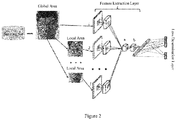
- Figure 2 is a view schematically showing a structural configuration example of the apparatus 100 for training a classification model according to the embodiment of the present disclosure.
- FIG. 2 there is one training set.
- a local area including an eye a local area including a nose and a mouth and the like of the sample image are obtained.
- the feature extraction unit 104 may be configured to, with respect to each sample image, set corresponding numbers of feature extraction layers for the global area and each predetermined local area respectively, to extract a global feature of the global area and a local feature of each predetermined local area respectively, wherein the global area and the predetermined number of predetermined local areas share at least one layer of the corresponding numbers of feature extraction layers set with respect to the global area and each predetermined local area respectively, to combine the global feature and each local feature in the at least one shared layer.
- the feature extraction layers may be convolution layers of a convolutional neural network.
- the feature extraction layers may be other structures, which will not be repeatedly described herein.
- Setting corresponding numbers of feature extraction layers for the global area and each predetermined local area respectively means: numbers of feature extraction layers set for the global area and each predetermined local area respectively may be different from each other.
- the global area and the predetermined number of predetermined local areas share the last layer of feature extraction layers set with respect to the global area and share the last layer of feature extraction layers set with respect to each predetermined local area respectively, to combine the global feature and the local feature in the last layer.
- the feature extraction unit 104 extracts, with feature extraction layers set with respect to the global area, a global feature of the global area, and extracts, with a corresponding number of feature extraction layers set for each predetermined local area respectively, a local feature of each predetermined local area respectively.
- a corresponding number of feature extraction layers are set for the global area, to extract a global feature of the global area; as shown by the arrow 2 in Figure 2 , a corresponding number of feature extraction layers are set for the local area including an eye, to extract a local feature of the local area; and as shown by the arrow 3 in Figure 2 , a corresponding number of feature extraction layers are set for the local area including a nose and a mouth, to extract a local feature of the local area.
- the global area, the local area including an eye, the local area including a nose and a mouth and the like of the sample image share feature extraction layers a and b of feature extraction layers set with respect to the global area and each predetermined local area respectively.
- the global area, the local area including an eye, the local area including a nose and a mouth and the like of the sample image may also share one of the feature extraction layers a and b.
- the global feature and each local feature are combined in the shared feature extraction layers a and b, such that a local feature of each local area serves as a supplementation to the global feature, and features of each sample image which are combined from the global feature and each local feature can precisely represent features of the sample image, thereby it is helpful for performing precise classification on the sample image, and a more robust classification model would be obtained, and further, a speed of training can be increased.
- the loss determination unit 106 may be configured to calculate, with a loss determination layer, a loss function of the sample image based on combined features of each sample image, and to train the classification model based on the loss function.
- combined features of the sample image not only include the global feature but also include the local features, and thus can precisely represent features of the sample image.
- a scenario of non-neural network since combined features of the sample image not only include the global feature but also include the local features, there is no need to perform fusion on the features.
- fusion may be further performed on the combined features of the sample image with a feature fusion layer (as an example, the feature fusion layer may be a fully connected layer of a convolutional neural network), to obtain fused features of the sample image.
- the loss determination unit 106 may calculate, with the combined features of each sample image, a loss function of the sample image. While in the scenario of neural network, the loss determination unit 106 may calculate, with the above fused features of each sample image, a loss function of the sample image. Further, in the loss determination unit 106, error back-propagation is performed with a loss value of the loss function calculated by the loss determination layer, to train the classification model.
- the loss function may be a softmax loss function.
- those skilled in the art can also envisage other examples of the loss function, which will not be repeatedly described herein.
- a classification model which performs classification with a plurality of image blocks (i.e., the above-mentioned local areas) of a human face trains one classification model for each image block, and M classification models need to be trained when there are M image blocks, such that the amount of calculation is relatively large and thus the real-time performance of the system is influenced.
- M classification models need to be trained when there are M image blocks, such that the amount of calculation is relatively large and thus the real-time performance of the system is influenced.
- the classification performance upon occurrence of a problem such as a great change in postures (e.g., a side face), low resolution, poor quality (e.g., poor quality of a human face image which is caused by a disadvantageous illumination condition) and the like in an application scenario, the classification performance would be significantly lowered.
- the global feature and each local feature are combined in the at least one feature extraction layer shared by the global area and the predetermined number of predetermined local areas, features of each sample image which are combined from the global feature and each local feature can precisely represent features of the sample image, thereby it is helpful for performing precise classification on the sample image, and a more robust classification model would be obtained. Even if a problem such as a great change in postures, low resolution, poor quality and the like occurs in an application scenario, a relatively excellent classification performance can be obtained.
- the global area and the predetermined number of predetermined local areas share at least one layer of feature extraction layers set with respect to the global area and each predetermined local area respectively, it is possible to reduce a number of parameters to be calculated and updated of the feature extraction layers, so as to make it possible to increase a speed of training.
- the training set comprises a plurality of training sets, among which at least two training sets at least partially overlap
- the loss determination layer includes a plurality of loss determination layers corresponding to the plurality of training sets respectively
- the loss determination unit 106 is configured to, with respect to each sample image from the plurality of training sets, calculate a loss function of the sample image with a loss determination layer corresponding to a training set to which the sample image belongs.
- At least two training sets among the plurality of training sets at least partially overlapping means that, there are same sample image(s) between the at least two training sets of the plurality of training sets, that is, there is cross data between the at least two training sets of the plurality of training sets.
- a loss function of a sample image with a loss determination layer set with respect to a training set to which the sample image belongs it is possible to ensure the sample image to be correctly classified.
- the plurality of training sets share at least one layer of feature extraction layers set with respect to the global area of the sample image in each training set.
- the plurality of training sets may also share at least one layer of feature extraction layers set with respect to at least one of the predetermined number of predetermined local areas of the sample image in each training set.
- Figure 3 is a view schematically showing another structural configuration example of the apparatus 100 for training a classification model according to the embodiment of the present disclosure.
- FIG. 3 there are a training set 1, ..., a training set N.
- Figure 3 shows a male face image from the training set 1 and a female face image from the training set N.
- sample images may be selected in the manner of: randomly selecting batch face images from different training sets, wherein a number of images in each training set included in the batch face images depends on a size of the training set; for example, if a proportion between data amounts of sample images in the training set 1 and the training set N is 1: P, then a proportion between numbers of images in the training set 1 and the training set N in the batch face images is 1: P.
- a local area including an eye and a local area including a nose and a mouth and the like are obtained from each sample image. Moreover, corresponding numbers of feature extraction layers are set for a global area and each predetermined local area respectively.
- Figure 3 shows that N training sets share feature extraction layers set, respectively, for a global area and each predetermined local area of a sample image in each training set.
- N training sets share feature extraction layers set, respectively, for a global area and each predetermined local area of a sample image in each training set.
- global areas in the training set 1 and the training set N share feature extraction layers set for the global areas
- local areas including an eye of the sample images in the training set 1 and the training set N share feature extraction layers set for the local areas
- local areas including a nose and a mouth of the sample images in the training set 1 and the training set N share feature extraction layers set for the local areas.
- training sets including human face data as an example, if there are many identical human face data between various training sets (that is, there is cross data between the training sets), in case of simply taking a plurality of training sets as one training set like in the prior art, a same human face existing in different training sets would be taken as different labeled data, thereby making it difficult for a training model to converge or making the performance of the model be lowered.
- the plurality of training sets when a plurality of training sets are combined to form a larger training set, the plurality of training sets enable cross data between different training sets to be correctly classified, by sharing at least one feature extraction layer of feature extraction layers set for a global area of a sample image in each training set. That is, in the apparatus 100 for training a classification model according to the embodiment of the present disclosure, a plurality of training sets can be combined to perform training simultaneously, and cross data between different training sets is enabled to be correctly classified. Further, the plurality of training sets cause higher classification precision for cross data between different training sets to be correctly classified, by further sharing at least one feature extraction layer of feature extraction layers set with respect to at least one predetermined local area of the predetermined local areas of the sample image in each training set.
- the global area, the local area including an eye, the local area including a nose and a mouth and the like of the sample image share feature extraction layers a and b of feature extraction layers set with respect to the global area and each predetermined local area respectively.
- the global area, the local area including an eye, the local area including a nose and a mouth and the like of the sample image may also share one of the feature extraction layers a and b of feature extraction layers set with respect to the global area and each predetermined local area respectively.
- Figure 3 schematically shows loss determination layers corresponding to the N training sets respectively, i.e., loss determination layer 1,..., loss determination layer N.
- the predetermined number of local areas have complementary information about the global area. This would cause the local features of the local areas to complement the global feature more comprehensively, such that features of each sample image which are combined from the global feature and each local feature can represent features of the sample image more precisely, so as to be helpful for performing more precise classification on the sample image.
- the present disclosure further provides the following embodiment of a method for training a classification model
- Figure 4 is a flowchart showing an example of a flow of a method 400 for training a classification model according to an embodiment of the present disclosure.
- the method 400 for training a classification model includes a local area obtainment step S402, a feature extraction step S404, and a loss determination step S406.
- each predetermined local area is a part of a global area of the sample image.
- the global area is an entire area of the sample image
- the local area is a partial area of the entire area of the sample image.
- a human face may be divided into a predetermined number of human face image blocks according to information on 5 key points (information on both eyes, a nose, and both mouth corners) of the human face, so as to obtain local areas, such as an area including an eye, an area including a nose, an area including a mouth and the like, of each sample image.
- the sample image may also be an image (e.g., a vehicle license plate image) other than a human face image.
- processing similar to the above-mentioned processing may be performed on an image other than a human face image .
- corresponding numbers of feature extraction layers are set for the global area and each predetermined local area respectively, to extract a global feature of the global area and a local feature of each predetermined local area respectively, wherein the global area and the predetermined number of predetermined local areas share at least one layer of the corresponding numbers of feature extraction layers set with respect to the global area and each predetermined local area respectively, to combine the global feature and each local feature in the at least one shared layer.
- the feature extraction layers may be convolution layers of a convolutional neural network.
- the feature extraction layers may be other structures, which will not be repeatedly described herein.
- a loss function of the sample image is calculated based on combined features of each sample image, and the classification model is trained based on the loss function.
- combined features of the sample image not only include the global feature but also include the local features, and thus can precisely represent features of the sample image.
- a scenario of non-neural network since combined features of the sample image not only include the global feature but also include the local features, there is no need to perform fusion on the features.
- fusion may be further performed on the combined features of the sample image with a feature fusion layer (as an example, the feature fusion layer may be a fully connected layer of a convolutional neural network), to obtain fused features of the sample image.
- a loss function of each sample image may be calculated, with the combined features of the sample image. While in the scenario of neural network, a loss function of each sample image may be calculated, with the above fused features of the sample image. Further, in the loss determination step S406, error back-propagation is performed with a loss value of the loss function calculated with the loss determination layer, to train the classification model.
- a classification model which performs classification with a plurality of image blocks (i.e., the above-mentioned local areas) of a human face trains one classification model for each image block, and M classification models need to be trained for M image blocks, such that the amount of calculation is relatively large and thus the real-time performance of the system is influenced.
- the classification performance upon occurrence of a problem such as a great change in postures, low resolution, poor quality and the like in an application scenario, the classification performance would be significantly lowered.
- the global feature and each local feature are combined in the at least one feature extraction layer shared by the global area and the predetermined number of predetermined local areas, features of each sample image which are combined from the global feature and each local feature can precisely represent features of the sample image, thereby it is helpful for performing precise classification on the sample image, and a more robust classification model would be obtained. Even if a problem such as a great change in postures, low resolution, poor quality and the like occurs in an application scenario, a relatively excellent classification performance can be obtained.
- the global area and the predetermined number of predetermined local areas share at least one layer of feature extraction layers set with respect to the global area and each predetermined local area respectively, it is possible to reduce a number of parameters to be calculated and updated of the feature extraction layers, so as to make it possible to increase a speed of training.
- the training set includes a plurality of training sets, among which at least two training sets at least partially overlap
- the loss determination layer includes a plurality of loss determination layers corresponding to the plurality of training sets respectively, and in the loss determination step S406, with respect to each sample image from the plurality of training sets, a loss function of the sample image is calculated with a loss determination layer corresponding to a training set to which the sample image belongs.
- At least two training sets among the plurality of training sets at least partially overlapping means that there are same sample image(s) between the at least two training sets of the plurality of training sets, that is, there is cross data between the at least two training sets of the plurality of training sets.
- a loss function of a sample image with a loss determination layer set with respect to a training set to which the sample image belongs it is possible to ensure the sample image to be correctly classified.
- the plurality of training sets share at least one layer of feature extraction layers set with respect to the global area of the sample image in each training set.
- the plurality of training sets may also share at least one layer of feature extraction layers set with respect to at least one of the predetermined number of predetermined local areas of the sample image in each training set.
- training sets including human face data as an example, if there are many identical human face data between various training sets (that is, there is cross data between the training sets), in case of simply taking a plurality of training sets as one training set like in the prior art, a same human face existing in different training sets would be taken as different labeled data, thereby making it difficult for a training model to converge or making the performance of the model be lowered.
- the plurality of training sets when a plurality of training sets are combined to form a larger training set, the plurality of training sets enable cross data between different training sets to be correctly classified, by sharing at least one feature extraction layer of feature extraction layers set for a global area of a sample image in each training set. That is, in the method 400 for training a classification model according to the embodiment of the present disclosure, a plurality of training sets can be combined to perform training simultaneously, and cross data between different training sets is enabled to be correctly classified.
- the plurality of training sets cause higher classification precision for of cross data between different training sets to be correctly classified, by further sharing at least one feature extraction layer of feature extraction layers set with respect to at least one predetermined local area of the predetermined local areas of the sample image in each training set.
- the predetermined number of local areas have complementary information about the global area. This would cause the local features of the local areas to complement the global feature more comprehensively, such that features of each sample image which are combined from the global feature and each local feature can represent features of the sample image more precisely, so as to be helpful for performing more precise classification on the sample image.
- FIG. 5 is a block diagram showing a functional configuration example of an apparatus 500 for classifying with a classification model trained in advance according to the embodiment of the present disclosure.
- the apparatus 500 for classifying with a classification model trained in advance according to the embodiment of the present disclosure includes a second local area obtainment unit 502, a second feature extraction unit 504, and a second loss determination unit 506.
- the classification model trained in advance may be a classification model obtained through training by, for example, the apparatus 100 for training a classifying model according to the above-mentioned embodiment of the present disclosure, or for example, the method 400 for training a classification model according to the above-mentioned embodiment of the present disclosure.
- the second local area obtainment unit 502 may be configured to obtain a predetermined number of predetermined local areas of an image to be classified, wherein each predetermined local area is a part of a global area of the image to be classified.
- the global area is an entire area of the sample image
- the local area is a partial area of the entire area of the sample image.
- local areas of the image to be classified include, for example, an area including an eye, an area including a nose, an area including a mouth, etc.
- the feature extraction layers may be convolution layers of a convolutional neural network.
- the feature extraction layers may be other structures, which will not be repeatedly described herein.
- the second feature extraction unit 504 may be configured to extract, with corresponding numbers of feature extraction layers in the classification model which are set for the global area and each predetermined local area, a global feature of the global area and a local feature of each predetermined local area respectively, wherein in the classification model, the global area and the predetermined number of predetermined local areas share at least one layer of feature extraction layers set with respect to the global area and each predetermined local area respectively, to combine the global feature and each local feature in the at least one shared layer.
- the second feature extraction unit 504 extracts, with feature extraction layers set with respect to the global area in the classification model, a global feature of the global area, and extracts, with feature extraction layers set with respect to each predetermined local area in the classification model, a local feature of each predetermined local area respectively.
- the global feature and each local feature are combined in the at least one layer shared by the global area and the predetermined number of predetermined local areas, such that a local feature of each local area serves as a supplementation to the global feature, and features of the image to be classified which are combined from the global feature and each local feature can precisely represent features of the image to be classified, thereby it is helpful for performing precise classification on the image to be classified, and a speed of classification can be increased.
- the second loss determination unit 506 may be configured to calculate, with a loss determination layer in the classification model, a loss function of the image to be classified based on combined features of the image to be classified, and to classify the image to be classified based on the loss function.
- combined features of the image to be classified not only include the global feature but also include the local features, and thus can precisely represent features of the image to be classified.
- the apparatus 500 for classifying with a classification model trained in advance is helpful for performing precise classification on the image to be classified, and further, a speed of classification can be increased.
- the loss determination layer in the classification model include a plurality of loss determination layers corresponding to the plurality of training sets respectively, and the plurality of training sets share at least one layer of feature extraction layers set with respect to the global area corresponding to each training set
- the second loss determination unit 506 is configured to calculate, with each loss determination layer of the plurality of loss determination layers, a loss function of the image to be classified based on combined features of the image to be classified, respectively, and to classify the image to be classified based on the loss function.
- the second loss determination unit 506 may select a minimum loss function of the loss functions calculated from the plurality of loss determination layers, and take a class to which the minimum loss function corresponds as a class to which the image to be classified belongs.
- the present disclosure further provides the following embodiment of a method for classifying with a classification model.
- Figure 6 is a flowchart showing an example of a flow of a method 600 for classifying with a classification model trained in advance according to an embodiment of the present disclosure.
- the method 600 for classifying with a classification model trained in advance includes a second local area obtainment step S602, a second feature extraction step S604, and a second loss determination step S606.
- the classification model trained in advance may be a classification model obtained through training by, for example, the apparatus 100 for training a classifying model according to the above-mentioned embodiment of the present disclosure, or for example, the method 400 for training a classification model according to the above-mentioned embodiment of the present disclosure.
- a predetermined number of predetermined local areas of an image to be classified are obtained, wherein each predetermined local area is a part of a global area of the image to be classified, and in the classification model, corresponding numbers of feature extraction layers are set for the global area and each predetermined local area respectively.
- the global area is an entire area of the sample image
- the local area is a partial area of the entire area of the sample image.
- local areas of the image to be classified include, for example, an area including an eye, an area including a nose, an area including a mouth, etc.
- the feature extraction layers may be convolution layers of a convolutional neural network.
- the feature extraction layers may be other structures, which will not be repeatedly described herein.
- a global feature of the global area and a local feature of each predetermined local area are extracted respectively with corresponding numbers of feature extraction layers in the classification model which are set for the global area and each predetermined local area, wherein in the classification model, the global area and the predetermined number of predetermined local areas share at least one layer of feature extraction layers set with respect to the global area and each predetermined local area respectively, to combine the global feature and each local feature in the at least one shared layer.
- a global feature of the global area is extracted with feature extraction layers set with respect to the global area in the classification model, and a local feature of each predetermined local area is extracted respectively with feature extraction layers set with respect to each predetermined local area in the classification model.
- the global feature and each local feature are combined in the at least one layer shared by the global area and the predetermined number of predetermined local areas, such that a local feature of each local area serves as a supplementation to the global feature, and features of the image to be classified which are combined from the global feature and each local feature can precisely represent features of the image to be classified, thereby it is helpful for performing precise classification on the image to be classified, and a speed of classification can be increased.
- a loss function of the image to be classified is calculated, based on combined features of the image to be classified, with a loss determination layer in the classification model, and the image to be classified is classified based on the loss function
- combined features of the image to be classified not only include the global feature but also include the local features, and thus can precisely represent features of the image to be classified.
- the method 600 for classifying with a classification model trained in advance is helpful for performing precise classification on the image to be classified, and further, a speed of classification can be increased.
- the loss determination layer in the classification model include a plurality of loss determination layers corresponding to the plurality of training sets respectively, and the plurality of training sets share at least one layer of feature extraction layers set with respect to the global area corresponding to each training set, and in the second loss determination step S606, a loss function of the image to be classified is calculated, respectively, based on combined features of the image to be classified, with each loss determination layer of the plurality of loss determination layers, and the image to be classified is classified based on the loss function.
- a minimum loss function of the loss functions calculated from the plurality of loss determination layers may be selected, and a class to which the minimum loss function corresponds may be taken as a class to which the image to be classified belongs.
- the present application further provides a storage medium and a product program.
- Machine executable instructions in the storage medium and the program product according to the embodiments of the present disclosure may be configured to implement the above-mentioned method.
- a storage medium for carrying the above-mentioned program product comprising machine executable instructions is also included in the disclosure of the present invention.
- the storage medium includes, but is not limited to, a floppy disc, an optical disc, a magnetic optical disc, a memory card, a memory stick and the like.
- the above series of processing and apparatuses may also be implemented by software and/or firmware.
- a program constituting the software is installed from a storage medium or a network to a computer having a dedicated hardware structure, for example the universal personal computer 700 as shown in Figure 7 .
- the computer when installed with various programs, can execute various functions and the like.
- a Central Processing Unit (CPU) 701 executes various processing according to programs stored in a Read-Only Memory (ROM) 702 or programs loaded from a storage part 708 to a Random Access Memory (RAM) 703.
- ROM Read-Only Memory
- RAM Random Access Memory
- data needed when the CPU 701 executes various processing and the like is also stored according to requirements.
- the CPU 701, the ROM 702 and the RAM 703 are connected to each other via a bus 704.
- An input/output interface 705 is also connected to the bus 704.
- the following components are connected to the input/output interface 705: an input part 706, including a keyboard, a mouse and the like; an output part 707, including a display, such as a Cathode Ray Tube (CRT), a Liquid Crystal Display (LCD) and the like, as well as a speaker and the like; the storage part 708, including a hard disc and the like; and a communication part 709, including a network interface card such as an LAN card, a modem and the like.
- the communication part 709 executes communication processing via a network such as the Internet.
- a driver 710 is also connected to the input/output interface 705.
- a detachable medium 711 such as a magnetic disc, an optical disc, a magnetic optical disc, a semiconductor memory and the like is installed on the driver 710 according to requirements, such that a computer program read therefrom is installed in the storage part 708 according to requirements.
- a program constituting the software is installed from a network such as the Internet or a storage medium such as the detachable medium 711.
- such a storage medium is not limited to the detachable medium 711 in which a program is stored and which is distributed separately from an apparatus to provide the program to a user as shown in Figure 7 .
- the detachable medium 711 include a magnetic disc (including a floppy disc (registered trademark)), a compact disc (including a Compact Disc Read-Only Memory (CD-ROM) and a Digital Versatile Disc (DVD), a magneto optical disc (including a Mini Disc (MD) (registered trademark)), and a semiconductor memory.
- the memory medium may be a hard disc included in the ROM 702 and the memory part 708, in which a program is stored and which is distributed together with the apparatus containing it to a user.
- a plurality of functions incorporated in one unit may be implemented by separate apparatuses.
- a plurality of functions implemented by a plurality of units may be implemented by separate apparatuses, respectively.
- one of the above functions may be implemented by a plurality of units.
- the steps described in the flowchart not only include processing executed in the described order according to a time sequence but also include processing executed in parallel or separately but not necessarily according to a time sequence.
- the order undoubtedly can be appropriately changed.
- the technology of the present disclosure may also be configured as follows.
Landscapes
- Engineering & Computer Science (AREA)
- Theoretical Computer Science (AREA)
- Physics & Mathematics (AREA)
- Health & Medical Sciences (AREA)
- General Physics & Mathematics (AREA)
- General Health & Medical Sciences (AREA)
- Oral & Maxillofacial Surgery (AREA)
- Evolutionary Computation (AREA)
- Computer Vision & Pattern Recognition (AREA)
- Data Mining & Analysis (AREA)
- Artificial Intelligence (AREA)
- Multimedia (AREA)
- General Engineering & Computer Science (AREA)
- Computing Systems (AREA)
- Life Sciences & Earth Sciences (AREA)
- Software Systems (AREA)
- Human Computer Interaction (AREA)
- Medical Informatics (AREA)
- Bioinformatics & Cheminformatics (AREA)
- Bioinformatics & Computational Biology (AREA)
- Evolutionary Biology (AREA)
- Databases & Information Systems (AREA)
- Biomedical Technology (AREA)
- Biophysics (AREA)
- Computational Linguistics (AREA)
- Molecular Biology (AREA)
- Mathematical Physics (AREA)
- Image Analysis (AREA)
- Information Retrieval, Db Structures And Fs Structures Therefor (AREA)
Abstract
Description
- The present disclosure relates to the field of information processing, and particularly to an apparatus and method for training a classification model, and an apparatus and method for classifying with a classification model.
- In recent years, due to the collection of large-scale human face data, vehicle data and the like and the application of convolutional neural networks, classification techniques such as human face recognition and vehicle license plate recognition and the like have gained great development and been widely applied in both academia and industry. At present, the main concept of improving the performance of classification such as human face recognition and vehicle license plate recognition and the like is improving the performance of a classification model. However, upon occurrence of a problem such as a great change in postures, low resolution, poor quality and the like in an application scenario, the classification performance will be significantly lowered. Further, it is possible to improve the classification performance by increasing data. However, it is laborious and arduous to collect large-scale data. As for human face data, there are public human face data sets such as VGG2Face, Ms-Celeb-IM, MegaFace and the like nowadays. Each data set has respective advantages and disadvantages, and it is possible to efficiently improve the classification performance by sufficiently utilizing advantages of each data set. The simplest method is directly putting a plurality of data sets together, but data in different data sets has crosses, and thus a circumstance where same data is labeled differently in different data sets would easily occur. In the case in which a plurality of data sets are simply fused together, a trained classification model would be easily caused to not converge or have worse performance.
- A brief summary of the present disclosure is given below to provide a basic understanding of some aspects of the present disclosure. It should be understood that the summary is not an exhaustive summary of the present disclosure. It does not intend to define a key or important part of the present disclosure, nor does it intend to limit the scope of the present disclosure. The object of the summary is only to briefly present some concepts, which serves as a preamble of the detailed description that follows.
- In view of the above problem, an object of the present invention is to provide an apparatus and method for training a classification model, and an apparatus and method for classifying with a trained classification model which are capable of solving one or more drawbacks in the prior art.
- According to an aspect of the present disclosure, there is provided an apparatus for training a classification model, including: a local area obtainment unit configured to, with respect to each sample image in a training set, obtain a predetermined number of predetermined local areas of the sample image, wherein each predetermined local area is a part of a global area of the sample image; a feature extraction unit configured to, with respect to each sample image, set corresponding numbers of feature extraction layers for the global area and each predetermined local area respectively, to extract a global feature of the global area and a local feature of each predetermined local area respectively, wherein the global area and the predetermined number of predetermined local areas share at least one layer of the corresponding numbers of feature extraction layers set with respect to the global area and each predetermined local area respectively, to combine the global feature and each local feature in the at least one shared layer; and a loss determination unit configured to calculate, with a loss determination layer, a loss function of the sample image based on combined features of each sample image, and to train the classification model based on the loss function.
- According to another aspect of the present disclosure, there is provided a method for training a classification model, including: a local area obtainment step of, with respect to each sample image in a training set, obtaining a predetermined number of predetermined local areas of the sample image, wherein each predetermined local area is a part of a global area of the sample image; a feature extraction step of, with respect to each sample image, setting corresponding numbers of feature extraction layers for the global area and each predetermined local area respectively, to extract a global feature of the global area and a local feature of each predetermined local area respectively, wherein the global area and the predetermined number of predetermined local areas share at least one layer of the corresponding numbers of feature extraction layers set with respect to the global area and each predetermined local area respectively, to combine the global feature and each local feature in the at least one shared layer; and a loss determination step of calculating, with a loss determination layer, a loss function of the sample image based on combined features of each sample image, and training the classification model based on the loss function.
- According to still another aspect of the present disclosure, there is provided an apparatus for classifying with a classification model, including: a second local area obtainment unit configured to obtain a predetermined number of predetermined local areas of an image to be classified, wherein each predetermined local area is a part of a global area of the image to be classified; a second feature extraction unit configured to extract, with corresponding numbers of feature extraction layers in the classification model which are set for the global area and each predetermined local area, a global feature of the global area and a local feature of each predetermined local area respectively, wherein in the classification model, the global area and the predetermined number of predetermined local areas share at least one layer of the corresponding numbers of feature extraction layers set with respect to the global area and each predetermined local area respectively, to combine the global feature and each local feature in the at least one shared layer; and a second loss determination unit configured to calculate, with a loss determination layer in the classification model, a loss function of the image to be classified based on combined features of the image to be classified, and to classify the image to be classified based on the loss function.
- According to other aspects of the present disclosure, there is further provided a computer program code and a computer program product for implementing the above-mentioned method according to the present disclosure.
- Other aspects of embodiments of the present disclosure are given in the following specification part, wherein preferred embodiments for sufficiently disclosing embodiments of the present disclosure are described in detail, without applying limitations thereto.
- The present disclosure may be better understood with reference to the detailed description given in conjunction with the drawings hereinafter. The same or similar components are denoted with the same or similar reference signs throughout the drawings. The drawings, together with the detailed description below, are incorporated in the specification and form a part of the specification, for further illustrating preferred embodiments of the present disclosure and explaining the principle and advantages of the present disclosure. In the drawings:
-
Figure 1 is a block diagram showing a functional configuration example of an apparatus for training a classification model according to an embodiment of the present disclosure; -
Figure 2 is a view schematically showing a structural configuration example of the apparatus for training a classification model according to the embodiment of the present disclosure; -
Figure 3 is a view schematically showing another structural configuration example of the apparatus for training a classification model according to the embodiment of the present disclosure; -
Figure 4 is a flowchart showing an example of a flow of a method for training a classification model according to an embodiment of the present disclosure; -
Figure 5 is a block diagram showing a functional configuration example of an apparatus for classifying with a classification model trained in advance according to an embodiment of the present disclosure; -
Figure 6 is a flowchart showing an example of a flow of a method for classifying with a classification model trained in advance according to an embodiment of the present disclosure; and -
Figure 7 is a block diagram showing an exemplary structure of a personal computer that may be used in the embodiments of the present disclosure. - Hereinafter, exemplary embodiments of the present disclosure will be described in combination with the drawings. For the sake of clarity and conciseness, not all of features of actual embodiments are described in the specification. However, it should be understood that in developing any such actual embodiment, many decisions specific to the embodiments must be made, so as to achieve specific objects of a developer; for example, those limitation conditions related to a system and service are met, and these limitation conditions may vary as embodiments are different. Further, it should also be appreciated that although developing tasks may be complicated and time-consuming, such developing tasks are only routine tasks for those skilled in the art benefiting from the present disclosure.
- It should also be noted herein that, to avoid the present disclosure from being obscured due to unnecessary details, only those device structures and/or processing steps closely related to the solution according to the present disclosure are shown in the drawings, while omitting other details not closely related to the present disclosure.
- Embodiments according to the present disclosure will be described in detail in combination with the drawings below.
- Firstly, a functional configuration example of an
apparatus 100 for training a classification model according to an embodiment of the present disclosure will be described with reference toFigure 1. Figure 1 is a block diagram showing a functional configuration example of theapparatus 100 for training a classification model according to the embodiment of the present disclosure. As shown inFigure 1 , theapparatus 100 for training a classification model according to the embodiment of the present disclosure includes a localarea obtainment unit 102, afeature extraction unit 104, and aloss determination unit 106. - The local
area obtainment unit 102 may be configured to, with respect to each sample image in a training set, obtain a predetermined number of predetermined local areas of the sample image, wherein each predetermined local area is a part of a global area of the sample image. - As an example, the global area is an entire area of the sample image, and the local area is a partial area of the entire area of the sample image.
- Taking the sample image being a human face image as an example, the local
area obtainment unit 102 may divide a human face into a predetermined number of human face image blocks according to information on 5 key points (information on both eyes, a nose, and both mouth corners) of the human face, so as to obtain local areas, such as an area including an eye, an area including a nose, an area including a mouth and the like, of each sample image. The sample image may be a human face, and may also be a vehicle license plate, etc. In the localarea obtainment unit 102, processing similar to the above-mentioned processing may be performed on an image (e.g., a vehicle license plate image) other than a human face image. -
Figure 2 is a view schematically showing a structural configuration example of theapparatus 100 for training a classification model according to the embodiment of the present disclosure. - As shown in
Figure 2 , there is one training set. For a human face sample image in the training set, a local area including an eye, a local area including a nose and a mouth and the like of the sample image are obtained. - The
feature extraction unit 104 may be configured to, with respect to each sample image, set corresponding numbers of feature extraction layers for the global area and each predetermined local area respectively, to extract a global feature of the global area and a local feature of each predetermined local area respectively, wherein the global area and the predetermined number of predetermined local areas share at least one layer of the corresponding numbers of feature extraction layers set with respect to the global area and each predetermined local area respectively, to combine the global feature and each local feature in the at least one shared layer. - As an example, the feature extraction layers may be convolution layers of a convolutional neural network. Those skilled in the art can understand that, the feature extraction layers may be other structures, which will not be repeatedly described herein.
- Setting corresponding numbers of feature extraction layers for the global area and each predetermined local area respectively means: numbers of feature extraction layers set for the global area and each predetermined local area respectively may be different from each other.
- Preferably, the global area and the predetermined number of predetermined local areas share the last layer of feature extraction layers set with respect to the global area and share the last layer of feature extraction layers set with respect to each predetermined local area respectively, to combine the global feature and the local feature in the last layer.
- The
feature extraction unit 104 extracts, with feature extraction layers set with respect to the global area, a global feature of the global area, and extracts, with a corresponding number of feature extraction layers set for each predetermined local area respectively, a local feature of each predetermined local area respectively. As shown by thearrow 1 inFigure 2 , a corresponding number of feature extraction layers are set for the global area, to extract a global feature of the global area; as shown by the arrow 2 inFigure 2 , a corresponding number of feature extraction layers are set for the local area including an eye, to extract a local feature of the local area; and as shown by the arrow 3 inFigure 2 , a corresponding number of feature extraction layers are set for the local area including a nose and a mouth, to extract a local feature of the local area. - As shown in
Figure 2 , as an example, the global area, the local area including an eye, the local area including a nose and a mouth and the like of the sample image share feature extraction layers a and b of feature extraction layers set with respect to the global area and each predetermined local area respectively. In addition, the global area, the local area including an eye, the local area including a nose and a mouth and the like of the sample image may also share one of the feature extraction layers a and b. The global feature and each local feature are combined in the shared feature extraction layers a and b, such that a local feature of each local area serves as a supplementation to the global feature, and features of each sample image which are combined from the global feature and each local feature can precisely represent features of the sample image, thereby it is helpful for performing precise classification on the sample image, and a more robust classification model would be obtained, and further, a speed of training can be increased. - The
loss determination unit 106 may be configured to calculate, with a loss determination layer, a loss function of the sample image based on combined features of each sample image, and to train the classification model based on the loss function. - As described above, combined features of the sample image not only include the global feature but also include the local features, and thus can precisely represent features of the sample image. Those skilled in the art should understand that, in a scenario of non-neural network, since combined features of the sample image not only include the global feature but also include the local features, there is no need to perform fusion on the features. While in a scenario of neural network, fusion may be further performed on the combined features of the sample image with a feature fusion layer (as an example, the feature fusion layer may be a fully connected layer of a convolutional neural network), to obtain fused features of the sample image. Accordingly, in the scenario of non-neural network, the
loss determination unit 106 may calculate, with the combined features of each sample image, a loss function of the sample image. While in the scenario of neural network, theloss determination unit 106 may calculate, with the above fused features of each sample image, a loss function of the sample image. Further, in theloss determination unit 106, error back-propagation is performed with a loss value of the loss function calculated by the loss determination layer, to train the classification model. As an example, the loss function may be a softmax loss function. In addition, those skilled in the art can also envisage other examples of the loss function, which will not be repeatedly described herein. - In the prior art, a classification model which performs classification with a plurality of image blocks (i.e., the above-mentioned local areas) of a human face trains one classification model for each image block, and M classification models need to be trained when there are M image blocks, such that the amount of calculation is relatively large and thus the real-time performance of the system is influenced. In addition, upon occurrence of a problem such as a great change in postures (e.g., a side face), low resolution, poor quality (e.g., poor quality of a human face image which is caused by a disadvantageous illumination condition) and the like in an application scenario, the classification performance would be significantly lowered.
- As can be seen from the above description, in the
apparatus 100 for training a classification model according to the embodiment of the present disclosure, the global feature and each local feature are combined in the at least one feature extraction layer shared by the global area and the predetermined number of predetermined local areas, features of each sample image which are combined from the global feature and each local feature can precisely represent features of the sample image, thereby it is helpful for performing precise classification on the sample image, and a more robust classification model would be obtained. Even if a problem such as a great change in postures, low resolution, poor quality and the like occurs in an application scenario, a relatively excellent classification performance can be obtained. Further, since the global area and the predetermined number of predetermined local areas share at least one layer of feature extraction layers set with respect to the global area and each predetermined local area respectively, it is possible to reduce a number of parameters to be calculated and updated of the feature extraction layers, so as to make it possible to increase a speed of training. - Preferably, the training set comprises a plurality of training sets, among which at least two training sets at least partially overlap, the loss determination layer includes a plurality of loss determination layers corresponding to the plurality of training sets respectively, and the
loss determination unit 106 is configured to, with respect to each sample image from the plurality of training sets, calculate a loss function of the sample image with a loss determination layer corresponding to a training set to which the sample image belongs. - At least two training sets among the plurality of training sets at least partially overlapping means that, there are same sample image(s) between the at least two training sets of the plurality of training sets, that is, there is cross data between the at least two training sets of the plurality of training sets. In presence of a plurality of training sets, by calculating a loss function of a sample image with a loss determination layer set with respect to a training set to which the sample image belongs, it is possible to ensure the sample image to be correctly classified.
- Preferably, the plurality of training sets share at least one layer of feature extraction layers set with respect to the global area of the sample image in each training set.
- Preferably, the plurality of training sets may also share at least one layer of feature extraction layers set with respect to at least one of the predetermined number of predetermined local areas of the sample image in each training set.
-
Figure 3 is a view schematically showing another structural configuration example of theapparatus 100 for training a classification model according to the embodiment of the present disclosure. - As shown in
Figure 3 , there are atraining set 1, ..., a training set N. As examples of sample images,Figure 3 shows a male face image from the training set 1 and a female face image from the training set N. As an example, sample images may be selected in the manner of: randomly selecting batch face images from different training sets, wherein a number of images in each training set included in the batch face images depends on a size of the training set; for example, if a proportion between data amounts of sample images in the training set 1 and the training set N is 1: P, then a proportion between numbers of images in the training set 1 and the training set N in the batch face images is 1: P. - As shown in
Figure 3 , a local area including an eye and a local area including a nose and a mouth and the like are obtained from each sample image. Moreover, corresponding numbers of feature extraction layers are set for a global area and each predetermined local area respectively. - For simplification, as an illustration but not a limitation,
Figure 3 shows that N training sets share feature extraction layers set, respectively, for a global area and each predetermined local area of a sample image in each training set. As an example, as shown by thearrow 1 and the arrow 2 inFigure 3 , global areas in the training set 1 and the training set N share feature extraction layers set for the global areas, as shown by the arrow 3 and the arrow 4 inFigure 3 , local areas including an eye of the sample images in the training set 1 and the training set N share feature extraction layers set for the local areas, and as shown by the arrow 5 and the arrow 6 inFigure 3 , local areas including a nose and a mouth of the sample images in the training set 1 and the training set N share feature extraction layers set for the local areas. - Taking training sets including human face data as an example, if there are many identical human face data between various training sets (that is, there is cross data between the training sets), in case of simply taking a plurality of training sets as one training set like in the prior art, a same human face existing in different training sets would be taken as different labeled data, thereby making it difficult for a training model to converge or making the performance of the model be lowered.
- In the
apparatus 100 for training a classification model according to the embodiment of the present disclosure, when a plurality of training sets are combined to form a larger training set, the plurality of training sets enable cross data between different training sets to be correctly classified, by sharing at least one feature extraction layer of feature extraction layers set for a global area of a sample image in each training set. That is, in theapparatus 100 for training a classification model according to the embodiment of the present disclosure, a plurality of training sets can be combined to perform training simultaneously, and cross data between different training sets is enabled to be correctly classified. Further, the plurality of training sets cause higher classification precision for cross data between different training sets to be correctly classified, by further sharing at least one feature extraction layer of feature extraction layers set with respect to at least one predetermined local area of the predetermined local areas of the sample image in each training set. - In addition, as an example, as shown in
Figure 3 , the global area, the local area including an eye, the local area including a nose and a mouth and the like of the sample image share feature extraction layers a and b of feature extraction layers set with respect to the global area and each predetermined local area respectively. Further, the global area, the local area including an eye, the local area including a nose and a mouth and the like of the sample image may also share one of the feature extraction layers a and b of feature extraction layers set with respect to the global area and each predetermined local area respectively. - Further,
Figure 3 schematically shows loss determination layers corresponding to the N training sets respectively, i.e.,loss determination layer 1,..., loss determination layer N. As described above, when a classification model is trained with a sample image, by calculating a loss function of the sample image with a loss determination layer corresponding to a training set to which the sample image belongs, it is possible to ensure the sample image to be correctly classified. - Preferably, the predetermined number of local areas have complementary information about the global area. This would cause the local features of the local areas to complement the global feature more comprehensively, such that features of each sample image which are combined from the global feature and each local feature can represent features of the sample image more precisely, so as to be helpful for performing more precise classification on the sample image.
- In correspondence to the above-mentioned embodiment of the apparatus for training a classification model, the present disclosure further provides the following embodiment of a method for training a classification model
-
Figure 4 is a flowchart showing an example of a flow of amethod 400 for training a classification model according to an embodiment of the present disclosure. - As shown in
Figure 4 , themethod 400 for training a classification model according to the embodiment of the present disclosure includes a local area obtainment step S402, a feature extraction step S404, and a loss determination step S406. - In the local area obtainment step S402, with respect to each sample image in a training set, a predetermined number of predetermined local areas of the sample image are obtained, wherein each predetermined local area is a part of a global area of the sample image.
- As an example, the global area is an entire area of the sample image, and the local area is a partial area of the entire area of the sample image.
- Taking the sample image being a human face image as an example, a human face may be divided into a predetermined number of human face image blocks according to information on 5 key points (information on both eyes, a nose, and both mouth corners) of the human face, so as to obtain local areas, such as an area including an eye, an area including a nose, an area including a mouth and the like, of each sample image. The sample image may also be an image (e.g., a vehicle license plate image) other than a human face image. In the local area obtainment step S402, processing similar to the above-mentioned processing may be performed on an image other than a human face image .
- In the feature extraction step S404, with respect to each sample image, corresponding numbers of feature extraction layers are set for the global area and each predetermined local area respectively, to extract a global feature of the global area and a local feature of each predetermined local area respectively, wherein the global area and the predetermined number of predetermined local areas share at least one layer of the corresponding numbers of feature extraction layers set with respect to the global area and each predetermined local area respectively, to combine the global feature and each local feature in the at least one shared layer.
- As an example, the feature extraction layers may be convolution layers of a convolutional neural network. Those skilled in the art can understand that, the feature extraction layers may be other structures, which will not be repeatedly described herein.
- For the specific example of setting corresponding numbers of feature extraction layers for the global area and each predetermined local area respectively as well as sharing feature extraction layer(s), reference may be made to the description in the corresponding portion, e.g., in regard to
Figure 2 , in the above-mentioned apparatus embodiment, and repeated description will not be made herein. - In the loss determination step S406, with a loss determination layer, a loss function of the sample image is calculated based on combined features of each sample image, and the classification model is trained based on the loss function.
- As described above, combined features of the sample image not only include the global feature but also include the local features, and thus can precisely represent features of the sample image. Those skilled in the art should understand that, in a scenario of non-neural network, since combined features of the sample image not only include the global feature but also include the local features, there is no need to perform fusion on the features. While in a scenario of neural network, fusion may be further performed on the combined features of the sample image with a feature fusion layer (as an example, the feature fusion layer may be a fully connected layer of a convolutional neural network), to obtain fused features of the sample image. Accordingly, in the scenario of non-neural network, in the loss determination step S406, a loss function of each sample image may be calculated, with the combined features of the sample image. While in the scenario of neural network, a loss function of each sample image may be calculated, with the above fused features of the sample image. Further, in the loss determination step S406, error back-propagation is performed with a loss value of the loss function calculated with the loss determination layer, to train the classification model.
- In the prior art, a classification model which performs classification with a plurality of image blocks (i.e., the above-mentioned local areas) of a human face trains one classification model for each image block, and M classification models need to be trained for M image blocks, such that the amount of calculation is relatively large and thus the real-time performance of the system is influenced. In addition, upon occurrence of a problem such as a great change in postures, low resolution, poor quality and the like in an application scenario, the classification performance would be significantly lowered.
- As can be seen from the above description, in the
method 400 for training a classification model according to the embodiment of the present disclosure, the global feature and each local feature are combined in the at least one feature extraction layer shared by the global area and the predetermined number of predetermined local areas, features of each sample image which are combined from the global feature and each local feature can precisely represent features of the sample image, thereby it is helpful for performing precise classification on the sample image, and a more robust classification model would be obtained. Even if a problem such as a great change in postures, low resolution, poor quality and the like occurs in an application scenario, a relatively excellent classification performance can be obtained. Further, since the global area and the predetermined number of predetermined local areas share at least one layer of feature extraction layers set with respect to the global area and each predetermined local area respectively, it is possible to reduce a number of parameters to be calculated and updated of the feature extraction layers, so as to make it possible to increase a speed of training. - Preferably, the training set includes a plurality of training sets, among which at least two training sets at least partially overlap, the loss determination layer includes a plurality of loss determination layers corresponding to the plurality of training sets respectively, and in the loss determination step S406, with respect to each sample image from the plurality of training sets, a loss function of the sample image is calculated with a loss determination layer corresponding to a training set to which the sample image belongs.
- At least two training sets among the plurality of training sets at least partially overlapping means that there are same sample image(s) between the at least two training sets of the plurality of training sets, that is, there is cross data between the at least two training sets of the plurality of training sets. In presence of a plurality of training sets, by calculating a loss function of a sample image with a loss determination layer set with respect to a training set to which the sample image belongs, it is possible to ensure the sample image to be correctly classified.
- Preferably, the plurality of training sets share at least one layer of feature extraction layers set with respect to the global area of the sample image in each training set.
- Preferably, the plurality of training sets may also share at least one layer of feature extraction layers set with respect to at least one of the predetermined number of predetermined local areas of the sample image in each training set.
- Taking training sets including human face data as an example, if there are many identical human face data between various training sets (that is, there is cross data between the training sets), in case of simply taking a plurality of training sets as one training set like in the prior art, a same human face existing in different training sets would be taken as different labeled data, thereby making it difficult for a training model to converge or making the performance of the model be lowered.
- In the
method 400 for training a classification model according to the embodiment of the present disclosure, when a plurality of training sets are combined to form a larger training set, the plurality of training sets enable cross data between different training sets to be correctly classified, by sharing at least one feature extraction layer of feature extraction layers set for a global area of a sample image in each training set. That is, in themethod 400 for training a classification model according to the embodiment of the present disclosure, a plurality of training sets can be combined to perform training simultaneously, and cross data between different training sets is enabled to be correctly classified. Further, the plurality of training sets cause higher classification precision for of cross data between different training sets to be correctly classified, by further sharing at least one feature extraction layer of feature extraction layers set with respect to at least one predetermined local area of the predetermined local areas of the sample image in each training set. - Preferably, the predetermined number of local areas have complementary information about the global area. This would cause the local features of the local areas to complement the global feature more comprehensively, such that features of each sample image which are combined from the global feature and each local feature can represent features of the sample image more precisely, so as to be helpful for performing more precise classification on the sample image.
- The present disclosure further provides an apparatus for classifying with a classification model.
Figure 5 is a block diagram showing a functional configuration example of anapparatus 500 for classifying with a classification model trained in advance according to the embodiment of the present disclosure. As shown inFigure 5 , theapparatus 500 for classifying with a classification model trained in advance according to the embodiment of the present disclosure includes a second localarea obtainment unit 502, a secondfeature extraction unit 504, and a secondloss determination unit 506. The classification model trained in advance may be a classification model obtained through training by, for example, theapparatus 100 for training a classifying model according to the above-mentioned embodiment of the present disclosure, or for example, themethod 400 for training a classification model according to the above-mentioned embodiment of the present disclosure. - The second local
area obtainment unit 502 may be configured to obtain a predetermined number of predetermined local areas of an image to be classified, wherein each predetermined local area is a part of a global area of the image to be classified. - As an example, the global area is an entire area of the sample image, and the local area is a partial area of the entire area of the sample image. Taking the image to be classified being a human face image as an example, local areas of the image to be classified include, for example, an area including an eye, an area including a nose, an area including a mouth, etc.
- As an example, the feature extraction layers may be convolution layers of a convolutional neural network. Those skilled in the art can understand that, the feature extraction layers may be other structures, which will not be repeatedly described herein.
- The second
feature extraction unit 504 may be configured to extract, with corresponding numbers of feature extraction layers in the classification model which are set for the global area and each predetermined local area, a global feature of the global area and a local feature of each predetermined local area respectively, wherein in the classification model, the global area and the predetermined number of predetermined local areas share at least one layer of feature extraction layers set with respect to the global area and each predetermined local area respectively, to combine the global feature and each local feature in the at least one shared layer. - Specifically, the second
feature extraction unit 504 extracts, with feature extraction layers set with respect to the global area in the classification model, a global feature of the global area, and extracts, with feature extraction layers set with respect to each predetermined local area in the classification model, a local feature of each predetermined local area respectively. - In the classification model, the global feature and each local feature are combined in the at least one layer shared by the global area and the predetermined number of predetermined local areas, such that a local feature of each local area serves as a supplementation to the global feature, and features of the image to be classified which are combined from the global feature and each local feature can precisely represent features of the image to be classified, thereby it is helpful for performing precise classification on the image to be classified, and a speed of classification can be increased.
- The second
loss determination unit 506 may be configured to calculate, with a loss determination layer in the classification model, a loss function of the image to be classified based on combined features of the image to be classified, and to classify the image to be classified based on the loss function. - As described above, combined features of the image to be classified not only include the global feature but also include the local features, and thus can precisely represent features of the image to be classified.
- As can be seen from the above description, since in the training model, the global feature and each local feature are combined in the at least one feature extraction layer shared by the global area and predetermined local areas, features of each image to be classified which are combined from the global feature and each local feature can precisely represent features of the sample image. Therefore, the
apparatus 500 for classifying with a classification model trained in advance according to the embodiment of the present disclosure is helpful for performing precise classification on the image to be classified, and further, a speed of classification can be increased. - Preferably, in a case where the classification model is obtained through training with a plurality of training sets, the loss determination layer in the classification model include a plurality of loss determination layers corresponding to the plurality of training sets respectively, and the plurality of training sets share at least one layer of feature extraction layers set with respect to the global area corresponding to each training set, and the second
loss determination unit 506 is configured to calculate, with each loss determination layer of the plurality of loss determination layers, a loss function of the image to be classified based on combined features of the image to be classified, respectively, and to classify the image to be classified based on the loss function. - As an example, the second
loss determination unit 506 may select a minimum loss function of the loss functions calculated from the plurality of loss determination layers, and take a class to which the minimum loss function corresponds as a class to which the image to be classified belongs. - In correspondence to the above-mentioned embodiment of the apparatus for classifying with a classification model, the present disclosure further provides the following embodiment of a method for classifying with a classification model.
-
Figure 6 is a flowchart showing an example of a flow of amethod 600 for classifying with a classification model trained in advance according to an embodiment of the present disclosure. - As shown in
Figure 6 , themethod 600 for classifying with a classification model trained in advance according to the embodiment of the present disclosure includes a second local area obtainment step S602, a second feature extraction step S604, and a second loss determination step S606. The classification model trained in advance may be a classification model obtained through training by, for example, theapparatus 100 for training a classifying model according to the above-mentioned embodiment of the present disclosure, or for example, themethod 400 for training a classification model according to the above-mentioned embodiment of the present disclosure. - In the second local area obtainment step S602, a predetermined number of predetermined local areas of an image to be classified are obtained, wherein each predetermined local area is a part of a global area of the image to be classified, and in the classification model, corresponding numbers of feature extraction layers are set for the global area and each predetermined local area respectively.
- As an example, the global area is an entire area of the sample image, and the local area is a partial area of the entire area of the sample image. Taking the image to be classified being a human face image as an example, local areas of the image to be classified include, for example, an area including an eye, an area including a nose, an area including a mouth, etc.
- As an example, the feature extraction layers may be convolution layers of a convolutional neural network. Those skilled in the art can understand that, the feature extraction layers may be other structures, which will not be repeatedly described herein.
- In the second feature extraction step S604, a global feature of the global area and a local feature of each predetermined local area are extracted respectively with corresponding numbers of feature extraction layers in the classification model which are set for the global area and each predetermined local area, wherein in the classification model, the global area and the predetermined number of predetermined local areas share at least one layer of feature extraction layers set with respect to the global area and each predetermined local area respectively, to combine the global feature and each local feature in the at least one shared layer.
- Specifically, a global feature of the global area is extracted with feature extraction layers set with respect to the global area in the classification model, and a local feature of each predetermined local area is extracted respectively with feature extraction layers set with respect to each predetermined local area in the classification model.
- In the classification model, the global feature and each local feature are combined in the at least one layer shared by the global area and the predetermined number of predetermined local areas, such that a local feature of each local area serves as a supplementation to the global feature, and features of the image to be classified which are combined from the global feature and each local feature can precisely represent features of the image to be classified, thereby it is helpful for performing precise classification on the image to be classified, and a speed of classification can be increased.
- In the second loss determination step S606, a loss function of the image to be classified is calculated, based on combined features of the image to be classified, with a loss determination layer in the classification model, and the image to be classified is classified based on the loss function
As described above, combined features of the image to be classified not only include the global feature but also include the local features, and thus can precisely represent features of the image to be classified. - As can be seen from the above description, since in the training model the global feature and each local feature are combined in the at least one feature extraction layer shared by the global area and predetermined local areas, features of each image to be classified which are combined from the global feature and each local feature can precisely represent features of the sample image. Therefore, the
method 600 for classifying with a classification model trained in advance according to the embodiment of the present disclosure is helpful for performing precise classification on the image to be classified, and further, a speed of classification can be increased. - Preferably, in a case where the classification model is obtained through training with a plurality of training sets, the loss determination layer in the classification model include a plurality of loss determination layers corresponding to the plurality of training sets respectively, and the plurality of training sets share at least one layer of feature extraction layers set with respect to the global area corresponding to each training set, and in the second loss determination step S606, a loss function of the image to be classified is calculated, respectively, based on combined features of the image to be classified, with each loss determination layer of the plurality of loss determination layers, and the image to be classified is classified based on the loss function.
- As an example, in the second loss determination step S606, a minimum loss function of the loss functions calculated from the plurality of loss determination layers may be selected, and a class to which the minimum loss function corresponds may be taken as a class to which the image to be classified belongs.
- It should be noted that, although the functional configurations and the operations of the apparatus and method for training a classification model and the apparatus and method for classifying with a classification model according to the embodiments of the present disclosure have been described above, this is only exemplary but not limiting, and those skilled in the art may carry out modifications on the above embodiments, for example may carry out additions, deletions or combinations the like on the functional modules and the operations in each embodiment, according to the principle of the present disclosure. Moreover, all of such modifications fall within the scope of the present disclosure.
- Further, it should also be noted that, the method embodiment herein corresponds to the above-mentioned apparatus embodiment. Thus, for contents not described in detail in the method embodiment, reference may be made to the corresponding description in the apparatus embodiment, and repeated description will not be made herein.
- Further, the present application further provides a storage medium and a product program. Machine executable instructions in the storage medium and the program product according to the embodiments of the present disclosure may be configured to implement the above-mentioned method. Thus, for contents not described in detail herein, reference may be made to the foregoing corresponding description, and repeated description will not be made herein.
- Accordingly, a storage medium for carrying the above-mentioned program product comprising machine executable instructions is also included in the disclosure of the present invention. The storage medium includes, but is not limited to, a floppy disc, an optical disc, a magnetic optical disc, a memory card, a memory stick and the like.
- In addition, it should also be noted that, the above series of processing and apparatuses may also be implemented by software and/or firmware. In the case of implementation by software and/or firmware, a program constituting the software is installed from a storage medium or a network to a computer having a dedicated hardware structure, for example the universal
personal computer 700 as shown inFigure 7 . The computer, when installed with various programs, can execute various functions and the like. - In
Figure 7 , a Central Processing Unit (CPU) 701 executes various processing according to programs stored in a Read-Only Memory (ROM) 702 or programs loaded from astorage part 708 to a Random Access Memory (RAM) 703. In theRAM 703, data needed when theCPU 701 executes various processing and the like is also stored according to requirements. - The
CPU 701, theROM 702 and theRAM 703 are connected to each other via abus 704. An input/output interface 705 is also connected to thebus 704. - The following components are connected to the input/output interface 705: an
input part 706, including a keyboard, a mouse and the like; anoutput part 707, including a display, such as a Cathode Ray Tube (CRT), a Liquid Crystal Display (LCD) and the like, as well as a speaker and the like; thestorage part 708, including a hard disc and the like; and acommunication part 709, including a network interface card such as an LAN card, a modem and the like. Thecommunication part 709 executes communication processing via a network such as the Internet. - According to requirements, a
driver 710 is also connected to the input/output interface 705. Adetachable medium 711 such as a magnetic disc, an optical disc, a magnetic optical disc, a semiconductor memory and the like is installed on thedriver 710 according to requirements, such that a computer program read therefrom is installed in thestorage part 708 according to requirements. - In a case where the foregoing series of processing is implemented by software, a program constituting the software is installed from a network such as the Internet or a storage medium such as the
detachable medium 711. - Those skilled in the art should understand that, such a storage medium is not limited to the
detachable medium 711 in which a program is stored and which is distributed separately from an apparatus to provide the program to a user as shown inFigure 7 . Examples of thedetachable medium 711 include a magnetic disc (including a floppy disc (registered trademark)), a compact disc (including a Compact Disc Read-Only Memory (CD-ROM) and a Digital Versatile Disc (DVD), a magneto optical disc (including a Mini Disc (MD) (registered trademark)), and a semiconductor memory. Or, the memory medium may be a hard disc included in theROM 702 and thememory part 708, in which a program is stored and which is distributed together with the apparatus containing it to a user. - Preferred embodiments of the present disclosure have been described above with reference to the drawings. However, the present disclosure of course is not limited to the foregoing examples. Those skilled in the art can obtain various alterations and modifications within the scope of the appended claims, and it should be understood that these alterations and modifications naturally will fall within the technical scope of the present disclosure.
- For example, in the above-mentioned embodiments, a plurality of functions incorporated in one unit may be implemented by separate apparatuses. Alternatively, in the foregoing embodiments, a plurality of functions implemented by a plurality of units may be implemented by separate apparatuses, respectively. In addition, one of the above functions may be implemented by a plurality of units. Undoubtedly, such configurations are included within the technical scope of the present disclosure.
- In the specification, the steps described in the flowchart not only include processing executed in the described order according to a time sequence but also include processing executed in parallel or separately but not necessarily according to a time sequence. In addition, even if in steps in which processing is executed according to a time sequence, the order undoubtedly can be appropriately changed.
- In addition, the technology of the present disclosure may also be configured as follows.
-
Appendix 1. An apparatus for training a classification model, comprising:- a local area obtainment unit configured to, with respect to each sample image in a training set, obtain a predetermined number of predetermined local areas of the sample image, wherein each predetermined local area is a part of a global area of the sample image;
- a feature extraction unit configured to, with respect to each sample image, set corresponding numbers of feature extraction layers for the global area and each predetermined local area respectively, to extract a global feature of the global area and a local feature of each predetermined local area respectively, wherein the global area and the predetermined number of predetermined local areas share at least one layer of the corresponding numbers of feature extraction layers set with respect to the global area and each predetermined local area respectively, to combine the global feature and each local feature in the at least one shared layer; and
- a loss determination unit configured to calculate, with a loss determination layer, a loss function of the sample image based on combined features of each sample image, and to train the classification model based on the loss function.
- Appendix 2. The apparatus for training a classification model according to
Appendix 1, wherein
the training set comprises a plurality of training sets, among which at least two training sets at least partially overlap,
the loss determination layer comprises a plurality of loss determination layers corresponding to the plurality of training sets respectively, and
the loss determination unit is configured to, with respect to each sample image from the plurality of training sets, calculate a loss function of the sample image with a loss determination layer corresponding to a training set to which the sample image belongs. - Appendix 3. The apparatus for training a classification model according to Appendix 2, wherein the plurality of training sets share at least one layer of feature extraction layers set with respect to the global area of the sample image in each training set.
- Appendix 4. The apparatus for training a classification model according to Appendix 3, wherein the plurality of training sets also share at least one layer of feature extraction layers set with respect to at least one of the predetermined number of predetermined local areas of the sample image in each training set.
- Appendix 5. The apparatus for training a classification model according to
Appendix 1, wherein the predetermined number of local areas have complementary information about the global area. - Appendix 6. The apparatus for training a classification model according to
Appendix 1, wherein the feature extraction layers are convolution layers of a convolutional neural network. - Appendix 7. A method for training a classification model, comprising:
- a local area obtainment step of, with respect to each sample image in a training set, obtaining a predetermined number of predetermined local areas of the sample image, wherein each predetermined local area is a part of a global area of the sample image;
- a feature extraction step of, with respect to each sample image, setting corresponding numbers of feature extraction layers for the global area and each predetermined local area respectively, to extract a global feature of the global area and a local feature of each predetermined local area respectively, wherein the global area and the predetermined number of predetermined local areas share at least one layer of the corresponding numbers of feature extraction layers set with respect to the global area and each predetermined local area respectively, to combine the global feature and each local feature in the at least one shared layer; and
- a loss determination step of calculating, with a loss determination layer, a loss function of the sample image based on combined features of each sample image, and training the classification model based on the loss function.
- Appendix 8. The method for training a classification model according to Appendix 7, wherein
the training set comprises a plurality of training sets, among which at least two training sets at least partially overlap,
the loss determination layer comprises a plurality of loss determination layers corresponding to the plurality of training sets respectively, and
in the loss determination step, with respect to each sample image from the plurality of training sets, a loss function of the sample image is calculated with a loss determination layer corresponding to a training set to which the sample image belongs. - Appendix 9. The method for training a classification model according to Appendix 8, wherein
the plurality of training sets share at least one layer of feature extraction layers set with respect to the global area of the sample image in each training set. - Appendix 10. The method for training a classification model according to Appendix 9, wherein the plurality of training sets also share at least one layer of feature extraction layers set with respect to at least one of the predetermined number of predetermined local areas of the sample image in each training set.
- Appendix 11. The method for training a classification model according to Appendix 7, wherein the predetermined number of local areas have complementary information about the global area.
- Appendix 12. The method for training a classification model according to Appendix 7,
wherein the feature extraction layers are convolution layers of a convolutional neural network. - Appendix 13. An apparatus for classifying with a classification model, comprising:
- a second local area obtainment unit configured to obtain a predetermined number of predetermined local areas of an image to be classified, wherein each predetermined local area is a part of a global area of the image to be classified;
- a second feature extraction unit configured to extract, with corresponding numbers of feature extraction layers in the classification model which are set for the global area and each predetermined local area, a global feature of the global area and a local feature of each predetermined local area respectively, wherein in the classification model, the global area and the predetermined number of predetermined local areas share at least one layer of the corresponding numbers of feature extraction layers set with respect to the global area and each predetermined local area respectively, to combine the global feature and each local feature in the at least one shared layer; and
- a second loss determination unit configured to calculate, with a loss determination layer in the classification model, a loss function of the image to be classified based on combined features of the image to be classified, and to classify the image to be classified based on the loss function.
- Appendix 14. The apparatus for classifying with a classification model according to Appendix 13,
in a case where the classification model is obtained through training with a plurality of training sets, the loss determination layer in the classification model comprises a plurality of loss determination layers corresponding to the plurality of training sets respectively, and the plurality of training sets share at least one layer of feature extraction layers set with respect to the global area corresponding to each training set, and
the second loss determination unit is configured to respectively calculate, with each loss determination layer of the plurality of loss determination layers, a loss function of the image to be classified based on combined features of the image to be classified, and to classify the image to be classified based on the loss function.
Claims (14)
- An apparatus for training a classification model, comprising:a local area obtainment unit configured to, with respect to each sample image in a training set, obtain a predetermined number of predetermined local areas of the sample image, wherein each predetermined local area is a part of a global area of the sample image;a feature extraction unit configured to, with respect to each sample image, set corresponding numbers of feature extraction layers for the global area and each predetermined local area respectively, to extract a global feature of the global area and a local feature of each predetermined local area respectively, wherein the global area and the predetermined number of predetermined local areas share at least one layer of the corresponding numbers of feature extraction layers set with respect to the global area and each predetermined local area respectively, to combine the global feature and each local feature in the at least one shared layer; anda loss determination unit configured to calculate, with a loss determination layer, a loss function of the sample image based on combined features of each sample image, and to train the classification model based on the loss function.
- The apparatus for training a classification model according to claim 1, wherein
the training set comprises a plurality of training sets, among which at least two training sets at least partially overlap,
the loss determination layer comprises a plurality of loss determination layers corresponding to the plurality of training sets respectively, and
the loss determination unit is configured to, with respect to each sample image from the plurality of training sets, calculate a loss function of the sample image with a loss determination layer corresponding to a training set to which the sample image belongs. - The apparatus for training a classification model according to claim 2, wherein the plurality of training sets share at least one layer of feature extraction layers set with respect to the global area of the sample image in each training set.
- The apparatus for training a classification model according to claim 3, wherein the plurality of training sets also share at least one layer of feature extraction layers set with respect to at least one of the predetermined number of predetermined local areas of the sample image in each training set.
- The apparatus for training a classification model according to claim 1, wherein the predetermined number of local areas have complementary information about the global area.
- The apparatus for training a classification model according to claim 1, wherein the feature extraction layers are convolution layers of a convolutional neural network.
- A method for training a classification model, comprising:a local area obtainment step of, with respect to each sample image in a training set, obtaining a predetermined number of predetermined local areas of the sample image, wherein each predetermined local area is a part of a global area of the sample image;a feature extraction step of, with respect to each sample image, setting corresponding numbers of feature extraction layers for the global area and each predetermined local area respectively, to extract a global feature of the global area and a local feature of each predetermined local area respectively, wherein the global area and the predetermined number of predetermined local areas share at least one layer of the corresponding numbers of feature extraction layers set with respect to the global area and each predetermined local area respectively, to combine the global feature and each local feature in the at least one shared layer; anda loss determination step of calculating, with a loss determination layer, a loss function of the sample image based on combined features of each sample image, and training the classification model based on the loss function.
- The method for training a classification model according to claim 7, wherein
the training set comprises a plurality of training sets, among which at least two training sets at least partially overlap,
the loss determination layer comprises a plurality of loss determination layers corresponding to the plurality of training sets respectively, and
in the loss determination step, with respect to each sample image from the plurality of training sets, a loss function of the sample image is calculated with a loss determination layer corresponding to a training set to which the sample image belongs. - The method for training a classification model according to claim 8, wherein
the plurality of training sets share at least one layer of feature extraction layers set with respect to the global area of the sample image in each training set. - The method for training a classification model according to claim 9, wherein the plurality of training sets also share at least one layer of feature extraction layers set with respect to at least one of the predetermined number of predetermined local areas of the sample image in each training set.
- The method for training a classification model according to claim 7, wherein the predetermined number of local areas have complementary information about the global area.
- The method for training a classification model according to claim 7, wherein the feature extraction layers are convolution layers of a convolutional neural network.
- An apparatus for classifying with a classification model, comprising:a second local area obtainment unit configured to obtain a predetermined number of predetermined local areas of an image to be classified, wherein each predetermined local area is a part of a global area of the image to be classified;a second feature extraction unit configured to extract, with corresponding numbers of feature extraction layers in the classification model which are set for the global area and each predetermined local area, a global feature of the global area and a local feature of each predetermined local area respectively, wherein in the classification model, the global area and the predetermined number of predetermined local areas share at least one layer of the corresponding numbers of feature extraction layers set with respect to the global area and each predetermined local area respectively, to combine the global feature and each local feature in the at least one shared layer; anda second loss determination unit configured to calculate, with a loss determination layer in the classification model, a loss function of the image to be classified based on combined features of the image to be classified, and to classify the image to be classified based on the loss function.
- The apparatus for classifying with a classification model according to claim 13,
in a case where the classification model is obtained through training with a plurality of training sets, the loss determination layer in the classification model comprises a plurality of loss determination layers corresponding to the plurality of training sets respectively, and the plurality of training sets share at least one layer of feature extraction layers set with respect to the global area corresponding to each training set, and
the second loss determination unit is configured to respectively calculate, with each loss determination layer of the plurality of loss determination layers, a loss function of the image to be classified based on combined features of the image to be classified, and to classify the image to be classified based on the loss function.
Applications Claiming Priority (1)
| Application Number | Priority Date | Filing Date | Title |
|---|---|---|---|
| CN201910122211.5A CN111582008B (en) | 2019-02-19 | 2019-02-19 | Device and method for training classification model and device for classifying using classification model |
Publications (1)
| Publication Number | Publication Date |
|---|---|
| EP3699813A1 true EP3699813A1 (en) | 2020-08-26 |
Family
ID=69156332
Family Applications (1)
| Application Number | Title | Priority Date | Filing Date |
|---|---|---|---|
| EP20150950.2A Withdrawn EP3699813A1 (en) | 2019-02-19 | 2020-01-09 | Apparatus and method for training classification model and apparatus for classifying with classification model |
Country Status (4)
| Country | Link |
|---|---|
| US (1) | US11113513B2 (en) |
| EP (1) | EP3699813A1 (en) |
| JP (1) | JP2020135859A (en) |
| CN (1) | CN111582008B (en) |
Cited By (1)
| Publication number | Priority date | Publication date | Assignee | Title |
|---|---|---|---|---|
| CN115272688A (en) * | 2022-08-02 | 2022-11-01 | 大连理工大学 | A meta-feature-based image classification method based on few-shot learning |
Families Citing this family (22)
| Publication number | Priority date | Publication date | Assignee | Title |
|---|---|---|---|---|
| US11182652B2 (en) * | 2019-08-16 | 2021-11-23 | Toyota Motor Engineering & Manufacturing North America, Inc. | Methods and system for inferring perception based on augmented feature maps of a perception network |
| US11443193B2 (en) | 2020-04-24 | 2022-09-13 | Adobe Inc. | Domain adaptation for machine learning models |
| US11537915B2 (en) * | 2020-05-14 | 2022-12-27 | International Business Machines Corporation | Targeted data acquisition for model training |
| CN113762005B (en) * | 2020-11-09 | 2024-06-18 | 北京沃东天骏信息技术有限公司 | Feature selection model training, object classification method, device, equipment and medium |
| US20230410478A1 (en) * | 2020-11-09 | 2023-12-21 | Canon U.S.A., Inc. | Label-dependent loss function for discrete ordered regression model |
| CN113516142A (en) * | 2020-11-26 | 2021-10-19 | 腾讯科技(深圳)有限公司 | Text image matching method, device, equipment and storage medium |
| CN112232449B (en) * | 2020-12-14 | 2021-04-27 | 浙江大华技术股份有限公司 | Neural network training method, electronic device, and storage medium |
| CN112907138B (en) * | 2021-03-26 | 2023-08-01 | 国网陕西省电力公司电力科学研究院 | A Power Grid Scenario Early Warning Classification Method and System from Partial to Overall Perception |
| CN113642602B (en) * | 2021-07-05 | 2023-07-18 | 山西大学 | A multi-label image classification method based on the relationship between global and local labels |
| CN115880742B (en) * | 2021-09-28 | 2026-04-28 | 腾讯科技(深圳)有限公司 | A method, device, electronic device, and storage medium for recognizing abnormal facial expressions. |
| CN114049496B (en) * | 2021-11-10 | 2026-02-27 | 浙江商汤科技开发有限公司 | A feature detection method, apparatus, computer device, and storage medium |
| CN114724148B (en) * | 2022-02-18 | 2025-08-19 | 北京百度网讯科技有限公司 | Method, device, equipment, medium and product for generating model and extracting characteristics |
| CN116778211B (en) * | 2022-03-07 | 2024-10-29 | 腾讯科技(深圳)有限公司 | Data processing method, device, electronic equipment and computer readable storage medium |
| CN114663667A (en) * | 2022-03-07 | 2022-06-24 | 盛景智能科技(嘉兴)有限公司 | Winding disorder rope identification method and device, electronic equipment and storage medium |
| CN115035339A (en) * | 2022-06-10 | 2022-09-09 | 华中科技大学同济医学院附属同济医院 | Cystoscope image classification method based on artificial intelligence |
| CN115146675B (en) * | 2022-06-28 | 2023-09-26 | 江苏大学 | A deep multi-feature dynamic confrontation diagnosis method for rotating machinery migration under variable working conditions |
| CN115205645B (en) * | 2022-07-14 | 2025-08-22 | 中国人民解放军国防科技大学 | Transformer-based image feature extraction method and system, and computer equipment |
| CN115661486B (en) * | 2022-12-29 | 2023-04-07 | 有米科技股份有限公司 | Intelligent image feature extraction method and device |
| CN116403251B (en) * | 2023-01-06 | 2026-03-24 | 山西省信息产业技术研究院有限公司 | A blockchain light node face recognition method based on PF-PR mode |
| CN116091930B (en) * | 2023-02-07 | 2026-01-02 | 清华大学 | A remote sensing-based method, apparatus, equipment, and storage medium for terraced field mapping. |
| CN116051859B (en) * | 2023-02-21 | 2023-09-08 | 阿里巴巴(中国)有限公司 | Service providing method, apparatus and storage medium |
| CN116843954B (en) * | 2023-06-07 | 2026-01-13 | 阿里巴巴达摩院(杭州)科技有限公司 | Image classification method |
Citations (3)
| Publication number | Priority date | Publication date | Assignee | Title |
|---|---|---|---|---|
| CN108319943A (en) * | 2018-04-25 | 2018-07-24 | 北京优创新港科技股份有限公司 | A method of human face recognition model performance under the conditions of raising is worn glasses |
| CN108491835A (en) * | 2018-06-12 | 2018-09-04 | 常州大学 | Binary channels convolutional neural networks towards human facial expression recognition |
| CN108875548A (en) * | 2018-04-18 | 2018-11-23 | 科大讯飞股份有限公司 | Character trajectory generation method and device, storage medium, and electronic equipment |
Family Cites Families (17)
| Publication number | Priority date | Publication date | Assignee | Title |
|---|---|---|---|---|
| US7660468B2 (en) * | 2005-05-09 | 2010-02-09 | Like.Com | System and method for enabling image searching using manual enrichment, classification, and/or segmentation |
| WO2008151471A1 (en) * | 2007-06-15 | 2008-12-18 | Tsinghua University | A robust precise eye positioning method in complicated background image |
| JP5668932B2 (en) * | 2011-05-23 | 2015-02-12 | 株式会社モルフォ | Image identification device, image identification method, image identification program, and recording medium |
| JP6159489B2 (en) * | 2014-04-11 | 2017-07-05 | ペキン センスタイム テクノロジー ディベロップメント カンパニー リミテッド | Face authentication method and system |
| US9639806B2 (en) * | 2014-04-15 | 2017-05-02 | Xerox Corporation | System and method for predicting iconicity of an image |
| CN105488515B (en) * | 2014-09-17 | 2019-06-25 | 富士通株式会社 | Image processing method and image processing device for classifying images |
| CN105590102A (en) | 2015-12-30 | 2016-05-18 | 中通服公众信息产业股份有限公司 | Front car face identification method based on deep learning |
| US10420523B2 (en) * | 2016-03-21 | 2019-09-24 | The Board Of Trustees Of The Leland Stanford Junior University | Adaptive local window-based methods for characterizing features of interest in digital images and systems for practicing same |
| CN106548165B (en) | 2016-11-28 | 2019-07-16 | 中通服公众信息产业股份有限公司 | A kind of face identification method of the convolutional neural networks based on image block weighting |
| JP6798860B2 (en) * | 2016-11-29 | 2020-12-09 | 株式会社Soken | Boundary line estimation device |
| CN106934765A (en) * | 2017-03-14 | 2017-07-07 | 长沙全度影像科技有限公司 | Panoramic picture fusion method based on depth convolutional neural networks Yu depth information |
| CN107229614B (en) * | 2017-06-29 | 2020-11-10 | 百度在线网络技术(北京)有限公司 | Method and apparatus for classifying data |
| CN107316066B (en) * | 2017-07-28 | 2021-01-01 | 北京工商大学 | Image classification method and system based on multi-channel convolutional neural network |
| CN108304847B (en) * | 2017-11-30 | 2021-09-28 | 腾讯科技(深圳)有限公司 | Image classification method and device and personalized recommendation method and device |
| CN108229659A (en) * | 2017-12-29 | 2018-06-29 | 陕西科技大学 | Piano singly-bound voice recognition method based on deep learning |
| CN109033938A (en) * | 2018-06-01 | 2018-12-18 | 上海阅面网络科技有限公司 | A kind of face identification method based on ga s safety degree Fusion Features |
| CN108960140B (en) * | 2018-07-04 | 2021-04-27 | 国家新闻出版广电总局广播科学研究院 | Pedestrian re-identification method based on multi-region feature extraction and fusion |
-
2019
- 2019-02-19 CN CN201910122211.5A patent/CN111582008B/en not_active Expired - Fee Related
- 2019-12-26 JP JP2019236449A patent/JP2020135859A/en active Pending
-
2020
- 2020-01-09 US US16/738,393 patent/US11113513B2/en not_active Expired - Fee Related
- 2020-01-09 EP EP20150950.2A patent/EP3699813A1/en not_active Withdrawn
Patent Citations (3)
| Publication number | Priority date | Publication date | Assignee | Title |
|---|---|---|---|---|
| CN108875548A (en) * | 2018-04-18 | 2018-11-23 | 科大讯飞股份有限公司 | Character trajectory generation method and device, storage medium, and electronic equipment |
| CN108319943A (en) * | 2018-04-25 | 2018-07-24 | 北京优创新港科技股份有限公司 | A method of human face recognition model performance under the conditions of raising is worn glasses |
| CN108491835A (en) * | 2018-06-12 | 2018-09-04 | 常州大学 | Binary channels convolutional neural networks towards human facial expression recognition |
Non-Patent Citations (1)
| Title |
|---|
| ZHANG KE ET AL: "Fine-Grained Age Group Classification in the wild", 2018 24TH INTERNATIONAL CONFERENCE ON PATTERN RECOGNITION (ICPR), IEEE, 20 August 2018 (2018-08-20), pages 788 - 793, XP033454087, DOI: 10.1109/ICPR.2018.8545333 * |
Cited By (2)
| Publication number | Priority date | Publication date | Assignee | Title |
|---|---|---|---|---|
| CN115272688A (en) * | 2022-08-02 | 2022-11-01 | 大连理工大学 | A meta-feature-based image classification method based on few-shot learning |
| CN115272688B (en) * | 2022-08-02 | 2025-07-04 | 大连理工大学 | A small sample learning image classification method based on meta-features |
Also Published As
| Publication number | Publication date |
|---|---|
| US20200265220A1 (en) | 2020-08-20 |
| CN111582008B (en) | 2023-09-08 |
| JP2020135859A (en) | 2020-08-31 |
| US11113513B2 (en) | 2021-09-07 |
| CN111582008A (en) | 2020-08-25 |
Similar Documents
| Publication | Publication Date | Title |
|---|---|---|
| US11113513B2 (en) | Apparatus and method for training classification model and apparatus for classifying with classification model | |
| EP3699819A1 (en) | Apparatus and method for training classification model and apparatus for performing classification by using classification model | |
| CN111275688B (en) | Small target detection method based on context feature fusion and screening based on attention mechanism | |
| EP3683726A1 (en) | Aparatus and method for training classifying model | |
| US11657602B2 (en) | Font identification from imagery | |
| US10878284B2 (en) | Method and apparatus for training image model, and method and apparatus for category prediction | |
| EP3876163B1 (en) | Model training, image processing method, device, storage medium, and program product | |
| CN112513927B (en) | Wind turbine blade defect inspection based on convolutional neural network | |
| US20190042888A1 (en) | Training method, training apparatus, region classifier, and non-transitory computer readable medium | |
| WO2023050651A1 (en) | Semantic image segmentation method and apparatus, and device and storage medium | |
| US9501707B2 (en) | Method and system for bootstrapping an OCR engine for license plate recognition | |
| CN114821346B (en) | Radar image intelligent identification method and system based on embedded platform | |
| US11348349B2 (en) | Training data increment method, electronic apparatus and computer-readable medium | |
| JP2020060879A (en) | Learning device, image generator, method for learning, and learning program | |
| CN115050002A (en) | Image annotation model training method and device, electronic equipment and storage medium | |
| WO2019049060A1 (en) | Froth segmentation in flotation cells | |
| CN113971627B (en) | A method and device for generating a license plate image | |
| CN117788817A (en) | Remote sensing image semantic segmentation method based on edge feature enhancement | |
| CN114596209A (en) | Fingerprint image restoration method, system, equipment and storage medium | |
| CN114842205B (en) | Vehicle loss detection method, device, equipment and storage medium | |
| Shahrestani et al. | Pavement crack image generation and data balancing using deep adversarial generative networks | |
| JP2013061876A (en) | Information processing apparatus, control method for information processing apparatus, and program | |
| CN114066788B (en) | Balanced instance segmentation data synthesis method | |
| CN114445320B (en) | Image segmentation quality evaluation method and device, electronic equipment and storage medium | |
| CN121058040A (en) | Defect classification of processed chips |
Legal Events
| Date | Code | Title | Description |
|---|---|---|---|
| PUAI | Public reference made under article 153(3) epc to a published international application that has entered the european phase |
Free format text: ORIGINAL CODE: 0009012 |
|
| STAA | Information on the status of an ep patent application or granted ep patent |
Free format text: STATUS: THE APPLICATION HAS BEEN PUBLISHED |
|
| AK | Designated contracting states |
Kind code of ref document: A1 Designated state(s): AL AT BE BG CH CY CZ DE DK EE ES FI FR GB GR HR HU IE IS IT LI LT LU LV MC MK MT NL NO PL PT RO RS SE SI SK SM TR |
|
| AX | Request for extension of the european patent |
Extension state: BA ME |
|
| STAA | Information on the status of an ep patent application or granted ep patent |
Free format text: STATUS: REQUEST FOR EXAMINATION WAS MADE |
|
| 17P | Request for examination filed |
Effective date: 20210112 |
|
| RBV | Designated contracting states (corrected) |
Designated state(s): AL AT BE BG CH CY CZ DE DK EE ES FI FR GB GR HR HU IE IS IT LI LT LU LV MC MK MT NL NO PL PT RO RS SE SI SK SM TR |
|
| STAA | Information on the status of an ep patent application or granted ep patent |
Free format text: STATUS: EXAMINATION IS IN PROGRESS |
|
| 17Q | First examination report despatched |
Effective date: 20220428 |
|
| REG | Reference to a national code |
Ref country code: DE Ref legal event code: R079 Free format text: PREVIOUS MAIN CLASS: G06K0009000000 Ipc: G06V0010820000 |
|
| GRAP | Despatch of communication of intention to grant a patent |
Free format text: ORIGINAL CODE: EPIDOSNIGR1 |
|
| STAA | Information on the status of an ep patent application or granted ep patent |
Free format text: STATUS: GRANT OF PATENT IS INTENDED |
|
| RIC1 | Information provided on ipc code assigned before grant |
Ipc: G06V 40/16 20220101ALI20230615BHEP Ipc: G06V 10/82 20220101AFI20230615BHEP |
|
| INTG | Intention to grant announced |
Effective date: 20230705 |
|
| STAA | Information on the status of an ep patent application or granted ep patent |
Free format text: STATUS: THE APPLICATION IS DEEMED TO BE WITHDRAWN |
|
| 18D | Application deemed to be withdrawn |
Effective date: 20231116 |