EP3699250A1 - Cool-sensation imparter composition containing 2,2,6-trimethylcyclohexanecarboxylic acid derivative - Google Patents
Cool-sensation imparter composition containing 2,2,6-trimethylcyclohexanecarboxylic acid derivative Download PDFInfo
- Publication number
- EP3699250A1 EP3699250A1 EP18867351.1A EP18867351A EP3699250A1 EP 3699250 A1 EP3699250 A1 EP 3699250A1 EP 18867351 A EP18867351 A EP 18867351A EP 3699250 A1 EP3699250 A1 EP 3699250A1
- Authority
- EP
- European Patent Office
- Prior art keywords
- group
- vanillyl
- ether
- ethyl
- acid derivative
- Prior art date
- Legal status (The legal status is an assumption and is not a legal conclusion. Google has not performed a legal analysis and makes no representation as to the accuracy of the status listed.)
- Withdrawn
Links
- 239000000203 mixture Substances 0.000 title claims abstract description 179
- KNMJLCQPUBMARM-UHFFFAOYSA-N 2,2,6-trimethylcyclohexane-1-carboxylic acid Chemical class CC1CCCC(C)(C)C1C(O)=O KNMJLCQPUBMARM-UHFFFAOYSA-N 0.000 title claims description 60
- 230000001953 sensory effect Effects 0.000 claims abstract description 58
- XEKOWRVHYACXOJ-UHFFFAOYSA-N Ethyl acetate Chemical compound CCOC(C)=O XEKOWRVHYACXOJ-UHFFFAOYSA-N 0.000 claims description 192
- 150000001875 compounds Chemical class 0.000 claims description 149
- -1 X represents NH Inorganic materials 0.000 claims description 126
- 238000000034 method Methods 0.000 claims description 76
- 239000000796 flavoring agent Substances 0.000 claims description 61
- 235000019634 flavors Nutrition 0.000 claims description 61
- 238000001816 cooling Methods 0.000 claims description 58
- 239000003205 fragrance Substances 0.000 claims description 58
- 239000003921 oil Substances 0.000 claims description 56
- 235000019198 oils Nutrition 0.000 claims description 56
- 239000002826 coolant Substances 0.000 claims description 54
- 125000004432 carbon atom Chemical group C* 0.000 claims description 41
- 125000001424 substituent group Chemical group 0.000 claims description 37
- DNIAPMSPPWPWGF-UHFFFAOYSA-N monopropylene glycol Natural products CC(O)CO DNIAPMSPPWPWGF-UHFFFAOYSA-N 0.000 claims description 33
- 239000000126 substance Substances 0.000 claims description 30
- 238000002156 mixing Methods 0.000 claims description 23
- 239000002537 cosmetic Substances 0.000 claims description 22
- 239000003814 drug Substances 0.000 claims description 22
- 210000004209 hair Anatomy 0.000 claims description 21
- 239000003795 chemical substances by application Substances 0.000 claims description 20
- 125000001495 ethyl group Chemical group [H]C([H])([H])C([H])([H])* 0.000 claims description 20
- 238000010792 warming Methods 0.000 claims description 20
- 229910052757 nitrogen Inorganic materials 0.000 claims description 18
- PEDCQBHIVMGVHV-UHFFFAOYSA-N Glycerine Chemical compound OCC(O)CO PEDCQBHIVMGVHV-UHFFFAOYSA-N 0.000 claims description 17
- 239000003599 detergent Substances 0.000 claims description 15
- 235000013305 food Nutrition 0.000 claims description 15
- WVWHRXVVAYXKDE-UHFFFAOYSA-N piperine Natural products O=C(C=CC=Cc1ccc2OCOc2c1)C3CCCCN3 WVWHRXVVAYXKDE-UHFFFAOYSA-N 0.000 claims description 15
- 125000003118 aryl group Chemical group 0.000 claims description 13
- 125000006615 aromatic heterocyclic group Chemical group 0.000 claims description 12
- 229910052799 carbon Inorganic materials 0.000 claims description 12
- 229940078465 vanillyl butyl ether Drugs 0.000 claims description 12
- 229940079593 drug Drugs 0.000 claims description 11
- 125000000816 ethylene group Chemical group [H]C([H])([*:1])C([H])([H])[*:2] 0.000 claims description 11
- BPIUIOXAFBGMNB-UHFFFAOYSA-N 1-hexoxyhexane Chemical compound CCCCCCOCCCCCC BPIUIOXAFBGMNB-UHFFFAOYSA-N 0.000 claims description 9
- AOPDRZXCEAKHHW-UHFFFAOYSA-N 1-pentoxypentane Chemical compound CCCCCOCCCCC AOPDRZXCEAKHHW-UHFFFAOYSA-N 0.000 claims description 9
- KOCVACNWDMSLBM-UHFFFAOYSA-N 4-(Ethoxymethyl)-2-methoxyphenol Chemical compound CCOCC1=CC=C(O)C(OC)=C1 KOCVACNWDMSLBM-UHFFFAOYSA-N 0.000 claims description 9
- CTMTYSVTTGVYAW-FRRDWIJNSA-N 5-[(1r,2s,5r)-5-methyl-2-propan-2-ylcyclohexyl]oxy-5-oxopentanoic acid Chemical class CC(C)[C@@H]1CC[C@@H](C)C[C@H]1OC(=O)CCCC(O)=O CTMTYSVTTGVYAW-FRRDWIJNSA-N 0.000 claims description 9
- AQZGPSLYZOOYQP-UHFFFAOYSA-N Diisoamyl ether Chemical compound CC(C)CCOCCC(C)C AQZGPSLYZOOYQP-UHFFFAOYSA-N 0.000 claims description 9
- ZAFNJMIOTHYJRJ-UHFFFAOYSA-N Diisopropyl ether Chemical compound CC(C)OC(C)C ZAFNJMIOTHYJRJ-UHFFFAOYSA-N 0.000 claims description 9
- LCGLNKUTAGEVQW-UHFFFAOYSA-N Dimethyl ether Chemical compound COC LCGLNKUTAGEVQW-UHFFFAOYSA-N 0.000 claims description 9
- BLILOGGUTRWFNI-UHFFFAOYSA-N Monomenthyl succinate Chemical compound CC(C)C1CCC(C)CC1OC(=O)CCC(O)=O BLILOGGUTRWFNI-UHFFFAOYSA-N 0.000 claims description 9
- POLCUAVZOMRGSN-UHFFFAOYSA-N dipropyl ether Chemical compound CCCOCCC POLCUAVZOMRGSN-UHFFFAOYSA-N 0.000 claims description 9
- 235000011187 glycerol Nutrition 0.000 claims description 9
- 229960004063 propylene glycol Drugs 0.000 claims description 9
- 235000013772 propylene glycol Nutrition 0.000 claims description 9
- VUNOFAIHSALQQH-UHFFFAOYSA-N Ethyl menthane carboxamide Chemical class CCNC(=O)C1CC(C)CCC1C(C)C VUNOFAIHSALQQH-UHFFFAOYSA-N 0.000 claims description 8
- ZYTMANIQRDEHIO-KXUCPTDWSA-N isopulegol Chemical compound C[C@@H]1CC[C@@H](C(C)=C)[C@H](O)C1 ZYTMANIQRDEHIO-KXUCPTDWSA-N 0.000 claims description 8
- 238000004519 manufacturing process Methods 0.000 claims description 8
- 229930014626 natural product Natural products 0.000 claims description 8
- RWAXQWRDVUOOGG-UHFFFAOYSA-N N,2,3-Trimethyl-2-(1-methylethyl)butanamide Chemical class CNC(=O)C(C)(C(C)C)C(C)C RWAXQWRDVUOOGG-UHFFFAOYSA-N 0.000 claims description 7
- NFLGAXVYCFJBMK-RKDXNWHRSA-N (+)-isomenthone Natural products CC(C)[C@H]1CC[C@@H](C)CC1=O NFLGAXVYCFJBMK-RKDXNWHRSA-N 0.000 claims description 6
- XHXUANMFYXWVNG-ADEWGFFLSA-N (-)-Menthyl acetate Chemical compound CC(C)[C@@H]1CC[C@@H](C)C[C@H]1OC(C)=O XHXUANMFYXWVNG-ADEWGFFLSA-N 0.000 claims description 6
- VLDFMKOUUQYFGF-UHFFFAOYSA-N 4-(butoxymethyl)-2-methoxyphenol Chemical compound CCCCOCC1=CC=C(O)C(OC)=C1 VLDFMKOUUQYFGF-UHFFFAOYSA-N 0.000 claims description 6
- TZZAKSLHHIJRLL-UHFFFAOYSA-N 4-hydroxy-3-methoxybenzamide Chemical compound COC1=CC(C(N)=O)=CC=C1O TZZAKSLHHIJRLL-UHFFFAOYSA-N 0.000 claims description 6
- 235000008534 Capsicum annuum var annuum Nutrition 0.000 claims description 6
- 240000008384 Capsicum annuum var. annuum Species 0.000 claims description 6
- XHXUANMFYXWVNG-UHFFFAOYSA-N D-menthyl acetate Natural products CC(C)C1CCC(C)CC1OC(C)=O XHXUANMFYXWVNG-UHFFFAOYSA-N 0.000 claims description 6
- RTZKZFJDLAIYFH-UHFFFAOYSA-N Diethyl ether Chemical compound CCOCC RTZKZFJDLAIYFH-UHFFFAOYSA-N 0.000 claims description 6
- WEEGYLXZBRQIMU-UHFFFAOYSA-N Eucalyptol Chemical compound C1CC2CCC1(C)OC2(C)C WEEGYLXZBRQIMU-UHFFFAOYSA-N 0.000 claims description 6
- AKDLSISGGARWFP-UHFFFAOYSA-N Homodihydrocapsaicin Chemical compound COC1=CC(CNC(=O)CCCCCCCC(C)C)=CC=C1O AKDLSISGGARWFP-UHFFFAOYSA-N 0.000 claims description 6
- NFLGAXVYCFJBMK-UHFFFAOYSA-N Menthone Chemical compound CC(C)C1CCC(C)CC1=O NFLGAXVYCFJBMK-UHFFFAOYSA-N 0.000 claims description 6
- CTGAPJBPSCUFRO-UHFFFAOYSA-N Methylgingerol Chemical compound CCCCCC(O)CC(=O)CCC1=CC=C(OC)C(OC)=C1 CTGAPJBPSCUFRO-UHFFFAOYSA-N 0.000 claims description 6
- VQEONGKQWIFHMN-UHFFFAOYSA-N Nordihydrocapsaicin Chemical compound COC1=CC(CNC(=O)CCCCCC(C)C)=CC=C1O VQEONGKQWIFHMN-UHFFFAOYSA-N 0.000 claims description 6
- AZJUJOFIHHNCSV-KCQAQPDRSA-N Polygodial Polymers C[C@@]1([C@H](C(C=O)=CC2)C=O)[C@@H]2C(C)(C)CCC1 AZJUJOFIHHNCSV-KCQAQPDRSA-N 0.000 claims description 6
- CZNLTCTYLMYLHL-UHFFFAOYSA-N [6]-Paradol Chemical compound CCCCCCCC(=O)CCC1=CC=C(O)C(OC)=C1 CZNLTCTYLMYLHL-UHFFFAOYSA-N 0.000 claims description 6
- 229910052783 alkali metal Inorganic materials 0.000 claims description 6
- 229910052784 alkaline earth metal Inorganic materials 0.000 claims description 6
- 125000002947 alkylene group Chemical group 0.000 claims description 6
- YKPUWZUDDOIDPM-SOFGYWHQSA-N capsaicin Chemical compound COC1=CC(CNC(=O)CCCC\C=C\C(C)C)=CC=C1O YKPUWZUDDOIDPM-SOFGYWHQSA-N 0.000 claims description 6
- 229960002504 capsaicin Drugs 0.000 claims description 6
- MXXWOMGUGJBKIW-PORYWJCVSA-N chavicine Chemical compound C=1C=C2OCOC2=CC=1/C=C\C=C/C(=O)N1CCCCC1 MXXWOMGUGJBKIW-PORYWJCVSA-N 0.000 claims description 6
- 229960005233 cineole Drugs 0.000 claims description 6
- MXXWOMGUGJBKIW-SRRWRRMSSA-N cis-trans-Piperin Natural products O=C(C=C/C=C/c1ccc2OCOc2c1)N3CCCCC3 MXXWOMGUGJBKIW-SRRWRRMSSA-N 0.000 claims description 6
- 239000000284 extract Substances 0.000 claims description 6
- 125000002887 hydroxy group Chemical group [H]O* 0.000 claims description 6
- 239000001525 mentha piperita l. herb oil Substances 0.000 claims description 6
- 229930007503 menthone Natural products 0.000 claims description 6
- PCOMMNVANAQDMV-UHFFFAOYSA-N n,2-diethyl-3-methyl-2-propan-2-ylbutanamide Chemical compound CCNC(=O)C(CC)(C(C)C)C(C)C PCOMMNVANAQDMV-UHFFFAOYSA-N 0.000 claims description 6
- RGOVYLWUIBMPGK-UHFFFAOYSA-N nonivamide Chemical compound CCCCCCCCC(=O)NCC1=CC=C(O)C(OC)=C1 RGOVYLWUIBMPGK-UHFFFAOYSA-N 0.000 claims description 6
- 229940116257 pepper extract Drugs 0.000 claims description 6
- 235000019477 peppermint oil Nutrition 0.000 claims description 6
- XZTCTKKANUDQCW-UHFFFAOYSA-N piperamine Natural products C=1C=C2OCOC2=CC=1CCC=CC(=O)N1CCCC1 XZTCTKKANUDQCW-UHFFFAOYSA-N 0.000 claims description 6
- FPGPDEPMWUWLOV-UHFFFAOYSA-N polygodial Natural products CC1(C)CCCC2(C)C(C=O)C(=CC(O)C12)C=O FPGPDEPMWUWLOV-UHFFFAOYSA-N 0.000 claims description 6
- YGSDEFSMJLZEOE-UHFFFAOYSA-M salicylate Chemical compound OC1=CC=CC=C1C([O-])=O YGSDEFSMJLZEOE-UHFFFAOYSA-M 0.000 claims description 6
- 229960001860 salicylate Drugs 0.000 claims description 6
- BXOCHUWSGYYSFW-HVWOQQCMSA-N spilanthol Chemical compound C\C=C\C=C/CC\C=C\C(=O)NCC(C)C BXOCHUWSGYYSFW-HVWOQQCMSA-N 0.000 claims description 6
- 150000005846 sugar alcohols Chemical class 0.000 claims description 6
- 229910052717 sulfur Inorganic materials 0.000 claims description 6
- ZDPHROOEEOARMN-UHFFFAOYSA-N undecanoic acid Chemical compound CCCCCCCCCCC(O)=O ZDPHROOEEOARMN-UHFFFAOYSA-N 0.000 claims description 6
- OJYLAHXKWMRDGS-UHFFFAOYSA-N zingerone Chemical compound COC1=CC(CCC(C)=O)=CC=C1O OJYLAHXKWMRDGS-UHFFFAOYSA-N 0.000 claims description 6
- NOOLISFMXDJSKH-UHFFFAOYSA-N DL-menthol Natural products CC(C)C1CCC(C)CC1O NOOLISFMXDJSKH-UHFFFAOYSA-N 0.000 claims description 5
- 229940041616 menthol Drugs 0.000 claims description 5
- 125000000956 methoxy group Chemical group [H]C([H])([H])O* 0.000 claims description 5
- 125000001570 methylene group Chemical group [H]C([H])([*:1])[*:2] 0.000 claims description 5
- 229910052760 oxygen Inorganic materials 0.000 claims description 5
- MDVYIGJINBYKOM-IBSWDFHHSA-N 3-[(1r,2s,5r)-5-methyl-2-propan-2-ylcyclohexyl]oxypropane-1,2-diol Chemical compound CC(C)[C@@H]1CC[C@@H](C)C[C@H]1OCC(O)CO MDVYIGJINBYKOM-IBSWDFHHSA-N 0.000 claims description 4
- FBPFZTCFMRRESA-FSIIMWSLSA-N D-Glucitol Natural products OC[C@H](O)[C@H](O)[C@@H](O)[C@H](O)CO FBPFZTCFMRRESA-FSIIMWSLSA-N 0.000 claims description 4
- FBPFZTCFMRRESA-JGWLITMVSA-N D-glucitol Chemical compound OC[C@H](O)[C@@H](O)[C@H](O)[C@H](O)CO FBPFZTCFMRRESA-JGWLITMVSA-N 0.000 claims description 4
- TVXBFESIOXBWNM-UHFFFAOYSA-N Xylitol Natural products OCCC(O)C(O)C(O)CCO TVXBFESIOXBWNM-UHFFFAOYSA-N 0.000 claims description 4
- 239000010642 eucalyptus oil Substances 0.000 claims description 4
- 229940044949 eucalyptus oil Drugs 0.000 claims description 4
- 125000004435 hydrogen atom Chemical group [H]* 0.000 claims description 4
- HEBKCHPVOIAQTA-UHFFFAOYSA-N meso ribitol Natural products OCC(O)C(O)C(O)CO HEBKCHPVOIAQTA-UHFFFAOYSA-N 0.000 claims description 4
- 239000000600 sorbitol Substances 0.000 claims description 4
- 239000000811 xylitol Substances 0.000 claims description 4
- 235000010447 xylitol Nutrition 0.000 claims description 4
- HEBKCHPVOIAQTA-SCDXWVJYSA-N xylitol Chemical compound OC[C@H](O)[C@@H](O)[C@H](O)CO HEBKCHPVOIAQTA-SCDXWVJYSA-N 0.000 claims description 4
- 229960002675 xylitol Drugs 0.000 claims description 4
- COGPRPSWSKLKTF-CBBWQLFWSA-N (-)-cubenol Chemical compound C1CC(C)=C[C@H]2[C@H](C(C)C)CC[C@@H](C)[C@@]21O COGPRPSWSKLKTF-CBBWQLFWSA-N 0.000 claims description 3
- 239000001871 (1R,2R,5S)-5-methyl-2-prop-1-en-2-ylcyclohexan-1-ol Substances 0.000 claims description 3
- WQFGPARDTSBVLU-UHFFFAOYSA-N (1R,2S,3S,4R)-p-Menthane-2,3-diol Chemical class CC(C)C1CCC(C)C(O)C1O WQFGPARDTSBVLU-UHFFFAOYSA-N 0.000 claims description 3
- HNSGVPAAXJJOPQ-XOKHGSTOSA-N (1r,2s,5r)-n-(4-methoxyphenyl)-5-methyl-2-propan-2-ylcyclohexane-1-carboxamide Chemical compound C1=CC(OC)=CC=C1NC(=O)[C@H]1[C@H](C(C)C)CC[C@@H](C)C1 HNSGVPAAXJJOPQ-XOKHGSTOSA-N 0.000 claims description 3
- AZJUJOFIHHNCSV-VNHYZAJKSA-N (1s,4as,8as)-5,5,8a-trimethyl-1,4,4a,6,7,8-hexahydronaphthalene-1,2-dicarbaldehyde Chemical compound C[C@@]1([C@@H](C(C=O)=CC2)C=O)[C@@H]2C(C)(C)CCC1 AZJUJOFIHHNCSV-VNHYZAJKSA-N 0.000 claims description 3
- XZTCTKKANUDQCW-QHHAFSJGSA-N (2E)-Piperamide-C5:1 Chemical compound C=1C=C2OCOC2=CC=1CC/C=C/C(=O)N1CCCC1 XZTCTKKANUDQCW-QHHAFSJGSA-N 0.000 claims description 3
- BYKNKNBUHGFXQF-VTBWALSUSA-N (2E,8E)-Piperamide-C9:2 Chemical compound C=1C=C2OCOC2=CC=1\C=C/CCCC/C=C/C(=O)N1CCCC1 BYKNKNBUHGFXQF-VTBWALSUSA-N 0.000 claims description 3
- MXXWOMGUGJBKIW-MFDSWNTHSA-N (2e,4z)-5-(1,3-benzodioxol-5-yl)-1-piperidin-1-ylpenta-2,4-dien-1-one Chemical compound C=1C=C2OCOC2=CC=1\C=C/C=C/C(=O)N1CCCCC1 MXXWOMGUGJBKIW-MFDSWNTHSA-N 0.000 claims description 3
- MXXWOMGUGJBKIW-BPMFVRGZSA-N (2z,4e)-5-(1,3-benzodioxol-5-yl)-1-piperidin-1-ylpenta-2,4-dien-1-one Chemical compound C=1C=C2OCOC2=CC=1\C=C\C=C/C(=O)N1CCCCC1 MXXWOMGUGJBKIW-BPMFVRGZSA-N 0.000 claims description 3
- 239000001303 (5-methyl-2-prop-1-en-2-ylcyclohexyl) acetate Substances 0.000 claims description 3
- 239000001605 (5-methyl-2-propan-2-ylcyclohexyl) acetate Substances 0.000 claims description 3
- OQWKEEOHDMUXEO-UHFFFAOYSA-N (6)-shogaol Natural products CCCCCC=CC(=O)CCC1=CC=C(O)C(OC)=C1 OQWKEEOHDMUXEO-UHFFFAOYSA-N 0.000 claims description 3
- UUHCCOYKUNWUQJ-CLTKARDFSA-N (6E)-Piperamide-C7:1 Chemical compound C=1C=C2OCOC2=CC=1\C=C/CCCCC(=O)N1CCCC1 UUHCCOYKUNWUQJ-CLTKARDFSA-N 0.000 claims description 3
- FAXXHNWVMKTOFF-UXBLZVDNSA-N (8E)-9-(1,3-Benzodioxol-5-yl)-1-(1-piperidinyl)-8-nonen-1-one Chemical compound C=1C=C2OCOC2=CC=1/C=C/CCCCCCC(=O)N1CCCCC1 FAXXHNWVMKTOFF-UXBLZVDNSA-N 0.000 claims description 3
- VBHDFZGBKBFFDM-UITAMQMPSA-N (8E)-Piperamide-C9:1 Chemical compound C=1C=C2OCOC2=CC=1\C=C/CCCCCCC(=O)N1CCCC1 VBHDFZGBKBFFDM-UITAMQMPSA-N 0.000 claims description 3
- DSSYKIVIOFKYAU-XCBNKYQSSA-N (R)-camphor Chemical compound C1C[C@@]2(C)C(=O)C[C@@H]1C2(C)C DSSYKIVIOFKYAU-XCBNKYQSSA-N 0.000 claims description 3
- VISJALGWOBQNEJ-UHFFFAOYSA-N 1-(2-hydroxy-4-methylcyclohexyl)ethanone Chemical compound CC1CCC(C(C)=O)C(O)C1 VISJALGWOBQNEJ-UHFFFAOYSA-N 0.000 claims description 3
- UUHCCOYKUNWUQJ-UHFFFAOYSA-N 1-[(2E)-7-(3,4-methylenedioxyphenyl)-2-heptenoyl]pyrrolidine Natural products C=1C=C2OCOC2=CC=1C=CCCCCC(=O)N1CCCC1 UUHCCOYKUNWUQJ-UHFFFAOYSA-N 0.000 claims description 3
- XWQSYLYFCJTIEL-UHFFFAOYSA-N 1-[(2E,4E,8E)-9-(3,4-methylenedioxyphenyl)-2,4,8-nonatrienoyl]pyrrolidine Natural products C=1C=C2OCOC2=CC=1C=CCCC=CC=CC(=O)N1CCCC1 XWQSYLYFCJTIEL-UHFFFAOYSA-N 0.000 claims description 3
- DURPTKYDGMDSBL-UHFFFAOYSA-N 1-butoxybutane Chemical compound CCCCOCCCC DURPTKYDGMDSBL-UHFFFAOYSA-N 0.000 claims description 3
- PSBALWGXLHHTHS-UHFFFAOYSA-N 2,6-diethyl-5-isopropyl-2-methyl-tetrahydropyran Chemical compound CCC1OC(C)(CC)CCC1C(C)C PSBALWGXLHHTHS-UHFFFAOYSA-N 0.000 claims description 3
- GTMKUOPSEMUACB-UHFFFAOYSA-N 2-(1-methyl-4-propan-2-ylcyclohexyl)oxyethanol Chemical compound CC(C)C1CCC(C)(OCCO)CC1 GTMKUOPSEMUACB-UHFFFAOYSA-N 0.000 claims description 3
- IFUIILQWHYHIEK-UHFFFAOYSA-N 2-Ethoxy-4-(4-methyl-1,3-dioxolan-2-yl)phenol Chemical compound C1=C(O)C(OCC)=CC(C2OC(C)CO2)=C1 IFUIILQWHYHIEK-UHFFFAOYSA-N 0.000 claims description 3
- RFGCVZIIIHRESZ-UHFFFAOYSA-N 2-Methoxy-4-(4-methyl-1,3-dioxolan-2-yl)phenol Chemical compound C1=C(O)C(OC)=CC(C2OC(C)CO2)=C1 RFGCVZIIIHRESZ-UHFFFAOYSA-N 0.000 claims description 3
- FLYONZIBLATPEZ-UHFFFAOYSA-N 2-[(5-methyl-2-propan-2-ylcyclohexanecarbonyl)amino]acetic acid Chemical class CC(C)C1CCC(C)CC1C(=O)NCC(O)=O FLYONZIBLATPEZ-UHFFFAOYSA-N 0.000 claims description 3
- HSQIQNXKABCJPA-UHFFFAOYSA-N 2-[2-(2-methyl-5-propan-2-ylcyclohexyl)oxyethoxy]ethanol Chemical compound CC(C)C1CCC(C)C(OCCOCCO)C1 HSQIQNXKABCJPA-UHFFFAOYSA-N 0.000 claims description 3
- DPHOEPBXSCHFJC-UHFFFAOYSA-N 2-ethoxy-4-[4-[(5-methyl-2-propan-2-ylcyclohexyl)oxymethyl]-1,3-dioxolan-2-yl]phenol Chemical compound C1=C(O)C(OCC)=CC(C2OC(COC3C(CCC(C)C3)C(C)C)CO2)=C1 DPHOEPBXSCHFJC-UHFFFAOYSA-N 0.000 claims description 3
- OSCILYIQKAVULO-UHFFFAOYSA-N 2-hydroxyethyl hydrogen carbonate;5-methyl-2-propan-2-ylcyclohexan-1-ol Chemical class OCCOC(O)=O.CC(C)C1CCC(C)CC1O OSCILYIQKAVULO-UHFFFAOYSA-N 0.000 claims description 3
- YYOASUSYHOMOEZ-UHFFFAOYSA-N 2-methoxy-5-[4-[(5-methyl-2-propan-2-ylcyclohexyl)oxymethyl]-1,3-dioxolan-2-yl]phenol Chemical compound C1(CC(C(CC1)C(C)C)OCC1OC(OC1)C1=CC(=C(C=C1)OC)O)C YYOASUSYHOMOEZ-UHFFFAOYSA-N 0.000 claims description 3
- LTPZLDNFECOIQY-UHFFFAOYSA-N 2-methyl-3-(1-methyl-4-propan-2-ylcyclohexyl)oxypropane-1,2-diol Chemical compound CC(C)C1CCC(C)(OCC(C)(O)CO)CC1 LTPZLDNFECOIQY-UHFFFAOYSA-N 0.000 claims description 3
- DCNFPFNLHFFBFM-UHFFFAOYSA-N 3-(1-methyl-4-propan-2-ylcyclohexyl)oxypropan-1-ol Chemical compound CC(C)C1CCC(C)(OCCCO)CC1 DCNFPFNLHFFBFM-UHFFFAOYSA-N 0.000 claims description 3
- WHBMMWSBFZVSSR-UHFFFAOYSA-N 3-hydroxybutyric acid Chemical compound CC(O)CC(O)=O WHBMMWSBFZVSSR-UHFFFAOYSA-N 0.000 claims description 3
- QKQMGQBOXLMCRD-UHFFFAOYSA-N 4-(1-methyl-4-propan-2-ylcyclohexyl)oxybutan-1-ol Chemical compound CC(C)C1CCC(C)(OCCCCO)CC1 QKQMGQBOXLMCRD-UHFFFAOYSA-N 0.000 claims description 3
- CCOQPGVQAWPUPE-UHFFFAOYSA-N 4-tert-butylcyclohexan-1-ol Chemical compound CC(C)(C)C1CCC(O)CC1 CCOQPGVQAWPUPE-UHFFFAOYSA-N 0.000 claims description 3
- JGVWYJDASSSGEK-UHFFFAOYSA-N 5-methyl-2-propan-2-ylidenecyclohexan-1-ol Chemical compound CC1CCC(=C(C)C)C(O)C1 JGVWYJDASSSGEK-UHFFFAOYSA-N 0.000 claims description 3
- QTBSBXVTEAMEQO-UHFFFAOYSA-M Acetate Chemical compound CC([O-])=O QTBSBXVTEAMEQO-UHFFFAOYSA-M 0.000 claims description 3
- KAWOEDMUUFFXAM-UHFFFAOYSA-N CC1(C)CCCC2(C)C(C)C(C=O)=CCC21 Polymers CC1(C)CCCC2(C)C(C)C(C=O)=CCC21 KAWOEDMUUFFXAM-UHFFFAOYSA-N 0.000 claims description 3
- 241000723346 Cinnamomum camphora Species 0.000 claims description 3
- QDAARMDLSCDBFU-YPCIICBESA-N Coumaperine Chemical compound C1=CC(O)=CC=C1\C=C\C=C\C(=O)N1CCCCC1 QDAARMDLSCDBFU-YPCIICBESA-N 0.000 claims description 3
- QDAARMDLSCDBFU-UHFFFAOYSA-N Coumaperine Natural products C1=CC(O)=CC=C1C=CC=CC(=O)N1CCCCC1 QDAARMDLSCDBFU-UHFFFAOYSA-N 0.000 claims description 3
- COGPRPSWSKLKTF-UHFFFAOYSA-N Cubenol Natural products C1CC(C)=CC2C(C(C)C)CCC(C)C21O COGPRPSWSKLKTF-UHFFFAOYSA-N 0.000 claims description 3
- UTTHCQMKBGTYNK-GQCTYLIASA-N Dinorcapsaicin Chemical compound COC1=CC(CNC(=O)CC\C=C\C(C)C)=CC=C1O UTTHCQMKBGTYNK-GQCTYLIASA-N 0.000 claims description 3
- 239000004386 Erythritol Substances 0.000 claims description 3
- UNXHWFMMPAWVPI-UHFFFAOYSA-N Erythritol Natural products OCC(O)C(O)CO UNXHWFMMPAWVPI-UHFFFAOYSA-N 0.000 claims description 3
- 239000001338 FEMA 3805 Chemical class 0.000 claims description 3
- 239000001493 FEMA 4558 Substances 0.000 claims description 3
- 239000001513 FEMA 4603 Substances 0.000 claims description 3
- WKWYNAMJWDRHBP-GQCTYLIASA-N Fagaramide Chemical compound CC(C)CNC(=O)\C=C\C1=CC=C2OCOC2=C1 WKWYNAMJWDRHBP-GQCTYLIASA-N 0.000 claims description 3
- XWDDIZKKSZLMEB-UHFFFAOYSA-N Feruloyl tyramine Natural products COc1cc(C=CC(=O)Oc2ccc(CCN)cc2)ccc1O XWDDIZKKSZLMEB-UHFFFAOYSA-N 0.000 claims description 3
- WQZGKKKJIJFFOK-GASJEMHNSA-N Glucose Natural products OC[C@H]1OC(O)[C@H](O)[C@@H](O)[C@@H]1O WQZGKKKJIJFFOK-GASJEMHNSA-N 0.000 claims description 3
- BHHBIFKHVGSQFJ-UHFFFAOYSA-N Hydroxy-Sanshool Natural products CC=CC=CC=CCCC=CC=CC(=O)NC(C)(C)O BHHBIFKHVGSQFJ-UHFFFAOYSA-N 0.000 claims description 3
- AZJUJOFIHHNCSV-IPYPFGDCSA-N Isopolygodial Natural products O=C[C@@H]1C(C=O)=CC[C@H]2C(C)(C)CCC[C@@]12C AZJUJOFIHHNCSV-IPYPFGDCSA-N 0.000 claims description 3
- HLHIVJRLODSUCI-ADEWGFFLSA-N Isopulegol acetate Chemical compound C[C@@H]1CC[C@@H](C(C)=C)[C@H](OC(C)=O)C1 HLHIVJRLODSUCI-ADEWGFFLSA-N 0.000 claims description 3
- 235000016278 Mentha canadensis Nutrition 0.000 claims description 3
- 244000245214 Mentha canadensis Species 0.000 claims description 3
- LMXFTMYMHGYJEI-UHFFFAOYSA-N Menthoglycol Natural products CC1CCC(C(C)(C)O)C(O)C1 LMXFTMYMHGYJEI-UHFFFAOYSA-N 0.000 claims description 3
- MXCRZZIYKYYFPP-UHFFFAOYSA-N Menthol propylene glycol carbonate Chemical class OC(O)=O.CC(O)CO.CC(C)C1CCC(C)CC1O MXCRZZIYKYYFPP-UHFFFAOYSA-N 0.000 claims description 3
- VHTQQWCWSZHGTL-UHFFFAOYSA-N N-5-(4-hydroxy-3-methoxyphenyl)-2E-pentenoyl piperidine Natural products C1=C(O)C(OC)=CC(CCC=CC(=O)N2CCCCC2)=C1 VHTQQWCWSZHGTL-UHFFFAOYSA-N 0.000 claims description 3
- NPNNKDMSXVRADT-WEVVVXLNSA-N N-feruloyltyramine Chemical compound C1=C(O)C(OC)=CC(\C=C\C(=O)NCCC=2C=CC(O)=CC=2)=C1 NPNNKDMSXVRADT-WEVVVXLNSA-N 0.000 claims description 3
- HSNHZGKSAZOEPE-UHFFFAOYSA-N N-trans-feruloyl piperidine Natural products C1=C(O)C(OC)=CC(C=CC(=O)N2CCCCC2)=C1 HSNHZGKSAZOEPE-UHFFFAOYSA-N 0.000 claims description 3
- AVBCARAQLFOQID-UHFFFAOYSA-N N-trans-feruloyltyramine Natural products COc1cc(C=CC(=O)CNCc2ccc(O)cc2)ccc1O AVBCARAQLFOQID-UHFFFAOYSA-N 0.000 claims description 3
- UTNZMGHHFHHIAY-FNORWQNLSA-N Norcapsaicin Chemical compound COC1=CC(CNC(=O)CCC\C=C\C(C)C)=CC=C1O UTNZMGHHFHHIAY-FNORWQNLSA-N 0.000 claims description 3
- 235000008184 Piper nigrum Nutrition 0.000 claims description 3
- 244000203593 Piper nigrum Species 0.000 claims description 3
- RPOYGOULCHMVBB-ADDDGJNWSA-N Pipercide Chemical compound CC(C)CNC(=O)\C=C\C=C\CCCC\C=C\C1=CC=C2OCOC2=C1 RPOYGOULCHMVBB-ADDDGJNWSA-N 0.000 claims description 3
- DYIPBGULDOZWPD-UPZYHHBKSA-N Pipercide Natural products O=C(N[C@H](CC)C)/C=C/C=C/CCCC/C=C/c1cc2OCOc2cc1 DYIPBGULDOZWPD-UPZYHHBKSA-N 0.000 claims description 3
- DLKOUKNODPCIHZ-UMYWTXKFSA-N Piperettine Chemical compound C=1C=C2OCOC2=CC=1/C=C/C=C/C=C/C(=O)N1CCCCC1 DLKOUKNODPCIHZ-UMYWTXKFSA-N 0.000 claims description 3
- DLKOUKNODPCIHZ-UHFFFAOYSA-N Piperettine Natural products C=1C=C2OCOC2=CC=1C=CC=CC=CC(=O)N1CCCCC1 DLKOUKNODPCIHZ-UHFFFAOYSA-N 0.000 claims description 3
- FAXXHNWVMKTOFF-UHFFFAOYSA-N Piperoleine B Natural products C=1C=C2OCOC2=CC=1C=CCCCCCCC(=O)N1CCCCC1 FAXXHNWVMKTOFF-UHFFFAOYSA-N 0.000 claims description 3
- 241000205407 Polygonum Species 0.000 claims description 3
- AHEYHYFMDFGWEG-FMQCLRLRSA-N Retrofractamide A Natural products O=C(N[C@@H](CC)C)/C=C/C=C/CC/C=C/c1cc2OCOc2cc1 AHEYHYFMDFGWEG-FMQCLRLRSA-N 0.000 claims description 3
- BPSWISYORIWKCT-FCGWLDPVSA-N Retrofractamide A Chemical compound CC(C)CNC(=O)\C=C\C=C\CC\C=C\C1=CC=C2OCOC2=C1 BPSWISYORIWKCT-FCGWLDPVSA-N 0.000 claims description 3
- PSKIOIDCXFHNJA-UHFFFAOYSA-N Sanshool Natural products CC=CC=CC=CCCC=CC=CC(=O)NC(C)C PSKIOIDCXFHNJA-UHFFFAOYSA-N 0.000 claims description 3
- 235000013474 Spilanthes acmella Nutrition 0.000 claims description 3
- 244000139010 Spilanthes oleracea Species 0.000 claims description 3
- 235000007892 Spilanthes oleracea Nutrition 0.000 claims description 3
- 235000008853 Zanthoxylum piperitum Nutrition 0.000 claims description 3
- 244000131415 Zanthoxylum piperitum Species 0.000 claims description 3
- UJNOLBSYLSYIBM-WISYIIOYSA-N [(1r,2s,5r)-5-methyl-2-propan-2-ylcyclohexyl] (2r)-2-hydroxypropanoate Chemical compound CC(C)[C@@H]1CC[C@@H](C)C[C@H]1OC(=O)[C@@H](C)O UJNOLBSYLSYIBM-WISYIIOYSA-N 0.000 claims description 3
- OQWKEEOHDMUXEO-BQYQJAHWSA-N [6]-Shogaol Chemical compound CCCCC\C=C\C(=O)CCC1=CC=C(O)C(OC)=C1 OQWKEEOHDMUXEO-BQYQJAHWSA-N 0.000 claims description 3
- DHKHKXVYLBGOIT-UHFFFAOYSA-N acetaldehyde Diethyl Acetal Natural products CCOC(C)OCC DHKHKXVYLBGOIT-UHFFFAOYSA-N 0.000 claims description 3
- OHBRHBQMHLEELN-UHFFFAOYSA-N acetic acid;1-butoxybutane Chemical compound CC(O)=O.CCCCOCCCC OHBRHBQMHLEELN-UHFFFAOYSA-N 0.000 claims description 3
- BXOCHUWSGYYSFW-UHFFFAOYSA-N all-trans spilanthol Natural products CC=CC=CCCC=CC(=O)NCC(C)C BXOCHUWSGYYSFW-UHFFFAOYSA-N 0.000 claims description 3
- VZSXTYKGYWISGQ-UHFFFAOYSA-N bamipine Chemical compound C1CN(C)CCC1N(C=1C=CC=CC=1)CC1=CC=CC=C1 VZSXTYKGYWISGQ-UHFFFAOYSA-N 0.000 claims description 3
- 229960002526 bamipine Drugs 0.000 claims description 3
- WQZGKKKJIJFFOK-VFUOTHLCSA-N beta-D-glucose Chemical compound OC[C@H]1O[C@@H](O)[C@H](O)[C@@H](O)[C@@H]1O WQZGKKKJIJFFOK-VFUOTHLCSA-N 0.000 claims description 3
- 235000013614 black pepper Nutrition 0.000 claims description 3
- BYKNKNBUHGFXQF-UHFFFAOYSA-N brachyamide B Natural products C=1C=C2OCOC2=CC=1C=CCCCCC=CC(=O)N1CCCC1 BYKNKNBUHGFXQF-UHFFFAOYSA-N 0.000 claims description 3
- 229930008380 camphor Natural products 0.000 claims description 3
- 229960000846 camphor Drugs 0.000 claims description 3
- 235000017663 capsaicin Nutrition 0.000 claims description 3
- RFFOTVCVTJUTAD-UHFFFAOYSA-N cineole Natural products C1CC2(C)CCC1(C(C)C)O2 RFFOTVCVTJUTAD-UHFFFAOYSA-N 0.000 claims description 3
- NPNNKDMSXVRADT-UHFFFAOYSA-N cis-N-feruloyl tyramine Natural products C1=C(O)C(OC)=CC(C=CC(=O)NCCC=2C=CC(O)=CC=2)=C1 NPNNKDMSXVRADT-UHFFFAOYSA-N 0.000 claims description 3
- 239000008121 dextrose Substances 0.000 claims description 3
- XJQPQKLURWNAAH-UHFFFAOYSA-N dihydrocapsaicin Chemical compound COC1=CC(CNC(=O)CCCCCCC(C)C)=CC=C1O XJQPQKLURWNAAH-UHFFFAOYSA-N 0.000 claims description 3
- RBCYRZPENADQGZ-UHFFFAOYSA-N dihydrocapsaicin Natural products COC1=CC(COC(=O)CCCCCCC(C)C)=CC=C1O RBCYRZPENADQGZ-UHFFFAOYSA-N 0.000 claims description 3
- UNXHWFMMPAWVPI-ZXZARUISSA-N erythritol Chemical compound OC[C@H](O)[C@H](O)CO UNXHWFMMPAWVPI-ZXZARUISSA-N 0.000 claims description 3
- 235000019414 erythritol Nutrition 0.000 claims description 3
- 229940009714 erythritol Drugs 0.000 claims description 3
- IUGIGWWOEYFTDM-UHFFFAOYSA-N feruperine Natural products C1=C(O)C(OC)=CC(C=CC=CC(=O)N2CCCCC2)=C1 IUGIGWWOEYFTDM-UHFFFAOYSA-N 0.000 claims description 3
- WKWYNAMJWDRHBP-UHFFFAOYSA-N fragaramide Natural products CC(C)CNC(=O)C=CC1=CC=C2OCOC2=C1 WKWYNAMJWDRHBP-UHFFFAOYSA-N 0.000 claims description 3
- NLDDIKRKFXEWBK-AWEZNQCLSA-N gingerol Chemical compound CCCCC[C@H](O)CC(=O)CCC1=CC=C(O)C(OC)=C1 NLDDIKRKFXEWBK-AWEZNQCLSA-N 0.000 claims description 3
- JZLXEKNVCWMYHI-UHFFFAOYSA-N gingerol Natural products CCCCC(O)CC(=O)CCC1=CC=C(O)C(OC)=C1 JZLXEKNVCWMYHI-UHFFFAOYSA-N 0.000 claims description 3
- 235000002780 gingerol Nutrition 0.000 claims description 3
- 229960001031 glucose Drugs 0.000 claims description 3
- HHLFWLYXYJOTON-UHFFFAOYSA-N glyoxylic acid Chemical compound OC(=O)C=O HHLFWLYXYJOTON-UHFFFAOYSA-N 0.000 claims description 3
- ALBYIUDWACNRRB-UHFFFAOYSA-N hexanamide Chemical compound CCCCCC(N)=O ALBYIUDWACNRRB-UHFFFAOYSA-N 0.000 claims description 3
- MLJGZARGNROKAC-VQHVLOKHSA-N homocapsaicin Chemical compound CCC(C)\C=C\CCCCC(=O)NCC1=CC=C(O)C(OC)=C1 MLJGZARGNROKAC-VQHVLOKHSA-N 0.000 claims description 3
- JKIHLSTUOQHAFF-UHFFFAOYSA-N homocapsaicin Natural products COC1=CC(CNC(=O)CCCCCC=CC(C)C)=CC=C1O JKIHLSTUOQHAFF-UHFFFAOYSA-N 0.000 claims description 3
- JZNZUOZRIWOBGG-UHFFFAOYSA-N homocapsaicin-II Natural products COC1=CC(CNC(=O)CCCCC=CCC(C)C)=CC=C1O JZNZUOZRIWOBGG-UHFFFAOYSA-N 0.000 claims description 3
- GOBFKCLUUUDTQE-UHFFFAOYSA-N homodihydrocapsaicin-II Natural products CCC(C)CCCCCCC(=O)NCC1=CC=C(O)C(OC)=C1 GOBFKCLUUUDTQE-UHFFFAOYSA-N 0.000 claims description 3
- HRMXETZEKQCWBC-UHFFFAOYSA-N isopiperolein B Natural products C=1C=C2OCOC2=CC=1C=CCCCCCCCC(=O)N1CCCC1 HRMXETZEKQCWBC-UHFFFAOYSA-N 0.000 claims description 3
- 229940095045 isopulegol Drugs 0.000 claims description 3
- JVTZFYYHCGSXJV-UHFFFAOYSA-N isovanilline Natural products COC1=CC=C(C=O)C=C1O JVTZFYYHCGSXJV-UHFFFAOYSA-N 0.000 claims description 3
- 239000001683 mentha spicata herb oil Substances 0.000 claims description 3
- SJOXEWUZWQYCGL-DVOMOZLQSA-N menthyl salicylate Chemical compound CC(C)[C@@H]1CC[C@@H](C)C[C@H]1OC(=O)C1=CC=CC=C1O SJOXEWUZWQYCGL-DVOMOZLQSA-N 0.000 claims description 3
- 229960004665 menthyl salicylate Drugs 0.000 claims description 3
- GZJLOYCAYZLBKN-UHFFFAOYSA-N n-(1-hydroxy-2-methylpropan-2-yl)-3-methyl-2,2-di(propan-2-yl)butanamide Chemical compound CC(C)C(C(C)C)(C(C)C)C(=O)NC(C)(C)CO GZJLOYCAYZLBKN-UHFFFAOYSA-N 0.000 claims description 3
- CUNIMRNZTKYNGN-UHFFFAOYSA-N n-(2-hydroxyethyl)-2,3-dimethyl-2-propan-2-ylbutanamide Chemical compound CC(C)C(C)(C(C)C)C(=O)NCCO CUNIMRNZTKYNGN-UHFFFAOYSA-N 0.000 claims description 3
- MQNYSPJVIUCDEG-UHFFFAOYSA-N n-(5-methyl-2-propan-2-ylcyclohexyl)cyclopropanecarboxamide Chemical compound CC(C)C1CCC(C)CC1NC(=O)C1CC1 MQNYSPJVIUCDEG-UHFFFAOYSA-N 0.000 claims description 3
- QLHTWDQJPOTDMV-UHFFFAOYSA-N n-[(4-hydroxy-3-methoxyphenyl)methyl]decanamide Chemical compound CCCCCCCCCC(=O)NCC1=CC=C(O)C(OC)=C1 QLHTWDQJPOTDMV-UHFFFAOYSA-N 0.000 claims description 3
- RLYVZCMMEXADQB-UHFFFAOYSA-N n-[4-(2-amino-2-oxoethyl)phenyl]-5-methyl-2-propan-2-ylcyclohexane-1-carboxamide Chemical compound CC(C)C1CCC(C)CC1C(=O)NC1=CC=C(CC(N)=O)C=C1 RLYVZCMMEXADQB-UHFFFAOYSA-N 0.000 claims description 3
- FPJRGEOLQICYQZ-UHFFFAOYSA-N n-[4-(cyanomethyl)phenyl]-5-methyl-2-propan-2-ylcyclohexane-1-carboxamide Chemical compound CC(C)C1CCC(C)CC1C(=O)NC1=CC=C(CC#N)C=C1 FPJRGEOLQICYQZ-UHFFFAOYSA-N 0.000 claims description 3
- DPCSPGOPQYRPCP-UHFFFAOYSA-N n-[4-[4-[3-(dimethylamino)propyl]piperazin-1-yl]phenyl]acetamide Chemical compound C1CN(CCCN(C)C)CCN1C1=CC=C(NC(C)=O)C=C1 DPCSPGOPQYRPCP-UHFFFAOYSA-N 0.000 claims description 3
- TYANUEJCOOHPGR-UHFFFAOYSA-N n-cyclopropyl-5-methyl-2-propan-2-ylcyclohexane-1-carboxamide Chemical compound CC(C)C1CCC(C)CC1C(=O)NC1CC1 TYANUEJCOOHPGR-UHFFFAOYSA-N 0.000 claims description 3
- ZYTMANIQRDEHIO-UHFFFAOYSA-N neo-Isopulegol Natural products CC1CCC(C(C)=C)C(O)C1 ZYTMANIQRDEHIO-UHFFFAOYSA-N 0.000 claims description 3
- GHLZUHZBBNDWHW-UHFFFAOYSA-N nonanamide Chemical compound CCCCCCCCC(N)=O GHLZUHZBBNDWHW-UHFFFAOYSA-N 0.000 claims description 3
- UTNZMGHHFHHIAY-UHFFFAOYSA-N norcapsaicin Natural products COC1=CC(CNC(=O)CCCC=CC(C)C)=CC=C1O UTNZMGHHFHHIAY-UHFFFAOYSA-N 0.000 claims description 3
- UTTHCQMKBGTYNK-UHFFFAOYSA-N nornorcapsaicin Natural products COC1=CC(CNC(=O)CCC=CC(C)C)=CC=C1O UTTHCQMKBGTYNK-UHFFFAOYSA-N 0.000 claims description 3
- LTHCSWBWNVGEFE-UHFFFAOYSA-N octanamide Chemical compound CCCCCCCC(N)=O LTHCSWBWNVGEFE-UHFFFAOYSA-N 0.000 claims description 3
- WWZKQHOCKIZLMA-UHFFFAOYSA-N octanoic acid Chemical compound CCCCCCCC(O)=O WWZKQHOCKIZLMA-UHFFFAOYSA-N 0.000 claims description 3
- 239000008601 oleoresin Substances 0.000 claims description 3
- 235000020744 piper nigrum extract Nutrition 0.000 claims description 3
- 239000001931 piper nigrum l. white Substances 0.000 claims description 3
- 229950004889 piperamide Drugs 0.000 claims description 3
- VBHDFZGBKBFFDM-UHFFFAOYSA-N piperamide C9 Natural products C=1C=C2OCOC2=CC=1C=CCCCCCCC(=O)N1CCCC1 VBHDFZGBKBFFDM-UHFFFAOYSA-N 0.000 claims description 3
- MXXWOMGUGJBKIW-YPCIICBESA-N piperine Chemical compound C=1C=C2OCOC2=CC=1/C=C/C=C/C(=O)N1CCCCC1 MXXWOMGUGJBKIW-YPCIICBESA-N 0.000 claims description 3
- 229940075559 piperine Drugs 0.000 claims description 3
- 235000019100 piperine Nutrition 0.000 claims description 3
- GQIJYUMTOUBHSH-IJIVKGSJSA-N piperyline Chemical compound C=1C=C2OCOC2=CC=1/C=C/C=C/C(=O)N1CCCC1 GQIJYUMTOUBHSH-IJIVKGSJSA-N 0.000 claims description 3
- SJOXEWUZWQYCGL-UHFFFAOYSA-N salicylic acid menthyl ester Natural products CC(C)C1CCC(C)CC1OC(=O)C1=CC=CC=C1O SJOXEWUZWQYCGL-UHFFFAOYSA-N 0.000 claims description 3
- 229960002920 sorbitol Drugs 0.000 claims description 3
- 235000019721 spearmint oil Nutrition 0.000 claims description 3
- 239000001505 spilanthes acmelia oleracea Substances 0.000 claims description 3
- FKVMWDZRDMCIAJ-UHFFFAOYSA-N undecanamide Chemical compound CCCCCCCCCCC(N)=O FKVMWDZRDMCIAJ-UHFFFAOYSA-N 0.000 claims description 3
- ZOGKSXQLOOQXFG-UHFFFAOYSA-N vanillin 3-(l-menthoxy)propane-1,2-diol acetal Chemical compound C1=C(O)C(OC)=CC(C2OC(COC3C(CCC(C)C3)C(C)C)CO2)=C1 ZOGKSXQLOOQXFG-UHFFFAOYSA-N 0.000 claims description 3
- 239000001432 zingiber officinale rosc. oleoresin Substances 0.000 claims description 3
- NOOLISFMXDJSKH-UTLUCORTSA-N (+)-Neomenthol Chemical compound CC(C)[C@@H]1CC[C@@H](C)C[C@@H]1O NOOLISFMXDJSKH-UTLUCORTSA-N 0.000 claims 1
- NOOLISFMXDJSKH-KXUCPTDWSA-N (-)-Menthol Chemical compound CC(C)[C@@H]1CC[C@@H](C)C[C@H]1O NOOLISFMXDJSKH-KXUCPTDWSA-N 0.000 abstract description 36
- OKTJSMMVPCPJKN-UHFFFAOYSA-N Carbon Chemical group [C] OKTJSMMVPCPJKN-UHFFFAOYSA-N 0.000 abstract description 8
- 150000001732 carboxylic acid derivatives Chemical class 0.000 abstract description 7
- 230000014759 maintenance of location Effects 0.000 abstract description 3
- 230000035597 cooling sensation Effects 0.000 abstract 1
- 239000002085 irritant Substances 0.000 abstract 1
- 231100000021 irritant Toxicity 0.000 abstract 1
- ZMANZCXQSJIPKH-UHFFFAOYSA-N Triethylamine Chemical compound CCN(CC)CC ZMANZCXQSJIPKH-UHFFFAOYSA-N 0.000 description 99
- WEVYAHXRMPXWCK-UHFFFAOYSA-N Acetonitrile Chemical compound CC#N WEVYAHXRMPXWCK-UHFFFAOYSA-N 0.000 description 87
- 239000000243 solution Substances 0.000 description 78
- HEDRZPFGACZZDS-MICDWDOJSA-N Trichloro(2H)methane Chemical compound [2H]C(Cl)(Cl)Cl HEDRZPFGACZZDS-MICDWDOJSA-N 0.000 description 76
- VLKZOEOYAKHREP-UHFFFAOYSA-N n-Hexane Chemical compound CCCCCC VLKZOEOYAKHREP-UHFFFAOYSA-N 0.000 description 69
- VEXZGXHMUGYJMC-UHFFFAOYSA-N Hydrochloric acid Chemical compound Cl VEXZGXHMUGYJMC-UHFFFAOYSA-N 0.000 description 60
- UIIMBOGNXHQVGW-UHFFFAOYSA-M Sodium bicarbonate Chemical compound [Na+].OC([O-])=O UIIMBOGNXHQVGW-UHFFFAOYSA-M 0.000 description 58
- 230000015572 biosynthetic process Effects 0.000 description 43
- 238000003786 synthesis reaction Methods 0.000 description 43
- 230000000694 effects Effects 0.000 description 42
- 238000005160 1H NMR spectroscopy Methods 0.000 description 40
- 238000005259 measurement Methods 0.000 description 40
- 239000007864 aqueous solution Substances 0.000 description 39
- 239000002585 base Substances 0.000 description 37
- YXFVVABEGXRONW-UHFFFAOYSA-N Toluene Chemical compound CC1=CC=CC=C1 YXFVVABEGXRONW-UHFFFAOYSA-N 0.000 description 36
- 238000006243 chemical reaction Methods 0.000 description 36
- 229920006395 saturated elastomer Polymers 0.000 description 36
- LFQSCWFLJHTTHZ-UHFFFAOYSA-N Ethanol Chemical compound CCO LFQSCWFLJHTTHZ-UHFFFAOYSA-N 0.000 description 35
- 239000012299 nitrogen atmosphere Substances 0.000 description 35
- FAPWRFPIFSIZLT-UHFFFAOYSA-M Sodium chloride Chemical class [Na+].[Cl-] FAPWRFPIFSIZLT-UHFFFAOYSA-M 0.000 description 34
- 238000001035 drying Methods 0.000 description 34
- 238000011282 treatment Methods 0.000 description 33
- 238000002844 melting Methods 0.000 description 32
- 230000008018 melting Effects 0.000 description 32
- PMZURENOXWZQFD-UHFFFAOYSA-L Sodium Sulfate Chemical compound [Na+].[Na+].[O-]S([O-])(=O)=O PMZURENOXWZQFD-UHFFFAOYSA-L 0.000 description 30
- 229910052938 sodium sulfate Inorganic materials 0.000 description 30
- 235000011152 sodium sulphate Nutrition 0.000 description 30
- KNMJLCQPUBMARM-YUMQZZPRSA-N (1r,6s)-2,2,6-trimethylcyclohexane-1-carboxylic acid Chemical compound C[C@H]1CCCC(C)(C)[C@@H]1C(O)=O KNMJLCQPUBMARM-YUMQZZPRSA-N 0.000 description 29
- 239000012359 Methanesulfonyl chloride Substances 0.000 description 29
- QARBMVPHQWIHKH-UHFFFAOYSA-N methanesulfonyl chloride Chemical compound CS(Cl)(=O)=O QARBMVPHQWIHKH-UHFFFAOYSA-N 0.000 description 29
- 235000017557 sodium bicarbonate Nutrition 0.000 description 29
- 229910000030 sodium bicarbonate Inorganic materials 0.000 description 29
- XLYOFNOQVPJJNP-UHFFFAOYSA-N water Chemical compound O XLYOFNOQVPJJNP-UHFFFAOYSA-N 0.000 description 29
- ZMXDDKWLCZADIW-UHFFFAOYSA-N N,N-Dimethylformamide Chemical compound CN(C)C=O ZMXDDKWLCZADIW-UHFFFAOYSA-N 0.000 description 27
- 235000009508 confectionery Nutrition 0.000 description 27
- 239000007787 solid Substances 0.000 description 26
- 239000002324 mouth wash Substances 0.000 description 24
- 238000011156 evaluation Methods 0.000 description 21
- 239000000606 toothpaste Substances 0.000 description 21
- 229940034610 toothpaste Drugs 0.000 description 21
- 229940051866 mouthwash Drugs 0.000 description 20
- 235000019441 ethanol Nutrition 0.000 description 19
- 235000015218 chewing gum Nutrition 0.000 description 18
- 229940112822 chewing gum Drugs 0.000 description 17
- 210000000214 mouth Anatomy 0.000 description 15
- 238000000746 purification Methods 0.000 description 15
- IMNFDUFMRHMDMM-UHFFFAOYSA-N N-Heptane Chemical compound CCCCCCC IMNFDUFMRHMDMM-UHFFFAOYSA-N 0.000 description 14
- 238000002955 isolation Methods 0.000 description 14
- 239000000344 soap Substances 0.000 description 14
- 239000013078 crystal Substances 0.000 description 13
- PNZXMIKHJXIPEK-UHFFFAOYSA-N cyclohexanecarboxamide Chemical compound NC(=O)C1CCCCC1 PNZXMIKHJXIPEK-UHFFFAOYSA-N 0.000 description 13
- 238000010898 silica gel chromatography Methods 0.000 description 13
- NLXLAEXVIDQMFP-UHFFFAOYSA-N Ammonia chloride Chemical compound [NH4+].[Cl-] NLXLAEXVIDQMFP-UHFFFAOYSA-N 0.000 description 12
- 238000003756 stirring Methods 0.000 description 12
- 244000269722 Thea sinensis Species 0.000 description 10
- 230000000052 comparative effect Effects 0.000 description 10
- 230000002688 persistence Effects 0.000 description 10
- 230000000638 stimulation Effects 0.000 description 10
- FYSNRJHAOHDILO-UHFFFAOYSA-N thionyl chloride Chemical compound ClS(Cl)=O FYSNRJHAOHDILO-UHFFFAOYSA-N 0.000 description 10
- OKKJLVBELUTLKV-UHFFFAOYSA-N Methanol Chemical compound OC OKKJLVBELUTLKV-UHFFFAOYSA-N 0.000 description 9
- 239000007788 liquid Substances 0.000 description 9
- IAZDPXIOMUYVGZ-WFGJKAKNSA-N Dimethyl sulfoxide Chemical compound [2H]C([2H])([2H])S(=O)C([2H])([2H])[2H] IAZDPXIOMUYVGZ-WFGJKAKNSA-N 0.000 description 8
- 239000007844 bleaching agent Substances 0.000 description 8
- NEHNMFOYXAPHSD-UHFFFAOYSA-N citronellal Chemical compound O=CCC(C)CCC=C(C)C NEHNMFOYXAPHSD-UHFFFAOYSA-N 0.000 description 8
- ULSIYEODSMZIPX-UHFFFAOYSA-N phenylethanolamine Chemical compound NCC(O)C1=CC=CC=C1 ULSIYEODSMZIPX-UHFFFAOYSA-N 0.000 description 8
- 239000000843 powder Substances 0.000 description 8
- 235000013616 tea Nutrition 0.000 description 8
- 125000002496 methyl group Chemical group [H]C([H])([H])* 0.000 description 7
- 101100047459 Homo sapiens TRPM8 gene Proteins 0.000 description 6
- 235000019270 ammonium chloride Nutrition 0.000 description 6
- 239000006071 cream Substances 0.000 description 6
- 239000006210 lotion Substances 0.000 description 6
- DFMQJMMAMWARRU-UHFFFAOYSA-N n,2,2,6-tetramethylcyclohexane-1-carboxamide Chemical compound CNC(=O)C1C(C)CCCC1(C)C DFMQJMMAMWARRU-UHFFFAOYSA-N 0.000 description 6
- 238000005406 washing Methods 0.000 description 6
- KNMJLCQPUBMARM-HTQZYQBOSA-N (1s,6r)-2,2,6-trimethylcyclohexane-1-carboxylic acid Chemical compound C[C@@H]1CCCC(C)(C)[C@H]1C(O)=O KNMJLCQPUBMARM-HTQZYQBOSA-N 0.000 description 5
- CSNNHWWHGAXBCP-UHFFFAOYSA-L Magnesium sulfate Chemical compound [Mg+2].[O-][S+2]([O-])([O-])[O-] CSNNHWWHGAXBCP-UHFFFAOYSA-L 0.000 description 5
- 102000003610 TRPM8 Human genes 0.000 description 5
- 101150111302 Trpm8 gene Proteins 0.000 description 5
- 150000001721 carbon Chemical group 0.000 description 5
- 102000045979 human TRPM8 Human genes 0.000 description 5
- LYCAIKOWRPUZTN-UHFFFAOYSA-N Ethylene glycol Chemical compound OCCO LYCAIKOWRPUZTN-UHFFFAOYSA-N 0.000 description 4
- LRHPLDYGYMQRHN-UHFFFAOYSA-N N-Butanol Chemical compound CCCCO LRHPLDYGYMQRHN-UHFFFAOYSA-N 0.000 description 4
- BHHGXPLMPWCGHP-UHFFFAOYSA-N Phenethylamine Chemical compound NCCC1=CC=CC=C1 BHHGXPLMPWCGHP-UHFFFAOYSA-N 0.000 description 4
- JUJWROOIHBZHMG-UHFFFAOYSA-N Pyridine Chemical compound C1=CC=NC=C1 JUJWROOIHBZHMG-UHFFFAOYSA-N 0.000 description 4
- 230000009471 action Effects 0.000 description 4
- SESFRYSPDFLNCH-UHFFFAOYSA-N benzyl benzoate Chemical compound C=1C=CC=CC=1C(=O)OCC1=CC=CC=C1 SESFRYSPDFLNCH-UHFFFAOYSA-N 0.000 description 4
- FLKPEMZONWLCSK-UHFFFAOYSA-N diethyl phthalate Chemical compound CCOC(=O)C1=CC=CC=C1C(=O)OCC FLKPEMZONWLCSK-UHFFFAOYSA-N 0.000 description 4
- 238000009472 formulation Methods 0.000 description 4
- 230000003287 optical effect Effects 0.000 description 4
- 238000007254 oxidation reaction Methods 0.000 description 4
- 239000007967 peppermint flavor Substances 0.000 description 4
- 239000002304 perfume Substances 0.000 description 4
- 125000004076 pyridyl group Chemical group 0.000 description 4
- 235000014347 soups Nutrition 0.000 description 4
- RUVINXPYWBROJD-ONEGZZNKSA-N trans-anethole Chemical compound COC1=CC=C(\C=C\C)C=C1 RUVINXPYWBROJD-ONEGZZNKSA-N 0.000 description 4
- DZGWFCGJZKJUFP-UHFFFAOYSA-N tyramine Chemical compound NCCC1=CC=C(O)C=C1 DZGWFCGJZKJUFP-UHFFFAOYSA-N 0.000 description 4
- 238000001644 13C nuclear magnetic resonance spectroscopy Methods 0.000 description 3
- 244000215068 Acacia senegal Species 0.000 description 3
- WEEGYLXZBRQIMU-WAAGHKOSSA-N Eucalyptol Chemical compound C1C[C@H]2CC[C@]1(C)OC2(C)C WEEGYLXZBRQIMU-WAAGHKOSSA-N 0.000 description 3
- 229920000084 Gum arabic Polymers 0.000 description 3
- 235000014435 Mentha Nutrition 0.000 description 3
- 241001072983 Mentha Species 0.000 description 3
- 235000010489 acacia gum Nutrition 0.000 description 3
- 239000000205 acacia gum Substances 0.000 description 3
- 230000004913 activation Effects 0.000 description 3
- 239000000443 aerosol Substances 0.000 description 3
- 229930003633 citronellal Natural products 0.000 description 3
- 235000000983 citronellal Nutrition 0.000 description 3
- 238000004440 column chromatography Methods 0.000 description 3
- 235000014113 dietary fatty acids Nutrition 0.000 description 3
- 150000002148 esters Chemical class 0.000 description 3
- 239000000194 fatty acid Substances 0.000 description 3
- 229930195729 fatty acid Natural products 0.000 description 3
- 239000000499 gel Substances 0.000 description 3
- 125000005842 heteroatom Chemical group 0.000 description 3
- 235000015110 jellies Nutrition 0.000 description 3
- 239000008274 jelly Substances 0.000 description 3
- 229920001206 natural gum Polymers 0.000 description 3
- 239000008213 purified water Substances 0.000 description 3
- 239000002994 raw material Substances 0.000 description 3
- 239000002453 shampoo Substances 0.000 description 3
- 239000007921 spray Substances 0.000 description 3
- 230000010473 stable expression Effects 0.000 description 3
- 125000001544 thienyl group Chemical group 0.000 description 3
- GRWFGVWFFZKLTI-IUCAKERBSA-N (-)-α-pinene Chemical compound CC1=CC[C@@H]2C(C)(C)[C@H]1C2 GRWFGVWFFZKLTI-IUCAKERBSA-N 0.000 description 2
- ULSIYEODSMZIPX-QMMMGPOBSA-N (1r)-2-amino-1-phenylethanol Chemical compound NC[C@H](O)C1=CC=CC=C1 ULSIYEODSMZIPX-QMMMGPOBSA-N 0.000 description 2
- ULSIYEODSMZIPX-MRVPVSSYSA-N (1s)-2-amino-1-phenylethanol Chemical compound NC[C@@H](O)C1=CC=CC=C1 ULSIYEODSMZIPX-MRVPVSSYSA-N 0.000 description 2
- HYZJCKYKOHLVJF-UHFFFAOYSA-N 1H-benzimidazole Chemical group C1=CC=C2NC=NC2=C1 HYZJCKYKOHLVJF-UHFFFAOYSA-N 0.000 description 2
- WRMNZCZEMHIOCP-UHFFFAOYSA-N 2-phenylethanol Chemical compound OCCC1=CC=CC=C1 WRMNZCZEMHIOCP-UHFFFAOYSA-N 0.000 description 2
- HVLUYXIJZLDNIS-UHFFFAOYSA-N 2-thiophen-2-ylethanamine Chemical compound NCCC1=CC=CS1 HVLUYXIJZLDNIS-UHFFFAOYSA-N 0.000 description 2
- PLIKAWJENQZMHA-UHFFFAOYSA-N 4-aminophenol Chemical compound NC1=CC=C(O)C=C1 PLIKAWJENQZMHA-UHFFFAOYSA-N 0.000 description 2
- ZCYVEMRRCGMTRW-UHFFFAOYSA-N 7553-56-2 Chemical group [I] ZCYVEMRRCGMTRW-UHFFFAOYSA-N 0.000 description 2
- VTYYLEPIZMXCLO-UHFFFAOYSA-L Calcium carbonate Chemical compound [Ca+2].[O-]C([O-])=O VTYYLEPIZMXCLO-UHFFFAOYSA-L 0.000 description 2
- 239000004375 Dextrin Substances 0.000 description 2
- 229920001353 Dextrin Polymers 0.000 description 2
- QUSNBJAOOMFDIB-UHFFFAOYSA-N Ethylamine Chemical compound CCN QUSNBJAOOMFDIB-UHFFFAOYSA-N 0.000 description 2
- 108010010803 Gelatin Proteins 0.000 description 2
- KDLHZDBZIXYQEI-UHFFFAOYSA-N Palladium Chemical compound [Pd] KDLHZDBZIXYQEI-UHFFFAOYSA-N 0.000 description 2
- XYFCBTPGUUZFHI-UHFFFAOYSA-N Phosphine Chemical compound P XYFCBTPGUUZFHI-UHFFFAOYSA-N 0.000 description 2
- 229920002472 Starch Polymers 0.000 description 2
- 229930006000 Sucrose Natural products 0.000 description 2
- 235000006468 Thea sinensis Nutrition 0.000 description 2
- 244000299461 Theobroma cacao Species 0.000 description 2
- 229920001615 Tragacanth Polymers 0.000 description 2
- DOOTYTYQINUNNV-UHFFFAOYSA-N Triethyl citrate Chemical compound CCOC(=O)CC(O)(C(=O)OCC)CC(=O)OCC DOOTYTYQINUNNV-UHFFFAOYSA-N 0.000 description 2
- ZVQOOHYFBIDMTQ-UHFFFAOYSA-N [methyl(oxido){1-[6-(trifluoromethyl)pyridin-3-yl]ethyl}-lambda(6)-sulfanylidene]cyanamide Chemical compound N#CN=S(C)(=O)C(C)C1=CC=C(C(F)(F)F)N=C1 ZVQOOHYFBIDMTQ-UHFFFAOYSA-N 0.000 description 2
- 238000006640 acetylation reaction Methods 0.000 description 2
- 239000003377 acid catalyst Substances 0.000 description 2
- 125000002252 acyl group Chemical group 0.000 description 2
- 125000000217 alkyl group Chemical group 0.000 description 2
- 239000002280 amphoteric surfactant Substances 0.000 description 2
- 229940011037 anethole Drugs 0.000 description 2
- 239000003945 anionic surfactant Substances 0.000 description 2
- 239000000305 astragalus gummifer gum Substances 0.000 description 2
- 238000003287 bathing Methods 0.000 description 2
- HUMNYLRZRPPJDN-UHFFFAOYSA-N benzaldehyde Chemical compound O=CC1=CC=CC=C1 HUMNYLRZRPPJDN-UHFFFAOYSA-N 0.000 description 2
- 125000004618 benzofuryl group Chemical group O1C(=CC2=C1C=CC=C2)* 0.000 description 2
- 125000001164 benzothiazolyl group Chemical group S1C(=NC2=C1C=CC=C2)* 0.000 description 2
- 125000004196 benzothienyl group Chemical group S1C(=CC2=C1C=CC=C2)* 0.000 description 2
- 125000004541 benzoxazolyl group Chemical group O1C(=NC2=C1C=CC=C2)* 0.000 description 2
- 229960002903 benzyl benzoate Drugs 0.000 description 2
- ULDHMXUKGWMISQ-UHFFFAOYSA-N carvone Chemical compound CC(=C)C1CC=C(C)C(=O)C1 ULDHMXUKGWMISQ-UHFFFAOYSA-N 0.000 description 2
- 239000003093 cationic surfactant Substances 0.000 description 2
- 235000013339 cereals Nutrition 0.000 description 2
- 229910052801 chlorine Inorganic materials 0.000 description 2
- 125000001309 chloro group Chemical group Cl* 0.000 description 2
- 125000000259 cinnolinyl group Chemical group N1=NC(=CC2=CC=CC=C12)* 0.000 description 2
- 239000012459 cleaning agent Substances 0.000 description 2
- 239000011248 coating agent Substances 0.000 description 2
- 238000000576 coating method Methods 0.000 description 2
- 125000000113 cyclohexyl group Chemical group [H]C1([H])C([H])([H])C([H])([H])C([H])(*)C([H])([H])C1([H])[H] 0.000 description 2
- 210000003298 dental enamel Anatomy 0.000 description 2
- 239000000551 dentifrice Substances 0.000 description 2
- 239000002781 deodorant agent Substances 0.000 description 2
- 235000019425 dextrin Nutrition 0.000 description 2
- SZXQTJUDPRGNJN-UHFFFAOYSA-N dipropylene glycol Chemical compound OCCCOCCCO SZXQTJUDPRGNJN-UHFFFAOYSA-N 0.000 description 2
- 239000008393 encapsulating agent Substances 0.000 description 2
- 150000002085 enols Chemical class 0.000 description 2
- RRAFCDWBNXTKKO-UHFFFAOYSA-N eugenol Chemical compound COC1=CC(CC=C)=CC=C1O RRAFCDWBNXTKKO-UHFFFAOYSA-N 0.000 description 2
- 230000001815 facial effect Effects 0.000 description 2
- 125000002541 furyl group Chemical group 0.000 description 2
- 239000008273 gelatin Substances 0.000 description 2
- 229920000159 gelatin Polymers 0.000 description 2
- 235000019322 gelatine Nutrition 0.000 description 2
- 235000011852 gelatine desserts Nutrition 0.000 description 2
- 230000014509 gene expression Effects 0.000 description 2
- 239000003676 hair preparation Substances 0.000 description 2
- 230000006872 improvement Effects 0.000 description 2
- 125000005956 isoquinolyl group Chemical group 0.000 description 2
- XMGQYMWWDOXHJM-UHFFFAOYSA-N limonene Chemical compound CC(=C)C1CCC(C)=CC1 XMGQYMWWDOXHJM-UHFFFAOYSA-N 0.000 description 2
- CDOSHBSSFJOMGT-UHFFFAOYSA-N linalool Chemical compound CC(C)=CCCC(C)(O)C=C CDOSHBSSFJOMGT-UHFFFAOYSA-N 0.000 description 2
- 150000004667 medium chain fatty acids Chemical class 0.000 description 2
- 239000003094 microcapsule Substances 0.000 description 2
- 239000003595 mist Substances 0.000 description 2
- 125000002950 monocyclic group Chemical group 0.000 description 2
- 239000002736 nonionic surfactant Substances 0.000 description 2
- 230000003647 oxidation Effects 0.000 description 2
- RUVINXPYWBROJD-UHFFFAOYSA-N para-methoxyphenyl Natural products COC1=CC=C(C=CC)C=C1 RUVINXPYWBROJD-UHFFFAOYSA-N 0.000 description 2
- 230000002085 persistent effect Effects 0.000 description 2
- 239000000546 pharmaceutical excipient Substances 0.000 description 2
- CVXGFPPAIUELDV-UHFFFAOYSA-N phenacylazanium;chloride Chemical compound [Cl-].[NH3+]CC(=O)C1=CC=CC=C1 CVXGFPPAIUELDV-UHFFFAOYSA-N 0.000 description 2
- 229940117803 phenethylamine Drugs 0.000 description 2
- 125000001997 phenyl group Chemical group [H]C1=C([H])C([H])=C(*)C([H])=C1[H] 0.000 description 2
- 125000004592 phthalazinyl group Chemical group C1(=NN=CC2=CC=CC=C12)* 0.000 description 2
- 125000003367 polycyclic group Chemical group 0.000 description 2
- 230000008569 process Effects 0.000 description 2
- 125000003373 pyrazinyl group Chemical group 0.000 description 2
- UMJSCPRVCHMLSP-UHFFFAOYSA-N pyridine Natural products COC1=CC=CN=C1 UMJSCPRVCHMLSP-UHFFFAOYSA-N 0.000 description 2
- 125000002294 quinazolinyl group Chemical group N1=C(N=CC2=CC=CC=C12)* 0.000 description 2
- 125000005493 quinolyl group Chemical group 0.000 description 2
- 238000007363 ring formation reaction Methods 0.000 description 2
- CZCBTSFUTPZVKJ-UHFFFAOYSA-N rose oxide Chemical compound CC1CCOC(C=C(C)C)C1 CZCBTSFUTPZVKJ-UHFFFAOYSA-N 0.000 description 2
- CVHZOJJKTDOEJC-UHFFFAOYSA-N saccharin Chemical compound C1=CC=C2C(=O)NS(=O)(=O)C2=C1 CVHZOJJKTDOEJC-UHFFFAOYSA-N 0.000 description 2
- 150000003335 secondary amines Chemical class 0.000 description 2
- 230000035807 sensation Effects 0.000 description 2
- 235000019615 sensations Nutrition 0.000 description 2
- WXMKPNITSTVMEF-UHFFFAOYSA-M sodium benzoate Chemical compound [Na+].[O-]C(=O)C1=CC=CC=C1 WXMKPNITSTVMEF-UHFFFAOYSA-M 0.000 description 2
- 235000010234 sodium benzoate Nutrition 0.000 description 2
- 239000004299 sodium benzoate Substances 0.000 description 2
- MFRIHAYPQRLWNB-UHFFFAOYSA-N sodium tert-butoxide Chemical compound [Na+].CC(C)(C)[O-] MFRIHAYPQRLWNB-UHFFFAOYSA-N 0.000 description 2
- 239000008107 starch Substances 0.000 description 2
- 235000019698 starch Nutrition 0.000 description 2
- 230000004936 stimulating effect Effects 0.000 description 2
- 239000005720 sucrose Substances 0.000 description 2
- 239000004094 surface-active agent Substances 0.000 description 2
- 230000002194 synthesizing effect Effects 0.000 description 2
- 125000005247 tetrazinyl group Chemical group N1=NN=NC(=C1)* 0.000 description 2
- FKKJJPMGAWGYPN-UHFFFAOYSA-N thiophen-2-ylmethanamine Chemical compound NCC1=CC=CS1 FKKJJPMGAWGYPN-UHFFFAOYSA-N 0.000 description 2
- 235000015961 tonic Nutrition 0.000 description 2
- 230000001256 tonic effect Effects 0.000 description 2
- 229960000716 tonics Drugs 0.000 description 2
- 239000001069 triethyl citrate Substances 0.000 description 2
- VMYFZRTXGLUXMZ-UHFFFAOYSA-N triethyl citrate Natural products CCOC(=O)C(O)(C(=O)OCC)C(=O)OCC VMYFZRTXGLUXMZ-UHFFFAOYSA-N 0.000 description 2
- 235000013769 triethyl citrate Nutrition 0.000 description 2
- APJYDQYYACXCRM-UHFFFAOYSA-N tryptamine Chemical compound C1=CC=C2C(CCN)=CNC2=C1 APJYDQYYACXCRM-UHFFFAOYSA-N 0.000 description 2
- 229960003732 tyramine Drugs 0.000 description 2
- BEICMBYBCFEOBI-HOCLYGCPSA-N (1R,6S)-2,2,6-trimethyl-N-(2-phenylethyl)cyclohexane-1-carboxamide Chemical compound CC1([C@@H]([C@H](CCC1)C)C(=O)NCCC1=CC=CC=C1)C BEICMBYBCFEOBI-HOCLYGCPSA-N 0.000 description 1
- CSNLYZGJVUBZBT-NHYWBVRUSA-N (1R,6S)-N-(1,3-benzodioxol-5-yl)-2,2,6-trimethylcyclohexane-1-carboxamide Chemical compound O1COC2=C1C=CC(=C2)NC(=O)[C@H]1C(CCC[C@@H]1C)(C)C CSNLYZGJVUBZBT-NHYWBVRUSA-N 0.000 description 1
- RPRNSZAYSVEIRY-VFDRBLODSA-N (1R,6S)-N-(2-hydroxy-2-phenylethyl)-2,2,6-trimethylcyclohexane-1-carboxamide Chemical compound OC(CNC(=O)[C@H]1C(CCC[C@@H]1C)(C)C)C1=CC=CC=C1 RPRNSZAYSVEIRY-VFDRBLODSA-N 0.000 description 1
- IYVKTJJFCSQGQU-LRDDRELGSA-N (1R,6S)-N-(4-acetylphenyl)-2,2,6-trimethylcyclohexane-1-carboxamide Chemical compound C(C)(=O)C1=CC=C(C=C1)NC(=O)[C@H]1C(CCC[C@@H]1C)(C)C IYVKTJJFCSQGQU-LRDDRELGSA-N 0.000 description 1
- QLLJBZRWGCRUHK-FZMZJTMJSA-N (1R,6S)-N-(4-hydroxyphenyl)-2,2,6-trimethylcyclohexane-1-carboxamide Chemical compound OC1=CC=C(C=C1)NC(=O)[C@H]1C(CCC[C@@H]1C)(C)C QLLJBZRWGCRUHK-FZMZJTMJSA-N 0.000 description 1
- LHTXEAOPMRROAE-WFASDCNBSA-N (1R,6S)-N-(4-methoxyphenyl)-2,2,6-trimethylcyclohexane-1-carboxamide Chemical compound COC1=CC=C(C=C1)NC(=O)[C@H]1C(CCC[C@@H]1C)(C)C LHTXEAOPMRROAE-WFASDCNBSA-N 0.000 description 1
- RPRNSZAYSVEIRY-BPUTZDHNSA-N (1R,6S)-N-[(2R)-2-hydroxy-2-phenylethyl]-2,2,6-trimethylcyclohexane-1-carboxamide Chemical compound O[C@@H](CNC(=O)[C@H]1C(CCC[C@@H]1C)(C)C)C1=CC=CC=C1 RPRNSZAYSVEIRY-BPUTZDHNSA-N 0.000 description 1
- RPRNSZAYSVEIRY-IMJJTQAJSA-N (1R,6S)-N-[(2S)-2-hydroxy-2-phenylethyl]-2,2,6-trimethylcyclohexane-1-carboxamide Chemical compound O[C@H](CNC(=O)[C@H]1C(CCC[C@@H]1C)(C)C)C1=CC=CC=C1 RPRNSZAYSVEIRY-IMJJTQAJSA-N 0.000 description 1
- UIJCVCNJXHGQJK-BBRMVZONSA-N (1R,6S)-N-[(4-methoxyphenyl)methyl]-2,2,6-trimethylcyclohexane-1-carboxamide Chemical compound COC1=CC=C(CNC(=O)[C@H]2C(CCC[C@@H]2C)(C)C)C=C1 UIJCVCNJXHGQJK-BBRMVZONSA-N 0.000 description 1
- DVMKCDVAFXYTMM-KSSFIOAISA-N (1R,6S)-N-[2-(1H-indol-3-yl)ethyl]-2,2,6-trimethylcyclohexane-1-carboxamide Chemical compound N1C=C(C2=CC=CC=C12)CCNC(=O)[C@H]1C(CCC[C@@H]1C)(C)C DVMKCDVAFXYTMM-KSSFIOAISA-N 0.000 description 1
- PNBVZDHHFGJPRK-YOEHRIQHSA-N (1R,6S)-N-[2-(2-methoxyphenyl)ethyl]-2,2,6-trimethylcyclohexane-1-carboxamide Chemical compound COC1=C(C=CC=C1)CCNC(=O)[C@H]1C(CCC[C@@H]1C)(C)C PNBVZDHHFGJPRK-YOEHRIQHSA-N 0.000 description 1
- HJHKWLIYQJKAKN-LRDDRELGSA-N (1R,6S)-N-[2-(3,4-dihydroxyphenyl)ethyl]-2,2,6-trimethylcyclohexane-1-carboxamide Chemical compound OC=1C=C(C=CC=1O)CCNC(=O)[C@H]1C(CCC[C@@H]1C)(C)C HJHKWLIYQJKAKN-LRDDRELGSA-N 0.000 description 1
- AJJUWXPSCKVXOT-KSSFIOAISA-N (1R,6S)-N-[2-(3,4-dimethoxyphenyl)ethyl]-2,2,6-trimethylcyclohexane-1-carboxamide Chemical compound COC=1C=C(C=CC=1OC)CCNC(=O)[C@H]1C(CCC[C@@H]1C)(C)C AJJUWXPSCKVXOT-KSSFIOAISA-N 0.000 description 1
- HYZHZBGFPLMYCU-BBRMVZONSA-N (1R,6S)-N-[2-(4-hydroxyphenyl)ethyl]-2,2,6-trimethylcyclohexane-1-carboxamide Chemical compound OC1=CC=C(C=C1)CCNC(=O)[C@H]1C(CCC[C@@H]1C)(C)C HYZHZBGFPLMYCU-BBRMVZONSA-N 0.000 description 1
- IZJNPKDRNWDOKJ-YOEHRIQHSA-N (1R,6S)-N-[2-(4-methoxyphenyl)ethyl]-2,2,6-trimethylcyclohexane-1-carboxamide Chemical compound COC1=CC=C(C=C1)CCNC(=O)[C@H]1C(CCC[C@@H]1C)(C)C IZJNPKDRNWDOKJ-YOEHRIQHSA-N 0.000 description 1
- MERCFWCOPNOUFA-BBRMVZONSA-N (1R,6S)-N-[4-(2-hydroxyethyl)phenyl]-2,2,6-trimethylcyclohexane-1-carboxamide Chemical compound OCCC1=CC=C(C=C1)NC(=O)[C@H]1C(CCC[C@@H]1C)(C)C MERCFWCOPNOUFA-BBRMVZONSA-N 0.000 description 1
- JNXLKLOTTKLQLQ-BBRMVZONSA-N (1R,6S)-N-[4-(cyanomethyl)phenyl]-2,2,6-trimethylcyclohexane-1-carboxamide Chemical compound C(#N)CC1=CC=C(C=C1)NC(=O)[C@H]1C(CCC[C@@H]1C)(C)C JNXLKLOTTKLQLQ-BBRMVZONSA-N 0.000 description 1
- RPRNSZAYSVEIRY-YAELJHOLSA-N (1S,6R)-N-(2-hydroxy-2-phenylethyl)-2,2,6-trimethylcyclohexane-1-carboxamide Chemical compound C[C@@H]1CCCC(C)(C)[C@H]1C(=O)NCC(O)c1ccccc1 RPRNSZAYSVEIRY-YAELJHOLSA-N 0.000 description 1
- RPRNSZAYSVEIRY-VNQPRFMTSA-N (1S,6R)-N-[(2R)-2-hydroxy-2-phenylethyl]-2,2,6-trimethylcyclohexane-1-carboxamide Chemical compound C[C@@H]1CCCC(C)(C)[C@H]1C(=O)NC[C@H](O)c1ccccc1 RPRNSZAYSVEIRY-VNQPRFMTSA-N 0.000 description 1
- RPRNSZAYSVEIRY-FVQBIDKESA-N (1S,6R)-N-[(2S)-2-hydroxy-2-phenylethyl]-2,2,6-trimethylcyclohexane-1-carboxamide Chemical compound C[C@@H]1CCCC(C)(C)[C@H]1C(=O)NC[C@@H](O)c1ccccc1 RPRNSZAYSVEIRY-FVQBIDKESA-N 0.000 description 1
- HYZHZBGFPLMYCU-CZUORRHYSA-N (1S,6R)-N-[2-(4-hydroxyphenyl)ethyl]-2,2,6-trimethylcyclohexane-1-carboxamide Chemical compound C[C@@H]1CCCC(C)(C)[C@H]1C(=O)NCCc1ccc(O)cc1 HYZHZBGFPLMYCU-CZUORRHYSA-N 0.000 description 1
- PWMWNFMRSKOCEY-QMMMGPOBSA-N (1r)-1-phenylethane-1,2-diol Chemical compound OC[C@H](O)C1=CC=CC=C1 PWMWNFMRSKOCEY-QMMMGPOBSA-N 0.000 description 1
- PWMWNFMRSKOCEY-MRVPVSSYSA-N (1s)-1-phenylethane-1,2-diol Chemical compound OC[C@@H](O)C1=CC=CC=C1 PWMWNFMRSKOCEY-MRVPVSSYSA-N 0.000 description 1
- WUWOZIIMIPFSGI-VFDRBLODSA-N (2-hydroxy-2-phenylethyl) (1R,6S)-2,2,6-trimethylcyclohexane-1-carboxylate Chemical compound C[C@H]1CCCC(C)(C)[C@@H]1C(=O)OCC(O)c1ccccc1 WUWOZIIMIPFSGI-VFDRBLODSA-N 0.000 description 1
- NAWXUBYGYWOOIX-SFHVURJKSA-N (2s)-2-[[4-[2-(2,4-diaminoquinazolin-6-yl)ethyl]benzoyl]amino]-4-methylidenepentanedioic acid Chemical compound C1=CC2=NC(N)=NC(N)=C2C=C1CCC1=CC=C(C(=O)N[C@@H](CC(=C)C(O)=O)C(O)=O)C=C1 NAWXUBYGYWOOIX-SFHVURJKSA-N 0.000 description 1
- MDVYIGJINBYKOM-MROQNXINSA-N (2s)-3-[(1r,2s,5r)-5-methyl-2-propan-2-ylcyclohexyl]oxypropane-1,2-diol Chemical compound CC(C)[C@@H]1CC[C@@H](C)C[C@H]1OC[C@@H](O)CO MDVYIGJINBYKOM-MROQNXINSA-N 0.000 description 1
- 239000001490 (3R)-3,7-dimethylocta-1,6-dien-3-ol Substances 0.000 description 1
- AEFLYRHUYOYCLW-UHFFFAOYSA-N (5-methyl-2-propan-2-ylcyclohexyl)methanol Chemical compound CC(C)C1CCC(C)CC1CO AEFLYRHUYOYCLW-UHFFFAOYSA-N 0.000 description 1
- CDOSHBSSFJOMGT-JTQLQIEISA-N (R)-linalool Natural products CC(C)=CCC[C@@](C)(O)C=C CDOSHBSSFJOMGT-JTQLQIEISA-N 0.000 description 1
- UFLHIIWVXFIJGU-ARJAWSKDSA-N (Z)-hex-3-en-1-ol Chemical compound CC\C=C/CCO UFLHIIWVXFIJGU-ARJAWSKDSA-N 0.000 description 1
- XGNXYCFREOZBOL-UHFFFAOYSA-N 1,3-benzodioxol-5-amine Chemical compound NC1=CC=C2OCOC2=C1 XGNXYCFREOZBOL-UHFFFAOYSA-N 0.000 description 1
- GPRYKVSEZCQIHD-UHFFFAOYSA-N 1-(4-aminophenyl)ethanone Chemical compound CC(=O)C1=CC=C(N)C=C1 GPRYKVSEZCQIHD-UHFFFAOYSA-N 0.000 description 1
- IDPURXSQCKYKIJ-UHFFFAOYSA-N 1-(4-methoxyphenyl)methanamine Chemical compound COC1=CC=C(CN)C=C1 IDPURXSQCKYKIJ-UHFFFAOYSA-N 0.000 description 1
- QUMXDOLUJCHOAY-UHFFFAOYSA-N 1-Phenylethyl acetate Chemical compound CC(=O)OC(C)C1=CC=CC=C1 QUMXDOLUJCHOAY-UHFFFAOYSA-N 0.000 description 1
- HTDQSWDEWGSAMN-UHFFFAOYSA-N 1-bromo-2-methoxybenzene Chemical compound COC1=CC=CC=C1Br HTDQSWDEWGSAMN-UHFFFAOYSA-N 0.000 description 1
- WSWPCNMLEVZGSM-UHFFFAOYSA-N 2-(2-methoxyphenyl)ethanamine Chemical compound COC1=CC=CC=C1CCN WSWPCNMLEVZGSM-UHFFFAOYSA-N 0.000 description 1
- YCWRFIYBUQBHJI-UHFFFAOYSA-N 2-(4-aminophenyl)acetonitrile Chemical compound NC1=CC=C(CC#N)C=C1 YCWRFIYBUQBHJI-UHFFFAOYSA-N 0.000 description 1
- QXHDYMUPPXAMPQ-UHFFFAOYSA-N 2-(4-aminophenyl)ethanol Chemical compound NC1=CC=C(CCO)C=C1 QXHDYMUPPXAMPQ-UHFFFAOYSA-N 0.000 description 1
- 125000001731 2-cyanoethyl group Chemical group [H]C([H])(*)C([H])([H])C#N 0.000 description 1
- 125000000954 2-hydroxyethyl group Chemical group [H]C([*])([H])C([H])([H])O[H] 0.000 description 1
- XPQIPUZPSLAZDV-UHFFFAOYSA-N 2-pyridylethylamine Chemical compound NCCC1=CC=CC=N1 XPQIPUZPSLAZDV-UHFFFAOYSA-N 0.000 description 1
- ANOUKFYBOAKOIR-UHFFFAOYSA-N 3,4-dimethoxyphenylethylamine Chemical compound COC1=CC=C(CCN)C=C1OC ANOUKFYBOAKOIR-UHFFFAOYSA-N 0.000 description 1
- RCEFMOGVOYEGJN-UHFFFAOYSA-N 3-(2-hydroxyphenyl)-6-(3-nitrophenyl)-1,4-dihydropyrimidin-2-one Chemical class OC1=CC=CC=C1N1C(=O)NC(C=2C=C(C=CC=2)[N+]([O-])=O)=CC1 RCEFMOGVOYEGJN-UHFFFAOYSA-N 0.000 description 1
- YKFROQCFVXOUPW-UHFFFAOYSA-N 4-(methylthio) aniline Chemical compound CSC1=CC=C(N)C=C1 YKFROQCFVXOUPW-UHFFFAOYSA-N 0.000 description 1
- NUKYPUAOHBNCPY-UHFFFAOYSA-N 4-aminopyridine Chemical compound NC1=CC=NC=C1 NUKYPUAOHBNCPY-UHFFFAOYSA-N 0.000 description 1
- JAKMFKLSODSWBE-UHFFFAOYSA-N 4-methoxy-n-(2-phenylethyl)aniline Chemical compound C1=CC(OC)=CC=C1NCCC1=CC=CC=C1 JAKMFKLSODSWBE-UHFFFAOYSA-N 0.000 description 1
- IXLVUUFUDRJUSL-RPBOFIJWSA-N 5-[[4-(3-acetamidophenyl)phenyl]methyl]-n-[(1s,2r)-2-phenylcyclopropyl]-1,3-oxazole-4-carboxamide Chemical class CC(=O)NC1=CC=CC(C=2C=CC(CC3=C(N=CO3)C(=O)N[C@@H]3[C@H](C3)C=3C=CC=CC=3)=CC=2)=C1 IXLVUUFUDRJUSL-RPBOFIJWSA-N 0.000 description 1
- IDWULKZGRNHZNR-UHFFFAOYSA-N 7-methoxy-3,7-dimethyloctanal Chemical compound COC(C)(C)CCCC(C)CC=O IDWULKZGRNHZNR-UHFFFAOYSA-N 0.000 description 1
- HBAQYPYDRFILMT-UHFFFAOYSA-N 8-[3-(1-cyclopropylpyrazol-4-yl)-1H-pyrazolo[4,3-d]pyrimidin-5-yl]-3-methyl-3,8-diazabicyclo[3.2.1]octan-2-one Chemical class C1(CC1)N1N=CC(=C1)C1=NNC2=C1N=C(N=C2)N1C2C(N(CC1CC2)C)=O HBAQYPYDRFILMT-UHFFFAOYSA-N 0.000 description 1
- WBZFUFAFFUEMEI-UHFFFAOYSA-M Acesulfame k Chemical compound [K+].CC1=CC(=O)[N-]S(=O)(=O)O1 WBZFUFAFFUEMEI-UHFFFAOYSA-M 0.000 description 1
- 240000006914 Aspalathus linearis Species 0.000 description 1
- 235000012984 Aspalathus linearis Nutrition 0.000 description 1
- 108010011485 Aspartame Proteins 0.000 description 1
- 241000416162 Astragalus gummifer Species 0.000 description 1
- 235000017166 Bambusa arundinacea Nutrition 0.000 description 1
- 235000017491 Bambusa tulda Nutrition 0.000 description 1
- KHBQMWCZKVMBLN-UHFFFAOYSA-N Benzenesulfonamide Chemical compound NS(=O)(=O)C1=CC=CC=C1 KHBQMWCZKVMBLN-UHFFFAOYSA-N 0.000 description 1
- WKBOTKDWSSQWDR-UHFFFAOYSA-N Bromine atom Chemical group [Br] WKBOTKDWSSQWDR-UHFFFAOYSA-N 0.000 description 1
- 101150077194 CAP1 gene Proteins 0.000 description 1
- DFMQJMMAMWARRU-IENPIDJESA-N C[C@@H](CCCC1(C)C)C1C(NC)=O Chemical compound C[C@@H](CCCC1(C)C)C1C(NC)=O DFMQJMMAMWARRU-IENPIDJESA-N 0.000 description 1
- RPRNSZAYSVEIRY-GVJPCGBOSA-N C[C@@H](CCCC1(C)C)C1C(NC[C@H](c1ccccc1)O)=O Chemical compound C[C@@H](CCCC1(C)C)C1C(NC[C@H](c1ccccc1)O)=O RPRNSZAYSVEIRY-GVJPCGBOSA-N 0.000 description 1
- OYPRJOBELJOOCE-UHFFFAOYSA-N Calcium Chemical compound [Ca] OYPRJOBELJOOCE-UHFFFAOYSA-N 0.000 description 1
- NPBVQXIMTZKSBA-UHFFFAOYSA-N Chavibetol Natural products COC1=CC=C(CC=C)C=C1O NPBVQXIMTZKSBA-UHFFFAOYSA-N 0.000 description 1
- ZAMOUSCENKQFHK-UHFFFAOYSA-N Chlorine atom Chemical compound [Cl] ZAMOUSCENKQFHK-UHFFFAOYSA-N 0.000 description 1
- 235000019499 Citrus oil Nutrition 0.000 description 1
- 240000007154 Coffea arabica Species 0.000 description 1
- 229920000858 Cyclodextrin Polymers 0.000 description 1
- KDXKERNSBIXSRK-RXMQYKEDSA-N D-lysine Chemical compound NCCCC[C@@H](N)C(O)=O KDXKERNSBIXSRK-RXMQYKEDSA-N 0.000 description 1
- 235000011511 Diospyros Nutrition 0.000 description 1
- 244000236655 Diospyros kaki Species 0.000 description 1
- CTENFNNZBMHDDG-UHFFFAOYSA-N Dopamine hydrochloride Chemical compound Cl.NCCC1=CC=C(O)C(O)=C1 CTENFNNZBMHDDG-UHFFFAOYSA-N 0.000 description 1
- 239000005770 Eugenol Substances 0.000 description 1
- 238000003747 Grignard reaction Methods 0.000 description 1
- 241000208251 Gymnema Species 0.000 description 1
- 235000013719 Houttuynia cordata Nutrition 0.000 description 1
- 240000000691 Houttuynia cordata Species 0.000 description 1
- 235000003368 Ilex paraguariensis Nutrition 0.000 description 1
- KFZMGEQAYNKOFK-UHFFFAOYSA-N Isopropanol Chemical compound CC(C)O KFZMGEQAYNKOFK-UHFFFAOYSA-N 0.000 description 1
- 235000019501 Lemon oil Nutrition 0.000 description 1
- 235000010654 Melissa officinalis Nutrition 0.000 description 1
- 244000062730 Melissa officinalis Species 0.000 description 1
- 241001465754 Metazoa Species 0.000 description 1
- 235000008708 Morus alba Nutrition 0.000 description 1
- 240000000249 Morus alba Species 0.000 description 1
- 101100245221 Mus musculus Prss8 gene Proteins 0.000 description 1
- ALHUZKCOMYUFRB-OAHLLOKOSA-N Muscone Chemical compound C[C@@H]1CCCCCCCCCCCCC(=O)C1 ALHUZKCOMYUFRB-OAHLLOKOSA-N 0.000 description 1
- 235000002637 Nicotiana tabacum Nutrition 0.000 description 1
- 244000061176 Nicotiana tabacum Species 0.000 description 1
- GRYLNZFGIOXLOG-UHFFFAOYSA-N Nitric acid Chemical compound O[N+]([O-])=O GRYLNZFGIOXLOG-UHFFFAOYSA-N 0.000 description 1
- 235000010627 Phaseolus vulgaris Nutrition 0.000 description 1
- 244000046052 Phaseolus vulgaris Species 0.000 description 1
- 244000082204 Phyllostachys viridis Species 0.000 description 1
- 235000015334 Phyllostachys viridis Nutrition 0.000 description 1
- 229920003171 Poly (ethylene oxide) Polymers 0.000 description 1
- UVMRYBDEERADNV-UHFFFAOYSA-N Pseudoeugenol Natural products COC1=CC(C(C)=C)=CC=C1O UVMRYBDEERADNV-UHFFFAOYSA-N 0.000 description 1
- 241000508269 Psidium Species 0.000 description 1
- VYPSYNLAJGMNEJ-UHFFFAOYSA-N Silicium dioxide Chemical compound O=[Si]=O VYPSYNLAJGMNEJ-UHFFFAOYSA-N 0.000 description 1
- UIIMBOGNXHQVGW-DEQYMQKBSA-M Sodium bicarbonate-14C Chemical compound [Na+].O[14C]([O-])=O UIIMBOGNXHQVGW-DEQYMQKBSA-M 0.000 description 1
- DBMJMQXJHONAFJ-UHFFFAOYSA-M Sodium laurylsulphate Chemical compound [Na+].CCCCCCCCCCCCOS([O-])(=O)=O DBMJMQXJHONAFJ-UHFFFAOYSA-M 0.000 description 1
- NINIDFKCEFEMDL-UHFFFAOYSA-N Sulfur Chemical compound [S] NINIDFKCEFEMDL-UHFFFAOYSA-N 0.000 description 1
- 235000009470 Theobroma cacao Nutrition 0.000 description 1
- 102000011753 Transient Receptor Potential Channels Human genes 0.000 description 1
- 108010037150 Transient Receptor Potential Channels Proteins 0.000 description 1
- WUWOZIIMIPFSGI-BPUTZDHNSA-N [(2R)-2-hydroxy-2-phenylethyl] (1R,6S)-2,2,6-trimethylcyclohexane-1-carboxylate Chemical compound C[C@H]1CCCC(C)(C)[C@@H]1C(=O)OC[C@H](O)c1ccccc1 WUWOZIIMIPFSGI-BPUTZDHNSA-N 0.000 description 1
- WUWOZIIMIPFSGI-IMJJTQAJSA-N [(2S)-2-hydroxy-2-phenylethyl] (1R,6S)-2,2,6-trimethylcyclohexane-1-carboxylate Chemical compound C[C@H]1CCCC(C)(C)[C@@H]1C(=O)OC[C@@H](O)c1ccccc1 WUWOZIIMIPFSGI-IMJJTQAJSA-N 0.000 description 1
- 239000000619 acesulfame-K Substances 0.000 description 1
- DPXJVFZANSGRMM-UHFFFAOYSA-N acetic acid;2,3,4,5,6-pentahydroxyhexanal;sodium Chemical compound [Na].CC(O)=O.OCC(O)C(O)C(O)C(O)C=O DPXJVFZANSGRMM-UHFFFAOYSA-N 0.000 description 1
- 125000002777 acetyl group Chemical group [H]C([H])([H])C(*)=O 0.000 description 1
- QOMNQGZXFYNBNG-UHFFFAOYSA-N acetyloxymethyl 2-[2-[2-[5-[3-(acetyloxymethoxy)-2,7-difluoro-6-oxoxanthen-9-yl]-2-[bis[2-(acetyloxymethoxy)-2-oxoethyl]amino]phenoxy]ethoxy]-n-[2-(acetyloxymethoxy)-2-oxoethyl]-4-methylanilino]acetate Chemical compound CC(=O)OCOC(=O)CN(CC(=O)OCOC(C)=O)C1=CC=C(C)C=C1OCCOC1=CC(C2=C3C=C(F)C(=O)C=C3OC3=CC(OCOC(C)=O)=C(F)C=C32)=CC=C1N(CC(=O)OCOC(C)=O)CC(=O)OCOC(C)=O QOMNQGZXFYNBNG-UHFFFAOYSA-N 0.000 description 1
- 239000002253 acid Substances 0.000 description 1
- 230000003213 activating effect Effects 0.000 description 1
- 239000000654 additive Substances 0.000 description 1
- 150000001298 alcohols Chemical class 0.000 description 1
- 125000001931 aliphatic group Chemical group 0.000 description 1
- 125000003545 alkoxy group Chemical group 0.000 description 1
- 125000004453 alkoxycarbonyl group Chemical group 0.000 description 1
- MVNCAPSFBDBCGF-UHFFFAOYSA-N alpha-pinene Natural products CC1=CCC23C1CC2C3(C)C MVNCAPSFBDBCGF-UHFFFAOYSA-N 0.000 description 1
- 150000001412 amines Chemical class 0.000 description 1
- 150000001413 amino acids Chemical class 0.000 description 1
- 125000005428 anthryl group Chemical group [H]C1=C([H])C([H])=C2C([H])=C3C(*)=C([H])C([H])=C([H])C3=C([H])C2=C1[H] 0.000 description 1
- 230000001166 anti-perspirative effect Effects 0.000 description 1
- 239000003213 antiperspirant Substances 0.000 description 1
- 125000003710 aryl alkyl group Chemical group 0.000 description 1
- 239000000605 aspartame Substances 0.000 description 1
- IAOZJIPTCAWIRG-QWRGUYRKSA-N aspartame Chemical compound OC(=O)C[C@H](N)C(=O)N[C@H](C(=O)OC)CC1=CC=CC=C1 IAOZJIPTCAWIRG-QWRGUYRKSA-N 0.000 description 1
- 235000010357 aspartame Nutrition 0.000 description 1
- 229960003438 aspartame Drugs 0.000 description 1
- QVGXLLKOCUKJST-UHFFFAOYSA-N atomic oxygen Chemical compound [O] QVGXLLKOCUKJST-UHFFFAOYSA-N 0.000 description 1
- 125000004069 aziridinyl group Chemical group 0.000 description 1
- 239000011425 bamboo Substances 0.000 description 1
- 239000013040 bath agent Substances 0.000 description 1
- 230000003796 beauty Effects 0.000 description 1
- WPYMKLBDIGXBTP-UHFFFAOYSA-N benzoic acid Chemical compound OC(=O)C1=CC=CC=C1 WPYMKLBDIGXBTP-UHFFFAOYSA-N 0.000 description 1
- 125000001797 benzyl group Chemical group [H]C1=C([H])C([H])=C(C([H])=C1[H])C([H])([H])* 0.000 description 1
- 125000001584 benzyloxycarbonyl group Chemical group C(=O)(OCC1=CC=CC=C1)* 0.000 description 1
- 235000019658 bitter taste Nutrition 0.000 description 1
- 235000020279 black tea Nutrition 0.000 description 1
- 235000008429 bread Nutrition 0.000 description 1
- 125000001246 bromo group Chemical group Br* 0.000 description 1
- 230000001680 brushing effect Effects 0.000 description 1
- 239000007853 buffer solution Substances 0.000 description 1
- 235000012970 cakes Nutrition 0.000 description 1
- 229910052791 calcium Inorganic materials 0.000 description 1
- 239000011575 calcium Substances 0.000 description 1
- 229910000019 calcium carbonate Inorganic materials 0.000 description 1
- 239000002775 capsule Substances 0.000 description 1
- 150000001720 carbohydrates Chemical class 0.000 description 1
- 235000014171 carbonated beverage Nutrition 0.000 description 1
- 235000012174 carbonated soft drink Nutrition 0.000 description 1
- 125000002915 carbonyl group Chemical group [*:2]C([*:1])=O 0.000 description 1
- 125000005392 carboxamide group Chemical group NC(=O)* 0.000 description 1
- 239000001768 carboxy methyl cellulose Substances 0.000 description 1
- 235000010418 carrageenan Nutrition 0.000 description 1
- 239000000679 carrageenan Substances 0.000 description 1
- 229920001525 carrageenan Polymers 0.000 description 1
- 229940113118 carrageenan Drugs 0.000 description 1
- 239000004359 castor oil Substances 0.000 description 1
- 235000019438 castor oil Nutrition 0.000 description 1
- 235000020346 chamomile tea Nutrition 0.000 description 1
- 230000001055 chewing effect Effects 0.000 description 1
- 239000000460 chlorine Substances 0.000 description 1
- 235000019219 chocolate Nutrition 0.000 description 1
- 239000010500 citrus oil Substances 0.000 description 1
- 235000016213 coffee Nutrition 0.000 description 1
- 235000013353 coffee beverage Nutrition 0.000 description 1
- 239000008294 cold cream Substances 0.000 description 1
- 238000006482 condensation reaction Methods 0.000 description 1
- 235000014510 cooky Nutrition 0.000 description 1
- 125000004966 cyanoalkyl group Chemical group 0.000 description 1
- 125000000753 cycloalkyl group Chemical group 0.000 description 1
- 125000000582 cycloheptyl group Chemical group [H]C1([H])C([H])([H])C([H])([H])C([H])([H])C([H])(*)C([H])([H])C1([H])[H] 0.000 description 1
- 125000001511 cyclopentyl group Chemical group [H]C1([H])C([H])([H])C([H])([H])C([H])(*)C1([H])[H] 0.000 description 1
- 235000011850 desserts Nutrition 0.000 description 1
- 125000004663 dialkyl amino group Chemical group 0.000 description 1
- WMKGGPCROCCUDY-PHEQNACWSA-N dibenzylideneacetone Chemical compound C=1C=CC=CC=1\C=C\C(=O)\C=C\C1=CC=CC=C1 WMKGGPCROCCUDY-PHEQNACWSA-N 0.000 description 1
- 125000004915 dibutylamino group Chemical group C(CCC)N(CCCC)* 0.000 description 1
- 125000001664 diethylamino group Chemical group [H]C([H])([H])C([H])([H])N(*)C([H])([H])C([H])([H])[H] 0.000 description 1
- 125000002147 dimethylamino group Chemical group [H]C([H])([H])N(*)C([H])([H])[H] 0.000 description 1
- 229960001149 dopamine hydrochloride Drugs 0.000 description 1
- 229960003722 doxycycline Drugs 0.000 description 1
- XQTWDDCIUJNLTR-CVHRZJFOSA-N doxycycline monohydrate Chemical compound O.O=C1C2=C(O)C=CC=C2[C@H](C)[C@@H]2C1=C(O)[C@]1(O)C(=O)C(C(N)=O)=C(O)[C@@H](N(C)C)[C@@H]1[C@H]2O XQTWDDCIUJNLTR-CVHRZJFOSA-N 0.000 description 1
- 239000003995 emulsifying agent Substances 0.000 description 1
- 230000001804 emulsifying effect Effects 0.000 description 1
- 125000001301 ethoxy group Chemical group [H]C([H])([H])C([H])([H])O* 0.000 description 1
- 125000003754 ethoxycarbonyl group Chemical group C(=O)(OCC)* 0.000 description 1
- TUEUDXZEBRMJEV-UWVGGRQHSA-N ethyl (1r,6s)-2,2,6-trimethylcyclohexane-1-carboxylate Chemical compound CCOC(=O)[C@@H]1[C@@H](C)CCCC1(C)C TUEUDXZEBRMJEV-UWVGGRQHSA-N 0.000 description 1
- 229960002217 eugenol Drugs 0.000 description 1
- 238000000605 extraction Methods 0.000 description 1
- 210000004709 eyebrow Anatomy 0.000 description 1
- 229960004979 fampridine Drugs 0.000 description 1
- 238000001914 filtration Methods 0.000 description 1
- 125000001153 fluoro group Chemical group F* 0.000 description 1
- 239000006260 foam Substances 0.000 description 1
- 235000011194 food seasoning agent Nutrition 0.000 description 1
- 235000015203 fruit juice Nutrition 0.000 description 1
- 235000019990 fruit wine Nutrition 0.000 description 1
- 125000000524 functional group Chemical group 0.000 description 1
- 239000007789 gas Substances 0.000 description 1
- 239000011521 glass Substances 0.000 description 1
- 229930182478 glucoside Natural products 0.000 description 1
- ZEMPKEQAKRGZGQ-XOQCFJPHSA-N glycerol triricinoleate Natural products CCCCCC[C@@H](O)CC=CCCCCCCCC(=O)OC[C@@H](COC(=O)CCCCCCCC=CC[C@@H](O)CCCCCC)OC(=O)CCCCCCCC=CC[C@H](O)CCCCCC ZEMPKEQAKRGZGQ-XOQCFJPHSA-N 0.000 description 1
- 235000021552 granulated sugar Nutrition 0.000 description 1
- 235000009569 green tea Nutrition 0.000 description 1
- 239000000118 hair dye Substances 0.000 description 1
- 239000008266 hair spray Substances 0.000 description 1
- 125000005843 halogen group Chemical group 0.000 description 1
- 230000036541 health Effects 0.000 description 1
- 125000001072 heteroaryl group Chemical group 0.000 description 1
- 125000000623 heterocyclic group Chemical group 0.000 description 1
- UFLHIIWVXFIJGU-UHFFFAOYSA-N hex-3-en-1-ol Natural products CCC=CCCO UFLHIIWVXFIJGU-UHFFFAOYSA-N 0.000 description 1
- 125000004051 hexyl group Chemical group [H]C([H])([H])C([H])([H])C([H])([H])C([H])([H])C([H])([H])C([H])([H])* 0.000 description 1
- WGCNASOHLSPBMP-UHFFFAOYSA-N hydroxyacetaldehyde Natural products OCC=O WGCNASOHLSPBMP-UHFFFAOYSA-N 0.000 description 1
- 125000002768 hydroxyalkyl group Chemical group 0.000 description 1
- WPFVBOQKRVRMJB-UHFFFAOYSA-N hydroxycitronellal Chemical compound O=CCC(C)CCCC(C)(C)O WPFVBOQKRVRMJB-UHFFFAOYSA-N 0.000 description 1
- 125000004029 hydroxymethyl group Chemical group [H]OC([H])([H])* 0.000 description 1
- 235000015243 ice cream Nutrition 0.000 description 1
- 125000003454 indenyl group Chemical group C1(C=CC2=CC=CC=C12)* 0.000 description 1
- 125000001041 indolyl group Chemical group 0.000 description 1
- 229910052740 iodine Inorganic materials 0.000 description 1
- 125000002510 isobutoxy group Chemical group [H]C([H])([H])C([H])(C([H])([H])[H])C([H])([H])O* 0.000 description 1
- 125000000959 isobutyl group Chemical group [H]C([H])([H])C([H])(C([H])([H])[H])C([H])([H])* 0.000 description 1
- 125000003253 isopropoxy group Chemical group [H]C([H])([H])C([H])(O*)C([H])([H])[H] 0.000 description 1
- 125000001449 isopropyl group Chemical group [H]C([H])([H])C([H])(*)C([H])([H])[H] 0.000 description 1
- 150000002576 ketones Chemical class 0.000 description 1
- 239000010501 lemon oil Substances 0.000 description 1
- 239000003446 ligand Substances 0.000 description 1
- 235000001510 limonene Nutrition 0.000 description 1
- 229940087305 limonene Drugs 0.000 description 1
- 229930007744 linalool Natural products 0.000 description 1
- 239000000865 liniment Substances 0.000 description 1
- 229910052943 magnesium sulfate Inorganic materials 0.000 description 1
- 235000019341 magnesium sulphate Nutrition 0.000 description 1
- 239000000845 maltitol Substances 0.000 description 1
- 235000010449 maltitol Nutrition 0.000 description 1
- VQHSOMBJVWLPSR-WUJBLJFYSA-N maltitol Chemical compound OC[C@H](O)[C@@H](O)[C@@H]([C@H](O)CO)O[C@H]1O[C@H](CO)[C@@H](O)[C@H](O)[C@H]1O VQHSOMBJVWLPSR-WUJBLJFYSA-N 0.000 description 1
- 229940035436 maltitol Drugs 0.000 description 1
- 238000001819 mass spectrum Methods 0.000 description 1
- 235000020331 mate tea Nutrition 0.000 description 1
- 239000000463 material Substances 0.000 description 1
- 229940039092 medicated shampoos Drugs 0.000 description 1
- 238000003328 mesylation reaction Methods 0.000 description 1
- 125000001160 methoxycarbonyl group Chemical group [H]C([H])([H])OC(*)=O 0.000 description 1
- LZXXNPOYQCLXRS-UHFFFAOYSA-N methyl 4-aminobenzoate Chemical compound COC(=O)C1=CC=C(N)C=C1 LZXXNPOYQCLXRS-UHFFFAOYSA-N 0.000 description 1
- 150000004702 methyl esters Chemical class 0.000 description 1
- 235000020124 milk-based beverage Nutrition 0.000 description 1
- 239000008368 mint flavor Substances 0.000 description 1
- 230000004048 modification Effects 0.000 description 1
- 238000012986 modification Methods 0.000 description 1
- 125000004573 morpholin-4-yl group Chemical group N1(CCOCC1)* 0.000 description 1
- ALHUZKCOMYUFRB-UHFFFAOYSA-N muskone Natural products CC1CCCCCCCCCCCCC(=O)C1 ALHUZKCOMYUFRB-UHFFFAOYSA-N 0.000 description 1
- PSHKMPUSSFXUIA-UHFFFAOYSA-N n,n-dimethylpyridin-2-amine Chemical compound CN(C)C1=CC=CC=N1 PSHKMPUSSFXUIA-UHFFFAOYSA-N 0.000 description 1
- 125000006606 n-butoxy group Chemical group 0.000 description 1
- 125000004108 n-butyl group Chemical group [H]C([H])([H])C([H])([H])C([H])([H])C([H])([H])* 0.000 description 1
- ALJFRZRIMVANFT-UHFFFAOYSA-N n-phenyl-n-pyridin-2-ylbenzamide Chemical compound C=1C=CC=CC=1C(=O)N(C=1N=CC=CC=1)C1=CC=CC=C1 ALJFRZRIMVANFT-UHFFFAOYSA-N 0.000 description 1
- 125000003506 n-propoxy group Chemical group [H]C([H])([H])C([H])([H])C([H])([H])O* 0.000 description 1
- 125000004123 n-propyl group Chemical group [H]C([H])([H])C([H])([H])C([H])([H])* 0.000 description 1
- 125000001624 naphthyl group Chemical group 0.000 description 1
- 125000004923 naphthylmethyl group Chemical group C1(=CC=CC2=CC=CC=C12)C* 0.000 description 1
- 229910017604 nitric acid Inorganic materials 0.000 description 1
- 125000002560 nitrile group Chemical group 0.000 description 1
- 125000004433 nitrogen atom Chemical group N* 0.000 description 1
- 238000000655 nuclear magnetic resonance spectrum Methods 0.000 description 1
- 235000020333 oolong tea Nutrition 0.000 description 1
- 238000009994 optical bleaching Methods 0.000 description 1
- 125000000466 oxiranyl group Chemical group 0.000 description 1
- 239000001301 oxygen Substances 0.000 description 1
- 125000004430 oxygen atom Chemical group O* 0.000 description 1
- BHAAPTBBJKJZER-UHFFFAOYSA-N p-anisidine Chemical compound COC1=CC=C(N)C=C1 BHAAPTBBJKJZER-UHFFFAOYSA-N 0.000 description 1
- 229910052763 palladium Inorganic materials 0.000 description 1
- QNGNSVIICDLXHT-UHFFFAOYSA-N para-ethylbenzaldehyde Natural products CCC1=CC=C(C=O)C=C1 QNGNSVIICDLXHT-UHFFFAOYSA-N 0.000 description 1
- 208000035824 paresthesia Diseases 0.000 description 1
- 125000001147 pentyl group Chemical group C(CCCC)* 0.000 description 1
- 125000005561 phenanthryl group Chemical group 0.000 description 1
- 229940067107 phenylethyl alcohol Drugs 0.000 description 1
- 125000000286 phenylethyl group Chemical group [H]C1=C([H])C([H])=C(C([H])=C1[H])C([H])([H])C([H])([H])* 0.000 description 1
- 229910000073 phosphorus hydride Inorganic materials 0.000 description 1
- 125000004193 piperazinyl group Chemical group 0.000 description 1
- 125000005936 piperidyl group Chemical group 0.000 description 1
- 239000013612 plasmid Substances 0.000 description 1
- 238000002360 preparation method Methods 0.000 description 1
- 125000004805 propylene group Chemical group [H]C([H])([H])C([H])([*:1])C([H])([H])[*:2] 0.000 description 1
- 235000011962 puddings Nutrition 0.000 description 1
- GRWFGVWFFZKLTI-UHFFFAOYSA-N rac-alpha-Pinene Natural products CC1=CCC2C(C)(C)C1C2 GRWFGVWFFZKLTI-UHFFFAOYSA-N 0.000 description 1
- 108020003175 receptors Proteins 0.000 description 1
- 102000005962 receptors Human genes 0.000 description 1
- 230000009467 reduction Effects 0.000 description 1
- 239000005871 repellent Substances 0.000 description 1
- 230000002940 repellent Effects 0.000 description 1
- 235000020330 rooibos tea Nutrition 0.000 description 1
- 229930007790 rose oxide Natural products 0.000 description 1
- 239000010670 sage oil Substances 0.000 description 1
- HFHDHCJBZVLPGP-UHFFFAOYSA-N schardinger α-dextrin Chemical compound O1C(C(C2O)O)C(CO)OC2OC(C(C2O)O)C(CO)OC2OC(C(C2O)O)C(CO)OC2OC(C(O)C2O)C(CO)OC2OC(C(C2O)O)C(CO)OC2OC2C(O)C(O)C1OC2CO HFHDHCJBZVLPGP-UHFFFAOYSA-N 0.000 description 1
- 125000005920 sec-butoxy group Chemical group 0.000 description 1
- 125000002914 sec-butyl group Chemical group [H]C([H])([H])C([H])([H])C([H])(*)C([H])([H])[H] 0.000 description 1
- 235000011888 snacks Nutrition 0.000 description 1
- 239000011734 sodium Substances 0.000 description 1
- 235000019812 sodium carboxymethyl cellulose Nutrition 0.000 description 1
- 229920001027 sodium carboxymethylcellulose Polymers 0.000 description 1
- 235000019333 sodium laurylsulphate Nutrition 0.000 description 1
- 230000003381 solubilizing effect Effects 0.000 description 1
- 239000010676 star anise oil Substances 0.000 description 1
- 239000011593 sulfur Substances 0.000 description 1
- 125000004434 sulfur atom Chemical group 0.000 description 1
- 230000000475 sunscreen effect Effects 0.000 description 1
- 239000000516 sunscreening agent Substances 0.000 description 1
- 239000012438 synthetic essential oil Substances 0.000 description 1
- 239000006188 syrup Substances 0.000 description 1
- 235000020357 syrup Nutrition 0.000 description 1
- 239000000454 talc Substances 0.000 description 1
- 229910052623 talc Inorganic materials 0.000 description 1
- 235000012222 talc Nutrition 0.000 description 1
- 125000004213 tert-butoxy group Chemical group [H]C([H])([H])C(O*)(C([H])([H])[H])C([H])([H])[H] 0.000 description 1
- 125000000999 tert-butyl group Chemical group [H]C([H])([H])C(*)(C([H])([H])[H])C([H])([H])[H] 0.000 description 1
- 125000003718 tetrahydrofuranyl group Chemical group 0.000 description 1
- 125000001412 tetrahydropyranyl group Chemical group 0.000 description 1
- 125000005958 tetrahydrothienyl group Chemical group 0.000 description 1
- CZDYPVPMEAXLPK-UHFFFAOYSA-N tetramethylsilane Chemical compound C[Si](C)(C)C CZDYPVPMEAXLPK-UHFFFAOYSA-N 0.000 description 1
- 125000005309 thioalkoxy group Chemical group 0.000 description 1
- 125000003396 thiol group Chemical group [H]S* 0.000 description 1
- DUDAKCCDHRNMDJ-UHFFFAOYSA-N thiophen-3-ylmethanamine Chemical compound NCC=1C=CSC=1 DUDAKCCDHRNMDJ-UHFFFAOYSA-N 0.000 description 1
- UFTFJSFQGQCHQW-UHFFFAOYSA-N triformin Chemical compound O=COCC(OC=O)COC=O UFTFJSFQGQCHQW-UHFFFAOYSA-N 0.000 description 1
- 239000000341 volatile oil Substances 0.000 description 1
- UHVMMEOXYDMDKI-JKYCWFKZSA-L zinc;1-(5-cyanopyridin-2-yl)-3-[(1s,2s)-2-(6-fluoro-2-hydroxy-3-propanoylphenyl)cyclopropyl]urea;diacetate Chemical compound [Zn+2].CC([O-])=O.CC([O-])=O.CCC(=O)C1=CC=C(F)C([C@H]2[C@H](C2)NC(=O)NC=2N=CC(=CC=2)C#N)=C1O UHVMMEOXYDMDKI-JKYCWFKZSA-L 0.000 description 1
Classifications
-
- A—HUMAN NECESSITIES
- A61—MEDICAL OR VETERINARY SCIENCE; HYGIENE
- A61K—PREPARATIONS FOR MEDICAL, DENTAL OR TOILETRY PURPOSES
- A61K8/00—Cosmetics or similar toiletry preparations
- A61K8/18—Cosmetics or similar toiletry preparations characterised by the composition
- A61K8/30—Cosmetics or similar toiletry preparations characterised by the composition containing organic compounds
- A61K8/40—Cosmetics or similar toiletry preparations characterised by the composition containing organic compounds containing nitrogen
- A61K8/42—Amides
-
- A—HUMAN NECESSITIES
- A61—MEDICAL OR VETERINARY SCIENCE; HYGIENE
- A61K—PREPARATIONS FOR MEDICAL, DENTAL OR TOILETRY PURPOSES
- A61K8/00—Cosmetics or similar toiletry preparations
- A61K8/18—Cosmetics or similar toiletry preparations characterised by the composition
- A61K8/30—Cosmetics or similar toiletry preparations characterised by the composition containing organic compounds
- A61K8/49—Cosmetics or similar toiletry preparations characterised by the composition containing organic compounds containing heterocyclic compounds
- A61K8/4906—Cosmetics or similar toiletry preparations characterised by the composition containing organic compounds containing heterocyclic compounds with one nitrogen as the only hetero atom
- A61K8/4913—Cosmetics or similar toiletry preparations characterised by the composition containing organic compounds containing heterocyclic compounds with one nitrogen as the only hetero atom having five membered rings, e.g. pyrrolidone carboxylic acid
- A61K8/492—Cosmetics or similar toiletry preparations characterised by the composition containing organic compounds containing heterocyclic compounds with one nitrogen as the only hetero atom having five membered rings, e.g. pyrrolidone carboxylic acid having condensed rings, e.g. indol
-
- A—HUMAN NECESSITIES
- A23—FOODS OR FOODSTUFFS; TREATMENT THEREOF, NOT COVERED BY OTHER CLASSES
- A23G—COCOA; COCOA PRODUCTS, e.g. CHOCOLATE; SUBSTITUTES FOR COCOA OR COCOA PRODUCTS; CONFECTIONERY; CHEWING GUM; ICE-CREAM; PREPARATION THEREOF
- A23G3/00—Sweetmeats; Confectionery; Marzipan; Coated or filled products
- A23G3/34—Sweetmeats, confectionery or marzipan; Processes for the preparation thereof
- A23G3/36—Sweetmeats, confectionery or marzipan; Processes for the preparation thereof characterised by the composition containing organic or inorganic compounds
-
- A—HUMAN NECESSITIES
- A23—FOODS OR FOODSTUFFS; TREATMENT THEREOF, NOT COVERED BY OTHER CLASSES
- A23G—COCOA; COCOA PRODUCTS, e.g. CHOCOLATE; SUBSTITUTES FOR COCOA OR COCOA PRODUCTS; CONFECTIONERY; CHEWING GUM; ICE-CREAM; PREPARATION THEREOF
- A23G4/00—Chewing gum
- A23G4/06—Chewing gum characterised by the composition containing organic or inorganic compounds
-
- A—HUMAN NECESSITIES
- A23—FOODS OR FOODSTUFFS; TREATMENT THEREOF, NOT COVERED BY OTHER CLASSES
- A23L—FOODS, FOODSTUFFS OR NON-ALCOHOLIC BEVERAGES, NOT OTHERWISE PROVIDED FOR; PREPARATION OR TREATMENT THEREOF
- A23L2/00—Non-alcoholic beverages; Dry compositions or concentrates therefor; Preparation or treatment thereof
- A23L2/52—Adding ingredients
- A23L2/56—Flavouring or bittering agents
-
- A—HUMAN NECESSITIES
- A23—FOODS OR FOODSTUFFS; TREATMENT THEREOF, NOT COVERED BY OTHER CLASSES
- A23L—FOODS, FOODSTUFFS OR NON-ALCOHOLIC BEVERAGES, NOT OTHERWISE PROVIDED FOR; PREPARATION OR TREATMENT THEREOF
- A23L27/00—Spices; Flavouring agents or condiments; Artificial sweetening agents; Table salts; Dietetic salt substitutes; Preparation or treatment thereof
- A23L27/20—Synthetic spices, flavouring agents or condiments
-
- A—HUMAN NECESSITIES
- A23—FOODS OR FOODSTUFFS; TREATMENT THEREOF, NOT COVERED BY OTHER CLASSES
- A23L—FOODS, FOODSTUFFS OR NON-ALCOHOLIC BEVERAGES, NOT OTHERWISE PROVIDED FOR; PREPARATION OR TREATMENT THEREOF
- A23L27/00—Spices; Flavouring agents or condiments; Artificial sweetening agents; Table salts; Dietetic salt substitutes; Preparation or treatment thereof
- A23L27/20—Synthetic spices, flavouring agents or condiments
- A23L27/203—Alicyclic compounds
-
- A—HUMAN NECESSITIES
- A23—FOODS OR FOODSTUFFS; TREATMENT THEREOF, NOT COVERED BY OTHER CLASSES
- A23L—FOODS, FOODSTUFFS OR NON-ALCOHOLIC BEVERAGES, NOT OTHERWISE PROVIDED FOR; PREPARATION OR TREATMENT THEREOF
- A23L27/00—Spices; Flavouring agents or condiments; Artificial sweetening agents; Table salts; Dietetic salt substitutes; Preparation or treatment thereof
- A23L27/20—Synthetic spices, flavouring agents or condiments
- A23L27/204—Aromatic compounds
-
- A—HUMAN NECESSITIES
- A23—FOODS OR FOODSTUFFS; TREATMENT THEREOF, NOT COVERED BY OTHER CLASSES
- A23L—FOODS, FOODSTUFFS OR NON-ALCOHOLIC BEVERAGES, NOT OTHERWISE PROVIDED FOR; PREPARATION OR TREATMENT THEREOF
- A23L27/00—Spices; Flavouring agents or condiments; Artificial sweetening agents; Table salts; Dietetic salt substitutes; Preparation or treatment thereof
- A23L27/20—Synthetic spices, flavouring agents or condiments
- A23L27/205—Heterocyclic compounds
-
- A—HUMAN NECESSITIES
- A23—FOODS OR FOODSTUFFS; TREATMENT THEREOF, NOT COVERED BY OTHER CLASSES
- A23L—FOODS, FOODSTUFFS OR NON-ALCOHOLIC BEVERAGES, NOT OTHERWISE PROVIDED FOR; PREPARATION OR TREATMENT THEREOF
- A23L27/00—Spices; Flavouring agents or condiments; Artificial sweetening agents; Table salts; Dietetic salt substitutes; Preparation or treatment thereof
- A23L27/20—Synthetic spices, flavouring agents or condiments
- A23L27/205—Heterocyclic compounds
- A23L27/2056—Heterocyclic compounds having at least two different hetero atoms, at least one being a nitrogen atom
-
- A—HUMAN NECESSITIES
- A61—MEDICAL OR VETERINARY SCIENCE; HYGIENE
- A61K—PREPARATIONS FOR MEDICAL, DENTAL OR TOILETRY PURPOSES
- A61K8/00—Cosmetics or similar toiletry preparations
- A61K8/18—Cosmetics or similar toiletry preparations characterised by the composition
- A61K8/30—Cosmetics or similar toiletry preparations characterised by the composition containing organic compounds
- A61K8/33—Cosmetics or similar toiletry preparations characterised by the composition containing organic compounds containing oxygen
- A61K8/37—Esters of carboxylic acids
- A61K8/375—Esters of carboxylic acids the alcohol moiety containing more than one hydroxy group
-
- A—HUMAN NECESSITIES
- A61—MEDICAL OR VETERINARY SCIENCE; HYGIENE
- A61K—PREPARATIONS FOR MEDICAL, DENTAL OR TOILETRY PURPOSES
- A61K8/00—Cosmetics or similar toiletry preparations
- A61K8/18—Cosmetics or similar toiletry preparations characterised by the composition
- A61K8/30—Cosmetics or similar toiletry preparations characterised by the composition containing organic compounds
- A61K8/46—Cosmetics or similar toiletry preparations characterised by the composition containing organic compounds containing sulfur
-
- A—HUMAN NECESSITIES
- A61—MEDICAL OR VETERINARY SCIENCE; HYGIENE
- A61K—PREPARATIONS FOR MEDICAL, DENTAL OR TOILETRY PURPOSES
- A61K8/00—Cosmetics or similar toiletry preparations
- A61K8/18—Cosmetics or similar toiletry preparations characterised by the composition
- A61K8/30—Cosmetics or similar toiletry preparations characterised by the composition containing organic compounds
- A61K8/49—Cosmetics or similar toiletry preparations characterised by the composition containing organic compounds containing heterocyclic compounds
- A61K8/4906—Cosmetics or similar toiletry preparations characterised by the composition containing organic compounds containing heterocyclic compounds with one nitrogen as the only hetero atom
- A61K8/4926—Cosmetics or similar toiletry preparations characterised by the composition containing organic compounds containing heterocyclic compounds with one nitrogen as the only hetero atom having six membered rings
-
- A—HUMAN NECESSITIES
- A61—MEDICAL OR VETERINARY SCIENCE; HYGIENE
- A61K—PREPARATIONS FOR MEDICAL, DENTAL OR TOILETRY PURPOSES
- A61K8/00—Cosmetics or similar toiletry preparations
- A61K8/18—Cosmetics or similar toiletry preparations characterised by the composition
- A61K8/30—Cosmetics or similar toiletry preparations characterised by the composition containing organic compounds
- A61K8/49—Cosmetics or similar toiletry preparations characterised by the composition containing organic compounds containing heterocyclic compounds
- A61K8/4973—Cosmetics or similar toiletry preparations characterised by the composition containing organic compounds containing heterocyclic compounds with oxygen as the only hetero atom
- A61K8/498—Cosmetics or similar toiletry preparations characterised by the composition containing organic compounds containing heterocyclic compounds with oxygen as the only hetero atom having 6-membered rings or their condensed derivatives, e.g. coumarin
-
- A—HUMAN NECESSITIES
- A61—MEDICAL OR VETERINARY SCIENCE; HYGIENE
- A61K—PREPARATIONS FOR MEDICAL, DENTAL OR TOILETRY PURPOSES
- A61K8/00—Cosmetics or similar toiletry preparations
- A61K8/18—Cosmetics or similar toiletry preparations characterised by the composition
- A61K8/30—Cosmetics or similar toiletry preparations characterised by the composition containing organic compounds
- A61K8/49—Cosmetics or similar toiletry preparations characterised by the composition containing organic compounds containing heterocyclic compounds
- A61K8/4986—Cosmetics or similar toiletry preparations characterised by the composition containing organic compounds containing heterocyclic compounds with sulfur as the only hetero atom
-
- A—HUMAN NECESSITIES
- A61—MEDICAL OR VETERINARY SCIENCE; HYGIENE
- A61Q—SPECIFIC USE OF COSMETICS OR SIMILAR TOILETRY PREPARATIONS
- A61Q11/00—Preparations for care of the teeth, of the oral cavity or of dentures; Dentifrices, e.g. toothpastes; Mouth rinses
-
- C—CHEMISTRY; METALLURGY
- C07—ORGANIC CHEMISTRY
- C07C—ACYCLIC OR CARBOCYCLIC COMPOUNDS
- C07C233/00—Carboxylic acid amides
- C07C233/57—Carboxylic acid amides having carbon atoms of carboxamide groups bound to carbon atoms of rings other than six-membered aromatic rings
- C07C233/58—Carboxylic acid amides having carbon atoms of carboxamide groups bound to carbon atoms of rings other than six-membered aromatic rings having the nitrogen atoms of the carboxamide groups bound to hydrogen atoms or to carbon atoms of unsubstituted hydrocarbon radicals
-
- C—CHEMISTRY; METALLURGY
- C07—ORGANIC CHEMISTRY
- C07C—ACYCLIC OR CARBOCYCLIC COMPOUNDS
- C07C233/00—Carboxylic acid amides
- C07C233/57—Carboxylic acid amides having carbon atoms of carboxamide groups bound to carbon atoms of rings other than six-membered aromatic rings
- C07C233/59—Carboxylic acid amides having carbon atoms of carboxamide groups bound to carbon atoms of rings other than six-membered aromatic rings having the nitrogen atom of at least one of the carboxamide groups bound to a carbon atom of a hydrocarbon radical substituted by halogen atoms or by nitro or nitroso groups
-
- C—CHEMISTRY; METALLURGY
- C07—ORGANIC CHEMISTRY
- C07C—ACYCLIC OR CARBOCYCLIC COMPOUNDS
- C07C233/00—Carboxylic acid amides
- C07C233/57—Carboxylic acid amides having carbon atoms of carboxamide groups bound to carbon atoms of rings other than six-membered aromatic rings
- C07C233/61—Carboxylic acid amides having carbon atoms of carboxamide groups bound to carbon atoms of rings other than six-membered aromatic rings having the nitrogen atom of at least one of the carboxamide groups bound to a carbon atom of a hydrocarbon radical substituted by doubly-bound oxygen atoms
-
- C—CHEMISTRY; METALLURGY
- C07—ORGANIC CHEMISTRY
- C07C—ACYCLIC OR CARBOCYCLIC COMPOUNDS
- C07C233/00—Carboxylic acid amides
- C07C233/57—Carboxylic acid amides having carbon atoms of carboxamide groups bound to carbon atoms of rings other than six-membered aromatic rings
- C07C233/63—Carboxylic acid amides having carbon atoms of carboxamide groups bound to carbon atoms of rings other than six-membered aromatic rings having the nitrogen atom of at least one of the carboxamide groups bound to a carbon atom of a hydrocarbon radical substituted by carboxyl groups
-
- C—CHEMISTRY; METALLURGY
- C07—ORGANIC CHEMISTRY
- C07C—ACYCLIC OR CARBOCYCLIC COMPOUNDS
- C07C255/00—Carboxylic acid nitriles
- C07C255/01—Carboxylic acid nitriles having cyano groups bound to acyclic carbon atoms
- C07C255/32—Carboxylic acid nitriles having cyano groups bound to acyclic carbon atoms having cyano groups bound to acyclic carbon atoms of a carbon skeleton containing at least one six-membered aromatic ring
- C07C255/42—Carboxylic acid nitriles having cyano groups bound to acyclic carbon atoms having cyano groups bound to acyclic carbon atoms of a carbon skeleton containing at least one six-membered aromatic ring the carbon skeleton being further substituted by singly-bound nitrogen atoms, not being further bound to other hetero atoms
- C07C255/44—Carboxylic acid nitriles having cyano groups bound to acyclic carbon atoms having cyano groups bound to acyclic carbon atoms of a carbon skeleton containing at least one six-membered aromatic ring the carbon skeleton being further substituted by singly-bound nitrogen atoms, not being further bound to other hetero atoms at least one of the singly-bound nitrogen atoms being acylated
-
- C—CHEMISTRY; METALLURGY
- C07—ORGANIC CHEMISTRY
- C07C—ACYCLIC OR CARBOCYCLIC COMPOUNDS
- C07C255/00—Carboxylic acid nitriles
- C07C255/49—Carboxylic acid nitriles having cyano groups bound to carbon atoms of six-membered aromatic rings of a carbon skeleton
- C07C255/58—Carboxylic acid nitriles having cyano groups bound to carbon atoms of six-membered aromatic rings of a carbon skeleton containing cyano groups and singly-bound nitrogen atoms, not being further bound to other hetero atoms, bound to the carbon skeleton
- C07C255/60—Carboxylic acid nitriles having cyano groups bound to carbon atoms of six-membered aromatic rings of a carbon skeleton containing cyano groups and singly-bound nitrogen atoms, not being further bound to other hetero atoms, bound to the carbon skeleton at least one of the singly-bound nitrogen atoms being acylated
-
- C—CHEMISTRY; METALLURGY
- C07—ORGANIC CHEMISTRY
- C07C—ACYCLIC OR CARBOCYCLIC COMPOUNDS
- C07C323/00—Thiols, sulfides, hydropolysulfides or polysulfides substituted by halogen, oxygen or nitrogen atoms, or by sulfur atoms not being part of thio groups
- C07C323/23—Thiols, sulfides, hydropolysulfides or polysulfides substituted by halogen, oxygen or nitrogen atoms, or by sulfur atoms not being part of thio groups containing thio groups and nitrogen atoms, not being part of nitro or nitroso groups, bound to the same carbon skeleton
- C07C323/31—Thiols, sulfides, hydropolysulfides or polysulfides substituted by halogen, oxygen or nitrogen atoms, or by sulfur atoms not being part of thio groups containing thio groups and nitrogen atoms, not being part of nitro or nitroso groups, bound to the same carbon skeleton having the sulfur atom of at least one of the thio groups bound to a carbon atom of a six-membered aromatic ring of the carbon skeleton
- C07C323/32—Thiols, sulfides, hydropolysulfides or polysulfides substituted by halogen, oxygen or nitrogen atoms, or by sulfur atoms not being part of thio groups containing thio groups and nitrogen atoms, not being part of nitro or nitroso groups, bound to the same carbon skeleton having the sulfur atom of at least one of the thio groups bound to a carbon atom of a six-membered aromatic ring of the carbon skeleton having at least one of the nitrogen atoms bound to an acyclic carbon atom of the carbon skeleton
-
- C—CHEMISTRY; METALLURGY
- C07—ORGANIC CHEMISTRY
- C07C—ACYCLIC OR CARBOCYCLIC COMPOUNDS
- C07C327/00—Thiocarboxylic acids
- C07C327/02—Monothiocarboxylic acids
- C07C327/14—Monothiocarboxylic acids having carbon atoms of thiocarboxyl groups bound to carbon atoms of rings other than six-membered aromatic rings
-
- C—CHEMISTRY; METALLURGY
- C07—ORGANIC CHEMISTRY
- C07C—ACYCLIC OR CARBOCYCLIC COMPOUNDS
- C07C69/00—Esters of carboxylic acids; Esters of carbonic or haloformic acids
- C07C69/74—Esters of carboxylic acids having an esterified carboxyl group bound to a carbon atom of a ring other than a six-membered aromatic ring
- C07C69/75—Esters of carboxylic acids having an esterified carboxyl group bound to a carbon atom of a ring other than a six-membered aromatic ring of acids with a six-membered ring
-
- C—CHEMISTRY; METALLURGY
- C07—ORGANIC CHEMISTRY
- C07D—HETEROCYCLIC COMPOUNDS
- C07D209/00—Heterocyclic compounds containing five-membered rings, condensed with other rings, with one nitrogen atom as the only ring hetero atom
- C07D209/02—Heterocyclic compounds containing five-membered rings, condensed with other rings, with one nitrogen atom as the only ring hetero atom condensed with one carbocyclic ring
- C07D209/04—Indoles; Hydrogenated indoles
- C07D209/10—Indoles; Hydrogenated indoles with substituted hydrocarbon radicals attached to carbon atoms of the hetero ring
- C07D209/14—Radicals substituted by nitrogen atoms, not forming part of a nitro radical
- C07D209/16—Tryptamines
-
- C—CHEMISTRY; METALLURGY
- C07—ORGANIC CHEMISTRY
- C07D—HETEROCYCLIC COMPOUNDS
- C07D213/00—Heterocyclic compounds containing six-membered rings, not condensed with other rings, with one nitrogen atom as the only ring hetero atom and three or more double bonds between ring members or between ring members and non-ring members
- C07D213/02—Heterocyclic compounds containing six-membered rings, not condensed with other rings, with one nitrogen atom as the only ring hetero atom and three or more double bonds between ring members or between ring members and non-ring members having three double bonds between ring members or between ring members and non-ring members
- C07D213/04—Heterocyclic compounds containing six-membered rings, not condensed with other rings, with one nitrogen atom as the only ring hetero atom and three or more double bonds between ring members or between ring members and non-ring members having three double bonds between ring members or between ring members and non-ring members having no bond between the ring nitrogen atom and a non-ring member or having only hydrogen or carbon atoms directly attached to the ring nitrogen atom
- C07D213/24—Heterocyclic compounds containing six-membered rings, not condensed with other rings, with one nitrogen atom as the only ring hetero atom and three or more double bonds between ring members or between ring members and non-ring members having three double bonds between ring members or between ring members and non-ring members having no bond between the ring nitrogen atom and a non-ring member or having only hydrogen or carbon atoms directly attached to the ring nitrogen atom with substituted hydrocarbon radicals attached to ring carbon atoms
- C07D213/36—Radicals substituted by singly-bound nitrogen atoms
- C07D213/40—Acylated substituent nitrogen atom
-
- C—CHEMISTRY; METALLURGY
- C07—ORGANIC CHEMISTRY
- C07D—HETEROCYCLIC COMPOUNDS
- C07D317/00—Heterocyclic compounds containing five-membered rings having two oxygen atoms as the only ring hetero atoms
- C07D317/08—Heterocyclic compounds containing five-membered rings having two oxygen atoms as the only ring hetero atoms having the hetero atoms in positions 1 and 3
- C07D317/44—Heterocyclic compounds containing five-membered rings having two oxygen atoms as the only ring hetero atoms having the hetero atoms in positions 1 and 3 ortho- or peri-condensed with carbocyclic rings or ring systems
- C07D317/46—Heterocyclic compounds containing five-membered rings having two oxygen atoms as the only ring hetero atoms having the hetero atoms in positions 1 and 3 ortho- or peri-condensed with carbocyclic rings or ring systems condensed with one six-membered ring
- C07D317/48—Methylenedioxybenzenes or hydrogenated methylenedioxybenzenes, unsubstituted on the hetero ring
- C07D317/62—Methylenedioxybenzenes or hydrogenated methylenedioxybenzenes, unsubstituted on the hetero ring with hetero atoms or with carbon atoms having three bonds to hetero atoms with at the most one bond to halogen, e.g. ester or nitrile radicals, directly attached to atoms of the carbocyclic ring
- C07D317/66—Nitrogen atoms not forming part of a nitro radical
-
- C—CHEMISTRY; METALLURGY
- C07—ORGANIC CHEMISTRY
- C07D—HETEROCYCLIC COMPOUNDS
- C07D333/00—Heterocyclic compounds containing five-membered rings having one sulfur atom as the only ring hetero atom
- C07D333/02—Heterocyclic compounds containing five-membered rings having one sulfur atom as the only ring hetero atom not condensed with other rings
- C07D333/04—Heterocyclic compounds containing five-membered rings having one sulfur atom as the only ring hetero atom not condensed with other rings not substituted on the ring sulphur atom
- C07D333/06—Heterocyclic compounds containing five-membered rings having one sulfur atom as the only ring hetero atom not condensed with other rings not substituted on the ring sulphur atom with only hydrogen atoms, hydrocarbon or substituted hydrocarbon radicals, directly attached to the ring carbon atoms
- C07D333/14—Radicals substituted by singly bound hetero atoms other than halogen
- C07D333/20—Radicals substituted by singly bound hetero atoms other than halogen by nitrogen atoms
-
- C—CHEMISTRY; METALLURGY
- C11—ANIMAL OR VEGETABLE OILS, FATS, FATTY SUBSTANCES OR WAXES; FATTY ACIDS THEREFROM; DETERGENTS; CANDLES
- C11D—DETERGENT COMPOSITIONS; USE OF SINGLE SUBSTANCES AS DETERGENTS; SOAP OR SOAP-MAKING; RESIN SOAPS; RECOVERY OF GLYCEROL
- C11D3/00—Other compounding ingredients of detergent compositions covered in group C11D1/00
- C11D3/16—Organic compounds
- C11D3/20—Organic compounds containing oxygen
- C11D3/2075—Carboxylic acids-salts thereof
-
- C—CHEMISTRY; METALLURGY
- C11—ANIMAL OR VEGETABLE OILS, FATS, FATTY SUBSTANCES OR WAXES; FATTY ACIDS THEREFROM; DETERGENTS; CANDLES
- C11D—DETERGENT COMPOSITIONS; USE OF SINGLE SUBSTANCES AS DETERGENTS; SOAP OR SOAP-MAKING; RESIN SOAPS; RECOVERY OF GLYCEROL
- C11D3/00—Other compounding ingredients of detergent compositions covered in group C11D1/00
- C11D3/16—Organic compounds
- C11D3/20—Organic compounds containing oxygen
- C11D3/2093—Esters; Carbonates
-
- C—CHEMISTRY; METALLURGY
- C11—ANIMAL OR VEGETABLE OILS, FATS, FATTY SUBSTANCES OR WAXES; FATTY ACIDS THEREFROM; DETERGENTS; CANDLES
- C11D—DETERGENT COMPOSITIONS; USE OF SINGLE SUBSTANCES AS DETERGENTS; SOAP OR SOAP-MAKING; RESIN SOAPS; RECOVERY OF GLYCEROL
- C11D3/00—Other compounding ingredients of detergent compositions covered in group C11D1/00
- C11D3/16—Organic compounds
- C11D3/26—Organic compounds containing nitrogen
- C11D3/32—Amides; Substituted amides
-
- C—CHEMISTRY; METALLURGY
- C11—ANIMAL OR VEGETABLE OILS, FATS, FATTY SUBSTANCES OR WAXES; FATTY ACIDS THEREFROM; DETERGENTS; CANDLES
- C11D—DETERGENT COMPOSITIONS; USE OF SINGLE SUBSTANCES AS DETERGENTS; SOAP OR SOAP-MAKING; RESIN SOAPS; RECOVERY OF GLYCEROL
- C11D3/00—Other compounding ingredients of detergent compositions covered in group C11D1/00
- C11D3/16—Organic compounds
- C11D3/34—Organic compounds containing sulfur
- C11D3/3409—Alkyl -, alkenyl -, cycloalkyl - or terpene sulfates or sulfonates
-
- C—CHEMISTRY; METALLURGY
- C11—ANIMAL OR VEGETABLE OILS, FATS, FATTY SUBSTANCES OR WAXES; FATTY ACIDS THEREFROM; DETERGENTS; CANDLES
- C11D—DETERGENT COMPOSITIONS; USE OF SINGLE SUBSTANCES AS DETERGENTS; SOAP OR SOAP-MAKING; RESIN SOAPS; RECOVERY OF GLYCEROL
- C11D3/00—Other compounding ingredients of detergent compositions covered in group C11D1/00
- C11D3/16—Organic compounds
- C11D3/34—Organic compounds containing sulfur
- C11D3/3427—Organic compounds containing sulfur containing thiol, mercapto or sulfide groups, e.g. thioethers or mercaptales
-
- C—CHEMISTRY; METALLURGY
- C11—ANIMAL OR VEGETABLE OILS, FATS, FATTY SUBSTANCES OR WAXES; FATTY ACIDS THEREFROM; DETERGENTS; CANDLES
- C11D—DETERGENT COMPOSITIONS; USE OF SINGLE SUBSTANCES AS DETERGENTS; SOAP OR SOAP-MAKING; RESIN SOAPS; RECOVERY OF GLYCEROL
- C11D3/00—Other compounding ingredients of detergent compositions covered in group C11D1/00
- C11D3/50—Perfumes
-
- D—TEXTILES; PAPER
- D06—TREATMENT OF TEXTILES OR THE LIKE; LAUNDERING; FLEXIBLE MATERIALS NOT OTHERWISE PROVIDED FOR
- D06M—TREATMENT, NOT PROVIDED FOR ELSEWHERE IN CLASS D06, OF FIBRES, THREADS, YARNS, FABRICS, FEATHERS OR FIBROUS GOODS MADE FROM SUCH MATERIALS
- D06M13/00—Treating fibres, threads, yarns, fabrics or fibrous goods made from such materials, with non-macromolecular organic compounds; Such treatment combined with mechanical treatment
- D06M13/005—Compositions containing perfumes; Compositions containing deodorants
-
- D—TEXTILES; PAPER
- D06—TREATMENT OF TEXTILES OR THE LIKE; LAUNDERING; FLEXIBLE MATERIALS NOT OTHERWISE PROVIDED FOR
- D06M—TREATMENT, NOT PROVIDED FOR ELSEWHERE IN CLASS D06, OF FIBRES, THREADS, YARNS, FABRICS, FEATHERS OR FIBROUS GOODS MADE FROM SUCH MATERIALS
- D06M13/00—Treating fibres, threads, yarns, fabrics or fibrous goods made from such materials, with non-macromolecular organic compounds; Such treatment combined with mechanical treatment
- D06M13/10—Treating fibres, threads, yarns, fabrics or fibrous goods made from such materials, with non-macromolecular organic compounds; Such treatment combined with mechanical treatment with compounds containing oxygen
- D06M13/224—Esters of carboxylic acids; Esters of carbonic acid
-
- D—TEXTILES; PAPER
- D06—TREATMENT OF TEXTILES OR THE LIKE; LAUNDERING; FLEXIBLE MATERIALS NOT OTHERWISE PROVIDED FOR
- D06M—TREATMENT, NOT PROVIDED FOR ELSEWHERE IN CLASS D06, OF FIBRES, THREADS, YARNS, FABRICS, FEATHERS OR FIBROUS GOODS MADE FROM SUCH MATERIALS
- D06M13/00—Treating fibres, threads, yarns, fabrics or fibrous goods made from such materials, with non-macromolecular organic compounds; Such treatment combined with mechanical treatment
- D06M13/244—Treating fibres, threads, yarns, fabrics or fibrous goods made from such materials, with non-macromolecular organic compounds; Such treatment combined with mechanical treatment with compounds containing sulfur or phosphorus
- D06M13/248—Treating fibres, threads, yarns, fabrics or fibrous goods made from such materials, with non-macromolecular organic compounds; Such treatment combined with mechanical treatment with compounds containing sulfur or phosphorus with compounds containing sulfur
-
- D—TEXTILES; PAPER
- D06—TREATMENT OF TEXTILES OR THE LIKE; LAUNDERING; FLEXIBLE MATERIALS NOT OTHERWISE PROVIDED FOR
- D06M—TREATMENT, NOT PROVIDED FOR ELSEWHERE IN CLASS D06, OF FIBRES, THREADS, YARNS, FABRICS, FEATHERS OR FIBROUS GOODS MADE FROM SUCH MATERIALS
- D06M13/00—Treating fibres, threads, yarns, fabrics or fibrous goods made from such materials, with non-macromolecular organic compounds; Such treatment combined with mechanical treatment
- D06M13/322—Treating fibres, threads, yarns, fabrics or fibrous goods made from such materials, with non-macromolecular organic compounds; Such treatment combined with mechanical treatment with compounds containing nitrogen
- D06M13/402—Amides imides, sulfamic acids
-
- A—HUMAN NECESSITIES
- A61—MEDICAL OR VETERINARY SCIENCE; HYGIENE
- A61K—PREPARATIONS FOR MEDICAL, DENTAL OR TOILETRY PURPOSES
- A61K2800/00—Properties of cosmetic compositions or active ingredients thereof or formulation aids used therein and process related aspects
- A61K2800/20—Chemical, physico-chemical or functional or structural properties of the composition as a whole
- A61K2800/24—Thermal properties
- A61K2800/244—Endothermic; Cooling; Cooling sensation
-
- A—HUMAN NECESSITIES
- A61—MEDICAL OR VETERINARY SCIENCE; HYGIENE
- A61K—PREPARATIONS FOR MEDICAL, DENTAL OR TOILETRY PURPOSES
- A61K2800/00—Properties of cosmetic compositions or active ingredients thereof or formulation aids used therein and process related aspects
- A61K2800/80—Process related aspects concerning the preparation of the cosmetic composition or the storage or application thereof
- A61K2800/92—Oral administration
-
- C—CHEMISTRY; METALLURGY
- C07—ORGANIC CHEMISTRY
- C07B—GENERAL METHODS OF ORGANIC CHEMISTRY; APPARATUS THEREFOR
- C07B2200/00—Indexing scheme relating to specific properties of organic compounds
- C07B2200/07—Optical isomers
-
- C—CHEMISTRY; METALLURGY
- C07—ORGANIC CHEMISTRY
- C07C—ACYCLIC OR CARBOCYCLIC COMPOUNDS
- C07C2601/00—Systems containing only non-condensed rings
- C07C2601/12—Systems containing only non-condensed rings with a six-membered ring
- C07C2601/14—The ring being saturated
Definitions
- the present invention relates to a cooling agent composition containing a novel 2,2,6-trimethylcyclohexanecarboxylic acid derivative. Further, the present invention relates to a sensory stimulant composition containing the cooling agent composition, a flavor or fragrance composition containing the sensory stimulant composition, a product containing the sensory stimulant composition or the flavor or fragrance composition, a method for manufacturing the product, and a novel 2,2,6-trimethylcyclohexanecarboxylic acid derivative.
- cooling agents which exert a refreshing sense (refresh-feeling) or cool sense (cool-feeling), namely cooling effect, on human skin, oral cavity, nose and throat are used in dentifrices, sweets (e.g., chewing gum, candy, and the like), tobacco, poultice, cosmetics, and the like.
- a flavor or fragrance substance that provides such a refresh-feeling or cool-feeling
- 1-menthol is now broadly used.
- the cooling effect of 1-menthol has a weak point that the cooling effect thereof lacks persistence, and the cooling effect is enhanced when the using amount thereof is increased but different stimuli such as bitterness sometimes accompanies.
- 1-menthol has a unique strong minty odor and high volatility.
- 1-menthol derivatives have been actively conducted as studies of compounds having a cooling effect in recent years.
- substitutes for 1-menthol include 3-substituted-p-menthane (e.g., see PTL 1), N-substituted-p-menthan-3-carboxamides (e.g., see PTL 2 to PTL 5), 1-menthyl glucoside (e.g., see PTL 6), 3-(1-menthoxy)propane-1,2-diol (e.g., see PTL 7), 1-menthyl-3-hydroxybutyrate (e.g., see PTL 8), 1-alkoxy-3-(1-menthoxy) propan-2-ol (e.g., see PTL 9), esters of 3-hydroxymethyl-p-menthane (e.g., see PTL 10), N-acetylglycinement
- N-monosubstituted acyclic carboxamides represented by N,2,3-trimethyl-2-isopropylbutanamide (e.g., see PTL 21), icilin analogs (e.g., see PTL 22), N-phenyl-N-pyridinylbenzamide and benzenesulfonamide (e.g., see PTL 23), arylcarboxamides (e.g., see PTL 24 and PTL 25), aromatic ring-containing compound groups (e.g., see PTL 26), ⁇ -keto enamine derivatives (e.g., see PTL 27), and the like.
- N,2,2,6-tetramethylcyclohexanecarboxamide (e.g., see PTL 28 and Non-patent literature 4) is exemplified as the compound having a cooling effect.
- an object of the present invention is to provide a cooling agent composition containing a novel 2,2,6-trimethylcyclohexanecarboxylic acid derivative which is a novel compound that can be used as a cooling agent or a sensory stimulant with less undesirable stimulus feeling and excellent persistence of a refresh-feeling or a cool-feeling, and has a carbon skeleton structurally different from 1-menthol as a main structure, and which may be synthesized very simply and at low cost from inexpensive raw materials.
- Another object of the present invention is to provide a sensory stimulant composition containing the cooling agent composition.
- Still another object of the present invention is to provide a flavor or fragrance composition containing the sensory stimulant composition, a product containing the sensory stimulant composition or the flavor or fragrance composition, a method for manufacturing the product, and a novel 2,2,6-trimethylcyclohexanecarboxylic acid derivative.
- the present invention relates to the following [1] to [22].
- the present invention can provide a cooling agent composition containing a novel 2,2,6-trimethylcyclohexanecarboxylic acid derivative which can be used as a cooling agent or a sensory stimulant with less undesirable stimulus feeling and excellent persistence of a refresh-feeling or a cool-feeling, and has a carbon skeleton structurally different from 1-menthol as a main structure.
- the cooling agent composition of the present invention is blended with various products, so that a refresh-feeling or a cool-feeling excellent in the persistence can be imparted to these products.
- the 2,2,6-trimethylcyclohexanecarboxylic acid derivative is a novel compound having a carbon skeleton structurally different from 1-menthol as a main structure, and can be synthesized very simply and at low cost by using citronellal as an inexpensive raw material.
- flavor or fragrance composition including the sensory stimulant composition containing the cooling agent composition of the present invention
- odorous diffusivity and lingering scent of the flavor or fragrance composition is enhanced, and a high odor quality improvement effect is also imparted to a product perfumed with the flavor or fragrance composition.
- the 2,2,6-trimethylcyclohexanecarboxylic acid derivative exhibits excellent characteristics that an undesirable stimulus feeling for skin is hardly given to a human body.
- Weight% and “mass%” have the same definition in the present description. Further, the expression “to” showing a numerical range is used to include the numerical value described therebefore as the lower limit and the numerical value described thereafter as the upper limit.
- the cooling agent composition of the present invention contains a novel 2,2,6-trimethylcyclohexanecarboxylic acid derivative represented by following general formula (1) as a cooling substance.
- a symbol * represents an asymmetric carbon atom
- X represents NH, N(ZAr 2 ), O or S
- Z represents a single bond or an alkylene group having 1 to 3 carbon atoms which may have a substituent
- Ar 2 represents an aryl group having 6 to 20 carbon atoms which may have a substituent or an aromatic heterocyclic group having 2 to 15 carbon atoms which may have a substituent
- Y each independently represents a methylene group which may have a substituent
- n represents an integer of 0 to 3
- Ar 1 represents an aryl group having 6 to 20 carbon atoms which may have a substituent or an aromatic heterocyclic group having 2 to 15 carbon atoms which may have a substituent.
- the 2,2,6-trimethylcyclohexanecarboxylic acid derivative represented by following general formula (1) has a cyclohexane ring structure, and has asymmetric carbons at the 1-position and 6-position as shown below.
- the 2,2,6-trimethylcyclohexanecarboxylic acid derivative represented by the general formula (1) have four kinds of diastereomers represented by the following formulas (1-a) to (1-d).
- n, X, Y and Ar 1 in formulas (1-a) to (1-d) have the same definition as those in the formula (1).
- the 2,2,6-trimethylcyclohexanecarboxylic acid derivative represented by the general formula (1) is preferably a trans form, and particularly preferably a (1R, 6S)-form (1-a).
- X represents NH, N(ZAr 2 ), O or S.
- X is preferably NH or N(ZAr 2 ) from the viewpoint of cooling intensity.
- Z represents a single bond or an alkylene group having 1 to 3 carbon atoms which may have a substituent.
- alkylene group having 1 to 3 carbon atoms which may have a substituent examples include a methylene group, an ethylene group, and a propylene group.
- Z is preferably a single bond or an ethylene group which may have a substituent, and more preferably an ethylene group which may have a substituent, from the viewpoint of cooling intensity.
- Y each independently represents a methylene group which may have a substituent, and n represents an integer of 0 to 3.
- n preferably represents 0 or 2, and more preferably represents 2, from the viewpoint of cooling intensity.
- Ar 1 and Ar 2 each independently represent an aryl group having 6 to 20 carbon atoms which may have a substituent or an aromatic heterocyclic group having 2 to 15 carbon atoms which may have a substituent.
- aryl group having 6 to 20 carbon atoms which may have a substituent include an aromatic monocyclic group having 6 to 20 carbon atoms, an aromatic polycyclic group having 6 to 20 carbon atoms, or an aromatic fused-cyclic group having 6 to 20 carbon atoms.
- Specific examples thereof include a phenyl group, a naphthyl group, an anthryl group, a phenanthryl group, and an indenyl group, and a preferred specific example thereof includes a phenyl group.
- Examples of the aromatic heterocyclic group having 2 to 15 carbon atoms which may have a substituent include monocyclic, polycyclic or fused aromatic heterocyclic (heteroaryl) groups such as 5- to 8-membered rings having 2 to 15 carbon atoms and containing at least 1, preferably 1 to 3 hetero elements, in which 5- or 6-membered ring is preferred.
- Examples of the hetero atom include a hetero element such as a nitrogen atom, an oxygen atom, and a sulfur atom.
- aromatic heterocyclic group having 2 to 15 carbon atoms which may have a substituent include a furyl group, a thienyl group, a pyridyl group, a pyridinyl group, a pyrazinyl group, a pyradazinyl group, a tetrazinyl group, an imidazoyl group, an oxazoyl group, a thiazoyl group, a benzofuryl group, a benzothienyl group, a quinolyl group, an isoquinolyl group, a quinoxanoyl group, a phthalazinyl group, a quinazolinyl group, a naphthyldinyl group, a cinnolinyl group, a benzimidazoline group, a benzoxazolyl group, a benzothiazolyl group, an indolyl group, and the like, and preferred specific example thereof include
- Examples of the substituent contained in the above alkylene group having 1 to 3 carbon atoms, the aryl group having 6 to 20 carbon atoms, and the aromatic heterocyclic group having 2 to 15 carbon atoms include an alkyl group having 1 to 6 carbon atoms such as a methyl group, an ethyl group, a n-propyl group, an isopropyl group, a n-butyl group, an isobutyl group, a sec-butyl group, a tert-butyl group, a pentyl group, and a hexyl group; a cycloalkyl group having 5 to 8 carbon atoms such as a cyclopentyl group, a cyclohexyl group, and a cycloheptyl group; a hydroxy group; a hydroxyalkyl group having 1 to 4 carbon atoms such as a hydroxymethyl group, a hydroxyethyl group, a 2-hydroxyeth
- the 2,2,6-trimethylcyclohexanecarboxylic acid derivative represented by the general formula (1) is synthesized by, for example, the methods represented by the following schemes 1 to 6.
- the method of synthesizing the carboxylic acid derivative is not limited to the methods of the following schemes 1 to 6.
- 2,2,6-trimethylcyclohexanecarboxylic acid represented by the following formula (5) (hereinafter, may be referred to as "carboxylic acid compound (5)"), which is a basic skeleton of the 2,2,6-trimethylcyclohexanecarboxylic acid derivative represented by the general formula (1), is synthesized from citronellal, 7-methoxycitronellal or 7-hydroxycitronellal, for example, according to the method shown in the following scheme 1.
- a double line of a solid line and a dotted line represents a double bond or a single bond
- Z 1 represents a hydroxy group or a methoxy group
- Ac represents an acetyl group
- a symbol * has the same definition as those in the formula (1).
- Steps [A], [B], and [C] can be performed according to the method described in PTL 29. That is, Step [A] can be performed by an enol acetylation reaction, Step [B] can be performed by a cyclization reaction with an acid catalyst, and Step [C] can be performed by an oxidation reaction.
- Steps [D], [E], [F] and [G] can be performed according to the method described in PTL 30. That is, Step [D] can be performed by a grignard reaction, Step [E] can be performed by an oxidation reaction, Step [F] can be performed by an enol acetylation reaction, and Step [G] can be performed by a cyclization reaction with an acid catalyst.
- Step [H] can be synthesized according to the method described in PTL 31. That is, Step [H] can be performed by nitric acid oxidation.
- Step [I] can be performed according to a method similar to the method described in PTL 2 or PTL 19.
- the secondary amide compound (10) can be synthesized from the carboxylic acid compound (5), for example, according to the method shown in the following scheme 3.
- Step [J] can be performed by converting the carboxylic acid compound (5) into an active acyl intermediate by mesylation, and then allowing the active acyl intermediate to react with amines.
- X' represents a chlorine atom, a bromine atom, or an iodine atom
- symbol *, n, Y, Z, Ar 1 and Ar 2 have the same definition as those in the formula (1).
- Step [K] can be performed according to a method similar to the method described in Non-Patent Literature 2. Steps [I] and [J] can be performed according to the method described above.
- Step [L] can be performed according to a method similar to the method described in PTL 29.
- Step [M] can be performed according to a method similar to the method described in Non-Patent Literature 5. That is, Step [M] can be performed by condensation reaction.
- Preferred specific examples of the 2,2,6-trimethylcyclohexanecarboxylic acid derivative represented by the general formula (1) include the secondary amide compound (10), the tertiary amide compound (11), the ester compound (13), and the thioester compound (14), but the 2,2,6-trimethylcyclohexanecarboxylic acid derivative is not limited to these compounds.
- secondary amide compound (10) include the following compounds, but the secondary amide compound (10) is not limited to these examples.
- Me represents a methyl group
- symbol * represents an asymmetric carbon
- tertiary amide compound (11) examples include the following compounds, but the tertiary amide compound (11) is not limited to these examples.
- Me represents a methyl group
- symbol * represents an asymmetric carbon
- ester compound (13) examples include the following compounds, but the ester compound (13) is not limited to these examples.
- Me represents a methyl group
- symbol * represents an asymmetric carbon
- Preferred specific examples of the thioester compound (14) include the following compounds, but the thioester compound (14) is not limited to these examples.
- Me represents a methyl group
- symbol * represents an asymmetric carbon
- 2,2,6-trimethylcyclohexanecarboxylic acid derivative represented by the general formula (1) is preferably a 2,2,6-trimethylcyclohexanecarboxylic acid derivative represented by the following general formula (1-1), from the viewpoint of cooling intensity.
- a symbol * represents an asymmetric carbon atom
- R, R' and R" each independently represent a hydrogen atom, a hydroxy group, or a methoxy group.
- R, R' and R" each independently represent a hydrogen atom or a hydroxy group from the viewpoint of cooling intensity.
- the 2,2,6-trimethylcyclohexanecarboxylic acid derivative represented by the general formula (1) obtained in this way has a strong and persistent cooling effect, and can also be used alone as a cooling agent or a sensory stimulant.
- the 2,2,6-trimethylcyclohexanecarboxylic acid derivative represented by the general formula (1) can also be incorporated into various products.
- an application range and an application method of the 2,2,6-trimethylcyclohexanecarboxylic acid derivative are required to be appropriately changed depending on kinds of products and application purposes, and the carboxylic acid derivative may be used in a concentration of generally 0.00001 mass% to 50 mass%, preferably 0.0001 mass% to 20 mass%, and particularly preferably 0.001 mass% to 5 mass%, based on the total composition of the product.
- a content of the 2,2,6-trimethylcyclohexanecarboxylic acid derivative represented by the general formula (1) in the cooling agent composition of the present invention is required to be changed appropriately depending on application purpose of the cooling agent composition, and is generally 0.00001 mass% to 50 mass%, preferably 0.0001 mass% to 20 mass%, and particularly preferably 0.001 mass% to 5 mass%.
- the cooling agent composition of the present invention further contains at least one kind of cooling substance other than the 2,2,6-trimethylcyclohexanecarboxylic acid derivative represented by the general formula (1), so that a cooling agent composition having an increased cooling intensity can be obtained. Further, a sensory stimulant composition containing the cooling agent composition with an increased cooling intensity can be prepared.
- cooling substance other than the 2,2,6-trimethylcyclohexanecarboxylic acid derivative represented by the above general formula (1) examples include:
- the above cooling agent composition contains at least one cooling substance selected from the group consisting of the compounds ( ⁇ ), the sugar alcohols ( ⁇ ), and the natural products ( ⁇ ), among the above compounds.
- the 2,2,6-trimethylcyclohexanecarboxylic acid derivative represented by the general formula (1) and the cooling substance other than the carboxylic acid derivative may be used at any ratio within a range that does not impair the effects of the present invention, and a preferred use ratio of the carboxylic acid derivative and the cooling substance other than the carboxylic acid derivative is in the range of 1:99 to 90:10 in terms of mass ratio.
- the cooling agent composition of the present invention may be blended with a flavor or fragrance composition, or products such as drinks, foods, fragrances or cosmetics, toiletry products, air care products, daily necessities and household goods, oral compositions, hair care products, skin care products, body care products, detergents for clothes, soft finishing agents for clothes, quasi-drugs, and pharmaceuticals.
- a flavor or fragrance composition or products such as drinks, foods, fragrances or cosmetics, toiletry products, air care products, daily necessities and household goods, oral compositions, hair care products, skin care products, body care products, detergents for clothes, soft finishing agents for clothes, quasi-drugs, and pharmaceuticals.
- the cooling agent composition of the present invention has a strong and persistent cooling effect, and therefore, a sensory stimulant composition of the present invention having a cooling effect can be prepared by incorporating the cooling agent composition thereto.
- the application range and the application method of the blending amount of the cooling agent composition are required to be appropriately changed depending on the kinds of products and application purposes.
- the blending amount thereof is generally from 0.00001 mass% to 50 mass%, preferably from 0.0001 mass% to 20 mass%, and particularly preferably from 0.001 mass% to 4 mass%, based on the total composition of the sensory stimulant composition.
- the sensory stimulant composition of the present invention is a composition that imparts an effect of stimulating sensation.
- Examples of the effect of stimulating the sensation include a cooling effect and/or a warming effect. Accordingly, in the present invention, the sensory stimulant composition is described as a concept including a cooling agent composition and/or a warming agent composition.
- the sensory stimulant composition of the present invention further contains at least one kind of warming substance, so that the stimulation effect of the sensory stimulant composition can be adjusted.
- Examples of the warming substance include:
- the warming substance contains at least one warming substance selected from the group consisting of the compounds ( ⁇ ) and the natural products ( ⁇ ), among the above compounds.
- the blending ratio of the warming substance to the cooling agent composition in the sensory stimulant composition of the present invention may be within a range at which the warming effect is not imparted by blending the warming substance.
- the blending amount of the warming substance is generally 0.001 to 0.95 times, preferably 0.01 to 0.5 times the total mass of the cooling agent composition.
- the warming substance is added to the cooling agent composition at the above ratio, so that further improvement of the cooling effect can be achieved.
- the blending ratio of the warming substance to the cooling agent composition may be within a range at which the cooling effect is not imparted by blending the cooling agent composition.
- the blending amount of the cooling agent composition is generally 0.001 to 0.95 times, preferably 0.01 to 0.5 times the total mass of the warming substance.
- the flavor or fragrance composition of the present invention contains the sensory stimulant composition of the present invention.
- the flavor or fragrance composition of the present invention can contain flavor or fragrance components.
- flavor or fragrance components include various synthetic aromachemical, natural essential oil, synthetic essential oil, citrus oil, animal aromachemical and the like, and a broad range of flavor or fragrance components described in, for example, Non-Patent Literature 1 may be used.
- Examples of typical ones among them include ⁇ -pinene, limonene, cis-3-hexenol, phenylethyl alcohol, styrallyl acetate, eugenol, rose oxide, linalool, benzaldehyde, muscone, Musk T (manufactured by Takasago International Corporation), Thesaron (manufactured by Takasago International Corporation), and the like.
- the content of the sensory stimulant composition of the present invention can be adjusted by kinds of flavors or fragrances blended together or other components blended together, application purpose of the flavor or fragrance composition, and is preferably 0.00001 mass% to 90 mass%, more preferably 0.0001 mass% to 20 mass%, and still more preferably 0.001 mass% to 4 mass%, based on the total mass of the flavor or fragrance composition, from the viewpoint of cooling intensity.
- the content of the sensory stimulant composition of the present invention is generally 0.00001 mass% to 50 mass%, preferably 0.001 mass% to 50 mass%, and particularly preferably 0.01 mass% to 20 mass% based on the total mass of the flavor or fragrance composition.
- the content of the sensory stimulant composition of the present invention is preferably 0.0001 mass% to 50 mass%, and more preferably 0.001 mass% to 30 mass% based on the total mass of the flavor or fragrance composition.
- the flavor or fragrance composition of the present invention may contain other odor retention agents commonly used in flavor or fragrance composition as necessary.
- other odor retention agents in that case include ethylene glycol, propylene glycol, dipropylene glycol, glycerin, hexyl glycol, benzyl benzoate, triethyl citrate, diethyl phthalate, herkorin, medium chain fatty acid triglyceride, medium chain fatty acid diglyceride, and the like, and one or two or more thereof may be contained.
- the product of the present invention contains the sensory stimulant composition of the present invention or the flavor or fragrance composition of the present invention in order to impart the cool-feeling or the sensory stimulation.
- the above product is not particularly limited, and examples thereof include: drinks; foods; toiletry products such as cleaning agents, detergents for kitchen, and bleaching agents; air care products such as deodorants and aromatics; oral compositions; fragrances or cosmetics such as fragrance products, foundation cosmetics, finishing cosmetics, hair cosmetics, suntan cosmetics, and medicated cosmetics; hair care products; skin care products such as soaps; body care products such as body washers; bathing agents; cleaning agents for clothes; soft finishing agents for clothes; aerosol agents; daily necessities and household goods; and quasi-drugs and pharmaceuticals.
- examples thereof include drinks such as fruit juice drinks, fruit wines, milk drinks, carbonated drinks, soft drinks, and health drinks; tea drinks or luxury drinks such as green tea, Oolong tea, black tea, persimmon leaf tea, chamomile tea, low striped bamboo tea, mulberry tea, dokudami tea, Pu-er tea, mate tea, Rooibos tea, Gymnema tea, Guava tea, coffee, and cocoa; soups such as Japanese style soup, Western style soup and Chinese soup; various instant drink, and the like; as the foods, examples thereof include ices such as ice creams, sherbets and ice candies; desserts such as jelly and pudding; western style confections such as cakes, cookies, chocolates and chewing gum, Japanese style confections such as bean-jam bun, sweet bean jelly and uiro; jams; candies; breads; flavor seasoning; various instant food; various snack food, and the like; as the oral compositions, examples thereof include dentifrice, oral cavity cleaner, mouth wash
- the form of the sensory stimulant composition or the flavor or fragrance composition when the product of the present invention contains the sensory stimulant composition of the present invention or the flavor or fragrance composition of the present invention may be the form of the sensory stimulant composition itself or flavor or fragrance composition itself or another form.
- examples thereof include:
- the sensory stimulant composition of the present invention examples thereof include the following methods: depending on the kinds of the product to which the cool-feeling or the sensory stimulation is imparted or the final form of the product (for example, the form of the product such as a liquid form, a solid form, a powder form, a gel form, a mist form, or an aerosol form), the sensory stimulant composition or the flavor or fragrance composition may be added or applied directly to the product; the sensory stimulant composition or the flavor or fragrance composition may be dissolved in, for example, an alcohol or a polyhydric alcohol such as propylene glycol or glycerin to form a liquid form, and then, it may be added or applied to the product; the above composition may be formed into a solubilized form or a dispersed form by being solubilized or emulsification-dispersed by using natural gum such as gum Arabic or tragant
- a nonionic surfactant such as a glycerinfatty acid ester and a sucrose fatty acid ester, an anionic surfactant, a cationic surfactant, or an amphoteric surfactant
- the above composition may be formed into a powder form obtained by coating with an excipient such as natural gum such as gum Arabic and tragacanth gum, gelatin, or dextrin, and then, it may be added or applied to the product
- the above composition may be formed into a microcapsule by a treatment with an encapsulating agent, and then, it may be added or applied to the product.
- the sensory stimulant composition or the flavor or fragrance composition may be included in an inclusion agent such as cyclodextrin so as to stabilize the composition and also make it sustained-releasable, and then may be used.
- an inclusion agent such as cyclodextrin
- the amount of adding or applying the sensory stimulant composition or the flavor or fragrance composition to the product for imparting the cool-feeling or the sensory stimulation can be adjusted depending on the kind or form of the product, effects or actions of imparting the cool-feeling or the sensory stimulation required for the product, or the like.
- the amount of adding or applying the sensory stimulant composition or the flavor or fragrance composition, relative to the mass of the product is preferably 0.00001 mass% to 50 mass%, more preferably 0.0001 mass% to 20 mass%, and still more preferably 0.001 mass% to 4 mass%, from the viewpoint of the cooling intensity.
- each citronellal as a raw material used for synthesis of the carboxylic acid compound (5) is as follows. 1-citronellal: 96.6% e.e. d-citronellal: 97.8% e.e.
- the compounds in the Examples contain minor or very small amount of diastereomers and enantiomers.
- Methanesulfonyl chloride (0.55 mL, 1.2 eq.) was slowly dropped therein at room temperature, followed by performing stirring for 20 minutes at room temperature, and then phenethylamine (0.81 mL, 1.1 eq.) was added thereto and allowed to react with them at room temperature for 45 minutes.
- the reaction solution was diluted with ethyl acetate (15 mL), and then 2N hydrochloric acid (15 mL) was slowly added thereto as a post-treatment.
- the oil layer was washed twice with a saturated aqueous solution of sodium bicarbonate (15 mL), and further washed once with a saturated saline solution (10 mL), followed by drying with sodium sulfate.
- the obtained solution was concentrated under reduced pressure, and recrystallized with heptane/ethyl acetate, thereby obtaining a target compound (1.08 g, yield 68%) as a white solid.
- Methanesulfonyl chloride (0.55 mL, 1.20 eq.) was slowly dropped therein at room temperature, followed by performing stirring for 20 minutes at room temperature, and then 2-amino-1-phenylethanol (0.97 g, 1.20 eq.) was added thereto and allowed to react with them at room temperature for 45 minutes.
- the reaction solution was diluted with ethyl acetate (15 mL), and then 2N hydrochloric acid (15 mL) was slowly added thereto as a post-treatment.
- the oil layer was washed twice with a saturated aqueous solution of sodium bicarbonate (15 mL), and further washed once with a saturated saline solution (10 mL), followed by drying with sodium sulfate.
- the mixture was stirred for 20 minutes at room temperature, and then 2-amino-1-phenylethanol (0.97 g, 1.20 eq.) was added thereto and was allowed to react with them for 30 minutes at room temperature.
- the reaction solution was diluted with ethyl acetate (15 mL), and then 2N hydrochloric acid (15 mL) was slowly added thereto as a post-treatment.
- the oil layer was washed twice with a saturated aqueous solution of sodium bicarbonate (15 mL), and further washed once with a saturated saline solution (10 mL), followed by drying with sodium sulfate.
- Methanesulfonyl chloride (0.55 mL, 1.20 eq.) was slowly dropped therein at room temperature, followed by performing stirring for 25 minutes at room temperature, and then (R)-2-amino-1-phenylethanol (0.97 g, 1.20 eq.) was added thereto and allowed to react with them at room temperature for one hour.
- the reaction solution was diluted with ethyl acetate (10 mL), and then 2N hydrochloric acid (15 mL) was slowly added thereto as a post-treatment.
- the oil layer was washed twice with a saturated aqueous solution of sodium bicarbonate (20 mL), and further washed once with a saturated saline solution (15 mL), followed by drying with sodium sulfate.
- Methanesulfonyl chloride (0.55 mL, 1.20 eq.) was slowly dropped therein at room temperature, followed by performing stirring for 20 minutes at room temperature, and then (S)-2-amino-1-phenylethanol (1.00 g, 1.23 eq.) was added thereto and allowed to react with them at room temperature for one hour.
- the reaction solution was diluted with ethyl acetate (10 mL), and then 2N hydrochloric acid (15 mL) was slowly added thereto as a post-treatment.
- the oil layer was washed twice with a saturated aqueous solution of sodium bicarbonate (15 mL), and further washed once with a saturated saline solution (10 mL), followed by drying with sodium sulfate.
- the reaction solution was diluted with ethyl acetate (10 mL) and n-butanol (10 mL), and then 2N hydrochloric acid (30 mL) was slowly added thereto as a post-treatment.
- the oil layer was washed twice with a saturated aqueous solution of sodium bicarbonate (20 mL), and further washed once with a saturated saline solution (15 mL), followed by drying with sodium sulfate.
- the obtained solution was concentrated under reduced pressure, and recrystallized with ethyl acetate/methanol, thereby obtaining a target compound (0.45 g, yield 27%) as a white crystal.
- the mixture was stirred for 20 minutes at room temperature, and then tyramine (0.97 g, 1.20 eq.) was added thereto and was allowed to react with them for one hour at room temperature.
- the reaction solution was diluted with ethyl acetate (10 mL) and n-butanol (10 mL), and then 2N hydrochloric acid (15 mL) was slowly added thereto as a post-treatment.
- the oil layer was washed twice with a saturated aqueous solution of sodium bicarbonate (15 mL), and further washed once with a saturated saline solution (15 mL), followed by drying with sodium sulfate.
- the obtained solution was concentrated under reduced pressure, and recrystallized with ethyl acetate/methanol, thereby obtaining a target compound (0.84 g, yield 49%) as a white crystal.
- Methanesulfonyl chloride (0.55 mL, 1.2 eq.) was slowly dropped therein at room temperature, followed by performing stirring for 5 hours at room temperature, and then phenacylamine hydrochloride (1.11 g, 1.1 eq.) and triethylamine (0.98 mL, 1.2 eq.) were added thereto and allowed to react with them at room temperature for 45 minutes.
- the reaction solution was diluted with ethyl acetate (15 mL), and then 2N hydrochloric acid (15 mL) was slowly added thereto as a post-treatment.
- the oil layer was washed twice with a saturated aqueous solution of sodium bicarbonate (15 mL), and further washed once with a saturated saline solution (10 mL), followed by drying with sodium sulfate.
- Methanesulfonyl chloride (0.55 mL, 1.2 eq.) was slowly dropped therein at room temperature, followed by performing stirring for 5 hours at room temperature, and then phenacylamine hydrochloride (1.11 g, 1.1 eq.) and triethylamine (0.98 mL, 1.2 eq.) were added thereto and allowed to react with them at room temperature for 45 minutes.
- the reaction solution was diluted with ethyl acetate (15 mL), and then 2N hydrochloric acid (15 mL) was slowly added thereto as a post-treatment.
- the oil layer was washed twice with a saturated aqueous solution of sodium bicarbonate (15 mL), and further washed once with a saturated saline solution (10 mL), followed by drying with sodium sulfate.
- the mixture was stirred for 15 minutes at room temperature, and then 2-(2-methoxyphenyl) ethylamine (1.03 mL, 1.20 eq.) was added thereto and was allowed to react with them for one hour at room temperature.
- the reaction solution was diluted with ethyl acetate (15 mL), and then 2N hydrochloric acid (15 mL) was slowly added thereto as a post-treatment.
- the oil layer was washed twice with a saturated aqueous solution of sodium bicarbonate (15 mL), and further washed once with a saturated saline solution (10 mL), followed by drying with sodium sulfate.
- the obtained solution was concentrated under reduced pressure, and recrystallized with hexane, thereby obtaining a target compound (1.33 g, yield 75%) as a pale yellow crystal.
- the mixture was stirred for 15 minutes at room temperature, and then dopamine hydrochloride (1.23 g, 1.10 eq.) was added thereto and was allowed to react with them for one hour at 50°C.
- the reaction solution was diluted with ethyl acetate (15 mL), and then 2N hydrochloric acid (15 mL) was slowly added thereto as a post-treatment.
- the oil layer was washed twice with a saturated aqueous solution of sodium bicarbonate (15 mL), and further washed once with a saturated saline solution (10 mL), followed by drying with sodium sulfate.
- the mixture was stirred for 15 minutes at room temperature, and then tryptamine (0.97 g, 1.20 eq.) was added thereto and was allowed to react with them for one hour at room temperature.
- the reaction solution was diluted with ethyl acetate (15 mL), and then water (10 mL) and a saturated aqueous solution of ammonium chloride (10 mL) were slowly added thereto as a post-treatment.
- the oil layer was washed twice with a saturated aqueous solution of sodium bicarbonate (15 mL), and further washed once with a saturated saline solution (10 mL), followed by drying with sodium sulfate.
- Methanesulfonyl chloride (0.55 mL, 1.20 eq.) was slowly dropped therein at room temperature, followed by performing stirring for 25 minutes at room temperature, and then 2-(aminomethyl) thiophene (0.59 mL, 1.20 eq.) was added thereto and allowed to react with them at room temperature for one and a half hours.
- the reaction solution was diluted with ethyl acetate (10 mL), and then 2N hydrochloric acid (10 mL) was slowly added thereto as a post-treatment.
- the oil layer was washed twice with a saturated aqueous solution of sodium bicarbonate (15 mL), and further washed once with a saturated saline solution (10 mL), followed by drying with sodium sulfate.
- the obtained solution was concentrated under reduced pressure, and recrystallized with hexane, thereby obtaining a target compound (1.14 g, yield 73%) as a pale yellow solid.
- Methanesulfonyl chloride (0.55 mL, 1.2 eq.) was slowly dropped therein at room temperature, followed by performing stirring for 20 minutes at room temperature, and then 2-(2-aminomethyl) thiophene (0.59 mL, 1.2 eq.) was added thereto and allowed to react with them at room temperature for 45 minutes.
- the reaction solution was diluted with ethyl acetate (15 mL), and then 2N hydrochloric acid (15 mL) was slowly added thereto as a post-treatment.
- the oil layer was washed twice with a saturated aqueous solution of sodium bicarbonate (15 mL), and further washed once with a saturated saline solution (10 mL), followed by drying with sodium sulfate.
- the obtained solution was concentrated under reduced pressure, and recrystallized with heptane/ethyl acetate, thereby obtaining a target compound (0.95 g, yield 61%) as a white solid.
- Methanesulfonyl chloride (0.55 mL, 1.20 eq.) was slowly dropped therein at room temperature, followed by performing stirring for 15 minutes at room temperature, and then 2-(aminoethyl)thiophene (0.69 mL, 1.20 eq.) was added thereto and allowed to react with them at room temperature for one hour.
- the reaction solution was diluted with ethyl acetate (10 mL), and then 2N hydrochloric acid (15 mL) was slowly added thereto as a post-treatment.
- the oil layer was washed twice with a saturated aqueous solution of sodium bicarbonate (15 mL), and further washed once with a saturated saline solution (10 mL), followed by drying with sodium sulfate.
- the obtained solution was concentrated under reduced pressure, and recrystallized with hexane, thereby obtaining a target compound (1.11 g, yield 67%) as a light brown solid.
- Methanesulfonyl chloride (0.55 mL, 1.2 eq.) was slowly dropped therein at room temperature, followed by performing stirring for 20 minutes at room temperature, and then 2-(2-aminoethyl)thiophene (0.71 mL, 1.2 eq.) was added thereto and allowed to react with them at room temperature for 45 minutes.
- the reaction solution was diluted with ethyl acetate (15 mL), and then 2N hydrochloric acid (15 mL) was slowly added thereto as a post-treatment.
- the oil layer was washed twice with a saturated aqueous solution of sodium bicarbonate (15 mL), and further washed once with a saturated saline solution (10 mL), followed by drying with sodium sulfate.
- the obtained solution was concentrated under reduced pressure, and recrystallized with heptane/ethyl acetate, thereby obtaining a target compound (0.95 g, yield 61%) as a white solid.
- the mixture was stirred for 20 minutes at room temperature, and then 4-aminophenol (1.54 g, 1.20 eq.) was added thereto and was allowed to react with them for one hour at room temperature.
- the reaction solution was diluted with ethyl acetate (15 mL), and then 2N hydrochloric acid (20 mL) was slowly added thereto as a post-treatment.
- the oil layer was washed twice with a saturated aqueous solution of sodium bicarbonate (20 mL), and further washed once with a saturated saline solution (15 mL), followed by drying with sodium sulfate.
- the obtained solution was concentrated under reduced pressure, and recrystallized with hexane/ethyl acetate, thereby obtaining a target compound (1.40 g, yield 46%) as a white solid.
- the reaction solution was transferred to a separatory funnel, and dilute hydrochloric acid and ethyl acetate were added thereto to perform washing.
- the oil layer was washed once with dilute hydrochloric acid, then washed once with a saturated saline solution, followed by drying with anhydrous magnesium sulfate.
- the obtained solution was concentrated under reduced pressure, and recrystallized with heptane/ethyl acetate, thereby obtaining a target compound (1.07 g, yield 66%) as a white crystal.
- the reaction solution was transferred to a separatory funnel, and dilute hydrochloric acid and ethyl acetate were added thereto to perform washing.
- the oil layer was washed once with dilute hydrochloric acid, then washed once with a saturated saline solution, followed by drying with anhydrous magnesium sulfate.
- the obtained solution was concentrated under reduced pressure, and recrystallized with heptane/ethyl acetate, thereby obtaining a target compound (1.13 g, yield 66%) as a white crystal.
- the mixture was stirred for 15 minutes at room temperature, and then 3,4-methylenedioxyaniline (0.97 g, 1.20 eq.) was added thereto and was allowed to react with them for one hour at 50°C in an oil bath.
- the reaction solution was diluted with ethyl acetate (15 mL), and then 2N hydrochloric acid (15 mL) was slowly added thereto as a post-treatment.
- the oil layer was washed twice with a saturated aqueous solution of sodium bicarbonate (15 mL), and further washed once with a saturated saline solution (10 mL), followed by drying with sodium sulfate.
- the obtained solution was concentrated under reduced pressure, and recrystallized with hexane/ethyl acetate, thereby obtaining a target compound (0.63 g, yield 37%) as a gray solid.
- the mixture was stirred for 15 minutes at room temperature, and then 4'-aminoacetophenone (0.97 g, 1.20 eq.) was added thereto and was allowed to react with them for two hours at 50°C in an oil bath.
- the reaction solution was diluted with ethyl acetate (15 mL), and then 2N hydrochloric acid (15 mL) was slowly added thereto as a post-treatment.
- the oil layer was washed twice with a saturated aqueous solution of sodium bicarbonate (15 mL), and further washed once with a saturated saline solution (10 mL), followed by drying with sodium sulfate.
- the obtained solution was concentrated under reduced pressure, and isolation and purification were performed by silica gel column chromatography (hexane/ethyl acetate), thereby obtaining a target compound (0.45 g, yield 27%) as a pale yellow solid.
- the mixture was stirred for 15 minutes at room temperature, and then 2-(4-aminophenyl) ethanol (0.97 g, 1.20 eq.) was added thereto and was allowed to react with them for one hour at 60°C in an oil bath.
- the reaction solution was diluted with ethyl acetate (10 mL), and then 2N hydrochloric acid (15 mL) was slowly added thereto as a post-treatment.
- the oil layer was washed twice with a saturated aqueous solution of sodium bicarbonate (15 mL), and further washed once with a saturated saline solution (10 mL), followed by drying with sodium sulfate.
- the obtained solution was concentrated under reduced pressure, and isolation and purification were performed by silica gel column chromatography (hexane/ethyl acetate), thereby obtaining a target compound (0.73 g, yield 43%) as a pale yellow solid.
- the mixture was stirred for 15 minutes at room temperature, and then methyl 4-aminobenzoate (1.07 g, 1.20 eq.) was added thereto and was allowed to react with them for one and a half hours at 50°C in an oil bath.
- the reaction solution was diluted with ethyl acetate (15 mL), and then water (5 mL) and a saturated aqueous solution of ammonium chloride (10 mL) were slowly added thereto as a post-treatment.
- the oil layer was washed twice with a saturated aqueous solution of sodium bicarbonate (15 mL), and further washed once with a saturated saline solution (10 mL), followed by drying with sodium sulfate.
- the obtained solution was concentrated under reduced pressure, and isolation and purification were performed by silica gel column chromatography (hexane/ethyl acetate), thereby obtaining a target compound (0.94 g, yield 53%) as a pale yellow solid.
- the mixture was stirred for 15 minutes at room temperature, and then 4-(methylthio) aniline (0.86 mL, 1.20 eq.) was added thereto and was allowed to react with them for two hours at 50°C in an oil bath.
- the reaction solution was diluted with ethyl acetate (20 mL), and then 2N hydrochloric acid (15 mL) was slowly added thereto as a post-treatment.
- the oil layer was washed twice with a saturated aqueous solution of sodium bicarbonate (15 mL), and further washed once with a saturated saline solution (10 mL), followed by drying with sodium sulfate.
- the obtained solution was concentrated under reduced pressure, and recrystallized with hexane/ethyl acetate, thereby obtaining a target compound (0.67g, yield 39%) as a pale yellow crystal.
- the mixture was stirred for 20 minutes at room temperature, and then 4-aminobenzyl cyanide (0.93 g, 1.20 eq.) was added thereto and was allowed to react with them for three hours at 40°C in an oil bath.
- the reaction solution was diluted with ethyl acetate (10 mL), and then 2N hydrochloric acid (15 mL) was slowly added thereto as a post-treatment.
- the oil layer was washed once with 1N hydrochloric acid (20mL), washed twice with a saturated aqueous solution of sodium bicarbonate (15 mL), and washed once with a saturated saline solution (10 mL), followed by drying with sodium sulfate.
- the obtained solution was concentrated under reduced pressure, and recrystallized with hexane/ethyl acetate, thereby obtaining a target compound (0.66 g, yield 40%) as a white solid.
- the mixture was stirred for 20 minutes at room temperature, and then 4-aminopyridine (0.67 g, 1.20 eq.) was added thereto and was allowed to react with them for one hour at room temperature.
- the reaction solution was diluted with ethyl acetate (20 mL), and then a saturated aqueous solution of ammonium chloride (15 mL) was slowly added thereto as a post-treatment.
- the oil layer was washed once with a saturated aqueous solution of ammonium chloride (15 mL), washed twice with a saturated aqueous solution of sodium bicarbonate (15 mL), and washed once with a saturated saline solution (10 mL), followed by drying with sodium sulfate.
- the obtained solution was concentrated under reduced pressure, and isolation and purification were performed by silica gel column chromatography (hexane/ethyl acetate), thereby obtaining a target compound (0.45 g, yield 32%) as a white solid.
- Phenethyldiol (8.29 g, 1.20 eq.) was placed in a 200 mL two neck flask under a nitrogen atmosphere, and toluene (100 mL) was added thereto, followed by performing stirring at room temperature, and then pyridine (5.2 mL, 1.30 eq.) and N,N-dimethylaminopyridine (0.31 g, 0.05 eq.) were added thereto.
- thionyl chloride (3.97 mL, 1.10 eq.) was dropped in a solution obtained by mixing (1R, 6S)-2,2,6-trimethylcyclohexanecarboxylic acid ((1R, 6S)-5) (8.51 g, 50.0 mmol) obtained according to the method described in PTL 29 and N,N-dimethylformamide (20 mg) in toluene (50 mL). They were allowed to react for three hours at 100°C, and completion of the reaction was confirmed. After the temperature was lowered to room temperature and the reaction solution was diluted with toluene, 2N hydrochloric acid was slowly added thereto as a post-treatment.
- the oil layer was washed twice with a saturated aqueous solution of sodium bicarbonate, and further washed once with a saturated saline solution, followed by drying with sodium sulfate.
- the obtained solution was concentrated under reduced pressure, and purification was performed by silica gel column chromatography, thereby obtaining a target compound (6.39 g, yield 44%) as viscous oil.
- Bis(palladium)dibenzylideneacetone (71 mg, 1 mol%), dicyclohexyl (1-diphenyl-1-propen-2-yl) phosphine ligand (97 mg, 4 mol%) and toluene (20 mL) were added under a nitrogen atmosphere, and stirred at room temperature for one hour. Subsequently, phenethylamine (1.00 g, 7.80 mmol), bromoanisole (0.97 ml, 1.0 eq.), and sodium-tert-butoxide (0.90 g, 1.2 eq.) were added thereto, and the mixture was heated and stirred at 100°C for five hours.
- the temperature of the reaction solution was lowered to room temperature, and then extraction and washing with ethyl acetate/water were performed.
- the oil layer was dried by anhydrous magnesium sulfate, and the residue obtained by filtration and concentration was isolated and purified by silica gel column chromatography, thereby obtaining a target compound (1.05 g, yield 59%) as pale yellow oil.
- a compound having a cooling effect such as menthol generally induces a cool-feeling by activating melastatin transient receptor potential channel 8 (TRPM8) as a cold stimulation receptor (for example, see Non-Patent Literature 3). Therefore, in order to evaluate the cooling intensity, EC 50 values of each of the compounds obtained in Examples and comparative compounds (N,2,2,6-tetramethylcyclohexanecarboxamide synthesized according to the method described in PTL 29, 1-menthol, WS-3, WS-5 and WS-23) in TRPM8 activation actions were measured in accordance with the following procedures. WS-3, WS-5 and WS-23 are compounds shown in Table 6 below.
- the full-length human TRPM8 gene was amplified from plasmid RC220615 (manufactured by Origene) using a PCR method.
- the obtained PCR product was subcloned into pcDNA5/FRT/TO (manufactured by Thermo Fisher Scientific K.K.), and then it was introduced into Flp-In293293 cells (manufactured by Thermo Fisher Scientific K.K.) by using a Flp-InT-REx system (manufactured by Thermo Fisher Scientific K.K.), so that a human TRPM8 stable expression cell line was prepared.
- the cultured human TRPM8 stable expression cells were seeded at a ratio of 50,000 cells/well to a poly-D-lysine-coated 96-well microplate (manufactured by Corning Incorporated), 1 ⁇ g/mL of doxycycline (manufactured by Takara Bio Inc.) was added thereto, and then the seeded cells were cultured at 37°C for one night, so that the expression of the human TRPM8 was induced.
- the culture solution was replaced with a buffer solution, and then, a fluorescent calcium indicator (Fluo4-AM: manufactured by Dojindo Laboratories) was added thereto, the cells were incubated at 37°C for 30 minutes, and they were transferred to a fluorescent microplate reader (FlexStation3: manufactured by Molecular Devices, LLC.).
- a fluorescent calcium indicator (Fluo4-AM: manufactured by Dojindo Laboratories) was added thereto, the cells were incubated at 37°C for 30 minutes, and they were transferred to a fluorescent microplate reader (FlexStation3: manufactured by Molecular Devices, LLC.).
- FlexStation3 manufactured by Molecular Devices, LLC.
- each of the compounds obtained in Examples had TRPM8 activation action much more excellent than that of N,2,2,6-tetramethylcyclohexanecarboxamide shown in Table 6. Therefore, the compounds obtained in the Examples have a cooling effect much stronger than that of N,2,2,6-tetramethylcyclohexanecarboxamide.
- each of the compounds obtained in Examples shows a strong cooling effect equal to or stronger than the existing cooling agents such as 1-menthol, WS-3, WS-5 and WS-23 shown in Table 6.
- a 30 ppm aqueous solution of the exemplary compound ((1R, 6S)-10-1) and a 30 ppm aqueous solution of the comparative compound (N,2,2,6-tetramethylcyclohexanecarboxamide, 1-menthol, WS-3, and WS-5) were prepared, and the aqueous solutions were used to perform the evaluation.
- the evaluation was performed by four flavorists.
- the aqueous solution was taken into the mouth and spat out after the mouth was rinsed, and cooling intensity, cool-feeling persistence, and quality of a cool-feeling in the oral cavity were evaluated.
- Cooling intensity of the exemplary compound ((1R, 6S)-10-1) was very strong, and was apparently stronger than that of the comparative compounds (N,2,2,6-tetramethylcyclohexanecarboxamide, 1-menthol, and WS-3). In addition, the cool-feeling lasted for 30 minutes or longer.
- the cooling intensity of the exemplary compound ((1R, 6S)-10-1) was stronger than that of WS-5, and the cool-feeling lasted for 30 minutes or longer.
- the exemplary compound ((1R, 6S)-10-1) had almost the same tingling sensation as WS-5.
- Toothpaste (A) to (C) was prepared in accordance with the following formulations.
- the prescription for the toothpaste flavor BASE is as follows.
- Table 7 (Component) (Blending Amount g) Anethole 0.6 Eucalyptol 0.2 Lemon oil 0.1 Mentha white oil 1.0 Peppermint oil 1.5 Propylene Glycol (PG) 0.6 Total Amount 4.0
- the prescription for the toothpaste base is as follows.
- Table 8 (Component) (Blending Amount g) Calcium carbonate 400.0 Silicic anhydride 16.5 Sorbitol solution (70 mass%) 240.0 Sodium lauryl sulfate 13.0 Sodium carboxymethyl cellulose 12.5 Carrageenan 3.0 Sodium benzoate 4.0 Sodium saccharin 1.5 Purified water 259.5 Propylene Glycol (PG) 40.0 Total Amount 990.0
- the evaluation was performed by three flavorists.
- the above three flavorists placed about 1 g of toothpaste on a toothbrush separately, and brushed the teeth for about five minutes in a usual brushing manner.
- the above three flavorists brushed the teeth and then rinsed the mouth, and then intensity, persistence, and quality of a cool-feeling in the oral cavity were evaluated.
- the toothpaste (B) and toothpaste (C) had cooling effects stronger than that of toothpaste (A), and the toothpaste (C) had a cooling effect equal to or stronger than that of the toothpaste (B).
- the toothpaste (C) exhibited an equivalent flavor profile of the toothpaste flavor BASE, and stimulation other than the sense of cooling thereof was hardly felt, as compared with the toothpaste (B). Both the toothpaste (B) and the toothpaste (C) exhibited a cool-feeling for 30 minutes or longer.
- Mouthwashes (D) to (F) were prepared in accordance with the following formulations.
- the prescription for the mouthwash flavor BASE is as follows.
- Table 9 (Component) (Blending Amount g) Anethole 0.02 1-carvone 0.01 Mentha white oil 0.05 Peppermint oil 0.20 Propylene Glycol (PG) 0.07 Total Amount 0.35
- the prescription for the mouthwash base is as follows.
- Table 10 (Component) (Blending Amount g) Refined glycerin 100.0 Polyoxyethylene cured castor oil 60 10.0 Sodium benzoate 0.5 Sodium saccharin 0.1 Purified water 838.4 Ethyl alcohol 95 mass% 50.0 Total Amount 999.0
- the evaluation was performed by three flavorists.
- the above three flavorists took 20 mL of mouthwashes into the mouth and spat out the mouthwashes after rinsing the mouth, and intensity, persistence, and quality of a cool-feeling in the oral cavity were evaluated.
- the mouthwash (E) and a mouthwash (F) had cooling effects stronger than that of the mouthwash (D), and the mouthwash (F) had a cooling effect equal to or stronger than the mouthwash (E).
- the mouthwash (F) exhibited an equivalent mint flavor profile of the mouthwash flavor BASE, and stimulation other than the sense of cooling thereof was hardly felt, as compared with the mouthwash (E). Both the mouthwash (E) and the mouthwash (F) exhibited a cool-feeling for 30 minutes or longer.
- Chewing gums (G) to (I) were prepared in accordance with the following formulations.
- the prescription for the peppermint flavor BASE is as follows. Table 11 (Component) (Blending Amount g) Eucalyptol 0.3 Mentha white oil 2.5 Peppermint oil 3.5 Total Amount 6.3
- the prescription for the chewing gum base is as follows.
- Table 12 (Component) (Blending Amount g) Xylitol 320.0 Maltitol 338.8 Gum base 280.0 Reduced starch saccharide (BRIX70) 40.0 Glycerin 10.0 Acesulfame K 0.6 Aspartame 0.6 Total Amount 990.0
- the above three flavorists took 1 g of chewing gum into the mouth, chewed the chewing gum about five minutes and spat it out. Intensity, persistence, and quality of a cool-feeling in the oral cavity were evaluated by the above three flavorists.
- the chewing gum (H) and chewing gum (I) had a cooling effect stronger than that of the chewing gum (G), and the chewing gum (I) had a cooling effect equal to or stronger than that of the chewing gum (H).
- the chewing gum (I) exhibited a somewhat sharp cool-feeling from the beginning of chewing when it was chewed, a well-ventilated cool-feeling spread in the oral cavity, and no harshness or other stimuli was felt. In addition, a cool-feeling was felt for 30 minutes or longer after the chewing gum (I) was spat out.
- Candies (J) to (L) having the following formulations were prepared in accordance with the following production method.
- the prescription for the candy base is as follows.
- Table 14 (Component) (Blending Amount g) Granulated sugar 500.0 g Starch syrup (BRIX 85, 47DE) 430.0 g Purified water 170.0 g Total Amount 1100.0 g
- the evaluation was performed by three flavorists.
- the above three flavorists took a grain of candy into the mouth and melt the candy by licking, and after the candy was completely disappeared, intensity, persistence, and quality of a cool-feeling in the oral cavity were evaluated.
- the candy (K) and candy (L) had a cooling effect stronger than that of the candy (J), and the candy (L) had a cooling effect equal to or stronger than that of the candy (K).
- the candy (L) exhibited a sharp refresh-feeling from the beginning of licking when it was licked, and after a while, the refresh-feeling became a refresh-feeling that stimulates the back of the throat, and no harshness or other stimuli was felt. In addition, a cool-feeling was felt for 30 minutes or longer after the candy (L) was completely disappeared.
Landscapes
- Chemical & Material Sciences (AREA)
- Organic Chemistry (AREA)
- Life Sciences & Earth Sciences (AREA)
- Health & Medical Sciences (AREA)
- Engineering & Computer Science (AREA)
- Polymers & Plastics (AREA)
- Food Science & Technology (AREA)
- Public Health (AREA)
- Veterinary Medicine (AREA)
- Animal Behavior & Ethology (AREA)
- General Health & Medical Sciences (AREA)
- Birds (AREA)
- Epidemiology (AREA)
- Nutrition Science (AREA)
- Wood Science & Technology (AREA)
- Oil, Petroleum & Natural Gas (AREA)
- Chemical Kinetics & Catalysis (AREA)
- Inorganic Chemistry (AREA)
- Textile Engineering (AREA)
- Emergency Medicine (AREA)
- Oral & Maxillofacial Surgery (AREA)
- Cosmetics (AREA)
- Organic Low-Molecular-Weight Compounds And Preparation Thereof (AREA)
- Fats And Perfumes (AREA)
- Medicinal Preparation (AREA)
- Confectionery (AREA)
- Seasonings (AREA)
- Non-Alcoholic Beverages (AREA)
Abstract
Description
- The present invention relates to a cooling agent composition containing a novel 2,2,6-trimethylcyclohexanecarboxylic acid derivative. Further, the present invention relates to a sensory stimulant composition containing the cooling agent composition, a flavor or fragrance composition containing the sensory stimulant composition, a product containing the sensory stimulant composition or the flavor or fragrance composition, a method for manufacturing the product, and a novel 2,2,6-trimethylcyclohexanecarboxylic acid derivative.
- Up to now, cooling agents which exert a refreshing sense (refresh-feeling) or cool sense (cool-feeling), namely cooling effect, on human skin, oral cavity, nose and throat are used in dentifrices, sweets (e.g., chewing gum, candy, and the like), tobacco, poultice, cosmetics, and the like. As a flavor or fragrance substance that provides such a refresh-feeling or cool-feeling, 1-menthol is now broadly used. However, the cooling effect of 1-menthol has a weak point that the cooling effect thereof lacks persistence, and the cooling effect is enhanced when the using amount thereof is increased but different stimuli such as bitterness sometimes accompanies. Furthermore, there is a problem that 1-menthol has a unique strong minty odor and high volatility.
- In view of the above-described weak points of 1-menthol, synthesis of 1-menthol derivatives has been actively conducted as studies of compounds having a cooling effect in recent years. As a result, a large number of substitutes for 1-menthol have been proposed and used. Examples thereof include 3-substituted-p-menthane (e.g., see PTL 1), N-substituted-p-menthan-3-carboxamides (e.g., see PTL 2 to PTL 5), 1-menthyl glucoside (e.g., see PTL 6), 3-(1-menthoxy)propane-1,2-diol (e.g., see PTL 7), 1-menthyl-3-hydroxybutyrate (e.g., see PTL 8), 1-alkoxy-3-(1-menthoxy) propan-2-ol (e.g., see PTL 9), esters of 3-hydroxymethyl-p-menthane (e.g., see PTL 10), N-acetylglycinementhane methyl ester (e.g., see PTL 11), 1-isopulegol (e.g., see PTL 12), (2S)-3-{(1R,2S,5R)-[5-methyl-2-(1-methylethyl)cyclohexyl]oxy}-1,2-propanediol (e.g., see PTL 13), 2-hydroxymethyl menthol (e.g., see PTL 14), menthoxyalkane-1-ol (e.g., see PTL 15), (1-menthyloxyalkoxy)alkanol (e.g., see PTL 16), N-α-(menthanecarbonyl)amino acid amide (e.g., see PTL 17), menthyl ketone derivatives (e.g., see PTL 18), isopulegol derivatives (e.g., see PTL 19), menthol derivatives having a structure similar to 8,4'-oxyneolignan (e.g., see PTL 20), and the like.
- Currently, many of the compounds commercialized as cooling agents are derivatives of 1-menthol.
- On the other hand, compounds which are structurally different from 1-menthol and have a cooling effect have been developed. Examples thereof include N-monosubstituted acyclic carboxamides represented by N,2,3-trimethyl-2-isopropylbutanamide (e.g., see PTL 21), icilin analogs (e.g., see PTL 22), N-phenyl-N-pyridinylbenzamide and benzenesulfonamide (e.g., see PTL 23), arylcarboxamides (e.g., see PTL 24 and PTL 25), aromatic ring-containing compound groups (e.g., see PTL 26), α-keto enamine derivatives (e.g., see PTL 27), and the like. In addition, N,2,2,6-tetramethylcyclohexanecarboxamide (e.g., see PTL 28 and Non-patent literature 4) is exemplified as the compound having a cooling effect.
-
- PTL 1:
JP S47-16647 A - PTL 2:
JP S47-16648 A - PTL 3:
JP 2007-530689 A - PTL 4:
JP 2007-511546 A - PTL 5:
JP 2011-530608 A - PTL 6:
JP S48-33069 A - PTL 7:
JP S58-88334 A - PTL 8:
JP S61-194049 A - PTL 9:
JP H02-290827 A - PTL 10:
JP H05-255186 A - PTL 11:
JP H05-255217 A - PTL 12:
JP H06-65023 A - PTL 13:
JP H07-82200 A - PTL 14:
JP H07-118119 A - PTL 15:
JP 2001-294546 A - PTL 16:
JP 2005-343915 A - PTL 17:
JP 2008-115181 A - PTL 18:
JP 2010-527943 A - PTL 19:
WO 2013/033501 A1 - PTL 20:
JP 2014-227390 A - PTL 21:
U.S. Pat. No. 4,230,688 - PTL 22:
JP 2006-512294 A - PTL 23:
WO 2007/048265 A1 - PTL 24:
JP 2008-530806 A - PTL 25:
JP 2014-503486 A - PTL 26:
JP 2013-511270 A - PTL 27:
U.S. Pat. No. 6,592,884 - PTL 28:
U.S. Pat. No. 7,482,378 - PTL 29:
JP H05-112494 A - PTL 30:
JP 2001-348353 A - PTL 31:
JP 2002-53520 A -
- Non-Patent Literature 1: Shuchi Kanyo Gijutsu Shu (Koryo) Daiichibu (Known/Common Technical Book (Flavor or Fragrances) Part I)" (Jan. 29, 1999, published by the Japanese Patent Office)
- Non-Patent Literature 2: Adv. Synth. Catal. (2008), Vol. 350, Issue 5,652-656
- Non-patent Literature 3: J. Neurobiol. (2004), Vol. 61, 3-12
- Non-patent Literature 4: J. Agric. Food Chem. (2017), DOI: 10.1021/acs.jafc.6b04838
- Non-patent Literature 5: Angew. Chem. Int. Ed. (1978), Vol. 17,522-524
- However, the above-mentioned common compounds having a cooling effect have a certain level of cooling effect, but are not yet sufficiently satisfactory in terms of persistence of the cooling effect or the like. In addition, a sensory stimulation effect is required to be further improved. Further, since major commercial cooling agents including N-substituted-p-menthane-carboxamides commercially known as "WS series" (e.g., see PTL 2) are derivatives of 1-menthol, the synthesis process is multi-step and complicated. Therefore, it is expensive to manufacture derivatives of 1-menthol on an industrial scale, and thus many of these compounds become relatively expensive components.
- Therefore, an object of the present invention is to provide a cooling agent composition containing a novel 2,2,6-trimethylcyclohexanecarboxylic acid derivative which is a novel compound that can be used as a cooling agent or a sensory stimulant with less undesirable stimulus feeling and excellent persistence of a refresh-feeling or a cool-feeling, and has a carbon skeleton structurally different from 1-menthol as a main structure, and which may be synthesized very simply and at low cost from inexpensive raw materials.
- In addition, another object of the present invention is to provide a sensory stimulant composition containing the cooling agent composition.
- Further, still another object of the present invention is to provide a flavor or fragrance composition containing the sensory stimulant composition, a product containing the sensory stimulant composition or the flavor or fragrance composition, a method for manufacturing the product, and a novel 2,2,6-trimethylcyclohexanecarboxylic acid derivative.
- With the aim of achieving the objects described above, the present inventors have conducted intensive studies and found that the objects can be achieved by using a novel 2,2,6-trimethylcyclohexanecarboxylic acid derivative represented by the following general formula (1), and have accomplished the present invention.
- That is, the present invention relates to the following [1] to [22].
- [1] A cooling agent composition comprising a 2,2,6-trimethylcyclohexanecarboxylic acid derivative represented by the following general formula (1):

- wherein the symbol * represents an asymmetric carbon atom,
- X represents NH, N(ZAr2), O or S, Z represents a single bond or an alkylene group having 1 to 3 carbon atoms which may have a substituent, Ar2 represents an aryl group having 6 to 20 carbon atoms which may have a substituent or an aromatic heterocyclic group having 2 to 15 carbon atoms which may have a substituent,
- Y each independently represents a methylene group which may have a substituent,
- n represents an integer of 0 to 3, and
- Ar1 represents an aryl group having 6 to 20 carbon atoms which may have a substituent or an aromatic heterocyclic group having 2 to 15 carbon atoms which may have a substituent.
- [2] The cooling agent composition according to [1], wherein X represents NH or N(ZAr2) in the 2,2,6-trimethylcyclohexanecarboxylic acid derivative.
- [3] The cooling agent composition according to [1], wherein X represents NH or N(ZAr2) in the 2,2,6-trimethylcyclohexanecarboxylic acid derivative, and the 2,2,6-trimethylcyclohexanecarboxylic acid derivative is a (1R, 6S)-form.
- [4] The cooling agent composition according to [1], wherein X represents NH or N(ZAr2), n represents 0 or 2, and Z represents a single bond or an ethylene group which may have a substituent in the 2,2,6-trimethylcyclohexanecarboxylic acid derivative.
- [5] The cooling agent composition according to [1], wherein X represents NH or N(ZAr2), n represents 0 or 2, and Z represents a single bond or an ethylene group which may have a substituent in the 2,2,6-trimethylcyclohexanecarboxylic acid derivative, and the 2,2,6-trimethylcyclohexanecarboxylic acid derivative is a (1R, 6S)-form.
- [6] The cooling agent composition according to [1], wherein X represents NH or N(ZAr2), n represents 2, and Z represents an ethylene group which may have a substituent, in the 2,2,6-trimethylcyclohexanecarboxylic acid derivative.
- [7] The cooling agent composition according to [1], wherein X represents NH or N(ZAr2), n represents 2, and Z represents an ethylene group which may have a substituent in the 2,2,6-trimethylcyclohexanecarboxylic acid derivative, and the 2,2,6-trimethylcyclohexanecarboxylic acid derivative is a (1R, 6S)-form.
- [8] The cooling agent composition according to any one of [1] to [7], further comprising at least one kind of cooling substance other than the 2,2,6-trimethylcyclohexanecarboxylic acid derivative.
- [9] The cooling agent composition according to [8], wherein the cooling substance is at least one cooling substance selected from the group consisting of:
- one or more kinds of compounds selected from menthol, menthone, camphor, pulegol, isopulegol, cineole, cubenol, menthyl acetate, pulegyl acetate, isopulegyl acetate, menthyl salicylate, pulegyl salicylate, isopulegyl salicylate, 3-(1-menthoxy)propane-1,2-diol, 2-methyl-3-(1-menthoxy)propane-1,2-diol, 2-(1-menthoxy)ethane-1-ol, 3-(1-menthoxy)propane-1-ol, 4-(1-menthoxy)butan-1-ol, menthyl 3-hydroxybutanoate, menthyl glyoxylate, p-menthane-3,8-diol, 1-(2-hydroxy-4-methylcyclohexyl)ethanone, menthyl lactate, menthone glycerin ketal, menthyl-2-pyrrolidone-5-carboxylate, monomenthyl succinate, alkali metal salts of monomenthyl succinate, alkaline earth metal salts of monomenthyl succinate, monomenthyl glutarate, alkali metal salts of monomenthyl glutarate, alkaline earth metal salts of monomenthyl glutarate, N-[[5-methyl-2-(1-methylethyl)cyclohexyl]carbonyl]glycine, p-menthane-3-carboxylic acid glycerol ester, menthol propylene glycol carbonate, menthol ethylene glycol carbonate, p-menthane-2,3-diol, 2-isopropyl-N,2,3-trimethylbutanamide, N-ethyl-p-menthane-3-carboxamide, 3-(p-menthane-3-carboxamide) ethyl acetate, N-(4-methoxyphenyl)-p-menthane carboxamide, N-ethyl-2,2-diisopropylbutanamide, N-cyclopropyl-p-menthane carboxamide, N-(4-cyanomethylphenyl)-p-menthanecarboxamide, N-(2-pyridin-2-yl)-3-p-menthane carboxamide, N-(2-hydroxyethyl)-2-isopropyl-2,3-dimethylbutanamide, N-(1,1-dimethyl-2-hydroxyethyl)-2,2-diethylbutanamide, cyclopropanecarboxylic acid (2-isopropyl-5-methylcyclohexyl)amide, N-ethyl-2,2-diisopropylbutanamide, N-[4-(2-amino-2-oxoethyl)phenyl]-p-menthanecarboxamide, 2-[(2-p-menthoxy)ethoxy]ethanol, 2,6-diethyl-5-isopropyl-2-methyltetrahydropyran, and trans-4-tert-butylcyclohexanol;
- one or more kinds of sugar alcohols selected from xylitol, erythritol, dextrose, and sorbitol; and
- one or more kinds of natural products selected from Japanese mint oil, peppermint oil, spearmint oil, and eucalyptus oil.
- [10] A sensory stimulant composition comprising the cooling agent composition according to any one of [1] to [9].
- [11] The sensory stimulant composition according to [10], further comprising at least one kind of warming substance.
- [12] The sensory stimulant composition according to [11], wherein the warming substance is at least one warming substance selected from the group consisting of:
- one or more kinds of compounds selected from vanillyl methyl ether, vanillyl ethyl ether, vanillyl propyl ether, vanillyl isopropyl ether, vanillyl butyl ether, vanillyl amyl ether, vanillyl isoamyl ether, vanillyl hexyl ether, isovanillyl methyl ether, isovanillyl ethyl ether, isovanillyl propyl ether, isovanillyl isopropyl ether, isovanillyl butyl ether, isovanillyl amyl ether, isovanillyl isoamyl ether, isovanillyl hexyl ether, ethyl vanillyl methyl ether, ethyl vanillyl ethyl ether, ethyl vanillyl propyl ether, ethyl vanillyl isopropyl ether, ethyl vanillyl butyl ether, ethyl vanillyl amyl ether, ethyl vanillyl isoamyl ether, ethyl vanillyl hexyl ether, vanillin propylene glycol acetal, isovanillin propylene glycol acetal, ethyl vanillin propylene glycol acetal, vanillyl butyl ether acetate, isovanillyl butyl ether acetate, ethyl vanillyl butyl ether acetate, 4-(1-menthoxymethyl)-2-(3'-methoxy-4'-hydroxyphenyl)-1,3-dioxolane, 4-(1-menthoxymethyl)-2-(3'-hydroxy-4'-methoxyphenyl)-1,3-dioxolane, 4-(1-menthoxymethyl)-2-(3'-ethoxy-4'-hydroxyphenyl)-1,3-dioxolane, capsaicin, dihydrocapsaicin, nordihydrocapsaicin, homodihydrocapsaicin, homocapsaicin, bis-capsaicin, trishomocapsaicin, nornorcapsaicin, norcapsaicin, capsaicinol, vanillyl caprylamide (octylic acid vanillylamide), vanillyl pelargonamide (nonylic acid vanillylamide), vanillyl caproamide (decylic acid vanillylamide), vanillyl undecanamide (undecylic acid vanillylamide), N-trans-feruloyltyramine, N-5-(4-hydroxy-3-methoxyphenyl)-2E,4E-pentadienoylpiperidine, N-trans-feruloylpiperidine, N-5-(4-hydroxy-3-methoxyphenyl)-2E-pentenoylpiperidine, N-5-(4-hydroxyphenyl)-2E,4E-pentadienoylpiperidine, piperine, isopiperine, chavicine, isochavicine, piperamine, piperettine, piperolein B, retrofractamide A, pipercide, guineenside, piperiline, piperamide C5:1 (2E), piperamide C7:1 (6E), piperamide C7:2 (2E,6E), piperamide C9:1 (8E), piperamide C9:2 (2E,8E), piperamide C9:3 (2E,4E,8E), fagaramide, sanshool-I, sanshool-II, hydroxysanshool, sanshoamide, gingerol, shogaol, zingerone, methylgingerol, paradol, spilanthol, chavicine, polygodial (tadeonal), isopolygodial, dihydropolygodial, and tadeon; and
- one or more kinds of natural products selected from capsicum pepper oil, capsicum pepper oleoresin, ginger oleoresin, jambu oleoresin (extract from Spilanthes acmella L. var. oleracea Clarke), Japanese pepper extract, sanshoamide, black pepper extract, white pepper extract, and Polygonum extract.
- [13] A flavor or fragrance composition comprising the sensory stimulant composition according to any one of [10] to [12].
- [14] The flavor or fragrance composition according to [13], wherein a content of the sensory stimulant composition is from 0.00001 mass% to 90 mass%.
- [15] A product comprising the sensory stimulant composition according to any one of [10] to [12], the product being any one of products selected from the group consisting of drinks, foods, fragrances or cosmetics, toiletry products, air care products, daily necessities and household goods, oral compositions, hair care products, skin care products, body care products, detergents for clothes, soft finishing agents for clothes, quasi-drugs and pharmaceuticals.
- [16] The product according to [15], wherein a content of the sensory stimulant composition is from 0.00001 mass% to 50 mass%.
- [17] A product comprising the flavor or fragrance composition according to [13] or [14], the product being any one of products selected from the group consisting of drinks, foods, fragrances or cosmetics, toiletry products, air care products, daily necessities and household goods, oral compositions, hair care products, skin care products, body care products, detergents for clothes, soft finishing agents for clothes, quasi-drugs and pharmaceuticals.
- [18] The product according to [17], wherein a content of the flavor or fragrance composition is from 0.00001 mass% to 50 mass%.
- [19] A method for manufacturing a product, comprising blending a product with the sensory stimulant composition according to any one of [10] to [12], wherein the product is any one of products selected from the group consisting of drinks, foods, fragrances or cosmetics, toiletry products, air care products, daily necessities and household goods, oral compositions, hair care products, skin care products, body care products, detergents for clothes, soft finishing agents for clothes, quasi-drugs and pharmaceuticals.
- [20] A method for manufacturing a product, comprising blending a product with the flavor or fragrance composition according to [13] or [14], wherein the product is any one of products selected from the group consisting of drinks, foods, fragrances or cosmetics, toiletry products, air care products, daily necessities and household goods, oral compositions, hair care products, skin care products, body care products, detergents for clothes, soft finishing agents for clothes, quasi-drugs and pharmaceuticals.
- [21] A 2,2,6-trimethylcyclohexanecarboxylic acid derivative represented by the following general formula (1-1):

- [22] A 2,2,6-trimethylcyclohexanecarboxylic acid derivative represented by the following structural formula (10-1):

- The present invention can provide a cooling agent composition containing a novel 2,2,6-trimethylcyclohexanecarboxylic acid derivative which can be used as a cooling agent or a sensory stimulant with less undesirable stimulus feeling and excellent persistence of a refresh-feeling or a cool-feeling, and has a carbon skeleton structurally different from 1-menthol as a main structure. The cooling agent composition of the present invention is blended with various products, so that a refresh-feeling or a cool-feeling excellent in the persistence can be imparted to these products.
- Currently, most of the commercially available compounds having a cooling effect are derivatives of 1-menthol, and the derivatives of 1-menthol are relatively expensive components due to the complexity of the synthesis process thereof. However, the 2,2,6-trimethylcyclohexanecarboxylic acid derivative is a novel compound having a carbon skeleton structurally different from 1-menthol as a main structure, and can be synthesized very simply and at low cost by using citronellal as an inexpensive raw material.
- In the flavor or fragrance composition including the sensory stimulant composition containing the cooling agent composition of the present invention, odorous diffusivity and lingering scent of the flavor or fragrance composition is enhanced, and a high odor quality improvement effect is also imparted to a product perfumed with the flavor or fragrance composition.
- Further, the 2,2,6-trimethylcyclohexanecarboxylic acid derivative exhibits excellent characteristics that an undesirable stimulus feeling for skin is hardly given to a human body.
- Hereinafter, the present invention is described in detail, but the present invention is not limited to the following embodiments, and may be optionally modified and implemented without departing from the scope of the present invention. In addition, the "compound represented by the formula (X)" is sometimes simply referred to as the "compound (X)" in the present description.
- "Weight%" and "mass%" have the same definition in the present description. Further, the expression "to" showing a numerical range is used to include the numerical value described therebefore as the lower limit and the numerical value described thereafter as the upper limit.
- The cooling agent composition of the present invention contains a novel 2,2,6-trimethylcyclohexanecarboxylic acid derivative represented by following general formula (1) as a cooling substance.

- In the formula (1), a symbol * represents an asymmetric carbon atom, X represents NH, N(ZAr2), O or S, Z represents a single bond or an alkylene group having 1 to 3 carbon atoms which may have a substituent, Ar2 represents an aryl group having 6 to 20 carbon atoms which may have a substituent or an aromatic heterocyclic group having 2 to 15 carbon atoms which may have a substituent, Y each independently represents a methylene group which may have a substituent, n represents an integer of 0 to 3, and Ar1 represents an aryl group having 6 to 20 carbon atoms which may have a substituent or an aromatic heterocyclic group having 2 to 15 carbon atoms which may have a substituent.
- The 2,2,6-trimethylcyclohexanecarboxylic acid derivative represented by following general formula (1) has a cyclohexane ring structure, and has asymmetric carbons at the 1-position and 6-position as shown below.

- The symbol *, n, X, Y and Ar1 in the above formula have the same definition as those in the formula (1).
- Specifically, the 2,2,6-trimethylcyclohexanecarboxylic acid derivative represented by the general formula (1) have four kinds of diastereomers represented by the following formulas (1-a) to (1-d).

- n, X, Y and Ar1 in formulas (1-a) to (1-d) have the same definition as those in the formula (1).
- The 2,2,6-trimethylcyclohexanecarboxylic acid derivative represented by the general formula (1) is preferably a trans form, and particularly preferably a (1R, 6S)-form (1-a).
- Functional groups of the 2,2,6-trimethylcyclohexanecarboxylic acid derivative represented by the general formula (1) are described below.
- X represents NH, N(ZAr2), O or S.
- Among them, X is preferably NH or N(ZAr2) from the viewpoint of cooling intensity.
- Z represents a single bond or an alkylene group having 1 to 3 carbon atoms which may have a substituent.
- Examples of the alkylene group having 1 to 3 carbon atoms which may have a substituent include a methylene group, an ethylene group, and a propylene group.
- Among them, Z is preferably a single bond or an ethylene group which may have a substituent, and more preferably an ethylene group which may have a substituent, from the viewpoint of cooling intensity.
- Y each independently represents a methylene group which may have a substituent, and n represents an integer of 0 to 3.
- Among them, n preferably represents 0 or 2, and more preferably represents 2, from the viewpoint of cooling intensity.
- Ar1 and Ar2 each independently represent an aryl group having 6 to 20 carbon atoms which may have a substituent or an aromatic heterocyclic group having 2 to 15 carbon atoms which may have a substituent.
- Examples of the aryl group having 6 to 20 carbon atoms which may have a substituent include an aromatic monocyclic group having 6 to 20 carbon atoms, an aromatic polycyclic group having 6 to 20 carbon atoms, or an aromatic fused-cyclic group having 6 to 20 carbon atoms. Specific examples thereof include a phenyl group, a naphthyl group, an anthryl group, a phenanthryl group, and an indenyl group, and a preferred specific example thereof includes a phenyl group.
- Examples of the aromatic heterocyclic group having 2 to 15 carbon atoms which may have a substituent include monocyclic, polycyclic or fused aromatic heterocyclic (heteroaryl) groups such as 5- to 8-membered rings having 2 to 15 carbon atoms and containing at least 1, preferably 1 to 3 hetero elements, in which 5- or 6-membered ring is preferred. Examples of the hetero atom include a hetero element such as a nitrogen atom, an oxygen atom, and a sulfur atom.
- Specific examples of the aromatic heterocyclic group having 2 to 15 carbon atoms which may have a substituent include a furyl group, a thienyl group, a pyridyl group, a pyridinyl group, a pyrazinyl group, a pyradazinyl group, a tetrazinyl group, an imidazoyl group, an oxazoyl group, a thiazoyl group, a benzofuryl group, a benzothienyl group, a quinolyl group, an isoquinolyl group, a quinoxanoyl group, a phthalazinyl group, a quinazolinyl group, a naphthyldinyl group, a cinnolinyl group, a benzimidazoline group, a benzoxazolyl group, a benzothiazolyl group, an indolyl group, and the like, and preferred specific example thereof include a thienyl group.
- Examples of the substituent contained in the above alkylene group having 1 to 3 carbon atoms, the aryl group having 6 to 20 carbon atoms, and the aromatic heterocyclic group having 2 to 15 carbon atoms include an alkyl group having 1 to 6 carbon atoms such as a methyl group, an ethyl group, a n-propyl group, an isopropyl group, a n-butyl group, an isobutyl group, a sec-butyl group, a tert-butyl group, a pentyl group, and a hexyl group; a cycloalkyl group having 5 to 8 carbon atoms such as a cyclopentyl group, a cyclohexyl group, and a cycloheptyl group; a hydroxy group; a hydroxyalkyl group having 1 to 4 carbon atoms such as a hydroxymethyl group, a hydroxyethyl group, a 2-hydroxyethyl group, a 1-hydroxypropyl group, a 2-hydroxypropyl group, and a 1-hydroxybutyl group; an alkoxy group having 1 to 4 carbon atoms such as a methoxy group, an ethoxy group, a n-propoxy group, an isopropoxy group, a n-butoxy group, an isobutoxy group, a sec-butoxy group, a methylenedioxy group, and a tert-butoxy group; a mercapto group; a thioalkoxy group having 1 to 4 carbon atoms such as a thiomethoxy group, a thioethoxy group, a n-thiopropoxy group, a thioisopropoxy group, a n-thiobutoxy group, a thioisobutoxy group, a sec-thiobutoxy group, a methylenedithio group, and a tert-thiobutoxy group; halogen atoms such as fluorine atoms, chlorine atoms, bromine atoms, and iodine atoms; an aralkyl group having 7 to 12 carbon atoms such as a benzyl group, a phenylethyl group, and a naphthylmethyl group; a carbonyl group; an alkoxycarbonyl group having 2 to 8 carbon atoms such as a methoxycarbonyl group, an ethoxycarbonyl group, and a benzyloxycarbonyl group; a carboxamide group; a dialkylamino group having 2 to 8 carbon atoms such as a dimethylamino group, a diethylamino group, and a dibutylamino group; a nitrile group; a cyanoalkyl (the alkyl group having 1 to 4 carbon atoms) group such as a cyanomethyl group, a cyanoethyl group, a cyanopropyl group, and a cyanobutyl group; an aliphatic heterocyclic group such as an oxiranyl group, an aziridinyl group, a 2-oxopyropidyl group, a piperidyl group, a piperazinyl group, a morpholino group, a tetrahydrofuryl group, a tetrahydropyranyl group, and a tetrahydrothienyl group; an aromatic heterocyclic group such as a tetrazinyl group, a furyl group, a thienyl group, a pyridyl group, a pyridinyl group, a pyrazinyl group, a pyradazinyl group, an imidazoyl group, an oxazoyl group, a thiazoyl group, a benzofuryl group, a benzothienyl group, a quinolyl group, an isoquinolyl group, a quinoxanoyl group, a phthalazinyl group, a quinazolinyl group, a naphthyldinyl group, a cinnolinyl group, a benzimidazoline group, a benzoxazolyl group, and a benzothiazolyl group; and the like.
- The 2,2,6-trimethylcyclohexanecarboxylic acid derivative represented by the general formula (1) is synthesized by, for example, the methods represented by the following schemes 1 to 6. However, the method of synthesizing the carboxylic acid derivative is not limited to the methods of the following schemes 1 to 6.
- 2,2,6-trimethylcyclohexanecarboxylic acid represented by the following formula (5) (hereinafter, may be referred to as "carboxylic acid compound (5)"), which is a basic skeleton of the 2,2,6-trimethylcyclohexanecarboxylic acid derivative represented by the general formula (1), is synthesized from citronellal, 7-methoxycitronellal or 7-hydroxycitronellal, for example, according to the method shown in the following scheme 1.


- In the scheme (1), a double line of a solid line and a dotted line represents a double bond or a single bond, and when the double line of the solid line and the dotted line is a single bond, Z1 represents a hydroxy group or a methoxy group. In addition, Ac represents an acetyl group, and a symbol * has the same definition as those in the formula (1).
- Steps [A], [B], and [C] can be performed according to the method described in PTL 29. That is, Step [A] can be performed by an enol acetylation reaction, Step [B] can be performed by a cyclization reaction with an acid catalyst, and Step [C] can be performed by an oxidation reaction.
- Steps [D], [E], [F] and [G] can be performed according to the method described in PTL 30. That is, Step [D] can be performed by a grignard reaction, Step [E] can be performed by an oxidation reaction, Step [F] can be performed by an enol acetylation reaction, and Step [G] can be performed by a cyclization reaction with an acid catalyst.
- In addition, Step [H] can be synthesized according to the method described in PTL 31. That is, Step [H] can be performed by nitric acid oxidation.
- Among the 2,2,6-trimethylcyclohexanecarboxylic acid derivatives represented by the general formula (1), a secondary amide compound represented by the general formula (10) in which X = NH (hereinafter, may be referred to as "secondary amide compound (10)") is synthesized from the carboxylic acid compound (5), for example, according to a method shown in the following scheme 2.

- The symbol *, n, Y and Ar1 in the formula of the scheme 2 have the same definition as those in the formula (1).
- Step [I] can be performed according to a method similar to the method described in PTL 2 or PTL 19.
- Alternatively, the secondary amide compound (10) can be synthesized from the carboxylic acid compound (5), for example, according to the method shown in the following scheme 3.

- The symbol *, n, Y and Ar1 in the formula of the scheme 3 have the same definition as those in the formula (1).
- Step [J] can be performed by converting the carboxylic acid compound (5) into an active acyl intermediate by mesylation, and then allowing the active acyl intermediate to react with amines.
- Further, among the 2,2,6-trimethylcyclohexanecarboxylic acid derivatives represented by the general formula (1), a tertiary amide compound represented by the general formula (11) in which X = N(ZAr2) (hereinafter, may be referred to as "tertiary amide compound (11)") can be synthesized by reacting with the carboxylic acid compound (5) based on a method similar to Step [I] described in the scheme 2 or Step [J] described in the scheme 3 after preparing the secondary amine represented by the general formula (12), for example, according to the method of Step [K] in the following scheme 4.
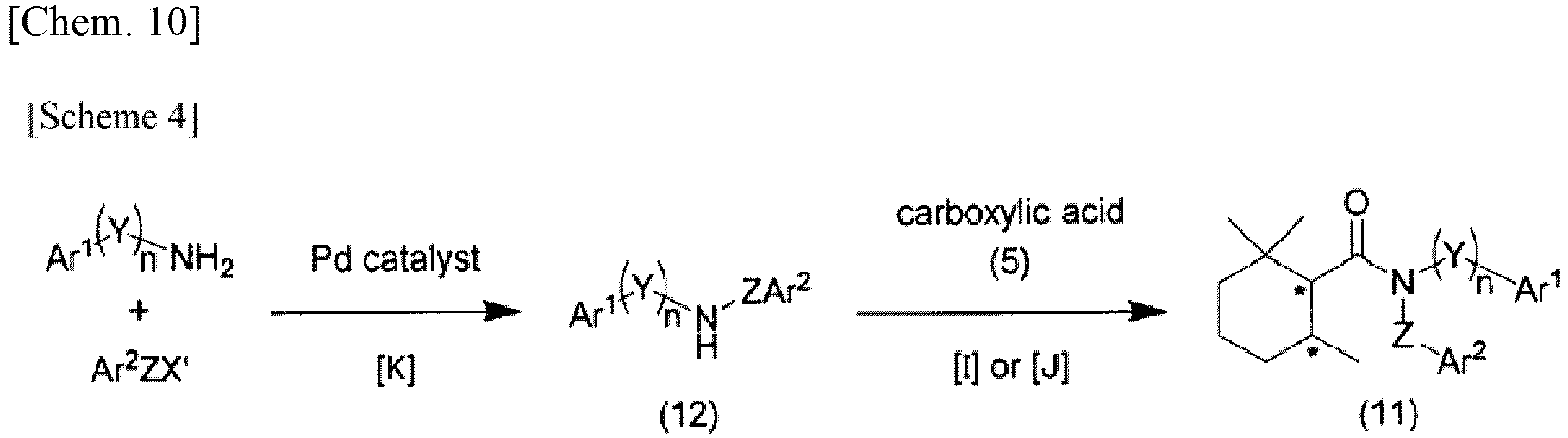
- In the formula of the scheme 4, X' represents a chlorine atom, a bromine atom, or an iodine atom, and the symbol *, n, Y, Z, Ar1 and Ar2 have the same definition as those in the formula (1).
- Step [K] can be performed according to a method similar to the method described in Non-Patent Literature 2. Steps [I] and [J] can be performed according to the method described above.
- Among the 2,2,6-trimethylcyclohexanecarboxylic acid derivatives represented by the general formula (1), a carboxylic acid ester compound represented by the general formula (13) in which X = O (hereinafter, may be referred to as "ester compound (13)") is synthesized from the carboxylic acid compound (5), for example, according to the method shown in the following scheme 5.

- The symbol *, n, Y and Ar1 in the formula of the scheme 5 have the same definition as those in the formula (1).
- Step [L] can be performed according to a method similar to the method described in PTL 29.
- Among the 2,2,6-trimethylcyclohexanecarboxylic acid derivatives represented by the general formula (1), a carboxylic acid thioester compound represented by the general formula (14) in which X = S (hereinafter, may be referred to as "thioester compound (14)") is synthesized from the carboxylic acid compound (5), for example, according to the method shown in the following scheme 6.

- The symbol *, n, Y and Ar1 in the formula of the scheme 6 have the same definition as those in the formula (1).
- Step [M] can be performed according to a method similar to the method described in Non-Patent Literature 5. That is, Step [M] can be performed by condensation reaction.
- Preferred specific examples of the 2,2,6-trimethylcyclohexanecarboxylic acid derivative represented by the general formula (1) include the secondary amide compound (10), the tertiary amide compound (11), the ester compound (13), and the thioester compound (14), but the 2,2,6-trimethylcyclohexanecarboxylic acid derivative is not limited to these compounds.
- In addition, preferred specific examples of the secondary amide compound (10) include the following compounds, but the secondary amide compound (10) is not limited to these examples.
- In the following compounds, Me represents a methyl group, and the symbol * represents an asymmetric carbon.


- Preferred specific examples of the tertiary amide compound (11) include the following compounds, but the tertiary amide compound (11) is not limited to these examples.
- In the following compounds, Me represents a methyl group, and the symbol * represents an asymmetric carbon.

- Preferred specific examples of the ester compound (13) include the following compounds, but the ester compound (13) is not limited to these examples.
- In the following compounds, Me represents a methyl group, and the symbol * represents an asymmetric carbon.


- Preferred specific examples of the thioester compound (14) include the following compounds, but the thioester compound (14) is not limited to these examples.
- In the following compounds, Me represents a methyl group, and the symbol * represents an asymmetric carbon.

- In addition, the 2,2,6-trimethylcyclohexanecarboxylic acid derivative represented by the general formula (1) is preferably a 2,2,6-trimethylcyclohexanecarboxylic acid derivative represented by the following general formula (1-1), from the viewpoint of cooling intensity.

- In the formula (1-1), a symbol * represents an asymmetric carbon atom, and R, R' and R" each independently represent a hydrogen atom, a hydroxy group, or a methoxy group.
- It is preferable that R, R' and R" each independently represent a hydrogen atom or a hydroxy group from the viewpoint of cooling intensity.
- The 2,2,6-trimethylcyclohexanecarboxylic acid derivative represented by the general formula (1) obtained in this way has a strong and persistent cooling effect, and can also be used alone as a cooling agent or a sensory stimulant.
- The 2,2,6-trimethylcyclohexanecarboxylic acid derivative represented by the general formula (1) can also be incorporated into various products. In that case, an application range and an application method of the 2,2,6-trimethylcyclohexanecarboxylic acid derivative are required to be appropriately changed depending on kinds of products and application purposes, and the carboxylic acid derivative may be used in a concentration of generally 0.00001 mass% to 50 mass%, preferably 0.0001 mass% to 20 mass%, and particularly preferably 0.001 mass% to 5 mass%, based on the total composition of the product.
- A content of the 2,2,6-trimethylcyclohexanecarboxylic acid derivative represented by the general formula (1) in the cooling agent composition of the present invention is required to be changed appropriately depending on application purpose of the cooling agent composition, and is generally 0.00001 mass% to 50 mass%, preferably 0.0001 mass% to 20 mass%, and particularly preferably 0.001 mass% to 5 mass%.
- The cooling agent composition of the present invention further contains at least one kind of cooling substance other than the 2,2,6-trimethylcyclohexanecarboxylic acid derivative represented by the general formula (1), so that a cooling agent composition having an increased cooling intensity can be obtained. Further, a sensory stimulant composition containing the cooling agent composition with an increased cooling intensity can be prepared.
- Examples of the cooling substance other than the 2,2,6-trimethylcyclohexanecarboxylic acid derivative represented by the above general formula (1) include:
- compounds (α) such as menthol, menthone, camphor, pulegol, isopulegol, cineole, cubenol, menthyl acetate, pulegyl acetate, isopulegyl acetate, menthyl salicylate, pulegyl salicylate, isopulegyl salicylate, 3-(1-menthoxy)propane-1,2-diol, 2-methyl-3-(1-menthoxy)propane-1,2-diol, 2-(1-menthoxy)ethane-1-ol, 3-(1-menthoxy)propane-1-ol, 4-(1-menthoxy)butan-1-ol, menthyl 3-hydroxybutanoate, menthyl glyoxylate, p-menthane-3,8-diol, 1-(2-hydroxy-4-methylcyclohexyl)ethanone, menthyl lactate, menthone glycerin ketal, menthyl-2-pyrrolidone-5-carboxylate, monomenthyl succinate, alkali metal salts of monomenthyl succinate, alkaline earth metal salts of monomenthyl succinate, monomenthyl glutarate, alkali metal salts of monomenthyl glutarate, alkaline earth metal salts of monomenthyl glutarate, N-[[5-methyl-2-(1-methylethyl)cyclohexyl]carbonyl]glycine, p-menthane-3-carboxylic acid glycerol ester, menthol propylene glycol carbonate, menthol ethylene glycol carbonate, p-menthane-2,3-diol, 2-isopropyl-N,2,3-trimethylbutanamide, N-ethyl-p-menthane-3-carboxamide, 3-(p-menthane-3-carboxamide) ethyl acetate, N-(4-methoxyphenyl)-p-menthane carboxamide, N-ethyl-2,2-diisopropylbutanamide, N-cyclopropyl-p-menthane carboxamide, N-(4-cyanomethylphenyl)-p-menthanecarboxamide, N-(2-pyridin-2-yl)-3-p-menthane carboxamide, N-(2-hydroxyethyl)-2-isopropyl-2,3-dimethylbutanamide, N-(1,1-dimethyl-2-hydroxyethyl)-2,2-diethylbutanamide, cyclopropanecarboxylic acid (2-isopropyl-5-methylcyclohexyl)amide, N-ethyl-2,2-diisopropylbutanamide, N-[4-(2-amino-2-oxoethyl)phenyl]-p-menthanecarboxamide, 2-[(2-p-menthoxy)ethoxy]ethanol, 2,6-diethyl-5-isopropyl-2-methyltetrahydropyran, and trans-4-tert-butylcyclohexanol, and racemic and optically active forms thereof;
- sugar alcohols (β) such as xylitol, erythritol, dextrose, and sorbitol;
- natural products (γ) such as Japanese mint oil, peppermint oil, spearmint oil, and eucalyptus oil; and
- compounds (δ) described in
JP 2001-294546 A JP 2005-343915 A JP 2007-002005 A JP 2009-263664 A JP 2010-254621 A JP 2010-254622 A JP 2011-079953 A US 4136163 A ,US 4150052 A ,US 4178459 A ,US 4190643 A ,US 4193936 A ,US 4226988 A ,US 4230688 A ,US 4032661 A ,US 4153679 A ,US 4296255 A ,US 4459425 A ,US 5009893 A ,US 5266592 A ,US 5698181 A ,US 5725865 A ,US 5843466 A ,US 6231900 B1 ,US 6277385 B1 ,US 6280762 B1 ,US 6306429 B1 ,US 6432441 B1 ,US 6455080 B1 ,US 6627233 B1 ,US 7078066 B2 ,US 6783783 B2 ,US 6884906 B2 ,US 7030273 B1 ,US 7090832 B2 ,US 2004/0175489 A1 ,US 2004/0191402 A1 ,US 2005/0019445 A1 ,US 2005/0222256 A1 ,US 2005/0265930 A1 ,US 2006/015819 A1 ,US 2006/0249167 A1 ,EP 1689256 A1 ,WO 2005/082154 A1 ,WO 2005/099473 A1 ,WO 2006/058600 A1 ,WO 2006/092076 A1 , andWO 2006/125334 A1 ;
and the like. - These may be used alone or by blending two or more of them appropriatly. It is preferable that the above cooling agent composition contains at least one cooling substance selected from the group consisting of the compounds (α), the sugar alcohols (β), and the natural products (γ), among the above compounds.
- In the cooling agent composition of the present invention, the 2,2,6-trimethylcyclohexanecarboxylic acid derivative represented by the general formula (1) and the cooling substance other than the carboxylic acid derivative may be used at any ratio within a range that does not impair the effects of the present invention, and a preferred use ratio of the carboxylic acid derivative and the cooling substance other than the carboxylic acid derivative is in the range of 1:99 to 90:10 in terms of mass ratio.
- The cooling agent composition of the present invention may be blended with a flavor or fragrance composition, or products such as drinks, foods, fragrances or cosmetics, toiletry products, air care products, daily necessities and household goods, oral compositions, hair care products, skin care products, body care products, detergents for clothes, soft finishing agents for clothes, quasi-drugs, and pharmaceuticals.
- The cooling agent composition of the present invention has a strong and persistent cooling effect, and therefore, a sensory stimulant composition of the present invention having a cooling effect can be prepared by incorporating the cooling agent composition thereto.
- In the case of preparing the sensory stimulant composition of the present invention, the application range and the application method of the blending amount of the cooling agent composition are required to be appropriately changed depending on the kinds of products and application purposes. The blending amount thereof is generally from 0.00001 mass% to 50 mass%, preferably from 0.0001 mass% to 20 mass%, and particularly preferably from 0.001 mass% to 4 mass%, based on the total composition of the sensory stimulant composition.
- The sensory stimulant composition of the present invention is a composition that imparts an effect of stimulating sensation. Examples of the effect of stimulating the sensation include a cooling effect and/or a warming effect. Accordingly, in the present invention, the sensory stimulant composition is described as a concept including a cooling agent composition and/or a warming agent composition.
- The sensory stimulant composition of the present invention further contains at least one kind of warming substance, so that the stimulation effect of the sensory stimulant composition can be adjusted.
- Examples of the warming substance include:
- compounds (ε) such as vanillyl methyl ether, vanillyl ethyl ether, vanillyl propyl ether, vanillyl isopropyl ether, vanillyl butyl ether, vanillyl amyl ether, vanillyl isoamyl ether, vanillyl hexyl ether, isovanillyl methyl ether, isovanillyl ethyl ether, isovanillyl propyl ether, isovanillyl isopropyl ether, isovanillyl butyl ether, isovanillyl amyl ether, isovanillyl isoamyl ether, isovanillyl hexyl ether, ethyl vanillyl methyl ether, ethyl vanillyl ethyl ether, ethyl vanillyl propyl ether, ethyl vanillyl isopropyl ether, ethyl vanillyl butyl ether, ethyl vanillyl amyl ether, ethyl vanillyl isoamyl ether, ethyl vanillyl hexyl ether, vanillin propylene glycol acetal, isovanillin propylene glycol acetal, ethyl vanillin propylene glycol acetal, vanillyl butyl ether acetate, isovanillyl butyl ether acetate, ethyl vanillyl butyl ether acetate, 4-(1-menthoxymethyl)-2-(3'-methoxy-4'-hydroxyphenyl)-1,3-dioxolane, 4-(1-menthoxymethyl)-2-(3'-hydroxy-4'-methoxyphenyl)-1,3-dioxolane, 4-(1-menthoxymethyl)-2-(3 '-ethoxy-4'-hydroxyphenyl)-1,3-dioxolane, capsaicin, dihydrocapsaicin, nordihydrocapsaicin, homodihydrocapsaicin, homocapsaicin, bis-capsaicin, trishomocapsaicin, nornorcapsaicin, norcapsaicin, capsaicinol, vanillyl caprylamide (octylic acid vanillylamide), vanillyl pelargonamide (nonylic acid vanillylamide), vanillyl caproamide (decylic acid vanillylamide), vanillyl undecanamide (undecylic acid vanillylamide), N-trans-feruloyltyramine, N-5-(4-hydroxy-3-methoxyphenyl)-2E,4E-pentadienoylpiperidine, N-trans-feruloylpiperidine, N-5-(4-hydroxy-3-methoxyphenyl)-2E-pentenoylpiperidine, N-5-(4-hydroxyphenyl)-2E,4E-pentadienoylpiperidine, piperine, isopiperine, chavicine, isochavicine, piperamine, piperettine, piperolein B, retrofractamide A, pipercide, guineenside, piperiline, piperamide C5:1 (2E), piperamide C7:1 (6E), piperamide C7:2 (2E,6E), piperamide C9:1 (8E), piperamide C9:2 (2E,8E), piperamide C9:3 (2E,4E,8E), fagaramide, sanshool-I, sanshool-II, hydroxysanshool, sanshoamide, gingerol, shogaol, zingerone, methylgingerol, paradol, spilanthol, chavicine, polygodial (tadeonal), isopolygodial, dihydropolygodial, and tadeon, and racemic and optically active forms thereof;
- natural products (ζ) such as capsicum pepper oil, capsicum pepper oleoresin, ginger oleoresin, jambu oleoresin (extract from Spilanthes acmella L. var. oleracea Clarke), Japanese pepper extract, sanshoamide, black pepper extract, white pepper extract, and Polygonum extract; and
- compounds (η) described in
JP H08-225564 A JP 2007-015953 A JP 2007-510634 A JP 2008-505868 A WO 2007/013811 A1 ,WO 2003/106404 A1 ,EP 1323356 A2 ,DE 10351422 A1 ,US 2005/0181022 A1 , andUS 2008/0038386 A1 ; and the like. - These may be used alone or by blending two or more of them appropriately. It is preferable that the warming substance contains at least one warming substance selected from the group consisting of the compounds (ε) and the natural products (ζ), among the above compounds.
- In a case where a cooling effect is aimed, the blending ratio of the warming substance to the cooling agent composition in the sensory stimulant composition of the present invention may be within a range at which the warming effect is not imparted by blending the warming substance. At this time, the blending amount of the warming substance is generally 0.001 to 0.95 times, preferably 0.01 to 0.5 times the total mass of the cooling agent composition. In the sensory stimulant composition of the present invention, the warming substance is added to the cooling agent composition at the above ratio, so that further improvement of the cooling effect can be achieved.
- In a case where a warming effect is aimed, the blending ratio of the warming substance to the cooling agent composition may be within a range at which the cooling effect is not imparted by blending the cooling agent composition. At this time, the blending amount of the cooling agent composition is generally 0.001 to 0.95 times, preferably 0.01 to 0.5 times the total mass of the warming substance.
- The flavor or fragrance composition of the present invention contains the sensory stimulant composition of the present invention. In addition, the flavor or fragrance composition of the present invention can contain flavor or fragrance components.
- Examples of the flavor or fragrance components include various synthetic aromachemical, natural essential oil, synthetic essential oil, citrus oil, animal aromachemical and the like, and a broad range of flavor or fragrance components described in, for example, Non-Patent Literature 1 may be used.
- Examples of typical ones among them include α-pinene, limonene, cis-3-hexenol, phenylethyl alcohol, styrallyl acetate, eugenol, rose oxide, linalool, benzaldehyde, muscone, Musk T (manufactured by Takasago International Corporation), Thesaron (manufactured by Takasago International Corporation), and the like.
- The content of the sensory stimulant composition of the present invention can be adjusted by kinds of flavors or fragrances blended together or other components blended together, application purpose of the flavor or fragrance composition, and is preferably 0.00001 mass% to 90 mass%, more preferably 0.0001 mass% to 20 mass%, and still more preferably 0.001 mass% to 4 mass%, based on the total mass of the flavor or fragrance composition, from the viewpoint of cooling intensity.
- When the flavor or fragrance composition of the present invention is used for fragrances or cosmetics, the content of the sensory stimulant composition of the present invention is generally 0.00001 mass% to 50 mass%, preferably 0.001 mass% to 50 mass%, and particularly preferably 0.01 mass% to 20 mass% based on the total mass of the flavor or fragrance composition.
- When the flavor or fragrance composition of the present invention is used for drinks or foods, the content of the sensory stimulant composition of the present invention is preferably 0.0001 mass% to 50 mass%, and more preferably 0.001 mass% to 30 mass% based on the total mass of the flavor or fragrance composition.
- The flavor or fragrance composition of the present invention may contain other odor retention agents commonly used in flavor or fragrance composition as necessary. Examples of other odor retention agents in that case include ethylene glycol, propylene glycol, dipropylene glycol, glycerin, hexyl glycol, benzyl benzoate, triethyl citrate, diethyl phthalate, herkorin, medium chain fatty acid triglyceride, medium chain fatty acid diglyceride, and the like, and one or two or more thereof may be contained.
- The product of the present invention contains the sensory stimulant composition of the present invention or the flavor or fragrance composition of the present invention in order to impart the cool-feeling or the sensory stimulation.
- The above product is not particularly limited, and examples thereof include: drinks; foods; toiletry products such as cleaning agents, detergents for kitchen, and bleaching agents; air care products such as deodorants and aromatics; oral compositions; fragrances or cosmetics such as fragrance products, foundation cosmetics, finishing cosmetics, hair cosmetics, suntan cosmetics, and medicated cosmetics; hair care products; skin care products such as soaps; body care products such as body washers; bathing agents; cleaning agents for clothes; soft finishing agents for clothes; aerosol agents; daily necessities and household goods; and quasi-drugs and pharmaceuticals.
- As the drinks, examples thereof include drinks such as fruit juice drinks, fruit wines, milk drinks, carbonated drinks, soft drinks, and health drinks; tea drinks or luxury drinks such as green tea, Oolong tea, black tea, persimmon leaf tea, chamomile tea, low striped bamboo tea, mulberry tea, dokudami tea, Pu-er tea, mate tea, Rooibos tea, Gymnema tea, Guava tea, coffee, and cocoa; soups such as Japanese style soup, Western style soup and Chinese soup; various instant drink, and the like;
as the foods, examples thereof include ices such as ice creams, sherbets and ice candies; desserts such as jelly and pudding; western style confections such as cakes, cookies, chocolates and chewing gum, Japanese style confections such as bean-jam bun, sweet bean jelly and uiro; jams; candies; breads; flavor seasoning; various instant food; various snack food, and the like;
as the oral compositions, examples thereof include dentifrice, oral cavity cleaner, mouth wash, troche, chewing gum, and the like;
as the fragrance products, examples thereof include perfume, eau de parfum, eau de toilette, eau de cologne, and the like;
as the foundation cosmetics, examples thereof include facial wash creams, vanishing creams, cleansing creams, cold creams, massage creams, milky lotions, skin lotions, beauty lotions, facial packs, makeup removers, and the like;
as the finishing cosmetics, examples thereof include foundations, face powders, solid face powders, talcum powders, rouges, lip balms, cheek rouges, eye liners, mascara, eye shadows, eyebrow pencils, eye packs, nail enamels, enamel removers, and the like;
as the hair cosmetics, examples thereof include pomade, brilliantine, hair set lotions, hair sticks, hair solids, hair oils, hair treatments, hair creams, hair tonics, hair liquids, hair sprays, bandolines, revitalizing hair tonics, hair dyes, and the like;
as the suntan cosmetics, examples thereof include suntan products, sun-screen products, and the like;
as the medicated cosmetics, examples thereof include antiperspirants, after-shaving lotions or gels, permanent wave agents, medicated soaps, medicated shampoos, medicated skin cosmetics, and the like;
as the hair care products, examples thereof include shampoos, rinses, rinse-in-shampoos, conditioners, treatments, hair packs and the like;
as the soap, examples thereof include toilet soaps, bath soaps, perfume soaps, transparent soaps, synthetic soaps, and the like;
as the body washers, examples thereof include body soaps, body shampoos, hand soaps, face creams, and the like;
as the bath agents, examples thereof include bathing agents (such as bath salts, bath tablets, and bath liquids), foam bath (such as bubble bath), bath oils (such as bath perfumes, and bath capsules), milk-baths, bath jelly, bath cubes, and the like;
as the detergents for clothes, examples thereof include heavy detergents for clothes, light detergents for clothes, liquid detergents, washing soaps, compact detergents, powder soaps, and the like;
as the soft finishing agents for clothes, examples thereof include softener, furniture care, and the like;
as the cleaners, examples thereof include cleansers, house cleaners, toilet cleaners, bath cleaners, glass cleaners, mildew removers, cleaners for drainpipe use, and the like;
as the kitchen cleaners, examples thereof include kitchen soaps, kitchen synthetic soaps, tableware cleaners, and the like;
as the bleaching agents, examples thereof include oxidation type bleaching agents (such as chlorine type bleaching agents, and oxygen type bleaching agents), reduction type bleaching agents (such as sulfur type bleaching agents), optical bleaching agents, and the like;
as the aerosol agents, examples thereof include spray type ones, powder sprays, and the like;
as the deodorants or aromatics, examples thereof include solid type ones, gel type ones, liquid type ones (aqueous or oily), and the like;
as the daily necessities and household goods, examples thereof include tissue papers, toilet papers, and the like;
as the quasi-drugs, examples thereof include liquid bath additives, mouthwashes, and repellents such as mist spray type ones and aqueous liquid type ones; and
as the pharmaceuticals, examples thereof include medicinal cosmetics, medicinal lotions, and the like. - The form of the sensory stimulant composition or the flavor or fragrance composition when the product of the present invention contains the sensory stimulant composition of the present invention or the flavor or fragrance composition of the present invention may be the form of the sensory stimulant composition itself or flavor or fragrance composition itself or another form.
- As another form, examples thereof include:
- a liquid form obtained by dissolving in alcohols, polyhydric alcohols such as propylene glycol, glycerin, and dipropylene glycol, or esters such as triethyl citrate, benzyl benzoate, and diethyl phthalate;
- an emulsified form obtained by emulsifying with an emulsifier such as a glycerin fatty acid ester or a sucrose fatty acid ester;
- a powder form obtained by coating with an excipient such as natural gums such as gum Arabic, and tragacanth gum, gelatin, and dextrin;
- a solubilized form or dispersed form obtained by solubilizing or dispersing by using a surfactant such as a nonionic surfactant, an anionic surfactant, a cationic surfactant, or an amphoteric surfactant; and
- a microcapsule obtained by treating with an encapsulating agent, and any form may be selected and used depending on the purpose.
- As a method of imparting the cool-feeling or the sensory stimulation to various products as described above by using the sensory stimulant composition of the present invention or the flavor or fragrance composition of the present invention, examples thereof include the following methods: depending on the kinds of the product to which the cool-feeling or the sensory stimulation is imparted or the final form of the product (for example, the form of the product such as a liquid form, a solid form, a powder form, a gel form, a mist form, or an aerosol form), the sensory stimulant composition or the flavor or fragrance composition may be added or applied directly to the product;
the sensory stimulant composition or the flavor or fragrance composition may be dissolved in, for example, an alcohol or a polyhydric alcohol such as propylene glycol or glycerin to form a liquid form, and then, it may be added or applied to the product;
the above composition may be formed into a solubilized form or a dispersed form by being solubilized or emulsification-dispersed by using natural gum such as gum Arabic or tragant gum or a surfactant (e.g. a nonionic surfactant such as a glycerinfatty acid ester and a sucrose fatty acid ester, an anionic surfactant, a cationic surfactant, or an amphoteric surfactant), and then, they may be added or applied to the product;
the above composition may be formed into a powder form obtained by coating with an excipient such as natural gum such as gum Arabic and tragacanth gum, gelatin, or dextrin, and then, it may be added or applied to the product; and
the above composition may be formed into a microcapsule by a treatment with an encapsulating agent, and then, it may be added or applied to the product. - Further, the sensory stimulant composition or the flavor or fragrance composition may be included in an inclusion agent such as cyclodextrin so as to stabilize the composition and also make it sustained-releasable, and then may be used.
- The amount of adding or applying the sensory stimulant composition or the flavor or fragrance composition to the product for imparting the cool-feeling or the sensory stimulation, can be adjusted depending on the kind or form of the product, effects or actions of imparting the cool-feeling or the sensory stimulation required for the product, or the like. In general, the amount of adding or applying the sensory stimulant composition or the flavor or fragrance composition, relative to the mass of the product, is preferably 0.00001 mass% to 50 mass%, more preferably 0.0001 mass% to 20 mass%, and still more preferably 0.001 mass% to 4 mass%, from the viewpoint of the cooling intensity.
- Hereinafter, Examples and Synthetic Examples are described, but the present invention is not limited to these Examples and Synthesis Examples. The optical purity of each citronellal as a raw material used for synthesis of the carboxylic acid compound (5) is as follows.
1-citronellal: 96.6% e.e.
d-citronellal: 97.8% e.e. - An isomer ratio of a trans form (hereinafter, may be referred to as "(1R, 6S)-5") of the optically active carboxylic acid compound (5) synthesized according to the method described in PTL 29 to a cis form (hereinafter, may be referred to as "(1R, 6R)-5")), and optical purity are as follows.
- [a] Carboxylic acid compound (5) derived from 1-citronellal
Trans/cis ratio (1R, 6S)-5/(1R, 6R)-5 = 90/10
Optical purity (1R, 6S)-5: 93.1% e.e.
(1R, 6R)-5: > 99.0% e.e. - [b] Carboxylic acid compound (5) derived from d-citronellal
Trans/cis ratio (1S, 6R)-5/(1S, 6S)-5 = 91/9
Optical purity (1S, 6R)-5: 96.3% e.e.
(1S, 6S)-5: > 99.0% e.e. - Therefore, the compounds in the Examples contain minor or very small amount of diastereomers and enantiomers.
- The measurement of products in Synthesis Examples and Examples was performed by using the following apparatuses and devices.
Nuclear Magnetic Resonance Spectrum: 1H-NMR: AM-500 (500 MHz) (manufactured by Bruker Co., Ltd.)
External Standard Substance: tetramethylsilane
Gas Chromatograph (GC): GC-2010AF (manufactured by Shimadzu Corporation), GC-4000Plus (manufactured by GL Sciences Inc.)
Column: DB-WAX (30 m × 0.32 nm × 0.5 µm) (manufactured by Hewlett-Packard Company), IC-1 (30 m × 0.25 mm × 0.25 µm) (manufactured by Hewlett-Packard Company), Rtx-1 (30 m × 0.25 mm × 0.25 µm) (manufactured by ReStek, Inc.), Inert Cap1 (30 m × 0.25 mm × 0.25 µm) (manufactured by GL Sciences Inc.)
High-Resolution Mass Spectrum (HRMS): JMS-T100GCV (manufactured by JEOL Ltd.)
Melting point: melting point measurement device (serial No.: 2678) (manufactured by Yanagimoto Seisaku-sho)
In the following compounds, Me represents a methyl group, and Et represents an ethyl group. -

- (1R, 6S)-2,2,6-trimethylcyclohexanecarboxylic acid ((1R, 6S)-5) (1.00 g, 5.87 mmol) which was obtained according to the method described in PTL 29, triethylamine (1.95 mL, 2.4 eq.), and acetonitrile (10 mL) were added to a 50 mL two neck flask under a nitrogen atmosphere. Methanesulfonyl chloride (0.55 mL, 1.2 eq.) was slowly dropped therein at room temperature, followed by performing stirring for 20 minutes at room temperature, and then phenethylamine (0.81 mL, 1.1 eq.) was added thereto and allowed to react with them at room temperature for 45 minutes. The reaction solution was diluted with ethyl acetate (15 mL), and then 2N hydrochloric acid (15 mL) was slowly added thereto as a post-treatment. The oil layer was washed twice with a saturated aqueous solution of sodium bicarbonate (15 mL), and further washed once with a saturated saline solution (10 mL), followed by drying with sodium sulfate. The obtained solution was concentrated under reduced pressure, and recrystallized with heptane/ethyl acetate, thereby obtaining a target compound (1.08 g, yield 68%) as a white solid.
- Melting Point: 79°C to 82°C
HRMS: Mass 273.2093 Actual Measurement Value: 273.2080 ([M]+)
1H-NMR (500 MHz, CDCl3): δ 0.84 (d, 3H, J = 6.4 Hz), 0.85-0.92 (m, 1H), 0.93 (s, 3H), 1.04 (s, 3H), 1.11 (dt, 1H, J = 4.8, 12.9 Hz), 1.36-1.42 (m, 2H), 1.45-1.59 (m, 2H), 1.70-1.78 (m, 1H), 1.84-1.95 (m, 1H), 3.80 (s, 3H), 4.34 (dd, 1H, J = 5.2, 14.3 Hz), 4.44 (dd, 1H, J = 4.8, 14.4, Hz), 5.55 (br, 1H), 6.84-6.88 (m, 2H), 7.19-7.23 (m, 2H). -

- (1R, 6S)-2,2,6-trimethylcyclohexanecarboxylic acid ((1R, 6S)-5) (1.00 g, 5.87 mmol) which was obtained according to the method described in PTL 29, triethylamine (1.95 mL, 2.40 eq.), and acetonitrile (10 mL) were added to a 50 mL two neck flask under a nitrogen atmosphere. Methanesulfonyl chloride (0.55 mL, 1.20 eq.) was slowly dropped therein at room temperature, followed by performing stirring for 20 minutes at room temperature, and then 2-amino-1-phenylethanol (0.97 g, 1.20 eq.) was added thereto and allowed to react with them at room temperature for 45 minutes. The reaction solution was diluted with ethyl acetate (15 mL), and then 2N hydrochloric acid (15 mL) was slowly added thereto as a post-treatment. The oil layer was washed twice with a saturated aqueous solution of sodium bicarbonate (15 mL), and further washed once with a saturated saline solution (10 mL), followed by drying with sodium sulfate. The obtained solution was concentrated under reduced pressure, isolation and purification were performed by silica gel column chromatography (hexane/ethyl acetate = 2/1), thereby obtaining a target compound (1.32 g, yield 78%) as a pale yellow crystal.
- Melting Point: 95°C to 98°C
HRMS: Mass 290.2115 Actual Measurement Value 290.2115 ([M + H]+)
1H-NMR (500 MHz, CDCl3): δ 0.78-0.94 (m, 7H), 0.96-1.04 (m, 3H), 1.06-1.16 (m, 1H), 1.35-1.55 (m, 4H), 1.69-1.76 (m, 1H), 1.81-1.91 (m, 1H), 3.32-3.46 (m, 1H), 3.66-3.81 (m, 2H), 4.82-4.89 (m, 1H), 5.81-5.91 (br, 1H), 7.25-7.29 (m, 1H), 7.31-7.39 (m, 4H). -
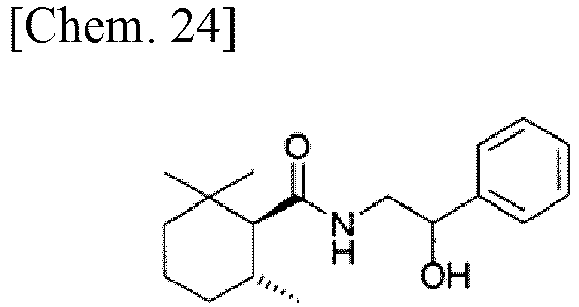
- (1S, 6R)-2,2,6-trimethylcyclohexanecarboxylic acid ((1S, 6R)-5) (1.00 g, 5.87 mmol) which was obtained according to the method described in PTL 29, triethylamine (1.95 mL, 2.40 eq.), and acetonitrile (10 mL) were added to a 50 mL two neck flask under a nitrogen atmosphere. The temperature of the inside of the system was lowered to 0°C to 5°C by an ice bath, and methanesulfonyl chloride (0.55 mL, 1.20 eq.) was slowly dropped therein. The mixture was stirred for 20 minutes at room temperature, and then 2-amino-1-phenylethanol (0.97 g, 1.20 eq.) was added thereto and was allowed to react with them for 30 minutes at room temperature. The reaction solution was diluted with ethyl acetate (15 mL), and then 2N hydrochloric acid (15 mL) was slowly added thereto as a post-treatment. The oil layer was washed twice with a saturated aqueous solution of sodium bicarbonate (15 mL), and further washed once with a saturated saline solution (10 mL), followed by drying with sodium sulfate. The obtained solution was concentrated under reduced pressure, and isolation and purification were performed by silica gel column chromatography (hexane/ethyl acetate = 3/1), thereby obtaining a target compound (1.36 g, yield 80%) as a light yellow amorphous solid.
- Melting Point: 96°C to 99°C
HRMS: Mass 290.2115 Actual Measurement Value 290.2115 ([M + H]+)
1H-NMR (500 MHz, CDCl3): δ 0.78-0.95 (m, 7H), 0.95-1.04 (m, 3H), 1.06-1.17 (m, 1H), 1.36-1.55 (m, 4H), 1.67-1.78 (m, 1H), 1.79-1.91 (m, 1H), 3.32-3.46 (m, 1H), 3.63-3.77 (m, 2H), 3.86-3.95 (m, 1H), 4.82-4.89 (m, 1H), 5.89-5.97 (m, 1H), 7.25-7.29 (m, 1H), 7.31-7.39 (m, 4H). -

- (1R, 6S)-2,2,6-trimethylcyclohexanecarboxylic acid ((1R, 6S)-5) (1.00 g, 5.87 mmol) which was obtained according to the method described in PTL 29, triethylamine (1.95 mL, 2.40 eq.), and acetonitrile (10 mL) were added to a 50 mL two neck flask under a nitrogen atmosphere. Methanesulfonyl chloride (0.55 mL, 1.20 eq.) was slowly dropped therein at room temperature, followed by performing stirring for 25 minutes at room temperature, and then (R)-2-amino-1-phenylethanol (0.97 g, 1.20 eq.) was added thereto and allowed to react with them at room temperature for one hour. The reaction solution was diluted with ethyl acetate (10 mL), and then 2N hydrochloric acid (15 mL) was slowly added thereto as a post-treatment. The oil layer was washed twice with a saturated aqueous solution of sodium bicarbonate (20 mL), and further washed once with a saturated saline solution (15 mL), followed by drying with sodium sulfate. The obtained solution was concentrated under reduced pressure, and isolation and purification were performed by silica gel column chromatography (hexane/ethyl acetate = 2/1), thereby obtaining a target compound (1.37 g, yield 81%) as a light yellow amorphous solid.
- HRMS: Mass 290.2115 Actual Measurement Value 290.2113 ([M + H]+)
1H-NMR (500 MHz, CDCl3): δ 0.84 (d, 3H, J = 6.3 Hz), 0.83-0.91 (m, 1H), 0.91 (s, 3H), 1.00 (s, 3H), 1.07-1.15 (m, 1H), 1.35-1.54 (m, 4H), 1.68-1.77 (m, 1H), 1.82-1.91 (m, 1H), 3.31-3.39 (m, 1H), 3.74-3.79 (m, 2H), 4.82-4.88 (m, 1H), 5.84 (br, 1H), 7.24-7.29 (m, 1H), 7.31-7.39 (m, 4H). -

- (1S, 6R)-2,2,6-trimethylcyclohexanecarboxylic acid ((1S, 6R)-5) (1.00 g, 5.87 mmol) which was obtained according to the method described in PTL 29, triethylamine (1.95 mL, 2.40 eq.), and acetonitrile (10 mL) were added to a 50 mL two neck flask under a nitrogen atmosphere. The temperature of the inside of the system was lowered to 0°C to 5°C by an ice bath, and methanesulfonyl chloride (0.55 mL, 1.20 eq.) was slowly dropped therein. The mixture was stirred for 20 minutes at room temperature, and then (R)-2-amino-1-phenylethanol (0.97 g, 1.20 eq.) was added thereto and was allowed to react with them for one hour at room temperature. The reaction solution was diluted with ethyl acetate (10 mL), and then 2N hydrochloric acid (15 mL) was slowly added thereto as a post-treatment. The oil layer was washed twice with a saturated aqueous solution of sodium bicarbonate (20 mL), and further washed once with a saturated saline solution (15 mL), followed by drying with sodium sulfate. The obtained solution was concentrated under reduced pressure, and isolation and purification were performed by silica gel column chromatography (hexane/ethyl acetate = 2/1), thereby obtaining a target compound (1.17 g, yield 69%) as a pale yellow crystal.
- Melting Point: 105°C to 110°C
HRMS: Mass 290.2115 Actual Measurement Value 290.2115 ([M + H]+)
1H-NMR (500 MHz, CDCl3): δ 0.88 (d, 3H, J = 6.3 Hz), 0.80-0.87 (m, 1H), 0.89 (s, 3H), 1.00 (s, 3H), 1.06-1.14 (m, 1H), 1.34-1.43 (m, 1H), 1.44-1.52 (m, 1H), 1.67-1.87 (m, 2H), 3.41 (ddd, 1H, J = 5.3, 7.6, 14.1 Hz), 3.65 (ddd, 1H, J = 3.3, 6.6, 14.1 Hz), 3.90-3.97 (m, 1H), 4.04 (d, 1H, J = 3.6 Hz), 4.79-4.86 (m, 1H), 6.08 (br, 1H), 7.24-7.28 (m, 1H), 7.30-7.38 (m, 4H). -
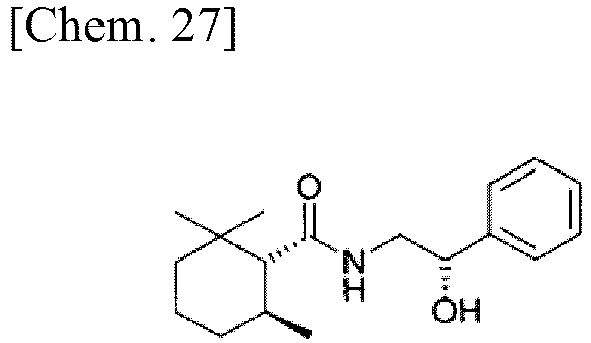
- (1R, 6S)-2,2,6-trimethylcyclohexanecarboxylic acid ((1R, 6S)-5) (1.00 g, 5.87 mmol) which was obtained according to the method described in PTL 29, triethylamine (1.95 mL, 2.40 eq.), and acetonitrile (10 mL) were added to a 50 mL two neck flask under a nitrogen atmosphere. Methanesulfonyl chloride (0.55 mL, 1.20 eq.) was slowly dropped therein at room temperature, followed by performing stirring for 20 minutes at room temperature, and then (S)-2-amino-1-phenylethanol (1.00 g, 1.23 eq.) was added thereto and allowed to react with them at room temperature for one hour. The reaction solution was diluted with ethyl acetate (10 mL), and then 2N hydrochloric acid (15 mL) was slowly added thereto as a post-treatment. The oil layer was washed twice with a saturated aqueous solution of sodium bicarbonate (15 mL), and further washed once with a saturated saline solution (10 mL), followed by drying with sodium sulfate. The obtained solution was concentrated under reduced pressure, and isolation and purification were performed by silica gel column chromatography (hexane/ethyl acetate = 2/1), thereby obtaining a target compound (1.27 g, yield 74%) as a pale yellow crystal.
- Melting Point: 107°C to 111°C
HRMS: Mass 290.2115 Actual Measurement Value 290.2113 ([M + H]+)
1H-NMR (500 MHz, CDCl3): δ 0.78 (d, 3H, J = 6.3 Hz), 0.81-0.87 (m, 1H), 0.89 (s, 3H), 1.00 (s, 3H), 1.06-1.14 (m, 1H), 1.32-1.55 (m, 4H), 1.68-1.90 (m, 2H), 3.42 (ddd, 1H, J = 5.3, 7.4, 14.1 Hz), 3.66 (ddd, 1H, J = 3.3, 6.6, 14.1 Hz), 3.90-3.97 (m, 1H), 4.82-4.86 (m, 1H), 5.97 (br, 1H), 7.24-7.29 (m, 1H), 7.31-7.39 (m, 4H). -

- (1S, 6R)-2,2,6-trimethylcyclohexanecarboxylic acid ((1S, 6R)-5) (1.00 g, 5.87 mmol) which was obtained according to the method described in PTL 29, triethylamine (1.95 mL, 2.40 eq.), and acetonitrile (10 mL) were added to a 50 mL two neck flask under a nitrogen atmosphere. The temperature of the inside of the system was lowered to 0°C to 5°C by an ice bath, and methanesulfonyl chloride (0.55 mL, 1.20 eq.) was slowly dropped therein. The mixture was stirred for 20 minutes at room temperature, and then (S)-2-amino-1-phenylethanol (1.00 g, 1.20 eq.) was added thereto and was allowed to react with them for one hour at room temperature. The reaction solution was diluted with ethyl acetate (10 mL), and then 2N hydrochloric acid (15 mL) was slowly added thereto as a post-treatment. The oil layer was washed twice with a saturated aqueous solution of sodium bicarbonate (15 mL), and further washed once with a saturated saline solution (10 mL), followed by drying with sodium sulfate. The obtained solution was concentrated under reduced pressure, and isolation and purification were performed by silica gel column chromatography (hexane/ethyl acetate = 2/1), thereby obtaining a target compound (1.27 g, yield 72%) as a light yellow amorphous solid.
- HRMS: Mass 290.2115 Actual Measurement Value 290.2113 ([M + H]+)
1H-NMR (500 MHz, CDCl3): δ 0.84 (d, 3H, J = 6.3 Hz), 0.85-0.91 (m, 1H), 0.91 (s, 3H), 0.99 (s, 3H), 1.11 (dt, 1H, J = 5.9, 12.8 Hz), 1.36-1.54 (m, 4H), 1.70-1.77 (m, 1H), 1.82-1.91 (m, 1H), 3.36 (dq, 1H, J = 2.0, 5.3 Hz), 3.72-3.79 (m, 2H), 4.84-4.89 (m, 1H), 5.86 (br, 1H), 7.24-7.29 (m, 1H), 7.32-7.39 (m, 4H). -


- (1R, 6S)-2,2,6-trimethylcyclohexanecarboxylic acid ((1R, 6S)-5) (1.00 g, 5.87 mmol) which was obtained according to the method described in PTL 29, triethylamine (1.95 mL, 2.40 eq.), and acetonitrile (10 mL) were added to a 50 mL two neck flask under a nitrogen atmosphere. Methanesulfonyl chloride (0.55 mL, 1.20 eq.) was slowly dropped therein at room temperature, followed by performing stirring for 30 minutes at room temperature, and then tyramine (0.97 g, 1.20 eq.) was added thereto and allowed to react with them at room temperature for one hour. The reaction solution was diluted with ethyl acetate (10 mL) and n-butanol (10 mL), and then 2N hydrochloric acid (30 mL) was slowly added thereto as a post-treatment. The oil layer was washed twice with a saturated aqueous solution of sodium bicarbonate (20 mL), and further washed once with a saturated saline solution (15 mL), followed by drying with sodium sulfate. The obtained solution was concentrated under reduced pressure, and recrystallized with ethyl acetate/methanol, thereby obtaining a target compound (0.45 g, yield 27%) as a white crystal.
- Melting Point: 178°C to 180°C
HRMS: Mass 290.2115 Actual Measurement Value 290.2114 ([M + H]+)
1H-NMR (500 MHz, DMSO-d6): δ 0.69 (d, 3H, J = 6.3 Hz), 0.75-0.87 (m, 4H), 0.90 (s, 3H), 1.02-1.11 (m, 1H), 1.26-1.32 (m, 1H), 1.40-1.47 (m, 2H), 1.50 (d, 1H, J = 11.1 Hz), 1.61-1.76 (m, 2H), 2.58 (t, 2H, J = 6.7 Hz), 3.22 (dt, 1H, J = 6.7, 7.9 Hz), 6.63-6.68 (m, 2H), 6.99 (d, 2H, J = 8.5 Hz), 7.72 (br, 1H), 9.12 (s, 1H). -


- (1S, 6R)-2,2,6-trimethylcyclohexanecarboxylic acid ((1S, 6R)-5) (1.00 g, 5.87 mmol) which was obtained according to the method described in PTL 29, triethylamine (1.95 mL, 2.40 eq.), and acetonitrile (10 mL) were added to a 50 mL two neck flask under a nitrogen atmosphere. The temperature of the inside of the system was lowered to 0°C to 5°C by an ice bath, and methanesulfonyl chloride (0.55 mL, 1.20 eq.) was slowly dropped therein. The mixture was stirred for 20 minutes at room temperature, and then tyramine (0.97 g, 1.20 eq.) was added thereto and was allowed to react with them for one hour at room temperature. The reaction solution was diluted with ethyl acetate (10 mL) and n-butanol (10 mL), and then 2N hydrochloric acid (15 mL) was slowly added thereto as a post-treatment. The oil layer was washed twice with a saturated aqueous solution of sodium bicarbonate (15 mL), and further washed once with a saturated saline solution (15 mL), followed by drying with sodium sulfate. The obtained solution was concentrated under reduced pressure, and recrystallized with ethyl acetate/methanol, thereby obtaining a target compound (0.84 g, yield 49%) as a white crystal.
- Melting Point: 180°C to 182°C
HRMS: Mass 290.2115 Actual Measurement Value 290.2113 ([M + H]+)
1H-NMR (500 MHz, DMSO-d6): δ 0.69 (d, 3H, J = 6.3 Hz), 0.75-0.87 (m, 4H), 0.90 (s, 3H), 1.02-1.11 (m, 1H), 1.26-1.32 (m, 1H), 1.40-1.47 (m, 2H), 1.50 (d, 1H, J = 11.1 Hz), 1.61-1.76 (m, 2H), 2.58 (t, 2H, J = 6.7 Hz), 3.22 (dt, 1H, J = 6.7, 7.9 Hz), 6.63-6.68 (m, 2H), 6.99 (d, 2H, J = 8.5 Hz), 7.72 (br, 1H), 9.12 (s, 1H). -


- (1R, 6S)-2,2,6-trimethylcyclohexanecarboxylic acid ((1R, 6S)-5) (1.00 g, 5.87 mmol) which was obtained according to the method described in PTL 29, triethylamine (1.95 mL, 2.4 eq.), and acetonitrile (10 mL) were added to a 50 mL two neck flask under a nitrogen atmosphere. Methanesulfonyl chloride (0.55 mL, 1.2 eq.) was slowly dropped therein at room temperature, followed by performing stirring for 5 hours at room temperature, and then phenacylamine hydrochloride (1.11 g, 1.1 eq.) and triethylamine (0.98 mL, 1.2 eq.) were added thereto and allowed to react with them at room temperature for 45 minutes. The reaction solution was diluted with ethyl acetate (15 mL), and then 2N hydrochloric acid (15 mL) was slowly added thereto as a post-treatment. The oil layer was washed twice with a saturated aqueous solution of sodium bicarbonate (15 mL), and further washed once with a saturated saline solution (10 mL), followed by drying with sodium sulfate. The obtained solution was concentrated under reduced pressure, and isolation and purification were performed by column chromatography (hexane/ethyl acetate = 2/1), thereby obtaining the exemplary compound (1R)-10-10 (0.81 g, yield 58%) as a white solid and obtaining the exemplary compound (1S)-10-10 (0.22 g, yield 13%) as an amorphous solid.
- Exemplary compound (1R)-10-10
Melting Point: 85°C to 87°C
HRMS: Mass 288.1958 Actual Measurement Value 288.1972 ([M + H]+)
1H-NMR (500 MHz, CDCl3): δ 0.86 (d, 3H, J = 6.4 Hz), 0.86-0.98 (m, 1H), 0.98 (s, 3H), 1.04 (s, 3H), 1.19 (dt, 1H, J = 12.8, 5.0 Hz), 1.39-1.45 (m, 2H), 1.49-1.58 (m, 2H), 1.63 (d, 1H, J = 11.1 Hz), 1.73-1.79 (m, 1H), 1.84-1.97 (m, 1H), 4.80 (d, 2H, J = 4.3 Hz), 6.47 (br, 1H), 7.48-7.53 (m, 2H), 7.60-7.65 (m, 1H), 7.96-8.02 (m, 2H). - Exemplary compound (1S)-10-10
HRMS: Mass 288.1958 Actual Measurement Value 288.1945 ([M + H]+)
1H-NMR (500 MHz, CDCl3): δ 0.89 (d, 3H, J = 6.3 Hz), 0.93 (s, 3H), 1.02 (s, 3H), 1.09-1.14 (m, 1H), 1.34-1.52 (m, 2H), 1.59-2.00 (m, 5H), 4.75 (d, 2H, J = 4.0 Hz), 6.48 (br, 1H), 7.48-7.53 (m, 2H), 7.58-7.65 (m, 1H), 7.96-8.01 (m, 2H). -


- (1S, 6R)-2,2,6-trimethylcyclohexanecarboxylic acid ((1S, 6R)-5) (1.00 g, 5.87 mmol) which was obtained according to the method described in PTL 29, triethylamine (1.95 mL, 2.4 eq.), and acetonitrile (10 mL) were added to a 50 mL two neck flask under a nitrogen atmosphere. Methanesulfonyl chloride (0.55 mL, 1.2 eq.) was slowly dropped therein at room temperature, followed by performing stirring for 5 hours at room temperature, and then phenacylamine hydrochloride (1.11 g, 1.1 eq.) and triethylamine (0.98 mL, 1.2 eq.) were added thereto and allowed to react with them at room temperature for 45 minutes. The reaction solution was diluted with ethyl acetate (15 mL), and then 2N hydrochloric acid (15 mL) was slowly added thereto as a post-treatment. The oil layer was washed twice with a saturated aqueous solution of sodium bicarbonate (15 mL), and further washed once with a saturated saline solution (10 mL), followed by drying with sodium sulfate. The obtained solution was concentrated under reduced pressure, and isolation and purification were performed by column chromatography (hexane/ethyl acetate = 2/1), thereby obtaining the exemplary compound (1S)-10-11 (0.58 g, yield 34%) as a white solid and obtaining the exemplary compound (1R)-10-11 (0.29 g, yield 17%) as an amorphous solid.
- Exemplary compound (1S)-10-11
Melting Point: 86°C to 87°C
HRMS: Mass 288.1958 Actual Measurement Value 288.1934 ([M + H]+)
1H-NMR (500 MHz, CDCl3): δ 0.86 (d, 3H, J = 6.4 Hz), 0.86-0.98 (m, 1H), 0.98 (s, 3H), 1.04 (s, 3H), 1.19 (dt, 1H, J = 12.8, 5.0 Hz), 1.37-1.45 (m, 2H), 1.49-1.58 (m, 2H), 1.63 (d, 1H, J = 11.1 Hz), 1.73-1.79 (m, 1H), 1.85-1.97 (m, 1H), 4.80 (d, 2H, J = 4.3 Hz), 6.47 (br, 1H), 7.48-7.53 (m, 2H), 7.60-7.65 (m, 1H), 7.96-8.01 (m, 2H). - Exemplary compound (1R)-10-11
HRMS: Mass 288.1958 Actual Measurement Value 288.1990 ([M + H]+)
1H-NMR (500 MHz, CDCl3): δ 0.89 (d, 3H, J = 6.3 Hz), 0.93 (s, 3H), 1.02 (s, 3H), 1.09-1.14 (m, 1H), 1.34-1.52 (m, 2H), 1.59-1.98 (m, 5H), 4.75 (d, 2H, J = 4.0 Hz), 6.48 (br, 1H), 7.46-7.53 (m, 2H), 7.58-7.65 (m, 1H), 7.94-8.02 (m, 2H). -

- (1R, 6S)-2,2,6-trimethylcyclohexanecarboxylic acid ((1R, 6S)-5) (1.00 g, 5.87 mmol) which was obtained according to the method described in PTL 29, thionyl chloride (0.47 mL, 1.10 eq.), toluene (10 mL) and a few drops of dimethyl formamide (DMF) were added to a 100 mL four neck flask under a nitrogen atmosphere, and they were stirred for one hour at room temperature. A solution which was prepared by adding toluene (5 mL) to 4-(methoxyphenyl) ethylamine (0.95 mL, 1.10 eq.) and triethylamine (1 mL) was slowly added to the inside of the system. After the mixture was stirred for two and a half hours at 60°C, the reaction solution was transferred to a separatory funnel, and dilute hydrochloric acid and ethyl acetate were added thereto to perform washing. The oil layer was washed once with dilute hydrochloric acid, then washed once with a saturated saline solution, followed by drying with anhydrous magnesium sulfate. The obtained solution was concentrated under reduced pressure, and recrystallized with heptane/ethyl acetate, thereby obtaining a target compound (0.87 g, yield 50%) as a white solid.
- Melting Point: 75°C to 77°C
HRMS: Mass 304.2271 Actual Measurement Value 304.2299 ([M + H]+)
1H-NMR (500 MHz, CDCl3): δ 0.80 (d, 3H, J = 6.4 Hz), 0.81-0.87 (m, 1H), 0.88 (s, 3H), 1.00 (s, 3H), 1.09 (dt, 1H, J = 12.7, 5.0 Hz), 1.29 (d, 1H, J= 11.1 Hz), 1.34-1.38 (m, 1H), 1.42-1.54 (m, 2H), 1.68-1.90 (m, 2H), 2.75 (t, 2H, J = 6.9 Hz), 3.45-3.60 (m, 2H), 3.79 (br, 3H), 6.80-6.86 (m, 2H), 7.10-7.14 (m, 2H). -

- (1R, 6S)-2,2,6-trimethylcyclohexanecarboxylic acid ((1R, 6S)-5) (1.00 g, 5.87 mmol) which was obtained according to the method described in PTL 29, triethylamine (1.95 mL, 2.40 eq.), and acetonitrile (10 mL) were added to a 50 mL two neck flask under a nitrogen atmosphere. The temperature of the inside of the system was lowered to 0°C to 5°C by an ice bath, and methanesulfonyl chloride (0.55 mL, 1.20 eq.) was slowly dropped therein. The mixture was stirred for 15 minutes at room temperature, and then 2-(2-methoxyphenyl) ethylamine (1.03 mL, 1.20 eq.) was added thereto and was allowed to react with them for one hour at room temperature. The reaction solution was diluted with ethyl acetate (15 mL), and then 2N hydrochloric acid (15 mL) was slowly added thereto as a post-treatment. The oil layer was washed twice with a saturated aqueous solution of sodium bicarbonate (15 mL), and further washed once with a saturated saline solution (10 mL), followed by drying with sodium sulfate. The obtained solution was concentrated under reduced pressure, and recrystallized with hexane, thereby obtaining a target compound (1.33 g, yield 75%) as a pale yellow crystal.
- Melting Point: 98°C to 102°C
HRMS: Mass 304.2271 Actual Measurement Value 304.2276 ([M + H]+)
1H-NMR (500 MHz, CDCl3): δ 0.77 (d, 3H, J = 6.4 Hz), 0.81-0.85 (m, 1H), 0.85 (s, 3H), 0.98 (s, 3H), 1.08 (dt, 1H, J = 5.2, 12.9 Hz), 1.29 (d, 1H, J = 11.1 Hz), 1.32-1.39 (m, 1H), 1.44-1.53 (m, 2H), 1.64-1.75 (m, 1H), 1.78-1.87 (m, 1H), 2.83 (t, 2H, J = 6.8 Hz), 3.45-3.58 (m, 2H), 3.84 (s, 3H), 5.55 (br, 1H), 6.85-7.02 (m, 2H), 7.15 (dd, 1H, J = 1.4, 7.5 Hz), 7.21 (dt, 1H, J = 1.8, 7.8 Hz). -

- (1R, 6S)-2,2,6-trimethylcyclohexanecarboxylic acid ((1R, 6S)-5) (1.00 g, 5.87 mmol) which was obtained according to the method described in PTL 29, triethylamine (6.53 mL, 4.0 eq.), and acetonitrile (10 mL) were added to a 50 mL two neck flask under a nitrogen atmosphere. The temperature of the inside of the system was lowered to 0°C to 5°C by an ice bath, and methanesulfonyl chloride (0.55 mL, 1.20 eq.) was slowly dropped therein. The mixture was stirred for 15 minutes at room temperature, and then dopamine hydrochloride (1.23 g, 1.10 eq.) was added thereto and was allowed to react with them for one hour at 50°C. The reaction solution was diluted with ethyl acetate (15 mL), and then 2N hydrochloric acid (15 mL) was slowly added thereto as a post-treatment. The oil layer was washed twice with a saturated aqueous solution of sodium bicarbonate (15 mL), and further washed once with a saturated saline solution (10 mL), followed by drying with sodium sulfate. The obtained solution was concentrated under reduced pressure, and isolation and purification were performed by column chromatography (ethyl acetate/methanol = 10/0 to 10/1), thereby obtaining a target compound (1.28 g, yield 71%) as an amorphous solid.
- HRMS: Mass 306.2061 Actual Measurement Value 306.2064 ([M + H]+)
1H-NMR (500 MHz, DMSO-d6): δ 0.70 (d, 3H, J = 6.3 Hz), 0.76-0.85 (m, 5H), 0.86-0.93 (m, 4H)), 1.01-1.11 (m, 1H), 1.26-1.33 (m, 1H), 1.39-1.47 (m, 2H), 1.50 (d, 1H, J = 11.0 Hz), 1.61-1.75 (m, 2H), 3.14-3.22 (m, 2H), 6.43 (dd, 1H, J = 8.0, 2.0 Hz), 6.57 (d, 1H, J = 1.9 Hz), 6.61 (d, 1H, J = 7.9 Hz), 7.71 (br, 1H), 8.60 (s, 1H), 8.68 (s, 1H). -
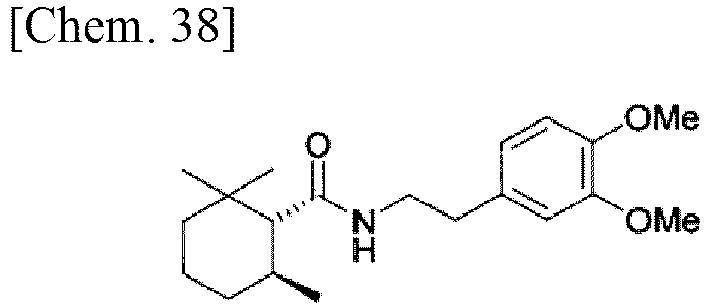
- (1R, 6S)-2,2,6-trimethylcyclohexanecarboxylic acid ((1R, 6S)-5) (1.00 g, 5.87 mmol) which was obtained according to the method described in PTL 29, thionyl chloride (0.47 mL, 1.10 eq.), toluene (10 mL) and a few drops of dimethyl formamide (DMF) were added to a 100 mL four neck flask under a nitrogen atmosphere, and they were stirred for one hour at room temperature. A solution which was prepared by adding toluene (5 mL) to homoveratrylamine (1.35 mL, 1.10 eq.) and triethylamine (1 mL) was slowly added to the inside of the system. After two and a half hours, the reaction solution was transferred to a separatory funnel, and dilute hydrochloric acid and ethyl acetate were added thereto to perform washing. The oil layer was washed once with dilute hydrochloric acid, then washed once with a saturated saline solution, followed by drying with anhydrous magnesium sulfate. The obtained solution was concentrated under reduced pressure, and recrystallized with heptane/ethyl acetate, thereby obtaining a target compound (1.55 g, yield 79%) as a white crystal.
- Melting Point: 93°C to 96°C
HRMS: Mass 356.2196 Actual Measurement Value 356.2203 ([M + Na]+)
1H-NMR (500 MHz, CDCl3): δ 0.80 (d, 3H, J = 6.4 Hz), 0.81-0.87 (m, 1H), 0.88 (s, 3H), 1.00 (s, 3H), 1.09 (dt, 1H, J = 12.7, 5.0 Hz), 1.31 (d, 1H, J = 11.1 Hz), 1.34-1.38 (m, 1H), 1.42-1.54 (m, 2H), 1.68-1.90 (m, 2H), 2.76 (t, 2H, J = 7.0 Hz), 3.55-3.60 (m, 2H), 3.86 (br, 6H), 6.70-6.83 (m, 3H). -

- (1R, 6S)-2,2,6-trimethylcyclohexanecarboxylic acid ((1R, 6S)-5) (1.00 g, 5.87 mmol) which was obtained according to the method described in PTL 29, triethylamine (1.95 mL, 2.40 eq.), and acetonitrile (10 mL) were added to a 50 mL two neck flask under a nitrogen atmosphere. The temperature of the inside of the system was lowered to 0°C to 5°C by an ice bath, and methanesulfonyl chloride (0.55 mL, 1.20 eq.) was slowly dropped therein. The mixture was stirred for 15 minutes at room temperature, and then tryptamine (0.97 g, 1.20 eq.) was added thereto and was allowed to react with them for one hour at room temperature. The reaction solution was diluted with ethyl acetate (15 mL), and then water (10 mL) and a saturated aqueous solution of ammonium chloride (10 mL) were slowly added thereto as a post-treatment. The oil layer was washed twice with a saturated aqueous solution of sodium bicarbonate (15 mL), and further washed once with a saturated saline solution (10 mL), followed by drying with sodium sulfate. The obtained solution was concentrated under reduced pressure, and isolation and purification were performed by silica gel column chromatography (hexane/ethyl acetate = 2/1), thereby obtaining a target compound (0.96 g, yield 52%) as a white crystal.
- Melting Point: 132°C to 135°C
HRMS: Mass 313.2274 Actual Measurement Value 313.2276 ([M + H]+)
1H-NMR (500 MHz, CDCl3): δ 0.80 (d, 3H, J = 6.4 Hz), 0.80-0.86 (m, 1H), 0.87 (s, 3H), 1.00 (s, 3H), 1.07 (dt, 1H, J = 5.0, 12.9 Hz), 1.29 (d, 1H, J = 11.1 Hz), 1.32-1.38 (m, 1H), 1.43-1.54 (m, 2H), 1.67-1.74 (m, 1H), 1.78-1.90 (m, 1H), 2.98 (t, 2H, J = 6.8 Hz), 3.67-3.71 (m, 2H), 5.58 (br, 1H), 7.02 (d, 1H, J = 2.3 Hz), 7.12 (dt, 1H, J = 1.0, 7.0 Hz), 7.20 (dt, 1H, J = 1.0, 7.1 Hz), 7.37 (dt, 1H, J = 0.9, 8.0 Hz), 7.61 (dd, 1H, J = 0.5, 8.0 Hz), 8.27 (br, 1H). -

- (1R, 6S)-2,2,6-trimethylcyclohexanecarboxylic acid ((1R, 6S)-5) (1.00 g, 5.87 mmol) which was obtained according to the method described in PTL 29, triethylamine (1.95 mL, 2.40 eq.), and acetonitrile (10 mL) were added to a 50 mL two neck flask under a nitrogen atmosphere. The temperature of the inside of the system was lowered to 0°C to 5°C by an ice bath, and methanesulfonyl chloride (0.55 mL, 1.20 eq.) was slowly dropped therein. After they were stirred for 20 minutes at room temperature, 2-(2-aminomethyl) pyridine (0.72 mL, 1.20 eq.) was slowly added thereto and allowed to react at room temperature for one hour. The reaction solution was diluted with ethyl acetate (10 mL), and then water (10 mL) and a saturated aqueous ammonium chloride solution (15 mL) were slowly added thereto as a post-treatment. The oil layer was washed twice with a saturated aqueous solution of sodium bicarbonate (15 mL), and further washed once with a saturated saline solution (10 mL), followed by drying with sodium sulfate. The obtained solution was concentrated under reduced pressure, and recrystallized with hexane, thereby obtaining a target compound (0.89 g, yield 58%) as a white crystal.
- Melting Point: 95°C to 96°C
HRMS: Mass 261.1961 Actual Measurement Value 261.1962 ([M + H]+)
1H-NMR (500 MHz, CDCl3): δ 0.82 (d, 3H, J = 6.4 Hz), 0.84-0.92 (m, 1H), 0.88 (s, 3H), 1.04 (s, 3H), 1.16 (dt, 1H, J = 5.0, 13.0 Hz), 1.36-1.43 (m, 1H), 1.45-1.54 (m, 2H), 1.56 (d, 1H, J = 11.2 Hz), 1.71-1.77 (m, 1H), 1.85-1.95 (m, 1H), 4.54 (dd, 1H, J = 5.0, 16.1 Hz), 4.60 (dd, 1H, J = 5.2, 16.1 Hz), 6.66 (br, 1H), 7.17-7.21 (m, 1H), 7.29 (d, 1H, J = 7.8 Hz), 7.65 (dt, 1H, J = 1.8, 7.8 Hz), 8.51-8.54 (m, 1H). -

- (1R, 6S)-2,2,6-trimethylcyclohexanecarboxylic acid ((1R, 6S)-5) (1.00 g, 5.87 mmol) which was obtained according to the method described in PTL 29, triethylamine (1.95 mL, 2.40 eq.), and acetonitrile (10 mL) were added to a 50 mL two neck flask under a nitrogen atmosphere. The temperature of the inside of the system was lowered to 0°C to 5°C by an ice bath, and methanesulfonyl chloride (0.55 mL, 1.20 eq.) was slowly dropped therein. After they were stirred for 20 minutes at room temperature, 2-(2-aminoethyl) pyridine (0.84 mL, 1.20 eq.) was slowly added thereto and allowed to react with them at room temperature for 30 minutes. The reaction solution was diluted with ethyl acetate (10 mL), and then a saturated aqueous solution of ammonium chloride (20 mL) was slowly added thereto as a post-treatment. The oil layer was washed twice with a saturated aqueous solution of sodium bicarbonate (15 mL), and further washed once with a saturated saline solution (10 mL), followed by drying with sodium sulfate. The obtained solution was concentrated under reduced pressure, and recrystallized with hexane, thereby obtaining a target compound (1.04 g, yield 64%) as a yellow crystal.
- Melting Point: 91°C to 96°C
HRMS: Mass 275.2118 Actual Measurement Value 275.2118 ([M + H]+)
1H-NMR (500 MHz, CDCl3): δ 0.86 (d, 3H, J = 6.4 Hz), 0.78-0.89 (m, 1H), 0.84 (s, 3H), 0.98 (s, 3H), 1.10 (dt, 1H, J = 5.1, 12.9 Hz), 1.33-1.48 (m, 2H), 1.44-1.53 (m, 2H), 1.67-1.75 (m, 1H), 1.78-1.88 (m, 1H), 3.00 (t, 2H, J = 6.4 Hz), 3.63-3.74 (m, 2H), 6.25 (br, 1H), 7.11-7.17 (m, 1H), 7.18 (d, 1H, J = 7.8 Hz), 7.60 (dt, 1H, J = 1.9, 7.8 Hz), 8.51-8.54 (m, 1H). -
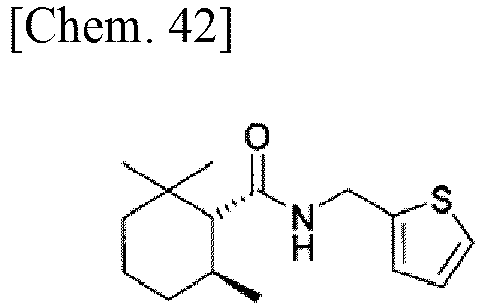
- (1R, 6S)-2,2,6-trimethylcyclohexanecarboxylic acid ((1R, 6S)-5) (1.00 g, 5.87 mmol) which was obtained according to the method described in PTL 29, triethylamine (1.95 mL, 2.40 eq.), and acetonitrile (10 mL) were added to a 50 mL two neck flask under a nitrogen atmosphere. Methanesulfonyl chloride (0.55 mL, 1.20 eq.) was slowly dropped therein at room temperature, followed by performing stirring for 25 minutes at room temperature, and then 2-(aminomethyl) thiophene (0.59 mL, 1.20 eq.) was added thereto and allowed to react with them at room temperature for one and a half hours. The reaction solution was diluted with ethyl acetate (10 mL), and then 2N hydrochloric acid (10 mL) was slowly added thereto as a post-treatment. The oil layer was washed twice with a saturated aqueous solution of sodium bicarbonate (15 mL), and further washed once with a saturated saline solution (10 mL), followed by drying with sodium sulfate. The obtained solution was concentrated under reduced pressure, and recrystallized with hexane, thereby obtaining a target compound (1.14 g, yield 73%) as a pale yellow solid.
- Melting Point: 88°C to 90°C
HRMS: Mass 266.1573 Actual Measurement Value 266.1577 ([M + H]+)
1H-NMR (500 MHz, CDCl3): δ 0.84 (d, 3H, J = 6.3 Hz), 0.85-0.92 (m, 1H), 0.94 (s, 3H), 1.06 (s, 3H), 1.12 (dt, 1H, J = 5.1, 12.9 Hz), 1.36-1.44 (m, 2H), 1.46-1.55 (m, 2H), 1.71-1.78 (m, 1H), 1.84-1.95 (m, 1H), 4.60 (dd, 1H, J = 5.5, 15.2 Hz), 4.66 (dd, 1H, J = 5.7, 15.2 Hz), 5.55 (br, 1H), 6.92-6.98 (m, 2H), 7.18-7.24 (m, 1H). -
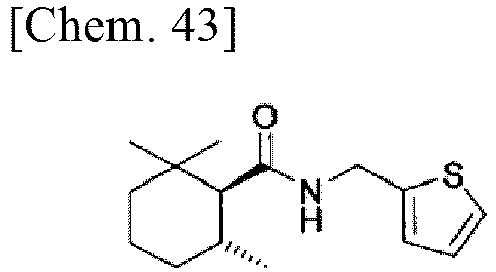
- (IS, 6R)-2,2,6-trimethylcyclohexanecarboxylic acid ((IS, 6R)-5) (1.00 g, 5.87 mmol) which was obtained according to the method described in PTL 29, triethylamine (1.95 mL, 2.4 eq.), and acetonitrile (10 mL) were added to a 50 mL two neck flask under a nitrogen atmosphere. Methanesulfonyl chloride (0.55 mL, 1.2 eq.) was slowly dropped therein at room temperature, followed by performing stirring for 20 minutes at room temperature, and then 2-(2-aminomethyl) thiophene (0.59 mL, 1.2 eq.) was added thereto and allowed to react with them at room temperature for 45 minutes. The reaction solution was diluted with ethyl acetate (15 mL), and then 2N hydrochloric acid (15 mL) was slowly added thereto as a post-treatment. The oil layer was washed twice with a saturated aqueous solution of sodium bicarbonate (15 mL), and further washed once with a saturated saline solution (10 mL), followed by drying with sodium sulfate. The obtained solution was concentrated under reduced pressure, and recrystallized with heptane/ethyl acetate, thereby obtaining a target compound (0.95 g, yield 61%) as a white solid.
- Melting Point: 88°C to 90°C
HRMS: Mass 266.1573 Actual Measurement Value 266.1562 ([M + H]+)
1H-NMR (500 MHz, CDCl3): δ 0.84 (d, 3H, J = 6.4 Hz), 0.85-0.92 (m, 1H), 0.93 (s, 3H), 1.04 (s, 3H), 1.12 (dt, 1H, J = 12.8, 5.0 Hz), 1.36-1.42 (m, 2H), 1.45-1.60 (m, 2H), 1.70-1.78 (m, 1H), 1.84-1.95 (m, 1H), 4.56-4.69 (m, 2H), 5.69 (br, 1H), 6.91-6.98 (m, 2H), 7.19-7.23 (m, 1H). -

- (1R, 6S)-2,2,6-trimethylcyclohexanecarboxylic acid ((1R, 6S)-5) (1.00 g, 5.87 mmol) which was obtained according to the method described in PTL 29, triethylamine (1.95 mL, 2.40 eq.), and acetonitrile (10 mL) were added to a 50 mL two neck flask under a nitrogen atmosphere. The temperature of the inside of the system was lowered to 0°C to 5°C by an ice bath, and methanesulfonyl chloride (0.55 mL, 1.20 eq.) was slowly dropped therein. After they were stirred for 20 minutes at room temperature, 3-thiophenemethylamine (0.59 mL, 1.20 eq.) was slowly added thereto and allowed to react with them at room temperature for one hour. The reaction solution was diluted with ethyl acetate (15 mL), and then 2N hydrochloric acid (15 mL) was slowly added thereto as a post-treatment. The oil layer was washed twice with a saturated aqueous solution of sodium bicarbonate (15 mL), and further washed once with a saturated saline solution (10 mL), followed by drying with sodium sulfate. The obtained solution was concentrated under reduced pressure, and recrystallized with hexane, thereby obtaining a target compound (1.12 g, yield 77%) as a pale yellow solid.
- Melting Point: 82°C to 84°C
HRMS: Mass 266.1573 Actual Measurement Value 266.1571 ([M + H]+)
1H-NMR (500 MHz, CDCl3): δ 0.84 (d, 3H, J = 6.3 Hz), 0.85-0.92 (m, 1H), 0.93 (s, 3H), 1.03 (s, 3H), 1.12 (dt, 1H, J = 5.1, 13.0 Hz), 1.35-1.43 (m, 2H), 1.46-1.55 (m, 2H), 1.66-1.77 (m, 1H), 1.84-1.95 (m, 1H), 4.42 (dd, 1H, J = 5.6, 14.9 Hz), 4.50 (dd, 1H, J = 5.9, 14.9 Hz), 5.67 (br, 1H), 7.03 (d, 1H, J = 5.0 Hz), 7.12-7.16 (m, 1H), 7.28 (dd, 1H, J = 3.0, 5.0 Hz). -

- (1R, 6S)-2,2,6-trimethylcyclohexanecarboxylic acid ((1R, 6S)-5) (1.00 g, 5.87 mmol) which was obtained according to the method described in PTL 29, triethylamine (1.95 mL, 2.40 eq.), and acetonitrile (10 mL) were added to a 50 mL two neck flask under a nitrogen atmosphere. Methanesulfonyl chloride (0.55 mL, 1.20 eq.) was slowly dropped therein at room temperature, followed by performing stirring for 15 minutes at room temperature, and then 2-(aminoethyl)thiophene (0.69 mL, 1.20 eq.) was added thereto and allowed to react with them at room temperature for one hour. The reaction solution was diluted with ethyl acetate (10 mL), and then 2N hydrochloric acid (15 mL) was slowly added thereto as a post-treatment. The oil layer was washed twice with a saturated aqueous solution of sodium bicarbonate (15 mL), and further washed once with a saturated saline solution (10 mL), followed by drying with sodium sulfate. The obtained solution was concentrated under reduced pressure, and recrystallized with hexane, thereby obtaining a target compound (1.11 g, yield 67%) as a light brown solid.
- Melting Point: 83°C to 86°C
HRMS: Mass 280.1730 Actual Measurement Value 280.1730 ([M + H]+)
1H-NMR (500 MHz, CDCl3): δ 0.81 (d, 3H, J = 6.3 Hz), 0.81-0.88 (m, 1H), 0.88 (s, 3H), 1.01 (s, 3H), 1.10 (dt, 1H, J = 4.8, 12.4 Hz), 1.36 (t, 2H, J = 12.4 Hz), 1.44-1.55 (m, 2H), 1.66-1.92 (m, 2H), 3.04 (t, 2H, J = 9.7 Hz), 3.47-3.64 (m, 2H), 5.58 (br, 1H), 6.81-6.97 (m, 2H), 7.15 (d, 1H, J = 5.0 Hz). -

- (IS, 6R)-2,2,6-trimethylcyclohexanecarboxylic acid ((IS, 6R)-5) (1.00 g, 5.87 mmol) which was obtained according to the method described in PTL 29, triethylamine (1.95 mL, 2.4 eq.), and acetonitrile (10 mL) were added to a 50 mL two neck flask under a nitrogen atmosphere. Methanesulfonyl chloride (0.55 mL, 1.2 eq.) was slowly dropped therein at room temperature, followed by performing stirring for 20 minutes at room temperature, and then 2-(2-aminoethyl)thiophene (0.71 mL, 1.2 eq.) was added thereto and allowed to react with them at room temperature for 45 minutes. The reaction solution was diluted with ethyl acetate (15 mL), and then 2N hydrochloric acid (15 mL) was slowly added thereto as a post-treatment. The oil layer was washed twice with a saturated aqueous solution of sodium bicarbonate (15 mL), and further washed once with a saturated saline solution (10 mL), followed by drying with sodium sulfate. The obtained solution was concentrated under reduced pressure, and recrystallized with heptane/ethyl acetate, thereby obtaining a target compound (0.95 g, yield 61%) as a white solid.
- Melting Point: 85°C to 86°C
HRMS: Mass 280.1730 Actual Measurement Value 280.1740 ([M + H]+)
1H-NMR (500 MHz, CDCl3): δ 0.81 (d, 3H, J = 6.4 Hz), 0.83-0.89 (m, 1H), 0.89 (s, 3H), 1.00 (s, 3H), 1.10 (dt, 1H, J = 12.8, 5.0 Hz), 1.32-1.40 (m, 2H), 1.45-1.56 (m, 2H), 1.68-1.75 (m, 1H), 1.81-1.89 (m, 1H), 2.99-3.07 (m, 2H), 3.49-3.64 (m, 2H), 5.48 (br, 1H), 6.84 (dd, 1H, J = 3.3, 0.9 Hz), 6.94 (dd, 1H, J = 5.1, 3.4 Hz), 7.16 (dd, 1H, J = 5.3, 1.1 Hz). -

- (1R, 6S)-2,2,6-trimethylcyclohexanecarboxylic acid ((1R, 6S)-5) (2.00 g, 11.7 mmol) which was obtained according to the method described in PTL 29, triethylamine (3.80 mL, 2.40 eq.), and acetonitrile (10 mL) were added to a 50 mL two neck flask under a nitrogen atmosphere. The temperature of the inside of the system was lowered to 0°C to 5°C by an ice bath and methanesulfonyl chloride (1.10 mL, 1.20 eq.) was dropped therein. The mixture was stirred for 20 minutes at room temperature, and then 4-aminophenol (1.54 g, 1.20 eq.) was added thereto and was allowed to react with them for one hour at room temperature. The reaction solution was diluted with ethyl acetate (15 mL), and then 2N hydrochloric acid (20 mL) was slowly added thereto as a post-treatment. The oil layer was washed twice with a saturated aqueous solution of sodium bicarbonate (20 mL), and further washed once with a saturated saline solution (15 mL), followed by drying with sodium sulfate. The obtained solution was concentrated under reduced pressure, and recrystallized with hexane/ethyl acetate, thereby obtaining a target compound (1.40 g, yield 46%) as a white solid.
- Melting Point: 100°C to 105°C
HRMS: Mass 262.1802 Actual Measurement Value 262.1804 ([M + H]+)
1H-NMR (500 MHz, DMSO-d6): δ 0.79 (d, 3H, J = 6.0 Hz), 0.82-0.92 (m, 1H), 0.92 (s, 3H), 0.96 (s, 3H), 1.10-1.17 (m, 1H), 1.32-1.38 (m, 1H), 1.43-1.52 (m, 2H), 1.67-1.84 (m, 3H), 2.48-2.52 (m, 1H), 6.63-6.68 (m, 2H), 7.31-7.37 (m, 2H), 9.47 (br, 1H). -

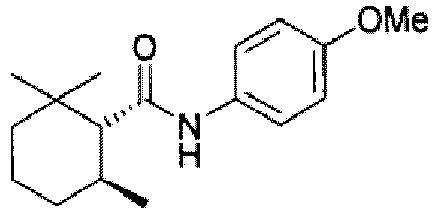
- (1R, 6S)-2,2,6-trimethylcyclohexanecarboxylic acid ((1R, 6S)-5) (1.00 g, 5.87 mmol) which was obtained according to the method described in PTL 29, thionyl chloride (0.47 mL, 1.10 eq.), toluene (10 mL) and a few drops of dimethyl formamide (DMF) were added to a 100 mL four neck flask under a nitrogen atmosphere, and they were stirred for one hour at room temperature. A solution which was prepared by adding toluene (5 mL) to p-anisidine (2.17 g, 3.0 eq.) was slowly added to the inside of the system. After five hours at 90°C, the reaction solution was transferred to a separatory funnel, and dilute hydrochloric acid and ethyl acetate were added thereto to perform washing. The oil layer was washed once with dilute hydrochloric acid, then washed once with a saturated saline solution, followed by drying with anhydrous magnesium sulfate. The obtained solution was concentrated under reduced pressure, and recrystallized with heptane/ethyl acetate, thereby obtaining a target compound (1.07 g, yield 66%) as a white crystal.
- Melting Point: 143°C to 144°C
HRMS: Mass 276.1958 Actual Measurement Value 276.1985 ([M + H]+)
1H-NMR (500 MHz, CDCl3): δ 0.80 (d, 3H, J = 6.4 Hz), 0.81-0.87 (m, 1H), 0.88 (s, 3H), 1.00 (s, 3H), 1.18 (dt, 1H, J = 12.7, 5.0 Hz), 1.40-1.48 (m, 1H), 1.49-1.60 (m, 3H), 1.76-1.81 (m, 1H), 1.90-2.00 (m, 1H), 3.78 (s, 3H), 6.82-6.87 (m, 2H), 6.95 (br, 6H), 7.37-7.44 (m, 2H). -

- (1R, 6S)-2,2,6-trimethylcyclohexanecarboxylic acid ((1R, 6S)-5) (1.00 g, 5.87 mmol) which was obtained according to the method described in PTL 29, thionyl chloride (0.47 mL, 1.10 eq.), toluene (10 mL) and a few drops of dimethyl formamide (DMF) were added to a 100 mL four neck flask under a nitrogen atmosphere, and they were stirred for one hour at room temperature. A solution which was prepared by adding toluene (5 mL) to 4-methoxybenzylamine (2.28 mL, 3.0 eq.) was slowly added to the inside of the system. After five hours at 90°C, the reaction solution was transferred to a separatory funnel, and dilute hydrochloric acid and ethyl acetate were added thereto to perform washing. The oil layer was washed once with dilute hydrochloric acid, then washed once with a saturated saline solution, followed by drying with anhydrous magnesium sulfate. The obtained solution was concentrated under reduced pressure, and recrystallized with heptane/ethyl acetate, thereby obtaining a target compound (1.13 g, yield 66%) as a white crystal.
- Melting Point: 85°C to 87°C
HRMS: Mass 289.2042 Actual Measurement Value 289.2031 ([M]+)
1H-NMR (500 MHz, CDCl3): δ 0.84 (d, 3H, J = 6.4 Hz), 0.85-0.92 (m, 1H), 0.93 (s, 3H), 1.04 (s, 3H), 1.11 (dt, 1H, J = 12.9, 4.8 Hz), 1.36-1.42 (m, 2H), 1.45-1.59 (m, 2H), 1.70-1.78 (m, 1H), 1.84-1.95 (m, 1H), 3.80 (s, 3H), 4.34 (dd, 1H, J = 14.3, 5.2 Hz), 4.44 (dd, 1H, J = 14.4, 4.8 Hz), 5.55 (br, 1H), 6.84-6.88 (m, 2H), 7.19-7.23 (m, 2H). -

- (1R, 6S)-2,2,6-trimethylcyclohexanecarboxylic acid ((1R, 6S)-5) (1.00 g, 5.87 mmol) which was obtained according to the method described in PTL 29, triethylamine (1.95 mL, 2.40 eq.), and acetonitrile (10 mL) were added to a 50 mL two neck flask under a nitrogen atmosphere. The temperature of the inside of the system was lowered to 0°C to 5°C by an ice bath, and methanesulfonyl chloride (0.55 mL, 1.20 eq.) was slowly dropped therein. The mixture was stirred for 15 minutes at room temperature, and then 3,4-methylenedioxyaniline (0.97 g, 1.20 eq.) was added thereto and was allowed to react with them for one hour at 50°C in an oil bath. The reaction solution was diluted with ethyl acetate (15 mL), and then 2N hydrochloric acid (15 mL) was slowly added thereto as a post-treatment. The oil layer was washed twice with a saturated aqueous solution of sodium bicarbonate (15 mL), and further washed once with a saturated saline solution (10 mL), followed by drying with sodium sulfate. The obtained solution was concentrated under reduced pressure, and recrystallized with hexane/ethyl acetate, thereby obtaining a target compound (0.63 g, yield 37%) as a gray solid.
- Melting Point: 171°C to 173°C
HRMS: Mass 290.1751 Actual Measurement Value 290.1754 ([M + H]+)
1H-NMR (500 MHz, CDCl3): δ 0.91 (d, 3H, J = 6.4 Hz), 0.91-1.00 (m, 1H), 1.02 (s, 3H), 1.07 (s, 3H), 1.18 (dt, 1H, J = 5.5, 12.8 Hz), 1.40-1.47 (m, 1H), 1.49-1.58 (m, 2H), 1.74-1.82 (m, 1H), 1.91-2.00 (m, 1H), 5.93 (s, 2H), 6.72 (d, 1H, J = 8.3 Hz), 6.77 (dd, 1H, J = 2.1, 8.3 Hz), 7.02 (br, 1H), 7.24 (d, 1H, J = 2.1 Hz). -

- (1R, 6S)-2,2,6-trimethylcyclohexanecarboxylic acid ((1R, 6S)-5) (1.00 g, 5.87 mmol) which was obtained according to the method described in PTL 29, triethylamine (1.95 mL, 2.40 eq.), and acetonitrile (10 mL) were added to a 50 mL two neck flask under a nitrogen atmosphere. The temperature of the inside of the system was lowered to 0°C to 5°C by an ice bath, and methanesulfonyl chloride (0.55 mL, 1.20 eq.) was slowly dropped therein. The mixture was stirred for 15 minutes at room temperature, and then 4'-aminoacetophenone (0.97 g, 1.20 eq.) was added thereto and was allowed to react with them for two hours at 50°C in an oil bath. The reaction solution was diluted with ethyl acetate (15 mL), and then 2N hydrochloric acid (15 mL) was slowly added thereto as a post-treatment. The oil layer was washed twice with a saturated aqueous solution of sodium bicarbonate (15 mL), and further washed once with a saturated saline solution (10 mL), followed by drying with sodium sulfate. The obtained solution was concentrated under reduced pressure, and isolation and purification were performed by silica gel column chromatography (hexane/ethyl acetate), thereby obtaining a target compound (0.45 g, yield 27%) as a pale yellow solid.
- Melting Point: 166°C to 168°C
HRMS: Mass 288.1958 Actual Measurement Value 288.1952 ([M + H]+)
1H-NMR (500 MHz, CDCl3): δ 0.91 (d, 3H, J = 6.4 Hz), 0.93-1.00 (m, 1H), 1.04 (s, 3H), 1.08 (s, 3H), 1.19 (dt, 1H, J = 5.9, 13.0 Hz), 1.40-1.56 (m, 3H), 1.61 (d, 1H, J = 11.2 Hz), 1.75-1.83 (m, 1H), 1.93-2.05 (m, 1H), 2.57 (s, 3H), 7.43 (br, 1H), 7.62-7.67 (m, 2H), 7.91-7.95 (m, 2H). -

- (1R, 6S)-2,2,6-trimethylcyclohexanecarboxylic acid ((1R, 6S)-5) (1.00 g, 5.87 mmol) which was obtained according to the method described in PTL 29, triethylamine (1.95 mL, 2.40 eq.), and acetonitrile (10 mL) were added to a 50 mL two neck flask under a nitrogen atmosphere. The temperature of the inside of the system was lowered to 0°C to 5°C by an ice bath, and methanesulfonyl chloride (0.55 mL, 1.20 eq.) was slowly dropped therein. The mixture was stirred for 15 minutes at room temperature, and then 2-(4-aminophenyl) ethanol (0.97 g, 1.20 eq.) was added thereto and was allowed to react with them for one hour at 60°C in an oil bath. The reaction solution was diluted with ethyl acetate (10 mL), and then 2N hydrochloric acid (15 mL) was slowly added thereto as a post-treatment. The oil layer was washed twice with a saturated aqueous solution of sodium bicarbonate (15 mL), and further washed once with a saturated saline solution (10 mL), followed by drying with sodium sulfate. The obtained solution was concentrated under reduced pressure, and isolation and purification were performed by silica gel column chromatography (hexane/ethyl acetate), thereby obtaining a target compound (0.73 g, yield 43%) as a pale yellow solid.
- Melting Point: 98°C to 103°C
HRMS: Mass 290.2115 Actual Measurement Value 290.2111 ([M + H]+)
1H-NMR (500 MHz, CDCl3): δ 0.91 (d, 3H, J = 6.4 Hz), 0.93-1.00 (m, 1H), 1.03 (s, 3H), 1.07 (s, 3H), 1.19 (dt, 1H, J = 5.4, 13.1 Hz), 1.42-1.47 (m, 1H), 1.49-1.56 (m, 2H), 1.58 (d, 1H, J = 11.0 Hz), 1.67 (br, 1H), 1.75-1.83 (m, 1H), 1.91-2.02 (m, 1H), 2.80-2.84 (m, 2H), 3.78-3.86 (m, 2H), 7.14-7.23 (m, 3H), 7.42-7.47 (m, 2H). -

- (1R, 6S)-2,2,6-trimethylcyclohexanecarboxylic acid ((1R, 6S)-5) (1.00 g, 5.87 mmol) which was obtained according to the method described in PTL 29, triethylamine (1.95 mL, 2.40 eq.), and acetonitrile (10 mL) were added to a 50 mL two neck flask under a nitrogen atmosphere. The temperature of the inside of the system was lowered to 0°C to 5°C by an ice bath, and methanesulfonyl chloride (0.55 mL, 1.20 eq.) was slowly dropped therein. The mixture was stirred for 15 minutes at room temperature, and then methyl 4-aminobenzoate (1.07 g, 1.20 eq.) was added thereto and was allowed to react with them for one and a half hours at 50°C in an oil bath. The reaction solution was diluted with ethyl acetate (15 mL), and then water (5 mL) and a saturated aqueous solution of ammonium chloride (10 mL) were slowly added thereto as a post-treatment. The oil layer was washed twice with a saturated aqueous solution of sodium bicarbonate (15 mL), and further washed once with a saturated saline solution (10 mL), followed by drying with sodium sulfate. The obtained solution was concentrated under reduced pressure, and isolation and purification were performed by silica gel column chromatography (hexane/ethyl acetate), thereby obtaining a target compound (0.94 g, yield 53%) as a pale yellow solid.
- Melting Point: 94°C to 97°C
HRMS: Mass 304.1907 Actual Measurement Value 304.1914 ([M + H]+)
1H-NMR (500 MHz, CDCl3): δ 0.91 (d, 3H, J = 6.4 Hz), 0.92-1.01 (m, 1H), 1.03 (s, 3H), 1.07 (s, 3H), 1.14-1.24 (m, 1H), 1.42-1.49 (m, 2H), 1.52-1.59 (m, 2H), 1.61 (d, 1H, J = 11.1 Hz), 1.75-1.83 (m, 1H), 1.94-2.02 (m, 1H), 3.89 (s, 3H), 7.32 (br, 1H), 7.57-7.64 (m, 2H), 7.96-8.02 (m, 2H). -

- (1R, 6S)-2,2,6-trimethylcyclohexanecarboxylic acid ((1R, 6S)-5) (1.00 g, 5.87 mmol) which was obtained according to the method described in PTL 29, triethylamine (1.95 mL, 2.40 eq.), and acetonitrile (10 mL) were added to a 50 mL two neck flask under a nitrogen atmosphere. The temperature of the inside of the system was lowered to 0°C to 5°C by an ice bath, and methanesulfonyl chloride (0.55 mL, 1.20 eq.) was slowly dropped therein. The mixture was stirred for 15 minutes at room temperature, and then 4-(methylthio) aniline (0.86 mL, 1.20 eq.) was added thereto and was allowed to react with them for two hours at 50°C in an oil bath. The reaction solution was diluted with ethyl acetate (20 mL), and then 2N hydrochloric acid (15 mL) was slowly added thereto as a post-treatment. The oil layer was washed twice with a saturated aqueous solution of sodium bicarbonate (15 mL), and further washed once with a saturated saline solution (10 mL), followed by drying with sodium sulfate. The obtained solution was concentrated under reduced pressure, and recrystallized with hexane/ethyl acetate, thereby obtaining a target compound (0.67g, yield 39%) as a pale yellow crystal.
- Melting Point: 157°C to 159°C
HRMS: Mass 292.1730 Actual Measurement Value 292.1734 ([M + H]+)
1H-NMR (500 MHz, CDCl3): δ 0.91 (d, 3H, J = 6.4 Hz), 0.92-1.00 (m, 1H), 1.02 (s, 3H), 1.07 (s, 3H), 1.18 (dt, 1H, J = 5.7, 13.0 Hz), 1.42-1.47 (m, 1H), 1.50-1.59 (m, 3H), 1.74-1.82 (m, 1H), 1.92-2.00 (m, 1H), 2.46 (s, 3H), 7.09 (br, 1H), 7.24 (dt, 2H, J = 2.7, 8.7 Hz), 7.46 (dt, 2H, J = 2.1, 8.7 Hz). -

- (1R, 6S)-2,2,6-trimethylcyclohexanecarboxylic acid ((1R, 6S)-5) (1.00 g, 5.87 mmol) which was obtained according to the method described in PTL 29, triethylamine (1.95 mL, 2.40 eq.), and acetonitrile (10 mL) were added to a 50 mL two neck flask under a nitrogen atmosphere. The temperature of the inside of the system was lowered to 0°C to 5°C by an ice bath, and methanesulfonyl chloride (0.55 mL, 1.20 eq.) was slowly dropped therein. The mixture was stirred for 20 minutes at room temperature, and then 4-aminobenzyl cyanide (0.93 g, 1.20 eq.) was added thereto and was allowed to react with them for three hours at 40°C in an oil bath. The reaction solution was diluted with ethyl acetate (10 mL), and then 2N hydrochloric acid (15 mL) was slowly added thereto as a post-treatment. The oil layer was washed once with 1N hydrochloric acid (20mL), washed twice with a saturated aqueous solution of sodium bicarbonate (15 mL), and washed once with a saturated saline solution (10 mL), followed by drying with sodium sulfate. The obtained solution was concentrated under reduced pressure, and recrystallized with hexane/ethyl acetate, thereby obtaining a target compound (0.66 g, yield 40%) as a white solid.
- Melting Point: 190°C to 193°C
HRMS: Mass 284.1848 Actual Measurement Value 284.1838 ([M]+)
1H-NMR (500 MHz, CDCl3): δ 0.91 (d, 3H, J = 6.4 Hz), 0.93-1.00 (m, 1H), 1.04 (s, 3H), 1.07 (s, 3H), 1.19 (dt, 1H, J = 5.1, 12.8 Hz), 1.41-1.47 (m, 3H), 1.51-1.61 (m, 3H), 1.76-1.83 (m, 1H), 1.92-2.01 (m, 1H), 3.71 (s, 2H), 7.29 (br, 1H), 7.25-7.28 (m, 2H), 7.52-7.58 (m, 2H). -

- (1R, 6S)-2,2,6-trimethylcyclohexanecarboxylic acid ((1R, 6S)-5) (1.00 g, 5.87 mmol) which was obtained according to the method described in PTL 29, triethylamine (1.95 mL, 2.40 eq.), and acetonitrile (10 mL) were added to a 50 mL two neck flask under a nitrogen atmosphere. The temperature of the inside of the system was lowered to 0°C to 5°C by an ice bath and methanesulfonyl chloride (0.55 mL, 1.20 eq.) was dropped therein. The mixture was stirred for 20 minutes at room temperature, and then 4-aminopyridine (0.67 g, 1.20 eq.) was added thereto and was allowed to react with them for one hour at room temperature. The reaction solution was diluted with ethyl acetate (20 mL), and then a saturated aqueous solution of ammonium chloride (15 mL) was slowly added thereto as a post-treatment. The oil layer was washed once with a saturated aqueous solution of ammonium chloride (15 mL), washed twice with a saturated aqueous solution of sodium bicarbonate (15 mL), and washed once with a saturated saline solution (10 mL), followed by drying with sodium sulfate. The obtained solution was concentrated under reduced pressure, and isolation and purification were performed by silica gel column chromatography (hexane/ethyl acetate), thereby obtaining a target compound (0.45 g, yield 32%) as a white solid.
- Melting Point: 64°C to 68°C
HRMS: Mass 247.1805 Actual Measurement Value 247.1807 ([M + H]+)
1H-NMR (500 MHz, CDCl3): δ 0.87 (d, 3H, J = 6.4 Hz), 0.83-0.90 (m, 1H), 1.00 (s, 3H), 1.05 (s, 3H), 1.11 (dt, 1H, J = 5.5, 12.9 Hz), 1.36-1.43 (m, 1H), 1.45-1.54 (m, 2H), 1.72 (d, 1H, J = 11.1 Hz), 1.68-1.78 (m, 1H), 1.88-2.00 (m, 1H), 7.52-7.58 (m, 2H), 8.39-8.44 (m, 2H), 8.70 (br, 1H). -

- Phenethyldiol (8.29 g, 1.20 eq.) was placed in a 200 mL two neck flask under a nitrogen atmosphere, and toluene (100 mL) was added thereto, followed by performing stirring at room temperature, and then pyridine (5.2 mL, 1.30 eq.) and N,N-dimethylaminopyridine (0.31 g, 0.05 eq.) were added thereto. Further, thionyl chloride (3.97 mL, 1.10 eq.) was dropped in a solution obtained by mixing (1R, 6S)-2,2,6-trimethylcyclohexanecarboxylic acid ((1R, 6S)-5) (8.51 g, 50.0 mmol) obtained according to the method described in PTL 29 and N,N-dimethylformamide (20 mg) in toluene (50 mL). They were allowed to react for three hours at 100°C, and completion of the reaction was confirmed. After the temperature was lowered to room temperature and the reaction solution was diluted with toluene, 2N hydrochloric acid was slowly added thereto as a post-treatment. The oil layer was washed twice with a saturated aqueous solution of sodium bicarbonate, and further washed once with a saturated saline solution, followed by drying with sodium sulfate. The obtained solution was concentrated under reduced pressure, and purification was performed by silica gel column chromatography, thereby obtaining a target compound (6.39 g, yield 44%) as viscous oil.
- HRMS: Mass 290.4030 Actual Measurement Value 290.4011 ([M + H]+)
1H-NMR (500 MHz, CDCl3): δ 7.42-7.28 (m, 5H), 4.96 (brd, J-8 Hz, 1H), 4.31 (ddd, J = 3.6, 9.2, 12.0 Hz, 1H), 4.19 (ddd, J = 8.0, 10.4, 11.6 Hz, 1H), 2.57 (brs, 1H), 1.89-1.82 (m, 2H), 1.73 (ddd, J = 1.2, 3.2, 14.0 Hz, 1H), 1.51 (tt, J = 3.2, 10.0 Hz, 2H), 1.41 (dtd, J = 1.2, 3.2, 13.2 Hz, 1H), 1.20-1.13 (m, 1H), 0.96 (d, J = 2.4 Hz, 3H), 0.93 (s, 3H), 0.88 (ddd, J = 3.4, 6.8, 16.0 Hz, 1H), 0.81 (dd, J = 1.8, 5.8 Hz, 3H). - 13C-NMR (125 MHz, CDCl3): δ 174.83, 139.87, 128.51×2, 128.12, 126.13×2, 72.53, 68.78, 68.71, 60.78, 41.09, 34.42, 33.33, 31.28, 31.27, 30.20, 30.17, 21.68, 21.56, 21.12, 21.06, 20.86, 20.84.
-


- An exemplary compound (1R, 6S)-13-4-(R) (2.47 g, yield 43%) was obtained as viscous oil from (1R, 6S)-2,2,6-trimethylcyclohexanecarboxylic acid ((1R, 6S)-5) (3.41 g, 20.0 mmol) and (R)-phenylethane-1,2-diol (2.90 g, 1.05 eq.) by the same method as that of Example 34.
- An exemplary compound (1R, 6S)-13-4-(S) (2.46 g, yield 42%) was obtained as viscous oil from (1R, 6S)-2,2,6-trimethylcyclohexanecarboxylic acid ((1R, 6S)-5) (3.41 g, 20.0 mmol) and (S)-phenylethane-1,2-diol (2.90 g, 1.05 eq.) by the same method as that of Example 34.
- Exemplary compound (1R, 6S)-13-4-(R)
HRMS: Mass 290.4030 Actual Measurement Value 290.4073 ([M + H]+)
1H-NMR (500 MHz, CDCl3): δ 7.40-7.28 (m, 5H), 4.32 (ddd, J = 3.6, 9.2, 12.0 Hz, 1H), 4.17 (ddd, J = 8.0, 10.4, 11.6 Hz, 1H), 2.57 (brs, 1H), 1.89-1.82 (m, 2H), 1.72 (ddd, J = 1.2, 3.2, 14.0 Hz, 1H), 1.51 (tt, J = 3.2, 10.0 Hz, 2H), 1.41 (dtd, J = 1.2, 3.2, 13.2Hz, 1H), 1.20-1.13 (m, 1H), 0.96 (d, J = 2.4 Hz, 3H), 0.93 (s, 3H), 0.88 (ddd, J = 3.4, 6.8, 16.0 Hz, 1H), 0.81 (dd, J = 1.8, 5.8 Hz, 3H). - 13C-NMR (125 MHz, CDCl3): δ 174.81, 139.84, 128.53×2, 128.12, 126.13×2, 72.57, 68.81, 60.81, 41.11, 34.44, 33.35, 31.30, 30.21, 21.61, 21.08, 20.86.
- Exemplary compound (1R, 6S)-13-4-(S)
HRMS: Mass 290.4030 Actual Measurement Value 290.4058 ([M + H]+)
1H-NMR (500 MHz, CDCl3): δ 7.40-7.28 (m, 5H), 4.96 (brd, J-8 Hz, 1H), 4.30 (ddd, J = 3.6, 9.2, 12.0 Hz, 1H), 4.19 (ddd, J = 8.0, 10.4, 11.6 Hz, 1H), 2.57 (brs, 1H), 1.89-1.82 (m, 2H), 1.73 (ddd, J = 1.2, 3.2, 14.0 Hz, 1H), 1.51 (tt, J = 3.2, 10.0 Hz, 2H), 1.41 (dtd, J = 1.2, 3.2, 13.2 Hz, 1H), 1.20-1.13 (m, 1H), 0.96 (d, J = 2.4 Hz, 3H), 0.93 (s, 3H), 0.88 (ddd, J = 3.4, 6.8, 16.0 Hz, 1H), 0.81 (dd, J = 1.8, 5.8 Hz, 3H). - 13C-NMR (125 MHz, CDCl3): δ 174.74, 139.87, 128.53×2, 128.12, 126.15×2, 72.55, 68.73, 60.80, 41.11, 34.43, 33.35, 31.28, 30.19, 21.60, 21.12, 20.87.
-

- Bis(palladium)dibenzylideneacetone (71 mg, 1 mol%), dicyclohexyl (1-diphenyl-1-propen-2-yl) phosphine ligand (97 mg, 4 mol%) and toluene (20 mL) were added under a nitrogen atmosphere, and stirred at room temperature for one hour. Subsequently, phenethylamine (1.00 g, 7.80 mmol), bromoanisole (0.97 ml, 1.0 eq.), and sodium-tert-butoxide (0.90 g, 1.2 eq.) were added thereto, and the mixture was heated and stirred at 100°C for five hours. The temperature of the reaction solution was lowered to room temperature, and then extraction and washing with ethyl acetate/water were performed. The oil layer was dried by anhydrous magnesium sulfate, and the residue obtained by filtration and concentration was isolated and purified by silica gel column chromatography, thereby obtaining a target compound (1.05 g, yield 59%) as pale yellow oil.
- 1H-NMR (500 MHz, CDCl3): δ 2.90 (t, 2H, J = 7.0 Hz), 3.36 (t, 2H, J = 7.1 Hz), 3.75 (s, 3H), 6.57-6.61 (m, 2H), 6.75-6.80 (m, 2H), 7.20-7.37 (m, 6H).
- It is common that a compound having a cooling effect such as menthol generally induces a cool-feeling by activating melastatin transient receptor potential channel 8 (TRPM8) as a cold stimulation receptor (for example, see Non-Patent Literature 3). Therefore, in order to evaluate the cooling intensity, EC50 values of each of the compounds obtained in Examples and comparative compounds (N,2,2,6-tetramethylcyclohexanecarboxamide synthesized according to the method described in PTL 29, 1-menthol, WS-3, WS-5 and WS-23) in TRPM8 activation actions were measured in accordance with the following procedures.
WS-3, WS-5 and WS-23 are compounds shown in Table 6 below. - The full-length human TRPM8 gene was amplified from plasmid RC220615 (manufactured by Origene) using a PCR method. The obtained PCR product was subcloned into pcDNA5/FRT/TO (manufactured by Thermo Fisher Scientific K.K.), and then it was introduced into Flp-In293293 cells (manufactured by Thermo Fisher Scientific K.K.) by using a Flp-InT-REx system (manufactured by Thermo Fisher Scientific K.K.), so that a human TRPM8 stable expression cell line was prepared.
- The cultured human TRPM8 stable expression cells were seeded at a ratio of 50,000 cells/well to a poly-D-lysine-coated 96-well microplate (manufactured by Corning Incorporated), 1 µg/mL of doxycycline (manufactured by Takara Bio Inc.) was added thereto, and then the seeded cells were cultured at 37°C for one night, so that the expression of the human TRPM8 was induced.
- The culture solution was replaced with a buffer solution, and then, a fluorescent calcium indicator (Fluo4-AM: manufactured by Dojindo Laboratories) was added thereto, the cells were incubated at 37°C for 30 minutes, and they were transferred to a fluorescent microplate reader (FlexStation3: manufactured by Molecular Devices, LLC.). Each of the compounds obtained in Examples and comparative compounds was added in a final concentration range of 0.1 µM to 1000 µM, and the changes in fluorescence having a wavelength of 525 nm when excited at a wavelength of 485 nm were measured at a device temperature of 32°C, and then EC50 values were determined.
- EC50 values of the compounds obtained in Examples and comparative compounds in TRPM8 activation actions were shown in the following Tables 1 to 6.
Table 1 Compound in Examples EC50 (µM) 
0.59 
0.60 
6.36 
3.96 
7.68 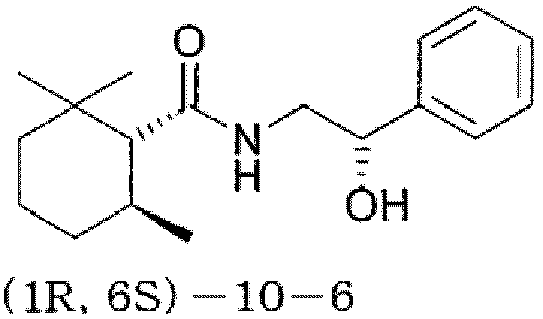
0.55 
5.98 Table 2 Compound in Examples EC50 (µM) 
1.19 
5.90 
1.11 
2.10 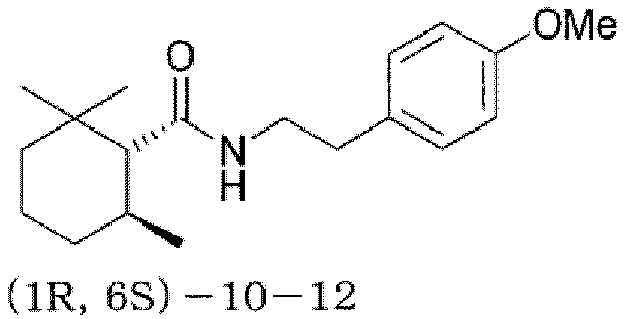
9.44 
2.00 
2.55 
7.72 Table 3 Compound in Examples EC50 (µM) 
2.76 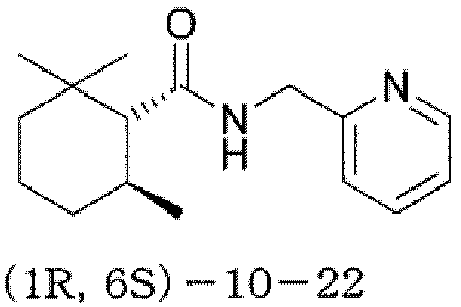
29.8 
4.84 
1.97 
3.48 
0.85 
3.08 Table 4 Compound in Examples EC50 (µM) 
6.14 
1.59 
2.42 
3.75 
1.19 
1.67 
5.76 Table 5 Compound in Examples EC50 (µM) 
1.06 
1.77 
15.0 
3.07 
1.78 
1.74 Table 6 Comparative compound EC50 (µM) 
110 
4.34 
1.61 
0.73 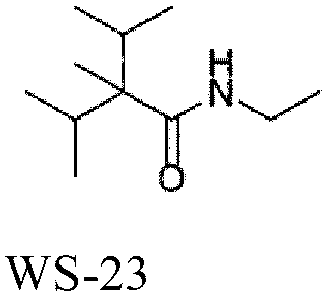
23.1 - As shown in the above Tables 1 to 5, each of the compounds obtained in Examples had TRPM8 activation action much more excellent than that of N,2,2,6-tetramethylcyclohexanecarboxamide shown in Table 6. Therefore, the compounds obtained in the Examples have a cooling effect much stronger than that of N,2,2,6-tetramethylcyclohexanecarboxamide.
- Further, as shown in Tables 1 to 5, each of the compounds obtained in Examples shows a strong cooling effect equal to or stronger than the existing cooling agents such as 1-menthol, WS-3, WS-5 and WS-23 shown in Table 6.
- A 30 ppm aqueous solution of the exemplary compound ((1R, 6S)-10-1) and a 30 ppm aqueous solution of the comparative compound (N,2,2,6-tetramethylcyclohexanecarboxamide, 1-menthol, WS-3, and WS-5) were prepared, and the aqueous solutions were used to perform the evaluation.
- The evaluation was performed by four flavorists. The aqueous solution was taken into the mouth and spat out after the mouth was rinsed, and cooling intensity, cool-feeling persistence, and quality of a cool-feeling in the oral cavity were evaluated.
- Cooling intensity of the exemplary compound ((1R, 6S)-10-1) was very strong, and was apparently stronger than that of the comparative compounds (N,2,2,6-tetramethylcyclohexanecarboxamide, 1-menthol, and WS-3). In addition, the cool-feeling lasted for 30 minutes or longer.
- The cooling intensity of the exemplary compound ((1R, 6S)-10-1) was stronger than that of WS-5, and the cool-feeling lasted for 30 minutes or longer.
- Regarding the quality of the cool-feeling, the exemplary compound ((1R, 6S)-10-1) had almost the same tingling sensation as WS-5.
- Toothpaste (A) to (C) was prepared in accordance with the following formulations.
- (A) toothpaste base 990.0 g + toothpaste flavor BASE 4.0 g + 1-menthol 3.0 g + ethyl alcohol (EtOH) 3.0 g
- (B) toothpaste base 990.0 g + toothpaste flavor BASE 4.0 g + 1-menthol 3.0 g + comparative compound (WS-5) (1 mass% in EtOH) 3.0 g
- (C) toothpaste base 990.0 g + toothpaste flavor BASE 4.0 g + 1-menthol 3.0 g + exemplary compound ((1R, 6S)-10-1) (1 mass% in EtOH) 3.0 g
- The prescription for the toothpaste flavor BASE is as follows.
Table 7 (Component) (Blending Amount g) Anethole 0.6 Eucalyptol 0.2 Lemon oil 0.1 Mentha white oil 1.0 Peppermint oil 1.5 Propylene Glycol (PG) 0.6 Total Amount 4.0 - The prescription for the toothpaste base is as follows.
Table 8 (Component) (Blending Amount g) Calcium carbonate 400.0 Silicic anhydride 16.5 Sorbitol solution (70 mass%) 240.0 Sodium lauryl sulfate 13.0 Sodium carboxymethyl cellulose 12.5 Carrageenan 3.0 Sodium benzoate 4.0 Sodium saccharin 1.5 Purified water 259.5 Propylene Glycol (PG) 40.0 Total Amount 990.0 - The evaluation was performed by three flavorists. The above three flavorists placed about 1 g of toothpaste on a toothbrush separately, and brushed the teeth for about five minutes in a usual brushing manner. The above three flavorists brushed the teeth and then rinsed the mouth, and then intensity, persistence, and quality of a cool-feeling in the oral cavity were evaluated.
- According to the evaluation based on the above three flavorists, the toothpaste (B) and toothpaste (C) had cooling effects stronger than that of toothpaste (A), and the toothpaste (C) had a cooling effect equal to or stronger than that of the toothpaste (B).
- In addition, the toothpaste (C) exhibited an equivalent flavor profile of the toothpaste flavor BASE, and stimulation other than the sense of cooling thereof was hardly felt, as compared with the toothpaste (B). Both the toothpaste (B) and the toothpaste (C) exhibited a cool-feeling for 30 minutes or longer.
- Mouthwashes (D) to (F) were prepared in accordance with the following formulations.
- (D) mouthwash base 999.0 g + mouthwash flavor BASE 0.35 g + 1-menthol 0.35 g + ethyl alcohol (EtOH) 0.3 g
- (E) mouthwash base 999.0 g + mouthwash flavor BASE 0.35 g + 1-menthol 0.35 g + comparative compound (WS-5) (10 mass% in EtOH) 0.3 g
- (F) mouthwash base 999.0 g + mouthwash flavor BASE 0.35 g + 1-menthol 0.35 g + exemplary compound ((1R, 6S)-10-1) (10 mass% in EtOH) 0.3 g
- The prescription for the mouthwash flavor BASE is as follows.
Table 9 (Component) (Blending Amount g) Anethole 0.02 1-carvone 0.01 Mentha white oil 0.05 Peppermint oil 0.20 Propylene Glycol (PG) 0.07 Total Amount 0.35 - The prescription for the mouthwash base is as follows.
Table 10 (Component) (Blending Amount g) Refined glycerin 100.0 Polyoxyethylene cured castor oil 60 10.0 Sodium benzoate 0.5 Sodium saccharin 0.1 Purified water 838.4 Ethyl alcohol 95 mass% 50.0 Total Amount 999.0 - The evaluation was performed by three flavorists. The above three flavorists took 20 mL of mouthwashes into the mouth and spat out the mouthwashes after rinsing the mouth, and intensity, persistence, and quality of a cool-feeling in the oral cavity were evaluated.
- According to the evaluation based on the above three flavorists, the mouthwash (E) and a mouthwash (F) had cooling effects stronger than that of the mouthwash (D), and the mouthwash (F) had a cooling effect equal to or stronger than the mouthwash (E).
- In addition, the mouthwash (F) exhibited an equivalent mint flavor profile of the mouthwash flavor BASE, and stimulation other than the sense of cooling thereof was hardly felt, as compared with the mouthwash (E). Both the mouthwash (E) and the mouthwash (F) exhibited a cool-feeling for 30 minutes or longer.
- Chewing gums (G) to (I) were prepared in accordance with the following formulations.
- (G) chewing gum base 990.0 g + peppermint flavor BASE 6.3 g + 1-menthol 0.7 g + ethyl alcohol (EtOH) 3.0 g
- (H) chewing gum base 990.0 g + peppermint flavor BASE 6.3 g + 1-menthol 0.7 g + comparative compound (WS-5) (1 mass% in EtOH) 3.0 g
- (I) chewing gum base 990.0 g + peppermint flavor BASE 6.3 g + 1-menthol 0.7 g + exemplary compound ((1R, 6S)-10-1) (1 mass% in EtOH) 3.0 g
- The prescription for the peppermint flavor BASE is as follows.
Table 11 (Component) (Blending Amount g) Eucalyptol 0.3 Mentha white oil 2.5 Peppermint oil 3.5 Total Amount 6.3 - The prescription for the chewing gum base is as follows.
Table 12 (Component) (Blending Amount g) Xylitol 320.0 Maltitol 338.8 Gum base 280.0 Reduced starch saccharide (BRIX70) 40.0 Glycerin 10.0 Acesulfame K 0.6 Aspartame 0.6 Total Amount 990.0 - The evaluation was performed by three flavorists. The above three flavorists took 1 g of chewing gum into the mouth, chewed the chewing gum about five minutes and spat it out. Intensity, persistence, and quality of a cool-feeling in the oral cavity were evaluated by the above three flavorists.
- According to the evaluation based on the above three flavorists, the chewing gum (H) and chewing gum (I) had a cooling effect stronger than that of the chewing gum (G), and the chewing gum (I) had a cooling effect equal to or stronger than that of the chewing gum (H).
- In addition, the chewing gum (I) exhibited a somewhat sharp cool-feeling from the beginning of chewing when it was chewed, a well-ventilated cool-feeling spread in the oral cavity, and no harshness or other stimuli was felt. In addition, a cool-feeling was felt for 30 minutes or longer after the chewing gum (I) was spat out.
- Candies (J) to (L) having the following formulations were prepared in accordance with the following production method.
- (J) candy base 998.0 g + herb flavor BASE 0.9 g + 1-menthol 0.8 g + ethyl alcohol (EtOH) 0.3 g
- (K) candy base 998.0 g + herb flavor BASE 0.9 g + 1-menthol 0.8 g + comparative compound (WS-5) (10 mass% in EtOH) 0.3 g
- (L) candy base 998.0 g + herb flavor BASE 0.9 g + 1-menthol 0.8 g + exemplary compound ((1R, 6S)-10-1) (10 mass% in EtOH) 0.3 g
- The prescription for the herb flavor BASE is as follows.
Table 13 (Component) (Blending Amount g) Star anise oil 0.100 Eucalyptol 0.276 Eucalyptus oil 0.520 Sage oil 0.004 Total Amount 0.900 - The prescription for the candy base is as follows.
Table 14 (Component) (Blending Amount g) Granulated sugar 500.0 g Starch syrup (BRIX 85, 47DE) 430.0 g Purified water 170.0 g Total Amount 1100.0 g - 998.0 g of 1100.0 g of the candy base of the above prescription was heated to 150°C. Then, the fire was extinguished, dough was weighted, and materials other than the candy bases shown in the above (J) to (L) were respectively mixed therewith. The mixture flowed to a mold and was molded while the temperature thereof was maintained at 135°C to 140°C. The mixture was removed from the mold after cooling, and candies (J) to (L) of about 3 g per grain were prepared.
- The evaluation was performed by three flavorists. The above three flavorists took a grain of candy into the mouth and melt the candy by licking, and after the candy was completely disappeared, intensity, persistence, and quality of a cool-feeling in the oral cavity were evaluated.
- According to the evaluation based on the above three flavorists, the candy (K) and candy (L) had a cooling effect stronger than that of the candy (J), and the candy (L) had a cooling effect equal to or stronger than that of the candy (K).
- Further, the candy (L) exhibited a sharp refresh-feeling from the beginning of licking when it was licked, and after a while, the refresh-feeling became a refresh-feeling that stimulates the back of the throat, and no harshness or other stimuli was felt. In addition, a cool-feeling was felt for 30 minutes or longer after the candy (L) was completely disappeared.
- Although the present invention is described in detail with reference to specific embodiments, it is apparent to those skilled in the art that various changes and modifications may be made without departing from the spirit and scope of the present invention. The present application is based on Japanese Patent Application No.
2017-200504 filed on October 16, 2017


Claims (22)
- A cooling agent composition comprising a 2,2,6-trimethylcyclohexanecarboxylic acid derivative represented by the following general formula (1):
 wherein the symbol * represents an asymmetric carbon atom,X represents NH, N(ZAr2), O or S, Z represents a single bond or an alkylene group having 1 to 3 carbon atoms which may have a substituent, Ar2 represents an aryl group having 6 to 20 carbon atoms which may have a substituent or an aromatic heterocyclic group having 2 to 15 carbon atoms which may have a substituent,Y each independently represents a methylene group which may have a substituent,n represents an integer of 0 to 3, andAr1 represents an aryl group having 6 to 20 carbon atoms which may have a substituent or an aromatic heterocyclic group having 2 to 15 carbon atoms which may have a substituent.
 - The cooling agent composition according to claim 1, wherein X represents NH or N(ZAr2) in the 2,2,6-trimethylcyclohexanecarboxylic acid derivative.
- The cooling agent composition according to claim 1, wherein X represents NH or N(ZAr2) in the 2,2,6-trimethylcyclohexanecarboxylic acid derivative, and the 2,2,6-trimethylcyclohexanecarboxylic acid derivative is a (1R, 6S)-form.
- The cooling agent composition according to claim 1, wherein X represents NH or N(ZAr2), n represents 0 or 2, and Z represents a single bond or an ethylene group which may have a substituent in the 2,2,6-trimethylcyclohexanecarboxylic acid derivative.
- The cooling agent composition according to claim 1, wherein X represents NH or N(ZAr2), n represents 0 or 2, and Z represents a single bond or an ethylene group which may have a substituent in the 2,2,6-trimethylcyclohexanecarboxylic acid derivative, and the 2,2,6-trimethylcyclohexanecarboxylic acid derivative is a (1R, 6S)-form.
- The cooling agent composition according to claim 1, wherein X represents NH or N(ZAr2), n represents 2, and Z represents an ethylene group which may have a substituent, in the 2,2,6-trimethylcyclohexanecarboxylic acid derivative.
- The cooling agent composition according to claim 1, wherein X represents NH or N(ZAr2), n represents 2, and Z represents an ethylene group which may have a substituent in the 2,2,6-trimethylcyclohexanecarboxylic acid derivative, and the 2,2,6-trimethylcyclohexanecarboxylic acid derivative is a (1R, 6S)-form.
- The cooling agent composition according to any one of claims 1 to 7, further comprising at least one kind of cooling substance other than the 2,2,6-trimethylcyclohexanecarboxylic acid derivative.
- The cooling agent composition according to claim 8, wherein the cooling substance is at least one cooling substance selected from the group consisting of:one or more kinds of compounds selected from menthol, menthone, camphor, pulegol, isopulegol, cineole, cubenol, menthyl acetate, pulegyl acetate, isopulegyl acetate, menthyl salicylate, pulegyl salicylate, isopulegyl salicylate, 3-(1-menthoxy)propane-1,2-diol, 2-methyl-3-(1-menthoxy)propane-1,2-diol, 2-(1-menthoxy)ethane-1-ol, 3-(1-menthoxy)propane-1-ol, 4-(1-menthoxy)butan-1-ol, menthyl 3-hydroxybutanoate, menthyl glyoxylate, p-menthane-3,8-diol, 1-(2-hydroxy-4-methylcyclohexyl)ethanone, menthyl lactate, menthone glycerin ketal, menthyl-2-pyrrolidone-5-carboxylate, monomenthyl succinate, alkali metal salts of monomenthyl succinate, alkaline earth metal salts of monomenthyl succinate, monomenthyl glutarate, alkali metal salts of monomenthyl glutarate, alkaline earth metal salts of monomenthyl glutarate, N-[[5-methyl-2-(1-methylethyl)cyclohexyl]carbonyl]glycine, p-menthane-3-carboxylic acid glycerol ester, menthol propylene glycol carbonate, menthol ethylene glycol carbonate, p-menthane-2,3-diol, 2-isopropyl-N,2,3-trimethylbutanamide, N-ethyl-p-menthane-3-carboxamide, 3-(p-menthane-3-carboxamide) ethyl acetate, N-(4-methoxyphenyl)-p-menthane carboxamide, N-ethyl-2,2-diisopropylbutanamide, N-cyclopropyl-p-menthane carboxamide, N-(4-cyanomethylphenyl)-p-menthanecarboxamide, N-(2-pyridin-2-yl)-3-p-menthane carboxamide, N-(2-hydroxyethyl)-2-isopropyl-2,3-dimethylbutanamide, N-(1,1-dimethyl-2-hydroxyethyl)-2,2-diethylbutanamide, cyclopropanecarboxylic acid (2-isopropyl-5-methylcyclohexyl)amide, N-ethyl-2,2-diisopropylbutanamide, N-[4-(2-amino-2-oxoethyl)phenyl]-p-menthanecarboxamide, 2-[(2-p-menthoxy)ethoxy]ethanol, 2,6-diethyl-5-isopropyl-2-methyltetrahydropyran, and trans-4-tert-butylcyclohexanol;one or more kinds of sugar alcohols selected from xylitol, erythritol, dextrose, and sorbitol; andone or more kinds of natural products selected from Japanese mint oil, peppermint oil, spearmint oil, and eucalyptus oil.
- A sensory stimulant composition comprising the cooling agent composition according to any one of claims 1 to 9.
- The sensory stimulant composition according to claim 10, further comprising at least one kind of warming substance.
- The sensory stimulant composition according to claim 11, wherein the warming substance is at least one warming substance selected from the group consisting of:one or more kinds of compounds selected from vanillyl methyl ether, vanillyl ethyl ether, vanillyl propyl ether, vanillyl isopropyl ether, vanillyl butyl ether, vanillyl amyl ether, vanillyl isoamyl ether, vanillyl hexyl ether, isovanillyl methyl ether, isovanillyl ethyl ether, isovanillyl propyl ether, isovanillyl isopropyl ether, isovanillyl butyl ether, isovanillyl amyl ether, isovanillyl isoamyl ether, isovanillyl hexyl ether, ethyl vanillyl methyl ether, ethyl vanillyl ethyl ether, ethyl vanillyl propyl ether, ethyl vanillyl isopropyl ether, ethyl vanillyl butyl ether, ethyl vanillyl amyl ether, ethyl vanillyl isoamyl ether, ethyl vanillyl hexyl ether, vanillin propylene glycol acetal, isovanillin propylene glycol acetal, ethyl vanillin propylene glycol acetal, vanillyl butyl ether acetate, isovanillyl butyl ether acetate, ethyl vanillyl butyl ether acetate, 4-(1-menthoxymethyl)-2-(3'-methoxy-4'-hydroxyphenyl)-1,3-dioxolane, 4-(1-menthoxymethyl)-2-(3'-hydroxy-4'-methoxyphenyl)-1,3-dioxolane, 4-(1-menthoxymethyl)-2-(3'-ethoxy-4'-hydroxyphenyl)-1,3-dioxolane, capsaicin, dihydrocapsaicin, nordihydrocapsaicin, homodihydrocapsaicin, homocapsaicin, bis-capsaicin, trishomocapsaicin, nornorcapsaicin, norcapsaicin, capsaicinol, vanillyl caprylamide (octylic acid vanillylamide), vanillyl pelargonamide (nonylic acid vanillylamide), vanillyl caproamide (decylic acid vanillylamide), vanillyl undecanamide (undecylic acid vanillylamide), N-trans-feruloyltyramine, N-5-(4-hydroxy-3-methoxyphenyl)-2E,4E-pentadienoylpiperidine, N-trans-feruloylpiperidine, N-5-(4-hydroxy-3-methoxyphenyl)-2E-pentenoylpiperidine, N-5-(4-hydroxyphenyl)-2E,4E-pentadienoylpiperidine, piperine, isopiperine, chavicine, isochavicine, piperamine, piperettine, piperolein B, retrofractamide A, pipercide, guineenside, piperiline, piperamide C5:1 (2E), piperamide C7:1 (6E), piperamide C7:2 (2E,6E), piperamide C9:1 (8E), piperamide C9:2 (2E,8E), piperamide C9:3 (2E,4E,8E), fagaramide, sanshool-I, sanshool-II, hydroxysanshool, sanshoamide, gingerol, shogaol, zingerone, methylgingerol, paradol, spilanthol, chavicine, polygodial (tadeonal), isopolygodial, dihydropolygodial, and tadeon; andone or more kinds of natural products selected from capsicum pepper oil, capsicum pepper oleoresin, ginger oleoresin, jambu oleoresin (extract from Spilanthes acmella L. var. oleracea Clarke), Japanese pepper extract, sanshoamide, black pepper extract, white pepper extract, and Polygonum extract.
- A flavor or fragrance composition comprising the sensory stimulant composition according to any one of claims 10 to 12.
- The flavor or fragrance composition according to claim 13, wherein a content of the sensory stimulant composition is from 0.00001 mass% to 90 mass%.
- A product comprising the sensory stimulant composition according to any one of claims 10 to 12, the product being any one of products selected from the group consisting of drinks, foods, fragrances or cosmetics, toiletry products, air care products, daily necessities and household goods, oral compositions, hair care products, skin care products, body care products, detergents for clothes, soft finishing agents for clothes, quasi-drugs and pharmaceuticals.
- The product according to claim 15, wherein a content of the sensory stimulant composition is from 0.00001 mass% to 50 mass%.
- A product comprising the flavor or fragrance composition according to claim 13 or 14, the product being any one of products selected from the group consisting of drinks, foods, fragrances or cosmetics, toiletry products, air care products, daily necessities and household goods, oral compositions, hair care products, skin care products, body care products, detergents for clothes, soft finishing agents for clothes, quasi-drugs and pharmaceuticals.
- The product according to claim 17, wherein a content of the flavor or fragrance composition is from 0.00001 mass% to 50 mass%.
- A method for manufacturing a product, comprising blending a product with the sensory stimulant composition according to any one of claims 10 to 12, wherein the product is any one of products selected from the group consisting of drinks, foods, fragrances or cosmetics, toiletry products, air care products, daily necessities and household goods, oral compositions, hair care products, skin care products, body care products, detergents for clothes, soft finishing agents for clothes, quasi-drugs and pharmaceuticals.
- A method for manufacturing a product, comprising blending a product with the flavor or fragrance composition according to claim 13 or 14, wherein the product is any one of products selected from the group consisting of drinks, foods, fragrances or cosmetics, toiletry products, air care products, daily necessities and household goods, oral compositions, hair care products, skin care products, body care products, detergents for clothes, soft finishing agents for clothes, quasi-drugs and pharmaceuticals.
- A 2,2,6-trimethylcyclohexanecarboxylic acid derivative represented by the following general formula (1-1):


- A 2,2,6-trimethylcyclohexanecarboxylic acid derivative represented by the following structural formula (10-1):

Applications Claiming Priority (2)
| Application Number | Priority Date | Filing Date | Title |
|---|---|---|---|
| JP2017200504 | 2017-10-16 | ||
| PCT/JP2018/038425 WO2019078185A1 (en) | 2017-10-16 | 2018-10-16 | Cool-sensation imparter composition containing 2,2,6-trimethylcyclohexanecarboxylic acid derivative |
Publications (2)
| Publication Number | Publication Date |
|---|---|
| EP3699250A1 true EP3699250A1 (en) | 2020-08-26 |
| EP3699250A4 EP3699250A4 (en) | 2021-08-25 |
Family
ID=66174165
Family Applications (1)
| Application Number | Title | Priority Date | Filing Date |
|---|---|---|---|
| EP18867351.1A Withdrawn EP3699250A4 (en) | 2017-10-16 | 2018-10-16 | COMPOSITION TO CONVEY A COOL FEEL WITH 2,2,6-TRIMETHYLCYCLOHEXANECARBONIC ACID DERIVATIVE |
Country Status (7)
| Country | Link |
|---|---|
| US (1) | US11344488B2 (en) |
| EP (1) | EP3699250A4 (en) |
| JP (1) | JP7157072B2 (en) |
| CN (1) | CN111212884A (en) |
| CA (1) | CA3078909A1 (en) |
| SG (1) | SG11202003286YA (en) |
| WO (1) | WO2019078185A1 (en) |
Families Citing this family (4)
| Publication number | Priority date | Publication date | Assignee | Title |
|---|---|---|---|---|
| CN110983766A (en) * | 2019-11-18 | 2020-04-10 | 江苏金太阳纺织科技股份有限公司 | Cool feeling finishing agent and preparation method and application method thereof |
| CN115645295B (en) * | 2022-11-09 | 2023-11-24 | 广州市九科精细化工有限公司 | Durable cooling composition and mouthwash containing same |
| CN118880486B (en) * | 2024-08-13 | 2025-06-24 | 江苏恒科新材料有限公司 | A kind of cool polyester fiber and preparation method thereof |
| CN120464161B (en) * | 2025-07-17 | 2025-10-10 | 洛阳理工学院 | A degradable medical packaging material and preparation method thereof |
Family Cites Families (86)
| Publication number | Priority date | Publication date | Assignee | Title |
|---|---|---|---|---|
| US4193936A (en) | 1971-02-04 | 1980-03-18 | Wilkinson Sword Limited | N-substituted paramenthane carboxamides |
| US4190643A (en) | 1971-02-04 | 1980-02-26 | Wilkinson Sword Limited | Compositions having a physiological cooling effect |
| PH10359A (en) | 1971-02-04 | 1977-01-05 | Wilkinson Sword Ltd | N-substituted-p-methane-3-carboxamides having physiological cooling activity and compositions containing them |
| US4178459A (en) | 1971-02-04 | 1979-12-11 | Wilkinson Sword Limited | N-Substituted paramenthane carboxamides |
| US4150052A (en) | 1971-02-04 | 1979-04-17 | Wilkinson Sword Limited | N-substituted paramenthane carboxamides |
| US4136163A (en) | 1971-02-04 | 1979-01-23 | Wilkinson Sword Limited | P-menthane carboxamides having a physiological cooling effect |
| US4038270A (en) | 1971-08-27 | 1977-07-26 | Toyo Hakka Kobyo Kabushiki Kaisha | Menthol glycoside, process for preparing the same and method for releasing menthol therefrom |
| JPS4833069A (en) | 1971-08-27 | 1973-05-07 | ||
| US3988482A (en) | 1971-08-27 | 1976-10-26 | Toyo Hakka Kogyo Kabushiki Kaisha | Menthol glycoside, process for preparing the same and method for releasing menthol therefrom |
| GB1421743A (en) | 1972-04-18 | 1976-01-21 | Wilkinson Sword Ltd | Ingestible topical and other compositions |
| US4153679A (en) | 1972-04-18 | 1979-05-08 | Wilkinson Sword Limited | Acyclic carboxamides having a physiological cooling effect |
| CA1027347A (en) | 1972-07-20 | 1978-03-07 | David G. Rowsell | Compounds having a physiological cooling effect and compositions containing them |
| JPS5888334A (en) | 1981-11-20 | 1983-05-26 | Takasago Corp | 3-l-menthoxypropane-1,2-diol |
| JPS61194049A (en) | 1985-02-22 | 1986-08-28 | Takasago Corp | Lambda-menthyl 3-hydroxybutyrate, production thereof, and chilling agent containing said compound as active component |
| JPH02290827A (en) | 1989-05-01 | 1990-11-30 | Kao Corp | 1-alkoxy-3-l-menthoxypropane-2-ol, cooling agent and cooling composition containing the same compound |
| US5009893A (en) | 1989-07-17 | 1991-04-23 | Warner-Lambert Company | Breath-freshening edible compositions of methol and a carboxamide |
| JP2840899B2 (en) * | 1991-03-26 | 1998-12-24 | 高砂香料工業株式会社 | Perfume composition containing optically active ethyl (1R, 6S) -2,2,6-trimethylcyclohexanecarboxylate and method for producing active ingredient thereof |
| DE4110973A1 (en) | 1991-04-05 | 1992-10-08 | Haarmann & Reimer Gmbh | MEDIUM WITH A PHYSIOLOGICAL COOLING EFFECT AND EFFECTIVE COMPOUNDS SUITABLE FOR THIS MEDIUM |
| JP3245748B2 (en) | 1992-03-09 | 2002-01-15 | 久光製薬株式会社 | P-menthane derivative and cooling sensate containing the same |
| JPH05255186A (en) | 1992-03-09 | 1993-10-05 | Hisamitsu Pharmaceut Co Inc | 3-substituted-p-menthane derivative and cold-sensation agent containing the same derivative |
| AU4530493A (en) | 1992-06-17 | 1994-01-04 | Procter & Gamble Company, The | Coolant compositions with reduced stinging |
| JPH0665023A (en) | 1992-08-12 | 1994-03-08 | Hisamitsu Pharmaceut Co Inc | Frigid agent and frigid composition composed of @(3754/24)-)-isopulegol |
| JP2978043B2 (en) | 1993-09-16 | 1999-11-15 | 高砂香料工業株式会社 | (2S) -3-{(1R, 2S, 5R)-[5-methyl-2- (1-methylethyl) cyclohexyl] oxy} -1,2-propanediol, its production method and use |
| JPH07118119A (en) | 1993-10-19 | 1995-05-09 | Kanebo Ltd | Cosmetic and agent for oral cavity |
| US5545424A (en) | 1994-10-12 | 1996-08-13 | Takasago International Corporation | 4-(1-menthoxymethyl)-2-phenyl-1,3-dioxolane or its derivatives and flavor composition containing the same |
| US5698181A (en) | 1994-12-09 | 1997-12-16 | Warner-Lambert Company | Breath-freshening edible compositions comprising menthol and an N-substituted-P-menthane carboxamide and methods for preparing same |
| US6231900B1 (en) | 1995-08-19 | 2001-05-15 | The Procter & Gamble Company | Confectionery product and preparation thereof |
| US5843466A (en) | 1995-08-29 | 1998-12-01 | V. Mane Fils S.A. | Coolant compositions |
| US5725865A (en) | 1995-08-29 | 1998-03-10 | V. Mane Fils S.A. | Coolant compositions |
| GB9707978D0 (en) | 1997-04-21 | 1997-06-11 | Procter & Gamble | Throat soothing compositions |
| GB9707979D0 (en) | 1997-04-21 | 1997-06-11 | Procter & Gamble | Confectionery compositions |
| GB9707977D0 (en) | 1997-04-21 | 1997-06-11 | Procter & Gamble | Centre filled confectionery |
| US6455080B1 (en) | 1997-12-29 | 2002-09-24 | Wm. Wrigley Jr., Company | Chewing gum containing controlled release acyclic carboxamide and method of making |
| US6627233B1 (en) | 1997-09-18 | 2003-09-30 | Wm. Wrigley Jr. Company | Chewing gum containing physiological cooling agents |
| US7007239B1 (en) | 2000-09-21 | 2006-02-28 | Palm, Inc. | Method and apparatus for accessing a contacts database and telephone services |
| US6780443B1 (en) | 2000-02-04 | 2004-08-24 | Takasago International Corporation | Sensate composition imparting initial sensation upon contact |
| JP2001294546A (en) | 2000-02-28 | 2001-10-23 | Takasago Internatl Corp | (1'R, 2'S, 5'R) 3-1-menthoxyalkane-1-ol cooling sensate |
| ATE380474T1 (en) | 2000-05-23 | 2007-12-15 | Nestle Sa | USE OF ALPHA-KETOENAMINE DERIVATIVES AS COOLING AGENT |
| JP2001348353A (en) | 2000-06-07 | 2001-12-18 | Takasago Internatl Corp | (1S, 6R) -2,2,6-trimethylcyclohexylmethyl ketone and / or (1R, 6S) -2,2,6-trimethylcyclohexylmethyl ketone, a process for producing them, and a fragrance composition containing them |
| JP2002053520A (en) | 2000-08-10 | 2002-02-19 | Takasago Internatl Corp | Method for producing 2,2,6-trimethylcyclohexanecarboxylic acid |
| US6497859B1 (en) | 2000-11-17 | 2002-12-24 | Noville Inc. | Cooling agents, pharmaceutical compositions having cooling agents and processes for making and using same |
| ATE320196T1 (en) | 2001-12-27 | 2006-04-15 | Symrise Gmbh & Co Kg | USE OF FERULAMIC ACID AMIDES AS FLAVORS |
| US6783783B2 (en) | 2002-04-19 | 2004-08-31 | Wm. Wrigley Jr. Company | Triple coated confectionery tablet product |
| DE10226942A1 (en) | 2002-06-17 | 2003-12-24 | Symrise Gmbh & Co Kg | Use of mandelic acid alkyl amides as flavorings |
| GB0221697D0 (en) | 2002-09-18 | 2002-10-30 | Unilever Plc | Novel compouds and their uses |
| EP1599100A2 (en) | 2003-03-03 | 2005-11-30 | Wm. Wrigley Jr. Company | Fast flavor release coating for confectionery |
| WO2004086874A1 (en) | 2003-03-26 | 2004-10-14 | Wm. Wrigley Jr. Company | Confectionery with fast flavor release jacket coating |
| US6884906B2 (en) | 2003-07-01 | 2005-04-26 | International Flavors & Fragrances Inc. | Menthyl half acid ester derivatives, processes for preparing same, and uses thereof for their cooling/refreshing effect in consumable materials |
| EP1682641B1 (en) | 2003-11-04 | 2007-06-27 | Firmenich Sa | Flavor ingredients for cooling preparations |
| DE10351422A1 (en) | 2003-11-04 | 2005-06-16 | Symrise Gmbh & Co. Kg | Use of alkenecarboxylic acid N-alkylamides as flavoring agents |
| US20050181022A1 (en) | 2003-11-05 | 2005-08-18 | Cai David J. | Confectionary products including agent for controlling weight |
| JP4435544B2 (en) | 2003-11-19 | 2010-03-17 | 高砂香料工業株式会社 | Fruit juice-containing beverage |
| CN100582089C (en) | 2003-11-21 | 2010-01-20 | 吉万奥丹股份有限公司 | N-substituted p-menthane carboxamides |
| US20080300314A1 (en) | 2003-11-21 | 2008-12-04 | Givaudan Sa | Cooling Compounds |
| WO2005082154A1 (en) | 2004-02-26 | 2005-09-09 | Wm. Wrigley Jr. Company | Confections containing a blend of physilogical cooling agents |
| US7189760B2 (en) | 2004-04-02 | 2007-03-13 | Millennium Specialty Chemicals | Physiological cooling compositions containing highly purified ethyl ester of N-[[5-methyl-2-(1-methylethyl) cyclohexyl] carbonyl]glycine |
| RU2006140131A (en) | 2004-04-14 | 2008-05-20 | Фирмениш Са (Ch) | COOLING COMPOSITION |
| US7482378B2 (en) * | 2004-05-28 | 2009-01-27 | Millenium Specialty Chemicals, Inc. | Physiological cooling compositions |
| US7923585B2 (en) | 2004-05-31 | 2011-04-12 | Takasago International Corporation | Menthol derivative and cooling agent composition comprising the same |
| DE102004032878A1 (en) | 2004-07-07 | 2006-02-16 | Symrise Gmbh & Co. Kg | Use of alkyloxyalkanoic acid amides, in particular as flavoring agents, and new alkyloxyalkanoic acid amides |
| GB0426266D0 (en) | 2004-11-30 | 2004-12-29 | Unilever Plc | Compounds and their uses |
| DE102005008271A1 (en) | 2005-02-22 | 2006-08-24 | Behr Gmbh & Co. Kg | Micro heat transfer device for cooling electronic components has channels open at top and bottom, and closed towards side surfaces |
| GB0504194D0 (en) | 2005-03-02 | 2005-04-06 | Givaudan Sa | Organic compounds |
| US7030273B1 (en) | 2005-03-14 | 2006-04-18 | Qaroma, Inc | Compounds with physiological cooling effect |
| MX2007014456A (en) | 2005-05-27 | 2008-02-07 | Givaudan Sa | Cooling compounds. |
| JP4799921B2 (en) | 2005-06-21 | 2011-10-26 | 高砂香料工業株式会社 | Fragrance composition |
| JP4996834B2 (en) | 2005-07-06 | 2012-08-08 | 高砂香料工業株式会社 | Vanillin acetals and sensory stimulant compositions containing the same |
| EP1915063A2 (en) | 2005-07-29 | 2008-04-30 | Quest International Services B.V. | N-vanillyl urea derivatives as flavour modulating substances |
| DE602006009290D1 (en) | 2005-10-25 | 2009-10-29 | Givaudan Sa | ORGANIC CONNECTIONS |
| US20080038386A1 (en) | 2006-08-02 | 2008-02-14 | Ashok K Moza | Use of a liquid cooling sensate to provide a pungent, warming or tingling sensate composition |
| EP1913976A1 (en) | 2006-10-18 | 2008-04-23 | Symrise GmbH & Co. KG | N-alpha-(menthane carbonyl) amino acid amides and their use as physiological coolants |
| US20100056636A1 (en) * | 2006-12-20 | 2010-03-04 | Stefan Michael Furrer | N-Substituted-P-Menthane-3-Carboxamide and Uses Thereof |
| WO2008141469A2 (en) | 2007-05-23 | 2008-11-27 | Givaudan Sa | Butone derivatives useful as cooling agents |
| US8632792B2 (en) * | 2008-04-01 | 2014-01-21 | Takasago International Corporation | Cooling sensation agent composition and sensory stimulation agent composition |
| MX2011001724A (en) | 2008-08-15 | 2011-03-21 | Procter & Gamble | Synthesis of cyclohexane derivatives useful as sensates in consumer products. |
| JP2010254622A (en) | 2009-04-24 | 2010-11-11 | Takasago Internatl Corp | (3R) -3-Hydroxybutanoic acid-1-menthyl, method for producing the same, and cooling agent composition containing the same |
| JP5546788B2 (en) | 2009-04-24 | 2014-07-09 | 高砂香料工業株式会社 | (3S) -3-Hydroxybutanoic acid-l-menthyl production method and cooling agent composition |
| IN2012DN00352A (en) | 2009-06-16 | 2015-08-21 | Bikam Pharmaceuticals Inc | |
| JP5680291B2 (en) | 2009-10-07 | 2015-03-04 | 高砂香料工業株式会社 | Cooling sensation agent composition, sensory stimulant composition and use thereof |
| DE102010002558A1 (en) | 2009-11-20 | 2011-06-01 | Symrise Ag | Use of physiological cooling agents and agents containing such agents |
| PH12013500907A1 (en) | 2010-11-05 | 2013-07-08 | Firmenich Incorporated | Compounds useful as modulators of trpm8 |
| MX348702B (en) | 2011-09-01 | 2017-06-26 | Takasago Int Corp (Usa) | Novel substituted cyclohexane compounds. |
| JP6076832B2 (en) | 2013-05-24 | 2017-02-08 | 花王株式会社 | Menthol derivative, and cooling sensation agent, TRPM8 activator, cooling sensation imparting method and TRPM8 activation method using the same |
| JP6283416B2 (en) * | 2013-07-22 | 2018-02-21 | 高砂香料工業株式会社 | Derivatives of 2,2,6-trimethylcyclohexanecarboxylic acid |
| WO2015175885A1 (en) | 2014-05-15 | 2015-11-19 | Intercontinental Great Brands Llc | Multi-textured chewing gum and methods of making thereof |
| SG11201707288WA (en) * | 2015-03-25 | 2017-10-30 | Takasago Perfumery Co Ltd | Methyl menthol derivative and cooling agent composition containing same |
-
2018
- 2018-10-16 CA CA3078909A patent/CA3078909A1/en active Pending
- 2018-10-16 JP JP2019549282A patent/JP7157072B2/en active Active
- 2018-10-16 CN CN201880067163.8A patent/CN111212884A/en active Pending
- 2018-10-16 WO PCT/JP2018/038425 patent/WO2019078185A1/en not_active Ceased
- 2018-10-16 EP EP18867351.1A patent/EP3699250A4/en not_active Withdrawn
- 2018-10-16 US US16/756,015 patent/US11344488B2/en active Active
- 2018-10-16 SG SG11202003286YA patent/SG11202003286YA/en unknown
Also Published As
| Publication number | Publication date |
|---|---|
| SG11202003286YA (en) | 2020-05-28 |
| WO2019078185A1 (en) | 2019-04-25 |
| JPWO2019078185A1 (en) | 2020-09-17 |
| CN111212884A (en) | 2020-05-29 |
| US11344488B2 (en) | 2022-05-31 |
| US20200297607A1 (en) | 2020-09-24 |
| CA3078909A1 (en) | 2019-04-25 |
| JP7157072B2 (en) | 2022-10-19 |
| EP3699250A4 (en) | 2021-08-25 |
Similar Documents
| Publication | Publication Date | Title |
|---|---|---|
| EP3569671B1 (en) | Methylmenthol derivative and cool-sensation imparter composition containing same | |
| EP3275962B1 (en) | Methyl menthol derivative and cooling agent composition containing same | |
| US8476472B2 (en) | (3R)-L-menthyl 3-hydroxybutyrate, process for producing the same, and sensate composition comprising the same | |
| US8309062B2 (en) | Process for producing (3S)-I-menthyl 3-hydroxybutyrate and sensate composition | |
| EP2763554B1 (en) | Novel substituted cyclohexane compounds | |
| US11344488B2 (en) | Cool-sensation imparter composition containing 2,2,6-trimethylcyclohexanecarboxylic acid derivative | |
| CN101218222B (en) | Vanillin acetals and sensory stimulant composition containing the same | |
| US8377422B2 (en) | Carboxamide derivatives having cooling properties | |
| CA3048858C (en) | Methylmenthol derivative and cool-sensation imparter composition containing same |
Legal Events
| Date | Code | Title | Description |
|---|---|---|---|
| STAA | Information on the status of an ep patent application or granted ep patent |
Free format text: STATUS: THE INTERNATIONAL PUBLICATION HAS BEEN MADE |
|
| PUAI | Public reference made under article 153(3) epc to a published international application that has entered the european phase |
Free format text: ORIGINAL CODE: 0009012 |
|
| STAA | Information on the status of an ep patent application or granted ep patent |
Free format text: STATUS: REQUEST FOR EXAMINATION WAS MADE |
|
| 17P | Request for examination filed |
Effective date: 20200415 |
|
| AK | Designated contracting states |
Kind code of ref document: A1 Designated state(s): AL AT BE BG CH CY CZ DE DK EE ES FI FR GB GR HR HU IE IS IT LI LT LU LV MC MK MT NL NO PL PT RO RS SE SI SK SM TR |
|
| AX | Request for extension of the european patent |
Extension state: BA ME |
|
| DAV | Request for validation of the european patent (deleted) | ||
| DAX | Request for extension of the european patent (deleted) | ||
| A4 | Supplementary search report drawn up and despatched |
Effective date: 20210726 |
|
| STAA | Information on the status of an ep patent application or granted ep patent |
Free format text: STATUS: EXAMINATION IS IN PROGRESS |
|
| STAA | Information on the status of an ep patent application or granted ep patent |
Free format text: STATUS: THE APPLICATION HAS BEEN WITHDRAWN |
|
| 17Q | First examination report despatched |
Effective date: 20240715 |
|
| 18W | Application withdrawn |
Effective date: 20240715 |