EP3699202A1 - Curable composition, film, cured product, and medical member - Google Patents
Curable composition, film, cured product, and medical member Download PDFInfo
- Publication number
- EP3699202A1 EP3699202A1 EP18868285.0A EP18868285A EP3699202A1 EP 3699202 A1 EP3699202 A1 EP 3699202A1 EP 18868285 A EP18868285 A EP 18868285A EP 3699202 A1 EP3699202 A1 EP 3699202A1
- Authority
- EP
- European Patent Office
- Prior art keywords
- group
- formula
- hydrogen atom
- alkyl group
- contain
- Prior art date
- Legal status (The legal status is an assumption and is not a legal conclusion. Google has not performed a legal analysis and makes no representation as to the accuracy of the status listed.)
- Granted
Links
- 0 CC(C)C(C)*1*(C)(C2)C2CC(C)C1*CC1CC1 Chemical compound CC(C)C(C)*1*(C)(C2)C2CC(C)C1*CC1CC1 0.000 description 4
Classifications
-
- C—CHEMISTRY; METALLURGY
- C08—ORGANIC MACROMOLECULAR COMPOUNDS; THEIR PREPARATION OR CHEMICAL WORKING-UP; COMPOSITIONS BASED THEREON
- C08F—MACROMOLECULAR COMPOUNDS OBTAINED BY REACTIONS ONLY INVOLVING CARBON-TO-CARBON UNSATURATED BONDS
- C08F122/00—Homopolymers of compounds having one or more unsaturated aliphatic radicals each having only one carbon-to-carbon double bond, and at least one being terminated by a carboxyl radical and containing at least one other carboxyl radical in the molecule; Salts, anhydrides, esters, amides, imides or nitriles thereof
- C08F122/10—Esters
- C08F122/1006—Esters of polyhydric alcohols or polyhydric phenols, e.g. ethylene glycol dimethacrylate
-
- C—CHEMISTRY; METALLURGY
- C08—ORGANIC MACROMOLECULAR COMPOUNDS; THEIR PREPARATION OR CHEMICAL WORKING-UP; COMPOSITIONS BASED THEREON
- C08F—MACROMOLECULAR COMPOUNDS OBTAINED BY REACTIONS ONLY INVOLVING CARBON-TO-CARBON UNSATURATED BONDS
- C08F220/00—Copolymers of compounds having one or more unsaturated aliphatic radicals, each having only one carbon-to-carbon double bond, and only one being terminated by only one carboxyl radical or a salt, anhydride ester, amide, imide or nitrile thereof
- C08F220/02—Monocarboxylic acids having less than ten carbon atoms; Derivatives thereof
- C08F220/10—Esters
- C08F220/34—Esters containing nitrogen, e.g. N,N-dimethylaminoethyl (meth)acrylate
- C08F220/36—Esters containing nitrogen, e.g. N,N-dimethylaminoethyl (meth)acrylate containing oxygen in addition to the carboxy oxygen, e.g. 2-N-morpholinoethyl (meth)acrylate or 2-isocyanatoethyl (meth)acrylate
- C08F220/365—Esters containing nitrogen, e.g. N,N-dimethylaminoethyl (meth)acrylate containing oxygen in addition to the carboxy oxygen, e.g. 2-N-morpholinoethyl (meth)acrylate or 2-isocyanatoethyl (meth)acrylate containing further carboxylic moieties
-
- A—HUMAN NECESSITIES
- A61—MEDICAL OR VETERINARY SCIENCE; HYGIENE
- A61L—METHODS OR APPARATUS FOR STERILISING MATERIALS OR OBJECTS IN GENERAL; DISINFECTION, STERILISATION OR DEODORISATION OF AIR; CHEMICAL ASPECTS OF BANDAGES, DRESSINGS, ABSORBENT PADS OR SURGICAL ARTICLES; MATERIALS FOR BANDAGES, DRESSINGS, ABSORBENT PADS OR SURGICAL ARTICLES
- A61L27/00—Materials for grafts or prostheses or for coating grafts or prostheses
- A61L27/28—Materials for coating prostheses
- A61L27/34—Macromolecular materials
-
- C—CHEMISTRY; METALLURGY
- C07—ORGANIC CHEMISTRY
- C07C—ACYCLIC OR CARBOCYCLIC COMPOUNDS
- C07C271/00—Derivatives of carbamic acids, i.e. compounds containing any of the groups, the nitrogen atom not being part of nitro or nitroso groups
- C07C271/06—Esters of carbamic acids
- C07C271/08—Esters of carbamic acids having oxygen atoms of carbamate groups bound to acyclic carbon atoms
- C07C271/10—Esters of carbamic acids having oxygen atoms of carbamate groups bound to acyclic carbon atoms with the nitrogen atoms of the carbamate groups bound to hydrogen atoms or to acyclic carbon atoms
- C07C271/16—Esters of carbamic acids having oxygen atoms of carbamate groups bound to acyclic carbon atoms with the nitrogen atoms of the carbamate groups bound to hydrogen atoms or to acyclic carbon atoms to carbon atoms of hydrocarbon radicals substituted by singly-bound oxygen atoms
-
- C—CHEMISTRY; METALLURGY
- C07—ORGANIC CHEMISTRY
- C07C—ACYCLIC OR CARBOCYCLIC COMPOUNDS
- C07C309/00—Sulfonic acids; Halides, esters, or anhydrides thereof
- C07C309/01—Sulfonic acids
- C07C309/02—Sulfonic acids having sulfo groups bound to acyclic carbon atoms
- C07C309/03—Sulfonic acids having sulfo groups bound to acyclic carbon atoms of an acyclic saturated carbon skeleton
- C07C309/13—Sulfonic acids having sulfo groups bound to acyclic carbon atoms of an acyclic saturated carbon skeleton containing nitrogen atoms, not being part of nitro or nitroso groups, bound to the carbon skeleton
- C07C309/14—Sulfonic acids having sulfo groups bound to acyclic carbon atoms of an acyclic saturated carbon skeleton containing nitrogen atoms, not being part of nitro or nitroso groups, bound to the carbon skeleton containing amino groups bound to the carbon skeleton
-
- C—CHEMISTRY; METALLURGY
- C08—ORGANIC MACROMOLECULAR COMPOUNDS; THEIR PREPARATION OR CHEMICAL WORKING-UP; COMPOSITIONS BASED THEREON
- C08F—MACROMOLECULAR COMPOUNDS OBTAINED BY REACTIONS ONLY INVOLVING CARBON-TO-CARBON UNSATURATED BONDS
- C08F2/00—Processes of polymerisation
-
- C—CHEMISTRY; METALLURGY
- C08—ORGANIC MACROMOLECULAR COMPOUNDS; THEIR PREPARATION OR CHEMICAL WORKING-UP; COMPOSITIONS BASED THEREON
- C08F—MACROMOLECULAR COMPOUNDS OBTAINED BY REACTIONS ONLY INVOLVING CARBON-TO-CARBON UNSATURATED BONDS
- C08F2/00—Processes of polymerisation
- C08F2/46—Polymerisation initiated by wave energy or particle radiation
- C08F2/48—Polymerisation initiated by wave energy or particle radiation by ultraviolet or visible light
-
- C—CHEMISTRY; METALLURGY
- C08—ORGANIC MACROMOLECULAR COMPOUNDS; THEIR PREPARATION OR CHEMICAL WORKING-UP; COMPOSITIONS BASED THEREON
- C08F—MACROMOLECULAR COMPOUNDS OBTAINED BY REACTIONS ONLY INVOLVING CARBON-TO-CARBON UNSATURATED BONDS
- C08F20/00—Homopolymers and copolymers of compounds having one or more unsaturated aliphatic radicals, each having only one carbon-to-carbon double bond, and only one being terminated by only one carboxyl radical or a salt, anhydride, ester, amide, imide or nitrile thereof
- C08F20/02—Monocarboxylic acids having less than ten carbon atoms, Derivatives thereof
- C08F20/10—Esters
- C08F20/34—Esters containing nitrogen, e.g. N,N-dimethylaminoethyl (meth)acrylate
- C08F20/36—Esters containing nitrogen, e.g. N,N-dimethylaminoethyl (meth)acrylate containing oxygen in addition to the carboxy oxygen, e.g. 2-N-morpholinoethyl (meth)acrylate or 2-isocyanatoethyl (meth)acrylate
-
- C—CHEMISTRY; METALLURGY
- C08—ORGANIC MACROMOLECULAR COMPOUNDS; THEIR PREPARATION OR CHEMICAL WORKING-UP; COMPOSITIONS BASED THEREON
- C08F—MACROMOLECULAR COMPOUNDS OBTAINED BY REACTIONS ONLY INVOLVING CARBON-TO-CARBON UNSATURATED BONDS
- C08F220/00—Copolymers of compounds having one or more unsaturated aliphatic radicals, each having only one carbon-to-carbon double bond, and only one being terminated by only one carboxyl radical or a salt, anhydride ester, amide, imide or nitrile thereof
- C08F220/02—Monocarboxylic acids having less than ten carbon atoms; Derivatives thereof
- C08F220/10—Esters
- C08F220/38—Esters containing sulfur
- C08F220/387—Esters containing sulfur and containing nitrogen and oxygen
-
- C—CHEMISTRY; METALLURGY
- C08—ORGANIC MACROMOLECULAR COMPOUNDS; THEIR PREPARATION OR CHEMICAL WORKING-UP; COMPOSITIONS BASED THEREON
- C08F—MACROMOLECULAR COMPOUNDS OBTAINED BY REACTIONS ONLY INVOLVING CARBON-TO-CARBON UNSATURATED BONDS
- C08F220/00—Copolymers of compounds having one or more unsaturated aliphatic radicals, each having only one carbon-to-carbon double bond, and only one being terminated by only one carboxyl radical or a salt, anhydride ester, amide, imide or nitrile thereof
- C08F220/02—Monocarboxylic acids having less than ten carbon atoms; Derivatives thereof
- C08F220/52—Amides or imides
- C08F220/54—Amides, e.g. N,N-dimethylacrylamide or N-isopropylacrylamide
- C08F220/56—Acrylamide; Methacrylamide
-
- C—CHEMISTRY; METALLURGY
- C08—ORGANIC MACROMOLECULAR COMPOUNDS; THEIR PREPARATION OR CHEMICAL WORKING-UP; COMPOSITIONS BASED THEREON
- C08F—MACROMOLECULAR COMPOUNDS OBTAINED BY REACTIONS ONLY INVOLVING CARBON-TO-CARBON UNSATURATED BONDS
- C08F222/00—Copolymers of compounds having one or more unsaturated aliphatic radicals, each having only one carbon-to-carbon double bond, and at least one being terminated by a carboxyl radical and containing at least one other carboxyl radical in the molecule; Salts, anhydrides, esters, amides, imides, or nitriles thereof
- C08F222/10—Esters
- C08F222/1006—Esters of polyhydric alcohols or polyhydric phenols
- C08F222/102—Esters of polyhydric alcohols or polyhydric phenols of dialcohols, e.g. ethylene glycol di(meth)acrylate or 1,4-butanediol dimethacrylate
-
- C—CHEMISTRY; METALLURGY
- C09—DYES; PAINTS; POLISHES; NATURAL RESINS; ADHESIVES; COMPOSITIONS NOT OTHERWISE PROVIDED FOR; APPLICATIONS OF MATERIALS NOT OTHERWISE PROVIDED FOR
- C09D—COATING COMPOSITIONS, e.g. PAINTS, VARNISHES OR LACQUERS; FILLING PASTES; CHEMICAL PAINT OR INK REMOVERS; INKS; CORRECTING FLUIDS; WOODSTAINS; PASTES OR SOLIDS FOR COLOURING OR PRINTING; USE OF MATERIALS THEREFOR
- C09D135/00—Coating compositions based on homopolymers or copolymers of compounds having one or more unsaturated aliphatic radicals, each having only one carbon-to-carbon double bond, and at least one being terminated by a carboxyl radical, and containing at least another carboxyl radical in the molecule, or of salts, anhydrides, esters, amides, imides or nitriles thereof; Coating compositions based on derivatives of such polymers
-
- A—HUMAN NECESSITIES
- A61—MEDICAL OR VETERINARY SCIENCE; HYGIENE
- A61K—PREPARATIONS FOR MEDICAL, DENTAL OR TOILETRY PURPOSES
- A61K6/00—Preparations for dentistry
-
- A—HUMAN NECESSITIES
- A61—MEDICAL OR VETERINARY SCIENCE; HYGIENE
- A61L—METHODS OR APPARATUS FOR STERILISING MATERIALS OR OBJECTS IN GENERAL; DISINFECTION, STERILISATION OR DEODORISATION OF AIR; CHEMICAL ASPECTS OF BANDAGES, DRESSINGS, ABSORBENT PADS OR SURGICAL ARTICLES; MATERIALS FOR BANDAGES, DRESSINGS, ABSORBENT PADS OR SURGICAL ARTICLES
- A61L27/00—Materials for grafts or prostheses or for coating grafts or prostheses
- A61L27/14—Macromolecular materials
- A61L27/16—Macromolecular materials obtained by reactions only involving carbon-to-carbon unsaturated bonds
Definitions
- the present invention relates to a curable composition, a film, a cured product, and a medical member.
- artificial organs, medical instruments, and the like are made of a material which is compatible with a substance constituting a living body and is hardly contaminated.
- a substance constituting a living body For example, it is desired that artificial blood vessels, catheters, stents, artificial bones, and dentures that are introduced into a human body for a long period of time do not cause an inflammatory response and rejection.
- the replacement of those artificial organs or medical instruments caused by contamination imposes a burden on the patient. Therefore, it is desired that artificial organs, medical instruments, and the like are formed of a material which hardly interacts with biological materials such as proteins, blood cells, and cells. That is, it is desired that artificial organs, medical instruments, and the like are formed of a material difficult for the aforementioned biological materials to be attached (adhere).
- WO2016/067795A discloses "a material nonadhesive to biological materials containing a polymer compound (A) containing a repeating unit derived from a sulfobetaine monomer having a predetermined structure".
- Examples in WO2016/067795A specifically disclose a curable composition containing a sulfobetaine monomer having the aforementioned predetermined structure and a (meth)acrylate-based monomer or N-[tris(3-acrylamidopropoxymethyl)methyl] acrylamide as a crosslinking agent and a cured product of the curable composition (material nonadhesive to biological materials).
- the cured product (material nonadhesive to biological materials) is also required to have excellent substrate adhesion.
- artificial organs, medical instruments, and the like are generally used in a situation where these contact body fluids (for example, saliva, blood, and the like), which contain water as a main component, with high frequency. Therefore, "have excellent substrate adhesion" mentioned herein means that even after a substrate with a film, which includes a substrate and a film formed on the substrate, is immersed in an aqueous liquid, the film is not peeled or hardly peeled from the substrate.
- the substrate include medical instruments such as artificial blood vessels, catheters, stents, artificial bones, and dentures.
- the inventors of the present invention prepared the curable composition described in Examples in WO2016/067795A and examined the physical properties of the cured product. As a result, it has been revealed that the cured product does not necessarily satisfy the currently required level of substrate adhesion, and needs to be further improved.
- an object of the present invention is to provide a curable composition capable of providing a cured product having excellent substrate adhesion and excellent biocompatibility.
- Another object of the present invention is to provide a cured product and a film having excellent substrate adhesion and excellent biocompatibility.
- Another object of the present invention is to provide a medical member comprising the cured product.
- the inventors of the present invention conducted intensive studies. As a result, the inventors have found that the above objects can be achieved in a case where the curable composition contains a betaine monomer having a predetermined structure, and have accomplished the present invention.
- a range of numerical values described using “to” means a range including numerical values listed before and after “to” as a lower limit and an upper limit.
- (meth)acrylamide has a concept including either or both of the acrylamide and methacrylamide. The same is true of the terms such as "(meth)acryl”, “(meth)acrylate”, and "(meth)acryloyl”.
- substituents and the like may be the same as or different from each other. The same is true of a case where the number of substituents and the like is specified.
- alkyl group includes not only an alkyl group having no substituent (unsubstituted alkyl group) but also an alkyl group having a substituent (substituted alkyl group).
- biological material is a term that means a wide variety of materials including materials constituting the living body and materials involved in the living body.
- materials includes proteins, cells, tissues which is a group of cells, peptides, vitamins, hormones, blood cells, antigens, antibodies, bacteria, viruses, and the like.
- the term "properties of inhibiting the adhesion of biological materials” means the properties of perfectly preventing adhesion and also suppressing adhesion (reducing adhesion) before and after application even though adhesion occurs. Therefore, the term has a concept including not only the prevention of adhesion but also the inhibition of adhesion.
- the curable composition according to an embodiment of the present invention contains one or more betaine monomers (hereinafter, referred to as "specific betaine monomer” as well) selected from the group consisting of a compound represented by Formula (1) which will be described later and a compound represented by Formula (2) which will be described later.
- betaine monomers hereinafter, referred to as "specific betaine monomer” as well
- the specific betaine monomer contains two or more polymerizable groups and a urethane bond or a urea bond. Presumably, this structure may contribute to the improvement of the substrate adhesion. More specifically, because the specific betaine monomer has two or more polymerizable groups, a film formed of the specific betaine monomer has an excellent crosslinking density (in other words, a high crosslinking density). In addition, because the specific betaine monomer contains a hydrogen bonding group called urethane bond or urea bond, the film formed of the specific betaine monomer becomes a dense film formed by the formation of intermolecular hydrogen bonding through the hydrogen bonding group.
- the aqueous liquid may be inhibited from permeating the interface between the substrate and the film.
- the specific betaine monomer exhibits excellent biocompatibility due to a betaine moiety in the compound.
- composition according to the embodiment of the present invention contains one or more betaine monomers selected from the group consisting of a compound represented by Formula (1) and a compound represented by Formula (2).
- betaine refers to a compound (inner salt) which has a positive charge and a negative charge at non-adjacent positions in the same molecule but does not carry a charge as a whole molecule, in which a hydrogen atom is not bonded to an atom having a positive charge.
- R 1 represents a hydrogen atom or an alkyl group.
- the number of carbon atoms in the alkyl group represented by R 1 is not particularly limited, but is preferably 1 to 15, more preferably 1 to 10, even more preferably 1 to 6, and particularly preferably 1 to 3.
- the alkyl group may be linear, branched, or cyclic.
- alkyl group examples include a methyl group, an ethyl group, a n-propyl group, an isopropyl group, a n-butyl group, a t-butyl group, a n-hexyl group, a cyclopentyl group, a cyclohexyl group, and the like.
- the alkyl group may have a substituent.
- the substituent that the alkyl group can have is not particularly limited, and examples thereof include a substituent W which will be described later.
- R 1 particularly, a hydrogen atom or an alkyl group having 1 to 6 carbon atoms is preferable, and a hydrogen atom or an alkyl group having 1 to 3 carbon atoms is more preferable.
- R 2 and R 3 each independently represent an alkyl group.
- the alkyl group represented by R 2 and R 3 has the same definition as the alkyl group represented by R 1 , and the suitable embodiments thereof are also the same.
- R 1A represents an oxygen atom or NR 101 .
- R 101 represents a hydrogen atom or an alkyl group.
- the alkyl group represented by R 101 has the same definition as the alkyl group represented by R 1 , and the suitable embodiments thereof are also the same.
- R 101 a hydrogen atom is preferable.
- a represents an integer of 2 to 6.
- a is preferably 2 to 4, and more preferably 2 or 3.
- L 1 represents an (a + 1)-valent aliphatic hydrocarbon group which contains a urethane bond (-NH-CO-O- or -O-CO-NH-) or a urea bond (-NH-CO-NH-) and may contain -O-. That is, L 1 is linked to a pieces of monovalent group represented by Formula (X) and a nitrogen atom (cationized nitrogen atom) specified in Formula (1).
- R 1 and R 1A have the same definitions as R 1 and R 1A in Formula (1). * represents a position linked to L 1 .
- the number of carbon atoms in the aliphatic hydrocarbon group represented by L 1 is not particularly limited, but is, for example, 1 to 30, preferably 1 to 20, more preferably 1 to 15, and even more preferably 1 to 12.
- the aliphatic hydrocarbon group may have a substituent.
- the substituent that the aliphatic hydrocarbon group can have is not particularly limited, and examples thereof include a substituent W which will be described later.
- a carbon atom is usually located at a position adjacent to a nitrogen atom (cationized nitrogen atom) specified in the chemical formula and at a position adjacent to R 1A .
- L 1 examples include a linking group represented by Formula (1A-1) or a linking group represented by Formula (1A-2).
- R 103 represents a hydrogen atom or a substituent.
- the substituent is not particularly limited, and examples thereof include the substituent W which will be described later.
- L 101 to L 107 each represent a single bond or an alkylene group which may contain -O-, a urethane bond, or a urea bond.
- At least one or more groups among L 101 to L 103 represent an alkylene group which contains a urethane bond or a urea bond and may contain -O-.
- one or more groups among L 104 to L 107 represent an alkylene group which contains a urethane bond or a urea bond and may contain -O-.
- the number of carbon atoms in the alkylene group, which is represented by L 101 to L 107 and may contain -O-, a urethane bond, or a urea bond is not particularly limited, but is preferably 1 to 12, more preferably 1 to 6, and even more preferably 1 to 3.
- the alkylene group which is represented by L 101 to L 107 and may contain -O-, a urethane bond, or a urea bond may be linear, branched, or cyclic.
- Q* represents a position linked to the monovalent group represented by Formula (X), and * represents a position linked to a nitrogen atom (cationized nitrogen atom) specified in Formula (1).
- L 101 to L 107 may further have a substituent.
- the substituent is not particularly limited, and examples thereof include the substituent W which will be described later.
- a carbon atom is usually located at a position linked to Q* or a position linked to a nitrogen atom (cationized nitrogen atom) specified in Formula (1).
- L 2 represents an alkylene group which may contain -O-, -NR 104 -, -CO-, or a divalent linking group obtained by combining these.
- R 104 represents a hydrogen atom or a substituent.
- the substituent represented by R 104 is not particularly limited, and examples thereof include the substituent W which will be described later. Among these, a hydrogen atom is preferable as R 104 .
- the number of carbon atoms in the alkylene group which is represented by L 2 and may contain -O-, -NR 104 -, -CO- or a divalent linking group obtained by combining these, is not particularly limited.
- the number of carbon atoms in the alkylene group is 1 to 30, preferably 1 to 20, more preferably 1 to 15, and even more preferably 1 to 12.
- a carbon atom is usually located at a position adjacent to a nitrogen atom (cationized nitrogen atom) specified in the chemical formula.
- the alkylene group may have a substituent.
- the substituent that the alkylene group, which is represented by L 2 and may contain -O-, -NR 104 -, -CO-, or a divalent linking group obtained by combining these, is not particularly limited, and examples of the substituent include the substituent W which will be described later.
- R 4 and R 6 each independently represent a hydrogen atom or an alkyl group.
- the alkyl group represented by R 4 and R 6 has the same definition as the alkyl group represented by R 1 in Formula (1), and the suitable embodiments thereof are also the same.
- R 4 and R 6 particularly, a hydrogen atom or an alkyl group having 1 to 6 carbon atoms is preferable, and a hydrogen atom or an alkyl group having 1 to 3 carbon atoms is more preferable.
- R 5 represents an alkyl group.
- the alkyl group represented by R 5 has the same definition as the alkyl group represented by R 2 and R 3 in Formula (1), and the suitable embodiments thereof are also the same.
- R 1B and R 1C each independently represent an oxygen atom or NR 102 .
- R 102 represents a hydrogen atom or an alkyl group.
- the alkyl group represented by R 102 has the same definition as the alkyl group represented by R 101 in Formula (1), and the suitable embodiments thereof are also the same.
- R 102 a hydrogen atom is preferable.
- b and c each independently represent an integer of 1 to 5. However, b and c satisfy 2 ⁇ b + c ⁇ 6.
- b + c is preferably 2 to 4, and more preferably 2 or 3.
- b is preferably 1 to 3, and more preferably 1.
- c is preferably 1 to 3, and more preferably 1.
- L 3 represents a (b + 1)-valent aliphatic hydrocarbon group which contains a urethane bond (-NH-CO-O- or -O-CO-NH-) or a urea bond (-NH-CO-NH-) and may contain -O-. That is, L 3 is linked to b pieces of monovalent group represented by Formula (Y) and a nitrogen atom (cationized nitrogen atom) specified in Formula (1).
- R 4 and R 1B have the same definitions as R 4 and R 1B in Formula (2). * represents a position linked to L 3 .
- the number of carbon atoms in the aliphatic hydrocarbon group represented by L 3 is not particularly limited, but is, for example, 1 to 30, preferably 1 to 20, more preferably 1 to 15, and even more preferably 1 to 12.
- the aliphatic hydrocarbon group may have a substituent.
- the substituent that the aliphatic hydrocarbon group can have is not particularly limited, and examples thereof include a substituent W which will be described later.
- a carbon atom is usually located at a position adjacent to a nitrogen atom (cationized nitrogen atom) specified in the chemical formula and at a position adjacent to R 1B .
- L 3 examples include a linking group represented by Formula (2A-1), a linking group represented by Formula (2A-2), and a linking group represented by Formula (2A-3).
- R 201 to R 203 each represent a hydrogen atom or a substituent.
- the substituent is not particularly limited, and examples thereof include the substituent W which will be described later.
- L 201 to L 209 each represent a single bond or an alkylene group which may contain -O-, a urethane bond, or a urea bond.
- any one or more groups between L 201 and L 202 represent an alkylene group which contains a urethane bond or a urea bond and may contain -O-.
- any one or more groups among L 203 to L 205 represent an alkylene group which contains a urethane bond or a urea bond and may contain -O-.
- any one or more groups among L 206 to L 209 represent an alkylene group which contains a urethane bond or a urea bond and may contain -O-.
- the number of carbon atoms in the alkylene group, which is represented by L 201 to L 209 and may contain -O-, a urethane bond, or a urea bond, is not particularly limited, but is preferably 1 to 12, more preferably 1 to 6, and even more preferably 1 to 3.
- the alkylene group which is represented by L 201 to L 209 and may contain -O-, a urethane bond, or a urea bond may be linear, branched, or cyclic.
- P* represents a position linked to the monovalent group represented by Formula (Y), and * represents a position linked to a nitrogen atom (cationized nitrogen atom) specified in Formula (2).
- L 201 to L 209 may further have a substituent.
- the substituent is not particularly limited, and examples thereof include the substituent W which will be described later.
- a carbon atom is usually located at a position linked to P* or a position linked to a nitrogen atom (cationized nitrogen atom) specified in Formula (2).
- L 4 represents a (c + 1)-valent aliphatic hydrocarbon group which contains a urethane bond (-NH-CO-O- or -O-CO-NH-) or a urea bond (-NH-CO-NH-) and may contain -O-. That is, L 4 is linked to c pieces of monovalent group represented by Formula (Z) and a nitrogen atom (cationized nitrogen atom) specified in Formula (2).
- R 6 and R 1C have the same definitions as R 6 and R 1C in Formula (2). * represents a position linked to L 4 .
- the number of carbon atoms in the aliphatic hydrocarbon group represented by L 4 is not particularly limited, but is, for example, 1 to 30, preferably 1 to 20, more preferably 1 to 15, and even more preferably 1 to 12.
- the aliphatic hydrocarbon group may have a substituent.
- the substituent that the aliphatic hydrocarbon group can have is not particularly limited, and examples thereof include a substituent W which will be described later.
- a carbon atom is usually located at a position adjacent to a nitrogen atom (cationized nitrogen atom) specified in the chemical formula and at a position adjacent to R 1C .
- Examples of L 4 include a linking group represented by Formula (3A-1), a linking group represented by Formula (3A-2), and a linking group represented by Formula (3A-3).
- R 301 to R 303 each represent a hydrogen atom or a substituent.
- the substituent is not particularly limited, and examples thereof include the substituent W which will be described later.
- L 301 to L 309 each represent a single bond or an alkylene group which may contain -O-, a urethane bond, or a urea bond.
- any one or more groups between L 301 and L 302 represent an alkylene group which contains a urethane bond or a urea bond and may contain -O-.
- any one or more groups among L 303 to L 305 represent an alkylene group which contains a urethane bond or a urea bond and may contain -O-.
- any one or more groups among L 306 to L 309 represent an alkylene group which contains a urethane bond or a urea bond and may contain -O-.
- the number of carbon atoms in the alkylene group, which is represented by L 301 to L 309 and may contain -O-, a urethane bond, or a urea bond, is not particularly limited, but is preferably 1 to 12, more preferably 1 to 6, and even more preferably 1 to 3.
- the alkylene group which is represented by L 301 to L 309 and may contain -O-, a urethane bond, or a urea bond may be linear, branched, or cyclic.
- W* represents a position linked to the monovalent group represented by Formula (Z), and * represents a position linked to a nitrogen atom (cationized nitrogen atom) specified in Formula (2).
- L 301 to L 309 may further have a substituent.
- the substituent is not particularly limited, and examples thereof include the substituent W which will be described later.
- a carbon atom is usually located at a position linked to W* or at a position linked to the nitrogen atom (cationized nitrogen atom) specified in Formula (2).
- L 5 represents an alkylene group which may contain -O-, -NR 204 -, -CO-, or a divalent linking group obtained by combining these.
- R 204 represents a hydrogen atom or a substituent.
- the substituent represented by R 204 is not particularly limited, and examples thereof include the substituent W which will be described later. Among these, a hydrogen atom is preferable as R 204 .
- L 5 has the same definition as L 2 in Formula (1), and the suitable embodiments thereof are also the same.
- the specific betaine monomer can be synthesized according to a known method.
- One kind of the specific betaine monomer may be used singly, or two or more kinds of the specific betaine monomers may be used in combination.
- the content of the betaine monomer (total content in a case where the composition contains a plurality of kinds of the betaine monomers) with respect to the total solid content of the composition is preferably 10% to 99% by mass, more preferably 20% to 85% by mass, and even more preferably 50% to 85% by mass.
- solid content means components constituting a cured product and does not include a solvent.
- a monomer is a component constituting the cured product. Therefore, the monomer is included in the solid content even if the monomer is a liquid.
- composition according to the embodiment of the present invention may contain a monomer copolymerizable with the specific betaine monomer (hereinafter, simply referred to as "copolymerizable monomer" as well).
- the copolymerizable monomer is not particularly limited, and examples thereof include a monomer having an ethylenically unsaturated group.
- the monomer include (meth)acrylate-based monomers; (meth)acrylamide-based monomers; monomers having an ethylenically unsaturated group containing a carboxyl group (carboxylic acid group-containing monomers), such as (meth)acrylic acid, crotonic acid, and itaconic acid; and monomers having a betaine structure.
- the number of ethylenically unsaturated bonds in a molecule of the monomer having an ethylenically unsaturated group is not particularly limited, but is preferably 1 to 8, more preferably 1 to 4, and even more preferably 1 or 2.
- a (meth)acrylate-based monomer a (meth)acrylamide-based monomer, or a monomer having a betaine structure other than the specific betaine monomer is preferable.
- Examples of the (meth)acrylate-based monomer include methyl (meth)acrylate, ethyl (meth)acrylate, n-butyl (meth)acrylate, 2-ethylhexyl (meth)acrylate, 2-methoxyethyl (meth)acrylate, 2-hydroxyethyl (meth)acrylate, 2-hydroxy-1,3-propylenediol diacrylate, 2-hydroxypropyl (meth)acrylate, 3- (meth)acryloyloxypropyl sulfonate, N,N-dimethylaminoethyl (meth)acrylate, N,N-diethylaminoethyl (meth)acrylate, polyalkylene glycol mono(meth)acrylate, polyalkylene glycol di(meth)acrylate, 2-(meth)acryloyloxyethyl methyl sulfoxide, tetraethylene glycol dimethacrylate, urethane dimethacryl
- Examples of the (meth)acrylamide-based monomer include (meth)acrylamide, N-methyl (meth)acrylamide, N-2-hydroxyethyl (meth)acrylamide, a polyfunctional (meth)acrylamide compound represented by Formula (A), and the like.
- R 20 represents a hydrogen atom or a methyl group.
- a plurality of R 20 s may be the same as or different from each other.
- X represents a p-valent linking group.
- p represents an integer of 2 to 4.
- X is not particularly limited, and examples thereof include an alkylene group which may contain one or more kinds of divalent linking groups selected from the group consisting of -O-, -S-, -NR A -, -CO-, and Formula (B) and a group represented by Formula (T 1 ), and a group represented by Formula (T2).
- the number of carbon atoms in the alkylene group is not particularly limited, but is, for example, 1 to 100.
- R A represents a hydrogen atom or an alkyl group (for example, the alkyl group has 1 to 6 carbon atoms and preferably has 1 to 3 carbon atoms).
- R 20 represents a hydrogen atom or a methyl group.
- * represents a linking position.
- T 1 to T 7 each independently represent a single bond or a divalent linking group.
- the divalent linking group is not particularly limited, and examples thereof include an alkylene group having 1 to 10 carbon atoms that may contain one or more divalent linking groups selected from the group consisting of -O-, -S-, -NR A -, and -CO-.
- T 1 to T 7 more preferably each independently represent an alkylene group having 2 to 4 carbon atoms containing -O-.
- a carbon atom is located at a position adjacent to a nitrogen atom in the amide group specified in Formula (A).
- R 24 represents a hydrogen atom or a substituent.
- the substituent represented by R 24 is not particularly limited, and examples thereof include the substituent W which will be described later.
- the substituent represented by R 24 particularly preferably an alkyl group (any of a linear, branched, or cyclic alkyl group preferably having 1 to 10 carbon atoms and more preferably having 1 to 6 carbon atoms).
- R 24 represents a hydrogen atom or an alkyl group (for example, the alkyl group has 1 to 6 carbon atoms and preferably has 1 to 3 carbon atoms).
- the polyfunctional (meth)acrylamide compound represented by Formula (A) is preferably a compound represented by Formula (A1) or a compound represented by Formula (A2).
- R 20 each independently represents a hydrogen atom or a methyl group.
- a plurality of R 20 s may be the same as or different from each other.
- L 20 each independently represents -O-, an alkylene group having 2 to 4 carbon atoms, or a divalent linking group obtained by combining these.
- a carbon atom is located at a position adjacent to a nitrogen atom in the amide group specified in the chemical formula. That is, as the group adjacent to a nitrogen atom in the amide group, an alkylene group having 2 to 4 carbon atoms is preferably located at the aforementioned position.
- Examples of the aforementioned "divalent linking group obtained by combining these" include an alkylene group having 2 to 4 carbon atoms containing -O-, such as -OCH 2 CH 2 -, -OCH 2 CH 2 CH 2 -, -OCH 2 CH 2 CH 2 CH 2 -, -CH 2 OCH 2 -, -CH 2 OCH 2 CH 2 -, or -CH 2 OCH 2 CH 2 CH 2 - and a group represented by -(O-alkylene group (having 2 to 4 carbon atoms)) n -, and the like.
- n represents an integer of 2 or greater.
- the upper limit of n is not particularly limited, but is, for example, about 10.
- any of the two binding sites may be bonded to the amide group.
- L 20 is preferably an alkylene group having 2 to 4 carbon atoms containing -O-.
- a plurality of L 20 s may be the same as or different from each other.
- R 20 each independently represents a hydrogen atom or a methyl group.
- R 21 and R 23 each independently represent -O-, an alkylene group having 1 to 4 carbon atoms, or a divalent linking group obtained by combining these.
- a carbon atom is usually located at a position adjacent to a nitrogen atom in the amide group specified in the chemical formula.
- an alkylene group having 1 to 4 carbon atoms is preferably located at the aforementioned position.
- Examples of the "divalent linking group obtained by combining these" include an alkylene group having 1 to 4 carbon atoms containing -O-, such as -OCH 2 -, -OCH 2 CH 2 -, -OCH 2 CH 2 CH 2 -, -OCH 2 CH 2 CH 2 CH 2 -, -CH 2 OCH 2 -, -CH 2 OCH 2 CH 2 -, or -CH 2 OCH 2 CH 2 CH 2 -, and a group represented by -(O-alkylene group (having 1 to 4 carbon atoms)) n -.
- n represents an integer of 2 or greater.
- the upper limit of n is not particularly limited, but is, for example, about 10.
- any of the two binding sites may be bonded to the amide group.
- R 21 and R 23 more preferably each independently represent an alkylene group having 1 to 4 carbon atoms or an alkylene group having 1 to 4 carbon atoms containing -O-.
- R 22 represents -O-, an alkylene group having 1 to 4 carbon atoms, a group represented by Formula (B), or a divalent linking group obtained by combining these.
- Examples of the "divalent linking group combining these" include the groups described above for R 21 and R 23 .
- the group represented by Formula (B) is combined with another group, it is preferable that an alkylene group having 1 to 4 carbon atoms is bonded to a nitrogen atom in the group represented by Formula (B).
- R 22 is more preferably an alkylene group having 1 to 4 carbon atoms, an alkylene group having 1 to 4 carbon atoms containing -O-, or the group represented by Formula (B).
- L 21 and L 22 each independently represent a single bond or a group represented by Formula (B).
- R 22 represents Formula (B)
- both the L 21 and L 22 represent a single bond.
- R 20 represents a hydrogen atom or a methyl group, and * represents a linking position. Usually, a carbon atom is located at *.
- polyfunctional (meth)acrylamide compound represented by Formula (A) various commercially available products can be used.
- the specific polyfunctional (meth)acrylamide compound can be synthesized by the method described in Journal of Technical Disclosure No. 2013-502654 .
- the betaine monomer other than the specific betaine monomer is not particularly limited, and examples thereof include a monomer having a betaine structure such as a sulfobetaine structure, a phosphobetaine structure, or a carboxybetaine structure.
- the skeleton of the betaine monomer that the composition according to the embodiment of the present invention can contain is not particularly limited, but is preferably an acrylate-based monomer or an acrylamide-based monomer is preferable.
- examples of the betaine monomer include those described in WO2017/018146A and the like.
- a compound represented by Formula (C) is preferable.
- R 30 represents a hydrogen atom or an alkyl group.
- the alkyl group represented by R 30 has the same definition as the alkyl group represented by R 1 in Formula (1) described above, and the suitable embodiments thereof are also the same.
- R 30 particularly, a hydrogen atom or an alkyl group having 1 to 6 carbon atoms is preferable, and a hydrogen atom or an alkyl group having 1 to 3 carbon atoms is more preferable.
- L 30 represents an oxygen atom or -NR A -.
- R A represents a hydrogen atom or an alkyl group.
- the alkyl group represented by R A has the same definition as the alkyl group represented by R 101 in Formula (1) described above, and the suitable embodiments thereof are also the same.
- R A a hydrogen atom is particularly preferable.
- R 31 represents a monovalent group represented by Formula (I), a monovalent group represented by Formula (II), or a monovalent group represented by Formula (III).
- L 31 and L 32 each independently represent a divalent linking group.
- L 31 and L 32 are not particularly limited, but may be an alkylene group having 1 to 10 carbon atoms that may contain a heteroatom (the alkylene group may be any of a linear, branched, or cyclic alkylene group, but is preferably a linear alkylene group).
- the number of carbon atoms in the alkylene group is more preferably 1 to 6, even more preferably 1 to 4, and particularly preferably 2 to 4.
- R 32 and R 33 each independently represent an alkyl group.
- the number of carbon atoms in the alkyl group represented by R 32 and R 33 is not particularly limited, but is preferably 1 to 6 and more preferably 1 to 3.
- the alkyl group may be linear, branched, or cyclic.
- alkyl group examples include a methyl group, an ethyl group, a n-propyl group, and an isopropyl group.
- the alkyl group may have a substituent.
- the substituent that the alkyl group can have is not particularly limited, and examples thereof include a substituent W which will be described later.
- * represents a binding position
- L 33 and L 34 each independently represent a divalent linking group.
- the divalent linking group represented by L 33 and L 34 has the same definition as the divalent linking group represented by L 31 and L 32 in Formula (I) described above, and the suitable embodiments thereof are also the same.
- R 34 to R 36 each independently represent an alkyl group.
- the alkyl group represented by R 34 to R 36 has the same definition as the alkyl group represented by R 32 and R 33 in Formula (I) described above, and the suitable embodiments thereof are also the same.
- * represents a binding position
- L 35 and L 36 each independently represent a divalent linking group.
- the divalent linking group represented by L 35 and L 36 has the same definition as the divalent linking group represented by L 31 and L 32 in Formula (I) described above, and the suitable embodiments thereof are also the same.
- R 37 and R 38 each independently represent an alkyl group.
- the alkyl group represented by R 37 and R 38 has the same definition as the alkyl group represented by R 32 and R 33 in Formula (I) described above, and the suitable embodiments thereof are also the same.
- * represents a binding position
- R 31 the group represented by Formula (I) or the group represented by Formula (II) is preferable.
- the betaine monomer can be synthesized by a known method.
- betaine monomer Specific examples of the betaine monomer will be shown below, but the present invention is not limited thereto.
- One kind of the copolymerizable monomer may be used singly, or two or more kinds of the copolymerizable monomers may be used in combination.
- the content of the copolymerizable monomer (total content in a case where the composition contains a plurality of kinds of the copolymerizable monomers) with respect to the total solid content of the composition is preferably 0% to 60% by mass, more preferably 10% to 50% by mass, and even more preferably 10% to 40% by mass.
- the content of the betaine monomer (total content in a case where the composition contains a plurality of kinds of the betaine monomers) with respect to the total solid content of the composition is preferably 0% to 30% by mass, and more preferably 10% to 25% by mass.
- Examples of the substituent W includes an alkyl group (preferably an alkyl group having 1 to 20 carbon atoms), an alkenyl group (preferably an alkenyl group having 2 to 20 carbon atoms), an alkynyl group (preferably an alkynyl group having 2 to 20 carbon atoms), a cycloalkyl group (preferably a cycloalkyl group having 3 to 20 carbon atoms), an aryl group (preferably an aryl group having 6 to 26 carbon atoms), a heterocyclic group (preferably a heterocyclic group having 2 to 20 carbon atoms and more preferably a 5- or 6-membered heterocyclic group having at least one oxygen atom, sulfur atom, or nitrogen atom), an alkoxy group (preferably an alkoxy group having 1 to 20 carbon atoms), an aryloxy group (preferably an aryloxy group having 6 to 26 carbon atoms), an alkoxycarbonyl group (preferably an alkoxycarbonyl group having 2 to 20 carbon atoms),an
- each of the groups exemplified as the substituent W may be further substituted with the substituent W.
- the substituent may form a salt thereof.
- the compound, the substituent, the linking group, and the like contain an alkyl group, an alkylene group, an alkenyl group, an alkenylene group, an alkynyl group, an alkynylene group, or the like, these may be cyclic or chainlike or may be linear or branched, and may be substituted as described above or unsubstituted.
- composition according to the embodiment of the present invention contains an initiator.
- the initiator is not particularly limited, but is preferably a thermal polymerization initiator or a photopolymerization initiator.
- the photopolymerization initiator examples include an alkylphenone-based photopolymerization initiator, a methoxyketone-based photopolymerization initiator, an acylphosphine oxide-based photopolymerization initiator, a hydroxyketone-based photopolymerization initiator (for example, IRGACURE184; 1,2- ⁇ -hydroxyalkylphenone), an aminoketone-based photopolymerization initiator (for example, 2-methyl-1-[4-(methylthio)phenyl]-2-morpholino-propan-1-one (IRGACURE (registered trademark) 907)), an oxime-based photopolymerization initiator, and an oxyphenylacetic acid ester-based photopolymerization initiator (IRGACURE (registered trademark) 754), and the like.
- an alkylphenone-based photopolymerization initiator examples include an alkylphenone-based photopolymerization initiator, a methoxyketone-based photopol
- initiators examples include an azo-based polymerization initiator (for example, V-50 or V-601), a persulfate-based polymerization initiator, a persulfuric acid-based polymerization initiator, a redox-based polymerization initiator, and the like.
- One kind of the initiator may be used singly, or two or more kinds of the initiators may be used in combination.
- the content of the initiator (total content in a case where the composition contains a plurality of kinds of initiators) is not particularly limited.
- the content of the initiator with respect to the total solid content of the composition is preferably 0.5% to 10% by mass, and more preferably 1% to 5% by mass.
- composition according to the embodiment of the present invention contains a solvent.
- the solvent examples include water, an organic solvent (for example, esters such as ethyl acetate and n-butyl acetate; aromatic hydrocarbons such as toluene and benzene; aliphatic hydrocarbons such as n-hexane and n-heptane; alicyclic hydrocarbons such as cyclohexane and methylcyclohexane; ketones such as methyl ethyl ketone (MEK), methyl isobutyl ketone, and cyclohexanone; alcohols such as methanol and butanol, or the like), and a mixed solvent of these.
- an organic solvent for example, esters such as ethyl acetate and n-butyl acetate; aromatic hydrocarbons such as toluene and benzene; aliphatic hydrocarbons such as n-hexane and n-heptane; alicyclic hydrocarbons such as cyclohex
- alcohol solvents such as methanol and ethanol are preferable.
- One kind of the solvent may be used singly, or two or more kinds of the solvents may be used in combination.
- the content of the solvent (total content in a case where the composition contains a plurality of kinds of solvents) with respect to the total mass of the composition is preferably from 0. 5% to 95% by mass, more preferably 1% to 90% by mass, and even more preferably 10% to 80% by mass.
- composition according to the embodiment of the present invention may contain components other than the components described above.
- examples of such components include a binder resin, a polyfunctional amine, a polyfunctional thiol, a surfactant, a plasticizer, and a surface lubricant, a leveling agent, a softener, an antioxidant, an antiaging agent, a light stabilizer, an ultraviolet absorber, an inorganic or organic filler, a metal powder, and the like.
- the binder resin is not particularly limited, and examples thereof include an acrylic resin, a styrene-based resin, a vinyl-based resin, a polyolefin-based resin, a polyester-based resin, a polyurethane-based resin, a polyamide-based resin, a polycarbonate-based resin, a polydiene-based resin, an epoxy-based resin, a silicone-based resin, a cellulose-based polymer, a chitosan-based polymer, and the like.
- the method for preparing the composition according to the embodiment of the present invention a known method can be employed without particular limitation.
- the curable composition can be prepared by mixing together the above components and then stirring the mixture by known means.
- the cured product according to an embodiment of the present invention is formed by curing the aforementioned composition according to the embodiment of the present invention.
- the shape of the cured product can be appropriately selected according to the use. Examples of the shape of the cured product include a powder shape and a film shape. Among these, a film shape is preferable.
- the film thickness is not particularly limited, but is, for example, 0. 1 to 300 ⁇ m and more preferably 1 to 100 ⁇ m.
- the cured product according to the embodiment of the present invention contains a polymer compound containing a repeating unit derived from the specific betaine monomer described above.
- the method for manufacturing the cured product (cured film) according to the embodiment of the present invention is not particularly limited. Examples thereof include a method of coating a substrate with the aforementioned composition according to the embodiment of the present invention and then curing the composition by heating or light irradiation (examples of the light include ultraviolet rays, visible rays, X-rays, and the like).
- the material of the substrate is not particularly limited, and examples thereof include a metal material, a ceramic material, a plastic material, and the like.
- plastic material examples include polyethylene terephthalate, polybutylene terephthalate, polyethylene naphthalate, polyethylene, polypropylene, cellophane, diacetyl cellulose, triacetyl cellulose, acetyl cellulose butyrate, polyvinyl chloride, polyvinylidene chloride, polyvinyl alcohol, an ethylene-vinyl acetate copolymer, polystyrene, polycarbonate, polymethylpentene, polysulfone, polyether ether ketone, polyether sulfone, polyether imide, polyimide, a fluororesin, nylon, an acrylic resin, polyamide, cycloolefin, polyether sulfan, and the like.
- Examples of the type of the metal material include gold, stainless steel, a cobalt-chromium alloy, an amalgam alloy, a silver-palladium alloy, a gold-silver-palladium alloy, titanium, a nickel-titanium alloy, platinum, and the like.
- Examples of the type of the ceramic material include hydroxyapatite and the like.
- the shape of the substrate is not particularly limited, and may be a plate shape or a three-dimensional shape.
- the method for coating the substrate with the composition according to the embodiment of the present invention is not particularly limited, and examples thereof include methods such as dipping, roll coating, kiss roll coating, gravure coating, reverse coating, roll brush coating, spray coating, dip roll coating, bar coating, spin coating, knife coating, air knife coating, curtain coating, lip coating, and an extrusion coating method using a die coater.
- the heating method is not particularly limited, and examples thereof include a method using a blast dryer, an oven, an infrared dryer, a heating drum, and the like.
- the heating temperature is not particularly limited, but is preferably 30°C to 150°C and more preferably 40°C to 120°C.
- the heating time is not particularly limited, but is usually 1 minute to 6 hours. In a case where the composition is dried in a coating apparatus, the heating time is 1 to 20 minutes, and the heating temperature at the time of heating after the coating (for example, heating the substrate that is wound up) is preferably room temperature to 50°C.
- Examples of the method of light irradiation include methods using a low-pressure mercury lamp, a medium-pressure mercury lamp, a high-pressure mercury lamp, a metal halide lamp, a deep-UV (ultraviolet) light, an LED (light emitting diode) lamp, a xenon lamp, a chemical lamp, a carbon arc lamp, and the like.
- the energy of light irradiation is not particularly limited, but is preferably 0. 1 to 10 J/cm 2 .
- the cured product according to the embodiment of the present invention exhibits excellent substrate adhesion and can inhibit or prevent the adhesion of biological materials such as cells and blood components.
- the cured product according to the embodiment of the present invention can be suitably used for prostheses, medical instruments, and the like as a material applied to a living body (biomaterial).
- the cured product according to the embodiment of the present invention may be used as a filler for a resin composition used as a material for a prosthesis, a medical instrument, and the like, or may be used as a coating material by being disposed on the surface of a prosthesis or a medical instrument.
- the medical instrument include a denture, an artificial dialysis membrane, a catheter, and the like.
- the prosthesis refers to a member that is incorporated into the human body for a long-term treatment or the like, and examples thereof include an artificial blood vessel, a stent, an artificial organ, an artificial bone, an artificial valve, cultured skin, and the like.
- the cured product according to the embodiment of the present invention is particularly preferably used as a dental material or an artificial bone adhesive.
- the medical member according to an embodiment of the present invention includes a substrate and a cured product disposed on the substrate.
- the substrate means the aforementioned prosthesis, medical instrument, and the like, and examples thereof include those made of the metal material, the ceramic material, and the plastic material described above. Specifically, examples of the substrate include dentures and artificial bones.
- the cured film corresponds, for example, to the aforementioned cured product having a film shape.
- ex (2) to ex (4) were synthesized.
- ex (5) was synthesized according to the following synthesis scheme. That is, ex (5) was synthesized by the same method as that used for synthesizing ex (1), except that for the intermediate (a), potassium chloroacetate was used instead of 1,4-butanesultone and IPA was used instead of methanol.
- the copolymerizable monomers (B (1) to B (16)) shown in Table 1 will be shown below.
- curable compositions 1 to 30 The components shown in the following Table 1 were dissolved in a solvent (methanol), thereby preparing curable compositions having a concentration of solid contents of 20% by mass (curable compositions 1 to 30). Regarding the curable compositions, the solid contents mean all components except for the solvent.
- Table 1 represents the content (% by mass) of each component with respect to the total solid content of a curable composition.
- “Irg2959” corresponds to a polymerization initiator ("IRGACURE 2959", manufactured by BASF SE).
- a substrate (acrylic plate (manufacturer: MISUMI Corporation, model number: ACA)) was coated with each of the prepared curable compositions such that the film thickness became about 5 ⁇ m, and then the composition was dried. Then, by using an "ECS-401G (trade name)" UV (ultraviolet) exposure machine (light source: high-pressure mercury lamp) manufactured by EYE GRAPHICS Co., Ltd., the composition was exposed at an exposure amount of 4 J/cm 2 , thereby preparing a coat film for evaluating substrate adhesion and biocompatibility.
- ECS-401G trade name
- UV (ultraviolet) exposure machine light source: high-pressure mercury lamp
- the prepared acrylic plate with a coat film was immersed in a PBS (Phosphate buffered saline) solution at 37°C for 48 hours. Thereafter, the acrylic plate with a coat film was pulled up from the solution, and the substrate adhesion was evaluated based on the area of the coat film remaining on the acrylic plate (hereinafter, referred to as "residual coat film" as well).
- the area of the residual coat film with respect to the area of the acrylic plate was expressed as a percentage as a coating rate, and evaluated based on the following evaluation standard.
- samples graded "B" or higher were regarded as acceptable. The results are shown in Table 1.
- the prepared acrylic substrate with a coat film was placed in a 6-well plate, and mouse-derived fibroblasts (3T3 cells) were dispersed in Dulbecco's modified Eagle medium at a seeding density of 1.0 ⁇ 10 5 cells/cm 2 . By using an incubator, the cells were cultured for 48 hours under the condition of 37°C and 5% carbon dioxide.
- the acrylic substrate with the coat film was taken out observed using a phase contrast microscope (an inverted cubic research microscope, manufactured by Olympus Corporation) so as to check whether or not the cells were attached thereto.
- the magnification was 4X.
Landscapes
- Chemical & Material Sciences (AREA)
- Organic Chemistry (AREA)
- Health & Medical Sciences (AREA)
- Medicinal Chemistry (AREA)
- Polymers & Plastics (AREA)
- Chemical Kinetics & Catalysis (AREA)
- Life Sciences & Earth Sciences (AREA)
- Public Health (AREA)
- Dermatology (AREA)
- General Health & Medical Sciences (AREA)
- Epidemiology (AREA)
- Veterinary Medicine (AREA)
- Transplantation (AREA)
- Oral & Maxillofacial Surgery (AREA)
- Animal Behavior & Ethology (AREA)
- Engineering & Computer Science (AREA)
- Materials Engineering (AREA)
- Wood Science & Technology (AREA)
- Addition Polymer Or Copolymer, Post-Treatments, Or Chemical Modifications (AREA)
- Materials For Medical Uses (AREA)
- Dental Preparations (AREA)
- Organic Low-Molecular-Weight Compounds And Preparation Thereof (AREA)
Abstract

Description
- The present invention relates to a curable composition, a film, a cured product, and a medical member.
- Originally, it is desired that artificial organs, medical instruments, and the like are made of a material which is compatible with a substance constituting a living body and is hardly contaminated. For example, it is desired that artificial blood vessels, catheters, stents, artificial bones, and dentures that are introduced into a human body for a long period of time do not cause an inflammatory response and rejection. In addition, the replacement of those artificial organs or medical instruments caused by contamination imposes a burden on the patient. Therefore, it is desired that artificial organs, medical instruments, and the like are formed of a material which hardly interacts with biological materials such as proteins, blood cells, and cells. That is, it is desired that artificial organs, medical instruments, and the like are formed of a material difficult for the aforementioned biological materials to be attached (adhere).
- For example,
WO2016/067795A discloses "a material nonadhesive to biological materials containing a polymer compound (A) containing a repeating unit derived from a sulfobetaine monomer having a predetermined structure". Examples inWO2016/067795A specifically disclose a curable composition containing a sulfobetaine monomer having the aforementioned predetermined structure and a (meth)acrylate-based monomer or N-[tris(3-acrylamidopropoxymethyl)methyl] acrylamide as a crosslinking agent and a cured product of the curable composition (material nonadhesive to biological materials). - The cured product (material nonadhesive to biological materials) is also required to have excellent substrate adhesion. In the living body, artificial organs, medical instruments, and the like are generally used in a situation where these contact body fluids (for example, saliva, blood, and the like), which contain water as a main component, with high frequency. Therefore, "have excellent substrate adhesion" mentioned herein means that even after a substrate with a film, which includes a substrate and a film formed on the substrate, is immersed in an aqueous liquid, the film is not peeled or hardly peeled from the substrate. Examples of the substrate include medical instruments such as artificial blood vessels, catheters, stents, artificial bones, and dentures.
- The inventors of the present invention prepared the curable composition described in Examples in
WO2016/067795A and examined the physical properties of the cured product. As a result, it has been revealed that the cured product does not necessarily satisfy the currently required level of substrate adhesion, and needs to be further improved. - Therefore, an object of the present invention is to provide a curable composition capable of providing a cured product having excellent substrate adhesion and excellent biocompatibility.
- Another object of the present invention is to provide a cured product and a film having excellent substrate adhesion and excellent biocompatibility.
- Another object of the present invention is to provide a medical member comprising the cured product.
- In order to achieve the above objects, the inventors of the present invention conducted intensive studies. As a result, the inventors have found that the above objects can be achieved in a case where the curable composition contains a betaine monomer having a predetermined structure, and have accomplished the present invention.
- That is, the inventors have found that the above objects can be achieved by the following constitution.
-
- [1] A curable composition containing one or more betaine monomers selected from the group consisting of a compound represented by Formula (1) which will be described later and a compound represented by Formula (2) which will be described later.
- [2] The curable composition described in [1], in which A1 in Formula (1) represents S=O, and A2 in Formula (2) represents S=O.
- [3] The curable composition described [1] or [2], further containing one or more monomers selected from the group consisting of a compound represented by Formula (A1) which will be described later and a compound represented by Formula (A2) which will be described later.
- [4] A film containing a polymer compound containing one or more repeating units selected from the group consisting of a repeating unit derived from a compound represented by Formula (1) which will be described later and a repeating unit derived from a compound represented by Formula (2) which will be described later.
- [5] A cured product formed by curing the curable composition described in any one of [1] to [3].
- [6] The cured product described in [5] that is in the form of a film.
- [7] The cured product described in [5] or [6] that is used as a biomaterial.
- [8] A medical member containing a substrate and the cured product described in any one of [5] to [7] disposed on the substrate.
- [9] A compound represented by Formula (1) which will be described later.
- [10] A compound represented by Formula (2) which will be described later.
- According to the present invention, it is possible to provide a curable composition capable of providing a cured product having excellent substrate adhesion and excellent biocompatibility.
- Furthermore, according to the present invention, it is possible to provide a cured product and a film having excellent substrate adhesion and excellent biocompatibility.
- In addition, according to the present invention, it is possible to provide a medical member comprising the cured product.
- Hereinafter, the present invention will be specifically described.
- The following constituents will be described based on the typical embodiments of the present invention in some cases, but the present invention is not limited to the embodiments.
- In the present specification, a range of numerical values described using "to" means a range including numerical values listed before and after "to" as a lower limit and an upper limit.
- In the present specification, "(meth)acrylamide" has a concept including either or both of the acrylamide and methacrylamide. The same is true of the terms such as "(meth)acryl", "(meth)acrylate", and "(meth)acryloyl".
- In the present specification, in a case where there is a plurality of substituents, linking groups, and the like (hereinafter, described as substituents and the like) marked with specific reference signs, or in a case where a plurality of substituents and the like are simultaneously specified, the substituents and the like may be the same as or different from each other. The same is true of a case where the number of substituents and the like is specified.
- Furthermore, in the present specification, in a case where there is no description regarding whether or not a group (atomic group) is substituted or unsubstituted, the group includes both the group having no substituent and group having a substituent. For example, "alkyl group" includes not only an alkyl group having no substituent (unsubstituted alkyl group) but also an alkyl group having a substituent (substituted alkyl group).
- In the present specification, "biological material" is a term that means a wide variety of materials including materials constituting the living body and materials involved in the living body. For example, the term means materials includes proteins, cells, tissues which is a group of cells, peptides, vitamins, hormones, blood cells, antigens, antibodies, bacteria, viruses, and the like.
- Furthermore, in the present specification, the term "properties of inhibiting the adhesion of biological materials" means the properties of perfectly preventing adhesion and also suppressing adhesion (reducing adhesion) before and after application even though adhesion occurs. Therefore, the term has a concept including not only the prevention of adhesion but also the inhibition of adhesion.
- One of the characteristics of the curable composition according to an embodiment of the present invention (hereinafter, referred to as "the composition according to the embodiment of the present invention" as well) is that the curable composition contains one or more betaine monomers (hereinafter, referred to as "specific betaine monomer" as well) selected from the group consisting of a compound represented by Formula (1) which will be described later and a compound represented by Formula (2) which will be described later.
- The specific betaine monomer contains two or more polymerizable groups and a urethane bond or a urea bond. Presumably, this structure may contribute to the improvement of the substrate adhesion. More specifically, because the specific betaine monomer has two or more polymerizable groups, a film formed of the specific betaine monomer has an excellent crosslinking density (in other words, a high crosslinking density). In addition, because the specific betaine monomer contains a hydrogen bonding group called urethane bond or urea bond, the film formed of the specific betaine monomer becomes a dense film formed by the formation of intermolecular hydrogen bonding through the hydrogen bonding group. Presumably, as a result of the synergy between these mechanisms of action, even in a case where a substrate with a film, which includes a substrate and a film formed on the substrate, is immersed in an aqueous liquid, the aqueous liquid may be inhibited from permeating the interface between the substrate and the film.
- The specific betaine monomer exhibits excellent biocompatibility due to a betaine moiety in the compound.
- Hereinafter, each of the components contained in the composition according to the embodiment of the present invention will be specifically described.
- The composition according to the embodiment of the present invention contains one or more betaine monomers selected from the group consisting of a compound represented by Formula (1) and a compound represented by Formula (2). Generally, betaine refers to a compound (inner salt) which has a positive charge and a negative charge at non-adjacent positions in the same molecule but does not carry a charge as a whole molecule, in which a hydrogen atom is not bonded to an atom having a positive charge.

- In Formula (C), R1 represents a hydrogen atom or an alkyl group.
- The number of carbon atoms in the alkyl group represented by R1 is not particularly limited, but is preferably 1 to 15, more preferably 1 to 10, even more preferably 1 to 6, and particularly preferably 1 to 3. The alkyl group may be linear, branched, or cyclic.
- Examples of the alkyl group include a methyl group, an ethyl group, a n-propyl group, an isopropyl group, a n-butyl group, a t-butyl group, a n-hexyl group, a cyclopentyl group, a cyclohexyl group, and the like.
- The alkyl group may have a substituent. The substituent that the alkyl group can have is not particularly limited, and examples thereof include a substituent W which will be described later.
- As R1, particularly, a hydrogen atom or an alkyl group having 1 to 6 carbon atoms is preferable, and a hydrogen atom or an alkyl group having 1 to 3 carbon atoms is more preferable.
- R2 and R3 each independently represent an alkyl group.
- The alkyl group represented by R2 and R3 has the same definition as the alkyl group represented by R1, and the suitable embodiments thereof are also the same.
- R1A represents an oxygen atom or NR101.
- R101 represents a hydrogen atom or an alkyl group. The alkyl group represented by R101 has the same definition as the alkyl group represented by R1, and the suitable embodiments thereof are also the same. As R101, a hydrogen atom is preferable.
a represents an integer of 2 to 6. - In view of further improving the substrate adhesion, a is preferably 2 to 4, and more preferably 2 or 3.
- L1 represents an (a + 1)-valent aliphatic hydrocarbon group which contains a urethane bond (-NH-CO-O- or -O-CO-NH-) or a urea bond (-NH-CO-NH-) and may contain -O-. That is, L1 is linked to a pieces of monovalent group represented by Formula (X) and a nitrogen atom (cationized nitrogen atom) specified in Formula (1).

- In Formula (X), R1 and R1A have the same definitions as R1 and R1A in Formula (1). * represents a position linked to L1.
- The number of carbon atoms in the aliphatic hydrocarbon group represented by L1 is not particularly limited, but is, for example, 1 to 30, preferably 1 to 20, more preferably 1 to 15, and even more preferably 1 to 12.
- Furthermore, the aliphatic hydrocarbon group may have a substituent. The substituent that the aliphatic hydrocarbon group can have is not particularly limited, and examples thereof include a substituent W which will be described later.
- In L1, a carbon atom is usually located at a position adjacent to a nitrogen atom (cationized nitrogen atom) specified in the chemical formula and at a position adjacent to R1A.
- Examples of L1 include a linking group represented by Formula (1A-1) or a linking group represented by Formula (1A-2).

- In Formula (1A-1), R103 represents a hydrogen atom or a substituent. The substituent is not particularly limited, and examples thereof include the substituent W which will be described later.
- In the formulas (1A-1) to (1A-2), L101 to L107 each represent a single bond or an alkylene group which may contain -O-, a urethane bond, or a urea bond.
- In Formula (1A-1), at least one or more groups among L101 to L103 represent an alkylene group which contains a urethane bond or a urea bond and may contain -O-. In Formula (1A-2), one or more groups among L104 to L107 represent an alkylene group which contains a urethane bond or a urea bond and may contain -O-.
- The number of carbon atoms in the alkylene group, which is represented by L101 to L107 and may contain -O-, a urethane bond, or a urea bond, is not particularly limited, but is preferably 1 to 12, more preferably 1 to 6, and even more preferably 1 to 3. In addition, the alkylene group which is represented by L101 to L107 and may contain -O-, a urethane bond, or a urea bond may be linear, branched, or cyclic.
- Q* represents a position linked to the monovalent group represented by Formula (X), and * represents a position linked to a nitrogen atom (cationized nitrogen atom) specified in Formula (1).
- L101 to L107 may further have a substituent. The substituent is not particularly limited, and examples thereof include the substituent W which will be described later. In L101 to L107, a carbon atom is usually located at a position linked to Q* or a position linked to a nitrogen atom (cationized nitrogen atom) specified in Formula (1).
- L2 represents an alkylene group which may contain -O-, -NR104-, -CO-, or a divalent linking group obtained by combining these.
- R104 represents a hydrogen atom or a substituent. The substituent represented by R104 is not particularly limited, and examples thereof include the substituent W which will be described later. Among these, a hydrogen atom is preferable as R104.
- The number of carbon atoms in the alkylene group, which is represented by L2 and may contain -O-, -NR104-, -CO- or a divalent linking group obtained by combining these, is not particularly limited. For example, the number of carbon atoms in the alkylene group is 1 to 30, preferably 1 to 20, more preferably 1 to 15, and even more preferably 1 to 12.
- In L2, a carbon atom is usually located at a position adjacent to a nitrogen atom (cationized nitrogen atom) specified in the chemical formula.
- Furthermore, the alkylene group may have a substituent. The substituent that the alkylene group, which is represented by L2 and may contain -O-, -NR104-, -CO-, or a divalent linking group obtained by combining these, is not particularly limited, and examples of the substituent include the substituent W which will be described later.
- A1 represents S=O or a carbon atom. In view of further improving the biocompatibility, A1 is preferably S=O.

- In Formula (2), R4 and R6 each independently represent a hydrogen atom or an alkyl group. The alkyl group represented by R4 and R6 has the same definition as the alkyl group represented by R1 in Formula (1), and the suitable embodiments thereof are also the same. As R4 and R6, particularly, a hydrogen atom or an alkyl group having 1 to 6 carbon atoms is preferable, and a hydrogen atom or an alkyl group having 1 to 3 carbon atoms is more preferable.
- R5 represents an alkyl group. The alkyl group represented by R5 has the same definition as the alkyl group represented by R2 and R3 in Formula (1), and the suitable embodiments thereof are also the same.
- R1B and R1C each independently represent an oxygen atom or NR102. R102 represents a hydrogen atom or an alkyl group. The alkyl group represented by R102 has the same definition as the alkyl group represented by R101 in Formula (1), and the suitable embodiments thereof are also the same. As R102, a hydrogen atom is preferable.
- b and c each independently represent an integer of 1 to 5. However, b and c satisfy 2 ≤ b + c ≤ 6.
- In view of further improving the substrate adhesion, b + c is preferably 2 to 4, and more preferably 2 or 3. b is preferably 1 to 3, and more preferably 1. Furthermore, c is preferably 1 to 3, and more preferably 1.
- L3 represents a (b + 1)-valent aliphatic hydrocarbon group which contains a urethane bond (-NH-CO-O- or -O-CO-NH-) or a urea bond (-NH-CO-NH-) and may contain -O-. That is, L3 is linked to b pieces of monovalent group represented by Formula (Y) and a nitrogen atom (cationized nitrogen atom) specified in Formula (1).

- In Formula (Y), R4 and R1B have the same definitions as R4 and R1B in Formula (2). * represents a position linked to L3.
- The number of carbon atoms in the aliphatic hydrocarbon group represented by L3 is not particularly limited, but is, for example, 1 to 30, preferably 1 to 20, more preferably 1 to 15, and even more preferably 1 to 12.
- Furthermore, the aliphatic hydrocarbon group may have a substituent. The substituent that the aliphatic hydrocarbon group can have is not particularly limited, and examples thereof include a substituent W which will be described later.
- In L3, a carbon atom is usually located at a position adjacent to a nitrogen atom (cationized nitrogen atom) specified in the chemical formula and at a position adjacent to R1B.
- Examples of L3 include a linking group represented by Formula (2A-1), a linking group represented by Formula (2A-2), and a linking group represented by Formula (2A-3).

- In Formulas (2A-1) and (2A-2), R201 to R203 each represent a hydrogen atom or a substituent. The substituent is not particularly limited, and examples thereof include the substituent W which will be described later.
- In the formulas (2A-1) to (2A-3), L201 to L209 each represent a single bond or an alkylene group which may contain -O-, a urethane bond, or a urea bond. However, in Formula (2A-1), any one or more groups between L201 and L202 represent an alkylene group which contains a urethane bond or a urea bond and may contain -O-. In Formula (2A-2), any one or more groups among L203 to L205 represent an alkylene group which contains a urethane bond or a urea bond and may contain -O-. In Formula (2A-3), any one or more groups among L206 to L209 represent an alkylene group which contains a urethane bond or a urea bond and may contain -O-.
- The number of carbon atoms in the alkylene group, which is represented by L201 to L209 and may contain -O-, a urethane bond, or a urea bond, is not particularly limited, but is preferably 1 to 12, more preferably 1 to 6, and even more preferably 1 to 3. In addition, the alkylene group which is represented by L201 to L209 and may contain -O-, a urethane bond, or a urea bond may be linear, branched, or cyclic.
- P* represents a position linked to the monovalent group represented by Formula (Y), and * represents a position linked to a nitrogen atom (cationized nitrogen atom) specified in Formula (2).
- L201 to L209 may further have a substituent. The substituent is not particularly limited, and examples thereof include the substituent W which will be described later. In L201 to L209, a carbon atom is usually located at a position linked to P* or a position linked to a nitrogen atom (cationized nitrogen atom) specified in Formula (2).
- L4 represents a (c + 1)-valent aliphatic hydrocarbon group which contains a urethane bond (-NH-CO-O- or -O-CO-NH-) or a urea bond (-NH-CO-NH-) and may contain -O-. That is, L4 is linked to c pieces of monovalent group represented by Formula (Z) and a nitrogen atom (cationized nitrogen atom) specified in Formula (2).

- In Formula (Z), R6 and R1C have the same definitions as R6 and R1C in Formula (2). * represents a position linked to L4.
- The number of carbon atoms in the aliphatic hydrocarbon group represented by L4 is not particularly limited, but is, for example, 1 to 30, preferably 1 to 20, more preferably 1 to 15, and even more preferably 1 to 12.
- Furthermore, the aliphatic hydrocarbon group may have a substituent. The substituent that the aliphatic hydrocarbon group can have is not particularly limited, and examples thereof include a substituent W which will be described later.
- In L4, a carbon atom is usually located at a position adjacent to a nitrogen atom (cationized nitrogen atom) specified in the chemical formula and at a position adjacent to R1C.
- Examples of L4 include a linking group represented by Formula (3A-1), a linking group represented by Formula (3A-2), and a linking group represented by Formula (3A-3).

- In Formulas (3A-1) and (3A-2), R301 to R303 each represent a hydrogen atom or a substituent. The substituent is not particularly limited, and examples thereof include the substituent W which will be described later.
- In the formulas (3A-1) to (3A-3), L301 to L309 each represent a single bond or an alkylene group which may contain -O-, a urethane bond, or a urea bond. However, in Formula (3A-1), any one or more groups between L301 and L302 represent an alkylene group which contains a urethane bond or a urea bond and may contain -O-. In Formula (3A-2), any one or more groups among L303 to L305 represent an alkylene group which contains a urethane bond or a urea bond and may contain -O-. In Formula (3A-3), any one or more groups among L306 to L309 represent an alkylene group which contains a urethane bond or a urea bond and may contain -O-.
- The number of carbon atoms in the alkylene group, which is represented by L301 to L309 and may contain -O-, a urethane bond, or a urea bond, is not particularly limited, but is preferably 1 to 12, more preferably 1 to 6, and even more preferably 1 to 3. In addition, the alkylene group which is represented by L301 to L309 and may contain -O-, a urethane bond, or a urea bond may be linear, branched, or cyclic.
- W* represents a position linked to the monovalent group represented by Formula (Z), and * represents a position linked to a nitrogen atom (cationized nitrogen atom) specified in Formula (2).
- L301 to L309 may further have a substituent. The substituent is not particularly limited, and examples thereof include the substituent W which will be described later. In L301 to L309, a carbon atom is usually located at a position linked to W* or at a position linked to the nitrogen atom (cationized nitrogen atom) specified in Formula (2).
- In Formula (2), the total number of P* in L3 and W* in L4 is 2 to 6.
- L5 represents an alkylene group which may contain -O-, -NR204-, -CO-, or a divalent linking group obtained by combining these.
- R204 represents a hydrogen atom or a substituent. The substituent represented by R204 is not particularly limited, and examples thereof include the substituent W which will be described later. Among these, a hydrogen atom is preferable as R204.
- L5 has the same definition as L2 in Formula (1), and the suitable embodiments thereof are also the same.
- A2 represents S=O or a carbon atom. In view of further improving the biocompatibility, A2 is preferably S=O.
- The specific betaine monomer can be synthesized according to a known method.
- One kind of the specific betaine monomer may be used singly, or two or more kinds of the specific betaine monomers may be used in combination.
- In the composition according to the embodiment of the present invention, the content of the betaine monomer (total content in a case where the composition contains a plurality of kinds of the betaine monomers) with respect to the total solid content of the composition is preferably 10% to 99% by mass, more preferably 20% to 85% by mass, and even more preferably 50% to 85% by mass.
- In the present specification, "solid content" means components constituting a cured product and does not include a solvent. A monomer is a component constituting the cured product. Therefore, the monomer is included in the solid content even if the monomer is a liquid.
- Specific examples of the specific betaine monomer will be shown below, but the present invention is not limited thereto.




- In view of further improving the substrate adhesion, the composition according to the embodiment of the present invention may contain a monomer copolymerizable with the specific betaine monomer (hereinafter, simply referred to as "copolymerizable monomer" as well).
- The copolymerizable monomer is not particularly limited, and examples thereof include a monomer having an ethylenically unsaturated group. Examples of the monomer include (meth)acrylate-based monomers; (meth)acrylamide-based monomers; monomers having an ethylenically unsaturated group containing a carboxyl group (carboxylic acid group-containing monomers), such as (meth)acrylic acid, crotonic acid, and itaconic acid; and monomers having a betaine structure. The number of ethylenically unsaturated bonds in a molecule of the monomer having an ethylenically unsaturated group is not particularly limited, but is preferably 1 to 8, more preferably 1 to 4, and even more preferably 1 or 2.
- As the copolymerizable monomer, a (meth)acrylate-based monomer, a (meth)acrylamide-based monomer, or a monomer having a betaine structure other than the specific betaine monomer is preferable.
- Examples of the (meth)acrylate-based monomer include methyl (meth)acrylate, ethyl (meth)acrylate, n-butyl (meth)acrylate, 2-ethylhexyl (meth)acrylate, 2-methoxyethyl (meth)acrylate, 2-hydroxyethyl (meth)acrylate, 2-hydroxy-1,3-propylenediol diacrylate, 2-hydroxypropyl (meth)acrylate, 3- (meth)acryloyloxypropyl sulfonate, N,N-dimethylaminoethyl (meth)acrylate, N,N-diethylaminoethyl (meth)acrylate, polyalkylene glycol mono(meth)acrylate, polyalkylene glycol di(meth)acrylate, 2-(meth)acryloyloxyethyl methyl sulfoxide, tetraethylene glycol dimethacrylate, urethane dimethacrylate, trimethylolpropane tri(meth)acrylate, and the like.
- Examples of the (meth)acrylamide-based monomer include (meth)acrylamide, N-methyl (meth)acrylamide, N-2-hydroxyethyl (meth)acrylamide, a polyfunctional (meth)acrylamide compound represented by Formula (A), and the like.
- Hereinafter, the polyfunctional (meth)acrylamide compound represented by Formula (A) will be described.

- In the formula, R20 represents a hydrogen atom or a methyl group. A plurality of R20s may be the same as or different from each other.
- X represents a p-valent linking group. p represents an integer of 2 to 4.
- X is not particularly limited, and examples thereof include an alkylene group which may contain one or more kinds of divalent linking groups selected from the group consisting of -O-, -S-, -NRA-, -CO-, and Formula (B) and a group represented by Formula (T1), and a group represented by Formula (T2). The number of carbon atoms in the alkylene group is not particularly limited, but is, for example, 1 to 100. RA represents a hydrogen atom or an alkyl group (for example, the alkyl group has 1 to 6 carbon atoms and preferably has 1 to 3 carbon atoms).

- In Formula (B), R20 represents a hydrogen atom or a methyl group. In addition, * represents a linking position.

- In the formulas (T1) and (T2), T1 to T7 each independently represent a single bond or a divalent linking group. The divalent linking group is not particularly limited, and examples thereof include an alkylene group having 1 to 10 carbon atoms that may contain one or more divalent linking groups selected from the group consisting of -O-, -S-, -NRA-, and -CO-. Particularly, in view of further improving the substrate adhesion, T1 to T7 more preferably each independently represent an alkylene group having 2 to 4 carbon atoms containing -O-. In T1 to T7, it is preferable that a carbon atom is located at a position adjacent to a nitrogen atom in the amide group specified in Formula (A).
- In the group represented by Formula (T2), R24 represents a hydrogen atom or a substituent. The substituent represented by R24 is not particularly limited, and examples thereof include the substituent W which will be described later. The substituent represented by R24 particularly preferably an alkyl group (any of a linear, branched, or cyclic alkyl group preferably having 1 to 10 carbon atoms and more preferably having 1 to 6 carbon atoms). R24 represents a hydrogen atom or an alkyl group (for example, the alkyl group has 1 to 6 carbon atoms and preferably has 1 to 3 carbon atoms).
- In view of further improving the biocompatibility, the polyfunctional (meth)acrylamide compound represented by Formula (A) is preferably a compound represented by Formula (A1) or a compound represented by Formula (A2).
-

- In Formula (A1), R20 each independently represents a hydrogen atom or a methyl group. A plurality of R20s may be the same as or different from each other.
- L20 each independently represents -O-, an alkylene group having 2 to 4 carbon atoms, or a divalent linking group obtained by combining these. In L20, it is preferable that a carbon atom is located at a position adjacent to a nitrogen atom in the amide group specified in the chemical formula. That is, as the group adjacent to a nitrogen atom in the amide group, an alkylene group having 2 to 4 carbon atoms is preferably located at the aforementioned position.
- Examples of the aforementioned "divalent linking group obtained by combining these" include an alkylene group having 2 to 4 carbon atoms containing -O-, such as -OCH2CH2-, -OCH2CH2CH2-, -OCH2CH2CH2CH2-, -CH2OCH2-, -CH2OCH2CH2-, or -CH2OCH2CH2CH2- and a group represented by -(O-alkylene group (having 2 to 4 carbon atoms))n-, and the like. Herein, n represents an integer of 2 or greater. The upper limit of n is not particularly limited, but is, for example, about 10.
- In each of the groups exemplified as "divalent linking group obtained by combining these", any of the two binding sites may be bonded to the amide group.
- Particularly, in view of further improving the substrate adhesion and the biocompatibility, L20 is preferably an alkylene group having 2 to 4 carbon atoms containing -O-.
- Furthermore, a plurality of L20s may be the same as or different from each other.
-

- In Formula (A2), R20 each independently represents a hydrogen atom or a methyl group.
- R21 and R23 each independently represent -O-, an alkylene group having 1 to 4 carbon atoms, or a divalent linking group obtained by combining these. In R21 and R23, it is preferable that a carbon atom is usually located at a position adjacent to a nitrogen atom in the amide group specified in the chemical formula. As the group adjacent to a nitrogen atom in the amide group, an alkylene group having 1 to 4 carbon atoms is preferably located at the aforementioned position.
- Examples of the "divalent linking group obtained by combining these" include an alkylene group having 1 to 4 carbon atoms containing -O-, such as -OCH2-, -OCH2CH2-, -OCH2CH2CH2-, -OCH2CH2CH2CH2-, -CH2OCH2-, -CH2OCH2CH2-, or -CH2OCH2CH2CH2-, and a group represented by -(O-alkylene group (having 1 to 4 carbon atoms))n-. Herein, n represents an integer of 2 or greater. The upper limit of n is not particularly limited, but is, for example, about 10.
- In each of the groups exemplified as "divalent linking group obtained by combining these", any of the two binding sites may be bonded to the amide group.
- Particularly, in view of further improving the substrate adhesion and the biocompatibility, R21 and R23 more preferably each independently represent an alkylene group having 1 to 4 carbon atoms or an alkylene group having 1 to 4 carbon atoms containing -O-.
- In Formula (A2), R22 represents -O-, an alkylene group having 1 to 4 carbon atoms, a group represented by Formula (B), or a divalent linking group obtained by combining these.
- Examples of the "divalent linking group combining these" include the groups described above for R21 and R23. In a case where the group represented by Formula (B) is combined with another group, it is preferable that an alkylene group having 1 to 4 carbon atoms is bonded to a nitrogen atom in the group represented by Formula (B).
- Particularly, in view of further improving the substrate adhesion and the biocompatibility, R22 is more preferably an alkylene group having 1 to 4 carbon atoms, an alkylene group having 1 to 4 carbon atoms containing -O-, or the group represented by Formula (B).
- L21 and L22 each independently represent a single bond or a group represented by Formula (B).
- In a case where R22 represents Formula (B), it is preferable that both the L21 and L22 represent a single bond.
- In Formula (B), * represents a binding position.
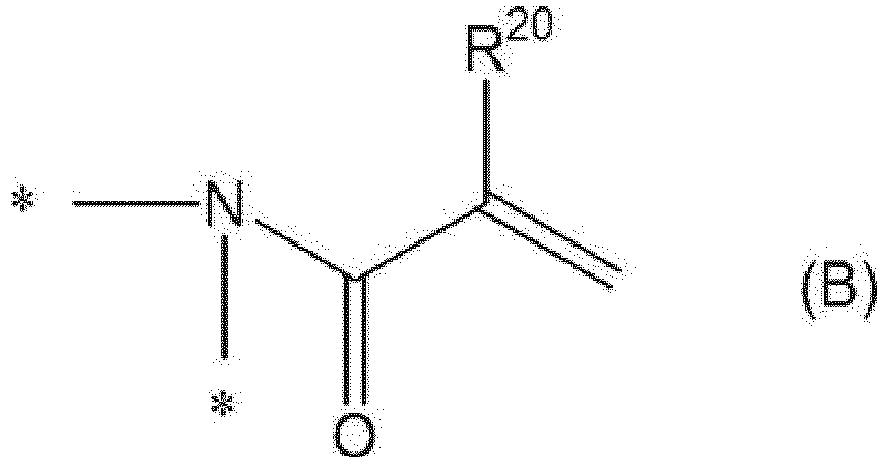
- In Formula (B), R20 represents a hydrogen atom or a methyl group, and * represents a linking position. Usually, a carbon atom is located at *.
- Specific examples of the polyfunctional (meth)acrylamide compound represented by Formula (A) will be shown below, but the present invention is not limited thereto.


- As the polyfunctional (meth)acrylamide compound represented by Formula (A), various commercially available products can be used. Alternatively, the specific polyfunctional (meth)acrylamide compound can be synthesized by the method described in Journal of Technical Disclosure No. 2013-502654.
- The betaine monomer other than the specific betaine monomer is not particularly limited, and examples thereof include a monomer having a betaine structure such as a sulfobetaine structure, a phosphobetaine structure, or a carboxybetaine structure. The skeleton of the betaine monomer that the composition according to the embodiment of the present invention can contain is not particularly limited, but is preferably an acrylate-based monomer or an acrylamide-based monomer is preferable. Specifically, examples of the betaine monomer include those described in
WO2017/018146A and the like. - Particularly, in view of further improving the biocompatibility, as the betaine monomer, a compound represented by Formula (C) is preferable.

- In Formula (C), R30 represents a hydrogen atom or an alkyl group.
- The alkyl group represented by R30 has the same definition as the alkyl group represented by R1 in Formula (1) described above, and the suitable embodiments thereof are also the same. As R30, particularly, a hydrogen atom or an alkyl group having 1 to 6 carbon atoms is preferable, and a hydrogen atom or an alkyl group having 1 to 3 carbon atoms is more preferable.
- L30 represents an oxygen atom or -NRA-.
- RA represents a hydrogen atom or an alkyl group. The alkyl group represented by RA has the same definition as the alkyl group represented by R101 in Formula (1) described above, and the suitable embodiments thereof are also the same. As RA, a hydrogen atom is particularly preferable.
- R31 represents a monovalent group represented by Formula (I), a monovalent group represented by Formula (II), or a monovalent group represented by Formula (III).


- In Formula (I), L31 and L32 each independently represent a divalent linking group.
- L31 and L32 are not particularly limited, but may be an alkylene group having 1 to 10 carbon atoms that may contain a heteroatom (the alkylene group may be any of a linear, branched, or cyclic alkylene group, but is preferably a linear alkylene group). The number of carbon atoms in the alkylene group is more preferably 1 to 6, even more preferably 1 to 4, and particularly preferably 2 to 4.
- R32 and R33 each independently represent an alkyl group.
- The number of carbon atoms in the alkyl group represented by R32 and R33 is not particularly limited, but is preferably 1 to 6 and more preferably 1 to 3. The alkyl group may be linear, branched, or cyclic.
- Examples of the alkyl group include a methyl group, an ethyl group, a n-propyl group, and an isopropyl group.
- The alkyl group may have a substituent. The substituent that the alkyl group can have is not particularly limited, and examples thereof include a substituent W which will be described later.
- * represents a binding position.
- In Formula (II), L33 and L34 each independently represent a divalent linking group.
- The divalent linking group represented by L33 and L34 has the same definition as the divalent linking group represented by L31 and L32 in Formula (I) described above, and the suitable embodiments thereof are also the same.
- R34 to R36 each independently represent an alkyl group.
- The alkyl group represented by R34 to R36 has the same definition as the alkyl group represented by R32 and R33 in Formula (I) described above, and the suitable embodiments thereof are also the same.
- * represents a binding position.
- In Formula (III), L35 and L36 each independently represent a divalent linking group.
- The divalent linking group represented by L35 and L36 has the same definition as the divalent linking group represented by L31 and L32 in Formula (I) described above, and the suitable embodiments thereof are also the same.
- R37 and R38 each independently represent an alkyl group.
- The alkyl group represented by R37 and R38 has the same definition as the alkyl group represented by R32 and R33 in Formula (I) described above, and the suitable embodiments thereof are also the same.
- * represents a binding position.
- Particularly, in view of further improving the biocompatibility, as R31, the group represented by Formula (I) or the group represented by Formula (II) is preferable.
- The betaine monomer can be synthesized by a known method.
- Specific examples of the betaine monomer will be shown below, but the present invention is not limited thereto.


- One kind of the copolymerizable monomer may be used singly, or two or more kinds of the copolymerizable monomers may be used in combination.
- In the composition according to the embodiment of the present invention, the content of the copolymerizable monomer (total content in a case where the composition contains a plurality of kinds of the copolymerizable monomers) with respect to the total solid content of the composition is preferably 0% to 60% by mass, more preferably 10% to 50% by mass, and even more preferably 10% to 40% by mass. In a case where the copolymerizable monomer is a betaine monomer, in the composition according to the embodiment of the present invention, the content of the betaine monomer (total content in a case where the composition contains a plurality of kinds of the betaine monomers) with respect to the total solid content of the composition is preferably 0% to 30% by mass, and more preferably 10% to 25% by mass.
- Examples of the substituent W includes an alkyl group (preferably an alkyl group having 1 to 20 carbon atoms), an alkenyl group (preferably an alkenyl group having 2 to 20 carbon atoms), an alkynyl group (preferably an alkynyl group having 2 to 20 carbon atoms), a cycloalkyl group (preferably a cycloalkyl group having 3 to 20 carbon atoms), an aryl group (preferably an aryl group having 6 to 26 carbon atoms), a heterocyclic group (preferably a heterocyclic group having 2 to 20 carbon atoms and more preferably a 5- or 6-membered heterocyclic group having at least one oxygen atom, sulfur atom, or nitrogen atom), an alkoxy group (preferably an alkoxy group having 1 to 20 carbon atoms), an aryloxy group (preferably an aryloxy group having 6 to 26 carbon atoms), an alkoxycarbonyl group (preferably an alkoxycarbonyl group having 2 to 20 carbon atoms),an aryloxycarbonyl group (preferably an aryloxycarbonyl group having 6 to 26 carbon atoms), an amino group (preferably an amino group having 0 to 20 carbon atoms including an alkylamino group and an arylamino group, such as amino, N,N-dimethylamino, N,N-diethylamino, N-ethylamino, and anilino), a sulfamoyl group (preferably a sulfamoyl group having 0 to 20 carbon atoms), an acyl group (preferably an acyl group having 1 to 20 carbon atoms), an acyloxy group (preferably an acyloxy group having 1 to 20 carbon atoms), a carbamoyl group (preferably a carbamoyl group having 1 to 20 carbon atoms), an acylamino group (preferably an acylamino group having 1 to 20 carbon atoms, such as an acetylamino group or a benzoylamino group), an alkylthio group (preferably an alkylthio group having 1 to 20 carbon atoms), an arylthio group (preferably an arylthio group having 6 to 26 carbon atoms), an alkylsulfonyl group (preferably an alkylsulfonyl group having 1 to 20 carbon atoms), an arylsulfonyl group (preferably an arylsulfonyl group having 6 to 22 carbon atoms), an alkylsilyl group (preferably an alkylsilyl group having 1 to 20 carbon atoms), an arylsilyl group (preferably an arylsilyl group having 6 to 42 carbon atoms), an alkoxysilyl group (preferably an alkoxysilyl group having 1 to 20 carbon atoms), an aryloxysilyl group (preferably an aryloxysilyl group having 6 to 42 carbon atoms), a phosphoryl group (preferably a phosphoryl group having 0 to 20 carbon atoms, for example, -OP(=O)(RP)2), a phosphonyl group (preferably a phosphonyl group having 0 to 20 carbon atoms, for example, -P(=O)(RP)2), a phosphinyl group (preferably a phosphinyl group having 0 to 20 carbon atoms, for example, -P(RP)2), a (meth)acryloyl group, a (meth)acryloyloxy group, a (meth)acryloylimino group (a (meth)acrylamide group), a hydroxyl group, a thiol group, a carboxyl group, a phosphoric acid group, a phosphonic acid group, a sulfonic acid group, a cyano group, and a halogen atom (for example, a fluorine atom, a chlorine atom,a bromine atom, an iodine atom, or the like). RP represents a hydrogen atom, a hydroxyl group, or a substituent.
- In addition, each of the groups exemplified as the substituent W may be further substituted with the substituent W.
- In a case where the aforementioned substituent is an acidic group or a basic group, the substituent may form a salt thereof.
- In a case where the compound, the substituent, the linking group, and the like contain an alkyl group, an alkylene group, an alkenyl group, an alkenylene group, an alkynyl group, an alkynylene group, or the like, these may be cyclic or chainlike or may be linear or branched, and may be substituted as described above or unsubstituted.
- It is preferable that the composition according to the embodiment of the present invention contains an initiator.
- The initiator is not particularly limited, but is preferably a thermal polymerization initiator or a photopolymerization initiator.
- Examples of the photopolymerization initiator include an alkylphenone-based photopolymerization initiator, a methoxyketone-based photopolymerization initiator, an acylphosphine oxide-based photopolymerization initiator, a hydroxyketone-based photopolymerization initiator (for example, IRGACURE184; 1,2-α-hydroxyalkylphenone), an aminoketone-based photopolymerization initiator (for example, 2-methyl-1-[4-(methylthio)phenyl]-2-morpholino-propan-1-one (IRGACURE (registered trademark) 907)), an oxime-based photopolymerization initiator, and an oxyphenylacetic acid ester-based photopolymerization initiator (IRGACURE (registered trademark) 754), and the like.
- Examples of other initiators include an azo-based polymerization initiator (for example, V-50 or V-601), a persulfate-based polymerization initiator, a persulfuric acid-based polymerization initiator, a redox-based polymerization initiator, and the like.
- One kind of the initiator may be used singly, or two or more kinds of the initiators may be used in combination.
- In the composition according to the embodiment of the present invention, the content of the initiator (total content in a case where the composition contains a plurality of kinds of initiators) is not particularly limited. However, the content of the initiator with respect to the total solid content of the composition is preferably 0.5% to 10% by mass, and more preferably 1% to 5% by mass.
- It is preferable that the composition according to the embodiment of the present invention contains a solvent.
- Examples of the solvent include water, an organic solvent (for example, esters such as ethyl acetate and n-butyl acetate; aromatic hydrocarbons such as toluene and benzene; aliphatic hydrocarbons such as n-hexane and n-heptane; alicyclic hydrocarbons such as cyclohexane and methylcyclohexane; ketones such as methyl ethyl ketone (MEK), methyl isobutyl ketone, and cyclohexanone; alcohols such as methanol and butanol, or the like), and a mixed solvent of these.
- Among these, from the viewpoint of making it difficult for surface unevenness to occur during coating, alcohol solvents such as methanol and ethanol are preferable.
- One kind of the solvent may be used singly, or two or more kinds of the solvents may be used in combination.
- In the composition according to the embodiment of the present invention, the content of the solvent (total content in a case where the composition contains a plurality of kinds of solvents) with respect to the total mass of the composition is preferably from 0. 5% to 95% by mass, more preferably 1% to 90% by mass, and even more preferably 10% to 80% by mass.
- The composition according to the embodiment of the present invention may contain components other than the components described above. Examples of such components include a binder resin, a polyfunctional amine, a polyfunctional thiol, a surfactant, a plasticizer, and a surface lubricant, a leveling agent, a softener, an antioxidant, an antiaging agent, a light stabilizer, an ultraviolet absorber, an inorganic or organic filler, a metal powder, and the like.
- The binder resin is not particularly limited, and examples thereof include an acrylic resin, a styrene-based resin, a vinyl-based resin, a polyolefin-based resin, a polyester-based resin, a polyurethane-based resin, a polyamide-based resin, a polycarbonate-based resin, a polydiene-based resin, an epoxy-based resin, a silicone-based resin, a cellulose-based polymer, a chitosan-based polymer, and the like.
- As the method for preparing the composition according to the embodiment of the present invention, a known method can be employed without particular limitation. For example, the curable composition can be prepared by mixing together the above components and then stirring the mixture by known means.
- The cured product according to an embodiment of the present invention is formed by curing the aforementioned composition according to the embodiment of the present invention. The shape of the cured product can be appropriately selected according to the use. Examples of the shape of the cured product include a powder shape and a film shape. Among these, a film shape is preferable.
- In a case where the cured product is formed into a film, the film thickness is not particularly limited, but is, for example, 0. 1 to 300 µm and more preferably 1 to 100 µm.
- The cured product according to the embodiment of the present invention contains a polymer compound containing a repeating unit derived from the specific betaine monomer described above.
- The method for manufacturing the cured product (cured film) according to the embodiment of the present invention is not particularly limited. Examples thereof include a method of coating a substrate with the aforementioned composition according to the embodiment of the present invention and then curing the composition by heating or light irradiation (examples of the light include ultraviolet rays, visible rays, X-rays, and the like).
- The material of the substrate is not particularly limited, and examples thereof include a metal material, a ceramic material, a plastic material, and the like.
- Examples of the type of the plastic material include polyethylene terephthalate, polybutylene terephthalate, polyethylene naphthalate, polyethylene, polypropylene, cellophane, diacetyl cellulose, triacetyl cellulose, acetyl cellulose butyrate, polyvinyl chloride, polyvinylidene chloride, polyvinyl alcohol, an ethylene-vinyl acetate copolymer, polystyrene, polycarbonate, polymethylpentene, polysulfone, polyether ether ketone, polyether sulfone, polyether imide, polyimide, a fluororesin, nylon, an acrylic resin, polyamide, cycloolefin, polyether sulfan, and the like.
- Examples of the type of the metal material include gold, stainless steel, a cobalt-chromium alloy, an amalgam alloy, a silver-palladium alloy, a gold-silver-palladium alloy, titanium, a nickel-titanium alloy, platinum, and the like.
- Examples of the type of the ceramic material include hydroxyapatite and the like.
- The shape of the substrate is not particularly limited, and may be a plate shape or a three-dimensional shape.
- The method for coating the substrate with the composition according to the embodiment of the present invention is not particularly limited, and examples thereof include methods such as dipping, roll coating, kiss roll coating, gravure coating, reverse coating, roll brush coating, spray coating, dip roll coating, bar coating, spin coating, knife coating, air knife coating, curtain coating, lip coating, and an extrusion coating method using a die coater.
- The heating method is not particularly limited, and examples thereof include a method using a blast dryer, an oven, an infrared dryer, a heating drum, and the like.
- The heating temperature is not particularly limited, but is preferably 30°C to 150°C and more preferably 40°C to 120°C.
- The heating time is not particularly limited, but is usually 1 minute to 6 hours. In a case where the composition is dried in a coating apparatus, the heating time is 1 to 20 minutes, and the heating temperature at the time of heating after the coating (for example, heating the substrate that is wound up) is preferably room temperature to 50°C.
- Examples of the method of light irradiation include methods using a low-pressure mercury lamp, a medium-pressure mercury lamp, a high-pressure mercury lamp, a metal halide lamp, a deep-UV (ultraviolet) light, an LED (light emitting diode) lamp, a xenon lamp, a chemical lamp, a carbon arc lamp, and the like. The energy of light irradiation is not particularly limited, but is preferably 0. 1 to 10 J/cm2.
- The cured product according to the embodiment of the present invention exhibits excellent substrate adhesion and can inhibit or prevent the adhesion of biological materials such as cells and blood components. The cured product according to the embodiment of the present invention can be suitably used for prostheses, medical instruments, and the like as a material applied to a living body (biomaterial). Specifically, the cured product according to the embodiment of the present invention may be used as a filler for a resin composition used as a material for a prosthesis, a medical instrument, and the like, or may be used as a coating material by being disposed on the surface of a prosthesis or a medical instrument. Examples of the medical instrument include a denture, an artificial dialysis membrane, a catheter, and the like. The prosthesis refers to a member that is incorporated into the human body for a long-term treatment or the like, and examples thereof include an artificial blood vessel, a stent, an artificial organ, an artificial bone, an artificial valve, cultured skin, and the like.
- The cured product according to the embodiment of the present invention is particularly preferably used as a dental material or an artificial bone adhesive.
- The medical member according to an embodiment of the present invention includes a substrate and a cured product disposed on the substrate.
- The substrate means the aforementioned prosthesis, medical instrument, and the like, and examples thereof include those made of the metal material, the ceramic material, and the plastic material described above. Specifically, examples of the substrate include dentures and artificial bones.
- The cured film corresponds, for example, to the aforementioned cured product having a film shape.
- Hereinafter, the present invention will be more specifically described based on examples. The materials, the amount and ratio thereof used, how to treat the materials, the treatment procedure, and the like described in the following examples can be appropriately changed as long as the gist of the present invention is maintained. Therefore, the scope of the present invention is not limited to the following examples.
- The specific betaine monomers (ex (1) to ex (4)) shown in Table 1 will be shown below.

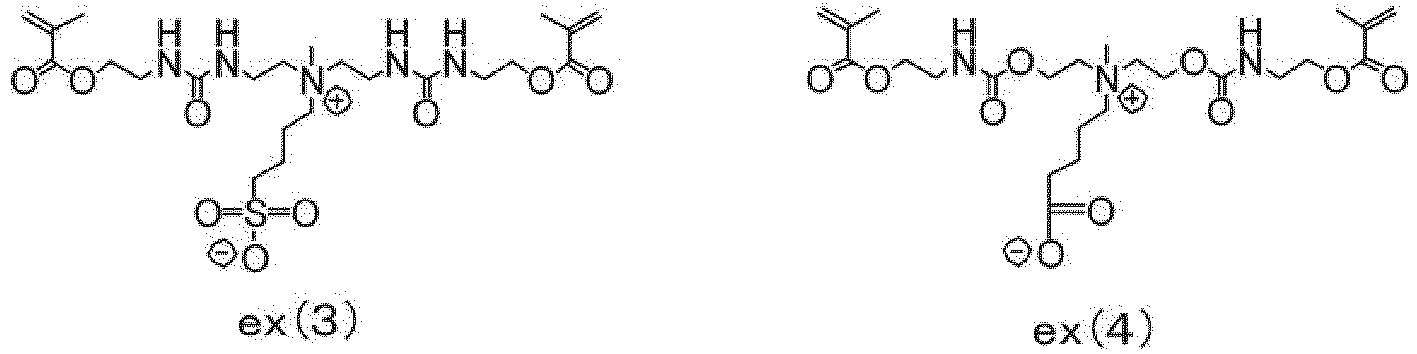
- Hereinafter, a method for synthesizing the specific betaine monomer will be explained by describing the method for synthesizing ex (1) for example.

- 3-(Dimethylamino)-1,2-propanediol (10 g, 83.9 mmol) and tetrahydrofuran (THF, 50 mL) were mixed together, and a solution which was obtained by diluting 2-isocyanatoethyl methacrylate (27. 34 g, 176 mmol) with tetrahydrofuran (50 mL) was added dropwise to the mixture. Furthermore, a solution obtained by diluting "NEOSTANN U600" (manufactured by NITTO KASEI CO., LTD., 538 mg) with tetrahydrofuran (10 mL) was added dropwise to the above solution while paying attention to heat generation, and the mixture was stirred at room temperature for 12 hours. The reaction solution was concentrated under reduced pressure, and the obtained crude product was purified by silica gel column chromatography (eluent: ethyl acetate to ethyl acetate:methanol = 4:1), thereby obtaining an intermediate a (30 g, yield 83%).
- The intermediate a (5 g, 11.6 mmol), 1,4-butanesultone (1.9 g, 14.0 mmol), 4-hydroxy-2,2,6,6-tetramethylpiperidine 1-oxyl free radical (60 mg, 0.35 mmol), and methanol (6 mL) were mixed together and stirred at 80°C for 48 hours. The reaction solution was cooled to room temperature and concentrated under reduced pressure. The obtained crude product was purified by silica gel column chromatography (eluent: acetone to acetone:methanol = 1:1 to methanol), thereby obtaining ex (1) (5 g, yield 76%). Through 1H NMR (Nuclear Magnetic Resonance), it was confirmed that the obtained product was a target substance.
- 1H NMR (methanol-d4, 400 MHz) δ: 1.82 (2H, t), 1.93 (6H, s), 1.93-2. 09 (2H, m), 2.88 (2H, t), 3.15 (6H, s), 3.34- 3.44 (6H, m), 3. 57-3.78 (2H, m), 4.08-4.30 (6H, m), 5.63 (2H, s), 6. 12 (2H, s).
- Furthermore, by ESI-MS (Electrospray Ionization-Mass Spectrometry), a peak corresponding to the molecular weight of the target substance was confirmed.
- According to the method for synthesizing ex (1), ex (2) to ex (4) were synthesized.
- ex (5) was synthesized according to the following synthesis scheme. That is, ex (5) was synthesized by the same method as that used for synthesizing ex (1), except that for the intermediate (a), potassium chloroacetate was used instead of 1,4-butanesultone and IPA was used instead of methanol.

- The copolymerizable monomers (B (1) to B (16)) shown in Table 1 will be shown below.




- Comparative betaine monomers (com (1) to com (4)) shown in Table 1 will be shown below.


- The components shown in the following Table 1 were dissolved in a solvent (methanol), thereby preparing curable compositions having a concentration of solid contents of 20% by mass (curable compositions 1 to 30). Regarding the curable compositions, the solid contents mean all components except for the solvent.
- The numerical value in Table 1 represents the content (% by mass) of each component with respect to the total solid content of a curable composition. "Irg2959" corresponds to a polymerization initiator ("IRGACURE 2959", manufactured by BASF SE).
- By using a spin coater, a substrate (acrylic plate (manufacturer: MISUMI Corporation, model number: ACA)) was coated with each of the prepared curable compositions such that the film thickness became about 5 µm, and then the composition was dried. Then, by using an "ECS-401G (trade name)" UV (ultraviolet) exposure machine (light source: high-pressure mercury lamp) manufactured by EYE GRAPHICS Co., Ltd., the composition was exposed at an exposure amount of 4 J/cm2, thereby preparing a coat film for evaluating substrate adhesion and biocompatibility.
- The prepared acrylic plate with a coat film was immersed in a PBS (Phosphate buffered saline) solution at 37°C for 48 hours. Thereafter, the acrylic plate with a coat film was pulled up from the solution, and the substrate adhesion was evaluated based on the area of the coat film remaining on the acrylic plate (hereinafter, referred to as "residual coat film" as well). The area of the residual coat film with respect to the area of the acrylic plate was expressed as a percentage as a coating rate, and evaluated based on the following evaluation standard. Regarding the evaluation of the substrate adhesion, samples graded "B" or higher were regarded as acceptable. The results are shown in Table 1.
-
- "A": The coating rate was equal to or higher than 90%.
- "B": The coating rate was equal to or higher than 70% and less than 90%.
- "C": The coating rate was equal to or higher than 50% and less than 70%.
- "D": The coating rate was less than 50%.
- The prepared acrylic substrate with a coat film was placed in a 6-well plate, and mouse-derived fibroblasts (3T3 cells) were dispersed in Dulbecco's modified Eagle medium at a seeding density of 1.0 × 10⁵ cells/cm2. By using an incubator, the cells were cultured for 48 hours under the condition of 37°C and 5% carbon dioxide.
- Thereafter, the acrylic substrate with the coat film was taken out observed using a phase contrast microscope (an inverted cubic research microscope, manufactured by Olympus Corporation) so as to check whether or not the cells were attached thereto. The magnification was 4X.
- This operation was performed on 10 acrylic substrates with a coat film, and biocompatibility was evaluated as below based on the number of acrylic substrates with a coat film to which cells had adhered. Regarding the evaluation of the biocompatibility, samples graded "C" or higher were regarded as acceptable. For practical use, samples graded "B" or higher are preferable. The results are shown in Table 1.
- In addition, "-" shown in the column of Biocompatibility in Table 1 means that the sample could not be evaluated because the film was peeled off.
-
- "S": 0 to 1
- "A": 2 to 3
- "B": 4 to 6
- "C": 7 to 9
- "D": 10 or greater
- From the results in Table 1, it was confirmed that according to the curable compositions of Examples, a cured product having excellent substrate adhesion and excellent biocompatibility was obtained.
- By the comparison of Examples 1 to 4, it was confirmed that in a case where A1 in the compound represented by Formula (1) and A2 in the compound represented by Formula (2) each represented S=O (that is, in a case where the compounds had a sulfobetaine structure), the biocompatibility was further improved.
- By the comparison of Examples 5 to 17, it was confirmed that in a case where a polyfunctional (meth)acrylamide compound, which is selected from the group consisting of the compound represented by Formula (A1) and the compound represented by Formula (A2), was used as the copolymerizable monomer, the substrate adhesion and the biocompatibility were further improved.
- On the other hand, it was confirmed that the cured product obtained from the curable composition of the comparative example did not satisfy the desired requirements.
| Table 1 | Curable composition No. | Makeup of curable composition | Evaluation result | |||||
| Component A | Component B | Polymerization initiator | Substrate adhesion | biocompatibility | ||||
| Type | Note | Type | note | |||||
| Example 1 | Curable composition 1 | ex (1) (97%) | Corresponding to Formula (1)/sulfobetaine | - | - | Irg2959 (3%) | B | A |
| Example 2 | Curable composition 2 | ex (2) (97%) | Corresponding to Formula (2)/sulfobetaine | - | - | Irg2959 (3%) | B | A |
| Example 3 | Curable composition 3 | ex (3) (97%) | Corresponding to Formula (2)/sulfobetaine | - | - | Irg2959 (3%) | B | A |
| Example 4 | Curable composition 4 | ex (4) (97%) | Corresponding to Formula (2)/carboxybetaine | - | - | Irg2959 (3%) | B | B |
| Example 5 | Curable composition 5 | ex (2) (67%) | Corresponding to Formula (2)/sulfobetaine | B (1) (30%) | - | Irg2959 (3%) | A | B |
| Example 6 | Curable composition 6 | ex (2) (67%) | Corresponding to Formula (2)/sulfobetaine | B (2) (30%) | - | Irg2959 (3%) | A | B |
| Example 7 | Curable composition 7 | ex (2) (67%) | Corresponding to Formula (2)/sulfobetaine | B (3) (30%) | - | Irg2959 (3%) | A | B |
| Example 8 | Curable composition 8 | ex (2) (67%) | Corresponding to Formula (2)/sulfobetaine | B (4) (30%) | - | Irg2959 (3%) | A | B |
| Example 9 | Curable composition 9 | ex (2) (67%) | Corresponding to Formula (2)/sulfobetaine | B (5) (30%) | - | Irg2959 (3%) | A | B |
| Example 10 | Curable composition 10 | ex (2) (67%) | Corresponding to Formula (2)/sulfobetaine | B (6) (30%) | - | Irg2959 (3%) | A | B |
| Example 11 | Curable composition 11 | ex (2) (67%) | Corresponding to Formula (2)/sulfobetaine | B (7) (30%) | - | Irg2959 (3%) | A | B |
| Example 12 | Curable composition 12 | ex (2) (67%) | Corresponding to Formula (2)/sulfobetaine | B (8) (30%) | - | Irg2959 (3%) | A | B |
| Example 13 | Curable composition 13 | ex (2) (67%) | Corresponding to Formula (2)/sulfobetaine | B (9) (30%) | - | Irg2959 (3%) | A | B |
| Example 14 | Curable composition 14 | ex (2) (67%) | Corresponding to Formula (2)/sulfobetaine | B (10) (30%) | Corresponding to Formula (A1) | Irg2959 (3%) | A | A |
| Example 15 | Curable composition 15 | ex (2) (67%) | Corresponding to Formula (2)/sulfobetaine | B (11) (30%) | Corresponding to Formula (A2) | Irg2959 (3%) | A | A |
| Example 16 | Curable composition 16 | ex (2) (67%) | Corresponding to Formula (2)/sulfobetaine | B (12) (30%) | Corresponding to Formula (A2) | Irg2959 (3%) | A | A |
| Example 17 | Curable composition 17 | ex (2) (67%) | Corresponding to Formula (2)/sulfobetaine | B (13) (30%) | Corresponding to Formula (A2) | Irg2959 (3%) | A | A |
| Example 18 | Curable composition 18 | ex (2) (82%) | Corresponding to Formula (2)/sulfobetaine | B (14) (15%) | Corresponding to Formula (I) | Irg2959 (3%) | B | s |
| Example 19 | Curable composition 19 | ex (2) (82%) | Corresponding to Formula (2)/sulfobetaine | B (15) (15%) | Corresponding to Formula (II) | Irg2959 (3%) | B | s |
| Example 20 | Curable composition 20 | ex (2) (82%) | Corresponding to Formula (2)/sulfobetaine | B (16) (15%) | Corresponding to Formula (III) | Irg2959 (3%) | B | A |
| Example 21 | Curable composition 30 | ex (5) (97%) | Corresponding to Formula (1)/carboxybetaine | - | - | Irg2959 (3%) | B | B |
| Comparative Example 1 | Curable composition 21 | com (1) (97%) | - | - | - | Irg2959 (3%) | D | - |
| Comparative Example 2 | Curable composition 22 | com (2) (97%) | - | - | - | Irg2959 (3%) | D | - |
| Comparative Example 3 | Curable composition 23 | com (3) (97%) | - | - | - | Irg2959 (3%) | c | A |
| Comparative Example 4 | Curable composition 24 | com (4) (97%) | - | - | - | Irg2959 (3%) | c | A |
| Comparative Example 5 | Curable composition 25 | - | - | B (1) (97%) | - | Irg2959 (3%) | A | D |
| Comparative Example 6 | Curable composition 26 | - | - | B (9) (97%) | - | Irg2959 (3%) | D | - |
| Comparative Example 7 | Curable composition 27 | - | - | B (10) (97%) | Corresponding to Formula (A1) | Irg2959 (3%) | D | - |
| Comparative Example 8 | Curable composition 28 | - | - | B (15) (97%) | Corresponding to Formula (II) | Irg2959 (3%) | D | - |
| Comparative Example 9 | Curable composition 29 | com (1) (67%) | - | B (10) (30%) | Corresponding to Formula (A1) | Irg2959 (3%) | D | - |
Claims (10)
- A curable composition comprising:one or more betaine monomers selected from the group consisting of a compound represented by Formula (1) and a compound represented by Formula (2),
 in the formula, R1 represents a hydrogen atom or an alkyl group, R2 and R3 each independently represent an alkyl group, R1A represents an oxygen atom or NR101, R101 represents a hydrogen atom or an alkyl group, a represents an integer of 2 to 6, L1 represents an (a + 1)-valent aliphatic hydrocarbon group which contains a urethane bond or a urea bond and may contain -O-, L2 represents an alkylene group which may contain -O-, -NR104-, -CO-, or a divalent linking group obtained by combining these, R104 represents a hydrogen atom or a substituent, A1 represents S=O or a carbon atom,
 in the formula, R4 and R6 each independently represent a hydrogen atom or an alkyl group, R5 represents an alkyl group, R1B and R1C each independently represent an oxygen atom or NR102, R102 represents a hydrogen atom or an alkyl group, b and c each independently represent an integer of 1 to 5, b and c satisfy 2 ≤ b + c ≤ 6, L3 represents a (b + 1)-valent aliphatic hydrocarbon group which contains a urethane bond or a urea bond and may contain -O-, L4 represents a (c + 1)-valent aliphatic hydrocarbon group which contains a urethane bond or a urea bond and may contain -O-, L5 represents an alkylene group which may contain -O-, -NR204-, -CO-, or a divalent linking group obtained by combining these, R204 represents a hydrogen atom or a substituent, and A2 represents S=O or a carbon atom.
 - The curable composition according to claim 1,wherein A1 in Formula (1) represents S=O, andA2 in Formula (2) represents S=O.
- The curable composition according to claim 1 or 2, further comprising:one or more monomers selected from the group consisting of a compound represented by Formula (A1) and a compound represented by Formula (A2),
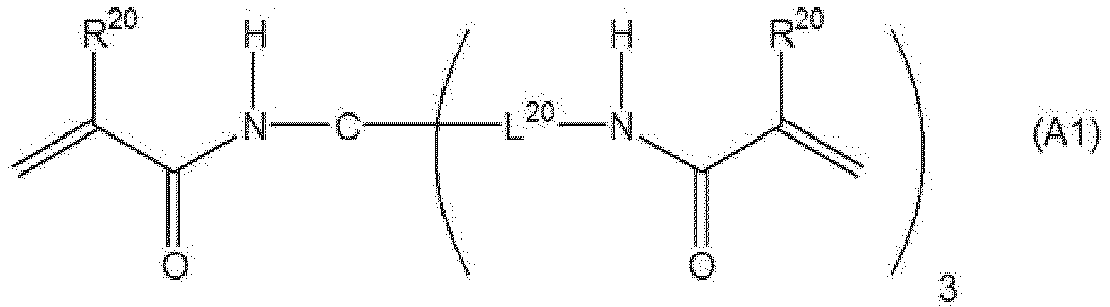

 in Formula (A1), R20 each independently represents a hydrogen atom or a methyl group, L20 each independently represents -O-, an alkylene group having 2 to 4 carbon atoms, or a divalent linking group obtained by combining these, a plurality of R20s may be the same as or different from each other,in Formula (A2), R20 each independently represents a hydrogen atom or a methyl group, R21 and R23 each independently represent -O-, an alkylene group having 1 to 4 carbon atoms, or a divalent linking group obtained by combining these, R22 represents -O-, an alkylene group having 1 to 4 carbon atoms, a group represented by Formula (B), or a divalent linking group obtained by combining these, L21 and L22 each independently represent a single bond or a group represented by Formula (B),in Formula (B), R20 represents a hydrogen atom or a methyl group, and * represents a binding position.
 - A film comprising:a polymer compound containing one or more repeating units selected from the group consisting of a repeating unit derived from a compound represented by Formula (1) and a repeating unit derived from a compound represented by Formula (2),
 in the formula, R1 represents a hydrogen atom or an alkyl group, R2 and R3 each independently represent an alkyl group, R1A represents an oxygen atom or NR101, R101 represents a hydrogen atom or an alkyl group, a represents an integer of 2 to 6, L1 represents an (a + 1)-valent aliphatic hydrocarbon group which contains a urethane bond or a urea bond and may contain -O-, L2 represents an alkylene group which may contain -O-, -NR104-, -CO-, or a divalent linking group obtained by combining these, R104 represents a hydrogen atom or a substituent, A1 represents S=O or a carbon atom,
 in the formula, R4 and R6 each independently represent a hydrogen atom or an alkyl group, R5 represents an alkyl group, R1B and R1C each independently represent an oxygen atom or NR102 , R102 represents a hydrogen atom or an alkyl group, b and c each independently represent an integer of 1 to 5, b and c satisfy 2 ≤ b + c ≤ 6, L3 represents a (b + 1)-valent aliphatic hydrocarbon group which contains a urethane bond or a urea bond and may contain -O-, L4 represents a (c + 1)-valent aliphatic hydrocarbon group which contains a urethane bond or a urea bond and may contain -O-, L5 represents an alkylene group which may contain -O-, -NR204-, -CO-, or a divalent linking group obtained by combining these, R204 represents a hydrogen atom or a substituent, and A2 represents S=O or a carbon atom.
 - A cured product formed by curing the curable composition according to any one of claims 1 to 3.
- The cured product according to claim 5 that is in the form of a film.
- The cured product according to claim 5 or 6 that is used as a biomaterial.
- A medical member comprising:a substrate; andthe cured product according to any one of claims 5 to 7 disposed on the substrate.
- A compound represented by Formula (1),

- A compound represented by Formula (2),

Applications Claiming Priority (2)
| Application Number | Priority Date | Filing Date | Title |
|---|---|---|---|
| JP2017201929 | 2017-10-18 | ||
| PCT/JP2018/037287 WO2019078027A1 (en) | 2017-10-18 | 2018-10-04 | Curable composition, film, cured product, and medical member |
Publications (3)
| Publication Number | Publication Date |
|---|---|
| EP3699202A1 true EP3699202A1 (en) | 2020-08-26 |
| EP3699202A4 EP3699202A4 (en) | 2020-09-23 |
| EP3699202B1 EP3699202B1 (en) | 2022-12-21 |
Family
ID=66174431
Family Applications (1)
| Application Number | Title | Priority Date | Filing Date |
|---|---|---|---|
| EP18868285.0A Active EP3699202B1 (en) | 2017-10-18 | 2018-10-04 | Curable composition, film, cured product, and medical member |
Country Status (5)
| Country | Link |
|---|---|
| US (1) | US11130831B2 (en) |
| EP (1) | EP3699202B1 (en) |
| JP (1) | JP6890672B2 (en) |
| CN (1) | CN111164115B (en) |
| WO (1) | WO2019078027A1 (en) |
Families Citing this family (3)
| Publication number | Priority date | Publication date | Assignee | Title |
|---|---|---|---|---|
| EP3699210A4 (en) * | 2017-10-18 | 2020-09-23 | FUJIFILM Corporation | Curable composition, film, cured product, and medical member |
| US11313048B2 (en) * | 2019-06-27 | 2022-04-26 | Prc-Desoto International, Inc. | Addition polymer for electrodepositable coating compositions |
| JP2023096908A (en) * | 2021-12-27 | 2023-07-07 | 日油株式会社 | Virus adhesion inhibitor and virus adhesion inhibition method |
Family Cites Families (24)
| Publication number | Priority date | Publication date | Assignee | Title |
|---|---|---|---|---|
| DE1211156B (en) * | 1963-06-14 | 1966-02-24 | Bayer Ag | Process for the production of unsaturated sulfonic acid betaines by reacting a tertiary amine with a sultone |
| JPH06157694A (en) * | 1992-11-17 | 1994-06-07 | Nippon Kayaku Co Ltd | Radiation-curing resin composition and cured product therefrom |
| JPH06157693A (en) * | 1992-11-17 | 1994-06-07 | Nippon Kayaku Co Ltd | Radiation-curing resin composition and cured product therefrom |
| JP4132912B2 (en) * | 2002-03-26 | 2008-08-13 | 日東電工株式会社 | Gel electrolyte, its production method and its use |
| JP2004091690A (en) * | 2002-09-02 | 2004-03-25 | Nitto Denko Corp | Porous film carrying polymerizable gelling agent, its production and its use |
| JP4156495B2 (en) * | 2003-11-07 | 2008-09-24 | 日東電工株式会社 | Gel electrolyte, its production method and its use |
| US7662898B2 (en) | 2004-05-20 | 2010-02-16 | Osaka Organic Chemical Ind., Ltd. | Biocompatible material |
| AU2008345590B2 (en) * | 2007-12-21 | 2014-10-30 | Microvention, Inc. | Hydrogel filaments for biomedical uses |
| JP2009198868A (en) * | 2008-02-22 | 2009-09-03 | Fujifilm Corp | Dye-containing negative type curable composition, color filter and method for manufacturing therefor, and solid imaging element |
| JP5800812B2 (en) * | 2009-08-28 | 2015-10-28 | スリーエム イノベイティブ プロパティズ カンパニー | Compositions and articles comprising a polymerizable ionic liquid mixture and curing method |
| WO2011057219A2 (en) * | 2009-11-06 | 2011-05-12 | University Of Washington Through Its Center For Commercialization | Crosslinked zwitterionic hydrogels |
| JP5624880B2 (en) * | 2009-12-28 | 2014-11-12 | 富士フイルム株式会社 | Planographic printing plate precursor and lithographic printing plate preparation method |
| JP2011154367A (en) * | 2009-12-28 | 2011-08-11 | Fujifilm Corp | Method of preparing lithographic printing plate |
| JP5690671B2 (en) * | 2010-06-30 | 2015-03-25 | 富士フイルム株式会社 | NOVEL POLYMERIZABLE COMPOSITION, POLYMERIZABLE COMPOUND USED FOR THE SAME, IMAGE-FORMING MATERIAL USING NOVEL POLYMERIZABLE COMPOSITION, AND lithographic printing plate precursor |
| CN103880714B (en) * | 2014-03-20 | 2016-06-22 | 中国农业大学 | Containing zwitterionic water-soluble cross-linker and preparation method thereof and application |
| EP3213777A4 (en) * | 2014-10-29 | 2017-11-29 | FUJI-FILM Corporation | Material nonadhesive to biological substances, curing composition, and artificial organ and medical instrument using same |
| US10501562B2 (en) * | 2015-03-18 | 2019-12-10 | University Of Kansas | Co-initiator and co-monomer for use in preparing polymer related compositions, methods of manufacture, and methods of use |
| WO2016196633A1 (en) * | 2015-06-01 | 2016-12-08 | William Marsh Rice University | Surface coating method to improve implantable device biocompatibility |
| EP3318585A4 (en) * | 2015-07-03 | 2018-06-20 | Nissan Chemical Industries, Ltd. | Ion complex material having ability to inhibit adhesion of biological materials, and method for producing same |
| WO2017018146A1 (en) * | 2015-07-29 | 2017-02-02 | 富士フイルム株式会社 | Curable composition, coating, and laminate |
| WO2017073437A1 (en) * | 2015-10-29 | 2017-05-04 | 富士フイルム株式会社 | Antifouling film, antifouling film forming composition, antifouling film laminate, and production method for antifouling film laminate |
| JP6534611B2 (en) * | 2015-12-07 | 2019-06-26 | クラレノリタケデンタル株式会社 | Self-adhesive dental composite resin |
| JP6726211B2 (en) | 2015-12-07 | 2020-07-22 | クラレノリタケデンタル株式会社 | Dental adhesive |
| EP3699210A4 (en) * | 2017-10-18 | 2020-09-23 | FUJIFILM Corporation | Curable composition, film, cured product, and medical member |
-
2018
- 2018-10-04 CN CN201880063324.6A patent/CN111164115B/en active Active
- 2018-10-04 WO PCT/JP2018/037287 patent/WO2019078027A1/en not_active Ceased
- 2018-10-04 EP EP18868285.0A patent/EP3699202B1/en active Active
- 2018-10-04 JP JP2019549201A patent/JP6890672B2/en active Active
-
2020
- 2020-03-31 US US16/835,738 patent/US11130831B2/en active Active
Also Published As
| Publication number | Publication date |
|---|---|
| EP3699202A4 (en) | 2020-09-23 |
| CN111164115B (en) | 2021-11-23 |
| JP6890672B2 (en) | 2021-06-18 |
| WO2019078027A1 (en) | 2019-04-25 |
| EP3699202B1 (en) | 2022-12-21 |
| JPWO2019078027A1 (en) | 2020-11-26 |
| US20200270384A1 (en) | 2020-08-27 |
| CN111164115A (en) | 2020-05-15 |
| US11130831B2 (en) | 2021-09-28 |
Similar Documents
| Publication | Publication Date | Title |
|---|---|---|
| US11130831B2 (en) | Curable composition, film, cured product, and medical member | |
| EP3213777A1 (en) | Material nonadhesive to biological substances, curing composition, and artificial organ and medical instrument using same | |
| EP3717531B1 (en) | Biofouling resistant coatings and methods of making and using the same | |
| EP3723839B1 (en) | Polyurea copolymer coating compositions and methods | |
| EP3699209B1 (en) | Curable composition, film, cured product, and medical member | |
| CN114008093A (en) | Antimicrobial polymer particles, compositions and articles | |
| US11396568B2 (en) | Curable composition, film, cured product, and medical member | |
| US10669435B2 (en) | Process for producing an antibacterial coating composition for implants | |
| JP7086202B2 (en) | Biomaterials Non-adhesive materials, compositions and compounds | |
| EP3604318B1 (en) | Phosphorus-containing compound | |
| JP7129071B2 (en) | Medical device with composition and cured film | |
| EP4066902B1 (en) | Zwitterionic compound and production method and use for same | |
| JP4746440B2 (en) | Fluoroalkyl group-containing chain polymer compound and dental composition containing the same | |
| JPS6338073B2 (en) | ||
| WO2022019297A1 (en) | Antithrombotic sheet for cell adhesion, and sheet-equipped medical device | |
| JP2009191154A (en) | Adhesive material for zirconia molded body | |
| JP2025136486A (en) | Copolymers, medical coatings and medical devices |
Legal Events
| Date | Code | Title | Description |
|---|---|---|---|
| STAA | Information on the status of an ep patent application or granted ep patent |
Free format text: STATUS: THE INTERNATIONAL PUBLICATION HAS BEEN MADE |
|
| PUAI | Public reference made under article 153(3) epc to a published international application that has entered the european phase |
Free format text: ORIGINAL CODE: 0009012 |
|
| STAA | Information on the status of an ep patent application or granted ep patent |
Free format text: STATUS: REQUEST FOR EXAMINATION WAS MADE |
|
| 17P | Request for examination filed |
Effective date: 20200325 |
|
| AK | Designated contracting states |
Kind code of ref document: A1 Designated state(s): AL AT BE BG CH CY CZ DE DK EE ES FI FR GB GR HR HU IE IS IT LI LT LU LV MC MK MT NL NO PL PT RO RS SE SI SK SM TR |
|
| AX | Request for extension of the european patent |
Extension state: BA ME |
|
| A4 | Supplementary search report drawn up and despatched |
Effective date: 20200821 |
|
| RIC1 | Information provided on ipc code assigned before grant |
Ipc: C08F 122/10 20060101ALI20200817BHEP Ipc: C08F 222/10 20060101ALI20200817BHEP Ipc: C07C 309/14 20060101ALI20200817BHEP Ipc: C08F 2/48 20060101ALI20200817BHEP Ipc: C08F 20/36 20060101AFI20200817BHEP Ipc: C08F 2/00 20060101ALI20200817BHEP Ipc: A61L 27/16 20060101ALI20200817BHEP Ipc: A61K 6/00 20200101ALI20200817BHEP Ipc: C09D 135/00 20060101ALI20200817BHEP Ipc: C07C 271/16 20060101ALI20200817BHEP |
|
| DAV | Request for validation of the european patent (deleted) | ||
| DAX | Request for extension of the european patent (deleted) | ||
| STAA | Information on the status of an ep patent application or granted ep patent |
Free format text: STATUS: EXAMINATION IS IN PROGRESS |
|
| RAP3 | Party data changed (applicant data changed or rights of an application transferred) |
Owner name: FUJIFILM CORPORATION |
|
| 17Q | First examination report despatched |
Effective date: 20210330 |
|
| GRAP | Despatch of communication of intention to grant a patent |
Free format text: ORIGINAL CODE: EPIDOSNIGR1 |
|
| STAA | Information on the status of an ep patent application or granted ep patent |
Free format text: STATUS: GRANT OF PATENT IS INTENDED |
|
| INTG | Intention to grant announced |
Effective date: 20220913 |
|
| GRAS | Grant fee paid |
Free format text: ORIGINAL CODE: EPIDOSNIGR3 |
|
| GRAA | (expected) grant |
Free format text: ORIGINAL CODE: 0009210 |
|
| STAA | Information on the status of an ep patent application or granted ep patent |
Free format text: STATUS: THE PATENT HAS BEEN GRANTED |
|
| AK | Designated contracting states |
Kind code of ref document: B1 Designated state(s): AL AT BE BG CH CY CZ DE DK EE ES FI FR GB GR HR HU IE IS IT LI LT LU LV MC MK MT NL NO PL PT RO RS SE SI SK SM TR |
|
| REG | Reference to a national code |
Ref country code: GB Ref legal event code: FG4D |
|
| REG | Reference to a national code |
Ref country code: CH Ref legal event code: EP |
|
| REG | Reference to a national code |
Ref country code: DE Ref legal event code: R096 Ref document number: 602018044595 Country of ref document: DE |
|
| REG | Reference to a national code |
Ref country code: AT Ref legal event code: REF Ref document number: 1539035 Country of ref document: AT Kind code of ref document: T Effective date: 20230115 |
|
| REG | Reference to a national code |
Ref country code: IE Ref legal event code: FG4D |
|
| REG | Reference to a national code |
Ref country code: LT Ref legal event code: MG9D |
|
| REG | Reference to a national code |
Ref country code: NL Ref legal event code: MP Effective date: 20221221 |
|
| PG25 | Lapsed in a contracting state [announced via postgrant information from national office to epo] |
Ref country code: SE Free format text: LAPSE BECAUSE OF FAILURE TO SUBMIT A TRANSLATION OF THE DESCRIPTION OR TO PAY THE FEE WITHIN THE PRESCRIBED TIME-LIMIT Effective date: 20221221 Ref country code: NO Free format text: LAPSE BECAUSE OF FAILURE TO SUBMIT A TRANSLATION OF THE DESCRIPTION OR TO PAY THE FEE WITHIN THE PRESCRIBED TIME-LIMIT Effective date: 20230321 Ref country code: LT Free format text: LAPSE BECAUSE OF FAILURE TO SUBMIT A TRANSLATION OF THE DESCRIPTION OR TO PAY THE FEE WITHIN THE PRESCRIBED TIME-LIMIT Effective date: 20221221 Ref country code: FI Free format text: LAPSE BECAUSE OF FAILURE TO SUBMIT A TRANSLATION OF THE DESCRIPTION OR TO PAY THE FEE WITHIN THE PRESCRIBED TIME-LIMIT Effective date: 20221221 |
|
| REG | Reference to a national code |
Ref country code: AT Ref legal event code: MK05 Ref document number: 1539035 Country of ref document: AT Kind code of ref document: T Effective date: 20221221 |
|
| PG25 | Lapsed in a contracting state [announced via postgrant information from national office to epo] |
Ref country code: RS Free format text: LAPSE BECAUSE OF FAILURE TO SUBMIT A TRANSLATION OF THE DESCRIPTION OR TO PAY THE FEE WITHIN THE PRESCRIBED TIME-LIMIT Effective date: 20221221 Ref country code: LV Free format text: LAPSE BECAUSE OF FAILURE TO SUBMIT A TRANSLATION OF THE DESCRIPTION OR TO PAY THE FEE WITHIN THE PRESCRIBED TIME-LIMIT Effective date: 20221221 Ref country code: HR Free format text: LAPSE BECAUSE OF FAILURE TO SUBMIT A TRANSLATION OF THE DESCRIPTION OR TO PAY THE FEE WITHIN THE PRESCRIBED TIME-LIMIT Effective date: 20221221 Ref country code: GR Free format text: LAPSE BECAUSE OF FAILURE TO SUBMIT A TRANSLATION OF THE DESCRIPTION OR TO PAY THE FEE WITHIN THE PRESCRIBED TIME-LIMIT Effective date: 20230322 |
|
| P01 | Opt-out of the competence of the unified patent court (upc) registered |
Effective date: 20230515 |
|
| PG25 | Lapsed in a contracting state [announced via postgrant information from national office to epo] |
Ref country code: NL Free format text: LAPSE BECAUSE OF FAILURE TO SUBMIT A TRANSLATION OF THE DESCRIPTION OR TO PAY THE FEE WITHIN THE PRESCRIBED TIME-LIMIT Effective date: 20221221 |
|
| PG25 | Lapsed in a contracting state [announced via postgrant information from national office to epo] |
Ref country code: SM Free format text: LAPSE BECAUSE OF FAILURE TO SUBMIT A TRANSLATION OF THE DESCRIPTION OR TO PAY THE FEE WITHIN THE PRESCRIBED TIME-LIMIT Effective date: 20221221 Ref country code: RO Free format text: LAPSE BECAUSE OF FAILURE TO SUBMIT A TRANSLATION OF THE DESCRIPTION OR TO PAY THE FEE WITHIN THE PRESCRIBED TIME-LIMIT Effective date: 20221221 Ref country code: PT Free format text: LAPSE BECAUSE OF FAILURE TO SUBMIT A TRANSLATION OF THE DESCRIPTION OR TO PAY THE FEE WITHIN THE PRESCRIBED TIME-LIMIT Effective date: 20230421 Ref country code: ES Free format text: LAPSE BECAUSE OF FAILURE TO SUBMIT A TRANSLATION OF THE DESCRIPTION OR TO PAY THE FEE WITHIN THE PRESCRIBED TIME-LIMIT Effective date: 20221221 Ref country code: EE Free format text: LAPSE BECAUSE OF FAILURE TO SUBMIT A TRANSLATION OF THE DESCRIPTION OR TO PAY THE FEE WITHIN THE PRESCRIBED TIME-LIMIT Effective date: 20221221 Ref country code: CZ Free format text: LAPSE BECAUSE OF FAILURE TO SUBMIT A TRANSLATION OF THE DESCRIPTION OR TO PAY THE FEE WITHIN THE PRESCRIBED TIME-LIMIT Effective date: 20221221 Ref country code: AT Free format text: LAPSE BECAUSE OF FAILURE TO SUBMIT A TRANSLATION OF THE DESCRIPTION OR TO PAY THE FEE WITHIN THE PRESCRIBED TIME-LIMIT Effective date: 20221221 |
|
| PG25 | Lapsed in a contracting state [announced via postgrant information from national office to epo] |
Ref country code: SK Free format text: LAPSE BECAUSE OF FAILURE TO SUBMIT A TRANSLATION OF THE DESCRIPTION OR TO PAY THE FEE WITHIN THE PRESCRIBED TIME-LIMIT Effective date: 20221221 Ref country code: PL Free format text: LAPSE BECAUSE OF FAILURE TO SUBMIT A TRANSLATION OF THE DESCRIPTION OR TO PAY THE FEE WITHIN THE PRESCRIBED TIME-LIMIT Effective date: 20221221 Ref country code: IS Free format text: LAPSE BECAUSE OF FAILURE TO SUBMIT A TRANSLATION OF THE DESCRIPTION OR TO PAY THE FEE WITHIN THE PRESCRIBED TIME-LIMIT Effective date: 20230421 Ref country code: AL Free format text: LAPSE BECAUSE OF FAILURE TO SUBMIT A TRANSLATION OF THE DESCRIPTION OR TO PAY THE FEE WITHIN THE PRESCRIBED TIME-LIMIT Effective date: 20221221 |
|
| REG | Reference to a national code |
Ref country code: DE Ref legal event code: R097 Ref document number: 602018044595 Country of ref document: DE |
|
| PLBE | No opposition filed within time limit |
Free format text: ORIGINAL CODE: 0009261 |
|
| STAA | Information on the status of an ep patent application or granted ep patent |
Free format text: STATUS: NO OPPOSITION FILED WITHIN TIME LIMIT |
|
| PG25 | Lapsed in a contracting state [announced via postgrant information from national office to epo] |
Ref country code: DK Free format text: LAPSE BECAUSE OF FAILURE TO SUBMIT A TRANSLATION OF THE DESCRIPTION OR TO PAY THE FEE WITHIN THE PRESCRIBED TIME-LIMIT Effective date: 20221221 |
|
| 26N | No opposition filed |
Effective date: 20230922 |
|
| PG25 | Lapsed in a contracting state [announced via postgrant information from national office to epo] |
Ref country code: SI Free format text: LAPSE BECAUSE OF FAILURE TO SUBMIT A TRANSLATION OF THE DESCRIPTION OR TO PAY THE FEE WITHIN THE PRESCRIBED TIME-LIMIT Effective date: 20221221 |
|
| PG25 | Lapsed in a contracting state [announced via postgrant information from national office to epo] |
Ref country code: IT Free format text: LAPSE BECAUSE OF FAILURE TO SUBMIT A TRANSLATION OF THE DESCRIPTION OR TO PAY THE FEE WITHIN THE PRESCRIBED TIME-LIMIT Effective date: 20221221 Ref country code: MC Free format text: LAPSE BECAUSE OF FAILURE TO SUBMIT A TRANSLATION OF THE DESCRIPTION OR TO PAY THE FEE WITHIN THE PRESCRIBED TIME-LIMIT Effective date: 20221221 |
|
| REG | Reference to a national code |
Ref country code: CH Ref legal event code: PL |
|
| REG | Reference to a national code |
Ref country code: BE Ref legal event code: MM Effective date: 20231031 |
|
| PG25 | Lapsed in a contracting state [announced via postgrant information from national office to epo] |
Ref country code: LU Free format text: LAPSE BECAUSE OF NON-PAYMENT OF DUE FEES Effective date: 20231004 |
|
| GBPC | Gb: european patent ceased through non-payment of renewal fee |
Effective date: 20231004 |
|
| PG25 | Lapsed in a contracting state [announced via postgrant information from national office to epo] |
Ref country code: LU Free format text: LAPSE BECAUSE OF NON-PAYMENT OF DUE FEES Effective date: 20231004 |
|
| PG25 | Lapsed in a contracting state [announced via postgrant information from national office to epo] |
Ref country code: GB Free format text: LAPSE BECAUSE OF NON-PAYMENT OF DUE FEES Effective date: 20231004 |
|
| PG25 | Lapsed in a contracting state [announced via postgrant information from national office to epo] |
Ref country code: CH Free format text: LAPSE BECAUSE OF NON-PAYMENT OF DUE FEES Effective date: 20231031 |
|
| PG25 | Lapsed in a contracting state [announced via postgrant information from national office to epo] |
Ref country code: GB Free format text: LAPSE BECAUSE OF NON-PAYMENT OF DUE FEES Effective date: 20231004 Ref country code: FR Free format text: LAPSE BECAUSE OF NON-PAYMENT OF DUE FEES Effective date: 20231031 Ref country code: CH Free format text: LAPSE BECAUSE OF NON-PAYMENT OF DUE FEES Effective date: 20231031 |
|
| PG25 | Lapsed in a contracting state [announced via postgrant information from national office to epo] |
Ref country code: BE Free format text: LAPSE BECAUSE OF NON-PAYMENT OF DUE FEES Effective date: 20231031 |
|
| PG25 | Lapsed in a contracting state [announced via postgrant information from national office to epo] |
Ref country code: IE Free format text: LAPSE BECAUSE OF NON-PAYMENT OF DUE FEES Effective date: 20231004 |
|
| PG25 | Lapsed in a contracting state [announced via postgrant information from national office to epo] |
Ref country code: IE Free format text: LAPSE BECAUSE OF NON-PAYMENT OF DUE FEES Effective date: 20231004 |
|
| PG25 | Lapsed in a contracting state [announced via postgrant information from national office to epo] |
Ref country code: BG Free format text: LAPSE BECAUSE OF FAILURE TO SUBMIT A TRANSLATION OF THE DESCRIPTION OR TO PAY THE FEE WITHIN THE PRESCRIBED TIME-LIMIT Effective date: 20221221 |
|
| PG25 | Lapsed in a contracting state [announced via postgrant information from national office to epo] |
Ref country code: BG Free format text: LAPSE BECAUSE OF FAILURE TO SUBMIT A TRANSLATION OF THE DESCRIPTION OR TO PAY THE FEE WITHIN THE PRESCRIBED TIME-LIMIT Effective date: 20221221 |
|
| PG25 | Lapsed in a contracting state [announced via postgrant information from national office to epo] |
Ref country code: CY Free format text: LAPSE BECAUSE OF FAILURE TO SUBMIT A TRANSLATION OF THE DESCRIPTION OR TO PAY THE FEE WITHIN THE PRESCRIBED TIME-LIMIT; INVALID AB INITIO Effective date: 20181004 |
|
| PG25 | Lapsed in a contracting state [announced via postgrant information from national office to epo] |
Ref country code: HU Free format text: LAPSE BECAUSE OF FAILURE TO SUBMIT A TRANSLATION OF THE DESCRIPTION OR TO PAY THE FEE WITHIN THE PRESCRIBED TIME-LIMIT; INVALID AB INITIO Effective date: 20181004 |
|
| PG25 | Lapsed in a contracting state [announced via postgrant information from national office to epo] |
Ref country code: TR Free format text: LAPSE BECAUSE OF FAILURE TO SUBMIT A TRANSLATION OF THE DESCRIPTION OR TO PAY THE FEE WITHIN THE PRESCRIBED TIME-LIMIT Effective date: 20221221 |
|
| PGFP | Annual fee paid to national office [announced via postgrant information from national office to epo] |
Ref country code: DE Payment date: 20250902 Year of fee payment: 8 |