EP3699167A1 - Process for preparing methyl 1-benzosuberone-7-carboxylate - Google Patents
Process for preparing methyl 1-benzosuberone-7-carboxylate Download PDFInfo
- Publication number
- EP3699167A1 EP3699167A1 EP19305216.4A EP19305216A EP3699167A1 EP 3699167 A1 EP3699167 A1 EP 3699167A1 EP 19305216 A EP19305216 A EP 19305216A EP 3699167 A1 EP3699167 A1 EP 3699167A1
- Authority
- EP
- European Patent Office
- Prior art keywords
- compound
- formula
- process according
- bis
- anyone
- Prior art date
- Legal status (The legal status is an assumption and is not a legal conclusion. Google has not performed a legal analysis and makes no representation as to the accuracy of the status listed.)
- Withdrawn
Links
- 238000004519 manufacturing process Methods 0.000 title claims abstract description 11
- 125000002496 methyl group Chemical group [H]C([H])([H])* 0.000 title claims description 7
- 150000001875 compounds Chemical class 0.000 claims abstract description 99
- 238000000034 method Methods 0.000 claims abstract description 31
- 238000002360 preparation method Methods 0.000 claims abstract description 8
- YMWUJEATGCHHMB-UHFFFAOYSA-N Dichloromethane Chemical compound ClCCl YMWUJEATGCHHMB-UHFFFAOYSA-N 0.000 claims description 47
- YXFVVABEGXRONW-UHFFFAOYSA-N Toluene Chemical compound CC1=CC=CC=C1 YXFVVABEGXRONW-UHFFFAOYSA-N 0.000 claims description 27
- OKKJLVBELUTLKV-UHFFFAOYSA-N Methanol Chemical compound OC OKKJLVBELUTLKV-UHFFFAOYSA-N 0.000 claims description 24
- WYURNTSHIVDZCO-UHFFFAOYSA-N Tetrahydrofuran Chemical compound C1CCOC1 WYURNTSHIVDZCO-UHFFFAOYSA-N 0.000 claims description 20
- KDLHZDBZIXYQEI-UHFFFAOYSA-N Palladium Chemical compound [Pd] KDLHZDBZIXYQEI-UHFFFAOYSA-N 0.000 claims description 17
- 239000002904 solvent Substances 0.000 claims description 17
- ZMANZCXQSJIPKH-UHFFFAOYSA-N Triethylamine Chemical compound CCN(CC)CC ZMANZCXQSJIPKH-UHFFFAOYSA-N 0.000 claims description 16
- 239000003054 catalyst Substances 0.000 claims description 16
- 238000006243 chemical reaction Methods 0.000 claims description 14
- QAEDZJGFFMLHHQ-UHFFFAOYSA-N trifluoroacetic anhydride Chemical compound FC(F)(F)C(=O)OC(=O)C(F)(F)F QAEDZJGFFMLHHQ-UHFFFAOYSA-N 0.000 claims description 12
- IAZDPXIOMUYVGZ-UHFFFAOYSA-N Dimethylsulphoxide Chemical compound CS(C)=O IAZDPXIOMUYVGZ-UHFFFAOYSA-N 0.000 claims description 10
- WQDUMFSSJAZKTM-UHFFFAOYSA-N Sodium methoxide Chemical compound [Na+].[O-]C WQDUMFSSJAZKTM-UHFFFAOYSA-N 0.000 claims description 10
- VSCWAEJMTAWNJL-UHFFFAOYSA-K aluminium trichloride Chemical compound Cl[Al](Cl)Cl VSCWAEJMTAWNJL-UHFFFAOYSA-K 0.000 claims description 10
- 239000000203 mixture Substances 0.000 claims description 10
- FYSNRJHAOHDILO-UHFFFAOYSA-N thionyl chloride Chemical compound ClS(Cl)=O FYSNRJHAOHDILO-UHFFFAOYSA-N 0.000 claims description 10
- 125000006273 (C1-C3) alkyl group Chemical group 0.000 claims description 9
- 239000002585 base Substances 0.000 claims description 9
- OAKJQQAXSVQMHS-UHFFFAOYSA-N Hydrazine Chemical compound NN OAKJQQAXSVQMHS-UHFFFAOYSA-N 0.000 claims description 8
- 229910052739 hydrogen Inorganic materials 0.000 claims description 8
- 239000001257 hydrogen Substances 0.000 claims description 8
- 150000003839 salts Chemical class 0.000 claims description 8
- 239000011734 sodium Substances 0.000 claims description 8
- 125000004169 (C1-C6) alkyl group Chemical group 0.000 claims description 7
- WKBOTKDWSSQWDR-UHFFFAOYSA-N Bromine atom Chemical group [Br] WKBOTKDWSSQWDR-UHFFFAOYSA-N 0.000 claims description 7
- 238000006546 Horner-Wadsworth-Emmons reaction Methods 0.000 claims description 7
- UFHFLCQGNIYNRP-UHFFFAOYSA-N Hydrogen Chemical compound [H][H] UFHFLCQGNIYNRP-UHFFFAOYSA-N 0.000 claims description 7
- YJVFFLUZDVXJQI-UHFFFAOYSA-L palladium(ii) acetate Chemical compound [Pd+2].CC([O-])=O.CC([O-])=O YJVFFLUZDVXJQI-UHFFFAOYSA-L 0.000 claims description 7
- 238000007363 ring formation reaction Methods 0.000 claims description 7
- LCGLNKUTAGEVQW-UHFFFAOYSA-N Dimethyl ether Chemical compound COC LCGLNKUTAGEVQW-UHFFFAOYSA-N 0.000 claims description 6
- ILAHWRKJUDSMFH-UHFFFAOYSA-N boron tribromide Chemical compound BrB(Br)Br ILAHWRKJUDSMFH-UHFFFAOYSA-N 0.000 claims description 6
- WTEOIRVLGSZEPR-UHFFFAOYSA-N boron trifluoride Chemical compound FB(F)F WTEOIRVLGSZEPR-UHFFFAOYSA-N 0.000 claims description 6
- 229910052799 carbon Inorganic materials 0.000 claims description 6
- 239000003446 ligand Substances 0.000 claims description 6
- 239000003960 organic solvent Substances 0.000 claims description 6
- 229910052698 phosphorus Inorganic materials 0.000 claims description 6
- MHOVAHRLVXNVSD-UHFFFAOYSA-N rhodium atom Chemical compound [Rh] MHOVAHRLVXNVSD-UHFFFAOYSA-N 0.000 claims description 6
- YLQBMQCUIZJEEH-UHFFFAOYSA-N tetrahydrofuran Natural products C=1C=COC=1 YLQBMQCUIZJEEH-UHFFFAOYSA-N 0.000 claims description 6
- CXNIUSPIQKWYAI-UHFFFAOYSA-N xantphos Chemical compound C=12OC3=C(P(C=4C=CC=CC=4)C=4C=CC=CC=4)C=CC=C3C(C)(C)C2=CC=CC=1P(C=1C=CC=CC=1)C1=CC=CC=C1 CXNIUSPIQKWYAI-UHFFFAOYSA-N 0.000 claims description 6
- LVEYOSJUKRVCCF-UHFFFAOYSA-N 1,3-bis(diphenylphosphino)propane Chemical compound C=1C=CC=CC=1P(C=1C=CC=CC=1)CCCP(C=1C=CC=CC=1)C1=CC=CC=C1 LVEYOSJUKRVCCF-UHFFFAOYSA-N 0.000 claims description 5
- LFQSCWFLJHTTHZ-UHFFFAOYSA-N Ethanol Chemical compound CCO LFQSCWFLJHTTHZ-UHFFFAOYSA-N 0.000 claims description 5
- YKIOKAURTKXMSB-UHFFFAOYSA-N adams's catalyst Chemical compound O=[Pt]=O YKIOKAURTKXMSB-UHFFFAOYSA-N 0.000 claims description 5
- PNEYBMLMFCGWSK-UHFFFAOYSA-N aluminium oxide Inorganic materials [O-2].[O-2].[O-2].[Al+3].[Al+3] PNEYBMLMFCGWSK-UHFFFAOYSA-N 0.000 claims description 5
- BASFCYQUMIYNBI-UHFFFAOYSA-N platinum Chemical compound [Pt] BASFCYQUMIYNBI-UHFFFAOYSA-N 0.000 claims description 5
- NKVJKVMGJABKHV-UHFFFAOYSA-N 3-carboxypropyl(triphenyl)phosphanium;bromide Chemical compound [Br-].C=1C=CC=CC=1[P+](C=1C=CC=CC=1)(CCCC(=O)O)C1=CC=CC=C1 NKVJKVMGJABKHV-UHFFFAOYSA-N 0.000 claims description 4
- OKTJSMMVPCPJKN-UHFFFAOYSA-N Carbon Chemical compound [C] OKTJSMMVPCPJKN-UHFFFAOYSA-N 0.000 claims description 4
- 150000004703 alkoxides Chemical class 0.000 claims description 4
- MGNZXYYWBUKAII-UHFFFAOYSA-N cyclohexa-1,3-diene Chemical compound C1CC=CC=C1 MGNZXYYWBUKAII-UHFFFAOYSA-N 0.000 claims description 4
- HGCIXCUEYOPUTN-UHFFFAOYSA-N cyclohexene Chemical compound C1CCC=CC1 HGCIXCUEYOPUTN-UHFFFAOYSA-N 0.000 claims description 4
- 125000005843 halogen group Chemical group 0.000 claims description 4
- 238000005984 hydrogenation reaction Methods 0.000 claims description 4
- PSCMQHVBLHHWTO-UHFFFAOYSA-K indium(iii) chloride Chemical compound Cl[In](Cl)Cl PSCMQHVBLHHWTO-UHFFFAOYSA-K 0.000 claims description 4
- BDAGIHXWWSANSR-UHFFFAOYSA-N methanoic acid Natural products OC=O BDAGIHXWWSANSR-UHFFFAOYSA-N 0.000 claims description 4
- CTSLXHKWHWQRSH-UHFFFAOYSA-N oxalyl chloride Chemical compound ClC(=O)C(Cl)=O CTSLXHKWHWQRSH-UHFFFAOYSA-N 0.000 claims description 4
- 229910052763 palladium Inorganic materials 0.000 claims description 4
- NFHFRUOZVGFOOS-UHFFFAOYSA-N palladium;triphenylphosphane Chemical compound [Pd].C1=CC=CC=C1P(C=1C=CC=CC=1)C1=CC=CC=C1.C1=CC=CC=C1P(C=1C=CC=CC=1)C1=CC=CC=C1.C1=CC=CC=C1P(C=1C=CC=CC=1)C1=CC=CC=C1.C1=CC=CC=C1P(C=1C=CC=CC=1)C1=CC=CC=C1 NFHFRUOZVGFOOS-UHFFFAOYSA-N 0.000 claims description 4
- 125000001997 phenyl group Chemical group [H]C1=C([H])C([H])=C(*)C([H])=C1[H] 0.000 claims description 4
- 125000004437 phosphorous atom Chemical group 0.000 claims description 4
- COIOYMYWGDAQPM-UHFFFAOYSA-N tris(2-methylphenyl)phosphane Chemical compound CC1=CC=CC=C1P(C=1C(=CC=CC=1)C)C1=CC=CC=C1C COIOYMYWGDAQPM-UHFFFAOYSA-N 0.000 claims description 4
- 229910015900 BF3 Inorganic materials 0.000 claims description 3
- 229910021627 Tin(IV) chloride Inorganic materials 0.000 claims description 3
- SZKMTZNASRXXCE-UHFFFAOYSA-N [2-[2-(diphenylphosphanylmethyl)phenyl]phenyl]methyl-diphenylphosphane Chemical group C=1C=CC=C(C=2C(=CC=CC=2)CP(C=2C=CC=CC=2)C=2C=CC=CC=2)C=1CP(C=1C=CC=CC=1)C1=CC=CC=C1 SZKMTZNASRXXCE-UHFFFAOYSA-N 0.000 claims description 3
- 230000003213 activating effect Effects 0.000 claims description 3
- 150000001298 alcohols Chemical class 0.000 claims description 3
- 229910052796 boron Inorganic materials 0.000 claims description 3
- 239000003795 chemical substances by application Substances 0.000 claims description 3
- -1 cyclic olefins Chemical class 0.000 claims description 3
- 125000001495 ethyl group Chemical group [H]C([H])([H])C([H])([H])* 0.000 claims description 3
- 239000000546 pharmaceutical excipient Substances 0.000 claims description 3
- HPGGPRDJHPYFRM-UHFFFAOYSA-J tin(iv) chloride Chemical compound Cl[Sn](Cl)(Cl)Cl HPGGPRDJHPYFRM-UHFFFAOYSA-J 0.000 claims description 3
- FAQYAMRNWDIXMY-UHFFFAOYSA-N trichloroborane Chemical compound ClB(Cl)Cl FAQYAMRNWDIXMY-UHFFFAOYSA-N 0.000 claims description 3
- NINZZIWBXFQONR-UHFFFAOYSA-N (2-diphenylphosphanyl-3,4-dimethylphenyl)-diphenylphosphane Chemical group C=1C=CC=CC=1P(C=1C=CC=CC=1)C1=C(C)C(C)=CC=C1P(C=1C=CC=CC=1)C1=CC=CC=C1 NINZZIWBXFQONR-UHFFFAOYSA-N 0.000 claims description 2
- QFMZQPDHXULLKC-UHFFFAOYSA-N 1,2-bis(diphenylphosphino)ethane Chemical compound C=1C=CC=CC=1P(C=1C=CC=CC=1)CCP(C=1C=CC=CC=1)C1=CC=CC=C1 QFMZQPDHXULLKC-UHFFFAOYSA-N 0.000 claims description 2
- LRLQQERNMXHASR-UHFFFAOYSA-N 2-diphenylphosphanylpropan-2-yl(diphenyl)phosphane Chemical compound C=1C=CC=CC=1P(C=1C=CC=CC=1)C(C)(C)P(C=1C=CC=CC=1)C1=CC=CC=C1 LRLQQERNMXHASR-UHFFFAOYSA-N 0.000 claims description 2
- OSWFIVFLDKOXQC-UHFFFAOYSA-N 4-(3-methoxyphenyl)aniline Chemical compound COC1=CC=CC(C=2C=CC(N)=CC=2)=C1 OSWFIVFLDKOXQC-UHFFFAOYSA-N 0.000 claims description 2
- LCHMQUIASGRBNV-UHFFFAOYSA-N 4-diethoxyphosphorylbutanoic acid Chemical compound CCOP(=O)(OCC)CCCC(O)=O LCHMQUIASGRBNV-UHFFFAOYSA-N 0.000 claims description 2
- FTRWCIRATCOXCY-UHFFFAOYSA-N 4-dimethoxyphosphinothioylbutanoic acid Chemical compound COP(=S)(OC)CCCC(=O)O FTRWCIRATCOXCY-UHFFFAOYSA-N 0.000 claims description 2
- ZOXJGFHDIHLPTG-UHFFFAOYSA-N Boron Chemical compound [B] ZOXJGFHDIHLPTG-UHFFFAOYSA-N 0.000 claims description 2
- OYPRJOBELJOOCE-UHFFFAOYSA-N Calcium Chemical compound [Ca] OYPRJOBELJOOCE-UHFFFAOYSA-N 0.000 claims description 2
- 229910021592 Copper(II) chloride Inorganic materials 0.000 claims description 2
- 229910005267 GaCl3 Inorganic materials 0.000 claims description 2
- GYHNNYVSQQEPJS-UHFFFAOYSA-N Gallium Chemical compound [Ga] GYHNNYVSQQEPJS-UHFFFAOYSA-N 0.000 claims description 2
- 229910004039 HBF4 Inorganic materials 0.000 claims description 2
- 229910021578 Iron(III) chloride Inorganic materials 0.000 claims description 2
- GSCCALZHGUWNJW-UHFFFAOYSA-N N-Cyclohexyl-N-methylcyclohexanamine Chemical compound C1CCCCC1N(C)C1CCCCC1 GSCCALZHGUWNJW-UHFFFAOYSA-N 0.000 claims description 2
- 229910021586 Nickel(II) chloride Inorganic materials 0.000 claims description 2
- 229910002666 PdCl2 Inorganic materials 0.000 claims description 2
- OAICVXFJPJFONN-UHFFFAOYSA-N Phosphorus Chemical compound [P] OAICVXFJPJFONN-UHFFFAOYSA-N 0.000 claims description 2
- 239000007868 Raney catalyst Substances 0.000 claims description 2
- 229910000564 Raney nickel Inorganic materials 0.000 claims description 2
- NPXOKRUENSOPAO-UHFFFAOYSA-N Raney nickel Chemical compound [Al].[Ni] NPXOKRUENSOPAO-UHFFFAOYSA-N 0.000 claims description 2
- 239000004280 Sodium formate Substances 0.000 claims description 2
- ATJFFYVFTNAWJD-UHFFFAOYSA-N Tin Chemical compound [Sn] ATJFFYVFTNAWJD-UHFFFAOYSA-N 0.000 claims description 2
- NXQGGXCHGDYOHB-UHFFFAOYSA-L [1,1'-bis(diphenylphosphino)ferrocene]dichloropalladium (II) Substances [Fe+2].Cl[Pd]Cl.[CH-]1C=CC(P(C=2C=CC=CC=2)C=2C=CC=CC=2)=C1.[CH-]1C=CC(P(C=2C=CC=CC=2)C=2C=CC=CC=2)=C1 NXQGGXCHGDYOHB-UHFFFAOYSA-L 0.000 claims description 2
- RYXZOQOZERSHHQ-UHFFFAOYSA-N [2-(2-diphenylphosphanylphenoxy)phenyl]-diphenylphosphane Chemical compound C=1C=CC=C(P(C=2C=CC=CC=2)C=2C=CC=CC=2)C=1OC1=CC=CC=C1P(C=1C=CC=CC=1)C1=CC=CC=C1 RYXZOQOZERSHHQ-UHFFFAOYSA-N 0.000 claims description 2
- 150000001242 acetic acid derivatives Chemical class 0.000 claims description 2
- 239000002253 acid Substances 0.000 claims description 2
- 230000004913 activation Effects 0.000 claims description 2
- 150000001412 amines Chemical class 0.000 claims description 2
- VZTDIZULWFCMLS-UHFFFAOYSA-N ammonium formate Chemical compound [NH4+].[O-]C=O VZTDIZULWFCMLS-UHFFFAOYSA-N 0.000 claims description 2
- XGIUDIMNNMKGDE-UHFFFAOYSA-N bis(trimethylsilyl)azanide Chemical compound C[Si](C)(C)[N-][Si](C)(C)C XGIUDIMNNMKGDE-UHFFFAOYSA-N 0.000 claims description 2
- 239000011575 calcium Substances 0.000 claims description 2
- 229910052791 calcium Inorganic materials 0.000 claims description 2
- 150000004649 carbonic acid derivatives Chemical class 0.000 claims description 2
- 239000003638 chemical reducing agent Substances 0.000 claims description 2
- ORTQZVOHEJQUHG-UHFFFAOYSA-L copper(II) chloride Chemical compound Cl[Cu]Cl ORTQZVOHEJQUHG-UHFFFAOYSA-L 0.000 claims description 2
- JCWIWBWXCVGEAN-UHFFFAOYSA-L cyclopentyl(diphenyl)phosphane;dichloropalladium;iron Chemical compound [Fe].Cl[Pd]Cl.[CH]1[CH][CH][CH][C]1P(C=1C=CC=CC=1)C1=CC=CC=C1.[CH]1[CH][CH][CH][C]1P(C=1C=CC=CC=1)C1=CC=CC=C1 JCWIWBWXCVGEAN-UHFFFAOYSA-L 0.000 claims description 2
- PBGGNZZGJIKBMJ-UHFFFAOYSA-N di(propan-2-yl)azanide Chemical compound CC(C)[N-]C(C)C PBGGNZZGJIKBMJ-UHFFFAOYSA-N 0.000 claims description 2
- RAABOESOVLLHRU-UHFFFAOYSA-N diazene Chemical compound N=N RAABOESOVLLHRU-UHFFFAOYSA-N 0.000 claims description 2
- 229910000071 diazene Inorganic materials 0.000 claims description 2
- 150000002170 ethers Chemical class 0.000 claims description 2
- 235000019253 formic acid Nutrition 0.000 claims description 2
- TWVBEFREQNKFGN-UHFFFAOYSA-N formic acid;hydrazine Chemical compound NN.OC=O TWVBEFREQNKFGN-UHFFFAOYSA-N 0.000 claims description 2
- 229910052733 gallium Inorganic materials 0.000 claims description 2
- UPWPDUACHOATKO-UHFFFAOYSA-K gallium trichloride Chemical compound Cl[Ga](Cl)Cl UPWPDUACHOATKO-UHFFFAOYSA-K 0.000 claims description 2
- 150000004678 hydrides Chemical class 0.000 claims description 2
- 229930195733 hydrocarbon Natural products 0.000 claims description 2
- 150000002430 hydrocarbons Chemical class 0.000 claims description 2
- RBTARNINKXHZNM-UHFFFAOYSA-K iron trichloride Chemical compound Cl[Fe](Cl)Cl RBTARNINKXHZNM-UHFFFAOYSA-K 0.000 claims description 2
- DLEDOFVPSDKWEF-UHFFFAOYSA-N lithium butane Chemical compound [Li+].CCC[CH2-] DLEDOFVPSDKWEF-UHFFFAOYSA-N 0.000 claims description 2
- MZRVEZGGRBJDDB-UHFFFAOYSA-N n-Butyllithium Substances [Li]CCCC MZRVEZGGRBJDDB-UHFFFAOYSA-N 0.000 claims description 2
- QMMRZOWCJAIUJA-UHFFFAOYSA-L nickel dichloride Chemical compound Cl[Ni]Cl QMMRZOWCJAIUJA-UHFFFAOYSA-L 0.000 claims description 2
- LWHYKTAISUZRAD-UHFFFAOYSA-L palladium(2+);carbonate Chemical compound [Pd+2].[O-]C([O-])=O LWHYKTAISUZRAD-UHFFFAOYSA-L 0.000 claims description 2
- NXJCBFBQEVOTOW-UHFFFAOYSA-L palladium(2+);dihydroxide Chemical compound O[Pd]O NXJCBFBQEVOTOW-UHFFFAOYSA-L 0.000 claims description 2
- PIBWKRNGBLPSSY-UHFFFAOYSA-L palladium(II) chloride Chemical compound Cl[Pd]Cl PIBWKRNGBLPSSY-UHFFFAOYSA-L 0.000 claims description 2
- 239000008194 pharmaceutical composition Substances 0.000 claims description 2
- ACVYVLVWPXVTIT-UHFFFAOYSA-N phosphinic acid Chemical compound O[PH2]=O ACVYVLVWPXVTIT-UHFFFAOYSA-N 0.000 claims description 2
- AQSJGOWTSHOLKH-UHFFFAOYSA-N phosphite(3-) Chemical class [O-]P([O-])[O-] AQSJGOWTSHOLKH-UHFFFAOYSA-N 0.000 claims description 2
- 239000011574 phosphorus Substances 0.000 claims description 2
- UHZYTMXLRWXGPK-UHFFFAOYSA-N phosphorus pentachloride Chemical compound ClP(Cl)(Cl)(Cl)Cl UHZYTMXLRWXGPK-UHFFFAOYSA-N 0.000 claims description 2
- LPNYRYFBWFDTMA-UHFFFAOYSA-N potassium tert-butoxide Chemical compound [K+].CC(C)(C)[O-] LPNYRYFBWFDTMA-UHFFFAOYSA-N 0.000 claims description 2
- 229910052703 rhodium Inorganic materials 0.000 claims description 2
- 239000010948 rhodium Substances 0.000 claims description 2
- WDKVXRAUAKHNQX-UHFFFAOYSA-K rhodium(3+);triphenylphosphane;trichloride Chemical compound [Cl-].[Cl-].[Cl-].[Rh+3].C1=CC=CC=C1P(C=1C=CC=CC=1)C1=CC=CC=C1.C1=CC=CC=C1P(C=1C=CC=CC=1)C1=CC=CC=C1 WDKVXRAUAKHNQX-UHFFFAOYSA-K 0.000 claims description 2
- HLBBKKJFGFRGMU-UHFFFAOYSA-M sodium formate Chemical compound [Na+].[O-]C=O HLBBKKJFGFRGMU-UHFFFAOYSA-M 0.000 claims description 2
- 235000019254 sodium formate Nutrition 0.000 claims description 2
- 229910052718 tin Inorganic materials 0.000 claims description 2
- PTMFUWGXPRYYMC-UHFFFAOYSA-N triethylazanium;formate Chemical compound OC=O.CCN(CC)CC PTMFUWGXPRYYMC-UHFFFAOYSA-N 0.000 claims description 2
- ITMCEJHCFYSIIV-UHFFFAOYSA-M triflate Chemical compound [O-]S(=O)(=O)C(F)(F)F ITMCEJHCFYSIIV-UHFFFAOYSA-M 0.000 claims description 2
- CMSYDJVRTHCWFP-UHFFFAOYSA-N triphenylphosphane;hydrobromide Chemical compound Br.C1=CC=CC=C1P(C=1C=CC=CC=1)C1=CC=CC=C1 CMSYDJVRTHCWFP-UHFFFAOYSA-N 0.000 claims description 2
- OBAJXDYVZBHCGT-UHFFFAOYSA-N tris(pentafluorophenyl)borane Chemical compound FC1=C(F)C(F)=C(F)C(F)=C1B(C=1C(=C(F)C(F)=C(F)C=1F)F)C1=C(F)C(F)=C(F)C(F)=C1F OBAJXDYVZBHCGT-UHFFFAOYSA-N 0.000 claims description 2
- 239000011592 zinc chloride Substances 0.000 claims description 2
- JIAARYAFYJHUJI-UHFFFAOYSA-L zinc dichloride Chemical compound [Cl-].[Cl-].[Zn+2] JIAARYAFYJHUJI-UHFFFAOYSA-L 0.000 claims description 2
- 238000007083 alkoxycarbonylation reaction Methods 0.000 claims 3
- CSDREXVUYHZDNP-UHFFFAOYSA-N alumanylidynesilicon Chemical compound [Al].[Si] CSDREXVUYHZDNP-UHFFFAOYSA-N 0.000 claims 1
- 239000000243 solution Substances 0.000 description 11
- DTQVDTLACAAQTR-UHFFFAOYSA-N Trifluoroacetic acid Chemical compound OC(=O)C(F)(F)F DTQVDTLACAAQTR-UHFFFAOYSA-N 0.000 description 10
- WEVYAHXRMPXWCK-UHFFFAOYSA-N Acetonitrile Chemical compound CC#N WEVYAHXRMPXWCK-UHFFFAOYSA-N 0.000 description 9
- VEXZGXHMUGYJMC-UHFFFAOYSA-N Hydrochloric acid Chemical compound Cl VEXZGXHMUGYJMC-UHFFFAOYSA-N 0.000 description 8
- HEDRZPFGACZZDS-MICDWDOJSA-N Trichloro(2H)methane Chemical compound [2H]C(Cl)(Cl)Cl HEDRZPFGACZZDS-MICDWDOJSA-N 0.000 description 8
- UGFAIRIUMAVXCW-UHFFFAOYSA-N Carbon monoxide Chemical compound [O+]#[C-] UGFAIRIUMAVXCW-UHFFFAOYSA-N 0.000 description 7
- XEKOWRVHYACXOJ-UHFFFAOYSA-N Ethyl acetate Chemical compound CCOC(C)=O XEKOWRVHYACXOJ-UHFFFAOYSA-N 0.000 description 7
- 229910002091 carbon monoxide Inorganic materials 0.000 description 7
- 239000010410 layer Substances 0.000 description 7
- QTBSBXVTEAMEQO-UHFFFAOYSA-N Acetic acid Chemical compound CC(O)=O QTBSBXVTEAMEQO-UHFFFAOYSA-N 0.000 description 6
- MVPPADPHJFYWMZ-UHFFFAOYSA-N chlorobenzene Chemical compound ClC1=CC=CC=C1 MVPPADPHJFYWMZ-UHFFFAOYSA-N 0.000 description 6
- 238000004128 high performance liquid chromatography Methods 0.000 description 6
- 238000000746 purification Methods 0.000 description 6
- NKXZWOVJAKICNE-UHFFFAOYSA-N 5-(3-bromophenyl)pentanoic acid Chemical compound OC(=O)CCCCC1=CC=CC(Br)=C1 NKXZWOVJAKICNE-UHFFFAOYSA-N 0.000 description 5
- ZMXDDKWLCZADIW-UHFFFAOYSA-N N,N-Dimethylformamide Chemical compound CN(C)C=O ZMXDDKWLCZADIW-UHFFFAOYSA-N 0.000 description 5
- VYPSYNLAJGMNEJ-UHFFFAOYSA-N Silicium dioxide Chemical compound O=[Si]=O VYPSYNLAJGMNEJ-UHFFFAOYSA-N 0.000 description 5
- FAPWRFPIFSIZLT-UHFFFAOYSA-M Sodium chloride Chemical compound [Na+].[Cl-] FAPWRFPIFSIZLT-UHFFFAOYSA-M 0.000 description 5
- 239000000543 intermediate Substances 0.000 description 5
- 238000007086 side reaction Methods 0.000 description 5
- 239000007787 solid Substances 0.000 description 5
- 238000005160 1H NMR spectroscopy Methods 0.000 description 4
- KISZAGQTIXIVAR-VWLOTQADSA-N 6-(2,4-dichlorophenyl)-5-[4-[(3S)-1-(3-fluoropropyl)pyrrolidin-3-yl]oxyphenyl]-8,9-dihydro-7H-benzo[7]annulene-2-carboxylic acid Chemical compound ClC1=C(C=CC(=C1)Cl)C1=C(C2=C(CCC1)C=C(C=C2)C(=O)O)C1=CC=C(C=C1)O[C@@H]1CN(CC1)CCCF KISZAGQTIXIVAR-VWLOTQADSA-N 0.000 description 4
- IAZDPXIOMUYVGZ-WFGJKAKNSA-N Dimethyl sulfoxide Chemical compound [2H]C([2H])([2H])S(=O)C([2H])([2H])[2H] IAZDPXIOMUYVGZ-WFGJKAKNSA-N 0.000 description 4
- 230000015572 biosynthetic process Effects 0.000 description 4
- 238000001914 filtration Methods 0.000 description 4
- 238000003402 intramolecular cyclocondensation reaction Methods 0.000 description 4
- 238000003786 synthesis reaction Methods 0.000 description 4
- RIOQSEWOXXDEQQ-UHFFFAOYSA-N triphenylphosphine Chemical compound C1=CC=CC=C1P(C=1C=CC=CC=1)C1=CC=CC=C1 RIOQSEWOXXDEQQ-UHFFFAOYSA-N 0.000 description 4
- XLYOFNOQVPJJNP-UHFFFAOYSA-N water Substances O XLYOFNOQVPJJNP-UHFFFAOYSA-N 0.000 description 4
- SUISZCALMBHJQX-UHFFFAOYSA-N 3-bromobenzaldehyde Chemical compound BrC1=CC=CC(C=O)=C1 SUISZCALMBHJQX-UHFFFAOYSA-N 0.000 description 3
- NMLCKFKZMMZHOR-UHFFFAOYSA-N 5-(3-bromophenyl)pent-4-enoic acid Chemical compound OC(=O)CCC=CC1=CC=CC(Br)=C1 NMLCKFKZMMZHOR-UHFFFAOYSA-N 0.000 description 3
- NBIIXXVUZAFLBC-UHFFFAOYSA-N Phosphoric acid Chemical compound OP(O)(O)=O NBIIXXVUZAFLBC-UHFFFAOYSA-N 0.000 description 3
- 230000008901 benefit Effects 0.000 description 3
- 239000003153 chemical reaction reagent Substances 0.000 description 3
- 238000004821 distillation Methods 0.000 description 3
- 239000012074 organic phase Substances 0.000 description 3
- 229920000137 polyphosphoric acid Polymers 0.000 description 3
- 238000010992 reflux Methods 0.000 description 3
- SCYULBFZEHDVBN-UHFFFAOYSA-N 1,1-Dichloroethane Chemical compound CC(Cl)Cl SCYULBFZEHDVBN-UHFFFAOYSA-N 0.000 description 2
- WLRMIOGKWITDNU-UHFFFAOYSA-N 2-methoxy-6,7,8,9-tetrahydrobenzo[7]annulen-5-one Chemical compound C1CCCC(=O)C=2C1=CC(OC)=CC=2 WLRMIOGKWITDNU-UHFFFAOYSA-N 0.000 description 2
- VTYYLEPIZMXCLO-UHFFFAOYSA-L Calcium carbonate Chemical compound [Ca+2].[O-]C([O-])=O VTYYLEPIZMXCLO-UHFFFAOYSA-L 0.000 description 2
- ZAMOUSCENKQFHK-UHFFFAOYSA-N Chlorine atom Chemical compound [Cl] ZAMOUSCENKQFHK-UHFFFAOYSA-N 0.000 description 2
- PXGOKWXKJXAPGV-UHFFFAOYSA-N Fluorine Chemical compound FF PXGOKWXKJXAPGV-UHFFFAOYSA-N 0.000 description 2
- AFVFQIVMOAPDHO-UHFFFAOYSA-N Methanesulfonic acid Chemical compound CS(O)(=O)=O AFVFQIVMOAPDHO-UHFFFAOYSA-N 0.000 description 2
- IMNFDUFMRHMDMM-UHFFFAOYSA-N N-Heptane Chemical compound CCCCCCC IMNFDUFMRHMDMM-UHFFFAOYSA-N 0.000 description 2
- 125000000217 alkyl group Chemical group 0.000 description 2
- GDTBXPJZTBHREO-UHFFFAOYSA-N bromine Substances BrBr GDTBXPJZTBHREO-UHFFFAOYSA-N 0.000 description 2
- 229910052794 bromium Inorganic materials 0.000 description 2
- BVKZGUZCCUSVTD-UHFFFAOYSA-N carbonic acid Chemical class OC(O)=O BVKZGUZCCUSVTD-UHFFFAOYSA-N 0.000 description 2
- 150000001732 carboxylic acid derivatives Chemical class 0.000 description 2
- 239000000460 chlorine Substances 0.000 description 2
- 229910052801 chlorine Inorganic materials 0.000 description 2
- 229910052731 fluorine Inorganic materials 0.000 description 2
- 239000011737 fluorine Substances 0.000 description 2
- 239000007788 liquid Substances 0.000 description 2
- 239000000463 material Substances 0.000 description 2
- TZIHFWKZFHZASV-UHFFFAOYSA-N methyl formate Chemical compound COC=O TZIHFWKZFHZASV-UHFFFAOYSA-N 0.000 description 2
- 239000012299 nitrogen atmosphere Substances 0.000 description 2
- 239000012044 organic layer Substances 0.000 description 2
- 150000003891 oxalate salts Chemical class 0.000 description 2
- 239000012071 phase Substances 0.000 description 2
- 229940125944 selective estrogen receptor degrader Drugs 0.000 description 2
- 229910001220 stainless steel Inorganic materials 0.000 description 2
- 239000010935 stainless steel Substances 0.000 description 2
- 239000007858 starting material Substances 0.000 description 2
- FIQMHBFVRAXMOP-UHFFFAOYSA-N triphenylphosphane oxide Chemical compound C=1C=CC=CC=1P(C=1C=CC=CC=1)(=O)C1=CC=CC=C1 FIQMHBFVRAXMOP-UHFFFAOYSA-N 0.000 description 2
- 239000003643 water by type Substances 0.000 description 2
- IPGCWJJEORAUSJ-UHFFFAOYSA-N (2,3,4-trichlorophenyl) formate Chemical compound ClC1=CC=C(OC=O)C(Cl)=C1Cl IPGCWJJEORAUSJ-UHFFFAOYSA-N 0.000 description 1
- KZPYGQFFRCFCPP-UHFFFAOYSA-N 1,1'-bis(diphenylphosphino)ferrocene Chemical compound [Fe+2].C1=CC=C[C-]1P(C=1C=CC=CC=1)C1=CC=CC=C1.C1=CC=C[C-]1P(C=1C=CC=CC=1)C1=CC=CC=C1 KZPYGQFFRCFCPP-UHFFFAOYSA-N 0.000 description 1
- LMPIFZSJKLLOLM-UHFFFAOYSA-N 1,1,3-trioxo-1,2-benzothiazole-2-carbaldehyde Chemical compound C1=CC=C2S(=O)(=O)N(C=O)C(=O)C2=C1 LMPIFZSJKLLOLM-UHFFFAOYSA-N 0.000 description 1
- NGNBDVOYPDDBFK-UHFFFAOYSA-N 2-[2,4-di(pentan-2-yl)phenoxy]acetyl chloride Chemical compound CCCC(C)C1=CC=C(OCC(Cl)=O)C(C(C)CCC)=C1 NGNBDVOYPDDBFK-UHFFFAOYSA-N 0.000 description 1
- XXOUVYNCUSZBHH-UHFFFAOYSA-N 2-bromo-6,7,8,9-tetrahydrobenzo[7]annulen-5-one Chemical compound C1CCCC(=O)C=2C1=CC(Br)=CC=2 XXOUVYNCUSZBHH-UHFFFAOYSA-N 0.000 description 1
- LCEJOJCDTXCOCR-UHFFFAOYSA-N 2-hydroxy-6,7,8,9-tetrahydrobenzo[7]annulen-5-one Chemical compound C1CCCC(=O)C=2C1=CC(O)=CC=2 LCEJOJCDTXCOCR-UHFFFAOYSA-N 0.000 description 1
- JWUJQDFVADABEY-UHFFFAOYSA-N 2-methyltetrahydrofuran Chemical compound CC1CCCO1 JWUJQDFVADABEY-UHFFFAOYSA-N 0.000 description 1
- JHNLZOVBAQWGQU-UHFFFAOYSA-N 380814_sial Chemical compound CS(O)(=O)=O.O=P(=O)OP(=O)=O JHNLZOVBAQWGQU-UHFFFAOYSA-N 0.000 description 1
- NNSPFNBGBQNPNW-UHFFFAOYSA-N 5-(3-bromophenyl)pent-2-enoic acid Chemical compound BrC=1C=C(C=CC=1)CCC=CC(=O)O NNSPFNBGBQNPNW-UHFFFAOYSA-N 0.000 description 1
- KWHUHTFXMNQHAA-UHFFFAOYSA-N 6,7,8,9-tetrahydrobenzo[7]annulen-5-one Chemical class O=C1CCCCC2=CC=CC=C12 KWHUHTFXMNQHAA-UHFFFAOYSA-N 0.000 description 1
- ORJCWNHUOREFAT-UHFFFAOYSA-N 7,8-dimethylquinoxalino[2,3-f][1,10]phenanthroline Chemical compound C1=CC=C2N=C(C=3C(=NC=C(C=3C)C)C=3C4=CC=CN=3)C4=NC2=C1 ORJCWNHUOREFAT-UHFFFAOYSA-N 0.000 description 1
- WVCCJPYDXBIIIJ-UHFFFAOYSA-N C(C1)C1C1CCCCC1 Chemical compound C(C1)C1C1CCCCC1 WVCCJPYDXBIIIJ-UHFFFAOYSA-N 0.000 description 1
- 229940102550 Estrogen receptor antagonist Drugs 0.000 description 1
- 238000005727 Friedel-Crafts reaction Methods 0.000 description 1
- 241000282414 Homo sapiens Species 0.000 description 1
- 241001465754 Metazoa Species 0.000 description 1
- BZLVMXJERCGZMT-UHFFFAOYSA-N Methyl tert-butyl ether Chemical compound COC(C)(C)C BZLVMXJERCGZMT-UHFFFAOYSA-N 0.000 description 1
- CTQNGGLPUBDAKN-UHFFFAOYSA-N O-Xylene Chemical compound CC1=CC=CC=C1C CTQNGGLPUBDAKN-UHFFFAOYSA-N 0.000 description 1
- MUBZPKHOEPUJKR-UHFFFAOYSA-N Oxalic acid Chemical compound OC(=O)C(O)=O MUBZPKHOEPUJKR-UHFFFAOYSA-N 0.000 description 1
- XUIMIQQOPSSXEZ-UHFFFAOYSA-N Silicon Chemical compound [Si] XUIMIQQOPSSXEZ-UHFFFAOYSA-N 0.000 description 1
- 238000007239 Wittig reaction Methods 0.000 description 1
- 239000004480 active ingredient Substances 0.000 description 1
- 230000010933 acylation Effects 0.000 description 1
- 238000005917 acylation reaction Methods 0.000 description 1
- 239000000654 additive Substances 0.000 description 1
- 208000026935 allergic disease Diseases 0.000 description 1
- 229910052782 aluminium Inorganic materials 0.000 description 1
- XAGFODPZIPBFFR-UHFFFAOYSA-N aluminium Chemical compound [Al] XAGFODPZIPBFFR-UHFFFAOYSA-N 0.000 description 1
- 229910000147 aluminium phosphate Inorganic materials 0.000 description 1
- 238000004458 analytical method Methods 0.000 description 1
- 239000002246 antineoplastic agent Substances 0.000 description 1
- 239000010425 asbestos Substances 0.000 description 1
- 239000012298 atmosphere Substances 0.000 description 1
- MUALRAIOVNYAIW-UHFFFAOYSA-N binap Chemical compound C1=CC=CC=C1P(C=1C(=C2C=CC=CC2=CC=1)C=1C2=CC=CC=C2C=CC=1P(C=1C=CC=CC=1)C=1C=CC=CC=1)C1=CC=CC=C1 MUALRAIOVNYAIW-UHFFFAOYSA-N 0.000 description 1
- 229910000019 calcium carbonate Inorganic materials 0.000 description 1
- 239000001913 cellulose Substances 0.000 description 1
- 229920002678 cellulose Polymers 0.000 description 1
- 238000004440 column chromatography Methods 0.000 description 1
- 239000013065 commercial product Substances 0.000 description 1
- 229910052593 corundum Inorganic materials 0.000 description 1
- 230000017858 demethylation Effects 0.000 description 1
- 238000010520 demethylation reaction Methods 0.000 description 1
- 239000002552 dosage form Substances 0.000 description 1
- 238000010828 elution Methods 0.000 description 1
- 125000004185 ester group Chemical group 0.000 description 1
- 102000015694 estrogen receptors Human genes 0.000 description 1
- 108010038795 estrogen receptors Proteins 0.000 description 1
- NTQQSXAYFOPXTL-UHFFFAOYSA-N formic acid 3-hydroxypyrrolidine-2,5-dione Chemical compound C1C(C(=O)NC1=O)O.C(=O)O NTQQSXAYFOPXTL-UHFFFAOYSA-N 0.000 description 1
- 150000004675 formic acid derivatives Chemical class 0.000 description 1
- ZZUFCTLCJUWOSV-UHFFFAOYSA-N furosemide Chemical compound C1=C(Cl)C(S(=O)(=O)N)=CC(C(O)=O)=C1NCC1=CC=CO1 ZZUFCTLCJUWOSV-UHFFFAOYSA-N 0.000 description 1
- 229910052736 halogen Inorganic materials 0.000 description 1
- 150000002367 halogens Chemical class 0.000 description 1
- 150000002431 hydrogen Chemical class 0.000 description 1
- 239000012535 impurity Substances 0.000 description 1
- PNDPGZBMCMUPRI-UHFFFAOYSA-N iodine Chemical compound II PNDPGZBMCMUPRI-UHFFFAOYSA-N 0.000 description 1
- 230000007794 irritation Effects 0.000 description 1
- 125000001449 isopropyl group Chemical group [H]C([H])([H])C([H])(*)C([H])([H])[H] 0.000 description 1
- 238000004811 liquid chromatography Methods 0.000 description 1
- OHZZTXYKLXZFSZ-UHFFFAOYSA-I manganese(3+) 5,10,15-tris(1-methylpyridin-1-ium-4-yl)-20-(1-methylpyridin-4-ylidene)porphyrin-22-ide pentachloride Chemical compound [Cl-].[Cl-].[Cl-].[Cl-].[Cl-].[Mn+3].C1=CN(C)C=CC1=C1C(C=C2)=NC2=C(C=2C=C[N+](C)=CC=2)C([N-]2)=CC=C2C(C=2C=C[N+](C)=CC=2)=C(C=C2)N=C2C(C=2C=C[N+](C)=CC=2)=C2N=C1C=C2 OHZZTXYKLXZFSZ-UHFFFAOYSA-I 0.000 description 1
- 229940126601 medicinal product Drugs 0.000 description 1
- 239000003863 metallic catalyst Substances 0.000 description 1
- 229940098779 methanesulfonic acid Drugs 0.000 description 1
- AXDYGPIMKPWMQH-UHFFFAOYSA-N methyl 5-oxo-6,7,8,9-tetrahydrobenzo[7]annulene-2-carboxylate Chemical compound C1CCCC(=O)C=2C1=CC(C(=O)OC)=CC=2 AXDYGPIMKPWMQH-UHFFFAOYSA-N 0.000 description 1
- 125000004108 n-butyl group Chemical group [H]C([H])([H])C([H])([H])C([H])([H])C([H])([H])* 0.000 description 1
- 125000004123 n-propyl group Chemical group [H]C([H])([H])C([H])([H])C([H])([H])* 0.000 description 1
- PXHVJJICTQNCMI-UHFFFAOYSA-N nickel Substances [Ni] PXHVJJICTQNCMI-UHFFFAOYSA-N 0.000 description 1
- 150000002825 nitriles Chemical class 0.000 description 1
- 229910052757 nitrogen Inorganic materials 0.000 description 1
- IJGRMHOSHXDMSA-UHFFFAOYSA-N nitrogen Substances N#N IJGRMHOSHXDMSA-UHFFFAOYSA-N 0.000 description 1
- QJGQUHMNIGDVPM-UHFFFAOYSA-N nitrogen group Chemical group [N] QJGQUHMNIGDVPM-UHFFFAOYSA-N 0.000 description 1
- 239000003921 oil Substances 0.000 description 1
- 125000001147 pentyl group Chemical group C(CCCC)* 0.000 description 1
- 150000003003 phosphines Chemical group 0.000 description 1
- IUBQJLUDMLPAGT-UHFFFAOYSA-N potassium bis(trimethylsilyl)amide Chemical compound C[Si](C)(C)N([K])[Si](C)(C)C IUBQJLUDMLPAGT-UHFFFAOYSA-N 0.000 description 1
- 230000004063 proteosomal degradation Effects 0.000 description 1
- 238000000425 proton nuclear magnetic resonance spectrum Methods 0.000 description 1
- 239000011541 reaction mixture Substances 0.000 description 1
- 229910052895 riebeckite Inorganic materials 0.000 description 1
- 238000010963 scalable process Methods 0.000 description 1
- 229910052710 silicon Inorganic materials 0.000 description 1
- 239000010703 silicon Substances 0.000 description 1
- 239000000377 silicon dioxide Substances 0.000 description 1
- 239000011780 sodium chloride Substances 0.000 description 1
- 239000000126 substance Substances 0.000 description 1
- 125000000999 tert-butyl group Chemical group [H]C([H])([H])C(*)(C([H])([H])[H])C([H])([H])[H] 0.000 description 1
- 230000001988 toxicity Effects 0.000 description 1
- 231100000419 toxicity Toxicity 0.000 description 1
- ITMCEJHCFYSIIV-UHFFFAOYSA-N triflic acid Chemical compound OS(=O)(=O)C(F)(F)F ITMCEJHCFYSIIV-UHFFFAOYSA-N 0.000 description 1
- 238000004704 ultra performance liquid chromatography Methods 0.000 description 1
- 238000000825 ultraviolet detection Methods 0.000 description 1
- 239000008096 xylene Substances 0.000 description 1
- 229910001845 yogo sapphire Inorganic materials 0.000 description 1
Classifications
-
- C—CHEMISTRY; METALLURGY
- C07—ORGANIC CHEMISTRY
- C07C—ACYCLIC OR CARBOCYCLIC COMPOUNDS
- C07C67/00—Preparation of carboxylic acid esters
- C07C67/36—Preparation of carboxylic acid esters by reaction with carbon monoxide or formates
-
- C—CHEMISTRY; METALLURGY
- C07—ORGANIC CHEMISTRY
- C07C—ACYCLIC OR CARBOCYCLIC COMPOUNDS
- C07C2602/00—Systems containing two condensed rings
- C07C2602/02—Systems containing two condensed rings the rings having only two atoms in common
- C07C2602/04—One of the condensed rings being a six-membered aromatic ring
- C07C2602/12—One of the condensed rings being a six-membered aromatic ring the other ring being at least seven-membered
Definitions
- compound (A5) also named as methyl 5-oxo-6,7,8,9-tetrahydro-5 H -benzo[7]annulene-2-carboxylate.
- Said compound is an intermediate for the preparation of 6-(2,4-dichlorophenyl)-5-[4-[(3S)-1-(3-fluoropropyl)pyrrolidin-3-yl]oxyphenyl]-8,9-dihydro-7 H -benzo[7]annulene-2-carboxylic acid.
- compound (1) 6-(2,4-dichlorophenyl)-5-[4-[(3S)-1-(3-fluoropropyl)pyrrolidin-3-yl]oxyphenyl]-8,9-dihydro-7 H -benzo[7]annulene-2-carboxylic acid (hereafter "compound (1)”), depicted below, is a selective estrogen receptor degrader (SERD) which has estrogen receptor antagonist properties and accelerates the proteasomal degradation of the estrogen receptor. It may be used in particular as anticancer agent. This compound is disclosed in the patent application WO 2017/140669 .
- SESD selective estrogen receptor degrader
- the benzosuberone derivative as defined above is used in the synthetic process as described in WO 2017/140669 for preparing 6-(2,4-dichlorophenyl)-5-[4-[(3S)-1-(3-fluoropropyl)pyrrolidin-3-yl]oxyphenyl]-8,9-dihydro-7 H -benzo[7]annulene-2-carboxylic acid and was already named compound (A5).
- said compound (A5) is obtained by using as a starting compound 2-methoxy-6,7,8,9-tetrahydro-5 H- benzo[7]annulen-5-one commercially available via the preparation of intermediate 2-hydroxy-6,7,8,9-tetrahydro-5 H -benzo[7]annulen-5-one (compound (A2)) and then of intermediate 5-oxo-6,7,8,9-tetrahydro-5 H -benzo[7]annulen-2-yltrifluoromethanesulfonate (compound (A4)), i.e. within 3 steps.
- said compound (A5) is afforded as an oil, which is difficult to handle on scale.
- the present invention starting from compound of formula (e), provides an advantageous decrease of manufacturing steps and a scalable process.
- ambient temperature or “room temperature” refers to a temperature ranging from 23°C to 35°C, more particularly from 25°C to 35°C.
- step (iv) corresponds to step (iv) as more detailed herein after.
- the present invention is also intended to provide a method for preparing a compound (A5) with controlled purity.
- the present invention achieves this need by providing a manufacturing process in four steps, to have a better control on the impurity profile of compound (A5).
- said compound (A5) may be manufactured with high quality (>99.5% purity by HPLC) as a solid, in the framework of the present invention.
- step (iii) correponds to step (iii) as more detailed herein after.
- Compound (d) may be prepared by hydrogenating compound of formula (c)
- step (ii) corresponds to step (ii) as more detailed herein after.
- step (i) corresponds to step (i) as more detailed herein after.
- Compound of formula (a) is also named as 3-bromobenzaldehyde.
- Compound of formula (b) maybe the compound named as (3-carboxypropyl)triphenylphosphonium bromide as detailed herein after.
- Compound of formula (c) is also named as 5-(3-bromophenyl)pent-4-enoic acid.
- Compound of formula (d) is also named as 5-(3-bromophenyl)pentanoic acid.
- Compound of formula (e) is also named as 2-bromo-6,7,8,9-tetrahydro-5 H- benzo[7]annulen-5-one or 7-Bromo-1-benzosuberone.
- the process according to the present invention may also be used for preparing pharmaceutically acceptable salts of compound (1).
- Step (i) may be performed according to Wittig or Wittig-Horner conditions.
- step (i) may be carried out in the presence of a base.
- Said base may be selected from Li/Na/K alkoxides, and more particularly sodium methoxide, Li/Na/K bis(trimethylsilyl)amide (Li/Na/KHMDS), Li/Na/K diisopropylamide (Li/Na/K DA), NaH, tBuOK and n-BuLi and the like and may in particular be sodium methoxide.
- said step (i) may be carried out in a solvent, and more particularly an organic solvent which may be selected from tetrahydrofuran, methylated tetrahydrofuran, ethers such as dimethylether (DME), toluene, dimethyl sulfoxide (DMSO) and dichloromethane and the like, as well as their mixture, each of said solvent being optionally mixed with methanol, and may in particular be tetrahydrofuran optionally mixed with methanol.
- a solvent and more particularly an organic solvent which may be selected from tetrahydrofuran, methylated tetrahydrofuran, ethers such as dimethylether (DME), toluene, dimethyl sulfoxide (DMSO) and dichloromethane and the like, as well as their mixture, each of said solvent being optionally mixed with methanol, and may in particular be tetrahydrofuran optionally mixed with methanol.
- DME dimethylether
- DMSO di
- Step (i) may be carried out over a wide temperature range which does not cause side reactions, but may be carried out at a reaction temperature ranging from 0 °C to 70°C, in particular from 25°C to 65°C, and most particularly from 40 to 45°C.
- Step (i) may be carried out for 1 to 48 hours, in particular for 5 to 24 hours, and even more particularly for 8 to 12 hours.
- the molar ratio of the compound of formula (a) vs. the compound of formula (b) may in particular range between 0.5 and 1.25, in particular between 0.6 and 1.0, and more particularly between 0.7 and 0.9.
- the pH of the aqueous layer may be adjusted to about 1, for example with hydrochloric acid and said aqueous layer may then be extracted, for example with toluene.
- the obtained organic phase may then be washed, for example with a sodium chloride solution.
- solvents may be removed by additional distillation steps or concentration under reduced pressure.
- Compound of formula (b) may in particular be chosen from (3-carboxypropyl)triphenylphosphonium bromide of formula (b1) in particular when used in the Wittig conditions.
- Compound of formula (b) may in particular be further selected from 4-(diethoxyphosphoryl)butanoic acid, 4-(dimethoxythiophosphoryl)butanoic acid and the like, in particular when used in the Wittig conditions.
- step (i) is performed according to the Wittig-Horner reaction, i.e. implementing compounds of formula (b') and (b") as defined above, the obtained compounds having nitrile or ester groups can be hydro lyzed for forming the corresponding carboxylic acid derivative of formula (c).
- Compound of formula (b') and of formula (b") may in particular be chosen from (3-cyano)triphenylphosphonium bromide of formula (b'1) or (b"1) wherein R is a (C 1 -C 6 )alkyl group and more particularly a methyl or ethyl group in particular when used in the Wittig conditions.
- the hydrogenation step (ii) may be performed by using a reducing agent selected from hydrogen, formic acid and its salts (such as sodium formate, ammonium formate, triethylammonium formate, hydrazinium monoformate), alcohols (such as ethanol), amines, hydrocarbons, cyclic olefins (such as cyclohexene, cyclohexadiene), hydrazine, phosphinic acid and phosphinates, phosphorus acid and phosphites, hydrazine, hydrides of boron, aluminum, silicon and tin and diimide and the like, and in particular by using hydrogen.
- a reducing agent selected from hydrogen, formic acid and its salts (such as sodium formate, ammonium formate, triethylammonium formate, hydrazinium monoformate), alcohols (such as ethanol), amines, hydrocarbons, cyclic olefins (such as cycl
- step (ii) may be carried out by using a catalyst, namely a metallic catalyst.
- Said catalyst may be selected from palladium on carbon (Pd/C), platinum on carbon (Pt/C), Raney nickel (Ni), Rhodium on carbon (Rh/C), platinum dioxide and more particularly platinum dioxide anhydrous (PtO 2 ), palladium hydroxide (Pd(OH) 2 ), calcium palladium carbonate (Pd/CaCO 3 ), Rhodium bis(triphenylphosphine) chloride ((PPh 3 ) 2 RhCl), palladium on activated alumina (Pd/Al 2 O 3 ) and rhodium on activated alumina (Rh/Al 2 O 3 ) and the like, and is in particular platinum on carbon.
- Pd/C palladium on carbon
- Pt/C platinum on carbon
- Raney nickel Ni
- Rhodium on carbon Rh/C
- platinum dioxide and more particularly platinum dioxide anhydrous (PtO 2
- said step (ii) may be carried out in a solvent, and more particularly an organic solvent which may be selected from toluene, xylene, ethyl acetate, alcohols, tetrahydrofuran, 2-methyltetrahydrofuran, methyl t-butyl ether, dichloromethane, and acetic acid and the like, and is in particular toluene.
- a solvent and more particularly an organic solvent which may be selected from toluene, xylene, ethyl acetate, alcohols, tetrahydrofuran, 2-methyltetrahydrofuran, methyl t-butyl ether, dichloromethane, and acetic acid and the like, and is in particular toluene.
- Step (ii) may be carried out under inert atmosphere, and in particular under nitrogen atmosphere.
- the hydrogenation may be performed under pressure, and in particular between 0.5 and 7.0 kg/cm 2 , more particularly between 2.0 and 5.0 kg/cm 2 and even more particularly between 3.0 and 3.5 kg/cm 2 (2.94x10 5 Pa and 3.44x10 5 Pa).
- Step (ii) may be carried out over a wide temperature range which does not cause side reactions but may be carried out at a reaction temperature ranging from 0 °C to reflux temperature, in particular from 10°C to 50°C, and most particularly at ambient temperature.
- Step (ii) may be carried out, in particular under hydrogen pressure, for 1 to 48 hours, in particular for 5 to 24 hours, and even more particularly for 11 to 13 hours.
- Said step (ii) may be followed by any purification step.
- the catalyst may for example be removed, in particular by filtration on Celite, filtration on silica, filtration on cellulose pads or asbestos pad and the like.
- solvents may be removed by concentration under reduced pressure.
- cyclization step (iii) may be carried out under intra-molecular cyclization via a first stage also named as activation stage with an activating agent, for example with the corresponding acid chloride and the like, and in particular thionyl chloride (SOCl 2 ) and via a second stage, also named Friedel-Craft's acylation.
- an activating agent for example with the corresponding acid chloride and the like, and in particular thionyl chloride (SOCl 2 )
- SOCl 2 thionyl chloride
- the activating agent used during the first stage of step (iii) may be selected from thionyl chloride, oxalyl chloride, phosphorus pentachloride (PCl 5 ) and trifluoroacetic anhydride (TFAA) and the like, and may in particular be thionyl chloride.
- Said first stage of step (iii) may be carried out over a wide temperature range which does not cause side reactions, but may be carried out at a reaction temperature ranging from 0°C to reflux temperature, in particular from 15°C to 50°C, and most particularly at ambient temperature. Said first stage of (ii) may further be carried out for 15 min. to 10 hours, in particular for 30 min. to 5 hours, and even more particularly for 1 to 3 hours.
- said first stage of step (iii) may be carried out with or without a solvent, and more particularly an organic solvent which may be selected from dichloromethane, chlorobenzene, toluene, dichloroethane, and the like, and is in particular dichloromethane.
- a solvent and more particularly an organic solvent which may be selected from dichloromethane, chlorobenzene, toluene, dichloroethane, and the like, and is in particular dichloromethane.
- the second stage of step (iii) may be carried out in the presence of a catalyst.
- Said catalyst may be selected from aluminum chloride, FeCl 3 , InCl 3 , GaCl 3 , ZnCl 2 , CuCl 2 , NiCl 2 gallium triflate, tin tetrachloride (SnCl 4 ), boron trifluoride (BF 3 ), boron tribromide (BBr 3 ), boron trichloride (BCl 3 ) and Tris(pentafluorophenyl)borane and the like and is in particular aluminum chloride.
- said second stage of step (iii) may be carried out in a solvent, and more particularly an organic solvent which may be selected from dichloromethane, chlorobenzene, toluene, dichloroethane, and the like, and is in particular dichloromethane.
- a solvent and more particularly an organic solvent which may be selected from dichloromethane, chlorobenzene, toluene, dichloroethane, and the like, and is in particular dichloromethane.
- said second stage of step (iii) may be carried out over a wide temperature range which does not cause side reactions, but may be carried out at a reaction temperature ranging from 0°C to reflux temperature, in particular from 5°C to 30°C, and most particularly from 10 to 15°C. Said second stage of (ii) may further be carried out for 15 minutes to 10 hours, in particular for 30 minutes to 5 hours, and even more particularly for 1 to 3 hours.
- Cyclization step (iii) may alternatively be performed according to any known conditions for achieving such a cyclization.
- cyclization of compound of formula (d) can also be performed in one stage by direct cyclization of the carboxylic acid.
- Said direct cyclization step may be performed by using either polyphosphoric acid or TFAA by using additives such as phosphoric acid, trifluoroacetic acid, acetic acid and the like.
- the following reagents may then more particularly be used: polyphosphoric acid (PPA)/chlorobenzene, P 2 O 5 /H 3 PO 4 , methanesulfonic acid/P 2 O 5 (Eaton's reagent), trifluoromethanesulfonic acid or trifluoroacetic acid (TFA)/trifluoroacetic anhydride (TFAA) and the like.
- Said step (iii) may be followed by any purification step.
- the pH of the aqueous layer obtained after the second stage as described above may be adjusted, for example by adding hydrochloric acid and said aqueous layer may then be extracted, for example with dichloromethane.
- the obtained organic phase may then be washed, for example with a saturated bicarbonate solution and/or with saturated sodium chloride solution and the like.
- solvents may be removed by additional distillation steps or concentration under reduced pressure.
- step (iv) may be carried out by using a catalyst.
- Said catalyst may be selected from a palladium catalyst, and namely Pd(OAc) 2 , 1,1'-bis(diphenylphosphino)ferrocene]dichloropalladium(II) (PdCl 2 dppf), tetrakis(triphenylphosphine)palladium(0) (PdP(Ph 3 ) 4 ), PdCl 2 /binaphtyl ligand and Pd(OAc) 2 /bis-diphenylphosphinopropane and the like.
- the catalyst is in particular Pd(OAc) 2 .
- step (iv) may be carried out by using a ligand such as tertiary phosphines.
- Said ligand may be selected from Xantphos, P(t-Bu) 3 .HBF 4 , 1,2-bis(diphenylphosphino)-ethane (dppe), 1,3-bis(diphenylphosphino)propane (dppp), bis(diphenylphosphino)xylene (dppx), (S) -2,2'-bis(diphenylphosphino)-1,1'-binaphtyle ((S)-BINAP), 2,2'-bis[di-phenylphosphino]methyl-1,1'-biphenyl (BISBI), bis[(2-diphenylphosphino)phenyl] ether (DPEPhos), 1,1'-ferrocenediyl-bis(diphenylphosphine) (dppf), tri(
- said second stage of step (iv) may be carried out in a solvent, and more particularly an organic solvent which may be selected from methanol, N,N-dimethylformamide (DMF), ethyl acetate (AcOEt); acetonitrile, dimethyl sulfoxide (DMSO), acetonitrile, tetrahydrofuran and dichloromethane and the like, and is in particular methanol.
- a solvent and more particularly an organic solvent which may be selected from methanol, N,N-dimethylformamide (DMF), ethyl acetate (AcOEt); acetonitrile, dimethyl sulfoxide (DMSO), acetonitrile, tetrahydrofuran and dichloromethane and the like, and is in particular methanol.
- a base may be used for caring out step (iv), which may be selected from triethylamine (Et 3 N), N , N- dicyclohexylmethylamine, carbonates, alkoxides, acetates and a Hünig base and the like. Said base may in particular be triethylamine.
- Step (iv) may be performed under carbon monoxide or in presence of any alternative liquid or solid carbon monoxide (CO) sources.
- CO liquid or solid carbon monoxide
- oxalate derivatives such as dialkyl oxalates, oxalate monoester salts, formate derivatives may be cited such as methyl formate, N-formyl-saccharine, trichlorophenyl formate or hydroxysuccinimide formate.
- Step (iv) may be performed under pressure, and in particular between 1.0 and 7.0 kg/cm 2 , more particularly between 2.0 and 5.0 kg/cm 2 and even more particularly between 3.0 and 3.5 kg/cm 2 (2.94x10 5 Pa and 3.44x10 5 Pa).
- said step (iv) may be carried out over a wide temperature range which does not cause side reactions, but may be carried out at a reaction temperature ranging from 20°C to 100°C, in particular from 40°C to 85°C, and most particularly from 60 to 70°C. Said step (iv) may further be carried out for 1 to 48 hours, in particular for 3 to 24 hours, and even more particularly for 5 to 7 hours.
- the liquid chromatography data are obtained on an Agilent UPLC instrument equipped with a Photo Diode Array (PDA) detector. The analysis is carried out on Waters X-select C18, 150 x 4.6 mm, 3.5 ⁇ m column.
- Mobile phase A consists of 0.1% trifluoroacetic acid in water and Mobile phase B consists of 0.1% trifluoroacetic acid in acetonitrile : Methanol (90 : 10).
- the column temperature is maintained at ambient conditions.
- the data is recorded using Waters Empower software [Run time - 40 min].
- Example 2 Compound of formula (d) 5-(3-Bromophenyl)pentaenoic acid.
- the reaction was carried out in a 2.0 L stainless steel autoclave equipped with a mechanical stirrer.
- the reagents were charged under nitrogen atmosphere in the following order: Toluene (500 mL), 5-(3-bromophenyl)pent-4-enoic acid (c) (50 g, 0.196 mol.) and 10% Pd/C (50% wet, 5.0 g, 10% w/w).
- the air in the autoclave was replaced with nitrogen followed by hydrogen and the hydrogen pressure adjusted to 3.0 to 3.5 kg/cm 2 .
- the mixture was stirred for 12 hours at room temperature by maintaining the hydrogen pressure at 3.0 to 3.5 kg/cm 2 .
- the reaction was carried out in a 2.0 L stainless steel autoclave equipped with a mechanical stirrer.
- the reagents were charged in the following order: methanol (500 mL), 7-bromo-1-benzosuberone (e) (100 g, 0.418 mol.), Xantphos (4.8 g, 8.3 mmol.), Pd(OAc) 2 (1.3 g, 5.8 mmol.) and Et 3 N (63.47 g, 0.627 mol.).
- the air in the autoclave was replaced with carbon monoxide and the pressure adjusted to 3.0 to 3.5 kg/cm 2 .
- the mixture is heated to 65 to 70 °C by maintaining the carbon monoxide pressure at 3.0 to 3.5 kg/cm 2 for 6 hours.
Landscapes
- Chemical & Material Sciences (AREA)
- Organic Chemistry (AREA)
- Chemical Kinetics & Catalysis (AREA)
- Organic Low-Molecular-Weight Compounds And Preparation Thereof (AREA)
- Pharmaceuticals Containing Other Organic And Inorganic Compounds (AREA)
Abstract
Herein is provided a process for preparing compound (A5)characterized in that a compound of formula (e)is alkoxycarbonylated to prepare compound (A5).Herein is also provided a process for the preparation of compound (1) or one of its pharmaceutically acceptable saltscharacterized in that it comprises the step of using a compound (A5) as prepared by the process according to the present invention.
Description
- Herein is provided a novel process for the preparation of methyl 1-benzosuberone-7-carboxylate (hereafter "compound (A5)") also named as methyl 5-oxo-6,7,8,9-tetrahydro-5H-benzo[7]annulene-2-carboxylate. Said compound is an intermediate for the preparation of 6-(2,4-dichlorophenyl)-5-[4-[(3S)-1-(3-fluoropropyl)pyrrolidin-3-yl]oxyphenyl]-8,9-dihydro-7H-benzo[7]annulene-2-carboxylic acid.
- Herein is also provided a novel process for the preparation of 6-(2,4-dichlorophenyl)-5-[4-[(3S)-1-(3-fluoropropyl)pyrrolidin-3-yl]oxyphenyl]-8,9-dihydro-7H-benzo[7]annulene-2-carboxylic acid and a salt thereof.
- 6-(2,4-dichlorophenyl)-5-[4-[(3S)-1-(3-fluoropropyl)pyrrolidin-3-yl]oxyphenyl]-8,9-dihydro-7H-benzo[7]annulene-2-carboxylic acid (hereafter "compound (1)"), depicted below, is a selective estrogen receptor degrader (SERD) which has estrogen receptor antagonist properties and accelerates the proteasomal degradation of the estrogen receptor. It may be used in particular as anticancer agent. This compound is disclosed in the patent application
WO 2017/140669 .
- For active ingredients in medicinal products and their synthesis intermediates there is always a need to find new synthesis routes more adapted for industrial implementation.
- The benzosuberone derivative as defined above is used in the synthetic process as described in
WO 2017/140669 for preparing 6-(2,4-dichlorophenyl)-5-[4-[(3S)-1-(3-fluoropropyl)pyrrolidin-3-yl]oxyphenyl]-8,9-dihydro-7H-benzo[7]annulene-2-carboxylic acid and was already named compound (A5). Still inWO 2017/140669 , said compound (A5) is obtained by using as a starting compound 2-methoxy-6,7,8,9-tetrahydro-5H-benzo[7]annulen-5-one commercially available via the preparation of intermediate 2-hydroxy-6,7,8,9-tetrahydro-5H-benzo[7]annulen-5-one (compound (A2)) and then of intermediate 5-oxo-6,7,8,9-tetrahydro-5H-benzo[7]annulen-2-yltrifluoromethanesulfonate (compound (A4)), i.e. within 3 steps. - However, said route of synthesis presents numerous drawbacks, in particular in terms of large number of manufacturing steps and used purification method, and namely column chromatography, that is not scalable. More particularly, as it comes out from said known process, obtaining compound (A5) requires three steps starting from 2-methoxy-6,7,8,9-tetrahydro-5H-benzo[7]annulen-5-one which itself is more or less obtained in the same number of steps than compound of formula (e) as defined herein after. In other words, the synthetic route known in the art for obtaining compound (A5) needs two additional steps, namely demethylation followed by triflation, in comparison to the process according to the present invention. Moreover, said compound (A5) is afforded as an oil, which is difficult to handle on scale. In other words, in comparison to the obtention of compound (A5) according to
WO 2017/140669 , the present invention, starting from compound of formula (e), provides an advantageous decrease of manufacturing steps and a scalable process. - It has then been stated the following advantages in comparison to said known process: straight forward, cost effective, robust, scalable, high quality and high yielding.
- As used herein, the term "ambient temperature" or "room temperature" refers to a temperature ranging from 23°C to 35°C, more particularly from 25°C to 35°C.
- Herein is therefore provided an improved process for preparing compound (A5)


- Said process step corresponds to step (iv) as more detailed herein after.
- It is a constant need to control the purity of key intermediates. The present invention is also intended to provide a method for preparing a compound (A5) with controlled purity. The present invention achieves this need by providing a manufacturing process in four steps, to have a better control on the impurity profile of compound (A5). Accordingly, said compound (A5) may be manufactured with high quality (>99.5% purity by HPLC) as a solid, in the framework of the present invention.
- As a further advantage, the accessibility as a commercial product, and low cost of the starting material 3-bromobenzaldehyde may be cited.
- Compound of formula (e) may be prepared by cyclizing of compound of formula (d)

- Said process step correponds to step (iii) as more detailed herein after.
- Compound (d) may be prepared by hydrogenating compound of formula (c)

- Said process step corresponds to step (ii) as more detailed herein after.
- Compound of formula (c) may be prepared by reacting a compound of formula (a)


- Said process step corresponds to step (i) as more detailed herein after.
- Herein is further provided an improved process for preparing a compound (A5) as defined above
characterized in that it comprises: - a step (i): reacting a compound of formula (a)
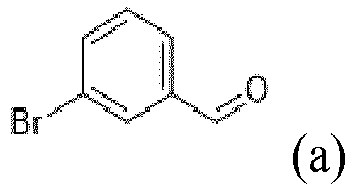


to prepare compound of formula (c)
- a step (ii): hydrogenating compound of formula (c) to prepare compound of formula (d)

- a step (iii): cyclizing of compound of formula (d) to prepare compound of formula (e)

- a step (iv): alkoxycarbonylating of compound of formula (e) to prepare compound (A5).
- Compound of formula (a) is also named as 3-bromobenzaldehyde.
- Compound of formula (b) maybe the compound named as (3-carboxypropyl)triphenylphosphonium bromide as detailed herein after.
- Compound of formula (c) is also named as 5-(3-bromophenyl)pent-4-enoic acid.
- Compound of formula (d) is also named as 5-(3-bromophenyl)pentanoic acid.
- Compound of formula (e) is also named as 2-bromo-6,7,8,9-tetrahydro-5H-benzo[7]annulen-5-one or 7-Bromo-1-benzosuberone.
- Herein is also provided a novel process for the preparation of compound (1) or one of its pharmaceutically acceptable salts

- Herein is further provided a process for preparing a compound (1) as defined above, further comprising the step of preparing a pharmaceutical composition containing such compound (1), with pharmaceutically acceptable excipients.
- The subsequent steps following the preparation of compound (A5) for preparing compound (1) and its pharmaceutically acceptable salts may be performed according to steps as disclosed in
WO 2017/140669 or any other suitable route of synthesis. - The process according to the present invention may also be used for preparing pharmaceutically acceptable salts of compound (1).
- In the context of the present invention, the term:
- "halogen" is understood to mean chlorine, fluorine, bromine, or iodine, and in particular denotes chlorine, fluorine or bromine, and more particularly a bromine atom,
- "(C1-Cx)alkyl" as used herein refers to a linear or branched C1-Cx alkyl, that may in particular be (C1-C3)alkyl or (C1-C6)alkyl. Examples are, but are not limited to, methyl, ethyl, n-propyl, isopropyl, n-butyl, tert-butyl, pentyl and the like, and
- "pharmaceutically acceptable" refers to those compounds, materials, excipients, compositions or dosage forms which are, within the scope of sound medical judgment, suitable for contact with the tissues of human beings and animals without excessive toxicity, irritation, allergic response or other problem complications commensurate with a reasonable benefit/risk ratio.
- Step (i) may be performed according to Wittig or Wittig-Horner conditions.
- According to a particular embodiment, step (i) may be carried out in the presence of a base. Said base may be selected from Li/Na/K alkoxides, and more particularly sodium methoxide, Li/Na/K bis(trimethylsilyl)amide (Li/Na/KHMDS), Li/Na/K diisopropylamide (Li/Na/K DA), NaH, tBuOK and n-BuLi and the like and may in particular be sodium methoxide.
- Still according to said particular embodiment, said step (i) may be carried out in a solvent, and more particularly an organic solvent which may be selected from tetrahydrofuran, methylated tetrahydrofuran, ethers such as dimethylether (DME), toluene, dimethyl sulfoxide (DMSO) and dichloromethane and the like, as well as their mixture, each of said solvent being optionally mixed with methanol, and may in particular be tetrahydrofuran optionally mixed with methanol.
- Step (i) may be carried out over a wide temperature range which does not cause side reactions, but may be carried out at a reaction temperature ranging from 0 °C to 70°C, in particular from 25°C to 65°C, and most particularly from 40 to 45°C.
- Step (i) may be carried out for 1 to 48 hours, in particular for 5 to 24 hours, and even more particularly for 8 to 12 hours.
- The molar ratio of the compound of formula (a) vs. the compound of formula (b) may in particular range between 0.5 and 1.25, in particular between 0.6 and 1.0, and more particularly between 0.7 and 0.9.
- Said step (i) may be followed by any purification step, in particular dedicated to remove triphenylphosphine oxide (Ph3P=O). The pH of the aqueous layer may be adjusted to about 1, for example with hydrochloric acid and said aqueous layer may then be extracted, for example with toluene. The obtained organic phase may then be washed, for example with a sodium chloride solution. During said step (i), solvents may be removed by additional distillation steps or concentration under reduced pressure.
- Compound of formula (b) may in particular be chosen from (3-carboxypropyl)triphenylphosphonium bromide of formula (b1)

- Compound of formula (b) may in particular be further selected from 4-(diethoxyphosphoryl)butanoic acid, 4-(dimethoxythiophosphoryl)butanoic acid and the like, in particular when used in the Wittig conditions.
- When step (i) is performed according to the Wittig-Horner reaction, i.e. implementing compounds of formula (b') and (b") as defined above, the obtained compounds having nitrile or ester groups can be hydro lyzed for forming the corresponding carboxylic acid derivative of formula (c).
- Compound of formula (b') and of formula (b") may in particular be chosen from (3-cyano)triphenylphosphonium bromide of formula (b'1)


- The previous reaction conditions in connection to the Wittig reaction as described above regarding time of reaction, temperature, molar ratio and further purification steps are equally applicable to the Wittig-Horner reaction.
- According to a particular embodiment, the hydrogenation step (ii) may be performed by using a reducing agent selected from hydrogen, formic acid and its salts (such as sodium formate, ammonium formate, triethylammonium formate, hydrazinium monoformate), alcohols (such as ethanol), amines, hydrocarbons, cyclic olefins (such as cyclohexene, cyclohexadiene), hydrazine, phosphinic acid and phosphinates, phosphorus acid and phosphites, hydrazine, hydrides of boron, aluminum, silicon and tin and diimide and the like, and in particular by using hydrogen.
- According to a particular embodiment, step (ii) may be carried out by using a catalyst, namely a metallic catalyst. Said catalyst may be selected from palladium on carbon (Pd/C), platinum on carbon (Pt/C), Raney nickel (Ni), Rhodium on carbon (Rh/C), platinum dioxide and more particularly platinum dioxide anhydrous (PtO2), palladium hydroxide (Pd(OH)2), calcium palladium carbonate (Pd/CaCO3), Rhodium bis(triphenylphosphine) chloride ((PPh3)2RhCl), palladium on activated alumina (Pd/Al2O3) and rhodium on activated alumina (Rh/Al2O3) and the like, and is in particular platinum on carbon.
- Still according to said particular embodiment, said step (ii) may be carried out in a solvent, and more particularly an organic solvent which may be selected from toluene, xylene, ethyl acetate, alcohols, tetrahydrofuran, 2-methyltetrahydrofuran, methyl t-butyl ether, dichloromethane, and acetic acid and the like, and is in particular toluene.
- Step (ii) may be carried out under inert atmosphere, and in particular under nitrogen atmosphere. The hydrogenation may be performed under pressure, and in particular between 0.5 and 7.0 kg/cm2, more particularly between 2.0 and 5.0 kg/cm2 and even more particularly between 3.0 and 3.5 kg/cm2 (2.94x10⁵ Pa and 3.44x10⁵ Pa).
- Step (ii) may be carried out over a wide temperature range which does not cause side reactions but may be carried out at a reaction temperature ranging from 0 °C to reflux temperature, in particular from 10°C to 50°C, and most particularly at ambient temperature.
- Step (ii) may be carried out, in particular under hydrogen pressure, for 1 to 48 hours, in particular for 5 to 24 hours, and even more particularly for 11 to 13 hours.
- Said step (ii) may be followed by any purification step.
- The catalyst may for example be removed, in particular by filtration on Celite, filtration on silica, filtration on cellulose pads or asbestos pad and the like.
- During said step (ii), solvents may be removed by concentration under reduced pressure.
- According to a particular embodiment, cyclization step (iii) may be carried out under intra-molecular cyclization via a first stage also named as activation stage with an activating agent, for example with the corresponding acid chloride and the like, and in particular thionyl chloride (SOCl2) and via a second stage, also named Friedel-Craft's acylation.
- Under such intra-molecular cyclization conditions, according to a particular embodiment, the activating agent used during the first stage of step (iii) may be selected from thionyl chloride, oxalyl chloride, phosphorus pentachloride (PCl5) and trifluoroacetic anhydride (TFAA) and the like, and may in particular be thionyl chloride.
- Said first stage of step (iii) may be carried out over a wide temperature range which does not cause side reactions, but may be carried out at a reaction temperature ranging from 0°C to reflux temperature, in particular from 15°C to 50°C, and most particularly at ambient temperature. Said first stage of (ii) may further be carried out for 15 min. to 10 hours, in particular for 30 min. to 5 hours, and even more particularly for 1 to 3 hours.
- Still according to said particular embodiment, said first stage of step (iii) may be carried out with or without a solvent, and more particularly an organic solvent which may be selected from dichloromethane, chlorobenzene, toluene, dichloroethane, and the like, and is in particular dichloromethane.
- Under such intra-molecular cyclization conditions, the second stage of step (iii) may be carried out in the presence of a catalyst. Said catalyst may be selected from aluminum chloride, FeCl3, InCl3, GaCl3, ZnCl2, CuCl2, NiCl2 gallium triflate, tin tetrachloride (SnCl4), boron trifluoride (BF3), boron tribromide (BBr3), boron trichloride (BCl3) and Tris(pentafluorophenyl)borane and the like and is in particular aluminum chloride.
- Still according to said particular embodiment, said second stage of step (iii) may be carried out in a solvent, and more particularly an organic solvent which may be selected from dichloromethane, chlorobenzene, toluene, dichloroethane, and the like, and is in particular dichloromethane.
- Still under such intra-molecular cyclization conditions, according to a particular embodiment, said second stage of step (iii) may be carried out over a wide temperature range which does not cause side reactions, but may be carried out at a reaction temperature ranging from 0°C to reflux temperature, in particular from 5°C to 30°C, and most particularly from 10 to 15°C. Said second stage of (ii) may further be carried out for 15 minutes to 10 hours, in particular for 30 minutes to 5 hours, and even more particularly for 1 to 3 hours.
- Cyclization step (iii) may alternatively be performed according to any known conditions for achieving such a cyclization.
- Thus, according to another particular embodiment, cyclization of compound of formula (d) can also be performed in one stage by direct cyclization of the carboxylic acid. Said direct cyclization step may be performed by using either polyphosphoric acid or TFAA by using additives such as phosphoric acid, trifluoroacetic acid, acetic acid and the like.Under such condition, the following reagents may then more particularly be used: polyphosphoric acid (PPA)/chlorobenzene, P2O5/H3PO4, methanesulfonic acid/P2O5 (Eaton's reagent), trifluoromethanesulfonic acid or trifluoroacetic acid (TFA)/trifluoroacetic anhydride (TFAA) and the like.
- Said step (iii) may be followed by any purification step. The pH of the aqueous layer obtained after the second stage as described above may be adjusted, for example by adding hydrochloric acid and said aqueous layer may then be extracted, for example with dichloromethane. The obtained organic phase may then be washed, for example with a saturated bicarbonate solution and/or with saturated sodium chloride solution and the like. During said step (iii), solvents may be removed by additional distillation steps or concentration under reduced pressure.
- According to a particular embodiment, step (iv) may be carried out by using a catalyst. Said catalyst may be selected from a palladium catalyst, and namely Pd(OAc)2, 1,1'-bis(diphenylphosphino)ferrocene]dichloropalladium(II) (PdCl2dppf), tetrakis(triphenylphosphine)palladium(0) (PdP(Ph3)4), PdCl2/binaphtyl ligand and Pd(OAc)2/bis-diphenylphosphinopropane and the like. The catalyst is in particular Pd(OAc)2.
- According to a particular embodiment, step (iv) may be carried out by using a ligand such as tertiary phosphines. Said ligand may be selected from Xantphos, P(t-Bu)3.HBF4, 1,2-bis(diphenylphosphino)-ethane (dppe), 1,3-bis(diphenylphosphino)propane (dppp), bis(diphenylphosphino)xylene (dppx), (S)-2,2'-bis(diphenylphosphino)-1,1'-binaphtyle ((S)-BINAP), 2,2'-bis[di-phenylphosphino]methyl-1,1'-biphenyl (BISBI), bis[(2-diphenylphosphino)phenyl] ether (DPEPhos), 1,1'-ferrocenediyl-bis(diphenylphosphine) (dppf), tri(o-tolyl)phosphine and the like.
- According to another embodiment, said second stage of step (iv) may be carried out in a solvent, and more particularly an organic solvent which may be selected from methanol, N,N-dimethylformamide (DMF), ethyl acetate (AcOEt); acetonitrile, dimethyl sulfoxide (DMSO), acetonitrile, tetrahydrofuran and dichloromethane and the like, and is in particular methanol.
- A base may be used for caring out step (iv), which may be selected from triethylamine (Et3N), N,N-dicyclohexylmethylamine, carbonates, alkoxides, acetates and a Hünig base and the like. Said base may in particular be triethylamine.
- Step (iv) may be performed under carbon monoxide or in presence of any alternative liquid or solid carbon monoxide (CO) sources. As liquid or solid carbon monoxide (CO) source, oxalate derivatives such as dialkyl oxalates, oxalate monoester salts, formate derivatives may be cited such as methyl formate, N-formyl-saccharine, trichlorophenyl formate or hydroxysuccinimide formate. Step (iv) may be performed under pressure, and in particular between 1.0 and 7.0 kg/cm2, more particularly between 2.0 and 5.0 kg/cm2 and even more particularly between 3.0 and 3.5 kg/cm2 (2.94x10⁵ Pa and 3.44x10⁵ Pa).
- According to a particular embodiment, said step (iv) may be carried out over a wide temperature range which does not cause side reactions, but may be carried out at a reaction temperature ranging from 20°C to 100°C, in particular from 40°C to 85°C, and most particularly from 60 to 70°C. Said step (iv) may further be carried out for 1 to 48 hours, in particular for 3 to 24 hours, and even more particularly for 5 to 7 hours.
- Hereinafter, the present invention will be described in more details, with reference to the following examples. These examples are provided to illustrate the present invention and should not be construed as limiting the scope and spirit of the present invention.
- The 1H NMR spectra are recorded on a Bruker Avance 400 spectrometer, with the chemical shifts (δ in ppm) using the solvent either CDCl3 referenced at 7.28 ppm or DMSO-d6 referenced at 2.54 ppm at a temperature of 295 K.
- The liquid chromatography data are obtained on an Agilent UPLC instrument equipped with a Photo Diode Array (PDA) detector. The analysis is carried out on Waters X-select C18, 150 x 4.6 mm, 3.5 µm column. Mobile phase A consists of 0.1% trifluoroacetic acid in water and Mobile phase B consists of 0.1% trifluoroacetic acid in acetonitrile : Methanol (90 : 10). Program gradient elution (T/% B =0.01/5, 6/30, 12/60, 16/90, 34/90, 35/5, 40/5) is used with UV detection at 210 nm at a flow rate of 1.0 mL per min. The column temperature is maintained at ambient conditions. The data is recorded using Waters Empower software [Run time - 40 min].
- Purity by HPLC as reported herein after is expressed as percentage area (a/a).
-

- To a solution of (3-carboxypropyl)triphenylphosphonium bromide (b) (139.1 g, 0.324 mol.) in THF (300 mL), was added sodium methoxide (62.5 g, 1.157 mol.) followed by a solution of 3-bromobenzaldehyde (a) (50.0 g, 0.270 mol.) in THF (100 mL) at 40 to 45 °C. The reaction mixture turned pink and was stirred at 40 to 45 °C for 10 hours. After completion of the reaction, the mixture was allowed to room temperature, quenched with water (600 mL), solvent (THF) was removed by distillation and the resulted aqueous layer was washed with dichloromethane (CH2Cl2) (3 x 250 mL) to remove triphenylphosphine oxide (Ph3P=O). The pH of the aqueous layer is adjusted to ∼1 using 6.0 N hydrochloric acid solution and extracted with toluene (3 x 250 mL). Gathered organic phases were washed with saturated sodium chloride solution (250 mL) and solvent was concentrated under reduced pressure. The obtained material was proceeded to next stage without any further purification (62.5 g, Yield: 90.0%, Purity by HPLC: 99.0% a/a including both the isomers). 1H NMR (400 MHz, CDCl3): δ 11.15 (br s,1H), 7.48 (s, 1H), 7.32-7.34 (d, J= 6.15 Hz, 1H), 7.23-7.25 (d, J= 6.67 Hz, 1H), 7.14-7.17 (t, J= 7.12 Hz, 1H), 6.35-6.39 (m, 1H), 6.19-6.23 (m, 1H), 2.47-2.64 (m, 4H) ppm.
-

- The reaction was carried out in a 2.0 L stainless steel autoclave equipped with a mechanical stirrer. The reagents were charged under nitrogen atmosphere in the following order: Toluene (500 mL), 5-(3-bromophenyl)pent-4-enoic acid (c) (50 g, 0.196 mol.) and 10% Pd/C (50% wet, 5.0 g, 10% w/w). The air in the autoclave was replaced with nitrogen followed by hydrogen and the hydrogen pressure adjusted to 3.0 to 3.5 kg/cm2. The mixture was stirred for 12 hours at room temperature by maintaining the hydrogen pressure at 3.0 to 3.5 kg/cm2. The catalyst was removed by filtration over Celite and the solvent was concentrated under reduced pressure to give 5-(3-bromophenyl)pentanoic acid (48.5 g, Yield: 96%, Purity by HPLC: 96% a/a). 1H NMR (400 MHz, DMSO-d6): δ 12.0 (br s, 1H), 7.36-7.41 (m, 2H), 7.17- 7.26 (m, 2H), 2.56-2.60 (t, 2H), 2.21-2.25 (t, 2H), 1.46-1.6 (m, 4H) ppm.
-

- To a solution of 5-(3-bromophenyl)pentanoic acid (d) (100 g, 0.388 mol.) in dichloromethane (CH2Cl2) (800 mL), was added thionyl chloride (SOCl2) (92.54 g, 0.778 mol.) and stirred for 2 hours at room temperature. After completion of reaction, the mixture was concentrated under reduced pressure at below 45 °C. The resulted residue was dissolved in dichloromethane (CH2Cl2) (300 mL) and was slowly added to a precooled mixture of aluminum chloride (77.8 g, 0.583 mol.) in dichloromethane (CH2Cl2) (250 mL) at below 15 °C and stirred for 2 hours at 10 to 15 °C. The mixture was quenched into 1.0 N hydrochloric acid solution (1000 mL), organic layer was separated and resulted aqueous layer was extracted with dichloromethane (CH2Cl2) (500 mL). The combined organic layer was washed sequentially with water (500 mL), saturated bicarbonate solution (500 mL) and finally with saturated sodium chloride solution (500 mL). The solvent was concentrated under reduced pressure to obtain 7-bromo-1-benzosuberone as a brown solid. (91.5 g, Yield: 98%, Purity by HPLC: 90% a/a).1H NMR (400 MHz, CDCl3): 7.58-7.61 (d, J = 8.3 Hz, 1H), 7.43-7.45 (d, J = 8.2 Hz, 1H), 7.38-7.39 (d, J=1.8 Hz, 1H), 2.88-2.91 (t, J = 6.0 Hz, 2H), 2.71-2.74 (t, J = 6.2 Hz, 2H), 1.77-1.92 (m, 4H) ppm.
-
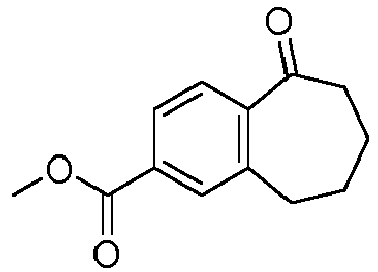
- The reaction was carried out in a 2.0 L stainless steel autoclave equipped with a mechanical stirrer. The reagents were charged in the following order: methanol (500 mL), 7-bromo-1-benzosuberone (e) (100 g, 0.418 mol.), Xantphos (4.8 g, 8.3 mmol.), Pd(OAc)2 (1.3 g, 5.8 mmol.) and Et3N (63.47 g, 0.627 mol.). The air in the autoclave was replaced with carbon monoxide and the pressure adjusted to 3.0 to 3.5 kg/cm2. The mixture is heated to 65 to 70 °C by maintaining the carbon monoxide pressure at 3.0 to 3.5 kg/cm2 for 6 hours. After completion of the reaction, the mixture was allowed to room temperature, filtered over Celite and the solvent was concentrated under reduced pressure. The obtained residue was triturated with water (500 mL) followed by heptane (400 mL) at room temperature to afford methyl 1-benzosuberone-7-carboxylate as a yellow colored solid (59.6 g, Yield: 65%, Purity by HPLC: 99.5% a/a). 1H NMR (400 MHz, CDCl3): δ 7.93-7.96 (m, 1H), 7.89 (s, 1H), 7.73-7.75 (d, J=7.9, 1H), 3.94 (s, 3H), 2.96-3.0 (m, 2H), 2.74-2.77 (m, 2H), 1.87-1.94 (m, 2H),1.79-1.85 (m,2H) ppm.
Claims (16)
- A process for preparing compound (A5)


- The process according to claim 1, characterized in that compound of formula (e) is prepared by cyclizing of compound of formula (d)

- The process according to claim 2, characterized in that compound of formula (d) is prepared by hydrogenating compound of formula (c)

- The process according to claim 3, characterized in that compound of formula (c) is prepared by reacting a compound of formula (a)


- The process for preparing compound (A5) according to claim 1, characterized in that it comprises:- a step (i): reacting a compound of formula (a)


to prepare compound of formula (c)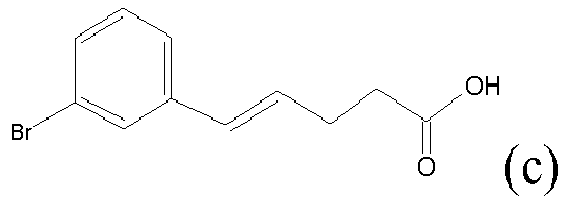 - a step (ii): hydrogenating compound of formula (c) to prepare compound of formula (d)
 - a step (iii): cyclizing of compound of formula (d) to prepare compound of formula (e)
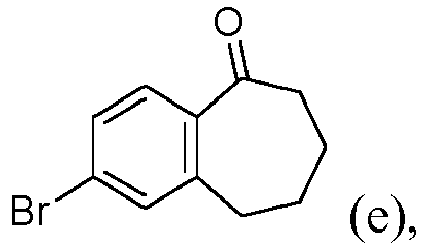 - a step (iv): alkoxycarbonylating of compound of formula (e) to prepare compound (A5).
 - The process according to anyone of the preceding claims, characterized in that the alkoxycarbonylation or step (iv) as defined in claim 5 is carried out by using a catalyst, which catalyst may be selected from a palladium catalyst, in particular selected from Pd(OAc)2, 1,1'-bis(diphenylphosphino)ferrocene]dichloropalladium(II), tetrakis(triphenylphosphine)palladium(0), PdCl2/binaphtyl ligand and Pd(OAc)2/bis-diphenylphosphinopropane, and more particularly is Pd(OAc)2.
- The process according to anyone of the preceding claims, characterized in that the alkoxycarbonylation or step (iv) as defined in claim 5 is carried by using a ligand, which ligand may be Xantphos, P(t-Bu)3.HBF4, 1,2-bis(diphenylphosphino)-ethane, 1,3-bis(diphenylphosphino)propane, bis(diphenylphosphino)xylene, (S)-2,2'-bis(diphenylphosphino)-1,1'-binaphtyle, 2,2'-bis[di-phenylphosphino]methyl-1,1'-biphenyl, bis[(2-diphenylphosphino)phenyl] ether, tri(o-tolyl)phosphine or 1,1'-ferrocenediyl-bis(diphenylphosphine).
- The process according to anyone of the preceding claims, characterized in that the alkoxycarbonylation or step (iv) as defined in claim 5 is carried out by using a base, which base may be selected from triethylamine, N,N-dicyclohexylmethylamine, carbonates, alkoxides, acetates and a Hünig base, and is in particular triethylamine.
- The process according to anyone of claims 2 to 8, characterized in that the cyclization or step (iii) as defined in claim 5 is carried out in a first activation stage with an activating agent, which may be selected from thionyl chloride, oxalyl chloride; phosphorus pentachloride and trifluoroacetic anhydride, and may in particular be thionyl chloride and in a second stage in the presence of a catalyst which catalyst may be selected from aluminum chloride, FeCl3, InCl3, GaCl3, ZnCl2, CuCl2, NiCl2, gallium triflate, tin tetrachloride, boron trifluoride, boron tribromide, boron trichloride and Tris(pentafluorophenyl)borane, and is in particular aluminum chloride.
- The process according to anyone of claims 3 to 9, characterized in that the hydrogenation or step (ii) as defined in claim 5 is performed by using a reducing agent selected from hydrogen; formic acid and its salts, such as sodium formate, ammonium formate, triethylammonium formate, hydrazinium mono formate; alcohols, such as ethanol; amines; hydrocarbons; cyclic olefins, such as cyclohexene, cyclohexadiene; hydrazine, phosphinic acid and phosphinates; phosphorus acid and phosphites; hydrazine; hydrides of boron; aluminum; silicon and tin and diimide and in particular by using hydrogen.
- The process according to anyone of claims 3 to 10, characterized in that the hydrogenation or step (ii) as defined in claim 5 is carried out by using a catalyst which may be selected from palladium on carbon, platinum on carbon, Raney nickel, Rhodium on carbon, platinum dioxide and more particularly platinum dioxide anhydrous, palladium hydroxide, calcium palladium carbonate, Rhodium bis(triphenylphosphine) chloride, palladium on activated alumina and rhodium on activated alumina, and is in particular platinum on carbon.
- The process according to claim 4 or 5, characterized in that the reaction of compound of formula (a) with compound of formula (b), (b') or (b") as defined in claim 4 or step (i) as defined in claim 5 is carried out in the presence of a base which may be selected from Li/Na/K alkoxides, and more particularly sodium methoxide, Li/Na/K bis(trimethylsilyl)amide, Li/Na/K diisopropylamide, NaH, tBuOK and n-BuLi and is in particular sodium methoxide.
- The process according to anyone of claim 4, 5 or 12, characterized in that the reaction of compound of formula (a) with compound of formula (b), (b') or (b") as defined in claim 4 or step (i) as defined in claim 5 is carried out in a solvent, and more particularly an organic solvent which may be selected from tetrahydrofuran, ethers such as dimethylether, methylated tetrahydrofuran, toluene, dimethyl sulfoxide and dichloromethane as well as their mixture, each of said solvent being optionally mixed with methanol, and may in particular be tetrahydrofuran optionally mixed with methanol.
- The process according to anyone of claim 4, 5, 12 or 13, characterized in that compound of formula (b) as defined in claim 4 is selected from (3-carboxypropyl)triphenylphosphonium bromide, 4-(diethoxyphosphoryl)butanoic acid, 4-(dimethoxythiophosphoryl)butanoic acid, compound of formula (b') as defined in claim 4 is (3-cyano)triphenylphosphonium bromide and compound of formula (b") as defined in claim 4 is

- A process for the preparation of compound (1) or one of its pharmaceutically acceptable salts

- The process for preparing a compound (1) according to the preceding claims, further comprising the step of preparing a pharmaceutical composition containing such compound (1), with pharmaceutically acceptable excipients.
Priority Applications (1)
| Application Number | Priority Date | Filing Date | Title |
|---|---|---|---|
| EP19305216.4A EP3699167A1 (en) | 2019-02-22 | 2019-02-22 | Process for preparing methyl 1-benzosuberone-7-carboxylate |
Applications Claiming Priority (1)
| Application Number | Priority Date | Filing Date | Title |
|---|---|---|---|
| EP19305216.4A EP3699167A1 (en) | 2019-02-22 | 2019-02-22 | Process for preparing methyl 1-benzosuberone-7-carboxylate |
Publications (1)
| Publication Number | Publication Date |
|---|---|
| EP3699167A1 true EP3699167A1 (en) | 2020-08-26 |
Family
ID=65766928
Family Applications (1)
| Application Number | Title | Priority Date | Filing Date |
|---|---|---|---|
| EP19305216.4A Withdrawn EP3699167A1 (en) | 2019-02-22 | 2019-02-22 | Process for preparing methyl 1-benzosuberone-7-carboxylate |
Country Status (1)
| Country | Link |
|---|---|
| EP (1) | EP3699167A1 (en) |
Cited By (2)
| Publication number | Priority date | Publication date | Assignee | Title |
|---|---|---|---|---|
| CN114031494A (en) * | 2021-11-01 | 2022-02-11 | 华东师范大学 | Method for preparing carboxylic acid by catalyzing reaction of unsaturated hydrocarbon and formic acid by using catalyst containing noble metal compound |
| US12558428B2 (en) | 2024-03-08 | 2026-02-24 | Halda Therapeutics Opco, Inc. | Heterobifunctional compounds and their use in treating disease |
Citations (2)
| Publication number | Priority date | Publication date | Assignee | Title |
|---|---|---|---|---|
| WO2012151137A1 (en) * | 2011-05-04 | 2012-11-08 | Merck Sharp & Dohme Corp. | Amino-pyridine-containing spleen tyrosine kinase (syk) inhibitors |
| US9714221B1 (en) * | 2016-02-15 | 2017-07-25 | Sanofi | Substituted 6,7-dihydro-5H-benzo[7]annulene compounds, processes for their preparation and therapeutic uses thereof |
-
2019
- 2019-02-22 EP EP19305216.4A patent/EP3699167A1/en not_active Withdrawn
Patent Citations (3)
| Publication number | Priority date | Publication date | Assignee | Title |
|---|---|---|---|---|
| WO2012151137A1 (en) * | 2011-05-04 | 2012-11-08 | Merck Sharp & Dohme Corp. | Amino-pyridine-containing spleen tyrosine kinase (syk) inhibitors |
| US9714221B1 (en) * | 2016-02-15 | 2017-07-25 | Sanofi | Substituted 6,7-dihydro-5H-benzo[7]annulene compounds, processes for their preparation and therapeutic uses thereof |
| WO2017140669A1 (en) | 2016-02-15 | 2017-08-24 | Sanofi | 6,7-dihydro-5h-benzo[7]annulene derivatives as estrogen receptor modulators |
Non-Patent Citations (2)
| Title |
|---|
| GABRIELE MURINEDDU ET AL: "Tricyclic Pyrazoles. 3. Synthesis, Biological Evaluation, and Molecular Modeling of Analogues of the Cannabinoid Antagonist 8-Chloro-1-(2',4'-dichlorophenyl)- N -piperidin-1-yl-1,4,5,6- tetrahydrobenzo[6,7]cyclohepta[1,2- c ]pyrazole-3-carboxamide", JOURNAL OF MEDICINAL CHEMISTRY, vol. 48, no. 23, 2005, US, pages 7351 - 7362, XP055596434, ISSN: 0022-2623, DOI: 10.1021/jm050317f * |
| THORAYA A. FARGHALY, SOBHI M. GOMHA, KAMAL M. DAWOOD, MOHAMED R. SHAABAN: "Synthetic routes to benzosuberone-based fused- and spiro-heterocyclic ring systems", ROYAL SOCIETY OF CHEMISTRY ADVANCES, vol. 6, 2016, pages 17955 - 17979, XP002792300, DOI: 10.1039/c5ra26474j * |
Cited By (3)
| Publication number | Priority date | Publication date | Assignee | Title |
|---|---|---|---|---|
| CN114031494A (en) * | 2021-11-01 | 2022-02-11 | 华东师范大学 | Method for preparing carboxylic acid by catalyzing reaction of unsaturated hydrocarbon and formic acid by using catalyst containing noble metal compound |
| CN114031494B (en) * | 2021-11-01 | 2024-03-26 | 华东师范大学 | Method for preparing carboxylic acid by catalyzing unsaturated hydrocarbon and formic acid to react by using catalyst containing noble metal compound |
| US12558428B2 (en) | 2024-03-08 | 2026-02-24 | Halda Therapeutics Opco, Inc. | Heterobifunctional compounds and their use in treating disease |
Similar Documents
| Publication | Publication Date | Title |
|---|---|---|
| CN101279899B (en) | Preparation method of 2-[2-(3-methoxyphenyl)ethyl]phenol | |
| EP2519100B1 (en) | Intermediate compounds and processes for the preparation of tapentadol and related compounds | |
| KR100341258B1 (en) | New bisphosphine for asymmetric hydrogenation catalyst | |
| RU2371429C2 (en) | Method of producing glycol aldehyde | |
| EP3712130B1 (en) | Method for synthesis of roxadustat and intermediate compounds thereof | |
| KR101593708B1 (en) | Halogenated Analogues Of Anti-fibrotic Agents | |
| Dumond et al. | Palladium-catalyzed cross-coupling reaction of anilinium hypophosphite with alkenyl bromides and triflates: application to the synthesis of GABA analogs | |
| EP3699167A1 (en) | Process for preparing methyl 1-benzosuberone-7-carboxylate | |
| US9376365B2 (en) | Hydrocarbonylation or methoxycarbonylation of 1,3-diene derivatives with palladium complex | |
| KR100929514B1 (en) | Process for preparing diphosphine compound and intermediates for the method | |
| KR20220140556A (en) | Method for the synthesis of S-beflubutamide using asymmetric hydrogenation | |
| CN112004795A (en) | Process for preparing 2, 6-dialkylphenylacetic acid | |
| EP2762467B1 (en) | Method for producing an optically active 2-arylpiperidinium salt | |
| US20020188130A1 (en) | Alpha, alpha-dibromo-alpha-chloro-acetophenones as synthons | |
| JP5023683B2 (en) | Process for producing benzofluorene derivative and intermediate thereof | |
| JP3268459B2 (en) | Method for producing acetophenones | |
| JPH11279185A (en) | Bis(trifluoromethyl)phenylphosphonic acid compound and its production | |
| JPWO2009081872A1 (en) | Process for producing 6-halogeno-3-arylpyridine derivatives | |
| JPWO2016021711A1 (en) | Method for producing amino acid derivative | |
| KR100911357B1 (en) | Method for preparing α-keto cyanophosphorane from carbonyl compound | |
| JPH0873403A (en) | Method for producing halogen-substituted benzoic acid | |
| KR20150083864A (en) | Process for the preparation of 2-trifluoromethyl isonicotinic acid and esters | |
| KR101631513B1 (en) | Novel benzo[d][1,2]oxaphosphorine derivatives and its synthetic method | |
| KR20070034076A (en) | Method for preparing asymmetric substituted biaryldiphosphine | |
| JP3605732B2 (en) | Method for producing pyromellitic acid derivative |
Legal Events
| Date | Code | Title | Description |
|---|---|---|---|
| PUAI | Public reference made under article 153(3) epc to a published international application that has entered the european phase |
Free format text: ORIGINAL CODE: 0009012 |
|
| STAA | Information on the status of an ep patent application or granted ep patent |
Free format text: STATUS: THE APPLICATION HAS BEEN PUBLISHED |
|
| AK | Designated contracting states |
Kind code of ref document: A1 Designated state(s): AL AT BE BG CH CY CZ DE DK EE ES FI FR GB GR HR HU IE IS IT LI LT LU LV MC MK MT NL NO PL PT RO RS SE SI SK SM TR |
|
| AX | Request for extension of the european patent |
Extension state: BA ME |
|
| STAA | Information on the status of an ep patent application or granted ep patent |
Free format text: STATUS: THE APPLICATION IS DEEMED TO BE WITHDRAWN |
|
| 18D | Application deemed to be withdrawn |
Effective date: 20210227 |