EP3696704A1 - Pseudo-data generating device, method and program - Google Patents
Pseudo-data generating device, method and program Download PDFInfo
- Publication number
- EP3696704A1 EP3696704A1 EP18865739.9A EP18865739A EP3696704A1 EP 3696704 A1 EP3696704 A1 EP 3696704A1 EP 18865739 A EP18865739 A EP 18865739A EP 3696704 A1 EP3696704 A1 EP 3696704A1
- Authority
- EP
- European Patent Office
- Prior art keywords
- value
- synthetic data
- attribute
- numerical
- data
- Prior art date
- Legal status (The legal status is an assumption and is not a legal conclusion. Google has not performed a legal analysis and makes no representation as to the accuracy of the status listed.)
- Granted
Links
Images



Classifications
-
- G—PHYSICS
- G06—COMPUTING OR CALCULATING; COUNTING
- G06F—ELECTRIC DIGITAL DATA PROCESSING
- G06F21/00—Security arrangements for protecting computers, components thereof, programs or data against unauthorised activity
- G06F21/60—Protecting data
- G06F21/62—Protecting access to data via a platform, e.g. using keys or access control rules
- G06F21/6218—Protecting access to data via a platform, e.g. using keys or access control rules to a system of files or objects, e.g. local or distributed file system or database
- G06F21/6245—Protecting personal data, e.g. for financial or medical purposes
- G06F21/6254—Protecting personal data, e.g. for financial or medical purposes by anonymising data, e.g. decorrelating personal data from the owner's identification
-
- G—PHYSICS
- G06—COMPUTING OR CALCULATING; COUNTING
- G06F—ELECTRIC DIGITAL DATA PROCESSING
- G06F16/00—Information retrieval; Database structures therefor; File system structures therefor
- G06F16/20—Information retrieval; Database structures therefor; File system structures therefor of structured data, e.g. relational data
- G06F16/25—Integrating or interfacing systems involving database management systems
- G06F16/258—Data format conversion from or to a database
-
- G—PHYSICS
- G06—COMPUTING OR CALCULATING; COUNTING
- G06F—ELECTRIC DIGITAL DATA PROCESSING
- G06F16/00—Information retrieval; Database structures therefor; File system structures therefor
- G06F16/20—Information retrieval; Database structures therefor; File system structures therefor of structured data, e.g. relational data
- G06F16/28—Databases characterised by their database models, e.g. relational or object models
- G06F16/284—Relational databases
- G06F16/285—Clustering or classification
Definitions
- the present invention relates to synthetic data generation techniques.
- synthetic data as a substitute for personal information can be generated for analysis and the like when original data containing personal information cannot be handled due to concerns about security and the like.
- An example of data in tabular format is shown in Fig. 1 .
- the data in tabular format is regarded as a matrix, and a row vector is called a record and a column vector is called an attribute.
- the original data and synthetic data can be different in the number of rows but are the same in the number of columns.
- the number of rows of the original data is assumed to be n > 0 and the number of rows of the synthetic data is assumed to be n' > 0. Assume that only character strings are stored in the original data and the synthetic data.
- Data in tabular format such as the one shown in Fig. 1 can contain numerical attributes such as age, height, and weight, and category attributes such as occupation, educational background, and blood type.
- numerical attributes such as age, height, and weight
- category attributes such as occupation, educational background, and blood type.
- one conventional way to generate synthetic data is to format random numbers so that they can maintain relationships (such as variance-covariance and correlation) among the attributes in the original data.
- a known method of generating synthetic data that maintains the relationships among all the attributes of original data containing numerical attributes and category attributes is Non-patent Literature 1.
- Non-patent Literature 1 all the sets of categories existing in the original data are numerated, synthetic data that maintains the natures of the numerical attributes in the original data is generated for each set of categories, and the generated synthetic data are integrated, thereby maintaining the natures among the attributes in the original data as a whole.
- Non-patent Literature 1 National Statics Center, "Development and Utilization of Educational Synthetic Microdata - Citing 2004 National Survey of Family Income and Expenditure -", 2012.
- An object of the present invention is to provide a synthetic data generation apparatus, a method for the same, and a program for generating synthetic data that maintains the relationships among all the attributes in the original data containing category attributes, also for synthetic data containing category attributes with a similar efficiency to that for synthetic data containing only numerical attributes.
- a synthetic data generation apparatus includes: a coding unit that codes a value of each of category attributes contained in original data into a value of a numerical attribute in accordance with a coding rule; a data formatting unit that generates first synthetic data from the original data after coding using a synthetic data generation method for numerical attributes; a conversion unit that, if the value of the numerical attribute which is contained in the first synthetic data and corresponds to the value of one of the category attributes exceeds a range of values that can be assumed by the value of that numerical attribute, converts the value of that numerical attribute to a value included in the range of values that can be assumed by the value of that numerical attribute; and a decoding unit that decodes the value of the numerical attribute which is contained in the first synthetic data after conversion and corresponds to the value of one of the category attributes to the value of that category attribute in accordance with the coding rule to obtain synthetic data.
- a synthetic data generation method for execution by a synthetic data generation apparatus includes: a coding step of coding a value of each of category attributes contained in original data into a value of a numerical attribute in accordance with a coding rule; a data formatting step of generating first synthetic data from the original data after coding using a synthetic data generation method for numerical attributes; a conversion step of, if the value of the numerical attribute which is contained in the first synthetic data and corresponds to the value of one of the category attributes exceeds a range of values that can be assumed by the value of that numerical attribute, converting the value of that numerical attribute to a value included in the range of values that can be assumed by the value of that numerical attribute; and a decoding step of decoding the value of the numerical attribute which is contained in the first synthetic data after conversion and corresponds to the value of one of the category attributes to the value of that category attribute in accordance with the coding rule to obtain synthetic data.
- the present invention has an effect of being able to generate synthetic data that maintains the relationships among all the attributes in the original data containing category attributes, also for synthetic data containing category attributes with a similar efficiency to that for synthetic data containing only numerical attributes.
- a category attribute is converted to a numerical attribute by coding (for example, binarization).
- the category attributes of original data are coded so that the original data is converted to a table having only numerical attributes.
- synthetic data only with numerical attributes is generated by a certain synthetic data generation method for numerical attributes.
- synthetic data containing the category attributes is generated. In this way, only one operation is required to generate synthetic data with high computational complexity.
- generation of synthetic data can be performed efficiently even with a larger number of sets of categories. In other words, the efficiency of calculation is improved because processing for maintaining natures among attributes can be done at a time.
- Fig. 2 shows a functional block diagram of a synthetic data generation apparatus according to a first embodiment
- Fig. 3 shows a processing flow of the apparatus.
- the synthetic data generation apparatus includes a coding unit 110, a coding rule storage 120, a data formatting unit 130, a conversion unit 140, and a decoding unit 150.
- the synthetic data generation apparatus is a special device configured by loading of a special program into a well-known or a dedicated computer having a central processing unit (CPU), main storage unit (random access memory: RAM) and the like, for example.
- the synthetic data generation apparatus executes various kinds of processing under control of the central processing unit, for example.
- Data input to the synthetic data generation apparatus and data resulting from processing are stored in the main storage unit, for example, and the data stored in the main storage unit is read into the central processing unit and utilized for other processing as necessary.
- the processing components of the synthetic data generation apparatus may be at least partially composed of hardware such as an integrated circuit.
- Storages of the synthetic data generation apparatus can include the main storage unit such as random access memory (RAM), auxiliary storage unit composed of a hard disk, an optical disk, or a semiconductor memory device such as flash memory, or middleware such as a relational database or a key value store, for example.
- RAM random access memory
- auxiliary storage unit composed of a hard disk, an optical disk, or a semiconductor memory device such as flash memory
- middleware such as a relational database or a key value store, for example.
- the synthetic data generation apparatus takes, as input, original data D and the number of records n' which is contained in synthetic data to be generated, and generates and outputs synthetic data D'.
- the synthetic data D' is generated so that a histogram and a two-dimensional cross-tabulation table for each attribute in the original data and a histogram and a two-dimensional cross-tabulation table for the attribute in the synthetic data approximate each other.
- the accuracy of approximation is related to the magnitude of the number of records n' contained in the synthetic data: the accuracy of approximation tends to be higher as n' is greater.
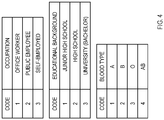
- the coding rule storage 120 stores a coding rule.
- Fig. 4 shows an example of the coding rule.
- the coding rule indicates correspondence between a code and the value of a category attribute.
- the coding unit 110 codes the value of each category attribute contained in the original data D into a value of a numerical attribute in accordance with a coding rule (see Fig. 4 , for instance) (converts it into a numerical vector) (S110), and outputs original data X after coding.
- Fig. 5 shows an example of the original data before coding and the original data after coding.
- the values of all the category attributes in the original data D are converted to numerical vectors by a known 1-of-K coding method and the converted original data X is output.
- the 1-of-K coding method includes the following four types. For the sake of convenience, they are described as coding methods A, B, C, and D here.
- the finally obtained result of synthetic data D' varies depending on the method used, so a method by which synthetic data D' can be made more approximate to the original data D is used in the present technique.
- the coding method D is used in Fig. 4 .
- the data formatting unit 130 generates first synthetic data Y containing a desired number of records n' from the original data X after coding using a synthetic data generation method for numerical attributes (S130) and outputs it.
- a synthetic data generation method for numerical attributes various known techniques can be utilized. For example, a method described in Reference Literature 1 or Reference Literature 2 can be utilized.
- the conversion unit 140 converts the value of that numerical attribute to a value included in the range of values that can be assumed by the value of that numerical attribute (S140), and outputs the first synthetic data Z after conversion.
- the value of a category attribute portion in the first synthetic data Y may have changed from the original code format at the data formatting unit 130. Thus, if the value of a category attribute portion in the first synthetic data Y is not in the original code format, the conversion unit 140 reformalizes it into the original code format. An example of this is shown below.
- each element of S j (i) exceeds s - j and if there is an exceeding element, the maximum in the set of exceeding elements is set to 1 and all of the other elements are set to 0. If there is no exceeding element, all the elements are set to 0.
- a method that sets s - j to an arbitrary value is also possible.
- S j (i) Assume that the value of a category attribute of the jth length l j in the ith record is S j (i) . Then, S j (i) ⁇ 0 is assumed when each S j (i) is a value smaller than 0, and S j (i) ⁇ l j -1 is assumed when it is a value greater than l j -1. When 0 ⁇ S j (i) ⁇ l j -1, the integer portion of S j (i) is used as it is.
- S j (i) Assume that the value of a category attribute of the jth length l j in the ith record is S j (i) . Then, S j (i) ⁇ 1 is assumed when each S j (i) is a value smaller than 1, and S j (i) ⁇ l j is assumed when it is a value greater than l j . When 1 ⁇ S j (i) ⁇ l j , the integer portion of S j (i) is used as it is.
- the decoding unit 150 decodes the value of the numerical attribute which is contained in the first synthetic data Z after conversion and corresponds to the value of each of the category attributes to the value of that category attribute in accordance with the coding rule (see Fig. 4 ) (S150) to obtain synthetic data D', and outputs it.
- the reverse operation can be also uniformly performed by maintaining their correspondences.
- the foregoing configuration can generate synthetic data that maintains the relationships among all the attributes in the original data containing category attributes, also for synthetic data containing category attributes with a similar efficiency to that for synthetic data containing only numerical attributes.
- the present invention is not limited to the above embodiment and modification.
- the above-described various kinds of processing may be executed, in addition to being executed in chronological order in accordance with the descriptions, in parallel or individually depending on the processing power of an apparatus that executes the processing or when necessary.
- changes may be made as appropriate without departing from the spirit of the present invention.
- various types of processing functions in the apparatuses described in the above embodiment and modification may be implemented on a computer.
- the contents of processing function to be contained in each apparatus are written by a program.
- this program executed on the computer various types of processing functions in the above-described apparatuses are implemented on the computer.
- the computer-readable recording medium may be any medium such as a magnetic recording device, an optical disk, a magneto-optical recording medium, and a semiconductor memory.
- Distribution of this program is implemented by sales, transfer, rental, and other transactions of a portable recording medium such as a DVD and a CD-ROM on which the program is recorded, for example. Furthermore, this program may be distributed by storing the program in a storage device of a server computer and transferring the program from the server computer to other computers via a network.
- a computer which executes such program first stores the program recorded in a portable recording medium or transferred from a server computer once in a storage thereof, for example.
- the computer reads out the program stored in the storage thereof and performs processing in accordance with the program thus read out.
- the computer may directly read out the program from a portable recording medium and perform processing in accordance with the program.
- the computer may sequentially perform processing in accordance with the received program.
- a configuration may be adopted in which the transfer of a program to the computer from the server computer is not performed and the above-described processing is executed by so-called application service provider (ASP)-type service by which the processing functions are implemented only by an instruction for execution thereof and result acquisition.
- ASP application service provider
- the program includes information which is provided for processing performed by electronic calculation equipment and which is equivalent to a program (such as data which is not a direct instruction to the computer but has a property specifying the processing performed by the computer).
- the apparatuses are assumed to be configured with a predetermined program executed on a computer. However, at least part of these processing contents may be realized in a hardware manner.
Landscapes
- Engineering & Computer Science (AREA)
- Databases & Information Systems (AREA)
- Theoretical Computer Science (AREA)
- General Engineering & Computer Science (AREA)
- General Physics & Mathematics (AREA)
- Physics & Mathematics (AREA)
- Bioethics (AREA)
- General Health & Medical Sciences (AREA)
- Health & Medical Sciences (AREA)
- Data Mining & Analysis (AREA)
- Medical Informatics (AREA)
- Software Systems (AREA)
- Computer Security & Cryptography (AREA)
- Computer Hardware Design (AREA)
- Information Retrieval, Db Structures And Fs Structures Therefor (AREA)
- Compression, Expansion, Code Conversion, And Decoders (AREA)
Abstract
Description
- The present invention relates to synthetic data generation techniques.
- In the area of privacy protection, synthetic data as a substitute for personal information can be generated for analysis and the like when original data containing personal information cannot be handled due to concerns about security and the like. Consider here a case of creating synthetic data in tabular format from original data in tabular format. An example of data in tabular format is shown in
Fig. 1 . The data in tabular format is regarded as a matrix, and a row vector is called a record and a column vector is called an attribute. The original data and synthetic data can be different in the number of rows but are the same in the number of columns. The number of rows of the original data is assumed to be n > 0 and the number of rows of the synthetic data is assumed to be n' > 0. Assume that only character strings are stored in the original data and the synthetic data. - Data in tabular format such as the one shown in
Fig. 1 can contain numerical attributes such as age, height, and weight, and category attributes such as occupation, educational background, and blood type. In a case of a table for which synthetic data to be created only has numerical attributes, one conventional way to generate synthetic data is to format random numbers so that they can maintain relationships (such as variance-covariance and correlation) among the attributes in the original data. A known method of generating synthetic data that maintains the relationships among all the attributes of original data containing numerical attributes and category attributes is Non-patentLiterature 1. InNon-patent Literature 1, all the sets of categories existing in the original data are numerated, synthetic data that maintains the natures of the numerical attributes in the original data is generated for each set of categories, and the generated synthetic data are integrated, thereby maintaining the natures among the attributes in the original data as a whole. - Non-patent Literature 1: National Statics Center, "Development and Utilization of Educational Synthetic Microdata - Citing 2004 National Survey of Family Income and Expenditure -", 2012.
- However, generation of synthetic data containing category attributes according to the conventional techniques requires synthetic data that maintains the natures among attributes to be generated as many as the number of sets of categories existing in the original data. Thus, efficiency of calculation decreases as the sets of categories increase.
- An object of the present invention is to provide a synthetic data generation apparatus, a method for the same, and a program for generating synthetic data that maintains the relationships among all the attributes in the original data containing category attributes, also for synthetic data containing category attributes with a similar efficiency to that for synthetic data containing only numerical attributes.
- To attain the object, a synthetic data generation apparatus according to an aspect of the present invention includes: a coding unit that codes a value of each of category attributes contained in original data into a value of a numerical attribute in accordance with a coding rule; a data formatting unit that generates first synthetic data from the original data after coding using a synthetic data generation method for numerical attributes; a conversion unit that, if the value of the numerical attribute which is contained in the first synthetic data and corresponds to the value of one of the category attributes exceeds a range of values that can be assumed by the value of that numerical attribute, converts the value of that numerical attribute to a value included in the range of values that can be assumed by the value of that numerical attribute; and a decoding unit that decodes the value of the numerical attribute which is contained in the first synthetic data after conversion and corresponds to the value of one of the category attributes to the value of that category attribute in accordance with the coding rule to obtain synthetic data.
- To attain the object, a synthetic data generation method for execution by a synthetic data generation apparatus according to another aspect of the present invention includes: a coding step of coding a value of each of category attributes contained in original data into a value of a numerical attribute in accordance with a coding rule; a data formatting step of generating first synthetic data from the original data after coding using a synthetic data generation method for numerical attributes; a conversion step of, if the value of the numerical attribute which is contained in the first synthetic data and corresponds to the value of one of the category attributes exceeds a range of values that can be assumed by the value of that numerical attribute, converting the value of that numerical attribute to a value included in the range of values that can be assumed by the value of that numerical attribute; and a decoding step of decoding the value of the numerical attribute which is contained in the first synthetic data after conversion and corresponds to the value of one of the category attributes to the value of that category attribute in accordance with the coding rule to obtain synthetic data.
- The present invention has an effect of being able to generate synthetic data that maintains the relationships among all the attributes in the original data containing category attributes, also for synthetic data containing category attributes with a similar efficiency to that for synthetic data containing only numerical attributes.
-
-
Fig. 1 shows an example of data in tabular format handled herein. -
Fig. 2 is a functional block diagram of a synthetic data generation apparatus according to a first embodiment. -
Fig. 3 shows an exemplary processing flow of the synthetic data generation apparatus according to the first embodiment. -
Fig. 4 shows an example of a coding rule. -
Fig. 5 shows an example of data before coding and data after coding in a coding unit. - An embodiment of the present invention is described below. In the drawings used in the following description, components having the same functions and steps that perform the same processing are given the same reference characters and overlapping description is avoided. In the following description, although symbols used in the text, such as "-", should be placed just above the immediately preceding letter, they are placed immediately after the corresponding letter due to limitation in text notation. In formulas, such symbols are placed at the position they are supposed to be. In addition, processing that is performed on each element of a vector or a matrix is intended to be applied to all the elements of the vector or matrix otherwise specified.
- A category attribute is converted to a numerical attribute by coding (for example, binarization). For example, the category attributes of original data are coded so that the original data is converted to a table having only numerical attributes. Based on the converted table, synthetic data only with numerical attributes is generated by a certain synthetic data generation method for numerical attributes. By decoding the numerical values of the category attributes of the synthetic data only with numerical attributes into the original category values, synthetic data containing the category attributes is generated. In this way, only one operation is required to generate synthetic data with high computational complexity. Thus, generation of synthetic data can be performed efficiently even with a larger number of sets of categories. In other words, the efficiency of calculation is improved because processing for maintaining natures among attributes can be done at a time.
-
Fig. 2 shows a functional block diagram of a synthetic data generation apparatus according to a first embodiment, andFig. 3 shows a processing flow of the apparatus. - The synthetic data generation apparatus according to the first embodiment includes a
coding unit 110, acoding rule storage 120, adata formatting unit 130, aconversion unit 140, and adecoding unit 150. - The synthetic data generation apparatus is a special device configured by loading of a special program into a well-known or a dedicated computer having a central processing unit (CPU), main storage unit (random access memory: RAM) and the like, for example. The synthetic data generation apparatus executes various kinds of processing under control of the central processing unit, for example. Data input to the synthetic data generation apparatus and data resulting from processing are stored in the main storage unit, for example, and the data stored in the main storage unit is read into the central processing unit and utilized for other processing as necessary. The processing components of the synthetic data generation apparatus may be at least partially composed of hardware such as an integrated circuit. Storages of the synthetic data generation apparatus can include the main storage unit such as random access memory (RAM), auxiliary storage unit composed of a hard disk, an optical disk, or a semiconductor memory device such as flash memory, or middleware such as a relational database or a key value store, for example.
- The synthetic data generation apparatus according to the first embodiment takes, as input, original data D and the number of records n' which is contained in synthetic data to be generated, and generates and outputs synthetic data D'. The synthetic data D' is generated so that a histogram and a two-dimensional cross-tabulation table for each attribute in the original data and a histogram and a two-dimensional cross-tabulation table for the attribute in the synthetic data approximate each other. The accuracy of approximation is related to the magnitude of the number of records n' contained in the synthetic data: the accuracy of approximation tends to be higher as n' is greater.
- Processing operations performed by the components are described below.
- The
coding rule storage 120 stores a coding rule.Fig. 4 shows an example of the coding rule. For example, the coding rule indicates correspondence between a code and the value of a category attribute. -
- Input: original data D
- Output: data in tabular format (the original data after coding) X with the category attribute values coded (converted into the form of numerical vectors)
- The
coding unit 110 codes the value of each category attribute contained in the original data D into a value of a numerical attribute in accordance with a coding rule (seeFig. 4 , for instance) (converts it into a numerical vector) (S110), and outputs original data X after coding.Fig. 5 shows an example of the original data before coding and the original data after coding. - For example, the values of all the category attributes in the original data D are converted to numerical vectors by a known 1-of-K coding method and the converted original data X is output.
- For example, the 1-of-K coding method includes the following four types. For the sake of convenience, they are described as coding methods A, B, C, and D here. The finally obtained result of synthetic data D' varies depending on the method used, so a method by which synthetic data D' can be made more approximate to the original data D is used in the present technique.
- Coding method A: A method sets S1 = (0, 0), S2 = (1, 0), and S3 = (0, 1) when the values that can be assumed by a certain attribute are (Si, S2, S3). This method can represent 2p patterns of category attribute values using a bit string of length p.
- Coding method B: A method sets S1 = (1, 0, 0), S2 = (0, 1, 0), and S3 = (0, 0, 1) when the values that can be assumed by a certain attribute are (S1, S2, S3). This method can represent p patterns of category attribute values using a bit string of length p.
- Coding method C: A method sets S1 = 0, S2 = 1, and S3 = 2 when the values that can be assumed by a certain attribute are (Si, S2, S3).
- Coding method D: A method sets S1 = 1, S2 = 2, and S3 = 3 when the values that can be assumed by a certain attribute are (Si, S2, S3). The coding methods C and D can represent p patterns of category attribute values using p numerical values.
- For example, the coding method D is used in
Fig. 4 . -
- Input: the original data X after coding and the number of records n' contained in synthetic data
- Output: first synthetic data Y
- The
data formatting unit 130 generates first synthetic data Y containing a desired number of records n' from the original data X after coding using a synthetic data generation method for numerical attributes (S130) and outputs it. For the synthetic data generation method for numerical attributes, various known techniques can be utilized. For example, a method described inReference Literature 1 orReference Literature 2 can be utilized. - (Reference Literature 1) Zhengli Huang, Wenliang Du, and Biao Chen. "Deriving private information from randomized data", In Proceedings of the 2005 ACM SIGMOD international conference on Management of data, pp. 37-48. ACM, 2005.
- (Reference Literature 2) Haoran Li, Li Xiong, and Xiaoqian Jiang. "Differentially private synthesization of multi-dimensional data using copula functions", In Advances in database technology: proceedings. International Conference on Extending Database Technology, Vol. 2014, p. 475. NIH Public Access, 2014.
-
- Input: the first synthetic data Y
- Output: first synthetic data Z after conversion
- If the value of a numerical attribute which is contained in the first synthetic data Y and corresponds to the value of a category attribute exceeds a range of values that can be assumed by the value of that numerical attribute, the
conversion unit 140 converts the value of that numerical attribute to a value included in the range of values that can be assumed by the value of that numerical attribute (S140), and outputs the first synthetic data Z after conversion. - The value of a category attribute portion in the first synthetic data Y may have changed from the original code format at the
data formatting unit 130. Thus, if the value of a category attribute portion in the first synthetic data Y is not in the original code format, theconversion unit 140 reformalizes it into the original code format. An example of this is shown below. - Assume that the value of a category attribute of the jth length lj in the ith record is Sj (i) = (s1 (i), s2 (i), ..., s1_j (i)) (where the subscript l_j means lj), and

- Then, it is checked whether each element of Sj (i) exceeds s- j and if there is an exceeding element, the maximum in the set of exceeding elements is set to 1 and all of the other elements are set to 0. If there is no exceeding element, all the elements are set to 0. However, a method that sets s- j to an arbitrary value is also possible.
- Assume that the value of a category attribute of the jth length lj in the ith record is Sj (i). Then, Sj (i) ← 0 is assumed when each Sj (i) is a value smaller than 0, and Sj (i) ← lj-1 is assumed when it is a value greater than lj-1. When 0 ≤ Sj (i) ≤ lj-1, the integer portion of Sj (i) is used as it is.
- Assume that the value of a category attribute of the jth length lj in the ith record is Sj (i). Then, Sj (i) ← 1 is assumed when each Sj (i) is a value smaller than 1, and Sj (i) ← lj is assumed when it is a value greater than lj. When 1 ≤ Sj (i) ≤ lj, the integer portion of Sj (i) is used as it is.
-
- Input: the first synthetic data Z after conversion
- Output: synthetic data D' in tabular format produced by decoding the category attributes in the form of numerical values in the first synthetic data Z after conversion into category values.
- The
decoding unit 150 decodes the value of the numerical attribute which is contained in the first synthetic data Z after conversion and corresponds to the value of each of the category attributes to the value of that category attribute in accordance with the coding rule (seeFig. 4 ) (S150) to obtain synthetic data D', and outputs it. - For example, as the coding methods A, B, C, and D described above are bijective (one-to-one correspondence), the reverse operation (decoding) can be also uniformly performed by maintaining their correspondences.
- The foregoing configuration can generate synthetic data that maintains the relationships among all the attributes in the original data containing category attributes, also for synthetic data containing category attributes with a similar efficiency to that for synthetic data containing only numerical attributes.
- The present invention is not limited to the above embodiment and modification. For example, the above-described various kinds of processing may be executed, in addition to being executed in chronological order in accordance with the descriptions, in parallel or individually depending on the processing power of an apparatus that executes the processing or when necessary. In addition, changes may be made as appropriate without departing from the spirit of the present invention.
- Further, various types of processing functions in the apparatuses described in the above embodiment and modification may be implemented on a computer. In that case, the contents of processing function to be contained in each apparatus are written by a program. With this program executed on the computer, various types of processing functions in the above-described apparatuses are implemented on the computer.
- This program in which the contents of processing are written can be recorded in a computer-readable recording medium. The computer-readable recording medium may be any medium such as a magnetic recording device, an optical disk, a magneto-optical recording medium, and a semiconductor memory.
- Distribution of this program is implemented by sales, transfer, rental, and other transactions of a portable recording medium such as a DVD and a CD-ROM on which the program is recorded, for example. Furthermore, this program may be distributed by storing the program in a storage device of a server computer and transferring the program from the server computer to other computers via a network.
- A computer which executes such program first stores the program recorded in a portable recording medium or transferred from a server computer once in a storage thereof, for example. When the processing is performed, the computer reads out the program stored in the storage thereof and performs processing in accordance with the program thus read out. As another execution form of this program, the computer may directly read out the program from a portable recording medium and perform processing in accordance with the program. Furthermore, each time the program is transferred to the computer from the server computer, the computer may sequentially perform processing in accordance with the received program. Alternatively, a configuration may be adopted in which the transfer of a program to the computer from the server computer is not performed and the above-described processing is executed by so-called application service provider (ASP)-type service by which the processing functions are implemented only by an instruction for execution thereof and result acquisition. It should be noted that the program includes information which is provided for processing performed by electronic calculation equipment and which is equivalent to a program (such as data which is not a direct instruction to the computer but has a property specifying the processing performed by the computer).
- Moreover, the apparatuses are assumed to be configured with a predetermined program executed on a computer. However, at least part of these processing contents may be realized in a hardware manner.
Claims (3)
- A synthetic data generation apparatus comprising:a coding unit that codes a value of each of category attributes contained in original data into a value of a numerical attribute in accordance with a coding rule;a data formatting unit that generates first synthetic data from the original data after coding using a synthetic data generation method for numerical attributes;a conversion unit that, if the value of the numerical attribute which is contained in the first synthetic data and corresponds to the value of one of the category attributes exceeds a range of values that can be assumed by the value of that numerical attribute, converts the value of that numerical attribute to a value included in the range of values that can be assumed by the value of that numerical attribute; anda decoding unit that decodes the value of the numerical attribute which is contained in the first synthetic data after conversion and corresponds to the value of one of the category attributes to the value of that category attribute in accordance with the coding rule to obtain synthetic data.
- A synthetic data generation method for execution by a synthetic data generation apparatus, the synthetic data generation method comprising:a coding step of coding a value of each of category attributes contained in original data into a value of a numerical attribute in accordance with a coding rule;a data formatting step of generating first synthetic data from the original data after coding using a synthetic data generation method for numerical attributes;a conversion step of, if the value of the numerical attribute which is contained in the first synthetic data and corresponds to the value of one of the category attributes exceeds a range of values that can be assumed by the value of that numerical attribute, converting the value of that numerical attribute to a value included in the range of values that can be assumed by the value of that numerical attribute; anda decoding step of decoding the value of the numerical attribute which is contained in the first synthetic data after conversion and corresponds to the value of one of the category attributes to the value of that category attribute in accordance with the coding rule to obtain synthetic data.
- A program for causing a computer to function as the synthetic data generation apparatus according to Claim 1.
Applications Claiming Priority (2)
| Application Number | Priority Date | Filing Date | Title |
|---|---|---|---|
| JP2017199200 | 2017-10-13 | ||
| PCT/JP2018/037309 WO2019073912A1 (en) | 2017-10-13 | 2018-10-05 | Pseudo-data generating device, method and program |
Publications (3)
| Publication Number | Publication Date |
|---|---|
| EP3696704A1 true EP3696704A1 (en) | 2020-08-19 |
| EP3696704A4 EP3696704A4 (en) | 2021-06-30 |
| EP3696704B1 EP3696704B1 (en) | 2022-07-13 |
Family
ID=66100802
Family Applications (1)
| Application Number | Title | Priority Date | Filing Date |
|---|---|---|---|
| EP18865739.9A Active EP3696704B1 (en) | 2017-10-13 | 2018-10-05 | Synthetic data generation apparatus, method for the same, and program |
Country Status (5)
| Country | Link |
|---|---|
| US (1) | US12265649B2 (en) |
| EP (1) | EP3696704B1 (en) |
| JP (1) | JP6904426B2 (en) |
| CN (1) | CN111213146B (en) |
| WO (1) | WO2019073912A1 (en) |
Families Citing this family (2)
| Publication number | Priority date | Publication date | Assignee | Title |
|---|---|---|---|---|
| US11983201B2 (en) * | 2019-09-27 | 2024-05-14 | International Business Machines Corporation | Creating a metatype tree for metatype introspection |
| JPWO2025083768A1 (en) * | 2023-10-17 | 2025-04-24 |
Family Cites Families (16)
| Publication number | Priority date | Publication date | Assignee | Title |
|---|---|---|---|---|
| US7672967B2 (en) * | 2005-02-07 | 2010-03-02 | Microsoft Corporation | Method and system for obfuscating data structures by deterministic natural data substitution |
| JP4575416B2 (en) * | 2007-10-29 | 2010-11-04 | みずほ情報総研株式会社 | Test data generation system, test data generation method, and test data generation program |
| CN101505318B (en) | 2009-03-18 | 2012-05-23 | 飞拓无限信息技术(北京)有限公司 | user attribute identification method and device |
| KR101660853B1 (en) * | 2009-06-10 | 2016-09-28 | 아브 이니티오 테크놀로지 엘엘시 | Generating test data |
| JP2011034264A (en) * | 2009-07-31 | 2011-02-17 | Hitachi Solutions Ltd | Personal information masking system |
| US8364124B2 (en) * | 2010-02-18 | 2013-01-29 | Tekelec, Inc. | Methods, systems, and computer readable media for tokenization of multimedia messages |
| JP5785869B2 (en) * | 2011-12-22 | 2015-09-30 | 株式会社日立製作所 | Behavior attribute analysis program and apparatus |
| US9052358B2 (en) | 2012-01-27 | 2015-06-09 | Portland State University | Copula-based system and method for management of manufacturing test and product specification throughout the product lifecycle for electronic systems or integrated circuits |
| GB2507095A (en) * | 2012-10-19 | 2014-04-23 | Ibm | Generating synthetic data from a decision tree model of a dataset |
| CN103577195B (en) * | 2013-11-14 | 2016-10-12 | 中国联合网络通信集团有限公司 | A kind of software requirement analysis quantization method and system |
| US9785719B2 (en) * | 2014-07-15 | 2017-10-10 | Adobe Systems Incorporated | Generating synthetic data |
| JP6532829B2 (en) * | 2016-01-15 | 2019-06-19 | 日本電信電話株式会社 | Disturbance data reconstruction error estimation device, disturbance data reconstruction error estimation method, program |
| EP3449414B1 (en) * | 2016-04-29 | 2021-12-08 | Privitar Limited | Computer-implemented privacy engineering system and method |
| TW201812646A (en) * | 2016-07-18 | 2018-04-01 | 美商南坦奧美克公司 | Decentralized machine learning system, decentralized machine learning method, and method of generating substitute data |
| US10713384B2 (en) * | 2016-12-09 | 2020-07-14 | Massachusetts Institute Of Technology | Methods and apparatus for transforming and statistically modeling relational databases to synthesize privacy-protected anonymized data |
| JP6676790B2 (en) * | 2017-01-31 | 2020-04-08 | 日本電信電話株式会社 | Request control device, request control method, and request control program |
-
2018
- 2018-10-05 EP EP18865739.9A patent/EP3696704B1/en active Active
- 2018-10-05 CN CN201880066293.XA patent/CN111213146B/en active Active
- 2018-10-05 JP JP2019548170A patent/JP6904426B2/en active Active
- 2018-10-05 WO PCT/JP2018/037309 patent/WO2019073912A1/en not_active Ceased
- 2018-10-05 US US16/753,037 patent/US12265649B2/en active Active
Also Published As
| Publication number | Publication date |
|---|---|
| CN111213146B (en) | 2024-05-03 |
| US20200257824A1 (en) | 2020-08-13 |
| WO2019073912A1 (en) | 2019-04-18 |
| EP3696704A4 (en) | 2021-06-30 |
| EP3696704B1 (en) | 2022-07-13 |
| JPWO2019073912A1 (en) | 2020-10-22 |
| JP6904426B2 (en) | 2021-07-14 |
| US12265649B2 (en) | 2025-04-01 |
| CN111213146A (en) | 2020-05-29 |
Similar Documents
| Publication | Publication Date | Title |
|---|---|---|
| US8935575B2 (en) | Test data generation | |
| US9495347B2 (en) | Systems and methods for extracting table information from documents | |
| AU2015347304B2 (en) | Testing insecure computing environments using random data sets generated from characterizations of real data sets | |
| US10171311B2 (en) | Generating synthetic data | |
| US20150278530A1 (en) | Method and apparatus for storing redeem code, and method and apparatus for verifying redeem code | |
| CN106528896A (en) | Database optimization method and apparatus | |
| US12265649B2 (en) | Synthetic data generation apparatus, method for the same, and program | |
| US20200272422A1 (en) | Synthetic data generation apparatus, method for the same, and program | |
| EP3246900A1 (en) | Matrix/key generation device, matrix/key generation system, matrix coupling device, matrix/key generation method, and program | |
| US20190303381A1 (en) | Data compression method, apparatus for data compression, and non-transitory computer-readable storage medium for storing program | |
| CN114547066B (en) | Standardization methods, devices and computer equipment for nuclear power business data | |
| CN112445461B (en) | Business rule generation method and device, electronic equipment and readable storage medium | |
| CN117217172A (en) | Table information acquisition method, apparatus, computer device, and storage medium | |
| CN115730225A (en) | Clustering method and device for discrete sequences | |
| US7421646B1 (en) | System and method for schemaless data mapping | |
| KR102311710B1 (en) | Key Generating Apparatus and Method for Combining de-Identification Data Set | |
| CN119807196B (en) | Data processing methods, apparatus, equipment and storage media | |
| Cao | A new approach to project stand tables | |
| CN111401032A (en) | Text processing method and device, computer equipment and storage medium | |
| US7383245B2 (en) | Data retrieving method, data retrieving apparatus, data compression method and data compression apparatus | |
| KR101259911B1 (en) | A rule-based ontology converting device for converting from relational database to an ontology instance and the method thereof | |
| CN114021751B (en) | Work ticket generation method, device, computer equipment and storage medium | |
| CN117057340A (en) | Report analysis method, report analysis device, computer equipment and storage medium | |
| CN119474160A (en) | Data analysis method, device, computer equipment and storage medium | |
| EP3937048A1 (en) | Generalizing hierarchy set generation device, generalizing hierarchy set generation method, and program |
Legal Events
| Date | Code | Title | Description |
|---|---|---|---|
| STAA | Information on the status of an ep patent application or granted ep patent |
Free format text: STATUS: THE INTERNATIONAL PUBLICATION HAS BEEN MADE |
|
| PUAI | Public reference made under article 153(3) epc to a published international application that has entered the european phase |
Free format text: ORIGINAL CODE: 0009012 |
|
| STAA | Information on the status of an ep patent application or granted ep patent |
Free format text: STATUS: REQUEST FOR EXAMINATION WAS MADE |
|
| 17P | Request for examination filed |
Effective date: 20200513 |
|
| AK | Designated contracting states |
Kind code of ref document: A1 Designated state(s): AL AT BE BG CH CY CZ DE DK EE ES FI FR GB GR HR HU IE IS IT LI LT LU LV MC MK MT NL NO PL PT RO RS SE SI SK SM TR |
|
| AX | Request for extension of the european patent |
Extension state: BA ME |
|
| DAV | Request for validation of the european patent (deleted) | ||
| DAX | Request for extension of the european patent (deleted) | ||
| A4 | Supplementary search report drawn up and despatched |
Effective date: 20210601 |
|
| RIC1 | Information provided on ipc code assigned before grant |
Ipc: G06F 21/62 20130101AFI20210526BHEP |
|
| GRAP | Despatch of communication of intention to grant a patent |
Free format text: ORIGINAL CODE: EPIDOSNIGR1 |
|
| STAA | Information on the status of an ep patent application or granted ep patent |
Free format text: STATUS: GRANT OF PATENT IS INTENDED |
|
| INTG | Intention to grant announced |
Effective date: 20220224 |
|
| GRAS | Grant fee paid |
Free format text: ORIGINAL CODE: EPIDOSNIGR3 |
|
| GRAA | (expected) grant |
Free format text: ORIGINAL CODE: 0009210 |
|
| STAA | Information on the status of an ep patent application or granted ep patent |
Free format text: STATUS: THE PATENT HAS BEEN GRANTED |
|
| RAP3 | Party data changed (applicant data changed or rights of an application transferred) |
Owner name: NIPPON TELEGRAPH AND TELEPHONE CORPORATION |
|
| AK | Designated contracting states |
Kind code of ref document: B1 Designated state(s): AL AT BE BG CH CY CZ DE DK EE ES FI FR GB GR HR HU IE IS IT LI LT LU LV MC MK MT NL NO PL PT RO RS SE SI SK SM TR |
|
| REG | Reference to a national code |
Ref country code: CH Ref legal event code: EP |
|
| REG | Reference to a national code |
Ref country code: DE Ref legal event code: R096 Ref document number: 602018037990 Country of ref document: DE |
|
| REG | Reference to a national code |
Ref country code: AT Ref legal event code: REF Ref document number: 1504640 Country of ref document: AT Kind code of ref document: T Effective date: 20220815 |
|
| REG | Reference to a national code |
Ref country code: IE Ref legal event code: FG4D |
|
| REG | Reference to a national code |
Ref country code: LT Ref legal event code: MG9D |
|
| REG | Reference to a national code |
Ref country code: NL Ref legal event code: MP Effective date: 20220713 |
|
| PG25 | Lapsed in a contracting state [announced via postgrant information from national office to epo] |
Ref country code: SE Free format text: LAPSE BECAUSE OF FAILURE TO SUBMIT A TRANSLATION OF THE DESCRIPTION OR TO PAY THE FEE WITHIN THE PRESCRIBED TIME-LIMIT Effective date: 20220713 Ref country code: RS Free format text: LAPSE BECAUSE OF FAILURE TO SUBMIT A TRANSLATION OF THE DESCRIPTION OR TO PAY THE FEE WITHIN THE PRESCRIBED TIME-LIMIT Effective date: 20220713 Ref country code: PT Free format text: LAPSE BECAUSE OF FAILURE TO SUBMIT A TRANSLATION OF THE DESCRIPTION OR TO PAY THE FEE WITHIN THE PRESCRIBED TIME-LIMIT Effective date: 20221114 Ref country code: NO Free format text: LAPSE BECAUSE OF FAILURE TO SUBMIT A TRANSLATION OF THE DESCRIPTION OR TO PAY THE FEE WITHIN THE PRESCRIBED TIME-LIMIT Effective date: 20221013 Ref country code: NL Free format text: LAPSE BECAUSE OF FAILURE TO SUBMIT A TRANSLATION OF THE DESCRIPTION OR TO PAY THE FEE WITHIN THE PRESCRIBED TIME-LIMIT Effective date: 20220713 Ref country code: LV Free format text: LAPSE BECAUSE OF FAILURE TO SUBMIT A TRANSLATION OF THE DESCRIPTION OR TO PAY THE FEE WITHIN THE PRESCRIBED TIME-LIMIT Effective date: 20220713 Ref country code: LT Free format text: LAPSE BECAUSE OF FAILURE TO SUBMIT A TRANSLATION OF THE DESCRIPTION OR TO PAY THE FEE WITHIN THE PRESCRIBED TIME-LIMIT Effective date: 20220713 Ref country code: FI Free format text: LAPSE BECAUSE OF FAILURE TO SUBMIT A TRANSLATION OF THE DESCRIPTION OR TO PAY THE FEE WITHIN THE PRESCRIBED TIME-LIMIT Effective date: 20220713 Ref country code: ES Free format text: LAPSE BECAUSE OF FAILURE TO SUBMIT A TRANSLATION OF THE DESCRIPTION OR TO PAY THE FEE WITHIN THE PRESCRIBED TIME-LIMIT Effective date: 20220713 |
|
| REG | Reference to a national code |
Ref country code: AT Ref legal event code: MK05 Ref document number: 1504640 Country of ref document: AT Kind code of ref document: T Effective date: 20220713 |
|
| PG25 | Lapsed in a contracting state [announced via postgrant information from national office to epo] |
Ref country code: PL Free format text: LAPSE BECAUSE OF FAILURE TO SUBMIT A TRANSLATION OF THE DESCRIPTION OR TO PAY THE FEE WITHIN THE PRESCRIBED TIME-LIMIT Effective date: 20220713 Ref country code: IS Free format text: LAPSE BECAUSE OF FAILURE TO SUBMIT A TRANSLATION OF THE DESCRIPTION OR TO PAY THE FEE WITHIN THE PRESCRIBED TIME-LIMIT Effective date: 20221113 Ref country code: HR Free format text: LAPSE BECAUSE OF FAILURE TO SUBMIT A TRANSLATION OF THE DESCRIPTION OR TO PAY THE FEE WITHIN THE PRESCRIBED TIME-LIMIT Effective date: 20220713 Ref country code: GR Free format text: LAPSE BECAUSE OF FAILURE TO SUBMIT A TRANSLATION OF THE DESCRIPTION OR TO PAY THE FEE WITHIN THE PRESCRIBED TIME-LIMIT Effective date: 20221014 |
|
| REG | Reference to a national code |
Ref country code: DE Ref legal event code: R097 Ref document number: 602018037990 Country of ref document: DE |
|
| PG25 | Lapsed in a contracting state [announced via postgrant information from national office to epo] |
Ref country code: SM Free format text: LAPSE BECAUSE OF FAILURE TO SUBMIT A TRANSLATION OF THE DESCRIPTION OR TO PAY THE FEE WITHIN THE PRESCRIBED TIME-LIMIT Effective date: 20220713 Ref country code: RO Free format text: LAPSE BECAUSE OF FAILURE TO SUBMIT A TRANSLATION OF THE DESCRIPTION OR TO PAY THE FEE WITHIN THE PRESCRIBED TIME-LIMIT Effective date: 20220713 Ref country code: DK Free format text: LAPSE BECAUSE OF FAILURE TO SUBMIT A TRANSLATION OF THE DESCRIPTION OR TO PAY THE FEE WITHIN THE PRESCRIBED TIME-LIMIT Effective date: 20220713 Ref country code: CZ Free format text: LAPSE BECAUSE OF FAILURE TO SUBMIT A TRANSLATION OF THE DESCRIPTION OR TO PAY THE FEE WITHIN THE PRESCRIBED TIME-LIMIT Effective date: 20220713 Ref country code: AT Free format text: LAPSE BECAUSE OF FAILURE TO SUBMIT A TRANSLATION OF THE DESCRIPTION OR TO PAY THE FEE WITHIN THE PRESCRIBED TIME-LIMIT Effective date: 20220713 |
|
| PLBE | No opposition filed within time limit |
Free format text: ORIGINAL CODE: 0009261 |
|
| STAA | Information on the status of an ep patent application or granted ep patent |
Free format text: STATUS: NO OPPOSITION FILED WITHIN TIME LIMIT |
|
| PG25 | Lapsed in a contracting state [announced via postgrant information from national office to epo] |
Ref country code: SK Free format text: LAPSE BECAUSE OF FAILURE TO SUBMIT A TRANSLATION OF THE DESCRIPTION OR TO PAY THE FEE WITHIN THE PRESCRIBED TIME-LIMIT Effective date: 20220713 Ref country code: MC Free format text: LAPSE BECAUSE OF FAILURE TO SUBMIT A TRANSLATION OF THE DESCRIPTION OR TO PAY THE FEE WITHIN THE PRESCRIBED TIME-LIMIT Effective date: 20220713 Ref country code: EE Free format text: LAPSE BECAUSE OF FAILURE TO SUBMIT A TRANSLATION OF THE DESCRIPTION OR TO PAY THE FEE WITHIN THE PRESCRIBED TIME-LIMIT Effective date: 20220713 |
|
| REG | Reference to a national code |
Ref country code: CH Ref legal event code: PL |
|
| 26N | No opposition filed |
Effective date: 20230414 |
|
| REG | Reference to a national code |
Ref country code: BE Ref legal event code: MM Effective date: 20221031 |
|
| PG25 | Lapsed in a contracting state [announced via postgrant information from national office to epo] |
Ref country code: LU Free format text: LAPSE BECAUSE OF NON-PAYMENT OF DUE FEES Effective date: 20221005 Ref country code: AL Free format text: LAPSE BECAUSE OF FAILURE TO SUBMIT A TRANSLATION OF THE DESCRIPTION OR TO PAY THE FEE WITHIN THE PRESCRIBED TIME-LIMIT Effective date: 20220713 |
|
| PG25 | Lapsed in a contracting state [announced via postgrant information from national office to epo] |
Ref country code: LI Free format text: LAPSE BECAUSE OF NON-PAYMENT OF DUE FEES Effective date: 20221031 Ref country code: CH Free format text: LAPSE BECAUSE OF NON-PAYMENT OF DUE FEES Effective date: 20221031 |
|
| PG25 | Lapsed in a contracting state [announced via postgrant information from national office to epo] |
Ref country code: SI Free format text: LAPSE BECAUSE OF FAILURE TO SUBMIT A TRANSLATION OF THE DESCRIPTION OR TO PAY THE FEE WITHIN THE PRESCRIBED TIME-LIMIT Effective date: 20220713 |
|
| PG25 | Lapsed in a contracting state [announced via postgrant information from national office to epo] |
Ref country code: BE Free format text: LAPSE BECAUSE OF NON-PAYMENT OF DUE FEES Effective date: 20221031 |
|
| PG25 | Lapsed in a contracting state [announced via postgrant information from national office to epo] |
Ref country code: IE Free format text: LAPSE BECAUSE OF NON-PAYMENT OF DUE FEES Effective date: 20221005 |
|
| PG25 | Lapsed in a contracting state [announced via postgrant information from national office to epo] |
Ref country code: IT Free format text: LAPSE BECAUSE OF FAILURE TO SUBMIT A TRANSLATION OF THE DESCRIPTION OR TO PAY THE FEE WITHIN THE PRESCRIBED TIME-LIMIT Effective date: 20220713 |
|
| PG25 | Lapsed in a contracting state [announced via postgrant information from national office to epo] |
Ref country code: CY Free format text: LAPSE BECAUSE OF FAILURE TO SUBMIT A TRANSLATION OF THE DESCRIPTION OR TO PAY THE FEE WITHIN THE PRESCRIBED TIME-LIMIT Effective date: 20220713 |
|
| PG25 | Lapsed in a contracting state [announced via postgrant information from national office to epo] |
Ref country code: MK Free format text: LAPSE BECAUSE OF FAILURE TO SUBMIT A TRANSLATION OF THE DESCRIPTION OR TO PAY THE FEE WITHIN THE PRESCRIBED TIME-LIMIT Effective date: 20220713 Ref country code: HU Free format text: LAPSE BECAUSE OF FAILURE TO SUBMIT A TRANSLATION OF THE DESCRIPTION OR TO PAY THE FEE WITHIN THE PRESCRIBED TIME-LIMIT; INVALID AB INITIO Effective date: 20181005 |
|
| PG25 | Lapsed in a contracting state [announced via postgrant information from national office to epo] |
Ref country code: TR Free format text: LAPSE BECAUSE OF FAILURE TO SUBMIT A TRANSLATION OF THE DESCRIPTION OR TO PAY THE FEE WITHIN THE PRESCRIBED TIME-LIMIT Effective date: 20220713 |
|
| PG25 | Lapsed in a contracting state [announced via postgrant information from national office to epo] |
Ref country code: BG Free format text: LAPSE BECAUSE OF FAILURE TO SUBMIT A TRANSLATION OF THE DESCRIPTION OR TO PAY THE FEE WITHIN THE PRESCRIBED TIME-LIMIT Effective date: 20220713 |
|
| PG25 | Lapsed in a contracting state [announced via postgrant information from national office to epo] |
Ref country code: MT Free format text: LAPSE BECAUSE OF FAILURE TO SUBMIT A TRANSLATION OF THE DESCRIPTION OR TO PAY THE FEE WITHIN THE PRESCRIBED TIME-LIMIT Effective date: 20220713 |
|
| PGFP | Annual fee paid to national office [announced via postgrant information from national office to epo] |
Ref country code: DE Payment date: 20251021 Year of fee payment: 8 |
|
| PGFP | Annual fee paid to national office [announced via postgrant information from national office to epo] |
Ref country code: GB Payment date: 20251022 Year of fee payment: 8 |
|
| PGFP | Annual fee paid to national office [announced via postgrant information from national office to epo] |
Ref country code: FR Payment date: 20251030 Year of fee payment: 8 |
|
| REG | Reference to a national code |
Ref country code: DE Ref legal event code: R081 Ref document number: 602018037990 Country of ref document: DE Owner name: NTT, INC., JP Free format text: FORMER OWNER: NIPPON TELEGRAPH AND TELEPHONE CORPORATION, TOKYO, JP Ref country code: DE Ref legal event code: R082 Ref document number: 602018037990 Country of ref document: DE Representative=s name: DENNEMEYER & ASSOCIATES RECHTSANWALTSGESELLSCH, DE |