EP3696210A1 - Alkylene oxide polymer endcapped with an aryl ether alkoxylate block copolymer - Google Patents
Alkylene oxide polymer endcapped with an aryl ether alkoxylate block copolymer Download PDFInfo
- Publication number
- EP3696210A1 EP3696210A1 EP20157280.7A EP20157280A EP3696210A1 EP 3696210 A1 EP3696210 A1 EP 3696210A1 EP 20157280 A EP20157280 A EP 20157280A EP 3696210 A1 EP3696210 A1 EP 3696210A1
- Authority
- EP
- European Patent Office
- Prior art keywords
- phenyl
- naphthyl
- polymer
- alkylene oxide
- compound
- Prior art date
- Legal status (The legal status is an assumption and is not a legal conclusion. Google has not performed a legal analysis and makes no representation as to the accuracy of the status listed.)
- Granted
Links
- IHNBRUFFYAKYJC-UHFFFAOYSA-N COCCOC(COCCOc1ccccc1)COc1ccccc1 Chemical compound COCCOC(COCCOc1ccccc1)COc1ccccc1 IHNBRUFFYAKYJC-UHFFFAOYSA-N 0.000 description 1
Classifications
-
- C—CHEMISTRY; METALLURGY
- C08—ORGANIC MACROMOLECULAR COMPOUNDS; THEIR PREPARATION OR CHEMICAL WORKING-UP; COMPOSITIONS BASED THEREON
- C08G—MACROMOLECULAR COMPOUNDS OBTAINED OTHERWISE THAN BY REACTIONS ONLY INVOLVING UNSATURATED CARBON-TO-CARBON BONDS
- C08G65/00—Macromolecular compounds obtained by reactions forming an ether link in the main chain of the macromolecule
- C08G65/34—Macromolecular compounds obtained by reactions forming an ether link in the main chain of the macromolecule from hydroxy compounds or their metallic derivatives
- C08G65/48—Polymers modified by chemical after-treatment
-
- C—CHEMISTRY; METALLURGY
- C08—ORGANIC MACROMOLECULAR COMPOUNDS; THEIR PREPARATION OR CHEMICAL WORKING-UP; COMPOSITIONS BASED THEREON
- C08G—MACROMOLECULAR COMPOUNDS OBTAINED OTHERWISE THAN BY REACTIONS ONLY INVOLVING UNSATURATED CARBON-TO-CARBON BONDS
- C08G65/00—Macromolecular compounds obtained by reactions forming an ether link in the main chain of the macromolecule
- C08G65/02—Macromolecular compounds obtained by reactions forming an ether link in the main chain of the macromolecule from cyclic ethers by opening of the heterocyclic ring
- C08G65/32—Polymers modified by chemical after-treatment
- C08G65/329—Polymers modified by chemical after-treatment with organic compounds
- C08G65/333—Polymers modified by chemical after-treatment with organic compounds containing nitrogen
- C08G65/33348—Polymers modified by chemical after-treatment with organic compounds containing nitrogen containing isocyanate group
- C08G65/33355—Polymers modified by chemical after-treatment with organic compounds containing nitrogen containing isocyanate group cyclic
-
- C—CHEMISTRY; METALLURGY
- C08—ORGANIC MACROMOLECULAR COMPOUNDS; THEIR PREPARATION OR CHEMICAL WORKING-UP; COMPOSITIONS BASED THEREON
- C08G—MACROMOLECULAR COMPOUNDS OBTAINED OTHERWISE THAN BY REACTIONS ONLY INVOLVING UNSATURATED CARBON-TO-CARBON BONDS
- C08G65/00—Macromolecular compounds obtained by reactions forming an ether link in the main chain of the macromolecule
- C08G65/02—Macromolecular compounds obtained by reactions forming an ether link in the main chain of the macromolecule from cyclic ethers by opening of the heterocyclic ring
- C08G65/32—Polymers modified by chemical after-treatment
- C08G65/329—Polymers modified by chemical after-treatment with organic compounds
- C08G65/331—Polymers modified by chemical after-treatment with organic compounds containing oxygen
-
- C—CHEMISTRY; METALLURGY
- C08—ORGANIC MACROMOLECULAR COMPOUNDS; THEIR PREPARATION OR CHEMICAL WORKING-UP; COMPOSITIONS BASED THEREON
- C08G—MACROMOLECULAR COMPOUNDS OBTAINED OTHERWISE THAN BY REACTIONS ONLY INVOLVING UNSATURATED CARBON-TO-CARBON BONDS
- C08G18/00—Polymeric products of isocyanates or isothiocyanates
- C08G18/06—Polymeric products of isocyanates or isothiocyanates with compounds having active hydrogen
- C08G18/08—Processes
- C08G18/10—Prepolymer processes involving reaction of isocyanates or isothiocyanates with compounds having active hydrogen in a first reaction step
-
- C—CHEMISTRY; METALLURGY
- C08—ORGANIC MACROMOLECULAR COMPOUNDS; THEIR PREPARATION OR CHEMICAL WORKING-UP; COMPOSITIONS BASED THEREON
- C08G—MACROMOLECULAR COMPOUNDS OBTAINED OTHERWISE THAN BY REACTIONS ONLY INVOLVING UNSATURATED CARBON-TO-CARBON BONDS
- C08G18/00—Polymeric products of isocyanates or isothiocyanates
- C08G18/06—Polymeric products of isocyanates or isothiocyanates with compounds having active hydrogen
- C08G18/28—Polymeric products of isocyanates or isothiocyanates with compounds having active hydrogen characterised by the compounds used containing active hydrogen
- C08G18/40—High-molecular-weight compounds
- C08G18/48—Polyethers
- C08G18/4833—Polyethers containing oxyethylene units
-
- C—CHEMISTRY; METALLURGY
- C08—ORGANIC MACROMOLECULAR COMPOUNDS; THEIR PREPARATION OR CHEMICAL WORKING-UP; COMPOSITIONS BASED THEREON
- C08G—MACROMOLECULAR COMPOUNDS OBTAINED OTHERWISE THAN BY REACTIONS ONLY INVOLVING UNSATURATED CARBON-TO-CARBON BONDS
- C08G18/00—Polymeric products of isocyanates or isothiocyanates
- C08G18/06—Polymeric products of isocyanates or isothiocyanates with compounds having active hydrogen
- C08G18/70—Polymeric products of isocyanates or isothiocyanates with compounds having active hydrogen characterised by the isocyanates or isothiocyanates used
- C08G18/72—Polyisocyanates or polyisothiocyanates
- C08G18/74—Polyisocyanates or polyisothiocyanates cyclic
- C08G18/75—Polyisocyanates or polyisothiocyanates cyclic cycloaliphatic
- C08G18/758—Polyisocyanates or polyisothiocyanates cyclic cycloaliphatic containing two or more cycloaliphatic rings
-
- C—CHEMISTRY; METALLURGY
- C08—ORGANIC MACROMOLECULAR COMPOUNDS; THEIR PREPARATION OR CHEMICAL WORKING-UP; COMPOSITIONS BASED THEREON
- C08G—MACROMOLECULAR COMPOUNDS OBTAINED OTHERWISE THAN BY REACTIONS ONLY INVOLVING UNSATURATED CARBON-TO-CARBON BONDS
- C08G18/00—Polymeric products of isocyanates or isothiocyanates
- C08G18/06—Polymeric products of isocyanates or isothiocyanates with compounds having active hydrogen
- C08G18/83—Chemically modified polymers
- C08G18/831—Chemically modified polymers by oxygen-containing compounds inclusive of carbonic acid halogenides, carboxylic acid halogenides and epoxy halides
-
- C—CHEMISTRY; METALLURGY
- C08—ORGANIC MACROMOLECULAR COMPOUNDS; THEIR PREPARATION OR CHEMICAL WORKING-UP; COMPOSITIONS BASED THEREON
- C08G—MACROMOLECULAR COMPOUNDS OBTAINED OTHERWISE THAN BY REACTIONS ONLY INVOLVING UNSATURATED CARBON-TO-CARBON BONDS
- C08G65/00—Macromolecular compounds obtained by reactions forming an ether link in the main chain of the macromolecule
- C08G65/02—Macromolecular compounds obtained by reactions forming an ether link in the main chain of the macromolecule from cyclic ethers by opening of the heterocyclic ring
- C08G65/04—Macromolecular compounds obtained by reactions forming an ether link in the main chain of the macromolecule from cyclic ethers by opening of the heterocyclic ring from cyclic ethers only
- C08G65/22—Cyclic ethers having at least one atom other than carbon and hydrogen outside the ring
-
- C—CHEMISTRY; METALLURGY
- C08—ORGANIC MACROMOLECULAR COMPOUNDS; THEIR PREPARATION OR CHEMICAL WORKING-UP; COMPOSITIONS BASED THEREON
- C08G—MACROMOLECULAR COMPOUNDS OBTAINED OTHERWISE THAN BY REACTIONS ONLY INVOLVING UNSATURATED CARBON-TO-CARBON BONDS
- C08G65/00—Macromolecular compounds obtained by reactions forming an ether link in the main chain of the macromolecule
- C08G65/02—Macromolecular compounds obtained by reactions forming an ether link in the main chain of the macromolecule from cyclic ethers by opening of the heterocyclic ring
- C08G65/26—Macromolecular compounds obtained by reactions forming an ether link in the main chain of the macromolecule from cyclic ethers by opening of the heterocyclic ring from cyclic ethers and other compounds
-
- C—CHEMISTRY; METALLURGY
- C08—ORGANIC MACROMOLECULAR COMPOUNDS; THEIR PREPARATION OR CHEMICAL WORKING-UP; COMPOSITIONS BASED THEREON
- C08G—MACROMOLECULAR COMPOUNDS OBTAINED OTHERWISE THAN BY REACTIONS ONLY INVOLVING UNSATURATED CARBON-TO-CARBON BONDS
- C08G65/00—Macromolecular compounds obtained by reactions forming an ether link in the main chain of the macromolecule
- C08G65/02—Macromolecular compounds obtained by reactions forming an ether link in the main chain of the macromolecule from cyclic ethers by opening of the heterocyclic ring
- C08G65/26—Macromolecular compounds obtained by reactions forming an ether link in the main chain of the macromolecule from cyclic ethers by opening of the heterocyclic ring from cyclic ethers and other compounds
- C08G65/2603—Macromolecular compounds obtained by reactions forming an ether link in the main chain of the macromolecule from cyclic ethers by opening of the heterocyclic ring from cyclic ethers and other compounds the other compounds containing oxygen
- C08G65/2606—Macromolecular compounds obtained by reactions forming an ether link in the main chain of the macromolecule from cyclic ethers by opening of the heterocyclic ring from cyclic ethers and other compounds the other compounds containing oxygen containing hydroxyl groups
- C08G65/2609—Macromolecular compounds obtained by reactions forming an ether link in the main chain of the macromolecule from cyclic ethers by opening of the heterocyclic ring from cyclic ethers and other compounds the other compounds containing oxygen containing hydroxyl groups containing aliphatic hydroxyl groups
-
- C—CHEMISTRY; METALLURGY
- C08—ORGANIC MACROMOLECULAR COMPOUNDS; THEIR PREPARATION OR CHEMICAL WORKING-UP; COMPOSITIONS BASED THEREON
- C08G—MACROMOLECULAR COMPOUNDS OBTAINED OTHERWISE THAN BY REACTIONS ONLY INVOLVING UNSATURATED CARBON-TO-CARBON BONDS
- C08G65/00—Macromolecular compounds obtained by reactions forming an ether link in the main chain of the macromolecule
- C08G65/02—Macromolecular compounds obtained by reactions forming an ether link in the main chain of the macromolecule from cyclic ethers by opening of the heterocyclic ring
- C08G65/26—Macromolecular compounds obtained by reactions forming an ether link in the main chain of the macromolecule from cyclic ethers by opening of the heterocyclic ring from cyclic ethers and other compounds
- C08G65/2603—Macromolecular compounds obtained by reactions forming an ether link in the main chain of the macromolecule from cyclic ethers by opening of the heterocyclic ring from cyclic ethers and other compounds the other compounds containing oxygen
- C08G65/2606—Macromolecular compounds obtained by reactions forming an ether link in the main chain of the macromolecule from cyclic ethers by opening of the heterocyclic ring from cyclic ethers and other compounds the other compounds containing oxygen containing hydroxyl groups
- C08G65/2612—Macromolecular compounds obtained by reactions forming an ether link in the main chain of the macromolecule from cyclic ethers by opening of the heterocyclic ring from cyclic ethers and other compounds the other compounds containing oxygen containing hydroxyl groups containing aromatic or arylaliphatic hydroxyl groups
-
- C—CHEMISTRY; METALLURGY
- C08—ORGANIC MACROMOLECULAR COMPOUNDS; THEIR PREPARATION OR CHEMICAL WORKING-UP; COMPOSITIONS BASED THEREON
- C08G—MACROMOLECULAR COMPOUNDS OBTAINED OTHERWISE THAN BY REACTIONS ONLY INVOLVING UNSATURATED CARBON-TO-CARBON BONDS
- C08G65/00—Macromolecular compounds obtained by reactions forming an ether link in the main chain of the macromolecule
- C08G65/02—Macromolecular compounds obtained by reactions forming an ether link in the main chain of the macromolecule from cyclic ethers by opening of the heterocyclic ring
- C08G65/26—Macromolecular compounds obtained by reactions forming an ether link in the main chain of the macromolecule from cyclic ethers by opening of the heterocyclic ring from cyclic ethers and other compounds
- C08G65/2618—Macromolecular compounds obtained by reactions forming an ether link in the main chain of the macromolecule from cyclic ethers by opening of the heterocyclic ring from cyclic ethers and other compounds the other compounds containing nitrogen
- C08G65/2621—Macromolecular compounds obtained by reactions forming an ether link in the main chain of the macromolecule from cyclic ethers by opening of the heterocyclic ring from cyclic ethers and other compounds the other compounds containing nitrogen containing amine groups
- C08G65/2627—Macromolecular compounds obtained by reactions forming an ether link in the main chain of the macromolecule from cyclic ethers by opening of the heterocyclic ring from cyclic ethers and other compounds the other compounds containing nitrogen containing amine groups containing aromatic or arylaliphatic amine groups
-
- C—CHEMISTRY; METALLURGY
- C08—ORGANIC MACROMOLECULAR COMPOUNDS; THEIR PREPARATION OR CHEMICAL WORKING-UP; COMPOSITIONS BASED THEREON
- C08G—MACROMOLECULAR COMPOUNDS OBTAINED OTHERWISE THAN BY REACTIONS ONLY INVOLVING UNSATURATED CARBON-TO-CARBON BONDS
- C08G65/00—Macromolecular compounds obtained by reactions forming an ether link in the main chain of the macromolecule
- C08G65/02—Macromolecular compounds obtained by reactions forming an ether link in the main chain of the macromolecule from cyclic ethers by opening of the heterocyclic ring
- C08G65/32—Polymers modified by chemical after-treatment
- C08G65/329—Polymers modified by chemical after-treatment with organic compounds
- C08G65/331—Polymers modified by chemical after-treatment with organic compounds containing oxygen
- C08G65/3311—Polymers modified by chemical after-treatment with organic compounds containing oxygen containing a hydroxy group
- C08G65/3314—Polymers modified by chemical after-treatment with organic compounds containing oxygen containing a hydroxy group cyclic
- C08G65/3315—Polymers modified by chemical after-treatment with organic compounds containing oxygen containing a hydroxy group cyclic aromatic
- C08G65/3317—Polymers modified by chemical after-treatment with organic compounds containing oxygen containing a hydroxy group cyclic aromatic phenolic
-
- C—CHEMISTRY; METALLURGY
- C08—ORGANIC MACROMOLECULAR COMPOUNDS; THEIR PREPARATION OR CHEMICAL WORKING-UP; COMPOSITIONS BASED THEREON
- C08G—MACROMOLECULAR COMPOUNDS OBTAINED OTHERWISE THAN BY REACTIONS ONLY INVOLVING UNSATURATED CARBON-TO-CARBON BONDS
- C08G65/00—Macromolecular compounds obtained by reactions forming an ether link in the main chain of the macromolecule
- C08G65/02—Macromolecular compounds obtained by reactions forming an ether link in the main chain of the macromolecule from cyclic ethers by opening of the heterocyclic ring
- C08G65/32—Polymers modified by chemical after-treatment
- C08G65/329—Polymers modified by chemical after-treatment with organic compounds
- C08G65/333—Polymers modified by chemical after-treatment with organic compounds containing nitrogen
- C08G65/33303—Polymers modified by chemical after-treatment with organic compounds containing nitrogen containing amino group
- C08G65/3331—Polymers modified by chemical after-treatment with organic compounds containing nitrogen containing amino group cyclic
- C08G65/33313—Polymers modified by chemical after-treatment with organic compounds containing nitrogen containing amino group cyclic aromatic
-
- C—CHEMISTRY; METALLURGY
- C08—ORGANIC MACROMOLECULAR COMPOUNDS; THEIR PREPARATION OR CHEMICAL WORKING-UP; COMPOSITIONS BASED THEREON
- C08G—MACROMOLECULAR COMPOUNDS OBTAINED OTHERWISE THAN BY REACTIONS ONLY INVOLVING UNSATURATED CARBON-TO-CARBON BONDS
- C08G65/00—Macromolecular compounds obtained by reactions forming an ether link in the main chain of the macromolecule
- C08G65/02—Macromolecular compounds obtained by reactions forming an ether link in the main chain of the macromolecule from cyclic ethers by opening of the heterocyclic ring
- C08G65/32—Polymers modified by chemical after-treatment
- C08G65/329—Polymers modified by chemical after-treatment with organic compounds
- C08G65/334—Polymers modified by chemical after-treatment with organic compounds containing sulfur
- C08G65/3344—Polymers modified by chemical after-treatment with organic compounds containing sulfur containing oxygen in addition to sulfur
- C08G65/3346—Polymers modified by chemical after-treatment with organic compounds containing sulfur containing oxygen in addition to sulfur having sulfur bound to carbon and oxygen
-
- C—CHEMISTRY; METALLURGY
- C08—ORGANIC MACROMOLECULAR COMPOUNDS; THEIR PREPARATION OR CHEMICAL WORKING-UP; COMPOSITIONS BASED THEREON
- C08G—MACROMOLECULAR COMPOUNDS OBTAINED OTHERWISE THAN BY REACTIONS ONLY INVOLVING UNSATURATED CARBON-TO-CARBON BONDS
- C08G65/00—Macromolecular compounds obtained by reactions forming an ether link in the main chain of the macromolecule
- C08G65/02—Macromolecular compounds obtained by reactions forming an ether link in the main chain of the macromolecule from cyclic ethers by opening of the heterocyclic ring
- C08G65/32—Polymers modified by chemical after-treatment
- C08G65/329—Polymers modified by chemical after-treatment with organic compounds
- C08G65/337—Polymers modified by chemical after-treatment with organic compounds containing other elements
-
- C—CHEMISTRY; METALLURGY
- C08—ORGANIC MACROMOLECULAR COMPOUNDS; THEIR PREPARATION OR CHEMICAL WORKING-UP; COMPOSITIONS BASED THEREON
- C08G—MACROMOLECULAR COMPOUNDS OBTAINED OTHERWISE THAN BY REACTIONS ONLY INVOLVING UNSATURATED CARBON-TO-CARBON BONDS
- C08G65/00—Macromolecular compounds obtained by reactions forming an ether link in the main chain of the macromolecule
- C08G65/34—Macromolecular compounds obtained by reactions forming an ether link in the main chain of the macromolecule from hydroxy compounds or their metallic derivatives
- C08G65/38—Macromolecular compounds obtained by reactions forming an ether link in the main chain of the macromolecule from hydroxy compounds or their metallic derivatives derived from phenols
- C08G65/44—Macromolecular compounds obtained by reactions forming an ether link in the main chain of the macromolecule from hydroxy compounds or their metallic derivatives derived from phenols by oxidation of phenols
-
- C—CHEMISTRY; METALLURGY
- C08—ORGANIC MACROMOLECULAR COMPOUNDS; THEIR PREPARATION OR CHEMICAL WORKING-UP; COMPOSITIONS BASED THEREON
- C08K—Use of inorganic or non-macromolecular organic substances as compounding ingredients
- C08K3/00—Use of inorganic substances as compounding ingredients
- C08K3/01—Use of inorganic substances as compounding ingredients characterized by their specific function
- C08K3/013—Fillers, pigments or reinforcing additives
-
- C—CHEMISTRY; METALLURGY
- C08—ORGANIC MACROMOLECULAR COMPOUNDS; THEIR PREPARATION OR CHEMICAL WORKING-UP; COMPOSITIONS BASED THEREON
- C08L—COMPOSITIONS OF MACROMOLECULAR COMPOUNDS
- C08L71/00—Compositions of polyethers obtained by reactions forming an ether link in the main chain; Compositions of derivatives of such polymers
-
- C—CHEMISTRY; METALLURGY
- C09—DYES; PAINTS; POLISHES; NATURAL RESINS; ADHESIVES; COMPOSITIONS NOT OTHERWISE PROVIDED FOR; APPLICATIONS OF MATERIALS NOT OTHERWISE PROVIDED FOR
- C09D—COATING COMPOSITIONS, e.g. PAINTS, VARNISHES OR LACQUERS; FILLING PASTES; CHEMICAL PAINT OR INK REMOVERS; INKS; CORRECTING FLUIDS; WOODSTAINS; PASTES OR SOLIDS FOR COLOURING OR PRINTING; USE OF MATERIALS THEREFOR
- C09D133/00—Coating compositions based on homopolymers or copolymers of compounds having one or more unsaturated aliphatic radicals, each having only one carbon-to-carbon double bond, and at least one being terminated by only one carboxyl radical, or of salts, anhydrides, esters, amides, imides, or nitriles thereof; Coating compositions based on derivatives of such polymers
- C09D133/04—Homopolymers or copolymers of esters
- C09D133/06—Homopolymers or copolymers of esters of esters containing only carbon, hydrogen and oxygen, the oxygen atom being present only as part of the carboxyl radical
- C09D133/08—Homopolymers or copolymers of acrylic acid esters
-
- C—CHEMISTRY; METALLURGY
- C09—DYES; PAINTS; POLISHES; NATURAL RESINS; ADHESIVES; COMPOSITIONS NOT OTHERWISE PROVIDED FOR; APPLICATIONS OF MATERIALS NOT OTHERWISE PROVIDED FOR
- C09D—COATING COMPOSITIONS, e.g. PAINTS, VARNISHES OR LACQUERS; FILLING PASTES; CHEMICAL PAINT OR INK REMOVERS; INKS; CORRECTING FLUIDS; WOODSTAINS; PASTES OR SOLIDS FOR COLOURING OR PRINTING; USE OF MATERIALS THEREFOR
- C09D171/00—Coating compositions based on polyethers obtained by reactions forming an ether link in the main chain; Coating compositions based on derivatives of such polymers
- C09D171/02—Polyalkylene oxides
-
- C—CHEMISTRY; METALLURGY
- C09—DYES; PAINTS; POLISHES; NATURAL RESINS; ADHESIVES; COMPOSITIONS NOT OTHERWISE PROVIDED FOR; APPLICATIONS OF MATERIALS NOT OTHERWISE PROVIDED FOR
- C09D—COATING COMPOSITIONS, e.g. PAINTS, VARNISHES OR LACQUERS; FILLING PASTES; CHEMICAL PAINT OR INK REMOVERS; INKS; CORRECTING FLUIDS; WOODSTAINS; PASTES OR SOLIDS FOR COLOURING OR PRINTING; USE OF MATERIALS THEREFOR
- C09D7/00—Features of coating compositions, not provided for in group C09D5/00; Processes for incorporating ingredients in coating compositions
- C09D7/40—Additives
- C09D7/43—Thickening agents
-
- C—CHEMISTRY; METALLURGY
- C08—ORGANIC MACROMOLECULAR COMPOUNDS; THEIR PREPARATION OR CHEMICAL WORKING-UP; COMPOSITIONS BASED THEREON
- C08K—Use of inorganic or non-macromolecular organic substances as compounding ingredients
- C08K3/00—Use of inorganic substances as compounding ingredients
- C08K3/18—Oxygen-containing compounds, e.g. metal carbonyls
- C08K3/20—Oxides; Hydroxides
- C08K3/22—Oxides; Hydroxides of metals
- C08K2003/2237—Oxides; Hydroxides of metals of titanium
- C08K2003/2241—Titanium dioxide
-
- C—CHEMISTRY; METALLURGY
- C08—ORGANIC MACROMOLECULAR COMPOUNDS; THEIR PREPARATION OR CHEMICAL WORKING-UP; COMPOSITIONS BASED THEREON
- C08K—Use of inorganic or non-macromolecular organic substances as compounding ingredients
- C08K3/00—Use of inorganic substances as compounding ingredients
- C08K3/30—Sulfur-, selenium- or tellurium-containing compounds
- C08K2003/3045—Sulfates
Definitions
- the present invention relates to an alkylene oxide polymer endcapped with an aryl ether alkoxylate block copolymer, which is useful for improving viscosity retention of tinted coatings formulations.
- Hydrophobically modified alkylene oxide polymers more particularly hydrophobically modified ethylene oxide urethane polymers (HEURs) are preferred rheology modifiers for paints because of the combination of good flow and sag resistance they provide.
- HEURs hydrophobically modified ethylene oxide urethane polymers
- a long-standing weakness of standard HEURs is that the viscosity of a HEUR-thickened paint typically decreases significantly when colorant is added. This undesirable effect is particularly troublesome for medium and deeply tinted paints. The loss of viscosity makes the paint too "thin” and, in particular, the sag resistance becomes unacceptably low, leading to runs and drips on the wall and/or a very poor roller stipple pattern. Accordingly, it would be an advance in the art of tinted paints to find a HEUR-containing paint formulation with improved viscosity retention upon addition of colorant.
- the present invention addresses a need in the art by providing a compound comprising a hydrophobically modified alkylene oxide polymer having a hydrophobic fragment represented by Structure I: where the dotted line represents the point of attachment of the fragment to the hydrophobically modified alkylene oxide polymer;
- Ar 1 is unsubstituted phenyl, naphthyl, phenyl-O-CH 2 -, phenyl-CH 2 -O-CH 2 -, or naphthyl-O-CH 2 -; or phenyl, naphthyl, phenyl-O-CH 2 -, phenyl-CH 2 -O-CH 2 -, or naphthyl-O-CH 2 - substituted with from 1 to 3 C 1 -C 6 alkyl or alkoxy groups; and
- Ar 2 is phenyl, phenyl-OCH 2 CH 2 -, phenyl-(OCH 2 CH 2 ) y -, benzyl
- the present invention is compound comprising a hydrophobically modified alkylene oxide polymer having a hydrophobic fragment represented by Structure I: where the dotted line represents the point of attachment of the fragment to the hydrophobically modified alkylene oxide polymer;
- Ar 1 is unsubstituted phenyl, naphthyl, phenyl-O-CH 2 -, phenyl-CH 2 -O-CH 2 -, or naphthyl-O-CH 2 -; or phenyl, naphthyl, phenyl-O-CH 2 -, phenyl-CH 2 -O-CH 2 -, or naphthyl-O-CH 2 - substituted with from 1 to 3 C 1 -C 6 alkyl or alkoxy groups; and
- Ar 2 is phenyl, phenyl-OCH 2 CH 2 -, phenyl-(OCH 2 CH 2 ) y -, benzyl, naphthyl, naphth
- alkylene oxide polymer refers to water-soluble polyethylene oxide polymers, as well as water-soluble polyethylene oxide/polypropylene oxide and polyethylene oxide/polybutylene oxide copolymers.
- the alkylene oxide polymer is an alkylene oxide urethane polymer, more preferably an ethylene oxide urethane polymer.
- a hydrophobically modified alkylene oxide urethane polymer refers to a polyethylene, polypropylene, or polybutylene oxide urethane polymer, preferably a polyethylene oxide urethane polymer (a HEUR) modified with the hydrophobe fragment of Structure I.
- a HEUR polyethylene oxide urethane polymer
- the fragment of Structure I arises from a capping agent that is conveniently prepared by contacting together under reactive conditions a) a diisocyanate; b) a water-soluble polyalkylene glycol; and c) the capping agent which is a compound represented by Structure II:
- suitable diisocyanates include 1,4-tetramethylene diisocyanate, 1,6-hexamethylene diisocyanate (HDI), 2,2,4-trimethyl-1,6-diisocyanatohexane, 1,10-decamethylene diisocyanate, 4,4'-methylenebis(isocyanatocyclohexane) (H 12 -MDI), 2,4'-methylenebis(isocyanatocyclohexane), 1,4-cyclohexylene diisocyanate, 1-isocyanato-3-isocyanatomethyl-3,5,5-trimethylcyclohexane (IPDI), m - and p -phenylene diisocyanate,
- a water-soluble polyalkylene glycol refers to water-soluble polyethylene oxides, water-soluble polyethylene oxide/polypropylene oxide copolymers, and water-soluble polyethylene oxide/polybutylene oxide copolymers.
- Preferred water-soluble polyalkylene oxides are polyethylene glycols, particularly polyethylene glycols having a weight average molecular weight in the range of from 600 to 12,000 Daltons.
- An example of a suitable polyethylene glycol is PEG 8000, which is commercially available as CARBOWAXTM 8000 Polyethylene Glycol (PEG-8000, a trademark of The Dow Chemical Company (“Dow”) or an affiliate of Dow, Midland, MI).
- the diisocyanate, the polyalkylene glycol, and the capping agent of Structure II are contacted under reaction conditions to form the hydrophobically modified alkylene oxide urethane polymer.
- M w weight average molecular weight of the hydrophobically modified alkylene oxide urethane polymer, as determined by size exclusion chromatography (SEC) as described herein, is in the range of from 2000, more preferably from 4000 Daltons, to preferably 50,000, more preferably to 25,000 Daltons.
- SEC size exclusion chromatography
- Examples of preferred subclasses of fragments of the present invention are represented by the following structures: where R 1 ' is H or CH 3 ; and R 2 ' is CH 3 or benzyl.
- m is in the range of from 1, more preferably from 2, to 10, more preferably to 6; and n is in the range from 0 to 40.
- each R 1 is independently H, methyl, or ethyl; more preferably H or methyl; most preferably each R 1 is H.
- X is O, N-CH 3 , N-phenyl, or N-benzyl.
- the number average molecular weight (M n ) of the fragment of Structure I (and the compound of Structure II) as determined by matrix-assisted laser desorption/ionization-mass spectrometry (MALDI-MS), as described in the Example section herein below, is in the range of from 500 g/mol, more preferably from 750 g/mol, to 10,000, more preferably to 2500 g/mol, and most preferably to 1500 g/mol.
- the compound of Formula II can be conveniently prepared by first contacting an aryl alcohol or an aryl amine with an aryl epoxide or aryl glycidyl ether in the presence of a catalytic amount of a suitable base, such as KOH, under conditions sufficient to prepare an aryl alkoxy ether oligomer intermediate, then preferably contacting the intermediate with an alkylene oxide, such as ethylene oxide, under conditions sufficient to form the desired compound of Formula II.
- a suitable base such as KOH
- the aryl alcohol is phenol, a cresol, or phenoxyethanol, or a combination thereof
- the aryl amine is preferably N-methylbenzyl amine or dibenzyl amine, or a combination thereof
- the aryl alkoxy ether is preferably phenyl glycidyl ether or cresyl glycidyl ether or a combination thereof.
- the compound of the present invention is advantageously solubilized in water with various other additives to prepare an aqueous thickener composition.
- the aqueous thickener composition comprises from 1, and more preferably from 5, to 60, and more preferably to 40 weight percent thickener solids, based on the total weight of the aqueous thickener composition.
- Other additives may be included in the aqueous thickener composition to suppress the viscosity of the aqueous thickener composition.
- Such other additives include water miscible solvents such as propylene glycol and diethylene glycol butyl ether. Examples of other additives include cylcodextrins and various nonionic and anionic surfactants.
- nonionic surfactants examples include C 6 -C 18 alcohol ethoxylates, lauryl alcohol ethoxylates, guerbet alcohol ethoxylates, and castor oil ethoxylates.
- Surfactants under the TERGITOLTM tradename (A Trademark of The Dow Chemical Company or Its affiliates) are also suitable.
- anionic surfactants include C 6 -C 18 alcohol sulfates, sulfonates, sulfosuccinates, phosphates, as well as their ethoxylates, including sodium lauryl sulfate, sodium 2-ethylhexyl sulfate, sodium dodecylbenzene sulfonate, and sodium dioctyl sulfosuccinate.
- sufficient acid is preferably added to the corresponding aqueous thickener composition to adjust its pH to a range of from 2.1 to 6.0. Any acid compound that can lower the pH to this range is suitable. Examples of preferred acids include, gluconic acid, phosphoric acid, hydrochloric acid, sulfuric acid, lactic acid and poly(acrylic acid)s.
- the present invention is useful as a rheology modifier in tinted coatings formulations.
- the present invention is a composition comprising an aqueous dispersion of a) 10 to 60 weight percent, based on the weight of the composition, of polymer particles; b) and from 0.05 to 2 weight percent, based on the weight of the composition, of a hydrophobically modified alkylene oxide urethane polymer having the hydrophobic fragment of structure I.
- the aqueous dispersion of polymer particles (that is, the latex) is preferably a dispersion of polymer particles comprising structural units of an acrylate or a methacrylate monomer or a vinyl ester monomer or combinations thereof.
- structural unit of the named monomer refers to the remnant of the monomer after polymerization.
- a structural unit of methyl methacrylate is as illustrated: where the dotted lines represent the points of attachment of the structural unit to the polymer backbone.
- the polymer particles comprise at least 30, more preferably at least 50 weight percent structural units of acrylate and methacrylate monomers or preferably comprise at least 30, more preferably at least 50 weight percent structural units of a vinyl ester monomer.
- suitable acrylate and methacrylate monomers include methyl methacrylate, ethyl methacrylate, butyl methacrylate, ureido methacrylate, ethyl acrylate, butyl acrylate, 2-ethylhexyl acrylate, and 2-propylheptyl acrylate.
- Preferred combinations of acrylate and methacrylate monomers include methyl methacrylate and one or more monomers selected from the group consisting of ethyl acrylate, butyl acrylate, ureido methacrylate, 2-propylheptyl acrylate, and 2-ethylhexyl acrylate. More preferred combinations of acrylic monomers include methyl methacrylate and butyl acrylate; methyl methacrylate and 2-ethylhexyl acrylate; and methyl methacrylate, butyl acrylate, and ethyl acrylate, with the combination of methyl methacrylate and butyl acrylate being most preferred.
- Examples of vinyl ester-based monomers include vinyl acetate and vinyl versatates.
- An example of a vinyl ester-based copolymer is vinyl acetate-ethylene (VAE).
- the polymer particles may also include structural units of other monomers such as styrene, acetoacetoxyethyl methacrylate, acrylonitrile, acrylamide, and 2-acrylamido-2-methylpropane sulfonic acid. Additionally, the polymer particles preferably comprises from 0.2, more preferably from 0.5, and most preferably from 1 weight percent, to preferably 5, and more preferably to 3 weight percent structural units of an ethylenically unsaturated carboxylic acid monomer such as acrylic acid, methacrylic acid, or itaconic acid.
- composition of the second aspect of the present invention may be contacted with a colorant at a sufficient concentration to impart the desired color.
- colorant refers to a liquid dispersion of a colored pigment.
- concentration of colorant is generally present in the range of from 5 to 20 volume percent of the total volume of the paint and colorant.
- colored pigments include phthalocyanine blue, phthalocyanine green, monoarylide yellow, diarylide yellow, benzimidazolone yellow, heterocyclic yellow, DAN orange, quinacridone magenta, quinacridone violet, organic reds, including metallized azo reds and nonmetallized azo reds, carbon black, lampblack, black iron oxide, yellow iron oxide, brown iron oxide, and red iron oxide.
- the composition comprises less than 15 PVC of TiO 2 or BaSO 4 particles; in yet another aspect, the composition comprises less than 10 PVC of TiO 2 and BaSO 4 particles.
- the PVC of TiO 2 and BaSO 4 particles is ⁇ 1.
- composition may further include any or all of the following materials: binders, dispersants, pigments, defoamers, surfactants, solvents, extenders, coalescents, biocides, and opaque polymers.
- 20 mg of 2,5-dihydroxybenzoic acid was dissolved in 1 mL of THF as the MALDI matrix.
- the sample solution in MeOH was premixed with the matrix solution at a ratio of 1:20.
- Nal was added into the sample/matrix mixture.
- a 0.3 ⁇ l sample of the mixture was then placed on the sample plate and was air dried for MALDI-MS analysis. Reflectron mode was selected in the analysis to enhance the resolution of the mass spectra.
- Samples were prepared by dissolving 1-2 mg of polymer per gram of 100 mM ammonium acetate in methanol. Samples were brought into solution by shaking overnight on a mechanical shaker at room temperature. Sample solutions were filtered using 0.45 ⁇ m PTFE filter.
- Separations were carried out on a Waters Acquity APC system consisting of an isocratic pump, degasser, injector, column oven and both UV and RI detectors operated at 40 °C. System control, data acquisition, and data processing were performed using version 3 of Empower software (Waters, Milford, MA). SEC separations were performed in 100 mM ammonium acetate in methanol (Optima grade from Fisher) at 0.5 mL/min using an APC column set composed of two Water APC columns (150 x 4.6 mm ID) packed with BEH Diol particles (pore size marked as BEH 200 ⁇ and BEH 450 ⁇ , particle size 1.7 and 2.5 ⁇ m, respectively) purchased from Waters (Milford, MA). 20 ⁇ L of sample were injected for APC separations. Twelve-point calibration curve of 3 rd order obtained from narrow polyethylene oxide (PEO) standards.
- PEO polyethylene oxide
- a conical bottom 2-L Parr reactor was charged with N-methylbenzyl amine (157.8 g) and 90% potassium hydroxide (3.36 g) The reactor was sealed, pressure checked, and purged with nitrogen, then heated to 100 °C. Phenyl glycidyl ether (587 g) was then added to the reactor at a rate of 4 mL/min using a Gilson HPLC pump. Upon completing the addition of phenyl glycidyl ether, the mixture was held overnight at 100 °C. The reaction mixture temperature was increased to 120 °C whereupon ethylene oxide (286.9 g) was added to the reactor at a rate of 1.5 g/min.
- a conical bottom 2-L Parr reactor was charged with dibenzyl amine (256.9 g) and 90% potassium hydroxide (3.36 g). The reactor was sealed, pressure checked, and purged with nitrogen, then heated to 100 °C. Phenyl glycidyl ether (587 g) was then added to the reactor at a rate of 4 mL/min using a Gilson HPLC pump. Upon completing the addition of phenyl glycidyl ether, the mixture was held overnight at 100 °C. The reaction mixture temperature was increased to 120 °C, whereupon ethylene oxide (286.9 g) was added to the reactor at a rate of 1.5 g/min.
- Solvent was removed in vacuo to yield a white solid product.
- the M w was found to be 17,298 as measured by SEC as described hereinabove.
- An aqueous solution containing 20 wt% HEUR polymer and 16 wt% butyl carbitol was prepared prior to adding to the coating formulation.
- the M w was found to be 17,609 as measured by SEC described hereinabove.
- An aqueous solution containing 20 wt% polymer and 16 wt% butyl carbitol had a Brookfield viscosity of 1420 cP (spindle #3, 6 rpm).
- the polymer can also be dissolved without organic solvent by replacing the butyl carbitol with surfactant.
- an aqueous solution containing 20 weight percent of the polymer and 20 weight percent of TERGITOLTM 15-S-9 Surfactant (15-S-9) had a Brookfield viscosity of 2800 cP (spindle #3, 6 rpm).
- the viscosities were measured using a Brookfield viscometer, spindle #3 and 6 rpm.
- Table 1 - Viscosity of Aqueous Solution of Example 4 HEUR with and without Gluconic Acid
- Example 4 Polymer (wt%) Water (wt%) Gluconic Acid (wt%)
- TERGITOL, TAMOL, and RHOPLEX are all Trademarks of The Dow Chemical Company or Its affiliates.
- the resulting molten polymer was removed from the reactor and cooled.
- the M w was found to be 23,518 as measured by SEC described hereinabove.
- An aqueous thickener composition was prepared by dissolving the polymer in water that contained 20 wt% polymer solids, 20 weight percent 15-S-9 and 60 weight percent water.
- aqueous thickener composition was prepared by dissolving the polymer in water with gluconic acid.
- Table 2 is a recipe for the unthickened tint base paint formulation, that is, the paint without colorant and HEUR rheology modifier.
- Table 2 - Unthickened Tint Base Paint Formulation Material Name Pounds Gallons Grind Water 50 6.0 Dow Corning® 8590 Defoamer 1 0.1 TERGITOLTM 15-S-9 Surfactant 4 0.5 TAMOLTM 2011 Dispersant 1.8 0.2 AMP-95 Neutralizer 1 0.1 Minex 7 Extender 25 1.2 Ti-Pure R-706 TiO 2 25 0.8 Water 34.1 4.1 Letdown RHOPLEXTM HG-706 Emulsion 595.8 67.1 Texanol Ester Alcohol 6.7 0.8 Optifilm 400 Film Enhancer 2.7 0.3 DC-8590 Defoamer 1 0.1 Water 156.1 18.7
- RHOPLEX, and ACRYSOL are all Trademarks of The Dow Chemical Company or its affiliates.
- Tables 3a and 3b illustrate the KU viscosities for deep base paint formulations prepared as described in Table 2 and separately thickened with a commercial HEUR (ACRYSOLTM RM 995 Rheology Modifier (RM-995), a Trademark of The Dow Chemical Company or its affiliates, or HEURs of the present invention, and subsequently tinted with 12 oz of Colortrend 808 lamp black. All paints were co-thickened with an ICI builder, ACRYSOLTM RM-3030 Rheology Modifier (RM-3030). The experimental HEUR and RM-3030 amounts are in active lbs/100 gal.
- RM-3030 was used in all the paints to adjust the thickness of the paints to an ICI viscosity in the range of from 1.1 to 1.3 Poise.
- KU viscosity of the paints were measured at room temperature using a Brookfield KU-1+ viscometer or equivalent KU viscometer.
- ⁇ KU refers to the paint's change in KU viscosity after tinting with lamp black by subtracting the tinted KU viscosity from the paints original KU viscosity prior to tinting.
- the HEURs used in the paint formulations of Examples 1-6 exhibit significant improvement in paint KU viscosity stability upon colorant addition. Paint thickened with RM-995, drops as much as 27 KU units upon the addition of 12 oz. Lamp Black colorant to 116 oz of paint base. By comparison, paint thickened with HEUR Example 2 drops by only 8 KU units when tinted, paint thickened with HEUR Example 4 drops by only 4 KU units when tinted, and paint thickened with Example 3 HEUR exhibits a fairly constant KU viscosity when tinted as the KU actually increases slightly by 1.2 KU units.
Landscapes
- Chemical & Material Sciences (AREA)
- Organic Chemistry (AREA)
- Chemical Kinetics & Catalysis (AREA)
- Medicinal Chemistry (AREA)
- Polymers & Plastics (AREA)
- Health & Medical Sciences (AREA)
- General Chemical & Material Sciences (AREA)
- Life Sciences & Earth Sciences (AREA)
- Materials Engineering (AREA)
- Wood Science & Technology (AREA)
- Engineering & Computer Science (AREA)
- Polyethers (AREA)
- Paints Or Removers (AREA)
- Polyurethanes Or Polyureas (AREA)
Abstract
Description
- The present invention relates to an alkylene oxide polymer endcapped with an aryl ether alkoxylate block copolymer, which is useful for improving viscosity retention of tinted coatings formulations.
- Hydrophobically modified alkylene oxide polymers, more particularly hydrophobically modified ethylene oxide urethane polymers (HEURs) are preferred rheology modifiers for paints because of the combination of good flow and sag resistance they provide. However, a long-standing weakness of standard HEURs is that the viscosity of a HEUR-thickened paint typically decreases significantly when colorant is added. This undesirable effect is particularly troublesome for medium and deeply tinted paints. The loss of viscosity makes the paint too "thin" and, in particular, the sag resistance becomes unacceptably low, leading to runs and drips on the wall and/or a very poor roller stipple pattern. Accordingly, it would be an advance in the art of tinted paints to find a HEUR-containing paint formulation with improved viscosity retention upon addition of colorant.
- The present invention addresses a need in the art by providing a compound comprising a hydrophobically modified alkylene oxide polymer having a hydrophobic fragment represented by Structure I:

- The present invention is compound comprising a hydrophobically modified alkylene oxide polymer having a hydrophobic fragment represented by Structure I:

- As used herein, the term "alkylene oxide polymer" refers to water-soluble polyethylene oxide polymers, as well as water-soluble polyethylene oxide/polypropylene oxide and polyethylene oxide/polybutylene oxide copolymers. Preferably, the alkylene oxide polymer is an alkylene oxide urethane polymer, more preferably an ethylene oxide urethane polymer.
- As used herein, a hydrophobically modified alkylene oxide urethane polymer refers to a polyethylene, polypropylene, or polybutylene oxide urethane polymer, preferably a polyethylene oxide urethane polymer (a HEUR) modified with the hydrophobe fragment of Structure I.
- The fragment of Structure I arises from a capping agent that is conveniently prepared by contacting together under reactive conditions a) a diisocyanate; b) a water-soluble polyalkylene glycol; and c) the capping agent which is a compound represented by Structure II:
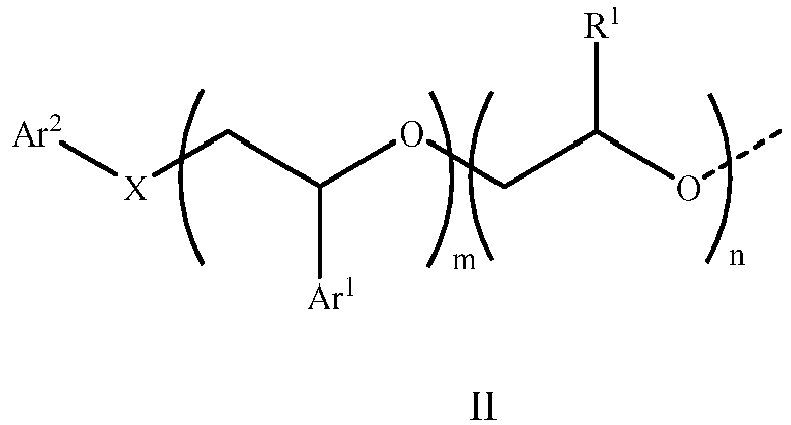
- A water-soluble polyalkylene glycol refers to water-soluble polyethylene oxides, water-soluble polyethylene oxide/polypropylene oxide copolymers, and water-soluble polyethylene oxide/polybutylene oxide copolymers. Preferred water-soluble polyalkylene oxides are polyethylene glycols, particularly polyethylene glycols having a weight average molecular weight in the range of from 600 to 12,000 Daltons. An example of a suitable polyethylene glycol is PEG 8000, which is commercially available as CARBOWAX™ 8000 Polyethylene Glycol (PEG-8000, a trademark of The Dow Chemical Company ("Dow") or an affiliate of Dow, Midland, MI).
- The diisocyanate, the polyalkylene glycol, and the capping agent of Structure II are contacted under reaction conditions to form the hydrophobically modified alkylene oxide urethane polymer. Preferably, the weight average molecular weight (Mw) of the hydrophobically modified alkylene oxide urethane polymer, as determined by size exclusion chromatography (SEC) as described herein, is in the range of from 2000, more preferably from 4000 Daltons, to preferably 50,000, more preferably to 25,000 Daltons. Examples of preferred subclasses of fragments of the present invention are represented by the following structures:


- Preferably, Ar1 is phenyl-OCH2- or o-methylphenyl-OCH2-; preferably, when X = O, Ar2 is phenyl, benzyl, phenyl-OCH2CH2-, or o-methylphenyl; preferably, when X = NR2, Ar2 is benzyl or phenyl; and R2 is benzyl, methyl, or ethyl. Preferably, m is in the range of from 1, more preferably from 2, to 10, more preferably to 6; and n is in the range from 0 to 40. Preferably, each R1 is independently H, methyl, or ethyl; more preferably H or methyl; most preferably each R1 is H. Preferably, X is O, N-CH3, N-phenyl, or N-benzyl.
- Preferably, the number average molecular weight (Mn) of the fragment of Structure I (and the compound of Structure II) as determined by matrix-assisted laser desorption/ionization-mass spectrometry (MALDI-MS), as described in the Example section herein below, is in the range of from 500 g/mol, more preferably from 750 g/mol, to 10,000, more preferably to 2500 g/mol, and most preferably to 1500 g/mol.
- The compound of Formula II can be conveniently prepared by first contacting an aryl alcohol or an aryl amine with an aryl epoxide or aryl glycidyl ether in the presence of a catalytic amount of a suitable base, such as KOH, under conditions sufficient to prepare an aryl alkoxy ether oligomer intermediate, then preferably contacting the intermediate with an alkylene oxide, such as ethylene oxide, under conditions sufficient to form the desired compound of Formula II. Preferably, the aryl alcohol is phenol, a cresol, or phenoxyethanol, or a combination thereof; the aryl amine is preferably N-methylbenzyl amine or dibenzyl amine, or a combination thereof; and the aryl alkoxy ether is preferably phenyl glycidyl ether or cresyl glycidyl ether or a combination thereof.
- The compound of the present invention is advantageously solubilized in water with various other additives to prepare an aqueous thickener composition. The aqueous thickener composition comprises from 1, and more preferably from 5, to 60, and more preferably to 40 weight percent thickener solids, based on the total weight of the aqueous thickener composition. Other additives may be included in the aqueous thickener composition to suppress the viscosity of the aqueous thickener composition. Such other additives include water miscible solvents such as propylene glycol and diethylene glycol butyl ether. Examples of other additives include cylcodextrins and various nonionic and anionic surfactants. Examples of preferred nonionic surfactants include C6-C18 alcohol ethoxylates, lauryl alcohol ethoxylates, guerbet alcohol ethoxylates, and castor oil ethoxylates. Surfactants under the TERGITOL™ tradename (A Trademark of The Dow Chemical Company or Its Affiliates) are also suitable. Examples of suitable anionic surfactants include C6-C18 alcohol sulfates, sulfonates, sulfosuccinates, phosphates, as well as their ethoxylates, including sodium lauryl sulfate, sodium 2-ethylhexyl sulfate, sodium dodecylbenzene sulfonate, and sodium dioctyl sulfosuccinate.
- For the compound of the present invention where X = NR2, sufficient acid is preferably added to the corresponding aqueous thickener composition to adjust its pH to a range of from 2.1 to 6.0. Any acid compound that can lower the pH to this range is suitable. Examples of preferred acids include, gluconic acid, phosphoric acid, hydrochloric acid, sulfuric acid, lactic acid and poly(acrylic acid)s.
- The compound of the present invention is useful as a rheology modifier in tinted coatings formulations. In another embodiment, the present invention is a composition comprising an aqueous dispersion of a) 10 to 60 weight percent, based on the weight of the composition, of polymer particles; b) and from 0.05 to 2 weight percent, based on the weight of the composition, of a hydrophobically modified alkylene oxide urethane polymer having the hydrophobic fragment of structure I.
- The aqueous dispersion of polymer particles (that is, the latex) is preferably a dispersion of polymer particles comprising structural units of an acrylate or a methacrylate monomer or a vinyl ester monomer or combinations thereof.
- The term "structural unit" of the named monomer refers to the remnant of the monomer after polymerization. For example, a structural unit of methyl methacrylate is as illustrated:

- Preferably, the polymer particles comprise at least 30, more preferably at least 50 weight percent structural units of acrylate and methacrylate monomers or preferably comprise at least 30, more preferably at least 50 weight percent structural units of a vinyl ester monomer. Examples of suitable acrylate and methacrylate monomers include methyl methacrylate, ethyl methacrylate, butyl methacrylate, ureido methacrylate, ethyl acrylate, butyl acrylate, 2-ethylhexyl acrylate, and 2-propylheptyl acrylate. Preferred combinations of acrylate and methacrylate monomers include methyl methacrylate and one or more monomers selected from the group consisting of ethyl acrylate, butyl acrylate, ureido methacrylate, 2-propylheptyl acrylate, and 2-ethylhexyl acrylate. More preferred combinations of acrylic monomers include methyl methacrylate and butyl acrylate; methyl methacrylate and 2-ethylhexyl acrylate; and methyl methacrylate, butyl acrylate, and ethyl acrylate, with the combination of methyl methacrylate and butyl acrylate being most preferred. Examples of vinyl ester-based monomers include vinyl acetate and vinyl versatates. An example of a vinyl ester-based copolymer is vinyl acetate-ethylene (VAE).
- The polymer particles may also include structural units of other monomers such as styrene, acetoacetoxyethyl methacrylate, acrylonitrile, acrylamide, and 2-acrylamido-2-methylpropane sulfonic acid. Additionally, the polymer particles preferably comprises from 0.2, more preferably from 0.5, and most preferably from 1 weight percent, to preferably 5, and more preferably to 3 weight percent structural units of an ethylenically unsaturated carboxylic acid monomer such as acrylic acid, methacrylic acid, or itaconic acid.
- The composition of the second aspect of the present invention may be contacted with a colorant at a sufficient concentration to impart the desired color. As used herein, "colorant" refers to a liquid dispersion of a colored pigment. The concentration of colorant is generally present in the range of from 5 to 20 volume percent of the total volume of the paint and colorant. Examples of colored pigments include phthalocyanine blue, phthalocyanine green, monoarylide yellow, diarylide yellow, benzimidazolone yellow, heterocyclic yellow, DAN orange, quinacridone magenta, quinacridone violet, organic reds, including metallized azo reds and nonmetallized azo reds, carbon black, lampblack, black iron oxide, yellow iron oxide, brown iron oxide, and red iron oxide.
- In another aspect, the composition comprises less than 15 PVC of TiO2 or BaSO4 particles; in yet another aspect, the composition comprises less than 10 PVC of TiO2 and BaSO4 particles. For deep base formulations, the PVC of TiO2 and BaSO4 particles is <1. PVC is defined by the following formula:

- The composition may further include any or all of the following materials: binders, dispersants, pigments, defoamers, surfactants, solvents, extenders, coalescents, biocides, and opaque polymers.
- MALDI mass spectra were acquired on a Bruker Daltonics ultraflex MALDI-TOF mass spectrometer equipped with a nitrogen laser (λ=337 nm). In the MALDI experiment, 20 mg of 2,5-dihydroxybenzoic acid was dissolved in 1 mL of THF as the MALDI matrix. The sample solution in MeOH was premixed with the matrix solution at a ratio of 1:20. To facilitate ionization of the species in the sample mixture, Nal was added into the sample/matrix mixture. A 0.3 µl sample of the mixture was then placed on the sample plate and was air dried for MALDI-MS analysis. Reflectron mode was selected in the analysis to enhance the resolution of the mass spectra.
- Samples were prepared by dissolving 1-2 mg of polymer per gram of 100 mM ammonium acetate in methanol. Samples were brought into solution by shaking overnight on a mechanical shaker at room temperature. Sample solutions were filtered using 0.45 µm PTFE filter.
- Separations were carried out on a Waters Acquity APC system consisting of an isocratic pump, degasser, injector, column oven and both UV and RI detectors operated at 40 °C. System control, data acquisition, and data processing were performed using version 3 of Empower software (Waters, Milford, MA). SEC separations were performed in 100 mM ammonium acetate in methanol (Optima grade from Fisher) at 0.5 mL/min using an APC column set composed of two Water APC columns (150 x 4.6 mm ID) packed with BEH Diol particles (pore size marked as BEH 200 Å and BEH 450 Å, particle size 1.7 and 2.5 µm, respectively) purchased from Waters (Milford, MA). 20 µL of sample were injected for APC separations. Twelve-point calibration curve of 3rd order obtained from narrow polyethylene oxide (PEO) standards.
- A 2-L round-bottom flask equipped with a temperature controlled heating mantle, an addition funnel, a reflux / distillation head, and overhead stirrer was charged with phenol (102.44 g, 1.09 moles), toluene (337.83 g), and KOH flakes (8.12 g, 90% pure). The solution was heated under N2 to distil off a portion of the toluene (110 g). Phenyl glycidyl ether (490.78 g, 3.27 moles) was then added to the resulting concentrated solution at 110 °C to 120 °C over 4 h. The mixture was stirred for an additional 2 h and the flask was cooled. The product was treated with acetic acid and the solvent was removed in vacuo to form a distribution of intermediates with an Mn of 780 g/mol as measured by MALDI-MS and that includes a compound with the following structure:

- A 2-L round-bottom flask equipped with a temperature controlled heating mantle, an addition funnel, a reflux / distillation head, and overhead stirrer was charged with phenol (62.94 g, 0.67 mole), toluene (341.34 g), and KOH flakes (4.75 g, 90% pure). The solution was heated under N2 to distill off a portion of the toluene (82.81 g). Phenyl glycidyl ether (502.18 g, 3.34 moles) was then added to the resulting concentrated solution at 110 °C to 120 °C over 4 h, and the mixture was stirred for an addition 2 h. A portion of the resultant solution (374.9 g) was charged into a conical bottom 2-L Parr reactor. The reactor was sealed, pressure checked, purged with N2, then heated to 120 °C. Ethylene oxide (289.3 g) was added at a rate of 1 to 2 g/min. The mixture was held at 120 °C for 1 h, then cooled to 60 °C before unloading the product (650.6 g). The reaction product was treated with acetic acid (1.07 g), and solvent was removed in vacuo to form a distribution of intermediates with an Mn of 1840 g/mol as measured by MALDI-MS and that includes a compound with the following structure:

- Intermediate Example 3 - Preparation of a Phenyl Glycidyl Ether Ethoxylate Block Copolymer A conical bottom 2-L Parr reactor was charged DOWANOL™ EPh (A Trademark of The Dow Chemical Company or its Affiliates, 179.95 g) and 90% potassium hydroxide (3.36 g) and the reactor was sealed, pressure checked, purged with nitrogen, then heated to 100 °C. Phenyl glycidyl ether (587 g) was then added to the reactor at a rate of 4 mL/min using a Gilson HPLC pump. Reaction was evident by the heat produced during this addition. Upon completing the addition of phenyl glycidyl ether, the mixture was held overnight at 100 °C. The reaction mixture temperature was increased to 120 °C and then ethylene oxide (286.9 g) was added to the reactor at a rate of 1.5 g/min. Upon completing addition of ethylene oxide the reaction mixture was held overnight at 120 °C. After cooling the reaction mixture to 80 °C, the reactor headspace was purged. The reaction mixture was treated with acetic acid (3. 18 g) and the reactor was then unloaded to form to form a distribution of intermediates with a Mn = 968 g/mol as measured by MALDI-MS and that includes a compound with the following structure:

- A conical bottom 2-L Parr reactor was charged with N-methylbenzyl amine (157.8 g) and 90% potassium hydroxide (3.36 g) The reactor was sealed, pressure checked, and purged with nitrogen, then heated to 100 °C. Phenyl glycidyl ether (587 g) was then added to the reactor at a rate of 4 mL/min using a Gilson HPLC pump. Upon completing the addition of phenyl glycidyl ether, the mixture was held overnight at 100 °C. The reaction mixture temperature was increased to 120 °C whereupon ethylene oxide (286.9 g) was added to the reactor at a rate of 1.5 g/min. Upon completing addition of ethylene oxide, the reaction mixture was held overnight at 120 °C. After cooling the reaction mixture to 80 °C, the reactor headspace was purged. The reaction mixture was treated with acetic acid (3.18 g) and the reactor was then unloaded to form a distribution of intermediates with a Mn = 878 g/mol as measured by MALDI-MS and that includes a compound with the following structure:

- A conical bottom 2-L Parr reactor was charged with dibenzyl amine (256.9 g) and 90% potassium hydroxide (3.36 g). The reactor was sealed, pressure checked, and purged with nitrogen, then heated to 100 °C. Phenyl glycidyl ether (587 g) was then added to the reactor at a rate of 4 mL/min using a Gilson HPLC pump. Upon completing the addition of phenyl glycidyl ether, the mixture was held overnight at 100 °C. The reaction mixture temperature was increased to 120 °C, whereupon ethylene oxide (286.9 g) was added to the reactor at a rate of 1.5 g/min. Upon completing addition of ethylene oxide, the reaction mixture was held overnight at 120 °C. After cooling the reaction mixture to 80 °C, the reactor headspace was purged. The reaction mixture was treated with acetic acid (3.18 g) and the reactor was then unloaded to form to form a distribution of intermediates with a Mn = 1009 g/mol as measured by MALDI-MS and that includes a compound with the following structure:

- A mixture of PEG 8000 (75.0 g) in toluene (150 g) was heated to reflux and dried via azeoptropic distillation for 2 h. The reactor was then cooled to 90 °C and Desmodur W cycloaliphatic diisocyanate (Des W, 6.64 g) was added to the reactor with stirring for 5 min. Dibutyl tin dilaurate (0.21 g) was then added and the reaction mixture stirred for 1 h at 90 °C. The reaction mixture was cooled to 80 °C and the polyaryl alkoxylate prepared in Intermediate Example 1 (30.56 g) was added to the reactor and the resulting mixture stirred at 80 °C for 1 h. Solvent was removed in vacuo to yield a white solid product. The Mw was found to be 17,298 as measured by SEC as described hereinabove. An aqueous solution containing 20 wt% HEUR polymer and 16 wt% butyl carbitol was prepared prior to adding to the coating formulation.
- A mixture of PEG 8000 (50.0 g) in toluene (150 g) was heated to reflux and dried by azeoptropic distillation for 2 h. The reactor was then cooled to 90 °C and Des W (4.43 g) was added to the reactor with stirring for 5 min. Dibutyl tin dilaurate (0.21 g) was then added and the reaction mixture was stirred for 1 h at 90 °C. The reaction mixture was then cooled to 80 °C and the polyaryl alkoxylate prepared in Intermediate Example 2 (47.19 g) was added to the reactor and the resulting mixture stirred at 80 °C for 1 h. Solvent was removed in vacuo to yield a white solid product. The Mw was found to be 17,903 as measured by SEC as described hereinabove. An aqueous solution containing 20 wt% HEUR polymer and 16 wt% butyl carbitol was prepared prior to adding to the coating formulation.
- A mixture of CARBOWAX™ PEG8000 (75.0 g) in toluene (150 g) was heated to reflux and dried by azeoptropic distillation for 2 h. The reactor was then cooled to 90 °C and Des W (7.18 g) was added to the reactor with stirring for 5 min. Dibutyl tin dilaurate (0.21 g) was then added and the reaction mixture was stirred for 1 h at 90 °C. The reaction mixture was then cooled to 80 °C and the polyaryl alkoxylate prepared in Intermediate Example 3 (38.59 g) was added to the reactor and the resulting mixture stirred at 80 °C for 1 h. Solvent was removed in vacuo to yield a white solid product. The Mw was found to be 17,609 as measured by SEC described hereinabove. An aqueous solution containing 20 wt% polymer and 16 wt% butyl carbitol had a Brookfield viscosity of 1420 cP (spindle #3, 6 rpm). The polymer can also be dissolved without organic solvent by replacing the butyl carbitol with surfactant. For example, an aqueous solution containing 20 weight percent of the polymer and 20 weight percent of TERGITOL™ 15-S-9 Surfactant (15-S-9) had a Brookfield viscosity of 2800 cP (spindle #3, 6 rpm).
- CARBOWAX™ 8000 Polyethylene Glycol (PEG; 1200 g) was heated to 110 °C in vacuo in a batch melt reactor for 2 h. Butylated hydroxytoluene (BHT, 0.132 g) and Desmodur W (114.9 g) were then added to the reactor and the reaction mixture was stirred for 5 min. Bismuth octoate (28% Bi, 3.0 g) was then added to the reactor and the resulting mixture was stirred for 10 min at 110 °C. Intermediate Example 4 (500.09 g) was then added to the reactor and the resulting mixture stirred for 10 min at 110 °C. The resulting molten polymer was removed from the reactor and cooled. An aqueous thickener composition was prepared by dissolving the polymer in water with gluconic acid that contained 20 weight percent polymer solids, 2 weight percent gluconic acid and 78 weight percent water.
- Table 1 shows the advantages of using a small amount of an acid such as gluconic acid in aqueous preparations of a HEUR having a hydrophobic fragment of Structure I where X = NR2. The viscosities were measured using a Brookfield viscometer, spindle #3 and 6 rpm.
Table 1 - Viscosity of Aqueous Solution of Example 4 HEUR with and without Gluconic Acid Example 4 Polymer (wt%) Water (wt%) Gluconic Acid (wt%) Aqueous Solution Viscosity (cP) pH 20% 80% 0 Gel ∼7.9 20% 78% 2% 3309 3.62 - TERGITOL, TAMOL, and RHOPLEX are all Trademarks of The Dow Chemical Company or Its Affiliates.
- CARBOWAX™ 8000 Polyethylene Glycol (PEG; 1350 g) was heated to 110 °C in vacuo in a batch melt reactor for 2 h. Butylated hydroxytoluene (BHT, 0.145 g) and Desmodur W (100.53 g) were then added to the reactor and the reaction mixture was stirred for 5 min. Bismuth octoate (28% Bi, 3.38 g) was then added to the reactor and the resulting mixture was stirred for 10 min at 110 °C. Intermediate Example 3 (401.86 g) and 2-[bis(2-ethylhexyl)amino]ethanol (19.92 g) were then added to the reactor and the resulting mixture stirred for 10 min at 110 °C. The resulting molten polymer was removed from the reactor and cooled. The Mw was found to be 23,518 as measured by SEC described hereinabove. An aqueous thickener composition was prepared by dissolving the polymer in water that contained 20 wt% polymer solids, 20 weight percent 15-S-9 and 60 weight percent water.
- CARBOWAX™ 8000 Polyethylene Glycol (PEG; 1200 g) was heated to 110 °C in vacuo in a batch melt reactor for 2 h. Butylated hydroxytoluene (BHT, 0.132 g) and Desmodur W (114.9 g) were then added to the reactor and the reaction mixture was stirred for 5 min. Bismuth octoate (28% Bi, 3.0 g) was then added to the reactor and the resulting mixture was stirred for 10 min at 110 °C. Intermediate Example 5 (554.95 g) was then added to the reactor and the resulting mixture stirred for 10 min at 110 °C. The resulting molten polymer was removed from the reactor and cooled. An aqueous thickener composition was prepared by dissolving the polymer in water with gluconic acid. Table 2 is a recipe for the unthickened tint base paint formulation, that is, the paint without colorant and HEUR rheology modifier.
Table 2 - Unthickened Tint Base Paint Formulation Material Name Pounds Gallons Grind Water 50 6.0 Dow Corning® 8590 Defoamer 1 0.1 TERGITOL™ 15-S-9 Surfactant 4 0.5 TAMOL™ 2011 Dispersant 1.8 0.2 AMP-95 Neutralizer 1 0.1 Minex 7 Extender 25 1.2 Ti-Pure R-706 TiO2 25 0.8 Water 34.1 4.1 Letdown RHOPLEX™ HG-706 Emulsion 595.8 67.1 Texanol Ester Alcohol 6.7 0.8 Optifilm 400 Film Enhancer 2.7 0.3 DC-8590 Defoamer 1 0.1 Water 156.1 18.7 - RHOPLEX, and ACRYSOL are all Trademarks of The Dow Chemical Company or its Affiliates.
- Tables 3a and 3b illustrate the KU viscosities for deep base paint formulations prepared as described in Table 2 and separately thickened with a commercial HEUR (ACRYSOL™ RM 995 Rheology Modifier (RM-995), a Trademark of The Dow Chemical Company or its Affiliates, or HEURs of the present invention, and subsequently tinted with 12 oz of Colortrend 808 lamp black. All paints were co-thickened with an ICI builder, ACRYSOL™ RM-3030 Rheology Modifier (RM-3030). The experimental HEUR and RM-3030 amounts are in active lbs/100 gal. Sufficient RM-3030 was used in all the paints to adjust the thickness of the paints to an ICI viscosity in the range of from 1.1 to 1.3 Poise. KU viscosity of the paints were measured at room temperature using a Brookfield KU-1+ viscometer or equivalent KU viscometer.
Table 3a - KU Viscosity Data for HG-706 Formulation, Tinted with Lamp Black Paint Series #1 Paint Series #2 Example RM-995 Ex. 1 Ex. 2 Ex. 3 RM-995 HEUR (lbs) 2.13 1.56 2.83 1.97 1.98 RM-3030 (lbs) 8.12 7.92 7.89 7.38 7.18 KU before tint 107 114 111.5 106 105 Tinted with 12 oz lamp black ΔKU after tint -21 -9 -8 +1.2 -23.8 Table 3b - KU Viscosity Data for HG-706 Formulation, Tinted with Lamp Black Paint Series #3 Example Ex. 4 Ex. 5 RM-995 Ex. 6 HEUR (lbs) 2.79 1.41 1.86 1.76 RM-3030 (lbs) 6.43 7.29 7.19 7.07 KU before tint 106 105 107 114 Tinted with 12 oz lamp black ΔKU after tint -4 -7 -27 -5 - ΔKU refers to the paint's change in KU viscosity after tinting with lamp black by subtracting the tinted KU viscosity from the paints original KU viscosity prior to tinting.
- The HEURs used in the paint formulations of Examples 1-6 exhibit significant improvement in paint KU viscosity stability upon colorant addition. Paint thickened with RM-995, drops as much as 27 KU units upon the addition of 12 oz. Lamp Black colorant to 116 oz of paint base. By comparison, paint thickened with HEUR Example 2 drops by only 8 KU units when tinted, paint thickened with HEUR Example 4 drops by only 4 KU units when tinted, and paint thickened with Example 3 HEUR exhibits a fairly constant KU viscosity when tinted as the KU actually increases slightly by 1.2 KU units.
Claims (7)
- A compound comprising a hydrophobically modified alkylene oxide polymer having a hydrophobic fragment represented by Structure I:

- The compound of Claim 1 wherein Ar1 is phenyl-O-CH2-or o-methylphenyl-O-CH2-; Ar2 is phenyl, benzyl, phenyl-OCH2CH2-, or o-methylphenyl; each R1 is independently H or CH3; m is from 1 to 10; and n is from 0 to 40; wherein the hydrophobically modified alkylene oxide polymer is a hydrophobically modified alkylene oxide urethane polymer.
- The compound of Claim 2 wherein the hydrophobic fragment has a number average molecular weight (Mn) in the range of from 500 to 10,000 g/mol; and X is O, or N-CH3, N-phenyl, or N-benzyl; wherein the hydrophobically modified alkylene oxide polymer is a hydrophobically modified ethylene oxide urethane polymer.
- The compound of Claim 3 which wherein the hydrophobic fragment has an Mn in the range of from 500 to 2500 g/mol and is selected from the group consisting of:


- A composition comprising an aqueous dispersion of a) 10 to 60 weight percent, based on the weight of the composition, of polymer particles; and b) from 0.05 to 2 weight percent, based on the weight of the composition, of the compound of Claim 1.
- The composition of Claim 1 which comprises less than 10 PVC of TiO2 or BsSO4 particles.
- The composition of Claim 5 which further includes one or more materials selected from the group consisting of binders, dispersants, pigments, defoamers, surfactants, solvents, extenders, coalescents, biocides, and opaque polymers.
Applications Claiming Priority (1)
| Application Number | Priority Date | Filing Date | Title |
|---|---|---|---|
| US201962806280P | 2019-02-15 | 2019-02-15 |
Publications (2)
| Publication Number | Publication Date |
|---|---|
| EP3696210A1 true EP3696210A1 (en) | 2020-08-19 |
| EP3696210B1 EP3696210B1 (en) | 2022-09-14 |
Family
ID=69593559
Family Applications (1)
| Application Number | Title | Priority Date | Filing Date |
|---|---|---|---|
| EP20157280.7A Active EP3696210B1 (en) | 2019-02-15 | 2020-02-13 | Alkylene oxide polymer endcapped with an aryl ether alkoxylate block copolymer |
Country Status (7)
| Country | Link |
|---|---|
| US (1) | US11472921B2 (en) |
| EP (1) | EP3696210B1 (en) |
| CN (1) | CN111574704B (en) |
| AU (1) | AU2020200634B2 (en) |
| BR (1) | BR102020001678A2 (en) |
| CA (1) | CA3072250C (en) |
| MX (1) | MX2020001148A (en) |
Families Citing this family (1)
| Publication number | Priority date | Publication date | Assignee | Title |
|---|---|---|---|---|
| CN120322516A (en) | 2022-12-15 | 2025-07-15 | 罗门哈斯公司 | Rheology modifiers for improving viscosity loss during tinting in paint formulations containing organophosphorus functionalized latexes |
Citations (8)
| Publication number | Priority date | Publication date | Assignee | Title |
|---|---|---|---|---|
| US4855383A (en) * | 1988-09-23 | 1989-08-08 | Ashland Oil, Inc. | In situ quaternary ammonium catalyst formation for curing polymeric isocyanates |
| US20050150418A1 (en) * | 2004-01-08 | 2005-07-14 | Bakeev Kirill N. | Colorant compatible synthetic thickener for paint |
| EP2455412A1 (en) * | 2010-11-19 | 2012-05-23 | Rohm and Haas Company | Hydrophobically modified alkylene oxide urethane polymer |
| EP2653464A1 (en) * | 2012-04-20 | 2013-10-23 | Rohm and Haas Company | Benzylamine hydrophobe |
| EP2653463A1 (en) * | 2012-04-20 | 2013-10-23 | Rohm and Haas Company | Dibenzylamine hydrophobe |
| US8859684B2 (en) * | 2005-01-07 | 2014-10-14 | Hercules Incorporated | Stabilizers for improved open time of aqueous coatings |
| US20150119525A1 (en) * | 2013-10-28 | 2015-04-30 | Rohm And Haas Company | Heur thickener and process for its preparation |
| EP3421520A1 (en) * | 2017-06-27 | 2019-01-02 | Dow Global Technologies Llc | Glycidyl ether alkoxylate block copolymers |
Family Cites Families (9)
| Publication number | Priority date | Publication date | Assignee | Title |
|---|---|---|---|---|
| FR2826014B1 (en) | 2001-06-19 | 2007-04-13 | Coatex Sas | NON-IONIC THICKENERS FOR PIGMENTARY COMPOSITIONS, IN PARTICULAR FOR PAINTS, PROVIDING PIGMENT COMPATIBILITY, AND THEIR APPLICATIONS |
| DE102009040068A1 (en) * | 2008-11-24 | 2010-05-27 | Byk-Chemie Gmbh | Compositions comprising glycidyl ether copolymers |
| US20100324177A1 (en) * | 2009-06-18 | 2010-12-23 | Bakeev Kirill N | Colorant compatible hydrophobically modified polyethyleneglycol thickener for paint |
| CA2722880C (en) * | 2009-12-22 | 2013-01-08 | Rohm And Haas Company | Opaque wet, see-through dry weather-resistive barriers and methods for making |
| JP5813431B2 (en) * | 2010-10-25 | 2015-11-17 | ローム アンド ハース カンパニーRohm And Haas Company | Rheology modifier |
| JP5542897B2 (en) * | 2011-12-14 | 2014-07-09 | ローム アンド ハース カンパニー | Rheology modifier |
| CA2975494A1 (en) * | 2016-09-01 | 2018-03-01 | Rohm And Haas Company | Alkylene oxide urethane associative thickener modified with a hydrophobic oligomer |
| AU2018203616B2 (en) * | 2017-06-13 | 2024-02-15 | Dow Global Technologies Llc | Cidyl ether alkoxylate block copolymers |
| AU2018253521B2 (en) * | 2017-11-03 | 2023-08-17 | Dow Global Technologies Llc | Tint base paint formulation with a poly(oxyalkylene-urethane) associative thickener modified with a hydrophobic oligomer |
-
2020
- 2020-01-27 BR BR102020001678-4A patent/BR102020001678A2/en not_active Application Discontinuation
- 2020-01-29 MX MX2020001148A patent/MX2020001148A/en unknown
- 2020-01-29 AU AU2020200634A patent/AU2020200634B2/en active Active
- 2020-01-31 US US16/778,327 patent/US11472921B2/en active Active
- 2020-02-03 CN CN202010079026.5A patent/CN111574704B/en active Active
- 2020-02-13 EP EP20157280.7A patent/EP3696210B1/en active Active
- 2020-02-13 CA CA3072250A patent/CA3072250C/en active Active
Patent Citations (8)
| Publication number | Priority date | Publication date | Assignee | Title |
|---|---|---|---|---|
| US4855383A (en) * | 1988-09-23 | 1989-08-08 | Ashland Oil, Inc. | In situ quaternary ammonium catalyst formation for curing polymeric isocyanates |
| US20050150418A1 (en) * | 2004-01-08 | 2005-07-14 | Bakeev Kirill N. | Colorant compatible synthetic thickener for paint |
| US8859684B2 (en) * | 2005-01-07 | 2014-10-14 | Hercules Incorporated | Stabilizers for improved open time of aqueous coatings |
| EP2455412A1 (en) * | 2010-11-19 | 2012-05-23 | Rohm and Haas Company | Hydrophobically modified alkylene oxide urethane polymer |
| EP2653464A1 (en) * | 2012-04-20 | 2013-10-23 | Rohm and Haas Company | Benzylamine hydrophobe |
| EP2653463A1 (en) * | 2012-04-20 | 2013-10-23 | Rohm and Haas Company | Dibenzylamine hydrophobe |
| US20150119525A1 (en) * | 2013-10-28 | 2015-04-30 | Rohm And Haas Company | Heur thickener and process for its preparation |
| EP3421520A1 (en) * | 2017-06-27 | 2019-01-02 | Dow Global Technologies Llc | Glycidyl ether alkoxylate block copolymers |
Also Published As
| Publication number | Publication date |
|---|---|
| US20200262975A1 (en) | 2020-08-20 |
| CN111574704A (en) | 2020-08-25 |
| US11472921B2 (en) | 2022-10-18 |
| AU2020200634A1 (en) | 2020-09-03 |
| CA3072250A1 (en) | 2020-08-15 |
| MX2020001148A (en) | 2020-11-11 |
| EP3696210B1 (en) | 2022-09-14 |
| BR102020001678A2 (en) | 2020-09-15 |
| AU2020200634B2 (en) | 2025-09-25 |
| CN111574704B (en) | 2024-02-06 |
| CA3072250C (en) | 2025-12-16 |
Similar Documents
| Publication | Publication Date | Title |
|---|---|---|
| EP2303943B1 (en) | Tint-viscosity stabilization polymeric thickeners | |
| EP2606075B1 (en) | Viscosity regulating composition | |
| US20090088516A1 (en) | Method to improve the color acceptance of viscosity stabilized latex paints | |
| EP2759555B1 (en) | Processes for the preparation of rheoloy modifiers | |
| EP2432819B1 (en) | Polymers obtainable from oxetane based macromonomers, method for the production thereof, and the use thereof as additives in coating agents and plastics | |
| AU2018204626A1 (en) | Heur thickener and process for its preparation | |
| EP3480265B1 (en) | Tint base paint formulation with a poly(oxyalkylene-urethane) associative thickener modified with a hydrophobic oligomer | |
| EP3696210B1 (en) | Alkylene oxide polymer endcapped with an aryl ether alkoxylate block copolymer | |
| EP0537900A2 (en) | Thickening agents | |
| EP3521382B1 (en) | Coating formulation with a poly(oxyalkylene-urethane) associative thickener modified with a hydrophobic oligomer | |
| CN115087710B (en) | Hydrophobic modified polyurethane thickener and preparation method thereof | |
| EP4608922B1 (en) | Rheology modifier for improved viscosity loss on tinting in paint formulations containing organo-phosphorus-funcntionalized latexes | |
| AU2014315591A1 (en) | ICI thickener composition and uses |
Legal Events
| Date | Code | Title | Description |
|---|---|---|---|
| PUAI | Public reference made under article 153(3) epc to a published international application that has entered the european phase |
Free format text: ORIGINAL CODE: 0009012 |
|
| STAA | Information on the status of an ep patent application or granted ep patent |
Free format text: STATUS: THE APPLICATION HAS BEEN PUBLISHED |
|
| AK | Designated contracting states |
Kind code of ref document: A1 Designated state(s): AL AT BE BG CH CY CZ DE DK EE ES FI FR GB GR HR HU IE IS IT LI LT LU LV MC MK MT NL NO PL PT RO RS SE SI SK SM TR |
|
| AX | Request for extension of the european patent |
Extension state: BA ME |
|
| STAA | Information on the status of an ep patent application or granted ep patent |
Free format text: STATUS: REQUEST FOR EXAMINATION WAS MADE |
|
| 17P | Request for examination filed |
Effective date: 20210213 |
|
| RBV | Designated contracting states (corrected) |
Designated state(s): AL AT BE BG CH CY CZ DE DK EE ES FI FR GB GR HR HU IE IS IT LI LT LU LV MC MK MT NL NO PL PT RO RS SE SI SK SM TR |
|
| STAA | Information on the status of an ep patent application or granted ep patent |
Free format text: STATUS: EXAMINATION IS IN PROGRESS |
|
| 17Q | First examination report despatched |
Effective date: 20210503 |
|
| GRAP | Despatch of communication of intention to grant a patent |
Free format text: ORIGINAL CODE: EPIDOSNIGR1 |
|
| STAA | Information on the status of an ep patent application or granted ep patent |
Free format text: STATUS: GRANT OF PATENT IS INTENDED |
|
| INTG | Intention to grant announced |
Effective date: 20220411 |
|
| GRAS | Grant fee paid |
Free format text: ORIGINAL CODE: EPIDOSNIGR3 |
|
| GRAA | (expected) grant |
Free format text: ORIGINAL CODE: 0009210 |
|
| STAA | Information on the status of an ep patent application or granted ep patent |
Free format text: STATUS: THE PATENT HAS BEEN GRANTED |
|
| AK | Designated contracting states |
Kind code of ref document: B1 Designated state(s): AL AT BE BG CH CY CZ DE DK EE ES FI FR GB GR HR HU IE IS IT LI LT LU LV MC MK MT NL NO PL PT RO RS SE SI SK SM TR |
|
| REG | Reference to a national code |
Ref country code: GB Ref legal event code: FG4D |
|
| REG | Reference to a national code |
Ref country code: CH Ref legal event code: EP |
|
| REG | Reference to a national code |
Ref country code: DE Ref legal event code: R096 Ref document number: 602020005049 Country of ref document: DE |
|
| REG | Reference to a national code |
Ref country code: IE Ref legal event code: FG4D |
|
| REG | Reference to a national code |
Ref country code: AT Ref legal event code: REF Ref document number: 1518666 Country of ref document: AT Kind code of ref document: T Effective date: 20221015 |
|
| REG | Reference to a national code |
Ref country code: LT Ref legal event code: MG9D |
|
| REG | Reference to a national code |
Ref country code: NL Ref legal event code: MP Effective date: 20220914 |
|
| PG25 | Lapsed in a contracting state [announced via postgrant information from national office to epo] |
Ref country code: SE Free format text: LAPSE BECAUSE OF FAILURE TO SUBMIT A TRANSLATION OF THE DESCRIPTION OR TO PAY THE FEE WITHIN THE PRESCRIBED TIME-LIMIT Effective date: 20220914 Ref country code: RS Free format text: LAPSE BECAUSE OF FAILURE TO SUBMIT A TRANSLATION OF THE DESCRIPTION OR TO PAY THE FEE WITHIN THE PRESCRIBED TIME-LIMIT Effective date: 20220914 Ref country code: NO Free format text: LAPSE BECAUSE OF FAILURE TO SUBMIT A TRANSLATION OF THE DESCRIPTION OR TO PAY THE FEE WITHIN THE PRESCRIBED TIME-LIMIT Effective date: 20221214 Ref country code: LV Free format text: LAPSE BECAUSE OF FAILURE TO SUBMIT A TRANSLATION OF THE DESCRIPTION OR TO PAY THE FEE WITHIN THE PRESCRIBED TIME-LIMIT Effective date: 20220914 Ref country code: LT Free format text: LAPSE BECAUSE OF FAILURE TO SUBMIT A TRANSLATION OF THE DESCRIPTION OR TO PAY THE FEE WITHIN THE PRESCRIBED TIME-LIMIT Effective date: 20220914 Ref country code: FI Free format text: LAPSE BECAUSE OF FAILURE TO SUBMIT A TRANSLATION OF THE DESCRIPTION OR TO PAY THE FEE WITHIN THE PRESCRIBED TIME-LIMIT Effective date: 20220914 |
|
| REG | Reference to a national code |
Ref country code: AT Ref legal event code: MK05 Ref document number: 1518666 Country of ref document: AT Kind code of ref document: T Effective date: 20220914 |
|
| PG25 | Lapsed in a contracting state [announced via postgrant information from national office to epo] |
Ref country code: HR Free format text: LAPSE BECAUSE OF FAILURE TO SUBMIT A TRANSLATION OF THE DESCRIPTION OR TO PAY THE FEE WITHIN THE PRESCRIBED TIME-LIMIT Effective date: 20220914 Ref country code: GR Free format text: LAPSE BECAUSE OF FAILURE TO SUBMIT A TRANSLATION OF THE DESCRIPTION OR TO PAY THE FEE WITHIN THE PRESCRIBED TIME-LIMIT Effective date: 20221215 |
|
| PG25 | Lapsed in a contracting state [announced via postgrant information from national office to epo] |
Ref country code: SM Free format text: LAPSE BECAUSE OF FAILURE TO SUBMIT A TRANSLATION OF THE DESCRIPTION OR TO PAY THE FEE WITHIN THE PRESCRIBED TIME-LIMIT Effective date: 20220914 Ref country code: RO Free format text: LAPSE BECAUSE OF FAILURE TO SUBMIT A TRANSLATION OF THE DESCRIPTION OR TO PAY THE FEE WITHIN THE PRESCRIBED TIME-LIMIT Effective date: 20220914 Ref country code: PT Free format text: LAPSE BECAUSE OF FAILURE TO SUBMIT A TRANSLATION OF THE DESCRIPTION OR TO PAY THE FEE WITHIN THE PRESCRIBED TIME-LIMIT Effective date: 20230116 Ref country code: ES Free format text: LAPSE BECAUSE OF FAILURE TO SUBMIT A TRANSLATION OF THE DESCRIPTION OR TO PAY THE FEE WITHIN THE PRESCRIBED TIME-LIMIT Effective date: 20220914 Ref country code: CZ Free format text: LAPSE BECAUSE OF FAILURE TO SUBMIT A TRANSLATION OF THE DESCRIPTION OR TO PAY THE FEE WITHIN THE PRESCRIBED TIME-LIMIT Effective date: 20220914 Ref country code: AT Free format text: LAPSE BECAUSE OF FAILURE TO SUBMIT A TRANSLATION OF THE DESCRIPTION OR TO PAY THE FEE WITHIN THE PRESCRIBED TIME-LIMIT Effective date: 20220914 |
|
| PG25 | Lapsed in a contracting state [announced via postgrant information from national office to epo] |
Ref country code: SK Free format text: LAPSE BECAUSE OF FAILURE TO SUBMIT A TRANSLATION OF THE DESCRIPTION OR TO PAY THE FEE WITHIN THE PRESCRIBED TIME-LIMIT Effective date: 20220914 Ref country code: PL Free format text: LAPSE BECAUSE OF FAILURE TO SUBMIT A TRANSLATION OF THE DESCRIPTION OR TO PAY THE FEE WITHIN THE PRESCRIBED TIME-LIMIT Effective date: 20220914 Ref country code: IS Free format text: LAPSE BECAUSE OF FAILURE TO SUBMIT A TRANSLATION OF THE DESCRIPTION OR TO PAY THE FEE WITHIN THE PRESCRIBED TIME-LIMIT Effective date: 20230114 Ref country code: EE Free format text: LAPSE BECAUSE OF FAILURE TO SUBMIT A TRANSLATION OF THE DESCRIPTION OR TO PAY THE FEE WITHIN THE PRESCRIBED TIME-LIMIT Effective date: 20220914 |
|
| REG | Reference to a national code |
Ref country code: DE Ref legal event code: R097 Ref document number: 602020005049 Country of ref document: DE |
|
| PG25 | Lapsed in a contracting state [announced via postgrant information from national office to epo] |
Ref country code: NL Free format text: LAPSE BECAUSE OF FAILURE TO SUBMIT A TRANSLATION OF THE DESCRIPTION OR TO PAY THE FEE WITHIN THE PRESCRIBED TIME-LIMIT Effective date: 20220914 Ref country code: AL Free format text: LAPSE BECAUSE OF FAILURE TO SUBMIT A TRANSLATION OF THE DESCRIPTION OR TO PAY THE FEE WITHIN THE PRESCRIBED TIME-LIMIT Effective date: 20220914 |
|
| P01 | Opt-out of the competence of the unified patent court (upc) registered |
Effective date: 20230526 |
|
| PLBE | No opposition filed within time limit |
Free format text: ORIGINAL CODE: 0009261 |
|
| STAA | Information on the status of an ep patent application or granted ep patent |
Free format text: STATUS: NO OPPOSITION FILED WITHIN TIME LIMIT |
|
| PG25 | Lapsed in a contracting state [announced via postgrant information from national office to epo] |
Ref country code: DK Free format text: LAPSE BECAUSE OF FAILURE TO SUBMIT A TRANSLATION OF THE DESCRIPTION OR TO PAY THE FEE WITHIN THE PRESCRIBED TIME-LIMIT Effective date: 20220914 |
|
| 26N | No opposition filed |
Effective date: 20230615 |
|
| PG25 | Lapsed in a contracting state [announced via postgrant information from national office to epo] |
Ref country code: SI Free format text: LAPSE BECAUSE OF FAILURE TO SUBMIT A TRANSLATION OF THE DESCRIPTION OR TO PAY THE FEE WITHIN THE PRESCRIBED TIME-LIMIT Effective date: 20220914 |
|
| PG25 | Lapsed in a contracting state [announced via postgrant information from national office to epo] |
Ref country code: MC Free format text: LAPSE BECAUSE OF FAILURE TO SUBMIT A TRANSLATION OF THE DESCRIPTION OR TO PAY THE FEE WITHIN THE PRESCRIBED TIME-LIMIT Effective date: 20220914 |
|
| REG | Reference to a national code |
Ref country code: CH Ref legal event code: PL |
|
| REG | Reference to a national code |
Ref country code: BE Ref legal event code: MM Effective date: 20230228 |
|
| PG25 | Lapsed in a contracting state [announced via postgrant information from national office to epo] |
Ref country code: LU Free format text: LAPSE BECAUSE OF NON-PAYMENT OF DUE FEES Effective date: 20230213 Ref country code: LI Free format text: LAPSE BECAUSE OF NON-PAYMENT OF DUE FEES Effective date: 20230228 Ref country code: CH Free format text: LAPSE BECAUSE OF NON-PAYMENT OF DUE FEES Effective date: 20230228 |
|
| REG | Reference to a national code |
Ref country code: IE Ref legal event code: MM4A |
|
| PG25 | Lapsed in a contracting state [announced via postgrant information from national office to epo] |
Ref country code: IE Free format text: LAPSE BECAUSE OF NON-PAYMENT OF DUE FEES Effective date: 20230213 |
|
| PG25 | Lapsed in a contracting state [announced via postgrant information from national office to epo] |
Ref country code: BE Free format text: LAPSE BECAUSE OF NON-PAYMENT OF DUE FEES Effective date: 20230228 |
|
| PG25 | Lapsed in a contracting state [announced via postgrant information from national office to epo] |
Ref country code: IT Free format text: LAPSE BECAUSE OF FAILURE TO SUBMIT A TRANSLATION OF THE DESCRIPTION OR TO PAY THE FEE WITHIN THE PRESCRIBED TIME-LIMIT Effective date: 20220914 |
|
| PG25 | Lapsed in a contracting state [announced via postgrant information from national office to epo] |
Ref country code: BG Free format text: LAPSE BECAUSE OF FAILURE TO SUBMIT A TRANSLATION OF THE DESCRIPTION OR TO PAY THE FEE WITHIN THE PRESCRIBED TIME-LIMIT Effective date: 20220914 |
|
| PG25 | Lapsed in a contracting state [announced via postgrant information from national office to epo] |
Ref country code: BG Free format text: LAPSE BECAUSE OF FAILURE TO SUBMIT A TRANSLATION OF THE DESCRIPTION OR TO PAY THE FEE WITHIN THE PRESCRIBED TIME-LIMIT Effective date: 20220914 |
|
| PG25 | Lapsed in a contracting state [announced via postgrant information from national office to epo] |
Ref country code: CY Free format text: LAPSE BECAUSE OF FAILURE TO SUBMIT A TRANSLATION OF THE DESCRIPTION OR TO PAY THE FEE WITHIN THE PRESCRIBED TIME-LIMIT; INVALID AB INITIO Effective date: 20200213 |
|
| PG25 | Lapsed in a contracting state [announced via postgrant information from national office to epo] |
Ref country code: HU Free format text: LAPSE BECAUSE OF FAILURE TO SUBMIT A TRANSLATION OF THE DESCRIPTION OR TO PAY THE FEE WITHIN THE PRESCRIBED TIME-LIMIT; INVALID AB INITIO Effective date: 20200213 |
|
| PG25 | Lapsed in a contracting state [announced via postgrant information from national office to epo] |
Ref country code: TR Free format text: LAPSE BECAUSE OF FAILURE TO SUBMIT A TRANSLATION OF THE DESCRIPTION OR TO PAY THE FEE WITHIN THE PRESCRIBED TIME-LIMIT Effective date: 20220914 |
|
| PGFP | Annual fee paid to national office [announced via postgrant information from national office to epo] |
Ref country code: FR Payment date: 20251208 Year of fee payment: 7 |
|
| PGFP | Annual fee paid to national office [announced via postgrant information from national office to epo] |
Ref country code: GB Payment date: 20260106 Year of fee payment: 7 |
|
| PGFP | Annual fee paid to national office [announced via postgrant information from national office to epo] |
Ref country code: DE Payment date: 20251216 Year of fee payment: 7 |