EP3695560B1 - Encryption and decryption of media data - Google Patents
Encryption and decryption of media data Download PDFInfo
- Publication number
- EP3695560B1 EP3695560B1 EP18796555.3A EP18796555A EP3695560B1 EP 3695560 B1 EP3695560 B1 EP 3695560B1 EP 18796555 A EP18796555 A EP 18796555A EP 3695560 B1 EP3695560 B1 EP 3695560B1
- Authority
- EP
- European Patent Office
- Prior art keywords
- uav
- key
- ground station
- data stream
- media data
- Prior art date
- Legal status (The legal status is an assumption and is not a legal conclusion. Google has not performed a legal analysis and makes no representation as to the accuracy of the status listed.)
- Active
Links
Images


Classifications
-
- H—ELECTRICITY
- H04—ELECTRIC COMMUNICATION TECHNIQUE
- H04L—TRANSMISSION OF DIGITAL INFORMATION, e.g. TELEGRAPHIC COMMUNICATION
- H04L9/00—Cryptographic mechanisms or cryptographic arrangements for secret or secure communications; Network security protocols
- H04L9/08—Key distribution or management, e.g. generation, sharing or updating, of cryptographic keys or passwords
- H04L9/0816—Key establishment, i.e. cryptographic processes or cryptographic protocols whereby a shared secret becomes available to two or more parties, for subsequent use
- H04L9/0819—Key transport or distribution, i.e. key establishment techniques where one party creates or otherwise obtains a secret value, and securely transfers it to the other(s)
- H04L9/0825—Key transport or distribution, i.e. key establishment techniques where one party creates or otherwise obtains a secret value, and securely transfers it to the other(s) using asymmetric-key encryption or public key infrastructure [PKI], e.g. key signature or public key certificates
-
- H—ELECTRICITY
- H04—ELECTRIC COMMUNICATION TECHNIQUE
- H04L—TRANSMISSION OF DIGITAL INFORMATION, e.g. TELEGRAPHIC COMMUNICATION
- H04L9/00—Cryptographic mechanisms or cryptographic arrangements for secret or secure communications; Network security protocols
- H04L9/08—Key distribution or management, e.g. generation, sharing or updating, of cryptographic keys or passwords
-
- G—PHYSICS
- G06—COMPUTING OR CALCULATING; COUNTING
- G06F—ELECTRIC DIGITAL DATA PROCESSING
- G06F21/00—Security arrangements for protecting computers, components thereof, programs or data against unauthorised activity
- G06F21/30—Authentication, i.e. establishing the identity or authorisation of security principals
-
- H—ELECTRICITY
- H04—ELECTRIC COMMUNICATION TECHNIQUE
- H04L—TRANSMISSION OF DIGITAL INFORMATION, e.g. TELEGRAPHIC COMMUNICATION
- H04L63/00—Network architectures or network communication protocols for network security
- H04L63/04—Network architectures or network communication protocols for network security for providing a confidential data exchange among entities communicating through data packet networks
- H04L63/0428—Network architectures or network communication protocols for network security for providing a confidential data exchange among entities communicating through data packet networks wherein the data content is protected, e.g. by encrypting or encapsulating the payload
- H04L63/0442—Network architectures or network communication protocols for network security for providing a confidential data exchange among entities communicating through data packet networks wherein the data content is protected, e.g. by encrypting or encapsulating the payload wherein the sending and receiving network entities apply asymmetric encryption, i.e. different keys for encryption and decryption
-
- H—ELECTRICITY
- H04—ELECTRIC COMMUNICATION TECHNIQUE
- H04L—TRANSMISSION OF DIGITAL INFORMATION, e.g. TELEGRAPHIC COMMUNICATION
- H04L63/00—Network architectures or network communication protocols for network security
- H04L63/04—Network architectures or network communication protocols for network security for providing a confidential data exchange among entities communicating through data packet networks
- H04L63/0428—Network architectures or network communication protocols for network security for providing a confidential data exchange among entities communicating through data packet networks wherein the data content is protected, e.g. by encrypting or encapsulating the payload
- H04L63/045—Network architectures or network communication protocols for network security for providing a confidential data exchange among entities communicating through data packet networks wherein the data content is protected, e.g. by encrypting or encapsulating the payload wherein the sending and receiving network entities apply hybrid encryption, i.e. combination of symmetric and asymmetric encryption
-
- H—ELECTRICITY
- H04—ELECTRIC COMMUNICATION TECHNIQUE
- H04L—TRANSMISSION OF DIGITAL INFORMATION, e.g. TELEGRAPHIC COMMUNICATION
- H04L9/00—Cryptographic mechanisms or cryptographic arrangements for secret or secure communications; Network security protocols
- H04L9/06—Cryptographic mechanisms or cryptographic arrangements for secret or secure communications; Network security protocols the encryption apparatus using shift registers or memories for block-wise or stream coding, e.g. DES systems or RC4; Hash functions; Pseudorandom sequence generators
- H04L9/0618—Block ciphers, i.e. encrypting groups of characters of a plain text message using fixed encryption transformation
- H04L9/0631—Substitution permutation network [SPN], i.e. cipher composed of a number of stages or rounds each involving linear and nonlinear transformations, e.g. AES algorithms
-
- H—ELECTRICITY
- H04—ELECTRIC COMMUNICATION TECHNIQUE
- H04L—TRANSMISSION OF DIGITAL INFORMATION, e.g. TELEGRAPHIC COMMUNICATION
- H04L9/00—Cryptographic mechanisms or cryptographic arrangements for secret or secure communications; Network security protocols
- H04L9/06—Cryptographic mechanisms or cryptographic arrangements for secret or secure communications; Network security protocols the encryption apparatus using shift registers or memories for block-wise or stream coding, e.g. DES systems or RC4; Hash functions; Pseudorandom sequence generators
- H04L9/0618—Block ciphers, i.e. encrypting groups of characters of a plain text message using fixed encryption transformation
- H04L9/0637—Modes of operation, e.g. cipher block chaining [CBC], electronic codebook [ECB] or Galois/counter mode [GCM]
-
- H—ELECTRICITY
- H04—ELECTRIC COMMUNICATION TECHNIQUE
- H04L—TRANSMISSION OF DIGITAL INFORMATION, e.g. TELEGRAPHIC COMMUNICATION
- H04L9/00—Cryptographic mechanisms or cryptographic arrangements for secret or secure communications; Network security protocols
- H04L9/08—Key distribution or management, e.g. generation, sharing or updating, of cryptographic keys or passwords
- H04L9/0861—Generation of secret information including derivation or calculation of cryptographic keys or passwords
-
- H—ELECTRICITY
- H04—ELECTRIC COMMUNICATION TECHNIQUE
- H04L—TRANSMISSION OF DIGITAL INFORMATION, e.g. TELEGRAPHIC COMMUNICATION
- H04L9/00—Cryptographic mechanisms or cryptographic arrangements for secret or secure communications; Network security protocols
- H04L9/08—Key distribution or management, e.g. generation, sharing or updating, of cryptographic keys or passwords
- H04L9/0861—Generation of secret information including derivation or calculation of cryptographic keys or passwords
- H04L9/0863—Generation of secret information including derivation or calculation of cryptographic keys or passwords involving passwords or one-time passwords
-
- H—ELECTRICITY
- H04—ELECTRIC COMMUNICATION TECHNIQUE
- H04L—TRANSMISSION OF DIGITAL INFORMATION, e.g. TELEGRAPHIC COMMUNICATION
- H04L9/00—Cryptographic mechanisms or cryptographic arrangements for secret or secure communications; Network security protocols
- H04L9/08—Key distribution or management, e.g. generation, sharing or updating, of cryptographic keys or passwords
- H04L9/0894—Escrow, recovery or storing of secret information, e.g. secret key escrow or cryptographic key storage
-
- H—ELECTRICITY
- H04—ELECTRIC COMMUNICATION TECHNIQUE
- H04N—PICTORIAL COMMUNICATION, e.g. TELEVISION
- H04N7/00—Television systems
- H04N7/16—Analogue secrecy systems; Analogue subscription systems
- H04N7/167—Systems rendering the television signal unintelligible and subsequently intelligible
- H04N7/1675—Providing digital key or authorisation information for generation or regeneration of the scrambling sequence
-
- H—ELECTRICITY
- H04—ELECTRIC COMMUNICATION TECHNIQUE
- H04W—WIRELESS COMMUNICATION NETWORKS
- H04W4/00—Services specially adapted for wireless communication networks; Facilities therefor
- H04W4/30—Services specially adapted for particular environments, situations or purposes
- H04W4/40—Services specially adapted for particular environments, situations or purposes for vehicles, e.g. vehicle-to-pedestrians [V2P]
- H04W4/44—Services specially adapted for particular environments, situations or purposes for vehicles, e.g. vehicle-to-pedestrians [V2P] for communication between vehicles and infrastructures, e.g. vehicle-to-cloud [V2C] or vehicle-to-home [V2H]
-
- B—PERFORMING OPERATIONS; TRANSPORTING
- B64—AIRCRAFT; AVIATION; COSMONAUTICS
- B64U—UNMANNED AERIAL VEHICLES [UAV]; EQUIPMENT THEREFOR
- B64U2101/00—UAVs specially adapted for particular uses or applications
- B64U2101/30—UAVs specially adapted for particular uses or applications for imaging, photography or videography
-
- H—ELECTRICITY
- H04—ELECTRIC COMMUNICATION TECHNIQUE
- H04L—TRANSMISSION OF DIGITAL INFORMATION, e.g. TELEGRAPHIC COMMUNICATION
- H04L2463/00—Additional details relating to network architectures or network communication protocols for network security covered by H04L63/00
- H04L2463/062—Additional details relating to network architectures or network communication protocols for network security covered by H04L63/00 applying encryption of the keys
Definitions
- the present application relates to encryption of data transmitted between an Unmanned Aerial Vehicle (UAV) and a ground controlling base, and when stored on the ground controlling base.
- UAV Unmanned Aerial Vehicle
- Modern warfare and law enforcement are characterized by an increasing need for up-to-date situational awareness.
- To track down, or to protect against, criminals, paramilitary forces or terrorists, law enforcement personnel and soldiers often have an immediate need for information about what is around the next corner or over the hill.
- Hostile forces frequently hide themselves from view or exploit the local terrain to gain tactical advantage or escape from pursuers.
- a simple brick wall, barbed wire fence, a body of water, buildings or even a large open area can be an insurmountable obstacle when time is of the essence and tactical resources are unavailable.
- An active or undetected threat can make the situation dangerous.
- An UAV is an aircraft with no pilot on board (Also referred to herein as NUAV, where N is an abbreviation for Nano).
- NUAVs can be remotely controlled (e.g. flown by a pilot/operator at a remote ground control station using a controller) or it can fly autonomously based on preprogrammed flight plans or more complex dynamic automation systems.
- An UAV may also be referred to as a drone.
- UAVs equipped with video cameras and positioning devices transmit live pictures and positioning information to the operator of the UAV and allows their operator to perform surveillance tasks and gather information from a safe position without exposing themselves during mission.
- Unmanned aerial systems often referred as drones, are becoming largely popular among general public and businesses.
- the system includes the actual unmanned aerial system (UAS), the ground control station and the communication link between them.
- UAS unmanned aerial system
- the data transmitted between the ground station and the UAS in both directions, as well as the data stored on the Implementation of an encryption solution for a UAV system has to balance user friendliness against required system security.
- An important requirement is to allow for encrypted data storage without requiring any password or other specific user actions in order to execute a mission (i.e. time critical actions), but instead require specific actions when reviewing data recorded during the mission.
- US 2015/113279 discloses a method including: providing a user's computer with code for providing a unique user name; asking the user for a password; generating an asymmetric key pair having one public key and one private key; encrypting the private key via a hash of the password; generating a file-specific symmetric key specific for the data file; encrypting the data file via the file-specific symmetric key; encrypting the file-specific symmetric key via the public key; where the code is executed by a web browser on the computer; storing the encrypted file-specific symmetric key as a header part of the encrypted data file, and interacting with the file exchange interface of a cloud service which receives the encrypted data file, and storing the encrypted data file and header part.
- US 2014/010371 discloses a method for operating a secure device having a plurality of mutually exclusive circuit zones, including a first circuit zone having a first level of security and a second circuit zone having a second level of security less than the first level of security, the method including unpacking a key exchange package including receiving a key exchange package in the second circuit zone, the key exchange package including encrypted key data and processing the encrypted key data using a content key in the first circuit zone to generate decrypted key data and storing the decrypted key data in the first circuit zone without disclosing the decrypted key data into the second circuit zone.
- the present application includes a method of combining symmetric and asymmetric cryptography for recording and playing back a video media data stream according to claim 1.
- the present application includes the encryption and decryption parts of the method separately, though interacting with each other in a key/key whole manner.
- the present application also includes an UAV system, having the above mentioned methods implemented.
- the present application relates to encryption of data transmitted between an Unmanned Aerial Vehicle (UAV) and a ground controlling base, and when stored on the ground controlling base.
- UAV Unmanned Aerial Vehicle
- Symmetric cryptography uses the same cryptographic keys for both encryption and decryption of data.
- the keys may be identical and often represent a shared secret between two or more parties that can be used to maintain a private information link.
- Asymmetrical cryptography is any cryptographic system that uses pairs of keys: Public keys which may be disseminated widely, and private keys which are known only to the owner. Data is encrypted by the public key, but only the holder of the paired private key can decrypt the data encrypted with the public key.
- asymmetric encryption Because of the computational complexity of asymmetric encryption, it is usually used only for small blocks of data.
- the symmetric encryption/decryption is based on simpler algorithms and is much faster and less computational demanding.
- any person can encrypt data using the public key of the receiver, but such data can be decrypted only with the receiver's private key.
- it must be computationally feasible for a user to generate a public and private key-pair to be used for encryption and decryption.
- the strength of a public key cryptography system relies on the degree of difficulty for a properly generated private key to be determined from its corresponding public key. Security then depends only on keeping the private key private, and the public key may be published without compromising security.
- a combination of symmetric and asymmetric cryptography is used to balance user friendliness against required system security.
- a public/private key pair is generated when a password is set in the ground control station.
- the public key may be stored in plaintext and is used as a key encryption key (KEK).
- KEK key encryption key
- DEK data encryption key
- E-DEK encrypted DEK
- KDK key decryption key
- KDF password-based key derivation function
- the user needs to enter the password.
- the password is entered into the KDF, thus producing the key that is able to decrypt the KDK.
- the KDK is then used to decrypt the DEK, which again is used to decrypt the data.
- Fig 1 -4 illustrate an example embodiment of the present application.
- a public and private key-pair is generated.
- the public key is stored in plain text in the ground control station, while the private key is encrypted by a password before being stored.
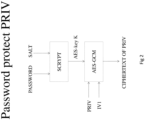
- FIG. 2 illustrates in more details how the private key is encrypted.
- SCRYPT is used to generate an AES key from the selected password.
- Salt is in this context random data that is used as an additional input to the one-way function that "hashes" the password.
- SCRYPT is in the illustrated example selected because it is a password-based key derivation function specifically designed to make it costly to perform large-scale custom hardware attacks by requiring large amounts of memory. It is generally designed to be computationally intensive, so that it takes a relatively long time to compute. However, setting up the system is only done occasionally, so the time required will still be negligible.
- the AES key generated from the password as illustrated in fig 1 is then further used to perform the actual encryption of the private key (PRIV). This is done by an Advanced Encryption Standard (AES) algorithm in Galois/Counter Mode (AES-GCM).
- AES Advanced Encryption Standard
- AES-GCM Galois/Counter Mode
- IV1 an Initialization Vector is input to the AES-GCM, generating the ciphertext of PRIV which is stored in the ground control station.
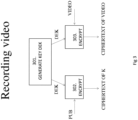
- Figure 3 illustrates how e.g. video captured by the UAV is encrypted during mission, i.e. in recording mode.
- a data encryption key DEK is generated.
- DEK is further used as a key to encrypt the video captured by the UAV.
- DEK itself is encrypted by the public key (PUB) generated in the above described process of setting up the system.
- PUB public key
- Fig. 4 illustrates the decryption process when play backing the encrypted video stored on the ground control station.
- the password entered at the time when setting up the system is needed.
- SCRYPT is again used to generate the AES key from the entered password.
- the AES key is in turn used to decrypt the private key (PRIV) from the ciphertext of PRIV stored on the ground control station also at the time when setting up the system.
- the decrypted PRIV is further used to decrypt the ciphertext of DEK which was generated by encryption of DEK by PUB at the time the video was recorded.
- DEK is then used to decrypt the stored ciphertext video which was generated by encryption of the video by DEK at the time the video was recorded.
- the video is then available for playback on e.g. the ground control station screen.
- DEK decrypted by the relatively high computational demanding asymmetric cryptography with the same public and private public key pair, which was generated in the setup of the system.
- the public key is stored in the ground control system as plain text, and the private key is stored as ciphertext, password protected and encrypted in the setup of the system.
Landscapes
- Engineering & Computer Science (AREA)
- Computer Security & Cryptography (AREA)
- Signal Processing (AREA)
- Computer Networks & Wireless Communication (AREA)
- Computer Hardware Design (AREA)
- General Engineering & Computer Science (AREA)
- Computing Systems (AREA)
- Theoretical Computer Science (AREA)
- Multimedia (AREA)
- Software Systems (AREA)
- General Physics & Mathematics (AREA)
- Physics & Mathematics (AREA)
- Storage Device Security (AREA)
- Two-Way Televisions, Distribution Of Moving Picture Or The Like (AREA)
- Aviation & Aerospace Engineering (AREA)
- Signal Processing For Digital Recording And Reproducing (AREA)
- Data Exchanges In Wide-Area Networks (AREA)
Description
- The present application relates to encryption of data transmitted between an Unmanned Aerial Vehicle (UAV) and a ground controlling base, and when stored on the ground controlling base.
- Modern warfare and law enforcement are characterized by an increasing need for up-to-date situational awareness. To track down, or to protect against, criminals, paramilitary forces or terrorists, law enforcement personnel and soldiers often have an immediate need for information about what is around the next corner or over the hill.
- Hostile forces frequently hide themselves from view or exploit the local terrain to gain tactical advantage or escape from pursuers. In the presence of hostile forces, a simple brick wall, barbed wire fence, a body of water, buildings or even a large open area can be an insurmountable obstacle when time is of the essence and tactical resources are unavailable. An active or undetected threat can make the situation dangerous.
- Visible indications, noises or predictable actions can reveal friendly forces and put them at risk. Stealth and surprise, however, are important elements that can give a tactical advantage. An UAV is an aircraft with no pilot on board (Also referred to herein as NUAV, where N is an abbreviation for Nano). UAVs can be remotely controlled (e.g. flown by a pilot/operator at a remote ground control station using a controller) or it can fly autonomously based on preprogrammed flight plans or more complex dynamic automation systems. An UAV may also be referred to as a drone. UAVs equipped with video cameras and positioning devices transmit live pictures and positioning information to the operator of the UAV and allows their operator to perform surveillance tasks and gather information from a safe position without exposing themselves during mission.
- Unmanned aerial systems, often referred as drones, are becoming largely popular among general public and businesses. The system includes the actual unmanned aerial system (UAS), the ground control station and the communication link between them. The data transmitted between the ground station and the UAS in both directions, as well as the data stored on the Implementation of an encryption solution for a UAV system has to balance user friendliness against required system security. An important requirement is to allow for encrypted data storage without requiring any password or other specific user actions in order to execute a mission (i.e. time critical actions), but instead require specific actions when reviewing data recorded during the mission.
-
US 2015/113279 discloses a method including: providing a user's computer with code for providing a unique user name; asking the user for a password; generating an asymmetric key pair having one public key and one private key; encrypting the private key via a hash of the password; generating a file-specific symmetric key specific for the data file; encrypting the data file via the file-specific symmetric key; encrypting the file-specific symmetric key via the public key; where the code is executed by a web browser on the computer; storing the encrypted file-specific symmetric key as a header part of the encrypted data file, and interacting with the file exchange interface of a cloud service which receives the encrypted data file, and storing the encrypted data file and header part. -
US 2014/010371 discloses a method for operating a secure device having a plurality of mutually exclusive circuit zones, including a first circuit zone having a first level of security and a second circuit zone having a second level of security less than the first level of security, the method including unpacking a key exchange package including receiving a key exchange package in the second circuit zone, the key exchange package including encrypted key data and processing the encrypted key data using a content key in the first circuit zone to generate decrypted key data and storing the decrypted key data in the first circuit zone without disclosing the decrypted key data into the second circuit zone. - The present application includes a method of combining symmetric and asymmetric cryptography for recording and playing back a video media data stream according to
claim 1. - The present application includes the encryption and decryption parts of the method separately, though interacting with each other in a key/key whole manner.
- The present application also includes an UAV system, having the above mentioned methods implemented.
- The following detailed description of the embodiments herein is accompanied by drawings in order to make it more readily understandable. In the drawings:
-
Figure 1 illustrates an example of setting up a system according to the present application, -
Figure 2 illustrates an example of how to password protect a private key according to the present application, -
Figure 3 illustrates an example of recording video according to the present application, -
Figure 4 illustrates an example of play back video according to the present application. - The drawings are not necessarily to scale and the dimensions of certain features may have been exaggerated for the sake of clarity. Symbols, video and pictures will usually be in colour. Emphasis is placed upon illustrating the principle of the embodiments herein.
- In the following, the embodiments herein will be discussed and example embodiments described by referring to the accompanying drawings.
- The present application relates to encryption of data transmitted between an Unmanned Aerial Vehicle (UAV) and a ground controlling base, and when stored on the ground controlling base.
- Symmetric cryptography uses the same cryptographic keys for both encryption and decryption of data. The keys may be identical and often represent a shared secret between two or more parties that can be used to maintain a private information link.
- Asymmetrical cryptography, is any cryptographic system that uses pairs of keys: Public keys which may be disseminated widely, and private keys which are known only to the owner. Data is encrypted by the public key, but only the holder of the paired private key can decrypt the data encrypted with the public key.
- Because of the computational complexity of asymmetric encryption, it is usually used only for small blocks of data. The symmetric encryption/decryption is based on simpler algorithms and is much faster and less computational demanding.
- In a public key encryption system, any person can encrypt data using the public key of the receiver, but such data can be decrypted only with the receiver's private key. For this to work it must be computationally feasible for a user to generate a public and private key-pair to be used for encryption and decryption. The strength of a public key cryptography system relies on the degree of difficulty for a properly generated private key to be determined from its corresponding public key. Security then depends only on keeping the private key private, and the public key may be published without compromising security.
- According to embodiments herein, a combination of symmetric and asymmetric cryptography is used to balance user friendliness against required system security.
- A public/private key pair is generated when a password is set in the ground control station. The public key may be stored in plaintext and is used as a key encryption key (KEK). Each time a mission is started, a data encryption key is generated (DEK), and the KEK is used to encrypt the DEK. Since the KEK is stored in plaintext, starting a mission will not require user input. The encrypted DEK (E-DEK) is stored together with the encrypted data.
- Using the public key as key encryption key, means that the private key may be used as the key decryption key (KDK). The password is put into a password-based key derivation function (KDF) to produce a key for encrypting the KDK. The encrypted KDK may be stored on the ground control station together with the E-DEK and the encrypted data.
- To decrypt and view the stored data, the user needs to enter the password. The password is entered into the KDF, thus producing the key that is able to decrypt the KDK. The KDK is then used to decrypt the DEK, which again is used to decrypt the data.
-
Fig 1 -4 illustrate an example embodiment of the present application. - Referring to
fig 1 , when setting up a system according to the example embodiment, a public and private key-pair is generated. The public key is stored in plain text in the ground control station, while the private key is encrypted by a password before being stored. -
Figure 2 illustrates in more details how the private key is encrypted. SCRYPT is used to generate an AES key from the selected password. "Salt" is in this context random data that is used as an additional input to the one-way function that "hashes" the password. SCRYPT is in the illustrated example selected because it is a password-based key derivation function specifically designed to make it costly to perform large-scale custom hardware attacks by requiring large amounts of memory. It is generally designed to be computationally intensive, so that it takes a relatively long time to compute. However, setting up the system is only done occasionally, so the time required will still be negligible. - The AES key generated from the password as illustrated in
fig 1 is then further used to perform the actual encryption of the private key (PRIV). This is done by an Advanced Encryption Standard (AES) algorithm in Galois/Counter Mode (AES-GCM). In addition to the private key, an Initialization Vector (IV1) is input to the AES-GCM, generating the ciphertext of PRIV which is stored in the ground control station. -
Figure 3 illustrates how e.g. video captured by the UAV is encrypted during mission, i.e. in recording mode. First, a data encryption key DEK is generated. DEK is further used as a key to encrypt the video captured by the UAV. DEK itself is encrypted by the public key (PUB) generated in the above described process of setting up the system. Then the ciphertext of the captured video encrypted by DEK and the ciphertext of DEK encrypted by PUB will be stored in the ground control station. -
Fig. 4 illustrates the decryption process when play backing the encrypted video stored on the ground control station. In this process, the password entered at the time when setting up the system is needed. SCRYPT is again used to generate the AES key from the entered password. The AES key is in turn used to decrypt the private key (PRIV) from the ciphertext of PRIV stored on the ground control station also at the time when setting up the system. The decrypted PRIV is further used to decrypt the ciphertext of DEK which was generated by encryption of DEK by PUB at the time the video was recorded. DEK is then used to decrypt the stored ciphertext video which was generated by encryption of the video by DEK at the time the video was recorded. The video is then available for playback on e.g. the ground control station screen. - The different processes in embodiments of the present application can be further summarized in the following general stepwise description:
-
- 1. Generate a public/private key pair (PUB/PRIV)
- 2. Password entered through user interface
- 3. Generate non secret parameters for input to key derivation function (KDF) (e.g. salt)
- 4. Password or other parameters used as input to KDF to derive an encryption key K
- 5. Use K to encrypt PRIV
- 6. Store the PUB, the ciphertext of PRIV and non-secret input parameters to KDF
- 7. Erase K and PRIV from the system memory
-
- 1. Generate a data encryption key DEK
- 2. Use the public key PUB to encrypt DEK, and store the ciphertext
- 3. Use DEK to encrypt the data, and store the data
- 4. Erase DEK from the system memory
-
- 1. Password entered through user interface
- 2. Read non-secret parameters for KDF from disk
- 3. Input password and parameters read in 2. to KDF to obtain key K
- 4. Read ciphertext of PRIV from disk and decrypt using K
- 5. Read ciphertext of DEK from disk and decrypt using PRIV
- 6. Read encrypted data from disk and decrypt using DEK
- 7. Once finished, erase DEK, PRIV, K and decrypted data from system memory
- It follows from the description of example embodiment of the present application above that the actual encryption and decryption of video is performed by the relatively low computational demanding symmetric cryptography, since the data encryption key DEK is used both for encryption and decryption.
- However, a new DEK is generated for, and associated with, each respective video recording, but all DEKs are encrypted and decrypted by the relatively high computational demanding asymmetric cryptography with the same public and private public key pair, which was generated in the setup of the system. The public key is stored in the ground control system as plain text, and the private key is stored as ciphertext, password protected and encrypted in the setup of the system.
- Hence, recording of video will require no entry of the password thus making it possible for an instant UAV mission, but the video data will still be dual protected by encryption of both the video data itself and the data encryption key of which it is encrypted. Large amount of data, as video data tends to be, is encrypted and decrypted by symmetric cryptography, while low amount of data, as data encryption and decryption keys tend to be, is encrypted and decrypted by asymmetric cryptography.
- The above description discloses different example embodiments for illustrative purposes. A person skilled in the art would realize a variety of different combinations of symbols, symbol designs all being within the scope of the embodiments.
- It should be emphasized that the term "comprises/comprising" when used in this specification is taken to specify the presence of stated features, integers, steps or components, but does not preclude the presence or addition of one or more other features, integers, steps, components or groups thereof. It should also be noted that the words "a" or "an" preceding an element do not exclude the presence of a plurality of such elements.
- It should also be emphasised that the steps of the methods defined in the appended claims may, without departing from the embodiments herein, be performed in another order than the order in which they appear in the claims.
Claims (8)
- A method of combining symmetric and asymmetric cryptography for recording and playing back a media data stream, performed by an unmanned aircraft system, UAS, comprising an unmanned aerial vehicle, UAV, and a UAV ground station, the method comprising:generating, by the UAV ground station, a public key (PUB) and a corresponding private key (PRIV);password protecting, by the UAV ground station, the private key (PRIV) by means of a password provided to the UAV ground station, wherein the password protecting comprises:generating an advanced encryption standard encryption standard, AES, key (K) based, at least in part, on the password provided;encrypting the private key using the AES key and an AES algorithm in Galois/Counter Mode, AES-GCM;storing the encrypted private key within the UAV ground station; anderasing the private key from the UAV ground station;after a first mission is started:generating, by the UAV, a symmetric data encryption key (DEK),encrypting, by the UAV, said media data stream by means of the symmetric data encryption key, wherein the media data stream is generated by a media data capturing device of the UAV,encrypting, by the UAV, the symmetric data encryption key by means of the public key (PUB); andtransmitting the encrypted symmetric data encryption key and the encrypted media data stream to the UAV ground station for storage;storing, by the UAV ground station, the encrypted symmetric data encryption key and the encrypted media data stream to the UAV ground station from the UAV;wherein the generating the symmetric data encryption key, the encrypting said media data stream, the encrypting the symmetric data encryption key, and the storing are performed without entry of the password.
- The method of claim 1, further comprising:receiving the password entered through a user interface;generating, by the UAV ground station, the AES key (K) using the password-based key derivation function based on the password;decrypting, by the UAV ground station, the password protected private key stored on the UAV ground station by means of the AES key to obtain a decrypted private key;decrypting, by the UAV ground station, the encrypted symmetric data encryption key by means of the decrypted private key; anddecrypting, by the UAV ground station, the encrypted media data stream by means of the decrypted symmetric data encryption key.
- The method of claim 2, further comprising:erasing the decrypted private key from the UAV ground station after the decrypting the encrypted symmetric data encryption key; anderasing the symmetric data encryption key from the UAV ground station after the decrypting the encrypted media data stream.
- The method of claim 2, further comprising:
playing back the decrypted media data stream by means of a ground control station screen of the UAV ground station. - The method of claim 1, wherein the media data stream comprises a first media data stream and the symmetric data encryption key comprises a first symmetric data encryption key, the method further comprising:
after a second mission is started:generating, by the UAV, a second symmetric data encryption key;encrypting, by the UAV, a second media data stream by means of the second symmetric data encryption key;encrypting, by the UAV, the second symmetric data encryption key by means of the public key; andtransmitting the encrypted second symmetric data encryption key and the encrypted second media data stream to the UAV ground station. - A method according to claim 1, wherein the media data stream is a video data stream or an image data stream.
- The method of claim 1, wherein the password protecting further comprises erasing the AES key after the encrypting the private key.
- An UAV system, including an UAV having at least one media data capturing device configured to generate a media data stream, and a corresponding UAV ground station configured to communicate with the UAV over a communication link and having at least one encryption and one decryption device, the UAV system being configured to perform the steps of any previous claim.
Applications Claiming Priority (2)
| Application Number | Priority Date | Filing Date | Title |
|---|---|---|---|
| NO20171641A NO345297B1 (en) | 2017-10-13 | 2017-10-13 | Encryption and decryption of media data |
| PCT/US2018/055721 WO2019075408A1 (en) | 2017-10-13 | 2018-10-12 | Encryption and decryption of media data |
Publications (2)
| Publication Number | Publication Date |
|---|---|
| EP3695560A1 EP3695560A1 (en) | 2020-08-19 |
| EP3695560B1 true EP3695560B1 (en) | 2024-10-09 |
Family
ID=64083174
Family Applications (1)
| Application Number | Title | Priority Date | Filing Date |
|---|---|---|---|
| EP18796555.3A Active EP3695560B1 (en) | 2017-10-13 | 2018-10-12 | Encryption and decryption of media data |
Country Status (5)
| Country | Link |
|---|---|
| US (1) | US11677544B2 (en) |
| EP (1) | EP3695560B1 (en) |
| CN (1) | CN111201750B (en) |
| NO (1) | NO345297B1 (en) |
| WO (1) | WO2019075408A1 (en) |
Families Citing this family (6)
| Publication number | Priority date | Publication date | Assignee | Title |
|---|---|---|---|---|
| EP3949252A4 (en) * | 2019-03-29 | 2022-12-21 | Soul Machines Limited | ENCRYPTION SYSTEMS |
| CN110191415B (en) * | 2019-05-29 | 2022-01-25 | 深圳市元征科技股份有限公司 | Vehicle information encryption method, vehicle-mounted equipment and server |
| US12192332B2 (en) * | 2019-11-21 | 2025-01-07 | Sony Group Corporation | File processing device and file processing method including file that stores encrypted image |
| US11025598B1 (en) * | 2020-02-08 | 2021-06-01 | Mockingbird Ventures, LLC | Method and apparatus for managing encryption keys and encrypted electronic information on a network server |
| CN113891312B (en) * | 2021-09-27 | 2024-06-18 | 深圳市道通智能航空技术股份有限公司 | Unmanned aerial vehicle data encryption transmission method, device, equipment and storage medium |
| WO2024107833A1 (en) * | 2022-11-16 | 2024-05-23 | Ampex Data Systems Corporation | Symmetric and asymmetric encryption of recorded data |
Family Cites Families (12)
| Publication number | Priority date | Publication date | Assignee | Title |
|---|---|---|---|---|
| US20020124177A1 (en) * | 2001-01-17 | 2002-09-05 | Harper Travis Kelly | Methods for encrypting and decrypting electronically stored medical records and other digital documents for secure storage, retrieval and sharing of such documents |
| US7266699B2 (en) * | 2001-08-30 | 2007-09-04 | Application Security, Inc. | Cryptographic infrastructure for encrypting a database |
| US8644512B2 (en) * | 2011-03-17 | 2014-02-04 | Massachusetts Institute Of Technology | Mission planning interface for accessing vehicle resources |
| WO2012144909A1 (en) * | 2011-04-19 | 2012-10-26 | Invenia As | Method for secure storing of a data file via a computer communication network |
| WO2014055148A2 (en) * | 2012-07-09 | 2014-04-10 | Massachusetts Institute Of Technology | Cryptography and key management device and architecture |
| US9639687B2 (en) * | 2014-11-18 | 2017-05-02 | Cloudfare, Inc. | Multiply-encrypting data requiring multiple keys for decryption |
| CN107438989B (en) * | 2015-03-27 | 2020-08-11 | 亚马逊技术有限公司 | Authentication messages between unmanned vehicles |
| US9862488B2 (en) * | 2015-08-28 | 2018-01-09 | Mcafee, Llc | Location verification and secure no-fly logic for unmanned aerial vehicles |
| CN105429759A (en) * | 2015-11-05 | 2016-03-23 | 天津津航计算技术研究所 | Key management method used for data encryption of airborne data recorder of unmanned aerial vehicle |
| EP3229445B1 (en) * | 2016-04-06 | 2018-08-08 | The Boeing Company | A system and a computer-implemented method for multi path communication with an unmanned aerial vehicle during a mission |
| CN107104948A (en) * | 2017-03-21 | 2017-08-29 | 深圳洲际通航投资控股有限公司 | unmanned aerial vehicle data transmission method and unmanned aerial vehicle data transmission system |
| CN106982208A (en) * | 2017-03-21 | 2017-07-25 | 苏州光之翼智能科技有限公司 | A kind of method of Unmanned Aerial Vehicle Data transmission protection |
-
2017
- 2017-10-13 NO NO20171641A patent/NO345297B1/en unknown
-
2018
- 2018-10-12 EP EP18796555.3A patent/EP3695560B1/en active Active
- 2018-10-12 CN CN201880066360.8A patent/CN111201750B/en active Active
- 2018-10-12 WO PCT/US2018/055721 patent/WO2019075408A1/en not_active Ceased
-
2020
- 2020-04-10 US US16/846,242 patent/US11677544B2/en active Active
Also Published As
| Publication number | Publication date |
|---|---|
| CN111201750A (en) | 2020-05-26 |
| WO2019075408A1 (en) | 2019-04-18 |
| NO20171641A1 (en) | 2019-04-15 |
| US11677544B2 (en) | 2023-06-13 |
| EP3695560A1 (en) | 2020-08-19 |
| NO345297B1 (en) | 2020-11-30 |
| CN111201750B (en) | 2024-08-06 |
| US20200244448A1 (en) | 2020-07-30 |
Similar Documents
| Publication | Publication Date | Title |
|---|---|---|
| US11677544B2 (en) | Encryption and decryption of media data | |
| JP7086327B2 (en) | Securely transfer user information between applications | |
| US9992017B2 (en) | Encrypting and storing data | |
| US7817802B2 (en) | Cryptographic key management in a communication network | |
| KR102066778B1 (en) | Image processing system comprising image transmitter and image receiver based on internet of things, and image processing method using the same | |
| CN104993928A (en) | Unmanned plane safe communication link encryption method based on real-time embedded control system | |
| Thompson et al. | Confidential and authenticated communications in a large fixed-wing UAV swarm | |
| WO2019119238A1 (en) | Data exchange method and system based on unmanned aerial vehicle, and ground control terminal and server | |
| KR102057525B1 (en) | System for electronically securing in unmanned aerial vehicle | |
| CN111404676A (en) | Method and device for generating, storing and transmitting secure and secret key and cipher text | |
| Won et al. | A secure shuffling mechanism for white-box attack-resistant unmanned vehicles | |
| EP3149883B1 (en) | Management of cryptographic keys | |
| Rabieh et al. | Privacy-preserving and efficient sharing of drone videos in public safety scenarios using proxy re-encryption | |
| KR20190079858A (en) | System and method for transmitting encryption key of unmanned aerial vehicle | |
| Priyadharshini et al. | An in-sight analysis of cyber-security protocols and the vulnerabilities in the drone communication | |
| US20240073684A1 (en) | Electronic device for providing bidirectional key agreement protocol and operating method thereof | |
| Han | Authentication and encryption of aerial robotics communication | |
| KR101445483B1 (en) | Method and system for secure data transfer using conditional proxy re-encryption | |
| CN114070467B (en) | Information source encryption privacy protection method facing deep joint information source channel coding | |
| Kim et al. | High-Speed Video Data Encryption on LTE-Based Swarm UAS. | |
| Hadi et al. | Critical analysis of security and privacy challenges for UAV networks | |
| Hong et al. | Decentralized Continuous Group Key Agreement for UAV Ad-Hoc Network | |
| KR102544084B1 (en) | Secure instant messaging method and attaratus thereof | |
| Mandal et al. | Hybrid cryptographic technique of data security for UAV applications | |
| KR101928441B1 (en) | Image processing system and key management system for image processing |
Legal Events
| Date | Code | Title | Description |
|---|---|---|---|
| STAA | Information on the status of an ep patent application or granted ep patent |
Free format text: STATUS: UNKNOWN |
|
| STAA | Information on the status of an ep patent application or granted ep patent |
Free format text: STATUS: THE INTERNATIONAL PUBLICATION HAS BEEN MADE |
|
| PUAI | Public reference made under article 153(3) epc to a published international application that has entered the european phase |
Free format text: ORIGINAL CODE: 0009012 |
|
| STAA | Information on the status of an ep patent application or granted ep patent |
Free format text: STATUS: REQUEST FOR EXAMINATION WAS MADE |
|
| 17P | Request for examination filed |
Effective date: 20200511 |
|
| AK | Designated contracting states |
Kind code of ref document: A1 Designated state(s): AL AT BE BG CH CY CZ DE DK EE ES FI FR GB GR HR HU IE IS IT LI LT LU LV MC MK MT NL NO PL PT RO RS SE SI SK SM TR |
|
| AX | Request for extension of the european patent |
Extension state: BA ME |
|
| DAV | Request for validation of the european patent (deleted) | ||
| DAX | Request for extension of the european patent (deleted) | ||
| STAA | Information on the status of an ep patent application or granted ep patent |
Free format text: STATUS: EXAMINATION IS IN PROGRESS |
|
| 17Q | First examination report despatched |
Effective date: 20220112 |
|
| REG | Reference to a national code |
Ref country code: DE Free format text: PREVIOUS MAIN CLASS: H04L0009080000 Ipc: H04L0009400000 Ref country code: DE Ref legal event code: R079 Ref document number: 602018075244 Country of ref document: DE Free format text: PREVIOUS MAIN CLASS: H04L0009080000 Ipc: H04L0009400000 |
|
| GRAP | Despatch of communication of intention to grant a patent |
Free format text: ORIGINAL CODE: EPIDOSNIGR1 |
|
| STAA | Information on the status of an ep patent application or granted ep patent |
Free format text: STATUS: GRANT OF PATENT IS INTENDED |
|
| RAP1 | Party data changed (applicant data changed or rights of an application transferred) |
Owner name: TELEDYNE FLIR, LLC Owner name: FLIR UNMANNED AERIAL SYSTEMS AS |
|
| RIC1 | Information provided on ipc code assigned before grant |
Ipc: H04W 4/44 20180101ALI20240424BHEP Ipc: H04L 9/08 20060101ALI20240424BHEP Ipc: H04L 9/06 20060101ALI20240424BHEP Ipc: H04L 9/40 20220101AFI20240424BHEP |
|
| INTG | Intention to grant announced |
Effective date: 20240515 |
|
| GRAS | Grant fee paid |
Free format text: ORIGINAL CODE: EPIDOSNIGR3 |
|
| GRAA | (expected) grant |
Free format text: ORIGINAL CODE: 0009210 |
|
| STAA | Information on the status of an ep patent application or granted ep patent |
Free format text: STATUS: THE PATENT HAS BEEN GRANTED |
|
| AK | Designated contracting states |
Kind code of ref document: B1 Designated state(s): AL AT BE BG CH CY CZ DE DK EE ES FI FR GB GR HR HU IE IS IT LI LT LU LV MC MK MT NL NO PL PT RO RS SE SI SK SM TR |
|
| REG | Reference to a national code |
Ref country code: CH Ref legal event code: EP |
|
| REG | Reference to a national code |
Ref country code: DE Ref legal event code: R096 Ref document number: 602018075244 Country of ref document: DE |
|
| REG | Reference to a national code |
Ref country code: IE Ref legal event code: FG4D |
|
| REG | Reference to a national code |
Ref country code: LT Ref legal event code: MG9D |
|
| REG | Reference to a national code |
Ref country code: NL Ref legal event code: MP Effective date: 20241009 |
|
| REG | Reference to a national code |
Ref country code: AT Ref legal event code: MK05 Ref document number: 1731793 Country of ref document: AT Kind code of ref document: T Effective date: 20241009 |
|
| PG25 | Lapsed in a contracting state [announced via postgrant information from national office to epo] |
Ref country code: NL Free format text: LAPSE BECAUSE OF FAILURE TO SUBMIT A TRANSLATION OF THE DESCRIPTION OR TO PAY THE FEE WITHIN THE PRESCRIBED TIME-LIMIT Effective date: 20241009 |
|
| PG25 | Lapsed in a contracting state [announced via postgrant information from national office to epo] |
Ref country code: NL Free format text: LAPSE BECAUSE OF FAILURE TO SUBMIT A TRANSLATION OF THE DESCRIPTION OR TO PAY THE FEE WITHIN THE PRESCRIBED TIME-LIMIT Effective date: 20241009 |
|
| PG25 | Lapsed in a contracting state [announced via postgrant information from national office to epo] |
Ref country code: PT Free format text: LAPSE BECAUSE OF FAILURE TO SUBMIT A TRANSLATION OF THE DESCRIPTION OR TO PAY THE FEE WITHIN THE PRESCRIBED TIME-LIMIT Effective date: 20250210 Ref country code: HR Free format text: LAPSE BECAUSE OF FAILURE TO SUBMIT A TRANSLATION OF THE DESCRIPTION OR TO PAY THE FEE WITHIN THE PRESCRIBED TIME-LIMIT Effective date: 20241009 Ref country code: IS Free format text: LAPSE BECAUSE OF FAILURE TO SUBMIT A TRANSLATION OF THE DESCRIPTION OR TO PAY THE FEE WITHIN THE PRESCRIBED TIME-LIMIT Effective date: 20250209 |
|
| PG25 | Lapsed in a contracting state [announced via postgrant information from national office to epo] |
Ref country code: FI Free format text: LAPSE BECAUSE OF FAILURE TO SUBMIT A TRANSLATION OF THE DESCRIPTION OR TO PAY THE FEE WITHIN THE PRESCRIBED TIME-LIMIT Effective date: 20241009 |
|
| PG25 | Lapsed in a contracting state [announced via postgrant information from national office to epo] |
Ref country code: BG Free format text: LAPSE BECAUSE OF FAILURE TO SUBMIT A TRANSLATION OF THE DESCRIPTION OR TO PAY THE FEE WITHIN THE PRESCRIBED TIME-LIMIT Effective date: 20241009 |
|
| PG25 | Lapsed in a contracting state [announced via postgrant information from national office to epo] |
Ref country code: ES Free format text: LAPSE BECAUSE OF FAILURE TO SUBMIT A TRANSLATION OF THE DESCRIPTION OR TO PAY THE FEE WITHIN THE PRESCRIBED TIME-LIMIT Effective date: 20241009 |
|
| PG25 | Lapsed in a contracting state [announced via postgrant information from national office to epo] |
Ref country code: NO Free format text: LAPSE BECAUSE OF FAILURE TO SUBMIT A TRANSLATION OF THE DESCRIPTION OR TO PAY THE FEE WITHIN THE PRESCRIBED TIME-LIMIT Effective date: 20250109 |
|
| PG25 | Lapsed in a contracting state [announced via postgrant information from national office to epo] |
Ref country code: LV Free format text: LAPSE BECAUSE OF FAILURE TO SUBMIT A TRANSLATION OF THE DESCRIPTION OR TO PAY THE FEE WITHIN THE PRESCRIBED TIME-LIMIT Effective date: 20241009 Ref country code: GR Free format text: LAPSE BECAUSE OF FAILURE TO SUBMIT A TRANSLATION OF THE DESCRIPTION OR TO PAY THE FEE WITHIN THE PRESCRIBED TIME-LIMIT Effective date: 20250110 Ref country code: AT Free format text: LAPSE BECAUSE OF FAILURE TO SUBMIT A TRANSLATION OF THE DESCRIPTION OR TO PAY THE FEE WITHIN THE PRESCRIBED TIME-LIMIT Effective date: 20241009 |
|
| PG25 | Lapsed in a contracting state [announced via postgrant information from national office to epo] |
Ref country code: PL Free format text: LAPSE BECAUSE OF FAILURE TO SUBMIT A TRANSLATION OF THE DESCRIPTION OR TO PAY THE FEE WITHIN THE PRESCRIBED TIME-LIMIT Effective date: 20241009 |
|
| PG25 | Lapsed in a contracting state [announced via postgrant information from national office to epo] |
Ref country code: RS Free format text: LAPSE BECAUSE OF FAILURE TO SUBMIT A TRANSLATION OF THE DESCRIPTION OR TO PAY THE FEE WITHIN THE PRESCRIBED TIME-LIMIT Effective date: 20250109 |
|
| REG | Reference to a national code |
Ref country code: CH Ref legal event code: PL |
|
| PG25 | Lapsed in a contracting state [announced via postgrant information from national office to epo] |
Ref country code: SM Free format text: LAPSE BECAUSE OF FAILURE TO SUBMIT A TRANSLATION OF THE DESCRIPTION OR TO PAY THE FEE WITHIN THE PRESCRIBED TIME-LIMIT Effective date: 20241009 |
|
| PG25 | Lapsed in a contracting state [announced via postgrant information from national office to epo] |
Ref country code: MC Free format text: LAPSE BECAUSE OF FAILURE TO SUBMIT A TRANSLATION OF THE DESCRIPTION OR TO PAY THE FEE WITHIN THE PRESCRIBED TIME-LIMIT Effective date: 20241009 |
|
| PG25 | Lapsed in a contracting state [announced via postgrant information from national office to epo] |
Ref country code: DK Free format text: LAPSE BECAUSE OF FAILURE TO SUBMIT A TRANSLATION OF THE DESCRIPTION OR TO PAY THE FEE WITHIN THE PRESCRIBED TIME-LIMIT Effective date: 20241009 |
|
| REG | Reference to a national code |
Ref country code: DE Ref legal event code: R097 Ref document number: 602018075244 Country of ref document: DE |
|
| PG25 | Lapsed in a contracting state [announced via postgrant information from national office to epo] |
Ref country code: BE Free format text: LAPSE BECAUSE OF NON-PAYMENT OF DUE FEES Effective date: 20241031 Ref country code: LU Free format text: LAPSE BECAUSE OF NON-PAYMENT OF DUE FEES Effective date: 20241012 |
|
| PG25 | Lapsed in a contracting state [announced via postgrant information from national office to epo] |
Ref country code: EE Free format text: LAPSE BECAUSE OF FAILURE TO SUBMIT A TRANSLATION OF THE DESCRIPTION OR TO PAY THE FEE WITHIN THE PRESCRIBED TIME-LIMIT Effective date: 20241009 |
|
| PG25 | Lapsed in a contracting state [announced via postgrant information from national office to epo] |
Ref country code: CH Free format text: LAPSE BECAUSE OF NON-PAYMENT OF DUE FEES Effective date: 20241031 |
|
| PG25 | Lapsed in a contracting state [announced via postgrant information from national office to epo] |
Ref country code: RO Free format text: LAPSE BECAUSE OF FAILURE TO SUBMIT A TRANSLATION OF THE DESCRIPTION OR TO PAY THE FEE WITHIN THE PRESCRIBED TIME-LIMIT Effective date: 20241009 |
|
| PG25 | Lapsed in a contracting state [announced via postgrant information from national office to epo] |
Ref country code: SK Free format text: LAPSE BECAUSE OF FAILURE TO SUBMIT A TRANSLATION OF THE DESCRIPTION OR TO PAY THE FEE WITHIN THE PRESCRIBED TIME-LIMIT Effective date: 20241009 |
|
| PG25 | Lapsed in a contracting state [announced via postgrant information from national office to epo] |
Ref country code: CZ Free format text: LAPSE BECAUSE OF FAILURE TO SUBMIT A TRANSLATION OF THE DESCRIPTION OR TO PAY THE FEE WITHIN THE PRESCRIBED TIME-LIMIT Effective date: 20241009 |
|
| PG25 | Lapsed in a contracting state [announced via postgrant information from national office to epo] |
Ref country code: IT Free format text: LAPSE BECAUSE OF FAILURE TO SUBMIT A TRANSLATION OF THE DESCRIPTION OR TO PAY THE FEE WITHIN THE PRESCRIBED TIME-LIMIT Effective date: 20241009 |
|
| REG | Reference to a national code |
Ref country code: BE Ref legal event code: MM Effective date: 20241031 |
|
| PLBE | No opposition filed within time limit |
Free format text: ORIGINAL CODE: 0009261 |
|
| STAA | Information on the status of an ep patent application or granted ep patent |
Free format text: STATUS: NO OPPOSITION FILED WITHIN TIME LIMIT |
|
| PG25 | Lapsed in a contracting state [announced via postgrant information from national office to epo] |
Ref country code: SE Free format text: LAPSE BECAUSE OF FAILURE TO SUBMIT A TRANSLATION OF THE DESCRIPTION OR TO PAY THE FEE WITHIN THE PRESCRIBED TIME-LIMIT Effective date: 20241009 |
|
| 26N | No opposition filed |
Effective date: 20250710 |
|
| PG25 | Lapsed in a contracting state [announced via postgrant information from national office to epo] |
Ref country code: IE Free format text: LAPSE BECAUSE OF NON-PAYMENT OF DUE FEES Effective date: 20241012 |
|
| PGFP | Annual fee paid to national office [announced via postgrant information from national office to epo] |
Ref country code: DE Payment date: 20251015 Year of fee payment: 8 |
|
| PGFP | Annual fee paid to national office [announced via postgrant information from national office to epo] |
Ref country code: GB Payment date: 20251023 Year of fee payment: 8 |
|
| PGFP | Annual fee paid to national office [announced via postgrant information from national office to epo] |
Ref country code: FR Payment date: 20251027 Year of fee payment: 8 |
|
| PG25 | Lapsed in a contracting state [announced via postgrant information from national office to epo] |
Ref country code: CY Free format text: LAPSE BECAUSE OF FAILURE TO SUBMIT A TRANSLATION OF THE DESCRIPTION OR TO PAY THE FEE WITHIN THE PRESCRIBED TIME-LIMIT; INVALID AB INITIO Effective date: 20181012 |
|
| PG25 | Lapsed in a contracting state [announced via postgrant information from national office to epo] |
Ref country code: HU Free format text: LAPSE BECAUSE OF FAILURE TO SUBMIT A TRANSLATION OF THE DESCRIPTION OR TO PAY THE FEE WITHIN THE PRESCRIBED TIME-LIMIT; INVALID AB INITIO Effective date: 20181012 |