EP3694904B1 - Polymeric dispersants from phenyl glycidyl ether - Google Patents
Polymeric dispersants from phenyl glycidyl ether Download PDFInfo
- Publication number
- EP3694904B1 EP3694904B1 EP18797245.0A EP18797245A EP3694904B1 EP 3694904 B1 EP3694904 B1 EP 3694904B1 EP 18797245 A EP18797245 A EP 18797245A EP 3694904 B1 EP3694904 B1 EP 3694904B1
- Authority
- EP
- European Patent Office
- Prior art keywords
- pge
- copolymer
- glycidyl ether
- initiator
- dispersant
- Prior art date
- Legal status (The legal status is an assumption and is not a legal conclusion. Google has not performed a legal analysis and makes no representation as to the accuracy of the status listed.)
- Active
Links
Classifications
-
- C—CHEMISTRY; METALLURGY
- C08—ORGANIC MACROMOLECULAR COMPOUNDS; THEIR PREPARATION OR CHEMICAL WORKING-UP; COMPOSITIONS BASED THEREON
- C08G—MACROMOLECULAR COMPOUNDS OBTAINED OTHERWISE THAN BY REACTIONS ONLY INVOLVING UNSATURATED CARBON-TO-CARBON BONDS
- C08G65/00—Macromolecular compounds obtained by reactions forming an ether link in the main chain of the macromolecule
- C08G65/02—Macromolecular compounds obtained by reactions forming an ether link in the main chain of the macromolecule from cyclic ethers by opening of the heterocyclic ring
- C08G65/26—Macromolecular compounds obtained by reactions forming an ether link in the main chain of the macromolecule from cyclic ethers by opening of the heterocyclic ring from cyclic ethers and other compounds
- C08G65/2603—Macromolecular compounds obtained by reactions forming an ether link in the main chain of the macromolecule from cyclic ethers by opening of the heterocyclic ring from cyclic ethers and other compounds the other compounds containing oxygen
- C08G65/2606—Macromolecular compounds obtained by reactions forming an ether link in the main chain of the macromolecule from cyclic ethers by opening of the heterocyclic ring from cyclic ethers and other compounds the other compounds containing oxygen containing hydroxyl groups
- C08G65/2612—Macromolecular compounds obtained by reactions forming an ether link in the main chain of the macromolecule from cyclic ethers by opening of the heterocyclic ring from cyclic ethers and other compounds the other compounds containing oxygen containing hydroxyl groups containing aromatic or arylaliphatic hydroxyl groups
-
- C—CHEMISTRY; METALLURGY
- C08—ORGANIC MACROMOLECULAR COMPOUNDS; THEIR PREPARATION OR CHEMICAL WORKING-UP; COMPOSITIONS BASED THEREON
- C08J—WORKING-UP; GENERAL PROCESSES OF COMPOUNDING; AFTER-TREATMENT NOT COVERED BY SUBCLASSES C08B, C08C, C08F, C08G or C08H
- C08J3/00—Processes of treating or compounding macromolecular substances
- C08J3/02—Making solutions, dispersions, lattices or gels by other methods than by solution, emulsion or suspension polymerisation techniques
- C08J3/09—Making solutions, dispersions, lattices or gels by other methods than by solution, emulsion or suspension polymerisation techniques in organic liquids
- C08J3/091—Making solutions, dispersions, lattices or gels by other methods than by solution, emulsion or suspension polymerisation techniques in organic liquids characterised by the chemical constitution of the organic liquid
- C08J3/095—Oxygen containing compounds
-
- A—HUMAN NECESSITIES
- A01—AGRICULTURE; FORESTRY; ANIMAL HUSBANDRY; HUNTING; TRAPPING; FISHING
- A01N—PRESERVATION OF BODIES OF HUMANS OR ANIMALS OR PLANTS OR PARTS THEREOF; BIOCIDES, e.g. AS DISINFECTANTS, AS PESTICIDES OR AS HERBICIDES; PEST REPELLANTS OR ATTRACTANTS; PLANT GROWTH REGULATORS
- A01N25/00—Biocides, pest repellants or attractants, or plant growth regulators, characterised by their forms, or by their non-active ingredients or by their methods of application, e.g. seed treatment or sequential application; Substances for reducing the noxious effect of the active ingredients to organisms other than pests
- A01N25/02—Biocides, pest repellants or attractants, or plant growth regulators, characterised by their forms, or by their non-active ingredients or by their methods of application, e.g. seed treatment or sequential application; Substances for reducing the noxious effect of the active ingredients to organisms other than pests containing liquids as carriers, diluents or solvents
- A01N25/04—Dispersions, emulsions, suspoemulsions, suspension concentrates or gels
-
- A—HUMAN NECESSITIES
- A01—AGRICULTURE; FORESTRY; ANIMAL HUSBANDRY; HUNTING; TRAPPING; FISHING
- A01N—PRESERVATION OF BODIES OF HUMANS OR ANIMALS OR PLANTS OR PARTS THEREOF; BIOCIDES, e.g. AS DISINFECTANTS, AS PESTICIDES OR AS HERBICIDES; PEST REPELLANTS OR ATTRACTANTS; PLANT GROWTH REGULATORS
- A01N25/00—Biocides, pest repellants or attractants, or plant growth regulators, characterised by their forms, or by their non-active ingredients or by their methods of application, e.g. seed treatment or sequential application; Substances for reducing the noxious effect of the active ingredients to organisms other than pests
- A01N25/12—Powders or granules
- A01N25/14—Powders or granules wettable
-
- A—HUMAN NECESSITIES
- A01—AGRICULTURE; FORESTRY; ANIMAL HUSBANDRY; HUNTING; TRAPPING; FISHING
- A01N—PRESERVATION OF BODIES OF HUMANS OR ANIMALS OR PLANTS OR PARTS THEREOF; BIOCIDES, e.g. AS DISINFECTANTS, AS PESTICIDES OR AS HERBICIDES; PEST REPELLANTS OR ATTRACTANTS; PLANT GROWTH REGULATORS
- A01N37/00—Biocides, pest repellants or attractants, or plant growth regulators containing organic compounds containing a carbon atom having three bonds to hetero atoms with at the most two bonds to halogen, e.g. carboxylic acids
- A01N37/34—Nitriles
-
- A—HUMAN NECESSITIES
- A01—AGRICULTURE; FORESTRY; ANIMAL HUSBANDRY; HUNTING; TRAPPING; FISHING
- A01N—PRESERVATION OF BODIES OF HUMANS OR ANIMALS OR PLANTS OR PARTS THEREOF; BIOCIDES, e.g. AS DISINFECTANTS, AS PESTICIDES OR AS HERBICIDES; PEST REPELLANTS OR ATTRACTANTS; PLANT GROWTH REGULATORS
- A01N43/00—Biocides, pest repellants or attractants, or plant growth regulators containing heterocyclic compounds
- A01N43/48—Biocides, pest repellants or attractants, or plant growth regulators containing heterocyclic compounds having rings with two nitrogen atoms as the only ring hetero atoms
- A01N43/50—1,3-Diazoles; Hydrogenated 1,3-diazoles
-
- A—HUMAN NECESSITIES
- A01—AGRICULTURE; FORESTRY; ANIMAL HUSBANDRY; HUNTING; TRAPPING; FISHING
- A01N—PRESERVATION OF BODIES OF HUMANS OR ANIMALS OR PLANTS OR PARTS THEREOF; BIOCIDES, e.g. AS DISINFECTANTS, AS PESTICIDES OR AS HERBICIDES; PEST REPELLANTS OR ATTRACTANTS; PLANT GROWTH REGULATORS
- A01N43/00—Biocides, pest repellants or attractants, or plant growth regulators containing heterocyclic compounds
- A01N43/64—Biocides, pest repellants or attractants, or plant growth regulators containing heterocyclic compounds having rings with three nitrogen atoms as the only ring hetero atoms
- A01N43/647—Triazoles; Hydrogenated triazoles
- A01N43/653—1,2,4-Triazoles; Hydrogenated 1,2,4-triazoles
-
- A—HUMAN NECESSITIES
- A01—AGRICULTURE; FORESTRY; ANIMAL HUSBANDRY; HUNTING; TRAPPING; FISHING
- A01N—PRESERVATION OF BODIES OF HUMANS OR ANIMALS OR PLANTS OR PARTS THEREOF; BIOCIDES, e.g. AS DISINFECTANTS, AS PESTICIDES OR AS HERBICIDES; PEST REPELLANTS OR ATTRACTANTS; PLANT GROWTH REGULATORS
- A01N43/00—Biocides, pest repellants or attractants, or plant growth regulators containing heterocyclic compounds
- A01N43/64—Biocides, pest repellants or attractants, or plant growth regulators containing heterocyclic compounds having rings with three nitrogen atoms as the only ring hetero atoms
- A01N43/66—1,3,5-Triazines, not hydrogenated and not substituted at the ring nitrogen atoms
- A01N43/68—1,3,5-Triazines, not hydrogenated and not substituted at the ring nitrogen atoms with two or three nitrogen atoms directly attached to ring carbon atoms
- A01N43/70—Diamino—1,3,5—triazines with only one oxygen, sulfur or halogen atom or only one cyano, thiocyano (—SCN), cyanato (—OCN) or azido (—N3) group directly attached to a ring carbon atom
-
- C—CHEMISTRY; METALLURGY
- C08—ORGANIC MACROMOLECULAR COMPOUNDS; THEIR PREPARATION OR CHEMICAL WORKING-UP; COMPOSITIONS BASED THEREON
- C08G—MACROMOLECULAR COMPOUNDS OBTAINED OTHERWISE THAN BY REACTIONS ONLY INVOLVING UNSATURATED CARBON-TO-CARBON BONDS
- C08G59/00—Polycondensates containing more than one epoxy group per molecule; Macromolecules obtained by polymerising compounds containing more than one epoxy group per molecule using curing agents or catalysts which react with the epoxy groups
- C08G59/18—Macromolecules obtained by polymerising compounds containing more than one epoxy group per molecule using curing agents or catalysts which react with the epoxy groups ; e.g. general methods of curing
- C08G59/182—Macromolecules obtained by polymerising compounds containing more than one epoxy group per molecule using curing agents or catalysts which react with the epoxy groups ; e.g. general methods of curing using pre-adducts of epoxy compounds with curing agents
-
- C—CHEMISTRY; METALLURGY
- C08—ORGANIC MACROMOLECULAR COMPOUNDS; THEIR PREPARATION OR CHEMICAL WORKING-UP; COMPOSITIONS BASED THEREON
- C08G—MACROMOLECULAR COMPOUNDS OBTAINED OTHERWISE THAN BY REACTIONS ONLY INVOLVING UNSATURATED CARBON-TO-CARBON BONDS
- C08G65/00—Macromolecular compounds obtained by reactions forming an ether link in the main chain of the macromolecule
- C08G65/02—Macromolecular compounds obtained by reactions forming an ether link in the main chain of the macromolecule from cyclic ethers by opening of the heterocyclic ring
- C08G65/26—Macromolecular compounds obtained by reactions forming an ether link in the main chain of the macromolecule from cyclic ethers by opening of the heterocyclic ring from cyclic ethers and other compounds
- C08G65/2603—Macromolecular compounds obtained by reactions forming an ether link in the main chain of the macromolecule from cyclic ethers by opening of the heterocyclic ring from cyclic ethers and other compounds the other compounds containing oxygen
- C08G65/2606—Macromolecular compounds obtained by reactions forming an ether link in the main chain of the macromolecule from cyclic ethers by opening of the heterocyclic ring from cyclic ethers and other compounds the other compounds containing oxygen containing hydroxyl groups
- C08G65/2609—Macromolecular compounds obtained by reactions forming an ether link in the main chain of the macromolecule from cyclic ethers by opening of the heterocyclic ring from cyclic ethers and other compounds the other compounds containing oxygen containing hydroxyl groups containing aliphatic hydroxyl groups
-
- C—CHEMISTRY; METALLURGY
- C08—ORGANIC MACROMOLECULAR COMPOUNDS; THEIR PREPARATION OR CHEMICAL WORKING-UP; COMPOSITIONS BASED THEREON
- C08G—MACROMOLECULAR COMPOUNDS OBTAINED OTHERWISE THAN BY REACTIONS ONLY INVOLVING UNSATURATED CARBON-TO-CARBON BONDS
- C08G65/00—Macromolecular compounds obtained by reactions forming an ether link in the main chain of the macromolecule
- C08G65/02—Macromolecular compounds obtained by reactions forming an ether link in the main chain of the macromolecule from cyclic ethers by opening of the heterocyclic ring
- C08G65/26—Macromolecular compounds obtained by reactions forming an ether link in the main chain of the macromolecule from cyclic ethers by opening of the heterocyclic ring from cyclic ethers and other compounds
- C08G65/2618—Macromolecular compounds obtained by reactions forming an ether link in the main chain of the macromolecule from cyclic ethers by opening of the heterocyclic ring from cyclic ethers and other compounds the other compounds containing nitrogen
- C08G65/2621—Macromolecular compounds obtained by reactions forming an ether link in the main chain of the macromolecule from cyclic ethers by opening of the heterocyclic ring from cyclic ethers and other compounds the other compounds containing nitrogen containing amine groups
-
- C—CHEMISTRY; METALLURGY
- C08—ORGANIC MACROMOLECULAR COMPOUNDS; THEIR PREPARATION OR CHEMICAL WORKING-UP; COMPOSITIONS BASED THEREON
- C08G—MACROMOLECULAR COMPOUNDS OBTAINED OTHERWISE THAN BY REACTIONS ONLY INVOLVING UNSATURATED CARBON-TO-CARBON BONDS
- C08G65/00—Macromolecular compounds obtained by reactions forming an ether link in the main chain of the macromolecule
- C08G65/02—Macromolecular compounds obtained by reactions forming an ether link in the main chain of the macromolecule from cyclic ethers by opening of the heterocyclic ring
- C08G65/26—Macromolecular compounds obtained by reactions forming an ether link in the main chain of the macromolecule from cyclic ethers by opening of the heterocyclic ring from cyclic ethers and other compounds
- C08G65/2618—Macromolecular compounds obtained by reactions forming an ether link in the main chain of the macromolecule from cyclic ethers by opening of the heterocyclic ring from cyclic ethers and other compounds the other compounds containing nitrogen
- C08G65/2621—Macromolecular compounds obtained by reactions forming an ether link in the main chain of the macromolecule from cyclic ethers by opening of the heterocyclic ring from cyclic ethers and other compounds the other compounds containing nitrogen containing amine groups
- C08G65/2624—Macromolecular compounds obtained by reactions forming an ether link in the main chain of the macromolecule from cyclic ethers by opening of the heterocyclic ring from cyclic ethers and other compounds the other compounds containing nitrogen containing amine groups containing aliphatic amine groups
-
- C—CHEMISTRY; METALLURGY
- C08—ORGANIC MACROMOLECULAR COMPOUNDS; THEIR PREPARATION OR CHEMICAL WORKING-UP; COMPOSITIONS BASED THEREON
- C08G—MACROMOLECULAR COMPOUNDS OBTAINED OTHERWISE THAN BY REACTIONS ONLY INVOLVING UNSATURATED CARBON-TO-CARBON BONDS
- C08G65/00—Macromolecular compounds obtained by reactions forming an ether link in the main chain of the macromolecule
- C08G65/02—Macromolecular compounds obtained by reactions forming an ether link in the main chain of the macromolecule from cyclic ethers by opening of the heterocyclic ring
- C08G65/26—Macromolecular compounds obtained by reactions forming an ether link in the main chain of the macromolecule from cyclic ethers by opening of the heterocyclic ring from cyclic ethers and other compounds
- C08G65/2618—Macromolecular compounds obtained by reactions forming an ether link in the main chain of the macromolecule from cyclic ethers by opening of the heterocyclic ring from cyclic ethers and other compounds the other compounds containing nitrogen
- C08G65/2621—Macromolecular compounds obtained by reactions forming an ether link in the main chain of the macromolecule from cyclic ethers by opening of the heterocyclic ring from cyclic ethers and other compounds the other compounds containing nitrogen containing amine groups
- C08G65/2627—Macromolecular compounds obtained by reactions forming an ether link in the main chain of the macromolecule from cyclic ethers by opening of the heterocyclic ring from cyclic ethers and other compounds the other compounds containing nitrogen containing amine groups containing aromatic or arylaliphatic amine groups
-
- C—CHEMISTRY; METALLURGY
- C08—ORGANIC MACROMOLECULAR COMPOUNDS; THEIR PREPARATION OR CHEMICAL WORKING-UP; COMPOSITIONS BASED THEREON
- C08G—MACROMOLECULAR COMPOUNDS OBTAINED OTHERWISE THAN BY REACTIONS ONLY INVOLVING UNSATURATED CARBON-TO-CARBON BONDS
- C08G65/00—Macromolecular compounds obtained by reactions forming an ether link in the main chain of the macromolecule
- C08G65/02—Macromolecular compounds obtained by reactions forming an ether link in the main chain of the macromolecule from cyclic ethers by opening of the heterocyclic ring
- C08G65/26—Macromolecular compounds obtained by reactions forming an ether link in the main chain of the macromolecule from cyclic ethers by opening of the heterocyclic ring from cyclic ethers and other compounds
- C08G65/2618—Macromolecular compounds obtained by reactions forming an ether link in the main chain of the macromolecule from cyclic ethers by opening of the heterocyclic ring from cyclic ethers and other compounds the other compounds containing nitrogen
- C08G65/2621—Macromolecular compounds obtained by reactions forming an ether link in the main chain of the macromolecule from cyclic ethers by opening of the heterocyclic ring from cyclic ethers and other compounds the other compounds containing nitrogen containing amine groups
- C08G65/263—Macromolecular compounds obtained by reactions forming an ether link in the main chain of the macromolecule from cyclic ethers by opening of the heterocyclic ring from cyclic ethers and other compounds the other compounds containing nitrogen containing amine groups containing heterocyclic amine groups
-
- C—CHEMISTRY; METALLURGY
- C08—ORGANIC MACROMOLECULAR COMPOUNDS; THEIR PREPARATION OR CHEMICAL WORKING-UP; COMPOSITIONS BASED THEREON
- C08G—MACROMOLECULAR COMPOUNDS OBTAINED OTHERWISE THAN BY REACTIONS ONLY INVOLVING UNSATURATED CARBON-TO-CARBON BONDS
- C08G65/00—Macromolecular compounds obtained by reactions forming an ether link in the main chain of the macromolecule
- C08G65/02—Macromolecular compounds obtained by reactions forming an ether link in the main chain of the macromolecule from cyclic ethers by opening of the heterocyclic ring
- C08G65/26—Macromolecular compounds obtained by reactions forming an ether link in the main chain of the macromolecule from cyclic ethers by opening of the heterocyclic ring from cyclic ethers and other compounds
- C08G65/2636—Macromolecular compounds obtained by reactions forming an ether link in the main chain of the macromolecule from cyclic ethers by opening of the heterocyclic ring from cyclic ethers and other compounds the other compounds containing sulfur
-
- C—CHEMISTRY; METALLURGY
- C08—ORGANIC MACROMOLECULAR COMPOUNDS; THEIR PREPARATION OR CHEMICAL WORKING-UP; COMPOSITIONS BASED THEREON
- C08L—COMPOSITIONS OF MACROMOLECULAR COMPOUNDS
- C08L71/00—Compositions of polyethers obtained by reactions forming an ether link in the main chain; Compositions of derivatives of such polymers
- C08L71/02—Polyalkylene oxides
-
- C—CHEMISTRY; METALLURGY
- C09—DYES; PAINTS; POLISHES; NATURAL RESINS; ADHESIVES; COMPOSITIONS NOT OTHERWISE PROVIDED FOR; APPLICATIONS OF MATERIALS NOT OTHERWISE PROVIDED FOR
- C09D—COATING COMPOSITIONS, e.g. PAINTS, VARNISHES OR LACQUERS; FILLING PASTES; CHEMICAL PAINT OR INK REMOVERS; INKS; CORRECTING FLUIDS; WOODSTAINS; PASTES OR SOLIDS FOR COLOURING OR PRINTING; USE OF MATERIALS THEREFOR
- C09D5/00—Coating compositions, e.g. paints, varnishes or lacquers, characterised by their physical nature or the effects produced; Filling pastes
- C09D5/02—Emulsion paints including aerosols
- C09D5/022—Emulsions, e.g. oil in water
-
- C—CHEMISTRY; METALLURGY
- C09—DYES; PAINTS; POLISHES; NATURAL RESINS; ADHESIVES; COMPOSITIONS NOT OTHERWISE PROVIDED FOR; APPLICATIONS OF MATERIALS NOT OTHERWISE PROVIDED FOR
- C09D—COATING COMPOSITIONS, e.g. PAINTS, VARNISHES OR LACQUERS; FILLING PASTES; CHEMICAL PAINT OR INK REMOVERS; INKS; CORRECTING FLUIDS; WOODSTAINS; PASTES OR SOLIDS FOR COLOURING OR PRINTING; USE OF MATERIALS THEREFOR
- C09D5/00—Coating compositions, e.g. paints, varnishes or lacquers, characterised by their physical nature or the effects produced; Filling pastes
- C09D5/02—Emulsion paints including aerosols
- C09D5/024—Emulsion paints including aerosols characterised by the additives
- C09D5/027—Dispersing agents
-
- C—CHEMISTRY; METALLURGY
- C08—ORGANIC MACROMOLECULAR COMPOUNDS; THEIR PREPARATION OR CHEMICAL WORKING-UP; COMPOSITIONS BASED THEREON
- C08J—WORKING-UP; GENERAL PROCESSES OF COMPOUNDING; AFTER-TREATMENT NOT COVERED BY SUBCLASSES C08B, C08C, C08F, C08G or C08H
- C08J2371/00—Characterised by the use of polyethers obtained by reactions forming an ether link in the main chain; Derivatives of such polymers
- C08J2371/02—Polyalkylene oxides
-
- C—CHEMISTRY; METALLURGY
- C08—ORGANIC MACROMOLECULAR COMPOUNDS; THEIR PREPARATION OR CHEMICAL WORKING-UP; COMPOSITIONS BASED THEREON
- C08J—WORKING-UP; GENERAL PROCESSES OF COMPOUNDING; AFTER-TREATMENT NOT COVERED BY SUBCLASSES C08B, C08C, C08F, C08G or C08H
- C08J2421/00—Characterised by the use of unspecified rubbers
- C08J2421/02—Latex
-
- C—CHEMISTRY; METALLURGY
- C08—ORGANIC MACROMOLECULAR COMPOUNDS; THEIR PREPARATION OR CHEMICAL WORKING-UP; COMPOSITIONS BASED THEREON
- C08L—COMPOSITIONS OF MACROMOLECULAR COMPOUNDS
- C08L2201/00—Properties
- C08L2201/54—Aqueous solutions or dispersions
Definitions
- the invention relates to copolymers, dispersant compositions, dispersions, wettable polymer compositions, suspension concentrates, water-dispersible granules and seed coatings comprising the copolymers.
- Phenyl glycidyl ether (“PGE”) is known as a monomer for ring-opening polymerizations, including reactions to make random or block copolymers of alkylene oxides and PGE (see, e.g., U.S. Pat. Nos. 6,825,273 ). Some reported copolymers are generated with a monofunctional, monounsaturated initiator such as allyl alcohol (see, e.g., U.S. Pat. Nos. 7,388,068 ; 7,605,224 ; and 7,812,114 ).
- Linear block copolymers of PGE and ethylene oxide produced with monofunctional alcohol initiators e.g., 1-octanol or 3-phenyl-1-propanol
- monofunctional alcohol initiators e.g., 1-octanol or 3-phenyl-1-propanol
- pigment dispersions are also known (see N. Suto et al., J. Jpn. Oil Chem. Soc. 31 (1982) 598 and U.S. Pat. No. 8,367,762 ).
- Pigment dispersions come in many varieties.
- the medium can be aqueous, polar organic, or non-polar organic, and the pigment can be many kinds of organic or inorganic materials. It is difficult to predict which dispersant can provide a satisfactory dispersion for any given pigment among hundreds of possible pigments. This creates a great need for commensurate variety in the available pigment dispersants.
- compositions comprising at least one amphiphilic glycidyl ether copolymer.
- the glycidyl ether copolymer is constructed from a mixture of specified different structural units. Further, the composition comprises a dispersant and at least one dispersed solid or an emulsifier.
- WO 99/25768 A1 discloses water-compatible curing agents for epoxy resins.
- the curing agent comprises a reaction product obtainable by forming an amino-terminated intermediate from a polyamine having at least three active amine hydrogen atoms per molecule with at least one epoxy resin having a functionality of at least 1.5 with a molar ratio of epoxy functionality equivalents to polyamine of from 0.9:1 to 1:10. The intermediate is then reacted with a small amount of an acid-terminated polyalkyleneglycol-containing compound.
- the hydrophobic nature of phenyl glycidyl ether blocks and the relatively hydrophilic nature of ethylene oxide blocks provide opportunities to produce polymeric dispersants that can work with various organic and inorganic pigments, especially in aqueous media.
- Preferred copolymers could effectively disperse multiple pigment types to give aqueous dispersions with low viscosity, good optical properties, and desirable particle sizes within the range of 100 to 1000 nm.
- Preferred copolymers would also have low- or zero-VOC character to aid in complying with increasingly strict regulations. Ideally, the copolymers could give good dispersions at low use levels and could enable improved productivity by dispersing more pigment per unit of time.
- the invention relates to copolymers comprising recurring units of a phenyl glycidyl ether, especially (unsubstituted) phenyl glycidyl ether ("PGE").
- the copolymers comprise a di- or polyfunctional nucleophilic initiator, 1 to 30 recurring units per active hydrogen equivalent of the initiator of a phenyl glycidyl ether, and 1 to 100 recurring units per active hydrogen equivalent of the initiator of one or more alkylene oxides (“AO”) selected from ethylene oxide, propylene oxide, butylene oxides, and combinations thereof.
- AO alkylene oxides
- the di- or polyfunctional nucleophilic initiator is selected from alcohols, phenols, thiols, thiophenols, sulfinic acids, and deprotonated species thereof.
- the copolymers comprise 20 to 60 wt.% of phenyl glycidyl ether recurring units based on the combined amounts of phenyl glycidyl ether and AO recurring units.
- the copolymers have a number-average molecular weight within the range of 1,900 to 56,000 g/mol.
- the invention includes dispersions comprising a carrier (preferably water), a pigment, a pH adjusting agent, and the copolymers described above.
- copolymers useful as dispersants can have a variety of different general structures or "architectures.” For instance, they can be linear with one tail extending from the initiator, linear with two tails extending from the initiator, "T-shaped” (i.e., three tails extending from a central initiator), "star-shaped” (i.e., four or more tails extending from a central initiator, or "comb-shaped” (polyfunctional initiator backbone with the tails as "teeth" of the comb).
- the structure will include a nucleophilic initiator, one or more phenyl glycidyl ether units (typically, a block of 2-20 phenyl glycidyl ether units per active hydrogen of the initiator), one or more alkylene oxide units (ethylene oxide (“EO”), propylene oxide (“PO”), or butylene oxides (“BO”) in homopolymer or random or block copolymer configurations), and optionally, a capping group.
- EO ethylene oxide
- PO propylene oxide
- BO butylene oxides
- the copolymers can be built starting with the initiator or in some cases in reverse order starting with the capping group or a polyoxyalkylene or alkyl-capped polyoxyalkylene starter.
- the copolymers may have a bolaphilic or amphiphilic structure comprising alternating blocks of hydrophobic (e.g., PGE) and hydrophilic (e.g., EO) groups.
- a polyethylene glycol starter could be reacted at both ends with PGE to add hydrophobic blocks, optionally with a capping group.
- Bolaphiles or amphiphiles could also be made using the strategies described for making linear, T-shaped, or star-shaped copolymers.
- the copolymer dispersants are usually synthesized from a nucleophilic initiator.
- the nucleophilic initiator can be difunctional or polyfunctional.
- a di- or polyfunctional nucleophilic initiator is used.
- the average functionality of these initiators is determined by summing the total of active hydrogens bonded to an oxygen, nitrogen, or sulfur atom.
- Preferred di- or polyfunctional nucleophilic initiators will have average functionalities within the range of 2 to 8, 2 to 6, or 2 to 4.
- Suitable di- or polyfunctional nucleophilic initiators include alcohols, phenols, thiols, thiophenols, sulfinic acids, and deprotonated species thereof.
- suitable di- or polyfunctional nucleophilic initiators include polyfunctional alcohols (diols, triols, tetrols, sugars, and the like), polyphenols, di- or polyfunctional sulfur-containing initiators (thiols, dithiols, thiophenols, sulfinic acids), mixed nucleophiles, and the like.
- Suitable polyfunctional alcohols include, for example, 1,3-propanediol, 2-methyl-1,3-propanediol, 1,4-butanediol, 3-methyl-1,5-pentanediol, 1,6-hexanediol, 1,8-octanediol, 1,12-dodecanediol, ethylene glycol, diethylene glycol, triethylene glycol, polyethylene glycols having number-average molecular weights from 400 to 4,000 g/mol, glycerol, trimethylolpropane, trimethylolethane, pentaerythritol, di (pentaerythritol), di(trimethylolpropane), bis-tris methane, 1,4-cyclohexanedimethanol, 1,4-dihydroxy-2-butyne, 2,4,7,9-tetramethyl-5-decyn-4,7-diol, isosorb
- Suitable polyphenols include, for example, bisphenols (e.g., bisphenol A, bisphenol F, bisphenol S, bisphenol acetophenone), biphenols (2,2'-biphenol, 4,4'-biphenol), resorcinol, catechol, 1,6-dihydroxynaphthalene, phloroglucinol, pyrogallol, ellagic acid, tannins, lignins, natural polyphenols, poly[phenol-co-formaldehyde], poly[cresol-co-formaldehyde], and the like, and mixtures thereof.
- bisphenols e.g., bisphenol A, bisphenol F, bisphenol S, bisphenol acetophenone
- biphenols 2,2'-biphenol, 4,4'-biphenol
- resorcinol catechol
- 1,6-dihydroxynaphthalene 1,6-dihydroxynaphthalene
- phloroglucinol phloroglucino
- Suitable di- or polyfunctional sulfur-containing initiators include, for example, 1,4-butanedithiol, 1,6-hexanedithiol, 2,2'-(ethylenedioxy)diethanethiol, trithiocyanuric acid, and the like, and mixtures thereof. After serving as the initiator, sulfur atoms on many of these initiators can be oxidized to give sulfoxides or sulfones.
- Suitable di- or polyfunctional mixed nucleophiles include, for example, ethanolamine, 2-mercaptoethanol, 2-aminoethanethiol, diethanolamine, 4-aminophenol, 4-aminothiophenol, glucosamine, 2-amino-1,3-propanediol, 1,3-diamino-2-propanol, 3-mercapto-1,2-propanediol, bis-tris propane, 4-hydroxy-1,2,2,6,6-pentamethylpiperidine, and the like, and mixtures thereof.
- the nitrogen and/or sulfur atoms can be oxidized or quaternized as described above.
- Suitable nucleophilic initiators include partially or fully deprotonated species corresponding to any of the above protonated materials. As those skilled in the art will appreciate, many convenient syntheses of the copolymers will start by reacting a di- or polyfunctional nucleophilic initiator (alcohol, phenol, thiol, or thiophenol) with a deprotonating agent.
- a di- or polyfunctional nucleophilic initiator alcohol, phenol, thiol, or thiophenol
- Suitable deprotonating agents include, for instance, metal hydrides (LiH, NaH, KH, CaH 2 ), metal alkoxides (sodium methoxide, sodium ethoxide, potassium ethoxide, potassium tert-butoxide), methyl hydroxides (NaOH, KOH), metal carbonates (NaHCOs, Na 2 CO 3 , K 2 CO 3 , Cs 2 CO 3 ), amines (trimethylamine, N,N-diisopropylethylamine, pyridine), and the like.
- metal hydrides LiH, NaH, KH, CaH 2
- metal alkoxides sodium methoxide, sodium ethoxide, potassium ethoxide, potassium tert-butoxide
- methyl hydroxides NaOH, KOH
- metal carbonates Na 2 CO 3 , K 2 CO 3 , Cs 2 CO 3
- amines trimethylamine, N,N-diisopropyleth
- the copolymer dispersants comprise recurring units of a phenyl glycidyl ether, especially unsubstituted phenyl glycidyl ether ("PGE").
- PGE unsubstituted phenyl glycidyl ether
- the dispersants comprise 1 to 30, 2 to 20, 2 to 15, or 2 to 5 recurring phenyl glycidyl ether units per active hydrogen equivalent of the initiator.
- active hydrogen equivalent refers herein to a group having an active hydrogen atom (alcohol, thiol) or its deprotontated counterpart.
- the phenyl glycidyl ether recurring units occur in a single block.
- the phenyl glycidyl ether recurring units are interspersed with recurring units of alkylene oxides, functionalized glycidyl ethers, or other monomers as described below.
- a block of phenyl glycidyl ether recurring units is reacted with the nucleophilic initiator as a first reaction step.
- an alkyl-, alkoxy-, or halo-substituted phenyl glycidyl ether e.g., 2-methylphenyl glycidyl ether, 4-methoxyphenyl glycidyl ether, or 2-chlorophenyl glycidyl ether
- phenyl glycidyl ether e.g., 2-methylphenyl glycidyl ether, 4-methoxyphenyl glycidyl ether, or 2-chlorophenyl glycidyl ether
- styrene oxide is used to replace some or all of the phenyl glycidyl ether recurring units.
- the copolymer dispersants comprise recurring units of one or more alkylene oxides.
- the dispersants comprise from 1 to 100, 5 to 80, 10 to 60, or 20 to 40 recurring units per active hydrogen equivalent of the initiator of one or more alkylene oxides selected from the group consisting of ethylene oxide, propylene oxide, butylene oxides, and combinations thereof.
- the alkylene oxide recurring units can be arranged in random, block, or gradient fashion, e.g., as blocks of a single alkylene oxide, blocks of two or more alkylene oxides (e.g., a block of EO units and a block of PO units), or as a random copolymer.
- the alkylene oxide is ethylene oxide, propylene oxide, or combinations thereof.
- the alkylene oxide consists essentially of ethylene oxide, which imparts hydrophilic character to the copolymer.
- the copolymer dispersants can incorporate recurring units of other monomers capable of copolymerizing with phenyl glycidyl ether or the above-mentioned alkylene oxides.
- the other monomers include, for example, other glycidyl ethers (e.g., butyl glycidyl ether, isopropyl glycidyl ether, t-butyl glycidyl ether, 2-ethylhexyl glycidyl ether, allyl glycidyl ether, benzyl glycidyl ether, guaiacol glycidyl ether, 1-ethoxyethyl glycidyl ether, 2-ethoxyethyl glycidyl ether, 2-methylphenyl glycidyl ether, 2-biphenyl glycidyl ether, tristyrylphenol glycidyl ether
- reaction of the nucleophilic initiator with an epoxy-functional monomer is used to produce a more complex "initiator" that can be further reacted with recurring units of phenyl glycidyl ether and alkylene oxides.
- reaction of triethanolamine with three equivalents of 3,4-epoxytetrahydrofuran provides a composition having three free hydroxyl groups.
- This "initiator” can then be reacted with the phenyl glycidyl ether to produce a hydrophobe, which is thereafter reacted with ethylene oxide (or EO/PO combination) to give a suitable dispersant.
- ethylene oxide or EO/PO combination
- the complex initiator is made by reacting triethanolamine with three equivalents of 2-ethylhexyl glycidol to give the hydroxy-functional complex initiator. Further reaction with PGE, then EO provides the desired dispersant:
- the copolymer dispersants can incorporate one or more units of glycidyl ethers having a built-in functional "handle."
- Suitable functionalized glycidyl ethers have a glycidyl ether group, a linking group, and a functional handle.
- the linking group is any combination of atoms or bonds capable of linking the glycidyl ether group to the functional handle.
- Suitable functional handles will have functional groups capable of further manipulation.
- the functionalized glycidyl ether incorporates a benzaldehyde "handle”
- the free aldehyde group can be reacted with an amine to give an imine, an amino acid to give an imine-acid, or an anhydride to give a cinnamic acid derivative via the Perkin reaction.
- oxidation can provide a sulfoxide or a sulfone.
- 1-ethoxyethyl glycidyl ether i.e., 2-[(1-ethoxyethoxy)-methyl]oxirane
- RO-CH(CH 3 )OEt acid-sensitive hemiacetal
- Subsequent treatment with an acid liberates the alcohol (ROH), which can be converted to a phosphate, sulfate, acetate, or other useful functionalities.
- the nucleophilic initiator is first reacted with a portion of the phenyl glycidyl ether to be used, then with a desired proportion of functionalized glycidyl ether, then with the remaining amount of the phenyl glycidyl ether to embed functionality within the block of phenyl glycidyl ether recurring units.
- Introduction of heteroatoms or charged functionalities e.g., amine oxides
- the nucleophilic initiator is reacted with a phenyl glycidyl ether in the presence of a catalyst, preferably a basic catalyst.
- a catalyst preferably a basic catalyst.
- 1 to 30, 2 to 20, and preferably 2 to 15 or 2 to 5 phenyl glycidyl ether equivalents are used per active hydrogen equivalent of the initiator.
- about 5 equivalents of phenyl glycidyl ether per active hydrogen in the initiator is used, as this provides a desirable level of hydrophobicity. It may be desirable to perform the reaction, at least initially, in the presence of a solvent.
- Ether solvents such as methyl t-butyl ether (MTBE) work well with alkoxide catalysts.
- a reaction vessel is charged with the required amount of nucleophilic initiator and solvent, and a suitable catalyst (e.g., potassium methoxide) is added.
- a suitable catalyst e.g., potassium methoxide
- An initial charge of the phenyl glycidyl ether is added, and solvent is removed.
- the temperature is increased, the ring-opening reaction proceeds, and the mixture exotherms.
- Addition of the phenyl glycidyl ether continuously or in increments enables control over reaction exotherms. Reaction progress can be monitored by 1 H NMR or other suitable techniques.
- the resulting hydrophobe alkoxide is normally used "as is" for subsequent reaction steps.
- the hydrophobic portion of the copolymer will have preferred number-average molecular weights as measured by gel-permeation chromatography (GPC) that are somewhat functionality-dependent as shown in the following table: Nominal functionality Preferred Mn for the hydrophobe (by GPC) 1 500 to 4,000 2 750 to 5,000 3 1,000 to 6,000 4 1,250 to 7,000 5 1,400 to 8,000 6 1,500 to 9,500
- Scheme 1 illustrates hydrophobe syntheses using PGE, potassium methoxide catalyst, MTBE solvent, and a variety of nucleophilic initiators to produce single-tail, two-tail, three-tail, and four tail hydrophobes.
- Scheme 2 illustrates syntheses in which alternatives to PGE are included.
- Alkoxylation normally follows reaction of the nucleophilic initiator, catalyst, and the phenyl glycidyl ether to produce the hydrophobe. Hydroxyl groups of the hydrophobe react in the presence of the catalyst with one or more equivalents of an alkylene oxide to give the alkoxylated product. In some aspects, enough alkylene oxide is added to introduce 1 to 100, 2 to 80, 5 to 60, or 10 to 40 recurring units of alkylene oxide per active hydrogen equivalent of the nucleophilic initiator. In some aspects, the alkylene oxide is selected from the group consisting of ethylene oxide, propylene oxide, butylene oxides, and combinations thereof.
- the alkylene oxide recurring units can be arranged in random, block, or gradient fashion, e.g., as blocks of a single alkylene oxide, blocks of two or more alkylene oxides (e.g., a block of EO units and a block of PO units), or as a random copolymer.
- the alkylene oxide is ethylene oxide, propylene oxide, or combinations thereof.
- the alkylene oxide consists essentially of ethylene oxide.
- Lewis acids such as boron trifluoride can be used to polymerize PGE and alkylene oxides.
- Double metal cyanide catalysts can also be used (see, e.g., U.S. Pat. Nos. 5,470,813 ; 5,482,908 ; 6,852,664 ; 7,169,956 , 9,221,947 , 9,605,111 ; and U.S. Publ. Nos. 2017/0088667 and 2017/0081469 ).
- the alkoxylation reaction is conveniently practiced by gradual addition of the alkylene oxide as mixtures or in steps to produce the desired architecture.
- the reaction mixture will normally be heated until most or all of the alkylene oxide has reacted to give the desired copolymer.
- the copolymer can be neutralized to give a hydroxy-functional dispersant.
- it may be desirable to convert the hydroxyl groups to other functional groups such as sulfates, phosphates, amines, or the like.
- the alkoxylates will have preferred number-average molecular weights as measured by gel-permeation chromatography (GPC) that are somewhat functionality-dependent as shown in the following table: Nominal functionality Preferred Mn for the alkoxylate (by GPC) 1 900 to 12,000 2 1,900 to 21,000 3 2,700 to 30,000 4 3,700 to 38,000 5 4,600 to 47,000 6 5,500 to 56,000
- 1-ethoxyethyl glycidyl ether i.e., 2-[(1-ethoxyethoxy)-methyl]oxirane
- RO-CH(CH 3 )OEt acid-sensitive hemiacetal
- Subsequent treatment with an acid liberates the alcohol (ROH), which can be converted to a phosphate, sulfate, acetate, or other useful functionalities (see Scheme 4).
- the copolymer dispersants may include a capping group.
- the capping group can be used to cap some or all of the available hydroxyl groups of the alkoxylates. Suitable capping groups for hydroxy-functional polymers are well known. Examples include ethers, esters, carbonates, carbamates, carbamimidic esters, borates, sulfates, phosphates, phosphatidylcholines, ether acids, ester alcohols, ester acids, ether diacids, ether amines, ether ammoniums, ether amides, ether sulfonates, ether betaines, ether sulfobetaines, ether phosphonates, phospholanes, phospholane oxides, and the like, and combinations thereof.
- Scheme 5 illustrates acetylation, phosphation, sulfation, and alkylamination as possible capping approaches.
- Succinic anhydride for instance, can be used to cap some or all of the available hydroxyl end groups of a dispersant. Deprotonation of the resulting carboxylic acid groups can significantly change the hydrophilicity of the dispersant. Reacting triethanolamine with PGE, followed by ethoxylation and capping with enough succinic anhydride to react with a third of the hydroxyl groups gives this dispersant:
- nitrogen atoms from the nucleophilic initiator can be alkylated or oxidized to give quaternized compositions or amine oxides, respectively.
- sulfur atoms from the nucleophilic initiator can be oxidized to sulfoxide functionality, sulfone functionality, or both.
- This can be accomplished by reacting the prepared hydrophobe with 1-ethoxyethyl glycidyl ether followed by acid-mediated hydrolysis of the residual hemiacetal functionality to effectively double the number of free hydroxyl groups available for alkoxylation.
- reaction of trimethylolpropane with about five equivalents of PGE to give the hydrophobe followed by reaction with an equivalent of 1-ethoxyethyl glycidyl ether, acid-mediated hydrolysis to liberate the additional hydroxyl functionalities from the hemiacetals, and then ethoxylation provides a dispersant having the structure shown immediately below.
- Scheme 8 illustrates syntheses of hydrophobes attached to split EO tails using either a forward or a forward-and-reverse synthetic strategy.
- aromatic rings from recurring units of phenyl glycidyl ether, 2-methylphenyl glycidyl ether, styrene oxide, or other aromatic rings can be sulfonated to introduce sulfonate groups into the dispersant.
- triethanolamine-PGE(18)-EO(105) is reacted with sulfur trioxide under conditions effective to sulfonate at least a portion of the aromatic rings.
- free hydroxyl groups will also be sulfated, and in some cases a mixed sulfate/sulfonate will be the desired end product. In that case, the reaction product is simply neutralized with a suitable base. If only a sulfonate is desired, any sulfates generated can be hydrolyzed, e.g., with dilute acid treatment, to regenerate free hydroxyl groups.
- Suitable pigments for use in making the pigment dispersions are well known and readily available. Many of the pigments are organic compounds, although inorganic pigments are also common. Examples appear in U.S. Pat. No. 7,442,724 .
- Suitable organic pigments include, for example, monoazos, diazos, anthraquinones, anthrapyrimidines, quinacridones, quinophthalones, dioxazines, flavanthrones, indanthrones, isoindolines, isoindolinones, metal complexes, perinones, perylenes, phthalocyanines, pyranthrones, thioindigos, triphenylmethanes, anilines, benzimidazolones, diarylides, diketopyrrolopyrroles, naphthols, and aldazines.
- Suitable inorganic pigments include, for example, white pigments, black pigments, chromatic pigments, and luster pigments.
- the copolymers are useful for preparing pigment dispersions, especially water-based pigment dispersions. Many of the inventive copolymers are relatively soluble in water and provide stable dispersant solutions or emulsions.
- the pH of the dispersant solution or emulsion is usually adjusted with acid (e.g., hydrogen chloride) or base (e.g., sodium hydroxide) to be within the range of 3 to 12, or in some aspects, within the range of 7 to 11, or 8 to 10, or 8.5 to 9.5.
- Acid e.g., hydrogen chloride
- base e.g., sodium hydroxide
- Pigments are combined with a carrier (preferably water), the copolymer, and any pH adjusting agent, biocide, defoamer, rheology modifier, stabilizer, or other desired components to give a mixture with the desired proportion of copolymer to pigment.
- the solids content of the pigment dispersion will be within the range of 5 to 95 wt.%, 15 to 90 wt.%, or 25 to 85 wt.%.
- the mixtures are preferably milled, for instance in a paint mixer with metal, ceramic, or glass balls, to produce pigment dispersions that can be evaluated for relevant physical properties.
- the particle size of the aqueous dispersion should be within the range of 100 nm to 1000 nm, preferably from 100 nm to 500 nm or from 100 nm to 300 nm.
- inventive copolymers can give stable, non-viscous dispersions having desirable particle sizes expeditiously with many pigments.
- copolymers it is convenient to name the copolymers by indicating the initiator used followed by PGE(x)AO(y) to indicate the number of moles of the phenyl glycidyl ether and alkylene oxide used to make the copolymer.
- PGE(x)AO(y) When a capping group is used, a designation can be added after the alkylene oxide portion.
- the invention includes a method which comprises stabilizing flow properties of an emulsion latex polymer.
- the method protects against temperature-induced changes in the properties that occur within the range of-20°C to 50°C.
- the method comprises combining the emulsion latex polymer with an effective amount of a dispersant composition produced by combining the copolymers described herein with water.
- the invention in another aspect, relates to a method of enhancing the hydrophobic character of an alkyd coating.
- This method comprises combining an alkyd resin with an effective amount of a dispersant composition comprising the copolymers described herein and a non-aqueous carrier such as an organic solvent.
- the alkyd resin comprises a reaction product of glycerol, soybean oil, and isophthalic acid.
- inventive copolymers are useful in agricultural formulations as emulsifiers, as dispersants for suspension concentrates, as dispersants for seed coatings, as wetting agents, as spreaders, as adjuvants to promote the uptake of actives into leaf surfaces, and as dispersant components of water-dispersible granules.
- the copolymers perform as well as or better than controls as dispersants for wettable powders from atrazine, chlorothalonil, or imidacloprid (see Table 15, below).
- Good suspension concentrates comprising the inventive copolymers can also be made (see, e.g., Table 16, below).
- Suitable carriers for agricultural applications, particularly emulsions or suspension concentrates include organic solvents, water, and combinations of water and water-miscible organic solvents.
- the polymers can be used to disperse solids (e.g., organic and/or inorganic pigments, fillers or latex) in coatings as is discussed above and in greater detail below related to organic and inorganic pigments, especially organic pigments.
- the polymers can also be used in agricultural applications (as discussed above) and as dispersants for other particulate materials, such as cement, minerals, asphaltene, or particulate soils.
- the polymers may also find utility as rheology modifiers, foamers, defoamers, or auxiliary components of laundry detergents or personal care products, including cleansers and cosmetics.
- the polymers may also be useful as coating additives, where they could enhance film quality as compatibilizers, adhesion promoters or leveling agents.
- Rapid distillation of MTBE begins, and the first of five additions of phenyl glycidyl ether (PGE) from the addition funnel commences.
- PGE phenyl glycidyl ether
- one equivalent of PGE is added for each mole of alcohol, disubstituted amine, or thiol initiator, and two equivalents of PGE are added for each mole of monosubstituted amine initiator.
- the reaction temperature is slowly increased until an initial exotherm is observed.
- the exotherm commences anywhere within the range of 70°C to 140°C.
- the reaction temperature is controlled by adjusting the stirring rate or the temperature set point, or by removing the heating mantle.
- a second addition of PGE begins. From this point on, the reaction temperature is maintained within the range of 100°C to 120°C. The remaining three additions of PGE proceed as before. After all of the PGE is added, the reaction temperature is kept at 105°C, and reaction progress is gauged by monitoring the consumption of PGE by 1 H NMR.
- the product is used in the next step without further manipulation.
- the isolated material contains 0.35-0.55 wt.% potassium.
- the product is a mixture of compounds with an average of five units of PGE per nucleophilic site on the initiator.
- a 600-mL Parr reactor, equipped with a mechanical stirrer, a nitrogen sparger, a thermocouple, and a sample port is charged with the potassium-containing hydrophobe prepared as described above.
- the reactor is sealed and the contents are slowly heated to 120°C.
- one or more alkylene oxides are added to begin the alkoxylation.
- the alkylene oxide monomer(s) is(are) added in batches until the targeted number of moles of monomer have reacted.
- tails composed of more than one alkylene oxide block the above procedure is repeated for each additional segment.
- the product is removed from the reactor at 80-90°C.
- a round-bottom flask equipped with heating mantle, temperature controller, overhead stirrer, thermocouple, and nitrogen inlet is charged with 1-dodecanethiol (72.9 g, 360 mmol) and solid potassium methoxide (3.10 g, 44.2 mmol).
- the resulting mixture is heated to 105°C, whereupon portion-wise addition of warmed (54°C) resorcinol diglycidyl ether (40.0 g, 180 mmol) commences.
- the reagent is introduced by intermittently removing the gas outlet and adding the warm liquid by pipette. During the addition, the reaction temperature is maintained at or below 133°C by controlling the rate of reagent addition and the stirring rate. After 10 min., the addition is complete, and the reaction mixture stirs and cools to 100°C. Complete consumption of resorcinol diglycidyl ether is observed by 1 H NMR after stirring for 1 h at 100°C.
- a round-bottom flask is equipped with a heating mantle, temperature controller, overhead stirrer, thermocouple, nitrogen inlet/sparging tube, and distillation adapter.
- To the adapter is attached an addition funnel, a water-cooled condenser, and a collection flask.
- the flask is charged under nitrogen with trimethylolpropane (154.6 g, 1.15 mol) and solid potassium methoxide (26.4 g, 0.377 mol).
- the resulting solid mixture is heated to 110°C with stirring. After 15 min. at 110°C, a pale-yellow solution is obtained. Phenyl glycidyl ether (2597 g, 17.29 mol) is then added via the addition funnel over 90 min.
- reaction temperature is held at or below 140°C by controlling the rate of reagent addition and the stirring rate.
- the reaction mixture stirs at 110°C.
- 1 H NMR shows complete consumption of the phenyl glycidyl ether. Stirring is discontinued, the reaction mixture cools to room temperature, and the product is stored in the reaction flask under nitrogen overnight.
- the solid reaction mixture is slowly heated to 100°C. Once the mixture begins to melt, the overhead stirrer is activated. When the mixture has liquefied, 1-ethoxyethyl glycidyl ether (505.8 g, 3.46 mol) is added by addition funnel over 0.5 h. When the addition is complete, the mixture stirs at 110°C. After 16 h, 1 H NMR shows complete consumption of the 1-ethoxyethyl glycidyl ether.
- the hot reaction mixture is transferred quantitatively to a large round-bottom flask using two rinses of tetrahydrofuran (300 g) to complete the transfer.
- Ethanol (2.2 kg) and more tetrahydrofuran (400 g) are added.
- An overhead stirrer and thermocouple are attached to the flask, and the mixture is stirred at 47°C.
- Aqueous hydrochloric acid (37%, 170 g, 1.72 mol) is added, and the resulting mixture stirs and slowly cools over 4.5 h to room temperature. While cooling, the mixture periodically becomes too viscous to stir efficiently, and tetrahydrofuran (3 x 300 g) is added.
- 1 H NMR analysis shows complete consumption of the acetal functionality.
- Solid potassium carbonate (480 g, 3.47 mol) is added, and the reaction mixture is stirred at room temperature. After 18 h, stirring is stopped, and the solids are allowed to settle. Solids are removed by filtration and rinsed with tetrahydrofuran. The filtrates are combined, and volatiles are removed by distillation at 100-115°C followed by vacuum drying (120°C, 44 mm Hg). Trimethylolpropane-PGE(15)-GE(3) (2.73 kg, 91.0%) is obtained.
- a round-bottom flask is equipped with a heating mantle, temperature controller, overhead stirrer, thermocouple, nitrogen inlet/sparging tube, and distillation adapter with a Teflon stopcock.
- To the adapter is attached an addition funnel charged with 1,2-epoxyhexadecane (116 g, 483 mmol), a condenser, and a collection flask.
- the flask is charged under nitrogen with triethanolamine (24.0 g, 161 mmol), solid potassium methoxide (4.06 g, 0.36 mmol), and MTBE (225 g).
- the reaction mixture is heated to 55°C, and distilled methyl t-butyl ether is collected.
- 1,2-epoxyhexadecane is added over 8 min. After the epoxide addition is complete, no more solvent is collected.
- the reaction mixture is heated to 120°C over 20 min. After stirring for 0.5 h, the reaction temperature is increased to 135°C. After another 0.5 h, 1 H NMR shows complete consumption of 1,2-epoxyhexadecane. The mixture cools to 110°C.
- solid potassium methoxide 2.29 g, 32.7 mmol
- the mixture is heated to 110°C with stirring, whereupon phenyl glycidyl ether (29.5 g, 196 mmol) is added over 8 min.
- the reagent is introduced by intermittently removing the gas outlet and adding the warm liquid by pipette.
- reaction temperature is maintained at or below 120°C by controlling both the rate of reagent addition and the stirring rate.
- the reaction temperature is held at 120°C for 100 min.
- Analysis by 1 H NMR shows complete consumption of phenyl glycidyl ether. The mixture cools to 60°C and is stirred at this temperature.
- Triethanolamine-PGE(18)-EO(105) (53.9 g, 29.9 mmol) is charged to a water-jacketed reactor with the water temperature set at 60°C.
- Liquid sulfur trioxide (2.92 g, 36.5 mmol) is added dropwise from an addition funnel to a vaporizer flask under a nitrogen flow rate of about 5 L/min., and the vaporized sulfur trioxide is introduced into the reactor to maintain a reaction temperature of about 65°C.
- the addition is complete (about 10 min.)
- the reactor is purged with nitrogen for 5 min.
- the resulting acid is a highly viscous gel that is transferred to a jar and stored at - 40°C.
- a mixture of the sulfate/sulfonate product described immediately above (15.0 g) is combined with water (34.8 g) and heated on a hot plate for 4 h.
- the sulfate groups are converted to sulfonic acid groups, and the arene sulfonate groups are retained.
- the polymeric dispersant is diluted in deionized water to a concentration of 20-40 wt.% polymer for ease of incorporation in a testing formulation.
- the solutions are adjusted with acid or base to pH of 8.5 to 9.5 before evaluation of contact angle, interfacial tension (IFT), and foaming properties.
- IFT interfacial tension
- Interfacial tension of the dispersants is measured against dodecane at 0.1 wt.% solids at ambient temperature using the pendant drop tensiometer.
- Foams are tested at 0.2 wt.% of polymeric solution in tap water.
- the test solution 100 g is added to a 500-mL graduated cylinder.
- the foam is kept to a minimum, and the cylinder is stoppered.
- the cylinder is placed in a mechanical shake foam machine and is inverted 10 times.
- the foam is allowed to settle for 15 seconds.
- An initial foam height value is then recorded.
- the foam height is measured and recorded again after 5 minutes.
- Pigment dispersions are prepared by combining the polymeric dispersants with pigments in a formulation comprising 0.5 to 50 wt.% dispersant, 10 to 80 wt.% pigment, 0.5 to 6 wt.% additives (e.g., defoamer, rheology modifier, biocide, neutralizing agent, stabilizer) and 10 to 85 wt.% water or another liquid carrier.
- a formulation comprising 0.5 to 50 wt.% dispersant, 10 to 80 wt.% pigment, 0.5 to 6 wt.% additives (e.g., defoamer, rheology modifier, biocide, neutralizing agent, stabilizer) and 10 to 85 wt.% water or another liquid carrier.
- the proportion of dispersant solids to pigment can vary over a wide range and depends on the nature of the dispersant, the nature of the pigment, the dispersing medium, and other factors.
- the formulation may also contain 0 to 10 wt.% resin and 0
- Monoazo yellow pigment dispersion An inventive polymeric dispersant (1.5 to 2.5 wt.% solids) is combined with BYK-024 defoamer (1.0 wt.% solids, product of BYK), NEOLONE ® M-10 biocide (product of Dow, 0.1 wt.% solids), IRGALITE ® Yellow L1254 HD (product of BASF, 50 wt.% solids), and water (q.s. to 100 wt.%). The mixture is shaken for 1 h to give the dispersion. See Tables 4, 4A, and 4B.
- Monoazo yellow pigment dispersion The procedure of F1 is repeated with 2.6 wt.% of polymeric dispersant and 53 wt.% solids of yellow pigment. In this case, the mixture is shaken for 4 h to generate the pigment dispersion. See Table 5.
- Quinacridone violet pigment dispersion An inventive polymeric dispersant (1.2 to 6.0 wt.% solids) is combined with BYK-024 defoamer (1.0 wt.% solids), NEOLONE ® M-10 biocide (0.1 wt.% solids), CINQUASIA ® Red L4100 HD (product of BASF, 40 wt.% solids), and water (q.s. to 100 wt.%). The mixture is shaken for 4 h to give the dispersion. See Tables 6 and 6A.
- Phthalocyanine blue (15:4) pigment dispersion An inventive polymeric dispersant (8.0 wt.% solids) is combined with BYK-024 defoamer (1.0 wt.% solids), NEOLONE ® M-10 biocide (0.1 wt.% solids), HELIOGEN ® Blue L7101 F (product of BASF, 40 wt.% solids), and water (q.s. to 100 wt.%). The mixture is shaken for 2 h to give the dispersion. See Table 8.
- Phthalocyanine blue (15:3) pigment dispersion An inventive polymeric dispersant (6.0 or 8.0 wt.% solids) is combined with BYK-024 defoamer (1.0 wt.% solids), NEOLONE ® M-10 biocide (0.1 wt.% solids), HELIOGEN ® Blue L7085 (product of BASF, 40 wt.% solids), and water (q.s. to 100 wt.%). The mixture is shaken for 4 h to give the dispersion. See Table 9.
- Phthalocyanine blue (15:2) pigment dispersion An inventive polymeric dispersant (3.0 to 5.0 wt.% solids) is combined with BYK-024 defoamer (1.0 wt.% solids), NEOLONE ® M-10 biocide (0.1 wt.% solids), HELIOGEN ® Blue L6875F (product of BASF, 40 wt.% solids), and water (q.s. to 100 wt.%). The mixture is shaken for 4 h to give the dispersion. See Table 10.
- Red iron oxide pigment dispersion An inventive polymeric dispersant (6.0 wt.% solids) is combined with BYK-024 defoamer (1.0 wt.% solids), NEOLONE ® M-10 biocide (0.1 wt.% solids), BAYFERROX ® 120M (product of LanXess, 60 wt.% solids), and water (q.s. to 100 wt.%). The mixture is shaken for 2 h to give the dispersion. See Table 11.
- Beta-naphthol orange pigment dispersion An inventive polymeric dispersant (3.0 to 4.0 wt.% solids) is combined with BYK-024 defoamer (1.0 wt.% solids), NEOLONE ® M-10 biocide (0.1 wt.% solids), MONOLITE ® Orange 200504 (product of Heubach, 40 wt.% solids), and water (q.s. to 100 wt.%). The mixture is shaken for 4 h to give the dispersion. See Table 12.
- Carbon black pigment dispersion An inventive polymeric dispersant (7.8 wt.% solids) is combined with BYK-024 defoamer (1.0 wt.% solids), NEOLONE ® M-10 biocide (0.1 wt.% solids), FW 200 (product of Orion, 15.75 wt.% solids), and water (q.s. to 100 wt.%). The mixture is shaken for 4 h to give the dispersion. See Table 13.
- Carbon black pigment dispersion An inventive polymeric dispersant (variable % solids) is combined with BYK-024 defoamer (1.0 wt.% solids), NEOLONE ® M-10 biocide (0.1 wt.% solids), MONARCH ® 120 (product of Cabot, 40 wt.% solids), and water (q.s. to 100 wt.%). The mixture is shaken for 4 h to give the dispersion. See Table 14.
- the viscosity of pigment dispersions is measured "as is” under a shear rate of 1-100 s -1 at 25°C using a rheometer (TA Instrument). The viscosity at 10 s -1 is reported.
- Particle size is measured on diluted dispersions of 0.1 wt.% pigment using dynamic light scattering (Malvern Nanosizer) at 25°C. The values measured are Z-average particle sizes.
- Dispersions are examined visually for uniformity and by measuring changes in viscosity as a function of time.
- An interior satin base paint (Behr 7400) is tinted by using 40% quinacridone violet pigment dispersions containing 1.6% dispersant.
- the tinting ratio is 8 oz./gal.
- the tinted paint is tested for scrub resistance according to ASTM D2486-17, Test Method A.
- the paint film is scrubbed with a metal brush over the brass shim until a continuous line of paint is removed. The mean number of cycles of scrubbing to failure is recorded. A higher number of cycles indicates better scrub resistance.
- the number of cycles to failure is 706.
- the number of cycles to failure is 745.
- Dispersion concentrates are diluted into base paint at 8 oz./gal. Behr interior satin enamel medium 7400 paint is used as the base paint.
- the resulting tinted base paint is shaken for 10 min. with the Red Devil shaker. Entrapped air is removed by gentle centrifuging before use.
- the tinted paint is drawn down with a 3-mil Bird bar applicator onto a Leneta chart 18B. The wet paint film is allowed to thicken and is then rubbed with a finger.
- the color strength of the dried paint film is measured with a spectrophotometer (Minolta) using the CIE L* a* b* or alternatively, the L* C* h system.
- the color intensity can also be represented by Chroma C*.
- the inventive dispersants perform as well as or better than the control.
- Blocking resistance evaluates a film's face-to-face stickiness. The test is conducted according to ASTM D4946-89. Blocking resistance is rated based on how well the paint film seals together or tackiness. A higher rating indicates reduced tackiness or seal.
- An interior satin base paint (Behr 7400) is tinted at 8 oz/gal by preparing pigment dispersions using the inventive dispersant and a control dispersant, both at the optimal dispersant concentrations. Table 20, below, shows that the inventive dispersant has better blocking resistance compared to the control.
- inventive polymer dispersants demonstrate surprising universal compatibility and tinting ability for both water- and solvent-based paints.
- An oil-based alkyd paint (Behr 3800) is tinted with the water-based pigment dispersions at 12 oz/gal.
- the inventive dispersants show much higher Chroma values compared to the control, which indicates better compatibility and strong color after tinting the oil-based white paint. Results appear in Table 21.
- Table 2. Contact Angle and Interfacial Tension (0.1 wt.% dispersant) Ex.
- the contact angle data shows that the inventive copolymers can wet both hydrophilic and hydrophobic surfaces.
- the interfacial tension data also demonstrates that the copolymers are potentially useful as emulsifiers because they can lower the IFT between dodecane and water from about 53 mN/m to less than 20 mN/m in most cases.
- Table 3. Foam Testing Results Ex. Dispersant Foam vol., initial (mL) Foam vol., 5 min.
- Table 4A 50 wt.% Monoazo yellow pigment dispersions (pH 8-10, Ex. F1) Ex. Dispersant Dispersant Conc. (wt.%) Viscosity at 10 s -1 (Pas (cP)) C48 DISPERBYK ® -190 2.0 0.091 (91) 49 di(pentaerythritol)-PGE(30)-EO(120) 2.0 0.072 (72) 50 di(pentaerythritol)-PGE(30)-EO(240) 2.5 0.156 (156) 51 di(trimethylolpropane)-PGE(20)-EO(120) 2.5 0.180 (180) 52 isosorbide-SO(10)-EO(60) 2.5 0.076 (76) 53 isosorbide-SO(10)-EO(80) 2.5 0.112 (112) 54** morpholine-PGE(5)-EO(25)-PO(5) 2.5 0.062 (62) 55** morpholine-PGE(3)-EO(30) 2.5 0.057 (57
- Red iron oxide pigment dispersions (pH 8-10, F8) Ex. Dispersant Viscosity at 10 s -1 (Pas (cP)) Particle size (nm) C189* DISPERBYK ® -190 0.793 (793) 197 C 190* phenol-PGE(5)-EO(40) 4.970 (4,970) 181 C191* butanol-PGE(6.4)-EO(40) 3.380 (3,380) 165 192 isosorbide-PGE(10)-EG(60) 0.841 (841) 235 193** morpholine-PGE(5)-EO(30) 2.040 (2,040) 169 194** morpholine-PGE(5)-EO(40) 0.750 (750) 165 195 resorcinol-PGE(10)-EO(80) 2.110 (2,110) 237 * Comparative examples ** not according to the claims Table 12.
- Dispersant Dispersant Conc. (wt.%) Viscosity at 10 s -1 (Pas (cP)) C206* DISPERBYK ® -190 1.6 0.016 (16) 207 triethanolamine-PGE(15)-EO(90) 2.0 0.012 (12) 208 trimethylolpropane-PGE(16)-GE(3)-EO(240) 3.0 0.016 (16) * Comparative example Table 15. Long-Tail Examples Viscosity at 10 s -1 (Pas (cP)) Ex.
- Table 16 are dispersions made in a VOC-free formulation with water as the only solvent.
- the inventive dispersants perform as well as or better than the control.
- Table 17. Color strength and color change for a paint tinted with 40 wt.% phthalocyanine blue (15:2) pigment dispersions at 8 oz/gal ratio Ex. Dispersant Dispersant Conc.
- a small proportion of solvent can help with film-forming properties of a paint or coating, as in the formulation examples shown in Table 19.
- Table 19 Sample pigment dispersion formulations ** not according to the claims Component Ex. 229** Ex. 230** farnesol-PGE(5)-EO(40) 6% 6% BYK-024 defoamer 1% 1% CINQUASIA ® Red pigment L4100 HD 40% 40% butyl acetate 1.3% - propylene glycol - 4.8% NEOLONE ® M-10 biocide 0.1% 0.1% water q.s.
- inventive copolymers are evaluated as dispersants for wettable powder formulations with three agricultural actives: atrazine, chlorothalonil, and imidacloprid.
- Samples are prepared by combining 80 to 95 wt.% agricultural active, 0.1 to 5 wt.% wetting agent, and 0-10 wt.% additives (e.g., antifoaming agent, clay). The mixture is milled to a desired particle size (5-30 ⁇ m).
- a dispersant solution is made by combining the polymeric dispersant (0.1 g) with water (50 mL). The milled actives formulation (1.0 g) is added to the dispersant solution, and the resulting mixture is diluted to volume in a 100-mL graduated cylinder. The cylinder is inverted 15 times and evaluated after 0.5 h, 1 h, 2 h, and 24 h for degree of separation. Results appear in Table 22.
- the inventive copolymer performs about as well as the control surfactant, STEPFAC ® TSP-PE N (a tristyrylphenol ethoxylate phosphate salt).
- inventive copolymers are evaluated as dispersants for suspension concentrate formulations with two agricultural actives: tebuconazole and imidacloprid.
- the tebuconazole formulations are evaluated for initial and two-week suspensibility. All of the tested inventive copolymers perform well in this test.
- the imidacloprid samples are evaluated for two-week oven suspensibility and freeze-thaw (five cycles) suspensibility.
- the suspension concentrates are prepared by combining the copolymer dispersant (0.5 to 3.5 wt.%), agricultural active (20 to 60 wt.%), additives (e.g. rheology modifier, antifoam agent, antifreeze agent, biocide; 0.1 to 10 wt.%), and water (25 to 75 wt.%).
- the proportion of dispersant solids to active ingredient can vary over a wide range and depends on the nature of the dispersant, the nature of the active ingredient, and other factors.
- the active ingredient is added last to the other formulation components.
- the formulation components are wet milled to the desired d50 particle size of 1-3 ⁇ m.
- the rheology modifier can be incorporated following the milling process.
Landscapes
- Chemical & Material Sciences (AREA)
- Health & Medical Sciences (AREA)
- Life Sciences & Earth Sciences (AREA)
- Organic Chemistry (AREA)
- Polymers & Plastics (AREA)
- Chemical Kinetics & Catalysis (AREA)
- Medicinal Chemistry (AREA)
- Engineering & Computer Science (AREA)
- Wood Science & Technology (AREA)
- General Health & Medical Sciences (AREA)
- Zoology (AREA)
- Environmental Sciences (AREA)
- Agronomy & Crop Science (AREA)
- Pest Control & Pesticides (AREA)
- Plant Pathology (AREA)
- Dentistry (AREA)
- Dispersion Chemistry (AREA)
- Materials Engineering (AREA)
- Toxicology (AREA)
- Oil, Petroleum & Natural Gas (AREA)
- General Chemical & Material Sciences (AREA)
- Emulsifying, Dispersing, Foam-Producing Or Wetting Agents (AREA)
- Polyethers (AREA)
- Addition Polymer Or Copolymer, Post-Treatments, Or Chemical Modifications (AREA)
- Paints Or Removers (AREA)
- Food Science & Technology (AREA)
- Epoxy Resins (AREA)
Description
- The invention relates to copolymers, dispersant compositions, dispersions, wettable polymer compositions, suspension concentrates, water-dispersible granules and seed coatings comprising the copolymers.
- Phenyl glycidyl ether ("PGE") is known as a monomer for ring-opening polymerizations, including reactions to make random or block copolymers of alkylene oxides and PGE (see, e.g.,
U.S. Pat. Nos. 6,825,273 ). Some reported copolymers are generated with a monofunctional, monounsaturated initiator such as allyl alcohol (see, e.g.,U.S. Pat. Nos. 7,388,068 ;7,605,224 ; and7,812,114 ). Linear block copolymers of PGE and ethylene oxide produced with monofunctional alcohol initiators (e.g., 1-octanol or 3-phenyl-1-propanol) and their use in pigment dispersions are also known (see N. Suto et al., J. Jpn. Oil Chem. Soc. 31 (1982) 598 andU.S. Pat. No. 8,367,762 ). - Pigment dispersions come in many varieties. The medium can be aqueous, polar organic, or non-polar organic, and the pigment can be many kinds of organic or inorganic materials. It is difficult to predict which dispersant can provide a satisfactory dispersion for any given pigment among hundreds of possible pigments. This creates a great need for commensurate variety in the available pigment dispersants.
-
DE 10 2009 040068 A1 shows compositions comprising at least one amphiphilic glycidyl ether copolymer. The glycidyl ether copolymer is constructed from a mixture of specified different structural units. Further, the composition comprises a dispersant and at least one dispersed solid or an emulsifier. -
WO 99/25768 A1 - The hydrophobic nature of phenyl glycidyl ether blocks and the relatively hydrophilic nature of ethylene oxide blocks provide opportunities to produce polymeric dispersants that can work with various organic and inorganic pigments, especially in aqueous media. Preferred copolymers could effectively disperse multiple pigment types to give aqueous dispersions with low viscosity, good optical properties, and desirable particle sizes within the range of 100 to 1000 nm. Preferred copolymers would also have low- or zero-VOC character to aid in complying with increasingly strict regulations. Ideally, the copolymers could give good dispersions at low use levels and could enable improved productivity by dispersing more pigment per unit of time.
- In one aspect, the invention relates to copolymers comprising recurring units of a phenyl glycidyl ether, especially (unsubstituted) phenyl glycidyl ether ("PGE"). The copolymers comprise a di- or polyfunctional nucleophilic initiator, 1 to 30 recurring units per active hydrogen equivalent of the initiator of a phenyl glycidyl ether, and 1 to 100 recurring units per active hydrogen equivalent of the initiator of one or more alkylene oxides ("AO") selected from ethylene oxide, propylene oxide, butylene oxides, and combinations thereof. The di- or polyfunctional nucleophilic initiator is selected from alcohols, phenols, thiols, thiophenols, sulfinic acids, and deprotonated species thereof. The copolymers comprise 20 to 60 wt.% of phenyl glycidyl ether recurring units based on the combined amounts of phenyl glycidyl ether and AO recurring units. In addition, the copolymers have a number-average molecular weight within the range of 1,900 to 56,000 g/mol.
- The invention includes dispersions comprising a carrier (preferably water), a pigment, a pH adjusting agent, and the copolymers described above.
- The universe of available pigments and their myriad uses demands commensurately diverse dispersants with the ability to produce aqueous dispersions having desirably low viscosities and practical particle size distributions. By varying the initiator identity and functionality, the proportions and distribution of phenyl glycidyl ether and alkylene oxide(s), and the nature of any capping group, a family of compositions useful as pigment dispersants is readily produced. The phenyl glycidyl ether copolymers described herein meet the growing needs of the industry with their ease of manufacture, diverse structures, and desirable performance attributes, including low- or zero-VOC character, for dispersing a wide range of organic and inorganic pigments in aqueous or organic media.
- The copolymers useful as dispersants can have a variety of different general structures or "architectures." For instance, they can be linear with one tail extending from the initiator, linear with two tails extending from the initiator, "T-shaped" (i.e., three tails extending from a central initiator), "star-shaped" (i.e., four or more tails extending from a central initiator, or "comb-shaped" (polyfunctional initiator backbone with the tails as "teeth" of the comb).
- Generally, the structure will include a nucleophilic initiator, one or more phenyl glycidyl ether units (typically, a block of 2-20 phenyl glycidyl ether units per active hydrogen of the initiator), one or more alkylene oxide units (ethylene oxide ("EO"), propylene oxide ("PO"), or butylene oxides ("BO") in homopolymer or random or block copolymer configurations), and optionally, a capping group. As will be discussed later, the copolymers can be built starting with the initiator or in some cases in reverse order starting with the capping group or a polyoxyalkylene or alkyl-capped polyoxyalkylene starter.
- In some aspects, the copolymers may have a bolaphilic or amphiphilic structure comprising alternating blocks of hydrophobic (e.g., PGE) and hydrophilic (e.g., EO) groups. For instance, a polyethylene glycol starter could be reacted at both ends with PGE to add hydrophobic blocks, optionally with a capping group. Bolaphiles or amphiphiles could also be made using the strategies described for making linear, T-shaped, or star-shaped copolymers.
- The copolymer dispersants are usually synthesized from a nucleophilic initiator. The nucleophilic initiator can be difunctional or polyfunctional.
- When the desired copolymer has two or more tails, a di- or polyfunctional nucleophilic initiator is used. The average functionality of these initiators is determined by summing the total of active hydrogens bonded to an oxygen, nitrogen, or sulfur atom. Preferred di- or polyfunctional nucleophilic initiators will have average functionalities within the range of 2 to 8, 2 to 6, or 2 to 4.
- Suitable di- or polyfunctional nucleophilic initiators include alcohols, phenols, thiols, thiophenols, sulfinic acids, and deprotonated species thereof. Thus, suitable di- or polyfunctional nucleophilic initiators include polyfunctional alcohols (diols, triols, tetrols, sugars, and the like), polyphenols, di- or polyfunctional sulfur-containing initiators (thiols, dithiols, thiophenols, sulfinic acids), mixed nucleophiles, and the like.
- Suitable polyfunctional alcohols include, for example, 1,3-propanediol, 2-methyl-1,3-propanediol, 1,4-butanediol, 3-methyl-1,5-pentanediol, 1,6-hexanediol, 1,8-octanediol, 1,12-dodecanediol, ethylene glycol, diethylene glycol, triethylene glycol, polyethylene glycols having number-average molecular weights from 400 to 4,000 g/mol, glycerol, trimethylolpropane, trimethylolethane, pentaerythritol, di (pentaerythritol), di(trimethylolpropane), bis-tris methane, 1,4-cyclohexanedimethanol, 1,4-dihydroxy-2-butyne, 2,4,7,9-tetramethyl-5-decyn-4,7-diol, isosorbide, castor oil, xylitol, sorbitol, glucose, 1,2-O-isopropylidene-α,D-glucofuranose, N-methyldiethanolamine, triethanolamine, polyglycerols, polyvinyl alcohols, and the like, and mixtures thereof. After serving as the initiator, any resulting tertiary nitrogen atoms on these initiators can be quaternized or converted to N-oxides.
- Suitable polyphenols include, for example, bisphenols (e.g., bisphenol A, bisphenol F, bisphenol S, bisphenol acetophenone), biphenols (2,2'-biphenol, 4,4'-biphenol), resorcinol, catechol, 1,6-dihydroxynaphthalene, phloroglucinol, pyrogallol, ellagic acid, tannins, lignins, natural polyphenols, poly[phenol-co-formaldehyde], poly[cresol-co-formaldehyde], and the like, and mixtures thereof.
- Suitable di- or polyfunctional sulfur-containing initiators include, for example, 1,4-butanedithiol, 1,6-hexanedithiol, 2,2'-(ethylenedioxy)diethanethiol, trithiocyanuric acid, and the like, and mixtures thereof. After serving as the initiator, sulfur atoms on many of these initiators can be oxidized to give sulfoxides or sulfones.
- Suitable di- or polyfunctional mixed nucleophiles include, for example, ethanolamine, 2-mercaptoethanol, 2-aminoethanethiol, diethanolamine, 4-aminophenol, 4-aminothiophenol, glucosamine, 2-amino-1,3-propanediol, 1,3-diamino-2-propanol, 3-mercapto-1,2-propanediol, bis-tris propane, 4-hydroxy-1,2,2,6,6-pentamethylpiperidine, and the like, and mixtures thereof. After serving as the initiator, the nitrogen and/or sulfur atoms can be oxidized or quaternized as described above.
- Suitable nucleophilic initiators include partially or fully deprotonated species corresponding to any of the above protonated materials. As those skilled in the art will appreciate, many convenient syntheses of the copolymers will start by reacting a di- or polyfunctional nucleophilic initiator (alcohol, phenol, thiol, or thiophenol) with a deprotonating agent. Suitable deprotonating agents are well known and include, for instance, metal hydrides (LiH, NaH, KH, CaH2), metal alkoxides (sodium methoxide, sodium ethoxide, potassium ethoxide, potassium tert-butoxide), methyl hydroxides (NaOH, KOH), metal carbonates (NaHCOs, Na2CO3, K2CO3, Cs2CO3), amines (trimethylamine, N,N-diisopropylethylamine, pyridine), and the like.
- The copolymer dispersants comprise recurring units of a phenyl glycidyl ether, especially unsubstituted phenyl glycidyl ether ("PGE"). In some aspects, the dispersants comprise 1 to 30, 2 to 20, 2 to 15, or 2 to 5 recurring phenyl glycidyl ether units per active hydrogen equivalent of the initiator. As used herein, "active hydrogen equivalent" refers herein to a group having an active hydrogen atom (alcohol, thiol) or its deprotontated counterpart. In some aspects, the phenyl glycidyl ether recurring units occur in a single block. In other aspects, the phenyl glycidyl ether recurring units are interspersed with recurring units of alkylene oxides, functionalized glycidyl ethers, or other monomers as described below. In a preferred aspect, a block of phenyl glycidyl ether recurring units is reacted with the nucleophilic initiator as a first reaction step. In some aspects, an alkyl-, alkoxy-, or halo-substituted phenyl glycidyl ether (e.g., 2-methylphenyl glycidyl ether, 4-methoxyphenyl glycidyl ether, or 2-chlorophenyl glycidyl ether) is used instead of or in addition to PGE. In other aspects, styrene oxide is used to replace some or all of the phenyl glycidyl ether recurring units.
- The copolymer dispersants comprise recurring units of one or more alkylene oxides. In some aspects, the dispersants comprise from 1 to 100, 5 to 80, 10 to 60, or 20 to 40 recurring units per active hydrogen equivalent of the initiator of one or more alkylene oxides selected from the group consisting of ethylene oxide, propylene oxide, butylene oxides, and combinations thereof. The alkylene oxide recurring units can be arranged in random, block, or gradient fashion, e.g., as blocks of a single alkylene oxide, blocks of two or more alkylene oxides (e.g., a block of EO units and a block of PO units), or as a random copolymer. In preferred aspects, the alkylene oxide is ethylene oxide, propylene oxide, or combinations thereof. In more preferred aspects, the alkylene oxide consists essentially of ethylene oxide, which imparts hydrophilic character to the copolymer.
- The copolymer dispersants can incorporate recurring units of other monomers capable of copolymerizing with phenyl glycidyl ether or the above-mentioned alkylene oxides. The other monomers include, for example, other glycidyl ethers (e.g., butyl glycidyl ether, isopropyl glycidyl ether, t-butyl glycidyl ether, 2-ethylhexyl glycidyl ether, allyl glycidyl ether, benzyl glycidyl ether, guaiacol glycidyl ether, 1-ethoxyethyl glycidyl ether, 2-ethoxyethyl glycidyl ether, 2-methylphenyl glycidyl ether, 2-biphenyl glycidyl ether, tristyrylphenol glycidyl ether, 3-glycidyl(oxypropyl)trimethoxysilane, 3-glycidyl(oxypropyl)triethoxysilane, propargyl glycidyl ether), other epoxides (e.g., styrene oxide, cyclohexene oxide, 1,2-epoxyhexane, 1,2-epoxyoctane, 1,2-epoxydecane, 1,2-epoxydodecane, 1,2-epoxyteradecane, 1,2-epoxhexadecane, 1,2-epoxyoctadecane, 1,2-epoxy-7-octene, 3,4-epoxytetrahydrofuran, (2,3-epoxypropyl)trimethylammonium chloride), thiiranes (phenoxymethyl thiirane, 2-phenylthiirane), caprolactone, tetrahydrofuran, and the like. The thiiranes can be produced from the corresponding epoxides and thiourea as described, e.g., in Yu et al., Synthesis (2009) 2205.
- In some aspects, reaction of the nucleophilic initiator with an epoxy-functional monomer (epoxide, glycidyl ether) is used to produce a more complex "initiator" that can be further reacted with recurring units of phenyl glycidyl ether and alkylene oxides.
- For instance, reaction of triethanolamine with three equivalents of 3,4-epoxytetrahydrofuran (or 1,2-epoxyhexadecane, e.g.) provides a composition having three free hydroxyl groups. This "initiator" can then be reacted with the phenyl glycidyl ether to produce a hydrophobe, which is thereafter reacted with ethylene oxide (or EO/PO combination) to give a suitable dispersant. Exemplary hydrophobes of this type are shown below:


- Similarly, reaction of trimethylolpropane with three equivalents of allyl glycidyl ether gives a complex initiator that can be further reacted with PGE to give a hydrophobe and then ethoxylated to give the dispersant:

- In yet another example, the complex initiator is made by reacting triethanolamine with three equivalents of 2-ethylhexyl glycidol to give the hydroxy-functional complex initiator. Further reaction with PGE, then EO provides the desired dispersant:

- The copolymer dispersants can incorporate one or more units of glycidyl ethers having a built-in functional "handle." Suitable functionalized glycidyl ethers have a glycidyl ether group, a linking group, and a functional handle. The linking group is any combination of atoms or bonds capable of linking the glycidyl ether group to the functional handle. Suitable functional handles will have functional groups capable of further manipulation. For instance, if the functionalized glycidyl ether incorporates a benzaldehyde "handle," the free aldehyde group can be reacted with an amine to give an imine, an amino acid to give an imine-acid, or an anhydride to give a cinnamic acid derivative via the Perkin reaction. In another example, if the functionalized glycidyl ether incorporates a thioether "handle," oxidation can provide a sulfoxide or a sulfone.
- Commercially available 1-ethoxyethyl glycidyl ether (i.e., 2-[(1-ethoxyethoxy)-methyl]oxirane) can be used to introduce an acid-sensitive hemiacetal (RO-CH(CH3)OEt) as the functional handle. Subsequent treatment with an acid liberates the alcohol (ROH), which can be converted to a phosphate, sulfate, acetate, or other useful functionalities.
- In another exemplary synthetic approach, the nucleophilic initiator is first reacted with a portion of the phenyl glycidyl ether to be used, then with a desired proportion of functionalized glycidyl ether, then with the remaining amount of the phenyl glycidyl ether to embed functionality within the block of phenyl glycidyl ether recurring units. Introduction of heteroatoms or charged functionalities (e.g., amine oxides) can be helpful for dispersing inorganic pigments.
- In a preferred aspect, the nucleophilic initiator is reacted with a phenyl glycidyl ether in the presence of a catalyst, preferably a basic catalyst. In some aspects, 1 to 30, 2 to 20, and preferably 2 to 15 or 2 to 5 phenyl glycidyl ether equivalents are used per active hydrogen equivalent of the initiator. In a preferred approach, about 5 equivalents of phenyl glycidyl ether per active hydrogen in the initiator is used, as this provides a desirable level of hydrophobicity. It may be desirable to perform the reaction, at least initially, in the presence of a solvent. Ether solvents such as methyl t-butyl ether (MTBE) work well with alkoxide catalysts. In one suitable approach, a reaction vessel is charged with the required amount of nucleophilic initiator and solvent, and a suitable catalyst (e.g., potassium methoxide) is added. An initial charge of the phenyl glycidyl ether is added, and solvent is removed. As the temperature is increased, the ring-opening reaction proceeds, and the mixture exotherms. Addition of the phenyl glycidyl ether continuously or in increments enables control over reaction exotherms. Reaction progress can be monitored by 1H NMR or other suitable techniques. The resulting hydrophobe alkoxide is normally used "as is" for subsequent reaction steps.
- The hydrophobic portion of the copolymer will have preferred number-average molecular weights as measured by gel-permeation chromatography (GPC) that are somewhat functionality-dependent as shown in the following table:
Nominal functionality Preferred Mn for the hydrophobe (by GPC) 1 500 to 4,000 2 750 to 5,000 3 1,000 to 6,000 4 1,250 to 7,000 5 1,400 to 8,000 6 1,500 to 9,500 - Scheme 1 illustrates hydrophobe syntheses using PGE, potassium methoxide catalyst, MTBE solvent, and a variety of nucleophilic initiators to produce single-tail, two-tail, three-tail, and four tail hydrophobes. Scheme 2 illustrates syntheses in which alternatives to PGE are included.
- Alkoxylation normally follows reaction of the nucleophilic initiator, catalyst, and the phenyl glycidyl ether to produce the hydrophobe. Hydroxyl groups of the hydrophobe react in the presence of the catalyst with one or more equivalents of an alkylene oxide to give the alkoxylated product. In some aspects, enough alkylene oxide is added to introduce 1 to 100, 2 to 80, 5 to 60, or 10 to 40 recurring units of alkylene oxide per active hydrogen equivalent of the nucleophilic initiator. In some aspects, the alkylene oxide is selected from the group consisting of ethylene oxide, propylene oxide, butylene oxides, and combinations thereof. The alkylene oxide recurring units can be arranged in random, block, or gradient fashion, e.g., as blocks of a single alkylene oxide, blocks of two or more alkylene oxides (e.g., a block of EO units and a block of PO units), or as a random copolymer. In preferred aspects, the alkylene oxide is ethylene oxide, propylene oxide, or combinations thereof. In more preferred aspects, the alkylene oxide consists essentially of ethylene oxide.
- Although basic catalysts are usually most convenient, alternative catalysts can be used in some aspects. For instance, Lewis acids such as boron trifluoride can be used to polymerize PGE and alkylene oxides. Double metal cyanide catalysts can also be used (see, e.g.,
U.S. Pat. Nos. 5,470,813 ;5,482,908 ;6,852,664 ;7,169,956 , 9,221,947 , 9,605,111 U.S. Publ. Nos. 2017/0088667 and2017/0081469 ). - The alkoxylation reaction is conveniently practiced by gradual addition of the alkylene oxide as mixtures or in steps to produce the desired architecture. The reaction mixture will normally be heated until most or all of the alkylene oxide has reacted to give the desired copolymer. Following alkoxylation, the copolymer can be neutralized to give a hydroxy-functional dispersant. In some cases, it may be desirable to convert the hydroxyl groups to other functional groups such as sulfates, phosphates, amines, or the like. In other cases, it may be desirable to cap the hydroxyl groups to give ethers, esters, carbonates, carbamates, or the like using the capping groups discussed previously. Some representative alkoxylation processes (which use nucleophilic initiators not according to the claims) are shown below in Scheme 3.
- The alkoxylates will have preferred number-average molecular weights as measured by gel-permeation chromatography (GPC) that are somewhat functionality-dependent as shown in the following table:
Nominal functionality Preferred Mn for the alkoxylate (by GPC) 1 900 to 12,000 2 1,900 to 21,000 3 2,700 to 30,000 4 3,700 to 38,000 5 4,600 to 47,000 6 5,500 to 56,000 


- Commercially available 1-ethoxyethyl glycidyl ether (i.e., 2-[(1-ethoxyethoxy)-methyl]oxirane) can be used to introduce an acid-sensitive hemiacetal (RO-CH(CH3)OEt) as the functional handle. Subsequent treatment with an acid liberates the alcohol (ROH), which can be converted to a phosphate, sulfate, acetate, or other useful functionalities (see Scheme 4).
- In some aspects, the copolymer dispersants may include a capping group. The capping group can be used to cap some or all of the available hydroxyl groups of the alkoxylates. Suitable capping groups for hydroxy-functional polymers are well known. Examples include ethers, esters, carbonates, carbamates, carbamimidic esters, borates, sulfates, phosphates, phosphatidylcholines, ether acids, ester alcohols, ester acids, ether diacids, ether amines, ether ammoniums, ether amides, ether sulfonates, ether betaines, ether sulfobetaines, ether phosphonates, phospholanes, phospholane oxides, and the like, and combinations thereof. For structures of many of these capping groups, see Scheme 5, below. Scheme 6 illustrates acetylation, phosphation, sulfation, and alkylamination as possible capping approaches.
- Succinic anhydride, for instance, can be used to cap some or all of the available hydroxyl end groups of a dispersant. Deprotonation of the resulting carboxylic acid groups can significantly change the hydrophilicity of the dispersant. Reacting triethanolamine with PGE, followed by ethoxylation and capping with enough succinic anhydride to react with a third of the hydroxyl groups gives this dispersant:

- As noted above, nitrogen atoms from the nucleophilic initiator can be alkylated or oxidized to give quaternized compositions or amine oxides, respectively. Similarly, sulfur atoms from the nucleophilic initiator can be oxidized to sulfoxide functionality, sulfone functionality, or both. Scheme 7 provides some illustrations.
- In some aspects, it may be desirable to introduce further branching into the hydrophobe prior to alkoxylation. This can be accomplished by reacting the prepared hydrophobe with 1-ethoxyethyl glycidyl ether followed by acid-mediated hydrolysis of the residual hemiacetal functionality to effectively double the number of free hydroxyl groups available for alkoxylation. For example, reaction of trimethylolpropane with about five equivalents of PGE to give the hydrophobe, followed by reaction with an equivalent of 1-ethoxyethyl glycidyl ether, acid-mediated hydrolysis to liberate the additional hydroxyl functionalities from the hemiacetals, and then ethoxylation provides a dispersant having the structure shown immediately below.

- Scheme 8 illustrates syntheses of hydrophobes attached to split EO tails using either a forward or a forward-and-reverse synthetic strategy.


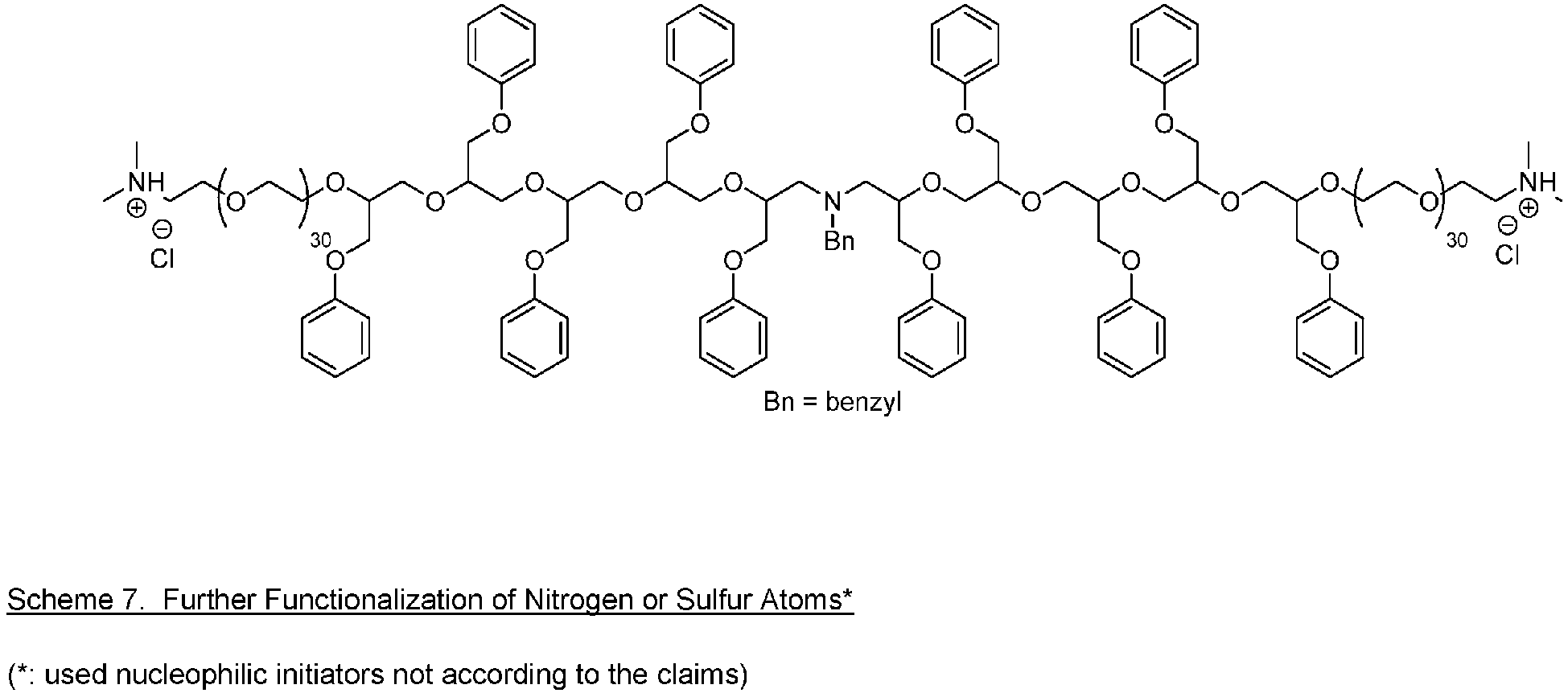


- In some aspects, it may be desirable to use conventional sulfonating agents, e.g., sulfur trioxide, to sulfonate some portion of the aromatic rings present in the dispersant. Thus, aromatic rings from recurring units of phenyl glycidyl ether, 2-methylphenyl glycidyl ether, styrene oxide, or other aromatic rings can be sulfonated to introduce sulfonate groups into the dispersant. In one example, triethanolamine-PGE(18)-EO(105) is reacted with sulfur trioxide under conditions effective to sulfonate at least a portion of the aromatic rings. Under typical sulfonation conditions, free hydroxyl groups will also be sulfated, and in some cases a mixed sulfate/sulfonate will be the desired end product. In that case, the reaction product is simply neutralized with a suitable base. If only a sulfonate is desired, any sulfates generated can be hydrolyzed, e.g., with dilute acid treatment, to regenerate free hydroxyl groups.
- Suitable pigments for use in making the pigment dispersions are well known and readily available. Many of the pigments are organic compounds, although inorganic pigments are also common. Examples appear in
U.S. Pat. No. 7,442,724 . Suitable organic pigments include, for example, monoazos, diazos, anthraquinones, anthrapyrimidines, quinacridones, quinophthalones, dioxazines, flavanthrones, indanthrones, isoindolines, isoindolinones, metal complexes, perinones, perylenes, phthalocyanines, pyranthrones, thioindigos, triphenylmethanes, anilines, benzimidazolones, diarylides, diketopyrrolopyrroles, naphthols, and aldazines. Suitable inorganic pigments include, for example, white pigments, black pigments, chromatic pigments, and luster pigments. - The copolymers are useful for preparing pigment dispersions, especially water-based pigment dispersions. Many of the inventive copolymers are relatively soluble in water and provide stable dispersant solutions or emulsions. The pH of the dispersant solution or emulsion is usually adjusted with acid (e.g., hydrogen chloride) or base (e.g., sodium hydroxide) to be within the range of 3 to 12, or in some aspects, within the range of 7 to 11, or 8 to 10, or 8.5 to 9.5. Pigments are combined with a carrier (preferably water), the copolymer, and any pH adjusting agent, biocide, defoamer, rheology modifier, stabilizer, or other desired components to give a mixture with the desired proportion of copolymer to pigment. Typically, the solids content of the pigment dispersion will be within the range of 5 to 95 wt.%, 15 to 90 wt.%, or 25 to 85 wt.%. The mixtures are preferably milled, for instance in a paint mixer with metal, ceramic, or glass balls, to produce pigment dispersions that can be evaluated for relevant physical properties.
- A desirable aqueous pigment dispersion will have low viscosity and an intermediate particle size. For instance, the dispersion desirably has a viscosity less than 5 Pas (5,000 cP) at 25°C and a shear rate of 10 s-1, preferably less than 3 Pas (3,000 cP) at 25°C and a shear rate of 10 s-1, more preferably less than 1 Pas (1,000 cP) at 25°C and a shear rate of 10 s-1. This shear rate corresponds to the amount of shear typically experienced by the dispersion during pouring. The particle size of the aqueous dispersion, as measured by dynamic light scattering (or other suitable techniques) should be within the range of 100 nm to 1000 nm, preferably from 100 nm to 500 nm or from 100 nm to 300 nm.
- Desirable pigments dispersions make efficient use of the dispersant, which is usually a relatively expensive component of the dispersion. In other words, the less dispersant needed for a given amount of pigment, the better. The usage level requirements for the present copolymers can vary, but typically range from 0.5 to 80 wt.%, 2 to 60 wt.%, or 3 to 50 wt.% of copolymer dispersant based on the total amount of pigment dispersion.
- Productivity also matters. The ability to produce a good dispersion in a short time translates into reduced overall cost. We found that the inventive copolymers can give stable, non-viscous dispersions having desirable particle sizes expeditiously with many pigments.
- It is convenient to name the copolymers by indicating the initiator used followed by PGE(x)AO(y) to indicate the number of moles of the phenyl glycidyl ether and alkylene oxide used to make the copolymer. When a capping group is used, a designation can be added after the alkylene oxide portion. Thus, a reaction product of morpholine with 5 moles of phenyl glycidyl ether and then 20 moles of ethylene oxide is conveniently abbreviated as: "morpholine-PGE(5)-EO(20)." When the nucleophilic initiator has more than one active hydrogen, the average number of PGE or EO units per arm can be approximated by dividing the total number of moles of PGE or EO indicated by the functionality of the initiator. Thus, "pentaerythritol-PGE(20)-EO(120)," an initiator with functionality = 4, nominally has an average of 5 PGE units and 30 EO units per arm, although as the skilled person will appreciate, these values are approximations. The conventions are used in the examples below.
- Certain inventive copolymers may provide advantages when combined with particular pigments. We found, for instance, that monoazo yellow pigment provides an excellent aqueous dispersion when used at pH 8 to 10 in combination with the dispersants or dispersant blends listed in Tables 4, 4A, 4B and 5. Similarly, quinacridone violet pigment provides an excellent aqueous dispersion when used at pH 8 to 10 in combination with the dispersants or dispersant blends listed in Tables 6 and 6A. Phthalocyanine blue provides an excellent aqueous dispersion when used at pH 8 to 10 when used in combination with the dispersants or dispersant blends listed in Tables 7, 8, 9, and 10.
- In one aspect, the invention includes a method which comprises stabilizing flow properties of an emulsion latex polymer. The method protects against temperature-induced changes in the properties that occur within the range of-20°C to 50°C. The method comprises combining the emulsion latex polymer with an effective amount of a dispersant composition produced by combining the copolymers described herein with water.
- In another aspect, the invention relates to a method of enhancing the hydrophobic character of an alkyd coating. This method comprises combining an alkyd resin with an effective amount of a dispersant composition comprising the copolymers described herein and a non-aqueous carrier such as an organic solvent. In a preferred aspect, the alkyd resin comprises a reaction product of glycerol, soybean oil, and isophthalic acid.
- The inventive copolymers are useful in agricultural formulations as emulsifiers, as dispersants for suspension concentrates, as dispersants for seed coatings, as wetting agents, as spreaders, as adjuvants to promote the uptake of actives into leaf surfaces, and as dispersant components of water-dispersible granules. We found, for instance, that the copolymers perform as well as or better than controls as dispersants for wettable powders from atrazine, chlorothalonil, or imidacloprid (see Table 15, below). Good suspension concentrates comprising the inventive copolymers can also be made (see, e.g., Table 16, below). Suitable carriers for agricultural applications, particularly emulsions or suspension concentrates, include organic solvents, water, and combinations of water and water-miscible organic solvents.
- The polymers can be used to disperse solids (e.g., organic and/or inorganic pigments, fillers or latex) in coatings as is discussed above and in greater detail below related to organic and inorganic pigments, especially organic pigments. However, the polymers can also be used in agricultural applications (as discussed above) and as dispersants for other particulate materials, such as cement, minerals, asphaltene, or particulate soils. The polymers may also find utility as rheology modifiers, foamers, defoamers, or auxiliary components of laundry detergents or personal care products, including cleansers and cosmetics. The polymers may also be useful as coating additives, where they could enhance film quality as compatibilizers, adhesion promoters or leveling agents.
- The following examples illustrate the invention; the skilled person will recognize many variations that are within the scope of the claims.
Table 1. PGE Dispersants Comparative butanol-PGE(6.4)-EO(20) phenol-PGE(5)-EO(30) butanol-PGE(6.4)-EO(30) phenol-PGE(5)-EO(40) butanol-PG E(6.4)-EO(40) Inventive; *: not according to the claims 4-aminobenzenethiol-PGE(1 5)-EO(90) morpholine-PGE(5)-EO/PO(24:6) random* benzenesulfonamide-PGE(10)-EO(60)* morpholine-PGE(5)-EO/PO(5:1) random* benzylamine-PGE(10)-EG(40)* morpholine-PGE(5)-PO(5)-EO(25)* benzylamine-PGE(10)-EO(60)* morpholine-PGE(5)-PO(25)-EO(5)* benzylamine-PGE(10)-EO(80)* morpholine-PGE(5)-EO(25)-PO(5)* bisphenol A-PGE(10)-EG(60) morpholine-PGE(25)-EO(30)* bisphenol A-PGE(10)-EO(90) morpholine-PGE(3)-EO(30)* bisphenol A-PGE(10)-EG(110) morpholine-PGE(8)-EO(30)* bisphenol S-PGE(10)-EO(40) morpholine-PGE(15)-EO(30)* bisphenol S-PGE(10)-EO(60) 1,8-octanediol-PGE(10)-EO(40) bisphenol S-PGE(10)-EO(80) 1,8-octanediol-PGE(10)-EO(60) 2-butyne-1,4-diol-PGE(10)-EG(60) 1,8-octanediol-PGE(10)-EO(80) 1,4-cyclohexanedimethanol-PGE(10)-EO(60) pentaerythritol-PGE(20)-EO(120) diethanolamine-PGE(15)-EO(90) piperazine-PGE(10)-EG(60)* ethylenediamine-PGE(20)-EG(120)* 1,3-propanediol-PGE(10)-EO(40) 2,2'-(ethylenedioxy)diethanethiol-PGE(10)-EG(60) 1,3-propanediol-PGE(10)-EO(60) farnesol-PGE(5)-EO(20)* 1,3-propanediol-PGE(10)-EO(80) farnesol-PGE(5)-EO(30)* resorcinol-PGE(10)-EG(40) farnesol-PGE(5)-EO(40)* resorcinol-PGE(10)-EG(60) isosorbide-PGE(10)-EO(60) resorcinol-PGE(10)-EO(80) isosorbide-SO(10)-EO(60) thiophenol-PGE(5)-EO(20) isosorbide-SO(10)-EO(80) thiophenol-PGE(5)-EO(30) N-methylaniline-PGE(5)-EO(20)* thiophenol-PGE(5)-EO(40) N-methylaniline-PGE(5)-EO(30)* triethanolamine-PGE(15)-EO(90) N-methylaniline-PGE(5)-EO(40)* triethanolamine-PGE(18)-EO(105) morpholine-PGE(5)-EO(20)* triethanolamine-PGE(15)-PO(15)-EO(75) morpholine-PGE(5)-EO(30)* triethanolamine-PGE(15)-PO(21)-EO(105) morpholine-PGE(5)-EO(40)* trimethylolpropane-PGE(15)-EO(90) PGE = phenyl glycidyl ether; EO = ethylene oxide; PO = propylene oxide; SO = styrene oxide Table 1A. More PGE Dispersants Inventive, *: not according to the claims di(pentaerythritol)-PGE(30)-EO(120) di(pentaerythritol)-PGE(30)-EO(180) di(pentaerythritol)-PGE(30)-EO(210) di (pentaeryth ritol)- PG E(30)- EO(240) di(trimethylolpropane)-PGE(20)-EO(120) 3[mPEG2000-PGE(5)]-4-aminophenol triglycidyl ether* 2[mPEG2000-PGE(6)]-dipotassium 1,2,4,5-benzene dicarboxylate* 3[mPEG2000-PGE(6)]-1,3,5-benzenetricarbonyl* octylamine-PGE(10)-EO(60)* resorcinol DGE-1-dodecanethiol(2)-PGE(10)-EO(60) resorcinol DGE-1-dodecanethiol(2)-PGE(10)-EO(80) resorcinol DGE-1-dodecanethiol(2)-PGE(10)-EG(100) triethanolamine-EHGE(3)-PGE(15)-EO(86) triethanolamine-EHGE(3)-PGE(15)-EO(120) triethanolamine-EHGE(3)-PGE(15)-EO(150) triethanolamine-PGE(15)-EO(90)-SA(3) triethanolamine-PGE(15)-EO(90)-SA(2) triethanolamine-PGE(15)-EO(90)-SA(1) triethanolamine-PGE(15)-GE(3)-EO(180)-SA(0.6) triethanolamine-PGE(15)-GE(3)-EO(180)-SA(1.2) triethanolamine-PGE(15)-GE(3)-EO(180)-SA(1.8) triethanolamine-PGE(15)-GE(3)-EO(240)-SA(0.6) triethanolamine-PGE(15)-GE(3)-EO(240)-SA(1.2) triethanolamine-PGE(15)-GE(3)-EO(240)-SA(1.8) triethanolamine-PGE(15)-EO(90)-BS (1:2) triethanolamine-PGE(15)-EO(90)-BS (1:6) triethanolamine-PGE(18)-[SO3H(0.6)]-EO(105) triethanolamine-PGE(18)-[SO3H(0.6)]-EO(105)-SO3H(3) trimethylolpropane-AGE(3)-PGE(15)-EO(90) trimethylolpropane-PGE(15)-GE(3)-EO(180) trimethylolpropane-PGE(16)-GE(3)-EO(90) trimethylolpropane-PGE(16)-GE(3)-EO(120) trimethylolpropane-PGE(16)-GE(3)-EO(180) trimethylolpropane-PGE(16)-GE(3)-EO(240) 2,4,6-tristyrylphenol-PGE(5)-EO(20) 2,4,6-tristyrylphenol-PGE(5)-EO(30) 2,4,6-tristyrylphenol-PGE(5)-EO(40) 2,4,6-tristyrylphenol-PGE(5)-EO(50) AGE = allyl glycidyl ether; DGE = diglycidyl ether; PGE = phenyl glycidyl ether; EO = ethylene oxide; SA = succinic anhydride to cap; BS = 1,4-butanesultone, 1/6 or 1/2 cap; GE = glycidyl ether residue following acid-mediated deprotection after initial reaction with 1-ethoxyethyl glycidyl ether Table 1B. More PGE Hydrophobes Inventive, *: not according to the claims 4-aminothiophenol-PGE(15) benzenesulfonamide-PGE(10)* 4,4'-diaminodiphenylmethane-PGE(20)* 1,6-dihydroxynaphthalene-PGE(10) 2,2'-(ethylenedioxy)diethanethiol-PGE(10) imidazole-PGE(5)* 1,2-O-isopropylidene-α,D-glucofuranose-PGE(15) 2-mercaptoethanol-PGE(10) morpholine-PGE(15)* morpholine-PGE(25)* oleylamine-PGE(10)* pentaerythritol-styrene oxide(20)** 2,4,7,9-tetramethyl-5-decyn-4,7-diol-PGE(10) thiophenol-PGE(4)-2-ethylhexyl glycidyl ether(1) triethanolamine-2-biphenyl glycidyl ether(3)-PGE(9) triethanolamine-3,4-epoxytetrahydrofuran(3)-PGE(12) triethanolamine-1,2-epoxyhexadecane(3)-PGE(15) triethanolamine-MPGE(15) ** In some aspects, it may be desirable to use styrene oxide to replace some or all of the PGE. PGE = phenyl glycidyl ether; MPGE = 2-methylphenyl glycidyl ether - The procedures below can be used to produce the wide variety of inventive copolymers listed in Tables 1 and 1A. Additional dispersants can be made similarly by adding ethylene oxide, propylene oxide, or combinations thereof, and optionally a capping group, to the hydrophobes listed in Table 1B.
- A 4-neck round-bottom flask is equipped with a heating mantle, a temperature controller, an overhead stirrer, a thermocouple, a nitrogen inlet with a sparging tube, and a distillation adapter. To the adapter is attached an addition funnel, a water-cooled condenser, a gas outlet bubbler, and a collection flask. Under a flow of nitrogen, the flask is charged with a nucleophilic initiator and methyl tert-butyl ether (MTBE). The mass of MTBE used is about 2-3 times that of the nucleophilic initiator. Solid potassium methoxide is added, and the mixture is heated to 55-65°C. Rapid distillation of MTBE begins, and the first of five additions of phenyl glycidyl ether (PGE) from the addition funnel commences. For each addition, one equivalent of PGE is added for each mole of alcohol, disubstituted amine, or thiol initiator, and two equivalents of PGE are added for each mole of monosubstituted amine initiator. When the first addition is complete, and most of the MTBE has distilled off, the reaction temperature is slowly increased until an initial exotherm is observed. Depending on the identity of the nucleophilic initiator, the exotherm commences anywhere within the range of 70°C to 140°C. During the first and subsequent exotherms, the reaction temperature is controlled by adjusting the stirring rate or the temperature set point, or by removing the heating mantle. When the first exotherm subsides, a second addition of PGE begins. From this point on, the reaction temperature is maintained within the range of 100°C to 120°C. The remaining three additions of PGE proceed as before. After all of the PGE is added, the reaction temperature is kept at 105°C, and reaction progress is gauged by monitoring the consumption of PGE by 1H NMR. When the reaction is complete, the product is used in the next step without further manipulation. In general, the isolated material contains 0.35-0.55 wt.% potassium. The product is a mixture of compounds with an average of five units of PGE per nucleophilic site on the initiator.
- A 600-mL Parr reactor, equipped with a mechanical stirrer, a nitrogen sparger, a thermocouple, and a sample port is charged with the potassium-containing hydrophobe prepared as described above. The reactor is sealed and the contents are slowly heated to 120°C. When the target temperature is reached, one or more alkylene oxides are added to begin the alkoxylation. For monoblock tails composed of a single alkylene oxide monomer or a random mixture of two or more alkylene oxide monomers, the alkylene oxide monomer(s) is(are) added in batches until the targeted number of moles of monomer have reacted. For tails composed of more than one alkylene oxide block, the above procedure is repeated for each additional segment. When the alkoxylation is considered complete, the product is removed from the reactor at 80-90°C.
-
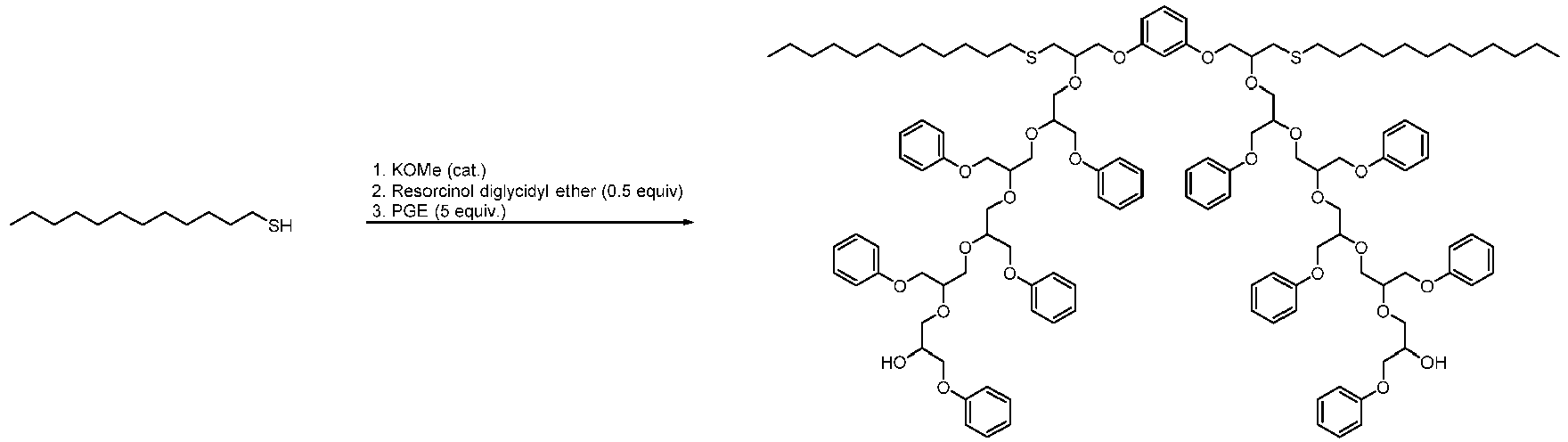
- A round-bottom flask equipped with heating mantle, temperature controller, overhead stirrer, thermocouple, and nitrogen inlet is charged with 1-dodecanethiol (72.9 g, 360 mmol) and solid potassium methoxide (3.10 g, 44.2 mmol). The resulting mixture is heated to 105°C, whereupon portion-wise addition of warmed (54°C) resorcinol diglycidyl ether (40.0 g, 180 mmol) commences. The reagent is introduced by intermittently removing the gas outlet and adding the warm liquid by pipette. During the addition, the reaction temperature is maintained at or below 133°C by controlling the rate of reagent addition and the stirring rate. After 10 min., the addition is complete, and the reaction mixture stirs and cools to 100°C. Complete consumption of resorcinol diglycidyl ether is observed by 1H NMR after stirring for 1 h at 100°C.
- An addition funnel charged with phenyl glycidyl ether (270.4 g, 1801 mmol) is introduced, and the glycidyl ether is added over 34 min. while maintaining the reaction temperature at or below 123°C by controlling the rate of reagent addition and the stirring rate. After the addition is complete, the reaction mixture stirs at 110°C. Reaction progress is monitored by measuring the consumption of the glycidyl ether by 1H NMR spectroscopy. After stirring for 4 h at 110°C, analysis confirms that the reaction is complete. The hot reaction mixture is poured into a jar and allowed to cool to room temperature. The product, resorcinol diglycidyl ether-1-dodecanethiol(2)-PGE(10) (374.6 g, 98%) contains 0.45 wt.% potassium.
-

- A round-bottom flask is equipped with a heating mantle, temperature controller, overhead stirrer, thermocouple, nitrogen inlet/sparging tube, and distillation adapter. To the adapter is attached an addition funnel, a water-cooled condenser, and a collection flask. The flask is charged under nitrogen with trimethylolpropane (154.6 g, 1.15 mol) and solid potassium methoxide (26.4 g, 0.377 mol). The resulting solid mixture is heated to 110°C with stirring. After 15 min. at 110°C, a pale-yellow solution is obtained. Phenyl glycidyl ether (2597 g, 17.29 mol) is then added via the addition funnel over 90 min. During the addition, the reaction temperature is held at or below 140°C by controlling the rate of reagent addition and the stirring rate. After the addition is complete, the reaction mixture stirs at 110°C. After 4 h, 1H NMR shows complete consumption of the phenyl glycidyl ether. Stirring is discontinued, the reaction mixture cools to room temperature, and the product is stored in the reaction flask under nitrogen overnight.
- The solid reaction mixture is slowly heated to 100°C. Once the mixture begins to melt, the overhead stirrer is activated. When the mixture has liquefied, 1-ethoxyethyl glycidyl ether (505.8 g, 3.46 mol) is added by addition funnel over 0.5 h. When the addition is complete, the mixture stirs at 110°C. After 16 h, 1H NMR shows complete consumption of the 1-ethoxyethyl glycidyl ether.
- The hot reaction mixture is transferred quantitatively to a large round-bottom flask using two rinses of tetrahydrofuran (300 g) to complete the transfer. Ethanol (2.2 kg) and more tetrahydrofuran (400 g) are added. An overhead stirrer and thermocouple are attached to the flask, and the mixture is stirred at 47°C. Aqueous hydrochloric acid (37%, 170 g, 1.72 mol) is added, and the resulting mixture stirs and slowly cools over 4.5 h to room temperature. While cooling, the mixture periodically becomes too viscous to stir efficiently, and tetrahydrofuran (3 x 300 g) is added. 1H NMR analysis shows complete consumption of the acetal functionality. Solid potassium carbonate (480 g, 3.47 mol) is added, and the reaction mixture is stirred at room temperature. After 18 h, stirring is stopped, and the solids are allowed to settle. Solids are removed by filtration and rinsed with tetrahydrofuran. The filtrates are combined, and volatiles are removed by distillation at 100-115°C followed by vacuum drying (120°C, 44 mm Hg). Trimethylolpropane-PGE(15)-GE(3) (2.73 kg, 91.0%) is obtained.
-

- A round-bottom flask is equipped with a heating mantle, temperature controller, overhead stirrer, thermocouple, nitrogen inlet/sparging tube, and distillation adapter with a Teflon stopcock. To the adapter is attached an addition funnel charged with 1,2-epoxyhexadecane (116 g, 483 mmol), a condenser, and a collection flask. The flask is charged under nitrogen with triethanolamine (24.0 g, 161 mmol), solid potassium methoxide (4.06 g, 0.36 mmol), and MTBE (225 g). The reaction mixture is heated to 55°C, and distilled methyl t-butyl ether is collected. When about half of the solvent has been collected, 1,2-epoxyhexadecane is added over 8 min. After the epoxide addition is complete, no more solvent is collected. The reaction mixture is heated to 120°C over 20 min. After stirring for 0.5 h, the reaction temperature is increased to 135°C. After another 0.5 h, 1H NMR shows complete consumption of 1,2-epoxyhexadecane. The mixture cools to 110°C.
- An addition funnel charged with phenyl glycidyl ether (362 g, 2.41 mol) replaces the distillation apparatus. The glycidyl ether is added to the reaction mixture over 0.5 h. During the addition, the reaction temperature is held at or below 130°C. After the addition is complete, the reaction mixture stirs at 110°C for 4 h. 1H NMR analysis shows complete consumption of phenyl glycidyl ether. The hot reaction mixture is poured into ajar and allowed to cool. The product, triethanolamine-1,2-epoxyhexadecane(3)-PGE(15) (497 g, 98.8%), contains 0.45 wt.% potassium.
- A round-bottom flask equipped with a heating mantle, temperature controller, overhead stirrer, thermocouple, and nitrogen inlet/sparging tube is charged under nitrogen with mPEG 2000 (equiv. wt. = 2070 g/mol, 67.6 g, 32.6 mmol) and solid potassium methoxide (2.29 g, 32.7 mmol). The mixture is heated to 110°C with stirring, whereupon phenyl glycidyl ether (29.5 g, 196 mmol) is added over 8 min. The reagent is introduced by intermittently removing the gas outlet and adding the warm liquid by pipette. During the addition, the reaction temperature is maintained at or below 120°C by controlling both the rate of reagent addition and the stirring rate. When the addition is complete, the reaction temperature is held at 120°C for 100 min. Analysis by 1H NMR shows complete consumption of phenyl glycidyl ether. The mixture cools to 60°C and is stirred at this temperature.

- Solid 1,3,5-benzenetricarbonyl trichloride (2.90 g, 10.9 mmol) is added to the flask in portions over 5 min. During the addition, the reaction temperature is held at or below 70°C. The mixture stirs at 70°C for 1 h, then at 90°C for 1.5 h, at which point it is judged to be complete by 1H NMR and infrared analysis. The hot reaction mixture is decanted from the solid potassium chloride into a jar and cools to room temperature. The product is 3[mPEG2000-PGE(6)]-1,3,5-benzenetricarbonyl (94.2 g, 93.9%).
-

- A jar is charged with a stir bar and warm (75°C) triethanolamine-3[PGE(5)-EO(30)] (equiv. wt. = 6363 g/mol, 10.0 g, 1.58 mmol). After stirring at 75°C for 10 min., succinic anhydride (471 mg, 4.71 mmol) is added. The anhydride slowly goes into solution. After stirring for 3 h, 1H NMR analysis shows complete consumption of the succinic anhydride. The reaction mixture cools to room temperature to give triethanolamine-PGE(15)-EO(90)-SA(3) (10.5 g, 100%).
- Triethanolamine-PGE(18)-EO(105) (53.9 g, 29.9 mmol) is charged to a water-jacketed reactor with the water temperature set at 60°C. Liquid sulfur trioxide (2.92 g, 36.5 mmol) is added dropwise from an addition funnel to a vaporizer flask under a nitrogen flow rate of about 5 L/min., and the vaporized sulfur trioxide is introduced into the reactor to maintain a reaction temperature of about 65°C. When the addition is complete (about 10 min.), the reactor is purged with nitrogen for 5 min. The resulting acid is a highly viscous gel that is transferred to a jar and stored at - 40°C. 1H NMR analysis shows a new signal at 4.2 ppm attributed to sulfate protons, and new signals at 7.3 ppm & 7.8 ppm attributed to sulfonate protons. Degree of arene sulfonation: about 5%.
- A mixture of the sulfate/sulfonate product described immediately above (15.0 g) is combined with water (34.8 g) and heated on a hot plate for 4 h. The sulfate groups are converted to sulfonic acid groups, and the arene sulfonate groups are retained.
- The polymeric dispersant is diluted in deionized water to a concentration of 20-40 wt.% polymer for ease of incorporation in a testing formulation. The solutions are adjusted with acid or base to pH of 8.5 to 9.5 before evaluation of contact angle, interfacial tension (IFT), and foaming properties.
- Contact angle is measured at 0.1 wt.% of inventive polymer dispersant on two types of surfaces: EMC quartz glass and Rinzle plastic micro-slides. The measurement is conducted with a pendant drop tensiometer (Kruss DSA 20) at ambient temperature. The average of five measurements is recorded.
- Interfacial tension of the dispersants is measured against dodecane at 0.1 wt.% solids at ambient temperature using the pendant drop tensiometer.
- Foams are tested at 0.2 wt.% of polymeric solution in tap water. The test solution (100 g) is added to a 500-mL graduated cylinder. The foam is kept to a minimum, and the cylinder is stoppered. The cylinder is placed in a mechanical shake foam machine and is inverted 10 times. The foam is allowed to settle for 15 seconds. An initial foam height value is then recorded. The foam height is measured and recorded again after 5 minutes.
- Pigment dispersions are prepared by combining the polymeric dispersants with pigments in a formulation comprising 0.5 to 50 wt.% dispersant, 10 to 80 wt.% pigment, 0.5 to 6 wt.% additives (e.g., defoamer, rheology modifier, biocide, neutralizing agent, stabilizer) and 10 to 85 wt.% water or another liquid carrier. As shown in the formulation examples below, the proportion of dispersant solids to pigment can vary over a wide range and depends on the nature of the dispersant, the nature of the pigment, the dispersing medium, and other factors. The formulation may also contain 0 to 10 wt.% resin and 0 to 20 wt.% solvent. Preferably, the pigment is added last to the other formulation components. In general, the formulation components are shaken with an equal weight of 0.8 to 1-mm glass beads in a Red Devil paint shaker for 1 to 4 hours to produce the pigment dispersion.
- F1. Monoazo yellow pigment dispersion: An inventive polymeric dispersant (1.5 to 2.5 wt.% solids) is combined with BYK-024 defoamer (1.0 wt.% solids, product of BYK), NEOLONE® M-10 biocide (product of Dow, 0.1 wt.% solids), IRGALITE® Yellow L1254 HD (product of BASF, 50 wt.% solids), and water (q.s. to 100 wt.%). The mixture is shaken for 1 h to give the dispersion. See Tables 4, 4A, and 4B.
- F2. Monoazo yellow pigment dispersion: The procedure of F1 is repeated with 2.6 wt.% of polymeric dispersant and 53 wt.% solids of yellow pigment. In this case, the mixture is shaken for 4 h to generate the pigment dispersion. See Table 5.
- F3. Quinacridone violet pigment dispersion: An inventive polymeric dispersant (1.2 to 6.0 wt.% solids) is combined with BYK-024 defoamer (1.0 wt.% solids), NEOLONE® M-10 biocide (0.1 wt.% solids), CINQUASIA® Red L4100 HD (product of BASF, 40 wt.% solids), and water (q.s. to 100 wt.%). The mixture is shaken for 4 h to give the dispersion. See Tables 6 and 6A.
- F4. Quinacridone violet pigment dispersion: The procedure of F3 is repeated with 2.5 wt.% solids of the polymeric dispersant and 50 wt.% solids of the pigment. The mixture is shaken for 4 h to give the dispersion. See Table 7.
- F5. Phthalocyanine blue (15:4) pigment dispersion: An inventive polymeric dispersant (8.0 wt.% solids) is combined with BYK-024 defoamer (1.0 wt.% solids), NEOLONE® M-10 biocide (0.1 wt.% solids), HELIOGEN® Blue L7101 F (product of BASF, 40 wt.% solids), and water (q.s. to 100 wt.%). The mixture is shaken for 2 h to give the dispersion. See Table 8.
- F6. Phthalocyanine blue (15:3) pigment dispersion: An inventive polymeric dispersant (6.0 or 8.0 wt.% solids) is combined with BYK-024 defoamer (1.0 wt.% solids), NEOLONE® M-10 biocide (0.1 wt.% solids), HELIOGEN® Blue L7085 (product of BASF, 40 wt.% solids), and water (q.s. to 100 wt.%). The mixture is shaken for 4 h to give the dispersion. See Table 9.
- F7. Phthalocyanine blue (15:2) pigment dispersion: An inventive polymeric dispersant (3.0 to 5.0 wt.% solids) is combined with BYK-024 defoamer (1.0 wt.% solids), NEOLONE® M-10 biocide (0.1 wt.% solids), HELIOGEN® Blue L6875F (product of BASF, 40 wt.% solids), and water (q.s. to 100 wt.%). The mixture is shaken for 4 h to give the dispersion. See Table 10.
- F8. Red iron oxide pigment dispersion: An inventive polymeric dispersant (6.0 wt.% solids) is combined with BYK-024 defoamer (1.0 wt.% solids), NEOLONE® M-10 biocide (0.1 wt.% solids), BAYFERROX® 120M (product of LanXess, 60 wt.% solids), and water (q.s. to 100 wt.%). The mixture is shaken for 2 h to give the dispersion. See Table 11.
- F9. Beta-naphthol orange pigment dispersion: An inventive polymeric dispersant (3.0 to 4.0 wt.% solids) is combined with BYK-024 defoamer (1.0 wt.% solids), NEOLONE® M-10 biocide (0.1 wt.% solids), MONOLITE® Orange 200504 (product of Heubach, 40 wt.% solids), and water (q.s. to 100 wt.%). The mixture is shaken for 4 h to give the dispersion. See Table 12.
- F10. Carbon black pigment dispersion: An inventive polymeric dispersant (7.8 wt.% solids) is combined with BYK-024 defoamer (1.0 wt.% solids), NEOLONE® M-10 biocide (0.1 wt.% solids), FW 200 (product of Orion, 15.75 wt.% solids), and water (q.s. to 100 wt.%). The mixture is shaken for 4 h to give the dispersion. See Table 13.
- F11. Carbon black pigment dispersion: An inventive polymeric dispersant (variable % solids) is combined with BYK-024 defoamer (1.0 wt.% solids), NEOLONE® M-10 biocide (0.1 wt.% solids), MONARCH® 120 (product of Cabot, 40 wt.% solids), and water (q.s. to 100 wt.%). The mixture is shaken for 4 h to give the dispersion. See Table 14.
- The viscosity of pigment dispersions is measured "as is" under a shear rate of 1-100 s-1 at 25°C using a rheometer (TA Instrument). The viscosity at 10 s-1 is reported.
- Particle size is measured on diluted dispersions of 0.1 wt.% pigment using dynamic light scattering (Malvern Nanosizer) at 25°C. The values measured are Z-average particle sizes.
- Dispersions are examined visually for uniformity and by measuring changes in viscosity as a function of time.
- An interior satin base paint (Behr 7400) is tinted by using 40% quinacridone violet pigment dispersions containing 1.6% dispersant. The tinting ratio is 8 oz./gal. The tinted paint is tested for scrub resistance according to ASTM D2486-17, Test Method A. The paint film is scrubbed with a metal brush over the brass shim until a continuous line of paint is removed. The mean number of cycles of scrubbing to failure is recorded. A higher number of cycles indicates better scrub resistance.
- In a control experiment with DISPERBYK® 190, the number of cycles to failure is 706. When triethanolamine-PGE(15)-EO(90) is used as the dispersant, the number of cycles to failure is 745.
- Dispersion concentrates are diluted into base paint at 8 oz./gal. Behr interior satin enamel medium 7400 paint is used as the base paint. The resulting tinted base paint is shaken for 10 min. with the Red Devil shaker. Entrapped air is removed by gentle centrifuging before use. The tinted paint is drawn down with a 3-mil Bird bar applicator onto a Leneta chart 18B. The wet paint film is allowed to thicken and is then rubbed with a finger.
- The color strength of the dried paint film is measured with a spectrophotometer (Minolta) using the CIE L* a* b* or alternatively, the L* C* h system. The color intensity can also be represented by Chroma C*.
- If the pigment is not well dispersed or is separated, the mechanical motion of rubbing will re-disperse the pigment and make a paint film color stronger and more homogeneous. By comparing the color difference, ΔE, between the rubbed area and the un-rubbed area, the quality of the pigment dispersion can be revealed. The target is to have no color difference or minimal color difference of ΔE, where ΔE was defined as:

- Blocking resistance evaluates a film's face-to-face stickiness. The test is conducted according to ASTM D4946-89. Blocking resistance is rated based on how well the paint film seals together or tackiness. A higher rating indicates reduced tackiness or seal. An interior satin base paint (Behr 7400) is tinted at 8 oz/gal by preparing pigment dispersions using the inventive dispersant and a control dispersant, both at the optimal dispersant concentrations. Table 20, below, shows that the inventive dispersant has better blocking resistance compared to the control.
- The inventive polymer dispersants demonstrate surprising universal compatibility and tinting ability for both water- and solvent-based paints. An oil-based alkyd paint (Behr 3800) is tinted with the water-based pigment dispersions at 12 oz/gal. In most cases, the inventive dispersants show much higher Chroma values compared to the control, which indicates better compatibility and strong color after tinting the oil-based white paint. Results appear in Table 21.
Table 2. Contact Angle and Interfacial Tension (0.1 wt.% dispersant) Ex. Dispersant Contact angle, degrees, plastic Contact angle, degrees, quartz IFT, dodecane (mN/m) C1* butanol-PGE(6.4)-EO(40) 67.8 48.9 15.0 C2* phenol-PGE(5)-EO(40) 67.7 56.9 20.4 C3* DISPERBYK®-190 67.7 52.7 23.3 4** benzylamine-PGE(10)-EO(60) 66.0 43.9 17.4 5 bisphenol S-PGE(10)-EO(60) 66.8 44.8 10.4 6** farnesol-PGE(5)-EO(40) 70.0 48.7 12.6 7 isosorbide-PGE(10)-EG(60) 69.3 55.9 14.6 8** morpholine-PGE(5)-EO(20) 63.1 36.9 15.4 9** morpholine-PGE(5)-EO(30) 66.5 48.7 16.6 10** morpholine-PGE(5)-EO(40) 69.4 38.5 25.8 11** piperazine-PGE(10)-EO(60) 69.7 52.2 17.1 12 1,3-propanediol-PGE(10)-EO(40) 68.8 59.8 15.3 13 1,3-propanediol-PGE(10)-EO(80) 67.5 56.2 21.3 14 resorcinol-PGE(10)-EO(40) 70.5 58.1 16.1 15 resorcinol-PGE(10)-EO(60) 70.5 53.5 17.6 16 resorcinol-PGE(10)-EO(80) 72.0 59.5 19.7 17 thiophenol-PGE(5)-EO(40) 64.4 48.3 15.9 * Comparative examples ** not according to the claims DISPERBYK®-190 is a product of BYK Additives and Instruments. - The contact angle data shows that the inventive copolymers can wet both hydrophilic and hydrophobic surfaces. The interfacial tension data also demonstrates that the copolymers are potentially useful as emulsifiers because they can lower the IFT between dodecane and water from about 53 mN/m to less than 20 mN/m in most cases.
Table 3. Foam Testing Results Ex. Dispersant Foam vol., initial (mL) Foam vol., 5 min. (mL) C18* DISPERBYK®-190 168 150 C19* butanol-PGE(6.4)-EO(40) 170 143 C20* phenol-PGE(5)-EO(40) 148 133 21 ** farnesol-PGE(5)-EO(40) 158 148 22** morpholine-PGE(5)-EO(20) 150 125 23** morpholine-PGE(5)-EO(30) 163 105 24** morpholine-PGE(5)-EO(40) 158 128 25 1,3-propanediol-PGE(10)-EG(40) 148 133 26 1,3-propanediol-PGE(10)-EG(80) 160 143 27 resorcinol-PGE(10)-EO(40) 133 128 28 resorcinol-PGE(10)-EO(80) 155 140 29 thiophenol-PGE(5)-EO(40) 158 128 * Comparative examples ** not according to the claims - A dispersant that provides a low or unstable foam is desirable for paints and other dispersion products. Some of the inventive copolymers and copolymers not according to the claims, e.g., the morpholine-initiated dispersants, show surprisingly rapid dissipation of the foam compared to control samples.
Table 4. 50 wt.% Monoazo yellow pigment dispersions with 2.5 wt.% dispersant (pH 8-10, Ex. F1) Ex. Dispersant Viscosity at 10 s-1 (Pas (cP)) C30* DISPERBYK®-190 0.337 (337) C31* butanol-PGE(6.4)-EO(20) high*** 32** benzylamine-PGE(10)-EO(40) 0.409 (409) 33** benzylamine-PGE(10)-EG(60) 0.345 (345) 34 bisphenol S-PGE(10)-EO(60) 0.068 (68) 35 isosorbide-PGE(10)-EG(60) 0.124 (124) 36** morpholine-PGE(5)-EO(20) 0.112 (112) 37** morpholine-PGE(5)-EO(30) 1.413 (1413) 38** morpholine-PGE(5)-random EO/PO(24/6) 0.110 (110) 39** morpholine-PGE(5)-PO(5)-EO(25) 0.086 (86) 40 1,8-octanediol-PGE(10)-EO(40) 0.514 (514) 41 pentaerythritol-PGE(20)-EO(120) 0.403 (403) 42** piperazine-PGE(10)-EG(60) 0.118 (118) 43 1,3-propanediol-PGE(10)-EG(40) 0.342 (342) 44 resorcinol-PGE(10)-EO(40) 0.578 (578) 45 resorcinol-PGE(10)-EO(60) 0.274 (274) 46 thiophenol-PGE(5)-EO(20) 0.101 (101) 47 triethanolamine-PGE(15)-EO(90) 0.166 (166) * Comparative examples ** not according to the claims *** Viscosity was too high to measure. Table 4A. 50 wt.% Monoazo yellow pigment dispersions (pH 8-10, Ex. F1) Ex. Dispersant Dispersant Conc. (wt.%) Viscosity at 10 s-1 (Pas (cP)) C48 DISPERBYK®-190 2.0 0.091 (91) 49 di(pentaerythritol)-PGE(30)-EO(120) 2.0 0.072 (72) 50 di(pentaerythritol)-PGE(30)-EO(240) 2.5 0.156 (156) 51 di(trimethylolpropane)-PGE(20)-EO(120) 2.5 0.180 (180) 52 isosorbide-SO(10)-EO(60) 2.5 0.076 (76) 53 isosorbide-SO(10)-EO(80) 2.5 0.112 (112) 54** morpholine-PGE(5)-EO(25)-PO(5) 2.5 0.062 (62) 55** morpholine-PGE(3)-EO(30) 2.5 0.057 (57) 56** morpholine-PGE(8)-EO(30) 2.5 0.161 (161) 57** 2[mPEG2000-PGE(6)]-dipotassium 1,2,4,5-benzene dicarboxylate 2.5 0.040 (40) 58** 3[mPEG2000-PGE(6)]-1,3,5-benzenetricarbonyl 2.0 0.057 (57) 59 resorcinol DGE-1-dodecanethiol(2)-PGE(10)-EO(80) 2.5 0.158 (158) 60 triethanolamine-PGE(15)-PO(21)-EO(105) 2.5 0.712 (712) 61 triethanolamine-PGE(18)-EO(105) 2.0 0.045 (45) 62 triethanolamine-PGE(18)-[SO3H(0.6)]-EO(105)-SO3H(3) 2.0 0.056 (56) 63 triethanolamine-PGE(18)-[SO3H(0.6)]-EO(105) 1.5 0.045 (45) 64 triethanolamine-PGE(15)-EO(90)-SA(2) 1.5 0.014 (14) 65 triethanolamine-PGE(15)-EO(90)-SA(1) 2.0 0.030 (30) 66 triethanolamine-EHGE(3)-PGE(15)-EO(86) 2.5 0.024 (24) 67 triethanolamine-PGE(15)-GE(3)-EO(180)-SA(1.8) 2.0 0.163 (163) 68 triethanolamine-PGE(15)-GE(3)-EO(240)-SA(0.6) 2.5 0.176 (176) 69 triethanolamine-PGE(15)-EO(90)-BS 1.5 0.011 (11) 70 trimethylolpropane-AGE(3)-PGE(15)-EO(90) 2.0 0.030 (30) 71 trimethylolpropane-PGE(16)-GE(3)-EO(180) 2.5 0.672 (672) 72 trimethylolpropane-PGE(15)-EO(90) 2.0 0.062 (62) 73** 2,4,6-tristyrylphenol-PGE(5)-EO(30) 2.5 0.094 (94) 74** 2,4,6-tristyrylphenol-PGE(5)-EO(50) 2.5 0.239 (239) ** not according to the claims Table 4B. 50 wt.% Monoazo yellow pigment dispersions from dispersant blends (pH 8-10, Ex. F1) Ex. Dispersant Dispersant Conc. (wt.%) Viscosity at 10 s-1 (Pas (cP)) 75 Blend of thiophenol-PGE(5)-EO(30) and di(trimethylolpropane)-TSPGE(4)-EO(160) @ 20/80 ratio 2.0 0.073 (73) 76 Blend of triethanolamine-PGE(18)-EO(105) and isosorbide-PGE(10)-EO(60) @ 80/20 2.0 0.200 (200) 77 Blend of triethanolamine-PGE(18)-EO(105) and isosorbide-TSPGE(2)-EO(60) @ 80/20 2.0 0.195 (195) 78 Blend of triethanolamine-PGE(18)-EO(105) and 2,4,6-tristyrylphenol-PGE(5)-EO(30) @ 80/20 2.0 0.062 (62) Table 5. 53 wt.% Monoazo yellow pigment dispersions (pH 8-10, Ex. F2) Ex. Dispersant Viscosity at 10 s-1 (Pas (cP)) 2 week viscosity (Pas (cP)) 4 week viscosity (Pas (cP)) C79* DISPERBYK®-190 0.239 (239) 0.157 (157) 0.241 (241) 80** benzylamine-PGE(10)-EG(60) 0.080 (80) 0.093 (93) 0.097 (97) 81 isosorbide-PGE(10)-EC(60) 0.151 (151) 82** morpholine-PGE(5)-EO(20) 0.231 (231) 83 1,8-octanediol-PGE(10)-EO(40) 0.240 (240) 84 resorcinol-PGE(10)-EO(60) 0.246 (246) 85 thiophenol-PGE(5)-EO(30) 0.077 (77) 0.075 (75) 0.077 (77) * Comparative example ** not according to the claims Table 6. 40 wt.% Quinacridone violet pigment dispersions with 6 wt.% dispersant (pH 8-10, Ex. F3) Ex. Dispersant Viscosity at 10 s-1 (Pas (cP)) C86* DISPERBYK®-190 12.900 (12,900) C87* butanol-PGE(6.4)-EO(20) 5.190 (5,190) C88* butanol-PGE(6.4)-EO(30) 36.700 (36,700) 89** benzylamine-PGE(10)-EG(40) 0.364 (364) 90** benzylamine-PGE(10)-EG(60) 0.182 (182) 91 1,4-cyclohexanedimethanol-PGE(10)-EO(60) 3.090 (3,090) 92** ethylenediamine-PGE(20)-EO(120) 4.400 (4,400) 93** farnesol-PGE(5)-EO(20) 0.197 (197) 94** farnesol-PGE(5)-EO(30) 0.751 (751) 95 isosorbide-PGE(10)-EG(60) 0.152 (152) 96** N-methylaniline-PGE(5)-EO(20) 0.538 (538) 97** morpholine-PGE(5)-EO(20) 0.077 (77) 98** morpholine-PGE(5)-EO(30) 0.110 (110) 99** morpholine-PGE(5)-EO(40) 0.186 (186) 100** morpholine-PGE(5)-random EO/PO(24/6) 0.058 (58) 101 ** morpholine-PGE(5)-PO(5)-EO(25) 0.036 (36) 102 1,8-octanediol-PGE(10)-EO(40) 0.161 (161) 103 pentaerythritol-PGE(20)-EO(120) 0.403 (403) 104** piperazine-PGE(10)-EG(60) 0.152 (152) 105 thiophenol-PGE(5)-EO(20) 0.177 (177) 106 triethanolamine-PGE(15)-EO(90) 3.830 (3,830) * Comparative examples ** not according to the claims. Table 6A. 40 wt.% Quinacridone violet pigment dispersions (pH 8-10, Ex. F3) Ex. Dispersant Dispersant Conc. (wt.%) Viscosity at 10 s-1 (Pas (cP)) C107* DISPERBYK®-190 2.0 0.038 (38) 108 di(pentaerythritol)-PGE(30)-EQ(120) 2.0 0.011 (11) 109 di(pentaerythritol)-PGE(30)-EO(240) 2.0 0.017 (17) 110 di(trimethylolpropane)-PGE(20)-EO(120) 1.2 0.011 (11) 111 isosorbide-SO(10)-EQ(60) 2.0 0.015 (15) 112 isosorbide-SO(10)-EO(80) 2.0 0.014 (14) 113** 2[mPEG2000-PGE(6)]-dipotassium 1,2,4,5-benzene dicarboxylate 1.6 0.008 (8) 114** 3[mPEG2000-PGE(6)]-1,3,5-benzenetricarbonyl 1.6 0.018 (18) 115 resorcinol DGE-1-dodecanethiol(2)-PGE(10)-EO(80) 1.6 0.089 (89) 116 triethanolamine-EHGE(3)-PGE(15)-EO(86) 1.6 0.007 (7) 117 triethanolamine-PGE(18)-EO(105) 2.0 0.010 (10) 118 triethanolamine-PGE(18)-[SO3H(0.6)]-EO(105)-SO3H(3) 1.2 1.050 (1,050) 119 triethanolamine-PGE(18)-[SO3H(0.6)]-EO(105) 1.6 0.027 (27) 120 triethanolamine-PGE(15)-EO(90)-SA(2) 1.6 0.012 (12) 121 triethanolamine-PGE(15)-EO(90)-SA(1) 1.6 0.009 (9) 122 triethanolamine-PGE(15)-EO(90)-BS(1/6) 1.6 0.011 (11) 123 triethanolamine-PGE(15)-GE(3)-EO(180) 2.0 0.011 (11) 124 triethanolamine-PGE(15)-GE(3)-EO(180)-SA(1.8) 1.6 0.011 (11) 125 triethanolamine-PGE(15)-GE(3)-EO(240)-SA(0.6) 2.0 0.014 (14) 126 triethanolamine-PGE(15)-PO(21)-EO(105) 2.0 0.122 (122) 127 trimethylolpropane-AGE(3)-PGE(15)-EO(90) 1.6 0.008 (8) 128 trimethylolpropane-PGE(15)-EO(90) 1.2 0.019 (19) 129 trimethylolpropane-PGE(16)-GE(3)-EO(180) 1.6 0.016 (16) 130 trimethylolpropane-PGE(16)-GE(3)-EO(240) 2.0 0.020 (20) ** not according to the claims Table 7. 50 wt.% Quinacridone violet pigment dispersions (pH 8-10, Ex. F4) Ex. Dispersant Viscosity at 10 s-1 (Pas (cP)) C131* DISPERBYK®-190 19.000 (19,000) 132 isosorbide-PGE(10)-EQ(60) 0.599 (599) 133** morpholine-PGE(5)-EO(20) 0.092 (92) 134** morpholine-PGE(5)-PO(5)-EO(25) 0.057 (57) 135** piperazine-PGE(10)-EO(60) 8.950 (8,950) 136 resorcinol-PGE(10)-EO(60) 0.060 (60) 137 thiophenol-PGE(5)-EO(30) 0.316 (316) * Comparative example ** not according to the claims Table 8. 40 wt.% Phthalocyanine blue (15:4) pigment dispersions (pH 8-10, F5) Ex. Dispersant Viscosity at 10 s-1 (Pas (cP)) C138* DISPERBYK®-190 1.050 (1,050) 139** benzylamine-PGE(10)-EO(40) 0.805 (805) 140** benzylamine-PGE(10)-EG(60) 0.476 (476) 141** benzylamine-PGE(10)-EG(80) 1.050 (1,050) 142 1,4-cyclohexanedimethanol-PGE(10)-EO(60) 0.406 (406) 143 diethanolamine-PGE(15)-EO(90) 0.491 (491) 144** ethylenediamine-PGE(20)-EO(120) 1.520 (1,520) 145 isosorbide-PGE(10)-EO(60) 0.380 (380) 146** morpholine-PGE(5)-EO(20) 0.863 (863) 147** morpholine-PGE(5)-EO(30) 0.433 (433) 148** morpholine-PGE(3)-EO(30) 0.180 (180) 149** morpholine-PGE(8)-EO(30) 0.171 (171) 150** morpholine-PGE(5)-random EO/PO(24/6) 0.700 (700) 151** morpholine-PGE(5)-PO(5)-EO(25) 0.758 (758) 152 1,8-octanediol-PGE(10)-EO(40) 1.580 (1,580) 153 pentaerythritol-PGE(20)-EO(120) 0.883 (883) 154** piperazine-PGE(10)-EG(60) 0.398 (398) 155 1,3-propanediol-PGE(10)-EG(40) 0.555 (555) 156 resorcinol-PGE(10)-EO(60) 0.385 (385) 157 thiophenol-PGE(5)-EO(30) 0.227 (227) 158 triethanolamine-PGE(15)-EO(90) 0.408 (408) * Comparative example ** not according to the claims Table 9. 40 wt.% Phthalocyanine blue (15:3) pigment dispersions (pH 8-10, F6) Ex. Dispersant Viscosity at 10 s-1 (Pas (cP)) with 6 wt.% dispersant Viscosity at 10 s-1 (Pas (cP)) with 8 wt.% dispersant C159* DISPERBYK®-190 0.158 (158) 0.556 (556) 160 benzylamine-PGE(10)-EO(60) 0.075 (75) 0.193(193) 161** morpholine-PGE(5)-EO(20) 0.343 (343) 0.167 (167) 162 thiophenol-PGE(5)-EO(30) 0.078 (78) 0.087 (87) * Comparative example ** not according to the claims Table 10. 40 wt.% Phthalocyanine blue (15:2) pigment dispersions (pH 8-10, F7) Ex. Dispersant Dispersant Conc. (wt.%) Viscosity at 10 s-1 Pas (cP) C163* DISPERBYK®-190 5.0 0.097 (97) 164 di(pentaerythritol)-PGE(30)-EG(120) 5.0 0.084 (84) 165 di(pentaerythritol)-PGE(30)-EO(240) 3.0 0.062 (62) 166 di(trimethylolpropane)-PGE(20)-EO(120) 4.0 0.076 (76) 167 isosorbide-SO(10)-EO(60) 4.0 0.079 (79) 168 isosorbide-SO(10)-EO(80) 4.0 0.096 (96) 169** 2[mPEG2000-PGE(6)]-dipotassium 1,2,4,5-benzene dicarboxylate 4.0 0.152 (152) 170** 3[mPEG2000-PGE(6)]-1,3,5-benzenetricarbonyl 3.6 0.043 (43) 171 resorcinol DGE-1-dodecanethiol(2)-PGE(10)-EO(80) 4.0 0.028 (28) 172 triethanolamine-EHGE(3)-PGE(15)-EO(86) 4.0 0.092 (92) 173 triethanolamine-PGE(18)-EO(105) 5.0 0.109 (109) 174 triethanolamine-PGE(18)-[SO3H(0.6)]-EO(105)-SO3H(3) 3.0 0.039 (39) 175 triethanolamine-PGE(18)-[SO3H(0.6)]-EO(105) 3.0 0.029 (29) 176 triethanolamine-PGE(15)-EO(90)-SA(2) 3.0 0.053 (53) 177 triethanolamine-PGE(15)-EO(90)-SA(1) 3.0 0.042 (42) 178 triethanolamine-PGE(15)-EO(90)-BS(1/2) 3.4 0.074 (74) 179 triethanolamine-PGE(15)-GE(3)-EO(180) 3.6 0.017 (17) 180 triethanolamine-PGE(15)-GE(3)-EO(180)-SA(1.8) 4.0 0.128 (128) 181 triethanolamine-PGE(15)-GE(3)-EO(240)-SA(0.6) 4.0 0.053 (53) 182 triethanolamine-PGE(15)-PO(21)-EO(105) 4.0 0.210 (210) 183 trimethylolpropane-AGE(3)-PGE(15)-EO(90) 4.0 0.061 (61) 184 trimethylolpropane-PGE(15)-EO(90) 5.0 0.107 (107) 185 trimethylolpropane-PGE(16)-GE(3)-EO(180) 3.0 0.065 (65) 186 trimethylolpropane-PGE(16)-GE(3)-EO(240) 4.0 0.090 (90) 187** 2,4,6-tristyrylphenol-PGE(5)-EO(30) 5.0 0.102 (102) 188** 2,4,6-tristyrylphenol-PGE(5)-EO(50) 5.0 0.106 (106) * Comparative example ** not according to the claims Table 11. Red iron oxide pigment dispersions (pH 8-10, F8) Ex. Dispersant Viscosity at 10 s-1 (Pas (cP)) Particle size (nm) C189* DISPERBYK®-190 0.793 (793) 197 C 190* phenol-PGE(5)-EO(40) 4.970 (4,970) 181 C191* butanol-PGE(6.4)-EO(40) 3.380 (3,380) 165 192 isosorbide-PGE(10)-EG(60) 0.841 (841) 235 193** morpholine-PGE(5)-EO(30) 2.040 (2,040) 169 194** morpholine-PGE(5)-EO(40) 0.750 (750) 165 195 resorcinol-PGE(10)-EO(80) 2.110 (2,110) 237 * Comparative examples ** not according to the claims Table 12. 40 wt.% Beta-naphthol orange pigment dispersions (pH 8-10, F9) Ex. Dispersant Dispersant Conc. (wt.%) Viscosity at 10 s-1 (Pas, (cP)) C196* JEFFSPERSE® X3503 (Huntsman) 3.0 0.029 (29) 197 triethanolamine-PGE(18)-EO(105) 4.0 0.014 (14) 198 trimethylolpropane-PGE(16)-GE(3)-EO(240) 3.0 0.032 (32) * Comparative example Table 13. Carbon Black Dispersions (Ex. F10) Ex. Dispersant Viscosity at 10 s-1 (Pas (cP)) Particle size (nm) Particle size (nm), 4-days C199* DISPERBYK®-190 0.018 (18) 139 138 200** benzylamine-PGE(10)-EO(60) 0.019 (19) 128 127 201 isosorbide-PGE(10)-EO(60) 0.022 (22) 129 127 202** morpholine-PGE(5)-EO(20) 0.113 (113) 381 287 203** morpholine-PGE(5)-EO(30) 0.033 (33) 154 155 204** morpholine-PGE(5)-EO(40) 0.021 (21) 134 135 205 thiophenol-PGE(5)-EO(30) 0.017 (17) 131 128 * Comparative example ** not according to the claims Table 14. 40 wt.% MONARCH® 120 carbon black dispersions (pH 8-10, F11) Ex. Dispersant Dispersant Conc. (wt.%) Viscosity at 10 s-1 (Pas (cP)) C206* DISPERBYK®-190 1.6 0.016 (16) 207 triethanolamine-PGE(15)-EO(90) 2.0 0.012 (12) 208 trimethylolpropane-PGE(16)-GE(3)-EO(240) 3.0 0.016 (16) * Comparative example Table 15. Long-Tail Examples Viscosity at 10 s-1 (Pas (cP)) Ex. Dispersant pH PY-74 PV-19 PB-15:4 209 bisphenol A-PGE(10)-EO(60) 5.78 high 0.069 (69) 0.761 (761) 210 bisphenol A-PGE(10)-EO(90) 5.95 high 8.250 (8,250) 1.240 (1,240) 211 bisphenol A-PGE(10)-EO(110) 5.95 high high 2.010 PY-74 is 50 wt.% mono azo yellow with 2.5 wt.% dispersant; PV-19 is 40 wt.% quinacridone violet with 6 wt.% dispersant; PB-15:4 is 40 wt.% phthalocyanine blue with 8 wt.% dispersant. Table 16. Color strength and color change for a paint tinted with 40 wt.% Quinacridone violet pigment dispersions at 8 oz/gal ratio Ex. Dispersant Dispersant Conc. (wt.%) Chroma, C ΔE C212* DISPERBYK®-190 4.0 44.0 0.67 213 benzylamine-PGE(10)-EG(60) 4.0 45.0 0.30 214** morpholine-PGE(5)-EO(19) 4.0 44.4 0.64 215 1,8-octanediol-PGE(10)-EG(40) 4.0 45.0 0.47 216 thiophenol-PGE(5)-EO(30) 4.0 44.5 0.20 * Comparative example ** not according to the claims - The examples in Table 16 are dispersions made in a VOC-free formulation with water as the only solvent. The inventive dispersants perform as well as or better than the control.
Table 17. Color strength and color change for a paint tinted with 40 wt.% phthalocyanine blue (15:2) pigment dispersions at 8 oz/gal ratio Ex. Dispersant Dispersant Conc. (wt.%) Chroma, C ΔE C217* DISPERBYK®-190 4.0 53.0 0.76 218 triethanolamine-PGE(18)-EO(105) 6.0 56.8 0.70 219 triethanolamine-PGE(18)-EO(105) sulfonate 3.0 53.9 0.27 220 trimethylolpropane-PGE(16)-GE(3)-EO(240) 3.0 52.4 0.39 221 Blend of triethanolamine-PGE(18)-EO(105) and di(trimethylolpropane)-TSPGE(4)-EO(160) @ 60:40 4.0 55.4 0.88 222 Blend of triethanolamine-PGE(18)-EO(105) and thiophenol-PGE(5)-EO(30) @ 80/20 4.0 55.4 0.51 * Comparative example Table 18. Color strength and color change for a paint tinted with 50 wt.% monoazo yellow pigment dispersion at 8 oz/gal ratio Ex. Dispersant Dispersant Conc. (wt.%) Chroma, C ΔE C223* JEFFSPERSE® X3503 (Huntsman) 2.0 74.6 1.07 224 thiophenol-PGE(5)-EO(30) 2.0 75.6 0.22 225 triethanolamine-PGE(18)-EO(105) 2.0 75.4 0.43 226 Blend of di(trimethylolpropane)-TSPGE(4)-EO(160) and thiophenol-PGE(5)-EO(30) @ 80/20 2.0 77.3 0.80 227 Blend of di(trimethylolpropane)-TSPGE(4)-EO(160) and trimethylolpropane-PGE(16)-GE(3)-EO(240) @ 80/20 2.0 76.4 0.45 228 Blend of triethanolamine-PGE(18)-EO(105) and thiophenol-PGE(5)-EO(30) @ 80/20 2.0 76.9 0.36 * Comparative example - In some cases, a small proportion of solvent can help with film-forming properties of a paint or coating, as in the formulation examples shown in Table 19.
Table 19. Sample pigment dispersion formulations ** not according to the claims Component Ex. 229** Ex. 230** farnesol-PGE(5)-EO(40) 6% 6% BYK-024 defoamer 1% 1% CINQUASIA® Red pigment L4100 HD 40% 40% butyl acetate 1.3% - propylene glycol - 4.8% NEOLONE® M-10 biocide 0.1% 0.1% water q.s. to 100 wt.% q.s.to 100 wt.% dispersion viscosity (Pas (cP) at 10 s-1) 0.404 (404) 2.390 (2,390) Table 20. Blocking resistance results Ex. Dispersant Blocking resistance rating with monoazo yellow pigment dispersion Blocking resistance rating with quinacridone violet pigment dispersion C231* TEGO® 755W (Evonik) 7.3 9.0 232 triethanolamine-PGE(18)-EO(105) 8.0 9.0 * Comparative example Table 21. Color strength for an oil-based paint tinted with 3 different types of pigment dispersions Ex. Dispersant Yellow1 Chroma, C Red2 Chroma, C Blue3 Chroma, C C233* DISPERBYK®-190 54.4 21.6 35.2 234 resorcinol DGE-1-dodecanethiol(2)-PGE(10)-EO(80) 61.1 32.4 34.6 235 resorcinol DGE-1-dodecanethiol(2)-PGE(10)-EO(100) NA 36.4 34.2 236 triethanolamine-EHGE(3)-PGE(15)-EO(120) 59.2 35.2 39.6 237 triethanolamine-PGE(15)-EO(90) 63.2 26.2 35.8 238 trimethylolpropane-PGE(16)-GE(3)-EO(240) NA NA 44.0 239 Blend of resorcinol-DGE 1-dodecanethiol(2)-TSP-GE(2)-EO(100) and trimethylolpropane-PGE(15)-GE(3)-EO(120) @ 3/1 64.5 39.7 41.3 * Comparative example 1 2.5 wt.% dispersant & 50 wt.% monoazo yellow pigment dispersion. 2 1.6 wt.% dispersant & 40 wt.% quinacridone violet pigment dispersion. 3 4 wt.% dispersant & 40 wt.% phthalocyanine blue (15:2) pigment dispersion. - The inventive copolymers are evaluated as dispersants for wettable powder formulations with three agricultural actives: atrazine, chlorothalonil, and imidacloprid.
- Samples are prepared by combining 80 to 95 wt.% agricultural active, 0.1 to 5 wt.% wetting agent, and 0-10 wt.% additives (e.g., antifoaming agent, clay). The mixture is milled to a desired particle size (5-30 µm). A dispersant solution is made by combining the polymeric dispersant (0.1 g) with water (50 mL). The milled actives formulation (1.0 g) is added to the dispersant solution, and the resulting mixture is diluted to volume in a 100-mL graduated cylinder. The cylinder is inverted 15 times and evaluated after 0.5 h, 1 h, 2 h, and 24 h for degree of separation. Results appear in Table 22. In each case, the inventive copolymer performs about as well as the control surfactant, STEPFAC® TSP-PE N (a tristyrylphenol ethoxylate phosphate salt).
-
- a. Atrazine (92.0 wt.%); STEPWET® DF-90 wetting agent (product of Stepan, 1.0 wt.%); dispersant (7.0 wt.%, see Table 22).
- b. Chlorothalonil (92.8 wt.%); STEPWET® DF-90 wetting agent (1.0 wt.%); dispersant (6.2 wt.%, see Table 22).
- c. Imidacloprid (73.7 wt.%); STEPWET® DF-95 wetting agent (product of Stepan, 0.5 wt.%); RUBBERSIL™ RS-200 precipitated silica (product of Glassven C.A., 0.5 wt.%); kaolin clay (19.3 wt.%); dispersant (6.0 wt.%, see Table 22).
- The inventive copolymers are evaluated as dispersants for suspension concentrate formulations with two agricultural actives: tebuconazole and imidacloprid. The tebuconazole formulations are evaluated for initial and two-week suspensibility. All of the tested inventive copolymers perform well in this test. The imidacloprid samples are evaluated for two-week oven suspensibility and freeze-thaw (five cycles) suspensibility.
- The suspension concentrates are prepared by combining the copolymer dispersant (0.5 to 3.5 wt.%), agricultural active (20 to 60 wt.%), additives (e.g. rheology modifier, antifoam agent, antifreeze agent, biocide; 0.1 to 10 wt.%), and water (25 to 75 wt.%). The proportion of dispersant solids to active ingredient can vary over a wide range and depends on the nature of the dispersant, the nature of the active ingredient, and other factors. Preferably, the active ingredient is added last to the other formulation components. In general, the formulation components are wet milled to the desired d50 particle size of 1-3 µm. The rheology modifier can be incorporated following the milling process.
-
- a. Tebuconazole (45.0 wt.%); STEPFLOW® 26F wetting agent (product of Stepan, 1.0 wt.%); dispersant (2.0 wt.%); SAG™ 1572 antifoam agent (product of Momentive Performance Materials, 0.20 wt.%), propylene glycol (5.0 wt.%), 2% xanthan solution (10.0 wt.%), and water (36.8 wt.%).
- b. Imidacloprid (20.0 wt.%; STEPFLOW® 26F wetting agent (1.3 wt.%); dispersant (2.70 wt.%); SAG™ 1572 antifoam agent (0.20 wt.%); propylene glycol (5.0 wt.%); 2% xanthan solution (10.0 wt.%), TOXIMUL® 8240 nonionic surfactant (product of Stepan, 2.0 wt.%); and water (58.8 wt.%).
- A suspension concentrate formulation (10 g) is added to a 250-mL graduated cylinder containing 1000 ppm TDS water (200 mL). The sample is diluted to volume and inverted 15 times. After 0.5 h, the top 225 mL is removed using a vacuum apparatus. The remaining solution is transferred to a tared dish and allowed to dry for the weight measurement of non-suspended solids. In addition, a sample of the suspension concentrate formulation is measured for solids content using a 50°C oven to identify the percentage of solids suspended in the diluted solution. Results appear in Table 23.
Table 22. Evaluation of Copolymers as Dispersants for Wettable Powder Formulations Ex. Dispersant % Separation after 24 h atrazine chlorothalonil imidacloprid blank (no dispersant) 12.0 11.0 5.5 C240* STEPFAC® TSP-PE N* 2.0 2.0 2.0 C241* butanol-PGE(5)-EO(40)* 2.0 2.0 2.0 242** benzylamine-PGE(10)-EO(80) 2.5 to 3.0 1.5 2.0 243 bisphenol S-PGE(10)-EO(80) 2.5 1.5 2.5 244** farnesol-PGE(5)-EO(40) 2.0 2.0 1.5 to 2.0 245** morpholine-PGE(5)-EO(30) 2.0 to 2.5 2.0 to 2.5 2.0 to 2.5 246** morpholine-PGE(5)-EO(40) 2.0 2.0 2.0 247 1,8-octanediol-PGE(10)-EG(80) 2.0 to 2.5 1.5 2.0 248 1,3-propanediol-PGE(10)-EG(80) 2.5 1.5 2.0 249 resorcinol-PGE(10)-EO(80) 2.0 to 2.5 1.5 2.0 250 thiophenol-PGE(5)-EO(40) 2.0 to 2.5 2.0 2.0 * Comparative examples ** not according to the claims Table 23. Evaluation of Copolymers as Dispersants for Suspension Concentrate Formulations Ex. Dispersant tebuconazole imidacloprid initial suspensibility (%) 2-week oven suspensibility (%) 2-week oven suspensibility (%) freeze/thaw suspensibility (%) C251* STEOL® TSP 16N* 94.3 89.6 98.1 98.8 252** butanol-PGE(5)-EO(40)* 96.3 89.6 98.5 94.0 253** benzylamine-PGE(10)-EO(80) 92.3 92.3 94.8 97.4 254 bisphenol S-PGE(10)-EO(80) 95.9 89.4 94.0 97.3 255** farnesol-PGE(5)-EO(40) 95.1 91.4 96.3 97.1 256** morpholine-PGE(5)-EO(30) 95.8 89.3 95.8 99.1 257** morpholine-PGE(5)-EO(40) 96.9 91.9 95.9 96.4 258 1,8-octanediol-PGE(10)-EO(80) 96.0 89.3 96.2 96.9 259 1,3-propanediol-PGE(10)-EO(80) 96.3 89.6 89.2 98.0 260 resorcinol-PGE(10)-EO(80) 95.9 89.3 94.4 96.4 261 thiophenol-PGE(5)-EO(40) 95.7 88.7 100 97.6 * Comparative example ** not according to the claims - The preceding examples are illustrations only; the following claims define the scope of the invention.
Claims (15)
- A copolymer comprising a reaction product of:(a) a di- or polyfunctional nucleophilic initiator selected from the group consisting of alcohols, phenols, thiols, thiophenols, sulfinic acids, and deprotonated species thereof;(b) from 1 to 30 recurring units per active hydrogen equivalent of the initiator of a phenyl glycidyl ether; and(c) from 1 to 100 recurring units per active hydrogen equivalent of the initiator of one or more alkylene oxides (AO) selected from the group consisting of ethylene oxide, propylene oxide, butylene oxides, and combinations thereof;wherein the copolymer comprises 20 to 60 wt.% of the phenyl glycidyl ether recurring units based on the combined amounts of the phenyl glycidyl ether and AO recurring units; andwherein the copolymer has a number-average molecular weight within the range of 1,900 to 56,000 g/mol.
- The copolymer of claim 1 wherein the nucleophilic initiator has an average functionality within the range of 2 to 6.
- The copolymer of claim 1 comprising 2 to 20 recurring units of the phenyl glycidyl ether per active hydrogen equivalent of the initiator.
- The copolymer of claim 1 comprising 5 to 80 recurring units of ethylene oxide, propylene oxide, or combinations thereof per active hydrogen equivalent of the initiator.
- The copolymer of claim 1 wherein the di- or polyfunctional nucleophilic initiator is an alcohol or a phenol.
- The copolymer of claim 1 wherein the di- or polyfunctional nucleophilic initiator is a thiol or a thiophenol, and one or more sulfur atoms of the copolymer are optionally oxidized to introduce sulfoxide and/or sulfone functionality.
- The copolymer of claim 1 wherein the di- or polyfunctional nucleophilic initiator is a complex initiator comprising:(a) a hydroxy-functional reaction product of an epoxide or a glycidyl ether with a di- or polyfunctional nucleophile selected from the group consisting of alcohols, phenols, thiols, thiophenols, sulfinic acids, and deprotonated species thereof; or(b) a hydroxy-functional reaction product of a di- or polyfunctional epoxide or glycidyl ether with a monofunctional nucleophile selected from the group consisting of alcohols, phenols, thiols, thiophenols, sulfinic acids, and deprotonated species thereof.
- A dispersant composition comprising a carrier and the copolymer of claim 1, wherein the carrier especially is water.
- A dispersion comprising a pigment, water, a pH adjusting agent, and the copolymer of claim 1.
- The dispersion of claim 9 wherein(a) the pigment is an organic pigment selected from the group consisting of monoazos, diazos, anthraquinones, anthrapyrimidines, quinacridones, quinophthalones, dioxazines, flavanthrones, indanthrones, isoindolines, isoindolinones, metal complexes, perinones, perylenes, phthalocyanines, pyranthrones, thioindigos, triphenylmethanes, anilines, benzimidazolones, diarylides, diketopyrrolopyrroles, naphthols, and aldazines or(b) the pigment is an inorganic pigment selected from the group consisting of white pigments, black pigments, chromatic pigments, and luster pigments or(c) the dispersion has a pH within the range of 8 to 10 and a viscosity at 10 s-1 and 25°C less than 3 Pas (3000 cP) or(d) the dispersion has an average particle size within the range of 100 to 1000 nm or(e) the pigment is a monoazo yellow, a quinacridone violet, a phthalocyanine blue, or a carbon black.
- A wettable polymer composition comprising at least one agricultural active, an anionic surfactant, and the copolymer of claim 1.
- The composition of claim 11 comprising 80 to 95 wt.% of the agricultural active, 0.1 to 5 wt.% of the anionic surfactant, and 1 to 20 wt.% of the copolymer.
- A suspension concentrate comprising at least one agricultural active, a carrier, and the copolymer of claim 1.
- The suspension concentrate of claim 13 wherein the carrier is water and the concentrate comprises 20 to 60 wt.% of the agricultural active, 25 to 75 wt.% of water, and 0.5 to 3.5 wt.% of the copolymer.
- A water-dispersible granule or a seed coating comprising an agricultural active and the copolymer of claim 1.
Priority Applications (1)
| Application Number | Priority Date | Filing Date | Title |
|---|---|---|---|
| EP24192847.2A EP4509545A1 (en) | 2017-10-10 | 2018-10-09 | Polymeric dispersants from phenyl glycidyl ether |
Applications Claiming Priority (3)
| Application Number | Priority Date | Filing Date | Title |
|---|---|---|---|
| US201762570275P | 2017-10-10 | 2017-10-10 | |
| US201862684329P | 2018-06-13 | 2018-06-13 | |
| PCT/US2018/054934 WO2019074878A1 (en) | 2017-10-10 | 2018-10-09 | Polymeric dispersants from phenyl glycidyl ether |
Related Child Applications (2)
| Application Number | Title | Priority Date | Filing Date |
|---|---|---|---|
| EP24192847.2A Division EP4509545A1 (en) | 2017-10-10 | 2018-10-09 | Polymeric dispersants from phenyl glycidyl ether |
| EP24192847.2A Division-Into EP4509545A1 (en) | 2017-10-10 | 2018-10-09 | Polymeric dispersants from phenyl glycidyl ether |
Publications (2)
| Publication Number | Publication Date |
|---|---|
| EP3694904A1 EP3694904A1 (en) | 2020-08-19 |
| EP3694904B1 true EP3694904B1 (en) | 2024-09-11 |
Family
ID=64110049
Family Applications (2)
| Application Number | Title | Priority Date | Filing Date |
|---|---|---|---|
| EP18797245.0A Active EP3694904B1 (en) | 2017-10-10 | 2018-10-09 | Polymeric dispersants from phenyl glycidyl ether |
| EP24192847.2A Pending EP4509545A1 (en) | 2017-10-10 | 2018-10-09 | Polymeric dispersants from phenyl glycidyl ether |
Family Applications After (1)
| Application Number | Title | Priority Date | Filing Date |
|---|---|---|---|
| EP24192847.2A Pending EP4509545A1 (en) | 2017-10-10 | 2018-10-09 | Polymeric dispersants from phenyl glycidyl ether |
Country Status (15)
| Country | Link |
|---|---|
| US (2) | US11939434B2 (en) |
| EP (2) | EP3694904B1 (en) |
| KR (2) | KR20240137722A (en) |
| CN (1) | CN111263783A (en) |
| AU (2) | AU2018348031B2 (en) |
| CA (1) | CA3076174A1 (en) |
| DK (1) | DK3694904T3 (en) |
| ES (1) | ES2997377T3 (en) |
| MX (2) | MX2020004369A (en) |
| NZ (1) | NZ762792A (en) |
| PH (1) | PH12020550097B1 (en) |
| PL (1) | PL3694904T3 (en) |
| PT (1) | PT3694904T (en) |
| SG (1) | SG11202003036VA (en) |
| WO (1) | WO2019074878A1 (en) |
Families Citing this family (3)
| Publication number | Priority date | Publication date | Assignee | Title |
|---|---|---|---|---|
| JP7648783B2 (en) * | 2021-02-22 | 2025-03-18 | ビーエーエスエフ コーティングス ゲゼルシャフト ミット ベシュレンクテル ハフツング | Coating composition comprising a pigment paste comprising an organic pigment and an aryl modified branched reaction product - Patents.com |
| CN113201233B (en) * | 2021-04-29 | 2022-07-01 | 宁波中苑颜料有限公司 | Photochromic organic pigment and preparation method thereof |
| CN117125953B (en) | 2023-08-10 | 2024-02-02 | 青岛理工大学 | Underwater rapid repair material for marine steel structure and preparation method thereof |
Citations (2)
| Publication number | Priority date | Publication date | Assignee | Title |
|---|---|---|---|---|
| US5508324A (en) * | 1995-08-14 | 1996-04-16 | Air Products And Chemicals, Inc. | Advanced polyamine adduct epoxy resin curing agent for use in two component waterborne coating systems |
| WO2004026468A1 (en) * | 2002-08-21 | 2004-04-01 | Clariant Gmbh | Copolymers made of alkylene oxides and glycidyl ethers and use thereof as polymerisable emulsifiers |
Family Cites Families (24)
| Publication number | Priority date | Publication date | Assignee | Title |
|---|---|---|---|---|
| US4059550A (en) | 1976-07-06 | 1977-11-22 | Celanese Polymer Specialties Company | Aqueous dispersions of polyhydroxy polyether resins and aminoplast resins |
| US4839460A (en) * | 1988-02-25 | 1989-06-13 | The Dow Chemical Company | Novel polymers from aminated polyethers and formaldehyde |
| CA2136976A1 (en) | 1992-05-29 | 1993-12-09 | Richard Duane Jenkins | Complex hydrophobe compounds, macromonomers and macromonomer-containing polymers |
| US5470813A (en) | 1993-11-23 | 1995-11-28 | Arco Chemical Technology, L.P. | Double metal cyanide complex catalysts |
| US5482908A (en) | 1994-09-08 | 1996-01-09 | Arco Chemical Technology, L.P. | Highly active double metal cyanide catalysts |
| FR2746542B1 (en) | 1996-03-20 | 1998-04-24 | Schneider Electric Sa | DIFFERENTIAL THERMAL TRIGGER IN BILAMES |
| US6127459A (en) * | 1997-11-13 | 2000-10-03 | Shell Oil Company | Epoxy resin curing agent-reacting acid-terminated polyalkylene glycol with excess amine-terminated polyamine-epoxy resin adduct |
| US6822068B2 (en) * | 1998-12-22 | 2004-11-23 | Bayer Aktiengesellschaft | Method for producing highly-branched glycidol-based polyols |
| US20030158450A1 (en) * | 2000-05-15 | 2003-08-21 | Melis Hasselaar | Process for the preparation of polyether polyols |
| AU2001255437A1 (en) | 2000-09-12 | 2002-03-26 | Union Carbide Chemicals And Plastics | Polymer composites containing alkylene oxide copolymers |
| DE10235130A1 (en) | 2002-08-01 | 2004-02-19 | Bayer Ag | Double metal cyanide catalysts for the production of polyether polyols |
| DE10239932B4 (en) | 2002-08-21 | 2006-12-07 | Clariant Produkte (Deutschland) Gmbh | Copolymers of alkylene oxides and glycidyl ethers and their use as polymerizable emulsifiers |
| KR101231506B1 (en) | 2003-06-04 | 2013-02-07 | 아사히 가라스 가부시키가이샤 | Composite metal cyanide complex catalyst, process for producing the same, and use of the same |
| DE10348825A1 (en) | 2003-10-21 | 2005-06-02 | Goldschmidt Ag | Dispersant for the preparation of aqueous pigment pastes |
| CN1317314C (en) | 2004-05-17 | 2007-05-23 | 南开大学 | Cross-linked polyoxy functional resin and functionated derivatives |
| JP5314531B2 (en) | 2008-09-04 | 2013-10-16 | 株式会社東海理化電機製作所 | Pretensioner |
| DE102009040068A1 (en) * | 2008-11-24 | 2010-05-27 | Byk-Chemie Gmbh | Compositions comprising glycidyl ether copolymers |
| SA116370919B1 (en) | 2011-05-17 | 2017-05-08 | ريبسول، اس. ايه. | A process of preparing a double metal cyanide complex catalyst |
| KR101493664B1 (en) | 2011-12-20 | 2015-02-13 | 다이이치 고교 세이야쿠 가부시키가이샤 | Emulsifying agent for emulsion polymerization, and emulsion polymerization method using same |
| CA2873736C (en) | 2012-05-06 | 2021-02-16 | Ethox Chemicals, Llc | Method for improving the effectiveness of titanium dioxide-containing coatings |
| DE102014209407A1 (en) | 2014-05-19 | 2015-11-19 | Evonik Degussa Gmbh | Highly active double metal cyanide catalysts and process for their preparation |
| DE102014209408A1 (en) | 2014-05-19 | 2015-11-19 | Evonik Degussa Gmbh | Ethoxylate preparation using highly active double metal cyanide catalysts |
| EP3174919B1 (en) * | 2014-07-30 | 2019-12-11 | Basf Se | Amphiphilic star-like polyether |
| SG11202003038YA (en) | 2017-10-10 | 2020-04-29 | Stepan Co | Polymeric dispersants from aralkylated phenols |
-
2018
- 2018-10-09 MX MX2020004369A patent/MX2020004369A/en unknown
- 2018-10-09 KR KR1020247030393A patent/KR20240137722A/en active Pending
- 2018-10-09 SG SG11202003036VA patent/SG11202003036VA/en unknown
- 2018-10-09 CN CN201880066353.8A patent/CN111263783A/en active Pending
- 2018-10-09 KR KR1020207011899A patent/KR102706961B1/en active Active
- 2018-10-09 PL PL18797245.0T patent/PL3694904T3/en unknown
- 2018-10-09 AU AU2018348031A patent/AU2018348031B2/en active Active
- 2018-10-09 ES ES18797245T patent/ES2997377T3/en active Active
- 2018-10-09 NZ NZ762792A patent/NZ762792A/en unknown
- 2018-10-09 PT PT187972450T patent/PT3694904T/en unknown
- 2018-10-09 DK DK18797245.0T patent/DK3694904T3/en active
- 2018-10-09 EP EP18797245.0A patent/EP3694904B1/en active Active
- 2018-10-09 EP EP24192847.2A patent/EP4509545A1/en active Pending
- 2018-10-09 CA CA3076174A patent/CA3076174A1/en active Pending
- 2018-10-09 WO PCT/US2018/054934 patent/WO2019074878A1/en not_active Ceased
- 2018-10-09 PH PH1/2020/550097A patent/PH12020550097B1/en unknown
-
2020
- 2020-03-31 US US16/836,544 patent/US11939434B2/en active Active
- 2020-07-13 MX MX2025000675A patent/MX2025000675A/en unknown
-
2024
- 2024-02-15 AU AU2024201001A patent/AU2024201001B2/en active Active
- 2024-02-21 US US18/582,837 patent/US12398246B2/en active Active
Patent Citations (2)
| Publication number | Priority date | Publication date | Assignee | Title |
|---|---|---|---|---|
| US5508324A (en) * | 1995-08-14 | 1996-04-16 | Air Products And Chemicals, Inc. | Advanced polyamine adduct epoxy resin curing agent for use in two component waterborne coating systems |
| WO2004026468A1 (en) * | 2002-08-21 | 2004-04-01 | Clariant Gmbh | Copolymers made of alkylene oxides and glycidyl ethers and use thereof as polymerisable emulsifiers |
Also Published As
| Publication number | Publication date |
|---|---|
| PH12020550097B1 (en) | 2024-04-05 |
| MX2025000675A (en) | 2025-03-07 |
| SG11202003036VA (en) | 2020-04-29 |
| AU2024201001A1 (en) | 2024-03-07 |
| PL3694904T3 (en) | 2025-02-24 |
| CA3076174A1 (en) | 2019-04-18 |
| AU2018348031B2 (en) | 2023-11-23 |
| PT3694904T (en) | 2024-12-16 |
| PH12020550097A1 (en) | 2020-09-14 |
| NZ762792A (en) | 2025-11-28 |
| US20200223988A1 (en) | 2020-07-16 |
| ES2997377T3 (en) | 2025-02-17 |
| US20240209160A1 (en) | 2024-06-27 |
| EP4509545A1 (en) | 2025-02-19 |
| CN111263783A (en) | 2020-06-09 |
| US11939434B2 (en) | 2024-03-26 |
| AU2024201001B2 (en) | 2026-03-05 |
| AU2018348031A1 (en) | 2020-04-09 |
| MX2020004369A (en) | 2020-08-20 |
| KR20240137722A (en) | 2024-09-20 |
| EP3694904A1 (en) | 2020-08-19 |
| KR102706961B1 (en) | 2024-09-19 |
| DK3694904T3 (en) | 2025-01-02 |
| BR112020006409A2 (en) | 2020-09-24 |
| WO2019074878A1 (en) | 2019-04-18 |
| US12398246B2 (en) | 2025-08-26 |
| KR20200081374A (en) | 2020-07-07 |
Similar Documents
| Publication | Publication Date | Title |
|---|---|---|
| US12398246B2 (en) | Polymeric dispersants from phenyl glycidyl ether | |
| ES2419660T3 (en) | Compositions containing glycidyl ether copolymers | |
| WO2007077045A1 (en) | Universal pigment preparations | |
| US8501880B2 (en) | Polymers obtainable from oxetane based macromonomers, method for the production thereof, and the use thereof as additives in coating agents and plastics | |
| KR101625157B1 (en) | Terminally unsaturated, oxetane-based macromonomers, and method for the production thereof | |
| CN101516992B (en) | Comb-like polyether alkanolamine in ink and paint | |
| US20200255593A1 (en) | Polymeric dispersants from aralkylated phenols | |
| US20160257825A1 (en) | Anionic Fatty Amides Used As A Dispersant For Pigment Preparations | |
| KR100837178B1 (en) | Oxalkylation products made from epoxides and amines, and their use in pigment preparations | |
| BR122024016504A2 (en) | COPOLYMER, DISPERSANT COMPOSITION, DISPERSION, WETABLE POLYMER COMPOSITION, SUSPENSION CONCENTRATE, WATER-DISPERSIBLE GRANULE OR A FILMING AND METHOD FOR MAKING A DISPERSANT | |
| BR112020006409B1 (en) | COPOLYMER, DISPERSANT COMPOSITION, DISPERSION, WETABLE POLYMER COMPOSITION, SUSPENSION CONCENTRATE, WATER-DISPERSIBLE GRANULE OR A FILMING AND METHOD THAT STABILIZES THE FLOW PROPERTIES OF A LATEX POLYMER | |
| BR122024016504B1 (en) | COPOLYMER, DISPERSANT COMPOSITION, DISPERSION, WETABLE POLYMER COMPOSITION, SUSPENSION CONCENTRATE, WATER-DISPERSIBLE GRANULE OR A FILMING AND METHOD FOR MAKING A DISPERSANT |
Legal Events
| Date | Code | Title | Description |
|---|---|---|---|
| STAA | Information on the status of an ep patent application or granted ep patent |
Free format text: STATUS: UNKNOWN |
|
| STAA | Information on the status of an ep patent application or granted ep patent |
Free format text: STATUS: THE INTERNATIONAL PUBLICATION HAS BEEN MADE |
|
| PUAI | Public reference made under article 153(3) epc to a published international application that has entered the european phase |
Free format text: ORIGINAL CODE: 0009012 |
|
| STAA | Information on the status of an ep patent application or granted ep patent |
Free format text: STATUS: REQUEST FOR EXAMINATION WAS MADE |
|
| 17P | Request for examination filed |
Effective date: 20200324 |
|
| AK | Designated contracting states |
Kind code of ref document: A1 Designated state(s): AL AT BE BG CH CY CZ DE DK EE ES FI FR GB GR HR HU IE IS IT LI LT LU LV MC MK MT NL NO PL PT RO RS SE SI SK SM TR |
|
| AX | Request for extension of the european patent |
Extension state: BA ME |
|
| DAV | Request for validation of the european patent (deleted) | ||
| DAX | Request for extension of the european patent (deleted) | ||
| STAA | Information on the status of an ep patent application or granted ep patent |
Free format text: STATUS: EXAMINATION IS IN PROGRESS |
|
| 17Q | First examination report despatched |
Effective date: 20220705 |
|
| P01 | Opt-out of the competence of the unified patent court (upc) registered |
Effective date: 20230609 |
|
| GRAP | Despatch of communication of intention to grant a patent |
Free format text: ORIGINAL CODE: EPIDOSNIGR1 |
|
| STAA | Information on the status of an ep patent application or granted ep patent |
Free format text: STATUS: GRANT OF PATENT IS INTENDED |
|
| INTG | Intention to grant announced |
Effective date: 20240411 |
|
| GRAS | Grant fee paid |
Free format text: ORIGINAL CODE: EPIDOSNIGR3 |
|
| GRAA | (expected) grant |
Free format text: ORIGINAL CODE: 0009210 |
|
| STAA | Information on the status of an ep patent application or granted ep patent |
Free format text: STATUS: THE PATENT HAS BEEN GRANTED |
|
| AK | Designated contracting states |
Kind code of ref document: B1 Designated state(s): AL AT BE BG CH CY CZ DE DK EE ES FI FR GB GR HR HU IE IS IT LI LT LU LV MC MK MT NL NO PL PT RO RS SE SI SK SM TR |
|
| REG | Reference to a national code |
Ref country code: GB Ref legal event code: FG4D |
|
| REG | Reference to a national code |
Ref country code: CH Ref legal event code: EP |
|
| REG | Reference to a national code |
Ref country code: DE Ref legal event code: R096 Ref document number: 602018074299 Country of ref document: DE |
|
| REG | Reference to a national code |
Ref country code: IE Ref legal event code: FG4D |
|
| REG | Reference to a national code |
Ref country code: NL Ref legal event code: FP |
|
| REG | Reference to a national code |
Ref country code: PT Ref legal event code: SC4A Ref document number: 3694904 Country of ref document: PT Date of ref document: 20241216 Kind code of ref document: T Free format text: AVAILABILITY OF NATIONAL TRANSLATION Effective date: 20241210 |
|
| REG | Reference to a national code |
Ref country code: DK Ref legal event code: T3 Effective date: 20241217 Ref country code: SE Ref legal event code: TRGR |
|
| REG | Reference to a national code |
Ref country code: LT Ref legal event code: MG9D |
|
| PG25 | Lapsed in a contracting state [announced via postgrant information from national office to epo] |
Ref country code: NO Free format text: LAPSE BECAUSE OF FAILURE TO SUBMIT A TRANSLATION OF THE DESCRIPTION OR TO PAY THE FEE WITHIN THE PRESCRIBED TIME-LIMIT Effective date: 20241211 |
|
| PG25 | Lapsed in a contracting state [announced via postgrant information from national office to epo] |
Ref country code: GR Free format text: LAPSE BECAUSE OF FAILURE TO SUBMIT A TRANSLATION OF THE DESCRIPTION OR TO PAY THE FEE WITHIN THE PRESCRIBED TIME-LIMIT Effective date: 20241212 Ref country code: FI Free format text: LAPSE BECAUSE OF FAILURE TO SUBMIT A TRANSLATION OF THE DESCRIPTION OR TO PAY THE FEE WITHIN THE PRESCRIBED TIME-LIMIT Effective date: 20240911 |
|
| PG25 | Lapsed in a contracting state [announced via postgrant information from national office to epo] |
Ref country code: BG Free format text: LAPSE BECAUSE OF FAILURE TO SUBMIT A TRANSLATION OF THE DESCRIPTION OR TO PAY THE FEE WITHIN THE PRESCRIBED TIME-LIMIT Effective date: 20240911 |
|
| PG25 | Lapsed in a contracting state [announced via postgrant information from national office to epo] |
Ref country code: LV Free format text: LAPSE BECAUSE OF FAILURE TO SUBMIT A TRANSLATION OF THE DESCRIPTION OR TO PAY THE FEE WITHIN THE PRESCRIBED TIME-LIMIT Effective date: 20240911 |
|
| PG25 | Lapsed in a contracting state [announced via postgrant information from national office to epo] |
Ref country code: HR Free format text: LAPSE BECAUSE OF FAILURE TO SUBMIT A TRANSLATION OF THE DESCRIPTION OR TO PAY THE FEE WITHIN THE PRESCRIBED TIME-LIMIT Effective date: 20240911 |
|
| PG25 | Lapsed in a contracting state [announced via postgrant information from national office to epo] |
Ref country code: RS Free format text: LAPSE BECAUSE OF FAILURE TO SUBMIT A TRANSLATION OF THE DESCRIPTION OR TO PAY THE FEE WITHIN THE PRESCRIBED TIME-LIMIT Effective date: 20241211 |
|
| PG25 | Lapsed in a contracting state [announced via postgrant information from national office to epo] |
Ref country code: RS Free format text: LAPSE BECAUSE OF FAILURE TO SUBMIT A TRANSLATION OF THE DESCRIPTION OR TO PAY THE FEE WITHIN THE PRESCRIBED TIME-LIMIT Effective date: 20241211 Ref country code: NO Free format text: LAPSE BECAUSE OF FAILURE TO SUBMIT A TRANSLATION OF THE DESCRIPTION OR TO PAY THE FEE WITHIN THE PRESCRIBED TIME-LIMIT Effective date: 20241211 Ref country code: LV Free format text: LAPSE BECAUSE OF FAILURE TO SUBMIT A TRANSLATION OF THE DESCRIPTION OR TO PAY THE FEE WITHIN THE PRESCRIBED TIME-LIMIT Effective date: 20240911 Ref country code: HR Free format text: LAPSE BECAUSE OF FAILURE TO SUBMIT A TRANSLATION OF THE DESCRIPTION OR TO PAY THE FEE WITHIN THE PRESCRIBED TIME-LIMIT Effective date: 20240911 Ref country code: GR Free format text: LAPSE BECAUSE OF FAILURE TO SUBMIT A TRANSLATION OF THE DESCRIPTION OR TO PAY THE FEE WITHIN THE PRESCRIBED TIME-LIMIT Effective date: 20241212 Ref country code: FI Free format text: LAPSE BECAUSE OF FAILURE TO SUBMIT A TRANSLATION OF THE DESCRIPTION OR TO PAY THE FEE WITHIN THE PRESCRIBED TIME-LIMIT Effective date: 20240911 Ref country code: BG Free format text: LAPSE BECAUSE OF FAILURE TO SUBMIT A TRANSLATION OF THE DESCRIPTION OR TO PAY THE FEE WITHIN THE PRESCRIBED TIME-LIMIT Effective date: 20240911 |
|
| REG | Reference to a national code |
Ref country code: AT Ref legal event code: MK05 Ref document number: 1722636 Country of ref document: AT Kind code of ref document: T Effective date: 20240911 |
|
| REG | Reference to a national code |
Ref country code: ES Ref legal event code: FG2A Ref document number: 2997377 Country of ref document: ES Kind code of ref document: T3 Effective date: 20250217 |
|
| PG25 | Lapsed in a contracting state [announced via postgrant information from national office to epo] |
Ref country code: IS Free format text: LAPSE BECAUSE OF FAILURE TO SUBMIT A TRANSLATION OF THE DESCRIPTION OR TO PAY THE FEE WITHIN THE PRESCRIBED TIME-LIMIT Effective date: 20250111 |
|
| PG25 | Lapsed in a contracting state [announced via postgrant information from national office to epo] |
Ref country code: SM Free format text: LAPSE BECAUSE OF FAILURE TO SUBMIT A TRANSLATION OF THE DESCRIPTION OR TO PAY THE FEE WITHIN THE PRESCRIBED TIME-LIMIT Effective date: 20240911 Ref country code: RO Free format text: LAPSE BECAUSE OF FAILURE TO SUBMIT A TRANSLATION OF THE DESCRIPTION OR TO PAY THE FEE WITHIN THE PRESCRIBED TIME-LIMIT Effective date: 20240911 |
|
| PG25 | Lapsed in a contracting state [announced via postgrant information from national office to epo] |
Ref country code: EE Free format text: LAPSE BECAUSE OF FAILURE TO SUBMIT A TRANSLATION OF THE DESCRIPTION OR TO PAY THE FEE WITHIN THE PRESCRIBED TIME-LIMIT Effective date: 20240911 Ref country code: AT Free format text: LAPSE BECAUSE OF FAILURE TO SUBMIT A TRANSLATION OF THE DESCRIPTION OR TO PAY THE FEE WITHIN THE PRESCRIBED TIME-LIMIT Effective date: 20240911 |
|
| PG25 | Lapsed in a contracting state [announced via postgrant information from national office to epo] |
Ref country code: CZ Free format text: LAPSE BECAUSE OF FAILURE TO SUBMIT A TRANSLATION OF THE DESCRIPTION OR TO PAY THE FEE WITHIN THE PRESCRIBED TIME-LIMIT Effective date: 20240911 |
|
| PG25 | Lapsed in a contracting state [announced via postgrant information from national office to epo] |
Ref country code: SK Free format text: LAPSE BECAUSE OF FAILURE TO SUBMIT A TRANSLATION OF THE DESCRIPTION OR TO PAY THE FEE WITHIN THE PRESCRIBED TIME-LIMIT Effective date: 20240911 |
|
| REG | Reference to a national code |
Ref country code: DE Ref legal event code: R097 Ref document number: 602018074299 Country of ref document: DE |
|
| PG25 | Lapsed in a contracting state [announced via postgrant information from national office to epo] |
Ref country code: MC Free format text: LAPSE BECAUSE OF FAILURE TO SUBMIT A TRANSLATION OF THE DESCRIPTION OR TO PAY THE FEE WITHIN THE PRESCRIBED TIME-LIMIT Effective date: 20240911 |
|
| PG25 | Lapsed in a contracting state [announced via postgrant information from national office to epo] |
Ref country code: LU Free format text: LAPSE BECAUSE OF NON-PAYMENT OF DUE FEES Effective date: 20241009 |
|
| PLBE | No opposition filed within time limit |
Free format text: ORIGINAL CODE: 0009261 |
|
| STAA | Information on the status of an ep patent application or granted ep patent |
Free format text: STATUS: NO OPPOSITION FILED WITHIN TIME LIMIT |
|
| 26N | No opposition filed |
Effective date: 20250612 |
|
| PGFP | Annual fee paid to national office [announced via postgrant information from national office to epo] |
Ref country code: PT Payment date: 20250925 Year of fee payment: 8 |
|
| PGFP | Annual fee paid to national office [announced via postgrant information from national office to epo] |
Ref country code: PL Payment date: 20250930 Year of fee payment: 8 |
|
| PG25 | Lapsed in a contracting state [announced via postgrant information from national office to epo] |
Ref country code: IE Free format text: LAPSE BECAUSE OF NON-PAYMENT OF DUE FEES Effective date: 20241009 |
|
| REG | Reference to a national code |
Ref country code: CH Ref legal event code: U11 Free format text: ST27 STATUS EVENT CODE: U-0-0-U10-U11 (AS PROVIDED BY THE NATIONAL OFFICE) Effective date: 20251101 |
|
| PGFP | Annual fee paid to national office [announced via postgrant information from national office to epo] |
Ref country code: NL Payment date: 20251021 Year of fee payment: 8 |
|
| PGFP | Annual fee paid to national office [announced via postgrant information from national office to epo] |
Ref country code: DE Payment date: 20251021 Year of fee payment: 8 |
|
| PGFP | Annual fee paid to national office [announced via postgrant information from national office to epo] |
Ref country code: GB Payment date: 20251022 Year of fee payment: 8 |
|
| PGFP | Annual fee paid to national office [announced via postgrant information from national office to epo] |
Ref country code: DK Payment date: 20251027 Year of fee payment: 8 Ref country code: IT Payment date: 20251024 Year of fee payment: 8 |
|
| PGFP | Annual fee paid to national office [announced via postgrant information from national office to epo] |
Ref country code: FR Payment date: 20251030 Year of fee payment: 8 |
|
| PGFP | Annual fee paid to national office [announced via postgrant information from national office to epo] |
Ref country code: BE Payment date: 20251021 Year of fee payment: 8 |
|
| PGFP | Annual fee paid to national office [announced via postgrant information from national office to epo] |
Ref country code: SE Payment date: 20251021 Year of fee payment: 8 Ref country code: CH Payment date: 20251101 Year of fee payment: 8 |
|
| PG25 | Lapsed in a contracting state [announced via postgrant information from national office to epo] |
Ref country code: CY Free format text: LAPSE BECAUSE OF FAILURE TO SUBMIT A TRANSLATION OF THE DESCRIPTION OR TO PAY THE FEE WITHIN THE PRESCRIBED TIME-LIMIT; INVALID AB INITIO Effective date: 20181009 |
|
| PGFP | Annual fee paid to national office [announced via postgrant information from national office to epo] |
Ref country code: ES Payment date: 20251216 Year of fee payment: 8 |
|
| PG25 | Lapsed in a contracting state [announced via postgrant information from national office to epo] |
Ref country code: HU Free format text: LAPSE BECAUSE OF FAILURE TO SUBMIT A TRANSLATION OF THE DESCRIPTION OR TO PAY THE FEE WITHIN THE PRESCRIBED TIME-LIMIT; INVALID AB INITIO Effective date: 20181009 |