EP3693480A1 - High temperature combustor and vane alloy - Google Patents
High temperature combustor and vane alloy Download PDFInfo
- Publication number
- EP3693480A1 EP3693480A1 EP20156465.5A EP20156465A EP3693480A1 EP 3693480 A1 EP3693480 A1 EP 3693480A1 EP 20156465 A EP20156465 A EP 20156465A EP 3693480 A1 EP3693480 A1 EP 3693480A1
- Authority
- EP
- European Patent Office
- Prior art keywords
- alloy
- content
- weight
- bal
- max
- Prior art date
- Legal status (The legal status is an assumption and is not a legal conclusion. Google has not performed a legal analysis and makes no representation as to the accuracy of the status listed.)
- Granted
Links
Images

Classifications
-
- C—CHEMISTRY; METALLURGY
- C22—METALLURGY; FERROUS OR NON-FERROUS ALLOYS; TREATMENT OF ALLOYS OR NON-FERROUS METALS
- C22C—ALLOYS
- C22C19/00—Alloys based on nickel or cobalt
- C22C19/03—Alloys based on nickel or cobalt based on nickel
- C22C19/05—Alloys based on nickel or cobalt based on nickel with chromium
- C22C19/051—Alloys based on nickel or cobalt based on nickel with chromium and Mo or W
- C22C19/057—Alloys based on nickel or cobalt based on nickel with chromium and Mo or W with the maximum Cr content being less 10%
-
- C—CHEMISTRY; METALLURGY
- C30—CRYSTAL GROWTH
- C30B—SINGLE-CRYSTAL GROWTH; UNIDIRECTIONAL SOLIDIFICATION OF EUTECTIC MATERIAL OR UNIDIRECTIONAL DEMIXING OF EUTECTOID MATERIAL; REFINING BY ZONE-MELTING OF MATERIAL; PRODUCTION OF A HOMOGENEOUS POLYCRYSTALLINE MATERIAL WITH DEFINED STRUCTURE; SINGLE CRYSTALS OR HOMOGENEOUS POLYCRYSTALLINE MATERIAL WITH DEFINED STRUCTURE; AFTER-TREATMENT OF SINGLE CRYSTALS OR A HOMOGENEOUS POLYCRYSTALLINE MATERIAL WITH DEFINED STRUCTURE; APPARATUS THEREFOR
- C30B29/00—Single crystals or homogeneous polycrystalline material with defined structure characterised by the material or by their shape
- C30B29/10—Inorganic compounds or compositions
- C30B29/52—Alloys
-
- C—CHEMISTRY; METALLURGY
- C22—METALLURGY; FERROUS OR NON-FERROUS ALLOYS; TREATMENT OF ALLOYS OR NON-FERROUS METALS
- C22C—ALLOYS
- C22C19/00—Alloys based on nickel or cobalt
- C22C19/03—Alloys based on nickel or cobalt based on nickel
- C22C19/05—Alloys based on nickel or cobalt based on nickel with chromium
-
- F—MECHANICAL ENGINEERING; LIGHTING; HEATING; WEAPONS; BLASTING
- F01—MACHINES OR ENGINES IN GENERAL; ENGINE PLANTS IN GENERAL; STEAM ENGINES
- F01D—NON-POSITIVE DISPLACEMENT MACHINES OR ENGINES, e.g. STEAM TURBINES
- F01D5/00—Blades; Blade-carrying members; Heating, heat-insulating, cooling or antivibration means on the blades or the members
- F01D5/12—Blades
- F01D5/28—Selecting particular materials; Particular measures relating thereto; Measures against erosion or corrosion
- F01D5/288—Protective coatings for blades
-
- F—MECHANICAL ENGINEERING; LIGHTING; HEATING; WEAPONS; BLASTING
- F05—INDEXING SCHEMES RELATING TO ENGINES OR PUMPS IN VARIOUS SUBCLASSES OF CLASSES F01-F04
- F05D—INDEXING SCHEME FOR ASPECTS RELATING TO NON-POSITIVE-DISPLACEMENT MACHINES OR ENGINES, GAS-TURBINES OR JET-PROPULSION PLANTS
- F05D2220/00—Application
- F05D2220/30—Application in turbines
- F05D2220/32—Application in turbines in gas turbines
-
- F—MECHANICAL ENGINEERING; LIGHTING; HEATING; WEAPONS; BLASTING
- F05—INDEXING SCHEMES RELATING TO ENGINES OR PUMPS IN VARIOUS SUBCLASSES OF CLASSES F01-F04
- F05D—INDEXING SCHEME FOR ASPECTS RELATING TO NON-POSITIVE-DISPLACEMENT MACHINES OR ENGINES, GAS-TURBINES OR JET-PROPULSION PLANTS
- F05D2300/00—Materials; Properties thereof
- F05D2300/10—Metals, alloys or intermetallic compounds
- F05D2300/17—Alloys
- F05D2300/175—Superalloys
Definitions
- the disclosure relates to nickel-based superalloys. More particularly, the disclosure relates to alloys for combustor and vane applications.
- Gas turbine engine hot section components are commonly formed of alloys, typically nickel- or cobalt-based superalloys.
- Many components, such as blades are formed of single crystal (SX) alloys.
- SX single crystal
- essentially the entire component is formed of a single continuous crystal lattice.
- the orientation of that lattice is predetermined to achieve desired properties of the component. The orientation may be assured by use of a grain starter or other casting techniques.
- blade alloy compositions are typically specialized and differ from vane and combustor panel alloy compositions.
- the alloy substrates are typically actively cooled via air flows (whether via internal passageways as in typical blades and vanes or via through-hole film cooling in the case of combustor panels).
- Such components are also often coated with thermal barrier coatings (TBC).
- TBC thermal barrier coatings
- Typical thermal barrier coatings include a bondcoat (e.g., an MCrAlY) and a barrier coat (e.g., a ceramic such as a stabilized zirconia).
- Typical failure mechanisms for such hot section components involve oxidation of the metallic substrate. Oxidation may also be accompanied by melting, particularly at hot spots. Such failures may cause spalling of the TBC, which further increases thermal loads and impetus toward oxidation and melting.
- One aspect of the disclosure involves an alloy comprising, by weight: nickel (Ni) as a largest constituent; 6.0% to 7.5% chromium; up to 5.0% cobalt; 5.3% to 6.5% aluminum; up to 5.0% rhenium; 3.7% to 7.0% tungsten; and 3.7% to 7.0% tantalum.
- a further embodiment of any of the foregoing embodiments may additionally and/or alternatively include the alloy comprising, by weight: nickel (Ni) as said largest constituent; 6.0% to 7.0% chromium; up to 5.0% cobalt; 5.4% to 6.4% aluminum; 2.8% to 3.2% rhenium; 3.8% to 6.0% tungsten; and 3.8% to 6.0% tantalum.
- a further embodiment of any of the foregoing embodiments may additionally and/or alternatively include the alloy comprising, by weight: nickel (Ni) as said largest constituent; 6.8% to 7.5% chromium; up to 0.5% cobalt; 5.3% to 6.5% aluminum; up to 3.25% rhenium; 3.7% to 7.0% tungsten; 3.7% to 7.0% tantalum; and up to 0.30% silicon.
- a further embodiment of any of the foregoing embodiments may additionally and/or alternatively include the alloy comprising, by weight: nickel (Ni) as said largest constituent; 6.7% to 7.5% chromium; up to 0.5% cobalt; 5.3% to 6.5% aluminum; up to 3.25% rhenium; 3.7% to 7.0% tungsten; 3.7% to 7.0% tantalum; and up to 0.30% silicon.
- a further embodiment of any of the foregoing embodiments may additionally and/or alternatively include the alloy comprising, by weight: nickel (Ni) as said largest constituent; 6.75% to 7.25% chromium; up to 0.5% cobalt; 5.9% to 6.4% aluminum; 2.6% to 3.2% rhenium; 3.8% to 6.2% tungsten; 3.8% to 6.2% tantalum; and up to 0.30% silicon.
- a further embodiment of any of the foregoing embodiments may additionally and/or alternatively include the alloy, wherein by weight: a molybdenum content, if any, is no more than 0.50%; a sulfur content, if any, is no more than 5ppm; a hafnium content, if any is no more than 0.50%; and a carbon content, if any, is no more than 0.10%.
- a further embodiment of any of the foregoing embodiments may additionally and/or alternatively include, by weight, one or more of: a molybdenum content, if any, being no more than 0.50%; a sulfur content, if any, being no more than 5ppm; a hafnium content, if any being no more than 0.50%; a silicon content, if any, being no more than 0.50%; and a carbon content, if any, being no more than 0.10%.
- a further embodiment of any of the foregoing embodiments may additionally and/or alternatively include, by weight, one or more of: a molybdenum content, if any, being no more than 0.10%; a sulfur content, if any, being no more than 1ppm; a hafnium content being 0.050% to 0.15%; a silicon content, if any, being no more than 0.30%; and a carbon content, if any, being no more than 0.10%.
- a further embodiment of any of the foregoing embodiments may additionally and/or alternatively include, by weight: a combined content, if any, of elements other than nickel, chromium, cobalt, aluminum, rhenium, tungsten, tantalum, molybdenum, if any, sulfur, if any, hafnium, if any, silicon, if any, and carbon, if any, being no more than 2.0%.
- a further embodiment of any of the foregoing embodiments may additionally and/or alternatively include, by weight: a combined content, if any, of elements other than nickel, chromium, cobalt, aluminum, rhenium, tungsten, tantalum, molybdenum, if any, sulfur, if any, hafnium, if any, silicon, if any, and carbon, if any, being no more than 1.0%.
- a further embodiment of any of the foregoing embodiments may additionally and/or alternatively include, by weight: an individual content, if any, of every element other than nickel, chromium, cobalt, aluminum, rhenium, tungsten, tantalum, molybdenum, if any, sulfur, if any, hafnium, if any, silicon, if any, and carbon, if any, being no more than 1.0%.
- a further embodiment of any of the foregoing embodiments may additionally and/or alternatively include, by weight: an individual content, if any, of every element other than nickel, chromium, cobalt, aluminum, rhenium, tungsten, tantalum, molybdenum, if any, sulfur, if any, hafnium, if any, silicon, if any, and carbon, if any, being no more than 0.20%.
- a further embodiment of any of the foregoing embodiments may additionally and/or alternatively include, by weight: the combined content of chromium, cobalt, and aluminum being 11.5% to 16.0%.
- a further embodiment of any of the foregoing embodiments may additionally and/or alternatively include, by weight: the combined content of chromium, cobalt, and aluminum being 11.5% to 14.0%.
- a further embodiment of any of the foregoing embodiments may additionally and/or alternatively include, by weight: the combined content of tungsten and tantalum being 8.0% to 14.0%.
- a further embodiment of any of the foregoing embodiments may additionally and/or alternatively include, by weight: the combined content of tungsten and tantalum being 9.0% to 11.0%.
- a further embodiment of any of the foregoing embodiments may additionally and/or alternatively include, by weight: the combined content of rhenium, tungsten, and tantalum being 9.0% to 15.0%.
- a further embodiment of any of the foregoing embodiments may additionally and/or alternatively include, by weight: the combined content of rhenium, tungsten, and tantalum being 10.0% to 13.0%.
- a further embodiment of any of the foregoing embodiments may additionally and/or alternatively include, by weight: yttrium, lanthanum, and/or cerium up to 0.15% combined.
- a further embodiment of any of the foregoing embodiments may additionally and/or alternatively include the alloy having an incipient melting temperature of at least 2440°F (1338°C).
- a further embodiment of any of the foregoing embodiments may additionally and/or alternatively include the alloy having an incipient melting temperature of at least 2460°F (1349°C).
- a further embodiment of any of the foregoing embodiments may additionally and/or alternatively include the alloy having an incipient melting temperature of 2460°F to 2520°F (1349°C to 1382°C) in single-crystal (SX) form.
- a further embodiment of any of the foregoing embodiments may additionally and/or alternatively include the alloy in single-crystal (SX) form.
- a further embodiment of any of the foregoing embodiments may additionally and/or alternatively include a gas turbine engine component (e.g., a combustor panel or a vane) comprising a substrate formed of the alloy.
- a gas turbine engine component e.g., a combustor panel or a vane
- a further embodiment of any of the foregoing embodiments may additionally and/or alternatively include the combustor panel further comprising: mounting studs.
- a further embodiment of any of the foregoing embodiments may additionally and/or alternatively include the combustor panel further comprising: a thermal barrier coating atop the substrate.
- a further embodiment of any of the foregoing embodiments may additionally and/or alternatively include the substrate being formed as a frustoconical segment.
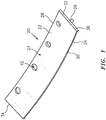
- FIG. 1 shows a turbine engine combustor panel 20 which, for purposes of illustration is based on the combustor panel of United States Patent, 8,216,687, of Burd et al., July 10, 2012 , and entitled "Thermal barrier coating".
- the exemplary panel 20 may be formed having a body 21 shaped as a generally frustoconical segment having inboard and outboard surfaces 22 and 24.
- the exemplary panel is configured for use in an annular combustor circumscribing the engine centerline.
- the inboard surface 22 forms an interior surface (i.e., facing the combustor interior) so that the panel is an outboard panel.
- the inboard surface would be the exterior surface.
- the exemplary panel further includes an upstream/leading edge 28, a downstream/trailing edge 30 and lateral edges 32 and 34.
- the panel may include rails or standoffs 36 extending from the exterior surface 24 for engaging a combustor shell (not shown).
- the exemplary panel includes a circumferential array of large apertures 40 for the introduction of process air. Smaller apertures (not shown) may be provided for film cooling.
- select panels may accommodate other openings for spark plug or igniter placement. Nevertheless, the teachings herein may be applied to other parts of other annular combustors, can-type combustors, and the like, as well as vanes, fuel nozzles, and other components.
- FIG. 2 shows a basic coating system 60 atop a superalloy substrate 62.
- the system may include a bondcoat 64 atop the substrate 62 and a TBC 66 atop the bondcoat 64.
- the bondcoat 64 is deposited atop the substrate surface 68.
- One exemplary bondcoat is a MCrAlY which may be deposited by a thermal spray process (e.g., air plasma spray) or by an electron beam physical vapor deposition (EBPVD) process.
- An alternative bondcoat is a diffusion aluminide deposited by vapor phase aluminizing (VPA).
- the TBC may be directly atop a surface 70 of the bondcoat 64 or of a thermally grown oxide (TGO) formed atop the bondcoat.
- TGO thermally grown oxide
- the candidate alloys of Table I were processed as equiax buttons.
- the buttons (and a button of the higher sulfur Prior Art 1) were subject to cyclic furnace oxidation testing at 2300°F (1260°C).
- Exemplary test parameters were 260 cycles with a cycle time of just over 1 hour between a 2300°F (1260°C) hot zone (45 minute hold), a room temperature cool zone (7 minutes), and a ramp back up to 2300°F (1260°C) (14 minutes).
- Table II shows the results of the cyclic furnace oxidation testing. To provide an apples-to-apples comparison, sulfur concentration needed to be adjusted to compensate for variations in the incidental level of sulfur amongst the test samples. Based upon known sulfur effects, the experimentally-derived adjustment factor of Table II was applied to make all ten candidates directly comparable to the Prior Art 2. From this test data, it is seen that alloys D, F, G, and J are particularly promising in all having projected life benefits in excess of five times that of the baseline Prior Art 2. Alloys E and H are still somewhat promising at over four times but slightly under five times.
- Alloy K was selected to be fairly close to alloy D in composition but having a slightly higher silicon content. This silicon content was selected to evaluate the oxidation vs. melting temperature tradeoff. Observed reduction in incipient melting temperature (still substantially greater than the prior art incipient melting temperature) is worth the increased oxidation life.
- Range 1B may be modified by choosing one or more individual element ranges from any of Ranges 1A and 1C-1F (e.g., the 1A range of W and the 1C range of Ta, etc.).
- a further variation is to increase at least one of rhenium, tungsten, and tantalum. If the intended application is not creep limited, the basic ranges would suffice. With higher creep capability requirements the rhenium, tungsten and/or tantalum could be increased. Particular examples may be vanes where pressure differential or structural loading requires creep strength. Re suffers cost issues, thus, the increased content may be all from W and/or Ta if cost is an issue. Total W and Ta could be up to 14.0 weight percent or up to 12.0 weight percent or up to 11.0 weight percent; complementary lower limits may be 8.0 weight percent or 9.0 weight percent. Individual contents of each could additionally or alternatively be up to 8.0 weight percent or 7.0 weight percent or 6.0 weight percent.
- Re, Ta, and/or W may be substituted into Table IV below to create alternative ranges.
- Combined Re, W, and Ta may be in the range of 9.0 weight percent to 15.0 weight percent, more narrowly 10.0 weight percent to 13.0 weight percent.
- Candidates for such higher Re, W, and/or Ta alloys are shown in Table V below.
- the combined oxidation and melting performance is believed related to a combined content of chromium, cobalt, and aluminum.
- An exemplary minimum combined content of chromium, cobalt, and aluminum is 11.0 weight percent or 11.5 weight percent.
- An exemplary maximum is 16.0 weight percent or 14.0 weight percent. Too much could reduce melting temperature and introduce microstructural instability. Too little could reduce oxidation performance.
- yttrium small amounts of elements such as yttrium, lanthanum, and/or cerium are known in the art as improving oxidation resistance.
- An exemplary combined content of Y, La, and Ce, if any is up to 0.15% or 0.10% by weight.
- combined content if any, of elements other than nickel, chromium, cobalt, aluminum, rhenium, tungsten, tantalum, molybdenum, if any, sulfur, if any, hafnium, if any, silicon, if any, and carbon, if any, being no more than 2.0% or no more than 1.0% or no more than inevitable or commercial impurity levels.
- a combined content of such elements and Y, La, and Ce, if any may be no more than inevitable or commercial impurity levels.
- Table VI through Table IX show data regarding these alloys and tests. Table VI shows measured compositions of three such alloys along with nominal compositions for four prior art alloys including two of the prior art alloys discussed above. The Prior Art 1 and Prior Art 2 alloys were from different batches/heats than those previously tested. Thus, nominal values are given. In the Prior Art 1 and Prior Art 3 alloys, sulfur concentration is not controlled/limited (unlike the limits of Prior Art 2 and Prior Art 4). Experience indicates that sulfur concentration in such commercial alloys is typically four PPM or somewhat greater.
- Table VII has test data for three specimens of Alloy V, three specimens of Alloy W, and two specimens each of Alloy J, Prior Art 2, and Prior Art 4.
- the Alloy J was from the same batch/heat/composition of Table III.
- Prior Art 2 is used to normalize and provide relative life columns.
- time to 0.5% weight loss was measured along with time to 1% weight loss at 2150F (1177°C).
- Such life improvements are particularly significant relative to creep and tensile strength properties (discussed below) in combustor panel, vane, and other static structures contrasted with blades. Centrifugal loading on blade airfoils and attachment roots puts a premium on creep and tensile strength properties.
- Combustor components e.g., floatwall panels formed as frustoconical segments, bulkheads, nozzles, combustor cans
- vanes will be under no centrifugal loading and little external loading (e.g., typically carrying a small load across an airfoil from a seal at an inner platform to an outer shroud, but sometimes functioning as structural struts or the like).
- Table VIII provides creep rupture data for three specimens each of Alloys V and W and their averages along with values for Prior Art 1 and Prior Art 3.
- the prior art alloy data was based upon published data rather than simultaneous testing along with the other two alloys.
- Alloy W actually shows improved creep capability over Prior Art 3 but a debit relative to Prior Art 1.
- Alloy V shows a creep debit relative to both prior art alloys.
- Alloy W had improved creep capability over Alloy V due to a higher refractory content and gamma prime volume fraction. Such debits are immaterial for nonrotating component applications.
- Table IX contains tensile property data for three specimens each of Alloy V and Alloy W at each of four temperatures along with averages for each group of specimens at each temperature.
- Alloy V shows a tensile debit relative to Prior Art 1 and 3.
- Alloy W actually shows improved tensile capability over Prior Art 3 but a debit relative to Prior Art 1.
- No prior art data is provided because the prior art alloys' tensile capability correlates well with the creep rupture capability. From this it is seen that both Alloys V and W display a yield strength increase as a function of temperature typical of nickel-base superalloys.
- first, second, and the like in the following claims is for differentiation within the claim only and does not necessarily indicate relative or absolute importance or temporal order. Similarly, the identification in a claim of one element as “first” (or the like) does not preclude such "first” element from identifying an element that is referred to as “second” (or the like) in another claim or in the description.
Landscapes
- Chemical & Material Sciences (AREA)
- Engineering & Computer Science (AREA)
- Materials Engineering (AREA)
- Mechanical Engineering (AREA)
- Metallurgy (AREA)
- Organic Chemistry (AREA)
- General Engineering & Computer Science (AREA)
- Inorganic Chemistry (AREA)
- Crystallography & Structural Chemistry (AREA)
- Turbine Rotor Nozzle Sealing (AREA)
Abstract
Description
- The disclosure relates to nickel-based superalloys. More particularly, the disclosure relates to alloys for combustor and vane applications.
- Gas turbine engine hot section components are commonly formed of alloys, typically nickel- or cobalt-based superalloys. Many components, such as blades are formed of single crystal (SX) alloys. In such single crystal components, essentially the entire component is formed of a single continuous crystal lattice. Typically, the orientation of that lattice is predetermined to achieve desired properties of the component. The orientation may be assured by use of a grain starter or other casting techniques.
- When contrasted with other components such as vanes and combustor panels, blades experience significant inertial loading. Thus, blade alloy compositions are typically specialized and differ from vane and combustor panel alloy compositions.
- Whether used on blades or on non-rotating components such as vanes and combustor panels, the alloy substrates are typically actively cooled via air flows (whether via internal passageways as in typical blades and vanes or via through-hole film cooling in the case of combustor panels). Such components are also often coated with thermal barrier coatings (TBC). Typical thermal barrier coatings include a bondcoat (e.g., an MCrAlY) and a barrier coat (e.g., a ceramic such as a stabilized zirconia).
- Typical failure mechanisms for such hot section components involve oxidation of the metallic substrate. Oxidation may also be accompanied by melting, particularly at hot spots. Such failures may cause spalling of the TBC, which further increases thermal loads and impetus toward oxidation and melting.
- One aspect of the disclosure involves an alloy comprising, by weight: nickel (Ni) as a largest constituent; 6.0% to 7.5% chromium; up to 5.0% cobalt; 5.3% to 6.5% aluminum; up to 5.0% rhenium; 3.7% to 7.0% tungsten; and 3.7% to 7.0% tantalum.
- A further embodiment of any of the foregoing embodiments may additionally and/or alternatively include the alloy comprising, by weight: nickel (Ni) as said largest constituent; 6.0% to 7.0% chromium; up to 5.0% cobalt; 5.4% to 6.4% aluminum; 2.8% to 3.2% rhenium; 3.8% to 6.0% tungsten; and 3.8% to 6.0% tantalum.
- A further embodiment of any of the foregoing embodiments may additionally and/or alternatively include the alloy comprising, by weight: nickel (Ni) as said largest constituent; 6.8% to 7.5% chromium; up to 0.5% cobalt; 5.3% to 6.5% aluminum; up to 3.25% rhenium; 3.7% to 7.0% tungsten; 3.7% to 7.0% tantalum; and up to 0.30% silicon.
- A further embodiment of any of the foregoing embodiments may additionally and/or alternatively include the alloy comprising, by weight: nickel (Ni) as said largest constituent; 6.7% to 7.5% chromium; up to 0.5% cobalt; 5.3% to 6.5% aluminum; up to 3.25% rhenium; 3.7% to 7.0% tungsten; 3.7% to 7.0% tantalum; and up to 0.30% silicon.
- A further embodiment of any of the foregoing embodiments may additionally and/or alternatively include the alloy comprising, by weight: nickel (Ni) as said largest constituent; 6.75% to 7.25% chromium; up to 0.5% cobalt; 5.9% to 6.4% aluminum; 2.6% to 3.2% rhenium; 3.8% to 6.2% tungsten; 3.8% to 6.2% tantalum; and up to 0.30% silicon.
- A further embodiment of any of the foregoing embodiments may additionally and/or alternatively include the alloy, wherein by weight: a molybdenum content, if any, is no more than 0.50%; a sulfur content, if any, is no more than 5ppm; a hafnium content, if any is no more than 0.50%; and a carbon content, if any, is no more than 0.10%.
- A further embodiment of any of the foregoing embodiments may additionally and/or alternatively include, by weight, one or more of: a molybdenum content, if any, being no more than 0.50%; a sulfur content, if any, being no more than 5ppm; a hafnium content, if any being no more than 0.50%; a silicon content, if any, being no more than 0.50%; and a carbon content, if any, being no more than 0.10%.
- A further embodiment of any of the foregoing embodiments may additionally and/or alternatively include, by weight, one or more of: a molybdenum content, if any, being no more than 0.10%; a sulfur content, if any, being no more than 1ppm; a hafnium content being 0.050% to 0.15%; a silicon content, if any, being no more than 0.30%; and a carbon content, if any, being no more than 0.10%.
- A further embodiment of any of the foregoing embodiments may additionally and/or alternatively include, by weight: a combined content, if any, of elements other than nickel, chromium, cobalt, aluminum, rhenium, tungsten, tantalum, molybdenum, if any, sulfur, if any, hafnium, if any, silicon, if any, and carbon, if any, being no more than 2.0%.
- A further embodiment of any of the foregoing embodiments may additionally and/or alternatively include, by weight: a combined content, if any, of elements other than nickel, chromium, cobalt, aluminum, rhenium, tungsten, tantalum, molybdenum, if any, sulfur, if any, hafnium, if any, silicon, if any, and carbon, if any, being no more than 1.0%.
- A further embodiment of any of the foregoing embodiments may additionally and/or alternatively include, by weight: an individual content, if any, of every element other than nickel, chromium, cobalt, aluminum, rhenium, tungsten, tantalum, molybdenum, if any, sulfur, if any, hafnium, if any, silicon, if any, and carbon, if any, being no more than 1.0%.
- A further embodiment of any of the foregoing embodiments may additionally and/or alternatively include, by weight: an individual content, if any, of every element other than nickel, chromium, cobalt, aluminum, rhenium, tungsten, tantalum, molybdenum, if any, sulfur, if any, hafnium, if any, silicon, if any, and carbon, if any, being no more than 0.20%.
- A further embodiment of any of the foregoing embodiments may additionally and/or alternatively include, by weight: the combined content of chromium, cobalt, and aluminum being 11.5% to 16.0%.
- A further embodiment of any of the foregoing embodiments may additionally and/or alternatively include, by weight: the combined content of chromium, cobalt, and aluminum being 11.5% to 14.0%.
- A further embodiment of any of the foregoing embodiments may additionally and/or alternatively include, by weight: the combined content of tungsten and tantalum being 8.0% to 14.0%.
- A further embodiment of any of the foregoing embodiments may additionally and/or alternatively include, by weight: the combined content of tungsten and tantalum being 9.0% to 11.0%.
- A further embodiment of any of the foregoing embodiments may additionally and/or alternatively include, by weight: the combined content of rhenium, tungsten, and tantalum being 9.0% to 15.0%.
- A further embodiment of any of the foregoing embodiments may additionally and/or alternatively include, by weight: the combined content of rhenium, tungsten, and tantalum being 10.0% to 13.0%.
- A further embodiment of any of the foregoing embodiments may additionally and/or alternatively include, by weight: yttrium, lanthanum, and/or cerium up to 0.15% combined.
- A further embodiment of any of the foregoing embodiments may additionally and/or alternatively include the alloy having an incipient melting temperature of at least 2440°F (1338°C).
- A further embodiment of any of the foregoing embodiments may additionally and/or alternatively include the alloy having an incipient melting temperature of at least 2460°F (1349°C).
- A further embodiment of any of the foregoing embodiments may additionally and/or alternatively include the alloy having an incipient melting temperature of 2460°F to 2520°F (1349°C to 1382°C) in single-crystal (SX) form.
- A further embodiment of any of the foregoing embodiments may additionally and/or alternatively include the alloy in single-crystal (SX) form.
- A further embodiment of any of the foregoing embodiments may additionally and/or alternatively include a gas turbine engine component (e.g., a combustor panel or a vane) comprising a substrate formed of the alloy.
- A further embodiment of any of the foregoing embodiments may additionally and/or alternatively include the combustor panel further comprising: mounting studs.
- A further embodiment of any of the foregoing embodiments may additionally and/or alternatively include the combustor panel further comprising: a thermal barrier coating atop the substrate.
- A further embodiment of any of the foregoing embodiments may additionally and/or alternatively include the substrate being formed as a frustoconical segment.
- The details of one or more embodiments are set forth in the accompanying drawings and the description below. Other features, objects, and advantages will be apparent from the description and drawings, and from the claims.
-
-
FIG. 1 is a view of a gas turbine engine combustor panel. -
FIG. 2 is a partially schematic cross-sectional view of a coating system on the panel ofFIG. 1 . - Like reference numbers and designations in the various drawings indicate like elements.
-
FIG. 1 shows a turbineengine combustor panel 20 which, for purposes of illustration is based on the combustor panel of United States Patent,8,216,687, of Burd et al., July 10, 2012 , and entitled "Thermal barrier coating". Theexemplary panel 20, may be formed having abody 21 shaped as a generally frustoconical segment having inboard andoutboard surfaces inboard surface 22 forms an interior surface (i.e., facing the combustor interior) so that the panel is an outboard panel. For an inboard panel, the inboard surface would be the exterior surface. Accordingly, mounting features such asstuds 26 extend from the outboard surface for securing the panel relative to the engine. The exemplary panel further includes an upstream/leadingedge 28, a downstream/trailing edge 30 andlateral edges standoffs 36 extending from theexterior surface 24 for engaging a combustor shell (not shown). The exemplary panel includes a circumferential array oflarge apertures 40 for the introduction of process air. Smaller apertures (not shown) may be provided for film cooling. Moreover, select panels may accommodate other openings for spark plug or igniter placement. Nevertheless, the teachings herein may be applied to other parts of other annular combustors, can-type combustors, and the like, as well as vanes, fuel nozzles, and other components. -
FIG. 2 shows abasic coating system 60 atop asuperalloy substrate 62. The system may include abondcoat 64 atop thesubstrate 62 and aTBC 66 atop thebondcoat 64. In an exemplary process, thebondcoat 64 is deposited atop thesubstrate surface 68. One exemplary bondcoat is a MCrAlY which may be deposited by a thermal spray process (e.g., air plasma spray) or by an electron beam physical vapor deposition (EBPVD) process. An alternative bondcoat is a diffusion aluminide deposited by vapor phase aluminizing (VPA). An exemplary characteristic (e.g., mean or median) bondcoat thicknesses 4-9 mil (100-230 micrometer). Again, other coating systems, if any, may be used. The TBC may be directly atop asurface 70 of the bondcoat 64 or of a thermally grown oxide (TGO) formed atop the bondcoat. - Several candidate alloys for improved high temperature oxidation performance were hypothesized and were manufactured. Table I lists compositions of ten candidate alloys plus two known prior art alloys ("Prior Art 1" and "Prior Art 2"). The prior art alloys are high cobalt, high tantalum, alloys differing from each other in that one has relatively low sulfur content. Low sulfur content is regarded as generally desirable in high temperature alloys. The ten listed candidate alloys all have somewhat higher sulfur concentrations than Prior Art 2 due to the limitations of laboratory-scale manufacture techniques. As is discussed below, commercial scale implementation may desirably have lower sulfur.
- For purposes of an initial screening test, the candidate alloys of Table I were processed as equiax buttons. The buttons (and a button of the higher sulfur Prior Art 1) were subject to cyclic furnace oxidation testing at 2300°F (1260°C). Exemplary test parameters were 260 cycles with a cycle time of just over 1 hour between a 2300°F (1260°C) hot zone (45 minute hold), a room temperature cool zone (7 minutes), and a ramp back up to 2300°F (1260°C) (14 minutes).
- Table II shows the results of the cyclic furnace oxidation testing. To provide an apples-to-apples comparison, sulfur concentration needed to be adjusted to compensate for variations in the incidental level of sulfur amongst the test samples. Based upon known sulfur effects, the experimentally-derived adjustment factor of Table II was applied to make all ten candidates directly comparable to the Prior Art 2. From this test data, it is seen that alloys D, F, G, and J are particularly promising in all having projected life benefits in excess of five times that of the baseline Prior Art 2. Alloys E and H are still somewhat promising at over four times but slightly under five times.
Table I Candidate and Prior Art Alloy Compositions (by weight - percent except where noted) Alloy Ni Cr Co Al Mo W Ta Re Hf Si S (ppm) A Bal 5.16 5.17 5.59 0.01 max. 3.79 4.01 2.57 0.09 0.01 max. 2.9 B Bal 5.14 0.01 max. 6.16 0.01 max. 5.72 5.99 2.84 0.10 0.01 max. 2.6 C Bal 5.15 5.12 6.17 0.01 max. 5.62 5.98 2.75 0.09 0.01 max. 3.2 D Bal 6.15 0.01 max. 5.49 0.01 max. 3.96 4.03 2.84 0.07 0.01 max. 2.3 E Bal 6.09 5.16 5.47 0.01 max. 4.08 4.01 2.92 0.08 0.01 max. 2.0 F Bal 6.17 0.01 max. 5.57 0.01 max. 5.45 4.03 2.68 0.09 0.01 max. 2.2 G Bal 6.09 5.09 6.11 0.01 max. 4.08 3.94 3.24 0.09 0.01 max. 3.9 H Bal 6.13 0.01 max. 6.21 0.01 max. 4.01 3.99 2.84 0.09 0.01 max. 3.9 I Bal 7.13 5.11 6.19 0.01 max. 4.06 4.01 2.83 0.09 0.01 max. 6.1 J Bal 7.15 0.01 max. 6.19 0.01 max. 4.02 4.03 2.68 0.10 0.01 max. 3.8 Prior Art 1 Bal 5.16 10.31 5.70 1.93 5.90 8.64 2.86 0.10 0.01 max. 4.2 Prior Art 2 Bal 5.16 10.31 5.70 1.93 5.90 8.64 2.86 0.10 0.01 max. 0.9 Alloys A-J being measured compositions (except for Mo and Si which are specification)
Prior Art 1 and 2 being nominal specificationTable II 2300F Cyclic Furnace Oxidation Test Alloy Metal Loss mils (mm) Hours/Mil S (ppm) Adjusted Hours/Mil Life Benefit** Incipient Melting Temperature (°F(°C)) A 43.2 (1.10) 6.0 2.9 11.9 .78X >2500 (1371) B 19.5 (0.50) 13.3 2.6 24.7 1.63X 2495 (1368) C 18.4 (0.47) 14.1 3.2 29.6 1.95X 2495 (1368) D 3.0 (0.076) 86.7 2.3 150 9.87X >2500 (1371) E 5.5 (0.14) 47.3 2.0 75.2 4.95X >2500 (1371) F 3.3 (0.084) 78.8 2.2 125.3 8.24X >2500 (1371) G 3.6 (0.091) 72.2 3.9 170.4 11.21X 2490 (1366) H 8.2 (0.21) 31.7 3.9 74.8 4.92X 2490 (1366) I 24.1 (0.61) 10.8 6.1 33.2 2.18X 2490 (1366) J 5.2 (0.13) 50.0 3.8 116.5 7.66X 2490 (1366) Prior Art 1 42.1 (1.07) 6.2 4.2 15.2 2440 (1338) Prior Art 2 17.1 (0.43) est 15.2 est 0.9 15.2 est 1X 2440 (1338) ** Normalized relative to Prior Art 2 S content. - New specimens of those four most promising alloys plus a further Alloy K were processed as cast single crystal alloys. Their respective compositions are shown in Table III below. Alloy K was selected to be fairly close to alloy D in composition but having a slightly higher silicon content. This silicon content was selected to evaluate the oxidation vs. melting temperature tradeoff. Observed reduction in incipient melting temperature (still substantially greater than the prior art incipient melting temperature) is worth the increased oxidation life.
- A 2250°F (1232°C) burner rig oxidation test was performed on these alloys. Exemplary parameters are 57 minutes in burner flame and 3 minutes outside the flame over a total of 933 cycles.
- As seen in Table III below, particularly significant advantages were found for alloys D, J, and K.
- Differences in observed incipient melting temperature between Tables II and III are accounted for principally by the equiax vs. single-crystal (SX) state and minor compositional variation.
- Based upon these relatively significant life and temperature range benefits, Table IV below shows various candidate compositional ranges. Alternative ranges may be created by recombining within a group (i.e., ranges are identified with a number identifying a group of ranges and a letter identifying a particular range in that group as in "Range 1A") the identified ranges of elements from different particular ranges. Thus, for example, Range 1B may be modified by choosing one or more individual element ranges from any of Ranges 1A and 1C-1F (e.g., the 1A range of W and the 1C range of Ta, etc.).
- A further variation is to increase at least one of rhenium, tungsten, and tantalum. If the intended application is not creep limited, the basic ranges would suffice. With higher creep capability requirements the rhenium, tungsten and/or tantalum could be increased. Particular examples may be vanes where pressure differential or structural loading requires creep strength. Re suffers cost issues, thus, the increased content may be all from W and/or Ta if cost is an issue. Total W and Ta could be up to 14.0 weight percent or up to 12.0 weight percent or up to 11.0 weight percent; complementary lower limits may be 8.0 weight percent or 9.0 weight percent. Individual contents of each could additionally or alternatively be up to 8.0 weight percent or 7.0 weight percent or 6.0 weight percent. Increased Re up to 5.0 weight percent or 4.0 weight percent is possible. Such upper limits on Re, Ta, and/or W may be substituted into Table IV below to create alternative ranges. Combined Re, W, and Ta may be in the range of 9.0 weight percent to 15.0 weight percent, more narrowly 10.0 weight percent to 13.0 weight percent. Candidates for such higher Re, W, and/or Ta alloys are shown in Table V below.
- The combined oxidation and melting performance is believed related to a combined content of chromium, cobalt, and aluminum. An exemplary minimum combined content of chromium, cobalt, and aluminum is 11.0 weight percent or 11.5 weight percent. An exemplary maximum is 16.0 weight percent or 14.0 weight percent. Too much could reduce melting temperature and introduce microstructural instability. Too little could reduce oxidation performance.
- Small amounts of elements such as yttrium, lanthanum, and/or cerium are known in the art as improving oxidation resistance. An exemplary combined content of Y, La, and Ce, if any is up to 0.15% or 0.10% by weight.
- In various embodiments, combined content, if any, of elements other than nickel, chromium, cobalt, aluminum, rhenium, tungsten, tantalum, molybdenum, if any, sulfur, if any, hafnium, if any, silicon, if any, and carbon, if any, being no more than 2.0% or no more than 1.0% or no more than inevitable or commercial impurity levels. Or a combined content of such elements and Y, La, and Ce, if any may be no more than inevitable or commercial impurity levels.
Table III 2250°F Burner Rig Oxidation Test Component (by weight - percent except where noted) Test Alloy Ni Cr Co Al Mo W Ta Re Hf Si S ppm Time to 1% Wt Loss Life Benefit Incipient Melting Temperature (°F(°C)) D Bal 6.21 0.04 5.42 0.01 4.04 4.04 3.00 0.13 0.02 0.93 814 1.61X 2515 (1379) F Bal 6.22 0.02 5.61 0.01 5.41 4.05 3.02 0.11 0.03 0.43 539 1.07X 2505 (1374) G Bal 6.22 4.90 6.33 0.01 3.95 4.03 3.04 0.10 0.03 2.10 594 1.18X 2495 (1368) J Bal 6.91 0.01 6.18 0.01 3.99 4.02 3.00 0.11 0.03 0.91 879 1.74X 2475 (1357) K Bal 6.23 0.01 5.45 0.01 3.89 3.98 2.97 0.12 0.24 0.98 1534 3.04X 2495 (1368) Prior Art 2 Bal 4.98 10.02 5.63 1.88 5.87 8.71 3.00 0.09 0.03 0.30 505 1X 2440 (1338) All (including Prior Art 2) being measured compositions. Table IV Candidate Compositional Ranges (by weight - percent except where noted) Alloy Ni Cr Co Al Re Mo W Ta Hf Si C S Range 1A Bal 6.0-7.5 to 5.0 5.3-6.5 to 5.0 to 0.50 3.7-7.0 3.7-7.0 0.050-0.50 to 0.30 to 0.10 to 5ppm Range 1B Bal 6.0-7.0 to 5.0 5.4-6.4 2.8-3.2 to 0.10 3.8-6.0 3.8-6.0 0.050-0.15 to 0.30 to 0.050 to 1ppm Range 1C Bal 6.0-7.5 to 5.0 5.3-6.5 to 5.0 to 0.50 3.7-5.6 3.7-4.4 0.050-0.50 to 0.30 to 0.10 to 5ppm Range 1D Bal 6.0-7.0 to 5.0 5.4-6.4 2.8-3.2 to 0.10 3.8-5.5 3.8-4.2 0.050-0.15 to 0.30 to 0.050 to 1ppm Range 1E Bal 6.0-7.5 to 5.0 5.3-6.5 2.5-3.3 to 0.50 3.7-5.6 4.2-5.2 0.050-0.50 to 0.30 to 0.10 to 5ppm Range 1F Bal 6.0-7.0 to 5.0 5.4-6.4 2.8-3.2 to 0.10 3.8-5.5 4.4-5.1 0.050-0.15 to 0.30 to 0.050 to 1ppm Range 1G Bal 6.0-7.2 to 5.0 5.3-6.4 to 5.0 to 0.50 3.7-7.0 3.7-7.0 0.050-0.50 to 0.30 to 0.10 to 5ppm Range 2A Bal 6.0-7.5 to 0.5 5.3-6.5 to 3.25 to 0.50 3.7-7.0 3.7-7.0 0.050-0.50 to 0.30 to 0.10 to 5ppm Range 2B Bal 6.0-7.0 to 0.1 5.4-6.4 2.8-3.2 to 0.10 3.8-6.0 3.8-6.0 0.050-0.15 0.15 to 0.25 to 0.050 to 1ppm Range 2C Bal 6.0-7.5 to 0.5 5.3-6.5 to 3.25 to 0.50 3.7-5.6 3.7-4.4 0.050-0.50 to 0.30 to 0.10 to 5ppm Range 2D Bal 6.0-7.0 to 0.1 5.4-6.4 2.8-3.2 to 0.10 3.8-5.5 3.8-4.2 0.050-0.15 0.15 to 0.25 to 0.050 to 1ppm Range 2E Bal 6.0-7.5 to 0.5 5.3-6.5 to 3.25 to 0.50 3.7-5.6 4.2-5.2 0.050-0.50 to 0.30 to 0.10 to 5ppm Range 2F Bal 6.0-7.0 to 0.1 5.4-6.4 2.8-3.2 to 0.10 3.8-5.5 4.4-5.1 0.050-0.15 0.15 to 0.25 to 0.050 to 1ppm Range 3A Bal 6.0-7.5 to 0.5 5.3-6.5 to 3.25 to 0.50 3.7-4.4 3.7-7.0 0.050-0.50 to 0.30 to 0.10 to 5ppm Range 3B Bal 6.0-7.0 to 0.1 5.4-6.4 2.8-3.2 to 0.10 3.8-4.2 3.8-6.0 0.050-0.15 0.15 to 0.25 to 0.050 to 1ppm Range 3C Bal 6.0-7.5 to 0.5 5.3-6.5 to 3.25 to 0.50 3.7-4.4 3.7-4.4 0.050-0.50 to 0.30 to 0.10 to 5ppm Range 3D Bal 6.0-7.0 to 0.1 5.4-6.4 2.8-3.2 to 0.10 3.8-4.2 3.8-4.2 0.050-0.15 0.15 to 0.25 to 0.050 to 1ppm Range 3E Bal 6.0-7.5 to 0.5 5.3-6.5 to 3.25 to 0.50 3.7-4.4 4.2-5.2 0.050-0.50 to 0.30 to 0.10 to 5ppm Range 3F Bal 6.0-7.0 to 0.1 5.4-6.4 2.8-3.2 to 0.10 3.8-4.2 4.4-5.1 0.050-0.15 0.15 to 0.25 to 0.050 to 1ppm Range 4A Bal 6.8-7.5 to 0.5 5.3-6.5 to 3.25 to 0.50 3.7-7.0 3.7-7.0 0.050-0.50 to 0.30 to 0.10 to 5ppm Range 4B Bal 7.0-7.5 to 0.1 5.4-6.4 2.8-3.2 to 0.10 3.8-6.0 3.8-6.0 0.050-0.15 0.15 to 0.25 to 0.050 to 1ppm Range 4C Bal 6.8-7.5 to 0.5 5.3-6.5 to 3.25 to 0.50 3.7-5.6 3.7-4.4 0.050-0.50 to 0.30 to 0.10 to 5ppm Range 4D Bal 7.0-7.5 to 0.1 5.4-6.4 2.8-3.2 to 0.10 3.8-5.5 3.8-4.2 0.050-0.15 0.15 to 0.25 to 0.050 to 1ppm Range 4E Bal 6.8-7.5 to 0.5 5.3-6.5 to 3.25 to 0.50 3.7-5.6 4.2-5.2 0.050-0.50 to 0.30 to 0.10 to 5ppm Range 4F Bal 7.0-7.5 to 0.1 5.4-6.4 2.8-3.2 to 0.10 3.8-5.5 4.4-5.1 0.050-0.15 0.15 to 0.25 to 0.050 to 1ppm Range 4G Bal 6.8-7.2 to 0.5 6.0-6.4 2.9-3.25 to 0.50 3.7-4.2 3.7-4.2 0.050-0.50 to 0.30 to 0.10 to 5ppm Range 4H Bal 6.7-7.5 to 0.5 5.3-6.5 to 3.25 to 0.50 3.7-7.0 3.7-7.0 0.050-0.50 to 0.30 to 0.10 to 5ppm Range 4I Bal 7.0-7.5 to 0.1 5.4-6.4 2.7-3.2 to 0.10 3.8-6.2 3.8-6.2 0.050-0.15 0.15 to 0.30 to 0.050 to 1ppm Range 4J Bal 6.7-7.5 to 0.5 5.3-6.5 to 3.25 to 0.50 3.7-5.6 3.7-4.4 0.050-0.50 to 0.30 to 0.10 to 5ppm Range 4K Bal 7.0-7.5 to 0.1 5.4-6.4 2.7-3.2 to 0.10 3.8-5.5 3.8-4.2 0.050-0.15 0.15 to 0.30 to 0.050 to 1ppm Range 4L Bal 6.7-7.5 to 0.5 5.3-6.5 to 3.25 to 0.50 3.7-5.6 4.2-5.2 0.050-0.50 to 0.30 to 0.10 to 5ppm Range 4M Bal 7.0-7.5 to 0.1 5.4-6.4 2.7-3.2 to 0.10 3.8-5.5 4.4-5.1 0.050-0.15 0.15 to 0.30 to 0.050 to 1ppm Range 4N Bal 6.7-7.2 to 0.5 6.0-6.4 2.9-3.25 to 0.50 3.7-4.2 3.7-4.2 0.050-0.50 to 0.30 to 0.10 to 5ppm Range 5A Bal 6.0-6.5 to 5.0 5.3-6.5 to 3.25 to 0.50 3.7-7.0 3.7-7.0 0.050-0.50 to 0.30 to 0.10 to 5ppm Range 5B Bal 6.0-6.5 to 0.5 5.3-6.5 to 3.25 to 0.50 3.7-7.0 3.7-7.0 0.050-0.50 to 0.30 to 0.10 to 5ppm Range 5C Bal 6.0-6.5 to 0.5 5.3-6.4 2.9-3.25 to 0.50 3.7-5.5 3.7-4.2 0.050-0.50 to 0.30 to 0.10 to 5ppm The balance nickel is exclusive of minor additions and impurities at levels discussed below. Table V Higher Re, W, and/or Ta Candidate Alloy Compositions (by weight - percent except where noted) Alloy Ni Cr Co Al Mo W Ta Re Hf Si S (ppm) L Bal 7.25 0.1 max. 6.25 0.1 max. 5.0 5.0 3.0 0.1 0.2 1.0 max. M Bal 7.25 0.1 max. 6.25 0.1 max. 6.0 6.0 3.0 0.1 0.0 1.0 max. N Bal 7.25 0.1 max. 6.25 0.1 max. 4.0 4.0 4.0 0.1 0.2 1.0 max. O Bal 7.25 0.1 max. 6.25 0.1 max. 2.0 4.0 5.0 0.1 0.2 1.0 max. P Bal 7.25 0.1 max. 6.25 0.1 max. 3.0 4.0 4.0 0.1 0.2 1.0 max. Q Bal 7.25 0.1 max. 6.25 0.1 max. 1.0 5.0 5.0 0.1 0.2 1.0 max. R Bal 7.00 0.1 max. 6.00 0.1 max. 5.0 5.0 3.0 0.1 0.2 1.0 max. S Bal 7.00 0.1 max. 6.00 0.1 max. 6.0 6.0 3.0 0.1 0.0 1.0 max. T Bal 7.25 0.1 max. 6.25 0.1 max. 4.0 6.0 3.0 0.1 0.2 1.0 max. U Bal 7.25 0.1 max. 6.25 0.1 max. 2.0 7.0 5.0 0.1 0.2 1.0 max. - To validate the Table V alloys, further alloy examples were made and tested. Table VI through Table IX show data regarding these alloys and tests. Table VI shows measured compositions of three such alloys along with nominal compositions for four prior art alloys including two of the prior art alloys discussed above. The Prior Art 1 and Prior Art 2 alloys were from different batches/heats than those previously tested. Thus, nominal values are given. In the Prior Art 1 and Prior Art 3 alloys, sulfur concentration is not controlled/limited (unlike the limits of Prior Art 2 and Prior Art 4). Experience indicates that sulfur concentration in such commercial alloys is typically four PPM or somewhat greater.
- Table VII has test data for three specimens of Alloy V, three specimens of Alloy W, and two specimens each of Alloy J, Prior Art 2, and Prior Art 4. The Alloy J was from the same batch/heat/composition of Table III. For each alloy, the test results are given with average value immediately below. Prior Art 2 is used to normalize and provide relative life columns. At both 2250F (1232°C) and 2150F (1177°C), time to 0.5% weight loss was measured along with time to 1% weight loss at 2150F (1177°C). For both temperatures, a metallography maximum attack was measured as the per-side combination of material loss and depth of an aluminum-depleted region therebelow. This max. attack parameter was then converted into an hours per mil (1 mil = 25.4µm) life parameter. Significant life improvements are shown relative to both prior art alloys.
- Such life improvements are particularly significant relative to creep and tensile strength properties (discussed below) in combustor panel, vane, and other static structures contrasted with blades. Centrifugal loading on blade airfoils and attachment roots puts a premium on creep and tensile strength properties. Combustor components (e.g., floatwall panels formed as frustoconical segments, bulkheads, nozzles, combustor cans) are generally under essentially no centrifugal loading and little or no external loading. Similarly, vanes will be under no centrifugal loading and little external loading (e.g., typically carrying a small load across an airfoil from a seal at an inner platform to an outer shroud, but sometimes functioning as structural struts or the like).
- Table VIII provides creep rupture data for three specimens each of Alloys V and W and their averages along with values for Prior Art 1 and Prior Art 3. The prior art alloy data was based upon published data rather than simultaneous testing along with the other two alloys. In this case, Alloy W actually shows improved creep capability over Prior Art 3 but a debit relative to Prior Art 1. Alloy V shows a creep debit relative to both prior art alloys. Alloy W had improved creep capability over Alloy V due to a higher refractory content and gamma prime volume fraction. Such debits are immaterial for nonrotating component applications.
- Table IX contains tensile property data for three specimens each of Alloy V and Alloy W at each of four temperatures along with averages for each group of specimens at each temperature. Alloy V shows a tensile debit relative to Prior Art 1 and 3. Alloy W actually shows improved tensile capability over Prior Art 3 but a debit relative to Prior Art 1. No prior art data is provided because the prior art alloys' tensile capability correlates well with the creep rupture capability. From this it is seen that both Alloys V and W display a yield strength increase as a function of temperature typical of nickel-base superalloys. At test temperatures closer to the gamma prime solvus, the tensile capability of both alloys is reduced significantly due to a lower gamma prime volume fraction. In any event, such tensile debits are immaterial for nonrotating component applications.
Table VI Further Higher Re, W, and/or Ta Candidate and Prior Art Alloy Compositions (by weight - percent except where noted) Alloy Ni Cr Co Al Mo W Ta Re Ti Hf B Zr C Si S J Bal 6.91 ** 6.18 ** 3.99 4.02 3.0 ** 0.11 ** ** 0.031 0.03 0.91ppm V Bal 7.07 ** 6.13 ** 4.88 5.05 2.9 ** 0.11 ** ** 0.014 0.23 0.52ppm W Bal 7.13 ** 6.17 ** 5.7 6 2.92 ** 0.11 ** ** 0.012 0.04 0.65ppm Prior Art 1 * Bal 5.0 10.0 5.65 1.9 5.9 8.7 3.0 ** 0.1 ** ** ** ** *** Prior Art 2 * Bal 5.0 10.0 5.65 1.9 5.9 8.7 3.0 ** 0.1 ** ** ** ** 1ppm max Prior Art 3 * Bal 10.0 5.0 5.0 ** 4.0 12.0 0.0 1.5 ** ** ** ** ** *** Prior Art 4 * Bal 8.0 10.0 6.0 6.0 ** 4.25 0.0 1.0 1.15 0.015 0.08 0.11 ** 1ppm max * nominal - others measured
** maximum aggregate minor alloying element concentration of 0.3 wt% for each alloy
*** not controlled, typically 4ppm or somewhat greater.Table VII Uncoated Burner Rig Oxidation Testing Alloy 2250F (1232°C) 2150F (1177°C) Time (hours) Weight Loss, (grams) Time to 05% Wt. Loss (hours) Rel. Life 0.5% Loss Max Attack (mils) Hr/Mil Hr/Mil Rel. Life Time (hours) Weight Loss, (grams) Time to 0.5% Wt Loss (hours) Rel Life Based on 0.5% Loss Time to 1% Wt Loss, (hours) Rel. Life 1% Loss Max. Attack (mils) Hr/Mil Hr/Mil Rel Life V 850.5 0.67 623 20.9 40.7 1685.5 0.549 1427 ∼2792 6.6 255.4 850.5 0.74 549 8.1 105.0 1685.5 0.56 1371 ∼2523 17.5 96.3 850.5 0.77 551 7.8 109.0 1685.5 0.584 1256 ∼3045 14.6 115.4 Avg. 574 6.84X 84.9 4.49X Avg. 1351 6.33X ∼2789 7.95X Avg. 155.7 3.65X W 850.5 1.79 443 23.2 36.7 1685.5 1.009 1005 1619 28.6 58.9 850.5 2.23 428 30.4 28.0 1685.5 0.948 1019 1654 20.6 81.8 850.5 2.42 402 29.7 28.6 1685.5 1.135 915 1541 21.6 78.0 Avg. 424 5.05X 31.1 1.65X Avg. 980 4.59X 1605 4.57X AVE 72.9 1.71X J 670.5 1.16 322 94.7 7.1 1484.5 1.053 803 1430 27.6 53.8 670.5 1.05 330 17.0 39.4 1484.5 0.907 875 1505 24.1 61.6 Avg. 326 3.88X 23.3 1.23X Avg. 839 8.61X 1468 4.18X Avg. 57.7 1.35X Prior Art 2 631 10.4 74 41.9 15.1 1284.5 7.687 214 330 33.3 38.6 631 7.96 94 27.9 22.6 1284.5 6.352 213 371 27.5 46.7 1284.5 Avg. 84 1X 18.9 1X Avg. 213.5 1X 351 1X Avg. 42.7 1X Prior Art 4 501 5.73 95 37.8 13.3 420.0 9.175 70 120 0.34X 59.5 7.1 381 7.55 44 97.5 3.9 883.5 6.497 193 308 0.88X 48.6 18.2 Avg. 70 .83X 8.6 .46X Avg. 131.5 0.62X 224 .61X Avg. 12.7 0.30X (1 mil = 25.4µm) Table VIII Creep-Rupture Properties Alloy 1400F/110ksi (760°C/758MPa) 1800F/36ksi (982°C/248MPa) 2000F/15ksi (1093°C/103MPa) Rupture Life (hours) Time to 1% Creep (hours) Rupture Life (hours) Time to 1% Creep (hours) Rupture Life (hours) Time to 1% Creep (hours) W 124* 13.2 41.4* 31.3 125* 57.5 79* 7.0 55.7* 13.1 126* 64.8 221* 17.1 46.5* 10.3 117* 88.7 Avg. W 141 12.4 49.8 17 128.3 83.5 X 626.6 42.6 117.3 42.7 547.8 441.0 591.3 23.5 116.2 39.3 623.7 525.0 587.1 27.6 107.8 37.9 641.7 594.0 Avg. X 601.7 31.2 113.8 40 604.4 520.0 Prior Art 3 256 7 90 35 110 50 Prior Art 1 200 4 300 130 1400 800 * Note: Specimens failed prematurely at the extensometer attachment points. A modified test specimen design corrected this issue for other tests. Table IX Tensile Properties Alloy Temperature (°F) T(°C)=(T(°F)-32)x5/9 Yield Stress (ksi) 1ksi=6.89MPa Ult. Stress (ksi) 1ksi=6.89MPa Modulus (Msi) 1Msi=6.89GPa Area Red. (%) El. (%) W 70 118.9 144.7 19.0 23.0 21.0 116.8 143.8 18.8 30.0 34.0 124.4 157.7 19.0 18.0 18.0 Avg. 120.0 148.7 18.9 23.7 24.3 1200 116.1 134.9 16.2 32.0 21.0 119.3 142.2 15.8 26.0 17.0 123.9 149.1 15.6 18.0 14.0 Avg. 119.8 142.0 15.9 25.3 17.3 1400 132.5 155.3 14.9 30.0 11.0 135.2 157.9 15.0 21.0 10.0 122.4 142.5 15.3 33.0 11.0 Avg. 130.0 151.9 15.1 28.0 10.7 2100 22.5 37.8 8.0 82.0 34.0 22.0 36.9 7.7 83.0 31.0 22.5 38.0 7.7 78.0 31.0 Avg. 22.3 37.6 7.8 81.0 32.0 X 70 128.4 162.0 18.6 16.0 14.0 118.5 140.9 19.3 23.0 26.0 126.2 154.8 18.9 18.0 14.0 Avg. 124.4 152.6 18.9 19.0 18.0 1200 132.1 155.2 15.7 17.0 12.0 128.5 155.65 15.64 28.0 12.0 134.5 160.5 15.7 17.0 13.0 Avg. 131.7 157.1 15.7 20.7 12.3 1400 137.1 161.5 15.6 29.0 10.0 146.9 166.7 15.0 22.0 7.5 136.1 156.82 15.39 27.0 7.5 Avg. 140.0 161.67 15.31 26.0 8.3 2100 28.5 46.8 8.8 76.0 28.0 28.6 46.0 8.4 77.0 34.0 29.7 48.2 8.5 74.0 31.0 Avg. 29.0 47.0 8.6 75.7 31.0 - The use of "first", "second", and the like in the following claims is for differentiation within the claim only and does not necessarily indicate relative or absolute importance or temporal order. Similarly, the identification in a claim of one element as "first" (or the like) does not preclude such "first" element from identifying an element that is referred to as "second" (or the like) in another claim or in the description.
- Where a measure is given in English units followed by a parenthetical containing SI or other units, the parenthetical's units are a conversion and should not imply a degree of precision not found in the English units.
- One or more embodiments have been described. Nevertheless, it will be understood that various modifications may be made. For example, when applied to an existing baseline configuration, details of such baseline may influence details of particular implementations. Accordingly, other embodiments are within the scope of the following claims.
Claims (15)
- An alloy comprising, by weight:nickel (Ni) as a largest constituent;6.0% to 7.5% chromium;up to 5.0% cobalt;5.3% to 6.5% aluminum;up to 5.0% rhenium;3.7% to 7.0% tungsten; and3.7% to 7.0% tantalum.
- The alloy of claim 1 comprising, by weight:nickel (Ni) as said largest constituent;6.0% to 7.0% chromium;up to 5.0% cobalt;5.4% to 6.4% aluminum;2.8% to 3.2% rhenium;3.8% to 6.0% tungsten; and3.8% to 6.0% tantalum.
- The alloy of claim 1 or 2 comprising, by weight:nickel (Ni) as said largest constituent;6.8% to 7.5% chromium;up to 0.5% cobalt;5.3% to 6.5% aluminum;up to 3.25% rhenium;3.7% to 7.0% tungsten;3.7% to 7.0% tantalum; andup to 0.30% silicon.
- The alloy of any preceding claim comprising, by weight:nickel (Ni) as said largest constituent;6.7% to 7.5% chromium;up to 0.5% cobalt;5.3% to 6.5% aluminum;up to 3.25% rhenium;3.7% to 7.0% tungsten;3.7% to 7.0% tantalum; andup to 0.30% silicon.
- The alloy of any preceding claim comprising, by weight:nickel (Ni) as said largest constituent;6.75% to 7.25% chromium;up to 0.5% cobalt;5.9% to 6.4% aluminum;2.6% to 3.2% rhenium;3.8% to 6.2% tungsten;3.8% to 6.2% tantalum; andup to 0.30% silicon, wherein optionally, by weight:a molybdenum content, if any, is no more than 0.50%;a sulfur content, if any, is no more than 5ppm;a hafnium content, if any is no more than 0.50%; anda carbon content, if any, is no more than 0.10%.
- The alloy of any preceding claim wherein, by weight, one or more of:a molybdenum content, if any, is no more than 0.50%;a sulfur content, if any, is no more than 5ppm;a hafnium content, if any is no more than 0.50%;a silicon content, if any, is no more than 0.50%; anda carbon content, if any, is no more than 0.10%, wherein optionally, by weight, one or more of:a molybdenum content, if any, is no more than 0.10%;a sulfur content, if any, is no more than 1ppm;a hafnium content is 0.050% to 0.15%;a silicon content, if any, is no more than 0.30%; anda carbon content, if any, is no more than 0.10%.
- The alloy of any preceding claim wherein, by weight:
a combined content, if any, of elements other than nickel, chromium, cobalt, aluminum, rhenium, tungsten, tantalum, molybdenum, if any, sulfur, if any, hafnium, if any, silicon, if any, and carbon, if any, is no more than 2.0%, and optionally no more than 1.0%. - The alloy of any preceding claim wherein, by weight:
an individual content, if any, of every element other than nickel, chromium, cobalt, aluminum, rhenium, tungsten, tantalum, molybdenum, if any, sulfur, if any, hafnium, if any, silicon, if any, and carbon, if any, is no more than 1.0%, and optionally no more than 0.20%. - The alloy of any preceding claim wherein, by weight:
the combined content of chromium, cobalt, and aluminum is 11.5% to 16.0%, and optionally 11.5% to 14.0%. - The alloy of claim 9 wherein, by weight:
the combined content of tungsten and tantalum is 8.0% to 14.0%, optionally 9.0% to 11.0%. - The alloy of any preceding claim wherein, by weight:
the combined content of rhenium, tungsten, and tantalum is 9.0% to 15.0%, optionally 10.0% to 13.0%. - The alloy of any preceding claim further comprising, by weight:
yttrium, lanthanum, and/or cerium up to 0.15% combined. - The alloy of any preceding claim having an incipient melting temperature of at least 2440°F (1338°C), optionally at least 2460°F (1349°C), and further optionally 2460°F to 2520°F (1349°C to 1382°C)in single-crystal (SX) form.
- The alloy of any preceding claim in single-crystal (SX) form.
- A gas turbine engine component (20) comprising a substrate (62) formed of the alloy of any preceding claim.
Priority Applications (1)
| Application Number | Priority Date | Filing Date | Title |
|---|---|---|---|
| EP24155256.1A EP4394065A1 (en) | 2019-02-08 | 2020-02-10 | High temperature combustor and vane alloy |
Applications Claiming Priority (3)
| Application Number | Priority Date | Filing Date | Title |
|---|---|---|---|
| US201962802909P | 2019-02-08 | 2019-02-08 | |
| US16/715,463 US20200255923A1 (en) | 2019-02-08 | 2019-12-16 | High Temperature Combustor and Vane Alloy |
| US16/783,662 US20200255924A1 (en) | 2019-02-08 | 2020-02-06 | High Temperature Combustor and Vane Alloy |
Related Child Applications (2)
| Application Number | Title | Priority Date | Filing Date |
|---|---|---|---|
| EP24155256.1A Division EP4394065A1 (en) | 2019-02-08 | 2020-02-10 | High temperature combustor and vane alloy |
| EP24155256.1A Division-Into EP4394065A1 (en) | 2019-02-08 | 2020-02-10 | High temperature combustor and vane alloy |
Publications (2)
| Publication Number | Publication Date |
|---|---|
| EP3693480A1 true EP3693480A1 (en) | 2020-08-12 |
| EP3693480B1 EP3693480B1 (en) | 2024-03-27 |
Family
ID=69570578
Family Applications (2)
| Application Number | Title | Priority Date | Filing Date |
|---|---|---|---|
| EP20156465.5A Active EP3693480B1 (en) | 2019-02-08 | 2020-02-10 | High temperature combustor and vane alloy |
| EP24155256.1A Pending EP4394065A1 (en) | 2019-02-08 | 2020-02-10 | High temperature combustor and vane alloy |
Family Applications After (1)
| Application Number | Title | Priority Date | Filing Date |
|---|---|---|---|
| EP24155256.1A Pending EP4394065A1 (en) | 2019-02-08 | 2020-02-10 | High temperature combustor and vane alloy |
Country Status (2)
| Country | Link |
|---|---|
| US (3) | US20200255924A1 (en) |
| EP (2) | EP3693480B1 (en) |
Citations (2)
| Publication number | Priority date | Publication date | Assignee | Title |
|---|---|---|---|---|
| EP0971041A1 (en) * | 1998-07-07 | 2000-01-12 | ONERA (Office National d'Etudes et de Recherches Aérospatiales) | Single crystal nickel-based superalloy with high solvus gamma prime phase |
| US8216687B2 (en) | 2004-10-18 | 2012-07-10 | United Technologies Corporation | Thermal barrier coating |
Family Cites Families (8)
| Publication number | Priority date | Publication date | Assignee | Title |
|---|---|---|---|---|
| US4801513A (en) | 1981-09-14 | 1989-01-31 | United Technologies Corporation | Minor element additions to single crystals for improved oxidation resistance |
| US4719080A (en) | 1985-06-10 | 1988-01-12 | United Technologies Corporation | Advanced high strength single crystal superalloy compositions |
| EP0560296B1 (en) | 1992-03-09 | 1998-01-14 | Hitachi Metals, Ltd. | Highly hot corrosion resistant and high-strength superalloy, highly hot corrosion resistant and high-strength casting having single crystal structure, gas turbine and combined cycle power generation system |
| JP2002167636A (en) | 2000-10-30 | 2002-06-11 | United Technol Corp <Utc> | Low density oxidation resistant superalloy material capable of thermal barrier coating retention without bond coat |
| US20080240926A1 (en) | 2005-03-28 | 2008-10-02 | Toshiharu Kobayashi | Cobalt-Free Ni-Base Superalloy |
| US20100254822A1 (en) | 2009-03-24 | 2010-10-07 | Brian Thomas Hazel | Super oxidation and cyclic damage resistant nickel-base superalloy and articles formed therefrom |
| US20110256421A1 (en) | 2010-04-16 | 2011-10-20 | United Technologies Corporation | Metallic coating for single crystal alloys |
| JP6016016B2 (en) | 2012-08-09 | 2016-10-26 | 国立研究開発法人物質・材料研究機構 | Ni-based single crystal superalloy |
-
2020
- 2020-02-06 US US16/783,662 patent/US20200255924A1/en not_active Abandoned
- 2020-02-10 EP EP20156465.5A patent/EP3693480B1/en active Active
- 2020-02-10 EP EP24155256.1A patent/EP4394065A1/en active Pending
-
2021
- 2021-08-16 US US17/403,146 patent/US12104227B2/en active Active
-
2024
- 2024-09-30 US US18/901,573 patent/US20260098324A1/en active Pending
Patent Citations (2)
| Publication number | Priority date | Publication date | Assignee | Title |
|---|---|---|---|---|
| EP0971041A1 (en) * | 1998-07-07 | 2000-01-12 | ONERA (Office National d'Etudes et de Recherches Aérospatiales) | Single crystal nickel-based superalloy with high solvus gamma prime phase |
| US8216687B2 (en) | 2004-10-18 | 2012-07-10 | United Technologies Corporation | Thermal barrier coating |
Non-Patent Citations (3)
| Title |
|---|
| SUGUI T ET AL: "Influence of element Re on lattice misfits and stress rupture properties of single crystal nickel-based superalloys", MATERIALS SCIENCE AND ENGINEERING: A, ELSEVIER, AMSTERDAM, NL, vol. 527, no. 16-17, 25 June 2010 (2010-06-25), pages 4458 - 4465, XP027047041, ISSN: 0921-5093, [retrieved on 20100512] * |
| SUGUI T ET AL: "Influence of TCP phase and its morphology on creep properties of single crystal nickel-based superalloys", MATERIALS SCIENCE AND ENGINEERING: A, ELSEVIER, AMSTERDAM, NL, vol. 527, no. 21-22, 20 August 2010 (2010-08-20), pages 5444 - 5451, XP027148277, ISSN: 0921-5093, [retrieved on 20100516] * |
| SUGUI TIAN ET AL: "Evolution and analysis of TCP phase in a single crystal nickel-based superalloy containing Re during aging", RARE METALS - XIYOU JINSHU, vol. 30, no. S1, 1 March 2011 (2011-03-01), CN, pages 452 - 456, XP055686259, ISSN: 1001-0521, DOI: 10.1007/s12598-011-0323-4 * |
Also Published As
| Publication number | Publication date |
|---|---|
| US20220119923A1 (en) | 2022-04-21 |
| EP4394065A1 (en) | 2024-07-03 |
| US12104227B2 (en) | 2024-10-01 |
| US20260098324A1 (en) | 2026-04-09 |
| US20200255924A1 (en) | 2020-08-13 |
| EP3693480B1 (en) | 2024-03-27 |
Similar Documents
| Publication | Publication Date | Title |
|---|---|---|
| KR100391736B1 (en) | High strength, high oxidation resistant single crystal superalloy composition with low chromium content | |
| EP0208645B1 (en) | Advanced high strength single crystal superalloy compositions | |
| US6280857B1 (en) | High temperature protective coating | |
| US20050271886A1 (en) | Oxidation resistant superalloy and article | |
| EP3650566B1 (en) | Nickel-based superalloy and articles | |
| US11725261B2 (en) | Nickel-based superalloy, single-crystal blade and turbomachine | |
| EP2690197B1 (en) | Turbine blade for industrial gas turbine and industrial gas turbine | |
| EP0194391B1 (en) | Yttrium and yttrium-silicon bearing nickel-base superalloys especially useful as compatible coatings for advanced superalloys | |
| JP2013127117A (en) | Nickel-cobalt-based alloy and bond coat and bond coated articles incorporating the same | |
| US6554920B1 (en) | High-temperature alloy and articles made therefrom | |
| JP2002155380A (en) | Oxidation resistant coatings, related articles and methods | |
| US11268170B2 (en) | Nickel-based superalloy, single-crystal blade and turbomachine | |
| US6461746B1 (en) | Nickel-base superalloy article with rhenium-containing protective layer, and its preparation | |
| EP1586669B1 (en) | Oxidation resistant superalloy and article | |
| US20200255923A1 (en) | High Temperature Combustor and Vane Alloy | |
| US11396686B2 (en) | Nickel-based superalloy, single-crystal blade and turbomachine | |
| EP3693480B1 (en) | High temperature combustor and vane alloy | |
| US6579627B1 (en) | Nickel-base superalloy with modified aluminide coating, and its preparation | |
| US12540375B2 (en) | Advanced bond coat materials for TBC with improved thermal cyclic fatigue and sulfidation resistance | |
| US11293290B2 (en) | Turbine component made from superalloy comprising rhenium and associated manufacturing process | |
| JP2009013452A (en) | Machine parts and manufacturing method | |
| US20240191629A1 (en) | Nickel-based superalloy, single-crystal blade and turbomachine | |
| US20220098705A1 (en) | Nickel-based superalloy having high mechanical strength at a high temperature | |
| KR20190058195A (en) | Ni base single crystal superalloy and Method of manufacturing thereof |
Legal Events
| Date | Code | Title | Description |
|---|---|---|---|
| PUAI | Public reference made under article 153(3) epc to a published international application that has entered the european phase |
Free format text: ORIGINAL CODE: 0009012 |
|
| STAA | Information on the status of an ep patent application or granted ep patent |
Free format text: STATUS: THE APPLICATION HAS BEEN PUBLISHED |
|
| AK | Designated contracting states |
Kind code of ref document: A1 Designated state(s): AL AT BE BG CH CY CZ DE DK EE ES FI FR GB GR HR HU IE IS IT LI LT LU LV MC MK MT NL NO PL PT RO RS SE SI SK SM TR |
|
| AX | Request for extension of the european patent |
Extension state: BA ME |
|
| STAA | Information on the status of an ep patent application or granted ep patent |
Free format text: STATUS: REQUEST FOR EXAMINATION WAS MADE |
|
| 17P | Request for examination filed |
Effective date: 20210212 |
|
| RAP1 | Party data changed (applicant data changed or rights of an application transferred) |
Owner name: RAYTHEON TECHNOLOGIES CORPORATION |
|
| RBV | Designated contracting states (corrected) |
Designated state(s): AL AT BE BG CH CY CZ DE DK EE ES FI FR GB GR HR HU IE IS IT LI LT LU LV MC MK MT NL NO PL PT RO RS SE SI SK SM TR |
|
| STAA | Information on the status of an ep patent application or granted ep patent |
Free format text: STATUS: EXAMINATION IS IN PROGRESS |
|
| RIC1 | Information provided on ipc code assigned before grant |
Ipc: C30B 11/00 20060101ALN20210929BHEP Ipc: C30B 29/52 20060101ALI20210929BHEP Ipc: C22C 19/05 20060101AFI20210929BHEP |
|
| 17Q | First examination report despatched |
Effective date: 20211019 |
|
| GRAP | Despatch of communication of intention to grant a patent |
Free format text: ORIGINAL CODE: EPIDOSNIGR1 |
|
| STAA | Information on the status of an ep patent application or granted ep patent |
Free format text: STATUS: GRANT OF PATENT IS INTENDED |
|
| RIC1 | Information provided on ipc code assigned before grant |
Ipc: C30B 11/00 20060101ALN20230814BHEP Ipc: C30B 29/52 20060101ALI20230814BHEP Ipc: C22C 19/05 20060101AFI20230814BHEP |
|
| INTG | Intention to grant announced |
Effective date: 20230906 |
|
| RIC1 | Information provided on ipc code assigned before grant |
Ipc: C30B 11/00 20060101ALN20230828BHEP Ipc: C30B 29/52 20060101ALI20230828BHEP Ipc: C22C 19/05 20060101AFI20230828BHEP |
|
| RIN1 | Information on inventor provided before grant (corrected) |
Inventor name: CETEL, ALAN D. Inventor name: RETTBERG, LUKE H. |
|
| RAP3 | Party data changed (applicant data changed or rights of an application transferred) |
Owner name: RTX CORPORATION |
|
| GRAS | Grant fee paid |
Free format text: ORIGINAL CODE: EPIDOSNIGR3 |
|
| GRAA | (expected) grant |
Free format text: ORIGINAL CODE: 0009210 |
|
| STAA | Information on the status of an ep patent application or granted ep patent |
Free format text: STATUS: THE PATENT HAS BEEN GRANTED |
|
| AK | Designated contracting states |
Kind code of ref document: B1 Designated state(s): AL AT BE BG CH CY CZ DE DK EE ES FI FR GB GR HR HU IE IS IT LI LT LU LV MC MK MT NL NO PL PT RO RS SE SI SK SM TR |
|
| REG | Reference to a national code |
Ref country code: GB Ref legal event code: FG4D |
|
| REG | Reference to a national code |
Ref country code: CH Ref legal event code: EP |
|
| REG | Reference to a national code |
Ref country code: DE Ref legal event code: R096 Ref document number: 602020027750 Country of ref document: DE |
|
| REG | Reference to a national code |
Ref country code: IE Ref legal event code: FG4D |
|
| PG25 | Lapsed in a contracting state [announced via postgrant information from national office to epo] |
Ref country code: LT Free format text: LAPSE BECAUSE OF FAILURE TO SUBMIT A TRANSLATION OF THE DESCRIPTION OR TO PAY THE FEE WITHIN THE PRESCRIBED TIME-LIMIT Effective date: 20240327 |
|
| REG | Reference to a national code |
Ref country code: LT Ref legal event code: MG9D |
|
| PG25 | Lapsed in a contracting state [announced via postgrant information from national office to epo] |
Ref country code: GR Free format text: LAPSE BECAUSE OF FAILURE TO SUBMIT A TRANSLATION OF THE DESCRIPTION OR TO PAY THE FEE WITHIN THE PRESCRIBED TIME-LIMIT Effective date: 20240628 |
|
| PG25 | Lapsed in a contracting state [announced via postgrant information from national office to epo] |
Ref country code: HR Free format text: LAPSE BECAUSE OF FAILURE TO SUBMIT A TRANSLATION OF THE DESCRIPTION OR TO PAY THE FEE WITHIN THE PRESCRIBED TIME-LIMIT Effective date: 20240327 Ref country code: RS Free format text: LAPSE BECAUSE OF FAILURE TO SUBMIT A TRANSLATION OF THE DESCRIPTION OR TO PAY THE FEE WITHIN THE PRESCRIBED TIME-LIMIT Effective date: 20240627 |
|
| PG25 | Lapsed in a contracting state [announced via postgrant information from national office to epo] |
Ref country code: RS Free format text: LAPSE BECAUSE OF FAILURE TO SUBMIT A TRANSLATION OF THE DESCRIPTION OR TO PAY THE FEE WITHIN THE PRESCRIBED TIME-LIMIT Effective date: 20240627 Ref country code: NO Free format text: LAPSE BECAUSE OF FAILURE TO SUBMIT A TRANSLATION OF THE DESCRIPTION OR TO PAY THE FEE WITHIN THE PRESCRIBED TIME-LIMIT Effective date: 20240627 Ref country code: LT Free format text: LAPSE BECAUSE OF FAILURE TO SUBMIT A TRANSLATION OF THE DESCRIPTION OR TO PAY THE FEE WITHIN THE PRESCRIBED TIME-LIMIT Effective date: 20240327 Ref country code: HR Free format text: LAPSE BECAUSE OF FAILURE TO SUBMIT A TRANSLATION OF THE DESCRIPTION OR TO PAY THE FEE WITHIN THE PRESCRIBED TIME-LIMIT Effective date: 20240327 Ref country code: GR Free format text: LAPSE BECAUSE OF FAILURE TO SUBMIT A TRANSLATION OF THE DESCRIPTION OR TO PAY THE FEE WITHIN THE PRESCRIBED TIME-LIMIT Effective date: 20240628 Ref country code: FI Free format text: LAPSE BECAUSE OF FAILURE TO SUBMIT A TRANSLATION OF THE DESCRIPTION OR TO PAY THE FEE WITHIN THE PRESCRIBED TIME-LIMIT Effective date: 20240327 Ref country code: BG Free format text: LAPSE BECAUSE OF FAILURE TO SUBMIT A TRANSLATION OF THE DESCRIPTION OR TO PAY THE FEE WITHIN THE PRESCRIBED TIME-LIMIT Effective date: 20240327 |
|
| REG | Reference to a national code |
Ref country code: NL Ref legal event code: MP Effective date: 20240327 |
|
| PG25 | Lapsed in a contracting state [announced via postgrant information from national office to epo] |
Ref country code: SE Free format text: LAPSE BECAUSE OF FAILURE TO SUBMIT A TRANSLATION OF THE DESCRIPTION OR TO PAY THE FEE WITHIN THE PRESCRIBED TIME-LIMIT Effective date: 20240327 Ref country code: LV Free format text: LAPSE BECAUSE OF FAILURE TO SUBMIT A TRANSLATION OF THE DESCRIPTION OR TO PAY THE FEE WITHIN THE PRESCRIBED TIME-LIMIT Effective date: 20240327 |
|
| PG25 | Lapsed in a contracting state [announced via postgrant information from national office to epo] |
Ref country code: NL Free format text: LAPSE BECAUSE OF FAILURE TO SUBMIT A TRANSLATION OF THE DESCRIPTION OR TO PAY THE FEE WITHIN THE PRESCRIBED TIME-LIMIT Effective date: 20240327 |
|
| REG | Reference to a national code |
Ref country code: AT Ref legal event code: MK05 Ref document number: 1669954 Country of ref document: AT Kind code of ref document: T Effective date: 20240327 |
|
| PG25 | Lapsed in a contracting state [announced via postgrant information from national office to epo] |
Ref country code: NL Free format text: LAPSE BECAUSE OF FAILURE TO SUBMIT A TRANSLATION OF THE DESCRIPTION OR TO PAY THE FEE WITHIN THE PRESCRIBED TIME-LIMIT Effective date: 20240327 |
|
| PG25 | Lapsed in a contracting state [announced via postgrant information from national office to epo] |
Ref country code: IS Free format text: LAPSE BECAUSE OF FAILURE TO SUBMIT A TRANSLATION OF THE DESCRIPTION OR TO PAY THE FEE WITHIN THE PRESCRIBED TIME-LIMIT Effective date: 20240727 |
|
| PG25 | Lapsed in a contracting state [announced via postgrant information from national office to epo] |
Ref country code: PT Free format text: LAPSE BECAUSE OF FAILURE TO SUBMIT A TRANSLATION OF THE DESCRIPTION OR TO PAY THE FEE WITHIN THE PRESCRIBED TIME-LIMIT Effective date: 20240729 Ref country code: SM Free format text: LAPSE BECAUSE OF FAILURE TO SUBMIT A TRANSLATION OF THE DESCRIPTION OR TO PAY THE FEE WITHIN THE PRESCRIBED TIME-LIMIT Effective date: 20240327 |
|
| PG25 | Lapsed in a contracting state [announced via postgrant information from national office to epo] |
Ref country code: ES Free format text: LAPSE BECAUSE OF FAILURE TO SUBMIT A TRANSLATION OF THE DESCRIPTION OR TO PAY THE FEE WITHIN THE PRESCRIBED TIME-LIMIT Effective date: 20240327 |
|
| PG25 | Lapsed in a contracting state [announced via postgrant information from national office to epo] |
Ref country code: CZ Free format text: LAPSE BECAUSE OF FAILURE TO SUBMIT A TRANSLATION OF THE DESCRIPTION OR TO PAY THE FEE WITHIN THE PRESCRIBED TIME-LIMIT Effective date: 20240327 Ref country code: EE Free format text: LAPSE BECAUSE OF FAILURE TO SUBMIT A TRANSLATION OF THE DESCRIPTION OR TO PAY THE FEE WITHIN THE PRESCRIBED TIME-LIMIT Effective date: 20240327 |
|
| PG25 | Lapsed in a contracting state [announced via postgrant information from national office to epo] |
Ref country code: AT Free format text: LAPSE BECAUSE OF FAILURE TO SUBMIT A TRANSLATION OF THE DESCRIPTION OR TO PAY THE FEE WITHIN THE PRESCRIBED TIME-LIMIT Effective date: 20240327 |
|
| PG25 | Lapsed in a contracting state [announced via postgrant information from national office to epo] |
Ref country code: PL Free format text: LAPSE BECAUSE OF FAILURE TO SUBMIT A TRANSLATION OF THE DESCRIPTION OR TO PAY THE FEE WITHIN THE PRESCRIBED TIME-LIMIT Effective date: 20240327 |
|
| PG25 | Lapsed in a contracting state [announced via postgrant information from national office to epo] |
Ref country code: SK Free format text: LAPSE BECAUSE OF FAILURE TO SUBMIT A TRANSLATION OF THE DESCRIPTION OR TO PAY THE FEE WITHIN THE PRESCRIBED TIME-LIMIT Effective date: 20240327 |
|
| PG25 | Lapsed in a contracting state [announced via postgrant information from national office to epo] |
Ref country code: SM Free format text: LAPSE BECAUSE OF FAILURE TO SUBMIT A TRANSLATION OF THE DESCRIPTION OR TO PAY THE FEE WITHIN THE PRESCRIBED TIME-LIMIT Effective date: 20240327 Ref country code: SK Free format text: LAPSE BECAUSE OF FAILURE TO SUBMIT A TRANSLATION OF THE DESCRIPTION OR TO PAY THE FEE WITHIN THE PRESCRIBED TIME-LIMIT Effective date: 20240327 Ref country code: RO Free format text: LAPSE BECAUSE OF FAILURE TO SUBMIT A TRANSLATION OF THE DESCRIPTION OR TO PAY THE FEE WITHIN THE PRESCRIBED TIME-LIMIT Effective date: 20240327 Ref country code: PT Free format text: LAPSE BECAUSE OF FAILURE TO SUBMIT A TRANSLATION OF THE DESCRIPTION OR TO PAY THE FEE WITHIN THE PRESCRIBED TIME-LIMIT Effective date: 20240729 Ref country code: PL Free format text: LAPSE BECAUSE OF FAILURE TO SUBMIT A TRANSLATION OF THE DESCRIPTION OR TO PAY THE FEE WITHIN THE PRESCRIBED TIME-LIMIT Effective date: 20240327 Ref country code: IS Free format text: LAPSE BECAUSE OF FAILURE TO SUBMIT A TRANSLATION OF THE DESCRIPTION OR TO PAY THE FEE WITHIN THE PRESCRIBED TIME-LIMIT Effective date: 20240727 Ref country code: ES Free format text: LAPSE BECAUSE OF FAILURE TO SUBMIT A TRANSLATION OF THE DESCRIPTION OR TO PAY THE FEE WITHIN THE PRESCRIBED TIME-LIMIT Effective date: 20240327 Ref country code: EE Free format text: LAPSE BECAUSE OF FAILURE TO SUBMIT A TRANSLATION OF THE DESCRIPTION OR TO PAY THE FEE WITHIN THE PRESCRIBED TIME-LIMIT Effective date: 20240327 Ref country code: CZ Free format text: LAPSE BECAUSE OF FAILURE TO SUBMIT A TRANSLATION OF THE DESCRIPTION OR TO PAY THE FEE WITHIN THE PRESCRIBED TIME-LIMIT Effective date: 20240327 Ref country code: AT Free format text: LAPSE BECAUSE OF FAILURE TO SUBMIT A TRANSLATION OF THE DESCRIPTION OR TO PAY THE FEE WITHIN THE PRESCRIBED TIME-LIMIT Effective date: 20240327 |
|
| PG25 | Lapsed in a contracting state [announced via postgrant information from national office to epo] |
Ref country code: IT Free format text: LAPSE BECAUSE OF FAILURE TO SUBMIT A TRANSLATION OF THE DESCRIPTION OR TO PAY THE FEE WITHIN THE PRESCRIBED TIME-LIMIT Effective date: 20240327 |
|
| PG25 | Lapsed in a contracting state [announced via postgrant information from national office to epo] |
Ref country code: IT Free format text: LAPSE BECAUSE OF FAILURE TO SUBMIT A TRANSLATION OF THE DESCRIPTION OR TO PAY THE FEE WITHIN THE PRESCRIBED TIME-LIMIT Effective date: 20240327 |
|
| REG | Reference to a national code |
Ref country code: DE Ref legal event code: R097 Ref document number: 602020027750 Country of ref document: DE |
|
| PG25 | Lapsed in a contracting state [announced via postgrant information from national office to epo] |
Ref country code: DK Free format text: LAPSE BECAUSE OF FAILURE TO SUBMIT A TRANSLATION OF THE DESCRIPTION OR TO PAY THE FEE WITHIN THE PRESCRIBED TIME-LIMIT Effective date: 20240327 |
|
| PG25 | Lapsed in a contracting state [announced via postgrant information from national office to epo] |
Ref country code: DK Free format text: LAPSE BECAUSE OF FAILURE TO SUBMIT A TRANSLATION OF THE DESCRIPTION OR TO PAY THE FEE WITHIN THE PRESCRIBED TIME-LIMIT Effective date: 20240327 |
|
| PLBE | No opposition filed within time limit |
Free format text: ORIGINAL CODE: 0009261 |
|
| STAA | Information on the status of an ep patent application or granted ep patent |
Free format text: STATUS: NO OPPOSITION FILED WITHIN TIME LIMIT |
|
| 26N | No opposition filed |
Effective date: 20250103 |
|
| PG25 | Lapsed in a contracting state [announced via postgrant information from national office to epo] |
Ref country code: SI Free format text: LAPSE BECAUSE OF FAILURE TO SUBMIT A TRANSLATION OF THE DESCRIPTION OR TO PAY THE FEE WITHIN THE PRESCRIBED TIME-LIMIT Effective date: 20240327 |
|
| PG25 | Lapsed in a contracting state [announced via postgrant information from national office to epo] |
Ref country code: MC Free format text: LAPSE BECAUSE OF FAILURE TO SUBMIT A TRANSLATION OF THE DESCRIPTION OR TO PAY THE FEE WITHIN THE PRESCRIBED TIME-LIMIT Effective date: 20240327 |
|
| REG | Reference to a national code |
Ref country code: CH Ref legal event code: PL |
|
| PG25 | Lapsed in a contracting state [announced via postgrant information from national office to epo] |
Ref country code: LU Free format text: LAPSE BECAUSE OF NON-PAYMENT OF DUE FEES Effective date: 20250210 |
|
| PG25 | Lapsed in a contracting state [announced via postgrant information from national office to epo] |
Ref country code: CH Free format text: LAPSE BECAUSE OF NON-PAYMENT OF DUE FEES Effective date: 20250228 |
|
| REG | Reference to a national code |
Ref country code: BE Ref legal event code: MM Effective date: 20250228 |
|
| PG25 | Lapsed in a contracting state [announced via postgrant information from national office to epo] |
Ref country code: BE Free format text: LAPSE BECAUSE OF NON-PAYMENT OF DUE FEES Effective date: 20250228 |
|
| PG25 | Lapsed in a contracting state [announced via postgrant information from national office to epo] |
Ref country code: IE Free format text: LAPSE BECAUSE OF NON-PAYMENT OF DUE FEES Effective date: 20250210 |
|
| PGFP | Annual fee paid to national office [announced via postgrant information from national office to epo] |
Ref country code: GB Payment date: 20260121 Year of fee payment: 7 |
|
| PGFP | Annual fee paid to national office [announced via postgrant information from national office to epo] |
Ref country code: DE Payment date: 20260121 Year of fee payment: 7 |
|
| PGFP | Annual fee paid to national office [announced via postgrant information from national office to epo] |
Ref country code: FR Payment date: 20260121 Year of fee payment: 7 |