EP3693362A1 - Parasitic plant germination regulator - Google Patents
Parasitic plant germination regulator Download PDFInfo
- Publication number
- EP3693362A1 EP3693362A1 EP18864191.4A EP18864191A EP3693362A1 EP 3693362 A1 EP3693362 A1 EP 3693362A1 EP 18864191 A EP18864191 A EP 18864191A EP 3693362 A1 EP3693362 A1 EP 3693362A1
- Authority
- EP
- European Patent Office
- Prior art keywords
- optionally substituted
- alkyl
- formula
- compound
- represented
- Prior art date
- Legal status (The legal status is an assumption and is not a legal conclusion. Google has not performed a legal analysis and makes no representation as to the accuracy of the status listed.)
- Granted
Links
- 0 CC=CCOc(cc1)ccc1S(N(CC1)CCC1C(OC(C=*1)OC1=O)=O)(=O)=O Chemical compound CC=CCOc(cc1)ccc1S(N(CC1)CCC1C(OC(C=*1)OC1=O)=O)(=O)=O 0.000 description 3
Classifications
-
- A—HUMAN NECESSITIES
- A01—AGRICULTURE; FORESTRY; ANIMAL HUSBANDRY; HUNTING; TRAPPING; FISHING
- A01P—BIOCIDAL, PEST REPELLANT, PEST ATTRACTANT OR PLANT GROWTH REGULATORY ACTIVITY OF CHEMICAL COMPOUNDS OR PREPARATIONS
- A01P21/00—Plant growth regulators
-
- A—HUMAN NECESSITIES
- A01—AGRICULTURE; FORESTRY; ANIMAL HUSBANDRY; HUNTING; TRAPPING; FISHING
- A01H—NEW PLANTS OR NON-TRANSGENIC PROCESSES FOR OBTAINING THEM; PLANT REPRODUCTION BY TISSUE CULTURE TECHNIQUES
- A01H3/00—Processes for modifying phenotypes, e.g. symbiosis with bacteria
- A01H3/04—Processes for modifying phenotypes, e.g. symbiosis with bacteria by treatment with chemicals
-
- A—HUMAN NECESSITIES
- A01—AGRICULTURE; FORESTRY; ANIMAL HUSBANDRY; HUNTING; TRAPPING; FISHING
- A01N—PRESERVATION OF BODIES OF HUMANS OR ANIMALS OR PLANTS OR PARTS THEREOF; BIOCIDES, e.g. AS DISINFECTANTS, AS PESTICIDES OR AS HERBICIDES; PEST REPELLANTS OR ATTRACTANTS; PLANT GROWTH REGULATORS
- A01N43/00—Biocides, pest repellants or attractants, or plant growth regulators containing heterocyclic compounds
- A01N43/34—Biocides, pest repellants or attractants, or plant growth regulators containing heterocyclic compounds having rings with one nitrogen atom as the only ring hetero atom
- A01N43/40—Biocides, pest repellants or attractants, or plant growth regulators containing heterocyclic compounds having rings with one nitrogen atom as the only ring hetero atom six-membered rings
-
- A—HUMAN NECESSITIES
- A01—AGRICULTURE; FORESTRY; ANIMAL HUSBANDRY; HUNTING; TRAPPING; FISHING
- A01N—PRESERVATION OF BODIES OF HUMANS OR ANIMALS OR PLANTS OR PARTS THEREOF; BIOCIDES, e.g. AS DISINFECTANTS, AS PESTICIDES OR AS HERBICIDES; PEST REPELLANTS OR ATTRACTANTS; PLANT GROWTH REGULATORS
- A01N47/00—Biocides, pest repellants or attractants, or plant growth regulators containing organic compounds containing a carbon atom not being member of a ring and having no bond to a carbon or hydrogen atom, e.g. derivatives of carbonic acid
- A01N47/08—Biocides, pest repellants or attractants, or plant growth regulators containing organic compounds containing a carbon atom not being member of a ring and having no bond to a carbon or hydrogen atom, e.g. derivatives of carbonic acid the carbon atom having one or more single bonds to nitrogen atoms
- A01N47/10—Carbamic acid derivatives, i.e. containing the group —O—CO—N<; Thio analogues thereof
- A01N47/16—Carbamic acid derivatives, i.e. containing the group —O—CO—N<; Thio analogues thereof the nitrogen atom being part of a heterocyclic ring
-
- C—CHEMISTRY; METALLURGY
- C07—ORGANIC CHEMISTRY
- C07D—HETEROCYCLIC COMPOUNDS
- C07D307/00—Heterocyclic compounds containing five-membered rings having one oxygen atom as the only ring hetero atom
- C07D307/02—Heterocyclic compounds containing five-membered rings having one oxygen atom as the only ring hetero atom not condensed with other rings
- C07D307/34—Heterocyclic compounds containing five-membered rings having one oxygen atom as the only ring hetero atom not condensed with other rings having two or three double bonds between ring members or between ring members and non-ring members
- C07D307/56—Heterocyclic compounds containing five-membered rings having one oxygen atom as the only ring hetero atom not condensed with other rings having two or three double bonds between ring members or between ring members and non-ring members with hetero atoms or with carbon atoms having three bonds to hetero atoms with at the most one bond to halogen, e.g. ester or nitrile radicals, directly attached to ring carbon atoms
- C07D307/60—Two oxygen atoms, e.g. succinic anhydride
-
- C—CHEMISTRY; METALLURGY
- C07—ORGANIC CHEMISTRY
- C07D—HETEROCYCLIC COMPOUNDS
- C07D405/00—Heterocyclic compounds containing both one or more hetero rings having oxygen atoms as the only ring hetero atoms, and one or more rings having nitrogen as the only ring hetero atom
- C07D405/02—Heterocyclic compounds containing both one or more hetero rings having oxygen atoms as the only ring hetero atoms, and one or more rings having nitrogen as the only ring hetero atom containing two hetero rings
- C07D405/12—Heterocyclic compounds containing both one or more hetero rings having oxygen atoms as the only ring hetero atoms, and one or more rings having nitrogen as the only ring hetero atom containing two hetero rings linked by a chain containing hetero atoms as chain links
-
- C—CHEMISTRY; METALLURGY
- C07—ORGANIC CHEMISTRY
- C07D—HETEROCYCLIC COMPOUNDS
- C07D413/00—Heterocyclic compounds containing two or more hetero rings, at least one ring having nitrogen and oxygen atoms as the only ring hetero atoms
- C07D413/02—Heterocyclic compounds containing two or more hetero rings, at least one ring having nitrogen and oxygen atoms as the only ring hetero atoms containing two hetero rings
- C07D413/12—Heterocyclic compounds containing two or more hetero rings, at least one ring having nitrogen and oxygen atoms as the only ring hetero atoms containing two hetero rings linked by a chain containing hetero atoms as chain links
Definitions
- the present invention relates to a compound useful as a parasitic plant germination regulator, and to a parasitic plant germination regulator.
- Striga Parasitic plants represented by plants belonging to the genus Striga (in the present specification, sometimes abbreviated as "Striga") parasitize major crops, such as corn, rice, and legumes, and cause poor growth. Its damage has spread to Africa, Asia, Australia, the United States, etc. In Africa, in particular, the damage is said to cost 10 billion US dollars per year.
- Parasitic plant seeds can survive in soil for a long period of time, detect germination stimulants (e.g., strigolactone) secreted from the roots of surrounding host crops, thus undergoing germination, and parasitize the roots of the host crops.
- germination stimulants e.g., strigolactone
- the seeds from the plant body of parasitic plants that grow on the ground also contaminate the surrounding soil. Accordingly, once soil is contaminated with the seeds of parasitic plants, the soil will continue to be damaged by the parasitic plants, and the range of soil contaminated with the seeds will also gradually expand if no measures are taken.
- a parasitic plant germination regulator to soil contaminated with parasitic plant seeds.
- a parasitic plant germination inducer is used in an environment where no host plant is present, parasitic plants after germination cannot parasitize a host plant, and will wither and die, allowing the soil to be purified. Therefore, the development of substances that more efficiently induce the germination of parasitic plants has been in demand.
- Strigolactones and their derivatives are disclosed, for example, in Non-patent Literature (NPL) 1.
- Strigolactones are carotenoid derivatives.
- strigolactones are characterized by a complex basic skeleton in which a tricyclic terpenoid containing a lactone ring (ring ABC) is further connected to another lactone ring (ring D) via an enol ether, and contain many asymmetric centers.
- strigolactones and their derivatives are known to exist in root exudates of many plants and exert phytohormone actions, such as branch growth inhibition (NPL 2).
- Patent Literature 1 Compounds having a basic skeleton different from that of strigolactones or their derivatives are disclosed in, for example, Patent Literature (PTL) 1.
- the carbamate compound disclosed in PTL 1 can be obtained by producing carbamate from 3-methylbutenolide.
- a concentration as high as 10 ⁇ M is required, and the activity is assumed to remain lower than that of strigolactones or their derivatives.
- the present inventors have reported that a compound that has a different basic skeleton from those of strigolactones or their derivatives has Striga germination regulation activity (PTL 2). In the course of conducting further extensive research, the inventors found that there was room for further improvement in terms of germination-inducing activity, synthesis costs, and the like.
- An object of the present invention is to provide a compound with parasitic plant germination regulation activity (in particular, parasitic plant germination-inducing activity), and a parasitic plant germination regulator comprising the compound.
- the present invention encompasses the following embodiments.
- the present invention provides a compound with parasitic plant germination regulation activity (in particular, parasitic plant germination-inducing activity) and a parasitic plant germination regulator comprising the compound.
- a compound and parasitic plant germination regulator with higher parasitic plant germination regulation activity (in particular, parasitic plant germination-inducing activity).
- the use of the present invention is practical to address damage caused by Striga widely all over the world, in particular, in countries and regions where damage caused by Striga is severe and yet no sufficient measures have been taken due to economic issues (in particular, Africa etc.).
- the present invention relates to a compound represented by Formula (1), an agriculturally acceptable salt thereof, a hydrate thereof, or a solvate thereof: wherein
- the group derived from a nitrogen-containing heterocycle represented by R 1 is not particularly limited as long as it is a divalent group obtained by removing hydrogen from heterocycle.
- the nitrogen-containing heterocycle is not particularly limited as long as it is a ring containing nitrogen as a heteroatom (preferably non-aromatic).
- Examples include pyrrolidine, piperidine, homopiperidine, imidazoline, piperazine, homopiperazine, morpholine, hexamethyleneimine, pyrrole, pyrazole, thiazole, pyridine, pyrimidine, imidazole, etc.; rings formed by condensation of these nitrogen-containing heterocycles and other heterocycles; rings formed by condensation of these nitrogen-containing heterocycles and aromatic rings (in particular, benzene ring); and the like.
- the heterocycle is preferably monocyclic. When the nitrogen-containing heterocycle is polycyclic, the two bonding hands of R 1 are preferably present in one of the plurality of rings constituting the polycyclic ring.
- the number of ring members in the heterocycle is, for example, 3 to 10, preferably 4 to 8, more preferably 5 to 8, even more preferably 5 to 7, still more preferably 6 to 7, and particularly preferably 6.
- R 1 is preferably a divalent group represented by Formula (Y): wherein
- n is preferably 2 or 3, and more preferably 2.
- the alkyl represented by R 11a encompasses linear, branched, and cyclic (preferably linear or branched, and more preferably linear) alkyl groups.
- the carbon number of the alkyl is not particularly limited, and is, for example, 1 to 8, preferably 1 to 6, more preferably 1 to 4, even more preferably 1 to 2, and still more preferably 1.
- Specific examples of the alkyl include methyl, ethyl, n-propyl, isopropyl, n-butyl, isobutyl, tert-butyl, sec-butyl, n-pentyl, neopentyl, n-hexyl, 3-methylpentyl, and the like.
- R 11a is preferably hydrogen.
- R 11a s be identical or different, and each represent hydrogen or alkyl; and it is more preferable that R 11a s be all hydrogen atoms.
- the alkyl represented by R 12 or R 13 encompasses linear, branched, and cyclic (preferably linear or branched, and more preferably linear) alkyl groups.
- the carbon number of the alkyl is not particularly limited, and is, for example, 1 to 8, preferably 1 to 6, more preferably 1 to 4, even more preferably 1 to 2, and still more preferably 1.
- Specific examples of the alkyl include methyl, ethyl, n-propyl, isopropyl, n-butyl, isobutyl, tert-butyl, sec-butyl, n-pentyl, neopentyl, n-hexyl, 3-methylpentyl, and the like.
- the ring formed by two R 11a s taken together with the adjacent carbon atoms, and the ring formed by R 12 and R 13 taken together with the adjacent carbon atoms are not particularly limited. Examples include aromatic rings, such as benzene ring; aliphatic rings, such as cyclohexane; heterocycles, such as pyrimidine, pyridine, piperidine, pyran, and thiophene; and the like.
- R 12 and R 13 are identical or different, and each represent hydrogen or alkyl; and it is more preferable that R 12 and R 13 both be hydrogen atoms.
- R 14 is preferably nitrogen.
- R 1 is preferably a divalent group represented by Formula (Y), and more preferably a divalent group represented by Formula (YA): wherein
- the alkyl represented by R 111 or R 112 encompasses linear, branched, and cyclic (preferably linear or branched, and more preferably linear) alkyl groups.
- the carbon number of the alkyl is not particularly limited, and is, for example, 1 to 8, preferably 1 to 6, more preferably 1 to 4, even more preferably 1 to 2, and still more preferably 1.
- Specific examples of the alkyl include methyl, ethyl, n-propyl, isopropyl, n-butyl, isobutyl, tert-butyl, sec-butyl, n-pentyl, neopentyl, n-hexyl, 3-methylpentyl, and the like.
- R 111 and R 112 be identical or different, and each represent hydrogen or alkyl; and it is more preferable that R 111 and R 112 be both hydrogen atoms.
- R 1 in Formula (1) is a divalent group represented by Formula (Y'): wherein R 15 represents a single bond or - (CHR 15a -) m , wherein m represents 1 or 2, R 15a s are identical or different, and each represents hydrogen or alkyl, and when m is 2, two adjacent R 15a s, taken together with the adjacent carbon atom, may form a ring, and R 16 and R 17 are identical or different, and each represents hydrogen or alkyl, and R 16 and R 17 , taken together with the adjacent carbon atoms, may form a ring.
- R 15 represents a single bond or - (CHR 15a -) m , wherein m represents 1 or 2, R 15a s are identical or different, and each represents hydrogen or alkyl, and when m is 2, two adjacent R 15a s, taken together with the adjacent carbon atom, may form a ring, and R 16 and R 17 are identical or different, and each represents hydrogen or alkyl, and R 16 and R 17 ,
- R 15 is preferably -(CHR 15a -) m .
- m is preferably 1.
- the alkyl represented by R 15a is the same as the alkyl represented by R 11a mentioned above.
- the alkyl represented by R 16 or R 17 is the same as the alkyl represented by R 12 or R 13 mentioned above.
- the linker represented by R 2 is not particularly limited as long as it is a divalent group that is capable of functioning as a linker.
- Formula (Z1) -T-U-, wherein T is-S(O) 1-2 -, -C
- R' represents hydrogen or alkyl.
- the alkyl represented by R' is the same as the alkyl represented by R 11a mentioned above.
- bonding hand 1 may be bonded to R 1 while bonding hand 2 may be bonded to R 3
- bonding hand 1 may be bonded to R 3 while bonding hand 2 may be bonded to R 1 .
- U is preferably a single bond, -(CH 2 ) 1-3 -, or -NR'-, more preferably a single bond or -CH 2 -, and more preferably a single bond.
- divalent group represented by Formula (Z1) include the following groups and the like.
- V is preferably a single bond.
- W is preferably -(CH 2 ) 1-3 -.
- divalent group represented by Formula (Z2) include the following groups and the like.
- R 2 is preferably a divalent group represented by Formula (Z1), a divalent group represented by Formula (Z2), or the like.
- the divalent group represented by Formula (Z1) is more preferably a divalent group represented by Formula (Z1a): -S(O) 1-2 -U-, wherein U is as defined above.
- the divalent group represented by Formula (Z1a) is even more preferably a divalent group represented by -S(O) 1-2 -, and still more preferably -S(O) 2 -.
- the divalent group represented by Formula (Z2) is more preferably a divalent group represented by Formula (Z2a): -O-W-, wherein W is as defined above.
- the divalent group represented by Formula (Z2a) is even more preferably a divalent group represented by -O-(CH 2 ) 1-3 -, and still more preferably a divalent group represented by -O-(CH 2 )-.
- the aryl represented by R 3 is not particularly limited.
- the aryl represented by R 3 preferably has 6 to 20, more preferably 6 to 12, and even more preferably 6 to 8 carbon atoms.
- Specific examples of the aryl include phenyl, naphthyl, biphenyl, pentarenyl, indenyl, anthranyl, tetracenyl, pentacenyl, pyrenyl, perylenyl, fluorenyl, phenanthryl, and the like, with phenyl, naphthyl, and the like being preferable, and phenyl and the like being more preferable.
- examples of halogen that may be possessed by the aryl represented by R 3 include fluorine, chlorine, bromine, iodine, and the like.
- the optionally substituted alkyl that may be possessed by the aryl represented by R 3 is not particularly limited.
- Examples include linear, branched, or cyclic (preferably linear or branched, and more preferably linear) alkyl groups containing 1 to 8, preferably 1 to 6, more preferably 1 to 5, even more preferably 2 to 5, and still more preferably 3 to 5 carbon atoms and being optionally substituted with halogen (e.g., fluorine, chlorine, bromine, iodine), oxo, hydroxyl, alkoxy, optionally substituted amino, phenyl, and the like.
- the number of substituents is not particularly limited and is, for example, 0 to 6, preferably 0 to 3, and more preferably 0.
- optionally substituted alkyl examples include methyl, ethyl, n-propyl, isopropyl, n-butyl, isobutyl, sec-butyl, t-butyl, perfluoromethyl, perfluoroethyl, and the like.
- the optionally substituted alkoxy that may be possessed by the aryl represented by R 3 is not particularly limited.
- Examples include linear or branched (preferably linear) alkoxy groups containing 1 to 8, preferably 1 to 6, more preferably 1 to 5, even more preferably 2 to 5, and still more preferably 3 to 5 carbon atoms, and being optionally substituted with halogen (e.g., fluorine, chlorine, bromine, iodine), oxo, hydroxyl, alkoxy, optionally substituted amino, phenyl, and the like.
- the number of substituents is not particularly limited and is, for example, 0 to 6, preferably 0 to 3, and more preferably 0.
- optionally substituted alkoxy examples include methoxy, ethoxy, n-propoxy, isopropoxy, n-butoxy, isobutoxy, sec-butoxy, t-butoxy, perfluoromethoxy, perfluoroethoxy, and the like.
- the optionally substituted alkylthio that may be possessed by the aryl represented by R 3 is not particularly limited.
- Examples include linear or branched (preferably linear) alkylthio groups containing 1 to 8, preferably 1 to 6, and more preferably 1 to 4 carbon atoms, and being optionally substituted with halogen (e.g., fluorine, chlorine, bromine, iodine), oxo, hydroxyl, alkoxy, optionally substituted amino, phenyl, and the like.
- the number of substituents is not particularly limited and is, for example, 0 to 6, and preferably 0 to 3.
- optionally substituted alkylthio examples include methylthio, ethylthio, n-propylthio, isopropylthio, n-butylthio, isobutylthio, sec-butylthio, t-butylthio, perfluoromethylthio, perfluoroethylthio, and the like.
- the optionally substituted alkenyl that may be possessed by the aryl represented by R 3 is not particularly limited.
- Examples include linear or branched (preferably linear) alkenyl groups containing 2 to 8, preferably 2 to 6, and more preferably 2 to 4 carbon atoms, and being optionally substituted with halogen (e.g., fluorine, chlorine, bromine, iodine), oxo, hydroxyl, alkoxy, optionally substituted amino, phenyl, and the like.
- the number of substituents is not particularly limited and is, for example, 0 to 6, and preferably 0 to 3.
- Examples of the optionally substituted alkenyl include vinyl, allyl, 1-propenyl, isopropenyl, butenyl, pentenyl, hexenyl, and the like.
- the optionally substituted alkynyl that may be possessed by the aryl represented by R 3 is not particularly limited.
- Examples include linear or branched (preferably linear) alkynyl groups containing 2 to 8, preferably 2 to 6, and more preferably 2 to 4 carbon atoms, and being optionally substituted with halogen (e.g., fluorine, chlorine, bromine, iodine), oxo, hydroxyl, alkoxy, optionally substituted amino, phenyl, and the like.
- the number of substituents is not particularly limited and is, for example, 0 to 6, and preferably 0 to 3.
- alkynyl examples include ethynyl, propynyl (e.g., 1-propynyl, 2-propynyl (propargyl)), butynyl, pentynyl, hexynyl, phenylacetylenyl, and the like.
- the optionally substituted amino that may be possessed by the aryl represented by R 3 is not particularly limited. Examples include amino groups optionally substituted with linear or branched (preferably linear) alkyl and/or acyl containing 1 to 6, preferably 1 to 4, more preferably 1 to 2 carbon atoms. The number of alkyl and/or acyl substituents is preferably 1 to 2.
- substituent(s) are alkyl and/or acyl, and the number of substituents is 2, the alkyl and/or acyl, taken together with the adjacent nitrogen atoms, may form a ring.
- optionally substituted amino include amino, methylamino, ethylamino, dimethylamino, diethylamino, ethylmethylamino, acetamide, and the like.
- the substituents that may be possessed by the aryl represented by R 3 is preferably halogen, optionally substituted alkyl, optionally substituted alkoxy, optionally substituted alkylthio, optionally substituted alkenyl, optionally substituted alkynyl, optionally substituted amino, nitro, and the like, more preferably, halogen, optionally substituted alkyl, optionally substituted alkoxy, nitro, and the like, and even more preferably optionally substituted alkyl, optionally substituted alkoxy, and the like.
- R 301 , R 302 , R 303 , R 304 , R 305 , R 306 , and R 307 each represent hydrogen, optionally substituted alkyl, or optionally substituted phenyl.
- the "optionally substituted alkyl” and “optionally substituted phenyl” here are as defined above for the substituents that may be possessed by the aryl represented by R 3 .
- the number of substituents of the aryl represented by R 3 is, for example, 0 to 5, preferably 1 to 3, and more preferably 1.
- the heteroaryl represented by R 3 is not particularly limited. It is preferable that the number of the atoms constituting the ring be 5 to 20, more preferably 5 to 12, and particularly preferably 5 to 8. Specific examples of the heteroaryl include pyridyl, pyrazinyl, pyrimidinyl, pyridazinyl, thienyl, furyl, pyrrolyl, imidazolyl, pyrazolyl, oxazolyl, thiazolyl, isoxazolyl, isothiazolyl, indolyl, quinolyl, and the like.
- the cycloalkyl represented by R 3 is not particularly limited, and may be cycloalkyl containing, for example, 3 to 8, preferably 4 to 7, more preferably 5 to 7, and even more preferably 6 carbon atoms.
- Examples of the cycloalkyl include cyclopropyl, cyclobutyl, cyclopentyl, cyclohexyl, cycloheptyl, cyclooctyl, and the like.
- the substituents that may be possessed by the cycloalkyl represented by R 3 are the same as those that may be possessed by the aryl represented by R 3 mentioned above.
- the alkyl containing 1 to 6 carbon atoms represented by R 3 is not particularly limited.
- examples of the alkyl include methyl, ethyl, n-propyl, isopropyl, n-butyl, isobutyl, sec-butyl, t-butyl, and the like.
- the substituents that may be possessed by the alkyl containing 1 to 6 carbon atoms represented by R 3 are the same as those that may be possessed by the aryl represented by R 3 mentioned above.
- R 31 , R 32 , R 33 , R 34 , and R 35 are identical or different, and each represents hydrogen, halogen, optionally substituted alkyl, optionally substituted alkoxy, optionally substituted al
- R 31 , R 32 , R 33 , R 34 , and R 35 (preferably one of these, more preferably R 31 ) be halogen, optionally substituted alkyl, optionally substituted alkoxy, or nitro, and the others be all hydrogen atoms, and it is more preferable that R 31 be optionally substituted alkyl or optionally substituted alkoxy, and R 32 , R 33 , R 34 , and R 35 all be hydrogen atoms.
- examples of the halogen represented by R 4 , R 5 , or R 6 include fluorine, chlorine, bromine, iodine, and the like.
- the optionally substituted alkyl represented by R 4 , R 5 , or R 6 is not particularly limited.
- Examples include linear, branched, or cyclic (preferably linear or branched, and more preferably linear) alkyl groups containing 1 to 8, preferably 1 to 6, more preferably 1 to 4, even more preferably 1 to 3, and still more preferably 1 to 2 carbon atoms, and being optionally substituted with halogen (e.g., fluorine, chlorine, bromine, iodine), oxo, hydroxyl, alkoxy, optionally substituted amino, phenyl, and the like.
- the number of substituents is not particularly limited and is, for example, 0 to 6, preferably 0 to 3, and more preferably 0.
- optionally substituted alkyl examples include methyl, ethyl, n-propyl, isopropyl, n-butyl, isobutyl, sec-butyl, t-butyl, perfluoromethyl, perfluoroethyl, and the like.
- the optionally substituted alkenyl represented by R 4 , R 5 , or R 6 is not particularly limited.
- Examples include linear or branched (preferably linear) alkenyl groups containing 2 to 8, preferably 2 to 6, and more preferably 2 to 4 carbon atoms, and being optionally substituted with halogen (e.g., fluorine, chlorine, bromine, iodine), oxo, hydroxyl, alkoxy, optionally substituted amino, phenyl, and the like.
- the number of substituents is not particularly limited and is, for example, 0 to 6, preferably 0 to 3, and more preferably 0.
- Examples of the optionally substituted alkenyl include vinyl, allyl, 1-propenyl, isopropenyl, butenyl, pentenyl, hexenyl, and the like.
- the optionally substituted alkynyl represented by R 4 , R 5 , or R 6 is not particularly limited.
- Examples include linear or branched (preferably linear) alkynyl groups containing 2 to 8, preferably 2 to 6, and more preferably 2 to 4 carbon atoms, and being optionally substituted with halogen (e.g., fluorine, chlorine, bromine, iodine), oxo, hydroxyl, alkoxy, optionally substituted amino, phenyl, and the like.
- the number of substituents is not particularly limited and is, for example, 0 to 6, preferably 0 to 3, and more preferably 0.
- alkynyl examples include ethynyl, propynyl (e.g., 1-propynyl, 2-propynyl (propargyl)), butynyl, pentynyl, hexynyl, phenylacetylenyl, and the like.
- R 4 is preferably hydrogen, optionally substituted alkyl, optionally substituted alkenyl, optionally substituted alkynyl, or the like, more preferably hydrogen, optionally substituted alkyl, optionally substituted alkenyl, or the like, and even more preferably optionally substituted alkyl, optionally substituted alkenyl, or the like.
- R 5 is preferably hydrogen, optionally substituted alkyl, optionally substituted alkenyl, optionally substituted alkynyl, or the like, and more preferably hydrogen.
- R 6 is preferably hydrogen, optionally substituted alkyl, optionally substituted alkenyl, optionally substituted alkynyl, or the like, and more preferably hydrogen.
- R 4 be optionally substituted alkyl, optionally substituted alkenyl, or optionally substituted alkynyl, and R 5 and R 6 both be hydrogen atoms.
- the compound represented by Formula (1) is preferably a compound represented by Formula (1A): wherein R 11 , R 12 , R 13 , R 14 , R 2 , R 3 , R 4 , R 5 , and R 6 are as defined above, and more preferably a compound represented by Formula (1B) : wherein R 11 , R 12 , R 13 , R 14 , R 3 , R 4 , R 5 , and R 6 are as defined above, and even more preferably a compound represented by Formula (1C): wherein R 11 , R 12 , R 13 , R 14 , R 31 , R 32 , R 33 , R 34 , R 35 , R 4 , R 5 , and R 6 are as defined above, and still more preferably a compound represented by Formula (1D): wherein R 11 , R 12 , R 13 , R 31 , R 32 , R 33 , R 34 , R 35 , R 4 , R 5 , and R 6 are as defined above, and still more preferably
- the salts of the compounds represented by Formula (1) are not particularly limited as long as they are agriculturally acceptable salts.
- the salts may be either acid salts or basic salts.
- acid salts include inorganic acid salts such as hydrochloride, hydrobromide, sulfate, nitrate, and phosphate; and organic acid salts, such as acetate, propionate, tartrate, fumarate, maleate, malate, citrate, methanesulfonate, and p-toluenesulfonate.
- Examples of basic salts include alkali metal salts such as sodium salts and potassium salts; alkaline earth metal salts, such as calcium salts and magnesium salts; salts with ammonia; salts with organic amines, such as morpholine, piperidine, pyrrolidine, monoalkylamine, dialkylamine, trialkylamine, mono(hydroxyalkyl)amine, di(hydroxyalkyl)amine, and tri(hydroxyalkyl)amine; and the like.
- alkali metal salts such as sodium salts and potassium salts
- alkaline earth metal salts such as calcium salts and magnesium salts
- salts with ammonia salts with organic amines, such as morpholine, piperidine, pyrrolidine, monoalkylamine, dialkylamine, trialkylamine, mono(hydroxyalkyl)amine, di(hydroxyalkyl)amine, and tri(hydroxyalkyl)amine; and the like.
- the compound represented by Formula (1) can also be a hydrate or solvate.
- the solvent include agriculturally acceptable organic solvents (such as ethanol, glycerol, and acetic acid).
- the compound represented by Formula (1) can be synthesized by various methods.
- the compound represented by Formula (1) can be synthesized, for example, in accordance with the following reaction scheme or a scheme according to this scheme: wherein R 1 , R 2 , R 3 , R 4 , R 5 , and R 6 are as defined above, and x is a leaving group (for example, halogen, imidazolyl, alkoxy, or acyloxy, and preferably chlorine).
- the compound represented by Formula (1) can be obtained by reacting the compound represented by Formula (1a) with the compound represented by Formula (1b).
- the amount of the compound represented by Formula (1a) is usually preferably 0.5 to 10 mol, more preferably 1.5 to 6 mol, and even more preferably 2 to 4 mol, per mole of the compound represented by Formula (1b).
- This reaction is preferably performed in the presence of a catalyst.
- a catalyst include, but are not particularly limited to, N,N-dimethyl-4-aminopyridine (DMAP), triethylamine (Et 3 N), and other base catalysts. These catalysts may be used alone or in a combination of two or more.
- the amount of catalyst used varies depending on the type of catalyst. For example, the amount is about 0.1 to 10 mol per mole of the compound represented by Formula (1a).
- reaction is usually performed in the presence of a reaction solvent.
- the reaction solvent include, but are not particularly limited to, dichloromethane, acetonitrile, tetrahydrofuran, acetone, toluene, and the like, with dichloromethane and the like being preferable. These solvents may be used alone or in a combination of two or more.
- additives can also be appropriately used as long as the progress of the reaction is not significantly impaired.
- the reaction can be performed under heating, at room temperature, or under cooling, and is usually preferably performed at 0 to 50°C (in particular 0 to 30°C).
- the reaction time is not particularly limited and is usually 4 to 48 hours, and in particular 8 to 24 hours.
- the progress of the reaction can be traced by chromatography or other usual methods. After completion of the reaction, the solvent is distilled off, and the product can be isolated and purified by chromatography, recrystallization, or other usual methods.
- the structure of the product can be identified by elemental analysis, MS (ESI-MS) analysis, IR analysis, 1 H-NMR, 13 C-NMR, etc.
- the compound represented by Formula (1) can be synthesized, for example, in accordance with the following reaction scheme or a scheme according to this scheme: wherein R 1 , R 2 , R 3 , R 4 , R 5 , and R 6 are as defined above, and X is a leaving group (for example, halogen, imidazolyl, alkoxy, acyloxy, or the like, preferably halogen, and more preferably chlorine).
- R 1 , R 2 , R 3 , R 4 , R 5 , and R 6 are as defined above
- X is a leaving group (for example, halogen, imidazolyl, alkoxy, acyloxy, or the like, preferably halogen, and more preferably chlorine).
- the compound represented by Formula (1) can be obtained by reacting the compound represented by Formula (1c) with the compound represented by Formula (1d).
- the compound represented by Formula (1) exerts parasitic plant germination regulation action (in particular, parasitic plant germination-inducing action). Therefore, the compound represented by Formula (1), a salt thereof, a hydrate thereof, or a solvate thereof, can be used as an active ingredient of a parasitic plant germination regulator (in particular, a parasitic plant germination inducer).
- a parasitic plant germination regulator in particular, a parasitic plant germination inducer
- the parasitic plant germination regulator is applied, for example, to an environment where plants that serve as a host of parasitic plants are not present in surroundings, parasitic plants after germination cannot parasitize plants, and will wither and die, allowing the soil to be purified.
- plants that serve as a host of parasitic plants include, but are not particularly limited to, corn, millet, sorghum, sugarcane, rice, beans, and the like.
- the target parasitic plants are not particularly limited. Typical examples include plants of the genus Striga.
- plants of the genus Striga include Striga hermonthica, Striga gesnerioides, Striga asiatica, Striga aequinoctialis, Striga angolensis, Striga angustifolia, Striga aspera, Striga bilabiata, Striga brachycalyx, Striga chrysantha, Striga dalzieli , Striga elegans, Striga forbesii, Striga gastonii, Striga gracillima, Striga hallaei, Striga hirsuta, Striga junodii, Striga klingii, Striga latericea, Striga lepidagathidis, Striga lutea, Striga macrantha, Striga passargei, Striga pinnatifida, Striga stimuloides, Striga pubiflora, Striga yemenica, and the like.
- examples of parasitic plants targeted by the present invention include plants of the genus Orobanche, plants of the genus Phelipanche, and plants of the genus Alectra, and the like.
- examples of plants of the genus Orobanche include Orobanche cernua, Orobanche crenata, Orobanche cumana, Orobanche foetida, Orobanche minor, and the like.
- Examples of plants of the genus Phelipanche include Phelipanche aegyptiaca, Phelipanche ramosa, and the like.
- plants of the genus Alectra include Alectra orobanchoides, Alectra sessiliflora, Alectra vogelii, and the like.
- the target parasitic plants are preferably plants of the genus Striga, plants of the genus Orobanche, and plants of the genus Phelipanche, more preferably plants of the genus Striga and plants of the genus Orobanche, and even more preferably Striga hermonthica and Orobanche minor.
- the parasitic plant germination regulator of the present invention may consist of an active ingredient (the compound represented by Formula (1), a salt thereof, a hydrate thereof, or a solvate thereof). However, in addition to the above, the parasitic plant germination regulator of the present invention may further contain various additives, according to the dosage form, application mode, etc.
- the content of the active ingredient in the agent of the present invention is not particularly limited, and is specifically 0.0001 to 100 wt%, and preferably about 0.01 to 50 wt%.
- the dosage form of the parasitic plant germination regulator of the present invention is not particularly limited as long as it is an agriculturally acceptable dosage form. Examples include liquids, solids, powders, granules, pellets, wettable powders, flowable agents, emulsions, pastes, dispersants, and the like.
- the additives are not particularly limited as long as they are agriculturally acceptable additives. Examples include carriers, surfactants, thickeners, extenders, binders, vitamins, antioxidants, pH adjusters, volatilization inhibitors, dyes, and the like.
- the application mode of the parasitic plant germination regulator of the present invention is not particularly limited as long as the active ingredient above can be brought into contact with parasitic plant seeds. Examples include an embodiment in which the agent of the present invention is sprayed, dripped, applied, mixed, etc. with respect to soil containing parasitic plant seeds.
- reaction liquid was maintained at 0°C, dichloromethane (5 mL), 5-hydroxy-3-methyl-2-furanone (4a) (0.17 g, 1.5 mmol, 3 equiv.), triethylamine (0.2 mL, 1.50 mmol, 3 equiv.), and N,N-dimethyl-4-aminopyridine (6.1 mg, 0.05 mmol, 10 mol%) were added thereto.
- the reaction liquid was stirred overnight while its temperature was slowly returned to room temperature. Thereafter, the reaction liquid was quenched with saturated sodium hydrogen carbonate, extracted with dichloromethane (5 mL) (x 3), and dried over anhydrous Na 2 SO 4 .
- Compound 27 was synthesized according to the following synthetic scheme.
- aqueous layer was adjusted to a pH of 10 with an aqueous potassium carbonate solution, then extracted with ethyl acetate (5 mL) ( ⁇ 3), dried over anhydrous Na 2 SO 4 , and concentrated, thus yielding white solid amine (11) (1.5 g, yield: 47%).
- reaction liquid was maintained at 0°C, dichloromethane (0.6 mL), 5-hydroxy-3-methyl-2-furanone (4a) (21 mg, 0.18 mmol, 3 equiv.), triethylamine (25 ⁇ L, 0.18 mmol, 3 equiv.), and N,N-dimethyl-4-aminopyridine (0.7 mg, 0.006 mmol, 10 mol%) were added thereto.
- the reaction liquid was stirred overnight while its temperature was slowly returned to room temperature.
- the reaction liquid was quenched with saturated sodium hydrogen carbonate, extracted with dichloromethane (3 mL) ( ⁇ 3), and dried over anhydrous Na 2 SO 4 .
- Compound 29 was synthesized according to the following synthetic scheme.
- Compound 30 was synthesized according to the following synthetic scheme.
- reaction liquid diluted with water was extracted with ethyl acetate (5 mL) ( ⁇ 3), and the organic layer was washed with an aqueous saturated sodium chloride solution and dried over anhydrous Na 2 SO 4 . After the solvent was evaporated, the residue was purified by silica gel column chromatography (eluate: a mixed solvent of hexane/ethyl acetate), thus yielding amide (3) in the form of yellow oil (24.4 mg, yield: 70%).
- reaction liquid was maintained at 0°C, dichloromethane (3.6 mL), 5-hydroxy-5H-2-furanone (5) (10 mg, 0.099 mmol, 3 equiv.), triethylamine (14 ⁇ L, 0.099 mmol, 3 equiv.), and N,N-dimethyl-4-aminopyridine (0.4 mg, 0.0033 mmol, and 10 mol%) were added thereto.
- the reaction liquid was stirred overnight while its temperature was slowly returned to room temperature.
- a saturated aqueous sodium hydrogen carbonate solution was added to the reaction liquid, extraction was performed with dichloromethane (3 mL) ( ⁇ 3), and the organic layer was dried over anhydrous Na 2 SO 4 .
- Comparison Compound 1 was synthesized as Comparison Compound 1 using the method disclosed in PTL 1.
- the structural formula of Comparison Compound 1 is as follows.
- a probe (YLG) for evaluation of affinity for the strigolactone receptor disclosed in PTL 2 was synthesized using the method disclosed in PTL 2.
- the structural formula of YLG is as follows.
- a parasitic plant germination induction test was conducted using the compounds synthesized in Example 1 as test compounds.
- the seeds of a parasitic plant ( Striga hermonthica, Orobanche minor, or Phelipanche aegyptiaca ) were suspended in sterilized ultrapure water, and this was dispensed in an amount of 100 ⁇ L each (containing about 20 seeds) into a 96-well plate.
- the test compounds or control compounds Comparison Compound 1 or synthetic Strigolactone (GR 24 : Comparison Compound 2)
- DMSO Comparison Compound 2
- the presence or absence of germination was observed using a microscope, and the germination rate (i.e., number of germinated seeds/total number of seeds) was measured.
- Tables 1 to 6 show the results. Tables 1 to 4 show the results of comparison using Striga hermonthica seeds. Table 5 shows the results of comparison using the seeds of Orobanche minor. Table 6 shows the results of comparison using the seeds of Phelipanche aegyptiaca. In Tables 1 to 6, the concentrations (10 nM, 1 nM, and 0.1 nM) represent compound concentrations. In Tables 1-6, the evaluation criteria for the compounds are as follows:
- compounds 1 to 30 all showed higher parasitic plant germination regulation activity than Comparison Compound 1. Further, compounds 1 to 30 generally showed parasitic plant germination regulation activity equivalent to or greater than that of strigolactones.
- PTL 1 reports that the affinity of a test compound for the strigolactone receptor can be evaluated by reacting strigolactone with a probe for evaluation of affinity for a strigolactone receptor (e.g., YLG) in the presence of the test compound, and measuring the fluorescence emitted from the decomposition product of YLG. Therefore, the compounds synthesized in Example 1 were used as the test compounds, and the affinity for the strigolactone receptor was evaluated by a similar method to the above. The details are as follows.
- An Arabidopsis thaliana strigolactone receptor (AtD14) was produced in accordance with a usual method. More specifically, cDNA of the receptor was obtained by RT-PCR, and expression and purification were carried out in E. coli. Additionally, Striga strigolactone receptors were produced by the method disclosed in PTL 1 (ShHTL1: amino acid SEQ ID NO: 1, ShHTL2: amino acid SEQ ID NO: 2, ShHTL3: amino acid SEQ ID NO: 3, ShHTL4: amino acid SEQ ID NO: 4, ShHTL5: amino acid SEQ ID NO: 5, ShHTL6: amino acid SEQ ID NO: 6, ShHTL7: amino acid SEQ ID NO: 7, ShHTL8: amino acid SEQ ID NO: 8, ShHTL9: amino acid SEQ ID NO: 9, ShHTL10: amino acid SEQ ID NO: 10, and ShHTL11: amino acid SEQ ID NO: 11.)
- fluorescence was detected at an excitation wavelength of 480 nm and a detection wavelength of 520 nm using a fluorescence detector (SpectraMax i3, manufactured by Molecular Devices), and the fluorescence intensity was measured. Based on the measurement results of fluorescence intensity, a Lineweaver-Burk plot was created to calculate the K m values, and the IC 50 values of each of the test compounds and the control compound, which are competitive compounds.
- HTL1 to HTL11 refer to strigolactone receptors (SEQ ID NOs: 1 to 11), and AtD14 refer to the Arabidopsis thaliana strigolactone receptor.
- Table 7 Strigolactone receptor IC50 values of test compounds ( ⁇ M) Compound 1 Compound 13 Comparison Compound 1 5-Ddeoxystrigol HTL2 >10 >10 >10 8.9 HTL3 >10 2 >10 9.3 HTL4 >10 >10 >10 >10 0.3 HTL5 >10 >10 >10 3.6 HTL6 >10 >10 >10 0.19 HTL7 0.31 0.75 >10 0.12 HTL8 1.1 >10 >10 0.36 HTL9 >10 >10 >10 >10 1.2 HTL10 >10 >10 >10 0.62 HTL11 1.8 >10 0.66 1.6 AtD14 >10 >10 >10 NT 0.44 NT: Not tested
- test compounds had affinity for the Striga strigolactone receptors, in particular ShHTL7, which is considered to be the most important receptor among these. It was also found that the test compounds did not have affinity for the Arabidopsis thaliana strigolactone receptor, and had affinity specific for the Striga strigolactone receptors. This suggests that the test compounds had a lower impact on plants other than parasitic plants (e.g., crops).
Landscapes
- Chemical & Material Sciences (AREA)
- Life Sciences & Earth Sciences (AREA)
- Organic Chemistry (AREA)
- Environmental Sciences (AREA)
- Zoology (AREA)
- Engineering & Computer Science (AREA)
- Pest Control & Pesticides (AREA)
- Plant Pathology (AREA)
- Wood Science & Technology (AREA)
- General Chemical & Material Sciences (AREA)
- Chemical Kinetics & Catalysis (AREA)
- Agronomy & Crop Science (AREA)
- Health & Medical Sciences (AREA)
- Dentistry (AREA)
- General Health & Medical Sciences (AREA)
- Botany (AREA)
- Developmental Biology & Embryology (AREA)
- Plural Heterocyclic Compounds (AREA)
- Agricultural Chemicals And Associated Chemicals (AREA)
- Breeding Of Plants And Reproduction By Means Of Culturing (AREA)
- Furan Compounds (AREA)
Abstract
Description
- The present invention relates to a compound useful as a parasitic plant germination regulator, and to a parasitic plant germination regulator.
- Parasitic plants represented by plants belonging to the genus Striga (in the present specification, sometimes abbreviated as "Striga") parasitize major crops, such as corn, rice, and legumes, and cause poor growth. Its damage has spread to Africa, Asia, Australia, the United States, etc. In Africa, in particular, the damage is said to cost 10 billion US dollars per year.
- Parasitic plant seeds can survive in soil for a long period of time, detect germination stimulants (e.g., strigolactone) secreted from the roots of surrounding host crops, thus undergoing germination, and parasitize the roots of the host crops. The seeds from the plant body of parasitic plants that grow on the ground also contaminate the surrounding soil. Accordingly, once soil is contaminated with the seeds of parasitic plants, the soil will continue to be damaged by the parasitic plants, and the range of soil contaminated with the seeds will also gradually expand if no measures are taken.
- To address issues involving parasitic plants, it is said to be effective to apply a parasitic plant germination regulator to soil contaminated with parasitic plant seeds. For example, if a parasitic plant germination inducer is used in an environment where no host plant is present, parasitic plants after germination cannot parasitize a host plant, and will wither and die, allowing the soil to be purified. Therefore, the development of substances that more efficiently induce the germination of parasitic plants has been in demand.
- Strigolactones and their derivatives are disclosed, for example, in Non-patent Literature (NPL) 1. Strigolactones are carotenoid derivatives. As shown below

- Compounds having a basic skeleton different from that of strigolactones or their derivatives are disclosed in, for example, Patent Literature (PTL) 1. The carbamate compound disclosed in PTL 1 can be obtained by producing carbamate from 3-methylbutenolide. However, to exert the germination-stimulating activity disclosed in PTL 1, a concentration as high as 10 µM is required, and the activity is assumed to remain lower than that of strigolactones or their derivatives.
-
- PTL 1:
WO 2011/125714 - PTL 2:
WO 2017/002898 -
- NPL 1: Plant Cell Physiol. 51(7): 1095-1103 (2010)
- NPL 2: Nature 455, 189-194 (2008)
- The present inventors have reported that a compound that has a different basic skeleton from those of strigolactones or their derivatives has Striga germination regulation activity (PTL 2). In the course of conducting further extensive research, the inventors found that there was room for further improvement in terms of germination-inducing activity, synthesis costs, and the like.
- An object of the present invention is to provide a compound with parasitic plant germination regulation activity (in particular, parasitic plant germination-inducing activity), and a parasitic plant germination regulator comprising the compound.
- As a result of extensive research in view of the problems, the present inventors etc. have found that compounds represented by Formula (1) exhibit parasitic plant germination regulation activity (in particular, parasitic plant germination-inducing activity).
- More specifically, the present invention encompasses the following embodiments.
- Item 1. A compound represented by Formula (1):

- R1 represents a group derived from a nitrogen-containing heterocycle,
- R2 represents a divalent group as a linker,
- R3 represents optionally substituted aryl, optionally substituted heteroaryl, optionally substituted cycloalkyl, or alkyl containing 1 to 6 carbon atoms,
- R4, R5, and R6 are identical or different, and each represents hydrogen, halogen, optionally substituted alkyl, optionally substituted alkenyl, or optionally substituted alkynyl, with the proviso that when the heterocycle is polycyclic, two bonding hands of R1 are present in one of a plurality of rings constituting the polycyclic ring.
- Item 2. The compound according to Item 1, wherein R1 is a divalent group represented by Formula (Y):

- R11 represents - (CHR11a-)n, wherein n represents an integer of 1 to 3, R11as are identical or different, and each represents hydrogen or alkyl, and when n is 2 or 3, two R11as, taken together with the adjacent carbon atoms, may form a ring,
- R12 and R13 are identical or different, and each represents hydrogen or alkyl, and R12 and R13, taken together with the adjacent carbon atoms, may form a ring, and
- R14 represents carbon or nitrogen; or
- a divalent group represented by Formula (Y'):

- R15 represents a single bond or - (CHR15a-)m, wherein m represents 1 or 2, R15as are identical or different, and each represents hydrogen or alkyl, and when m is 2, two adjacent R15as, taken together with the adjacent carbon atoms, may form a ring, and
- R16 and R17 are identical or different, and each represents hydrogen or alkyl, and R16 and R17, taken together with the adjacent carbon atoms, may form a ring.
- Item 3. The compound according to Item 1 or 2,
wherein R2 is
a divalent group represented by Formula (Z1): -T-U-, wherein T is -S(O)1-2-, -C(=O)-, or -(CH2)1-3-, and U is a single bond, -(CH2)1-3-,-O-, or -NR'-, with the proviso that R' is hydrogen or alkyl; or
a divalent group represented by Formula (Z2): -V-O-W-, wherein V is a single bond or -(CH2)1-3-, W is a single bond, -(CH2)1-3-, -C(=O)-, -S(O)1-2-, or -C(=O)-NR'-, with the proviso that R' is hydrogen or alkyl. - Item 4. The compound according to any one of Items 1 to 3, wherein R2 is
a divalent group represented by Formula (Z1a): -S(O)1-2-U-, wherein U is a single bond, -(CH2)1-3-, -O-, or -NR'-, with the proviso that R' represents hydrogen or alkyl; or a divalent group represented by Formula (Z2a): -O-W-, wherein W is a single bond, -(CH2)1-3-, -C(=O)-, -S(O)1-2-, or -C(=O)-NR'-, with the proviso that R' represents hydrogen or alkyl. - Item 5. The compound according to Item 3 or 4, wherein R2 is -S(O)2-.
- Item 6. The compound according to any one of Items 1 to 5, wherein R3 is optionally substituted phenyl.
- Item 7. The compound according to any one of Items 1 to 6, wherein the compound represented by Formula (1) is a compound represented by Formula (1C):

- wherein R11 represents -(CHR11a-)n, wherein n represents an integer of 1 to 3, R11as are identical or different, and each represents hydrogen or alkyl, and when n is 2 or 3, two R11as, taken together with the adjacent carbon atoms, may form a ring,
- R12 and R13 are identical or different, and each represents hydrogen or alkyl, and R12 and R13, taken together with the adjacent carbon atoms, may form a ring,
- R14 represents carbon or nitrogen,
- R31, R32, R33, R34, and R35 are identical or different, and each represents hydrogen, halogen, optionally substituted alkyl, optionally substituted alkoxy, optionally substituted alkylthio, optionally substituted alkenyl, optionally substituted alkynyl, optionally substituted amino, nitro, hydroxyl, cyano, -C(=O)R301, -C(=O)OR302, -C(=O)NR303R304, -S(=O)1-2R305, or -S(=O)1-2NR306R307, and R4, R5, and R6 are identical or different, and each represents hydrogen, halogen, optionally substituted alkyl, optionally substituted alkenyl, or optionally substituted alkynyl.
- Item 8. The compound according to Item 7, wherein R4 is optionally substituted alkyl, optionally substituted alkenyl, or optionally substituted alkynyl, and both R5 and R6 are hydrogen atoms.
- Item 9. A parasitic plant germination regulator comprising a compound represented by Formula (1), an agriculturally acceptable salt thereof, a hydrate thereof, or a solvate thereof:

- R1 represents a group derived from a nitrogen-containing heterocycle,
- R2 represents a divalent group as a linker,
- R3 represents optionally substituted aryl, optionally substituted heteroaryl, optionally substituted cycloalkyl, or alkyl containing 1 to 6 carbon atoms, and
- R4, R5, and R6 are identical or different, and each represents hydrogen, halogen, optionally substituted alkyl, optionally substituted alkenyl, or optionally substituted alkynyl.
- Item 10. The germination regulator according to Item 9, which is a parasitic plant germination inducer.
- Item 11. The germination regulator according to Item 9 or 10, wherein the parasitic plant is a plant of the genus Striga or the genus Orobanche.
- Item 12. A method for regulating parasitic plant germination, comprising applying the parasitic plant germination regulator of any one of Items 9 to 11 to soil containing parasitic plant seeds.
- The present invention provides a compound with parasitic plant germination regulation activity (in particular, parasitic plant germination-inducing activity) and a parasitic plant germination regulator comprising the compound. According to the present invention or according to one embodiment of the present invention, it is possible to provide a compound and parasitic plant germination regulator with higher parasitic plant germination regulation activity (in particular, parasitic plant germination-inducing activity). Further, according to the present invention or according to one embodiment of the present invention, it is possible to exhibit higher parasitic plant germination regulation activity (in particular, parasitic plant germination-inducing activity) while causing less effect on plants other than parasitic plants (e.g., crops in soil that contains parasitic plant seeds). Furthermore, according to the present invention or according to one embodiment of present invention, it is also possible to provide, at a lower cost, a compound with parasitic plant germination regulatory activity (in particular, parasitic plant germination-inducing activity) and a parasitic plant germination regulator comprising the compound. Therefore, the use of the present invention is practical to address damage caused by Striga widely all over the world, in particular, in countries and regions where damage caused by Striga is severe and yet no sufficient measures have been taken due to economic issues (in particular, Africa etc.).
- In this specification, the expressions "comprising," "containing," and "including" include the concepts of "containing," "including," "consisting essentially of," and "consisting of."
- In one embodiment, the present invention relates to a compound represented by Formula (1), an agriculturally acceptable salt thereof, a hydrate thereof, or a solvate thereof:

- R1 represents a group derived from a nitrogen-containing heterocycle,
- R2 represents a divalent group as a linker,
- R3 represents optionally substituted aryl, optionally substituted heteroaryl, optionally substituted cycloalkyl, or alkyl containing 1 to 6 carbon atoms, and
- R4, R5, and R6 are identical or different, and each represents hydrogen, halogen, optionally substituted alkyl, optionally substituted alkenyl, or optionally substituted alkynyl. The details are as follows.
- In Formula (1), the group derived from a nitrogen-containing heterocycle represented by R1 is not particularly limited as long as it is a divalent group obtained by removing hydrogen from heterocycle. The nitrogen-containing heterocycle is not particularly limited as long as it is a ring containing nitrogen as a heteroatom (preferably non-aromatic). Examples include pyrrolidine, piperidine, homopiperidine, imidazoline, piperazine, homopiperazine, morpholine, hexamethyleneimine, pyrrole, pyrazole, thiazole, pyridine, pyrimidine, imidazole, etc.; rings formed by condensation of these nitrogen-containing heterocycles and other heterocycles; rings formed by condensation of these nitrogen-containing heterocycles and aromatic rings (in particular, benzene ring); and the like. The heterocycle is preferably monocyclic. When the nitrogen-containing heterocycle is polycyclic, the two bonding hands of R1 are preferably present in one of the plurality of rings constituting the polycyclic ring. The number of ring members in the heterocycle is, for example, 3 to 10, preferably 4 to 8, more preferably 5 to 8, even more preferably 5 to 7, still more preferably 6 to 7, and particularly preferably 6.
- In Formula (1), R1 is preferably a divalent group represented by Formula (Y):

- R11 represents -(CHR11a-)n, wherein n represents an integer of 1 to 3, R11as are identical or different, and each represents hydrogen or alkyl, and when n is 2 or 3, two R11as, taken together with the adjacent carbon atoms, may form a ring,
- R12 and R13 are identical or different, and each represents hydrogen or alkyl, and R12 and R13, taken together with the adjacent carbon atoms, may form a ring, and
- R14 represents carbon or nitrogen.
- In Formula (Y), n is preferably 2 or 3, and more preferably 2.
- In Formula (Y), the alkyl represented by R11a encompasses linear, branched, and cyclic (preferably linear or branched, and more preferably linear) alkyl groups. The carbon number of the alkyl is not particularly limited, and is, for example, 1 to 8, preferably 1 to 6, more preferably 1 to 4, even more preferably 1 to 2, and still more preferably 1. Specific examples of the alkyl include methyl, ethyl, n-propyl, isopropyl, n-butyl, isobutyl, tert-butyl, sec-butyl, n-pentyl, neopentyl, n-hexyl, 3-methylpentyl, and the like.
- In Formula (Y), when n is 1, R11a is preferably hydrogen. When n is 2 or 3, it is preferable that R11as be identical or different, and each represent hydrogen or alkyl; and it is more preferable that R11as be all hydrogen atoms.
- In Formula (Y), the alkyl represented by R12 or R13 encompasses linear, branched, and cyclic (preferably linear or branched, and more preferably linear) alkyl groups. The carbon number of the alkyl is not particularly limited, and is, for example, 1 to 8, preferably 1 to 6, more preferably 1 to 4, even more preferably 1 to 2, and still more preferably 1. Specific examples of the alkyl include methyl, ethyl, n-propyl, isopropyl, n-butyl, isobutyl, tert-butyl, sec-butyl, n-pentyl, neopentyl, n-hexyl, 3-methylpentyl, and the like.
- The ring formed by two R11as taken together with the adjacent carbon atoms, and the ring formed by R12 and R13 taken together with the adjacent carbon atoms are not particularly limited. Examples include aromatic rings, such as benzene ring; aliphatic rings, such as cyclohexane; heterocycles, such as pyrimidine, pyridine, piperidine, pyran, and thiophene; and the like.
- In Formula (Y), it is preferable that R12 and R13 are identical or different, and each represent hydrogen or alkyl; and it is more preferable that R12 and R13 both be hydrogen atoms.
- In Formula (Y), R14 is preferably nitrogen.
- In Formula (1), R1 is preferably a divalent group represented by Formula (Y), and more preferably a divalent group represented by Formula (YA):

- R12 and R13 are as defined above, and
- R111 and R112 are identical or different, and each represents hydrogen or alkyl, and R111 and R112, taken together with the adjacent carbon atoms, may form a ring.
- In Formula (YA), the alkyl represented by R111 or R112 encompasses linear, branched, and cyclic (preferably linear or branched, and more preferably linear) alkyl groups. The carbon number of the alkyl is not particularly limited, and is, for example, 1 to 8, preferably 1 to 6, more preferably 1 to 4, even more preferably 1 to 2, and still more preferably 1. Specific examples of the alkyl include methyl, ethyl, n-propyl, isopropyl, n-butyl, isobutyl, tert-butyl, sec-butyl, n-pentyl, neopentyl, n-hexyl, 3-methylpentyl, and the like.
- In Formula (YA), it is preferable that R111 and R112 be identical or different, and each represent hydrogen or alkyl; and it is more preferable that R111 and R112 be both hydrogen atoms.
- In another preferred embodiment, R1 in Formula (1) is a divalent group represented by Formula (Y'):
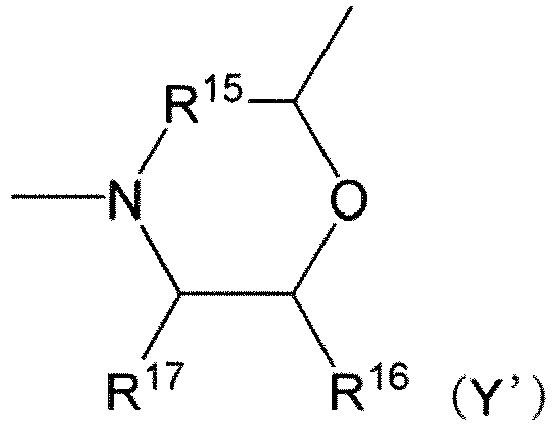
R15 represents a single bond or - (CHR15a-)m, wherein m represents 1 or 2, R15as are identical or different, and each represents hydrogen or alkyl, and when m is 2, two adjacent R15as, taken together with the adjacent carbon atom, may form a ring, and R16 and R17 are identical or different, and each represents hydrogen or alkyl, and R16 and R17, taken together with the adjacent carbon atoms, may form a ring. - In Formula (Y'), R15 is preferably -(CHR15a-)m.
- In Formula (Y'), m is preferably 1.
- In Formula (Y'), the alkyl represented by R15a is the same as the alkyl represented by R11a mentioned above.
- In Formula (Y'), the alkyl represented by R16 or R17 is the same as the alkyl represented by R12 or R13 mentioned above.
- In Formula (1), the linker represented by R2 is not particularly limited as long as it is a divalent group that is capable of functioning as a linker. Examples of R2 include a divalent group represented by Formula (Z1): -T-U-, wherein T is-S(O)1-2-, -C(=O)-, or -(CH2)1-3-, and U is a single bond, - (CH2)1-3-, -O-, or -NR'-; a divalent group represented by Formula (Z2): -V-O-W-, wherein V is a single bond or -(CH2)1-3-, and W is a single bond, - (CH2)1-3-, -C(=O)-, -S(O)1-2-, or -C(=O) -NR'-; and the like.
- In the above definition, R' represents hydrogen or alkyl. The alkyl represented by R' is the same as the alkyl represented by R11a mentioned above. Of the two bonding hands of R2 (bonding hands 1 and 2), bonding hand 1 may be bonded to R1 while bonding hand 2 may be bonded to R3, or bonding hand 1 may be bonded to R3 while bonding hand 2 may be bonded to R1.
- In Formula (Z1), T is preferably -S(O)1-2- or -C(=O)-, and more preferably -S(O)1-2-.
- In Formula (Z1), U is preferably a single bond, -(CH2)1-3-, or -NR'-, more preferably a single bond or -CH2-, and more preferably a single bond.
- Specific examples of the divalent group represented by Formula (Z1) include the following groups and the like.


- In Formula (Z2), V is preferably a single bond.
- In Formula (Z2), W is preferably -(CH2)1-3-.
- Specific examples of the divalent group represented by Formula (Z2) include the following groups and the like.


- In Formula (1), R2 is preferably a divalent group represented by Formula (Z1), a divalent group represented by Formula (Z2), or the like.
- The divalent group represented by Formula (Z1) is more preferably a divalent group represented by Formula (Z1a): -S(O)1-2-U-, wherein U is as defined above. The divalent group represented by Formula (Z1a) is even more preferably a divalent group represented by -S(O)1-2-, and still more preferably -S(O)2-.
- The divalent group represented by Formula (Z2) is more preferably a divalent group represented by Formula (Z2a): -O-W-, wherein W is as defined above. The divalent group represented by Formula (Z2a) is even more preferably a divalent group represented by -O-(CH2)1-3-, and still more preferably a divalent group represented by -O-(CH2)-.
- In Formula (1), the aryl represented by R3 is not particularly limited. The aryl represented by R3 preferably has 6 to 20, more preferably 6 to 12, and even more preferably 6 to 8 carbon atoms. Specific examples of the aryl include phenyl, naphthyl, biphenyl, pentarenyl, indenyl, anthranyl, tetracenyl, pentacenyl, pyrenyl, perylenyl, fluorenyl, phenanthryl, and the like, with phenyl, naphthyl, and the like being preferable, and phenyl and the like being more preferable.
- In formula (1), the substituent that may be possessed by the aryl represented by R3 is not particularly limited. Examples include halogen, optionally substituted alkyl, optionally substituted alkoxy, optionally substituted alkylthio, optionally substituted alkenyl, optionally substituted alkynyl, optionally substituted amino, nitro, hydroxyl, cyano, -C(=O)R301, -C(=O)OR302, -C(=O)NR303R304, -S(=O)1-2R305, -S(=O)1-2NR306 R307, and the like.
- In formula (1), examples of halogen that may be possessed by the aryl represented by R3 include fluorine, chlorine, bromine, iodine, and the like.
- In Formula (1), the optionally substituted alkyl that may be possessed by the aryl represented by R3 is not particularly limited. Examples include linear, branched, or cyclic (preferably linear or branched, and more preferably linear) alkyl groups containing 1 to 8, preferably 1 to 6, more preferably 1 to 5, even more preferably 2 to 5, and still more preferably 3 to 5 carbon atoms and being optionally substituted with halogen (e.g., fluorine, chlorine, bromine, iodine), oxo, hydroxyl, alkoxy, optionally substituted amino, phenyl, and the like. The number of substituents is not particularly limited and is, for example, 0 to 6, preferably 0 to 3, and more preferably 0. Examples of the optionally substituted alkyl include methyl, ethyl, n-propyl, isopropyl, n-butyl, isobutyl, sec-butyl, t-butyl, perfluoromethyl, perfluoroethyl, and the like.
- In Formula (1), the optionally substituted alkoxy that may be possessed by the aryl represented by R3 is not particularly limited. Examples include linear or branched (preferably linear) alkoxy groups containing 1 to 8, preferably 1 to 6, more preferably 1 to 5, even more preferably 2 to 5, and still more preferably 3 to 5 carbon atoms, and being optionally substituted with halogen (e.g., fluorine, chlorine, bromine, iodine), oxo, hydroxyl, alkoxy, optionally substituted amino, phenyl, and the like. The number of substituents is not particularly limited and is, for example, 0 to 6, preferably 0 to 3, and more preferably 0. Examples of the optionally substituted alkoxy include methoxy, ethoxy, n-propoxy, isopropoxy, n-butoxy, isobutoxy, sec-butoxy, t-butoxy, perfluoromethoxy, perfluoroethoxy, and the like.
- In Formula (1), the optionally substituted alkylthio that may be possessed by the aryl represented by R3 is not particularly limited. Examples include linear or branched (preferably linear) alkylthio groups containing 1 to 8, preferably 1 to 6, and more preferably 1 to 4 carbon atoms, and being optionally substituted with halogen (e.g., fluorine, chlorine, bromine, iodine), oxo, hydroxyl, alkoxy, optionally substituted amino, phenyl, and the like. The number of substituents is not particularly limited and is, for example, 0 to 6, and preferably 0 to 3. Examples of the optionally substituted alkylthio include methylthio, ethylthio, n-propylthio, isopropylthio, n-butylthio, isobutylthio, sec-butylthio, t-butylthio, perfluoromethylthio, perfluoroethylthio, and the like.
- In Formula (1), the optionally substituted alkenyl that may be possessed by the aryl represented by R3 is not particularly limited. Examples include linear or branched (preferably linear) alkenyl groups containing 2 to 8, preferably 2 to 6, and more preferably 2 to 4 carbon atoms, and being optionally substituted with halogen (e.g., fluorine, chlorine, bromine, iodine), oxo, hydroxyl, alkoxy, optionally substituted amino, phenyl, and the like. The number of substituents is not particularly limited and is, for example, 0 to 6, and preferably 0 to 3. Examples of the optionally substituted alkenyl include vinyl, allyl, 1-propenyl, isopropenyl, butenyl, pentenyl, hexenyl, and the like.
- In Formula (1), the optionally substituted alkynyl that may be possessed by the aryl represented by R3 is not particularly limited. Examples include linear or branched (preferably linear) alkynyl groups containing 2 to 8, preferably 2 to 6, and more preferably 2 to 4 carbon atoms, and being optionally substituted with halogen (e.g., fluorine, chlorine, bromine, iodine), oxo, hydroxyl, alkoxy, optionally substituted amino, phenyl, and the like. The number of substituents is not particularly limited and is, for example, 0 to 6, and preferably 0 to 3. Examples of the optionally substituted alkynyl include ethynyl, propynyl (e.g., 1-propynyl, 2-propynyl (propargyl)), butynyl, pentynyl, hexynyl, phenylacetylenyl, and the like.
- In Formula (1), the optionally substituted amino that may be possessed by the aryl represented by R3 is not particularly limited. Examples include amino groups optionally substituted with linear or branched (preferably linear) alkyl and/or acyl containing 1 to 6, preferably 1 to 4, more preferably 1 to 2 carbon atoms. The number of alkyl and/or acyl substituents is preferably 1 to 2. (When the substituent(s) are alkyl and/or acyl, and the number of substituents is 2, the alkyl and/or acyl, taken together with the adjacent nitrogen atoms, may form a ring.) Examples of the optionally substituted amino include amino, methylamino, ethylamino, dimethylamino, diethylamino, ethylmethylamino, acetamide, and the like.
- In formula (1), the substituents that may be possessed by the aryl represented by R3 is preferably halogen, optionally substituted alkyl, optionally substituted alkoxy, optionally substituted alkylthio, optionally substituted alkenyl, optionally substituted alkynyl, optionally substituted amino, nitro, and the like, more preferably, halogen, optionally substituted alkyl, optionally substituted alkoxy, nitro, and the like, and even more preferably optionally substituted alkyl, optionally substituted alkoxy, and the like.
- R301, R302, R303, R304, R305, R306, and R307 each represent hydrogen, optionally substituted alkyl, or optionally substituted phenyl. The "optionally substituted alkyl" and "optionally substituted phenyl" here are as defined above for the substituents that may be possessed by the aryl represented by R3.
- In Formula (1), the number of substituents of the aryl represented by R3 is, for example, 0 to 5, preferably 1 to 3, and more preferably 1.
- In Formula (1), the heteroaryl represented by R3 is not particularly limited. It is preferable that the number of the atoms constituting the ring be 5 to 20, more preferably 5 to 12, and particularly preferably 5 to 8. Specific examples of the heteroaryl include pyridyl, pyrazinyl, pyrimidinyl, pyridazinyl, thienyl, furyl, pyrrolyl, imidazolyl, pyrazolyl, oxazolyl, thiazolyl, isoxazolyl, isothiazolyl, indolyl, quinolyl, and the like.
- In Formula (1), the substituents that may be possessed by the heteroaryl represented by R3 are the same as those that may be possessed by the aryl represented by R3 mentioned above.
- In Formula (1), the cycloalkyl represented by R3 is not particularly limited, and may be cycloalkyl containing, for example, 3 to 8, preferably 4 to 7, more preferably 5 to 7, and even more preferably 6 carbon atoms. Examples of the cycloalkyl include cyclopropyl, cyclobutyl, cyclopentyl, cyclohexyl, cycloheptyl, cyclooctyl, and the like.
- In Formula (1), the substituents that may be possessed by the cycloalkyl represented by R3 are the same as those that may be possessed by the aryl represented by R3 mentioned above.
- In Formula (1), the alkyl containing 1 to 6 carbon atoms represented by R3 is not particularly limited. Examples of the alkyl include methyl, ethyl, n-propyl, isopropyl, n-butyl, isobutyl, sec-butyl, t-butyl, and the like.
- In Formula (1), the substituents that may be possessed by the alkyl containing 1 to 6 carbon atoms represented by R3 are the same as those that may be possessed by the aryl represented by R3 mentioned above.
- In Formula (1), R3 is preferably optionally substituted aryl, and more preferably a group represented by Formula (X):

- In Formula (X), various substituents represented by R31, R32, R33, R34, or R35 are the same as those that may be possessed by the aryl represented by R3.
- In Formula (X), it is preferable that one to three of R31, R32, R33, R34, and R35 (preferably one of these, more preferably R31) be halogen, optionally substituted alkyl, optionally substituted alkoxy, or nitro, and the others be all hydrogen atoms, and it is more preferable that R31 be optionally substituted alkyl or optionally substituted alkoxy, and R32, R33, R34, and R35 all be hydrogen atoms.
- In Formula (1), examples of the halogen represented by R4, R5, or R6 include fluorine, chlorine, bromine, iodine, and the like.
- In Formula (1), the optionally substituted alkyl represented by R4, R5, or R6 is not particularly limited. Examples include linear, branched, or cyclic (preferably linear or branched, and more preferably linear) alkyl groups containing 1 to 8, preferably 1 to 6, more preferably 1 to 4, even more preferably 1 to 3, and still more preferably 1 to 2 carbon atoms, and being optionally substituted with halogen (e.g., fluorine, chlorine, bromine, iodine), oxo, hydroxyl, alkoxy, optionally substituted amino, phenyl, and the like. The number of substituents is not particularly limited and is, for example, 0 to 6, preferably 0 to 3, and more preferably 0. Examples of the optionally substituted alkyl include methyl, ethyl, n-propyl, isopropyl, n-butyl, isobutyl, sec-butyl, t-butyl, perfluoromethyl, perfluoroethyl, and the like.
- In Formula (1), the optionally substituted alkenyl represented by R4, R5, or R6 is not particularly limited. Examples include linear or branched (preferably linear) alkenyl groups containing 2 to 8, preferably 2 to 6, and more preferably 2 to 4 carbon atoms, and being optionally substituted with halogen (e.g., fluorine, chlorine, bromine, iodine), oxo, hydroxyl, alkoxy, optionally substituted amino, phenyl, and the like. The number of substituents is not particularly limited and is, for example, 0 to 6, preferably 0 to 3, and more preferably 0. Examples of the optionally substituted alkenyl include vinyl, allyl, 1-propenyl, isopropenyl, butenyl, pentenyl, hexenyl, and the like.
- In Formula (1), the optionally substituted alkynyl represented by R4, R5, or R6 is not particularly limited. Examples include linear or branched (preferably linear) alkynyl groups containing 2 to 8, preferably 2 to 6, and more preferably 2 to 4 carbon atoms, and being optionally substituted with halogen (e.g., fluorine, chlorine, bromine, iodine), oxo, hydroxyl, alkoxy, optionally substituted amino, phenyl, and the like. The number of substituents is not particularly limited and is, for example, 0 to 6, preferably 0 to 3, and more preferably 0. Examples of the optionally substituted alkynyl include ethynyl, propynyl (e.g., 1-propynyl, 2-propynyl (propargyl)), butynyl, pentynyl, hexynyl, phenylacetylenyl, and the like.
- In Formula (1), R4 is preferably hydrogen, optionally substituted alkyl, optionally substituted alkenyl, optionally substituted alkynyl, or the like, more preferably hydrogen, optionally substituted alkyl, optionally substituted alkenyl, or the like, and even more preferably optionally substituted alkyl, optionally substituted alkenyl, or the like.
- In Formula (1), R5 is preferably hydrogen, optionally substituted alkyl, optionally substituted alkenyl, optionally substituted alkynyl, or the like, and more preferably hydrogen.
- In Formula (1), R6 is preferably hydrogen, optionally substituted alkyl, optionally substituted alkenyl, optionally substituted alkynyl, or the like, and more preferably hydrogen.
- In one embodiment, it is preferable that R4 be optionally substituted alkyl, optionally substituted alkenyl, or optionally substituted alkynyl, and R5 and R6 both be hydrogen atoms.
- In one embodiment of the present invention, the compound represented by Formula (1) is preferably a compound represented by Formula (1A):


- The salts of the compounds represented by Formula (1) are not particularly limited as long as they are agriculturally acceptable salts. The salts may be either acid salts or basic salts. Examples of acid salts include inorganic acid salts such as hydrochloride, hydrobromide, sulfate, nitrate, and phosphate; and organic acid salts, such as acetate, propionate, tartrate, fumarate, maleate, malate, citrate, methanesulfonate, and p-toluenesulfonate. Examples of basic salts include alkali metal salts such as sodium salts and potassium salts; alkaline earth metal salts, such as calcium salts and magnesium salts; salts with ammonia; salts with organic amines, such as morpholine, piperidine, pyrrolidine, monoalkylamine, dialkylamine, trialkylamine, mono(hydroxyalkyl)amine, di(hydroxyalkyl)amine, and tri(hydroxyalkyl)amine; and the like.
- The compound represented by Formula (1) can also be a hydrate or solvate. Examples of the solvent include agriculturally acceptable organic solvents (such as ethanol, glycerol, and acetic acid).
- The compound represented by Formula (1) can be synthesized by various methods.
- The compound represented by Formula (1) can be synthesized, for example, in accordance with the following reaction scheme or a scheme according to this scheme:

- In this reaction, the compound represented by Formula (1) can be obtained by reacting the compound represented by Formula (1a) with the compound represented by Formula (1b).
- From the viewpoint of the yield and the like, the amount of the compound represented by Formula (1a) is usually preferably 0.5 to 10 mol, more preferably 1.5 to 6 mol, and even more preferably 2 to 4 mol, per mole of the compound represented by Formula (1b).
- This reaction is preferably performed in the presence of a catalyst. Examples of the catalyst include, but are not particularly limited to, N,N-dimethyl-4-aminopyridine (DMAP), triethylamine (Et3N), and other base catalysts. These catalysts may be used alone or in a combination of two or more.
- The amount of catalyst used varies depending on the type of catalyst. For example, the amount is about 0.1 to 10 mol per mole of the compound represented by Formula (1a).
- This reaction is usually performed in the presence of a reaction solvent. Examples of the reaction solvent include, but are not particularly limited to, dichloromethane, acetonitrile, tetrahydrofuran, acetone, toluene, and the like, with dichloromethane and the like being preferable. These solvents may be used alone or in a combination of two or more.
- In this reaction, in addition to the above components, additives can also be appropriately used as long as the progress of the reaction is not significantly impaired.
- The reaction can be performed under heating, at room temperature, or under cooling, and is usually preferably performed at 0 to 50°C (in particular 0 to 30°C). The reaction time is not particularly limited and is usually 4 to 48 hours, and in particular 8 to 24 hours.
- The progress of the reaction can be traced by chromatography or other usual methods. After completion of the reaction, the solvent is distilled off, and the product can be isolated and purified by chromatography, recrystallization, or other usual methods. The structure of the product can be identified by elemental analysis, MS (ESI-MS) analysis, IR analysis, 1H-NMR, 13C-NMR, etc.
- The compound represented by Formula (1) can be synthesized, for example, in accordance with the following reaction scheme or a scheme according to this scheme:

- In this reaction, the compound represented by Formula (1) can be obtained by reacting the compound represented by Formula (1c) with the compound represented by Formula (1d).
- The reaction conditions of this reaction are the same as those stated above in the "2-1. Production Method 1" section.
- The compound represented by Formula (1) exerts parasitic plant germination regulation action (in particular, parasitic plant germination-inducing action). Therefore, the compound represented by Formula (1), a salt thereof, a hydrate thereof, or a solvate thereof, can be used as an active ingredient of a parasitic plant germination regulator (in particular, a parasitic plant germination inducer).
- If the parasitic plant germination regulator is applied, for example, to an environment where plants that serve as a host of parasitic plants are not present in surroundings, parasitic plants after germination cannot parasitize plants, and will wither and die, allowing the soil to be purified.
- Examples of plants that serve as a host of parasitic plants include, but are not particularly limited to, corn, millet, sorghum, sugarcane, rice, beans, and the like.
- The target parasitic plants are not particularly limited. Typical examples include plants of the genus Striga. Examples of plants of the genus Striga include Striga hermonthica, Striga gesnerioides, Striga asiatica, Striga aequinoctialis, Striga angolensis, Striga angustifolia, Striga aspera, Striga bilabiata, Striga brachycalyx, Striga chrysantha, Striga dalzieli , Striga elegans, Striga forbesii, Striga gastonii, Striga gracillima, Striga hallaei, Striga hirsuta, Striga junodii, Striga klingii, Striga latericea, Striga lepidagathidis, Striga lutea, Striga macrantha, Striga passargei, Striga pinnatifida, Striga primuloides, Striga pubiflora, Striga yemenica, and the like. Additionally, examples of parasitic plants targeted by the present invention include plants of the genus Orobanche, plants of the genus Phelipanche, and plants of the genus Alectra, and the like. Examples of plants of the genus Orobanche include Orobanche cernua, Orobanche crenata, Orobanche cumana, Orobanche foetida, Orobanche minor, and the like. Examples of plants of the genus Phelipanche include Phelipanche aegyptiaca, Phelipanche ramosa, and the like. Examples of plants of the genus Alectra include Alectra orobanchoides, Alectra sessiliflora, Alectra vogelii, and the like. The target parasitic plants are preferably plants of the genus Striga, plants of the genus Orobanche, and plants of the genus Phelipanche, more preferably plants of the genus Striga and plants of the genus Orobanche, and even more preferably Striga hermonthica and Orobanche minor.
- The parasitic plant germination regulator of the present invention may consist of an active ingredient (the compound represented by Formula (1), a salt thereof, a hydrate thereof, or a solvate thereof). However, in addition to the above, the parasitic plant germination regulator of the present invention may further contain various additives, according to the dosage form, application mode, etc. The content of the active ingredient in the agent of the present invention is not particularly limited, and is specifically 0.0001 to 100 wt%, and preferably about 0.01 to 50 wt%.
- The dosage form of the parasitic plant germination regulator of the present invention is not particularly limited as long as it is an agriculturally acceptable dosage form. Examples include liquids, solids, powders, granules, pellets, wettable powders, flowable agents, emulsions, pastes, dispersants, and the like.
- The additives are not particularly limited as long as they are agriculturally acceptable additives. Examples include carriers, surfactants, thickeners, extenders, binders, vitamins, antioxidants, pH adjusters, volatilization inhibitors, dyes, and the like.
- The application mode of the parasitic plant germination regulator of the present invention is not particularly limited as long as the active ingredient above can be brought into contact with parasitic plant seeds. Examples include an embodiment in which the agent of the present invention is sprayed, dripped, applied, mixed, etc. with respect to soil containing parasitic plant seeds.
- The present invention will be described in detail below based on Examples, but the present invention is not limited to these Examples.
- Compounds represented by the following formula (6R) (compounds 1 to 9), compounds represented by the following formula (7R) (compounds 10 to 21), compounds represented by the following formula (8AB) (compounds 22 to 26), compounds represented by the following formula (9AB) (compounds 27 to 28), compounds represented by the following formula (10AB) (compounds 29 to 30), and compound 31 below were synthesized.


- Compound 1 was synthesized according to the following synthetic scheme. In the synthetic scheme, Et represents ethyl (the same applies hereinafter).

- 4-Butoxybenzene-1-sulfonyl chloride (RX) (1a) (1.36 g, 5.5 mmol, 1 equiv.) and triethylamine (1.2 mL, 8.25 mmol, 1.5 equiv.) were added to a solution of piperazine (2a) (1.86 g, 22 mmol, 4 equiv.) in dichloromethane (55 mL), followed by stirring at room temperature overnight. Thereafter, the reaction liquid was quenched with saturated sodium hydrogen carbonate. The reaction mixture was extracted with dichloromethane (10 mL) (× 3), and dried over anhydrous Na2SO4. After the solvent was evaporated, the residue was purified by silica gel column chromatography (eluate: mixed solvent of chloroform/methanol), thus yielding white solid amine (3) (1.52 g, yield: 93%).
- A solution of triphosgene (0.15 g, 0.50 mmol, 1 equiv.) in dichloromethane (1.9 mL) was cooled to 0°C, and amine (3) (0.15 g, 0.50 mmol, 1 equiv.) and triethylamine (0.2 mL, 1.50 mmol, 3 equiv.) were added thereto, followed by stirring for 2 hours in an argon atmosphere. While the reaction liquid was maintained at 0°C, dichloromethane (5 mL), 5-hydroxy-3-methyl-2-furanone (4a) (0.17 g, 1.5 mmol, 3 equiv.), triethylamine (0.2 mL, 1.50 mmol, 3 equiv.), and N,N-dimethyl-4-aminopyridine (6.1 mg, 0.05 mmol, 10 mol%) were added thereto. The reaction liquid was stirred overnight while its temperature was slowly returned to room temperature. Thereafter, the reaction liquid was quenched with saturated sodium hydrogen carbonate, extracted with dichloromethane (5 mL) (x 3), and dried over anhydrous Na2SO4. After the solvent was evaporated, the residue was purified by silica gel column chromatography (eluate: a mixed solvent of hexane/ethyl acetate), thus yielding a white solid target product (5) (compound 1) (0.19 g, yield: 87%).
1H NMR (600 MHz, CDCl3) δ 7.65 (2H, dt, J = 9.0, 1.8 Hz), 6.99 (2H, dt, J = 9.0, 1.8 Hz), 6.85-6.83 (1H, m), 6.83-6.82 (1H, m), 4.03 (2H, t, J = 6.0 Hz), 3.76 (1H, d, J = 12.0 Hz), 3.65 (1H, d, J = 12.0 Hz), 3.47 (1H, t, J = 10.2 Hz), 3.43 (1H, t, J = 10.2 Hz), 3.19 (1H, br), 3.12 (1H, br), 2.84 (1H, t, J = 10.2 Hz), 2.79 (1H, t, J = 10.2 Hz), 1.97 (3H, s), 1.80 (2H, td, J = 7.2, 6.0 Hz), 1.51 (2H, sextet, J = 7.2 Hz), 0.99 (3H, t, J = 7.2 Hz); 13C NMR (151 MHz, CDCl3) δ 171.1, 163.2, 152.4, 142.1, 134.7, 130.0, 126.4, 115.0, 93.9, 68.4, 45.8, 43.7, 43.4, 31.2, 19.3, 14.0, 10.8, one carbon atom was not found due to overlapping; IR (film) 2940, 2872, 1776, 1717, 1593, 1435, 1346, 1242, 1159, 1092, 1015, 955, 930 cm-1; HRMS (ESI) Calcd for C20H26O7N2NaS+ ([M+Na]+) 461.1353, Found 461.1356. - According to the synthesis method for compound 1, synthesis was performed using appropriate material compounds.
- Compound 2: White solid (145 mg, yield: 73%). 1H NMR (600 MHz, CDCl3) δ 7.67 (2H, d, J = 8.4 Hz), 7.01 (2H, d, J = 8.4 Hz), 6.85-6.84 (1H, m), 6.83 (1H, brs), 3.89 (3H, s), 3.77 (1H, brd, J = 12.2 Hz), 3.66 (1H, brd, J = 12.2 Hz), 3.52-3.40 (2H, m), 3.19 (1H, brs), 3.13 (1H, brs), 2.84 (1H, t, J = 8.4 Hz), 2.79 (1H, t, J = 8.4 Hz), 1.97 (3H, s); 13C NMR (151 MHz, CDCl3) δ 171.1, 163.4, 152.3, 142.1, 134.4, 129.8, 126.6, 114.5, 93.7, 55.7, 45.7, 43.5, 43.3, 10.6, one carbon atom was not found due to overlapping; IR (film) 2895, 2855, 1780, 1717, 1595, 1435, 1346, 1242, 1192, 1061, 1016, 955 cm-1; HRMS (ESI) Calcd for C17H20O7N2NaS+ ([M+Na]+) 419.0883, Found 419.0871.
- Compound 3: White solid (57 mg, yield: 82%). 1H NMR (600 MHz, CDCl3) δ 7.66 (2H, dt, J = 9.0, 1.8 Hz), 6.99 (2H, dt, J = 9.0, 1.8 Hz), 6.85 (1H, m), 6.82 (1H, m), 4.11 (2H, q, J = 6.9 Hz), 3.75 (1H, d, J = 11.4 Hz), 3.65 (1H, d, J = 11.4 Hz), 3.48 (1H, t, J = 9.0 Hz), 3.44 (1H, t, J = 9.0 Hz), 3.18 (1H, br), 3.12 (1H, br), 2.84 (1H, t, J = 9.0 Hz), 2.80 (1H, t, J = 9.0 Hz), 1.96 (3H, s), 1.45 (3H, t, J = 6.9 Hz); 13C NMR (151 MHz, CDCl3) δ 171.2, 163.0, 152.4, 142.1, 134.6, 129.9, 126.4, 115.0, 93.8, 64.2, 45.8, 43.6, 43.4, 14.7, 10.7, one carbon atom was not found due to overlapping; IR (film) 2899, 1780, 1713, 1595, 1420, 1329, 1260, 1207, 1092, 1015, 955 cm-1; HRMS (ESI) Calcd for C18H22O7N2NaS+ ([M+Na]+) 433.1040, Found 433.1039.
- Compound 4: White solid (145 mg, yield: 68%). 1H NMR (600 MHz, CDCl3) δ 7.66 (2H, d, J = 9.0 Hz), 7.00 (2H, d, J = 9.0 Hz), 6.85 (1H, s), 6.83 (1H, s), 3.99 (2H, t, J = 7.2 Hz), 3.76 (1H, d, J = 12.6 Hz), 3.66 (1H, d, J = 12.6 Hz), 3.48 (1H, t, J = 9.6 Hz), 3.44 (1H, t, J = 9.6 Hz), 3.18 (1H, br), 3.12 (1H, br), 2.84 (1H, t, J = 9.6 Hz), 2.79 (1H, t, J = 9.6 Hz), 1.97 (3H, s), 1.85 (2H, sextet, J = 7.2 Hz), 1.06 (3H, t, J = 7.2 Hz); 13C NMR (151 MHz, CDCl3) δ 171.2, 163.2, 152.4, 142.1, 134.7, 130.0, 126.4, 115.0, 93.9, 70.2, 45.8, 43.7, 43.4, 22.5, 10.8, 10.6, one carbon atom was not found due to overlapping; IR (film) 2941, 2899, 1775, 1707, 1591, 1439, 1344, 1242, 1159, 1092, 1011, 955, 934 cm-1; HRMS (ESI) Calcd for C19H24O7N2NaS+ ([M+Na]+) 447.1196, Found 447.1195.
- Compound 5: White solid (230 mg, yield: 99%). 1H NMR (600 MHz, CDCl3) δ 7.65 (2H, d, J = 8.4 Hz), 6.99 (2H, d, J = 8.4 Hz), 6.85 (1H, brs), 6.82 (1H, brs), 4.02 (2H, t, J = 7.0 Hz), 3.76 (1H, d, J = 12.6 Hz), 3.66 (1H, d, J = 12.6 Hz), 3.48 (1H, t, J = 9.0 Hz), 3.44 (1H, t, J = 9.0 Hz), 3.18 (1H, br), 3.12 (1H, br), 2.84 (1H, t, J = 9.0 Hz), 2.79 (1H, t, J = 9.0 Hz), 1.96 (3H, s), 1.82 (2H, quintet, J = 7.0 Hz), 1.45 (2H, quintet, J = 7.0 Hz), 1.40 (2H, sextet, J = 7.0 Hz), 0.94 (3H, t, J = 7.0 Hz); 13C NMR (151 MHz, CDCl3) δ 171.2, 163.2, 152.4, 142.1, 134.6, 129.9, 126.4, 115.0, 93.8, 68.7, 45.8, 43.6, 43.4, 28.8, 28.2, 22.5, 14.1, 10.7, one carbon atom was not found due to overlapping; IR (film) 2936, 2922, 1769, 1722, 1595, 1433, 1348, 1242, 1165, 1092, 1015, 957 cm-1; HRMS (ESI) Calcd for C21H28O7N2NaS+ ([M+Na]+) 475.1509, Found 475.1507.
- Compound 6: White solid (130 mg, yield: 66%). 1H NMR (600 MHz, CDCl3) δ 7.64 (2H, d, J = 8.4 Hz), 7.37 (2H, d, J = 8.4 Hz), 6.84 (1H, quintet, J = 1.2 Hz), 6.82 (1H, quintet, J = 1.2 Hz), 3.77 (1H, d, J = 12.3 Hz), 3.67 (1H, d, J = 12.3 Hz), 3.47 (1H, t, J = 11.4 Hz), 3.43 (1H, t, J = 11.4 Hz), 3.21 (1H, t, J = 6.6 Hz), 3.15 (1H, t, J = 6.6 Hz), 2.85 (1H, t, J = 8.8 Hz), 2.80 (1H, t, J = 8.8 Hz), 2.75 (2H, q, J = 7.8 Hz), 1.96 (3H, t, J = 1.2 Hz), 1.29 (3H, t, J = 7.8 Hz); 13C NMR (151 MHz, CDCl3) δ 171.1, 152.4, 150.5, 142.1, 134.7, 132.5, 128.9, 128.0, 93.9, 45.8, 43.7, 43.5, 29.0, 15.2, 10.8, one carbon atom was not found due to overlapping; IR (film) 2967, 2926, 2855, 1778, 1719, 1435, 1350, 1242, 1165, 1125, 1092, 1015, 928 cm-1; HRMS (ESI) Calcd for C18H22O6N2NaS+ ([M+Na]+) 417.1091, Found 417.1089.
- Compound 7: White solid (220 mg, yield: 99%). 1H NMR (600 MHz, CDCl3) δ 7.63 (2H, d, J = 8.4 Hz), 7.35 (2H, d, J = 8.4 Hz), 6.84 (1H, brs), 6.83 (1H, s), 3.77 (1H, d, J = 12.3 Hz), 3.67 (1H, d, J = 12.3 Hz), 3.48 (1H, t, J = 9.6 Hz), 3.44 (1H, t, J = 9.6 Hz), 3.21 (1H, t, J = 6.0 Hz), 3.15 (1H, t, J = 6.0 Hz), 2.86 (1H, t, J = 8.4 Hz), 2.81 (1H, t, J = 8.4 Hz), 2.68 (2H, t, J = 7.2 Hz), 1.96 (3H, s), 1.65 (2H, quintet, J = 7.2 Hz), 1.39-1.30 (4H, m), 0.91 (3H, t, J = 7.2 Hz); 13C NMR (151 MHz, CDCl3) δ 171.1, 152.4, 149.3, 142.1, 134.7, 132.5, 129.4, 127.9, 93.9, 45.8, 43.7, 43.5, 36.0, 31.6, 30.8, 22.6, 10.8, one carbon atom was not found due to overlapping; IR (film) 2928, 2857, 1780, 1721, 1435, 1350, 1242, 1167, 1126, 1092, 1015, 955 cm-1; HRMS (ESI) Calcd for C21H28O6N2NaS+ ([M+Na]+) 459.1560, Found 459.1558.
- Compound 8: White solid (220 mg, yield: 99%). 1H NMR (600 MHz, CDCl3) δ 7.88 (2H, d, J = 8.2 Hz), 7.84 (2H, d, J = 8.2 Hz), 6.84 (1H, brs), 6.83 (1H, brs), 3.77 (1H, d, J = 12.0 Hz), 3.68 (1H, d, J = 12.0 Hz), 3.52 (1H, t, J = 10.2 Hz), 3.48 (1H, t, J = 10.2 Hz), 3.23 (1H, br), 3.17 (1H, br), 2.95 (1H, t, J = 10.2 Hz), 2.90 (1H, t, J = 10.2 Hz), 1.97 (3H, s); 13C NMR (151 MHz, CDCl3) δ 171.1, 152.4, 142.0, 139.3, 135.2 (q, JC-F = 33.2 Hz), 134.8, 128.3, 126.7 (q, JC-F = 4.2 Hz), 123.2 (q, JC-F = 273.2 Hz), 93.9, 45.7, 43.7, 43.4, 10.8, one carbon atom was not found due to overlapping; IR (film) 2928, 2859, 1780, 1721, 1437, 1323, 1244, 1171, 1128, 1063, 1015, 955 cm-1; HRMS (ESI) Calcd for C17H17O6N2F3NaS+ ([M+Na]+) 457.0652, Found 457.0646.
- Compound 9: White solid (37 mg, yield: 83%). 1H NMR (600 MHz, CDCl3) δ 7.89-7.87 (1H, m), 7.77 (1H, d, J = 8.2 Hz), 7.67 (1H, d, J = 8.2 Hz), 7.44 (1H, t, J = 8.2 Hz), 6.86-6.84 (1H, m), 6.82 (1H, brs), 3.75 (1H, d, J = 12.6 Hz), 3.65 (1H, d, J = 12.6 Hz), 3.52 (1H, t, J = 11.4 Hz), 3.47 (1H, t, J = 11.4 Hz), 3.20 (1H, brs), 3.13 (1H, brs), 2.94 (1H, t, J = 7.0 Hz), 2.89 (1H, t, J = 7.0 Hz), 1.97 (3H, s); 13C NMR (151 MHz, CDCl3) δ 171.1, 152.4, 142.0, 137.4, 136.5, 134.7, 131.0, 130.6, 126.3, 123.6, 93.9, 45.8, 43.7, 43.4, 10.8, one carbon atom was not found due to overlapping; IR (film) 2924, 2862, 1776, 1717, 1435, 1352, 1240, 1169, 1125, 1096, 1015, 953 cm-1; HRMS (ESI) Calcd for C16H17O6N2 79BrNaS+ ([M+Na]+) 466.9883, Found 466.9876.
- Compound 10: White solid (21 mg, yield: 55%). 1H NMR (600 MHz, CDCl3) δ 7.68 (2H, dt, J = 9.0, 2.4 Hz), 7.27 (1H, dd, J = 7.2, 1.8 Hz), 7.02 (2H, dt, J = 9.0, 2.4 Hz), 6.96 (1H, t, J = 1.8 Hz), 6.29 (1H, d, J = 7.2 Hz), 3.89 (3H, s), 3.77 (1H, d, J = 12.6 Hz), 3.67 (1H, d, J = 12.6 Hz), 3.49 (1H, t, J = 11.0 Hz), 3.45 (1H, t, J = 11.0 Hz), 3.20 (1H, br), 3.14 (1H, br), 2.85 (1H, t, J = 11.0 Hz), 2.81 (1H, t, J = 11.0 Hz); 13C NMR (151 MHz, CDCl3) δ 169.7, 163.6, 152.2, 149.7, 130.0, 126.8, 125.5, 114.7, 95.4, 55.8, 45.8, 43.7, 43.5, one carbon atom was not found due to overlapping; IR (film) 2982, 2847, 1792, 1719, 1595, 1499, 1437, 1348, 1242, 1161, 1092, 1018, 926 cm-1; HRMS (ESI) Calcd for C16H18O7N2NaS+ ([M+Na]+) 405.0727, Found 405.0721.
- Compound 11: White solid (38 mg, yield: 56%). 1H NMR (600 MHz, CDCl3) δ 7.66 (2H, dt, J = 8.7, 2.4 Hz), 7.27 (1H, dd, J = 5.4, 1.2 Hz), 6.99 (2H, dt, J = 8.7, 2.4 Hz), 6.96 (1H, t, J = 1.2 Hz), 6.29 (1H, dd, J = 5.4, 1.2 Hz), 4.11 (2H, q, J = 7.5 Hz), 3.77 (1H, d, J = 12.6 Hz), 3.67 (1H, d, J = 12.6 Hz), 3.49 (1H, t, J = 10.5 Hz), 3.45 (1H, t, J = 10.5 Hz), 3.19 (1H, brs), 3.13 (1H, brs), 2.85 (1H, t, J = 10.5 Hz), 2.80 (1H, t, J = 10.5 Hz), 1.57 (3H, s), 1.46 (3H, t, J = 7.5 Hz); 13C NMR (151 MHz, CDCl3) δ 169.7, 163.0, 152.2, 149.8, 130.0, 126.5, 125.5, 115.0, 95.4, 64.2, 45.8, 43.7, 43.5, 14.8, one carbon atom was not found due to overlapping; IR (film) 2984, 1792, 1717, 1595, 1435, 1348, 1242, 1161, 1090, 1018, 924 cm-1; HRMS (ESI) Calcd for C17H20O7N2NaS+ ([M+Na]+) 419.0883, Found 419.0877.
- Compound 12: White solid (137 mg, yield: 67%) . 1H NMR (600 MHz, CDCl3) δ 7.66 (2H, d, J = 8.7 Hz), 7.28 (1H, dd, J = 6.0, 1.2 Hz), 7.00 (2H, d, J = 8.7 Hz), 6.96 (1H, t, J = 1.2 Hz), 6.29 (1H, dd, J = 6.0, 1.2 Hz), 3.99 (2H, t, J = 7.2 Hz), 3.76 (1H, d, J = 12.0 Hz), 3.66 (1H, d, J = 12.0 Hz), 3.49 (1H, t, J = 10.5 Hz), 3.45 (1H, t, J = 10.5 Hz), 3.19 (1H, br), 3.13 (1H, br), 2.85 (1H, t, J = 10.5 Hz), 2.81 (1H, t, J = 10.5 Hz), 1.85 (2H, sextet, J = 7.2 Hz), 1.06 (3H, t, J = 7.2 Hz); 13C NMR (151 MHz, CDCl3) δ 169.7, 163.2, 152.1, 149.8, 130.0, 126.4, 125.5, 115.0, 95.3, 70.1, 45.8, 43.7, 43.5, 22.5, 10.6, one carbon atom was not found due to overlapping; IR (film) 2936, 2903, 1790, 1717, 1593, 1435, 1392, 1329, 1240, 1219, 1088, 1059, 1016, 972, 925 cm-1; HRMS (ESI) Calcd for C18H22O7N2NaS+ ([M+Na]+) 433.1040, Found 433.1042.
- Compound 13: White solid (94 mg, yield: 44%). 1H NMR (600 MHz, CDCl3) δ 7.65 (2H, d, J = 9.0 Hz), 7.27 (1H, d, J = 6.0 Hz), 6.99 (2H, d, J = 9.0 Hz), 6.96 (1H, m), 6.28 (1H, d, J = 6.0 Hz), 4.03 (2H, t, J = 7.2 Hz), 3.76 (1H, d, J = 10.2 Hz), 3.66 (1H, d, J = 10.8 Hz), 3.49 (1H, t, J = 9.0 Hz), 3.44 (1H, t, J = 9.0 Hz), 3.19 (1H, br), 3.12 (1H, br), 2.85 (1H, t, J = 9.0 Hz), 2.81 (1H, t, J = 9.0 Hz), 1.80 (2H, quintet, J = 7.2 Hz), 1.51 (2H, sextet, J = 7.2 Hz), 0.99 (3H, t, J = 7.2 Hz); 13C NMR (151 MHz, CDCl3) δ 169.6, 163.2, 152.2, 149.7, 130.0, 126.4, 125.5, 115.0, 95.4, 68.4, 45.8, 43.7, 43.5, 31.2, 19.3, 13.9, one carbon atom was not found due to overlapping; IR (film) 2961, 2934, 2872, 1792, 1719, 1595, 1435, 1348, 1242, 1161, 1092 cm-1; HRMS (ESI) Calcd for C19H24O7N2NaS+ ([M+Na]+) 447.1196, Found 447.1193.
- Compound 14: White solid (150 mg, yield: 68%). 1H NMR (600 MHz, CDCl3) δ 7.66 (2H, d, J = 7.2 Hz), 7.27 (1H, dd, J = 5.4, 1.2 Hz), 6.99 (2H, d, J = 9.0 Hz), 6.96 (1H, brs), 6.29 (1H, d, J = 5.4 Hz), 4.02 (2H, t, J = 7.2 Hz), 3.77 (1H, brd, J = 12.6 Hz), 3.66 (1H, brd, J = 12.6 Hz), 3.49 (1H, t, J = 12.6 Hz), 3.45 (1H, t, J = 12.0 Hz), 3.19 (1H, t, J = 5.4 Hz), 3.13 (1H, t, J = 5.4 Hz), 2.85 (1H, t, J = 8.4 Hz), 2.80 (1H, t, J = 8.4 Hz), 1.82 (2H, quintet, J = 7.2 Hz), 1.45 (2H, quintet, J = 7.2 Hz), 1.40 (2H, sextet, J = 7.2 Hz), 0.94 (3H, t, J = 7.2 Hz); 13C NMR (151 MHz, CDCl3) δ 169.7, 163.2, 152.2, 149.7, 130.0, 126.4, 125.5, 115.0, 95.4, 68.7, 45.8, 43.7, 43.5, 28.9, 28.2, 22.5, 14.1, one carbon atom was not found due to overlapping; IR (film) 2934, 2870, 1790, 1753, 1595, 1433, 1350, 1281, 1217, 1184, 1140, 1092, 1016, 966 cm-1; HRMS (ESI) Calcd for C20H26O7N2NaS+ ([M+Na]+) 461.1353, Found 461.1354.
- Compound 15: White solid (24 mg, yield: 66%). 1H NMR (600 MHz, CDCl3) δ 7.62 (2H, d, J = 8.4 Hz), 7.35 (2H, d, J = 8.4 Hz), 7.27 (1H, d, J = 5.4 Hz), 6.95 (1H, s), 6.28 (1H, d, J = 5.4 Hz), 3.76 (1H, d, J = 10.2 Hz), 3.66 (1H, d, J = 10.2 Hz), 3.48 (1H, t, J = 10.2 Hz), 3.45 (1H, t, J = 10.2 Hz), 3.20 (1H, brs), 3.14 (1H, brs), 2.85 (1H, t, J = 8.4 Hz), 2.81 (1H, t, J = 8.4 Hz), 2.45 (3H, s); 13C NMR (151 MHz, CDCl3) δ 169.6, 152.1, 149.8, 144.4, 132.2, 130.1, 127.8, 125.4, 95.3, 45.8, 43.7, 43.5, 21.7, one carbon atom was not found due to overlapping; IR (film) 2924, 2855, 1792, 1721, 1435, 1348, 1242, 1165, 1125, 1088, 1018, 928 cm-1; HRMS (ESI) Calcd for C16H18O6N2NaS+ ([M+Na]+) 389.0778, Found 389.0785.
- Compound 16: White solid (110 mg, yield: 58%). 1H NMR (600 MHz, CDCl3) δ 7.65 (2H, d, J = 8.4 Hz), 7.37 (2H, d, J = 8.4 Hz), 7.27 (2H, d, J = 6.0 Hz), 6.96 (1H, s), 6.29 (1H, d, J = 6.0 Hz), 3.78 (1H, d, J = 12.0 Hz), 3.67 (1H, d, J = 12.0 Hz), 3.48 (1H, t, J = 9.3 Hz), 3.44 (1H, t, J = 9.3 Hz), 3.22 (1H, t, J = 6.6 Hz), 3.16 (1H, t, J = 6.6 Hz), 2.86 (1H, t, J = 8.4 Hz), 2.82 (1H, t, J = 8.4 Hz), 2.75 (2H, q, J = 7.8 Hz), 1.29 (3H, t, J = 7.8 Hz); 13C NMR (151 MHz, CDCl3) δ 169.6, 152.2, 150.5, 149.7, 132.5, 128.9, 128.0, 125.5, 95.4, 45.8, 43.8, 43.5, 29.0, 15.2, one carbon atom was not found due to overlapping; IR (film) 2974, 2866, 1792, 1721, 1435, 1348, 1242, 1165, 1090, 1018, 928 cm-1; HRMS (ESI) Calcd for C17H20O6N2NaS+ ([M+Na]+) 403.0934, Found 403.0933.
- Compound 17: White solid (138 mg, yield: 65%) . 1H NMR (600 MHz, CDCl3) δ 7.64 (2H, d, J = 7.5 Hz), 7.35 (2H, d, J = 7.5 Hz), 7.27 (1H, d, J = 6.0 Hz), 6.96 (1H, s), 6.29 (1H, d, J = 6.0 Hz), 3.77 (1H, d, J = 12.6 Hz), 3.67 (1H, d, J = 12.6 Hz), 3.49 (1H, t, J = 10.2 Hz), 3.45 (1H, t, J = 10.2 Hz), 3.21 (1H, t, J = 7.2 Hz), 3.16 (1H, t, J = 7.2 Hz), 2.87 (1H, t, J = 8.4 Hz), 2.82 (1H, t, J = 8.4 Hz), 2.68 (2H, t, J = 7.8 Hz), 1.65 (2H, quintet, J = 7.8 Hz), 1.39-1.30 (4H, m), 0.91 (3H, t, J = 7.8 Hz); 13C NMR (151 MHz, CDCl3) δ 169.6, 152.2, 149.7, 149.3, 132.5, 129.4, 127.9, 125.5, 95.4, 45.8, 43.8, 43.6, 36.0, 31.6, 30.8, 22.6, 14.1, one carbon atom was not found due to overlapping; IR (film) 2926, 2860, 1794, 1721, 1435, 1350, 1242, 1165, 1125, 1090, 1016, 926 cm-1; HRMS (ESI) Calcd for C20H26O6N2NaS+ ([M+Na]+) 445.1404, Found 445.1408.
- Compound 18: White solid (109 mg, yield: 52%). 1H NMR (600 MHz, CDCl3) δ 7.89 (2H, d, J = 8.7 Hz), 7.84 (2H, d, J = 8.7 Hz), 7.27 (1H, dd, J = 5.4, 1.2 Hz), 6.96 (1H, s), 6.29 (1H, d, J = 5.4 Hz), 3.78 (1H, d, J = 12.3 Hz), 3.68 (1H, d, J = 12.3 Hz), 3.53 (1H, t, J = 7.8 Hz), 3.49 (1H, t, J = 7.8 Hz), 3.24 (1H, t, J = 4.0 Hz), 3.18 (1H, t, J = 4.0 Hz), 2.96 (1H, t, J = 8.2 Hz), 2.92 (1H, t, J = 8.2 Hz); 13C NMR (151 MHz, CDCl3) δ 169.6, 152.1, 149.6, 139.3, 135.2 (q, JC-F= 33.2 Hz), 128.3, 126.7 (q, JC-F = 4.4 Hz), 125.6, 123.2 (q, JC-F= 273.3 Hz), 95.4, 45.7, 43.7, 43.5, one carbon atom was not found due to overlapping; IR (film) 2934, 2920, 2874, 1792, 1722, 1595, 1435, 1323, 1242, 1165, 1126, 1090, 1063, 957 cm-1; HRMS (ESI) Calcd for C16H15O6N2F3NaS+ ([M+Na]+) 443.0495, Found 443.0494.
- Compound 19: White solid (38 mg, yield: 88%). 1H NMR (600 MHz, CDCl3) δ 7.89-7.86 (1H, m), 7.78-7.75 (1H, m), 7.67 (1H, d, J = 7.2 Hz), 7.45 (1H, t, J = 7.8 Hz), 7.28 (1H, d, J = 6.0 Hz), 6.96 (1H, brs), 6.30-6.29 (1H, m), 3.76 (1H, brs), 3.66 (1H, brs), 3.53 (1H, t, J = 11.0 Hz), 3.48 (1H, t, J = 11.0 Hz), 3.21 (1H, brs), 3.15 (1H, brs), 2.95 (1H, t, J = 8.4 Hz), 2.90 (1H, t, J = 8.4 Hz); 13C NMR (151 MHz, CDCl3) δ 169.6, 152.2, 149.7, 137.4, 136.5, 131.0, 130.6, 126.3, 125.5, 123.6, 95.4, 45.8, 43.7, 43.5, one carbon atom was not found due to overlapping; IR (film) 2922, 2862, 1792, 1721, 1435, 1352, 1242, 1171, 1126, 1086, 1018, 931 cm-1; HRMS (ESI) Calcd for C15H15O6N2 79BrNaS+ ([M+Na]+) 452.9726, Found 452.9723.
- Compound 20: White solid (160 mg, yield: 42%). 1H NMR (600 MHz, CDCl3) δ 8.42 (2H, d, J = 8.7 Hz), 7.94 (2H, d, J = 8.7 Hz), 7.27 (1H, d, J = 5.4 Hz), 6.95 (1H, s), 6.29 (1H, d, J = 5.4 Hz), 3.81 (1H, d, J = 12.6 Hz), 3.70 (1H, d, J = 12.6 Hz), 3.52 (1H, t, J = 11.4 Hz), 3.48 (1H, t, J = 11.4 Hz), 3.28 (1H, br), 3.22 (1H, br), 2.96 (1H, t, J = 7.8 Hz), 2.92 (1H, t, J = 7.8 Hz); 13C NMR (151 MHz, CDCl3) δ 169.5, 152.1, 150.7, 149.6, 141.6, 129.0, 125.6, 124.8, 95.4, 45.7, 43.8, 43.5, one carbon atom was not found due to overlapping; IR (film) 2981, 2855, 1794, 1719, 1531, 1437, 1352, 1244, 1171, 1088, 1018, 932 cm-1; HRMS (ESI) Calcd for C15H15O8N3NaS+ ([M+Na]+) 420.0472, Found 420.0466.
- Compound 21: White solid (7 mg, yield: 46%). 1H NMR (600 MHz, CDCl3) δ 7.65 (2H, d, J = 9.0 Hz), 6.99 (2H, d, J = 9.0 Hz), 6.85-6.83 (1H, m), 6.81-6.80 (1H, m), 4.03 (2H, t, J = 6.6 Hz), 3.76 (1H, d, J = 12.6 Hz), 3.67 (1H, d, J = 12.6 Hz), 3.48 (1H, t, J = 9.6 Hz), 3.44 (1H, t, J = 9.6 Hz), 3.19 (1H, t, J = 6.6 Hz), 3.13 (1H, t, J = 6.6 Hz), 2.84 (1H, t, J = 9.6 Hz), 2.79 (1H, t, J = 9.6 Hz), 2.34 (2H, q, J = 7.4 Hz), 1.80 (2H, quintet, J = 6.6 Hz), 1.51 (2H, sextet, J = 6.6 Hz), 1.18 (3H, t, J = 7.4 Hz), 0.99 (3H, t, J = 6.6 Hz); 13C NMR (151 MHz, CDCl3) δ 170.7, 163.2, 152.4, 140.7, 140.6, 130.0, 126.4, 115.0, 94.1, 68.4, 45.8, 43.7, 43.4, 31.2, 19.3, 18.9, 13.9, 11.5, one carbon atom was not found due to overlapping; IR (film) 2961, 2936, 2874, 1778, 1721, 1595, 1464, 1435, 1350, 1242, 1161, 1125, 1092, 1020, 947 cm-1; HRMS (ESI) Calcd for C21H28O7N2NaS+ ([M+Na]+) 475.1509, Found 475.1505.
- Compound 22: White solid (58 mg, yield: 66%). 1H NMR (600 MHz, CDCl3) δ 7.65 (2H, d, J = 9.0 Hz), 7.00 (2H, d, J = 9.0 Hz), 6.74 (1H, brs), 5.93 (1H, brs), 4.03 (2H, t, J = 7.2 Hz), 3.81 (1H, d, J = 10.4 Hz), 3.70 (1H, d, J = 10.4 Hz), 3.50-3.39 (2H, m), 3.25 (1H, brs), 3.18 (1H, brs), 2.80 (1H, t, J = 8.7 Hz), 2.76 (1H, t, J = 8.7 Hz), 2.05 (3H, s), 1.80 (2H, quintet, J = 7.2 Hz), 1.51 (2H, sextet, d, J = 7.2 Hz), 0.99 (3H, t, J = 7.8 Hz) ; 13C NMR (151 MHz, CDCl3) δ 169.9, 163.2, 162.7, 152.5, 129.9, 126.3, 119.7, 115.0, 96.1, 68.3, 45.8, 43.6, 43.5, 31.1, 19.3, 13.9, 13.4, one carbon atom was not found due to overlapping; IR (film) 2961, 2932, 2872, 1792, 1717, 1593, 1435, 1348, 1240, 1159, 1088, 1022, 978 cm-1; HRMS (ESI) Calcd for C20H26O7N2NaS+ ([M+Na]+) 461.1353, Found 461.1349.
- Compound 23: White solid (66 mg, yield: 73%). 1H NMR (600 MHz, CDCl3) δ 7.65 (2H, d, J = 9.0 Hz), 6.99 (2H, d, J = 9.0 Hz), 6.67 (1H, s), 4.03 (2H, t, J = 6.6 Hz), 3.82 (1H, d, J = 12.3 Hz), 3.70 (1H, d, J = 12.3 Hz), 3.44 (1H, t, J = 10.4 Hz), 3.40 (1H, t, J = 10.4 Hz), 3.25 (1H, d, J = 9.3 Hz), 3.18 (1H, d, J = 9.3 Hz), 2.78 (1H, t, J = 9.0 Hz), 2.73 (1H, t, J = 9.0 Hz), 1.93 (3H, s), 1.85 (3H, s), 1.80 (2H, quintet, J = 6.6 Hz), 1.51 (2H, sextet, J = 6.6 Hz), 0.99 (3H, t, J = 6.6 Hz); 13C NMR (151 MHz, CDCl3) δ 171.7, 163.2, 153.3, 152.8, 129.9, 127.4, 126.4, 115.0, 95.4, 68.4, 45.8, 43.7, 43.5, 31.2, 19.3, 13.9, 11.5, 8.7, one carbon atom was not found due to overlapping; IR (film) 2959, 2928, 2872, 1775, 1722, 1595, 1435, 1348, 1310, 1240, 1161, 1123, 1084, 989 cm-1; HRMS (ESI) Calcd for C21H28O7N2NaS+ ([M+Na]+) 475.1509, Found 475.1506.
- Compound 24: White solid (155 mg, yield: 67%). 1H NMR (600 MHz, CDCl3) δ 7.65 (2H, d, J = 9.0 Hz), 6.99 (2H, d, J = 9.0 Hz), 6.86-6.83 (2H, m), 5.85 (1H, ddt, J = 16.8, 10.8, 6.9 Hz), 5.20 (1H, dd, J = 16.8, 1.2 Hz), 5.19 (1H, dd, J = 10.8, 1.2 Hz), 4.03 (2H, t, J = 7.2 Hz), 3.75 (1H, d, J = 12.6 Hz), 3.66 (1H, d, J = 12.6 Hz), 3.48 (1H, t, J = 9.6 Hz), 3.44 (1H, t, J = 9.6 Hz), 3.17 (1H, br), 3.11 (1H, br), 3.06 (2H, d, J = 6.9 Hz), 2.85 (1H, t, J = 7.8 Hz), 2.80 (1H, t, J = 7.8 Hz), 1.80 (2H, quintet, J = 7.2 Hz), 1.51 (2H, sextet, J = 7.2 Hz), 0.99 (3H, t, J = 7.2 Hz); 13C NMR (151 MHz, CDCl3) δ 170.3, 163.2, 152.3, 142.1, 137.5, 132.1, 129.9, 126.4, 118.9, 115.0, 94.0, 68.4, 45.8, 43.7, 43.4, 31.2, 29.6, 19.3, 13.9, one carbon atom was not found due to overlapping; IR (film) 2961, 2932, 2870, 1778, 1722, 1595, 1497, 1437, 1348, 1242, 1159, 1092, 1015, 964 cm-1; HRMS (ESI) Calcd for C22H28O7N2NaS+ ([M+Na]+) 487.1509, Found 487.1493.
- Compound 25: White solid (113 mg, yield: 83%) . 1H NMR (600 MHz, CDCl3) mixture of rotamers δ 7.71-7.66 (2+2H, m), 6.97 (2+2H, d, J = 8.4 Hz), 6.89 (1H, q, J = 1.2 Hz), 6.88 (1H, q, J = 1.2 Hz), 6.87 (1H, s), 6.86 (1H, s), 4.02 (2+2H, t, J = 6.8 Hz), 3.74-3.67 (1H, m), 3.65-3.39 (5+6H, m), 3.18 (1H, ddd, J = 13.8, 7.8, 3.6 Hz), 3.12-3.01 (1+2H, m), 2.01-1.93 (4+4H, m), 1.93-1.86 (1+1H, m), 1.79 (2+2H, quintet, J = 6.6 Hz), 1.50 (2+2H, sextet, J = 6.8 Hz), 0.98 (3+3H, t, J = 6.8 Hz); 13C NMR (151 MHz, CDCl3) mixture of rotamers δ 171.32, 171.29, 162.7, 153.6, 153.2, 142.4, 142.3, 134.5, 134.4, 130.40, 130.37, 129.07, 129.05, 114.9, 93.8, 68.3, 49.8, 49.7, 48.9, 47.8, 47.7, 46.5, 46.0, 31.2, 28.3, 27.8, 19.3, 13.9, 10.7; IR (film) 2957, 2872, 1780, 1721, 1713, 1595, 1423, 1331, 1256, 1153, 1092, 1013, 959 cm-1; HRMS (ESI) Calcd for C21H28O7N2NaS+ ([M+Na]+) 475.1509, Found 475.1510.
- Compound 26: Colorless oil (39 mg, yield: 29%). 1H NMR (600 MHz, CDCl3) mixture of rotamers δ 7.69 (2H, dd, J = 9.0, 2.4 Hz), 7.68 (2H, dd, J = 9.0, 2.4 Hz), 7.33 (1H, d, J = 6.0 Hz), 7.31 (1H, d, J = 6.0 Hz), 7.00 (1H, s), 6.99 (1H, s), 6.97 (2+2H, d, J = 9.0 Hz), 6.29 (1+1H, d, J = 6.0 Hz), 4.02 (2+2H, t, J = 6.6 Hz), 3.75-3.69 (1H, m), 3.64 (1H, dt, J = 13.8, 6.6 Hz), 3.60-3.41 (5+5H, m), 3.18 (1H, ddd, J = 13.8, 7.8, 3.0 Hz), 3.13-3.00 (1+2H, m), 2.04-1.85 (2+2H, m), 1.79 (2+2H, quintet, J = 7.2 Hz), 1.50 (2+2H, sextet, J = 7.2 Hz), 0.98 (3+3H, t, J = 7.2 Hz); 13C NMR (151 MHz, CDCl3) mixture of rotamers δ 169.9, 169.8, 162.7, 153.4, 153.0, 150.1, 150.0, 130.40, 130.37, 129.09, 129.06, 125.4, 125.3, 115.0, 95.4, 68.3, 49.71, 49.67, 48.9, 47.9, 47.7, 46.7, 46.1, 31.2, 28.3, 27.9, 19.3, 13.9; IR (film) 2959, 2872, 1790, 1715, 1593, 1472, 1423, 1331, 1254, 1152, 1088, 1015 cm-1; HRMS (ESI) Calcd for C20H26O7N2NaS+ ([M+Na]+) 461.1353, Found 461.1352.
- Compound 27 was synthesized according to the following synthetic scheme.

- A solution of ethylenediamine (10) (4.0 mL, 60 mmol, 5 equiv.) in dichloromethane (120 mL) was cooled to 0°C, and 4-butoxybenzene-1-sulfonyl chloride (1a) (3.0 g, 12 mmol, 1 equiv.) and triethylamine (2.0 mL, 14.4 mmol, 1.2 equiv.) were added thereto. The reaction liquid was stirred for 1 hour while its temperature was slowly returned to room temperature. The solvent was evaporated, diluted in diethyl ether (10 mL), and washed with dilute hydrochloric acid (1N, 5 mL) (× 3). The aqueous layer was adjusted to a pH of 10 with an aqueous potassium carbonate solution, then extracted with ethyl acetate (5 mL) (× 3), dried over anhydrous Na2SO4, and concentrated, thus yielding white solid amine (11) (1.5 g, yield: 47%).
- Amine (11), (27 mg, 0.10 mmol, 1 equiv.), paraformaldehyde (15 mg, 0.50 mmol, 5 equiv.), potassium carbonate (48 mg, 0.35 mmol, 3.5 equiv.), and magnesium sulfate (42 mg, 0.35 mmol, 3.5 equiv.) were mixed with chloroform (0.2 mL), followed by stirring at room temperature overnight in an argon atmosphere. The reaction liquid was passed through Celite, the obtained filtrate was concentrated, and the residue was purified by silica gel column chromatography (eluate: a mixed solvent of hexane/ethyl acetate), thus yielding white solid amine (3c) (24 mg, yield: 85%).
- A solution of triphosgene (18 mg, 0.06 mmol, 1 equiv.) in dichloromethane (0.3 mL) was cooled to 0°C, and amine (3c) (17 mg, 0.06 mmol, 1 equiv.) and triethylamine (25 µL, 0.18 mmol, 3 equiv.) were added thereto, followed by stirring for 2 hours in an argon atmosphere. While the reaction liquid was maintained at 0°C, dichloromethane (0.6 mL), 5-hydroxy-3-methyl-2-furanone (4a) (21 mg, 0.18 mmol, 3 equiv.), triethylamine (25 µL, 0.18 mmol, 3 equiv.), and N,N-dimethyl-4-aminopyridine (0.7 mg, 0.006 mmol, 10 mol%) were added thereto. The reaction liquid was stirred overnight while its temperature was slowly returned to room temperature. The reaction liquid was quenched with saturated sodium hydrogen carbonate, extracted with dichloromethane (3 mL) (× 3), and dried over anhydrous Na2SO4 . After the solvent was evaporated, the residue was purified by silica gel column chromatography (eluate: a mixed solvent of hexane/ethyl acetate), thus yielding a white solid target product (12) (compound 27) (21 mg, yield: 82%).
1H NMR (600 MHz, CDCl3) rotamer A δ 7.73 (2H, d, J = 9.0 Hz), 7.02 (2H, d, J = 9.0 Hz), 6.88 (1H, s), 6.81 (1H, s), 4.68 (1H, d, J = 9.0 Hz), 4.62 (1H, d, J = 9.0 Hz), 4.09-4.01 (2H, m), 3.57 (1H, dt, J = 12.0, 6.0 Hz), 3.53-3.48 (1H, m), 3.32 (1H, dt, J = 9.6, 6.6 Hz), 3.26-3.18 (1H, m), 2.02 (3H, s), 1.84-1.77 (2H, m), 1.51 (2H, sextet, J = 7.8 Hz), 0.99 (3H, t, J = 7.8 Hz); rotamer B δ 7.76 (2H, d, J = 9.0 Hz), 7.00 (2H, d, J = 9.0 Hz), 6.81 (1H, s), 6.79 (1H, s), 4.72 (2H, s), 4.09-4.01 (2H, m), 3.60 (1H, dt, J = 12.0, 6.0 Hz), 3.53-3.48 (1H, m), 3.26-3.18 (2H, m), 1.96 (3H, s), 1.84-1.77 (2H, m), 1.51 (2H, sextet, J = 7.8 Hz), 0.99 (3H, t, J = 7.8 Hz); 13C NMR (151 MHz, CDCl3) mixture of rotamers δ 171.1, 171.0, 163.63, 163.58, 150.9, 150.6, 141.89, 141.86, 134.9, 134.7, 130.0, 129.8, 127.23, 127.18, 115.4, 115.2, 93.5, 68.51, 68.48, 62.5, 61.9, 47.2, 46.4, 44.2, 44.0, 31.1, 19.3, 13.9, 10.8, 10.7; IR (film) 2959, 2874, 1778, 1726, 1593, 1422, 1348, 1260, 1157, 1092, 959 cm-1; HRMS (ESI) Calcd for C19H24O7N2NaS+ ([M+Na]+) 447.1196, Found 447.1191. - Synthesis was performed using appropriate material compounds according to the synthesis method for compound 27.
- Compound 28: White solid (16 mg, yield: 45%). 1H NMR (600 MHz, CDCl3) rotamer A δ 7.73 (2H, d, J = 9.0 Hz), 7.31 (1H, d, J = 6.0 Hz), 7.02 (2H, d, J = 9.0 Hz), 6.94 (1H, s), 6.35 (1H, d, J = 6.0 Hz), 4.68 (1H, d, J = 9.0 Hz), 4.63 (1H, d, J = 9.0 Hz), 4.09-4.01 (2H, m), 3.57 (1H, dt, J = 12.0, 6.0 Hz), 3.51 (1H, dt, J = 12.0, 6.0 Hz), 3.33 (1H, dt, J = 9.6, 6.0 Hz), 3.29-3.19 (1H, m), 1.80 (2H, quintet, J = 7.2 Hz), 1.51 (2H, sextet, J = 7.2 Hz), 0.99 (3H, t, J = 7.2 Hz); rotamer B δ 7.77 (2H, d, J = 9.0 Hz), 7.24 (1H, d, J = 6.0 Hz), 7.01 (2H, d, J = 9.0 Hz), 6.92 (1H, s), 6.28 (1H, d, J = 6.0 Hz), 4.72 (2H, s), 4.09-4.01 (2H, m), 3.61 (1H, dt, J = 12.0, 6.0 Hz), 3.51 (1H, dt, J = 12.0, 6.0 Hz), 3.29-3.19 (2H, m), 1.80 (2H, quintet, J = 7.2 Hz), 1.51 (2H, sextet, J = 7.2 Hz), 0.99 (3H, t, J = 7.2 Hz); 13C NMR (151 MHz, CDCl3) mixture of rotamers δ 169.6, 169.5, 163.64, 163.59, 150.6, 150.4, 149.6, 130.0, 129.8, 127.2, 127.1, 125.6, 125.5, 115.4, 115.2, 95.0, 68.51, 68.47, 62.5, 61.9, 47.2, 46.4, 44.3, 44.1, 31.1, 19.3, 13.9; IR (film) 2959, 2874, 1792, 1728, 1593, 1420, 1346, 1260, 1157, 1086, 1009 cm-1; HRMS (ESI) Calcd for C18H22O7N2NaS+ ([M+Na]+) 433.1040, Found 433.1031.
- Compound 29 was synthesized according to the following synthetic scheme.

- 4-Butoxybenzene-1-sulfonyl chloride (1a) (0.25 g, 1.0 mmol, 1 equiv.) and triethylamine (0.21 mL, 1.5 mmol, 1.5 equiv.) were added to a solution of ethyl 4-piperidinecarboxylate (13) (0.15 mL, 1.0 mmol, 1 equiv.) in dichloromethane (10 mL), and the resulting mixture was stirred at room temperature overnight; thereafter, the mixture was quenched with saturated sodium hydrogen carbonate. The reaction mixture was extracted with dichloromethane (5 mL) (× 3) and dried over anhydrous Na2SO4 . After the solvent was evaporated, the residue was purified by silica gel column chromatography (eluate: a mixed solvent of hexane/ethyl acetate), thus yielding white solid sulfonamide (14) (0.32 g, yield: 87%).
- In a mixed solution of tetrahydrofuran (1.5 mL) and water (1.5 mL), lithium hydroxide monohydrate (63 mg, 1.5 mmol, 5 equiv.) and sulfonamide (14) (110 mg, 0.3 mmol, 1 equiv.) were stirred at room temperature overnight. The reaction mixture was diluted with water and extracted with diethyl ether (5 mL) (× 3). The aqueous layer was adjusted to pH 2 with potassium hydrogen sulfate, then extracted with ethyl acetate (5 mL) (× 3), dried over anhydrous Na2SO4, and concentrated, thus yielding while solid sulfonamide (15) (94 mg, yield: 92%).
- A solution of sulfonamide (15) (34 mg, 0.10 mmol, 1 equiv.) in dichloromethane (1 mL) was cooled to 0°C, oxalylchloride (9.4 µL, 0.11 mmol, 1.1 equiv.) and N,N-dimethylformamide (one drop) were added thereto, and the mixture was stirred for 5 hours in an argon atmosphere while its temperature was slowly returned to room temperature. After the reaction liquid was concentrated, dichloromethane (1 mL), 5-hydroxy-2-furanone (4b) (30 mg, 0.3 mmol, 3 equiv.), triethylamine (42 µL, 0.3 mmol, 3 equiv.), and N,N-dimethyl-4-aminopyridine (1 mg, 0.01 mmol, 10 mol%) were added thereto at 0°C. The reaction liquid was stirred overnight while its temperature was slowly returned to room temperature. The reaction liquid was quenched with saturated sodium hydrogen carbonate, extracted with dichloromethane (3 mL) (× 3), and dried over anhydrous Na2SO4 . After the solvent was evaporated, the residue was purified by silica gel column chromatography (eluate: a mixed solvent of hexane/ethyl acetate), thus yielding a white solid target product (16) (compound 29). (13 mg, yield: 31%).
1H NMR (600 MHz, CDCl3) δ 7.67 (2H, d, J = 9.0 Hz), 7.29 (1H, d, J = 5.4 Hz), 6.98 (2H, d, J = 9.0 Hz), 6.97 (1H, s), 6.31 (1H, d, J = 5.4 Hz), 4.02 (2H, t, J = 7.8 Hz), 3.65-3.59 (2H, m), 2.48 (2H, t, J = 11.4 Hz), 2.39-2.33 (1H, m), 2.00 (2H, t, J = 9.6 Hz), 1.88-1.77 (4H, m), 1.51 (2H, sextet, J = 7.8 Hz), 0.99 (3H, t, J = 7.8 Hz); 13C NMR (151 MHz, CDCl3) δ 172.1, 169.5, 162.9, 149.5, 129.8, 127.4, 125.5, 114.8, 94.0, 68.3, 45.28, 45.25, 40.0, 31.2, 27.3, 19.3, 13.9, one carbon atom was not found due to overlapping; IR (film) 2959, 2934, 2872, 1792, 1757, 1595, 1497, 1335, 1260, 1155, 1086, 1009, 928 cm-1; HRMS (ESI) Calcd for C20H25O7NNaS+ ([M+Na]+) 446.1244, Found 446.1240. - Compound 30 was synthesized according to the following synthetic scheme.

- A solution of (S)-N-Boc-2-hydroxymethylmorpholine (1) (21.7 mg, 0.1 mmol, 1 equiv.), 2-tert-butylphenol (2) (18.4 µL, 0.12 mmol, 1.2 equiv.), and triphenylphosphine (31.5 mg, 0.12 mmol, 1.2 equiv.) in tetrahydrofuran (1 mL) was cooled to 0°C, and di-tert-butylazodicarboxylate (27.6 mg, 0.12 mmol, 1.2 equiv.) was added thereto. Then, the reaction liquid was stirred overnight in an argon atmosphere while its temperature was slowly returned to room temperature. The reaction liquid diluted with water was extracted with ethyl acetate (5 mL) (× 3), and the organic layer was washed with an aqueous saturated sodium chloride solution and dried over anhydrous Na2SO4 . After the solvent was evaporated, the residue was purified by silica gel column chromatography (eluate: a mixed solvent of hexane/ethyl acetate), thus yielding amide (3) in the form of yellow oil (24.4 mg, yield: 70%).
- Amide (3) (24.4 mg, 0.07 mmol, 1 equiv.) and a 6N hydrochloric acid/methanol solution (0.35 mL) were stirred at 50°C overnight. The solvent was evaporated, and the residue was dissolved in water (5 mL) and washed with diethyl ether. The obtained aqueous layer was adjusted to a pH of 9 with sodium hydrogen carbonate, and then extracted with ethyl acetate (5 mL) (× 3) . The organic layer was dried over anhydrous Na2SO4 . After the solvent was evaporated, the residue was purified by silica gel column chromatography (eluate: mixed solvent of chloroform/methanol), thus yielding amine (4) in the form of yellow oil (8.3 mg, yield: 47%).
- A solution of triphosgene (9.8 mg, 0.033 mmol, 1 equiv.) in dichloromethane (1.0 mL) was cooled to 0°C, and amine (4) (8.3 mg, 0.033 mmol, 1 equiv.) and triethylamine (14 µL, 0.099 mmol, 3 equiv.) were added thereto, followed by stirring for 2 hours in an argon atmosphere. While the reaction liquid was maintained at 0°C, dichloromethane (3.6 mL), 5-hydroxy-5H-2-furanone (5) (10 mg, 0.099 mmol, 3 equiv.), triethylamine (14 µL, 0.099 mmol, 3 equiv.), and N,N-dimethyl-4-aminopyridine (0.4 mg, 0.0033 mmol, and 10 mol%) were added thereto. The reaction liquid was stirred overnight while its temperature was slowly returned to room temperature. A saturated aqueous sodium hydrogen carbonate solution was added to the reaction liquid, extraction was performed with dichloromethane (3 mL) (× 3), and the organic layer was dried over anhydrous Na2SO4 . After the solvent was evaporated, the residue was purified by silica gel column chromatography (eluate: a mixed solvent of hexane/ethyl acetate), thus yielding a target product (6) in the form of colorless oil (compound 30). (10.2 mg, yield: 82%).
1H NMR (600 MHz, CDCl3) mixture of diastereomers and rotamers δ 7.36-7.27 (2H, m), 7.17 (1H, t, J = 8.2 Hz), 7.06 (1H, br), 6.92 (1H, t, J= 8.2 Hz), 6.86-6.80 (1H, m), 6.32 (1H, d, J= 6.0 Hz), 4.33-4.17 (1H, m), 4.13-3.80 (5H, m), 3.73-3.57 (1H, m), 3.20-3.08 (1H, m), 3.08-3.00 (1H, m), 1.41-1.33 (9H, m); 13C NMR (151 MHz, DMSO-d6) mixture of diastereomers and rotamers δ 170.9, 157.3, 152.8, 152.5, 137.7, 127.7, 126.8, 124.7, 121.0, 112.9, 112.7, 95.9, 95.7, 74.0, 73.8, 68.6, 68.1, 66.2, 66.0, 46.8, 46.1, 44.3, 43.9, 34.9, 30.2; IR (film) 2951, 2926, 2864, 1794, 1719, 1491, 1443, 1233, 1126, 1092, 1015, 978 cm-1; HRMS (ESI) Calcd for C20H25O6NNa+ ([M+Na]+) 398.1574, Found 398.1573. - Compound 2 disclosed in PTL 1 was synthesized as Comparison Compound 1 using the method disclosed in PTL 1. The structural formula of Comparison Compound 1 is as follows.

- A probe (YLG) for evaluation of affinity for the strigolactone receptor disclosed in PTL 2 was synthesized using the method disclosed in PTL 2. The structural formula of YLG is as follows.

- A parasitic plant germination induction test was conducted using the compounds synthesized in Example 1 as test compounds. The seeds of a parasitic plant (Striga hermonthica, Orobanche minor, or Phelipanche aegyptiaca) were suspended in sterilized ultrapure water, and this was dispensed in an amount of 100 µL each (containing about 20 seeds) into a 96-well plate. The test compounds or control compounds (Comparison Compound 1 or synthetic Strigolactone (GR24: Comparison Compound 2)) dissolved in DMSO were individually added thereto to a final concentration of these compounds of 10 nM to 1 fM (1 × 10⁻⁸ to 1 × 10-15 M), and allowed to stand in the dark for 2 days. The presence or absence of germination was observed using a microscope, and the germination rate (i.e., number of germinated seeds/total number of seeds) was measured. The higher the germination rate in the parasitic plant germination induction test, or the higher the germination rate at lower concentration, the higher the Striga germination inducing activity.
- Tables 1 to 6 show the results. Tables 1 to 4 show the results of comparison using Striga hermonthica seeds. Table 5 shows the results of comparison using the seeds of Orobanche minor. Table 6 shows the results of comparison using the seeds of Phelipanche aegyptiaca. In Tables 1 to 6, the concentrations (10 nM, 1 nM, and 0.1 nM) represent compound concentrations. In Tables 1-6, the evaluation criteria for the compounds are as follows:
- ++: germination rate of 20% or more
- +: germination rate of 5% or more and less than 20%
- -: germination rate of less than 5%
- As shown in Tables 1 to 4, compounds 1 to 30 all showed higher parasitic plant germination regulation activity than Comparison Compound 1. Further, compounds 1 to 30 generally showed parasitic plant germination regulation activity equivalent to or greater than that of strigolactones.
- PTL 1 reports that the affinity of a test compound for the strigolactone receptor can be evaluated by reacting strigolactone with a probe for evaluation of affinity for a strigolactone receptor (e.g., YLG) in the presence of the test compound, and measuring the fluorescence emitted from the decomposition product of YLG. Therefore, the compounds synthesized in Example 1 were used as the test compounds, and the affinity for the strigolactone receptor was evaluated by a similar method to the above. The details are as follows.
- An Arabidopsis thaliana strigolactone receptor (AtD14) was produced in accordance with a usual method. More specifically, cDNA of the receptor was obtained by RT-PCR, and expression and purification were carried out in E. coli. Additionally, Striga strigolactone receptors were produced by the method disclosed in PTL 1 (ShHTL1: amino acid SEQ ID NO: 1, ShHTL2: amino acid SEQ ID NO: 2, ShHTL3: amino acid SEQ ID NO: 3, ShHTL4: amino acid SEQ ID NO: 4, ShHTL5: amino acid SEQ ID NO: 5, ShHTL6: amino acid SEQ ID NO: 6, ShHTL7: amino acid SEQ ID NO: 7, ShHTL8: amino acid SEQ ID NO: 8, ShHTL9: amino acid SEQ ID NO: 9, ShHTL10: amino acid SEQ ID NO: 10, and ShHTL11: amino acid SEQ ID NO: 11.)
- One hundred microliters of a reaction solution containing each of the obtained strigolactone receptors (1 µg each), YLG (final concentration: 1 µM), and each of the test compounds (final concentration: 0.01 to 10 µM) or the control compound (5-deoxystrigol, final concentration: 0.01 to 10 µM) as a competitive compound (100 mM HEPES, 150 mM NaCl, pH: 7.0, 0.1% DMSO) was prepared and reacted in a 96 black-well plate (Greiner). Sixty after the initiation of the reaction, fluorescence was detected at an excitation wavelength of 480 nm and a detection wavelength of 520 nm using a fluorescence detector (SpectraMax i3, manufactured by Molecular Devices), and the fluorescence intensity was measured. Based on the measurement results of fluorescence intensity, a Lineweaver-Burk plot was created to calculate the Km values, and the IC50 values of each of the test compounds and the control compound, which are competitive compounds.
- Table 7 shows the results. In Table 7, HTL1 to HTL11 refer to strigolactone receptors (SEQ ID NOs: 1 to 11), and AtD14 refer to the Arabidopsis thaliana strigolactone receptor.
Table 7 Strigolactone receptor IC50 values of test compounds (µM) Compound 1 Compound 13 Comparison Compound 1 5-Ddeoxystrigol HTL2 >10 >10 >10 8.9 HTL3 >10 2 >10 9.3 HTL4 >10 >10 >10 0.3 HTL5 >10 >10 >10 3.6 HTL6 >10 >10 >10 0.19 HTL7 0.31 0.75 >10 0.12 HTL8 1.1 >10 >10 0.36 HTL9 >10 >10 >10 1.2 HTL10 >10 >10 >10 0.62 HTL11 1.8 >10 0.66 1.6 AtD14 >10 >10 NT 0.44 NT: Not tested - Table 7 suggests that the test compounds had affinity for the Striga strigolactone receptors, in particular ShHTL7, which is considered to be the most important receptor among these. It was also found that the test compounds did not have affinity for the Arabidopsis thaliana strigolactone receptor, and had affinity specific for the Striga strigolactone receptors. This suggests that the test compounds had a lower impact on plants other than parasitic plants (e.g., crops).


| Structural formula | Germination rate 10 nM | Germination rate 1 nM | Germination rate 0.1 nM | |
| Compound 1 |  | ++ | ++ | ++ |
| Compound 2 |  | ++ | ++ | ++ |
| Compound 3 | 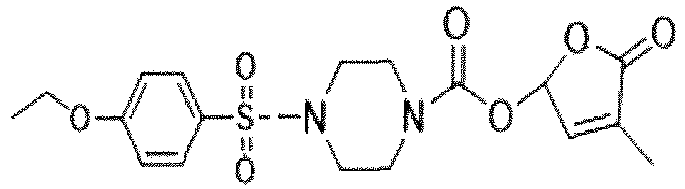 | ++ | ++ | ++ |
| Compound 4 |  | ++ | ++ | ++ |
| Compound 5 |  | ++ | ++ | ++ |
| Compound 6 |  | ++ | ++ | ++ |
| Compound 7 |  | ++ | ++ | ++ |
| Compound 8 |  | ++ | ++ | ++ |
| Structural formula | Germination rate 10 nM | Germination rate 1 nM | Germination rate 0.1 nM | |
| Compound 9 |  | ++ | ++ | ++ |
| Compound 10 |  | ++ | ++ | - |
| Compound 11 |  | ++ | ++ | - |
| Compound 12 |  | ++ | ++ | - |
| Compound 13 |  | ++ | ++ | - |
| Compound 14 |  | ++ | ++ | - |
| Compound 15 |  | ++ | - | - |
| Compound 16 | 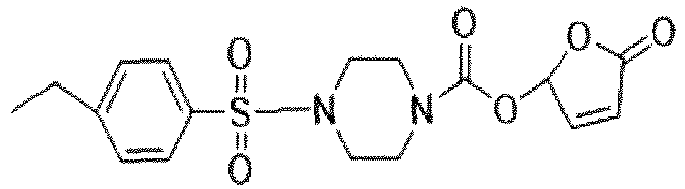 | ++ | ++ | - |
| Structural formula | Germination rate 10 nM | Germination rate 1 nM | Germination rate 0.1 nM | |
| Compound 17 |  | ++ | - | - |
| Compound 18 |  | ++ | - | - |
| Compound 19 |  | ++ | ++ | - |
| Compound 20 |  | ++ | ++ | - |
| Compound 21 |  | ++ | ++ | ++ |
| Compound 22 |  | - | - | - |
| Compound 23 |  | - | - | - |
| Compound 24 |  | ++ | ++ | ++ |
| Structural formula | Germination rate 10 nM | Germination rate 1 nM | Germination rate 0.1 nM | |
| Compound 25 |  | ++ | ++ | |
| Compound 26 |  | ++ | ++ | ++ |
| Compound 27 |  | ++ | ++ | - |
| Compound 28 |  | ++ | - | - |
| Compound 29 |  | + | - | - |
| Compound 30 |  | ++ | ++ | + |
| Comparison Compound 1 |  | - | - | - |
| Comparison Compound 2 |  | ++ | ++ | - |
| Structural formula | Germination rate 10 nM | Germination rate 1 nM | Germination rate 0.1 nM | |
| Compound 1 |  | ++ | ++ | - |
| Comparison Compound 2 |  | ++ | + | - |
| Structural formula | Germination rate 10 nM | Germination rate 1 nM | |
| Compound 1 |  | + | - |
| Comparison Compound 2 |  | ++ | - |
Claims (12)
- A compound represented by Formula (1):
 R1 represents a group derived from a nitrogen-containing heterocycle,R2 represents a divalent group as a linker,R3 represents optionally substituted aryl, optionally substituted heteroaryl, optionally substituted cycloalkyl, or alkyl containing 1 to 6 carbon atoms,R4, R5, and R6 are identical or different, and each represents hydrogen, halogen, optionally substituted alkyl, optionally substituted alkenyl, or optionally substituted alkynyl,with the proviso that when the heterocycle is polycyclic, two bonding hands of R1 are present in one of a plurality of rings constituting the polycyclic ring.
 - The compound according to claim 1, wherein R1 is a divalent group represented by Formula (Y):
 R11 represents -(CHR11a-)n, wherein n represents an integer of 1 to 3, R11as are identical or different, and each represents hydrogen or alkyl, and when n is 2 or 3, two R11as, taken together with the adjacent carbon atoms, may form a ring,R12 and R13 are identical or different, and each represents hydrogen or alkyl, and R12 and R13, taken together with the adjacent carbon atoms, may form a ring, andR14 represents carbon or nitrogen; ora divalent group represented by Formula (Y'):
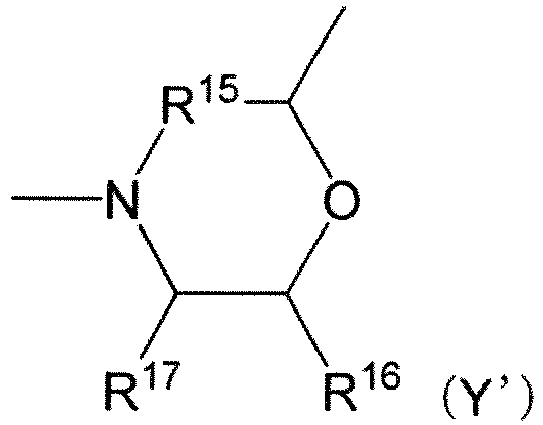 R15 represents a single bond or -(CHR15a-)m, wherein m represents 1 or 2, R15as are identical or different, and each represents hydrogen or alkyl, and when m is 2, two adjacent R15as, taken together with the adjacent carbon atoms, may form a ring, andR16 and R17 are identical or different, and each represents hydrogen or alkyl, and R16 and R17, taken together with the adjacent carbon atoms, may form a ring.
 - The compound according to claim 1 or 2,
wherein R2 is
a divalent group represented by Formula (Z1): -T-U-, wherein T is -S(O)1-2-, -C(=O)-, or -(CH2)1-3-, and U is a single bond, -(CH2)1-3-, -O-, or -NR'-, with the proviso that R' is hydrogen or alkyl; or a divalent group represented by Formula (Z2): -V-O-W-, wherein V is a single bond or -(CH2)1-3-, W is a single bond, -(CH2)1-3-,-C(=O)-, -S(O)1-2-, or -C(=O)-NR'-, with the proviso that R' is hydrogen or alkyl. - The compound according to any one of claims 1 to 3,
wherein R2 is
a divalent group represented by Formula (Z1a): -S(O)1-2-U-,
wherein U is a single bond, -(CH2)1-3-, -O-, or -NR'-, with the proviso that R' represents hydrogen or alkyl; or
a divalent group represented by Formula (Z2a): -O-W-, wherein W is a single bond, -(CH2)1-3-, -C(=O)-, -S(O)1-2-, or -C(=O)-NR'-, with the proviso that R' represents hydrogen or alkyl. - The compound according to claim 3 or 4, wherein R2 is -S(O)2-.
- The compound according to any one of claims 1 to 5, wherein R3 is optionally substituted phenyl.
- The compound according to any one of claims 1 to 6, wherein the compound represented by Formula (1) is a compound represented by Formula (1C):
 wherein R11 represents -(CHR11a-)n, wherein n represents an integer of 1 to 3, R11as are identical or different, and each represents hydrogen or alkyl, and when n is 2 or 3, two R11as, taken together with the adjacent carbon atoms, may form a ring,R12 and R13 are identical or different, and each represents hydrogen or alkyl, and R12 and R13, taken together with the adjacent carbon atoms, may form a ring,R14 represents carbon or nitrogen,R31, R32, R33, R34, and R35 are identical or different, and each represents hydrogen, halogen, optionally substituted alkyl, optionally substituted alkoxy, optionally substituted alkylthio,optionally substituted alkenyl, optionally substituted alkynyl, optionally substituted amino, nitro, hydroxyl, cyano, -C(=O)R301, -C(=O)OR302, -C(=O)NR303R304, -S(=O)1-2R305, or -S(=O)1-2NR306R307, and R4, R5, and R6 are identical or different, and each represents hydrogen, halogen, optionally substituted alkyl, optionally substituted alkenyl, or optionally substituted alkynyl.
 - The compound according to claim 7, wherein R4 is optionally substituted alkyl, optionally substituted alkenyl, or optionally substituted alkynyl, and both R5 and R6 are hydrogen atoms.
- A parasitic plant germination regulator comprising a compound represented by Formula (1), an agriculturally acceptable salt thereof, a hydrate thereof, or a solvate thereof:
 R1 represents a group derived from a nitrogen-containing heterocycle,R2 represents a divalent group as a linker,R3 represents optionally substituted aryl, optionally substituted heteroaryl, optionally substituted cycloalkyl, or alkyl containing 1 to 6 carbon atoms, andR4, R5, and R6 are identical or different, and each represents hydrogen, halogen, optionally substituted alkyl, optionally substituted alkenyl, or optionally substituted alkynyl.
 - The germination regulator according to claim 9, which is a parasitic plant germination inducer.
- The germination regulator according to claim 9 or 10, wherein the parasitic plant is a plant of the genus Striga or the genus Orobanche.
- A method for regulating parasitic plant germination, comprising applying the parasitic plant germination regulator of any one of claims 9 to 11 to soil containing parasitic plant seeds.
Applications Claiming Priority (2)
| Application Number | Priority Date | Filing Date | Title |
|---|---|---|---|
| JP2017193773 | 2017-10-03 | ||
| PCT/JP2018/036785 WO2019069889A1 (en) | 2017-10-03 | 2018-10-02 | Parasitic plant germination regulator |
Publications (3)
| Publication Number | Publication Date |
|---|---|
| EP3693362A1 true EP3693362A1 (en) | 2020-08-12 |
| EP3693362A4 EP3693362A4 (en) | 2021-06-09 |
| EP3693362B1 EP3693362B1 (en) | 2023-12-20 |
Family
ID=65994266
Family Applications (1)
| Application Number | Title | Priority Date | Filing Date |
|---|---|---|---|
| EP18864191.4A Active EP3693362B1 (en) | 2017-10-03 | 2018-10-02 | Parasitic plant germination regulator |
Country Status (3)
| Country | Link |
|---|---|
| EP (1) | EP3693362B1 (en) |
| JP (1) | JP7184367B2 (en) |
| WO (1) | WO2019069889A1 (en) |
Families Citing this family (2)
| Publication number | Priority date | Publication date | Assignee | Title |
|---|---|---|---|---|
| CN111533715B (en) * | 2020-04-22 | 2021-04-06 | 南京农业大学 | 2(5H) -furan-2-one derivative, preparation method thereof and application thereof in inhibiting rice tillering |
| CN117586238B (en) * | 2023-11-23 | 2026-07-31 | 中国农业大学 | (Iso) quinoline compound with strigolactone activity and preparation and application thereof |
Family Cites Families (7)
| Publication number | Priority date | Publication date | Assignee | Title |
|---|---|---|---|---|
| JP4782458B2 (en) * | 2005-03-31 | 2011-09-28 | 森下仁丹株式会社 | Plant root parasitic plant control method |
| AP3222A (en) * | 2010-03-31 | 2015-04-30 | Nat Univ Corp Univ Kobe | Germination-stimulant carbamate derivatives and process for preparation thereof |
| EP2623502A4 (en) * | 2010-09-30 | 2014-04-09 | Riken | NOVEL COMPOUND HAVING STRIGOLACTONE ACTIVITY AND USE THEREOF |
| WO2013140946A1 (en) * | 2012-03-19 | 2013-09-26 | 国立大学法人 神戸大学 | Root parasitic plant germination inhibitor, and method for controlling root parasitic plants using same |
| FR2990945B1 (en) * | 2012-05-23 | 2014-09-12 | Agronomique Inst Nat Rech | NOVEL STRIGOLACTONE ANALOGUES AND THEIR USE FOR PLANT TREATMENT |
| CN104327059B (en) | 2014-10-15 | 2017-04-26 | 暨南大学 | Furanone derivative and preparation method and purpose |
| WO2017002898A1 (en) * | 2015-07-01 | 2017-01-05 | 国立大学法人名古屋大学 | Striga germination regulator |
-
2018
- 2018-10-02 EP EP18864191.4A patent/EP3693362B1/en active Active
- 2018-10-02 JP JP2019546710A patent/JP7184367B2/en active Active
- 2018-10-02 WO PCT/JP2018/036785 patent/WO2019069889A1/en not_active Ceased
Also Published As
| Publication number | Publication date |
|---|---|
| JP7184367B2 (en) | 2022-12-06 |
| WO2019069889A1 (en) | 2019-04-11 |
| EP3693362A4 (en) | 2021-06-09 |
| JPWO2019069889A1 (en) | 2020-09-10 |
| EP3693362B1 (en) | 2023-12-20 |
Similar Documents
| Publication | Publication Date | Title |
|---|---|---|
| Jubie et al. | Synthesis, antidepressant and antimicrobial activities of some novel stearic acid analogues | |
| Cheng et al. | Synthesis, antibacterial activities and molecular docking studies of peptide and Schiff bases as targeted antibiotics | |
| Kumar et al. | Synthesis and anticancer activities of novel 3, 5-disubstituted-1, 2, 4-oxadiazoles | |
| KR102405452B1 (en) | Inhibitors of the fibroblast growth factor receptor | |
| DE69528437T2 (en) | SUBSTITUTED AZAINDOLYLIDE DERIVATIVES AND METHOD FOR THE PRODUCTION THEREOF | |
| JP2005525315A (en) | Eponemycin and epoxomycin analogues and their uses | |
| IE882542L (en) | A process and a composition for immunizing plants against diseases | |
| EP3075729B1 (en) | Pyrazole amide compound and application thereof | |
| Mathew et al. | Novel pyridopyrazine and pyrimidothiazine derivatives as FtsZ inhibitors | |
| CN112110977A (en) | A class of triptolide derivatives, preparation method and use thereof | |
| JP5558470B2 (en) | Novel (poly) aminoalkylaminoalkylamides, alkyl-urea or alkyl-sulfonamide derivatives of epipodophyllotoxin, methods for their preparation, and their application as anticancer agents in therapy | |
| EP3693362B1 (en) | Parasitic plant germination regulator | |
| Mabkhot et al. | Synthesis, antimicrobial, anti-cancer and molecular docking of two novel hitherto unreported thiophenes | |
| Ji et al. | Design, synthesis and biological evaluation of novel diazaspirodecanone derivatives containing piperidine-4-carboxamide as chitin synthase inhibitors and antifungal agents | |
| CA2813144C (en) | Chromene derivatives | |
| CN103288771B (en) | Isothiazole compound and use thereof as fungicide | |
| EP3233860B1 (en) | Substituted 6-anilino-9-heterocyclylpurine derivatives for inhibition of plant stress | |
| RS57071B1 (en) | Fluorophenyl pyrazol compounds | |
| WO2020257261A1 (en) | SUBSTITUTED HETEROCYCLES AS c-MYC TARGETING AGENTS | |
| Karrouchi et al. | Synthesis, characterization and preliminary biological activity of some new pyrazole carbohydrazide derivatives | |
| KR20140057483A (en) | Derivatives of sulindac, use thereof and preparation thereof | |
| CA3200111A1 (en) | Amide derivative having antiviral activity | |
| CA3219804A1 (en) | Fused heterocyclic derivatives as negative allosteric modulators of mglu7 receptor | |
| WO2016056581A1 (en) | Plant growth-promoting agent and method for promoting plant growth | |
| WO2025185365A1 (en) | Acetohydroxyacid synthase inhibitor, preparation method therefor, and use thereof as herbicide |
Legal Events
| Date | Code | Title | Description |
|---|---|---|---|
| STAA | Information on the status of an ep patent application or granted ep patent |
Free format text: STATUS: THE INTERNATIONAL PUBLICATION HAS BEEN MADE |
|
| PUAI | Public reference made under article 153(3) epc to a published international application that has entered the european phase |
Free format text: ORIGINAL CODE: 0009012 |
|
| STAA | Information on the status of an ep patent application or granted ep patent |
Free format text: STATUS: REQUEST FOR EXAMINATION WAS MADE |
|
| 17P | Request for examination filed |
Effective date: 20200503 |
|
| AK | Designated contracting states |
Kind code of ref document: A1 Designated state(s): AL AT BE BG CH CY CZ DE DK EE ES FI FR GB GR HR HU IE IS IT LI LT LU LV MC MK MT NL NO PL PT RO RS SE SI SK SM TR |
|
| AX | Request for extension of the european patent |
Extension state: BA ME |
|
| DAV | Request for validation of the european patent (deleted) | ||
| DAX | Request for extension of the european patent (deleted) | ||
| A4 | Supplementary search report drawn up and despatched |
Effective date: 20210511 |
|
| RIC1 | Information provided on ipc code assigned before grant |
Ipc: C07D 307/60 20060101AFI20210505BHEP Ipc: A01H 3/04 20060101ALI20210505BHEP Ipc: A01N 43/40 20060101ALI20210505BHEP Ipc: A01N 47/16 20060101ALI20210505BHEP Ipc: A01P 21/00 20060101ALI20210505BHEP Ipc: C07D 405/12 20060101ALI20210505BHEP Ipc: C07D 413/12 20060101ALI20210505BHEP |
|
| GRAP | Despatch of communication of intention to grant a patent |
Free format text: ORIGINAL CODE: EPIDOSNIGR1 |
|
| STAA | Information on the status of an ep patent application or granted ep patent |
Free format text: STATUS: GRANT OF PATENT IS INTENDED |
|
| INTG | Intention to grant announced |
Effective date: 20230705 |
|
| RAP3 | Party data changed (applicant data changed or rights of an application transferred) |
Owner name: NATIONAL UNIVERSITY CORPORATION TOKAI NATIONAL HIGHER EDUCATION AND RESEARCH SYSTEM |
|
| GRAS | Grant fee paid |
Free format text: ORIGINAL CODE: EPIDOSNIGR3 |
|
| GRAA | (expected) grant |
Free format text: ORIGINAL CODE: 0009210 |
|
| STAA | Information on the status of an ep patent application or granted ep patent |
Free format text: STATUS: THE PATENT HAS BEEN GRANTED |
|
| AK | Designated contracting states |
Kind code of ref document: B1 Designated state(s): AL AT BE BG CH CY CZ DE DK EE ES FI FR GB GR HR HU IE IS IT LI LT LU LV MC MK MT NL NO PL PT RO RS SE SI SK SM TR |
|
| REG | Reference to a national code |
Ref country code: GB Ref legal event code: FG4D |
|
| REG | Reference to a national code |
Ref country code: CH Ref legal event code: EP |
|
| REG | Reference to a national code |
Ref country code: DE Ref legal event code: R096 Ref document number: 602018063030 Country of ref document: DE |
|
| REG | Reference to a national code |
Ref country code: IE Ref legal event code: FG4D |
|
| PG25 | Lapsed in a contracting state [announced via postgrant information from national office to epo] |
Ref country code: GR Free format text: LAPSE BECAUSE OF FAILURE TO SUBMIT A TRANSLATION OF THE DESCRIPTION OR TO PAY THE FEE WITHIN THE PRESCRIBED TIME-LIMIT Effective date: 20240321 |
|
| REG | Reference to a national code |
Ref country code: LT Ref legal event code: MG9D |
|
| PG25 | Lapsed in a contracting state [announced via postgrant information from national office to epo] |
Ref country code: LT Free format text: LAPSE BECAUSE OF FAILURE TO SUBMIT A TRANSLATION OF THE DESCRIPTION OR TO PAY THE FEE WITHIN THE PRESCRIBED TIME-LIMIT Effective date: 20231220 |
|
| REG | Reference to a national code |
Ref country code: NL Ref legal event code: MP Effective date: 20231220 |
|
| PG25 | Lapsed in a contracting state [announced via postgrant information from national office to epo] |
Ref country code: ES Free format text: LAPSE BECAUSE OF FAILURE TO SUBMIT A TRANSLATION OF THE DESCRIPTION OR TO PAY THE FEE WITHIN THE PRESCRIBED TIME-LIMIT Effective date: 20231220 |
|
| PG25 | Lapsed in a contracting state [announced via postgrant information from national office to epo] |
Ref country code: LT Free format text: LAPSE BECAUSE OF FAILURE TO SUBMIT A TRANSLATION OF THE DESCRIPTION OR TO PAY THE FEE WITHIN THE PRESCRIBED TIME-LIMIT Effective date: 20231220 Ref country code: GR Free format text: LAPSE BECAUSE OF FAILURE TO SUBMIT A TRANSLATION OF THE DESCRIPTION OR TO PAY THE FEE WITHIN THE PRESCRIBED TIME-LIMIT Effective date: 20240321 Ref country code: FI Free format text: LAPSE BECAUSE OF FAILURE TO SUBMIT A TRANSLATION OF THE DESCRIPTION OR TO PAY THE FEE WITHIN THE PRESCRIBED TIME-LIMIT Effective date: 20231220 Ref country code: ES Free format text: LAPSE BECAUSE OF FAILURE TO SUBMIT A TRANSLATION OF THE DESCRIPTION OR TO PAY THE FEE WITHIN THE PRESCRIBED TIME-LIMIT Effective date: 20231220 Ref country code: BG Free format text: LAPSE BECAUSE OF FAILURE TO SUBMIT A TRANSLATION OF THE DESCRIPTION OR TO PAY THE FEE WITHIN THE PRESCRIBED TIME-LIMIT Effective date: 20240320 |
|
| REG | Reference to a national code |
Ref country code: AT Ref legal event code: MK05 Ref document number: 1642372 Country of ref document: AT Kind code of ref document: T Effective date: 20231220 |
|
| PG25 | Lapsed in a contracting state [announced via postgrant information from national office to epo] |
Ref country code: NL Free format text: LAPSE BECAUSE OF FAILURE TO SUBMIT A TRANSLATION OF THE DESCRIPTION OR TO PAY THE FEE WITHIN THE PRESCRIBED TIME-LIMIT Effective date: 20231220 |
|
| PG25 | Lapsed in a contracting state [announced via postgrant information from national office to epo] |
Ref country code: SE Free format text: LAPSE BECAUSE OF FAILURE TO SUBMIT A TRANSLATION OF THE DESCRIPTION OR TO PAY THE FEE WITHIN THE PRESCRIBED TIME-LIMIT Effective date: 20231220 Ref country code: RS Free format text: LAPSE BECAUSE OF FAILURE TO SUBMIT A TRANSLATION OF THE DESCRIPTION OR TO PAY THE FEE WITHIN THE PRESCRIBED TIME-LIMIT Effective date: 20231220 Ref country code: NO Free format text: LAPSE BECAUSE OF FAILURE TO SUBMIT A TRANSLATION OF THE DESCRIPTION OR TO PAY THE FEE WITHIN THE PRESCRIBED TIME-LIMIT Effective date: 20240320 Ref country code: NL Free format text: LAPSE BECAUSE OF FAILURE TO SUBMIT A TRANSLATION OF THE DESCRIPTION OR TO PAY THE FEE WITHIN THE PRESCRIBED TIME-LIMIT Effective date: 20231220 Ref country code: LV Free format text: LAPSE BECAUSE OF FAILURE TO SUBMIT A TRANSLATION OF THE DESCRIPTION OR TO PAY THE FEE WITHIN THE PRESCRIBED TIME-LIMIT Effective date: 20231220 Ref country code: HR Free format text: LAPSE BECAUSE OF FAILURE TO SUBMIT A TRANSLATION OF THE DESCRIPTION OR TO PAY THE FEE WITHIN THE PRESCRIBED TIME-LIMIT Effective date: 20231220 |
|
| PG25 | Lapsed in a contracting state [announced via postgrant information from national office to epo] |
Ref country code: IS Free format text: LAPSE BECAUSE OF FAILURE TO SUBMIT A TRANSLATION OF THE DESCRIPTION OR TO PAY THE FEE WITHIN THE PRESCRIBED TIME-LIMIT Effective date: 20240420 |
|
| PG25 | Lapsed in a contracting state [announced via postgrant information from national office to epo] |
Ref country code: CZ Free format text: LAPSE BECAUSE OF FAILURE TO SUBMIT A TRANSLATION OF THE DESCRIPTION OR TO PAY THE FEE WITHIN THE PRESCRIBED TIME-LIMIT Effective date: 20231220 Ref country code: AT Free format text: LAPSE BECAUSE OF FAILURE TO SUBMIT A TRANSLATION OF THE DESCRIPTION OR TO PAY THE FEE WITHIN THE PRESCRIBED TIME-LIMIT Effective date: 20231220 |
|
| PG25 | Lapsed in a contracting state [announced via postgrant information from national office to epo] |
Ref country code: SK Free format text: LAPSE BECAUSE OF FAILURE TO SUBMIT A TRANSLATION OF THE DESCRIPTION OR TO PAY THE FEE WITHIN THE PRESCRIBED TIME-LIMIT Effective date: 20231220 |
|
| PG25 | Lapsed in a contracting state [announced via postgrant information from national office to epo] |
Ref country code: SM Free format text: LAPSE BECAUSE OF FAILURE TO SUBMIT A TRANSLATION OF THE DESCRIPTION OR TO PAY THE FEE WITHIN THE PRESCRIBED TIME-LIMIT Effective date: 20231220 Ref country code: SK Free format text: LAPSE BECAUSE OF FAILURE TO SUBMIT A TRANSLATION OF THE DESCRIPTION OR TO PAY THE FEE WITHIN THE PRESCRIBED TIME-LIMIT Effective date: 20231220 Ref country code: RO Free format text: LAPSE BECAUSE OF FAILURE TO SUBMIT A TRANSLATION OF THE DESCRIPTION OR TO PAY THE FEE WITHIN THE PRESCRIBED TIME-LIMIT Effective date: 20231220 Ref country code: IT Free format text: LAPSE BECAUSE OF FAILURE TO SUBMIT A TRANSLATION OF THE DESCRIPTION OR TO PAY THE FEE WITHIN THE PRESCRIBED TIME-LIMIT Effective date: 20231220 Ref country code: IS Free format text: LAPSE BECAUSE OF FAILURE TO SUBMIT A TRANSLATION OF THE DESCRIPTION OR TO PAY THE FEE WITHIN THE PRESCRIBED TIME-LIMIT Effective date: 20240420 Ref country code: EE Free format text: LAPSE BECAUSE OF FAILURE TO SUBMIT A TRANSLATION OF THE DESCRIPTION OR TO PAY THE FEE WITHIN THE PRESCRIBED TIME-LIMIT Effective date: 20231220 Ref country code: CZ Free format text: LAPSE BECAUSE OF FAILURE TO SUBMIT A TRANSLATION OF THE DESCRIPTION OR TO PAY THE FEE WITHIN THE PRESCRIBED TIME-LIMIT Effective date: 20231220 Ref country code: AT Free format text: LAPSE BECAUSE OF FAILURE TO SUBMIT A TRANSLATION OF THE DESCRIPTION OR TO PAY THE FEE WITHIN THE PRESCRIBED TIME-LIMIT Effective date: 20231220 |
|
| PG25 | Lapsed in a contracting state [announced via postgrant information from national office to epo] |
Ref country code: PL Free format text: LAPSE BECAUSE OF FAILURE TO SUBMIT A TRANSLATION OF THE DESCRIPTION OR TO PAY THE FEE WITHIN THE PRESCRIBED TIME-LIMIT Effective date: 20231220 Ref country code: PT Free format text: LAPSE BECAUSE OF FAILURE TO SUBMIT A TRANSLATION OF THE DESCRIPTION OR TO PAY THE FEE WITHIN THE PRESCRIBED TIME-LIMIT Effective date: 20240422 |
|
| PG25 | Lapsed in a contracting state [announced via postgrant information from national office to epo] |
Ref country code: PT Free format text: LAPSE BECAUSE OF FAILURE TO SUBMIT A TRANSLATION OF THE DESCRIPTION OR TO PAY THE FEE WITHIN THE PRESCRIBED TIME-LIMIT Effective date: 20240422 Ref country code: PL Free format text: LAPSE BECAUSE OF FAILURE TO SUBMIT A TRANSLATION OF THE DESCRIPTION OR TO PAY THE FEE WITHIN THE PRESCRIBED TIME-LIMIT Effective date: 20231220 |
|
| REG | Reference to a national code |
Ref country code: DE Ref legal event code: R097 Ref document number: 602018063030 Country of ref document: DE |
|
| PG25 | Lapsed in a contracting state [announced via postgrant information from national office to epo] |
Ref country code: DK Free format text: LAPSE BECAUSE OF FAILURE TO SUBMIT A TRANSLATION OF THE DESCRIPTION OR TO PAY THE FEE WITHIN THE PRESCRIBED TIME-LIMIT Effective date: 20231220 |
|
| PLBE | No opposition filed within time limit |
Free format text: ORIGINAL CODE: 0009261 |
|
| STAA | Information on the status of an ep patent application or granted ep patent |
Free format text: STATUS: NO OPPOSITION FILED WITHIN TIME LIMIT |
|
| PG25 | Lapsed in a contracting state [announced via postgrant information from national office to epo] |
Ref country code: SI Free format text: LAPSE BECAUSE OF FAILURE TO SUBMIT A TRANSLATION OF THE DESCRIPTION OR TO PAY THE FEE WITHIN THE PRESCRIBED TIME-LIMIT Effective date: 20231220 |
|
| PG25 | Lapsed in a contracting state [announced via postgrant information from national office to epo] |
Ref country code: SI Free format text: LAPSE BECAUSE OF FAILURE TO SUBMIT A TRANSLATION OF THE DESCRIPTION OR TO PAY THE FEE WITHIN THE PRESCRIBED TIME-LIMIT Effective date: 20231220 Ref country code: DK Free format text: LAPSE BECAUSE OF FAILURE TO SUBMIT A TRANSLATION OF THE DESCRIPTION OR TO PAY THE FEE WITHIN THE PRESCRIBED TIME-LIMIT Effective date: 20231220 |
|
| 26N | No opposition filed |
Effective date: 20240923 |
|
| REG | Reference to a national code |
Ref country code: DE Ref legal event code: R119 Ref document number: 602018063030 Country of ref document: DE |
|
| REG | Reference to a national code |
Ref country code: CH Ref legal event code: PL |
|
| GBPC | Gb: european patent ceased through non-payment of renewal fee |
Effective date: 20241002 |
|
| PG25 | Lapsed in a contracting state [announced via postgrant information from national office to epo] |
Ref country code: MC Free format text: LAPSE BECAUSE OF FAILURE TO SUBMIT A TRANSLATION OF THE DESCRIPTION OR TO PAY THE FEE WITHIN THE PRESCRIBED TIME-LIMIT Effective date: 20231220 |
|
| PG25 | Lapsed in a contracting state [announced via postgrant information from national office to epo] |
Ref country code: DE Free format text: LAPSE BECAUSE OF NON-PAYMENT OF DUE FEES Effective date: 20250501 |
|
| PG25 | Lapsed in a contracting state [announced via postgrant information from national office to epo] |
Ref country code: GB Free format text: LAPSE BECAUSE OF NON-PAYMENT OF DUE FEES Effective date: 20241002 |
|
| PG25 | Lapsed in a contracting state [announced via postgrant information from national office to epo] |
Ref country code: BE Free format text: LAPSE BECAUSE OF NON-PAYMENT OF DUE FEES Effective date: 20241031 Ref country code: LU Free format text: LAPSE BECAUSE OF NON-PAYMENT OF DUE FEES Effective date: 20241002 |
|
| PG25 | Lapsed in a contracting state [announced via postgrant information from national office to epo] |
Ref country code: FR Free format text: LAPSE BECAUSE OF NON-PAYMENT OF DUE FEES Effective date: 20241031 |
|
| PG25 | Lapsed in a contracting state [announced via postgrant information from national office to epo] |
Ref country code: CH Free format text: LAPSE BECAUSE OF NON-PAYMENT OF DUE FEES Effective date: 20241031 |
|
| REG | Reference to a national code |
Ref country code: BE Ref legal event code: MM Effective date: 20241031 |
|
| PG25 | Lapsed in a contracting state [announced via postgrant information from national office to epo] |
Ref country code: IE Free format text: LAPSE BECAUSE OF NON-PAYMENT OF DUE FEES Effective date: 20241002 |
|
| PG25 | Lapsed in a contracting state [announced via postgrant information from national office to epo] |
Ref country code: CY Free format text: LAPSE BECAUSE OF FAILURE TO SUBMIT A TRANSLATION OF THE DESCRIPTION OR TO PAY THE FEE WITHIN THE PRESCRIBED TIME-LIMIT; INVALID AB INITIO Effective date: 20181002 |
|
| PG25 | Lapsed in a contracting state [announced via postgrant information from national office to epo] |
Ref country code: HU Free format text: LAPSE BECAUSE OF FAILURE TO SUBMIT A TRANSLATION OF THE DESCRIPTION OR TO PAY THE FEE WITHIN THE PRESCRIBED TIME-LIMIT; INVALID AB INITIO Effective date: 20181002 |
|
| PG25 | Lapsed in a contracting state [announced via postgrant information from national office to epo] |
Ref country code: TR Free format text: LAPSE BECAUSE OF FAILURE TO SUBMIT A TRANSLATION OF THE DESCRIPTION OR TO PAY THE FEE WITHIN THE PRESCRIBED TIME-LIMIT Effective date: 20231220 |