EP3692185B1 - Methods and compositions for inhibiting corrosion on metal surfaces - Google Patents
Methods and compositions for inhibiting corrosion on metal surfaces Download PDFInfo
- Publication number
- EP3692185B1 EP3692185B1 EP18886847.5A EP18886847A EP3692185B1 EP 3692185 B1 EP3692185 B1 EP 3692185B1 EP 18886847 A EP18886847 A EP 18886847A EP 3692185 B1 EP3692185 B1 EP 3692185B1
- Authority
- EP
- European Patent Office
- Prior art keywords
- acid
- water
- ppm
- steel
- salt
- Prior art date
- Legal status (The legal status is an assumption and is not a legal conclusion. Google has not performed a legal analysis and makes no representation as to the accuracy of the status listed.)
- Active
Links
Images


Classifications
-
- C—CHEMISTRY; METALLURGY
- C09—DYES; PAINTS; POLISHES; NATURAL RESINS; ADHESIVES; COMPOSITIONS NOT OTHERWISE PROVIDED FOR; APPLICATIONS OF MATERIALS NOT OTHERWISE PROVIDED FOR
- C09D—COATING COMPOSITIONS, e.g. PAINTS, VARNISHES OR LACQUERS; FILLING PASTES; CHEMICAL PAINT OR INK REMOVERS; INKS; CORRECTING FLUIDS; WOODSTAINS; PASTES OR SOLIDS FOR COLOURING OR PRINTING; USE OF MATERIALS THEREFOR
- C09D5/00—Coating compositions, e.g. paints, varnishes or lacquers, characterised by their physical nature or the effects produced; Filling pastes
- C09D5/08—Anti-corrosive paints
- C09D5/082—Anti-corrosive paints characterised by the anti-corrosive pigment
- C09D5/084—Inorganic compounds
-
- C—CHEMISTRY; METALLURGY
- C09—DYES; PAINTS; POLISHES; NATURAL RESINS; ADHESIVES; COMPOSITIONS NOT OTHERWISE PROVIDED FOR; APPLICATIONS OF MATERIALS NOT OTHERWISE PROVIDED FOR
- C09D—COATING COMPOSITIONS, e.g. PAINTS, VARNISHES OR LACQUERS; FILLING PASTES; CHEMICAL PAINT OR INK REMOVERS; INKS; CORRECTING FLUIDS; WOODSTAINS; PASTES OR SOLIDS FOR COLOURING OR PRINTING; USE OF MATERIALS THEREFOR
- C09D1/00—Coating compositions, e.g. paints, varnishes or lacquers, based on inorganic substances
-
- C—CHEMISTRY; METALLURGY
- C23—COATING METALLIC MATERIAL; COATING MATERIAL WITH METALLIC MATERIAL; CHEMICAL SURFACE TREATMENT; DIFFUSION TREATMENT OF METALLIC MATERIAL; COATING BY VACUUM EVAPORATION, BY SPUTTERING, BY ION IMPLANTATION OR BY CHEMICAL VAPOUR DEPOSITION, IN GENERAL; INHIBITING CORROSION OF METALLIC MATERIAL OR INCRUSTATION IN GENERAL
- C23C—COATING METALLIC MATERIAL; COATING MATERIAL WITH METALLIC MATERIAL; SURFACE TREATMENT OF METALLIC MATERIAL BY DIFFUSION INTO THE SURFACE, BY CHEMICAL CONVERSION OR SUBSTITUTION; COATING BY VACUUM EVAPORATION, BY SPUTTERING, BY ION IMPLANTATION OR BY CHEMICAL VAPOUR DEPOSITION, IN GENERAL
- C23C22/00—Chemical surface treatment of metallic material by reaction of the surface with a reactive liquid, leaving reaction products of surface material in the coating, e.g. conversion coatings, passivation of metals
- C23C22/05—Chemical surface treatment of metallic material by reaction of the surface with a reactive liquid, leaving reaction products of surface material in the coating, e.g. conversion coatings, passivation of metals using aqueous solutions
- C23C22/60—Chemical surface treatment of metallic material by reaction of the surface with a reactive liquid, leaving reaction products of surface material in the coating, e.g. conversion coatings, passivation of metals using aqueous solutions using alkaline aqueous solutions with pH greater than 8
- C23C22/62—Treatment of iron or alloys based thereon
-
- C—CHEMISTRY; METALLURGY
- C23—COATING METALLIC MATERIAL; COATING MATERIAL WITH METALLIC MATERIAL; CHEMICAL SURFACE TREATMENT; DIFFUSION TREATMENT OF METALLIC MATERIAL; COATING BY VACUUM EVAPORATION, BY SPUTTERING, BY ION IMPLANTATION OR BY CHEMICAL VAPOUR DEPOSITION, IN GENERAL; INHIBITING CORROSION OF METALLIC MATERIAL OR INCRUSTATION IN GENERAL
- C23F—NON-MECHANICAL REMOVAL OF METALLIC MATERIAL FROM SURFACE; INHIBITING CORROSION OF METALLIC MATERIAL OR INCRUSTATION IN GENERAL; MULTI-STEP PROCESSES FOR SURFACE TREATMENT OF METALLIC MATERIAL INVOLVING AT LEAST ONE PROCESS PROVIDED FOR IN CLASS C23 AND AT LEAST ONE PROCESS COVERED BY SUBCLASS C21D OR C22F OR CLASS C25
- C23F11/00—Inhibiting corrosion of metallic material by applying inhibitors to the surface in danger of corrosion or adding them to the corrosive agent
- C23F11/04—Inhibiting corrosion of metallic material by applying inhibitors to the surface in danger of corrosion or adding them to the corrosive agent in markedly acid liquids
-
- C—CHEMISTRY; METALLURGY
- C23—COATING METALLIC MATERIAL; COATING MATERIAL WITH METALLIC MATERIAL; CHEMICAL SURFACE TREATMENT; DIFFUSION TREATMENT OF METALLIC MATERIAL; COATING BY VACUUM EVAPORATION, BY SPUTTERING, BY ION IMPLANTATION OR BY CHEMICAL VAPOUR DEPOSITION, IN GENERAL; INHIBITING CORROSION OF METALLIC MATERIAL OR INCRUSTATION IN GENERAL
- C23F—NON-MECHANICAL REMOVAL OF METALLIC MATERIAL FROM SURFACE; INHIBITING CORROSION OF METALLIC MATERIAL OR INCRUSTATION IN GENERAL; MULTI-STEP PROCESSES FOR SURFACE TREATMENT OF METALLIC MATERIAL INVOLVING AT LEAST ONE PROCESS PROVIDED FOR IN CLASS C23 AND AT LEAST ONE PROCESS COVERED BY SUBCLASS C21D OR C22F OR CLASS C25
- C23F11/00—Inhibiting corrosion of metallic material by applying inhibitors to the surface in danger of corrosion or adding them to the corrosive agent
- C23F11/08—Inhibiting corrosion of metallic material by applying inhibitors to the surface in danger of corrosion or adding them to the corrosive agent in other liquids
-
- C—CHEMISTRY; METALLURGY
- C23—COATING METALLIC MATERIAL; COATING MATERIAL WITH METALLIC MATERIAL; CHEMICAL SURFACE TREATMENT; DIFFUSION TREATMENT OF METALLIC MATERIAL; COATING BY VACUUM EVAPORATION, BY SPUTTERING, BY ION IMPLANTATION OR BY CHEMICAL VAPOUR DEPOSITION, IN GENERAL; INHIBITING CORROSION OF METALLIC MATERIAL OR INCRUSTATION IN GENERAL
- C23F—NON-MECHANICAL REMOVAL OF METALLIC MATERIAL FROM SURFACE; INHIBITING CORROSION OF METALLIC MATERIAL OR INCRUSTATION IN GENERAL; MULTI-STEP PROCESSES FOR SURFACE TREATMENT OF METALLIC MATERIAL INVOLVING AT LEAST ONE PROCESS PROVIDED FOR IN CLASS C23 AND AT LEAST ONE PROCESS COVERED BY SUBCLASS C21D OR C22F OR CLASS C25
- C23F11/00—Inhibiting corrosion of metallic material by applying inhibitors to the surface in danger of corrosion or adding them to the corrosive agent
- C23F11/08—Inhibiting corrosion of metallic material by applying inhibitors to the surface in danger of corrosion or adding them to the corrosive agent in other liquids
- C23F11/18—Inhibiting corrosion of metallic material by applying inhibitors to the surface in danger of corrosion or adding them to the corrosive agent in other liquids using inorganic inhibitors
-
- C—CHEMISTRY; METALLURGY
- C02—TREATMENT OF WATER, WASTE WATER, SEWAGE, OR SLUDGE
- C02F—TREATMENT OF WATER, WASTE WATER, SEWAGE, OR SLUDGE
- C02F2103/00—Nature of the water, waste water, sewage or sludge to be treated
- C02F2103/16—Nature of the water, waste water, sewage or sludge to be treated from metallurgical processes, i.e. from the production, refining or treatment of metals, e.g. galvanic wastes
-
- C—CHEMISTRY; METALLURGY
- C02—TREATMENT OF WATER, WASTE WATER, SEWAGE, OR SLUDGE
- C02F—TREATMENT OF WATER, WASTE WATER, SEWAGE, OR SLUDGE
- C02F5/00—Softening water; Preventing scale; Adding scale preventatives or scale removers to water, e.g. adding sequestering agents
- C02F5/08—Treatment of water with complexing chemicals or other solubilising agents for softening, scale prevention or scale removal, e.g. adding sequestering agents
- C02F5/083—Mineral agents
Definitions
- This disclosure relates generally to the field of water treatment in metal production processes, such as those found in steelmaking facilities.
- Document US 2016/145442 A1 discloses a method for preventing corrosion of equipment having a corrodible metal surface that contacts water in a water system, the method comprising pre-treating the corrodible metal surface before the equipment is brought into service in the water system, the pre-treating including contacting a stannous corrosion inhibitor with the corrodible metal surface, wherein the stannous corrosion inhibitor is provided in sufficient amount and for sufficient time to form a protective film on at least a portion of the corrodible metal surface.
- compositions and methods for preventing corrosion of equipment having a corrodible metal surface that contacts water in a hydrostatic system may include a liquid-phase corrosion inhibitor and vapor-phase corrosion inhibitor. Methods may include introducing into the hydrostatic system a liquid-phase corrosion inhibitor, vapor-phase corrosion inhibitor and/or a scaling inhibitor. A protective film can be formed on the corrodible metal surface.
- Document US 2017/130340 A1 discloses methods and compositions for suppressing corrosion of a corrodible metal surface that contacts a water stream in a water system.
- the method comprises introducing into the water stream a treatment composition, the treatment composition including a Tin(II) corrosion inhibitor and a hydroxycarboxylic acid promoter.
- Document US 4512552 A discloses a corrosion inhibitor for ferrous metals comprising four different components of (a) an inorganic acid component (such as molybdate or tungstate), (b) an aliphatic hydroxycarboxylic or aliphatic dicarboxylic acid or its salt (such as citric acid, gluconic acid or succinic acid), (c) an inorganic heavy metal compound (such as zinc chloride or stannous chloride) and (d) a water soluble polymer component having a molecular weight of 500-100,000 (such as acylic homo or copolymer).
- an inorganic acid component such as molybdate or tungstate
- an aliphatic hydroxycarboxylic or aliphatic dicarboxylic acid or its salt such as citric acid, gluconic acid or succinic acid
- an inorganic heavy metal compound such as zinc chloride or stannous chloride
- a water soluble polymer component having a molecular weight of 500-100,
- Document EP 3063311 A1 corresponds to US 2015/118103 A1 which, according to its abstract, discloses compositions and methods for inhibiting the corrosion of metals in contact with an aqueous system.
- the method of inhibiting corrosion includes maintaining effective amounts of (1) an amino acid-based polymer, such as a polyaspartic acid compound, and (2) a dispersible and/or soluble tin compound in the aqueous system.
- the corrosion inhibiting components of the treatment may be added simultaneously or separately into the water of the aqueous system, i.e., provided either in a single treatment product or as separate products.
- compositions and methods for inhibiting corrosion of corrodible metals present in contact with water in cooling water and other water storage systems include concentrated stannous salts and agents to solubilize such salts.
- the present disclosure provides a method for inhibiting corrosion of a steel product comprising the steps disclosed at claim 1.
- the dependent claims outline advantageous ways of carrying out the method.
- the surface sensitive material can be metals such as steel products.
- the invention mitigates corrosion problems by treating water that contacts the steel during its production.
- Water can be sprayed onto metal surfaces, or otherwise be contacted with metal surfaces, during the production of metal products.
- water is often used as a cooling medium to cool the metal.
- the water that is used for cooling typically contains various minerals such as calcium, magnesium, chlorides and sulfates, etc. Chlorides and sulfates can be very corrosive to metal surfaces such as steel.
- the amount of chlorides in the water that contacts the metal surface can be in the range of 10 ppm to 1,000 ppm, from 50 ppm to 500 ppm, and from 100 ppm to 250 ppm.
- the amount of sulfates in the water that contacts the metal surface can be in the range of from 2 ppm to 500 ppm, from 5 ppm to 250 ppm, or from 10 ppm to 100 ppm.
- the chlorides and sulfates can be retained as a residual on the metal surface, e.g., as residual salts.
- the chloride and sulfate salts are known to be deliquescent salts, meaning, they quickly adsorb humidity from the air and form a highly concentrated liquid solution on the surface of the metal.
- Rain water and dew are slightly acidic forms of pure water (pH ⁇ 5) which when combined with atmospheric CO 2 , form carbonic acid, as well as stronger acids from adsorption of sulfur and nitrogen oxides.
- the combination of acidic water with chlorides and sulfates can cause very aggressive corrosion on the metal surface that degrades protective oxide coatings that naturally form on the surface, e.g., iron oxide coatings that form on steel surfaces.
- the pH of the solution can further be depressed by metal hydrolysis.
- the Fe reacts with OH - and leaves the water enriched in H + .
- the H + concentration is sufficient to become the dominant electron acceptor instead of oxygen reduction.
- these corrosion issues can be substantially mitigated by (i) increasing the alkalinity of water that contacts the steel surface; and (ii) by adding a stannous based passivating chemistry to the water at a steel product temperature of at least 500°C immediately before the steel surface is contacted with the water, and evaporating the water off the surface and forming a Sn(IV) film on the steel surface.
- the alkalinity of water can be increased by introducing into the water carbonate and bicarbonate salts, such as, but not limited to, sodium, potassium, magnesium, and calcium carbonate/bicarbonate.
- the alkalinity can also be increased by using chemistries, such as, but not limited to, hydroxide salts, amines, etc.
- the salts can be dissolved in the water as a solution, can be suspended in the water, or a combination of both. It is believed that an increase in alkalinity of the water leaves residual components on the metal surface that prevent corrosion attributable to chlorides and sulfates and/or to subsequent contact of the metal surface with acidic water or water vapor.
- bicarbonate/carbonate salts when these salts, such as bicarbonate/carbonate salts, are subjected to high temperatures on the metal surface, they will produce residual products that create a local alkaline environment on the metal surface that protects against corrosion from acidic conditions.
- bicarbonate salts when they are exposed to high temperature, they release CO 2 , forming carbonates or oxides.
- sodium carbonate decomposes to sodium oxide (Na 2 O) beginning at about 400 °C, which is in the range of temperatures metal is typically exposed to during processing, e.g., the temperature at which steel is coiled. Na 2 O also adsorbs moisture from the air to become caustic soda.
- the high pH environment created by the sodium, calcium, and potassium carbonates and hydroxides can counter the low pH effects of atmospheric CO 2 and "acid rain".
- the residuals of the carbonate/bicarbonate salt thus can remain on the metal surface even after being exposed to high temperatures and can create basic conditions that prevent corrosion when the metal surface is later contacted with moisture, e.g., during storage and transportation (particularly overseas shipping).
- metal surfaces generally become much less corrosive.
- a corrosivity index can be developed based on the amount of chlorides and sulfates in the water whereby the amount of alkalinity that the water needs can be determined based on the amount of chlorides and sulfates in the water.
- the concentration of alkalinity in the water stream that contacts the metal surface can be controlled to be from about 5 ppm to 1,500 ppm, from 25 ppm to 1,000 ppm, from 50 ppm to 500 ppm, and from 100 ppm to 400 ppm.
- Alkalinity refers to M-alkalinity.
- the alkalinity is provided by mixing a treatment composition with the water that includes at least one carbonate or bicarbonate salt.
- the treatment composition is provided as an aqueous composition (i.e., containing mostly water).
- the salts can be present in the treatment composition in amounts of from 0.1 to 25 wt.%, 1 to 20 wt.%, or 5 to 15 wt.%.
- a stannous corrosion inhibitor is added to the water which contacts the steel surface.
- Stannous salts are known to inhibit corrosion but, unlike more conventional corrosion inhibitors, the mechanism by which the stannous salts inhibited corrosion has not been well understood. Without intending to be bound by theory, it is believed that stannous salts can form of a tenacious protective layer on metal surfaces.
- Stannous ions (Sn (II)) in the water solution are drawn to the active metal surfaces that are losing electrons as they oxidize or are forced into solution by electric potentials.
- the positively charged tin ion is drawn to the negative surfaces, and reduces the oxidized ions (rust and corrosion) and oxidizes itself to stannic Sn(IV) state, which is insoluble. This results in the formation of an inactive layer Sn(IV) on the metal surface, which protects the metal surface from further corrosion.
- the stannous salt may be, for example, stannous chloride, stannous sulfate, stannous bromide, stannous oxide, stannous phosphate, stannous pyrophosphate, stannous tetrafluroborate, or combinations of any of these salts.
- the concentration of the stannous salt in the water stream that contacts the metal surface can be controlled to be in the range of from about 0.1 to 1000 ppm, from about 0.5 to 50 ppm, or from about 1.5 to 10 ppm.
- the stannous treatment composition that is added to the water is an aqueous solution.
- the amount of stannous salt in the treatment composition can be in the range of from 0.1 wt.% to 25 wt.%, from 1 wt.% to 20 wt.%, or from 5 wt.% to 10 wt.%.
- the amount of tin (from the stannous salt) in the corrosion inhibitor composition can range from 0.05 wt.% to 15 wt.%, from 0.1 wt.% to 10 wt.%, or from 1 wt.% to 5 wt.%.
- the treatment composition can also include at least one chelating agent selected from the group consisting of citric acid, azole based copper corrosion inhibitors such as benzotriazole and 2-Butenedioic acid (Z), halogenated azoles and their derivatives, scale inhibitors and dispersants selected from the group consisting of one or more of unsaturated carboxylic acid polymers such as polyacrylic acid, homo or co-polymaleic acid (synthesized from solvent and aqueous routes); acrylate / 2-acrylamido-2-methylpropane sulfonic acid (APMS) copolymers, acrylate/acrylamide copolymers, acrylate homopolymers, terpolymers of carboxylate/sulfonate/maleate, terpolymers of acrylic acid/AMPS; phosphonates and phosphinates such as 2-phosphonobutane-1,2,4-tricarboxylic acid (PBTC), 1-hydroxy ethylidene-1,1-diphosphonic acid
- the treatment composition can also include a secondary corrosion inhibitor, which comprises other metal ions with multiple oxidation states, ortho phosphates, pyro phosphates, molybdates, nitrites, of one or more of unsaturated carboxylic acid polymers such as polyacrylic acid, homo or co-polymaleic acid (synthesized from solvent and aqueous routes); acrylate / 2-acrylamido-2-methylpropane sulfonic acid (APMS) copolymers, acrylate/acrylamide copolymers, acrylate homopolymers, terpolymers of carboxylate/sulfonate/maleate, terpolymers of acrylic acid/AMPS; phosphonates and phosphinates such as 2-phosphonobutane-1,2,4-tricarboxylic acid (PBTC), 1-hydroxy ethylidene-1,1-diphosphonic acid (HEDP), amino tris methylene phosphonic acid (ATMP), 2-hydroxyphosphonocarboxy
- the alkalinity and stannous treatment compositions can be added to the water that contacts the steel surface during or after production of a steel product.
- these treatment compositions can be added to cooling water that contacts the metal surface in a step that cools the metal, e.g., by at least 50°C or 100°C, such as an annealing step in steelmaking.
- the compositions are added during a stage where the temperature of the metal is high enough to evaporate off substantially all of the water and leave behind the stannous film and/or residuals of carbonate/bicarbonate salts.
- Such metal surface temperatures include those of at least 500°C, at least 800°C, or over 1000°C, as measured immediately before the surface is contacted with water.
- the stannous film can form and remain intact even when subjected to these high temperatures, as it was expected that the film would degrade.
- the water stream that contacts the metal includes both a stannous salt and a carbonate/bicarbonate salt, and, likewise, the treatment composition that is added to the water stream includes both of these components in the respective amounts identified above.
- These components can be added in separate stages where one water stream contacting the steel includes a stannous salt and another water stream that contacts the steel includes a salt that increases the alkalinity of the water.
- the corrosion-resistance effects of the stannous corrosion inhibitor composition are substantially more pronounced under high alkalinity conditions and have unexpectedly good performance.
- the manufacturing process for steel production is time consuming. Conversion from liquid steel to solidified thick or thin slabs occurs in the continuous caster.
- the slabs are either cooled and then charged into a reheat furnace or directly charged from the caster into a furnace. Once the product is heated to the proper rolling temperature, it is removed from the furnace and introduced into the Rolling or Hot Strip Mill.
- the Rolling or Hot Strip Mill includes roughing stands and/or finishing stands which reduce the thickness of the product to the desired gauge of the finished product (strip or plate). After the gauge has been set, the product may undergo water cooling in a laminar or accelerated cooling process in order to finalize the desired metallurgical properties prior to packaging.
- This cooling process cools the product from a starting temperature of approximately 600°C - 1000°C, or 700°C-800°C, depending on desired rolling properties.
- the water wall cools the strip temperature with a series of low pressure nozzle jets at both the bottom and the top of the strip surface.
- the steel can be cooled to a set temperature range based on desired metallurgical properties (typically 400°C - 800°C) by multiple stages of water on the laminar table prior to being coiled. Additional water is also applied in the coiling process to maintain the integrity of the coil machinery.
- the water that has been sprayed on the steel for cooling typically contains various minerals such as calcium, magnesium, chlorides and sulfates, etc. As indicated above, chlorides and sulfates are especially known to be very corrosive to steel. These minerals can combine to form salts, which, through evaporation, can remain on the metal surface even at such elevated temperatures.
- the salts adsorb humidity from the air and form a concentrated liquid solution on the surface of the metal, which in turn causes corrosion/staining on the steel surface.
- This combination of factors leads to rapid rusting and degradation of the steel surface. This has resulted in not only aesthetic issues, but has resulted in costly product losses amounting to millions of dollars in wastage of the steel products.
- both the alkalinity and stannous treatment compositions described above are added to the cooling water at the laminar table. Based on the high temperature of the steel the water will steam off. It is believed that the carbonates decompose to sodium oxide, for example, beginning at about 400°C, which is lower than the coiling temperature of the steel. Na 2 O also adsorbs moisture from the air to become caustic soda, which can create a high pH environment to counter the low pH effects of atmospheric CO 2 and "acid rain". This mechanism, optionally together with forming a stannous film on the metal surface, can provide a very effective mechanism for inhibiting corrosion and staining of steel products.
- stainless steel coupons were passivated for about 1 hour in a solution containing sodium bicarbonate in an amount corresponding to 250 ppm of alkalinity as CaCO3 and 50 ppm of stannous corrosion treatment composition (which includes about 3-3.5 wt.% Sn).
- the water also included 75 ppm Ca as CaCO3, 25 ppm Mg as CaCO3, 130 ppm Chlorides and 15 ppm sulfates. These components were added to mimic water compositions that might be present in many steel production facilities.
- the coupons were then placed in a furnace at 650°C for one hour, which evaporates the water on the coupons. A blank coupon, which was not exposed to any treatment program was also used for comparison. After the exposure to high temperature, one set of coupons was used to run electrochemical cyclic polarization and the other set was exposed to a humidity chamber for 12 hours.
- Figure 1 shows the cyclic polarization curves of the coupons after exposure to high temperature, where the y-axis is a voltage compared to a Ag/AgCl reference electrode, and the x-axis is current. Passivation of the metal surface manifests itself as a more positive potential under this test. As can be seen in Fig. 1 , at the flat part of the curves, the treated coupon is more anodic than the blank, which indicates that the stannous based treatment program provides a passive film on the surface of the metal under alkaline conditions and even after being subjected to high temperatures.
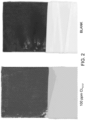
- Figure 2 is a photograph of the coupons after the cyclic polarization studies. It is clear from Figure 2 that the coupon with no treatment program had corrosion/staining on the coupon surface, while the coupon which was exposed to a stannous-based treatment program along with increase in alkalinity, showed a clean surface with minimal corrosion/staining.
- Fig. 3 is a photograph of the second set of coupons that had been exposed to the humidity chamber.
- the water used for passivation included 215 ppm sulfates, as compared to the Example 1, which only had 15 ppm sulfates.
- Figure 3 shows the pictures of the coupons after exposing them to these passivating chemistries, followed by high temperature and humidity chamber.
Landscapes
- Chemical & Material Sciences (AREA)
- Engineering & Computer Science (AREA)
- Materials Engineering (AREA)
- Organic Chemistry (AREA)
- Mechanical Engineering (AREA)
- Metallurgy (AREA)
- Inorganic Chemistry (AREA)
- Life Sciences & Earth Sciences (AREA)
- Wood Science & Technology (AREA)
- General Chemical & Material Sciences (AREA)
- Chemical Kinetics & Catalysis (AREA)
- Preventing Corrosion Or Incrustation Of Metals (AREA)
- Chemical Treatment Of Metals (AREA)
Description
- This disclosure relates generally to the field of water treatment in metal production processes, such as those found in steelmaking facilities.
- When storing or transporting surface sensitive products such as steel products and non-ferrous materials such as copper and brass, environmental conditions can create undesirable corrosion and/or staining of the finished product. Improper or inadequate treatment of the metal prior to coiling or finishing will impact the degree of corrosion and/or staining during storage or transport. This costs manufacturers millions of dollars in lost or downgraded product over the years.
- Document
US 2016/145442 A1 , according to its abstract, discloses a method for preventing corrosion of equipment having a corrodible metal surface that contacts water in a water system, the method comprising pre-treating the corrodible metal surface before the equipment is brought into service in the water system, the pre-treating including contacting a stannous corrosion inhibitor with the corrodible metal surface, wherein the stannous corrosion inhibitor is provided in sufficient amount and for sufficient time to form a protective film on at least a portion of the corrodible metal surface. - Document
US 2016/215400 A1 , according to its abstract, discloses compositions and methods for preventing corrosion of equipment having a corrodible metal surface that contacts water in a hydrostatic system. Compositions may include a liquid-phase corrosion inhibitor and vapor-phase corrosion inhibitor. Methods may include introducing into the hydrostatic system a liquid-phase corrosion inhibitor, vapor-phase corrosion inhibitor and/or a scaling inhibitor. A protective film can be formed on the corrodible metal surface. - Document
US 2017/130340 A1 , according to its abstract, discloses methods and compositions for suppressing corrosion of a corrodible metal surface that contacts a water stream in a water system. The method comprises introducing into the water stream a treatment composition, the treatment composition including a Tin(II) corrosion inhibitor and a hydroxycarboxylic acid promoter. - Document
US 4512552 A , according to its abstract, discloses a corrosion inhibitor for ferrous metals comprising four different components of (a) an inorganic acid component (such as molybdate or tungstate), (b) an aliphatic hydroxycarboxylic or aliphatic dicarboxylic acid or its salt (such as citric acid, gluconic acid or succinic acid), (c) an inorganic heavy metal compound (such as zinc chloride or stannous chloride) and (d) a water soluble polymer component having a molecular weight of 500-100,000 (such as acylic homo or copolymer). - Document
EP 3063311 A1 corresponds toUS 2015/118103 A1 which, according to its abstract, discloses compositions and methods for inhibiting the corrosion of metals in contact with an aqueous system. The method of inhibiting corrosion includes maintaining effective amounts of (1) an amino acid-based polymer, such as a polyaspartic acid compound, and (2) a dispersible and/or soluble tin compound in the aqueous system. The corrosion inhibiting components of the treatment may be added simultaneously or separately into the water of the aqueous system, i.e., provided either in a single treatment product or as separate products. - Document
US 2009/069202 A1 , according to its abstract, discloses compositions and methods for inhibiting corrosion of corrodible metals present in contact with water in cooling water and other water storage systems. The compositions include concentrated stannous salts and agents to solubilize such salts. - Corrosion, such as pitting corrosion, and staining of the metal surface remain persistent problems. Metal manufacturers have not approached solutions to these problems with chemical surface treatments. To date, there have not been robust solutions based on the conventional non-chemical approaches.
- The present disclosure provides a method for inhibiting corrosion of a steel product comprising the steps disclosed at claim 1. The dependent claims outline advantageous ways of carrying out the method.
-
-
Fig. 1 is a graph showing the cyclic polarization curves of test steel coupons; -
Fig. 2 is a photograph showing the coupons after the cyclic polarization study; and -
Fig. 3 is photograph showing steel coupons after being exposed to a humidity chamber for 12 hours. - This disclosure describes methods and compositions for protecting surface sensitive materials from corrosion that may occur during manufacturing, storage, and transportation. The surface sensitive material can be metals such as steel products.
- In one aspect, the invention mitigates corrosion problems by treating water that contacts the steel during its production. Water can be sprayed onto metal surfaces, or otherwise be contacted with metal surfaces, during the production of metal products. For example, water is often used as a cooling medium to cool the metal. But the water that is used for cooling typically contains various minerals such as calcium, magnesium, chlorides and sulfates, etc. Chlorides and sulfates can be very corrosive to metal surfaces such as steel. In some processes, the amount of chlorides in the water that contacts the metal surface can be in the range of 10 ppm to 1,000 ppm, from 50 ppm to 500 ppm, and from 100 ppm to 250 ppm. The amount of sulfates in the water that contacts the metal surface can be in the range of from 2 ppm to 500 ppm, from 5 ppm to 250 ppm, or from 10 ppm to 100 ppm.
- Once the water is evaporated or dried off of the metal surface, the chlorides and sulfates can be retained as a residual on the metal surface, e.g., as residual salts. The chloride and sulfate salts are known to be deliquescent salts, meaning, they quickly adsorb humidity from the air and form a highly concentrated liquid solution on the surface of the metal. Rain water and dew are slightly acidic forms of pure water (pH~5) which when combined with atmospheric CO2, form carbonic acid, as well as stronger acids from adsorption of sulfur and nitrogen oxides. The combination of acidic water with chlorides and sulfates can cause very aggressive corrosion on the metal surface that degrades protective oxide coatings that naturally form on the surface, e.g., iron oxide coatings that form on steel surfaces. As the acidic chloride and sulfate solutions attack the metal, the pH of the solution can further be depressed by metal hydrolysis. For example, in the case of iron based metals, the Fe reacts with OH- and leaves the water enriched in H+. At low pH, the H+ concentration is sufficient to become the dominant electron acceptor instead of oxygen reduction.
- As described in detail below, in one aspect, these corrosion issues can be substantially mitigated by (i) increasing the alkalinity of water that contacts the steel surface; and (ii) by adding a stannous based passivating chemistry to the water at a steel product temperature of at least 500°C immediately before the steel surface is contacted with the water, and evaporating the water off the surface and forming a Sn(IV) film on the steel surface.
- The alkalinity of water can be increased by introducing into the water carbonate and bicarbonate salts, such as, but not limited to, sodium, potassium, magnesium, and calcium carbonate/bicarbonate. The alkalinity can also be increased by using chemistries, such as, but not limited to, hydroxide salts, amines, etc. The salts can be dissolved in the water as a solution, can be suspended in the water, or a combination of both. It is believed that an increase in alkalinity of the water leaves residual components on the metal surface that prevent corrosion attributable to chlorides and sulfates and/or to subsequent contact of the metal surface with acidic water or water vapor.
- Without intending to be bound by theory, it is believed that when these salts, such as bicarbonate/carbonate salts, are subjected to high temperatures on the metal surface, they will produce residual products that create a local alkaline environment on the metal surface that protects against corrosion from acidic conditions. In this regard, when bicarbonate salts are exposed to high temperature, they release CO2, forming carbonates or oxides. For example, sodium carbonate decomposes to sodium oxide (Na2O) beginning at about 400 °C, which is in the range of temperatures metal is typically exposed to during processing, e.g., the temperature at which steel is coiled. Na2O also adsorbs moisture from the air to become caustic soda.
- It is believed that the high pH environment created by the sodium, calcium, and potassium carbonates and hydroxides can counter the low pH effects of atmospheric CO2 and "acid rain". Unexpectedly, the residuals of the carbonate/bicarbonate salt thus can remain on the metal surface even after being exposed to high temperatures and can create basic conditions that prevent corrosion when the metal surface is later contacted with moisture, e.g., during storage and transportation (particularly overseas shipping). At high pH, metal surfaces generally become much less corrosive.
- A corrosivity index can be developed based on the amount of chlorides and sulfates in the water whereby the amount of alkalinity that the water needs can be determined based on the amount of chlorides and sulfates in the water. The concentration of alkalinity in the water stream that contacts the metal surface can be controlled to be from about 5 ppm to 1,500 ppm, from 25 ppm to 1,000 ppm, from 50 ppm to 500 ppm, and from 100 ppm to 400 ppm. "Alkalinity" as used herein refers to M-alkalinity. The alkalinity is provided by mixing a treatment composition with the water that includes at least one carbonate or bicarbonate salt. The treatment composition is provided as an aqueous composition (i.e., containing mostly water). The salts can be present in the treatment composition in amounts of from 0.1 to 25 wt.%, 1 to 20 wt.%, or 5 to 15 wt.%.
- In addition to the above step, a stannous corrosion inhibitor is added to the water which contacts the steel surface. Stannous salts are known to inhibit corrosion but, unlike more conventional corrosion inhibitors, the mechanism by which the stannous salts inhibited corrosion has not been well understood. Without intending to be bound by theory, it is believed that stannous salts can form of a tenacious protective layer on metal surfaces. Stannous ions (Sn (II)) in the water solution are drawn to the active metal surfaces that are losing electrons as they oxidize or are forced into solution by electric potentials. The positively charged tin ion is drawn to the negative surfaces, and reduces the oxidized ions (rust and corrosion) and oxidizes itself to stannic Sn(IV) state, which is insoluble. This results in the formation of an inactive layer Sn(IV) on the metal surface, which protects the metal surface from further corrosion.
- The stannous salt may be, for example, stannous chloride, stannous sulfate, stannous bromide, stannous oxide, stannous phosphate, stannous pyrophosphate, stannous tetrafluroborate, or combinations of any of these salts.
- The concentration of the stannous salt in the water stream that contacts the metal surface can be controlled to be in the range of from about 0.1 to 1000 ppm, from about 0.5 to 50 ppm, or from about 1.5 to 10 ppm.
- The stannous treatment composition that is added to the water is an aqueous solution. The amount of stannous salt in the treatment composition can be in the range of from 0.1 wt.% to 25 wt.%, from 1 wt.% to 20 wt.%, or from 5 wt.% to 10 wt.%. The amount of tin (from the stannous salt) in the corrosion inhibitor composition can range from 0.05 wt.% to 15 wt.%, from 0.1 wt.% to 10 wt.%, or from 1 wt.% to 5 wt.%.
- The treatment composition can also include at least one chelating agent selected from the group consisting of citric acid, azole based copper corrosion inhibitors such as benzotriazole and 2-Butenedioic acid (Z), halogenated azoles and their derivatives, scale inhibitors and dispersants selected from the group consisting of one or more of unsaturated carboxylic acid polymers such as polyacrylic acid, homo or co-polymaleic acid (synthesized from solvent and aqueous routes); acrylate / 2-acrylamido-2-methylpropane sulfonic acid (APMS) copolymers, acrylate/acrylamide copolymers, acrylate homopolymers, terpolymers of carboxylate/sulfonate/maleate, terpolymers of acrylic acid/AMPS; phosphonates and phosphinates such as 2-phosphonobutane-1,2,4-tricarboxylic acid (PBTC), 1-hydroxy ethylidene-1,1-diphosphonic acid (HEDP), amino tris methylene phosphonic acid (ATMP), 2-hydroxyphosphonocarboxylic acid (HPA), diethylenetriamine penta(methylene phosphonic acid) (DETPMP), phosphinosuccinic oligomer (PSO); salts of molybdenum and tungsten including, for example, nitrates and nitrites; amines such as N,N-diethylhydroxylamine (DEHA), diethyl amino ethanol (DEAE), dimethylethanolamine (DMAE), cyclohexylamine, morpholine, monoethanolamine (MEA), a biocide, and combinations thereof.
- The treatment composition can also include a secondary corrosion inhibitor, which comprises other metal ions with multiple oxidation states, ortho phosphates, pyro phosphates, molybdates, nitrites, of one or more of unsaturated carboxylic acid polymers such as polyacrylic acid, homo or co-polymaleic acid (synthesized from solvent and aqueous routes); acrylate / 2-acrylamido-2-methylpropane sulfonic acid (APMS) copolymers, acrylate/acrylamide copolymers, acrylate homopolymers, terpolymers of carboxylate/sulfonate/maleate, terpolymers of acrylic acid/AMPS; phosphonates and phosphinates such as 2-phosphonobutane-1,2,4-tricarboxylic acid (PBTC), 1-hydroxy ethylidene-1,1-diphosphonic acid (HEDP), amino tris methylene phosphonic acid (ATMP), 2-hydroxyphosphonocarboxylic acid (HPA), diethylenetriamine penta(methylene phosphonic acid) (DETPMP), phosphinosuccinic oligomer (PSO); salts of molybdenum and tungsten including, for example, nitrates and nitrites; amines such as N,N-diethylhydroxylamine (DEHA), diethyl amino ethanol (DEAE), dimethylethanolamine (DMAE), cyclohexylamine, morpholine, monoethanolamine (MEA); azoles such as tolyltriazole (TTA), benzotriazole (BZT), butylbenzotriazole (BBT), halogenated azoles, their salts, and combinations thereof.
- The alkalinity and stannous treatment compositions can be added to the water that contacts the steel surface during or after production of a steel product. For example, these treatment compositions can be added to cooling water that contacts the metal surface in a step that cools the metal, e.g., by at least 50°C or 100°C, such as an annealing step in steelmaking. The compositions are added during a stage where the temperature of the metal is high enough to evaporate off substantially all of the water and leave behind the stannous film and/or residuals of carbonate/bicarbonate salts. Such metal surface temperatures include those of at least 500°C, at least 800°C, or over 1000°C, as measured immediately before the surface is contacted with water. In one aspect, it was surprisingly discovered that the stannous film can form and remain intact even when subjected to these high temperatures, as it was expected that the film would degrade.
- The water stream that contacts the metal includes both a stannous salt and a carbonate/bicarbonate salt, and, likewise, the treatment composition that is added to the water stream includes both of these components in the respective amounts identified above. These components can be added in separate stages where one water stream contacting the steel includes a stannous salt and another water stream that contacts the steel includes a salt that increases the alkalinity of the water. Advantageously, the corrosion-resistance effects of the stannous corrosion inhibitor composition are substantially more pronounced under high alkalinity conditions and have unexpectedly good performance.
- One useful application of this invention is exemplified in the description below in connection with treating water that contacts steel during a steel making process.
- The manufacturing process for steel production is time consuming. Conversion from liquid steel to solidified thick or thin slabs occurs in the continuous caster. The slabs are either cooled and then charged into a reheat furnace or directly charged from the caster into a furnace. Once the product is heated to the proper rolling temperature, it is removed from the furnace and introduced into the Rolling or Hot Strip Mill. The Rolling or Hot Strip Mill includes roughing stands and/or finishing stands which reduce the thickness of the product to the desired gauge of the finished product (strip or plate). After the gauge has been set, the product may undergo water cooling in a laminar or accelerated cooling process in order to finalize the desired metallurgical properties prior to packaging. This cooling process cools the product from a starting temperature of approximately 600°C - 1000°C, or 700°C-800°C, depending on desired rolling properties. The water wall cools the strip temperature with a series of low pressure nozzle jets at both the bottom and the top of the strip surface.
- The steel can be cooled to a set temperature range based on desired metallurgical properties (typically 400°C - 800°C) by multiple stages of water on the laminar table prior to being coiled. Additional water is also applied in the coiling process to maintain the integrity of the coil machinery. The water that has been sprayed on the steel for cooling typically contains various minerals such as calcium, magnesium, chlorides and sulfates, etc. As indicated above, chlorides and sulfates are especially known to be very corrosive to steel. These minerals can combine to form salts, which, through evaporation, can remain on the metal surface even at such elevated temperatures. Hardness ions, calcium and magnesium, combine with chloride ions in the water and can form calcium chloride and magnesium chloride salts, which are left on the strip due to evaporation at high temperatures. That is, in steel production, as well as other metal production processes, water containing salts dries out on the metal surface.
- Then, while being transported long-distance, the salts adsorb humidity from the air and form a concentrated liquid solution on the surface of the metal, which in turn causes corrosion/staining on the steel surface. This combination of factors leads to rapid rusting and degradation of the steel surface. This has resulted in not only aesthetic issues, but has resulted in costly product losses amounting to millions of dollars in wastage of the steel products.
- To combat this problem, both the alkalinity and stannous treatment compositions described above are added to the cooling water at the laminar table. Based on the high temperature of the steel the water will steam off. It is believed that the carbonates decompose to sodium oxide, for example, beginning at about 400°C, which is lower than the coiling temperature of the steel. Na2O also adsorbs moisture from the air to become caustic soda, which can create a high pH environment to counter the low pH effects of atmospheric CO2 and "acid rain". This mechanism, optionally together with forming a stannous film on the metal surface, can provide a very effective mechanism for inhibiting corrosion and staining of steel products.
- In a first example, stainless steel coupons were passivated for about 1 hour in a solution containing sodium bicarbonate in an amount corresponding to 250 ppm of alkalinity as CaCO3 and 50 ppm of stannous corrosion treatment composition (which includes about 3-3.5 wt.% Sn). The water also included 75 ppm Ca as CaCO3, 25 ppm Mg as CaCO3, 130 ppm Chlorides and 15 ppm sulfates. These components were added to mimic water compositions that might be present in many steel production facilities. The coupons were then placed in a furnace at 650°C for one hour, which evaporates the water on the coupons. A blank coupon, which was not exposed to any treatment program was also used for comparison. After the exposure to high temperature, one set of coupons was used to run electrochemical cyclic polarization and the other set was exposed to a humidity chamber for 12 hours.
-
Figure 1 shows the cyclic polarization curves of the coupons after exposure to high temperature, where the y-axis is a voltage compared to a Ag/AgCl reference electrode, and the x-axis is current. Passivation of the metal surface manifests itself as a more positive potential under this test. As can be seen inFig. 1 , at the flat part of the curves, the treated coupon is more anodic than the blank, which indicates that the stannous based treatment program provides a passive film on the surface of the metal under alkaline conditions and even after being subjected to high temperatures. -
Figure 2 is a photograph of the coupons after the cyclic polarization studies. It is clear fromFigure 2 that the coupon with no treatment program had corrosion/staining on the coupon surface, while the coupon which was exposed to a stannous-based treatment program along with increase in alkalinity, showed a clean surface with minimal corrosion/staining. -
Fig. 3 is a photograph of the second set of coupons that had been exposed to the humidity chamber. For the coupons inFig. 3 , a similar passivation was conducted, but the water used for passivation included 215 ppm sulfates, as compared to the Example 1, which only had 15 ppm sulfates.Figure 3 shows the pictures of the coupons after exposing them to these passivating chemistries, followed by high temperature and humidity chamber. - It is clear from
Figure 3 that the stannous based treatment program, coupled with increased alkalinity, will protect the steel from severely corrosive conditions, including both chlorides and sulfates.
Claims (10)
- A method for inhibiting corrosion of a steel product comprising:contacting a surface of the steel product with a water stream that includes at least one salt selected from the group consisting of carbonates, bicarbonates, and combinations thereof in amounts of from 0.1 to 25 wt.%;contacting the surface of the steel product with a water stream that includes a stannous corrosion inhibitor salt, wherein the surface of the steel product has a temperature of at least 500°C immediately before the surface is contacted with the water;evaporating the water off of the surface so that a residual of the at least one salt remains on the surface and a Sn (IV) film is formed on the surface;whereby the concentration of the stannous salt in the water stream that contacts the steel surface is in a range from about 0.1 to 1000 ppm.
- The method of claim 1, wherein the water that contacts the surface of the metal includes an amount of the at least one salt so that the alkalinity of the water is in the range of from 25 ppm to 1,000 ppm.
- The method of claim 1, wherein the treatment composition includes at least one chelating agent selected from the group consisting of citric acid, azole based copper corrosion inhibitors such as benzotriazole and 2-Butenedioic acid (Z), halogenated azoles and their derivatives, scale inhibitors and dispersants selected from the group consisting of one or more of unsaturated carboxylic acid polymers such as polyacrylic acid, homo or co-polymaleic acid (synthesized from solvent and aqueous routes); acrylate / 2-acrylamido-2-methylpropane sulfonic acid (APMS) copolymers, acrylate/acrylamide copolymers, acrylate homopolymers, terpolymers of carboxylate/sulfonate/maleate, terpolymers of acrylic acid/AMPS; phosphonates and phosphinates such as 2-phosphonobutane-1,2,4-tricarboxylic acid (PBTC), 1-hydroxy ethylidene-1,1-diphosphonic acid (HEDP), amino tris methylene phosphonic acid (ATMP), 2-hydroxyphosphonocarboxylic acid (HPA), diethylenetriamine penta(methylene phosphonic acid) (DETPMP), phosphinosuccinic oligomer (PSO); salts of molybdenum and tungsten including, for example, nitrates and nitrites; amines such as N,N-diethylhydroxylamine (DEHA), diethyl amino ethanol (DEAE), dimethylethanolamine (DMAE), cyclohexylamine, morpholine, monoethanolamine (MEA), a biocide, and combinations thereof.
- The method of claim 1, wherein the treatment composition includes a secondary corrosion inhibitor comprising other metal ions with multiple oxidation states, ortho phosphates, pyro phosphates, molybdates, nitrites, of one or more of unsaturated carboxylic acid polymers such as polyacrylic acid, homo or co-polymaleic acid (synthesized from solvent and aqueous routes); acrylate / 2-acrylamido-2-methylpropane sulfonic acid (APMS) copolymers, acrylate/acrylamide copolymers, acrylate homopolymers, terpolymers of carboxylate/sulfonate/maleate, terpolymers of acrylic acid/AMPS; phosphonates and phosphinates such as 2-phosphonobutane-1,2,4-tricarboxylic acid (PBTC), 1-hydroxy ethylidene-1,1-diphosphonic acid (HEDP), amino tris methylene phosphonic acid (ATMP), 2-hydroxyphosphonocarboxylic acid (HPA), diethylenetriamine penta(methylene phosphonic acid) (DETPMP), phosphinosuccinic oligomer (PSO); salts of molybdenum and tungsten including, for example, nitrates and nitrites; amines such as N,N-diethylhydroxylamine (DEHA), diethyl amino ethanol (DEAE), dimethylethanolamine (DMAE), cyclohexylamine, morpholine, monoethanolamine (MEA); azoles such as tolyltriazole (TTA), benzotriazole (BZT), butylbenzotriazole (BBT), halogenated azoles, their salts, and combinations thereof.
- The method of claim 1, wherein the surface of the steel product has a temperature of at least 800°C immediately before the surface is contacted with the water.
- The method of claim 1, wherein the surface of the steel product has a temperature of over 1000°C immediately before the surface is contacted with the water.
- The method of claim 1, wherein the at least one salt selected from the group consisting of carbonates, bicarbonates, and combinations thereof is in amounts of from 1 to 20 wt.%.
- The method of claim 1, wherein the at least one salt selected from the group consisting of carbonates, bicarbonates, and combinations thereof is in amounts of from 5 to 15 wt.%.
- The method of claim 1, wherein the concentration of the stannous salt in the water stream that contacts the steel surface is in a range from about 0.5 to 50 ppm.
- The method of claim 1, wherein the concentration of the stannous salt in the water stream that contacts the steel surface is in a range from about 1.5 to 10 ppm.
Priority Applications (1)
| Application Number | Priority Date | Filing Date | Title |
|---|---|---|---|
| EP24207612.3A EP4474360B1 (en) | 2017-12-04 | 2018-12-04 | Methods and compositions for inhibiting corrosion on metal surfaces |
Applications Claiming Priority (2)
| Application Number | Priority Date | Filing Date | Title |
|---|---|---|---|
| US201762594335P | 2017-12-04 | 2017-12-04 | |
| PCT/US2018/063753 WO2019113005A1 (en) | 2017-12-04 | 2018-12-04 | Methods and compositions for inhibiting corrosion on metal surfaces |
Related Child Applications (2)
| Application Number | Title | Priority Date | Filing Date |
|---|---|---|---|
| EP24207612.3A Division-Into EP4474360B1 (en) | 2017-12-04 | 2018-12-04 | Methods and compositions for inhibiting corrosion on metal surfaces |
| EP24207612.3A Division EP4474360B1 (en) | 2017-12-04 | 2018-12-04 | Methods and compositions for inhibiting corrosion on metal surfaces |
Publications (4)
| Publication Number | Publication Date |
|---|---|
| EP3692185A1 EP3692185A1 (en) | 2020-08-12 |
| EP3692185A4 EP3692185A4 (en) | 2021-07-21 |
| EP3692185B1 true EP3692185B1 (en) | 2024-12-04 |
| EP3692185C0 EP3692185C0 (en) | 2024-12-04 |
Family
ID=66751246
Family Applications (2)
| Application Number | Title | Priority Date | Filing Date |
|---|---|---|---|
| EP18886847.5A Active EP3692185B1 (en) | 2017-12-04 | 2018-12-04 | Methods and compositions for inhibiting corrosion on metal surfaces |
| EP24207612.3A Active EP4474360B1 (en) | 2017-12-04 | 2018-12-04 | Methods and compositions for inhibiting corrosion on metal surfaces |
Family Applications After (1)
| Application Number | Title | Priority Date | Filing Date |
|---|---|---|---|
| EP24207612.3A Active EP4474360B1 (en) | 2017-12-04 | 2018-12-04 | Methods and compositions for inhibiting corrosion on metal surfaces |
Country Status (4)
| Country | Link |
|---|---|
| US (1) | US11597846B2 (en) |
| EP (2) | EP3692185B1 (en) |
| ES (1) | ES2997258T3 (en) |
| WO (1) | WO2019113005A1 (en) |
Families Citing this family (4)
| Publication number | Priority date | Publication date | Assignee | Title |
|---|---|---|---|---|
| US20220205112A1 (en) * | 2020-12-30 | 2022-06-30 | Chemtreat, Inc. | Corrosion control of stainless steels in water systems using tin corrosion inhibitor with a hydroxycarboxylic acid |
| WO2023230299A1 (en) | 2022-05-26 | 2023-11-30 | Chemtreat, Inc. | Corrosion control for water systems using passivators and a hydroxycarboxylic acid |
| JP7756407B1 (en) * | 2024-11-20 | 2025-10-20 | シンバイオ製薬株式会社 | Immunoassay method and immunoassay device |
| CN120796957B (en) * | 2025-09-08 | 2025-11-14 | 南通得安电子材料有限公司 | A tin-face protection agent and its preparation method |
Family Cites Families (17)
| Publication number | Priority date | Publication date | Assignee | Title |
|---|---|---|---|---|
| US4512552A (en) | 1982-11-16 | 1985-04-23 | Katayama Chemical Works Co., Ltd. | Corrosion inhibitor |
| US5989322A (en) * | 1991-11-06 | 1999-11-23 | A.S. Incorporated | Corrosion inhibition method and inhibitor compositions |
| US6585933B1 (en) * | 1999-05-03 | 2003-07-01 | Betzdearborn, Inc. | Method and composition for inhibiting corrosion in aqueous systems |
| ATE476955T1 (en) | 1999-11-12 | 2010-08-15 | Procter & Gamble | ORAL COMPOSITIONS CONTAINING TIN IONS |
| US7300601B2 (en) * | 2002-12-10 | 2007-11-27 | Advanced Technology Materials, Inc. | Passivative chemical mechanical polishing composition for copper film planarization |
| WO2006047766A1 (en) * | 2004-10-27 | 2006-05-04 | A.S. Inc. | Corrosion inhibition method for use in recirculating cooling water systems |
| EP2109467A4 (en) * | 2007-01-10 | 2010-06-02 | Valorisation Rech Soc En Comma | DEVICE AND METHOD FOR PLASMA INACTIVATION AND / OR STERILIZATION |
| US7960329B2 (en) * | 2007-05-04 | 2011-06-14 | Ecolab Usa Inc. | Compositions including magnesium ion, calcium ion, and silicate and methods employing them to reduce corrosion and etch |
| US20090020187A1 (en) * | 2007-07-17 | 2009-01-22 | Russell Steven W | Method and apparatus for protecting metal from oxidaton |
| US7910024B2 (en) * | 2007-09-07 | 2011-03-22 | A.S. Inc. | Corrosion inhibition compositions and methods for using the same |
| US8784629B2 (en) * | 2007-09-27 | 2014-07-22 | Chemetall Gmbh | Method of producing surface-treated metal material and method of producing coated metal item |
| US8951467B2 (en) * | 2012-03-21 | 2015-02-10 | Chemtreat, Inc. | Preventing equipment fouling via corrosion reduction |
| US9290850B2 (en) | 2013-10-31 | 2016-03-22 | U.S. Water Services Inc. | Corrosion inhibiting methods |
| US20160145442A1 (en) | 2014-11-20 | 2016-05-26 | Chemtreat, Inc. | Methods of pre-treating equipment used in water systems |
| WO2016118976A1 (en) | 2015-01-23 | 2016-07-28 | Chemtreat, Inc. | Compositions and methods for inhibiting corrosion in hydrostatic systems |
| KR101668957B1 (en) | 2015-07-09 | 2016-10-24 | 라인 가부시키가이샤 | Contents streaming service method and system for reducing communication cost |
| US10174429B2 (en) * | 2015-11-05 | 2019-01-08 | Chemtreat, Inc | Corrosion control for water systems using tin corrosion inhibitor with a hydroxycarboxylic acid |
-
2018
- 2018-12-04 ES ES18886847T patent/ES2997258T3/en active Active
- 2018-12-04 EP EP18886847.5A patent/EP3692185B1/en active Active
- 2018-12-04 US US16/770,028 patent/US11597846B2/en active Active
- 2018-12-04 EP EP24207612.3A patent/EP4474360B1/en active Active
- 2018-12-04 WO PCT/US2018/063753 patent/WO2019113005A1/en not_active Ceased
Also Published As
| Publication number | Publication date |
|---|---|
| WO2019113005A1 (en) | 2019-06-13 |
| US20210171781A1 (en) | 2021-06-10 |
| ES2997258T3 (en) | 2025-02-14 |
| EP4474360A3 (en) | 2025-03-05 |
| EP4474360B1 (en) | 2026-04-29 |
| EP3692185A1 (en) | 2020-08-12 |
| EP3692185C0 (en) | 2024-12-04 |
| EP3692185A4 (en) | 2021-07-21 |
| EP4474360A2 (en) | 2024-12-11 |
| US11597846B2 (en) | 2023-03-07 |
Similar Documents
| Publication | Publication Date | Title |
|---|---|---|
| EP3371347B1 (en) | Corrosion control for water systems using tin corrosion inhibitor with a hydroxycarboxylic acid | |
| EP4474360B1 (en) | Methods and compositions for inhibiting corrosion on metal surfaces | |
| CA2916926C (en) | Corrosion control methods using shot doses of tin(11) salts | |
| AU639835B2 (en) | Novel polyphosphate/azole compositions and the use thereof as copper and copper alloy corrosion inhibitors | |
| AU2017249052A1 (en) | Composition and method for inhibiting corrosion | |
| US10221489B2 (en) | Compositions and methods for inhibiting corrosion in hydrostatic systems | |
| US20160145442A1 (en) | Methods of pre-treating equipment used in water systems | |
| US20220205112A1 (en) | Corrosion control of stainless steels in water systems using tin corrosion inhibitor with a hydroxycarboxylic acid | |
| US12601064B2 (en) | Corrosion control for water systems using passivators and a hydroxycarboxylic acid | |
| US6042742A (en) | Composition and method for inhibiting chloride-induced corrosion of and limescale formation on ferrous metals and alloys | |
| US5948267A (en) | Composition and method for inhibiting chloride-Induced corrosion and limescale formation on ferrous metals and alloys | |
| Beecher et al. | Corrosion inhibition with sodium nitrite | |
| KR102627360B1 (en) | Anticorrosive composition for metal with excellent corrosion inhibition effect | |
| JP4237853B2 (en) | Corrosion inhibitor and corrosion prevention method for ferrous metals in cooling water system | |
| JP2848671B2 (en) | High-temperature water-based corrosion inhibitor | |
| JP2008248303A (en) | Circulating cooling water-based pitting corrosion inhibitor containing copper substrate and pitting corrosion suppression method | |
| KR101190519B1 (en) | Water treating composition and method for open recirculating cooling system | |
| JPH01316475A (en) | Corrosion suppressing method in low hardness water and high hardness water and composition therefor | |
| JPH0254433B2 (en) | ||
| US6352967B1 (en) | Additives for improving acid reactivity and method for controlling acid reactions | |
| KR19980050010A (en) | How to prevent corrosion of metal materials |
Legal Events
| Date | Code | Title | Description |
|---|---|---|---|
| STAA | Information on the status of an ep patent application or granted ep patent |
Free format text: STATUS: THE INTERNATIONAL PUBLICATION HAS BEEN MADE |
|
| PUAI | Public reference made under article 153(3) epc to a published international application that has entered the european phase |
Free format text: ORIGINAL CODE: 0009012 |
|
| STAA | Information on the status of an ep patent application or granted ep patent |
Free format text: STATUS: REQUEST FOR EXAMINATION WAS MADE |
|
| 17P | Request for examination filed |
Effective date: 20200504 |
|
| AK | Designated contracting states |
Kind code of ref document: A1 Designated state(s): AL AT BE BG CH CY CZ DE DK EE ES FI FR GB GR HR HU IE IS IT LI LT LU LV MC MK MT NL NO PL PT RO RS SE SI SK SM TR |
|
| AX | Request for extension of the european patent |
Extension state: BA ME |
|
| DAV | Request for validation of the european patent (deleted) | ||
| DAX | Request for extension of the european patent (deleted) | ||
| A4 | Supplementary search report drawn up and despatched |
Effective date: 20210621 |
|
| RIC1 | Information provided on ipc code assigned before grant |
Ipc: C23F 11/00 20060101AFI20210615BHEP Ipc: C23F 11/04 20060101ALI20210615BHEP Ipc: C23C 22/62 20060101ALI20210615BHEP Ipc: C23F 11/08 20060101ALI20210615BHEP Ipc: C23F 11/18 20060101ALI20210615BHEP Ipc: C02F 5/08 20060101ALI20210615BHEP |
|
| REG | Reference to a national code |
Ref country code: DE Ref legal event code: R079 Free format text: PREVIOUS MAIN CLASS: C23F0011000000 Ipc: C23F0011180000 Ref country code: DE Ref legal event code: R079 Ref document number: 602018077380 Country of ref document: DE Free format text: PREVIOUS MAIN CLASS: C23F0011000000 Ipc: C23F0011180000 |
|
| GRAP | Despatch of communication of intention to grant a patent |
Free format text: ORIGINAL CODE: EPIDOSNIGR1 |
|
| STAA | Information on the status of an ep patent application or granted ep patent |
Free format text: STATUS: GRANT OF PATENT IS INTENDED |
|
| INTG | Intention to grant announced |
Effective date: 20240716 |
|
| RIC1 | Information provided on ipc code assigned before grant |
Ipc: C02F 5/08 20060101ALI20240705BHEP Ipc: C02F 103/16 20060101ALI20240705BHEP Ipc: C23C 22/62 20060101ALI20240705BHEP Ipc: C23F 11/08 20060101ALI20240705BHEP Ipc: C23F 11/18 20060101AFI20240705BHEP |
|
| GRAS | Grant fee paid |
Free format text: ORIGINAL CODE: EPIDOSNIGR3 |
|
| GRAA | (expected) grant |
Free format text: ORIGINAL CODE: 0009210 |
|
| STAA | Information on the status of an ep patent application or granted ep patent |
Free format text: STATUS: THE PATENT HAS BEEN GRANTED |
|
| AK | Designated contracting states |
Kind code of ref document: B1 Designated state(s): AL AT BE BG CH CY CZ DE DK EE ES FI FR GB GR HR HU IE IS IT LI LT LU LV MC MK MT NL NO PL PT RO RS SE SI SK SM TR |
|
| REG | Reference to a national code |
Ref country code: GB Ref legal event code: FG4D |
|
| REG | Reference to a national code |
Ref country code: CH Ref legal event code: EP |
|
| REG | Reference to a national code |
Ref country code: DE Ref legal event code: R096 Ref document number: 602018077380 Country of ref document: DE |
|
| REG | Reference to a national code |
Ref country code: IE Ref legal event code: FG4D |
|
| U01 | Request for unitary effect filed |
Effective date: 20241217 |
|
| U07 | Unitary effect registered |
Designated state(s): AT BE BG DE DK EE FI FR IT LT LU LV MT NL PT RO SE SI Effective date: 20250110 |
|
| REG | Reference to a national code |
Ref country code: ES Ref legal event code: FG2A Ref document number: 2997258 Country of ref document: ES Kind code of ref document: T3 Effective date: 20250214 |
|
| U20 | Renewal fee for the european patent with unitary effect paid |
Year of fee payment: 7 Effective date: 20250221 |
|
| PG25 | Lapsed in a contracting state [announced via postgrant information from national office to epo] |
Ref country code: HR Free format text: LAPSE BECAUSE OF FAILURE TO SUBMIT A TRANSLATION OF THE DESCRIPTION OR TO PAY THE FEE WITHIN THE PRESCRIBED TIME-LIMIT Effective date: 20241204 |
|
| PG25 | Lapsed in a contracting state [announced via postgrant information from national office to epo] |
Ref country code: GR Free format text: LAPSE BECAUSE OF FAILURE TO SUBMIT A TRANSLATION OF THE DESCRIPTION OR TO PAY THE FEE WITHIN THE PRESCRIBED TIME-LIMIT Effective date: 20250305 |
|
| PG25 | Lapsed in a contracting state [announced via postgrant information from national office to epo] |
Ref country code: RS Free format text: LAPSE BECAUSE OF FAILURE TO SUBMIT A TRANSLATION OF THE DESCRIPTION OR TO PAY THE FEE WITHIN THE PRESCRIBED TIME-LIMIT Effective date: 20250304 |
|
| PG25 | Lapsed in a contracting state [announced via postgrant information from national office to epo] |
Ref country code: SM Free format text: LAPSE BECAUSE OF FAILURE TO SUBMIT A TRANSLATION OF THE DESCRIPTION OR TO PAY THE FEE WITHIN THE PRESCRIBED TIME-LIMIT Effective date: 20241204 |
|
| PG25 | Lapsed in a contracting state [announced via postgrant information from national office to epo] |
Ref country code: PL Free format text: LAPSE BECAUSE OF FAILURE TO SUBMIT A TRANSLATION OF THE DESCRIPTION OR TO PAY THE FEE WITHIN THE PRESCRIBED TIME-LIMIT Effective date: 20241204 |
|
| PG25 | Lapsed in a contracting state [announced via postgrant information from national office to epo] |
Ref country code: IS Free format text: LAPSE BECAUSE OF FAILURE TO SUBMIT A TRANSLATION OF THE DESCRIPTION OR TO PAY THE FEE WITHIN THE PRESCRIBED TIME-LIMIT Effective date: 20250404 |
|
| PG25 | Lapsed in a contracting state [announced via postgrant information from national office to epo] |
Ref country code: SK Free format text: LAPSE BECAUSE OF FAILURE TO SUBMIT A TRANSLATION OF THE DESCRIPTION OR TO PAY THE FEE WITHIN THE PRESCRIBED TIME-LIMIT Effective date: 20241204 |
|
| PG25 | Lapsed in a contracting state [announced via postgrant information from national office to epo] |
Ref country code: CZ Free format text: LAPSE BECAUSE OF FAILURE TO SUBMIT A TRANSLATION OF THE DESCRIPTION OR TO PAY THE FEE WITHIN THE PRESCRIBED TIME-LIMIT Effective date: 20241204 |
|
| REG | Reference to a national code |
Ref country code: CH Ref legal event code: PL |
|
| PG25 | Lapsed in a contracting state [announced via postgrant information from national office to epo] |
Ref country code: MC Free format text: LAPSE BECAUSE OF FAILURE TO SUBMIT A TRANSLATION OF THE DESCRIPTION OR TO PAY THE FEE WITHIN THE PRESCRIBED TIME-LIMIT Effective date: 20241204 |
|
| PLBE | No opposition filed within time limit |
Free format text: ORIGINAL CODE: 0009261 |
|
| STAA | Information on the status of an ep patent application or granted ep patent |
Free format text: STATUS: NO OPPOSITION FILED WITHIN TIME LIMIT |
|
| PG25 | Lapsed in a contracting state [announced via postgrant information from national office to epo] |
Ref country code: CH Free format text: LAPSE BECAUSE OF NON-PAYMENT OF DUE FEES Effective date: 20241231 |
|
| PG25 | Lapsed in a contracting state [announced via postgrant information from national office to epo] |
Ref country code: IE Free format text: LAPSE BECAUSE OF NON-PAYMENT OF DUE FEES Effective date: 20241204 |
|
| 26N | No opposition filed |
Effective date: 20250905 |
|
| PGFP | Annual fee paid to national office [announced via postgrant information from national office to epo] |
Ref country code: GB Payment date: 20251219 Year of fee payment: 8 |
|
| U20 | Renewal fee for the european patent with unitary effect paid |
Year of fee payment: 8 Effective date: 20251230 |
|
| PG25 | Lapsed in a contracting state [announced via postgrant information from national office to epo] |
Ref country code: CY Free format text: LAPSE BECAUSE OF FAILURE TO SUBMIT A TRANSLATION OF THE DESCRIPTION OR TO PAY THE FEE WITHIN THE PRESCRIBED TIME-LIMIT; INVALID AB INITIO Effective date: 20181204 |
|
| PGFP | Annual fee paid to national office [announced via postgrant information from national office to epo] |
Ref country code: ES Payment date: 20260130 Year of fee payment: 8 |
|
| PGFP | Annual fee paid to national office [announced via postgrant information from national office to epo] |
Ref country code: NO Payment date: 20251230 Year of fee payment: 8 |