EP3692023B1 - Benzothiazol compounds and methods using the same for treating neurodegenerative disorders - Google Patents
Benzothiazol compounds and methods using the same for treating neurodegenerative disorders Download PDFInfo
- Publication number
- EP3692023B1 EP3692023B1 EP18864678.0A EP18864678A EP3692023B1 EP 3692023 B1 EP3692023 B1 EP 3692023B1 EP 18864678 A EP18864678 A EP 18864678A EP 3692023 B1 EP3692023 B1 EP 3692023B1
- Authority
- EP
- European Patent Office
- Prior art keywords
- thiazol
- fluoro
- benzo
- carboxamide
- cyclopropane
- Prior art date
- Legal status (The legal status is an assumption and is not a legal conclusion. Google has not performed a legal analysis and makes no representation as to the accuracy of the status listed.)
- Active
Links
Images


Classifications
-
- C—CHEMISTRY; METALLURGY
- C07—ORGANIC CHEMISTRY
- C07D—HETEROCYCLIC COMPOUNDS
- C07D277/00—Heterocyclic compounds containing 1,3-thiazole or hydrogenated 1,3-thiazole rings
- C07D277/60—Heterocyclic compounds containing 1,3-thiazole or hydrogenated 1,3-thiazole rings condensed with carbocyclic rings or ring systems
- C07D277/62—Benzothiazoles
- C07D277/68—Benzothiazoles with hetero atoms or with carbon atoms having three bonds to hetero atoms with at the most one bond to halogen, e.g. ester or nitrile radicals, directly attached in position 2
- C07D277/82—Nitrogen atoms
-
- A—HUMAN NECESSITIES
- A61—MEDICAL OR VETERINARY SCIENCE; HYGIENE
- A61K—PREPARATIONS FOR MEDICAL, DENTAL OR TOILETRY PURPOSES
- A61K31/00—Medicinal preparations containing organic active ingredients
- A61K31/33—Heterocyclic compounds
- A61K31/395—Heterocyclic compounds having nitrogen as a ring hetero atom, e.g. guanethidine or rifamycins
- A61K31/41—Heterocyclic compounds having nitrogen as a ring hetero atom, e.g. guanethidine or rifamycins having five-membered rings with two or more ring hetero atoms, at least one of which being nitrogen, e.g. tetrazole
- A61K31/425—Thiazoles
- A61K31/428—Thiazoles condensed with carbocyclic rings
-
- A—HUMAN NECESSITIES
- A61—MEDICAL OR VETERINARY SCIENCE; HYGIENE
- A61K—PREPARATIONS FOR MEDICAL, DENTAL OR TOILETRY PURPOSES
- A61K31/00—Medicinal preparations containing organic active ingredients
- A61K31/33—Heterocyclic compounds
- A61K31/395—Heterocyclic compounds having nitrogen as a ring hetero atom, e.g. guanethidine or rifamycins
- A61K31/435—Heterocyclic compounds having nitrogen as a ring hetero atom, e.g. guanethidine or rifamycins having six-membered rings with one nitrogen as the only ring hetero atom
- A61K31/4353—Heterocyclic compounds having nitrogen as a ring hetero atom, e.g. guanethidine or rifamycins having six-membered rings with one nitrogen as the only ring hetero atom ortho- or peri-condensed with heterocyclic ring systems
- A61K31/437—Heterocyclic compounds having nitrogen as a ring hetero atom, e.g. guanethidine or rifamycins having six-membered rings with one nitrogen as the only ring hetero atom ortho- or peri-condensed with heterocyclic ring systems the heterocyclic ring system containing a five-membered ring having nitrogen as a ring hetero atom, e.g. indolizine, beta-carboline
-
- A—HUMAN NECESSITIES
- A61—MEDICAL OR VETERINARY SCIENCE; HYGIENE
- A61K—PREPARATIONS FOR MEDICAL, DENTAL OR TOILETRY PURPOSES
- A61K31/00—Medicinal preparations containing organic active ingredients
- A61K31/33—Heterocyclic compounds
- A61K31/395—Heterocyclic compounds having nitrogen as a ring hetero atom, e.g. guanethidine or rifamycins
- A61K31/435—Heterocyclic compounds having nitrogen as a ring hetero atom, e.g. guanethidine or rifamycins having six-membered rings with one nitrogen as the only ring hetero atom
- A61K31/44—Non condensed pyridines; Hydrogenated derivatives thereof
- A61K31/4427—Non condensed pyridines; Hydrogenated derivatives thereof containing further heterocyclic ring systems
- A61K31/4439—Non condensed pyridines; Hydrogenated derivatives thereof containing further heterocyclic ring systems containing a five-membered ring with nitrogen as a ring hetero atom, e.g. omeprazole
-
- A—HUMAN NECESSITIES
- A61—MEDICAL OR VETERINARY SCIENCE; HYGIENE
- A61K—PREPARATIONS FOR MEDICAL, DENTAL OR TOILETRY PURPOSES
- A61K31/00—Medicinal preparations containing organic active ingredients
- A61K31/33—Heterocyclic compounds
- A61K31/395—Heterocyclic compounds having nitrogen as a ring hetero atom, e.g. guanethidine or rifamycins
- A61K31/495—Heterocyclic compounds having nitrogen as a ring hetero atom, e.g. guanethidine or rifamycins having six-membered rings with two or more nitrogen atoms as the only ring heteroatoms, e.g. piperazine or tetrazines
- A61K31/505—Pyrimidines; Hydrogenated pyrimidines, e.g. trimethoprim
- A61K31/506—Pyrimidines; Hydrogenated pyrimidines, e.g. trimethoprim not condensed and containing further heterocyclic rings
-
- A—HUMAN NECESSITIES
- A61—MEDICAL OR VETERINARY SCIENCE; HYGIENE
- A61K—PREPARATIONS FOR MEDICAL, DENTAL OR TOILETRY PURPOSES
- A61K31/00—Medicinal preparations containing organic active ingredients
- A61K31/69—Boron compounds
-
- A—HUMAN NECESSITIES
- A61—MEDICAL OR VETERINARY SCIENCE; HYGIENE
- A61K—PREPARATIONS FOR MEDICAL, DENTAL OR TOILETRY PURPOSES
- A61K31/00—Medicinal preparations containing organic active ingredients
- A61K31/695—Silicon compounds
-
- A—HUMAN NECESSITIES
- A61—MEDICAL OR VETERINARY SCIENCE; HYGIENE
- A61P—SPECIFIC THERAPEUTIC ACTIVITY OF CHEMICAL COMPOUNDS OR MEDICINAL PREPARATIONS
- A61P21/00—Drugs for disorders of the muscular or neuromuscular system
-
- A—HUMAN NECESSITIES
- A61—MEDICAL OR VETERINARY SCIENCE; HYGIENE
- A61P—SPECIFIC THERAPEUTIC ACTIVITY OF CHEMICAL COMPOUNDS OR MEDICINAL PREPARATIONS
- A61P25/00—Drugs for disorders of the nervous system
-
- A—HUMAN NECESSITIES
- A61—MEDICAL OR VETERINARY SCIENCE; HYGIENE
- A61P—SPECIFIC THERAPEUTIC ACTIVITY OF CHEMICAL COMPOUNDS OR MEDICINAL PREPARATIONS
- A61P25/00—Drugs for disorders of the nervous system
- A61P25/14—Drugs for disorders of the nervous system for treating abnormal movements, e.g. chorea, dyskinesia
- A61P25/16—Anti-Parkinson drugs
-
- A—HUMAN NECESSITIES
- A61—MEDICAL OR VETERINARY SCIENCE; HYGIENE
- A61P—SPECIFIC THERAPEUTIC ACTIVITY OF CHEMICAL COMPOUNDS OR MEDICINAL PREPARATIONS
- A61P25/00—Drugs for disorders of the nervous system
- A61P25/28—Drugs for disorders of the nervous system for treating neurodegenerative disorders of the central nervous system, e.g. nootropic agents, cognition enhancers, drugs for treating Alzheimer's disease or other forms of dementia
-
- C—CHEMISTRY; METALLURGY
- C07—ORGANIC CHEMISTRY
- C07D—HETEROCYCLIC COMPOUNDS
- C07D417/00—Heterocyclic compounds containing two or more hetero rings, at least one ring having nitrogen and sulfur atoms as the only ring hetero atoms, not provided for by group C07D415/00
- C07D417/02—Heterocyclic compounds containing two or more hetero rings, at least one ring having nitrogen and sulfur atoms as the only ring hetero atoms, not provided for by group C07D415/00 containing two hetero rings
- C07D417/04—Heterocyclic compounds containing two or more hetero rings, at least one ring having nitrogen and sulfur atoms as the only ring hetero atoms, not provided for by group C07D415/00 containing two hetero rings directly linked by a ring-member-to-ring-member bond
-
- C—CHEMISTRY; METALLURGY
- C07—ORGANIC CHEMISTRY
- C07D—HETEROCYCLIC COMPOUNDS
- C07D417/00—Heterocyclic compounds containing two or more hetero rings, at least one ring having nitrogen and sulfur atoms as the only ring hetero atoms, not provided for by group C07D415/00
- C07D417/02—Heterocyclic compounds containing two or more hetero rings, at least one ring having nitrogen and sulfur atoms as the only ring hetero atoms, not provided for by group C07D415/00 containing two hetero rings
- C07D417/10—Heterocyclic compounds containing two or more hetero rings, at least one ring having nitrogen and sulfur atoms as the only ring hetero atoms, not provided for by group C07D415/00 containing two hetero rings linked by a carbon chain containing aromatic rings
-
- C—CHEMISTRY; METALLURGY
- C07—ORGANIC CHEMISTRY
- C07D—HETEROCYCLIC COMPOUNDS
- C07D471/00—Heterocyclic compounds containing nitrogen atoms as the only ring hetero atoms in the condensed system, at least one ring being a six-membered ring with one nitrogen atom, not provided for by groups C07D451/00 - C07D463/00
- C07D471/02—Heterocyclic compounds containing nitrogen atoms as the only ring hetero atoms in the condensed system, at least one ring being a six-membered ring with one nitrogen atom, not provided for by groups C07D451/00 - C07D463/00 in which the condensed system contains two hetero rings
- C07D471/04—Ortho-condensed systems
-
- C—CHEMISTRY; METALLURGY
- C07—ORGANIC CHEMISTRY
- C07D—HETEROCYCLIC COMPOUNDS
- C07D513/00—Heterocyclic compounds containing in the condensed system at least one hetero ring having nitrogen and sulfur atoms as the only ring hetero atoms, not provided for in groups C07D463/00, C07D477/00 or C07D499/00 - C07D507/00
- C07D513/02—Heterocyclic compounds containing in the condensed system at least one hetero ring having nitrogen and sulfur atoms as the only ring hetero atoms, not provided for in groups C07D463/00, C07D477/00 or C07D499/00 - C07D507/00 in which the condensed system contains two hetero rings
- C07D513/04—Ortho-condensed systems
-
- C—CHEMISTRY; METALLURGY
- C07—ORGANIC CHEMISTRY
- C07F—ACYCLIC, CARBOCYCLIC OR HETEROCYCLIC COMPOUNDS CONTAINING ELEMENTS OTHER THAN CARBON, HYDROGEN, HALOGEN, OXYGEN, NITROGEN, SULFUR, SELENIUM OR TELLURIUM
- C07F5/00—Compounds containing elements of Groups 3 or 13 of the Periodic Table
- C07F5/02—Boron compounds
- C07F5/025—Boronic and borinic acid compounds
-
- C—CHEMISTRY; METALLURGY
- C07—ORGANIC CHEMISTRY
- C07F—ACYCLIC, CARBOCYCLIC OR HETEROCYCLIC COMPOUNDS CONTAINING ELEMENTS OTHER THAN CARBON, HYDROGEN, HALOGEN, OXYGEN, NITROGEN, SULFUR, SELENIUM OR TELLURIUM
- C07F7/00—Compounds containing elements of Groups 4 or 14 of the Periodic Table
- C07F7/02—Silicon compounds
- C07F7/08—Compounds having one or more C—Si linkages
- C07F7/0803—Compounds with Si-C or Si-Si linkages
- C07F7/081—Compounds with Si-C or Si-Si linkages comprising at least one atom selected from the elements N, O, halogen, S, Se or Te
- C07F7/0812—Compounds with Si-C or Si-Si linkages comprising at least one atom selected from the elements N, O, halogen, S, Se or Te comprising a heterocyclic ring
Definitions
- the present disclosure generally relates to compounds having enzyme inhibitory activity, pharmaceutical compositions comprising the compound, and methods of using the compounds for treating diseases.
- ⁇ -synuclein is part of a large family of proteins including ⁇ - and ⁇ -synuclein and synoretin. ⁇ -synuclein is expressed in the normal state associated with synapses and is believed to play a role in neural plasticity, learning and memory. Several studies have implicated ⁇ -synuclein with a central role in Parkinson disease pathogenesis. Molecular changes in the ⁇ -synuclein protein that increase protein misfolding and aggregation have a direct role in disease pathogenesis. Aggregation of ⁇ -synuclein contributes to the formation of Lewy bodies and neutrites, the pathologic hallmarks of Parkinson disease and ⁇ -synucleinopathies. Activation of tyrosine kinase c-abl contributes to ⁇ -synuclein-induced ncurodcgcncration.
- tyrosine kinase c-abl is tightly regulated non-receptor protein tyrosine kinase involved in a wide range of cellular processes, including growth, survival and stress response ( Nat Rev Mol Cell Biol, 2004, 5:33-44 ) and c-abl involved in regulation several cellular processes and has implicated in the development of the central nervous system by controlling neurogenesis. More recently, increasing evidence from various experimental model systems has also revealed that c-abl is activated in neurodegenerative disease such as Alzheimer's disease, Parkinson's disease, Neiman-Pick type C diseases and tauopathies. ( Human Molecular Genetics, 2014, Vol. 23, No.11 )
- the stress-signaling non-receptor tyrosine kinase c-ab1 links parkin to sporadic forms of Parkinson's disease via tyrosine phosphorylation.
- Tyrosine phosphorylation of parkin by c-abl is a major post-translational modification that leads to loss of parkin function and disease progression in sporadic Parkinson disease. Inhibition of c-abl offers new therapeutic opportunities for blocking Parkinson disease progression.
- ALS Amyotrophic lateral sclerosis
- Knockdown of c-abl with small interfering RNAs (siRNAs) also rescued ALS motor neuron degeneration.
- MSA Multiple System Atrophy
- tyrosine kinase inhibitor nilotinib decreases c-abl activity and ameliorates autophagic clearance of ⁇ -synuclein in transgenic and lentiviral gene transfer models.
- Activation of c-abl in the mouse forebrain induces neurodegeneration in the hippocampus and striatum. Therefore, an increase in c-abl activity via phosphorylation may be associated with the ⁇ -synuclein pathology detected in Parkinson disease and other neurodegenerative disease.
- c-abl is a potential therapeutic target for ⁇ -synucleinopathy, Parkinson disease, Alzheimer disease, ALS, Dementia with Lewy body and MSA.
- WO 2010/008847 describes compounds having a heterobicyclic core, such as benzothiazol, substituted with an amid containing moiety, such as acetamido, for treating cancer.
- KR 2014 0107153 A describes an indole derivative and a AbI kinase inhibitor composition including the same.
- WO 2010/144909 A1 describes fused heterocyclic compounds and their uses.
- one object of the present disclosure is to provide a compound having c-ab1 kinase inhibitory activity, a composition comprising the compound, a pharmaceutical composition comprising the compound as an effective agent, and medical-uses thereof for treating or preventing neurodegenerative disorders.
- Another object of the present disclosure is to provide a method for treating or ameliorating neurodegenerative disorders comprising administering to a subject in need of treatment, amelioration or prevention of neurodegenerative disorders a compound having c-ab1 kinase inhibitory activity according to the present disclosure.
- the present disclosure provides a compound having c-abl kinase inhibitory activity, a composition comprising the compound and a method useful to treat a neurodegenerative disease.
- the compound is a compound of Formula (I): or a pharmaceutically acceptable salt thereof, wherein:
- compositions comprising a therapeutically effective amound of a compound decribed herein and a pharmaccutically-acccptablc carrier.
- the present disclosure provides one or more compounds or pharmaceutically acceptable salts thereof, in a therapeutically effective amount, for use in treating a neurodegenerative disorder in a subject.
- alkenyl refers to a straight or branched hydrocarbonyl group with at least one site of unsaturation, i.e., a carbon-carbon, sp2 double bond. In an embodiment, alkenyl has from 2 to 12 carbon atoms. In some embodiments, alkenyl is a C 2 -C 10 alkenyl group or a C 2 -C 6 alkenyl group. Examples of alkenyl group include, but are not limited to, ethylene or vinyl (-CH-CH 2 ), allyl (-CH 2 CH-CH 2 ), cyclopentenyl (-C 5 H 7 ), and 5-hexenyl (-CH 2 CH 2 CH 2 CH 2 CH-CH 2 ).
- alkoxy is RO- where R is alkyl.
- alkoxy groups include methoxy, ethoxy and propoxy.
- alkoxyalkyl refers to an alkyl moiety substituted with an alkoxy group.
- alkoxyalkyl groups include methoxymethyl, methoxyethyl, methoxypropyl and ethoxyethyl.
- alkoxycarbonyl is ROC(O)-, where R is an alkyl group as defined herein. In various embodiments, R is a C 1 -C 10 alkyl group or a C 1 -C 6 alkyl group.
- alkyl refers to a straight or branched chain hydrocarbonyl group. In an embodiment, alkyl has from 1 to 12 carbon atoms. In some embodiments, alkyl is a C 1 -C 10 alkyl group or a C 1 -C 6 alkyl group. Examples of alkyl groups include, but are not limited to, methyl, ethyl, propyl, isopropyl, butyl, isobutyl, t-butyl, pentyl, hexyl, heptyl, octyl, nonyl and decyl. "lower alkyl” means alkyl having from 1 to 4 carbon atoms.
- C 1 -C 6 means the number of carbon atoms is from 1 to 6.
- C 1 -C 6 alkyl means an alkyl which carbon number is any integer of from 1 to 6.
- alkylamino refers to an amino group substituted with one or more alkyl groups.
- N-(alkyl)amino is RNH- and "N,N-(alkyl) 2 amino” is R 2 N-, where the R groups are alkyl as defined herein and are the same or different.
- R is a C 1 -C 10 alkyl group or a C 1 -C 6 alkyl group.
- alkylamino groups include methylamino, ethylamino, propylamino, butylamino, dimethylamino, diethylamino, and methylethylamno.
- alkylaminoalkyl refers to an alkyl moiety substituted with an alkylamino group, wherein alkylamino is as defined herein.
- alky-laminoakyl groups include methylaminomethyl and ethylaminomethyl.
- alkynyl refers to a straight or branched carbon-chain group with at least one site of unsaturation, i.e., a carbon-carbon, sp triple bond. In an embodiment, alkynyl has from 2 to 12 carbon atoms. In some embodiments, alkynyl is a C 2 -C 10 alkynyl group or a C 2 -C 6 alkynyl group. Examples of alkynyl groups include acetylenic (-C ⁇ CH) and propargyl (-CH 2 C ⁇ CH).
- aryl refers to any monocyclic or bicyclic carbon ring of up to 7 atoms in each ring, wherein at least one ring is aromatic, or an aromatic ring system of 5 to 14 carbon atoms which includes a carbocyclic aromatic group fused with a 5-or 6-membered cycloalkyl group.
- Representative examples of aryl groups include, but are not limited to, phenyl, tolyl, xylyl, naphthyl, tetrahydronaphthyl, anthracenyl, fluorenyl, indenyl, azulenyl and indanyl.
- a carbocyclic aromatic group can be unsubstituted or optionally substituted.
- cycloalkyl is a hydrocarbyl group containing at least one saturated or partially unsaturated ring structure, and attached via a ring carbon. In various embodiments, it refers to a saturated or a partially unsaturated C 3 -C 12 cyclic moiety, examples of which include cyclopropyl, cyclobutyl, cyclopentyl, cyclopentenyl, cyclohexyl, cyclohexenyl, cycloheptyl and cyclooctyl.
- Cycloalkyloxy is RO-, where R is cycloalkyl.
- halogen and “halo” refers to chloro (-Cl), bromo (-Br), fluoro (-F) or iodo (-I).
- Haloalkoxy refers to an alkoxy group substituted with one or more halo groups and examples of haloalkoxy groups include, but are not limited to, - OCF 3 , -OCHF 2 and -OCH 2 F.
- Haloalkoxyalkyl refers to an alkyl moiety substituted with a haloalkoxy group, wherein haloalkoxy is as defined herein.
- haloalkoxyalkyl groups include trifluoromethoxymethyl, trifluoroethoxymethyl and tri-fluoromethoxyethyl.
- Haloalkyl refers to an alkyl moiety substituted with one or more halo groups. Examples of haloalkyl groups include -CF 3 and -CHF 2 .
- heteroalkyl refers to a straight- or branched-chain alkyl group having from 2 to 14 carbons (in some embodiments, 2 to 10 carbons) in the chain, one or more of which has been replaced by a heteroatom selected from S, O, P and N.
- exemplary heteroalkyls include alkyl ethers, secondary and tertiary alkyl amines, amides, alkyl sulfides, and the like.
- heterocyclyl refers to a saturated or partially unsaturated monocyclic, bicyclic or tricyclic group of 2 to 14 ring-carbon atoms and, in addition to ring-carbon atoms, 1 to 4 heteroatoms selected from P, N, O and S.
- the heterocyclic group is attached to another moiety through carbon or through a heteroatom, and is optionally substituted on carbon or a heteroatom.
- heterocyclyl examples include azetidinyl, indolinyl, oxetanyl, tetrahydropyranyl, tetrahydrothiopyranyl, tetrahydroisoquinolinyl, azetidinyl, 1,4-dioxanyl, hexahydroazepinyl, piperazinyl, piperidinyl, pyrrolidinyl, morpholinyl, thiomorpholinyl, dihydrobenzoimidazolyl, dihydrobenzofuranyl, dihydrobenzothiophenyl, dihydrobenzoxazolyl, dihydrofuranyl, dihydroimidazolyl, dihydroindolyl, dihydroisooxazolyl, dihydroisothiazolyl, dihydrooxadiazolyl, dihydrooxazolyl, dihydropyrazinyl, dihydropyrazolyl, di
- 3- or 4-membered heterocyclyl refers to a monocyclic ring having 3 or 4 ring atoms wherein at least one ring atom is heteroatom selected from the group consisting of N, O and S.
- Non-limiting examples of 3- or 4-membered heterocyclyl include aziridinyl, 2 H -azirinyl, oxiranyl, thiiranyl, azetidinyl, 2,3-dihyroazetyl, azetyl, 1,3-diazetidinyl, oxetanyl, 2 H -oxetyl, thietanyl, and 2H - thietyl.
- heteroaryl refers to a monocyclic, bicyclic or tricyclic ring having up to 7 atoms in each ring, wherein at least one ring is aromatic and contains from 1 to 4 heteroatoms in the ring selected from the group consisting of N, O and S.
- heteroaryl examples include pyridyl, thienyl, furanyl, pyrimidyl, imidazolyl, pyranyl, pyrazolyl, thiazolyl, thiadiazolyl, isothiazolyl, oxazolyl, isoxazoyl, pyrrolyl, pyridazinyl, pyrazinyl, quinolinyl, isoquinolinyl, benzofuranyl, dibenzofuranyl, dibenzothiophenyl, benzothienyl, indolyl, benzothiazolyl, benzooxazolyl, benzimidazolyl, isoindolyl, benzotriazolyl, purinyl, thianaphthenyl and pyrazinyl.
- heteroaryl can occur via an aromatic ring, or, if heteroaryl is bicyclic or tricyclic and one of the rings is not aromatic or contains no heteroatoms, through a non-aromatic ring or a ring containing no heteroatoms.
- Heteroaryl is also understood to include the N-oxide derivative of any nitrogen containing heteroaryl.
- Heteroaryloxy is RO-, where R is heteroaryl.
- hydroxyalkoxy refers to an alkoxy group substituted with a hydroxyl group (-OH), wherein alkoxy is as defined herein.
- alkoxy is as defined herein.
- An example of hydroxyalkoxy is hydroxyethoxy.
- hydroxyalkyl refers to a linear or branched monovalent C 1 -C 10 hydrocarbon group substituted with at least one hydroxy group and examples of hydroxyalkyl groups include, but are not limited to, hydroxymethyl, hydroxyethyl, hydroxypropyl and hydroxybutyl.
- the term "pharmaceutically acceptable” means suitable for use in pharmaceutical preparations, generally considered as safe for such use, officially approved by a regulatory agency of a national or state government for such use, or being listed in the U.S. Pharmacopoeia or other generally recognized pharmacopoeia for use in animals, and more particularly in humans.
- pharmaceutically acceptable carrier refers to a diluent, adjuvant, excipient, or carrier, or other ingredient which is pharmaceutically-acceptable and with which a compound of the invention is administered.
- pharmaceutically acceptable salt refers to a salt which may enhance desired pharmacological activity.
- pharmaceutically-acceptable salts include acid addition salts formed with inorganic or organic acids, metal salts and amine salts.
- acid addition salts formed with inorganic acids include salts with hydrochloric acid, hydrobromic acid, sulfuric acid, nitric acid and phosphoric acid.
- Examples of acid addition salts formed with organic acids such as acetic acid, propionic acid, hexanoic acid, heptanoic acid, cyclopentanepropionic acid, glycolic acid, pyruvic acid, lactic acid, malonic acid, succinic acid, malic acid, maleic acid, fumaric acid, tartaric acid, citric acid, benzoic acid, o-(4-hydroxy-benzoyl)-benzoic acid, cinnamic acid, mandelic acid, methanesulfonic acid, ethanesulfonic acid, 1,2-ethanedisulfonic acid, 2-hydroxyethane-sulfonic acid, benzenesulfonic acid, p-chlorobenzenesulfonic acid, 2-naphthalenesulfonic acid, p-toluenesulfonic acid, camphorsulfonic acid, 4-methyl-bicyclo[2.2.2]oct-2-ene1-carbox
- substituted means any of above groups (i.e., alkyl, aryl, heteroaryl, heterocycle or cycloalkyl) wherein at least one hydrogen atom of the moiety being substituted is replaced with a substituent.
- each carbon atom of the group being substituted is substituted with no more than two substituents.
- each carbon atom of the group being substituted is substituted with no more than one substituent.
- two hydrogen atoms are replaced with an oxygen which is attached to the carbon via a double bond.
- the term "therapeutically effective amount” means when applied to a compound of the invention is intended to denote an amount of the compound that is sufficient to ameliorate, palliate, stabilize, reverse, slow or delay the progression of a disorder or disease state, or of a symptom of the disorder or disease.
- the method of the present invention provides for administration of combinations of compounds.
- the "therapeutically effective amount” is the amount of a compound of the present invention in the combination sufficient to cause the intended biological effect.
- treatment means ameliorating or reversing the progress or severity of a disease or disorder, or ameliorating or reversing one or more symptoms or side effects of such disease or disorder.
- Treatment or “treating”, as used herein, also means to inhibit or block, as in retard, arrest, restrain, impede or obstruct, the progress of a system, condition or state of a disease or disorder.
- treatment or “treating” further means an approach for obtaining beneficial or desired clinical results, where "beneficial or desired clinical results” include, without limitation, alleviation of a symptom, diminishment of the extent of a disorder or disease, stabilized (i.e., not worsening) disease or disorder state, delay or slowing of a disease or disorder state, amelioration or palliation of a disease or disorder state, and remission of a disease or disorder, whether partial or total.
- the compounds of Formula (I) are used for modulating the activity of a protein kinase c-abl.
- modulating refers to the alteration of the catalytic activity of a protein kinase.
- modulating refers to the activation or inhibition of the catalytic activity of a protein kinase, depending on the concentration of the compound or salt to which the protein kinase is exposed or, more preferably, the inhibition of the catalytic activity of a protein kinase.
- catalytic activity refers to the rate of phosphorylation of tyrosine, serine or threonine under the influence, direct or indirect, of a protein kinase.
- Type I or "DFG-in” ATP competitive inhibitors, which directly compete with ATP in the ATP binding site (i.e., dual SRrc ABL inhibitor dasatinib, (2) Type II, or "DFG-out” ATP competitive inhibitors, which, in addition to binding the ATP binding site also engage an adjacent hydrophobic binding site that is only accessible when the kinase is in an inactivated configuration (i.e., the activation loop is oriented in a conformation that would block substrate binding) (i.e., imatinib, nilotinib), and (3) non-ATP competitive inhibitors that bind at sites outside the ATP binding site that affect the activity of the kinase (i.e. GNF-2).
- GNF-2 non-ATP competitive inhibitors that bind at sites outside the ATP binding site that affect the activity of the kinase
- the phrase "compound(s) of this/the disclosure” includes any compound(s) of Formula (I), as well as clathrates, hydrates, solvates, or polymorphs thereof. And, even if the term “compound(s) of the disclosure” does not mention its pharmaceutically acceptable sat, the term includes salts thereof.
- the compounds of this disclosure include stereochemically pure compounds, e.g., those substantially free (e.g., greater than 85% ee, greater than 90% ee, greater than 95% ee, greater than 97% ee, or greater than 99% ee) of other stereoisomers.
- the compounds of Formula (I) according to the present disclosure or salts thereof are tautomeric isomers and/or stereoisomers (e.g., geometrical isomers and conformational isomers), such isolated isomers and their mixtures also are included in the scope of this disclosure. If the compounds of the present disclosure or salts thereof have an asymmetric carbon in their structures, their active optical isomers and their racemic mixtures also are included in the scope of this disclosure.
- polymorph refers to solid crystalline forms of a compound of this disclosure or complex thereof. Different polymorphs of the same compound can exhibit different physical, chemical and/or spectroscopic properties. Different physical properties include, but are not limited to stability (e.g., to heat or light), compressibility and density (important in formulation and product manufacturing), and dissolution rates (which can affect bioavailability).
- Differences in stability can result from changes in chemical reactivity (e.g., differential oxidation, such that a dosage form discolors more rapidly when comprised of one polymorph than when comprised of another polymorph) or mechanical characteristics (e.g., tablets crumble on storage as a kinetically favored polymorph converts to thermodynamically more stable polymorph) or both (e.g., tablets of one polymorph are more susceptible to breakdown at high humidity).
- chemical reactivity e.g., differential oxidation, such that a dosage form discolors more rapidly when comprised of one polymorph than when comprised of another polymorph
- mechanical characteristics e.g., tablets crumble on storage as a kinetically favored polymorph converts to thermodynamically more stable polymorph
- both e.g., tablets of one polymorph are more susceptible to breakdown at high humidity.
- Different physical properties of polymorphs can affect their processing. For example, one polymorph might be more likely to form solvates or might be more difficult to filter or wash free of impurities than another
- solvate means a compound or its salt according to this disclosure that further includes a stoichiometric or non-stoichiometric amount of a solvent bound by non-covalent intermolecular forces.
- Preferred solvents are volatile, non-toxic, and/or acceptable for administration to humans in trace amounts.
- hydrate means a compound or its salt according to this disclosure that further includes a stoichiometric or non-stoichiometric amount of water bound by non-covalent intermolecular forces.
- clathrate means a compound or its salt in the form of a crystal lattice that contains spaces (e.g., channels) that have a guest molecule (e.g., a solvent or water) trapped within.
- the present disclosure provides a compound of Formula (I): or a pharmaceutically acceptable salt thereof, wherein:
- R 1 is cyclopropyl, wherein R 1 is substituted with one or more groups selected from the group consisting of halo, C 1 -C 3 alkyl, C 1 -C 3 hydroxyalkyl and C 1 -C 3 haloalkyl;
- R 2 and R 3 are independently -H, halo, C 1 -C 3 alkyl, C 1 -C 3 alkoxy, -CF 3 , or -OCF 3 ;
- R 4 is aryl, monocyclic heteroaryl, cycloalkyl, or heterocyclyl, wherein R 4 is optionally substituted with one or more groups selected from the group consisting of halo, hydroxyl, C 1 -C 3 alkyl, C 2 -C 3 alkenyl, C 2 -C 3 alkynyl, C 1 -C 3 haloalkyl, mono-C 1 -C 3 alkylamino, di-C 1 -C 3 alkylamino, -NO
- R 1 is fluorocyclopropyl, hydroxycyclopropyl, hydroxymethylcyclopropyl, difluorocyclopropyl, methylaminomethylcyclopropyl.
- R 1 is fluorocyclopropyl
- R 2 and R 3 are independently -H, methyl, or fluoro.
- R 4 is phenyl, pyridinyl, pyrimidinyl, pyrazolyl, thiazolyl, pyrazolyl, thiophenyl, or isothiazolyl, wherein R 4 is optionally substituted with one or more groups selected from the group consisting of halo, alkyl, alkenyl, alkynyl, hydroxyalkyl, amino, cyano, acetyl, hydroxy, and haloalkyl.
- R 4 is fluoro-methylphenyl, chloro-methylphenyl, dimethylphenyl, acetamido-methylphenyl, hydroxy-methylphenyl, hydroxypropanyl-methylphenyl, methyl-propenylphenyl, methyl-pyridinylethynylphenyl, methyl-pyrrolylphenyl, methyl-thiazolylphenyl, imidazolyl-methylphenyl, cyano-methylphenyl, methyl-pyrazolylphenyl, ethynyl-methylphenyl, methylpyridinyl, fluoro-methyl-methylaminophenyl, dimethylpyridinyl, fluoro-methylpyridinyl, fluoromethyl-methylpyridinyl, cyanopyridinyl, trifluoromethyl-methylpyridinyl, hydroxymethylpyridinyl, hydroxymethyl-methylpyridinyl, hydroxyethyl,
- R 4 is fluoro-methylphenyl, chloro-methylphenyl, bimethylphenyl, acetamido-methylphenyl, hydroxyl-methylphenyl, methyl-propenylphenyl, ethynyl-methylphenyl, fluoro-methyl-methylaminophenyl, methyl-pyrrolylphenyl, methyl-thiazolylphenyl, cyano-methylphenyl, imidazolyl-methylphenyl, methylpyridinyl, chloro-methylpyridinyl, fluoro-methylpyridinyl, fluoromethyl-methylpyridinyl, bimethylpyridinyl, aminopyridinyl, amino-dimethylpyridinyl, methoxypyridinyl, acetyl-methylpyridinyl, hydroxymethylpyridinyl, hydroxymethyl-methylpyridinyl, hydroxyethyl-methylpyridinyl,
- R 4 is pyridinyl or phenyl that has one ore more substitutions selected from the group consisting of alkyl, alkenyl, alkynyl, halo, hydroxyl, hydroxyalkyl, haloalkyl, cyano, amino, alkoxy, and haloalkoxy. In some particular embodiments, R 4 is selected from the group consisting of:
- R 1 is fluorocyclopropyl, difluorocyclopropyl ;
- R 2 and R 3 are independently -H, methyl, or fluoro; and
- R 4 is fluoro-methylphenyl, chloro-methylphenyl, bimethylphenyl, acetamido-methylphenyl, hydroxyl-methylphenyl, methyl-propenylphenyl, ethynyl-methylphenyl, fluoro-methyl-methylaminophenyl, methyl-pyrrolylphenyl, methyl-thiazolylphenyl, cyano-methylphenyl, imidazolyl-methylphenyl, methylpyridinyl, chloro-methylpyridinyl, fluoro-methylpyridinyl, fluoromethyl-methylpyridinyl, bimethylpyridinyl, aminopyridinyl, amino-dimethylpyridinyl, methoxypyridinyl, acety
- the inventors had synthesized and evaluated lots of compounds to find out compounds having good c-abl inhibition activity and high selectivity against c-abl, thereby having good effect against neurodegenerative disease.
- the compounds in which R 1 and benzothiazole are connected by - SO-NH-, -C(O)O-NH- or -NH-CO-NH-, not -CO-NH- according to the present disclosure do not show good efficacy.
- R 1 is not C 3 -C 4 cycloalkyl, the compounds show poor pharmacokinetic property or intrinsic activity, which leads to a poor efficacy.
- the substituent of the cycloalkyl of R 1 is Br or Cl, it may create a relatively toxic material by bio-conjugation with a reactive nucleophile such as glu-tathione.
- R 2 or R 3 is bulky, for example, aryl
- such compounds show less favorable IC 50 .
- the compounds wherein R 3 is hydrogen are more preferable in this respect.
- the aryl or cyclyl substituent of R 3 is too bulky, it also increases the IC 50 for c-abl kinase.
- the substituent of R 4 comprises -NHSO 2 - and so on, such compounds show bad efficacy and low permeability of blood-brain barrier.
- the cyclyl ring of R 4 is a monocycle or bicycle indole
- its ortho-position preferably has CH 3 , Cl, Br, CF 3 , CHF 2 , CH 2 F, methoxy, ethyl, cyclopropyl, acetylenic, or vinyl. Even if its ortho-position does not have such group, hydrogen bonding source of meta-position can maintain good activity even without such substituent at the ortho-position.
- the cyclyl ring of R 4 is a monocycle or bicycle indole
- its ortho-position preferably has CH 3 , Cl, Br, CF 3 , CHF 2 , CH 2 F, methoxy, ethyl, cyclopropyl, acetylenic, or vinyl
- its meta- and/or para-position has hydrogen bonding source such as -OH, -NH, or F.
- R 1 is fluorocyclopropyl and non-limiting examples include the following compounds and pharmaceutically acceptable salts thereof:
- R 1 is hydroxymethylcyclopropyl and non-limiting examples include the following compounds and pharmaceutically acceptable salts thereof:
- R 1 is hydroxycyclopropyl or difluorocyclopropyl and non-limiting examples include the following compounds and pharmaceutically acceptable salts thereof:
- the compound of this discloser is selected from the group consisting of:
- the compound is selected from the group consisting of:
- the compound is a compound of Formula (II): wherein R 2 , R 3 , and R 4 are as defined above, and R 5 is selected from the group consisting of halo, C 1 -C 3 alkyl, C 1 -C 3 hydroxyalkyl and C 1 -C 3 haloalkyl.
- R 4 is fluoro-methylphenyl, chloro-methylphenyl, bimethylphenyl, acetamido-methylphenyl, hydroxyl-methylphenyl, methyl-propenylphenyl, ethynyl-methylphenyl, fluoro-methyl-methylaminophenyl, methyl-pyrrolylphenyl, methyl-thiazolylphenyl, cyano-methylphenyl, imidazolyl-methylphenyl, methylpyridinyl, chloro-methylpyridinyl, fluoro-methylpyridinyl, fluoromethyl-methylpyridinyl, bimethylpyridinyl, aminopyridinyl, amino-dimethylpyridinyl, methoxypyridinyl, acetyl-methylpyridinyl, hydroxymethylpyridinyl, hydroxymethyl-methylpyridinyl, hydroxyethyl-methylpyridinyl,
- Non-limiting examples of the compounds of the present disclosure include the following compounds and pharmaceutically acceptable salts thereof:
- the present disclosure further provides methods for treating a neurodegenerative disease or disorder in a subject having or susceptible to having such a disease or disorder, by administering to the subject a therapeutically effective amount of one or more compounds as described above.
- the treatment is preventative treatment.
- the treatment is palliative treatment.
- the treatment is restorative treatment.
- the compound of the present disclosure for inhibiting c-abl activity is useful for treatment or prevention of a neurodegenerative disease or disorder.
- the compound can be used for inhibiting or hindering c-abl kinase activity, and for treating a neurodegenerative disease or disorder, or for preventing aggravation of such disease.
- the present disclosure provides a method for inhibiting or hindering c-abl activity in a cell, wherein the cell is contacted with an effective amount of a compound of the present disclosure.
- such cell is present in a subject (for example, Alzheimer patients).
- a medical use for treating or preventing a neurodegenerative disease or disorder in a subject using the compound according to the present disclosure.
- the method of the present disclosure comprises administering to a subject in need of treatment or prevention a pharmaceutical composition containing a therapeutically or prophylactically effective amount of c-abl inhibitor.
- the neurodegenerative disease or disorder includes, but is not limited to, ⁇ -synucleinopathy, Parkinson's disease, dementia with Lewy body, multiple system atrophy (MSA), Alzheimer's disease or amyotrophic lateral sclerosis (ALS).
- Suitable subjects to be treated according to the present disclosure include mammalian subjects. Mammals according to the present disclosure include, but are not limited to, human, canine, feline, bovine, caprine, equine, ovine, porcine, rodents, lagomorphs, primates, and the like, and encompass mammals in utero. Subjects may be of either gender and at any stage of development. In one embodiment, the suitable subject to be treated according to the present disclosure is human.
- the compounds of the present disclosure are generally administered in a therapeutically effective amount.
- the compounds of the present disclosure can be administered by any suitable route in the form of a pharmaceutical composition adapted to such a route, and in a dose effective for the treatment intended.
- An effective dosage is typically in the range of about 0.001 to about 100 mg per kg body weight per day, preferably about 0.01 to about 50 mg/kg/day, in single or divided doses. Depending on age, species and disease or condition being treated, dosage levels below the lower limit of this range may be suitable. In other cases, still larger doses may be used without harmful side effects. Larger doses may also be divided into several smaller doses, for administration throughout the day. Methods for determining suitable doses are well known in the art to which the present disclosure pertains. For example, Remington: The Science and Practice of Pharmacy, Mack Publishing Co., 20th ed., 2000 can be used.
- the compounds described herein or pharmaceutically acceptable salts thereof can be administered as follows:
- the compounds of the present disclosure may be administered orally, including by swallowing, so that the compound enters the gastrointestinal tract, or absorbed into the blood stream directly from the mouth (e.g., buccal or sublingual administration).
- compositions for oral administration include solid, liquid, gel or powder formulations, and have a dosage form such as tablet, lozenge, capsule, granule or powder.
- compositions for oral administration may be formulated as immediate or modified release, including delayed or sustained release, optionally with enteric coating.
- Liquid formulations can include solutions, syrups and suspensions, which can be used in soft or hard capsules.
- Such formulations may include a pharmaceutically acceptable carrier, for example, water, ethanol, polyethylene glycol, cellulose, or an oil.
- the formulation may also include one or more emulsifying agents and/or suspending agents.
- the amount of drug present may be from about 0.05% to about 95% by weight, more typically from about 2% to about 50% by weight of the dosage form.
- tablets may contain a disintegrant, comprising from about 0.5% to about 35% by weight, more typically from about 2% to about 25% of the dosage form.
- disintegrants include, but are not limited to, lactose, starch, sodium starch glycolate, crospovidone, croscarmellose sodium, maltodextrin, or mixtures thereof.
- Suitable lubricants for use in a tablet, may be present in amounts from about 0.1% to about 5% by weight, and include, but are not limited to, talc, silicon dioxide, stearic acid, calcium, zinc or magnesium stearate, sodium stearyl fumarate and the like.
- Suitable binders for use in a tablet, include, but are not limited to, gelatin, polyethylene glycol, sugars, gums, starch, polyvinyl pyrrolidone, hydroxypropyl cellulose, hydroxypropylmethyl cellulose and the like.
- Suitable diluents, for use in a tablet include, but are not limited to, mannitol, xylitol, lactose, dextrose, sucrose, sorbitol, microcrystalline cellulose and starch.
- Suitable solubilizers for use in a tablet, may be present in amounts from about 0.1% to about 3% by weight, and include, but are not limited to, polysorbates, sodium lauryl sulfate, sodium dodecyl sulfate, propylene carbonate, diethyleneglycol monoethyl ether, dimethyl isosorbide, polyethylene glycol (natural or hydrogenated) castor oil, HCOR TM (Nikkol), oleyl ester, Gelucire TM , caprylic/caprylic acid mono/diglyceride, sorbitan fatty acid esters, and Solutol HS TM .
- polysorbates sodium lauryl sulfate, sodium dodecyl sulfate, propylene carbonate, diethyleneglycol monoethyl ether, dimethyl isosorbide, polyethylene glycol (natural or hydrogenated) castor oil, HCOR TM (Nikkol), oleyl ester, Gelucire
- Compounds of the present disclosure may be administered directly into the blood stream, muscle, or internal organs.
- Suitable means for parenteral administration include intravenous, intra-muscular, subcutaneous intraarterial, intraperitoneal, in-trathecal, intracranial, and the like.
- Suitable devices for parenteral administration include injectors (including needle and needle-free injectors) and infusion methods.
- compositions for parenteral administration may be formulated as immediate or modified release, including delayed or sustained release.
- Most parenteral formulations are aqueous solutions containing excipients, including salts, buffering agents and isotonic agents.
- Parenteral formulations may also be prepared in a dehydrated form (e.g., by lyophilization) or as sterile non-aqueous solutions. These formulations can be used with a suitable vehicle, such as sterile water. Solubility-enhancing agents may also be used in preparation of parenteral solutions.
- Topical or transdermal administration can include lotions, solutions, creams, gels, hydrogels, ointments, foams, implants, patches and the like.
- Pharmaceutically acceptable carriers for topical administration formulations can include water, alcohol, mineral oil, glycerin, polyethylene glycol and the like.
- Topical or transdermal administration can also be performed by electroporation, iontophoresis, phonophoresis and the like.
- compositions for topical administration may be formulated as immediate or modified release, including delayed or sustained release.
- a pharmaceutical composition according to the present disclosure may contain one or more additional therapeutic agents, for example, to increase the efficacy or decrease the side effects.
- a pharmaceutical composition further contains one or more additional therapeutic agents selected from active ingredients useful to treat or inhibit diseases mediated directly or indirectly by c-abl kinase. Examples of such active ingredients are, without limitation, agents to treat a neurodegenerative disease or disorder.
- compositions for treating or preventing a disease or condition are well known in the art to which the present disclosure pertains. For example, based on Handbook of Pharmaceutical Excipients (7th ed .), Remington: The Science and Practice of Pharmacy (20th ed .), Encyclopedia of Pharmaceutical Technology (3rd ed .), or Sustained and Controlled Release Drug Delivery Systems (1978 ), pharmaceutically acceptable excipients, carriers, additives and so on can be selected and then mixed with the compounds of the present disclosure for making the pharmaceutical compositions.
- the present disclosure provides a compound having various pharmacological effects by inhibiting c-abl activity, a pharmaceutical composition having the compound as an effective agent, a medical use, particularly for treating a neurodegenerative disease or disorder, of the compound, and a method of treatment or prevention comprising administering the compound to a subject in need of such treatment or prevention.
- the compounds of the present disclosure and pharmaceutically acceptable salts thereof have good safety and high selectivity for c-able, and thus exhibit superior property as a drug.
- the present disclosure provides a compound having various pharmacological effects by inhibiting c-abl activity, a pharmaceutical composition having the compound as an effective agent, a medical use, particularly for treating a neurodegenerative disease or disorder, of the compound, and a method of treatment or prevention comprising administering the compound to a subject in need of such treatment or prevention.
- the compounds of the present disclosure and pharmaceutically acceptable salts thereof have good safety and high selectivity for c-able, and thus exhibit superior property as a drug.
- Synthetic methods A to X were used to prepare the compounds of the following. Below, the illustrating synthetic examples of some compounds of the present disclosure are described, and other compounds can be prepared by the similar method to the one described below with different starting or reacting materials.
- Example 3 (15.8 mg, 41.31 ⁇ mol, 15% yield, 89% purity) was obtained as a white solid.
- Step 2) 6-(5-((tert-butyldimethylsilyl)oxy)-2-methylphenyl)benzo[d]thiazol-2-amine
- Example 14 (83.6 mg, 183.17 ⁇ mol, 52% yield, 100% purity, TFA) was obtained as a white solid.
- Example 15 (23 mg, 59.82 ⁇ mol, 6% yield, 100% purity) was obtained as a light yellow solid.
- Example 16 (52 mg, 126.58 ⁇ mol, 12% yield, 97% purity) was obtained as a light yellow solid.
- Example 17 (9.5 mg, 24.37 ⁇ mol, 2% yield, 94% purity) was obtained as a light yellow solid.
- Example 21 To a solution of Example 21 (100 mg, 270.70 ⁇ mol, 1 eq) in MeOH (5 mL) was added NaBH 4 (30.72 mg, 812.10 ⁇ mol, 3 eq) at 0 °C, then stirred at 25 °C for 1 hr. The reaction mixture was concentrated under reduced pressure to remove solvent. Then the reaction mixture was diluted with H 2 O (20 mL), then the mixture was extracted with EA (50 mL * 3). The combined organic layers were washed with brine (50mL * 2), dried over Na 2 SO 4 , filtered and concentrated under reduced pressure to give a residue.
- NaBH 4 30.72 mg, 812.10 ⁇ mol, 3 eq
- Example 28 (51 mg, 137.31 ⁇ mol, 50% yield, 100% purity) was obtained as a light yellow solid.
- Step 2) (1S,2S)-2-fluoro-N-(5-(4-methyl-6-(((triisopropylsilyl)oxy)methyl) pyridin-3-yl)benzo[d]thiazol-2-yl)cyclopropane-1-carboxamide
- Example 29 (12 mg, 29.55 ⁇ mol, 8% yield, 88% purity) was obtained as a light yellow solid.
- Example 25 To a solution of Example 25 (170 mg, 342.96 ⁇ mol, 1 eq) in THF (3 mL) was added TBAF (269.01 mg, 1.03 mmol, 3 eq)and ethane-1,2-diamine (103.06 mg, 1.71 mmol, 114.76 ⁇ L, 5 eq) The mixture was stirred at 80 °C for 24 hr. The reaction mixture was concentrated under reduced pressure to remove solvent. The residue was diluted with water (20 mL) and extracted with ethyl acetate (20 mL * 2). The combined organic layers were dried over Na 2 SO 4 , filtered and concentrated under reduced pressure to give a residue.
- the residue was purified by prep-HPLC (basic condition; column: Waters Xbridge 150*25 5u;mobile phase: [water (0.05% ammonia hydroxide v/ v)-ACN];B%: 35%-65%,10min).
- Example 31 (52.2 mg, 142.85 ⁇ mol, 41% yield, 100% purity) was obtained as a white solid.
- Example 24 To a solution of Example 24 (59 mg, 149.33 ⁇ mol, 1 eq) in DCM (3 mL) was added TEA (15.11 mg, 149.33 ⁇ mol, 20.79 ⁇ L, 1 eq ). The mixture was cooled to 0 °C and was dropwise added acetyl chloride (11.72 mg, 149.33 ⁇ mol, 10.66 ⁇ L, 1 eq). The mixture was stirred at 25 °C for 1 hr. The reaction mixture was concentrated under reduced pressure to remove solvent. The residue was diluted with water 20 mL and extracted with DCM (20 mL * 2). The combined organic layers were dried over Na 2 SO 4 , filtered and concentrated under reduced pressure to give a residue.
- Example 32 (8.9 mg, 16.15 ⁇ mol, 10% yield, 95% purity, TFA) was obtained as a white solid.
- Step 1) methyl (1R,2S)-2-((5-(2-fluoro-6-methylphenyl)benzo[d]thiazol-2-yl)carbamoyl)cyclopropane -1-carboxylate
- Step 2) (1S,2R)-N-(5-(2-fluoro-6-methylphenyl)benzo[d]thiazol-2-yl)-2-(hydroxymethyl) cyclopropane-1-carboxamide
- Example 45 (256 mg, 47% purity).
- the crude product (56 mg) was purified by prep-HPLC (column: Phenomenex Gemini 150 ⁇ 25mm ⁇ 10um;mobile phase: [water(10mM NH 4 HCO 3 )-ACN];B%: 40%-70%,9min).
- Example 45 (5 mg, 86% purity) as a white solid.
- Example 45 To a solution of Example 45 (200 mg, 198.51 ⁇ m ⁇ l, 1 eq ) in DCM (10 mL) was added TFA (67.90 mg, 595.52 ⁇ m ⁇ l, 44.09 ⁇ L, 3 eq) . The mixture was stirred at 20°C for 1hr. The reaction mixture was concentrated in vacuum. The crude product was purified by prep-HPLC (column: Phenomenex Synergi C18 150*25*10um; mobile phase: [water (0.1%TFA)-ACN]; B%: 35%-58%,7min) to give product.
- Example 46 (46.3 mg, 73.90 ⁇ m ⁇ l, 37% yield, 96% purity, 2 FA) as a white solid.
- Step 2 tert-butyl methyl(6-(4-methylpyridin-3-yl)benzo[d]thiazol-2-yl)carbamate
- Example 54 (10.3 mg, 25.66 ⁇ m ⁇ l, 9% yield, 92% purity, TFA) was obtained as a light yellow solid.
- Step 2) (1S,2S)-2-fluoro-N-(6-(4,4,5,5-tetramethyl-1,3,2-dioxaborolan-2-yl)benzo[d]thiazol-2-yl)cyclopropane-1-carboxamide
- Example 63 To a solution of Example 63 (210 mg, 589.20 ⁇ m ⁇ l, 1 eq) in THF (10 mL) was added TEA (59.62 mg, 589.20 ⁇ m ⁇ l, 82.01 ⁇ L, 1 eq) and MsCl (67.49 mg, 589.20 ⁇ m ⁇ l, 45.60 ⁇ L, 1 eq) at 0°C. The mixture was stirred at 25 °C for 2 hr. Then the methanamine (2 M, 2.95 mL, 10 eq) was added. The mixture was stirred at 40°C for 16hr. LCMS showed 40% desired Mass and 25% starting material.
- Example 71 (47 mg, 100.93 ⁇ m ⁇ l, 17% yield, 95% purity, 2 HCl ) was obtained as a light yellow solid.
- Step 2) 4-fluoro-6-(4,4,5,5-tetramethyl-1,3,2-dioxaborolan-2-yl)benzo[d]thiazol-2-amine
- Example 80 (8.9 mg, 13.94 ⁇ m ⁇ l, 8% yield, 89% purity, 2TFA) was obtained as a white solid.
- n-BuLi (2.2 M, 16.21 mL, 1.20 eq) was added dropwise to the solution of Compound 1 (2 g, 29.81 mmol, 2.07 mL, 1 eq) in THF (40 mL) at -65 °C, and the whole mixture was stirred for 0.5 hr at -65 °C.
- TIPSCl (6.32 g, 32.76 mmol, 7.01 mL, 1.10 eq) was added to the mixture, and the whole mixture was stirred for 4 hr. at -65 °C.
- Step 2) 3-(4,4,5,5-tetramethyl-1,3,2-dioxaborolan-2-yl)-1-(triisopropylsilyl)-1H-pyrrole
- the reaction mixture was diluted with ethyl acetate (40 mL), and then the resulting organic phase was filtered through celite. The filtrate were washed with water (10 mL) and brine (10 mL), dried over sodium sulfate, filtered and concentrated in vacuum to give a residue.
- the crude product was purified by reverse-MPLC (FA condition, A:water, B:MeCN, 55% B) to afford Compound 4 (40 mg, 157.39 ⁇ m ⁇ l, 13% yield) as off-white solid.
- the mixture was degassed and purged with nitrogen for 3 times, and then the mixture was stirred at 60 °C for 16 h under nitrogen atmosphere.
- the reaction mixture was diluted with EtOAc (40 mL), and then the resulting organic phase was washed with water (10 mL) and brine (10 mL), dried over sodium sulfate, filtered and concentrated in vacuum to give a residue.
- Example 92 25.8 mg, 53.00 ⁇ m ⁇ l, 33% yield, 99% purity, 2HCl) as light yellow solid.
- Example 94 (140 mg, 338.61 ⁇ mol, 1 eq) was added to HCl/dioxane (4 M, 3 mL, 35.44 eq). The mixture was stirred at 25 °C for 2 hr. LCMS showed -59% of starting material was remained and -40% of desired mass was detected. Then the mixture was stirred at 40 °C for 12 hr. The reaction mixture was concentrated under reduced pressure to remove solvent. The residue was diluted with water 20 mL and extracted with DCM (20 mL * 2). The combined organic layers were dried over Na2SO4, filtered and concentrated under reduced pressure to give a residue.
- Example 95 (41.4 mg, 130.87 ⁇ m ⁇ l, 38% yield, 100% purity) was obtained as a white solid.
- Example 99 (53 mg, 117.93 ⁇ m ⁇ l, 5% yield, 97% purity, HCl) as a white solid.
- Example 108 (26.4 mg, 59.61 ⁇ m ⁇ l, 16% yield, 99% purity, 2HCl) was obtained as white solid, which was checked by 2D NMR.
- Example 111 (60 mg, 156.31 ⁇ m ⁇ l, 22% yield, 99% purity) was obtained as yellow solid.
- Example 112 was obtained by purified by short path silica gel column chromatography (EA 100% gradient). The resulting precipitations were collected by filtration and washed by Ether and dried to give Example 112 as a white solid. (47 mg, 0.14 mmol, yield 46 %).
- Example 29 To a solution of Example 29 (380 mg, 1.06 mmol, 1 eq) in DCM (5 mL) was added DAST (685.52 mg, 4.25 mmol, 561.90 ⁇ L, 4 eq) at 0 °C. The mixture was stirred at 30°C for 3 hr under N2 atmosphere. The reaction mixture was diluted with DCM (5 mL), and then the resulting organic phase was washed with saturated sodium bicarbonate aqueous solution (10 mL) and brine (10 mL), dried over sodium sulfate, filtered and the filtrate was concentrated in vacuum to give a residue. The residue was purified by pre-HPLC (column: Phenomenex Synergi C18 150 ⁇ 25 ⁇ 10um;mobile phase: [water(0.1%TFA)-ACN];B%: 20%-50%,10min).
- Example 113 (62 mg, 102.38 ⁇ m ⁇ l, 9% yield, 97% purity, 2TFA) was obtained as a light yellow solid.
- the crude product was purified by prep-HPLC (column: Phenomenex Synergi C18 150*25*10um;mobile phase: [water(0.1%TFA)-ACN];B%: 48%-78%,10min).
- the cut fraction was concentrated under reduced pressure to remove ACN, the residue was washed with saturated NaHCO3 aqueous (10 mL). The mixture was extracted with ethyl acetate (20 mL * 2).
- Table 1 shows the compounds of Examples along with general synthetic methods used to make the compounds and characterization data.
- ADP-Glo assay kit was purchased from Promega. Magnesium chloride (MgCl 2 ), bovine serum albumin (BSA), ethylene glycol-bis( ⁇ -aminoethyl ether)-N,N,N',N'-tetraacetic acid (EGTA), tween-20, 1,4-dithiothreitol (DTT) and dimethyl sulfoxide (DMSO) were purchased from Sigma-Aldrich. HEPES buffer was purchased from Gibco. ABL1 kinase and Abltide were purchased from Signalchem.
- c-abl kinase activity was measured by Promega's ADP-Glo TM Assay.
- His-tagged recombinant human ABL1 (0.25 ng/ ⁇ l) is incubated with 5 ⁇ L of compounds (0.5% DMSO), 5 ⁇ L of Abltide (0.01 ⁇ g/ ⁇ l) and 5 ⁇ L of ATP (25 ⁇ M) in buffer (50 mM HEPES,7.5; 10 mM MgCl 2 ; 1 mM EGTA; 0.05% BSA; 0.01% Tween-20; 2 mM DTT.). The assay was started by incubating the reaction mixture in a 96-well plate at 30° C for 30-min.
- ADP-Glo reagent was added and the reaction was incubated at room temperature for 40-min to stop the reaction and degrade residual ATP.
- the ADP product was then converted to ATP by adding 50 ⁇ L per well of detection reagent.
- Luminescence was detected after 30-min room temperature incubation with the Molecular device I3X plate reader.
- the IC 50 values were calculated from a series of percent inhibition values determined at a range of inhibitor concentration using software routines as implemented in the GraphPad Prism 7 software or SigmaPlot 13.0.
- Table 2 shows IC 50 values for the compounds of Examples.
- Example c-abl - IC 50 (nM) Example c-abl - IC 50 (nM)
- Example c-abl - IC 50 (nM) 1 18.4 42 875.5 83 90.6 2 29.8 43 56.4 84 18.8 3 11.9 44 161.4 85 3.6 4 4.1 45 5311.2 86 7.4 5 9.0 46 16.8 87 50.9 6 >10,000 47 2.5 88 5.1 7 >10,000 48 7.9 89 119.9 8 2.7 49 11.6 90 1.6 9 34.6 50 24.4 91 9.9 10 22.6 51 35.7 92 9.3 11 8.3 52 5773.5 93 7.1 12 32.3 53 > 10,000 94 757.9 13 9500 54 > 10,000 95 21.1 14 1.3 55 5.9 96 10.1 15 116.0 56 7.9 97 1.2 16 ND 57 74.2 98 2.1 17 7.8 58 130.8 99 102.8 18 > 2,000 59 38.8 100 2.5 19 7.4 60 127.5 101 3.2 20 729.0 61 50.1 102 5.1 21
- ADP-Glo assay kit was purchased from Promega. Magnesium chloride (MgCl 2 ), Manganese(II) chloride(MnCl 2 ), Bovine serum albumin (BSA) and dimethylsulfoxide (DMSO) were purchased from Sigma-Aldrich. Tris-HCl buffer was purchased from Biosesang. c-Kit kinase and Poly (4:1 Glu, Tyr) Peptide were purchased from Signalchem.
- c-Kit kinase activity was measured by Promega's ADP-Glo TM Assay.
- Recombinant human c-Kit 100 ng is incubated with 5 ⁇ L of compounds (0.5% DMSO), 5 ⁇ L of Poly (4:1 Glu, Tyr) (250 ng/ ⁇ l) and 5 ⁇ L of ATP (250 ⁇ M) in buffer (40mM Tris,7.5; 20mM MgCl 2 ; 0.1mg/ml BSA; 2mM MnCl 2 ; 50 ⁇ M DTT.).
- the assay was started by incubating the reaction mixture in a 96-well plate at 30° C for 2 hr.
- ADP-Glo assay kit was purchased from Promega. Magnesium chloride (MgCl 2 ), Bovine serum albumin (BSA) and dimethylsulfoxide (DMSO) were purchased from Sigma-Aldrich. Tris-HCl buffer was purchased from Biosesang. PDGFR ⁇ kinase and Poly (4:1 Glu, Tyr) Peptide were purchased from Signalchem.
- PDGFR ⁇ kinase activity was measured by Promega's ADP-Glo TM Assay.
- Recombinant human PDGFR ⁇ (40 ng) is incubated with 5 ⁇ L of compounds (0.5% DMSO), 5 ⁇ L of Poly (4:1 Glu, Tyr) (0.5 ⁇ g/ ⁇ l) and 5 ⁇ L of ATP (125 ⁇ M) in buffer (40mM Tris,7.5; 20mM MgCl 2 ; 0.1mg/ml BSA; 50 ⁇ M DTT.).
- the assay was started by incubating the reaction mixture in a 96-well plate at 30° C for 1 hr.
- IC 50 values present against c-abl, c-Kit and PDGFRa Kinases, and the following designations are used ND not determined.
- the kinase inhibition profiles of the compounds were tested using SelectScreen Kinase Profiling service (93 kinase panel or 485 kinase panel) by ThermoFisher SCIENTIFIC. We tested percentage of inhibition against diverse human kinases activity. Using these panel, the compounds were screened at a final concentration of 100-fold to IC 50 of c-abl kinase or 500 nM. The assay protocols of each kinase are published on the ThermoFisher SCIENTIFIC.
- This kinase screening assay is a competition binding assay that profiled the selectivity of the compounds.
- the compounds showed c-abl kinase inhibition more than 80%, but PI3K, c-kit and PDGFR kinase activity less than 20%.
- the compounds showed a percentage of inhibition less than 40% against AAK1, ACVR1 (ALK2), ACVR1B (ALK4), ACVR2A, ADCK3, ADRBK1 (GRK2), ADRBK2 (GRK3), AKT1 (PKB alpha), AKT2 (PKB beta), AKT3 (PKB gamma), ALK, ALK C1156Y, ALK F1174L, ALK L1196M, ALK R1275Q, ALK T1151_L1152insT, AMPK (A1/B1/G2), AMPK (A1/B1/G3), AMPK (A1/B2/G1), AMPK (A1/B2/G2), AMPK (A1/B2/G3), AMPK (A2/B1/G2), AMPK (A2/B1/G3), AMPK (A2/B2/G1), AMPK (A2/B2/G2), AMPK (A2/B1/G3), AMPK (A2/B2/G1), AMPK
- Oral dose pharmacokinetic parameters of Examples 1, 4, 5, 6, 8 and nilotinib were evaluated in mice.
- mice Male ICR mice fasted for 15 h before beginning pharmacokinetic experiment and received single oral doses of compounds dissolved in 20% dimethyl sulfoxide (DMSO) / 1% Tween-20 / 79% NS solution at a dose of 5 mg/kg.
- DMSO dimethyl sulfoxide
- the plasma samples were separated by centrifugation at 10,000 rpm for 5 min. and stored at -80 °C until analysis.
- the plasma AUC INF (min*ng/mL) and brain/plasma concentration ratio (BP ratio) following oral dosing at dose of 5 mg/kg were shown in Table 4. All examples exhibit better brain exposure than nilotinib.
- c-abl is active in Parkinson's disease and recent studies show that c-abl is activated by treatment of ⁇ -synuclein preformed fibrils (PFF) in a time-dependent manner and ⁇ -synuclein PFF was significantly decreased in the neurons with treatment of c-abl inhibitor, nilotinib.
- PFF ⁇ -synuclein preformed fibrils
- nilotinib has been known to cause cardiovascular adverse events such as QTc prolongation and irregular heartbeat which may lead to sudden death. These adverse events (black box warning) could be due to its hERG activity.
- Nilotinib, ponatinib, and dasatinib have hERG IC 50 of 0.13, 2.33 and 14.3 ⁇ M, respectively.
- nilotinib neither shows c-abl kinase selectivity nor high BBB penetration. It may mean that nilotinib is not suitable for usage in chronic neurodegenerative disease.
- Examples 4 and 8 showed little hERG activity (23.87% and 12.61% inhibition at 10 ⁇ M, respectively) and it indicated the compounds are unlikely to cause cardiovascular adverse events.
- Example 4 decreased the ⁇ -synuclein PFF-induced pathologic aggregation (Lewy body-like pathology) and Examples 4 and 8 also inhibited PFF-induced neuronal toxicity in a dose dependent manner (dose: 0.5, 1, 5, 10, 100nM).
- Examples 4 and 8 have good PK profiles in mice and better brain exposure than nilotinib.
- Examples 4 and 8 The pharmacology activity of Examples 4 and 8 was estimated in the A ⁇ 25-35 induced Alzheimer's disease (AD) and ⁇ -synuclein pre-formed fibrils (PFF) induced Parkinson's disease (PD) mice model.
- AD Alzheimer's disease
- PFF ⁇ -synuclein pre-formed fibrils
- PD Parkinson's disease
- Example 4 Phosphorylation of ⁇ -synuclein at ser129 was increased in ⁇ -synuclein PFF induced PD model and it was statistically reduced by oral administration of Example 4 (3 and 10 mg/kg, q.d.) about 50% and 80%, respectively. However, nilotinib (3 and 10 mg/kg, q.d.) was not effective on phosphorylation of ⁇ -synuclein statistically. It means that Example 4 is potent candidate to ameliorate Lewy body pathogenesis.
- Example 4 In ⁇ -synuclein PFF induced PD mice, Example 4 (0.3, 1, 3 and 10 mg/kg) and nilotinib (3, 10 and 30 mg/kg) was administered orally once daily for 5 months and pole test was performed to evaluate the movement disorder of ⁇ -synuclein PFF induced PD mice. Increased pole climb down time (sec) by ⁇ -synuclein PFF injection was recovered by treatment of Example 4 in a dose-dependent manner. 0.3 mg/kg of Example 4 resulted in 50% improvement of pole climb down time and 10 mg/kg completely recovered. However, nilotinib showed just a slight improvement at 10 mg/ kg.
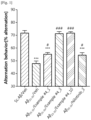
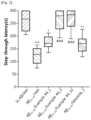
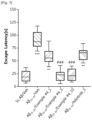
- Example 4 (1, 3 and 10 mg/kg), Example 8 (1 and 3 mg/kg) and nilotinib (3 mg/kg) was administered orally once daily to the A ⁇ 25-35 induced AD mice for 10 days and spontaneous alternation performance in the Y-maze, an index of spatial working memory and step-through passive avoidance (STPA) test were performed.
- STPA passive avoidance
- ICV injection of oligomeric A ⁇ 25-35 peptide triggered neurotoxic effects and behavioral deficit in Y-maze test evaluating short term memory, by measurement of spontaneous alternation, while any change of motor symptom was not observed by measurement of locomotion.
- Oxidative stress is considered to be a major mechanism of neuronal toxicity induced by A ⁇ 25-35 peptide through mitochondrial dysfunction (Ref: Meunier et al. Eur J. Pharm 2012 ), which is successfully inhibited by Example 4.
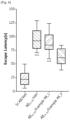
- Example 4 very significantly and fully alleviated deficits of alternation behavior and contextual long-term memory in a dose-response manner, while nilotinib partially alleviated spatial working memory deficits or showed no significant effect on contextual long-term memory deficits.
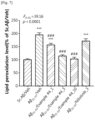
- the results are shown in Figures 1 to 7 .
- the result indicates that the compounds have high neuroprotective activity and low cardiovascular events and thus can be useful to treat or inhibit neurodegenerative disease such as Parkinson's disease, Alzheimer's disease and/or ALS.
Landscapes
- Chemical & Material Sciences (AREA)
- Health & Medical Sciences (AREA)
- Organic Chemistry (AREA)
- Medicinal Chemistry (AREA)
- Veterinary Medicine (AREA)
- Public Health (AREA)
- General Health & Medical Sciences (AREA)
- Animal Behavior & Ethology (AREA)
- Life Sciences & Earth Sciences (AREA)
- Pharmacology & Pharmacy (AREA)
- Neurology (AREA)
- Engineering & Computer Science (AREA)
- Bioinformatics & Cheminformatics (AREA)
- Epidemiology (AREA)
- Neurosurgery (AREA)
- Biomedical Technology (AREA)
- Chemical Kinetics & Catalysis (AREA)
- Nuclear Medicine, Radiotherapy & Molecular Imaging (AREA)
- General Chemical & Material Sciences (AREA)
- Psychology (AREA)
- Hospice & Palliative Care (AREA)
- Psychiatry (AREA)
- Orthopedic Medicine & Surgery (AREA)
- Physical Education & Sports Medicine (AREA)
- Pharmaceuticals Containing Other Organic And Inorganic Compounds (AREA)
- Plural Heterocyclic Compounds (AREA)
- Thiazole And Isothizaole Compounds (AREA)
- Nitrogen Condensed Heterocyclic Rings (AREA)
- Nitrogen And Oxygen Or Sulfur-Condensed Heterocyclic Ring Systems (AREA)
- Medicines That Contain Protein Lipid Enzymes And Other Medicines (AREA)
- Nitrogen- Or Sulfur-Containing Heterocyclic Ring Compounds With Rings Of Six Or More Members (AREA)
Description
- The present disclosure generally relates to compounds having enzyme inhibitory activity, pharmaceutical compositions comprising the compound, and methods of using the compounds for treating diseases.
- This application claims the benefits of, and priority to,
U.S. provisional application serial numbers 62/566,649 filed 2 October 2017 62/666,800 filed 4 May 2018 62/696,432 filed 11 July 2018 - α-synuclein is part of a large family of proteins including β- and γ-synuclein and synoretin. α-synuclein is expressed in the normal state associated with synapses and is believed to play a role in neural plasticity, learning and memory. Several studies have implicated α-synuclein with a central role in Parkinson disease pathogenesis. Molecular changes in the α-synuclein protein that increase protein misfolding and aggregation have a direct role in disease pathogenesis. Aggregation of α-synuclein contributes to the formation of Lewy bodies and neutrites, the pathologic hallmarks of Parkinson disease and α-synucleinopathies. Activation of tyrosine kinase c-abl contributes to α-synuclein-induced ncurodcgcncration.
- The tyrosine kinase c-abl is tightly regulated non-receptor protein tyrosine kinase involved in a wide range of cellular processes, including growth, survival and stress response (Nat Rev Mol Cell Biol, 2004, 5:33-44) and c-abl involved in regulation several cellular processes and has implicated in the development of the central nervous system by controlling neurogenesis. More recently, increasing evidence from various experimental model systems has also revealed that c-abl is activated in neurodegenerative disease such as Alzheimer's disease, Parkinson's disease, Neiman-Pick type C diseases and tauopathies. (Human Molecular Genetics, 2014, Vol. 23, No.11)
- The stress-signaling non-receptor tyrosine kinase c-ab1 links parkin to sporadic forms of Parkinson's disease via tyrosine phosphorylation. Tyrosine phosphorylation of parkin by c-abl is a major post-translational modification that leads to loss of parkin function and disease progression in sporadic Parkinson disease. Inhibition of c-abl offers new therapeutic opportunities for blocking Parkinson disease progression. (The Journal of Neuroscience, 2011, 31(1):157-163) Amyotrophic lateral sclerosis (ALS) is a fatal neurodegenerative disease characterized by progressive death of motor neurons. Knockdown of c-abl with small interfering RNAs (siRNAs) also rescued ALS motor neuron degeneration. (Imamura et al., Sci. Transl. Med. 9, 2017) Multiple System Atrophy (MSA) is a rare, rapidly progressive neurodegenerative disease without any current treatment. In MSA there is accumulation of α-synuclein in the neurons and oligodendrocytes of the substantia nigra, striatum, olivopontocerebellar structures and spinal cord. (J Neural Transm Vienna Austria 1996. 2016;123(6))
- Administration of the tyrosine kinase inhibitor nilotinib decreases c-abl activity and ameliorates autophagic clearance of α-synuclein in transgenic and lentiviral gene transfer models. Activation of c-abl in the mouse forebrain induces neurodegeneration in the hippocampus and striatum. Therefore, an increase in c-abl activity via phosphorylation may be associated with the α-synuclein pathology detected in Parkinson disease and other neurodegenerative disease. (Hum Mol Genet. 2013 Aug 15).
- c-abl is a potential therapeutic target for α-synucleinopathy, Parkinson disease, Alzheimer disease, ALS, Dementia with Lewy body and MSA.
-
WO 2010/008847 describes compounds having a heterobicyclic core, such as benzothiazol, substituted with an amid containing moiety, such as acetamido, for treating cancer. -
KR 2014 0107153 A WO 2010/144909 A1 describes fused heterocyclic compounds and their uses. - Thus one object of the present disclosure is to provide a compound having c-ab1 kinase inhibitory activity, a composition comprising the compound, a pharmaceutical composition comprising the compound as an effective agent, and medical-uses thereof for treating or preventing neurodegenerative disorders. Another object of the present disclosure is to provide a method for treating or ameliorating neurodegenerative disorders comprising administering to a subject in need of treatment, amelioration or prevention of neurodegenerative disorders a compound having c-ab1 kinase inhibitory activity according to the present disclosure.
- The present disclosure provides a compound having c-abl kinase inhibitory activity, a composition comprising the compound and a method useful to treat a neurodegenerative disease. In an embodiment, the compound is a compound of Formula (I):

- R1 is cyclopropyl, wherein R1 is
substituted with one or more groups selected from the group consisting of halo, alkyl, hydroxyalkyl and haloalkyl, - R2 and R3 are independently -H, halo, alkyl, alkoxy, -CF3, or -OCF3,
- R4 is aryl, monocyclic heteroaryl, cycloalkyl, or heterocyclyl, wherein R4 is optionally substituted with one or more groups selected from the group consisting of halo, hydroxyl, alkyl, alkenyl, alkynyl, haloalkyl, hydroxyalkyl, trimethylsilylethoxymethyl, -NO2, -NRaRb, -NRaC(=O)Rb, -NRaC(=O)NRaRb, -NRaC(=O)ORb, - ORa, -CN, -C(=O)Ra, -C(=O)ORa, -C(=O)NRaRb, -OC(=O)Ra, -OC(=O)ORa, - OC(=O)NRaRb, -SRa, azetidinyl, oxetanyl, tetrahydrofuranyl, furanyl, pyrrolidinyl, pyrrolyl, pyrazolyl, thiophenyl, imidazolyl, oxazolyl, isoxazolyl, thiazolyl, furazanyl, oxadiazolyl, thiadiazolyl, phenyl, tetrahydropyranyl, pyranyl, pyridinyl, pyridazinyl, pyrimidinyl, pyrazinyl, piperidinyl, piperazinyl, morpholinyl and thiomorpholinyl, and
- Ra and Rb are independently -H, halo, amino, alkyl, or haloalkyl.
- In another embodiment, the present disclosure provides pharmaceutical compositions comprising a therapeutically effective amound of a compound decribed herein and a pharmaccutically-acccptablc carrier.
- In yet another embodiment, the present disclosure provides one or more compounds or pharmaceutically acceptable salts thereof, in a therapeutically effective amount, for use in treating a neurodegenerative disorder in a subject.
- The following description is merely exemplary in nature and is not intended to limit the present disclosure, application, or uses.
- The generic terms used in the present disclosure are herein defined for clarity.
- This specification uses the terms "substituent", "radical", "group", "moiety", and "fragment" interchangeably.
- As used herein, the term "alkenyl" refers to a straight or branched hydrocarbonyl group with at least one site of unsaturation, i.e., a carbon-carbon, sp2 double bond. In an embodiment, alkenyl has from 2 to 12 carbon atoms. In some embodiments, alkenyl is a C2-C10 alkenyl group or a C2-C6 alkenyl group. Examples of alkenyl group include, but are not limited to, ethylene or vinyl (-CH-CH2), allyl (-CH2CH-CH2), cyclopentenyl (-C5H7), and 5-hexenyl (-CH2CH2CH2CH2CH-CH2).
- As used herein, the term "alkoxy" is RO- where R is alkyl. Non-limiting examples of alkoxy groups include methoxy, ethoxy and propoxy.
- As used herein, the term "alkoxyalkyl" refers to an alkyl moiety substituted with an alkoxy group. Examples of alkoxyalkyl groups include methoxymethyl, methoxyethyl, methoxypropyl and ethoxyethyl.
- As used herein, the term "alkoxycarbonyl" is ROC(O)-, where R is an alkyl group as defined herein. In various embodiments, R is a C1-C10 alkyl group or a C1-C6 alkyl group.
- As used herein, the term "alkyl" refers to a straight or branched chain hydrocarbonyl group. In an embodiment, alkyl has from 1 to 12 carbon atoms. In some embodiments, alkyl is a C1-C10 alkyl group or a C1-C6 alkyl group. Examples of alkyl groups include, but are not limited to, methyl, ethyl, propyl, isopropyl, butyl, isobutyl, t-butyl, pentyl, hexyl, heptyl, octyl, nonyl and decyl. "lower alkyl" means alkyl having from 1 to 4 carbon atoms.
- As used herein, if the term "C1-C6" is used, it means the number of carbon atoms is from 1 to 6. For example, C1-C6 alkyl means an alkyl which carbon number is any integer of from 1 to 6.
- As used herein, the term "alkylamino" refers to an amino group substituted with one or more alkyl groups. "N-(alkyl)amino" is RNH- and "N,N-(alkyl)2amino" is R2N-, where the R groups are alkyl as defined herein and are the same or different. In various embodiments, R is a C1-C10 alkyl group or a C1-C6 alkyl group. Examples of alkylamino groups include methylamino, ethylamino, propylamino, butylamino, dimethylamino, diethylamino, and methylethylamno.
- As used herein, the term "alkylaminoalkyl" refers to an alkyl moiety substituted with an alkylamino group, wherein alkylamino is as defined herein. Examples of alky-laminoakyl groups include methylaminomethyl and ethylaminomethyl.
- As used herein, the term "alkynyl" refers to a straight or branched carbon-chain group with at least one site of unsaturation, i.e., a carbon-carbon, sp triple bond. In an embodiment, alkynyl has from 2 to 12 carbon atoms. In some embodiments, alkynyl is a C2-C10 alkynyl group or a C2-C6 alkynyl group. Examples of alkynyl groups include acetylenic (-C≡CH) and propargyl (-CH2C≡CH).
- As used herein, the term "aryl" refers to any monocyclic or bicyclic carbon ring of up to 7 atoms in each ring, wherein at least one ring is aromatic, or an aromatic ring system of 5 to 14 carbon atoms which includes a carbocyclic aromatic group fused with a 5-or 6-membered cycloalkyl group. Representative examples of aryl groups include, but are not limited to, phenyl, tolyl, xylyl, naphthyl, tetrahydronaphthyl, anthracenyl, fluorenyl, indenyl, azulenyl and indanyl. A carbocyclic aromatic group can be unsubstituted or optionally substituted.
- As used herein, the term "cycloalkyl" is a hydrocarbyl group containing at least one saturated or partially unsaturated ring structure, and attached via a ring carbon. In various embodiments, it refers to a saturated or a partially unsaturated C3-C12 cyclic moiety, examples of which include cyclopropyl, cyclobutyl, cyclopentyl, cyclopentenyl, cyclohexyl, cyclohexenyl, cycloheptyl and cyclooctyl. "Cycloalkyloxy" is RO-, where R is cycloalkyl.
- As used herein, the terms "halogen" and "halo" refers to chloro (-Cl), bromo (-Br), fluoro (-F) or iodo (-I). "Haloalkoxy" refers to an alkoxy group substituted with one or more halo groups and examples of haloalkoxy groups include, but are not limited to, - OCF3, -OCHF2 and -OCH2F. "Haloalkoxyalkyl" refers to an alkyl moiety substituted with a haloalkoxy group, wherein haloalkoxy is as defined herein. Examples of haloalkoxyalkyl groups include trifluoromethoxymethyl, trifluoroethoxymethyl and tri-fluoromethoxyethyl. "Haloalkyl" refers to an alkyl moiety substituted with one or more halo groups. Examples of haloalkyl groups include -CF3 and -CHF2.
- As used herein, the term "heteroalkyl" refers to a straight- or branched-chain alkyl group having from 2 to 14 carbons (in some embodiments, 2 to 10 carbons) in the chain, one or more of which has been replaced by a heteroatom selected from S, O, P and N. Exemplary heteroalkyls include alkyl ethers, secondary and tertiary alkyl amines, amides, alkyl sulfides, and the like.
- As used herein, the term "heterocyclyl" refers to a saturated or partially unsaturated monocyclic, bicyclic or tricyclic group of 2 to 14 ring-carbon atoms and, in addition to ring-carbon atoms, 1 to 4 heteroatoms selected from P, N, O and S. In various embodiments the heterocyclic group is attached to another moiety through carbon or through a heteroatom, and is optionally substituted on carbon or a heteroatom. Examples of heterocyclyl include azetidinyl, indolinyl, oxetanyl, tetrahydropyranyl, tetrahydrothiopyranyl, tetrahydroisoquinolinyl, azetidinyl, 1,4-dioxanyl, hexahydroazepinyl, piperazinyl, piperidinyl, pyrrolidinyl, morpholinyl, thiomorpholinyl, dihydrobenzoimidazolyl, dihydrobenzofuranyl, dihydrobenzothiophenyl, dihydrobenzoxazolyl, dihydrofuranyl, dihydroimidazolyl, dihydroindolyl, dihydroisooxazolyl, dihydroisothiazolyl, dihydrooxadiazolyl, dihydrooxazolyl, dihydropyrazinyl, dihydropyrazolyl, dihydropyridinyl, dihydropyrimidinyl, dihydropyrrolyl, dihydroquinolinyl, dihydrotetrazolyl, dihydrothiadiazolyl, dihydrothiazolyl, dihydrothienyl, dihydrotriazolyl, dihydroazetidinyl, methylenedioxybenzoyl, tetrahydrofuranyl, and tetrahydrothienyl, and N-oxides thereof. "Heterocyclyloxy" is RO-, where R is heterocyclyl. "Heterocyclylthio" is RS-, where R is heterocyclyl.
- As used herein, the term "3- or 4-membered heterocyclyl" refers to a monocyclic ring having 3 or 4 ring atoms wherein at least one ring atom is heteroatom selected from the group consisting of N, O and S. Non-limiting examples of 3- or 4-membered heterocyclyl include aziridinyl, 2H-azirinyl, oxiranyl, thiiranyl, azetidinyl, 2,3-dihyroazetyl, azetyl, 1,3-diazetidinyl, oxetanyl, 2H-oxetyl, thietanyl, and 2H - thietyl.
- As used herein, the term "heteroaryl" refers to a monocyclic, bicyclic or tricyclic ring having up to 7 atoms in each ring, wherein at least one ring is aromatic and contains from 1 to 4 heteroatoms in the ring selected from the group consisting of N, O and S. Non-limiting examples of heteroaryl include pyridyl, thienyl, furanyl, pyrimidyl, imidazolyl, pyranyl, pyrazolyl, thiazolyl, thiadiazolyl, isothiazolyl, oxazolyl, isoxazoyl, pyrrolyl, pyridazinyl, pyrazinyl, quinolinyl, isoquinolinyl, benzofuranyl, dibenzofuranyl, dibenzothiophenyl, benzothienyl, indolyl, benzothiazolyl, benzooxazolyl, benzimidazolyl, isoindolyl, benzotriazolyl, purinyl, thianaphthenyl and pyrazinyl. Attachment of heteroaryl can occur via an aromatic ring, or, if heteroaryl is bicyclic or tricyclic and one of the rings is not aromatic or contains no heteroatoms, through a non-aromatic ring or a ring containing no heteroatoms. "Heteroaryl" is also understood to include the N-oxide derivative of any nitrogen containing heteroaryl. "Heteroaryloxy" is RO-, where R is heteroaryl.
- As used herein, the term "hydroxyalkoxy" refers to an alkoxy group substituted with a hydroxyl group (-OH), wherein alkoxy is as defined herein. An example of hydroxyalkoxy is hydroxyethoxy.
- As used herein, the term "hydroxyalkyl" refers to a linear or branched monovalent C1 -C10 hydrocarbon group substituted with at least one hydroxy group and examples of hydroxyalkyl groups include, but are not limited to, hydroxymethyl, hydroxyethyl, hydroxypropyl and hydroxybutyl.
- As used herein, the term "pharmaceutically acceptable" means suitable for use in pharmaceutical preparations, generally considered as safe for such use, officially approved by a regulatory agency of a national or state government for such use, or being listed in the U.S. Pharmacopoeia or other generally recognized pharmacopoeia for use in animals, and more particularly in humans.
- As used herein, the term "pharmaceutically acceptable carrier" refers to a diluent, adjuvant, excipient, or carrier, or other ingredient which is pharmaceutically-acceptable and with which a compound of the invention is administered.
- As used herein, the term "pharmaceutically acceptable salt" refers to a salt which may enhance desired pharmacological activity. Examples of pharmaceutically-acceptable salts include acid addition salts formed with inorganic or organic acids, metal salts and amine salts. Examples of acid addition salts formed with inorganic acids include salts with hydrochloric acid, hydrobromic acid, sulfuric acid, nitric acid and phosphoric acid. Examples of acid addition salts formed with organic acids such as acetic acid, propionic acid, hexanoic acid, heptanoic acid, cyclopentanepropionic acid, glycolic acid, pyruvic acid, lactic acid, malonic acid, succinic acid, malic acid, maleic acid, fumaric acid, tartaric acid, citric acid, benzoic acid, o-(4-hydroxy-benzoyl)-benzoic acid, cinnamic acid, mandelic acid, methanesulfonic acid, ethanesulfonic acid, 1,2-ethanedisulfonic acid, 2-hydroxyethane-sulfonic acid, benzenesulfonic acid, p-chlorobenzenesulfonic acid, 2-naphthalenesulfonic acid, p-toluenesulfonic acid, camphorsulfonic acid, 4-methyl-bicyclo[2.2.2]oct-2-ene1-carboxylic acid, gluco-heptonic acid, 4,4'-methylenebis(3-hydroxy-2-naphthoic) acid, 3-phenylpropionic acid, trimethylacetic acid, tertiary butylacetic acid, lauryl sulfuric acid, gluconic acid, glutamic acid, hydroxy-naphthoic acids, salicylic acid, stearic acid and muconic acid. Examples of metal salts include salts with sodium, potassium, calcium, magnesium, aluminum, iron, and zinc ions. Examples of amine salts include salts with ammonia and organic nitrogenous bases strong enough to form salts with carboxylic acids.
- As used herein, the term "substituted" means any of above groups (i.e., alkyl, aryl, heteroaryl, heterocycle or cycloalkyl) wherein at least one hydrogen atom of the moiety being substituted is replaced with a substituent. In one embodiment, each carbon atom of the group being substituted is substituted with no more than two substituents. In another embodiment, each carbon atom of the group being substituted is substituted with no more than one substituent. In the case of a keto substituent, two hydrogen atoms are replaced with an oxygen which is attached to the carbon via a double bond. Unless specifically defined, substituents include halogen, hydroxyl, (lower) alkyl, haloalkyl, mono- or di-alkylamino, aryl, heterocycle, -NO2, B(OH)2, BPin, -NRaRb, -NRaC(=O)Rb, -NRaC(=O)NRaRb, -NRaC(=O)ORb, -NRaSO2Rb, -ORa, - CN, -C(=O)Ra, -C(=O)ORa, -C(=O)NRaRb, -OC(=O)Ra, -OC(=O)ORa, -OC(=O)NRaRb, -NRaSO2Rb, -PO3Ra, -PO(ORa)(ORb), -SO2Ra, -S(O)Ra, -SO(N)Ra (e.g., sulfoximine), - (Ra)S=NRb (e.g., sulfilimine) and -SRa, wherein Ra and Rb are the same or different and independently hydrogen, halogen, amino, alkyl, haloalkyl, aryl or heterocycle, or wherein Ra and Rb taken together with the nitrogen atom to which they are attached form a heterocycle. Ra and Rb may be in the plural based on atoms which those are attached to.
- As used herein, the term "therapeutically effective amount" means when applied to a compound of the invention is intended to denote an amount of the compound that is sufficient to ameliorate, palliate, stabilize, reverse, slow or delay the progression of a disorder or disease state, or of a symptom of the disorder or disease. In an embodiment, the method of the present invention provides for administration of combinations of compounds. In such instances, the "therapeutically effective amount" is the amount of a compound of the present invention in the combination sufficient to cause the intended biological effect.
- As used herein, the term "treatment" or "treating" as used herein means ameliorating or reversing the progress or severity of a disease or disorder, or ameliorating or reversing one or more symptoms or side effects of such disease or disorder. "Treatment" or "treating", as used herein, also means to inhibit or block, as in retard, arrest, restrain, impede or obstruct, the progress of a system, condition or state of a disease or disorder. For purposes of this invention, "treatment" or "treating" further means an approach for obtaining beneficial or desired clinical results, where "beneficial or desired clinical results" include, without limitation, alleviation of a symptom, diminishment of the extent of a disorder or disease, stabilized (i.e., not worsening) disease or disorder state, delay or slowing of a disease or disorder state, amelioration or palliation of a disease or disorder state, and remission of a disease or disorder, whether partial or total.
- In another embodiment, the compounds of Formula (I) are used for modulating the activity of a protein kinase c-abl.
- As used herein, the term "modulating" or "modulation" refers to the alteration of the catalytic activity of a protein kinase. In particular, modulating refers to the activation or inhibition of the catalytic activity of a protein kinase, depending on the concentration of the compound or salt to which the protein kinase is exposed or, more preferably, the inhibition of the catalytic activity of a protein kinase. The term "catalytic activity" as used herein refers to the rate of phosphorylation of tyrosine, serine or threonine under the influence, direct or indirect, of a protein kinase.
- The three main classes that pharmacological inhibitors of kinase activity are categorized by are (1) Type I, or "DFG-in" ATP competitive inhibitors, which directly compete with ATP in the ATP binding site (i.e., dual SRrc ABL inhibitor dasatinib, (2) Type II, or "DFG-out" ATP competitive inhibitors, which, in addition to binding the ATP binding site also engage an adjacent hydrophobic binding site that is only accessible when the kinase is in an inactivated configuration (i.e., the activation loop is oriented in a conformation that would block substrate binding) (i.e., imatinib, nilotinib), and (3) non-ATP competitive inhibitors that bind at sites outside the ATP binding site that affect the activity of the kinase (i.e. GNF-2).
- As used herein, the phrase "compound(s) of this/the disclosure" includes any compound(s) of Formula (I), as well as clathrates, hydrates, solvates, or polymorphs thereof. And, even if the term "compound(s) of the disclosure" does not mention its pharmaceutically acceptable sat, the term includes salts thereof. In one embodiment, the compounds of this disclosure include stereochemically pure compounds, e.g., those substantially free (e.g., greater than 85% ee, greater than 90% ee, greater than 95% ee, greater than 97% ee, or greater than 99% ee) of other stereoisomers. That is, if the compounds of Formula (I) according to the present disclosure or salts thereof are tautomeric isomers and/or stereoisomers (e.g., geometrical isomers and conformational isomers), such isolated isomers and their mixtures also are included in the scope of this disclosure. If the compounds of the present disclosure or salts thereof have an asymmetric carbon in their structures, their active optical isomers and their racemic mixtures also are included in the scope of this disclosure.
- As used herein, the term "polymorph" refers to solid crystalline forms of a compound of this disclosure or complex thereof. Different polymorphs of the same compound can exhibit different physical, chemical and/or spectroscopic properties. Different physical properties include, but are not limited to stability (e.g., to heat or light), compressibility and density (important in formulation and product manufacturing), and dissolution rates (which can affect bioavailability). Differences in stability can result from changes in chemical reactivity (e.g., differential oxidation, such that a dosage form discolors more rapidly when comprised of one polymorph than when comprised of another polymorph) or mechanical characteristics (e.g., tablets crumble on storage as a kinetically favored polymorph converts to thermodynamically more stable polymorph) or both (e.g., tablets of one polymorph are more susceptible to breakdown at high humidity). Different physical properties of polymorphs can affect their processing. For example, one polymorph might be more likely to form solvates or might be more difficult to filter or wash free of impurities than another due to, for example, the shape or size distribution of particles of it.
- As used herein, the term "solvate" means a compound or its salt according to this disclosure that further includes a stoichiometric or non-stoichiometric amount of a solvent bound by non-covalent intermolecular forces. Preferred solvents are volatile, non-toxic, and/or acceptable for administration to humans in trace amounts.
- As used herein, the term "hydrate" means a compound or its salt according to this disclosure that further includes a stoichiometric or non-stoichiometric amount of water bound by non-covalent intermolecular forces.
- As used herein, the term "clathrate" means a compound or its salt in the form of a crystal lattice that contains spaces (e.g., channels) that have a guest molecule (e.g., a solvent or water) trapped within.
- The present disclosure provides a compound of Formula (I):
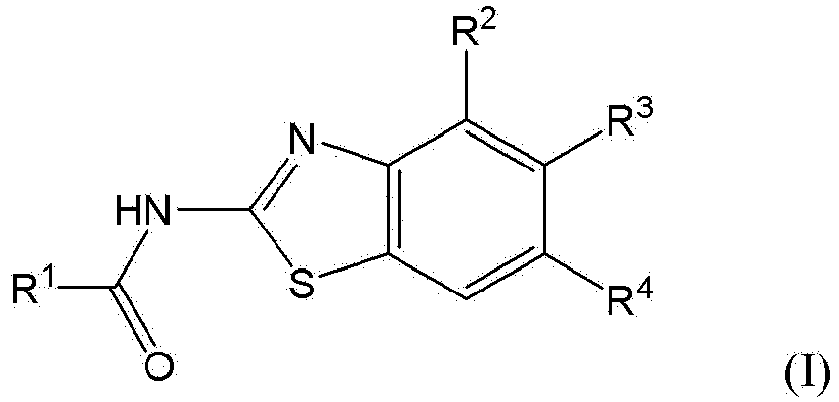
- R1 is cyclopropyl, wherein R1 is
substituted with one or more groups selected from the group consisting of halo, alkyl, hydroxyalkyl, haloalkyl, and monoalkylaminoalkyl, - R2 and R3 are independently -H, halo, alkyl, alkoxy, -CF3, or -OCF3,
- R4 is aryl, monocyclic heteroaryl, cycloalkyl, or heterocyclyl, wherein R4 is optionally substituted with one or more groups selected from the group consisting of halo, hydroxyl, alkyl, alkenyl, alkynyl, haloalkyl, hydroxyalkyl, trimethylsilylethoxymethyl, -NO2, -NRaRb, -NRaC(=O)Rb, -NRaC(=O)NRaRb, -NRaC(=O)ORb, - ORa, -CN, -C(=O)Ra, -C(=O)ORa, -C(=O)NRaRb, -OC(=O)Ra, -OC(=O)ORa, - OC(=O)NRaRb, -SRa, azetidinyl, oxetanyl, tetrahydrofuranyl, furanyl, pyrrolidinyl, pyrrolyl, pyrazolyl, thiophenyl, imidazolyl, oxazolyl, isoxazolyl, thiazolyl, furazanyl, oxadiazolyl, thiadiazolyl, phenyl, tetrahydropyranyl, pyranyl, pyridinyl, pyridazinyl, pyrimidinyl, pyrazinyl, piperidinyl, piperazinyl, morpholinyl and thiomorpholinyl, and
- Ra and Rb are independently -H, halo, amino, alkyl, or haloalkyl.
- In some embodiments, R1 is cyclopropyl, wherein R1 is
substituted with one or more groups selected from the group consisting of halo, C1-C3 alkyl, C1-C3 hydroxyalkyl and C1-C3 haloalkyl; R2 and R3 are independently -H, halo, C1-C3 alkyl, C1-C3 alkoxy, -CF3, or -OCF3; R4 is aryl, monocyclic heteroaryl, cycloalkyl, or heterocyclyl, wherein R4 is optionally substituted with one or more groups selected from the group consisting of halo, hydroxyl, C1-C3 alkyl, C2-C3 alkenyl, C2-C3 alkynyl, C1-C3 haloalkyl, mono-C1-C3 alkylamino, di-C1-C3 alkylamino, -NO2, -NRaRb, -NRaC(=O)Rb, -NRaC(=O)NRaRb, -NRaC(=O)ORb, -ORa, - CN, -C(=O)Ra, -C(=O)ORa, -C(=O)NRaRb, -OC(=O)Ra, -OC(=O)ORa, -OC(=O)NRaRb, -SRa, azetidinyl, oxetanyl, tetrahydrofuranyl, furanyl, pyrrolidinyl, pyrrolyl, pyrazolyl, thiophenyl, imidazolyl, oxazolyl, isoxazolyl, thiazolyl, furazanyl, oxadiazolyl, thiadiazolyl, phenyl, tetrahydropyranyl, pyranyl, pyridinyl, pyridazinyl, pyrimidinyl, pyrazinyl, piperidinyl, piperazinyl, morpholinyl and thiomorpholinyl, and Ra and Rb are independently -H, halo, amino, C1-C3 alkyl, or C1-C3 haloalkyl. - In particular embodiments, R1 is fluorocyclopropyl, hydroxycyclopropyl, hydroxymethylcyclopropyl, difluorocyclopropyl, methylaminomethylcyclopropyl.
- In other particular embodiments, R1 is fluorocyclopropyl.
- In some embodiments, R2 and R3 are independently -H, methyl, or fluoro.
- In some embodiments, R4 is phenyl, pyridinyl, pyrimidinyl, pyrazolyl, thiazolyl, pyrazolyl, thiophenyl, or isothiazolyl, wherein R4 is optionally substituted with one or more groups selected from the group consisting of halo, alkyl, alkenyl, alkynyl, hydroxyalkyl, amino, cyano, acetyl, hydroxy, and haloalkyl. In particular embodiments, R4 is fluoro-methylphenyl, chloro-methylphenyl, dimethylphenyl, acetamido-methylphenyl, hydroxy-methylphenyl, hydroxypropanyl-methylphenyl, methyl-propenylphenyl, methyl-pyridinylethynylphenyl, methyl-pyrrolylphenyl, methyl-thiazolylphenyl, imidazolyl-methylphenyl, cyano-methylphenyl, methyl-pyrazolylphenyl, ethynyl-methylphenyl, methylpyridinyl, fluoro-methyl-methylaminophenyl, dimethylpyridinyl, fluoro-methylpyridinyl, fluoromethyl-methylpyridinyl, cyanopyridinyl, trifluoromethyl-methylpyridinyl, hydroxymethylpyridinyl, hydroxymethyl-methylpyridinyl, hydroxyethyl-methylpyridinyl, chloro-methylpyridinyl, aminopyridinyl, acetyl-methylpyridinyl, amino-dimethylpyridinyl, hydroxyethyl-methylprydinyl, methylpyrimidinyl, dimethylpyrimidinyl, trifluoromethylpyrimidinyl, pyrazolyl, methylthiazolyl, methyl-tetrahydropyranyl, methylpyrazolyl, methylisothiazolyl, chloro-methylisothiazolyl, dimethylisothiazolyl. In particular embodiments, R4 is fluoro-methylphenyl, chloro-methylphenyl, bimethylphenyl, acetamido-methylphenyl, hydroxyl-methylphenyl, methyl-propenylphenyl, ethynyl-methylphenyl, fluoro-methyl-methylaminophenyl, methyl-pyrrolylphenyl, methyl-thiazolylphenyl, cyano-methylphenyl, imidazolyl-methylphenyl, methylpyridinyl, chloro-methylpyridinyl, fluoro-methylpyridinyl, fluoromethyl-methylpyridinyl, bimethylpyridinyl, aminopyridinyl, amino-dimethylpyridinyl, methoxypyridinyl, acetyl-methylpyridinyl, hydroxymethylpyridinyl, hydroxymethyl-methylpyridinyl, hydroxyethyl-methylpyridinyl, cyanopyridinyl, trifluoromethylpyridinyl, methylthiophenyl, methylpyrimidinyl, dimethylpyrimidinyl, pyrazolyl, methylpyrazolyl, methylpyrrolyl, methylisothiazolyl, dimethylisothiazolyl. In particular embodiments, R4 is pyridinyl or phenyl that has one ore more substitutions selected from the group consisting of alkyl, alkenyl, alkynyl, halo, hydroxyl, hydroxyalkyl, haloalkyl, cyano, amino, alkoxy, and haloalkoxy. In some particular embodiments, R4 is selected from the group consisting of:


- In some embodiments, R1 is fluorocyclopropyl, difluorocyclopropyl ; R2 and R3 are independently -H, methyl, or fluoro; and R4 is fluoro-methylphenyl, chloro-methylphenyl, bimethylphenyl, acetamido-methylphenyl, hydroxyl-methylphenyl, methyl-propenylphenyl, ethynyl-methylphenyl, fluoro-methyl-methylaminophenyl, methyl-pyrrolylphenyl, methyl-thiazolylphenyl, cyano-methylphenyl, imidazolyl-methylphenyl, methylpyridinyl, chloro-methylpyridinyl, fluoro-methylpyridinyl, fluoromethyl-methylpyridinyl, bimethylpyridinyl, aminopyridinyl, amino-dimethylpyridinyl, methoxypyridinyl, acetyl-methylpyridinyl, hydroxymethylpyridinyl, hydroxymethyl-methylpyridinyl, hydroxyethyl-methylpyridinyl, cyanopyridinyl, trifluoromethylpyridinyl, methylthiophenyl, methylpyrimidinyl, dimethylpyrimidinyl, pyrazolyl, methylpyrazolyl, methylpyrrolyl, methylisothiazolyl, dimethylisothiazolyl.
- The inventors had synthesized and evaluated lots of compounds to find out compounds having good c-abl inhibition activity and high selectivity against c-abl, thereby having good effect against neurodegenerative disease.
- In more detail, the compounds in which R1 and benzothiazole are connected by - SO-NH-, -C(O)O-NH- or -NH-CO-NH-, not -CO-NH- according to the present disclosure, do not show good efficacy. When R1 is not C3-C4 cycloalkyl, the compounds show poor pharmacokinetic property or intrinsic activity, which leads to a poor efficacy. When the substituent of the cycloalkyl of R1 is Br or Cl, it may create a relatively toxic material by bio-conjugation with a reactive nucleophile such as glu-tathione.
- When R2 or R3 is bulky, for example, aryl, such compounds show less favorable IC50. In particular, the compounds wherein R3 is hydrogen are more preferable in this respect. When the aryl or cyclyl substituent of R3 is too bulky, it also increases the IC50 for c-abl kinase.
- When the substituent of R4 comprises -NHSO2- and so on, such compounds show bad efficacy and low permeability of blood-brain barrier. In case that the cyclyl ring of R4 is a monocycle or bicycle indole, its ortho-position preferably has CH3, Cl, Br, CF3, CHF2, CH2F, methoxy, ethyl, cyclopropyl, acetylenic, or vinyl. Even if its ortho-position does not have such group, hydrogen bonding source of meta-position can maintain good activity even without such substituent at the ortho-position. Preferably, in case that the cyclyl ring of R4 is a monocycle or bicycle indole, its ortho-position preferably has CH3, Cl, Br, CF3, CHF2, CH2F, methoxy, ethyl, cyclopropyl, acetylenic, or vinyl, and its meta- and/or para-position has hydrogen bonding source such as -OH, -NH, or F.
- In some embodiments, R1 is fluorocyclopropyl and non-limiting examples include the following compounds and pharmaceutically acceptable salts thereof:
- 2=fluoro-N-(6-(2-fluoro-6-methylphenyl)benzo[d]thiazol-2-yl)cyclopropane-1-carbox amide;
- N-(6-(2-chloro-6-methylphenyl)benzo[d]thiazol-2-yl)-2-fluorocyclopropane-1-carbo xamide;
- N-(6-(2,6-dimethylphenyl)benzo[d]thiazol-2-yl)-2-fluorocyclopropane-1-carboxamid e;
- 2-fluoro-N-(6-(4-methylpyridin-3-yl)benzo[d]thiazol-2-yl)cyclopropane-1-carboxami de;
- 2-fluoro-N-(6-(5-fluoro-4-methylpyridin-3-yl)benzo[d]thiazol-2-yl)cyclopropane-1-c arboxamide;
- 2-fluoro-N-(6-(2-methyl-5-(prop-1-en-2-yl)phenyl)benzo[d]thiazol-2-yl)cyclopropan e-1 -carboxamide;
- N-(6-(2-chloro-4-methylpyridin-3-yl)benzo[d]thiazol-2-yl)-2-fluorocyclopropane-1-c arboxamide;
- N-(6-(2,4-dimethylpyridin-3-yl)benzo[d]thiazol-2-yl)-2-fluorocyclopropane-1-carbox amide;
- 2-fluoro-N-(6-(5-hydroxy-2-methylphenyl)benzo[d]thiazol-2-yl)cyclopropane-1-carb oxamide;
- 2-fluoro-N-(6-(5-(2-hydroxypropan-2-yl)-2-methylphenyl)benzo[d]thiazol-2-yl) cyclopropane-1-carboxamide;
- 2-fluoro-N-(6-(3-hydroxy-2-methylphenyl)benzo[d]thiazol-2-yl)cyclopropane-1-carb oxamide;
- N-(6-(6-amino-2,4-dimethylpyridin-3-yl)benzo[d]thiazol-2-yl)-2-fluorocyclopropane -1-carboxamide;
- 2-fluoro-N-(6-(2-fluoro-6-methylphenyl)thiazolo[4,5-c]pyridin-2-yl)cyclopropane-1-carboxamide;
- 2-fluoro-N-(6-(2-fluoro-6-methyl-3-(methylamino)phenyl)benzo[d]thiazol-2-yl) cyclopropane-1-carboxamide;
- 2-fluoro-N-(6-(4-methoxypyridin-3-yl)benzo[d]thiazol-2-yl)cyclopropane-1-carboxa mide;
- 2-fluoro-N-(6-(3-methylthiophen-2-yl)benzo[d]thiazol-2-yl)cyclopropane-1-carboxa mide;
- 2-fluoro-N-(6-(4-methylpyrimidin-5-yl)benzo[d]thiazol-2-yl)cyclopropane-1-carboxa mide;
- N-(6-(6-acetyl-4-methylpyridin-3-yl)benzo[d]thiazol-2-yl)-2-fluorocyclopropane-1-c arboxamide;
- N-(6-(4,6-dimethylpyridin-3-yl)benzo[d]thiazol-2-yl)-2-fluorocyclopropane-1-carbox amide;
- N-(6-(6-chloro-4-methylpyridin-3-yl)benzo[d]thiazol-2-yl)-2-fluorocyclopropane-1-c arboxamide;
- 2-fluoro-N-(6-(4-methyl-6-(trifluoromethyl)pyridin-3-yl)benzo[d]thiazol-2-yl)cyclop ropane-1 -carboxamide;
- 2-fluoro-N-(6-(4-(hydroxymethyl)pyridin-3-yl)benzo[d]thiazol-2-yl)cyclopropane-1-carboxamide;
- 2-fluoro-N-(6-(6-(hydroxymethyl)-4-methylpyridin-3-yl)benzo[d]thiazol-2-yl)cyclop ropane-1-carboxamide;
- 2-fluoro-N-(6-(6-(1-hydroxyethyl)-4-methylpyridin-3-yl)benzo[d]thiazol-2-yl)cyclop ropane-1-carboxamide;
- 2-fluoro-N-(6-(4-(trifluoromethyl)pyridin-3-yl)benzo[d]thiazol-2-yl)cyclopropane-1-carboxamide;
- N-(6-(1H-pyrazol-3-yl)benzo[d]thiazol-2-yl)-2-fluorocyclopropane-1-carboxamide;
- 2-fluoro-N-(6-(2-methyl-5-(pyridin-2-ylethynyl)phenyl)benzo[d]thiazol-2-yl)cyclopr opane-1-carboxamide;
- 2-fluoro-N-(6-(2-methyl-5-(1H-pyrazol-1-yl)phenyl)benzo[d]thiazol-2-yl)cyclopropa ne-1-carboxamide;
- 2-fluoro-N-(6-(5-(hydroxymethyl)-4-methylpyridin-3-yl)benzo[d]thiazol-2-yl)cyclop ropane-1-carboxamide;
- 2-fluoro-N-(4-fluoro-6-(4-methylpyridin-3-yl)benzo[d]thiazol-2-yl)cyclopropane-1-c arboxamide;
- 2-fluoro-N-(4-fluoro-6-(2-fluoro-6-methylphenyl)benzo[d]thiazol-2-yl)cyclopropane -1-carboxamide;
- 2-fluoro-N-(6-(5-methylthiazol-4-yl)benzo[d]thiazol-2-yl)cyclopropane-1-carboxami de;
- N-(6-(4,6-dimethylpyrimidin-5-yl)benzo[d]thiazol-2-yl)-2-fluorocyclopropane-1-car boxamide;
- N-(6-(5-ethynyl-2-methylphenyl)benzo[d]thiazol-2-yl)-2-fluorocyclopropane-1-carb oxamide;
- N-(6-(4-chloropyridin-3-yl)benzo[d]thiazol-2-yl)-2-fluorocyclopropane-1-carboxami de;
- N-(6-(4-cyanopyridin-3-yl)benzo[d]thiazol-2-yl)-2-fluorocyclopropane-1-carboxami de;
- 2-fluoro-N-(6-(2-fluoro-4-methylpyridin-3-yl)benzo[d]thiazol-2-yl)cyclopropane-1-c arboxamide;
- 2-fluoro-N-(6-(4-(trifluoromethyl)pyrimidin-5-yl)benzo[d]thiazol-2-yl)cyclopropane-1-carboxamide;
- 2-fluoro-N-(6-(2-methyl-5-(1H-pyrrol-3-yl)phenyl)benzo[d]thiazol-2-yl)cyclopropan e-1-carboxamide;
- 2-fluoro-N-(6-(2-methyl-5-(thiazol-2-yl)phenyl)benzo[d]thiazol-2-yl)cyclopropane-1 -carboxamide;
- N-(6-(5-cyano-2-methylphenyl)benzo[d]thiazol-2-yl)-2-fluorocyclopropane-1-carbox amide;
- 2-fluoro-N-(6-(4-methyl-1-(tetrahydro-2H-pyran-2-yl)-1H-pyrazol-3-yl)benzo[d]thia zol-2-yl)cyclopropane-1-carboxamide;
- 2-fluoro-N-(6-(4-methyl-1H-pyrazol-3-yl)benzo[d]thiazol-2-yl)cyclopropane-1-carbo xamide;
- 2-fluoro-N-(6-(2-methyl-5-(1H-pyrrol-2-yl)phenyl)benzo[d]thiazol-2-yl)cyclopropan e-1-carboxamide;
- 2-fluoro-N-(6-(2-methyl-5-(1H-pyrazol-3-yl)phenyl)benzo[d]thiazol-2-yl)cyclopropa ne-1-carboxamide;
- 2-fluoro-N-(6-(3-methylisothiazol-5-yl)benzo[d]thiazol-2-yl)cyclopropane-1-carboxa mide;
- N-(6-(4-chloro-3-methylisothiazol-5-yl)benzo[d]thiazol-2-yl)-2-fluorocyclopropane-1-carboxamide;
- N-(6-(3,4-dimethylisothiazol-5-yl)benzo[d]thiazol-2-yl)-2-fluorocyclopropane-1-carb oxamide;
- N-(6-(5-(1H-imidazol-2-yl)-2-methylphenyl)benzo[d]thiazol-2-yl)-2-fluorocycloprop ane-1-carboxamide;
- 2-fluoro-N-(6-(6-(fluoromethyl)-4-methylpyridin-3-yl)benzo[d]thiazol-2-yl)cyclopro pane-1 -carboxamide;
- 2-fluoro-N-(5-fluoro-6-(4-methylpyridin-3-yl)benzo[d]thiazol-2-yl)cyclopropane-1-c arboxamide;
- 2-fluoro-N-(6-(6-fluoro-4-methylpyridin-3-yl)benzo[d]thiazol-2-yl)cyclopropane-1-c arboxamide;
- 2-fluoro-N-(6-(4-methylpyridin-3-yl)benzo[d]thiazol-2-yl)cyclopropane-1-carboxami de;
- 2-fluoro-N-(6-(4-methylpyridin-3-yl)benzo[d]thiazol-2-yl)cyclopropane-1-carboxami de;
- 2-fluoro-N-(6-(4-methylpyridin-3-yl)benzo[d]thiazol-2-yl)cyclopropane-1-carboxami de;
- 2-fluoro-N-(6-(2-methylpyridin-3-yl)benzo[d]thiazol-2-yl)cyclopropane-1-carboxami de;
- 2-fluoro-N-(6-(3-methylpyridin-4-yl)benzo[d]thiazol-2-yl)cyclopropane-1-carboxami de;
- 2-fluoro-N-(6-(3-methylpyridin-2-yl)benzo[d]thiazol-2-yl)cyclopropane-1-carboxami de;
- N-(6-(4-ethylpyridin-3-yl)benzo[d]thiazol-2-yl)-2-fluorocyclopropane-1-carboxamid e;
- 2-fluoro-N-(6-(4-vinylpyridin-3-yl)benzo[d]thiazol-2-yl)cyclopropane-1-carboxamid e;
- N-(6-(4-ethynylpyridin-3-yl)benzo[d]thiazol-2-yl)-2-fluorocyclopropane-1-carboxam ide;
- N-(6-(4-bromopyridin-3-yl)benzo[d]thiazol-2-yl)-2-fluorocyclopropane-1-carboxami de;
- 2-fluoro-N-(6-(4-(trifluoromethoxy)pyridin-3-yl)benzo[d]thiazol-2-yl)cyclopropane-1-carboxamide;
- N-(6-(4-(difluoromethyl)pyridin-3-yl)benzo[d]thiazol-2-yl)-2-fluorocyclopropane-1-carboxamide;
- N-(6-(5-chloro-4-methylpyridin-3-yl)benzo[d]thiazol-2-yl)-2-fluorocyclopropane-1-c arboxamide;
- N-(6-(4,5-dimethylpyridin-3-yl)benzo[d]thiazol-2-yl)-2-fluorocyclopropane-1-carbox amide;
- 2-fluoro-N-(6-(o-tolyl)benzo[d]thiazol-2-yl)cyclopropane-1-carboxamide;
- N-(6-(2-ethylphenyl)benzo[d]thiazol-2-yl)-2-fluorocyclopropane-1-carboxamide;
- 2-fluoro-N-(6-(2-vinylphenyl)benzo[d]thiazol-2-yl)cyclopropane-1-carboxamide;
- N-(6-(2-ethynylphenyl)benzo[d]thiazol-2-yl)-2-fluorocyclopropane-1-carboxamide;
- N-(6-(2-bromophenyl)benzo[d]thiazol-2-yl)-2-fluorocyclopropane-1-carboxamide;
- 2-fluoro-N-(6-(2-methoxyphenyl)benzo[d]thiazol-2-yl)cyclopropane-1-carboxamide;
- 2-fluoro-N-(6-(2-(trifluoromethoxy)phenyl)benzo[d]thiazol-2-yl)cyclopropane-1-car boxamide;
- 2-fluoro-N-(6-(2-(trifluoromethyl)phenyl)benzo[d]thiazol-2-yl)cyclopropane-1-carbo xamide;
- N-(6-(2-(difluoromethyl)phenyl)benzo[d]thiazol-2-yl)-2-fluorocyclopropane-1-carbo xamide;
- 2-fluoro-N-(6-(2-(hydroxymethyl)phenyl)benzo[d]thiazol-2-yl)cyclopropane-1-carbo xamide;
- 2-fluoro-N-(6-(3-fluoro-2-methylphenyl)benzo[d]thiazol-2-yl)cyclopropane-1-carbox amide;
- N-(6-(3-chloro-2-methylphenyl)benzo[d]thiazol-2-yl)-2-fluorocyclopropane-1-carbo xamide;
- N-(6-(2,3-dimethylphenyl)benzo[d]thiazol-2-yl)-2-fluorocyclopropane-1-carboxamid e;
- N-(4-chloro-6-(4-methylpyridin-3-yl)benzo[d]thiazol-2-yl)-2-fluorocyclopropane-1-c arboxamide;
- 2-fluoro-N-(6-(4-methylpyridin-3-yl)-4-(trifluoromethyl)benzo[d]thiazol-2-yl)cyclop ropane-1-carboxamide;
- 2-fluoro-N-(4-methoxy-6-(4-methylpyridin-3-yl)benzo[d]thiazol-2-yl)cyclopropane-1-carboxamide;
- 2-fluoro-N-(4-methyl-6-(4-methylpyridin-3-yl)benzo[d]thiazol-2-yl)cyclopropane-1-carboxamide;
- N-(5-chloro-6-(4-methylpyridin-3-yl)benzo[d]thiazol-2-yl)-2-fluorocyclopropane-1-c arboxamide;
- 2-fluoro-N-(6-(4-methylpyridin-3-yl)-5-(trifluoromethyl)benzo[d]thiazol-2-yl)cyclop ropane-1-carboxamide;
- 2-fluoro-N-(5-methoxy-6-(4-methylpyridin-3-yl)benzo[d]thiazol-2-yl)cyclopropane-1-carboxamide;
- 2-fluoro-N-(5-methyl-6-(4-methylpyridin-3-yl)benzo[d]thiazol-2-yl)cyclopropane-1-carboxamide;
- N-(6-(1H-imidazol-2-yl)benzo[d]thiazol-2-yl)-2-fluorocyclopropane-1-carboxamide;
- 2-fluoro-N-(6-(4-methyl-1H-imidazol-2-yl)benzo[d]thiazol-2-yl)cyclopropane-1-carb oxamide;
- N-(6-(1H-imidazol-4-yl)benzo[d]thiazol-2-yl)-2-fluorocyclopropane-1-carboxamide;
- 2-fluoro-N-(6-(2-methyl-1H-imidazol-4-yl)benzo[d]thiazol-2-yl)cyclopropane-1-carb oxamide;
- 2-fluoro-N-(6-(3-methylpyrazin-2-yl)benzo[d]thiazol-2-yl)cyclopropane-1-carboxam ide;
- 2-fluoro-N-(6-(4-methyloxazol-5-yl)benzo[d]thiazol-2-yl)cyclopropane-1-carboxami de;
- 2-fluoro-N-(6-(3-methyl-1H-pyrrol-2-yl)benzo[d]thiazol-2-yl)cyclopropane-1-carbox amide;
- 2-fluoro-N-(6-(4-methylpyridazin-3-yl)benzo[d]thiazol-2-yl)cyclopropane-1-carboxa mide;
- 2-fluoro-N-(6-(5-methylpyridazin-4-yl)benzo[d]thiazol-2-yl)cyclopropane-1-carboxa mide.
- In some embodiments, R1 is hydroxymethylcyclopropyl and non-limiting examples include the following compounds and pharmaceutically acceptable salts thereof:
- 2-(hydroxymethyl)-N-(6-(4-methylpyridin-3-yl)benzo[d]thiazol-2-yl)cyclopropane-1 -carboxamide;
- N-(6-(2-fluoro-6-methylphenyl)benzo[d]thiazol-2-yl)-2-(hydroxymethyl)cyclopropan e-1 -carboxamide;
- N-(6-(2-fluoro-6-methylphenyl)benzo[d]thiazol-2-yl)-2-(hydroxymethyl)cyclopropan e-1 -carboxamide;
- N-(6-(2-fluoro-6-methylphenyl)benzo[d]thiazol-2-yl)-2-(hydroxymethyl)cyclopropan e-1-carboxamide;
- N-(6-(5-fluoro-4-methylpyridin-3-yl)benzo[d]thiazol-2-yl)-2-(hydroxymethyl)cyclop ropane-1-carboxamide .
- In some embodiments, R1 is hydroxycyclopropyl or difluorocyclopropyl and non-limiting examples include the following compounds and pharmaceutically acceptable salts thereof:
- 2-hydroxy-N-(6-(4-methylpyridin-3-yl)benzo[d]thiazol-2-yl)cyclopropane-1-carboxa mide;
- 2-hydroxy-N-(6-(4-methylpyridin-3-yl)benzo[d]thiazol-2-yl)cyclopropane-1-carboxa mide;
- 2,2-difluoro-N-(6-(4-methylpyridin-3-yl)benzo[d]thiazol-2-yl)cyclopropane-1-carbox amide;
- 2,2-difluoro-N-(6-(2-fluoro-6-methylphenyl)benzo[d]thiazol-2-yl)cyclopropane-1-car boxamide; and
- 2,2-difluoro-N-(6-(5-fluoro-4-methylpyridin-3-yl)benzo[d]thiazol-2-yl)cyclopropane -1-carboxamide.
- In particular embodiment, the compound of this discloser is selected from the group consisting of:
- 2-fluoro-N-(6-(2-fluoro-6-methylphenyl)benzo[d]thiazol-2-yl)cyclopropane-1-carbox amide;
- N-(6-(2-chloro-6-methylphenyl)benzo[d]thiazol-2-yl)-2-fluorocyclopropane-1-carbo xamide;
- N-(6-(2,6-dimethylphenyl)benzo[d]thiazol-2-yl)-2-fluorocyclopropane-1-carboxamid e;
- 2-fluoro-N-(6-(4-methylpyridin-3-yl)benzo[d]thiazol-2-yl)cyclopropane-1-carboxami de;
- 2-fluoro-N-(6-(5-fluoro-4-methylpyridin-3-yl)benzo[d]thiazol-2-yl)cyclopropane-1-c arboxamide;
- 2-(hydroxymethyl)-N-(6-(4-methylpyridin-3-yl)benzo[d]thiazol-2-yl)cyclopropane-1 -carboxamide;
- N-(6-(2-chloro-4-methylpyridin-3-yl)benzo[d]thiazol-2-yl)-2-fluorocyclopropane-1-c arboxamide;
- N-(6-(2,4-dimethylpyridin-3-yl)benzo[d]thiazol-2-yl)-2-fluorocyclopropane-1-carbox amide;
- 2-fluoro-N-(6-(5-hydroxy-2-methylphenyl)benzo[d]thiazol-2-yl)cyclopropane-1-carb oxamide;
- 2-fluoro-N-(6-(2-methyl-5-(prop-1-en-2-yl)phenyl)benzo[d]thiazol-2-yl)cyclopropan e-1 -carboxamide;
- 2-fluoro-N-(6-(3-hydroxy-2-methylphenyl)benzo[d]thiazol-2-yl)cyclopropane-1-carb oxamide;
- N-(6-(6-amino-2,4-dimethylpyridin-3-yl)benzo[d]thiazol-2-yl)-2-fluorocyclopropane -1-carboxamide;
- 2,2-difluoro-N-(6-(4-methylpyridin-3-yl)benzo[d]thiazol-2-yl)cyclopropane- 1-carbox amide;
- 2,2-difluoro-N-(6-(2-fluoro-6-methylphenyl)benzo[d]thiazol-2-yl)cyclopropane-1-car boxamide;
- 2-fluoro-N-(6-(2-fluoro-6-methyl-3-(methylamino)phenyl)benzo[d]thiazol-2-yl)cyclo propane-1-carboxamide;
- 2,2-difluoro-N-(6-(5-fluoro-4-methylpyridin-3-yl)benzo[d]thiazol-2-yl)cyclopropane -1-carboxamide;
- 2-fluoro-N-(6-(4-methoxypyridin-3-yl)benzo[d]thiazol-2-yl)cyclopropane-1-carboxa mide;
- 2-fluoro-N-(6-(3-methylthiophen-2-yl)benzo[d]thiazol-2-yl)cyclopropane-1-carboxa mide;
- N-(6-(2-fluoro-6-methylphenyl)benzo[d]thiazol-2-yl)-2-(hydroxymethyl)cyclopropan e-1 -carboxamide;
- 2-fluoro-N-(6-(4-methylpyrimidin-5-yl)benzo[d]thiazol-2-yl)cyclopropane-1-carboxa mide;
- N-(6-(6-acetyl-4-methylpyridin-3-yl)benzo[d]thiazol-2-yl)-2-fluorocyclopropane-1-c arboxamide;
- N-(6-(2-fluoro-6-methylphenyl)benzo[d]thiazol-2-yl)-2-(hydroxymethyl)cyclopropan e-1 -carboxamide;
- N-(6-(5-fluoro-4-methylpyridin-3-yl)benzo[d]thiazol-2-yl)-2-(hydroxymethyl)cyclop ropane-1 -carboxamide;
- N-(6-(4,6-dimethylpyridin-3-yl)benzo[d]thiazol-2-yl)-2-fluorocyclopropane-1-carbox amide;
- N-(6-(6-chloro-4-methylpyridin-3-yl)benzo[d]thiazol-2-yl)-2-fluorocyclopropane-1-c arboxamide;
- 2-fluoro-N-(6-(4-(hydroxymethyl)pyridin-3-yl)benzo[d]thiazol-2-yl)cyclopropane-1-carboxamide;
- 2-fluoro-N-(6-(6-(hydroxymethyl)-4-methylpyridin-3-yl)benzo[d]thiazol-2-yl)cyclop ropane-1 -carboxamide;
- 2-fluoro-N-(6-(6-(1-hydroxyethyl)-4-methylpyridin-3-yl)benzo[d]thiazol-2-yl)cyclop ropane-1-carboxamide;
- 2-fluoro-N-(6-(4-(trifluoromethyl)pyridin-3-yl)benzo[d]thiazol-2-yl)cyclopropane-1-carboxamide;
- N-(6-(1H-pyrazol-3-yl)benzo[d]thiazol-2-yl)-2-fluorocyclopropane-1-carboxamide;
- 2-fluoro-N-(6-(2-methyl-5-(1H-pyrazol-1-yl)phenyl)benzo[d]thiazol-2-yl)cyclopropa ne-1-carboxamide;
- 2-fluoro-N-(6-(5-(hydroxymethyl)-4-methylpyridin-3-yl)benzo[d]thiazol-2-yl)cyclop ropane-1 -carboxamide;
- 2-fluoro-N-(4-fluoro-6-(4-methylpyridin-3-yl)benzo[d]thiazol-2-yl)cyclopropane-1-c arboxamide;
- 2-fluoro-N-(6-(5-methylthiazol-4-yl)benzo[d]thiazol-2-yl)cyclopropane-1-carboxami de;
- N-(6-(5-ethynyl-2-methylphenyl)benzo[d]thiazol-2-yl)-2-fluorocyclopropane-1-carb oxamide;
- N-(6-(4-chloropyridin-3-yl)benzo[d]thiazol-2-yl)-2-fluorocyclopropane-1-carboxami de;
- N-(6-(4-cyanopyridin-3-yl)benzo[d]thiazol-2-yl)-2-fluorocyclopropane-1-carboxami de;
- 2-fluoro-N-(6-(2-fluoro-4-methylpyridin-3-yl)benzo[d]thiazol-2-yl)cyclopropane-1-c arboxamide;
- 2-fluoro-N-(6-(2-methyl-5-(1H-pyrrol-3-yl)phenyl)benzo[d]thiazol-2-yl)cyclopropan e-1-carboxamide;
- 2-fluoro-N-(6-(2-methyl-5-(thiazol-2-yl)phenyl)benzo[d]thiazol-2-yl)cyclopropane-1 -carboxamide;
- N-(6-(5-cyano-2-methylphenyl)benzo[d]thiazol-2-yl)-2-fluorocyclopropane-1-carbox amide;
- 2-fluoro-N-(6-(4-methyl-1H-pyrazol-3-yl)benzo[d]thiazol-2-yl)cyclopropane-1-carbo xamide;
- 2-fluoro-N-(6-(2-methyl-5-(1H-pyrrol-2-yl)phenyl)benzo[d]thiazol-2-yl)cyclopropan e-1-carboxamide;
- 2-fluoro-N-(6-(2-methyl-5-(1H-pyrazol-3-yl)phenyl)benzo[d]thiazol-2-yl)cyclopropa ne-1-carboxamide;
- 2-fluoro-N-(6-(3-methylisothiazol-5-yl)benzo[d]thiazol-2-yl)cyclopropane-1-carboxa mide;
- N-(6-(3,4-dimethylisothiazol-5-yl)benzo[d]thiazol-2-yl)-2-fluorocyclopropane-1-carb oxamide;
- N-(6-(5-(1H-imidazol-2-yl)-2-methylphenyl)benzo[d]thiazol-2-yl)-2-fluorocycloprop ane-1-carboxamide;
- 2-fluoro-N-(6-(6-(fluoromethyl)-4-methylpyridin-3-yl)benzo[d]thiazol-2-yl)cyclopro pane-1-carboxamide;
- 2-fluoro-N-(6-(6-fluoro-4-methylpyridin-3-yl)benzo[d]thiazol-2-yl)cyclopropane-1-c arboxamide; and
- 2-fluoro-N-(6-(4-methylpyridin-3-yl)benzo[d]thiazol-2-yl)cyclopropane-1-carboxami de.
- In some particular embodiments, the compound is selected from the group consisting of:
- (1S,2S)-2-fluoro-N-(6-(2-fluoro-6-methylphenyl)benzo[d]thiazol-2-yl)cyclopropane-1-carboxamide;
- (1S,2S)-2-fluoro-N-(6-(4-methylpyridin-3-yl)benzo[d]thiazol-2-yl)cyclopropane-1-ca rboxamide;
- N-(6-(4-methylpyridin-3-yl)benzo[d]thiazol-2-yl)cyclopropanecarboxamide; and
- (1S,2S)-2-fluoro-N-(6-(5-fluoro-4-methylpyridin-3-yl)benzo[d]thiazol-2-yl)cyclopro pane-1 -carboxamide.
- Embraced herein, where applicable, are permissible isomers such as tautomers, racemates, enantiomers, diastereomers, atropisomers, configurational isomers of double bonds (E- and/or Z-), cis- and trans- configurations in ring substitution patterns, and isotopic variants. In various embodiments, the compound is a compound of Formula (II):

- Non-limiting examples of the compounds of the present disclosure include the following compounds and pharmaceutically acceptable salts thereof:
- (1S,2S)-2-fluoro-N-(6-(2-fluoro-6-methylphenyl)benzo[d]thiazol-2-yl)cyclopropane-1-carboxamide;
- (1S,2S)-N-(6-(2-chloro-6-methylphenyl)benzo[d]thiazol-2-yl)-2-fluorocyclopropane-1-carboxamide;
- (1S,2S)-N-(6-(2,6-dimethylphenyl)benzo[d]thiazol-2-yl)-2-fluorocyclopropane-1-car boxamide;
- (1S,2S)-2-fluoro-N-(6-(4-methylpyridin-3-yl)benzo[d]thiazol-2-yl)cyclopropane-1-ca rboxamide;
- (1S,2S)-2-fluoro-N-(6-(5-fluoro-4-methylpyridin-3-yl)benzo[d]thiazol-2-yl)cyclopro pane-1-carboxamide;
- (1S,2S)-2-fluoro-N-(6-(2-methyl-5-(prop-1-en-2-yl)phenyl)benzo[d]thiazol-2-yl)cycl opropane-1 -carboxamide;
- (1S,2S)-N-(6-(2-chloro-4-methylpyridin-3-yl)benzo[d]thiazol-2-yl)-2-fluorocyclopro pane-1 -carboxamide;
- (1S,2S)-N-(6-(2,4-dimethylpyridin-3-yl)benzo[d]thiazol-2-yl)-2-fluorocyclopropane-1-carboxamide;
- (1S,2S)-2-fluoro-N-(6-(5-hydroxy-2-methylphenyl)benzo[d]thiazol-2-yl)cyclopropan e-1-carboxamide;
- (1S,2S)-2-fluoro-N-(6-(5-(2-hydroxypropan-2-yl)-2-methylphenyl)benzo[d]thiazol-2 -yl)cyclopropane-1-carboxamide;
- (1S,2S)-2-fluoro-N-(6-(3-hydroxy-2-methylphenyl)benzo[d]thiazol-2-yl)cyclopropan e-1 -carboxamide;
- (1S,2S)-N-(6-(6-amino-2,4-dimethylpyridin-3-yl)benzo[d]thiazol-2-yl)-2-fluorocyclo propane- 1-carboxamide;
- (1S,2S)-2-fluoro-N-(6-(4-methoxypyridin-3-yl)benzo[d]thiazol-2-yl)cyclopropane-1-carboxamide;
- (1S,2S)-2-fluoro-N-(6-(3-methylthiophen-2-yl)benzo[d]thiazol-2-yl)cyclopropane-1-carboxamide;
- (1S,2S)-2-fluoro-N-(6-(4-methylpyrimidin-5-yl)benzo[d]thiazol-2-yl)cyclopropane-1 -carboxamide;
- (1S,2S)-N-(6-(6-acetyl-4-methylpyridin-3-yl)benzo[d]thiazol-2-yl)-2-fluorocyclopro pane-1-carboxamide;
- (1S,2S)-N-(6-(4,6-dimethylpyridin-3-yl)benzo[d]thiazol-2-yl)-2-fluorocyclopropane-1-carboxamide;
- (1S,2S)-N-(6-(6-chloro-4-methylpyridin-3-yl)benzo[d]thiazol-2-yl)-2-fluorocyclopro pane-1-carboxamide;
- (1S,2S)-2-fluoro-N-(6-(4-methyl-6-(trifluoromethyl)pyridin-3-yl)benzo[d]thiazol-2-y l)cyclopropane-1-carboxamide;
- (1S,2S)-2-fluoro-N-(6-(4-(hydroxymethyl)pyridin-3-yl)benzo[d]thiazol-2-yl)cyclopr opane-1-carboxamide;
- (1S,2S)-2-fluoro-N-(6-(6-(hydroxymethyl)-4-methylpyridin-3-yl)benzo[d]thiazol-2-y l)cyclopropane-1-carboxamide;
- (1S,2S)-2-fluoro-N-(6-(6-(1-hydroxyethyl)-4-methylpyridin-3-yl)benzo[d]thiazol-2-y l)cyclopropane-1-carboxamide;
- (1S,2S)-2-fluoro-N-(6-(4-(trifluoromethyl)pyridin-3-yl)benzo[d]thiazol-2-yl)cyclopr opane-1-carboxamide;
- (1S,2S)-N-(6-(1H-pyrazol-3-yl)benzo[d]thiazol-2-yl)-2-fluorocyclopropane-1-carbox amide;
- (1S,2S)-2-fluoro-N-(6-(2-methyl-5-(1H-pyrazol-1-yl)phenyl)benzo[d]thiazol-2-yl)cy clopropane- 1-carboxamide;
- (1S,2S)-2-fluoro-N-(6-(5-(hydroxymethyl)-4-methylpyridin-3-yl)benzo[d]thiazol-2-y l)cyclopropane-1-carboxamide;
- (1S,2S)-2-fluoro-N-(4-fluoro-6-(4-methylpyridin-3-yl)benzo[d]thiazol-2-yl)cyclopro pane-1-carboxamide;
- (1S,2S)-2-fluoro-N-(4-fluoro-6-(2-fluoro-6-methylphenyl)benzo[d]thiazol-2-yl)cyclo propane-1-carboxamide;
- (1S,2S)-2-fluoro-N-(6-(5-methylthiazol-4-yl)benzo[d]thiazol-2-yl)cyclopropane-1-ca rboxamide;
- (1S,2S)-N-(6-(4,6-dimethylpyrimidin-5-yl)benzo[d]thiazol-2-yl)-2-fluorocyclopropa ne-1-carboxamide;
- (1S,2S)-N-(6-(5-ethynyl-2-methylphenyl)benzo[d]thiazol-2-yl)-2-fluorocyclopropane -1-carboxamide;
- (1S,2S)-N-(6-(4-chloropyridin-3-yl)benzo[d]thiazol-2-yl)-2-fluorocyclopropane-1-ca rboxamide;
- (1S,2S)-N-(6-(4-cyanopyridin-3-yl)benzo[d]thiazol-2-yl)-2-fluorocyclopropane-1-car boxamide;
- (1S,2S)-2-fluoro-N-(6-(2-fluoro-4-methylpyridin-3-yl)benzo[d]thiazol-2-yl)cyclopro pane-1-carboxamide;
- (1S,2S)-2-fluoro-N-(6-(4-(trifluoromethyl)pyrimidin-5-yl)benzo[d]thiazol-2-yl)cyclo propane-1-carboxamide;
- (1S,2S)-2-fluoro-N-(6-(2-methyl-5-(1H-pyrrol-3-yl)phenyl)benzo[d]thiazol-2-yl)cycl opropane-1-carboxamide;
- (1S,2S)-2-fluoro-N-(6-(2-methyl-5-(thiazol-2-yl)phenyl)benzo[d]thiazol-2-yl)cyclopr opane-1-carboxamide;
- (1S,2S)-N-(6-(5-cyano-2-methylphenyl)benzo[d]thiazol-2-yl)-2-fluorocyclopropane-1-carboxamide;
- (1S,2S)-2-fluoro-N-(6-(4-methyl-1-(tetrahydro-2H-pyran-2-yl)-1H-pyrazol-3-yl)benz o[d]thiazol-2-yl)cyclopropane-1-carboxamide;
- (1S,2S)-2-fluoro-N-(6-(4-methyl-1H-pyrazol-3-yl)benzo[d]thiazol-2-yl)cyclopropane -1-carboxamide;
- (1S,2S)-2-fluoro-N-(6-(2-methyl-5-(1H-pyrrol-2-yl)phenyl)benzo[d]thiazol-2-yl)cycl opropane-1 -carboxamide;
- (1S,2S)-2-fluoro-N-(6-(2-methyl-5-(1H-pyrazol-3-yl)phenyl)benzo[d]thiazol-2-yl)cy clopropane-1-carboxamide;
- (1S,2S)-2-fluoro-N-(6-(3-methylisothiazol-5-yl)benzo[d]thiazol-2-yl)cyclopropane-1 -carboxamide;
- (1S,2S)-N-(6-(4-chloro-3-methylisothiazol-5-yl)benzo[d]thiazol-2-yl)-2-fluorocyclop ropane-1-carboxamide;
- (1S,2S)-N-(6-(3,4-dimethylisothiazol-5-yl)benzo[d]thiazol-2-yl)-2-fluorocyclopropa ne-1-carboxamide;
- (1S,2S)-N-(6-(5-(1H-imidazol-2-yl)-2-methylphenyl)benzo[d]thiazol-2-yl)-2-fluoroc yclopropane-1-carboxamide;
- (1S,2S)-2-fluoro-N-(6-(6-(fluoromethyl)-4-methylpyridin-3-yl)benzo[d]thiazol-2-yl) cyclopropane-1-carboxamide;
- (1S,2S)-2-fluoro-N-(5-fluoro-6-(4-methylpyridin-3-yl)benzo[d]thiazol-2-yl)cyclopro pane-1-carboxamide; and
- (1S,2S)-2-fluoro-N-(6-(6-fluoro-4-methylpyridin-3-yl)benzo[d]thiazol-2-yl)cyclopro pane-1-carboxamide.
- There is provided a pharmaceutical composition comprising a therapeutically effective amount of a compound of Formula (I) or a pharmaceutically acceptable salt thereof, and a pharmaceutically acceptable carrier.
- In another embodiment, there is provided a method for treating a neurodegenerative disease or disorder comprising administering to a subject in need thereof a therapeutically effective amount of a compound of Formula (I) or pharmaceutically acceptable salt thereof. That is, there is provided a medical use of Formula (I) or pharmaceutically acceptable salt thereof, wherein Formula (I) or pharmaceutically acceptable salt thereof is used as an effective agent. In one embodiment, the medical-use is for treatment or prevention of the neurodegenerative disease or disorder.
- The present disclosure further provides methods for treating a neurodegenerative disease or disorder in a subject having or susceptible to having such a disease or disorder, by administering to the subject a therapeutically effective amount of one or more compounds as described above. In one embodiment, the treatment is preventative treatment. In another embodiment, the treatment is palliative treatment. In another embodiment, the treatment is restorative treatment.
- The compound of the present disclosure for inhibiting c-abl activity is useful for treatment or prevention of a neurodegenerative disease or disorder. The compound can be used for inhibiting or hindering c-abl kinase activity, and for treating a neurodegenerative disease or disorder, or for preventing aggravation of such disease. Thus, the present disclosure provides a method for inhibiting or hindering c-abl activity in a cell, wherein the cell is contacted with an effective amount of a compound of the present disclosure. In one embodiment, such cell is present in a subject (for example, Alzheimer patients). In another embodiment, there is provided a medical use for treating or preventing a neurodegenerative disease or disorder in a subject, using the compound according to the present disclosure. The method of the present disclosure comprises administering to a subject in need of treatment or prevention a pharmaceutical composition containing a therapeutically or prophylactically effective amount of c-abl inhibitor. The neurodegenerative disease or disorder includes, but is not limited to, α-synucleinopathy, Parkinson's disease, dementia with Lewy body, multiple system atrophy (MSA), Alzheimer's disease or amyotrophic lateral sclerosis (ALS).
- Suitable subjects to be treated according to the present disclosure include mammalian subjects. Mammals according to the present disclosure include, but are not limited to, human, canine, feline, bovine, caprine, equine, ovine, porcine, rodents, lagomorphs, primates, and the like, and encompass mammals in utero. Subjects may be of either gender and at any stage of development. In one embodiment, the suitable subject to be treated according to the present disclosure is human.
- The compounds of the present disclosure are generally administered in a therapeutically effective amount. The compounds of the present disclosure can be administered by any suitable route in the form of a pharmaceutical composition adapted to such a route, and in a dose effective for the treatment intended. An effective dosage is typically in the range of about 0.001 to about 100 mg per kg body weight per day, preferably about 0.01 to about 50 mg/kg/day, in single or divided doses. Depending on age, species and disease or condition being treated, dosage levels below the lower limit of this range may be suitable. In other cases, still larger doses may be used without harmful side effects. Larger doses may also be divided into several smaller doses, for administration throughout the day. Methods for determining suitable doses are well known in the art to which the present disclosure pertains. For example, Remington: The Science and Practice of Pharmacy, Mack Publishing Co., 20th ed., 2000 can be used.
- For the treatment of the diseases or conditions referred to above, the compounds described herein or pharmaceutically acceptable salts thereof can be administered as follows:
- The compounds of the present disclosure may be administered orally, including by swallowing, so that the compound enters the gastrointestinal tract, or absorbed into the blood stream directly from the mouth (e.g., buccal or sublingual administration).
- Suitable compositions for oral administration include solid, liquid, gel or powder formulations, and have a dosage form such as tablet, lozenge, capsule, granule or powder.
- Compositions for oral administration may be formulated as immediate or modified release, including delayed or sustained release, optionally with enteric coating.
- Liquid formulations can include solutions, syrups and suspensions, which can be used in soft or hard capsules. Such formulations may include a pharmaceutically acceptable carrier, for example, water, ethanol, polyethylene glycol, cellulose, or an oil. The formulation may also include one or more emulsifying agents and/or suspending agents.
- In a tablet dosage form the amount of drug present may be from about 0.05% to about 95% by weight, more typically from about 2% to about 50% by weight of the dosage form. In addition, tablets may contain a disintegrant, comprising from about 0.5% to about 35% by weight, more typically from about 2% to about 25% of the dosage form. Examples of disintegrants include, but are not limited to, lactose, starch, sodium starch glycolate, crospovidone, croscarmellose sodium, maltodextrin, or mixtures thereof.
- Suitable lubricants, for use in a tablet, may be present in amounts from about 0.1% to about 5% by weight, and include, but are not limited to, talc, silicon dioxide, stearic acid, calcium, zinc or magnesium stearate, sodium stearyl fumarate and the like.
- Suitable binders, for use in a tablet, include, but are not limited to, gelatin, polyethylene glycol, sugars, gums, starch, polyvinyl pyrrolidone, hydroxypropyl cellulose, hydroxypropylmethyl cellulose and the like. Suitable diluents, for use in a tablet, include, but are not limited to, mannitol, xylitol, lactose, dextrose, sucrose, sorbitol, microcrystalline cellulose and starch.
- Suitable solubilizers, for use in a tablet, may be present in amounts from about 0.1% to about 3% by weight, and include, but are not limited to, polysorbates, sodium lauryl sulfate, sodium dodecyl sulfate, propylene carbonate, diethyleneglycol monoethyl ether, dimethyl isosorbide, polyethylene glycol (natural or hydrogenated) castor oil, HCOR™ (Nikkol), oleyl ester, Gelucire™, caprylic/caprylic acid mono/diglyceride, sorbitan fatty acid esters, and Solutol HS™.
- Compounds of the present disclosure may be administered directly into the blood stream, muscle, or internal organs. Suitable means for parenteral administration include intravenous, intra-muscular, subcutaneous intraarterial, intraperitoneal, in-trathecal, intracranial, and the like. Suitable devices for parenteral administration include injectors (including needle and needle-free injectors) and infusion methods.
- Compositions for parenteral administration may be formulated as immediate or modified release, including delayed or sustained release. Most parenteral formulations are aqueous solutions containing excipients, including salts, buffering agents and isotonic agents. Parenteral formulations may also be prepared in a dehydrated form (e.g., by lyophilization) or as sterile non-aqueous solutions. These formulations can be used with a suitable vehicle, such as sterile water. Solubility-enhancing agents may also be used in preparation of parenteral solutions.
- Compounds of the present disclosure may be administered topically to the skin or transdermally. Formulations for this topical administration can include lotions, solutions, creams, gels, hydrogels, ointments, foams, implants, patches and the like. Pharmaceutically acceptable carriers for topical administration formulations can include water, alcohol, mineral oil, glycerin, polyethylene glycol and the like. Topical or transdermal administration can also be performed by electroporation, iontophoresis, phonophoresis and the like.
- Compositions for topical administration may be formulated as immediate or modified release, including delayed or sustained release.
- A pharmaceutical composition according to the present disclosure may contain one or more additional therapeutic agents, for example, to increase the efficacy or decrease the side effects. In some embodiments, accordingly, a pharmaceutical composition further contains one or more additional therapeutic agents selected from active ingredients useful to treat or inhibit diseases mediated directly or indirectly by c-abl kinase. Examples of such active ingredients are, without limitation, agents to treat a neurodegenerative disease or disorder.
- Methods for preparing pharmaceutical compositions for treating or preventing a disease or condition are well known in the art to which the present disclosure pertains. For example, based on Handbook of Pharmaceutical Excipients (7th ed.), Remington: The Science and Practice of Pharmacy (20th ed.), Encyclopedia of Pharmaceutical Technology (3rd ed.), or Sustained and Controlled Release Drug Delivery Systems (1978), pharmaceutically acceptable excipients, carriers, additives and so on can be selected and then mixed with the compounds of the present disclosure for making the pharmaceutical compositions.
- The present disclosure provides a compound having various pharmacological effects by inhibiting c-abl activity, a pharmaceutical composition having the compound as an effective agent, a medical use, particularly for treating a neurodegenerative disease or disorder, of the compound, and a method of treatment or prevention comprising administering the compound to a subject in need of such treatment or prevention. The compounds of the present disclosure and pharmaceutically acceptable salts thereof have good safety and high selectivity for c-able, and thus exhibit superior property as a drug.
- The present disclosure provides a compound having various pharmacological effects by inhibiting c-abl activity, a pharmaceutical composition having the compound as an effective agent, a medical use, particularly for treating a neurodegenerative disease or disorder, of the compound, and a method of treatment or prevention comprising administering the compound to a subject in need of such treatment or prevention. The compounds of the present disclosure and pharmaceutically acceptable salts thereof have good safety and high selectivity for c-able, and thus exhibit superior property as a drug.
-
-
Figures 1 ,2 and3 show effects of Example 4 and nilotinib on Aβ25-35-induced cognitive deficits in mice. a, spontaneous alternation deficits. b, step-through latency. c, escape latency. * p<0.05, ** p<0.01, *** p<0.001 vs. the Sc.Aβ / Veh group, # p <0.05, ### p<0.001 vs. the Aβ25-35 / Veh group. -
Figures 4 ,5 and6 show effects of Example 8 and nilotinib on Aβ25-35-induced cognitive deficits in mice. a, spontaneous alternation deficits. b, step-through latency. c, escape latency. *** p<0.001 vs. the Sc.Aβ / Veh group, ### p<0.001 vs. the Aβ25-35 / Veh group. -
Figure 7 shows that once daily oral dosing of 3 mg/kg and 10 mg/kg of Example 4 completely inhibited lipid peroxidation, meaning the reduction of oxidative stress. - Hereinafter, the present disclosure is described in considerable detail with examples to help those skilled in the art understand the present disclosure. However, the following examples are offered by way of illustration and are not intended to limit the scope of the invention.
- Synthetic methods A to X were used to prepare the compounds of the following. Below, the illustrating synthetic examples of some compounds of the present disclosure are described, and other compounds can be prepared by the similar method to the one described below with different starting or reacting materials.
-

- To a solution of Compound 1 (300 mg, 1.31 mmol, 1 eq) and Compound 2 (403.18 mg, 2.62 mmol, 2 eq) in dioxane (8 mL) and H2O (2 mL) was added SPhos biphenyl G2 (94.36 mg, 130.95 µmol, 0.1 eq) and K3PO4 (416.95 mg, 1.96 mmol, 1.5 eq). The mixture was stirred at 80 °C for 3 hr. under N2. The reaction mixture was concentrated under reduced pressure to remove solvent. Water (20 mL) was added in the reaction mixture, then the mixture was extracted with EA (20 mL∗2), the combined organic layers were dried over Na2SO4, filtered and concentrated under reduced pressure to give a residue. The residue was purified by column chromatography (SiO2, PE : EA=10 : 1 to 5 : 1) to Compound 3 (485 mg, crude) as a yellow solid.
- 1H NMR (400MHz, CDCl3) δ = 7.61 (d, J=8.3 Hz, 1H), 7.51 (d, J=1.4 Hz, 1H), 7.26 - 7.19 (m, 2H), 7.08 (d, J=7.5 Hz, 1H), 6.99 (t, J=8.7 Hz, 1H), 5.34 (br s, 2H), 2.19 (s, 3H).
- To a solution of Compound 3 (200 mg, 774.25 µmol, 1 eq) and Compound 4 (80.58 mg, 774.25 µmol, 1 eq) in DMF (2 mL) was added HATU (588.79 mg, 1.55 mmol, 2 eq) and TEA (235.04 mg, 2.32 mmol, 323.30 µL, 3 eq). The mixture was stirred at 25 °C for 2 h, Then the mixture was stirred at 25 °C for 12 hr. The reaction mixture was concentrated under reduced pressure to remove solvent. The residue was diluted with water 20 mL and extracted with EA (20 mL * 2). The combined organic layers were filtered and concentrated under reduced pressure to give a residue. The residue was purified by prep-HPLC (basic condition; column:
Phenomenex Gemini 150∗25mm∗10µm;mobile phase: [water (0.05% ammonia hydroxide v/v)-ACN] ; B% : 50%-80%,12min). Example 1 (50 mg, 136.17 µmol, 17% yield, 93% purity) was obtained as a white solid. - 1H NMR (400MHz, DMSO-d 6) δ = 12.75 (br s, 1H), 7.92 (s, 1H), 7.81 (d, J=8.3 Hz, 1H), 7.33 (br d, J=8.2 Hz, 2H), 7.20 - 7.11 (m, 2H), 5.16 - 4.92 (m, 1H), 2.23 (td, J =6.7, 13.4 Hz, 1H), 2.14 (s, 3H), 1.82 - 1.68 (m, 1H), 1.37 - 1.25 (m, 1H).
-

- To a solution of Compound 1 (500 mg, 2.18 mmol, 1 eq) and B2Pin2 (665.06 mg, 2.62 mmol, 1.2 eq) in dioxane (8 mL) was added Pd(dppf)Cl2 (159.69 mg, 218.25 µmol, 0.1 eq) and KOAc (321.29 mg, 3.27 mmol, 1.5 eq). The mixture was stirred at 110 °C for 12 hr under N2. The reaction mixture was concentrated under reduced pressure to remove solvent. The residue was diluted with
brine 50 mL and extracted with EA 20 mL (20 mL * 3). The combined organic layers was filtered and concentrated under reduced pressure to give a residue. The residue was purified by column chromatography (SiO2, Petroleum ether : Ethyl acetate=5:1 to 3:1). Compound 2 (907 mg, 1.55 mmol, 71% yield, 47% purity) was obtained as a light yellow solid. - 1H NMR (400MHz, CDCl3) δ = 8.06 (s, 1H), 7.77 - 7.74 (m, 1H), 7.60 (d, J=7.2 Hz, 1H), 4.13 (q, J=7.2 Hz, 2H), 1.28 (s, 12H).
- To a solution of Compound 2 (200 mg, 342.12 µmol, 1 eq) and Compound 3 (75.98 mg, 410.54 µmol, 54.66 µL, 1.2 eq) in dioxane (5 mL) and H2O (2 mL) was added Na2 CO3 (54.39 mg, 513.18 µmol, 1.5 eq) and Pd(PPh3)2Cl2 (24.01 mg, 34.21 µmol, 0.1 eq ). The mixture was stirred at 110 °C for 3 hr under N2. The reaction mixture was concentrated under reduced pressure to remove solvent. The residue was purified by column chromatography (SiO2, Petroleum ether/Ethyl acetate=10:1 to 8:1). Compound 4 (123 mg, 267.57 µmol, 78% yield, 55% purity) was obtained as a red brown oil.
- 1H NMR (400MHz, CDCl3) δ = 7.63 - 7.54 (m, 2H), 7.33 (t, J=7.1 Hz, 1H), 7.19 - 7.14 (m, 1H), 7.14 - 7.08 (m, 2H), 5.21 (br s, 2H), 2.05 (s, 6H).
- To a solution of Compound 4 (123 mg, 267.57 µmol, 1 eq) and Compound 5 (27.85 mg, 267.57 µmol, 1 eq) in DMF (3 mL) was added HATU (203.48 mg, 535.14 µmol, 2 eq) and TEA (81.23 mg, 802.71 µmol, 111.73 µL, 3 eq). The mixture was stirred at 25 °C for 12 hr. Then the mixture was stirred at 25 °C for 12 hr. The reaction mixture was diluted with EA 20 mL and extracted with brine 20 mL. The combined organic layers was dried over Na2SO4, filtered and concentrated under reduced pressure to give a residue. The residue was purified by prep-HPLC (FA condition, column:
Phenomenex Synergi C18 150*30mm*4um;mobile phase: [water(0.225%FA)-ACN];B%: 50%-80%,10min). Example 3 (15.8 mg, 41.31 µmol, 15% yield, 89% purity) was obtained as a white solid. - 1H NMR (400MHz, CDCl3) δ = 7.83 (d, J=8.3 Hz, 1H), 7.60 (d, J=1.0 Hz, 1H), 7.24 (dd, J=1.6, 8.3 Hz, 2H), 7.20 - 7.17 (m, 1H), 7.15 - 7.11 (m, 2H), 5.03 - 4.81 (m, 1H), 2.04 (d, J=2.5 Hz, 6H), 1.97 (d, J=5.4 Hz, 1H), 1.43 - 1.35 (m, 1H), 1.26 (br s, 1H).
-

- To a solution of Compound 1 (200 mg, 872.98 µmol, 1 eq) and Compound 2 (75.15 mg, 872.98 µmol, 1 eq) in DMF (2 mL) was added HATU (497.89 mg, 1.30 mmol, 2 eq) and TEA (265.01 mg, 2.61 mmol, 365 uL, 3 eq). The mixture was stirred at 60 °C for 12 h. Then, the reaction mixture was concentrated under reduced pressure to remove solvent. The residue was diluted with water 20 mL and extracted with EA (20 mL * 2). The combined organic layers were filtered and concentrated under reduced pressure to give a residue. The residue was purified by column chromatography (SiO2, Methylene chloride/Methanol= 20:1). Compound 3 (194 mg, 654.73 µmol, 75% yield,) was obtained as a white solid.
- 1H NMR (400 MHz, DMSO-d 6) δ = 12.71 (s, CONH), 8.23 (s, 1H), 7.66 (d, J = 8.8 Hz, 1H), 7.56 (d, J = 8.8 Hz, 1H), 2.03-2.00 (m, 1H), 0.97-0.94 (m, 4H).
- To a solution of Compound 3 (100 mg, 0.336 mmol, 1 eq) and Compound 4 (92 mg, 0.672 mmol, 2 eq) in dioxane (8 mL) and H2O (2 mL) was added Pd(dppf)Cl2 (24 mg, 0.0336 mmol, 0.1 eq) and Ns2CO3 (71 mg, 0.672 mmol, 2 eq). The mixture was stirred at 120 °C for 8 hr under N2. The reaction mixture was concentrated under reduced pressure to remove solvent. Water (10 mL) was added in the reaction mixture, then the mixture was extracted with EA (10 mL*2), the combined organic layers were dried over Na2SO4, filtered and concentrated under reduced pressure to give a residue. The residue was purified by column chromatography (SiO2, n-Hexane: EA=1:2 ) to Example 5 ( 88 mg, 85% yield) as a white solid.
-

- To a solution of Compound 1 (306.31 mg, 1.34 mmol, 1 eq) and Compound 2 (313 mg, 1.34 mmol, 1 eq) in dioxane (5 mL) and H2O (1 mL) was added Pd(PPh3)2Cl2 (93.85 mg, 133.70 µmol, 0.1 eq) and Na2CO3 (212.57 mg, 2.01 mmol, 1.5 eq). The mixture was stirred at 110 °C for 3 hr under N2. The reaction mixture was concentrated under reduced pressure to remove solvent. The residue was purified by column chromatography (SiO2, Petroleum ether/Ethyl acetate=10/1 to 1:1). Compound 3 (207 mg, 807.58 µmol, 60% yield) was obtained as a red oil.
- 1H NMR (400MHz, CDCl3) δ = 7.69 - 7.66 (m, 1H), 7.57 - 7.55 (m, 1H), 7.50 - 7.44 (m, 2H), 7.13 (d, J=7.8 Hz, 1H), 6.75 (s, 1H), 5.26 (br s, 2H), 2.20 (s, 3H).
- To a solution of Compound 3 (157 mg, 612.51 µmol, 1 eq) in DCM (5 mL) was added IMIDAZOLE (125.09 mg, 1.84 mmol, 3 eq) and TBSCl (230.80 mg, 1.53 mmol, 187.64 µL, 2.5 eq) at 0 °C. The mixture was stirred at 25 °C for 12 hr. The reaction mixture was concentrated under reduced pressure to remove solvent. The residue was diluted with
water 30 mL and extracted with EA (30 mL * 2). The combined organic layers were dried over Na2SO4, filtered and concentrated under reduced pressure to give a residue. The residue was purified by column chromatography (SiO2, Petroleum ether/Ethyl acetate=10/1 to 1:1). Compound 4 (211 mg, 546.60 µmol, 89% yield, 96% purity) was obtained as a light yellow oil. - 1H NMR (400MHz, DMSO-d 6) δ = 7.61 (d, J=1.8 Hz, 1H), 7.49 (s, 2H), 7.36 (d, J =8.3 Hz, 1H), 7.17 - 7.11 (m, 2H), 6.73 (dd, J=2.6, 8.2 Hz, 1H), 6.67 (d, J=2.6 Hz, 1H), 2.16 (s, 3H), 0.95 (s, 9H), 0.19 - 0.16 (m, 6H)
- To a solution of Compound 4 (211 mg, 546.60 µmol, 1 eq) and Compound 5 (68.27 mg, 655.92 µmol, 1.2 eq) in MeCN (5 mL) was added MsCl (125.23 mg, 1.09 mmol, 84.61 uL, 2 eq) and 3-methylpyridine (254.51 mg, 2.73 mmol, 266.12 uL, 5 eq) at 0 °C, The mixture was stirred at 25 °C for 12 hr. The reaction mixture was concentrated under reduced pressure to remove solvent. The residue was diluted with
water 30 mL and extracted with EA (20 mL * 2). The combined organic layers were dried over Na2 SO4, filtered and concentrated under reduced pressure to give a residue. The residue was purified by prep-TLC (SiO2, PE: EA = 1:1). Compound 6 (185 mg, 392.97 µmol, 71% yield, 97% purity) was obtained as a yellow solid. - 1H NMR (400MHz, DMSO-d 6) δ = 12.71 (s, 1H), 7.95 (d, J=1.6 Hz, 1H), 7.78 (d, J =8.3 Hz, 1H), 7.38 (dd, J=1.8, 8.3 Hz, 1H), 7.18 (d, J=8.2 Hz, 1H), 6.78 (dd, 7=2.6, 8.3 Hz, 1H), 6.72 (d, J=2.5 Hz, 1H), 5.15 - 4.93 (m, 1H), 2.22 (br d, J=5.5 Hz, 1H), 2.17 (s, 3H), 1.81 - 1.71 (m, 1H), 1.31 (br dd, J=9.3, 12.9 Hz, 1H), 0.95 (s, 9H), 0.18 (s, 6H).
- To a solution of Compound 6 (165 mg, 350.49 µmol, 1 eq) in MeCN (8 mL) was added CsF (159.72 mg, 1.05 mmol, 38.77 µL, 3 eq). The mixture was stirred at 60 °C for 3 hr. The reaction mixture was concentrated under reduced pressure to remove solvent. The residue was diluted with
water 30 mL and extracted with EA (20 mL * 2). The combined organic layers were dried over Na2SO4, filtered and concentrated under reduced pressure to give a residue. The residue was purified by prep-HPLC (TFA condition; column: Boston pH-lex 150*25 10um;mobile phase: [water(0.1%TFA)-ACN];B%: 35%-65%,10min). Example 14 (83.6 mg, 183.17 µmol, 52% yield, 100% purity, TFA) was obtained as a white solid. - 1H NMR (400MHz, DMSO-d 6) δ = 12.73 (br s, 1H), 7.92 (d, J=1.6 Hz, 1H), 7.77 (d, J=8.3 Hz, 1H), 7.36 (dd, J=1.8, 8.3 Hz, 1H), 7.08 (d, J=8.1 Hz, 1H), 6.72 - 6.64 (m, 2H), 5.17 - 4.93 (m, 1H), 2.27 - 2.17 (m, 1H), 2.12 (s, 3H), 1.82 - 1.68 (m, 1H), 1.31 (tdd, J=6.3, 8.9, 12.8 Hz, 1H); LCMS (electrospray) m/z 343.2 (M+H)+.
-

- A mixture of Compound 1 (500 mg, 2.18 mmol, 1 eq) in THF (10 mL) was degassed and purged with N2 for 3 times, and then the mixture was stirred at 0 °C for 0.5 hr under N2 atmosphere, then added MeMgBr (3 M, 2.91 mL, 4 eq) in the solution slowly. The solution was then allowed to stir and warm slowly at 25°C for 1.5 hr. The residue was purified by prep-TLC (SiO2, PE:EA=7:1). Compound 2 (400 mg, 1.75 mmol, 80% yield) was obtained as a light yellow oil.
- 1H NMR (400 MHz, CDCl3) δ = 1.58 (s, 6 H), 2.40 (s, 3 H), 7.22 (d, J=8.03 Hz, 1 H), 7.33 (dd, J=7.97, 1.95 Hz, 1 H), 7.69 (d, J=2.01 Hz, 1 H).
- To a solution of Compound 3 (506.25 mg, 1.83 mmol, 1.5 eq) and Compound 2 (280 mg, 1.22 mmol, 1 eq) in dioxane (5 mL) and H2O (2 mL) was added Pd(PPh3)2 Cl2 (85.78 mg, 122.21 µmol, 0.1 eq) and Na2CO3 (194.29 mg, 1.83 mmol, 1.5 eq ) The mixture was stirred at 110 °C for 12 hr under N2. The residue was purified by prep-TLC (SiO2, PE:EA=1:1). Compound 4 (210 mg, 703.75 µmol, 57% yield) was obtained as a light yellow oil.
- A mixture of Compound 4 (300 mg, 1.01 mmol, 1 eq) in DCM (10 mL) was added TEA (203.46 mg, 2.01 mmol, 279.87 µL, 2 eq) at 0 °C under N2 atmosphere, then added (1R,2S)-2-fluorocyclopropanecarbonyl chloride (147.82 mg, 1.21 mmol, 1.2 eq) into the mixture, then stirred at 25 °C for 0.5 hr. The residue was purified by pre-HPLC (column:
Phenomenex Synergi C18 150∗25∗10um;mobile phase: [water(0.05%HCl)-ACN];B%: 40%-60%,7.8min). Then purified by pre-HPLC (column:Phenomenex Gemini 150∗25mm∗10um; mobile phase: [water(10mM NH4HCO3)-ACN];B%: 45%-75%,10min) - Example 15 (23 mg, 59.82 µmol, 6% yield, 100% purity) was obtained as a light yellow solid.
- 1H NMR (400 MHz, DMSO-d 6) δ = 1.29 (dq, J=15.12, 6.42 Hz, 1 H), 1.43 (s, 6 H), 1.66 - 1.84 (m, 1 H), 2.16 - 2.22 (m, 1 H), 2.23 (s, 3 H), 4.91 - 5.14 (m, 1 H), 4.98 (s, 1 H), 7.22 (d, J=8.53 Hz, 1 H), 7.32 - 7.36 (m, 2 H), 7.38 (dd, J=8.28, 1.51 Hz, 1 H), 7.76 (d, J=8.28 Hz, 1 H), 7.92 (s, 1 H), 12.61 (br s, 1 H); LCMS (electrospray) m/z 385.3 (M+H)+.
- Example 16 (52 mg, 126.58 µmol, 12% yield, 97% purity) was obtained as a light yellow solid.
- 1H NMR (400 MHz, DMSO-d 6) δ = 1.23 - 1.36 (m, 1 H), 1.46 (s, 6 H), 1.67 - 1.82 (m, 1 H), 2.16 - 2.23 (m, 1 H), 2.25 (s, 3 H), 3.00 (s, 3 H), 4.91 - 5.16 (m, 1 H), 7.24 (s, 1 H), 7.28 (s, 2 H), 7.40 (br d, J=8.28 Hz, 1 H), 7.77 (d, J=8.28 Hz, 1 H), 7.95 (s, 1 H), 11.92 - 13.28 (m, 1 H); LCMS (electrospray) m/z 399.4 (M+H)+.
- Example 17 (9.5 mg, 24.37 µmol, 2% yield, 94% purity) was obtained as a light yellow solid.
- 1H NMR (400 MHz, DMSO-d 6) δ = 1.29 (br s, 1 H), 1.64 - 1.80 (m, 1 H), 2.11 (s, 3 H), 2.18 (br s, 1 H), 2.24 (s, 3 H), 4.93 - 5.12(m, 1 H), 5.07 (s, 1 H), 5.44 (s, 1 H), 7.29 (d, J=7.91 Hz, 1 H), 7.35 (s, 1 H), 7.38 (br d, J=8.53 Hz, 1 H), 7.42 (br d, J=7.91 Hz, 1 H), 7.74 (br d, J=8.16 Hz, 1 H), 7.93 (s, 1 H), 11.65 - 13.53 (m, 1 H); LCMS (electrospray) m/z 367.3 (M+H)+.
-

- To a solution of Compound 1 (500 mg, 2.17 mmol, 1 eq) and Di-tert-butyl Dicarbonate (711 mg, 3.26 mmol, 1.5 eq) in THF (10 mL) was added 4-Dimethylaminopyridine (398 mg, 3.25 mmol, 1.5 eq) and triethylamine (0.6 mL, 4.34 mmol, 2.0 eq). The mixture was stirred at 25 °C for 12 h. The reaction mixture was concentrated under reduced pressure to remove solvent. Water (20 mL) was added in the reaction mixture, then the mixture was extracted with EA, the combined organic layers were dried over Na2SO4, filtered and concentrated under reduced pressure to give a residue. The residue was purified by column chromatography (SiO2, MC: MeOH=95:5) to give Compound 2 (454 mg, 63% yield) as a white solid.
- To a solution of Compound 2 (65 mg, 0.20 µmol, 1 eq) and Compound 3 (40 mg, 0.30 µmol, 1.5 eq) in 1,4-dioxane (2 mL) was added Pd(dppf)Cl2 (7 mg, 0.01 mmol, 0.05 eq) and Na2CO3 (42 mg, 0.40 mmol, 2 eq) in H2O(0.2 mL). The mixture was stirred at 120 °C for 1 hr. The reaction mixture was concentrated under reduced pressure to remove solvent. The residue was purified by MPLC (EA:Hex=1:1 to MC:MeOH=95:5) to give Compound 4 (46 mg, 67% yield) as a white solid. LCMS (electrospray) m/z =343.1 (M+H)+
- A solution of Compound 4 (41 mg, 0.12 mmol) in tetrahydrofuran (0.6 mL) was added 4M HCl in dioxane. The mixture was stirred at the room temperature for 12 hr. Then, the residue was concentrated in vacuo. Compound 5 (45 mg, clean crude, Red brown oil) was used without further purification. LCMS (electrospray) m/z 343.1 (M+H)+
- A mixture of Compound 5 (45 mg, 0.14 mmol, 1 eq) , Compound 6 (30 mg, 0.28 mmol, 2.0 eq) , HATU (109 mg, 0.28 mmol, 2 eq) and DIPEA (93 mg, 0.72 mmol, 5 eq) in DMF (1 mL) was stirred at 70 °C for 12 hr. Solvent was removed by evaporation, diluted with H2O, extracted with DCM and MeOH, the combined organic phase was washed with brine(15 mL), dried with Na2SO4, filtered, concentrated to give a residue. The residue was purified by silica gel column chromatograph(MC:MeOH=95:5-9:1). Example 18 (12 mg, 24% yield, 97% purity) was obtained as a white solid.
- 1H NMR (400MHz, DMSO-d 6) δ = 13.06(s, 1H), 8.57-8.55(m, 2H), 8.49-8.47(m, 2H), 7.40-7.38(m, 1H), 5.16-4.99(m, 1H), 2.23(s, 3H), 2.28-2.25(m, 1H), 1.80-1.74(m, 1H), 1.37-1.32(m, 1H); LCMS (electrospray) m/z 329.0 (M+H)+.
-

- To a solution of Example 21 (100 mg, 270.70 µmol, 1 eq) in MeOH (5 mL) was added NaBH4 (30.72 mg, 812.10 µmol, 3 eq) at 0 °C, then stirred at 25 °C for 1 hr. The reaction mixture was concentrated under reduced pressure to remove solvent. Then the reaction mixture was diluted with H2O (20 mL), then the mixture was extracted with EA (50 mL * 3). The combined organic layers were washed with brine (50mL * 2), dried over Na2SO4, filtered and concentrated under reduced pressure to give a residue. The residue was purified by prep-HPLC (column:
Phenomenex Gemini 150∗25mm∗10um; mobile phase: [water(10mM NH4HCO3)-ACN];B%: 22%-52%,10min). Example 28 (51 mg, 137.31 µmol, 50% yield, 100% purity) was obtained as a light yellow solid. - 1H NMR (400 MHz, CDCl3) δ = 1.29 - 1.39 (m, 1 H), 1.58 (d, J=6.60 Hz, 3 H), 1.94 - 2.10 (m, 2 H), 2.32 (s, 3 H), 4.33 (br s, 1 H), 4.71 - 4.92 (m, 1 H), 4.93 - 5.00 (m, 1 H), 7.24 (s, 1 H), 7.26 - 7.28 (m, 1 H), 7.72 (d, J=1.34 Hz, 1 H), 7.90 (d, J=8.07 Hz, 1 H), 8.41 (s, 1 H), 10.63 (br s, 1 H); LCMS (electrospray) m/z 372.2 (M+H)+.
-

- A mixture of Compound 2 (600 mg, 1.67 mmol, 1 eq), Compound 1 (461.19 mg, 1.67 mmol, 1 eq), Pd(PPh3)2Cl2 (117.22 mg, 167.00 µmol, 0.1 eq), Na2CO3 (265.50 mg, 2.51 mmol, 1.5 eq) in DIOXANE (20 mL) H2O (5 mL) was degassed and purged with N2 for 3 times, and then the mixture was stirred at 110 °C for 16 hr under N2 atmosphere. The reaction mixture was diluted with H2O (20 mL), then the mixture was extracted with ethyl acetate (30 mL * 3). The combined organic layers were washed with brine (20mL ∗ 2), dried over Na2SO4, filtered and concentrated under reduced pressure to give a residue. The residue was purified by column chromatography (SiO2, Petroleum ether/Ethyl acetate=2:1). Compound 3 (380 mg, 888.52 µmol, 53% yield) was obtained as a light yellow solid.
- To a solution of Compound 3 (180.00 mg, 420.88 µmol, 1 eq) in DMF (10 mL) was added Compound 4 (52.57 mg, 505.05 µmol, 1.2 eq), 3-methylpyridine (195.98 mg, 2.10 mmol, 204.92 µL, 5 eq), MsCl (96.42 mg, 841.76 µmol, 65.15 µL, 2 eq) at 0°C under N2. The mixture was stirred at 25°C for 3 hr. The reaction mixture was diluted with H2O (20 mL), then the mixture was extracted with EA (50 mL * 3). The combined organic layers were washed with brine (50mL * 2), dried over Na2SO4, filtered and concentrated under reduced pressure to give a residue. The residue was purified by column chromatography (silica gel, Petroleum ether/Ethyl acetate=1:1). Compound 5 (200 mg, 389.30 µmol, 92% yield) was obtained as a light yellow liquid.
- 1H NMR (400 MHz, CDCl3) δ = 1.06 (s, 1 H), 1.11 - 1.15 (m, 18 H), 1.18 - 1.22 (m, 3 H), 1.30 - 1.37 (m, 1 H), 1.78 - 1.81 (m, 1 H), 2.35 (s, 3 H), 4.71 - 4.74 (m, 1 H), 4.98 (s, 2 H), 7.29 (br d, J=1.22 Hz, 1 H), 7.53 (s, 1 H), 7.64 (s, 1 H), 7.87 (d, J=8.07 Hz, 1 H), 8.40 (s, 1 H).
- To a solution of Compound 5 (180.00 mg, 350.37 µmol, 1 eq) in THF (6 mL) was added pyridine;hydrofluoride (3.30 g, 23.31 mmol, 3 mL, 70% purity, 66.52 eq) The mixture was stirred at 25 °C for 2 hr . The reaction mixture was diluted with H2O (20 mL), then the mixture was extracted with EA (20mL * 3). The combined organic layers were washed with brine (20mL * 2), dried over Na2SO4, filtered and concentrated under reduced pressure to give a residue. The residue was purified by prep-HPLC (column:
Phenomenex Gemini 150*25mm*10um;mobile phase: [water(10mM NH4HCO3)-ACN]; B%: 20%-50%, 12min). - Example 29 (12 mg, 29.55 µmol, 8% yield, 88% purity) was obtained as a light yellow solid.
- 1H NMR (400 MHz, DMSO-d 6) δ = 1.31 (dq, J=15.10, 6.46 Hz, 1 H), 1.69 - 1.82 (m, 1 H), 2.18 - 2.26 (m, 1 H), 2.31 (s, 3 H), 4.58 (br d, J=3.79 Hz, 2 H), 4.91 - 5.17 (m, 1 H), 5.42 (br s, 1 H), 7.31 (d, J=8.07 Hz, 1 H), 7.42 (s, 1 H), 7.72 (s, 1 H), 8.06 (d, J =8.07 Hz, 1 H), 8.33 (s, 1 H), 12.70 (br s, 1 H); LCMS (electrospray) m/z 358.3 (M+H)+.
-

- To a solution of Example 25 (170 mg, 342.96 µmol, 1 eq) in THF (3 mL) was added TBAF (269.01 mg, 1.03 mmol, 3 eq)and ethane-1,2-diamine (103.06 mg, 1.71 mmol, 114.76 µL, 5 eq) The mixture was stirred at 80 °C for 24 hr. The reaction mixture was concentrated under reduced pressure to remove solvent. The residue was diluted with water (20 mL) and extracted with ethyl acetate (20 mL * 2). The combined organic layers were dried over Na2SO4, filtered and concentrated under reduced pressure to give a residue. The residue was purified by prep-TLC (Silica gel, Petroleum ether: Ethyl acatate = 1:1). The residue was purified by prep-HPLC (basic condition; column:
Waters Xbridge 150*25 5u;mobile phase: [water (0.05% ammonia hydroxide v/ v)-ACN];B%: 35%-65%,10min). - Example 31 (52.2 mg, 142.85 µmol, 41% yield, 100% purity) was obtained as a white solid.
- 1H NMR (400MHz, DMSO-d 6) δ = 12.73 (br s, 1H), 11.06 (br s, 1H), 8.05 (d, J=8.2 Hz, 1H), 7.67 (d, J=1.1 Hz, 1H), 7.35 - 7.22 (m, 3H), 7.05 (d, J=8.3 Hz, 1H), 6.00 (br s, 1H), 5.18 - 4.89 (m, 1H), 2.28 - 2.18 (m, 4H), 1.83 - 1.70 (m, 1H), 1.31 (tdd, J=6.3, 9.0, 12.8 Hz, 1H); LCMS (electrospray) m/z 366.2 (M+H)+.
-

- To a solution of Example 24 (59 mg, 149.33 µmol, 1 eq) in DCM (3 mL) was added TEA (15.11 mg, 149.33 µmol, 20.79 µL, 1 eq). The mixture was cooled to 0 °C and was dropwise added acetyl chloride (11.72 mg, 149.33 µmol, 10.66 µL, 1 eq). The mixture was stirred at 25 °C for 1 hr. The reaction mixture was concentrated under reduced pressure to remove solvent. The residue was diluted with water 20 mL and extracted with DCM (20 mL * 2). The combined organic layers were dried over Na2SO 4, filtered and concentrated under reduced pressure to give a residue. The residue was purified by prep-HPLC (TFA condition; column: Boston pH-
lex 150*25 10um;mobile phase: [water(0.1%TFA)-ACN];B%: 40%-70%,10min). Example 32 (8.9 mg, 16.15 µmol, 10% yield, 95% purity, TFA) was obtained as a white solid. - 1H NMR (400MHz, DMSO-d 6) δ = 12.74 (s, 1H), 7.95 (d, J=8.3 Hz, 1H), 7.88 (d, J =1.4 Hz, 1H), 7.80 (d, J=8.3 Hz, 1H), 7.29 (dd, J=1.7, 8.2 Hz, 1H), 7.10 (d, J=8.5 Hz, 1H), 5.18 - 4.91 (m, 1H), 4.02 (br t, J=8.4 Hz, 2H), 2.85 (br s, 2H), 2.27 - 2.19 (m, 1H), 2.13 (s, 3H), 2.05 (s, 3H), 1.82 - 1.67 (m, 1H), 1.37 - 1.21 (m, 1H); LCMS (electrospray) m/z 410.1 (M+H)+.
-

- To a solution of Compound 1 (200 mg, 774.25 µmol, 1 eq) and Compound 2 (cis) (111.59 mg, 774.25 µmol, 1 eq) in MeCN (5 mL) was added MsCl (177.38 mg, 1.55 mmol, 119.85 µL, 2 eq) and 3-methylpyridine (360.52 mg, 3.87 mmol, 376.95 µL, 5 eq ) at 0 °C. The mixture was stirred at 25 °C for 2 hr. The reaction mixture was concentrated under reduced pressure to remove solvent. The residue was diluted with
water 30 mL and extracted with ethyl acetate (20 mL * 2). The combined organic layers were dried over Na2SO4, filtered and concentrated under reduced pressure to give a residue. The residue was purified by column chromatography (Silica gel, Petroleum ether/Ethyl acetate=10/1 to 1:1). Compound 3 (cis) (222 mg, 577.49 µmol, 74% yield) was obtained as a light yellow solid. - 1H NMR (400MHz, CDCl3) δ = 7.86 (d, J=8.1 Hz, 1H), 7.61 (d, J=0.6 Hz, 1H), 7.24 (dt, J=1.8, 8.0 Hz, 2H), 7.09 (d, J=7.7 Hz, 1H), 7.00 (t, J=8.6 Hz, 1H), 3.70 (s, 3H), 2.32 - 2.21 (m, 2H), 2.17 (s, 3H), 1.94 - 1.87 (m, 1H), 1.48 - 1.41 (m, 1H).
- To a solution of Compound 3 (cis) (100 mg, 260.13 µmol, 1 eq) in THF (5 mL) was added LiBHEt3 (1 M, 1.04 mL, 4 eq). The mixture was stirred at -40 °C for 0.5 hr. The reaction mixture was quenched by addition water 1 mL at -40°C. The mixture was purified by column chromatography (Silica gel, Petroleum ether/Ethyl acetate=1:1). The combined organic layers was filtered and concentrated under reduced pressure to give a residue. The residue was purified by prep-HPLC (column:
Gemini 150*25 5u; mobile phase: [water (0.05% ammonia hydroxide v/v)-ACN];B%: 37%-67%, 12min). Example 33 (cis) (6 mg, 16.83 µmol, 6% yield) was obtained as a white solid. - 1H NMR (400MHz, DMSO-d 6) δ = 7.95 (br d, J=7.9 Hz, 1H), 7.54 (s, 1H), 7.36 - 7.27 (m, 1H), 7.17 (d, J=7.6 Hz, 1H), 7.15 - 7.09 (m, 2H), 3.69 (dd, J=5.6, 11.3 Hz, 1H), 3.54 - 3.45 (m, 1H), 2.14 (s, 3H), 2.05 - 1.95 (m, 1H), 1.60 - 1.48 (m, 1H), 1.12 - 0.98 (m, 2H); LCMS (electrospray) m/z 357.1 (M+H)+.
-

- To a solution of Compound 1 (10 g, 52.90 mmol, 1 eq) in THF (200 mL) was added LDA (2 M, 27.77 mL, 1.05 eq) at -78°C under N2. The reaction mixture was stirred at -78°C for 0.5hr. The CO2 (6.98 g, 158.71 mmol, 3 eq) (solid) was added. The mixture was stirred at 20°C for 1.5hr. TLC (PE: EA=1:1) showed the starting material disappeared and a new main spot was detected. Water (100 mL) was added and the aqueous phase was extracted with EA (50 mL∗2).The aqueous phase was treated with 1M HCl until PH =3~4, then the mixture was filtered and the filter cake was concentrated in vacuum to give product. Compound 2(12 g, 51.49 mmol, 97% yield) as a white solid which was used in next step directly.
- 1 H NMR (400MHz, METHANOL-d4) δ= 7.80 (t, J=7.6 Hz, 1H), 7.22 (d, J=8.1 Hz, 1H), 2.62 - 2.41 (m, 3H).
- To a solution of Compound 2 (1 g, 4.29 mmol, 1 eq) in toluene (20 mL) was added TEA (477.65 mg, 4.72 mmol, 657.02 µL, 1.1 eq) and DPPA (1.30 g, 4.72 mmol, 1.02 mL, 1.1 eq) The reaction mixture was stirred at 120°C for 1.5hr. Then the t-BuOH (477.11 mg, 6.44 mmol, 615.62 µL, 1.5 eq) was added. The mixture was stirred at 120°C for 3.5hr. TLC (PE: EA=3:1) showed the starting material disappeared and a new main spot was detected. LCMS showed 44% desired mass and no starting material. The reaction was concentrated in vacuum. Water (50 mL) was added and the aqueous phase was extracted with DCM (50 mL*2).The combined organic phase was washed with saturated brine (10 mL*2) and the organic layer was dried over anhydrous Na2SO4 The mixture was concentrated in vacuum. The crude product was purified by prep-TLC (PE: EA=3:1) to give product. Compound 5 (520 mg, 1.66 mmol, 38% yield, 97% purity) as a white solid which was used in next step directly.
- 1 H NMR (400MHz, CDCl3) δ = 8.08 - 7.76 (m, 1H), 7.00 (d, J=8.3 Hz, 1H), 6.68 - 6.46 (m, 1H), 2.41 - 2.33 (m, 3H), 1.53 (s, 9H).
- To a solution of Compound 3 (0.42 g, 1.34 mmol, 1 eq) in THF (15 mL) was added NaH (64.29 mg, 1.61 mmol, 60% purity, 1.2 eq) The reaction mixture was stirred at 0°C for 0.5hr. Then the Mel (228.14 mg, 1.61 mmol, 100.06 µL, 1.2 eq) was added. The mixture was stirred at 20°C for 1.5hr. TLC (PE: EA=3:1) showed the starting material disappeared and a new main spot was detected. LCMS showed 88% desired mass and no starting material. The reaction was concentrated in vacuum. Water (50 mL) was added and the aqueous phase was extracted with EA (30 mL∗2).The combined organic phase was washed with saturated brine (30 mL∗2) and the organic layer was dried over anhydrous Na2SO4 The mixture was concentrated in vacuum. The crude product was purified by prep-TLC (PE: EA=3:1) to give product. Compound 4 (350 mg, 1.10 mmol, 82% yield) as a light yellow liquid which was used in next step directly.
- 1H NMR (400MHz, CDCl3) δ =7.16 - 6.95 (m, 2H), 3.26 - 3.16 (m, 3H), 2.49 - 2.31 (m, 3H), 1.39 - 1.10 (m, 9H).
- To a solution of Compound 5 (343.70 mg, 1.24 mmol, 1.2 eq) in dioxane /H2O (10 mL) was added Pd(PPh3)2Cl2 (72.80 mg, 103.71 µmol, 0.1 eq), Compound 4 (330 mg, 1.04 mmol, 1 eq) and Na2CO3 (219.85 mg, 2.07 mmol, 2 eq) under N2. The mixture was stirred at 80°C for 16hr. LCMS showed 36% desired mass and 26% starting material 2.Water (10 mL)was added and the aqueous phase was extracted with EA (10 mL*2).The combined organic phase was washed with saturated brine (10 mL*2), and concentrated in vacuum. The crude product was purified by prep-TLC (PE: EA=2:1) to give product. Compound6 (280 mg, 375.77 µmοl, 36% yield, 52% purity) as a light yellow liquid.
- To a solution of Compound 6 (260 mg, 348.93 µmοl, 1 eq) in MeCN (10 mL) was added MsCl (79.94 mg, 697.86 µmοl, 54.01 µL, 2 eq), Compound 7 (79.90 mg, 767.65 µmοl, 2.2 eq) and 3-methylpyridine (64.99 mg, 697.86 µmοl, 67.95 µL, 2 eq ) under N2. The mixture was stirred at 20°C for 2hr.LCMS showed 34% desired mass and no starting material. Water (10 mL) was added and the aqueous phase was extracted with EA (10 mL*2).The combined organic phase was washed with saturated brine (10 mL*2), and concentrated in vacuum. The crude product was purified by prep-TLC (PE: EA=1:1) to give Example 45 (256 mg, 47% purity). The crude product (56 mg) was purified by prep-HPLC (column:
Phenomenex Gemini 150∗25mm∗10um;mobile phase: [water(10mM NH4HCO3)-ACN];B%: 40%-70%,9min). Example 45 (5 mg, 86% purity) as a white solid. - 1H NMR (400MHz, METHANOL-d4) δ = 7.98 - 7.66 (m, 2H), 7.47 - 7.03 (m, 3H), 5.20 - 4.99 (m, 1H), 3.23 - 3.09 (m, 3H), 2.25 - 2.02 (m, 4H), 1.97 - 1.77 (m, 1H), 1.60 - 1.24 (m, 10H); LCMS (electrospray) m/z 474.7 (M+H)+.
- To a solution of Example 45 (200 mg, 198.51 µmοl, 1 eq) in DCM (10 mL) was added TFA (67.90 mg, 595.52 µmοl, 44.09 µL, 3 eq). The mixture was stirred at 20°C for 1hr. The reaction mixture was concentrated in vacuum. The crude product was purified by prep-HPLC (column:
Phenomenex Synergi C18 150*25*10um; mobile phase: [water (0.1%TFA)-ACN]; B%: 35%-58%,7min) to give product. Example 46 (46.3 mg, 73.90 µmοl, 37% yield, 96% purity, 2FA) as a white solid.
- 1H NMR (400MHz, METHANOL-d4) δ = 7.88 - 7.80 (m, 1H), 7.68 - 7.62 (m, 1H), 7.58 - 7.54 (m, 1H), 7.35 (br d, J=7.8 Hz, 1H), 7.27 - 7.19 (m, 1H), 5.14 - 5.01 (m, 1H),3.19 - 2.83 (m, 3H), 2.43 - 2.06 (m, 4H), 2.01 - 1.76 (m, 1H),1.44 - 1.09 (m, 1H); LCMS (electrospray) m/z 374.1 (M+H)+.
-

- To a solution of Compound 1 (100 mg, 414.40 µmοl, 1 eq) in THF/H2O (5 mL) was added Na2CO3 (87.84 mg, 828.81 µmοl, 2 eq) and tert-butoxycarbonyl tert-butyl carbonate (108.53 mg, 497.28 µmοl, 114.24 µL, 1.2 eq). The mixture was stirred at 25 °C for 12 hr . The residue was purified by column chromatography (SiO2, Petroleum ether/Ethyl acetate=1:1). Compound 2 (120 mg, 351.47 µmοl, 84% yield) was obtained as a light yellow solid.
- To a solution of Compound 2 (120 mg, 351.47 µmοl, 1 eq) in THF (5 mL) was added NaH (28.11 mg, 702.93 µmοl, 60% purity, 2 eq) at 0 °C for 0.5 hr, then added Mel (74.83 mg, 527.20 µmοl, 32.82 µL, 1.5 eq) into the mixture, after stirred at 25 °C for 1.5 hr. The residue was purified by column chromatography (SiO2, Petroleum ether/Ethyl acetate=3:1). Compound 3 (100 mg, 281.33 µmοl, 80% yield) was obtained as a light yellow solid.
- To a solution of Compound 3 (100 mg, 281.33 µmοl, 1 eq) in DCM (2 mL) was added TFA (0.4 mL). The mixture was stirred at 25 °C for 1 hr. The residue was purified by pre-HPLC (column: Boston pH-
lex 150*25 10um; mobile phase: [water(0.1%TFA)-ACN]; B%: 1%-30%,10min). Example 53 (9.8 mg, 19.46 µmοl, 6% yield, 96% purity, 2TFA) was obtained as a light yellow solid. - 1H NMR (400 MHz, METHANOL-d 4) δ = 2.62 (s, 3 H), 3.19 (s, 3 H), 7.51 (dd, J =8.31, 1.71 Hz, 1 H), 7.66 (d, 7=8.31 Hz, 1 H), 7.88 (d, J=1.47 Hz, 1 H), 8.03 (d, J =5.87 Hz, 1 H), 8.66 - 8.78 (m, 2 H); LCMS (electrospray) m/z 256.2 (M+H)+.
- Example 54 (10.3 mg, 25.66 µmοl, 9% yield, 92% purity, TFA) was obtained as a light yellow solid.
- 1H NMR (400 MHz, METHANOL-d 4) δ = 2.57 (s, 3 H), 3.87 (s, 3 H), 7.71 (dd, J =8.56, 1.71 Hz, 1 H), 7.82 (d, J=8.56 Hz, 1 H), 7.96 - 8.03 (m, 2 H), 8.68 - 8.76 (m, 2 H).
-

- To a solution of Compound 1 (1.2 g, 5.24 mmol, 1.2 eq) in MeCN (15 mL) was added Compound 2 (454.30 mg, 4.36 mmol, 1 eq), 3-methylpyridine (2.03 g, 21.82 mmol, 2.13 mL, 5 eq), MsCl (1.00 g, 8.73 mmol, 675.69 µL, 2 eq) at 0°C, then the mixture was stirred at 25°C for 1 hr. The reaction mixture was concentrated under reduced pressure to remove solvent. The reaction mixture was diluted with H2O (20 mL), then the mixture was extracted with ethyl acetate (30 mL * 3). The combined organic layers were washed with brine (20mL * 2), dried over Na2SO4, filtered and concentrated under reduced pressure to give Compound 3 (1.2 g, 3.81 mmol, 87% yield) as a light yellow solid which was used in next step directly.
- 1H NMR (400 MHz, DMSO-d 6) δ = 1.31 (ddt, J=12.79, 9.00, 6.40, Hz, 1 H), 1.65 - 1.83 (m, 1 H), 2.13 - 2.29 (m, 1 H), 4.87 - 5.18 (m, 1 H), 7.51 - 7.60 (m, 1 H), 7.68 (d, J=8.56 Hz, 1 H), 8.25 (d, J=1.96 Hz, 1 H), 12.78 (s, 1 H).
- A mixture of Compound 3 (1.1 g, 3.49 mmol, 1 eq), 4,4,5,5-tetramethyl-2-(4,4,5,5-tetramethyl-1,3,2-dioxaborolan-2-yl)-1,3,2-dioxaborolan e (1.33 g, 5.24 mmol, 1.5 eq), KOAc (1.03 g, 10.47 mmol, 3 eq), Pd(dppf)Cl2.CH2Cl2 (285.03 mg, 349.03 µmοl, 0.1 eq) in dioxane (20 mL) was degassed and purged with N 2 for 3 times, and then the mixture was stirred at 110 °C for 16 hr under N2 atmosphere. The reaction mixture was diluted with H2O (20 mL), then the mixture was extracted with ethyl acetate (30 mL * 3). The combined organic layers were washed with brine (20mL * 2), dried over Na2SO4, filtered and concentrated under reduced pressure to give a residue. The residue was purified by column chromatography (Silica gel, Petroleum ether/Ethyl acetate = 2 : 1). Compound 4 (1.15 g, 3.17 mmol, 90% yield) was obtained as a light yellow solid.
- 1H NMR (400 MHz, METHANOL-d 4) δ = 1.20 (s, 12 H), 1.33 - 1.27 (m, 1H), 1.93 - 1.80 (m, 1H), 2.22 - 2.12 (m, 1H), 4.87 - 5.18 (m, 1 H), 7.69 - 7.75 (m, 1 H), 7.76 - 7.82 (m, 1 H), 8.23 (s, 1 H).
- A mixture of Compound 4 (150 mg, 414.11 µmol, 1 eq), 3-bromo-4-methoxy-pyridine (77.86 mg, 414.11 µmοl, 1 eq), Pd(PPh3)2Cl2 (29.07 mg, 41.41 µmοl, 0.1 eq), Na2CO3 (87.78 mg, 828.21 µmοl, 2 eq) in dioxane/H2O (10 mL) was degassed and purged with N2 for 3 times, and then the mixture was stirred at 110 °C for 3 hr under N2 atmosphere. The reaction mixture was diluted with H2O (20 mL), then the mixture was extracted with EA (20 mL * 3). The combined organic layers were washed with brine (20mL * 2), dried over Na2SO4, filtered and concentrated under reduced pressure to give a residue. The residue was purified by column chromatography (Silica gel, Petroleum ether/Ethyl acetate = 0 : 1). Then the residue was purified by prep-HPLC(column:
Phenomenex Gemini 150∗25mm∗10um;mobile phase: [water(10mM NH4HCO3)-ACN];B%: 24%-54%,10min). Example 55 (23 mg, 63.63 µmοl, 15% yield, 95% purity) was obtained as a light yellow solid. - 1H NMR (400 MHz, CDCl3) δ = 1.33 - 1.44 (m, 1 H), 1.91 - 2.13 (m, 2 H), 3.94 (s, 3 H), 4.79 - 5.05 (m, 1 H), 6.96 (d, J=5.87 Hz, 1 H), 7.63 (dd, J=8.38, 1.65 Hz, 1 H), 7.87 (d, J=8.44 Hz, 1 H), 8.02 (d, J1.47 Hz, 1 H), 8.51 - 8.55 (m, 2 H), 10.35 (br s, 1 H); LCMS (electrospray) m/z 344.3 (M+H)+.
-

- To a solution of Compound 1 (200 mg, 552.14 µmοl, 1 eq) in ACETONE (5 mL) and H2O (5 mL) was added NaIO4 (708.59 mg, 3.31 mmol, 183.57 µL, 6 eq) and NH4 HCO3 (261.90 mg, 3.31 mmol, 272.81 µL, 6 eq). The mixture was stirred at 40 °C for 1 hr. The reaction mixture was concentrated under reduced pressure to remove solvent. The residue was diluted with H2O (20 mL), then the mixture was extracted with ethyl acetate (20 mL * 3). The combined organic layers were washed with brine (20mL * 2), dried over Na2SO4, filtered and concentrated under reduced pressure to give a residue. The residue was purified by pre-HPLC (column:
Phenomenex Synergi C18 150*25* 10um;mobile phase: [water(0.05%HCl)-ACN];B%: 15%-41%,8min). Example 58 (58 mg, 172.24 µmοl, 31% yield, 94% purity, HCl) was obtained as a light yellow solid. - 1H NMR (400 MHz, METHANOL-d 4) δ = 1.26 - 1.39 (m, 1 H), 1.81 - 1.94 (m, 1 H), 2.19 (dtd, J=9.19, 6.87, 6.87, 4.34 Hz, 1 H), 4.87 - 5.18 (m, 1 H), 7.69 - 7.75 (m, 1 H), 7.81 (br d, J=7.82 Hz, 1 H), 8.22 (s, 1 H); LCMS (electrospray) m/z 281.2 (M+H)+.
-

- To a solution of Example 63 (210 mg, 589.20 µmοl, 1 eq) in THF (10 mL) was added TEA (59.62 mg, 589.20 µmοl, 82.01 µL, 1 eq) and MsCl (67.49 mg, 589.20 µmοl, 45.60 µL, 1 eq) at 0°C. The mixture was stirred at 25 °C for 2 hr. Then the methanamine (2 M, 2.95 mL, 10 eq) was added. The mixture was stirred at 40°C for 16hr. LCMS showed 40% desired Mass and 25% starting material. Water (10 mL) was added and the aqueous phase was extracted with EA (10 mL*2).The combined organic phase was washed with saturated brine (20 mL*2), and concentrated in vacuum. The crude product was purified by prep-HPLC (column:
Phenomenex Synergi C18 150*25*10um; mobile phase: [water (0.05%HCl)-ACN];B%: 20%-40%,7.8min) to give product. Example 71 (47 mg, 100.93 µmοl, 17% yield, 95% purity, 2 HCl ) was obtained as a light yellow solid. - 1 H NMR ( 400MHz, METHANOL-d4) δ = 7.74 (s, 1H), 7.87 - 7.71 (m, 1H), 7.61 (d, J=8.4 Hz, 1H), 7.49 - 7.40 (m, 1H), 7.30 (dt, J=5.7, 7.9 Hz, 1H), 7.14 (d, J=7.7 Hz, 1H), 7.02 (t, J=8.9 Hz, 1H), 3.88 (br d, J=6.5 Hz, 2H), 2.74 (s, 3H), 2.16 (s, 3H), 1.87 (dt, J=5.7, 8.2 Hz, 1H), 1.71 (qd, J=7.9, 15.3 Hz, 1H), 1.30 - 1.06 (m, 2H); LCMS (electrospray) m/z 370.0 (M+H)+.
-
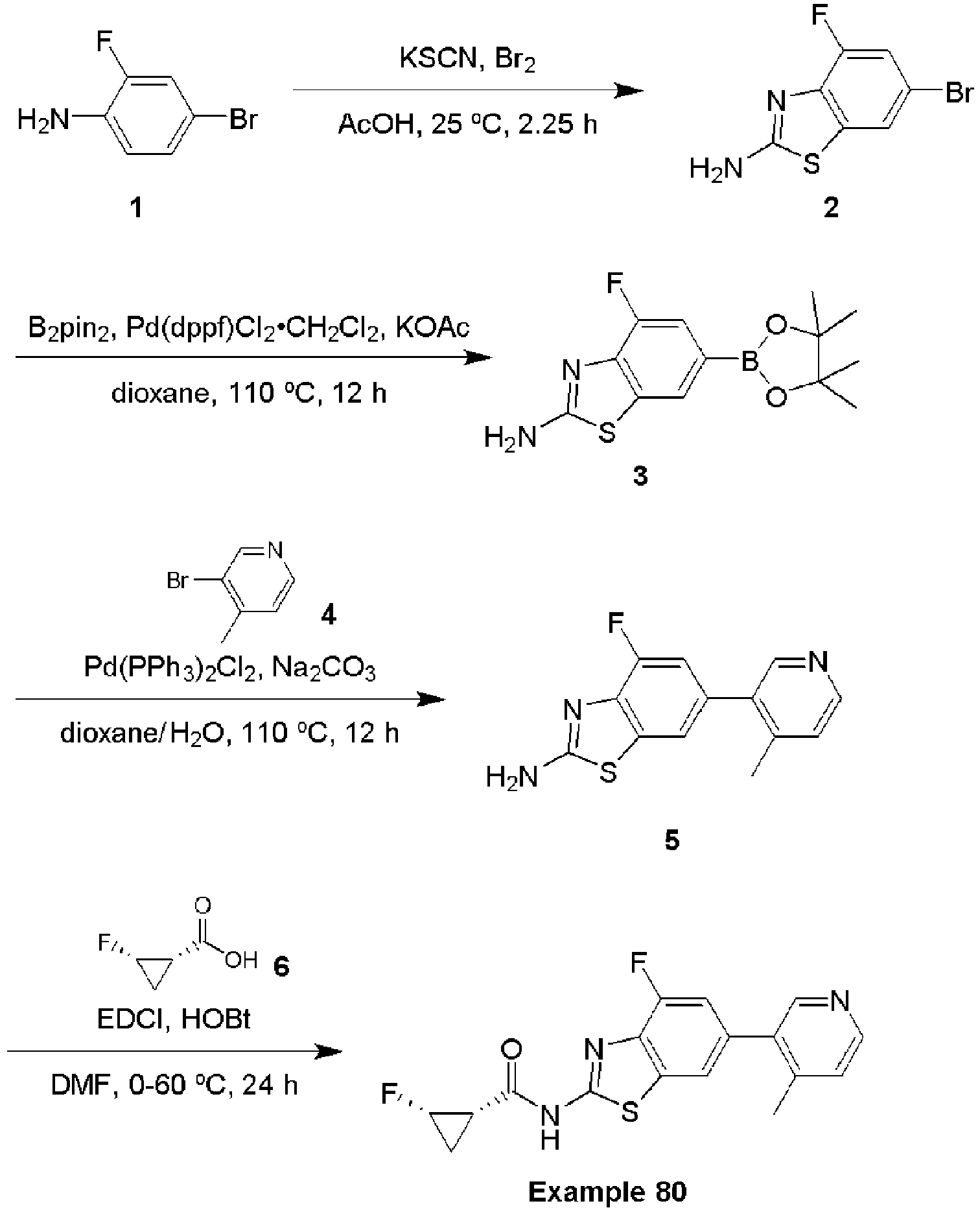
- To a solution of Compound 1 (1 g, 5.26 mmol, 1 eq) in AcOH (10 mL) was added thiocyanatopotassium (2.05 g, 21.05 mmol, 2.05 mL, 4 eq). To the solution was dropped at 25 °C for 15 minutes bromine (1.68 g, 10.53 mmol, 542.61 µL, 2 eq) in AcOH (3 mL). After the end of dropping, the mixture was stirred at 25 °C for 2 hr. The reaction mixture was concentrated under reduced pressure to remove AcOH. The PH was adjusted to 7 with 1M NaOH, and the mixture extracted with EA (50 mL * 2). The combined organic layers were dried over Na2SO4, filtered and concentrated under reduced pressure to give a residue. The residue was purified by column chromatography (Silica gel, Petroleum ether/Ethyl acetate=20/1 to 0:1). Compound 2 (307 mg, 1.24 mmol, 23% yield) was obtained as a white solid.
- 1H NMR (400MHz, DMSO-d 6) δ = 7.86 (s, 2H), 7.77 (d, J=1.2 Hz, 1H), 7.35 (dd, J =1.8, 10.5 Hz, 1H).
- To a solution of Compound 2 (307 mg, 1.24 mmol, 1 eq) and B2pin2 (473.27 mg, 1.86 mmol, 1.5 eq) in dioxane (5 mL) was added Pd(dppf)Cl2.CH2Cl2 (101.47 mg, 124.25 µmοl, 0.1 eq) and AcOK (365.82 mg, 3.73 mmol, 3 eq). The mixture was stirred at 110 °C for 12 hr under N2. Then the mixture was stirred at 110 °C for 3 hr. The reaction mixture was concentrated under reduced pressure to remove solvent. The residue was purified by column chromatography (Silica gel, Petroleum ether/Ethyl acetate=10/l to 1:1). Compound 3 (322 mg, 1.09 mmol, 88% yield) was obtained as a light yellow solid.
- 1H NMR (400MHz, DMSO-d6 ) δ = 7.89 (s, 2H), 7.77 (s, 1H), 7.21 (d, J=11.1 Hz, 1H), 1.29 (s, 12H).
- To a solution of Compound 3 (150 mg, 509.94 µmol, 1 eq) and Compound 4 (105.27 mg, 611.93 µmοl, 67.91 µL, 1.2 eq) in dioxane (5 mL) and H2O (1 mL)was added Pd(PPh3)2Cl2 (35.79 mg, 50.99 µmοl, 0.1 eq) and Na2CO3 (162.14 mg, 1.53 mmol, 3 eq). The mixture was stirred at 110 °C for 12 hr under N2. The reaction mixture was concentrated under reduced pressure to remove solvent. The residue was diluted with 20 mL and extracted with ethyl acetate (20 mL * 2). The combined organic layers were dried over Na2SO4, filtered and concentrated under reduced pressure to give a residue. The residue was purified by prep-TLC (Silica gel plate, Petroleum ether: Ethyl acetate = 0:1). Compound 5 (50 mg, 160.05 µmοl, 31% yield, 83% purity) was obtained as a white solid
- To a solution of Compound 5 (50 mg, 160.05 µmοl, 1 eq) and Compound 6 (19.99 mg, 192.05 µmοl, 1.2 eq) in DMF (2 mL) was added EDCI (61.36 mg, 320.09 µmοl, 2 eq) and HOBt (43.25 mg, 320.09 µmοl, 2 eq) at 0 °C. The mixture was stirred at 60 °C for 12 hr. The reaction mixture was diluted with water 20 mL and extracted with ethyl acetate (20 mL * 2). The combined organic layers were dried over Na2SO4, filtered and concentrated under reduced pressure to give a residue. The residue was purified by prep-HPLC (column:
Phenomenex Synergi C18 150∗25∗10um;mobile phase: [water(0.1%TFA)-ACN];B%: 15%-36%,7min). Example 80 (8.9 mg, 13.94 µmοl, 8% yield, 89% purity, 2TFA) was obtained as a white solid. - 1H NMR (400MHz, DMSO-d6 ) δ = 13.07 (s, 1H), 8.64 (br d, J=7.7 Hz, 2H), 7.95 (br d, 7=1.2 Hz, 1H), 7.68 (br s, 1H), 7.47 (br d, J=11.5 Hz, 1H), 5.17 - 4.96 (m, 1H), 2.43 (br s, 3H), 2.23 (td, 7=6.9, 13.5 Hz, 1H), 1.83 - 1.70 (m, 1H), 1.34 (qd, 7=6.4, 15.1 Hz, 1H); LCMS (electrospray) m/z 346.3 (M+H)+.
- Using ((3-bromo-4-methylphenyl)ethynyl)trimethylsilane, the title compound was obtained as described for the synthetic method B
-

- n-BuLi (2.2 M, 16.21 mL, 1.20 eq) was added dropwise to the solution of Compound 1 (2 g, 29.81 mmol, 2.07 mL, 1 eq) in THF (40 mL) at -65 °C, and the whole mixture was stirred for 0.5 hr at -65 °C. TIPSCl (6.32 g, 32.76 mmol, 7.01 mL, 1.10 eq) was added to the mixture, and the whole mixture was stirred for 4 hr. at -65 °C. Saturated ammonium chloride aqueous solution (40 mL) was added to the mixture at 0 °C, and the whole mixture was extracted with EtOAc (40 mL * 3). The combined organic layers were washed with brine (20 mL), dried over sodium sulfate, filtered and concentrated in vacuum to give a residue. The residue was purified by silica gel chromatography (100-200 mesh silica gel, Petroleum ether) to afford Compound 2 (5.6 g, 25.06 mmol, 84% yield) as colorless oil.
- 1 H NMR (400 MHz, CDCl3) δ = 6.81 (t, J=1.8 Hz, 2H), 6.32 (t, J=1.9 Hz, 2H), 1.52 - 1.39 (m, 3H), 1.10 (d, J=7.5 Hz, 18H).
- To a solution of (1,5-Cyclooctadiene)(methoxy)iridium(I) Dimer (47.47 mg, 71.61 µmοl, 0.02 eq) in THF (15 mL) were added 3,4,7,8-tetramethyl-1,10-phenanthroline (33.84 mg, 143.22 µmοl, 0.04 eq) and 4,4,5,5-tetramethyl-1,3,2-dioxaborolane (45.82 mg, 358.06 µmοl, 51.95 µL, 0.1 eq). The mixture was degassed and purged with nitrogen for 3 times, and then the mixture was stirred at 15 °C for 0.5 h under nitrogen atmosphere. Then Compound 2 (800 mg, 3.58 mmol, 884.96 µL, 1 eq) and 4,4,5,5-tetramethyl-2-(4,4,5,5-tetramethyl-1,3,2- dioxaborolan-2-yl)-1,3,2-dioxaborolane (909.24 mg, 3.58 mmol, 1 eq) were added. The mixture was degassed and purged with nitrogen for 3 times, and then the mixture was stirred at 70 °C for 16 h under nitrogen atmosphere. The reaction mixture was quenched by diluting with EtOAc (40 mL), and then filtered through celite. The filtrate were washed with water (10 mL) and brine (10 mL), dried over sodium sulfate, filtered and the filtrate was concentrated in vacuum to give a residue. The residue was purified by flash silica gel chromatography (100-200 mesh silica gel, Petroleum ether/Ethyl acetate=1/0 to 100/1, product came out at Petroleum ether/Ethyl acetate=100/1) to afford Compound 3 (900 mg, 2.58 mmol, 71% yield) as white solid.
- 1H NMR (400 MHz, CDCl3) δ = 7.23 (t, J=1.4 Hz, 1H), 6.81 (t, J=2.2 Hz, 1H), 6.62 (dd, J=1.2, 2.5 Hz, 1H), 1.46 (quin, J=7.5 Hz, 3H), 1.32 (s, 12H), 1.09 (d, J=7.5 Hz, 19H).
- To a solution of Compound 3 (180 mg, 515.18 µmοl, 1 eq) and Compound 4 (137.68 mg, 463.67 µmοl, 0.9 eq) in dioxane (4 mL) and H2O (1 mL) was added Na2 CO3 (109.21 mg, 1.03 mmol, 2 eq) and Pd(dppf)Cl2 (37.70 mg, 51.52 µmοl, 0.1 eq). The mixture was degassed and purged with nitrogen for 3 times, and then the mixture was stirred at 60 °C for 4 h under nitrogen atmosphere. The reaction mixture was quenched by diluting with EtOAc (40 mL), and then filtered through celite. The filtrate were washed with water (10 mL) and brine (10 mL), dried over sodium sulfate, filtered and concentrated in vacuum to give a residue. The residue was purified by prep-TLC (Petroleum ether/Ethyl acetate= 20/1, Rf=0.8) to afford Compound 5 as colorless oil.
- 1H NMR (400 MHz, CDCl3) δ = 7.70 (d, J=1.7 Hz, 1H), 7.36 (dd, J=1.7, 7.8 Hz, 1H), 7.17 (d, J=7.9 Hz, 1H), 7.01 (t, J=1.7 Hz, 1H), 6.79 (t, J=2.4 Hz, 1H), 6.56 (dd, J=1.4, 2.6 Hz, 1H), 2.37 (s, 3H), 1.48 (quin, J=7.5 Hz, 3H), 1.12 (d, J=7.5 Hz, 19H).
- To a solution of Compound 5 (130 mg, 311.38 µmol, 1 eq) and Compound 6 (112.79 mg, 311.38 µmοl, 1 eq) in dioxane (3 mL) and H2O (0.6 mL) was added Na2 CO3 (66.01 mg, 622.76 µmοl, 2 eq) and Pd(dppf)Cl2 (22.78 mg, 31.14 µmοl, 0.1 eq). The mixture was degassed and purged with nitrogen for 3 times, and then the mixture was stirred at 60 °C for 16 h under nitrogen atmosphere. The reaction mixture was diluted with EtOAc (40 mL), and then the resulting organic phase was washed with water (10 mL) and brine (10 mL), dried over sodium sulfate, filtered and then the resulting organic phase was concentrated in vacuum to give a residue. The residue was purified by silica gel chromatography (300-400 mesh silica gel, Petroleum ether/Ethyl acetate=10/1 to 1/1, product came out at Petroleum ether/Ethyl acetate=2/1) to afford Compound 7 as brown oil.
- To a solution of Compound 7 (110 mg, 190.76 µmοl, 1 eq) in THF (4 mL) was added pyridine;hydrofluoride (1.10 g, 11.10 mmol, 1 mL). The mixture was stirred at 35 °C for 3 h. LC-MS showed 2% of Compound 7 remained. The mixture was stirred at 35 °C for 2 h. The reaction mixture was diluted with ethyl acetate (20 mL), and then the resulting organic phase was washed with HCl aqueous solution (4 mL, 0.5 M), brine (4 mL), dried over sodium sulfate, filtered and the filtrate was concentrated in vacuum to give a residue. The residue was purified by prep-HPLC (HCl condition, column:
Phenomenex Synergi C18 150*25*10um; mobile phase: [water(0.05%HCl)-ACN]; B%: 41%-61%, 11min), followed by lyophilization. But HNMR showed the product was not clean, so it was diluted with water and lyophilizated again to afford Example 91 as off-white solid. - 1H NMR (400 MHz, DMSO-d6 ) δ = 12.70 (s, 1H), 10.87 (br s, 1H), 7.98 (d, J=1.6 Hz, 1H), 7.79 (d, J=8.3 Hz, 1H), 7.48 - 7.36 (m, 3H), 7.27-7.18 (m, 2H), 6.77 (q, J=2.3 Hz, 1H), 6.43 (d, J=1.7 Hz, 1H), 5.17-4.91 (m, 1H), 2.27-2.23 (m, 1H), 2.21 (s, 3H), 1.83-1.67 (m, 1H), 1.31 (tdd, J=6.4, 9.0, 12.8 Hz, 1H); LCMS (electrospray) m/z 392.1 (M+H)+.
-

- Compound 1 (3 g, 10.10 mmol, 1 eq) in THF (30 mL) was placed into 250 ml round bottom flask. The reaction solution was cooled to -65 °C under a nitrogen atmosphere. n-BuLi (2.2 M, 5.05 mL, 1.1 eq) to the cooled solution was slowly added dropwise, the mixture was stirred for 1 h at the same temperature. TRIMETHYL BORATE (1.26 g, 12.12 mmol, 1.37 mL, 1.2 eq) were added dropwise to the above solution at the same temperature. The mixture was stirred at -65 °C for 1 h. Then cool bath was removed and the mixture was stirred at -65 ~ 10 °C for 16 h. The mixture was acidified by dropwise addition of HCl solution (2 M, 5 mL) to the reaction solution, which was stirred for 1.5 hour. The mixture were concentrated in vacuum to afford a residue. The residue was purified by reverse-MPLC (FA condition, A:water, B:MeCN, 40% B). The fraction were concentrated to remove solvent, and aqueous phase was extracted with ethyl acetate (50 mL * 3). The combined organic layers were washed with brine (50 mL), dried over sodium sulfate, filtered and the filtrate was concentrated in vacuum to give Compound 2 (1.3 g, 6.05 mmol, 59% yield) as white solid.
- 1H NMR (400MHz, DMSO-d6 ) δ = 8.15 (s, 0.5H), 7.95 (s, 0.3H), 7.93 (s, 1H), 7.73 (d, J=7.5 Hz, 1H), 7.66 (d, J=7.5 Hz, 0.3H), 7.37 (d, J=7.5 Hz, 1H), 7.32 (d, J=7.6 Hz, 0.3H), 2.37 (s, 3H), 2.34 (s, 0.9H).
- To a solution of Compound 2 (255 mg, 1 eq) and 2-bromothiazole (220 mg, 1.34 mmol, 120.88 µL, 1.13 eq) in dioxane (5 mL) and H2O (1 mL) were added Pd(dppf)Cl2 (86.84 mg, 118.69 µmοl, 0.1 eq) and Na2CO3 (251.59 mg, 2.37 mmol, 2 eq) The mixture was degassed and purged with nitrogen for 3 times, and then the mixture was stirred at 80 °C for 6 h under nitrogen atmosphere. The reaction mixture was diluted with ethyl acetate (40 mL), and then the resulting organic phase was filtered through celite. The filtrate were washed with water (10 mL) and brine (10 mL), dried over sodium sulfate, filtered and concentrated in vacuum to give a residue. The residue was purified by silica gel chromatography (300-400 mesh silica gel, Petroleum ether/Ethyl acetate=1/0 to 100/1, product came out at Petroleum ether/Ethyl acetate=100/1) to afford crude product. The crude product was purified by reverse-MPLC (FA condition, A:water, B:MeCN, 55% B) to afford Compound 4 (40 mg, 157.39 µmοl, 13% yield) as off-white solid.
- 1H NMR (400 MHz, CDCl3) δ = 8.16 (d, J=1.6 Hz, 1H), 7.86 (d, J=3.2 Hz, 1H), 7.78 (dd, J=1.8, 7.9 Hz, 1H), 7.33 (d, J=3.2 Hz, 1H), 7.30 (d, J=7.9 Hz, 1H), 2.44 (s, 3H).
- To a solution of (1S,2S)-2-fluoro-N-[6-(4,4,5,5-tetramethyl-1,3,2- dioxaborolan-2-yl)-1,3-benzothiazol-2-yl]cyclopropanecarboxamide (57.01 mg, 157.39 µmοl, 1 eq) and Compound 4 (40 mg, 157.39 µmοl, 1 eq) in dioxane (1 mL) and H2O (0.2 mL) were added Na2CO3 (33.36 mg, 314.78 µmοl, 2 eq) and Pd(dppf)Cl2 (11.52 mg, 15.74 µmοl, 0.1 eq). The mixture was degassed and purged with nitrogen for 3 times, and then the mixture was stirred at 60 °C for 16 h under nitrogen atmosphere. The reaction mixture was diluted with EtOAc (40 mL), and then the resulting organic phase was washed with water (10 mL) and brine (10 mL), dried over sodium sulfate, filtered and concentrated in vacuum to give a residue. The residue was purified by silica gel chromatography (200-300 mesh silica gel, Petroleum ether/Ethyl acetate=5/1 to 0/1) to afford product. The product was purified by prep-HPLC (HCl condition, column:
Phenomenex Synergi C18 150*25*10um; mobile phase: [water(0.05%HCl)-ACN]; B%: 48%-65%, 10min), followed by lyophilization to afford Example 92 (25.8 mg, 53.00 µmοl, 33% yield, 99% purity, 2HCl) as light yellow solid. - 1H NMR (400 MHz, DMSO-d6 ) δ = 12.88 (br s, 1H), 8.16 (d, J=1.3 Hz, 1H), 8.02 (d, J=3.2 Hz, 1H), 7.98 (dd, J=1.8, 7.9 Hz, 1H), 7.95-7.90 (m, 2H), 7.88 (d, J=3.2 Hz, 1H), 7.63-7.53 (m, 2H), 5.33 - 5.01 (m, 1H), 2.42 (s, 3H), 2.40-2.33 (m, 1H), 1.96-1.77 (m, 1H), 1.53-1.36 (m, 1H); LCMS (electrospray) m/z 410.2 (M+H)+.
-

- To a solution of Compound 1 (2 g, 24.36 mmol, 1.96 mL, 1 eq) in DCM (30 mL) was added PPTS (612.16 mg, 2.44 mmol, 0.1 eq) and 3,4-dihydro-2H-pyran (6.15 g, 73.08 mmol, 6.68 mL, 3 eq). The mixture was stirred at 55 °C for 12 hr. The reaction mixture was concentrated under reduced pressure to remove solvent. The residue was diluted with 80 mL and extracted with ethyl acetate (80 mL * 2). The combined organic layers were dried over Na2SO4, filtered and concentrated under reduced pressure to give a residue. The residue was purified by column chromatography (Silica gel, Petroleum ether/Ethyl acetate=50/1 to 5:1). Compound 2 (2.5 g, 15.04 mmol, 61% yield) was obtained as a colorless oil.
- 1H NMR (400MHz, CDCl3) δ = 7.37 (d, 7=6.0 Hz, 2H), 5.32 (dd, 7=2.4, 9.7 Hz, 1H), 4.09 - 3.99 (m, 1H), 3.69 (dt, 7=2.8, 11.3 Hz, 1H), 2.08 (s, 3H), 2.07 - 1.99 (m, 2H), 1.78 - 1.51 (m, 4H).
- To a solution of Compound 2 (2.3 g, 13.84 mmol, 1 eq) in MeCN (23 mL) was added NBS (2.46 g, 13.84 mmol, 1 eq). The mixture was stirred at 55 °C for 12 hr. The reaction mixture was concentrated under reduced pressure to remove solvent. The residue was purified by column chromatography (silica gel, Petroleum ether/Ethyl acetate=1:0 to 50:1). Compound 3 (2.4 g, 9.79 mmol, 70% yield) was obtained as a yellow oil.
- 1H NMR (400MHz CDCl3) δ = 7.34 (s, 1H), 5.26 (dd, 7=2.4, 9.4 Hz, 1H), 4.09 - 3.99 (m, 1H), 3.72 - 3.62 (m, 1H), 2.06 - 2.03 (m, 2H), 2.02 (d, 7=0.7 Hz, 3H), 1.78 - 1.54 (m, 4H).
- To a solution of Compound 3 (1 g, 4.08 mmol, 1 eq) and Compound 4 (1.13 g, 4.08 mmol, 1 eq) in dioxane (10 mL) and H2O (3 mL) was added Na2CO3 (864.81 mg, 8.16 mmol, 2 eq) and Pd(dppf)Cl2 (298.51 mg, 407.97 µmοl, 0.1 eq). The mixture was stirred at 90 °C for 12 hr under N2. The reaction mixture was concentrated under reduced pressure to remove solvent. The residue was purified by column chromatography (silica gel, Petroleum ether/Ethyl acetate=20/1 to 1:1). Compound 5 (780 mg, 2.11 mmol, 51% yield, 85% purity) was obtained as a yellow solid.
- To a solution of Compound 5 (350 mg, 946.23 µmοl, 1 eq) and Compound 6 (136.43 mg, 1.31 mmol, 1.39 eq) in DMF (5 mL) was added EDCI (418.80 mg, 2.18 mmol, 2.31 eq) and HOBt (295.20 mg, 2.18 mmol, 2.31 eq) at 0 °C. The mixture was stirred at 60 °C for 2 hr. The reaction mixture was diluted with
water 30 mL and extracted with ethyl acetate (30 mL * 2). The combined organic layers were washed with brine (30 mL * 2), dried over Na2SO4, filtered and concentrated under reduced pressure to give a residue. The residue was purified by prep-HPLC (column:Luna C18 150*25 5u;mobile phase: [water(0.225%FA)-ACN];B%: 48%-68%,7.8min). Example 94 (200 mg, 482.83 µmοl, 51% yield, 96% purity) was obtained as a white solid. (50 mg would be delivered). - 1H NMR (400MHz, DMSO-d6 ) δ = 12.72 (br s, 1H), 8.22 (s, 1H), 7.81 - 7.71 (m, 3H), 5.36 (dd, 7=2.1, 10.0 Hz, 1H), 5.16 - 4.92 (m, 1H), 3.94 (br d, J=11.9 Hz, 1H), 3.68 - 3.58 (m, 1H), 2.28 - 2.19 (m, 4H), 2.16 - 2.05 (m, 1H), 2.02 - 1.89 (m, 2H), 1.81 - 1.65 (m, 2H), 1.60 - 1.50 (m, 2H), 1.31 (tdd, 7=6.4, 8.9, 12.8 Hz, 1H); LCMS (electrospray) m/z 401.1 (M+H)+.
- Example 94 (140 mg, 338.61 µmol, 1 eq) was added to HCl/dioxane (4 M, 3 mL, 35.44 eq). The mixture was stirred at 25 °C for 2 hr. LCMS showed -59% of starting material was remained and -40% of desired mass was detected. Then the mixture was stirred at 40 °C for 12 hr. The reaction mixture was concentrated under reduced pressure to remove solvent. The residue was diluted with water 20 mL and extracted with DCM (20 mL * 2). The combined organic layers were dried over Na2SO4, filtered and concentrated under reduced pressure to give a residue. The residue was purified by prep-HPLC (column:
Luna C18 150*25 5u; mobile phase: [water(0.225%FA)-ACN];B%: 31%-51%,7.8min). Example 95 (41.4 mg, 130.87 µmοl, 38% yield, 100% purity) was obtained as a white solid. - 1H NMR (400MHz, DMSO-d6 ) δ = 12.46 (br s, 2H), 8.15 (s, 1H), 7.80 - 7.75 (m, 1H), 7.74 - 7.66 (m, 1H), 7.47 (br s, 1H), 5.12 - 4.88 (m, 1H), 2.30 - 2.19 (m, 4H), 1.85 - 1.70 (m, 1H), 1.36 - 1.22 (m, 1H); LCMS (electrospray) m/z 317.2 (M+H)+.
-

- To a solution of Na2S.9H2O (16.42 g, 68.37 mmol, 11.48 mL, 2 eq) in EtOH (80 mL) was dropwise added Compound 1 (8 g, 34.18 mmol, 1 eq).The mixture was stirred at 50 °C for 2 hr. The reaction was quenched by HCl to pH =5 slowly and then extracted with Ethyl acetate(80mL∗2).The combined organic phase was washed with water (80 mL *2),dried over anhydrous Na2SO4, filtered and concentrated in vacuum. Compound 2 (2.5 g, crude) as a green solid.
- 1H NMR (400MHz, CDCl3) δ = 7.21 (d, J=8.3 Hz, 1H), 6.93 (d, J=8.3 Hz, 1H), 4.53 (br s, 1H), 2.32 - 2.29 (m, 3H).
- To a solution of Compound 2 (2.5 g, 10.08 mmol, 1 eq) (crude)in EtOH (25 mL) was added HCl (55.11 g, 151.15 mmol, 54.03 mL, 10% purity, 15 eq) at 0°C.Then Zn (7.06 g, 107.92 mmol, 10.71 eq) was added and the mixture was stirred at 35 °C for 2 hr . The reaction mixture was concentrated under reduced pressure to remove solvent. Then water phase was washed with Petroleum ether(100 mL*2).Then water phase by solid NaHCO3 to pH =5 slowly and filtered, the filter cake was concentrated in vacuum, then filtrate was extracted with Ethyl acetate(100mL*2).The combined organic phase was washed with brine (50 mL *2),dried over anhydrous Na2SO4, filtered and concentrated in vacuum. Compound 3 (0.99 g, 4.54 mmol, 45% yield) was obtained as a white solid.
- 1H NMR (400MHz, DMSO-d6 ) δ = 7.14 - 7.09 (m, 1H), 6.94 - 6.86 (m, 1H), 5.59 - 5.49 (m, 2H), 2.28 (s, 3H).
- To a solution of CDI (661.64 mg, 4.08 mmol, 1 eq) in THF (9 mL) was dropwise added Compound 3 (0.89 g, 4.08 mmol, 1 eq) at 0 °C. Then reaction mixture was added and the mixture was stirred at 35 °C for 16 hr . The reaction mixture was filtered and the filtrate was concentrated in vacuum .The residue was extracted with Ethyl acetate (100 mL*2). The combined organic phase was washed with water (100mL*2).The organic layer was dried over anhydrous Na2SO4 .The solution was filtered and concentrated in vacuum. Compound 4 (1.05 g, crude) was obtained as a off-white solid.
- 'H NMR (400MHz, DMSO-d 6) δ= 12.28 - 11.73 (m, 1H), 7.33 (d, J=4.0 Hz, 2H), 2.39 (s, 3H)
- A mixture of Compound 4 (500 mg, 2.05 mmol, 1 eq), Compound 5 (506.47 mg, 1.40 mmol, 6.82e-1 eq), Pd(dppf)Cl2 (75.00 mg, 102.50 µmοl, 0.05 eq) , Na2CO3 (434.55 mg, 4.10 mmol, 2 eq) in dioxane (10 mL) and H2O (2 mL) was degassed and purged with N2 for 3 times, and then the mixture was stirred at 80 °C for 16 hr under N2 atmosphere. The reaction mixture was concentrated in vacuum. The crude product was purified by prep-HPLC (column:
Phenomenex Synergi C18 150*25* 10um;mobile phase: [water(0.05%HCl)-ACN];B%: 35%-55%,11min) to give product. Example 99 (53 mg, 117.93 µmοl, 5% yield, 97% purity, HCl) as a white solid. - 1H NMR (400MHz, DMSO-d 6) δ = 12.75 - 12.70 (m, 1H), 11.78 - 11.74 (m, 1H), 7.95 (d, J=1.5 Hz, 1H), 7.79 (d, J=8.3 Hz, 1H), 7.47 (d, J=8.1 Hz, 1H), 7.41 - 7.37 (m, 1H), 7.08 (s, 1H), 5.17 - 4.94 (m, 1H), 2.29 - 2.18 (m, 4H), 1.81 - 1.71 (m, 1H), 1.36 - 1.28 (m, 1H): LCMS (electrospray) m/z 400.1 (M+H)+.
-

- To a solution of Compound 1 (5 g, 33.08 mmol, 4.50 mL, 1 eq) , FeBr3 (195.52 mg, 661.54 µmοl, 0.02 eq) and Fe (461.80 mg, 8.27 mmol, 0.25 eq) in DCM (50 mL) was added Br2 (5.81 g, 36.38 mmol, 1.88 mL, 1.1 eq) of DCM (5 mL) dropwise at 15 °C. The mixture was stirred at 30 °C for 20 hr. TLC showed the reaction was completed. The mixture was washed by saturated sodium sulfite water solution (100 mL*2), the organic phase was washed with brine (150 mL) and dried with anhydrous sodium sulfate (Na2SO4), filtered and concentrated in vacuum. The residue was used to the next step without any purification. Compound 2 (7.2 g, 31.30 mmol, 94% yield) was obtained as white solid.
- 1H NMR (400MHz, CDCl3) δ = 7.56 (d, J=8.2 Hz, 1H), 7.02 (d, J=8.2 Hz, 1H), 2.35 (s, 3H), 2.26 (s, 3H).
- To a solution of Compound 2 (7.2 g, 31.30 mmol, 1 eq) in AcOH (80 mL) was added Fe (6.99 g, 125.19 mmol, 4 eq) at 10 °C. The mixture was stirred at 80 °C for 18 hr. TLC indicated the reaction was completed. The mixture was filtered and the filtrate was neutralized with saturated sodium hydroxide aqueous solution. The aqueous phase was extracted with Ethyl acetate (100 mL*2), the organic phase was washed with brine (150 mL) and dried with anhydrous sodium sulfate (Na2SO4), filtered and concentrated in vacuum. The residue was purified by silica gel chromatography eluted with Petroleum ether/Ethyl acetate=5:1. Compound 3 (4.6 g, 22.99 mmol, 73% yield) was obtained as brown oil.
- 1H NMR (400MHz, CDCl3) δ = 6.94 (d, 7=8.1 Hz, 1H), 6.80 (d, 7=8.1 Hz, 1H), 3.84 - 3.49 (m, 2H), 2.30 (s, 3H), 2.14 (s, 3H).
- To a solution of Compound 3 (4.1 g, 20.49 mmol, 1 eq) in AcOH (50 mL) was added NaNO2 (1.70 g, 24.59 mmol, 1.2 eq) in H2O (10 mL) dropwise at 0 °C for 30 min. The mixture was stirred at 15 °C for 18 hr. LC-MS showed the reaction was completed. The mixture was poured into H2O(100 mL), the aqueous phase was extracted with ethyl acetate (150 mL∗2).The combined organic phase was washed with brine (200 mL), dried with anhydrous Na2SO4, filtered and concentrated in vacuum to afford 5 g crude product. 2 g of the crude product was purified by prep-HPLC (column:
Phenomenex luna C18 250*50mm*10 µm;mobile phase: [water(0.05%HCl)-ACN];B%: 30%-60%,30min,40%min), followed by lyophilization to afford 0.3 g white solid, 0.3 g white solid was purified by prep-HPLC (column:Phenomenex Synergi C18 150∗25∗10um;mobile phase: [water(0.05%HCl)-ACN];B%: 30%-50%,11min), followed by lyophilization. Compound 4 (75 mg, 355.35 µmοl, 1% yield) was obtained as white solid. Compound 4A (195 mg, 923.92 µmοl, 4% yield) was obtained as white solid. - Compound 4 1H NMR (400MHz, METHANOL-d 4) δ = 8.02 (s, 1H), 7.50 (d, J=8.6 Hz, 1H), 7.29 (d, J=8.6 Hz, 1H), 2.61 (s, 3H).
- Compound 4A 1H NMR (400MHz, METHANOL-d 4) δ = 7.99 (s, 1H), 7.20 (d, J =7.5 Hz, 1H), 7.04 (dd, J=0.9, 7.5 Hz, 1H), 2.52 (d, 7=0.6 Hz, 3H).
- To a solution of Compound 4A (195 mg, 923.92 µmοl, 1 eq) and Compound 5 (401.60 mg, 1.11 mmol, 1.2 eq) in dioxane (3 mL) and H2O (0.5 mL) were added Na2 CO3 (293.77 mg, 2.77 mmol, 3 eq) and Pd(dppf)Cl2 (135.21 mg, 184.78 µmοl, 0.2 eq) at 10 °C. The mixture was stirred at 60 °C for 18 hr. LC-MS showed the reaction was completed. The mixture was poured into H2O (10 mL), a lot of yellow solid formed, filtered and the filter cake was concentrated in vacuum. The filter cake was purified by triturated with Methanol (10 mL), filtered and the filter cake was concentrated. Example 107 (149.2 mg, 385.61 µmοl, 41% yield, 94% purity) was obtained as yellow solid.
- 1H NMR (400MHz, DMSO--d 6) δ = 13.30 (br s, 1H), 12.74 (br s, 1H), 8.35 - 8.20 (m, 2H), 7.90 - 7.83 (m, 1H), 7.81 - 7.74 (m, 1H), 7.21 (br s, 2H), 5.17 - 4.93 (m, 1H), 2.57 (s, 3H), 2.24 (br s, 1H), 1.83 - 1.69 (m, 1H), 1.31 (br s, 1H) : LCMS (electrospray) m/z 367.0 (M+H)+.
- To a solution of Compound 4 (75 mg, 355.35 µmοl, 1 eq) and Compound 5 (154.46 mg, 426.42 µmοl, 1.2 eq) in dioxane (2 mL) and H2O (0.5 mL) were added Na 2CO3 (112.99 mg, 1.07 mmol, 3 eq) and Pd(dppf)Cl2 (52.00 mg, 71.07 µmοl, 0.2 eq) at 10 °C. The mixture was stirred at 60 °C for 18 hr. LC-MS showed the reaction was completed. The mixture was poured into Petroleum ether (10 mL), filtered with silica gel and the filtrate was concentrated in vacuum. The residue was purified by prep-HPLC (column:
Phenomenex Synergi C18 150*25* 10um;mobile phase: [water(0.05%HCl)-ACN];B%: 30%-60%,10min), followed by lyophilization. Example 108 (26.4 mg, 59.61 µmοl, 16% yield, 99% purity, 2HCl) was obtained as white solid, which was checked by 2D NMR. - 1H NMR (400MHz, METHANOL-d 4) δ = 8.31 (s, 1H), 7.90 (s, 1H), 7.84 (d, J=8.3 Hz, 1H), 7.73 (d, J=8.4 Hz, 1H), 7.48 (d, J=8.3 Hz, 1H), 7.22 (d, J=8.3 Hz, 1H), 5.09 - 4.97 (m, 1H), 5.09 - 4.94 (m, 1H), 2.51 (s, 3H), 2.24 - 2.16 (m, 1H), 1.95 - 1.82 (m, 1H), 1.39 - 1.27 (m, 1H) : LCMS (electrospray) m/z 367.1 (M+H)+.
-

- To a solution of Compound 1 (5 g, 26.87 mmol, 1 eq) in acetone (50 mL) was added benzoyl isothiocyanate (4.39 g, 26.87 mmol, 3.62 mL, 1 eq) in acetone (10 mL) dropwise at 60 °C. The mixture was refluxed at 60 °C for 4 hr. TLC (Petroleum ether/Ethyl acetate = 5/1) showed Compound 1 was consumed and a main spot. The mixture was concentrated. The residue was purified by triturated with Petroleum ether (60 mL) and Ethyl acetate (6 mL). Compound 2 (8.77 g, 25.11 mmol, 93% yield) was obtained as white solid.
- 1H NMR (400MHz, CDCl3) δ = 12.58 - 12.23 (m, 1H), 9.20 - 9.02 (m, 1H), 8.01 - 7.85 (m, 3H), 7.72 - 7.64 (m, 1H), 7.60 - 7.54 (m, 3H), 7.30 (s, 1H), 2.46 - 2.40 (m, 3H).
- To a solution of Compound 2 (8.77 g, 25.11 mmol, 1 eq) in H2O (80 mL) was added NaOH (4.02 g, 100.45 mmol, 4 eq) at 10 °C. The mixture was stirred at 70 °C for 18 hr. TLC (Petroleum ether/Ethyl acetate = 5/1) showed Compound 2 was consumed and a main spot. T The mixture was acidified with hydrochloric acid solution (2 N) to PH= 2-3 and a lot of white solid formed. The reaction mixture was filtered and the filter cake was dried. The residue was purified by triturated with Ethyl acetate (40 mL). Compound 3 (4.65 g, 18.97 mmol, 75% yield) was obtained as white solid.
- 1H NMR (400MHz, METHANOL-d 4) δ = 7.61 (s, 1H), 7.31 - 7.26 (m, 1H), 7.24 - 7.19 (m, 1H), 2.37 (s, 3H).
- To a solution of Compound 3 (4.65 g, 18.97 mmol, 1 eq) in CH3COOH (80 mL) was added Br2 (3.33 g, 20.87 mmol, 1.08 mL, 1.1 eq) at 10 °C. The mixture was stirred at 80 °C for 18 hr. The mixture was poured into H2O (80 mL), the aqueous phase was extracted with ethyl acetate (100 mL*2).The combined organic phase was washed with brine (100 mL), dried with anhydrous Na2SO4, filtered and concentrated in vacuum. The residue was purified by triturated with Petroleum ether (50 mL) and Ethyl acetate (10 mL), filtered and the filter cake was concentrated to afford 7-bromo-6-methyl-1,3-benzothiazol-2-amine. The filter liquor was concentrated, purified by silica gel chromatography eluted with Petroleum ether/Ethyl acetate=1:1 to afford 5-bromo-6-methyl-1,3-benzothiazol-2-amine. Compound 4 (1.3 g, 5.34 mmol, 28% yield, 99% purity) was obtained as white solid. Compound 4A (870 mg, 3.58 mmol, 18% yield) was obtained as white solid.
- Compound 4 1H NMR (400MHz, DMSO-d 6) δ = 7.55 (s, 2H), 7.24 - 7.20 (m, 1H), 7.19 - 7.15 (m, 1H), 2.35 (s, 3H).
- Compound 4A 1H NMR (400MHz, CDCl3) δ = 7.73 (s, 1H), 7.45 (s, 1H), 5.21 (br s, 2H), 2.45 (s, 3H).
- To a solution of Compound 4 (300 mg, 1.23 mmol, 1 eq) in THF (10 mL) was added ISOAMYL NITRITE (288.81 mg, 2.47 mmol, 331.97 µL, 2 eq) at 10 °C. The mixture was stirred at 70 °C for 18 hr. LC-MS showed
Compound 4 was consumed and a main peak of desired mass. The mixture was poured into H2O (20 mL), the aqueous solution was extracted with ethyl acetate (30 mL*2).The combined organic phase was washed with brine (50 mL), dried with anhydrous Na2SO4, filtered and concentrated in vacuum. TLC (Petroleum ether/Ethyl acetate = 10:1) showed a main spot. The residue was purified by silica gel chromatography eluted with Petroleum ether/Ethyl acetate = 10:1. Compound 5 (180 mg, 788.31 µmοl, 63% yield, 99% purity) was obtained as yellow solid. - To a solution of Compound 5 (160 mg, 700.72 µmοl, 1 eq) and Compound 6 (304.58 mg, 840.86 µmοl, 1.2 eq) in dioxane (3 mL) and H2O (0.6 mL) were added Pd(dppf)Cl2 (102.54 mg, 140.14 µmοl, 0.2 eq) and Na2CO3 (74.27 mg, 700.72 µmοl, 1 eq) at 10 °C. The mixture was stirred at 60 °C for 18 hr. The mixture was poured into Petroleum ether (10 mL), filtered with silica gel and the filtrate was concentrated in vacuum. The residue was purified by prep-HPLC (column:
Phenomenex Synergi C18 150*25* 10um;mobile phase: [water(0.05%HCl)-ACN];B%: 44%-64%,9min), folllowed by lyophilization. Example 111 (60 mg, 156.31 µmοl, 22% yield, 99% purity) was obtained as yellow solid. - 1H NMR (400MHz, METHANOL-d 4) δ = 9.60 (s, 1H), 8.02 (d, J=8.4 Hz, 1H), 7.99 (d, J=1.3 Hz, 1H), 7.94 (d, J=8.3 Hz, 1H), 7.69 (d, J=8.4 Hz, 1H), 7.52 (dd, J=1.7, 8.3 Hz, 1H), 5.05 (dt, J=3.9, 6.2 Hz, 1H), 2.39 (s, 3H), 2.22 (dtd, J=4.3, 6.9, 9.1 Hz, 1H), 1.96 - 1.83 (m, 1H), 1.39 - 1.28 (m, 1H) : LCMS (electrospray) m/z 384.0 (M+H)+.
-

- Mel (28 µl, 0.45 mmol, 1.5 eq.) was dissolved in N,N-dimethyl formamide (1 ml) and was dropwised to a stirred solution of Example 4 (100 mg, 0.3 mmol, 1 eq.) and K 2CO3 (124 mg, 0.9 mmol, 3 eq.) in N,N-dimethyl formamide (2 ml). The mixture was stirred at 50 °C for 2 hrs under N2. After completion of the reaction, the reaction mixture was extracted with Ethyl Acetate (20 ml x 2) and Water (20 ml), the combined organic layers were dried over Mg2SO4, filtered and concentrated under reduced pressure to give a crude product. The residue was purified by short path silica gel column chromatography (
EA 100% gradient). The resulting precipitations were collected by filtration and washed by Ether and dried to give Example 112 as a white solid. (47 mg, 0.14 mmol, yield 46 %). - 1H NMR (400MHz, DMSO-d 6) δ = 8.44-8.41 (m, 2H), 8.04 (d, J = 1.6 Hz, 1H), 7.89 (d, J = 8.4 Hz, 1H), 7.47 (dd, J12 = 1.6 Hz, J13 = 8.4 Hz, 1H), 7.35 (t, J = 7.35 Hz, 1H), 5.21 (J12 = 2.9 Hz, J13 = 66.27 Hz, 1H), 3.95 (s, N-CH3, 3H), 2.66-2.62 (m, 1H), 2.29 (s, Me, 3H), 1.83-1.79 (m, 1H), 1.35-1.31 (m, 1H) : LCMS (electrospray) m/z 342.1 (M+H)+.
-

- To a solution of Example 29 (380 mg, 1.06 mmol, 1 eq) in DCM (5 mL) was added DAST (685.52 mg, 4.25 mmol, 561.90 µL, 4 eq) at 0 °C. The mixture was stirred at 30°C for 3 hr under N2 atmosphere. The reaction mixture was diluted with DCM (5 mL), and then the resulting organic phase was washed with saturated sodium bicarbonate aqueous solution (10 mL) and brine (10 mL), dried over sodium sulfate, filtered and the filtrate was concentrated in vacuum to give a residue. The residue was purified by pre-HPLC (column:
Phenomenex Synergi C18 150∗25∗10um;mobile phase: [water(0.1%TFA)-ACN];B%: 20%-50%,10min). - Example 113 (62 mg, 102.38 µmοl, 9% yield, 97% purity, 2TFA) was obtained as a light yellow solid.
- 1H NMR (400 MHz, DMSO-d 6) δ = 1.32 (ddt, J=12.84, 8.99, 6.33, 6.33 Hz, 1 H), 1.69 - 1.82 (m, 1 H), 2.20 - 2.28 (m, 1 H), 2.36 (s, 3 H), 4.93 - 5.17 (m, 1 H), 5.46 (s, 1 H), 5.57 (s, 1 H), 7.48 (dd, J=8.31, 1.83 Hz, 1 H), 7.53 (s, 1 H), 7.84 (d, J=8.31 Hz, 1 H), 8.07 (d, J=1.59 Hz, 1 H), 8.48 (s, 1 H), 12.77 (br s, 1 H); LCMS (electrospray) m/z 360.0 (M+H)+.
-

- To a solution of Compound 1 (900 mg, 4.20 mmol, 1 eq) in THF (9 mL) were added NaH (201.82 mg, 5.05 mmol, 60% purity, 1.2 eq) at 0 °C for 30 min. Then TIPSCl (972.86 mg, 5.05 mmol, 1.08 mL, 1.2 eq) was added to the mixture. The mixture was stirred at 25 °C for 1.5 hr. The reaction mixture was diluted with water 20 mL and extracted with ethyl acetate (20 mL * 2). The combined organic layers were washed with brine (20 mL), dried over Na2SO4,filtered and the filtrate was concentrated under reduced pressure to give a residue. The residue was purified by column chromatography (Silical gel, Petroleum ether: Ethyl acetate=1:0 to 100:1). Compound 2 (1.5 g, 4.05 mmol, 96% yield) was obtained as a yellow oil.
- 1H NMR (400MHz, CDCl3) δ = 7.28 - 7.26 (m, 1H), 7.19 - 7.10 (m, 2H), 6.65 (dd, J=0.9, 3.3 Hz, 1H), 1.67 (m, J=7.5 Hz, 3H), 1.15 (d, J=7.6 Hz, 18H).
- To a solution of Compound 2 (500 mg, 1.35 mmol, 1 eq) in THF (5 mL) was added LDA (2 M, 1.01 mL, 1.5 eq) at -78 °C for 30 min under N2 atmosphere. Then Mel (287.42 mg, 2.02 mmol, 126.06 µL, 1.5 eq) was added to the mixture. The mixture was stirred at 25 °C for 2 hr. The reaction mixture was quenched by addition with saturated NH4Cl aqueous (3 mL) at 25 °C, and then diluted with water 20 mL and extracted with ethyl acetate (20 mL * 2). The combined organic layers were washed with brine (40 mL), dried over Na2SO4,filtered and the filtrate was concentrated under reduced pressure to give a crude product. Compound 3 (500 mg, crude) were obtained as a yellow oil, which used into the next step without further purification.
- To a solution of Compound 3 (500 mg, 1.30 mmol, 1 eq) in THF (8 mL) was added TBAF·THF (1 M, 1.30 mL, 1 eq) at 0 °C. The mixture was stirred at 0 °C for 0.5 hr. The reaction mixture was concentrated under reduced pressure to remove solvent. The residue was diluted with water 20 mL and extracted with ethyl acetate (20 mL * 2). The combined organic layers were washed with brine (30 mL), dried over Na2SO4, filtered and the filtrate was concentrated under reduced pressure to give a residue. The residue was purified by prep-TLC (Silical gel plate, Petroleum ether: Ethyl acetate=5:1) to give a crude product. The crude product was purified by prep-HPLC (column:
Phenomenex Synergi C18 150*25*10um;mobile phase: [water(0.1%TFA)-ACN];B%: 48%-78%,10min). The cut fraction was concentrated under reduced pressure to remove ACN, the residue was washed with saturated NaHCO3 aqueous (10 mL). The mixture was extracted with ethyl acetate (20 mL * 2). The combined organic layers were washed with brine (30 mL), dried over Na2SO4, filtered and the filtrate was concentrated under reduced pressure to give a product. Compound 4 (100 mg, 438.48 µmοl, 33% yield) was obtained as a yellow solid. - 1H NMR (400MHz, CDCl3) δ = 8.21 (s, 1H), 7.20 (dd, J=2.4, 3.2 Hz, 1H), 7.06 (d, J=9.8 Hz, 1H), 6.60 - 6.52 (m, 1H), 2.44 (d, J=2.6 Hz, 3H).
- To a solution of Compound 4 (100 mg, 438.48 µmοl, 1 eq) and Compound 5 (190.59 mg, 526.18 µmοl, 1.2 eq) in dioxane (2 mL) and H2O (0.5 mL) was added Pd(dppf)Cl2 (32.08 mg, 43.85 µmοl, 0.1 eq) and Na2CO3 (92.95 mg, 876.96 µmοl, 2 eq) under N2 atmosphere. The mixture was stirred at 60 °C for 16 hr under N2 atmosphere. The reaction mixture was diluted with water 20 mL and extracted with Ethyl acetate (10 mL * 2). The combined organic layers were washed with brine (20 mL), dried over Na2SO4,filtered and the filtrate was concentrated under reduced pressure to give a residue. The residue was purified by prep-HPLC (column:
Phenomenex Synergi C18 150∗25∗10um;mobile phase: [water(0.05%HCl)-ACN];B%: 43%-63%,10 min). Example 114 (14.4 mg, 27.77 µmοl, 6% yield, 88% purity, 2HCl) was obtained as a purple solid. - 1H NMR (400MHz, DMSO-d 6) δ = 12.75 (s, 1H), 11.14 (s, 1H), 7.98 (d, J=1.4 Hz, 1H), 7.85 (d, J=8.3 Hz, 1H), 7.45 - 7.40 (m, 1H), 7.29 - 7.25 (m, 1H), 7.19 (d, J=10.5 Hz, 1H), 6.04 - 6.00 (m, 1H), 5.16 - 4.94 (m, 1H), 2.30 - 2.19 (m, 1H), 2.14 (d, J=2.6 Hz, 3H), 1.84 - 1.68 (m, 1H), 1.38 - 1.25 (m, 1H); LCMS (electrospray) m/z 384.10 (M+H)+.
- Table 1 below shows the compounds of Examples along with general synthetic methods used to make the compounds and characterization data.
-
[Table 1] Ex # Structure / Name 1H NMR / MS (M+1) Synthetic Method 1 
1H NMR (400MHz, DMSO-d6) δ = 12.75 (br s, IH), 7.92 (s, 1H), 7.81 (d, J=8.3 Hz, 1H), 7.33 (br d, J=8.2 Hz, 2H), 7.20 - 7.11 (m, 2H), 5.16 - 4.92 (m, 1H), 2.23 (td, J=6.7, 13.4 Hz, 1H), 2.14 (s, 3H), 1.82 - 1.68 (m, 1H), 1.37 - 1.25 (m, 1H); LCMS (electrospray) m/z 345.00 (M+H)+. A 2 
1H NMR (400MHz, CDC13) δ = 7.85 (d, J=8.3 Hz, 1H), 7.66 (s, 1H), 7.34 (dd, J=2.3, 7.0 Hz, 1H), 7.29 (d, J=1.5 Hz, 1H), 7.23 - 7.18 (m, 2H), 5.03 - 4.81 (m, 1H), 2.10 (d, J=2.0 Hz, 3H), 2.07 - 1.96 (m, 2H), 1.45 - 1.37 (m, 1H); LCMS (electrospray) m/z 361.20 (M+H)+. B 3 
1H NMR (400MHz, CDCl3) δ = 7.83 (d, J=8.3 Hz, 1H), 7.60 (d, J=1.0 Hz, 1H), 7.24 (dd, J=1.6, 8.3 Hz, 2H), 7.20 - 7.17 (m, 1H), 7.15 - 7.11 (m, 2H), 5.03 - 4.81 (m, 1H), 2.04 (d, J=2.5 Hz, 6H), 1.97 (d, J=5.4 Hz, 1H), 1.43 - 1.35 (m, 1H), 1.26 (br s, 1H); LCMS (electrospray) m/z 341.20 (M+H)+. B 4 
1H NMR (400MHz, DMSO-dG) δ = 12.81 (br s, 1H), 8.67 (br d, J=12.7 Hz, 2H), 8.12 (s, 1H), 7.87 (d, J=8.4 Hz, 1H), 7.53 (br d, J=8.7 Hz, 1H), 5.16 - 5.11 (m, 1H), 5.00 - 4.95 (m, 1H), 2.45 (br s, 3H), 2.29 - 2.20 (m, 2H), 1.81 - 1.69 (m, 1H), 1.38 - 1.28 (in, 1H), LCMS (clectrospray) m/z 328.10 (M+H)+. A 5* 
1H NMR (400 MHz, DMSO-d6); δ 12.69 (s, CONH), 8.44-8.42 (m, 2H), 8.02 (s, 1H), 7.81 (d, 1 = 8.0 Hz, IH), 7.44 (d, J = 9.2 Hz, 1H), 7.34 (d, J = 5.4 Hz, 1H), 2.29 (s, 3H), 2.03-2.00 (m, 1H), 0.98-0.96 (m, 4H); LCMS (electrospray) m/z 310.05 (M+H)+. C 6* 
1H NMR (400 MHz, DMSO-d6); δ 12.77 (s, CONH), 8.45 (s, 2H), 8.07 (d, J = 8.0 Hz, 1H), 7.74 (s, 1H), 7.36-7.31 (m, 2H), 5.05 (td, Jl2 = 3.3 Hz, 113 = 65.7 Hz, 1H), 2.24 (s, 3H), 2.23-2.24 (m, 1H), 1.76 (dd, 112 = 3.6 Hz, 113 = 23.2 Hz, 1H), 1.32 (dd, 112 = 4.4 Hz, 113 = 11.6 Hz, 1H); LCMS (electrospray) m/z 328.10 (M+H)+. A 7* 
1H NMR (400 MHz, DMSO-d6); δ 12.71 (s, CONH), 8.45 (s, 2H), 8.05 (d, J = 8.4 Hz, 1H), 7.73 (s, 1H), 7.36-7.30 (m, 2H), 2.29 (s, 3H), 2.01 (t, J = 5.6 Hz, 1H), 0.97 (t, J = 3.8 Hz, 4H); LCMS (electrospray) m/z 310.05 (M+H)+. C 8 
1H NMR (400 MHz, DMSO-d6); δ 12.78 (s, CONH), 8.50 (s, 1H), 8.35 (s, 1H), 7.84 (d, J = 8.4 Hz, 1H), 7.51-7.47 (m, 1H), 4.08 (s, 1H), 5.05 (td, J12 = 3.8 Hz, J13 = 65.8 Hz, 1H), 2.24 (s, 3H), 2.23-2.24 (m, 1H), 1.75 (dd, J12 = 3.8 Hz, J13 = 23.4 Hz, 1H), 1.32 (dd, J12 = 2.6 Hz, Jl3 = 7.0 Hz, 1H); LCMS (electrospray) m/z 328.10 (M+H)+. B 9 
1H NMR (400 MHz, METHANOL-d4) δ= 8.39 (br s, 2H), 8.24 (br s, 1H), 7.92 - 7.79 (m, 2H), 7.49 - 7.33 (m, 2H), 3.87 (dd, J=5.9, 11.5 Hz, 1H), 3.69 (dd, J=8.5, 11.6 Hz, 1H), 2.36 (s, 3H), 2.12 (dt, J=5.7, 8.0 Hz, 1H), 1.81 - 1.66 (m, 1H), 1.29 - 1.14 (m, 2H); LCMS (electrospray) m/z 340.00 (M+H)+. K 10* 
1H NMR (400 MHz, DMSO-d6); δ 12.66 (s, CONH), 9.90 (s, CONH), 7.91 (s, 1H), 7.77 (d, J = 8.0 Hz, 1H), 7.50-7.46 (m, 1H), 7.36 (d, J = 8.0 Hz, 1H), 2.18 (s, 3H), 2.02 (s, 3H), 1.98 (m, 1H), 0.96 (t, J = 4.0 Hz, 4H); LCMS (electrospray) m/z 349.00 (M+H)+. B 11 
1H NMR (400MHz, DMSO-d6) δ = 12.78 (br s, 1H), 8.29 (d, J=5.0 Hz, 1H), 7.91 (s, 1H), 7.84 (d, J=8.2 Hz, 1H), 7.41 (d, J=4.9 Hz, IH), 7.31 (dd, J=1.2, 8.3 Hz, 1H), 5.17- 4.93 (m, 1H), 2.29-2.21 (m, 1H), 2.10 (s, 3H), 1.83-1.69 (m, 1H), 138-127 (m, 1H); LCMS (electrospray) m/z 362.10 (M+H)+. B 12 
1H NMR (400 MHz, DMSO-d6); δ 12.78 (s, CONH), 8.43 (s, 1H), 7.87-7.84 (m, 2H), 7.40 (d, J = 5.6 Hz, 1H), 7.28 (dd, 112 = 0.8 Hz, J13 = 8.0 Hz, 1H), 5.05 (td, J12 = 3.3 Hz, J13 = 65.7 Hz, 1H), 224 (s, 3H), 2.22-2.24 (m, 1H), 1.78-1.73 (m, 1H), 1.31-1.23 (m, 1H); LCMS (electrospray) m/z 342.10 (M+H)+. A 13∗ 
1H NMR (400 MHz, DMSO); δ 12.98 (brs, 1H), 8.56 (d, 1 = 2.4 Hz, 1H), 8.53(d, J = 2.0 Hz, 1H), 8.48(d, J = 4.9 Hz, 1H), 8.46(s, 1H), 7.39(d, J = 4.8 Hz, 1H), 2.31 (s, 3H), 2.05-1.98 (m, 1H), 1.02-0.98 (m, 4H); LCMS (electrospray) m/z 311.0 (M+H)+. C 14 
'H NMR (400MHz, DMSO-d 6) δ = 12.73 (br s, 1H), 7.92 (d, J=1.6 Hz, 1H), 7.77 (d, J=8.3 Hz, 1H), 7.36 (dd, J=1.8, 8.3 Hz, 1H), 7.08 (d, J=8.1 Hz, 1H), 6.72 - 6.64 (m, 2H), 5.17 - 4.93 (m, 1H), 2.27 - 2.17 (m, 1H), 2.12 (s, 3H), 1.82 - 1.68 (m, 1H), 1.31 (tdd, J=6.3, 8.9, 12.8 Hz, 1H); LCMS (electrospray) m/z 343.2 (M+H)+. D 15 
'H NMR (400 MHz, DMSO-d 6) δ = 1.29 (dq, J=15.12, 6.42 Hz, 1 H), 1.43 (s, 6 H), 1.66 - 1.84 (m, 1 H), 2.16 - 2.22 (m, 1 H), 2.23 (s, 3 H), 4.91 - 5.14 (m, 1 H), 4.98 (s, 1 H), 7.22 (d, J=8.53 Hz, 1 H), 7.32 - 7.36 (m, 2 H), 7.38 (dd, J=8.28, 1.51 Hz, 1 H), 7.76 (d, J=8.28 Hz, 1 H), 7.92 (s, 1 H), 12.61 (br s, 1 H); LCMS (electrospray) m/z 385.3 (M+H)+. E 16 * 
LCMS (electrospray) m/z 378.46 (M+H)+. K 17 
1H NMR (400 MHz, DMSO-d 6) δ = 1.29 (br s, 1 H), 1.64 - 1.80 (m, 1 H), 2.11 (s, 3 H), 2.18 (br s, 1 H), 2.24 (s, 3 H), 4.93 - 5.12(m, 1 H), 5.07 (s, 1 H), 5.44 (s, 1 H), 7.29 (d, J=7.91 Hz, 1 H), 7.35 (s, 1 H), 7.38 (br d, J=8.53 Hz, 1 H), 7.42 (br d, J=7.91 Hz, 1 H), 7.74 (br d, J=8.16 Hz, 1 H), 7.93 (s, 1 H), 11.65 - 13.53 (m, 1 H); LCMS (electrospray) m/z 367.3 (M+H)+. E 18∗ 
1H NMR (400MHz, DMSO-d6) δ = 13.06(s, 1H), 8.57-8.55(m, 2H), 8.49-8.47(m, 2H), 7.40-7.38(m, 1H), 5.16-4.99(m, 1H), 2.23(s, 3H), 2.28-2.25(m, 1H), 1.80-1.74(m, 1H), 1.37-1.32(m, 1H); LCMS (electrospray) m/z 329.0 (M+H)+. F 19* 
1H NMR (400MHz, DMSO-d 6) δ = 12.62 (s, 1H), 8.29 (d, J=6 Hz, 1H), 8.15 (d, J=3 Hz, 1H), 7.74 (m, 2H), 7.62 (dd, J=4, 4 Hz, 1H), 6.53 (d, J=22 Hz, 1H), 6.05 (s, 2H), 2.00 (m, 1H), 0.96 (m, 4H); LCMS (electrospray) m/z 311.38 (M+H)+. C 20 
1H NMR (400MHz, DMSO-d6 ) δ = 13.05(s, 1H), 8.45(s, 2H), 7.40-7.35(m, 1H), 7.23-7.15(m, 2H), 5.14-4.98(m, 1H), 2.39-2.26(m, 1H), 2.21(s, 3H), 1.78-1.73(m, 1H), 1.36-1.31(m, 1H), LCMS (electrospray) m/z 346.0 (M+H)+. F 21∗ 
1H NMR (400 MHz, CHLOROFORM-d) δ = 1.28 - 1.44 (m, 1 H), 1.93 - 2.10 (m, 2 H), 2.39 (s, 3 H), 2.77 (s, 3 H), 4.73 - 4.97 (m, 1 H), 7.29 (dd, J=8.22, 1.57 Hz, 1H), 7.74 (d, J=1.25 Hz, 1H), 7.94 (d, J=8.16 Hz, 1H), 8.01 (s, 1H), 8.55 (s, 1 H), 10.23 (br s, 1 H); LCMS (electrospray) m/z 370.3 (M+H)+. B 22 
1H NMR (400MHz, DMSO-d6) δ = 12.71 (br s, 1H), 9.43 (br s, IH), 7.89 (s, 1H), 7.76 (d, J=8.3 Hz, 1H), 7.35 (dd, J=1.0, 8.3 Hz, 1H), 7.09 - 7.01 (m, IH), 6.82 (d, J=7.9 Hz, 1H), 6.70 (d, J=7.5 Hz, 1H), 5.16 - 4.92 (m, 1H), 2.23 (td, J=6.8, 13.5 Hz, 1H), 2.04 (s, 3H), 1.82 - 1.67 (m, 1H), 1.37 - 1.24 (m, 1H); LCMS (electrospray) m/z 343.2 (M+H)+. D 23 
1H NMR (400MHz, CHLOROFORM-d) δ = 1236 (br s, IH), 7.81 (dd, J=1.2, 8.3 Hz, IH), 7.61 (d, J=1.2 Hz, 1H), 7.21 (dd, J=1.5. 8.3 Hz, 1H), 6.32 (s, 1H), 4.97 - 4.70 (m, 1H), 4.57 (br s, 2H), 2.14 (d, J=2.7 Hz, 3H), 2.11 - 1.96 (m, 2H), 1.94 (d, J=3.2 Hz, 3H), 1.37 - 1.22 (m, 1H); LCMS (electrospray) m/z 357.20 (M+H)+ B 24* 
1H NMR (400MHz, DMSO-d6) δ = 12.77 - 12.67 (m, 1H), 7.85 (s, 1H), 7.80 (d, J=8.3 Hz, 1H), 7.30 - 7.25 (m, 1H), 7.10 (d, J=8.3 Hz, 1H), 5.16 - 4.93 (m, 1H), 3.83 (br t, J=8.6 Hz, 2H), 2.77 (br s, 2H), 2.23 (td, J=6.7, 13.5 Hz, 1H), 2.03 (s, 3H), 1.81 - 1.69 (m, 1H), 1.50 (br s, 9H), 1.35 - 1.27 (m, 1H); LCMS (electrospray) m/z 468.3 (M+H)+ B 25* 
1H NMR (400MHz, DMSO-d6) δ = 12.77 (s, IH), 8.06 (d, J=8.1 Hz, 1H), 7.69 - 7.64 (m, 1H), 7.47 (d, J=84 Hz, 1H), 7.39 (d, J=3.2 Hz, 1H), 7.31 - 7.26 (m, 1H), 7.14 (d, J=8.6 Hz, IH), 6.04 (d, J=2.7 Hz, 1H), 5.54 (s, 2H), 5.17 - 4.93 (m, 1H), 3.51 - 3.42 (m, 2H), 2.28 - 2.18 (m, 4H), 1.83 - 1.69 (m, 1H), 1.37 - 1.27 (m, 1H), 0.87 - 0.78 (m, 2H), -0.02 - -0.11 (m, 9H); LCMS (electrospray) m/z 496.4 (M+H)+ B 26 
1H NMR (400MHz, DMSO-d6) δ = 12.99(s, 1H), 9.09(s, 1H), 8.12(s, 1H), 7.39-7.33(m, 1H), 7.18-7.11(m, 2H), 4.99-4.98(m, 1H), 2.24-2.23(m , 1H), 2.14(s, 3H), 1.81-1.73(m, 1H), 1.36-1.31(m, 1H); LCMS (electrospray) m/z 346.1 (M+H)+. A 27* 
1H NMR (400MHz, DMSO-d6) δ = 8.39-8.37 (m, 2H), 7.70 (s, 1H); 7.55 (br, 2H), 7.40 (d, J=8.4 Hz, 1H); 7.30 (d, J=5.2 Hz, 1H), 7.21 (d, J=8.4 Hz, 1H); 2.28 (s, 3H); LCMS (electrospray) m/z 242.0(M+H)+. A 28* 
1H NMR (400 MHz, CHLOROFORM-d) δ = 1.29 - 1.39 (m, 1 H), 1.58 (d, J=6.60 Hz, 3 H), 1.94 - 2.10 (m, 2 H), 2.32 (s, 3 H), 4.33 (br s, 1 H), 4.71 - 4.92 (m, 1 H), 4.93 - 5.00 (m, 1 H), 7.24 (s, 1 H), 7.26 - 7.28 (m, 1 H), 7.72 (d, J=1.34 Hz, 1 H), 7.90 (d, J=8.07 Hz, 1 H), 8.41 (s, 1 H), 10.63 (br s, 1 H); LCMS (electrospray) m/z 372.2 (M+H)+. G 29* 
1H NMR (400 MHz, DMSO-d 6) δ = 1.31 (dq, J=15.10, 6.46 Hz, 1 H), 1.69 - 1.82 (m, 1 H), 2.18 - 2.26 (m, 1 H), 2.31 (s, 3 H), 4.58 (br d, J=3.79 Hz, 2 H), 4.91 - 5.17 (m, 1 H), 5.42 (br s, 1 H), 7.31 (d, J=807 Hz, 1 H), 7.42 (s, 1 H), 7.72 (s, 1 H), 8.06 (d, J=8.07 Hz, 1 H), 8.33 (s, 1 H), 12.70 (br s, 1 H); LCMS (electrospray) m/z 358.3 (M+H)+. H 30* 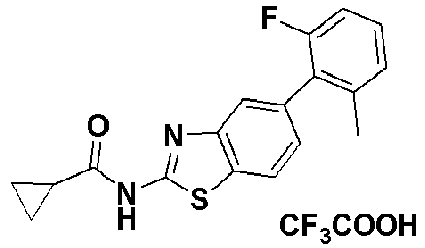
1H NMR (400MHz, DMSO-d6) δ = 12.71 (s, 1H); 8.04 (d, J=8.1 Hz, 1H), 7.63 (s, 1H), 7.33 (dt, J=5.9, 7.9 Hz, 1H); 7.22 - 7.16 (m, 2H), 7.13 (t, J=8.9 Hz, 1H); 2.14 (s, 3H), 2.05 - 1.96 (m, 1H); 1.01 - 0.93 (m, 4H); LCMS (electrospray) m/z 327.0 (M+H)+. A 31∗ 
1H NMR (400MHz, DMSO-d6) δ = 12.73 (br s, 1H); 11.06 (br s, 1H), 8.05 (d, J=8.2 Hz, 1H), 7.67 (d, J=1.1 Hz, 1H), 7.35 - 7.22 (m, 3H), 7.05 (d, J=8.3 Hz, 1H), 6.00 (br s, 1H), 5.18 - 4.89 (m, 1H), 2.28 - 2.18 (m, 4H), 1.83 - 1.70 (m, 1H), 1.31 (tdd, J=6.3, 9.0, 12.8 Hz, 1H); LCMS (electrospray) m/z 1662 (M+H)+. I 32* 
1H NMR (400MHz, DMSO-d6) δ = 12.74 (s, 1H), 7.95 (d, J=8.3 Hz, 1H), 7.88 (d, J=1.4 Hz, 1H), 7.80 (d, J=8.3 Hz, 1H), 7.29 (dd, J=1.7, 8.2 Hz, 1H), 7.10 (d, J=8.5 Hz, 1H), 5.18 - 4.91 (m, 1H), 4.02 (br t, J=8.4 Hz, 2H), 2.85 (br s, 2H), 2.27 - 2.19 (m, 1H), 2.13 (s, 3H), 2.05 (s, 3H), 1.82 - 1.67 (m, 1H), 1.37 - 1.21 (m, 1H), LCMS (electrospray) m/z 410.1 (M+H)+. J 33∗ 
1H NMR (400MHz, DMSO-d6) δ = 7.95 (br d, J=7.9 Hz, 1H), 7.54 (s, 1H), 7.36 - 7.27 (m, 1H), 7.17 (d, J=7.6 Hz, 1H), 7.15 - 7.09 (m, 2H), 3.69 (dd, J=5.6, 11.3 Hz, 1H), 3.54 - 3.45 (m, 1H), 2.14 (s, 3H), 2.05 - 1.95 (m, 1H), 1.60 - 1.48 (m, 1H), 1.12 - 0.98 (m, 2H); LCMS (electrospray) m/z 357.1 (M+H)+. K 34* 
1H NMR (400MHz, DMSO-d6) δ = 12.26 (s, 1H), 7.92 (s, 1H), 7.79 (d, J=8.3 Hz, 1H), 7.36 - 7.29 (m, 2H), 7.20 - 7.09 (m, 2H), 3.43 (quin, J=8.3 Hz, 1H), 2.31 - 2.11 (m, 7H), 2.03 - 1.94 (m, 1H), 1.90 - 1.79 (m, 1H); LCMS (electrospray) m/z 341.1 (M+H)+. A 35∗ 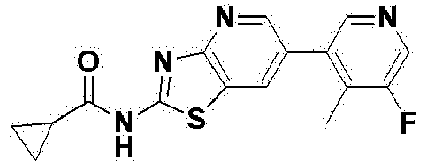
1H NMR (400MHz, DMSO-d6) δ = 13.02(s, 1H), 8.59-8.56(m, 3H), 8.40(s, 1H), 2.25(s, 3H), 2.04-1.98(m, 1H), 1.02-0.99(m, 4H); LCMS (electrospray) m/z 329.0(M+H)+. C 36* 
1H NMR (400 MHz, DMSO-d6 ) δ = 2.12 - 2.21 (m, 2 H), 2.31 (s, 3 H), 3.01 (dt, J=12.99, 9.46 Hz, 1 H), 7.36 (d, J=5.01 Hz, 1 H), 7.48 (dd, J=8.31, 1.83 Hz, 1 H), 7.86 (d, J=8.31 Hz, 1 H), 8.07 (d, J=1.59 Hz, 1 H), 8.42 - 8.47 (m, 2 H), 12.88 (br s, 1 H); LCMS (electrospray) m/z 346.0 (M+H)+. A 37* 
1H NMR (400 MHz, CHLOROFORM-d) δ = 2.34 (s, 3 H), 2.62 - 2.75 (m, 5 H), 4.85 - 5.12 (m, 1 H), 7.24 (d, J=4.89 Hz, 1 H), 7.42 (dd, J=8.34, 1.69 Hz, 1 H), 7.78 - 7.85 (m, 2 H), 8.46 - 8.54 (m, 2 H), 9.63 (br s, 1 H); LCMS (electrospray) m/z 342.3 (M+H)+. A 38* 
1H NMR (400 MHz, CHLOROFORM-d) δ = 2.35 (s, 3 H), 2.47 - 2.87 (m, 4 H), 3.21 - 3.41 (m. 1 H), 5.24 - 5.49 (m, 1 H), 7.25 (d, J=5.02 Hz, 1 H), 7.40 - 7.48 (m, 1 H), 7.78 - 7.86 (m, 2 H), 8.47 - 8.56 (m, 2 H), 10.43 (br s, 1 H); LCMS (electrospray) m/z 342.1 (M+H)+. A 39 
1H NMR (400MHz, DMSO-d6) δ = 12.91 (br s, 1H), 7.95 (s, 1H), 7.84 (d, J=8.3 Hz, 1H), 7.38 - 7.28 (m, 2H), 7.21 - 7.08 (m, 2H), 3.01 (td, J=9.5, 12.8 Hz, 1H), 2.22 - 2.11 (m, 5H); LCMS (electrospray) m/z 363.0 (M+H)+. A 40* 
1H NMR (400MHz, DMSO-d6) δ = 12.47 (s, 1H), 7.94 (s, 1H), 7.80 (d, J=8.3 Hz, 1H), 7.36 - 7.29 (m, 2H), 7.21 - 7.09 (m, 2H), 5.19 - 4.95 (m, 1H), 2.96 - 2.85 (m, 1H), 2.65 - 2.56 (m, 2H), 2.41 - 2.35 (m, 2H), 2.14 (s, 3H); LCMS (electrospray) m/z 359.1 (M+H)+. A 41* 
1H NMR (400MHz, DMSO-d6) δ = 12.46 (br s, 1H), 7.93 (d, J=1.3 Hz, 1H), 7.80 (d, J=8.3 Hz, 1H), 7.36 - 7.29 (m, 2H), 7.20 - 7.09 (m, 2H), 5.37 - 5.13 (m, 1H), 3.49 - 3.39 (m, 1H), 2.66 - 2.55 (m, 2H), 2.48 - 2.39 (m, 2H), 2.14 (s, 3H); LCMS (electrospray) m/z 359.1 (M+H)+. A 42* 
1H NMR (400MHz, DMSO-d6) δ = 12.59 (br s, 1H), 7.95 (s, 1H), 7.82 (d, J=8.3 Hz, 1H), 7.37 - 7.28 (m, 2H), 7.21 - 7.09 (m, 2H), 3.31 (dquin, J=2.8, 8.4 Hz, 1H), 2.95 - 2.81 (m, 4H), 2.14 (s, 3H); LCMS (electrospray) m/z 377.0 (M+H)+. A 43* 
1H NMR (400 MHz, METHANOL-d 4) δ = 1.91 - 2.01 (m, 1 H), 2.05 - 2.14 (m, 1 H), 2.25 - 2.33 (m, 2 H), 2.36 (s, 3 H), 2.37 - 2.46 (m, 2 H), 3.44 (quin, J=8.47 Hz, 1 H), 7.37 - 7.44 (m, 2 H), 7.82 (d, J=8.28 Hz, 1 H), 7.88 (d, J=1.63 Hz, 1 H), 8.38 (t, J=2.51 Hz, 2 H); LCMS (electrospray) m/z 324.1 (M+H)+. A 44* 
1H NMR (400 MHz, METHANOL-d 4) δ = 2.64 (s, 3 H), 2.85 - 3.01 (m, 4 H), 3.22 - 3.29 (m, 1 H), 7.55 (dd, J=8.38, 1.77 Hz, 1 H), 7.93 (d, J=8.44 Hz, 1 H), 8.04 - 8.10 (m, 2 H), 8.72 (d, J=6.11 Hz, 1 H), 8.77 (s, 1 H); LCMS (electrospray) m/z 360.3 (M+H)+. A 45* 
1H NMR (400MHz, METHANOL-d4) δ= 7.98 - 7.66 (m, 2H), 7.47 - 7.03 (m, 3H), 5.20 - 4.99 (m, 1H), 3.23 - 3.09 (m, 3H), 2.25 - 2.02 (m, 4H), 1.97 - 1.77 (m, 1H), 1.60 - 1.24 (m, 10H); LCMS (electrospray) m/z 474.7 (M+H)+. L 46 
1H NMR (400MHz, METHANOL-d4) δ = 7.88 - 7.80 (m, 1H), 7.68 - 7.62 (m, 1H), 7.58 - 7.54 (m, 1H), 7.35 (br d, J=7.8 Hz, 1H), 7.27 - 7.19 (m, 1H), 5.14 - 5.01 (m, 1H),3.19 - 2.83 (m, 3H), 2.43 - 2.06 (m, 4H), 2.01 - 1.76 (m, 1H),1.44 - 1.09 (m, 1H); ); LCMS (electrospray) m/z 374.1 (M+H)+. L 47* 
1H NMR (400MHz, DMSO-d6) δ = 12.73 (s, 1H), 8.51 (s, 1H), 8.36 (s, 1H), 8.07 (d, J=1.5 Hz, 1H), 7.84 (d, J=8.3 Hz, 1H), 7.48 (dd, J=1.8, 8.3 Hz, 1H), 2.24 (d, J=2.1 Hz, 3H), 2.02 (m, 1H), 1.00 - 0.94 (m, 4H); LCMS (electrospray) m/z 328.1 (M+H)+. B 48 
1H NMR (400MHz, CHLOROFORM-d) δ = 10.26 (br s, 1H), 8.42 (s, 1H), 8.36 (s, 1H), 7.89 (d, J=7.9 Hz, 1H), 7.80 (s, 1H), 7.42 (d, J=8.3 Hz, 1H), 2.68 - 2.52 (m, 1H), 2.38 (br dd, J=6.0, 12.3 Hz, 1H), 2.28 (s, 3H), 1.96 (br s, 1H), LCMS (electrospray) m/z 364.2 (M+H)+. B 49* 
1H NMR (400MHz, CHLOROFORM-d) δ = 8.85 (br s, 1H), 8.41 (s, 1H), 8.36 (s, 1H), 7.84 (d, J=7.7 Hz, 1H), 7.78 (s, 1H), 7.39 (d, J=8.5 Hz, 1H), 3.42 - 3.21 (m, 1H), 2.58 - 2.41 (m, 2H), 2.42-2.27 (m, 2H), 2.28 (s, 3H), 2.17 - 1.95 (m, 2H); LCMS (electrospray) m/z 342.1 (M+H)+. B 50* 
1H NMR (400MHz, CHLOROFORM-d) δ = 9.73 (br s, 1H), 8.49 - 8.32 (m, 2H), 7.92 - 7.75 (m, 2H), 7.42 (td, J=1.8, 8.3 Hz, 1H), 5.51 - 5.24 (m, 0.5H), 5.12 - 4.87 (m, 0.5H), 3.38 - 3.22 (m, 0.5H), 2.89 - 2.50 (m, 4.5H), 2.28 (d, J=2.1 Hz, 3H); LCMS (electrospray) m/z 360.2 (M+H)+. B 51* 
1H NMR (400MHz, DMSO-d6) δ = 12.63 (s, 1H), 8.52 (s, 1H), 8.37 (s, 1H), 8.11 (d, J=1.6 Hz, 1H), 7.85 (d, J=8.3 Hz, 1H), 7.50 (dd, J=1.8, 8.3 Hz, 1H), 2,99 - 2.80 (m, 4H), 2.24 (d, J=2.0 Hz, 3H) ; LCMS (electrospray) m/z 378.1 (M+H)+. B 52* 
1H NMR (400 MHz, METHANOL-d 4) δ = 2.66 (s, 3 H), 7.56 - 7.62 (m, 3 H), 7.66 - 7.71 (m, 1 H), 7.97 (d, J=8.41 Hz, 1 H), 8.08 (d, J=5.90 Hz, 4 H), 8.73 (d, J=6.15 Hz, 1 H), 8.79 (s, 1 H); LCMS (electrospray) m/z 346.3 (M+H)+. J 53* 
1H NMR (400 MHz, METHANOL-d 4) δ = 2.62 (s, 3 H), 3.19 (s, 3 H), 7.51 (dd, J=8.31, 1.71 Hz, 1 H), 7.66 (d, J=8.31 Hz, 1 H), 7.88 (d, J=1.47 Hz, 1 H), 8.03 (d, J=5.87 Hz, 1 H), 8.66 - 8.78 (m, 2 H); LCMS (electrospray) m/z 256.2 (M+H)+. M 54∗ 
1H NMR (400 MHz, METHANOL-d 4) δ = 2.57 (s, 3 H), 3.87 (s, 3 H), 7.71 (dd, J=8.56, 1.71 Hz, 1 H), 7.82 (d, J=8.56 Hz, 1 H), 7.96 - 8.03 (m, 2 H), 8.68 - 8.76 (m, 2 H). M 55 
1H NMR (400 MHz, CHLOROFORM-d) δ = 1.33 - 1.44 (m, 1 H), 1.91 - 2.13 (m, 2 H), 3.94 (s, 3 H), 4.79 - 5.05 (m, 1 H), 696 (d, J=5.87 Hz, 1 H), 7.63 (dd, J=8.38, 1.65 Hz, 1 H), 7.87 (d, J=8.44 Hz, 1 H), 8.02 (d, J=1.47 Hz, 1 H), 8.51 - 8.55 (m, 2 H), 10.35 (br s, 1 H); LCMS (electrospray) m/z 344.3 (M+H)+. N 56 
1H NMR (400 MHz, METHANOL-d 4) δ = 1.27 - 1.37 (m, 1 H), 1.81 - 1.94 (m, 1 H), 2.14 - 2.23 (m, 1 H), 2.33 (s, 3 H), 4.98 - 5.07 (m, 1 H), 6.96 (d, J=5.14 Hz, 1 H), 7.30 (d, J=5.14 Hz, 1 H), 7.54 (dd, J=8.44, 1.71 Hz, 1 H), 7.79 (d, J=8.44 Hz, 1 H), 7.95 (d, J=1.59 Hz, 1 H); LCMS (electrospray) m/z 333.0 (M+H)+. N 57 
1H NMR (400 MHz, DMSO-d6) δ = 12.81 (br s, 1H), 8.29 - 8.18 (m, 2H), 8.08 (br d, J = 1.3 Hz, 1H), 7.87 - 7.80 (m, 1H), 7.53 - 7.41 (m, 2H), 5.18 - 4.94 (m, 1H), 2.25 - 2.31 (m, 1H), 2.31 (s, 3H), 1.81 - 1.71 (m, 1H), 1.38 - 1.29 (m, 1H); LCMS (electrospray) m/z 344.10 (M+H)+. N 58* 
1H NMR (400 MHz, METHANOL-d 4) δ = 1.26 - 1.39 (m, 1 H), 1.81 - 1.94 (m, 1 H), 2.19 (dtd, J=9.19, 6,87, 6.87, 4.34 Hz, 1 H), 4.87 - 5.18 (m, 1 H), 7.69 - 7.75 (m, 1 H), 7.81 (br d, 7=7.82 Hz, 1 H), 8.22 (s, 1 H); ; LCMS (electrospray) m/z 281.2 (M+H)+. O 59 
1H NMR (400MHz, DMSO-d6) δ = 12.60 (br s, 1H), 7.89 (s, 1H), 7.79 (d, J=8.2 Hz, 1H), 7.36 - 7.28 (m, 2H), 7.21 - 7.07 (m, 2H), 4.56 (br s, 1H), 3.68 (br dd, J=5.7, 11.2 Hz, 1H), 3.51 - 3.41 (m, 1H), 2.15 - 2.06 (m, 4H), 1.67 - 1.55 (m, 1H), 1.14 (dt, J=4.0, 8.0 Hz, 1H), 1.05 - 0.98 (m, 1H); LCMS (electrospray) m/z 357.3 (M+H)+. [α] = (+) 79.105 K 60 
1H NMR (400MHz, DMSO-d6) δ = 12.57 (br s, 1H), 7.89 (s, 1H), 7.79 (d, J=8.3 Hz, 1H), 7.36 - 7.28 (m, 2H), 7.20 - 7.08 (m, 2H), 4.59 (br s, 1H), 3.68 (dd, J=5.8, 11.3Hz, 1H), 3.46 (br dd, J=8.5, 11.2 Hz, 1H), 2.16 - 2.05 (m, 4H), 1.66 - 1.55 (m, 1H), 1.13 (dt, J=4.2, 8.1 Hz, 1H), 1.06 - 0.97 (m, 1H); LCMS (electrospray) m/z 357.2 (M+H)+. [α] = (-) 77.479 K 61 
1H NMR (400 MHz, METHANOL-d 1) δ = 1.28 - 1.39 (m, 1 H), 1.83 - 1.96 (m, 1 H), 2.16 - 2.26 (m, 1 H), 2.80 (s, 3 H), 5.00 - 5.08 (m, 1 H), 7.60 (dd, J=8.38, 1.65 Hz, 1 H), 7.94 (d, J--8.44 Hz, 1 H), 8.09 (d, J=1.47 Hz, 1 H), 9.13 (s, 1 H), 9.43 (s, 1 H); LCMS (electrospray) m/z 329.2 (M+H)+. B 62 
1H NMR (400 MHz, DMSO-d 6) δ= 1.26 - 1.37 (m, 1H), 1.70 - 1.82 (m, 1 H), 2.24 (dt, J=13.57, 6.79 Hz, 1 H), 2.40 (s, 3 H), 2.67 (s, 3 H), 4.93 - 5.18 (m, 1 H), 7.52 (dd, J=8.38, 1.65 Hz, 1 H), 7.86 (d, J=8.19 Hz, 1 H), 7.94 (s, 1 H), 8.12 (d, J=1.34 Hz, 1 H), 8.59 (s, 1 H), 12.79 (br s, 1 H); LCMS (electrospray) m/z 370.3 (M+H)+. B 63 
1H NMR (400MHz, DMSO-d6) δ = 12.60 (br s, 1H), 7.89 (d, J=1.2 Hz, 1H), 7.80 (d, J=8.2 Hz, 1H), 7.36 - 7.27 (m, 2H), 7.20 - 7.07 (m, 2H), 4.55 (br s, 1H), 3.68 (dd, J=5.8, 11.3 Hz, 1H), 3.46 (br dd, J=8.6, 11.1 Hz, 1H), 2.16 - 2.08 (m, 4H), 1.67 - 1.55 (m, 1H), 1.14 (dt, J=4.2, 8.1 Hz, 1H), 1.06 - 0.98 (m, 1H); LCMS (electrospray) m/z 357.2 (M+H)+. K 64 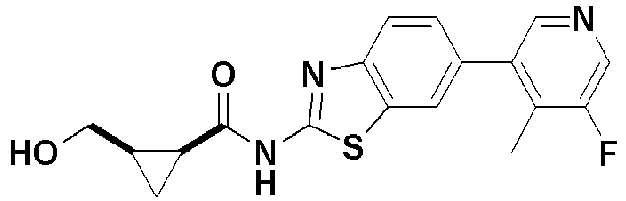
1H NMR (400MHz, DMSO-d6) δ = 12.98 - 12.30 (m, 1H), 8.51 (s, 1H), 8.36 (s, 1H), 8.05 (d, J=1.5 Hz, 1H), 7.82 (d, J=8.3 Hz, 1H), 7.47 (dd, J=1.7, 8.3 Hz, 1H), 4.87 - 4.35 (in, 1H), 3.68 (br dd, J=5.8, 11.3 Hz, 1H), 3.46 (br dd, J=8.7, 11.1 Hz, 1H), 2.24 (d. J=1.8 Hz, 3H), 2.15 - 2.04 (m, 1H), 1.66 - 1.55 (m, 1H). 1.14 (dt, J=4.2, 8.1 Hz, 1H), 1.06 - 0.98 (m, 1H), LCMS (electrospray) m/z 358.0 (M+H)+. K 65 
1H NMR (400MHz, DMSO-d6) δ = 12.86 (br s, 1H), 8.71 (s, 1H), 8.13 (d, J=1.5 Hz, 1H), 7.91 - 7.87 (m, 2H), 7.54 (dd, J=1.9, 8.4 Hz, 1H), 5.17 - 4.95 (m, 1H), 2.70 (s, 3H), 2.49 (s, 3H), 2.29 - 2.23 (m, 1H), 1.82 - 1.70 (m, 1H), 1.38 - 1.29 (m, 1H); LCMS (electrospray) m/z 341.10 (M+H)+. N 66 
1H NMR (400MHz, DMSO-d6) δ = 12.77 (s, 1H), 8.27 (s, 1H), 8.05 (s, 1H), 7.83 (d, J=8.3 Hz, 1H), 7.53 (s, 1H), 7.46 (br d, J=8.3 Hz, 1H), 5.17 - 4.93 (m, 1H), 2.31 (s, 3H), 2.28 - 2.20 (m, 1H), 1.81 - 1.71 (m, 1H), 1.38 - 1.26 (m, 1H); LCMS (electrospray) m/z 362.00 (M+H)+. N 67 
1H NMR (400MHz, DMSO-d6) δ = 12.79 (s, 1H), 8.62 (s, 1H), 8.11 (d, J=1.5 Hz, 1H), 7.90 (s, 1H), 7.86 (d, J=8.3 Hz, 1H), 7.52 (dd, J=1.7, 8.3 Hz, 1H), 5.15 - 4.94 (m, 1H), 2.41 (s, 3H), 2.27 - 2.21 (m, 1H), 1.82 - 1.70 (m, 1H), 1.32 (tdd, J=6.4, 8.9, 12.8 Hz, 1H), LCMS (electrospray) m/z 396.10 (M+H)+. N 68 
1H NMR (400MHz, DMSO-d6) δ = 12.86 (br s, 1H), 8.83 (br d, J=5.6 Hz, 1H), 8.76 (s, 1H), 8.13 (d, J=1.6 Hz, 1H), 8.05 (d, J=5.6 Hz, 1H), 7.88 (d, J=8.3 Hz, 1H), 7.54 (dd, J=1.7, 8.3 Hz, 1H), 5.16 - 4.95 (m, 1H), 4.66 (s, 2H), 2.29 - 2.23 (m, 1H), 1.81 - 1.72 (m, 1H), 1.33 (ddd, J=2.6, 6.3, 12.8 Hz, 1H); LCMS (electrospray) m/z 344.10 (M+H)+ H 69 
1H NMR (400 MHz, DMSO-d 6) δ = 1.32 (ddt, J=12.79, 8.97, 6.36 Hz, 1 H), 1.69 - 1.82 (m, 1 H), 2.17 - 2.27 (m, 1 H), 2.31 (s, 3 H), 4.58 (d, J=5.75 Hz, 2 H), 4.90 - 5.20 (m, 1 H), 5.41 (t, J=5.81 Hz, 1 H), 7.41 (s, 1 H), 7.44 (dd, J=8.31, 1.71 Hz, 1 H), 7.82 (d, J=8.31 Hz, 1 H), 8.03 (d, J=1.47 Hz, 1 H), 8.33 (s, 1 H), 12.75 (br s, 1 H); LCMS (electrospray) m/z 358.1 (M+H)+. H 70 
1H NMR (400 MHz, DMSO-d 6) δ = 1.19 - 1.33 (m, 1 H), 1.40 (d, J=6.48 Hz, 3 H), 1.66 - 1.81 (m, 1 H), 2.12 - 2.25 (m, 1 H), 2.31 (s, 3 H), 4.74 (q, J=6.56 Hz, 1 H), 4.90 - 5.13 (m, 1 H), 5.37 (br s, 1 H), 7.41 (dd, J=8.31, 1.59 Hz, 1 H), 7.44 (s, 1 H), 7.77 (d, J=8.31 Hz, 1 H), 7.98 (s, 1 H), 8.32 (s, 1 H); LCMS (electrospray) m/z 372.2 (M+H)+. G 71∗ 
1 H NMR ( 400MHz, METHANOL-d4) δ= 7.74 (s, 1H), 7.87 - 7.71 (m, 1H), 7.61 (d, J=8.4 Hz, 1H), 7.49 - 7.40 (m, 1H), 7.30 (dt, J=5.7, 7.9 Hz, 1H), 7.14 (d, J=7.7 Hz, 1H), 7.02 (t, J=8.9 Hz, 1H), 3.88 (br d, J=6.5 Hz, 2H), 2.74 (s, 3H), 2.16 (s, 3H), 1.87 (dt, J=5.7, 8.2 Hz, 1H), 1.71 (qd, J=7.9, 15.3 Hz, 1H), 1.30 - 1.06 (m, 2H); LCMS (electrospray) m/z 370.0 (M+H)+. P 72 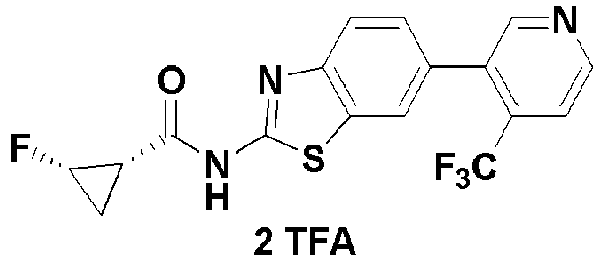
1H NMR (400 MHz, DMSO-d 6) δ = 1.33 (ddt, J=12.91, 9.00, 6.34, 6.34 Hz, 1 H), 1.70 - 1.82 (m, 1 H), 2.20 - 2.29 (m, 1 H), 4.93 - 5.19 (m, 1 H), 7.44 (br d, J=8.31 Hz, 1 H), 7.85 (d, J=8.31 Hz, 1 H), 7.88 (d, J=5.14 Hz, 1 H), 8.06 (d, J=1.22 Hz, 1 H), 8.77 (s, 1 H), 8.90 (d, J=5.14 Hz, 1 H), 12.84 (s, 1 H); LCMS (electrospray) m/z 382.2 (M+H)+. B 73 
1H NMR (400 MHz, DMSO-d 6) δ = 1.24 - 1.36 (m, I H), 1.68 - 1.81 (m, 1 H), 2.22 (dt, J=13.48, 6.77 Hz, 1 H), 4.90 - 5.16 (m, 1 H), 6.67 - 6.80 (m, I H), 7.72 - 7.82 (m, 2 H), 7.93 (br d, J=7.58 Hz, 1 H), 8.29 - 8.42 (m, 1 H), 12.59 - 12.93 (m, 2 H); LCMS (electrospray) m/z 303.2 (M+H)+. C 74 
1H NMR (400 MHz, DMSO-d 6) δ =1.32 (ddt, J=12.76, 9.00, 6.30, 6.30 Hz, 1 H), 1.69 - 1.81 (m, 1 H), 2.18 - 2.26 (m, 1 H), 2.31 (s, 3 H), 4.93 - 5.16 (m, 1 H), 7.38 - 7.41 (m, 1 H), 7.42 - 7.44 (m, 1 H), 7.46 (dd, J=8.31, 1.71 Hz, 1 H), 7.49 (d, J=1.59 Hz, 1 H), 7.51 - 7.55 (m, 1 H), 7.64 (d, J=7.82 Hz, 1 H), 7.78 - 7.87 (m, 2 H), 8.04 (d, J=1.47 Hz, 1 H), 8.55 - 8.64 (m, 1 H), 12.75 (br s, 1 H); LCMS (electrospray) m/z 428.3 (M+H)+. B 75 
1 H NMR ( 400MHz, DMSO-d 6) δ 12.75 (s, 1H), 8.54 (d, J=2.3 Hz, 1H), 8.05 (d, J=1.5 Hz, 1H), 7.82 (d, J=8.3 Hz, 1H), 7.79 - 7.70 (m, 3H), 7.48 (dd, 1=1.7, 8.3 Hz, 1H), 7.43 (d, J=8.2 Hz, 1H), 6.55 - 6.49 (m, 1H), 5.18 - 4.90 (m, 1H), 2.29 (s, 3H), 2.27 - 2.21 (m, 1H), 1.83 - 1.69 (m, 1H), 1.32 - (tdd, J=6.3, 8.9, 12.9 Hz, 1H); LCMS (electrospray) m/z 393.3 (M+H)+. N 76∗ 
1 H NMR ( 400MHz, METHANOL-d4) δ 8.97 (br s, 1H), 8.73 (br s, 1H), 8.12 - 7.91 (m, 1H), 7.84 - 7.51 (m, 2H), 4.02 - 3.79 (m, 2H), 2.75 (s, 3H), 2.61 - 2.35 (m, 3H), 1.90 - 1.87 (m, 1H), 1.76 - 1.70 (m, 1H), 1.38 - 0.98 (m, 2H); LCMS (electrospray) m/z 371.2 (M+H)+. P 77* 
1H NMR (400MHz, DMSO-d6) δ = 12.72 (br s, 1H), 11.05 (br s, 1H), 7.94 (d, J=1.5 Hz, 1H), 7.82 (d, J=8.2 Hz, 1H), 7.41 (dd, J=1.7, 8.3 Hz, 1H), 7.30 (d, J=8.3 Hz, 1H), 7.25 (t, J=2.8 Hz, 1H), 7.04 (d, J=8.3 Hz, 1H), 6.01 (br s, 1H), 5.17 - 4.92 (m, 1H), 2.28 - 2.18 (m, 4H), 1.83 - 1.67 (m, 1H), 1.37 - 1.22 (m, 1H), LCMS (electrospray) m/z 366.2 (M+H)+. B 78* 
1H NMR (400MHz, DMSO-d6) δ = 12.70 (br s, 1H), 7.89 (s, 1H), 7.79 (d, J=8.2 Hz, 1H), 7.36 - 7.28 (m, 2H), 7.20 - 7.09 (m, 2H), 2.14 (s, 3H), 1.99 (br d, J=6.0 Hz, 1H), 1.01 - 0.90 (m, 4H); LCMS (electrospray) m/z 327.2 (M+H)+. A 79 
1H NMR (400MHz, DMSO-d6) δ = 8.44 (s, 1H), 8.32 (s, 1H), 7.69 (br s, 1H), 7.56 (br s, 1H), 7.19 (br d, J=7.5 Hz, 1H), 5.25 (br s, 1H), 4.99 - 4.73 (m, 1H), 4.60 (s, 2H), 2.23 (s, 3H), 1.96 (br s, 1H), 1.71 - 1.57 (m, 1H), 1.03 (br s, 1H); LCMS (electrospray) m/z 358.3 (M+H)+. B 80 
1H NMR (400MHz, DMSO-d6) δ = 13.07 (s, 1H), 8.64 (br d, J=7.7 Hz, 2H), 7.95 (br d, J=1.2 Hz, 1H), 7.68 (br s, 1H), 7.47 (br d, J=11.5 Hz, 1H), 5.17 - 4.96 (m, 1H), 2.43 (br s, 3H), 2.23 (td, J=6.9, 13.5 Hz, 1H), 1.83 - 1.70 (m, 1H), 1.34 (qd, J=6.4, 15.1 Hz, 1H); LCMS (electrospray) m/z 346.3 (M+H)+. Q 81 
1H NMR (400MHz, DMSO-d6) δ = 12.99 (br s, 1H), 7.69 (s, 1H), 7.38 - 7.29 (m, 1H), 7.22 - 7.16 (m, 2H), 7.13 (t, J=8.9 Hz, 1H), 5.13 - 4.88 (m, 1H), 2.16 (s, 4H), 1.80 - 1.67 (m, 1H), 1.32 - 1.19 (m, 2H); LCMS (electrospray) m/z 363.2 (M+H)+. Q 82 
1H NMR (400MHz, DMSO-d6) δ = 12.73 (br s, 1H), 8.96 (s, 1H), 8.26 (d, J=1.2 Hz, 1H), 7.83 - 7.72 (m, 2H), 5.15 - 4.92 (m, 1H), 2.62 (s, 3H), 2.27 - 2.17 (m, 1H), 1.81 - 1.68 (m, 1H), 1.29 (tdd, J=6.3, 9.0, 12.7 Hz, 1H); LCMS (electrospray) m/z 343.2 (M+H)+. B 83 
1H NMR (400 MHz, DMSO-d6 ) δ =1.26 - 1.38 (m, 1 H), 1.69 - 1.83 (m, 1 H), 2.19 - 2.29 (m, 7 H), 4.92 - 5.18 (m, 1 H), 7.36 (dd, J=8.25, 1.77 Hz, 1 H), 7.86 (d, J=8.31 Hz, 1 H), 7.95 (d, J=1.47 Hz, 1 H), 8.95 (s, 1 H), 12.81 (br s, 1 H); LCMS (electrospray) m/z 343.2 (M+H)+. A 84* 
1H NMR (400MHz, DMSO-d6) δ = 12.71 (s, 1H), 10.45 (s, 1H), 7.91 (d, J=1.5 Hz, 1H), 7.77 (d, J=8.4 Hz, 1H), 7.36 (dd, J=1,7, 8.3 Hz, 1H), 7.11 (d, J=7.6 Hz, 1H), 6.86 (d, J=7.6 Hz, 1H), 5.17 - 4.92 (m, 1H), 3.54 (s, 2H), 2.23 (td, J=6.9, 13.6 Hz, 1H), 2.11 (s, 3H), 1.82 - 1.69 (m, 1H), 1.36 - 1.26 (m, 1H); LCMS (electrospray) m/z 382.2 (M+H)+. N 85 
1H NMR (400 MHz, DMSO-d 6) δ = 1.24 - 1.36 (m, 1 H), 1.63 - 1.84 (m, 1 H), 2.19 - 2.25 (m, 1 H), 2.27 (s, 3 H), 4.14 (s, 1 H), 4.88 - 5.22 (m, 1 H), 7.31 - 7.36 (m, 2 H), 7.37 - 7.43 (m, 2 H), 7.79 (d, J=8.31 Hz, 1 H), 7.98 (d, J=1.47 Hz, 1 H), 12.74 (s, 1 H); LCMS (electrospray) m/z 351.1 (M+H)+. B 86 
1H NMR (400 MHz, DMSO-d 6) δ = 1.33 (ddt, J=12.79, 8.97, 6.36, 6.36 Hz, 1 H), 1.70 - 1.83 (m, 1 H), 2.20 - 2.29 (m, 1 H), 4.94 - 5.18 (m, 1 H), 7.56 (dd, J=8.38, 1.77 Hz, 1H), 7.70 (d, J=5.26 Hz, 1 H), 7.86 (d, J=8.31 Hz, 1 H), 8.15 (d, J=1.59 Hz, 1 H), 8.56 (d, J=5.26 Hz, 1 H), 8.66 (s, 1 H), 12.81 (br s, 1 H).; LCMS (electrospray) m/z 347.9 (M+H)+. N 87 
1H NMR (400 MHz, DMSO-d 6) δ = 1.33 (dq, J=15.30, 6.39 Hz, 1 H), 1.70 - 1.84 (m, 1 H), 2.25 (dt, J=13.48, 6.89 Hz, 1 H), 4.90 - 5.18 (m, 1 H), 7.73 (dd, J=8.44, 1.83 Hz, 1 H), 7.93 (d, J=8.31 Hz, 1 H), 8.00 (d, J=5.14 Hz, 1 H), 8.33 (d, J=1.47 Hz, 1 H), 8.83 (d, J=5.01 Hz, 1 H), 8.98 (s, 1 H), 12.86 (br s, 1 H); LCMS (electrospray) m/z 339.1 (M+H)+. B 88 
1H NMR (400 MHz, DMSO-d 6) δ = 1.28 (br d, J=8.68 Hz, 1 H), 1.66 - 1.81 (m, 1 H), 2.23 (s, 4 H), 4.87 - 5.18 (m, 1 H), 7.33 - 7.43 (m, 2 H), 7.81 (br d, J=7.95 Hz, 1 H), 7.98 (s, 1 H), 8.12 (br d, J=4.77 Hz, 1 H), 12.69 (br s, 1 H); LCMS (electrospray) m/z 346.10 (M+H)+. N 89 
1H NMR (400 MHz, DMSO-d 6) δ = 1.28 - 1.38 (m, 1 H), 1.70 - 1.82 (m, 1 H), 2.24 (br s, 1 H), 4.91 - 5.18 (m, 1 H), 7.50 (br d, J=8.07 Hz, 1 H), 7.87 (d, J=8.3 1 Hz, I H), 8.11 (s, 1 H), 9.14 (s, 1 H), 9.47 (s, 1 H), 12.82 (br s, 1 H); LCMS (electrospray) m/z 383.2 (M+H)+. N 90 * 
1H NMR (400MHz, DMSO-d 6) δ = 12.66 (s, 1H), 11.70 (s, 1H), 8.57 (d, J=5 Hz, 1H), 8.31 (d, J=3 Hz, 1H), 8.25 (d, J=4 Hz, 1H), 7.81 (t, J=21 Hz, 1H), 7.77 (dd, J=5, 4 Hz, 1H), 7.52 (t, J=7 Hz, 1H), 6.51 (q, J=5 Hz, 1H), 2.02 (m, 1H), 0.97 (m, 4H); LCMS (electrospray) m/z 335.2 (M+H)+. C 91 
1H NMR (400 MHz, DMSO-d6) Shift = 12.70 (s, 1H), 10.87 (br s, 1H), 7.98 (d, J=1.6 Hz, 1H), 7.79 (d, J=8.3 Hz, 1H), 7.48 - 7.36 (m, 3H), 7.27-7.18 (m, 2H), 6.77 (q, J=2.3 Hz, 1H), 6.43 (d, J=1.7 Hz, 1H), 5.17-4.91 (m, 1H), 2.27-2.23 (m, 1H), 2.21 (s, 3H), 1.83-1.67 (m, 1H), 1.31 (tdd, J=6.4, 9.0, 12.8 Hz, 1H); LCMS (electrospray) m/z 392.1 (M+H)+. R 92 
1H NMR (400 MHz, DMSO-d6) Shift = 12.88 (br s, 1H), 8.16 (d, J=1.3 Hz, 1H), 8.02 (d, J=3.2 Hz, 1H), 7.98 (dd, J=1.8, 7.9 Hz, 1H), 7.95-7.90 (m, 2H), 7.88 (d, J=3.2 Hz, 1H), 7.63-7.53 (m, 2H), 5.33 - 5.01 (m, 1H), 2.42 (s, 3H), 2.40-2.33 (m, 1H), 1.96-1.77 (m, 1H), 1.53-1.36 (m, 1H), LCMS (electrospray) m/z 410.2 (M+H)+. S 93 
1H NMR (400 MHz, DMSO-d 6) δ = 1.32 (ddt, J=12.84, 9.02, 6.31, 6.31 Hz, 1 H), 1.69 - 1.81 (m, 1H), 2.20 - 2.28 (m, 1 H), 2.34 (s, 3 H), 4.93 - 5.17 (m, 1 H), 7.45 (dd, J=8.38, 1.77 Hz, 1 H), 7.54 (d, J=7.83 Hz, 1 H), 7.71 - 7.77 (m, 2 H), 7.81 (d, J=8.31 Hz, 1 H), 8.03 (d, J=1.47 Hz, 1 H), 12.79 (s, 1 H); LCMS (electrospray) m/z 352.2 (M+H)+. N 94 
1H NMR (400MHz, DMSO-d 6) δ = 12.72 (br s, 1H), 8.22 (s, 1H), 7.81 - 7.71 (m, 3H), 5.36 (dd, J=2.1, 10.0 Hz, 1H), 5.16 - 4.92 (m, 1H), 3.94 (br d, J=11.9 Hz, 1H), 3.68 - 3.58 (m, 1H), 2.28 - 2.19 (m, 4H), 2.16 - 2.05 (m, 1H), 2.02 - 1.89 (m, 2H), 1.81 - 1.65 (m, 2H), 1.60 - 1.50 (m, 2H), 1.31 (tdd, J=6.4, 8.9, 12.8 Hz, 1H); LCMS (clcctrospray) m/z 401.1 (M+H)+. T 95 
1H NMR (400MHz, DMSO-d 6) δ = 12.46 (br s, 2H), 8.15 (s, 1H), 7.80 - 7.75 (m, 1H), 7.74 - 7.66 (m, 1H), 7.47 (br s, 1H), 5.12 - 4.88 (m, 1H), 2.30 - 2.19 (m, 4H), 1.85 - 1.70 (m, 1H), 1.36 - 1.22 (m, 1H), LCMS (electrospray) m/z 317.2 (M+H)+. T 96 
1H NMR (400 MHz, DMSO-d 6) δ = 1.26 - 1.38 (m, 1 H), 1.67 - 1.82 (m, 1 H), 2.20 - 2.28 (m, 4 H), 4.92 - 5.17 (m, 1 H), 6.06 - 6.12 (m, 1 H), 6.49 (br s, 1 H), 6.80 (br d, J=1.34 Hz, 1 H), 7.27 (d, J=7.70 Hz, 1 H), 7.45 (dd, J=8.31, 1.71 Hz, 1 H), 7.50 - 7.56 (m, 2 H), 7.81 (d, J=8.31 Hz, 1 H), 8.00 (d, J=1.34 Hz, 1 H), 11.23 (br s, 1 H), 12.71 (s, 1 H) ); LCMS (electrospray) m/z 392.1 (M+H)+. R 97 
1H NMR (400 MHz, DMSO-d 6) δ = 1.32 (ddt, J=12.64, 9.00, 6.30, 6.30 Hz, 1 H), 1.68 - 1.83 (m, 1 H), 2.19 - 2.29 (m, 4 H), 4.92 - 5.18 (m, 1 H), 6.72 (d, J=2.08 Hz, 1 H), 7.35 (d, J=8.68 Hz, 1 H), 7.45 (dd, J=8.31, 1.83 Hz, 1 H), 7.66 - 7.74 (m, 3 H), 7.81 (d, J=8.31 Hz, 1 H), 8.01 (d, J=1.47 Hz, 1 H), 12.72 (br s, 1 H); LCMS (electrospray) m/z 393.2 (M+H)+. R 98 * 
1H NMR (400 MHz, DMSO-d 6) δ = 1.31 (ddt, J=12.78, 8.99, 6.30, 6.30 Hz, 1 H), 1.68 - 1.82 (m, 1 H), 2.08 (s, 3 H), 2.19 - 2.26 (m, 1 H), 3.25 (s, 2 H), 4.90 - 5.19 (m, 1 H), 6.74 (d, J=7.82 Hz, 1 H), 7.13 (d, J=7.95 Hz, 1 H), 7.35 (dd, J=8.25, 1.65 Hz, 1 H), 7.79 (d, J=8.31 Hz, 1 H), 7.93 (d, J=1.47 Hz, 1 H), 10.33 (s, 1 H), 12.72 (s, 1 H); LCMS (electrospray) m/z 3821 (M+H)+. N 99* 
1H NMR (400MHz, DMSO-d6) δ= 12.75 - 12.70 (m, 1H), 11.78 - 11.74 (m, 1H), 7.95 (d, J=1.5 Hz, 1H), 7.79 (d, J=8.3 Hz, 1H), 7.47 (d, J=8.1 Hz, 1H), 7.41 -7.37 (m, 1H), 7.08 (s, 1H), 5.17 - 4.94 (m, 1H), 2.29 - 2.18 (m, 4H), 1.81 - 1.71 (m, 1H), 1.36 - 1.28 (m, 1H) ; LCMS (electrospray) m/z 400.1 (M+H)+. U 100* 
1H NMR (400MHz, DMSO-d 6) δ = 12.66(s, 1H), 11.35(s, 1H), 8.55 (d, J=4 Hz, 1H), 8.33(d, J=5 Hz, 1H), 8.22(d, J=6 Hz, 1H), 7.81(s, 2H), 7.27(s, 1H), 2.31(s, 3H), 2.05-1.99(m, 1H), 0.98-0.96(m, 4H) ; LCMS (electrospray) m/z 349.1 (M+H)+. C 101* 
1H NMR (400MHz, DMSO-d 6) δ = 12.72(s, 1H), 11.71(s, 1H), 8.57 (d, J=6 Hz, 1H), 8.33(d, J=4 Hz, 1H), 8.26(d, J=4 Hz, 1H), 7.84-7.77(m, 2H), 7.52(t, J=8 Hz, 1H), 6.51(q, J=6 Hz, 1H), 5.15-5.11(m, 0.5H), 4.98-4.94(m, 0.5H), 2.67-2.20(m, 1H), 1.81-1.70(m, 1H), 1.36-1.27(m, 1H) ; LCMS (electrospray) m/z 353.0 (M+H)+. A 102* 
1H NMR (400MHz, DMSO-d 6) δ = 13.72(s, 1H), 8.89(d, J=4 Hz, 1H), 8.52(d, J=6 Hz, 1H), 8.37(d, J=2 Hz, 1H), 8.20(s, 1H), 7.85-7.80(m, 2H), 2.06-2.00(m, 1H), 0.99-0.96(m, 4H) ; LCMS (electrospray) m/z 336.0 (M+H)+. C 103* 
1H NMR (400MHz, DMSO-d 6) δ = 12.67(s, 1H), 11.07(s, 1H), 8.41(d, J=6 Hz, 1H), 8.25(d, J=4 Hz, 1H), 7.92(s, 1H), 7.79(d, J=21 Hz, 1H), 7.71-7.69(m, 1H), 3.62(s, 2H), 2.04-1.98(m, 1H), 0.99-0.95em, 4H) ; LCMS (electrospray) m/z 351.1 (M+H)+. C 104* 
1H NMR (400MHz, DMSO-d 6) δ = 12.61(s, 1H), 8.13(d, J=4 Hz, 1H), 8.05(d, J=6 Hz, 1H), 7.72(d, J=21 Hz, 1H), 7.62-7.59(m, 2H), 6.51(s, 1H), 3.52(t, J=21 Hz, 1H), 3.03(t, J=21 Hz, 1H), 2.03-1.97(m, 1H), 0.98-0.93(m, 4H) ; LCMS (electrospray) m/z 337.1 (M+H)+. C 105 
1H NMR (400MHz, DMSO-d 6) δ = 12.86 (br s, 1H), 8.39 (s, 1H), 7.83 - 7.78 (m, 1H), 7.77 - 7.71 (m, 1H), 7.61 (s, 1H), 5.17 - 4.93 (m, 1H), 2.46 (s, 3H), 2.29 - 2.22 (m, 1H), 1.82 - 1.68 (m, 1H), 1.39 - 1.26 (m, 1H) ; LCMS (electrospray) m/z 334.0 (M+H)+. N 106 
1H NMR (400MHz, METHANOL-d4) δ = 8.24 (s, 1H), 7.87 (d, J=8.3 Hz, 1H), 7.73 (br d, J=8.7 Hz, 1H), 5.02 (br d, J=3.8 Hz, 1H), 2.51 (s, 3H), 2.18 (br s, 1H), 1.95 - 1.81 (m, 1H), 1.30 (br d, J=6.2 Hz, 1H) ; LCMS (electrospray) m/z 368.1 (M+H)+. N 107* 
1H NMR (400MHz, DMSO-d6) δ = 13.30 (br s, 1H), 12.74 (br s, 1H), 8.35 - 8.20 (m, 2H), 7.90 - 7.83 (m, 1H), 7.81 - 7.74 (m, 1H), 7.21 (br s, 2H), 5.17 - 4.93 (m, 1H), 2.57 (s, 3H), 2.24 (br s, 1H), 1.83 - 1.69 (m, 1H), 1.31 (br s, 1H) ; LCMS (electrospray) m/z 367.0 (M+H)+. V 108* 
1H NMR (400MHz, METHANOL-d4) δ = 8.31 (s, 1H), 7.90 (s, 1H), 7.84 (d, J=8.3 Hz, 1H), 7.73 (d, J=8.4 Hz, 1H), 7.48 (d, J=8.3 Hz, 1H), 7.22 (d, J=8.3 Hz, 1H), 5.09 - 4.97 (m, 1H), 5.09 - 4.94 (m, 1H), 2.51 (s, 3H), 2.24 - 2.16 (m, 1H), 1.95 - 1.82 (m, 1H), 1.39 - 1.27 (m, 1H) ; LCMS (electrospray) m/z 367.1 (M+H)+. V 109 
1H NMR (400MHz, DMSO-d6) δ 12.81 (s, 1H), 8.16 (d, J=1.6 Hz, 1H), 7.86 (d, J=8.3 Hz, 1H), 7.52 (dd, J=1.8, 8.4 Hz, 1H), 5.18 - 4.93 (m, 1H), 2.42 (s, 3H), 2.25 (m, 4H), 1.84 - 1.68 (m, 1H), 1.39 - 1.25 (m, 1H) ; LCMS (electrospray) m/z 348.2 (M+H)+. N 110 
1H NMR (400 MHz, DMSO-d 6) δ = 1.27 -1.39 (m, 1 H), 1.69 - 1.82 (m, 1 H), 2.21 - 2.27 (m, 1 H), 2.38 (s, 3 H), 4.94 - 5.18 (m, 1 H), 7.51 (dd, J=8.31, 1.71 Hz, 1 H), 7.61 (d, J=8.19 Hz, 1H), 7.81 (s, 2 H), 7.86 (d, J=8.31 Hz, 1 H), 7.90 - 7.95 (m, 1 H), 7.99 (d, J=1.71 Hz, 1 H), 8.06 (d, J=1.47 Hz, 1 H), 12.78 (s, 1 H), 14.63 (br s, 1 H) ; LCMS (electrospray) m/z 393.3 (M+H)+. R III * 
1H NMR (400MHz, METHANOL-d4) δ = 9.60 (s, 1H), 8.02 (d, J=8.4 Hz, 1H), 7.99 (d, J=1.3 Hz, 1H), 7.94 (d, J=8.3 Hz, 1H), 7.69 (d, J=8.4 Hz, 1H), 7.52 (dd, J=1.7, 8.3 Hz, 1H), 5.05 (dt, J=3.9, 6.2 Hz, 1H), 2.39 (s, 3H), 2.22 (dtd, J=4.3, 6.9, 9.1 Hz, 1H), 1.96 - 1.83 (m, 1H), 1.39 - 1.28 (m, 1H) ; LCMS (electrospray) m/z 384.0 (M+H)+. W 112 * 
1H NMR (400MHz, DMSO-d 6) δ = 8.44-8.41 (m, 2H), 8.04 (d, J = 1.6 Hz, 1H), 7.89 (d, J = 8.4 Hz, 1H), 7.47 (dd, J12 = 1.6 Hz, J13 = 8.4 Hz, 1H), 7.35 (t, J = 7.35 Hz, 1H), 5.21 (J12 = 2.9 Hz, J13 = 66.27 Hz, 1H), 3.95 (s, N-CH3, 3H), 2.66-2.62 (m, 1H), 2.29 (s, Me, 3H), 1.83-1.79 (m, 1H), 1.35-1.31 (m, 1H) ; LCMS (electrospray) m/z 342.1 (M+H)+. x 113 
1H NMR (400 MHz, DMSO-d6) δ = 1.32 (ddt, J=12.84, 8.99, 6.33, 6.33 Hz, 1 H), 1.69 - 1.82 (m, 1 H), 2.20 - 2.28 (m, 1 H), 2.36 (s, 3 H), 4.93 - 5 17 (m, 1 H), 5.46 (s, I H), 5.57 (s, 114), 7.48 (dd, J=8.31, 1.83 Hz, 1 H), 7.53 (s, 1 H), 7.84 (d, J=8.31 Hz, 1 H), 8.07 (d, J=1.59 Hz, 1 H), 8.48 (s, 1 H). 12.77 (br s, 1 H); LCMS (electrospray) m/z 360.00 (M+H)+. Y 114 * 
1H NMR (400MHz, DMSO-d6) δ = 12.75 (s, 1H), 11.14 (s, 1H), 7.98 (d, J=1.4 Hz, 1H), 7.85 (d, J=8.3 Hz, 1H), 7.45 - 7.40 (m, 1H), 7.29 - 7.25 (m, 1H), 7.19 (d, J=10.5 Hz, 1H), 6.04 - 6.00 (m, 1H), 5.16 - 4.94 (m, 1H), 2.30 - 2.19 (m, 1H), 2.14 (d, J=2.6 Hz, 3H), 1.84 - 1.68 (m, 1H), 1.38 - 1.25 (m, 1H); LCMS (electrospray) m/z 384.10 (M+H)+. Z 115 * 
LCMS (electrospray) m/z 366.43 (M+H)+. Z 116 * 
LCMS (electrospray) m/z 396.45 (M+H)+. K 117 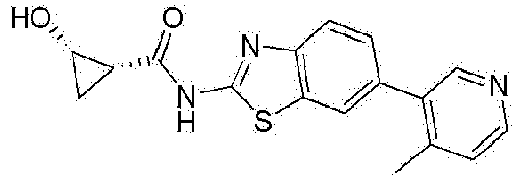
LCMS (electrospray) m/z 325.39 (M+H)+. 118 
LCMS (electrospray) m/z 325.39 (M+H)+. 119 
LCMS (clcctrospray) m/z 346.10 (M+H)+. Q 120 
1H NMR (400 MHz, DMSO-d6) δ = 12.87 - 12.68 (m, 1H), 8.14 - 8.10 (m, 1H), 8.07 - 8.02 (m, 1H), 7.86 - 7.81 (m, 1H), 7.49 - 7.43 (m, 1H), 7.21 - 7.18 (m, 1H), 5.18 - 4.94 (m, 1H), 2.34 - 2.33 (m, 3H), 2.23 (br s, 1H), 1.82 - 1.70 (m, 1H), 1.37 - 1.26 (m, 1H); LCMS (clectrospray) m/z 346.10 (M+H)+. N 121 
1H NMR (400 MHz, DMSO-d6) δ= 8.76 (s, 1H), 8.71 (dd, J=0.7, 6.1 Hz, 1H), 8.07 (d, J=6.0 Hz, 1H), 8.03 (d, J=1.3 Hz, 1H), 7.92 (d, J=8.4 Hz, 1H), 7.54 (dd, J=1.8, 8.4 Hz, 1H), 5.03 (dt, J=3.8, 6.2 Hz, 1H), 2.64 (s, 3H), 2.19 (dtd, J=4.3, 6.8, 9.2 Hz, 1H), 1.95 - 1.80 (m, 1H), 1.40 - 1.27 (m, 1H), LCMS (electrospray) m/z 328.20 (M+H)+. A 122 
1H NMR (400 MHz, METHANOL-d4) δ= 8.77 (s, 1H), 8.72 (d, J=6.1 Hz, 1H), 8.07 (d, J=6.1 Hz, 1H), 8.03 (d, J=1.6 Hz, 1H), 7.93 (d, J=8.3 Hz, 1H), 7.55 (dd, J=1.8, 8.4 Hz, 1H), 5.02 (ddd, J=1.6, 3.5, 6.1 Hz, 1H), 2.70 - 2.57 (m, 3H), 2.46 (dddd, J=1.5, 6.6, 10.4, 17.0 Hz, 1H), 1.65 (tddd, J=3.5, 6.9, 10.6, 17.9 Hz, 1H), 1.48 (qd, J=6.5, 13.1 Hz, 1H), LCMS (electrospray) m/z 328.20 (M+H)+. A 123 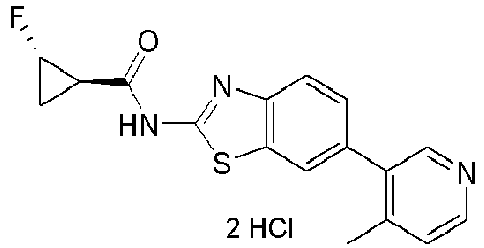
1H NMR (400 MHz, METHANOL-d4) δ= 8.76 (s, 1H). 8.72 (d, J=6.1 Hz, 1H), 8.07 (d, J=6.0 Hz, 1H), 8.03 (d, J=1.5 Hz, 1H), 7.93 (d, J=8.4 Hz, 1H), 7.55 (dd, J=1.8, 8.4 Hz, 1H), 5.02 (ddd, J=1.6, 3.5, 6.1 Hz, 1H), 2.72 - 2.59 (m, 3H), 2.46 (dddd, J=1.5, 6.6, 10.4, 17.0 Hz, 1H), 1.65 (tddd, J=3.4, 6.9, 10.6, 17.9 Hz, 1H), 1.48 (qd, J=6.5, 13.0 Hz, 1H), LCMS (electrospray) m/z 328.20 (M+H)+. A * denotes a compound used for a comparison study. - ADP-Glo assay kit was purchased from Promega. Magnesium chloride (MgCl2), bovine serum albumin (BSA), ethylene glycol-bis(β-aminoethyl ether)-N,N,N',N'-tetraacetic acid (EGTA), tween-20, 1,4-dithiothreitol (DTT) and dimethyl sulfoxide (DMSO) were purchased from Sigma-Aldrich. HEPES buffer was purchased from Gibco. ABL1 kinase and Abltide were purchased from Signalchem.
- c-abl kinase activity was measured by Promega's ADP-Glo™ Assay. In this assay, His-tagged recombinant human ABL1 (0.25 ng/µl) is incubated with 5 µL of compounds (0.5% DMSO), 5 µL of Abltide (0.01 µg/µl) and 5 µL of ATP (25 µM) in buffer (50 mM HEPES,7.5; 10 mM MgCl2; 1 mM EGTA; 0.05% BSA; 0.01% Tween-20; 2 mM DTT.). The assay was started by incubating the reaction mixture in a 96-well plate at 30° C for 30-min. After the incubation, 25 µL ADP-Glo reagent was added and the reaction was incubated at room temperature for 40-min to stop the reaction and degrade residual ATP. The ADP product was then converted to ATP by adding 50 µL per well of detection reagent. Luminescence was detected after 30-min room temperature incubation with the Molecular device I3X plate reader. The IC50 values were calculated from a series of percent inhibition values determined at a range of inhibitor concentration using software routines as implemented in the GraphPad Prism 7 software or SigmaPlot 13.0.
- Table 2 shows IC50 values for the compounds of Examples.
-
[Table 2] Example c-abl - IC50 (nM) Example c-abl - IC50 (nM) Example c-abl - IC50 (nM) 1 18.4 42 875.5 83 90.6 2 29.8 43 56.4 84 18.8 3 11.9 44 161.4 85 3.6 4 4.1 45 5311.2 86 7.4 5 9.0 46 16.8 87 50.9 6 >10,000 47 2.5 88 5.1 7 >10,000 48 7.9 89 119.9 8 2.7 49 11.6 90 1.6 9 34.6 50 24.4 91 9.9 10 22.6 51 35.7 92 9.3 11 8.3 52 5773.5 93 7.1 12 32.3 53 > 10,000 94 757.9 13 9500 54 > 10,000 95 21.1 14 1.3 55 5.9 96 10.1 15 116.0 56 7.9 97 1.2 16 ND 57 74.2 98 2.1 17 7.8 58 130.8 99 102.8 18 > 2,000 59 38.8 100 2.5 19 7.4 60 127.5 101 3.2 20 729.0 61 50.1 102 5.1 21 >2000 62 19.9 103 20.3 22 0.6 63 58.2 104 21.0 23 4.0 64 17.0 105 11.5 24 2.3 65 21.3 106 116.1 25 >2000 66 20.3 107 14.8 26 422.6 67 454.7 108 3.8 27 >2000 68 17.8 109 13.7 28 >2000 69 25.4 110 7.7 29 >2000 70 24.6 111 3.0 30 >2000 71 > 2,000 112 > 10,000 31 >2000 72 63.5 113 21.2 32 47.2 73 57.6 114 ND 33 >2000 74 171.5 115 ND 34 364.2 75 8.3 116 ND 35 1155.7 76 1663.8 117 ND 36 11.4 77 1.6 118 ND 37 76.2 78 4.2 119 ND 38 102.7 79 20.0 120 13.3 39 27.5 80 39.3 121 12.7 40 215.0 81 141.9 122 23.7 41 339.3 82 40.4 123 ND ND = not determined - ADP-Glo assay kit was purchased from Promega. Magnesium chloride (MgCl2), Manganese(II) chloride(MnCl2), Bovine serum albumin (BSA) and dimethylsulfoxide (DMSO) were purchased from Sigma-Aldrich. Tris-HCl buffer was purchased from Biosesang. c-Kit kinase and Poly (4:1 Glu, Tyr) Peptide were purchased from Signalchem.
- c-Kit kinase activity was measured by Promega's ADP-Glo™ Assay. In this assay, Recombinant human c-Kit (100 ng) is incubated with 5 µL of compounds (0.5% DMSO), 5 µL of Poly (4:1 Glu, Tyr) (250 ng/µl) and 5 µL of ATP (250 µM) in buffer (40mM Tris,7.5; 20mM MgCl2; 0.1mg/ml BSA; 2mM MnCl2; 50µM DTT.). The assay was started by incubating the reaction mixture in a 96-well plate at 30° C for 2 hr. After the incubation, 25 µL ADP-Glo reagent was added and the reaction was incubated at 30° C for 45 min to stop the reaction and degrade residual ATP. The ADP product was then converted to ATP by adding 50 µL per well of detection reagent. Luminescence was detected after 30 min room temperature incubation with the Molecular device I3X plate reader. The IC50 values were calculated from a series of percent inhibition values determined at a range of inhibitor concentration using software routines as implemented in the GraphPad Prism 7 software or SigmaPlot 13.0.
- ADP-Glo assay kit was purchased from Promega. Magnesium chloride (MgCl2), Bovine serum albumin (BSA) and dimethylsulfoxide (DMSO) were purchased from Sigma-Aldrich. Tris-HCl buffer was purchased from Biosesang. PDGFRα kinase and Poly (4:1 Glu, Tyr) Peptide were purchased from Signalchem.
- PDGFRα kinase activity was measured by Promega's ADP-Glo™ Assay. In this assay, Recombinant human PDGFRα (40 ng) is incubated with 5 µL of compounds (0.5% DMSO), 5 µL of Poly (4:1 Glu, Tyr) (0.5 µg/µl) and 5 µL of ATP (125 µM) in buffer (40mM Tris,7.5; 20mM MgCl2; 0.1mg/ml BSA; 50µM DTT.). The assay was started by incubating the reaction mixture in a 96-well plate at 30° C for 1 hr. After the incubation, 25 µL ADP-Glo reagent was added and the reaction was incubated at room temperature for 45 min to stop the reaction and degrade residual ATP. The ADP product was then converted to ATP by adding 50 µL per well of detection reagent. Luminescence was detected after 30-min room temperature incubation with the Molecular device I3X plate reader. The IC50 values were calculated from a series of percent inhibition values determined at a range of inhibitor concentration using software routines as implemented in the GraphPad Prism 7 software or SigmaPlot 13.0.
- In Table 3, IC50 values present against c-abl, c-Kit and PDGFRa Kinases, and the following designations are used ND=not determined.
-
[Table 3] Example c-ablIC50 (nM) c-KitIC50 (nM) PDGFRaIC50 (nM) 1 18.4 >10,000 >3099 2 29.8 4,022 >10,000 3 11.9 3,853 8,384 4 4.1 >10,000 1,966 5 9.0 ND 1,614 8 2.7 3,129 391 9 34.6 ND ND 10 22.6 ND ND 11 8.3 ND ND 12 32.3 >10,000 >10,000 14 1.8 1,338 143 17 7.8 >10,000 1,300 22 0.6 1,018 177 24 2.3 >10,000 1,156 36 11.4 >10,000 5,760 - The kinase inhibition profiles of the compounds (Examples 1, 4, 8 and 17) were tested using SelectScreen Kinase Profiling service (93 kinase panel or 485 kinase panel) by ThermoFisher SCIENTIFIC. We tested percentage of inhibition against diverse human kinases activity. Using these panel, the compounds were screened at a final concentration of 100-fold to IC50 of c-abl kinase or 500 nM. The assay protocols of each kinase are published on the ThermoFisher SCIENTIFIC.
- This kinase screening assay is a competition binding assay that profiled the selectivity of the compounds. The compounds showed c-abl kinase inhibition more than 80%, but PI3K, c-kit and PDGFR kinase activity less than 20%.
- The compounds showed a percentage of inhibition less than 40% against AAK1, ACVR1 (ALK2), ACVR1B (ALK4), ACVR2A, ADCK3, ADRBK1 (GRK2), ADRBK2 (GRK3), AKT1 (PKB alpha), AKT2 (PKB beta), AKT3 (PKB gamma), ALK, ALK C1156Y, ALK F1174L, ALK L1196M, ALK R1275Q, ALK T1151_L1152insT, AMPK (A1/B1/G2), AMPK (A1/B1/G3), AMPK (A1/B2/G1), AMPK (A1/B2/G2), AMPK (A1/B2/G3), AMPK (A2/B1/G2), AMPK (A2/B1/G3), AMPK (A2/B2/G1), AMPK (A2/B2/G2), AMPK (A2/B2/G3), AMPK A1/B1/G1, AMPK A2/B1/G1, AURKA (Aurora A), AURKB (Aurora B), AURKC (Aurora C), AXL, AXL R499C, BLK, BMPR1A (ALK3), BMPR1B (ALK6), BMPR2, BMX, BRAF (lantha), BRAF (Z-LYTE), BRAF V599E (lantha), BRAF V599E (Z-LYTE), BRSK1 (SAD1), BRSK2, BTK, CAMK1 (CaMK1), CAMK1D (CaMKI delta), CAMK1G (CAMKI gamma), CAMK2A (CaMKII alpha), CAMK2B (CaMKII beta), CAMK2D (CaMKII delta), CAMK2G (CaMKII gamma), CAMK4 (CaMKIV), CAMKK1 (CAMKKA), CAMKK2 (CaMKK beta), CASK, CDC42 BPA (MRCKA), CDC42 BPB (MRCKB), CDC42 BPG (MRCKG), CDC7/DBF4, CDK1/cyclin B, CDK11 (Inactive), CDK11/cyclin C, CDK13/cyclin K, CDK14 (PFTK1)/cyclin Y, CDK16 (PCTK1)/cyclin Y, CDK17/cyclin Y, CDK18/cyclin Y, CDK2/cyclin A, CDK2/cyclin A1, CDK2/cyclin E1, CDK2/cyclin O, CDK3/cyclin E1, CDK4/Cyclin D1, CDK4/cyclin D3, CDK5 (Inactive), CDK5/p25, CDK5/p35, CDK6/Cyclin D1, CDK7/cyclin H/MNAT1, CDK8/cyclin C, CDK9 (Inactive), CDK9/cyclin K, CDK9/cyclin T1, CDKL5, CHEK1 (CHK1), CHEK2 (CHK2), CHUK (IKK alpha), CLK1, CLK2, CLK4, CSK, CSNK1A1 (CK1 alpha 1), CSNK1A1L, CSNK1D (CK1 delta), CSNK1E (CK1 epsilon) R178C, CSNK1G1 (CK1 gamma 1), CSNK1G2 (CK1 gamma 2), CSNK1G3 (CK1 gamma 3), CSNK2A1 (CK2 alpha 1), CSNK2A2 (CK2 alpha 2), DAPK1, DAPK2, DAPK3 (ZIPK), DCAMKL1 (DCLK1), DCAMKL2 (DCK2), DDR1, DDR2, DDR2 T654M, DMPK, DYRK1A, DYRK1B, DYRK2, DYRK3, DYRK4, EEF2K, EGFR (ErbB1), EGFR (ErbB1) C797S, EGFR (ErbB1) d746-750, EGFR (ErbB1) d747-749 A750P, EGFR (ErbB1) G719C, EGFR (ErbB1) G719S, EGFR (ErbB1) L858R, EGFR (ErbB1) L861Q, EGFR (ErbB1) T790M, EGFR (ErbB1) T790M C797S L858R, EGFR (ErbB1) T790M L858R, EIF2AK2 (PKR), EPHA1, EPHA6, EPHA7, EPHB1, EPHB3, EPHB4, ERBB2 (HER2), ERBB4 (HER4), ERN1, ERN2, FER, FES (FPS), FGFR1, FGFR1 V561M, FGFR2, FGFR2 N549H, FGFR3, FGFR3 G697C, FGFR3 K650E, FGFR3 K650M, FGFR3 V555M, FGFR4, FLT1 (VEGFR1), FLT3, FLT3 D835Y, FLT3 ITD, FLT4 (VEGFR3), FRAP1 (mTOR), FRK (PTK5), FYN A, GAK, GRK1, GRK4, GRK5, GRK6, GRK7, GSG2 (Haspin), GSK3A (GSK3 alpha), GSK3B (GSK3 beta), HCK, HIPK1 (Myak), HIPK2, HIPK3 (YAK1), HIPK4, HUNK, ICK, IGF1R, IKBKB (IKK beta), IKBKE (IKK epsilon), INSR, INSRR (IRR), IRAK4, TTK, JAK1, JAK2, JAK2 JH1 JH2, JAK2 JH1 JH2 V617F, JAK3, KDR (VEGFR2), KIT, KIT A829P, KIT D816H, KIT D816V, KIT D820E, KIT N822K, KIT T670E, KIT T670I, KIT V559D, KIT V559D T670I, KIT V559D V654A, KIT V560G, KIT V654A, KIT Y823D, KSR2, LATS1, LATS2, LIMK1, LIMK2, LRRK2 I2020T, LRRK2 R1441C, LTK (TYK1), MAP2K1 (MEK1) (lantha), MAP2K1 (MEK1) (Z-LYTE), MAP2K1 (MEK1) S218D S222D, MAP2K2 (MEK2) (lantha), MAP2K2 (MEK2) (Z-LYTE), MAP2K4 (MEK4), MAP2K5 (MEK5), MAP2K6 (MKK6) (lantha), MAP2K6 (MKK6) (Z-LYTE), MAP2K6 (MKK6) S207E T211E, MAP3K10 (MLK2), MAP3K11 (MLK3), MAP3K14 (NIK), MAP3K19 (YSK4), MAP3K2 (MEKK2), MAP3K3 (MEKK3), MAP3K5 (ASK1), MAP3K7/MAP3K7IP1 (TAK1-TAB1), MAP3K8 (COT), MAP3K9 (MLK1), MAP4K2 (GCK), MAP4K3 (GLK), MAP4K5 (KHS1), MAPK1 (ERK2), MAPK10 (JNK3) (lantha), MAPK10 (JNK3) (Z-LYTE), MAPK11 (p38 beta), MAPK12 (p38 gamma), MAPK13 (p38 delta), MAPK14 (p38 alpha), MAPK14 (p38 alpha) Direct, MAPK15 (ERK7), MAPK3 (ERK1), MAPK7 (ERK5), MAPK8 (JNK1) (lantha), MAPK8 (JNK1) (Z-LYTE), MAPK9 (JNK2) (lantha), MAPK9 (JNK2) (Z-LYTE), MAPKAPK2, MAPKAPK3, MAPKAPK5 (PRAK), MARK1 (MARK), MARK2, MARK3, MARK4, MASTL, MATK (HYL), MELK, MERTK (cMER), MERTK (cMER) A708S, MET (cMet), MET (cMET) Y1235D, MET M1250T, MKNK1 (MNK1), MKNK2 (MNK2), MLK4, MST1R (RON), MST4, MUSK, MYLK (MLCK), MYLK4, MYO3A (MYO3 alpha), NEK1, NEK2, NEK4, NEK6, NEK7, NEK8, NEK9, NIM1K, NLK, NUAK1 (ARK5), NUAK2, PAK1, PAK2 (PAK65), PAK3, PAK4, PAK6, PAK7 (KIAA1264), PASK, PDGFRA (PDGFR alpha), PDGFRA D842V, PDGFRA T674I, PDGFRB (PDGFR beta), PDK1, PDK1 Direct, PHKG1, PHKG2, PI4K2A (PI4K2 alpha), PI4K2B (PI4K2 beta), PI4KA (PI4K alpha), PI4KB (PI4K beta), PIM1, PIM2, PIM3, PIP4K2A, PIP5K1A, PIP5K1B, PIP5K1C, PKMYT1, PKN1 (PRK1), PKN2 (PRK2), PLK1, PLK2, PLK3, PLK4, PRKACA (PKA), PRKACB (PRKAC beta), PRKACG (PRKAC gamma), PRKCA (PKC alpha), PRKCB1 (PKC beta I), PRKCB2 (PKC beta II), PRKCD (PKC delta), PRKCE (PKC epsilon), PRKCG (PKC gamma), PRKCH (PKC eta), PRKCI (PKC iota), PRKCN (PKD3), PRKCQ (PKC theta), PRKCZ (PKC zeta), PRKD2 (PKD2), PRKG1, PRKG2 (PKG2), PRKX, PTK2 (FAK), PTK2B (FAK2), PTK6 (Brk), RAF1 (cRAF) Y340D Y341D (lantha), RAF1 (cRAF) Y340D Y341D (Z-LYTE), RET, RET A883F, RET G691S, RET M918T, RET S891A, RET V804E, RET V804L, RET V804M, RET Y791F, ROCK1, ROCK2, ROS1, RPS6KA1 (RSK1), RPS6KA2 (RSK3), RPS6KA3 (RSK2), RPS6KA4 (MSK2), RPS6KA5 (MSK1), RPS6KA6 (RSK4), RPS6KB1 (p70S6K), RPS6KB2 (p70S6Kb), SBK1, SGK (SGK1), SGK2, SGKL (SGK3), SIK1, SIK3, SLK, SNF1LK2, SPHK1, SPHK2, SRMS (Srm), SRPK1, SRPK2, STK16 (PKL12), STK17A (DRAK1), STK17B (DRAK2), STK22B (TSSK2), STK22D (TSSK1), STK23 (MSSK1), STK24 (MST3), STK25 (YSK1), STK3 (MST2), STK32B (YANK2), STK32C (YANK3), STK33, STK38 (NDR), STK38L (NDR2), STK39 (STLK3), STK4 (MST1), TAOK1, TAOK3 (JIK), TBK1, TEC, TEK (TIE2) R849W, TEK (TIE2) Y1108F, TEK (TIE2) Y897S, TESK1, TESK2, TGFBR1 (ALK5), TGFBR2, TLK1, TLK2, TNK1, TNK2 (ACK), TTK, TXK, TYK2, TYRO3 (RSE), ULK1, ULK2, ULK3, VRK2, WEE1, WNK1, WNK2, WNK3, ZAK, ZAP70.
- Oral dose pharmacokinetic parameters of Examples 1, 4, 5, 6, 8 and nilotinib were evaluated in mice.
- Male ICR mice fasted for 15 h before beginning pharmacokinetic experiment and received single oral doses of compounds dissolved in 20% dimethyl sulfoxide (DMSO) / 1% Tween-20 / 79% NS solution at a dose of 5 mg/kg. To observe pharmacokinetics of compounds, blood from each mouse was collected from retro-orbital plexus at specific time points (5, 15, 30 and 60 min., 1.5, 2, 3, 4, 6, 8, 10 and 24 hr, n=3 for each time point) after administration using sodium heparinized capillary tube. The plasma samples were separated by centrifugation at 10,000 rpm for 5 min. and stored at -80 °C until analysis. To exposure of compounds, mice brains were collected at 30 and 60 min., 2, 4 and 24 hr (n=1 for each time point) after treatment of compounds with 5 mg/ kg and also collected matched plasma samples and then stored at -80 °C until analysis. Freshly thawed brain samples were weighted and homogenized in 3 volumes of PBS.
- Plasma and homogenized brain were treated with acetonitrile to precipitate proteins. After shaking and centrifugation, the supernatant was diluted 3-fold with distilled water and analyzed using ExionLC™ ultra-high-performance liquid chromatograph (SCIEX, USA) coupled with an SCIEX 6500+ triple-quadrupole mass spectrometry (SCIEX, USA) (LC-MS/MS). Ten microliters of each sample were injected onto a CORTECS® C18+ 2.1 mm×50 mm I.D., 2.7 um column (Water, USA) and separated by gradient conditions using mobile phase (A: 0.1% formic acid in water, B: 0.1% formic acid in ACN) at a flow rate of 0.3 mL/min. Peak integrations and areas were determined using Analyst software (SIEX, USA) and non-compartmental pharmacokinetic analysis with mean concentration was performed using Pheonix WinNonlin® software version 8.0 (Pharsight Corp, USA).
- The plasma AUCINF (min*ng/mL) and brain/plasma concentration ratio (BP ratio) following oral dosing at dose of 5 mg/kg were shown in Table 4. All examples exhibit better brain exposure than nilotinib.
-
[Table 4] Example Matrix Route Dose(mg/kg) AUCINF(min* ng/mL) BP ratioa 1 Plasma PO 5 61506.8 - Brain PO 5 152143.0 2.03 4 Plasma PO 5 682041.7 - Brain PO 5 248386.8 0.41 5 Plasma PO 5 509093.6 - Brain PO 5 118802.8 0.16 6 Plasma PO 5 291672.8 - Brain PO 5 236835.9 0.50 8 Plasma PO 5 871230.0 - Brain PO 5 1202940.1 0.94 Nilotinib Plasma PO 5 631652.5 - Brain PO 5 11778.6 0.01 a BP ratios were calculated based on AUCINF value from brain and matched plasma. - c-abl is active in Parkinson's disease and recent studies show that c-abl is activated by treatment of α-synuclein preformed fibrils (PFF) in a time-dependent manner and α-synuclein PFF was significantly decreased in the neurons with treatment of c-abl inhibitor, nilotinib. (Zui-Hua Zhou et at. Neurol Sci. 2016)
- However, nilotinib has been known to cause cardiovascular adverse events such as QTc prolongation and irregular heartbeat which may lead to sudden death. These adverse events (black box warning) could be due to its hERG activity. Nilotinib, ponatinib, and dasatinib have hERG IC50 of 0.13, 2.33 and 14.3 µM, respectively. Moreover, nilotinib neither shows c-abl kinase selectivity nor high BBB penetration. It may mean that nilotinib is not suitable for usage in chronic neurodegenerative disease.
- Examples 4 and 8 showed little hERG activity (23.87% and 12.61% inhibition at 10 µM, respectively) and it indicated the compounds are unlikely to cause cardiovascular adverse events. Example 4 decreased the α-synuclein PFF-induced pathologic aggregation (Lewy body-like pathology) and Examples 4 and 8 also inhibited PFF-induced neuronal toxicity in a dose dependent manner (dose: 0.5, 1, 5, 10, 100nM).
- Examples 4 and 8 have good PK profiles in mice and better brain exposure than nilotinib.
-
[Table 5] Drug Dose(mg /kg) Route Tmax(mi n) Cmax(ng/m L) AUCINF(min* ng/mL) Brain/plasma ratio (AUC)Total/Fre e Nilotinib 5 PO 60 4409.1 631652.5 0.01/0.002 Example 4 5 PO 30 3585.9 682041.7 0.42/0.27 Example 8 5 PO 60 4165.6 1514891.9 0.71/0.21 - The pharmacology activity of Examples 4 and 8 was estimated in the Aβ25-35 induced Alzheimer's disease (AD) and α-synuclein pre-formed fibrils (PFF) induced Parkinson's disease (PD) mice model.
- Phosphorylation of α-synuclein at ser129 was increased in α-synuclein PFF induced PD model and it was statistically reduced by oral administration of Example 4 (3 and 10 mg/kg, q.d.) about 50% and 80%, respectively. However, nilotinib (3 and 10 mg/kg, q.d.) was not effective on phosphorylation of α-synuclein statistically. It means that Example 4 is potent candidate to ameliorate Lewy body pathogenesis.
- In α-synuclein PFF induced PD mice, Example 4 (0.3, 1, 3 and 10 mg/kg) and nilotinib (3, 10 and 30 mg/kg) was administered orally once daily for 5 months and pole test was performed to evaluate the movement disorder of α-synuclein PFF induced PD mice. Increased pole climb down time (sec) by α-synuclein PFF injection was recovered by treatment of Example 4 in a dose-dependent manner. 0.3 mg/kg of Example 4 resulted in 50% improvement of pole climb down time and 10 mg/kg completely recovered. However, nilotinib showed just a slight improvement at 10 mg/ kg.
- It indicates that the compounds confer behavioral recovery of mice from motor dysfunction induced by α-synuclein PFF in a dose dependent way and the compounds are disease modifying agents for neurodegenerative disorders including Parkinson's disease and potentially dementia with Lewy body.
- Example 4 (1, 3 and 10 mg/kg), Example 8 (1 and 3 mg/kg) and nilotinib (3 mg/kg) was administered orally once daily to the Aβ25-35 induced AD mice for 10 days and spontaneous alternation performance in the Y-maze, an index of spatial working memory and step-through passive avoidance (STPA) test were performed. Y-maze test as a behavioral test was used to assess memory function and the willingness of rodents to explore new environments
- ICV injection of oligomeric Aβ25-35 peptide triggered neurotoxic effects and behavioral deficit in Y-maze test evaluating short term memory, by measurement of spontaneous alternation, while any change of motor symptom was not observed by measurement of locomotion.
- 10 Days after ICV injection of oligomeric Aβ25-35 peptide, the hippocampus was dissected out. And lipid peroxidation level was quantified in the hippocampus homogenates. ICV injection of oligomeric Aβ25-35 peptide induced lipid peroxidation, a marker for oxidative stress. Once daily oral dosing of 3 mg/kg and 10 mg/kg of Example 4 completely inhibited lipid peroxidation, meaning the reduction of oxidative stress. (
Fig. 7 ) - Oxidative stress is considered to be a major mechanism of neuronal toxicity induced by Aβ25-35 peptide through mitochondrial dysfunction (Ref: Meunier et al. Eur J. Pharm 2012), which is successfully inhibited by Example 4.
- This indicates that Example 4 very significantly and fully alleviated deficits of alternation behavior and contextual long-term memory in a dose-response manner, while nilotinib partially alleviated spatial working memory deficits or showed no significant effect on contextual long-term memory deficits.
- The results are shown in
Figures 1 to 7 . The result indicates that the compounds have high neuroprotective activity and low cardiovascular events and thus can be useful to treat or inhibit neurodegenerative disease such as Parkinson's disease, Alzheimer's disease and/or ALS.
Claims (17)
- A compound of Formula (I):
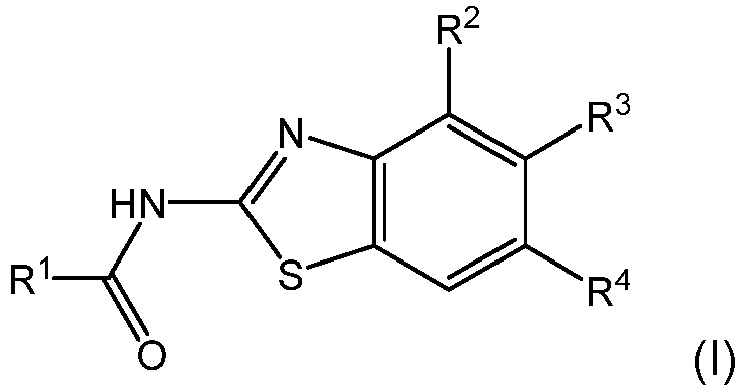 R1 is cyclopropyl, wherein R1 is substituted with one or more groups selected from the group consisting of halo, alkyl, hydroxyalkyl and haloalkyl,R2 and R3 are independently -H, halo, alkyl, alkoxy, -CF3, or -OCF3,R4 is aryl, monocyclic heteroaryl, cycloalkyl, or heterocyclyl, wherein R4 is optionally substituted with one or more groups selected from the group consisting of halo, hydroxyl, alkyl, alkenyl, alkynyl, haloalkyl, hydroxyalkyl, trimethylsilylethoxymethyl, -NO2, -NRaRb, -NRaC(=O)Rb, -NRaC(=O)NRaRb, - NRaC(=O)ORb, -ORa, -CN, -C(=O)Ra, -C(=O)ORa, -C(=O)NRaRb, -OC(=O)Ra, - OC(=O)ORa, -OC(=O)NRaRb, -SRa, azetidinyl, oxetanyl, tetrahydrofuranyl, furanyl, pyrrolidinyl, pyrrolyl, pyrazolyl, thiophenyl, imidazolyl, oxazolyl, isoxazolyl, thiazolyl, furazanyl, oxadiazolyl, thiadiazolyl, phenyl, tetrahydropyranyl, pyranyl, pyridinyl, pyridazinyl, pyrimidinyl, pyrazinyl, piperidinyl, piperazinyl, morpholinyl and thiomorpholinyl, andRa and Rb are independently -H, halo, amino, alkyl, or haloalkyl.
 - The compound of Claim 1, whereinR1 is cyclopropyl, wherein R1 is substituted with one or more groups selected from the group consisting of halo, C1-C3 alkyl, C1-C3 hydroxyalkyl and C1-C3 haloalkyl;R2 and R3 are independently -H, halo, C1-C3 alkyl, C1-C3 alkoxy, -CF3, or -OCFs;R4 is aryl, monocyclic heteroaryl, cycloalkyl, or heterocyclyl, wherein R4 is optionally substituted with one or more groups selected from the group consisting of halo, hydroxyl, C1-C3 alkyl, C2-C3 alkenyl, C2-C3 alkynyl, C1-C3 haloalkyl, mono-C1-C3 alkylamino, di-C1-C3 alkylamino, -NO2, -NRaRb, -NRaC(=O)Rb, - NRaC(=O)NRaRb, -NRaC(=O)ORb, -ORa, -CN, -C(=O)Ra, -C(=O)ORa, - C(=O)NRaRb, -OC(=O)Ra, -OC(=O)ORa, -OC(=O)NRaRb, -SRa, azetidinyl, oxetanyl, tetrahydrofuranyl, furanyl, pyrrolidinyl, pyrrolyl, pyrazolyl, thiophenyl, imidazolyl, oxazolyl, isoxazolyl, thiazolyl, furazanyl, oxadiazolyl, thiadiazolyl, phenyl, tetrahydropyranyl, pyranyl, pyridinyl, pyridazinyl, pyrimidinyl, pyrazinyl, piperidinyl, piperazinyl, morpholinyl and thiomorpholinyl, andRa and Rb are independently -H, halo, amino, C1-C3 alkyl, or C1-C3 haloalkyl.
- The compound of Claim 1 or 2, whereinR1 is cyclopropyl substituted with one or more selected from the group consisting of fluoro, C1-C3 alkyl, C1-C3 hydroxyalkyl and C1-C3 fluoroalkyl,R2 and R3 are independently -H, -F, -Br, -Cl, C1-C3 alkyl, or -CF3,R4 is phenyl, pyridinyl, thiophenyl, pyrazolyl, imidazolyl, isothiazolyl, thiazolyl, pyrimidinyl, pyrazinyl, oxazolyl, isoxazolyl, pyrrolyl, or pyridazinyl, wherein R4 is optionally substituted with one or more groups selected from the group consisting of halo, hydroxyl, C1-C3 alkyl, C1-C3 haloalkyl, mono(C1-C3)alkylamino, di(C1-C3)alkylamino, -NRaRb, -ORa, -CN, -C(=O)Ra, -C(=O)ORa, - OC(=O)Ra, -OC(=O)ORa, -SRa, pyrazolyl, imidazolyl, isothiazolyl, thiazolyl, pyridinyl, pyridazinyl, pyrimidinyl, pyrazinyl and pyrrolyl,Ra and Rb are independently -H, halo, amino, C1-C3 alkyl, or C1-C3 haloalkyl.
- The compound of any of Claims 1-3, wherein R1 is cyclopropyl substituted with one or more groups selected from the group consisting of fluoro, methyl, ethyl, hydroxymethyl, and hydroxyethyl.
- The compound of any of Claims 1-4, wherein R1 is fluorocyclopropyl, hydroxymethylcyclopropyl, or difluorocyclopropyl; and R2 and R3 are independently -H, methyl, or fluoro.
- The compound of any of Claims 1-5, wherein R4 is fluoro-methylphenyl, chloro-methylphenyl, dimethylphenyl, acetamido-methylphenyl, hydroxy-methylphenyl, hydroxypropanyl-methylphenyl, methyl-propenylphenyl, methyl-pyrrolylphenyl, methyl-thiazolylphenyl, imidazolyl-methylphenyl, cyano-methylphenyl, methyl-pyrazolylphenyl, ethynyl-methylphenyl, methylpyridinyl, fluoro-methyl-methylaminophenyl, dimethylpyridinyl, fluoro-methylpyridinyl, fluoromethyl-methylpyridinyl, cyanopyridinyl, trifluoromethyl-methylpyridinyl, hydroxymethylpyridinyl, hydroxymethyl-methylpyridinyl, hydroxyethyl-methylpyridinyl, chloro-methylpyridinyl, aminopyridinyl, acetyl-methylpyridinyl, amino-dimethylpyridinyl, hydroxyethyl-methylpyridinyl, methylpyrimidinyl, dimethylpyrimidinyl, trifluoromethylpyrimidinyl, pyrazolyl, methylthiazolyl, methyl-tetrahydropyranyl, methylpyrazolyl, methylisothiazolyl, chloro-methylisothiazolyl, or dimethylisothiazolyl.
- The compound of any of Claims 1-6, wherein R4 is fluoro-methylphenyl, chloro-methylphenyl, bimethylphenyl, acetamido-methylphenyl, hydroxyl-methylphenyl, methyl-propenylphenyl, ethynyl-methylphenyl, fluoro-methyl-methylaminophenyl, methyl-pyrrolylphenyl, methyl-thiazolylphenyl, cyano-methylphenyl, imidazolyl-methylphenyl, methylpyridinyl, chloro-methylpyridinyl, fluoro-methylpyridinyl, fluoromethyl-methylpyridinyl, bimethylpyridinyl, aminopyridinyl, amino-dimethylpyridinyl, methoxypyridinyl, acetyl-methylpyridinyl, hydroxymethylpyridinyl, hydroxymethyl-methylpyridinyl, hydroxyethyl-methylpyridinyl, cyanopyridinyl, trifluoromethylpyridinyl, methylthiophenyl, methylpyrimidinyl, dimethylpyrimidinyl, pyrazolyl, methylpyrazolyl, methylpyrrolyl, methylisothiazolyl, or dimethylisothiazolyl,.
- The compound of any of Claims 1-7, wherein R4 is selected from the group consisting of phenyl, pyridinyl, pyrimidinyl, pyrazolyl, thiazolyl, pyrazolyl, thiophenyl, and isothiazolyl, wherein R4 is optionally substituted with one or more groups selected from the group consisting of halo, alkyl, alkynyl, hydroxyalkyl, amino, cyano, acetyl, hydroxy, and haloalkyl.
- The compound of any of Claims 1-8, wherein R4 is selected from the group consisting of:





- The compound of any of Claims 1-9, wherein R1 is fluorocyclopropyl.
- The compound of Claim 1, wherein the compound is selected from the group consisting of:(1S,2S)-2-fluoro-N-(6-(2-fluoro-6-methylphenyl)benzo[d]thiazol-2-yl)cyclopropane-1-carboxamide;(1S,2S)-2-fluoro-N-(6-(4-methylpyridin-3-yl)benzo[d]thiazol-2-yl)cyclopropane-1-carboxamide; and(1S,2S)-2-fluoro-N-(6-(5-fluoro-4-methylpyridin-3-yl)benzo[d]thiazol-2-yl)cyclopropane-1-carboxamide.
- The compound of Claim 1, wherein the compound is a compound of Formula (II):

wherein R5 is selected from the group consisting of halo, C1-C3 alkyl, C1-C3 hydroxyalkyl and C1-C3 haloalkyl. - The compound of Claim 12, wherein R4 is fluoro-methylphenyl, chloro-methylphenyl, bimethylphenyl, acetamido-methylphenyl, hydroxyl-methylphenyl, methyl-propenylphenyl, ethynyl-methylphenyl, fluoro-methyl-methylaminophenyl, methyl-pyrrolylphenyl, methyl-thiazolylphenyl, cyano-methylphenyl, imidazolyl-methylphenyl, methylpyridinyl, chloro-methylpyridinyl, fluoro-methylpyridinyl, fluoromethyl-methylpyridinyl, bimethylpyridinyl, aminopyridinyl, amino-dimethylpyridinyl, methoxypyridinyl, acetyl-methylpyridinyl, hydroxymethylpyridinyl, hydroxymethyl-methylpyridinyl, hydroxyethyl-methylpyridinyl, cyanopyridinyl, trifluoromethylpyridinyl, methylthiophenyl, methylpyrimidinyl, dimethylpyrimidinyl, pyrazolyl, methylpyrazolyl, methylpyrrolyl, methylisothiazolyl, or dimethylisothiazolyl.
- The compound of Claim 12 or 13, wherein the compound is selected from the group consisting of:(1S,2S)-2-fluoro-N-(6-(2-fluoro-6-methylphenyl)benzo[d]thiazol-2-yl)cyclopropane-1-carboxamide;(1S,2S)-N-(6-(2-chloro-6-methylphenyl)benzo[d]thiazol-2-yl)-2-fluorocyclopropane-1-carboxamide;(1S,2S)-N-(6-(2,6-dimethylphenyl)benzo[d]thiazol-2-yl)-2-fluorocyclopropane-1-carboxamide;(1S,2S)-2-fluoro-N-(6-(4-methylpyridin-3-yl)benzo[d]thiazol-2-yl)cyclopropane-1-carboxamide;(1S,2S)-2-fluoro-N-(6-(5-fluoro-4-methylpyridin-3-yl)benzo[d]thiazol-2-yl)cyclopropane-1-carboxamide;(1S,2S)-2-fluoro-N-(6-(2-methyl-5-(prop-1-en-2-yl)phenyl)benzo[d]thiazol-2-yl)cyclopropane-1-carboxamide;(1S,2S)-N-(6-(2-chloro-4-methylpyridin-3-yl)benzo[d]thiazol-2-yl)-2-fluorocyclopropane-1-carboxamide;(1S,2S)-N-(6-(2,4-dimethylpyridin-3-yl)benzo[d]thiazol-2-yl)-2-fluorocyclopropane-1-carboxamide;(1S,2S)-2-fluoro-N-(6-(5-hydroxy-2-methylphenyl)benzo[d]thiazol-2-yl)cyclopropane-1-carboxamide;(1S,2S)-2-fluoro-N-(6-(5-(2-hydroxypropan-2-yl)-2-methylphenyl)benzo[d]thiazol-2-yl)cyclopropane-1-carboxamide;(1S,2S)-2-fluoro-N-(6-(3-hydroxy-2-methylphenyl)benzo[d]thiazol-2-yl)cyclopropane-1-carboxamide;(1S,2S)-N-(6-(6-amino-2,4-dimethylpyridin-3-yl)benzo[d]thiazol-2-yl)-2-fluorocyclopropane-1-carboxamide;(1S,2S)-2-fluoro-N-(6-(4-methoxypyridin-3-yl)benzo[d]thiazol-2-yl)cyclopropane-1-carboxamide;(1S,2S)-2-fluoro-N-(6-(3-methylthiophen-2-yl)benzo[d]thiazol-2-yl)cyclopropane-1-carboxamide;(1S,2S)-2-fluoro-N-(6-(4-methylpyrimidin-5-yl)benzo[d]thiazol-2-yl)cyclopropane-1-carboxamide;(1S,2S)-N-(6-(6-acetyl-4-methylpyridin-3-yl)benzo[d]thiazol-2-yl)-2-fluorocyclopropane-1-carboxamide;(1S,2S)-N-(6-(4,6-dimethylpyridin-3-yl)benzo[d]thiazol-2-yl)-2-fluorocyclopropane-1-carboxamide;(1S,2S)-N-(6-(6-chloro-4-methylpyridin-3-yl)benzo[d]thiazol-2-yl)-2-fluorocyclopropane-1-carboxamide;(1S,2S)-2-fluoro-N-(6-(4-methyl-6-(trifluoromethyl)pyridin-3-yl)benzo[d]thiazol-2-yl)cyclopropane-1-carboxamide;(1S,2S)-2-fluoro-N-(6-(4-(hydroxymethyl)pyridin-3-yl)benzo[d]thiazol-2-yl)cyclopropane-1-carboxamide;(1S,2S)-2-fluoro-N-(6-(6-(hydroxymethyl)-4-methylpyridin-3-yl)benzo[d]thiazol-2-yl)cyclopropane-1-carboxamide;(1S,2S)-2-fluoro-N-(6-(6-(1-hydroxyethyl)-4-methylpyridin-3-yl)benzo[d]thiazol-2-yl)cyclopropane-1-carboxamide;(1S,2S)-2-fluoro-N-(6-(4-(trifluoromethyl)pyridin-3-yl)benzo[d]thiazol-2-yl)cyclopropane-1-carboxamide;(1S,2S)-N-(6-(1H-pyrazol-3-yl)benzo[d]thiazol-2-yl)-2-fluorocyclopropane-1-carboxamide;(1S,2S)-2-fluoro-N-(6-(2-methyl-5-(1H-pyrazol-1-yl)phenyl)benzo[d]thiazol-2-yl)cyclopropane-1-carboxamide;(1S,2S)-2-fluoro-N-(6-(5-(hydroxymethyl)-4-methylpyridin-3-yl)benzo[d]thiazol-2-yl)cyclopropane-1-carboxamide;(1S,2S)-2-fluoro-N-(4-fluoro-6-(4-methylpyridin-3-yl)benzo[d]thiazol-2-yl)cyclopropane-1-carboxamide;(1S,2S)-2-fluoro-N-(4-fluoro-6-(2-fluoro-6-methylphenyl)benzo[d]thiazol-2-yl)cyclopropane-1-carboxamide;(1S,2S)-2-fluoro-N-(6-(5-methylthiazol-4-yl)benzo[d]thiazol-2-yl)cyclopropane-1-carboxamide;(1S,2S)-N-(6-(4,6-dimethylpyrimidin-5-yl)benzo[d]thiazol-2-yl)-2-fluorocyclopropane-1-carboxamide;(1S,2S)-N-(6-(5-ethynyl-2-methylphenyl)benzo[d]thiazol-2-yl)-2-fluorocyclopropane-1-carboxamide;(1S,2S)-N-(6-(4-chloropyridin-3-yl)benzo[d]thiazol-2-yl)-2-fluorocyclopropane-1-carboxamide;(1S,2S)-N-(6-(4-cyanopyridin-3-yl)benzo[d]thiazol-2-yl)-2-fluorocyclopropane-1-carboxamide;(1S,2S)-2-fluoro-N-(6-(2-fluoro-4-methylpyridin-3-yl)benzo[d]thiazol-2-yl)cyclopropane-1-carboxamide;(1S,2S)-2-fluoro-N-(6-(4-(trifluoromethyl)pyrimidin-5-yl)benzo[d]thiazol-2-yl)cyclopropane-1-carboxamide;(1S,2S)-2-fluoro-N-(6-(2-methyl-5-(1H-pyrrol-3-yl)phenyl)benzo[d]thiazol-2-yl)cyclopropane-1-carboxamide;(1S,2S)-2-fluoro-N-(6-(2-methyl-5-(thiazol-2-yl)phenyl)benzo[d]thiazol-2-yl)cyclopropane-1-carboxamide;(1S,2S)-N-(6-(5-cyano-2-methylphenyl)benzo[d]thiazol-2-yl)-2-fluorocyclopropane-1-carboxamide;(1S,2S)-2-fluoro-N-(6-(4-methyl-1-(tetrahydro-2H-pyran-2-yl)-1H-pyrazol-3-yl)benzo[d]thiazol-2-yl)cyclopropane-1-carboxamide;(1S,2S)-2-fluoro-N-(6-(4-methyl-1H-pyrazol-3-yl)benzo[d]thiazol-2-yl)cyclopropane-1-carboxamide;(1S,2S)-2-fluoro-N-(6-(2-methyl-5-(1H-pyrrol-2-yl)phenyl)benzo[d]thiazol-2-yl)cyclopropane-1-carboxamide;(1S,2S)-2-fluoro-N-(6-(2-methyl-5-(1H-pyrazol-3-yl)phenyl)benzo[d]thiazol-2-yl)cyclopropane-1-carboxamide;(1S,2S)-2-fluoro-N-(6-(3-methylisothiazol-5-yl)benzo[d]thiazol-2-yl)cyclopropane-1-carboxamide;(1S,2S)-N-(6-(4-chloro-3-methylisothiazol-5-yl)benzo[d]thiazol-2-yl)-2-fluorocyclopropane-1-carboxamide;(1S,2S)-N-(6-(3,4-dimethylisothiazol-5-yl)benzo[d]thiazol-2-yl)-2-fluorocyclopropane-1-carboxamide;(1S,2S)-N-(6-(5-(1H-imidazol-2-yl)-2-methylphenyl)benzo[d]thiazol-2-yl)-2-fluorocyclopropane-1-carboxamide;(1S,2S)-2-fluoro-N-(6-(6-(fluoromethyl)-4-methylpyridin-3-yl)benzo[d]thiazol-2-yl)cyclopropane-1-carboxamide;(1S,2S)-2-fluoro-N-(5-fluoro-6-(4-methylpyridin-3-yl)benzo[d]thiazol-2-yl)cyclopropane-1-carboxamide; and(1S,2S)-2-fluoro-N-(6-(6-fluoro-4-methylpyridin-3-yl)benzo[d]thiazol-2-yl)cyclopropane-1-carboxamide.
- The compound of any of Claims 1-14, wherein the salt is hydrochloric acid salt, formic acid salt, or trifluoroacetic acid salt.
- A pharmaceutical composition comprising a therapeutically effective amount of a compound of any of Claims 1-14 or a pharmaceutically acceptable salt thereof, and a pharmaceutically acceptable carrier.
- A compound of any of claims 1-14 or a pharmaceutically acceptable salt thereof, in a therapeutically effective amount, for use in treating a neurodegenerative disorder in a subject.
Applications Claiming Priority (4)
| Application Number | Priority Date | Filing Date | Title |
|---|---|---|---|
| US201762566649P | 2017-10-02 | 2017-10-02 | |
| US201862666800P | 2018-05-04 | 2018-05-04 | |
| US201862696432P | 2018-07-11 | 2018-07-11 | |
| PCT/KR2018/011660 WO2019070093A1 (en) | 2017-10-02 | 2018-10-01 | Benzothiazol compounds and methods using the same for treating neurodegenerative disorders |
Publications (3)
| Publication Number | Publication Date |
|---|---|
| EP3692023A1 EP3692023A1 (en) | 2020-08-12 |
| EP3692023A4 EP3692023A4 (en) | 2021-04-07 |
| EP3692023B1 true EP3692023B1 (en) | 2023-05-17 |
Family
ID=65897719
Family Applications (1)
| Application Number | Title | Priority Date | Filing Date |
|---|---|---|---|
| EP18864678.0A Active EP3692023B1 (en) | 2017-10-02 | 2018-10-01 | Benzothiazol compounds and methods using the same for treating neurodegenerative disorders |
Country Status (15)
| Country | Link |
|---|---|
| US (2) | US10669246B2 (en) |
| EP (1) | EP3692023B1 (en) |
| JP (2) | JP2020536116A (en) |
| KR (1) | KR102858188B1 (en) |
| CN (1) | CN111315727B (en) |
| AU (1) | AU2018346051B2 (en) |
| CA (1) | CA3078173A1 (en) |
| ES (1) | ES2953025T3 (en) |
| FI (1) | FI3692023T3 (en) |
| HU (1) | HUE062526T2 (en) |
| IL (1) | IL273705B2 (en) |
| MX (1) | MX2020003593A (en) |
| PL (1) | PL3692023T3 (en) |
| PT (1) | PT3692023T (en) |
| WO (1) | WO2019070093A1 (en) |
Families Citing this family (13)
| Publication number | Priority date | Publication date | Assignee | Title |
|---|---|---|---|---|
| ES2953025T3 (en) | 2017-10-02 | 2023-11-07 | 1St Biotherapeutics Inc | Benzothiazole compounds and methods using the same to treat neurodegenerative disorders |
| MX2021010122A (en) | 2019-02-22 | 2021-09-23 | 1St Biotherapeutics Inc | IMIDAZOPYRIDINYL COMPOUNDS AND THEIR USE FOR THE TREATMENT OF NEURODEGENERATIVE DISORDERS. |
| US20220160902A1 (en) * | 2019-03-07 | 2022-05-26 | 1ST Biotherapeutics, Inc. | [18F]-Labeled Benzothiazole Derivative As PET Radiotracer |
| US10385046B1 (en) * | 2019-03-19 | 2019-08-20 | 1ST Biotherapeutics, Inc. | Processes for preparing benzothiazol compounds and methods of using the same for treating neurodegenerative disorders |
| CN113631554B (en) * | 2019-03-28 | 2024-06-21 | 第一生物治疗股份有限公司 | Medicinal salts and polymorphs of benzothiazole compounds and preparation methods thereof |
| CN110483402B (en) * | 2019-08-12 | 2021-07-23 | 上海毕得医药科技股份有限公司 | Synthetic method of 3-bromo-5-phenyl-1H-pyrazole |
| US12398156B2 (en) | 2020-08-21 | 2025-08-26 | 1ST Biotherapeutics, Inc. | Compounds for prevention or treatment of neurodegenerative disorders |
| JP7773233B2 (en) * | 2020-08-21 | 2025-11-19 | ファースト・バイオセラピューティクス・インコーポレイテッド | [18F]-labeled imidazopyridine derivatives as PET radiotracers |
| TWI908894B (en) | 2020-09-28 | 2025-12-21 | 南韓商福斯特生物股份有限公司 | Indazoles as hematopoietic progenitor kinase 1 (hpk1) inhibitors and use thereof |
| ES3036969T3 (en) | 2020-09-30 | 2025-09-25 | Asahi Kasei Pharma Corp | Nitrogen-containing bicyclic compounds which contain pyrimidine as interleukin 1 receptor-associated kinase 4 (irak-4) inhibitors to be used in the treatment of inflammatory or autoimmune diseases |
| TWI898106B (en) * | 2022-01-11 | 2025-09-21 | 日商旭化成製藥股份有限公司 | Nitrogen-containing bicyclic compounds containing pyrimidine |
| CN116813608B (en) * | 2023-06-08 | 2024-03-22 | 英矽智能科技(上海)有限公司 | Thiazole compound and application thereof |
| CN117551038A (en) * | 2023-07-25 | 2024-02-13 | 上海毕得医药科技股份有限公司 | A synthetic method for the preparation of ring-closing 4-bromo-7-methyl-1H-indazole promoted by boric acid |
Family Cites Families (19)
| Publication number | Priority date | Publication date | Assignee | Title |
|---|---|---|---|---|
| US1187453A (en) * | 1915-09-20 | 1916-06-13 | Allis Chalmers Mfg Co | Steam-turbine. |
| US2258671A (en) * | 1940-01-27 | 1941-10-14 | Nat Oil Prod Co | Refining of fat-soluble vitamincontaining materials |
| CA2309319A1 (en) * | 1997-11-10 | 1999-05-20 | Bristol-Myers Squibb Company | Benzothiazole protein tyrosine kinase inhibitors |
| WO2001057008A1 (en) * | 2000-02-07 | 2001-08-09 | Abbott Gesellschaft Mit Beschrankter Haftung & Company Kommanditgesellschaft | 2-benzothiazolyl urea derivatives and their use as protein kinase inhibitors |
| CN101384586A (en) * | 2006-02-14 | 2009-03-11 | 诺华公司 | PI-3 kinase inhibitors and methods of use thereof |
| PE20070978A1 (en) * | 2006-02-14 | 2007-11-15 | Novartis Ag | HETEROCICLIC COMPOUNDS AS INHIBITORS OF PHOSPHATIDYLINOSITOL 3-KINASES (PI3Ks) |
| US20100029619A1 (en) | 2006-08-04 | 2010-02-04 | Takeda Pharmaceutical Company Limted | Fused heterocyclic compound |
| EP2178868A1 (en) | 2007-07-18 | 2010-04-28 | Novartis Ag | Bicyclic heteroaryl compounds and their use as kinase inhibitors |
| US7928140B2 (en) | 2007-08-02 | 2011-04-19 | Amgen Inc. | Benzothiazole PI3 kinase modulators for cancer treatment |
| US8993580B2 (en) * | 2008-03-14 | 2015-03-31 | Intellikine Llc | Benzothiazole kinase inhibitors and methods of use |
| AR071523A1 (en) | 2008-04-30 | 2010-06-23 | Merck Serono Sa | FUSIONATED BICYCLE COMPOUNDS, A PROCESS FOR THEIR PREPARATION, THE COMPOSITE TO BE USED AS A MEDICINAL PRODUCT IN THE TREATMENT AND PROFILAXIS OF DISEASES, A PHARMACEUTICAL COMPOSITION AND A SET THAT INCLUDES SEPARATE PACKAGES OF THE COMPOUND AND OF AN INGREDIENT |
| EP2311842A3 (en) | 2008-06-24 | 2011-07-13 | Takeda Pharmaceutical Company Limited | PI3K/M TOR inhibitors |
| AU2009268611B2 (en) * | 2008-07-08 | 2015-04-09 | Intellikine, Llc | Kinase inhibitors and methods of use |
| JP4528849B2 (en) * | 2008-07-14 | 2010-08-25 | シャープ株式会社 | Drawer type cooking device |
| WO2010100144A1 (en) * | 2009-03-04 | 2010-09-10 | Merck Serono S.A. | Fused bicyclic compounds as inhibitors for pi3 kinase |
| EP2440058A4 (en) | 2009-06-12 | 2012-11-21 | Dana Farber Cancer Inst Inc | FOUNDED HETEROCYCLIC COMPOUNDS AND USES THEREOF |
| TW201307292A (en) * | 2010-12-17 | 2013-02-16 | Hoffmann La Roche | Substituted 6,6-fused nitrogen-containing heterocyclic compound and use thereof |
| KR20140107153A (en) | 2014-07-23 | 2014-09-04 | 한국과학기술원 | Indole derivatives, Abl kinase inhibiting composition and pharmaceutical compositions for prevention and treatment of abnormal cell growth diseases comprising the same |
| ES2953025T3 (en) | 2017-10-02 | 2023-11-07 | 1St Biotherapeutics Inc | Benzothiazole compounds and methods using the same to treat neurodegenerative disorders |
-
2018
- 2018-10-01 ES ES18864678T patent/ES2953025T3/en active Active
- 2018-10-01 JP JP2020520037A patent/JP2020536116A/en active Pending
- 2018-10-01 CN CN201880063869.7A patent/CN111315727B/en active Active
- 2018-10-01 FI FIEP18864678.0T patent/FI3692023T3/en active
- 2018-10-01 AU AU2018346051A patent/AU2018346051B2/en active Active
- 2018-10-01 PL PL18864678.0T patent/PL3692023T3/en unknown
- 2018-10-01 HU HUE18864678A patent/HUE062526T2/en unknown
- 2018-10-01 CA CA3078173A patent/CA3078173A1/en active Pending
- 2018-10-01 WO PCT/KR2018/011660 patent/WO2019070093A1/en not_active Ceased
- 2018-10-01 US US16/148,265 patent/US10669246B2/en active Active
- 2018-10-01 EP EP18864678.0A patent/EP3692023B1/en active Active
- 2018-10-01 PT PT188646780T patent/PT3692023T/en unknown
- 2018-10-01 MX MX2020003593A patent/MX2020003593A/en unknown
- 2018-10-01 KR KR1020207012653A patent/KR102858188B1/en active Active
-
2020
- 2020-03-30 IL IL273705A patent/IL273705B2/en unknown
- 2020-05-14 US US15/931,827 patent/US10968188B2/en active Active
-
2023
- 2023-05-15 JP JP2023080175A patent/JP7605898B2/en active Active
Also Published As
| Publication number | Publication date |
|---|---|
| HUE062526T2 (en) | 2023-11-28 |
| IL273705B2 (en) | 2023-02-01 |
| CN111315727A (en) | 2020-06-19 |
| US20190100500A1 (en) | 2019-04-04 |
| US10968188B2 (en) | 2021-04-06 |
| IL273705B (en) | 2022-10-01 |
| MX2020003593A (en) | 2020-07-22 |
| KR20200051832A (en) | 2020-05-13 |
| CN111315727B (en) | 2023-09-29 |
| WO2019070093A1 (en) | 2019-04-11 |
| US10669246B2 (en) | 2020-06-02 |
| CA3078173A1 (en) | 2019-04-11 |
| ES2953025T3 (en) | 2023-11-07 |
| EP3692023A1 (en) | 2020-08-12 |
| IL273705A (en) | 2020-05-31 |
| US20200270222A1 (en) | 2020-08-27 |
| AU2018346051A1 (en) | 2020-04-09 |
| FI3692023T3 (en) | 2023-08-17 |
| PL3692023T3 (en) | 2023-12-11 |
| KR102858188B1 (en) | 2025-09-11 |
| AU2018346051B2 (en) | 2022-11-10 |
| EP3692023A4 (en) | 2021-04-07 |
| JP2023109868A (en) | 2023-08-08 |
| PT3692023T (en) | 2023-08-23 |
| JP2020536116A (en) | 2020-12-10 |
| RU2020112784A3 (en) | 2022-03-05 |
| JP7605898B2 (en) | 2024-12-24 |
| RU2020112784A (en) | 2021-11-09 |
Similar Documents
| Publication | Publication Date | Title |
|---|---|---|
| US10968188B2 (en) | Benzothiazol compounds and methods using the same for treating neurodegenerative disorders | |
| JP7200282B2 (en) | Inhibitors of cyclin-dependent kinases | |
| EP3347018B1 (en) | Inhibitors of cyclin-dependent kinases | |
| EP4011882B1 (en) | 4-substituted aminoisoquinoline derivatives | |
| AU2016283105B2 (en) | 4,6-pyrimidinylene derivatives and uses thereof | |
| CA2954187C (en) | Macrocyclic kinase inhibitors and uses thereof | |
| CN111448198B (en) | Condensed heterocyclic derivatives as Bcl-2 inhibitors for the treatment of neonatal diseases | |
| ES2634014T3 (en) | Amino substituted isothiazoles | |
| KR20190075043A (en) | Bicyclic urea kinase inhibitors and uses thereof | |
| KR20160115953A (en) | Diaminopyrimidine benzenesulfone derivatives and uses thereof | |
| EP3606528B1 (en) | Tricyclic compounds as glycogen synthase kinase 3 (gsk3) inhibitors and uses thereof | |
| KR20180049058A (en) | Cyanothienotriazolodiazepines and their uses | |
| AU2017248186A1 (en) | Pyrimido-diazepinone kinase scaffold compounds and methods of treating PI3K-mediated disorders | |
| US20230365559A1 (en) | Novel aminopyridines and their use in treating cancer | |
| RU2778370C2 (en) | Benzothiazole compounds and methods for their use for treatment of neurodegenerative disorders | |
| HK40022715B (en) | Benzothiazol compounds and methods using the same for treating neurodegenerative disorders | |
| EP4228623B1 (en) | Kinase inhibitors for the treatment of neurodegenerative diseases | |
| US20250101023A1 (en) | Heteroaryl derivative and uses thereof | |
| CN118475574A (en) | Imidazolinone derivatives as inhibitors of protein kinases, in particular DYRK1A, CLK1 and/or CLK4 | |
| EP4722212A1 (en) | Novel compound for inhibiting protein kinases and pharmaceutical composition comprising same | |
| KR20230113121A (en) | Heteroaryl derivatives and uses thereof | |
| HK40076911A (en) | 4-substituted aminoisoquinoline derivatives | |
| CN118647608A (en) | Imidazolinone derivatives as inhibitors of protein kinases, in particular DYRK1A, CLK1 and/or CLK4 |
Legal Events
| Date | Code | Title | Description |
|---|---|---|---|
| STAA | Information on the status of an ep patent application or granted ep patent |
Free format text: STATUS: THE INTERNATIONAL PUBLICATION HAS BEEN MADE |
|
| PUAI | Public reference made under article 153(3) epc to a published international application that has entered the european phase |
Free format text: ORIGINAL CODE: 0009012 |
|
| STAA | Information on the status of an ep patent application or granted ep patent |
Free format text: STATUS: REQUEST FOR EXAMINATION WAS MADE |
|
| 17P | Request for examination filed |
Effective date: 20200429 |
|
| AK | Designated contracting states |
Kind code of ref document: A1 Designated state(s): AL AT BE BG CH CY CZ DE DK EE ES FI FR GB GR HR HU IE IS IT LI LT LU LV MC MK MT NL NO PL PT RO RS SE SI SK SM TR |
|
| AX | Request for extension of the european patent |
Extension state: BA ME |
|
| DAV | Request for validation of the european patent (deleted) | ||
| DAX | Request for extension of the european patent (deleted) | ||
| RIN1 | Information on inventor provided before grant (corrected) |
Inventor name: LEE, MINWOO Inventor name: LEE, JINHWA Inventor name: LIM, SEUNG MOOK Inventor name: JUNG, GYOOSEUNG Inventor name: YANG, HEEKYOUNG Inventor name: LEE, GWIBIN Inventor name: KIM, HYONAM Inventor name: JO, SUYEON Inventor name: KIM, HYEONGJUN Inventor name: KIM, JAE EUN Inventor name: KIM, MISOON Inventor name: LIM, KEONSEUNG Inventor name: FAN, MINGZHU Inventor name: LI, WANJUN Inventor name: PARK, A YEONG |
|
| A4 | Supplementary search report drawn up and despatched |
Effective date: 20210304 |
|
| RIC1 | Information provided on ipc code assigned before grant |
Ipc: C07D 277/82 20060101AFI20210226BHEP Ipc: C07D 513/04 20060101ALI20210226BHEP Ipc: C07D 417/04 20060101ALI20210226BHEP Ipc: C07D 417/10 20060101ALI20210226BHEP |
|
| GRAP | Despatch of communication of intention to grant a patent |
Free format text: ORIGINAL CODE: EPIDOSNIGR1 |
|
| RIC1 | Information provided on ipc code assigned before grant |
Ipc: C07F 7/08 20060101ALI20221027BHEP Ipc: C07D 471/04 20060101ALI20221027BHEP Ipc: A61K 31/69 20060101ALI20221027BHEP Ipc: C07F 5/02 20060101ALI20221027BHEP Ipc: A61P 25/28 20060101ALI20221027BHEP Ipc: A61P 25/16 20060101ALI20221027BHEP Ipc: A61K 31/695 20060101ALI20221027BHEP Ipc: A61K 31/506 20060101ALI20221027BHEP Ipc: A61K 31/4439 20060101ALI20221027BHEP Ipc: A61K 31/437 20060101ALI20221027BHEP Ipc: A61K 31/428 20060101ALI20221027BHEP Ipc: C07D 513/04 20060101ALI20221027BHEP Ipc: C07D 417/10 20060101ALI20221027BHEP Ipc: C07D 417/04 20060101ALI20221027BHEP Ipc: C07D 277/82 20060101AFI20221027BHEP |
|
| STAA | Information on the status of an ep patent application or granted ep patent |
Free format text: STATUS: GRANT OF PATENT IS INTENDED |
|
| INTG | Intention to grant announced |
Effective date: 20221201 |
|
| GRAS | Grant fee paid |
Free format text: ORIGINAL CODE: EPIDOSNIGR3 |
|
| GRAA | (expected) grant |
Free format text: ORIGINAL CODE: 0009210 |
|
| STAA | Information on the status of an ep patent application or granted ep patent |
Free format text: STATUS: THE PATENT HAS BEEN GRANTED |
|
| AK | Designated contracting states |
Kind code of ref document: B1 Designated state(s): AL AT BE BG CH CY CZ DE DK EE ES FI FR GB GR HR HU IE IS IT LI LT LU LV MC MK MT NL NO PL PT RO RS SE SI SK SM TR |
|
| REG | Reference to a national code |
Ref country code: GB Ref legal event code: FG4D |
|
| REG | Reference to a national code |
Ref country code: DE Ref legal event code: R096 Ref document number: 602018050044 Country of ref document: DE |
|
| REG | Reference to a national code |
Ref country code: CH Ref legal event code: EP |
|
| REG | Reference to a national code |
Ref country code: IE Ref legal event code: FG4D |
|
| REG | Reference to a national code |
Ref country code: AT Ref legal event code: REF Ref document number: 1568332 Country of ref document: AT Kind code of ref document: T Effective date: 20230615 |
|
| REG | Reference to a national code |
Ref country code: FI Ref legal event code: FGE |
|
| REG | Reference to a national code |
Ref country code: PT Ref legal event code: SC4A Ref document number: 3692023 Country of ref document: PT Date of ref document: 20230823 Kind code of ref document: T Free format text: AVAILABILITY OF NATIONAL TRANSLATION Effective date: 20230816 |
|
| REG | Reference to a national code |
Ref country code: NL Ref legal event code: FP |
|
| REG | Reference to a national code |
Ref country code: SE Ref legal event code: TRGR |
|
| REG | Reference to a national code |
Ref country code: LT Ref legal event code: MG9D |
|
| PG25 | Lapsed in a contracting state [announced via postgrant information from national office to epo] |
Ref country code: NO Free format text: LAPSE BECAUSE OF FAILURE TO SUBMIT A TRANSLATION OF THE DESCRIPTION OR TO PAY THE FEE WITHIN THE PRESCRIBED TIME-LIMIT Effective date: 20230817 |
|
| REG | Reference to a national code |
Ref country code: GR Ref legal event code: EP Ref document number: 20230401300 Country of ref document: GR Effective date: 20231010 |
|
| REG | Reference to a national code |
Ref country code: HU Ref legal event code: AG4A Ref document number: E062526 Country of ref document: HU |
|
| PG25 | Lapsed in a contracting state [announced via postgrant information from national office to epo] |
Ref country code: RS Free format text: LAPSE BECAUSE OF FAILURE TO SUBMIT A TRANSLATION OF THE DESCRIPTION OR TO PAY THE FEE WITHIN THE PRESCRIBED TIME-LIMIT Effective date: 20230517 Ref country code: LV Free format text: LAPSE BECAUSE OF FAILURE TO SUBMIT A TRANSLATION OF THE DESCRIPTION OR TO PAY THE FEE WITHIN THE PRESCRIBED TIME-LIMIT Effective date: 20230517 Ref country code: LT Free format text: LAPSE BECAUSE OF FAILURE TO SUBMIT A TRANSLATION OF THE DESCRIPTION OR TO PAY THE FEE WITHIN THE PRESCRIBED TIME-LIMIT Effective date: 20230517 Ref country code: IS Free format text: LAPSE BECAUSE OF FAILURE TO SUBMIT A TRANSLATION OF THE DESCRIPTION OR TO PAY THE FEE WITHIN THE PRESCRIBED TIME-LIMIT Effective date: 20230917 Ref country code: HR Free format text: LAPSE BECAUSE OF FAILURE TO SUBMIT A TRANSLATION OF THE DESCRIPTION OR TO PAY THE FEE WITHIN THE PRESCRIBED TIME-LIMIT Effective date: 20230517 |
|
| PG25 | Lapsed in a contracting state [announced via postgrant information from national office to epo] |
Ref country code: SK Free format text: LAPSE BECAUSE OF FAILURE TO SUBMIT A TRANSLATION OF THE DESCRIPTION OR TO PAY THE FEE WITHIN THE PRESCRIBED TIME-LIMIT Effective date: 20230517 |
|
| PG25 | Lapsed in a contracting state [announced via postgrant information from national office to epo] |
Ref country code: SM Free format text: LAPSE BECAUSE OF FAILURE TO SUBMIT A TRANSLATION OF THE DESCRIPTION OR TO PAY THE FEE WITHIN THE PRESCRIBED TIME-LIMIT Effective date: 20230517 Ref country code: SK Free format text: LAPSE BECAUSE OF FAILURE TO SUBMIT A TRANSLATION OF THE DESCRIPTION OR TO PAY THE FEE WITHIN THE PRESCRIBED TIME-LIMIT Effective date: 20230517 Ref country code: EE Free format text: LAPSE BECAUSE OF FAILURE TO SUBMIT A TRANSLATION OF THE DESCRIPTION OR TO PAY THE FEE WITHIN THE PRESCRIBED TIME-LIMIT Effective date: 20230517 Ref country code: DK Free format text: LAPSE BECAUSE OF FAILURE TO SUBMIT A TRANSLATION OF THE DESCRIPTION OR TO PAY THE FEE WITHIN THE PRESCRIBED TIME-LIMIT Effective date: 20230517 |
|
| REG | Reference to a national code |
Ref country code: DE Ref legal event code: R097 Ref document number: 602018050044 Country of ref document: DE |
|
| PLBE | No opposition filed within time limit |
Free format text: ORIGINAL CODE: 0009261 |
|
| STAA | Information on the status of an ep patent application or granted ep patent |
Free format text: STATUS: NO OPPOSITION FILED WITHIN TIME LIMIT |
|
| 26N | No opposition filed |
Effective date: 20240220 |
|
| PG25 | Lapsed in a contracting state [announced via postgrant information from national office to epo] |
Ref country code: SI Free format text: LAPSE BECAUSE OF FAILURE TO SUBMIT A TRANSLATION OF THE DESCRIPTION OR TO PAY THE FEE WITHIN THE PRESCRIBED TIME-LIMIT Effective date: 20230517 |
|
| PG25 | Lapsed in a contracting state [announced via postgrant information from national office to epo] |
Ref country code: MC Free format text: LAPSE BECAUSE OF FAILURE TO SUBMIT A TRANSLATION OF THE DESCRIPTION OR TO PAY THE FEE WITHIN THE PRESCRIBED TIME-LIMIT Effective date: 20230517 Ref country code: SI Free format text: LAPSE BECAUSE OF FAILURE TO SUBMIT A TRANSLATION OF THE DESCRIPTION OR TO PAY THE FEE WITHIN THE PRESCRIBED TIME-LIMIT Effective date: 20230517 |
|
| PG25 | Lapsed in a contracting state [announced via postgrant information from national office to epo] |
Ref country code: LU Free format text: LAPSE BECAUSE OF NON-PAYMENT OF DUE FEES Effective date: 20231001 |
|
| PG25 | Lapsed in a contracting state [announced via postgrant information from national office to epo] |
Ref country code: LU Free format text: LAPSE BECAUSE OF NON-PAYMENT OF DUE FEES Effective date: 20231001 |
|
| REG | Reference to a national code |
Ref country code: AT Ref legal event code: UEP Ref document number: 1568332 Country of ref document: AT Kind code of ref document: T Effective date: 20230517 |
|
| PG25 | Lapsed in a contracting state [announced via postgrant information from national office to epo] |
Ref country code: IE Free format text: LAPSE BECAUSE OF NON-PAYMENT OF DUE FEES Effective date: 20231001 |
|
| PG25 | Lapsed in a contracting state [announced via postgrant information from national office to epo] |
Ref country code: IE Free format text: LAPSE BECAUSE OF NON-PAYMENT OF DUE FEES Effective date: 20231001 |
|
| PG25 | Lapsed in a contracting state [announced via postgrant information from national office to epo] |
Ref country code: BG Free format text: LAPSE BECAUSE OF FAILURE TO SUBMIT A TRANSLATION OF THE DESCRIPTION OR TO PAY THE FEE WITHIN THE PRESCRIBED TIME-LIMIT Effective date: 20230517 |
|
| PG25 | Lapsed in a contracting state [announced via postgrant information from national office to epo] |
Ref country code: BG Free format text: LAPSE BECAUSE OF FAILURE TO SUBMIT A TRANSLATION OF THE DESCRIPTION OR TO PAY THE FEE WITHIN THE PRESCRIBED TIME-LIMIT Effective date: 20230517 |
|
| PG25 | Lapsed in a contracting state [announced via postgrant information from national office to epo] |
Ref country code: CY Free format text: LAPSE BECAUSE OF FAILURE TO SUBMIT A TRANSLATION OF THE DESCRIPTION OR TO PAY THE FEE WITHIN THE PRESCRIBED TIME-LIMIT; INVALID AB INITIO Effective date: 20181001 |
|
| PGFP | Annual fee paid to national office [announced via postgrant information from national office to epo] |
Ref country code: PT Payment date: 20250924 Year of fee payment: 8 |
|
| PGFP | Annual fee paid to national office [announced via postgrant information from national office to epo] |
Ref country code: PL Payment date: 20250924 Year of fee payment: 8 |
|
| PGFP | Annual fee paid to national office [announced via postgrant information from national office to epo] |
Ref country code: CZ Payment date: 20250924 Year of fee payment: 8 |
|
| PGFP | Annual fee paid to national office [announced via postgrant information from national office to epo] |
Ref country code: RO Payment date: 20250924 Year of fee payment: 8 |
|
| REG | Reference to a national code |
Ref country code: CH Ref legal event code: U11 Free format text: ST27 STATUS EVENT CODE: U-0-0-U10-U11 (AS PROVIDED BY THE NATIONAL OFFICE) Effective date: 20251101 |
|
| PGFP | Annual fee paid to national office [announced via postgrant information from national office to epo] |
Ref country code: HU Payment date: 20251002 Year of fee payment: 8 |
|
| PGFP | Annual fee paid to national office [announced via postgrant information from national office to epo] |
Ref country code: NL Payment date: 20251020 Year of fee payment: 8 |
|
| PG25 | Lapsed in a contracting state [announced via postgrant information from national office to epo] |
Ref country code: TR Free format text: LAPSE BECAUSE OF FAILURE TO SUBMIT A TRANSLATION OF THE DESCRIPTION OR TO PAY THE FEE WITHIN THE PRESCRIBED TIME-LIMIT Effective date: 20230517 |
|
| PGFP | Annual fee paid to national office [announced via postgrant information from national office to epo] |
Ref country code: DE Payment date: 20251020 Year of fee payment: 8 |
|
| PGFP | Annual fee paid to national office [announced via postgrant information from national office to epo] |
Ref country code: GB Payment date: 20251021 Year of fee payment: 8 |
|
| PGFP | Annual fee paid to national office [announced via postgrant information from national office to epo] |
Ref country code: AT Payment date: 20251021 Year of fee payment: 8 |
|
| PGFP | Annual fee paid to national office [announced via postgrant information from national office to epo] |
Ref country code: FI Payment date: 20251017 Year of fee payment: 8 Ref country code: IT Payment date: 20251014 Year of fee payment: 8 |
|
| PGFP | Annual fee paid to national office [announced via postgrant information from national office to epo] |
Ref country code: FR Payment date: 20251010 Year of fee payment: 8 |
|
| PGFP | Annual fee paid to national office [announced via postgrant information from national office to epo] |
Ref country code: GR Payment date: 20251024 Year of fee payment: 8 Ref country code: BE Payment date: 20251010 Year of fee payment: 8 |
|
| PGFP | Annual fee paid to national office [announced via postgrant information from national office to epo] |
Ref country code: SE Payment date: 20251021 Year of fee payment: 8 Ref country code: CH Payment date: 20251101 Year of fee payment: 8 |
|
| PGFP | Annual fee paid to national office [announced via postgrant information from national office to epo] |
Ref country code: ES Payment date: 20251104 Year of fee payment: 8 |