EP3690771A1 - Delayed power system stability analysis method based on low-order eigd - Google Patents
Delayed power system stability analysis method based on low-order eigd Download PDFInfo
- Publication number
- EP3690771A1 EP3690771A1 EP18920133.8A EP18920133A EP3690771A1 EP 3690771 A1 EP3690771 A1 EP 3690771A1 EP 18920133 A EP18920133 A EP 18920133A EP 3690771 A1 EP3690771 A1 EP 3690771A1
- Authority
- EP
- European Patent Office
- Prior art keywords
- dcpps
- eigenvalues
- delayed
- max
- matrix
- Prior art date
- Legal status (The legal status is an assumption and is not a legal conclusion. Google has not performed a legal analysis and makes no representation as to the accuracy of the status listed.)
- Withdrawn
Links
Images


Classifications
-
- G—PHYSICS
- G06—COMPUTING OR CALCULATING; COUNTING
- G06Q—INFORMATION AND COMMUNICATION TECHNOLOGY [ICT] SPECIALLY ADAPTED FOR ADMINISTRATIVE, COMMERCIAL, FINANCIAL, MANAGERIAL OR SUPERVISORY PURPOSES; SYSTEMS OR METHODS SPECIALLY ADAPTED FOR ADMINISTRATIVE, COMMERCIAL, FINANCIAL, MANAGERIAL OR SUPERVISORY PURPOSES, NOT OTHERWISE PROVIDED FOR
- G06Q10/00—Administration; Management
- G06Q10/06—Resources, workflows, human or project management; Enterprise or organisation planning; Enterprise or organisation modelling
- G06Q10/063—Operations research, analysis or management
- G06Q10/0639—Performance analysis of employees; Performance analysis of enterprise or organisation operations
-
- G—PHYSICS
- G06—COMPUTING OR CALCULATING; COUNTING
- G06F—ELECTRIC DIGITAL DATA PROCESSING
- G06F17/00—Digital computing or data processing equipment or methods, specially adapted for specific functions
- G06F17/10—Complex mathematical operations
- G06F17/11—Complex mathematical operations for solving equations, e.g. nonlinear equations, general mathematical optimization problems
- G06F17/13—Differential equations
-
- G—PHYSICS
- G06—COMPUTING OR CALCULATING; COUNTING
- G06F—ELECTRIC DIGITAL DATA PROCESSING
- G06F17/00—Digital computing or data processing equipment or methods, specially adapted for specific functions
- G06F17/10—Complex mathematical operations
- G06F17/16—Matrix or vector computation, e.g. matrix-matrix or matrix-vector multiplication, matrix factorization
-
- G—PHYSICS
- G06—COMPUTING OR CALCULATING; COUNTING
- G06Q—INFORMATION AND COMMUNICATION TECHNOLOGY [ICT] SPECIALLY ADAPTED FOR ADMINISTRATIVE, COMMERCIAL, FINANCIAL, MANAGERIAL OR SUPERVISORY PURPOSES; SYSTEMS OR METHODS SPECIALLY ADAPTED FOR ADMINISTRATIVE, COMMERCIAL, FINANCIAL, MANAGERIAL OR SUPERVISORY PURPOSES, NOT OTHERWISE PROVIDED FOR
- G06Q50/00—Information and communication technology [ICT] specially adapted for implementation of business processes of specific business sectors, e.g. utilities or tourism
- G06Q50/06—Energy or water supply
Definitions
- X N R n ⁇ 1 ⁇ N ⁇ R n N + 1 ⁇ 1 denotes the discrete function space defined on the mesh ⁇ N .
- the computation efficiency under different parameters is given in table 1, compared with the original EIGD method and the traditional eigenvalue method without any delay.
- N 10 and 20
- the dimension of discretized matrix obtained by the original EIGD method is approximately N times larger than that of discretized matrix for the system without time delay whose dimension is only slightly smaller than the dimension of the matrix generated by the low-order EIGD method.
Landscapes
- Engineering & Computer Science (AREA)
- Physics & Mathematics (AREA)
- General Physics & Mathematics (AREA)
- Mathematical Physics (AREA)
- Pure & Applied Mathematics (AREA)
- Mathematical Optimization (AREA)
- Theoretical Computer Science (AREA)
- Mathematical Analysis (AREA)
- Computational Mathematics (AREA)
- Business, Economics & Management (AREA)
- Data Mining & Analysis (AREA)
- Human Resources & Organizations (AREA)
- Economics (AREA)
- Strategic Management (AREA)
- Algebra (AREA)
- Software Systems (AREA)
- General Engineering & Computer Science (AREA)
- Databases & Information Systems (AREA)
- Operations Research (AREA)
- Entrepreneurship & Innovation (AREA)
- Health & Medical Sciences (AREA)
- Educational Administration (AREA)
- Marketing (AREA)
- Development Economics (AREA)
- General Business, Economics & Management (AREA)
- Tourism & Hospitality (AREA)
- Public Health (AREA)
- Primary Health Care (AREA)
- Water Supply & Treatment (AREA)
- General Health & Medical Sciences (AREA)
- Game Theory and Decision Science (AREA)
- Quality & Reliability (AREA)
- Computing Systems (AREA)
- Supply And Distribution Of Alternating Current (AREA)
- Complex Calculations (AREA)
Abstract
Description
- The invention relates to a field of power system stability analysis, especially a low-order explicit infinitesimal generator discretization (EIGD) based stability analysis method of delayed cyber-physical power systems.
- The operation and control of modern power system depend on a reliable information system all the time. Based on computer technology, communication technology and sensing technology, the power information system is closely and organically combined with the power primary system. Thus, power system is essentially a cyber-physical power system (CPPS). The wide-area measurement system (WAMS) builds a new information platform for stability analysis and control of large-scale interconnected power system. The WAMS-based advanced applications include power system dynamic monitoring and state estimation, parameter identification, stability monitoring and assessment, low frequency oscillation identification and wide-area damping control, fault location and wide-area protection, etc.
- In recent 20 years, more and more scholars at home and abroad focus on the research of power system analysis and control based on WAMS. The wide-area measurements, such as relative rotor angles/speeds and active power, show good observability of some significant inter area oscillation modes. As an advanced application of WAMS, wide-area damping controllers (WADCs) stabilize interconnection power grids against weakly-damped interarea oscillation modes and enhance the transmission capacity of system by introducing wide-area measurements as remote feedback control signals, which has the good and wide application prospect. However, unneglectable communication delays are introduced during processing and transmitting wide-area measurements, which are ranging from several tens to hundreds of milliseconds. The communication delays may affect the performance of the controllers and bring operation risk to the power system.
- Spectral discretization-based eigen-analysis methods (SDMs) can effectively analyze the effect of time delay on the small signal stability of CPPS. The principle is to map the spectrum of Delayed CPPS (DCPPS) into those of the state transfer equation and the abstract Cauchy equation by using spectral operators. Consequently, the intractable exponential terms no longer exist in their characteristic equations. For the convenience of description, the delayed cyber-physical power system is abbreviated as delayed power system. Thus, the critical eigenvalues of DCPPS can be computed by traditional eigen-analysis methods.
- For example, a Chinese invention patent(
201510055743.3 201510829129.8 - The common disadvantage of the SDMs mentioned above is the large dimension of discretized matrices, leading to the large computation burden and long computation time. To solve this problem, the techniques such as Kronecker product and sparse eigenvalue computation have been applied to reduce the number of multiplications between matrices and vectors involved in the eigenvalue computation. But in essence, the dimension of the spectral discretized matrix has not reduced at all. Obviously, the efficiency of SDMs can be significantly improved if the order reduction problem is resolved.
- In order to overcome the shortcomings of existing technologies involved in DCPPS, the present invention provides a low-order EIGD-based stability analysis method of delayed cyber-physical power systems, which can reduce the order of the discretized matrix and greatly enhance the computational efficiency of original EIGD.
- The low-order EIGD-based stability analysis method of DCPPS includes the following steps:
The dynamic model of DCPPS is established and linearized into a set of delayed differential equations. - The state variables of DCPPS in delayed differential equations are rearranged and partitioned into two parts: delay-free state variables and delayed state variables. When the states of DCPPS is discretized at the past time, the discretization of delay-free state variables is removed and the corresponding dimension of discretized matrix is reduced.
- By utilizing the infinitesimal generator, the delayed differential equation is transformed into the ordinary differential equation. Correspondingly, the characteristic equation of DCPPS can be transformed into the general characteristic equation described by the infinitesimal generator. The eigenvalues of DCPPS are transformed into eigenvalues of the infinitesimal generator.
- Since the infinitesimal generator has infinite eigenvalue, it is necessary to discretize the infinitesimal generator. Firstly, delay interval is discretized into discrete function space by choosing several suitable discrete points, so that the continuous function is discretized into block vectors. Secondly, the function value at the discrete point can be evaluated by Lagrange interpolation polynomial. Thirdly, the discretized matrix of infinitesimal generator is generated by arranging and rewriting the state equation at these discrete points, so that the infinite-dimensional eigenvalue problem is transformed into the finite-dimensional problem.
- Based on the one-to-one spectral mapping relation between DCPPS and infinitesimal generator, the rightmost eigenvalues of DCPPS are captured approximately from the discretized matrix of the infinitesimal generator.
- By applying the shift-invert preconditioning technique on the discretized matrix of the infinitesimal generator, the rightmost eigenvalues of infinitesimal generator are transformed into the eigenvalues with the largest moduli. By computing the eigenvalues with the largest moduli of the discretized matrix of the infinitesimal generator after the shift-invert preconditioning, the estimations of the rightmost eigenvalues of the system can be obtained by the inverse transform.
- The estimations of the rightmost eigenvalues are refined to exact eigenvalues of delayed power systems, and the obtained exact eigenvalues are used to judge the stability of the power system.
- To further optimize the technical scheme, the dynamic model of delayed power system is established and then linearized as a set of delayed differential equations. Specifically, the dynamic model of DCPPS is expanded by Taylor series at the equilibrium point to establish the linearized model of system. Thus, the dynamic model of DCPPS can be described by a set of delayed differential equations.
- To further optimize the technical scheme, the dynamic model of DCPPS can be described by the following delayed differential equations:

- In the subsequent analysis, Ã 0 and Ãi (i=1, ..., m) only have the significance of theoretical analysis. In order to make full use of their sparsity, they can be readily reformulated in augmented form as follows:

- The characteristic equation of the system corresponding to(1) is:

- To further optimize the technical scheme, the state variables of DCPPS should be rearranged. According to whether the corresponding element of the delayed state matrices is 0, system's states are partitioned into delay-free states Δx 1(t)∈P n1×1 and delayed states Δx 2(t)∈P n2×1, where n 1+n 2=n.
- Specifically, if the elements of row and column corresponding to a certain state variable are 0 in all delayed state matrices, the variables will be regarded as a delay-free state, and the remaining variables will be delayed states. Accordingly, the first formula of(1) can be rewritten in a partitioned form:


- Thus, equation(4) is also written as:

- Correspondingly, the characteristic equation can be reformulated as:

- Due to existence of exponential term e-λτi (i=1, ..., m) in (7), the eigenvalues of the system are infinite.
- To further optimize the technical scheme, the state space X:=C([-τ max, 0], Υ n×1) is Banach space of continuous functions established by mapping the time interval [-τ max, 0] into Υ n×1, which endowed with the maximum norm

- Specifically, the solution operator is a linear bounded operator, which maps the initial condition ϕ(θ) ∈ X at θ (-τ max≤θ≤0) into the system state Δx(h+θ) (=Δxh (θ)) at a later time instant θ+h(h≥0). The infinitesimal generator A: X→X is defined as the derivative of solution operator T(h)at h=0. Here, C denotes the complex functional space.
- Substituting the first formula of (1) into the infinitesimal generator A(h=t), a following formula can be obtained:

- It can be seen from (8) that delayed differential equation (1) is transformed into an ordinary homogeneous linear differential equation. The coefficient of equation is the infinitesimal generator A and the state is Δxt . Besides, characteristic equation and characteristic function of A are:


- This indicates that the eigenvalues of DCPPS is related to the eigenvalues of A, i.e.,

- To further optimize the technical scheme, given any positive integer N, a mesh Ω N of N+1 distinct discretization points on the past time interval[-τ max, 0] is first formed as Ω N := {θN,j , j = 0,1,...,N}, satisfying -τ max≤θ N,N ≤···≤θ N,1≤θ N,0=0. It is supposed that

- The initial status ϕ of the system is a continuous function on X. It can also be denoted as ϕ∈Δ(A)⊂X. The continuous function ϕ can be discretized into a block vector
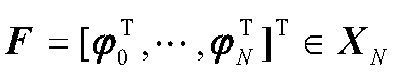

- The characteristic equation corresponding to (1)can be expressed as:

- The LNΦ can be represented by a set of basis of a Chebyshev polynomial with degree no more than N.


- The state equation of DCPPS can be rewritten as the following lower-order equations.

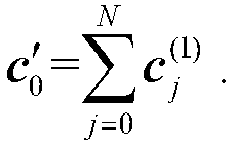
- The pseudo-spectral discretization matrix A N : XN →XN approximating infinitesimal generatorA is obtained:


1 and I n2 denote identity matrices with dimensions of n 1×n 1 and n 2×n 2, respectively.

- When the multiplication between the matrix


- The technical scheme is further optimized. The rightmost eigenvalues of system are computed by the implicit restarted Arnoldi method. In the process, the critical eigenvalues with the largest moduli (then gradually deceasing)are computed from the shift-invert matrix of A N , i.e.,


- In (19), I Nn
2 denotes identity matrices with dimensions of Nn 2×Nn 2 . In (21)∼(23), s denotes the shift point. - Then, the Newton's method is used to refine the estimations of the rightmost eigenvalues and capture the exact eigenvalues of system.
- Stability of the system can be judged by accurate eigenvalues λ. If the real part of λ is greater than zero, i.e., Re(λ)> 0, the system is unstable. If all Re(λ)<0, the system is asymptotically stable. If Re(λ)=0, the system is critically stable. Re(•) denotes the real part of the eigenvalues.
- Compared with the prior art, the beneficial effects of the present invention are as follows:
- 1) The low-order EIGD-based eigenvalue computation method proposed by the present invention is efficiently applied to the stability analysis of system, where the delay effects on system are fully considered.
- 2) In the presented method, the order of the discretized matrix generated by original EIGD is greatly reduced by removing the unnecessary discretization of delay-free states variables. So as to ensure the high computation accuracy, the computational burden is greatly decreased. Especially for large-scale DCPPS, the computational efficiency of the presented method gets very close to the traditional eigenvalue computation method of the power system without time delay. Thus, the efficiency is basically improved compared to original EIGD method.
- 3) The sparsity in augmented system state matrices and discretized matrix is fully exploited to lower the computational burden involved in the multiplication computation between matrices and vectors.
- The figures together with the application provide further introductions. The exemplary implementation and introductions of this application are exploited to describe the application, and do not restrict this application.
-
Fig.1 is a flow diagram of the method of the present invention; -
Fig.2 is a backbone of Shandong power grid. - Table 1 is the comparison of computational efficiency between the low-order EIGD method and original EIGD method under different parameters.
- It should be noted that the following details are illustrative and intend to provide further illustration of this application. Unless specified otherwise, all technical and scientific terms used in this paper have the identical meaning to those commonly understood by ordinary technicians in the corresponding technical field.
- Note that all terms used here only intend to describe the specific implementation rather than limiting exemplary implementation on the basis of this application. Unless the context otherwise states, the singular also includes the plural. Furthermore, it is believed that when the term "include" is used in this application, it indicates the existence of features, steps, operations, devices, components and/or their combinations.
- As shown in
Fig.1 , the low-order EIGD-based eigen-analysis method and the system for large-scale DCPPS includes the following steps: - 1) The dynamic model of DCPPS is established and linearized into a set of delayed differential equations, where system state matrix and delayed state matrix can be obtained. Accordingly, the characteristic equation corresponding to DCPPS can also be deduced, which has an infinite number of eigenvalues due to exponential terms.
- 2) The state variables of DCPPS are rearranged partitioned into delay-free states and delayed states. Subsequently, the system state matrix and the delayed state matrices are rearranged and partitioned into sever blocks, from which the delayed differential equations can be rewritten in a partitioned form. Due to exponential term, the eigenvalues of the system are infinite.
- 3) By using the infinitesimal generator, the delayed differential equation is transformed into the ordinary differential equation, and the characteristic equation of DCPPS is equivalently transformed into the general characteristic equation. The eigenvalues of DCPPS can be computed from the infinitesimal generator instead.
- 4) The delay interval is discretized into discrete function space by choosing suitable discrete points, so that the continuous function is discretized into block vectors. The function values at discrete points are estimated by Lagrange interpolation polynomials, and the state equations at these discrete points are arranged and rewritten to generate the discretization matrix of infinitesimal generator. Accordingly, the eigen-problem of infinite dimension is transformed into the finite-dimension eigen-problem.
- 5) Based on the one-to-one spectral mapping relation between DCPPS and infinitesimal generator, the rightmost eigenvalues of DCPPS are captured approximately from the discretized matrix of the infinitesimal generator.
- 6) The IRA is used to calculate the eigenvalues with the largest moduli of the discretized matrix of the infinitesimal generator after the shift-invert preconditioning obtained in step 4, the estimations of the rightmost eigenvalues of the system can be obtained by the inverse transform.
- 7) Newton iteration method is adopted to refine the approximate eigenvalues of discretization matrix computed in step 6, so as to obtain the exact eigenvalues and eigenvectors of DCPPS.
- 8) The accurate eigenvalues obtained in step 7 are used to determine the stability of the system.
- In step 1, the dynamic of DCPPS can be described by the following delayed differential equations:


- The characteristic equation of the system corresponding to (1)is:

- In step 2, the state variables of DCPPS are rearranged. The system's states Δx are partitioned into delay-free states Δx 1(t) ∈ P n1×1 and delayed states Δx 2(t)∈ P n2×1, where n 1+n 2=n.
- Accordingly, the first formula of (1) in step 1 can be rewritten in a partitioned form as follows:


- Thus, equation(4) is also written as:

- Correspondingly, the characteristic equation can be reformulated as:

- Due to exponential term e-λτi (i=1, ..., m), the eigenvalues of the system are infinite.
- In step 3, the state space X:=C([-τ max, 0], Υ n×1) is Banach space of continuous functions established by mapping the time interval [-τ max, 0] into Υ n×1which endowed with the maximum norm


- It can be seen from (8) that delayed differential equation (1) is transformed into an ordinary homogeneous linear differential equation. The coefficient of equation is the infinitesimal generator Aand the state variable is Δxt . Besides, characteristic equation and characteristic function of A are:


- This indicates that the eigenvalues of DCPPS is related to the spectrum of A.

- In step 4, given any positive integer N, a mesh Ω N of N+1 distinct discretization points on the past time interval[-τ max, 0] is first formed as Ω N := {θN,j ,j = 0,1,...,N}, satisfying -τ max≤θN,N ≤···≤θ N,1≤θ N,0=0. It is supposed that XN = (R n×1)Ω N ≈ R (N+1)n×1 denotes the discrete function space defined on the mesh Ω N . Therefor, any continuous function ϕ∈Δ(A)⊂X on X can be discretized into a block vector


- The characteristic equation corresponding to (1) in step 1 can be expressed as:

- The LNΦ can be represented by a set of basis of a Chebyshev polynomial with degree no more than N.


- The state equation of DCPPS can be rewritten as the following lower-order equations refine the approximation values.


- In step 4, the pseudo-spectral discretization matrix A N : XN →XN approximating infinitesimal generatorA is obtained:


1 and I n2 denote identity matrices with dimensions of n 1×n 1 and n 2×n 2, respectively.

- In step 4, when the multiplication between the matrix


- In step 6, the rightmost eigenvalues of system are computed by the implicit restarted Arnoldi method. In the process, the critical eigenvalues with the largest moduli (then gradually deceasing) are computed from the shift-invert matrix of A N , i.e.,


- In (19), I Nn
2 denotes identity matrices with dimensions of Nn 2×Nn 2 . In (21)∼(23), s denotes the shift point. - In step 7, the Newton's method disclosed by the Chinese application
201510055743.3 - In step 8, stability of the system can be judged by accurate eigenvalues λ obtained in step 7. Re(•) denotes the real part of the eigenvalues. If the real part of λ is greater than zero, i.e., Re(λ)> 0, the system is unstable. If all Re(λ)<0, the system is asymptotically stable. If Re(λ)=0, the system is critically stable.
- A more detailed test example is given below. As shown in
Fig. 2 , a real-life large transmission system, i.e., Shandong power grid system, is used to verify the high efficiency of low-order EIGD method proposed in this invention. All tests are executed on MATLAB and an Intel 3.4GHz desktop computer with 8GB RAM - The system has 516 buses, 114 generators, 936 transformers and transmission lines, and 299 loads. According to eigen-analysis, it is known that the system has an inter-area oscillation mode with frequency of 0.78 Hz and damping ratio of 6.97%, where generators in the western LC region oscillate against those in the eastern YT and WH regions. To further enhance the damping ratio of the mode, two wide-area Linear Quadratic Regulators are installed on units #1 and #2 in LC power plant. The controllers respectively use the relative rotor speed and power angle between #3 in WH and #1 or #2 in LC as the wide-area feedback signals. The gain of the controllers are 40 and 0.125, respectively. The comprehensive time delays in the two channels are 90 and 100 ms, respectively. The number of state variables and algebraic variables are n = 1128 and / = 5765, respectively.
- In order to verify the efficiency of the presented low-order EIGD method, the computation efficiency under different parameters is given in table 1, compared with the original EIGD method and the traditional eigenvalue method without any delay. Aiming at compute the critical eigenvalues of the system, N=10 and 20, three shifts s=7j and 13j are specified, and r=20 and 50 eigenvalues are required to be computed for each shift. In this system, the dimension of discretized matrix obtained by the original EIGD method is approximately N times larger than that of discretized matrix for the system without time delay whose dimension is only slightly smaller than the dimension of the matrix generated by the low-order EIGD method. The low-order EIGD method takes roughly same iterations as the original EIGD method, and consumes about 1/16∼1/8 (0.08∼0.12) CPU time of the original method. The saving time is more as the scale of the system increases. For the same system, the computation time increases with the increase of N and r. Compared with the traditional eigenvalue method for the system without time delay, the computational time of low-order EIGD method for one iteration is slightly higher, and the total consumption time is still on the same order of magnitude.
Table 1 s N r low-order EIGD Original EIGD Speed up W/O delay Dim Iter. Iter./ Time (s) Dim Iter. Iter./ Time (s) Dim Iter. Iter./ Time (s) 7j 10 20 1248 5 0.20 12408 5 1.19 0.06 1128 6 0.13 13j 10 20 1248 7 0.32 12408 6 1.76 0.07 1128 8 0.23 7j 20 20 1368 5 0.23 23688 5 2.23 0.10 1128 6 0.13 13j 20 20 1368 7 0.38 23688 7 3.70 0.10 1128 8 0.23 7j 20 50 1368 7 1.28 23688 7 14.72 0.08 1128 7 0.73 13j 20 50 1368 4 0.86 23688 4 10.29 0.06 1128 4 0.50 - High efficiency of the presented method is achieved by removing the unnecessary discretization of delay-free states. The order of the discretized matrix generated by low-order EIGD is greatly reduced. And the computational burden is greatly decreased. When computing critical eigenvalues of DCPPS by using the low-order EIGD, especially for large-scale DCPPS, the computational efficiency gets very close to the traditional eigenvalue computation method. Compared with the original EIGD method, the efficiency of low-order EIGD method can be improved by about 10 times.
- The above mentioned is only a preferred embodiment of this application and does not limit this application. For ordinary skill in the art, the application can be changed and improved in various forms. Any modification, equivalent replacement, improvement, etc. made within the spirit and principles of this application should be included in the protection scope of this application.
Claims (10)
- A low-order explicit infinitesimal generator discretization(EIGD) based stability analysis method of delayed cyber-physical power systems(DCPPS), characterized in that the method includes the following steps:the dynamic model of DCPPS is established and linearized into a set of delayed differential equations;the state variables of DCPPS in delayed differential equations are rearranged and partitioned into two parts: delay-free state variables and delayed state variables; when the states of DCPPS is discretized at the past time, the discretization of delay-free state variables removed and the corresponding dimension of discretized matrix is reduced;by utilizing the infinitesimal generator, the delayed differential equation is transformed into the ordinary differential equation; correspondingly, the characteristic equation of DCPPS can be transformed into the general characteristic equation that is described by the infinitesimal generator; the eigenvalues of DCPPS are transformed into eigenvalues of the infinitesimal generator;since eigenvalue problem of the infinitesimal generator is an infinite-dimensional problem, it is necessary to discretize the infinitesimal generator; firstly, delay interval is discretized into discrete function space by choosing several suitable discrete points, so that the continuous function is discretized into block vectors; secondly, the function value at the discrete point can be evaluated by Lagrange interpolation polynomial; thirdly, the discretized matrix of infinitesimal generator is generated by arranging and rewriting the state equation at these discrete points, so that the infinite dimensional eigenvalue problem is transformed into the finite dimensional problem;based on the one-to-one spectral mapping relation between DCPPS and infinitesimal generator, the rightmost eigenvalues of DCPPS are captured approximately from the discretized matrix of the infinitesimal generator;applying the shift-invert preconditioning technique on the discretized matrix of the infinitesimal generator, the rightmost eigenvalues of infinitesimal generator are transformed into the eigenvalues with the largest moduli; by computing the eigenvalues with the largest moduli of the discretized matrix of the infinitesimal generator after the shift-invert preconditioning, the estimations of the rightmost eigenvalues of the system can be obtained by the inverse transform;the estimations of the rightmost eigenvalues are refined to exact eigenvalues of DCPPS, and the obtained exact eigenvalues are used to judge the stability of the power system.
- The low-order EIGD-based stability analysis method of DCPPS according to claim 1, characterized in that the step of establishing and linearizing the dynamic model of DCPPS into a set of delayed differential equations comprising: the dynamic model of DCPPS is expanded by Taylor series at the equilibrium point to established the linearized model of system, the dynamic of DCPPS can be described by delayed differential equations.
- The low-order EIGD-based stability analysis method of DCPPS according to claim 1, characterized in that the delayed differential equations which can describe the dynamic of DCPPS are as follows:

wherein, Ã 0 and Ãi can be readily reformulated in augmented form as follows:
the characteristic equation of the system corresponding to(1) is:
- The low-order EIGD-based stability analysis method of DCPPS according to claim 3, characterized in that the state variables of DCPPS should be rearranged. according to whether the corresponding element of the delayed state matrices Ãi is 0, system's states are partitioned into delay-free states Δx 1(t) ∈ P n1×1 and delayed states Δx 2(t)∈ P n2×1, where n 1+n 2=n.
- The low-order EIGD-based stability analysis method of DCPPS according to claim 4, characterized in that if the elements of row and column corresponding to a certain state variable are 0 in all delayed state matrices, the variables are regarded as a delay-free state, and the remaining variables are delayed states; accordingly, the first formula of(1) can be rewritten in a partitioned form:


thus, equation(4) is written as:

- The low-order EIGD-based stability analysis method of DCPPS according to claim 5, characterized in that the state space X:=C([-τ max, 0], Υ n×1) is Banach space of continuous functions established by mapping the past time interval [-τ max, 0] into Υ n×1 which endowed with the maximum norm

specifically, the solution operator is a linear bounded operator, which maps the initial condition ϕ(θ) ∈ X at θ (-τ max≤θ≤0) into the system state Δx(h+θ) (=Δxh (θ)) at a later time instant θ+h(h≥0); the infinitesimal generator A: X→X is defined as the derivative of solution operator T(h)at h=0; C denotes the complex functional space;
substituting the first formula of (1) into the infinitesimal generator A(h=t), a following formula can be obtained:


- The low-order EIGD-based stability analysis method of DCPPS according to claim 1, characterized in that given any positive integer N, a mesh Ω N of N+1 distinct discretization points on the past time interval[-τ max, 0] is first formed as Ω N := {θ N,j , j = 0,1,...,N}, satisfying -τ max≤θ N,N ≤···≤θ N,1≤θ N,0=0; it is supposed that XN = (R n×1)Ω N ; R (N+1)n×1 denotes the discrete function space defined on the mesh Ω N ;
the initial status ϕ of the system is acontinuous function on X, it can also be denoted as ϕ∈Δ(A)⊂X; the continuous function ϕ can be discretized into a block vector


the state equation of DCPPS can be rewritten as the following lower-order equations:

- The low-order EIGD-based stability analysis method of DCPPS according to claim 7, characterized in that the pseudo-spectral discretization matrix A N : XN →XN approximating infinitesimal generatorA is obtained:


1 and I n2 denote identity matrices with dimensions of n 1×n 1 and n 2×n 2, respectively,


- The low-order EIGD-based stability analysis method of DCPPS according to claim 8, characterized in that the rightmost eigenvalues of system is computed by the implicit restarted Arnoldi method, in the process, the critical eigenvalues with the largest moduli (then gradually deceasing)are computed from the shift-invert matrix of A N , i.e.,


2 denotes identity matrices with dimensions of Nn 2×Nn 2 . In (21)∼(23), s denotes the shift point. - The low-order EIGD-based stability analysis method of DCPPS according to claim 2, characterized in that the Newton's method is used to refine the estimations of the rightmost eigenvalues and capture the exact eigenvalues of system,
stability of the system can be judged by accurate eigenvalues λ: if the real part of λ is greater than zero, i.e., Re(λ)> 0, the system is unstable; if all Re(λ)<0, the system is asymptotically stable; if Re(λ)=0, the system is critically stable; wherein, Re(•) denotes the real part of the eigenvalues.
Applications Claiming Priority (2)
| Application Number | Priority Date | Filing Date | Title |
|---|---|---|---|
| CN201810514831.9A CN108647906B (en) | 2018-05-25 | 2018-05-25 | Time-lag power system stability analysis method based on low-order EIGD |
| PCT/CN2018/091537 WO2019223048A1 (en) | 2018-05-25 | 2018-06-15 | Delayed power system stability analysis method based on low-order eigd |
Publications (2)
| Publication Number | Publication Date |
|---|---|
| EP3690771A1 true EP3690771A1 (en) | 2020-08-05 |
| EP3690771A4 EP3690771A4 (en) | 2021-03-10 |
Family
ID=63758115
Family Applications (1)
| Application Number | Title | Priority Date | Filing Date |
|---|---|---|---|
| EP18920133.8A Withdrawn EP3690771A4 (en) | 2018-05-25 | 2018-06-15 | METHOD OF ANALYSIS OF THE STABILITY OF A DELAYED POWER SYSTEM BASED ON A LOW ORDER EIGD |
Country Status (3)
| Country | Link |
|---|---|
| EP (1) | EP3690771A4 (en) |
| CN (1) | CN108647906B (en) |
| WO (1) | WO2019223048A1 (en) |
Families Citing this family (12)
| Publication number | Priority date | Publication date | Assignee | Title |
|---|---|---|---|---|
| CN109583065B (en) * | 2018-11-20 | 2022-10-28 | 西安交通大学 | Time-lag power system characteristic value calculation method based on partial variable discretization |
| CN109615209B (en) * | 2018-12-05 | 2021-08-03 | 山东大学 | A method and system for calculating eigenvalues of time-delay power systems |
| CN111614078B (en) * | 2020-04-28 | 2021-12-14 | 南方电网科学研究院有限责任公司 | Small disturbance stability analysis method, device, equipment and storage medium of power system |
| CN113110049B (en) * | 2021-04-13 | 2022-04-01 | 龙泉东土青瓷有限公司 | Reliable estimation method for monitoring temperature of celadon biscuit firing kiln |
| CN113703317B (en) * | 2021-07-28 | 2024-02-20 | 南京邮电大学 | A bifurcation delay controller design method based on the predator-prey model |
| CN113806974B (en) * | 2021-08-06 | 2023-10-17 | 南方电网科学研究院有限责任公司 | A stability evaluation method, device and system for electrical connection of transformer bushings |
| CN114004512A (en) * | 2021-11-04 | 2022-02-01 | 西安热工研究院有限公司 | Multi-unit operation state outlier analysis method and system based on density clustering |
| CN114117331B (en) * | 2021-11-29 | 2024-06-28 | 山东大学 | Time-lapse power system small interference stable domain solving method and system based on value set |
| CN115189372B (en) * | 2022-08-17 | 2025-12-16 | 中国科学院电工研究所 | Approximate analytic solution and stability domain analysis method for nonlinear harmonic oscillation |
| CN115579866B (en) * | 2022-09-30 | 2026-05-08 | 国网山东省电力公司电力科学研究院 | An EIGD method and apparatus for stability analysis of time-delay power systems |
| CN118313315B (en) * | 2024-06-05 | 2024-08-06 | 中国人民解放军国防科技大学 | Flow field calculation method based on flux reconstruction and nonlinear spectrum difference mixing |
| CN120145650B (en) * | 2025-02-24 | 2025-11-28 | 华中科技大学 | Linear periodic time-varying system stability judging method, system and medium based on harmonic state space model |
Family Cites Families (4)
| Publication number | Priority date | Publication date | Assignee | Title |
|---|---|---|---|---|
| CN102801158B (en) * | 2012-07-31 | 2014-07-09 | 国网山东省电力公司经济技术研究院 | Method for calculating time-lag electric power system eigenvalue and discriminating stability based on Pade approximation |
| CN103886209B (en) * | 2014-03-31 | 2016-08-24 | 华北电力大学 | Saltus step Power System Delay stability analysis system and method based on Markov |
| CN104615882B (en) * | 2015-02-03 | 2017-06-27 | 山东大学 | Calculation Method of Eigenvalues of Large-Scale Time-delay Power System Based on EIGD |
| CN105449665B (en) * | 2015-05-07 | 2017-10-03 | 山东大学 | Time-lag power system stability method of discrimination based on SOD PS |
-
2018
- 2018-05-25 CN CN201810514831.9A patent/CN108647906B/en active Active
- 2018-06-15 WO PCT/CN2018/091537 patent/WO2019223048A1/en not_active Ceased
- 2018-06-15 EP EP18920133.8A patent/EP3690771A4/en not_active Withdrawn
Also Published As
| Publication number | Publication date |
|---|---|
| CN108647906B (en) | 2020-05-08 |
| CN108647906A (en) | 2018-10-12 |
| WO2019223048A1 (en) | 2019-11-28 |
| EP3690771A4 (en) | 2021-03-10 |
Similar Documents
| Publication | Publication Date | Title |
|---|---|---|
| CN108647906B (en) | Time-lag power system stability analysis method based on low-order EIGD | |
| Hung et al. | Numerical solutions of supersonic and hypersonic laminar compression corner flows | |
| Baysal et al. | Aerodynamic sensitivity analysis methods for the compressible Euler equations | |
| CN104615882B (en) | Calculation Method of Eigenvalues of Large-Scale Time-delay Power System Based on EIGD | |
| Lerat et al. | A residual-based compact scheme for the compressible Navier–Stokes equations | |
| CN105449665B (en) | Time-lag power system stability method of discrimination based on SOD PS | |
| Mou et al. | Enabling highly efficient eigen-analysis of large delayed cyber-physical power systems by partial spectral discretization | |
| Bustamante et al. | A global meshless collocation particular solution method (integrated Radial Basis Function) for two-dimensional Stokes flow problems | |
| CN105977969B (en) | Extensive stability of muilt-timelag electric power system method of discrimination based on SOD LMS | |
| CN105468909A (en) | Time delay power system electromechanical oscillation mode computing method based on SOD-PS-R R algorithm | |
| CN108879669B (en) | Eigenvalue analysis method of time-delay power system based on low-order IIGD algorithm | |
| US6507795B2 (en) | Electromagnetic wave analyzer and computer-readable medium storing programs for electromagnetic wave analysis | |
| Trepanier et al. | Analysis of the dielectric strength of an SF/sub 6/circuit breaker | |
| CN115579866B (en) | An EIGD method and apparatus for stability analysis of time-delay power systems | |
| CN108808706B (en) | Time-lag power system electromechanical oscillation mode calculation method based on SOD-PS-II-R algorithm | |
| Trindade et al. | Parallel‐in‐time simulation of the unsteady Navier–Stokes equations for incompressible flow | |
| Li et al. | Parameterized model order reduction via a two-directional Arnoldi process | |
| US20070136042A1 (en) | Quadrilateral grid extension of central difference scheme for ink-jet simulations | |
| CN108808703A (en) | Time-lag power system analysis on Small Disturbance Stability method based on low order IGD-IRK | |
| McFee et al. | Optimal discretizations in adaptive finite element electromagnetics | |
| CN109615209A (en) | A method and system for calculating eigenvalues of time-delay power systems | |
| Kochetov et al. | Stability of full-wave PEEC models: Reason for instabilities and way for correction | |
| Khattak et al. | Proper orthogonal decomposition-based model order reduction of delayed PEEC models | |
| Gao et al. | Multi expansion point reduced order modelling for electromagnetic design of power electronics | |
| CN119833040B (en) | An electrothermal coupling calculation method considering geometric and material uncertainties |
Legal Events
| Date | Code | Title | Description |
|---|---|---|---|
| STAA | Information on the status of an ep patent application or granted ep patent |
Free format text: STATUS: THE INTERNATIONAL PUBLICATION HAS BEEN MADE |
|
| PUAI | Public reference made under article 153(3) epc to a published international application that has entered the european phase |
Free format text: ORIGINAL CODE: 0009012 |
|
| STAA | Information on the status of an ep patent application or granted ep patent |
Free format text: STATUS: REQUEST FOR EXAMINATION WAS MADE |
|
| 17P | Request for examination filed |
Effective date: 20200427 |
|
| AK | Designated contracting states |
Kind code of ref document: A1 Designated state(s): AL AT BE BG CH CY CZ DE DK EE ES FI FR GB GR HR HU IE IS IT LI LT LU LV MC MK MT NL NO PL PT RO RS SE SI SK SM TR |
|
| AX | Request for extension of the european patent |
Extension state: BA ME |
|
| REG | Reference to a national code |
Ref country code: DE Ref legal event code: R079 Free format text: PREVIOUS MAIN CLASS: G06Q0010060000 Ipc: G06F0017130000 |
|
| A4 | Supplementary search report drawn up and despatched |
Effective date: 20210210 |
|
| RIC1 | Information provided on ipc code assigned before grant |
Ipc: G06F 17/13 20060101AFI20210204BHEP Ipc: H02J 3/00 20060101ALI20210204BHEP |
|
| DAV | Request for validation of the european patent (deleted) | ||
| DAX | Request for extension of the european patent (deleted) | ||
| STAA | Information on the status of an ep patent application or granted ep patent |
Free format text: STATUS: EXAMINATION IS IN PROGRESS |
|
| 17Q | First examination report despatched |
Effective date: 20240902 |
|
| STAA | Information on the status of an ep patent application or granted ep patent |
Free format text: STATUS: THE APPLICATION HAS BEEN WITHDRAWN |
|
| 18W | Application withdrawn |
Effective date: 20241206 |