EP3690746A1 - Training apparatus, training method, and training program - Google Patents
Training apparatus, training method, and training program Download PDFInfo
- Publication number
- EP3690746A1 EP3690746A1 EP20154035.8A EP20154035A EP3690746A1 EP 3690746 A1 EP3690746 A1 EP 3690746A1 EP 20154035 A EP20154035 A EP 20154035A EP 3690746 A1 EP3690746 A1 EP 3690746A1
- Authority
- EP
- European Patent Office
- Prior art keywords
- training
- data
- discriminator
- generator
- image data
- Prior art date
- Legal status (The legal status is an assumption and is not a legal conclusion. Google has not performed a legal analysis and makes no representation as to the accuracy of the status listed.)
- Pending
Links
Images




Classifications
-
- G—PHYSICS
- G06—COMPUTING OR CALCULATING; COUNTING
- G06V—IMAGE OR VIDEO RECOGNITION OR UNDERSTANDING
- G06V10/00—Arrangements for image or video recognition or understanding
- G06V10/70—Arrangements for image or video recognition or understanding using pattern recognition or machine learning
- G06V10/82—Arrangements for image or video recognition or understanding using pattern recognition or machine learning using neural networks
-
- G—PHYSICS
- G16—INFORMATION AND COMMUNICATION TECHNOLOGY [ICT] SPECIALLY ADAPTED FOR SPECIFIC APPLICATION FIELDS
- G16H—HEALTHCARE INFORMATICS, i.e. INFORMATION AND COMMUNICATION TECHNOLOGY [ICT] SPECIALLY ADAPTED FOR THE HANDLING OR PROCESSING OF MEDICAL OR HEALTHCARE DATA
- G16H30/00—ICT specially adapted for the handling or processing of medical images
-
- G—PHYSICS
- G06—COMPUTING OR CALCULATING; COUNTING
- G06F—ELECTRIC DIGITAL DATA PROCESSING
- G06F18/00—Pattern recognition
- G06F18/20—Analysing
- G06F18/21—Design or setup of recognition systems or techniques; Extraction of features in feature space; Blind source separation
- G06F18/213—Feature extraction, e.g. by transforming the feature space; Summarisation; Mappings, e.g. subspace methods
- G06F18/2132—Feature extraction, e.g. by transforming the feature space; Summarisation; Mappings, e.g. subspace methods based on discrimination criteria, e.g. discriminant analysis
-
- G—PHYSICS
- G06—COMPUTING OR CALCULATING; COUNTING
- G06F—ELECTRIC DIGITAL DATA PROCESSING
- G06F18/00—Pattern recognition
- G06F18/20—Analysing
- G06F18/21—Design or setup of recognition systems or techniques; Extraction of features in feature space; Blind source separation
- G06F18/214—Generating training patterns; Bootstrap methods, e.g. bagging or boosting
-
- G—PHYSICS
- G06—COMPUTING OR CALCULATING; COUNTING
- G06N—COMPUTING ARRANGEMENTS BASED ON SPECIFIC COMPUTATIONAL MODELS
- G06N20/00—Machine learning
-
- G—PHYSICS
- G06—COMPUTING OR CALCULATING; COUNTING
- G06N—COMPUTING ARRANGEMENTS BASED ON SPECIFIC COMPUTATIONAL MODELS
- G06N3/00—Computing arrangements based on biological models
- G06N3/02—Neural networks
- G06N3/04—Architecture, e.g. interconnection topology
- G06N3/045—Combinations of networks
-
- G—PHYSICS
- G06—COMPUTING OR CALCULATING; COUNTING
- G06N—COMPUTING ARRANGEMENTS BASED ON SPECIFIC COMPUTATIONAL MODELS
- G06N3/00—Computing arrangements based on biological models
- G06N3/02—Neural networks
- G06N3/04—Architecture, e.g. interconnection topology
- G06N3/0475—Generative networks
-
- G—PHYSICS
- G06—COMPUTING OR CALCULATING; COUNTING
- G06N—COMPUTING ARRANGEMENTS BASED ON SPECIFIC COMPUTATIONAL MODELS
- G06N3/00—Computing arrangements based on biological models
- G06N3/02—Neural networks
- G06N3/08—Learning methods
- G06N3/088—Non-supervised learning, e.g. competitive learning
-
- G—PHYSICS
- G06—COMPUTING OR CALCULATING; COUNTING
- G06N—COMPUTING ARRANGEMENTS BASED ON SPECIFIC COMPUTATIONAL MODELS
- G06N3/00—Computing arrangements based on biological models
- G06N3/02—Neural networks
- G06N3/08—Learning methods
- G06N3/094—Adversarial learning
-
- G—PHYSICS
- G06—COMPUTING OR CALCULATING; COUNTING
- G06T—IMAGE DATA PROCESSING OR GENERATION, IN GENERAL
- G06T7/00—Image analysis
- G06T7/0002—Inspection of images, e.g. flaw detection
- G06T7/0012—Biomedical image inspection
-
- G—PHYSICS
- G06—COMPUTING OR CALCULATING; COUNTING
- G06V—IMAGE OR VIDEO RECOGNITION OR UNDERSTANDING
- G06V10/00—Arrangements for image or video recognition or understanding
- G06V10/70—Arrangements for image or video recognition or understanding using pattern recognition or machine learning
-
- G—PHYSICS
- G06—COMPUTING OR CALCULATING; COUNTING
- G06V—IMAGE OR VIDEO RECOGNITION OR UNDERSTANDING
- G06V10/00—Arrangements for image or video recognition or understanding
- G06V10/70—Arrangements for image or video recognition or understanding using pattern recognition or machine learning
- G06V10/77—Processing image or video features in feature spaces; using data integration or data reduction, e.g. principal component analysis [PCA] or independent component analysis [ICA] or self-organising maps [SOM]; Blind source separation
- G06V10/80—Fusion, i.e. combining data from various sources at the sensor level, preprocessing level, feature extraction level or classification level
- G06V10/806—Fusion, i.e. combining data from various sources at the sensor level, preprocessing level, feature extraction level or classification level of extracted features
-
- G—PHYSICS
- G06—COMPUTING OR CALCULATING; COUNTING
- G06T—IMAGE DATA PROCESSING OR GENERATION, IN GENERAL
- G06T2207/00—Indexing scheme for image analysis or image enhancement
- G06T2207/20—Special algorithmic details
- G06T2207/20081—Training; Learning
-
- G—PHYSICS
- G06—COMPUTING OR CALCULATING; COUNTING
- G06V—IMAGE OR VIDEO RECOGNITION OR UNDERSTANDING
- G06V2201/00—Indexing scheme relating to image or video recognition or understanding
- G06V2201/03—Recognition of patterns in medical or anatomical images
Definitions
- the embodiments discussed herein are related to a training apparatus, a training method, and a training program.
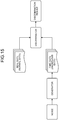
- FIG. 15 is a diagram for explaining a GAN.
- the GAN is a training model that includes a generator and a discriminator and that is for unsupervised training in which a network for training the generator and a network for training the discriminator are trained simultaneously.
- the generator is trained to generate fake data that is similar to real data from input data, such as noise, and the discriminator is trained to discriminate whether the data generated by the generator is real data or fake data.
- anomaly detection using the GAN a method of determining whether a trained generator has a capability to generate a given sample and regarding generated data as anomalous data if the trained generator does not have the capability, and a method of regarding data that is determined as fake data by the trained discriminator as anomalous data are used.
- Non Patent Document 1 Schlegl, Thomas, et al. "Unsupervised anomaly detection with generative adversarial networks to guide marker discovery.”, International Conference on Information Processing in Medical Imaging. Springer, Cham, 2017 .
- Non Patent Document 2 M. Sabokrou, et al. "Adversarially Learned One-Class Classifier for Novelty Detection", Proceedings of IEEE Conference on Computer Vision and Pattern Recognition. 2018 .
- a training apparatus includes a generator (31) configured to generate image data; a discriminator (32) configured to discriminate whether the image data is real or fake; and a training unit (30,31,32) configured to train the discriminator in accordance with one of training indices for maximizing and minimizing a discrimination error, and train the generator in accordance with the other one of the training indices, for each piece of the image data generated by the generator (31) .
- the capability of the discriminator to detect anomalies may be reduced.
- characteristics of the discriminator depend on data other than normal data that is erroneously generated by the generator at the end of training, so that omission of detection may increase.
- the discriminator is expected to have the capability to discriminate a difference between normal data and an output from the generator; however, the discriminator is not able to train data that is not included in the output from the generator and not included in the normal data, so that it is impossible to expect a specific output. Meanwhile, a method using the generator needs a high detection cost, and therefor is not suitable for anomaly detection for which high-speed performance is needed.
- FIG. 1 is a diagram for explaining an anomaly detection apparatus 10 according to a first embodiment.
- the anomaly detection apparatus 10 is an example of a training apparatus that trains, in a training phase, a generator and a discriminator by a GAN, and performs, in a prediction phase, anomaly detection with respect to prediction target image data by using the trained discriminator.
- FIG. 2 to FIG. 5B with respect to the training using the general GAN, steps before start of the training, during the training, and after end of the training are illustrated.
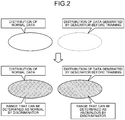
- FIG. 2 is a diagram for explaining the step before the training.
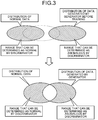
- FIG. 3 is a diagram for explaining the step after the start of the training.
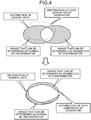
- FIG. 4 is a diagram for explaining the step during the training.
- FIG. 5A and FIG. 5B are diagrams for explaining the discriminator after the end of the training and a problem with a general technique.
- the generator before the training, the generator generates data in a different distribution from a distribution of normal data, and the discriminator trains a difference between the distribution of the normal data and the distribution of the data generated by the generator. In other words, the discriminator clearly distinguishes and discriminates between the distribution of the normal data and the distribution of the data generated by the generator.
- training of the generator proceeds such that data to be discriminated as normal by the discriminator increases and data to be discriminated as anomalous decreases.
- the generator is trained to generate data that may be erroneously discriminated by the discriminator, and is thus trained such that the distribution of the data generated by the generator includes a range that can be determined as normal by the discriminator.
- a probability of a discrimination result indicating that data is discriminated as normal is changed; therefore, the discriminator trains a difference between the distribution of the normal data and the distribution of the data generated by the generator.
- training is performed such that the distribution of the data generated by the generator includes the range that can be discriminated as normal by the discriminator in FIG. 3 .
- the distribution of the data generated by the generator is updated so as to be largely included in the range that can be discriminated as normal by the discriminator.
- the discriminator is trained to discriminate between the distribution of data generated by the updated generator and the distribution of the normal data.
- the generator is trained to mimic data in the range that can be discriminated as normal by the discriminator in the state as illustrated in FIG. 4 , to thereby cause the discriminator to make a mistake, so that the distribution of the data generated by the generator is updated so as to include the range that can be discriminated by the discriminator in FIG. 4 .
- the trained discriminator is trained to discriminate between the data generated by the generator and the normal data (real data).
- characteristics of the discriminator depend on data other than normal data that is erroneously generated by the generator at the end of training, so that omission of detection may increase.
- FIG. 5B it is possible to accurately detect an anomaly with respect to anomalous data that is present in a range that can be determined as anomalous by the trained discriminator, but it is impossible to detect anomalous data that is present outside the range.
- One of the causes of this problem is that, in a training method based on the general GAN, training proceeds such that the generator generates only data that can be expected as normal data, and therefore, it is difficult to maintain a state in which the distribution of the data generated by the generator and the distribution of the normal data do not match. In other words, the generator attempts to generate only data to be determined as normal data by the discriminator.
- the anomaly detection apparatus 10 determines whether to maximize or minimize a discrimination error for each piece of image data output by the generator. Then, the anomaly detection apparatus 10 trains the discriminator in accordance with one of determined training indices indicating maximization and minimization, and trains the generator in accordance with the other one of the training indices, for each piece of generated image data.
- the generator capable of exhaustively generating anomalous data that are expected to be present around normal data, it becomes possible to detect anomalous data that may be omitted in the general technique.
- the generator is controlled such that a loss occurs at a constant rate when generating data that is to be determined as normal data by the discriminator, so that, as illustrated in FIG. 5B , the distribution of the data generated by the generator includes the range of anomalous data that are expected to be detected. In this manner, by extending a training range of the discriminator, it is possible to prevent reduction of the capability of the discriminator to detect anomalies.
- FIG. 6 is a functional block diagram illustrating a functional configuration of the anomaly detection apparatus 10 according to the first embodiment.
- the anomaly detection apparatus 10 includes a communication unit 11, a storage unit 12, and a control unit 20.
- the communication unit 11 is a processing unit that controls communication with other apparatuses, and is, for example, a communication interface or the like.
- the communication unit 11 receives, from an administrator terminal, an instruction to start various processes, normal data, prediction target data, and the like, and transmits, to the administrator terminal, a training result, a prediction result, and the like.
- the storage unit 12 is one example of a storage device that stores therein various kinds of data and programs to be executed by the control unit 20, and is, for example, a memory, a hard disk, or the like.
- the storage unit 12 stores therein a normal data database (DB) 13, a source information DB 14, a training result DB 15, and the like.
- DB normal data database
- the normal data DB 13 is a database for storing image data that is obtained by capturing an image of an internal organ or the like in a normal state.
- the normal data DB 13 stores therein normal data that is used in training of the discriminator by the GAN.
- the source information DB 14 is a database for storing information serving as a source for data generation performed by the generator.
- the source information DB 14 stores therein information, such as a random number, random noise, or a latent variable, which is what is called a seed.
- the training result DB 15 is a database for storing training results of the generator and the discriminator.
- the training result DB 15 stores therein, as training results of the generator and the discriminator using the GAN and a retraining result of the discriminator, various parameters by which it is possible to generate the trained generator and the trained discriminator for each of which training is completed.
- the control unit 20 is a processing unit that controls the entire anomaly detection apparatus 10, and is, for example, a processor or the like.
- the control unit 20 includes a training processing unit 30 and a detecting unit 40, trains a discriminator with high discrimination accuracy, and performs anomaly detection with respect to input prediction target image data.
- the training processing unit 30 is a processing unit that includes a generator training unit 31 and a discriminator training unit 32, and trains the generator and the discriminator using the GAN. For example, the training processing unit 30 determines whether to perform training for maximizing a discrimination error of the discriminator or training for minimizing the discrimination error. Then, when performing training such that the discriminator maximizes the discrimination error, the training processing unit 30 trains the generator so as to minimize the discrimination error, and when performing training such that the discriminator minimizes the discrimination error, the training processing unit 30 trains the generator so as to maximize the discrimination error.
- the generator training unit 31 is a processing unit that trains the generator of the GAN. Specifically, the generator training unit 31 trains the generated based on the general GAN and simultaneously trains the generator such that a loss occurs in the generator at a constant rate when the generator generates data that is to be determined as normal data by the discriminator.
- the generator training unit 31 causes the generator to generate image data by using the seed that is stored in the source information DB 14. Then, the generator training unit 31 inputs the generated image data (hereinafter, may be described as generated data) to the discriminator and acquires a discrimination result of the discriminator. Then, the generator training unit 31 trains the generator by using the discrimination result such that the generated data can be discriminated as normal data by the discriminator.
- generated data hereinafter, may be described as generated data
- the generator training unit 31 generates, at a constant rate, such as once every a predetermined number of times, data to be discriminated as anomalous by the discriminator, and trains the generator.
- the generator normally performs training while receiving a reward when the generated data is discriminated as anomalous by the discriminator, and, at a constant rate, the generator generates data that can be accurately discriminated as anomalous by the discriminator and performs training while receiving a reward when the generated data is accurately determined as anomalous by the discriminator.
- the generator training unit 31 causes, at a constant rate, the generator to generate the anomalous data that is expected to be detected as illustrated in FIG. 5B , and trains the discriminator and the generator.
- the generator generates data that confuses the discriminator while preventing the data from being detected as anomalous by the discriminator, and performs training.
- the generator generates data that does not confuse the discriminator while allowing the data to be detected as anomalous by the discriminator, and performs training such that the abnormal data can be accurately discriminated as anomalous by the discriminator.
- a training method a method of performing training while inverting a loss function of the generator at a constant rate, or the like may be applicable.
- the discriminator training unit 32 is a processing unit that trains the discriminator of the GAN. Specifically, similarly to the general GAN, the discriminator training unit 32 trains the generator such that the discriminator is able to distinguish between the normal data stored in the normal data DB 13 and the generated data generated by the generator. In other words, the discriminator is trained to minimize the discrimination error.
- the discriminator training unit 32 acquires the generated data from the generator, inputs the generated data to the discriminator, and acquires an output result of the discriminator. Then, the discriminator training unit 32 trains the discriminator such that, regarding a probability of normality indicating the normal data included in the output result and a probability of anomaly indicating the generated data, the probability of anomaly increases and the probability of normality decreases.
- the discriminator training unit 32 causes the discriminator to train a difference between the distribution of the generated data generated by the generator and the distribution of the normal data. If training is completed, the discriminator training unit 32 stores information on the trained discriminator in the training result DB 15.
- FIG. 7 is a diagram for explaining the training process according to the first embodiment.
- the generator generates data using a seed, inputs the generated data to the discriminator, and is trained to fool the discriminator such that the generated data is discriminated as normal data by the discriminator, on the basis of the discrimination result of the discriminator.
- the generator divides the generated data into data 1 and data 2, and inputs each piece of the data to the discriminator at a constant rate.
- the discriminator is trained to discriminate the normal data as normal data and discriminate the generated data (the data 1 and the data 2) as anomalous data. Further, the generator is trained such that the discriminator discriminates the data 1 as normal and discriminates the data 2 as anomalous.
- the detecting unit 40 is a processing unit that detects an anomaly from input image data. For example, if the training processing unit 30 completes training, the detecting unit 40 reads a parameter or the like related to the trained discriminator from the training result DB 15 and constructs the discriminator. Then, upon receiving prediction target image data, the detecting unit 40 inputs the image data to the constructed discriminator and obtains an output result.
- the detecting unit 40 discriminates the input image data as normal image data, and if the probability of anomaly is higher, the detecting unit 40 discriminates the input image data as anomalous image data. Then, the detecting unit 40 transmits a discrimination result to the administrator terminal, displays the discrimination result on a display unit, such as a display, or stores the discrimination result in the storage unit 12.
- FIG. 8 is a diagram for explaining an example of a detection result.
- the detecting unit 40 first divides an input image that is a prediction target into small regions, thereafter inputs the image data to the trained discriminator, and acquires a discrimination result. Then, the detecting unit 40 is able to provide a user with regions that are determined as anomalous by the discriminator.
- FIG. 9 is a flowchart illustrating the flow of the training process according to the first embodiment. As illustrated in FIG. 9 , if an instruction on the training process is issued, the training processing unit 30 initializes the generator and the discriminator (S101).
- the training processing unit 30 causes the generator to generate data (generated data), inputs the generated data to the discriminator (S103), and trains the discriminator such that the discriminator is able to discriminate between the normal data and the generated data (S104). Further, the training processing unit 30 trains the generator such that the generated data can be discriminated as normal data by the discriminator (S105).
- the training processing unit 30 repeats the processes from S102. In contrast, if the training is completed (S106: Yes), the training processing unit 30 stores the discriminator (S107).
- the training processing unit 30 causes the generator to generate data (generated data) and divides the generated data into the data 1 and the data 2 (S108).
- the training processing unit 30 inputs the data 1 and the data 2 to the discriminator, and trains the discriminator such that the discriminator is able to discriminate between the normal data and the generated data (the data 1 and the data 2) (S109). Then, the training processing unit 30 trains the generator such that the data 1 is discriminated as normal data by the discriminator and the data 2 is discriminated as anomalous data by the discriminator (S110). Thereafter, the training processing unit 30 performs the processes at S106 and S107.
- FIG. 10 is a flowchart illustrating the flow of a detecting process according to the first embodiment. As illustrated in FIG. 10 , if an instruction on the detecting process is issued, the detecting unit 40 reads the stored discriminator (S201). Subsequently, the detecting unit 40 inputs target data to the discriminator and determines (discriminates) whether the target data is anomalous (S202).
- the detecting unit 40 determines that the target data is normal (S203: Yes)
- the detecting unit 40 terminates the process. If the detecting unit 40 does not determine that the target data is normal (S203: No), the detecting unit 40 outputs the target data as anomalous data (S204).
- the anomaly detection apparatus 10 focuses on the fact that, for example, anomalous data desired to be detected in a medical procedure does not appear at a position largely deviated from the distribution of the normal data, and incorporates, at a constant rate, training to enable the discriminator to accurately discriminate an anomaly inversely with normal training, in addition to normal training of the generator based on the general GAN.
- a loss of the discriminator increases with progress of the training and thereafter follows the training of the generator, so that the loss decreases.
- the distribution of the data generated by the generator is deviated from the distribution of the normal data.
- the generator is able to generate, at a constant rate, anomalous data close to the distribution of the the normal data, so that it is possible to extend the training range of the discriminator. As a result, it is possible to prevent reduction of the capability of the discriminator to detect anomalies.
- the example has been described in which the generator generates the data 1 and the data 2 by dividing the generated data, but a method of generating the data that produces the loss of the generator is not limited to this example.
- a method of generating the data that produces the loss of the generator is not limited to this example.
- by changing a rate of occurrence of the loss in accordance with a value of a seed that is used as a source for data generation by the generator it is possible to control a range of the generated anomalous data. For example, when random numbers from 0 to 1 are used as seeds, the data 1 is generated using numbers from 0.2 to 0.8 and the data 2 is generated using the rest of the numbers.
- FIG. 11 is a diagram for explaining a training process according to the second embodiment.
- the training processing unit 30 sets a range of seeds 1 that are used to generate normal data and a range of seeds 2 that are used to generate anomalous data, among seeds that are stored in the source information DB 14.
- the range of the seeds 2 is set in the vicinity of the seeds 1.
- a space of the seeds may be one-dimension, a two-dimensions, or three-dimensions.
- the training processing unit 30 performs training based on the general GAN, and, at a constant rate, the training processing unit 30 generates the data 1 using the seed 1, generates the data 2 using the seed 2, and inputs each of the data 1 and the data 2 to the discriminator. Thereafter, the same training as the first embodiment is performed.
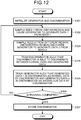
- FIG. 12 is a flowchart illustrating the flow of the training process according to the second embodiment.
- the flow of the training process based on the general GAN is the same as the flow of the processes from S101 to S107 in FIG. 9 , and therefore, detailed explanation thereof will be omitted. Only the flow of processes different from the first embodiment will be described below. Specifically, in the second embodiment, processes corresponding to the flow of the processes at S101, S102 (Yes), S108 to S110, S106, and S107 in FIG. 9 will be described.
- the training processing unit 30 initializes the generator and the discriminator (S301). Then, the training processing unit 30 samples the seed 1 from a certain region stored in the source information DB 14, and generates the data 1 from the seed 1 (S302). Further, the training processing unit 30 samples the seed 2 from a different region from that of the seed 1 among pieces of information stored in the source information DB 14, and generates the data 2 from the seed 2 (S303).
- the training processing unit 30 inputs the data 1 and the data 2 to the discriminator, and trains the discriminator such that the discriminator is able to discriminate between the normal data and the generated data (the data 1 and the data 2) (S304). Then, the training processing unit 30 trains the generator such that the data 1 is discriminated as normal data by the discriminator and the data 2 is discriminated as anomalous data by the discriminator (S305).
- the training processing unit 30 repeats the processes from S302. In contrast, if the training is completed (S306: Yes), the training processing unit 30 stores the discriminator (S307).
- the training processing unit 30 is able to improve the accuracy of the data 2. For example, it is possible to predict that the abnormal data does not present at a position largely deviated from the distribution of the normal data, but is present in the vicinity of the normal data. Further, it is possible to expect that data of the same seed is generated from neighboring seeds.
- the training processing unit 30 is able to improve the accuracy of the discriminator.
- the example has been described in which random numbers or the like are used as the seeds, but embodiments are not limited to this example.
- normal data used for training may be used as the seeds that are used in the second embodiment. This is particularly effective when the number of variations of normal data and abnormal data are large.
- FIG. 13 is a diagram for explaining a training process according to a third embodiment.
- the training processing unit 30 stores each piece of normal data, which has been stored in advance in the normal data DB 13, as the seed 1 in the source information DB 14. Then, the training processing unit 30 sets a range in the vicinity of each of the seeds 1 stored in the source information DB 14 as each of the seeds 2. In other words, the training processing unit 30 sets the seeds 1 to be used to generate normal data that confuses the discriminator and the seeds 2 to be used to generate abnormal data that does not confuse the discriminator.
- the training processing unit 30 performs training based on the normal GAN, and, at a constant rate, generates the data 1 using the seed 1, generates the data 2 using the seed 2, and inputs each of the data 1 and the data 2 to the discriminator. Thereafter, the same training as that of the first embodiment is performed.
- the training processing unit 30 is able to accurately generate abnormal data that is desired to be eventually detected, where the abnormal data is expected to present in the vicinity of normal data; therefore, it is possible to train the discriminator by using the abnormal data, so that it is possible to improve the accuracy of the discriminator.
- a timing to terminate the training process can be set to an arbitrarily time point, such as a time point at which training using a predetermined number or more of pieces of training data is completed or a time point at which the loss of the discriminator decreases to below a threshold.
- the technique can be applied to various fields in which it is determined whether unauthorized invasion has occurred or hazardous materials are brought in, in addition to application to medical image data.
- the training processing unit 30 is able to arbitrarily change setting of the constant rate, such as once every 10 times of training, or one-tenth of the number of times of training if the number of times of training is set in advance to 100 or the like. Further, the training processing unit 30 is able to generate the data 1 and the data 2 as described above and perform each training at a timing at which the loss of the discriminator increases and thereafter decreases.
- the components of the apparatuses illustrated in the drawings are functionally conceptual and need not necessarily be physically configured in the manner illustrated in the drawings.
- specific forms of distribution and integration of the apparatuses are not limited to those illustrated in the drawings.
- all or part of the apparatuses may be functionally or physically distributed or integrated in arbitrary units depending on various loads or use conditions.
- the training processing unit 30 and the detecting unit 40 may be implemented by different apparatuses.
- all or any part of the processing function may be implemented by a CPU and a program analyzed and executed by the CPU or may be implemented as hardware by wired logic.
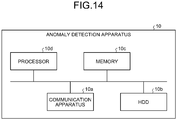
- FIG. 14 is a diagram for explaining a hardware configuration example.
- the abnormality detection apparatus 10 includes a communication apparatus 10a, a hard disk drive (HDD) 10b, a memory 10c, and a processor 10d. All of the units illustrated in FIG. 14 are connected to one another via a bus or the like.
- HDD hard disk drive
- the communication apparatus 10a is a network interface card or the like, and performs communication with other servers.
- the HDD 10b stores therein a program for operating the functions as illustrated in FIG. 6 and DBs.
- the processor 10d reads a program for executing the same process as that of each of the processing units illustrated in FIG. 6 from the HDD 10b or the like, and loads the program on the memory 10c, so that the process for implementing each of the functions described with reference to FIG. 6 etc. are operated. In other words, the process implements the same functions as those of all of the processing units included in the anomaly detection apparatus 10. Specifically, the processor 10d reads, from the HDD 10b or the like, a program that has the same functions as those of the training processing unit 30, the detecting unit 40, and the like. Then, the processor 10d performs the process for implementing the same processes as those of the training processing unit 30, the detecting unit 40, and the like.
- the anomaly detection apparatus 10 by reading and executing the program, functions as the information processing apparatus that performs an anomalous detection method. Furthermore, the anomaly detection apparatus 10 may be able to cause a medium reading device to read the above-described program from a recording medium and execute the read program, to thereby implement the same functions as those of the embodiments as described above. Meanwhile, the program described in the other embodiments need not always be executed by the anomaly detection apparatus 10. For example, the present invention can be applied in the same manner when a different computer or a different server executes the program or the different computer and the different server execute the program in a cooperative manner.
Landscapes
- Engineering & Computer Science (AREA)
- Theoretical Computer Science (AREA)
- Physics & Mathematics (AREA)
- Evolutionary Computation (AREA)
- General Physics & Mathematics (AREA)
- Computer Vision & Pattern Recognition (AREA)
- Health & Medical Sciences (AREA)
- Artificial Intelligence (AREA)
- Software Systems (AREA)
- General Health & Medical Sciences (AREA)
- Computing Systems (AREA)
- Medical Informatics (AREA)
- Data Mining & Analysis (AREA)
- General Engineering & Computer Science (AREA)
- Databases & Information Systems (AREA)
- Life Sciences & Earth Sciences (AREA)
- Multimedia (AREA)
- Mathematical Physics (AREA)
- Molecular Biology (AREA)
- Biomedical Technology (AREA)
- Computational Linguistics (AREA)
- Biophysics (AREA)
- Nuclear Medicine, Radiotherapy & Molecular Imaging (AREA)
- Radiology & Medical Imaging (AREA)
- Bioinformatics & Cheminformatics (AREA)
- Evolutionary Biology (AREA)
- Bioinformatics & Computational Biology (AREA)
- Quality & Reliability (AREA)
- Public Health (AREA)
- Primary Health Care (AREA)
- Epidemiology (AREA)
- Image Analysis (AREA)
Abstract
Description
- The embodiments discussed herein are related to a training apparatus, a training method, and a training program.
- In recent years, in the field of medical image analysis or the like, an anomaly, such as a lesion, is detected using image data. In particular, in the field of medicine or the like, it is often difficult to obtain image data of anomalous states for use for training data; therefore, there is a demand for machine training using only image data of normal states and there is also a demand for an increase in a detection speed in order to handle large amounts of precise and large-scale data.
- In the circumstances as described above, as an anomaly detection method using machine training, generative adversarial networks (GANs) for estimating a distribution of normal data and detecting data deviating from the distribution as anomalous data have been known.
FIG. 15 is a diagram for explaining a GAN. As illustrated inFIG. 15 , the GAN is a training model that includes a generator and a discriminator and that is for unsupervised training in which a network for training the generator and a network for training the discriminator are trained simultaneously. - In the GAN, the generator is trained to generate fake data that is similar to real data from input data, such as noise, and the discriminator is trained to discriminate whether the data generated by the generator is real data or fake data. As anomaly detection using the GAN, a method of determining whether a trained generator has a capability to generate a given sample and regarding generated data as anomalous data if the trained generator does not have the capability, and a method of regarding data that is determined as fake data by the trained discriminator as anomalous data are used.
- Non Patent Document 1: Schlegl, Thomas, et al. "Unsupervised anomaly detection with generative adversarial networks to guide marker discovery.", International Conference on Information Processing in Medical Imaging. Springer, Cham, 2017.
- Non Patent Document 2: M. Sabokrou, et al. "Adversarially Learned One-Class Classifier for Novelty Detection", Proceedings of IEEE Conference on Computer Vision and Pattern Recognition. 2018.
- Accordingly, it is an object in one aspect of an embodiment of the invention to provide a training apparatus, a training method, and a training program capable of preventing reduction of a capability of a discriminator to detect anomalies.
- According to an aspect of an embodiment, a training apparatus includes a generator (31) configured to generate image data; a discriminator (32) configured to discriminate whether the image data is real or fake; and a training unit (30,31,32) configured to train the discriminator in accordance with one of training indices for maximizing and minimizing a discrimination error, and train the generator in accordance with the other one of the training indices, for each piece of the image data generated by the generator (31) .
-
-
FIG. 1 is a diagram for explaining an anomaly detection apparatus according to a first embodiment; -
FIG. 2 is a diagram for explaining a step before training; -
FIG. 3 is a diagram for explaining a step after start of the training; -
FIG. 4 is a diagram for explaining a step during the training; -
FIG. 5A is a diagram for explaining a discriminator after end of the training and a problem with a general technique; -
FIG. 5B is a diagram for explaining the discriminator after the end of the training and the problem with the general technique; -
FIG. 6 is a functional block diagram illustrating a functional configuration of the anomaly detection apparatus according to the first embodiment; -
FIG. 7 is a diagram for explaining a training process according to the first embodiment; -
FIG. 8 is a diagram for explaining an example of a detection result; -
FIG. 9 is a flowchart illustrating the flow of the training process according to the first embodiment; -
FIG. 10 is a flowchart illustrating the flow of a detecting process according to the first embodiment; -
FIG. 11 is a diagram for explaining a training process according to a second embodiment; -
FIG. 12 is a flowchart illustrating the flow of the training process according to the second embodiment; -
FIG. 13 is a diagram for explaining a training process according to a third embodiment; -
FIG. 14 is a diagram for explaining a hardware configuration example; and -
FIG. 15 is a diagram for explaining a GAN. - However, in the techniques as described above, in some cases, the capability of the discriminator to detect anomalies may be reduced. Specifically, when the discriminator is used, characteristics of the discriminator depend on data other than normal data that is erroneously generated by the generator at the end of training, so that omission of detection may increase. For example, the discriminator is expected to have the capability to discriminate a difference between normal data and an output from the generator; however, the discriminator is not able to train data that is not included in the output from the generator and not included in the normal data, so that it is impossible to expect a specific output. Meanwhile, a method using the generator needs a high detection cost, and therefor is not suitable for anomaly detection for which high-speed performance is needed.
- Preferred embodiments of the present invention will be explained with reference to accompanying drawings. The present invention is not limited by the embodiments below. In addition, the embodiments may be combined as appropriate as long as no contradiction is derived.
-
FIG. 1 is a diagram for explaining ananomaly detection apparatus 10 according to a first embodiment. As illustrated inFIG. 1 , theanomaly detection apparatus 10 is an example of a training apparatus that trains, in a training phase, a generator and a discriminator by a GAN, and performs, in a prediction phase, anomaly detection with respect to prediction target image data by using the trained discriminator. - Meanwhile, in training using a general GAN, in some cases, a capability of the discriminator to detect anomalies may be reduced. A problem with the general GAN will be described below with reference to
FIG. 2 to FIG. 5B . InFIG. 2 to FIG. 5B , with respect to the training using the general GAN, steps before start of the training, during the training, and after end of the training are illustrated.FIG. 2 is a diagram for explaining the step before the training.FIG. 3 is a diagram for explaining the step after the start of the training.FIG. 4 is a diagram for explaining the step during the training.FIG. 5A andFIG. 5B are diagrams for explaining the discriminator after the end of the training and a problem with a general technique. - As illustrated in
FIG. 2 , before the training, the generator generates data in a different distribution from a distribution of normal data, and the discriminator trains a difference between the distribution of the normal data and the distribution of the data generated by the generator. In other words, the discriminator clearly distinguishes and discriminates between the distribution of the normal data and the distribution of the data generated by the generator. - Subsequently, as illustrated in
FIG. 3 , upon start of the training, training of the generator proceeds such that data to be discriminated as normal by the discriminator increases and data to be discriminated as anomalous decreases. In other words, the generator is trained to generate data that may be erroneously discriminated by the discriminator, and is thus trained such that the distribution of the data generated by the generator includes a range that can be determined as normal by the discriminator. In contrast, when the distribution of the data generated by the generator is changed with the start of the training, a probability of a discrimination result indicating that data is discriminated as normal is changed; therefore, the discriminator trains a difference between the distribution of the normal data and the distribution of the data generated by the generator. - Subsequently, when the training proceeds from the time point as illustrated in
FIG. 3 , as illustrated inFIG. 4 , training is performed such that the distribution of the data generated by the generator includes the range that can be discriminated as normal by the discriminator inFIG. 3 . In other words, the distribution of the data generated by the generator is updated so as to be largely included in the range that can be discriminated as normal by the discriminator. In contrast, the discriminator is trained to discriminate between the distribution of data generated by the updated generator and the distribution of the normal data. - When the training proceeds further, as illustrated in
FIG. 5A , the generator is trained to mimic data in the range that can be discriminated as normal by the discriminator in the state as illustrated inFIG. 4 , to thereby cause the discriminator to make a mistake, so that the distribution of the data generated by the generator is updated so as to include the range that can be discriminated by the discriminator inFIG. 4 . When the training is completed, the trained discriminator is trained to discriminate between the data generated by the generator and the normal data (real data). - However, in the general GAN, characteristics of the discriminator depend on data other than normal data that is erroneously generated by the generator at the end of training, so that omission of detection may increase. Specifically, as illustrated in
FIG. 5B , it is possible to accurately detect an anomaly with respect to anomalous data that is present in a range that can be determined as anomalous by the trained discriminator, but it is impossible to detect anomalous data that is present outside the range. In other words, in the general GAN, in some cases, it may be difficult to train the discriminator to the same extent as a range of anomalous data that are expected to be detected. - One of the causes of this problem is that, in a training method based on the general GAN, training proceeds such that the generator generates only data that can be expected as normal data, and therefore, it is difficult to maintain a state in which the distribution of the data generated by the generator and the distribution of the normal data do not match. In other words, the generator attempts to generate only data to be determined as normal data by the discriminator.
- To cope with this, the
anomaly detection apparatus 10 determines whether to maximize or minimize a discrimination error for each piece of image data output by the generator. Then, theanomaly detection apparatus 10 trains the discriminator in accordance with one of determined training indices indicating maximization and minimization, and trains the generator in accordance with the other one of the training indices, for each piece of generated image data. - In other words, by using the generator capable of exhaustively generating anomalous data that are expected to be present around normal data, it becomes possible to detect anomalous data that may be omitted in the general technique. Specifically, the generator is controlled such that a loss occurs at a constant rate when generating data that is to be determined as normal data by the discriminator, so that, as illustrated in
FIG. 5B , the distribution of the data generated by the generator includes the range of anomalous data that are expected to be detected. In this manner, by extending a training range of the discriminator, it is possible to prevent reduction of the capability of the discriminator to detect anomalies. -
FIG. 6 is a functional block diagram illustrating a functional configuration of theanomaly detection apparatus 10 according to the first embodiment. As illustrated inFIG. 6 , theanomaly detection apparatus 10 includes acommunication unit 11, astorage unit 12, and acontrol unit 20. - The
communication unit 11 is a processing unit that controls communication with other apparatuses, and is, for example, a communication interface or the like. For example, thecommunication unit 11 receives, from an administrator terminal, an instruction to start various processes, normal data, prediction target data, and the like, and transmits, to the administrator terminal, a training result, a prediction result, and the like. - The
storage unit 12 is one example of a storage device that stores therein various kinds of data and programs to be executed by thecontrol unit 20, and is, for example, a memory, a hard disk, or the like. Thestorage unit 12 stores therein a normal data database (DB) 13, asource information DB 14, atraining result DB 15, and the like. - The
normal data DB 13 is a database for storing image data that is obtained by capturing an image of an internal organ or the like in a normal state. For example, thenormal data DB 13 stores therein normal data that is used in training of the discriminator by the GAN. - The
source information DB 14 is a database for storing information serving as a source for data generation performed by the generator. For example, thesource information DB 14 stores therein information, such as a random number, random noise, or a latent variable, which is what is called a seed. - The
training result DB 15 is a database for storing training results of the generator and the discriminator. For example, thetraining result DB 15 stores therein, as training results of the generator and the discriminator using the GAN and a retraining result of the discriminator, various parameters by which it is possible to generate the trained generator and the trained discriminator for each of which training is completed. - The
control unit 20 is a processing unit that controls the entireanomaly detection apparatus 10, and is, for example, a processor or the like. Thecontrol unit 20 includes a training processing unit 30 and a detecting unit 40, trains a discriminator with high discrimination accuracy, and performs anomaly detection with respect to input prediction target image data. - The training processing unit 30 is a processing unit that includes a
generator training unit 31 and adiscriminator training unit 32, and trains the generator and the discriminator using the GAN. For example, the training processing unit 30 determines whether to perform training for maximizing a discrimination error of the discriminator or training for minimizing the discrimination error. Then, when performing training such that the discriminator maximizes the discrimination error, the training processing unit 30 trains the generator so as to minimize the discrimination error, and when performing training such that the discriminator minimizes the discrimination error, the training processing unit 30 trains the generator so as to maximize the discrimination error. - The
generator training unit 31 is a processing unit that trains the generator of the GAN. Specifically, thegenerator training unit 31 trains the generated based on the general GAN and simultaneously trains the generator such that a loss occurs in the generator at a constant rate when the generator generates data that is to be determined as normal data by the discriminator. - For example, the
generator training unit 31 causes the generator to generate image data by using the seed that is stored in thesource information DB 14. Then, thegenerator training unit 31 inputs the generated image data (hereinafter, may be described as generated data) to the discriminator and acquires a discrimination result of the discriminator. Then, thegenerator training unit 31 trains the generator by using the discrimination result such that the generated data can be discriminated as normal data by the discriminator. - Here, the
generator training unit 31 generates, at a constant rate, such as once every a predetermined number of times, data to be discriminated as anomalous by the discriminator, and trains the generator. For example, the generator normally performs training while receiving a reward when the generated data is discriminated as anomalous by the discriminator, and, at a constant rate, the generator generates data that can be accurately discriminated as anomalous by the discriminator and performs training while receiving a reward when the generated data is accurately determined as anomalous by the discriminator. In other words, thegenerator training unit 31 causes, at a constant rate, the generator to generate the anomalous data that is expected to be detected as illustrated inFIG. 5B , and trains the discriminator and the generator. - More specifically, the generator generates data that confuses the discriminator while preventing the data from being detected as anomalous by the discriminator, and performs training. In the meantime, at a constant rate, the generator generates data that does not confuse the discriminator while allowing the data to be detected as anomalous by the discriminator, and performs training such that the abnormal data can be accurately discriminated as anomalous by the discriminator. As a training method, a method of performing training while inverting a loss function of the generator at a constant rate, or the like may be applicable.
- The
discriminator training unit 32 is a processing unit that trains the discriminator of the GAN. Specifically, similarly to the general GAN, thediscriminator training unit 32 trains the generator such that the discriminator is able to distinguish between the normal data stored in thenormal data DB 13 and the generated data generated by the generator. In other words, the discriminator is trained to minimize the discrimination error. - For example, the
discriminator training unit 32 acquires the generated data from the generator, inputs the generated data to the discriminator, and acquires an output result of the discriminator. Then, thediscriminator training unit 32 trains the discriminator such that, regarding a probability of normality indicating the normal data included in the output result and a probability of anomaly indicating the generated data, the probability of anomaly increases and the probability of normality decreases. - In other words, the
discriminator training unit 32 causes the discriminator to train a difference between the distribution of the generated data generated by the generator and the distribution of the normal data. If training is completed, thediscriminator training unit 32 stores information on the trained discriminator in thetraining result DB 15. - The training process will be described in detail below.
FIG. 7 is a diagram for explaining the training process according to the first embodiment. In general, the generator generates data using a seed, inputs the generated data to the discriminator, and is trained to fool the discriminator such that the generated data is discriminated as normal data by the discriminator, on the basis of the discrimination result of the discriminator. - In the first embodiment, as illustrated in
FIG. 7 , the generator divides the generated data intodata 1 anddata 2, and inputs each piece of the data to the discriminator at a constant rate. The discriminator is trained to discriminate the normal data as normal data and discriminate the generated data (thedata 1 and the data 2) as anomalous data. Further, the generator is trained such that the discriminator discriminates thedata 1 as normal and discriminates thedata 2 as anomalous. - The detecting unit 40 is a processing unit that detects an anomaly from input image data. For example, if the training processing unit 30 completes training, the detecting unit 40 reads a parameter or the like related to the trained discriminator from the
training result DB 15 and constructs the discriminator. Then, upon receiving prediction target image data, the detecting unit 40 inputs the image data to the constructed discriminator and obtains an output result. - Here, as for the probability of normality indicating the normal data included in the output result and the probability of anomaly indicating the generated data, if the probability of normality is higher, the detecting unit 40 discriminates the input image data as normal image data, and if the probability of anomaly is higher, the detecting unit 40 discriminates the input image data as anomalous image data. Then, the detecting unit 40 transmits a discrimination result to the administrator terminal, displays the discrimination result on a display unit, such as a display, or stores the discrimination result in the
storage unit 12. -
FIG. 8 is a diagram for explaining an example of a detection result. As illustrated inFIG. 8 , the detecting unit 40 first divides an input image that is a prediction target into small regions, thereafter inputs the image data to the trained discriminator, and acquires a discrimination result. Then, the detecting unit 40 is able to provide a user with regions that are determined as anomalous by the discriminator. -
FIG. 9 is a flowchart illustrating the flow of the training process according to the first embodiment. As illustrated inFIG. 9 , if an instruction on the training process is issued, the training processing unit 30 initializes the generator and the discriminator (S101). - If a predetermined timing has not come (S102: No), the training processing unit 30 causes the generator to generate data (generated data), inputs the generated data to the discriminator (S103), and trains the discriminator such that the discriminator is able to discriminate between the normal data and the generated data (S104). Further, the training processing unit 30 trains the generator such that the generated data can be discriminated as normal data by the discriminator (S105).
- Thereafter, if the training is continued (S106: No), the training processing unit 30 repeats the processes from S102. In contrast, if the training is completed (S106: Yes), the training processing unit 30 stores the discriminator (S107).
- In contrast, at S102, if it is determined that the predetermined timing has come (S102: Yes), the training processing unit 30 causes the generator to generate data (generated data) and divides the generated data into the
data 1 and the data 2 (S108). - Subsequently, the training processing unit 30 inputs the
data 1 and thedata 2 to the discriminator, and trains the discriminator such that the discriminator is able to discriminate between the normal data and the generated data (thedata 1 and the data 2) (S109). Then, the training processing unit 30 trains the generator such that thedata 1 is discriminated as normal data by the discriminator and thedata 2 is discriminated as anomalous data by the discriminator (S110). Thereafter, the training processing unit 30 performs the processes at S106 and S107. -
FIG. 10 is a flowchart illustrating the flow of a detecting process according to the first embodiment. As illustrated inFIG. 10 , if an instruction on the detecting process is issued, the detecting unit 40 reads the stored discriminator (S201). Subsequently, the detecting unit 40 inputs target data to the discriminator and determines (discriminates) whether the target data is anomalous (S202). - If the detecting unit 40 determines that the target data is normal (S203: Yes), the detecting unit 40 terminates the process. If the detecting unit 40 does not determine that the target data is normal (S203: No), the detecting unit 40 outputs the target data as anomalous data (S204).
- As described above, the
anomaly detection apparatus 10 focuses on the fact that, for example, anomalous data desired to be detected in a medical procedure does not appear at a position largely deviated from the distribution of the normal data, and incorporates, at a constant rate, training to enable the discriminator to accurately discriminate an anomaly inversely with normal training, in addition to normal training of the generator based on the general GAN. For example, a loss of the discriminator increases with progress of the training and thereafter follows the training of the generator, so that the loss decreases. In contrast, by producing a loss of the generator at a constant rate, the distribution of the data generated by the generator is deviated from the distribution of the normal data. In other words, the generator is able to generate, at a constant rate, anomalous data close to the distribution of the the normal data, so that it is possible to extend the training range of the discriminator. As a result, it is possible to prevent reduction of the capability of the discriminator to detect anomalies. - In the first embodiment, the example has been described in which the generator generates the
data 1 and thedata 2 by dividing the generated data, but a method of generating the data that produces the loss of the generator is not limited to this example. For example, by changing a rate of occurrence of the loss in accordance with a value of a seed that is used as a source for data generation by the generator, it is possible to control a range of the generated anomalous data. For example, when random numbers from 0 to 1 are used as seeds, thedata 1 is generated using numbers from 0.2 to 0.8 and thedata 2 is generated using the rest of the numbers. -
FIG. 11 is a diagram for explaining a training process according to the second embodiment. As illustrated inFIG. 11 , the training processing unit 30 sets a range ofseeds 1 that are used to generate normal data and a range ofseeds 2 that are used to generate anomalous data, among seeds that are stored in thesource information DB 14. The range of theseeds 2 is set in the vicinity of theseeds 1. Further, a space of the seeds may be one-dimension, a two-dimensions, or three-dimensions. - The training processing unit 30 performs training based on the general GAN, and, at a constant rate, the training processing unit 30 generates the
data 1 using theseed 1, generates thedata 2 using theseed 2, and inputs each of thedata 1 and thedata 2 to the discriminator. Thereafter, the same training as the first embodiment is performed. -
FIG. 12 is a flowchart illustrating the flow of the training process according to the second embodiment. The flow of the training process based on the general GAN is the same as the flow of the processes from S101 to S107 inFIG. 9 , and therefore, detailed explanation thereof will be omitted. Only the flow of processes different from the first embodiment will be described below. Specifically, in the second embodiment, processes corresponding to the flow of the processes at S101, S102 (Yes), S108 to S110, S106, and S107 inFIG. 9 will be described. - As illustrated in
FIG. 12 , if an instruction on the training process is issued, the training processing unit 30 initializes the generator and the discriminator (S301). Then, the training processing unit 30 samples theseed 1 from a certain region stored in thesource information DB 14, and generates thedata 1 from the seed 1 (S302). Further, the training processing unit 30 samples theseed 2 from a different region from that of theseed 1 among pieces of information stored in thesource information DB 14, and generates thedata 2 from the seed 2 (S303). - Subsequently, the training processing unit 30 inputs the
data 1 and thedata 2 to the discriminator, and trains the discriminator such that the discriminator is able to discriminate between the normal data and the generated data (thedata 1 and the data 2) (S304). Then, the training processing unit 30 trains the generator such that thedata 1 is discriminated as normal data by the discriminator and thedata 2 is discriminated as anomalous data by the discriminator (S305). - Thereafter if the training is continued (S306: No), the training processing unit 30 repeats the processes from S302. In contrast, if the training is completed (S306: Yes), the training processing unit 30 stores the discriminator (S307).
- As described above, by setting, in advance, a source for generating the
data 1 that is used for training such that the discriminator is confused as in a normal manner, and a source for generating thedata 2 that is used for training such that the discriminator is not confused, the training processing unit 30 is able to improve the accuracy of thedata 2. For example, it is possible to predict that the abnormal data does not present at a position largely deviated from the distribution of the normal data, but is present in the vicinity of the normal data. Further, it is possible to expect that data of the same seed is generated from neighboring seeds. - Therefore, by generating abnormal data from a seed that is present in the vicinity of a seed of normal data and that is expected to correspond to abnormal data, it is possible to train the discriminator by using abnormal data that is desired to be eventually detected. Therefore, by setting the range of the
seeds 2, that are present in the vicinity of theseeds 1 corresponding to thedata 1 used to fool the discriminator and that are not included in theseeds 1, in the vicinity of the range of theseeds 1, and causing the generator to generate thedata 2 using theseeds 2, the training processing unit 30 is able to improve the accuracy of the discriminator. In particular, it is possible to use, as new seeds, peripheries of a distribution of seeds used by a normal GAN, and increase the above-described percentage of the new seeds; therefore, the technique is particularly effective when the number of variations of normal data is small. - In the second embodiment, the example has been described in which random numbers or the like are used as the seeds, but embodiments are not limited to this example. For example, normal data used for training may be used as the seeds that are used in the second embodiment. This is particularly effective when the number of variations of normal data and abnormal data are large.
-
FIG. 13 is a diagram for explaining a training process according to a third embodiment. As illustrated inFIG. 13 , the training processing unit 30 stores each piece of normal data, which has been stored in advance in thenormal data DB 13, as theseed 1 in thesource information DB 14. Then, the training processing unit 30 sets a range in the vicinity of each of theseeds 1 stored in thesource information DB 14 as each of theseeds 2. In other words, the training processing unit 30 sets theseeds 1 to be used to generate normal data that confuses the discriminator and theseeds 2 to be used to generate abnormal data that does not confuse the discriminator. - Then, the training processing unit 30 performs training based on the normal GAN, and, at a constant rate, generates the
data 1 using theseed 1, generates thedata 2 using theseed 2, and inputs each of thedata 1 and thedata 2 to the discriminator. Thereafter, the same training as that of the first embodiment is performed. - With this configuration, the training processing unit 30 is able to accurately generate abnormal data that is desired to be eventually detected, where the abnormal data is expected to present in the vicinity of normal data; therefore, it is possible to train the discriminator by using the abnormal data, so that it is possible to improve the accuracy of the discriminator.
- While the embodiments of the present invention have been described above, the present invention may be embodied in various forms other than the above-described embodiments.
- For example, a timing to terminate the training process can be set to an arbitrarily time point, such as a time point at which training using a predetermined number or more of pieces of training data is completed or a time point at which the loss of the discriminator decreases to below a threshold. Further, the technique can be applied to various fields in which it is determined whether unauthorized invasion has occurred or hazardous materials are brought in, in addition to application to medical image data.
- For example, the training processing unit 30 is able to arbitrarily change setting of the constant rate, such as once every 10 times of training, or one-tenth of the number of times of training if the number of times of training is set in advance to 100 or the like. Further, the training processing unit 30 is able to generate the
data 1 and thedata 2 as described above and perform each training at a timing at which the loss of the discriminator increases and thereafter decreases. - The processing procedures, control procedures, specific names, and information including various kinds of data and parameters illustrated in the above-described document and drawings may be arbitrarily changed unless otherwise specified.
- Further, the components of the apparatuses illustrated in the drawings are functionally conceptual and need not necessarily be physically configured in the manner illustrated in the drawings. In other words, specific forms of distribution and integration of the apparatuses are not limited to those illustrated in the drawings. Namely, all or part of the apparatuses may be functionally or physically distributed or integrated in arbitrary units depending on various loads or use conditions. For example, the training processing unit 30 and the detecting unit 40 may be implemented by different apparatuses.
- Furthermore, for each processing function performed by each apparatus, all or any part of the processing function may be implemented by a CPU and a program analyzed and executed by the CPU or may be implemented as hardware by wired logic.
-
FIG. 14 is a diagram for explaining a hardware configuration example. As illustrated inFIG. 14 , theabnormality detection apparatus 10 includes acommunication apparatus 10a, a hard disk drive (HDD) 10b, amemory 10c, and aprocessor 10d. All of the units illustrated inFIG. 14 are connected to one another via a bus or the like. - The
communication apparatus 10a is a network interface card or the like, and performs communication with other servers. TheHDD 10b stores therein a program for operating the functions as illustrated inFIG. 6 and DBs. - The
processor 10d reads a program for executing the same process as that of each of the processing units illustrated inFIG. 6 from theHDD 10b or the like, and loads the program on thememory 10c, so that the process for implementing each of the functions described with reference toFIG. 6 etc. are operated. In other words, the process implements the same functions as those of all of the processing units included in theanomaly detection apparatus 10. Specifically, theprocessor 10d reads, from theHDD 10b or the like, a program that has the same functions as those of the training processing unit 30, the detecting unit 40, and the like. Then, theprocessor 10d performs the process for implementing the same processes as those of the training processing unit 30, the detecting unit 40, and the like. - In this manner, the
anomaly detection apparatus 10, by reading and executing the program, functions as the information processing apparatus that performs an anomalous detection method. Furthermore, theanomaly detection apparatus 10 may be able to cause a medium reading device to read the above-described program from a recording medium and execute the read program, to thereby implement the same functions as those of the embodiments as described above. Meanwhile, the program described in the other embodiments need not always be executed by theanomaly detection apparatus 10. For example, the present invention can be applied in the same manner when a different computer or a different server executes the program or the different computer and the different server execute the program in a cooperative manner. - According to the embodiments, it is possible to prevent reduction of the capability of a discriminator to detect anomalies.
Claims (8)
- A training apparatus (10) comprising:a generator (31) configured to generate image data;a discriminator (32) configured to discriminate whether the image data is real or fake; anda training unit (30,31,32) configured to train the discriminator in accordance with one of training indices for maximizing and minimizing a discrimination error, and train the generator in accordance with the other one of the training indices, for each piece of the image data generated by the generator (31).
- The training apparatus (10) according to claim 1, wherein
the generator (31) generates first image data that is to be discriminated as normal data by the discriminator, and second image data that is to be discriminated as anomalous data by the discriminator,
the discriminator (32) discriminates whether one of the first data and the second data input from the generator is normal data that is stored in advance,
the training unit (30,31,32), when the first image data is generated, trains the discriminator so as to maximize the discrimination error and trains the generator so as to minimize the discrimination error, and
the training unit (30,31,32), when the second image data is generated, trains the discriminator so as to minimize the discrimination error and trains the generator so as to maximize the discrimination error. - The training apparatus (10) according to claim 2, wherein
the training unit (30,31,32), when the first image data is generated, trains the discriminator such that the discriminator discriminates the first image data as anomalous data and trains the generator such that the discriminator discriminates the first image data as normal data, and
the training unit (30,31,32), when the second image data is generated, trains the discriminator such that the discriminator discriminates the second data as anomalous data and trains the generator such that the discriminator discriminates the second data as anomalous data. - The training apparatus (10) according to claim 2, further comprising:a setting unit (30) configured to set, in a space of certain seeds as a source for generating the image data, a first region including a first seed, and a second region including a second seed that is present in the vicinity of the first seed but that is not included in the first region, whereinthe generator (30) generates the first image data by using the first seed, and generates the second image data by using the second seed.
- The training apparatus (10) according to claim 2, further comprising:a setting unit (30) configured to set, in a space of certain seeds as a source for generating the image data, a first region including a first seed, and a second region including a second seed that is present in the vicinity of the first seed but that is not included in the first region, and register the normal data as the first seed in the first region, whereinthe generator (30) generates the first image data by using the normal data included in the first region, and generates the second image data by using the second seed.
- The training apparatus (10) according to claim 1, further comprising:a detecting unit (40) configured to, when discrimination target image data is divided into a plurality of regions and input to a trained discriminator, and if the trained discriminator detects an anomaly, present a region that is indicated as anomalous by the trained discriminator.
- A training method implemented by a computer, the training method comprising:causing a generator to generate image data;causing a discriminator to discriminate whether the image data is real or fake; andtraining the discriminator in accordance with one of training indices for maximizing and minimizing a discrimination error, and training the generator in accordance with the other one of the training indices, for each piece of the image data generated by the generator.
- A training program causing a computer to execute:causing a generator to generate image data;causing a discriminator to discriminate whether the image data is real or fake; andtraining the discriminator in accordance with one of training indices for maximizing and minimizing a discrimination error, and training the generator in accordance with the other one of the training indices, for each piece of the image data generated by the generator.
Applications Claiming Priority (1)
| Application Number | Priority Date | Filing Date | Title |
|---|---|---|---|
| JP2019014036A JP7268368B2 (en) | 2019-01-30 | 2019-01-30 | LEARNING DEVICE, LEARNING METHOD AND LEARNING PROGRAM |
Publications (1)
| Publication Number | Publication Date |
|---|---|
| EP3690746A1 true EP3690746A1 (en) | 2020-08-05 |
Family
ID=69374195
Family Applications (1)
| Application Number | Title | Priority Date | Filing Date |
|---|---|---|---|
| EP20154035.8A Pending EP3690746A1 (en) | 2019-01-30 | 2020-01-28 | Training apparatus, training method, and training program |
Country Status (4)
| Country | Link |
|---|---|
| US (1) | US11263479B2 (en) |
| EP (1) | EP3690746A1 (en) |
| JP (1) | JP7268368B2 (en) |
| CN (1) | CN111508588B (en) |
Families Citing this family (4)
| Publication number | Priority date | Publication date | Assignee | Title |
|---|---|---|---|---|
| US11593639B1 (en) * | 2019-09-03 | 2023-02-28 | Amazon Technologies, Inc. | Scoring events using noise-contrastive estimation for anomaly detection |
| JP7375403B2 (en) * | 2019-09-19 | 2023-11-08 | コニカミノルタ株式会社 | Machine learning device, machine learning method and machine learning program |
| CN112712524B (en) * | 2021-03-29 | 2022-06-21 | 北京妃灵科技有限公司 | Case quality detection method and device based on deep learning model and storage medium |
| JP7379574B2 (en) * | 2022-03-30 | 2023-11-14 | 本田技研工業株式会社 | Pseudo defective product data generation device |
Family Cites Families (9)
| Publication number | Priority date | Publication date | Assignee | Title |
|---|---|---|---|---|
| US10095477B2 (en) * | 2014-12-18 | 2018-10-09 | Cryptography Research Inc. | Self-timed random number generator |
| JP6942488B2 (en) * | 2017-03-03 | 2021-09-29 | キヤノン株式会社 | Image processing equipment, image processing system, image processing method, and program |
| US10346974B2 (en) | 2017-05-18 | 2019-07-09 | Toshiba Medical Systems Corporation | Apparatus and method for medical image processing |
| US20180336439A1 (en) * | 2017-05-18 | 2018-11-22 | Intel Corporation | Novelty detection using discriminator of generative adversarial network |
| CN108009628B (en) * | 2017-10-30 | 2020-06-05 | 杭州电子科技大学 | An Anomaly Detection Method Based on Generative Adversarial Networks |
| CN108334904A (en) * | 2018-02-07 | 2018-07-27 | 深圳市唯特视科技有限公司 | A kind of multiple domain image conversion techniques based on unified generation confrontation network |
| US10825219B2 (en) * | 2018-03-22 | 2020-11-03 | Northeastern University | Segmentation guided image generation with adversarial networks |
| KR102035796B1 (en) * | 2018-07-26 | 2019-10-24 | 주식회사 딥핑소스 | Method, system and non-transitory computer-readable recording medium for processing data to be anonymized |
| CN109255390B (en) * | 2018-09-30 | 2021-01-29 | 京东方科技集团股份有限公司 | Training image preprocessing method and module, discriminator and readable storage medium |
-
2019
- 2019-01-30 JP JP2019014036A patent/JP7268368B2/en active Active
-
2020
- 2020-01-22 CN CN202010075042.7A patent/CN111508588B/en active Active
- 2020-01-28 EP EP20154035.8A patent/EP3690746A1/en active Pending
- 2020-01-28 US US16/774,721 patent/US11263479B2/en active Active
Non-Patent Citations (4)
| Title |
|---|
| ALEX VARGHESE ET AL: "Generative adversarial networks for brain lesion detection", PROGRESS IN BIOMEDICAL OPTICS AND IMAGING, SPIE - INTERNATIONAL SOCIETY FOR OPTICAL ENGINEERING, BELLINGHAM, WA, US, vol. 10133, 24 February 2017 (2017-02-24), pages 101330G - 101330G, XP060086899, ISSN: 1605-7422, ISBN: 978-1-5106-0027-0, DOI: 10.1117/12.2254487 * |
| JOST TOBIAS SPRINGENBERG: "UNSUPERVISED AND SEMI-SUPERVISED LEARNING WITH CATEGORICAL GENERATIVE ADVERSARIAL NETWORKS", 30 April 2016 (2016-04-30), pages 1 - 20, XP055506693, Retrieved from the Internet <URL:https://arxiv.org/pdf/1511.06390.pdf> [retrieved on 20180913] * |
| M. SABOKROU ET AL.: "Adversarially Learned One-Class Classifier for Novelty Detection", PROCEEDINGS OF IEEE CONFERENCE ON COMPUTER VISION AND PATTERN RECOGNITION, 2018 |
| SCHLEGL, THOMAS ET AL.: "International Conference on Information Processing in Medical Imaging", 2017, SPRINGER, article "Unsupervised anomaly detection with generative adversarial networks to guide marker discovery" |
Also Published As
| Publication number | Publication date |
|---|---|
| US11263479B2 (en) | 2022-03-01 |
| US20200242399A1 (en) | 2020-07-30 |
| JP2020123097A (en) | 2020-08-13 |
| JP7268368B2 (en) | 2023-05-08 |
| CN111508588A (en) | 2020-08-07 |
| CN111508588B (en) | 2024-03-15 |
Similar Documents
| Publication | Publication Date | Title |
|---|---|---|
| EP4116853B1 (en) | Computer-readable recording medium storing evaluation program, evaluation method, and information processing device | |
| EP3690746A1 (en) | Training apparatus, training method, and training program | |
| US11055632B2 (en) | Method and device for improving the robustness against “adversarial examples” | |
| CN111031071B (en) | Malicious traffic identification method and device, computer equipment and storage medium | |
| US20190243317A1 (en) | Method and device for improving the robustness with respect to "adversarial examples" | |
| EP1865447A2 (en) | Information processing apparatus, information processing method and computer program | |
| KR102247179B1 (en) | Xai-based normal learning data generation method and device for unsupervised learning of abnormal behavior detection model | |
| US11308404B2 (en) | Synthesizing high-fidelity signals with spikes for prognostic-surveillance applications | |
| US12373520B2 (en) | Neural network watermarking | |
| JPWO2019168167A1 (en) | Verification method, verification device, computer program, and verification system | |
| EP3745317A1 (en) | Apparatus and method for analyzing time series data based on machine learning | |
| EP4202800B1 (en) | Learning device, learning method, and learning program | |
| EP3690743A1 (en) | Training apparatus, training method, and training program | |
| JP2019105871A (en) | Abnormality candidate extraction program, abnormality candidate extraction method and abnormality candidate extraction apparatus | |
| JP7000271B2 (en) | Vehicle unauthorized access countermeasure device and vehicle unauthorized access countermeasure method | |
| Nazat et al. | Xai-based feature ensemble for enhanced anomaly detection in autonomous driving systems | |
| CN110581857B (en) | Virtual execution malicious software detection method and system | |
| EP4216113B1 (en) | Assessment device, assessment method, and assessment program | |
| CN112989312A (en) | Verification code identification method and device, electronic equipment and storage medium | |
| CN117827623A (en) | Application program dialing method, electronic device, and computer-readable medium | |
| CN115373987B (en) | Method and device for detecting abnormal display of application program and storage medium | |
| CN113469932A (en) | Information processing method, electronic device, and medium | |
| US20260086990A1 (en) | Method and apparatus for generating data | |
| EP4078416B1 (en) | Method for monitoring an electronic system using low-level performance counters and comprising at least one set of uncontrolled software applications that are executed on a processor, and a monitoring device | |
| JP7318711B2 (en) | Anomaly detection device, anomaly detection method, and program |
Legal Events
| Date | Code | Title | Description |
|---|---|---|---|
| PUAI | Public reference made under article 153(3) epc to a published international application that has entered the european phase |
Free format text: ORIGINAL CODE: 0009012 |
|
| STAA | Information on the status of an ep patent application or granted ep patent |
Free format text: STATUS: THE APPLICATION HAS BEEN PUBLISHED |
|
| AK | Designated contracting states |
Kind code of ref document: A1 Designated state(s): AL AT BE BG CH CY CZ DE DK EE ES FI FR GB GR HR HU IE IS IT LI LT LU LV MC MK MT NL NO PL PT RO RS SE SI SK SM TR |
|
| AX | Request for extension of the european patent |
Extension state: BA ME |
|
| STAA | Information on the status of an ep patent application or granted ep patent |
Free format text: STATUS: REQUEST FOR EXAMINATION WAS MADE |
|
| 17P | Request for examination filed |
Effective date: 20201012 |
|
| RBV | Designated contracting states (corrected) |
Designated state(s): AL AT BE BG CH CY CZ DE DK EE ES FI FR GB GR HR HU IE IS IT LI LT LU LV MC MK MT NL NO PL PT RO RS SE SI SK SM TR |
|
| STAA | Information on the status of an ep patent application or granted ep patent |
Free format text: STATUS: EXAMINATION IS IN PROGRESS |
|
| RIC1 | Information provided on ipc code assigned before grant |
Ipc: G06V 10/82 20220101AFI20220506BHEP |
|
| 17Q | First examination report despatched |
Effective date: 20220609 |
|
| REG | Reference to a national code |
Ref country code: DE Ref legal event code: R079 Free format text: PREVIOUS MAIN CLASS: G06K0009620000 Ipc: G06F0018000000 |
|
| RIC1 | Information provided on ipc code assigned before grant |
Ipc: G06V 10/80 20220101ALI20240326BHEP Ipc: G06V 10/82 20220101ALI20240326BHEP Ipc: G06V 10/70 20220101ALI20240326BHEP Ipc: G06F 18/00 20230101AFI20240326BHEP |
|
| GRAP | Despatch of communication of intention to grant a patent |
Free format text: ORIGINAL CODE: EPIDOSNIGR1 |
|
| STAA | Information on the status of an ep patent application or granted ep patent |
Free format text: STATUS: GRANT OF PATENT IS INTENDED |
|
| INTG | Intention to grant announced |
Effective date: 20260204 |