EP3689928A1 - Copolymer, dispersant, and dispersion composition - Google Patents
Copolymer, dispersant, and dispersion composition Download PDFInfo
- Publication number
- EP3689928A1 EP3689928A1 EP18858803.2A EP18858803A EP3689928A1 EP 3689928 A1 EP3689928 A1 EP 3689928A1 EP 18858803 A EP18858803 A EP 18858803A EP 3689928 A1 EP3689928 A1 EP 3689928A1
- Authority
- EP
- European Patent Office
- Prior art keywords
- monomer
- group
- copolymer
- mass
- represented
- Prior art date
- Legal status (The legal status is an assumption and is not a legal conclusion. Google has not performed a legal analysis and makes no representation as to the accuracy of the status listed.)
- Withdrawn
Links
- 229920001577 copolymer Polymers 0.000 title claims abstract description 58
- 239000002270 dispersing agent Substances 0.000 title claims abstract description 31
- 239000000203 mixture Substances 0.000 title claims description 33
- 239000006185 dispersion Substances 0.000 title claims description 8
- 239000000178 monomer Substances 0.000 claims abstract description 144
- 125000006353 oxyethylene group Chemical group 0.000 claims abstract description 19
- 239000000470 constituent Substances 0.000 claims abstract description 15
- 150000001732 carboxylic acid derivatives Chemical class 0.000 claims abstract description 10
- 150000001733 carboxylic acid esters Chemical class 0.000 claims abstract description 9
- 125000005702 oxyalkylene group Chemical group 0.000 claims description 20
- 125000004432 carbon atom Chemical group C* 0.000 claims description 18
- 125000002947 alkylene group Chemical group 0.000 claims description 17
- 239000002245 particle Substances 0.000 claims description 9
- 125000000217 alkyl group Chemical group 0.000 claims description 7
- 239000007864 aqueous solution Substances 0.000 claims description 7
- 125000004435 hydrogen atom Chemical group [H]* 0.000 claims description 7
- 125000002496 methyl group Chemical group [H]C([H])([H])* 0.000 claims description 5
- 230000014759 maintenance of location Effects 0.000 abstract description 24
- 239000004568 cement Substances 0.000 description 26
- KWYUFKZDYYNOTN-UHFFFAOYSA-M Potassium hydroxide Chemical compound [OH-].[K+] KWYUFKZDYYNOTN-UHFFFAOYSA-M 0.000 description 15
- 238000000034 method Methods 0.000 description 15
- IAYPIBMASNFSPL-UHFFFAOYSA-N Ethylene oxide Chemical compound C1CO1 IAYPIBMASNFSPL-UHFFFAOYSA-N 0.000 description 14
- XLYOFNOQVPJJNP-UHFFFAOYSA-N water Substances O XLYOFNOQVPJJNP-UHFFFAOYSA-N 0.000 description 14
- 150000003839 salts Chemical class 0.000 description 13
- 238000004519 manufacturing process Methods 0.000 description 11
- -1 alkenyl ether Chemical compound 0.000 description 10
- CSCPPACGZOOCGX-UHFFFAOYSA-N Acetone Chemical compound CC(C)=O CSCPPACGZOOCGX-UHFFFAOYSA-N 0.000 description 7
- GOOHAUXETOMSMM-UHFFFAOYSA-N Propylene oxide Chemical group CC1CO1 GOOHAUXETOMSMM-UHFFFAOYSA-N 0.000 description 7
- WYURNTSHIVDZCO-UHFFFAOYSA-N Tetrahydrofuran Chemical compound C1CCOC1 WYURNTSHIVDZCO-UHFFFAOYSA-N 0.000 description 7
- 238000006243 chemical reaction Methods 0.000 description 7
- IJGRMHOSHXDMSA-UHFFFAOYSA-N Atomic nitrogen Chemical compound N#N IJGRMHOSHXDMSA-UHFFFAOYSA-N 0.000 description 6
- VZCYOOQTPOCHFL-OWOJBTEDSA-N Fumaric acid Chemical compound OC(=O)\C=C\C(O)=O VZCYOOQTPOCHFL-OWOJBTEDSA-N 0.000 description 6
- HEMHJVSKTPXQMS-UHFFFAOYSA-M Sodium hydroxide Chemical compound [OH-].[Na+] HEMHJVSKTPXQMS-UHFFFAOYSA-M 0.000 description 6
- XXROGKLTLUQVRX-UHFFFAOYSA-N allyl alcohol Chemical compound OCC=C XXROGKLTLUQVRX-UHFFFAOYSA-N 0.000 description 6
- 239000003795 chemical substances by application Substances 0.000 description 6
- 150000001875 compounds Chemical class 0.000 description 6
- 150000002148 esters Chemical class 0.000 description 6
- 125000000956 methoxy group Chemical group [H]C([H])([H])O* 0.000 description 6
- 238000006116 polymerization reaction Methods 0.000 description 6
- 239000000126 substance Substances 0.000 description 6
- VZCYOOQTPOCHFL-UHFFFAOYSA-N trans-butenedioic acid Natural products OC(=O)C=CC(O)=O VZCYOOQTPOCHFL-UHFFFAOYSA-N 0.000 description 6
- VYPSYNLAJGMNEJ-UHFFFAOYSA-N silicon dioxide Inorganic materials O=[Si]=O VYPSYNLAJGMNEJ-UHFFFAOYSA-N 0.000 description 5
- 125000003903 2-propenyl group Chemical group [H]C([*])([H])C([H])=C([H])[H] 0.000 description 4
- ROOXNKNUYICQNP-UHFFFAOYSA-N ammonium persulfate Chemical compound [NH4+].[NH4+].[O-]S(=O)(=O)OOS([O-])(=O)=O ROOXNKNUYICQNP-UHFFFAOYSA-N 0.000 description 4
- VIBDJEWPNNCFQO-UHFFFAOYSA-N ethane-1,1,2-triol Chemical compound OCC(O)O VIBDJEWPNNCFQO-UHFFFAOYSA-N 0.000 description 4
- 238000005227 gel permeation chromatography Methods 0.000 description 4
- 239000000243 solution Substances 0.000 description 4
- 0 *Oc1ccccc1 Chemical compound *Oc1ccccc1 0.000 description 3
- 125000006017 1-propenyl group Chemical group 0.000 description 3
- SMZOUWXMTYCWNB-UHFFFAOYSA-N 2-(2-methoxy-5-methylphenyl)ethanamine Chemical compound COC1=CC=C(C)C=C1CCN SMZOUWXMTYCWNB-UHFFFAOYSA-N 0.000 description 3
- ZWEHNKRNPOVVGH-UHFFFAOYSA-N 2-Butanone Chemical compound CCC(C)=O ZWEHNKRNPOVVGH-UHFFFAOYSA-N 0.000 description 3
- NIXOWILDQLNWCW-UHFFFAOYSA-N 2-Propenoic acid Natural products OC(=O)C=C NIXOWILDQLNWCW-UHFFFAOYSA-N 0.000 description 3
- WEVYAHXRMPXWCK-UHFFFAOYSA-N Acetonitrile Chemical compound CC#N WEVYAHXRMPXWCK-UHFFFAOYSA-N 0.000 description 3
- UHOVQNZJYSORNB-UHFFFAOYSA-N Benzene Chemical compound C1=CC=CC=C1 UHOVQNZJYSORNB-UHFFFAOYSA-N 0.000 description 3
- XEKOWRVHYACXOJ-UHFFFAOYSA-N Ethyl acetate Chemical compound CCOC(C)=O XEKOWRVHYACXOJ-UHFFFAOYSA-N 0.000 description 3
- CERQOIWHTDAKMF-UHFFFAOYSA-N Methacrylic acid Chemical compound CC(=C)C(O)=O CERQOIWHTDAKMF-UHFFFAOYSA-N 0.000 description 3
- 239000011398 Portland cement Substances 0.000 description 3
- OFOBLEOULBTSOW-UHFFFAOYSA-N Propanedioic acid Natural products OC(=O)CC(O)=O OFOBLEOULBTSOW-UHFFFAOYSA-N 0.000 description 3
- YXFVVABEGXRONW-UHFFFAOYSA-N Toluene Chemical compound CC1=CC=CC=C1 YXFVVABEGXRONW-UHFFFAOYSA-N 0.000 description 3
- 125000005396 acrylic acid ester group Chemical group 0.000 description 3
- 229910052783 alkali metal Inorganic materials 0.000 description 3
- 229910052784 alkaline earth metal Inorganic materials 0.000 description 3
- 125000005210 alkyl ammonium group Chemical group 0.000 description 3
- 239000011083 cement mortar Substances 0.000 description 3
- 230000000052 comparative effect Effects 0.000 description 3
- 239000001530 fumaric acid Substances 0.000 description 3
- CPLXHLVBOLITMK-UHFFFAOYSA-N magnesium oxide Inorganic materials [Mg]=O CPLXHLVBOLITMK-UHFFFAOYSA-N 0.000 description 3
- VZCYOOQTPOCHFL-UPHRSURJSA-N maleic acid Chemical compound OC(=O)\C=C/C(O)=O VZCYOOQTPOCHFL-UPHRSURJSA-N 0.000 description 3
- 239000011976 maleic acid Substances 0.000 description 3
- 125000005397 methacrylic acid ester group Chemical group 0.000 description 3
- VLKZOEOYAKHREP-UHFFFAOYSA-N n-Hexane Chemical compound CCCCCC VLKZOEOYAKHREP-UHFFFAOYSA-N 0.000 description 3
- 229910052757 nitrogen Inorganic materials 0.000 description 3
- 239000002904 solvent Substances 0.000 description 3
- 238000003756 stirring Methods 0.000 description 3
- 238000002834 transmittance Methods 0.000 description 3
- 229920003169 water-soluble polymer Polymers 0.000 description 3
- 125000006020 2-methyl-1-propenyl group Chemical group 0.000 description 2
- QGZKDVFQNNGYKY-UHFFFAOYSA-N Ammonia Chemical compound N QGZKDVFQNNGYKY-UHFFFAOYSA-N 0.000 description 2
- RGHNJXZEOKUKBD-SQOUGZDYSA-N D-gluconic acid Chemical compound OC[C@@H](O)[C@@H](O)[C@H](O)[C@@H](O)C(O)=O RGHNJXZEOKUKBD-SQOUGZDYSA-N 0.000 description 2
- LYCAIKOWRPUZTN-UHFFFAOYSA-N Ethylene glycol Chemical compound OCCO LYCAIKOWRPUZTN-UHFFFAOYSA-N 0.000 description 2
- MHAJPDPJQMAIIY-UHFFFAOYSA-N Hydrogen peroxide Chemical compound OO MHAJPDPJQMAIIY-UHFFFAOYSA-N 0.000 description 2
- 239000002202 Polyethylene glycol Substances 0.000 description 2
- FAPWRFPIFSIZLT-UHFFFAOYSA-M Sodium chloride Chemical compound [Na+].[Cl-] FAPWRFPIFSIZLT-UHFFFAOYSA-M 0.000 description 2
- 239000000654 additive Substances 0.000 description 2
- 150000001298 alcohols Chemical class 0.000 description 2
- 150000005215 alkyl ethers Chemical class 0.000 description 2
- PNEYBMLMFCGWSK-UHFFFAOYSA-N aluminium oxide Inorganic materials [O-2].[O-2].[O-2].[Al+3].[Al+3] PNEYBMLMFCGWSK-UHFFFAOYSA-N 0.000 description 2
- 229910001870 ammonium persulfate Inorganic materials 0.000 description 2
- 150000003863 ammonium salts Chemical class 0.000 description 2
- 239000002518 antifoaming agent Substances 0.000 description 2
- 239000002956 ash Substances 0.000 description 2
- AOJOEFVRHOZDFN-UHFFFAOYSA-N benzyl 2-methylprop-2-enoate Chemical compound CC(=C)C(=O)OCC1=CC=CC=C1 AOJOEFVRHOZDFN-UHFFFAOYSA-N 0.000 description 2
- 230000015572 biosynthetic process Effects 0.000 description 2
- 239000003054 catalyst Substances 0.000 description 2
- 238000009826 distribution Methods 0.000 description 2
- 230000000694 effects Effects 0.000 description 2
- 239000003112 inhibitor Substances 0.000 description 2
- 239000000395 magnesium oxide Substances 0.000 description 2
- 238000005259 measurement Methods 0.000 description 2
- 150000002762 monocarboxylic acid derivatives Chemical class 0.000 description 2
- 239000004570 mortar (masonry) Substances 0.000 description 2
- 238000006386 neutralization reaction Methods 0.000 description 2
- HMZGPNHSPWNGEP-UHFFFAOYSA-N octadecyl 2-methylprop-2-enoate Chemical compound CCCCCCCCCCCCCCCCCCOC(=O)C(C)=C HMZGPNHSPWNGEP-UHFFFAOYSA-N 0.000 description 2
- 150000002924 oxiranes Chemical class 0.000 description 2
- 238000010979 pH adjustment Methods 0.000 description 2
- 150000002989 phenols Chemical class 0.000 description 2
- 229920001223 polyethylene glycol Polymers 0.000 description 2
- 229920000642 polymer Polymers 0.000 description 2
- 239000003505 polymerization initiator Substances 0.000 description 2
- 239000000047 product Substances 0.000 description 2
- 238000010992 reflux Methods 0.000 description 2
- 239000011347 resin Substances 0.000 description 2
- 229920005989 resin Polymers 0.000 description 2
- 239000004576 sand Substances 0.000 description 2
- 239000007787 solid Substances 0.000 description 2
- 125000001424 substituent group Chemical group 0.000 description 2
- 238000006467 substitution reaction Methods 0.000 description 2
- 238000003786 synthesis reaction Methods 0.000 description 2
- YLQBMQCUIZJEEH-UHFFFAOYSA-N tetrahydrofuran Natural products C=1C=COC=1 YLQBMQCUIZJEEH-UHFFFAOYSA-N 0.000 description 2
- 238000012546 transfer Methods 0.000 description 2
- 239000004711 α-olefin Substances 0.000 description 2
- BYLSIPUARIZAHZ-UHFFFAOYSA-N 2,4,6-tris(1-phenylethyl)phenol Chemical compound C=1C(C(C)C=2C=CC=CC=2)=C(O)C(C(C)C=2C=CC=CC=2)=CC=1C(C)C1=CC=CC=C1 BYLSIPUARIZAHZ-UHFFFAOYSA-N 0.000 description 1
- LCPVQAHEFVXVKT-UHFFFAOYSA-N 2-(2,4-difluorophenoxy)pyridin-3-amine Chemical compound NC1=CC=CN=C1OC1=CC=C(F)C=C1F LCPVQAHEFVXVKT-UHFFFAOYSA-N 0.000 description 1
- CKSAKVMRQYOFBC-UHFFFAOYSA-N 2-cyanopropan-2-yliminourea Chemical compound N#CC(C)(C)N=NC(N)=O CKSAKVMRQYOFBC-UHFFFAOYSA-N 0.000 description 1
- OMIGHNLMNHATMP-UHFFFAOYSA-N 2-hydroxyethyl prop-2-enoate Chemical compound OCCOC(=O)C=C OMIGHNLMNHATMP-UHFFFAOYSA-N 0.000 description 1
- JTHZUSWLNCPZLX-UHFFFAOYSA-N 6-fluoro-3-methyl-2h-indazole Chemical compound FC1=CC=C2C(C)=NNC2=C1 JTHZUSWLNCPZLX-UHFFFAOYSA-N 0.000 description 1
- NIXOWILDQLNWCW-UHFFFAOYSA-M Acrylate Chemical compound [O-]C(=O)C=C NIXOWILDQLNWCW-UHFFFAOYSA-M 0.000 description 1
- OSDWBNJEKMUWAV-UHFFFAOYSA-N Allyl chloride Chemical compound ClCC=C OSDWBNJEKMUWAV-UHFFFAOYSA-N 0.000 description 1
- QGZKDVFQNNGYKY-UHFFFAOYSA-O Ammonium Chemical compound [NH4+] QGZKDVFQNNGYKY-UHFFFAOYSA-O 0.000 description 1
- LSNNMFCWUKXFEE-UHFFFAOYSA-M Bisulfite Chemical compound OS([O-])=O LSNNMFCWUKXFEE-UHFFFAOYSA-M 0.000 description 1
- YTZKOQUCBOVLHL-UHFFFAOYSA-N CC(C)(C)c1ccccc1 Chemical compound CC(C)(C)c1ccccc1 YTZKOQUCBOVLHL-UHFFFAOYSA-N 0.000 description 1
- RWGFKTVRMDUZSP-UHFFFAOYSA-N CC(C)c1ccccc1 Chemical compound CC(C)c1ccccc1 RWGFKTVRMDUZSP-UHFFFAOYSA-N 0.000 description 1
- YNQLUTRBYVCPMQ-UHFFFAOYSA-N CCc1ccccc1 Chemical compound CCc1ccccc1 YNQLUTRBYVCPMQ-UHFFFAOYSA-N 0.000 description 1
- UXVMQQNJUSDDNG-UHFFFAOYSA-L Calcium chloride Chemical compound [Cl-].[Cl-].[Ca+2] UXVMQQNJUSDDNG-UHFFFAOYSA-L 0.000 description 1
- OKTJSMMVPCPJKN-UHFFFAOYSA-N Carbon Chemical compound [C] OKTJSMMVPCPJKN-UHFFFAOYSA-N 0.000 description 1
- VYZAMTAEIAYCRO-UHFFFAOYSA-N Chromium Chemical compound [Cr] VYZAMTAEIAYCRO-UHFFFAOYSA-N 0.000 description 1
- RGHNJXZEOKUKBD-UHFFFAOYSA-N D-gluconic acid Natural products OCC(O)C(O)C(O)C(O)C(O)=O RGHNJXZEOKUKBD-UHFFFAOYSA-N 0.000 description 1
- VEXZGXHMUGYJMC-UHFFFAOYSA-N Hydrochloric acid Chemical compound Cl VEXZGXHMUGYJMC-UHFFFAOYSA-N 0.000 description 1
- WOBHKFSMXKNTIM-UHFFFAOYSA-N Hydroxyethyl methacrylate Chemical compound CC(=C)C(=O)OCCO WOBHKFSMXKNTIM-UHFFFAOYSA-N 0.000 description 1
- ABLZXFCXXLZCGV-UHFFFAOYSA-N Phosphorous acid Chemical compound OP(O)=O ABLZXFCXXLZCGV-UHFFFAOYSA-N 0.000 description 1
- 229920003171 Poly (ethylene oxide) Polymers 0.000 description 1
- VMHLLURERBWHNL-UHFFFAOYSA-M Sodium acetate Chemical compound [Na+].CC([O-])=O VMHLLURERBWHNL-UHFFFAOYSA-M 0.000 description 1
- LSNNMFCWUKXFEE-UHFFFAOYSA-N Sulfurous acid Chemical compound OS(O)=O LSNNMFCWUKXFEE-UHFFFAOYSA-N 0.000 description 1
- 239000002253 acid Substances 0.000 description 1
- 238000004220 aggregation Methods 0.000 description 1
- 230000002776 aggregation Effects 0.000 description 1
- 150000001338 aliphatic hydrocarbons Chemical class 0.000 description 1
- 239000003513 alkali Substances 0.000 description 1
- 150000001340 alkali metals Chemical group 0.000 description 1
- 150000001342 alkaline earth metals Chemical group 0.000 description 1
- 150000001412 amines Chemical class 0.000 description 1
- 229910021529 ammonia Inorganic materials 0.000 description 1
- 125000000129 anionic group Chemical group 0.000 description 1
- 238000013459 approach Methods 0.000 description 1
- 150000004945 aromatic hydrocarbons Chemical class 0.000 description 1
- GCTPMLUUWLLESL-UHFFFAOYSA-N benzyl prop-2-enoate Chemical compound C=CC(=O)OCC1=CC=CC=C1 GCTPMLUUWLLESL-UHFFFAOYSA-N 0.000 description 1
- 239000011400 blast furnace cement Substances 0.000 description 1
- 239000006227 byproduct Substances 0.000 description 1
- 239000001110 calcium chloride Substances 0.000 description 1
- 229910001628 calcium chloride Inorganic materials 0.000 description 1
- 125000003178 carboxy group Chemical group [H]OC(*)=O 0.000 description 1
- 150000001735 carboxylic acids Chemical class 0.000 description 1
- 125000002091 cationic group Chemical group 0.000 description 1
- 239000012986 chain transfer agent Substances 0.000 description 1
- 239000007795 chemical reaction product Substances 0.000 description 1
- 239000004927 clay Substances 0.000 description 1
- 238000005260 corrosion Methods 0.000 description 1
- 230000007797 corrosion Effects 0.000 description 1
- 230000007423 decrease Effects 0.000 description 1
- 150000001991 dicarboxylic acids Chemical class 0.000 description 1
- ZJIPHXXDPROMEF-UHFFFAOYSA-N dihydroxyphosphanyl dihydrogen phosphite Chemical compound OP(O)OP(O)O ZJIPHXXDPROMEF-UHFFFAOYSA-N 0.000 description 1
- 238000001035 drying Methods 0.000 description 1
- 239000003480 eluent Substances 0.000 description 1
- 239000003995 emulsifying agent Substances 0.000 description 1
- 238000005516 engineering process Methods 0.000 description 1
- RTZKZFJDLAIYFH-UHFFFAOYSA-N ether Substances CCOCC RTZKZFJDLAIYFH-UHFFFAOYSA-N 0.000 description 1
- 238000011156 evaluation Methods 0.000 description 1
- 239000010881 fly ash Substances 0.000 description 1
- 239000011521 glass Substances 0.000 description 1
- 239000000174 gluconic acid Substances 0.000 description 1
- 235000012208 gluconic acid Nutrition 0.000 description 1
- 239000010439 graphite Substances 0.000 description 1
- 229910002804 graphite Inorganic materials 0.000 description 1
- 125000001165 hydrophobic group Chemical group 0.000 description 1
- WGCNASOHLSPBMP-UHFFFAOYSA-N hydroxyacetaldehyde Natural products OCC=O WGCNASOHLSPBMP-UHFFFAOYSA-N 0.000 description 1
- 230000001771 impaired effect Effects 0.000 description 1
- 239000010954 inorganic particle Substances 0.000 description 1
- FBAFATDZDUQKNH-UHFFFAOYSA-M iron chloride Chemical compound [Cl-].[Fe] FBAFATDZDUQKNH-UHFFFAOYSA-M 0.000 description 1
- 238000004898 kneading Methods 0.000 description 1
- 229920002521 macromolecule Polymers 0.000 description 1
- 229910000000 metal hydroxide Inorganic materials 0.000 description 1
- 150000004692 metal hydroxides Chemical class 0.000 description 1
- 125000005394 methallyl group Chemical group 0.000 description 1
- 229920000609 methyl cellulose Polymers 0.000 description 1
- 239000001923 methylcellulose Substances 0.000 description 1
- 239000002480 mineral oil Substances 0.000 description 1
- 235000010446 mineral oil Nutrition 0.000 description 1
- 239000012299 nitrogen atmosphere Substances 0.000 description 1
- 239000003921 oil Substances 0.000 description 1
- 239000003129 oil well Substances 0.000 description 1
- 230000003287 optical effect Effects 0.000 description 1
- JRKICGRDRMAZLK-UHFFFAOYSA-L persulfate group Chemical group S(=O)(=O)([O-])OOS(=O)(=O)[O-] JRKICGRDRMAZLK-UHFFFAOYSA-L 0.000 description 1
- 229920001515 polyalkylene glycol Polymers 0.000 description 1
- 230000000379 polymerizing effect Effects 0.000 description 1
- 229920001296 polysiloxane Polymers 0.000 description 1
- USHAGKDGDHPEEY-UHFFFAOYSA-L potassium persulfate Chemical compound [K+].[K+].[O-]S(=O)(=O)OOS([O-])(=O)=O USHAGKDGDHPEEY-UHFFFAOYSA-L 0.000 description 1
- 239000000843 powder Substances 0.000 description 1
- 238000000746 purification Methods 0.000 description 1
- 239000010453 quartz Substances 0.000 description 1
- 239000002994 raw material Substances 0.000 description 1
- 229920006395 saturated elastomer Polymers 0.000 description 1
- 235000003441 saturated fatty acids Nutrition 0.000 description 1
- 150000004671 saturated fatty acids Chemical class 0.000 description 1
- 150000003333 secondary alcohols Chemical class 0.000 description 1
- 239000010801 sewage sludge Substances 0.000 description 1
- HBMJWWWQQXIZIP-UHFFFAOYSA-N silicon carbide Chemical compound [Si+]#[C-] HBMJWWWQQXIZIP-UHFFFAOYSA-N 0.000 description 1
- 229910010271 silicon carbide Inorganic materials 0.000 description 1
- 239000000377 silicon dioxide Substances 0.000 description 1
- 239000002893 slag Substances 0.000 description 1
- 239000000344 soap Substances 0.000 description 1
- 239000011734 sodium Substances 0.000 description 1
- 239000001632 sodium acetate Substances 0.000 description 1
- 235000017281 sodium acetate Nutrition 0.000 description 1
- 239000011780 sodium chloride Substances 0.000 description 1
- CHQMHPLRPQMAMX-UHFFFAOYSA-L sodium persulfate Substances [Na+].[Na+].[O-]S(=O)(=O)OOS([O-])(=O)=O CHQMHPLRPQMAMX-UHFFFAOYSA-L 0.000 description 1
- 159000000000 sodium salts Chemical class 0.000 description 1
- 238000001179 sorption measurement Methods 0.000 description 1
- 239000004575 stone Substances 0.000 description 1
- 238000005728 strengthening Methods 0.000 description 1
- 125000001273 sulfonato group Chemical group [O-]S(*)(=O)=O 0.000 description 1
- 239000004094 surface-active agent Substances 0.000 description 1
- ISIJQEHRDSCQIU-UHFFFAOYSA-N tert-butyl 2,7-diazaspiro[4.5]decane-7-carboxylate Chemical compound C1N(C(=O)OC(C)(C)C)CCCC11CNCC1 ISIJQEHRDSCQIU-UHFFFAOYSA-N 0.000 description 1
- 239000002562 thickening agent Substances 0.000 description 1
- 150000003573 thiols Chemical class 0.000 description 1
- 235000021122 unsaturated fatty acids Nutrition 0.000 description 1
- 150000004670 unsaturated fatty acids Chemical class 0.000 description 1
- 238000005406 washing Methods 0.000 description 1
- 238000004056 waste incineration Methods 0.000 description 1
- 238000004078 waterproofing Methods 0.000 description 1
- 229910052845 zircon Inorganic materials 0.000 description 1
- GFQYVLUOOAAOGM-UHFFFAOYSA-N zirconium(iv) silicate Chemical compound [Zr+4].[O-][Si]([O-])([O-])[O-] GFQYVLUOOAAOGM-UHFFFAOYSA-N 0.000 description 1
Classifications
-
- C—CHEMISTRY; METALLURGY
- C08—ORGANIC MACROMOLECULAR COMPOUNDS; THEIR PREPARATION OR CHEMICAL WORKING-UP; COMPOSITIONS BASED THEREON
- C08F—MACROMOLECULAR COMPOUNDS OBTAINED BY REACTIONS ONLY INVOLVING CARBON-TO-CARBON UNSATURATED BONDS
- C08F220/00—Copolymers of compounds having one or more unsaturated aliphatic radicals, each having only one carbon-to-carbon double bond, and only one being terminated by only one carboxyl radical or a salt, anhydride ester, amide, imide or nitrile thereof
- C08F220/02—Monocarboxylic acids having less than ten carbon atoms; Derivatives thereof
- C08F220/10—Esters
- C08F220/34—Esters containing nitrogen, e.g. N,N-dimethylaminoethyl (meth)acrylate
- C08F220/36—Esters containing nitrogen, e.g. N,N-dimethylaminoethyl (meth)acrylate containing oxygen in addition to the carboxy oxygen, e.g. 2-N-morpholinoethyl (meth)acrylate or 2-isocyanatoethyl (meth)acrylate
-
- C—CHEMISTRY; METALLURGY
- C08—ORGANIC MACROMOLECULAR COMPOUNDS; THEIR PREPARATION OR CHEMICAL WORKING-UP; COMPOSITIONS BASED THEREON
- C08F—MACROMOLECULAR COMPOUNDS OBTAINED BY REACTIONS ONLY INVOLVING CARBON-TO-CARBON UNSATURATED BONDS
- C08F220/00—Copolymers of compounds having one or more unsaturated aliphatic radicals, each having only one carbon-to-carbon double bond, and only one being terminated by only one carboxyl radical or a salt, anhydride ester, amide, imide or nitrile thereof
- C08F220/02—Monocarboxylic acids having less than ten carbon atoms; Derivatives thereof
- C08F220/04—Acids; Metal salts or ammonium salts thereof
- C08F220/06—Acrylic acid; Methacrylic acid; Metal salts or ammonium salts thereof
-
- C—CHEMISTRY; METALLURGY
- C08—ORGANIC MACROMOLECULAR COMPOUNDS; THEIR PREPARATION OR CHEMICAL WORKING-UP; COMPOSITIONS BASED THEREON
- C08F—MACROMOLECULAR COMPOUNDS OBTAINED BY REACTIONS ONLY INVOLVING CARBON-TO-CARBON UNSATURATED BONDS
- C08F222/00—Copolymers of compounds having one or more unsaturated aliphatic radicals, each having only one carbon-to-carbon double bond, and at least one being terminated by a carboxyl radical and containing at least one other carboxyl radical in the molecule; Salts, anhydrides, esters, amides, imides, or nitriles thereof
- C08F222/10—Esters
- C08F222/1006—Esters of polyhydric alcohols or polyhydric phenols
- C08F222/102—Esters of polyhydric alcohols or polyhydric phenols of dialcohols, e.g. ethylene glycol di(meth)acrylate or 1,4-butanediol dimethacrylate
-
- C—CHEMISTRY; METALLURGY
- C04—CEMENTS; CONCRETE; ARTIFICIAL STONE; CERAMICS; REFRACTORIES
- C04B—LIME, MAGNESIA; SLAG; CEMENTS; COMPOSITIONS THEREOF, e.g. MORTARS, CONCRETE OR LIKE BUILDING MATERIALS; ARTIFICIAL STONE; CERAMICS; REFRACTORIES; TREATMENT OF NATURAL STONE
- C04B24/00—Use of organic materials as active ingredients for mortars, concrete or artificial stone, e.g. plasticisers
- C04B24/24—Macromolecular compounds
- C04B24/26—Macromolecular compounds obtained by reactions only involving carbon-to-carbon unsaturated bonds
- C04B24/2641—Polyacrylates; Polymethacrylates
-
- C—CHEMISTRY; METALLURGY
- C04—CEMENTS; CONCRETE; ARTIFICIAL STONE; CERAMICS; REFRACTORIES
- C04B—LIME, MAGNESIA; SLAG; CEMENTS; COMPOSITIONS THEREOF, e.g. MORTARS, CONCRETE OR LIKE BUILDING MATERIALS; ARTIFICIAL STONE; CERAMICS; REFRACTORIES; TREATMENT OF NATURAL STONE
- C04B24/00—Use of organic materials as active ingredients for mortars, concrete or artificial stone, e.g. plasticisers
- C04B24/24—Macromolecular compounds
- C04B24/26—Macromolecular compounds obtained by reactions only involving carbon-to-carbon unsaturated bonds
- C04B24/2664—Macromolecular compounds obtained by reactions only involving carbon-to-carbon unsaturated bonds of ethylenically unsaturated dicarboxylic acid polymers, e.g. maleic anhydride copolymers
-
- C—CHEMISTRY; METALLURGY
- C04—CEMENTS; CONCRETE; ARTIFICIAL STONE; CERAMICS; REFRACTORIES
- C04B—LIME, MAGNESIA; SLAG; CEMENTS; COMPOSITIONS THEREOF, e.g. MORTARS, CONCRETE OR LIKE BUILDING MATERIALS; ARTIFICIAL STONE; CERAMICS; REFRACTORIES; TREATMENT OF NATURAL STONE
- C04B24/00—Use of organic materials as active ingredients for mortars, concrete or artificial stone, e.g. plasticisers
- C04B24/24—Macromolecular compounds
- C04B24/26—Macromolecular compounds obtained by reactions only involving carbon-to-carbon unsaturated bonds
- C04B24/2676—Polystyrenes
-
- C—CHEMISTRY; METALLURGY
- C04—CEMENTS; CONCRETE; ARTIFICIAL STONE; CERAMICS; REFRACTORIES
- C04B—LIME, MAGNESIA; SLAG; CEMENTS; COMPOSITIONS THEREOF, e.g. MORTARS, CONCRETE OR LIKE BUILDING MATERIALS; ARTIFICIAL STONE; CERAMICS; REFRACTORIES; TREATMENT OF NATURAL STONE
- C04B24/00—Use of organic materials as active ingredients for mortars, concrete or artificial stone, e.g. plasticisers
- C04B24/24—Macromolecular compounds
- C04B24/26—Macromolecular compounds obtained by reactions only involving carbon-to-carbon unsaturated bonds
- C04B24/2688—Copolymers containing at least three different monomers
- C04B24/2694—Copolymers containing at least three different monomers containing polyether side chains
-
- C—CHEMISTRY; METALLURGY
- C04—CEMENTS; CONCRETE; ARTIFICIAL STONE; CERAMICS; REFRACTORIES
- C04B—LIME, MAGNESIA; SLAG; CEMENTS; COMPOSITIONS THEREOF, e.g. MORTARS, CONCRETE OR LIKE BUILDING MATERIALS; ARTIFICIAL STONE; CERAMICS; REFRACTORIES; TREATMENT OF NATURAL STONE
- C04B24/00—Use of organic materials as active ingredients for mortars, concrete or artificial stone, e.g. plasticisers
- C04B24/24—Macromolecular compounds
- C04B24/28—Macromolecular compounds obtained otherwise than by reactions only involving carbon-to-carbon unsaturated bonds
- C04B24/32—Polyethers, e.g. alkylphenol polyglycolether
-
- C—CHEMISTRY; METALLURGY
- C08—ORGANIC MACROMOLECULAR COMPOUNDS; THEIR PREPARATION OR CHEMICAL WORKING-UP; COMPOSITIONS BASED THEREON
- C08F—MACROMOLECULAR COMPOUNDS OBTAINED BY REACTIONS ONLY INVOLVING CARBON-TO-CARBON UNSATURATED BONDS
- C08F212/00—Copolymers of compounds having one or more unsaturated aliphatic radicals, each having only one carbon-to-carbon double bond, and at least one being terminated by an aromatic carbocyclic ring
- C08F212/34—Monomers containing two or more unsaturated aliphatic radicals
- C08F212/36—Divinylbenzene
-
- C—CHEMISTRY; METALLURGY
- C08—ORGANIC MACROMOLECULAR COMPOUNDS; THEIR PREPARATION OR CHEMICAL WORKING-UP; COMPOSITIONS BASED THEREON
- C08F—MACROMOLECULAR COMPOUNDS OBTAINED BY REACTIONS ONLY INVOLVING CARBON-TO-CARBON UNSATURATED BONDS
- C08F220/00—Copolymers of compounds having one or more unsaturated aliphatic radicals, each having only one carbon-to-carbon double bond, and only one being terminated by only one carboxyl radical or a salt, anhydride ester, amide, imide or nitrile thereof
- C08F220/02—Monocarboxylic acids having less than ten carbon atoms; Derivatives thereof
- C08F220/10—Esters
- C08F220/26—Esters containing oxygen in addition to the carboxy oxygen
- C08F220/32—Esters containing oxygen in addition to the carboxy oxygen containing epoxy radicals
-
- C—CHEMISTRY; METALLURGY
- C08—ORGANIC MACROMOLECULAR COMPOUNDS; THEIR PREPARATION OR CHEMICAL WORKING-UP; COMPOSITIONS BASED THEREON
- C08F—MACROMOLECULAR COMPOUNDS OBTAINED BY REACTIONS ONLY INVOLVING CARBON-TO-CARBON UNSATURATED BONDS
- C08F290/00—Macromolecular compounds obtained by polymerising monomers on to polymers modified by introduction of aliphatic unsaturated end or side groups
- C08F290/02—Macromolecular compounds obtained by polymerising monomers on to polymers modified by introduction of aliphatic unsaturated end or side groups on to polymers modified by introduction of unsaturated end groups
- C08F290/06—Polymers provided for in subclass C08G
-
- C—CHEMISTRY; METALLURGY
- C08—ORGANIC MACROMOLECULAR COMPOUNDS; THEIR PREPARATION OR CHEMICAL WORKING-UP; COMPOSITIONS BASED THEREON
- C08F—MACROMOLECULAR COMPOUNDS OBTAINED BY REACTIONS ONLY INVOLVING CARBON-TO-CARBON UNSATURATED BONDS
- C08F299/00—Macromolecular compounds obtained by interreacting polymers involving only carbon-to-carbon unsaturated bond reactions, in the absence of non-macromolecular monomers
- C08F299/02—Macromolecular compounds obtained by interreacting polymers involving only carbon-to-carbon unsaturated bond reactions, in the absence of non-macromolecular monomers from unsaturated polycondensates
-
- C—CHEMISTRY; METALLURGY
- C08—ORGANIC MACROMOLECULAR COMPOUNDS; THEIR PREPARATION OR CHEMICAL WORKING-UP; COMPOSITIONS BASED THEREON
- C08L—COMPOSITIONS OF MACROMOLECULAR COMPOUNDS
- C08L33/00—Compositions of homopolymers or copolymers of compounds having one or more unsaturated aliphatic radicals, each having only one carbon-to-carbon double bond, and only one being terminated by only one carboxyl radical, or of salts, anhydrides, esters, amides, imides or nitriles thereof; Compositions of derivatives of such polymers
-
- C—CHEMISTRY; METALLURGY
- C04—CEMENTS; CONCRETE; ARTIFICIAL STONE; CERAMICS; REFRACTORIES
- C04B—LIME, MAGNESIA; SLAG; CEMENTS; COMPOSITIONS THEREOF, e.g. MORTARS, CONCRETE OR LIKE BUILDING MATERIALS; ARTIFICIAL STONE; CERAMICS; REFRACTORIES; TREATMENT OF NATURAL STONE
- C04B2103/00—Function or property of ingredients for mortars, concrete or artificial stone
- C04B2103/0045—Polymers chosen for their physico-chemical characteristics
- C04B2103/0054—Water dispersible polymers
-
- C—CHEMISTRY; METALLURGY
- C04—CEMENTS; CONCRETE; ARTIFICIAL STONE; CERAMICS; REFRACTORIES
- C04B—LIME, MAGNESIA; SLAG; CEMENTS; COMPOSITIONS THEREOF, e.g. MORTARS, CONCRETE OR LIKE BUILDING MATERIALS; ARTIFICIAL STONE; CERAMICS; REFRACTORIES; TREATMENT OF NATURAL STONE
- C04B2103/00—Function or property of ingredients for mortars, concrete or artificial stone
- C04B2103/30—Water reducers, plasticisers, air-entrainers, flow improvers
- C04B2103/308—Slump-loss preventing agents
-
- C—CHEMISTRY; METALLURGY
- C04—CEMENTS; CONCRETE; ARTIFICIAL STONE; CERAMICS; REFRACTORIES
- C04B—LIME, MAGNESIA; SLAG; CEMENTS; COMPOSITIONS THEREOF, e.g. MORTARS, CONCRETE OR LIKE BUILDING MATERIALS; ARTIFICIAL STONE; CERAMICS; REFRACTORIES; TREATMENT OF NATURAL STONE
- C04B2103/00—Function or property of ingredients for mortars, concrete or artificial stone
- C04B2103/40—Surface-active agents, dispersants
- C04B2103/408—Dispersants
Definitions
- An embodiment of the present invention relates to a copolymer, a dispersant containing the copolymer, and a dispersion composition including the dispersant.
- PTL 1 discloses a copolymer of at least three polyoxyalkyl ester monomers of unsaturated carboxylic acids and an unsaturated monocarboxylic acid monomer.
- PTL 2 discloses a copolymer of an unsaturated polyalkylene glycol alkenyl ether monomer, an unsaturated carboxylic acid monomer, and a sulfonic (sulfonate) group-containing monomer.
- the copolymers disclosed in PTLs 1 and 2 are not sufficiently satisfactory in dispersibility and slump retention capability.
- an object of the embodiment of the present invention is to provide a novel copolymer that can be used, for example, as a dispersant having high dispersibility and high slump retention capability.
- a copolymer according to a first embodiment of the present invention is a copolymer containing, as constituent monomers, at least one monomer selected from the group consisting of a monomer (A) represented by general formula (1) below and a monomer (B) represented by general formula (2) below, and at least one monomer (C) selected from the group consisting of an unsaturated carboxylic acid monomer (C-1) and an oxyethylene group-containing unsaturated carboxylic acid ester (C-2).
- the content of the monomer (C) in the constituent monomers is 20 mass% or more and 99 mass% or less.
- a copolymer according to a second embodiment of the present invention is a water-soluble copolymer containing, as constituent monomers, at least one monomer selected from the group consisting of a monomer (A) represented by general formula (1) below and a monomer (B) represented by general formula (2) below, and at least one monomer (C) selected from the group consisting of an unsaturated carboxylic acid monomer (C-1) and an oxyethylene group-containing unsaturated carboxylic acid ester (C-2).
- D 1 represents at least one polymerizable unsaturated group selected from the group consisting of groups D 1 -1 and D 1 -2 below, where R 2 represents a hydrogen atom or a methyl group; R 1 represents at least one group selected from the group consisting of groups R 1 -1, R 1 -2, and R 1 -3 below; m1 and m2 are each 1 to 2 in terms of an average of the whole monomer (A); A 1 represents an alkylene group having 2 to 4 carbon atoms; and m3 represents an average number of moles of oxyalkylene groups added and is a number of 1 to 100.
- R 3 represents an alkyl group having 8 to 14 carbon atoms
- a 2 represents an alkylene group having 2 to 4 carbon atoms
- n represents an average number of moles of oxyalkylene groups added and is a number of 1 to 100.
- An aqueous solution according to an embodiment of the present invention contains the copolymer according to the above embodiment.
- a dispersant according to an embodiment of the present invention contains the copolymer according to the above embodiment.
- a dispersion composition according to an embodiment of the present invention contains particles and the dispersant.
- copolymer according to the embodiment of the present invention when used, for example, as a dispersant, can improve dispersibility and slump retention capability.
- a monomer (A) is represented by general formula (1) below.
- D 1 represents at least one polymerizable unsaturated group selected from the group consisting of a group D 1 -1 (i.e., a group represented by formula D 1 -1 below) and a group D 1 -2 (i.e., a group represented by formula D 1 -2 below). Therefore, when a plurality of groups D 1 are contained in one molecule, they may be the same as or different from each other. Also in the whole monomer (A), all the groups D 1 may be the same, or the monomer (A) may be a mixture of compounds having different groups D 1 .
- R 2 in the formulae of the groups D 1 -1 and D 1 -2 represents a hydrogen atom or a methyl group. Therefore, D 1 specifically represents a 1-propenyl group, a 2-methyl-1-propenyl group, or a (meth)allyl group. D 1 may be any one of a 1-propenyl group, a 2-methyl-1-propenyl group, or a (meth)allyl group or a mixture thereof. D 1 is preferably a 1-propenyl group.
- the term "(meth)allyl group” means an allyl group and/or a methallyl group.
- the number m1 of substituent groups D 1 is in the range of 1 to 2 in terms of the average of the whole monomer (A).
- m1 is preferably more than 1, more preferably 1.1 or more, still more preferably 1.2 or more.
- m1 is preferably 1.8 or less, more preferably 1.5 or less.
- the group D 1 -1 and the group D 1 -2 preferably have a molar ratio (D 1 -1)/(D 1 -2) of greater than 2.
- the substitution position of D 1 is preferably the ortho position and/or the para position, more preferably the ortho position.
- R 1 represents at least one group selected from the group consisting of a group R 1 -1 (i.e., a group represented by formula R 1 -1 below), a group R 1 -2 (i.e., a group represented by formula R 1 -2 below), and a group R 1 -3 (i.e., a group represented by formula R 1 -3 below). Therefore, when a plurality of groups R 1 are contained in one molecule, they may be the same as or different from each other. Also in the whole monomer (A), all the groups R 1 may be the same, or the monomer (A) may be a mixture of compounds having different groups R 1 .
- the number m2 of substituent groups R 1 is in the range of 1 to 2 in terms of the average of the whole monomer (A).
- m2 is preferably more than 1, more preferably 1.1 or more, still more preferably 1.2 or more.
- m2 is preferably 1.8 or less, more preferably 1.5 or less.
- the sum of the numbers m1 and m2 is preferably 2 or more.
- the sum of the numbers m1 and m2 is preferably 3 or less.
- the substitution position of R 1 is preferably the ortho position and/or the para position.
- a 1 in general formula (1) represents an alkylene group (i.e., an alkanediyl group) having 2 to 4 carbon atoms.
- the alkylene group may be linear or branched. Therefore, examples of oxyalkylene groups represented by A 1 O include an oxyethylene group, an oxypropylene group, and an oxybutylene group.
- the (A 1 O) m3 chain moiety in general formula (1) is an addition polymer constituted by one or more alkylene oxides having 2 to 4 carbon atoms, such as ethylene oxide, propylene oxide, butylene oxide, and tetrahydrofuran (1,4-butylene oxide).
- the addition form of oxyalkylene groups is not particularly limited.
- a single adduct constituted by one alkylene oxide or a random or block adduct constituted by two or more alkylene oxides may be employed. Alternatively, the random adduct and the block adduct may be combined with each other.
- the oxyalkylene group is preferably an oxyethylene group.
- the (A 1 O) m3 chain moiety is a (poly)oxyalkylene chain containing an oxyethylene group in an amount of preferably 50 to 100 mol%, more preferably 70 to 100 mol%.
- m3 represents an average number of moles of oxyalkylene groups added and is a number in the range of 1 to 100.
- m3 is preferably 5 to 80, more preferably 10 to 50.
- the method for producing the monomer (A) represented by general formula (1) is not particularly limited.
- the monomer (A) is obtained by a method described in paragraphs 0020 to 0025 of WO2013/108588A1 or a method described in paragraphs 0024 to 0027 of Japanese Unexamined Patent Application Publication No. 2015-13921 .
- a monomer (B) is a polyoxyalkylene-1-(allyloxymethyl)alkyl ether represented by general formula (2) below.
- R 3 represents an alkyl group having 8 to 14 carbon atoms.
- the alkyl group may be linear or branched.
- R 3 is preferably an alkyl group having 10 or more carbon atoms, and preferably an alkyl group having 12 or less carbon atoms.
- the monomer (B) may be a mixture of compounds having groups R 3 with different numbers of carbon atoms.
- a 2 in general formula (2) represents an alkylene group having 2 to 4 carbon atoms.
- the alkylene group may be linear or branched. Therefore, examples of oxyalkylene groups represented by A 2 O include an oxyethylene group, an oxypropylene group, and an oxybutylene group.
- the (A 2 O) n3 chain moiety in general formula (2) is an addition polymer constituted by one or more alkylene oxides having 2 to 4 carbon atoms, such as ethylene oxide, propylene oxide, butylene oxide, and tetrahydrofuran.
- the addition form of oxyalkylene groups is not particularly limited.
- a single adduct constituted by one alkylene oxide or a random or block adduct constituted by two or more alkylene oxides may be employed. Alternatively, the random adduct and the block adduct may be combined with each other.
- the oxyalkylene group is preferably an oxyethylene group.
- the (A 2 O) n chain moiety is a (poly)oxyalkylene chain containing an oxyethylene group in an amount of preferably 50 to 100 mol%, more preferably 70 to 100 mol%.
- n represents an average number of moles of oxyalkylene groups added and is a number in the range of 1 to 100.
- n is preferably 5 or more, more preferably 10 or more, still more preferably 20 or more.
- n is preferably 90 or less, more preferably 80 or less, still more preferably 55 or less.
- the method for producing the monomer (B) represented by general formula (2) is not particularly limited.
- the monomer (B) can be synthesized by a known method. For example, allyl alcohol and ⁇ -olefin epoxide are allowed to react with each other in the presence of a basic substance such as potassium hydroxide to obtain a 2-hydroxyalkyl allyl ether. A predetermined amount of alkylene oxide is added to the 2-hydroxyalkyl allyl ether by a known method to obtain the monomer (B) represented by general formula (2).
- An unsaturated carboxylic acid monomer (C-1) (hereinafter also referred to simply as a monomer (C-1)) is an unsaturated carboxylic acid and/or a salt thereof.
- the monomer (C-1) may be an unsaturated monocarboxylic acid and/or a salt thereof or an unsaturated dicarboxylic acid and/or a salt thereof.
- Examples of salts include alkali metal salts, alkaline-earth metal salts, alkylammonium salts, alkanolammonium salts, and ammonium salts.
- the monomer (C-1) may be a mixture of two or more compounds.
- the monomer (C-1) is preferably at least one selected from the group consisting of acrylic acid, methacrylic acid, maleic acid, fumaric acid, and salts thereof. Therefore, a monomer (C-1) according to a preferred embodiment is represented by general formula (3) below.
- R 4 is a hydrogen atom, a carboxyl group, or a salt thereof.
- R 5 is a hydrogen atom or a methyl group.
- X represents a hydrogen atom, an alkali metal atom, an alkaline-earth metal atom, an alkylammonium, an alkanolammonium, or ammonium.
- salts represented by R 4 includes alkali metal salts, alkaline-earth metal salts, alkylammonium salts, alkanolammonium salts, and ammonium salts, which are the same as the examples of salts represented by X.
- the monomer (C-1) is preferably at least one selected from the group consisting of acrylic acid, methacrylic acid, maleic acid, fumaric acid, and salts thereof, for higher dispersibility and higher slump retention capability.
- Examples of an oxyethylene group-containing unsaturated carboxylic acid ester (hereinafter also referred to simply as a monomer (C-2)) include (poly)oxyethylene glycol (di)acrylic acid ester, (poly)oxyethylene glycol (di)methacrylic acid ester, methoxy(poly)oxyethylene glycol acrylic acid ester, methoxy(poly)oxyethylene glycol methacrylic acid ester, methoxy(poly)oxyethylene glycol maleic acid (di)ester, methoxy(poly)oxyethylene glycol fumaric acid (di)ester, and salts thereof. Any one or more of these may be used.
- the average number of moles of oxyethylene group added in the monomer (C-2) is not particularly limited and may be, for example, 1 to 50, 1 to 20, or 2 to 20.
- (poly)oxyethylene means oxyethylene and/or polyoxyethylene and is meant to encompass both with and without parentheses. This also applies to (di)acrylic acid ester, (di)methacrylic acid ester, and (di)ester.
- the monomer (C-2) is preferably methoxy (poly)oxyethylene glycol acrylic acid ester and/or methoxy (poly)oxyethylene glycol methacrylic acid ester, for higher dispersibility and higher slump retention capability.
- the monomer (C) preferably includes the unsaturated carboxylic acid monomer (C-1).
- another monomer may be further used.
- examples of such other monomers include acrylic acid esters such as 2-hydroxyethyl acrylate, benzyl acrylate, and stearyl acrylate and methacrylic acid esters such as 2-hydroxyethyl methacrylate, benzyl methacrylate, and stearyl methacrylate. Any one or more of these may be used.
- the copolymer according to the present embodiment includes, as constituent monomers, at least one monomer selected from the group consisting of a monomer (A) and a monomer (B), and at least one monomer (C) selected from the group consisting of an unsaturated carboxylic acid monomer (C-1) and an oxyethylene group-containing unsaturated carboxylic acid ester (C-2). Therefore, the copolymer includes a structural unit derived from the monomer (A) and/or a structural unit derived from the monomer (B), and a structural unit derived from the monomer (C).
- the term "constituent monomer” refers to a monomer constituting a copolymer, but does not necessarily mean a monomer used in polymerizing the copolymer and is meant to encompass, for example, monomers having a structure obtained by neutralization with an alkaline substance after polymerization.
- the total content of the monomers (A) and (B) in the constituent monomers (i.e., in the copolymer) is preferably 1 mass% or more, more preferably 2 mass% or more, still more preferably 3 mass% or more, and preferably 20 mass% or less, more preferably 15 mass% or less, still more preferably 10 mass% or less.
- the content thereof in the constituent monomers is preferably 1 mass% or more, more preferably 2 mass% or more, still more preferably 3 mass% or more, and preferably 20 mass% or less, more preferably 15 mass% or less, still more preferably 10 mass% or less.
- the content of the monomer (C) in the constituent monomers (i.e., in the copolymer) is preferably 20 mass% or more, more preferably 50 mass% or more, still more preferably 60 mass% or more, further more preferably 70 mass% or more, and may be 80 mass% or more.
- the content of the monomer (C) is preferably 99 mass% or less, more preferably 98 mass% or less, still more preferably 97 mass% or less. In an embodiment, the content of the monomer (C) is 20 mass% or more and 99 mass% or less.
- a copolymer according to an embodiment is a water-soluble polymer.
- the percentage of the monomer (C) in the copolymer is increased. For example, when the content of the monomer (C) is 20 mass% or more, a water-soluble polymer can be obtained.
- Whether a copolymer is water-soluble is determined as follows. Specifically, a 1 mass% aqueous solution of a copolymer (a solution obtained by adding water such that the copolymer content is 1 mass%) is used as a sample. The sample is injected into a quartz cell having an optical path length of 1 cm, and using a visible-ultraviolet spectrophotometer, the light transmittance at 25°C and a wavelength of 660 nm is measured. Copolymers having a light transmittance of 90%T or more are determined to be water-soluble. For example, in EXAMPLES described later, a "Model U-1800 Ratio Beam Spectrophotometer" manufactured by Hitachi High-Technologies Corporation was used as the visible-ultraviolet spectrophotometer.
- the weight average molecular weight (Mw) of the copolymer according to the embodiment is not particularly limited, and may be, for example, 5000 or more, or 10000 or more, and may be 50000 or less, or 30000 or less.
- the molecular weight distribution (Mw/Mn) of the copolymer is also not particularly limited, and may be, for example, in the range of 1.3 to 2.5.
- the weight average molecular weight and the molecular weight distribution can be measured by a known gel permeation chromatography (GPC) method against polyethylene glycol standards.
- the measurement conditions are not particularly limited and may be, for example, the following conditions. GPC measurement conditions:
- the method for producing the copolymer according to the present embodiment is not particularly limited.
- the copolymer can be produced using a known method.
- examples of solvents include water, alcohols having 1 to 3 carbon atoms, aromatic hydrocarbons such as benzene and toluene, aliphatic hydrocarbons such as hexane, ethyl acetate, acetone, and methyl ethyl ketone. Of these, water and alcohols are preferred, and water is more preferred.
- a mixture of monomers may be partially or wholly placed in a reaction vessel, or may be continuously added dropwise.
- a polymerization initiator is preferably continuously added dropwise.
- examples of polymerization initiators that can be used include hydrogen peroxide, persulfates (e.g., ammonium persulfate, sodium persulfate, and potassium persulfate), azoamidine compounds (e.g., 2,2'-azobis-2-methylpropioneamidine hydrochloride and 2,2'-azobis-2-(2-imidazolin-2-yl)propane hydrochloride), and azonitrile compounds (e.g., 2-carbamoylazoisobutyronitrile).
- a known reaction accelerator may be used in combination.
- the reaction temperature is not particularly limited and preferably 0°C to 150°C, more preferably 30°C to 120°C, still more preferably 50°C to 100°C.
- chain transfer agent In polymerization, a known chain transfer agent may be used. Examples of such chain transfer agents include thiol-based chain transfer agents and secondary alcohols. Phosphorous acid, diphosphorous acid, sulfurous acid, and salts thereof may also be used.
- concentration adjustment by means of removal or addition of solvent, pH adjustment, purification, and the like can be performed.
- the pH of the resulting copolymer is preferably adjusted to 6 to 8.
- the pH adjustment can be performed, for example, using an alkaline substance such as a metal hydroxide, ammonia, or an organic amine.
- the copolymer according to the present embodiment may be neutralized using an alkaline substance after the polymerization reaction.
- the copolymer according to the present embodiment can be suitably used, for example, as a dispersant for inorganic particles such as cement, and is preferably used as a cement dispersant. This use is a non-limiting example, and the copolymer according to the present embodiment can also be used as a dispersant for various particles such as resin particles.
- the copolymer according to the present embodiment can also be used for applications of common water-soluble polymers, such as thickeners and emulsifiers.
- a dispersant according to the present embodiment contains the above copolymer.
- Using the copolymer as a dispersant can improve the dispersibility and slump retention capability of particles such as cement. This is presumably, but not necessarily, because the presence of a specific hydrophobic group and a specific oxyalkylene group in the monomer (A) and/or the monomer (B) contained as constituent monomers facilitates adsorption of particles (dispersoid) such as cement and also suppresses aggregation of the particles.
- the copolymer may be used in the form of an aqueous solution or a dried powder.
- the dispersant may also contain any other appropriate component as long as the effects of the dispersant are not impaired.
- Examples of other components include known dispersants such as sulfonic acid-based dispersants and polycarboxylic acid-based dispersants.
- known additives for example, water-soluble macromolecular substances (e.g., methylcellulose and polyethylene glycol), concrete retarders (e.g., gluconic acid, sugar, and phosphonic acid), early strengthening agents and accelerators (e.g., calcium chloride, iron chloride, and potassium hydroxide), oxyalkylene-based antifoaming agents (e.g., polyoxyalkylenes and polyoxyalkylene alkyl ethers), other antifoaming agents (e.g., mineral oil-based, fat- and oil-based, and silicone-based), air-entraining agents (e.g., resin soap and saturated or unsaturated fatty acids), surfactants (anionic, cationic, nonionic, and amphoteric), waterproofing agents, corrosion inhibitors, crack inhibitors, and expansive additives may also be used.
- a dispersion composition according to the present embodiment contains particles and the above dispersant, preferably particles, the above dispersant, and water.
- a dispersion composition according to an embodiment is a cement composition, and in this case, the cement composition preferably contains cement, the above dispersant, and water.
- cement contained in the cement composition examples include, but are not limited to, Portland cements (ordinary, high-early-strength, ultra-high-early-strength, moderate-heat, sulfate-resisting, and low-alkali types thereof), various blended cements (blast furnace cement, silica cement, and fly ash cement), white Portland cements, alumina cements, ultra-rapid hardening cements, cements for grouting, oil-well cements, low-heat cements, ultra-high-strength cements, cement-based solidifying agents, and ECO-cements (cements produced using at least one of municipal waste incineration ash and sewage sludge incineration ash as a raw material). Any one or more of these may be used.
- Portland cements ordinary, high-early-strength, ultra-high-early-strength, moderate-heat, sulfate-resisting, and low-alkali types thereof
- the cement composition may contain any appropriate aggregate such as a fine aggregate or a coarse aggregate.
- aggregates include sand, gravel, crushed stone, water-granulated slag, recycled aggregates, and refractory aggregates such as siliceous, clay, zircon, high-alumina, silicon carbide, graphite, chrome, chrome-magnesia, and magnesia aggregates.
- the content of the above dispersant in the dispersion composition such as a cement composition is not particularly limited, and any appropriate content can be employed depending on the intended use.
- the content of the above dispersant relative to 100 parts by mass of cement may be 0.001 parts by mass to 10 parts by mass, 0.01 parts by mass to 5 parts by mass, or 0.05 parts by mass to 3 parts by mass, in terms of copolymer content.
- EO represents an oxyethylene group
- PO represents an oxypropylene group
- A-1 to A-5 and B-1 to B-5 are synthesized as described above.
- Other monomers are as follows.
- Table 1 shows the contents of sodium salts (AA-Na, MA-Na) obtained by neutralization.
- the aqueous solutions of the copolymers obtained were adjusted to a solid concentration of 40 mass% to provide dispersants. The following evaluations were performed using the dispersants.
- a cement mortar was prepared in accordance with JIS R5201. Specifically, 3 g, on a solids basis, of the dispersant and 300 g of water were mixed together, and then added to a mixture obtained by kneading 600 g of a commercially available Portland cement with 1800 g of sand. The resulting mixture was stirred at low speed for 1 minute using a mortar mixer, and then further stirred at high speed for 2 minutes to prepare a cement mortar. The cement mortar was measured for flow values (mm) immediately after production and one hour after production in accordance with JIS R5201, and evaluated for dispersibility according to the following criteria. The results are shown in Table 1.
- slump retention rate % flow value measured one hour after production / flow value measured immediately after production ⁇ 100
- slump retention capability was evaluated according to the following criteria. The results are shown in Table 1.
Landscapes
- Chemical & Material Sciences (AREA)
- Chemical Kinetics & Catalysis (AREA)
- Organic Chemistry (AREA)
- Health & Medical Sciences (AREA)
- Medicinal Chemistry (AREA)
- Polymers & Plastics (AREA)
- Engineering & Computer Science (AREA)
- Ceramic Engineering (AREA)
- Materials Engineering (AREA)
- Structural Engineering (AREA)
- Curing Cements, Concrete, And Artificial Stone (AREA)
- Compositions Of Macromolecular Compounds (AREA)
- Addition Polymer Or Copolymer, Post-Treatments, Or Chemical Modifications (AREA)
Abstract
Provided is a copolymer that can be used as a dispersant having high dispersibility and high slump retention capability.A copolymer according to an embodiment is a water-soluble copolymer that contains, as constituent monomers, at least one monomer selected from a monomer (A) represented by formula (1) and a monomer (B) represented by formula (2), and at least one monomer (C) selected from an unsaturated carboxylic acid monomer (C-1) and an oxyethylene group-containing unsaturated carboxylic acid ester (C-2). The content of the monomer (C) is 20 mass% or more and 99 mass% or less.D<sup>1</sup>:R<sup>1</sup>:
Description
- An embodiment of the present invention relates to a copolymer, a dispersant containing the copolymer, and a dispersion composition including the dispersant.
- In improving the strength and durability of concrete, reducing the unit water content in the concrete is effective. However, it is known that reducing the unit water content decreases the flowability of the concrete and impairs workability.
- Thus, dispersants for dispersing cement and the like are under study as approaches to improving workability while reducing the unit water content. For example, PTL 1 discloses a copolymer of at least three polyoxyalkyl ester monomers of unsaturated carboxylic acids and an unsaturated monocarboxylic acid monomer. PTL 2 discloses a copolymer of an unsaturated polyalkylene glycol alkenyl ether monomer, an unsaturated carboxylic acid monomer, and a sulfonic (sulfonate) group-containing monomer. However, the copolymers disclosed in PTLs 1 and 2 are not sufficiently satisfactory in dispersibility and slump retention capability.
-
- PTL 1: Japanese Unexamined Patent Application Publication No.
2016-179926 - PTL 2: Japanese Unexamined Patent Application Publication No.
2016-23096 - In view of the above, an object of the embodiment of the present invention is to provide a novel copolymer that can be used, for example, as a dispersant having high dispersibility and high slump retention capability. Solution to Problem
- A copolymer according to a first embodiment of the present invention is a copolymer containing, as constituent monomers, at least one monomer selected from the group consisting of a monomer (A) represented by general formula (1) below and a monomer (B) represented by general formula (2) below, and at least one monomer (C) selected from the group consisting of an unsaturated carboxylic acid monomer (C-1) and an oxyethylene group-containing unsaturated carboxylic acid ester (C-2). The content of the monomer (C) in the constituent monomers is 20 mass% or more and 99 mass% or less.
- A copolymer according to a second embodiment of the present invention is a water-soluble copolymer containing, as constituent monomers, at least one monomer selected from the group consisting of a monomer (A) represented by general formula (1) below and a monomer (B) represented by general formula (2) below, and at least one monomer (C) selected from the group consisting of an unsaturated carboxylic acid monomer (C-1) and an oxyethylene group-containing unsaturated carboxylic acid ester (C-2).


- An aqueous solution according to an embodiment of the present invention contains the copolymer according to the above embodiment. A dispersant according to an embodiment of the present invention contains the copolymer according to the above embodiment. A dispersion composition according to an embodiment of the present invention contains particles and the dispersant.
- The copolymer according to the embodiment of the present invention, when used, for example, as a dispersant, can improve dispersibility and slump retention capability. Description of Embodiments
- A monomer (A) is represented by general formula (1) below.

- In general formula (1), D1 represents at least one polymerizable unsaturated group selected from the group consisting of a group D1-1 (i.e., a group represented by formula D1-1 below) and a group D1-2 (i.e., a group represented by formula D1-2 below). Therefore, when a plurality of groups D1 are contained in one molecule, they may be the same as or different from each other. Also in the whole monomer (A), all the groups D1 may be the same, or the monomer (A) may be a mixture of compounds having different groups D1.

- R2 in the formulae of the groups D1-1 and D1-2 represents a hydrogen atom or a methyl group. Therefore, D1 specifically represents a 1-propenyl group, a 2-methyl-1-propenyl group, or a (meth)allyl group. D1 may be any one of a 1-propenyl group, a 2-methyl-1-propenyl group, or a (meth)allyl group or a mixture thereof. D1 is preferably a 1-propenyl group. The term "(meth)allyl group" means an allyl group and/or a methallyl group.
- The number m1 of substituent groups D1 is in the range of 1 to 2 in terms of the average of the whole monomer (A). For higher dispersibility, m1 is preferably more than 1, more preferably 1.1 or more, still more preferably 1.2 or more. For higher dispersibility, m1 is preferably 1.8 or less, more preferably 1.5 or less. The group D1-1 and the group D1-2 preferably have a molar ratio (D1-1)/(D1-2) of greater than 2. The substitution position of D1 is preferably the ortho position and/or the para position, more preferably the ortho position.
- In general formula (1), R1 represents at least one group selected from the group consisting of a group R1-1 (i.e., a group represented by formula R1-1 below), a group R1-2 (i.e., a group represented by formula R1-2 below), and a group R1-3 (i.e., a group represented by formula R1-3 below). Therefore, when a plurality of groups R1 are contained in one molecule, they may be the same as or different from each other. Also in the whole monomer (A), all the groups R1 may be the same, or the monomer (A) may be a mixture of compounds having different groups R1.


- The number m2 of substituent groups R1 is in the range of 1 to 2 in terms of the average of the whole monomer (A). For higher dispersibility, m2 is preferably more than 1, more preferably 1.1 or more, still more preferably 1.2 or more. For higher dispersibility, m2 is preferably 1.8 or less, more preferably 1.5 or less. For higher dispersibility, the sum of the numbers m1 and m2 is preferably 2 or more. For higher dispersibility, the sum of the numbers m1 and m2 is preferably 3 or less. The substitution position of R1 is preferably the ortho position and/or the para position.
- A1 in general formula (1) represents an alkylene group (i.e., an alkanediyl group) having 2 to 4 carbon atoms. The alkylene group may be linear or branched. Therefore, examples of oxyalkylene groups represented by A1O include an oxyethylene group, an oxypropylene group, and an oxybutylene group. The (A1O)m3 chain moiety in general formula (1) is an addition polymer constituted by one or more alkylene oxides having 2 to 4 carbon atoms, such as ethylene oxide, propylene oxide, butylene oxide, and tetrahydrofuran (1,4-butylene oxide). The addition form of oxyalkylene groups is not particularly limited. A single adduct constituted by one alkylene oxide or a random or block adduct constituted by two or more alkylene oxides may be employed. Alternatively, the random adduct and the block adduct may be combined with each other.
- For higher slump retention capability, the oxyalkylene group is preferably an oxyethylene group. When two or more oxyalkylene groups are selected, one of them is preferably an oxyethylene group. For higher slump retention capability, the (A1O)m3 chain moiety is a (poly)oxyalkylene chain containing an oxyethylene group in an amount of preferably 50 to 100 mol%, more preferably 70 to 100 mol%.
- m3 represents an average number of moles of oxyalkylene groups added and is a number in the range of 1 to 100. For higher slump retention capability, m3 is preferably 5 to 80, more preferably 10 to 50.
- The method for producing the monomer (A) represented by general formula (1) is not particularly limited. For example, the monomer (A) is obtained by a method described in paragraphs 0020 to 0025 of
WO2013/108588A1 or a method described in paragraphs 0024 to 0027 of Japanese Unexamined Patent Application Publication No.2015-13921 - A monomer (B) is a polyoxyalkylene-1-(allyloxymethyl)alkyl ether represented by general formula (2) below.

- In general formula (2), R3 represents an alkyl group having 8 to 14 carbon atoms. The alkyl group may be linear or branched. For higher dispersibility, R3 is preferably an alkyl group having 10 or more carbon atoms, and preferably an alkyl group having 12 or less carbon atoms. The monomer (B) may be a mixture of compounds having groups R3 with different numbers of carbon atoms.
- A2 in general formula (2) represents an alkylene group having 2 to 4 carbon atoms. The alkylene group may be linear or branched. Therefore, examples of oxyalkylene groups represented by A2O include an oxyethylene group, an oxypropylene group, and an oxybutylene group. The (A2O)n3 chain moiety in general formula (2) is an addition polymer constituted by one or more alkylene oxides having 2 to 4 carbon atoms, such as ethylene oxide, propylene oxide, butylene oxide, and tetrahydrofuran. The addition form of oxyalkylene groups is not particularly limited. A single adduct constituted by one alkylene oxide or a random or block adduct constituted by two or more alkylene oxides may be employed. Alternatively, the random adduct and the block adduct may be combined with each other.
- For higher slump retention capability, the oxyalkylene group is preferably an oxyethylene group. When two or more oxyalkylene groups are selected, one of them is preferably an oxyethylene group. For higher slump retention capability, the (A2O)n chain moiety is a (poly)oxyalkylene chain containing an oxyethylene group in an amount of preferably 50 to 100 mol%, more preferably 70 to 100 mol%.
- n represents an average number of moles of oxyalkylene groups added and is a number in the range of 1 to 100. For higher slump retention capability, n is preferably 5 or more, more preferably 10 or more, still more preferably 20 or more. n is preferably 90 or less, more preferably 80 or less, still more preferably 55 or less.
- The method for producing the monomer (B) represented by general formula (2) is not particularly limited. The monomer (B) can be synthesized by a known method. For example, allyl alcohol and α-olefin epoxide are allowed to react with each other in the presence of a basic substance such as potassium hydroxide to obtain a 2-hydroxyalkyl allyl ether. A predetermined amount of alkylene oxide is added to the 2-hydroxyalkyl allyl ether by a known method to obtain the monomer (B) represented by general formula (2).
- An unsaturated carboxylic acid monomer (C-1) (hereinafter also referred to simply as a monomer (C-1)) is an unsaturated carboxylic acid and/or a salt thereof. The monomer (C-1) may be an unsaturated monocarboxylic acid and/or a salt thereof or an unsaturated dicarboxylic acid and/or a salt thereof. Examples of salts include alkali metal salts, alkaline-earth metal salts, alkylammonium salts, alkanolammonium salts, and ammonium salts. The monomer (C-1) may be a mixture of two or more compounds.
- Specifically, for example, the monomer (C-1) is preferably at least one selected from the group consisting of acrylic acid, methacrylic acid, maleic acid, fumaric acid, and salts thereof. Therefore, a monomer (C-1) according to a preferred embodiment is represented by general formula (3) below.
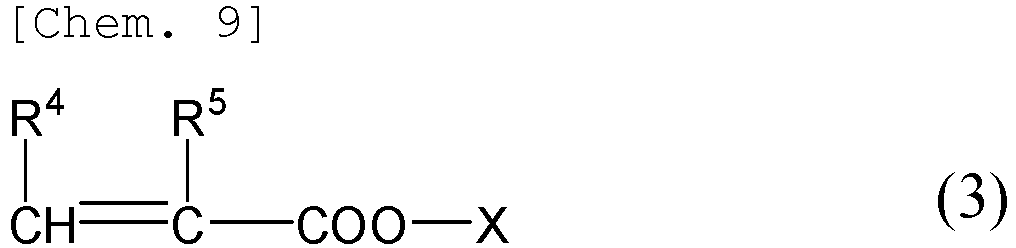
- Of these, the monomer (C-1) is preferably at least one selected from the group consisting of acrylic acid, methacrylic acid, maleic acid, fumaric acid, and salts thereof, for higher dispersibility and higher slump retention capability.
- Examples of an oxyethylene group-containing unsaturated carboxylic acid ester (C-2) (hereinafter also referred to simply as a monomer (C-2)) include (poly)oxyethylene glycol (di)acrylic acid ester, (poly)oxyethylene glycol (di)methacrylic acid ester, methoxy(poly)oxyethylene glycol acrylic acid ester, methoxy(poly)oxyethylene glycol methacrylic acid ester, methoxy(poly)oxyethylene glycol maleic acid (di)ester, methoxy(poly)oxyethylene glycol fumaric acid (di)ester, and salts thereof. Any one or more of these may be used. The average number of moles of oxyethylene group added in the monomer (C-2) is not particularly limited and may be, for example, 1 to 50, 1 to 20, or 2 to 20. As used herein, the term "(poly)oxyethylene" means oxyethylene and/or polyoxyethylene and is meant to encompass both with and without parentheses. This also applies to (di)acrylic acid ester, (di)methacrylic acid ester, and (di)ester.
- Of these, the monomer (C-2) is preferably methoxy (poly)oxyethylene glycol acrylic acid ester and/or methoxy (poly)oxyethylene glycol methacrylic acid ester, for higher dispersibility and higher slump retention capability.
- For higher slump retention capability, the monomer (C) preferably includes the unsaturated carboxylic acid monomer (C-1).
- In a copolymer according to the present embodiment, another monomer may be further used. Examples of such other monomers include acrylic acid esters such as 2-hydroxyethyl acrylate, benzyl acrylate, and stearyl acrylate and methacrylic acid esters such as 2-hydroxyethyl methacrylate, benzyl methacrylate, and stearyl methacrylate. Any one or more of these may be used.
- The copolymer according to the present embodiment includes, as constituent monomers, at least one monomer selected from the group consisting of a monomer (A) and a monomer (B), and at least one monomer (C) selected from the group consisting of an unsaturated carboxylic acid monomer (C-1) and an oxyethylene group-containing unsaturated carboxylic acid ester (C-2). Therefore, the copolymer includes a structural unit derived from the monomer (A) and/or a structural unit derived from the monomer (B), and a structural unit derived from the monomer (C). As used herein, the term "constituent monomer" refers to a monomer constituting a copolymer, but does not necessarily mean a monomer used in polymerizing the copolymer and is meant to encompass, for example, monomers having a structure obtained by neutralization with an alkaline substance after polymerization.
- The total content of the monomers (A) and (B) in the constituent monomers (i.e., in the copolymer) is preferably 1 mass% or more, more preferably 2 mass% or more, still more preferably 3 mass% or more, and preferably 20 mass% or less, more preferably 15 mass% or less, still more preferably 10 mass% or less. Also for each of the monomer (A) and the monomer (B), the content thereof in the constituent monomers is preferably 1 mass% or more, more preferably 2 mass% or more, still more preferably 3 mass% or more, and preferably 20 mass% or less, more preferably 15 mass% or less, still more preferably 10 mass% or less. These percentages are based on 100 mass% of all the constituent monomers (which also applies to the content of the monomer (C) described below).
- In the copolymer, the content of the monomer (C) in the constituent monomers (i.e., in the copolymer) is preferably 20 mass% or more, more preferably 50 mass% or more, still more preferably 60 mass% or more, further more preferably 70 mass% or more, and may be 80 mass% or more. The content of the monomer (C) is preferably 99 mass% or less, more preferably 98 mass% or less, still more preferably 97 mass% or less. In an embodiment, the content of the monomer (C) is 20 mass% or more and 99 mass% or less.
- A copolymer according to an embodiment is a water-soluble polymer. To provide a copolymer with water-solubility, the percentage of the monomer (C) in the copolymer is increased. For example, when the content of the monomer (C) is 20 mass% or more, a water-soluble polymer can be obtained.
- Whether a copolymer is water-soluble is determined as follows. Specifically, a 1 mass% aqueous solution of a copolymer (a solution obtained by adding water such that the copolymer content is 1 mass%) is used as a sample. The sample is injected into a quartz cell having an optical path length of 1 cm, and using a visible-ultraviolet spectrophotometer, the light transmittance at 25°C and a wavelength of 660 nm is measured. Copolymers having a light transmittance of 90%T or more are determined to be water-soluble. For example, in EXAMPLES described later, a "Model U-1800 Ratio Beam Spectrophotometer" manufactured by Hitachi High-Technologies Corporation was used as the visible-ultraviolet spectrophotometer.
- The weight average molecular weight (Mw) of the copolymer according to the embodiment is not particularly limited, and may be, for example, 5000 or more, or 10000 or more, and may be 50000 or less, or 30000 or less. The molecular weight distribution (Mw/Mn) of the copolymer is also not particularly limited, and may be, for example, in the range of 1.3 to 2.5.
- The weight average molecular weight and the molecular weight distribution can be measured by a known gel permeation chromatography (GPC) method against polyethylene glycol standards. The measurement conditions are not particularly limited and may be, for example, the following conditions.
GPC measurement conditions: - GPC apparatus: HLC-8020 RI detector (manufactured by TOSOH Corporation)
- Column: TSK guard column PWXL, TSKgel G2500 PWXL, TSKgel G3000 PWXL, TSKgelG4000 PWXL, and TSKgel G6000 PWXL (manufactured by TOSOH Corporation) connected in series
- Eluent: 0.08M aqueous sodium acetate solution/acetonitrile = 70/30 vol%
- Flow rate: 0.7 mL/min
- Temperature: 40°C
- The method for producing the copolymer according to the present embodiment is not particularly limited. The copolymer can be produced using a known method.
- For example, in the case of solvent polymerization, examples of solvents include water, alcohols having 1 to 3 carbon atoms, aromatic hydrocarbons such as benzene and toluene, aliphatic hydrocarbons such as hexane, ethyl acetate, acetone, and methyl ethyl ketone. Of these, water and alcohols are preferred, and water is more preferred.
- In a polymerization reaction, a mixture of monomers may be partially or wholly placed in a reaction vessel, or may be continuously added dropwise. A polymerization initiator is preferably continuously added dropwise. Examples of polymerization initiators that can be used include hydrogen peroxide, persulfates (e.g., ammonium persulfate, sodium persulfate, and potassium persulfate), azoamidine compounds (e.g., 2,2'-azobis-2-methylpropioneamidine hydrochloride and 2,2'-azobis-2-(2-imidazolin-2-yl)propane hydrochloride), and azonitrile compounds (e.g., 2-carbamoylazoisobutyronitrile). A known reaction accelerator may be used in combination.
- The reaction temperature is not particularly limited and preferably 0°C to 150°C, more preferably 30°C to 120°C, still more preferably 50°C to 100°C.
- In polymerization, a known chain transfer agent may be used. Examples of such chain transfer agents include thiol-based chain transfer agents and secondary alcohols. Phosphorous acid, diphosphorous acid, sulfurous acid, and salts thereof may also be used.
- After completion of the polymerization reaction, concentration adjustment by means of removal or addition of solvent, pH adjustment, purification, and the like can be performed. The pH of the resulting copolymer is preferably adjusted to 6 to 8. The pH adjustment can be performed, for example, using an alkaline substance such as a metal hydroxide, ammonia, or an organic amine. Thus, the copolymer according to the present embodiment may be neutralized using an alkaline substance after the polymerization reaction.
- The copolymer according to the present embodiment can be suitably used, for example, as a dispersant for inorganic particles such as cement, and is preferably used as a cement dispersant. This use is a non-limiting example, and the copolymer according to the present embodiment can also be used as a dispersant for various particles such as resin particles. The copolymer according to the present embodiment can also be used for applications of common water-soluble polymers, such as thickeners and emulsifiers.
- A dispersant according to the present embodiment contains the above copolymer. Using the copolymer as a dispersant can improve the dispersibility and slump retention capability of particles such as cement. This is presumably, but not necessarily, because the presence of a specific hydrophobic group and a specific oxyalkylene group in the monomer (A) and/or the monomer (B) contained as constituent monomers facilitates adsorption of particles (dispersoid) such as cement and also suppresses aggregation of the particles.
- In the dispersant, the copolymer may be used in the form of an aqueous solution or a dried powder. In addition to the copolymer, the dispersant may also contain any other appropriate component as long as the effects of the dispersant are not impaired.
- Examples of other components include known dispersants such as sulfonic acid-based dispersants and polycarboxylic acid-based dispersants. In addition, known additives, for example, water-soluble macromolecular substances (e.g., methylcellulose and polyethylene glycol), concrete retarders (e.g., gluconic acid, sugar, and phosphonic acid), early strengthening agents and accelerators (e.g., calcium chloride, iron chloride, and potassium hydroxide), oxyalkylene-based antifoaming agents (e.g., polyoxyalkylenes and polyoxyalkylene alkyl ethers), other antifoaming agents (e.g., mineral oil-based, fat- and oil-based, and silicone-based), air-entraining agents (e.g., resin soap and saturated or unsaturated fatty acids), surfactants (anionic, cationic, nonionic, and amphoteric), waterproofing agents, corrosion inhibitors, crack inhibitors, and expansive additives may also be used.
- A dispersion composition according to the present embodiment contains particles and the above dispersant, preferably particles, the above dispersant, and water. A dispersion composition according to an embodiment is a cement composition, and in this case, the cement composition preferably contains cement, the above dispersant, and water.
- Examples of the cement contained in the cement composition include, but are not limited to, Portland cements (ordinary, high-early-strength, ultra-high-early-strength, moderate-heat, sulfate-resisting, and low-alkali types thereof), various blended cements (blast furnace cement, silica cement, and fly ash cement), white Portland cements, alumina cements, ultra-rapid hardening cements, cements for grouting, oil-well cements, low-heat cements, ultra-high-strength cements, cement-based solidifying agents, and ECO-cements (cements produced using at least one of municipal waste incineration ash and sewage sludge incineration ash as a raw material). Any one or more of these may be used.
- The cement composition may contain any appropriate aggregate such as a fine aggregate or a coarse aggregate. Examples of aggregates include sand, gravel, crushed stone, water-granulated slag, recycled aggregates, and refractory aggregates such as siliceous, clay, zircon, high-alumina, silicon carbide, graphite, chrome, chrome-magnesia, and magnesia aggregates.
- The content of the above dispersant in the dispersion composition such as a cement composition is not particularly limited, and any appropriate content can be employed depending on the intended use. For example, when the cement composition is mortar or concrete, the content of the above dispersant relative to 100 parts by mass of cement may be 0.001 parts by mass to 10 parts by mass, 0.01 parts by mass to 5 parts by mass, or 0.05 parts by mass to 3 parts by mass, in terms of copolymer content.
- The present invention will now be described in more detail with reference to examples but is not limited to these examples. In the following structural formulae, EO represents an oxyethylene group, and PO represents an oxypropylene group.
-
- Monomer (A-1):
In a reaction vessel equipped with a thermometer and a reflux tube, 230 g (1.0 mol) of a styrenated phenol (a mixture of monostyrenated phenol:distyrenated phenol:tristyrenated phenol = 72:27:1), 40 g (1.0 mol) of NaOH, and 210 g of acetone were placed, and the internal temperature was raised to 40°C with stirring. Next, 91 g (1.2 mol) of allyl chloride was added dropwise over 1 hour. After completion of the dropwise addition, a reaction was allowed to proceed while maintaining the temperature at 40°C for 2 hours. The reaction product was filtered, and NaCl, a by-product, was removed, after which acetone was removed under reduced pressure to obtain an allyl styrenated phenyl ether. The allyl styrenated phenyl ether in an amount of 290 g was placed in an autoclave, held with stirring at 200°C for 5 hours, and then allowed to react with 880 g (20 mol) of ethylene oxide in the presence of a potassium hydroxide catalyst at a pressure of 1.5 kg/cm3 and a temperature of 130°C, to thereby obtain a monomer (A-1) represented by the following formula.
- Monomer (A-2):
The same procedure as used for the monomer (A-1) was performed except that the amount of ethylene oxide was changed to 440 g (10 mol), to thereby obtain a monomer (A-2) represented by the following formula.
- Monomer (A-3):
The same procedure as used for the monomer (A-1) was performed except that the amount of ethylene oxide was changed to 2200 g (50 mol), to thereby obtain a monomer (A-3) represented by the following formula.
- Monomer (A-4):
The same procedure as used for the monomer (A-1) was performed except that the amount of ethylene oxide was changed to 2640 g (60 mol), to thereby obtain a monomer (A-4) represented by the following formula.
- Monomer (A-5):
The same procedure as used for the monomer (A-1) was performed except that 880 g (20 mol) of ethylene oxide was replaced with a mixture of 660 g (15 mol) of ethylene oxide and 174 g (3 mol) of propylene oxide, to thereby obtain a monomer (A-5) represented by the following formula.
-
- Monomer (B-1):
In a reaction vessel equipped with a thermometer, a reflux tube, and a nitrogen inlet tube, 76 g (1.3 mol) of allyl alcohol and 8.4 g (0.15 mol) of potassium hydroxide were placed, and the temperature was raised to 80°C in a nitrogen atmosphere. Subsequently, 212 g (1.0 mol) of α-olefin epoxide (C12 and C14 mixture) was added dropwise, and a reaction was allowed to proceed for 5 hours. After the residual allyl alcohol was distilled off under reduced pressure, washing with water and drying were performed. The dried product was transferred to an autoclave and allowed to react with 880 g (20 mol) of ethylene oxide in the presence of a potassium hydroxide catalyst at a pressure of 1.5 kg/cm3 and a temperature of 130°C, to thereby obtain a monomer (B-1) represented by the following formula.
- Monomer (B-2):
The same procedure as used for the monomer (B-1) was performed except that the amount of ethylene oxide was changed from 880 g (20 mol) to 440 g (10 mol), to thereby obtain a monomer (B-2) represented by the following formula.
- Monomer (B-3):
The same procedure as used for the monomer (B-1) was performed except that the amount of ethylene oxide was changed from 880 g (20 mol) to 1760 g (40 mol), to thereby obtain a monomer (B-3) represented by the following formula.
- Monomer (B-4):
The same procedure as used for the monomer (B-1) was performed except that the amount of ethylene oxide was changed from 880 g (20 mol) to 3520 g (80 mol), to thereby obtain a monomer (B-4) represented by the following formula.
- Monomer (B-5):
The same procedure as used for the monomer (B-1) was performed except that 880 g (20 mol) of ethylene oxide was replaced with a mixture of 660 g (15 mol) of ethylene oxide and 290 g (5 mol) propylene oxide, to thereby obtain a monomer (B-5) represented by the following formula.
- In a glass reactor equipped with a thermometer, a stirrer, a dropping funnel, a condenser, and a nitrogen inlet tube, 120 g of ion-exchanged water was placed. After the reactor was purged with nitrogen with stirring, the temperature was raised to 80°C. A mixture of 200 g of a monomer mixed at a ratio shown in Table 1 and 100 g of water and a mixture of 4 g of ammonium persulfate and 80 g of water were simultaneously added dropwise over 2 hours into the reactor held at 80°C. After completion of the dropwise addition, the reactor was further held at 80°C for 2 hours. Subsequently, the resulting product was cooled to 40°C and neutralized to a pH of 7.0 to 7.5 using a 24% aqueous sodium hydroxide solution. In this manner, aqueous solutions of copolymers of Examples 1 to 14 and Comparative Examples 1 to 4 having Mw and Mw/Mn values shown in Table 1 were obtained.
- For the monomers in Table 1, A-1 to A-5 and B-1 to B-5 are synthesized as described above. Other monomers are as follows.
- AA: Acrylic acid (manufactured by Wako Pure Chemical Industries, Ltd.)
- MA: Methacrylic acid (manufactured by Wako Pure Chemical Industries, Ltd.)
- PMA: Methoxypolyethylene glycol (13) acrylate ("NEW FRONTIER MPE-600" manufactured by Dai-Ichi Kogyo Seiyaku Co., Ltd.)
- BnMA: Benzyl methacrylate ("LIGHT ESTER BZ" manufactured by Kyoeisha Chemical Co., Ltd.)
- SMA: Stearyl methacrylate ("LIGHT ESTER S" manufactured by Kyoeisha Chemical Co., Ltd.)
- For the monomers AA and MA, Table 1 shows the contents of sodium salts (AA-Na, MA-Na) obtained by neutralization.
- To determine whether the copolymers obtained were water-soluble, the light transmittance of a 1 mass% aqueous solution of each copolymer was measured by the method described above. The results are shown in Table 1.
- The aqueous solutions of the copolymers obtained were adjusted to a solid concentration of 40 mass% to provide dispersants. The following evaluations were performed using the dispersants.
- A cement mortar was prepared in accordance with JIS R5201. Specifically, 3 g, on a solids basis, of the dispersant and 300 g of water were mixed together, and then added to a mixture obtained by kneading 600 g of a commercially available Portland cement with 1800 g of sand. The resulting mixture was stirred at low speed for 1 minute using a mortar mixer, and then further stirred at high speed for 2 minutes to prepare a cement mortar. The cement mortar was measured for flow values (mm) immediately after production and one hour after production in accordance with JIS R5201, and evaluated for dispersibility according to the following criteria. The results are shown in Table 1.
- A: The flow value immediately after production is more than 170 mm.
- B: The flow value immediately after production is more than 160 mm and 170 mm or less.
- C: The flow value immediately after production is 160 mm or less.
- Using the flow values measured for dispersibility, a slump retention rate was calculated by the following formula.

- Using the calculated slump retention rate, slump retention capability was evaluated according to the following criteria. The results are shown in Table 1.
- A: The slump retention rate is more than 90%.
- B: The slump retention rate is more than 85% and 90% or less.
- C: The slump retention rate is 85% or less.
- As shown in Table 1, in contrast to Comparative Examples 1 to 4 where the monomer (A), the monomer (B), or both were not used, in Examples 1 to 14 where these monomers were used, the flow values were large, that is, the dispersibility was high, and in addition, the slump retention rate was high, that is, the slump retention capability was high.

Claims (6)
- A copolymer comprising, as constituent monomers: at least one monomer selected from the group consisting of a monomer (A) represented by general formula (1) below and a monomer (B) represented by general formula (2) below; and at least one monomer (C) selected from the group consisting of an unsaturated carboxylic acid monomer (C-1) and an oxyethylene group-containing unsaturated carboxylic acid ester (C-2), wherein a content of the monomer (C) in the constituent monomers is 20 mass% or more and 99 mass% or less:


- A water-soluble copolymer comprising, as constituent monomers: at least one monomer selected from the group consisting of a monomer (A) represented by general formula (1) below and a monomer (B) represented by general formula (2) below; and at least one monomer (C) selected from the group consisting of an unsaturated carboxylic acid monomer (C-1) and an oxyethylene group-containing unsaturated carboxylic acid ester (C-2):


- The copolymer according to Claim 1 or 2, wherein a total content of the monomers (A) and (B) in the constituent monomers is 1 mass% or more and 20 mass% or less.
- An aqueous solution comprising the copolymer according to any one of Claims 1 to 3.
- A dispersant comprising the copolymer according to any one of Claims 1 to 3.
- A dispersion composition comprising particles and the dispersant according to Claim 5.
Applications Claiming Priority (2)
| Application Number | Priority Date | Filing Date | Title |
|---|---|---|---|
| JP2017183971A JP2019059815A (en) | 2017-09-25 | 2017-09-25 | Copolymer, dispersant, and dispersion composition |
| PCT/JP2018/034316 WO2019059143A1 (en) | 2017-09-25 | 2018-09-15 | Copolymer, dispersant, and dispersion composition |
Publications (1)
| Publication Number | Publication Date |
|---|---|
| EP3689928A1 true EP3689928A1 (en) | 2020-08-05 |
Family
ID=65809737
Family Applications (1)
| Application Number | Title | Priority Date | Filing Date |
|---|---|---|---|
| EP18858803.2A Withdrawn EP3689928A1 (en) | 2017-09-25 | 2018-09-15 | Copolymer, dispersant, and dispersion composition |
Country Status (7)
| Country | Link |
|---|---|
| US (1) | US20200199277A1 (en) |
| EP (1) | EP3689928A1 (en) |
| JP (1) | JP2019059815A (en) |
| KR (1) | KR20200054950A (en) |
| CN (1) | CN111065661A (en) |
| TW (1) | TW201915039A (en) |
| WO (1) | WO2019059143A1 (en) |
Families Citing this family (3)
| Publication number | Priority date | Publication date | Assignee | Title |
|---|---|---|---|---|
| CN111607040B (en) * | 2020-06-24 | 2022-11-04 | 南宁新泰瑞科建材股份有限公司 | A kind of super-releasing polycarboxylate slump retaining agent and preparation method thereof |
| JP7037224B1 (en) * | 2021-07-20 | 2022-03-16 | 竹本油脂株式会社 | Additives for hydraulic compositions and hydraulic compositions |
| JP7611451B1 (en) * | 2024-08-14 | 2025-01-09 | 第一工業製薬株式会社 | Resin water dispersion and its manufacturing method, as well as paint and adhesive |
Family Cites Families (22)
| Publication number | Priority date | Publication date | Assignee | Title |
|---|---|---|---|---|
| JPH07118044A (en) * | 1993-10-19 | 1995-05-09 | Dai Ichi Kogyo Seiyaku Co Ltd | Cement admixture |
| JP3723886B2 (en) * | 1996-02-14 | 2005-12-07 | 第一工業製薬株式会社 | Dispersant |
| US5912284A (en) * | 1996-12-26 | 1999-06-15 | Nippon Shokubai Co., Ltd. | Cement additive, its production process and use |
| JPH10298211A (en) * | 1997-04-25 | 1998-11-10 | Asahi Denka Kogyo Kk | Active energy ray polymerizable emulsion |
| JPH11322389A (en) * | 1998-05-15 | 1999-11-24 | Toagosei Co Ltd | Dispersant for cement |
| JP4580080B2 (en) * | 2000-09-22 | 2010-11-10 | サカタインクス株式会社 | Pigment-dispersed resist composition for color filters |
| JP2007238387A (en) * | 2006-03-09 | 2007-09-20 | Nippon Shokubai Co Ltd | Powdered cement dispersant |
| EP1775271A3 (en) * | 2005-10-14 | 2009-02-18 | Nippon Shokubai Co.,Ltd. | Cement additive |
| US7973110B2 (en) * | 2008-06-16 | 2011-07-05 | Construction Research & Technology Gmbh | Copolymer synthesis process |
| CN101492518B (en) * | 2009-02-27 | 2010-12-08 | 上海市建筑科学研究院(集团)有限公司 | Ethers polycarboxylic acid water reducing agent and preparation |
| JP5680214B2 (en) * | 2011-10-20 | 2015-03-04 | 第一工業製薬株式会社 | Emulsifier for emulsion polymerization |
| CN103797034B (en) * | 2012-01-16 | 2015-03-04 | 第一工业制药株式会社 | Emulsifying agent for emulsion polymerization |
| KR101539350B1 (en) * | 2012-08-21 | 2015-07-24 | 주식회사 엘지화학 | An additive including polycarboxylic copolymer and cement composition comprising the same |
| CN102976655B (en) * | 2012-12-05 | 2014-07-02 | 江苏苏博特新材料股份有限公司 | Slump retaining polycarboxylic acid superplasticizer |
| CN103172798A (en) * | 2012-12-19 | 2013-06-26 | 吉林大学 | Preparation method of high-performance polycarboxylate superplasticizer |
| JP2015000970A (en) * | 2013-06-18 | 2015-01-05 | 第一工業製薬株式会社 | Dispersant for non-aqueous dispersion media |
| JP2015009707A (en) * | 2013-06-28 | 2015-01-19 | ヤマハ発動機株式会社 | Unmanned helicopter |
| JP6242611B2 (en) | 2013-07-03 | 2017-12-06 | 第一工業製薬株式会社 | Surfactant composition |
| CN104371071B (en) * | 2014-05-23 | 2017-05-17 | 江苏苏博特新材料股份有限公司 | Preparation method for hyperbranched polycarboxylic-acid concrete efficient water reducer |
| JP6386281B2 (en) | 2014-07-17 | 2018-09-05 | 株式会社日本触媒 | Cement dispersant and cement composition |
| JP6537860B2 (en) | 2015-03-24 | 2019-07-03 | 日本製紙株式会社 | Cement admixture and cement composition |
| JP6114868B1 (en) * | 2016-09-29 | 2017-04-12 | 第一工業製薬株式会社 | Surfactant composition |
-
2017
- 2017-09-25 JP JP2017183971A patent/JP2019059815A/en active Pending
-
2018
- 2018-09-06 TW TW107131209A patent/TW201915039A/en unknown
- 2018-09-15 EP EP18858803.2A patent/EP3689928A1/en not_active Withdrawn
- 2018-09-15 US US16/644,372 patent/US20200199277A1/en not_active Abandoned
- 2018-09-15 CN CN201880058786.9A patent/CN111065661A/en active Pending
- 2018-09-15 KR KR1020207005502A patent/KR20200054950A/en not_active Withdrawn
- 2018-09-15 WO PCT/JP2018/034316 patent/WO2019059143A1/en not_active Ceased
Also Published As
| Publication number | Publication date |
|---|---|
| CN111065661A (en) | 2020-04-24 |
| JP2019059815A (en) | 2019-04-18 |
| WO2019059143A1 (en) | 2019-03-28 |
| TW201915039A (en) | 2019-04-16 |
| US20200199277A1 (en) | 2020-06-25 |
| KR20200054950A (en) | 2020-05-20 |
Similar Documents
| Publication | Publication Date | Title |
|---|---|---|
| KR100950719B1 (en) | Novel polymers and cement admixtures using the same | |
| JP7320433B2 (en) | Polymer and cement admixture | |
| JP5707165B2 (en) | Cement admixture and cement composition containing the same | |
| JP2008514402A (en) | Dispersants and novel lignin derivatives using kraft lignin | |
| JP5148111B2 (en) | Cement admixture | |
| JP2008266619A (en) | Polyalkylene glycol chain-containing thiol polymer and method for producing the same | |
| US20200199277A1 (en) | Copolymer, dispersant, and dispersion composition | |
| JP6145381B2 (en) | (Poly) alkylene glycol block copolymer and use thereof | |
| JP6649811B2 (en) | Additive for hydraulic composition and concrete composition | |
| JP5561997B2 (en) | Cement hardening accelerator composition | |
| JP6537860B2 (en) | Cement admixture and cement composition | |
| JP6747962B2 (en) | Cement additive and cement composition | |
| JP6715599B2 (en) | Cement dispersibility improving aid and cement composition | |
| JP6570432B2 (en) | Viscosity reducing agent for hydraulic compositions containing pozzolanic substances | |
| JP6251634B2 (en) | Ultra high strength cement composition | |
| JP6581369B2 (en) | Hydraulic composition, method for improving initial strength of fly ash-containing hydraulic composition, and additive for fly ash-containing hydraulic composition | |
| JP6626376B2 (en) | Strength improver for hydraulic composition, additive for hydraulic composition, and concrete composition | |
| JP6649810B2 (en) | Pozzolanic substance-containing hydraulic composition strength improver, pozzolanic substance-containing hydraulic composition additive, and concrete composition | |
| JP6557005B2 (en) | Comb polymer for inorganic particle additive and use thereof | |
| JP2010070689A (en) | (poly)alkylene glycol chain containing thiol polymer and uses thereof | |
| JP6145382B2 (en) | (Poly) alkylene glycol block copolymer and use thereof | |
| JP2016069412A (en) | (Poly) anionic comb polymer and use thereof | |
| JP6602149B2 (en) | Cement additive and cement composition | |
| JP5637827B2 (en) | Polymer-containing composition, cement admixture and cement composition | |
| JP5870878B2 (en) | Cement admixture and method for producing cement composition using the same |
Legal Events
| Date | Code | Title | Description |
|---|---|---|---|
| PUAI | Public reference made under article 153(3) epc to a published international application that has entered the european phase |
Free format text: ORIGINAL CODE: 0009012 |
|
| STAA | Information on the status of an ep patent application or granted ep patent |
Free format text: STATUS: THE APPLICATION HAS BEEN WITHDRAWN |
|
| 17P | Request for examination filed |
Effective date: 20200312 |
|
| AK | Designated contracting states |
Kind code of ref document: A1 Designated state(s): AL AT BE BG CH CY CZ DE DK EE ES FI FR GB GR HR HU IE IS IT LI LT LU LV MC MK MT NL NO PL PT RO RS SE SI SK SM TR |
|
| AX | Request for extension of the european patent |
Extension state: BA ME |
|
| 18W | Application withdrawn |
Effective date: 20200703 |