EP3689841A1 - Method of fabricating an oxidation-resistant carbon fiber - Google Patents
Method of fabricating an oxidation-resistant carbon fiber Download PDFInfo
- Publication number
- EP3689841A1 EP3689841A1 EP20165360.7A EP20165360A EP3689841A1 EP 3689841 A1 EP3689841 A1 EP 3689841A1 EP 20165360 A EP20165360 A EP 20165360A EP 3689841 A1 EP3689841 A1 EP 3689841A1
- Authority
- EP
- European Patent Office
- Prior art keywords
- carbon fiber
- boron nitride
- carbon fibers
- layer
- recited
- Prior art date
- Legal status (The legal status is an assumption and is not a legal conclusion. Google has not performed a legal analysis and makes no representation as to the accuracy of the status listed.)
- Granted
Links
Images


Classifications
-
- C—CHEMISTRY; METALLURGY
- C04—CEMENTS; CONCRETE; ARTIFICIAL STONE; CERAMICS; REFRACTORIES
- C04B—LIME, MAGNESIA; SLAG; CEMENTS; COMPOSITIONS THEREOF, e.g. MORTARS, CONCRETE OR LIKE BUILDING MATERIALS; ARTIFICIAL STONE; CERAMICS; REFRACTORIES; TREATMENT OF NATURAL STONE
- C04B35/00—Shaped ceramic products characterised by their composition; Ceramics compositions; Processing powders of inorganic compounds preparatory to the manufacturing of ceramic products
- C04B35/515—Shaped ceramic products characterised by their composition; Ceramics compositions; Processing powders of inorganic compounds preparatory to the manufacturing of ceramic products based on non-oxide ceramics
- C04B35/56—Shaped ceramic products characterised by their composition; Ceramics compositions; Processing powders of inorganic compounds preparatory to the manufacturing of ceramic products based on non-oxide ceramics based on carbides or oxycarbides
- C04B35/565—Shaped ceramic products characterised by their composition; Ceramics compositions; Processing powders of inorganic compounds preparatory to the manufacturing of ceramic products based on non-oxide ceramics based on carbides or oxycarbides based on silicon carbide
-
- B—PERFORMING OPERATIONS; TRANSPORTING
- B05—SPRAYING OR ATOMISING IN GENERAL; APPLYING FLUENT MATERIALS TO SURFACES, IN GENERAL
- B05D—PROCESSES FOR APPLYING FLUENT MATERIALS TO SURFACES, IN GENERAL
- B05D3/00—Pretreatment of surfaces to which liquids or other fluent materials are to be applied; After-treatment of applied coatings, e.g. intermediate treating of an applied coating preparatory to subsequent applications of liquids or other fluent materials
- B05D3/002—Pretreatement
-
- B—PERFORMING OPERATIONS; TRANSPORTING
- B29—WORKING OF PLASTICS; WORKING OF SUBSTANCES IN A PLASTIC STATE IN GENERAL
- B29C—SHAPING OR JOINING OF PLASTICS; SHAPING OF MATERIAL IN A PLASTIC STATE, NOT OTHERWISE PROVIDED FOR; AFTER-TREATMENT OF THE SHAPED PRODUCTS, e.g. REPAIRING
- B29C66/00—General aspects of processes or apparatus for joining preformed parts
- B29C66/70—General aspects of processes or apparatus for joining preformed parts characterised by the composition, physical properties or the structure of the material of the parts to be joined; Joining with non-plastics material
- B29C66/71—General aspects of processes or apparatus for joining preformed parts characterised by the composition, physical properties or the structure of the material of the parts to be joined; Joining with non-plastics material characterised by the composition of the plastics material of the parts to be joined
- B29C66/712—General aspects of processes or apparatus for joining preformed parts characterised by the composition, physical properties or the structure of the material of the parts to be joined; Joining with non-plastics material characterised by the composition of the plastics material of the parts to be joined the composition of one of the parts to be joined being different from the composition of the other part
-
- C—CHEMISTRY; METALLURGY
- C04—CEMENTS; CONCRETE; ARTIFICIAL STONE; CERAMICS; REFRACTORIES
- C04B—LIME, MAGNESIA; SLAG; CEMENTS; COMPOSITIONS THEREOF, e.g. MORTARS, CONCRETE OR LIKE BUILDING MATERIALS; ARTIFICIAL STONE; CERAMICS; REFRACTORIES; TREATMENT OF NATURAL STONE
- C04B35/00—Shaped ceramic products characterised by their composition; Ceramics compositions; Processing powders of inorganic compounds preparatory to the manufacturing of ceramic products
- C04B35/622—Forming processes; Processing powders of inorganic compounds preparatory to the manufacturing of ceramic products
- C04B35/626—Preparing or treating the powders individually or as batches ; preparing or treating macroscopic reinforcing agents for ceramic products, e.g. fibres; mechanical aspects section B
- C04B35/62605—Treating the starting powders individually or as mixtures
- C04B35/62645—Thermal treatment of powders or mixtures thereof other than sintering
- C04B35/62675—Thermal treatment of powders or mixtures thereof other than sintering characterised by the treatment temperature
-
- C—CHEMISTRY; METALLURGY
- C04—CEMENTS; CONCRETE; ARTIFICIAL STONE; CERAMICS; REFRACTORIES
- C04B—LIME, MAGNESIA; SLAG; CEMENTS; COMPOSITIONS THEREOF, e.g. MORTARS, CONCRETE OR LIKE BUILDING MATERIALS; ARTIFICIAL STONE; CERAMICS; REFRACTORIES; TREATMENT OF NATURAL STONE
- C04B35/00—Shaped ceramic products characterised by their composition; Ceramics compositions; Processing powders of inorganic compounds preparatory to the manufacturing of ceramic products
- C04B35/622—Forming processes; Processing powders of inorganic compounds preparatory to the manufacturing of ceramic products
- C04B35/626—Preparing or treating the powders individually or as batches ; preparing or treating macroscopic reinforcing agents for ceramic products, e.g. fibres; mechanical aspects section B
- C04B35/62605—Treating the starting powders individually or as mixtures
- C04B35/62645—Thermal treatment of powders or mixtures thereof other than sintering
- C04B35/6268—Thermal treatment of powders or mixtures thereof other than sintering characterised by the applied pressure or type of atmosphere, e.g. in vacuum, hydrogen or a specific oxygen pressure
-
- C—CHEMISTRY; METALLURGY
- C04—CEMENTS; CONCRETE; ARTIFICIAL STONE; CERAMICS; REFRACTORIES
- C04B—LIME, MAGNESIA; SLAG; CEMENTS; COMPOSITIONS THEREOF, e.g. MORTARS, CONCRETE OR LIKE BUILDING MATERIALS; ARTIFICIAL STONE; CERAMICS; REFRACTORIES; TREATMENT OF NATURAL STONE
- C04B35/00—Shaped ceramic products characterised by their composition; Ceramics compositions; Processing powders of inorganic compounds preparatory to the manufacturing of ceramic products
- C04B35/622—Forming processes; Processing powders of inorganic compounds preparatory to the manufacturing of ceramic products
- C04B35/626—Preparing or treating the powders individually or as batches ; preparing or treating macroscopic reinforcing agents for ceramic products, e.g. fibres; mechanical aspects section B
- C04B35/628—Coating the powders or the macroscopic reinforcing agents
- C04B35/62844—Coating fibres
- C04B35/62857—Coating fibres with non-oxide ceramics
- C04B35/62865—Nitrides
- C04B35/62868—Boron nitride
-
- C—CHEMISTRY; METALLURGY
- C04—CEMENTS; CONCRETE; ARTIFICIAL STONE; CERAMICS; REFRACTORIES
- C04B—LIME, MAGNESIA; SLAG; CEMENTS; COMPOSITIONS THEREOF, e.g. MORTARS, CONCRETE OR LIKE BUILDING MATERIALS; ARTIFICIAL STONE; CERAMICS; REFRACTORIES; TREATMENT OF NATURAL STONE
- C04B35/00—Shaped ceramic products characterised by their composition; Ceramics compositions; Processing powders of inorganic compounds preparatory to the manufacturing of ceramic products
- C04B35/622—Forming processes; Processing powders of inorganic compounds preparatory to the manufacturing of ceramic products
- C04B35/626—Preparing or treating the powders individually or as batches ; preparing or treating macroscopic reinforcing agents for ceramic products, e.g. fibres; mechanical aspects section B
- C04B35/628—Coating the powders or the macroscopic reinforcing agents
- C04B35/62844—Coating fibres
- C04B35/62857—Coating fibres with non-oxide ceramics
- C04B35/62865—Nitrides
- C04B35/62871—Silicon nitride
-
- C—CHEMISTRY; METALLURGY
- C04—CEMENTS; CONCRETE; ARTIFICIAL STONE; CERAMICS; REFRACTORIES
- C04B—LIME, MAGNESIA; SLAG; CEMENTS; COMPOSITIONS THEREOF, e.g. MORTARS, CONCRETE OR LIKE BUILDING MATERIALS; ARTIFICIAL STONE; CERAMICS; REFRACTORIES; TREATMENT OF NATURAL STONE
- C04B35/00—Shaped ceramic products characterised by their composition; Ceramics compositions; Processing powders of inorganic compounds preparatory to the manufacturing of ceramic products
- C04B35/622—Forming processes; Processing powders of inorganic compounds preparatory to the manufacturing of ceramic products
- C04B35/626—Preparing or treating the powders individually or as batches ; preparing or treating macroscopic reinforcing agents for ceramic products, e.g. fibres; mechanical aspects section B
- C04B35/628—Coating the powders or the macroscopic reinforcing agents
- C04B35/62884—Coating the powders or the macroscopic reinforcing agents by gas phase techniques
-
- C—CHEMISTRY; METALLURGY
- C04—CEMENTS; CONCRETE; ARTIFICIAL STONE; CERAMICS; REFRACTORIES
- C04B—LIME, MAGNESIA; SLAG; CEMENTS; COMPOSITIONS THEREOF, e.g. MORTARS, CONCRETE OR LIKE BUILDING MATERIALS; ARTIFICIAL STONE; CERAMICS; REFRACTORIES; TREATMENT OF NATURAL STONE
- C04B35/00—Shaped ceramic products characterised by their composition; Ceramics compositions; Processing powders of inorganic compounds preparatory to the manufacturing of ceramic products
- C04B35/622—Forming processes; Processing powders of inorganic compounds preparatory to the manufacturing of ceramic products
- C04B35/626—Preparing or treating the powders individually or as batches ; preparing or treating macroscopic reinforcing agents for ceramic products, e.g. fibres; mechanical aspects section B
- C04B35/628—Coating the powders or the macroscopic reinforcing agents
- C04B35/62894—Coating the powders or the macroscopic reinforcing agents with more than one coating layer
-
- C—CHEMISTRY; METALLURGY
- C04—CEMENTS; CONCRETE; ARTIFICIAL STONE; CERAMICS; REFRACTORIES
- C04B—LIME, MAGNESIA; SLAG; CEMENTS; COMPOSITIONS THEREOF, e.g. MORTARS, CONCRETE OR LIKE BUILDING MATERIALS; ARTIFICIAL STONE; CERAMICS; REFRACTORIES; TREATMENT OF NATURAL STONE
- C04B35/00—Shaped ceramic products characterised by their composition; Ceramics compositions; Processing powders of inorganic compounds preparatory to the manufacturing of ceramic products
- C04B35/622—Forming processes; Processing powders of inorganic compounds preparatory to the manufacturing of ceramic products
- C04B35/626—Preparing or treating the powders individually or as batches ; preparing or treating macroscopic reinforcing agents for ceramic products, e.g. fibres; mechanical aspects section B
- C04B35/628—Coating the powders or the macroscopic reinforcing agents
- C04B35/62897—Coatings characterised by their thickness
-
- C—CHEMISTRY; METALLURGY
- C04—CEMENTS; CONCRETE; ARTIFICIAL STONE; CERAMICS; REFRACTORIES
- C04B—LIME, MAGNESIA; SLAG; CEMENTS; COMPOSITIONS THEREOF, e.g. MORTARS, CONCRETE OR LIKE BUILDING MATERIALS; ARTIFICIAL STONE; CERAMICS; REFRACTORIES; TREATMENT OF NATURAL STONE
- C04B35/00—Shaped ceramic products characterised by their composition; Ceramics compositions; Processing powders of inorganic compounds preparatory to the manufacturing of ceramic products
- C04B35/71—Ceramic products containing macroscopic reinforcing agents
- C04B35/78—Ceramic products containing macroscopic reinforcing agents containing non-metallic materials
- C04B35/80—Fibres, filaments, whiskers, platelets, or the like
-
- C—CHEMISTRY; METALLURGY
- C04—CEMENTS; CONCRETE; ARTIFICIAL STONE; CERAMICS; REFRACTORIES
- C04B—LIME, MAGNESIA; SLAG; CEMENTS; COMPOSITIONS THEREOF, e.g. MORTARS, CONCRETE OR LIKE BUILDING MATERIALS; ARTIFICIAL STONE; CERAMICS; REFRACTORIES; TREATMENT OF NATURAL STONE
- C04B35/00—Shaped ceramic products characterised by their composition; Ceramics compositions; Processing powders of inorganic compounds preparatory to the manufacturing of ceramic products
- C04B35/71—Ceramic products containing macroscopic reinforcing agents
- C04B35/78—Ceramic products containing macroscopic reinforcing agents containing non-metallic materials
- C04B35/80—Fibres, filaments, whiskers, platelets, or the like
- C04B35/83—Carbon fibres in a carbon matrix
-
- D—TEXTILES; PAPER
- D01—NATURAL OR MAN-MADE THREADS OR FIBRES; SPINNING
- D01F—CHEMICAL FEATURES IN THE MANUFACTURE OF ARTIFICIAL FILAMENTS, THREADS, FIBRES, BRISTLES OR RIBBONS; APPARATUS SPECIALLY ADAPTED FOR THE MANUFACTURE OF CARBON FILAMENTS
- D01F11/00—Chemical after-treatment of artificial filaments or the like during manufacture
- D01F11/10—Chemical after-treatment of artificial filaments or the like during manufacture of carbon
- D01F11/12—Chemical after-treatment of artificial filaments or the like during manufacture of carbon with inorganic substances ; Intercalation
- D01F11/124—Boron, borides, boron nitrides
-
- B—PERFORMING OPERATIONS; TRANSPORTING
- B05—SPRAYING OR ATOMISING IN GENERAL; APPLYING FLUENT MATERIALS TO SURFACES, IN GENERAL
- B05D—PROCESSES FOR APPLYING FLUENT MATERIALS TO SURFACES, IN GENERAL
- B05D2601/00—Inorganic fillers
-
- B—PERFORMING OPERATIONS; TRANSPORTING
- B29—WORKING OF PLASTICS; WORKING OF SUBSTANCES IN A PLASTIC STATE IN GENERAL
- B29K—INDEXING SCHEME ASSOCIATED WITH SUBCLASSES B29B, B29C OR B29D, RELATING TO MOULDING MATERIALS OR TO MATERIALS FOR MOULDS, REINFORCEMENTS, FILLERS OR PREFORMED PARTS, e.g. INSERTS
- B29K2105/00—Condition, form or state of moulded material or of the material to be shaped
- B29K2105/06—Condition, form or state of moulded material or of the material to be shaped containing reinforcements, fillers or inserts
-
- B—PERFORMING OPERATIONS; TRANSPORTING
- B29—WORKING OF PLASTICS; WORKING OF SUBSTANCES IN A PLASTIC STATE IN GENERAL
- B29K—INDEXING SCHEME ASSOCIATED WITH SUBCLASSES B29B, B29C OR B29D, RELATING TO MOULDING MATERIALS OR TO MATERIALS FOR MOULDS, REINFORCEMENTS, FILLERS OR PREFORMED PARTS, e.g. INSERTS
- B29K2307/00—Use of elements other than metals as reinforcement
- B29K2307/04—Carbon
-
- B—PERFORMING OPERATIONS; TRANSPORTING
- B29—WORKING OF PLASTICS; WORKING OF SUBSTANCES IN A PLASTIC STATE IN GENERAL
- B29L—INDEXING SCHEME ASSOCIATED WITH SUBCLASS B29C, RELATING TO PARTICULAR ARTICLES
- B29L2031/00—Other particular articles
- B29L2031/731—Filamentary material, i.e. comprised of a single element, e.g. filaments, strands, threads, fibres
-
- C—CHEMISTRY; METALLURGY
- C04—CEMENTS; CONCRETE; ARTIFICIAL STONE; CERAMICS; REFRACTORIES
- C04B—LIME, MAGNESIA; SLAG; CEMENTS; COMPOSITIONS THEREOF, e.g. MORTARS, CONCRETE OR LIKE BUILDING MATERIALS; ARTIFICIAL STONE; CERAMICS; REFRACTORIES; TREATMENT OF NATURAL STONE
- C04B2235/00—Aspects relating to ceramic starting mixtures or sintered ceramic products
- C04B2235/02—Composition of constituents of the starting material or of secondary phases of the final product
- C04B2235/30—Constituents and secondary phases not being of a fibrous nature
- C04B2235/38—Non-oxide ceramic constituents or additives
- C04B2235/3817—Carbides
- C04B2235/3826—Silicon carbides
-
- C—CHEMISTRY; METALLURGY
- C04—CEMENTS; CONCRETE; ARTIFICIAL STONE; CERAMICS; REFRACTORIES
- C04B—LIME, MAGNESIA; SLAG; CEMENTS; COMPOSITIONS THEREOF, e.g. MORTARS, CONCRETE OR LIKE BUILDING MATERIALS; ARTIFICIAL STONE; CERAMICS; REFRACTORIES; TREATMENT OF NATURAL STONE
- C04B2235/00—Aspects relating to ceramic starting mixtures or sintered ceramic products
- C04B2235/02—Composition of constituents of the starting material or of secondary phases of the final product
- C04B2235/30—Constituents and secondary phases not being of a fibrous nature
- C04B2235/38—Non-oxide ceramic constituents or additives
- C04B2235/3852—Nitrides, e.g. oxynitrides, carbonitrides, oxycarbonitrides, lithium nitride, magnesium nitride
- C04B2235/386—Boron nitrides
-
- C—CHEMISTRY; METALLURGY
- C04—CEMENTS; CONCRETE; ARTIFICIAL STONE; CERAMICS; REFRACTORIES
- C04B—LIME, MAGNESIA; SLAG; CEMENTS; COMPOSITIONS THEREOF, e.g. MORTARS, CONCRETE OR LIKE BUILDING MATERIALS; ARTIFICIAL STONE; CERAMICS; REFRACTORIES; TREATMENT OF NATURAL STONE
- C04B2235/00—Aspects relating to ceramic starting mixtures or sintered ceramic products
- C04B2235/02—Composition of constituents of the starting material or of secondary phases of the final product
- C04B2235/30—Constituents and secondary phases not being of a fibrous nature
- C04B2235/42—Non metallic elements added as constituents or additives, e.g. sulfur, phosphor, selenium or tellurium
- C04B2235/422—Carbon
- C04B2235/425—Graphite
-
- C—CHEMISTRY; METALLURGY
- C04—CEMENTS; CONCRETE; ARTIFICIAL STONE; CERAMICS; REFRACTORIES
- C04B—LIME, MAGNESIA; SLAG; CEMENTS; COMPOSITIONS THEREOF, e.g. MORTARS, CONCRETE OR LIKE BUILDING MATERIALS; ARTIFICIAL STONE; CERAMICS; REFRACTORIES; TREATMENT OF NATURAL STONE
- C04B2235/00—Aspects relating to ceramic starting mixtures or sintered ceramic products
- C04B2235/02—Composition of constituents of the starting material or of secondary phases of the final product
- C04B2235/50—Constituents or additives of the starting mixture chosen for their shape or used because of their shape or their physical appearance
- C04B2235/52—Constituents or additives characterised by their shapes
- C04B2235/5208—Fibers
- C04B2235/5216—Inorganic
- C04B2235/524—Non-oxidic, e.g. borides, carbides, silicides or nitrides
- C04B2235/5248—Carbon, e.g. graphite
-
- C—CHEMISTRY; METALLURGY
- C04—CEMENTS; CONCRETE; ARTIFICIAL STONE; CERAMICS; REFRACTORIES
- C04B—LIME, MAGNESIA; SLAG; CEMENTS; COMPOSITIONS THEREOF, e.g. MORTARS, CONCRETE OR LIKE BUILDING MATERIALS; ARTIFICIAL STONE; CERAMICS; REFRACTORIES; TREATMENT OF NATURAL STONE
- C04B2235/00—Aspects relating to ceramic starting mixtures or sintered ceramic products
- C04B2235/70—Aspects relating to sintered or melt-casted ceramic products
- C04B2235/96—Properties of ceramic products, e.g. mechanical properties such as strength, toughness, wear resistance
Definitions
- This disclosure relates to the use of carbon fibers in ceramic matrix composites.
- Ceramic matrix composites are one classification of fiber-reinforced composite materials.
- a ceramic matrix composite can include inorganic fibers, such as ceramic fibers or glass fibers, metallic fibers or carbon fibers. Carbon fibers decompose in hot, oxidizing environments and thus are typically not used in ceramic matrix composites that are intended for such end use conditions.
- a method of fabricating a carbon fiber-reinforced article includes providing a plurality of carbon fibers.
- the plurality of carbon fibers includes surfaces that have an initial interfacial bonding strength capacity with respect to bonding with boron nitride.
- the surfaces are then modified to reduce the initial interfacial bonding strength capacity.
- a layer of boron nitride is then deposited on the modified surfaces.
- the plurality of carbon fibers are then embedded in a ceramic matrix to provide a carbon fiber-reinforced article.
- the ceramic matrix is silicon carbide.
- the surfaces of the plurality of carbon fibers are free of any ceramic coating prior to the depositing of the layer of boron nitride.
- the modifying includes heat treating the plurality of carbon fibers at a temperature greater than 1200° C.
- the modifying includes heat treating the plurality of carbon fibers at a temperature of 1550-1650° C.
- the modifying includes heat treating the plurality of carbon fibers at a temperature of 1600° C.
- the plurality of carbon fibers are as-received fibers.
- a further non-limiting embodiment of any of the foregoing examples includes depositing the layer of boron nitride by chemical vapor deposition.
- the layer of boron nitride is in contact with the modified surfaces of the plurality of carbon fibers, and the ceramic matrix is silicon carbide that is in contact with the layer of boron nitride.
- the layer of boron nitride deposited on the modified surfaces consists of boron nitride.
- the plurality of carbon fibers includes graphite.
- the modifying includes ordering microstructural stacking faults in a graphitic microstructure of the plurality of carbon fibers.
- the ceramic matrix is predominantly silicon carbide.
- the depositing of the layer of boron nitride is conducted after the modifying of the surfaces, free of any other surface modifications to the plurality of carbon fibers.
- a carbon fiber-reinforced article includes a plurality of carbon fibers, a layer of boron nitride on surfaces of the plurality of carbon fibers, and a ceramic matrix in which the plurality of carbon fibers are embedded.
- the plurality of carbon fibers have been modified prior to fabrication of the carbon fiber-reinforced article to reduce an initial interfacial bonding strength capacity of surfaces of the plurality of carbon fibers with respect to bonding with the boron nitride such that the carbon fiber-reinforced article exhibits non-brittle fracture.
- the ceramic matrix is silicon carbide.
- the layer of boron nitride is in contact with the surfaces of the plurality of carbon fibers, and the ceramic matrix is silicon carbide that is in contact with the layer of boron nitride.
- a method of fabricating an oxidation-resistant carbon fiber includes at least one carbon fiber.
- the at least one carbon fiber includes a surface that has an initial interfacial bonding strength capacity with respect to bonding with boron nitride which modifies the surface to reduce the initial interfacial bonding strength capacity, and deposits a layer of boron nitride on the modified surface.
- Figure 1 illustrates an example of a method 20 of fabricating a carbon fiber-reinforced article 22, which is schematically shown in Figure 2 .
- the method 20 can be used to fabricate a carbon fiber ceramic matrix composite, which can be used in a variety of different applications, including aerospace applications.
- the practical incorporation of carbon fibers into ceramic matrix composites has been limited by poor oxidation resistance of carbon fibers.
- An oxidation-resistant coating such as a layer of boron nitride (BN)
- BN boron nitride
- the deposition of boron nitride onto the carbon fibers can cause decomposition of the carbon fibers, thus reducing mechanical properties and negating the benefit of the enhanced oxidation resistance.
- the method 20 provides a technique for applying a layer of boron nitride onto the carbon fibers to obtain enhanced oxidation resistance, without decomposing the carbon fibers and sacrificing the mechanical properties thereof.
- the method 20 includes steps 24, 26, 28 and 30 for fabricating the carbon fiber-reinforced article 22.
- the steps 24, 26, 28 and 30 can, except where otherwise discussed herein, be utilized in combination with other processing steps as desired.
- the carbon fibers include graphite and are as-received carbon fibers (e.g., 'TORAY' T300) from a carbon fiber manufacturer.
- the term "as-received” refers to carbon fibers that have been completely processed with respect to the formation of the fibers from precursor materials and any sizing treatments that are applied to the fibers prior to their being ready for incorporation into a composite material.
- the carbon fibers can be free of any ceramic coatings thereon, although the fibers may have a sizing provided by the manufacturer.
- the carbon fibers can be provided in an arrangement desired for the end use.
- the carbon fibers can be in a uni-directional arrangement, a fabric, a three-dimensional fiber structure or the like.
- the carbon fibers have surfaces that define an initial interfacial bonding strength capacity with respect to bonding with boron nitride.
- the surfaces of the carbon fibers have the capacity to provide an interfacial bonding strength with an applied layer of boron nitride.
- the carbon fibers bond relatively strongly with an applied layer of boron nitride to ultimately provide relatively strong bonding with a ceramic matrix.
- Such an article exhibits brittle fracture and is therefore not suitable where a toughened ceramic matrix composite is desired.
- the surfaces of the carbon fibers are modified to reduce the initial interfacial bonding strength capacity.
- the bond that is later formed with an applied layer of boron nitride is relatively weaker such that the final carbon fiber-reinforced article 22 exhibits non-brittle fracture.
- step 26 includes modifying the surfaces by heat treating the carbon fibers at an elevated temperature in a non-oxidizing environment.
- the heat treatment temperature is 1200°C or greater.
- the heat treating temperature is 1550-1650°C, and nominally can be 1600°C.
- the non-oxidizing environment is free or substantially free of oxygen and predominantly includes argon or other gas that is unreactive with respect to the carbon fibers.
- the pressure of the non-oxidizing environment can vary, but in one example was approximately one atmosphere. In other examples, the pressure of the non-oxidizing environment can be sub-atmospheric pressure.
- the heat treatment time can be one to ten hours, and can nominally be four hours, with a 2°C per minute heating rate to the target heat treatment temperature.
- a layer of boron nitride is deposited onto the modified surfaces at step 28.
- the deposition of boron nitride onto carbon fibers can degrade the carbon fibers such that the final article exhibits poor mechanical properties.
- the modification at step 26 reduces or eliminates decomposition of the carbon fibers during the deposition of the boron nitride layer at step 28 such that the final article exhibits good strength, as represented by the examples in Table 1 below.
- the deposition includes depositing the boron nitride by chemical vapor deposition.
- the deposition of boron nitride by chemical vapor deposition is known and can include, but is not limited to, reacting boron chloride with ammonia.
- the layer of boron nitride can alternatively be deposited onto the carbon fibers using other deposition techniques.
- the carbon fibers with the layer of boron nitride are embedded in a ceramic matrix to provide the carbon fiber-reinforced article 22.
- the embedding of the carbon fibers in the ceramic matrix can include, but is not limited to, depositing the ceramic matrix using chemical vapor infiltration. As can be appreciated, however, the ceramic matrix can alternatively be deposited using other techniques.
- the ceramic matrix predominantly includes silicon carbide (SiC). In another example, the ceramic matrix includes only silicon carbide and impurities.
- step 30 the embedding of step 30 can be excluded.
- one or more carbon fibers are provided.
- the one or more carbon fibers are then modified at step 26 and then the layer of boron nitride is deposited at step 28, as described.
- the one or more carbon fibers can then be used as a "leader cloth,” with enhanced oxidation resistance and extended life, in the processing of other kinds of fibers, such as silicon carbide.
- the layer of boron nitride is deposited onto the modified surfaces of the carbon fibers directly after the modification in step 26. That is, there are no additional intervening surface modifications of the carbon fibers between the modification in step 26 and the deposition in step 28.
- Figure 2 shows a representative portion of a carbon fiber-reinforced article 22 (hereafter "article 22"). Although only a portion of the article 22 is shown, the article 22 can be fabricated in a desired geometry for the intended end use.
- the article 22 includes a plurality of carbon fibers 32 that each includes peripheral surfaces 34.
- a layer 36 of boron nitride is located on each of the surfaces 34 such that the layers 36 contact the carbon fibers 32.
- the layers 36 continuously circumscribe the cross-sections of the carbon fibers 32.
- the thickness of the layer 36 can be varied by controlling the deposition parameters in a known manner. In one example the thickness of the layer 36 is 50-500 nanometers, and can nominally be 50-150 nanometers.
- the layer 36 of boron nitride enhances the oxidation resistance of the carbon fibers 32.
- the carbon fibers are stable up to 625°C in air without the layer 36, and the carbon fibers 32 are stable up to 825°C in air with the layer 36.
- the deposition of the layer 36 does not decompose the carbon fibers and reduce strength.
- Table 2 below shows further examples of the oxidation resistance. Table 2: Oxidation of Uni-Directional Single Strand C/BN/SiC; Fiber/Coating: C/BN (3 hours CVD-BN), Fiber Type: 1600°C, Ar, 4 hrs, 2°C/min, 50 torr (8H-S).
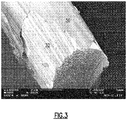
- Figure 3 shows an isolated view of one of the carbon fibers 32 and the layer 36 of boron nitride, partially removed to reveal the underlying carbon fiber 32.
- One or more additional layers of boron nitride or other material can optionally be used on the layer 36.
- an additional silicon-containing layer such as silicon nitride (Si 3 N 4 ) is used.
- the carbon fibers 32 are embedded in a ceramic matrix 38. As discussed above, the carbon fibers 32 have been modified prior to fabrication of the article 22 to reduce the initial interfacial bonding strength capacity of the surfaces 34 with respect to bonding with the boron nitride 36 such that the article 22 exhibits non-brittle fracture.
- Figure 4 shows an example of the non-brittle behavior.
- Figure 5 shows a fracture surface of a carbon fiber-reinforced article 40 that is similar to the article 22 but does not utilize the surface modification of step 26 of the method 20.
- the fracture surface exhibits several toughening mechanisms, including de-bonding between the matrix 38 and the fibers 32, fiber pull-out represented by holes 42, crack deflection along the interfacial surfaces between the fibers 32 and the matrix 38, and fiber tensile fracture.
- the fracture surface of article 40 is relatively smooth and does not exhibit any of the toughening mechanisms of the fracture surface of the article 22.
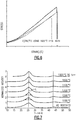
- Figure 6 shows a tensile stress testing result for a uni-directional composite, similar to the article 22, fabricated according to the method 20 by modifying the carbon fibers at 1600°C for four hours in an argon environment at a pressure of one atmosphere. As shown, the area under the curves of the three samples indicates toughening.
- the modification to the surfaces of the carbon fibers at step 26 of the method 20 is believed to order microstructural stacking faults of the graphite microstructure of the carbon fibers.
- Figure 7 shows x-ray diffraction patterns for samples processed under different surface modification temperatures from 1000°C to 1600°C at step 26 of the method 20, including one sample with no modification. In each of the patterns there is a peak that is generally aligned along line L. The peak represents graphite. The peak of the as-received carbon fibers with no surface modification is relatively broad. With increasing temperature, the peak progressively narrows, indicating ordering of the graphite microstructure. This suggests that the ordering contributes to the surface modification to reduce the initial interfacial bonding strength capacity with respect to the boron nitride.
Landscapes
- Chemical & Material Sciences (AREA)
- Engineering & Computer Science (AREA)
- Ceramic Engineering (AREA)
- Manufacturing & Machinery (AREA)
- Materials Engineering (AREA)
- Structural Engineering (AREA)
- Organic Chemistry (AREA)
- Inorganic Chemistry (AREA)
- Chemical Kinetics & Catalysis (AREA)
- Physics & Mathematics (AREA)
- Thermal Sciences (AREA)
- Composite Materials (AREA)
- Mechanical Engineering (AREA)
- General Chemical & Material Sciences (AREA)
- Textile Engineering (AREA)
- Chemical Or Physical Treatment Of Fibers (AREA)
- Chemical Vapour Deposition (AREA)
Abstract
Description
- This disclosure relates to the use of carbon fibers in ceramic matrix composites.
- Fiber-reinforced composites are known and used in aerospace applications, for example. Ceramic matrix composites are one classification of fiber-reinforced composite materials. A ceramic matrix composite can include inorganic fibers, such as ceramic fibers or glass fibers, metallic fibers or carbon fibers. Carbon fibers decompose in hot, oxidizing environments and thus are typically not used in ceramic matrix composites that are intended for such end use conditions.
- A method of fabricating a carbon fiber-reinforced article according to an exemplary aspect of the present disclosure includes providing a plurality of carbon fibers. The plurality of carbon fibers includes surfaces that have an initial interfacial bonding strength capacity with respect to bonding with boron nitride. The surfaces are then modified to reduce the initial interfacial bonding strength capacity. A layer of boron nitride is then deposited on the modified surfaces. The plurality of carbon fibers are then embedded in a ceramic matrix to provide a carbon fiber-reinforced article.
- In a further non-limiting embodiment of any of the foregoing examples, the ceramic matrix is silicon carbide.
- In a further non-limiting embodiment of any of the foregoing examples, the surfaces of the plurality of carbon fibers are free of any ceramic coating prior to the depositing of the layer of boron nitride.
- In a further non-limiting embodiment of any of the foregoing examples, the modifying includes heat treating the plurality of carbon fibers at a temperature greater than 1200° C.
- In a further non-limiting embodiment of any of the foregoing examples, the modifying includes heat treating the plurality of carbon fibers at a temperature of 1550-1650° C.
- In a further non-limiting embodiment of any of the foregoing examples, the modifying includes heat treating the plurality of carbon fibers at a temperature of 1600° C.
- In a further non-limiting embodiment of any of the foregoing examples, the plurality of carbon fibers are as-received fibers.
- A further non-limiting embodiment of any of the foregoing examples includes depositing the layer of boron nitride by chemical vapor deposition.
- In a further non-limiting embodiment of any of the foregoing examples, the layer of boron nitride is in contact with the modified surfaces of the plurality of carbon fibers, and the ceramic matrix is silicon carbide that is in contact with the layer of boron nitride.
- In a further non-limiting embodiment of any of the foregoing examples, the layer of boron nitride deposited on the modified surfaces consists of boron nitride.
- In a further non-limiting embodiment of any of the foregoing examples, the plurality of carbon fibers includes graphite.
- In a further non-limiting embodiment of any of the foregoing examples, the modifying includes ordering microstructural stacking faults in a graphitic microstructure of the plurality of carbon fibers.
- In a further non-limiting embodiment of any of the foregoing examples, the ceramic matrix is predominantly silicon carbide.
- In a further non-limiting embodiment of any of the foregoing examples, the depositing of the layer of boron nitride is conducted after the modifying of the surfaces, free of any other surface modifications to the plurality of carbon fibers.
- A carbon fiber-reinforced article according to an exemplary aspect of the present disclosure includes a plurality of carbon fibers, a layer of boron nitride on surfaces of the plurality of carbon fibers, and a ceramic matrix in which the plurality of carbon fibers are embedded. The plurality of carbon fibers have been modified prior to fabrication of the carbon fiber-reinforced article to reduce an initial interfacial bonding strength capacity of surfaces of the plurality of carbon fibers with respect to bonding with the boron nitride such that the carbon fiber-reinforced article exhibits non-brittle fracture.
- In a further non-limiting embodiment of any of the foregoing examples, the ceramic matrix is silicon carbide.
- In a further non-limiting embodiment of any of the foregoing examples, the layer of boron nitride is in contact with the surfaces of the plurality of carbon fibers, and the ceramic matrix is silicon carbide that is in contact with the layer of boron nitride.
- A method of fabricating an oxidation-resistant carbon fiber, according to an exemplary aspect of the present disclosure includes at least one carbon fiber. The at least one carbon fiber includes a surface that has an initial interfacial bonding strength capacity with respect to bonding with boron nitride which modifies the surface to reduce the initial interfacial bonding strength capacity, and deposits a layer of boron nitride on the modified surface.
- The various features and advantages of the present disclosure will become apparent to those skilled in the art from the following detailed description. The drawings that accompany the detailed description can be briefly described as follows.
-
Figure 1 illustrates an example method of fabricating a carbon fiber-reinforced article. -
Figure 2 illustrates an example carbon fiber-reinforced article. -
Figure 3 illustrates an isolated view of a carbon fiber having a layer of boron nitride. -
Figure 4 illustrates a fracture surface of a carbon fiber-reinforced article fabricated according to the method shown inFigure 1 . -
Figure 5 illustrates a fracture surface of a carbon fiber-reinforced article fabricated without the surface modification according to the method shown inFigure 1 . -
Figure 6 illustrates an example tensile testing result of a carbon fiber-reinforced article. -
Figure 7 illustrates x-ray diffraction patterns for samples processed at conditions. -
Figure 1 illustrates an example of amethod 20 of fabricating a carbon fiber-reinforcedarticle 22, which is schematically shown inFigure 2 . As will be described, themethod 20 can be used to fabricate a carbon fiber ceramic matrix composite, which can be used in a variety of different applications, including aerospace applications. - Although carbon fibers generally have good mechanical properties that are desirable for composites, the practical incorporation of carbon fibers into ceramic matrix composites has been limited by poor oxidation resistance of carbon fibers. An oxidation-resistant coating, such as a layer of boron nitride (BN), can be used on carbon fibers to enhance the oxidation resistance. However, the deposition of boron nitride onto the carbon fibers can cause decomposition of the carbon fibers, thus reducing mechanical properties and negating the benefit of the enhanced oxidation resistance. As will be described below, the
method 20 provides a technique for applying a layer of boron nitride onto the carbon fibers to obtain enhanced oxidation resistance, without decomposing the carbon fibers and sacrificing the mechanical properties thereof. - As generally shown in
Figure 1 , themethod 20 includessteps article 22. As can be appreciated, thesteps - At
step 24, a plurality of carbon fibers is provided. For example, the carbon fibers include graphite and are as-received carbon fibers (e.g., 'TORAY' T300) from a carbon fiber manufacturer. The term "as-received" refers to carbon fibers that have been completely processed with respect to the formation of the fibers from precursor materials and any sizing treatments that are applied to the fibers prior to their being ready for incorporation into a composite material. In this regard, the carbon fibers can be free of any ceramic coatings thereon, although the fibers may have a sizing provided by the manufacturer. The carbon fibers can be provided in an arrangement desired for the end use. For example, the carbon fibers can be in a uni-directional arrangement, a fabric, a three-dimensional fiber structure or the like. - The carbon fibers have surfaces that define an initial interfacial bonding strength capacity with respect to bonding with boron nitride. For example, in the as-received state, with no further surface treatments, the surfaces of the carbon fibers have the capacity to provide an interfacial bonding strength with an applied layer of boron nitride. In this initial state, the carbon fibers bond relatively strongly with an applied layer of boron nitride to ultimately provide relatively strong bonding with a ceramic matrix. Such an article exhibits brittle fracture and is therefore not suitable where a toughened ceramic matrix composite is desired.
- At
step 26 of themethod 20, the surfaces of the carbon fibers are modified to reduce the initial interfacial bonding strength capacity. By reducing the initial interfacial bonding strength capacity, the bond that is later formed with an applied layer of boron nitride is relatively weaker such that the final carbon fiber-reinforcedarticle 22 exhibits non-brittle fracture. - As an example,
step 26 includes modifying the surfaces by heat treating the carbon fibers at an elevated temperature in a non-oxidizing environment. In one example, the heat treatment temperature is 1200°C or greater. In a further example, the heat treating temperature is 1550-1650°C, and nominally can be 1600°C. The non-oxidizing environment is free or substantially free of oxygen and predominantly includes argon or other gas that is unreactive with respect to the carbon fibers. The pressure of the non-oxidizing environment can vary, but in one example was approximately one atmosphere. In other examples, the pressure of the non-oxidizing environment can be sub-atmospheric pressure. The heat treatment time can be one to ten hours, and can nominally be four hours, with a 2°C per minute heating rate to the target heat treatment temperature. - After modifying the surfaces of the carbon fibers at
step 26, a layer of boron nitride is deposited onto the modified surfaces atstep 28. Without the modification atstep 26, the deposition of boron nitride onto carbon fibers can degrade the carbon fibers such that the final article exhibits poor mechanical properties. However, the modification atstep 26 reduces or eliminates decomposition of the carbon fibers during the deposition of the boron nitride layer atstep 28 such that the final article exhibits good strength, as represented by the examples in Table 1 below.TABLE 1: Ultimate Tensile Strength of Uni-Directional, Single Strand C/BN/SiC Composite Heat Pre-Treatment Temperature "As-Received" 1200°C 1300°C 1600°C Average break FORCE (lbs.) Immeasurably Small 27.8 36.6 36.9 Stdev. lbs. n/a n/a 1.0 4.0 n 10 2 3 3 Average break STRESS (KSI) Immeasurably Small n/a 70.2 - In one example of the depositing of the layer of boron nitride at
step 28, the deposition includes depositing the boron nitride by chemical vapor deposition. The deposition of boron nitride by chemical vapor deposition is known and can include, but is not limited to, reacting boron chloride with ammonia. As can be appreciated, however, the layer of boron nitride can alternatively be deposited onto the carbon fibers using other deposition techniques. - At
step 30, the carbon fibers with the layer of boron nitride are embedded in a ceramic matrix to provide the carbon fiber-reinforcedarticle 22. The embedding of the carbon fibers in the ceramic matrix can include, but is not limited to, depositing the ceramic matrix using chemical vapor infiltration. As can be appreciated, however, the ceramic matrix can alternatively be deposited using other techniques. In one example, the ceramic matrix predominantly includes silicon carbide (SiC). In another example, the ceramic matrix includes only silicon carbide and impurities. - In one alternative, if the carbon fibers will be used for another purpose rather than in a ceramic matrix composite, the embedding of
step 30 can be excluded. For example, atstep 24 one or more carbon fibers are provided. The one or more carbon fibers are then modified atstep 26 and then the layer of boron nitride is deposited atstep 28, as described. For example, the one or more carbon fibers can then be used as a "leader cloth," with enhanced oxidation resistance and extended life, in the processing of other kinds of fibers, such as silicon carbide. - In a further example of the
method 20, the layer of boron nitride is deposited onto the modified surfaces of the carbon fibers directly after the modification instep 26. That is, there are no additional intervening surface modifications of the carbon fibers between the modification instep 26 and the deposition instep 28. -
Figure 2 shows a representative portion of a carbon fiber-reinforced article 22 (hereafter "article 22"). Although only a portion of thearticle 22 is shown, thearticle 22 can be fabricated in a desired geometry for the intended end use. Thearticle 22 includes a plurality ofcarbon fibers 32 that each includesperipheral surfaces 34. Alayer 36 of boron nitride is located on each of thesurfaces 34 such that thelayers 36 contact thecarbon fibers 32. In this example, thelayers 36 continuously circumscribe the cross-sections of thecarbon fibers 32. The thickness of thelayer 36 can be varied by controlling the deposition parameters in a known manner. In one example the thickness of thelayer 36 is 50-500 nanometers, and can nominally be 50-150 nanometers. - The
layer 36 of boron nitride enhances the oxidation resistance of thecarbon fibers 32. For example, the carbon fibers are stable up to 625°C in air without thelayer 36, and thecarbon fibers 32 are stable up to 825°C in air with thelayer 36. Further, the deposition of thelayer 36 does not decompose the carbon fibers and reduce strength. Table 2 below shows further examples of the oxidation resistance.Table 2: Oxidation of Uni-Directional Single Strand C/BN/SiC; Fiber/Coating: C/BN (3 hours CVD-BN), Fiber Type: 1600°C, Ar, 4 hrs, 2°C/min, 50 torr (8H-S). 3K tows Non-Oxidized (As Fabricated) 12 Hours @ 1000°C in Air 100 Hours @ 1000°C in Air Break Stress Tensile Avg. 40.0 KSI 51.4 KSI 53.6 KSI Std. Dev. 7.8 9.6 4.8 n 4 10 6 -
Figure 3 shows an isolated view of one of thecarbon fibers 32 and thelayer 36 of boron nitride, partially removed to reveal theunderlying carbon fiber 32. One or more additional layers of boron nitride or other material can optionally be used on thelayer 36. For example, an additional silicon-containing layer, such as silicon nitride (Si3N4) is used. - The
carbon fibers 32 are embedded in aceramic matrix 38. As discussed above, thecarbon fibers 32 have been modified prior to fabrication of thearticle 22 to reduce the initial interfacial bonding strength capacity of thesurfaces 34 with respect to bonding with theboron nitride 36 such that thearticle 22 exhibits non-brittle fracture.Figure 4 shows an example of the non-brittle behavior. For comparison,Figure 5 shows a fracture surface of a carbon fiber-reinforcedarticle 40 that is similar to thearticle 22 but does not utilize the surface modification ofstep 26 of themethod 20. As shown inFigure 4 , the fracture surface exhibits several toughening mechanisms, including de-bonding between thematrix 38 and thefibers 32, fiber pull-out represented by holes 42, crack deflection along the interfacial surfaces between thefibers 32 and thematrix 38, and fiber tensile fracture. In comparison, as shown inFigure 5 , the fracture surface ofarticle 40 is relatively smooth and does not exhibit any of the toughening mechanisms of the fracture surface of thearticle 22. -
Figure 6 shows a tensile stress testing result for a uni-directional composite, similar to thearticle 22, fabricated according to themethod 20 by modifying the carbon fibers at 1600°C for four hours in an argon environment at a pressure of one atmosphere. As shown, the area under the curves of the three samples indicates toughening. - Without being limited to any particular theory, the modification to the surfaces of the carbon fibers at
step 26 of themethod 20 is believed to order microstructural stacking faults of the graphite microstructure of the carbon fibers.Figure 7 shows x-ray diffraction patterns for samples processed under different surface modification temperatures from 1000°C to 1600°C atstep 26 of themethod 20, including one sample with no modification. In each of the patterns there is a peak that is generally aligned along line L. The peak represents graphite. The peak of the as-received carbon fibers with no surface modification is relatively broad. With increasing temperature, the peak progressively narrows, indicating ordering of the graphite microstructure. This suggests that the ordering contributes to the surface modification to reduce the initial interfacial bonding strength capacity with respect to the boron nitride. - Although a combination of features is shown in the illustrated examples, not all of them need to be combined to realize the benefits of various embodiments of this disclosure. In other words, a system designed according to an embodiment of this disclosure will not necessarily include all of the features shown in any one of the Figures or all of the portions schematically shown in the Figures. Moreover, selected features of one example embodiment may be combined with selected features of other example embodiments.
- The preceding description is exemplary rather than limiting in nature. Variations and modifications to the disclosed examples may become apparent to those skilled in the art that do not necessarily depart from the essence of this disclosure. The scope of legal protection given to this disclosure can only be determined by studying the following claims.
Claims (12)
- A method of fabricating an oxidation-resistant carbon fiber (32), the method comprising:providing at least one carbon fiber (32), the at least one carbon fiber (32) including a surface (34) that has an initial interfacial bonding strength capacity with respect to bonding with boron nitride;modifying the surface (34) to reduce the initial interfacial bonding strength capacity; anddepositing a layer of boron nitride (36) on the modified surface (34).
- The method as recited in claim 1, wherein the surface (34) of the carbon fiber (32) is free of any ceramic coating prior to the depositing of the layer of boron nitride (36).
- The method as recited in claim 1 or 2, wherein the modifying includes heat treating the carbon fiber (32) at a temperature greater than 1200° C.
- The method as recited in claim 1 or 2, wherein the modifying includes heat treating the carbon fiber (32) at a temperature of 1550-1650° C.
- The method as recited in claim 1 or 2, wherein the modifying includes heat treating the carbon fiber (32) at a temperature of 1600° C.
- The method as recited in any preceding claim, wherein the carbon fiber (32) is an as-received fiber.
- The method as recited in any preceding claim, including depositing the layer of boron nitride (36) by chemical vapor deposition.
- The method as recited in any preceding claim, wherein the layer of boron nitride (36) is in contact with the modified surface (34) of the carbon fiber (32).
- The method as recited in any preceding claim, wherein the layer of boron nitride (36) deposited on the modified surface (34) consists of boron nitride.
- The method as recited in any preceding claim, wherein the carbon fiber (32) includes graphite.
- The method as recited in any preceding claim, wherein the modifying includes ordering microstructural stacking faults in a graphitic microstructure of the carbon fiber (32).
- The method as recited in any preceding claim, wherein the depositing of the layer of boron nitride (36) is conducted after the modifying of the surface (34), free of any other surface modifications to the carbon fiber (32).
Applications Claiming Priority (3)
| Application Number | Priority Date | Filing Date | Title |
|---|---|---|---|
| US13/729,528 US9446989B2 (en) | 2012-12-28 | 2012-12-28 | Carbon fiber-reinforced article and method therefor |
| EP13869440.1A EP2938588B1 (en) | 2012-12-28 | 2013-12-23 | Carbon fiber-reinforced article and their manufacturing method |
| PCT/US2013/077376 WO2014105772A1 (en) | 2012-12-28 | 2013-12-23 | Carbon fiber-reinforced article and method therefor |
Related Parent Applications (1)
| Application Number | Title | Priority Date | Filing Date |
|---|---|---|---|
| EP13869440.1A Division EP2938588B1 (en) | 2012-12-28 | 2013-12-23 | Carbon fiber-reinforced article and their manufacturing method |
Publications (2)
| Publication Number | Publication Date |
|---|---|
| EP3689841A1 true EP3689841A1 (en) | 2020-08-05 |
| EP3689841B1 EP3689841B1 (en) | 2023-08-23 |
Family
ID=51022011
Family Applications (2)
| Application Number | Title | Priority Date | Filing Date |
|---|---|---|---|
| EP20165360.7A Active EP3689841B1 (en) | 2012-12-28 | 2013-12-23 | Method of fabricating an oxidation-resistant carbon fiber |
| EP13869440.1A Active EP2938588B1 (en) | 2012-12-28 | 2013-12-23 | Carbon fiber-reinforced article and their manufacturing method |
Family Applications After (1)
| Application Number | Title | Priority Date | Filing Date |
|---|---|---|---|
| EP13869440.1A Active EP2938588B1 (en) | 2012-12-28 | 2013-12-23 | Carbon fiber-reinforced article and their manufacturing method |
Country Status (3)
| Country | Link |
|---|---|
| US (1) | US9446989B2 (en) |
| EP (2) | EP3689841B1 (en) |
| WO (1) | WO2014105772A1 (en) |
Families Citing this family (1)
| Publication number | Priority date | Publication date | Assignee | Title |
|---|---|---|---|---|
| CN117865659A (en) * | 2023-12-15 | 2024-04-12 | 江苏锡沂高新材料产业技术研究院有限公司 | A preparation method of boron nitride modified short carbon fiber reinforced fused quartz ceramics |
Citations (6)
| Publication number | Priority date | Publication date | Assignee | Title |
|---|---|---|---|---|
| US4752503A (en) * | 1984-07-20 | 1988-06-21 | Societe Europeenne De Propulsion | Process for the manufacture of a composite material with refractory fibrous reinforcement and ceramic matrix |
| US5476685A (en) * | 1990-02-09 | 1995-12-19 | Societe Europeenne De Propulsion | Process for the manufacture of a fiber reinforced composite material having a ceramic matrix and preheated carbon fibers |
| US20020066409A1 (en) * | 2000-12-04 | 2002-06-06 | General Electric Company | Fiber coating method and reactor |
| US7427428B1 (en) * | 2003-06-24 | 2008-09-23 | The United States Of America As Represented By The Administrator Of The National Aeronautics And Space Administration | Interphase for ceramic matrix composites reinforced by non-oxide ceramic fibers |
| EP2210868A2 (en) * | 2009-01-12 | 2010-07-28 | Goodrich Corporation | Composite material |
| US20120301691A1 (en) * | 2009-10-30 | 2012-11-29 | Charleux Francois | Low-thickness thermostructural composite material part, and manufacture method |
Family Cites Families (68)
| Publication number | Priority date | Publication date | Assignee | Title |
|---|---|---|---|---|
| FR2401888A1 (en) | 1977-09-06 | 1979-03-30 | Europ Propulsion | Impregnating porous carbon body with refractory material - esp. carbide, boride and/or nitride to improve compressive strength and erosion resistance |
| JPS5777320A (en) | 1980-10-27 | 1982-05-14 | Mitsubishi Electric Corp | Boronized fiber and its preparation |
| US4543345A (en) | 1984-02-09 | 1985-09-24 | The United States Of America As Represented By The Department Of Energy | Silicon carbide whisker reinforced ceramic composites and method for making same |
| US4642271A (en) | 1985-02-11 | 1987-02-10 | The United States Of America As Represented By The Secretary Of The Navy | BN coating of ceramic fibers for ceramic fiber composites |
| US5389450A (en) | 1987-06-12 | 1995-02-14 | Lanxide Technology Company, Lp | Composite materials and methods for making the same |
| US5682594A (en) | 1987-06-12 | 1997-10-28 | Lanxide Technology Company, Lp | Composite materials and methods for making the same |
| CA1316672C (en) | 1987-11-16 | 1993-04-27 | Corning Glass Works | Method for making fiber-reinforced ceramic matrix composite |
| US4960629A (en) | 1987-12-15 | 1990-10-02 | United Technologies Corporation | Fiber reinforced composite article |
| US4808076A (en) | 1987-12-15 | 1989-02-28 | United Technologies Corporation | Rotor for a gas turbine engine |
| US4994416A (en) | 1988-02-04 | 1991-02-19 | Martin Marietta Energy Systems, Inc. | Ceramic composites reinforced with modified silicon carbide whiskers and method for modifying the whiskers |
| GB8822521D0 (en) | 1988-09-26 | 1988-11-02 | Tech Textiles Ltd | Method of producing formable composite material |
| FR2637586B1 (en) | 1988-10-06 | 1991-01-11 | Europ Propulsion | PROCESS FOR THE MANUFACTURE OF MULTI-DIRECTIONAL REINFORCEMENT TEXTURES ESSENTIALLY IN CERAMIC FIBERS BASED ON SILICON COMPOUND FOR THE PRODUCTION OF COMPOSITE MATERIALS, AS WELL AS THE COMPOSITE TEXTURES AND MATERIALS OBTAINED |
| FR2641776B1 (en) | 1989-01-13 | 1993-03-26 | Europ Propulsion | COMPOSITE MATERIAL WITH MULTIPLE INTERPHASES BETWEEN REFRACTORY REINFORCEMENT FIBERS AND CERAMIC MATRIX |
| US5427986A (en) | 1989-10-16 | 1995-06-27 | Corning Incorporated | B-N-Cx hydrid coatings for inorganic fiber reinforcement materials |
| US5188878A (en) | 1989-11-24 | 1993-02-23 | Tonen Corporation | Unidirectional thin glass prepreg |
| US5110652A (en) | 1989-12-04 | 1992-05-05 | Corning Incorporated | Shaped fiber-reinforced ceramic composite article |
| US5094901A (en) | 1990-07-19 | 1992-03-10 | E. I. Du Pont De Nemours And Company | Oxidation resistant ceramic matrix composites |
| CA2067145C (en) * | 1990-08-08 | 1999-02-16 | Arthur W. Moore | Process for forming crack-free pyrolytic boron nitride on a carbon structure and article |
| FR2668477B1 (en) | 1990-10-26 | 1993-10-22 | Propulsion Ste Europeenne | REFRACTORY COMPOSITE MATERIAL PROTECTED AGAINST CORROSION, AND METHOD FOR THE PRODUCTION THEREOF. |
| US5275984A (en) | 1991-03-13 | 1994-01-04 | Northrop Corporation | Fiber coating of unbonded multi-layers for toughening ceramic fiber-matrix composites |
| JPH05102778A (en) | 1991-08-13 | 1993-04-23 | Murata Mfg Co Ltd | Piezoelectric component |
| US5707471A (en) | 1991-12-20 | 1998-01-13 | Dow Corning Corporation | Method for making ceramic matrix composites |
| US5296311A (en) | 1992-03-17 | 1994-03-22 | The Carborundum Company | Silicon carbide reinforced reaction bonded silicon carbide composite |
| US5252381A (en) | 1992-06-18 | 1993-10-12 | Adler Alan John | Airfoil with thick trailing edge |
| JP2593772B2 (en) | 1992-09-01 | 1997-03-26 | 川崎重工業株式会社 | Manufacturing method for composite products |
| FR2710635B1 (en) | 1993-09-27 | 1996-02-09 | Europ Propulsion | Method for manufacturing a composite material with lamellar interphase between reinforcing fibers and matrix, and material as obtained by the method. |
| US5407740A (en) | 1994-01-07 | 1995-04-18 | The United States Of America As Represented By The Secretary Of The Navy | Ceramic composites with ceramic fibers |
| DE69524432T2 (en) | 1994-09-12 | 2002-08-01 | Kabushiki Kaisha Toshiba, Kawasaki | FIBER COMPOSITE BODY ON A CERAMIC BASE |
| US5593728A (en) | 1994-11-01 | 1997-01-14 | Advanced Ceramics Corporation | Interface coating for ceramic fibers |
| US6228453B1 (en) | 1995-06-07 | 2001-05-08 | Lanxide Technology Company, Lp | Composite materials comprising two jonal functions and methods for making the same |
| US5770136A (en) | 1995-08-07 | 1998-06-23 | Huang; Xiaodi | Method for consolidating powdered materials to near net shape and full density |
| US5723213A (en) | 1995-10-18 | 1998-03-03 | Northrop Grumman Corporation | Integrated multiple-ceramic-layer fiber interfacial coating |
| US5955391A (en) | 1996-03-29 | 1999-09-21 | Kabushiki Kaisha Toshiba | Ceramic matrix composite and method of manufacturing the same |
| US6235379B1 (en) | 1996-08-20 | 2001-05-22 | Kabushiki Kaisha Toshiba | Ceramic matrix composite and method of manufacturing the same |
| FR2756277B1 (en) | 1996-11-28 | 1999-04-02 | Europ Propulsion | COMPOSITE MATERIAL WITH CERAMIC MATRIX AND SIC FIBER REINFORCEMENT AND METHOD FOR THE PRODUCTION THEREOF |
| JP4014254B2 (en) | 1997-07-18 | 2007-11-28 | 日本碍子株式会社 | Si concentration step-variable Si-SiC material, Si concentration step change-type SiC fiber reinforced Si-SiC composite material, and production method thereof |
| JP3076280B2 (en) * | 1997-08-26 | 2000-08-14 | 日本電気航空宇宙システム株式会社 | Inter-process communication method using shared memory |
| US6743393B1 (en) | 1998-06-17 | 2004-06-01 | Coi Ceramics, Inc. | Method for producing ceramic matrix composites |
| US6350713B1 (en) | 1998-11-24 | 2002-02-26 | Dow Corning Corporation | Ceramic matrix composites |
| US6404897B1 (en) | 1999-01-05 | 2002-06-11 | Harman International Industries, Inc. | Ceramic metal matrix diaphragm for loudspeakers |
| US6451416B1 (en) | 1999-11-19 | 2002-09-17 | United Technologies Corporation | Hybrid monolithic ceramic and ceramic matrix composite airfoil and method for making the same |
| JP3607939B2 (en) | 2000-06-16 | 2005-01-05 | 独立行政法人産業技術総合研究所 | Reaction synthesis of silicon carbide-boron nitride composites |
| US6441341B1 (en) | 2000-06-16 | 2002-08-27 | General Electric Company | Method of forming cooling holes in a ceramic matrix composite turbine components |
| US6979490B2 (en) | 2001-01-16 | 2005-12-27 | Steffier Wayne S | Fiber-reinforced ceramic composite material comprising a matrix with a nanolayered microstructure |
| JP2002266216A (en) | 2001-03-12 | 2002-09-18 | Oji Paper Co Ltd | Silicon carbide fiber nonwoven sheet and method for producing the same |
| JP3499837B2 (en) | 2001-03-13 | 2004-02-23 | 住友ベークライト株式会社 | Manufacturing method of prepreg |
| KR20020007237A (en) * | 2001-10-17 | 2002-01-26 | (주) 나노텍 | Manufacture of carbonnanotube with having increaseing surface area |
| JP2003301048A (en) * | 2002-04-10 | 2003-10-21 | Polymatech Co Ltd | Thermal conductive molding |
| JP4067920B2 (en) | 2002-09-10 | 2008-03-26 | 住友ベークライト株式会社 | Laminate production method |
| JP2004174730A (en) | 2002-11-25 | 2004-06-24 | Sumitomo Bakelite Co Ltd | Method for continuously manufacturing laminated sheet |
| CN102951905B (en) * | 2003-09-25 | 2016-02-17 | 株式会社东芝 | Wear resistant member comprised of silicon nitride and manufacture method thereof |
| FR2861143B1 (en) | 2003-10-20 | 2006-01-20 | Snecma Moteurs | TURBOMACHINE BLADE, IN PARTICULAR BLADE OF BLOWER AND METHOD OF MANUFACTURING THE SAME |
| US7687016B1 (en) | 2004-02-13 | 2010-03-30 | The United States Of America As Represented By The Administrator Of National Aeronautics And Space Administration | Methods for producing silicon carbide architectural preforms |
| US7306826B2 (en) | 2004-02-23 | 2007-12-11 | General Electric Company | Use of biased fabric to improve properties of SiC/SiC ceramic composites for turbine engine components |
| CN1733634A (en) | 2004-08-11 | 2006-02-15 | 鸿富锦精密工业(深圳)有限公司 | Nanowire and its preparation method |
| US7247212B2 (en) | 2004-12-21 | 2007-07-24 | General Electric Company | Orthogonal weaving for complex shape preforms |
| US7329101B2 (en) | 2004-12-29 | 2008-02-12 | General Electric Company | Ceramic composite with integrated compliance/wear layer |
| US7223465B2 (en) | 2004-12-29 | 2007-05-29 | General Electric Company | SiC/SiC composites incorporating uncoated fibers to improve interlaminar strength |
| US7597838B2 (en) | 2004-12-30 | 2009-10-06 | General Electric Company | Functionally gradient SiC/SiC ceramic matrix composites with tailored properties for turbine engine applications |
| US7867554B2 (en) | 2005-01-06 | 2011-01-11 | United Technologies Corporation | Boron nitride coated fibers and composite articles containing same |
| JP4765719B2 (en) * | 2005-06-27 | 2011-09-07 | Tdk株式会社 | Sintered body, magnetic head slider, and method of manufacturing sintered body |
| US7510742B2 (en) | 2005-11-18 | 2009-03-31 | United Technologies Corporation | Multilayered boron nitride/silicon nitride fiber coatings |
| US7507466B2 (en) | 2006-02-22 | 2009-03-24 | General Electric Company | Manufacture of CMC articles having small complex features |
| US8828540B2 (en) | 2006-06-16 | 2014-09-09 | United Technologies Corporation | Silicon carbide ceramic containing materials, their methods of manufacture and articles comprising the same |
| US7842774B2 (en) | 2007-07-24 | 2010-11-30 | United Technologies Corporation | Preceramic silazane polymer for ceramic materials |
| KR101420680B1 (en) * | 2008-09-22 | 2014-07-17 | 삼성전자주식회사 | Apparatus and method for surface treatment of carbon fiber using resistance heating |
| FR2939430B1 (en) | 2008-12-04 | 2011-01-07 | Snecma Propulsion Solide | METHOD FOR SMOOTHING THE SURFACE OF A PIECE OF CMC MATERIAL |
| US8524317B2 (en) | 2010-09-30 | 2013-09-03 | United Technologies Corporation | Composite article and method therefor |
-
2012
- 2012-12-28 US US13/729,528 patent/US9446989B2/en active Active
-
2013
- 2013-12-23 WO PCT/US2013/077376 patent/WO2014105772A1/en not_active Ceased
- 2013-12-23 EP EP20165360.7A patent/EP3689841B1/en active Active
- 2013-12-23 EP EP13869440.1A patent/EP2938588B1/en active Active
Patent Citations (6)
| Publication number | Priority date | Publication date | Assignee | Title |
|---|---|---|---|---|
| US4752503A (en) * | 1984-07-20 | 1988-06-21 | Societe Europeenne De Propulsion | Process for the manufacture of a composite material with refractory fibrous reinforcement and ceramic matrix |
| US5476685A (en) * | 1990-02-09 | 1995-12-19 | Societe Europeenne De Propulsion | Process for the manufacture of a fiber reinforced composite material having a ceramic matrix and preheated carbon fibers |
| US20020066409A1 (en) * | 2000-12-04 | 2002-06-06 | General Electric Company | Fiber coating method and reactor |
| US7427428B1 (en) * | 2003-06-24 | 2008-09-23 | The United States Of America As Represented By The Administrator Of The National Aeronautics And Space Administration | Interphase for ceramic matrix composites reinforced by non-oxide ceramic fibers |
| EP2210868A2 (en) * | 2009-01-12 | 2010-07-28 | Goodrich Corporation | Composite material |
| US20120301691A1 (en) * | 2009-10-30 | 2012-11-29 | Charleux Francois | Low-thickness thermostructural composite material part, and manufacture method |
Also Published As
| Publication number | Publication date |
|---|---|
| EP2938588B1 (en) | 2020-04-01 |
| EP3689841B1 (en) | 2023-08-23 |
| US9446989B2 (en) | 2016-09-20 |
| EP2938588A4 (en) | 2015-12-30 |
| EP2938588A1 (en) | 2015-11-04 |
| US20150141235A1 (en) | 2015-05-21 |
| WO2014105772A1 (en) | 2014-07-03 |
Similar Documents
| Publication | Publication Date | Title |
|---|---|---|
| US9611180B2 (en) | Method for manufacturing a part made of CMC | |
| EP3689840B1 (en) | A method for forming a ceramic matrix composite | |
| EP2210868B1 (en) | Composite material | |
| EP3222601B1 (en) | Ceramic matrix composites having monomodal pore size distribution and low fiber volume fraction | |
| CN100572327C (en) | Method of manufacturing composite parts with ceramic matrix and resulting parts | |
| US20180194686A1 (en) | A method of treating silicon carbide fibers | |
| EP2970017B1 (en) | Sic based ceramic matrix composites with layered matrices and methods for producing sic based ceramic matrix composites with layered matrices | |
| EP2970016A1 (en) | Ceramic matrix composite and method and article of manufacture | |
| JP2000281469A (en) | Carbon composite material having coated layer and its production | |
| EP1762551A1 (en) | Method to reduce oxidation in ceramic composites, method for fabricating a ceramic composite article and an article comprising a ceramic composite protective layer | |
| CN114988884A (en) | A Fine Control Method for Alternately Deposited Multilayer Pyrolytic Carbon Interfacial Phases | |
| EP3689841A1 (en) | Method of fabricating an oxidation-resistant carbon fiber | |
| JP2017001912A (en) | Method for producing silicon carbide composite | |
| US5695830A (en) | Process for improving the oxidative stability of a composite material having a fibrous reinforcement and a glass, glass-ceramic or ceramic matrix | |
| JP5769519B2 (en) | Fiber material for reinforcement, fiber-reinforced ceramic composite material using fiber material for reinforcement, and method for producing the same | |
| JP3562989B2 (en) | Composite having thermal sprayed layer and method for producing the same | |
| JP3673011B2 (en) | Ceramic-based fiber composite material and manufacturing method thereof | |
| US11873249B2 (en) | Method to form aligned interface coating on silicon carbide fibers | |
| EP4414346B1 (en) | Coatings for tooling | |
| JP4545872B2 (en) | Method for producing molybdenum-coated carbon fiber reinforced carbon material | |
| CN121535162A (en) | A C/SiC-Al composite material and its preparation method | |
| US9802870B2 (en) | Method of treating ceramic fibers by phosphating | |
| JP2001048665A (en) | Ceramic based fiber composite material and method for producing the same | |
| JACQUES | LCTS, CNRS, University of Bordeaux 1, Herakles-Safran, CEA | |
| INOUE et al. | Mechanical Properties of SiC Fiber/SiC Composite with Al2O3 Interface Layer |
Legal Events
| Date | Code | Title | Description |
|---|---|---|---|
| PUAI | Public reference made under article 153(3) epc to a published international application that has entered the european phase |
Free format text: ORIGINAL CODE: 0009012 |
|
| STAA | Information on the status of an ep patent application or granted ep patent |
Free format text: STATUS: THE APPLICATION HAS BEEN PUBLISHED |
|
| AC | Divisional application: reference to earlier application |
Ref document number: 2938588 Country of ref document: EP Kind code of ref document: P |
|
| AK | Designated contracting states |
Kind code of ref document: A1 Designated state(s): AL AT BE BG CH CY CZ DE DK EE ES FI FR GB GR HR HU IE IS IT LI LT LU LV MC MK MT NL NO PL PT RO RS SE SI SK SM TR |
|
| STAA | Information on the status of an ep patent application or granted ep patent |
Free format text: STATUS: REQUEST FOR EXAMINATION WAS MADE |
|
| 17P | Request for examination filed |
Effective date: 20210205 |
|
| RBV | Designated contracting states (corrected) |
Designated state(s): AL AT BE BG CH CY CZ DE DK EE ES FI FR GB GR HR HU IE IS IT LI LT LU LV MC MK MT NL NO PL PT RO RS SE SI SK SM TR |
|
| RAP1 | Party data changed (applicant data changed or rights of an application transferred) |
Owner name: RAYTHEON TECHNOLOGIES CORPORATION |
|
| STAA | Information on the status of an ep patent application or granted ep patent |
Free format text: STATUS: EXAMINATION IS IN PROGRESS |
|
| 17Q | First examination report despatched |
Effective date: 20220524 |
|
| GRAP | Despatch of communication of intention to grant a patent |
Free format text: ORIGINAL CODE: EPIDOSNIGR1 |
|
| STAA | Information on the status of an ep patent application or granted ep patent |
Free format text: STATUS: GRANT OF PATENT IS INTENDED |
|
| INTG | Intention to grant announced |
Effective date: 20230320 |
|
| GRAS | Grant fee paid |
Free format text: ORIGINAL CODE: EPIDOSNIGR3 |
|
| GRAA | (expected) grant |
Free format text: ORIGINAL CODE: 0009210 |
|
| STAA | Information on the status of an ep patent application or granted ep patent |
Free format text: STATUS: THE PATENT HAS BEEN GRANTED |
|
| AC | Divisional application: reference to earlier application |
Ref document number: 2938588 Country of ref document: EP Kind code of ref document: P |
|
| AK | Designated contracting states |
Kind code of ref document: B1 Designated state(s): AL AT BE BG CH CY CZ DE DK EE ES FI FR GB GR HR HU IE IS IT LI LT LU LV MC MK MT NL NO PL PT RO RS SE SI SK SM TR |
|
| REG | Reference to a national code |
Ref country code: GB Ref legal event code: FG4D |
|
| REG | Reference to a national code |
Ref country code: CH Ref legal event code: EP |
|
| REG | Reference to a national code |
Ref country code: IE Ref legal event code: FG4D |
|
| REG | Reference to a national code |
Ref country code: DE Ref legal event code: R096 Ref document number: 602013084525 Country of ref document: DE |
|
| RAP4 | Party data changed (patent owner data changed or rights of a patent transferred) |
Owner name: RTX CORPORATION |
|
| REG | Reference to a national code |
Ref country code: LT Ref legal event code: MG9D |
|
| REG | Reference to a national code |
Ref country code: NL Ref legal event code: MP Effective date: 20230823 |
|
| REG | Reference to a national code |
Ref country code: AT Ref legal event code: MK05 Ref document number: 1602444 Country of ref document: AT Kind code of ref document: T Effective date: 20230823 |
|
| PG25 | Lapsed in a contracting state [announced via postgrant information from national office to epo] |
Ref country code: GR Free format text: LAPSE BECAUSE OF FAILURE TO SUBMIT A TRANSLATION OF THE DESCRIPTION OR TO PAY THE FEE WITHIN THE PRESCRIBED TIME-LIMIT Effective date: 20231124 |
|
| PG25 | Lapsed in a contracting state [announced via postgrant information from national office to epo] |
Ref country code: IS Free format text: LAPSE BECAUSE OF FAILURE TO SUBMIT A TRANSLATION OF THE DESCRIPTION OR TO PAY THE FEE WITHIN THE PRESCRIBED TIME-LIMIT Effective date: 20231223 |
|
| PG25 | Lapsed in a contracting state [announced via postgrant information from national office to epo] |
Ref country code: SE Free format text: LAPSE BECAUSE OF FAILURE TO SUBMIT A TRANSLATION OF THE DESCRIPTION OR TO PAY THE FEE WITHIN THE PRESCRIBED TIME-LIMIT Effective date: 20230823 Ref country code: RS Free format text: LAPSE BECAUSE OF FAILURE TO SUBMIT A TRANSLATION OF THE DESCRIPTION OR TO PAY THE FEE WITHIN THE PRESCRIBED TIME-LIMIT Effective date: 20230823 Ref country code: PT Free format text: LAPSE BECAUSE OF FAILURE TO SUBMIT A TRANSLATION OF THE DESCRIPTION OR TO PAY THE FEE WITHIN THE PRESCRIBED TIME-LIMIT Effective date: 20231226 Ref country code: NO Free format text: LAPSE BECAUSE OF FAILURE TO SUBMIT A TRANSLATION OF THE DESCRIPTION OR TO PAY THE FEE WITHIN THE PRESCRIBED TIME-LIMIT Effective date: 20231123 Ref country code: NL Free format text: LAPSE BECAUSE OF FAILURE TO SUBMIT A TRANSLATION OF THE DESCRIPTION OR TO PAY THE FEE WITHIN THE PRESCRIBED TIME-LIMIT Effective date: 20230823 Ref country code: LV Free format text: LAPSE BECAUSE OF FAILURE TO SUBMIT A TRANSLATION OF THE DESCRIPTION OR TO PAY THE FEE WITHIN THE PRESCRIBED TIME-LIMIT Effective date: 20230823 Ref country code: LT Free format text: LAPSE BECAUSE OF FAILURE TO SUBMIT A TRANSLATION OF THE DESCRIPTION OR TO PAY THE FEE WITHIN THE PRESCRIBED TIME-LIMIT Effective date: 20230823 Ref country code: IS Free format text: LAPSE BECAUSE OF FAILURE TO SUBMIT A TRANSLATION OF THE DESCRIPTION OR TO PAY THE FEE WITHIN THE PRESCRIBED TIME-LIMIT Effective date: 20231223 Ref country code: HR Free format text: LAPSE BECAUSE OF FAILURE TO SUBMIT A TRANSLATION OF THE DESCRIPTION OR TO PAY THE FEE WITHIN THE PRESCRIBED TIME-LIMIT Effective date: 20230823 Ref country code: GR Free format text: LAPSE BECAUSE OF FAILURE TO SUBMIT A TRANSLATION OF THE DESCRIPTION OR TO PAY THE FEE WITHIN THE PRESCRIBED TIME-LIMIT Effective date: 20231124 Ref country code: FI Free format text: LAPSE BECAUSE OF FAILURE TO SUBMIT A TRANSLATION OF THE DESCRIPTION OR TO PAY THE FEE WITHIN THE PRESCRIBED TIME-LIMIT Effective date: 20230823 Ref country code: AT Free format text: LAPSE BECAUSE OF FAILURE TO SUBMIT A TRANSLATION OF THE DESCRIPTION OR TO PAY THE FEE WITHIN THE PRESCRIBED TIME-LIMIT Effective date: 20230823 |
|
| PG25 | Lapsed in a contracting state [announced via postgrant information from national office to epo] |
Ref country code: PL Free format text: LAPSE BECAUSE OF FAILURE TO SUBMIT A TRANSLATION OF THE DESCRIPTION OR TO PAY THE FEE WITHIN THE PRESCRIBED TIME-LIMIT Effective date: 20230823 |
|
| PG25 | Lapsed in a contracting state [announced via postgrant information from national office to epo] |
Ref country code: ES Free format text: LAPSE BECAUSE OF FAILURE TO SUBMIT A TRANSLATION OF THE DESCRIPTION OR TO PAY THE FEE WITHIN THE PRESCRIBED TIME-LIMIT Effective date: 20230823 |
|
| PG25 | Lapsed in a contracting state [announced via postgrant information from national office to epo] |
Ref country code: SM Free format text: LAPSE BECAUSE OF FAILURE TO SUBMIT A TRANSLATION OF THE DESCRIPTION OR TO PAY THE FEE WITHIN THE PRESCRIBED TIME-LIMIT Effective date: 20230823 Ref country code: RO Free format text: LAPSE BECAUSE OF FAILURE TO SUBMIT A TRANSLATION OF THE DESCRIPTION OR TO PAY THE FEE WITHIN THE PRESCRIBED TIME-LIMIT Effective date: 20230823 Ref country code: ES Free format text: LAPSE BECAUSE OF FAILURE TO SUBMIT A TRANSLATION OF THE DESCRIPTION OR TO PAY THE FEE WITHIN THE PRESCRIBED TIME-LIMIT Effective date: 20230823 Ref country code: EE Free format text: LAPSE BECAUSE OF FAILURE TO SUBMIT A TRANSLATION OF THE DESCRIPTION OR TO PAY THE FEE WITHIN THE PRESCRIBED TIME-LIMIT Effective date: 20230823 Ref country code: DK Free format text: LAPSE BECAUSE OF FAILURE TO SUBMIT A TRANSLATION OF THE DESCRIPTION OR TO PAY THE FEE WITHIN THE PRESCRIBED TIME-LIMIT Effective date: 20230823 Ref country code: CZ Free format text: LAPSE BECAUSE OF FAILURE TO SUBMIT A TRANSLATION OF THE DESCRIPTION OR TO PAY THE FEE WITHIN THE PRESCRIBED TIME-LIMIT Effective date: 20230823 Ref country code: SK Free format text: LAPSE BECAUSE OF FAILURE TO SUBMIT A TRANSLATION OF THE DESCRIPTION OR TO PAY THE FEE WITHIN THE PRESCRIBED TIME-LIMIT Effective date: 20230823 |
|
| REG | Reference to a national code |
Ref country code: DE Ref legal event code: R097 Ref document number: 602013084525 Country of ref document: DE |
|
| PG25 | Lapsed in a contracting state [announced via postgrant information from national office to epo] |
Ref country code: IT Free format text: LAPSE BECAUSE OF FAILURE TO SUBMIT A TRANSLATION OF THE DESCRIPTION OR TO PAY THE FEE WITHIN THE PRESCRIBED TIME-LIMIT Effective date: 20230823 |
|
| PLBE | No opposition filed within time limit |
Free format text: ORIGINAL CODE: 0009261 |
|
| STAA | Information on the status of an ep patent application or granted ep patent |
Free format text: STATUS: NO OPPOSITION FILED WITHIN TIME LIMIT |
|
| 26N | No opposition filed |
Effective date: 20240524 |
|
| PG25 | Lapsed in a contracting state [announced via postgrant information from national office to epo] |
Ref country code: SI Free format text: LAPSE BECAUSE OF FAILURE TO SUBMIT A TRANSLATION OF THE DESCRIPTION OR TO PAY THE FEE WITHIN THE PRESCRIBED TIME-LIMIT Effective date: 20230823 |
|
| REG | Reference to a national code |
Ref country code: CH Ref legal event code: PL |
|
| PG25 | Lapsed in a contracting state [announced via postgrant information from national office to epo] |
Ref country code: LU Free format text: LAPSE BECAUSE OF NON-PAYMENT OF DUE FEES Effective date: 20231223 |
|
| PG25 | Lapsed in a contracting state [announced via postgrant information from national office to epo] |
Ref country code: MC Free format text: LAPSE BECAUSE OF FAILURE TO SUBMIT A TRANSLATION OF THE DESCRIPTION OR TO PAY THE FEE WITHIN THE PRESCRIBED TIME-LIMIT Effective date: 20230823 |
|
| REG | Reference to a national code |
Ref country code: BE Ref legal event code: MM Effective date: 20231231 |
|
| PG25 | Lapsed in a contracting state [announced via postgrant information from national office to epo] |
Ref country code: MC Free format text: LAPSE BECAUSE OF FAILURE TO SUBMIT A TRANSLATION OF THE DESCRIPTION OR TO PAY THE FEE WITHIN THE PRESCRIBED TIME-LIMIT Effective date: 20230823 Ref country code: LU Free format text: LAPSE BECAUSE OF NON-PAYMENT OF DUE FEES Effective date: 20231223 |
|
| REG | Reference to a national code |
Ref country code: IE Ref legal event code: MM4A |
|
| PG25 | Lapsed in a contracting state [announced via postgrant information from national office to epo] |
Ref country code: IE Free format text: LAPSE BECAUSE OF NON-PAYMENT OF DUE FEES Effective date: 20231223 |
|
| PG25 | Lapsed in a contracting state [announced via postgrant information from national office to epo] |
Ref country code: BE Free format text: LAPSE BECAUSE OF NON-PAYMENT OF DUE FEES Effective date: 20231231 |
|
| PG25 | Lapsed in a contracting state [announced via postgrant information from national office to epo] |
Ref country code: CH Free format text: LAPSE BECAUSE OF NON-PAYMENT OF DUE FEES Effective date: 20231231 |
|
| PG25 | Lapsed in a contracting state [announced via postgrant information from national office to epo] |
Ref country code: IE Free format text: LAPSE BECAUSE OF NON-PAYMENT OF DUE FEES Effective date: 20231223 Ref country code: CH Free format text: LAPSE BECAUSE OF NON-PAYMENT OF DUE FEES Effective date: 20231231 Ref country code: BE Free format text: LAPSE BECAUSE OF NON-PAYMENT OF DUE FEES Effective date: 20231231 |
|
| PG25 | Lapsed in a contracting state [announced via postgrant information from national office to epo] |
Ref country code: BG Free format text: LAPSE BECAUSE OF FAILURE TO SUBMIT A TRANSLATION OF THE DESCRIPTION OR TO PAY THE FEE WITHIN THE PRESCRIBED TIME-LIMIT Effective date: 20230823 |
|
| PG25 | Lapsed in a contracting state [announced via postgrant information from national office to epo] |
Ref country code: BG Free format text: LAPSE BECAUSE OF FAILURE TO SUBMIT A TRANSLATION OF THE DESCRIPTION OR TO PAY THE FEE WITHIN THE PRESCRIBED TIME-LIMIT Effective date: 20230823 |
|
| PG25 | Lapsed in a contracting state [announced via postgrant information from national office to epo] |
Ref country code: CY Free format text: LAPSE BECAUSE OF FAILURE TO SUBMIT A TRANSLATION OF THE DESCRIPTION OR TO PAY THE FEE WITHIN THE PRESCRIBED TIME-LIMIT; INVALID AB INITIO Effective date: 20131223 |
|
| PG25 | Lapsed in a contracting state [announced via postgrant information from national office to epo] |
Ref country code: HU Free format text: LAPSE BECAUSE OF FAILURE TO SUBMIT A TRANSLATION OF THE DESCRIPTION OR TO PAY THE FEE WITHIN THE PRESCRIBED TIME-LIMIT; INVALID AB INITIO Effective date: 20131223 |
|
| REG | Reference to a national code |
Ref country code: DE Ref legal event code: R081 Ref document number: 602013084525 Country of ref document: DE Owner name: RTX CORPORATION (N.D.GES.D. STAATES DELAWARE),, US Free format text: FORMER OWNER: RAYTHEON TECHNOLOGIES CORPORATION, FARMINGTON, CT, US |
|
| PG25 | Lapsed in a contracting state [announced via postgrant information from national office to epo] |
Ref country code: TR Free format text: LAPSE BECAUSE OF FAILURE TO SUBMIT A TRANSLATION OF THE DESCRIPTION OR TO PAY THE FEE WITHIN THE PRESCRIBED TIME-LIMIT Effective date: 20230823 |
|
| PGFP | Annual fee paid to national office [announced via postgrant information from national office to epo] |
Ref country code: DE Payment date: 20251126 Year of fee payment: 13 |
|
| PGFP | Annual fee paid to national office [announced via postgrant information from national office to epo] |
Ref country code: GB Payment date: 20251120 Year of fee payment: 13 |
|
| PGFP | Annual fee paid to national office [announced via postgrant information from national office to epo] |
Ref country code: FR Payment date: 20251119 Year of fee payment: 13 |
|
| P01 | Opt-out of the competence of the unified patent court (upc) registered |
Free format text: CASE NUMBER: UPC_APP_0019212_3689841/2025 Effective date: 20251223 |