EP3689744A1 - Aircraft interior member, method of manufacturing same, and method of replacing same - Google Patents
Aircraft interior member, method of manufacturing same, and method of replacing same Download PDFInfo
- Publication number
- EP3689744A1 EP3689744A1 EP19825496.3A EP19825496A EP3689744A1 EP 3689744 A1 EP3689744 A1 EP 3689744A1 EP 19825496 A EP19825496 A EP 19825496A EP 3689744 A1 EP3689744 A1 EP 3689744A1
- Authority
- EP
- European Patent Office
- Prior art keywords
- substrate
- adhesive
- layer
- decorative layer
- decorative
- Prior art date
- Legal status (The legal status is an assumption and is not a legal conclusion. Google has not performed a legal analysis and makes no representation as to the accuracy of the status listed.)
- Withdrawn
Links
- 238000000034 method Methods 0.000 title claims abstract description 17
- 238000004519 manufacturing process Methods 0.000 title claims abstract description 12
- 239000010410 layer Substances 0.000 claims abstract description 106
- 239000000853 adhesive Substances 0.000 claims abstract description 99
- 230000001070 adhesive effect Effects 0.000 claims abstract description 99
- 239000012790 adhesive layer Substances 0.000 claims abstract description 78
- 239000000463 material Substances 0.000 claims abstract description 17
- 239000000758 substrate Substances 0.000 claims description 106
- 229920005989 resin Polymers 0.000 claims description 38
- 239000011347 resin Substances 0.000 claims description 38
- 238000010438 heat treatment Methods 0.000 claims description 15
- 230000003247 decreasing effect Effects 0.000 claims description 6
- 239000003795 chemical substances by application Substances 0.000 description 11
- 229920005992 thermoplastic resin Polymers 0.000 description 11
- 229920001187 thermosetting polymer Polymers 0.000 description 10
- 230000007423 decrease Effects 0.000 description 7
- 239000000945 filler Substances 0.000 description 7
- 239000004820 Pressure-sensitive adhesive Substances 0.000 description 6
- 238000005034 decoration Methods 0.000 description 5
- 239000003822 epoxy resin Substances 0.000 description 4
- 229920000647 polyepoxide Polymers 0.000 description 4
- 238000007666 vacuum forming Methods 0.000 description 4
- 239000011159 matrix material Substances 0.000 description 3
- XEEYBQQBJWHFJM-UHFFFAOYSA-N Iron Chemical compound [Fe] XEEYBQQBJWHFJM-UHFFFAOYSA-N 0.000 description 2
- 229920000784 Nomex Polymers 0.000 description 2
- 239000002033 PVDF binder Substances 0.000 description 2
- 239000004697 Polyetherimide Substances 0.000 description 2
- XUIMIQQOPSSXEZ-UHFFFAOYSA-N Silicon Chemical compound [Si] XUIMIQQOPSSXEZ-UHFFFAOYSA-N 0.000 description 2
- 229920006231 aramid fiber Polymers 0.000 description 2
- 238000009434 installation Methods 0.000 description 2
- 239000004763 nomex Substances 0.000 description 2
- 239000003973 paint Substances 0.000 description 2
- 229920001601 polyetherimide Polymers 0.000 description 2
- 229920002620 polyvinyl fluoride Polymers 0.000 description 2
- 229920002981 polyvinylidene fluoride Polymers 0.000 description 2
- 239000012783 reinforcing fiber Substances 0.000 description 2
- 229910052710 silicon Inorganic materials 0.000 description 2
- 239000010703 silicon Substances 0.000 description 2
- RNFJDJUURJAICM-UHFFFAOYSA-N 2,2,4,4,6,6-hexaphenoxy-1,3,5-triaza-2$l^{5},4$l^{5},6$l^{5}-triphosphacyclohexa-1,3,5-triene Chemical compound N=1P(OC=2C=CC=CC=2)(OC=2C=CC=CC=2)=NP(OC=2C=CC=CC=2)(OC=2C=CC=CC=2)=NP=1(OC=1C=CC=CC=1)OC1=CC=CC=C1 RNFJDJUURJAICM-UHFFFAOYSA-N 0.000 description 1
- KXGFMDJXCMQABM-UHFFFAOYSA-N 2-methoxy-6-methylphenol Chemical compound [CH]OC1=CC=CC([CH])=C1O KXGFMDJXCMQABM-UHFFFAOYSA-N 0.000 description 1
- 239000004925 Acrylic resin Substances 0.000 description 1
- 229920000178 Acrylic resin Polymers 0.000 description 1
- 241000167854 Bourreria succulenta Species 0.000 description 1
- 229920000049 Carbon (fiber) Polymers 0.000 description 1
- YCKRFDGAMUMZLT-UHFFFAOYSA-N Fluorine atom Chemical compound [F] YCKRFDGAMUMZLT-UHFFFAOYSA-N 0.000 description 1
- ISWSIDIOOBJBQZ-UHFFFAOYSA-N Phenol Chemical compound OC1=CC=CC=C1 ISWSIDIOOBJBQZ-UHFFFAOYSA-N 0.000 description 1
- 239000002313 adhesive film Substances 0.000 description 1
- 239000011230 binding agent Substances 0.000 description 1
- 239000004917 carbon fiber Substances 0.000 description 1
- 235000019693 cherries Nutrition 0.000 description 1
- 239000011248 coating agent Substances 0.000 description 1
- 238000000576 coating method Methods 0.000 description 1
- 238000004040 coloring Methods 0.000 description 1
- 239000013065 commercial product Substances 0.000 description 1
- 238000001816 cooling Methods 0.000 description 1
- 230000000694 effects Effects 0.000 description 1
- 239000000835 fiber Substances 0.000 description 1
- 239000003063 flame retardant Substances 0.000 description 1
- 239000011737 fluorine Substances 0.000 description 1
- 229910052731 fluorine Inorganic materials 0.000 description 1
- 239000006260 foam Substances 0.000 description 1
- 239000003365 glass fiber Substances 0.000 description 1
- 229910052742 iron Inorganic materials 0.000 description 1
- 239000007788 liquid Substances 0.000 description 1
- VNWKTOKETHGBQD-UHFFFAOYSA-N methane Chemical compound C VNWKTOKETHGBQD-UHFFFAOYSA-N 0.000 description 1
- 239000000203 mixture Substances 0.000 description 1
- 229920001568 phenolic resin Polymers 0.000 description 1
- 239000005011 phenolic resin Substances 0.000 description 1
- 229920001225 polyester resin Polymers 0.000 description 1
- 239000004645 polyester resin Substances 0.000 description 1
- 239000004800 polyvinyl chloride Substances 0.000 description 1
- 239000000843 powder Substances 0.000 description 1
- 238000007789 sealing Methods 0.000 description 1
- 239000007787 solid Substances 0.000 description 1
- 239000002344 surface layer Substances 0.000 description 1
Images


Classifications
-
- B—PERFORMING OPERATIONS; TRANSPORTING
- B32—LAYERED PRODUCTS
- B32B—LAYERED PRODUCTS, i.e. PRODUCTS BUILT-UP OF STRATA OF FLAT OR NON-FLAT, e.g. CELLULAR OR HONEYCOMB, FORM
- B32B27/00—Layered products comprising a layer of synthetic resin
- B32B27/06—Layered products comprising a layer of synthetic resin as the main or only constituent of a layer, which is next to another layer of the same or of a different material
-
- B—PERFORMING OPERATIONS; TRANSPORTING
- B32—LAYERED PRODUCTS
- B32B—LAYERED PRODUCTS, i.e. PRODUCTS BUILT-UP OF STRATA OF FLAT OR NON-FLAT, e.g. CELLULAR OR HONEYCOMB, FORM
- B32B27/00—Layered products comprising a layer of synthetic resin
- B32B27/12—Layered products comprising a layer of synthetic resin next to a fibrous or filamentary layer
-
- B—PERFORMING OPERATIONS; TRANSPORTING
- B32—LAYERED PRODUCTS
- B32B—LAYERED PRODUCTS, i.e. PRODUCTS BUILT-UP OF STRATA OF FLAT OR NON-FLAT, e.g. CELLULAR OR HONEYCOMB, FORM
- B32B3/00—Layered products comprising a layer with external or internal discontinuities or unevennesses, or a layer of non-planar shape; Layered products comprising a layer having particular features of form
- B32B3/10—Layered products comprising a layer with external or internal discontinuities or unevennesses, or a layer of non-planar shape; Layered products comprising a layer having particular features of form characterised by a discontinuous layer, i.e. formed of separate pieces of material
- B32B3/12—Layered products comprising a layer with external or internal discontinuities or unevennesses, or a layer of non-planar shape; Layered products comprising a layer having particular features of form characterised by a discontinuous layer, i.e. formed of separate pieces of material characterised by a layer of regularly- arranged cells, e.g. a honeycomb structure
-
- B—PERFORMING OPERATIONS; TRANSPORTING
- B32—LAYERED PRODUCTS
- B32B—LAYERED PRODUCTS, i.e. PRODUCTS BUILT-UP OF STRATA OF FLAT OR NON-FLAT, e.g. CELLULAR OR HONEYCOMB, FORM
- B32B37/00—Methods or apparatus for laminating, e.g. by curing or by ultrasonic bonding
- B32B37/12—Methods or apparatus for laminating, e.g. by curing or by ultrasonic bonding characterised by using adhesives
- B32B37/1207—Heat-activated adhesive
-
- B—PERFORMING OPERATIONS; TRANSPORTING
- B32—LAYERED PRODUCTS
- B32B—LAYERED PRODUCTS, i.e. PRODUCTS BUILT-UP OF STRATA OF FLAT OR NON-FLAT, e.g. CELLULAR OR HONEYCOMB, FORM
- B32B5/00—Layered products characterised by the non- homogeneity or physical structure, i.e. comprising a fibrous, filamentary, particulate or foam layer; Layered products characterised by having a layer differing constitutionally or physically in different parts
- B32B5/18—Layered products characterised by the non- homogeneity or physical structure, i.e. comprising a fibrous, filamentary, particulate or foam layer; Layered products characterised by having a layer differing constitutionally or physically in different parts characterised by features of a layer of foamed material
-
- B—PERFORMING OPERATIONS; TRANSPORTING
- B32—LAYERED PRODUCTS
- B32B—LAYERED PRODUCTS, i.e. PRODUCTS BUILT-UP OF STRATA OF FLAT OR NON-FLAT, e.g. CELLULAR OR HONEYCOMB, FORM
- B32B5/00—Layered products characterised by the non- homogeneity or physical structure, i.e. comprising a fibrous, filamentary, particulate or foam layer; Layered products characterised by having a layer differing constitutionally or physically in different parts
- B32B5/22—Layered products characterised by the non- homogeneity or physical structure, i.e. comprising a fibrous, filamentary, particulate or foam layer; Layered products characterised by having a layer differing constitutionally or physically in different parts characterised by the presence of two or more layers which are next to each other and are fibrous, filamentary, formed of particles or foamed
- B32B5/24—Layered products characterised by the non- homogeneity or physical structure, i.e. comprising a fibrous, filamentary, particulate or foam layer; Layered products characterised by having a layer differing constitutionally or physically in different parts characterised by the presence of two or more layers which are next to each other and are fibrous, filamentary, formed of particles or foamed one layer being a fibrous or filamentary layer
-
- B—PERFORMING OPERATIONS; TRANSPORTING
- B32—LAYERED PRODUCTS
- B32B—LAYERED PRODUCTS, i.e. PRODUCTS BUILT-UP OF STRATA OF FLAT OR NON-FLAT, e.g. CELLULAR OR HONEYCOMB, FORM
- B32B7/00—Layered products characterised by the relation between layers; Layered products characterised by the relative orientation of features between layers, or by the relative values of a measurable parameter between layers, i.e. products comprising layers having different physical, chemical or physicochemical properties; Layered products characterised by the interconnection of layers
- B32B7/04—Interconnection of layers
- B32B7/12—Interconnection of layers using interposed adhesives or interposed materials with bonding properties
- B32B7/14—Interconnection of layers using interposed adhesives or interposed materials with bonding properties applied in spaced arrangements, e.g. in stripes
-
- B—PERFORMING OPERATIONS; TRANSPORTING
- B64—AIRCRAFT; AVIATION; COSMONAUTICS
- B64D—EQUIPMENT FOR FITTING IN OR TO AIRCRAFT; FLIGHT SUITS; PARACHUTES; ARRANGEMENT OR MOUNTING OF POWER PLANTS OR PROPULSION TRANSMISSIONS IN AIRCRAFT
- B64D11/00—Passenger or crew accommodation; Flight-deck installations not otherwise provided for
-
- C—CHEMISTRY; METALLURGY
- C09—DYES; PAINTS; POLISHES; NATURAL RESINS; ADHESIVES; COMPOSITIONS NOT OTHERWISE PROVIDED FOR; APPLICATIONS OF MATERIALS NOT OTHERWISE PROVIDED FOR
- C09J—ADHESIVES; NON-MECHANICAL ASPECTS OF ADHESIVE PROCESSES IN GENERAL; ADHESIVE PROCESSES NOT PROVIDED FOR ELSEWHERE; USE OF MATERIALS AS ADHESIVES
- C09J163/00—Adhesives based on epoxy resins; Adhesives based on derivatives of epoxy resins
-
- C—CHEMISTRY; METALLURGY
- C09—DYES; PAINTS; POLISHES; NATURAL RESINS; ADHESIVES; COMPOSITIONS NOT OTHERWISE PROVIDED FOR; APPLICATIONS OF MATERIALS NOT OTHERWISE PROVIDED FOR
- C09J—ADHESIVES; NON-MECHANICAL ASPECTS OF ADHESIVE PROCESSES IN GENERAL; ADHESIVE PROCESSES NOT PROVIDED FOR ELSEWHERE; USE OF MATERIALS AS ADHESIVES
- C09J179/00—Adhesives based on macromolecular compounds obtained by reactions forming in the main chain of the macromolecule a linkage containing nitrogen, with or without oxygen, or carbon only, not provided for in groups C09J161/00 - C09J177/00
- C09J179/04—Polycondensates having nitrogen-containing heterocyclic rings in the main chain; Polyhydrazides; Polyamide acids or similar polyimide precursors
- C09J179/08—Polyimides; Polyester-imides; Polyamide-imides; Polyamide acids or similar polyimide precursors
-
- C—CHEMISTRY; METALLURGY
- C09—DYES; PAINTS; POLISHES; NATURAL RESINS; ADHESIVES; COMPOSITIONS NOT OTHERWISE PROVIDED FOR; APPLICATIONS OF MATERIALS NOT OTHERWISE PROVIDED FOR
- C09J—ADHESIVES; NON-MECHANICAL ASPECTS OF ADHESIVE PROCESSES IN GENERAL; ADHESIVE PROCESSES NOT PROVIDED FOR ELSEWHERE; USE OF MATERIALS AS ADHESIVES
- C09J5/00—Adhesive processes in general; Adhesive processes not provided for elsewhere, e.g. relating to primers
-
- C—CHEMISTRY; METALLURGY
- C09—DYES; PAINTS; POLISHES; NATURAL RESINS; ADHESIVES; COMPOSITIONS NOT OTHERWISE PROVIDED FOR; APPLICATIONS OF MATERIALS NOT OTHERWISE PROVIDED FOR
- C09J—ADHESIVES; NON-MECHANICAL ASPECTS OF ADHESIVE PROCESSES IN GENERAL; ADHESIVE PROCESSES NOT PROVIDED FOR ELSEWHERE; USE OF MATERIALS AS ADHESIVES
- C09J9/00—Adhesives characterised by their physical nature or the effects produced, e.g. glue sticks
-
- B—PERFORMING OPERATIONS; TRANSPORTING
- B32—LAYERED PRODUCTS
- B32B—LAYERED PRODUCTS, i.e. PRODUCTS BUILT-UP OF STRATA OF FLAT OR NON-FLAT, e.g. CELLULAR OR HONEYCOMB, FORM
- B32B37/00—Methods or apparatus for laminating, e.g. by curing or by ultrasonic bonding
- B32B37/12—Methods or apparatus for laminating, e.g. by curing or by ultrasonic bonding characterised by using adhesives
- B32B37/1207—Heat-activated adhesive
- B32B2037/1215—Hot-melt adhesive
-
- B—PERFORMING OPERATIONS; TRANSPORTING
- B32—LAYERED PRODUCTS
- B32B—LAYERED PRODUCTS, i.e. PRODUCTS BUILT-UP OF STRATA OF FLAT OR NON-FLAT, e.g. CELLULAR OR HONEYCOMB, FORM
- B32B2255/00—Coating on the layer surface
- B32B2255/10—Coating on the layer surface on synthetic resin layer or on natural or synthetic rubber layer
-
- B—PERFORMING OPERATIONS; TRANSPORTING
- B32—LAYERED PRODUCTS
- B32B—LAYERED PRODUCTS, i.e. PRODUCTS BUILT-UP OF STRATA OF FLAT OR NON-FLAT, e.g. CELLULAR OR HONEYCOMB, FORM
- B32B2262/00—Composition or structural features of fibres which form a fibrous or filamentary layer or are present as additives
- B32B2262/02—Synthetic macromolecular fibres
- B32B2262/0261—Polyamide fibres
- B32B2262/0269—Aromatic polyamide fibres
-
- B—PERFORMING OPERATIONS; TRANSPORTING
- B32—LAYERED PRODUCTS
- B32B—LAYERED PRODUCTS, i.e. PRODUCTS BUILT-UP OF STRATA OF FLAT OR NON-FLAT, e.g. CELLULAR OR HONEYCOMB, FORM
- B32B2262/00—Composition or structural features of fibres which form a fibrous or filamentary layer or are present as additives
- B32B2262/10—Inorganic fibres
- B32B2262/101—Glass fibres
-
- B—PERFORMING OPERATIONS; TRANSPORTING
- B32—LAYERED PRODUCTS
- B32B—LAYERED PRODUCTS, i.e. PRODUCTS BUILT-UP OF STRATA OF FLAT OR NON-FLAT, e.g. CELLULAR OR HONEYCOMB, FORM
- B32B2262/00—Composition or structural features of fibres which form a fibrous or filamentary layer or are present as additives
- B32B2262/10—Inorganic fibres
- B32B2262/106—Carbon fibres, e.g. graphite fibres
-
- B—PERFORMING OPERATIONS; TRANSPORTING
- B32—LAYERED PRODUCTS
- B32B—LAYERED PRODUCTS, i.e. PRODUCTS BUILT-UP OF STRATA OF FLAT OR NON-FLAT, e.g. CELLULAR OR HONEYCOMB, FORM
- B32B2307/00—Properties of the layers or laminate
- B32B2307/30—Properties of the layers or laminate having particular thermal properties
- B32B2307/306—Resistant to heat
- B32B2307/3065—Flame resistant or retardant, fire resistant or retardant
-
- B—PERFORMING OPERATIONS; TRANSPORTING
- B32—LAYERED PRODUCTS
- B32B—LAYERED PRODUCTS, i.e. PRODUCTS BUILT-UP OF STRATA OF FLAT OR NON-FLAT, e.g. CELLULAR OR HONEYCOMB, FORM
- B32B2451/00—Decorative or ornamental articles
-
- B—PERFORMING OPERATIONS; TRANSPORTING
- B32—LAYERED PRODUCTS
- B32B—LAYERED PRODUCTS, i.e. PRODUCTS BUILT-UP OF STRATA OF FLAT OR NON-FLAT, e.g. CELLULAR OR HONEYCOMB, FORM
- B32B2605/00—Vehicles
- B32B2605/003—Interior finishings
-
- B—PERFORMING OPERATIONS; TRANSPORTING
- B32—LAYERED PRODUCTS
- B32B—LAYERED PRODUCTS, i.e. PRODUCTS BUILT-UP OF STRATA OF FLAT OR NON-FLAT, e.g. CELLULAR OR HONEYCOMB, FORM
- B32B2605/00—Vehicles
- B32B2605/18—Aircraft
-
- C—CHEMISTRY; METALLURGY
- C09—DYES; PAINTS; POLISHES; NATURAL RESINS; ADHESIVES; COMPOSITIONS NOT OTHERWISE PROVIDED FOR; APPLICATIONS OF MATERIALS NOT OTHERWISE PROVIDED FOR
- C09J—ADHESIVES; NON-MECHANICAL ASPECTS OF ADHESIVE PROCESSES IN GENERAL; ADHESIVE PROCESSES NOT PROVIDED FOR ELSEWHERE; USE OF MATERIALS AS ADHESIVES
- C09J2203/00—Applications of adhesives in processes or use of adhesives in the form of films or foils
- C09J2203/306—Applications of adhesives in processes or use of adhesives in the form of films or foils for protecting painted surfaces, e.g. of cars
-
- C—CHEMISTRY; METALLURGY
- C09—DYES; PAINTS; POLISHES; NATURAL RESINS; ADHESIVES; COMPOSITIONS NOT OTHERWISE PROVIDED FOR; APPLICATIONS OF MATERIALS NOT OTHERWISE PROVIDED FOR
- C09J—ADHESIVES; NON-MECHANICAL ASPECTS OF ADHESIVE PROCESSES IN GENERAL; ADHESIVE PROCESSES NOT PROVIDED FOR ELSEWHERE; USE OF MATERIALS AS ADHESIVES
- C09J2203/00—Applications of adhesives in processes or use of adhesives in the form of films or foils
- C09J2203/35—Applications of adhesives in processes or use of adhesives in the form of films or foils for aeronautic or naval applications
-
- C—CHEMISTRY; METALLURGY
- C09—DYES; PAINTS; POLISHES; NATURAL RESINS; ADHESIVES; COMPOSITIONS NOT OTHERWISE PROVIDED FOR; APPLICATIONS OF MATERIALS NOT OTHERWISE PROVIDED FOR
- C09J—ADHESIVES; NON-MECHANICAL ASPECTS OF ADHESIVE PROCESSES IN GENERAL; ADHESIVE PROCESSES NOT PROVIDED FOR ELSEWHERE; USE OF MATERIALS AS ADHESIVES
- C09J2301/00—Additional features of adhesives in the form of films or foils
- C09J2301/50—Additional features of adhesives in the form of films or foils characterized by process specific features
- C09J2301/502—Additional features of adhesives in the form of films or foils characterized by process specific features process for debonding adherents
-
- C—CHEMISTRY; METALLURGY
- C09—DYES; PAINTS; POLISHES; NATURAL RESINS; ADHESIVES; COMPOSITIONS NOT OTHERWISE PROVIDED FOR; APPLICATIONS OF MATERIALS NOT OTHERWISE PROVIDED FOR
- C09J—ADHESIVES; NON-MECHANICAL ASPECTS OF ADHESIVE PROCESSES IN GENERAL; ADHESIVE PROCESSES NOT PROVIDED FOR ELSEWHERE; USE OF MATERIALS AS ADHESIVES
- C09J2463/00—Presence of epoxy resin
-
- C—CHEMISTRY; METALLURGY
- C09—DYES; PAINTS; POLISHES; NATURAL RESINS; ADHESIVES; COMPOSITIONS NOT OTHERWISE PROVIDED FOR; APPLICATIONS OF MATERIALS NOT OTHERWISE PROVIDED FOR
- C09J—ADHESIVES; NON-MECHANICAL ASPECTS OF ADHESIVE PROCESSES IN GENERAL; ADHESIVE PROCESSES NOT PROVIDED FOR ELSEWHERE; USE OF MATERIALS AS ADHESIVES
- C09J2479/00—Presence of polyamine or polyimide
- C09J2479/08—Presence of polyamine or polyimide polyimide
Definitions
- the present disclosure relates to an interior member for an aircraft, a manufacturing method of the member, and a replacement method of the member.
- An interior panel for an aircraft commonly has a configuration in which a decorative film serving as surface protection and decoration is pasted onto a honeycomb sandwich panel via an adhesive.
- a film adhesive or the like is used to bond the decorative film.
- the interior panel for the aircraft is required to be flame retardant.
- a decorative film firmly adheres to a honeycomb sandwich panel (a substrate). Therefore, peeling of the decorative film from the substrate takes time and labor. Furthermore, to peel the decorative film from such a substrate, the substrate may be deformed or broken. In such a situation, when the decorative film is to be replaced due to dirt, damage, design change of decoration, or the like, the whole substrate is replaced, and cost becomes high. Therefore, in general, it is rare to replace the interior panel for an aircraft.
- the decorative film is not peeled and is overlaid, a material configuration of the interior panel varies, and type certification is therefore required. Cost required for the type certification is high.
- the present disclosure has been developed in view of such a situation, and an object thereof is to provide an interior member for an aircraft that reduces cost and is easy to replace, a manufacturing method of the member, and a replacement method of the member.
- an interior member for an aircraft, a manufacturing method of the member and a replacement method of the member of the present disclosure adopt the following solutions.
- an interior member for an aircraft including a substrate, a decorative layer that covers the surface of the substrate, and an adhesive layer that adheres to the decorative layer to the substrate, and the decorative layer is peelably pasted to the surface of the substrate via the adhesive layer in a range that meets a required adhesive strength and that does not affect the substrate.
- a manufacturing method of an interior member for an aircraft including a decorative material adhering to the surface of a substrate via an adhesive including: using, as the adhesive, a resin including a material that meets a required adhesive strength and allows the decorative layer to peel from the substrate by heating or external force application in a range that does not affect the substrate.
- a replacement method of the interior member for the aircraft including peeling the decorative layer from the substrate under a condition in a range that does not affect the substrate, removing the adhesive layer, and then pasting a new decorative layer to the surface of the substrate via a new adhesive.
- the decorative layer can be peeled from the substrate without damaging the substrate. Consequently, it is possible to replace the decorative layer without replacing the substrate. By reuse of the substrate, the decorative layer can be easily replaced only at cost for the decorative layer and the adhesive layer.
- the above interior member for the aircraft is advantageous in replacing the interior member for purposes of decoration, advertisement and the like for a temporary event.
- the adhesive is an agent having an adhesive force or a pressure-sensitive adhesive force.
- the adhesive includes an agent of a liquid that solidifies and becomes solid to exert the adhesive force, and additionally includes a pressure sensitive adhesive that exerts the pressure-sensitive adhesive force while keeping a wet state.
- the adhesive layer is a layer that adheres to or pressure-sensitive adheres to the substrate and the decorative layer.
- the required adhesive strength is a force with which the layer does not peel in an operating environment situation of the aircraft and cannot be easily peeled by a passenger.
- the range that does not affect the substrate is a range that does not cause damage or deformation, and keeps rigidity of the substrate even after the decorative layer is peeled.
- the adhesive layer may include a resin having an adhesive force decreased by heating at a temperature in the range that does not affect the substrate.
- the resin having the adhesive force decreased by the heating can meet the required adhesive strength during usual use, and when the layer is to be peeled, the resin is heated to decrease the adhesive force, so that the layer can be easily peeled.
- the adhesive layer may include a resin having an adhesive force that meets an adhesive strength required in the interior member for the aircraft and that allows the decorative layer to peel from the substrate by applying an external force in the range that does not affect the substrate.
- a base surface of the adhesive layer may be an uneven surface.
- the adhesive layer may be scattered and arranged on the surface of the substrate.
- a peel layer may be disposed on a base surface of the adhesive layer.
- a manufacturing method of the member, and a replacement method of the member of the above disclosure a decorative layer is made peelable, and is thereby easily replaced with a new decorative layer. Furthermore, a substrate can be reused, and hence, replacement cost can be reduced.
- An interior member (an interior panel) for an aircraft according to the present disclosure is suitable especially for a side wall, a sealing, an overhead bin, a galley, a lavatory, a de-binder and the like.
- FIG. 1 is an exploded partially cross-sectional view of an interior panel according to the present embodiment.
- An interior panel 10 includes a substrate 11, an adhesive layer 12 and a decorative layer 13.
- the substrate 11 in Fig. 1 includes a honeycomb sandwich panel 14, and an intermediate layer 15 that covers the surface of the honeycomb sandwich panel 14.
- the honeycomb sandwich panel 14 is a panel molded by sandwiching a honeycomb core between face sheets such as prepregs.
- the substrate 11 is not limited to the honeycomb sandwich panel, and may be, for example, a foam core sandwich panel.
- the intermediate layer 15 may be omitted.
- the honeycomb core a commercial product is usable.
- the honeycomb core is made of, for example, Nomex (a registered trademark).
- Nomex (the registered trademark) includes a material including an aramid fiber and a phenol fiber and having a high fire resistance.
- the prepreg of the face sheet includes a reinforcing fiber and a matrix resin.
- the reinforcing fiber include a glass fiber, a carbon fiber, and the aramid fiber.
- the matrix resin include a phenolic resin and an epoxy resin.
- a heat-resistant temperature of the honeycomb sandwich panel 14 is from about 100°C to 200°C.
- the heat-resistant temperature varies in accordance with combination of materials, or mixture of the matrix resin.
- a filler that forms the intermediate layer 15 may be a thermosetting resin or a thermoplastic resin such as the epoxy resin or a polyester resin.
- the filler may be, for example, a paste, film or powder filler.
- the adhesive layer 12 is a layer that adheres to the substrate 11 and the decorative layer 13. During usual use, the adhesive layer 12 connects the substrate 11 and the decorative layer 13 with an adhesive strength required in the interior member for the aircraft.
- the adhesive layer 12 includes a thermosetting resin such as the epoxy resin or a silicon resin, or an acrylic resin or another thermoplastic resin.
- the adhesive layer 12 may include a release agent in addition to the above resin (an adhesive) to adjust the adhesive force.
- the decorative layer 13 adheres to the substrate 11 via the adhesive layer 12.
- the decorative layer 13 is disposed to cover the surface of the substrate 11.
- the decorative layer 13 is a multilayer film including, for example, a fluorine film of polyvinyl fluoride (PVF) or polyvinylidene fluoride (PVDF), and a polyvinyl chloride (PVC) film.
- the decorative layer 13 is a film for purposes of decoration, substrate protection and the like.
- the decorative layer 13 may be colored in desired color with paint, or may be printed with a pattern.
- a cherry blossom pattern in Fig. 2 can be adopted on the decorative layer 13 for a side wall 20 of the aircraft shown in Fig. 3 .
- a type and amount of paint for use in the coloring and the pattern are selected in a range defined in, for example, a material specification.
- the interior panel 10 further adopts the following configuration.
- the adhesive layer 12 may include a resin having an adhesive force that is controllable in accordance with a temperature.
- the resin is a thermoplastic resin or a thermosetting resin.
- thermoplastic resin a softening temperature of the thermoplastic resin for use is lower than a heat-resistant temperature of the substrate 11.
- the adhesive force of the adhesive layer 12 formed by hardening such a thermoplastic resin can be controlled in accordance with the temperature.
- the softening temperature of the thermoplastic resin of the adhesive layer 12 is 20°C or more lower than a hardening temperature of the substrate 11.
- a thermoplastic resin is polyetherimide (PEI).
- the adhesive layer 12 including the hardened thermoplastic resin is heated at a temperature that is equal to or higher than the softening temperature of the thermoplastic resin and is less than the heat-resistant temperature of the substrate 11, thereby decreasing the adhesive force. Therefore, the decorative layer 13 can be peeled from the substrate 11 without damaging the substrate 11 by the heating in a range that does not affect the substrate 11.
- the heating may be performed at a temperature that is about 20°C lower than the heat-resistant temperature of the substrate 11.
- the hardening temperature of the thermosetting resin is lower than the heat-resistant temperature of the substrate 11.
- the adhesive layer 12 formed by hardening this thermosetting resin can have the adhesive force that is controllable in accordance with the temperature.
- An example of the thermosetting resin is an epoxy resin.
- the adhesive layer 12 including the hardened thermosetting resin is heated at a temperature that is equal to or higher than the hardening temperature of the thermosetting resin and is less than the heat-resistant temperature of the substrate 11, thereby decreasing the adhesive force. Therefore, the decorative layer 13 can be peeled from the substrate 11 without damaging the substrate 11, by the heating in the range that does not affect the substrate 11.
- the adhesive layer 12 has an adhesive force F A that meets an adhesive strength required in the interior panel 10 for the aircraft and that allows the decorative layer 13 to peel without damaging the substrate 11 to which a strong force (an external force F C ) is applied.
- the adhesive layer 12 includes a resin that can exert the adhesive force F A .
- the decorative layer 13 adherers to the substrate 11 with the adhesive force F A withstands an operating environment, and cannot be easily peeled by a passenger.
- the adhesive force F A of the adhesive layer 12 is smaller than an adhesive force of a heretofore used adhesive.
- the external force F C to be applied in the range that does not affect the substrate 11 depends on a rigidity of the substrate 11. Adhesive force F A is smaller than the external force F C .
- the adhesive force F A changes before and after the heating. That is, the adhesive layer 12 before heated has an adhesive force F Aa that meets the adhesive strength required in the interior panel 10 for the aircraft, and the heated adhesive layer 12 has an adhesive force F Ab that allows the decorative layer 13 to peel without damaging the substrate 11.
- the adhesive force F Ab is smaller than the adhesive force F Aa .
- the adhesive force F A changes with the heating, so that the decorative layer 13 can be peeled without damaging the substrate 11, while increasing the adhesive force during the usual use. Furthermore, more options of the usable adhesive become available.
- the adhesive layer 12 has a base surface that is an uneven surface.
- a base in the present example is the intermediate layer 15.
- the intermediate layer 15 has the uneven surface on a side that adheres to the adhesive layer 12.
- An adhesive force F D of the adhesive layer 12 to the surface of the intermediate layer 15 may be equivalent to the adhesive force F A of the above second example. Consequently, the adhesive strength required in the interior panel 10 for the aircraft is met, while the decorative layer 13 can be peeled from the substrate 11 without damaging the substrate 11 to which the strong force (the external force Fc) is applied.
- the adhesive layer 12 includes a resin that can exert the adhesive force F D .
- an adhesion area of the layer is smaller than that in the second example, and hence, the resin that forms the adhesive layer 12 has an adhesive force larger than that of the resin for use in the second example.
- the present example can be combined with the above first example.
- the adhesive force F D changes before and after heating. That is, the adhesive layer 12 before heated has an adhesive force F Da that meets the adhesive strength required in the interior panel 10 for the aircraft, and the heated adhesive layer 12 has an adhesive force F Db that allows the decorative layer 13 to peel without damaging the substrate 11.
- the adhesive force F Db is smaller than the adhesive force F Da .
- the adhesive force F D changes by the heating, so that the decorative layer 13 can be peeled without damaging the substrate 11, while increasing the adhesive force during the usual use.
- more options of the usable adhesive become available. For example, a resin having a small control width of the adhesive force depending on a temperature is usable as a material of the adhesive layer 12.
- the combination with the first example is valid in a case where the adhesive force F D cannot be smaller than the external force F C only by providing the uneven surface.
- the present example can be combined also with the above second example.
- the adhesive layer 12 may be scattered and arranged.
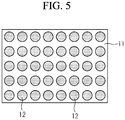
- the adhesive layer 12 may be arranged in vertical stripes (see Fig. 4 ), horizontal stripes, wavy stripes, diagonal stripes, or dots (see Fig. 5 ).
- a contact area decreases not only depending on an adhesive force of the adhesive layer 12 but also depending on the adhesive layer 12 provided in this manner, so that the decorative layer 13 can be easily peeled.
- the adhesive layer 12 may be arranged, for example, in the vertical stripes, horizontal stripes, wavy stripes, diagonal stripes, or dots.
- An adhesive force F E of the adhesive layer 12 to the substrate 11 may be equivalent to the adhesive force F A of the above second example.
- An installation area of the adhesive layer 12 is set so that the adhesive force F E is equivalent to the adhesive force F A . Consequently, the decorative layer 13 can be peeled from the substrate 11 without damaging the substrate 11.
- the adhesive layer 12 includes a resin that can exert the adhesive force F E .
- an adhesion area of the layer is smaller than that of the second example, and hence, the resin that forms the adhesive layer 12 has an adhesive force larger than that of the resin for use in the second example.
- the present example can be combined with the above first example.
- a resin having a small control width of the adhesive force depending on a temperature is usable as a material of the adhesive layer 12 in the same manner as in the combination of the first example with the third example.
- the combination with the first example is valid in a case where the adhesive force F G cannot be smaller than the external force F C only by scattering and arranging the adhesive layer 12.
- the present example can be combined with the above second and third examples.
- a peel layer (not shown) is disposed between the substrate 11 and the adhesive layer 12 and on a base surface of the adhesive layer 12.
- the peel layer includes a release agent.
- the release agent is, for example, a silicon release agent of Frekote or the like.
- the peel layer is provided, to decrease an adhesive force of the adhesive layer 12 to a base, so that the decorative layer 13 can be easily peeled.
- the peel layer may be scattered and arranged.
- “Scattering arrangement” means arrangement in vertical stripes, horizontal stripes, wavy stripes, diagonal stripes, dots, or the like.
- an adhesive force F G of the adhesive layer 12 to the substrate 11 may be equivalent to the adhesive force F A of the above second example.
- An installation area of the peel layer is set so that the adhesive force F G is equivalent to the adhesive force F A . Consequently, the decorative layer 13 can be peeled from the substrate 11 without damaging the substrate 11.
- the present example can be combined with the above first example.
- a resin having a small control width of the adhesive force depending on a temperature is usable as a material of the adhesive layer 12 in the same manner as in the combination of the first example with the third and fourth examples.
- the combination with the first example is valid in a case where the adhesive force F G cannot be smaller than the external force F C only by disposing the peel layer.
- the present example can be combined with the above second to fourth examples.
- the adhesive layer 12 and the peel layer can be arranged so that patterns are superimposed on each other.
- the decorative layer 13 pasted to the substrate 11 can be peeled without damaging the substrate 11. Consequently, it is possible to reuse the substrate 11 from which the decorative layer 13 is peeled.
- the interior panel 10 in a case where the interior panel 10 is dirty or decorative design is to be changed, only the decorative layer 13 of a surface layer needs to be peeled, and a new decorative layer is pasted, so that the interior panel can be reproduced.
- the new decorative layer is formed in the same configuration as in the decorative layer 13 to be replaced, or a difference in configuration falls into a range that does not deviate from definition such as material specification, it is not necessary to acquire type certification of the reproduced interior panel.
- the surface of the honeycomb sandwich panel 14 is covered with a filler, and the surface is smoothened. Thereafter, the filler is cured at normal temperature or heated to harden, thereby obtaining the substrate 11 including the honeycomb sandwich panel 14 and the intermediate layer 15. In a case where the intermediate layer 15 (the filler) is not provided, this step is omitted.
- Predetermined smoothness or predetermined unevenness may be imparted to the substrate surface.
- the smoothness or the unevenness may be imparted at timing either before or after hardening.
- a release agent is applied to a layer (the intermediate layer 15, or a honeycomb core surface if the intermediate layer 15 is not provided) that is a base of the adhesive layer 12. It is preferable to scatter and apply the release agent, for example, in vertical stripes, horizontal stripes, wavy stripes, diagonal stripes, or dots.
- a back surface of a decorative film is coated with an adhesive.
- the whole surface may be coated with the adhesive, or the agent may be applied in the vertical stripes, horizontal stripes, wavy stripes, diagonal stripes, or dots.
- the adhesive may be applied in a suitable shape in accordance with a type of adhesive, presence/absence of the peel layer, a shape of the substrate surface or the like. Note that the adhesive is not limited to the coating of the back surface of the decorative film, and the substrate surface may be coated.
- the adhesive may be an adhesive film.
- the decorative film having a surface coated with the adhesive and directed toward the substrate 11 is superimposed, to bond the decorative film to the substrate 11.
- the adhesive is a thermosetting resin
- the agent is hardened by heating to obtain the adhesive layer 12 and the decorative layer 13.
- the agent is hardened by cooling to obtain the adhesive layer 12 and the decorative layer 13.
- the decorative film can be manually pasted, or pasted by vacuum forming such as three-dimensional overlay method (TOM method).
- vacuum forming air is inhibited from entering a space between the decorative film and the substrate 11, and hence, quality of the pasting improves.
- the decorative film can be inexpensively pasted in a beautiful condition of appearance in a short time.
- the decorative layer 13 can be peeled and replaced with a new decorative layer 13 without replacing the substrate.
- the interior panel 10 including the adhesive layer 12 of the above first example is removed from the aircraft, and heated in an oven, to obtain a state where the adhesive force of the adhesive layer 12 decreases, so that the decorative layer 13 can be peeled without damaging the substrate 11.
- a heating temperature is less than a heat-resistant temperature of the substrate 11, and is equal to or higher than a hardening temperature of a material resin of the adhesive layer 12.
- a heating means is not limited to the oven, and the panel may be locally heated with an iron or the like.
- the interior panel 10 of each of the above second to fifth examples combined with the above first example is removed from the aircraft, and heated in the oven, to obtain the state where the adhesive force of the adhesive layer 12 decreases, so that the decorative layer 13 can be peeled without damaging the substrate 11.
- the decorative layer 13 can be peeled without damaging the substrate 11 by applying the external force F C in a range that does not affect the substrate 11.
- the new decorative layer can be pasted also by vacuum forming such as TOM method in the same manner as in the above manufacturing method of the interior panel.
- the film can be easily replaced without replacing the substrate 11 only at cost for the decorative film and the adhesion, and hence, the interior panel 10 can be used in decoration, advertisement or the like for a temporary event.
- the above embodiment is applicable to any region where the decorative film is used in a cabin interior panel for the aircraft.
Landscapes
- Chemical & Material Sciences (AREA)
- Organic Chemistry (AREA)
- Engineering & Computer Science (AREA)
- Aviation & Aerospace Engineering (AREA)
- Chemical Kinetics & Catalysis (AREA)
- Adhesives Or Adhesive Processes (AREA)
- Laminated Bodies (AREA)
Abstract
Description
- The present disclosure relates to an interior member for an aircraft, a manufacturing method of the member, and a replacement method of the member.
- An interior panel for an aircraft commonly has a configuration in which a decorative film serving as surface protection and decoration is pasted onto a honeycomb sandwich panel via an adhesive. A film adhesive or the like is used to bond the decorative film.
- As described in PTL 1, the interior panel for the aircraft is required to be flame retardant.
- In development of a private aircraft, it is important to design and manufacture the aircraft so that an aircraft fuselage itself can fly safely. Therefore, it is necessary to acquire type certification and prove that the design of the fuselage complies with safety standards.
-
- In a conventional interior panel, a decorative film firmly adheres to a honeycomb sandwich panel (a substrate). Therefore, peeling of the decorative film from the substrate takes time and labor. Furthermore, to peel the decorative film from such a substrate, the substrate may be deformed or broken. In such a situation, when the decorative film is to be replaced due to dirt, damage, design change of decoration, or the like, the whole substrate is replaced, and cost becomes high. Therefore, in general, it is rare to replace the interior panel for an aircraft.
- If the decorative film is not peeled and is overlaid, a material configuration of the interior panel varies, and type certification is therefore required. Cost required for the type certification is high.
- The present disclosure has been developed in view of such a situation, and an object thereof is to provide an interior member for an aircraft that reduces cost and is easy to replace, a manufacturing method of the member, and a replacement method of the member.
- To solve the above problem, an interior member for an aircraft, a manufacturing method of the member and a replacement method of the member of the present disclosure adopt the following solutions.
- In the present disclosure, provided is an interior member for an aircraft including a substrate, a decorative layer that covers the surface of the substrate, and an adhesive layer that adheres to the decorative layer to the substrate, and the decorative layer is peelably pasted to the surface of the substrate via the adhesive layer in a range that meets a required adhesive strength and that does not affect the substrate.
- In the present disclosure, provided is a manufacturing method of an interior member for an aircraft including a decorative material adhering to the surface of a substrate via an adhesive, the method including: using, as the adhesive, a resin including a material that meets a required adhesive strength and allows the decorative layer to peel from the substrate by heating or external force application in a range that does not affect the substrate.
- In the present disclosure, provided is a replacement method of the interior member for the aircraft, the method including peeling the decorative layer from the substrate under a condition in a range that does not affect the substrate, removing the adhesive layer, and then pasting a new decorative layer to the surface of the substrate via a new adhesive.
- In the above disclosure, the decorative layer can be peeled from the substrate without damaging the substrate. Consequently, it is possible to replace the decorative layer without replacing the substrate. By reuse of the substrate, the decorative layer can be easily replaced only at cost for the decorative layer and the adhesive layer. The above interior member for the aircraft is advantageous in replacing the interior member for purposes of decoration, advertisement and the like for a temporary event.
- "The adhesive" is an agent having an adhesive force or a pressure-sensitive adhesive force. "The adhesive" includes an agent of a liquid that solidifies and becomes solid to exert the adhesive force, and additionally includes a pressure sensitive adhesive that exerts the pressure-sensitive adhesive force while keeping a wet state. "The adhesive layer" is a layer that adheres to or pressure-sensitive adheres to the substrate and the decorative layer. Hereinafter, descriptions of "the adhesive strength", "the adhesive force" and "the adhesive layer" may be replaced with "a pressure-sensitive adhesive strength", "a pressure-sensitive adhesive force" and "a pressure-sensitive adhesive layer" as appropriate.
- "The required adhesive strength" is a force with which the layer does not peel in an operating environment situation of the aircraft and cannot be easily peeled by a passenger. "The range that does not affect the substrate" is a range that does not cause damage or deformation, and keeps rigidity of the substrate even after the decorative layer is peeled.
- To peel the decorative layer without damaging the substrate, the adhesive layer may include a resin having an adhesive force decreased by heating at a temperature in the range that does not affect the substrate.
- The resin having the adhesive force decreased by the heating can meet the required adhesive strength during usual use, and when the layer is to be peeled, the resin is heated to decrease the adhesive force, so that the layer can be easily peeled.
- To peel the decorative layer without damaging the substrate, the adhesive layer may include a resin having an adhesive force that meets an adhesive strength required in the interior member for the aircraft and that allows the decorative layer to peel from the substrate by applying an external force in the range that does not affect the substrate.
- To peel the decorative layer without damaging the substrate, a base surface of the adhesive layer may be an uneven surface.
- To peel the decorative layer without damaging the substrate, the adhesive layer may be scattered and arranged on the surface of the substrate.
- To peel the decorative layer without damaging the substrate, a peel layer may be disposed on a base surface of the adhesive layer.
- According to an interior member for an aircraft, a manufacturing method of the member, and a replacement method of the member of the above disclosure, a decorative layer is made peelable, and is thereby easily replaced with a new decorative layer. Furthermore, a substrate can be reused, and hence, replacement cost can be reduced.
-
- [
Fig. 1 ]
Fig. 1 is an exploded partially cross-sectional view of an interior panel according to an embodiment. - [
Fig. 2 ]
Fig. 2 is a schematic view illustrating a pattern of a decorative layer. - [
Fig. 3 ]
Fig. 3 is a schematic front view of a side wall. - [
Fig. 4 ]
Fig. 4 is a schematic view showing an arrangement example of an adhesive layer. - [
Fig. 5 ]
Fig. 5 is a schematic view showing an arrangement example of the adhesive layer. - An interior member (an interior panel) for an aircraft according to the present disclosure is suitable especially for a side wall, a sealing, an overhead bin, a galley, a lavatory, a de-binder and the like.
-
Fig. 1 is an exploded partially cross-sectional view of an interior panel according to the present embodiment. Aninterior panel 10 includes asubstrate 11, anadhesive layer 12 and adecorative layer 13. - The
substrate 11 inFig. 1 includes ahoneycomb sandwich panel 14, and anintermediate layer 15 that covers the surface of thehoneycomb sandwich panel 14. Thehoneycomb sandwich panel 14 is a panel molded by sandwiching a honeycomb core between face sheets such as prepregs. Thesubstrate 11 is not limited to the honeycomb sandwich panel, and may be, for example, a foam core sandwich panel. Theintermediate layer 15 may be omitted. - In the honeycomb core, a commercial product is usable. The honeycomb core is made of, for example, Nomex (a registered trademark). Nomex (the registered trademark) includes a material including an aramid fiber and a phenol fiber and having a high fire resistance.
- The prepreg of the face sheet includes a reinforcing fiber and a matrix resin. Examples of the reinforcing fiber include a glass fiber, a carbon fiber, and the aramid fiber. Examples of the matrix resin include a phenolic resin and an epoxy resin.
- A heat-resistant temperature of the
honeycomb sandwich panel 14 is from about 100°C to 200°C. The heat-resistant temperature varies in accordance with combination of materials, or mixture of the matrix resin. - A filler that forms the
intermediate layer 15 may be a thermosetting resin or a thermoplastic resin such as the epoxy resin or a polyester resin. The filler may be, for example, a paste, film or powder filler. - The
adhesive layer 12 is a layer that adheres to thesubstrate 11 and thedecorative layer 13. During usual use, theadhesive layer 12 connects thesubstrate 11 and thedecorative layer 13 with an adhesive strength required in the interior member for the aircraft. Theadhesive layer 12 includes a thermosetting resin such as the epoxy resin or a silicon resin, or an acrylic resin or another thermoplastic resin. Theadhesive layer 12 may include a release agent in addition to the above resin (an adhesive) to adjust the adhesive force. - The
decorative layer 13 adheres to thesubstrate 11 via theadhesive layer 12. Thedecorative layer 13 is disposed to cover the surface of thesubstrate 11. Thedecorative layer 13 is a multilayer film including, for example, a fluorine film of polyvinyl fluoride (PVF) or polyvinylidene fluoride (PVDF), and a polyvinyl chloride (PVC) film. Thedecorative layer 13 is a film for purposes of decoration, substrate protection and the like. - The
decorative layer 13 may be colored in desired color with paint, or may be printed with a pattern. For example, a cherry blossom pattern inFig. 2 can be adopted on thedecorative layer 13 for aside wall 20 of the aircraft shown inFig. 3 . Here, it is preferable that a type and amount of paint for use in the coloring and the pattern are selected in a range defined in, for example, a material specification. - To peel the
decorative layer 13 from thesubstrate 11 without damaging thesubstrate 11, theinterior panel 10 according to the present embodiment further adopts the following configuration. - The
adhesive layer 12 may include a resin having an adhesive force that is controllable in accordance with a temperature. The resin is a thermoplastic resin or a thermosetting resin. - In a case where the resin that forms the
adhesive layer 12 is the thermoplastic resin, a softening temperature of the thermoplastic resin for use is lower than a heat-resistant temperature of thesubstrate 11. The adhesive force of theadhesive layer 12 formed by hardening such a thermoplastic resin can be controlled in accordance with the temperature. - For example, it is preferable that the softening temperature of the thermoplastic resin of the
adhesive layer 12 is 20°C or more lower than a hardening temperature of thesubstrate 11. An example of such a thermoplastic resin is polyetherimide (PEI). - The
adhesive layer 12 including the hardened thermoplastic resin is heated at a temperature that is equal to or higher than the softening temperature of the thermoplastic resin and is less than the heat-resistant temperature of thesubstrate 11, thereby decreasing the adhesive force. Therefore, thedecorative layer 13 can be peeled from thesubstrate 11 without damaging thesubstrate 11 by the heating in a range that does not affect thesubstrate 11. The heating may be performed at a temperature that is about 20°C lower than the heat-resistant temperature of thesubstrate 11. - In a case where the resin that forms the
adhesive layer 12 is the thermosetting resin, the hardening temperature of the thermosetting resin is lower than the heat-resistant temperature of thesubstrate 11. Theadhesive layer 12 formed by hardening this thermosetting resin can have the adhesive force that is controllable in accordance with the temperature. An example of the thermosetting resin is an epoxy resin. - The
adhesive layer 12 including the hardened thermosetting resin is heated at a temperature that is equal to or higher than the hardening temperature of the thermosetting resin and is less than the heat-resistant temperature of thesubstrate 11, thereby decreasing the adhesive force. Therefore, thedecorative layer 13 can be peeled from thesubstrate 11 without damaging thesubstrate 11, by the heating in the range that does not affect thesubstrate 11. - The
adhesive layer 12 has an adhesive force FA that meets an adhesive strength required in theinterior panel 10 for the aircraft and that allows thedecorative layer 13 to peel without damaging thesubstrate 11 to which a strong force (an external force FC) is applied. Theadhesive layer 12 includes a resin that can exert the adhesive force FA. - The
decorative layer 13 adherers to thesubstrate 11 with the adhesive force FA withstands an operating environment, and cannot be easily peeled by a passenger. The adhesive force FA of theadhesive layer 12 is smaller than an adhesive force of a heretofore used adhesive. The external force FC to be applied in the range that does not affect thesubstrate 11 depends on a rigidity of thesubstrate 11. Adhesive force FA is smaller than the external force FC. - The present example can be combined with the above first example. In this case, the adhesive force FA changes before and after the heating. That is, the
adhesive layer 12 before heated has an adhesive force FAa that meets the adhesive strength required in theinterior panel 10 for the aircraft, and the heatedadhesive layer 12 has an adhesive force FAb that allows thedecorative layer 13 to peel without damaging thesubstrate 11. The adhesive force FAb is smaller than the adhesive force FAa. The adhesive force FA changes with the heating, so that thedecorative layer 13 can be peeled without damaging thesubstrate 11, while increasing the adhesive force during the usual use. Furthermore, more options of the usable adhesive become available. - In the present example, the
adhesive layer 12 has a base surface that is an uneven surface. A base in the present example is theintermediate layer 15. Theintermediate layer 15 has the uneven surface on a side that adheres to theadhesive layer 12. When an area ratio of a protrusion is decreased, a contact area decreases, and an adhesive force of theadhesive layer 12 to theintermediate layer 15 decreases. An adhesive force FD of theadhesive layer 12 to the surface of theintermediate layer 15 may be equivalent to the adhesive force FA of the above second example. Consequently, the adhesive strength required in theinterior panel 10 for the aircraft is met, while thedecorative layer 13 can be peeled from thesubstrate 11 without damaging thesubstrate 11 to which the strong force (the external force Fc) is applied. Theadhesive layer 12 includes a resin that can exert the adhesive force FD. In the present example, an adhesion area of the layer is smaller than that in the second example, and hence, the resin that forms theadhesive layer 12 has an adhesive force larger than that of the resin for use in the second example. - The present example can be combined with the above first example. The adhesive force FD changes before and after heating. That is, the
adhesive layer 12 before heated has an adhesive force FDa that meets the adhesive strength required in theinterior panel 10 for the aircraft, and the heatedadhesive layer 12 has an adhesive force FDb that allows thedecorative layer 13 to peel without damaging thesubstrate 11. The adhesive force FDb is smaller than the adhesive force FDa. The adhesive force FD changes by the heating, so that thedecorative layer 13 can be peeled without damaging thesubstrate 11, while increasing the adhesive force during the usual use. Furthermore, more options of the usable adhesive become available. For example, a resin having a small control width of the adhesive force depending on a temperature is usable as a material of theadhesive layer 12. Furthermore, the combination with the first example is valid in a case where the adhesive force FD cannot be smaller than the external force FC only by providing the uneven surface. - The present example can be combined also with the above second example.
- The
adhesive layer 12 may be scattered and arranged. For example, theadhesive layer 12 may be arranged in vertical stripes (seeFig. 4 ), horizontal stripes, wavy stripes, diagonal stripes, or dots (seeFig. 5 ). A contact area decreases not only depending on an adhesive force of theadhesive layer 12 but also depending on theadhesive layer 12 provided in this manner, so that thedecorative layer 13 can be easily peeled. - The
adhesive layer 12 may be arranged, for example, in the vertical stripes, horizontal stripes, wavy stripes, diagonal stripes, or dots. An adhesive force FE of theadhesive layer 12 to thesubstrate 11 may be equivalent to the adhesive force FA of the above second example. An installation area of theadhesive layer 12 is set so that the adhesive force FE is equivalent to the adhesive force FA. Consequently, thedecorative layer 13 can be peeled from thesubstrate 11 without damaging thesubstrate 11. Theadhesive layer 12 includes a resin that can exert the adhesive force FE. In the present example, an adhesion area of the layer is smaller than that of the second example, and hence, the resin that forms theadhesive layer 12 has an adhesive force larger than that of the resin for use in the second example. - The present example can be combined with the above first example. In the combination of the present example with the first example, a resin having a small control width of the adhesive force depending on a temperature is usable as a material of the
adhesive layer 12 in the same manner as in the combination of the first example with the third example. Furthermore, the combination with the first example is valid in a case where the adhesive force FG cannot be smaller than the external force FC only by scattering and arranging theadhesive layer 12. - The present example can be combined with the above second and third examples.
- In the present example, a peel layer (not shown) is disposed between the
substrate 11 and theadhesive layer 12 and on a base surface of theadhesive layer 12. The peel layer includes a release agent. The release agent is, for example, a silicon release agent of Frekote or the like. The peel layer is provided, to decrease an adhesive force of theadhesive layer 12 to a base, so that thedecorative layer 13 can be easily peeled. - The peel layer may be scattered and arranged. "Scattering arrangement" means arrangement in vertical stripes, horizontal stripes, wavy stripes, diagonal stripes, dots, or the like. In the peel layer, an adhesive force FG of the
adhesive layer 12 to thesubstrate 11 may be equivalent to the adhesive force FA of the above second example. An installation area of the peel layer is set so that the adhesive force FG is equivalent to the adhesive force FA. Consequently, thedecorative layer 13 can be peeled from thesubstrate 11 without damaging thesubstrate 11. - The present example can be combined with the above first example. In the combination of the present example with the first example, a resin having a small control width of the adhesive force depending on a temperature is usable as a material of the
adhesive layer 12 in the same manner as in the combination of the first example with the third and fourth examples. Furthermore, the combination with the first example is valid in a case where the adhesive force FG cannot be smaller than the external force FC only by disposing the peel layer. - The present example can be combined with the above second to fourth examples. In a case where the example is combined with the fifth example, for example, the
adhesive layer 12 and the peel layer can be arranged so that patterns are superimposed on each other. - According to the above first to fifth examples or any combination of the examples, the
decorative layer 13 pasted to thesubstrate 11 can be peeled without damaging thesubstrate 11. Consequently, it is possible to reuse thesubstrate 11 from which thedecorative layer 13 is peeled. - According to the above first to fifth examples or any combination of the examples, in a case where the
interior panel 10 is dirty or decorative design is to be changed, only thedecorative layer 13 of a surface layer needs to be peeled, and a new decorative layer is pasted, so that the interior panel can be reproduced. In a case where the new decorative layer is formed in the same configuration as in thedecorative layer 13 to be replaced, or a difference in configuration falls into a range that does not deviate from definition such as material specification, it is not necessary to acquire type certification of the reproduced interior panel. - Hereinafter, description will be made as to a manufacturing method of the interior panel according to the above embodiment and a replacement method of the decorative layer.
- In a case where the
honeycomb sandwich panel 14 is used, the surface of thehoneycomb sandwich panel 14 is covered with a filler, and the surface is smoothened. Thereafter, the filler is cured at normal temperature or heated to harden, thereby obtaining thesubstrate 11 including thehoneycomb sandwich panel 14 and theintermediate layer 15. In a case where the intermediate layer 15 (the filler) is not provided, this step is omitted. - Predetermined smoothness or predetermined unevenness may be imparted to the substrate surface. In a case where the filler is provided, the smoothness or the unevenness may be imparted at timing either before or after hardening.
- In a case where the peel layer is provided, a release agent is applied to a layer (the
intermediate layer 15, or a honeycomb core surface if theintermediate layer 15 is not provided) that is a base of theadhesive layer 12. It is preferable to scatter and apply the release agent, for example, in vertical stripes, horizontal stripes, wavy stripes, diagonal stripes, or dots. - A back surface of a decorative film is coated with an adhesive. The whole surface may be coated with the adhesive, or the agent may be applied in the vertical stripes, horizontal stripes, wavy stripes, diagonal stripes, or dots. The adhesive may be applied in a suitable shape in accordance with a type of adhesive, presence/absence of the peel layer, a shape of the substrate surface or the like. Note that the adhesive is not limited to the coating of the back surface of the decorative film, and the substrate surface may be coated. The adhesive may be an adhesive film.
- The decorative film having a surface coated with the adhesive and directed toward the
substrate 11 is superimposed, to bond the decorative film to thesubstrate 11. In a case where the adhesive is a thermosetting resin, the agent is hardened by heating to obtain theadhesive layer 12 and thedecorative layer 13. In a case where the adhesive is a thermoplastic resin, the agent is hardened by cooling to obtain theadhesive layer 12 and thedecorative layer 13. - The decorative film can be manually pasted, or pasted by vacuum forming such as three-dimensional overlay method (TOM method). By use of the vacuum forming, air is inhibited from entering a space between the decorative film and the
substrate 11, and hence, quality of the pasting improves. Furthermore, in the vacuum forming, the decorative film can be inexpensively pasted in a beautiful condition of appearance in a short time. - In the
interior panel 10 according to the above embodiment, thedecorative layer 13 can be peeled and replaced with a newdecorative layer 13 without replacing the substrate. - The
interior panel 10 including theadhesive layer 12 of the above first example is removed from the aircraft, and heated in an oven, to obtain a state where the adhesive force of theadhesive layer 12 decreases, so that thedecorative layer 13 can be peeled without damaging thesubstrate 11. A heating temperature is less than a heat-resistant temperature of thesubstrate 11, and is equal to or higher than a hardening temperature of a material resin of theadhesive layer 12. A heating means is not limited to the oven, and the panel may be locally heated with an iron or the like. - The
interior panel 10 of each of the above second to fifth examples combined with the above first example is removed from the aircraft, and heated in the oven, to obtain the state where the adhesive force of theadhesive layer 12 decreases, so that thedecorative layer 13 can be peeled without damaging thesubstrate 11. In a case where theadhesive layer 12 having an adhesive force weaker than before is adopted as in the second to fifth examples, thedecorative layer 13 can be peeled without damaging thesubstrate 11 by applying the external force FC in a range that does not affect thesubstrate 11. - The new decorative layer can be pasted also by vacuum forming such as TOM method in the same manner as in the above manufacturing method of the interior panel.
- According to the above embodiment, the film can be easily replaced without replacing the
substrate 11 only at cost for the decorative film and the adhesion, and hence, theinterior panel 10 can be used in decoration, advertisement or the like for a temporary event. - The above embodiment is applicable to any region where the decorative film is used in a cabin interior panel for the aircraft.
-
- 10
- interior panel
- 11
- substrate
- 12
- adhesive layer
- 13
- decorative layer
- 14
- honeycomb sandwich panel
- 15
- intermediate layer
- 20
- side wall of an aircraft
Claims (8)
- An interior member for an aircraft, comprising:a substrate,a decorative layer that covers the surface of the substrate, andan adhesive layer that adheres to the decorative layer to the substrate, whereinthe decorative layer is peelably pasted to the surface of the substrate via the adhesive layer in a range that meets a required adhesive strength and that does not affect the substrate.
- The interior member for the aircraft according to claim 1, wherein the adhesive layer comprises a resin having an adhesive force decreased by heating at a temperature in the range that does not affect the substrate.
- The interior member for the aircraft according to claim 1, wherein the adhesive layer comprises a resin having an adhesive force that meets an adhesive strength required in the interior member for the aircraft and that allows the decorative layer to peel from the substrate by applying an external force in the range that does not affect the substrate.
- The interior member for the aircraft according to any one of claims 1 to 3, wherein a base surface of the adhesive layer is an uneven surface.
- The interior member for the aircraft according to any one of claims 1 to 3, wherein the adhesive layer is scattered and arranged on the surface of the substrate.
- The interior member for the aircraft according to any one of claims 1 to 3, wherein a peel layer is disposed on a base surface of the adhesive layer.
- A manufacturing method of an interior member for an aircraft comprising a decorative material adhering to the surface of a substrate via an adhesive, the method comprising:
using, as the adhesive, a resin that meets an adhesive strength required in the interior member for the aircraft and that allows the decorative layer to peel from the substrate by heating or external force application in a range that does not affect the substrate. - A replacement method of the interior member for the aircraft according to any one of claims 1 to 6, the method comprising:peeling the decorative layer from the substrate under a condition in a range that does not affect the substrate,removing the adhesive layer, andthen pasting a new decorative layer to the surface of the substrate via a new adhesive.
Applications Claiming Priority (2)
| Application Number | Priority Date | Filing Date | Title |
|---|---|---|---|
| JP2018124774A JP6968759B2 (en) | 2018-06-29 | 2018-06-29 | Aircraft interior parts, their manufacturing methods, and their replacement methods |
| PCT/JP2019/024529 WO2020004226A1 (en) | 2018-06-29 | 2019-06-20 | Aircraft interior member, method of manufacturing same, and method of replacing same |
Publications (2)
| Publication Number | Publication Date |
|---|---|
| EP3689744A1 true EP3689744A1 (en) | 2020-08-05 |
| EP3689744A4 EP3689744A4 (en) | 2021-01-27 |
Family
ID=68985047
Family Applications (1)
| Application Number | Title | Priority Date | Filing Date |
|---|---|---|---|
| EP19825496.3A Withdrawn EP3689744A4 (en) | 2018-06-29 | 2019-06-20 | Aircraft interior member, method of manufacturing same, and method of replacing same |
Country Status (6)
| Country | Link |
|---|---|
| US (1) | US12168339B2 (en) |
| EP (1) | EP3689744A4 (en) |
| JP (1) | JP6968759B2 (en) |
| CN (1) | CN111386224A (en) |
| BR (1) | BR112020009051A2 (en) |
| WO (1) | WO2020004226A1 (en) |
Cited By (1)
| Publication number | Priority date | Publication date | Assignee | Title |
|---|---|---|---|---|
| EP4624188A1 (en) * | 2024-03-28 | 2025-10-01 | The Boeing Company | Systems and methods for applying a tactile textured substrate to a surface of a structure |
Families Citing this family (1)
| Publication number | Priority date | Publication date | Assignee | Title |
|---|---|---|---|---|
| CN114263319A (en) * | 2022-01-20 | 2022-04-01 | 成都敬江科技有限责任公司 | Wall poster with adhesive surface micronized arrangement non-setting adhesive |
Family Cites Families (13)
| Publication number | Priority date | Publication date | Assignee | Title |
|---|---|---|---|---|
| EP0980409A1 (en) * | 1997-05-05 | 2000-02-23 | Minnesota Mining And Manufacturing Company | Adhesive compositions that are removable after thermosetting |
| JP2001295454A (en) | 2000-04-07 | 2001-10-26 | Three M Innovative Properties Co | Adhesive sheet and floor surface covering structure |
| JP2003011282A (en) * | 2001-06-29 | 2003-01-15 | Dainippon Printing Co Ltd | Decorative sheet, method for producing the same, and method for decorating base material using the same |
| JP2004017299A (en) * | 2002-06-12 | 2004-01-22 | Dainippon Printing Co Ltd | Decorative sheet, decorative material, and method for separating decorative sheet and substrate from decorative material |
| US7266917B2 (en) * | 2003-09-05 | 2007-09-11 | The Boeing Company | Image/advertising apparatus and method |
| JP4552794B2 (en) * | 2005-07-22 | 2010-09-29 | 横浜ゴム株式会社 | Electrical bonding structure of carbon fiber reinforced plastic product and manufacturing method thereof |
| CN102208469B (en) * | 2007-04-24 | 2015-04-29 | 三菱电机株式会社 | Solar cell module |
| US9284036B2 (en) * | 2007-12-27 | 2016-03-15 | Airbus Operations Gmbh | Floor plate for covering a floor framework in an aircraft |
| US20140050901A1 (en) | 2008-09-08 | 2014-02-20 | Global Onboard Partners, Llc | Method of providing a fire-resistant laminate having a print advertisement for a cabin component of an aircraft |
| WO2013058273A1 (en) * | 2011-10-19 | 2013-04-25 | 株式会社ユポ・コーポレーション | Water-activated sheet, water-activated label using said sheet, production method for said label, label adhering device using said label, and adherend for said label |
| US20140182778A1 (en) | 2012-12-26 | 2014-07-03 | Nitto Denko Corporation | Sealing sheet |
| US20140363637A1 (en) | 2013-06-06 | 2014-12-11 | The Boeing Company | Heating Layer for Film Removal |
| JP6554365B2 (en) * | 2015-09-04 | 2019-07-31 | アルプスアルパイン株式会社 | Manufacturing method of exterior panel |
-
2018
- 2018-06-29 JP JP2018124774A patent/JP6968759B2/en active Active
-
2019
- 2019-06-20 EP EP19825496.3A patent/EP3689744A4/en not_active Withdrawn
- 2019-06-20 BR BR112020009051-4A patent/BR112020009051A2/en not_active IP Right Cessation
- 2019-06-20 US US16/759,389 patent/US12168339B2/en active Active
- 2019-06-20 CN CN201980005914.8A patent/CN111386224A/en active Pending
- 2019-06-20 WO PCT/JP2019/024529 patent/WO2020004226A1/en not_active Ceased
Cited By (1)
| Publication number | Priority date | Publication date | Assignee | Title |
|---|---|---|---|---|
| EP4624188A1 (en) * | 2024-03-28 | 2025-10-01 | The Boeing Company | Systems and methods for applying a tactile textured substrate to a surface of a structure |
Also Published As
| Publication number | Publication date |
|---|---|
| CN111386224A (en) | 2020-07-07 |
| JP2020001608A (en) | 2020-01-09 |
| US12168339B2 (en) | 2024-12-17 |
| JP6968759B2 (en) | 2021-11-17 |
| US20200324532A1 (en) | 2020-10-15 |
| BR112020009051A2 (en) | 2021-01-05 |
| WO2020004226A1 (en) | 2020-01-02 |
| EP3689744A4 (en) | 2021-01-27 |
Similar Documents
| Publication | Publication Date | Title |
|---|---|---|
| EP3243649B1 (en) | Methods and apparatus to couple a decorative composite having a reinforcing layer to a panel | |
| CA2881458C (en) | High-quality flame-retardant decorative finish for interior panels | |
| EP3061601B1 (en) | Fire-resistant, gas permeable decorative laminate | |
| US12168339B2 (en) | Interior member for aircraft, manufacturing method of the same, and replacement method of the same | |
| EP3747646B1 (en) | Methods and apparatus to couple a decorative layer to a core layer of a panel via a barrier layer | |
| JP7264595B2 (en) | Decorative laminate with open-cell foam layer | |
| KR20220067017A (en) | Manufacturing method of flame resisting exterior sheet and a flame resisting exterior sheet thereby | |
| JP4132284B2 (en) | Manufacturing apparatus and manufacturing method for decorative sheet pasting plate material | |
| CN102173108A (en) | Transparent printing film and manufacturing method thereof | |
| US20240190155A1 (en) | Digitally printed decorative surface fabrication and methods thereof | |
| JP6878797B2 (en) | Advertising display veneer, advertisement display veneer construction method, and advertising body | |
| JP2020001608A5 (en) | ||
| EP3511384A1 (en) | Improved adhesive lay-up and method for attaching pneumatic de-icers | |
| JP3202446B2 (en) | Manufacturing method of thermosetting resin decorative board | |
| US20240359436A1 (en) | Wooden material sheet, wooden material sheet manufacturing method, molding, and molding manufacturing method | |
| JP2000202976A (en) | Method of manufacturing decorative member and decorative panel for elevator | |
| JP2004175863A (en) | Adhesive transfer sheet and laminate | |
| JP2000318086A (en) | Interior finishing material sheet, interior finishing material using the same, its manufacture, and method for recyling the interior finish | |
| JPH11207878A (en) | Decorating molding sheet, decorating frp molded product and manufacture thereof | |
| JP2016144936A (en) | Decorative board and manufacturing method thereof | |
| KR100919364B1 (en) | Manufacturing method of peeling type thermal transfer patterned glass plate and glass plate accordingly | |
| EP1279710A3 (en) | Laminate film, production method of the same, lamination method of the same, and print using the same | |
| KR20220000717A (en) | Transfer sheet having both of glossy and matt effects at the same time and method for producing the same | |
| JP2001113626A (en) | Decorative member and method of manufacturing the same | |
| JPH091765A (en) | Patterned sheet and manufacture thereof |
Legal Events
| Date | Code | Title | Description |
|---|---|---|---|
| STAA | Information on the status of an ep patent application or granted ep patent |
Free format text: STATUS: THE INTERNATIONAL PUBLICATION HAS BEEN MADE |
|
| PUAI | Public reference made under article 153(3) epc to a published international application that has entered the european phase |
Free format text: ORIGINAL CODE: 0009012 |
|
| STAA | Information on the status of an ep patent application or granted ep patent |
Free format text: STATUS: REQUEST FOR EXAMINATION WAS MADE |
|
| 17P | Request for examination filed |
Effective date: 20200428 |
|
| AK | Designated contracting states |
Kind code of ref document: A1 Designated state(s): AL AT BE BG CH CY CZ DE DK EE ES FI FR GB GR HR HU IE IS IT LI LT LU LV MC MK MT NL NO PL PT RO RS SE SI SK SM TR |
|
| AX | Request for extension of the european patent |
Extension state: BA ME |
|
| A4 | Supplementary search report drawn up and despatched |
Effective date: 20210112 |
|
| RIC1 | Information provided on ipc code assigned before grant |
Ipc: B64D 11/00 20060101AFI20201221BHEP Ipc: B32B 27/06 20060101ALI20201221BHEP Ipc: B32B 5/18 20060101ALI20201221BHEP Ipc: B32B 3/12 20060101ALI20201221BHEP Ipc: C09J 5/00 20060101ALI20201221BHEP Ipc: B32B 37/12 20060101ALI20201221BHEP Ipc: C09J 163/00 20060101ALI20201221BHEP |
|
| DAV | Request for validation of the european patent (deleted) | ||
| DAX | Request for extension of the european patent (deleted) | ||
| STAA | Information on the status of an ep patent application or granted ep patent |
Free format text: STATUS: THE APPLICATION HAS BEEN WITHDRAWN |
|
| 18W | Application withdrawn |
Effective date: 20220523 |