EP3687133A1 - System and method for synchronization of media objects between devices operating in a multiroom system - Google Patents
System and method for synchronization of media objects between devices operating in a multiroom system Download PDFInfo
- Publication number
- EP3687133A1 EP3687133A1 EP19153090.6A EP19153090A EP3687133A1 EP 3687133 A1 EP3687133 A1 EP 3687133A1 EP 19153090 A EP19153090 A EP 19153090A EP 3687133 A1 EP3687133 A1 EP 3687133A1
- Authority
- EP
- European Patent Office
- Prior art keywords
- information
- container
- objects
- notification
- map
- Prior art date
- Legal status (The legal status is an assumption and is not a legal conclusion. Google has not performed a legal analysis and makes no representation as to the accuracy of the status listed.)
- Granted
Links
Images




Classifications
-
- H—ELECTRICITY
- H04—ELECTRIC COMMUNICATION TECHNIQUE
- H04L—TRANSMISSION OF DIGITAL INFORMATION, e.g. TELEGRAPHIC COMMUNICATION
- H04L67/00—Network arrangements or protocols for supporting network services or applications
- H04L67/01—Protocols
- H04L67/10—Protocols in which an application is distributed across nodes in the network
- H04L67/1095—Replication or mirroring of data, e.g. scheduling or transport for data synchronisation between network nodes
-
- H—ELECTRICITY
- H04—ELECTRIC COMMUNICATION TECHNIQUE
- H04L—TRANSMISSION OF DIGITAL INFORMATION, e.g. TELEGRAPHIC COMMUNICATION
- H04L65/00—Network arrangements, protocols or services for supporting real-time applications in data packet communication
- H04L65/40—Support for services or applications
- H04L65/4061—Push-to services, e.g. push-to-talk or push-to-video
-
- G—PHYSICS
- G06—COMPUTING OR CALCULATING; COUNTING
- G06F—ELECTRIC DIGITAL DATA PROCESSING
- G06F16/00—Information retrieval; Database structures therefor; File system structures therefor
- G06F16/20—Information retrieval; Database structures therefor; File system structures therefor of structured data, e.g. relational data
- G06F16/23—Updating
- G06F16/2358—Change logging, detection, and notification
-
- G—PHYSICS
- G06—COMPUTING OR CALCULATING; COUNTING
- G06F—ELECTRIC DIGITAL DATA PROCESSING
- G06F16/00—Information retrieval; Database structures therefor; File system structures therefor
- G06F16/20—Information retrieval; Database structures therefor; File system structures therefor of structured data, e.g. relational data
- G06F16/27—Replication, distribution or synchronisation of data between databases or within a distributed database system; Distributed database system architectures therefor
-
- H—ELECTRICITY
- H04—ELECTRIC COMMUNICATION TECHNIQUE
- H04L—TRANSMISSION OF DIGITAL INFORMATION, e.g. TELEGRAPHIC COMMUNICATION
- H04L12/00—Data switching networks
- H04L12/28—Data switching networks characterised by path configuration, e.g. LAN [Local Area Networks] or WAN [Wide Area Networks]
- H04L12/2803—Home automation networks
- H04L12/2807—Exchanging configuration information on appliance services in a home automation network
- H04L12/2812—Exchanging configuration information on appliance services in a home automation network describing content present in a home automation network, e.g. audio video content
-
- H—ELECTRICITY
- H04—ELECTRIC COMMUNICATION TECHNIQUE
- H04L—TRANSMISSION OF DIGITAL INFORMATION, e.g. TELEGRAPHIC COMMUNICATION
- H04L67/00—Network arrangements or protocols for supporting network services or applications
- H04L67/50—Network services
- H04L67/55—Push-based network services
-
- H—ELECTRICITY
- H04—ELECTRIC COMMUNICATION TECHNIQUE
- H04L—TRANSMISSION OF DIGITAL INFORMATION, e.g. TELEGRAPHIC COMMUNICATION
- H04L67/00—Network arrangements or protocols for supporting network services or applications
- H04L67/50—Network services
- H04L67/56—Provisioning of proxy services
- H04L67/561—Adding application-functional data or data for application control, e.g. adding metadata
-
- H—ELECTRICITY
- H04—ELECTRIC COMMUNICATION TECHNIQUE
- H04L—TRANSMISSION OF DIGITAL INFORMATION, e.g. TELEGRAPHIC COMMUNICATION
- H04L12/00—Data switching networks
- H04L12/28—Data switching networks characterised by path configuration, e.g. LAN [Local Area Networks] or WAN [Wide Area Networks]
- H04L12/2803—Home automation networks
- H04L2012/2847—Home automation networks characterised by the type of home appliance used
- H04L2012/2849—Audio/video appliances
Definitions
- the present invention relates to a system and method for synchronization of media objects between devices operating in a multiroom system.
- the present invention relates to improving performance and utilization of related resources when considering such synchronization.
- a multimedia home network is typically composed of multiple devices, which may directly communicate with each other. There are situations, in which multiple devices work together to provide a richer user experience, e.g. set top boxes working together as part of the Multiroom network. Such cooperation requires sharing of metadata of objects between devices, e.g. recordings shared by DVRs.
- CDS UPnP Content Directory Service
- the method of sharing metadata of objects defined by UPnP Content Directory Service is not efficient in cases when there is a need to replicate a large amount of metadata, describing objects which change frequently, to multiple clients.
- a notification of a change requires sending a change notification to each of the subscribed clients, which in turn causes each client to execute an action on the CDS server.
- Multiple clients asking for the same data may severely degrade performance of the CDS server device, especially when metadata of the shared object are retrieved from an underlying database engine.
- the aim of the development of the present invention is an improved and effective system and method for synchronization of media objects between devices operating in a multiroom system.
- An object of the present invention is a method for synchronization of media objects between devices, the method comprising the steps of: providing plurality of data objects in a database; providing at least one container comprising at least one object; receiving a notification that at least one of the objects of said at least one container has changed; verifying whether a client device has subscribed for notifications regarding changes concerning said container; and for each subscribed client providing a push notification, comprising metadata of said container's objects, informing that said container's data has changed.
- the method further comprises a step of awaiting confirmations of the push notifications received by the respective clients.
- said a container map is provided being a structure, which holds information about all containers which are being monitored by clients and information about changes of objects belonging to that container.
- said information about changes of objects belonging to that container is one of the following:
- the method further comprises the steps of verifying whether an object, for which a new change notification is to be generated, is already present in the container map and the already present change information is the "object added" information and when it is and the new object change information is:
- the method further comprises the steps of verifying whether an object, for which a new change notification is to be generated, is already present in the container map and the already present change information is the "object updated" information and when it is and the new object change information is:
- the method further comprises the steps of verifying whether an object, for which a new change notification is to be generated, is already present in the container map and the already present change information is the "object removed" information and when it is and the new object change information is:
- the containers have a priority of processing assigned wherein the most important objects are transferred first and all the other objects are transferred according to the round robin algorithm.
- the push notification sent to each client comprises a sequence number, which is a value associated with the client and is incremented before a notification is sent to that client.
- Another object of the present invention is a computer program comprising program code means for performing all the steps of the computer-implemented method according to the present invention when said program is run on a computer.
- Another object of the present invention is a computer readable medium storing computer-executable instructions performing all the steps of the computer-implemented method according to the present invention when executed on a computer.
- a last object of the present invention is a system for synchronization of media objects between devices, the system being characterized in that it comprises: a data bus communicatively coupled to a Memory as well as other components of the system so that they may be managed by a Controller; a Communication Module is configured to facilitate communication between the system and clients that register in a Subscriptions Register by providing their address data as well as containers subscription parameters; a Containers Map Manager responsible for managing a containers map according the notifications from an underlying database; a Change Information Merger Module configured to merge information comprised in the containers map; an Outgoing Notifications Queue Manager responsible for managing the outgoing queue notifications under control of the Controller configured to execute all steps of the method according to the present invention.
- these quantities take the form of electrical or magnetic signals capable of being stored, transferred, combined, compared, and otherwise manipulated in a computer system.
- these signals are referred to as bits, packets, messages, values, elements, symbols, characters, terms, numbers, or the like.
- a computer-readable (storage) medium typically may be non-transitory and/or comprise a non-transitory device.
- a non-transitory storage medium may include a device that may be tangible, meaning that the device has a concrete physical form, although the device may change its physical state.
- non-transitory refers to a device remaining tangible despite a change in state.
- example means serving as a non-limiting example, instance, or illustration.
- terms "for example” and “e.g.” introduce a list of one or more non-limiting examples, instances, or illustrations.
- the present invention relates in general to a method, in which a multiroom server pushes metadata of selected objects, to its clients, whenever the data have been changed, while taking into account problems such as server's processing power and limited amount of memory, as well as problems related to the difference in processing power between said server and its clients.
- the invention presents how metadata describing objects may be efficiently transferred from a server device to multiple client devices. It is assumed that the objects, which are being transferred are grouped in a number of containers. Moreover the solution assumes that objects, which need to be synchronized are stored in a database, e.g. an SQL database, which is able to notify whether a specific object was added, modified, or removed from the database e.g. through SQL triggers.
- a database e.g. an SQL database
- Fig. 1 the process is divided into a number of steps depicted in Fig. 1 , where clients subscribe to receive and monitor changes in objects belonging to selected containers (121, 131), and are later notified by the server with metadata of objects belonging to the subscribed containers (111, 112, 113, 114, 115, 116).
- Objects may be added to respective containers to different events in a given system.
- such events may be: (a) reading a recordings list from a storage device, (b) receiving electronic program guide data update, (c) inserting a removable drive to a USB slot as well as (d) similar events.
- the server may either send full contents of the subscribed container (111, 112, 113, 114), or only changes which can be applied to the previously transferred contents of a container (115, 116).
- the change information may be one of the following:
- the server Each time the server sends a notification, it waits for a confirmation that the data were received and processed by the client (122, 123, 124, 132, 133, 134).
- the confirmation may be sent either through the connection initiated by the server, which transferred the notification, or it may be a new connection initiated by the client.
- Preparation and sending of change information is divided into three processes (depicted in Figs. 2 , 3 and 4 respectively). These processes run in parallel and communicate with each other through structures further called a container map and an outgoing queue.
- the container map is a structure, which holds information about all containers which are being monitored by clients and information about changes of objects belonging to that container. The changes only keep information about type of the change and the identifier of the changed object.
- the outgoing queue is a queue which comprises ready to send notifications and is preferably organized as a FIFO queue.
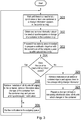
- the first process (of the three) is shown in Fig. 2 and concerns updating a container map at the server.
- the containers map may be organized such that an identifier of a container is related to one or more objects (in some case a container may be empty and comprise zero objects) comprising an identifier of an object as well as information on a type of the respective change (as shown in Fig. 7 ).
- Such relation may be effected by means of a relational database wherein an object may be present only once in a given container (i.e. only a merged, single status update is present) but may be present in more than one container.
- the process starts from receiving a change information delivered by the underlying database (201) and checks if the relevant container, to which the changed object belongs, is a container which is being monitored by at least one client (202), if not then the change information is ignored (210), otherwise it is checked whether the container map already comprises information about a change of the object (220). In case the information is not present, then the change information is put in the container map (230), otherwise the information is merged (240) according to the following formula:
- the server will merge the notifications so that a single interaction with the client is present. Therefore, such approach saves clients' as well as network resources.
- the second process (managing an outgoing queue) waits until there is a need to fully synchronize at least one container or a change information appears in the container map (301), and then obtains and removes this information (302).
- the second process estimates how much memory is needed to prepare a notification and proceeds only when the sum of the estimated amount of memory plus the amount of memory used by the notifications already placed in the outgoing queue is within pre-defined limits (303).
- the amount of memory used for supporting notifications may be monitored and limited if needed.
- the process starts preparation of the notification by first checking if the contents of a container need to be fully synchronized with at least one client (304). In that case a notification, holding metadata of all objects belonging to that container is prepared and any information about changes of the container in the containers map are removed (310), otherwise the process goes through all changes of objects belonging to the container, and retrieves metadata of objects which have been added or updated (320) (it does not have to be done for objects which have been removed) and prepares a change notification comprising information about all changed objects belonging to the container (321). The prepared notification is then put in the outgoing queue (305).
- a process, which selects the next container to process (302) may prioritize containers in such a manner that the most important objects are transferred first and all the other are transferred according to the round robin algorithm.
- the third process monitors contents of the outgoing queue (401) and if the outgoing queue is not empty then the process receives a notification from that queue (402) and sends it to all clients which are subscribed to the container, which the notification concerns (403). After all clients confirm reception of the notification, or a timeout occurs (404) the notification is removed from the outgoing queue (405).
- a client may be marked as stalled, as it is assumed that there is a problem with a connection to that client. Stalled clients may be later ignored while sending notifications to clients subscribed for a given container (403) to avoid too long breaks between notifications send to active clients.
- a stalled client may again become an active client if the server detects its activity in the network e.g. the client may send a subscription renewal request to the server.
- the notification sent to each client may by enriched by a sequence number, which is a value associated with the client and is incremented before a notification is sent to that client. Thanks to this value, the client may notice that it missed some notifications and perform a rescue procedure e.g. it may unsubscribe and subscribe again to the observed containers.
- Fig. 5 presents a diagram of the system according to the present invention.
- the system is a synchronization server machine.
- the system may be realized using dedicated components or custom made FPGA or ASIC circuits.
- the system comprises a data bus (501) communicatively coupled to a Memory (504). Additionally, other components of the system are communicatively coupled to the system bus (501) so that they may be managed by a Controller (505).
- the Memory (504) may store computer program or programs executed by the Controller (505) in order to execute steps of the method according to the present invention.
- a Communication Module (503) is configured to facilitate communication between the server and the clients that register in a Subscriptions Register (507) by providing their address data as well as containers subscription parameters.
- a Containers Map Manager (502) is responsible for managing the containers map according the notifications from the underlying database.
- Another unit is a Change Information Merger Module (508) configured to merge information comprised in the containers map as shown with reference to Fig. 2 .
- an Outgoing Notifications Queue Manager (506) is responsible for managing the outgoing queue as per details shown with reference to Fig. 4 .
- Fig. 6 presents a high level method according to the present invention.
- the process starts at step (601) from providing a plurality of data objects in a database. Subsequently, there is provided (602) at least one container comprising at least one object. Next, there is a step of receiving (603) a notification that at least one of the objects of said at least one container has changed and verifying (604) whether a client device has subscribed for notifications regarding changes concerning said container. Lastly, for each subscribed client, there is executed a step of providing (605) a push notification, comprising metadata of said objects, that said container data has changed.
- the server may skip preparation of some notifications. Owing to the fact that change notifications and in some cases synchronization notifications are prepared only once regardless of the number of clients, the server may reduce the number of accesses to the underlying database which are the most CPU intensive tasks (310, 320). By keeping track of the amount of memory used by the notifications (303) this solution guarantees that the server does not exceed its memory limits.
- the present invention may take the form of an entirely hardware embodiment, an entirely software embodiment (including firmware, resident software, micro-code, etc.) or an embodiment combining software and hardware aspects that may all generally be referred to herein as a "circuit", "module” or "system”.
- the present invention may take the form of a computer program product embodied in any tangible medium of expression having computer usable program code embodied in the medium.
- the aforementioned method for synchronization of media objects between devices operating in a multiroom system may be performed and/or controlled by one or more computer programs.
- Such computer programs are typically executed by utilizing the computing resources in a computing device.
- Applications are stored on a non-transitory medium.
- An example of a non-transitory medium is a non-volatile memory, for example a flash memory while an example of a volatile memory is RAM.
- the computer instructions are executed by a processor.
- These memories are exemplary recording media for storing computer programs comprising computer-executable instructions performing all the steps of the computer-implemented method according the technical concept presented herein.
Landscapes
- Engineering & Computer Science (AREA)
- Computer Networks & Wireless Communication (AREA)
- Signal Processing (AREA)
- Theoretical Computer Science (AREA)
- Databases & Information Systems (AREA)
- Multimedia (AREA)
- Data Mining & Analysis (AREA)
- Physics & Mathematics (AREA)
- General Engineering & Computer Science (AREA)
- General Physics & Mathematics (AREA)
- Automation & Control Theory (AREA)
- Computing Systems (AREA)
- Library & Information Science (AREA)
- Information Retrieval, Db Structures And Fs Structures Therefor (AREA)
- Information Transfer Between Computers (AREA)
Abstract
Description
- The present invention relates to a system and method for synchronization of media objects between devices operating in a multiroom system. In particular, the present invention relates to improving performance and utilization of related resources when considering such synchronization.
- A multimedia home network is typically composed of multiple devices, which may directly communicate with each other. There are situations, in which multiple devices work together to provide a richer user experience, e.g. set top boxes working together as part of the Multiroom network. Such cooperation requires sharing of metadata of objects between devices, e.g. recordings shared by DVRs.
- The most widely used method for sharing of such metadata is the UPnP Content Directory Service (CDS), which provides a number of actions allowing to retrieve metadata of objects as well as a notification mechanism that informs other devices when any of the shared objects' metadata have changed.
- The method of sharing metadata of objects defined by UPnP Content Directory Service is not efficient in cases when there is a need to replicate a large amount of metadata, describing objects which change frequently, to multiple clients. In case of the UPnP Content Directory Service, a notification of a change requires sending a change notification to each of the subscribed clients, which in turn causes each client to execute an action on the CDS server. Multiple clients asking for the same data may severely degrade performance of the CDS server device, especially when metadata of the shared object are retrieved from an underlying database engine.
- The aim of the development of the present invention is an improved and effective system and method for synchronization of media objects between devices operating in a multiroom system.
- An object of the present invention is a method for synchronization of media objects between devices, the method comprising the steps of: providing plurality of data objects in a database; providing at least one container comprising at least one object; receiving a notification that at least one of the objects of said at least one container has changed; verifying whether a client device has subscribed for notifications regarding changes concerning said container; and for each subscribed client providing a push notification, comprising metadata of said container's objects, informing that said container's data has changed.
- Preferably, the method further comprises a step of awaiting confirmations of the push notifications received by the respective clients.
- Preferably, said a container map is provided being a structure, which holds information about all containers which are being monitored by clients and information about changes of objects belonging to that container.
- Preferably, said information about changes of objects belonging to that container is one of the following:
- an object was added to the container;
- an object belonging to the container was updated;
- an object was removed from the container.
- Preferably, the method further comprises the steps of verifying whether an object, for which a new change notification is to be generated, is already present in the container map and the already present change information is the "object added" information and when it is and the new object change information is:
- a) object updated information - then the object added information is kept;
- b) object removed information - then the change information is removed from the container.
- Preferably, the method further comprises the steps of verifying whether an object, for which a new change notification is to be generated, is already present in the container map and the already present change information is the "object updated" information and when it is and the new object change information is:
- a) object updated information - then the information is not modified;
- b) object removed information - then the object removed information is kept.
- Preferably, the method further comprises the steps of verifying whether an object, for which a new change notification is to be generated, is already present in the container map and the already present change information is the "object removed" information and when it is and the new object change information is:
- a) object added information - then the object updated information is kept.
- Preferably, the containers have a priority of processing assigned wherein the most important objects are transferred first and all the other objects are transferred according to the round robin algorithm.
- Preferably, the push notification sent to each client comprises a sequence number, which is a value associated with the client and is incremented before a notification is sent to that client.
- Another object of the present invention is a computer program comprising program code means for performing all the steps of the computer-implemented method according to the present invention when said program is run on a computer.
- Another object of the present invention is a computer readable medium storing computer-executable instructions performing all the steps of the computer-implemented method according to the present invention when executed on a computer.
- A last object of the present invention is a system for synchronization of media objects between devices, the system being characterized in that it comprises: a data bus communicatively coupled to a Memory as well as other components of the system so that they may be managed by a Controller; a Communication Module is configured to facilitate communication between the system and clients that register in a Subscriptions Register by providing their address data as well as containers subscription parameters; a Containers Map Manager responsible for managing a containers map according the notifications from an underlying database; a Change Information Merger Module configured to merge information comprised in the containers map; an Outgoing Notifications Queue Manager responsible for managing the outgoing queue notifications under control of the Controller configured to execute all steps of the method according to the present invention.
- These and other objects of the invention presented herein, are accomplished by providing a system and method for synchronization of media objects between devices operating in a multiroom system. Further details and features of the present invention, its nature and various advantages will become more apparent from the following detailed description of the preferred embodiments shown in a drawing, in which:
-
Fig. 1 presents a sequence diagram with interactions between exemplary entities; -
Fig. 2 presents a diagram of a process for gathering information about changes of objects belonging to monitored containers; -
Fig. 3 presents a method for managing an outgoing queue; -
Fig. 4 shows a process for monitoring content of an outgoing queue and sending notifications to subscribed clients; -
Fig. 5 depicts a diagram of the system according to the present invention; -
Fig. 6 presents a high level method according to the present invention; and -
Fig. 7 shows an example of a containers map. - Some portions of the detailed description which follows are presented in terms of data processing procedures, steps or other symbolic representations of operations on data bits that can be performed on computer memory. Therefore, a computer executes such logical steps thus requiring physical manipulations of physical quantities.
- Usually these quantities take the form of electrical or magnetic signals capable of being stored, transferred, combined, compared, and otherwise manipulated in a computer system. For reasons of common usage, these signals are referred to as bits, packets, messages, values, elements, symbols, characters, terms, numbers, or the like.
- Additionally, all of these and similar terms are to be associated with the appropriate physical quantities and are merely convenient labels applied to these quantities. Terms such as "processing" or "creating" or "transferring" or "executing" or "determining" or "detecting" or "obtaining" or "selecting" or "calculating" or "generating" or the like, refer to the action and processes of a computer system that manipulates and transforms data represented as physical (electronic) quantities within the computer's registers and memories into other data similarly represented as physical quantities within the memories or registers or other such information storage.
- A computer-readable (storage) medium, such as referred to herein, typically may be non-transitory and/or comprise a non-transitory device. In this context, a non-transitory storage medium may include a device that may be tangible, meaning that the device has a concrete physical form, although the device may change its physical state. Thus, for example, non-transitory refers to a device remaining tangible despite a change in state.
- As utilized herein, the term "example" means serving as a non-limiting example, instance, or illustration. As utilized herein, the terms "for example" and "e.g." introduce a list of one or more non-limiting examples, instances, or illustrations.
- The present invention relates in general to a method, in which a multiroom server pushes metadata of selected objects, to its clients, whenever the data have been changed, while taking into account problems such as server's processing power and limited amount of memory, as well as problems related to the difference in processing power between said server and its clients.
- The invention presents how metadata describing objects may be efficiently transferred from a server device to multiple client devices. It is assumed that the objects, which are being transferred are grouped in a number of containers. Moreover the solution assumes that objects, which need to be synchronized are stored in a database, e.g. an SQL database, which is able to notify whether a specific object was added, modified, or removed from the database e.g. through SQL triggers.
- From the network's perspective, the process is divided into a number of steps depicted in
Fig. 1 , where clients subscribe to receive and monitor changes in objects belonging to selected containers (121, 131), and are later notified by the server with metadata of objects belonging to the subscribed containers (111, 112, 113, 114, 115, 116). - Objects may be added to respective containers to different events in a given system. For example, in case of a set top box such events may be: (a) reading a recordings list from a storage device, (b) receiving electronic program guide data update, (c) inserting a removable drive to a USB slot as well as (d) similar events.
- The server may either send full contents of the subscribed container (111, 112, 113, 114), or only changes which can be applied to the previously transferred contents of a container (115, 116). The change information may be one of the following:
- an object was added to the subscribed container;
- an object belonging to the subscribed container was updated;
- an object was removed from the subscribed container.
- Each time the server sends a notification, it waits for a confirmation that the data were received and processed by the client (122, 123, 124, 132, 133, 134). The confirmation may be sent either through the connection initiated by the server, which transferred the notification, or it may be a new connection initiated by the client.
- Preparation and sending of change information is divided into three processes (depicted in
Figs. 2 ,3 and4 respectively). These processes run in parallel and communicate with each other through structures further called a container map and an outgoing queue. - The container map is a structure, which holds information about all containers which are being monitored by clients and information about changes of objects belonging to that container. The changes only keep information about type of the change and the identifier of the changed object. The outgoing queue is a queue which comprises ready to send notifications and is preferably organized as a FIFO queue.
- The first process (of the three) is shown in
Fig. 2 and concerns updating a container map at the server. - The containers map may be organized such that an identifier of a container is related to one or more objects (in some case a container may be empty and comprise zero objects) comprising an identifier of an object as well as information on a type of the respective change (as shown in
Fig. 7 ). Such relation may be effected by means of a relational database wherein an object may be present only once in a given container (i.e. only a merged, single status update is present) but may be present in more than one container. - The process starts from receiving a change information delivered by the underlying database (201) and checks if the relevant container, to which the changed object belongs, is a container which is being monitored by at least one client (202), if not then the change information is ignored (210), otherwise it is checked whether the container map already comprises information about a change of the object (220). In case the information is not present, then the change information is put in the container map (230), otherwise the information is merged (240) according to the following formula:
- 1. If the already present object change information, in the container map, is the "object added" information and the new object change information is:
- a) object updated information - then the object added information is kept;
- b) object removed information - then the change information is removed from the container i.e. the object is non-existent because it has not yet been communicated to the clients (if any) before its removal has been requested.
- 2. If the already present object change information, in the container map, is the "object updated" information and the new object change information is:
- a) object updated information - then the information is not modified;
- b) object removed information - then the object removed information is kept;
- 3. If the already present object change information, in the container map, is the "object removed" information and the new object change information is:
- a) object added information - then the object updated information is kept.
- Thus, in case a client has not yet received a notification regarding an object, and another notification regarding the same object is received, the server will merge the notifications so that a single interaction with the client is present. Therefore, such approach saves clients' as well as network resources.
- The second process (managing an outgoing queue) waits until there is a need to fully synchronize at least one container or a change information appears in the container map (301), and then obtains and removes this information (302). By analyzing the type of the change it estimates how much memory is needed to prepare a notification and proceeds only when the sum of the estimated amount of memory plus the amount of memory used by the notifications already placed in the outgoing queue is within pre-defined limits (303). Thus, the amount of memory used for supporting notifications may be monitored and limited if needed.
- Then the process starts preparation of the notification by first checking if the contents of a container need to be fully synchronized with at least one client (304). In that case a notification, holding metadata of all objects belonging to that container is prepared and any information about changes of the container in the containers map are removed (310), otherwise the process goes through all changes of objects belonging to the container, and retrieves metadata of objects which have been added or updated (320) (it does not have to be done for objects which have been removed) and prepares a change notification comprising information about all changed objects belonging to the container (321). The prepared notification is then put in the outgoing queue (305).
- A process, which selects the next container to process (302) may prioritize containers in such a manner that the most important objects are transferred first and all the other are transferred according to the round robin algorithm.
- The third process monitors contents of the outgoing queue (401) and if the outgoing queue is not empty then the process receives a notification from that queue (402) and sends it to all clients which are subscribed to the container, which the notification concerns (403). After all clients confirm reception of the notification, or a timeout occurs (404) the notification is removed from the outgoing queue (405).
- If a client does not respond within a predefined amount of time (404) then it may be marked as stalled, as it is assumed that there is a problem with a connection to that client. Stalled clients may be later ignored while sending notifications to clients subscribed for a given container (403) to avoid too long breaks between notifications send to active clients. A stalled client may again become an active client if the server detects its activity in the network e.g. the client may send a subscription renewal request to the server.
- The notification sent to each client (403) may by enriched by a sequence number, which is a value associated with the client and is incremented before a notification is sent to that client. Thanks to this value, the client may notice that it missed some notifications and perform a rescue procedure e.g. it may unsubscribe and subscribe again to the observed containers.
-
Fig. 5 presents a diagram of the system according to the present invention. The system is a synchronization server machine. - The system may be realized using dedicated components or custom made FPGA or ASIC circuits. The system comprises a data bus (501) communicatively coupled to a Memory (504). Additionally, other components of the system are communicatively coupled to the system bus (501) so that they may be managed by a Controller (505).
- The Memory (504) may store computer program or programs executed by the Controller (505) in order to execute steps of the method according to the present invention.
- A Communication Module (503) is configured to facilitate communication between the server and the clients that register in a Subscriptions Register (507) by providing their address data as well as containers subscription parameters.
- A Containers Map Manager (502) is responsible for managing the containers map according the notifications from the underlying database.
- Another unit is a Change Information Merger Module (508) configured to merge information comprised in the containers map as shown with reference to
Fig. 2 . - Lastly, an Outgoing Notifications Queue Manager (506) is responsible for managing the outgoing queue as per details shown with reference to
Fig. 4 . -
Fig. 6 presents a high level method according to the present invention. The process starts at step (601) from providing a plurality of data objects in a database. Subsequently, there is provided (602) at least one container comprising at least one object. Next, there is a step of receiving (603) a notification that at least one of the objects of said at least one container has changed and verifying (604) whether a client device has subscribed for notifications regarding changes concerning said container. Lastly, for each subscribed client, there is executed a step of providing (605) a push notification, comprising metadata of said objects, that said container data has changed. - Thanks to the merging of the update information (240) the server may skip preparation of some notifications. Owing to the fact that change notifications and in some cases synchronization notifications are prepared only once regardless of the number of clients, the server may reduce the number of accesses to the underlying database which are the most CPU intensive tasks (310, 320). By keeping track of the amount of memory used by the notifications (303) this solution guarantees that the server does not exceed its memory limits.
- Waiting for confirmation that notifications send to clients were received and processed by them (404) guarantees that clients with lower processing power are not overloaded by the notifications send by the server. Keeping the process which prepares notifications (
Fig. 3 ) separate from the process which sends those notifications (Fig. 4 ) guarantees that operations which may be potentially blocked for the longest periods of time like the database access and the network access do not influence each other. Therefore, the invention provides a useful, concrete and tangible result. - At least parts of the methods according to the invention may be computer implemented. Accordingly, the present invention may take the form of an entirely hardware embodiment, an entirely software embodiment (including firmware, resident software, micro-code, etc.) or an embodiment combining software and hardware aspects that may all generally be referred to herein as a "circuit", "module" or "system".
- Furthermore, the present invention may take the form of a computer program product embodied in any tangible medium of expression having computer usable program code embodied in the medium.
- It can be easily recognized, by one skilled in the art, that the aforementioned method for synchronization of media objects between devices operating in a multiroom system may be performed and/or controlled by one or more computer programs. Such computer programs are typically executed by utilizing the computing resources in a computing device. Applications are stored on a non-transitory medium. An example of a non-transitory medium is a non-volatile memory, for example a flash memory while an example of a volatile memory is RAM. The computer instructions are executed by a processor. These memories are exemplary recording media for storing computer programs comprising computer-executable instructions performing all the steps of the computer-implemented method according the technical concept presented herein.
- While the invention presented herein has been depicted, described, and has been defined with reference to particular preferred embodiments, such references and examples of implementation in the foregoing specification do not imply any limitation on the invention. It will, however, be evident that various modifications and changes may be made thereto without departing from the broader scope of the technical concept. The presented preferred embodiments are exemplary only, and are not exhaustive of the scope of the technical concept presented herein.
- Accordingly, the scope of protection is not limited to the preferred embodiments described in the specification, but is only limited by the claims that follow.
Claims (12)
- A method for synchronization of media objects between devices, the method being characterized in that it comprises the steps of:• providing (601) a plurality of data objects in a database;• providing (602) at least one container comprising at least one object;• receiving (603) a notification that at least one of the objects of said at least one container has changed;• verifying (604) whether a client device has subscribed for notifications regarding changes concerning said container; and• for each subscribed client providing (605) a push notification, comprising metadata of said container's objects, informing that said container's data has changed.
- The method according to claim 1 wherein the method further comprises a step of awaiting confirmations (124) of the push notifications received by the respective clients.
- The method according to claim 1 wherein said a container map is provided being a structure, which holds information about all containers which are being monitored by clients and information about changes of objects belonging to that container.
- The method according to claim 3 wherein said information about changes of objects belonging to that container is one of the following:- an object was added to the container;- an object belonging to the container was updated;- an object was removed from the container.
- The method according to claim 4 further comprising the steps of verifying whether an object, for which a new change notification is to be generated, is already present in the container map and the already present change information is the "object added" information and when it is and the new object change information is:a) object updated information - then the object added information is kept;b) object removed information - then the change information is removed from the container.
- The method according to claim 4 further comprising the steps of verifying whether an object, for which a new change notification is to be generated, is already present in the container map and the already present change information is the "object updated" information and when it is and the new object change information is:a) object updated information - then the information is not modified;b) object removed information - then the object removed information is kept.
- The method according to claim 4 further comprising the steps of verifying whether an object, for which a new change notification is to be generated, is already present in the container map and the already present change information is the "object removed" information and when it is and the new object change information is:a) object added information - then the object updated information is kept.
- The method according to claim 1 wherein the containers have a priority of processing assigned wherein the most important objects are transferred first and all the other objects are transferred according to the round robin algorithm.
- The method according to claim 1 wherein the push notification sent to each client (403) comprises a sequence number, which is a value associated with the client and is incremented before a notification is sent to that client.
- A computer program comprising program code means for performing all the steps of the computer-implemented method according to claim 1 when said program is run on a computer.
- A computer readable medium storing computer-executable instructions performing all the steps of the computer-implemented method according to claim 1 when executed on a computer.
- A system for synchronization of media objects between devices, the system being characterized in that it comprises:• a data bus (501) communicatively coupled to a Memory (504) as well as other components of the system so that they may be managed by a Controller (505);• a Communication Module (503) is configured to facilitate communication between the system and clients that register in a Subscriptions Register (507) by providing their address data as well as containers subscription parameters;• a Containers Map Manager (502) responsible for managing a containers map according the notifications from an underlying database;• a Change Information Merger Module (508) configured to merge information comprised in the containers map;• an Outgoing Notifications Queue Manager (506) responsible for managing the outgoing queue notifications under control of the Controller (505) configured to execute all steps of the method according to claim 1.
Priority Applications (2)
| Application Number | Priority Date | Filing Date | Title |
|---|---|---|---|
| EP19153090.6A EP3687133B1 (en) | 2019-01-22 | 2019-01-22 | System and method for synchronization of media objects between devices operating in a multiroom system |
| US16/747,037 US20200236165A1 (en) | 2019-01-22 | 2020-01-20 | System and method for synchronization of media objects between devices operating in a multiroom system |
Applications Claiming Priority (1)
| Application Number | Priority Date | Filing Date | Title |
|---|---|---|---|
| EP19153090.6A EP3687133B1 (en) | 2019-01-22 | 2019-01-22 | System and method for synchronization of media objects between devices operating in a multiroom system |
Publications (2)
| Publication Number | Publication Date |
|---|---|
| EP3687133A1 true EP3687133A1 (en) | 2020-07-29 |
| EP3687133B1 EP3687133B1 (en) | 2021-12-15 |
Family
ID=65234407
Family Applications (1)
| Application Number | Title | Priority Date | Filing Date |
|---|---|---|---|
| EP19153090.6A Active EP3687133B1 (en) | 2019-01-22 | 2019-01-22 | System and method for synchronization of media objects between devices operating in a multiroom system |
Country Status (2)
| Country | Link |
|---|---|
| US (1) | US20200236165A1 (en) |
| EP (1) | EP3687133B1 (en) |
Families Citing this family (3)
| Publication number | Priority date | Publication date | Assignee | Title |
|---|---|---|---|---|
| US11051051B1 (en) * | 2020-03-27 | 2021-06-29 | Synamedia Limited | Systems, methods, and devices for managing storage of media objects |
| CN116155917A (en) * | 2023-01-09 | 2023-05-23 | 网易有道信息技术(北京)有限公司 | Data synchronization method and device based on data container |
| CN117093652B (en) * | 2023-10-17 | 2024-01-16 | 杭银消费金融股份有限公司 | Offline data synchronization method and system |
Citations (3)
| Publication number | Priority date | Publication date | Assignee | Title |
|---|---|---|---|---|
| WO2000051289A2 (en) * | 1999-02-25 | 2000-08-31 | Sony Electronics Inc. | System and method for implementing active registries in an electronic network |
| US20070050392A1 (en) * | 2005-08-25 | 2007-03-01 | Microsoft Corporation | Data change notifications |
| EP2282462A1 (en) * | 2008-06-23 | 2011-02-09 | Huawei Technologies Co., Ltd. | Method, terminal and server for updating interactive components |
-
2019
- 2019-01-22 EP EP19153090.6A patent/EP3687133B1/en active Active
-
2020
- 2020-01-20 US US16/747,037 patent/US20200236165A1/en not_active Abandoned
Patent Citations (3)
| Publication number | Priority date | Publication date | Assignee | Title |
|---|---|---|---|---|
| WO2000051289A2 (en) * | 1999-02-25 | 2000-08-31 | Sony Electronics Inc. | System and method for implementing active registries in an electronic network |
| US20070050392A1 (en) * | 2005-08-25 | 2007-03-01 | Microsoft Corporation | Data change notifications |
| EP2282462A1 (en) * | 2008-06-23 | 2011-02-09 | Huawei Technologies Co., Ltd. | Method, terminal and server for updating interactive components |
Also Published As
| Publication number | Publication date |
|---|---|
| US20200236165A1 (en) | 2020-07-23 |
| EP3687133B1 (en) | 2021-12-15 |
Similar Documents
| Publication | Publication Date | Title |
|---|---|---|
| CN111104235B (en) | A queue-based asynchronous processing method and device for service requests | |
| CN108388479B (en) | Delayed message pushing method and device, computer equipment and storage medium | |
| US10439937B2 (en) | Service addressing in distributed environment | |
| US8826284B1 (en) | Scalable task scheduling | |
| CN107370667B (en) | Multithreading parallel processing method and device, readable medium and storage controller | |
| CN110795503A (en) | Multi-cluster data synchronization method and related device of distributed storage system | |
| CN104601696B (en) | Service processing method, service calling system, device and system | |
| CN107402956B (en) | Data processing method and device for large task and computer readable storage medium | |
| CN113452774A (en) | Message pushing method, device, equipment and storage medium | |
| US20200236165A1 (en) | System and method for synchronization of media objects between devices operating in a multiroom system | |
| CN109284180B (en) | Task scheduling method and device, electronic equipment and storage medium | |
| CN107168777B (en) | Method and device for scheduling resources in distributed system | |
| CN105701099A (en) | Method and device used for executing task in distributed environment, and distributed task execution system | |
| US20120102168A1 (en) | Communication And Coordination Between Web Services In A Cloud-Based Computing Environment | |
| CN109684051B (en) | Method and system for asynchronously submitting hybrid big data task | |
| US8788601B2 (en) | Rapid notification system | |
| CN115185787A (en) | Method and device for processing transaction log | |
| US11038957B2 (en) | Apparatus and method for efficient, coordinated, distributed execution | |
| CN114500416A (en) | Delivery method and delivery system for at most one message delivery | |
| US20200073687A1 (en) | Methods for sharing input-output device for process automation on a computing machine and devices thereof | |
| CN112835862B (en) | Data synchronization method, device, system and storage medium | |
| CN117806781A (en) | Distributed stream processing task scheduling method and device | |
| CN101176068B (en) | Apparatus, system, and method for facilitating communication between an enterprise information system and a customer | |
| CN112882853B (en) | Data processing method, device and equipment | |
| CN110704208A (en) | Message processing method for multiple systems, server and storage medium |
Legal Events
| Date | Code | Title | Description |
|---|---|---|---|
| PUAI | Public reference made under article 153(3) epc to a published international application that has entered the european phase |
Free format text: ORIGINAL CODE: 0009012 |
|
| STAA | Information on the status of an ep patent application or granted ep patent |
Free format text: STATUS: THE APPLICATION HAS BEEN PUBLISHED |
|
| AK | Designated contracting states |
Kind code of ref document: A1 Designated state(s): AL AT BE BG CH CY CZ DE DK EE ES FI FR GB GR HR HU IE IS IT LI LT LU LV MC MK MT NL NO PL PT RO RS SE SI SK SM TR |
|
| AX | Request for extension of the european patent |
Extension state: BA ME |
|
| STAA | Information on the status of an ep patent application or granted ep patent |
Free format text: STATUS: REQUEST FOR EXAMINATION WAS MADE |
|
| 17P | Request for examination filed |
Effective date: 20210120 |
|
| RBV | Designated contracting states (corrected) |
Designated state(s): AL AT BE BG CH CY CZ DE DK EE ES FI FR GB GR HR HU IE IS IT LI LT LU LV MC MK MT NL NO PL PT RO RS SE SI SK SM TR |
|
| GRAP | Despatch of communication of intention to grant a patent |
Free format text: ORIGINAL CODE: EPIDOSNIGR1 |
|
| STAA | Information on the status of an ep patent application or granted ep patent |
Free format text: STATUS: GRANT OF PATENT IS INTENDED |
|
| INTG | Intention to grant announced |
Effective date: 20210929 |
|
| GRAS | Grant fee paid |
Free format text: ORIGINAL CODE: EPIDOSNIGR3 |
|
| GRAA | (expected) grant |
Free format text: ORIGINAL CODE: 0009210 |
|
| STAA | Information on the status of an ep patent application or granted ep patent |
Free format text: STATUS: THE PATENT HAS BEEN GRANTED |
|
| REG | Reference to a national code |
Ref country code: DE Ref legal event code: R079 Ref document number: 602019009977 Country of ref document: DE Free format text: PREVIOUS MAIN CLASS: H04L0029060000 Ipc: H04L0065000000 |
|
| AK | Designated contracting states |
Kind code of ref document: B1 Designated state(s): AL AT BE BG CH CY CZ DE DK EE ES FI FR GB GR HR HU IE IS IT LI LT LU LV MC MK MT NL NO PL PT RO RS SE SI SK SM TR |
|
| REG | Reference to a national code |
Ref country code: GB Ref legal event code: FG4D Ref country code: CH Ref legal event code: EP |
|
| REG | Reference to a national code |
Ref country code: IE Ref legal event code: FG4D Ref country code: DE Ref legal event code: R096 Ref document number: 602019009977 Country of ref document: DE |
|
| REG | Reference to a national code |
Ref country code: AT Ref legal event code: REF Ref document number: 1456322 Country of ref document: AT Kind code of ref document: T Effective date: 20220115 |
|
| REG | Reference to a national code |
Ref country code: LT Ref legal event code: MG9D |
|
| REG | Reference to a national code |
Ref country code: NL Ref legal event code: MP Effective date: 20211215 |
|
| PG25 | Lapsed in a contracting state [announced via postgrant information from national office to epo] |
Ref country code: RS Free format text: LAPSE BECAUSE OF FAILURE TO SUBMIT A TRANSLATION OF THE DESCRIPTION OR TO PAY THE FEE WITHIN THE PRESCRIBED TIME-LIMIT Effective date: 20211215 Ref country code: LT Free format text: LAPSE BECAUSE OF FAILURE TO SUBMIT A TRANSLATION OF THE DESCRIPTION OR TO PAY THE FEE WITHIN THE PRESCRIBED TIME-LIMIT Effective date: 20211215 Ref country code: FI Free format text: LAPSE BECAUSE OF FAILURE TO SUBMIT A TRANSLATION OF THE DESCRIPTION OR TO PAY THE FEE WITHIN THE PRESCRIBED TIME-LIMIT Effective date: 20211215 Ref country code: BG Free format text: LAPSE BECAUSE OF FAILURE TO SUBMIT A TRANSLATION OF THE DESCRIPTION OR TO PAY THE FEE WITHIN THE PRESCRIBED TIME-LIMIT Effective date: 20220315 |
|
| REG | Reference to a national code |
Ref country code: AT Ref legal event code: MK05 Ref document number: 1456322 Country of ref document: AT Kind code of ref document: T Effective date: 20211215 |
|
| PG25 | Lapsed in a contracting state [announced via postgrant information from national office to epo] |
Ref country code: SE Free format text: LAPSE BECAUSE OF FAILURE TO SUBMIT A TRANSLATION OF THE DESCRIPTION OR TO PAY THE FEE WITHIN THE PRESCRIBED TIME-LIMIT Effective date: 20211215 Ref country code: NO Free format text: LAPSE BECAUSE OF FAILURE TO SUBMIT A TRANSLATION OF THE DESCRIPTION OR TO PAY THE FEE WITHIN THE PRESCRIBED TIME-LIMIT Effective date: 20220315 Ref country code: LV Free format text: LAPSE BECAUSE OF FAILURE TO SUBMIT A TRANSLATION OF THE DESCRIPTION OR TO PAY THE FEE WITHIN THE PRESCRIBED TIME-LIMIT Effective date: 20211215 Ref country code: HR Free format text: LAPSE BECAUSE OF FAILURE TO SUBMIT A TRANSLATION OF THE DESCRIPTION OR TO PAY THE FEE WITHIN THE PRESCRIBED TIME-LIMIT Effective date: 20211215 Ref country code: GR Free format text: LAPSE BECAUSE OF FAILURE TO SUBMIT A TRANSLATION OF THE DESCRIPTION OR TO PAY THE FEE WITHIN THE PRESCRIBED TIME-LIMIT Effective date: 20220316 |
|
| PG25 | Lapsed in a contracting state [announced via postgrant information from national office to epo] |
Ref country code: NL Free format text: LAPSE BECAUSE OF FAILURE TO SUBMIT A TRANSLATION OF THE DESCRIPTION OR TO PAY THE FEE WITHIN THE PRESCRIBED TIME-LIMIT Effective date: 20211215 |
|
| PG25 | Lapsed in a contracting state [announced via postgrant information from national office to epo] |
Ref country code: SM Free format text: LAPSE BECAUSE OF FAILURE TO SUBMIT A TRANSLATION OF THE DESCRIPTION OR TO PAY THE FEE WITHIN THE PRESCRIBED TIME-LIMIT Effective date: 20211215 Ref country code: SK Free format text: LAPSE BECAUSE OF FAILURE TO SUBMIT A TRANSLATION OF THE DESCRIPTION OR TO PAY THE FEE WITHIN THE PRESCRIBED TIME-LIMIT Effective date: 20211215 Ref country code: RO Free format text: LAPSE BECAUSE OF FAILURE TO SUBMIT A TRANSLATION OF THE DESCRIPTION OR TO PAY THE FEE WITHIN THE PRESCRIBED TIME-LIMIT Effective date: 20211215 Ref country code: PT Free format text: LAPSE BECAUSE OF FAILURE TO SUBMIT A TRANSLATION OF THE DESCRIPTION OR TO PAY THE FEE WITHIN THE PRESCRIBED TIME-LIMIT Effective date: 20220418 Ref country code: ES Free format text: LAPSE BECAUSE OF FAILURE TO SUBMIT A TRANSLATION OF THE DESCRIPTION OR TO PAY THE FEE WITHIN THE PRESCRIBED TIME-LIMIT Effective date: 20211215 Ref country code: EE Free format text: LAPSE BECAUSE OF FAILURE TO SUBMIT A TRANSLATION OF THE DESCRIPTION OR TO PAY THE FEE WITHIN THE PRESCRIBED TIME-LIMIT Effective date: 20211215 Ref country code: CZ Free format text: LAPSE BECAUSE OF FAILURE TO SUBMIT A TRANSLATION OF THE DESCRIPTION OR TO PAY THE FEE WITHIN THE PRESCRIBED TIME-LIMIT Effective date: 20211215 |
|
| PG25 | Lapsed in a contracting state [announced via postgrant information from national office to epo] |
Ref country code: PL Free format text: LAPSE BECAUSE OF FAILURE TO SUBMIT A TRANSLATION OF THE DESCRIPTION OR TO PAY THE FEE WITHIN THE PRESCRIBED TIME-LIMIT Effective date: 20211215 Ref country code: AT Free format text: LAPSE BECAUSE OF FAILURE TO SUBMIT A TRANSLATION OF THE DESCRIPTION OR TO PAY THE FEE WITHIN THE PRESCRIBED TIME-LIMIT Effective date: 20211215 |
|
| REG | Reference to a national code |
Ref country code: CH Ref legal event code: PL |
|
| REG | Reference to a national code |
Ref country code: DE Ref legal event code: R097 Ref document number: 602019009977 Country of ref document: DE |
|
| PG25 | Lapsed in a contracting state [announced via postgrant information from national office to epo] |
Ref country code: MC Free format text: LAPSE BECAUSE OF FAILURE TO SUBMIT A TRANSLATION OF THE DESCRIPTION OR TO PAY THE FEE WITHIN THE PRESCRIBED TIME-LIMIT Effective date: 20211215 Ref country code: IS Free format text: LAPSE BECAUSE OF FAILURE TO SUBMIT A TRANSLATION OF THE DESCRIPTION OR TO PAY THE FEE WITHIN THE PRESCRIBED TIME-LIMIT Effective date: 20220415 |
|
| REG | Reference to a national code |
Ref country code: BE Ref legal event code: MM Effective date: 20220131 |
|
| PLBE | No opposition filed within time limit |
Free format text: ORIGINAL CODE: 0009261 |
|
| STAA | Information on the status of an ep patent application or granted ep patent |
Free format text: STATUS: NO OPPOSITION FILED WITHIN TIME LIMIT |
|
| PG25 | Lapsed in a contracting state [announced via postgrant information from national office to epo] |
Ref country code: LU Free format text: LAPSE BECAUSE OF NON-PAYMENT OF DUE FEES Effective date: 20220122 Ref country code: DK Free format text: LAPSE BECAUSE OF FAILURE TO SUBMIT A TRANSLATION OF THE DESCRIPTION OR TO PAY THE FEE WITHIN THE PRESCRIBED TIME-LIMIT Effective date: 20211215 Ref country code: AL Free format text: LAPSE BECAUSE OF FAILURE TO SUBMIT A TRANSLATION OF THE DESCRIPTION OR TO PAY THE FEE WITHIN THE PRESCRIBED TIME-LIMIT Effective date: 20211215 |
|
| 26N | No opposition filed |
Effective date: 20220916 |
|
| PG25 | Lapsed in a contracting state [announced via postgrant information from national office to epo] |
Ref country code: SI Free format text: LAPSE BECAUSE OF FAILURE TO SUBMIT A TRANSLATION OF THE DESCRIPTION OR TO PAY THE FEE WITHIN THE PRESCRIBED TIME-LIMIT Effective date: 20211215 Ref country code: BE Free format text: LAPSE BECAUSE OF NON-PAYMENT OF DUE FEES Effective date: 20220131 |
|
| PG25 | Lapsed in a contracting state [announced via postgrant information from national office to epo] |
Ref country code: LI Free format text: LAPSE BECAUSE OF NON-PAYMENT OF DUE FEES Effective date: 20220131 Ref country code: CH Free format text: LAPSE BECAUSE OF NON-PAYMENT OF DUE FEES Effective date: 20220131 |
|
| PG25 | Lapsed in a contracting state [announced via postgrant information from national office to epo] |
Ref country code: IE Free format text: LAPSE BECAUSE OF NON-PAYMENT OF DUE FEES Effective date: 20220122 |
|
| PG25 | Lapsed in a contracting state [announced via postgrant information from national office to epo] |
Ref country code: IT Free format text: LAPSE BECAUSE OF FAILURE TO SUBMIT A TRANSLATION OF THE DESCRIPTION OR TO PAY THE FEE WITHIN THE PRESCRIBED TIME-LIMIT Effective date: 20211215 |
|
| PG25 | Lapsed in a contracting state [announced via postgrant information from national office to epo] |
Ref country code: MK Free format text: LAPSE BECAUSE OF FAILURE TO SUBMIT A TRANSLATION OF THE DESCRIPTION OR TO PAY THE FEE WITHIN THE PRESCRIBED TIME-LIMIT Effective date: 20211215 Ref country code: CY Free format text: LAPSE BECAUSE OF FAILURE TO SUBMIT A TRANSLATION OF THE DESCRIPTION OR TO PAY THE FEE WITHIN THE PRESCRIBED TIME-LIMIT Effective date: 20211215 |
|
| PG25 | Lapsed in a contracting state [announced via postgrant information from national office to epo] |
Ref country code: HU Free format text: LAPSE BECAUSE OF FAILURE TO SUBMIT A TRANSLATION OF THE DESCRIPTION OR TO PAY THE FEE WITHIN THE PRESCRIBED TIME-LIMIT; INVALID AB INITIO Effective date: 20190122 |
|
| PG25 | Lapsed in a contracting state [announced via postgrant information from national office to epo] |
Ref country code: TR Free format text: LAPSE BECAUSE OF FAILURE TO SUBMIT A TRANSLATION OF THE DESCRIPTION OR TO PAY THE FEE WITHIN THE PRESCRIBED TIME-LIMIT Effective date: 20211215 |
|
| PG25 | Lapsed in a contracting state [announced via postgrant information from national office to epo] |
Ref country code: MT Free format text: LAPSE BECAUSE OF FAILURE TO SUBMIT A TRANSLATION OF THE DESCRIPTION OR TO PAY THE FEE WITHIN THE PRESCRIBED TIME-LIMIT Effective date: 20211215 |
|
| PGFP | Annual fee paid to national office [announced via postgrant information from national office to epo] |
Ref country code: GB Payment date: 20260127 Year of fee payment: 8 |
|
| PGFP | Annual fee paid to national office [announced via postgrant information from national office to epo] |
Ref country code: DE Payment date: 20260128 Year of fee payment: 8 |
|
| PGFP | Annual fee paid to national office [announced via postgrant information from national office to epo] |
Ref country code: FR Payment date: 20260126 Year of fee payment: 8 |