EP3686981A1 - Electrolyte for lithium secondary battery and lithium secondary battery containing the same - Google Patents
Electrolyte for lithium secondary battery and lithium secondary battery containing the same Download PDFInfo
- Publication number
- EP3686981A1 EP3686981A1 EP19174332.7A EP19174332A EP3686981A1 EP 3686981 A1 EP3686981 A1 EP 3686981A1 EP 19174332 A EP19174332 A EP 19174332A EP 3686981 A1 EP3686981 A1 EP 3686981A1
- Authority
- EP
- European Patent Office
- Prior art keywords
- electrolyte
- additive
- carbon atoms
- group
- carbonate
- Prior art date
- Legal status (The legal status is an assumption and is not a legal conclusion. Google has not performed a legal analysis and makes no representation as to the accuracy of the status listed.)
- Granted
Links
Images




Classifications
-
- H—ELECTRICITY
- H01—ELECTRIC ELEMENTS
- H01M—PROCESSES OR MEANS, e.g. BATTERIES, FOR THE DIRECT CONVERSION OF CHEMICAL ENERGY INTO ELECTRICAL ENERGY
- H01M10/00—Secondary cells; Manufacture thereof
- H01M10/05—Accumulators with non-aqueous electrolyte
- H01M10/056—Accumulators with non-aqueous electrolyte characterised by the materials used as electrolytes, e.g. mixed inorganic/organic electrolytes
- H01M10/0564—Accumulators with non-aqueous electrolyte characterised by the materials used as electrolytes, e.g. mixed inorganic/organic electrolytes the electrolyte being constituted of organic materials only
- H01M10/0566—Liquid materials
- H01M10/0567—Liquid materials characterised by the additives
-
- H—ELECTRICITY
- H01—ELECTRIC ELEMENTS
- H01M—PROCESSES OR MEANS, e.g. BATTERIES, FOR THE DIRECT CONVERSION OF CHEMICAL ENERGY INTO ELECTRICAL ENERGY
- H01M10/00—Secondary cells; Manufacture thereof
- H01M10/05—Accumulators with non-aqueous electrolyte
- H01M10/052—Li-accumulators
-
- H—ELECTRICITY
- H01—ELECTRIC ELEMENTS
- H01M—PROCESSES OR MEANS, e.g. BATTERIES, FOR THE DIRECT CONVERSION OF CHEMICAL ENERGY INTO ELECTRICAL ENERGY
- H01M10/00—Secondary cells; Manufacture thereof
- H01M10/05—Accumulators with non-aqueous electrolyte
- H01M10/052—Li-accumulators
- H01M10/0525—Rocking-chair batteries, i.e. batteries with lithium insertion or intercalation in both electrodes; Lithium-ion batteries
-
- H—ELECTRICITY
- H01—ELECTRIC ELEMENTS
- H01M—PROCESSES OR MEANS, e.g. BATTERIES, FOR THE DIRECT CONVERSION OF CHEMICAL ENERGY INTO ELECTRICAL ENERGY
- H01M10/00—Secondary cells; Manufacture thereof
- H01M10/05—Accumulators with non-aqueous electrolyte
- H01M10/056—Accumulators with non-aqueous electrolyte characterised by the materials used as electrolytes, e.g. mixed inorganic/organic electrolytes
- H01M10/0564—Accumulators with non-aqueous electrolyte characterised by the materials used as electrolytes, e.g. mixed inorganic/organic electrolytes the electrolyte being constituted of organic materials only
- H01M10/0566—Liquid materials
- H01M10/0568—Liquid materials characterised by the solutes
-
- H—ELECTRICITY
- H01—ELECTRIC ELEMENTS
- H01M—PROCESSES OR MEANS, e.g. BATTERIES, FOR THE DIRECT CONVERSION OF CHEMICAL ENERGY INTO ELECTRICAL ENERGY
- H01M10/00—Secondary cells; Manufacture thereof
- H01M10/05—Accumulators with non-aqueous electrolyte
- H01M10/056—Accumulators with non-aqueous electrolyte characterised by the materials used as electrolytes, e.g. mixed inorganic/organic electrolytes
- H01M10/0564—Accumulators with non-aqueous electrolyte characterised by the materials used as electrolytes, e.g. mixed inorganic/organic electrolytes the electrolyte being constituted of organic materials only
- H01M10/0566—Liquid materials
- H01M10/0569—Liquid materials characterised by the solvents
-
- H—ELECTRICITY
- H01—ELECTRIC ELEMENTS
- H01M—PROCESSES OR MEANS, e.g. BATTERIES, FOR THE DIRECT CONVERSION OF CHEMICAL ENERGY INTO ELECTRICAL ENERGY
- H01M10/00—Secondary cells; Manufacture thereof
- H01M10/42—Methods or arrangements for servicing or maintenance of secondary cells or secondary half-cells
- H01M10/4235—Safety or regulating additives or arrangements in electrodes, separators or electrolyte
-
- H—ELECTRICITY
- H01—ELECTRIC ELEMENTS
- H01M—PROCESSES OR MEANS, e.g. BATTERIES, FOR THE DIRECT CONVERSION OF CHEMICAL ENERGY INTO ELECTRICAL ENERGY
- H01M2220/00—Batteries for particular applications
- H01M2220/20—Batteries in motive systems, e.g. vehicle, ship, plane
-
- H—ELECTRICITY
- H01—ELECTRIC ELEMENTS
- H01M—PROCESSES OR MEANS, e.g. BATTERIES, FOR THE DIRECT CONVERSION OF CHEMICAL ENERGY INTO ELECTRICAL ENERGY
- H01M2300/00—Electrolytes
- H01M2300/0017—Non-aqueous electrolytes
- H01M2300/0025—Organic electrolyte
-
- H—ELECTRICITY
- H01—ELECTRIC ELEMENTS
- H01M—PROCESSES OR MEANS, e.g. BATTERIES, FOR THE DIRECT CONVERSION OF CHEMICAL ENERGY INTO ELECTRICAL ENERGY
- H01M2300/00—Electrolytes
- H01M2300/0017—Non-aqueous electrolytes
- H01M2300/0025—Organic electrolyte
- H01M2300/0028—Organic electrolyte characterised by the solvent
- H01M2300/0037—Mixture of solvents
- H01M2300/004—Three solvents
-
- H—ELECTRICITY
- H01—ELECTRIC ELEMENTS
- H01M—PROCESSES OR MEANS, e.g. BATTERIES, FOR THE DIRECT CONVERSION OF CHEMICAL ENERGY INTO ELECTRICAL ENERGY
- H01M2300/00—Electrolytes
- H01M2300/0017—Non-aqueous electrolytes
- H01M2300/0025—Organic electrolyte
- H01M2300/0028—Organic electrolyte characterised by the solvent
- H01M2300/0037—Mixture of solvents
- H01M2300/0042—Four or more solvents
-
- Y—GENERAL TAGGING OF NEW TECHNOLOGICAL DEVELOPMENTS; GENERAL TAGGING OF CROSS-SECTIONAL TECHNOLOGIES SPANNING OVER SEVERAL SECTIONS OF THE IPC; TECHNICAL SUBJECTS COVERED BY FORMER USPC CROSS-REFERENCE ART COLLECTIONS [XRACs] AND DIGESTS
- Y02—TECHNOLOGIES OR APPLICATIONS FOR MITIGATION OR ADAPTATION AGAINST CLIMATE CHANGE
- Y02E—REDUCTION OF GREENHOUSE GAS [GHG] EMISSIONS, RELATED TO ENERGY GENERATION, TRANSMISSION OR DISTRIBUTION
- Y02E60/00—Enabling technologies; Technologies with a potential or indirect contribution to GHG emissions mitigation
- Y02E60/10—Energy storage using batteries
Definitions
- the present invention relates to an electrolyte for a lithium secondary battery, and a lithium secondary battery comprising the same.
- a lithium secondary battery includes a negative electrode, a positive electrode, a separator disposed between the electrodes, and an electrolyte, and the electrolyte in which an appropriate amount of a lithium salt is dissolved in an organic solvent is used.
- HF may deteriorate CEI of positive electrode and SEI of negative electrode and may further cause elution of positive electrode transition metal.
- an electrolyte for a lithium secondary battery improved in stability by removing by-products which destroy the SEI film of an electrode, and a lithium secondary battery comprising the same.
- an electrolyte solution for a lithium secondary battery may include a lithium salt, a solvent component, and an additive.
- the additive may include one or more of the following compounds.
- R 1 , R 2 and R 3 are each independently hydrogen, an alkyl group having 1 to 20 carbon atoms, a cycloalkyl group having 3 to 20 carbon atoms, an aryl group having 6 to 30 carbon atoms, or an arylalkyl group having 6 to 30 carbon atoms.
- the electrolyte may include the additive in an amount of about 0.2 to 3.0 wt% based on the total weight of the electrolyte.
- the solvent component may suitably include one or more selected from the group consisting of a carbonate-based, ester-based, ether-based, ketone-based, aprotic solvent and combinations thereof.
- the lithium salt may suitably include one or more selected from the group consisting of LiPF 6 , LiBF 4 , LiClO 4 , LiSbF 6 , LiAsF 6 , LiN (SO 2 C 2 F 5 ) 2 , LiN (SO 3 C 2 F 5 ) 2 , LiN(SO 2 F 2 ) 2 , LiCF 3 SO 3 , LiC 4 F 9 SO 3 , LiC 6 H 5 SO 3 , LiSCN, LiAlO 2 , LiAlCl 4 , LiN (C x F 2x+1 SO 2 ) (C y F 2y+1 SO 2 ) (where x and y are natural numbers), and LiCl, Lil, LiB (C 2 O 4 ) 2 .
- LiPF 6 LiBF 4 , LiClO 4 , LiSbF 6 , LiAsF 6 , LiN (SO 2 C 2 F 5 ) 2 , LiN (SO 3 C 2 F 5 ) 2 , LiN(SO 2 F
- the electrolyte may further include an amount of about 0.5 to 3.0 wt% of at least one of vinylene carbonate (VC) and fluoroethylene carbonate (FEC) based on the total weight of the electrolyte.
- VC vinylene carbonate
- FEC fluoroethylene carbonate
- a lithium secondary battery may include an electrode including a positive electrode and a negative electrode, a separator between the electrodes, and an electrolyte including a lithium salt, a solvent, and an additive,.
- the additive may include one or more selected from the group consisting of the following compounds.
- R 1 , R 2 and R 3 are each independently hydrogen, an alkyl group having 1 to 20 carbon atoms, a cycloalkyl group having 3 to 20 carbon atoms, an aryl group having 6 to 30 carbon atoms, or an arylalkyl group having 6 to 30 carbon atoms.
- the electrolyte may suitably include the additive in an amount of about 0.2 to 3.0 wt%, based on the total weight of the electrolyte.
- the solvent component may suitably include one or more selected from the group consisting of carbonate-based, ester-based, ether-based, ketone-based, aprotic solvent and combinations thereof.
- the lithium salt may suitably include one or more selected from the group consisting of LiPF 6 , LiBF 4 , LiClO 4 , LiSbF 6 , LiAsF 6 , LiN (SO 2 C 2 F 5 ) 2 , LiN (SO 3 C 2 F 5 ) 2 , LiN(SO 2 F 2 ) 2 , LiCF 3 SO 3 , LiC 4 F 9 SO 3 , LiC 6 H 5 SO 3 , LiSCN, LiAlO 2 , LiAlCl 4 , LiN (C x F 2x+1 SO 2 ) (C y F 2y+1 SO 2 ) (where x and y are natural numbers), LiCl, LiI, LiB (C 2 O 4 ) 2 and combinations thereof.
- LiPF 6 LiBF 4 , LiClO 4 , LiSbF 6 , LiAsF 6 , LiN (SO 2 C 2 F 5 ) 2 , LiN (SO 3 C 2 F 5 ) 2 , LiN(SO 2
- the electrolyte further may include an amount of about 0.5 to 3.0 wt% of at least one of vinylene carbonate (VC) and fluoroethylene carbonate (FEC), based on the total weight of the electrolyte.
- VC vinylene carbonate
- FEC fluoroethylene carbonate
- the electrolyte for a lithium secondary battery may consist essentially of, or consist of: and an electrolyte including a lithium salt, a solvent, and an additive.
- the additive may include one or more selected from the group consisting of the following compounds.
- R 1 , R 2 and R 3 are each independently hydrogen, an alkyl group having 1 to 20 carbon atoms, a cycloalkyl group having 3 to 20 carbon atoms, an aryl group having 6 to 30 carbon atoms, or an arylalkyl group having 6 to 30 carbon atoms.
- the electrolyte for a lithium secondary battery may comprise an electrolyte including a lithium salt, a solvent, where the only additive present in the electrolyte is that can effectively scavenger an acidic substance such as HF in the electrolyte is one or more of the following compounds where R 1 , R 2 and R 3 are each independently hydrogen, an alkyl group having 1 to 20 carbon atoms, a cycloalkyl group having 3 to 20 carbon atoms, an aryl group having 6 to 30 carbon atoms, or an arylalkyl group having 6 to 30 carbon atoms.
- the electrolyte for a lithium secondary battery may improve the life characteristics of the battery by comprising the additive, which can scavenge an acidic substance such as HF or the like produced as a result of decomposition of the electrolyte.
- the additive may prevent an acidic substance from dissolving each electrode film or damaging the active material of the positive electrode.
- the electrolyte may maintain a low resistance value even though an additive is added.
- the additive component compound when a carbonate-based solvent is used, the additive component compound may have higher oxidation and reduction decomposition tendency than the solvent so that the CEI of a positive electrode and the SEI of a negative electrode may be formed, and because of this the electrode interface and the electrolyte bulk may be stabilized.
- vehicle or “vehicular” or other similar term as used herein is inclusive of motor vehicles in general such as passenger automobiles including sports utility vehicles (SUV), buses, trucks, various commercial vehicles, watercraft including a variety of boats and ships, aircraft, and the like, and includes hybrid vehicles, electric vehicles, plug-in hybrid electric vehicles, hydrogen-powered vehicles and other alternative fuel vehicles (e.g. fuels derived from resources other than petroleum).
- a hybrid vehicle is a vehicle that has two or more sources of power, for example both gasoline-powered and electric-powered vehicles.
- additive component or “additive”, which may include one or more of the following compounds.
- R 1 , R 2 and R 3 are each independently hydrogen, an alkyl group having 1 to 20 carbon atoms, a cycloalkyl group having 3 to 20 carbon atoms, an aryl group having 6 to 30 carbon atoms, or an arylalkyl group having 6 to 30 carbon atoms.
- R 1 , R 2 and R 3 in "Chemical formulas (1) to (3)” and “Reaction formulas (2) to (4)” are represented by methyl groups for convenience, and each may be independently interpreted as an alkyl group having 1 to 20 carbon atoms, a cycloalkyl group having 3 to 20 carbon atoms, an aryl group having 6 to 30 carbon atoms, or an arylalkyl group having 6 to 30 carbon atoms.
- the additive may be one or more of the above compounds.
- the present invention provides an electrolyte for a lithium secondary battery, which can remove by-products that break the SEI of an electrode, thereby improving stability, and a lithium secondary battery comprising the same.
- an electrolyte for a lithium secondary battery may include a lithium salt, a solvent component, and an additive including one or more of the following compounds.
- R 1 , R 2 and R 3 are each independently hydrogen, an alkyl group having 1 to 20 carbon atoms, a cycloalkyl group having 3 to 20 carbon atoms, an aryl group having 6 to 30 carbon atoms, or an arylalkyl group having 6 to 30 carbon atoms.
- the lithium salt may include a conventional lithium salt, and is not particularly limited.
- the lithium salt may include one or more selected from the group consisting of LiPF 6 , LiBF 4 , LiClO 4 , LiSbF 6 , LiAsF 6 , LiN (SO 2 C 2 F 5 ) 2 , LiN (SO 3 C 2 F 5 ) 2 , LiN(SO 2 F 2 ) 2 , LiCF 3 SO 3 , LiC 4 F 9 SO 3 , LiC 6 H 5 SO 3 , LiSCN, LiAlO 2 , LiAlCl 4 , LiN (C x F 2x+1 SO 2 ) (C y F 2y+1 SO 2 ) (where x and y are natural numbers), LiCl, LiI, LiB (C 2 O 4 ) 2 and combinations thereof.
- a compound having a fluorine atom When a compound having a fluorine atom is used as an inorganic lithium salt, free ions promote SEI formation, and a passive film may be formed on the surface of the electrodes, whereby an increase in internal resistance can be suppressed.
- a phosphorus atom-containing compound as an inorganic lithium salt may be used because it facilitates the release of free fluorine atoms.
- the lithium salt may include LiPF 6 .
- reaction formula (1) LiPF 6 ⁇ Li + + PF 6 - (regular reaction) LiPF 6 ⁇ LiF + PF 5 (side reaction) PF 5 + H 2 O ⁇ 2HF + POF 3
- HF may breakdown CEI of positive electrode and SEI of negative electrode, elution of positive electrode transition metal.
- the electrolyte according to exemplary embodiments of the present invention may include an additive component, or additive, that may prevent reactions between the electrolyte and the electrode due to repeated charging and discharging, including the above Reaction formula (1).
- an additive component or additive, that may prevent reactions between the electrolyte and the electrode due to repeated charging and discharging, including the above Reaction formula (1).
- the solvent used in the present invention is not particularly limited as long as it is a conventional solvent.
- the solvent includes one or more selected from the group consisting of carbonate-based, ester-based, ether-based, ketone-based, aprotic solvent and combinations thereof.
- the carbonate-based solvent may suitably include dimethyl carbonate (DMC), diethyl carbonate (DEC), dipropyl carbonate (DPC), methylpropyl carbonate (MPC), ethylpropyl carbonte (EPC), ethylmethyl carbonate (EMC), ethylene carbonte (EC), propylene carbonte (PC), butylene carbonate (BC), and the like.
- DMC dimethyl carbonate
- DEC diethyl carbonate
- DPC dipropyl carbonate
- MPC methylpropyl carbonate
- EPC ethylpropyl carbonte
- EMC ethylmethyl carbonate
- EMC ethylmethyl carbonate
- EC ethylene carbonte
- PC propylene carbonte
- BC butylene carbonate
- the ester-based solvent may suitably include methyl acetate (MA), ethyl acetate (EA), n-propyl acetate (n-PA), 1,1-dimethylethyl acetate (DMEA), methyl propionate (MP), ethyl propionate (EP), ⁇ -butyrolactone (GBL), decanolide, valerolactone, mevalonolactone, caprolactone, and the like.
- MA methyl acetate
- EA ethyl acetate
- n-PA n-propyl acetate
- DMEA 1,1-dimethylethyl acetate
- MP methyl propionate
- EP ethyl propionate
- GBL ⁇ -butyrolactone
- the ether-based solvent may include dibutyl ether, tetraethylene glycol dimethyl ether (TEGDME), diethylene glycol dimethyl ether (DEGDME), dimethoxy ethane, 2-methyltetrahydrofuran, tetrahydrofuran, and the like.
- TEGDME tetraethylene glycol dimethyl ether
- DEGDME diethylene glycol dimethyl ether
- dimethoxy ethane dimethoxy ethane
- 2-methyltetrahydrofuran 2-methyltetrahydrofuran
- tetrahydrofuran tetrahydrofuran
- the ketone-based solvent may suitably include cyclohexanone, and the like.
- the aprotic solvent may suitably nitriles such as R-CN (wherein R is a straight, branched or cyclic hydrocarbon group having 2 to 20 carbon atoms, which may contain a double bond aromatic ring or an ether bond) or the like, amides such as dimethylformamide (DMF) or the like, dioxolanes such as 1,3-dioxolane or the like, and sulfolanes or the like.
- R-CN wherein R is a straight, branched or cyclic hydrocarbon group having 2 to 20 carbon atoms, which may contain a double bond aromatic ring or an ether bond
- amides such as dimethylformamide (DMF) or the like
- dioxolanes such as 1,3-dioxolane or the like
- sulfolanes or the like sulfolanes or the like.
- solvents may be used alone or in combination, and when mixed and used, the mixing ratio may be suitably adjusted according to the performance of the desired cell.
- the solvent of the present invention has been exemplified above, the present invention is not limited thereto and can be appropriately designed and changed by those skilled in the art.
- the solvent component may include a carbonate-based solvent which may be selected from ethylene carbonate (EC), ethyl methyl carbonate (EMC), dimethyl carbonate (DMC), diethyl carbonate (DEC), and combinations thereof.
- EC ethylene carbonate
- EMC ethyl methyl carbonate
- DMC dimethyl carbonate
- DEC diethyl carbonate
- the additive may be included in the electrolyte for preventing the acidic substance (for example, HF or the like), which may beproduced as a result of the decomposition of the electrolyte, from dissolving each electrode coating or damaging the active material of the positive electrode.
- the acidic substance for example, HF or the like
- the additive may include one or more of the following compounds.
- R 1 , R 2 and R 3 are each independently hydrogen, an alkyl group having 1 to 20 carbon atoms, a cycloalkyl group having 3 to 20 carbon atoms, an aryl group having 6 to 30 carbon atoms, or an arylalkyl group having 6 to 30 carbon atoms.
- HF may be removed by the additive represented by the above Chemical formula (1).
- the additive having Chemical formula (1) may include an aminosilane group (N-Si), and N in N-Si has a non-covalent electron pair, which is advantageous for protonation. Accordingly, the additive of Chemical formula (1) can remove HF by Reaction formula (2), and as a result of the reaction, trimethylsilyl fluoride(TMSF) may be formed.
- TMSF trimethylsilyl fluoride
- HF may be removed by the additive represented by the above Chemical formula (2).
- the additive of Chemical formula (2) may include a silyl ether group (O-Si), where O in O-Si has a non-covalent electron pair, which is advantageous for protonation. Accordingly, the additive of Chemical formula (2) can remove HF by Reaction formula (3) and form trimethylsilyl fluoride as a result of the reaction.
- HF is removed by the additive represented by the above Chemical formula (3).
- the additive of Chemical formula (3) contains a trimethylsilyl group, and the bond energy (about 318 kJ/mol) of C-Si is relatively small in Chemical formula (3). Accordingly, the additive of Chemical formula (3) can remove HF by the reaction of the above Reaction formula (4) and form trimethylsilyl fluoride as a result of the reaction.
- the additive of Chemical formula (1) may be used in the effect of scavenging HF from the additives of the above Chemical formulas (1) to (3).
- N may have a non-covalent electron pair, so that the protonation is advantageous.
- the bonding energy of the aminosilane group (N-Si) (N-Si: 355 kJ/mol, O-Si: 452 kJ/mol) may be less than the bonding energy of the silyl ether group (O-Si) of Chemical formula (3).
- the additive of Chemical formula (1) may be most advantageous in scavenging HF from the additives of Chemical formulas (1) to (3) because the protonation is advantageous as described above and the binding energy is relatively small.
- the additive of the present invention may have a greater oxidation or reduction decomposition tendency than the carbonate-based solvent, so that the additive component compound can form CEI of the positive electrode or SEI of the negative electrode, thereby stabilizing the electrode interface and electrolyte bulk.
- LUMO energies of the additives of Chemical formulas (1) to (3) are -0.509 eV, -3.398 eV, and -0.531 eV, respectively, and LUMO energies of carbonate solvents EMC, DMC and DEC are -0.3310 eV, 0.0435 eV, 0.0479 eV and 0.0454 eV, respectively.
- the additive of Chemical formulas (1) to (3) may have greater reduction decomposition tendency than the carbonate-based solvent, so that when the battery is driven, the additives of Chemical formulas (1) to (3) can be reduced and decomposed earlier than the carbonate-based solvent to form SEI on the surface of the negative electrode.
- the HOMO energy of the additive of Chemical formula (1) is -7.036 eV, and the HOMO energies of the carbonate solvents EC, EMC, DMC, and DEC are -8.628 eV, -8.1223 eV, -8.2108 eV, and -8.0391 eV, respectively. Accordingly, the additive of Chemical formula (1) may have greater oxidation decomposition tendency than the carbonate-based solvent, so that when the battery is driven, the additive of Chemical formula (1) can be oxidized and decomposed earlier than the carbonate-based solvent to form CEI on the surface of the positive electrode.
- the carbonate-based solvents may be preferably used as a solvent in combination with the additives of the present invention to stabilize the electrode interface and the electrolyte bulk.
- the electrolyte may suitably include the additive of Chemical formula (1) capable of forming the positive electrode CEI and the negative electrode SEI.
- Table 1 Solvent component LUMO energy(eV) HOMO energy(eV) EC -0.3310 -8.628 EMC 0.0435 -8.1223 DMC 0.0479 -8.2108 DEC 0.0454 -8.0391
- Table 2 Additive component LUMO energy(eV) HOMO energy (eV) ⁇ Chemical formula (1)> -0.509 -7.036 ⁇ Chemical formula (2)> -3.398 -9.175 ⁇ Chemical formula (3)> -0.531 -9.139
- the additive of Chemical formula (1) may sufficiently remove HF because the protonation is advantageous and the bonding energy is relatively small.
- the additive of Chemical formula (1) may have greater oxidation and reduction decomposing tendency than carbonate-based solvents, so that when the battery is driven, it can stabilize the electrode interface and the electrolyte bulk by forming the positive electrode CEI and the negative electrode SEI.
- the additive of the present invention may be the compound of Chemical formula (1).
- the additive may be suitably included in the electrolyte in an amount of about 0.2 to 3.0 wt% based on the total weight of the electrolyte.
- the acidic substance for example, HF or the like
- the electrolyte may include the additive in an amount of about 0.2 to 3.0 wt% based on the total weight of the electrolyte.
- An electrolyte may include a lithium salt, a solvent and an additive including at least one of the following compounds.
- the additive may include one or more of the following compounds,
- the additive may be one or more of the following compounds,
- R 1 , R 2 and R 3 are each independently hydrogen, an alkyl group having 1 to 20 carbon atoms, a cycloalkyl group having 3 to 20 carbon atoms, an aryl group having 6 to 30 carbon atoms, or an arylalkyl group having 6 to 30 carbon atoms.
- thee electrolyte may further include an amount of about 0.5 to 3.0 wt% of at least one of vinylene carbonate (VC) and fluoroethylene carbonate (FEC) as a negative electrode functional additive, based on the total weight of the electrolyte.
- the vinylene carbonate (VC) and fluoroethylene carbonate (FEC) have lower LUMO energy than ethylene carbonate (EC), which is mainly used as a co-solvent((EC: -0.3310 eV, VC: -0.8819 eV, FEC: -0.8444 eV, DFT calculation).
- the vinylene carbonate (VC) and fluoroethylene carbonate (FEC) have greater reduction decomposition tendency than the ethylene carbonate (EC), so that when the lithium secondary battery is driven, the vinylene carbonate (VC) and fluoroethylene carbonate (FEC) can be reduced and decomposed earlier than the ethylene carbonate (EC) to form SEI on the surface of the negative electrode.
- the content of the negative electrode functional additive when the content of the negative electrode functional additive is less than about 0.5 wt%, the SEI film may not be formed sufficiently on the surface of the negative electrode.
- the content of the negative functional additive is greater than about 3.0 wt%, the ionic conductivity may be reduced which is not preferable.
- the electrolyte may include an additive, which may scavenge an acidic substance such as HF or the like generated as a result of decomposition of the electrolyte.
- the additive may prevent an acidic substance from dissolving each electrode film or damaging the active material of the positive electrode. As consequence, the lifetime characteristics of the battery may be increased and a low resistance value may be maintained even though the additive is added.
- the additive component compound may have a greater oxidation and reduction decomposition tendency than the solvent, which can stabilize the electrode interface and electrolyte bulk.
- a lithium secondary battery may include an electrode including a positive electrode and a negative electrode, a separator between the electrodes, and an electrolyte including a lithium salt, a solvent and an additive including at least one selected from the group consisting of the following compounds.
- R 1 , R 2 and R 3 are each independently hydrogen, an alkyl group having 1 to 20 carbon atoms, a cycloalkyl group having 3 to 20 carbon atoms, an aryl group having 6 to 30 carbon atoms, or an arylalkyl group having 6 to 30 carbon atoms.
- the description of the electrolyte containing the lithium salt, the solvent, and the additive is the same as described above and will be omitted.
- the electrodes including the positive electrode and the negative electrode, and the separator between the electrodes are not particularly limited, and it is sufficient that the electrolyte according to the present invention is included, and it is a constitution that can be appropriately designed and changed by a person skilled in the art.
- a mixed solvent was prepared in a volume ratio of 5:6:9 using ethylene carbonate (EC), diethyl carbonate (DEC), and ethyl methyl carbonate (EMC) as solvents of the electrolyte, and 1M LiPF6 was dissolved to prepare an electrolyte.
- Coin cells were prepared with LiNi 0.8 Co 0.1 Mn 0.1 O 2 as the positive electrode and graphite-SiC-Si alloy as the negative electrode together with the electrolyte prepared above.
- Comparative Example 2 was prepared under the same conditions as in Comparative Example 1, except that 1 wt% of vinylene carbonate (VC) based on the total weight of the electrolyte was further added in the electrolyte.
- VC vinylene carbonate
- Example 1 was prepared under the same conditions as in Comparative Example 1, except that the electrolyte further contained an additive of the following Chemical formula (1).
- Example 2 was prepared under the same conditions as in Comparative Example 1, except that the electrolyte further contained an additive of the following Chemical formula (2).
- Example 3 was prepared under the same conditions as in Comparative Example 1, except that the electrolyte further contained an additive of the following Chemical formula (3).
- Example 4 was prepared under the same conditions as in Comparative Example 2, except that the electrolyte further contained 0.5 wt% of the additive of Chemical formula (1) based on the total weight of the electrolyte.
- Example 5 was prepared under the same conditions as in Comparative Example 2, except that the electrolyte further contained 0.5 wt% of the additive of Chemical formula (2) based on the total weight of the electrolyte.
- Example 6 was prepared under the same conditions as in Comparative Example 3, except that the electrolyte further contained 0.5 wt% of the additive of Chemical formula (3) based on the total weight of the electrolyte.
- Examples 7-9 were prepared under the same conditions as in Comparative Example 1, except that the electrolyte further contained 0.5 wt%, 1 wt%, and 3 wt% of the additive of Chemical formula (1), respectively, based on the total weight of the electrolyte.
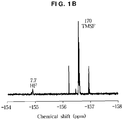
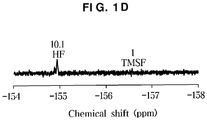
- FIG. 1A shows the result of the 19 F NMR measurement of Comparative Example 1
- FIGS. 1B-1D correspond to 19 F NMR measurement results of Examples 1-3, respectively.
- Examples 1 to 3 of the present invention comprise 1 wt% of the additives of Chemical formulas (1) to (3), and after mixing for 1 hour, 19 F NMR was measured.
- the HF described is a 19 F resonance peak at about -155 ppm, corresponding to the 19 F resonance of HF
- the TMSF described is a 19 F resonance peak at about -156.4 ppm, -156.7 ppm and -157 ppm, corresponding to the 19 F resonance of trimethylsilyl fluoride (TMSF).
- the numerical values described above on the HF and TMSF mean the relative signal intensity for quantitatively comparing HF and TMSF.
- the signal intensity of the 19 F resonance peak of the HF of Examples 1 to 3 was lower than that of the 19 F resonance peak of the HF of Comparative Example 1, and the 19 F resonance peak of TMSF was formed, and it can be confirmed that the additives of Chemical formulas (1) to (3) have an effect of scavenging HF by the following Reaction formulas (2) to (4).
- Example 1 of Examples 1-3 the signal intensity of the 19 F resonance peak of the HF was decreased the most and the HF was scavenged the most, and the signal intensity of the 19 F resonance peak of the TMSF formed by scavenging HF respectively was the greatest. From this, it can be seen that the aminosilane group (Si-N) has a superior HF scavenging effect, and it can be seen that the additive of Chemical formula (1) of Example 1 has a greater HF scavenging effect than the additives of Chemical formulas (2) to (3).
- Examples 4-6 additionally contain the additives of Chemical formulas (1) to (3), there was almost no difference compared to the ionic conductivities of Comparative Examples 1, 2 not containing the additive. The output characteristics of the battery were not degraded.
- the 50th cycle retention rate (%) represents the discharge capacity after 50 cycles of charging and discharging with respect to the initial discharge capacity as a percentage
- the cell resistance represents the resistance as a percentage of the resistance of Comparative Example 1 as a percentage.
- FIG. 2 is a graph showing the discharge capacity according to the number of charging / discharging cycles in each of the Examples and Comparative Examples. The lower the slope of the discharge capacity of each of the Examples and Comparative Examples shown in FIG. 2 is, the more superior the life characteristics because the change in discharge capacity is small in accordance with the number of charging / discharging cycles.
- the abscissa represents the cycle number
- the ordinate represents the discharge capacity (mAh / g).
- Examples 4-6 show that the 50 th cycle retention ratio was superior to the Comparative Examples, and the 50 th cycle cell resistance was also lower than that of the Comparative Examples. From this, it can be seen that the life characteristics of Examples 4-6 are better than the Comparative Examples.
- Comparative Example 2 including VC solely had a better life characteristic than Comparative Example 1, and the 50 th cycle retention ratios of Examples 4-6 including VC and the additives of Chemical formulas (1) to (3) were superior to Comparative Example 2, and the 50 th cycle cell resistance was also lower than that of Comparative Example 2. Therefore, it can be seen that the additives of Chemical formulas (1) to (3) together with VC contribute to the improvement of the life characteristics.
- N in the aminosilane group (N-Si) of the additive of Chemical formula (1) has a non-covalent electron pair, protonation and N-Si may have a relatively low bonding energy so that the additive of Chemical formula (1) may be most excellent in the ability to scavenge the HF among the additives of Chemical formulas (1) to (3).
- the electrolyte for a lithium secondary battery according to the present invention and the lithium secondary battery comprising the same have excellent life characteristics by including the additive.
- the 50 th cycle retention ratio represents the discharge capacity after 50 cycles of charging / discharging with respect to the initial discharge capacity, and is calculated from FIG. 3 .
- FIG. 3 is a graph showing discharge capacities according to the number of charging / discharging cycles in each of the Examples and Comparative Examples. The lower the slope of the discharge capacity of each of the Examples and Comparative Examples shown in FIG. 3 was, the more superior he life characteristics because the change in discharge capacity was small in accordance with the number of charging / discharging cycles.
- the abscissa represents the cycle number and the ordinate represents the discharge capacity (mAh / g).
- Table 5 Sample 50 th Cycle retention ratio (%) Comparative Example 1 78.1 Comparative Example 2 86.2 Example 7 79.7 Example 8 83.5 Example 9 90.2 Example 4 88.1
- Examples 7-9 show that the 50 th cycle retention ratio value increased as the content of the additive of Chemical formula (1) increased. Particularly, in the case of Example 9 containing 3 wt% of the additive of Chemical formula (1) based on the total weight of the electrolyte, the retention ratio was the highest at 90.2%.
- the life characteristics are further improved as the content of the additive is increased, and it is found that when the additive is contained in an amount of 3 wt% based on the total weight of the electrolyte, the life characteristics are most excellent.
- the additives of Chemical formulas (1) to (3) are included together with VC, which has a relatively high reduction decomposition tendency, the effect of improving the life characteristics of the battery by forming SEI films on the surface of the negative electrode is not abated.
- the inclusion of the additives of Chemical formulas (1) to (3) together with VC can further improve the life characteristics of the battery.
- the electrolyte for a lithium secondary battery may improve the life characteristics of the battery by comprising an additive, which may scavenge an acidic substance such as HF or the like produced as a result of decomposition of the electrolyte.
- the additive may prevent an acidic substance from dissolving each electrode film or damaging the active material of the positive electrode.
Landscapes
- Chemical & Material Sciences (AREA)
- Engineering & Computer Science (AREA)
- Manufacturing & Machinery (AREA)
- Chemical Kinetics & Catalysis (AREA)
- Electrochemistry (AREA)
- General Chemical & Material Sciences (AREA)
- Physics & Mathematics (AREA)
- Condensed Matter Physics & Semiconductors (AREA)
- General Physics & Mathematics (AREA)
- Inorganic Chemistry (AREA)
- Materials Engineering (AREA)
- Secondary Cells (AREA)
Abstract

Description
- The present invention relates to an electrolyte for a lithium secondary battery, and a lithium secondary battery comprising the same.
- Technology development and demand for mobile devices have increased, the demand for secondary batteries as energy sources has increased rapidly, and lithium secondary batteries having high energy density and voltage have been widely used among secondary batteries. Generally, a lithium secondary battery includes a negative electrode, a positive electrode, a separator disposed between the electrodes, and an electrolyte, and the electrolyte in which an appropriate amount of a lithium salt is dissolved in an organic solvent is used.
- In the related art, for example, in the currently used secondary battery electrolytes, various side reactions occur due to repeated charging and discharging, and by-products generated by such side reactions are factors that deteriorate the performance of the battery. In particular, when LiPF6 lithium salt is contained in the electrolyte, HF produced by the following series of Reaction formula (1) damages the Solid Electrolyte Interface (SEI) on the surface of the negative electrode and the Cathode Electrolyte Interface (CEI) on the surface of the positive electrode, and it may lead to degradation of the electrodes, which may seriously impair the battery operation.
<Reaction formula (1)> LiPF6 → Li+ + PF6 -
(regular reaction)
LiPF6 → LiF + PF5
(side reaction)
PF5 + H2O → 2HF + POF3
- For instance, HF may deteriorate CEI of positive electrode and SEI of negative electrode and may further cause elution of positive electrode transition metal.
- In preferred aspects, provided is an electrolyte for a lithium secondary battery improved in stability by removing by-products which destroy the SEI film of an electrode, and a lithium secondary battery comprising the same.
- In one aspect, provided is an electrolyte solution for a lithium secondary battery that may include a lithium salt, a solvent component, and an additive. The additive may include one or more of the following compounds.

- In the above compound, R1, R2 and R3 are each independently hydrogen, an alkyl group having 1 to 20 carbon atoms, a cycloalkyl group having 3 to 20 carbon atoms, an aryl group having 6 to 30 carbon atoms, or an arylalkyl group having 6 to 30 carbon atoms.
- Also, the electrolyte may include the additive in an amount of about 0.2 to 3.0 wt% based on the total weight of the electrolyte.
- Preferably, the solvent component may suitably include one or more selected from the group consisting of a carbonate-based, ester-based, ether-based, ketone-based, aprotic solvent and combinations thereof.
- Preferably, the lithium salt may suitably include one or more selected from the group consisting of LiPF6, LiBF4, LiClO4, LiSbF6, LiAsF6, LiN (SO2C2F5)2, LiN (SO3C2F5)2, LiN(SO2F2)2, LiCF3SO3, LiC4F9SO3, LiC6H5SO3, LiSCN, LiAlO2, LiAlCl4, LiN (CxF2x+1SO2) (CyF2y+1SO2) (where x and y are natural numbers), and LiCl, Lil, LiB (C2O4)2.
- Preferably, the electrolyte may further include an amount of about 0.5 to 3.0 wt% of at least one of vinylene carbonate (VC) and fluoroethylene carbonate (FEC) based on the total weight of the electrolyte.
- In another aspect, provided is a lithium secondary battery that may include an electrode including a positive electrode and a negative electrode, a separator between the electrodes, and an electrolyte including a lithium salt, a solvent, and an additive,. Particularly, the additive may include one or more selected from the group consisting of the following compounds.

- In the above compounds, R1, R2 and R3 are each independently hydrogen, an alkyl group having 1 to 20 carbon atoms, a cycloalkyl group having 3 to 20 carbon atoms, an aryl group having 6 to 30 carbon atoms, or an arylalkyl group having 6 to 30 carbon atoms.
- Preferably, the electrolyte may suitably include the additive in an amount of about 0.2 to 3.0 wt%, based on the total weight of the electrolyte.
- Preferably, the solvent component may suitably include one or more selected from the group consisting of carbonate-based, ester-based, ether-based, ketone-based, aprotic solvent and combinations thereof.
- Preferably, the lithium salt may suitably include one or more selected from the group consisting of LiPF6, LiBF4, LiClO4, LiSbF6, LiAsF6, LiN (SO2C2F5)2, LiN (SO3C2F5)2, LiN(SO2F2)2, LiCF3SO3, LiC4F9SO3, LiC6H5SO3, LiSCN, LiAlO2, LiAlCl4, LiN (CxF2x+1SO2) (CyF2y+1SO2) (where x and y are natural numbers), LiCl, LiI, LiB (C2O4)2 and combinations thereof.
- Preferably, the electrolyte further may include an amount of about 0.5 to 3.0 wt% of at least one of vinylene carbonate (VC) and fluoroethylene carbonate (FEC), based on the total weight of the electrolyte.
- In a further aspect, the electrolyte for a lithium secondary battery may consist essentially of, or consist of: and an electrolyte including a lithium salt, a solvent, and an additive. Particularly, the additive may include one or more selected from the group consisting of the following compounds.

- In the above compounds, R1, R2 and R3 are each independently hydrogen, an alkyl group having 1 to 20 carbon atoms, a cycloalkyl group having 3 to 20 carbon atoms, an aryl group having 6 to 30 carbon atoms, or an arylalkyl group having 6 to 30 carbon atoms.
- In a yet further embodiment, the electrolyte for a lithium secondary battery may comprise an electrolyte including a lithium salt, a solvent, where the only additive present in the electrolyte is that can effectively scavenger an acidic substance such as HF in the electrolyte is one or more of the following compounds

- Further provided is a vehicle including the lithium battery as described herein.
- The electrolyte for a lithium secondary battery may improve the life characteristics of the battery by comprising the additive, which can scavenge an acidic substance such as HF or the like produced as a result of decomposition of the electrolyte. The additive may prevent an acidic substance from dissolving each electrode film or damaging the active material of the positive electrode. In addition, the electrolyte may maintain a low resistance value even though an additive is added. Also, according to an embodiment of the present invention, when a carbonate-based solvent is used, the additive component compound may have higher oxidation and reduction decomposition tendency than the solvent so that the CEI of a positive electrode and the SEI of a negative electrode may be formed, and because of this the electrode interface and the electrolyte bulk may be stabilized.
-
-
FIG. 1A is a graph of a 19F NMR measurement result of Comparative Example 1.FIGS. 1B to ID are graphs of 19F NMR measurement results of Examples 1 to 3, respectively, according to exemplary embodiments of the present invention. -
FIG. 2 is a graph showing discharge capacities according to the number of charging and discharging cycles of each of the Inventive and Comparative Examples in which the types of additives are different. -
FIG. 3 is a graph showing the discharge capacities according to the number of charging and discharging cycles of each of the Examples and Comparative Examples in which the additive contents are different. - Hereinafter, preferred embodiments of the present invention will be described. However, the embodiments of the present invention may be modified into various other forms, and the technical idea of the present invention is not limited to the embodiments described below. Further, the embodiments of the present invention are provided to more fully explain the present invention to those skilled in the art.
- The terms used in the present application are used only to illustrate specific examples. Thus, for example, the expression of the singular includes plural expressions unless the context clearly dictates otherwise. In addition, the terms "include" or "have," and the like used in the present application are used to specifically denote the presence of stated features, steps, functions, elements, or combinations thereof and the like, and are not used to preparatorily preclude the presence of elements, steps, functions, components, or combinations thereof.
- Unless defined otherwise, all terms used herein should be interpreted to have the same meaning as commonly understood by one of ordinary skill in the art to which this invention belongs. Thus, unless explicitly defined herein, certain terms should not be construed in an overly ideal or formal sense.
- It should also be understood that the terms "about," "substantially," and the like in the present specification are used in the numerical value or in the vicinity of the numerical value in the meanings mentioned when inherent manufacturing and material allowable errors are presented, and are used to prevent conscienceless intruders from unreasonably using the accurate or absolute numbers, disclosed in the present invention to help understanding of the present invention. For example, "about" can be understood as within 10%, 9%, 8%, 7%, 6%, 5%, 4%, 3%, 2%, 1%, 0.5%, 0.1%, 0.05%, or 0.01% of the stated value. Unless otherwise clear from the context, all numerical values provided herein are modified by the term "about."
- As used herein, the singular forms "a", "an" and "the" are intended to include the plural forms as well, unless the context clearly indicates otherwise. It will be further understood that the terms "comprises" and/or "comprising," when used in this specification, specify the presence of stated features, integers, steps, operations, elements, and/or components, but do not preclude the presence or addition of one or more other features, integers, steps, operations, elements, components, and/or groups thereof. As used herein, the term "and/or" includes any and all combinations of one or more of the associated listed items.
- It is understood that the term "vehicle" or "vehicular" or other similar term as used herein is inclusive of motor vehicles in general such as passenger automobiles including sports utility vehicles (SUV), buses, trucks, various commercial vehicles, watercraft including a variety of boats and ships, aircraft, and the like, and includes hybrid vehicles, electric vehicles, plug-in hybrid electric vehicles, hydrogen-powered vehicles and other alternative fuel vehicles (e.g. fuels derived from resources other than petroleum). As referred to herein, a hybrid vehicle is a vehicle that has two or more sources of power, for example both gasoline-powered and electric-powered vehicles.
- In one aspect, provided is an additive component, or "additive", which may include one or more of the following compounds.

- In the above compound, R1, R2 and R3 are each independently hydrogen, an alkyl group having 1 to 20 carbon atoms, a cycloalkyl group having 3 to 20 carbon atoms, an aryl group having 6 to 30 carbon atoms, or an arylalkyl group having 6 to 30 carbon atoms.
- Also, in the present specification, R1, R2 and R3 in "Chemical formulas (1) to (3)" and "Reaction formulas (2) to (4)" are represented by methyl groups for convenience, and each may be independently interpreted as an alkyl group having 1 to 20 carbon atoms, a cycloalkyl group having 3 to 20 carbon atoms, an aryl group having 6 to 30 carbon atoms, or an arylalkyl group having 6 to 30 carbon atoms. In certain embodiments, the additive may be one or more of the above compounds.
- In order to solve the above-described problems in the related art, for example, producing HF, the present invention provides an electrolyte for a lithium secondary battery, which can remove by-products that break the SEI of an electrode, thereby improving stability, and a lithium secondary battery comprising the same.
- In an aspect, an electrolyte for a lithium secondary battery may include a lithium salt, a solvent component, and an additive including one or more of the following compounds.

- In the above compound, R1, R2 and R3 are each independently hydrogen, an alkyl group having 1 to 20 carbon atoms, a cycloalkyl group having 3 to 20 carbon atoms, an aryl group having 6 to 30 carbon atoms, or an arylalkyl group having 6 to 30 carbon atoms.
- Hereinafter, the constituent elements of the electrolyte of the present invention will be described respectively.
- The lithium salt may include a conventional lithium salt, and is not particularly limited. Preferably, the lithium salt may include one or more selected from the group consisting of LiPF6, LiBF4, LiClO4, LiSbF6, LiAsF6, LiN (SO2C2F5)2, LiN (SO3C2F5)2, LiN(SO2F2)2, LiCF3SO3, LiC4F9SO3, LiC6H5SO3, LiSCN, LiAlO2, LiAlCl4, LiN (CxF2x+1SO2) (CyF2y+1SO2) (where x and y are natural numbers), LiCl, LiI, LiB (C2O4)2 and combinations thereof.
- When a compound having a fluorine atom is used as an inorganic lithium salt, free ions promote SEI formation, and a passive film may be formed on the surface of the electrodes, whereby an increase in internal resistance can be suppressed. Preferably, a phosphorus atom-containing compound as an inorganic lithium salt may be used because it facilitates the release of free fluorine atoms. In certain exemplary embodiments, the lithium salt may include LiPF6.
- However, when the electrolyte contains LiPF6 lithium salt, the HF produced by the following series of reaction formula (1) may deteriorate the SEI film on the electrode surface and induces deterioration of the electrode, which may seriously impair battery operation have.
<Reaction formula (1)> LiPF6 → Li+ + PF6 -
(regular reaction)
LiPF6 → LiF + PF5
(side reaction)
PF5 + H2O → 2HF + POF3
- As such, HF may breakdown CEI of positive electrode and SEI of negative electrode, elution of positive electrode transition metal.
- Preferably, the electrolyte according to exemplary embodiments of the present invention may include an additive component, or additive, that may prevent reactions between the electrolyte and the electrode due to repeated charging and discharging, including the above Reaction formula (1).
- The solvent used in the present invention is not particularly limited as long as it is a conventional solvent. Preferably, the solvent includes one or more selected from the group consisting of carbonate-based, ester-based, ether-based, ketone-based, aprotic solvent and combinations thereof.
- Preferably, the carbonate-based solvent may suitably include dimethyl carbonate (DMC), diethyl carbonate (DEC), dipropyl carbonate (DPC), methylpropyl carbonate (MPC), ethylpropyl carbonte (EPC), ethylmethyl carbonate (EMC), ethylene carbonte (EC), propylene carbonte (PC), butylene carbonate (BC), and the like.
- Preferably, the ester-based solvent may suitably include methyl acetate (MA), ethyl acetate (EA), n-propyl acetate (n-PA), 1,1-dimethylethyl acetate (DMEA), methyl propionate (MP), ethyl propionate (EP), γ-butyrolactone (GBL), decanolide, valerolactone, mevalonolactone, caprolactone, and the like.
- Preferably, the ether-based solvent may include dibutyl ether, tetraethylene glycol dimethyl ether (TEGDME), diethylene glycol dimethyl ether (DEGDME), dimethoxy ethane, 2-methyltetrahydrofuran, tetrahydrofuran, and the like.
- Preferably, the ketone-based solvent may suitably include cyclohexanone, and the like.
- Preferably, the aprotic solvent may suitably nitriles such as R-CN (wherein R is a straight, branched or cyclic hydrocarbon group having 2 to 20 carbon atoms, which may contain a double bond aromatic ring or an ether bond) or the like, amides such as dimethylformamide (DMF) or the like, dioxolanes such as 1,3-dioxolane or the like, and sulfolanes or the like.
- The above-mentioned solvents may be used alone or in combination, and when mixed and used, the mixing ratio may be suitably adjusted according to the performance of the desired cell. Although the solvent of the present invention has been exemplified above, the present invention is not limited thereto and can be appropriately designed and changed by those skilled in the art.
- In certain embodiments, the solvent component ma include a carbonate-based solvent which may be selected from ethylene carbonate (EC), ethyl methyl carbonate (EMC), dimethyl carbonate (DMC), diethyl carbonate (DEC), and combinations thereof.
- In the present invention, the additive may be included in the electrolyte for preventing the acidic substance (for example, HF or the like), which may beproduced as a result of the decomposition of the electrolyte, from dissolving each electrode coating or damaging the active material of the positive electrode.
- The additive may include one or more of the following compounds.

- In the above compound, R1, R2 and R3 are each independently hydrogen, an alkyl group having 1 to 20 carbon atoms, a cycloalkyl group having 3 to 20 carbon atoms, an aryl group having 6 to 30 carbon atoms, or an arylalkyl group having 6 to 30 carbon atoms.
- Hereinafter, the process of scavenging the acidic substance of each additive represented by the above compound will be described with reference to Reaction formulas (2) to (4). In the Reaction formulas (2) to (4), the acidic substance is represented by HF, but it can be interpreted that various acidic substances resulting from the decomposition of the electrolyte due to charging and discharging are removed by the above reaction formula as well as HF.


- In the above Reaction formula (2), HF may be removed by the additive represented by the above Chemical formula (1). For instance, the additive having Chemical formula (1) may include an aminosilane group (N-Si), and N in N-Si has a non-covalent electron pair, which is advantageous for protonation. Accordingly, the additive of Chemical formula (1) can remove HF by Reaction formula (2), and as a result of the reaction, trimethylsilyl fluoride(TMSF) may be formed.


- In the above Reaction formula (3), HF may be removed by the additive represented by the above Chemical formula (2). The additive of Chemical formula (2) may include a silyl ether group (O-Si), where O in O-Si has a non-covalent electron pair, which is advantageous for protonation. Accordingly, the additive of Chemical formula (2) can remove HF by Reaction formula (3) and form trimethylsilyl fluoride as a result of the reaction.

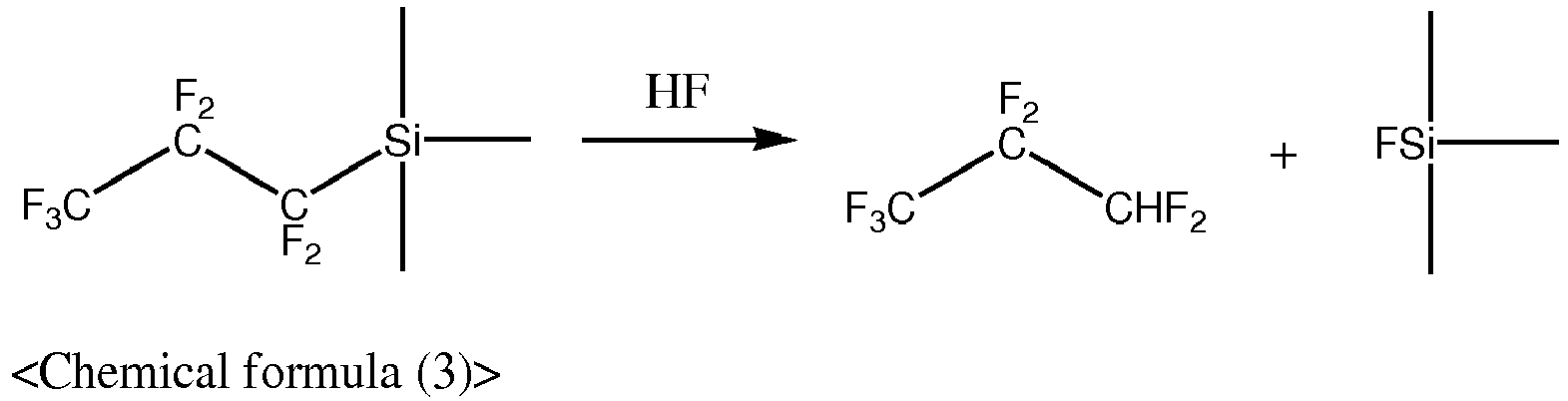

- In the above Reaction formula (4), HF is removed by the additive represented by the above Chemical formula (3). The additive of Chemical formula (3) contains a trimethylsilyl group, and the bond energy (about 318 kJ/mol) of C-Si is relatively small in Chemical formula (3). Accordingly, the additive of Chemical formula (3) can remove HF by the reaction of the above Reaction formula (4) and form trimethylsilyl fluoride as a result of the reaction.
- Preferably, the additive of Chemical formula (1) may be used in the effect of scavenging HF from the additives of the above Chemical formulas (1) to (3). In the aminosilane group (N-Si) contained in the additive of Chemical formula (1), N may have a non-covalent electron pair, so that the protonation is advantageous. Further, the bonding energy of the aminosilane group (N-Si) (N-Si: 355 kJ/mol, O-Si: 452 kJ/mol) may be less than the bonding energy of the silyl ether group (O-Si) of Chemical formula (3). The additive of Chemical formula (1) may be most advantageous in scavenging HF from the additives of Chemical formulas (1) to (3) because the protonation is advantageous as described above and the binding energy is relatively small.
- Further, the additive of the present invention may have a greater oxidation or reduction decomposition tendency than the carbonate-based solvent, so that the additive component compound can form CEI of the positive electrode or SEI of the negative electrode, thereby stabilizing the electrode interface and electrolyte bulk.
- A shown in Tables 1 and 2 below, LUMO energies of the additives of Chemical formulas (1) to (3) are -0.509 eV, -3.398 eV, and -0.531 eV, respectively, and LUMO energies of carbonate solvents EMC, DMC and DEC are -0.3310 eV, 0.0435 eV, 0.0479 eV and 0.0454 eV, respectively. Accordingly, the additive of Chemical formulas (1) to (3) may have greater reduction decomposition tendency than the carbonate-based solvent, so that when the battery is driven, the additives of Chemical formulas (1) to (3) can be reduced and decomposed earlier than the carbonate-based solvent to form SEI on the surface of the negative electrode.
- The HOMO energy of the additive of Chemical formula (1) is -7.036 eV, and the HOMO energies of the carbonate solvents EC, EMC, DMC, and DEC are -8.628 eV, -8.1223 eV, -8.2108 eV, and -8.0391 eV, respectively. Accordingly, the additive of Chemical formula (1) may have greater oxidation decomposition tendency than the carbonate-based solvent, so that when the battery is driven, the additive of Chemical formula (1) can be oxidized and decomposed earlier than the carbonate-based solvent to form CEI on the surface of the positive electrode.
- Accordingly, the carbonate-based solvents (EC, EMC, DMC, DEC) may be preferably used as a solvent in combination with the additives of the present invention to stabilize the electrode interface and the electrolyte bulk.
- Further, in order to stabilize the electrode interface and the electrolyte bulk, the electrolyte may suitably include the additive of Chemical formula (1) capable of forming the positive electrode CEI and the negative electrode SEI.
Table 1 Solvent component LUMO energy(eV) HOMO energy(eV) EC -0.3310 -8.628 EMC 0.0435 -8.1223 DMC 0.0479 -8.2108 DEC 0.0454 -8.0391 Table 2 Additive component LUMO energy(eV) HOMO energy (eV) <Chemical formula (1)> -0.509 -7.036 
<Chemical formula (2)> -3.398 -9.175 
<Chemical formula (3)> -0.531 -9.139 
- As described above, the additive of Chemical formula (1) may sufficiently remove HF because the protonation is advantageous and the bonding energy is relatively small. In addition, the additive of Chemical formula (1) may have greater oxidation and reduction decomposing tendency than carbonate-based solvents, so that when the battery is driven, it can stabilize the electrode interface and the electrolyte bulk by forming the positive electrode CEI and the negative electrode SEI. Preferably, the additive of the present invention may be the compound of Chemical formula (1).
- Preferably, the additive may be suitably included in the electrolyte in an amount of about 0.2 to 3.0 wt% based on the total weight of the electrolyte. When the content of the additive is less than about 0.2 wt%, the acidic substance (for example, HF or the like) may not be sufficiently removed, and when the content is greater than about 3.0 wt%, the ionic conductivity may be decreased. Accordingly, the electrolyte may include the additive in an amount of about 0.2 to 3.0 wt% based on the total weight of the electrolyte.
- An electrolyte may include a lithium salt, a solvent and an additive including at least one of the following compounds.

- The additive may include one or more of the following compounds,

- The additive may be one or more of the following compounds,

- In the above compounds, R1, R2 and R3 are each independently hydrogen, an alkyl group having 1 to 20 carbon atoms, a cycloalkyl group having 3 to 20 carbon atoms, an aryl group having 6 to 30 carbon atoms, or an arylalkyl group having 6 to 30 carbon atoms.
- Preferably, thee electrolyte may further include an amount of about 0.5 to 3.0 wt% of at least one of vinylene carbonate (VC) and fluoroethylene carbonate (FEC) as a negative electrode functional additive, based on the total weight of the electrolyte. The vinylene carbonate (VC) and fluoroethylene carbonate (FEC) have lower LUMO energy than ethylene carbonate (EC), which is mainly used as a co-solvent((EC: -0.3310 eV, VC: -0.8819 eV, FEC: -0.8444 eV, DFT calculation). The vinylene carbonate (VC) and fluoroethylene carbonate (FEC) have greater reduction decomposition tendency than the ethylene carbonate (EC), so that when the lithium secondary battery is driven, the vinylene carbonate (VC) and fluoroethylene carbonate (FEC) can be reduced and decomposed earlier than the ethylene carbonate (EC) to form SEI on the surface of the negative electrode.
- For instance, when the content of the negative electrode functional additive is less than about 0.5 wt%, the SEI film may not be formed sufficiently on the surface of the negative electrode. When the content of the negative functional additive is greater than about 3.0 wt%, the ionic conductivity may be reduced which is not preferable.
- The electrolyte may include an additive, which may scavenge an acidic substance such as HF or the like generated as a result of decomposition of the electrolyte. The additive may prevent an acidic substance from dissolving each electrode film or damaging the active material of the positive electrode. As consequence, the lifetime characteristics of the battery may be increased and a low resistance value may be maintained even though the additive is added.
- For instance, when a carbonate-based solvent (EC, EMC, DMC, DEC) is used as a solvent for the electrolyte, the additive component compound may have a greater oxidation and reduction decomposition tendency than the solvent, which can stabilize the electrode interface and electrolyte bulk.
- A lithium secondary battery may include an electrode including a positive electrode and a negative electrode, a separator between the electrodes, and an electrolyte including a lithium salt, a solvent and an additive including at least one selected from the group consisting of the following compounds.

- In the above compound, R1, R2 and R3 are each independently hydrogen, an alkyl group having 1 to 20 carbon atoms, a cycloalkyl group having 3 to 20 carbon atoms, an aryl group having 6 to 30 carbon atoms, or an arylalkyl group having 6 to 30 carbon atoms.
- The description of the electrolyte containing the lithium salt, the solvent, and the additive is the same as described above and will be omitted. Further, the electrodes including the positive electrode and the negative electrode, and the separator between the electrodes are not particularly limited, and it is sufficient that the electrolyte according to the present invention is included, and it is a constitution that can be appropriately designed and changed by a person skilled in the art.
- Hereinafter, the present invention will be described more specifically by way of examples. It should be noted, however, that the following examples are intended to illustrate the invention in more detail and not to limit the scope of the invention. The scope of the present invention is determined by the matters set forth in the claims and the matters reasonably inferred therefrom.
- Hereinafter, the manufacturing process of each of the comparative examples and examples will be briefly described, and then the performance of the lithium secondary battery including the electrolyte of the comparative examples and examples will be evaluated.
- A mixed solvent was prepared in a volume ratio of 5:6:9 using ethylene carbonate (EC), diethyl carbonate (DEC), and ethyl methyl carbonate (EMC) as solvents of the electrolyte, and 1M LiPF6 was dissolved to prepare an electrolyte. Coin cells were prepared with LiNi0.8Co0.1Mn0.1O2 as the positive electrode and graphite-SiC-Si alloy as the negative electrode together with the electrolyte prepared above.
- Comparative Example 2 was prepared under the same conditions as in Comparative Example 1, except that 1 wt% of vinylene carbonate (VC) based on the total weight of the electrolyte was further added in the electrolyte.
- Example 1 was prepared under the same conditions as in Comparative Example 1, except that the electrolyte further contained an additive of the following Chemical formula (1).


- Example 2 was prepared under the same conditions as in Comparative Example 1, except that the electrolyte further contained an additive of the following Chemical formula (2).

- Example 3 was prepared under the same conditions as in Comparative Example 1, except that the electrolyte further contained an additive of the following Chemical formula (3).

- Example 4 was prepared under the same conditions as in Comparative Example 2, except that the electrolyte further contained 0.5 wt% of the additive of Chemical formula (1) based on the total weight of the electrolyte.
- Example 5 was prepared under the same conditions as in Comparative Example 2, except that the electrolyte further contained 0.5 wt% of the additive of Chemical formula (2) based on the total weight of the electrolyte.
- Example 6 was prepared under the same conditions as in Comparative Example 3, except that the electrolyte further contained 0.5 wt% of the additive of Chemical formula (3) based on the total weight of the electrolyte.
- Examples 7-9 were prepared under the same conditions as in Comparative Example 1, except that the electrolyte further contained 0.5 wt%, 1 wt%, and 3 wt% of the additive of Chemical formula (1), respectively, based on the total weight of the electrolyte.
- Hereinafter, the performance of the lithium secondary battery of each of the examples and comparative examples will be evaluated.
- To analyze the HF scavenging effect, the HF content was measured by 19F NMR (nuclear magnetic resonance) measurement.
FIG. 1A shows the result of the 19F NMR measurement of Comparative Example 1, andFIGS. 1B-1D correspond to 19F NMR measurement results of Examples 1-3, respectively. Examples 1 to 3 of the present invention comprise 1 wt% of the additives of Chemical formulas (1) to (3), and after mixing for 1 hour, 19F NMR was measured. - In
FIGS. 1A to ID, the HF described is a 19F resonance peak at about -155 ppm, corresponding to the 19F resonance of HF, and the TMSF described is a 19F resonance peak at about -156.4 ppm, -156.7 ppm and -157 ppm, corresponding to the 19F resonance of trimethylsilyl fluoride (TMSF). In addition, the numerical values described above on the HF and TMSF mean the relative signal intensity for quantitatively comparing HF and TMSF. - As shown in
FIGS. 1A-1D , the signal intensity of the 19F resonance peak of the HF of Examples 1 to 3 was lower than that of the 19F resonance peak of the HF of Comparative Example 1, and the 19F resonance peak of TMSF was formed, and it can be confirmed that the additives of Chemical formulas (1) to (3) have an effect of scavenging HF by the following Reaction formulas (2) to (4).


- Also, in the case of Example 1 of Examples 1-3, the signal intensity of the 19F resonance peak of the HF was decreased the most and the HF was scavenged the most, and the signal intensity of the 19F resonance peak of the TMSF formed by scavenging HF respectively was the greatest. From this, it can be seen that the aminosilane group (Si-N) has a superior HF scavenging effect, and it can be seen that the additive of Chemical formula (1) of Example 1 has a greater HF scavenging effect than the additives of Chemical formulas (2) to (3).
- The results of measurement of ionic conductivity are shown in Table 3 below.
Table 3 Sample Ionic conductivity (mS/cm) Comparative Example 1 7.34 Comparative Example 2 7.42 Example 4 7.6 Example 5 7.0 Example 6 7.11 - As shown in Table 3, although Examples 4-6 additionally contain the additives of Chemical formulas (1) to (3), there was almost no difference compared to the ionic conductivities of Comparative Examples 1, 2 not containing the additive. The output characteristics of the battery were not degraded.
- The charging and discharging results of each of the Examples and Comparative Examples are shown in Table 4 and
FIG. 2 below. - In Table 4, the 50th cycle retention rate (%) represents the discharge capacity after 50 cycles of charging and discharging with respect to the initial discharge capacity as a percentage, and the cell resistance represents the resistance as a percentage of the resistance of Comparative Example 1 as a percentage.
-
FIG. 2 is a graph showing the discharge capacity according to the number of charging / discharging cycles in each of the Examples and Comparative Examples. The lower the slope of the discharge capacity of each of the Examples and Comparative Examples shown inFIG. 2 is, the more superior the life characteristics because the change in discharge capacity is small in accordance with the number of charging / discharging cycles. InFIG. 2 , the abscissa represents the cycle number, and the ordinate represents the discharge capacity (mAh / g).Table 4 Sample Charge capacity (mAh/g) Discharge capacity (mAh/g) Charging/discharging efficiency (%) 50th Cycle retention ratio (%) Initial cell resistance (%) 50th Cycle cell resistance (%) Comparative Example 1 225 194 86.2 83.6 100 100 Comparative Example 2 228 199 87.4 84.5 106.2 76.2 Example 4 230 198 86.2 88.1 93.8 68.0 Example 5 229 200 87.5 84.9 93.8 75.4 Example 6 231 202 87.3 86.2 92.3 68.0 - As shown in Table 4, Examples 4-6 show that the 50th cycle retention ratio was superior to the Comparative Examples, and the 50th cycle cell resistance was also lower than that of the Comparative Examples. From this, it can be seen that the life characteristics of Examples 4-6 are better than the Comparative Examples.
- Particularly, Comparative Example 2 including VC solely had a better life characteristic than Comparative Example 1, and the 50th cycle retention ratios of Examples 4-6 including VC and the additives of Chemical formulas (1) to (3) were superior to Comparative Example 2, and the 50th cycle cell resistance was also lower than that of Comparative Example 2. Therefore, it can be seen that the additives of Chemical formulas (1) to (3) together with VC contribute to the improvement of the life characteristics.
- Also, as shown in
FIG. 2 , the slopes of the discharge capacity according to the number of cycles of Examples 4 to 6 were less than those of the Comparative Examples, and the changes in discharge capacity according to the number of cycles were small. Accordingly, it is visually confirmed that the life characteristics of the Examples are improved from those of the Comparative Examples. - The retention rate of the 50th cycle among Examples 4-6 was 88.1% for Example 4, which is the largest, indicating that the life characteristics of the Example 4 battery were the most excellent. Because N in the aminosilane group (N-Si) of the additive of Chemical formula (1) has a non-covalent electron pair, protonation and N-Si may have a relatively low bonding energy so that the additive of Chemical formula (1) may be most excellent in the ability to scavenge the HF among the additives of Chemical formulas (1) to (3).
- From the above results, it can be seen that the electrolyte for a lithium secondary battery according to the present invention and the lithium secondary battery comprising the same have excellent life characteristics by including the additive.
- The results of charging and discharging with different additive contents are shown in Table 5 and
FIG. 3 below. In Table 5, the 50th cycle retention ratio (%) represents the discharge capacity after 50 cycles of charging / discharging with respect to the initial discharge capacity, and is calculated fromFIG. 3 . -
FIG. 3 is a graph showing discharge capacities according to the number of charging / discharging cycles in each of the Examples and Comparative Examples. The lower the slope of the discharge capacity of each of the Examples and Comparative Examples shown inFIG. 3 was, the more superior he life characteristics because the change in discharge capacity was small in accordance with the number of charging / discharging cycles. InFIG. 3 , the abscissa represents the cycle number and the ordinate represents the discharge capacity (mAh / g).Table 5 Sample 50th Cycle retention ratio (%) Comparative Example 1 78.1 Comparative Example 2 86.2 Example 7 79.7 Example 8 83.5 Example 9 90.2 Example 4 88.1 - As shown in Table 5, Examples 7-9 show that the 50th cycle retention ratio value increased as the content of the additive of Chemical formula (1) increased. Particularly, in the case of Example 9 containing 3 wt% of the additive of Chemical formula (1) based on the total weight of the electrolyte, the retention ratio was the highest at 90.2%.
- From this, it can be seen that the life characteristics are further improved as the content of the additive is increased, and it is found that when the additive is contained in an amount of 3 wt% based on the total weight of the electrolyte, the life characteristics are most excellent.
- Meanwhile, comparing Comparative Example 2 and Example 4, it is found that the 50th cycle retention ratio value of Example 4, which included both 1 wt% of VC and 0.5 wt% of the additive of Chemical formula (1) based on the total weight of the electrolyte, was higher than that of Comparative Example 2, which included 1 wt% of VC alone. Therefore, it can be seen that the inclusion of the VC and the additive of Chemical formula (1) together can further improve the life characteristics.
- Accordingly, even when the additives of Chemical formulas (1) to (3) are included together with VC, which has a relatively high reduction decomposition tendency, the effect of improving the life characteristics of the battery by forming SEI films on the surface of the negative electrode is not abated. In the present invention, it can be seen preferable that the inclusion of the additives of Chemical formulas (1) to (3) together with VC can further improve the life characteristics of the battery.
- As described above, the electrolyte for a lithium secondary battery according to various exemplary embodiments of the present invention may improve the life characteristics of the battery by comprising an additive, which may scavenge an acidic substance such as HF or the like produced as a result of decomposition of the electrolyte. The additive may prevent an acidic substance from dissolving each electrode film or damaging the active material of the positive electrode.
- The exemplary embodiments disclosed with reference to the accompanying drawings and tables have been described above. It will be understood by those of ordinary skill in the art that various changes in form and details may be made therein without departing from the spirit and scope of the present invention as defined by the following claims. The disclosed embodiments are illustrative and should not be construed as limiting.
Claims (11)
- An electrolyte for a lithium secondary battery comprising:a lithium salt;a solvent component; andan additive comprising one or more of following compounds,

- The electrolyte according to claim 1, wherein the electrolyte comprises the additive in an amount of about 0.2 to 3.0 wt%, based on the total weight of the electrolyte.
- The electrolyte according to claim 1 or 2, wherein the solvent component comprises one or more selected from the group consisting of carbonate-based, ester-based, ether-based, ketone-based, aprotic solvent and combinations thereof.
- The electrolyte according to one of claims 1-3, wherein the lithium salt comprises one or more selected from the group consisting of LiPF6, LiBF4, LiClO4, LiSbF6, LiAsF6, LiN (SO2C2F5)2, LiN (SO3C2F5)2, LiN(SO2F2)2, LiCF3SO3, LiC4F9SO3, LiC6H5SO3, LiSCN, LiAlO2, LiAlCl4, LiN (CxF2x+1SO2) (CyF2y+1SO2) (where x and y are natural numbers), LiCl, LiI, LiB (C2O4)2 and combinations thereof.
- The electrolyte according to one of claims 1-4, wherein the electrolyte further comprises an amount of about 0.5 to 3.0 wt% of at least one of vinylene carbonate (VC) and fluoroethylene carbonate (FEC), based on the total weight of the electrolyte.
- A lithium battery comprising:an electrode including a positive electrode and a negative electrode;a separator between the electrodes; andan electrolyte containing a lithium salt, a solvent component and an additive comprising one or more selected from the group consisting of the following compounds

- The lithium battery according to claim 6, wherein the electrolyte comprises the additive in an amount of about 0.2 to 3.0 wt%, based on the total weight of the electrolyte.
- The lithium battery according to claim 6 or 7, wherein the solvent component comprises one or more selected from the group consisting of carbonate-based, ester-based, ether-based, ketone-based, aprotic solvent and combinations thereof.
- The lithium battery according to one of claims 6-8, wherein the lithium salt comprises one or more selected from the group consisting of LiPF6, LiBF4, LiClO4, LiSbF6, LiAsF6, LiN (SO2C2F5)2, LiN (SO3C2F5)2, LiN(SO2F2)2, LiCF3SO3, LiC4F9SO3, LiC6H5SO3, LiSCN, LiAlO2, LiAlCl4, LiN (CxF2x+1SO2) (CyF2y+1SO2) (where x and y are natural numbers), LiCl, LiI, LiB (C2O4)2 and combinations thereof.
- The lithium battery according to one of claims 6-9, wherein the electrolyte further comprises an amount of about 0.5 to 3.0 wt% of at least one of vinylene carbonate (VC) and fluoroethylene carbonate (FEC), based on the total weight of the electrolyte.
- A vehicle comprising a lithium battery according to one of claims 6-10.
Applications Claiming Priority (1)
| Application Number | Priority Date | Filing Date | Title |
|---|---|---|---|
| KR1020190008614A KR102762339B1 (en) | 2019-01-23 | 2019-01-23 | Electrolyte for Lithium Secondary Battery, Lithium Secondary Battery Containing the same |
Publications (2)
| Publication Number | Publication Date |
|---|---|
| EP3686981A1 true EP3686981A1 (en) | 2020-07-29 |
| EP3686981B1 EP3686981B1 (en) | 2023-05-10 |
Family
ID=66542105
Family Applications (1)
| Application Number | Title | Priority Date | Filing Date |
|---|---|---|---|
| EP19174332.7A Active EP3686981B1 (en) | 2019-01-23 | 2019-05-14 | Electrolyte for lithium secondary battery and lithium secondary battery containing the same |
Country Status (4)
| Country | Link |
|---|---|
| US (1) | US11145902B2 (en) |
| EP (1) | EP3686981B1 (en) |
| KR (1) | KR102762339B1 (en) |
| CN (1) | CN111477955B (en) |
Families Citing this family (7)
| Publication number | Priority date | Publication date | Assignee | Title |
|---|---|---|---|---|
| KR102283808B1 (en) | 2020-12-22 | 2021-08-02 | 주식회사 켐얼라이언스 | Electrolyte additive for secondary battery, manufacturing method thereof, electrolyte, and secondary battery including the same |
| KR102726732B1 (en) | 2021-10-21 | 2024-11-07 | 주식회사 에스켐 | Electrolyte for secondary battery, manufacturing method thereof, and secondary battery comprising same |
| CN114335720B (en) * | 2021-12-02 | 2024-08-27 | 湖南钠方新能源科技有限责任公司 | An electrolyte additive, an electrolyte and a sodium ion battery comprising the electrolyte |
| EP4712191A1 (en) * | 2023-05-11 | 2026-03-18 | SFC Co., Ltd. | Compound for electrolyte, compound for electrolyte additive, electrolyte material, electrolyte additive, electrolyte for secondary battery, and secondary battery |
| KR20240164456A (en) * | 2023-05-11 | 2024-11-19 | 주식회사 렉쎌 | Compound for electrolyte, compound for electrolyte additive, electrolyte material, electrolyte additive, electrolyte for secondary battery and secondary battery |
| CN117069624B (en) * | 2023-08-18 | 2026-03-06 | 合肥国轩高科动力能源有限公司 | Preparation methods of fluorosulfonyl carboxylic acid esters, the esters prepared from them, and the uses of the esters. |
| CN118919848B (en) * | 2024-07-26 | 2025-09-26 | 合肥国轩高科动力能源有限公司 | Sodium ion battery electrolyte additive, electrolyte and sodium ion battery |
Citations (4)
| Publication number | Priority date | Publication date | Assignee | Title |
|---|---|---|---|---|
| EP1195785A1 (en) * | 1999-06-04 | 2002-04-10 | Mitsui Chemicals, Inc. | Nonaqueous electrolytic solution, electrode, and capacitor containing the same |
| US20120107728A1 (en) * | 2010-10-29 | 2012-05-03 | Samsung Electronics Co., Ltd. | Non-aqueous electrolyte and lithium air battery including the same |
| KR20150024478A (en) * | 2013-08-26 | 2015-03-09 | 파낙스 이텍(주) | Non-aqueous electrolyte for Secondary Batteries and Secondary Batteries containing the same |
| EP3051619A1 (en) * | 2013-09-25 | 2016-08-03 | Mitsui Chemicals, Inc. | Nonaqueous electrolyte solution for batteries and lithium secondary battery |
Family Cites Families (14)
| Publication number | Priority date | Publication date | Assignee | Title |
|---|---|---|---|---|
| US8273484B2 (en) * | 2005-05-26 | 2012-09-25 | Novolyte Technologies, Inc. | Nitrogen silylated compounds as additives in non-aqueous solutions for electrochemical cells |
| JP4948030B2 (en) * | 2006-04-27 | 2012-06-06 | 国立大学法人 名古屋工業大学 | Method for producing fluorine-containing alcohol derivative |
| JP4379743B2 (en) * | 2006-12-08 | 2009-12-09 | ソニー株式会社 | Electrolyte and secondary battery |
| US9105943B2 (en) | 2007-09-12 | 2015-08-11 | Lg Chem, Ltd. | Non-aqueous electrolyte lithium secondary battery |
| JP2009132593A (en) * | 2007-10-30 | 2009-06-18 | Sumitomo Chemical Co Ltd | Carbon material and electrode having the carbon material |
| EA201171167A1 (en) * | 2009-04-29 | 2012-06-29 | Кова Компани, Лтд. | CARBINOL COMPOUND CONTAINING A HETEROCYCLIC LINKER |
| EP2573854B1 (en) * | 2010-05-21 | 2017-01-04 | Mitsui Chemicals, Inc. | Non-aqueous electrolyte solution containing silyl ester group-containing phosphonic acid derivative, and lithium secondary battery |
| JP5781294B2 (en) * | 2010-11-16 | 2015-09-16 | 株式会社Adeka | Non-aqueous electrolyte secondary battery |
| KR101349750B1 (en) * | 2010-11-26 | 2014-01-10 | 솔브레인 주식회사 | Electrolyte additive, electrolyte including the same and lithiumsecondary battery including the electrolyte |
| JP2013145702A (en) * | 2012-01-16 | 2013-07-25 | Adeka Corp | Nonaqueous electrolyte secondary battery, and nonaqueous electrolyte for secondary battery |
| KR20150011234A (en) * | 2013-07-22 | 2015-01-30 | 삼성에스디아이 주식회사 | Electrolyte for lithium secondary battery and lithium secondary battery employing the same |
| KR102411933B1 (en) * | 2015-03-12 | 2022-06-22 | 삼성에스디아이 주식회사 | Organic electrolytic solution and Lithium battery comprising organic electrolyte solution |
| JP2017168347A (en) * | 2016-03-17 | 2017-09-21 | 富山薬品工業株式会社 | Nonaqueous electrolyte solution for power storage device |
| CN105845980B (en) * | 2016-03-30 | 2020-05-05 | 宁德时代新能源科技股份有限公司 | Electrolyte and lithium ion battery containing same |
-
2019
- 2019-01-23 KR KR1020190008614A patent/KR102762339B1/en active Active
- 2019-05-14 EP EP19174332.7A patent/EP3686981B1/en active Active
- 2019-05-20 US US16/416,863 patent/US11145902B2/en active Active
- 2019-06-06 CN CN201910490662.4A patent/CN111477955B/en active Active
Patent Citations (4)
| Publication number | Priority date | Publication date | Assignee | Title |
|---|---|---|---|---|
| EP1195785A1 (en) * | 1999-06-04 | 2002-04-10 | Mitsui Chemicals, Inc. | Nonaqueous electrolytic solution, electrode, and capacitor containing the same |
| US20120107728A1 (en) * | 2010-10-29 | 2012-05-03 | Samsung Electronics Co., Ltd. | Non-aqueous electrolyte and lithium air battery including the same |
| KR20150024478A (en) * | 2013-08-26 | 2015-03-09 | 파낙스 이텍(주) | Non-aqueous electrolyte for Secondary Batteries and Secondary Batteries containing the same |
| EP3051619A1 (en) * | 2013-09-25 | 2016-08-03 | Mitsui Chemicals, Inc. | Nonaqueous electrolyte solution for batteries and lithium secondary battery |
Also Published As
| Publication number | Publication date |
|---|---|
| KR20200091628A (en) | 2020-07-31 |
| US11145902B2 (en) | 2021-10-12 |
| CN111477955B (en) | 2023-01-31 |
| US20200235431A1 (en) | 2020-07-23 |
| KR102762339B1 (en) | 2025-02-05 |
| EP3686981B1 (en) | 2023-05-10 |
| CN111477955A (en) | 2020-07-31 |
Similar Documents
| Publication | Publication Date | Title |
|---|---|---|
| EP3686981B1 (en) | Electrolyte for lithium secondary battery and lithium secondary battery containing the same | |
| EP3879617B1 (en) | Electrolyte for lithium secondary battery, and lithium secondary battery including the same | |
| EP2262047B1 (en) | Non-aqueous electrolyte battery | |
| EP3605710B1 (en) | Non-aqueous electrolyte for lithium secondary battery and lithium secondary battery comprising the same | |
| EP3512028B1 (en) | Electrolyte additive and non-aqueous electrolyte solution for lithium secondary battery containing the same | |
| EP2312685B1 (en) | Lithium secondary battery comprising a non-aqueous electrolytic solution, method for producing the same, and mixed non-aqueous electrolytic solution | |
| EP3944392A1 (en) | Non-aqueous electrolyte for lithium secondary battery and lithium secondary battery comprising same | |
| KR101702406B1 (en) | Lithium rechargeable battery | |
| US20030129498A1 (en) | Electrolyte system and energy storage device using same | |
| EP3605708B1 (en) | Non-aqueous electrolyte solution for lithium secondary battery and lithium secondary battery including the same | |
| KR20200018258A (en) | Electrolyte Solution for Secondary Battery and Secondary Battery Comprising the Same | |
| CN113711413B (en) | Electrolyte for lithium secondary battery and lithium secondary battery containing same | |
| US20180198163A1 (en) | Non-aqueous electrolytes for lithium-ion batteries comprising an isocyanide | |
| EP4303980A1 (en) | Electrolyte solution for secondary battery, and secondary battery comprising same | |
| EP3896772A1 (en) | Non-aqueous electrolyte for battery and lithium secondary battery | |
| EP2908375B1 (en) | Lithium secondary battery | |
| EP3890090B1 (en) | Electrolyte for lithium secondary battery and lithium secondary battery including the same | |
| EP3883037B1 (en) | Electrolyte for lithium secondary battery and lithium secondary battery including the same | |
| EP3046176B1 (en) | Non-aqueous electrolyte solution and lithium secondary battery including the same | |
| US20200373618A1 (en) | Electrolyte for lithium secondary battery, lithium secondary battery containing the same | |
| EP3893311A1 (en) | Non-aqueous electrolyte additive, and non-aqueous electrolyte for lithium secondary battery and lithium secondary battery including same | |
| KR100585947B1 (en) | Non-aqueous electrolyte for battery | |
| EP1739784B1 (en) | Non-aqueous electrolyte solution for battery and non-aqueous electrolyte battery using the same | |
| CN111354977A (en) | Lithium ion battery electrolyte, preparation method thereof and lithium battery comprising lithium ion battery electrolyte | |
| EP4068456A1 (en) | Non-aqueous electrolyte for lithium secondary battery and lithium secondary battery comprising same |
Legal Events
| Date | Code | Title | Description |
|---|---|---|---|
| PUAI | Public reference made under article 153(3) epc to a published international application that has entered the european phase |
Free format text: ORIGINAL CODE: 0009012 |
|
| STAA | Information on the status of an ep patent application or granted ep patent |
Free format text: STATUS: THE APPLICATION HAS BEEN PUBLISHED |
|
| AK | Designated contracting states |
Kind code of ref document: A1 Designated state(s): AL AT BE BG CH CY CZ DE DK EE ES FI FR GB GR HR HU IE IS IT LI LT LU LV MC MK MT NL NO PL PT RO RS SE SI SK SM TR |
|
| AX | Request for extension of the european patent |
Extension state: BA ME |
|
| STAA | Information on the status of an ep patent application or granted ep patent |
Free format text: STATUS: REQUEST FOR EXAMINATION WAS MADE |
|
| 17P | Request for examination filed |
Effective date: 20201202 |
|
| RBV | Designated contracting states (corrected) |
Designated state(s): AL AT BE BG CH CY CZ DE DK EE ES FI FR GB GR HR HU IE IS IT LI LT LU LV MC MK MT NL NO PL PT RO RS SE SI SK SM TR |
|
| RAP3 | Party data changed (applicant data changed or rights of an application transferred) |
Owner name: HYUNDAI MOTOR COMPANY Owner name: KIA CORPORATION Owner name: UNIST (ULSAN NATIONAL INSTITUTE OF SCIENCE AND TECHNOLOGY) |
|
| RIC1 | Information provided on ipc code assigned before grant |
Ipc: H01M 10/0568 20100101ALN20221201BHEP Ipc: H01M 10/0567 20100101ALI20221201BHEP Ipc: H01M 10/0525 20100101AFI20221201BHEP |
|
| GRAP | Despatch of communication of intention to grant a patent |
Free format text: ORIGINAL CODE: EPIDOSNIGR1 |
|
| STAA | Information on the status of an ep patent application or granted ep patent |
Free format text: STATUS: GRANT OF PATENT IS INTENDED |
|
| RIC1 | Information provided on ipc code assigned before grant |
Ipc: H01M 10/0568 20100101ALN20221212BHEP Ipc: H01M 10/0567 20100101ALI20221212BHEP Ipc: H01M 10/0525 20100101AFI20221212BHEP |
|
| INTG | Intention to grant announced |
Effective date: 20230109 |
|
| GRAS | Grant fee paid |
Free format text: ORIGINAL CODE: EPIDOSNIGR3 |
|
| GRAA | (expected) grant |
Free format text: ORIGINAL CODE: 0009210 |
|
| STAA | Information on the status of an ep patent application or granted ep patent |
Free format text: STATUS: THE PATENT HAS BEEN GRANTED |
|
| AK | Designated contracting states |
Kind code of ref document: B1 Designated state(s): AL AT BE BG CH CY CZ DE DK EE ES FI FR GB GR HR HU IE IS IT LI LT LU LV MC MK MT NL NO PL PT RO RS SE SI SK SM TR |
|
| REG | Reference to a national code |
Ref country code: GB Ref legal event code: FG4D |
|
| REG | Reference to a national code |
Ref country code: AT Ref legal event code: REF Ref document number: 1567626 Country of ref document: AT Kind code of ref document: T Effective date: 20230515 Ref country code: CH Ref legal event code: EP |
|
| REG | Reference to a national code |
Ref country code: DE Ref legal event code: R096 Ref document number: 602019028608 Country of ref document: DE |
|
| REG | Reference to a national code |
Ref country code: IE Ref legal event code: FG4D |
|
| P01 | Opt-out of the competence of the unified patent court (upc) registered |
Effective date: 20230526 |
|
| REG | Reference to a national code |
Ref country code: LT Ref legal event code: MG9D |
|
| REG | Reference to a national code |
Ref country code: NL Ref legal event code: MP Effective date: 20230510 |
|
| REG | Reference to a national code |
Ref country code: AT Ref legal event code: MK05 Ref document number: 1567626 Country of ref document: AT Kind code of ref document: T Effective date: 20230510 |
|
| PG25 | Lapsed in a contracting state [announced via postgrant information from national office to epo] |
Ref country code: SE Free format text: LAPSE BECAUSE OF FAILURE TO SUBMIT A TRANSLATION OF THE DESCRIPTION OR TO PAY THE FEE WITHIN THE PRESCRIBED TIME-LIMIT Effective date: 20230510 Ref country code: PT Free format text: LAPSE BECAUSE OF FAILURE TO SUBMIT A TRANSLATION OF THE DESCRIPTION OR TO PAY THE FEE WITHIN THE PRESCRIBED TIME-LIMIT Effective date: 20230911 Ref country code: NO Free format text: LAPSE BECAUSE OF FAILURE TO SUBMIT A TRANSLATION OF THE DESCRIPTION OR TO PAY THE FEE WITHIN THE PRESCRIBED TIME-LIMIT Effective date: 20230810 Ref country code: NL Free format text: LAPSE BECAUSE OF FAILURE TO SUBMIT A TRANSLATION OF THE DESCRIPTION OR TO PAY THE FEE WITHIN THE PRESCRIBED TIME-LIMIT Effective date: 20230510 Ref country code: ES Free format text: LAPSE BECAUSE OF FAILURE TO SUBMIT A TRANSLATION OF THE DESCRIPTION OR TO PAY THE FEE WITHIN THE PRESCRIBED TIME-LIMIT Effective date: 20230510 Ref country code: AT Free format text: LAPSE BECAUSE OF FAILURE TO SUBMIT A TRANSLATION OF THE DESCRIPTION OR TO PAY THE FEE WITHIN THE PRESCRIBED TIME-LIMIT Effective date: 20230510 |
|
| PG25 | Lapsed in a contracting state [announced via postgrant information from national office to epo] |
Ref country code: RS Free format text: LAPSE BECAUSE OF FAILURE TO SUBMIT A TRANSLATION OF THE DESCRIPTION OR TO PAY THE FEE WITHIN THE PRESCRIBED TIME-LIMIT Effective date: 20230510 Ref country code: PL Free format text: LAPSE BECAUSE OF FAILURE TO SUBMIT A TRANSLATION OF THE DESCRIPTION OR TO PAY THE FEE WITHIN THE PRESCRIBED TIME-LIMIT Effective date: 20230510 Ref country code: LV Free format text: LAPSE BECAUSE OF FAILURE TO SUBMIT A TRANSLATION OF THE DESCRIPTION OR TO PAY THE FEE WITHIN THE PRESCRIBED TIME-LIMIT Effective date: 20230510 Ref country code: LT Free format text: LAPSE BECAUSE OF FAILURE TO SUBMIT A TRANSLATION OF THE DESCRIPTION OR TO PAY THE FEE WITHIN THE PRESCRIBED TIME-LIMIT Effective date: 20230510 Ref country code: IS Free format text: LAPSE BECAUSE OF FAILURE TO SUBMIT A TRANSLATION OF THE DESCRIPTION OR TO PAY THE FEE WITHIN THE PRESCRIBED TIME-LIMIT Effective date: 20230910 Ref country code: HR Free format text: LAPSE BECAUSE OF FAILURE TO SUBMIT A TRANSLATION OF THE DESCRIPTION OR TO PAY THE FEE WITHIN THE PRESCRIBED TIME-LIMIT Effective date: 20230510 Ref country code: GR Free format text: LAPSE BECAUSE OF FAILURE TO SUBMIT A TRANSLATION OF THE DESCRIPTION OR TO PAY THE FEE WITHIN THE PRESCRIBED TIME-LIMIT Effective date: 20230811 |
|
| PG25 | Lapsed in a contracting state [announced via postgrant information from national office to epo] |
Ref country code: FI Free format text: LAPSE BECAUSE OF FAILURE TO SUBMIT A TRANSLATION OF THE DESCRIPTION OR TO PAY THE FEE WITHIN THE PRESCRIBED TIME-LIMIT Effective date: 20230510 |
|
| REG | Reference to a national code |
Ref country code: CH Ref legal event code: PL |
|
| PG25 | Lapsed in a contracting state [announced via postgrant information from national office to epo] |
Ref country code: SK Free format text: LAPSE BECAUSE OF FAILURE TO SUBMIT A TRANSLATION OF THE DESCRIPTION OR TO PAY THE FEE WITHIN THE PRESCRIBED TIME-LIMIT Effective date: 20230510 |
|
| REG | Reference to a national code |
Ref country code: BE Ref legal event code: MM Effective date: 20230531 |
|
| PG25 | Lapsed in a contracting state [announced via postgrant information from national office to epo] |
Ref country code: SM Free format text: LAPSE BECAUSE OF FAILURE TO SUBMIT A TRANSLATION OF THE DESCRIPTION OR TO PAY THE FEE WITHIN THE PRESCRIBED TIME-LIMIT Effective date: 20230510 Ref country code: SK Free format text: LAPSE BECAUSE OF FAILURE TO SUBMIT A TRANSLATION OF THE DESCRIPTION OR TO PAY THE FEE WITHIN THE PRESCRIBED TIME-LIMIT Effective date: 20230510 Ref country code: RO Free format text: LAPSE BECAUSE OF FAILURE TO SUBMIT A TRANSLATION OF THE DESCRIPTION OR TO PAY THE FEE WITHIN THE PRESCRIBED TIME-LIMIT Effective date: 20230510 Ref country code: LU Free format text: LAPSE BECAUSE OF NON-PAYMENT OF DUE FEES Effective date: 20230514 Ref country code: LI Free format text: LAPSE BECAUSE OF NON-PAYMENT OF DUE FEES Effective date: 20230531 Ref country code: EE Free format text: LAPSE BECAUSE OF FAILURE TO SUBMIT A TRANSLATION OF THE DESCRIPTION OR TO PAY THE FEE WITHIN THE PRESCRIBED TIME-LIMIT Effective date: 20230510 Ref country code: DK Free format text: LAPSE BECAUSE OF FAILURE TO SUBMIT A TRANSLATION OF THE DESCRIPTION OR TO PAY THE FEE WITHIN THE PRESCRIBED TIME-LIMIT Effective date: 20230510 Ref country code: CZ Free format text: LAPSE BECAUSE OF FAILURE TO SUBMIT A TRANSLATION OF THE DESCRIPTION OR TO PAY THE FEE WITHIN THE PRESCRIBED TIME-LIMIT Effective date: 20230510 Ref country code: CH Free format text: LAPSE BECAUSE OF NON-PAYMENT OF DUE FEES Effective date: 20230531 |
|
| REG | Reference to a national code |
Ref country code: DE Ref legal event code: R097 Ref document number: 602019028608 Country of ref document: DE |
|
| PG25 | Lapsed in a contracting state [announced via postgrant information from national office to epo] |
Ref country code: MC Free format text: LAPSE BECAUSE OF FAILURE TO SUBMIT A TRANSLATION OF THE DESCRIPTION OR TO PAY THE FEE WITHIN THE PRESCRIBED TIME-LIMIT Effective date: 20230510 |
|
| REG | Reference to a national code |
Ref country code: IE Ref legal event code: MM4A |
|
| PG25 | Lapsed in a contracting state [announced via postgrant information from national office to epo] |
Ref country code: MC Free format text: LAPSE BECAUSE OF FAILURE TO SUBMIT A TRANSLATION OF THE DESCRIPTION OR TO PAY THE FEE WITHIN THE PRESCRIBED TIME-LIMIT Effective date: 20230510 |
|
| PLBE | No opposition filed within time limit |
Free format text: ORIGINAL CODE: 0009261 |
|
| STAA | Information on the status of an ep patent application or granted ep patent |
Free format text: STATUS: NO OPPOSITION FILED WITHIN TIME LIMIT |
|
| PG25 | Lapsed in a contracting state [announced via postgrant information from national office to epo] |
Ref country code: IE Free format text: LAPSE BECAUSE OF NON-PAYMENT OF DUE FEES Effective date: 20230514 |
|
| 26N | No opposition filed |
Effective date: 20240213 |
|
| PG25 | Lapsed in a contracting state [announced via postgrant information from national office to epo] |
Ref country code: IE Free format text: LAPSE BECAUSE OF NON-PAYMENT OF DUE FEES Effective date: 20230514 |
|
| PG25 | Lapsed in a contracting state [announced via postgrant information from national office to epo] |
Ref country code: SI Free format text: LAPSE BECAUSE OF FAILURE TO SUBMIT A TRANSLATION OF THE DESCRIPTION OR TO PAY THE FEE WITHIN THE PRESCRIBED TIME-LIMIT Effective date: 20230510 |
|
| PG25 | Lapsed in a contracting state [announced via postgrant information from national office to epo] |
Ref country code: SI Free format text: LAPSE BECAUSE OF FAILURE TO SUBMIT A TRANSLATION OF THE DESCRIPTION OR TO PAY THE FEE WITHIN THE PRESCRIBED TIME-LIMIT Effective date: 20230510 Ref country code: IT Free format text: LAPSE BECAUSE OF FAILURE TO SUBMIT A TRANSLATION OF THE DESCRIPTION OR TO PAY THE FEE WITHIN THE PRESCRIBED TIME-LIMIT Effective date: 20230510 Ref country code: BE Free format text: LAPSE BECAUSE OF NON-PAYMENT OF DUE FEES Effective date: 20230531 |
|
| PG25 | Lapsed in a contracting state [announced via postgrant information from national office to epo] |
Ref country code: BG Free format text: LAPSE BECAUSE OF FAILURE TO SUBMIT A TRANSLATION OF THE DESCRIPTION OR TO PAY THE FEE WITHIN THE PRESCRIBED TIME-LIMIT Effective date: 20230510 |
|
| PG25 | Lapsed in a contracting state [announced via postgrant information from national office to epo] |
Ref country code: BG Free format text: LAPSE BECAUSE OF FAILURE TO SUBMIT A TRANSLATION OF THE DESCRIPTION OR TO PAY THE FEE WITHIN THE PRESCRIBED TIME-LIMIT Effective date: 20230510 |
|
| PGFP | Annual fee paid to national office [announced via postgrant information from national office to epo] |
Ref country code: DE Payment date: 20250422 Year of fee payment: 7 |
|
| PGFP | Annual fee paid to national office [announced via postgrant information from national office to epo] |
Ref country code: FR Payment date: 20250422 Year of fee payment: 7 |
|
| PG25 | Lapsed in a contracting state [announced via postgrant information from national office to epo] |
Ref country code: CY Free format text: LAPSE BECAUSE OF FAILURE TO SUBMIT A TRANSLATION OF THE DESCRIPTION OR TO PAY THE FEE WITHIN THE PRESCRIBED TIME-LIMIT; INVALID AB INITIO Effective date: 20190514 |
|
| PG25 | Lapsed in a contracting state [announced via postgrant information from national office to epo] |
Ref country code: HU Free format text: LAPSE BECAUSE OF FAILURE TO SUBMIT A TRANSLATION OF THE DESCRIPTION OR TO PAY THE FEE WITHIN THE PRESCRIBED TIME-LIMIT; INVALID AB INITIO Effective date: 20190514 |
|
| PG25 | Lapsed in a contracting state [announced via postgrant information from national office to epo] |
Ref country code: TR Free format text: LAPSE BECAUSE OF FAILURE TO SUBMIT A TRANSLATION OF THE DESCRIPTION OR TO PAY THE FEE WITHIN THE PRESCRIBED TIME-LIMIT Effective date: 20230510 |
|
| PGFP | Annual fee paid to national office [announced via postgrant information from national office to epo] |
Ref country code: GB Payment date: 20260324 Year of fee payment: 8 |