EP3685943A1 - Method for producing silver nanoparticles - Google Patents
Method for producing silver nanoparticles Download PDFInfo
- Publication number
- EP3685943A1 EP3685943A1 EP18870956.2A EP18870956A EP3685943A1 EP 3685943 A1 EP3685943 A1 EP 3685943A1 EP 18870956 A EP18870956 A EP 18870956A EP 3685943 A1 EP3685943 A1 EP 3685943A1
- Authority
- EP
- European Patent Office
- Prior art keywords
- silver
- amino
- amine
- compound
- propanol
- Prior art date
- Legal status (The legal status is an assumption and is not a legal conclusion. Google has not performed a legal analysis and makes no representation as to the accuracy of the status listed.)
- Pending
Links
- FOIXSVOLVBLSDH-UHFFFAOYSA-N Silver ion Chemical compound [Ag+] FOIXSVOLVBLSDH-UHFFFAOYSA-N 0.000 title claims abstract description 47
- 238000004519 manufacturing process Methods 0.000 title claims abstract description 26
- -1 amine compound Chemical class 0.000 claims abstract description 57
- 229910052709 silver Inorganic materials 0.000 claims abstract description 53
- 239000004332 silver Substances 0.000 claims abstract description 53
- BQCADISMDOOEFD-UHFFFAOYSA-N Silver Chemical compound [Ag] BQCADISMDOOEFD-UHFFFAOYSA-N 0.000 claims abstract description 51
- 239000000126 substance Substances 0.000 claims abstract description 29
- 238000006243 chemical reaction Methods 0.000 claims abstract description 23
- 239000002270 dispersing agent Substances 0.000 claims abstract description 17
- 239000002105 nanoparticle Substances 0.000 claims abstract description 15
- 150000001875 compounds Chemical class 0.000 claims abstract description 13
- 230000001376 precipitating effect Effects 0.000 claims abstract description 12
- 229940100890 silver compound Drugs 0.000 claims abstract description 11
- 150000003379 silver compounds Chemical class 0.000 claims abstract description 11
- 239000002243 precursor Substances 0.000 claims abstract description 4
- 125000004432 carbon atom Chemical group C* 0.000 claims description 19
- SQGYOTSLMSWVJD-UHFFFAOYSA-N silver(1+) nitrate Chemical compound [Ag+].[O-]N(=O)=O SQGYOTSLMSWVJD-UHFFFAOYSA-N 0.000 claims description 18
- 238000000034 method Methods 0.000 claims description 15
- NDVLTYZPCACLMA-UHFFFAOYSA-N silver oxide Chemical compound [O-2].[Ag+].[Ag+] NDVLTYZPCACLMA-UHFFFAOYSA-N 0.000 claims description 10
- 229940058020 2-amino-2-methyl-1-propanol Drugs 0.000 claims description 9
- 125000000217 alkyl group Chemical group 0.000 claims description 9
- 125000000524 functional group Chemical group 0.000 claims description 9
- 229910001961 silver nitrate Inorganic materials 0.000 claims description 9
- WUGQZFFCHPXWKQ-UHFFFAOYSA-N Propanolamine Chemical compound NCCCO WUGQZFFCHPXWKQ-UHFFFAOYSA-N 0.000 claims description 8
- CBTVGIZVANVGBH-UHFFFAOYSA-N aminomethyl propanol Chemical compound CC(C)(N)CO CBTVGIZVANVGBH-UHFFFAOYSA-N 0.000 claims description 8
- 125000003118 aryl group Chemical group 0.000 claims description 7
- 229910052739 hydrogen Inorganic materials 0.000 claims description 7
- 239000001257 hydrogen Substances 0.000 claims description 7
- HXKKHQJGJAFBHI-UHFFFAOYSA-N 1-aminopropan-2-ol Chemical compound CC(O)CN HXKKHQJGJAFBHI-UHFFFAOYSA-N 0.000 claims description 6
- JCBPETKZIGVZRE-UHFFFAOYSA-N 2-aminobutan-1-ol Chemical compound CCC(N)CO JCBPETKZIGVZRE-UHFFFAOYSA-N 0.000 claims description 6
- BKMMTJMQCTUHRP-UHFFFAOYSA-N 2-aminopropan-1-ol Chemical compound CC(N)CO BKMMTJMQCTUHRP-UHFFFAOYSA-N 0.000 claims description 6
- BLFRQYKZFKYQLO-UHFFFAOYSA-N 4-aminobutan-1-ol Chemical compound NCCCCO BLFRQYKZFKYQLO-UHFFFAOYSA-N 0.000 claims description 6
- 125000005842 heteroatom Chemical group 0.000 claims description 6
- 125000004435 hydrogen atom Chemical group [H]* 0.000 claims description 6
- 238000005406 washing Methods 0.000 claims description 6
- 125000003710 aryl alkyl group Chemical group 0.000 claims description 5
- 125000002496 methyl group Chemical group [H]C([H])([H])* 0.000 claims description 5
- 239000000203 mixture Substances 0.000 claims description 5
- 229920000642 polymer Polymers 0.000 claims description 5
- 229910001923 silver oxide Inorganic materials 0.000 claims description 5
- ZXSQEZNORDWBGZ-UHFFFAOYSA-N 1,3-dihydropyrrolo[2,3-b]pyridin-2-one Chemical compound C1=CN=C2NC(=O)CC2=C1 ZXSQEZNORDWBGZ-UHFFFAOYSA-N 0.000 claims description 4
- 125000002723 alicyclic group Chemical group 0.000 claims description 4
- 125000001931 aliphatic group Chemical group 0.000 claims description 4
- 125000002947 alkylene group Chemical group 0.000 claims description 4
- LKZMBDSASOBTPN-UHFFFAOYSA-L silver carbonate Substances [Ag].[O-]C([O-])=O LKZMBDSASOBTPN-UHFFFAOYSA-L 0.000 claims description 4
- 229910001958 silver carbonate Inorganic materials 0.000 claims description 4
- 125000001495 ethyl group Chemical group [H]C([H])([H])C([H])([H])* 0.000 claims description 3
- 150000002391 heterocyclic compounds Chemical class 0.000 claims description 3
- 239000002245 particle Substances 0.000 description 38
- 125000002887 hydroxy group Chemical group [H]O* 0.000 description 18
- 125000003277 amino group Chemical group 0.000 description 11
- XLYOFNOQVPJJNP-UHFFFAOYSA-N water Substances O XLYOFNOQVPJJNP-UHFFFAOYSA-N 0.000 description 11
- 239000003638 chemical reducing agent Substances 0.000 description 10
- 238000005342 ion exchange Methods 0.000 description 7
- CIWBSHSKHKDKBQ-JLAZNSOCSA-N Ascorbic acid Chemical compound OC[C@H](O)[C@H]1OC(=O)C(O)=C1O CIWBSHSKHKDKBQ-JLAZNSOCSA-N 0.000 description 6
- 230000003287 optical effect Effects 0.000 description 6
- 238000003756 stirring Methods 0.000 description 6
- 125000001424 substituent group Chemical group 0.000 description 6
- 238000009826 distribution Methods 0.000 description 5
- 238000001308 synthesis method Methods 0.000 description 5
- 125000005262 alkoxyamine group Chemical group 0.000 description 4
- 150000001412 amines Chemical class 0.000 description 4
- 230000000694 effects Effects 0.000 description 4
- 239000000706 filtrate Substances 0.000 description 4
- 230000035484 reaction time Effects 0.000 description 4
- 239000002904 solvent Substances 0.000 description 4
- 238000001179 sorption measurement Methods 0.000 description 4
- 229910001220 stainless steel Inorganic materials 0.000 description 4
- 239000010935 stainless steel Substances 0.000 description 4
- 150000003512 tertiary amines Chemical class 0.000 description 4
- 238000000108 ultra-filtration Methods 0.000 description 4
- HZAXFHJVJLSVMW-UHFFFAOYSA-N 2-Aminoethan-1-ol Chemical compound NCCO HZAXFHJVJLSVMW-UHFFFAOYSA-N 0.000 description 3
- 239000002211 L-ascorbic acid Substances 0.000 description 3
- 235000000069 L-ascorbic acid Nutrition 0.000 description 3
- 238000004220 aggregation Methods 0.000 description 3
- 230000002776 aggregation Effects 0.000 description 3
- 229960005070 ascorbic acid Drugs 0.000 description 3
- 238000010668 complexation reaction Methods 0.000 description 3
- 239000006185 dispersion Substances 0.000 description 3
- 230000007246 mechanism Effects 0.000 description 3
- 238000000746 purification Methods 0.000 description 3
- 238000006722 reduction reaction Methods 0.000 description 3
- FAXDZWQIWUSWJH-UHFFFAOYSA-N 3-methoxypropan-1-amine Chemical compound COCCCN FAXDZWQIWUSWJH-UHFFFAOYSA-N 0.000 description 2
- LFQSCWFLJHTTHZ-UHFFFAOYSA-N Ethanol Chemical compound CCO LFQSCWFLJHTTHZ-UHFFFAOYSA-N 0.000 description 2
- 230000015572 biosynthetic process Effects 0.000 description 2
- 239000008139 complexing agent Substances 0.000 description 2
- 229960002887 deanol Drugs 0.000 description 2
- 238000011156 evaluation Methods 0.000 description 2
- 150000003141 primary amines Chemical class 0.000 description 2
- 230000001737 promoting effect Effects 0.000 description 2
- 230000009467 reduction Effects 0.000 description 2
- 150000003335 secondary amines Chemical class 0.000 description 2
- JFLVVCGMJYMWML-UHFFFAOYSA-N (2-aminocyclopentyl)methanol Chemical compound NC1CCCC1CO JFLVVCGMJYMWML-UHFFFAOYSA-N 0.000 description 1
- OJPSWNKHXFWIQJ-UHFFFAOYSA-N (3-aminooxolan-3-yl)methanol Chemical compound OCC1(N)CCOC1 OJPSWNKHXFWIQJ-UHFFFAOYSA-N 0.000 description 1
- WWLKXJUIICTWFX-UHFFFAOYSA-N 1-(2-aminoethyl)cyclobutan-1-ol Chemical compound NCCC1(O)CCC1 WWLKXJUIICTWFX-UHFFFAOYSA-N 0.000 description 1
- SWVSKCPPMNGBGL-UHFFFAOYSA-N 10-aminodecan-1-ol Chemical compound NCCCCCCCCCCO SWVSKCPPMNGBGL-UHFFFAOYSA-N 0.000 description 1
- OFSYESXYBFSNEQ-UHFFFAOYSA-N 2-(1-aminocyclopropyl)ethanol Chemical compound OCCC1(N)CC1 OFSYESXYBFSNEQ-UHFFFAOYSA-N 0.000 description 1
- KUZCSLNRDJKKMK-UHFFFAOYSA-N 2-(4-aminobutyl)propane-1,3-diol Chemical compound NCCCCC(CO)CO KUZCSLNRDJKKMK-UHFFFAOYSA-N 0.000 description 1
- PQMCFTMVQORYJC-UHFFFAOYSA-N 2-aminocyclohexan-1-ol Chemical compound NC1CCCCC1O PQMCFTMVQORYJC-UHFFFAOYSA-N 0.000 description 1
- ULAXUFGARZZKTK-UHFFFAOYSA-N 2-aminopentan-1-ol Chemical compound CCCC(N)CO ULAXUFGARZZKTK-UHFFFAOYSA-N 0.000 description 1
- KOAINJWHBAJGSO-UHFFFAOYSA-N 3-(aminomethyl)cyclobutan-1-ol Chemical compound NCC1CC(O)C1 KOAINJWHBAJGSO-UHFFFAOYSA-N 0.000 description 1
- WFTIZANRIDXCBN-UHFFFAOYSA-N 3-(aminomethyl)cyclohexan-1-ol Chemical compound NCC1CCCC(O)C1 WFTIZANRIDXCBN-UHFFFAOYSA-N 0.000 description 1
- OZSQDNCDEHVGBC-UHFFFAOYSA-N 3-amino-2,3-dimethylbutan-2-ol Chemical compound CC(C)(N)C(C)(C)O OZSQDNCDEHVGBC-UHFFFAOYSA-N 0.000 description 1
- OVKDLPZRDQTOJW-UHFFFAOYSA-N 3-amino-2-methylbutan-2-ol Chemical compound CC(N)C(C)(C)O OVKDLPZRDQTOJW-UHFFFAOYSA-N 0.000 description 1
- FVXBTPGZQMNAEZ-UHFFFAOYSA-N 3-amino-2-methylpropan-1-ol Chemical compound NCC(C)CO FVXBTPGZQMNAEZ-UHFFFAOYSA-N 0.000 description 1
- PHRHXTTZZWUGNN-UHFFFAOYSA-N 3-amino-3-methylbutan-1-ol Chemical compound CC(C)(N)CCO PHRHXTTZZWUGNN-UHFFFAOYSA-N 0.000 description 1
- ZAQOIAYHBXCGIO-UHFFFAOYSA-N 3-amino-4-methylpentan-1-ol Chemical compound CC(C)C(N)CCO ZAQOIAYHBXCGIO-UHFFFAOYSA-N 0.000 description 1
- AGMZSYQMSHMXLT-UHFFFAOYSA-N 3-aminobutan-1-ol Chemical compound CC(N)CCO AGMZSYQMSHMXLT-UHFFFAOYSA-N 0.000 description 1
- JLUZCHOYSPEHES-UHFFFAOYSA-N 3-aminocyclobutan-1-ol Chemical compound NC1CC(O)C1 JLUZCHOYSPEHES-UHFFFAOYSA-N 0.000 description 1
- KQIGMPWTAHJUMN-UHFFFAOYSA-N 3-aminopropane-1,2-diol Chemical compound NCC(O)CO KQIGMPWTAHJUMN-UHFFFAOYSA-N 0.000 description 1
- FNHBFOVJIPXNFL-UHFFFAOYSA-N 4-(2-aminoethyl)cyclohexan-1-ol Chemical compound NCCC1CCC(O)CC1 FNHBFOVJIPXNFL-UHFFFAOYSA-N 0.000 description 1
- DUAXLVGFFDFSAG-UHFFFAOYSA-N 4-amino-2-methylbutan-1-ol Chemical compound OCC(C)CCN DUAXLVGFFDFSAG-UHFFFAOYSA-N 0.000 description 1
- PUSZHIWAFZLOMD-UHFFFAOYSA-N 4-amino-2-methylbutan-2-ol Chemical compound CC(C)(O)CCN PUSZHIWAFZLOMD-UHFFFAOYSA-N 0.000 description 1
- GZTKJFBKAZBXIB-UHFFFAOYSA-N 4-amino-4-methylpentan-2-ol Chemical compound CC(O)CC(C)(C)N GZTKJFBKAZBXIB-UHFFFAOYSA-N 0.000 description 1
- NAXUFNXWXFZVSI-UHFFFAOYSA-N 4-aminobutan-2-ol Chemical compound CC(O)CCN NAXUFNXWXFZVSI-UHFFFAOYSA-N 0.000 description 1
- ARZSRJNMSIMAKS-UHFFFAOYSA-N 4-aminobutane-1,2-diol Chemical compound NCCC(O)CO ARZSRJNMSIMAKS-UHFFFAOYSA-N 0.000 description 1
- IMLXLGZJLAOKJN-UHFFFAOYSA-N 4-aminocyclohexan-1-ol Chemical compound NC1CCC(O)CC1 IMLXLGZJLAOKJN-UHFFFAOYSA-N 0.000 description 1
- JAXJUENAJXWFBX-UHFFFAOYSA-N 4-aminopentan-1-ol Chemical compound CC(N)CCCO JAXJUENAJXWFBX-UHFFFAOYSA-N 0.000 description 1
- RTFVYTOTESLFBG-UHFFFAOYSA-N 4-aminopentan-2-ol Chemical compound CC(N)CC(C)O RTFVYTOTESLFBG-UHFFFAOYSA-N 0.000 description 1
- ZOOPONUAQQEUQX-UHFFFAOYSA-N 5-amino-2,2-dimethylpentan-1-ol Chemical compound OCC(C)(C)CCCN ZOOPONUAQQEUQX-UHFFFAOYSA-N 0.000 description 1
- HQRGNSMVEPYXHU-UHFFFAOYSA-N 5-amino-2-methylpentan-2-ol Chemical compound CC(C)(O)CCCN HQRGNSMVEPYXHU-UHFFFAOYSA-N 0.000 description 1
- LQGKDMHENBFVRC-UHFFFAOYSA-N 5-aminopentan-1-ol Chemical compound NCCCCCO LQGKDMHENBFVRC-UHFFFAOYSA-N 0.000 description 1
- SUTWPJHCRAITLU-UHFFFAOYSA-N 6-aminohexan-1-ol Chemical compound NCCCCCCO SUTWPJHCRAITLU-UHFFFAOYSA-N 0.000 description 1
- WDCOJSGXSPGNFK-UHFFFAOYSA-N 8-aminooctan-1-ol Chemical compound NCCCCCCCCO WDCOJSGXSPGNFK-UHFFFAOYSA-N 0.000 description 1
- UFHFLCQGNIYNRP-UHFFFAOYSA-N Hydrogen Chemical compound [H][H] UFHFLCQGNIYNRP-UHFFFAOYSA-N 0.000 description 1
- UEEJHVSXFDXPFK-UHFFFAOYSA-N N-dimethylaminoethanol Chemical compound CN(C)CCO UEEJHVSXFDXPFK-UHFFFAOYSA-N 0.000 description 1
- 229910021607 Silver chloride Inorganic materials 0.000 description 1
- GSEJCLTVZPLZKY-UHFFFAOYSA-N Triethanolamine Chemical compound OCCN(CCO)CCO GSEJCLTVZPLZKY-UHFFFAOYSA-N 0.000 description 1
- 238000010521 absorption reaction Methods 0.000 description 1
- 229910052946 acanthite Inorganic materials 0.000 description 1
- 230000002411 adverse Effects 0.000 description 1
- 238000004458 analytical method Methods 0.000 description 1
- 239000003125 aqueous solvent Substances 0.000 description 1
- 230000008859 change Effects 0.000 description 1
- HGAZMNJKRQFZKS-UHFFFAOYSA-N chloroethene;ethenyl acetate Chemical compound ClC=C.CC(=O)OC=C HGAZMNJKRQFZKS-UHFFFAOYSA-N 0.000 description 1
- 239000003086 colorant Substances 0.000 description 1
- 230000000052 comparative effect Effects 0.000 description 1
- 230000009918 complex formation Effects 0.000 description 1
- 230000007423 decrease Effects 0.000 description 1
- 230000003247 decreasing effect Effects 0.000 description 1
- 229940039227 diagnostic agent Drugs 0.000 description 1
- 239000000032 diagnostic agent Substances 0.000 description 1
- ZBCBWPMODOFKDW-UHFFFAOYSA-N diethanolamine Chemical compound OCCNCCO ZBCBWPMODOFKDW-UHFFFAOYSA-N 0.000 description 1
- 239000000975 dye Substances 0.000 description 1
- 230000005684 electric field Effects 0.000 description 1
- 238000001914 filtration Methods 0.000 description 1
- 239000003574 free electron Substances 0.000 description 1
- 150000002500 ions Chemical group 0.000 description 1
- 230000031700 light absorption Effects 0.000 description 1
- 238000005259 measurement Methods 0.000 description 1
- 239000012528 membrane Substances 0.000 description 1
- 229910052751 metal Inorganic materials 0.000 description 1
- 239000002184 metal Substances 0.000 description 1
- CRVGTESFCCXCTH-UHFFFAOYSA-N methyl diethanolamine Chemical compound OCCN(C)CCO CRVGTESFCCXCTH-UHFFFAOYSA-N 0.000 description 1
- 125000000896 monocarboxylic acid group Chemical group 0.000 description 1
- 230000010355 oscillation Effects 0.000 description 1
- 239000003973 paint Substances 0.000 description 1
- 239000000049 pigment Substances 0.000 description 1
- 239000002244 precipitate Substances 0.000 description 1
- 230000008569 process Effects 0.000 description 1
- 239000003223 protective agent Substances 0.000 description 1
- 150000003378 silver Chemical class 0.000 description 1
- SDLBJIZEEMKQKY-UHFFFAOYSA-M silver chlorate Chemical compound [Ag+].[O-]Cl(=O)=O SDLBJIZEEMKQKY-UHFFFAOYSA-M 0.000 description 1
- HKZLPVFGJNLROG-UHFFFAOYSA-M silver monochloride Chemical compound [Cl-].[Ag+] HKZLPVFGJNLROG-UHFFFAOYSA-M 0.000 description 1
- KKKDGYXNGYJJRX-UHFFFAOYSA-M silver nitrite Chemical compound [Ag+].[O-]N=O KKKDGYXNGYJJRX-UHFFFAOYSA-M 0.000 description 1
- YPNVIBVEFVRZPJ-UHFFFAOYSA-L silver sulfate Chemical compound [Ag+].[Ag+].[O-]S([O-])(=O)=O YPNVIBVEFVRZPJ-UHFFFAOYSA-L 0.000 description 1
- 229910000367 silver sulfate Inorganic materials 0.000 description 1
- 229940056910 silver sulfide Drugs 0.000 description 1
- XUARKZBEFFVFRG-UHFFFAOYSA-N silver sulfide Chemical compound [S-2].[Ag+].[Ag+] XUARKZBEFFVFRG-UHFFFAOYSA-N 0.000 description 1
- GGCZERPQGJTIQP-UHFFFAOYSA-N sodium;9,10-dioxoanthracene-2-sulfonic acid Chemical compound [Na+].C1=CC=C2C(=O)C3=CC(S(=O)(=O)O)=CC=C3C(=O)C2=C1 GGCZERPQGJTIQP-UHFFFAOYSA-N 0.000 description 1
- 239000007787 solid Substances 0.000 description 1
- 239000007858 starting material Substances 0.000 description 1
- 238000004416 surface enhanced Raman spectroscopy Methods 0.000 description 1
- 238000003786 synthesis reaction Methods 0.000 description 1
- 230000002194 synthesizing effect Effects 0.000 description 1
Images


Classifications
-
- B—PERFORMING OPERATIONS; TRANSPORTING
- B22—CASTING; POWDER METALLURGY
- B22F—WORKING METALLIC POWDER; MANUFACTURE OF ARTICLES FROM METALLIC POWDER; MAKING METALLIC POWDER; APPARATUS OR DEVICES SPECIALLY ADAPTED FOR METALLIC POWDER
- B22F9/00—Making metallic powder or suspensions thereof
- B22F9/16—Making metallic powder or suspensions thereof using chemical processes
- B22F9/30—Making metallic powder or suspensions thereof using chemical processes with decomposition of metal compounds, e.g. by pyrolysis
-
- B—PERFORMING OPERATIONS; TRANSPORTING
- B22—CASTING; POWDER METALLURGY
- B22F—WORKING METALLIC POWDER; MANUFACTURE OF ARTICLES FROM METALLIC POWDER; MAKING METALLIC POWDER; APPARATUS OR DEVICES SPECIALLY ADAPTED FOR METALLIC POWDER
- B22F1/00—Metallic powder; Treatment of metallic powder, e.g. to facilitate working or to improve properties
- B22F1/05—Metallic powder characterised by the size or surface area of the particles
- B22F1/054—Nanosized particles
-
- B—PERFORMING OPERATIONS; TRANSPORTING
- B22—CASTING; POWDER METALLURGY
- B22F—WORKING METALLIC POWDER; MANUFACTURE OF ARTICLES FROM METALLIC POWDER; MAKING METALLIC POWDER; APPARATUS OR DEVICES SPECIALLY ADAPTED FOR METALLIC POWDER
- B22F1/00—Metallic powder; Treatment of metallic powder, e.g. to facilitate working or to improve properties
- B22F1/10—Metallic powder containing lubricating or binding agents; Metallic powder containing organic material
- B22F1/102—Metallic powder coated with organic material
-
- B—PERFORMING OPERATIONS; TRANSPORTING
- B22—CASTING; POWDER METALLURGY
- B22F—WORKING METALLIC POWDER; MANUFACTURE OF ARTICLES FROM METALLIC POWDER; MAKING METALLIC POWDER; APPARATUS OR DEVICES SPECIALLY ADAPTED FOR METALLIC POWDER
- B22F9/00—Making metallic powder or suspensions thereof
- B22F9/16—Making metallic powder or suspensions thereof using chemical processes
- B22F9/18—Making metallic powder or suspensions thereof using chemical processes with reduction of metal compounds
- B22F9/24—Making metallic powder or suspensions thereof using chemical processes with reduction of metal compounds starting from liquid metal compounds, e.g. solutions
Definitions
- the present invention relates to a method for producing silver nanoparticles.
- Silver nanoparticles absorb and scatter light much more than ordinary dyes and pigments.
- Silver nanoparticles may be used for analysis such as surface-enhanced Raman spectroscopy, and applied to diagnostic agents, paints, and the like because of their optical characteristics.
- the optical characteristics of these silver nanoparticles are due to a phenomenon called plasmon resonance, which occurs when the electric field oscillation of light resonates with the free electrons in the metal.
- the intensity of light absorption in the plasmon resonance allows silver nanoparticles to be applied for various uses as described above.
- the absorption wavelength of light in this plasmon resonance varies with the particle diameter (becomes longer in proportion to the particle diameter). Adjusting the particle diameter appropriately is capable of achieving desired optical characteristics.
- silver nanoparticles are used as a coloring agent for a metallic glossy ink or the like, a metallic glossy film with an adjusted color is possible to be produced.
- a commonly used method for synthesizing silver nanoparticles is a chemical reduction method in which a silver salt such as silver nitrate as a starting material is reacted with a reducing agent in a solvent such as water to obtain silver nanoparticles.
- Patent Literature 1 silver particles are synthesized using an alkanolamine as a reducing agent in the presence of a polymer-based dispersant.
- the synthesis method described in Patent Literature 1 has the following problem.
- the synthesis method described in Patent Literature 1 uses dimethylaminoethanol or methyldiethanolamine as the alkanolamine.
- these tertiary amines have low coordinative ability to silver ions due to steric hindrance, and have difficulty in forming silver-amine complexes. For this reason, silver ions precipitate as silver oxide due to a change in pH caused by the addition of amine, and the reaction system becomes heterogeneous. As a result, the produced silver particles have a wide particle diameter distribution.
- Patent Literature 2 proposes a method for obtaining silver particles by forming a silver-alkanolamine complex, which is then further reacted with a reducing agent such as L-ascorbic acid.
- a reducing agent such as L-ascorbic acid
- complex formation is performed to synthesize silver nanoparticles in a uniform reaction system.
- the synthesis method described in Patent Literature 2 has the following problem.
- L-ascorbic acid or the like is added as a reducing agent, but the reducing agent has a coordinative ability to silver, so that a compound other than the previously added amine coordinates to the silver particle surface.
- two types of compounds (L-ascorbic acid and alkanolamine) compete as reducing agents or surface protecting agents, so that particles having multiple particle size distributions are produced.
- the obtained silver particles have a wide particle diameter distribution.
- Patent Literature 3 proposes a method for obtaining silver particles by forming a silver-amine complex using an alkoxyamine such as 3-methoxypropylamine.
- alkoxyamines have lower reducing power than that of alkanolamines, and it is necessary to further add another reducing agent. For this reason, particles having a wide particle size distribution are generated as in Patent Literature 2.
- the present invention has been made in view of the above problems and circumstances, and its object to be achieved is to provide a method for producing silver nanoparticles having high monodispersity.
- the present invention provides a method for producing silver nanoparticles having high monodispersity.
- the method for producing silver nanoparticles of the present embodiment includes a step S101 of forming a silver-amine complex and a step S102 of precipitating a silver nanoparticle.
- the step S101 of forming a silver-amine complex is a step of forming a silver-amine complex as a precursor by reacting a silver compound with an amine compound in the presence of a dispersant.
- the dispersant is not particularly limited, but is preferably a polymer-based dispersant. By using a polymer-based dispersant, particles are less likely to aggregate.
- Examples of the dispersant include the following.
- Examples of the SOLSPERSE (registered trademark) series manufactured by Lubrizol include SOLSPERSE-16000, 21000, 41000, 41090, 43000, 44000, 46000, and 54000.
- Examples of the DISPERBYK (registered trademark) series manufactured by BYK-Chemie include DISPERBYK-102, 110, 111, 170, 190, 194N, 2015, 2090, and 2096.
- Examples of the TEGO Dispers series manufactured by Evonik include 610, 610S, 630, 651, 655, 750W, and 755W.
- Examples of the Disparlon (registered trademark) series manufactured by Kusumoto Chemicals, Ltd. include DA-375 and DA-1200.
- Examples of the Floren series manufactured by Kyoei Kagaku Kogyo include WK-13E, G-700, G-900, GW-1500, GW-1640, and WK-13E.
- the dispersant may be used alone or in a combination of two or more kinds.
- the silver compound examples include silver salts such as silver nitrate, silver sulfate, silver chloride, silver oxide, silver nitrite, silver chlorate, silver sulfide, and silver carbonate. These are not particularly limited as long as they are reduced, and may be dissolved in an appropriate solvent or used while being dispersed in the solvent. In addition, these may be used alone or in a combination of two or more kinds.
- the silver compound is more preferably silver nitrate, silver oxide, or silver carbonate, and further preferably silver nitrate.
- the use of these silver compounds allows the amine compound to coordinate with silver more easily.
- the amine compound contains at least one compound represented by the following chemical formula (1).
- n is an integer of 2 to 10.
- Each R X and R Y is independently a hydrogen, an aliphatic alkyl group having 1 to 30 carbon atoms, alicyclic alkyl group having 1 to 30 carbon atoms, an aryl group having 6 to 20 carbon atoms, an aralkyl group as a mixture thereof, an alkyl group with a substituted functional group, an aryl group with a substituted functional group or a heterocyclic compound with a substituted functional group.
- the aralkyl group as a mixture thereof means an aralkyl group having a mixed structure of an aryl group having 6 to 20 carbon atoms and any one of an aliphatic alkyl group having 1 to 30 carbon atoms and an alicyclic alkyl group having 1 to 30 carbon atoms.
- Each R X and R Y may be independently connected with an alkylene containing or not containing a hetero atom to form a ring.
- the alkylene may contain a heteroatom but also not contain a heteroatom.
- the hetero atom is preferably not a substituent possibly preventing the adsorption of the amino group to silver (SH, COOH, NH).
- the number 1 in C1, R X 1, and R Y 1 means the first structure, and the wavy line indicates that the first to n-th structures are bonded.
- the chemical formula (1) has a structure in which NH 2 is located at one end and OH at the other end, and 1 to n pieces of a structure composed of C, R X, and R Y are bonded.
- particle diameters of the silver nanoparticles are controlled by the adsorption of the amine compound represented by the chemical formula (1) to the silver compound. This increases the monodispersity of the silver nanoparticles.
- n is preferably 2 to 4.
- the detailed mechanism is unknown, but is speculated as follows.
- n is in this range, the bond distance between the terminal hydroxy moiety and the amino group becomes shorter, the hydroxy moiety is not separated from the silver surface while amino group is being adsorbed to the silver and the adsorptivity is improved.
- the amino group or hydroxy group is adsorbed to the silver surface produced immediately after the reduction of silver, whereby aggregation at the initial stage of particle production is reduced and particles having high monodispersity are produced.
- n is 5 or more
- the bond distance between the terminal hydroxy moiety and the amino group becomes longer, and the degree of freedom of the main chain increases while the amino group is being adsorbed to silver. Therefore, the hydroxy moiety is easily separated from the silver surface. As a result, particles having low monodispersity are produced as compared with the case where n is 2 to 4.
- alkanolamines exhibit good reducibility on silver, whereas alkoxyamines without hydroxy groups exhibit little reducibility.
- 3-methoxypropylamine which is an alkoxyamine
- a compound having a hydroxy group such as ethanol
- the reducibility on silver is not improved. This suggests that the hydroxy groups in alkanolamines have a strong effect on the reducibility on silver. Therefore, whether hydroxy groups are close to silver greatly affects not only monodispersity but also reducibility.
- R X and R Y in the chemical formula (1) are preferably short substituents, and each of them is preferably a hydrogen, a methyl group, or an ethyl group, independently.
- substituents steric hindrance is small, coordination of the amine moiety to silver is not prevented, and complexation is facilitated.
- the hydroxy moiety likely becomes closer to silver, so that the monodispersity is improved and the reducibility is likely exhibited.
- the number of carbon atoms contained in the amine compound in the chemical formula (1) is preferably 3 or more.
- the detailed mechanism is unknown, but is speculated as follows.
- the amino group or hydroxy group is adsorbed to the silver surface produced immediately after the reduction of silver, whereby aggregation at the initial stage of particle production is prevented and particles having high monodispersity are produced (example: 3-amino-1-propanol and the like).
- the number of carbon atoms contained in the amine compound in the chemical formula (1) is preferably 20 or less from the viewpoint of adsorption of the hydroxy moiety to silver.
- the number of carbon atoms is 20 or less, the bond distance between the terminal hydroxy moiety and the amino group becomes shorter, and the hydroxy moiety is not separated from the silver surface, so that the adsorptivity is improved. Therefore, particles having high monodispersity tend to be produced.
- a large number of substituents are introduced to the positions of R in the side chains, a situation does not occur that the hydroxyl moiety or amino group is less likely adsorbed to silver due to the steric hindrance of the side chains. Thus, the adsorption to silver is facilitated.
- amine compound in the chemical formula (1) examples include 2-aminoethanol, 1-amino-2-propanol, 2-amino-2-methyl-1-propanol, 3-amino-2-methyl-2-butanol, 3-amino-2,3-dimethylbutan-2-ol,, 2-amino-1-propanol, 2-amino-2-methyl-1-propanol, 2-amino-1-butanol, 2-amino-1-pentanol, 2-aminocyclohexanol, 3-amino-1,2-propanediol, (3-aminooxolan-3-yl) methanol, 3- amino-1-propanol, 4-amino-2-butanol, 3-amino-1-butanol, 3-amino-2-methyl-1-propanol, 4-aminopentan-2-ol, 3-aminocyclobutanol, 3-amino-4-methylpentan-1-ol, (2-amino
- the amine compound in the chemical formula (1) is more preferably 3-amino-1-propanol, 2-amino-2-methyl-1-propanol, 2-amino-1-propanol, 1-amino-2-propanol, 4-amino-1-butanol, and 2-amino-1-butanol from the viewpoint of further improving monodispersity.
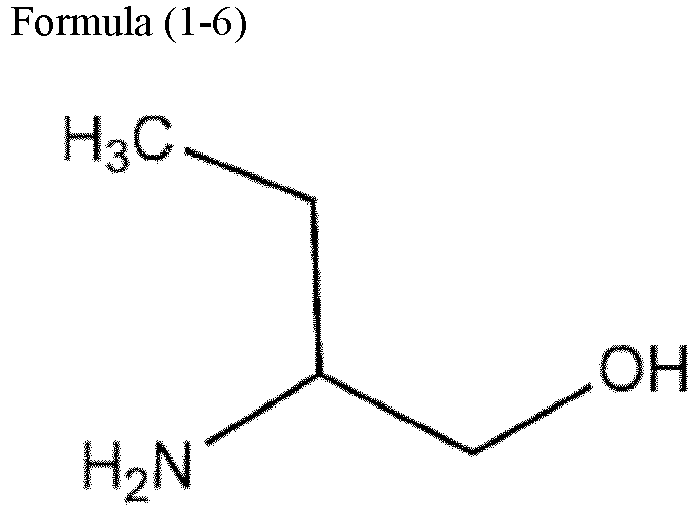
- 3-amino-1-propanol (formula (1-1)), 2-amino-2-methyl-1-propanol (formula (1-2)), 2-amino-1-propanol (formula (1-3)), 1-amino-2-propanol (formula (1-4)), 4-amino-1-butanol (formula (1-5)), and 2-amino-1-butanol (formula (1-6)).
- the amine compound is acceptable when it contains at least one of the compounds represented by the chemical formula (1), and a trace amount of other amine compound other than the compounds represented by the chemical formula (1) may be contained as the amine compound in the chemical formula (1).
- the all amine compounds used are preferably compounds represented by the chemical formula (1).
- a trace amount of other amine compounds may be contained as long as a desired effect in the present invention is obtained.
- the other amine compounds may be contained in an amount of, for example, 1 to 20% by mass in the entire amine compounds.
- the other amine compounds include tertiary amines such as triethanolamine. This is because tertiary amines have a low adsorptivity to silver and do not compete with the formation of the silver complex of the amine of the chemical formula (1).
- the step of forming a silver-amine complex is performed, for example, as follows.
- a dispersant is dissolved in ion exchange water.
- silver nitrate dissolved in ion exchange water is added to the solution having the dispersant dissolved therein while being stirred.
- an amine compound is added to the solution having silver nitrate added thereto, followed by stirring. As a result, a silver-amine complex is formed.
- the amount of amine compound added is preferably 2 or more in terms of molar ratio to silver. In the case of 2 or more in molar ratio, complexation is performed.
- the amount of amine compound added is more preferably 2.5 or more, and further preferably 3 or more in terms of molar ratio to silver, from the viewpoint of facilitating complexation.
- the amount of amine compound added is preferably 6 or less in terms of molar ratio to silver, from the viewpoint of easiness of purification and economical efficiency.
- the silver compound is 10 to 500 g
- the amine compound is 10 to 1000 g
- the dispersant is 1 to 100 g per liter of water.
- the step S102 of precipitating silver nanoparticles is a step of precipitating silver nanoparticles from a chemical reaction system containing the silver-amine complex.
- the chemical reaction system containing the silver-amine complex is preferably performed in a temperature range between 20 to 100°C. That is, it is preferable to heat the solution containing the silver-amine complex at 20 to 100°C.
- reaction temperature is 20°C or more
- the reaction is further promoted.
- the reaction may be performed even at around room temperature, so that the step is performed in a simple manner.
- an aqueous solvent may be used as the solvent. In addition, economical efficiency is improved.
- the reaction temperature is more preferably 30°C or more, and further preferably 40°C or more from the viewpoint of further promoting the reaction, and more preferably 90°C or less, and further preferably 80°C or less from the viewpoint of economical efficiency.
- the reaction time is preferably 1 to 24 hours. When the reaction time is 1 hour or more, the reaction is further promoted. Meanwhile, when the reaction time is 24 hours or less, economical efficiency is improved.
- the reaction time is more preferably 2 hours or more, and further preferably 3 hours or more from the viewpoint of further promoting the reaction, and more preferably 15 hours or less, and further preferably 10 hours or less from the viewpoint of economical efficiency.
- the step of precipitating silver nanoparticles is performed, for example, as follows.
- a solution containing a silver-amine complex is heated to a predetermined temperature while being stirred.
- the solution having reached the predetermined temperature is kept being stirred for a predetermined time while the temperature is maintained.
- silver nanoparticles are precipitated and a reaction solution containing silver nanoparticles is obtained.
- the step S102 of precipitating silver nanoparticles may be followed by a washing step S103.
- the washing step S103 is a step of obtaining a silver nanoparticle dispersion solution by filtering the reaction solution containing silver nanoparticles, after the step S 102 of precipitating silver nanoparticles.
- the washing step is performed, for example, as follows.
- a reaction solution containing silver nanoparticles is placed in a stainless steel cup, ion exchange water is added to the solution and then the solution undergoes ultrafiltration.
- ion exchange water is added again, and purification is repeated until the conductivity of the filtrate is equal to or lower than a predetermined value. After that, the filtrate is concentrated to obtain a silver nanoparticle dispersion solution.
- the monodispersity of the silver nanoparticles obtained by the production method of the present invention is indicated by a coefficient of variation (CV) of the particle diameters and the CV value is preferably 25 or less.
- CV value is 25 or less, silver nanoparticles having better optical characteristic are obtained.
- the CV value is more preferably 20 or less, and further preferably 15 or less, from the viewpoint of obtaining better optical characteristics. Note that the lower the CV value is, the more preferable it is, so the lower limit thereof is not particularly specified.
- the CV value may be controlled by the type of the amine compound, the number of carbon atoms contained in the amine compound, and the like.
- CV value is calculated by the following formula (CV) using the values of the standard deviation and the average particle diameter in the number-based particle size distribution.
- CV value % standard deviation / average particle diameter ⁇ 100
- n actual measured counts
- X i i-th actual measured data
- m average value of actual measured data
- the method for producing silver nanoparticles according to the present embodiment may include another step during or before and after the above-described steps as long as the steps are not adversely affected.
- the method may include a foreign matter removing step of removing foreign matter mixed during the production.
- the resultant reaction solution was put in a stainless steel cup, 2 L of ion exchange water was further added thereto, and then a pump was operated to perform ultrafiltration. When the solution in the stainless steel cup decreased, ion exchange water was added to it again, and purification was repeated until the conductivity of the filtrate was 100 ⁇ S/cm or less. After that, the filtrate was concentrated to obtain a silver nanoparticle dispersion solution having a solid content of 30% by mass.
- the ultrafiltration apparatus used was an ultrafiltration module AHP 1010 (manufactured by Asahi Kasei Corporation, molecular weight cutoff: 50000, number of membranes used: 400) connected to a tube pump (manufactured by Masterflex) via Tygon tubing.
- AHP 1010 manufactured by Asahi Kasei Corporation, molecular weight cutoff: 50000, number of membranes used: 400
- tube pump manufactured by Masterflex
- the average particle diameter of the silver nanoparticles in the resultant solution was calculated, and the CV value was also calculated as an index of monodispersity.
- the particle diameter was observed by SEM, image processing software ImageJ (version 1.49) was used to measure 100 particles, and these values were used to calculate the average particle diameter and CV value. Then, those having a CV value of 25 or less were evaluated as having excellent monodispersity.
- CV value was specifically determined as follows.
- CV value % standard deviation / average particle diameter ⁇ 100
- Silver nanoparticles were synthesized in the same manner as in No. 1, in which only the amine compound used is changed. Note that the amount of the amine compound added was set to 3 equivalents in terms of molar ratio to silver as in No. 1.
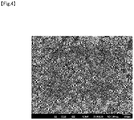
- FIG. 3 illustrates an image of the silver nanoparticles of No. 1
- FIG. 4 illustrates an image of the silver nanoparticles of No. 11.
- Table 1 No. Amine Compound as Reducing Agent and Complexing Agent Average Particle Diameter (nm)
- CV Value Compound Amine Type Number of Carbon Atoms 1 3-Amino-1-Propanol Primary Amine 3 35 13 2 2-Amino-2-Methyl-1-Propanol Primary Amine 4 30 14 3 2-Aminoethanol Primary Amine 2 38 21 4 2-Amino-1-Propanol Primary Amine 3 32 15 5 1-Amino-2-Propanol Primary Amine 3 34 14 6 4-Amino-1-Butanol Primary Amine 4 36 15 7 2-Amino-1-Butanol Primary Amine 4 32 15 8 4-Amino-2-Methyl-1-Butanol Primary Amine 5 35 17 9 5-Amino-1-Pentanol Primary Amine 5 38
- Nos. 1 to 10 which were Examples satisfying the requirements of the present invention, were low in CV value and excellent in monodispersity.
- Nos. 1 and 2 as well as Nos. 4 to 7 have lower CV values respectively because they used preferable amine compounds, 3-amino-1-propanol, 2-amino-2-methyl-1-propanol, 2-amino-1-propanol, 1-amino-2-propanol, 4-amino-1-butanol, and 2-amino-1-butanol.
- No. 3 has a somewhat high CV value because of a small number of carbon atoms.
- No. 9 and No. 10 have somewhat high CV values because of a large number of carbon atoms between the amino group and the hydroxy group.
- Nos. 11 and 12 have high CV values and inferior in monodispersity because they used compounds not satisfying the chemical formula (1) as the amine compounds.
- No. 13 used an alkoxyamine compound corresponding to a primary amine but having no hydroxy group, and did not satisfy the chemical formula (1).
- the alkoxyamine compound has lower reducing power than that of the hydroxyamine compound, and silver nanoparticles could not be obtained.
Landscapes
- Chemical & Material Sciences (AREA)
- Engineering & Computer Science (AREA)
- Inorganic Chemistry (AREA)
- Nanotechnology (AREA)
- Chemical Kinetics & Catalysis (AREA)
- General Chemical & Material Sciences (AREA)
- Manufacture Of Metal Powder And Suspensions Thereof (AREA)
Abstract
Description
- The present invention relates to a method for producing silver nanoparticles.
- Silver nanoparticles absorb and scatter light much more than ordinary dyes and pigments. Silver nanoparticles may be used for analysis such as surface-enhanced Raman spectroscopy, and applied to diagnostic agents, paints, and the like because of their optical characteristics. The optical characteristics of these silver nanoparticles are due to a phenomenon called plasmon resonance, which occurs when the electric field oscillation of light resonates with the free electrons in the metal. The intensity of light absorption in the plasmon resonance allows silver nanoparticles to be applied for various uses as described above.
- In addition, the absorption wavelength of light in this plasmon resonance varies with the particle diameter (becomes longer in proportion to the particle diameter). Adjusting the particle diameter appropriately is capable of achieving desired optical characteristics. Thus, when silver nanoparticles are used as a coloring agent for a metallic glossy ink or the like, a metallic glossy film with an adjusted color is possible to be produced.
- However, obtaining silver nanoparticles having desirable optical characteristics as described above requires a synthesis of particles having high monodispersity. A commonly used method for synthesizing silver nanoparticles is a chemical reduction method in which a silver salt such as silver nitrate as a starting material is reacted with a reducing agent in a solvent such as water to obtain silver nanoparticles.
- For example, in
Patent Literature 1, silver particles are synthesized using an alkanolamine as a reducing agent in the presence of a polymer-based dispersant. However, the synthesis method described inPatent Literature 1 has the following problem. The synthesis method described inPatent Literature 1 uses dimethylaminoethanol or methyldiethanolamine as the alkanolamine. However, these tertiary amines have low coordinative ability to silver ions due to steric hindrance, and have difficulty in forming silver-amine complexes. For this reason, silver ions precipitate as silver oxide due to a change in pH caused by the addition of amine, and the reaction system becomes heterogeneous. As a result, the produced silver particles have a wide particle diameter distribution. - In addition, since these tertiary amines have a higher reducing power than those of primary and secondary amines, the reaction rate is excessively high, the particle diameter of the produced particles becomes inconsistent and aggregation of the produced particles is occurred.
- Meanwhile,
Patent Literature 2 proposes a method for obtaining silver particles by forming a silver-alkanolamine complex, which is then further reacted with a reducing agent such as L-ascorbic acid. In this synthesis method, complex formation is performed to synthesize silver nanoparticles in a uniform reaction system. However, the synthesis method described inPatent Literature 2 has the following problem. In the synthesis method described inPatent Literature 2, L-ascorbic acid or the like is added as a reducing agent, but the reducing agent has a coordinative ability to silver, so that a compound other than the previously added amine coordinates to the silver particle surface. In this case, two types of compounds (L-ascorbic acid and alkanolamine) compete as reducing agents or surface protecting agents, so that particles having multiple particle size distributions are produced. - In addition, there is a case where diethanolamine, which is a secondary amine, is used as both a complexing agent and a reducing agent. However, also in this case, the obtained silver particles have a wide particle diameter distribution.
- In addition,
Patent Literature 3 proposes a method for obtaining silver particles by forming a silver-amine complex using an alkoxyamine such as 3-methoxypropylamine. However, alkoxyamines have lower reducing power than that of alkanolamines, and it is necessary to further add another reducing agent. For this reason, particles having a wide particle size distribution are generated as inPatent Literature 2. -
- Patent Literature 1: Japanese Patent Application Publication No.
2004-346429 - Patent Literature 2: Japanese Patent Application Publication No.
H7-76710 - Patent Literature 3: Japanese Patent Application Publication No.
2016-164312 - The present invention has been made in view of the above problems and circumstances, and its object to be achieved is to provide a method for producing silver nanoparticles having high monodispersity.
- The above problem according to the present invention is solved by the following means.
- 1. A method for producing silver nanoparticles, comprising the steps of: forming a silver-amine complex as a precursor by reacting a silver compound with an amine compound in the presence of a dispersant; and precipitating a silver nanoparticle from a chemical reaction system containing the silver-amine complex, wherein the amine compound contains at least one compound represented by the following chemical formula (1):


- 2. The method for producing a silver nanoparticle according to 1 described above, wherein n in the chemical formula (1) is two to four.
- 3. The method for producing a silver nanoparticle according to 1 or 2 described above, wherein each Rx and Ry in the chemical formula (1) is independently hydrogen, a methyl group, or an ethyl group.
- 4. The method for producing a silver nanoparticle according to any one of 1 to 3 described above, wherein the amine compound in the chemical formula (1) has 3 or more carbon atoms.
- 5. The method for producing a silver nanoparticle according to any one of 1 to 4 described above, wherein the amine compound in the chemical formula (1) is at least one of 3-amino-1-propanol, 2-amino-2-methyl-1-propanol, 2-amino-1-propanol, 1-amino-2-propanol, 4-amino-1-butanol, and 2-amino-1-butanol.
- 6. The method for producing a silver nanoparticle according to any one of 1 to 5 described above, wherein the dispersant is a polymer-based dispersant.
- 7. The method for producing a silver nanoparticle according to any one of 1 to 6 described above, wherein the chemical reaction system containing the silver-amine complex is performed in a temperature range between 20°C to 100°C.
- 8. The method for producing a silver nanoparticle according to any one of 1 to 7 described above, wherein the silver compound is silver nitrate, silver oxide, or silver carbonate.
- 9. The method for producing silver nanoparticles according to any one of 1 to 8 described above, further comprising a washing step after the step of precipitating the silver nanoparticles.
- The present invention provides a method for producing silver nanoparticles having high monodispersity.
-
-
FIG. 1 is a flowchart of a method for producing silver nanoparticles in an embodiment. -
FIG. 2 is a flowchart of a method for producing silver nanoparticles in another embodiment. -
FIG. 3 is an image of silver nanoparticles of No. 1 in Examples. -
FIG. 4 is an image of silver nanoparticles of No. 11 in Examples. - Hereinafter, embodiments are described in detail. Note that the embodiments described below exemplify a method for producing a silver nanoparticle for embodying the technical idea of the present embodiment, and are not limited to the following. Note that, in the present application, "to" indicating a numerical range is used to mean that the numerical values written before and after it are included as the lower limit and the upper limit.
- As illustrated in
FIG. 1 , the method for producing silver nanoparticles of the present embodiment includes a step S101 of forming a silver-amine complex and a step S102 of precipitating a silver nanoparticle. - The step S101 of forming a silver-amine complex is a step of forming a silver-amine complex as a precursor by reacting a silver compound with an amine compound in the presence of a dispersant.
- The dispersant is not particularly limited, but is preferably a polymer-based dispersant. By using a polymer-based dispersant, particles are less likely to aggregate.
- Examples of the dispersant include the following.
- Examples of the SOLSPERSE (registered trademark) series manufactured by Lubrizol include SOLSPERSE-16000, 21000, 41000, 41090, 43000, 44000, 46000, and 54000. Examples of the DISPERBYK (registered trademark) series manufactured by BYK-Chemie include DISPERBYK-102, 110, 111, 170, 190, 194N, 2015, 2090, and 2096. Examples of the TEGO Dispers series manufactured by Evonik include 610, 610S, 630, 651, 655, 750W, and 755W. Examples of the Disparlon (registered trademark) series manufactured by Kusumoto Chemicals, Ltd. include DA-375 and DA-1200. Examples of the Floren series manufactured by Kyoei Kagaku Kogyo include WK-13E, G-700, G-900, GW-1500, GW-1640, and WK-13E. The dispersant may be used alone or in a combination of two or more kinds.
- Examples of the silver compound include silver salts such as silver nitrate, silver sulfate, silver chloride, silver oxide, silver nitrite, silver chlorate, silver sulfide, and silver carbonate. These are not particularly limited as long as they are reduced, and may be dissolved in an appropriate solvent or used while being dispersed in the solvent. In addition, these may be used alone or in a combination of two or more kinds.
- The silver compound is more preferably silver nitrate, silver oxide, or silver carbonate, and further preferably silver nitrate. The use of these silver compounds allows the amine compound to coordinate with silver more easily.
- The amine compound contains at least one compound represented by the following chemical formula (1).

- In the formula, n is an integer of 2 to 10.
- Each RX and RY is independently a hydrogen, an aliphatic alkyl group having 1 to 30 carbon atoms, alicyclic alkyl group having 1 to 30 carbon atoms, an aryl group having 6 to 20 carbon atoms, an aralkyl group as a mixture thereof, an alkyl group with a substituted functional group, an aryl group with a substituted functional group or a heterocyclic compound with a substituted functional group.
- Note that the aralkyl group as a mixture thereof means an aralkyl group having a mixed structure of an aryl group having 6 to 20 carbon atoms and any one of an aliphatic alkyl group having 1 to 30 carbon atoms and an alicyclic alkyl group having 1 to 30 carbon atoms.
- Each RX and RY may be independently connected with an alkylene containing or not containing a hetero atom to form a ring. The alkylene may contain a heteroatom but also not contain a heteroatom.
- Note that, from the viewpoint of further improving the adsorptivity of the amino group to silver, the hetero atom is preferably not a substituent possibly preventing the adsorption of the amino group to silver (SH, COOH, NH).
- In addition, in the formula, the
number 1 in C1,R X1, andR Y1 means the first structure, and the wavy line indicates that the first to n-th structures are bonded. In other words, the chemical formula (1) has a structure in which NH2 is located at one end and OH at the other end, and 1 to n pieces of a structure composed of C, RX, and RY are bonded. - Moreover, in a case where n = 4 in the chemical formula (1) as an example, a site composed of C1,
R X1 andR Y1, a site composed of C2,R X2 andR Y2, a site composed of C3,R X3 andR Y3, and a site composed of C4, RX4 and Ry4 are independent respectively. That is, for example when n = 4,R X1,R Y1 andR X2 may be methyl groups, andR Y2,R X3,R Y3, RX4 and RY4 may be a hydrogen. - In the present embodiment, particle diameters of the silver nanoparticles are controlled by the adsorption of the amine compound represented by the chemical formula (1) to the silver compound. This increases the monodispersity of the silver nanoparticles.
- In the chemical formula (1), n is preferably 2 to 4. The detailed mechanism is unknown, but is speculated as follows. When n is in this range, the bond distance between the terminal hydroxy moiety and the amino group becomes shorter, the hydroxy moiety is not separated from the silver surface while amino group is being adsorbed to the silver and the adsorptivity is improved. As a result, the amino group or hydroxy group is adsorbed to the silver surface produced immediately after the reduction of silver, whereby aggregation at the initial stage of particle production is reduced and particles having high monodispersity are produced.
- In addition, when n is 5 or more, the bond distance between the terminal hydroxy moiety and the amino group becomes longer, and the degree of freedom of the main chain increases while the amino group is being adsorbed to silver. Therefore, the hydroxy moiety is easily separated from the silver surface. As a result, particles having low monodispersity are produced as compared with the case where n is 2 to 4.
- Further, alkanolamines exhibit good reducibility on silver, whereas alkoxyamines without hydroxy groups exhibit little reducibility. Moreover, even when 3-methoxypropylamine, which is an alkoxyamine, is mixed with a compound having a hydroxy group such as ethanol, the reducibility on silver is not improved. This suggests that the hydroxy groups in alkanolamines have a strong effect on the reducibility on silver. Therefore, whether hydroxy groups are close to silver greatly affects not only monodispersity but also reducibility.
- RX and RY in the chemical formula (1) are preferably short substituents, and each of them is preferably a hydrogen, a methyl group, or an ethyl group, independently. With these substituents, steric hindrance is small, coordination of the amine moiety to silver is not prevented, and complexation is facilitated. In addition, the hydroxy moiety likely becomes closer to silver, so that the monodispersity is improved and the reducibility is likely exhibited.
- The number of carbon atoms contained in the amine compound in the chemical formula (1) is preferably 3 or more. The detailed mechanism is unknown, but is speculated as follows. When n = 3 or more, the hydroxy moiety is likely closer to silver. As a result, the amino group or hydroxy group is adsorbed to the silver surface produced immediately after the reduction of silver, whereby aggregation at the initial stage of particle production is prevented and particles having high monodispersity are produced (example: 3-amino-1-propanol and the like).
- In addition, in a case where n = 2 and the structure has a methyl group or the like as a substituent, it is speculated that the electron donicity and steric hindrance of the substituent increase the reducibility (example: 2-amino-2-methyl-1-propanol) although the detailed mechanism is unknown.
- Meanwhile, the number of carbon atoms contained in the amine compound in the chemical formula (1) is preferably 20 or less from the viewpoint of adsorption of the hydroxy moiety to silver. When the number of carbon atoms is 20 or less, the bond distance between the terminal hydroxy moiety and the amino group becomes shorter, and the hydroxy moiety is not separated from the silver surface, so that the adsorptivity is improved. Therefore, particles having high monodispersity tend to be produced. In addition, when a large number of substituents are introduced to the positions of R in the side chains, a situation does not occur that the hydroxyl moiety or amino group is less likely adsorbed to silver due to the steric hindrance of the side chains. Thus, the adsorption to silver is facilitated.
- Specific examples of the amine compound in the chemical formula (1) include 2-aminoethanol, 1-amino-2-propanol, 2-amino-2-methyl-1-propanol, 3-amino-2-methyl-2-butanol, 3-amino-2,3-dimethylbutan-2-ol,, 2-amino-1-propanol, 2-amino-2-methyl-1-propanol, 2-amino-1-butanol, 2-amino-1-pentanol, 2-aminocyclohexanol, 3-amino-1,2-propanediol, (3-aminooxolan-3-yl) methanol, 3- amino-1-propanol, 4-amino-2-butanol, 3-amino-1-butanol, 3-amino-2-methyl-1-propanol, 4-aminopentan-2-ol, 3-aminocyclobutanol, 3-amino-4-methylpentan-1-ol, (2-aminocyclopentyl) methanol, 3-amino-3-methylbutan-1-ol, 2-(1-aminocyclopropyl) ethan-1-ol, 4-amino-4-methyl-pentan-2-ol, 4-amino-2-methyl-2-butanol, 1-(2-aminoethyl) cyclobutan-1-ol, 4-amino-1,2-butanediol, 4-amino-1-butanol, 4-amino-1-pentanol, 4-amino-2-methyl-1-butanol, 5-amino-2-methyl-2-pentanol, 4- aminocyclohexanol, 3-(aminomethyl) cyclobutanol, 3-hydroxy-3-methylcyclobutane-1-methamine, 3-(aminomethyl) cyclohexanol, 5-amino-1-pentanol, 5-amino-2,2-dimethylpentanol, 6-amino-1-hexanol, 4-(2-aminoethyl) cyclohexanol, 6-amino-2-hydroxymethyl hexan-1-ol, 8-amino-1-octanol, and 10-amino-1-decanol. These compounds result in particles having higher monodispersity. These compounds may be used alone or in a combination of two or more kinds.
- Among these, the amine compound in the chemical formula (1) is more preferably 3-amino-1-propanol, 2-amino-2-methyl-1-propanol, 2-amino-1-propanol, 1-amino-2-propanol, 4-amino-1-butanol, and 2-amino-1-butanol from the viewpoint of further improving monodispersity.
- Presented below are 3-amino-1-propanol (formula (1-1)), 2-amino-2-methyl-1-propanol (formula (1-2)), 2-amino-1-propanol (formula (1-3)), 1-amino-2-propanol (formula (1-4)), 4-amino-1-butanol (formula (1-5)), and 2-amino-1-butanol (formula (1-6)).


- The amine compound is acceptable when it contains at least one of the compounds represented by the chemical formula (1), and a trace amount of other amine compound other than the compounds represented by the chemical formula (1) may be contained as the amine compound in the chemical formula (1). However, from the viewpoint of further improving the monodispersity, the all amine compounds used are preferably compounds represented by the chemical formula (1).
- Here, a trace amount of other amine compounds may be contained as long as a desired effect in the present invention is obtained. Specifically, the other amine compounds may be contained in an amount of, for example, 1 to 20% by mass in the entire amine compounds. Examples of the other amine compounds include tertiary amines such as triethanolamine. This is because tertiary amines have a low adsorptivity to silver and do not compete with the formation of the silver complex of the amine of the chemical formula (1).
- The step of forming a silver-amine complex is performed, for example, as follows.
- First, a dispersant is dissolved in ion exchange water. Next, silver nitrate dissolved in ion exchange water is added to the solution having the dispersant dissolved therein while being stirred. Next, an amine compound is added to the solution having silver nitrate added thereto, followed by stirring. As a result, a silver-amine complex is formed.
- The amount of amine compound added is preferably 2 or more in terms of molar ratio to silver. In the case of 2 or more in molar ratio, complexation is performed. The amount of amine compound added is more preferably 2.5 or more, and further preferably 3 or more in terms of molar ratio to silver, from the viewpoint of facilitating complexation. On the other hand, the amount of amine compound added is preferably 6 or less in terms of molar ratio to silver, from the viewpoint of easiness of purification and economical efficiency.
- In addition, preferably, the silver compound is 10 to 500 g, the amine compound is 10 to 1000 g, and the dispersant is 1 to 100 g per liter of water.
- The step S102 of precipitating silver nanoparticles is a step of precipitating silver nanoparticles from a chemical reaction system containing the silver-amine complex.
- In this step, the chemical reaction system containing the silver-amine complex is preferably performed in a temperature range between 20 to 100°C. That is, it is preferable to heat the solution containing the silver-amine complex at 20 to 100°C.
- When the reaction temperature is 20°C or more, the reaction is further promoted. In addition, for example, at about 20 to 30°C, the reaction may be performed even at around room temperature, so that the step is performed in a simple manner. Meanwhile, when the reaction temperature is 100°C or less, an aqueous solvent may be used as the solvent. In addition, economical efficiency is improved.
- The reaction temperature is more preferably 30°C or more, and further preferably 40°C or more from the viewpoint of further promoting the reaction, and more preferably 90°C or less, and further preferably 80°C or less from the viewpoint of economical efficiency.
- The reaction time is preferably 1 to 24 hours. When the reaction time is 1 hour or more, the reaction is further promoted. Meanwhile, when the reaction time is 24 hours or less, economical efficiency is improved.
- The reaction time is more preferably 2 hours or more, and further preferably 3 hours or more from the viewpoint of further promoting the reaction, and more preferably 15 hours or less, and further preferably 10 hours or less from the viewpoint of economical efficiency.
- The step of precipitating silver nanoparticles is performed, for example, as follows.
- First, a solution containing a silver-amine complex is heated to a predetermined temperature while being stirred. Next, the solution having reached the predetermined temperature is kept being stirred for a predetermined time while the temperature is maintained. Thereby, silver nanoparticles are precipitated and a reaction solution containing silver nanoparticles is obtained.
- As another embodiment, as illustrated in
FIG. 2 , the step S102 of precipitating silver nanoparticles may be followed by a washing step S103. - The washing step S103 is a step of obtaining a silver nanoparticle dispersion solution by filtering the reaction solution containing silver nanoparticles, after the step S 102 of precipitating silver nanoparticles.
- The washing step is performed, for example, as follows.
- First, a reaction solution containing silver nanoparticles is placed in a stainless steel cup, ion exchange water is added to the solution and then the solution undergoes ultrafiltration. When the solution in the stainless steel cup decreases, ion exchange water is added again, and purification is repeated until the conductivity of the filtrate is equal to or lower than a predetermined value. After that, the filtrate is concentrated to obtain a silver nanoparticle dispersion solution.
- The monodispersity of the silver nanoparticles obtained by the production method of the present invention is indicated by a coefficient of variation (CV) of the particle diameters and the CV value is preferably 25 or less. When the CV value is 25 or less, silver nanoparticles having better optical characteristic are obtained. The CV value is more preferably 20 or less, and further preferably 15 or less, from the viewpoint of obtaining better optical characteristics. Note that the lower the CV value is, the more preferable it is, so the lower limit thereof is not particularly specified.
- Note that the CV value may be controlled by the type of the amine compound, the number of carbon atoms contained in the amine compound, and the like.
- The CV value is calculated by the following formula (CV) using the values of the standard deviation and the average particle diameter in the number-based particle size distribution.

- Here, the standard deviation in the present application is calculated by the following formula, which is a known formula. In the following formula, n is actual measured counts, Xi is i-th actual measured data, and m is average value of actual measured data."

- Although the method for producing silver nanoparticles according to the present embodiment is as described above, the method may include another step during or before and after the above-described steps as long as the steps are not adversely affected. For example, the method may include a foreign matter removing step of removing foreign matter mixed during the production.
- In addition, in the above-described steps, conventionally known conditions may be used for undescribed conditions, and it goes without saying that the conditions may be appropriately changed as long as the effects obtained by the processes the above-described steps are exhibited.
- Hereinafter, the present invention is described specifically with reference to examples, but the present invention is not limited thereto.
- 8.4 g of DISPERBYK-190 and 295 g of ion exchanged water were put into a 1 L separable flask with a plate-shaped stirring blade and baffle and the DISPERBYK-190 was dissolved by stirring. Subsequently, 70 g of silver nitrate dissolved in 295 g of ion exchange water was added to the separable flask with stirring. Furthermore, 93 g of 3-amino-1-propanol (3 equivalents in terms of molar ratio to silver) was added to the mixture and stirred. Thereafter, the separable flask was placed in a water bath and heated with stirring until the temperature of the solution became stable at 50°C. Furthermore, stirring was continued for 3 hours while the temperature of the solution was maintained at 50°C to obtain a reaction solution containing silver nanoparticles.
- The resultant reaction solution was put in a stainless steel cup, 2 L of ion exchange water was further added thereto, and then a pump was operated to perform ultrafiltration. When the solution in the stainless steel cup decreased, ion exchange water was added to it again, and purification was repeated until the conductivity of the filtrate was 100 µS/cm or less. After that, the filtrate was concentrated to obtain a silver nanoparticle dispersion solution having a solid content of 30% by mass.
- Note that the ultrafiltration apparatus used was an ultrafiltration module AHP 1010 (manufactured by Asahi Kasei Corporation, molecular weight cutoff: 50000, number of membranes used: 400) connected to a tube pump (manufactured by Masterflex) via Tygon tubing.
- The average particle diameter of the silver nanoparticles in the resultant solution was calculated, and the CV value was also calculated as an index of monodispersity.
- Specifically, the particle diameter was observed by SEM, image processing software ImageJ (version 1.49) was used to measure 100 particles, and these values were used to calculate the average particle diameter and CV value. Then, those having a CV value of 25 or less were evaluated as having excellent monodispersity.
- Note that The CV value was specifically determined as follows.

- Silver nanoparticles were synthesized in the same manner as in No. 1, in which only the amine compound used is changed. Note that the amount of the amine compound added was set to 3 equivalents in terms of molar ratio to silver as in No. 1.
- Evaluation of monodispersity was performed in the same manner as in No. 1.
- Table 1 presents the results. In the table,"-" means that measurement was impossible.
FIG. 3 illustrates an image of the silver nanoparticles of No. 1, andFIG. 4 illustrates an image of the silver nanoparticles of No. 11.[Table 1] No. Amine Compound as Reducing Agent and Complexing Agent Average Particle Diameter (nm) CV Value Compound Amine Type Number of Carbon Atoms 1 3-Amino-1- Propanol Primary Amine 3 35 13 2 2-Amino-2-Methyl-1-Propanol Primary Amine 4 30 14 3 2- Aminoethanol Primary Amine 2 38 21 4 2-Amino-1- Propanol Primary Amine 3 32 15 5 1-Amino-2- Propanol Primary Amine 3 34 14 6 4-Amino-1-Butanol Primary Amine 4 36 15 7 2-Amino-1-Butanol Primary Amine 4 32 15 8 4-Amino-2-Methyl-1-Butanol Primary Amine 5 35 17 9 5-Amino-1-Pentanol Primary Amine 5 38 20 10 6-Amino-1-Hexanol Primary Amine 6 41 21 11 Dimethylaminoethanol Tertiary Amine 4 52 27 12 Diethanolamine Secondary Amine 4 43 28 13 3-Methoxypropylamine Primary Amine 3 - - - As illustrated in Table 1, Nos. 1 to 10, which were Examples satisfying the requirements of the present invention, were low in CV value and excellent in monodispersity.
- In particular, Nos. 1 and 2 as well as Nos. 4 to 7 have lower CV values respectively because they used preferable amine compounds, 3-amino-1-propanol, 2-amino-2-methyl-1-propanol, 2-amino-1-propanol, 1-amino-2-propanol, 4-amino-1-butanol, and 2-amino-1-butanol.
- In addition, No. 3 has a somewhat high CV value because of a small number of carbon atoms. In addition, No. 9 and No. 10 have somewhat high CV values because of a large number of carbon atoms between the amino group and the hydroxy group.
- On the other hand, Nos. 11 to 13, which were Comparative Examples not satisfying the requirements of the present invention, provided the following results.
- Nos. 11 and 12 have high CV values and inferior in monodispersity because they used compounds not satisfying the chemical formula (1) as the amine compounds.
- No. 13 used an alkoxyamine compound corresponding to a primary amine but having no hydroxy group, and did not satisfy the chemical formula (1). The alkoxyamine compound has lower reducing power than that of the hydroxyamine compound, and silver nanoparticles could not be obtained.
Claims (9)
- A method for producing silver nanoparticles, comprising the steps of: forming a silver-amine complex as a precursor by reacting a silver compound with an amine compound in the presence of a dispersant; and precipitating a silver nanoparticle from a chemical reaction system containing the silver-amine complex, wherein the amine compound contains at least one compound represented by the following chemical formula (1):

- The method as claimed in claim 1, wherein n in the chemical formula (1) is two to four.
- The method as claimed in claim 1 or 2, wherein each RX and RY in the chemical formula (1) is independently hydrogen, a methyl group, or an ethyl group.
- The method as claimed in any one of claims 1 to 3, wherein the amine compound in the chemical formula (1) has three or more carbon atoms.
- The method as claimed in any one of claims 1 to 4, wherein the amine compound in the chemical formula (1) is at least one of 3-amino-1-propanol, 2-amino-2-methyl-1-propanol, 2-amino-1-propanol, 1-amino-2-propanol, 4-amino-1-butanol, and 2-amino-1-butanol.
- The method as claimed in any one of claims 1 to 5, wherein the dispersant is a polymer-based dispersant.
- The method as claimed in any one of claims 1 to 6, wherein the chemical reaction system containing the silver-amine complex is performed in a temperature range between 20°C to 100°C.
- The method as claimed in any one of claims 1 to 7, wherein the silver compound is silver nitrate, silver oxide, or silver carbonate.
- The method as claimed in any one of claims 1 to 8, comprising a washing step after the step of precipitating the silver nanoparticles.
Applications Claiming Priority (2)
| Application Number | Priority Date | Filing Date | Title |
|---|---|---|---|
| JP2017208066 | 2017-10-27 | ||
| PCT/JP2018/037573 WO2019082636A1 (en) | 2017-10-27 | 2018-10-09 | Method for producing silver nanoparticles |
Publications (2)
| Publication Number | Publication Date |
|---|---|
| EP3685943A1 true EP3685943A1 (en) | 2020-07-29 |
| EP3685943A4 EP3685943A4 (en) | 2020-10-21 |
Family
ID=66247324
Family Applications (1)
| Application Number | Title | Priority Date | Filing Date |
|---|---|---|---|
| EP18870956.2A Pending EP3685943A4 (en) | 2017-10-27 | 2018-10-09 | Method for producing silver nanoparticles |
Country Status (3)
| Country | Link |
|---|---|
| EP (1) | EP3685943A4 (en) |
| JP (1) | JPWO2019082636A1 (en) |
| WO (1) | WO2019082636A1 (en) |
Family Cites Families (6)
| Publication number | Priority date | Publication date | Assignee | Title |
|---|---|---|---|---|
| US5389122A (en) | 1993-07-13 | 1995-02-14 | E. I. Du Pont De Nemours And Company | Process for making finely divided, dense packing, spherical shaped silver particles |
| JP4346510B2 (en) | 1997-07-17 | 2009-10-21 | 日本ペイント株式会社 | Colloidal solution of noble metal or copper, method for producing the same, coating composition and resin molding |
| JP2005325374A (en) * | 2004-05-12 | 2005-11-24 | Hitachi Chem Co Ltd | Method for producing linked body of metal hyperfine particle, linked body of metal hyperfine particle produced thereby and metal component-containing solution |
| US9034215B2 (en) * | 2010-06-11 | 2015-05-19 | Nippon Sheet Glass Company, Limited | Noble metal fine particle, method for withdrawing noble metal fine particles, and method for producing noble metal fine particle dispersed material using withdrawn noble metal fine particles |
| CN106660129B (en) | 2014-06-11 | 2019-08-13 | 阪东化学株式会社 | Silver fine particle dispersion, silver fine particle, method for producing the same, and composition for bonding |
| JP6843437B2 (en) * | 2015-05-20 | 2021-03-17 | 国立大学法人山形大学 | Method for producing silver nanoparticle dispersion and method for producing silver nanoparticle ink |
-
2018
- 2018-10-09 JP JP2019550951A patent/JPWO2019082636A1/en active Pending
- 2018-10-09 EP EP18870956.2A patent/EP3685943A4/en active Pending
- 2018-10-09 WO PCT/JP2018/037573 patent/WO2019082636A1/en not_active Ceased
Also Published As
| Publication number | Publication date |
|---|---|
| WO2019082636A1 (en) | 2019-05-02 |
| JPWO2019082636A1 (en) | 2020-11-12 |
| EP3685943A4 (en) | 2020-10-21 |
Similar Documents
| Publication | Publication Date | Title |
|---|---|---|
| EP3466883A1 (en) | Silicon compound-coated metal particles | |
| CN109825289B (en) | Application of eutectic solvent in preparation of metal-doped carbon quantum dots and preparation method of metal-doped carbon quantum dots | |
| US5021192A (en) | Colloidal dispersions of cerium (IV) compound | |
| CN103153844A (en) | Method for manufacturing silver nanowires | |
| US10954261B2 (en) | Method for producing aqueous preparations of complexes of platinum group metals | |
| Togashi et al. | Solvent-free synthesis of monodisperse Cu nanoparticles by thermal decomposition of an oleylamine-coordinated Cu oxalate complex | |
| JPH0899937A (en) | Production of amine | |
| WO2007110665A2 (en) | Process for producing metal nanoparticles and process for producing acetylides process | |
| KR101905282B1 (en) | Metal nanoparticle-protecting polymer and metal colloidal solution, and method for producing same | |
| KR101273122B1 (en) | NOVEL FABRICATION OF POLYETHYLENEIMINE-CAPPED Au-Ag ALLOY NANOPARTICLES | |
| EP3685943A1 (en) | Method for producing silver nanoparticles | |
| CN109438699B (en) | Modified polyethyleneimine/nano-silver composite material and preparation method thereof | |
| JP3950691B2 (en) | Colloidal dispersion of cerium compound containing cerium III, process for its production and use thereof | |
| JP5438994B2 (en) | Method for producing metal fine particles, metal fine particle dispersion and method for producing sintered body | |
| Singh et al. | Gum acacia–CuNp–silica hybrid: an effective, stable and recyclable catalyst for reduction of nitroarenes | |
| CN109400633B (en) | Gold nanocluster and high-yield preparation method thereof | |
| US8673261B2 (en) | Process for preparing magnetite (Fe3O4) and derivatives thereof | |
| Dittrich et al. | Long tailed cage amines: Synthesis, metal complexation, and structure | |
| JP7356875B2 (en) | Cationic polymerization initiator | |
| CN114106052A (en) | Tetranuclear platinum carboxylate, synthetic method and application thereof in preparation of platinum black | |
| JPH0159975B2 (en) | ||
| KR100894795B1 (en) | Method for producing colloidal silica by direct oxidation from metal silicon | |
| CN109290588A (en) | A kind of preparation method of monodisperse triangular nano silver | |
| CN116162067B (en) | Preparation method of prothioconazole | |
| JP7743822B2 (en) | Method for producing silver nanoparticles |
Legal Events
| Date | Code | Title | Description |
|---|---|---|---|
| STAA | Information on the status of an ep patent application or granted ep patent |
Free format text: STATUS: THE INTERNATIONAL PUBLICATION HAS BEEN MADE |
|
| PUAI | Public reference made under article 153(3) epc to a published international application that has entered the european phase |
Free format text: ORIGINAL CODE: 0009012 |
|
| STAA | Information on the status of an ep patent application or granted ep patent |
Free format text: STATUS: REQUEST FOR EXAMINATION WAS MADE |
|
| 17P | Request for examination filed |
Effective date: 20200420 |
|
| AK | Designated contracting states |
Kind code of ref document: A1 Designated state(s): AL AT BE BG CH CY CZ DE DK EE ES FI FR GB GR HR HU IE IS IT LI LT LU LV MC MK MT NL NO PL PT RO RS SE SI SK SM TR |
|
| AX | Request for extension of the european patent |
Extension state: BA ME |
|
| A4 | Supplementary search report drawn up and despatched |
Effective date: 20200918 |
|
| RIC1 | Information provided on ipc code assigned before grant |
Ipc: B22F 9/30 20060101ALI20200914BHEP Ipc: B22F 1/00 20060101ALI20200914BHEP Ipc: B22F 9/24 20060101AFI20200914BHEP |
|
| DAV | Request for validation of the european patent (deleted) | ||
| DAX | Request for extension of the european patent (deleted) | ||
| P01 | Opt-out of the competence of the unified patent court (upc) registered |
Effective date: 20230510 |
|
| STAA | Information on the status of an ep patent application or granted ep patent |
Free format text: STATUS: EXAMINATION IS IN PROGRESS |
|
| 17Q | First examination report despatched |
Effective date: 20230830 |