EP3685737A1 - Monitoring device, monitoring method, and monitoring program - Google Patents
Monitoring device, monitoring method, and monitoring program Download PDFInfo
- Publication number
- EP3685737A1 EP3685737A1 EP18858584.8A EP18858584A EP3685737A1 EP 3685737 A1 EP3685737 A1 EP 3685737A1 EP 18858584 A EP18858584 A EP 18858584A EP 3685737 A1 EP3685737 A1 EP 3685737A1
- Authority
- EP
- European Patent Office
- Prior art keywords
- subject
- information
- controller
- monitoring apparatus
- biological information
- Prior art date
- Legal status (The legal status is an assumption and is not a legal conclusion. Google has not performed a legal analysis and makes no representation as to the accuracy of the status listed.)
- Withdrawn
Links
- 238000012544 monitoring process Methods 0.000 title claims abstract description 140
- 238000000034 method Methods 0.000 title claims abstract description 65
- 238000012806 monitoring device Methods 0.000 title 1
- 201000010099 disease Diseases 0.000 claims abstract description 107
- 208000037265 diseases, disorders, signs and symptoms Diseases 0.000 claims abstract description 107
- 238000011161 development Methods 0.000 claims abstract description 99
- 230000029058 respiratory gaseous exchange Effects 0.000 claims description 35
- 230000036760 body temperature Effects 0.000 claims description 19
- 230000010485 coping Effects 0.000 claims description 16
- 230000008859 change Effects 0.000 claims description 15
- 208000024891 symptom Diseases 0.000 claims description 14
- QVGXLLKOCUKJST-UHFFFAOYSA-N atomic oxygen Chemical compound [O] QVGXLLKOCUKJST-UHFFFAOYSA-N 0.000 claims description 8
- 229910052760 oxygen Inorganic materials 0.000 claims description 8
- 239000001301 oxygen Substances 0.000 claims description 8
- 230000036541 health Effects 0.000 abstract description 7
- 208000008445 altitude sickness Diseases 0.000 description 50
- 230000015654 memory Effects 0.000 description 48
- 230000017531 blood circulation Effects 0.000 description 18
- 238000005259 measurement Methods 0.000 description 17
- 238000010586 diagram Methods 0.000 description 12
- 230000036772 blood pressure Effects 0.000 description 11
- 230000009194 climbing Effects 0.000 description 10
- 238000004891 communication Methods 0.000 description 10
- 230000007423 decrease Effects 0.000 description 9
- 230000008569 process Effects 0.000 description 9
- 230000006870 function Effects 0.000 description 8
- 210000000467 autonomic pathway Anatomy 0.000 description 7
- 230000002123 temporal effect Effects 0.000 description 7
- 230000000284 resting effect Effects 0.000 description 6
- 208000011580 syndromic disease Diseases 0.000 description 6
- 210000000601 blood cell Anatomy 0.000 description 5
- XEEYBQQBJWHFJM-UHFFFAOYSA-N Iron Chemical compound [Fe] XEEYBQQBJWHFJM-UHFFFAOYSA-N 0.000 description 4
- 238000001514 detection method Methods 0.000 description 4
- 238000005516 engineering process Methods 0.000 description 4
- 239000012530 fluid Substances 0.000 description 4
- 230000008035 nerve activity Effects 0.000 description 4
- 238000001228 spectrum Methods 0.000 description 4
- 206010019233 Headaches Diseases 0.000 description 3
- 206010021143 Hypoxia Diseases 0.000 description 3
- 208000034388 Mountain sickness acute Diseases 0.000 description 3
- 208000018315 acute mountain sickness Diseases 0.000 description 3
- 238000004364 calculation method Methods 0.000 description 3
- 231100000869 headache Toxicity 0.000 description 3
- 230000007954 hypoxia Effects 0.000 description 3
- 238000012986 modification Methods 0.000 description 3
- 230000004048 modification Effects 0.000 description 3
- 208000017667 Chronic Disease Diseases 0.000 description 2
- 208000002193 Pain Diseases 0.000 description 2
- 206010047249 Venous thrombosis Diseases 0.000 description 2
- 238000004458 analytical method Methods 0.000 description 2
- 208000008784 apnea Diseases 0.000 description 2
- 238000003491 array Methods 0.000 description 2
- 210000004556 brain Anatomy 0.000 description 2
- 208000002173 dizziness Diseases 0.000 description 2
- 230000000694 effects Effects 0.000 description 2
- 239000004744 fabric Substances 0.000 description 2
- 230000036571 hydration Effects 0.000 description 2
- 238000006703 hydration reaction Methods 0.000 description 2
- 208000000122 hyperventilation Diseases 0.000 description 2
- 230000002631 hypothermal effect Effects 0.000 description 2
- 229910052742 iron Inorganic materials 0.000 description 2
- 206010025482 malaise Diseases 0.000 description 2
- 210000001595 mastoid Anatomy 0.000 description 2
- 239000000463 material Substances 0.000 description 2
- 230000036407 pain Effects 0.000 description 2
- 239000000123 paper Substances 0.000 description 2
- 210000005037 parasympathetic nerve Anatomy 0.000 description 2
- 239000004033 plastic Substances 0.000 description 2
- 239000011347 resin Substances 0.000 description 2
- 229920005989 resin Polymers 0.000 description 2
- 239000005060 rubber Substances 0.000 description 2
- 239000004065 semiconductor Substances 0.000 description 2
- 238000007619 statistical method Methods 0.000 description 2
- 230000002889 sympathetic effect Effects 0.000 description 2
- 210000001519 tissue Anatomy 0.000 description 2
- 230000003936 working memory Effects 0.000 description 2
- 238000012935 Averaging Methods 0.000 description 1
- 206010048962 Brain oedema Diseases 0.000 description 1
- 206010020843 Hyperthermia Diseases 0.000 description 1
- 206010037423 Pulmonary oedema Diseases 0.000 description 1
- 208000027418 Wounds and injury Diseases 0.000 description 1
- 210000001015 abdomen Anatomy 0.000 description 1
- 230000003187 abdominal effect Effects 0.000 description 1
- 230000008901 benefit Effects 0.000 description 1
- 230000004397 blinking Effects 0.000 description 1
- 210000004369 blood Anatomy 0.000 description 1
- 239000008280 blood Substances 0.000 description 1
- 208000006752 brain edema Diseases 0.000 description 1
- 230000006378 damage Effects 0.000 description 1
- 206010061428 decreased appetite Diseases 0.000 description 1
- 230000007613 environmental effect Effects 0.000 description 1
- 238000002474 experimental method Methods 0.000 description 1
- 206010016256 fatigue Diseases 0.000 description 1
- 229910052736 halogen Inorganic materials 0.000 description 1
- 150000002367 halogens Chemical class 0.000 description 1
- 230000036031 hyperthermia Effects 0.000 description 1
- 238000005286 illumination Methods 0.000 description 1
- 208000014674 injury Diseases 0.000 description 1
- 208000013433 lightheadedness Diseases 0.000 description 1
- 239000004973 liquid crystal related substance Substances 0.000 description 1
- 230000003340 mental effect Effects 0.000 description 1
- 238000012545 processing Methods 0.000 description 1
- 208000020016 psychiatric disease Diseases 0.000 description 1
- 208000005333 pulmonary edema Diseases 0.000 description 1
- 238000002106 pulse oximetry Methods 0.000 description 1
- 230000002829 reductive effect Effects 0.000 description 1
- 230000002441 reversible effect Effects 0.000 description 1
- 230000003068 static effect Effects 0.000 description 1
- 230000000007 visual effect Effects 0.000 description 1
- XLYOFNOQVPJJNP-UHFFFAOYSA-N water Substances O XLYOFNOQVPJJNP-UHFFFAOYSA-N 0.000 description 1
- 208000016254 weariness Diseases 0.000 description 1
Images








Classifications
-
- A—HUMAN NECESSITIES
- A61—MEDICAL OR VETERINARY SCIENCE; HYGIENE
- A61B—DIAGNOSIS; SURGERY; IDENTIFICATION
- A61B5/00—Measuring for diagnostic purposes; Identification of persons
- A61B5/40—Detecting, measuring or recording for evaluating the nervous system
- A61B5/4029—Detecting, measuring or recording for evaluating the nervous system for evaluating the peripheral nervous systems
- A61B5/4035—Evaluating the autonomic nervous system
-
- G—PHYSICS
- G16—INFORMATION AND COMMUNICATION TECHNOLOGY [ICT] SPECIALLY ADAPTED FOR SPECIFIC APPLICATION FIELDS
- G16H—HEALTHCARE INFORMATICS, i.e. INFORMATION AND COMMUNICATION TECHNOLOGY [ICT] SPECIALLY ADAPTED FOR THE HANDLING OR PROCESSING OF MEDICAL OR HEALTHCARE DATA
- G16H50/00—ICT specially adapted for medical diagnosis, medical simulation or medical data mining; ICT specially adapted for detecting, monitoring or modelling epidemics or pandemics
- G16H50/30—ICT specially adapted for medical diagnosis, medical simulation or medical data mining; ICT specially adapted for detecting, monitoring or modelling epidemics or pandemics for calculating health indices; for individual health risk assessment
-
- A—HUMAN NECESSITIES
- A61—MEDICAL OR VETERINARY SCIENCE; HYGIENE
- A61B—DIAGNOSIS; SURGERY; IDENTIFICATION
- A61B5/00—Measuring for diagnostic purposes; Identification of persons
- A61B5/02—Detecting, measuring or recording for evaluating the cardiovascular system, e.g. pulse, heart rate, blood pressure or blood flow
- A61B5/0205—Simultaneously evaluating both cardiovascular conditions and different types of body conditions, e.g. heart and respiratory condition
-
- A—HUMAN NECESSITIES
- A61—MEDICAL OR VETERINARY SCIENCE; HYGIENE
- A61B—DIAGNOSIS; SURGERY; IDENTIFICATION
- A61B5/00—Measuring for diagnostic purposes; Identification of persons
- A61B5/02—Detecting, measuring or recording for evaluating the cardiovascular system, e.g. pulse, heart rate, blood pressure or blood flow
- A61B5/026—Measuring blood flow
- A61B5/0261—Measuring blood flow using optical means, e.g. infrared light
-
- A—HUMAN NECESSITIES
- A61—MEDICAL OR VETERINARY SCIENCE; HYGIENE
- A61B—DIAGNOSIS; SURGERY; IDENTIFICATION
- A61B5/00—Measuring for diagnostic purposes; Identification of persons
- A61B5/48—Other medical applications
- A61B5/486—Biofeedback
-
- A—HUMAN NECESSITIES
- A61—MEDICAL OR VETERINARY SCIENCE; HYGIENE
- A61B—DIAGNOSIS; SURGERY; IDENTIFICATION
- A61B5/00—Measuring for diagnostic purposes; Identification of persons
- A61B5/68—Arrangements of detecting, measuring or recording means, e.g. sensors, in relation to patient
- A61B5/6801—Arrangements of detecting, measuring or recording means, e.g. sensors, in relation to patient specially adapted to be attached to or worn on the body surface
- A61B5/6802—Sensor mounted on worn items
- A61B5/681—Wristwatch-type devices
-
- A—HUMAN NECESSITIES
- A61—MEDICAL OR VETERINARY SCIENCE; HYGIENE
- A61B—DIAGNOSIS; SURGERY; IDENTIFICATION
- A61B5/00—Measuring for diagnostic purposes; Identification of persons
- A61B5/68—Arrangements of detecting, measuring or recording means, e.g. sensors, in relation to patient
- A61B5/6801—Arrangements of detecting, measuring or recording means, e.g. sensors, in relation to patient specially adapted to be attached to or worn on the body surface
- A61B5/6813—Specially adapted to be attached to a specific body part
- A61B5/6814—Head
- A61B5/6815—Ear
- A61B5/6816—Ear lobe
-
- A—HUMAN NECESSITIES
- A61—MEDICAL OR VETERINARY SCIENCE; HYGIENE
- A61B—DIAGNOSIS; SURGERY; IDENTIFICATION
- A61B5/00—Measuring for diagnostic purposes; Identification of persons
- A61B5/72—Signal processing specially adapted for physiological signals or for diagnostic purposes
- A61B5/7271—Specific aspects of physiological measurement analysis
- A61B5/7275—Determining trends in physiological measurement data; Predicting development of a medical condition based on physiological measurements, e.g. determining a risk factor
-
- A—HUMAN NECESSITIES
- A61—MEDICAL OR VETERINARY SCIENCE; HYGIENE
- A61B—DIAGNOSIS; SURGERY; IDENTIFICATION
- A61B5/00—Measuring for diagnostic purposes; Identification of persons
- A61B5/74—Details of notification to user or communication with user or patient; User input means
-
- A—HUMAN NECESSITIES
- A61—MEDICAL OR VETERINARY SCIENCE; HYGIENE
- A61B—DIAGNOSIS; SURGERY; IDENTIFICATION
- A61B5/00—Measuring for diagnostic purposes; Identification of persons
- A61B5/74—Details of notification to user or communication with user or patient; User input means
- A61B5/742—Details of notification to user or communication with user or patient; User input means using visual displays
-
- G—PHYSICS
- G16—INFORMATION AND COMMUNICATION TECHNOLOGY [ICT] SPECIALLY ADAPTED FOR SPECIFIC APPLICATION FIELDS
- G16H—HEALTHCARE INFORMATICS, i.e. INFORMATION AND COMMUNICATION TECHNOLOGY [ICT] SPECIALLY ADAPTED FOR THE HANDLING OR PROCESSING OF MEDICAL OR HEALTHCARE DATA
- G16H50/00—ICT specially adapted for medical diagnosis, medical simulation or medical data mining; ICT specially adapted for detecting, monitoring or modelling epidemics or pandemics
- G16H50/20—ICT specially adapted for medical diagnosis, medical simulation or medical data mining; ICT specially adapted for detecting, monitoring or modelling epidemics or pandemics for computer-aided diagnosis, e.g. based on medical expert systems
-
- A—HUMAN NECESSITIES
- A61—MEDICAL OR VETERINARY SCIENCE; HYGIENE
- A61B—DIAGNOSIS; SURGERY; IDENTIFICATION
- A61B2503/00—Evaluating a particular growth phase or type of persons or animals
- A61B2503/20—Workers
- A61B2503/22—Motor vehicles operators, e.g. drivers, pilots, captains
-
- A—HUMAN NECESSITIES
- A61—MEDICAL OR VETERINARY SCIENCE; HYGIENE
- A61B—DIAGNOSIS; SURGERY; IDENTIFICATION
- A61B5/00—Measuring for diagnostic purposes; Identification of persons
- A61B5/02—Detecting, measuring or recording for evaluating the cardiovascular system, e.g. pulse, heart rate, blood pressure or blood flow
- A61B5/0205—Simultaneously evaluating both cardiovascular conditions and different types of body conditions, e.g. heart and respiratory condition
- A61B5/02055—Simultaneously evaluating both cardiovascular condition and temperature
Definitions
- the present disclosure relates to a monitoring apparatus, a monitoring method, and a monitoring program.
- Information provision systems which advise a user to stop movement based on biological information of the user and environmental information of the surroundings of the user are known (for example, see PTL 1).
- a monitoring apparatus comprises an acquisition unit, a controller, and a notification interface.
- the acquisition unit is configured to acquire biological information of a subject.
- the controller is configured to determine whether the subject has disease development risk, based on a result of analyzing the biological information of the subject.
- the notification interface is configured to notify information about the disease development risk.
- a monitoring method comprises: acquiring biological information of a subject; determining whether the subject has disease development risk, based on a result of analyzing the biological information of the subject; and notifying information about the disease development risk.
- a monitoring program is configured to cause a processor to: acquire biological information of a subject; determine whether the subject has disease development risk, based on a result of analyzing the biological information of the subject; and notify information about the disease development risk.
- a monitoring apparatus comprises an information acquisition unit, a notification interface, and a controller.
- the information acquisition unit is configured to acquire information about an altitude of a subject.
- the notification interface is configured to notify the subject of predetermined information.
- the controller is configured to control the notification interface to notify the subject of the predetermined information, in a case of determining, based on the information about the altitude, that the subject has disease development risk.
- the present disclosure relates to provision of a monitoring apparatus, a monitoring method, and a monitoring program that can support health management of a user.
- a monitoring apparatus, a monitoring method, and a monitoring program according to an embodiment can support health management of a user.
- a monitoring apparatus 1 includes a controller 10, a memory 12, an acquisition unit 20, and a notification interface 30.
- the monitoring apparatus 1 may further include an input interface 40 that receives input from a user.
- the monitoring apparatus 1 is connected to an external sensor 50 via the acquisition unit 20.
- the monitoring apparatus 1 may include the sensor 50.
- the sensor 50 is worn by the user, and detects biological information of the user.
- the monitoring apparatus 1 can monitor changes in the body condition of the user, based on the biological information of the user detected by the sensor 50.
- a user whose biological information is detected by the sensor 50 is also referred to as a subject.
- the controller 10 can control or manage each component of the monitoring apparatus 1.
- the controller 10 can transmit control information to each component of the monitoring apparatus 1, and acquire control information from each component.
- the controller 10 may include at least one processor such as a central processing unit (CPU) for executing a program defining a control procedure.
- the controller 10 may store the program and the like in the memory 12.
- the controller 10 may include the memory 12.
- the at least one processor may include a single integrated circuit (IC) or a plurality of communicably-connected ICs or discrete circuits.
- the at least one processor may be implemented based on various known technologies.
- the processor may include one or more circuits or units configured to perform one or more processes based on instructions stored in the memory 12 or a storage medium.
- the processor may be implemented as firmware for performing one or more processes.
- the firmware may be, for example, a discreet logic component.
- the processor may include one or more processors, controllers, microprocessors, microcontrollers, application specific ICs, digital signal processors, programmable logic devices, or field programmable gate arrays.
- the processor may include any combination of these devices or configurations or combinations of other known devices and configurations.
- the memory 12 may be semiconductor memory, magnetic memory, or the like.
- the memory 12 may store various information used in the controller 10, programs for operating the components in the monitoring apparatus 1, and the like.
- the memory 12 may function as working memory of the controller 10.
- the acquisition unit 20 acquires the biological information of the subject from the sensor 50, and outputs the biological information to the controller 10.
- the controller 10 may store the biological information of the subject in the memory 12.
- the controller 10 may store the biological information of the subject in the memory 12, together with information about the time of detection by the sensor 50.
- the acquisition unit 20 may include a communication device.
- the communication device may be, for example, a communication interface of a local area network (LAN) or the like.
- the communication device may be communicably connected to an external apparatus, by wire or wirelessly.
- the acquisition unit 20 may be communicably connected to the sensor 50 by the communication device.
- the acquisition unit 20 may be included in the controller 10.
- the sensor 50 may include a device that detects the breathing rate of the subject in a predetermined time period.
- the sensor 50 may include a device that detects the body temperature of the subject.
- the sensor 50 may include a device that detects the percutaneous oxygen saturation of the subject.
- the percutaneous oxygen saturation is also simply referred to as oxygen saturation.
- the percutaneous oxygen saturation is also referred to as SpO 2 .
- S represents saturation
- p represents pulse oximeter (pulse oximetry) or percutaneous
- O2 represents oxygen.
- the sensor 50 may include a device that detects the pulse rate of the subject in a predetermined time period.
- the sensor 50 may include a device that detects the blood pressure of the subject.
- the sensor 50 may include a device that detects the blood flow amount of the subject.
- the sensor 50 may include a device that detects the electrical resistance of the body surface.
- the sensor 50 may include a device that detects brain waves of the subject.
- the device that detects the blood flow amount will be described below.
- scattered light scattered from moving blood cells undergoes a frequency shift by a Doppler effect proportional to the moving speed of the blood cells in the blood.
- the frequency shift by the Doppler effect is also referred to as a Doppler shift.
- the controller 10 detects a beat signal generated as a result of light interference between scattered light from static tissues and scattered light from moving blood cells.
- the beat signal represents intensity as a function of time.
- the controller 10 converts the beat signal into a power spectrum which represents power as a function of frequency.
- the Doppler shift frequency is proportional to the speed of blood cells.
- the power corresponds to the amount of blood cells.
- the controller 10 obtains the blood flow amount by multiplying the power spectrum of the beat signal by the frequency and integrating the multiplication result.
- the notification interface 30 notifies the subject of information based on control information acquired from the controller 10.
- the notification interface 30 may include a display device.
- the display device may be, for example, a liquid crystal display, an organic electroluminescent (EL) display, or an inorganic EL display.
- the display device is not limited to such, and may be any other device.
- the notification interface 30 may display text, images, and the like on the display device, to notify the subject of the information based on the control information acquired from the controller 10.
- the notification interface 30 may include a light source such as a light emitting diode (LED) or a halogen lamp.
- the notification interface 30 may notify the surroundings of the information based on the control information acquired from the controller 10, by illumination or blinking of the light source.
- the notification interface 30 may include a buzzer such as a piezoelectric buzzer or an electromagnetic buzzer, a speaker for generating predetermined sound, or the like.
- the notification interface 30 may notify to the surroundings of the information based on the control information acquired from the controller 10, by buzzer ringing, sound generation, or the like.
- the input interface 40 may include physical keys such as a keyboard, or a touch panel.
- the input interface 40 is not limited to such, and may include any of various input devices.
- the monitoring apparatus 1 may be a smartphone terminal 1a or a folding mobile phone terminal 1b, as illustrated in FIG. 2 .
- the monitoring apparatus 1 is not limited to such, and may be any of various types of terminals or devices such as pendant type, wristband type, and eyeglass type.
- the monitoring apparatus 1 may be a general-purpose terminal or device capable of various functions, or a special-purpose terminal or device.
- the monitoring apparatus 1 and the monitoring method according to the embodiment may be implemented by executing, in a terminal or a device, a program including a procedure for monitoring the body condition of the subject.
- the program including the procedure for monitoring the body condition of the subject is also referred to as a monitoring program.
- the sensor 50 is connected to the monitoring apparatus 1 via a network 80 (see FIG. 9 ) that is wired, wireless, or a combination thereof, and information and the like are transmitted and received between the sensor 50 and the monitoring apparatus 1.
- FIG. 2 illustrates an example of a pulse oximeter of a type worn on the subject's ear as the sensor 50.
- the pulse oximeter is not limited to a type worn on the ear, and may be of a type worn on other parts such as a finger.
- the sensor 50 is not limited to a pulse oximeter, and may be a device of any of other various types.
- the sensor 50 may be worn on such parts that do not interfere with the movement of the subject.
- the sensor 50 may be in a form that does not interfere with the movement of the subject. This improves user friendliness.
- the number of biological sensors provided as the sensor 50 is not limited to one, and a plurality of biological sensors may be provided.
- the sensor 50 may include any combination of a breathing rate sensor, a SpO 2 sensor, a thermometer, a pulse sensor, a blood flow amount sensor, a blood pressure sensor, a heart rate sensor, and other appropriate biological sensors. These biological sensors may be separated between the sensor 50 and the monitoring apparatus 1 as appropriate.
- the monitoring apparatus 1 may include part of the biological sensors.
- the breathing rate sensor may analyze vibrations in the pulse of the subject and detect the breathing rate.
- the breathing rate sensor may detect the movement of the human body, such as the abdomen, in contact with the human body or without contact, and detect the breathing rate.
- An example of the breathing sensor which does not contact the human body is an infrared sensor.
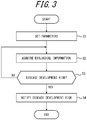
- the monitoring apparatus 1 can monitor the condition of the subject according to the procedure of the flowchart illustrated in FIG. 3 .
- Acute mountain sickness is also referred to as AMS.
- Acute mountain sickness is hereafter simply referred to as mountain sickness.
- a person who has developed severe mountain sickness has a possibility of also developing brain edema, pulmonary edema, or the like concurrently, and slipping into critical condition.
- the subject can implement a coping measure to prevent development of severe mountain sickness.
- the health management of the subject can be supported, and the safety of the subject can be ensured easily.
- the monitoring apparatus 1 is not limited to monitoring the risk of developing mountain sickness, and may monitor the risk of developing various diseases such as venous thrombosis. Venous thrombosis is also referred to as economy class syndrome.
- the monitoring apparatus 1 can monitor the risk of the subject developing a disease in the absence of subjective symptoms.
- the monitoring apparatus 1 can monitor the risk of the subject developing a disease that is difficult to recognize. By monitoring the disease development risk, the monitoring apparatus 1 can notify the subject of the risk before the subject develops the disease or before the disease becomes severe, and urge the subject to implement a coping measure. Consequently, the subject can prevent the development of the disease or prevent the disease from becoming severe.
- the controller 10 sets parameters relating to control of each component in the monitoring apparatus 1 (step S1).
- the controller 10 may store the set parameters in the memory 12.
- the parameters may include a cycle for acquiring the biological information of the subject from the sensor 50.
- the cycle for acquiring the biological information may be set in seconds or in minutes, or set to 1 hour or more.
- the parameters may include information specifying one or more types of biological information to be acquired from the sensor 50.
- the parameters may include one or more thresholds used for determination based on the biological information. The parameters are not limited to such, and may include various items.
- the controller 10 may set the parameters based on the defaults of the monitoring apparatus 1.
- the controller 10 may set the parameters based on input from the subject.
- the controller 10 may set the parameters based on the height, weight, age, sex, etc. of the subject.
- the controller 10 may set the parameters based on past biological information of the subject stored in the memory 12.
- the controller 10 acquires the biological information of the subject from the sensor 50 (step S2).
- the type(s) of the biological information acquired may be set by the parameters.
- the biological information may include, for example, the breathing rate, SpO 2 , body temperature, pulse rate, blood pressure, and/or blood flow amount of the subject.
- FIGS. 4 and 5 are conceptual diagrams illustrating an example of data structures 400 and 500 stored in the memory 12.
- the data structures stored in the memory 12 are not limited to the data structures 400 and 500 illustrated in FIGS. 4 and 5 .
- One or more other data elements may be added as appropriate to the data structures 400 and 500 illustrated in FIGS. 4 and 5 .
- One or more data elements may be omitted as appropriate from the data structures 400 and 500 illustrated in FIGS. 4 and 5 .
- the data structure 400 stored in the memory 12 may include user ID 410, measurement date and time 412, breathing rate 414, SpO 2 416, body temperature 418, pulse rate 420, blood pressure 422, blood flow amount 424, position 426, etc., as data elements.
- the user ID 410 and the measurement date and time 412 may be main keys.
- the user ID 410 may be data identifying the subject.
- the measurement date and time 412 may be data about the date and time of detection of the biological information of the subject.
- the breathing rate 414, the SpO 2 416, the body temperature 418, the pulse rate 420, the blood pressure 422, and the blood flow amount 424 may be data about the breathing rate, SpO 2 , body temperature, pulse rate, blood pressure, and blood flow amount detected from the subject, respectively.
- the position 426 may be data about the current position of the subject.
- the current position of the subject may be expressed by latitude, altitude, longitude, or any combination thereof.
- the data elements included in the data structure 400 may be data about biological information of the subject.
- the data structure 500 stored in the memory 12 may include user ID 530, name 532, birth date 534, age 536, sex 538, chronic disease 540, climbing experience 542, etc., as data elements.
- the user ID 530 may be a main key.
- the data elements included in the data structure 500 may be items about personal information of the subject.
- the name 532, the birth date 534, the age 536, and the sex 538 may be data about the name, birth date, age, and sex of the subject, respectively.
- the chronic disease 540 may be data about the name of any disease with which the subject was diagnosed, symptoms which the subject recognized, and the like.
- the climbing experience 542 may be data about the number of years of climbing experience of the subject, the names and/or number of mountains climbed, and the like.
- the data elements included in the data structures 400 and 500 may be replaced with each other, or combined into one data structure 400 or 500.
- the controller 10 determines whether the subject has disease development risk, based on at least one piece of biological information (step S3).
- the controller 10 may determine that the subject has disease development risk, in the case where the SpO 2 of the subject is less than a predetermined value.
- the predetermined value concerning SpO 2 may be, for example, 85 %.
- the predetermined value is, however, not limited to such, and may be determined as appropriate.
- the controller 10 may determine that the subject has disease development risk, in the case where the body temperature of the subject is greater than or equal to a predetermined value.
- the predetermined value concerning body temperature may be, for example, 37.0 °C.
- the predetermined value is, however, not limited to such, and may be determined as appropriate.
- the controller 10 may determine that the subject has disease development risk, in the case where the breathing rate of the subject is outside a predetermined range. That is, the controller 10 may determine that the subject has disease development risk, in the case where the breathing rate of the subject is excessively low or excessively high.
- the predetermined range concerning breathing rate may be, for example, a range of 10 to 25 per minute. The predetermined range is, however, not limited to such, and may be determined as appropriate.
- the controller 10 may determine whether the subject has disease development risk, based on results of comparing a plurality of pieces of biological information with respective thresholds.
- the controller 10 may calculate a score quantifying the disease development risk, based on at least one piece of biological information.
- the controller 10 may determine that the subject has disease development risk, in the case where the score is greater than or equal to a predetermined value or in the case where the score is less than or equal to a predetermined value.
- the predetermined value concerning score may be determined as appropriate.
- the controller 10 may determine whether the subject has disease development risk, based on a result of comparing biological information acquired before a predetermined time point and biological information acquired after the predetermined time point, which are stored in the memory 12. The controller 10 may determine that the subject has disease development risk, in the case where the difference between the biological information acquired before the predetermined time point and the biological information acquired after the predetermined time point is greater than or equal to a predetermined value. That is, the controller 10 may determine that the subject has disease development risk, in the case where the amount of change of biological information is greater than or equal to the predetermined value.
- the predetermined value concerning the amount of change of biological information may be determined as appropriate.
- the controller 10 In the case where the subject does not have disease development risk (step S3: NO), the controller 10 returns to step S2. In the case where the subject has disease development risk (step S3: YES), the controller 10 causes the notification interface 30 to notify the subject of information about the disease development risk (step S4).
- the information about the disease development risk may include the determination result that the subject has disease development risk.
- the information about the disease development risk may include information about a coping measure for the disease development risk of mountain sickness.
- the coping measure may be to urge the subject to use a breathing technique that improves the symptoms of mountain sickness, or to urge the subject to descend the mountain.
- the coping measure for mountain sickness is not limited to such, and may be any of various measures.
- the controller 10 may output control information including the contents of the notification to the notification interface 30.
- the notification interface 30 may notify the subject of the contents based on the control information, or notify a person in the vicinity of the subject of the contents.
- the controller 10 ends the procedure of the flowchart in FIG. 3 .
- the controller 10 may return to step S1 or S2.
- Examples of the coping measure for the disease development risk of mountain sickness include information regarding a massage technique, information regarding fluid intake, information regarding resting time, and information regarding resting attitude.
- the monitoring apparatus 1 can notify the subject of information in stages based on the biological information of the subject, according to the procedure of the flowchart illustrated in FIG. 6 .
- the monitoring apparatus 1 may notify the subject of information in stages based on comparison results of the SpO 2 of the subject and a plurality of thresholds.
- the monitoring apparatus 1 may notify the subject of information in stages based on comparison between various biological information other than SpO 2 and a plurality of thresholds.
- the order of the steps in the flowchart illustrated in FIG. 6 may be changed as appropriate.
- the controller 10 sets parameters relating to control of each component in the monitoring apparatus 1 (step S11).
- the controller 10 may set a threshold to be compared with the SpO 2 of the subject, as a parameter.
- the controller 10 may set a first threshold, a second threshold, and a third threshold.
- the number of thresholds is not limited to three, and may be two or less, or four or more.
- the first threshold is less than the second threshold.
- the second threshold is less than the third threshold.
- the first threshold, the second threshold, and the third threshold may be respectively set to 70 %, 80 %, and 90 %. These threshold values are based on the result of demonstration experiments conducted by the inventors at high altitude.
- the thresholds are not limited to these values, and may be set to other values.
- the controller 10 acquires the SpO 2 of the subject from the sensor 50 (step S12).
- the controller 10 determines whether the SpO 2 is less than the first threshold (step S13). In the case where the SpO 2 is less than the first threshold (step S13: YES), the controller 10 causes the notification interface 30 to notify first information (step S14).
- the first information may include information urging the subject to stop climbing and descend the mountain. The first information may include other information. After step S14, the controller 10 returns to step S12.
- the controller 10 determines whether the SpO 2 is less than the second threshold (step S15). In the case where the SpO 2 is less than the second threshold (step S15: YES), the controller 10 causes the notification interface 30 to notify second information (step S16).
- the second information may include information urging the subject to use a breathing technique that prevents development of mountain sickness.
- the breathing technique may be, for example, a pressure breathing technique or an abdominal breathing technique. The breathing technique is not limited to such, and may be any of other various techniques.
- the second information may include information indicating a specific procedure of the breathing technique. The second information is not limited to these information, and may include other information.
- the controller 10 returns to step S12.
- the second information may include information regarding a massage technique, information regarding fluid intake, information regarding resting time, information regarding resting attitude, etc.
- the controller 10 determines whether the SpO 2 is less than the third threshold (step S17). In the case where the SpO 2 is less than the third threshold (step S17: YES), the controller 10 causes the notification interface 30 to notify third information (step S18).
- the third information may include information urging the subject to rest in order to prevent development of mountain sickness.
- the third information may include information urging the subject to exercise.
- the third information may include information urging the subject to receive hydration.
- the third information is not limited to these information, and may include other information.
- the controller 10 returns to step S12. In the case where the SpO 2 is not less than the third threshold (step S17: NO), the controller 10 returns to step S12.
- the third information may include information regarding a massage technique, information regarding fluid intake, information regarding resting time, information regarding resting attitude, etc.
- the monitoring apparatus 1 can notify information suitable for the condition of the subject, by determining the biological information based on the thresholds in stages.
- the monitoring apparatus 1 can perform a more detailed determination of whether the subject has disease development risk based on the biological information of the subject, according to the procedure of the flowchart illustrated in FIG. 7 .
- the controller 10 sets parameters relating to control of each component in the monitoring apparatus 1 (step S21).
- the controller 10 may perform a procedure that is the same as or similar to step S1 in FIG. 3 .
- the controller 10 acquires the biological information of the subject from the sensor 50 (step S22).
- the controller 10 may perform a procedure that is the same as or similar to step S2 in FIG. 3 .
- the controller 10 determines whether the biological information satisfies a first criterion (step S23).
- the first criterion may include the breathing rate of the subject being greater than or equal to a predetermined threshold. In the case where the breathing rate of the subject is greater than or equal to the predetermined threshold, there is a possibility that the subject is in a state of hyperpnea.
- the first criterion may include the breathing rate of the subject being less than a predetermined threshold. In the case where the breathing rate of the subject is less than the predetermined threshold, there is a possibility that the subject is in a state of apnea.
- the first criterion may include the SpO 2 of the subject being less than a predetermined threshold.
- the first criterion may include the body temperature of the subject being greater than or equal to a predetermined threshold. In the case where the body temperature of the subject is greater than or equal to the predetermined threshold, there is a possibility that the subject is in a state of feverishness.
- the first criterion may include the body temperature of the subject being less than a predetermined threshold. In the case where the body temperature of the subject is less than the predetermined threshold, there is a possibility that the subject is in a state of hypothermia.
- the first criterion is not limited to such, and may include various conditions, and may be a combination of a plurality of conditions.
- step S23 NO
- the controller 10 determines whether the biological information satisfies a second criterion (step S24).
- the second criterion may include the same condition as that included in the first criterion, or include a different condition from that included in the first criterion.
- the second criterion may include the pulse rate of the subject being greater than or equal to a predetermined threshold. In the case where the pulse rate of the subject is greater than or equal to the predetermined threshold, there is a possibility that the subject is in a state of hypoxia.
- the second criterion may include a condition relating to the autonomic nerve state.
- the autonomic nerve state can be represented by the balance between the strength of sympathetic nerve activity and the strength of parasympathetic nerve activity.
- the second criterion may include the difference between the strength of sympathetic nerve activity and the strength of parasympathetic nerve activity being greater than or equal to a predetermined value.
- the controller 10 may determine the autonomic nerve state based on the biological information of the subject.
- the controller 10 may determine the autonomic nerve state based on the variation in heartbeat.
- the controller 10 may determine the autonomic nerve state based on the variation in the electrical resistance of the body surface of the subject.
- step S24: NO the controller 10 returns to step S22.
- step S24: YES the controller 10 causes the notification interface 30 to notify the subject of information about the disease development risk (step S25).
- the controller 10 may cause the notification interface 30 to notify information urging the subject to input subjective symptoms.
- the controller 10 receives input of subjective symptoms from the subject by the input interface 40 (step S26).
- the controller 10 may cause the notification interface 30 to produce a display requesting the subject to answer questions based on the Lake Louise Score (LLS).
- the questions which the subject is requested to answer are not limited to the LLS-based questions, and may be other various questions.
- Examples of the subjective symptoms of the subject include physical pain such as headache, decreased appetite, fatigue or a feeling of weariness, dizziness or lightheadedness, and a sleeping state.
- the controller 10 may cause the notification interface 30 to produce a display requesting the subject to answer questions other than the LLS-based questions.
- the controller 10 determines whether the subject is developing mountain sickness, based on the subjective symptoms of the subject (step S27).
- the controller 10 may calculate a score quantifying the subjective symptoms of the subject.
- the controller 10 may calculate a score quantifying the answers of the subject to the LLS-based questions.
- the controller 10 may determine whether the subject is developing mountain sickness, based on the calculated score.
- the controller 10 may determine the severity of the mountain sickness developed by the subject, based on the calculated score.
- step S27 NO
- the controller 10 may cause the notification interface 30 to notify that the likelihood of the subject developing mountain sickness is low.
- the controller 10 may determine that the subject is predicted to develop mountain sickness.
- the controller 10 may cause the notification interface 30 to notify a coping measure for the disease development risk.
- the controller 10 determines the severity of the mountain sickness based on the biological information (step S28).
- the controller 10 may determine the severity of the mountain sickness based on the blood pressure or blood flow amount of the subject. For example, the controller 10 may determine the severity of the mountain sickness to be higher when the blood pressure of the subject is lower. For example, the controller 10 may determine the severity of the mountain sickness to be higher when the blood flow amount to the brain of the subject is larger.
- the controller 10 may determine the severity of the mountain sickness based on other various biological information, without being limited to these biological information.
- the controller 10 may determine the severity of the mountain sickness in stages, by comparing the biological information with a plurality of thresholds as in the procedure of the flowchart in FIG. 6 .
- the controller 10 causes the notification interface 30 to notify information about the coping measure for the subject based on the determination result on the severity of the mountain sickness (step S29).
- the coping measure may be based on the severity of the mountain sickness.
- the coping measure may be to urge the subject to descend the mountain, to urge the subject or another person to report, or to urge the subject to use a breathing technique that improves the symptoms of mountain sickness.
- the coping measure for mountain sickness is not limited to such, and may be any of other various measures.
- any one of steps S23 and S24 may be omitted. That is, the controller 10 may advance to step S25 to notify the disease development risk, in the case where one of the first criterion and the second criterion is satisfied.
- the monitoring apparatus 1 may determine whether the subject has risk of developing economy class syndrome.
- the monitoring apparatus 1 may determine whether the subject has risk of developing economy class syndrome, based on the blood flow amount of the subject.
- the monitoring apparatus 1 may determine whether the subject has risk of developing economy class syndrome based on other various biological information, without being limited to the blood flow amount of the subject.
- the monitoring apparatus 1 may notify a coping measure to urge the subject to exercise or to urge the subject to receive hydration.
- the coping measure for economy class syndrome is not limited to such, and may be any of other various measures.
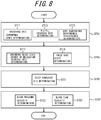
- FIG. 8 is a flowchart of mountain sickness determination according to the present disclosure.
- the measurement order in the flowchart in FIG. 8 is an example, and may be changed as appropriate.
- the controller 10 performs a determination based on the breathing rate, SpO 2 , or body temperature of the subject (step S701).
- the controller 10 may determine whether the subject is in a state of hyperpnea or apnea, based on the breathing rate of the subject (step S711).
- the controller 10 may determine the SpO 2 decrease rate, based on the SpO 2 of the subject (step S713).
- the controller 10 may determine whether the subject is in a state of hypothermia or hyperthermia, based on the body temperature of the subject (step S715).
- the steps included in step S701 may be performed in a different order, and any of the steps may be skipped as appropriate.
- the controller 10 may advance to step S703.
- the controller 10 may store the determination result in each step included in step S701 or a value obtained by converting the determination result into a score, in the memory 12. After storing the determination result in the memory 12, the controller 10 may advance to step S703 regardless of whether the determination in each step included in step S701 satisfies the condition.
- the controller 10 performs the determination based on the autonomic nerve state or pulse rate of the subject (step S703).
- the controller 10 may determine the degree of relaxation or the decrease rate of the degree of relaxation, based on the autonomic nerve state of the subject (step S717).
- the controller 10 may determine the condition of the subject, based on the pulse rate of the subject (step S719).
- the steps included in step S703 may be performed in a different order, and any of the steps may be skipped as appropriate. In the case where at least one determination of the determinations in the steps included in step S703 satisfies the condition, the controller 10 may advance to step S705.
- the controller 10 may store the determination result in each step included in step S703 or a value obtained by converting the determination result into a score, in the memory 12. After storing the determination result in the memory 12, the controller 10 may advance to step S705 regardless of whether the determination in each step included in step S703 satisfies the condition.
- the controller 10 performs the determination based on the chief complaint of the subject (step S705).
- the controller 10 may perform LLS determination based on the chief complaint of the subject (step S721).
- the controller 10 may advance to step S707 in the case where the determination in step S721 satisfies the condition.
- the controller 10 may store the determination result in step S721 in the memory 12, or convert the determination result into a score and store the score in the memory 12. After storing the determination result in the memory 12, the controller 10 may advance to step S707 regardless of whether the determination in step S721 satisfies the condition.
- the controller 10 performs the determination based on the blood pressure or blood flow of the subject (step S707).
- the controller 10 may determine the severity of the subject based on the blood pressure of the subject (step S723).
- the controller 10 may determine the severity of the subject based on the blood flow of the subject (step S725).
- the steps included in step S707 may be performed in a different order, and any of the steps may be skipped as appropriate. In the case where at least one determination of the determinations in the steps included in step S707 satisfies the condition, the controller 10 may determine that the subject has severe mountain sickness, and end the procedure of the flowchart in FIG. 8 .
- the controller 10 may store the determination result in each step included in step S707 or a value obtained by converting the determination result into a score, in the memory 12. After storing the determination result in the memory 12, the controller 10 may end the procedure of the flowchart in FIG. 8 regardless of whether the determination in each step included in step S707 satisfies the condition. The controller 10 may advance to the next step after performing the steps included in steps S701, S703, S705, and S707.
- each monitoring apparatus 1 connected to a sensor 50 may be communicably connected to a server 70 via the network 80.
- the number of servers 70 is not limited to one, and may be two or more.
- the number of monitoring apparatuses 1 and the number of sensors 50 are each not limited to two, and may be one, or three or more.
- the number of sensors 50 connected to one monitoring apparatus 1 is not limited to one, and may be two or more.
- the sensor 50 may be connected to the server 70 without the monitoring apparatus 1 therebetween.
- the network 80 may be a wired network, a wireless network, or a combination thereof.
- the server 70 can acquire biological information of a subject detected by a sensor 50, from each monitoring apparatus 1.
- the server 70 may acquire biological information of a plurality of subjects.
- the server 70 may analyze the acquired biological information using various calculations such as averaging.
- the server 70 may analyze the acquired biological information by a statistical technique.
- the server 70 may transmit the analysis result of the biological information to each monitoring apparatus 1.
- the monitoring apparatus 1 may set parameters relating to control of each component in the monitoring apparatus 1, based on the analysis result of the biological information.
- the server 70 may determine the disease development risk of the subject based on the biological information of the subject, and transmit the determination result to the monitoring apparatus 1.
- the monitoring apparatus 1 may notify information based on the determination result of the disease development risk by the server 70.
- the server 70 may generate information about a coping measure for the subject based on the biological information of the subject, and transmit the generated information to the monitoring apparatus 1.
- the monitoring apparatus 1 may notify the subject of the information about the coping measure generated by the server 70.
- FIG. 10 is a block diagram illustrating an example of the internal structure of the server 70 illustrated in FIG. 9 .
- the server 70 includes a server controller 71, a server communication interface 73, and a server memory 72.
- the server controller 71 is a processor that controls and manages the whole server 70, e.g. each functional block in the server 70.
- the server controller 71 includes a processor such as a CPU that executes a program defining a control procedure.
- a program is, for example, stored in the server memory 72 or an external storage medium connected to the server 70.
- the server controller 71 includes at least one server processor 711 to provide control and throughput for executing various functions, as described in more detail below.
- At least one server processor 711 may be implemented as a single integrated circuit (IC), or as a plurality of ICs and/or discrete circuits communicably connected to one another. At least one server processor 711 can be implemented according to various known technologies.
- the server processor 711 includes, for example, one or more circuits or units configured to perform one or more data calculation procedures or processes by executing instructions stored in related memory.
- the server processor 711 may be firmware configured to perform one or more data calculation procedures or processes.
- the firmware may be, for example, a discrete logic component.
- the server processor 711 may include one or more processors, controllers, microprocessors, microcontrollers, application specific integrated circuits (ASICs), digital signal processors, programmable logic devices, field programmable gate arrays, or any combination of these devices or structures, or any combination of other known devices or structures, to perform the functions of the server controller 71 described below.
- ASICs application specific integrated circuits
- digital signal processors programmable logic devices, field programmable gate arrays, or any combination of these devices or structures, or any combination of other known devices or structures, to perform the functions of the server controller 71 described below.
- the server memory 72 may be semiconductor memory, magnetic memory, or the like.
- the server memory 72 stores various information, programs for operating the server 70, and the like.
- the server memory 72 may function as working memory.
- Data stored in the server memory 72 may be the same as the data elements in the data structures 400 and 500 illustrated in FIGS. 4 and 5 .
- the server memory 72 may store various control programs, application programs, and the like.
- the server 70 may acquire data from separate subjects each using a sensor 50. That is, the server memory 72 in the server 70 may store the data illustrated in FIGS. 4 and 5 for each of a plurality of subjects.
- Some of the information stored in the server memory 72 may be acquired from a monitoring apparatus 1 or a sensor 50. Some of the information stored in the server memory 72 may be acquired from another server 70 connected to the server 70 via the network 80.
- the server 70 may acquire a result of determining whether a subject has disease development risk, from each monitoring apparatus 1.
- the server 70 may acquire disease development risk determination results for a plurality of subjects.
- the server 70 may analyze each determination result by a statistical method.
- the server 70 may transmit a result of analyzing the determination result to the monitoring apparatus 1.
- the server 70 may generate information to be notified to the subject based on the result of analyzing the determination result, and transmit the generated information to the monitoring apparatus 1.
- the server 70 analyzing biological information of a plurality of subjects, the disease development risk determination accuracy in the monitoring apparatus 1 can be enhanced.
- the monitoring apparatus 1 may include a position sensor for detecting the position of the monitoring apparatus 1.
- the position sensor may acquire the position information of the monitoring apparatus 1 based on, for example, global navigation satellite system (GNSS) technologies including satellite navigation systems such as Global Positioning System (GPS), GLONASS, Galileo, and Quasi-Zenith Satellite System (QZSS).
- GNSS global navigation satellite system
- GPS Global Positioning System
- GLONASS Global Positioning System
- Galileo Galileo
- QZSS Quasi-Zenith Satellite System
- the monitoring apparatus 1 may transmit the position information of the monitoring apparatus 1 to the server 70.
- the position information includes latitude, longitude, and altitude information.
- the server 70 may determine whether the monitoring apparatus 1 is located in a predetermined range, based on the position information of the monitoring apparatus 1.
- the server 70 may analyze biological information of a subject or a determination result based on the biological information acquired from each monitoring apparatus 1 located in the predetermined range, by a statistical method. By analyzing whether the determination results in the predetermined range exhibit bias, the possibility that an event which affects the determination results is occurring in the predetermined range can be detected. Consequently, the disease development risk of each subject present in the predetermined range can be determined with higher accuracy.
- the sensor 50 used in the present disclosure is not limited to that illustrated in FIG. 2 .
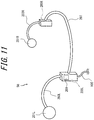
- a sensor 50 of a first example used in the present disclosure will be described below, with reference to FIG. 11 .
- the sensor 50 includes a holder 203L held on the auricle of the left ear of the subject.
- the sensor 50 also includes a housing 205L provided at the holder 203L on the occipital region side of the left ear of the subject.
- the sensor 50 also includes a measurement unit 201L provided at the holder 203L on the face side of the left ear of the subject.
- the sensor 50 also includes a sensor communication interface 209 having a cable 105 to be connected to a smartphone.
- the sensor communication interface 209 is covered by the housing 205L. Accordingly, the cable 105 extends from the housing 205L.
- the cable 105 may be provided at a part other than the housing 205L.
- the sensor 50 includes a holder 203R held on the auricle of the right ear of the subject.
- the sensor 50 also includes a housing 205R provided at the holder 203R on the occipital region side of the right ear of the subject.
- the sensor 50 also includes a measurement unit 201R provided at the holder 203R on the face side of the right ear of the subject. At least one of the measurement units 201L and 201R is located, for example, at the temporal region. At least one of the measurement units 201L and 201R may be located at a part other than the temporal region.
- the sensor 50 illustrated in FIG. 11 also includes a connector 207 connecting the housings 205L and 205R.
- the holder 203L, the holder 203R, and the connector 207 may be made of plastic, rubber, cloth, paper, resin, iron, or other material, or any combination thereof.
- At least one of the housings 205L and 205R is located, for example, at the mastoid region. At least one of the housings 205L and 205R may be located at a part other than the mastoid region.
- the sensor 50 in the present disclosure may have, for example, a structure in which at least one of the measurement unit 201R and the housing 205R is omitted from the structure illustrated in FIG. 11 .
- the sensor 50 in the present disclosure may have, for example, a structure in which at least one of the measurement unit 201L and the housing 205L is omitted from the structure illustrated in FIG. 11 .
- the sensor 50 in the present disclosure may have, for example, a structure in which the measurement unit 201R and the housing 205L are omitted from the structure illustrated in FIG. 11 .
- the sensor 50 in the present disclosure may have, for example, a structure in which the measurement unit 201L and the housing 205R are omitted from the structure illustrated in FIG. 11 .
- At least one of the measurement units 201L and 201R includes a breathing rate sensor, a SpO 2 sensor, a body temperature sensor, a pulse wave rate sensor, a blood flow amount sensor, a pulse wave sensor, a heart rate sensor, and the like.
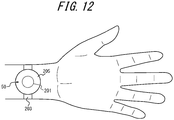
- the sensor 50 of the second example is of wristwatch type.
- the sensor 50 includes a measurement unit 201 located on the side of the body surface of the subject, and a holder 203 worn on the arm of the subject.
- the measurement unit 201 may be in contact with the body surface of the subject.
- the measurement unit 201 may include a breathing rate sensor, a SpO 2 sensor, a body temperature sensor, a pulse wave rate sensor, a blood flow amount sensor, a pulse wave sensor, a heart rate sensor, and the like.
- the holder 203 may be a belt wrapped around the arm of the subject, or have any other form that can be worn by the subject.
- the holder 203 may be made of plastic, rubber, cloth, paper, resin, iron, or other material, or any combination thereof.
- the sensor 50 used in the present disclosure is not limited to the foregoing forms.
- the sensor 50 may be included in any appropriate object such as a wristwatch, a cane, a flashlight, a hat, clothes, pants, shoes, eyeglasses, a helmet, a rucksack, a bag, a water bottle, a compass, a bicycle, an automobile, or a motorcycle.
- the sensor 50 in the present disclosure may have any appropriate shape such as a clip shape or a band shape.
- a breathing rate sensor In the sensor 50 in the present disclosure, a breathing rate sensor, a SpO 2 sensor, a body temperature sensor, a pulse wave rate sensor, a blood flow amount sensor, a pulse wave sensor, a heart rate sensor, and the like may be included in one device, or separated between a plurality of devices.
- the monitoring apparatus 1 in the present disclosure may monitor the physical condition of the user as the subject, by appropriately using information other than biological information, such as position information, atmospheric temperature information, humidity information, weather information, time information, headache frequency, moving distance, and fluid intake.
- information other than biological information such as position information, atmospheric temperature information, humidity information, weather information, time information, headache frequency, moving distance, and fluid intake.
- the monitoring apparatus 1 or the sensor 50 may notify not only the user but also a person other than the user, a device, a server, and the like.
- the monitoring apparatus 1 may notify, for example, the first information, the second information, or the third information in FIG.
- the person other than the user in the group to which the user using the sensor 50 belongs may be, for example, a leader of the group to which the user using the sensor 50 belongs.
- the leader may be a tour guide.
- the monitoring apparatus 1 may notify, for example, information about the risk to a server, a security alarm, a personal computer, a smartphone, a mobile phone, etc. of a person other than the user in a group to which the user using the sensor 50 belongs, a family or a friend of the user using the sensor 50, a medical institution, an administrative body, or the like.
- Each sensor 50 described above may be connected to not only a smartphone but also a mobile phone, a music player, a game machine, a personal computer, a server, a tablet terminal, or the like.
- the presently disclosed technique may be used in situations in which the user is climbing, jogging, running, walking, driving an automobile, driving a motorcycle, driving a bicycle, flying an airplane, steering a ship, or sightseeing.
- the presently disclosed technique may be used in situations in which the user is driving or riding a train, a bus, an automobile, a motorcycle, a bicycle, an airplane, or a ship. Situations in which the presently disclosed technique is used are not limited to such.
- a monitoring apparatus according to another embodiment will be described below.
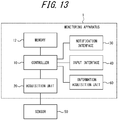
- a monitoring apparatus 1 is the same as the monitoring apparatus 1 illustrated in FIG. 1 in that it includes a controller 10 and a notification interface 30.
- the monitoring apparatus 1 illustrated in FIG. 13 may further include a memory 12, an acquisition unit 20, and an input interface 40, as in the monitoring apparatus 1 illustrated in FIG. 1 .
- the monitoring apparatus 1 illustrated in FIG. 13 is connected to an external sensor 50 via the acquisition unit 20, as in the monitoring apparatus 1 illustrated in FIG. 1 .
- the monitoring apparatus 1 illustrated in FIG. 13 can monitor changes in the body condition of the user based on the biological information of the user detected by the sensor 50, as in the monitoring apparatus 1 illustrated in FIG. 1 .
- These functional units may be the same as the functional units included in the monitoring apparatus 1 illustrated in FIG. 1 . Description of parts same as or similar to those described above with regard to the monitoring apparatus 1 illustrated in FIG. 1 is simplified or omitted as appropriate.
- the monitoring apparatus 1 illustrated in FIG. 13 further includes an information acquisition unit 60.
- the information acquisition unit 60 acquires information about the altitude of the subject.
- the information acquisition unit 60 may be a position sensor for detecting the position of the monitoring apparatus 1, such as a GPS module.
- the position sensor may acquire the position information of the monitoring apparatus 1 based on, for example, GNSS technologies including satellite navigation systems such as GPS, GLONASS, Galileo, and QZSS, as mentioned above.
- the position information acquired by the information acquisition unit 60 includes latitude, longitude, and altitude information.
- the information acquisition unit 60 can thus acquire the information about the altitude of the subject.
- the information acquisition unit 60 may estimate the information about the altitude of the subject, by acquiring information of latitude and longitude. For example, with information based on a topographical map of an area including the position of the subject, the information about the altitude of the subject can be estimated from the information of the position (latitude and longitude) of the subject. To enable such estimation, position information and altitude information are associated with each other. For example, information associating position and altitude with each other may be stored in the memory 12 in the monitoring apparatus 1. In this case, the controller 10 may estimate the information about the altitude of the subject, based on the information of the position (latitude and longitude) acquired by the information acquisition unit 60.
- the information associating position and altitude with each other may be stored in the server memory 72 (see FIG. 10 ).
- the information acquisition unit 60 may transmit the acquired information of the position (latitude and longitude) to the server 70, and the server controller 71 may estimate the information about the altitude of the subject.
- the information acquisition unit 60 may estimate the information about the altitude of the subject, by acquiring information of the atmospheric pressure of the ambient environment like, for example, an atmospheric pressure sensor.
- the information acquisition unit 60 may have any structure capable of acquiring the information about the altitude of the subject.
- Mountain sickness is known to be likely to occur when the subject enters a state of hypoxia, e.g. when SpO 2 decreases.
- the risk of developing mountain sickness is high when the altitude changes (increases or decreases) rapidly while climbing, driving an automobile on mountain roads, or the like.
- the monitoring apparatus 1 monitors at least one of the altitude of the subject and/or the biological information of the subject, and notifies predetermined information such as a warning or an alarm in the case where the subject is determined to have disease development risk of mountain sickness.
- the monitoring apparatus 1 can monitor the condition of the subject according to the procedure of the flowchart illustrated in FIG. 14 . As an example, suppose the monitoring apparatus 1 monitors the risk of the subject developing mountain sickness during climbing or the like.
- the controller 10 sets parameters relating to control of each component in the monitoring apparatus 1 (step S31).
- the controller 10 may store the set parameters in the memory 12.
- the parameter setting in step S31 may be performed in a way same as or similar to the parameter setting in step S1 in FIG. 3 .
- the controller 10 acquires information about the altitude of the subject from the information acquisition unit 60 (step S32).
- the information about the altitude of the subject may be, for example, information of height such as elevation.
- the information acquisition unit 60 may acquire information of the atmospheric pressure of the ambient environment of the monitoring apparatus 1 including the information acquisition unit 60.
- information of altitude (height) estimated from the information of the atmospheric pressure acquired by the information acquisition unit 60 may be used as the information about the altitude of the subject.
- the controller 10 determines whether the subject has disease development risk of mountain sickness, based on the information about the altitude of the subject (step S33).
- the controller 10 may determine that the subject has disease development risk, in the case where the altitude of the subject is greater than or equal to a predetermined altitude, for example, the altitude is 2000 m or more.
- the controller 10 may determine that the subject has disease development risk based on the information about the altitude.
- the controller 10 may determine that the subject has disease development risk, in the case where the altitude of the subject changes (increases or decreases) by a predetermined amount or more, for example, the altitude changes by 200 m or more with respect to 1500 m.
- the controller 10 may determine that the subject has disease development risk based on the information about the change of the altitude.
- the controller 10 may determine that the subject has disease development risk, in the case where the altitude of the subject changes (increases or decreases) by a predetermined amount or more within a predetermined time period, for example, the altitude changes by 300 m or more with respect to 2000 m within 30 minutes.
- the controller 10 may determine that the subject has disease development risk based on the information about the change of the altitude within the predetermined time period.
- the controller 10 may determine that the subject has disease development risk, in the case where the change of the altitude within the predetermined time period is the predetermined amount or more.
- step S33 NO
- the controller 10 returns to step S32.
- the controller 10 causes the notification interface 30 to notify the subject of predetermined information such as information about the disease development risk (step S34).
- the controller 10 may control the notification interface 30 to notify the subject of the predetermined information.
- the controller 10 may notify, from the notification interface 30, the subject that the subject has disease development risk, as information such as sound (speech) and/or display (warning light).
- the controller 10 may notify, from the notification interface 30, tactile information such as vibration, instead of or in addition to auditory information and/or visual information.
- the controller 10 may notify, from the notification interface 30, the subject of a message such as "You have risk of mountain sickness” by speech and/or display.
- the controller 10 may notify, from the notification interface 30, the subject of a message such as "Please rest awhile" by speech and/or display.
- the controller 10 may notify, from the notification interface 30, the subject of a message such as "Please increase your breathing rate / Please take ... deep breaths" by speech and/or display.
- step S34 the controller 10 may notify the server 70 that the subject has risk of mountain sickness.
- step S34 for example, the controller 10 may notify an external medical institution or clinic that the subject has risk of mountain sickness.
- the monitoring apparatus 1 according to the embodiment can reduce the risk of the subject developing mountain sickness during climbing or the like.
- the monitoring apparatus 1 according to the embodiment can therefore support the health management of the user.
- the monitoring apparatus 1 may monitor the condition of the subject according to the procedure of the flowchart illustrated in FIG. 15 . As an example, suppose the monitoring apparatus 1 monitors the risk of the subject developing mountain sickness during climbing or the like in FIG. 15 , as in FIG. 14 .
- the procedure of the flowchart in FIG. 15 differs from the procedure of the flowchart in FIG. 14 in that the process of step S41 is added and the process of step S33 is changed.
- the controller 10 sets parameters relating to control of each component in the monitoring apparatus 1 (step S31).
- the controller 10 may store the set parameters in the memory 12.
- the parameter setting in step S31 may be performed in a way same as or similar to the parameter setting in step S1 in FIG. 3 .
- the controller 10 acquires the biological information of the subject from the sensor 50 (step S41).
- the controller 10 may control the acquisition unit 20 to acquire the biological information of the subject from the sensor 50. That is, the acquisition unit 20 may acquire the biological information of the subject.
- the type(s) of the biological information acquired may be set by the parameters.
- the biological information may include at least one of the breathing rate, SpO 2 , oxygen saturation, body temperature, pulse rate, blood pressure, and blood flow amount of the subject.
- step S32 and the process of step S41 may be performed in reverse order.
- the controller 10 determines whether the subject has disease development risk, based on at least one piece of biological information (step S33). In step S33, the controller 10 may determine whether the subject has disease development risk, based on at least one of the biological information of the subject and the information about the altitude of the subject.
- the controller 10 may determine that the subject has disease development risk, in the case where the SpO 2 of the subject is less than or equal to a predetermined value, for example, the SpO 2 is 85 % or less. Thus, the controller 10 may determine that the subject has disease development risk based on the biological information. The controller 10 may determine that the subject has disease development risk, in the case where the SpO 2 of the subject changes (increases or decreases) by a predetermined amount or more, for example, the SpO 2 changes by 10 % or more with respect to 95 %. Thus, the controller 10 may determine that the subject has disease development risk based on the change of the biological information.
- the controller 10 may determine that the subject has disease development risk, in the case where the SpO 2 of the subject changes (increases or decreases) by a predetermined amount or more within a predetermined time period, for example, the SpO 2 changes by 5 % or more with respect to 95 % within 20 minutes. Thus, the controller 10 may determine that the subject has disease development risk based on the change of the biological information within the predetermined time period. In particular, the controller 10 may determine that the subject has disease development risk, in the case where the change of the biological information within the predetermined time period is the predetermined amount or more.
- step S33 NO
- the controller 10 returns to step S32.
- the controller 10 causes the notification interface 30 to notify the subject of predetermined information such as information about the disease development risk (step S34).
- the controller 10 may control the notification interface 30 to notify the subject of the predetermined information.
- step S33 the controller 10 may determine whether the subject has disease development risk, by comparing the biological information acquired by the acquisition unit 20 (from the sensor 50) with estimated biological information.
- the biological information of the subject may be estimated from the information about the altitude of the subject.
- the upper graph in FIG. 16 illustrates temporal changes of the altitude of the subject.
- the controller 10 can recognize temporal changes of the altitude of the subject, by acquiring the information about the altitude of the subject from the information acquisition unit 60 continuously (or at predetermined timings).
- the altitude of the subject increases until about time t1, as illustrated in the upper graph in FIG. 16 .
- the altitude of the subject gently decreases after about time t1, as illustrated in the upper graph in FIG. 16 .
- the controller 10 may estimate SpO 2 illustrated in the lower graph in FIG. 16 , based on the temporal changes of the altitude of the subject illustrated in the upper graph in FIG. 16 .
- “estimated SpO 2” denotes SpO 2 estimated by the controller 10.
- the estimated SpO 2 is a result of estimating SpO 2 which the subject is expected to have when undergoing the temporal changes of the altitude illustrated in the upper graph in FIG. 16 .
- SpO 2 is plotted with a dashed line.
- the controller 10 may estimate the SpO 2 , or acquire the SpO 2 estimated by the server 70.
- the estimated SpO 2 may be obtained, for example, with reference to past data of the subject. For example, if there is a value of SpO 2 detected when the subject was at the same altitude in the past, the value may be taken to be the estimated SpO 2 .
- the estimated SpO 2 may be calculated, for example, based on past data of the subject. For example, if there is no value of SpO 2 detected when the subject was at the same altitude in the past but there is a value of SpO 2 detected when the subject was at another altitude, the value of the SpO 2 of the subject at the predetermined altitude may be estimated from such a value and taken to be the estimated SpO 2 .
- the estimated SpO 2 may be, for example, customized for each subject. In the case where appropriate information of the subject cannot be acquired, a value serving as a model of normal people may be calculated and taken to be the estimated SpO 2 . In this case, for example, the estimated SpO 2 may be calculated based on the sex, age, etc. of the subject.
- the acquired SpO 2 is greater than the estimated SpO 2 until about time t1.
- the controller 10 may determine that the disease development risk of the subject is low.
- the acquired SpO 2 is less than the estimated SpO 2 from about time t1 to about time t2.
- the controller 10 may determine that the disease development risk of the subject is high.
- the acquired SpO 2 is greater than the estimated SpO 2 from about time t2.
- the controller 10 may determine that the disease development risk of the subject is low.
- the controller 10 may determine that the subject has disease development risk, based on the estimated biological information of the subject and the biological information of the subject acquired by the acquisition unit 20.
- the controller 10 may determine, for example, whether the extent to which the acquired SpO 2 is less than the estimated SpO 2 is greater than or equal to a predetermined value, instead of determining whether the acquired SpO 2 is greater than the estimated SpO 2 or less than the estimated SpO 2 . For example, in the case where the acquired SpO 2 is less than the estimated SpO 2 by 8 %, the controller 10 may determine that the disease development risk of the subject is high. Thus, the controller 10 may determine that the subject has disease development risk, in the case where the difference between the estimated biological information and the acquired biological information is greater than or equal to the predetermined value.
- the controller 10 without initially performing detection of biological information by the sensor 50, may turn the sensor 50 on and start detection when a predetermined altitude, altitude change, or the like is detected. With such control, the sensor 50 need not be constantly on, so that the power consumption of the monitoring apparatus 1 (or the sensor 50) can be reduced.
- Terms such as “first” and “second” in the present disclosure are identifiers for distinguishing components.
- Components distinguished by terms such as “first” and “second” in the present disclosure may have their numbers interchanged with each other.
- the identifier “first” of the "first information” and the identifier “second” of the “second information” may be interchanged with each other.
- the identifiers are replaced with each other simultaneously.
- the components are distinguishable even after their identifiers are interchanged.
- the identifiers may be omitted.
- Components from which identifiers are omitted are distinguished by reference signs. Description of identifiers such as “first” and “second” in the present disclosure alone should not be used for interpretation of order of components or reasoning based on one identifier being smaller than another identifier.
Landscapes
- Health & Medical Sciences (AREA)
- Life Sciences & Earth Sciences (AREA)
- Engineering & Computer Science (AREA)
- Public Health (AREA)
- Medical Informatics (AREA)
- Biomedical Technology (AREA)
- Pathology (AREA)
- General Health & Medical Sciences (AREA)
- Heart & Thoracic Surgery (AREA)
- Molecular Biology (AREA)
- Surgery (AREA)
- Animal Behavior & Ethology (AREA)
- Biophysics (AREA)
- Veterinary Medicine (AREA)
- Physics & Mathematics (AREA)
- Physiology (AREA)
- Cardiology (AREA)
- Neurology (AREA)
- Primary Health Care (AREA)
- Epidemiology (AREA)
- Data Mining & Analysis (AREA)
- Databases & Information Systems (AREA)
- Pulmonology (AREA)
- Otolaryngology (AREA)
- Biodiversity & Conservation Biology (AREA)
- Neurosurgery (AREA)
- Hematology (AREA)
- Signal Processing (AREA)
- Psychiatry (AREA)
- Artificial Intelligence (AREA)
- Computer Vision & Pattern Recognition (AREA)
- Measuring And Recording Apparatus For Diagnosis (AREA)
- Medical Treatment And Welfare Office Work (AREA)
- Measurement Of The Respiration, Hearing Ability, Form, And Blood Characteristics Of Living Organisms (AREA)
Abstract
Description
- This application claims priority to and the benefit of Japanese Patent Application No.
2017-181194 filed on September 21, 2017 - The present disclosure relates to a monitoring apparatus, a monitoring method, and a monitoring program.
- Information provision systems which advise a user to stop movement based on biological information of the user and environmental information of the surroundings of the user are known (for example, see PTL 1).
- PTL 1:
JP 2013-220182 A - A monitoring apparatus according to an embodiment of the present disclosure comprises an acquisition unit, a controller, and a notification interface. The acquisition unit is configured to acquire biological information of a subject. The controller is configured to determine whether the subject has disease development risk, based on a result of analyzing the biological information of the subject. The notification interface is configured to notify information about the disease development risk.
- A monitoring method according to an embodiment of the present disclosure comprises: acquiring biological information of a subject; determining whether the subject has disease development risk, based on a result of analyzing the biological information of the subject; and notifying information about the disease development risk.
- A monitoring program according to an embodiment of the present disclosure is configured to cause a processor to: acquire biological information of a subject; determine whether the subject has disease development risk, based on a result of analyzing the biological information of the subject; and notify information about the disease development risk.
- A monitoring apparatus according to an embodiment of the present disclosure comprises an information acquisition unit, a notification interface, and a controller. The information acquisition unit is configured to acquire information about an altitude of a subject. The notification interface is configured to notify the subject of predetermined information. The controller is configured to control the notification interface to notify the subject of the predetermined information, in a case of determining, based on the information about the altitude, that the subject has disease development risk.
- In the accompanying drawings:
-
FIG. 1 is a block diagram illustrating an example of the schematic structure of a monitoring apparatus according to an embodiment; -
FIG. 2 is a diagram illustrating an example of the connection between the monitoring apparatus and a sensor; -
FIG. 3 is a flowchart illustrating an example of a procedure for a monitoring method; -
FIG. 4 is a conceptual diagram illustrating an example of a data structure stored in a memory; -
FIG. 5 is a conceptual diagram illustrating an example of the data structure stored in the memory; -
FIG. 6 is a flowchart illustrating an example of a procedure for determining biological information in stages; -
FIG. 7 is a flowchart illustrating an example of a procedure for determining development of mountain sickness; -
FIG. 8 is a flowchart illustrating an example of a mountain sickness determination procedure according to the present disclosure; -
FIG. 9 is a block diagram illustrating an example of a structure in which the monitoring apparatus and a server are connected; -
FIG. 10 is a block diagram illustrating an example of the internal structure of the server illustrated inFIG. 9 ; -
FIG. 11 is a schematic diagram of a sensor of a first example used in the present disclosure; -
FIG. 12 is a schematic diagram of a sensor of a second example used in the present disclosure; -
FIG. 13 is a block diagram illustrating an example of the schematic structure of a monitoring apparatus according to another embodiment; -
FIG. 14 is a flowchart illustrating an example of a procedure for a monitoring method; -
FIG. 15 is a flowchart illustrating another example of the procedure for the monitoring method; and -
FIG. 16 is a diagram illustrating an example of the correlation between altitude changes and SpO2 changes. - Support for health management of a user is desired in order to enable the user to continue movement. The present disclosure relates to provision of a monitoring apparatus, a monitoring method, and a monitoring program that can support health management of a user. A monitoring apparatus, a monitoring method, and a monitoring program according to an embodiment can support health management of a user. Embodiments of the present disclosure will be described below, with reference to the drawings.
- As illustrated in
FIG. 1 , amonitoring apparatus 1 according to an embodiment includes acontroller 10, amemory 12, anacquisition unit 20, and anotification interface 30. Themonitoring apparatus 1 may further include aninput interface 40 that receives input from a user. Themonitoring apparatus 1 is connected to anexternal sensor 50 via theacquisition unit 20. Themonitoring apparatus 1 may include thesensor 50. Thesensor 50 is worn by the user, and detects biological information of the user. Themonitoring apparatus 1 can monitor changes in the body condition of the user, based on the biological information of the user detected by thesensor 50. A user whose biological information is detected by thesensor 50 is also referred to as a subject. - The
controller 10 can control or manage each component of themonitoring apparatus 1. Thecontroller 10 can transmit control information to each component of themonitoring apparatus 1, and acquire control information from each component. Thecontroller 10 may include at least one processor such as a central processing unit (CPU) for executing a program defining a control procedure. Thecontroller 10 may store the program and the like in thememory 12. Thecontroller 10 may include thememory 12. - The at least one processor may include a single integrated circuit (IC) or a plurality of communicably-connected ICs or discrete circuits. The at least one processor may be implemented based on various known technologies. For example, the processor may include one or more circuits or units configured to perform one or more processes based on instructions stored in the
memory 12 or a storage medium. The processor may be implemented as firmware for performing one or more processes. The firmware may be, for example, a discreet logic component. - The processor may include one or more processors, controllers, microprocessors, microcontrollers, application specific ICs, digital signal processors, programmable logic devices, or field programmable gate arrays. The processor may include any combination of these devices or configurations or combinations of other known devices and configurations.
- The
memory 12 may be semiconductor memory, magnetic memory, or the like. Thememory 12 may store various information used in thecontroller 10, programs for operating the components in themonitoring apparatus 1, and the like. Thememory 12 may function as working memory of thecontroller 10. - The
acquisition unit 20 acquires the biological information of the subject from thesensor 50, and outputs the biological information to thecontroller 10. Thecontroller 10 may store the biological information of the subject in thememory 12. Thecontroller 10 may store the biological information of the subject in thememory 12, together with information about the time of detection by thesensor 50. Theacquisition unit 20 may include a communication device. The communication device may be, for example, a communication interface of a local area network (LAN) or the like. The communication device may be communicably connected to an external apparatus, by wire or wirelessly. Theacquisition unit 20 may be communicably connected to thesensor 50 by the communication device. Theacquisition unit 20 may be included in thecontroller 10. - The
sensor 50 may include a device that detects the breathing rate of the subject in a predetermined time period. Thesensor 50 may include a device that detects the body temperature of the subject. Thesensor 50 may include a device that detects the percutaneous oxygen saturation of the subject. The percutaneous oxygen saturation is also simply referred to as oxygen saturation. The percutaneous oxygen saturation is also referred to as SpO2. S represents saturation, p represents pulse oximeter (pulse oximetry) or percutaneous, and O2 represents oxygen. Thesensor 50 may include a device that detects the pulse rate of the subject in a predetermined time period. Thesensor 50 may include a device that detects the blood pressure of the subject. Thesensor 50 may include a device that detects the blood flow amount of the subject. Thesensor 50 may include a device that detects the electrical resistance of the body surface. Thesensor 50 may include a device that detects brain waves of the subject. - The device that detects the blood flow amount will be described below. In the tissues of the living body, scattered light scattered from moving blood cells undergoes a frequency shift by a Doppler effect proportional to the moving speed of the blood cells in the blood. The frequency shift by the Doppler effect is also referred to as a Doppler shift. The
controller 10 detects a beat signal generated as a result of light interference between scattered light from static tissues and scattered light from moving blood cells. - The beat signal represents intensity as a function of time. The
controller 10 converts the beat signal into a power spectrum which represents power as a function of frequency. In the power spectrum of the beat signal, the Doppler shift frequency is proportional to the speed of blood cells. In the power spectrum of the beat signal, the power corresponds to the amount of blood cells. Thecontroller 10 obtains the blood flow amount by multiplying the power spectrum of the beat signal by the frequency and integrating the multiplication result. - The
notification interface 30 notifies the subject of information based on control information acquired from thecontroller 10. Thenotification interface 30 may include a display device. The display device may be, for example, a liquid crystal display, an organic electroluminescent (EL) display, or an inorganic EL display. The display device is not limited to such, and may be any other device. Thenotification interface 30 may display text, images, and the like on the display device, to notify the subject of the information based on the control information acquired from thecontroller 10. - The
notification interface 30 may include a light source such as a light emitting diode (LED) or a halogen lamp. Thenotification interface 30 may notify the surroundings of the information based on the control information acquired from thecontroller 10, by illumination or blinking of the light source. Thenotification interface 30 may include a buzzer such as a piezoelectric buzzer or an electromagnetic buzzer, a speaker for generating predetermined sound, or the like. Thenotification interface 30 may notify to the surroundings of the information based on the control information acquired from thecontroller 10, by buzzer ringing, sound generation, or the like. - The
input interface 40 may include physical keys such as a keyboard, or a touch panel. Theinput interface 40 is not limited to such, and may include any of various input devices. - For example, the
monitoring apparatus 1 may be asmartphone terminal 1a or a foldingmobile phone terminal 1b, as illustrated inFIG. 2 . Themonitoring apparatus 1 is not limited to such, and may be any of various types of terminals or devices such as pendant type, wristband type, and eyeglass type. Themonitoring apparatus 1 may be a general-purpose terminal or device capable of various functions, or a special-purpose terminal or device. Themonitoring apparatus 1 and the monitoring method according to the embodiment may be implemented by executing, in a terminal or a device, a program including a procedure for monitoring the body condition of the subject. The program including the procedure for monitoring the body condition of the subject is also referred to as a monitoring program. Thesensor 50 is connected to themonitoring apparatus 1 via a network 80 (seeFIG. 9 ) that is wired, wireless, or a combination thereof, and information and the like are transmitted and received between thesensor 50 and themonitoring apparatus 1. -
FIG. 2 illustrates an example of a pulse oximeter of a type worn on the subject's ear as thesensor 50. The pulse oximeter is not limited to a type worn on the ear, and may be of a type worn on other parts such as a finger. Thesensor 50 is not limited to a pulse oximeter, and may be a device of any of other various types. Thesensor 50 may be worn on such parts that do not interfere with the movement of the subject. Thesensor 50 may be in a form that does not interfere with the movement of the subject. This improves user friendliness. In the present disclosure, the number of biological sensors provided as thesensor 50 is not limited to one, and a plurality of biological sensors may be provided. For example, thesensor 50 may include any combination of a breathing rate sensor, a SpO2 sensor, a thermometer, a pulse sensor, a blood flow amount sensor, a blood pressure sensor, a heart rate sensor, and other appropriate biological sensors. These biological sensors may be separated between thesensor 50 and themonitoring apparatus 1 as appropriate. Themonitoring apparatus 1 may include part of the biological sensors. For example, the breathing rate sensor may analyze vibrations in the pulse of the subject and detect the breathing rate. The breathing rate sensor may detect the movement of the human body, such as the abdomen, in contact with the human body or without contact, and detect the breathing rate. An example of the breathing sensor which does not contact the human body is an infrared sensor. - The
monitoring apparatus 1 can monitor the condition of the subject according to the procedure of the flowchart illustrated inFIG. 3 . As an example, suppose themonitoring apparatus 1 monitors the risk of the subject developing acute mountain sickness during climbing. Acute mountain sickness is also referred to as AMS. Acute mountain sickness is hereafter simply referred to as mountain sickness. Herein, the risk of developing each type of sickness such as mountain sickness or headache, ill health, injury, pain, malfunctioning of any part of the body, mental disturbance, or mental disorder is also referred to as disease development risk. What subsequently develops is referred to as the sickness, the disease, or the like. A person who has developed mountain sickness is unlikely to notice that he or she has developed mountain sickness. A person who has developed severe mountain sickness has a possibility of also developing brain edema, pulmonary edema, or the like concurrently, and slipping into critical condition. As a result of the subject being notified of the disease development risk before he or she develops mountain sickness or before the mountain sickness becomes severe, the subject can implement a coping measure to prevent development of severe mountain sickness. Thus, the health management of the subject can be supported, and the safety of the subject can be ensured easily. - The
monitoring apparatus 1 is not limited to monitoring the risk of developing mountain sickness, and may monitor the risk of developing various diseases such as venous thrombosis. Venous thrombosis is also referred to as economy class syndrome. Themonitoring apparatus 1 can monitor the risk of the subject developing a disease in the absence of subjective symptoms. Themonitoring apparatus 1 can monitor the risk of the subject developing a disease that is difficult to recognize. By monitoring the disease development risk, themonitoring apparatus 1 can notify the subject of the risk before the subject develops the disease or before the disease becomes severe, and urge the subject to implement a coping measure. Consequently, the subject can prevent the development of the disease or prevent the disease from becoming severe. - The
controller 10 sets parameters relating to control of each component in the monitoring apparatus 1 (step S1). Thecontroller 10 may store the set parameters in thememory 12. The parameters may include a cycle for acquiring the biological information of the subject from thesensor 50. For example, the cycle for acquiring the biological information may be set in seconds or in minutes, or set to 1 hour or more. The parameters may include information specifying one or more types of biological information to be acquired from thesensor 50. The parameters may include one or more thresholds used for determination based on the biological information. The parameters are not limited to such, and may include various items. Thecontroller 10 may set the parameters based on the defaults of themonitoring apparatus 1. Thecontroller 10 may set the parameters based on input from the subject. Thecontroller 10 may set the parameters based on the height, weight, age, sex, etc. of the subject. Thecontroller 10 may set the parameters based on past biological information of the subject stored in thememory 12. - The
controller 10 acquires the biological information of the subject from the sensor 50 (step S2). The type(s) of the biological information acquired may be set by the parameters. The biological information may include, for example, the breathing rate, SpO2, body temperature, pulse rate, blood pressure, and/or blood flow amount of the subject. - Data stored in the
memory 12 will be described below, with reference toFIGS. 4 and 5. FIGS. 4 and 5 are conceptual diagrams illustrating an example ofdata structures memory 12. In the present disclosure, the data structures stored in thememory 12 are not limited to thedata structures FIGS. 4 and 5 . One or more other data elements may be added as appropriate to thedata structures FIGS. 4 and 5 . One or more data elements may be omitted as appropriate from thedata structures FIGS. 4 and 5 . - As illustrated in
FIG. 4 , thedata structure 400 stored in thememory 12 may includeuser ID 410, measurement date andtime 412,breathing rate 414,SpO 2 416,body temperature 418,pulse rate 420,blood pressure 422,blood flow amount 424,position 426, etc., as data elements. In thedata structure 400, theuser ID 410 and the measurement date andtime 412 may be main keys. Theuser ID 410 may be data identifying the subject. The measurement date andtime 412 may be data about the date and time of detection of the biological information of the subject. Thebreathing rate 414, theSpO 2 416, thebody temperature 418, thepulse rate 420, theblood pressure 422, and theblood flow amount 424 may be data about the breathing rate, SpO2, body temperature, pulse rate, blood pressure, and blood flow amount detected from the subject, respectively. Theposition 426 may be data about the current position of the subject. The current position of the subject may be expressed by latitude, altitude, longitude, or any combination thereof. The data elements included in thedata structure 400 may be data about biological information of the subject. - As illustrated in
FIG. 5 , thedata structure 500 stored in thememory 12 may includeuser ID 530,name 532,birth date 534,age 536,sex 538,chronic disease 540, climbingexperience 542, etc., as data elements. In thedata structure 500, theuser ID 530 may be a main key. The data elements included in thedata structure 500 may be items about personal information of the subject. Thename 532, thebirth date 534, theage 536, and thesex 538 may be data about the name, birth date, age, and sex of the subject, respectively. Thechronic disease 540 may be data about the name of any disease with which the subject was diagnosed, symptoms which the subject recognized, and the like. Theclimbing experience 542 may be data about the number of years of climbing experience of the subject, the names and/or number of mountains climbed, and the like. - The data elements included in the
data structures data structure - The
controller 10 determines whether the subject has disease development risk, based on at least one piece of biological information (step S3). Thecontroller 10 may determine that the subject has disease development risk, in the case where the SpO2 of the subject is less than a predetermined value. The predetermined value concerning SpO2 may be, for example, 85 %. The predetermined value is, however, not limited to such, and may be determined as appropriate. Thecontroller 10 may determine that the subject has disease development risk, in the case where the body temperature of the subject is greater than or equal to a predetermined value. The predetermined value concerning body temperature may be, for example, 37.0 °C. The predetermined value is, however, not limited to such, and may be determined as appropriate. Thecontroller 10 may determine that the subject has disease development risk, in the case where the breathing rate of the subject is outside a predetermined range. That is, thecontroller 10 may determine that the subject has disease development risk, in the case where the breathing rate of the subject is excessively low or excessively high. The predetermined range concerning breathing rate may be, for example, a range of 10 to 25 per minute. The predetermined range is, however, not limited to such, and may be determined as appropriate. - The
controller 10 may determine whether the subject has disease development risk, based on results of comparing a plurality of pieces of biological information with respective thresholds. Thecontroller 10 may calculate a score quantifying the disease development risk, based on at least one piece of biological information. Thecontroller 10 may determine that the subject has disease development risk, in the case where the score is greater than or equal to a predetermined value or in the case where the score is less than or equal to a predetermined value. The predetermined value concerning score may be determined as appropriate. - The
controller 10 may determine whether the subject has disease development risk, based on a result of comparing biological information acquired before a predetermined time point and biological information acquired after the predetermined time point, which are stored in thememory 12. Thecontroller 10 may determine that the subject has disease development risk, in the case where the difference between the biological information acquired before the predetermined time point and the biological information acquired after the predetermined time point is greater than or equal to a predetermined value. That is, thecontroller 10 may determine that the subject has disease development risk, in the case where the amount of change of biological information is greater than or equal to the predetermined value. The predetermined value concerning the amount of change of biological information may be determined as appropriate. - In the case where the subject does not have disease development risk (step S3: NO), the
controller 10 returns to step S2. In the case where the subject has disease development risk (step S3: YES), thecontroller 10 causes thenotification interface 30 to notify the subject of information about the disease development risk (step S4). The information about the disease development risk may include the determination result that the subject has disease development risk. The information about the disease development risk may include information about a coping measure for the disease development risk of mountain sickness. For example, the coping measure may be to urge the subject to use a breathing technique that improves the symptoms of mountain sickness, or to urge the subject to descend the mountain. The coping measure for mountain sickness is not limited to such, and may be any of various measures. Thecontroller 10 may output control information including the contents of the notification to thenotification interface 30. Thenotification interface 30 may notify the subject of the contents based on the control information, or notify a person in the vicinity of the subject of the contents. After step S4, thecontroller 10 ends the procedure of the flowchart inFIG. 3 . After step S4, thecontroller 10 may return to step S1 or S2. - Examples of the coping measure for the disease development risk of mountain sickness include information regarding a massage technique, information regarding fluid intake, information regarding resting time, and information regarding resting attitude.
- The
monitoring apparatus 1 can notify the subject of information in stages based on the biological information of the subject, according to the procedure of the flowchart illustrated inFIG. 6 . Themonitoring apparatus 1 may notify the subject of information in stages based on comparison results of the SpO2 of the subject and a plurality of thresholds. Themonitoring apparatus 1 may notify the subject of information in stages based on comparison between various biological information other than SpO2 and a plurality of thresholds. The order of the steps in the flowchart illustrated inFIG. 6 may be changed as appropriate. - The
controller 10 sets parameters relating to control of each component in the monitoring apparatus 1 (step S11). Thecontroller 10 may set a threshold to be compared with the SpO2 of the subject, as a parameter. Thecontroller 10 may set a first threshold, a second threshold, and a third threshold. The number of thresholds is not limited to three, and may be two or less, or four or more. The first threshold is less than the second threshold. The second threshold is less than the third threshold. For example, the first threshold, the second threshold, and the third threshold may be respectively set to 70 %, 80 %, and 90 %. These threshold values are based on the result of demonstration experiments conducted by the inventors at high altitude. The thresholds are not limited to these values, and may be set to other values. - The
controller 10 acquires the SpO2 of the subject from the sensor 50 (step S12). - The
controller 10 determines whether the SpO2 is less than the first threshold (step S13). In the case where the SpO2 is less than the first threshold (step S13: YES), thecontroller 10 causes thenotification interface 30 to notify first information (step S14). The first information may include information urging the subject to stop climbing and descend the mountain. The first information may include other information. After step S14, thecontroller 10 returns to step S12. - In the case where the SpO2 is not less than the first threshold (step S13: NO), the
controller 10 determines whether the SpO2 is less than the second threshold (step S15). In the case where the SpO2 is less than the second threshold (step S15: YES), thecontroller 10 causes thenotification interface 30 to notify second information (step S16). The second information may include information urging the subject to use a breathing technique that prevents development of mountain sickness. The breathing technique may be, for example, a pressure breathing technique or an abdominal breathing technique. The breathing technique is not limited to such, and may be any of other various techniques. The second information may include information indicating a specific procedure of the breathing technique. The second information is not limited to these information, and may include other information. After step S16, thecontroller 10 returns to step S12. The second information may include information regarding a massage technique, information regarding fluid intake, information regarding resting time, information regarding resting attitude, etc. - In the case where the SpO2 is not less than the second threshold (step S15: NO), the
controller 10 determines whether the SpO2 is less than the third threshold (step S17). In the case where the SpO2 is less than the third threshold (step S17: YES), thecontroller 10 causes thenotification interface 30 to notify third information (step S18). The third information may include information urging the subject to rest in order to prevent development of mountain sickness. The third information may include information urging the subject to exercise. The third information may include information urging the subject to receive hydration. The third information is not limited to these information, and may include other information. After step S18, thecontroller 10 returns to step S12. In the case where the SpO2 is not less than the third threshold (step S17: NO), thecontroller 10 returns to step S12. The third information may include information regarding a massage technique, information regarding fluid intake, information regarding resting time, information regarding resting attitude, etc. - The
monitoring apparatus 1 can notify information suitable for the condition of the subject, by determining the biological information based on the thresholds in stages. - The
monitoring apparatus 1 can perform a more detailed determination of whether the subject has disease development risk based on the biological information of the subject, according to the procedure of the flowchart illustrated inFIG. 7 . - The
controller 10 sets parameters relating to control of each component in the monitoring apparatus 1 (step S21). Thecontroller 10 may perform a procedure that is the same as or similar to step S1 inFIG. 3 . - The
controller 10 acquires the biological information of the subject from the sensor 50 (step S22). Thecontroller 10 may perform a procedure that is the same as or similar to step S2 inFIG. 3 . - The
controller 10 determines whether the biological information satisfies a first criterion (step S23). The first criterion may include the breathing rate of the subject being greater than or equal to a predetermined threshold. In the case where the breathing rate of the subject is greater than or equal to the predetermined threshold, there is a possibility that the subject is in a state of hyperpnea. The first criterion may include the breathing rate of the subject being less than a predetermined threshold. In the case where the breathing rate of the subject is less than the predetermined threshold, there is a possibility that the subject is in a state of apnea. The first criterion may include the SpO2 of the subject being less than a predetermined threshold. In the case where the SpO2 of the subject is less than the predetermined threshold, there is a possibility that the subject is in a state of hypoxia. The first criterion may include the body temperature of the subject being greater than or equal to a predetermined threshold. In the case where the body temperature of the subject is greater than or equal to the predetermined threshold, there is a possibility that the subject is in a state of feverishness. The first criterion may include the body temperature of the subject being less than a predetermined threshold. In the case where the body temperature of the subject is less than the predetermined threshold, there is a possibility that the subject is in a state of hypothermia. The first criterion is not limited to such, and may include various conditions, and may be a combination of a plurality of conditions. - In the case where the biological information does not satisfy the first criterion (step S23: NO), the
controller 10 returns to step S22. In the case where the biological information satisfies the first criterion (step S23: YES), thecontroller 10 determines whether the biological information satisfies a second criterion (step S24). The second criterion may include the same condition as that included in the first criterion, or include a different condition from that included in the first criterion. The second criterion may include the pulse rate of the subject being greater than or equal to a predetermined threshold. In the case where the pulse rate of the subject is greater than or equal to the predetermined threshold, there is a possibility that the subject is in a state of hypoxia. The second criterion may include a condition relating to the autonomic nerve state. The autonomic nerve state can be represented by the balance between the strength of sympathetic nerve activity and the strength of parasympathetic nerve activity. The second criterion may include the difference between the strength of sympathetic nerve activity and the strength of parasympathetic nerve activity being greater than or equal to a predetermined value. Thecontroller 10 may determine the autonomic nerve state based on the biological information of the subject. Thecontroller 10 may determine the autonomic nerve state based on the variation in heartbeat. Thecontroller 10 may determine the autonomic nerve state based on the variation in the electrical resistance of the body surface of the subject. - In the case where the biological information does not satisfy the second criterion (step S24: NO), the
controller 10 returns to step S22. In the case where the biological information satisfies the second criterion (step S24: YES), thecontroller 10 causes thenotification interface 30 to notify the subject of information about the disease development risk (step S25). Thecontroller 10 may cause thenotification interface 30 to notify information urging the subject to input subjective symptoms. - The
controller 10 receives input of subjective symptoms from the subject by the input interface 40 (step S26). Thecontroller 10 may cause thenotification interface 30 to produce a display requesting the subject to answer questions based on the Lake Louise Score (LLS). The questions which the subject is requested to answer are not limited to the LLS-based questions, and may be other various questions. Examples of the subjective symptoms of the subject include physical pain such as headache, decreased appetite, fatigue or a feeling of weariness, dizziness or lightheadedness, and a sleeping state. In the present disclosure, thecontroller 10 may cause thenotification interface 30 to produce a display requesting the subject to answer questions other than the LLS-based questions. - The
controller 10 determines whether the subject is developing mountain sickness, based on the subjective symptoms of the subject (step S27). Thecontroller 10 may calculate a score quantifying the subjective symptoms of the subject. Thecontroller 10 may calculate a score quantifying the answers of the subject to the LLS-based questions. Thecontroller 10 may determine whether the subject is developing mountain sickness, based on the calculated score. Thecontroller 10 may determine the severity of the mountain sickness developed by the subject, based on the calculated score. - In the case where the
controller 10 does not determine that the subject is developing mountain sickness (step S27: NO), thecontroller 10 returns to step S22. In this case, thecontroller 10 may cause thenotification interface 30 to notify that the likelihood of the subject developing mountain sickness is low. Given that the subject satisfies the second criterion (step S24), for example, thecontroller 10 may determine that the subject is predicted to develop mountain sickness. Given that the subject satisfies the second criterion (step S24), for example, thecontroller 10 may cause thenotification interface 30 to notify a coping measure for the disease development risk. - In the case where the
controller 10 determines that the subject is developing mountain sickness (step S27: YES), thecontroller 10 determines the severity of the mountain sickness based on the biological information (step S28). Thecontroller 10 may determine the severity of the mountain sickness based on the blood pressure or blood flow amount of the subject. For example, thecontroller 10 may determine the severity of the mountain sickness to be higher when the blood pressure of the subject is lower. For example, thecontroller 10 may determine the severity of the mountain sickness to be higher when the blood flow amount to the brain of the subject is larger. Thecontroller 10 may determine the severity of the mountain sickness based on other various biological information, without being limited to these biological information. Thecontroller 10 may determine the severity of the mountain sickness in stages, by comparing the biological information with a plurality of thresholds as in the procedure of the flowchart inFIG. 6 . - The
controller 10 causes thenotification interface 30 to notify information about the coping measure for the subject based on the determination result on the severity of the mountain sickness (step S29). The coping measure may be based on the severity of the mountain sickness. For example, the coping measure may be to urge the subject to descend the mountain, to urge the subject or another person to report, or to urge the subject to use a breathing technique that improves the symptoms of mountain sickness. The coping measure for mountain sickness is not limited to such, and may be any of other various measures. After step S29, thecontroller 10 ends the procedure of the flowchart inFIG. 7 . - In the flowchart in
FIG. 7 , any one of steps S23 and S24 may be omitted. That is, thecontroller 10 may advance to step S25 to notify the disease development risk, in the case where one of the first criterion and the second criterion is satisfied. - The
monitoring apparatus 1 may determine whether the subject has risk of developing economy class syndrome. Themonitoring apparatus 1 may determine whether the subject has risk of developing economy class syndrome, based on the blood flow amount of the subject. Themonitoring apparatus 1 may determine whether the subject has risk of developing economy class syndrome based on other various biological information, without being limited to the blood flow amount of the subject. In the case where the subject has risk of developing economy class syndrome, themonitoring apparatus 1 may notify a coping measure to urge the subject to exercise or to urge the subject to receive hydration. The coping measure for economy class syndrome is not limited to such, and may be any of other various measures. - A specific mountain sickness determination process will be further described below, with reference to
FIG. 8. FIG. 8 is a flowchart of mountain sickness determination according to the present disclosure. The measurement order in the flowchart inFIG. 8 is an example, and may be changed as appropriate. - The
controller 10 performs a determination based on the breathing rate, SpO2, or body temperature of the subject (step S701). Thecontroller 10 may determine whether the subject is in a state of hyperpnea or apnea, based on the breathing rate of the subject (step S711). Thecontroller 10 may determine the SpO2 decrease rate, based on the SpO2 of the subject (step S713). Thecontroller 10 may determine whether the subject is in a state of hypothermia or hyperthermia, based on the body temperature of the subject (step S715). The steps included in step S701 may be performed in a different order, and any of the steps may be skipped as appropriate. In the case where at least one determination of the determinations in the steps included in step S701 satisfies the condition, thecontroller 10 may advance to step S703. Thecontroller 10 may store the determination result in each step included in step S701 or a value obtained by converting the determination result into a score, in thememory 12. After storing the determination result in thememory 12, thecontroller 10 may advance to step S703 regardless of whether the determination in each step included in step S701 satisfies the condition. - The
controller 10 performs the determination based on the autonomic nerve state or pulse rate of the subject (step S703). Thecontroller 10 may determine the degree of relaxation or the decrease rate of the degree of relaxation, based on the autonomic nerve state of the subject (step S717). Thecontroller 10 may determine the condition of the subject, based on the pulse rate of the subject (step S719). The steps included in step S703 may be performed in a different order, and any of the steps may be skipped as appropriate. In the case where at least one determination of the determinations in the steps included in step S703 satisfies the condition, thecontroller 10 may advance to step S705. Thecontroller 10 may store the determination result in each step included in step S703 or a value obtained by converting the determination result into a score, in thememory 12. After storing the determination result in thememory 12, thecontroller 10 may advance to step S705 regardless of whether the determination in each step included in step S703 satisfies the condition. - The
controller 10 performs the determination based on the chief complaint of the subject (step S705). Thecontroller 10 may perform LLS determination based on the chief complaint of the subject (step S721). Thecontroller 10 may advance to step S707 in the case where the determination in step S721 satisfies the condition. Thecontroller 10 may store the determination result in step S721 in thememory 12, or convert the determination result into a score and store the score in thememory 12. After storing the determination result in thememory 12, thecontroller 10 may advance to step S707 regardless of whether the determination in step S721 satisfies the condition. - The
controller 10 performs the determination based on the blood pressure or blood flow of the subject (step S707). Thecontroller 10 may determine the severity of the subject based on the blood pressure of the subject (step S723). Thecontroller 10 may determine the severity of the subject based on the blood flow of the subject (step S725). The steps included in step S707 may be performed in a different order, and any of the steps may be skipped as appropriate. In the case where at least one determination of the determinations in the steps included in step S707 satisfies the condition, thecontroller 10 may determine that the subject has severe mountain sickness, and end the procedure of the flowchart inFIG. 8 . Thecontroller 10 may store the determination result in each step included in step S707 or a value obtained by converting the determination result into a score, in thememory 12. After storing the determination result in thememory 12, thecontroller 10 may end the procedure of the flowchart inFIG. 8 regardless of whether the determination in each step included in step S707 satisfies the condition. Thecontroller 10 may advance to the next step after performing the steps included in steps S701, S703, S705, and S707. - As illustrated in
FIG. 9 , eachmonitoring apparatus 1 connected to asensor 50 may be communicably connected to aserver 70 via thenetwork 80. The number ofservers 70 is not limited to one, and may be two or more. The number ofmonitoring apparatuses 1 and the number ofsensors 50 are each not limited to two, and may be one, or three or more. The number ofsensors 50 connected to onemonitoring apparatus 1 is not limited to one, and may be two or more. In the present disclosure, thesensor 50 may be connected to theserver 70 without themonitoring apparatus 1 therebetween. Thenetwork 80 may be a wired network, a wireless network, or a combination thereof. - The
server 70 can acquire biological information of a subject detected by asensor 50, from eachmonitoring apparatus 1. Theserver 70 may acquire biological information of a plurality of subjects. Theserver 70 may analyze the acquired biological information using various calculations such as averaging. Theserver 70 may analyze the acquired biological information by a statistical technique. Theserver 70 may transmit the analysis result of the biological information to eachmonitoring apparatus 1. Themonitoring apparatus 1 may set parameters relating to control of each component in themonitoring apparatus 1, based on the analysis result of the biological information. Theserver 70 may determine the disease development risk of the subject based on the biological information of the subject, and transmit the determination result to themonitoring apparatus 1. Themonitoring apparatus 1 may notify information based on the determination result of the disease development risk by theserver 70. Theserver 70 may generate information about a coping measure for the subject based on the biological information of the subject, and transmit the generated information to themonitoring apparatus 1. Themonitoring apparatus 1 may notify the subject of the information about the coping measure generated by theserver 70. - The internal structure of the
server 70 will be described below, with reference toFIG. 10. FIG. 10 is a block diagram illustrating an example of the internal structure of theserver 70 illustrated inFIG. 9 . - The
server 70 includes aserver controller 71, aserver communication interface 73, and aserver memory 72. - The
server controller 71 is a processor that controls and manages thewhole server 70, e.g. each functional block in theserver 70. Theserver controller 71 includes a processor such as a CPU that executes a program defining a control procedure. Such a program is, for example, stored in theserver memory 72 or an external storage medium connected to theserver 70. - The
server controller 71 includes at least oneserver processor 711 to provide control and throughput for executing various functions, as described in more detail below. - In various embodiments, at least one
server processor 711 may be implemented as a single integrated circuit (IC), or as a plurality of ICs and/or discrete circuits communicably connected to one another. At least oneserver processor 711 can be implemented according to various known technologies. - In one embodiment, the
server processor 711 includes, for example, one or more circuits or units configured to perform one or more data calculation procedures or processes by executing instructions stored in related memory. In another embodiment, theserver processor 711 may be firmware configured to perform one or more data calculation procedures or processes. The firmware may be, for example, a discrete logic component. - In various embodiments, the
server processor 711 may include one or more processors, controllers, microprocessors, microcontrollers, application specific integrated circuits (ASICs), digital signal processors, programmable logic devices, field programmable gate arrays, or any combination of these devices or structures, or any combination of other known devices or structures, to perform the functions of theserver controller 71 described below. - The
server memory 72 may be semiconductor memory, magnetic memory, or the like. Theserver memory 72 stores various information, programs for operating theserver 70, and the like. Theserver memory 72 may function as working memory. - Data stored in the
server memory 72 may be the same as the data elements in thedata structures FIGS. 4 and 5 . Besides the data illustrated inFIGS. 4 and 5 , theserver memory 72 may store various control programs, application programs, and the like. Theserver 70 may acquire data from separate subjects each using asensor 50. That is, theserver memory 72 in theserver 70 may store the data illustrated inFIGS. 4 and 5 for each of a plurality of subjects. - Some of the information stored in the
server memory 72 may be acquired from amonitoring apparatus 1 or asensor 50. Some of the information stored in theserver memory 72 may be acquired from anotherserver 70 connected to theserver 70 via thenetwork 80. - The
server 70 may acquire a result of determining whether a subject has disease development risk, from eachmonitoring apparatus 1. Theserver 70 may acquire disease development risk determination results for a plurality of subjects. Theserver 70 may analyze each determination result by a statistical method. Theserver 70 may transmit a result of analyzing the determination result to themonitoring apparatus 1. Theserver 70 may generate information to be notified to the subject based on the result of analyzing the determination result, and transmit the generated information to themonitoring apparatus 1. - As a result of the
server 70 analyzing biological information of a plurality of subjects, the disease development risk determination accuracy in themonitoring apparatus 1 can be enhanced. - The
monitoring apparatus 1 may include a position sensor for detecting the position of themonitoring apparatus 1. The position sensor may acquire the position information of themonitoring apparatus 1 based on, for example, global navigation satellite system (GNSS) technologies including satellite navigation systems such as Global Positioning System (GPS), GLONASS, Galileo, and Quasi-Zenith Satellite System (QZSS). Themonitoring apparatus 1 may transmit the position information of themonitoring apparatus 1 to theserver 70. The position information includes latitude, longitude, and altitude information. - The
server 70 may determine whether themonitoring apparatus 1 is located in a predetermined range, based on the position information of themonitoring apparatus 1. Theserver 70 may analyze biological information of a subject or a determination result based on the biological information acquired from eachmonitoring apparatus 1 located in the predetermined range, by a statistical method. By analyzing whether the determination results in the predetermined range exhibit bias, the possibility that an event which affects the determination results is occurring in the predetermined range can be detected. Consequently, the disease development risk of each subject present in the predetermined range can be determined with higher accuracy. - The
sensor 50 used in the present disclosure is not limited to that illustrated inFIG. 2 . Asensor 50 of a first example used in the present disclosure will be described below, with reference toFIG. 11 . - As illustrated in
FIG. 11 , thesensor 50 includes aholder 203L held on the auricle of the left ear of the subject. Thesensor 50 also includes ahousing 205L provided at theholder 203L on the occipital region side of the left ear of the subject. Thesensor 50 also includes ameasurement unit 201L provided at theholder 203L on the face side of the left ear of the subject. Thesensor 50 also includes asensor communication interface 209 having acable 105 to be connected to a smartphone. In the example inFIG. 11 , thesensor communication interface 209 is covered by thehousing 205L. Accordingly, thecable 105 extends from thehousing 205L. Thecable 105 may be provided at a part other than thehousing 205L. - As illustrated in
FIG. 11 , thesensor 50 includes aholder 203R held on the auricle of the right ear of the subject. Thesensor 50 also includes ahousing 205R provided at theholder 203R on the occipital region side of the right ear of the subject. Thesensor 50 also includes ameasurement unit 201R provided at theholder 203R on the face side of the right ear of the subject. At least one of themeasurement units measurement units - The
sensor 50 illustrated inFIG. 11 also includes aconnector 207 connecting thehousings holder 203L, theholder 203R, and theconnector 207 may be made of plastic, rubber, cloth, paper, resin, iron, or other material, or any combination thereof. At least one of thehousings housings - The
sensor 50 in the present disclosure may have, for example, a structure in which at least one of themeasurement unit 201R and thehousing 205R is omitted from the structure illustrated inFIG. 11 . Thesensor 50 in the present disclosure may have, for example, a structure in which at least one of themeasurement unit 201L and thehousing 205L is omitted from the structure illustrated inFIG. 11 . Thesensor 50 in the present disclosure may have, for example, a structure in which themeasurement unit 201R and thehousing 205L are omitted from the structure illustrated inFIG. 11 . Thesensor 50 in the present disclosure may have, for example, a structure in which themeasurement unit 201L and thehousing 205R are omitted from the structure illustrated inFIG. 11 . - At least one of the
measurement units - A
sensor 50 of a second example used in the present disclosure will be described below, with reference toFIG. 12 . As illustrated inFIG. 12 , thesensor 50 of the second example is of wristwatch type. Thesensor 50 includes ameasurement unit 201 located on the side of the body surface of the subject, and aholder 203 worn on the arm of the subject. Themeasurement unit 201 may be in contact with the body surface of the subject. Themeasurement unit 201 may include a breathing rate sensor, a SpO2 sensor, a body temperature sensor, a pulse wave rate sensor, a blood flow amount sensor, a pulse wave sensor, a heart rate sensor, and the like. Theholder 203 may be a belt wrapped around the arm of the subject, or have any other form that can be worn by the subject. Theholder 203 may be made of plastic, rubber, cloth, paper, resin, iron, or other material, or any combination thereof. - The
sensor 50 used in the present disclosure is not limited to the foregoing forms. For example, thesensor 50 may be included in any appropriate object such as a wristwatch, a cane, a flashlight, a hat, clothes, pants, shoes, eyeglasses, a helmet, a rucksack, a bag, a water bottle, a compass, a bicycle, an automobile, or a motorcycle. Thesensor 50 in the present disclosure may have any appropriate shape such as a clip shape or a band shape. - In the
sensor 50 in the present disclosure, a breathing rate sensor, a SpO2 sensor, a body temperature sensor, a pulse wave rate sensor, a blood flow amount sensor, a pulse wave sensor, a heart rate sensor, and the like may be included in one device, or separated between a plurality of devices. - The
monitoring apparatus 1 in the present disclosure may monitor the physical condition of the user as the subject, by appropriately using information other than biological information, such as position information, atmospheric temperature information, humidity information, weather information, time information, headache frequency, moving distance, and fluid intake. - In the present disclosure, for example, in the case where the physical condition of the user changes and the determination in step S13, S15, or S17 in
FIG. 6 results in YES to thus indicate that the subject is at risk of having symptoms of mountain sickness or the like, themonitoring apparatus 1 or thesensor 50 may notify not only the user but also a person other than the user, a device, a server, and the like. In the case where the determination in step S13, S15, or S17 inFIG. 6 results in YES to thus indicate that the subject is at risk of having symptoms of mountain sickness or the like, themonitoring apparatus 1 may notify, for example, the first information, the second information, or the third information inFIG. 6 to a person other than the user in a group to which the user using thesensor 50 belongs, a family or a friend of the user using thesensor 50, a medical institution, an administrative body, or the like. The person other than the user in the group to which the user using thesensor 50 belongs may be, for example, a leader of the group to which the user using thesensor 50 belongs. For example, in the case where the user using thesensor 50 is traveling, the leader may be a tour guide. In the case where the determination in step S13, S15, or S17 inFIG. 6 or step S27 results in YES to thus indicate that the subject is at some risk of having symptoms of mountain sickness or the like, themonitoring apparatus 1 may notify, for example, information about the risk to a server, a security alarm, a personal computer, a smartphone, a mobile phone, etc. of a person other than the user in a group to which the user using thesensor 50 belongs, a family or a friend of the user using thesensor 50, a medical institution, an administrative body, or the like. - Each
sensor 50 described above may be connected to not only a smartphone but also a mobile phone, a music player, a game machine, a personal computer, a server, a tablet terminal, or the like. - For example, the presently disclosed technique may be used in situations in which the user is climbing, jogging, running, walking, driving an automobile, driving a motorcycle, driving a bicycle, flying an airplane, steering a ship, or sightseeing. The presently disclosed technique may be used in situations in which the user is driving or riding a train, a bus, an automobile, a motorcycle, a bicycle, an airplane, or a ship. Situations in which the presently disclosed technique is used are not limited to such.
- A monitoring apparatus according to another embodiment will be described below.
- As illustrated in
FIG. 13 , amonitoring apparatus 1 according to an embodiment is the same as themonitoring apparatus 1 illustrated inFIG. 1 in that it includes acontroller 10 and anotification interface 30. Themonitoring apparatus 1 illustrated inFIG. 13 may further include amemory 12, anacquisition unit 20, and aninput interface 40, as in themonitoring apparatus 1 illustrated inFIG. 1 . Themonitoring apparatus 1 illustrated inFIG. 13 is connected to anexternal sensor 50 via theacquisition unit 20, as in themonitoring apparatus 1 illustrated inFIG. 1 . Themonitoring apparatus 1 illustrated inFIG. 13 can monitor changes in the body condition of the user based on the biological information of the user detected by thesensor 50, as in themonitoring apparatus 1 illustrated inFIG. 1 . These functional units may be the same as the functional units included in themonitoring apparatus 1 illustrated inFIG. 1 . Description of parts same as or similar to those described above with regard to themonitoring apparatus 1 illustrated inFIG. 1 is simplified or omitted as appropriate. - The
monitoring apparatus 1 illustrated inFIG. 13 further includes aninformation acquisition unit 60. In themonitoring apparatus 1 according to the embodiment, theinformation acquisition unit 60 acquires information about the altitude of the subject. Theinformation acquisition unit 60 may be a position sensor for detecting the position of themonitoring apparatus 1, such as a GPS module. The position sensor may acquire the position information of themonitoring apparatus 1 based on, for example, GNSS technologies including satellite navigation systems such as GPS, GLONASS, Galileo, and QZSS, as mentioned above. In this case, the position information acquired by theinformation acquisition unit 60 includes latitude, longitude, and altitude information. Theinformation acquisition unit 60 can thus acquire the information about the altitude of the subject. - The
information acquisition unit 60 may estimate the information about the altitude of the subject, by acquiring information of latitude and longitude. For example, with information based on a topographical map of an area including the position of the subject, the information about the altitude of the subject can be estimated from the information of the position (latitude and longitude) of the subject. To enable such estimation, position information and altitude information are associated with each other. For example, information associating position and altitude with each other may be stored in thememory 12 in themonitoring apparatus 1. In this case, thecontroller 10 may estimate the information about the altitude of the subject, based on the information of the position (latitude and longitude) acquired by theinformation acquisition unit 60. For example, the information associating position and altitude with each other may be stored in the server memory 72 (seeFIG. 10 ). In this case, theinformation acquisition unit 60 may transmit the acquired information of the position (latitude and longitude) to theserver 70, and theserver controller 71 may estimate the information about the altitude of the subject. - The
information acquisition unit 60 may estimate the information about the altitude of the subject, by acquiring information of the atmospheric pressure of the ambient environment like, for example, an atmospheric pressure sensor. Theinformation acquisition unit 60 may have any structure capable of acquiring the information about the altitude of the subject. - Operation of the
monitoring apparatus 1 illustrated inFIG. 13 will be described below. - Mountain sickness is known to be likely to occur when the subject enters a state of hypoxia, e.g. when SpO2 decreases. In particular, the risk of developing mountain sickness is high when the altitude changes (increases or decreases) rapidly while climbing, driving an automobile on mountain roads, or the like. Accordingly, the
monitoring apparatus 1 according to the embodiment monitors at least one of the altitude of the subject and/or the biological information of the subject, and notifies predetermined information such as a warning or an alarm in the case where the subject is determined to have disease development risk of mountain sickness. - The
monitoring apparatus 1 can monitor the condition of the subject according to the procedure of the flowchart illustrated inFIG. 14 . As an example, suppose themonitoring apparatus 1 monitors the risk of the subject developing mountain sickness during climbing or the like. - The
controller 10 sets parameters relating to control of each component in the monitoring apparatus 1 (step S31). Thecontroller 10 may store the set parameters in thememory 12. The parameter setting in step S31 may be performed in a way same as or similar to the parameter setting in step S1 inFIG. 3 . - The
controller 10 acquires information about the altitude of the subject from the information acquisition unit 60 (step S32). The information about the altitude of the subject may be, for example, information of height such as elevation. For example, in the case where theinformation acquisition unit 60 is an atmospheric pressure sensor, theinformation acquisition unit 60 may acquire information of the atmospheric pressure of the ambient environment of themonitoring apparatus 1 including theinformation acquisition unit 60. Thus, information of altitude (height) estimated from the information of the atmospheric pressure acquired by theinformation acquisition unit 60 may be used as the information about the altitude of the subject. - The
controller 10 determines whether the subject has disease development risk of mountain sickness, based on the information about the altitude of the subject (step S33). Thecontroller 10 may determine that the subject has disease development risk, in the case where the altitude of the subject is greater than or equal to a predetermined altitude, for example, the altitude is 2000 m or more. Thus, thecontroller 10 may determine that the subject has disease development risk based on the information about the altitude. Thecontroller 10 may determine that the subject has disease development risk, in the case where the altitude of the subject changes (increases or decreases) by a predetermined amount or more, for example, the altitude changes by 200 m or more with respect to 1500 m. Thus, thecontroller 10 may determine that the subject has disease development risk based on the information about the change of the altitude. Thecontroller 10 may determine that the subject has disease development risk, in the case where the altitude of the subject changes (increases or decreases) by a predetermined amount or more within a predetermined time period, for example, the altitude changes by 300 m or more with respect to 2000 m within 30 minutes. Thus, thecontroller 10 may determine that the subject has disease development risk based on the information about the change of the altitude within the predetermined time period. In particular, thecontroller 10 may determine that the subject has disease development risk, in the case where the change of the altitude within the predetermined time period is the predetermined amount or more. - In the case where the subject does not have disease development risk (step S33: NO), the
controller 10 returns to step S32. In the case where the subject has disease development risk (step S33: YES), thecontroller 10 causes thenotification interface 30 to notify the subject of predetermined information such as information about the disease development risk (step S34). Thus, in themonitoring apparatus 1 according to the embodiment, in the case where thecontroller 10 determines that the subject has disease development risk based on, for example, the information about the altitude, thecontroller 10 may control thenotification interface 30 to notify the subject of the predetermined information. - In step S34, the
controller 10 may notify, from thenotification interface 30, the subject that the subject has disease development risk, as information such as sound (speech) and/or display (warning light). In step S34, thecontroller 10 may notify, from thenotification interface 30, tactile information such as vibration, instead of or in addition to auditory information and/or visual information. As an example, thecontroller 10 may notify, from thenotification interface 30, the subject of a message such as "You have risk of mountain sickness" by speech and/or display. As another example, thecontroller 10 may notify, from thenotification interface 30, the subject of a message such as "Please rest awhile" by speech and/or display. As yet another example, thecontroller 10 may notify, from thenotification interface 30, the subject of a message such as "Please increase your breathing rate / Please take ... deep breaths" by speech and/or display. - In step S34, for example, the
controller 10 may notify theserver 70 that the subject has risk of mountain sickness. In step S34, for example, thecontroller 10 may notify an external medical institution or clinic that the subject has risk of mountain sickness. - Hence, the
monitoring apparatus 1 according to the embodiment can reduce the risk of the subject developing mountain sickness during climbing or the like. Themonitoring apparatus 1 according to the embodiment can therefore support the health management of the user. - The
monitoring apparatus 1 may monitor the condition of the subject according to the procedure of the flowchart illustrated inFIG. 15 . As an example, suppose themonitoring apparatus 1 monitors the risk of the subject developing mountain sickness during climbing or the like inFIG. 15 , as inFIG. 14 . - The procedure of the flowchart in
FIG. 15 differs from the procedure of the flowchart inFIG. 14 in that the process of step S41 is added and the process of step S33 is changed. - The
controller 10 sets parameters relating to control of each component in the monitoring apparatus 1 (step S31). Thecontroller 10 may store the set parameters in thememory 12. The parameter setting in step S31 may be performed in a way same as or similar to the parameter setting in step S1 inFIG. 3 . - The
controller 10 acquires the biological information of the subject from the sensor 50 (step S41). In step S41, thecontroller 10 may control theacquisition unit 20 to acquire the biological information of the subject from thesensor 50. That is, theacquisition unit 20 may acquire the biological information of the subject. The type(s) of the biological information acquired may be set by the parameters. The biological information may include at least one of the breathing rate, SpO2, oxygen saturation, body temperature, pulse rate, blood pressure, and blood flow amount of the subject. - In
FIG. 15 , the process of step S32 and the process of step S41 may be performed in reverse order. - The
controller 10 determines whether the subject has disease development risk, based on at least one piece of biological information (step S33). In step S33, thecontroller 10 may determine whether the subject has disease development risk, based on at least one of the biological information of the subject and the information about the altitude of the subject. - The
controller 10 may determine that the subject has disease development risk, in the case where the SpO2 of the subject is less than or equal to a predetermined value, for example, the SpO2 is 85 % or less. Thus, thecontroller 10 may determine that the subject has disease development risk based on the biological information. Thecontroller 10 may determine that the subject has disease development risk, in the case where the SpO2 of the subject changes (increases or decreases) by a predetermined amount or more, for example, the SpO2 changes by 10 % or more with respect to 95 %. Thus, thecontroller 10 may determine that the subject has disease development risk based on the change of the biological information. Thecontroller 10 may determine that the subject has disease development risk, in the case where the SpO2 of the subject changes (increases or decreases) by a predetermined amount or more within a predetermined time period, for example, the SpO2 changes by 5 % or more with respect to 95 % within 20 minutes. Thus, thecontroller 10 may determine that the subject has disease development risk based on the change of the biological information within the predetermined time period. In particular, thecontroller 10 may determine that the subject has disease development risk, in the case where the change of the biological information within the predetermined time period is the predetermined amount or more. - In the case where the subject does not have disease development risk (step S33: NO), the
controller 10 returns to step S32. In the case where the subject has disease development risk (step S33: YES), thecontroller 10 causes thenotification interface 30 to notify the subject of predetermined information such as information about the disease development risk (step S34). Thus, in themonitoring apparatus 1 according to the embodiment, in the case where thecontroller 10 determines that the subject has disease development risk based on, for example, the biological information of the subject such as SpO2, thecontroller 10 may control thenotification interface 30 to notify the subject of the predetermined information. - In step S33, the
controller 10 may determine whether the subject has disease development risk, by comparing the biological information acquired by the acquisition unit 20 (from the sensor 50) with estimated biological information. - As illustrated in
FIG. 16 , in themonitoring apparatus 1 according to the embodiment, the biological information of the subject may be estimated from the information about the altitude of the subject. The upper graph inFIG. 16 illustrates temporal changes of the altitude of the subject. Thecontroller 10 can recognize temporal changes of the altitude of the subject, by acquiring the information about the altitude of the subject from theinformation acquisition unit 60 continuously (or at predetermined timings). The altitude of the subject increases until about time t1, as illustrated in the upper graph inFIG. 16 . The altitude of the subject gently decreases after about time t1, as illustrated in the upper graph inFIG. 16 . - The
controller 10 may estimate SpO2 illustrated in the lower graph inFIG. 16 , based on the temporal changes of the altitude of the subject illustrated in the upper graph inFIG. 16 . In the lower graph inFIG. 16 , "estimated SpO2" denotes SpO2 estimated by thecontroller 10. The estimated SpO2 is a result of estimating SpO2 which the subject is expected to have when undergoing the temporal changes of the altitude illustrated in the upper graph inFIG. 16 . InFIG. 16 , SpO2 is plotted with a dashed line. In the case where, when the subject is undergoing the temporal changes of the altitude illustrated in the upper graph inFIG. 16 , the SpO2 of the subject changes like the estimated SpO2 illustrated in the lower graph inFIG. 16 , the disease development risk of the subject can be determined to be low. Thecontroller 10 may estimate the SpO2, or acquire the SpO2 estimated by theserver 70. - The estimated SpO2 may be obtained, for example, with reference to past data of the subject. For example, if there is a value of SpO2 detected when the subject was at the same altitude in the past, the value may be taken to be the estimated SpO2. The estimated SpO2 may be calculated, for example, based on past data of the subject. For example, if there is no value of SpO2 detected when the subject was at the same altitude in the past but there is a value of SpO2 detected when the subject was at another altitude, the value of the SpO2 of the subject at the predetermined altitude may be estimated from such a value and taken to be the estimated SpO2.
- The estimated SpO2 may be, for example, customized for each subject. In the case where appropriate information of the subject cannot be acquired, a value serving as a model of normal people may be calculated and taken to be the estimated SpO2. In this case, for example, the estimated SpO2 may be calculated based on the sex, age, etc. of the subject.
- In the lower graph in
FIG. 16 , "acquired SpO2" denotes SpO2 acquired by the acquisition unit 20 (from the sensor 50). - In the example in
FIG. 16 , the acquired SpO2 is greater than the estimated SpO2 until about time t1. In this case, thecontroller 10 may determine that the disease development risk of the subject is low. In the example inFIG. 16 , the acquired SpO2 is less than the estimated SpO2 from about time t1 to about time t2. In this case, thecontroller 10 may determine that the disease development risk of the subject is high. In the example inFIG. 16 , the acquired SpO2 is greater than the estimated SpO2 from about time t2. In this case, thecontroller 10 may determine that the disease development risk of the subject is low. Thus, thecontroller 10 may determine that the subject has disease development risk, based on the estimated biological information of the subject and the biological information of the subject acquired by theacquisition unit 20. - The
controller 10 may determine, for example, whether the extent to which the acquired SpO2 is less than the estimated SpO2 is greater than or equal to a predetermined value, instead of determining whether the acquired SpO2 is greater than the estimated SpO2 or less than the estimated SpO2. For example, in the case where the acquired SpO2 is less than the estimated SpO2 by 8 %, thecontroller 10 may determine that the disease development risk of the subject is high. Thus, thecontroller 10 may determine that the subject has disease development risk, in the case where the difference between the estimated biological information and the acquired biological information is greater than or equal to the predetermined value. - As a modification of the operation illustrated in
FIG. 15 , thecontroller 10, without initially performing detection of biological information by thesensor 50, may turn thesensor 50 on and start detection when a predetermined altitude, altitude change, or the like is detected. With such control, thesensor 50 need not be constantly on, so that the power consumption of the monitoring apparatus 1 (or the sensor 50) can be reduced. - Although the embodiments according to the present disclosure have been described by way of the drawings and examples, various changes or modifications may be easily made by those of ordinary skill in the art based on the present disclosure. Such various changes or modifications are therefore included in the scope of the present disclosure. For example, the functions included in the components, steps, etc. may be rearranged without logical inconsistency, and a plurality of components, steps, etc. may be combined into one component, step, etc. and a component, step, etc. may be divided into a plurality of components, steps, etc. Although apparatuses have been mainly described in the embodiments according to the present disclosure, the embodiments according to the present disclosure can also be implemented as methods including the steps executed by the components included in the apparatuses. The embodiments according to the present disclosure can also be implemented as methods or programs executed by processors included in the apparatuses or storage media storing such programs, which are also included in the scope of the present disclosure.
- Terms such as "first" and "second" in the present disclosure are identifiers for distinguishing components. Components distinguished by terms such as "first" and "second" in the present disclosure may have their numbers interchanged with each other. For example, the identifier "first" of the "first information" and the identifier "second" of the "second information" may be interchanged with each other. The identifiers are replaced with each other simultaneously. The components are distinguishable even after their identifiers are interchanged. The identifiers may be omitted. Components from which identifiers are omitted are distinguished by reference signs. Description of identifiers such as "first" and "second" in the present disclosure alone should not be used for interpretation of order of components or reasoning based on one identifier being smaller than another identifier.
-
- 1
- monitoring apparatus
- 10
- controller
- 12
- memory
- 20
- acquisition unit
- 30
- notification interface
- 40
- input interface
- 50
- sensor
- 60
- information acquisition unit
- 70
- server
- 71
- server controller
- 711
- server processor
- 72
- server memory
- 73
- server communication interface
- 80
- network
- 201, 201L, 201R
- measurement unit
- 203, 203L, 203R
- holder
- 205, 205L, 205R
- housing
- 207
- connector
- 209
- sensor communication interface
- 400, 500
- data structure
Claims (18)
- A monitoring apparatus comprising:an acquisition unit configured to acquire biological information of a subject;a controller configured to determine whether the subject has disease development risk, based on a result of analyzing the biological information of the subject; anda notification interface configured to notify information about the disease development risk.
- The monitoring apparatus according to claim 1, wherein the information about the disease development risk includes information about a coping measure for the disease development risk.
- The monitoring apparatus according to claim 1 or 2, wherein the biological information of the subject includes at least one selected from a breathing rate, a body temperature, and an oxygen saturation of the subject.
- The monitoring apparatus according to any one of claims 1 to 3, further comprising
an input interface configured to receive input from the subject,
wherein the controller is configured to, in a case where the result of analyzing the biological information of the subject satisfies a predetermined condition, receive input of information about a subjective symptom from the subject via the input interface, and, based further on the subjective symptom of the subject, determine whether the subject is developing a disease, and
the notification interface is configured to notify the subject of information based on a result of determining whether the subject is developing the disease. - The monitoring apparatus according to claim 4, wherein the controller is configured to, in a case of determining that the subject is developing the disease, determine severity of the disease developed by the subject, based on the biological information of the subject, and
the notification interface is configured to notify the subject of information based on the severity. - A monitoring method comprising:acquiring biological information of a subject;determining whether the subject has disease development risk, based on a result of analyzing the biological information of the subject; andnotifying information about the disease development risk.
- A monitoring program configured to cause a processor to:acquire biological information of a subject;determine whether the subject has disease development risk, based on a result of analyzing the biological information of the subject; andnotify information about the disease development risk.
- A monitoring apparatus comprising:an information acquisition unit configured to acquire information about an altitude of a subject;a notification interface configured to notify the subject of predetermined information; anda controller configured to control the notification interface to notify the subject of the predetermined information, in a case of determining, based on the information about the altitude, that the subject has disease development risk.
- The monitoring apparatus according to claim 8, wherein the controller is configured to determine that the subject has the disease development risk, based on information about a change of the altitude.
- The monitoring apparatus according to claim 9, wherein the controller is configured to determine that the subject has the disease development risk, based on information about a change of the altitude within a predetermined time period.
- The monitoring apparatus according to claim 10, wherein the controller determines that the subject has the disease development risk, in a case where the change of the altitude within the predetermined time period is greater than or equal to a predetermined amount.
- The monitoring apparatus according to any one of claims 8 to 11, comprising
an acquisition unit configured to acquire biological information of the subject,
wherein the controller is configured to determine that the subject has the disease development risk, based on the biological information. - The monitoring apparatus according to claim 12, wherein the controller is configured to determine that the subject has the disease development risk, based on a change of the biological information.
- The monitoring apparatus according to claim 13, wherein the controller is configured to determine that the subject has the disease development risk, based on a change of the biological information within a predetermined time period.
- The monitoring apparatus according to claim 14, wherein the controller is configured to determine that the subject has the disease development risk, in a case where the change of the biological information within the predetermined time period is greater than or equal to a predetermined amount.
- The monitoring apparatus according to claim 12, wherein the controller is configured to determine that the subject has the disease development risk, based on biological information estimated as the biological information of the subject and the biological information of the subject acquired by the acquisition unit.
- The monitoring apparatus according to claim 16, wherein the controller is configured to determine that the subject has the disease development risk, in a case where a difference between the biological information estimated as the biological information of the subject and the biological information of the subject acquired by the acquisition unit is greater than or equal to a predetermined value.
- The monitoring apparatus according to any one of claims 12 to 17, wherein the biological information includes at least one selected from a breathing rate, a body temperature, and an oxygen saturation of the subject.
Applications Claiming Priority (2)
| Application Number | Priority Date | Filing Date | Title |
|---|---|---|---|
| JP2017181194 | 2017-09-21 | ||
| PCT/JP2018/035151 WO2019059366A1 (en) | 2017-09-21 | 2018-09-21 | Monitoring device, monitoring method, and monitoring program |
Publications (2)
| Publication Number | Publication Date |
|---|---|
| EP3685737A1 true EP3685737A1 (en) | 2020-07-29 |
| EP3685737A4 EP3685737A4 (en) | 2021-05-19 |
Family
ID=65810398
Family Applications (1)
| Application Number | Title | Priority Date | Filing Date |
|---|---|---|---|
| EP18858584.8A Withdrawn EP3685737A4 (en) | 2017-09-21 | 2018-09-21 | MONITORING DEVICE, MONITORING PROCESS, AND MONITORING PROGRAM |
Country Status (5)
| Country | Link |
|---|---|
| US (1) | US20200303077A1 (en) |
| EP (1) | EP3685737A4 (en) |
| JP (2) | JP6855589B2 (en) |
| CN (1) | CN111093476A (en) |
| WO (1) | WO2019059366A1 (en) |
Families Citing this family (7)
| Publication number | Priority date | Publication date | Assignee | Title |
|---|---|---|---|---|
| CN111513726B (en) * | 2020-04-07 | 2021-04-13 | 北京理工大学 | System for evaluating AMS risk based on IHT dynamic performance |
| JP7512664B2 (en) * | 2020-05-08 | 2024-07-09 | コニカミノルタ株式会社 | Medical diagnosis support device, medical diagnosis support program, and medical diagnosis support method |
| CN113851224B (en) * | 2021-06-22 | 2022-06-03 | 北京理工大学 | Digital simulator for AMS risk assessment |
| JP7703438B2 (en) * | 2021-12-16 | 2025-07-07 | 株式会社ジャパンディスプレイ | Sensor Systems |
| CN114464319B (en) * | 2022-01-13 | 2022-11-01 | 北京理工大学 | AMS susceptibility assessment system based on slow feature analysis and deep neural network |
| WO2025226216A1 (en) * | 2024-04-25 | 2025-10-30 | Iota Medtech Pte. Ltd. | Method and system for managing health risk of members of a population |
| WO2026015952A1 (en) * | 2024-07-18 | 2026-01-22 | Da Silva Cordeiro Marcelo | Equine monitoring method |
Family Cites Families (13)
| Publication number | Priority date | Publication date | Assignee | Title |
|---|---|---|---|---|
| JP2002112968A (en) * | 2000-10-12 | 2002-04-16 | Nisshin Sugar Mfg Co Ltd | Health guidance system |
| JP2003038448A (en) * | 2001-07-27 | 2003-02-12 | Wako Pure Chem Ind Ltd | Item extract system and method therefor, and program for performing processing in system by computer |
| JP2006069451A (en) * | 2004-09-06 | 2006-03-16 | Hitachi Ltd | Car interior air conditioner |
| US20090289799A1 (en) * | 2004-12-22 | 2009-11-26 | Koninklijke Philips Electronics N.V. | Medical monitoring method and system |
| JP5167156B2 (en) * | 2009-01-19 | 2013-03-21 | 株式会社デンソー | Biological condition evaluation apparatus, biological condition evaluation system, program, and recording medium |
| JP2013034767A (en) * | 2011-08-10 | 2013-02-21 | Sony Corp | Information processing apparatus, information processing method, program, and recording medium |
| JP6037102B2 (en) | 2012-04-16 | 2016-11-30 | セイコーエプソン株式会社 | Information processing apparatus, electronic device, movement support information providing system, and movement support information providing method |
| US20130325498A1 (en) * | 2012-06-05 | 2013-12-05 | United States Of America, As Represented By The Secretary Of The Army | Health Outcome Prediction and Management System and Method |
| AU2014218091A1 (en) * | 2013-02-13 | 2015-09-03 | Lone DARKET | System for monitoring a state of disease |
| JP2016110317A (en) * | 2014-12-04 | 2016-06-20 | ソニー株式会社 | Information processor, information processing method, and program |
| JP2017035327A (en) * | 2015-08-11 | 2017-02-16 | セイコーエプソン株式会社 | Exercise support device, exercise support system, exercise support method and exercise support program |
| EP3380001A4 (en) * | 2015-11-23 | 2019-07-17 | The Regents of the University of Colorado, a Body Corporate | PORTABLE AND PERSONALIZED HEALTH CARE DETECTION SYSTEM |
| JP2017153708A (en) * | 2016-03-02 | 2017-09-07 | セイコーエプソン株式会社 | Wearable device, broadcast information generation method and program |
-
2018
- 2018-09-21 JP JP2019543737A patent/JP6855589B2/en active Active
- 2018-09-21 CN CN201880058187.7A patent/CN111093476A/en active Pending
- 2018-09-21 WO PCT/JP2018/035151 patent/WO2019059366A1/en not_active Ceased
- 2018-09-21 EP EP18858584.8A patent/EP3685737A4/en not_active Withdrawn
- 2018-09-21 US US16/649,473 patent/US20200303077A1/en not_active Abandoned
-
2021
- 2021-03-17 JP JP2021043857A patent/JP7022234B2/en not_active Expired - Fee Related
Also Published As
| Publication number | Publication date |
|---|---|
| JPWO2019059366A1 (en) | 2020-10-01 |
| JP7022234B2 (en) | 2022-02-17 |
| EP3685737A4 (en) | 2021-05-19 |
| CN111093476A (en) | 2020-05-01 |
| JP2021106883A (en) | 2021-07-29 |
| WO2019059366A1 (en) | 2019-03-28 |
| US20200303077A1 (en) | 2020-09-24 |
| JP6855589B2 (en) | 2021-04-07 |
Similar Documents
| Publication | Publication Date | Title |
|---|---|---|
| EP3685737A1 (en) | Monitoring device, monitoring method, and monitoring program | |
| EP3872780A1 (en) | Monitoring device, monitoring method, and monitoring program | |
| US11864903B2 (en) | Information processing apparatus and information processing method | |
| US20230004580A1 (en) | Data tagging | |
| Thapliyal et al. | Stress detection and management: A survey of wearable smart health devices | |
| US20180116607A1 (en) | Wearable monitoring device | |
| US20230245741A1 (en) | Information processing device, information processing system, and information processing method | |
| US9848823B2 (en) | Context-aware heart rate estimation | |
| US20170188864A1 (en) | Spherical handheld biosensor array device for physiological status monitoring | |
| US20150186609A1 (en) | Data capable strapband for sleep monitoring, coaching, and avoidance | |
| CN105380655B (en) | Emotion early warning method and device of mobile terminal and mobile terminal | |
| US20220319690A1 (en) | Labor onset and birth identification and prediction from wearable-based physiological data | |
| US20140324459A1 (en) | Automatic health monitoring alerts | |
| JP2017530757A (en) | Method and apparatus for monitoring personal attention and providing notifications using a wearable device | |
| US20200359937A1 (en) | System and device for non-invasive drink detection | |
| US20260060610A1 (en) | Sleep management ring | |
| JP2018079077A (en) | Biological monitoring system, portable electronic apparatus, biological monitoring program, computer-readable recording medium, biological monitoring method, and display device | |
| CN106264449A (en) | People's condition estimation method and people's condition estimating system | |
| EP3388328A1 (en) | Information processing device, information processing method, program, and information processing terminal | |
| JP7544030B2 (en) | Information processing device, information processing method, and program | |
| JP6925918B2 (en) | Sensor system and electronic equipment | |
| Prathima et al. | Smart wearable memory band system for alzheimer's patients | |
| US20250025109A1 (en) | Monitoring system, wearable terminal, monitoring method, and program | |
| TWM549893U (en) | Physiological information chip wearing system |
Legal Events
| Date | Code | Title | Description |
|---|---|---|---|
| STAA | Information on the status of an ep patent application or granted ep patent |
Free format text: STATUS: THE INTERNATIONAL PUBLICATION HAS BEEN MADE |
|
| PUAI | Public reference made under article 153(3) epc to a published international application that has entered the european phase |
Free format text: ORIGINAL CODE: 0009012 |
|
| STAA | Information on the status of an ep patent application or granted ep patent |
Free format text: STATUS: REQUEST FOR EXAMINATION WAS MADE |
|
| 17P | Request for examination filed |
Effective date: 20200303 |
|
| AK | Designated contracting states |
Kind code of ref document: A1 Designated state(s): AL AT BE BG CH CY CZ DE DK EE ES FI FR GB GR HR HU IE IS IT LI LT LU LV MC MK MT NL NO PL PT RO RS SE SI SK SM TR |
|
| AX | Request for extension of the european patent |
Extension state: BA ME |
|
| DAV | Request for validation of the european patent (deleted) | ||
| DAX | Request for extension of the european patent (deleted) | ||
| A4 | Supplementary search report drawn up and despatched |
Effective date: 20210416 |
|
| RIC1 | Information provided on ipc code assigned before grant |
Ipc: A61B 5/00 20060101AFI20210412BHEP Ipc: A61B 5/0205 20060101ALI20210412BHEP Ipc: A61B 5/026 20060101ALI20210412BHEP Ipc: A63B 29/00 20060101ALN20210412BHEP |
|
| P01 | Opt-out of the competence of the unified patent court (upc) registered |
Effective date: 20230508 |
|
| STAA | Information on the status of an ep patent application or granted ep patent |
Free format text: STATUS: EXAMINATION IS IN PROGRESS |
|
| 17Q | First examination report despatched |
Effective date: 20240524 |
|
| STAA | Information on the status of an ep patent application or granted ep patent |
Free format text: STATUS: THE APPLICATION IS DEEMED TO BE WITHDRAWN |
|
| 18D | Application deemed to be withdrawn |
Effective date: 20240925 |