EP3684900B1 - Alcoholic beverage composition containing bacillus coagulans - Google Patents
Alcoholic beverage composition containing bacillus coagulans Download PDFInfo
- Publication number
- EP3684900B1 EP3684900B1 EP18858757.0A EP18858757A EP3684900B1 EP 3684900 B1 EP3684900 B1 EP 3684900B1 EP 18858757 A EP18858757 A EP 18858757A EP 3684900 B1 EP3684900 B1 EP 3684900B1
- Authority
- EP
- European Patent Office
- Prior art keywords
- bacillus coagulans
- alcoholic beverage
- spores
- ale
- fermentation
- Prior art date
- Legal status (The legal status is an assumption and is not a legal conclusion. Google has not performed a legal analysis and makes no representation as to the accuracy of the status listed.)
- Active
Links
Images


Classifications
-
- A—HUMAN NECESSITIES
- A23—FOODS OR FOODSTUFFS; TREATMENT THEREOF, NOT COVERED BY OTHER CLASSES
- A23L—FOODS, FOODSTUFFS OR NON-ALCOHOLIC BEVERAGES, NOT OTHERWISE PROVIDED FOR; PREPARATION OR TREATMENT THEREOF
- A23L33/00—Modifying nutritive qualities of foods; Dietetic products; Preparation or treatment thereof
- A23L33/10—Modifying nutritive qualities of foods; Dietetic products; Preparation or treatment thereof using additives
- A23L33/135—Bacteria or derivatives thereof, e.g. probiotics
-
- A—HUMAN NECESSITIES
- A61—MEDICAL OR VETERINARY SCIENCE; HYGIENE
- A61K—PREPARATIONS FOR MEDICAL, DENTAL OR TOILETRY PURPOSES
- A61K35/00—Medicinal preparations containing materials or reaction products thereof with undetermined constitution
- A61K35/66—Microorganisms or materials therefrom
- A61K35/74—Bacteria
- A61K35/741—Probiotics
- A61K35/742—Spore-forming bacteria, e.g. Bacillus coagulans, Bacillus subtilis, clostridium or Lactobacillus sporogenes
-
- A—HUMAN NECESSITIES
- A61—MEDICAL OR VETERINARY SCIENCE; HYGIENE
- A61K—PREPARATIONS FOR MEDICAL, DENTAL OR TOILETRY PURPOSES
- A61K9/00—Medicinal preparations characterised by special physical form
- A61K9/0087—Galenical forms not covered by A61K9/02 - A61K9/7023
- A61K9/0095—Drinks; Beverages; Syrups; Compositions for reconstitution thereof, e.g. powders or tablets to be dispersed in a glass of water; Veterinary drenches
-
- C—CHEMISTRY; METALLURGY
- C12—BIOCHEMISTRY; BEER; SPIRITS; WINE; VINEGAR; MICROBIOLOGY; ENZYMOLOGY; MUTATION OR GENETIC ENGINEERING
- C12C—BEER; PREPARATION OF BEER BY FERMENTATION; PREPARATION OF MALT FOR MAKING BEER; PREPARATION OF HOPS FOR MAKING BEER
- C12C11/00—Fermentation processes for beer
- C12C11/003—Fermentation of beerwort
-
- C—CHEMISTRY; METALLURGY
- C12—BIOCHEMISTRY; BEER; SPIRITS; WINE; VINEGAR; MICROBIOLOGY; ENZYMOLOGY; MUTATION OR GENETIC ENGINEERING
- C12C—BEER; PREPARATION OF BEER BY FERMENTATION; PREPARATION OF MALT FOR MAKING BEER; PREPARATION OF HOPS FOR MAKING BEER
- C12C11/00—Fermentation processes for beer
- C12C11/11—Post fermentation treatments, e.g. carbonation, or concentration
-
- C—CHEMISTRY; METALLURGY
- C12—BIOCHEMISTRY; BEER; SPIRITS; WINE; VINEGAR; MICROBIOLOGY; ENZYMOLOGY; MUTATION OR GENETIC ENGINEERING
- C12C—BEER; PREPARATION OF BEER BY FERMENTATION; PREPARATION OF MALT FOR MAKING BEER; PREPARATION OF HOPS FOR MAKING BEER
- C12C12/00—Processes specially adapted for making special kinds of beer
- C12C12/002—Processes specially adapted for making special kinds of beer using special microorganisms
- C12C12/006—Yeasts
-
- C—CHEMISTRY; METALLURGY
- C12—BIOCHEMISTRY; BEER; SPIRITS; WINE; VINEGAR; MICROBIOLOGY; ENZYMOLOGY; MUTATION OR GENETIC ENGINEERING
- C12C—BEER; PREPARATION OF BEER BY FERMENTATION; PREPARATION OF MALT FOR MAKING BEER; PREPARATION OF HOPS FOR MAKING BEER
- C12C12/00—Processes specially adapted for making special kinds of beer
- C12C12/002—Processes specially adapted for making special kinds of beer using special microorganisms
- C12C12/008—Lactic acid bacteria
-
- C—CHEMISTRY; METALLURGY
- C12—BIOCHEMISTRY; BEER; SPIRITS; WINE; VINEGAR; MICROBIOLOGY; ENZYMOLOGY; MUTATION OR GENETIC ENGINEERING
- C12C—BEER; PREPARATION OF BEER BY FERMENTATION; PREPARATION OF MALT FOR MAKING BEER; PREPARATION OF HOPS FOR MAKING BEER
- C12C7/00—Preparation of wort
- C12C7/26—Cooling beerwort; Clarifying beerwort during or after the cooling
-
- C—CHEMISTRY; METALLURGY
- C12—BIOCHEMISTRY; BEER; SPIRITS; WINE; VINEGAR; MICROBIOLOGY; ENZYMOLOGY; MUTATION OR GENETIC ENGINEERING
- C12G—WINE; PREPARATION THEREOF; ALCOHOLIC BEVERAGES; PREPARATION OF ALCOHOLIC BEVERAGES NOT PROVIDED FOR IN SUBCLASSES C12C OR C12H
- C12G3/00—Preparation of other alcoholic beverages
- C12G3/02—Preparation of other alcoholic beverages by fermentation
-
- C—CHEMISTRY; METALLURGY
- C12—BIOCHEMISTRY; BEER; SPIRITS; WINE; VINEGAR; MICROBIOLOGY; ENZYMOLOGY; MUTATION OR GENETIC ENGINEERING
- C12G—WINE; PREPARATION THEREOF; ALCOHOLIC BEVERAGES; PREPARATION OF ALCOHOLIC BEVERAGES NOT PROVIDED FOR IN SUBCLASSES C12C OR C12H
- C12G3/00—Preparation of other alcoholic beverages
- C12G3/02—Preparation of other alcoholic beverages by fermentation
- C12G3/026—Preparation of other alcoholic beverages by fermentation with health-improving ingredients, e.g. flavonoids, flavones, polyphenols or polysaccharides, added before or during the fermentation stage; with flavouring ingredients added before or during the fermentation stage
-
- C—CHEMISTRY; METALLURGY
- C12—BIOCHEMISTRY; BEER; SPIRITS; WINE; VINEGAR; MICROBIOLOGY; ENZYMOLOGY; MUTATION OR GENETIC ENGINEERING
- C12G—WINE; PREPARATION THEREOF; ALCOHOLIC BEVERAGES; PREPARATION OF ALCOHOLIC BEVERAGES NOT PROVIDED FOR IN SUBCLASSES C12C OR C12H
- C12G3/00—Preparation of other alcoholic beverages
- C12G3/04—Preparation of other alcoholic beverages by mixing, e.g. for preparation of liqueurs
- C12G3/05—Preparation of other alcoholic beverages by mixing, e.g. for preparation of liqueurs with health-improving ingredients, e.g. flavonoids, flavones, polyphenols or polysaccharides
-
- A—HUMAN NECESSITIES
- A23—FOODS OR FOODSTUFFS; TREATMENT THEREOF, NOT COVERED BY OTHER CLASSES
- A23V—INDEXING SCHEME RELATING TO FOODS, FOODSTUFFS OR NON-ALCOHOLIC BEVERAGES AND LACTIC OR PROPIONIC ACID BACTERIA USED IN FOODSTUFFS OR FOOD PREPARATION
- A23V2002/00—Food compositions, function of food ingredients or processes for food or foodstuffs
-
- A—HUMAN NECESSITIES
- A61—MEDICAL OR VETERINARY SCIENCE; HYGIENE
- A61K—PREPARATIONS FOR MEDICAL, DENTAL OR TOILETRY PURPOSES
- A61K35/00—Medicinal preparations containing materials or reaction products thereof with undetermined constitution
- A61K2035/11—Medicinal preparations comprising living procariotic cells
- A61K2035/115—Probiotics
Definitions
- the invention in general relates to probiotics. More specifically the invention relates to alcoholic beverage compositions comprising probiotic bacterium Bacillus coagulans of strain Bacillus coagulans MTCC 5856 and the method of brewing said alcoholic beverage.
- Probiotics offer a wide range of health benefits. They are administered as a dietary supplement for the effective management of various diseases like gastrointestinal infections, inflammatory bowel disease, acute and chronic diarrhoea, constipation, abnormal intestinal fermentation, dysbiosis, functional abdominal pain, lactose intolerance, allergies, urogenital infections, cystic fibrosis, metabolic disorders, various cancers, reduction of antibiotic side effects, in oral health such as prevention of dental caries, periodontal diseases and oral malodour, maintenance of a good intestinal environment and balancing the intestinal flora by reducing harmful bacteria ( Goldin BR (1998) Health benefits of probiotics, The British Journal of Nutrition 80(4):S203-7 ; Singh et al., (2013) Role of probiotics in health and disease; a review, JPMA. The Journal of the Pakistan Medical Association, 63(2):253-25 ).
- diseases like gastrointestinal infections, inflammatory bowel disease, acute and chronic diarrhoea, constipation, abnormal intestinal fermentation, dysbios
- Alcohol affects the gut by disturbing intestinal absorption of nutrients including several important vitamins. Studies also report that alcohol significantly modulates the mucosal immune system of the gut ( Bode et al.,(2003) Effect of alcohol consumption on the gut, Best Practice & Research Clinical Gastroenterology; 17(4):575-592 ).
- the property of the probiotic, in sustaining the harmful conditions also plays a major role in developing an alcoholic beverage containing probiotics.
- the present invention solves the above problem by disclosing an alcoholic beverage composition containing Bacillus coagulans of strain Bacillus coagulans MTCC 5856, with increased recovery, tolerability, compatibility and viability of spores and vegetative cells of probiotic bacteria Bacillus coagulans of strain Bacillus coagulans MTCC 5856 and the method of brewing the same.
- the present invention solves the above objective and provides further related advantages.
- the present invention discloses an alcoholic beverage composition comprising Bacillus coagulans of strain Bacillus coagulans MTCC 5856 in the form of spores or bacterium wherein said spore or bacterium exhibit high recovery, tolerability, compatibility and viability of spores and vegetative cells after brewing.
- the invention also discloses a method of brewing an alcoholic beverage composition comprising Bacillus coagulans of strain Bacillus coagulans MTCC 5856 wherein said spore or bacterium is added prior to fermentation, during fermentation and post fermentation.
- the invention discloses an alcoholic beverage composition
- an alcoholic beverage composition comprising Bacillus coagulans of strain Bacillus coagulans MTCC 5856 in the form of spores or bacterium wherein said spores or bacterium exhibit high recovery, tolerability, compatibility and viability of spores and vegetative cells after brewing.
- the alcoholic beverage is fermented and distilled.
- the alcoholic beverage is carbonated or non-carbonated.
- the fermented alcoholic beverage is selected from the group consisting of, but not limited to, Beer, Ale, Barleywine, Bitter ale, Brown ale, Cask ale, Mild ale, Old ale, Pale ale, Scotch ale, Porter, Stout, Stock ale, Fruit beer, Beer, Lager, Pale lager, Bock, Maerzen/Oktoberfest Beer, Pilsener, Schwarzbier, Sahti, Small beer, Wheat beer, and Witbier.
- the distilled alcoholic beverage is selected from the group consisting of Whisky, Bourbon whiskey , Canadian whisky, Irish whiskey, Japanese whisky, ManX Spirit, Rye whiskey, Scotch whisky, and Tennessee whiskey.
- the another embodiment the alcohol content of the beverage composition is between 1% to 43%.
- Bacillus coagulans live spores/vegetative cells of Bacillus coagulans of strain Bacillus coagulans MTCC 5856 are present in the alcoholic beverages at a concentration of 1 ⁇ 10 6 to 1 ⁇ 10 12 cfu.
- the composition containing alcoholic beverage and Bacillus coagulans is used for therapeutic management of diseases selected from the group consisting of, but not limited to, like gastrointestinal infections, inflammatory bowel disease, acute and chronic diarrhoea, constipation, abnormal intestinal fermentation, dysbiosis, functional abdominal pain, lactose intolerance, allergies, urogenital infections, cystic fibrosis, metabolic disorders, various cancers, reduction of antibiotic side effects, in oral health such as prevention of dental caries, periodontal diseases and oral malodour, maintenance of a good intestinal environment and balancing the intestinal flora by reducing harmful bacteria.
- diseases selected from the group consisting of, but not limited to, like gastrointestinal infections, inflammatory bowel disease, acute and chronic diarrhoea, constipation, abnormal intestinal fermentation, dysbiosis, functional abdominal pain, lactose intolerance, allergies, urogenital infections, cystic fibrosis, metabolic disorders, various cancers, reduction of antibiotic side effects, in oral health such as prevention of dental car
- the invention discloses a method of brewing alcoholic beverage with Bacillus coagulans of strain Bacillus coagulans MTCC 5856, said method comprising steps of
- the Bacillus coagulans spores/vegetative cells of Bacillus coagulans of strain Bacillus coagulans MTCC 5856 are added during pre-fermentation, fermentation and post fermentation stages. In another related aspect, the Bacillus coagulans spores/vegetative cells of Bacillus coagulans of strain Bacillus coagulans MTCC 5856 are added during pre-fermentation stage at step a). In another related aspect, the Bacillus coagulans spores/vegetative cells of Bacillus coagulans of strain Bacillus coagulans MTCC 5856 are added during pre-fermentation stage at step e).
- Bacillus coagulans spores/vegetative cells are added during fermentation stage at step g). In another related aspect, spores/vegetative cells of Bacillus coagulans of strain Bacillus coagulans MTCC 5856 are added during secondary fermentation stage at step i). In another related aspect, the Bacillus coagulans spores/vegetative cells of Bacillus coagulans of strain Bacillus cooagulans MTCC 5856 are added during post fermentation stage at step j). In another related aspect, the Bacillus coagulans spores/vegetative cells of Bacillus coagulans of strain Bacillus coagulans MTCC 5856 are added during post fermentation stage at step k).
- the alcoholic beverage is pasteurized at 60° C after step i), followed by carbonation/no carbonation step after the addition of spores of Bacillus coagulans of strain Bacillus coagulans MTCC 5856.
- Bacillus coagulans spores/vegetative cells of Bacillus coagulans of strain Bacillus coagulans MTCC 5856 exhibited increased viability and stability throughout the fermentation process.
- Example 1 Alcoholic beverage composition containing probiotic bacteria Bacillus coagulans
- Beer samples were procured from local market manufactured by Kingfisher and whisky from McDowell's No.1. The alcohol content in the Mild lager, Lager, and strong Beer was 3.345%, 3.48% and 4.81% respectively. In whisky the alcohol content was 42.8%.
- Bacillus coagulans MTCC 5856 Commercially sold as LactoSpore ® - from Sabinsa Corporation, NJ, USA was added to the Beer (Mild lager, Lager, and strong Beer) and Whisky. Beer samples were carbonated and packed in 120 ml container and subjected for stability studies as per the guidelines of International Council for Harmonisation (ICH guidelines QI A (R2) (ICH 2003). Description of the samples was done based on Visual and organoleptic methods.
- Table 1 and Table 2 discloses the Recovery and Tolerability of Bacillus coagulans MTCC 5856 spores in alcoholic beverages determined by standard pour plate method.
- the following flow chart describes the method of brewing alcoholic beverage by the addition of Bacillus coagulans at the stage of malting
- Bacillus coagulans The stability and viability of Bacillus coagulans spore/vegetative cells were tested. The results indicated that Bacillus coagulans showed increased stability ( Fig. 1a ) and viability ( Fig. 1b ) when added at the stage of malting.
- the following flow chart describes the method of brewing alcoholic beverage by the addition of Bacillus coagulans during the fermentation stage
- Bacillus coagulans The stability and viability of Bacillus coagulans spore/vegetative cells were tested. The results indicated that Bacillus coagulans showed increased stability ( Fig. 3a ) and viability ( Fig. 3b ) when added during the fermentation stage.
- the following flow chart describes the method of brewing alcoholic beverage by the addition of Bacillus coagulans during the secondary fermentation stage
- Bacillus coagulans The stability and viability of Bacillus coagulans spore/vegetative cells were tested. The results indicated that Bacillus coagulans showed increased stability ( Fig. 4a ) and viability ( Fig. 4b ) when added during the secondary fermentation stage.
- Bacillus coagulans The stability and viability of Bacillus coagulans spore/vegetative cells were tested. The results indicated that Bacillus coagulans showed increased stability ( Fig. 5a ) and viability ( Fig. 5b ) when added during the post fermentation stage of carbonation.
- Bacillus coagulans The stability and viability of Bacillus coagulans spore/vegetative cells were tested. The results indicated that Bacillus coagulans showed increased stability ( Fig. 6a ) and viability ( Fig. 6b ) when added during the post fermentation stage of packing and pasteurization.
- Bacillus coagulans The stability and viability of Bacillus coagulans spore/vegetative cells were tested. The results indicated that Bacillus coagulans showed increased stability at 25°C ( Fig. 7a ) and 40°C ( Fig. 8a ) and viability at 25°C ( Fig. 7b ) and 40°C ( Fig. 8b ) when added during the post fermentation stage.
Landscapes
- Life Sciences & Earth Sciences (AREA)
- Health & Medical Sciences (AREA)
- Chemical & Material Sciences (AREA)
- Engineering & Computer Science (AREA)
- Organic Chemistry (AREA)
- General Health & Medical Sciences (AREA)
- Microbiology (AREA)
- Zoology (AREA)
- Food Science & Technology (AREA)
- Mycology (AREA)
- Wood Science & Technology (AREA)
- Genetics & Genomics (AREA)
- General Engineering & Computer Science (AREA)
- Bioinformatics & Cheminformatics (AREA)
- Biochemistry (AREA)
- Animal Behavior & Ethology (AREA)
- Public Health (AREA)
- Veterinary Medicine (AREA)
- Epidemiology (AREA)
- Pharmacology & Pharmacy (AREA)
- Medicinal Chemistry (AREA)
- Nutrition Science (AREA)
- Polymers & Plastics (AREA)
- Molecular Biology (AREA)
- Micro-Organisms Or Cultivation Processes Thereof (AREA)
- Alcoholic Beverages (AREA)
- Distillation Of Fermentation Liquor, Processing Of Alcohols, Vinegar And Beer (AREA)
- Coloring Foods And Improving Nutritive Qualities (AREA)
Description
- The present application is a PCT filing claiming priority from Indian provisional patent application number
IN201741033477 filed on September 21, 2017 - The invention in general relates to probiotics. More specifically the invention relates to alcoholic beverage compositions comprising probiotic bacterium Bacillus coagulans of strain Bacillus coagulans MTCC 5856 and the method of brewing said alcoholic beverage.
- Probiotics offer a wide range of health benefits. They are administered as a dietary supplement for the effective management of various diseases like gastrointestinal infections, inflammatory bowel disease, acute and chronic diarrhoea, constipation, abnormal intestinal fermentation, dysbiosis, functional abdominal pain, lactose intolerance, allergies, urogenital infections, cystic fibrosis, metabolic disorders, various cancers, reduction of antibiotic side effects, in oral health such as prevention of dental caries, periodontal diseases and oral malodour, maintenance of a good intestinal environment and balancing the intestinal flora by reducing harmful bacteria (Goldin BR (1998) Health benefits of probiotics, The British Journal of Nutrition 80(4):S203-7; Singh et al., (2013) Role of probiotics in health and disease; a review, JPMA. The Journal of the Pakistan Medical Association, 63(2):253-25).
- Consuming alcohol on the pretext of socializing, relaxing and enjoying is on the rise, even with the knowledge that consuming excess alcohol has side effects on the health. Alcohol affects the gut by disturbing intestinal absorption of nutrients including several important vitamins. Studies also report that alcohol significantly modulates the mucosal immune system of the gut (Bode et al.,(2003) Effect of alcohol consumption on the gut, Best Practice & Research Clinical Gastroenterology; 17(4):575-592). Alcohol consumption also modifies the gut microflora thereby neutralizing the beneficial effects, the gut microbes provide to the overall health (Bob Roehr, 2016, Drinking Causes Gut Microbe Imbalance Linked to Liver Disease, The Scientific American, https://www.scientificamerican.com/article/drinking-causes-gut-microbe-imbalance-linked-to-liver-disease/, accessed 10 September 2018).
- There have been many efforts on reversing the effect of alcohol on the gut microflora. Probiotic supplementation has been found to be effective in restoring bowel flora and improving live enzymes in alcohol induced liver damage and hepatotoxicity (Kirpich et al. (2008) Probiotics restore bowel flora and improve liver enzymes in human alcohol-induced liver injury: a pilot study; Alcohol; 42(8):675-682). A Beer, with probiotics present within was also developed to ward off the harmful effects on beer consumption in the gut flora (SG 10201702468S, PROBIOTIC SOUR BEER). However, developing a alcoholic drink with live probiotics is a difficult task since the presence of acidic conditions hinder the growth and survival of the probiotics. The property of the probiotic, in sustaining the harmful conditions also plays a major role in developing an alcoholic beverage containing probiotics. There still exists an unmet industrial need to find a suitable probiotic strain for the development of an alcoholic beverage containing probiotics. The present invention solves the above problem by disclosing an alcoholic beverage composition containing Bacillus coagulans of strain Bacillus coagulans MTCC 5856, with increased recovery, tolerability, compatibility and viability of spores and vegetative cells of probiotic bacteria Bacillus coagulans of strain Bacillus coagulans MTCC 5856 and the method of brewing the same.
- It is the principle objective of the invention to disclose an alcoholic beverage composition containing probiotic bacteria Bacillus coagulans.
- It is another objective of the invention to disclose a method of brewing an alcoholic beverage composition containing probiotic bacteria Bacillus coagulans.
- The present invention solves the above objective and provides further related advantages.
- The present invention discloses an alcoholic beverage composition comprising Bacillus coagulans of strain Bacillus coagulans MTCC 5856 in the form of spores or bacterium wherein said spore or bacterium exhibit high recovery, tolerability, compatibility and viability of spores and vegetative cells after brewing. The invention also discloses a method of brewing an alcoholic beverage composition comprising Bacillus coagulans of strain Bacillus coagulans MTCC 5856 wherein said spore or bacterium is added prior to fermentation, during fermentation and post fermentation.
- Other features and advantages of the present invention will become apparent from the following more detailed description, taken in conjunction with the accompanying images, which illustrate, by way of example, the principle of the invention.
-
-
Fig. 1a is the graphical representation showing the stability of probiotic bacteria Bacillus coagulans in alcoholic beverage, added during the step of malting while brewing the beverage. -
Fig. 1b is the graphical representation showing percentage viability of probiotic bacteria Bacillus coagulans in alcoholic beverage, added during the step of malting while brewing the beverage. -
Fig. 2a is the graphical representation showing the stability of probiotic bacteria Bacillus coagulans in alcoholic beverage, added during the step of Hops addition while brewing the beverage. -
Fig. 2b is the graphical representation showing percentage viability of probiotic bacteria Bacillus coagulans in alcoholic beverage, added during the step of Hops addition while brewing the beverage. -
Fig. 3a is the graphical representation showing the stability of probiotic bacteria Bacillus coagulans in alcoholic beverage, added during the step of fermentation while brewing the beverage. -
Fig. 3b is the graphical representation showing percentage viability of probiotic bacteria Bacillus coagulans in alcoholic beverage, added during the step of fermentation while brewing the beverage. -
Fig. 4a is the graphical representation showing the stability of probiotic bacteria Bacillus coagulans in alcoholic beverage, added during the step of secondary fermentation while brewing the beverage. -
Fig. 4b is the graphical representation showing percentage viability of probiotic bacteria Bacillus coagulans in alcoholic beverage, added during the step of secondary fermentation while brewing the beverage. -
Fig. 5a is the graphical representation showing the stability of probiotic bacteria Bacillus coagulans in alcoholic beverage, added during the step of carbonation while brewing the beverage. -
Fig. 5b is the graphical representation showing percentage viability of probiotic bacteria Bacillus coagulans in alcoholic beverage, added during the step of carbonation while brewing the beverage. -
Fig. 6a is the graphical representation showing the stability of probiotic bacteria Bacillus coagulans in alcoholic beverage, added during the step of packing and pasteurization while brewing the beverage. -
Fig. 6b is the graphical representation showing percentage viability of probiotic bacteria Bacillus coagulans in alcoholic beverage, added during the step of packing and pasteurization while brewing the beverage. -
Fig. 7a is the graphical representation showing the stability of probiotic bacteria Bacillus coagulans in alcoholic beverage at 25°C, added during the step of packing and pasteurization followed by carbonation while brewing the beverage. -
Fig. 7b is the graphical representation showing percentage viability of probiotic bacteria Bacillus coagulans in alcoholic beverage at 25°C, added during the step of packing and pasteurization followed by carbonation while brewing the beverage. -
Fig. 8a is the graphical representation showing the stability of probiotic bacteria Bacillus coagulans in alcoholic beverage at 40°C, added during the step of packing and pasteurization followed by carbonation while brewing the beverage. -
Fig. 8b is the graphical representation showing percentage viability of probiotic bacteria Bacillus coagulans in alcoholic beverage at 40°C, added during the step of packing and pasteurization followed by carbonation while brewing the beverage. - In a most preferred embodiment, the invention discloses an alcoholic beverage composition comprising Bacillus coagulans of strain Bacillus coagulans MTCC 5856 in the form of spores or bacterium wherein said spores or bacterium exhibit high recovery, tolerability, compatibility and viability of spores and vegetative cells after brewing. In a related embodiment, the alcoholic beverage is fermented and distilled. In another related embodiment, the alcoholic beverage is carbonated or non-carbonated.
- In yet another related embodiment, the fermented alcoholic beverage is selected from the group consisting of, but not limited to, Beer, Ale, Barleywine, Bitter ale, Brown ale, Cask ale, Mild ale, Old ale, Pale ale, Scotch ale, Porter, Stout, Stock ale, Fruit beer, Beer, Lager, Pale lager, Bock, Maerzen/Oktoberfest Beer, Pilsener, Schwarzbier, Sahti, Small beer, Wheat beer, and Witbier.
- In another related embodiment, the distilled alcoholic beverage is selected from the group consisting of Whisky, Bourbon whiskey , Canadian whisky, Irish whiskey, Japanese whisky, ManX Spirit, Rye whiskey, Scotch whisky, and Tennessee whiskey.
- The another embodiment the alcohol content of the beverage composition is between 1% to 43%.
- In another related aspect, the Bacillus coagulans live spores/vegetative cells of Bacillus coagulans of strain
Bacillus coagulans MTCC 5856 are present in the alcoholic beverages at a concentration of 1× 10⁶ to 1× 10¹²cfu. - In another aspect not part of the invention the composition containing alcoholic beverage and Bacillus coagulans is used for therapeutic management of diseases selected from the group consisting of, but not limited to, like gastrointestinal infections, inflammatory bowel disease, acute and chronic diarrhoea, constipation, abnormal intestinal fermentation, dysbiosis, functional abdominal pain, lactose intolerance, allergies, urogenital infections, cystic fibrosis, metabolic disorders, various cancers, reduction of antibiotic side effects, in oral health such as prevention of dental caries, periodontal diseases and oral malodour, maintenance of a good intestinal environment and balancing the intestinal flora by reducing harmful bacteria.
- In another preferred embodiment, the invention discloses a method of brewing alcoholic beverage with Bacillus coagulans of strain
Bacillus coagulans MTCC 5856, said method comprising steps of - a) Malting
- b) Mashing
- c) Filtration
- d) Kettle boiling
- e) Hops addition
- f) Cooling
- g) Fermentation with yeast
- h) Ageing and clarification
- i) Secondary fermentation
- j) Carbonation/No carbonation
- k) Pasteurization and Packing
- In a related aspect, the Bacillus coagulans spores/vegetative cells of Bacillus coagulans of strain
Bacillus coagulans MTCC 5856 are added during pre-fermentation, fermentation and post fermentation stages. In another related aspect, the Bacillus coagulans spores/vegetative cells of Bacillus coagulans of strainBacillus coagulans MTCC 5856 are added during pre-fermentation stage at step a). In another related aspect, the Bacillus coagulans spores/vegetative cells of Bacillus coagulans of strainBacillus coagulans MTCC 5856 are added during pre-fermentation stage at step e). In another related aspect, the Bacillus coagulans spores/vegetative cells are added during fermentation stage at step g). In another related aspect, spores/vegetative cells of Bacillus coagulans of strainBacillus coagulans MTCC 5856 are added during secondary fermentation stage at step i). In another related aspect, the Bacillus coagulans spores/vegetative cells of Bacillus coagulans of strain Bacillus cooagulansMTCC 5856 are added during post fermentation stage at step j). In another related aspect, the Bacillus coagulans spores/vegetative cells of Bacillus coagulans of strainBacillus coagulans MTCC 5856 are added during post fermentation stage at step k). - In yet another related aspect, the alcoholic beverage is pasteurized at 60° C after step i), followed by carbonation/no carbonation step after the addition of spores of Bacillus coagulans of strain
Bacillus coagulans MTCC 5856. - In another related aspect, the Bacillus coagulans spores/vegetative cells of Bacillus coagulans of strain
Bacillus coagulans MTCC 5856 exhibited increased viability and stability throughout the fermentation process. - The specific examples included herein below illustrate the aforesaid most preferred embodiments of the present invention
- Methods: Beer samples were procured from local market manufactured by Kingfisher and whisky from McDowell's No.1. The alcohol content in the Mild lager, Lager, and strong Beer was 3.345%, 3.48% and 4.81% respectively. In whisky the alcohol content was 42.8%. Bacillus coagulans MTCC 5856 (Commercially sold as LactoSpore® - from Sabinsa Corporation, NJ, USA) was added to the Beer (Mild lager, Lager, and strong Beer) and Whisky. Beer samples were carbonated and packed in 120 ml container and subjected for stability studies as per the guidelines of International Council for Harmonisation (ICH guidelines QI A (R2) (ICH 2003). Description of the samples was done based on Visual and organoleptic methods. Specific gravity and pH was determined as per the United State Pharmacopoeia chapter USP<841> and <791> respectively. Other Aerobic micro-organism count was tested as per modified USP <61> method. Yeasts and molds count, Escherichia coli, Staphylococcus aureus, Pseudomonas aeruginosa, and Salmonella spp. were tested as per USP method chapter <61> and <62>. Enterobacteriaceae test as per USP chapter <2021> and Coliforms as per BAM,
Chapter 4 was performed. - Table 1 and Table 2 discloses the Recovery and Tolerability of Bacillus coagulans
MTCC 5856 spores in alcoholic beverages determined by standard pour plate method.


- Stability Studies at Room temperature (25 ± 2° C, 60% ± 5% Relative humidity) and accelerated conditions (40 ± 2° C, 65% ± 5% Relative humidity) were also performed in to determine the stability of the probiotic composition in different alcoholic beverages. The tables 3 - 10 describe the stability studies of the alcoholic beverage containing probiotic bacteria Bacillus coagulans
MTCC 5856.


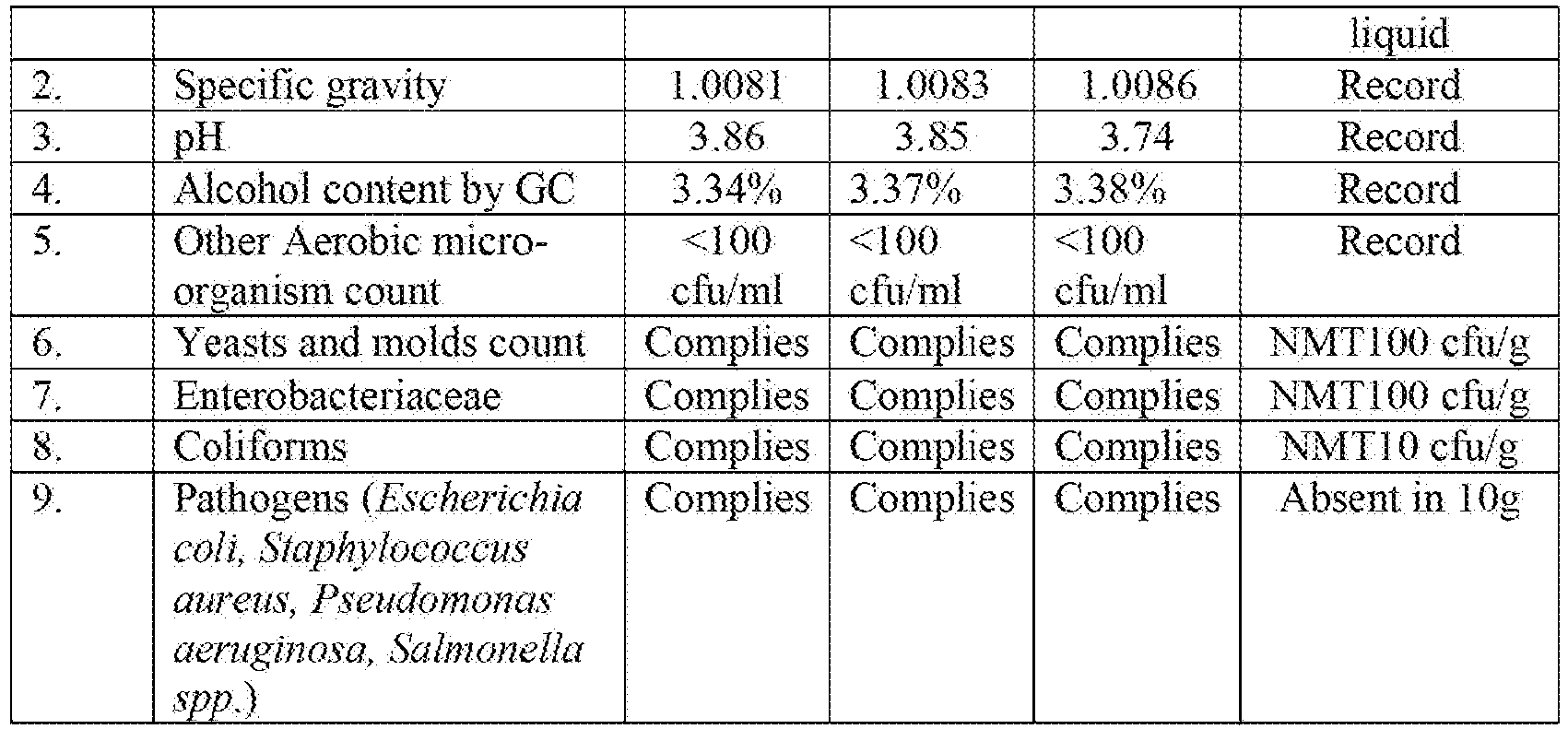


- Results of the stability studies of alcoholic beverages (beer and whisky) suggested that inclusion of probiotic strain
B. coagulans MTCC 5856 did not affect the Specific gravity, pH and Alcohol content suggesting its compatibility and stability when stored at room temperature (25 ± 2° C, 60% ± 5% Relative humidity) and accelerated conditions (40 ± 2° C, 65% ± 5% Relative humidity). - Further, there was no significant change in the microbial parameter was observed suggesting that probiotic alcoholic beverage did not alter the microbial profile.
- The different methods for brewing alcoholic beverage by adding probiotic bacterial Bacillus coagulans is disclosed herewith.
- The following flow chart describes the method of brewing alcoholic beverage by the addition of Bacillus coagulans at the stage of malting

- The stability and viability of Bacillus coagulans spore/vegetative cells were tested. The results indicated that Bacillus coagulans showed increased stability (
Fig. 1a ) and viability (Fig. 1b ) when added at the stage of malting. - The following flow chart describes the method of brewing alcoholic beverage by the addition of Bacillus coagulans at the stage of hops addition

- The stability and viability of Bacillus coagulans spore/vegetative cells were tested. The results indicated that Bacillus coagulans showed increased stability (
Fig. 2a ) and viability (Fig. 2b ) when added at the stage of Hops addition - The following flow chart describes the method of brewing alcoholic beverage by the addition of Bacillus coagulans during the fermentation stage

- The stability and viability of Bacillus coagulans spore/vegetative cells were tested. The results indicated that Bacillus coagulans showed increased stability (
Fig. 3a ) and viability (Fig. 3b ) when added during the fermentation stage. - The following flow chart describes the method of brewing alcoholic beverage by the addition of Bacillus coagulans during the secondary fermentation stage

- The stability and viability of Bacillus coagulans spore/vegetative cells were tested. The results indicated that Bacillus coagulans showed increased stability (
Fig. 4a ) and viability (Fig. 4b ) when added during the secondary fermentation stage. - The following flow chart describes the method of brewing alcoholic beverage by the addition of Bacillus coagulans at the step of carbonation

- The stability and viability of Bacillus coagulans spore/vegetative cells were tested. The results indicated that Bacillus coagulans showed increased stability (
Fig. 5a ) and viability (Fig. 5b ) when added during the post fermentation stage of carbonation. - The following flow chart describes the method of brewing alcoholic beverage by the addition of Bacillus coagulans at the step of packing and pasteruization

- The stability and viability of Bacillus coagulans spore/vegetative cells were tested. The results indicated that Bacillus coagulans showed increased stability (
Fig. 6a ) and viability (Fig. 6b ) when added during the post fermentation stage of packing and pasteurization. - he following flow chart describes the method of brewing alcoholic beverage by the addition of Bacillus coagulans at the step of packing and pasteruization

- The stability and viability of Bacillus coagulans spore/vegetative cells were tested. The results indicated that Bacillus coagulans showed increased stability at 25°C (
Fig. 7a ) and 40°C (Fig. 8a ) and viability at 25°C (Fig. 7b ) and 40°C (Fig. 8b ) when added during the post fermentation stage. - The above results indicate that the Bacillus coagulans is stable and viable during the entire fermentation process and is the first go-to-probiotic to be added along with alcoholic beverages.
- The deposit of biological material Bacillus coagulans SBC37-01 bearing
accession number MTCC 5856, mentioned in the instant application has been made on 19th September 2013 at Microbial Type Culture Collection & Gene Bank (MTCC), CSIR-Institute of Microbial Technology, Sector 39-A, Chandigarh - 160036, India. - While the invention has been described with reference to a preferred embodiment, it is to be clearly understood by those skilled in the art that the invention is not limited thereto. Rather, the scope of the invention is defined by the appended claims.
Claims (13)
- A method of brewing alcoholic beverage with Bacillus coagulans of strain Bacillus coagulans MTCC 5856, said method comprising steps ofa) Malting,b) Mashing,c) Filtration,d) Kettle boiling,e) Hops addition,f) Cooling,g) Fermentation with yeast,h) Ageing and clarification,i) Secondary fermentation,j) Carbonation/No carbonation,k) Pasteurization and Packing.
- The method as in claim 1, wherein the Bacillus coagulans spores/vegetative cells are added during pre-fermentation, fermentation and post fermentation stages.
- The method as in claim 1, wherein the Bacillus coagulans spores/vegetative cells are added during pre-fermentation stage at step a) or at step e).
- The method as in claim 1, wherein the Bacillus coagulans spores/vegetative cells are added during fermentation stage at step g).
- The method as in claim 1, wherein the Bacillus coagulans spores/vegetative cells are added during secondary fermentation stage at step i).
- The method as in claim 1, wherein the Bacillus coagulans spores/vegetative cells are added during post fermentation stage at step j) or at step k).
- The method as in claim 1, wherein the alcoholic beverage is pasteurized at 60° C after step i), followed by carbonation/no carbonation step after the addition of Bacillus coagulans spores.
- An alcoholic beverage composition as obtained by the process of claim1, wherein the alcoholic beverage composition comprises Bacillus coagulans in the form of spores or bacterium wherein said spores or bacterium exhibit high recovery, tolerability, compatibility and viability of spores and vegetative cells after brewing, wherein the Bacillus coagulans is of strain Bacillus coagulans MTCC 5856.
- The composition of claim 8, wherein the alcoholic beverage is fermented or distilled and carbonated or non-carbonated.
- The composition of claim 8, wherein the fermented alcoholic beverage is selected from the group consisting of Beer, Ale, Barley wine, Bitter ale, Brown ale, Cask ale, Mild ale, Old ale, Pale ale, Scotch ale, Porter, Stout, Stock ale, Fruit beer, Lager, Pale lager, Bock, Maerzen/Oktoberfest Beer, Pilsener, Schwarzbier, Sahti, Small beer, Wheat beer and Witbier.
- The composition of claim 8, wherein the distilled alcoholic beverage is selected from the group consisting of Whisky, Bourbon whiskey, Canadian whisky, Irish whiskey, Japanese whisky, Rye whiskey, Scotch whisky and Tennessee whiskey.
- The composition of claim 8, wherein the alcohol content is between 1% to 43%.
- The composition of claim 8, wherein the Bacillus coagulans live spores are present in the alcoholic beverages at a concentration of 1× 10⁶ to 1× 10¹² cfu.
Applications Claiming Priority (2)
| Application Number | Priority Date | Filing Date | Title |
|---|---|---|---|
| IN201741033477 | 2017-09-21 | ||
| PCT/US2018/051879 WO2019060501A1 (en) | 2017-09-21 | 2018-09-20 | Alcoholic beverage composition containing bacillus coagulans |
Publications (3)
| Publication Number | Publication Date |
|---|---|
| EP3684900A1 EP3684900A1 (en) | 2020-07-29 |
| EP3684900A4 EP3684900A4 (en) | 2021-06-16 |
| EP3684900B1 true EP3684900B1 (en) | 2024-11-06 |
Family
ID=65719889
Family Applications (1)
| Application Number | Title | Priority Date | Filing Date |
|---|---|---|---|
| EP18858757.0A Active EP3684900B1 (en) | 2017-09-21 | 2018-09-20 | Alcoholic beverage composition containing bacillus coagulans |
Country Status (10)
| Country | Link |
|---|---|
| US (1) | US11332702B2 (en) |
| EP (1) | EP3684900B1 (en) |
| JP (1) | JP7135079B2 (en) |
| KR (1) | KR102515209B1 (en) |
| AU (1) | AU2018337853B2 (en) |
| CA (1) | CA3075642C (en) |
| EA (1) | EA202090556A1 (en) |
| FI (1) | FI3684900T3 (en) |
| PL (1) | PL3684900T3 (en) |
| WO (1) | WO2019060501A1 (en) |
Families Citing this family (6)
| Publication number | Priority date | Publication date | Assignee | Title |
|---|---|---|---|---|
| CN111004733B (en) * | 2019-03-13 | 2021-10-22 | 江南大学 | A kind of Bacillus coagulans compound microecological preparation with the function of relieving constipation |
| CN114480218B (en) * | 2022-03-14 | 2022-12-30 | 善恩康生物科技(苏州)有限公司 | Bacillus coagulans for improving constipation and application thereof |
| CN120897735A (en) * | 2023-03-31 | 2025-11-04 | 第一三共健康事业株式会社 | Oral composition containing spore-forming lactic acid bacteria |
| WO2025125922A1 (en) * | 2024-09-05 | 2025-06-19 | Thobiyas Segaram Bernard Vasanth Kumar | A method of preparation of palmyra fruit flesh based alcoholic beverage, wine and spirit thereof |
| CN119752668B (en) * | 2025-03-10 | 2026-05-05 | 广东药科大学 | A method for preparing Polygonatum wine through co-fermentation of compound microorganisms |
| ES3060492A1 (en) * | 2026-01-13 | 2026-03-26 | La Zaragozana S A | Beer manufacturing process and beer obtained by said process (Machine-translation by Google Translate, not legally binding) |
Citations (1)
| Publication number | Priority date | Publication date | Assignee | Title |
|---|---|---|---|---|
| EP1063285B1 (en) * | 1999-06-16 | 2004-02-04 | Cerestar Holding B.V. | Process for the preparation of a beer-type beverage |
Family Cites Families (17)
| Publication number | Priority date | Publication date | Assignee | Title |
|---|---|---|---|---|
| GB1304005A (en) * | 1969-07-24 | 1973-01-24 | ||
| US4251632A (en) * | 1978-09-11 | 1981-02-17 | Miles Laboratories, Inc. | Preparation of a bacterial cell aggregate |
| PT862863E (en) * | 1997-01-09 | 2002-04-29 | Nestle Sa | CEREALIFERO PRODUCT CONTAINING PROBIOTICS |
| DE102005047899A1 (en) * | 2005-09-30 | 2007-04-12 | Seidel, Bernd, Dr. | Procedure for the production of probiotic wort extracts to produce malt-based beverages, comprises isolating special mash-acidifying bacterial strains from acidified malt mash, and culturing autoclaved malt wort over several culture lines |
| DE102005052210A1 (en) * | 2005-10-26 | 2007-05-03 | Südzucker Aktiengesellschaft Mannheim/Ochsenfurt | Microbiologically stabilized beer |
| WO2008023663A1 (en) * | 2006-08-21 | 2008-02-28 | Sapporo Breweries Limited | Bacterial strain having anti-allergic activity, and beverage, food and anti-allergic agent comprising cell of the bacterial strain |
| HUE054648T2 (en) * | 2007-10-16 | 2021-09-28 | Ganeden Biotech Inc | Beverage compositions |
| EP2424550B1 (en) * | 2009-04-29 | 2017-06-07 | Ganeden Biotech, Inc. | Bacterial cell membrane formulation |
| WO2011053854A1 (en) * | 2009-10-30 | 2011-05-05 | Biogenic Innovations, Llc | Use of methylsulfonylmethane (msm) to modulate microbial activity |
| WO2012026832A1 (en) * | 2010-08-26 | 2012-03-01 | Massey University | Process of producing shelf stable probiotic food |
| EP2906692A1 (en) * | 2012-10-10 | 2015-08-19 | Danisco US Inc. | Method of using alpha-amylase from talaromyces emersonii for saccharification |
| US9596861B2 (en) * | 2013-12-24 | 2017-03-21 | Sami Labs Limited | Method of producing partially purified extracellular metabolite products from Bacillus coagulans and biological applications thereof |
| US10287641B2 (en) * | 2014-08-14 | 2019-05-14 | Concellae Ab | Lactobacillus apinorum and Lactobacillus mellifer from honeybees in medical, food and feed applications |
| US9579352B2 (en) * | 2014-11-10 | 2017-02-28 | Sami Labs Limited | Process for the therapeutic management of diarrhea predominant irritable bowel syndrome using Bacillus coagulans SBC-37-01, MTCC 5856 |
| CN104531442A (en) * | 2014-12-25 | 2015-04-22 | 惠州学院 | Anti-oxidative fruit wine and preparation method thereof |
| CN106010870A (en) * | 2016-07-15 | 2016-10-12 | 华南农业大学 | Preparation method of high-sugar and low-acidity fruit wine |
| CN120866009A (en) | 2017-03-27 | 2025-10-31 | 新加坡国立大学 | Alcoholic beverage |
-
2018
- 2018-09-20 CA CA3075642A patent/CA3075642C/en active Active
- 2018-09-20 AU AU2018337853A patent/AU2018337853B2/en active Active
- 2018-09-20 EA EA202090556A patent/EA202090556A1/en unknown
- 2018-09-20 KR KR1020207011252A patent/KR102515209B1/en active Active
- 2018-09-20 WO PCT/US2018/051879 patent/WO2019060501A1/en not_active Ceased
- 2018-09-20 FI FIEP18858757.0T patent/FI3684900T3/en active
- 2018-09-20 EP EP18858757.0A patent/EP3684900B1/en active Active
- 2018-09-20 PL PL18858757.0T patent/PL3684900T3/en unknown
- 2018-09-20 US US16/136,475 patent/US11332702B2/en active Active
- 2018-09-20 JP JP2020516593A patent/JP7135079B2/en active Active
Patent Citations (1)
| Publication number | Priority date | Publication date | Assignee | Title |
|---|---|---|---|---|
| EP1063285B1 (en) * | 1999-06-16 | 2004-02-04 | Cerestar Holding B.V. | Process for the preparation of a beer-type beverage |
Also Published As
| Publication number | Publication date |
|---|---|
| KR102515209B1 (en) | 2023-03-29 |
| US11332702B2 (en) | 2022-05-17 |
| KR20200054297A (en) | 2020-05-19 |
| AU2018337853B2 (en) | 2021-11-11 |
| US20190085277A1 (en) | 2019-03-21 |
| AU2018337853A1 (en) | 2020-04-30 |
| WO2019060501A1 (en) | 2019-03-28 |
| JP2020534014A (en) | 2020-11-26 |
| EA202090556A1 (en) | 2020-07-10 |
| EP3684900A4 (en) | 2021-06-16 |
| EP3684900A1 (en) | 2020-07-29 |
| PL3684900T3 (en) | 2025-03-17 |
| FI3684900T3 (en) | 2025-01-31 |
| CA3075642A1 (en) | 2019-03-28 |
| JP7135079B2 (en) | 2022-09-12 |
| CA3075642C (en) | 2022-10-04 |
Similar Documents
| Publication | Publication Date | Title |
|---|---|---|
| US11332702B2 (en) | Alcoholic beverage composition containing Bacillus coagulans | |
| Bahiru et al. | Yeast and lactic acid flora of tej, an indigenous Ethiopian honey wine: variations within and between production units | |
| Menz et al. | Pathogens in beer | |
| Aladeboyeje et al. | Evaluation of the antimicrobial efficacy of some fermented traditional Turkish beverages with probiotic potentials: the first study to evaluate antimicrobial properties of isolates from five beverages against a broad spectrum of human microbial pathogens | |
| CN101300341B (en) | Immunomodulatory lactic acid bacteria from wine fermented mash | |
| MAKUT | Antibiogram of bacteria isolated from Kunun-zaki drink sold in Keffi metropolis | |
| Mishra et al. | Bio-functional properties and storage study of ‘Chubitchi’-a fermented rice beverage of Garo Hills, Meghalaya. | |
| Tapsoba et al. | Microbial diversity and biochemical characteristics of Borassus akeassii wine | |
| Minamor et al. | Microbiological quality of a locally brewed alcoholic beverage (pito) sold in a community within the greater accra region, Ghana | |
| Ntiantiasi et al. | Isolation and in vitro screening of the probiotic potential of microorganisms from fermented food products | |
| HK40033799A (en) | Alcoholic beverage composition containing bacillus coagulans | |
| HK40033799B (en) | Alcoholic beverage composition containing bacillus coagulans | |
| Chukwuma et al. | Microbial assessment of different formulations of “kunu”: an indigenous non-alcoholic beverage, vended in awka, Anambra state, Nigeria | |
| Aher et al. | Development and health impact assessment of a novel functional probiotic beverage by fermenting hibiscus tea with coconut water | |
| Franchi et al. | Short Communication The effect of antimicrobials and bacteriocins on beer spoilage microorganisms. | |
| TWI228974B (en) | Beverage containing lactobacillus and the manufacturing method thereof | |
| EA045649B1 (en) | ALCOHOLIC BEVERAGE COMPOSITION CONTAINING BACILLUS COAGULANS | |
| EP0768376A1 (en) | Selective media for culturing and isolating Gram negative bacteria, antibiotic composition | |
| Omole et al. | The Physicochemical and Microbiological Characteristics of Fermented Hibiscus sabdariffa Calyxes Using Probiotics Starter Cultures. | |
| Atasoy et al. | Isolation and identification of tyramine-producing lactic acid bacteria from fermented olives | |
| Zannini | Functional traits of craft beers | |
| JP2002186422A (en) | Non-fermented food containing Lactobacillus gasseri and Bifidobacterium sp. | |
| JP4986888B2 (en) | Growth inhibitor for heat-resistant acidophilic bacteria and method for inhibiting growth of heat-resistant acidophilic bacteria | |
| H Guirguis et al. | Effect of thyme (Thymus vulgaris L.) essential oil on the quality parameters of stirred yoghurt | |
| Canakapalli et al. | Microbial Characterization of Home-Brewed Ginger Beer Using Culture-Dependent and Independent Methods |
Legal Events
| Date | Code | Title | Description |
|---|---|---|---|
| STAA | Information on the status of an ep patent application or granted ep patent |
Free format text: STATUS: THE INTERNATIONAL PUBLICATION HAS BEEN MADE |
|
| PUAI | Public reference made under article 153(3) epc to a published international application that has entered the european phase |
Free format text: ORIGINAL CODE: 0009012 |
|
| STAA | Information on the status of an ep patent application or granted ep patent |
Free format text: STATUS: REQUEST FOR EXAMINATION WAS MADE |
|
| 17P | Request for examination filed |
Effective date: 20200324 |
|
| AK | Designated contracting states |
Kind code of ref document: A1 Designated state(s): AL AT BE BG CH CY CZ DE DK EE ES FI FR GB GR HR HU IE IS IT LI LT LU LV MC MK MT NL NO PL PT RO RS SE SI SK SM TR |
|
| AX | Request for extension of the european patent |
Extension state: BA ME |
|
| DAV | Request for validation of the european patent (deleted) | ||
| DAX | Request for extension of the european patent (deleted) | ||
| REG | Reference to a national code |
Ref country code: HK Ref legal event code: DE Ref document number: 40033799 Country of ref document: HK |
|
| A4 | Supplementary search report drawn up and despatched |
Effective date: 20210519 |
|
| RIC1 | Information provided on ipc code assigned before grant |
Ipc: C11D 3/386 20060101AFI20210512BHEP Ipc: C12N 9/26 20060101ALI20210512BHEP Ipc: C12C 7/26 20060101ALI20210512BHEP Ipc: C12C 11/00 20060101ALI20210512BHEP Ipc: C12C 11/11 20190101ALI20210512BHEP Ipc: C12G 3/02 20190101ALI20210512BHEP Ipc: C12G 3/05 20190101ALI20210512BHEP Ipc: C12G 3/026 20190101ALI20210512BHEP |
|
| RAP3 | Party data changed (applicant data changed or rights of an application transferred) |
Owner name: SAMI-SABINSA GROUP LIMITED |
|
| GRAP | Despatch of communication of intention to grant a patent |
Free format text: ORIGINAL CODE: EPIDOSNIGR1 |
|
| STAA | Information on the status of an ep patent application or granted ep patent |
Free format text: STATUS: GRANT OF PATENT IS INTENDED |
|
| INTG | Intention to grant announced |
Effective date: 20240227 |
|
| GRAJ | Information related to disapproval of communication of intention to grant by the applicant or resumption of examination proceedings by the epo deleted |
Free format text: ORIGINAL CODE: EPIDOSDIGR1 |
|
| STAA | Information on the status of an ep patent application or granted ep patent |
Free format text: STATUS: REQUEST FOR EXAMINATION WAS MADE |
|
| GRAS | Grant fee paid |
Free format text: ORIGINAL CODE: EPIDOSNIGR3 |
|
| STAA | Information on the status of an ep patent application or granted ep patent |
Free format text: STATUS: GRANT OF PATENT IS INTENDED |
|
| GRAP | Despatch of communication of intention to grant a patent |
Free format text: ORIGINAL CODE: EPIDOSNIGR1 |
|
| INTC | Intention to grant announced (deleted) | ||
| P01 | Opt-out of the competence of the unified patent court (upc) registered |
Free format text: CASE NUMBER: APP_37264/2024 Effective date: 20240621 |
|
| INTG | Intention to grant announced |
Effective date: 20240717 |
|
| GRAJ | Information related to disapproval of communication of intention to grant by the applicant or resumption of examination proceedings by the epo deleted |
Free format text: ORIGINAL CODE: EPIDOSDIGR1 |
|
| GRAL | Information related to payment of fee for publishing/printing deleted |
Free format text: ORIGINAL CODE: EPIDOSDIGR3 |
|
| STAA | Information on the status of an ep patent application or granted ep patent |
Free format text: STATUS: REQUEST FOR EXAMINATION WAS MADE |
|
| GRAP | Despatch of communication of intention to grant a patent |
Free format text: ORIGINAL CODE: EPIDOSNIGR1 |
|
| STAA | Information on the status of an ep patent application or granted ep patent |
Free format text: STATUS: GRANT OF PATENT IS INTENDED |
|
| GRAA | (expected) grant |
Free format text: ORIGINAL CODE: 0009210 |
|
| STAA | Information on the status of an ep patent application or granted ep patent |
Free format text: STATUS: THE PATENT HAS BEEN GRANTED |
|
| INTC | Intention to grant announced (deleted) | ||
| INTG | Intention to grant announced |
Effective date: 20240917 |
|
| AK | Designated contracting states |
Kind code of ref document: B1 Designated state(s): AL AT BE BG CH CY CZ DE DK EE ES FI FR GB GR HR HU IE IS IT LI LT LU LV MC MK MT NL NO PL PT RO RS SE SI SK SM TR |
|
| REG | Reference to a national code |
Ref country code: GB Ref legal event code: FG4D |
|
| REG | Reference to a national code |
Ref country code: CH Ref legal event code: EP |
|
| REG | Reference to a national code |
Ref country code: DE Ref legal event code: R096 Ref document number: 602018076380 Country of ref document: DE |
|
| REG | Reference to a national code |
Ref country code: IE Ref legal event code: FG4D |
|
| REG | Reference to a national code |
Ref country code: SE Ref legal event code: TRGR |
|
| REG | Reference to a national code |
Ref country code: FI Ref legal event code: FGE |
|
| REG | Reference to a national code |
Ref country code: LT Ref legal event code: MG9D |
|
| REG | Reference to a national code |
Ref country code: NL Ref legal event code: MP Effective date: 20241106 |
|
| PG25 | Lapsed in a contracting state [announced via postgrant information from national office to epo] |
Ref country code: HR Free format text: LAPSE BECAUSE OF FAILURE TO SUBMIT A TRANSLATION OF THE DESCRIPTION OR TO PAY THE FEE WITHIN THE PRESCRIBED TIME-LIMIT Effective date: 20241106 Ref country code: PT Free format text: LAPSE BECAUSE OF FAILURE TO SUBMIT A TRANSLATION OF THE DESCRIPTION OR TO PAY THE FEE WITHIN THE PRESCRIBED TIME-LIMIT Effective date: 20250306 Ref country code: IS Free format text: LAPSE BECAUSE OF FAILURE TO SUBMIT A TRANSLATION OF THE DESCRIPTION OR TO PAY THE FEE WITHIN THE PRESCRIBED TIME-LIMIT Effective date: 20250306 |
|
| PG25 | Lapsed in a contracting state [announced via postgrant information from national office to epo] |
Ref country code: NL Free format text: LAPSE BECAUSE OF FAILURE TO SUBMIT A TRANSLATION OF THE DESCRIPTION OR TO PAY THE FEE WITHIN THE PRESCRIBED TIME-LIMIT Effective date: 20241106 |
|
| REG | Reference to a national code |
Ref country code: AT Ref legal event code: MK05 Ref document number: 1739368 Country of ref document: AT Kind code of ref document: T Effective date: 20241106 |
|
| PG25 | Lapsed in a contracting state [announced via postgrant information from national office to epo] |
Ref country code: BG Free format text: LAPSE BECAUSE OF FAILURE TO SUBMIT A TRANSLATION OF THE DESCRIPTION OR TO PAY THE FEE WITHIN THE PRESCRIBED TIME-LIMIT Effective date: 20241106 |
|
| PG25 | Lapsed in a contracting state [announced via postgrant information from national office to epo] |
Ref country code: ES Free format text: LAPSE BECAUSE OF FAILURE TO SUBMIT A TRANSLATION OF THE DESCRIPTION OR TO PAY THE FEE WITHIN THE PRESCRIBED TIME-LIMIT Effective date: 20241106 |
|
| PG25 | Lapsed in a contracting state [announced via postgrant information from national office to epo] |
Ref country code: NO Free format text: LAPSE BECAUSE OF FAILURE TO SUBMIT A TRANSLATION OF THE DESCRIPTION OR TO PAY THE FEE WITHIN THE PRESCRIBED TIME-LIMIT Effective date: 20250206 |
|
| PG25 | Lapsed in a contracting state [announced via postgrant information from national office to epo] |
Ref country code: GR Free format text: LAPSE BECAUSE OF FAILURE TO SUBMIT A TRANSLATION OF THE DESCRIPTION OR TO PAY THE FEE WITHIN THE PRESCRIBED TIME-LIMIT Effective date: 20250207 Ref country code: AT Free format text: LAPSE BECAUSE OF FAILURE TO SUBMIT A TRANSLATION OF THE DESCRIPTION OR TO PAY THE FEE WITHIN THE PRESCRIBED TIME-LIMIT Effective date: 20241106 Ref country code: LV Free format text: LAPSE BECAUSE OF FAILURE TO SUBMIT A TRANSLATION OF THE DESCRIPTION OR TO PAY THE FEE WITHIN THE PRESCRIBED TIME-LIMIT Effective date: 20241106 |
|
| PG25 | Lapsed in a contracting state [announced via postgrant information from national office to epo] |
Ref country code: RS Free format text: LAPSE BECAUSE OF FAILURE TO SUBMIT A TRANSLATION OF THE DESCRIPTION OR TO PAY THE FEE WITHIN THE PRESCRIBED TIME-LIMIT Effective date: 20250206 |
|
| PG25 | Lapsed in a contracting state [announced via postgrant information from national office to epo] |
Ref country code: SM Free format text: LAPSE BECAUSE OF FAILURE TO SUBMIT A TRANSLATION OF THE DESCRIPTION OR TO PAY THE FEE WITHIN THE PRESCRIBED TIME-LIMIT Effective date: 20241106 |
|
| PG25 | Lapsed in a contracting state [announced via postgrant information from national office to epo] |
Ref country code: DK Free format text: LAPSE BECAUSE OF FAILURE TO SUBMIT A TRANSLATION OF THE DESCRIPTION OR TO PAY THE FEE WITHIN THE PRESCRIBED TIME-LIMIT Effective date: 20241106 |
|
| PG25 | Lapsed in a contracting state [announced via postgrant information from national office to epo] |
Ref country code: EE Free format text: LAPSE BECAUSE OF FAILURE TO SUBMIT A TRANSLATION OF THE DESCRIPTION OR TO PAY THE FEE WITHIN THE PRESCRIBED TIME-LIMIT Effective date: 20241106 |
|
| PG25 | Lapsed in a contracting state [announced via postgrant information from national office to epo] |
Ref country code: RO Free format text: LAPSE BECAUSE OF FAILURE TO SUBMIT A TRANSLATION OF THE DESCRIPTION OR TO PAY THE FEE WITHIN THE PRESCRIBED TIME-LIMIT Effective date: 20241106 |
|
| PG25 | Lapsed in a contracting state [announced via postgrant information from national office to epo] |
Ref country code: SK Free format text: LAPSE BECAUSE OF FAILURE TO SUBMIT A TRANSLATION OF THE DESCRIPTION OR TO PAY THE FEE WITHIN THE PRESCRIBED TIME-LIMIT Effective date: 20241106 |
|
| PG25 | Lapsed in a contracting state [announced via postgrant information from national office to epo] |
Ref country code: CZ Free format text: LAPSE BECAUSE OF FAILURE TO SUBMIT A TRANSLATION OF THE DESCRIPTION OR TO PAY THE FEE WITHIN THE PRESCRIBED TIME-LIMIT Effective date: 20241106 |
|
| REG | Reference to a national code |
Ref country code: DE Ref legal event code: R097 Ref document number: 602018076380 Country of ref document: DE |
|
| PLBE | No opposition filed within time limit |
Free format text: ORIGINAL CODE: 0009261 |
|
| STAA | Information on the status of an ep patent application or granted ep patent |
Free format text: STATUS: NO OPPOSITION FILED WITHIN TIME LIMIT |
|
| PGFP | Annual fee paid to national office [announced via postgrant information from national office to epo] |
Ref country code: DE Payment date: 20250819 Year of fee payment: 8 |
|
| 26N | No opposition filed |
Effective date: 20250807 |
|
| PGFP | Annual fee paid to national office [announced via postgrant information from national office to epo] |
Ref country code: PL Payment date: 20250905 Year of fee payment: 8 |
|
| PGFP | Annual fee paid to national office [announced via postgrant information from national office to epo] |
Ref country code: GB Payment date: 20250923 Year of fee payment: 8 |
|
| PGFP | Annual fee paid to national office [announced via postgrant information from national office to epo] |
Ref country code: FR Payment date: 20250925 Year of fee payment: 8 |
|
| PGFP | Annual fee paid to national office [announced via postgrant information from national office to epo] |
Ref country code: IT Payment date: 20250930 Year of fee payment: 8 |
|
| PG25 | Lapsed in a contracting state [announced via postgrant information from national office to epo] |
Ref country code: FI Free format text: LAPSE BECAUSE OF NON-PAYMENT OF DUE FEES Effective date: 20250920 |
|
| REG | Reference to a national code |
Ref country code: CH Ref legal event code: H13 Free format text: ST27 STATUS EVENT CODE: U-0-0-H10-H13 (AS PROVIDED BY THE NATIONAL OFFICE) Effective date: 20260504 |