EP3683541A1 - Method for measuring downward inclination angle of antenna based on linear regression fitting - Google Patents
Method for measuring downward inclination angle of antenna based on linear regression fitting Download PDFInfo
- Publication number
- EP3683541A1 EP3683541A1 EP19870065.0A EP19870065A EP3683541A1 EP 3683541 A1 EP3683541 A1 EP 3683541A1 EP 19870065 A EP19870065 A EP 19870065A EP 3683541 A1 EP3683541 A1 EP 3683541A1
- Authority
- EP
- European Patent Office
- Prior art keywords
- antenna
- image
- fitting
- segmented image
- measuring
- Prior art date
- Legal status (The legal status is an assumption and is not a legal conclusion. Google has not performed a legal analysis and makes no representation as to the accuracy of the status listed.)
- Withdrawn
Links
Images


Classifications
-
- G—PHYSICS
- G06—COMPUTING OR CALCULATING; COUNTING
- G06T—IMAGE DATA PROCESSING OR GENERATION, IN GENERAL
- G06T7/00—Image analysis
- G06T7/10—Segmentation; Edge detection
- G06T7/11—Region-based segmentation
-
- G—PHYSICS
- G01—MEASURING; TESTING
- G01C—MEASURING DISTANCES, LEVELS OR BEARINGS; SURVEYING; NAVIGATION; GYROSCOPIC INSTRUMENTS; PHOTOGRAMMETRY OR VIDEOGRAMMETRY
- G01C1/00—Measuring angles
-
- G—PHYSICS
- G01—MEASURING; TESTING
- G01R—MEASURING ELECTRIC VARIABLES; MEASURING MAGNETIC VARIABLES
- G01R29/00—Arrangements for measuring or indicating electric quantities not covered by groups G01R19/00 - G01R27/00
- G01R29/08—Measuring electromagnetic field characteristics
- G01R29/10—Radiation diagrams of antennas
-
- G—PHYSICS
- G06—COMPUTING OR CALCULATING; COUNTING
- G06N—COMPUTING ARRANGEMENTS BASED ON SPECIFIC COMPUTATIONAL MODELS
- G06N3/00—Computing arrangements based on biological models
- G06N3/02—Neural networks
- G06N3/04—Architecture, e.g. interconnection topology
- G06N3/0464—Convolutional networks [CNN, ConvNet]
-
- G—PHYSICS
- G06—COMPUTING OR CALCULATING; COUNTING
- G06T—IMAGE DATA PROCESSING OR GENERATION, IN GENERAL
- G06T7/00—Image analysis
- G06T7/10—Segmentation; Edge detection
- G06T7/13—Edge detection
-
- G—PHYSICS
- G06—COMPUTING OR CALCULATING; COUNTING
- G06T—IMAGE DATA PROCESSING OR GENERATION, IN GENERAL
- G06T7/00—Image analysis
- G06T7/10—Segmentation; Edge detection
- G06T7/136—Segmentation; Edge detection involving thresholding
-
- G—PHYSICS
- G06—COMPUTING OR CALCULATING; COUNTING
- G06T—IMAGE DATA PROCESSING OR GENERATION, IN GENERAL
- G06T7/00—Image analysis
- G06T7/70—Determining position or orientation of objects or cameras
- G06T7/73—Determining position or orientation of objects or cameras using feature-based methods
-
- G—PHYSICS
- G06—COMPUTING OR CALCULATING; COUNTING
- G06N—COMPUTING ARRANGEMENTS BASED ON SPECIFIC COMPUTATIONAL MODELS
- G06N3/00—Computing arrangements based on biological models
- G06N3/02—Neural networks
- G06N3/04—Architecture, e.g. interconnection topology
- G06N3/045—Combinations of networks
-
- G—PHYSICS
- G06—COMPUTING OR CALCULATING; COUNTING
- G06N—COMPUTING ARRANGEMENTS BASED ON SPECIFIC COMPUTATIONAL MODELS
- G06N3/00—Computing arrangements based on biological models
- G06N3/02—Neural networks
- G06N3/08—Learning methods
-
- G—PHYSICS
- G06—COMPUTING OR CALCULATING; COUNTING
- G06T—IMAGE DATA PROCESSING OR GENERATION, IN GENERAL
- G06T2207/00—Indexing scheme for image analysis or image enhancement
- G06T2207/20—Special algorithmic details
- G06T2207/20081—Training; Learning
-
- G—PHYSICS
- G06—COMPUTING OR CALCULATING; COUNTING
- G06T—IMAGE DATA PROCESSING OR GENERATION, IN GENERAL
- G06T2207/00—Indexing scheme for image analysis or image enhancement
- G06T2207/20—Special algorithmic details
- G06T2207/20084—Artificial neural networks [ANN]
Definitions
- the present disclosure relates to the field of communication measurement, and more particularly, to a method for measuring an antenna downtilt based on linear regression fitting.
- an antenna downtilt In the field of communications, an antenna downtilt needs to be adjusted frequently. As one of the important parameters determining a coverage area of signals of base stations, the antenna downtilt needs to be accurately designed in the initial stage of network planning. Furthermore, after the base stations are put into operation, with the development of services and changes of users and surrounding signal environments, it is also required to accurately adjust the downtilt.
- a slope meter is generally used to measure a mechanical downtilt of an antenna of a base station.
- a measurer need to climb up an iron tower or hold a pole to get close to the antenna to measure, which is not only dangerous and troublesome, but also affects the accuracy of the measurement.
- a GSM-R system has emerged. The system is a measurement tool allowing the measurer to accurately measure the antenna downtilt without getting close to the antenna, the measurement of the antenna downtilt of the base station could be carried out without climbing up a tower, test points of the base station could be networked to monitor the downtilt of the base station in real-time.
- an objective of embodiments of the present disclosure is to provide a method for measuring an antenna downtilt based on linear regression fitting, so as to safely, efficiently, quickly and accurately measure an antenna downtilt.
- a method for measuring an antenna downtilt based on linear regression fitting includes: performing image instance segmentation on an inputted original antenna image using a deep learning method to obtain a segmented image; performing mask processing on the segmented image; performing mathematically linear modeling and fitting on the segmented image subjected to mask processing; and the performing mathematically linear modeling and fitting on the segmented image subjected to mask processing includes: extracting pixel value coordinates of an antenna edge contour from the segmented image subjected to mask processing, and capturing a pixel value of a right-end edge on an antenna plane located in a front side; and fitting the pixel value coordinates into a straight line by using a mathematically linear modeling and fitting method and obtaining a slope of the straight line to obtain an angle of the antenna downtilt.
- the performing image instance segmentation on an inputted antenna image using a deep learning method to obtain a segmented image includes: obtaining an antenna candidate box and an antenna characteristic diagram by using a convolutional neural network; and generating a region of interest from the antenna candidate box and obtaining a characteristic diagram of the region of interest with reference to the antenna characteristic diagram to perform pixel correction on the region of interest.
- the performing image instance segmentation on an inputted antenna image using a deep learning method to obtain a segmented image further includes: predicting the region of interest, to obtain a regression bounding box mapped from the antenna characteristic diagram, and predicting a class of a pixel in the region of interest to obtain the segmented image.
- the pixel correction is performing alignment processing by using a residual network; and the pixel correction includes two quantization processes, which are mapping from the region of interest to the antenna characteristic diagram and mapping from the antenna characteristic diagram to the original antenna image respectively.
- the performing mask processing on the segmented image includes: extracting image coordinates of a contour of the antenna from the segmented image; mapping the image coordinates to a pixel coordinate system, and transforming into binarization coordinates through Bohr operation, convoluting with mask coordinates set to generate a new mask; and filling up the new mask by using a color generator.
- mapping the image coordinates to a pixel coordinate system includes transforming the coordinates system.
- the mathematically linear modeling and fitting include implementing optimization of a data sample by using a gradient descent least square method.
- the embodiments of the present disclosure adopt a method for measuring an antenna downtilt based on linear regression fitting.
- An angle of the antenna downtilt is directly outputted and obtained after being processed by a deep learning network.
- a segmented image obtained through mask instance segmentation allows a straight line obtained by mathematically linear modeling to be more fit to a true value of the antenna, ensuring the angle of the antenna downtilt to be more accurate.
- the method provided by the embodiments of the present disclosure avoids the danger of climbing measurement and reduces costs of installation sensors, and can more efficiently, safely and accurately obtain data of an antenna downtilt at low cost.
- An embodiment of the present disclosure discloses a method for measuring an antenna downtilt based on linear regression fitting, including: performing image instance segmentation on an inputted original antenna image using a deep learning method to obtain a segmented image; performing mask processing on the segmented image; performing mathematically linear modeling and fitting on the segmented image subjected to mask processing; and the performing mathematically linear modeling and fitting on the segmented image subjected to mask processing including: extracting pixel value coordinates of an antenna edge contour from the segmented image subjected to mask processing, and capturing a pixel value of a right-end edge on an antenna plane located in a front side; and fitting the pixel value coordinates into a straight line by using a mathematically linear modeling and fitting method and obtaining a slope of the straight line to obtain an angle of the antenna downtilt.
- the performing image instance segmentation on an inputted antenna image using a deep learning method to obtain a segmented image includes: obtaining an antenna candidate box and an antenna characteristic diagram by using a convolutional neural network; and generating a region of interest from the antenna candidate box and obtaining a characteristic diagram of the region of interest with reference to the antenna characteristic diagram to perform pixel correction on the region of interest.
- the performing image instance segmentation on an inputted antenna image using a deep learning method to obtain a segmented image further includes: predicting the region of interest to obtain a regression bounding box mapped by the antenna characteristic diagram, and predicting a class of a pixel in the region of interest to obtain the segmented image.
- the pixel correction is performing alignment processing by using a residual network; and the pixel correction includes two quantization processes, which are a process of mapping from the region of interest to the antenna characteristic diagram and a process of mapping from the antenna characteristic diagram to the original antenna image respectively, ensuring one-to-one correspondence between input and output at the pixel level.
- the performing mask processing on the segmented image include: extracting image coordinates of a contour of the antenna from the segmented image; mapping the image coordinates to a pixel coordinates system, and transforming into binarization coordinates through Bohr operation, convoluting with mask coordinates set to generate a new mask; and filling up the new mask by using a color generator.
- the mapping the image coordinates to a pixel coordinates system includes transforming the coordinates system.
- the pixel coordinates system and the image coordinates system are both on an imaging plane of the antenna image, but their origins and measurement units are different.
- the origin of the image coordinate system is an intersection point of an optical axis of a camera and the imaging plane, which is a center point of the imaging plane generally.
- the unit of the image coordinate system is mm
- the unit of the pixel coordinate system is pixel.
- the segmented image needs to be masked by a mask branch network.
- the mask branch network takes a positive region selected by a region of interest classifier as input and generates a mask of the positive region.
- the generated mask corresponds to a low resolution of 28 ⁇ 28 pixels.
- the generated mask has more details than a binary mask.
- the small size attribute of the mask contributes to keeping the light weight of the masked branch network.
- the predicted mask is enlarged to the size of a bounding box of the region of interest to provide final mask results.
- the mathematically linear modeling and fitting includes implementing optimization of a data sample by using a gradient descent least square method.
- the slope of the straight line may be obtained by least square error, and then the downtilt of an antenna of a base station is accurately obtained.
Landscapes
- Engineering & Computer Science (AREA)
- Physics & Mathematics (AREA)
- General Physics & Mathematics (AREA)
- Theoretical Computer Science (AREA)
- Computer Vision & Pattern Recognition (AREA)
- Remote Sensing (AREA)
- Radar, Positioning & Navigation (AREA)
- Electromagnetism (AREA)
- General Health & Medical Sciences (AREA)
- Mathematical Physics (AREA)
- Data Mining & Analysis (AREA)
- Molecular Biology (AREA)
- Computing Systems (AREA)
- General Engineering & Computer Science (AREA)
- Computational Linguistics (AREA)
- Evolutionary Computation (AREA)
- Software Systems (AREA)
- Biophysics (AREA)
- Biomedical Technology (AREA)
- Artificial Intelligence (AREA)
- Life Sciences & Earth Sciences (AREA)
- Health & Medical Sciences (AREA)
- Image Analysis (AREA)
Abstract
Description
- The present disclosure relates to the field of communication measurement, and more particularly, to a method for measuring an antenna downtilt based on linear regression fitting.
- In the field of communications, an antenna downtilt needs to be adjusted frequently. As one of the important parameters determining a coverage area of signals of base stations, the antenna downtilt needs to be accurately designed in the initial stage of network planning. Furthermore, after the base stations are put into operation, with the development of services and changes of users and surrounding signal environments, it is also required to accurately adjust the downtilt.
- At present, a slope meter is generally used to measure a mechanical downtilt of an antenna of a base station. When measuring the mechanical downtilt of the antenna using the slope meter, a measurer need to climb up an iron tower or hold a pole to get close to the antenna to measure, which is not only dangerous and troublesome, but also affects the accuracy of the measurement. With the development of technologies, a GSM-R system has emerged. The system is a measurement tool allowing the measurer to accurately measure the antenna downtilt without getting close to the antenna, the measurement of the antenna downtilt of the base station could be carried out without climbing up a tower, test points of the base station could be networked to monitor the downtilt of the base station in real-time. However, installation of sensors is time-consuming and is high in cost. Moreover, there exist differences between new towers and old towers, the number of towers of base stations and the number of the base stations, etc. Therefore, this method is of low practicability, long operational cycle, and difficult to be implemented. Therefore, it is necessary to design an angle measurement method which is simple in operation and reliable in performance.
- To solve the above problems, an objective of embodiments of the present disclosure is to provide a method for measuring an antenna downtilt based on linear regression fitting, so as to safely, efficiently, quickly and accurately measure an antenna downtilt.
- In order to solve the above problems, the embodiments of the present disclosure adopt following technical solution.
- A method for measuring an antenna downtilt based on linear regression fitting includes: performing image instance segmentation on an inputted original antenna image using a deep learning method to obtain a segmented image; performing mask processing on the segmented image; performing mathematically linear modeling and fitting on the segmented image subjected to mask processing; and the performing mathematically linear modeling and fitting on the segmented image subjected to mask processing includes: extracting pixel value coordinates of an antenna edge contour from the segmented image subjected to mask processing, and capturing a pixel value of a right-end edge on an antenna plane located in a front side; and fitting the pixel value coordinates into a straight line by using a mathematically linear modeling and fitting method and obtaining a slope of the straight line to obtain an angle of the antenna downtilt.
- Further, the performing image instance segmentation on an inputted antenna image using a deep learning method to obtain a segmented image includes: obtaining an antenna candidate box and an antenna characteristic diagram by using a convolutional neural network; and generating a region of interest from the antenna candidate box and obtaining a characteristic diagram of the region of interest with reference to the antenna characteristic diagram to perform pixel correction on the region of interest.
- Further, the performing image instance segmentation on an inputted antenna image using a deep learning method to obtain a segmented image further includes: predicting the region of interest, to obtain a regression bounding box mapped from the antenna characteristic diagram, and predicting a class of a pixel in the region of interest to obtain the segmented image.
- Further, the pixel correction is performing alignment processing by using a residual network; and the pixel correction includes two quantization processes, which are mapping from the region of interest to the antenna characteristic diagram and mapping from the antenna characteristic diagram to the original antenna image respectively.
- Further, the performing mask processing on the segmented image includes: extracting image coordinates of a contour of the antenna from the segmented image; mapping the image coordinates to a pixel coordinate system, and transforming into binarization coordinates through Bohr operation, convoluting with mask coordinates set to generate a new mask; and filling up the new mask by using a color generator.
- Further, the mapping the image coordinates to a pixel coordinate system includes transforming the coordinates system.
- Preferably, an operation formula for generating the new mask is as below:
I(i, j)=5 ∗ I(i, j)-[I (i-1, j)+I(i+1, j)+I(i, j-1)+I(i, j+1)]; wherein I(i, j) represents an image center element. - Further, the mathematically linear modeling and fitting include implementing optimization of a data sample by using a gradient descent least square method.
- Preferably, a model for fitting the straight line is f(x)=wTx+b; wherein wT represents a transpose of a weight matrix, and b represents an offset; and a formula for calculating the antenna downtilt is θ=arctan(|k|); wherein k represents the slope of the straight line fitted by the gradient descent least square method.
- Beneficial effects of embodiments of the present disclosure are as below: The embodiments of the present disclosure adopt a method for measuring an antenna downtilt based on linear regression fitting. An angle of the antenna downtilt is directly outputted and obtained after being processed by a deep learning network. Meanwhile, a segmented image obtained through mask instance segmentation allows a straight line obtained by mathematically linear modeling to be more fit to a true value of the antenna, ensuring the angle of the antenna downtilt to be more accurate. The method provided by the embodiments of the present disclosure avoids the danger of climbing measurement and reduces costs of installation sensors, and can more efficiently, safely and accurately obtain data of an antenna downtilt at low cost.
- The present disclosure is further described below with reference to the accompanying drawings and examples.
-
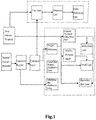
FIG. 1 is a structural diagram of a deep learning method for image instance segmentation according to an embodiment of the present disclosure; -
FIG. 2 is a flow block diagram of image instance segmentation according to an embodiment of the present disclosure; -
FIG. 3 is a schematic diagram of aligning a network of interest by using a residual network according to an embodiment of the present disclosure; -
FIG. 4 is a schematic diagram showing a corresponding relationship between an image coordinate system and a pixel coordinate system according to an embodiment of the present disclosure; -
FIG. 5 is an arithograph of mask operation according to an embodiment of the present disclosure; and - FIG. 6 is a coordinate graph of mathematically linear modeling and fitting according to an embodiment of the present disclosure.
- An embodiment of the present disclosure discloses a method for measuring an antenna downtilt based on linear regression fitting, including: performing image instance segmentation on an inputted original antenna image using a deep learning method to obtain a segmented image; performing mask processing on the segmented image; performing mathematically linear modeling and fitting on the segmented image subjected to mask processing; and the performing mathematically linear modeling and fitting on the segmented image subjected to mask processing including: extracting pixel value coordinates of an antenna edge contour from the segmented image subjected to mask processing, and capturing a pixel value of a right-end edge on an antenna plane located in a front side; and fitting the pixel value coordinates into a straight line by using a mathematically linear modeling and fitting method and obtaining a slope of the straight line to obtain an angle of the antenna downtilt.
- Referring to
FIG. 1 andFIG. 2 , in an embodiment, the performing image instance segmentation on an inputted antenna image using a deep learning method to obtain a segmented image includes: obtaining an antenna candidate box and an antenna characteristic diagram by using a convolutional neural network; and generating a region of interest from the antenna candidate box and obtaining a characteristic diagram of the region of interest with reference to the antenna characteristic diagram to perform pixel correction on the region of interest. - Further, the performing image instance segmentation on an inputted antenna image using a deep learning method to obtain a segmented image further includes: predicting the region of interest to obtain a regression bounding box mapped by the antenna characteristic diagram, and predicting a class of a pixel in the region of interest to obtain the segmented image.
- Referring to
FIG. 3 , the pixel correction is performing alignment processing by using a residual network; and the pixel correction includes two quantization processes, which are a process of mapping from the region of interest to the antenna characteristic diagram and a process of mapping from the antenna characteristic diagram to the original antenna image respectively, ensuring one-to-one correspondence between input and output at the pixel level. - Referring to
FIG. 5 , in an embodiment, the performing mask processing on the segmented image include: extracting image coordinates of a contour of the antenna from the segmented image; mapping the image coordinates to a pixel coordinates system, and transforming into binarization coordinates through Bohr operation, convoluting with mask coordinates set to generate a new mask; and filling up the new mask by using a color generator. - Preferably, an operation formula for generating the new mask is as below:
I(i, j)=5∗I(i, j)-[I (i-1, j)+I(i+1, j)+I(i, j-1)+I(i, j+1)]; wherein I(i, j) represents an image center element. - Referring to
FIG. 4 , in an embodiment, the mapping the image coordinates to a pixel coordinates system includes transforming the coordinates system. The pixel coordinates system and the image coordinates system are both on an imaging plane of the antenna image, but their origins and measurement units are different. The origin of the image coordinate system is an intersection point of an optical axis of a camera and the imaging plane, which is a center point of the imaging plane generally. The unit of the image coordinate system is mm, and the unit of the pixel coordinate system is pixel. The transformation between the image coordinate system and the pixel coordinate system is as follows: wherein dx and dy represent how many "mm"s each column and each row respectively represent, that is, 1 pixel=dx mm. The coordinate transformation formula is as follows: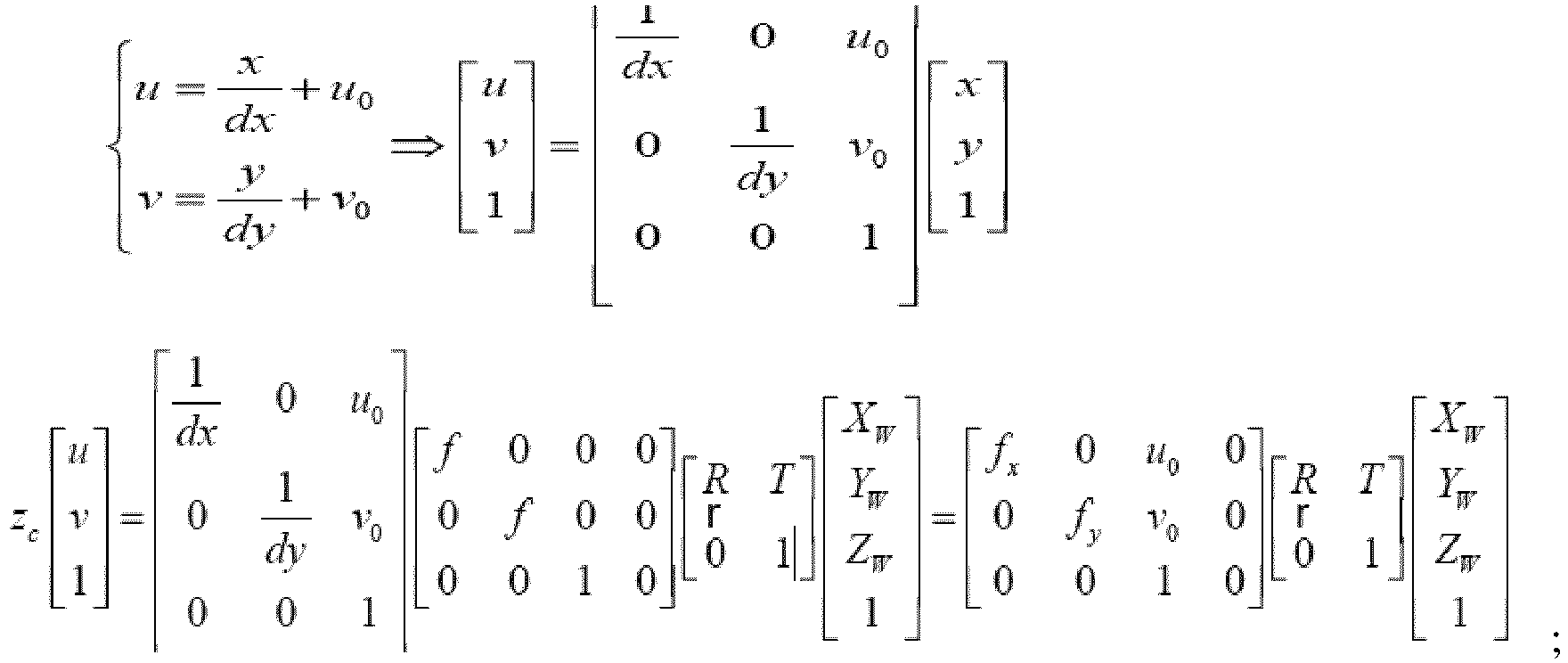
- The segmented image needs to be masked by a mask branch network. As a convolutional network, the mask branch network takes a positive region selected by a region of interest classifier as input and generates a mask of the positive region. The generated mask corresponds to a low resolution of 28×28 pixels. As a soft mask represented by a floating point number, the generated mask has more details than a binary mask. The small size attribute of the mask contributes to keeping the light weight of the masked branch network. During the inference process, the predicted mask is enlarged to the size of a bounding box of the region of interest to provide final mask results.
- Referring to FIG. 6, the mathematically linear modeling and fitting includes implementing optimization of a data sample by using a gradient descent least square method. Preferably, a model for fitting the straight line is f(x)=wTx+b; wherein wT represents a transpose of a weight matrix, and b represents an offset; and a formula for calculating the antenna downtilt is θ=arctan(|k|); wherein k represents the slope of the straight line fitted by the gradient descent least square method.
- In one embodiment, the calculation process is as follows: yi represents a true value of the ith point; f(xi) represents a predicted value obtained after being processed by a model function f; and an expression of Euclidean distance is obtained as below: distance=(yi-f(xi))2. From the perspective of a loss function, this formula is a square error, i.e., J(θ) = 1/2(Y-θX)2;
and a fitted objective function is obtained as:


- By making the partial derivative be equal to zero and fitting the sample points onto an approximate straight line, the slope of the straight line may be obtained by least square error, and then the downtilt of an antenna of a base station is accurately obtained. As can be seen from the following arc tangent formula: θ=arctan(|k|), wherein θ represents the antenna downtilt, and k represents the slope of the straight line fitted by the gradient descent least square method.
- The above descriptions are merely preferred embodiments of the present disclosure, but the present disclosure is not limited to the above embodiments. Any embodiment should fall within the protection scope of the present disclosure as long as it achieves the technical effects of the present disclosure by the same means.
Claims (9)
- A method for measuring an antenna downtilt based on linear regression fitting, comprising:performing image instance segmentation on an inputted original antenna image using a deep learning method to obtain a segmented image;performing mask processing on the segmented image;performing mathematically linear modeling and fitting on the segmented image subjected to mask processing; andthe performing mathematically linear modeling and fitting on the segmented image subjected to mask processing comprising: extracting pixel value coordinates of an antenna edge contour from the segmented image subjected to mask processing, and capturing a pixel value of a right-end edge on an antenna plane located in a front side; and fitting the pixel value coordinates into a straight line by using a mathematically linear modeling and fitting method and obtaining a slope of the straight line to obtain an angle of the antenna downtilt.
- The method for measuring an antenna downtilt based on linear regression fitting according to claim 1, wherein the performing image instance segmentation on an inputted antenna image using a deep learning method to obtain a segmented image comprises:obtaining an antenna candidate box and an antenna characteristic diagram by using a convolutional neural network; andgenerating a region of interest from the antenna candidate box and obtaining a characteristic diagram of the region of interest with reference to the antenna characteristic diagram to perform pixel correction on the region of interest.
- The method for measuring an antenna downtilt based on linear regression fitting according to claim 2, wherein the performing image instance segmentation on an inputted antenna image using a deep learning method to obtain a segmented image further comprises: predicting the region of interest to obtain a regression bounding box mapped from the antenna characteristic diagram, and predicting a class of a pixel in the region of interest to obtain the segmented image.
- The method for measuring an antenna downtilt based on linear regression fitting according to any one of claims 2 to 3, wherein the pixel correction is performing alignment processing by using a residual network; and the pixel correction comprises two quantization processes, which are mapping from the region of interest to the antenna characteristic diagram and mapping from the antenna characteristic diagram to the original antenna image respectively.
- The method for measuring an antenna downtilt based on linear regression fitting according to claim 1, wherein the performing mask processing on the segmented image comprises: extracting image coordinates of a contour of the antenna from the segmented image; mapping the image coordinates to a pixel coordinate system, and transforming the into binarization coordinates through Bohr operation, convoluting with mask coordinate set to generate a new mask; and filling up the new mask by using a color generator.
- The method for measuring an antenna downtilt based on linear regression fitting according to claim 5, wherein the mapping the image coordinates to a pixel coordinate system comprises transforming the coordinate system.
- The method for measuring an antenna downtilt based on linear regression fitting according to claim 5, wherein generating the new mask is performed according to an operation formula:
I(i, j)=5 ∗ I(i, j)-[I (i-1, j)+I(i+1, j)+I(i, j-1)+I(i, j+1)]; wherein I(i, j) represents an image center element. - The method for measuring an antenna downtilt based on linear regression fitting according to claim 1, wherein the mathematically linear modeling and fitting comprise implementing optimization of a data sample by using a gradient descent least square method.
- The method for measuring an antenna downtilt based on linear regression fitting according to claim 8, wherein the straight line is fit according to a model: f(x)=wTx+b; wherein wT represents a transpose of a weight matrix, and b represents an offset; and a formula for calculating the antenna downtilt is:
θ=arctan(|k|); wherein k represents the slope of the straight line fitted by the gradient descent least square method.
Applications Claiming Priority (3)
| Application Number | Priority Date | Filing Date | Title |
|---|---|---|---|
| CN201811321973 | 2018-11-06 | ||
| CN201811363450.1A CN109458980B (en) | 2018-11-06 | 2018-11-15 | Antenna downward inclination angle measurement method based on linear regression fitting |
| PCT/CN2019/076720 WO2020098177A1 (en) | 2018-11-06 | 2019-03-01 | Method for measuring downward inclination angle of antenna based on linear regression fitting |
Publications (2)
| Publication Number | Publication Date |
|---|---|
| EP3683541A1 true EP3683541A1 (en) | 2020-07-22 |
| EP3683541A4 EP3683541A4 (en) | 2021-03-17 |
Family
ID=65610628
Family Applications (1)
| Application Number | Title | Priority Date | Filing Date |
|---|---|---|---|
| EP19870065.0A Withdrawn EP3683541A4 (en) | 2018-11-06 | 2019-03-01 | METHOD OF MEASURING THE DOWNWARD INCLINATION ANGLE OF AN ANTENNA ACCORDING TO THE PRINCIPLE OF LINEAR REGRESSION FITTING |
Country Status (4)
| Country | Link |
|---|---|
| US (1) | US20200410710A1 (en) |
| EP (1) | EP3683541A4 (en) |
| CN (1) | CN109458980B (en) |
| WO (1) | WO2020098177A1 (en) |
Cited By (1)
| Publication number | Priority date | Publication date | Assignee | Title |
|---|---|---|---|---|
| EP3722997A1 (en) * | 2019-03-19 | 2020-10-14 | ADVA Optical Networking SE | Method and apparatus for automatic detection of antenna site conditions |
Families Citing this family (16)
| Publication number | Priority date | Publication date | Assignee | Title |
|---|---|---|---|---|
| CN109579774B (en) * | 2018-11-06 | 2021-04-23 | 五邑大学 | An Antenna Downtilt Measurement Method Based on Deep Instance Segmentation Network |
| CN110263390B (en) * | 2019-05-24 | 2023-04-25 | 五邑大学 | Method and system for automatic adjustment of antenna downtilt angle based on UAV vision measurement |
| CN110415239B (en) * | 2019-08-01 | 2022-12-16 | 腾讯科技(深圳)有限公司 | Image processing method, image processing apparatus, medical electronic device, and medium |
| US11074707B2 (en) * | 2019-08-13 | 2021-07-27 | Wuyi University | Method and system of antenna measurement for mobile communication base station |
| CN110660096B (en) * | 2019-10-08 | 2023-05-23 | 珠海格力电器股份有限公司 | Curve consistency detection method and storage medium |
| CN112070721B (en) * | 2020-08-13 | 2024-01-12 | 五邑大学 | Antenna parameter measurement method, device and storage medium based on instance division network |
| KR20220023515A (en) | 2020-08-21 | 2022-03-02 | 주식회사 엘지에너지솔루션 | Method for pre-lithiating the negative electrode and apparatus for pre-lithiating the negative electrode |
| CN112880622B (en) * | 2021-02-04 | 2022-12-13 | 上海航天控制技术研究所 | Method for calibrating swing angle sensor of flexible spray pipe by using inclinometer |
| CN113781571B (en) * | 2021-02-09 | 2025-03-18 | 北京沃东天骏信息技术有限公司 | Image processing method and device |
| CN113343987B (en) * | 2021-06-30 | 2023-08-22 | 北京奇艺世纪科技有限公司 | Text detection processing method and device, electronic equipment and storage medium |
| CN115690573B (en) * | 2021-07-28 | 2025-11-04 | 中国移动通信集团浙江有限公司 | Base station acceptance methods, devices, equipment and storage media |
| CN114494058B (en) * | 2022-01-24 | 2024-09-24 | 闻泰通讯股份有限公司 | Image processing method, device, electronic device and storage medium |
| CN114931112B (en) * | 2022-04-08 | 2024-01-26 | 南京农业大学 | Sow body size detection system based on intelligent inspection robot |
| CN115937683B (en) * | 2022-12-21 | 2026-01-30 | 南京理工大学 | A Method and System for Foreign Object Detection on High-Altitude Power Transmission Lines Based on Laser Clearance Equipment |
| CN116051843A (en) * | 2023-02-07 | 2023-05-02 | 智洋创新科技股份有限公司 | A method and system for quantitative analysis of molten stream tilt |
| CN118261874B (en) * | 2024-03-27 | 2024-08-23 | 哈尔滨工业大学 | Fishing performance analysis method of fishing rod based on image segmentation large model and multivariate high-order regression fitting |
Family Cites Families (11)
| Publication number | Priority date | Publication date | Assignee | Title |
|---|---|---|---|---|
| FR2595872B1 (en) * | 1986-03-11 | 1988-07-01 | Centre Nat Etd Spatiales | ASSEMBLY FOR CALIBRATING THE ANGLES OF ELEVATION AND AZIMUTES OF THE RADIOELECTRIC AXIS OF AN ANTENNA |
| US6400831B2 (en) * | 1998-04-02 | 2002-06-04 | Microsoft Corporation | Semantic video object segmentation and tracking |
| CN102077108B (en) * | 2008-04-28 | 2015-02-25 | 康奈尔大学 | Accurate quantification of susceptibility in molecular MRI |
| US20110150317A1 (en) * | 2009-12-17 | 2011-06-23 | Electronics And Telecommunications Research Institute | System and method for automatically measuring antenna characteristics |
| US8907261B1 (en) * | 2011-04-28 | 2014-12-09 | Steve Wishstar | Electromagnetic wave detection |
| AT511191B1 (en) * | 2011-07-01 | 2012-10-15 | Thomas Dr Neubauer | METHOD AND DEVICE FOR DETERMINING AND STORING THE POSITION AND ORIENTATION OF ANTENNA STRUCTURES |
| CN105761249B (en) * | 2016-02-01 | 2018-06-15 | 南京工程学院 | A kind of method that aerial mechanical angle of declination is calculated based on image |
| CN107121125B (en) * | 2017-06-12 | 2019-05-14 | 哈尔滨工业大学 | Device and method for automatic detection of antenna pose and attitude of communication base station |
| CN107830846B (en) * | 2017-09-30 | 2020-04-10 | 杭州艾航科技有限公司 | Method for measuring angle of communication tower antenna by using unmanned aerial vehicle and convolutional neural network |
| CN108647663B (en) * | 2018-05-17 | 2021-08-06 | 西安电子科技大学 | Human pose estimation method based on deep learning and multi-level graph structure model |
| US12118807B2 (en) * | 2018-09-26 | 2024-10-15 | Sitesee Pty Ltd | Apparatus and method for three-dimensional object recognition |
-
2018
- 2018-11-15 CN CN201811363450.1A patent/CN109458980B/en active Active
-
2019
- 2019-03-01 EP EP19870065.0A patent/EP3683541A4/en not_active Withdrawn
- 2019-03-01 WO PCT/CN2019/076720 patent/WO2020098177A1/en not_active Ceased
- 2019-03-01 US US16/975,599 patent/US20200410710A1/en not_active Abandoned
Cited By (2)
| Publication number | Priority date | Publication date | Assignee | Title |
|---|---|---|---|---|
| EP3722997A1 (en) * | 2019-03-19 | 2020-10-14 | ADVA Optical Networking SE | Method and apparatus for automatic detection of antenna site conditions |
| US12105209B2 (en) | 2019-03-19 | 2024-10-01 | Adva Optical Networking Se | Method and apparatus for automatic detection of antenna site conditions |
Also Published As
| Publication number | Publication date |
|---|---|
| EP3683541A4 (en) | 2021-03-17 |
| US20200410710A1 (en) | 2020-12-31 |
| WO2020098177A1 (en) | 2020-05-22 |
| CN109458980B (en) | 2021-01-26 |
| CN109458980A (en) | 2019-03-12 |
Similar Documents
| Publication | Publication Date | Title |
|---|---|---|
| EP3683541A1 (en) | Method for measuring downward inclination angle of antenna based on linear regression fitting | |
| US11971961B2 (en) | Device and method for data fusion between heterogeneous sensors | |
| CN112766274A (en) | Water gauge image water level automatic reading method and system based on Mask RCNN algorithm | |
| CN103578109B (en) | A kind of CCTV camera distance-finding method and device | |
| CN112270320B (en) | Power transmission line tower coordinate calibration method based on satellite image correction | |
| CN111174697A (en) | Stereoscopic vision image accurate measurement method based on unmanned aerial vehicle | |
| CN118799811B (en) | Intelligent monitoring method and system for the posture of precast concrete components | |
| CN115108465B (en) | A method for measuring and hoisting the relative posture of bridge tower segments in space | |
| CN109631912A (en) | A Passive Ranging Method for Deep Space Spherical Targets | |
| CN104766302A (en) | Method and system for optimizing laser scanning point cloud data by means of unmanned aerial vehicle images | |
| CN109579774B (en) | An Antenna Downtilt Measurement Method Based on Deep Instance Segmentation Network | |
| CN109829908A (en) | Atural object safe distance detection method and equipment below power line based on binocular image | |
| CN107421473A (en) | The two beam laser coaxial degree detection methods based on image procossing | |
| CN107784633B (en) | Unmanned aerial vehicle aerial image calibration method suitable for plane measurement | |
| CN118586757A (en) | A bridge construction quality supervision method based on small multi-rotor drone | |
| CN110427696B (en) | Tunnel Lidar point cloud primary support surface early warning method suitable for different sections | |
| CN118172425A (en) | A method and system for real-time monitoring of the position and posture of prefabricated component assembly process based on monocular vision | |
| US20230281844A1 (en) | Device and method for verifying estimated depth information | |
| CN116593490A (en) | A non-destructive detection method and system for surface defects of soft rubber mold of wing panel | |
| KR102261870B1 (en) | Apparatus and method for calculating water lever based on image processing | |
| CN120070316B (en) | Automatic detection method for quality of concealed engineering steel bar based on computer vision technology | |
| CN115791093A (en) | System and method for real-time processing of laser irradiation precision of airplane to ground | |
| CN113063422A (en) | Clock difference considered 5G terminal indoor positioning method | |
| CN119229312A (en) | A method, system, electronic device and storage medium for checking electric power tower accounts | |
| CN115797411B (en) | A method of using machine vision to identify the deformation of cable trays in hydropower stations online |
Legal Events
| Date | Code | Title | Description |
|---|---|---|---|
| STAA | Information on the status of an ep patent application or granted ep patent |
Free format text: STATUS: UNKNOWN |
|
| STAA | Information on the status of an ep patent application or granted ep patent |
Free format text: STATUS: THE INTERNATIONAL PUBLICATION HAS BEEN MADE |
|
| PUAI | Public reference made under article 153(3) epc to a published international application that has entered the european phase |
Free format text: ORIGINAL CODE: 0009012 |
|
| STAA | Information on the status of an ep patent application or granted ep patent |
Free format text: STATUS: REQUEST FOR EXAMINATION WAS MADE |
|
| 17P | Request for examination filed |
Effective date: 20200416 |
|
| AK | Designated contracting states |
Kind code of ref document: A1 Designated state(s): AL AT BE BG CH CY CZ DE DK EE ES FI FR GB GR HR HU IE IS IT LI LT LU LV MC MK MT NL NO PL PT RO RS SE SI SK SM TR |
|
| AX | Request for extension of the european patent |
Extension state: BA ME |
|
| RIN1 | Information on inventor provided before grant (corrected) |
Inventor name: CHEN, LIYAN Inventor name: WU, XI Inventor name: XU, YING Inventor name: WU, YUETING Inventor name: DENG, WENBO Inventor name: WANG, TIANLEI Inventor name: GAN, JUNYING Inventor name: ZHAI, YIKUI Inventor name: KE, QIRUI |
|
| A4 | Supplementary search report drawn up and despatched |
Effective date: 20210211 |
|
| RIC1 | Information provided on ipc code assigned before grant |
Ipc: G06T 7/00 20170101ALI20210205BHEP Ipc: G01C 1/00 20060101AFI20210205BHEP Ipc: G06N 3/04 20060101ALI20210205BHEP Ipc: G01R 29/10 20060101ALI20210205BHEP Ipc: G06T 7/73 20170101ALI20210205BHEP Ipc: G06T 7/11 20170101ALI20210205BHEP Ipc: G01B 9/10 20060101ALI20210205BHEP Ipc: G06N 3/08 20060101ALI20210205BHEP |
|
| DAV | Request for validation of the european patent (deleted) | ||
| DAX | Request for extension of the european patent (deleted) | ||
| GRAP | Despatch of communication of intention to grant a patent |
Free format text: ORIGINAL CODE: EPIDOSNIGR1 |
|
| STAA | Information on the status of an ep patent application or granted ep patent |
Free format text: STATUS: GRANT OF PATENT IS INTENDED |
|
| INTG | Intention to grant announced |
Effective date: 20230323 |
|
| STAA | Information on the status of an ep patent application or granted ep patent |
Free format text: STATUS: THE APPLICATION IS DEEMED TO BE WITHDRAWN |
|
| 18D | Application deemed to be withdrawn |
Effective date: 20230803 |