EP3683222A1 - Novel bicyclic or tricyclic heterocyclic compound - Google Patents
Novel bicyclic or tricyclic heterocyclic compound Download PDFInfo
- Publication number
- EP3683222A1 EP3683222A1 EP20158740.9A EP20158740A EP3683222A1 EP 3683222 A1 EP3683222 A1 EP 3683222A1 EP 20158740 A EP20158740 A EP 20158740A EP 3683222 A1 EP3683222 A1 EP 3683222A1
- Authority
- EP
- European Patent Office
- Prior art keywords
- optionally substituted
- group
- atom
- alkyl
- compound
- Prior art date
- Legal status (The legal status is an assumption and is not a legal conclusion. Google has not performed a legal analysis and makes no representation as to the accuracy of the status listed.)
- Granted
Links
- 0 CCC[C@](C)[C@@](*)(CC[C@@](C)[C@@]1(CC)[C@]([C@@](C)CC)[C@@]1C[C@@](CC1)C2[C@@]1C[C@@]13C2C1CC3)C(C)C Chemical compound CCC[C@](C)[C@@](*)(CC[C@@](C)[C@@]1(CC)[C@]([C@@](C)CC)[C@@]1C[C@@](CC1)C2[C@@]1C[C@@]13C2C1CC3)C(C)C 0.000 description 41
- WYSNDRNXTLKCCM-UHFFFAOYSA-N CC(C(C)N)C=C Chemical compound CC(C(C)N)C=C WYSNDRNXTLKCCM-UHFFFAOYSA-N 0.000 description 1
- DPNWVCTXLJXGCV-UHFFFAOYSA-N CC(C1)C11C[I+]CCC1 Chemical compound CC(C1)C11C[I+]CCC1 DPNWVCTXLJXGCV-UHFFFAOYSA-N 0.000 description 1
- UZJLYRRDVFWSGA-UHFFFAOYSA-N CC(NCc1ccccc1)=O Chemical compound CC(NCc1ccccc1)=O UZJLYRRDVFWSGA-UHFFFAOYSA-N 0.000 description 1
- LBQKPZRAUMQFDJ-UHFFFAOYSA-N CC([IH]C1N(C)CCC1)=O Chemical compound CC([IH]C1N(C)CCC1)=O LBQKPZRAUMQFDJ-UHFFFAOYSA-N 0.000 description 1
- QJKROZZFYBGKGN-YHMJZVADSA-N CCC([C@H](C)CCC1)[N+]1(/C(/O)=[O]\C)=C Chemical compound CCC([C@H](C)CCC1)[N+]1(/C(/O)=[O]\C)=C QJKROZZFYBGKGN-YHMJZVADSA-N 0.000 description 1
- IIEWJVIFRVWJOD-UHFFFAOYSA-N CCC1CCCCC1 Chemical compound CCC1CCCCC1 IIEWJVIFRVWJOD-UHFFFAOYSA-N 0.000 description 1
- YNQLUTRBYVCPMQ-UHFFFAOYSA-N CCc1ccccc1 Chemical compound CCc1ccccc1 YNQLUTRBYVCPMQ-UHFFFAOYSA-N 0.000 description 1
- GFAMUOBTLGXPGO-UHFFFAOYSA-N CN(C)C1=C[IH]C#CC=C1 Chemical compound CN(C)C1=C[IH]C#CC=C1 GFAMUOBTLGXPGO-UHFFFAOYSA-N 0.000 description 1
- UJQZTMFRMLEYQN-ZCFIWIBFSA-N C[C@H]1COCCC1 Chemical compound C[C@H]1COCCC1 UJQZTMFRMLEYQN-ZCFIWIBFSA-N 0.000 description 1
Classifications
-
- A—HUMAN NECESSITIES
- A61—MEDICAL OR VETERINARY SCIENCE; HYGIENE
- A61K—PREPARATIONS FOR MEDICAL, DENTAL OR TOILETRY PURPOSES
- A61K31/00—Medicinal preparations containing organic active ingredients
- A61K31/33—Heterocyclic compounds
- A61K31/395—Heterocyclic compounds having nitrogen as a ring hetero atom, e.g. guanethidine or rifamycins
- A61K31/435—Heterocyclic compounds having nitrogen as a ring hetero atom, e.g. guanethidine or rifamycins having six-membered rings with one nitrogen as the only ring hetero atom
- A61K31/4353—Heterocyclic compounds having nitrogen as a ring hetero atom, e.g. guanethidine or rifamycins having six-membered rings with one nitrogen as the only ring hetero atom ortho- or peri-condensed with heterocyclic ring systems
- A61K31/437—Heterocyclic compounds having nitrogen as a ring hetero atom, e.g. guanethidine or rifamycins having six-membered rings with one nitrogen as the only ring hetero atom ortho- or peri-condensed with heterocyclic ring systems the heterocyclic ring system containing a five-membered ring having nitrogen as a ring hetero atom, e.g. indolizine, beta-carboline
-
- A—HUMAN NECESSITIES
- A61—MEDICAL OR VETERINARY SCIENCE; HYGIENE
- A61K—PREPARATIONS FOR MEDICAL, DENTAL OR TOILETRY PURPOSES
- A61K31/00—Medicinal preparations containing organic active ingredients
- A61K31/33—Heterocyclic compounds
- A61K31/395—Heterocyclic compounds having nitrogen as a ring hetero atom, e.g. guanethidine or rifamycins
- A61K31/495—Heterocyclic compounds having nitrogen as a ring hetero atom, e.g. guanethidine or rifamycins having six-membered rings with two or more nitrogen atoms as the only ring heteroatoms, e.g. piperazine or tetrazines
- A61K31/50—Pyridazines; Hydrogenated pyridazines
- A61K31/5025—Pyridazines; Hydrogenated pyridazines ortho- or peri-condensed with heterocyclic ring systems
-
- A—HUMAN NECESSITIES
- A61—MEDICAL OR VETERINARY SCIENCE; HYGIENE
- A61K—PREPARATIONS FOR MEDICAL, DENTAL OR TOILETRY PURPOSES
- A61K31/00—Medicinal preparations containing organic active ingredients
- A61K31/33—Heterocyclic compounds
- A61K31/395—Heterocyclic compounds having nitrogen as a ring hetero atom, e.g. guanethidine or rifamycins
- A61K31/495—Heterocyclic compounds having nitrogen as a ring hetero atom, e.g. guanethidine or rifamycins having six-membered rings with two or more nitrogen atoms as the only ring heteroatoms, e.g. piperazine or tetrazines
- A61K31/505—Pyrimidines; Hydrogenated pyrimidines, e.g. trimethoprim
- A61K31/519—Pyrimidines; Hydrogenated pyrimidines, e.g. trimethoprim ortho- or peri-condensed with heterocyclic rings
-
- A—HUMAN NECESSITIES
- A61—MEDICAL OR VETERINARY SCIENCE; HYGIENE
- A61K—PREPARATIONS FOR MEDICAL, DENTAL OR TOILETRY PURPOSES
- A61K31/00—Medicinal preparations containing organic active ingredients
- A61K31/33—Heterocyclic compounds
- A61K31/395—Heterocyclic compounds having nitrogen as a ring hetero atom, e.g. guanethidine or rifamycins
- A61K31/535—Heterocyclic compounds having nitrogen as a ring hetero atom, e.g. guanethidine or rifamycins having six-membered rings with at least one nitrogen and one oxygen as the ring hetero atoms, e.g. 1,2-oxazines
- A61K31/5375—1,4-Oxazines, e.g. morpholine
- A61K31/5377—1,4-Oxazines, e.g. morpholine not condensed and containing further heterocyclic rings, e.g. timolol
-
- A—HUMAN NECESSITIES
- A61—MEDICAL OR VETERINARY SCIENCE; HYGIENE
- A61P—SPECIFIC THERAPEUTIC ACTIVITY OF CHEMICAL COMPOUNDS OR MEDICINAL PREPARATIONS
- A61P25/00—Drugs for disorders of the nervous system
-
- A—HUMAN NECESSITIES
- A61—MEDICAL OR VETERINARY SCIENCE; HYGIENE
- A61P—SPECIFIC THERAPEUTIC ACTIVITY OF CHEMICAL COMPOUNDS OR MEDICINAL PREPARATIONS
- A61P25/00—Drugs for disorders of the nervous system
- A61P25/18—Antipsychotics, i.e. neuroleptics; Drugs for mania or schizophrenia
-
- A—HUMAN NECESSITIES
- A61—MEDICAL OR VETERINARY SCIENCE; HYGIENE
- A61P—SPECIFIC THERAPEUTIC ACTIVITY OF CHEMICAL COMPOUNDS OR MEDICINAL PREPARATIONS
- A61P25/00—Drugs for disorders of the nervous system
- A61P25/24—Antidepressants
-
- A—HUMAN NECESSITIES
- A61—MEDICAL OR VETERINARY SCIENCE; HYGIENE
- A61P—SPECIFIC THERAPEUTIC ACTIVITY OF CHEMICAL COMPOUNDS OR MEDICINAL PREPARATIONS
- A61P25/00—Drugs for disorders of the nervous system
- A61P25/28—Drugs for disorders of the nervous system for treating neurodegenerative disorders of the central nervous system, e.g. nootropic agents, cognition enhancers, drugs for treating Alzheimer's disease or other forms of dementia
-
- A—HUMAN NECESSITIES
- A61—MEDICAL OR VETERINARY SCIENCE; HYGIENE
- A61P—SPECIFIC THERAPEUTIC ACTIVITY OF CHEMICAL COMPOUNDS OR MEDICINAL PREPARATIONS
- A61P43/00—Drugs for specific purposes, not provided for in groups A61P1/00-A61P41/00
-
- C—CHEMISTRY; METALLURGY
- C07—ORGANIC CHEMISTRY
- C07B—GENERAL METHODS OF ORGANIC CHEMISTRY; APPARATUS THEREFOR
- C07B59/00—Introduction of isotopes of elements into organic compounds ; Labelled organic compounds per se
- C07B59/002—Heterocyclic compounds
-
- C—CHEMISTRY; METALLURGY
- C07—ORGANIC CHEMISTRY
- C07D—HETEROCYCLIC COMPOUNDS
- C07D471/00—Heterocyclic compounds containing nitrogen atoms as the only ring hetero atoms in the condensed system, at least one ring being a six-membered ring with one nitrogen atom, not provided for by groups C07D451/00 - C07D463/00
- C07D471/02—Heterocyclic compounds containing nitrogen atoms as the only ring hetero atoms in the condensed system, at least one ring being a six-membered ring with one nitrogen atom, not provided for by groups C07D451/00 - C07D463/00 in which the condensed system contains two hetero rings
- C07D471/04—Ortho-condensed systems
-
- C—CHEMISTRY; METALLURGY
- C07—ORGANIC CHEMISTRY
- C07D—HETEROCYCLIC COMPOUNDS
- C07D487/00—Heterocyclic compounds containing nitrogen atoms as the only ring hetero atoms in the condensed system, not provided for by groups C07D451/00 - C07D477/00
- C07D487/02—Heterocyclic compounds containing nitrogen atoms as the only ring hetero atoms in the condensed system, not provided for by groups C07D451/00 - C07D477/00 in which the condensed system contains two hetero rings
- C07D487/04—Ortho-condensed systems
-
- C—CHEMISTRY; METALLURGY
- C07—ORGANIC CHEMISTRY
- C07D—HETEROCYCLIC COMPOUNDS
- C07D513/00—Heterocyclic compounds containing in the condensed system at least one hetero ring having nitrogen and sulfur atoms as the only ring hetero atoms, not provided for in groups C07D463/00, C07D477/00 or C07D499/00 - C07D507/00
- C07D513/02—Heterocyclic compounds containing in the condensed system at least one hetero ring having nitrogen and sulfur atoms as the only ring hetero atoms, not provided for in groups C07D463/00, C07D477/00 or C07D499/00 - C07D507/00 in which the condensed system contains two hetero rings
- C07D513/04—Ortho-condensed systems
-
- C—CHEMISTRY; METALLURGY
- C07—ORGANIC CHEMISTRY
- C07D—HETEROCYCLIC COMPOUNDS
- C07D513/00—Heterocyclic compounds containing in the condensed system at least one hetero ring having nitrogen and sulfur atoms as the only ring hetero atoms, not provided for in groups C07D463/00, C07D477/00 or C07D499/00 - C07D507/00
- C07D513/12—Heterocyclic compounds containing in the condensed system at least one hetero ring having nitrogen and sulfur atoms as the only ring hetero atoms, not provided for in groups C07D463/00, C07D477/00 or C07D499/00 - C07D507/00 in which the condensed system contains three hetero rings
- C07D513/14—Ortho-condensed systems
-
- C—CHEMISTRY; METALLURGY
- C07—ORGANIC CHEMISTRY
- C07D—HETEROCYCLIC COMPOUNDS
- C07D519/00—Heterocyclic compounds containing more than one system of two or more relevant hetero rings condensed among themselves or condensed with a common carbocyclic ring system not provided for in groups C07D453/00 or C07D455/00
-
- C—CHEMISTRY; METALLURGY
- C07—ORGANIC CHEMISTRY
- C07B—GENERAL METHODS OF ORGANIC CHEMISTRY; APPARATUS THEREFOR
- C07B2200/00—Indexing scheme relating to specific properties of organic compounds
- C07B2200/05—Isotopically modified compounds, e.g. labelled
Definitions
- the present invention relates to a bicyclic or tricyclic heterocyclic compound. More particularly, the present invention relates to a novel bicyclic or tricyclic heterocyclic compound having a Kynurenine Aminotransferase-II (hereinafter sometimes to be also indicated as KAT-II) inhibitory action, and useful as a medicament for cognitive impairment, neurodegenerative disease, or schizophrenia, and use thereof.
- KAT-II Kynurenine Aminotransferase-II
- NMDAR N-methyl-D-aspartic acid receptor
- nAChR nicotinic acetylcholine receptor
- Kynurenic acid (hereinafter sometimes to be also indicated as KYNA) is an endogenous tryptophan metabolite produced in the brain by kynurenine pathway. Tryptophan is metabolized by indoleamine 2,3-dioxygenase (IDO) and the like to produce kynurenine, and kynurenine is metabolized to produce KYNA.
- IDO indoleamine 2,3-dioxygenase
- KAT-II plays a key role in the production of KYNA in the brain, and it is known that KYNA concentration significantly decreases in hippocampus in KAT-II knockout mouse, as compared to that in wild-type mouse (see non-patent document 4).
- KYNA is known to be an antagonist of NMDAR and nicotinic acetylcholine ⁇ 7 receptor (hereinafter sometimes to be also indicated as ⁇ 7nAChR). Therefore, KYNA is considered to be mainly involved in the control of presynaptic activity of GABA neuron, glutamic acid neuron via ⁇ 7nAChR in the brain, and control of postsynaptic activity of glutamic acid neuron via NMDAR (see non-patent documents 5, 6 and 7).
- KAT-II inhibitor is expected to be useful for the treatment of central diseases such as schizophrenia, attention deficit/hyperactivity disorder, Alzheimer's disease, major depression and the like through activation of NMDAR and/or nAChR based on a decrease in the KYNA concentration in the brain.
- central diseases such as schizophrenia, attention deficit/hyperactivity disorder, Alzheimer's disease, major depression and the like
- NMDAR and/or nAChR based on a decrease in the KYNA concentration in the brain.
- R. Schwarcz et al. show that topical injection of KYNA into the brain of rodents suppresses release of dopamine, acetylcholine or glutamic acid in the site, and a possibility is proposed that attenuation of KYNA production in the brain improves cognitive function of schizophrenia (see non-patent document 11 for dopamine, non-patent document 12 for acetylcholine, non-patent document 13 for glutamic acid).
- KAT-II inhibitors decreases the KYNA concentration in the brain dialysates in a dose-dependent manner, and KAT-II inhibitors show activity in anhedonia model [chronic mild stress], which is one kind of depression models, and it has been reported that KAT-II inhibitors may be suitable for cognitive function and negative symptoms of schizophrenia (see non-patent document 16).
- BTBR mouse which is one kind of autism spectrum disorder mice, is reported to show high KYNA concentration in the medial prefrontal cortex, as compared to C57 Bl/6J mouse (see non-patent document 17).
- KYNA concentration is significantly high in the putamen and caudate nucleus of postmortem brain of Alzheimer's disease patients, as compared to the control group free of dementia. It has been reported that inhibition of NMDAR by KYNA possibly causes memory disorder, learning and cognition function of Alzheimer's disease patients (see non-patent document 18).
- kynurenic acid in the frontal cortex of postmortem brain of a subgroup such as HIV encephalopathy (HIV in brain) and the like in the HIV-1 (human immunodeficiency virus 1) infected patients is significantly higher than that of the control group.
- HIV-1 human immunodeficiency virus 1
- R. Schwarcz et al. disclosed that a novel kynurenine derivative having a KAT-II inhibitory activity is effective for the treatment of cognitive impairment related to the aging of the brain and perinatal brain damage (see patent document 1).
- Thiadiazolopyrimidone derivatives represented by the following structural formulas and the like have been sold by plural companies (e.g., AKos Consulting & Solutions GmbH, Ambinter, Aurora Fine Chemicals, ChemDiv, Inc.). However, a KAT-II inhibitory action and other pharmacological activities of these compounds have not been disclosed at all.
- An object to be solved by the present invention is provision of a novel compound having a superior inhibitory action on KAT-II, a production method thereof, use thereof, and a pharmaceutical composition containing the aforementioned compound and the like.
- the present inventors have conducted intensive studies in an attempt to solve the above-mentioned problems and found a novel bicyclic or tricyclic heterocyclic compound having a superior KAT-II inhibitory action and completed the present invention.
- the present invention relates to a compound represented by the formula (I):
- the present invention also relates to a method for the treatment or prophylaxis of various diseases (e.g., schizophrenia) involving KAT-II, which comprises administering an effective amount of a compound represented by the aforementioned formula (I) (hereinafter to be also indicated as compound (I)), or a pharmacologically acceptable salt to a patient.
- various diseases e.g., schizophrenia
- KAT-II a method for the treatment or prophylaxis of various diseases (e.g., schizophrenia) involving KAT-II, which comprises administering an effective amount of a compound represented by the aforementioned formula (I) (hereinafter to be also indicated as compound (I)), or a pharmacologically acceptable salt to a patient.
- the present invention also relates to a pharmaceutical composition
- a pharmaceutical composition comprising the aforementioned compound (I) or a pharmacologically acceptable salt thereof as an active ingredient, and use of the aforementioned compound (I) or a pharmacologically acceptable salt thereof for the production of the pharmaceutical composition.
- a pharmaceutical composition containing same as an active ingredient is useful for the prophylaxis or treatment of various diseases (e.g., schizophrenia) involving KAT-II.
- alkyl means a linear or branched chain saturated hydrocarbon group having 1 to 6 carbon atoms (C 1 -C 6 ), and specific examples include methyl, ethyl, propyl, isopropyl, butyl, tert-butyl, isobutyl, pentyl, hexyl, and various branched chain isomers thereof.
- alkenyl means a linear or branched chain unsaturated hydrocarbon group having 1 or 2 carbon-carbon double bonds and 2 to 6 carbon atoms (C 2 -C 6 ), and specific examples include, vinyl, propenyl, isopropenyl, butenyl, pentenyl, hexenyl, and various branched chain isomers thereof.
- alkylidene means a linear or branched chain divalent hydrocarbon group having 1 to 6 carbon atoms (C 1 -C 6 ), and specific examples include, methylidene, ethylidene, propylidene, butylidene, pentylidene, hexylidene, and various branched chain isomers thereof.
- cycloalkyl means a 3-8-membered (C 3 -C 8 ) monocyclic alicyclic saturated hydrocarbon group, and specific examples include cyclopropyl, cyclobutyl, cyclopentyl, cyclohexyl, cycloheptyl, and cyclooctyl.
- cycloalkane means a 3-8-membered (C 3 -C 8 ) monocyclic alicyclic saturated hydrocarbon, and specific examples include cyclopropane, cyclobutane, cyclopentane, cyclohexane, cycloheptane, and cyclooctane.
- cycloalkenyl means a 3-8-membered (C 3 -C 8 ) monocyclic alicyclic hydrocarbon group having 1 or 2 carbon-carbon double bonds, and specific examples include cyclopropenyl, cyclobutenyl, cyclopentenyl, cyclohexenyl, cycloheptenyl, and cyclooctenyl.
- cycloalkene means 3-8-membered (C 3 -C 8 ) monocyclic alicyclic hydrocarbon having 1 or 2 carbon-carbon double bonds, and specific examples include cyclopropene, cyclobutene, cyclopentene, cyclohexene, cycloheptene, and cyclooctene.
- aryl means a monocyclic or bicyclic aromatic hydrocarbon group having 6-11 ring-constituting carbon atoms (C 6 -C 11 ), and specific examples include monocyclic aryl such as phenyl and the like; and optionally partly saturated bicyclic aryl having 9-11 ring-constituting carbon atoms (C 9 -C 11 ) such as naphthyl, tetrahydronaphthyl, indenyl, indanyl and the like.
- arene means monocyclic or bicyclic aromatic hydrocarbon having 6-11 ring-constituting carbon atoms (C 6 -C 11 ), and specific examples include monocyclic arene such as benzene and the like; and optionally partly saturated bicyclic arene having 9-11 ring-constituting carbon atoms (C 9 -C 11 ) such as naphthalene, tetrahydronaphthalene, indene, indane and the like.
- nonaromatic heterocyclic group means a 4- to 12-membered monocyclic or bicyclic nonaromatic heterocyclic group containing, besides carbon atom, 1-4 hetero atoms selected from the group consisting of oxygen atom, sulfur atom and nitrogen atom, and specific examples include a 4- to 7-membered monocyclic nonaromatic heterocyclic group containing, besides carbon atom, 1 or 2 hetero atoms selected from the group consisting of oxygen atom, sulfur atom and nitrogen atom such as azetidinyl, pyrrolidyl, pyrazolidinyl, piperidyl, oxetanyl, tetrahydrofuryl, dihydropyranyl, tetrahydropyranyl, tetrahydrothienyl, dihydroimidazolyl, imidazolidinyl, tetrahydropyrazinyl, piperazinyl, morpholinyl and the like; and a 6- to
- nitrogen-containing nonaromatic heterocyclic group means the aforementioned nonaromatic heterocyclic group containing at least one nitrogen atom, and specific examples include azetidinyl, pyrrolidyl, pyrazolidinyl, piperidyl, dihydroimidazolyl, imidazolidinyl, tetrahydropyrazinyl, piperazinyl, morpholinyl, and azabicyclo[3.1.0]hexyl.
- non-aromatic heterocycle means a 4- to 12-membered monocyclic or bicyclic non-aromatic heterocycle containing, besides carbon atom, 1-4 hetero atoms selected from the group consisting of oxygen atom, sulfur atom and nitrogen atom
- specific examples include a 4- to 7-membered monocyclic non-aromatic heterocycle containing, besides carbon atom, 1 or 2 hetero atoms selected from the group consisting of oxygen atom, sulfur atom and nitrogen atom such as azetidine, pyrrolidine, pyrazolidine, piperidine, oxetane, tetrahydrofuran, tetrahydropyran, tetrahydrothiophene, dihydroimidazole, imidazolidine, tetrahydropyrazine, piperazine, morpholine and the like; and a 6-12-membered bicyclic non-aromatic heterocycle containing, besides carbon atom, 1-4 heterocycle containing,
- nitrogen-containing non-aromatic heterocycle means the aforementioned non-aromatic heterocycle containing at least one nitrogen atom, and specific examples include azetidine, pyrrolidine, pyrazolidine, piperidine, dihydroimidazole, imidazolidine, tetrahydropyrazine, piperazine, morpholine, and azabicyclo[3.1.0]hexane.
- heteroaryl means a 5- to 11-membered monocyclic or bicyclic aromatic heterocyclic group containing, besides carbon atom, 1-4 hetero atoms selected from the group consisting of oxygen atom, sulfur atom and nitrogen atom
- specific examples include 5- to 6-membered monocyclic heteroaryl containing, besides carbon atom, 1-4 hetero atoms selected from the group consisting of oxygen atom, sulfur atom and nitrogen atom
- nitrogen-containing heteroaryl means the aforementioned heteroaryl containing at least one nitrogen atom, and specific examples include 5- to 6-membered monocyclic nitrogen-containing heteroaryl such as pyrrolyl, pyrazolyl, imidazolyl, oxazolyl, isoxazolyl, oxadiazolyl, thiazolyl, isothiazolyl, thiadiazolyl, pyridyl, pyrazyl, pyrimidinyl, pyridazinyl and the like; and optionally partly saturated 8- to 11-membered bicyclic nitrogen-containing heteroaryl such as indolinyl, isoindolinyl, thienopyridyl, thiazolopyridyl, thiazolopyrimidinyl, thiazolopyridazyl, thiadiazolopyridyl, thiadiazolopyrimidinyl, quinolyl, tetrahydroquinolyl
- heteroene means a 5- to 11-membered monocyclic or bicyclic aromatic heterocycle containing, besides carbon atom, 1-4 hetero atoms selected from the group consisting of oxygen atom, sulfur atom and nitrogen atom
- specific examples include a 5- to 6-membered monocyclic heteroarene containing, besides carbon atom, 1-4 hetero atoms selected from the group consisting of oxygen atom, sulfur atom and nitrogen atom such as pyrrole, furan, thiophene, pyrazole, imidazole, oxazole, isoxazole, oxadiazole, thiazole, isothiazole, thiadiazole, pyridine, pyrazine, pyrimidine, pyridazine and the like; and an optionally partly saturated 8-to 11-membered bicyclic heteroarene containing, besides carbon atom, 1-4 hetero atoms selected from the group consisting of oxygen atom, sulfur atom and
- nitrogen-containing heteroarene means the aforementioned heteroarene containing at least one nitrogen atom, and specific examples include 5- to 6-membered monocyclic nitrogen-containing heteroarene such as pyrrole, pyrazole, imidazole, oxazole, isoxazole, oxadiazole, thiazole, isothiazole, thiadiazole, pyridine, pyrazine, pyrimidine, pyridazine and the like; and 8- to 11-membered bicyclic nitrogen-containing heteroarene such as indoline, isoindoline, thienopyridine, thiazolopyridine, thiazolopyrimidine, thiazolopyridazine, thiadiazolopyridine, thiadiazolopyrimidine, quinoline, tetrahydroquinoline, isoquinoline, tetrahydroisoquinoline, pyridopyrimidine, pyrimido
- aromatic group means a 5- to 11-membered monocyclic or bicyclic aromatic group optionally containing, besides carbon atom, 1-4 hetero atoms selected from the group consisting of oxygen atom, sulfur atom and nitrogen atom, and specific examples include the aforementioned aryl, heteroaryl, more specifically, monocyclic aryl such as phenyl and the like; optionally partly saturated bicyclic aryl having 9-11 ring-constituting carbon atoms (C 9 -C 11 ) such as naphthyl, tetrahydronaphthyl, indenyl, indanyl and the like; 5- to 6-membered monocyclic heteroaryl containing, besides carbon atom, 1-4 hetero atoms selected from the group consisting of oxygen atom, sulfur atom and nitrogen atom such as pyrrolyl, furyl, thienyl, pyrazolyl, imidazolyl, oxazolyl, isoxazolyl,
- aromatic ring means a 5- to 11-membered monocyclic or bicyclic aromatic ring optionally containing, besides carbon atom, 1-4 hetero atoms selected from the group consisting of oxygen atom, sulfur atom and nitrogen atom, and specific examples include the aforementioned arene, heteroarene, more specifically, monocyclic arene such as benzene and the like; optionally partly saturated bicyclic arene having 9-11 ring-constituting carbon atoms (C 9 -C 11 ) such as naphthalene, tetrahydronaphthalene, indene, indane and the like; a 5- to 6-membered monocyclic heteroarene containing, besides carbon atom, 1-4 hetero atoms selected from the group consisting of oxygen atom, sulfur atom and nitrogen atom such as pyrrole, furan, thiophene, pyrazole, imidazole, oxazole, isoxazole, ox
- ring means a 5- to 11-membered monocyclic or bicyclic ring optionally containing, besides carbon atom, 1-4 hetero atoms selected from the group consisting of oxygen atom, sulfur atom and nitrogen atom, and specific examples include the aforementioned cycloalkane, arene, non-aromatic heterocycle, and heteroarene.
- halogen atom or halogeno means fluorine atom, chlorine atom, bromine atom or iodine atom.
- alkoxy means a group wherein an oxygen atom is bonded to the aforementioned linear or branched chain alkyl having 1 to 6 carbon atoms (C 1 -C 6 ), and specific examples include methoxy, ethoxy, propoxy, isopropoxy, butoxy, tert-butoxy, isobutoxy, pentyloxy, hexyloxy, and various branched chain isomers thereof.
- alkoxyphenyl means phenyl substituted by 1, 2 or 3 alkoxys mentioned above, and specific examples include methoxyphenyl, and dimethoxyphenyl.
- cycloalkoxy means a group wherein an oxygen atom is bonded to the aforementioned 3-8-membered (C 3 -C 8 ) monocyclic alicyclic saturated hydrocarbon group, and specific examples include cyclopropoxy, cyclobutoxy, cyclopentyloxy, cyclohexyloxy, cycloheptyloxy, and cyclooctyloxy.
- halogenoalkyl means the aforementioned alkyl, cycloalkyl and alkoxy, each substituted by 1-7 halogen atoms, respectively, and specific examples include trifluoromethyl, chlorocyclopropyl, and trifluoromethoxy, respectively.
- alkanoyl means a group having 2-7 carbon atoms (C 2 -C 7 ) wherein carbonyl is bonded to the aforementioned linear or branched chain alkyl having 1 to 6 carbon atoms (C 1 -C 6 ), and specific examples include acetyl, propanoyl, butyryl, and various branched chain isomers thereof.
- aralkyl means a group wherein the aforementioned linear or branched chain alkyl having 1 to 6 carbon atoms (C 1 -C 6 ) is bonded to the aforementioned monocyclic or bicyclic aromatic hydrocarbon group having 6-11 ring-constituting carbon atoms (C 6 -C 11 ), and specific examples include phenylmethyl.
- aryl or heteroaryl includes phenyl, tetrahydronaphthyl, indanyl, furyl, thienyl, pyrazolyl, isoxazolyl, thiazolyl, pyridyl, pyrimidinyl, pyrazyl, indolinyl, tetrahydroquinolyl, thienopyridyl, dihydrobenzofuranyl, benzodioxolanyl, and triazolopyridyl.
- phenyl, thienyl, and benzodioxolanyl are more preferable, and phenyl is particularly preferable.
- Z 1 is as defined above, from which an oxygen atom,-C(R 6 )(R 7 )-, -C (R 6 )(R 7 )-NH-, -NH-C (R 6 )(R 7 )-, or -O-C(R 6 )(R 7 )- is preferable.
- Z 2 and Z 3 are as defined above.
- one is CH and the other is a nitrogen atom.
- R 1 is "optionally substituted alkyl"
- the alkyl moiety of the group is as defined above, and is preferably C 1 -C 6 alkyl, more preferably C 1 -C 4 alkyl.
- R 1 is "optionally substituted cycloalkyl"
- the cycloalkyl moiety of the group is as defined above, and is preferably C 3 -C 8 cycloalkyl, more preferably C 3 -C 6 cycloalkyl.
- R 1 is "optionally substituted aryl"
- the aryl moiety of the group is as defined above, preferably phenyl.
- R 1 is "optionally substituted nonaromatic heterocyclic group"
- the nonaromatic heterocyclic group moiety of the group is as defined above, and is preferably a 4- to 7-membered monocyclic nonaromatic heterocyclic group containing, besides carbon atom, 1 or 2 hetero atoms selected from the group consisting of oxygen atom and nitrogen atom.
- pyrrolidyl, piperidyl, oxetanyl, tetrahydrofuryl, dihydropyranyl, tetrahydropyranyl, or morpholinyl is more preferable, and pyrrolidyl, oxetanyl, or tetrahydropyranyl is particularly preferable.
- the halogen atom is as defined above, and is preferably a fluorine atom, a chlorine atom, a bromine atom, or an iodine atom, more preferably a fluorine atom, a chlorine atom, or a bromine atom.
- R 1 include a hydrogen atom, optionally substituted alkyl, optionally substituted cycloalkyl, an optionally substituted nonaromatic heterocyclic group, and a halogen atom.
- a hydrogen atom, optionally substituted C 1 -C 4 alkyl, optionally substituted C 3 -C 6 cycloalkyl, an optionally substituted nonaromatic heterocyclic group which is selected from the group consisting of pyrrolidyl, oxetanyl, and tetrahydropyranyl, a fluorine atom, and a chlorine atom are more preferable.
- R 2 is "optionally substituted alkyl"
- the alkyl moiety of the group is as defined above, and is preferably C 1 -C 6 alkyl, more preferably C 1 -C 4 alkyl.
- R 2 is "optionally substituted cycloalkyl"
- the cycloalkyl moiety of the group is as defined above, and is preferably C 3 -C 8 cycloalkyl, more preferably C 3 -C 6 cycloalkyl.
- R 2 is "optionally substituted aryl"
- the aryl moiety of the group is as defined above, preferably phenyl.
- R 2 is "optionally substituted nonaromatic heterocyclic group"
- the nonaromatic heterocyclic group moiety of the group is as defined above, and is preferably, a 4- to 7-membered monocyclic nonaromatic heterocyclic group containing, besides carbon atom, 1 or 2 hetero atoms selected from the group consisting of oxygen atom and nitrogen atom.
- azetidinyl, pyrrolidyl, piperidyl, oxetanyl, tetrahydrofuryl, tetrahydropyranyl, piperazinyl, and morpholinyl are more preferable, and azetidinyl, pyrrolidyl, piperidyl, oxetanyl, tetrahydrofuryl, tetrahydropyranyl, and morpholinyl are particularly preferable.
- R 2 is "optionally substituted heteroaryl"
- the heteroaryl moiety of the group is as defined above, and is preferably a 5- to 6-membered monocyclic aromatic heterocyclic group containing, besides carbon atom, 1, 2 or 3 hetero atoms selected from the group consisting of oxygen atom, sulfur atom and nitrogen atom.
- thienyl, pyrazolyl, oxadiazolyl, pyridyl, and pyrimidinyl are more preferable, and thienyl, oxadiazolyl, pyridyl, and pyrimidinyl are particularly preferable.
- R 2 is "optionally substituted alkoxy"
- the alkoxy moiety of the group is as defined above, and is preferably C 1 -C 6 alkoxy, more preferably C 1 -C 4 alkoxy.
- R 2 is "optionally substituted cycloalkoxy"
- the cycloalkoxy moiety of the group is as defined above, and is preferably C 3 -C 8 cycloalkoxy, more preferably C 3 -C 6 cycloalkoxy.
- R 2 include a hydrogen atom, optionally substituted C 1 -C 6 alkyl, optionally substituted C 3 -C 8 cycloalkyl, optionally substituted amino, optionally substituted phenyl, an optionally substituted nonaromatic heterocyclic group which is selected from the group consisting of azetidinyl, pyrrolidyl, piperidyl, oxetanyl, tetrahydrofuryl, tetrahydropyranyl, piperazinyl, and morpholinyl, optionally substituted heteroaryl, which is selected from the group consisting of thienyl, pyrazolyl, oxadiazolyl, pyridyl, and pyrimidinyl, optionally substituted C 1 -C 6 alkoxy, and optionally substituted C 3 -C 8 cycloalkoxy.
- a hydrogen atom optionally substituted C 1 -C 4 alkyl, optionally substituted C 3 -C 6 cycloalkyl, optionally substituted amino, optionally substituted phenyl, an optionally substituted nonaromatic heterocyclic group which is selected from the group consisting of azetidinyl, pyrrolidyl, piperidyl, tetrahydrofuryl, tetrahydropyranyl, and morpholinyl, optionally substituted heteroaryl which is selected from the group consisting of thienyl, oxadiazolyl, pyridyl, and pyrimidinyl, and optionally substituted C 1 -C 4 alkoxy are more preferable.
- an "optionally substituted ring" the ring moiety of the group is as defined above, and is preferably cycloalkene, arene, non-aromatic heterocycle, or heteroarene.
- Said cycloalkene is as defined above, and monocyclic alicyclic unsaturated hydrocarbon having 1 or 2 carbon-carbon double bonds and 5-8 carbon atoms (C 5 -C 8 ) is preferable, and cyclohexene is more preferable.
- Said arene is as defined above, and benzene is preferable.
- Said non-aromatic heterocycle is as defined above, and a 4- to 7-membered non-aromatic heterocycle containing 1 or 2 nitrogen atoms besides carbon atom is preferable, which is more preferably pyrrolidine, piperidine, dihydroimidazole, imidazolidine, tetrahydropyrazine, or piperazine, particularly preferably piperidine, dihydroimidazole, or imidazolidine.
- Said heteroarene is as defined above, and 5- to 6-membered monocyclic heteroarene containing, besides carbon atom, 1 or 2 hetero atoms selected from the group consisting of sulfur atom and nitrogen atom is preferable, more preferably thiophene or pyridine.
- the "optionally substituted ring" formed by R 1 and R 2 bonded to each other and together with the adjacent X 2 and carbon atom include optionally substituted cyclohexene, optionally substituted benzene, an optionally substituted nonaromatic heterocyclic group, which is selected from the group consisting of pyrrolidine, piperidine, dihydroimidazole, imidazolidine, tetrahydropyrazine, and piperazine, optionally substituted heteroaryl selected from the group consisting of thiophene and pyridine, more preferably, optionally substituted benzene, or optionally substituted nonaromatic heterocyclic group which is selected from the group consisting of piperidine, dihydroimidazole, and imidazolidine.
- R 3 is "optionally substituted alkyl"
- the alkyl moiety of the group is as defined above, and is preferably C 1 -C 6 alkyl, more preferably C 1 -C 4 alkyl.
- R 3 is "optionally substituted cycloalkyl"
- the cycloalkyl moiety of the group is as defined above, and is preferably C 3 -C 8 cycloalkyl, more preferably C 3 -C 6 cycloalkyl.
- the halogen atom is as defined above, and is preferably a fluorine atom, a chlorine atom, a bromine atom, or an iodine atom, more preferably a fluorine atom, a chlorine atom, or a bromine atom.
- R 4 or R 5 is "optionally substituted alkyl"
- the alkyl moiety of the group is as defined above, and is preferably C 1 -C 6 alkyl, more preferably C 1 -C 4 alkyl.
- the nitrogen-containing non-aromatic heterocycle moiety of the group is as defined above, of which a 4- to 8-membered monocyclic or bicyclic nonaromatic heterocyclic group containing, besides carbon atom, at least one nitrogen atom, and containing 1 or 2 hetero atoms selected from the group consisting of oxygen atom and nitrogen atom is preferable, azetidine, pyrrolidine, pyrazolidine, piperidine, morpholine or azabicyclo[3.1.0]hexane is more preferable, pyrrolidine or piperidine is particularly preferable, and pyrrolidine is most preferable.
- R 6 or R 7 is "optionally substituted alkyl"
- the alkyl moiety of the group is as defined above, and is preferably C 1 -C 6 alkyl, more preferably C 1 -C 4 alkyl.
- R 6 or R 7 is "optionally substituted cycloalkyl"
- the cycloalkyl moiety of the group is as defined above, and is preferably C 3 -C 8 cycloalkyl, more preferably C 3 -C 6 cycloalkyl.
- R 6 and R 7 include a hydrogen atom, optionally substituted C 1 -C 4 alkyl, and optionally substituted C 3 -C 6 cycloalkyl, more preferably, a hydrogen atom, and optionally substituted C 1 -C 4 alkyl.
- more preferable substituent is (1) alkyl, or (2) a halogen atom.
- R 1 is "optionally substituted alkyl"
- examples of the preferable substituent of the group include
- R 1 is "optionally substituted cycloalkyl”, “optionally substituted aryl”, or “optionally substituted nonaromatic heterocyclic group”
- examples of the preferable substituent of the group include
- R 2 is "optionally substituted alkyl” or “optionally substituted alkoxy", preferable substituents of the group include
- R 2 is "optionally substituted cycloalkyl", “optionally substituted amino”, “optionally substituted aryl”, “optionally substituted nonaromatic heterocyclic group”, “optionally substituted heteroaryl”, or “optionally substituted cycloalkoxy”, examples of the preferable substituent of the group include
- R 2 is “optionally substituted alkyl” or “optionally substituted alkoxy”
- R 2 is "optionally substituted cycloalkyl", “optionally substituted amino”, “optionally substituted aryl”, “optionally substituted nonaromatic heterocyclic group”, “optionally substituted heteroaryl”, or “optionally substituted cycloalkoxy”, more preferable substituents include
- substituent on the ring includes (1) alkyl optionally substituted by 1-7 halogen atoms (preferably, alkyl optionally substituted by 1, 2 or 3 halogen atoms); and (2) a halogen atom.
- R 3 is "optionally substituted alkyl", or “optionally substituted cycloalkyl”, preferable substituent of the group includes a halogen atom.
- R 4 and R 5 are each "optionally substituted alkyl", and when R 4 and R 5 are bonded to each other to form, together with the adjacent Z 2 and Z 3 , "optionally substituted nitrogen-containing non-aromatic heterocycle", preferable substituent of the group or on the ring includes, respectively, (1) a halogen atom; and (2) amino optionally substituted by the same or different 1 or 2 groups selected from the group consisting of alkoxycarbonyl and phenylalkoxycarbonyl.
- a halogen atom is more preferable.
- R 6 and R 7 are each “optionally substituted alkyl”, or “optionally substituted cycloalkyl”, and when R 6 and R 7 are bonded to each other to form, together with the adjacent carbon atom, "optionally substituted cycloalkane”, preferable substituent of the group or on the ring includes, respectively, a halogen atom, and alkoxy.
- embodiment A is a compound wherein a part represented by the following formula in the aforementioned formula (I): (hereinafter sometimes to be abbreviated as partial structure A) is a group represented by the following formula (iv-a), (iv-b), (iv-c), (iv-d), (iv-e), (iv-f), or (iv-g): wherein the symbols are as defined above, or a pharmacologically acceptable salt thereof.
- a compound wherein the partial structure A is a group represented by the above-mentioned formula (iv-a), (iv-c), or (iv-d), or a pharmacologically acceptable salt thereof is more preferable, a compound wherein the partial structure A is a group represented by the above-mentioned formula (iv-a), or a pharmacologically acceptable salt thereof is particularly preferable.
- a more preferable embodiment is a compound wherein
- a specifically preferable embodiment of the present invention including the above-mentioned embodiment A is a compound wherein a part represented by the following formula in the aforementioned formula (I): (hereinafter sometimes to be referred to as partial structure B) is the following formula (v): wherein the symbols are as defined above, or a pharmacologically acceptable salt thereof.
- a more preferable embodiment is a compound wherein
- embodiment C is specifically a compound wherein a part represented by the following formula: (partial structure B) is shown by the formula (vi): wherein the symbols are as defined above, or a pharmacologically acceptable salt thereof.
- a more preferable embodiment is a compound wherein
- (partial structure A) include a group represented by the following formula (iv-a), (iv-b), (iv-c), (iv-d), or (iv-e): wherein the symbols are as defined above.
- a group represented by the formula (iv-a), (iv-c), or (iv-d) is more preferable, and a group represented by the formula (iv-a) is particularly preferable.
- embodiment D examples of embodiment in the present invention other than the above (hereinafter sometimes to be abbreviated as embodiment D) include a compound of the aforementioned formula (I) wherein a part represented by the following formula: (partial structure A) is a cyclic group shown by the following formula: and a part represented by the following formula: is a group represented by the following formula: namely, a compound represented by the following formula (I-I):
- Z 2a and Z 3a in the above-mentioned formula (I-I) are as defined above, and (a) Z 2a is CH, and Z 3a is a nitrogen atom, or (b) Z 2a is a nitrogen atom, and Z 3a is CH is preferable.
- ring A-1 in the above-mentioned formula (I-I) is "C 6 -C 11 monocyclic or bicyclic aryl"
- preferable examples of the aryl include phenyl, indanyl, and tetrahydronaphthyl, of which phenyl is more preferable.
- C 6 -C 11 monocyclic or bicyclic aryl, or 5- to 11-membered monocyclic or bicyclic heteroaryl containing, besides carbon atom, 1, 2 or 3 hetero atoms selected from the group consisting of oxygen atom, sulfur atom and nitrogen atom" for ring A-1 include phenyl, indanyl, tetrahydronaphthyl, furyl, thienyl, pyrazolyl, isoxazolyl, thiazolyl, dihydrobenzofuranyl, benzodioxolanyl, and tetrahydroquinolyl. Of these, phenyl, thienyl, or benzodioxolanyl is preferable, and phenyl is particularly preferable.
- Z 1a in the above-mentioned formula (I-I) include an oxygen atom, -C(R 6a )(R 7a )-, -NH-, -C(R 6a )(R 7a )-NH-, -NH-C (R 6a )(R 7a )-, -C (R 6a )(R 7a )-O-, and -O-C(R 6a )(R 7a )-, of which an oxygen atom, -C(R 6a )(R 7a )-, -C(R 6a )(R 7a )-NH-, -NH-C (R 6a )(R 7a )-, or -O-C(R 6a )(R 7a )- is more preferable.
- R 1a in the above-mentioned formula (I-I) include (a) a hydrogen atom; (b) alkyl optionally substituted by 1-7 groups selected from the group consisting of amino (said amino is optionally substituted by 1 or 2 groups selected from the group consisting of alkyl, halogenoalkyl, and alkoxycarbonyl), hydroxy, alkoxy, a halogen atom, phenyl, alkoxyphenyl, and a nonaromatic heterocyclic group selected from the group consisting of pyrrolidyl, piperidyl, oxetanyl, and tetrahydropyranyl (said nonaromatic heterocyclic group is optionally substituted by 1, 2 or 3 groups selected from the group consisting of alkyl, and alkoxycarbonyl); (c) cycloalkyl; (d) phenyl; or (e) a nonaromatic heterocyclic group selected from the group consisting of pyrroli
- R 1a (a) a hydrogen atom; (b) alkyl optionally substituted by 1-7 groups selected from the group consisting of amino (said amino is optionally substituted by 1 or 2 groups selected from the group consisting of alkyl, and halogenoalkyl), alkoxy, a halogen atom, and a nonaromatic heterocyclic group selected from the group consisting of oxetanyl, and tetrahydropyranyl; (c) cycloalkyl; or (d) a nonaromatic heterocyclic group selected from the group consisting of pyrrolidyl, oxetanyl, and tetrahydropyranyl is more preferable, (a) a hydrogen atom; (b) alkyl optionally substituted by 1, 2 or 3 groups selected from the group consisting of alkoxy, and oxetanyl; (c) cycloalkyl; or (d) tetrahydropyranyl is particularly preferable
- R 2a in the above-mentioned formula (I-I) include (a) a hydrogen atom; (b) alkyl optionally substituted by 1-7 groups selected from the group consisting of cyano, amino (said amino is optionally substituted by 1 or 2 groups selected from the group consisting of alkyl, alkoxyalkyl, halogenoalkyl, and alkoxycarbonyl), hydroxy, alkoxy, alkylsulfonyloxy, oxo, phenylsulfonyl, a halogen atom, phenyl, pyridyl, isoindolyl optionally substituted by 1 or 2 oxos, and a monocyclic nonaromatic heterocyclic group selected from the group consisting of azetidinyl, pyrrolidyl, piperidyl, and morpholinyl (said nonaromatic heterocyclic group is optionally substituted by alkoxy); (c) a hydrogen atom
- R 2a (a) a hydrogen atom; (b) alkyl optionally substituted by 1-7 groups selected from the group consisting of cyano, amino (said amino is optionally substituted by 1 or 2 groups selected from the group consisting of alkyl, and alkoxyalkyl), hydroxy, alkoxy, oxo, phenylsulfonyl, a halogen atom, phenyl, pyridyl, isoindolyl optionally substituted by 1 or 2 oxos, piperidyl, and morpholinyl; (c) cycloalkyl optionally substituted by 1, 2 or 3 groups selected from the group consisting of alkoxyalkyl, halogenoalkyl, cyano, hydroxy, alkoxy, and a halogen atom; (d) amino optionally substituted by 1 or 2 alkyls; (e) alkoxy; (f) phenyl optionally substituted by 1, 2 or 3 groups selected from
- R 1a and R 2a in the above-mentioned formula (I-I) are bonded to each other to form, together with the adjacent nitrogen atom and carbon atom, a ring
- the ring include a non-aromatic heterocycle selected from the group consisting of pyrrolidine, piperidine, dihydroimidazole, imidazolidine, and piperazine (said non-aromatic heterocycle is optionally substituted by 1, 2 or 3 groups selected from the group consisting of alkyl, halogenoalkyl, alkoxycarbonyl, and a halogen atom).
- a non-aromatic heterocycle selected from the group consisting of piperidine, dihydroimidazole, imidazolidine, and piperazine is more preferable
- a non-aromatic heterocycle selected from the group consisting of piperidine, and piperazine is particularly preferable.
- R 4a and R 5a in the above-mentioned formula (I-I) include alkyl.
- Other preferable examples of R 4a and R 5a include ring formed by them, bonded to each other, together with the adjacent Z 2a and Z 3a .
- Examples of such ring include a nitrogen-containing non-aromatic heterocycle selected from the group consisting of azetidine, pyrrolidine, and piperidine (said nitrogen-containing non-aromatic heterocycle is optionally substituted by 1, 2 or 3 groups selected from the group consisting of amino optionally substituted by one group selected from the group consisting of alkoxycarbonyl and phenylalkoxycarbonyl, and a halogen atom).
- a nitrogen-containing non-aromatic heterocycle selected from the group consisting of pyrrolidine, and piperidine is more preferable.
- R 6a and R 7a in the above-mentioned formula (I-I) include, each independently, a hydrogen atom and alkyl.
- R 8a , R 8b and R 8c in the above-mentioned formula (I-I) include, each independently, (a) a hydrogen atom; (b) alkyl optionally substituted by one group selected from the group consisting of dialkylamino, and alkoxy; (c) cyano; (d) amino optionally substituted by 1 or 2 alkyls; (e) alkoxy; and (f) a halogen atom.
- a hydrogen atom, alkyl, and a halogen atom are more preferable, and a hydrogen atom and a halogen atom is particularly preferable.
- n is preferably 1.
- preferable examples include a compound wherein a part represented by the following formula in the formula (I-I) of said embodiment D: is a group represented by the following formula: namely, a compound represented by the following formula (I-II): wherein the symbols are as defined above, or a pharmacologically acceptable salt thereof.
- C 6 -C 11 monocyclic or bicyclic aryl, or 5- to 11-membered monocyclic or bicyclic heteroaryl containing, besides carbon atom, 1, 2 or 3 hetero atoms selected from the group consisting of oxygen atom, sulfur atom and nitrogen atom" for ring A-1 include phenyl, furyl, thienyl, pyrazolyl, isoxazolyl, thiazolyl, dihydrobenzofuranyl, and benzodioxolanyl. Of these, phenyl, thienyl and benzodioxolanyl are preferable, and phenyl is particularly preferable.
- R 1a in the above-mentioned formula (I-II) include (a) a hydrogen atom; (b) alkyl optionally substituted by 1-7 groups selected from the group consisting of amino (said amino is optionally substituted by 1 or 2 groups selected from the group consisting of alkyl, halogenoalkyl, and alkoxycarbonyl), hydroxy, alkoxy, a halogen atom, phenyl, alkoxyphenyl, and a nonaromatic heterocyclic group selected from the group consisting of pyrrolidyl, piperidyl, oxetanyl, and tetrahydropyranyl (said nonaromatic heterocyclic group is optionally substituted by 1, 2 or 3 groups selected from the group consisting of alkyl, and alkoxycarbonyl); (c) cycloalkyl; (d) phenyl; or (e) a nonaromatic heterocyclic group selected from the group consisting of pyrrol
- R 1a (a) a hydrogen atom; (b) alkyl optionally substituted by 1-7 groups selected from the group consisting of amino (said amino is optionally substituted by 1 or 2 groups selected from the group consisting of alkyl, and halogenoalkyl), alkoxy, a halogen atom, and a nonaromatic heterocyclic group selected from the group consisting of oxetanyl, and tetrahydropyranyl; (c) cycloalkyl; or (d) a nonaromatic heterocyclic group selected from the group consisting of pyrrolidyl, oxetanyl, and tetrahydropyranyl is more preferable, (a) a hydrogen atom; (b) alkyl optionally substituted by 1, 2 or 3 groups selected from the group consisting of alkoxy, and oxetanyl; (c) cycloalkyl; or (d) tetrahydropyranyl is particularly preferable
- R 2a in the above-mentioned formula (I-II) include (a) a hydrogen atom; (b) alkyl optionally substituted by 1-7 groups selected from the group consisting of cyano, amino (said amino is optionally substituted by 1 or 2 groups selected from the group consisting of alkyl, alkoxyalkyl, halogenoalkyl, and alkoxycarbonyl), hydroxy, alkoxy, alkylsulfonyloxy, oxo, phenylsulfonyl, a halogen atom, phenyl, pyridyl, isoindolyl optionally substituted by 1 or 2 oxos, and a monocyclic nonaromatic heterocyclic group selected from the group consisting of azetidinyl, pyrrolidyl, piperidyl, and morpholinyl (said nonaromatic heterocyclic group is optionally substituted by alkoxy); (c)
- R 2a (a) a hydrogen atom; (b) alkyl optionally substituted by 1, 2 or 3 groups selected from the group consisting of cyano, amino (said amino is optionally substituted by 1 or 2 groups selected from the group consisting of alkyl, and alkoxyalkyl), hydroxy, alkoxy, oxo, phenylsulfonyl, a halogen atom, phenyl, pyridyl, isoindolyl optionally substituted by 1 or 2 oxos, piperidyl, and morpholinyl; (c) cycloalkyl optionally substituted by 1, 2 or 3 groups selected from the group consisting of alkoxyalkyl, halogenoalkyl, cyano, hydroxy, alkoxy, and a halogen atom; (d) amino optionally substituted by 1 or 2 alkyls; (e) alkoxy; (f) phenyl optionally substituted by 1, 2 or 3 groups
- R 1a and R 2a in the above-mentioned formula (I-II) are bonded to each other to form, together with the adjacent nitrogen atom and carbon atom, a ring
- the ring include a non-aromatic heterocycle selected from the group consisting of pyrrolidine, piperidine, dihydroimidazole, imidazolidine, and piperazine (said non-aromatic heterocycle is optionally substituted by 1, 2 or 3 groups selected from the group consisting of alkyl, halogenoalkyl, alkoxycarbonyl, and a halogen atom).
- a non-aromatic heterocycle selected from the group consisting of piperidine, dihydroimidazole, imidazolidine, and piperazine is more preferable
- a non-aromatic heterocycle selected from the group consisting of piperidine, and piperazine is particularly preferable.
- R 4a and R 5a in the above-mentioned formula (I-II) include alkyl.
- Other preferable examples of R 4a and R 5a include ring formed by them, bonded to each other, together with the adjacent nitrogen atom and carbon atom.
- Examples of such ring include a nitrogen-containing non-aromatic heterocycle selected from the group consisting of azetidine, pyrrolidine, and piperidine (said nitrogen-containing non-aromatic heterocycle is optionally substituted by 1, 2 or 3 groups selected from the group consisting of amino optionally substituted by one group selected from the group consisting of alkoxycarbonyl and phenylalkoxycarbonyl, and a halogen atom).
- a nitrogen-containing non-aromatic heterocycle selected from the group consisting of pyrrolidine, and piperidine is more preferable.
- R 6a and R 7a in the above-mentioned formula (I-II) include, each independently, a hydrogen atom and alkyl.
- R 8a , R 8b and R 8c in the above-mentioned formula (I-II) include, each independently, (a) a hydrogen atom; (b) alkyl optionally substituted by one group selected from the group consisting of dialkylamino, and alkoxy; (c) cyano; (d) amino optionally substituted by 1 or 2 alkyls; (e) alkoxy; and (f) a halogen atom.
- a hydrogen atom, alkyl, and a halogen atom are more preferable, and a hydrogen atom or a halogen atom is particularly preferable.
- n is preferably 1.
- examples of the preferable embodiment include compound (I-I) and compound (I-II) defined above, wherein R 4a and R 5a are bonded to each other to form, together with the adjacent Z 2a and Z 3a , or a nitrogen atom and carbon atom, pyrrolidine, and R 6a and R 7a are both hydrogen atoms, or a pharmacologically acceptable salt thereof.
- examples of other preferable embodiment include a compound wherein R 4a is C 1 -C 6 alkyl, R 5a is C 1 -C 6 alkyl, and R 6a and R 7a are both hydrogen atoms, or a pharmacologically acceptable salt thereof.
- C 6 -C 11 monocyclic or bicyclic aryl, or 5- to 11-membered monocyclic or bicyclic heteroaryl containing, besides carbon atom, 1, 2 or 3 hetero atoms selected from the group consisting of oxygen atom, sulfur atom and nitrogen atom" for ring A-1 include phenyl, indanyl, tetrahydronaphthyl, and tetrahydroquinolyl. Of these, phenyl is particularly preferable.
- Z 1a in the above-mentioned formula (I-III) include an oxygen atom, -C (R 6a )(R 7a )-, -NH-,-C(R 6a )(R 7a )-NH-, and -C(R 6a )(R 7a )-O-.
- an oxygen atom, and -C(R 6a )(R 7a )- are more preferable.
- R 1b in the above-mentioned formula (I-III) include (a) a hydrogen atom; (b) alkyl optionally substituted by 1-7 groups selected from the group consisting of amino (said amino is optionally substituted by 1 or 2 groups selected from the group consisting of alkyl, halogenoalkyl, and alkoxycarbonyl), hydroxy, alkoxy, a halogen atom, phenyl, alkoxyphenyl, and a nonaromatic heterocyclic group selected from the group consisting of pyrrolidyl, piperidyl, oxetanyl, and tetrahydropyranyl (said nonaromatic heterocyclic group is optionally substituted by 1, 2 or 3 groups selected from the group consisting of alkyl, and alkoxycarbonyl); (c) a nonaromatic heterocyclic group selected from the group consisting of pyrrolidyl, piperidyl, morpholinyl, oxe
- R 1b (a) a hydrogen atom; (b) alkyl optionally substituted by 1, 2 or 3 alkoxyphenyls; or (c) tetrahydropyranyl is more preferable, and (a) a hydrogen atom; or (b) alkyl is particularly preferable.
- R 2b in the above-mentioned formula (I-III) include (a) alkyl optionally substituted by 1-7 groups selected from the group consisting of cyano, amino (said amino is optionally substituted by 1 or 2 groups selected from the group consisting of alkyl, alkoxyalkyl, halogenoalkyl, and alkoxycarbonyl), hydroxy, alkoxy, alkylsulfonyloxy, oxo, phenylsulfonyl, a halogen atom, phenyl, pyridyl, isoindolyl optionally substituted by 1 or 2 oxos, and a monocyclic nonaromatic heterocyclic group selected from the group consisting of azetidinyl, pyrrolidyl, piperidyl, and morpholinyl (said nonaromatic heterocyclic group is optionally substituted by alkoxy); (b) cycloalkyl optionally substituted
- R 2b (a) alkyl optionally substituted by 1, 2 or 3 groups selected from the group consisting of cyano, a halogen atom, and morpholinyl; (b) cycloalkyl optionally substituted by 1, 2 or 3 groups selected from the group consisting of alkyl, alkoxyalkyl, halogenoalkyl, cyano, alkoxy, and a halogen atom; (c) amino optionally substituted by 1 or 2 alkyls; (d) alkoxy optionally substituted by 1, 2 or 3 halogen atoms; (e) phenyl optionally substituted by 1, 2 or 3 groups selected from the group consisting of alkyl, alkoxy optionally substituted by 1, 2 or 3 halogen atoms, and a halogen atom; (f) oxadiazolyl optionally substituted by alkyl; or (g) a nonaromatic heterocyclic group selected from the group consisting of piperidyl, oxe
- R 6a and R 7a in the above-mentioned formula (I-III) include, each independently, a hydrogen atom and alkyl.
- R 8a , R 8b and R 8c in the above-mentioned formula (I-III) include, each independently, (a) a hydrogen atom; (b) alkyl optionally substituted by 1, 2 or 3 groups selected from the group consisting of alkylamino, dialkylamino, alkoxy, and a halogen atom; (c) alkoxy optionally substituted by 1, 2 or 3 halogen atoms; or (d) a halogen atom.
- a hydrogen atom (a) a hydrogen atom; (b) alkyl optionally substituted by 1, 2 or 3 halogen atoms; (c) alkoxy optionally substituted by 1, 2 or 3 halogen atoms; or (d) a halogen atom is more preferable, and a hydrogen atom, alkyl, or a halogen atom is particularly preferable.
- n is preferably 1.
- examples of preferable compound include a compound wherein ring A-1 is phenyl,
- Examples of the compound (I) or a pharmacologically acceptable salt thereof of the present invention non-limitatively include the compounds described in the following Examples, and a pharmacologically acceptable salt thereof.
- examples of preferable compound or a pharmacologically acceptable salt thereof include compounds selected from the group consisting of
- the compound (I) of the present invention can be present in the form of tautomer or a mixture thereof.
- the compound (I) of the present invention can be present in the form of a stereoisomer such as enantiomer, diastereomer and the like or a mixture thereof.
- the compound (I) of the present invention encompasses a mixture of tautomer or stereoisomer and a pure or substantially pure isomer thereof.
- compound (I) When compound (I) is obtained in the form of a diastereomer or enantiomer, it can be resolved by a method conventionally used in the pertinent field, for example, chromatography, and a fractional crystallization method.
- the present invention encompasses compound (I) wherein one or more atoms are substituted by one or more isotopes.
- isotope examples include 2 H(D), 3 H, 13 C, and 14 C.
- Examples of the pharmacologically acceptable salt of compound (I) include alkali metal salts such as lithium, sodium, potassium and the like; group 2 metal salts such as magnesium, calcium and the like; salts with aluminum or zinc; salts with amine such as ammonia, choline, diethanolamine, lysine, ethylenediamine, tert-butylamine, tert-octylamine, tris(hydroxymethyl)aminomethane, N-methyl-glucosamine, triethanolamine, dehydroabiethylamine and the like; salts with inorganic acids such as hydrogen chloride, hydrogen bromide, hydrogen iodide, sulfuric acid, nitric acid, phosphoric acid and the like; salts with organic acids such as formic acid, acetic acid, propionic acid, oxalic acid, malonic acid, succinic acid, fumaric acid, maleic acid, lactic acid, malic acid, tartaric acid, citric acid, methanesulf
- the pharmacologically acceptable salt of compound (I) encompasses intramolecular salt, hydrate, solvate of compound (I).
- the compound (I) or a pharmacologically acceptable salt thereof of the present invention can be administered orally or parenterally.
- it can be used as a conventionally-used drug preparation such as tablet, granule, capsule, powder, injection, inhalant and the like.
- the dose of the compound (I) or a pharmacologically acceptable salt thereof of the present invention varies depending on the administration method, age, body weight and condition of the patient, generally, it is preferably set to 0.001 - 500 mg/kg, particularly 0.01 - 10 mg/kg.
- the compound (I) or a pharmacologically acceptable salt thereof of the present invention has a superior KAT-II inhibitory activity.
- a pharmaceutical composition containing compound (I) or a pharmacologically acceptable salt thereof of the present invention is useful for the treatment or prophylaxis of a disease or symptom (e.g., dementia, depression, stress vulnerability) in which inhibition of KAT-II activity is expected to improve the pathology. More specific examples of such disease and symptom include, for example, schizophrenia, bipolar disorder, attention deficit/hyperactivity disorder, Alzheimer's disease, major depression, autism, cerebrovascular dementia, HIV encephalopathy, and age-related cognitive dysfunction.
- a pharmaceutical composition containing the compound (I) or a pharmacologically acceptable salt thereof of the present invention is useful for the treatment or prophylaxis of schizophrenia, attention deficit/hyperactivity disorder, Alzheimer's disease, or major depression, particularly for the treatment or prophylaxis of schizophrenia.
- a therapeutic or prophylactic method including administering an effective amount of compound (I) or a pharmacologically acceptable salt thereof of the present invention to a patient (individual to be the target of treatment or prophylaxis) is also applied to the aforementioned object and encompassed in the present invention.
- compound (I) or a pharmacologically acceptable salt thereof of the present invention for the production of a medicament having a KAT-II inhibitory action is also applied to the aforementioned object and encompassed in the present invention.
- compound (I) or a pharmacologically acceptable salt thereof can be produced by the following method, but the method is not limited thereto.
- a compound represented by the formula (I-a): wherein the symbols are as defined above can be produced by reacting a compound represented by the formula (II): wherein the symbols are as defined above, with a compound represented by the formula (III-a): wherein G 1 is a leaving group, and other symbols are as defined above, in a solvent in the presence of a base.
- G 1 represented by Examples of the leaving group include halogen atom (particularly, chlorine atom), optionally substituted aryloxy (particularly, methoxyphenyloxy) can be mentioned.
- Examples of the base include amine such as triethylamine, N,N-diisopropylethylamine, pyridine, 1,8-diazabicyclo[5.4.0]-undec-7-ene (DBU) and the like.
- amine such as triethylamine, N,N-diisopropylethylamine, pyridine, 1,8-diazabicyclo[5.4.0]-undec-7-ene (DBU) and the like.
- the solvent may be any as long as it does not influence the reaction, and examples thereof include halogenohydrocarbon such as methylene chloride, chloroform, 1,2-dichloroethane and the like; ether such as tetrahydrofuran, 1,4-dioxane, 1,2-dimethoxyethane and the like; alkylnitrile such as acetonitrile, propionitrile and the like; or a mixed solvent thereof.
- halogenohydrocarbon such as methylene chloride, chloroform, 1,2-dichloroethane and the like
- ether such as tetrahydrofuran, 1,4-dioxane, 1,2-dimethoxyethane and the like
- alkylnitrile such as acetonitrile, propionitrile and the like
- the amount of compound (III-a) to be used in this reaction is 0.5 - 20 mol, preferably 1.0 - 7.0 mol, per 1 mol of compound (II).
- the amount of the base to be used is 0.5 - 30 mol, preferably 0.9 - 7.0 mol, per 1 mol of compound (II). This reaction can be performed at 0 - 150°C, preferably 20 - 90°C.
- compound (I) a compound represented by the formula (I-b): wherein G 2 is -C(R 6 )(R 7 )- or a single bond, and other symbols are as defined above, can be produced by reacting the aforementioned compound (II) with a compound represented by the formula (III-b): wherein the symbols are as defined above, in a solvent in the presence of a base.
- Examples of the base include amine such as triethylamine, N,N-diisopropylethylamine, pyridine, 1,8-diazabicyclo[5.4.0]-undec-7-ene (DBU) and the like.
- amine such as triethylamine, N,N-diisopropylethylamine, pyridine, 1,8-diazabicyclo[5.4.0]-undec-7-ene (DBU) and the like.
- the solvent may be any as long as it does not influence the reaction, and examples thereof include halogenohydrocarbon such as methylene chloride, chloroform, 1,2-dichloroethane and the like.
- the amount of compound (III-b) to be used in this reaction is 0.5 - 10 mol, preferably 1.0 - 1.5 mol, per 1 mol of compound (II).
- the amount of the base to be used is 0.5 - 15 mol, preferably 0.8 - 2.0 mol, per 1 mol of compound (II). This reaction can be performed at 0 - 50°C, preferably 10 - 30°C.
- compound (I-b) can be produced from the aforementioned compound (II) according to a method describe below.
- Compound (II) is reacted with a carbonylating agent to give a reactive intermediate.
- the reactive intermediate is reacted with a compound represented by the formula (III-c): wherein the symbols are as defined above, whereby compound (I-b) can be produced.
- reaction of compound (II) and a carbonylating agent can be performed in a solvent in the presence of a base.
- Examples of the carbonylating agent include triphosgene, phosgene, and carbonyldiimidazole.
- Examples of the base include amine such as triethylamine, N,N-diisopropylethylamine, pyridine and the like.
- the solvent may be any as long as it does not influence the reaction, and examples thereof include halogenohydrocarbon such as methylene chloride, chloroform, 1,2-dichloroethane and the like; aromatic hydrocarbon such as benzene, toluene, xylene and the like.
- the amount per carbonyl of the carbonylating agent to be used in this reaction is 0.5 - 10 mol, preferably 1.5 - 2.5 mol, per 1 mol of compound (II).
- the amount of the base to be used is 0.5 - 15 mol, preferably 1.8 - 3.0 mol, per 1 mol of compound (II). This reaction can be performed at -20 to 50°C, preferably
- reaction of the obtained reactive intermediate and compound (III-c) can be performed in a solvent in the presence of a base.
- Examples of the base include amine such as triethylamine, N,N-diisopropylethylamine, N,N-dimethyl-4-aminopyridine and the like.
- the solvent may be any as long as it does not influence the reaction, and examples thereof include halogenohydrocarbon such as methylene chloride, chloroform, 1,2-dichloroethane and the like.
- the amount of compound (III-c) to be used in this reaction is 1.0 - 10 mol, preferably 3.0 - 7.0 mol, per 1 mol of compound (II).
- the amount of the base to be used is 1.0 - 15 mol, preferably 3.0 - 8.0 mol, per 1 mol of compound (II). This reaction can be performed at 0 - 50°C, preferably 10 - 30°C.
- compound (I) a compound represented by the formula (I-c) : wherein ring A-a is optionally substituted nitrogen-containing heteroaryl wherein a bond of the ring is a nitrogen atom, can be produced from the aforementioned compound (II) according to a method describe below.
- compound (II) is reacted with a compound represented by the formula (IV): wherein G 3 and G 4 are each independently a leaving group, and other symbols are as defined above, to give a reactive intermediate.
- the reactive intermediate is reacted with a compound represented by the formula (V): wherein the symbols are as defined above, whereby compound (I-c) can be produced.
- the leaving groups for G 3 and G 4 are each independently, for example, a halogen atom (particularly, chlorine atom).
- reaction of compound (II) and compound (IV) can be performed in a solvent in the presence of a base.
- Examples of the base include amine such as triethylamine, N,N-diisopropylethylamine, pyridine and the like.
- the solvent may be any as long as it does not influence the reaction, and examples thereof include halogenohydrocarbon such as methylene chloride, chloroform, 1,2-dichloroethane and the like.
- the amount of compound (IV) to be used in this reaction is 0.5 - 10 mol, preferably 1.0 - 1.2 mol, per 1 mol of compound (II).
- the amount of the base to be used is 0.5 - 15 mol, preferably 1.0 - 1.3 mol, per 1 mol of compound (II). This reaction can be performed at 0 - 50°C, preferably 10 - 30°C.
- the reaction of the obtained reactive intermediate and compound (V) can be performed in a solvent with or without additive in the presence of a base.
- the base examples include alkali metal carbonate such as potassium carbonate, cesium carbonate, sodium carbonate and the like; alkali metal hydride such as sodium hydride and the like.
- alkali metal iodide such as potassium iodide, sodium iodide and the like can be mentioned.
- the solvent may be any as long as it does not influence the reaction, and examples thereof include ether such as tetrahydrofuran, 1,4-dioxane, 1,2-dimethoxyethane and the like; alkylnitrile such as acetonitrile, propionitrile and the like; or a mixed solvent thereof can be mentioned.
- the amount of compound (V) to be used in this reaction is 1.0 - 3.0 mol, preferably 1.1 - 1.8 mol, per 1 mol of compound (II).
- the amount of the base to be used is 1.0 - 15 mol, preferably 1.2 - 2.0 mol, per 1 mol of compound (II).
- the amount of the additive to be used is 1.0 - 10 mol, preferably 1.1 - 2.5 mol, per 1 mol of compound (II). This reaction can be performed at 20 - 120°C, preferably 60 - 100°C.
- a compound represented by the formula (I-d): wherein the symbols are as defined above can be produced by reacting a compound represented by the formula (VI): wherein the symbols are as defined above, in a solvent in the presence of a condensation agent in the presence of a base.
- condensation agent examples include chlorotrialkylsilane such as chlorotrimethylsilane and the like, N,O-bis(trialkylsilyl)acetamide such as N,O-bis(trimethylsilyl)acetamide and the like.
- base examples include amine such as triethylamine, N,N-diisopropylethylamine, pyridine and the like.
- the solvent may be any as long as it does not influence the reaction, and examples thereof include halogenohydrocarbon such as methylene chloride, chloroform, 1,2-dichloroethane and the like; amide such as N,N-dimethylformamide, N,N-dimethylacetamide, 1,3-dimethyl-2-imidazolidinone, N-methylpyrrolidone and the like.
- the amount of the condensation agent to be used in this reaction is 1.0 - 500 mol, preferably 5.0 - 100 mol, per 1 mol of compound (VI).
- the amount of the base to be used is 3.0 - 1500 mol, preferably 15 - 300 mol, per 1 mol of compound (VI). This reaction can be performed at 0 - 50°C, preferably 10 - 30°C.
- compound (I-d) can be produced by reacting compound (VI) in a solvent (e.g., acetic acid) in the presence of an acid (e.g., concentrated sulfuric acid).
- a solvent e.g., acetic acid
- an acid e.g., concentrated sulfuric acid
- compound (I-d) can be produced by reacting a compound represented by the formula (VII): wherein the symbols are as defined above, with a compound represented by the formula (VIII-a): wherein the symbols are as defined above, in a solvent in the presence of a base.
- the base examples include amine such as triethylamine, N,N-diisopropylethylamine, pyridine and the like.
- the solvent may be any as long as it does not influence the reaction, and examples thereof include halogenohydrocarbon such as methylene chloride, chloroform, 1,2-dichloroethane and the like.
- the amount of compound (VIII-a) to be used in this reaction is 3.0 - 100 mol, preferably 5.0 - 30 mol, per 1 mol of compound (VII).
- the amount of the base to be used is 3.0 - 100 mol, preferably 5.0 - 30 mol, per 1 mol of compound (VII). This reaction can be performed at 0 - 150°C, preferably 20 - 100°C.
- compound (I-d) can be produced by reacting the aforementioned compound (VII) with a compound represented by the formula (VIII-b): wherein G 5 is alkyl, and other symbols are as defined above, without solvent in the presence of acid anhydride (e.g., acetic anhydride).
- acid anhydride e.g., acetic anhydride
- the amount of compound (VIII-b) to be used in this reaction is 1.0 - 30 mol, preferably 5.0 - 20 mol, per 1 mol of compound (VII).
- the amount of acid anhydride to be used is 1.0 - 30 mol, preferably 5.0 - 20 mol, per 1 mol of compound (VII). This reaction can be performed at 60 - 180°C, preferably 100 - 150°C.
- a compound represented by the formula (I-e) : wherein R 2x is an optionally substituted nitrogen-containing nonaromatic heterocyclic group wherein a bond of the group is a nitrogen atom, optionally substituted amino, optionally substituted alkoxy, or optionally substituted cycloalkoxy, and other symbols are as defined above, can be produced by reacting a compound represented by the formula (IX):
- Examples of the leaving group for G 6 include alkylsulfinyl (particularly, methylsulfinyl), and alkylsulfonyl (particularly, methylsulfonyl).
- R 2x is an optionally substituted nitrogen-containing nonaromatic heterocyclic group wherein a bond of the group is a nitrogen atom or optionally substituted amino
- this reaction can be performed in a solvent.
- the solvent may be any as long as it does not influence the reaction, and examples thereof include ether such as tetrahydrofuran, 1,4-dioxane, 1,2-dimethoxyethane and the like.
- the amount of compound (X) to be used in this reaction is 1.0. - 20 mol, preferably 3.0 - 8.0 mol, per 1 mol of compound (IX). This reaction can be performed at 0 - 60°C, preferably 10 - 30°C.
- R 2x is optionally substituted alkoxy or optionally substituted cycloalkoxy
- this reaction can be performed in a solvent in the presence of a base.
- Examples of the base include alkali metal tert-butoxide such as potassium tert-butoxide, sodium tert-butoxide and the like; and alkali metal hydride such as sodium hydride and the like.
- the solvent may be any as long as it does not influence the reaction, and examples thereof include amide such as N,N-dimethylformamide, N,N-dimethylacetamide, 1,3-dimethyl-2-imidazolidinone, N-methylpyrrolidone and the like.
- the amount of compound (X) to be used in this reaction is 1.0 - 3.0 mol, preferably 1.2 - 1.8 mol, per 1 mol of compound (IX).
- the amount of the base to be used is 0.9 - 2.7 mol, preferably 1.1 - 1.7 mol, per 1 mol of compound (IX). This reaction can be performed at 20 - 100°C, preferably 40 - 80°C.
- a compound represented by the formula (I-f): wherein the symbols are as defined above can be produced by reacting a compound represented by the formula (XI): wherein G 7 is a leaving group, and other symbols are as defined above, with a compound represented by the formula (XII): wherein the symbols are as defined above, or a salt thereof.
- Examples of the leaving group for G 7 include halogen atom (particularly, bromine atom), alkylsulfinyl (particularly, methylsulfinyl), and alkylsulfonyl (particularly, methylsulfonyl).
- This reaction can be performed in a solvent in the presence of a base, in the presence of a copper salt in the presence of a ligand.
- Examples of the base include trialkali metal phosphate such as trisodium phosphate, tripotassium phosphate and the like.
- Examples of the copper salt include copper (I) halide such as copper (I) iodide and the like.
- Examples of the ligand include diamine such as trans-N,N'-dimethylcyclohexane-1,2-diamine, trans-cyclohexane-1,2-diamine and the like.
- the solvent may be any as long as it does not influence the reaction, and examples thereof include ether such as tetrahydrofuran, 1,4-dioxane, 1,2-dimethoxyethane and the like.
- the amount of compound (XII) to be used in this reaction is 0.5 - 10 mol, preferably 1.0 - 6.0 mol, per 1 mol of compound (XI).
- the amount of the base to be used is 1.0 - 10 mol, preferably 1.2 - 3.0 mol, per 1 mol of compound (XI).
- the amount of the copper salt to be used is 0.05 - 1.0 mol, preferably 0.1 - 0.3 mol, per 1 mol of compound (XI).
- the amount of the ligand to be used is 0.05 - 1.0 mol, preferably 0.1 - 0.3 mol, per 1 mol of compound (XI). This reaction can be performed at 50 - 150°C, preferably 80 - 120°C.
- this reaction can be performed in a solvent or without solvent, in the presence of a base.
- the base examples include amine such as triethylamine, N,N-diisopropylethylamine, pyridine and the like.
- the solvent may be any as long as it does not influence the reaction, and examples thereof include ether such as tetrahydrofuran, 1,4-dioxane, 1,2-dimethoxyethane and the like.
- the amount of compound (XII) to be used in this reaction is 0.5 - 10 mol, preferably 1.0 - 6.0 mol, per 1 mol of compound (XI).
- the amount of the base to be used is 0.9 - 10 mol, preferably 1.0 - 5.0 mol, per 1 mol of compound (XI). This reaction can be performed at 80 - 200°C, preferably 120 - 180°C.
- a compound represented by the formula (I-g) wherein the symbols are as defined above, can be produced by reacting a compound represented by the formula (XIII): wherein E 1 is a leaving group, and other symbols are as defined above, with a compound represented by the formula (XIV): wherein the symbols are as defined above, in a solvent or without solvent, in the presence of a base.
- Examples of the leaving group for E 1 include halogen atom (particularly, bromine atom), optionally substituted alkylsulfinyl (particularly, methylsulfinyl, benzylsulfinyl), and optionally substituted alkylsulfonyl (particularly, methylsulfonyl, benzylsulfonyl).
- the base examples include amine such as triethylamine, N,N-diisopropylethylamine, pyridine and the like; and alkali metal carbonate such as sodium carbonate, potassium carbonate, cesium carbonate and the like.
- the solvent may be any as long as it does not influence the reaction, and examples thereof include ether such as tetrahydrofuran, 1,4-dioxane, 1,2-dimethoxyethane and the like; amide such as N,N-dimethylformamide, N,N-dimethylacetamide, 1,3-dimethyl-2-imidazolidinone and N-methylpyrrolidone and the like; amine such as pyridine and the like; or a mixed solvent thereof.
- the amount of compound (XIV) to be used in this reaction is 0.9 - 30 mol, preferably 1.2 - 5.0 mol, per 1 mol of compound (XIII).
- the amount of the base to be used is 1.0 - 100 mol, preferably 1.2 - 10 mol, per 1 mol of compound (XIII). This reaction can be performed at 60°C - 180°C, preferably 100°C - 150°C.
- compound (I) a compound represented by the formula (I-h): wherein E 2 is -C(R 6 )(R 7 )-, or a single bond, and other symbols are as defined above, can be produced from the aforementioned compound (XIII) according to a method describe below.
- Compound (XVI-a) can be produced by reacting compound (XIII) and compound (XV-a), which is similar to the method of producing the aforementioned compound (I-g) from compound (XIII) and compound (XIV).
- Compound (I-h) can be produced by reacting compound (XVI-a) and compound (XVII) in a solvent with or without an activator, in the presence of a condensation agent, in the presence of a base.
- condensation agent examples include 1-(3-dimethylaminopropyl)-3-ethylcarbodiimide hydrochloride (EDC hydrochloride), and O-(7-azabenzotriazol-1-yl)-N,N,N',N'-tetramethyluronium hexafluorophosphate (HATU).
- activator examples include 1-hydroxybenzotriazole monohydrate (HOBt monohydrate), 1-hydroxy-7-azabenzotriazole (HOAt).
- base examples include amine such as triethylamine, N,N-diisopropylethylamine, pyridine and the like.
- the solvent may be any as long as it does not influence the reaction, and examples thereof include ether such as tetrahydrofuran, 1,4-dioxane, 1,2-dimethoxyethane and the like; amide such as N,N-dimethylformamide, N,N-dimethylacetamide, 1,3-dimethyl-2-imidazolidinone and N-methylpyrrolidone and the like; or a mixed solvent thereof.
- ether such as tetrahydrofuran, 1,4-dioxane, 1,2-dimethoxyethane and the like
- amide such as N,N-dimethylformamide, N,N-dimethylacetamide, 1,3-dimethyl-2-imidazolidinone and N-methylpyrrolidone and the like
- amide such as N,N-dimethylformamide, N,N-dimethylacetamide, 1,3-dimethyl-2-imidazolidinone and N-methylpyrrolidone
- the amount of compound (XVII) to be used in this reaction is 0.9 - 5.0 mol, preferably 1.2 - 3.0 mol, per 1 mol of compound (XVI-a).
- the amount of the condensation agent to be used is 0.9 - 5.0 mol, preferably 1.2 - 3.0 mol, per 1 mol of compound (XVI-a).
- the amount of the base to be used is 0.9 - 5.0 mol, preferably 1.2 - 3.0 mol, per 1 mol of compound (XVI-a).
- the amount of the activator to be used is 0.9 - 5.0 mol, preferably 1.2 - 3.0 mol, per 1 mol of compound (XVI-a). This reaction can be performed at 0°C - 80°C, preferably 10 - 40°C.
- compound (I-h) can be produced the aforementioned compound (XIII) according to a method describe below.
- Examples of the protecting group for E 3 include optionally substituted alkyl (tert-butyl etc.).
- Compound (XVI-b) can be produced by reacting the aforementioned compound (XIII) and compound (XV-b), which is similar to the method of producing compound (I-g) from compound (XIII) and compound (XIV).
- Compound (XVI-a) can be produced by a conventional method such as acid treatment, base treatment and the like according to the kind of E 3 of compound (XVI-b).
- compound (XVI-b) wherein E 3 is tert-butyl can be deprotected in a solvent in the presence of an acid.
- the acid examples include trifluoroacetic acid, formic acid, hydrogen chloride.
- the solvent may be any as long as it does not influence the reaction, and examples thereof include halogenohydrocarbon such as methylene chloride, chloroform and 1,2-dichloroethane and the like. This reaction can be performed at 0°C - 100°C.
- Compound (I-h) can be produced by reacting compound (XVI-a) and compound (XVII) in a solvent with or without an activator, in the presence of a condensation agent, in the presence of a base, as mentioned above.
- compound (I) a compound represented by the formula (I-i): wherein E 4 is an oxygen atom, or NH, and other symbols are as defined above, can be produced from the aforementioned compound (XIII) according to a method describe below.
- Compound (XIX) can be produced by reacting compound (XIII) and compound (XVIII), which is similar to the method of producing the aforementioned compound (I-g) from compound (XIII) and compound (XIV).
- Compound (I-i) can be produced by reacting, for example, compound (XIX) in a solvent (e.g., methylene chloride), in the presence of dimethyl sulfoxide, in the presence of oxalyl chloride, in the presence of a base (e.g., triethylamine).
- a solvent e.g., methylene chloride
- dimethyl sulfoxide e.g., dimethyl sulfoxide
- oxalyl chloride e.g., triethylamine
- a compound represented by the formula (I-j): wherein the symbols are as defined above can be produced by removing E 5 of a compound represented by the formula (XX): wherein E 5 is a hydroxy-protecting group, and other symbols are as defined above, by a conventional method such as acid treatment, base treatment and the like according to the kind thereof.
- Examples of the protecting group for E 5 include optionally substituted alkyl (p-methoxybenzyl etc.).
- compound (XX) wherein E 5 is p-methoxybenzyl can be deprotected in a solvent (e.g., methylene chloride) or without solvent, with or without water and with or without trialkylsilane (e.g., triethylsilane), in the presence of an acid (e.g., trifluoroacetic acid).
- a solvent e.g., methylene chloride
- trialkylsilane e.g., triethylsilane
- an acid e.g., trifluoroacetic acid
- a compound represented by the formula (I-k) wherein the symbols are as defined above, can be produced by reacting a compound represented by the formula (XXI): wherein the symbols are as defined above, in a solvent in the presence of trimethylsilyl trifluoromethanesulfonate, and a base.
- the base examples include amine such as triethylamine, N,N-diisopropylethylamine, pyridine and the like.
- the solvent may be any as long as it does not influence the reaction, and examples thereof include halogenohydrocarbon such as methylene chloride, chloroform and 1,2-dichloroethane and the like. This reaction can be performed at 0°C - 50°C.
- Compound (XXIV) can be produced by reacting compound (XXII) and compound (XXIII) in a solvent in the presence of palladiums, in the presence or absence of a ligand, in the presence or absence of a base.
- Examples of the palladiums include tris(dibenzylideneacetone)dipalladium (0), tetrakis(triphenylphosphine)palladium (0), palladium (II) acetate, palladium (II) chloride, bis(triphenylphosphine)dichloropalladium (II), [1,1'-bis(diphenylphosphino)ferrocene]dichloropalladium (II), bis(di-tert-butyl(4-dimethylaminophenyl)phosphine)dichloropalladium (II), dichlorobis(tricyclohexylphosphine)palladium (II).
- phosphine ligand such as triphenylphosphine, 2-di-tert-butylphosphino-2',4',6'-triisopropylbiphenyl, 2-dicyclohexyl-phosphino-2',6'-dimethoxybiphenyl, 2-di-tert-butylphosphino-3,4,5,6-tetramethyl-2',4',6'-triisopropyl-1,1'-biphenyl and the like.
- phosphine ligand such as triphenylphosphine, 2-di-tert-butylphosphino-2',4',6'-triisopropylbiphenyl, 2-dicyclohexyl-phosphino-2',6'-dimethoxybiphenyl, 2-di-tert-butylphosphino-3,4,5,6-tetramethyl-2',4',6'-
- Examples of the base include alkali metal carbonate such as sodium carbonate, potassium carbonate, cesium carbonate and the like; alkali metal phosphate such as trisodium phosphate, disodium hydrogen phosphate and tripotassium phosphate and the like; alkali metal fluoride such as potassium fluoride, cesium fluoride and the like.
- the solvent may be any as long as it does not influence the reaction, and examples thereof include ether such as tetrahydrofuran, 1,2-dimethoxyethane, 1,4-dioxane and the like; alcohol such as tert-butanol and the like; aromatic hydrocarbon such as toluene, xylene and the like; amide such as N,N-dimethylformamide, N,N-dimethylacetamide, 1,3-dimethyl-2-imidazolidinone, N-methylpyrrolidone and the like; water, or a mixed solvent thereof.
- ether such as tetrahydrofuran, 1,2-dimethoxyethane, 1,4-dioxane and the like
- alcohol such as tert-butanol and the like
- aromatic hydrocarbon such as toluene, xylene and the like
- amide such as N,N-dimethylformamide, N,N-dimethylacetamide, 1,3-d
- the amount of compound (XXIII) to be used in this reaction is 0.9 - 10 mol, preferably 1.2 - 3.0 mol, per 1 mol of compound (XXII).
- the amount of the palladiums to be used is 0.001 - 1.0 mol, preferably 0.01 - 0.3 mol, per 1 mol of compound (XXII).
- the amount of the ligand to be used is 0.001 - 3.0 mol, preferably 0.01 - 1.0 mol, per 1 mol of compound (XXII).
- the amount of the base to be used is 0.9 - 10 mol, preferably 1.0 - 3.0 mol, per 1 mol of compound (XXII). This reaction can be performed at 50 - 180°C, preferably 60 - 150°C.
- Compound (XXV) can be produced by treating compound (XXIV) by a conventional method, which is similar to the removal of E 3 from the aforementioned compound (XVI-b).
- Compound (I-m) can be produced by reacting compound (XXV) and compound (XVII) in a solvent in the presence of a condensation agent, in the presence of a base, in the presence or absence of an activator, which is similar to the reaction of the aforementioned compound (XVI-a) and compound (XVII).
- Compound (I) produced by the above-mentioned production method may be subjected to interconversion of substituents by a conventional method.
- a method of interconversion of substituents the following methods 1 - 28 can be specifically mentioned.
- Compound (I) having optionally substituted amino as a substituent, an optionally substituted nitrogen-containing nonaromatic heterocyclic group wherein a bond of the group is a nitrogen atom, or optionally substituted nitrogen-containing heteroaryl wherein a bond of the group is a nitrogen atom can be produced by, for example, reacting corresponding compound (I) having a halogen atom (particularly, chlorine atom) as a substituent, in a solvent (e.g., alkylnitrile such as acetonitrile and the like), in the presence of a base (e.g., alkali metal carbonate such as potassium carbonate and the like), with corresponding optionally substituted amine, optionally substituted nitrogen-containing nonaromatic heterocyclic group, or optionally substituted nitrogen-containing heteroarene to perform amination.
- a solvent e.g., alkylnitrile such as acetonitrile and the like
- a base e.g., alkali metal carbon
- Compound (I) wherein X 2 is a nitrogen atom and R 1 is optionally substituted alkyl can be produced by reacting, for example, corresponding compound (I) wherein X 2 is a nitrogen atom and R 1 is a hydrogen atom with corresponding alkyl iodide in a solvent (e.g., alkylnitrile such as acetonitrile and the like), in the presence of a base (e.g., alkali metal carbonate such as potassium carbonate and the like).
- a solvent e.g., alkylnitrile such as acetonitrile and the like
- a base e.g., alkali metal carbonate such as potassium carbonate and the like
- Compound (I) wherein X 2 is a nitrogen atom and R 1 is optionally substituted alkyl can be produced by reacting compound (I) wherein X 2 is a nitrogen atom and R 1 is a hydrogen atom in a solvent in the presence of corresponding optionally substituted alkyl halide, in the presence of a base.
- Examples of the base include alkali metal carbonate such as potassium carbonate and the like.
- the solvent may be any as long as it does not influence the reaction, and examples thereof include amide such as N,N-dimethylformamide, N,N-dimethylacetamide, 1,3-dimethyl-2-imidazolidinone, N-methylpyrrolidone and the like.
- the amount of alkyl halide to be used in this reaction is 0.9 - 5.0 mol, preferably 1.0 - 2.0 mol, per 1 mol of compound (I).
- the amount of the base to be used is 0.9 - 3.0 mol, preferably 1.0 - 2.0 mol, per 1 mol of compound (I). This reaction can be performed at 0 - 120°C, preferably 15 - 80°C.
- Compound (I) wherein X 2 is a nitrogen atom and R 1 is a hydrogen atom can be produced by reacting compound (I) wherein X 2 is a nitrogen atom and R 1 is alkoxyphenylmethyl in a solvent in the presence of an acid, in the presence or absence of a hydrogenating agent.
- Examples of the acid include trifluoroacetic acid.
- Examples of the hydrogenating agent include trialkylsilane such as triethylsilane and the like.
- the solvent may be any as long as it does not influence the reaction, and examples thereof include a solvent amount of the above-mentioned acid, a solvent amount of the above-mentioned trialkylsilane, water, or a mixed solvent thereof.
- Compound (I) wherein R 1 is a hydrogen atom can be produced by reacting, for example, corresponding compound (I) wherein R 1 is 2,4-dimethoxybenzyl in a solvent in the presence or absence of trialkylsilane, in the presence or absence of iodotrialkylsilane.
- trialkylsilane examples include triethylsilane.
- iodotrialkylsilane examples include trimethylsilyl iodide.
- the solvent may be any as long as it does not influence the reaction, and examples thereof include alkylnitrile such as acetonitrile, propionitrile and the like; halogenohydrocarbon such as methylene chloride, chloroform, 1,2-dichloroethane and the like; trifluoroacetic acid; water; and a mixed solvent thereof.
- Compound (I) wherein R 1 or R 3 is a halogen atom can be produced by reacting compound (I) wherein R 1 or R 3 is a hydrogen atom in a solvent in the presence of a halogenating agent.
- halogenating agent examples include corresponding N-halogenosuccinimide.
- the solvent may be any as long as it does not influence the reaction, and examples thereof include ether such as tetrahydrofuran, 1,2-dimethoxyethane and the like, amide such as N,N-dimethylformamide, N-methylpyrrolidone and the like.
- Compound (I) wherein R 2 is pyrazolyl can be produced by reacting compound (I) wherein R 2 is hydrazino in a solvent (e.g., alkyl alcohol such as ethanol and the like, water, or a mixed solvent thereof) in the presence of 1,1,3,3-tetramethoxypropane, in the presence of an acid (e.g., inorganic acid such as hydrogen chloride and the like).
- a solvent e.g., alkyl alcohol such as ethanol and the like, water, or a mixed solvent thereof
- an acid e.g., inorganic acid such as hydrogen chloride and the like.
- Compound (I) wherein R 2 is optionally substituted cyclopropane can be produced by reacting compound (I) wherein R 2 is corresponding optionally substituted alkenyl in a solvent (e.g., aromatic hydrocarbon such as toluene and the like), in the presence of methylene iodide, in the presence of diethyl zinc.
- a solvent e.g., aromatic hydrocarbon such as toluene and the like
- an optionally substituted nitrogen-containing non-aromatic heterocycle can be produced by reacting compound (I) wherein R 1 is aminoalkyl further optionally having substituent(s) and R 2 is halogenoalkyl further optionally having substituent(s) in a solvent (e.g., ether such as tetrahydrofuran and the like, water, or a mixed solvent thereof), in the presence of a base (e.g., alkali metal carbonate such as sodium hydrogen carbonate and the like).
- a solvent e.g., ether such as tetrahydrofuran and the like, water, or a mixed solvent thereof
- a base e.g., alkali metal carbonate such as sodium hydrogen carbonate and the like.
- Compound (I) wherein R 1 and R 2 are bonded to each other to form, together with the adjacent nitrogen atom and carbon atom, an optionally substituted nitrogen-containing non-aromatic heterocycle can be produced by reacting compound (I) wherein X 2 is a nitrogen atom and R 1 is a hydrogen atom and R 2 is (hydroxyalkyl)amino further optionally having substituent(s) in the presence of a solvent amount of concentrated sulfuric acid.
- Compound (I) wherein R 1 and R 2 are bonded to each other to form, together with the adjacent nitrogen atom and carbon atom, an optionally substituted nitrogen-containing non-aromatic heterocycle can be produced by reacting compound (I) wherein X 2 is a nitrogen atom and R 1 is a hydrogen atom and R 2 is (gem-dialkoxyalkyl)amino further optionally having substituent(s) in the presence of a solvent amount of concentrated sulfuric acid.
- an optionally substituted nitrogen-containing non-aromatic heterocycle can be produced by reacting compound (I) wherein X 2 is a nitrogen atom and R 1 is a hydrogen atom and R 2 is hydroxyalkyl further optionally having substituent(s) in a solvent (e.g., amide such as N,N-dimethylformamide and the like) in the presence of methyl triphenoxyphosphonium iodide in the presence of a base (e.g., trialkylamine such as triethylamine and the like).
- a solvent e.g., amide such as N,N-dimethylformamide and the like
- a base e.g., trialkylamine such as triethylamine and the like.
- Compound (I) having hydroxy as a substituent can be produced by hydrolysis of compound (I) having alkanoyloxy as a substituent by a conventional method.
- the hydrolysis can be performed by reacting compound (I) having alkanoyloxy as a substituent in a solvent (e.g., tetrahydrofuran, 1,4-dioxane, methanol, ethanol, water, or these used in combination), in the presence of a base (e.g., alkali metal hydroxide such as sodium hydroxide, potassium hydroxide, lithium hydroxide and the like; alkali metal alkoxide such as sodium methoxide, sodium ethoxide and the like) .
- a solvent e.g., tetrahydrofuran, 1,4-dioxane, methanol, ethanol, water, or these used in combination
- a base e.g., alkali metal hydroxide such as sodium hydroxide, potassium hydroxide, lithium hydroxide and the like; alkali metal alkoxide such as sodium methoxide, sodium ethoxide and the like.
- Compound (I) having hydroxy as a substituent can be produced by reacting compound (I) having alkoxycarbonyl as a substituent in a solvent (e.g., ether such as tetrahydrofuran and the like) in the presence of a reducing agent (e.g., lithium aluminum hydride).
- a solvent e.g., ether such as tetrahydrofuran and the like
- a reducing agent e.g., lithium aluminum hydride
- Compound (I) having hydroxy as a substituent can be produced by reacting compound (I) having methoxy as a substituent in a solvent (e.g., halogenohydrocarbon such as methylene chloride and the like) in the presence of boron tribromide.
- a solvent e.g., halogenohydrocarbon such as methylene chloride and the like
- Compound (I) having hydroxy as a substituent can be produced by reacting compound (I) having halogen (e.g., fluorine atom) as a substituent in a solvent (e.g., alkylnitrile such as acetonitrile and the like, water, or a mixed solvent thereof), in the presence of a base (e.g., alkali metal carbonate such as sodium hydrogen carbonate and the like).
- a solvent e.g., alkylnitrile such as acetonitrile and the like, water, or a mixed solvent thereof
- a base e.g., alkali metal carbonate such as sodium hydrogen carbonate and the like.
- Compound (I) having oxo as a substituent can be produced by reacting compound (I) having hydroxy as a substituent in a solvent (e.g., halogenohydrocarbon such as chloroform and the like), in the presence of an oxidant (e.g., manganese dioxide).
- a solvent e.g., halogenohydrocarbon such as chloroform and the like
- an oxidant e.g., manganese dioxide
- Compound (I) having optionally substituted alkoxy as a substituent can be produced by reacting compound (I) having hydroxy as a substituent in a solvent (e.g., amide such as N,N-dimethylformamide and the like), in the presence of the corresponding optionally substituted alkyl halide (e.g., alkyl iodide), in the presence of a base (e.g., alkali metal hydride such as sodium hydride and the like).
- a solvent e.g., amide such as N,N-dimethylformamide and the like
- a base e.g., alkali metal hydride such as sodium hydride and the like.
- Compound (I) having optionally substituted alkoxy as a substituent can be produced by reacting compound (I) having halogen atom (e.g., fluorine atom) as a substituent in the presence of a solvent amount of the corresponding optionally substituted alkylalcohol, in the presence of a base (e.g., alkali metal carbonate such as potassium carbonate and the like).
- halogen atom e.g., fluorine atom
- a base e.g., alkali metal carbonate such as potassium carbonate and the like.
- Compound (I) having optionally substituted amino as a substituent can be produced by reacting compound (I) having halogen atom (e.g., chlorine atom) as a substituent in a solvent (e.g., alkylnitrile such as acetonitrile and the like) in the presence of the corresponding optionally substituted amine, in the presence of a base (e.g., alkali metal carbonate such as potassium carbonate and the like) in the presence of an additive (e.g., alkali metal iodide such as potassium iodide and the like).
- a solvent e.g., alkylnitrile such as acetonitrile and the like
- a base e.g., alkali metal carbonate such as potassium carbonate and the like
- an additive e.g., alkali metal iodide such as potassium iodide and the like.
- Compound (I) having optionally substituted amino as a substituent can be produced from compound (I) having hydroxy as a substituent according to a method describe below.
- Compound (I) having hydroxy as a substituent is reacted in a solvent (e.g., halogenohydrocarbon such as methylene chloride and the like), in the presence of methanesulfonyl chloride, in the presence of a base (e.g., trialkylamine such as triethylamine and the like) to give a compound having methanesulfonyloxy as the corresponding substituent.
- a solvent e.g., halogenohydrocarbon such as methylene chloride and the like
- methanesulfonyl chloride e.g., a base
- a base e.g., trialkylamine such as triethylamine and the like
- Compound (I) having carbobenzoxyamino as a substituent can be produced from compound (I) having hydroxy as a substituent, according to a method describe below.
- Compound (I) having hydroxy as a substituent is reacted in a solvent (e.g., ether such as tetrahydrofuran and the like, aromatic hydrocarbon such as toluene and the like, or a mixed solvent thereof) in the presence of diphenylphosphoryl azide, in the presence of triarylphosphine such as triphenylphosphine and the like, in the presence of dialkyl azodicarboxylate such as diethyl azodicarboxylate and the like to give a compound having an azide group as the corresponding substituent.
- a solvent e.g., ether such as tetrahydrofuran and the like, aromatic hydrocarbon such as toluene and the like, or a mixed solvent thereof
- diphenylphosphoryl azide e.
- a solvent e.g., alkylalcohol such as methanol and the like
- tin(II) chloride to give a compound having amino as a substituent.
- a solvent e.g., dialkylketone such as acetone and the like, water, or a mixed solvent thereof
- N-(carbobenzoxy)succinimide in the presence of a base (e.g., alkali metal carbonate such as sodium hydrogen carbonate and the like), whereby compound (I) having carbobenzoxyamino as a substituent can be produced.
- a base e.g., alkali metal carbonate such as sodium hydrogen carbonate and the like
- Compound (I) having optionally substituted alkylamino can be produced by reacting compound (I) having NH in a solvent (e.g., halogenohydrocarbon such as methylene chloride and the like) in the presence of the corresponding compound having carbonyl in the presence of a reducing agent (e.g., boron hydride compound such as sodium triacetoxyborohydride and the like) .
- a solvent e.g., halogenohydrocarbon such as methylene chloride and the like
- a reducing agent e.g., boron hydride compound such as sodium triacetoxyborohydride and the like
- Compound (I) having NH can be produced by reacting compound (I) having tert-butoxycarbonylamino in a solvent (e.g., halogenohydrocarbon such as methylene chloride and the like, acid in a solvent amount or less, or a mixed solvent thereof), in the presence of an acid (e.g., trifluoroacetic acid).
- a solvent e.g., halogenohydrocarbon such as methylene chloride and the like, acid in a solvent amount or less, or a mixed solvent thereof
- an acid e.g., trifluoroacetic acid
- Compound (I) having NH can be produced by reacting compound (I) having carbobenzoxyamino in a solvent (e.g., halogenohydrocarbon such as methylene chloride and the like), in the presence of iodotrialkylsilane such as trimethylsilyl iodide and the like.
- a solvent e.g., halogenohydrocarbon such as methylene chloride and the like
- Compound (I) having an optionally substituted nitrogen-containing nonaromatic heterocyclic group as a substituent can be produced by reacting compound (I) having a halogen atom (e.g., chlorine atom) as a substituent in a solvent (e.g., alkylnitrile such as acetonitrile and the like), in the presence of the corresponding optionally substituted nitrogen-containing non-aromatic heterocyclic compound, in the presence of a base (e.g., alkali metal carbonate such as potassium carbonate and the like) in the presence or absence of an additive (e.g., alkali metal iodide such as potassium iodide and the like).
- a halogen atom e.g., chlorine atom
- a solvent e.g., alkylnitrile such as acetonitrile and the like
- an additive e.g., alkali metal iodide such as potassium iodide and the like
- Compound (I) having phthalimidoyl as a substituent can be produced by reacting compound (I) having hydroxy as a substituent in a solvent (e.g., ether such as tetrahydrofuran and the like, aromatic hydrocarbon such as toluene and the like, or a mixed solvent thereof) in the presence of phthalimide, in the presence of triarylphosphine such as triphenylphosphine and the like, in the presence of dialkyl azodicarboxylate such as diisopropyl azodicarboxylate and the like.
- a solvent e.g., ether such as tetrahydrofuran and the like, aromatic hydrocarbon such as toluene and the like, or a mixed solvent thereof
- a solvent e.g., ether such as tetrahydrofuran and the like, aromatic hydrocarbon such as toluene and the like, or a mixed solvent thereof
- a solvent e.g.
- a compound represented by the formula (VII-a): wherein the symbols are as defined above can be produced, for example, by the method shown in the following scheme 1. in the scheme, G 8 is alkyl, and other symbols are as defined above.
- Compound (1-3) can be produced by reacting compound (1-1) and compound (1-2) in a solvent in the presence of a condensation agent, in the presence of a base.
- condensation agent examples include chloroformic acid alkyl ester such as methyl chloroformate, ethyl chloroformate, propyl chloroformate, isopropyl chloroformate, butyl chloroformate, isobutyl chloroformate and the like.
- base examples include amine such as triethylamine, N,N-diisopropylethylamine, pyridine and the like.
- the solvent may be any as long as it does not influence the reaction, and examples thereof include ether such as tetrahydrofuran, 1,4-dioxane, 1,2-dimethoxyethane and the like.
- the amount of compound (1-2) to be used in this reaction is 0.5 - 2.0 mol, preferably 0.9 - 1.0 mol, per 1 mol of compound (1-1).
- the amount of the condensation agent to be used is 0.8 - 3.0 mol, preferably 1.0 - 1.1 mol, per 1 mol of compound (1-1).
- the amount of the base to be used is 1.5 - 5.0 mol, preferably 2.0 - 2.5 mol, per 1 mol of compound (1-1). This reaction can be performed at -20 - 60°C, preferably 0 - 30°C.
- Step 1-2
- Compound (1-4) or a salt thereof can be produced by reacting compound (1-3) in a solvent in the presence of a sulfating agent, in the presence of a base and, when desired, converting the resultant product to a salt thereof.
- Examples of the sulfating agent include Lawesson's reagent (2,4-bis(4-methoxyphenyl)-1,3,2,4-dithiadiphosphetane-2,4-disulfide).
- Examples of the base include amine such as triethylamine, N,N-diisopropylethylamine, pyridine and the like.
- the solvent may be any as long as it does not influence the reaction, and examples thereof include aromatic hydrocarbon such as toluene, xylene and the like; ether such as tetrahydrofuran, 1,4-dioxane, 1,2-dimethoxyethane and the like.
- the amount of the sulfating agent to be used in this reaction is 0.4 - 2.0 mol, preferably 0.5 - 0.7 mol, per 1 mol of compound (1-3).
- the amount of the base to be used is 1.0 - 20 mol, preferably 2.0 - 7.0 mol, per 1 mol of compound (1-3). This reaction can be performed at 50 - 180°C, preferably 80 - 130°C.
- Step 1-3
- Compound (1-5) can be produced by hydrolysis of compound (1-4) by a conventional method.
- the hydrolysis can be performed by, for example, treating compound (1-4) with a base in a solvent.
- Examples of the base include alkali metal hydroxide such as sodium hydroxide, potassium hydroxide and the like.
- the solvent may be any as long as it does not influence the reaction, and examples thereof include alkylalcohol such as methanol, ethanol, isopropylalcohol and the like; water; or a mixed solvent thereof.
- the amount of the base to be used in this reaction is 1.0 - 10 mol, preferably 2.0 - 5.0 mol, per 1 mol of compound (1-4). This reaction can be performed at 20 - 100°C, preferably 60 - 90°C.
- Step 1-4
- Compound (VII-a) can be produced by reacting compound (1-5) and compound (1-6) or a salt thereof in a solvent in the presence of a condensation agent, in the presence or absence of an activator, in the presence or absence of a base.
- condensation agent examples include carbodiimide such as 1-(3-dimethylaminopropyl)-3-ethylcarbodiimide hydrochloride (EDC hydrochloride) and the like, uronium salt such as O-(7-azabenzotriazol-1-yl)-N,N,N',N'-tetramethyluronium hexafluorophosphate (HATU) and the like.
- HATU O-(7-azabenzotriazol-1-yl)-N,N,N',N'-tetramethyluronium hexafluorophosphate
- activator examples include 1-hydroxybenzotriazole monohydrate (HOBt monohydrate) .
- the solvent may be any as long as it does not influence the reaction, and examples thereof include amide such as N,N-dimethylformamide, N,N-dimethylacetamide, 1,3-dimethyl-2-imidazolidinone, N-methylpyrrolidone and the like.
- the amount of compound (1-6) to be used in this reaction is 0.5 - 10 mol, preferably 1.0 - 5.0 mol, per 1 mol of compound (1-5).
- the amount of the condensation agent to be used is 1.0 - 10 mol, preferably 1.2 - 5.0 mol, per 1 mol of compound (1-5).
- the amount of the activator to be used is 1.0 - 10 mol, preferably 1.2 - 5.0 mol, per 1 mol of compound (XVII) .
- the amount of the base to be used is 1.0 - 20 mol, preferably 1.2 - 10 mol, per 1 mol of compound (1-5). This reaction can be performed at 0 - 50°C, preferably 10 - 30°C.
- Compound (VI-a) can be produced by reacting compound (VII-a) and compound (2-1) or a reactive derivative thereof.
- Step 2-1
- Compound (VI-a) can be produced by treating compound (VII-a) and compound (2-1) as in the aforementioned Scheme 1, step 1-4.
- compound (VI-a) can be produced by reacting compound (VII-a) and a reactive derivative of the above-mentioned compound (2-1) in a solvent in the presence of a base.
- the base examples include amine such as triethylamine, N,N-diisopropylethylamine, pyridine and the like.
- the solvent may be any as long as it does not influence the reaction, and examples thereof include halogenohydrocarbon such as methylene chloride, chloroform, 1,2-dichloroethane and the like; alkylnitrile such as acetonitrile, propionitrile and the like; or a mixed solvent thereof.
- the amount of the reactive derivative of compound (2-1) to be used in this reaction is 1.0 - 5.0 mol, preferably 1.1-3.0 mol, per 1 mol of compound (VII-a).
- the amount of the base to be used is 1.0 - 10 mol, preferably 1.1 - 5.0 mol, per 1 mol of compound (VII-a) .
- This reaction can be performed at 0-50°C, preferably 10 - 30°C.
- the reactive derivative of compound (2-1) to be used can be a commercially available reactive derivative.
- the reactive derivative of compound (2-1) can be produced by reacting compound (2-1) or a salt thereof, in a solvent or without solvent, in the presence of a halogenating agent, in the presence or absence of an activator.
- halogenating agent examples include oxalyl chloride, thionyl chloride.
- activator examples include N,N-dimethylformamide.
- the solvent may be any as long as it does not influence the reaction, and examples thereof include halogenohydrocarbon such as methylene chloride, chloroform, 1,2-dichloroethane and the like; alkylnitrile such as acetonitrile, propionitrile and the like.
- the amount of the halogenating agent to be used in this reaction is 0.5 - 2.0 mol, preferably 0.8 - 1.2 mol, per 1 mol of compound (2-1) or a salt thereof.
- the amount of the activator to be used is a catalytic amount of 1 mol of compound (2-1) or a salt thereof. This reaction can be performed at 0-100°C, preferably 10 - 30°C.
- a compound represented by the formula (IX-a): wherein G 6a is alkylsulfinyl or alkylsulfonyl, and other symbols are as defined above, can be produced, for example, by the method shown in the following Scheme 3. [in the scheme, G 6a is alkylsulfinyl or alkylsulfonyl, G 9 is alkyl, G 10 is alkali metal, G 11 is alkyl, G 12 is a leaving group, and other symbols are as defined above.]
- Compound (3-2) can be produced by reacting compound (VII) and compound (3-1) in a solvent.
- the alkali metal for G 10 is preferably sodium or potassium, and potassium is particularly preferable.
- the solvent may be any as long as it does not influence the reaction, and examples thereof include alkylalcohol such as methanol, ethanol, isopropylalcohol and the like.
- the amount of compound (3-1) to be used in this reaction is 1.0 - 10 mol, preferably 2.0 - 5.0 mol, per 1 mol of compound (VII). This reaction can be performed at 40 - 150°C, preferably 60 - 100°C.
- Step 3-2
- Compound (3-4) can be produced by reacting compound (3-2) and compound (3-3) in a solvent in the presence of a base.
- the alkyl for G 11 is preferably C 1 -C 6 alkyl, and particularly preferably methyl.
- Examples of the leaving group for G 12 include halogen atom (particularly, iodine atom).
- Examples of the base include alkali metal carbonate such as potassium carbonate, cesium carbonate, sodium carbonate and the like.
- the solvent may be any as long as it does not influence the reaction, and examples thereof include amide such as N,N-dimethylformamide, N,N-dimethylacetamide, 1,3-dimethyl-2-imidazolidinone, N-methylpyrrolidone and the like.
- the amount of compound (3-3) to be used in this reaction is 1.0 - 5.0 mol, preferably 1.2 - 1.8 mol, per 1 mol of compound (3-2) .
- the amount of the base to be used is 1.0 - 5.0 mol, preferably 1.2 - 1.8 mol, per 1 mol of compound (3-2). This reaction can be performed at 0 - 50°C, preferably 10-40°C.
- Compound (IX-a) can be produced by treating compound (3-4) with an oxidant in a solvent.
- oxidant examples include methachloroperbenzoic acid (mCPBA) .
- the solvent may be any as long as it does not influence the reaction, and examples thereof include halogenohydrocarbon such as methylene chloride, chloroform, 1,2-dichloroethane and the like.
- the amount of the oxidant to be used is 0.9 - 1.5 mol, preferably 1.0 - 1.2 mol, per 1 mol of compound (3-4).
- the amount of the oxidant to be used is 2.0 - 5.0 mol, preferably 2.4 - 3.5 mol, per 1 mol of compound (3-4). This reaction can be performed at -20 to 30°C, preferably -10 to 10°C.
- the aforementioned compound (II) of the present invention can be produced from compound (I-z) having carbobenzoxy by, for example, a method shown in the following Scheme 4. [in the scheme, the symbols are as defined above.]
- Compound (II) can be produced by de-carbobenzoxylation of compound (I-z) by a conventional method.
- Compound (II) can be produced by, for example, treating compound (I-z) with iodosilane in a solvent in the presence or absence of a silane compound.
- iodosilane examples include iodotrialkylsilane such as trimethylsilyl iodide and the like.
- silane compound examples include trialkylsilane such as triethylsilane and the like.
- the solvent may be any as long as it does not influence the reaction, and examples thereof include alkylnitrile such as acetonitrile, propionitrile and the like.
- the amount of iodosilane to be used in this reaction is 1.0 - 10 mol, preferably 1.5 - 5.0 mol, per 1 mol of compound (I-z).
- the amount of the silane compound to be used is 1.0-20 mol, preferably 3.0 - 10 mol, per 1 mol of compound (I-z). This reaction can be performed at 0 - 50°C, preferably 10-30°C.
- Compound (II) can be produced by treating compound (I-z) with palladium hydroxide carbon under a hydrogen atmosphere, in a solvent (e.g., methanol).
- a solvent e.g., methanol
- compound (II) can be produced by treating compound (I-z) with an acid (e.g., hydrogen bromide-acetic acid solution, sulfuric acid-acetic acid solution) in a solvent (e.g., methylene chloride, acetic acid, or a mixed solvent thereof).
- an acid e.g., hydrogen bromide-acetic acid solution, sulfuric acid-acetic acid solution
- a solvent e.g., methylene chloride, acetic acid, or a mixed solvent thereof.
- G 13 is a hydroxy-protecting group
- G 14 is a leaving group
- G 15 is amino-protecting group
- hydroxy-protecting group for G 13 conventionally-used hydroxy-protecting groups can be used and, for example, methyl, methoxybenzyl, dimethoxybenzyl can be mentioned.
- leaving group for G 14 conventionally-used leaving groups can be used and, for example, a halogen atom (particularly, chlorine atom, bromine atom) can be mentioned.
- amino-protecting group for G 15 conventionally-used amino-protecting groups can be used and, for example, carbobenzoxy, tert-butoxycarbonyl, nitrophenylsulfonyl can be mentioned.
- step 2-1 compound (5-3) can be produced by converting compound (5-2) to a reactive derivative of compound (5-2), and reacting the reactive derivative with compound (5-1).
- Step 5-2
- Compound (5-4) can be produced in the same manner as in the aforementioned Scheme 1, step 1-2 by reacting compound (5-3) in a solvent in the presence of a sulfating agent, in the presence of a base.
- Compound (II-a) can be produced by removing the protecting groups G 13 and G 15 of compound (5-4) by a conventional method, each according to the kind of the protecting group used.
- the protecting group G 13 can be removed by treating compound (5-4) with trialkylsilane (e.g., triethylsilane) and iodotrialkylsilane (e.g., trimethylsilyl iodide) in a solvent (e.g., alkylnitrile such as acetonitrile and the like).
- trialkylsilane e.g., triethylsilane
- iodotrialkylsilane e.g., trimethylsilyl iodide
- the protecting group can be removed by treating compound (5-4) with trialkylsilane (e.g., triethylsilane) and iodotrialkylsilane (e.g., trimethylsilyl iodide) in a solvent (e.g., alkylnitrile such as acetonitrile and the like).
- trialkylsilane e.g., triethylsilane
- iodotrialkylsilane e.g., trimethylsilyl iodide
- the protecting group G 15 can be removed by treating compound (5-4) with an acid (e.g., trifluoroacetic acid) in a solvent (e.g., halogenohydrocarbon such as methylene chloride and the like), or without solvent.
- an acid e.g., trifluoroacetic acid
- a solvent e.g., halogenohydrocarbon such as methylene chloride and the like
- the protecting group can be removed by treating compound (5-4) with arylthiol (e.g., methylbenzenethiol) in a solvent (e.g., alkylnitrile such as acetonitrile and the like), in the presence of a base (e.g., alkali metal carbonate such as cesium carbonate and the like).
- arylthiol e.g., methylbenzenethiol
- a solvent e.g., alkylnitrile such as acetonitrile and the like
- a base e.g., alkali metal carbonate such as cesium carbonate and the like.
- G 14a is a halogen atom, and other symbols are as defined above.
- Compound (5-6) can be produced by reacting compound (5-5) in a solvent (e.g., mixed solvent of alkylalcohol such as methanol and the like and halogenohydrocarbon chloroform and the like), in the presence of palladium carbon, under a hydrogen atmosphere.
- a solvent e.g., mixed solvent of alkylalcohol such as methanol and the like and halogenohydrocarbon chloroform and the like
- the amount of palladium carbon to be used in this reaction is 0.001 - 1.0 mol, preferably 0.01 - 0.5 mol, per 1 mol of compound (5-5).
- This reaction can be performed at 0 - 80°C, preferably 20 - 60°C.
- Compound (5-7) can be produced by treating compound (5-6) with a halogenating agent (e.g., N-halogenosuccinimide) corresponding to G 14a in a solvent (e.g., amide such as N,N-dimethylformamide and the like).
- a halogenating agent e.g., N-halogenosuccinimide
- a solvent e.g., amide such as N,N-dimethylformamide and the like.
- the amount of the halogenating agent to be used in this reaction is 0.9 - 3.0 mol, preferably 1.0 - 2.0 mol, per 1 mol of compound (5-6). This reaction can be performed at -20 - 100°C, preferably 0 - 60°C.
- step 2-1 compound (5-8) can be produced by converting compound (5-2) to a reactive derivative of compound (5-2), and reacting the reactive derivative with compound (5-7).
- Step 5-7
- Compound (5-10) can be produced by reacting compound (5-8) and compound (5-9) in a solvent (e.g., ether such as tetrahydrofuran and the like) in the presence of azodicarboxylic acid ester (e.g., diisopropyl azodicarboxylate), in the presence of triarylphosphine (e.g., triphenylphosphine).
- a solvent e.g., ether such as tetrahydrofuran and the like
- azodicarboxylic acid ester e.g., diisopropyl azodicarboxylate
- triarylphosphine e.g., triphenylphosphine
- the amount of compound (5-9) to be used in this reaction is 0.9 - 5.0 mol, preferably 1.0 - 2.0 mol, per 1 mol of compound (5-8).
- the amount of azodicarboxylic acid ester to be used is 0.9 - 5.0 mol, preferably 1.0 - 2.0 mol, per 1 mol of compound (5-8).
- the amount of triarylphosphine to be used is 0.9 - 5.0 mol, preferably 1.0 - 2.0 mol, per 1 mol of compound (5-8). This reaction can be performed at 0 - 120°C, preferably 15 - 80°C.
- Step 5-8
- Compound (5-11) can be produced in the same manner as in Scheme 1, step 1-2, by reacting compound (5-10) in a solvent in the presence of a sulfating agent, in the presence of a base.
- Compound (5-13) can be produced in the same manner as in Scheme 3, step 3-2, by reacting compound (5-11) and compound (5-12) in a solvent in the presence of a base.
- Compound (5-14) can be produced in the same manner as in Scheme 3, step 3-3, by treating compound (5-13) with an oxidant in a solvent.
- Compound (5-4) can be produced by reacting compound (5-14) and compound (5-9) in a solvent (e.g., amide such as N,N-dimethylformamide and the like), in the presence of a base (e.g., alkali metal hydride such as sodium hydride and the like).
- a solvent e.g., amide such as N,N-dimethylformamide and the like
- a base e.g., alkali metal hydride such as sodium hydride and the like.
- the amount of compound (5-9) to be used in this reaction is 0.9 - 5.0 mol, preferably 1.0 - 2.0 mol, per 1 mol of compound (5-14).
- the amount of the base to be used is 0.9-5.0 mol, preferably 1.0 - 2.0 mol, per 1 mol of compound (5-14). This reaction can be performed at -40 - 80°C, preferably -20-40°C.
- Compound (II-a) can be produced in the same manner as in Scheme 5-1, step 5-3, by removing the protecting group of compound (5-4) by a conventional method.
- compound (6-7) and compound (6-11a) or compound (6-11b) are reacted to give compound (6-10). This is converted to give compound (II-b).
- Compound (6-3) can be produced in the same manner as in Scheme 1, step 1-1, by reacting compound (6-1) and compound (6-2) in a solvent in the presence of a condensation agent, in the presence of a base.
- Step 6-2
- Compound (6-4) or a salt thereof can be produced in the same manner as in Scheme 1, step 1-2, by reacting compound (6-3) in a solvent in the presence of a sulfating agent, in the presence of a base and, when desired, converting the resultant product to a salt thereof.
- Step 6-3
- Compound (6-5) can be produced in the same manner as in Scheme 1, step 1-3, by hydrolysis of compound (6-4) or a salt thereof by a conventional method.
- Step 6-4
- Compound (6-7) can be produced in the same manner as in Scheme 1, step 1-4, by reacting compound (6-5) and compound (6-6) or a salt thereof in a solvent in the presence of a condensation agent, in the presence or absence of an activator, in the presence or absence of a base.
- Compound (6-9) can be produced in the same manner as in Scheme 2, step 2-1, by reacting compound (6-7) and compound (6-8) or a reactive derivative thereof.
- Compound (6-10) can be produced by reacting compound (6-9) in a solvent in the presence of a condensation agent, in the presence of a base, in the same manner as in the method of producing compound (I-d) from compound (VI).
- Step 6-7
- Compound (II-b) can be produced in the same manner as in Scheme 5, step 5-3, by removing the protecting group G 15 of compound (6-10), by a conventional method according to the kind of the protecting group used.
- Compound (6-10) can be produced by reacting compound (6-7) with compound (6-11a) or compound (6-11b), in the same manner as in the method of producing compound (I-d) from compound (VII) and compound (VIII-a) or compound (VIII-b).
- G 16 is alkyl, and other symbols are as defined above.
- Compound (7-3) can be produced by reacting compound (7-1) and compound (7-2) in a solvent in the presence of a condensation agent, in the presence or absence of an activator, in the presence or absence of a base.
- condensation agent examples include carbodiimide such as 1-(3-dimethylaminopropyl)-3-ethylcarbodiimide hydrochloride (EDC hydrochloride) and the like.
- activator examples include 1-hydroxybenzotriazole monohydrate (HOBt monohydrate) .
- the solvent may be any as long as it does not influence the reaction, and examples thereof include amide such as N,N-dimethylformamide, N,N-dimethylacetamide, 1,3-dimethyl-2-imidazolidinone, N-methylpyrrolidone and the like.
- the amount of compound (7-2) to be used in this reaction is 0.5 - 2.0 mol, preferably 0.8 - 1.5 mol, per 1 mol of compound (7-1).
- the amount of the condensation agent to be used is 1.0 - 2.0 mol, preferably 1.1 - 1.5 mol, per 1 mol of compound (7-1).
- the amount of the activator to be used is 1.0 - 2.0 mol, preferably 1.1 - 1.5 mol, per 1 mol of compound (7-1).
- the amount of the base to be used is 1.0 - 2.0 mol, preferably 1.1 - 1.5 mol, per 1 mol of compound (7-1). This reaction can be performed at 0 - 50°C, preferably 10 - 30°C.
- Compound (7-4) can be produced by reacting compound (7-3) in a solvent in the presence of an acid.
- the acid examples include alkylsulfonic acid such as methanesulfonic acid and the like.
- the solvent may be any as long as it does not influence the reaction, and examples thereof include aromatic hydrocarbon such as toluene, xylene and the like.
- the amount of the acid to be used in this reaction is 1.0 - 5.0 mol, preferably 1.2 - 1.8 mol, per 1 mol of compound (7-3). This reaction can be performed at 50 - 180°C, preferably 80 - 150°C.
- Compound (7-6) can be produced by reacting compound (7-4) and compound (7-5) without solvent in the presence of an acid.
- Examples of the acid include sulfuric acid.
- the amount of compound (7-5) to be used in this reaction is 0.9 - 5.0 mol, preferably 1.2 - 2.0 mol, per 1 mol of compound (7-4).
- the amount of the acid to be used is 10 - 200 mol, preferably 40 - 80 mol, per 1 mol of compound (7-4).
- This reaction can be performed at 30 - 120°C, preferably 60 - 100°C.
- Compound (II-c) can be produced in the same manner as in Scheme 5, step 5-3 by removing the protecting group G 15 of compound (7-6) by a conventional method according to the kind of the protecting group used.
- Compound (8-3) can be produced in the same manner as in Scheme 1, step 1-4, by reacting compound (8-1) and compound (8-2) or a salt thereof in a solvent in the presence of a condensation agent, in the presence or absence of an activator, in the presence or absence of a base.
- Compound (8-5) can be produced in the same manner as in Scheme 2, step 2-1, by reacting compound (8-3) and compound (8-4) or a reactive derivative thereof.
- Compound (XI-a) can be produced by reacting compound (8-5) in a solvent in the presence of a condensation agent, in the presence of a base, in the same manner as in the method of producing compound (I-d) from compound (VI).
- Compound (XII) can be produced by reacting compound (9-1) or a salt thereof with compound (9-2) or a reactive derivative thereof.
- Compound (XII) can be produced in the same manner as in Scheme 2, step 2-1, by reacting compound (9-1) or a salt thereof with compound (9-2) or a reactive derivative thereof.
- Compound (XII-a) can be produced by reacting compound (10-1) with a carbonylating agent (e.g., triphosgene) in a solvent (e.g., toluene), in the presence of a base (e.g., pyridine) to give a reactive intermediate, and further reacting the reactive intermediate with compound (10-2) or a salt thereof in a solvent (e.g., methylene chloride), in the presence of a base (e.g., triethylamine).
- a carbonylating agent e.g., triphosgene
- solvent e.g., toluene
- a base e.g., pyridine
- L 1a is alkylsulfanyl, or alkoxyphenylalkylsulfanyl
- L 2a is alkyl
- other symbols are as defined above.
- compound (11-6) can be obtained by reacting compound (11-3) and compound (11-4b) or compound (11-4c).
- Compound (11-3) can be produced in the same manner as in Scheme 1, step 1-4, by reacting compound (11-1) and compound (11-2) or a salt thereof in a solvent in the presence of a condensation agent, in the presence or absence of an activator, in the presence or absence of a base.
- Compound (11-5) can be produced in the same manner as in Scheme 2, step 2-1, by reacting compound (11-3) and compound (11-4a) or a reactive derivative thereof.
- Compound (11-6) can be produced by reacting compound (11-5) in a solvent in the presence of a condensation agent, in the presence of a base, in the same manner as in the method of producing compound (I-d) from compound (VI).
- Compound (XIII-a) can be produced by treating compound (11-6) with an oxidant in a solvent.
- oxidant examples include methachloroperbenzoic acid (mCPBA).
- the solvent may be any as long as it does not influence the reaction, and examples thereof include halogenohydrocarbon such as methylene chloride, chloroform, 1,2-dichloroethane and the like.
- the amount of the oxidant to be used is 0.9 - 1.5 mol, preferably 1.0 - 1.2 mol, per 1 mol of compound (11-6).
- the amount of the oxidant to be used is 2.0 - 5.0 mol, preferably 2.4 - 3.5 mol, per 1 mol of compound (11-6). This reaction can be performed at -20 - 30°C, preferably -10 - 30°C.
- Compound (11-6) can be produced by reacting compound (11-3) with compound (11-4b) or compound (11-4c), in the same manner as in the method of producing compound (I-d) from compound (VII) and compound (VIII-a) or compound (VIII-b).
- L 1b is a hydrogen atom or NH 2 , and other symbols are as defined above.
- compound (12-4) can be obtained by reacting compound (12-1) and compound (12-2b) or compound (12-2c) .
- Compound (12-3) can be produced in the same manner as in Scheme 2, step 2-1, by reacting compound (12-1) and compound (12-2a) or a reactive derivative thereof.
- Compound (12-4) can be produced by reacting compound (12-3) in a solvent in the presence of a condensation agent, in the presence of a base, in the same manner as in the method of producing compound (I-d) from compound (VI).
- Compound (XIII-b) can be produced by treating compound (12-4) wherein L 1b is a hydrogen atom with a halogenating agent in a solvent.
- halogenating agent examples include N-halogenosuccinimide corresponding to E 1b .
- the solvent may be any as long as it does not influence the reaction, and examples thereof include alkylnitrile such as acetonitrile, propionitrile and the like.
- the amount of the halogenating agent to be used in this reaction is 0.9 - 3.0 mol, preferably 1.0 - 2.0 mol, per 1 mol of compound (12-4). This reaction can be performed at 0-100°C, preferably 20 - 80°C.
- compound (XIII-b) can be produced by reacting compound (12-4) wherein L 1b is NH 2 in a solvent (alkylnitrile such as acetonitrile and the like), in the presence of copper(I) halide corresponding to E 1b and nitrous acid alkyl ester (tert-butyl nitrite etc.).
- a solvent alkylnitrile such as acetonitrile and the like
- the amount of copper(I) halide to be used in this reaction is 0.9 - 5.0 mol, preferably 1.0 - 2.0 mol, per 1 mol of compound (12-4).
- the amount of nitrous acid alkyl ester to be used is 0.9 - 5.0 mol, preferably 1.0 - 2.0 mol, per 1 mol of compound (12-4). This reaction can be performed at 0-120°C, preferably 20 - 80°C.
- Compound (12-4) can be produced by reacting compound (12-1) with compound (12-2b) or compound (12-2c), in the same manner as in the method of producing compound (I-d) from compound (VII) and compound (VIII-a) or compound (VIII-b).
- compound (XIII-b) can be produced, for example, by a method shown in the following Scheme 13.
- compound (13-3) can be obtained by halogenating L 1b of compound (13-6).
- Compound (XIII-b) can be produced by reacting compound (13-3) and compound (13-4b) or compound (13-4c).
- Compound (13-3) can be produced in the same manner as in Scheme 1, step 1-4, by reacting compound (13-1) and compound (13-2) or a salt thereof in a solvent in the presence of a condensation agent, in the presence or absence of an activator, in the presence or absence of a base.
- Compound (13-5) can be produced in the same manner as in Scheme 2, step 2-1, by reacting compound (13-3) and compound (13-4a) or a reactive derivative thereof.
- Compound (XIII-b) can be produced by reacting compound (13-5) in a solvent in the presence of a condensation agent, in the presence of a base, in the same manner as in the method of producing compound (I-d) from compound (VI).
- Compound (13-3) can be produced in the same manner as in Scheme 12, step 12-3, by halogenation corresponding to E 1b of compound (13-3) and L 1b of compound (13-6).
- Compound (XIII-b) can be produced by reacting compound (13-3) with compound (13-4b) or compound (13-4c), in the same manner as in the method of producing compound (I-d) from compound (VII) and compound (VIII-a) or compound (VIII-b).
- L 4a is alkyl, and other symbols are as defined above.
- compound (14-4) is oxidized to give compound (14-7). This is reacted with compound (14-5) to give compound (XIII-c).
- Compound (14-3) can be produced by reacting compound (14-1) and compound (14-2) in a solvent (e.g., alkylalcohol such as ethanol and the like), in the presence of a base (e.g., amine such as DBU and the like).
- a solvent e.g., alkylalcohol such as ethanol and the like
- a base e.g., amine such as DBU and the like.
- the amount of compound (14-2) to be used in this reaction is 0.9 - 3.0 mol, preferably 1.0 - 2.0 mol, per 1 mol of compound (14-1).
- the amount of the base to be used is 1.0 - 5.0 mol, preferably 1.0 - 3.0 mol, per 1 mol of compound (14-1). This reaction can be performed at 0 - 100°C, preferably 20 - 80°C.
- Compound (14-4) can be produced by reacting compound (14-3) in a solvent (e.g., a mixed solvent of halogenohydrocarbon such as 1,2-dichloroethane and the like and amide such as N,N-dimethylformamide and the like), in the presence of a chlorinating agent (e.g., oxalyl chloride, phosphorus oxychloride).
- a solvent e.g., a mixed solvent of halogenohydrocarbon such as 1,2-dichloroethane and the like and amide such as N,N-dimethylformamide and the like
- a chlorinating agent e.g., oxalyl chloride, phosphorus oxychloride
- the amount of the chlorinating agent to be used in this reaction is 0.9 - 3.0 mol, preferably 1.0 - 2.0 mol, per 1 mol of compound (14-3). This reaction can be performed at 0-100°C, preferably 20 - 80°C.
- Compound (14-6) wherein R 2x is optionally substituted amino, or optionally substituted nitrogen-containing nonaromatic heterocyclic group wherein a bond of the ring is a nitrogen atom can be produced by reacting compound (14-4) with the corresponding compound (14-5), in a solvent (e.g., ether such as tetrahydrofuran and the like), in the presence of a base (e.g., trialkylamine such as N,N-diisopropylethylamine and the like).
- a solvent e.g., ether such as tetrahydrofuran and the like
- a base e.g., trialkylamine such as N,N-diisopropylethylamine and the like.
- the amount of compound (14-5) to be used in this reaction is 1.0 - 10 mol, preferably 1.2 - 3.0 mol, per 1 mol of compound (14-4).
- the amount of the base to be used is 1.2 - 10 mol, preferably 1.2 - 3.0 mol, per 1 mol of compound (14-4). This reaction can be performed at 0 - 100°C, preferably 20-60°C.
- Compound (14-6) wherein R 2x is optionally substituted alkoxy can be produced by reacting compound (14-4) with the corresponding compound (14-5), in a solvent (e.g., amide such as N,N-dimethylformamide and the like), in the presence of a base (e.g., alkali metal hydride such as sodium hydride and the like).
- a solvent e.g., amide such as N,N-dimethylformamide and the like
- a base e.g., alkali metal hydride such as sodium hydride and the like.
- the amount of compound (14-5) to be used in this reaction is 0.9 - 5.0 mol, preferably 1.2 - 2.0 mol, per 1 mol of compound (14-4).
- the amount of the base to be used is 0.9-5.0 mol, preferably 1.2 - 2.0 mol, per 1 mol of compound (14-4). This reaction can be performed at 0 - 100°C, preferably 2-60°C.
- Compound (XIII-c) can be produced in the same manner as in Scheme 11, step 11-4, by treating compound (14-6) with an oxidant.
- Compound (14-7) can be produced in the same manner as in Scheme 11, step 11-4, by treating compound (14-4) with an oxidant.
- Compound (XIII-c) can be produced by reacting compound (14-7) and compound (14-5) in the same manner as in step 14-3.
- L 2b and L 2c are each a hydrogen atom, or L 2b and L 2c are bonded to each other to form alkylene, and other symbols are as defined above.
- Compound (15-3) can be produced by reacting compound (15-1) and compound (15-2) in a solvent in the presence of palladiums and a base, in the presence or absence of a ligand.
- Examples of the palladiums include tris(dibenzylideneacetone)dipalladium (0), tetrakis(triphenylphosphine)palladium (0), palladium (II) acetate, palladium (II) chloride, bis(triphenylphosphine)dichloropalladium (II), [1,1'-bis(diphenylphosphino)ferrocene]dichloropalladium (II), bis(di-tert-butyl(4-dimethylaminophenyl)phosphine)dichloropalladium (II), dichlorobis(tricyclohexylphosphine)palladium (II).
- Examples of the base include alkali metal carbonate such as sodium carbonate, potassium carbonate, cesium carbonate and the like; alkali metal phosphate such as trisodium phosphate, disodium hydrogen phosphate, tripotassium phosphate and the like; alkali metal fluoride such as potassium fluoride, cesium fluoride and the like.
- phosphine ligand such as triphenylphosphine, 2-di-tert-butylphosphino-2', 4', 6'-triisopropylbiphenyl, 2-dicyclohexyl-phosphino-2',6'-dimethoxybiphenyl, 2-di-tert-butylphosphino-3,4,5,6-tetramethyl-2',4',6'-triisopropyl-1,1'-biphenyl and the like.
- phosphine ligand such as triphenylphosphine, 2-di-tert-butylphosphino-2', 4', 6'-triisopropylbiphenyl, 2-dicyclohexyl-phosphino-2',6'-dimethoxybiphenyl, 2-di-tert-butylphosphino-3,4,5,6-tetramethyl-2',4',6'-
- the solvent may be any as long as it does not influence the reaction, and examples thereof include ether such as tetrahydrofuran, 1,2-dimethoxyethane, 1,4-dioxane and the like; alcohol such as tert-butanol and the like; aromatic hydrocarbon such as toluene, xylene and the like; water, or a mixed solvent thereof.
- ether such as tetrahydrofuran, 1,2-dimethoxyethane, 1,4-dioxane and the like
- alcohol such as tert-butanol and the like
- aromatic hydrocarbon such as toluene, xylene and the like
- water or a mixed solvent thereof.
- the amount of compound (15-2) to be used in this reaction is 0.9 - 5.0 mol, preferably 1.2 - 2.0 mol, per 1 mol of compound (15-1).
- the amount of the palladiums to be used is 0.001 - 1.0 mol, preferably 0.01 - 0.1 mol, per 1 mol of compound (15-1).
- the amount of the base to be used is 0.9 - 5.0 mol, preferably 1.0 - 3.0 mol, per 1 mol of compound (15-1).
- the amount of the ligand to be used is 0.001 - 1.0 mol, preferably 0.01 - 0.1 mol, per 1 mol of compound (15-1).
- This reaction can be performed at 20 - 150°C, preferably 50 - 100°C.
- Compound (XIII-d) can be produced in the same manner as in Scheme 11, step 11-4, by treating compound (15-3) with an oxidant.
- L 1c is a halogen atom
- L 2d is alkyl
- L 4b is alkyl
- L 4c is alkyl
- L 5a is alkyl
- L 6a is alkali metal
- L 7a is alkyl or alkoxyphenylalkyl
- L 8a is a leaving group, and other symbols are as defined above.
- Compound (16-4) can be produced by reacting compound (16-1) and compound (16-2) without solvent and then reacting the resulting compound with compound (16-3) in a solvent (e.g., alkylalcohol such as ethanol and the like), in the presence of a base (e.g., trialkylamine such as triethylamine and the like).
- a solvent e.g., alkylalcohol such as ethanol and the like
- a base e.g., trialkylamine such as triethylamine and the like.
- the amount of compound (16-2) to be used in this reaction is 1.0 - 5.0 mol, preferably 1.2 - 3.0 mol, per 1 mol of compound (16-1).
- the amount of compound (16-3) to be used is 1.0 - 3.0 mol, preferably 1.2 - 2.0 mol, per 1 mol of compound (16-1).
- the amount of the base to be used is 1.0 - 5.0 mol, preferably 1.2 - 3.0 mol, per 1 mol of compound (16-1).
- This reaction can be performed at 20 - 150°C, preferably 40 - 100°C.
- Compound (16-5) can be produced by reacting compound (16-4) in a solvent (e.g., a mixed solvent of alkylalcohol such as methanol and the like, and halogenohydrocarbon such as chloroform and the like), in the presence of palladium carbon, under a hydrogen atmosphere.
- a solvent e.g., a mixed solvent of alkylalcohol such as methanol and the like, and halogenohydrocarbon such as chloroform and the like
- the amount of palladium carbon to be used in this reaction is 0.001 - 1.0 mol, preferably 0.01 - 0.5 mol, per 1 mol of compound (16-4).
- This reaction can be performed at 0 - 80°C, preferably 20 - 60°C.
- Compound (16-6) can be produced by treating compound (16-5) with a halogenating agent (e.g., N-halogenosuccinimide) corresponding to L 1c in a solvent (e.g., amide such as N,N-dimethylformamide and the like).
- a halogenating agent e.g., N-halogenosuccinimide
- a solvent e.g., amide such as N,N-dimethylformamide and the like.
- the amount of the halogenating agent to be used in this reaction is 0.9 - 3.0 mol, preferably 1.0 - 2.0 mol, per 1 mol of compound (16-5). This reaction can be performed at -20 - 100°C, preferably 0 - 60°C.
- Compound (16-8) can be produced by reacting compound (16-6) and compound (16-7) in a solvent (e.g., amide such as N,N-dimethylformamide and the like).
- a solvent e.g., amide such as N,N-dimethylformamide and the like.
- the amount of compound (16-7) to be used in this reaction is 1.0 - 3.0 mol, preferably 1.2 - 2.0 mol, per 1 mol of compound (16-6).
- This reaction can be performed at 80 - 200°C, preferably 100 - 150°C.
- Compound (16-10) can be produced by reacting compound (16-8) with compound (16-9) having L 7a corresponding to L 1a in a solvent in the presence of a base.
- Examples of the leaving group for L 8a include halogen atom.
- Examples of the base include alkali metal carbonate such as sodium hydrogen carbonate, sodium carbonate and the like.
- the solvent may be any as long as it does not influence the reaction, and examples thereof include amide such as N,N-dimethylformamide and the like.
- the amount of alkylating agent or alkoxyphenylalkylating agent to be used in this reaction is 0.9 - 3.0 mol, preferably 1.0 - 2.0 mol, per 1 mol of compound (16-8).
- the amount of the base to be used is 0.9 - 3.0 mol, preferably 1.0 - 2.0 mol, per 1 mol of compound (16-8).
- This reaction can be performed at - 20 - 60°C, preferably 0 - 30°C.
- Compound (XIII-e) can be produced in the same manner as in Scheme 11, step 11-4, by treating compound (16-9) with an oxidant.
- L 4d is alkyl, and other symbols are as defined above.
- Compound (17-3) can be produced by reacting compound (17-1) and compound (17-2) in a solvent in the presence of a base.
- Examples of the base include alkali metal alkoxide corresponding to L 4d such as sodium alkoxide and the like.
- the solvent may be any as long as it does not influence the reaction, and examples thereof include alkylalcohol corresponding to L 4d .
- the amount of compound (17-2) to be used in this reaction is 0.9 - 2.0 mol, preferably 1.1 - 1.6 mol, per 1 mol of compound (17-1).
- the amount of the base to be used is 0.9 - 2.0 mol, preferably 1.1 - 1.6 mol, per 1 mol of compound (17-1).
- This reaction can be performed at 0 - 120°C, preferably 20 - 80°C.
- Compound (17-5) can be produced by reacting compound (17-3) and compound (17-4) in a solvent (e.g., halogenohydrocarbon such as carbon tetrachloride and the like, alkylalcohol corresponding to L 4d ), in the presence of sulfuryl chloride.
- a solvent e.g., halogenohydrocarbon such as carbon tetrachloride and the like, alkylalcohol corresponding to L 4d
- the amount of compound (17-4) to be used in this reaction is 0.9 - 2.0 mol, preferably 1.0 - 1.5 mol, per 1 mol of compound (17-3).
- the amount of sulfuryl chloride to be used is 0.9 - 2.0 mol, preferably 1.0 - 1.5 mol, per 1 mol of compound (17-3).
- This reaction can be performed at 0 - 80°C, preferably 20 - 60°C.
- Compound (17-6) can be produced in the same manner as in Scheme 1, step 1-3, by hydrolysis by a conventional method.
- Compound (17-8) can be produced by reacting compound (17-6) and compound (17-7) in a solvent (e.g., a mixed solvent of aromatic hydrocarbon such as toluene and the like and amide such as N-methylpyrrolidone and the like).
- a solvent e.g., a mixed solvent of aromatic hydrocarbon such as toluene and the like and amide such as N-methylpyrrolidone and the like.
- the amount of compound (17-7) to be used in this reaction is 0.9 - 3.0 mol, preferably 1.0 - 2.0 mol, per 1 mol of compound (17-6).
- This reaction can be performed at 80 - 200°C, preferably 100 - 150°C.
- Compound (XIII-f) can be produced in the same manner as in Scheme 12, step 12-3, by reacting compound (17-8) in a solvent in the presence of copper(I) halide corresponding to E 1b and nitrous acid alkyl ester.
- L 4f is alkyl, and other symbols are as defined above.
- Compound (XIII-g) can be produced by reacting compound (18-1) and compound (18-2) in the presence of polyphosphoric acid.
- the amount of compound (18-2) to be used in this reaction is 0.9 - 3.0 mol, preferably 1.0 - 2.0 mol, per 1 mol of compound (18-1).
- This reaction can be performed at 60 - 200°C, preferably 80 - 120°C.
- Compound (19-3) can be produced by reacting compound (19-1) and compound (19-2) in a solvent (e.g., ether such as tetrahydrofuran and the like) and then reacting the resulting compound in the presence of phosphoric acid.
- a solvent e.g., ether such as tetrahydrofuran and the like
- the amount of compound (19-2) to be used in this reaction is 0.9 - 2.0 mol, preferably 1.0 - 1.5 mol, per 1 mol of compound (19-1). This reaction can be performed at 0 - 200°C, preferably 20 - 120°C.
- Compound (XIII-h) can be produced in the same manner as in Scheme 11, step 11-4, by treating compound (19-3) with an oxidant.
- L 5b is alkyloxycarbonyl or aralkyloxycarbonyl, and other symbols are as defined above.
- Compound (20-2) can be produced in the same manner as in Scheme 1, step 1-4, by reacting compound (20-1) and compound (XVII).
- Compound (XIV-a) can be produced by removing L 5b of compound (20-2) by a conventional method such as acid treatment, hydrogenation and the like according to the kind of L 5b .
- L 5c is alkyloxycarbonyl or aralkyloxycarbonyl, and other symbols are as defined above.
- Compound (21-3) can be produced by reacting compound (21-1) and compound (21-2) in a solvent (e.g., amide such as N,N-dimethylformamide and the like), in the presence of a base (e.g., alkali metal carbonate such as potassium carbonate and the like) in the presence of potassium iodide.
- a solvent e.g., amide such as N,N-dimethylformamide and the like
- a base e.g., alkali metal carbonate such as potassium carbonate and the like
- the amount of compound (21-2) to be used in this reaction is 0.9 - 2.0 mol, preferably 1.0 - 1.5 mol, per 1 mol of compound (21-1).
- the amount of the base to be used is 0.9 - 2.0 mol, preferably 1.0 - 1.5 mol, per 1 mol of compound (21-1).
- the amount of potassium iodide to be used is 0.9 - 2.0 mol, preferably 1.0 - 1.5 mol, per 1 mol of compound (21-1).
- This reaction can be performed at 0 - 80°C, preferably 20 - 60°C.
- Compound (21-4) can be produced by reacting compound (21-3) in a solvent (e.g., alkylalcohol such as methanol and the like), in the presence of a hydrogenating agent (e.g., boron hydride compound such as sodium borohydride and the like).
- a solvent e.g., alkylalcohol such as methanol and the like
- a hydrogenating agent e.g., boron hydride compound such as sodium borohydride and the like.
- the amount of the hydrogenating agent to be used in this reaction is 0.9 - 2.0 mol, preferably 1.0 - 1.5 mol, per 1 mol of compound (21-3). This reaction can be performed at 20 - 150°C, preferably 50 - 100°C.
- Compound (XVIII) can be produced by removing L 5c of compound (21-4) by a conventional method such as acid treatment, hydrogenation and the like according to the kind of L 5c .
- Compound (22-2) can be produced by reacting compound (22-1) in a solvent in the presence of a condensation agent, in the presence of a base, in the same manner as in the method of producing compound (I-d) from compound (VI).
- Compound (22-4) can be produced by reacting compound (22-2) and compound (22-3) by a conventional method according to the kind of E 5 .
- Examples of the leaving group for L 8b include a halogen atom.
- Compound (22-5) can be produced in the same manner as in Scheme 11, step 11-4, by treating compound (22-4) with an oxidant.
- Compound (XX-a) can be produced by reacting compound (22-5) and compound (XIV) in the same manner as in the method of producing compound (I-g) from compound (XIII) and compound (XIV).
- L 1d is a halogen atom
- L 2e is alkyl
- L 4h is alkyl
- L 6b is alkali metal
- Compound (23-2) can be produced in the same manner as in Scheme 12, step 12-3, by treating compound (23-1) with a halogenating agent in a solvent.
- Compound (23-4) can be produced in the same manner as in Scheme 16, step 16-4, by reacting compound (23-2) and compound (23-3) in a solvent.
- Compound (23-5) can be produced by deprotecting compound (23-4) by a conventional method according to the kind of L 2e .
- Compound (23-7) can be produced in the same manner as in Scheme 16, step 16-5, by reacting compound (23-5) and compound (23-6).
- Compound (23-8) can be produced in the same manner as in Scheme 11, step 11-4, by treating compound (23-7) with an oxidant.
- Compound (23-10) can be produced by reacting compound (23-8) and compound (23-9) by a conventional method according to the kind of E 5 .
- Compound (XX-b) can be produced by reacting compound (23-10) and compound (XIV) in the same manner as in the method of producing compound (I-g) from compound (XIII) and compound (XIV) .
- Compound (24-2) can be produced by reacting compound (24-1) and compound (XIV) in the same manner as in the method of producing compound (I-g) from compound (XIII) and compound (XIV).
- Compound (XXI) can be produced in the same manner as in Scheme 2, step 2-1, by reacting compound (24-2) and compound (24-3) or a reactive derivative thereof.
- Compound (25-3) can be produced in the same manner as in Scheme 16, step 16-4, by reacting compound (25-1) and compound (25-2) in a solvent.
- Compound (25-5) can be produced in the same manner as in Scheme 16, step 16-5, by reacting compound (25-3) and compound (25-4).
- Compound (25-7) can be produced by reacting compound (25-5) and compound (25-6) by a conventional method according to the kind of R 1 .
- Examples of the leaving group for L 8c include a halogen atom.
- Compound (25-8) can be produced in the same manner as in Scheme 11, step 11-4, by treating compound (25-7) with an oxidant.
- Compound (XXII-a) can be produced by reacting compound (25-8) and compound (XV-b) in the same manner as in the method of producing compound (I-g) from compound (XIII) and compound (XIV).
- Example 43 The compound (1050 mg) obtained in Example 43 was treated by a method similar to that in Example 63 to give the title compound (275 mg). MS (ESI) m/z; 383 [M+H] +
- Example 44 The compound (700 mg) obtained in Example 44 was treated by a method similar to that in Example 63 to give the title compound (280 mg). MS (ESI) m/z; 419 [M+H] +
- Example 45 The compound (1000 mg) obtained in Example 45 was treated by a method similar to that in Example 63 to give the title compound (310 mg). MS (ESI) m/z; 437 [M+H] +
- Example 46 The compound (600 mg) obtained in Example 46 was treated by a method similar to that in Example 63 to give the title compound (168 mg). MS (ESI) m/z; 455 [M+H] +
- Example 47 The compound (700 mg) obtained in Example 47 was treated by a method similar to that in Example 63 to give the title compound (410 mg). MS (ESI) m/z; 503 [M+H] +
- Example 48 The compound (700 mg) obtained in Example 48 was treated by a method similar to that in Example 63 to give the title compound (170 mg). MS (ESI) m/z; 433 [M+H] +
- Example 49 The compound (800 mg) obtained in Example 49 was treated by a method similar to that in Example 63 to give the title compound (360 mg). MS (ESI) m/z; 449 [M+H] +
- Example 50 The compound (1.75 g) obtained in Example 50 was treated by a method similar to that in Example 63 to give the title compound (1.00 g).
- Example 51 The compound (230 mg) obtained in Example 51 was treated by a method similar to that in Example 63 to give the title compound (33 mg). MS (ESI) m/z; 417, 419 [M+H] +
- Example 52 The compound (336 mg) obtained in Example 52 was treated by a method similar to that in Example 63 to give the title compound (86.0 mg). MS (ESI) m/z; 407 [M+H] +
- Example 53 The compound (750 mg) obtained in Example 53 was treated by a method similar to that in Example 63 to give the title compound (190 mg). MS (ESI) m/z; 461 [M+H] +
- Example 54 The compound (800 mg) obtained in Example 54 was treated by a method similar to that in Example 63 to give the title compound (40.0 mg). MS (ESI) m/z; 443 [M+H] +
- Example 55 The compound (1300 mg) obtained in Example 55 was treated by a method similar to that in Example 63 to give the title compound (100 mg). MS (ESI) m/z; 433 [M+H] +
- Example 56 The compound (690 mg) obtained in Example 56 was treated by a method similar to that in Example 63 to give the title compound (37.0 mg). MS (ESI) m/z; 427 [M+H] +
- Example 57 The compound (1850 mg) obtained in Example 57 was treated by a method similar to that in Example 63 to give the title compound (711 mg). MS (ESI) m/z; 408 [M+H] +
- Example 58 The compound (300 mg) obtained in Example 58 was treated by a method similar to that in Example 63 to give the title compound (129 mg). MS (ESI) m/z; 410 [M+H] +
- Example 59 The compound (370 mg) obtained in Example 59 was treated by a method similar to that in Example 63 to give the title compound (70.0 mg). MS (ESI) m/z; 415 [M+H] +
- Example 60 The compound (575 mg) obtained in Example 60 was treated by a method similar to that in Example 63 to give the title compound (279 mg). MS (ESI) m/z; 451 [M+H] +
- Example 61 The compound (478 mg) obtained in Example 61 was treated by a method similar to that in Example 63 to give the title compound (116 mg). MS (ESI) m/z; 411 [M+H] +
- Example 62 The compound (267 mg) obtained in Example 62 was treated by a method similar to that in Example 63 to give the title compound (122 mg). MS (ESI) m/z; 393 [M+H] +
Landscapes
- Chemical & Material Sciences (AREA)
- Organic Chemistry (AREA)
- Health & Medical Sciences (AREA)
- General Health & Medical Sciences (AREA)
- Veterinary Medicine (AREA)
- Public Health (AREA)
- Medicinal Chemistry (AREA)
- Animal Behavior & Ethology (AREA)
- Life Sciences & Earth Sciences (AREA)
- Pharmacology & Pharmacy (AREA)
- Bioinformatics & Cheminformatics (AREA)
- Engineering & Computer Science (AREA)
- Epidemiology (AREA)
- Neurosurgery (AREA)
- Chemical Kinetics & Catalysis (AREA)
- Biomedical Technology (AREA)
- Neurology (AREA)
- General Chemical & Material Sciences (AREA)
- Nuclear Medicine, Radiotherapy & Molecular Imaging (AREA)
- Psychiatry (AREA)
- Pain & Pain Management (AREA)
- Hospice & Palliative Care (AREA)
- Pharmaceuticals Containing Other Organic And Inorganic Compounds (AREA)
- Nitrogen And Oxygen Or Sulfur-Condensed Heterocyclic Ring Systems (AREA)
- Nitrogen Condensed Heterocyclic Rings (AREA)
- Plural Heterocyclic Compounds (AREA)
Abstract

one of X1 and X2 is a carbon atom, and the other is a nitrogen atom,
X3 is a nitrogen atom, or CR2,
X4 is a nitrogen atom, or CR3,
X5 is a sulfur atom, or -CH=CH-,
Z1 is an oxygen atom, -C(R6) (R7)-, -NH-, -C(R6) (R7)-NH-, - NH-C(R6) (R7)-, -C(R6) (R7)-O-, -O-C(R6) (R7) -, or a single bond,
one of Z2 and Z3 is CH and the other is a nitrogen atom, or both are nitrogen atoms,
and other symbols are as defined in the DESCRIPTION, or a pharmacologically acceptable salt thereof.
Description
- The present invention relates to a bicyclic or tricyclic heterocyclic compound. More particularly, the present invention relates to a novel bicyclic or tricyclic heterocyclic compound having a Kynurenine Aminotransferase-II (hereinafter sometimes to be also indicated as KAT-II) inhibitory action, and useful as a medicament for cognitive impairment, neurodegenerative disease, or schizophrenia, and use thereof.
- N-methyl-D-aspartic acid receptor (hereinafter sometimes to be also indicated as NMDAR) and nicotinic acetylcholine receptor (hereinafter sometimes to be also indicated as nAChR) are known to be involved in some cognitive function processes. It is shown from animal studies that activation of NMDAR or nAChR improves some mental diseases including schizophrenia, dementia, depression, and stress vulnerability (see non-patent document 1 for NMDAR, non-patent documents 2 and 3 for nAChR).
- Kynurenic acid (hereinafter sometimes to be also indicated as KYNA) is an endogenous tryptophan metabolite produced in the brain by kynurenine pathway. Tryptophan is metabolized by indoleamine 2,3-dioxygenase (IDO) and the like to produce kynurenine, and kynurenine is metabolized to produce KYNA. There are 4 kinds of known enzymes that catalyze the reaction to produce KYNA from kynurenine. That is, kynurenine-aminotransferases 1, 2, 3, and 4. Of these, KAT-II plays a key role in the production of KYNA in the brain, and it is known that KYNA concentration significantly decreases in hippocampus in KAT-II knockout mouse, as compared to that in wild-type mouse (see non-patent document 4).
- KYNA is known to be an antagonist of NMDAR and nicotinic acetylcholine α7 receptor (hereinafter sometimes to be also indicated as α7nAChR). Therefore, KYNA is considered to be mainly involved in the control of presynaptic activity of GABA neuron, glutamic acid neuron via α7nAChR in the brain, and control of postsynaptic activity of glutamic acid neuron via NMDAR (see non-patent documents 5, 6 and 7).
- Therefore, KAT-II inhibitor is expected to be useful for the treatment of central diseases such as schizophrenia, attention deficit/hyperactivity disorder, Alzheimer's disease, major depression and the like through activation of NMDAR and/or nAChR based on a decrease in the KYNA concentration in the brain. As documents describing the relationship between KAT-II and/or KYNA and dementia, depression, or stress vulnerability, the following are reported.
- In the studies of mammals, it was confirmed that an increase in the KYNA concentration in the brain causes disorders of cognitive functions such as context learning, working memory and the like, and that an increase in the KYNA concentration may be involved in the cognitive dysfunction such as schizophrenia and the like (see non-patent documents 8-10).
- R. Schwarcz et al. show that topical injection of KYNA into the brain of rodents suppresses release of dopamine, acetylcholine or glutamic acid in the site, and a possibility is proposed that attenuation of KYNA production in the brain improves cognitive function of schizophrenia (see non-patent document 11 for dopamine, non-patent document 12 for acetylcholine, non-patent document 13 for glutamic acid).
- It has been reported that KYNA concentration in the cerebrospinal fluid of schizophrenia patients and bipolar disorder patients is significantly higher than that of normal volunteers and patients free of mental diseases, and the results support involvement of KYNA in the pathophysiology of schizophrenia and bipolar disorder (see non-patent document 14 for schizophrenia, and non-patent document 15 for bipolar disorder).
- It has been reported that administration of a KAT-II inhibitor decreases the KYNA concentration in the brain dialysates in a dose-dependent manner, and KAT-II inhibitors show activity in anhedonia model [chronic mild stress], which is one kind of depression models, and it has been reported that KAT-II inhibitors may be suitable for cognitive function and negative symptoms of schizophrenia (see non-patent document 16).
- BTBR mouse, which is one kind of autism spectrum disorder mice, is reported to show high KYNA concentration in the medial prefrontal cortex, as compared to C57 Bl/6J mouse (see non-patent document 17).
- It is known that KYNA concentration is significantly high in the putamen and caudate nucleus of postmortem brain of Alzheimer's disease patients, as compared to the control group free of dementia. It has been reported that inhibition of NMDAR by KYNA possibly causes memory disorder, learning and cognition function of Alzheimer's disease patients (see non-patent document 18).
- It has been reported that patients with ischemic cerebrovascular diseases (cerebral infarction) and showing a greater kynurenine/tryptophan ratio show degraded cognitive function, and correlation between inflammatory reactions characterized by an increased IDO activity and cerebrovascular dementia is suggested (see non-patent document 19).
- It has been reported that the concentration of kynurenic acid in the frontal cortex of postmortem brain of a subgroup such as HIV encephalopathy (HIV in brain) and the like in the HIV-1 (human immunodeficiency virus 1) infected patients is significantly higher than that of the control group. In addition, it is suggested that a decrease in the kynurenic acid production can be useful for an antidementia drug (see non-patent document 20).
- As a compound having a KAT-II inhibitory activity, for example, the following compound has been reported.
- R. Schwarcz et al. disclosed that a novel kynurenine derivative having a KAT-II inhibitory activity is effective for the treatment of cognitive impairment related to the aging of the brain and perinatal brain damage (see patent document 1).
- M. M. Claffey et al. and A. B. Dounay et al. disclose that the compounds represented by the following formulas are KAT-II inhibitory compounds, and useful for the treatment of schizophrenia and cognitive deficit relating to other neurodegeneration and/or neurological disorder (see patent documents 2-4).

- However, a KAT-II inhibitory action of a bicyclic or tricyclic heterocyclic compound like that of the compound of the present invention has not been reported.
- Thiadiazolopyrimidone derivatives represented by the following structural formulas and the like have been sold by plural companies (e.g., AKos Consulting & Solutions GmbH, Ambinter, Aurora Fine Chemicals, ChemDiv, Inc.). However, a KAT-II inhibitory action and other pharmacological activities of these compounds have not been disclosed at all.

-
- patent document 1:
WO 1995/004714 - patent document 2:
WO 2010/146488 - patent document 3:
WO 2012/073143 - patent document 4:
WO 2013/186666 -
- non-patent document 1: R.G.M. Morris et al., "Philosophical transactions of the Royal Society of London" vol. 329, pages 187-204, 1990
- non-patent document 2: E.X. Albuquerque et al., "Physiological Reviews" vol. 89, pages 73-120, 2009
- non-patent document 3: D.S. McGehee, "Trends in Neurosciences" vol. 25, pages 171-172, 2002
- non-patent document 4: M.C. Potter et al., "Neuropsychopharmacology" vol. 35, pages 1734-1742, 2010 non-patent document 5: R. Schwarcz et al., "Nature Reviews Neuroscience" vol. 13, pages 465-477, 2012
- non-patent document 6: M. Alkondon et al., "The Journal of Neuroscience" vol. 24, pages 4635-4648, 2004
- non-patent document 7: G. Henderson et al., "Journal of Physiology" vol. 430, pages 189-212, 1990
- non-patent document 8: A.C. Chess et al., "Behavioural Brain Research" vol. 170, pages 326-332, 2006
- non-patent document 9: A.C. Chess et al., "Schizophrenia Bulletin" vol. 33, pages 797-804, 2007
- non-patent document 10: A.C. Chess et al., "Behavioural Brain Research" vol. 201, pages 325-331, 2009
- non-patent document 11: A. Rassoulpour et al., "Journal of Neurochemistry" vol. 93, pages 762-765, 2005
- non-patent document 12: A. Zmarowski et al., "European Journal of Neuroscience" vol. 29, pages 529-538, 2009 non-patent document 13: H.-Q. Wu et al., "Journal of Molecular Neuroscience" vol. 40, pages 204-210, 2010
- non-patent document 14: K.R. Linderholm et al., "Schizophrenia Bulletin" vol. 38, pages 426-432, 2012
- non-patent document 15: S.K. Olssona et al., "Bipolar Disorders" vol. 14, pages 719-726, 2012
- non-patent document 16: B. Campbell et al., "Advancing Drug Discovery for Schizophrenia" The New York Academy of Sciences March 9-11, 2011 (Final program, pages 17-18)
- non-patent document 17: S.M. McTighe et al., "PLoS ONE" vol. 8, e62189, 2013
- non-patent document 18: H. Baran et al., "Journal of Neural Transmission" vol. 106, pages 165-181, 1999
- non-patent document 19: A.B. Gold et al., "Journal of Neuroinflammation" vol. 8, 17, 2011
- non-patent document 20: H. Baran et al., "International Journal of Tryptophan Research" vol. 5, pages 49-64, 2012
- An object to be solved by the present invention is provision of a novel compound having a superior inhibitory action on KAT-II, a production method thereof, use thereof, and a pharmaceutical composition containing the aforementioned compound and the like.
- The present inventors have conducted intensive studies in an attempt to solve the above-mentioned problems and found a novel bicyclic or tricyclic heterocyclic compound having a superior KAT-II inhibitory action and completed the present invention.
- That is, the present invention relates to a compound represented by the formula (I):

- wherein ring A is an optionally substituted aromatic group,
- one of X1 and X2 is a carbon atom, and the other is a nitrogen atom,
- X3 is a nitrogen atom, or CR2,
- X4 is a nitrogen atom, or CR3,
- X5 is a sulfur atom, or -CH=CH-,
- Z1 is an oxygen atom, -C(R6)(R7)-, -NH-, -C(R6)(R7)-NH-,-NH-C(R6)(R7)-, -C(R6)(R7)-O-, -O-C(R6)(R7)-, or a single bond (where the left end shows a bond to ring A, and the right end shows a bond to the adjacent carbonyl),
- one of Z2 and Z3 is CH and the other is a nitrogen atom, or both are nitrogen atoms,
- R1 is a hydrogen atom, optionally substituted alkyl, optionally substituted cycloalkyl, optionally substituted aryl, an optionally substituted nonaromatic heterocyclic group, or a halogen atom,
- R2 is a hydrogen atom, optionally substituted alkyl, optionally substituted cycloalkyl, optionally substituted amino, optionally substituted aryl, an optionally substituted nonaromatic heterocyclic group, optionally substituted heteroaryl, optionally substituted alkoxy, or optionally substituted cycloalkoxy,
- or, R1 and R2 are bonded to each other to form, together with the adjacent X2 and carbon atom, an optionally substituted ring,
- R3 is a hydrogen atom, optionally substituted alkyl, optionally substituted cycloalkyl, or a halogen atom,
- R9 and R5 are each independently a hydrogen atom, or optionally substituted alkyl,
- or, R4 and R5 are bonded to each other to form, together with the adjacent Z2 and Z3, an optionally substituted nitrogen-containing non-aromatic heterocycle,
- R6 and R7 are each independently a hydrogen atom, optionally substituted alkyl, or optionally substituted cycloalkyl,
- or, R6 and R7 are bonded to each other to form, together with the adjacent carbon atom, an optionally substituted cycloalkane,
- (a-1) Z2 is a nitrogen atom, and Z3 is CH or a nitrogen atom;
- (a-2) Z2 is CH, and Z3 is a nitrogen atom, and a part represented by the following formula in the formula (I):
- (b-1) Z2 is a nitrogen atom, and Z3 is CH or a nitrogen atom; or
- (b-2) Z2 is CH, and Z3 is a nitrogen atom,
- The present invention also relates to a method for the treatment or prophylaxis of various diseases (e.g., schizophrenia) involving KAT-II, which comprises administering an effective amount of a compound represented by the aforementioned formula (I) (hereinafter to be also indicated as compound (I)), or a pharmacologically acceptable salt to a patient.
- The present invention also relates to a pharmaceutical composition comprising the aforementioned compound (I) or a pharmacologically acceptable salt thereof as an active ingredient, and use of the aforementioned compound (I) or a pharmacologically acceptable salt thereof for the production of the pharmaceutical composition.
- Since a compound represented by the formula (I) or a pharmacologically acceptable salt thereof affords a superior KAT-II inhibitory action, a pharmaceutical composition containing same as an active ingredient is useful for the prophylaxis or treatment of various diseases (e.g., schizophrenia) involving KAT-II.
- The definition of each term used in the present specification is as follows.
- The term "alkyl" means a linear or branched chain saturated hydrocarbon group having 1 to 6 carbon atoms (C1-C6), and specific examples include methyl, ethyl, propyl, isopropyl, butyl, tert-butyl, isobutyl, pentyl, hexyl, and various branched chain isomers thereof.
- The term "alkenyl" means a linear or branched chain unsaturated hydrocarbon group having 1 or 2 carbon-carbon double bonds and 2 to 6 carbon atoms (C2-C6), and specific examples include, vinyl, propenyl, isopropenyl, butenyl, pentenyl, hexenyl, and various branched chain isomers thereof.
- The term "alkylidene" means a linear or branched chain divalent hydrocarbon group having 1 to 6 carbon atoms (C1-C6), and specific examples include, methylidene, ethylidene, propylidene, butylidene, pentylidene, hexylidene, and various branched chain isomers thereof.
- The term "cycloalkyl" means a 3-8-membered (C3-C8) monocyclic alicyclic saturated hydrocarbon group, and specific examples include cyclopropyl, cyclobutyl, cyclopentyl, cyclohexyl, cycloheptyl, and cyclooctyl.
- The term "cycloalkane" means a 3-8-membered (C3-C8) monocyclic alicyclic saturated hydrocarbon, and specific examples include cyclopropane, cyclobutane, cyclopentane, cyclohexane, cycloheptane, and cyclooctane.
- The term "cycloalkenyl" means a 3-8-membered (C3-C8) monocyclic alicyclic hydrocarbon group having 1 or 2 carbon-carbon double bonds, and specific examples include cyclopropenyl, cyclobutenyl, cyclopentenyl, cyclohexenyl, cycloheptenyl, and cyclooctenyl.
- The term "cycloalkene" means 3-8-membered (C3-C8) monocyclic alicyclic hydrocarbon having 1 or 2 carbon-carbon double bonds, and specific examples include cyclopropene, cyclobutene, cyclopentene, cyclohexene, cycloheptene, and cyclooctene.
- The term "aryl" means a monocyclic or bicyclic aromatic hydrocarbon group having 6-11 ring-constituting carbon atoms (C6-C11), and specific examples include monocyclic aryl such as phenyl and the like; and optionally partly saturated bicyclic aryl having 9-11 ring-constituting carbon atoms (C9-C11) such as naphthyl, tetrahydronaphthyl, indenyl, indanyl and the like.
- The term "arene" means monocyclic or bicyclic aromatic hydrocarbon having 6-11 ring-constituting carbon atoms (C6-C11), and specific examples include monocyclic arene such as benzene and the like; and optionally partly saturated bicyclic arene having 9-11 ring-constituting carbon atoms (C9-C11) such as naphthalene, tetrahydronaphthalene, indene, indane and the like.
- The term "nonaromatic heterocyclic group" means a 4- to 12-membered monocyclic or bicyclic nonaromatic heterocyclic group containing, besides carbon atom, 1-4 hetero atoms selected from the group consisting of oxygen atom, sulfur atom and nitrogen atom, and specific examples include a 4- to 7-membered monocyclic nonaromatic heterocyclic group containing, besides carbon atom, 1 or 2 hetero atoms selected from the group consisting of oxygen atom, sulfur atom and nitrogen atom such as azetidinyl, pyrrolidyl, pyrazolidinyl, piperidyl, oxetanyl, tetrahydrofuryl, dihydropyranyl, tetrahydropyranyl, tetrahydrothienyl, dihydroimidazolyl, imidazolidinyl, tetrahydropyrazinyl, piperazinyl, morpholinyl and the like; and a 6- to 12-membered bicyclic nonaromatic heterocyclic group containing, besides carbon atom, 1-4 hetero atoms selected from the group consisting of oxygen atom, sulfur atom and nitrogen atom such as azabicyclo[3.1.0]hexyl and the like.
- The term "nitrogen-containing nonaromatic heterocyclic group" means the aforementioned nonaromatic heterocyclic group containing at least one nitrogen atom, and specific examples include azetidinyl, pyrrolidyl, pyrazolidinyl, piperidyl, dihydroimidazolyl, imidazolidinyl, tetrahydropyrazinyl, piperazinyl, morpholinyl, and azabicyclo[3.1.0]hexyl.
- The term "non-aromatic heterocycle" means a 4- to 12-membered monocyclic or bicyclic non-aromatic heterocycle containing, besides carbon atom, 1-4 hetero atoms selected from the group consisting of oxygen atom, sulfur atom and nitrogen atom, and specific examples include a 4- to 7-membered monocyclic non-aromatic heterocycle containing, besides carbon atom, 1 or 2 hetero atoms selected from the group consisting of oxygen atom, sulfur atom and nitrogen atom such as azetidine, pyrrolidine, pyrazolidine, piperidine, oxetane, tetrahydrofuran, tetrahydropyran, tetrahydrothiophene, dihydroimidazole, imidazolidine, tetrahydropyrazine, piperazine, morpholine and the like; and a 6-12-membered bicyclic non-aromatic heterocycle containing, besides carbon atom, 1-4 hetero atoms selected from the group consisting of oxygen atom, sulfur atom and nitrogen atom such as azabicyclo[3.1.0]hexane and the like.
- The term "nitrogen-containing non-aromatic heterocycle" means the aforementioned non-aromatic heterocycle containing at least one nitrogen atom, and specific examples include azetidine, pyrrolidine, pyrazolidine, piperidine, dihydroimidazole, imidazolidine, tetrahydropyrazine, piperazine, morpholine, and azabicyclo[3.1.0]hexane.
- The term "heteroaryl" means a 5- to 11-membered monocyclic or bicyclic aromatic heterocyclic group containing, besides carbon atom, 1-4 hetero atoms selected from the group consisting of oxygen atom, sulfur atom and nitrogen atom, and specific examples include 5- to 6-membered monocyclic heteroaryl containing, besides carbon atom, 1-4 hetero atoms selected from the group consisting of oxygen atom, sulfur atom and nitrogen atom such as pyrrolyl, furyl, thienyl, pyrazolyl, imidazolyl, oxazolyl, isoxazolyl, oxadiazolyl, thiazolyl, isothiazolyl, thiadiazolyl, pyridyl, pyrazyl, pyrimidinyl, pyridazinyl and the like; and optionally partly saturated 8- to 11-membered bicyclic heteroaryl containing, besides carbon atom, 1-4 hetero atoms selected from the group consisting of oxygen atom, sulfur atom and nitrogen atom such as indolinyl, isoindolinyl, dihydrobenzofuranyl, dihydroisobenzofuranyl, benzodioxolanyl, thienopyridyl, thiazolopyridyl, thiazolopyrimidinyl, thiazolopyridazyl, thiadiazolopyridyl, thiadiazolopyrimidinyl, quinolyl, tetrahydroquinolyl, isoquinolyl, tetrahydroisoquinolyl, pyridopyrimidinyl, pyrimidopyridazyl, triazolopyridyl and the like.
- The term "nitrogen-containing heteroaryl" means the aforementioned heteroaryl containing at least one nitrogen atom, and specific examples include 5- to 6-membered monocyclic nitrogen-containing heteroaryl such as pyrrolyl, pyrazolyl, imidazolyl, oxazolyl, isoxazolyl, oxadiazolyl, thiazolyl, isothiazolyl, thiadiazolyl, pyridyl, pyrazyl, pyrimidinyl, pyridazinyl and the like; and optionally partly saturated 8- to 11-membered bicyclic nitrogen-containing heteroaryl such as indolinyl, isoindolinyl, thienopyridyl, thiazolopyridyl, thiazolopyrimidinyl, thiazolopyridazyl, thiadiazolopyridyl, thiadiazolopyrimidinyl, quinolyl, tetrahydroquinolyl, isoquinolyl, tetrahydroisoquinolyl, pyridopyrimidinyl, pyrimidopyridazyl, triazolopyridyl and the like.
- The term "heteroarene" means a 5- to 11-membered monocyclic or bicyclic aromatic heterocycle containing, besides carbon atom, 1-4 hetero atoms selected from the group consisting of oxygen atom, sulfur atom and nitrogen atom, and specific examples include a 5- to 6-membered monocyclic heteroarene containing, besides carbon atom, 1-4 hetero atoms selected from the group consisting of oxygen atom, sulfur atom and nitrogen atom such as pyrrole, furan, thiophene, pyrazole, imidazole, oxazole, isoxazole, oxadiazole, thiazole, isothiazole, thiadiazole, pyridine, pyrazine, pyrimidine, pyridazine and the like; and an optionally partly saturated 8-to 11-membered bicyclic heteroarene containing, besides carbon atom, 1-4 hetero atoms selected from the group consisting of oxygen atom, sulfur atom and nitrogen atom such as indoline, isoindoline, dihydrobenzofuran, dihydroisobenzofuran, benzodioxolane, thienopyridine, thiazolopyridine, thiazolopyrimidine, thiazolopyridazine, thiadiazolopyridine, thiadiazolopyrimidine, quinoline, tetrahydroquinoline, isoquinoline, tetrahydroisoquinoline, pyridopyrimidine, pyrimidopyridazine, triazolopyridine and the like.
- The term "nitrogen-containing heteroarene" means the aforementioned heteroarene containing at least one nitrogen atom, and specific examples include 5- to 6-membered monocyclic nitrogen-containing heteroarene such as pyrrole, pyrazole, imidazole, oxazole, isoxazole, oxadiazole, thiazole, isothiazole, thiadiazole, pyridine, pyrazine, pyrimidine, pyridazine and the like; and 8- to 11-membered bicyclic nitrogen-containing heteroarene such as indoline, isoindoline, thienopyridine, thiazolopyridine, thiazolopyrimidine, thiazolopyridazine, thiadiazolopyridine, thiadiazolopyrimidine, quinoline, tetrahydroquinoline, isoquinoline, tetrahydroisoquinoline, pyridopyrimidine, pyrimidopyridazine, triazolopyridine and the like.
- The term "aromatic group" means a 5- to 11-membered monocyclic or bicyclic aromatic group optionally containing, besides carbon atom, 1-4 hetero atoms selected from the group consisting of oxygen atom, sulfur atom and nitrogen atom, and specific examples include the aforementioned aryl, heteroaryl, more specifically, monocyclic aryl such as phenyl and the like; optionally partly saturated bicyclic aryl having 9-11 ring-constituting carbon atoms (C9-C11) such as naphthyl, tetrahydronaphthyl, indenyl, indanyl and the like; 5- to 6-membered monocyclic heteroaryl containing, besides carbon atom, 1-4 hetero atoms selected from the group consisting of oxygen atom, sulfur atom and nitrogen atom such as pyrrolyl, furyl, thienyl, pyrazolyl, imidazolyl, oxazolyl, isoxazolyl, oxadiazolyl, thiazolyl, isothiazolyl, thiadiazolyl, pyridyl, pyrazyl, pyrimidinyl, pyridazinyl and the like; and optionally partly saturated 8- to 11-membered bicyclic heteroaryl containing, besides carbon atom, 1-4 hetero atoms selected from the group consisting of oxygen atom, sulfur atom and nitrogen atom such as indolinyl, isoindolinyl, dihydrobenzofuranyl, dihydroisobenzofuranyl, benzodioxolanyl, thienopyridyl, thiazolopyridyl, thiazolopyrimidinyl, thiazolopyridazyl, thiadiazolopyridyl, thiadiazolopyrimidinyl, quinolyl, tetrahydroquinolyl, isoquinolyl, tetrahydroisoquinolyl, pyridopyrimidinyl, pyrimidopyridazyl, triazolopyridyl and the like.
- The term "aromatic ring" means a 5- to 11-membered monocyclic or bicyclic aromatic ring optionally containing, besides carbon atom, 1-4 hetero atoms selected from the group consisting of oxygen atom, sulfur atom and nitrogen atom, and specific examples include the aforementioned arene, heteroarene, more specifically, monocyclic arene such as benzene and the like; optionally partly saturated bicyclic arene having 9-11 ring-constituting carbon atoms (C9-C11) such as naphthalene, tetrahydronaphthalene, indene, indane and the like; a 5- to 6-membered monocyclic heteroarene containing, besides carbon atom, 1-4 hetero atoms selected from the group consisting of oxygen atom, sulfur atom and nitrogen atom such as pyrrole, furan, thiophene, pyrazole, imidazole, oxazole, isoxazole, oxadiazole, thiazole, isothiazole, thiadiazole, pyridine, pyrazine, pyrimidine, pyridazine and the like; and optionally partly saturated 8- to 11-membered bicyclic heteroarene containing, besides carbon atom, 1-4 hetero atoms selected from the group consisting of oxygen atom, sulfur atom and nitrogen atom such as indoline, isoindoline, dihydrobenzofuran, dihydroisobenzofuran, benzodioxolane, thienopyridine, thiazolopyridine, thiazolopyrimidine, thiazolopyridazine, thiadiazolopyridine, thiadiazolopyrimidine, quinoline, tetrahydroquinoline, isoquinoline, tetrahydroisoquinoline, pyridopyrimidine, pyrimidopyridazine, triazolopyridine and the like.
- The term "ring" means a 5- to 11-membered monocyclic or bicyclic ring optionally containing, besides carbon atom, 1-4 hetero atoms selected from the group consisting of oxygen atom, sulfur atom and nitrogen atom, and specific examples include the aforementioned cycloalkane, arene, non-aromatic heterocycle, and heteroarene.
- The term "halogen atom" or "halogeno" means fluorine atom, chlorine atom, bromine atom or iodine atom.
- The term "alkoxy" means a group wherein an oxygen atom is bonded to the aforementioned linear or branched chain alkyl having 1 to 6 carbon atoms (C1-C6), and specific examples include methoxy, ethoxy, propoxy, isopropoxy, butoxy, tert-butoxy, isobutoxy, pentyloxy, hexyloxy, and various branched chain isomers thereof.
- The term "alkoxyphenyl" means phenyl substituted by 1, 2 or 3 alkoxys mentioned above, and specific examples include methoxyphenyl, and dimethoxyphenyl.
- The term "cycloalkoxy" means a group wherein an oxygen atom is bonded to the aforementioned 3-8-membered (C3-C8) monocyclic alicyclic saturated hydrocarbon group, and specific examples include cyclopropoxy, cyclobutoxy, cyclopentyloxy, cyclohexyloxy, cycloheptyloxy, and cyclooctyloxy.
- The term "halogenoalkyl", "halogenocycloalkyl" and "halogenoalkoxy" mean the aforementioned alkyl, cycloalkyl and alkoxy, each substituted by 1-7 halogen atoms, respectively, and specific examples include trifluoromethyl, chlorocyclopropyl, and trifluoromethoxy, respectively.
- The term "alkanoyl" means a group having 2-7 carbon atoms (C2-C7) wherein carbonyl is bonded to the aforementioned linear or branched chain alkyl having 1 to 6 carbon atoms (C1-C6), and specific examples include acetyl, propanoyl, butyryl, and various branched chain isomers thereof.
- The term "aralkyl" means a group wherein the aforementioned linear or branched chain alkyl having 1 to 6 carbon atoms (C1-C6) is bonded to the aforementioned monocyclic or bicyclic aromatic hydrocarbon group having 6-11 ring-constituting carbon atoms (C6-C11), and specific examples include phenylmethyl.
- Each abbreviation used in the present specification means the following unless particularly defined.
- Boc: tert-butoxycarbonyl
- D: deuterium (2H)
- DBU: 1,8-diazabicyclo[5.4.0]undec-7-ene
- DME: 1,2-dimethoxyethane
- DMF: N,N-dimethylformamide
- EDC hydrochloride: 1-(3-dimethylaminopropyl)-3-ethylcarbodiimide hydrochloride
- HATU: O-(7-azabenzotriazol-1-yl)-N,N,N',N'-tetramethyluronium hexafluorophosphate
- HOBt monohydrate: 1-hydroxybenzotriazole monohydrate
- HPLC: high performance liquid chromatography
- mCPBA: methachloroperbenzoic acid
- THF: tetrahydrofuran
- TLC: thin layer chromatography
- Lawesson's reagent: 2,4-bis(4-methoxyphenyl)-1,3,2,4-dithiadiphosphetane-2,4-disulfide
- In the following, each symbol in the formula (I) represented by the aforementioned compound is explained by showing specific examples.
- The aromatic group of the "optionally substituted aromatic group" for ring A is as defined above, and specific examples thereof include aryl and heteroaryl. Preferable aryl or heteroaryl includes phenyl, tetrahydronaphthyl, indanyl, furyl, thienyl, pyrazolyl, isoxazolyl, thiazolyl, pyridyl, pyrimidinyl, pyrazyl, indolinyl, tetrahydroquinolyl, thienopyridyl, dihydrobenzofuranyl, benzodioxolanyl, and triazolopyridyl. Of these, phenyl, thienyl, and benzodioxolanyl are more preferable, and phenyl is particularly preferable.
- Z1 is as defined above, from which an oxygen atom,-C(R6)(R7)-, -C (R6)(R7)-NH-, -NH-C (R6)(R7)-, or -O-C(R6)(R7)- is preferable.
- Z2 and Z3 are as defined above. Preferably, one is CH and the other is a nitrogen atom.
- When R1 is "optionally substituted alkyl", the alkyl moiety of the group is as defined above, and is preferably C1-C6 alkyl, more preferably C1-C4 alkyl.
- When R1 is "optionally substituted cycloalkyl", the cycloalkyl moiety of the group is as defined above, and is preferably C3-C8 cycloalkyl, more preferably C3-C6 cycloalkyl.
- When R1 is "optionally substituted aryl", the aryl moiety of the group is as defined above, preferably phenyl.
- When R1 is "optionally substituted nonaromatic heterocyclic group", the nonaromatic heterocyclic group moiety of the group is as defined above, and is preferably a 4- to 7-membered monocyclic nonaromatic heterocyclic group containing, besides carbon atom, 1 or 2 hetero atoms selected from the group consisting of oxygen atom and nitrogen atom. Of these, pyrrolidyl, piperidyl, oxetanyl, tetrahydrofuryl, dihydropyranyl, tetrahydropyranyl, or morpholinyl is more preferable, and pyrrolidyl, oxetanyl, or tetrahydropyranyl is particularly preferable.
- When R1 is "halogen atom", the halogen atom is as defined above, and is preferably a fluorine atom, a chlorine atom, a bromine atom, or an iodine atom, more preferably a fluorine atom, a chlorine atom, or a bromine atom.
- Preferable examples of R1 include a hydrogen atom, optionally substituted alkyl, optionally substituted cycloalkyl, an optionally substituted nonaromatic heterocyclic group, and a halogen atom. Of these, a hydrogen atom, optionally substituted C1-C4 alkyl, optionally substituted C3-C6 cycloalkyl, an optionally substituted nonaromatic heterocyclic group which is selected from the group consisting of pyrrolidyl, oxetanyl, and tetrahydropyranyl, a fluorine atom, and a chlorine atom are more preferable.
- When R2 is "optionally substituted alkyl", the alkyl moiety of the group is as defined above, and is preferably C1-C6 alkyl, more preferably C1-C4 alkyl.
- When R2 is "optionally substituted cycloalkyl", the cycloalkyl moiety of the group is as defined above, and is preferably C3-C8 cycloalkyl, more preferably C3-C6 cycloalkyl.
- When R2 is "optionally substituted aryl", the aryl moiety of the group is as defined above, preferably phenyl.
- When R2 is "optionally substituted nonaromatic heterocyclic group", the nonaromatic heterocyclic group moiety of the group is as defined above, and is preferably, a 4- to 7-membered monocyclic nonaromatic heterocyclic group containing, besides carbon atom, 1 or 2 hetero atoms selected from the group consisting of oxygen atom and nitrogen atom. Of these, azetidinyl, pyrrolidyl, piperidyl, oxetanyl, tetrahydrofuryl, tetrahydropyranyl, piperazinyl, and morpholinyl are more preferable, and azetidinyl, pyrrolidyl, piperidyl, oxetanyl, tetrahydrofuryl, tetrahydropyranyl, and morpholinyl are particularly preferable.
- When R2 is "optionally substituted heteroaryl", the heteroaryl moiety of the group is as defined above, and is preferably a 5- to 6-membered monocyclic aromatic heterocyclic group containing, besides carbon atom, 1, 2 or 3 hetero atoms selected from the group consisting of oxygen atom, sulfur atom and nitrogen atom. Of these, thienyl, pyrazolyl, oxadiazolyl, pyridyl, and pyrimidinyl are more preferable, and thienyl, oxadiazolyl, pyridyl, and pyrimidinyl are particularly preferable.
- When R2 is "optionally substituted alkoxy", the alkoxy moiety of the group is as defined above, and is preferably C1-C6 alkoxy, more preferably C1-C4 alkoxy.
- When R2 is "optionally substituted cycloalkoxy", the cycloalkoxy moiety of the group is as defined above, and is preferably C3-C8 cycloalkoxy, more preferably C3-C6 cycloalkoxy.
- Preferable examples of R2 include a hydrogen atom, optionally substituted C1-C6 alkyl, optionally substituted C3-C8 cycloalkyl, optionally substituted amino, optionally substituted phenyl, an optionally substituted nonaromatic heterocyclic group which is selected from the group consisting of azetidinyl, pyrrolidyl, piperidyl, oxetanyl, tetrahydrofuryl, tetrahydropyranyl, piperazinyl, and morpholinyl, optionally substituted heteroaryl, which is selected from the group consisting of thienyl, pyrazolyl, oxadiazolyl, pyridyl, and pyrimidinyl, optionally substituted C1-C6 alkoxy, and optionally substituted C3-C8 cycloalkoxy. Of these, a hydrogen atom, optionally substituted C1-C4 alkyl, optionally substituted C3-C6 cycloalkyl, optionally substituted amino, optionally substituted phenyl, an optionally substituted nonaromatic heterocyclic group which is selected from the group consisting of azetidinyl, pyrrolidyl, piperidyl, tetrahydrofuryl, tetrahydropyranyl, and morpholinyl, optionally substituted heteroaryl which is selected from the group consisting of thienyl, oxadiazolyl, pyridyl, and pyrimidinyl, and optionally substituted C1-C4 alkoxy are more preferable.
- When R1 and R2 are bonded to each other to form, together with the adjacent X2 and carbon atom, an "optionally substituted ring", the ring moiety of the group is as defined above, and is preferably cycloalkene, arene, non-aromatic heterocycle, or heteroarene. Said cycloalkene is as defined above, and monocyclic alicyclic unsaturated hydrocarbon having 1 or 2 carbon-carbon double bonds and 5-8 carbon atoms (C5-C8) is preferable, and cyclohexene is more preferable. Said arene is as defined above, and benzene is preferable. Said non-aromatic heterocycle is as defined above, and a 4- to 7-membered non-aromatic heterocycle containing 1 or 2 nitrogen atoms besides carbon atom is preferable, which is more preferably pyrrolidine, piperidine, dihydroimidazole, imidazolidine, tetrahydropyrazine, or piperazine, particularly preferably piperidine, dihydroimidazole, or imidazolidine. Said heteroarene is as defined above, and 5- to 6-membered monocyclic heteroarene containing, besides carbon atom, 1 or 2 hetero atoms selected from the group consisting of sulfur atom and nitrogen atom is preferable, more preferably thiophene or pyridine.
- Preferable examples the "optionally substituted ring" formed by R1 and R2 bonded to each other and together with the adjacent X2 and carbon atom include optionally substituted cyclohexene, optionally substituted benzene, an optionally substituted nonaromatic heterocyclic group, which is selected from the group consisting of pyrrolidine, piperidine, dihydroimidazole, imidazolidine, tetrahydropyrazine, and piperazine, optionally substituted heteroaryl selected from the group consisting of thiophene and pyridine, more preferably, optionally substituted benzene, or optionally substituted nonaromatic heterocyclic group which is selected from the group consisting of piperidine, dihydroimidazole, and imidazolidine.
- When R3 is "optionally substituted alkyl", the alkyl moiety of the group is as defined above, and is preferably C1-C6 alkyl, more preferably C1-C4 alkyl.
- When R3 is "optionally substituted cycloalkyl", the cycloalkyl moiety of the group is as defined above, and is preferably C3-C8 cycloalkyl, more preferably C3-C6 cycloalkyl.
- When R3 is "halogen atom", the halogen atom is as defined above, and is preferably a fluorine atom, a chlorine atom, a bromine atom, or an iodine atom, more preferably a fluorine atom, a chlorine atom, or a bromine atom.
- When R4 or R5 is "optionally substituted alkyl", the alkyl moiety of the group is as defined above, and is preferably C1-C6 alkyl, more preferably C1-C4 alkyl.
- When R4 and R5 are bonded to each other to form, together with the adjacent Z2 and Z3, "optionally substituted nitrogen-containing non-aromatic heterocycle", the nitrogen-containing non-aromatic heterocycle moiety of the group is as defined above, of which a 4- to 8-membered monocyclic or bicyclic nonaromatic heterocyclic group containing, besides carbon atom, at least one nitrogen atom, and containing 1 or 2 hetero atoms selected from the group consisting of oxygen atom and nitrogen atom is preferable, azetidine, pyrrolidine, pyrazolidine, piperidine, morpholine or azabicyclo[3.1.0]hexane is more preferable, pyrrolidine or piperidine is particularly preferable, and pyrrolidine is most preferable.
- When R6 or R7 is "optionally substituted alkyl", the alkyl moiety of the group is as defined above, and is preferably C1-C6 alkyl, more preferably C1-C4 alkyl.
- When R6 or R7 is "optionally substituted cycloalkyl", the cycloalkyl moiety of the group is as defined above, and is preferably C3-C8 cycloalkyl, more preferably C3-C6 cycloalkyl.
- Preferable examples of R6 and R7 include a hydrogen atom, optionally substituted C1-C4 alkyl, and optionally substituted C3-C6 cycloalkyl, more preferably, a hydrogen atom, and optionally substituted C1-C4 alkyl.
- When R6 and R7 are bonded to each other to form, together with the adjacent carbon atom, "optionally substituted cycloalkane", the cycloalkane moiety of the group is as defined above, of which C3-C8 cycloalkane is preferable, C3-C6 cycloalkane is more preferable.
- When the "ring" or "group" defined by each symbol in the aforementioned formula (I) or a combination of each symbol is "optionally substituted aromatic group", "optionally substituted alkyl", "optionally substituted cycloalkyl", "optionally substituted aryl", "optionally substituted nonaromatic heterocyclic group", "optionally substituted amino", "optionally substituted heteroaryl", "optionally substituted alkoxy", "optionally substituted cycloalkoxy", "optionally substituted ring", "optionally substituted nitrogen-containing non-aromatic heterocycle" or "optionally substituted cycloalkane", these "ring" and "group" may be unsubstituted, or have one or more, the same or different substituent(s) at substitutable position(s) of each "ring" or "group". The aforementioned "ring" or "group" has substituent(s), the number thereof is preferably 1-7, more preferably 1, 2, or 3.
- Examples of the aforementioned substituent of the "ring" or "group" include
- (1) alkyl optionally substituted by the same or different 1-7 groups selected from the group consisting of phenyl optionally substituted by 1, 2 or 3 alkoxys, a halogen atom, hydroxy, amino optionally substituted by 1 or 2 alkyls, and alkoxy (preferably, alkyl optionally substituted by the same or different 1, 2 or 3 groups selected from the group consisting of phenyl optionally substituted by 1, 2 or 3 alkoxys, a halogen atom, hydroxy, amino optionally substituted by 1 or 2 alkyls, and alkoxy);
- (2) aryl optionally substituted by 1, 2 or 3 alkoxys (preferably, phenyl optionally substituted by 1, 2 or 3 alkoxys);
- (3) a nonaromatic heterocyclic group optionally substituted by the same or different 1, 2 or 3 groups selected from the group consisting of alkyl, alkoxy and alkoxycarbonyl (preferably, nonaromatic heterocyclic group which is selected from the group consisting of azetidinyl, pyrrolidyl, piperidyl, oxetanyl, tetrahydrofuryl, tetrahydropyranyl, and morpholinyl and optionally substituted by the same or different 1, 2 or 3 groups selected from the group consisting of alkyl, alkoxy and alkoxycarbonyl);
- (4) heteroaryl optionally substituted by 1 or 2 oxos (preferably, pyridine, or isoindolinyl optionally substituted by 1 or 2 oxos);
- (5) cyano;
- (6) a halogen atom;
- (7) hydroxy;
- (8) oxo;
- (9) amino optionally substituted by 1 or 2 groups selected from the group consisting of alkyl, halogenoalkyl, alkoxyalkyl, alkoxycarbonyl and phenylalkoxycarbonyl;
- (10) alkylsulfonyl;
- (11) phenylsulfonyl;
- (12) alkoxy optionally substituted by 1-7 halogen atoms (preferably, alkoxy optionally substituted by 1, 2 or 3 halogen atoms);
- (13) alkanoyloxy;
- (14) alkoxycarbonyl; and
- (15) alkylidene.
- The substituent of the aforementioned "ring" or "group" defined by each symbol or a combination of each symbol is more specifically explained below.
- Examples of preferable substituent of ring A (optionally substituted aromatic group) include
- (1) alkyl optionally substituted by the same or different 1-7 groups selected from the group consisting of a halogen atom, amino optionally substituted by 1 or 2 alkyls, and alkoxy (preferably alkyl optionally substituted by the same or different 1, 2 or 3 groups selected from the group consisting of a halogen atom, amino optionally substituted by 1 or 2 alkyls, and alkoxy);
- (2) cyano;
- (3) a halogen atom;
- (4) amino optionally substituted by 1 or 2 alkyls; and
- (5) alkoxy optionally substituted by 1-7 halogen atoms (preferably alkoxy optionally substituted by 1, 2 or 3 halogen atoms).
- Of those mentioned above, more preferable substituent is (1) alkyl, or (2) a halogen atom.
- When R1 is "optionally substituted alkyl", examples of the preferable substituent of the group include
- (1) aryl optionally substituted by 1, 2 or 3 alkoxys (preferably, phenyl optionally substituted by 1, 2 or 3 alkoxys);
- (2) nonaromatic heterocyclic group optionally substituted by the same or different 1, 2 or 3 groups selected from the group consisting of alkyl and alkoxycarbonyl (preferably, nonaromatic heterocyclic group which is selected from the group consisting of pyrrolidyl, piperidyl, oxetanyl, tetrahydrofuryl, and tetrahydropyranyl and optionally substituted by the same or different 1, 2 or 3 groups selected from the group consisting of alkyl and alkoxycarbonyl);
- (3) a halogen atom;
- (4) hydroxy;
- (5) amino optionally substituted by 1 or 2 groups selected from the group consisting of alkyl, halogenoalkyl, and alkoxycarbonyl; and
- (6) alkoxy.
- When R1 is "optionally substituted cycloalkyl", "optionally substituted aryl", or "optionally substituted nonaromatic heterocyclic group", examples of the preferable substituent of the group include
- (1) alkyl optionally substituted by 1, 2 or 3 alkoxys;
- (2) aryl optionally substituted by 1, 2 or 3 alkoxys (preferably, phenyl optionally substituted by 1, 2 or 3 alkoxys);
- (3) a nonaromatic heterocyclic group optionally substituted by the same or different 1, 2 or 3 groups selected from the group consisting of alkyl and alkoxycarbonyl (preferably, a nonaromatic heterocyclic group which is selected from the group consisting of pyrrolidyl, piperidyl, oxetanyl, tetrahydrofuryl, and tetrahydropyranyl and optionally substituted by the same or different 1, 2 or 3 groups selected from the group consisting of alkyl and alkoxycarbonyl);
- (4) a halogen atom;
- (5) hydroxy;
- (6) amino optionally substituted by 1 or 2 groups selected from the group consisting of alkyl, halogenoalkyl, and alkoxycarbonyl; and
- (7) alkoxy.
- Of the above-mentioned substituents for R1, more preferable substituents include
- (1) a nonaromatic heterocyclic group selected from the group consisting of oxetanyl, and tetrahydropyranyl;
- (2) a halogen atom;
- (3) amino optionally substituted by the same or different 1 or 2 groups selected from the group consisting of alkyl, and halogenoalkyl; and
- (4) alkoxy.
- When R2 is "optionally substituted alkyl" or "optionally substituted alkoxy", preferable substituents of the group include
- (1) aryl optionally substituted by 1, 2 or 3 alkoxys (preferably, phenyl optionally substituted by 1, 2 or 3 alkoxys);
- (2) nonaromatic heterocyclic group optionally substituted by 1, 2 or 3 alkoxys (preferably, nonaromatic heterocyclic group which is selected from the group consisting of azetidinyl, pyrrolidyl, piperidyl, and morpholinyl and optionally substituted by 1, 2 or 3 alkoxys, and a nonaromatic heterocyclic group);
- (3) heteroaryl optionally substituted by 1 or 2 oxos (preferably, pyridine, or isoindolinyl optionally substituted 1 or 2 oxos);
- (4) cyano;
- (5) a halogen atom;
- (6) hydroxy;
- (7) oxo;
- (8) amino optionally substituted by the same or different 1 or 2 groups selected from the group consisting of alkyl, halogenoalkyl, alkoxyalkyl and alkoxycarbonyl;
- (9) alkylsulfonyl;
- (10) phenylsulfonyl;
- (11) alkoxy optionally substituted by 1-7 halogen atoms (preferably, alkoxy optionally substituted by 1, 2 or 3 halogen atoms);
- (12) alkanoyloxy; and
- (13) alkylidene.
- Of these, more preferable substituents include
- (1) phenyl;
- (2) a nonaromatic heterocyclic group selected from the group consisting of piperidyl, and morpholinyl;
- (3) heteroaryl selected from the group consisting of pyridine, and isoindolinyl;
- (4) cyano;
- (5) a halogen atom;
- (6) hydroxy;
- (7) oxo;
- (8) amino optionally substituted by the same or different 1 or 2 groups selected from the group consisting of alkyl, and alkoxyalkyl;
- (9) phenylsulfonyl; and
- (10) alkoxy.
- When R2 is "optionally substituted cycloalkyl", "optionally substituted amino", "optionally substituted aryl", "optionally substituted nonaromatic heterocyclic group", "optionally substituted heteroaryl", or "optionally substituted cycloalkoxy", examples of the preferable substituent of the group include
- (1) alkyl optionally substituted by the same or different 1-7 groups selected from the group consisting of phenyl optionally substituted by 1, 2 or 3 alkoxys, a halogen atom, hydroxy, amino optionally substituted by 1 or 2 alkyls, and alkoxy (preferably, alkyl phenyl optionally substituted by the same or different 1, 2 or 3 groups selected from the group consisting of phenyl optionally substituted by 1, 2 or 3 alkoxys, a halogen atom, hydroxy, amino optionally substituted by 1 or 2 alkyls, and alkoxy);
- (2) aryl optionally substituted by 1, 2 or 3 alkoxys (preferably, phenyl optionally substituted by 1, 2 or 3 alkoxys);
- (3) nonaromatic heterocyclic group optionally substituted by 1, 2 or 3 alkoxys (preferably, nonaromatic heterocyclic group which is selected from the group consisting of azetidinyl, pyrrolidyl, piperidyl, and morpholinyl and optionally substituted by 1, 2 or 3 alkoxys);
- (4) heteroaryl optionally substituted by 1 or 2 oxos (preferably, pyridine, or isoindolinyl optionally substituted by 1 or 2 oxos);
- (5) cyano;
- (6) a halogen atom;
- (7) hydroxy;
- (8) oxo;
- (9) amino optionally substituted by the same or different 1 or 2 groups selected from the group consisting of alkyl, halogenoalkyl, alkoxyalkyl and alkoxycarbonyl;
- (10) alkylsulfonyl;
- (11) phenylsulfonyl;
- (12) alkoxy optionally substituted by 1-7 halogen atoms (preferably, alkoxy optionally substituted by 1, 2 or 3 halogen atoms);
- (13) alkanoyloxy; and
- (14) alkylidene.
- Of these, more preferable substituents when R2 is "optionally substituted alkyl" or "optionally substituted alkoxy" include
- (1) phenyl;
- (2) a nonaromatic heterocyclic group selected from the group consisting of piperidyl, and morpholinyl;
- (3) heteroaryl selected from the group consisting of pyridine, and isoindolinyl;
- (4) cyano;
- (5) a halogen atom;
- (6) hydroxy;
- (7) oxo;
- (8) amino optionally substituted by the same or different 1 or 2 groups selected from the group consisting of alkyl, and alkoxyalkyl;
- (9) phenylsulfonyl; and
- (10) alkoxy.
- When R2 is "optionally substituted cycloalkyl", "optionally substituted amino", "optionally substituted aryl", "optionally substituted nonaromatic heterocyclic group", "optionally substituted heteroaryl", or "optionally substituted cycloalkoxy", more preferable substituents include
- (1) alkyl optionally substituted by the same or different 1-7 groups selected from the group consisting of a halogen atom, and alkoxy (preferably, alkyl optionally substituted by the same or different 1, 2 or 3 groups selected from the group consisting of a halogen atom, and alkoxy);
- (2) phenyl;
- (3) a nonaromatic heterocyclic group selected from the group consisting of piperidyl, and morpholinyl;
- (4) heteroaryl selected from the group consisting of pyridine, and isoindolinyl;
- (5) cyano;
- (6) a halogen atom;
- (7) hydroxy;
- (8) oxo;
- (9) amino optionally substituted by the same or different 1 or 2 groups selected from the group consisting of alkyl, and alkoxyalkyl;
- (10) phenylsulfonyl; and
- (11) alkoxy.
- When R1 and R2 are bonded to each other to form, together with the adjacent X2 and carbon atom, "optionally substituted ring", preferable substituent on the ring includes (1) alkyl optionally substituted by 1-7 halogen atoms (preferably, alkyl optionally substituted by 1, 2 or 3 halogen atoms); and (2) a halogen atom.
- When R3 is "optionally substituted alkyl", or "optionally substituted cycloalkyl", preferable substituent of the group includes a halogen atom.
- When R4 and R5 are each "optionally substituted alkyl", and when R4 and R5 are bonded to each other to form, together with the adjacent Z2 and Z3, "optionally substituted nitrogen-containing non-aromatic heterocycle", preferable substituent of the group or on the ring includes, respectively, (1) a halogen atom; and (2) amino optionally substituted by the same or different 1 or 2 groups selected from the group consisting of alkoxycarbonyl and phenylalkoxycarbonyl.
- Of these, a halogen atom is more preferable.
- When R6 and R7 are each "optionally substituted alkyl", or "optionally substituted cycloalkyl", and when R6 and R7 are bonded to each other to form, together with the adjacent carbon atom, "optionally substituted cycloalkane", preferable substituent of the group or on the ring includes, respectively, a halogen atom, and alkoxy.
- One embodiment of the present invention (hereinafter sometimes to be abbreviated as embodiment A) is a compound wherein a part represented by the following formula in the aforementioned formula (I):


- Of the compounds of the aforementioned embodiment A, a compound wherein the partial structure A is a group represented by the above-mentioned formula (iv-a), (iv-c), or (iv-d), or a pharmacologically acceptable salt thereof is more preferable, a compound wherein the partial structure A is a group represented by the above-mentioned formula (iv-a), or a pharmacologically acceptable salt thereof is particularly preferable.
- When the compound (I) of the present invention including the aforementioned embodiment A is more specifically explained, a compound of the formula (I), wherein
- ring A is a 5- to 11-membered monocyclic or bicyclic aromatic group optionally containing, besides carbon atom, 1-4 hetero atoms selected from the group consisting of oxygen atom, sulfur atom and nitrogen atom (said aromatic group is optionally substituted by the same or different 1, 2 or 3 groups selected from the group consisting of (1) alkyl optionally substituted by the same or different 1-7 groups selected from the group consisting of amino optionally substituted by 1 or 2 alkyls, alkoxy, and a halogen atom; (2) cyano; (3) amino optionally substituted by 1 or 2 alkyls; (4) alkoxy optionally substituted by 1-7 halogen atoms; and (5) a halogen atom),
- R1 is (a) a hydrogen atom; (b) alkyl optionally substituted by the same or different 1-7 groups selected from the group consisting of amino (said amino is optionally substituted by the same or different 1 or 2 groups selected from the group consisting of alkyl, halogenoalkyl, and alkoxycarbonyl), hydroxy, alkoxy, a halogen atom, phenyl, alkoxyphenyl, and a 4- to 7-membered monocyclic nonaromatic heterocyclic group containing, besides carbon atom, 1 or 2 hetero atoms selected from the group consisting of oxygen atom, sulfur atom and nitrogen atom (said nonaromatic heterocyclic group is optionally substituted by the same or different 1, 2 or 3 groups selected from the group consisting of alkyl, and alkoxycarbonyl); (c) cycloalkyl optionally substituted by 1, 2 or 3 alkoxyalkyls; (d) a halogen atom; (e) phenyl; or (f) a 4-to 7-membered monocyclic nonaromatic heterocyclic group containing, besides carbon atom, 1 or 2 hetero atoms selected from the group consisting of oxygen atom, sulfur atom and nitrogen atom (said nonaromatic heterocyclic group is optionally substituted by the same or different 1, 2 or 3 groups selected from the group consisting of alkyl, and alkoxycarbonyl),
- R2 is (a) a hydrogen atom; (b) alkyl optionally substituted by the same or different 1-7 groups selected from the group consisting of alkylidene, cyano, amino (said amino is optionally substituted by the same or different 1 or 2 groups selected from the group consisting of alkyl, alkoxyalkyl, halogenoalkyl, and alkoxycarbonyl), hydroxy, alkoxy, alkylsulfonyloxy, oxo, phenylsulfonyl, a halogen atom, phenyl, 5- to 11-membered monocyclic or bicyclic heteroaryl containing, besides carbon atom, 1-4 hetero atoms selected from the group consisting of oxygen atom, sulfur atom and nitrogen atom (said heteroaryl is optionally substituted by 1 or 2 oxos), and a 4-to 7-membered monocyclic nonaromatic heterocyclic group containing, besides carbon atom, 1 or 2 hetero atoms selected from the group consisting of oxygen atom, sulfur atom and nitrogen atom (said nonaromatic heterocyclic group is optionally substituted by alkoxy); (c) cycloalkyl optionally substituted by the same or different 1, 2 or 3 groups selected from the group consisting of alkyl, alkoxyalkyl, halogenoalkyl, cyano, hydroxy, alkoxy, alkanoyloxy, and a halogen atom; (d) amino optionally substituted by the same or different 1 or 2 groups selected from the group consisting of alkyl and alkoxyphenylalkyl; (e) alkoxy optionally substituted by the same or different 1, 2 or 3 groups selected from the group consisting of amino (said amino is optionally substituted by the same or different 1 or 2 groups selected from the group consisting of alkyl, and alkoxycarbonyl), and a halogen atom; (f) cycloalkoxy optionally substituted by alkyl; (g) phenyl optionally substituted by the same or different 1, 2 or 3 groups selected from the group consisting of alkyl (said alkyl is optionally substituted by the same or different 1, 2 or 3 groups selected from the group consisting of alkylamino, dialkylamino, hydroxy, and a halogen atom), alkoxy optionally substituted by 1, 2 or 3 halogen atoms, alkylsulfonyl, and a halogen atom; (h) 5- to 6-membered monocyclic heteroaryl containing, besides carbon atom, 1-4 hetero atoms selected from the group consisting of oxygen atom, sulfur atom and nitrogen atom (said heteroaryl is optionally substituted by the same or different 1, 2 or 3 groups selected from the group consisting of alkyl, alkoxy, and a halogen atom); or (i) a 4- to 7-membered monocyclic nonaromatic heterocyclic group containing, besides carbon atom, 1 or 2 hetero atoms selected from the group consisting of oxygen atom, sulfur atom and nitrogen atom (said nonaromatic heterocyclic group is optionally substituted by the same or different 1, 2 or 3 groups selected from the group consisting of alkyl, halogenoalkyl, and alkoxy), or, R1 and R2 are bonded to each other to form, together with the adjacent X2 and carbon atom, a ring selected from the group consisting of 4- to 7-membered (C4-C7) cycloalkene, benzene, a 4- to 7-membered monocyclic non-aromatic heterocycle containing, besides carbon atom, 1 or 2 hetero atoms selected from the group consisting of oxygen atom, sulfur atom and nitrogen atom, and 5- to 6-membered monocyclic heteroarene containing, besides carbon atom, 1-4 hetero atoms selected from the group consisting of oxygen atom, sulfur atom and nitrogen atom (said ring is optionally substituted by the same or different 1, 2 or 3 groups selected from the group consisting of alkyl, halogenoalkyl, alkoxycarbonyl, and a halogen atom),
- R3 is (a) a hydrogen atom; (b) alkyl optionally substituted by 1, 2 or 3 halogen atoms; (c) cycloalkyl; or (d) a halogen atom,
- R4 and R5 are each independently a hydrogen atom, or alkyl,
or, R4 and R5 are bonded to each other to form, together with the adjacent Z2 and Z3, 4- to 12-membered monocyclic or bicyclic nitrogen-containing non-aromatic heterocycle containing, besides carbon atom, at least one nitrogen atom and 1-4 hetero atoms selected from the group consisting of oxygen atom, sulfur atom and nitrogen atom (said nitrogen-containing non-aromatic heterocycle is optionally substituted by the same or different 1, 2 or 3 groups selected from the group consisting of amino optionally substituted by a group selected from the group consisting of alkoxycarbonyl and phenylalkoxycarbonyl, and a halogen atom), and - R6 and R7 are each independently (a) a hydrogen atom; (b) alkyl optionally substituted by the same or different 1, 2 or 3 groups selected from the group consisting of alkoxy, and a halogen atom; or (c) cycloalkyl,
or, R6 and R7 are bonded to each other to form, together with the adjacent carbon atom, cycloalkane, or a pharmacologically acceptable salt thereof can be mentioned. - Of the embodiments, a more preferable embodiment is a compound wherein
- ring A is an aromatic group selected from the group consisting of phenyl, tetrahydronaphthyl, indanyl, furyl, thienyl, pyrazolyl, isoxazolyl, thiazolyl, pyridyl, pyrimidinyl, pyrazyl, indolinyl, tetrahydroquinolyl, thienopyridyl, dihydrobenzofuranyl, benzodioxolanyl, and triazolopyridine (said aromatic group is optionally substituted by the same or different 1, 2 or 3 groups selected from the group consisting of (1) alkyl optionally substituted by a group selected from the group consisting of amino optionally substituted by 1 or 2 alkyls, and alkoxy; (2) halogenoalkyl; (3) cyano; (4) amino optionally substituted by 1 or 2 alkyls; (5) alkoxy; (6) halogenoalkoxy, and (7) a halogen atom),
- R1 is (a) a hydrogen atom; (b) alkyl optionally substituted by a group selected from the group consisting of amino (said amino is optionally substituted by the same or different 1 or 2 groups selected from the group consisting of alkyl, halogenoalkyl, and alkoxycarbonyl), hydroxy, alkoxy, alkoxyphenyl, and a nonaromatic heterocyclic group selected from the group consisting of pyrrolidyl, piperidyl, oxetanyl, tetrahydrofuryl, and tetrahydropyranyl (said nonaromatic heterocyclic group is optionally substituted by a group selected from the group consisting of alkyl, and alkoxycarbonyl); (c) halogenoalkyl; (d) cycloalkyl optionally substituted by alkoxyalkyl; (e) a halogen atom; (f) phenyl; or (g) a nonaromatic heterocyclic group selected from the group consisting of pyrrolidyl, piperidyl, oxetanyl, tetrahydrofuryl, dihydropyranyl, tetrahydropyranyl, and morpholinyl (said nonaromatic heterocyclic group is optionally substituted by a group selected from the group consisting of alkyl, and alkoxycarbonyl),
- R2 is (a) a hydrogen atom; (b) alkyl optionally substituted by the same or different 1 or 2 groups selected from the group consisting of alkylidene, cyano, amino (said amino is optionally substituted by the same or different 1 or 2 groups selected from the group consisting of alkyl, alkoxyalkyl, halogenoalkyl, and alkoxycarbonyl), hydroxy, alkoxy, alkylsulfonyloxy, oxo, isoindolinyl optionally substituted by 1 or 2 oxos, and a nonaromatic heterocyclic group selected from the group consisting of azetidinyl, pyrrolidyl, piperidyl, and morpholinyl (said nonaromatic heterocyclic group is optionally substituted by alkoxy); (c) halogenoalkyl optionally substituted by a group selected from the group consisting of amino (said amino is optionally substituted by the same or different 1 or 2 groups selected from the group consisting of alkyl, and alkoxycarbonyl), alkoxy, phenylsulfonyl, phenyl, and pyridyl; (d) cycloalkyl optionally substituted by a group selected from the group consisting of alkyl, alkoxyalkyl, halogenoalkyl, cyano, hydroxy, alkoxy, and alkanoyloxy; (e) halogenocycloalkyl; (f) amino optionally substituted by the same or different 1 or 2 groups selected from the group consisting of alkyl and alkoxyphenylalkyl; (g) alkoxy optionally substituted by amino (said amino is optionally substituted by the same or different 1 or 2 groups selected from the group consisting of alkyl, and alkoxycarbonyl); (h) halogenoalkoxy; (i) cycloalkoxy optionally substituted by alkyl; (j) phenyl optionally substituted by the same or different 1, 2 or 3 groups selected from the group consisting of alkyl (said alkyl is optionally substituted by the same or different 1, 2 or 3 groups selected from the group consisting of dialkylamino, hydroxy, and a halogen atom), alkoxy optionally substituted by 1, 2 or 3 halogen atoms, alkylsulfonyl, and a halogen atom; (k) heteroaryl selected from the group consisting of thienyl, pyrazolyl, oxadiazolyl, pyridyl, and pyrimidinyl (said heteroaryl is optionally substituted by the same or different 1 or 2 groups selected from the group consisting of alkyl, alkoxy, and a halogen atom); or (1) a nonaromatic heterocyclic group selected from the group consisting of azetidinyl, pyrrolidyl, piperidyl, oxetanyl, tetrahydrofuryl, tetrahydropyranyl, piperazinyl, and morpholinyl (said nonaromatic heterocyclic group is optionally substituted by a group selected from the group consisting of alkyl, halogenoalkyl, and alkoxy),
or, R1 and R2 are bonded to each other to form, together with the adjacent X2 and carbon atom, a ring selected from the group consisting of (1) 4- to 7-membered (C4-C7) cycloalkene, (2) benzene, (3) non-aromatic heterocycle selected from the group consisting of pyrrolidine, piperidine, dihydroimidazole, imidazolidine, and piperazine, and (4) heteroarene selected from the group consisting of thiophene, and pyridine (said ring is optionally substituted by the same or different 1 or 2 groups selected from the group consisting of alkyl, halogenoalkyl, alkoxycarbonyl, and a halogen atom), - R3 is (a) a hydrogen atom; (b) alkyl optionally substituted by 1, 2 or 3 halogen atoms; (c) cycloalkyl; or (d) a halogen atom,
- R4 is a hydrogen atom, or alkyl,
- R5 is alkyl,
or, R4 and R5 are bonded to each other to form, together with the adjacent Z2 and Z3, nitrogen-containing non-aromatic heterocycle selected from the group consisting of azetidine, pyrrolidine, pyrazolidine, piperidine, morpholine, and azabicyclo[3.1.0]hexane (said nitrogen-containing non-aromatic heterocycle is optionally substituted by the same or different 1 or 2 groups selected from the group consisting of amino optionally substituted by a group selected from the group consisting of alkoxycarbonyl and phenylalkoxycarbonyl, and a halogen atom), - R6 and R7 are each independently (a) a hydrogen atom; (b) alkyl optionally substituted by the same or different 1, 2 or 3 groups selected from the group consisting of alkoxy, and a halogen atom; or (c) cycloalkyl,
or, R6 and R7 are bonded to each other to form, together with the adjacent carbon atom, cycloalkane, or a pharmacologically acceptable salt thereof can be mentioned. - A specifically preferable embodiment of the present invention including the above-mentioned embodiment A (hereinafter sometimes to be abbreviated as embodiment B) is a compound wherein a part represented by the following formula in the aforementioned formula (I):


- When the compound (I) of the present invention including the aforementioned embodiment B is more specifically explained, a compound of the formula (I), wherein
- ring A is a 5- to 11-membered monocyclic or bicyclic aromatic group optionally containing, besides carbon atom, 1-4 hetero atoms selected from the group consisting of oxygen atom, sulfur atom and nitrogen atom (said aromatic group is optionally substituted by the same or different 1, 2 or 3 groups selected from the group consisting of (1) alkyl optionally substituted by the same or different 1-7 groups selected from the group consisting of amino optionally substituted by 1 or 2 alkyls, alkoxy, and a halogen atom; (2) cyano; (3) amino optionally substituted by 1 or 2 alkyls; (4) alkoxy; and (5) a halogen atom),
- R1 is (a) a hydrogen atom; (b) alkyl optionally substituted by the same or different 1-7 groups selected from the group consisting of amino (said amino is optionally substituted by the same or different 1 or 2 groups selected from the group consisting of alkyl, halogenoalkyl, and alkoxycarbonyl), hydroxy, alkoxy, a halogen atom, phenyl, alkoxyphenyl, and a 4- to 7-membered monocyclic nonaromatic heterocyclic group containing, besides carbon atom, 1 or 2 hetero atoms selected from the group consisting of oxygen atom, sulfur atom and nitrogen atom (said nonaromatic heterocyclic group is optionally substituted by the same or different 1, 2 or 3 groups selected from the group consisting of alkyl, and alkoxycarbonyl); (c) cycloalkyl optionally substituted by 1, 2 or 3 alkoxyalkyls; (d) a halogen atom; (e) phenyl; or (f) a 4-to 7-membered monocyclic nonaromatic heterocyclic group containing, besides carbon atom, 1 or 2 hetero atoms selected from the group consisting of oxygen atom, sulfur atom and nitrogen atom (said nonaromatic heterocyclic group is optionally substituted by the same or different 1, 2 or 3 groups selected from the group consisting of alkyl, and alkoxycarbonyl),
- R2 is (a) a hydrogen atom; (b) alkyl optionally substituted by the same or different 1-7 groups selected from the group consisting of alkylidene, amino (said amino is optionally substituted by the same or different 1 or 2 groups selected from the group consisting of alkyl, alkoxyalkyl, halogenoalkyl, and alkoxycarbonyl), hydroxy, alkoxy, alkylsulfonyloxy, oxo, phenylsulfonyl, a halogen atom, phenyl, 5- to 11-membered monocyclic or bicyclic heteroaryl containing, besides carbon atom, 1-4 hetero atoms selected from the group consisting of oxygen atom, sulfur atom and nitrogen atom (said heteroaryl is optionally substituted by 1 or 2 oxos), and a 4-to 7-membered monocyclic nonaromatic heterocyclic group containing, besides carbon atom, 1 or 2 hetero atoms selected from the group consisting of oxygen atom, sulfur atom and nitrogen atom (said nonaromatic heterocyclic group is optionally substituted by alkoxy); (c) cycloalkyl optionally substituted by the same or different 1, 2 or 3 groups selected from the group consisting of alkoxyalkyl, halogenoalkyl, cyano, hydroxy, alkoxy, and a halogen atom; (d) amino optionally substituted by the same or different 1 or 2 groups selected from the group consisting of alkyl and alkoxyphenylalkyl; (e) alkoxy optionally substituted by the same or different 1, 2 or 3 groups selected from the group consisting of amino (said amino is optionally substituted by the same or different 1 or 2 groups selected from the group consisting of alkyl, and alkoxycarbonyl), and a halogen atom; (f) phenyl optionally substituted by the same or different 1, 2 or 3 groups selected from the group consisting of alkyl (said alkyl is optionally substituted by the same or different 1, 2 or 3 groups selected from the group consisting of alkylamino, dialkylamino, hydroxy, and a halogen atom), alkoxy optionally substituted by 1, 2 or 3 halogen atoms, alkylsulfonyl, and a halogen atom (g) 5- to 6-membered monocyclic heteroaryl containing, besides carbon atom, 1-4 hetero atoms selected from the group consisting of oxygen atom, sulfur atom and nitrogen atom (said heteroaryl is optionally substituted by the same or different 1, 2 or 3 groups selected from the group consisting of alkyl, alkoxy, and a halogen atom); or (h) a 4- to 7-membered monocyclic nonaromatic heterocyclic group containing, besides carbon atom, 1 or 2 hetero atoms selected from the group consisting of oxygen atom, sulfur atom and nitrogen atom (said nonaromatic heterocyclic group is optionally substituted by the same or different 1, 2 or 3 groups selected from the group consisting of alkyl, halogenoalkyl, and alkoxy),
or, R1 and R2 are bonded to each other to form, together with the adjacent X2 and carbon atom, a ring selected from the group consisting of 4- to 7-membered (C4-C7) cycloalkene, benzene, a 4- to 7-membered monocyclic non-aromatic heterocycle containing, besides carbon atom, 1 or 2 hetero atoms selected from the group consisting of oxygen atom, sulfur atom and nitrogen atom, and 5- to 6-membered monocyclic heteroarene containing, besides carbon atom, 1-4 hetero atoms selected from the group consisting of oxygen atom, sulfur atom and nitrogen atom (said ring is optionally substituted by the same or different 1, 2 or 3 groups selected from the group consisting of alkyl, halogenoalkyl, alkoxycarbonyl, and a halogen atom), - R3 is (a) a hydrogen atom; (b) alkyl optionally substituted by 1, 2 or 3 halogen atoms; (c) cycloalkyl; or (d) a halogen atom,
- R4 and R5 are each independently a hydrogen atom, or alkyl,
or, R4 and R5 are bonded to each other to form, together with the adjacent Z2 and Z3, 4- to 12-membered monocyclic or bicyclic nitrogen-containing non-aromatic heterocycle containing, besides carbon atom, at least one nitrogen atom and 1-4 hetero atoms selected from the group consisting of oxygen atom, sulfur atom and nitrogen atom (said nitrogen-containing non-aromatic heterocycle is optionally substituted by the same or different 1, 2 or 3 groups selected from the group consisting of amino optionally substituted by a group selected from the group consisting of alkoxycarbonyl and phenylalkoxycarbonyl, and a halogen atom), and - R6 and R7 are each independently (a) a hydrogen atom; (b) alkyl optionally substituted by the same or different 1, 2 or 3 groups selected from the group consisting of alkoxy, and a halogen atom; or (c) cycloalkyl,
or, R6 and R7 are bonded to each other to form, together with the adjacent carbon atom, cycloalkane, or a pharmacologically acceptable salt thereof can be mentioned. - Of the embodiments, a more preferable embodiment is a compound wherein
- ring A is an aromatic group selected from the group consisting of phenyl, tetrahydronaphthyl, furyl, thienyl, pyrazolyl, isoxazolyl, thiazolyl, pyridyl, pyrimidinyl, pyrazyl, dihydrobenzofuranyl, benzodioxolanyl, and triazolopyridine (said aromatic group is optionally substituted by the same or different 1, 2 or 3 groups selected from the group consisting of (1) alkyl optionally substituted by a group selected from the group consisting of amino optionally substituted by 1 or 2 alkyls, and alkoxy; (2) halogenoalkyl; (3) cyano; (4) amino optionally substituted by 1 or 2 alkyls; (5) alkoxy; and (6) a halogen atom),
- R1 is (a) a hydrogen atom; (b) alkyl optionally substituted by a group selected from the group consisting of amino (said amino is optionally substituted by the same or different 1 or 2 groups selected from the group consisting of alkyl, halogenoalkyl, and alkoxycarbonyl), hydroxy, alkoxy, alkoxyphenyl, and a nonaromatic heterocyclic group selected from the group consisting of pyrrolidyl, piperidyl, oxetanyl, tetrahydrofuryl, and tetrahydropyranyl (said nonaromatic heterocyclic group is optionally substituted by a group selected from the group consisting of alkyl, and alkoxycarbonyl); (c) halogenoalkyl; (d) cycloalkyl optionally substituted by alkoxyalkyl; (e) a halogen atom; (f) phenyl; or (g) a nonaromatic heterocyclic group selected from the group consisting of pyrrolidyl, piperidyl, oxetanyl, tetrahydrofuryl, dihydropyranyl, tetrahydropyranyl, and morpholinyl (said nonaromatic heterocyclic group is optionally substituted by a group selected from the group consisting of alkyl, and alkoxycarbonyl),
- R2 is (a) a hydrogen atom; (b) alkyl optionally substituted by the same or different 1 or 2 groups selected from the group consisting of alkylidene, amino (said amino is optionally substituted by the same or different 1 or 2 groups selected from the group consisting of alkyl, alkoxyalkyl, halogenoalkyl, and alkoxycarbonyl), hydroxy, alkoxy, alkylsulfonyloxy, oxo, isoindolinyl optionally substituted by 1 or 2 oxos, and a nonaromatic heterocyclic group selected from the group consisting of azetidinyl, pyrrolidyl, piperidyl, and morpholinyl (said nonaromatic heterocyclic group is optionally substituted by alkoxy); (c) halogenoalkyl optionally substituted by a group selected from the group consisting of amino (said amino is optionally substituted by the same or different 1 or 2 groups selected from the group consisting of alkyl, and alkoxycarbonyl), alkoxy, phenylsulfonyl, phenyl, and pyridyl; (d) cycloalkyl optionally substituted by a group selected from the group consisting of alkoxyalkyl, halogenoalkyl, cyano, hydroxy, and alkoxy; (e) halogenocycloalkyl; (f) amino optionally substituted by the same or different 1 or 2 groups selected from the group consisting of alkyl and alkoxyphenylalkyl; (g) alkoxy optionally substituted by amino (said amino is optionally substituted by the same or different 1 or 2 groups selected from the group consisting of alkyl, and alkoxycarbonyl); (h) halogenoalkoxy; (i) phenyl optionally substituted by the same or different 1, 2 or 3 groups selected from the group consisting of alkyl (said alkyl is optionally substituted by the same or different 1, 2 or 3 groups selected from the group consisting of dialkylamino, hydroxy, and a halogen atom), alkoxy optionally substituted by 1, 2 or 3 halogen atoms, alkylsulfonyl, and a halogen atom; (j) heteroaryl selected from the group consisting of thienyl, pyrazolyl, oxadiazolyl, pyridyl, and pyrimidinyl (said heteroaryl is optionally substituted by the same or different 1 or 2 groups selected from the group consisting of alkyl, alkoxy, and a halogen atom); or (k) a nonaromatic heterocyclic group selected from the group consisting of azetidinyl, pyrrolidyl, piperidyl, tetrahydrofuryl, tetrahydropyranyl, piperazinyl, and morpholinyl (said nonaromatic heterocyclic group is optionally substituted by a group selected from the group consisting of alkyl, halogenoalkyl, and alkoxy),
or, R1 and R2 are bonded to each other to form, together with the adjacent X2 and carbon atom, a ring selected from the group consisting of (1) 4- to 7-membered (C4-C7) cycloalkene, (2) benzene, (3) non-aromatic heterocycle selected from the group consisting of pyrrolidine, piperidine, dihydroimidazole, imidazolidine, and piperazine, and (4) heteroarene selected from the group consisting of thiophene, and pyridine (said ring is optionally substituted by the same or different 1 or 2 groups selected from the group consisting of alkyl, halogenoalkyl, alkoxycarbonyl, and a halogen atom), - R3 is (a) a hydrogen atom; (b) alkyl optionally substituted by 1, 2 or 3 halogen atoms; (c) cycloalkyl; or (d) a halogen atom,
- R4 is a hydrogen atom, or alkyl,
- R5 is alkyl,
or, R4 and R5 are bonded to each other to form, together with the adjacent Z2 and Z3, nitrogen-containing non-aromatic heterocycle selected from the group consisting of azetidine, pyrrolidine, piperidine, morpholine, and
azabicyclo[3.1.0]hexane (said nitrogen-containing non-aromatic heterocycle is optionally substituted by the same or different 1 or 2 groups selected from the group consisting of amino optionally substituted by a group selected from the group consisting of alkoxycarbonyl and phenylalkoxycarbonyl, and a halogen atom), - R6 and R7 are each independently (a) a hydrogen atom; (b) alkyl optionally substituted by the same or different 1, 2 or 3 groups selected from the group consisting of alkoxy, and a halogen atom; or (c) cycloalkyl,
or, R6 and R7 are bonded to each other to form, together with the adjacent carbon atom, cycloalkane, or a pharmacologically acceptable salt thereof can be mentioned. - In the compound of the above-mentioned embodiment B, a compound wherein Z1 is a group represented by -C(R6)(R7)-NH- is more preferable.
- In the embodiment of the present invention including the above-mentioned embodiment A, other preferable embodiment (hereinafter sometimes to be abbreviated as embodiment C) is specifically a compound wherein a part represented by the following formula:


- When the compound (I) of the present invention including the aforementioned embodiment C is more specifically explained, a compound of the formula (I), wherein
- ring A is a 5- to 11-membered monocyclic or bicyclic aromatic group optionally containing, besides carbon atom, 1-4 hetero atoms selected from the group consisting of oxygen atom, sulfur atom and nitrogen atom (said aromatic group is optionally substituted by the same or different 1, 2 or 3 groups selected from the group consisting of (1) alkyl optionally substituted by 1-7 halogen atoms; (2) alkoxy optionally substituted by 1-7 halogen atoms; and (3) a halogen atom),
- R1 is (a) a hydrogen atom; (b) alkyl optionally substituted by 1, 2 or 3 alkoxyphenyls; (c) a halogen atom; or (d) a 4- to 7-membered monocyclic nonaromatic heterocyclic group containing, besides carbon atom, 1 or 2 hetero atoms selected from the group consisting of oxygen atom, sulfur atom and nitrogen atom,
- R2 is (a) alkyl optionally substituted by the same or different 1-7 groups selected from the group consisting of cyano, a halogen atom, and a 4- to 7-membered monocyclic nonaromatic heterocyclic group containing, besides carbon atom, 1 or 2 hetero atoms selected from the group consisting of oxygen atom, sulfur atom and nitrogen atom; (b) cycloalkyl optionally substituted by the same or different 1, 2 or 3 groups selected from the group consisting of alkyl, alkoxyalkyl, halogenoalkyl, cyano, hydroxy, alkoxy, alkanoyloxy, and a halogen atom; (c) amino optionally substituted by 1 or 2 alkyls; (d) alkoxy optionally substituted by 1, 2 or 3 halogen atoms; (e) cycloalkoxy optionally substituted by alkyl; (f) phenyl optionally substituted by the same or different 1, 2 or 3 groups selected from the group consisting of alkyl, alkoxy optionally substituted by 1, 2 or 3 halogen atoms, and a halogen atom; (g) 5- to 6-membered monocyclic heteroaryl containing, besides carbon atom, 1-4 hetero atoms selected from the group consisting of oxygen atom, sulfur atom and nitrogen atom (said heteroaryl is optionally substituted by 1, 2 or 3 alkyls); or (h) a 4- to 7-membered monocyclic nonaromatic heterocyclic group containing, besides carbon atom, 1 or 2 hetero atoms selected from the group consisting of oxygen atom, sulfur atom and nitrogen atom (said nonaromatic heterocyclic group is optionally substituted by 1, 2 or 3 alkyls), or, R1 and R2 are bonded to each other to form, together with the adjacent X2 and carbon atom, a ring selected from the group consisting of 4- to 7-membered (C4-C7) cycloalkene, and benzene (said ring is optionally substituted by 1, 2 or 3 halogen atoms),
- R3 is a hydrogen atom,
- R4 and R5 are each independently a hydrogen atom, or alkyl,
or, R4 and R5 are bonded to each other to form, together with the adjacent Z2 and Z3, a 4- to 7-membered monocyclic nitrogen-containing non-aromatic heterocycle containing, besides carbon atom, at least one nitrogen atom and 1 or 2 hetero atoms selected from the group consisting of oxygen atom, sulfur atom and nitrogen atom, - R6 and R7 are each independently a hydrogen atom, or alkyl,
or, R6 and R7 are bonded to each other to form, together with the adjacent carbon atom, cycloalkane, or a pharmacologically acceptable salt thereof can be mentioned. - Of the embodiments, a more preferable embodiment is a compound wherein
- ring A is an aromatic group selected from the group consisting of phenyl, tetrahydronaphthyl, indanyl, indolinyl, tetrahydroquinolyl, and thienopyridyl (said aromatic group is optionally substituted by the same or different 1, 2 or 3 groups selected from the group consisting of alkyl, halogenoalkyl, alkoxy, halogenoalkoxy, and a halogen atom),
- R1 is a hydrogen atom, alkyl optionally substituted by alkoxyphenyl, a halogen atom, or tetrahydropyranyl,
- R2 is (a) alkyl optionally substituted by a group selected from the group consisting of cyano, and morpholinyl; (b) halogenoalkyl; (c) cycloalkyl optionally substituted by a group selected from the group consisting of alkyl, alkoxyalkyl, halogenoalkyl, cyano, hydroxy, alkoxy, and alkanoyloxy; (d) halogenocycloalkyl; (e) amino optionally substituted by 1 or 2 alkyls; (f) halogenoalkoxy; (g) cycloalkoxy optionally substituted by alkyl; (h) phenyl optionally substituted by the same or different 1, 2 or 3 groups selected from the group consisting of alkyl, alkoxy optionally substituted by 1, 2 or 3 halogen atoms, and a halogen atom; (i) oxadiazolyl optionally substituted by alkyl; or (j) a nonaromatic heterocyclic group selected from the group consisting of piperidyl, oxetanyl, and tetrahydropyranyl (said nonaromatic heterocyclic group is optionally substituted by alkyl),
or, R1 and R2 are bonded to each other to form, together with the adjacent X2 and carbon atom, a ring selected from the group consisting of 4- to 7-membered (C4-C7) cycloalkene, and benzene (said ring is optionally substituted by a halogen atom), - R3 is a hydrogen atom,
- R4 and R5 are each alkyl,
or, R4 and R5 are bonded to each other to form, together with the adjacent Z2 and Z3, a nitrogen-containing non-aromatic heterocycle selected from the group consisting of pyrrolidine, and piperidine, - R6 and R7 are each independently a hydrogen atom, or alkyl,
or, R6 and R7 are bonded to each other to form, together with the adjacent carbon atom, cycloalkane, or a pharmacologically acceptable salt thereof. - In the compound of the above-mentioned embodiment C, a compound wherein R4 and R5 are bonded to each other to form, together with the adjacent nitrogen atom and carbon atom, pyrrolidine is more preferable.
- In the compound (I) of the present invention including the above-mentioned each embodiment, preferable examples of a part represented by the following formula:


- Examples of embodiment in the present invention other than the above (hereinafter sometimes to be abbreviated as embodiment D) include a compound of the aforementioned formula (I) wherein a part represented by the following formula:


a part represented by the following formula: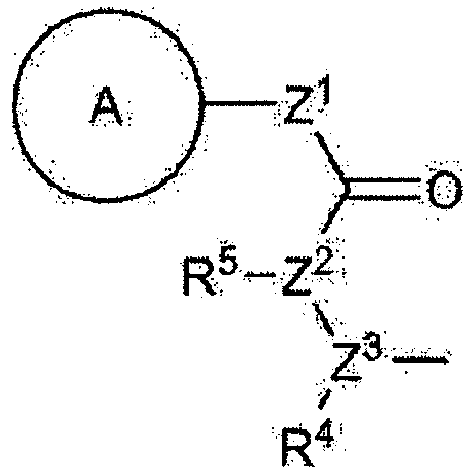


- wherein ring A-1 is C6-C11 monocyclic or bicyclic aryl, or 5- to 11-membered monocyclic or bicyclic heteroaryl containing, besides carbon atom, 1, 2 or 3 hetero atoms selected from the group consisting of oxygen atom, sulfur atom and nitrogen atom,
- Z1a is an oxygen atom, -C(R6a)(R7a)-, -NH-, -C (R6a)(R7a)-NH-, -NH-C(R6a)(R7a)-, -C(R6a)(R7a)-O-, -O-C(R6a)(R7a)-, or a single bond (wherein the left end shows a bond to ring A-1, and the right end shows a bond to the adjacent carbonyl),
- (a) one of Z2a and Z3a is CH and the other is a nitrogen atom, or (b) both of them are nitrogen atoms,
- R1a is (a) a hydrogen atom; (b) alkyl optionally substituted by 1-7 groups selected from the group consisting of amino (said amino is optionally substituted by 1 or 2 groups selected from the group consisting of alkyl, halogenoalkyl, and alkoxycarbonyl), hydroxy, alkoxy, a halogen atom, phenyl, alkoxyphenyl, and a 4- to 7-membered monocyclic nonaromatic heterocyclic group containing, besides carbon atom, 1 or 2 hetero atoms selected from the group consisting of oxygen atom and nitrogen atom (said nonaromatic heterocyclic group is optionally substituted by 1, 2 or 3 groups selected from the group consisting of alkyl, and alkoxycarbonyl); (c) cycloalkyl; (d) phenyl; or (e) a 4- to 7-membered monocyclic nonaromatic heterocyclic group containing, besides carbon atom, 1 or 2 hetero atoms selected from the group consisting of oxygen atom and nitrogen atom (said nonaromatic heterocyclic group is optionally substituted by 1, 2 or 3 groups selected from the group consisting of alkyl, and alkoxycarbonyl),
- R2a is (a) a hydrogen atom; (b) alkyl optionally substituted by 1-7 groups selected from the group consisting of cyano, amino (said amino is optionally substituted by 1 or 2 groups selected from the group consisting of alkyl, alkoxyalkyl, halogenoalkyl, and alkoxycarbonyl), hydroxy, alkoxy, alkylsulfonyloxy, oxo, phenylsulfonyl, a halogen atom, phenyl, pyridyl, isoindolyl optionally substituted by 1 or 2 oxos, and a 4- to 7-membered monocyclic nonaromatic heterocyclic group containing, besides carbon atom, 1 or 2 hetero atoms selected from the group consisting of oxygen atom, and nitrogen atom (said nonaromatic heterocyclic group is optionally substituted by alkoxy); (c) cycloalkyl optionally substituted by 1, 2 or 3 groups selected from the group consisting of alkyl, alkoxyalkyl, halogenoalkyl, cyano, hydroxy, alkoxy, alkanoyloxy, and a halogen atom; (d) amino optionally substituted by 1 or 2 groups selected from the group consisting of alkyl and alkoxyphenyl; (e) alkoxy optionally substituted by 1, 2 or 3 groups selected from the group consisting of amino (said amino is optionally substituted by 1 or 2 groups selected from the group consisting of alkyl, and alkoxycarbonyl), and a halogen atom; (f) cycloalkoxy optionally substituted by alkyl; (g) phenyl optionally substituted by 1, 2 or 3 groups selected from the group consisting of alkyl (said alkyl is optionally substituted by 1, 2 or 3 groups selected from the group consisting of alkylamino, dialkylamino, hydroxy, and a halogen atom), alkoxy optionally substituted by 1, 2 or 3 halogen atoms, alkylsulfonyl, and a halogen atom; (h) 5- to 6-membered monocyclic heteroaryl containing, besides carbon atom, 1, 2 or 3 hetero atoms selected from the group consisting of oxygen atom, sulfur atom and nitrogen atom (said heteroaryl is optionally substituted by 1, 2 or 3 groups selected from the group consisting of alkyl, alkoxy, and a halogen atom); or (i) a 4- to 7-membered monocyclic nonaromatic heterocyclic group containing, besides carbon atom, 1 or 2 hetero atoms selected from the group consisting of oxygen atom, and nitrogen atom (said nonaromatic heterocyclic group is optionally substituted by 1, 2 or 3 groups selected from the group consisting of alkyl, halogenoalkyl, and alkoxy),
or R1a and R2a are bonded to each other to form, together with the adjacent nitrogen atom and carbon atom, (a) a 4- to 7-membered monocyclic nitrogen-containing non-aromatic heterocycle containing 1 or 2 nitrogen atoms besides carbon atom (said nitrogen-containing non-aromatic heterocycle is optionally substituted by 1, 2 or 3 groups selected from the group consisting of alkyl, halogenoalkyl, alkoxycarbonyl, and a halogen atom); or (b) 5- to 6-membered monocyclic nitrogen-containing heteroarene containing, besides carbon atom, at least one nitrogen atom and 1 or 2 hetero atoms selected from the group consisting of sulfur atom and nitrogen atom (said nitrogen-containing heteroarene is optionally substituted by 1, 2 or 3 groups selected from the group consisting of alkyl, halogenoalkyl, alkoxycarbonyl, and a halogen atom), - R4a and R5a are each independently a hydrogen atom, or alkyl,
or, R4a and R5a are bonded to each other to form, together with the adjacent Z2a and Z3a, 4- to 7-membered monocyclic nitrogen-containing non-aromatic heterocycle containing, besides carbon atom, at least one nitrogen atom and 1 or 2 hetero atoms selected from the group consisting of oxygen atom, and nitrogen atom (said nitrogen-containing non-aromatic heterocycle is optionally substituted by 1, 2 or 3 groups selected from the group consisting of amino optionally substituted by a group selected from the group consisting of alkoxycarbonyl and phenylalkoxycarbonyl, and a halogen atom), and - R6a and R7a are each independently (a) a hydrogen atom; (b) alkyl optionally substituted by 1, 2 or 3 groups selected from the group consisting of alkoxy, and a halogen atom; or (c) cycloalkyl, or R6a and R7a are bonded to each other to form, together with the adjacent carbon atom, cycloalkane,
- R8a, R8b and R8c are each independently (a) a hydrogen atom; (b) alkyl optionally substituted by 1, 2 or 3 groups selected from the group consisting of alkylamino, dialkylamino, alkoxy, and a halogen atom; (c) cyano; (d) amino optionally substituted by 1 or 2 alkyls; (e) alkoxy optionally substituted by 1-7 halogen atoms; or (f) a halogen atom, and
- n is 0 or 1, or a pharmacologically acceptable salt thereof can be mentioned.
- Z2a and Z3a in the above-mentioned formula (I-I) are as defined above, and (a) Z2a is CH, and Z3a is a nitrogen atom, or (b) Z2a is a nitrogen atom, and Z3a is CH is preferable.
- When ring A-1 in the above-mentioned formula (I-I) is "C6-C11 monocyclic or bicyclic aryl", preferable examples of the aryl include phenyl, indanyl, and tetrahydronaphthyl, of which phenyl is more preferable. In the above-mentioned formula (I-I), specific examples of "C6-C11 monocyclic or bicyclic aryl, or 5- to 11-membered monocyclic or bicyclic heteroaryl containing, besides carbon atom, 1, 2 or 3 hetero atoms selected from the group consisting of oxygen atom, sulfur atom and nitrogen atom" for ring A-1 include phenyl, indanyl, tetrahydronaphthyl, furyl, thienyl, pyrazolyl, isoxazolyl, thiazolyl, dihydrobenzofuranyl, benzodioxolanyl, and tetrahydroquinolyl. Of these, phenyl, thienyl, or benzodioxolanyl is preferable, and phenyl is particularly preferable.
- Preferable examples of Z1a in the above-mentioned formula (I-I) include an oxygen atom, -C(R6a)(R7a)-, -NH-, -C(R6a)(R7a)-NH-, -NH-C (R6a)(R7a)-, -C (R6a)(R7a)-O-, and -O-C(R6a)(R7a)-, of which an oxygen atom, -C(R6a)(R7a)-, -C(R6a)(R7a)-NH-, -NH-C (R6a)(R7a)-, or -O-C(R6a)(R7a)- is more preferable.
- Preferable examples of R1a in the above-mentioned formula (I-I) include (a) a hydrogen atom; (b) alkyl optionally substituted by 1-7 groups selected from the group consisting of amino (said amino is optionally substituted by 1 or 2 groups selected from the group consisting of alkyl, halogenoalkyl, and alkoxycarbonyl), hydroxy, alkoxy, a halogen atom, phenyl, alkoxyphenyl, and a nonaromatic heterocyclic group selected from the group consisting of pyrrolidyl, piperidyl, oxetanyl, and tetrahydropyranyl (said nonaromatic heterocyclic group is optionally substituted by 1, 2 or 3 groups selected from the group consisting of alkyl, and alkoxycarbonyl); (c) cycloalkyl; (d) phenyl; or (e) a nonaromatic heterocyclic group selected from the group consisting of pyrrolidyl, piperidyl, morpholinyl, oxetanyl, tetrahydrofuranyl, and tetrahydropyranyl (said nonaromatic heterocyclic group is optionally substituted by 1, 2 or 3 groups selected from the group consisting of alkyl, and alkoxycarbonyl) . Of these R1a, (a) a hydrogen atom; (b) alkyl optionally substituted by 1-7 groups selected from the group consisting of amino (said amino is optionally substituted by 1 or 2 groups selected from the group consisting of alkyl, and halogenoalkyl), alkoxy, a halogen atom, and a nonaromatic heterocyclic group selected from the group consisting of oxetanyl, and tetrahydropyranyl; (c) cycloalkyl; or (d) a nonaromatic heterocyclic group selected from the group consisting of pyrrolidyl, oxetanyl, and tetrahydropyranyl is more preferable, (a) a hydrogen atom; (b) alkyl optionally substituted by 1, 2 or 3 groups selected from the group consisting of alkoxy, and oxetanyl; (c) cycloalkyl; or (d) tetrahydropyranyl is particularly preferable.
- Preferable examples of R2a in the above-mentioned formula (I-I) include (a) a hydrogen atom; (b) alkyl optionally substituted by 1-7 groups selected from the group consisting of cyano, amino (said amino is optionally substituted by 1 or 2 groups selected from the group consisting of alkyl, alkoxyalkyl, halogenoalkyl, and alkoxycarbonyl), hydroxy, alkoxy, alkylsulfonyloxy, oxo, phenylsulfonyl, a halogen atom, phenyl, pyridyl, isoindolyl optionally substituted by 1 or 2 oxos, and a monocyclic nonaromatic heterocyclic group selected from the group consisting of azetidinyl, pyrrolidyl, piperidyl, and morpholinyl (said nonaromatic heterocyclic group is optionally substituted by alkoxy); (c) cycloalkyl optionally substituted by 1, 2 or 3 groups selected from the group consisting of alkyl, alkoxyalkyl, halogenoalkyl, cyano, hydroxy, alkoxy, and a halogen atom; (d) amino optionally substituted by 1 or 2 groups selected from the group consisting of alkyl and alkoxyphenyl; (e) alkoxy optionally substituted by 1, 2 or 3 groups selected from the group consisting of amino (said amino is optionally substituted by 1 or 2 groups selected from the group consisting of alkyl, and alkoxycarbonyl), and a halogen atom; (f) cycloalkoxy optionally substituted by alkyl; (g) phenyl optionally substituted by 1, 2 or 3 groups selected from the group consisting of alkyl (said alkyl is optionally substituted by 1-7 groups selected from the group consisting of alkylamino, dialkylamino, hydroxy, and a halogen atom), alkoxy optionally substituted by 1, 2 or 3 halogen atoms, alkylsulfonyl, and a halogen atom; (h) heteroaryl selected from the group consisting of thienyl, pyrazolyl, oxadiazolyl, pyridyl, and pyrimidinyl (said heteroaryl is optionally substituted by 1, 2 or 3 groups selected from the group consisting of alkyl, alkoxy, and a halogen atom); and (i) a nonaromatic heterocyclic group selected from the group consisting of azetidinyl, pyrrolidyl, piperidyl, tetrahydrofuryl, tetrahydropyranyl, piperazinyl, and morpholinyl (said nonaromatic heterocyclic group is optionally substituted by 1, 2 or 3 groups selected from the group consisting of alkyl, halogenoalkyl, and alkoxy). Of these R2a, (a) a hydrogen atom; (b) alkyl optionally substituted by 1-7 groups selected from the group consisting of cyano, amino (said amino is optionally substituted by 1 or 2 groups selected from the group consisting of alkyl, and alkoxyalkyl), hydroxy, alkoxy, oxo, phenylsulfonyl, a halogen atom, phenyl, pyridyl, isoindolyl optionally substituted by 1 or 2 oxos, piperidyl, and morpholinyl; (c) cycloalkyl optionally substituted by 1, 2 or 3 groups selected from the group consisting of alkoxyalkyl, halogenoalkyl, cyano, hydroxy, alkoxy, and a halogen atom; (d) amino optionally substituted by 1 or 2 alkyls; (e) alkoxy; (f) phenyl optionally substituted by 1, 2 or 3 groups selected from the group consisting of alkyl optionally substituted by 1, 2 or 3 halogen atoms, alkoxy, and a halogen atom; (g) heteroaryl selected from the group consisting of thienyl, oxadiazolyl, pyridyl, and pyrimidinyl (said heteroaryl is optionally substituted by 1, 2 or 3 groups selected from the group consisting of alkyl, and a halogen atom); or (h) a nonaromatic heterocyclic group selected from the group consisting of azetidinyl, pyrrolidyl, piperidyl, tetrahydrofuryl, tetrahydropyranyl, piperazinyl, and morpholinyl (said nonaromatic heterocyclic group is optionally substituted by one group selected from the group consisting of alkyl, halogenoalkyl, and alkoxy) is more preferable, and (a) a hydrogen atom; (b) alkyl optionally substituted by 1-7 groups selected from the group consisting of hydroxy, oxo, phenylsulfonyl, a halogen atom, phenyl, and piperidyl; (c) cycloalkyl optionally substituted by 1, 2 or 3 halogen atoms; (d) phenyl optionally substituted by 1, 2 or 3 halogen atoms; (e) oxadiazolyl optionally substituted by alkyl; or (f) a nonaromatic heterocyclic group selected from the group consisting of azetidinyl, and piperidyl (said nonaromatic heterocyclic group is optionally substituted by alkoxy) is particularly preferable.
- When R1a and R2a in the above-mentioned formula (I-I) are bonded to each other to form, together with the adjacent nitrogen atom and carbon atom, a ring, preferable examples of the ring include a non-aromatic heterocycle selected from the group consisting of pyrrolidine, piperidine, dihydroimidazole, imidazolidine, and piperazine (said non-aromatic heterocycle is optionally substituted by 1, 2 or 3 groups selected from the group consisting of alkyl, halogenoalkyl, alkoxycarbonyl, and a halogen atom). Of these, a non-aromatic heterocycle selected from the group consisting of piperidine, dihydroimidazole, imidazolidine, and piperazine (said non-aromatic heterocycle is optionally substituted by 1, 2 or 3 groups selected from the group consisting of alkyl, and a halogen atom) is more preferable, and a non-aromatic heterocycle selected from the group consisting of piperidine, and piperazine (said non-aromatic heterocycle is optionally substituted by 1, 2 or 3 groups selected from the group consisting of alkyl, and a halogen atom) is particularly preferable.
- Preferable examples of R4a and R5a in the above-mentioned formula (I-I) include alkyl. Other preferable examples of R4a and R5a include ring formed by them, bonded to each other, together with the adjacent Z2a and Z3a. Examples of such ring include a nitrogen-containing non-aromatic heterocycle selected from the group consisting of azetidine, pyrrolidine, and piperidine (said nitrogen-containing non-aromatic heterocycle is optionally substituted by 1, 2 or 3 groups selected from the group consisting of amino optionally substituted by one group selected from the group consisting of alkoxycarbonyl and phenylalkoxycarbonyl, and a halogen atom). Of these, a nitrogen-containing non-aromatic heterocycle selected from the group consisting of pyrrolidine, and piperidine (said nitrogen-containing non-aromatic heterocycle is optionally substituted by 1, 2 or 3 halogen atoms) is more preferable.
- Preferable examples of R6a and R7a in the above-mentioned formula (I-I) include, each independently, a hydrogen atom and alkyl.
- Preferable examples of R8a, R8b and R8c in the above-mentioned formula (I-I) include, each independently, (a) a hydrogen atom; (b) alkyl optionally substituted by one group selected from the group consisting of dialkylamino, and alkoxy; (c) cyano; (d) amino optionally substituted by 1 or 2 alkyls; (e) alkoxy; and (f) a halogen atom. Of these, a hydrogen atom, alkyl, and a halogen atom are more preferable, and a hydrogen atom and a halogen atom is particularly preferable.
- In the above-mentioned formula (I-I), n is preferably 1.
- Of the above-mentioned embodiment D, preferable examples include a compound wherein a part represented by the following formula in the formula (I-I) of said embodiment D:


- In the above-mentioned formula (I-II), specific examples of "C6-C11 monocyclic or bicyclic aryl, or 5- to 11-membered monocyclic or bicyclic heteroaryl containing, besides carbon atom, 1, 2 or 3 hetero atoms selected from the group consisting of oxygen atom, sulfur atom and nitrogen atom" for ring A-1 include phenyl, furyl, thienyl, pyrazolyl, isoxazolyl, thiazolyl, dihydrobenzofuranyl, and benzodioxolanyl. Of these, phenyl, thienyl and benzodioxolanyl are preferable, and phenyl is particularly preferable.
- Preferable examples of R1a in the above-mentioned formula (I-II) include (a) a hydrogen atom; (b) alkyl optionally substituted by 1-7 groups selected from the group consisting of amino (said amino is optionally substituted by 1 or 2 groups selected from the group consisting of alkyl, halogenoalkyl, and alkoxycarbonyl), hydroxy, alkoxy, a halogen atom, phenyl, alkoxyphenyl, and a nonaromatic heterocyclic group selected from the group consisting of pyrrolidyl, piperidyl, oxetanyl, and tetrahydropyranyl (said nonaromatic heterocyclic group is optionally substituted by 1, 2 or 3 groups selected from the group consisting of alkyl, and alkoxycarbonyl); (c) cycloalkyl; (d) phenyl; or (e) a nonaromatic heterocyclic group selected from the group consisting of pyrrolidyl, piperidyl, morpholinyl, oxetanyl, tetrahydrofuranyl, and tetrahydropyranyl (said nonaromatic heterocyclic group is optionally substituted by 1, 2 or 3 groups selected from the group consisting of alkyl, and alkoxycarbonyl). Of these R1a, (a) a hydrogen atom; (b) alkyl optionally substituted by 1-7 groups selected from the group consisting of amino (said amino is optionally substituted by 1 or 2 groups selected from the group consisting of alkyl, and halogenoalkyl), alkoxy, a halogen atom, and a nonaromatic heterocyclic group selected from the group consisting of oxetanyl, and tetrahydropyranyl; (c) cycloalkyl; or (d) a nonaromatic heterocyclic group selected from the group consisting of pyrrolidyl, oxetanyl, and tetrahydropyranyl is more preferable, (a) a hydrogen atom; (b) alkyl optionally substituted by 1, 2 or 3 groups selected from the group consisting of alkoxy, and oxetanyl; (c) cycloalkyl; or (d) tetrahydropyranyl is particularly preferable.
- Preferable examples of R2a in the above-mentioned formula (I-II) include (a) a hydrogen atom; (b) alkyl optionally substituted by 1-7 groups selected from the group consisting of cyano, amino (said amino is optionally substituted by 1 or 2 groups selected from the group consisting of alkyl, alkoxyalkyl, halogenoalkyl, and alkoxycarbonyl), hydroxy, alkoxy, alkylsulfonyloxy, oxo, phenylsulfonyl, a halogen atom, phenyl, pyridyl, isoindolyl optionally substituted by 1 or 2 oxos, and a monocyclic nonaromatic heterocyclic group selected from the group consisting of azetidinyl, pyrrolidyl, piperidyl, and morpholinyl (said nonaromatic heterocyclic group is optionally substituted by alkoxy); (c) cycloalkyl optionally substituted by 1, 2 or 3 groups selected from the group consisting of alkyl, alkoxyalkyl, halogenoalkyl, cyano, hydroxy, alkoxy, and a halogen atom; (d) amino optionally substituted by 1 or 2 groups selected from the group consisting of alkyl and alkoxyphenyl; (e) alkoxy optionally substituted by 1, 2 or 3 groups selected from the group consisting of amino (said amino is optionally substituted by 1 or 2 groups selected from the group consisting of alkyl, and alkoxycarbonyl), and a halogen atom; (f) cycloalkoxy optionally substituted by alkyl; (g) phenyl optionally substituted by 1, 2 or 3 groups selected from the group consisting of alkyl (said alkyl is optionally substituted by 1, 2 or 3 groups selected from the group consisting of alkylamino, dialkylamino, hydroxy, and a halogen atom), alkoxy optionally substituted by 1, 2 or 3 halogen atoms, alkylsulfonyl, and a halogen atom; (h) heteroaryl selected from the group consisting of thienyl, pyrazolyl, oxadiazolyl, pyridyl, and pyrimidinyl (said heteroaryl is optionally substituted by 1, 2 or 3 groups selected from the group consisting of alkyl, alkoxy, and a halogen atom); and (i) a nonaromatic heterocyclic group selected from the group consisting of azetidinyl, pyrrolidyl, piperidyl, tetrahydrofuryl, tetrahydropyranyl, piperazinyl, and morpholinyl (said nonaromatic heterocyclic group is optionally substituted by 1, 2 or 3 groups selected from the group consisting of alkyl, halogenoalkyl, and alkoxy). Of these R2a, (a) a hydrogen atom; (b) alkyl optionally substituted by 1, 2 or 3 groups selected from the group consisting of cyano, amino (said amino is optionally substituted by 1 or 2 groups selected from the group consisting of alkyl, and alkoxyalkyl), hydroxy, alkoxy, oxo, phenylsulfonyl, a halogen atom, phenyl, pyridyl, isoindolyl optionally substituted by 1 or 2 oxos, piperidyl, and morpholinyl; (c) cycloalkyl optionally substituted by 1, 2 or 3 groups selected from the group consisting of alkoxyalkyl, halogenoalkyl, cyano, hydroxy, alkoxy, and a halogen atom; (d) amino optionally substituted by 1 or 2 alkyls; (e) alkoxy; (f) phenyl optionally substituted by 1, 2 or 3 groups selected from the group consisting of alkyl optionally substituted by 1, 2 or 3 halogen atoms, alkoxy, and a halogen atom; (g) heteroaryl selected from the group consisting of thienyl, oxadiazolyl, pyridyl, and pyrimidinyl (said heteroaryl is optionally substituted by 1, 2 or 3 groups selected from the group consisting of alkyl, and a halogen atom); or (h) a nonaromatic heterocyclic group selected from the group consisting of azetidinyl, pyrrolidyl, piperidyl, tetrahydrofuryl, tetrahydropyranyl, piperazinyl, and morpholinyl (said nonaromatic heterocyclic group is optionally substituted by 1, 2 or 3 groups selected from the group consisting of alkyl, halogenoalkyl, and alkoxy) is more preferable, and (a) a hydrogen atom; (b) alkyl optionally substituted by 1-7 groups selected from the group consisting of hydroxy, oxo, phenylsulfonyl, a halogen atom, phenyl, and piperidyl; (c) cycloalkyl optionally substituted by 1, 2 or 3 halogen atoms; (d) phenyl optionally substituted by 1, 2 or 3 halogen atoms; (e) oxadiazolyl optionally substituted by alkyl; or (f) a nonaromatic heterocyclic group selected from the group consisting of azetidinyl, and piperidyl (said nonaromatic heterocyclic group is optionally substituted by alkoxy) is particularly preferable.
- When R1a and R2a in the above-mentioned formula (I-II) are bonded to each other to form, together with the adjacent nitrogen atom and carbon atom, a ring, preferable examples of the ring include a non-aromatic heterocycle selected from the group consisting of pyrrolidine, piperidine, dihydroimidazole, imidazolidine, and piperazine (said non-aromatic heterocycle is optionally substituted by 1, 2 or 3 groups selected from the group consisting of alkyl, halogenoalkyl, alkoxycarbonyl, and a halogen atom). Of these, a non-aromatic heterocycle selected from the group consisting of piperidine, dihydroimidazole, imidazolidine, and piperazine (said non-aromatic heterocycle is optionally substituted by 1, 2 or 3 groups selected from the group consisting of alkyl, and a halogen atom) is more preferable, and a non-aromatic heterocycle selected from the group consisting of piperidine, and piperazine (said non-aromatic heterocycle is optionally substituted by 1, 2 or 3 groups selected from the group consisting of alkyl, and a halogen atom) is particularly preferable.
- Preferable examples of R4a and R5a in the above-mentioned formula (I-II) include alkyl. Other preferable examples of R4a and R5a include ring formed by them, bonded to each other, together with the adjacent nitrogen atom and carbon atom. Examples of such ring include a nitrogen-containing non-aromatic heterocycle selected from the group consisting of azetidine, pyrrolidine, and piperidine (said nitrogen-containing non-aromatic heterocycle is optionally substituted by 1, 2 or 3 groups selected from the group consisting of amino optionally substituted by one group selected from the group consisting of alkoxycarbonyl and phenylalkoxycarbonyl, and a halogen atom). Of these, a nitrogen-containing non-aromatic heterocycle selected from the group consisting of pyrrolidine, and piperidine (said nitrogen-containing non-aromatic heterocycle is optionally substituted by 1, 2 or 3 halogen atoms) is more preferable.
- Preferable examples of R6a and R7a in the above-mentioned formula (I-II) include, each independently, a hydrogen atom and alkyl.
- Preferable examples of R8a, R8b and R8c in the above-mentioned formula (I-II) include, each independently, (a) a hydrogen atom; (b) alkyl optionally substituted by one group selected from the group consisting of dialkylamino, and alkoxy; (c) cyano; (d) amino optionally substituted by 1 or 2 alkyls; (e) alkoxy; and (f) a halogen atom. Of these, a hydrogen atom, alkyl, and a halogen atom are more preferable, and a hydrogen atom or a halogen atom is particularly preferable.
- In the above-mentioned formula (I-II), n is preferably 1.
- In the embodiments of the present invention, examples of the preferable embodiment include compound (I-I) and compound (I-II) defined above, wherein R4a and R5a are bonded to each other to form, together with the adjacent Z2a and Z3a, or a nitrogen atom and carbon atom, pyrrolidine, and R6a and R7a are both hydrogen atoms, or a pharmacologically acceptable salt thereof.
- In the embodiments of the present invention, examples of other preferable embodiment include a compound wherein R4a is C1-C6 alkyl, R5a is C1-C6 alkyl, and R6a and R7a are both hydrogen atoms, or a pharmacologically acceptable salt thereof.
- Of the above-mentioned embodiment D, other preferable examples include a compound wherein a part represented by the following formula in the formula (I-I) of said embodiment D:


- wherein R1b is (a) a hydrogen atom; (b) alkyl optionally substituted by 1-7 groups selected from the group consisting of amino (said amino is optionally substituted by 1 or 2 groups selected from the group consisting of alkyl, halogenoalkyl, and alkoxycarbonyl), hydroxy, alkoxy, a halogen atom, phenyl, alkoxyphenyl, and a 4- to 7-membered monocyclic nonaromatic heterocyclic group containing, besides carbon atom, 1 or 2 hetero atoms selected from the group consisting of oxygen atom and nitrogen atom (said nonaromatic heterocyclic group is optionally substituted by 1, 2 or 3 groups selected from the group consisting of alkyl, and alkoxycarbonyl); (c) cycloalkyl; (d) phenyl; or (e) a 4- to 7-membered monocyclic nonaromatic heterocyclic group containing, besides carbon atom, 1 or 2 hetero atoms selected from the group consisting of oxygen atom and nitrogen atom (said nonaromatic heterocyclic group is optionally substituted by 1, 2 or 3 groups selected from the group consisting of alkyl, and alkoxycarbonyl),
- R2b is (a) a hydrogen atom; (b) alkyl optionally substituted by 1-7 groups selected from the group consisting of cyano, amino (said amino is optionally substituted by the same or different 1 or 2 groups selected from the group consisting of alkyl, alkoxyalkyl, halogenoalkyl, and alkoxycarbonyl), hydroxy, alkoxy, alkylsulfonyloxy, oxo, phenylsulfonyl, a halogen atom, phenyl, pyridyl, isoindolyl optionally substituted by 1 or 2 oxos, and a 4- to 7-membered monocyclic nonaromatic heterocyclic group containing, besides carbon atom, 1 or 2 hetero atoms selected from the group consisting of oxygen atom, and nitrogen atom (said nonaromatic heterocyclic group is optionally substituted by alkoxy); (c) cycloalkyl optionally substituted by 1, 2 or 3 groups selected from the group consisting of alkyl, alkoxyalkyl, halogenoalkyl, cyano, hydroxy, alkoxy, alkanoyloxy, and a halogen atom; (d) amino optionally substituted by 1 or 2 groups selected from the group consisting of alkyl and alkoxyphenyl; (e) alkoxy optionally substituted by 1, 2 or 3 groups selected from the group consisting of amino (said amino is optionally substituted by 1 or 2 groups selected from the group consisting of alkyl, and alkoxycarbonyl), and a halogen atom; (f) cycloalkoxy optionally substituted by alkyl; (g) phenyl optionally substituted by 1, 2 or 3 groups selected from the group consisting of alkyl (said alkyl is optionally substituted by 1, 2 or 3 groups selected from the group consisting of alkylamino, dialkylamino, hydroxy, and a halogen atom), alkoxy optionally substituted by 1, 2 or 3 halogen atoms, alkylsulfonyl, and a halogen atom; (h) 5- to 6-membered monocyclic heteroaryl containing, besides carbon atom, 1, 2 or 3 hetero atoms selected from the group consisting of oxygen atom, sulfur atom and nitrogen atom (said heteroaryl is optionally substituted by 1, 2 or 3 groups selected from the group consisting of alkyl, alkoxy, and a halogen atom); or (i) a 4- to 7-membered monocyclic nonaromatic heterocyclic group containing, besides carbon atom, 1 or 2 hetero atoms selected from the group consisting of oxygen atom, and nitrogen atom (said nonaromatic heterocyclic group is optionally substituted by 1, 2 or 3 groups selected from the group consisting of alkyl, halogenoalkyl, and alkoxy),
- In the above-mentioned formula (I-III), specific examples of "C6-C11 monocyclic or bicyclic aryl, or 5- to 11-membered monocyclic or bicyclic heteroaryl containing, besides carbon atom, 1, 2 or 3 hetero atoms selected from the group consisting of oxygen atom, sulfur atom and nitrogen atom" for ring A-1 include phenyl, indanyl, tetrahydronaphthyl, and tetrahydroquinolyl. Of these, phenyl is particularly preferable.
- Preferable examples of Z1a in the above-mentioned formula (I-III) include an oxygen atom, -C (R6a)(R7a)-, -NH-,-C(R6a)(R7a)-NH-, and -C(R6a)(R7a)-O-. Of these, an oxygen atom, and -C(R6a)(R7a)- are more preferable.
- Preferable examples of R1b in the above-mentioned formula (I-III) include (a) a hydrogen atom; (b) alkyl optionally substituted by 1-7 groups selected from the group consisting of amino (said amino is optionally substituted by 1 or 2 groups selected from the group consisting of alkyl, halogenoalkyl, and alkoxycarbonyl), hydroxy, alkoxy, a halogen atom, phenyl, alkoxyphenyl, and a nonaromatic heterocyclic group selected from the group consisting of pyrrolidyl, piperidyl, oxetanyl, and tetrahydropyranyl (said nonaromatic heterocyclic group is optionally substituted by 1, 2 or 3 groups selected from the group consisting of alkyl, and alkoxycarbonyl); (c) a nonaromatic heterocyclic group selected from the group consisting of pyrrolidyl, piperidyl, morpholinyl, oxetanyl, tetrahydrofuranyl, and tetrahydropyranyl (said nonaromatic heterocyclic group is optionally substituted by 1, 2 or 3 groups selected from the group consisting of alkyl, and alkoxycarbonyl) . Of these R1b, (a) a hydrogen atom; (b) alkyl optionally substituted by 1, 2 or 3 alkoxyphenyls; or (c) tetrahydropyranyl is more preferable, and (a) a hydrogen atom; or (b) alkyl is particularly preferable.
- Preferable examples of R2b in the above-mentioned formula (I-III) include (a) alkyl optionally substituted by 1-7 groups selected from the group consisting of cyano, amino (said amino is optionally substituted by 1 or 2 groups selected from the group consisting of alkyl, alkoxyalkyl, halogenoalkyl, and alkoxycarbonyl), hydroxy, alkoxy, alkylsulfonyloxy, oxo, phenylsulfonyl, a halogen atom, phenyl, pyridyl, isoindolyl optionally substituted by 1 or 2 oxos, and a monocyclic nonaromatic heterocyclic group selected from the group consisting of azetidinyl, pyrrolidyl, piperidyl, and morpholinyl (said nonaromatic heterocyclic group is optionally substituted by alkoxy); (b) cycloalkyl optionally substituted by 1, 2 or 3 groups selected from the group consisting of alkyl, alkoxyalkyl, halogenoalkyl, cyano, hydroxy, alkoxy, and a halogen atom; (c) amino optionally substituted by 1 or 2 groups selected from the group consisting of alkyl and alkoxyphenyl; (d) alkoxy optionally substituted by 1, 2 or 3 groups selected from the group consisting of amino (said amino is optionally substituted by 1 or 2 groups selected from the group consisting of alkyl, and alkoxycarbonyl), and a halogen atom; (e) cycloalkoxy optionally substituted by alkyl; (f) phenyl optionally substituted by 1, 2 or 3 groups selected from the group consisting of alkyl (said alkyl is optionally substituted by 1, 2 or 3 groups selected from the group consisting of alkylamino, dialkylamino, hydroxy, and a halogen atom), alkoxy optionally substituted by 1, 2 or 3 halogen atoms, alkylsulfonyl, and a halogen atom; (g) heteroaryl selected from the group consisting of thienyl, pyrazolyl, oxadiazolyl, pyridyl, and pyrimidinyl (said heteroaryl is optionally substituted by 1, 2 or 3 groups selected from the group consisting of alkyl, alkoxy, and a halogen atom); and (h) a nonaromatic heterocyclic group selected from the group consisting of azetidinyl, pyrrolidyl, piperidyl, tetrahydrofuryl, tetrahydropyranyl, piperazinyl, and morpholinyl (said nonaromatic heterocyclic group is optionally substituted by 1, 2 or 3 groups selected from the group consisting of alkyl, halogenoalkyl, and alkoxy). Of these R2b, (a) alkyl optionally substituted by 1, 2 or 3 groups selected from the group consisting of cyano, a halogen atom, and morpholinyl; (b) cycloalkyl optionally substituted by 1, 2 or 3 groups selected from the group consisting of alkyl, alkoxyalkyl, halogenoalkyl, cyano, alkoxy, and a halogen atom; (c) amino optionally substituted by 1 or 2 alkyls; (d) alkoxy optionally substituted by 1, 2 or 3 halogen atoms; (e) phenyl optionally substituted by 1, 2 or 3 groups selected from the group consisting of alkyl, alkoxy optionally substituted by 1, 2 or 3 halogen atoms, and a halogen atom; (f) oxadiazolyl optionally substituted by alkyl; or (g) a nonaromatic heterocyclic group selected from the group consisting of piperidyl, oxetanyl, and tetrahydropyranyl (said nonaromatic heterocyclic group is optionally substituted by alkyl) is more preferable, and (a) alkyl optionally substituted by 1, 2 or 3 groups selected from the group consisting of cyano, and a halogen atom; (b) cycloalkyl optionally substituted by 1, 2 or 3 groups selected from the group consisting of alkyl, alkoxyalkyl, halogenoalkyl, cyano, alkoxy, and a halogen atom; (c) phenyl optionally substituted by 1, 2 or 3 groups selected from the group consisting of alkyl, and a halogen atom; (d) oxadiazolyl optionally substituted by alkyl; or (e) a nonaromatic heterocyclic group selected from the group consisting of oxetanyl, and tetrahydropyranyl (said nonaromatic heterocyclic group is optionally substituted by alkyl) is particularly preferable.
- Preferable examples of R6a and R7a in the above-mentioned formula (I-III) include, each independently, a hydrogen atom and alkyl.
- Preferable examples of R8a, R8b and R8c in the above-mentioned formula (I-III) include, each independently, (a) a hydrogen atom; (b) alkyl optionally substituted by 1, 2 or 3 groups selected from the group consisting of alkylamino, dialkylamino, alkoxy, and a halogen atom; (c) alkoxy optionally substituted by 1, 2 or 3 halogen atoms; or (d) a halogen atom. Of these, (a) a hydrogen atom; (b) alkyl optionally substituted by 1, 2 or 3 halogen atoms; (c) alkoxy optionally substituted by 1, 2 or 3 halogen atoms; or (d) a halogen atom is more preferable, and a hydrogen atom, alkyl, or a halogen atom is particularly preferable.
- In the above-mentioned formula (I-III), n is preferably 1.
- Of the compound (I-III) defined as above, examples of preferable compound include a compound wherein ring A-1 is phenyl,
- Z1a is an oxygen atom,
- R1b is (a) a hydrogen atom; (b) alkyl optionally substituted by phenyl (said phenyl is optionally substituted by 1, 2 or 3 alkoxys); or (c) tetrahydropyranyl,
- R2b is (a) alkyl optionally substituted by 1, 2 or 3 groups selected from the group consisting of cyano, a halogen atom, and morpholinyl; (b) cycloalkyl optionally substituted by 1, 2 or 3 groups selected from the group consisting of alkyl, alkoxyalkyl, halogenoalkyl, cyano, alkoxy, and a halogen atom; (c) amino optionally substituted by 1 or 2 alkyls; (d) alkoxy optionally substituted by 1, 2 or 3 halogen atoms; (e) cycloalkoxy optionally substituted by alkyl; (f) phenyl optionally substituted by 1, 2 or 3 groups selected from the group consisting of alkyl, alkoxy optionally substituted by 1, 2 or 3 halogen atoms, and a halogen atom; (g) oxadiazolyl optionally substituted by alkyl; or (h) a nonaromatic heterocyclic group selected from the group consisting of piperidyl, oxetanyl, and tetrahydropyranyl (said nonaromatic heterocyclic group is optionally substituted by 1, 2 or 3 alkyls),
- R8a, R8b and R8c are each independently (a) a hydrogen atom, (b) alkyl optionally substituted by 1, 2 or 3 halogen atoms, (c) alkoxy optionally substituted by 1, 2 or 3 halogen atoms, or (d) a halogen atom, and
- n is 1.
- Specific examples of the compound (I) or a pharmacologically acceptable salt thereof of the present invention non-limitatively include the compounds described in the following Examples, and a pharmacologically acceptable salt thereof. Of these, examples of preferable compound or a pharmacologically acceptable salt thereof include compounds selected from the group consisting of
- (R)-2-[6-methyl-5-(3-methyl-[1,2,4]oxadiazol-5-yl)-7-oxo-6,7-dihydro[1,3]thiazolo[5,4-d]pyrimidin-2-yl]pyrrolidine-1-carboxylic acid phenyl ester;
- (R)-2-(5-ethyl-6-methyl-7-oxo-6,7-dihydro[1,3]thiazolo[5,4-d]pyrimidin-2-yl)pyrrolidine-1-carboxylic acid phenyl ester;
- (R)-2-[7-oxo-5-(propan-2-yl)-6,7-dihydro[1,3]thiazolo[5,4-d]pyrimidin-2-yl]pyrrolidine-1-carboxylic acid phenyl ester;
- (R)-2-(5-ethyl-7-oxo-6,7-dihydro[1,3]thiazolo[5,4-d]pyrimidin-2-yl)pyrrolidine-1-carboxylic acid phenyl ester;
- (R)-2-[5-(3-methyl-[1,2,4]oxadiazol-5-yl)-7-oxo-6,7-dihydro[1,3]thiazolo[5,4-d]pyrimidin-2-yl]pyrrolidine-1-carboxylic acid phenyl ester; and
- (R)-2-[6-methyl-7-oxo-5-(propan-2-yl)-6,7-dihydro[1,3]thiazolo[5,4-d]pyrimidin-2-yl]pyrrolidine-1-carboxylic acid phenyl ester; or a pharmacologically acceptable salt thereof,
- (R)-N-benzyl-1-(6-methyl-7-oxo-5-phenyl-6,7-dihydro[1,3]thiazolo[5,4-d]pyrimidin-2-yl)pyrrolidine-2-carboxamide;
- (R)-N-benzyl-1-(6-methyl-7-oxo-5-trifluoromethyl-6,7-dihydro-[1,3]thiazolo[5,4-d]pyrimidin-2-yl)pyrrolidine-2-carboxamide;
- (R)-N-benzyl-1-[5-(2,6-difluorophenyl)-6-methyl-7-oxo-6,7-dihydro[1,3]thiazolo[5,4-d]pyrimidin-2-yl]pyrrolidine-2-carboxamide;
- (R)-N-benzyl-1-[6-methyl-5-(3-methyl-1,2,4-oxadiazol-5-yl)-7-oxo-6,7-dihydro[1,3]thiazolo[5,4-d]pyrimidin-2-yl]pyrrolidine-2-carboxamide;
- (R)-N-benzyl-1-[7-oxo-6-(tetrahydro-2H-pyran-4-yl)-5-trifluoromethyl-6,7-dihydro-[1,3]thiazolo[5,4-d]pyrimidin-2-yl]pyrrolidine-2-carboxamide;
- (R)-N-benzyl-1-[5-(1-fluorocyclopropyl)-6-methyl-7-oxo-6,7-dihydro[1,3]thiazolo[5,4-d]pyrimidin-2-yl]pyrrolidine-2-carboxamide;
- (R)-N-benzyl-1-(5-difluoromethyl-6-methyl-7-oxo-6,7-dihydro-[1,3]thiazolo[5,4-d]pyrimidin-2-yl)pyrrolidine-2-carboxamide;
- (R)-N-benzyl-1-[6-methyl-7-oxo-5-(piperidin-1-yl)-6,7-dihydro[1,3]thiazolo[5,4-d]pyrimidin-2-yl]pyrrolidine-2-carboxamide;
- (R)-N-benzyl-1-[5-(2-fluorophenyl)-6-methyl-7-oxo-6,7-dihydro[1,3]thiazolo[5,4-d]pyrimidin-2-yl]pyrrolidine-2-carboxamide;
- (R)-N-benzyl-1-[5-(2-fluoropropan-2-yl)-7-oxo-6,7-dihydro[1,3]thiazolo[5,4-d]pyrimidin-2-yl]pyrrolidine-2-carboxamide;
- (R)-N-benzyl-1-[5-(2-fluorophenyl)-7-oxo-6,7-dihydro[1,3]thiazolo[5,4-d]pyrimidin-2-yl]pyrrolidine-2-carboxamide;
- (R)-N-benzyl-1-(7-oxo-5-trifluoromethyl-6,7-dihydro[1,3]thiazolo[5,4-d]pyrimidin-2-yl)pyrrolidine-2-carboxamide;
- (R)-N-benzyl-1-(5-difluoromethyl-7-oxo-6,7-dihydro[1,3]thiazolo[5,4-d]pyrimidin-2-yl)pyrrolidine-2-carboxamide;
- (R)-N-benzyl-1-[5-(2,6-difluorophenyl)-7-oxo-6,7-dihydro[1,3]thiazolo[5,4-d]pyrimidin-2-yl]pyrrolidine-2-carboxamide;
- (R)-N-benzyl-1-[5-(3-methyl-[1,2,4]oxadiazol-5-yl)-7-oxo-6,7-dihydro[1,3]thiazolo[5,4-d]pyrimidin-2-yl]pyrrolidine-2-carboxamide;
- (R)-N-benzyl-1-[5-(2-hydroxypropan-2-yl)-7-oxo-6,7-dihydro[1,3]thiazolo[5,4-d]pyrimidin-2-yl]pyrrolidine-2-carboxamide; and
- (R)-N-benzyl-1-[7-oxo-5-(piperidin-1-yl)-6,7-dihydro[1,3]thiazolo[5,4-d]pyrimidin-2-yl]pyrrolidine-2-carboxamide; or a pharmacologically acceptable salt thereof.
- The compound (I) of the present invention can be present in the form of tautomer or a mixture thereof. The compound (I) of the present invention can be present in the form of a stereoisomer such as enantiomer, diastereomer and the like or a mixture thereof. The compound (I) of the present invention encompasses a mixture of tautomer or stereoisomer and a pure or substantially pure isomer thereof.
- When compound (I) is obtained in the form of a diastereomer or enantiomer, it can be resolved by a method conventionally used in the pertinent field, for example, chromatography, and a fractional crystallization method.
- The present invention encompasses compound (I) wherein one or more atoms are substituted by one or more isotopes. Examples of the isotope include 2H(D), 3H, 13C, and 14C.
- Examples of the pharmacologically acceptable salt of compound (I) include alkali metal salts such as lithium, sodium, potassium and the like; group 2 metal salts such as magnesium, calcium and the like; salts with aluminum or zinc; salts with amine such as ammonia, choline, diethanolamine, lysine, ethylenediamine, tert-butylamine, tert-octylamine, tris(hydroxymethyl)aminomethane, N-methyl-glucosamine, triethanolamine, dehydroabiethylamine and the like; salts with inorganic acids such as hydrogen chloride, hydrogen bromide, hydrogen iodide, sulfuric acid, nitric acid, phosphoric acid and the like; salts with organic acids such as formic acid, acetic acid, propionic acid, oxalic acid, malonic acid, succinic acid, fumaric acid, maleic acid, lactic acid, malic acid, tartaric acid, citric acid, methanesulfonic acid, ethanesulfonic acid, benzenesulfonic acid and the like; and salts with acidic amino acid such as aspartic acid, glutamic acid and the like.
- Moreover, the pharmacologically acceptable salt of compound (I) encompasses intramolecular salt, hydrate, solvate of compound (I).
- The compound (I) or a pharmacologically acceptable salt thereof of the present invention can be administered orally or parenterally. In addition, it can be used as a conventionally-used drug preparation such as tablet, granule, capsule, powder, injection, inhalant and the like.
- While the dose of the compound (I) or a pharmacologically acceptable salt thereof of the present invention varies depending on the administration method, age, body weight and condition of the patient, generally, it is preferably set to 0.001 - 500 mg/kg, particularly 0.01 - 10 mg/kg.
- The compound (I) or a pharmacologically acceptable salt thereof of the present invention has a superior KAT-II inhibitory activity. A pharmaceutical composition containing compound (I) or a pharmacologically acceptable salt thereof of the present invention is useful for the treatment or prophylaxis of a disease or symptom (e.g., dementia, depression, stress vulnerability) in which inhibition of KAT-II activity is expected to improve the pathology. More specific examples of such disease and symptom include, for example, schizophrenia, bipolar disorder, attention deficit/hyperactivity disorder, Alzheimer's disease, major depression, autism, cerebrovascular dementia, HIV encephalopathy, and age-related cognitive dysfunction. Preferably, a pharmaceutical composition containing the compound (I) or a pharmacologically acceptable salt thereof of the present invention is useful for the treatment or prophylaxis of schizophrenia, attention deficit/hyperactivity disorder, Alzheimer's disease, or major depression, particularly for the treatment or prophylaxis of schizophrenia.
- A therapeutic or prophylactic method including administering an effective amount of compound (I) or a pharmacologically acceptable salt thereof of the present invention to a patient (individual to be the target of treatment or prophylaxis) is also applied to the aforementioned object and encompassed in the present invention.
- Also, use of compound (I) or a pharmacologically acceptable salt thereof of the present invention for the production of a medicament having a KAT-II inhibitory action is also applied to the aforementioned object and encompassed in the present invention.
- According to the present invention, compound (I) or a pharmacologically acceptable salt thereof can be produced by the following method, but the method is not limited thereto.
- In each production step of compound (I) to be described below, when protection of functional group contained in the compound is necessary, the functional group can be appropriately protected by a conventional method. The protecting group and general description of the use thereof are contained in T.W. Greene et al., "Protective Groups in Organic Synthesis", John Wiley & Sons, New York, 2006. The protecting group is removed by a conventional method in a subsequent step.
- Of compound (I), a compound represented by the formula (I-a):


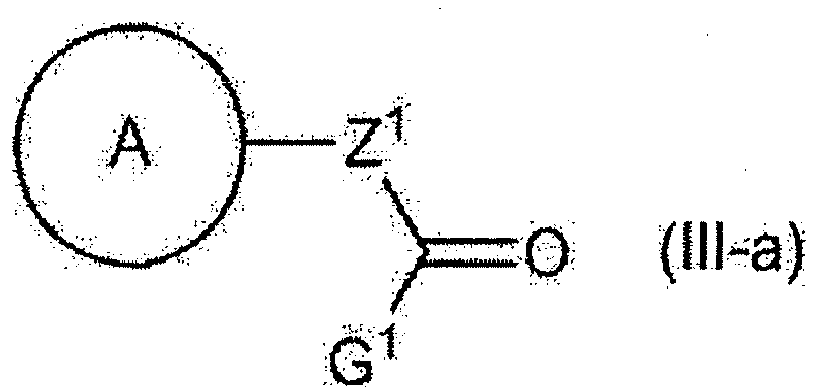
- G1 represented by Examples of the leaving group include halogen atom (particularly, chlorine atom), optionally substituted aryloxy (particularly, methoxyphenyloxy) can be mentioned.
- Examples of the base include amine such as triethylamine, N,N-diisopropylethylamine, pyridine, 1,8-diazabicyclo[5.4.0]-undec-7-ene (DBU) and the like.
- The solvent may be any as long as it does not influence the reaction, and examples thereof include halogenohydrocarbon such as methylene chloride, chloroform, 1,2-dichloroethane and the like; ether such as tetrahydrofuran, 1,4-dioxane, 1,2-dimethoxyethane and the like; alkylnitrile such as acetonitrile, propionitrile and the like; or a mixed solvent thereof.
- The amount of compound (III-a) to be used in this reaction is 0.5 - 20 mol, preferably 1.0 - 7.0 mol, per 1 mol of compound (II). The amount of the base to be used is 0.5 - 30 mol, preferably 0.9 - 7.0 mol, per 1 mol of compound (II). This reaction can be performed at 0 - 150°C, preferably 20 - 90°C.
- Of compound (I), a compound represented by the formula (I-b):


- Examples of the base include amine such as triethylamine, N,N-diisopropylethylamine, pyridine, 1,8-diazabicyclo[5.4.0]-undec-7-ene (DBU) and the like.
- The solvent may be any as long as it does not influence the reaction, and examples thereof include halogenohydrocarbon such as methylene chloride, chloroform, 1,2-dichloroethane and the like.
- The amount of compound (III-b) to be used in this reaction is 0.5 - 10 mol, preferably 1.0 - 1.5 mol, per 1 mol of compound (II). The amount of the base to be used is 0.5 - 15 mol, preferably 0.8 - 2.0 mol, per 1 mol of compound (II). This reaction can be performed at 0 - 50°C, preferably 10 - 30°C.
- Alternatively, compound (I-b) can be produced from the aforementioned compound (II) according to a method describe below. Compound (II) is reacted with a carbonylating agent to give a reactive intermediate. Furthermore, the reactive intermediate is reacted with a compound represented by the formula (III-c):

- The reaction of compound (II) and a carbonylating agent can be performed in a solvent in the presence of a base.
- Examples of the carbonylating agent include triphosgene, phosgene, and carbonyldiimidazole. Examples of the base include amine such as triethylamine, N,N-diisopropylethylamine, pyridine and the like. The solvent may be any as long as it does not influence the reaction, and examples thereof include halogenohydrocarbon such as methylene chloride, chloroform, 1,2-dichloroethane and the like; aromatic hydrocarbon such as benzene, toluene, xylene and the like. The amount per carbonyl of the carbonylating agent to be used in this reaction is 0.5 - 10 mol, preferably 1.5 - 2.5 mol, per 1 mol of compound (II). The amount of the base to be used is 0.5 - 15 mol, preferably 1.8 - 3.0 mol, per 1 mol of compound (II). This reaction can be performed at -20 to 50°C, preferably 0 - 30°C.
- The reaction of the obtained reactive intermediate and compound (III-c) can be performed in a solvent in the presence of a base.
- Examples of the base include amine such as triethylamine, N,N-diisopropylethylamine, N,N-dimethyl-4-aminopyridine and the like. The solvent may be any as long as it does not influence the reaction, and examples thereof include halogenohydrocarbon such as methylene chloride, chloroform, 1,2-dichloroethane and the like. The amount of compound (III-c) to be used in this reaction is 1.0 - 10 mol, preferably 3.0 - 7.0 mol, per 1 mol of compound (II). The amount of the base to be used is 1.0 - 15 mol, preferably 3.0 - 8.0 mol, per 1 mol of compound (II). This reaction can be performed at 0 - 50°C, preferably 10 - 30°C.
- Of compound (I), a compound represented by the formula (I-c) :


- The leaving groups for G3 and G4 are each independently, for example, a halogen atom (particularly, chlorine atom).
- The reaction of compound (II) and compound (IV) can be performed in a solvent in the presence of a base.
- Examples of the base include amine such as triethylamine, N,N-diisopropylethylamine, pyridine and the like. The solvent may be any as long as it does not influence the reaction, and examples thereof include halogenohydrocarbon such as methylene chloride, chloroform, 1,2-dichloroethane and the like. The amount of compound (IV) to be used in this reaction is 0.5 - 10 mol, preferably 1.0 - 1.2 mol, per 1 mol of compound (II). The amount of the base to be used is 0.5 - 15 mol, preferably 1.0 - 1.3 mol, per 1 mol of compound (II). This reaction can be performed at 0 - 50°C, preferably 10 - 30°C.
- The reaction of the obtained reactive intermediate and compound (V) can be performed in a solvent with or without additive in the presence of a base.
- Examples of the base include alkali metal carbonate such as potassium carbonate, cesium carbonate, sodium carbonate and the like; alkali metal hydride such as sodium hydride and the like. As the additive, alkali metal iodide such as potassium iodide, sodium iodide and the like can be mentioned. The solvent may be any as long as it does not influence the reaction, and examples thereof include ether such as tetrahydrofuran, 1,4-dioxane, 1,2-dimethoxyethane and the like; alkylnitrile such as acetonitrile, propionitrile and the like; or a mixed solvent thereof can be mentioned. The amount of compound (V) to be used in this reaction is 1.0 - 3.0 mol, preferably 1.1 - 1.8 mol, per 1 mol of compound (II). The amount of the base to be used is 1.0 - 15 mol, preferably 1.2 - 2.0 mol, per 1 mol of compound (II). The amount of the additive to be used is 1.0 - 10 mol, preferably 1.1 - 2.5 mol, per 1 mol of compound (II). This reaction can be performed at 20 - 120°C, preferably 60 - 100°C.
- Of compound (I), a compound represented by the formula (I-d):

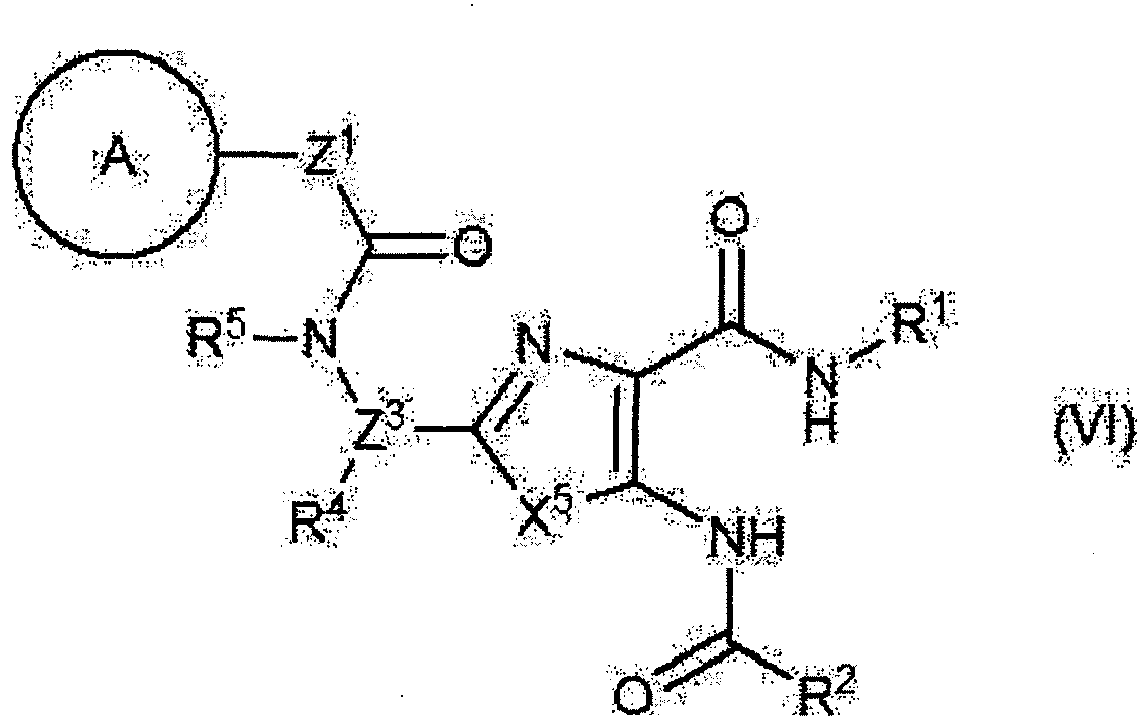
- Examples of the condensation agent include chlorotrialkylsilane such as chlorotrimethylsilane and the like, N,O-bis(trialkylsilyl)acetamide such as N,O-bis(trimethylsilyl)acetamide and the like. Examples of the base include amine such as triethylamine, N,N-diisopropylethylamine, pyridine and the like. The solvent may be any as long as it does not influence the reaction, and examples thereof include halogenohydrocarbon such as methylene chloride, chloroform, 1,2-dichloroethane and the like; amide such as N,N-dimethylformamide, N,N-dimethylacetamide, 1,3-dimethyl-2-imidazolidinone, N-methylpyrrolidone and the like. The amount of the condensation agent to be used in this reaction is 1.0 - 500 mol, preferably 5.0 - 100 mol, per 1 mol of compound (VI). The amount of the base to be used is 3.0 - 1500 mol, preferably 15 - 300 mol, per 1 mol of compound (VI). This reaction can be performed at 0 - 50°C, preferably 10 - 30°C.
- Alternatively, compound (I-d) can be produced by reacting compound (VI) in a solvent (e.g., acetic acid) in the presence of an acid (e.g., concentrated sulfuric acid).
- Alternatively, compound (I-d) can be produced by reacting a compound represented by the formula (VII):


- Examples of the base include amine such as triethylamine, N,N-diisopropylethylamine, pyridine and the like. The solvent may be any as long as it does not influence the reaction, and examples thereof include halogenohydrocarbon such as methylene chloride, chloroform, 1,2-dichloroethane and the like.
- The amount of compound (VIII-a) to be used in this reaction is 3.0 - 100 mol, preferably 5.0 - 30 mol, per 1 mol of compound (VII). The amount of the base to be used is 3.0 - 100 mol, preferably 5.0 - 30 mol, per 1 mol of compound (VII). This reaction can be performed at 0 - 150°C, preferably 20 - 100°C.
- Alternatively, compound (I-d) can be produced by reacting the aforementioned compound (VII) with a compound represented by the formula (VIII-b):

- The amount of compound (VIII-b) to be used in this reaction is 1.0 - 30 mol, preferably 5.0 - 20 mol, per 1 mol of compound (VII). The amount of acid anhydride to be used is 1.0 - 30 mol, preferably 5.0 - 20 mol, per 1 mol of compound (VII). This reaction can be performed at 60 - 180°C, preferably 100 - 150°C.
- Of compound (I), a compound represented by the formula (I-e) :


- wherein G6 is a leaving group, and other symbols are as defined above, with a compound represented by the formula (X): HR2x (X)
- wherein the symbols are as defined above.
- Examples of the leaving group for G6 include alkylsulfinyl (particularly, methylsulfinyl), and alkylsulfonyl (particularly, methylsulfonyl).
- When R2x is an optionally substituted nitrogen-containing nonaromatic heterocyclic group wherein a bond of the group is a nitrogen atom or optionally substituted amino, this reaction can be performed in a solvent.
- The solvent may be any as long as it does not influence the reaction, and examples thereof include ether such as tetrahydrofuran, 1,4-dioxane, 1,2-dimethoxyethane and the like.
- The amount of compound (X) to be used in this reaction is 1.0. - 20 mol, preferably 3.0 - 8.0 mol, per 1 mol of compound (IX). This reaction can be performed at 0 - 60°C, preferably 10 - 30°C.
- When R2x is optionally substituted alkoxy or optionally substituted cycloalkoxy, this reaction can be performed in a solvent in the presence of a base.
- Examples of the base include alkali metal tert-butoxide such as potassium tert-butoxide, sodium tert-butoxide and the like; and alkali metal hydride such as sodium hydride and the like.
- The solvent may be any as long as it does not influence the reaction, and examples thereof include amide such as N,N-dimethylformamide, N,N-dimethylacetamide, 1,3-dimethyl-2-imidazolidinone, N-methylpyrrolidone and the like.
- The amount of compound (X) to be used in this reaction is 1.0 - 3.0 mol, preferably 1.2 - 1.8 mol, per 1 mol of compound (IX). The amount of the base to be used is 0.9 - 2.7 mol, preferably 1.1 - 1.7 mol, per 1 mol of compound (IX). This reaction can be performed at 20 - 100°C, preferably 40 - 80°C.
- Of compound (I), a compound represented by the formula (I-f):


- Examples of the leaving group for G7 include halogen atom (particularly, bromine atom), alkylsulfinyl (particularly, methylsulfinyl), and alkylsulfonyl (particularly, methylsulfonyl).
- This reaction can be performed in a solvent in the presence of a base, in the presence of a copper salt in the presence of a ligand.
- Examples of the base include trialkali metal phosphate such as trisodium phosphate, tripotassium phosphate and the like. Examples of the copper salt include copper (I) halide such as copper (I) iodide and the like. Examples of the ligand include diamine such as trans-N,N'-dimethylcyclohexane-1,2-diamine, trans-cyclohexane-1,2-diamine and the like. The solvent may be any as long as it does not influence the reaction, and examples thereof include ether such as tetrahydrofuran, 1,4-dioxane, 1,2-dimethoxyethane and the like.
- The amount of compound (XII) to be used in this reaction is 0.5 - 10 mol, preferably 1.0 - 6.0 mol, per 1 mol of compound (XI). The amount of the base to be used is 1.0 - 10 mol, preferably 1.2 - 3.0 mol, per 1 mol of compound (XI). The amount of the copper salt to be used is 0.05 - 1.0 mol, preferably 0.1 - 0.3 mol, per 1 mol of compound (XI). The amount of the ligand to be used is 0.05 - 1.0 mol, preferably 0.1 - 0.3 mol, per 1 mol of compound (XI). This reaction can be performed at 50 - 150°C, preferably 80 - 120°C.
- Alternatively, this reaction can be performed in a solvent or without solvent, in the presence of a base.
- Examples of the base include amine such as triethylamine, N,N-diisopropylethylamine, pyridine and the like. The solvent may be any as long as it does not influence the reaction, and examples thereof include ether such as tetrahydrofuran, 1,4-dioxane, 1,2-dimethoxyethane and the like.
- The amount of compound (XII) to be used in this reaction is 0.5 - 10 mol, preferably 1.0 - 6.0 mol, per 1 mol of compound (XI). The amount of the base to be used is 0.9 - 10 mol, preferably 1.0 - 5.0 mol, per 1 mol of compound (XI). This reaction can be performed at 80 - 200°C, preferably 120 - 180°C.
- Of compound (I), a compound represented by the formula (I-g) :


- Examples of the leaving group for E1 include halogen atom (particularly, bromine atom), optionally substituted alkylsulfinyl (particularly, methylsulfinyl, benzylsulfinyl), and optionally substituted alkylsulfonyl (particularly, methylsulfonyl, benzylsulfonyl).
- Examples of the base include amine such as triethylamine, N,N-diisopropylethylamine, pyridine and the like; and alkali metal carbonate such as sodium carbonate, potassium carbonate, cesium carbonate and the like. The solvent may be any as long as it does not influence the reaction, and examples thereof include ether such as tetrahydrofuran, 1,4-dioxane, 1,2-dimethoxyethane and the like; amide such as N,N-dimethylformamide, N,N-dimethylacetamide, 1,3-dimethyl-2-imidazolidinone and N-methylpyrrolidone and the like; amine such as pyridine and the like; or a mixed solvent thereof.
- The amount of compound (XIV) to be used in this reaction is 0.9 - 30 mol, preferably 1.2 - 5.0 mol, per 1 mol of compound (XIII). The amount of the base to be used is 1.0 - 100 mol, preferably 1.2 - 10 mol, per 1 mol of compound (XIII). This reaction can be performed at 60°C - 180°C, preferably 100°C - 150°C.
- Of compound (I), a compound represented by the formula (I-h):

- Compound (XIII) and a compound represented by the formula (XV-a) :


- Compound (XVI-a) can be produced by reacting compound (XIII) and compound (XV-a), which is similar to the method of producing the aforementioned compound (I-g) from compound (XIII) and compound (XIV).
- Compound (I-h) can be produced by reacting compound (XVI-a) and compound (XVII) in a solvent with or without an activator, in the presence of a condensation agent, in the presence of a base.
- Examples of the condensation agent include 1-(3-dimethylaminopropyl)-3-ethylcarbodiimide hydrochloride (EDC hydrochloride), and O-(7-azabenzotriazol-1-yl)-N,N,N',N'-tetramethyluronium hexafluorophosphate (HATU). Examples of the activator include 1-hydroxybenzotriazole monohydrate (HOBt monohydrate), 1-hydroxy-7-azabenzotriazole (HOAt). Examples of the base include amine such as triethylamine, N,N-diisopropylethylamine, pyridine and the like. The solvent may be any as long as it does not influence the reaction, and examples thereof include ether such as tetrahydrofuran, 1,4-dioxane, 1,2-dimethoxyethane and the like; amide such as N,N-dimethylformamide, N,N-dimethylacetamide, 1,3-dimethyl-2-imidazolidinone and N-methylpyrrolidone and the like; or a mixed solvent thereof.
- The amount of compound (XVII) to be used in this reaction is 0.9 - 5.0 mol, preferably 1.2 - 3.0 mol, per 1 mol of compound (XVI-a). The amount of the condensation agent to be used is 0.9 - 5.0 mol, preferably 1.2 - 3.0 mol, per 1 mol of compound (XVI-a). The amount of the base to be used is 0.9 - 5.0 mol, preferably 1.2 - 3.0 mol, per 1 mol of compound (XVI-a). The amount of the activator to be used is 0.9 - 5.0 mol, preferably 1.2 - 3.0 mol, per 1 mol of compound (XVI-a). This reaction can be performed at 0°C - 80°C, preferably 10 - 40°C.
- Alternatively, compound (I-h) can be produced the aforementioned compound (XIII) according to a method describe below.
- Compound (XIII) and a compound represented by the formula (XV-b) :


- Examples of the protecting group for E3 include optionally substituted alkyl (tert-butyl etc.).
- Compound (XVI-b) can be produced by reacting the aforementioned compound (XIII) and compound (XV-b), which is similar to the method of producing compound (I-g) from compound (XIII) and compound (XIV).
- Compound (XVI-a) can be produced by a conventional method such as acid treatment, base treatment and the like according to the kind of E3 of compound (XVI-b).
- For example, compound (XVI-b) wherein E3 is tert-butyl can be deprotected in a solvent in the presence of an acid.
- Examples of the acid include trifluoroacetic acid, formic acid, hydrogen chloride. The solvent may be any as long as it does not influence the reaction, and examples thereof include halogenohydrocarbon such as methylene chloride, chloroform and 1,2-dichloroethane and the like. This reaction can be performed at 0°C - 100°C.
- Compound (I-h) can be produced by reacting compound (XVI-a) and compound (XVII) in a solvent with or without an activator, in the presence of a condensation agent, in the presence of a base, as mentioned above.
- Of compound (I), a compound represented by the formula (I-i):

- Compound (XIII) and a compound represented by the formula (XVIII):


- Compound (XIX) can be produced by reacting compound (XIII) and compound (XVIII), which is similar to the method of producing the aforementioned compound (I-g) from compound (XIII) and compound (XIV).
- Compound (I-i) can be produced by reacting, for example, compound (XIX) in a solvent (e.g., methylene chloride), in the presence of dimethyl sulfoxide, in the presence of oxalyl chloride, in the presence of a base (e.g., triethylamine).
- Of compound (I), a compound represented by the formula (I-j):


- Examples of the protecting group for E5 include optionally substituted alkyl (p-methoxybenzyl etc.).
- For example, compound (XX) wherein E5 is p-methoxybenzyl can be deprotected in a solvent (e.g., methylene chloride) or without solvent, with or without water and with or without trialkylsilane (e.g., triethylsilane), in the presence of an acid (e.g., trifluoroacetic acid). This reaction can be performed at 0°C - 100°C.
- Of compound (I), a compound represented by the formula (I-k) :


- Examples of the base include amine such as triethylamine, N,N-diisopropylethylamine, pyridine and the like. The solvent may be any as long as it does not influence the reaction, and examples thereof include halogenohydrocarbon such as methylene chloride, chloroform and 1,2-dichloroethane and the like. This reaction can be performed at 0°C - 50°C.
- Of compound (I), a compound represented by the formula (I-m) :


- wherein E6 is a halogen atom, and other symbols are as defined above, with a compound represented by the formula (XXIII): R2z-E7 (XXIII)
- wherein E7 is trialkylstannyl or dihydroxyboryl, and other symbols are as defined above, to give a compound represented by the formula (XXIV):
- Compound (XXIV) can be produced by reacting compound (XXII) and compound (XXIII) in a solvent in the presence of palladiums, in the presence or absence of a ligand, in the presence or absence of a base.
- Examples of the palladiums include tris(dibenzylideneacetone)dipalladium (0), tetrakis(triphenylphosphine)palladium (0), palladium (II) acetate, palladium (II) chloride, bis(triphenylphosphine)dichloropalladium (II), [1,1'-bis(diphenylphosphino)ferrocene]dichloropalladium (II), bis(di-tert-butyl(4-dimethylaminophenyl)phosphine)dichloropalladium (II), dichlorobis(tricyclohexylphosphine)palladium (II). Examples of the ligand include phosphine ligand such as triphenylphosphine, 2-di-tert-butylphosphino-2',4',6'-triisopropylbiphenyl, 2-dicyclohexyl-phosphino-2',6'-dimethoxybiphenyl, 2-di-tert-butylphosphino-3,4,5,6-tetramethyl-2',4',6'-triisopropyl-1,1'-biphenyl and the like. Examples of the base include alkali metal carbonate such as sodium carbonate, potassium carbonate, cesium carbonate and the like; alkali metal phosphate such as trisodium phosphate, disodium hydrogen phosphate and tripotassium phosphate and the like; alkali metal fluoride such as potassium fluoride, cesium fluoride and the like. The solvent may be any as long as it does not influence the reaction, and examples thereof include ether such as tetrahydrofuran, 1,2-dimethoxyethane, 1,4-dioxane and the like; alcohol such as tert-butanol and the like; aromatic hydrocarbon such as toluene, xylene and the like; amide such as N,N-dimethylformamide, N,N-dimethylacetamide, 1,3-dimethyl-2-imidazolidinone, N-methylpyrrolidone and the like; water, or a mixed solvent thereof.
- The amount of compound (XXIII) to be used in this reaction is 0.9 - 10 mol, preferably 1.2 - 3.0 mol, per 1 mol of compound (XXII). The amount of the palladiums to be used is 0.001 - 1.0 mol, preferably 0.01 - 0.3 mol, per 1 mol of compound (XXII). The amount of the ligand to be used is 0.001 - 3.0 mol, preferably 0.01 - 1.0 mol, per 1 mol of compound (XXII). The amount of the base to be used is 0.9 - 10 mol, preferably 1.0 - 3.0 mol, per 1 mol of compound (XXII). This reaction can be performed at 50 - 180°C, preferably 60 - 150°C.
- Compound (XXV) can be produced by treating compound (XXIV) by a conventional method, which is similar to the removal of E3 from the aforementioned compound (XVI-b).
- Compound (I-m) can be produced by reacting compound (XXV) and compound (XVII) in a solvent in the presence of a condensation agent, in the presence of a base, in the presence or absence of an activator, which is similar to the reaction of the aforementioned compound (XVI-a) and compound (XVII).
- Compound (I) produced by the above-mentioned production method may be subjected to interconversion of substituents by a conventional method. As a method of interconversion of substituents, the following methods 1 - 28 can be specifically mentioned.
- These methods can also be applied to an intermediate compound obtained during production of compound (I).
- Compound (I) having optionally substituted amino as a substituent, an optionally substituted nitrogen-containing nonaromatic heterocyclic group wherein a bond of the group is a nitrogen atom, or optionally substituted nitrogen-containing heteroaryl wherein a bond of the group is a nitrogen atom can be produced by, for example, reacting corresponding compound (I) having a halogen atom (particularly, chlorine atom) as a substituent, in a solvent (e.g., alkylnitrile such as acetonitrile and the like), in the presence of a base (e.g., alkali metal carbonate such as potassium carbonate and the like), with corresponding optionally substituted amine, optionally substituted nitrogen-containing nonaromatic heterocyclic group, or optionally substituted nitrogen-containing heteroarene to perform amination.
- Compound (I) wherein X2 is a nitrogen atom and R1 is optionally substituted alkyl can be produced by reacting, for example, corresponding compound (I) wherein X2 is a nitrogen atom and R1 is a hydrogen atom with corresponding alkyl iodide in a solvent (e.g., alkylnitrile such as acetonitrile and the like), in the presence of a base (e.g., alkali metal carbonate such as potassium carbonate and the like).
- Compound (I) wherein X2 is a nitrogen atom and R1 is optionally substituted alkyl can be produced by reacting compound (I) wherein X2 is a nitrogen atom and R1 is a hydrogen atom in a solvent in the presence of corresponding optionally substituted alkyl halide, in the presence of a base.
- Examples of the base include alkali metal carbonate such as potassium carbonate and the like. The solvent may be any as long as it does not influence the reaction, and examples thereof include amide such as N,N-dimethylformamide, N,N-dimethylacetamide, 1,3-dimethyl-2-imidazolidinone, N-methylpyrrolidone and the like.
- The amount of alkyl halide to be used in this reaction is 0.9 - 5.0 mol, preferably 1.0 - 2.0 mol, per 1 mol of compound (I). The amount of the base to be used is 0.9 - 3.0 mol, preferably 1.0 - 2.0 mol, per 1 mol of compound (I). This reaction can be performed at 0 - 120°C, preferably 15 - 80°C.
- Compound (I) wherein X2 is a nitrogen atom and R1 is a hydrogen atom can be produced by reacting compound (I) wherein X2 is a nitrogen atom and R1 is alkoxyphenylmethyl in a solvent in the presence of an acid, in the presence or absence of a hydrogenating agent.
- Examples of the acid include trifluoroacetic acid. Examples of the hydrogenating agent include trialkylsilane such as triethylsilane and the like. The solvent may be any as long as it does not influence the reaction, and examples thereof include a solvent amount of the above-mentioned acid, a solvent amount of the above-mentioned trialkylsilane, water, or a mixed solvent thereof.
- Compound (I) wherein R1 is a hydrogen atom can be produced by reacting, for example, corresponding compound (I) wherein R1 is 2,4-dimethoxybenzyl in a solvent in the presence or absence of trialkylsilane, in the presence or absence of iodotrialkylsilane.
- Examples of trialkylsilane include triethylsilane. Examples of iodotrialkylsilane include trimethylsilyl iodide. The solvent may be any as long as it does not influence the reaction, and examples thereof include alkylnitrile such as acetonitrile, propionitrile and the like; halogenohydrocarbon such as methylene chloride, chloroform, 1,2-dichloroethane and the like; trifluoroacetic acid; water; and a mixed solvent thereof.
- Compound (I) wherein R1 or R3 is a halogen atom can be produced by reacting compound (I) wherein R1 or R3 is a hydrogen atom in a solvent in the presence of a halogenating agent.
- Examples of the halogenating agent include corresponding N-halogenosuccinimide. The solvent may be any as long as it does not influence the reaction, and examples thereof include ether such as tetrahydrofuran, 1,2-dimethoxyethane and the like, amide such as N,N-dimethylformamide, N-methylpyrrolidone and the like.
- Compound (I) wherein R2 is pyrazolyl can be produced by reacting compound (I) wherein R2 is hydrazino in a solvent (e.g., alkyl alcohol such as ethanol and the like, water, or a mixed solvent thereof) in the presence of 1,1,3,3-tetramethoxypropane, in the presence of an acid (e.g., inorganic acid such as hydrogen chloride and the like).
- Compound (I) wherein R2 is optionally substituted cyclopropane can be produced by reacting compound (I) wherein R2 is corresponding optionally substituted alkenyl in a solvent (e.g., aromatic hydrocarbon such as toluene and the like), in the presence of methylene iodide, in the presence of diethyl zinc.
- Compound (I) wherein R1 and R2 are bonded to each other to form, together with the adjacent X2 and carbon atom, an optionally substituted nitrogen-containing non-aromatic heterocycle can be produced by reacting compound (I) wherein R1 is aminoalkyl further optionally having substituent(s) and R2 is halogenoalkyl further optionally having substituent(s) in a solvent (e.g., ether such as tetrahydrofuran and the like, water, or a mixed solvent thereof), in the presence of a base (e.g., alkali metal carbonate such as sodium hydrogen carbonate and the like).
- Compound (I) wherein R1 and R2 are bonded to each other to form, together with the adjacent X2 and carbon atom, an optionally substituted nitrogen-containing non-aromatic heterocycle can be produced from compound (I) wherein R1 is (tert-butoxycarbonylamino)alkyl further optionally having substituent(s) and R2 is hydroxyalkyl further optionally having substituent(s), according to a method describe below. Compound (I) wherein R1 is (tert-butoxycarbonylamino)alkyl further optionally having substituent(s) and R2 is hydroxyalkyl further optionally having substituent(s) is reacted in a solvent (e.g., halogenohydrocarbon such as methylene chloride and the like), in the presence of methanesulfonyl chloride in the presence of a base (e.g., trialkylamine such as triethylamine and the like) to give a compound wherein corresponding R2 is methanesulfonyloxyalkyl further optionally having substituent(s). This is reacted in a solvent (e.g., halogenohydrocarbon such as methylene chloride and the like, an acid in a solvent amount or less, or a mixed solvent thereof) in the presence of an acid (e.g., trifluoroacetic acid), whereby compound (I) wherein R1 and R2 are bonded to each other to form, together with the adjacent X2 and carbon atom, an optionally substituted nitrogen-containing non-aromatic heterocycle can be produced.
- Compound (I) wherein R1 and R2 are bonded to each other to form, together with the adjacent nitrogen atom and carbon atom, an optionally substituted nitrogen-containing non-aromatic heterocycle can be produced by reacting compound (I) wherein X2 is a nitrogen atom and R1 is a hydrogen atom and R2 is (hydroxyalkyl)amino further optionally having substituent(s) in the presence of a solvent amount of concentrated sulfuric acid.
- Compound (I) wherein R1 and R2 are bonded to each other to form, together with the adjacent nitrogen atom and carbon atom, an optionally substituted nitrogen-containing non-aromatic heterocycle can be produced by reacting compound (I) wherein X2 is a nitrogen atom and R1 is a hydrogen atom and R2 is (gem-dialkoxyalkyl)amino further optionally having substituent(s) in the presence of a solvent amount of concentrated sulfuric acid.
- Compound (I) wherein R1 and R2 are bonded to each other to form, together with the adjacent nitrogen atom and carbon atom, an optionally substituted nitrogen-containing non-aromatic heterocycle can be produced by reacting compound (I) wherein X2 is a nitrogen atom and R1 is a hydrogen atom and R2 is hydroxyalkyl further optionally having substituent(s) in a solvent (e.g., amide such as N,N-dimethylformamide and the like) in the presence of methyl triphenoxyphosphonium iodide in the presence of a base (e.g., trialkylamine such as triethylamine and the like).
- Compound (I) having hydroxy as a substituent can be produced by hydrolysis of compound (I) having alkanoyloxy as a substituent by a conventional method.
- The hydrolysis can be performed by reacting compound (I) having alkanoyloxy as a substituent in a solvent (e.g., tetrahydrofuran, 1,4-dioxane, methanol, ethanol, water, or these used in combination), in the presence of a base (e.g., alkali metal hydroxide such as sodium hydroxide, potassium hydroxide, lithium hydroxide and the like; alkali metal alkoxide such as sodium methoxide, sodium ethoxide and the like) .
- Compound (I) having hydroxy as a substituent can be produced by reacting compound (I) having alkoxycarbonyl as a substituent in a solvent (e.g., ether such as tetrahydrofuran and the like) in the presence of a reducing agent (e.g., lithium aluminum hydride).
- Compound (I) having hydroxy as a substituent can be produced by reacting compound (I) having methoxy as a substituent in a solvent (e.g., halogenohydrocarbon such as methylene chloride and the like) in the presence of boron tribromide.
- Compound (I) having hydroxy as a substituent can be produced by reacting compound (I) having halogen (e.g., fluorine atom) as a substituent in a solvent (e.g., alkylnitrile such as acetonitrile and the like, water, or a mixed solvent thereof), in the presence of a base (e.g., alkali metal carbonate such as sodium hydrogen carbonate and the like).
- Compound (I) having oxo as a substituent can be produced by reacting compound (I) having hydroxy as a substituent in a solvent (e.g., halogenohydrocarbon such as chloroform and the like), in the presence of an oxidant (e.g., manganese dioxide).
- Compound (I) having optionally substituted alkoxy as a substituent can be produced by reacting compound (I) having hydroxy as a substituent in a solvent (e.g., amide such as N,N-dimethylformamide and the like), in the presence of the corresponding optionally substituted alkyl halide (e.g., alkyl iodide), in the presence of a base (e.g., alkali metal hydride such as sodium hydride and the like).
- Compound (I) having optionally substituted alkoxy as a substituent can be produced by reacting compound (I) having halogen atom (e.g., fluorine atom) as a substituent in the presence of a solvent amount of the corresponding optionally substituted alkylalcohol, in the presence of a base (e.g., alkali metal carbonate such as potassium carbonate and the like).
- Compound (I) having optionally substituted amino as a substituent can be produced by reacting compound (I) having halogen atom (e.g., chlorine atom) as a substituent in a solvent (e.g., alkylnitrile such as acetonitrile and the like) in the presence of the corresponding optionally substituted amine, in the presence of a base (e.g., alkali metal carbonate such as potassium carbonate and the like) in the presence of an additive (e.g., alkali metal iodide such as potassium iodide and the like).
- Compound (I) having optionally substituted amino as a substituent can be produced from compound (I) having hydroxy as a substituent according to a method describe below. Compound (I) having hydroxy as a substituent is reacted in a solvent (e.g., halogenohydrocarbon such as methylene chloride and the like), in the presence of methanesulfonyl chloride, in the presence of a base (e.g., trialkylamine such as triethylamine and the like) to give a compound having methanesulfonyloxy as the corresponding substituent. This is reacted in a solvent (e.g., alkylnitrile such as acetonitrile and the like), in the presence of an excess amount of the corresponding optionally substituted amine in the presence or absence of an additive (e.g., alkali metal iodide such as sodium iodide and the like), whereby compound (I) having optionally substituted amino as a substituent can be produced.
- Compound (I) having carbobenzoxyamino as a substituent can be produced from compound (I) having hydroxy as a substituent, according to a method describe below. Compound (I) having hydroxy as a substituent is reacted in a solvent (e.g., ether such as tetrahydrofuran and the like, aromatic hydrocarbon such as toluene and the like, or a mixed solvent thereof) in the presence of diphenylphosphoryl azide, in the presence of triarylphosphine such as triphenylphosphine and the like, in the presence of dialkyl azodicarboxylate such as diethyl azodicarboxylate and the like to give a compound having an azide group as the corresponding substituent. This is reacted in a solvent (e.g., alkylalcohol such as methanol and the like), in the presence of tin(II) chloride to give a compound having amino as a substituent. This is reacted in a solvent (e.g., dialkylketone such as acetone and the like, water, or a mixed solvent thereof) in the presence of N-(carbobenzoxy)succinimide in the presence of a base (e.g., alkali metal carbonate such as sodium hydrogen carbonate and the like), whereby compound (I) having carbobenzoxyamino as a substituent can be produced.
- Compound (I) having optionally substituted alkylamino can be produced by reacting compound (I) having NH in a solvent (e.g., halogenohydrocarbon such as methylene chloride and the like) in the presence of the corresponding compound having carbonyl in the presence of a reducing agent (e.g., boron hydride compound such as sodium triacetoxyborohydride and the like) .
- Compound (I) having NH can be produced by reacting compound (I) having tert-butoxycarbonylamino in a solvent (e.g., halogenohydrocarbon such as methylene chloride and the like, acid in a solvent amount or less, or a mixed solvent thereof), in the presence of an acid (e.g., trifluoroacetic acid).
- Compound (I) having NH can be produced by reacting compound (I) having carbobenzoxyamino in a solvent (e.g., halogenohydrocarbon such as methylene chloride and the like), in the presence of iodotrialkylsilane such as trimethylsilyl iodide and the like.
- Compound (I) having an optionally substituted nitrogen-containing nonaromatic heterocyclic group as a substituent can be produced by reacting compound (I) having a halogen atom (e.g., chlorine atom) as a substituent in a solvent (e.g., alkylnitrile such as acetonitrile and the like), in the presence of the corresponding optionally substituted nitrogen-containing non-aromatic heterocyclic compound, in the presence of a base (e.g., alkali metal carbonate such as potassium carbonate and the like) in the presence or absence of an additive (e.g., alkali metal iodide such as potassium iodide and the like).
- Compound (I) having phthalimidoyl as a substituent can be produced by reacting compound (I) having hydroxy as a substituent in a solvent (e.g., ether such as tetrahydrofuran and the like, aromatic hydrocarbon such as toluene and the like, or a mixed solvent thereof) in the presence of phthalimide, in the presence of triarylphosphine such as triphenylphosphine and the like, in the presence of dialkyl azodicarboxylate such as diisopropyl azodicarboxylate and the like.
- Of the aforementioned compound (VII) of the present invention, a compound represented by the formula (VII-a):
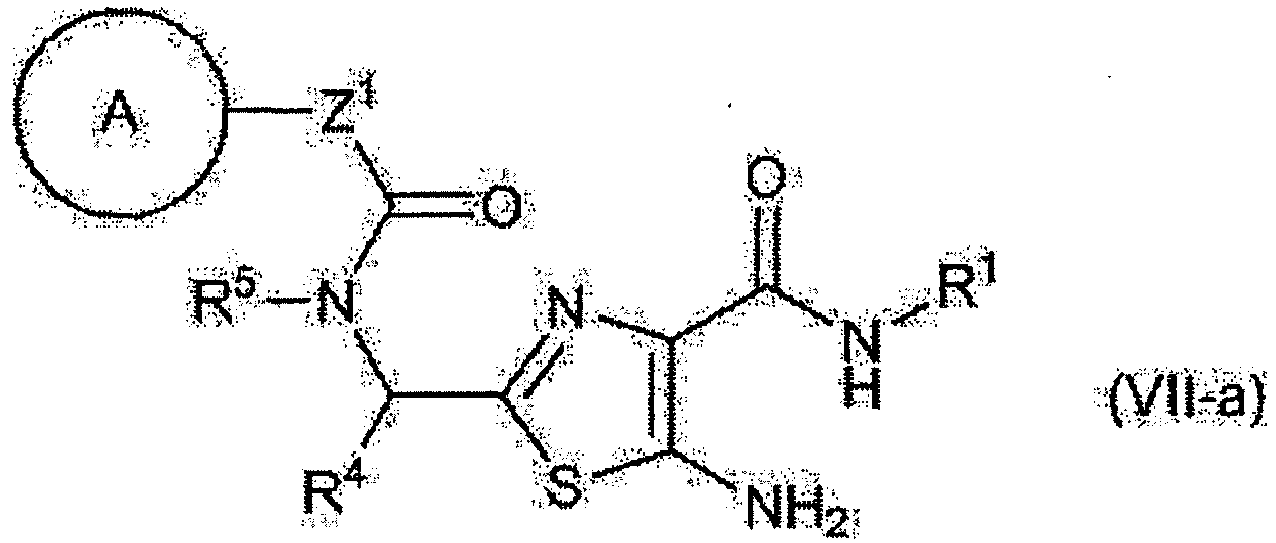

- Compound (1-1) and compound (1-2) are reacted to give compound (1-3). This is cyclized to give compound (1-4) or a salt thereof. This is converted to give compound (1-5). This is reacted with compound (1-6) to give compound (VII-a).
- Compound (1-3) can be produced by reacting compound (1-1) and compound (1-2) in a solvent in the presence of a condensation agent, in the presence of a base.
- Examples of the condensation agent include chloroformic acid alkyl ester such as methyl chloroformate, ethyl chloroformate, propyl chloroformate, isopropyl chloroformate, butyl chloroformate, isobutyl chloroformate and the like. Examples of the base include amine such as triethylamine, N,N-diisopropylethylamine, pyridine and the like. The solvent may be any as long as it does not influence the reaction, and examples thereof include ether such as tetrahydrofuran, 1,4-dioxane, 1,2-dimethoxyethane and the like.
- The amount of compound (1-2) to be used in this reaction is 0.5 - 2.0 mol, preferably 0.9 - 1.0 mol, per 1 mol of compound (1-1). The amount of the condensation agent to be used is 0.8 - 3.0 mol, preferably 1.0 - 1.1 mol, per 1 mol of compound (1-1). The amount of the base to be used is 1.5 - 5.0 mol, preferably 2.0 - 2.5 mol, per 1 mol of compound (1-1). This reaction can be performed at -20 - 60°C, preferably 0 - 30°C.
- Compound (1-4) or a salt thereof can be produced by reacting compound (1-3) in a solvent in the presence of a sulfating agent, in the presence of a base and, when desired, converting the resultant product to a salt thereof.
- Examples of the sulfating agent include Lawesson's reagent (2,4-bis(4-methoxyphenyl)-1,3,2,4-dithiadiphosphetane-2,4-disulfide). Examples of the base include amine such as triethylamine, N,N-diisopropylethylamine, pyridine and the like. The solvent may be any as long as it does not influence the reaction, and examples thereof include aromatic hydrocarbon such as toluene, xylene and the like; ether such as tetrahydrofuran, 1,4-dioxane, 1,2-dimethoxyethane and the like.
- The amount of the sulfating agent to be used in this reaction is 0.4 - 2.0 mol, preferably 0.5 - 0.7 mol, per 1 mol of compound (1-3). The amount of the base to be used is 1.0 - 20 mol, preferably 2.0 - 7.0 mol, per 1 mol of compound (1-3). This reaction can be performed at 50 - 180°C, preferably 80 - 130°C.
- Compound (1-5) can be produced by hydrolysis of compound (1-4) by a conventional method.
- The hydrolysis can be performed by, for example, treating compound (1-4) with a base in a solvent.
- Examples of the base include alkali metal hydroxide such as sodium hydroxide, potassium hydroxide and the like. The solvent may be any as long as it does not influence the reaction, and examples thereof include alkylalcohol such as methanol, ethanol, isopropylalcohol and the like; water; or a mixed solvent thereof.
- The amount of the base to be used in this reaction is 1.0 - 10 mol, preferably 2.0 - 5.0 mol, per 1 mol of compound (1-4). This reaction can be performed at 20 - 100°C, preferably 60 - 90°C.
- Compound (VII-a) can be produced by reacting compound (1-5) and compound (1-6) or a salt thereof in a solvent in the presence of a condensation agent, in the presence or absence of an activator, in the presence or absence of a base.
- Examples of the condensation agent include carbodiimide such as 1-(3-dimethylaminopropyl)-3-ethylcarbodiimide hydrochloride (EDC hydrochloride) and the like, uronium salt such as O-(7-azabenzotriazol-1-yl)-N,N,N',N'-tetramethyluronium hexafluorophosphate (HATU) and the like. Examples of the activator include 1-hydroxybenzotriazole monohydrate (HOBt monohydrate) . The solvent may be any as long as it does not influence the reaction, and examples thereof include amide such as N,N-dimethylformamide, N,N-dimethylacetamide, 1,3-dimethyl-2-imidazolidinone, N-methylpyrrolidone and the like.
- The amount of compound (1-6) to be used in this reaction is 0.5 - 10 mol, preferably 1.0 - 5.0 mol, per 1 mol of compound (1-5). The amount of the condensation agent to be used is 1.0 - 10 mol, preferably 1.2 - 5.0 mol, per 1 mol of compound (1-5). The amount of the activator to be used is 1.0 - 10 mol, preferably 1.2 - 5.0 mol, per 1 mol of compound (XVII) . The amount of the base to be used is 1.0 - 20 mol, preferably 1.2 - 10 mol, per 1 mol of compound (1-5). This reaction can be performed at 0 - 50°C, preferably 10 - 30°C.
- Of the aforementioned compound (VI) of the present invention, a compound represented by the formula (VI-a):


- Compound (VI-a) can be produced by reacting compound (VII-a) and compound (2-1) or a reactive derivative thereof.
- Compound (VI-a) can be produced by treating compound (VII-a) and compound (2-1) as in the aforementioned Scheme 1, step 1-4.
- Alternatively, compound (VI-a) can be produced by reacting compound (VII-a) and a reactive derivative of the above-mentioned compound (2-1) in a solvent in the presence of a base.
- Examples of the base include amine such as triethylamine, N,N-diisopropylethylamine, pyridine and the like. The solvent may be any as long as it does not influence the reaction, and examples thereof include halogenohydrocarbon such as methylene chloride, chloroform, 1,2-dichloroethane and the like; alkylnitrile such as acetonitrile, propionitrile and the like; or a mixed solvent thereof.
- The amount of the reactive derivative of compound (2-1) to be used in this reaction is 1.0 - 5.0 mol, preferably 1.1-3.0 mol, per 1 mol of compound (VII-a). The amount of the base to be used is 1.0 - 10 mol, preferably 1.1 - 5.0 mol, per 1 mol of compound (VII-a) . This reaction can be performed at 0-50°C, preferably 10 - 30°C.
- The reactive derivative of compound (2-1) to be used can be a commercially available reactive derivative.
- Alternatively, the reactive derivative of compound (2-1) can be produced by reacting compound (2-1) or a salt thereof, in a solvent or without solvent, in the presence of a halogenating agent, in the presence or absence of an activator.
- Examples of the halogenating agent include oxalyl chloride, thionyl chloride. Examples of the activator include N,N-dimethylformamide. The solvent may be any as long as it does not influence the reaction, and examples thereof include halogenohydrocarbon such as methylene chloride, chloroform, 1,2-dichloroethane and the like; alkylnitrile such as acetonitrile, propionitrile and the like.
- The amount of the halogenating agent to be used in this reaction is 0.5 - 2.0 mol, preferably 0.8 - 1.2 mol, per 1 mol of compound (2-1) or a salt thereof. The amount of the activator to be used is a catalytic amount of 1 mol of compound (2-1) or a salt thereof. This reaction can be performed at 0-100°C, preferably 10 - 30°C.
- Of the aforementioned compound (IX) of the present invention, a compound represented by the formula (IX-a):


- Compound (VII) and compound (3-1) are reacted to give compound (3-2). This is reacted with compound (3-3) to give compound (3-4). The compound (3-4) is oxidized, whereby compound (IX-a) can be produced.
- Compound (3-2) can be produced by reacting compound (VII) and compound (3-1) in a solvent.
- The alkali metal for G10 is preferably sodium or potassium, and potassium is particularly preferable. The solvent may be any as long as it does not influence the reaction, and examples thereof include alkylalcohol such as methanol, ethanol, isopropylalcohol and the like. The amount of compound (3-1) to be used in this reaction is 1.0 - 10 mol, preferably 2.0 - 5.0 mol, per 1 mol of compound (VII). This reaction can be performed at 40 - 150°C, preferably 60 - 100°C.
- Compound (3-4) can be produced by reacting compound (3-2) and compound (3-3) in a solvent in the presence of a base.
- The alkyl for G11 is preferably C1-C6 alkyl, and particularly preferably methyl. Examples of the leaving group for G12 include halogen atom (particularly, iodine atom). Examples of the base include alkali metal carbonate such as potassium carbonate, cesium carbonate, sodium carbonate and the like. The solvent may be any as long as it does not influence the reaction, and examples thereof include amide such as N,N-dimethylformamide, N,N-dimethylacetamide, 1,3-dimethyl-2-imidazolidinone, N-methylpyrrolidone and the like.
- The amount of compound (3-3) to be used in this reaction is 1.0 - 5.0 mol, preferably 1.2 - 1.8 mol, per 1 mol of compound (3-2) . The amount of the base to be used is 1.0 - 5.0 mol, preferably 1.2 - 1.8 mol, per 1 mol of compound (3-2). This reaction can be performed at 0 - 50°C, preferably 10-40°C.
- Compound (IX-a) can be produced by treating compound (3-4) with an oxidant in a solvent.
- Examples of the oxidant include methachloroperbenzoic acid (mCPBA) . The solvent may be any as long as it does not influence the reaction, and examples thereof include halogenohydrocarbon such as methylene chloride, chloroform, 1,2-dichloroethane and the like.
- When compound (IX-a) wherein G6a is alkylsulfinyl is produced in this reaction, the amount of the oxidant to be used is 0.9 - 1.5 mol, preferably 1.0 - 1.2 mol, per 1 mol of compound (3-4). When compound (IX-a) wherein G6a is alkylsulfonyl is produced in this reaction, the amount of the oxidant to be used is 2.0 - 5.0 mol, preferably 2.4 - 3.5 mol, per 1 mol of compound (3-4). This reaction can be performed at -20 to 30°C, preferably -10 to 10°C.
- The aforementioned compound (II) of the present invention can be produced from compound (I-z) having carbobenzoxy by, for example, a method shown in the following Scheme 4.

- Compound (II) can be produced by de-carbobenzoxylation of compound (I-z) by a conventional method.
- Compound (II) can be produced by, for example, treating compound (I-z) with iodosilane in a solvent in the presence or absence of a silane compound.
- Examples of iodosilane include iodotrialkylsilane such as trimethylsilyl iodide and the like. Examples of the silane compound include trialkylsilane such as triethylsilane and the like. The solvent may be any as long as it does not influence the reaction, and examples thereof include alkylnitrile such as acetonitrile, propionitrile and the like.
- The amount of iodosilane to be used in this reaction is 1.0 - 10 mol, preferably 1.5 - 5.0 mol, per 1 mol of compound (I-z). The amount of the silane compound to be used is 1.0-20 mol, preferably 3.0 - 10 mol, per 1 mol of compound (I-z). This reaction can be performed at 0 - 50°C, preferably 10-30°C.
- Compound (II) can be produced by treating compound (I-z) with palladium hydroxide carbon under a hydrogen atmosphere, in a solvent (e.g., methanol).
- Alternatively, compound (II) can be produced by treating compound (I-z) with an acid (e.g., hydrogen bromide-acetic acid solution, sulfuric acid-acetic acid solution) in a solvent (e.g., methylene chloride, acetic acid, or a mixed solvent thereof).
- Of the aforementioned compound (II) of the present invention, a compound represented by the formula (II-a):


- [In the Scheme, G13 is a hydroxy-protecting group, G14 is a leaving group, G15 is amino-protecting group, and other symbols are as defined above.]
- Compound (5-1) and compound (5-2) are reacted to give compound (5-3). The compound (5-3) is subjected to cyclization reaction to give compound (5-4). This is deprotected to give compound (II-a).
- As the hydroxy-protecting group for G13, conventionally-used hydroxy-protecting groups can be used and, for example, methyl, methoxybenzyl, dimethoxybenzyl can be mentioned. As the leaving group for G14, conventionally-used leaving groups can be used and, for example, a halogen atom (particularly, chlorine atom, bromine atom) can be mentioned. As the amino-protecting group for G15, conventionally-used amino-protecting groups can be used and, for example, carbobenzoxy, tert-butoxycarbonyl, nitrophenylsulfonyl can be mentioned.
- In the same manner as in the aforementioned Scheme 2, step 2-1, compound (5-3) can be produced by converting compound (5-2) to a reactive derivative of compound (5-2), and reacting the reactive derivative with compound (5-1).
- Compound (5-4) can be produced in the same manner as in the aforementioned Scheme 1, step 1-2 by reacting compound (5-3) in a solvent in the presence of a sulfating agent, in the presence of a base.
- Compound (II-a) can be produced by removing the protecting groups G13 and G15 of compound (5-4) by a conventional method, each according to the kind of the protecting group used.
- When methyl, methoxybenzyl, or dimethoxybenzyl is used as the protecting group G13, for example, the protecting group can be removed by treating compound (5-4) with trialkylsilane (e.g., triethylsilane) and iodotrialkylsilane (e.g., trimethylsilyl iodide) in a solvent (e.g., alkylnitrile such as acetonitrile and the like).
- When carbobenzoxy is used as the protecting group G15, for example, the protecting group can be removed by treating compound (5-4) with trialkylsilane (e.g., triethylsilane) and iodotrialkylsilane (e.g., trimethylsilyl iodide) in a solvent (e.g., alkylnitrile such as acetonitrile and the like).
- When tert-butoxycarbonyl is used as the protecting group G15, for example, the protecting group can be removed by treating compound (5-4) with an acid (e.g., trifluoroacetic acid) in a solvent (e.g., halogenohydrocarbon such as methylene chloride and the like), or without solvent.
- When nitrophenylsulfonyl is used as the protecting group G15, for example, the protecting group can be removed by treating compound (5-4) with arylthiol (e.g., methylbenzenethiol) in a solvent (e.g., alkylnitrile such as acetonitrile and the like), in the presence of a base (e.g., alkali metal carbonate such as cesium carbonate and the like).


- [In the Scheme, G14a is a halogen atom, and other symbols are as defined above.]
- Compound (5-5) is reduced to give compound (5-6). This is converted to give compound (5-7). This is reacted with compound (5-2) to give compound (5-8). This is reacted with compound (5-9) to give compound (5-10). This is converted to give compound (5-11). This is reacted with compound (5-12) to give compound (5-13). The compound (5-13) is oxidized to give compound (5-14). This is reacted with compound (5-9) to give compound (5-4). This is deprotected to give compound (II-a).
- Compound (5-6) can be produced by reacting compound (5-5) in a solvent (e.g., mixed solvent of alkylalcohol such as methanol and the like and halogenohydrocarbon chloroform and the like), in the presence of palladium carbon, under a hydrogen atmosphere.
- The amount of palladium carbon to be used in this reaction is 0.001 - 1.0 mol, preferably 0.01 - 0.5 mol, per 1 mol of compound (5-5). This reaction can be performed at 0 - 80°C, preferably 20 - 60°C.
- Compound (5-7) can be produced by treating compound (5-6) with a halogenating agent (e.g., N-halogenosuccinimide) corresponding to G14a in a solvent (e.g., amide such as N,N-dimethylformamide and the like).
- The amount of the halogenating agent to be used in this reaction is 0.9 - 3.0 mol, preferably 1.0 - 2.0 mol, per 1 mol of compound (5-6). This reaction can be performed at -20 - 100°C, preferably 0 - 60°C.
- In the same manner as in the aforementioned Scheme 2, step 2-1, compound (5-8) can be produced by converting compound (5-2) to a reactive derivative of compound (5-2), and reacting the reactive derivative with compound (5-7).
- Compound (5-10) can be produced by reacting compound (5-8) and compound (5-9) in a solvent (e.g., ether such as tetrahydrofuran and the like) in the presence of azodicarboxylic acid ester (e.g., diisopropyl azodicarboxylate), in the presence of triarylphosphine (e.g., triphenylphosphine).
- The amount of compound (5-9) to be used in this reaction is 0.9 - 5.0 mol, preferably 1.0 - 2.0 mol, per 1 mol of compound (5-8). The amount of azodicarboxylic acid ester to be used is 0.9 - 5.0 mol, preferably 1.0 - 2.0 mol, per 1 mol of compound (5-8). The amount of triarylphosphine to be used is 0.9 - 5.0 mol, preferably 1.0 - 2.0 mol, per 1 mol of compound (5-8). This reaction can be performed at 0 - 120°C, preferably 15 - 80°C.
- Compound (5-11) can be produced in the same manner as in Scheme 1, step 1-2, by reacting compound (5-10) in a solvent in the presence of a sulfating agent, in the presence of a base.
- Compound (5-13) can be produced in the same manner as in Scheme 3, step 3-2, by reacting compound (5-11) and compound (5-12) in a solvent in the presence of a base.
- Compound (5-14) can be produced in the same manner as in Scheme 3, step 3-3, by treating compound (5-13) with an oxidant in a solvent.
- Compound (5-4) can be produced by reacting compound (5-14) and compound (5-9) in a solvent (e.g., amide such as N,N-dimethylformamide and the like), in the presence of a base (e.g., alkali metal hydride such as sodium hydride and the like).
- The amount of compound (5-9) to be used in this reaction is 0.9 - 5.0 mol, preferably 1.0 - 2.0 mol, per 1 mol of compound (5-14). The amount of the base to be used is 0.9-5.0 mol, preferably 1.0 - 2.0 mol, per 1 mol of compound (5-14). This reaction can be performed at -40 - 80°C, preferably -20-40°C.
- Compound (II-a) can be produced in the same manner as in Scheme 5-1, step 5-3, by removing the protecting group of compound (5-4) by a conventional method.
- Of the aforementioned compound (II) of the present invention, a compound represented by the formula (II-b):


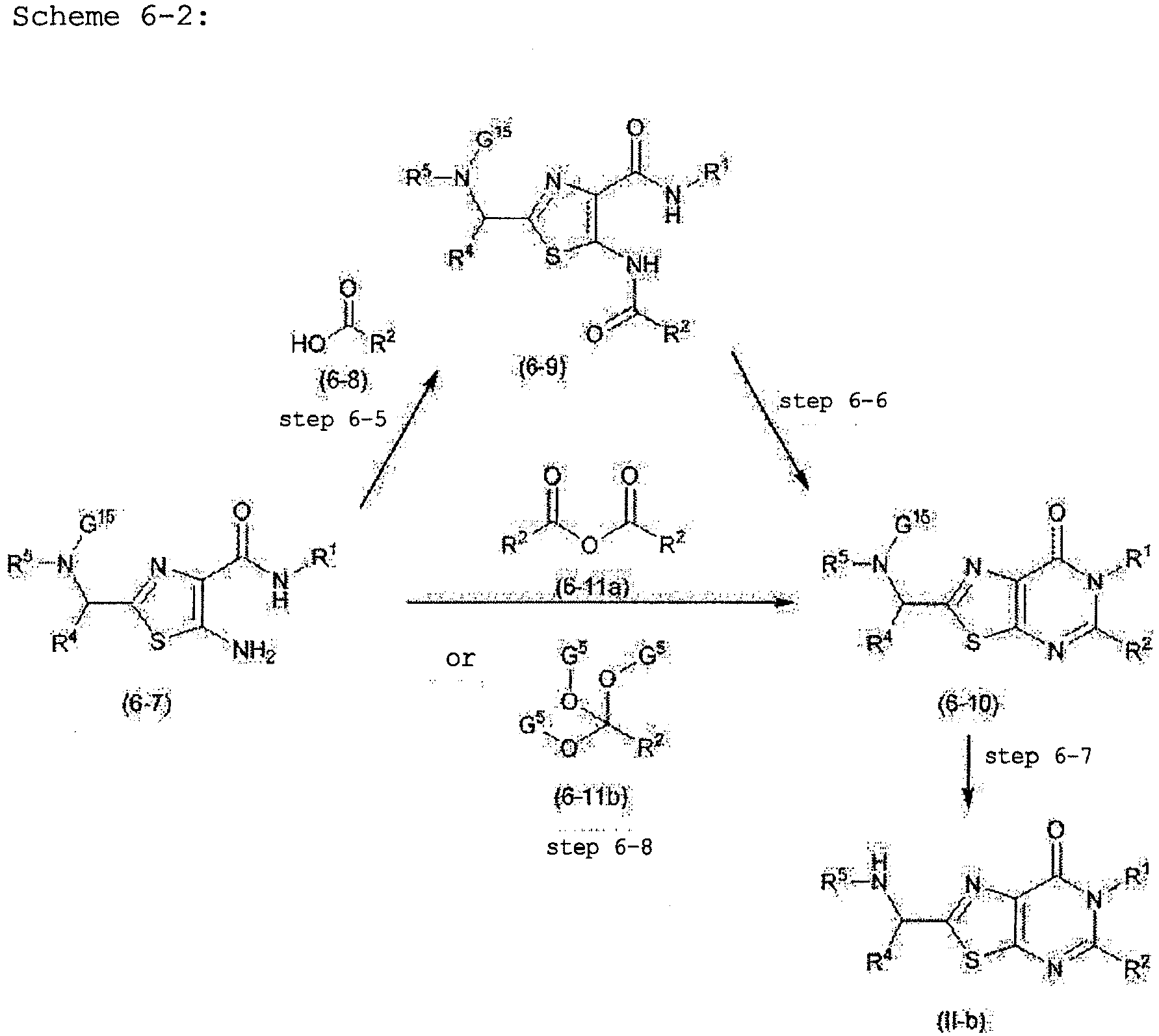
- [In the Scheme, the symbols are as defined above.]
- Compound (6-1) and compound (6-2) are reacted to give compound (6-3). This is cyclized to give compound (6-4) or a salt thereof. This is converted to give compound (6-5). This is reacted with compound (6-6) to give compound (6-7). This is reacted with compound (6-8) or a reactive derivative thereof to give compound (6-9). This is cyclized to give compound (6-10). This is converted to give compound (II-b).
- Alternatively, compound (6-7) and compound (6-11a) or compound (6-11b) are reacted to give compound (6-10). This is converted to give compound (II-b).
- Compound (6-3) can be produced in the same manner as in Scheme 1, step 1-1, by reacting compound (6-1) and compound (6-2) in a solvent in the presence of a condensation agent, in the presence of a base.
- Compound (6-4) or a salt thereof can be produced in the same manner as in Scheme 1, step 1-2, by reacting compound (6-3) in a solvent in the presence of a sulfating agent, in the presence of a base and, when desired, converting the resultant product to a salt thereof.
- Compound (6-5) can be produced in the same manner as in Scheme 1, step 1-3, by hydrolysis of compound (6-4) or a salt thereof by a conventional method.
- Compound (6-7) can be produced in the same manner as in Scheme 1, step 1-4, by reacting compound (6-5) and compound (6-6) or a salt thereof in a solvent in the presence of a condensation agent, in the presence or absence of an activator, in the presence or absence of a base.
- Compound (6-9) can be produced in the same manner as in Scheme 2, step 2-1, by reacting compound (6-7) and compound (6-8) or a reactive derivative thereof.
- Compound (6-10) can be produced by reacting compound (6-9) in a solvent in the presence of a condensation agent, in the presence of a base, in the same manner as in the method of producing compound (I-d) from compound (VI).
- Compound (II-b) can be produced in the same manner as in Scheme 5, step 5-3, by removing the protecting group G15 of compound (6-10), by a conventional method according to the kind of the protecting group used.
- Compound (6-10) can be produced by reacting compound (6-7) with compound (6-11a) or compound (6-11b), in the same manner as in the method of producing compound (I-d) from compound (VII) and compound (VIII-a) or compound (VIII-b).
- Of the aforementioned compound (II) of the present invention, a compound represented by the formula (II-c):


- [In the Scheme, G16 is alkyl, and other symbols are as defined above.]
- Compound (7-1) and compound (7-2) are reacted to give compound (7-3). This is cyclized to give compound (7-4). This is reacted with compound (7-5) to give compound (7-6). This is converted to give compound (II-c).
- Compound (7-3) can be produced by reacting compound (7-1) and compound (7-2) in a solvent in the presence of a condensation agent, in the presence or absence of an activator, in the presence or absence of a base.
- Examples of the condensation agent include carbodiimide such as 1-(3-dimethylaminopropyl)-3-ethylcarbodiimide hydrochloride (EDC hydrochloride) and the like. Examples of the activator include 1-hydroxybenzotriazole monohydrate (HOBt monohydrate) . The solvent may be any as long as it does not influence the reaction, and examples thereof include amide such as N,N-dimethylformamide, N,N-dimethylacetamide, 1,3-dimethyl-2-imidazolidinone, N-methylpyrrolidone and the like.
- The amount of compound (7-2) to be used in this reaction is 0.5 - 2.0 mol, preferably 0.8 - 1.5 mol, per 1 mol of compound (7-1). The amount of the condensation agent to be used is 1.0 - 2.0 mol, preferably 1.1 - 1.5 mol, per 1 mol of compound (7-1). The amount of the activator to be used is 1.0 - 2.0 mol, preferably 1.1 - 1.5 mol, per 1 mol of compound (7-1). The amount of the base to be used is 1.0 - 2.0 mol, preferably 1.1 - 1.5 mol, per 1 mol of compound (7-1). This reaction can be performed at 0 - 50°C, preferably 10 - 30°C.
- Compound (7-4) can be produced by reacting compound (7-3) in a solvent in the presence of an acid.
- Examples of the acid include alkylsulfonic acid such as methanesulfonic acid and the like. The solvent may be any as long as it does not influence the reaction, and examples thereof include aromatic hydrocarbon such as toluene, xylene and the like.
- The amount of the acid to be used in this reaction is 1.0 - 5.0 mol, preferably 1.2 - 1.8 mol, per 1 mol of compound (7-3). This reaction can be performed at 50 - 180°C, preferably 80 - 150°C.
- Compound (7-6) can be produced by reacting compound (7-4) and compound (7-5) without solvent in the presence of an acid.
- Examples of the acid include sulfuric acid.
- The amount of compound (7-5) to be used in this reaction is 0.9 - 5.0 mol, preferably 1.2 - 2.0 mol, per 1 mol of compound (7-4). The amount of the acid to be used is 10 - 200 mol, preferably 40 - 80 mol, per 1 mol of compound (7-4). This reaction can be performed at 30 - 120°C, preferably 60 - 100°C.
- Compound (II-c) can be produced in the same manner as in Scheme 5, step 5-3 by removing the protecting group G15 of compound (7-6) by a conventional method according to the kind of the protecting group used.
- Of the aforementioned compound (XI) of the present invention, a compound represented by the formula (XI-a):

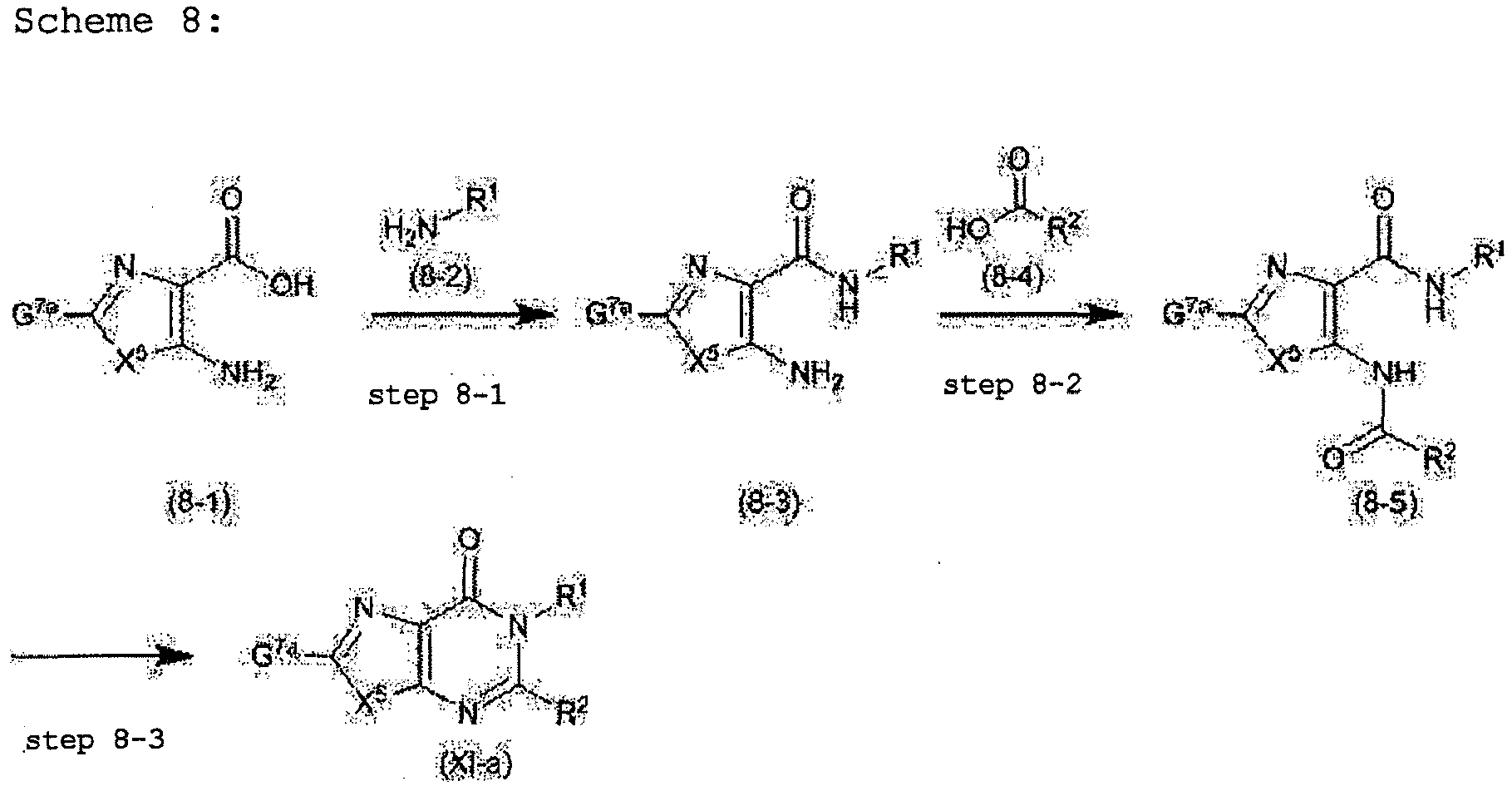
- [In the Scheme, the symbols are as defined above.]
- Compound (8-1) and compound (8-2) are reacted to give compound (8-3). This is reacted with compound (8-4) or a reactive derivative thereof to give compound (8-5). This is cyclized to give compound (XI-a).
- Compound (8-3) can be produced in the same manner as in Scheme 1, step 1-4, by reacting compound (8-1) and compound (8-2) or a salt thereof in a solvent in the presence of a condensation agent, in the presence or absence of an activator, in the presence or absence of a base.
- Compound (8-5) can be produced in the same manner as in Scheme 2, step 2-1, by reacting compound (8-3) and compound (8-4) or a reactive derivative thereof.
- Compound (XI-a) can be produced by reacting compound (8-5) in a solvent in the presence of a condensation agent, in the presence of a base, in the same manner as in the method of producing compound (I-d) from compound (VI).
- The aforementioned compound (XII) in the present invention can be produced, for example, by a method shown in the following Scheme 9.

- [In the Scheme, the symbols are as defined above.]
- Compound (XII) can be produced by reacting compound (9-1) or a salt thereof with compound (9-2) or a reactive derivative thereof.
- Compound (XII) can be produced in the same manner as in Scheme 2, step 2-1, by reacting compound (9-1) or a salt thereof with compound (9-2) or a reactive derivative thereof.
- Of the aforementioned compound (XII) of the present invention, a compound represented by the formula (XII-a):

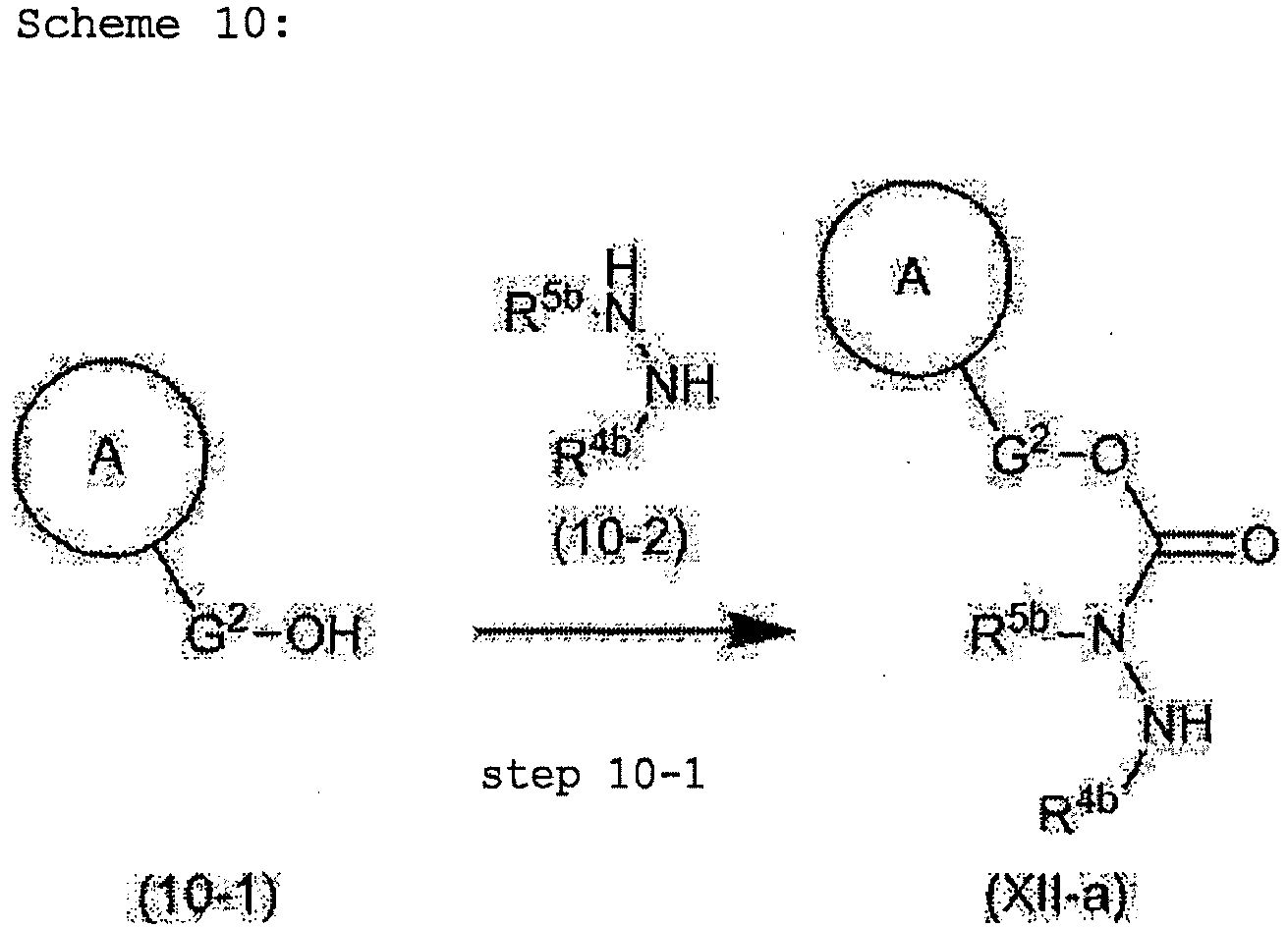
- [In the Scheme, the symbols are as defined above.]
- Compound (XII-a) can be produced by reacting compound (10-1) with a carbonylating agent (e.g., triphosgene) in a solvent (e.g., toluene), in the presence of a base (e.g., pyridine) to give a reactive intermediate, and further reacting the reactive intermediate with compound (10-2) or a salt thereof in a solvent (e.g., methylene chloride), in the presence of a base (e.g., triethylamine).
- Of the aforementioned compound (XIII) of the present invention, a compound represented by the formula (XIII-a):


- [In the Scheme, L1a is alkylsulfanyl, or alkoxyphenylalkylsulfanyl, L2a is alkyl, and other symbols are as defined above.]
- Compound (11-1) and compound (11-2) or a salt thereof are reacted to give compound (11-3). This is reacted with compound (11-4a) or a reactive derivative thereof to give compound (11-5). This is cyclized to give compound (11-6). This is oxidized to give compound (XIII-a).
- Alternatively, compound (11-6) can be obtained by reacting compound (11-3) and compound (11-4b) or compound (11-4c).
- Compound (11-3) can be produced in the same manner as in Scheme 1, step 1-4, by reacting compound (11-1) and compound (11-2) or a salt thereof in a solvent in the presence of a condensation agent, in the presence or absence of an activator, in the presence or absence of a base.
- Compound (11-5) can be produced in the same manner as in Scheme 2, step 2-1, by reacting compound (11-3) and compound (11-4a) or a reactive derivative thereof.
- Compound (11-6) can be produced by reacting compound (11-5) in a solvent in the presence of a condensation agent, in the presence of a base, in the same manner as in the method of producing compound (I-d) from compound (VI).
- Compound (XIII-a) can be produced by treating compound (11-6) with an oxidant in a solvent.
- Examples of the oxidant include methachloroperbenzoic acid (mCPBA). The solvent may be any as long as it does not influence the reaction, and examples thereof include halogenohydrocarbon such as methylene chloride, chloroform, 1,2-dichloroethane and the like.
- When compound (XIII-a) wherein E1a is alkylsulfinyl or alkoxyphenylalkylsulfinyl is produced by this reaction, the amount of the oxidant to be used is 0.9 - 1.5 mol, preferably 1.0 - 1.2 mol, per 1 mol of compound (11-6). When compound (XIII-a) wherein E1a is alkylsulfonyl or alkoxyphenylalkylsulfonyl is produced by this reaction, the amount of the oxidant to be used is 2.0 - 5.0 mol, preferably 2.4 - 3.5 mol, per 1 mol of compound (11-6). This reaction can be performed at -20 - 30°C, preferably -10 - 30°C.
- Compound (11-6) can be produced by reacting compound (11-3) with compound (11-4b) or compound (11-4c), in the same manner as in the method of producing compound (I-d) from compound (VII) and compound (VIII-a) or compound (VIII-b).
- Of the aforementioned compound (XIII) of the present invention, a compound represented by the formula (XIII-b):


- [In the Scheme, L1b is a hydrogen atom or NH2, and other symbols are as defined above.]
- Compound (12-1) and compound (12-2a) or a reactive derivative thereof are reacted to give compound (12-3). This is cyclized to give compound (12-4). Said L1b is halogenated to give compound (XIII-b).
- Alternatively, compound (12-4) can be obtained by reacting compound (12-1) and compound (12-2b) or compound (12-2c) .
- Compound (12-3) can be produced in the same manner as in Scheme 2, step 2-1, by reacting compound (12-1) and compound (12-2a) or a reactive derivative thereof.
- Compound (12-4) can be produced by reacting compound (12-3) in a solvent in the presence of a condensation agent, in the presence of a base, in the same manner as in the method of producing compound (I-d) from compound (VI).
- Compound (XIII-b) can be produced by treating compound (12-4) wherein L1b is a hydrogen atom with a halogenating agent in a solvent.
- Examples of the halogenating agent include N-halogenosuccinimide corresponding to E1b. The solvent may be any as long as it does not influence the reaction, and examples thereof include alkylnitrile such as acetonitrile, propionitrile and the like.
- The amount of the halogenating agent to be used in this reaction is 0.9 - 3.0 mol, preferably 1.0 - 2.0 mol, per 1 mol of compound (12-4). This reaction can be performed at 0-100°C, preferably 20 - 80°C.
- Alternatively, compound (XIII-b) can be produced by reacting compound (12-4) wherein L1b is NH2 in a solvent (alkylnitrile such as acetonitrile and the like), in the presence of copper(I) halide corresponding to E1b and nitrous acid alkyl ester (tert-butyl nitrite etc.).
- The amount of copper(I) halide to be used in this reaction is 0.9 - 5.0 mol, preferably 1.0 - 2.0 mol, per 1 mol of compound (12-4). The amount of nitrous acid alkyl ester to be used is 0.9 - 5.0 mol, preferably 1.0 - 2.0 mol, per 1 mol of compound (12-4). This reaction can be performed at 0-120°C, preferably 20 - 80°C.
- Compound (12-4) can be produced by reacting compound (12-1) with compound (12-2b) or compound (12-2c), in the same manner as in the method of producing compound (I-d) from compound (VII) and compound (VIII-a) or compound (VIII-b).
- Alternatively, compound (XIII-b) can be produced, for example, by a method shown in the following Scheme 13.

- [In the Scheme, the symbols are as defined above.]
- Compound (13-1) and compound (13-2) or a salt thereof are reacted to give compound (13-3). This is reacted with compound (13-4a) or a reactive derivative thereof to give compound (13-5). This is cyclized to give compound (XIII-b).
- Alternatively, compound (13-3) can be obtained by halogenating L1b of compound (13-6).
- Compound (XIII-b) can be produced by reacting compound (13-3) and compound (13-4b) or compound (13-4c).
- Compound (13-3) can be produced in the same manner as in Scheme 1, step 1-4, by reacting compound (13-1) and compound (13-2) or a salt thereof in a solvent in the presence of a condensation agent, in the presence or absence of an activator, in the presence or absence of a base.
- Compound (13-5) can be produced in the same manner as in Scheme 2, step 2-1, by reacting compound (13-3) and compound (13-4a) or a reactive derivative thereof.
- Compound (XIII-b) can be produced by reacting compound (13-5) in a solvent in the presence of a condensation agent, in the presence of a base, in the same manner as in the method of producing compound (I-d) from compound (VI).
- Compound (13-3) can be produced in the same manner as in Scheme 12, step 12-3, by halogenation corresponding to E1b of compound (13-3) and L1b of compound (13-6).
- Compound (XIII-b) can be produced by reacting compound (13-3) with compound (13-4b) or compound (13-4c), in the same manner as in the method of producing compound (I-d) from compound (VII) and compound (VIII-a) or compound (VIII-b).
- Of the aforementioned compound (XIII) of the present invention, a compound represented by the formula (XIII-c):


- [In the Scheme, L4a is alkyl, and other symbols are as defined above.]
- Compound (14-1) and compound (14-2) are reacted to give compound (14-3). This is converted to give compound (14-4). This is reacted with compound (14-5) to give compound (14-6). This is oxidized to give compound (XIII-c).
- Alternatively, compound (14-4) is oxidized to give compound (14-7). This is reacted with compound (14-5) to give compound (XIII-c).
- Compound (14-3) can be produced by reacting compound (14-1) and compound (14-2) in a solvent (e.g., alkylalcohol such as ethanol and the like), in the presence of a base (e.g., amine such as DBU and the like).
- The amount of compound (14-2) to be used in this reaction is 0.9 - 3.0 mol, preferably 1.0 - 2.0 mol, per 1 mol of compound (14-1). The amount of the base to be used is 1.0 - 5.0 mol, preferably 1.0 - 3.0 mol, per 1 mol of compound (14-1). This reaction can be performed at 0 - 100°C, preferably 20 - 80°C.
- Compound (14-4) can be produced by reacting compound (14-3) in a solvent (e.g., a mixed solvent of halogenohydrocarbon such as 1,2-dichloroethane and the like and amide such as N,N-dimethylformamide and the like), in the presence of a chlorinating agent (e.g., oxalyl chloride, phosphorus oxychloride).
- The amount of the chlorinating agent to be used in this reaction is 0.9 - 3.0 mol, preferably 1.0 - 2.0 mol, per 1 mol of compound (14-3). This reaction can be performed at 0-100°C, preferably 20 - 80°C.
- Compound (14-6) wherein R2x is optionally substituted amino, or optionally substituted nitrogen-containing nonaromatic heterocyclic group wherein a bond of the ring is a nitrogen atom can be produced by reacting compound (14-4) with the corresponding compound (14-5), in a solvent (e.g., ether such as tetrahydrofuran and the like), in the presence of a base (e.g., trialkylamine such as N,N-diisopropylethylamine and the like).
- The amount of compound (14-5) to be used in this reaction is 1.0 - 10 mol, preferably 1.2 - 3.0 mol, per 1 mol of compound (14-4). The amount of the base to be used is 1.2 - 10 mol, preferably 1.2 - 3.0 mol, per 1 mol of compound (14-4). This reaction can be performed at 0 - 100°C, preferably 20-60°C.
- Compound (14-6) wherein R2x is optionally substituted alkoxy can be produced by reacting compound (14-4) with the corresponding compound (14-5), in a solvent (e.g., amide such as N,N-dimethylformamide and the like), in the presence of a base (e.g., alkali metal hydride such as sodium hydride and the like).
- The amount of compound (14-5) to be used in this reaction is 0.9 - 5.0 mol, preferably 1.2 - 2.0 mol, per 1 mol of compound (14-4). The amount of the base to be used is 0.9-5.0 mol, preferably 1.2 - 2.0 mol, per 1 mol of compound (14-4). This reaction can be performed at 0 - 100°C, preferably 2-60°C.
- Compound (XIII-c) can be produced in the same manner as in Scheme 11, step 11-4, by treating compound (14-6) with an oxidant.
- Compound (14-7) can be produced in the same manner as in Scheme 11, step 11-4, by treating compound (14-4) with an oxidant.
- Compound (XIII-c) can be produced by reacting compound (14-7) and compound (14-5) in the same manner as in step 14-3.
- Of the aforementioned compound (XIII) of the present invention, a compound represented by the formula (XIII-d):

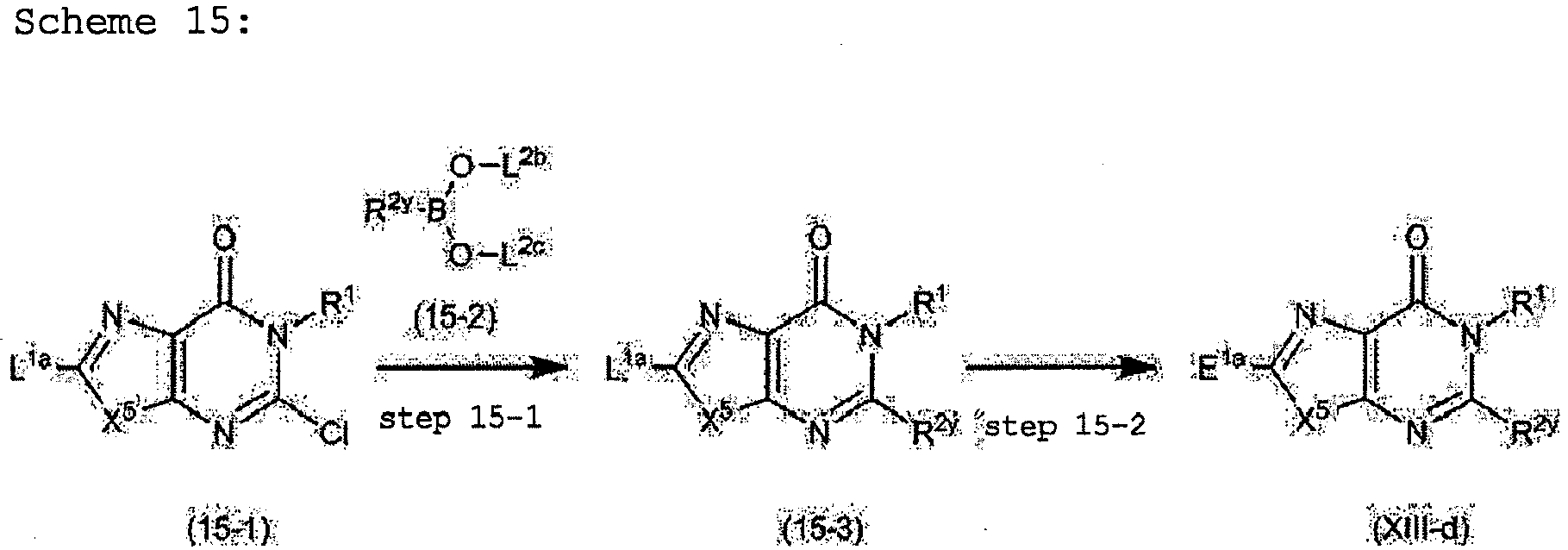
- [In the Scheme, L2b and L2c are each a hydrogen atom, or L2b and L2c are bonded to each other to form alkylene, and other symbols are as defined above.]
- Compound (15-1) and compound (15-2) are reacted to give compound (15-3). This is oxidized to give compound (XIII-d).
- Compound (15-3) can be produced by reacting compound (15-1) and compound (15-2) in a solvent in the presence of palladiums and a base, in the presence or absence of a ligand.
- Examples of the palladiums include tris(dibenzylideneacetone)dipalladium (0), tetrakis(triphenylphosphine)palladium (0), palladium (II) acetate, palladium (II) chloride, bis(triphenylphosphine)dichloropalladium (II), [1,1'-bis(diphenylphosphino)ferrocene]dichloropalladium (II), bis(di-tert-butyl(4-dimethylaminophenyl)phosphine)dichloropalladium (II), dichlorobis(tricyclohexylphosphine)palladium (II). Examples of the base include alkali metal carbonate such as sodium carbonate, potassium carbonate, cesium carbonate and the like; alkali metal phosphate such as trisodium phosphate, disodium hydrogen phosphate, tripotassium phosphate and the like; alkali metal fluoride such as potassium fluoride, cesium fluoride and the like. Examples of the ligand include phosphine ligand such as triphenylphosphine, 2-di-tert-butylphosphino-2', 4', 6'-triisopropylbiphenyl, 2-dicyclohexyl-phosphino-2',6'-dimethoxybiphenyl, 2-di-tert-butylphosphino-3,4,5,6-tetramethyl-2',4',6'-triisopropyl-1,1'-biphenyl and the like. The solvent may be any as long as it does not influence the reaction, and examples thereof include ether such as tetrahydrofuran, 1,2-dimethoxyethane, 1,4-dioxane and the like; alcohol such as tert-butanol and the like; aromatic hydrocarbon such as toluene, xylene and the like; water, or a mixed solvent thereof.
- The amount of compound (15-2) to be used in this reaction is 0.9 - 5.0 mol, preferably 1.2 - 2.0 mol, per 1 mol of compound (15-1). The amount of the palladiums to be used is 0.001 - 1.0 mol, preferably 0.01 - 0.1 mol, per 1 mol of compound (15-1). The amount of the base to be used is 0.9 - 5.0 mol, preferably 1.0 - 3.0 mol, per 1 mol of compound (15-1). The amount of the ligand to be used is 0.001 - 1.0 mol, preferably 0.01 - 0.1 mol, per 1 mol of compound (15-1). This reaction can be performed at 20 - 150°C, preferably 50 - 100°C.
- Compound (XIII-d) can be produced in the same manner as in Scheme 11, step 11-4, by treating compound (15-3) with an oxidant.
- Of the aforementioned compound (XIII) of the present invention, a compound represented by the formula (XIII-e):


- [In the Scheme, L1c is a halogen atom, L2d is alkyl, L4b is alkyl, L4c is alkyl, L5a is alkyl, L6a is alkali metal, L7a is alkyl or alkoxyphenylalkyl, L8a is a leaving group, and other symbols are as defined above.]
- Compound (16-1) and compound (16-2) are reacted, and then, compound (16-3) is reacted to give compound (16-4). This is reduced to give compound (16-5). This is halogenated to give compound (16-6). This is reacted with compound (16-7) to give compound (16-8). This is reacted with compound (16-9) to give compound (16-10). This is oxidized to give compound (XIII-e).
- Compound (16-4) can be produced by reacting compound (16-1) and compound (16-2) without solvent and then reacting the resulting compound with compound (16-3) in a solvent (e.g., alkylalcohol such as ethanol and the like), in the presence of a base (e.g., trialkylamine such as triethylamine and the like).
- The amount of compound (16-2) to be used in this reaction is 1.0 - 5.0 mol, preferably 1.2 - 3.0 mol, per 1 mol of compound (16-1). The amount of compound (16-3) to be used is 1.0 - 3.0 mol, preferably 1.2 - 2.0 mol, per 1 mol of compound (16-1). The amount of the base to be used is 1.0 - 5.0 mol, preferably 1.2 - 3.0 mol, per 1 mol of compound (16-1). This reaction can be performed at 20 - 150°C, preferably 40 - 100°C.
- Compound (16-5) can be produced by reacting compound (16-4) in a solvent (e.g., a mixed solvent of alkylalcohol such as methanol and the like, and halogenohydrocarbon such as chloroform and the like), in the presence of palladium carbon, under a hydrogen atmosphere.
- The amount of palladium carbon to be used in this reaction is 0.001 - 1.0 mol, preferably 0.01 - 0.5 mol, per 1 mol of compound (16-4). This reaction can be performed at 0 - 80°C, preferably 20 - 60°C.
- Compound (16-6) can be produced by treating compound (16-5) with a halogenating agent (e.g., N-halogenosuccinimide) corresponding to L1c in a solvent (e.g., amide such as N,N-dimethylformamide and the like).
- The amount of the halogenating agent to be used in this reaction is 0.9 - 3.0 mol, preferably 1.0 - 2.0 mol, per 1 mol of compound (16-5). This reaction can be performed at -20 - 100°C, preferably 0 - 60°C.
- Compound (16-8) can be produced by reacting compound (16-6) and compound (16-7) in a solvent (e.g., amide such as N,N-dimethylformamide and the like).
- The amount of compound (16-7) to be used in this reaction is 1.0 - 3.0 mol, preferably 1.2 - 2.0 mol, per 1 mol of compound (16-6). This reaction can be performed at 80 - 200°C, preferably 100 - 150°C.
- Compound (16-10) can be produced by reacting compound (16-8) with compound (16-9) having L7a corresponding to L1a in a solvent in the presence of a base.
- Examples of the leaving group for L8a include halogen atom. Examples of the base include alkali metal carbonate such as sodium hydrogen carbonate, sodium carbonate and the like. The solvent may be any as long as it does not influence the reaction, and examples thereof include amide such as N,N-dimethylformamide and the like.
- The amount of alkylating agent or alkoxyphenylalkylating agent to be used in this reaction is 0.9 - 3.0 mol, preferably 1.0 - 2.0 mol, per 1 mol of compound (16-8). The amount of the base to be used is 0.9 - 3.0 mol, preferably 1.0 - 2.0 mol, per 1 mol of compound (16-8). This reaction can be performed at - 20 - 60°C, preferably 0 - 30°C.
- Compound (XIII-e) can be produced in the same manner as in Scheme 11, step 11-4, by treating compound (16-9) with an oxidant.
- Of the aforementioned compound (XIII) of the present invention, a compound represented by the formula (XIII-f):


- [In the Scheme, L4d is alkyl, and other symbols are as defined above.]
- Compound (17-1) and compound (17-2) are reacted to give compound (17-3). This is reacted with compound (17-4) to give compound (17-5). This is hydrolyzed to give compound (17-6). This is reacted with compound (17-7) to give compound (17-8). This is halogenated to give compound (XIII-f).
- Compound (17-3) can be produced by reacting compound (17-1) and compound (17-2) in a solvent in the presence of a base.
- Examples of the base include alkali metal alkoxide corresponding to L4d such as sodium alkoxide and the like. The solvent may be any as long as it does not influence the reaction, and examples thereof include alkylalcohol corresponding to L4d.
- The amount of compound (17-2) to be used in this reaction is 0.9 - 2.0 mol, preferably 1.1 - 1.6 mol, per 1 mol of compound (17-1). The amount of the base to be used is 0.9 - 2.0 mol, preferably 1.1 - 1.6 mol, per 1 mol of compound (17-1). This reaction can be performed at 0 - 120°C, preferably 20 - 80°C.
- Compound (17-5) can be produced by reacting compound (17-3) and compound (17-4) in a solvent (e.g., halogenohydrocarbon such as carbon tetrachloride and the like, alkylalcohol corresponding to L4d), in the presence of sulfuryl chloride.
- The amount of compound (17-4) to be used in this reaction is 0.9 - 2.0 mol, preferably 1.0 - 1.5 mol, per 1 mol of compound (17-3). The amount of sulfuryl chloride to be used is 0.9 - 2.0 mol, preferably 1.0 - 1.5 mol, per 1 mol of compound (17-3). This reaction can be performed at 0 - 80°C, preferably 20 - 60°C.
- Compound (17-6) can be produced in the same manner as in Scheme 1, step 1-3, by hydrolysis by a conventional method.
- Compound (17-8) can be produced by reacting compound (17-6) and compound (17-7) in a solvent (e.g., a mixed solvent of aromatic hydrocarbon such as toluene and the like and amide such as N-methylpyrrolidone and the like).
- The amount of compound (17-7) to be used in this reaction is 0.9 - 3.0 mol, preferably 1.0 - 2.0 mol, per 1 mol of compound (17-6). This reaction can be performed at 80 - 200°C, preferably 100 - 150°C.
- Compound (XIII-f) can be produced in the same manner as in Scheme 12, step 12-3, by reacting compound (17-8) in a solvent in the presence of copper(I) halide corresponding to E1b and nitrous acid alkyl ester.
- Of the aforementioned compound (XIII) of the present invention, a compound represented by the formula (XIII-g):


- [In the Scheme, L4f is alkyl, and other symbols are as defined above.]
- Compound (18-1) and compound (18-2) are reacted to give compound (XIII-g).
- Compound (XIII-g) can be produced by reacting compound (18-1) and compound (18-2) in the presence of polyphosphoric acid.
- The amount of compound (18-2) to be used in this reaction is 0.9 - 3.0 mol, preferably 1.0 - 2.0 mol, per 1 mol of compound (18-1). This reaction can be performed at 60 - 200°C, preferably 80 - 120°C.
- Of the aforementioned compound (XIII) of the present invention, a compound represented by the formula (XIII-h):


- [In the Scheme, the symbols are as defined above.]
- Compound (19-1) and compound (19-2) are reacted to give compound (19-3). This is oxidized to give compound (XIII-h).
- Compound (19-3) can be produced by reacting compound (19-1) and compound (19-2) in a solvent (e.g., ether such as tetrahydrofuran and the like) and then reacting the resulting compound in the presence of phosphoric acid.
- The amount of compound (19-2) to be used in this reaction is 0.9 - 2.0 mol, preferably 1.0 - 1.5 mol, per 1 mol of compound (19-1). This reaction can be performed at 0 - 200°C, preferably 20 - 120°C.
- Compound (XIII-h) can be produced in the same manner as in Scheme 11, step 11-4, by treating compound (19-3) with an oxidant.
- Of the aforementioned compound (XIV) of the present invention, a compound represented by the formula (XIV-a):


- [In the Scheme, L5b is alkyloxycarbonyl or aralkyloxycarbonyl, and other symbols are as defined above.]
- Compound (20-1) and compound (XVII) are reacted to give compound (20-2). L5b therein is removed to give compound (XIV-a) .
- Compound (20-2) can be produced in the same manner as in Scheme 1, step 1-4, by reacting compound (20-1) and compound (XVII).
- Compound (XIV-a) can be produced by removing L5b of compound (20-2) by a conventional method such as acid treatment, hydrogenation and the like according to the kind of L5b.
- The aforementioned compound (XVIII) in the present invention can be produced, for example, by a method shown in the following Scheme 21.


- [In the Scheme, L5c is alkyloxycarbonyl or aralkyloxycarbonyl, and other symbols are as defined above.]
- Compound (21-1) and compound (21-2) are reacted to give compound (21-3). This is reduced to give compound (21-4). L5c therein is removed to give compound (XVIII).
- Compound (21-3) can be produced by reacting compound (21-1) and compound (21-2) in a solvent (e.g., amide such as N,N-dimethylformamide and the like), in the presence of a base (e.g., alkali metal carbonate such as potassium carbonate and the like) in the presence of potassium iodide.
- The amount of compound (21-2) to be used in this reaction is 0.9 - 2.0 mol, preferably 1.0 - 1.5 mol, per 1 mol of compound (21-1). The amount of the base to be used is 0.9 - 2.0 mol, preferably 1.0 - 1.5 mol, per 1 mol of compound (21-1). The amount of potassium iodide to be used is 0.9 - 2.0 mol, preferably 1.0 - 1.5 mol, per 1 mol of compound (21-1). This reaction can be performed at 0 - 80°C, preferably 20 - 60°C.
- Compound (21-4) can be produced by reacting compound (21-3) in a solvent (e.g., alkylalcohol such as methanol and the like), in the presence of a hydrogenating agent (e.g., boron hydride compound such as sodium borohydride and the like).
- The amount of the hydrogenating agent to be used in this reaction is 0.9 - 2.0 mol, preferably 1.0 - 1.5 mol, per 1 mol of compound (21-3). This reaction can be performed at 20 - 150°C, preferably 50 - 100°C.
- Compound (XVIII) can be produced by removing L5c of compound (21-4) by a conventional method such as acid treatment, hydrogenation and the like according to the kind of L5c.
- Of the aforementioned compound (XX) of the present invention, a compound represented by the formula (XX-a):


- [In the Scheme, L8b is a leaving group, and other symbols are as defined above.]
- Compound (22-1) is cyclized to give compound (22-2). This is reacted with compound (22-3) to give compound (22-4). This is oxidized to give compound (22-5). This is reacted with compound (XIV) to give compound (XX-a).
- Compound (22-2) can be produced by reacting compound (22-1) in a solvent in the presence of a condensation agent, in the presence of a base, in the same manner as in the method of producing compound (I-d) from compound (VI).
- Compound (22-4) can be produced by reacting compound (22-2) and compound (22-3) by a conventional method according to the kind of E5.
- Examples of the leaving group for L8b include a halogen atom.
- Compound (22-5) can be produced in the same manner as in Scheme 11, step 11-4, by treating compound (22-4) with an oxidant.
- Compound (XX-a) can be produced by reacting compound (22-5) and compound (XIV) in the same manner as in the method of producing compound (I-g) from compound (XIII) and compound (XIV).
- Of the aforementioned compound (XX) of the present invention, a compound represented by the formula (XX-b):


- [In the Scheme, L1d is a halogen atom, L2e is alkyl, L4h is alkyl, L6b is alkali metal, and other symbols are as defined above.]
- Compound (23-1) is halogenated to give compound (23-2). This is reacted with compound (23-3) to give compound (23-4). L2e therein is removed to give compound (23-5). This is reacted with compound (23-6) to give compound (23-7). This is oxidized to give compound (23-8). This is reacted with compound (23-9) to give compound (23-10). This is reacted with compound (XIV) to give compound (XX-b).
- Compound (23-2) can be produced in the same manner as in Scheme 12, step 12-3, by treating compound (23-1) with a halogenating agent in a solvent.
- Compound (23-4) can be produced in the same manner as in Scheme 16, step 16-4, by reacting compound (23-2) and compound (23-3) in a solvent.
- Compound (23-5) can be produced by deprotecting compound (23-4) by a conventional method according to the kind of L2e.
- Compound (23-7) can be produced in the same manner as in Scheme 16, step 16-5, by reacting compound (23-5) and compound (23-6).
- Compound (23-8) can be produced in the same manner as in Scheme 11, step 11-4, by treating compound (23-7) with an oxidant.
- Compound (23-10) can be produced by reacting compound (23-8) and compound (23-9) by a conventional method according to the kind of E5.
- Compound (XX-b) can be produced by reacting compound (23-10) and compound (XIV) in the same manner as in the method of producing compound (I-g) from compound (XIII) and compound (XIV) .
- The aforementioned compound (XXI) in the present invention can be produced, for example, by a method shown in the following Scheme 24.


- [In the Scheme, the symbols are as defined above.]
- Compound (24-1) and compound (XIV) are reacted to give compound (24-2). This is reacted with compound (24-3) or a reactive derivative thereof to give compound (XXI).
- Compound (24-2) can be produced by reacting compound (24-1) and compound (XIV) in the same manner as in the method of producing compound (I-g) from compound (XIII) and compound (XIV).
- Compound (XXI) can be produced in the same manner as in Scheme 2, step 2-1, by reacting compound (24-2) and compound (24-3) or a reactive derivative thereof.
- Of the aforementioned compound (XXII) of the present invention, a compound represented by the formula (XXII-a):


- [In the Scheme, L8c is a leaving group, and other symbols are as defined above.]
- Compound (25-1) and compound (25-2) are reacted to give compound (25-3). This is reacted with compound (25-4) to give compound (25-5). This is reacted with compound (25-6) to give compound (25-7). This is oxidized to give compound (25-8). This is reacted with compound (XV-b) to give compound (XXII-a).
- Compound (25-3) can be produced in the same manner as in Scheme 16, step 16-4, by reacting compound (25-1) and compound (25-2) in a solvent.
- Compound (25-5) can be produced in the same manner as in Scheme 16, step 16-5, by reacting compound (25-3) and compound (25-4).
- Compound (25-7) can be produced by reacting compound (25-5) and compound (25-6) by a conventional method according to the kind of R1.
- Examples of the leaving group for L8c include a halogen atom.
- Compound (25-8) can be produced in the same manner as in Scheme 11, step 11-4, by treating compound (25-7) with an oxidant.
- Compound (XXII-a) can be produced by reacting compound (25-8) and compound (XV-b) in the same manner as in the method of producing compound (I-g) from compound (XIII) and compound (XIV).
- Other starting compounds of the aforementioned production methods ([Production of compound (I)], and [Production of intermediate compound]) are commercially available, or can be easily produced by a method well known to those of ordinary skill in the art.
- The present invention is explained in more detail in the following by referring to Examples and the like, which are not to be construed as limitative. Note that % described in the following Examples and the like means wt% unless specifically indicated, and the solvent ratio in column chromatography means volume ratio.
-

- To a solution (50.0 mL) of the compound (1.68 g) obtained in Reference Example 10 in 1,2-dichloroethane were added chlorotrimethylsilane (2.30 mL) and triethylamine (7.50 mL), and the reaction mixture was stirred at room temperature for 3 hr. Water and 1.0 mol/L hydrochloric acid were added to the reaction mixture, and the mixture was extracted twice with chloroform. The organic layer was dried over anhydrous magnesium sulfate, filtered and concentrated. The residue was purified by silica gel column chromatography (solvent; hexane/ethyl acetate=50/50 - 0/100) to give the title compound (1.45 g).
MS (ESI) m/z; 453 [M+H]+ -

- The compound (760 mg) obtained in Reference Example 11 was treated by a method similar to that in Example 1 to give the title compound (700 mg).
MS (ESI) m/z; 453 [M+H]+ -

- The compound (1800 mg) obtained in Reference Example 12 was treated by a method similar to that in Example 1 to give the title compound (1300 mg).
MS (ESI) m/z; 453 [M+H]+ -

- The compound (775 mg) obtained in Reference Example 13 was treated by a method similar to that in Example 1 to give the title compound (626 mg).
MS (ESI) m/z; 419 [M+H]+ -

- The compound (1960 mg) obtained in Reference Example 15 was treated by a method similar to that in Example 1 to give the title compound (1600 mg).
MS (ESI) m/z; 455 [M+H]+ -

- To a solution (60 mL) of the compound (2.45 g) obtained in Reference Example 8 in methylene chloride was added dropwise trifluoroacetic anhydride (6.7 g), and the reaction mixture was stirred at room temperature for 1 hr. Pyridine (2.50 g) was added dropwise, and the reaction mixture was stirred at room temperature overnight. Furthermore, 1,2-dichloroethane (10 mL), trifluoroacetic anhydride (13.4 g) and pyridine (5.00 g) were added dropwise, and the reaction mixture was heated under reflux for 4 hr. The reaction mixture was concentrated under reduced pressure, the residue was dissolved in ethyl acetate, and the solution was washed with 1.0 mol/L hydrochloric acid, dried over anhydrous magnesium sulfate, filtered and concentrated. The residue was purified by silica gel column chromatography (solvent; hexane/ethyl acetate=80/20 - 60/40) to give the title compound (2.46 g).
MS (ESI) m/z; 467 [M+H]+ -

- A mixture of the compound (3.00 g) obtained in Reference Example 7, acetic anhydride (8.5 g) and trimethyl orthopropionate (11.2 g) was stirred with heating at 120°C for 2 hr. The reaction mixture was concentrated under reduced pressure, and the residue was purified by silica gel column chromatography (solvent; hexane/ethyl acetate=100/0 - 60/40) to give the title compound (0.47 g).
MS (ESI) m/z; 399 [M+H]+ -

- To a solution (3.0 mL) of the compound (259 mg) obtained in Example 4 in acetonitrile were added potassium carbonate (171 mg) and morpholine (80.6 mg), and the reaction mixture was stirred at room temperature for 3 hr. Water was added to the reaction mixture, and the mixture was extracted twice with ethyl acetate. The organic layer was dried over anhydrous magnesium sulfate, filtered and concentrated. The residue was purified by silica gel column chromatography (solvent; ethyl acetate/methanol=100/0 - 95/5) to give the title compound (285 mg) .
MS (ESI) m/z; 470 [M+H]+ -

- To a solution (9 mL) of the compound (300 mg) obtained in Reference Example 21, and N,N-diisopropylethylamine (0.24 mL) in methylene chloride was added dropwise benzyl isocyanate (0.15 mL) under ice-cooling. The reaction mixture was stirred at room temperature for 1 hr. 0.5 mol/L Hydrochloric acid was added to the reaction mixture, and the mixture was extracted twice with chloroform. The organic layer was dried over anhydrous magnesium sulfate, filtered and concentrated. The residue was purified by silica gel column chromatography (solvent; hexane/ethyl acetate=90/10 - 20/80) to give the title compound (483 mg).
MS (ESI) m/z; 398 [M+H]+ -
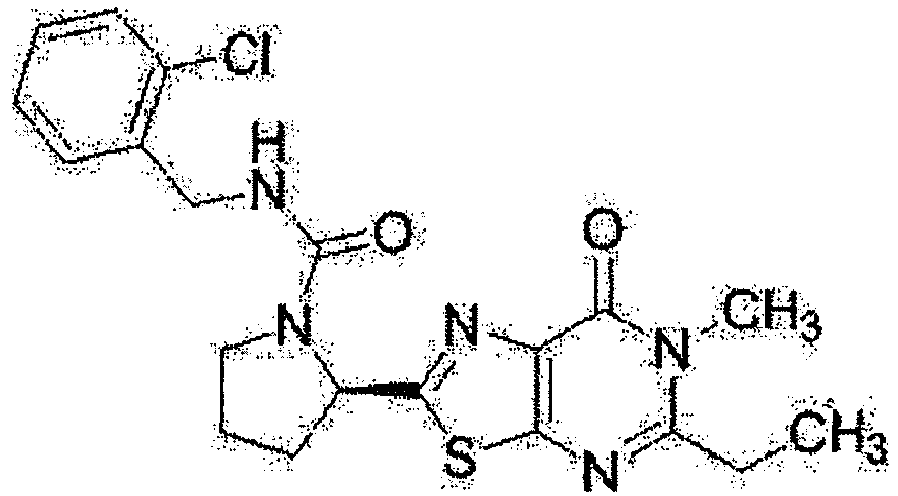
- The compound (150 mg) obtained in Reference Example 21 was treated by a method similar to that in Example 9 to give the title compound (210 mg).
MS (ESI) m/z; 432 [M+H]+ -

- The compound (150 mg) obtained in Reference Example 20 was treated by a method similar to that in Example 9 to give the title compound (120 mg).
MS (ESI) m/z; 500 [M+H]+ -

- To a solution (60 mL) of 1-phenylcyclopropylamine (2.00 g) in chloroform were added triethylamine (4.11 mL) and 4-methoxyphenyl chloroformate (1.92 mL), and the reaction mixture was stirred at room temperature for 3 hr. Water was added to the reaction mixture, and the mixture was extracted twice with chloroform. The organic layer was dried over anhydrous magnesium sulfate, filtered and concentrated. The residue was washed with diethyl ether, filtered and dried to give (1-phenylcyclopropyl)-carbamic acid-4-methoxyphenyl ester (2.59 g). To a solution (6.0 mL) of the compound (80 mg) obtained in Reference Example 21 and DBU (0.32 mL) in acetonitrile was added (1-phenylcyclopropyl)-carbamic acid-4-methoxyphenyl ester (595 mg), and the reaction mixture was stirred with heating at 85°C for 4 hr. 0.5 mol/L Hydrochloric acid was added to the reaction mixture, and the mixture was extracted twice with chloroform. The organic layer was dried over anhydrous magnesium sulfate, filtered and concentrated. The residue was purified by silica gel column chromatography (solvent; chloroform/methanol=100/0 - 95/5) to give the title compound (65 mg).
MS (ESI) m/z; 424 [M+H]+ -

- The compound (80 mg) obtained in Reference Example 21 was treated by a method similar to that in Example 12 to give the title compound (100 mg).
MS (ESI) m/z; 424 [M+H]+ -

- To a solution (7.5 mL) of the compound (200 mg) obtained in Reference Example 21 and N,N-diisopropylethylamine (0.16 mL) in methylene chloride was added dropwise chloroacetyl chloride (65 µL) under ice-cooling. The reaction mixture was stirred at room temperature for 1 hr. 0.5 mol/L Hydrochloric acid was added to the reaction mixture, and the mixture was extracted twice with chloroform. The organic layer was dried over anhydrous magnesium sulfate, filtered and concentrated. To a solution (7.5 mL) of the residue in acetonitrile were added potassium iodide (150 mg), potassium carbonate (205 mg) and 1,2,3,4-tetrahydroquinoline (145 µL), and the reaction mixture was stirred with heating at 80°C for 4 hr. Water was added to the reaction mixture, and the mixture was extracted twice with chloroform. The organic layer was dried over anhydrous magnesium sulfate, filtered and concentrated. The residue was purified by silica gel column chromatography (solvent; hexane/ethyl acetate=90/10 - 20/80) to give the title compound (330 mg).
MS (ESI) m/z; 438 [M+H]+ -

- To a solution (15 mL) of triphosgene (110 mg) in methylene chloride was added pyridine (0.1 mL) under ice-cooling, and the reaction mixture was stirred at the same temperature for 30 min. The compound (150 mg) obtained in Reference Example 21 was added, and the reaction mixture was stirred at room temperature for 30 min. The solvent was evaporated under reduced pressure, methylene chloride (10 mL), 4-dimethylaminopyridine (370 mg) and 2-phenylpropane-2-amine (390 mg) were added at room temperature, and the reaction mixture was stirred overnight. 0.5 mol/L Hydrochloric acid was added to the reaction mixture, and the mixture was extracted twice with chloroform. The organic layer was dried over anhydrous magnesium sulfate, filtered and concentrated. The residue was purified by silica gel column chromatography (solvent; hexane/ethyl acetate=60/40 - 0/100) to give the title compound (30 mg).
MS (ESI) m/z; 426 [M+H]+ -

- The compound (150 mg) obtained in Reference Example 21 was treated by a method similar to that in Example 15 to give the title compound (67 mg).
MS (ESI) m/z; 438 [M+H]+ -

- The compound (150 mg) obtained in Reference Example 21 was treated by a method similar to that in Example 15 to give the title compound (120 mg).
MS (ESI) m/z; 412 [M+H]+ -

- The compound (150 mg) obtained in Reference Example 20 was treated by a method similar to that in Example 15 to give the title compound (41 mg).
MS (ESI) m/z; 492 [M+H]+ -

- To a solution (5.0 mL) of the compound (80 mg) obtained in Reference Example 16 in methylene chloride were added N,N-diisopropylethylamine (55 µL) and phenyl chloroformate (40 mg), and the reaction mixture was stirred at room temperature for 30 min. Water was added to the reaction mixture, and the mixture was extracted twice with chloroform. The organic layer was dried over anhydrous magnesium sulfate, filtered and concentrated. The residue was purified by silica gel column chromatography (solvent; hexane/ethyl acetate=70/30 - 20/80) to give the title compound (50 mg).
MS (ESI) m/z; 439 [M+H]+ -

- The compound (50 mg) obtained in Reference Example 16 was treated by a method similar to that in Example 19 to give the title compound (68 mg).
MS (ESI) m/z; 453 [M+H]+ -

- The compound (30 mg) obtained in Reference Example 16 was treated by a method similar to that in Example 19 to give the title compound (27 mg).
MS (ESI) m/z; 469 [M+H]+ -

- The compound (70 mg) obtained in Reference Example 16 was treated by a method similar to that in Example 19 to give the title compound (90 mg).
MS (ESI) m/z; 437 [M+H]+ -

- The compound (70 mg) obtained in Reference Example 16 was treated by a method similar to that in Example 19 to give the title compound (90 mg).
MS (ESI) m/z; 451 [M+H]+ - (R)-2-[6-methyl-5-(5-methyl-[1,2,4]oxadiazol-3-yl)-7-oxo-6,7-dihydro[1,3]thiazolo[5,4-d]pyrimidin-2-yl]pyrrolidine-1-carboxylic acid phenyl ester

- The compound (330 mg) obtained in Reference Example 17 was treated by a method similar to that in Example 19 to give the title compound (440 mg).
MS (ESI) m/z; 439 [M+H]+ -

- The compound (100 mg) obtained in Reference Example 18 was treated by a method similar to that in Example 19 to give the title compound (130 mg).
MS (ESI) m/z; 439 [M+H]+ -

- The compound (100 mg) obtained in Reference Example 18 was treated by a method similar to that in Example 19 to give the title compound (130 mg).
MS (ESI) m/z; 437 [M+H]+ -

- The compound (200 mg) obtained in Reference Example 19 was treated by a method similar to that in Example 19 to give the title compound (270 mg).
MS (ESI) m/z; 441 [M+H]+ -
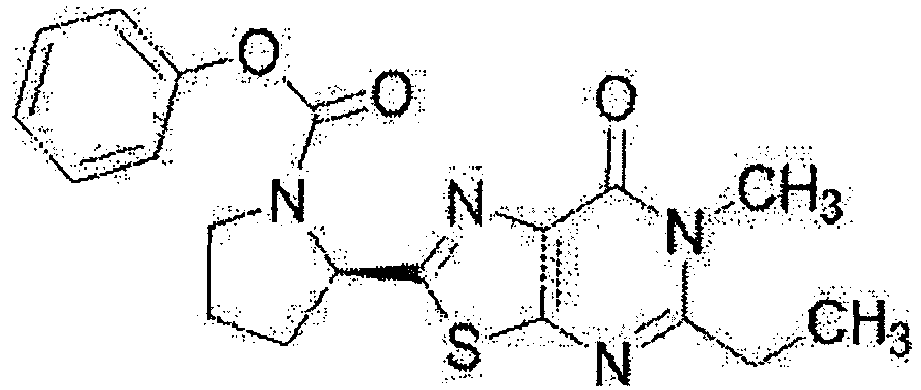
- The compound (64 mg) obtained in Reference Example 21 was treated by a method similar to that in Example 19 to give the title compound (69 mg).
MS (ESI) m/z; 385 [M+H]+ -

- The compound (100 mg) obtained in Reference Example 21 was treated by a method similar to that in Example 19 to give the title compound (53 mg).
MS (ESI) m/z; 383 [M+H]+ -

- The compound (210 mg) obtained in Reference Example 20 was treated by a method similar to that in Example 19 to give the title compound (85 mg).
MS (ESI) m/z; 451 [M+H]+ -
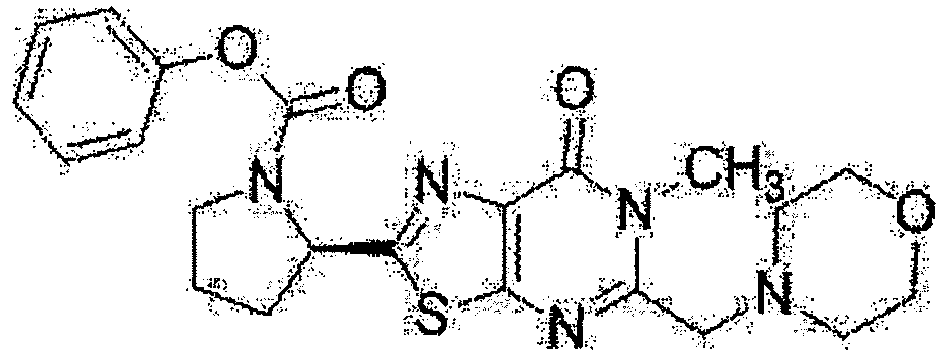
- The compound (43 mg) obtained in Reference Example 22 was treated by a method similar to that in Example 19 to give the title compound (28 mg).
MS (ESI) m/z; 456 [M+H]+ -

- The compound (60 mg) obtained in Reference Example 23 was treated by a method similar to that in Example 19 to give the title compound (14 mg).
MS (ESI) m/z; 441 [M+H]+ -

- To a solution (2.0 mL) of triphosgene (38 mg) in toluene were added 3-cresol (35 mg) and pyridine (33 µL) under ice-cooling, and the reaction mixture was stirred at room temperature for 30 min. The solvent was evaporated under reduced pressure, methylene chloride (5.0 mL), triethylamine (100 µL) and the compound (50 mg) obtained in Reference Example 16 were added, and the reaction mixture was stirred at room temperature for 1 hr. Water was added to the reaction mixture, and the mixture was extracted twice with chloroform. The organic layer was dried over anhydrous magnesium sulfate, filtered and concentrated. The residue was purified by silica gel column chromatography (solvent; hexane/ethyl acetate=70/30 - 0/100) to give the title compound (50 mg).
MS (ESI) m/z; 453 [M+H]+ -

- The compound (70 mg) obtained in Reference Example 16 was treated by a method similar to that in Example 33 to give the title compound (66 mg).
MS (ESI) m/z; 453 [M+H)+ -

- The compound (50 mg) obtained in Reference Example 16 was treated by a method similar to that in Example 33 to give the title compound (50 mg).
MS (ESI) m/z; 469 [M+H]+ -

- The compound (100 mg) obtained in Reference Example 19 was treated by a method similar to that in Example 33 to give the title compound (130 mg).
MS (ESI) m/z; 455 [M+H]+ -

- The compound (80 mg) obtained in Reference Example 19 was treated by a method similar to that in Example 33 to give the title compound (115 mg).
MS (ESI) m/z; 471 [M+H]+ -

- The compound (50 mg) obtained in Reference Example 19 was treated by a method similar to that in Example 33 to give the title compound (57 mg).
MS (ESI) m/z; 525 [M+H]+ -

- The compound (50 mg) obtained in Reference Example 19 was treated by a method similar to that in Example 33 to give the title compound (44 mg).
MS (ESI) m/z; 459 [M+H]+ -

- The compound (50 mg) obtained in Reference Example 19 was treated by a method similar to that in Example 33 to give the title compound (60 mg).
MS (ESI) m/z; 475 [M+H]+ -

- The compound (50 mg) obtained in Reference Example 19 was treated by a method similar to that in Example 33 to give the title compound (60 mg).
MS (ESI) m/z; 509 [M+H]+ -

- To a solution (15 mL) of the compound (1.80 g) obtained in Reference Example 26 in methylene chloride were added chlorotrimethylsilane (3.8 mL) and triethylamine (13.2 mL), and the reaction mixture was stirred at room temperature overnight. Water and 1.0 mol/L hydrochloric acid were added to the reaction mixture, and the mixture was extracted twice with chloroform. The organic layer was dried over anhydrous magnesium sulfate, filtered and concentrated. The residue was purified by silica gel column chromatography (solvent; hexane/ethyl acetate=70/30 - 50/50) to give the title compound (1.46 g).
MS (ESI) m/z; 549 [M+H]+ -

- The compound (1.27 g) obtained in Reference Example 27 was treated by a method similar to that in Example 42 to give the title compound (1.05 g).
MS (ESI) m/z; 547 [M+H]+ -
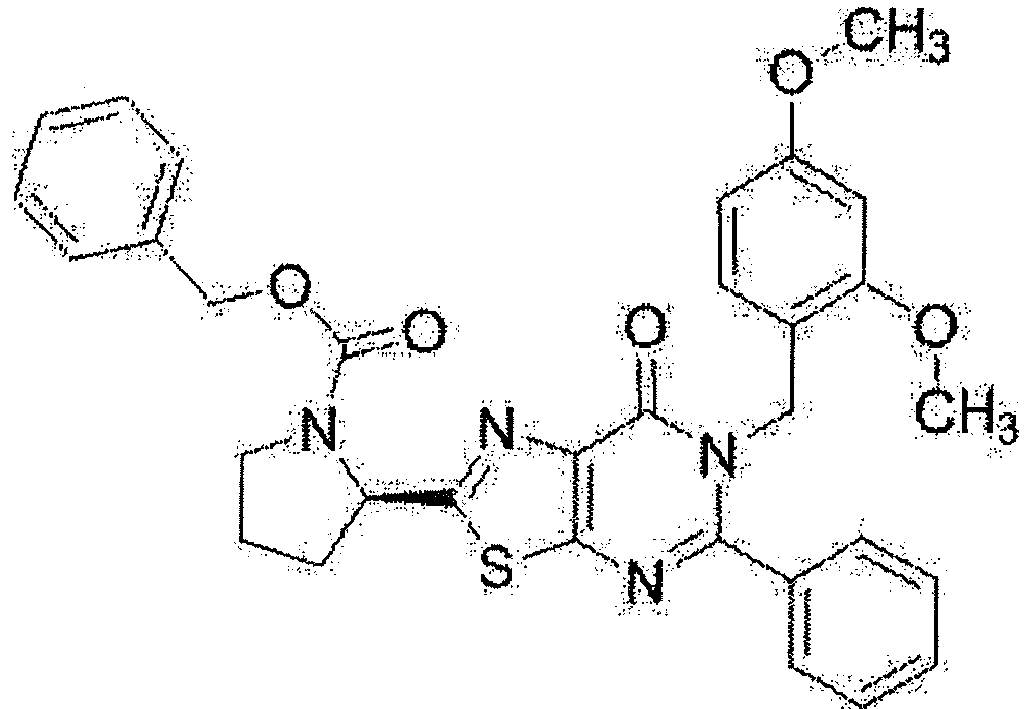
- The compound (1.74 g) obtained in Reference Example 28 was treated by a method similar to that in Example 42 to give the title compound (1.80 g).
MS (ESI) m/z; 583 [M+H]+ -

- The compound (1.90 g) obtained in Reference Example 29 was treated by a method similar to that in Example 42 to give the title compound (1.90 g).
MS (ESI) m/z; 601 [M+H]+ -

- The compound (1.47 g) obtained in Reference Example 30 was treated by a method similar to that in Example 42 to give the title compound (1.22 g).
MS (ESI) m/z; 619 [M+H]+ -

- The compound (1.90 g) obtained in Reference Example 31 was treated by a method similar to that in Example 42 to give the title compound (1.46 g).
MS (ESI) m/z; 667 [M+H]+ -
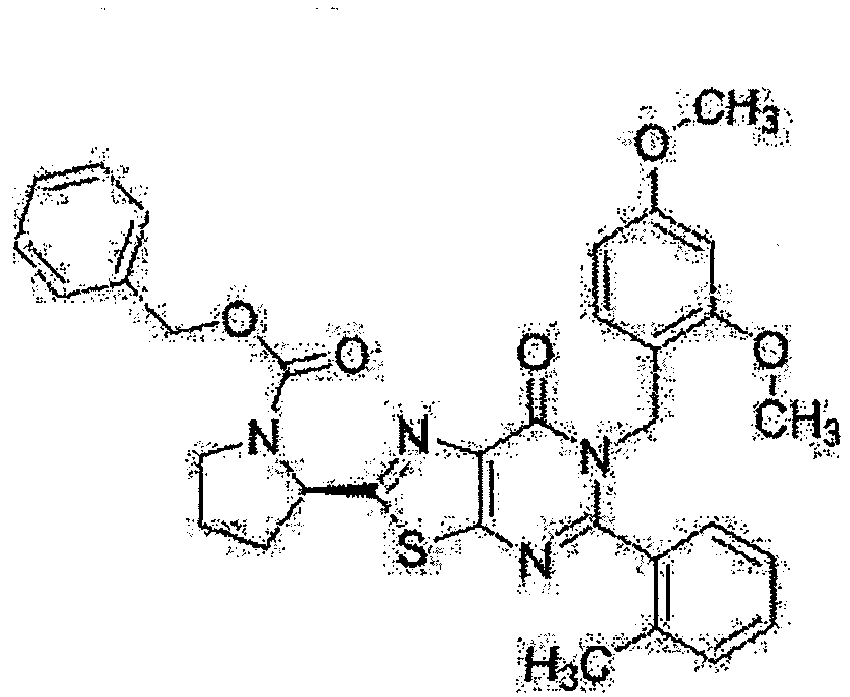
- The compound (1.45 g) obtained in Reference Example 32 was treated by a method similar to that in Example 42 to give the title compound (1.40 g).
MS (ESI) m/z; 597 [M+H]+ -

- The compound (1.90 g) obtained in Reference Example 33 was treated by a method similar to that in Example 42 to give the title compound (1.65 g).
MS (ESI) m/z; 613 [M+H]+ -

- The compound (1.80 g) obtained in Reference Example 35 was treated by a method similar to that in Example 42 to give the title compound (1.75 g).
MS (ESI) m/z; 565 [M+H]+ -

- The compound (180 mg) obtained in Reference Example 36 was treated by a method similar to that in Example 42 to give the title compound (175 mg).
MS (ESI) m/z; 581 [M+H]+ -

- The compound (335 mg) obtained in Reference Example 37 was treated by a method similar to that in Example 42 to give the title compound (348 mg).
MS (ESI) m/z; 571 [M+H]+ -

- The compound (1.90 g) obtained in Reference Example 38 was treated by a method similar to that in Example 42 to give the title compound (1.54 g).
MS (ESI) m/z; 625 [M+H]+ -

- The compound (1.34 g) obtained in Reference Example 39 was treated by a method similar to that in Example 42 to give the title compound (0.80 g).
MS (ESI) m/z; 607 [M+H]+ -

- The compound (1.68 g) obtained in Reference Example 40 was treated by a method similar to that in Example 42 to give the title compound (1.30 g).
MS (ESI) m/z; 597 [M+H]+ -
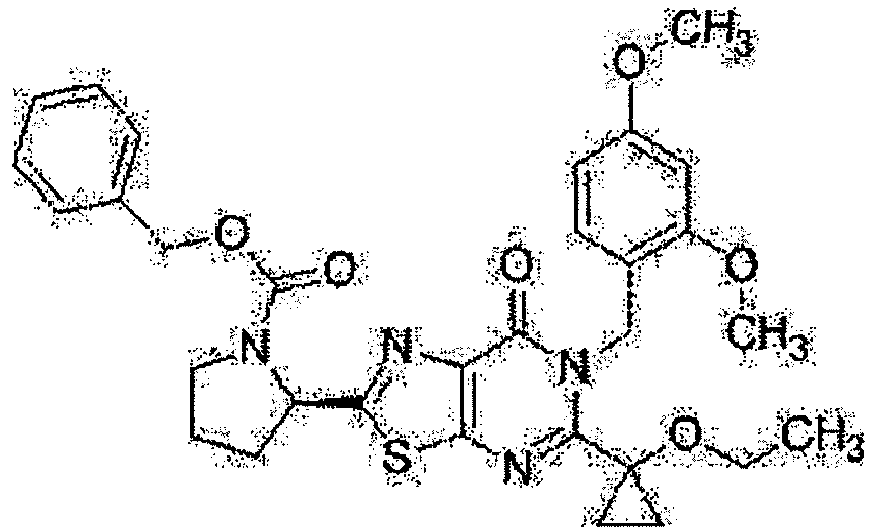
- The compound (1.40 g) obtained in Reference Example 41 was treated by a method similar to that in Example 42 to give the title compound (0.69 g).
MS (ESI) m/z; 591 [M+H]+ -

- The compound (4.10 g) obtained in Reference Example 42 was treated by a method similar to that in Example 42 to give the title compound (1.85 g).
MS (ESI) m/z; 572 [M+H]+ -

- The compound (581 mg) obtained in Reference Example 43 was treated by a method similar to that in Example 42 to give the title compound (438 mg).
MS (ESI) m/z; 574 [M+H]+ -

- The compound (379 mg) obtained in Reference Example 44 was treated by a method similar to that in Example 42 to give the title compound (370 mg).
MS (ESI) m/z; 579 [M+H]+ -

- The compound (1.46 g) obtained in Reference Example 45 was treated by a method similar to that in Example 42 to give the title compound (1.15 g).
MS (ESI) m/z; 615 [M+H]+ -

- The compound (580 mg) obtained in Reference Example 47 was treated by a method similar to that in Example 42 to give the title compound (498 mg).
MS (ESI) m/z; 575 [M+H]+ -

- The compound (560 mg) obtained in Reference Example 48 was treated by a method similar to that in Example 42 to give the title compound (499 mg).
MS (ESI) m/z; 557 [M+H]+ -

- To a solution (19 mL) of the compound (960 mg) obtained in Example 42 in acetonitrile were added triethylsilane (1.67 mL) and trimethylsilyl iodide (1.20 mL), and the reaction mixture was stirred at room temperature overnight. Triethylamine (1.95 mL) and phenyl chloroformate (663 µL) were added to the reaction mixture, and the reaction mixture was stirred at room temperature overnight. 1.0 mol/L Aqueous sodium hydroxide solution (4.0 mL) was added to the reaction mixture, and the mixture was stirred at room temperature for 15 min. The mixture was acidified with 1.0 mol/L hydrochloric acid and extracted twice with chloroform. The organic layer was dried over anhydrous magnesium sulfate, filtered and concentrated. The residue was purified by silica gel column chromatography (solvent; hexane/ethyl acetate=70/30 - 0/100) to give the title compound (379 mg).
MS (ESI) m/z; 385 [M+H]+ -

- The compound (1050 mg) obtained in Example 43 was treated by a method similar to that in Example 63 to give the title compound (275 mg).
MS (ESI) m/z; 383 [M+H]+ -

- The compound (700 mg) obtained in Example 44 was treated by a method similar to that in Example 63 to give the title compound (280 mg).
MS (ESI) m/z; 419 [M+H]+ -

- The compound (1000 mg) obtained in Example 45 was treated by a method similar to that in Example 63 to give the title compound (310 mg).
MS (ESI) m/z; 437 [M+H]+ -

- The compound (600 mg) obtained in Example 46 was treated by a method similar to that in Example 63 to give the title compound (168 mg).
MS (ESI) m/z; 455 [M+H]+ -
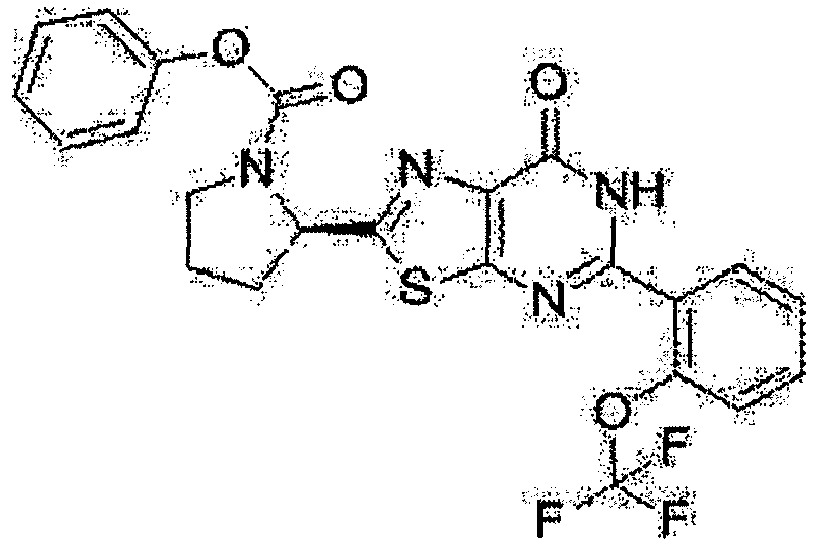
- The compound (700 mg) obtained in Example 47 was treated by a method similar to that in Example 63 to give the title compound (410 mg).
MS (ESI) m/z; 503 [M+H]+ -

- The compound (700 mg) obtained in Example 48 was treated by a method similar to that in Example 63 to give the title compound (170 mg).
MS (ESI) m/z; 433 [M+H]+ -

- The compound (800 mg) obtained in Example 49 was treated by a method similar to that in Example 63 to give the title compound (360 mg).
MS (ESI) m/z; 449 [M+H]+ -

- The compound (1.75 g) obtained in Example 50 was treated by a method similar to that in Example 63 to give the title compound (1.00 g).
MS (ESI) m/z; 401 [M+H]+ -

- The compound (230 mg) obtained in Example 51 was treated by a method similar to that in Example 63 to give the title compound (33 mg).
MS (ESI) m/z; 417, 419 [M+H]+ -

- The compound (336 mg) obtained in Example 52 was treated by a method similar to that in Example 63 to give the title compound (86.0 mg).
MS (ESI) m/z; 407 [M+H]+ -

- The compound (750 mg) obtained in Example 53 was treated by a method similar to that in Example 63 to give the title compound (190 mg).
MS (ESI) m/z; 461 [M+H]+ -

- The compound (800 mg) obtained in Example 54 was treated by a method similar to that in Example 63 to give the title compound (40.0 mg).
MS (ESI) m/z; 443 [M+H]+ -

- The compound (1300 mg) obtained in Example 55 was treated by a method similar to that in Example 63 to give the title compound (100 mg).
MS (ESI) m/z; 433 [M+H]+ -

- The compound (690 mg) obtained in Example 56 was treated by a method similar to that in Example 63 to give the title compound (37.0 mg).
MS (ESI) m/z; 427 [M+H]+ -

- The compound (1850 mg) obtained in Example 57 was treated by a method similar to that in Example 63 to give the title compound (711 mg).
MS (ESI) m/z; 408 [M+H]+ -

- The compound (300 mg) obtained in Example 58 was treated by a method similar to that in Example 63 to give the title compound (129 mg).
MS (ESI) m/z; 410 [M+H]+ -

- The compound (370 mg) obtained in Example 59 was treated by a method similar to that in Example 63 to give the title compound (70.0 mg).
MS (ESI) m/z; 415 [M+H]+ -

- The compound (575 mg) obtained in Example 60 was treated by a method similar to that in Example 63 to give the title compound (279 mg).
MS (ESI) m/z; 451 [M+H]+ -

- The compound (478 mg) obtained in Example 61 was treated by a method similar to that in Example 63 to give the title compound (116 mg).
MS (ESI) m/z; 411 [M+H]+ -
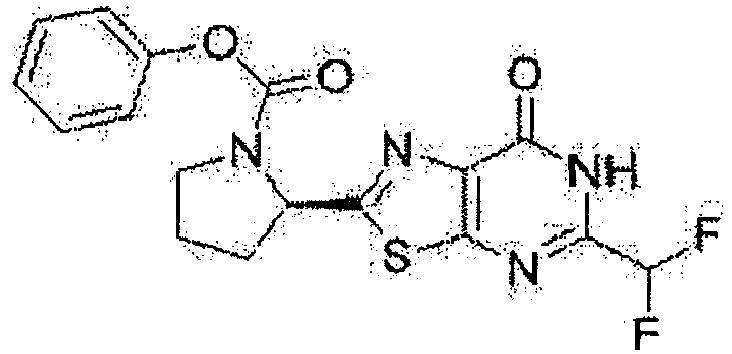
- The compound (267 mg) obtained in Example 62 was treated by a method similar to that in Example 63 to give the title compound (122 mg).
MS (ESI) m/z; 393 [M+H]+ -

- To a reaction mixture of trifluoroacetic acid (6.50 mL), triethylsilane (360 µL) and water (360 µL) was added the compound (800 mg) obtained in Reference Example 49 at 0°C, and the reaction mixture was stirred at room temperature for 2 hr. The solvent was evaporated under reduced pressure, 1.0 mol/L hydrochloric acid (10.0 mL) was added, and the mixture was washed with hexane. The aqueous layer was neutralized with 1.0 mol/L aqueous sodium hydroxide solution, sodium hydrogen carbonate (160 mg) and phenyl chloroformate (220 µL) were added at 0°C, and the reaction mixture was stirred at room temperature for 2 hr. The reaction mixture was acidified with 1.0 mol/L hydrochloric acid and extracted once with chloroform. The organic layer was dried over anhydrous magnesium sulfate, filtered and concentrated. To the residue was added diisopropyl ether, and the solid was collected by filtration and dried to give the title compound (420 mg).
MS (ESI) m/z; 373 [M+H]+ -

- The compound (765 mg) obtained in Reference Example 50 was treated by a method similar to that in Example 84 to give the title compound (310 mg).
MS (ESI) m/z; 405, 407 [M+H]+ -

- To a solution (20 mL) of the compound (700 mg) obtained in Example 44 in acetonitrile were added triethylsilane (1.20 mL) and trimethylsilyl iodide (0.35 mL), and the reaction mixture was stirred at room temperature overnight (reaction mixture 1). To a solution (10.0 mL) of triphosgene (290 mg) in toluene were added m-cresol (260 mg) and pyridine (0.25 mL) under ice-cooling, and the reaction mixture was stirred at room temperature for 30 min (reaction mixture 2). The solvent of the above-mentioned reaction mixture 2 was evaporated under reduced pressure, and the obtained residue was dissolved in methylene chloride (5.0 mL), and added to the above-mentioned reaction mixture 1 at room temperature. Furthermore, triethylamine (1.0 mL) was added, and the reaction mixture was stirred at room temperature for 2 hr. The reaction mixture was acidified with 1.0 mol/L hydrochloric acid and extracted twice with ethyl acetate. The organic layer was dried over anhydrous magnesium sulfate, filtered and concentrated. The residue was purified by silica gel column chromatography (solvent; hexane/ethyl acetate=70/30 - 0/100) to give the title compound (310 mg).
MS (ESI) m/z; 433 [M+H]+ -

- The compound (900 mg) obtained in Example 45 was treated by a method similar to that in Example 86 to give the title compound (250 mg).
MS (ESI) m/z; 451 [M+H]+ -

- The compound (600 mg) obtained in Example 46 was treated by a method similar to that in Example 86 to give the title compound (225 mg).
MS (ESI) m/z; 469 [M+H]+ -

- The compound (700 mg) obtained in Example 47 was treated by a method similar to that in Example 86 to give the title compound (450 mg).
MS (ESI) m/z; 517 [M+H]+ -

- The compound (700 mg) obtained in Example 48 was treated by a method similar to that in Example 86 to give the title compound (150 mg).
MS (ESI) m/z; 447 [M+H]+ -

- The compound (800 mg) obtained in Example 49 was treated by a method similar to that in Example 86 to give the title compound (430 mg).
MS (ESI) m/z; 463 [M+H]+ -

- The compound (490 mg) obtained in Example 50 was treated by a method similar to that in Example 86 to give the title compound (245 mg).
MS (ESI) m/z; 415 [M+H]+ -

- The compound (50 mg) obtained in Example 51 was treated by a method similar to that in Example 86 to give the title compound (27 mg).
MS (ESI) m/z; 431, 433 [M+H]+ -

- The compound (350 mg) obtained in Example 57 was treated by a method similar to that in Example 86 to give the title compound (31.0 mg).
MS (ESI) m/z; 422 [M+H]+ -

- The compound (2.50 g) obtained in Reference Example 51 was treated by a method similar to that in Example 42 to give the title compound (2.30 g).
MS (ESI) m/z; 591 [M+H]+ -

- To a solution (10 mL) of the compound (500 mg) obtained in Reference Example 52 in methylene chloride were added triethylamine (0.28 mL) and phenyl chloroformate (0.26 g), and the reaction mixture was stirred at room temperature for 1 hr. 1.0 mol/L Aqueous sodium hydroxide solution (8.0 mL) was added to the reaction mixture, and the reaction mixture was stirred at room temperature for 15 min. The reaction mixture was acidified with 1.0 mol/L hydrochloric acid and extracted twice with chloroform. The organic layer was dried over anhydrous magnesium sulfate, filtered and concentrated. The residue was purified by silica gel column chromatography (solvent; hexane/ethyl acetate=70/30 - 0/100) to give the title compound (130 mg).
MS (ESI) m/z; 427 [M+H]+ -

- The compound (45.0 mg) obtained in Reference Example 53 was treated by a method similar to that in Example 96 to give the title compound (45.0 mg).
MS (ESI) m/z; 449 [M+H]+ -
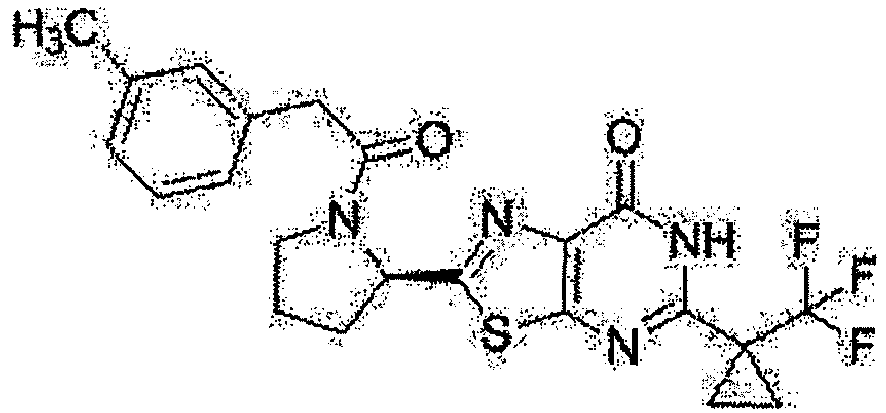
- The compound (60.0 mg) obtained in Reference Example 53 was treated by a method similar to that in Example 96 to give the title compound (40.0 mg).
MS (ESI) m/z; 463 [M+H]+ -

- To a solution (15 mL) of triphosgene (0.39 g) in toluene were added m-cresol (0.36 g) and pyridine (0.33 mL) under ice-cooling, and the reaction mixture was stirred at room temperature for 30 min. The solvent was evaporated under reduced pressure, methylene chloride (10 mL), triethylamine (1.4 mL) and the compound (0.50 g) obtained in Reference Example 52 were added, and the reaction mixture was stirred at room temperature for 1 hr. 1.0 mol/L Aqueous sodium hydroxide solution (8.0 mL) was added to the reaction mixture, and the reaction mixture was stirred at room temperature for 15 min. The reaction mixture was acidified with 1.0 mol/L hydrochloric acid and extracted twice with chloroform. The organic layer was dried over anhydrous magnesium sulfate, filtered and concentrated. The residue was purified by silica gel column chromatography (solvent; hexane/ethyl acetate=70/30 - 0/100) to give the title compound (190 mg).
MS (ESI) m/z; 441 [M+H]+ -

- To a solution (5.0 mL) of the compound (567 mg) obtained in Reference Example 56 in DMF were added 1-methylcyclopropanol (104 mg) and sodium hydride (60% oil dispersion, 48 mg) under ice-cooling. The reaction mixture was stirred at 60°C for 2 hr. Water was added to the reaction mixture, and the mixture was extracted twice with ethyl acetate. The combined organic layer was washed with saturated brine, dried over anhydrous magnesium sulfate, filtered and concentrated. The residue was purified by silica gel column chromatography (solvent; hexane/ethyl acetate=70/30 - 50/50) and NH silica gel column chromatography (solvent; hexane/ethyl acetate=60/40 - 0/100) to give the title compound (239 mg).
MS (ESI) m/z; 577 [M+H]+ -

- To a solution (4.0 mL) of the compound (250 mg) obtained in Reference Example 56 in DMF were added 2,2,2-trifluoroethanol (40 µL) and potassium tert-butoxide (59 mg) under ice-cooling. The reaction mixture was stirred at 60°C for 1 hr. Water was added to the reaction mixture, and the mixture was extracted twice with ethyl acetate. The combined organic layer was washed with saturated brine, dried over anhydrous magnesium sulfate, filtered and concentrated. The residue was purified by silica gel column chromatography (solvent; hexane/ethyl acetate=70/30 - 30/70) to give the title compound (87 mg).
MS (ESI) m/z; 605 [M+H]+ -

- To a solution (3.0 mL) of the compound (190 mg) obtained in Reference Example 56 in THF was added 2.0 mol/L dimethylamine THF solution (0.85 mL) under ice-cooling. The reaction mixture was stirred at room temperature for 2 hr. The reaction mixture was concentrated, and the residue was purified by NH silica gel column chromatography (solvent; hexane/ethyl acetate=60/40 - 40/60) to give the title compound (129 mg).
MS (ESI) m/z; 550 [M+H]+ -

- The compound (216 mg) obtained in Reference Example 56 was treated by a method similar to that in Example 102 to give the title compound (150 mg).
MS (ESI) m/z; 590 [M+H]+ -

- The compound (180 mg) obtained in Example 100 was treated by a method similar to that in Example 63 to give the title compound (62 mg).
MS (ESI) m/z; 413 [M+H]+ -

- The compound (168 mg) obtained in Example 101 was treated by a method similar to that in Example 63 to give the title compound (59 mg).
MS (ESI) m/z; 441 [M+H]+ -

- The compound (126 mg) obtained in Example 102 was treated by a method similar to that in Example 63 to give the title compound (68 mg).
MS (ESI) m/z; 386 [M+H]+ -

- The compound (139 mg) obtained in Example 103 was treated by a method similar to that in Example 63 to give the title compound (61 mg).
MS (ESI) m/z; 426 [M+H]+ -

- The compound (0.92 g) obtained in Reference Example 57 was treated by a method similar to that in Example 42 to give the title compound (0.89 g).
MS (ESI) m/z; 535 [M+H]+ -

- The compound (1.27 g) obtained in Reference Example 58 was treated by a method similar to that in Example 42 to give the title compound (1.08 g).
MS (ESI) m/z; 561 [M+H]+ -

- The compound (2.1 g) obtained in Reference Example 59 was treated by a method similar to that in Example 42 to give the title compound (1.29 g).
MS (ESI) m/z; 577 [M+H]+ -

- To a solution (10 mL) of the compound (200 mg) obtained in Reference Example 60 in methylene chloride were added triethylamine (90 µL) and phenyl chloroformate (90.0 mg), and the reaction mixture was stirred at room temperature for 1 hr. Water was added to the reaction mixture, and the mixture was acidified with 1.0 mol/L hydrochloric acid and extracted twice with chloroform. The organic layer was dried over anhydrous magnesium sulfate, filtered and concentrated. The residue was purified by silica gel column chromatography (solvent; hexane/ethyl acetate=70/30 - 0/100) to give the title compound (200 mg) .
MS (ESI) m/z; 521 [M+H]+ -

- The compound (320 mg) obtained in Reference Example 61 was treated by a method similar to that in Example 111 to give the title compound (142 mg).
MS (ESI) m/z; 547 [M+H]+ -

- The compound (70.0 mg) obtained in Reference Example 62 was treated by a method similar to that in Example 111 to give the title compound (49 mg).
MS (ESI) m/z; 563 [M+H]+ -

- To the compound (180 mg) obtained in Example 111 was added a mixed solvent of triethylsilane (0.35 mL), water (0.35 mL) and trifluoroacetic acid (6.3 mL), and the reaction mixture was stirred at room temperature for 2 hr. The solvent was evaporated under reduced pressure, and the residue was purified by silica gel column chromatography (solvent; ethyl acetate/methanol=100/0 - 95/5) to give the title compound (118 mg) .
MS (ESI) m/z; 371 [M+H]+ -

- The compound (142 mg) obtained in Example 112 was treated by a method similar to that in Example 114 to give the title compound (80.0 mg).
MS (ESI) m/z; 397 [M+H]+ -

- The compound (49.0 mg) obtained in Example 113 was treated by a method similar to that in Example 114 to give the title compound (28.0 mg).
MS (ESI) m/z; 413 [M+H]+ -
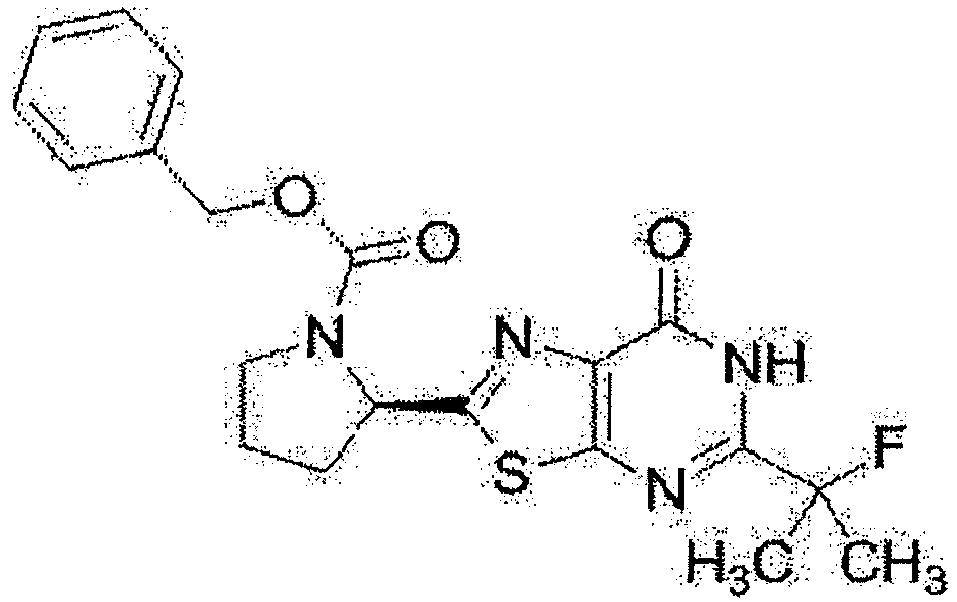
- To a solution (30 mL) of the compound (1.30 g) obtained in Reference Example 64 in methylene chloride were added chlorotrimethylsilane (22.8 mL) and triethylamine (75.2 mL), and the reaction mixture was stirred at room temperature for 10 days. Water was added to the reaction mixture, and the mixture was extracted twice with chloroform. The organic layer was dried over anhydrous magnesium sulfate, filtered and concentrated. The residue was purified by silica gel column chromatography (solvent; chloroform/methanol=100/0 - 95/5) to give the title compound (0.40 g).
MS (ESI) m/z; 417 [M+H]+ -

- To a solution (15 mL) of the compound (300 mg) obtained in Example 117 in acetonitrile were added triethylsilane (0.69 mL) and trimethylsilyl iodide (0.21 mL), and the mixture was stirred at room temperature overnight. Triethylamine (0.60 mL) and phenyl chloroformate (0.23 g) were added to the reaction mixture, and the reaction mixture was stirred at room temperature for 4 hr. 1.0 mol/L Aqueous sodium hydroxide solution (0.8 mL) was added to the reaction mixture, and the mixture was stirred at room temperature for 15 min. The mixture was acidified with 1.0 mol/L hydrochloric acid and extracted twice with chloroform. The organic layer was dried over anhydrous magnesium sulfate, filtered and concentrated. The residue was purified by silica gel column chromatography (solvent; hexane/ethyl acetate=70/30 - 0/100) to give the title compound (97 mg).
MS (ESI) m/z; 403 [M+H]+ -

- (1) To a solution (5.0 mL) of the compound (100 mg) obtained in Example 117 in acetonitrile were added triethylsilane (0.23 mL) and trimethylsilyl iodide (70 µL), and the reaction mixture was stirred at room temperature overnight.
- (2) To a solution (5.0 mL) of triphosgene (57 mg) in toluene were added m-cresol (52 mg) and pyridine (50 µL) under ice-cooling, and the reaction mixture was stirred at room temperature for 30 min. The solvent was evaporated under reduced pressure, the residue was dissolved in methylene chloride (5.0 mL), and added to the reaction mixture described in (1) at room temperature. Furthermore, triethylamine (0.20 mL) was added, and the reaction mixture was stirred at room temperature for 4 hr. The reaction mixture was acidified with 1.0 mol/L hydrochloric acid and extracted twice with chloroform. The organic layer was dried over anhydrous magnesium sulfate, filtered and concentrated. The residue was purified by silica gel column chromatography (solvent; hexane/ethyl acetate=70/30 - 0/100) to give the title compound (34 mg).
-

- To a solution (24.0 mL) of the compound (2.40 g) obtained in Example 584 in methylene chloride solution (24.0 mL) were added triethylsilane (1.75 mL) and trimethylsilyl iodide (1.56 mL) at 0°C, and the mixture was stirred at room temperature for 15 hr. The solvent was evaporated under reduced pressure, and to the residue were added 1.0 mol/L hydrochloric acid (28.8 mL) and hexane (24.0 mL) to partition the mixture. The aqueous layer was adjusted to pH about 4 with 4.0 mol/L aqueous sodium hydroxide solution (7.20 mL). To the obtained aqueous layer were successively added THF (12.0 mL), sodium hydrogen carbonate (2.30 g) and phenyl chloroformate (0.868 mL) under ice-cooling, and the reaction mixture was stirred at room temperature for 3 hr. 5% Aqueous citric acid solution (60.0 mL) was added to the reaction mixture, and the mixture was extracted three times with chloroform. The organic layer was dried over anhydrous magnesium sulfate, filtered and concentrated. The residue was purified by reversed-phase chromatography (Capcellpak C18 UG80 ϕ30 mm x 250 mm, 5 µm, A: 0.05% trifluoroacetic acid-water, B: 0.05% trifluoroacetic acid-acetonitrile, 35 mL/min, B: 35 - 50%), and the solvent was evaporated by freeze-drying. The obtained residue was separated by chiral column (CHIRALPAK ID ϕ30 mm x 250 mm, solvent:methanol-THF-acetic acid 85:15:0.5), and the solvent was evaporated to give the title compound (729 mg).
MS (ESI) m/z; 425 [M+H]+ -

- The compound (6.38 g) obtained in Reference Example 67 was treated by a method similar to that in Example 42 to give the title compound (6.20 g).
MS (ESI) m/z; 605 [M+H]+ -

- To a solution (60.0 mL) of the compound (6.20 g) obtained in Example 121 in THF was added 1.0 mol/L aqueous sodium hydroxide solution (12.2 mL), and the reaction mixture was stirred at room temperature overnight. The reaction mixture was neutralized with 1.0 mol/L hydrochloric acid, and extracted twice with chloroform. The organic layer was dried over anhydrous magnesium sulfate, filtered and concentrated. The residue was purified by NH silica gel column chromatography (solvent; hexane/ethyl acetate=70/30 - 0/100) to give the title compound (4.25 g).
MS (ESI) m/z; 563 [M+H]+ -
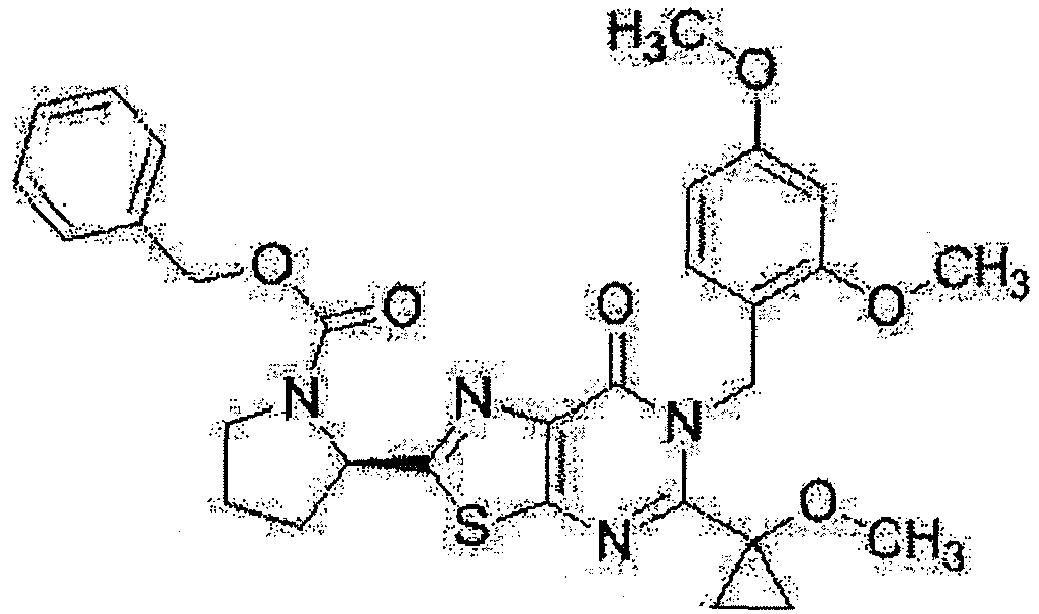
- To a solution (50.0 mL) of the compound (4.25 g) obtained in Example 122 in DMF were added methyl iodide (1.30 g) and sodium hydride (60% oil dispersion, 0.31 g) at 0°C, and the reaction mixture was stirred at room temperature for 1 hr. Water was added to the reaction mixture, and the mixture was extracted twice with ethyl acetate. The organic layer was dried over anhydrous magnesium sulfate, filtered and concentrated. The residue was purified by NH silica gel column chromatography (solvent; hexane/ethyl acetate=70/30 - 0/100) to give the title compound (2.20 g).
MS (ESI) m/z; 577 [M+H]+ -

- The compound (730 mg) obtained in Reference Example 68 was treated by a method similar to that in Example 96 to give the title compound (400 mg).
MS (ESI) m/z; 413 [M+H]+ -

- The compound (150 mg) obtained in Reference Example 68 was treated by a method similar to that in Example 99 to give the title compound (33.0 mg).
MS (ESI) m/z; 427 [M+H]+ -

- To a solution (5.0 mL) of the compound (120 mg) obtained in Reference Example 78 in methylene chloride were added triethylamine (80 µL) and phenyl chloroformate (68 mg), and the reaction mixture was stirred at room temperature for 1 hr. Furthermore, phenyl chloroformate (68 mg) was added, and the reaction mixture was stirred at room temperature for 1 hr. Water was added to the reaction mixture, and the mixture was acidified with 1.0 mol/L hydrochloric acid and extracted twice with chloroform. The organic layer was dried over anhydrous magnesium sulfate, filtered and concentrated. The residue was purified by silica gel column chromatography (solvent; hexane/ethyl acetate=70/30 - 0/100) to give the title compound (128 mg).
MS (ESI) m/z; 399 [M+H]+ -

- A solution (30 mL) of the compound (0.97 g) obtained in Reference Example 87, the compound (0.59 g) obtained in Reference Example 79, copper(I) iodide (80 mg), trans-N,N'-dimethylcyclohexane-1,2-diamine (60 mg) and tripotassium phosphate (0.91 g) in 1,4-dioxane was heated under reflux for 2 hr. The reaction mixture was cooled to room temperature, water was added thereto, and the mixture was extracted twice with chloroform. The organic layer was dried over anhydrous magnesium sulfate, filtered and concentrated. The residue was purified by silica gel column chromatography (solvent; hexane/ethyl acetate=70/30 - 50/50) to give the title compound (0.35 g).
MS (ESI) m/z; 588 [M+H]+ -

- The compound (0.68 g) obtained in Reference Example 88 was treated by a method similar to that in Example 127 to give the title compound (0.26 g).
MS (ESI) m/z; 564 [M+H]+ -

- To a solution (6.0 mL) of the compound (350 mg) obtained in Example 127 in methylene chloride was added a mixture of triethylsilane (0.58 mL), water (0.38 mL) and trifluoroacetic acid (6.0 mL), and the reaction mixture was stirred at room temperature for 2 hr. The reaction mixture was neutralized with saturated aqueous sodium hydrogen carbonate solution, and extracted twice with chloroform. The organic layer was dried over anhydrous magnesium sulfate, filtered and concentrated. The residue was purified by silica gel column chromatography (solvent; chloroform/methanol=100/0 - 95/5) to give the title compound (170 mg).
MS (ESI) m/z; 438 [M+H]+ -

- The compound (260 mg) obtained in Example 128 was treated by a method similar to that in Example 129 to give the title compound (60.0 mg).
MS (ESI) m/z; 414 [M+H]+ -

- A solution (25 mL) of the compound (250 mg) obtained in Reference Example 91, the compound (930 mg) obtained in Reference Example 79, copper(I) iodide (33 mg), trans-N,N'-dimethylcyclohexane-1,2-diamine (25 mg) and tripotassium phosphate (386 mg) in 1,4-dioxane was heated under reflux for 1 hr. The reaction mixture was cooled to room temperature, water was added thereto, and the mixture was extracted twice with chloroform. The organic layer was dried over anhydrous magnesium sulfate, filtered and concentrated. The residue was purified by silica gel column chromatography (solvent; chloroform/methanol=100/0 - 95/5) to give the title compound (78.0 mg).
MS (ESI) m/z; 404 [M+H]+ -

- The compound (300 mg) obtained in Reference Example 91 and the compound (420 mg) obtained in Reference Example 82 were treated by a method similar to that in Example 131 to give the title compound (49.0 mg).
MS (ESI) m/z; 418 [M+H]+ -

- A mixture of the compound (200 mg) obtained in Reference Example 91, the compound (400 mg) obtained in Reference Example 80 and N,N-diisopropylethylamine (1.20 mL) was heated at 150°C for 12 hr. The reaction mixture was cooled to room temperature, neutralized with 1.0 mol/L hydrochloric acid, and extracted twice with chloroform. The organic layer was dried over anhydrous magnesium sulfate, filtered and concentrated. The residue was purified by silica gel column chromatography (solvent; ethyl acetate/methanol=100/0 - 95/5) to give the title compound (78.0 mg).
MS (ESI) m/z; 402 [M+H]+ -

- The compound (200 mg) obtained in Reference Example 91 and the compound (560 mg) obtained in Reference Example 81 were treated by a method similar to that in Example 133 to give the title compound (100 mg).
MS (ESI) m/z; 416 [M+H]+ -

- To a solution (5.0 mL) of the compound (379 mg) obtained in Example 63 in acetonitrile were added potassium carbonate (205 mg) and methyl iodide (307 µL), and the reaction mixture was stirred with heating at 60°C for 1 hr. The reaction mixture was allowed to cool to room temperature, water was added thereto, and the mixture was extracted twice with ethyl acetate. The organic layer was dried over anhydrous sodium sulfate, filtered and concentrated. The residue was purified by silica gel column chromatography (solvent; hexane/ethyl acetate=70/20 - 0/100) to give the title compound (303 mg).
MS (ESI) m/z; 399 [M+H]+ -

- The compound (100 mg) obtained in Example 71 was treated by a method similar to that in Example 135 to give the title compound (71 mg).
MS (ESI) m/z; 415 [M+H]+ -

- To a solution (9.5 mL) of the compound (300 mg) obtained in Reference Example 97 in acetonitrile were added triethylsilane (619 µL) and trimethylsilyl iodide (355 µL), and the reaction mixture was stirred at room temperature for 1.5 hr. Triethylamine (541 µL) and phenyl chloroformate (162 µL) were added to the reaction mixture, and the reaction mixture was stirred at room temperature for 2 days. Triethylamine (90 µL) and phenyl chloroformate (81 µL) were added, and the reaction mixture was further stirred at room temperature for 5 hr. Water (475 µL) was added to the reaction mixture under ice-cooling, and the reaction mixture was stirred at room temperature for 15 hr. Furthermore, 1.0 mol/L aqueous sodium hydroxide solution (6.5 mL) was added, and the reaction mixture was stirred at room temperature for 4 hr. The reaction mixture was ice-cooled, acidified with 1.0 mol/L hydrochloric acid and extracted twice with ethyl acetate. The combined organic layer was dried over anhydrous sodium sulfate, filtered and concentrated. The residue was purified by silica gel column chromatography (solvent; ethyl acetate/MeOH=100/0 - 95/5), to the obtained product was added hexane/diethyl ether/ethyl acetate=2/2/1, and the solid was collected by filtration to give the title compound (106 mg).
MS (ESI) m/z; 436 [M+H]+ -

- The compound (71 mg) obtained in Reference Example 98 was treated by a method similar to that in Example 137 to give the title compound (36 mg).
MS (ESI) m/z; 410 [M+H]+ -

- To a solution (10.0 mL) of the compound (200 mg) obtained in Reference Example 114 in methylene chloride were added N,N-diisopropylethylamine (120 µL) and phenyl chloroformate (120 mg), and the reaction mixture was stirred at room temperature for 1 hr. Water was added to the reaction mixture, and the mixture was extracted twice with chloroform. The organic layer was dried over anhydrous magnesium sulfate, filtered and concentrated. The residue was purified by silica gel column chromatography (solvent; hexane/ethyl acetate=70/30 - 0/100) to give the title compound (280 mg).
MS (ESI) m/z; 385 [M+H]+ -

- The compound (200 mg) obtained in Reference Example 114 was treated by a method similar to that in Example 139 to give the title compound (300 mg).
MS (ESI) m/z; 403 [M+H]+ -

- The compound (200 mg) obtained in Reference Example 114 was treated by a method similar to that in Example 139 to give the title compound (310 mg) .
MS (ESI) m/z; 419 [M+H]+ -

- The compound (258 mg) obtained in Reference Example 114 was treated by a method similar to that in Example 139 to give the title compound (360 mg).
MS (ESI) m/z; 383 [M+H]+ -

- The compound (200 mg) obtained in Reference Example 114 was treated by a method similar to that in Example 139 to give the title compound (210 mg).
MS (ESI) m/z; 401 [M+H]+ -

- The compound (100 mg) obtained in Reference Example 114 was treated by a method similar to that in Example 139 to give the title compound (150 mg).
MS (ESI) m/z; 399 [M+H]+ -

- The compound (200 mg) obtained in Reference Example 114 was treated by a method similar to that in Example 139 to give the title compound (218 mg).
MS (ESI) m/z; 399 [M+H]+ -

- The compound (100 mg) obtained in Reference Example 115 was treated by a method similar to that in Example 139 to give the title compound (143 mg).
MS (ESI) m/z; 371 [M+H]+ -

- The compound (100 mg) obtained in Reference Example 116 was treated by a method similar to that in Example 139 to give the title compound (135 mg).
MS (ESI) m/z; 371 [M+H]+ -

- The compound (100 mg) obtained in Reference Example 117 was treated by a method similar to that in Example 139 to give the title compound (138 mg).
MS (ESI) m/z; 385 [M+H]+ -

- The compound (200 mg) obtained in Reference Example 118 was treated by a method similar to that in Example 139 to give the title compound (280 mg).
MS (ESI) m/z; 397 [M+H]+ -

- The compound (230 mg) obtained in Reference Example 118 was treated by a method similar to that in Example 139 to give the title compound (320 mg).
MS (ESI) m/z; 415 [M+H]+ -

- The compound (200 mg) obtained in Reference Example 118 was treated by a method similar to that in Example 139 to give the title compound (280 mg).
MS (ESI) m/z; 395 [M+H]+ -

- The compound (130 mg) obtained in Reference Example 119 was treated by a method similar to that in Example 139 to give the title compound (187 mg) .
MS (ESI) m/z; 399 [M+H]+ -

- The compound (150 mg) obtained in Reference Example 120 was treated by a method similar to that in Example 139 to give the title compound (210 mg).
MS (ESI) m/z; 419, 421 [M+H]+ -

- The compound (150 mg) obtained in Reference Example 120 was treated by a method similar to that in Example 139 to give the title compound (160 mg).
MS (ESI) m/z; 417, 419 [M+H]+ -

- The compound (250 mg) obtained in Reference Example 121 was treated by a method similar to that in Example 139 to give the title compound (230 mg).
MS (ESI) m/z; 411 [M+H]+ -

- The compound (300 mg) obtained in Reference Example 121 was treated by a method similar to that in Example 139 to give the title compound (226 mg).
MS (ESI) m/z; 409 [M+H]+ -
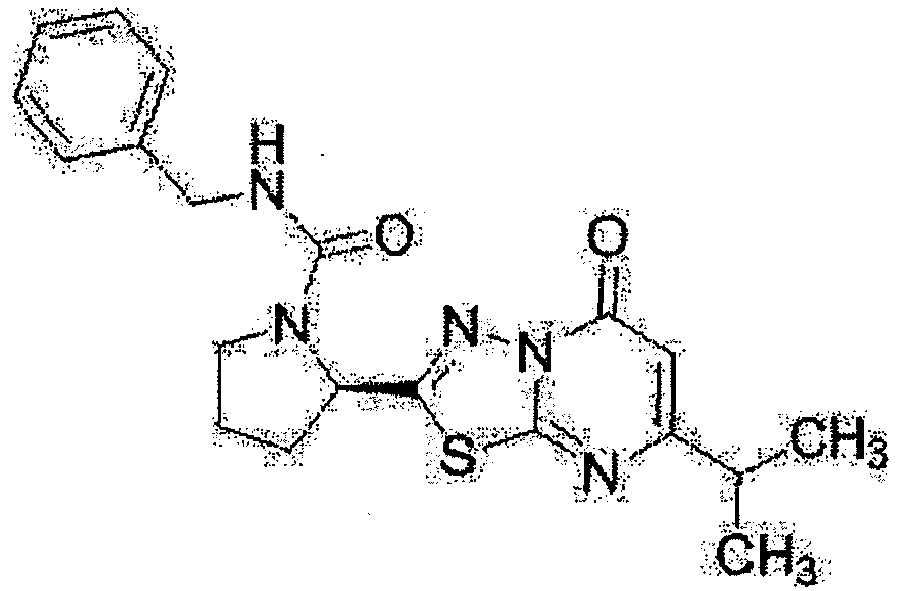
- To a solution (10.0 mL) of the compound (300 mg) obtained in Reference Example 114 and N,N-diisopropylethylamine (180 µL) in methylene chloride was added dropwise benzyl isocyanate (150 mg) under ice-cooling. The reaction mixture was stirred at room temperature for 1 hr. 0.5 mol/L Hydrochloric acid was added to the reaction mixture, and the mixture was extracted twice with chloroform. The organic layer was dried over anhydrous magnesium sulfate, filtered and concentrated. The residue was purified by silica gel column chromatography (solvent; hexane/ethyl acetate=50/50 - 20/80) to give the title compound (430 mg).
MS (ESI) m/z; 398 [M+H]+ -

- The compound (100 mg) obtained in Reference Example 114 was treated by a method similar to that in Example 157 to give the title compound (180 mg) .
MS (ESI) m/z; 432, 434 [M+H]+ -

- The compound (100 mg) obtained in Reference Example 114 was treated by a method similar to that in Example 157 to give the title compound (100 mg).
MS (ESI) m/z; 432, 434 [M+H]+ -

- The compound (200 mg) obtained in Reference Example 114 was treated by a method similar to that in Example 157 to give the title compound (290 mg).
MS (ESI) m/z; 384 [M+H]+ -

- The compound (150 mg) obtained in Reference Example 115 was treated by a method similar to that in Example 157 to give the title compound (183 mg).
MS (ESI) m/z; 384 [M+H]+ -

- The compound (150 mg) obtained in Reference Example 116 was treated by a method similar to that in Example 157 to give the title compound (174 mg).
MS (ESI) m/z; 384 [M+H]+ -

- The compound (150 mg) obtained in Reference Example 116 was treated by a method similar to that in Example 157 to give the title compound (230 mg).
MS (ESI) m/z; 418, 420 [M+H]+ -
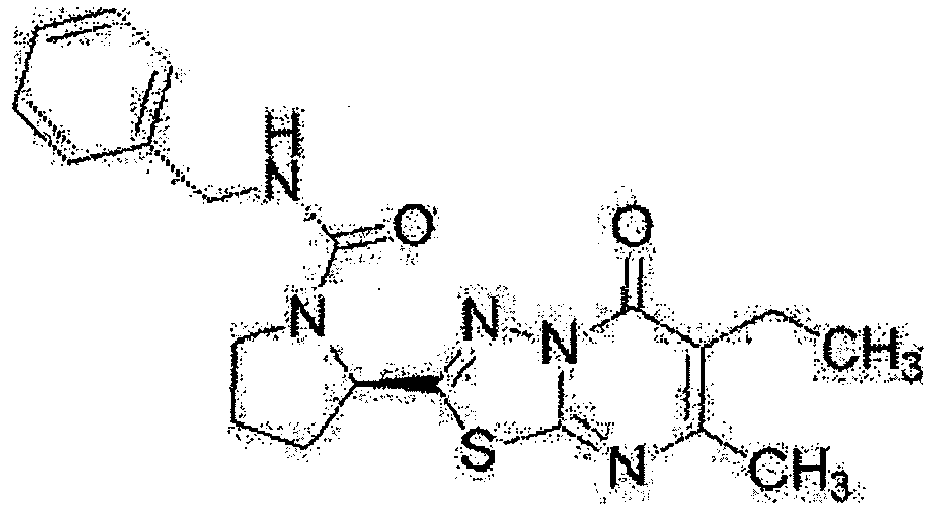
- The compound (150 mg) obtained in Reference Example 117 was treated by a method similar to that in Example 157 to give the title compound (187 mg).
MS (ESI) m/z; 398 [M+H]+ -

- To a solution (10.0 mL) of the compound (200 mg) obtained in Reference Example 114 and N,N-diisopropylethylamine (120 mg) in methylene chloride was added dropwise chloroacetyl chloride (90 mg) at room temperature. The reaction mixture was stirred at room temperature for 1 hr. Water was added to the reaction mixture, and the mixture was extracted twice with chloroform. The organic layer was dried over anhydrous magnesium sulfate, filtered and concentrated. The residue was purified by silica gel column chromatography (solvent; ethyl acetate/methanol=100/0 - 95/5) to give a viscous body (250 mg) . To a solution (10.0 mL) of the obtained viscous body in THF were added indoline (100 mg) and sodium hydride (60% oil dispersion, 40 mg), and the reaction mixture was stirred with heating at 70°C for 8 hr. The reaction mixture was cooled to room temperature, water was added thereto, and the mixture was extracted twice with ethyl acetate. The organic layer was dried over anhydrous magnesium sulfate, filtered and concentrated. The residue was purified by silica gel column chromatography (solvent; ethyl acetate/methanol=100/0 - 95/5) to give the title compound (36 mg).
MS (ESI) m/z; 424 [M+H]+ -

- To a solution (10.0 mL) of the compound (200 mg) obtained in Reference Example 114 and N,N-diisopropylethylamine (110 mg) in methylene chloride was added dropwise chloroacetyl chloride (90 mg) at room temperature. After stirring at room temperature for 1 hr, water was added to the reaction mixture, and the mixture was extracted twice with chloroform. The organic layer was dried over anhydrous magnesium sulfate, filtered and concentrated. To a solution (10.0 mL) of the residue in acetonitrile were added potassium iodide (160 mg), potassium carbonate (130 mg) and 1,2,3,4-tetrahydroquinoline (130 mg), and the reaction mixture was stirred with heating at 80°C for 3 hr. Water was added to the reaction mixture, and the mixture was extracted twice with chloroform. The organic layer was dried over anhydrous magnesium sulfate, filtered and concentrated. The residue was purified by NH silica gel column chromatography (solvent; ethyl acetate/methanol=100/0 - 95/5) to give the title compound (200 mg).
MS (ESI) m/z; 438 [M+H]+ -

- To a solution (10 mL) of triphosgene (100 mg) in methylene chloride was added pyridine (92 µL) at 0°C, and the reaction mixture was stirred for 30 min. The compound (150 mg) obtained in Reference Example 114 was added, and the reaction mixture was stirred at room temperature for 30 min. The solvent was evaporated under reduced pressure, methylene chloride (10 mL), 4-dimethylaminopyridine (350 mg) and 1-phenylcyclopropylamine (490 mg) were added at room temperature, and the reaction mixture was stirred at the same temperature for 1 hr. 1.0 mol/L Hydrochloric acid was added to the reaction mixture, and the mixture was extracted twice with chloroform. The organic layer was dried over anhydrous magnesium sulfate, filtered and concentrated. The residue was purified by silica gel column chromatography (solvent; ethyl acetate/methanol=100/0 - 95/5) to give the title compound (88 mg) .
MS (ESI) m/z; 424 [M+H]+ -

- The compound (150 mg) obtained in Reference Example 114 was treated by a method similar to that in Example 167 to give the title compound (100 mg).
MS (ESI) m/z; 424 [M+H]+ -

- The compound (150 mg) obtained in Reference Example 114 was treated by a method similar to that in Example 167 to give the title compound (43.0 mg).
MS (ESI) m/z; 438 [M+H]+ -

- The compound (150 mg) obtained in Reference Example 114 was treated by a method similar to that in Example 167 to give the title compound (136 mg).
MS (ESI) m/z; 410 [M+H]+ -

- The compound (150 mg) obtained in Reference Example 116 was treated by a method similar to that in Example 167 to give the title compound (119 mg).
MS (ESI) m/z; 398 [M+H]+ -

- The compound (150 mg) obtained in Reference Example 116 was treated by a method similar to that in Example 167 to give the title compound (18.0 mg).
MS (ESI) m/z; 412 [M+H]+ -

- The compound (150 mg) obtained in Reference Example 116 was treated by a method similar to that in Example 167 to give the title compound (75.0 mg).
MS (ESI) m/z; 410 [M+H]+ -

- The compound (150 mg) obtained in Reference Example 116 was treated by a method similar to that in Example 167 to give the title compound (190 mg).
MS (ESI) m/z; 410 [M+H]+ -

- The compound (150 mg) obtained in Reference Example 116 was treated by a method similar to that in Example 167 to give the title compound (10.5 mg).
MS (ESI) m/z; 427 [M+H]+ -
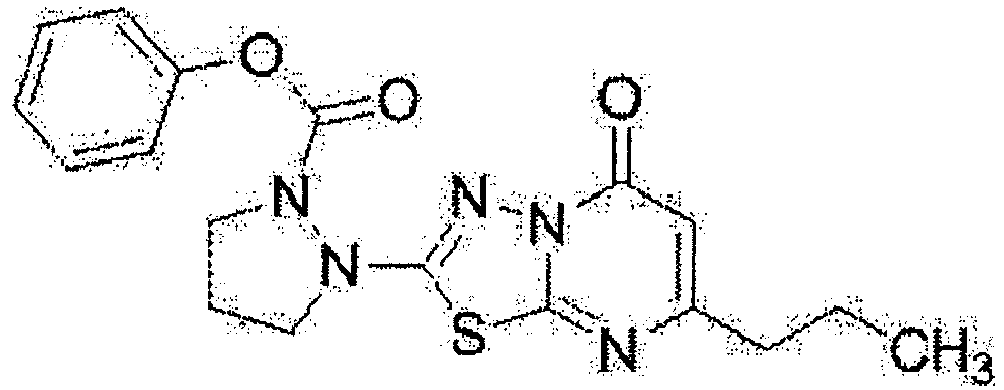
- To a solution (5.0 mL) of the compound (300 mg) obtained in Reference Example 122 in 1,4-dioxane were added N,N-diisopropylethylamine (0.76 mL) and pyrazolidine dihydrochloride (180 mg), and the mixture was stirred at room temperature for 1 hr. N,N-diisopropylethylamine (0.20 mL) and phenyl chloroformate (0.19 g) were added to the reaction mixture, and the reaction mixture was stirred at room temperature for 4 hr. After confirmation of the completion of the reaction, water and 1.0 mol/L hydrochloric acid were added, and the mixture was extracted twice with ethyl acetate. The organic layer was washed once with water, dried over anhydrous magnesium sulfate, filtered and concentrated. The residue was purified by silica gel column chromatography (solvent; ethyl acetate/methanol=100/0 - 95/5) and concentrated to give the title compound (210 mg).
MS (ESI) m/z; 386 [M+H]+ -

- The compound (750 mg) obtained in Example 53 was treated by a method similar to that in Example 86 to give the title compound (160 mg).
MS (ESI) m/z; 475 [M+H]+ -

- To a solution (350 mL) of the compound (35.0 g) obtained in Reference Example 268 in DMF were added (D)-proline (20.0 g) and cesium carbonate (86.2 g), and the reaction mixture was stirred with heating at 80°C for 1 hr. The reaction mixture was cooled to room temperature, and acidified with 1.0 mol/L hydrochloric acid. Sodium chloride was added, and the mixture was extracted twice with chloroform. The organic layer was dried over anhydrous magnesium sulfate, and filtered. Chloroform was evaporated under reduced pressure from the filtrate, to the obtained mixture were added N,N-diisopropylethylamine (40 mL), benzylamine (24.6 g), EDC hydrochloride (44.1 g) and HOBt monohydrate (35.2 g), and the reaction mixture was stirred at room temperature overnight. Water was added, the mixture was extracted with ethyl acetate, and the organic layer was dried over anhydrous sodium sulfate, filtered and concentrated. The residue was purified by silica gel column chromatography (solvent; chloroform/methanol=100/0 - 90/10). To the obtained product was added ethyl acetate, and the solid was collected by filtration and dried to give the title compound (33.0 g).
MS (ESI) m/z; 446 [M+H]+ -

- The compound (157 mg) obtained in Reference Example 303 was treated by a method similar to that in Example 178 to give the title compound (170 mg).
MS (ESI) m/z; 430 [M+H]+ -

- The compound (125 mg) obtained in Reference Example 305 was treated by a method similar to that in Example 178 to give the title compound (34 mg).
MS (ESI) m/z; 384 [M+H]+ -

- The compound (160 mg) obtained in Reference Example 304 was treated by a method similar to that in Example 178 to give the title compound (70 mg).
MS (ESI) m/z; 398 [M+H]+ -

- The compound (337 mg) obtained in Reference Example 304 was treated by a method similar to that in Example 178 to give the title compound (450 mg).
MS (ESI) m/z; 416 [M+H]+ -

- The compound (337 mg) obtained in Reference Example 304 was treated by a method similar to that in Example 178 to give the title compound (425 mg).
MS (ESI) m/z; 416 [M+H]+ -

- The compound (337 mg) obtained in Reference Example 304 was treated by a method similar to that in Example 178 to give the title compound (420 mg).
MS (ESI) m/z; 416 [M+H]+ -

- The compound (839 mg) obtained in Reference Example 306 was treated by a method similar to that in Example 178 to give the title compound (659 mg) .
MS (ESI) m/z; 412 [M+H]+ -

- The compound (270 mg) obtained in Reference Example 307 was treated by a method similar to that in Example 178 to give the title compound (300 mg).
MS (ESI) m/z; 410 [M+H]+ -

- The compound (108 mg) obtained in Reference Example 307 was treated by a method similar to that in Example 178 to give the title compound (135 mg).
MS (ESI) m/z; 428 [M+H]+ -

- The compound (108 mg) obtained in Reference Example 307 was treated by a method similar to that in Example 178 to give the title compound (135 mg).
MS (ESI) m/z; 428 [M+H]+ -

- The compound (1.08 g) obtained in Reference Example 307 was treated by a method similar to that in Example 178 to give the title compound (875 mg).
MS (ESI) m/z; 428 [M+H]+ -

- The compound (120 mg) obtained in Reference Example 309 was treated by a method similar to that in Example 178 to give the title compound (85 mg) .
MS (ESI) m/z; 438 [M+H]+ -
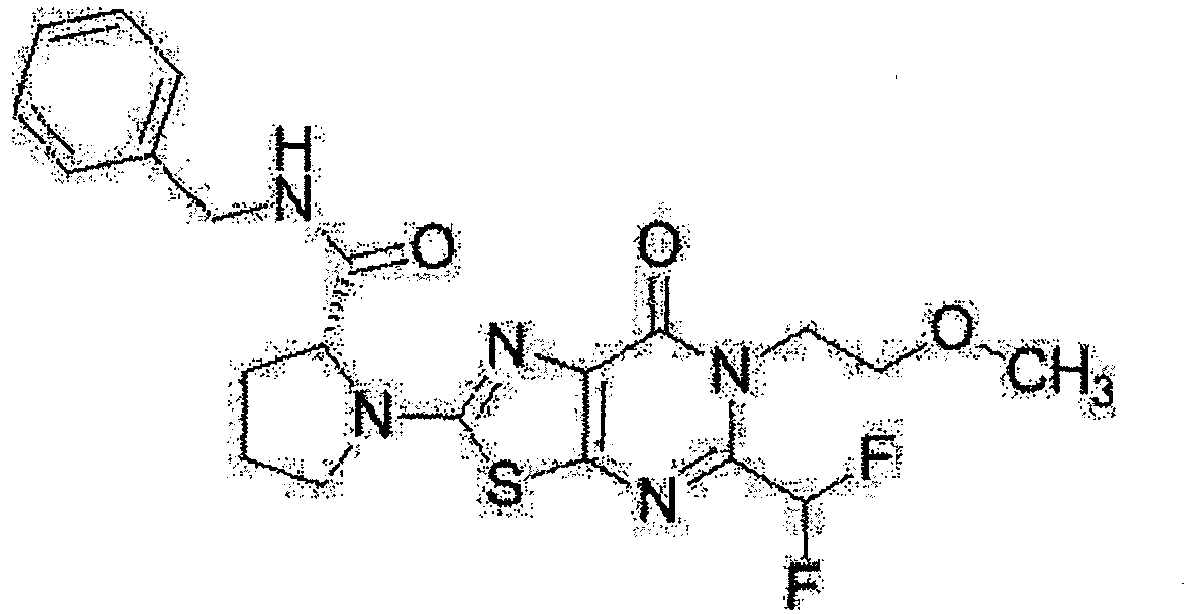
- The compound (276 mg) obtained in Reference Example 313 was treated by a method similar to that in Example 178 to give the title compound (218 mg).
MS (ESI) m/z; 464 [M+H]+ -

- The compound (254 mg) obtained in Reference Example 316 was treated by a method similar to that in Example 178 to give the title compound (73 mg).
MS (ESI) m/z; 490 [M+H]+ -
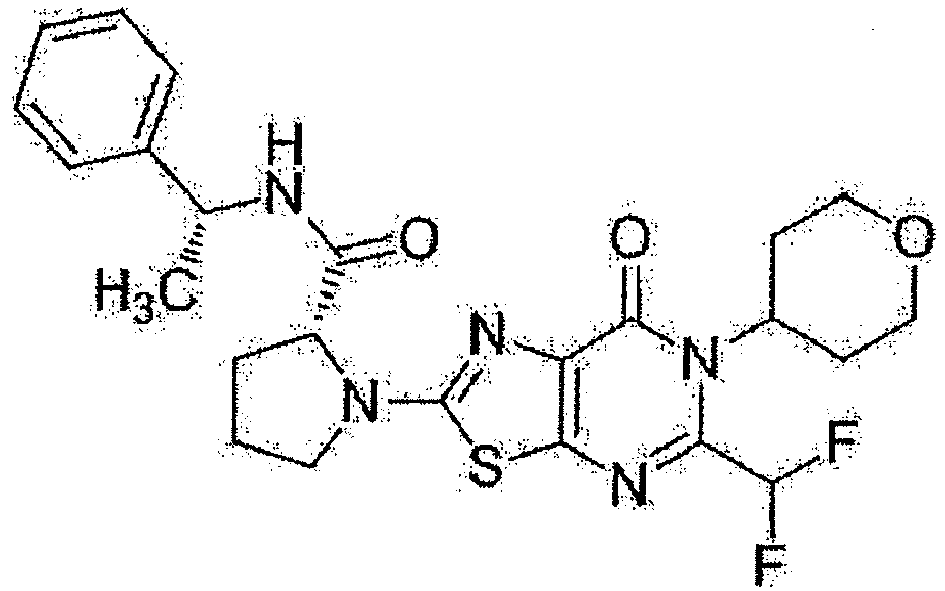
- The compound (175 mg) obtained in Reference Example 316 was treated by a method similar to that in Example 178 to give the title compound (89 mg).
MS (ESI) m/z; 504 [M+H]+ -

- The compound (170 mg) obtained in Reference Example 326 was treated by a method similar to that in Example 178 to give the title compound (125 mg).
MS (ESI) m/z; 447 [M+H]+ -
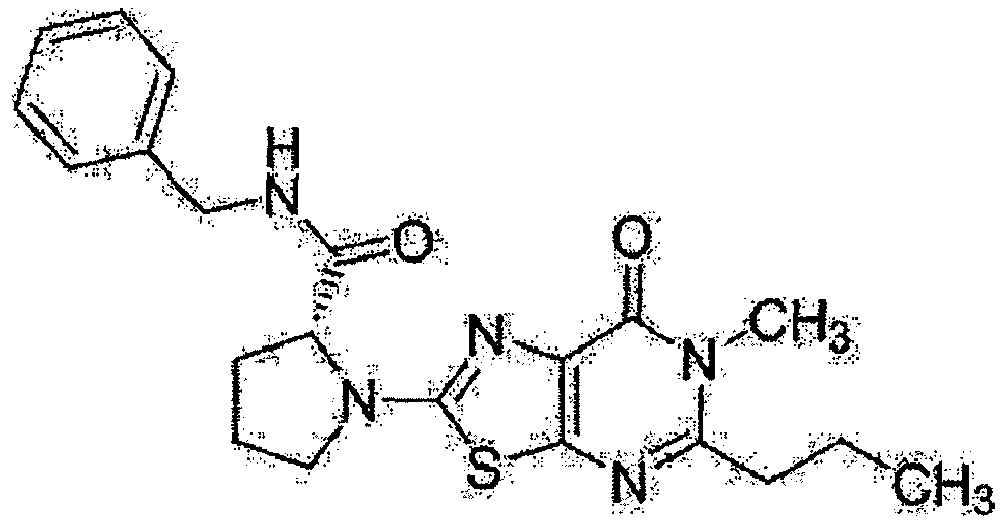
- The compound (760 mg) obtained in Reference Example 333 was treated by a method similar to that in Example 178 to give the title compound (185 mg).
MS (ESI) m/z; 412 [M+H]+ -

- The compound (1.96 g) obtained in Reference Example 334 was treated by a method similar to that in Example 178 to give the title compound (1.81 g).
MS (ESI) m/z; 412 [M+H]+ -

- The compound (250 mg) obtained in Reference Example 335 was treated by a method similar to that in Example 178 to give the title compound (175 mg).
MS (ESI) m/z; 398 [M+H]+ -
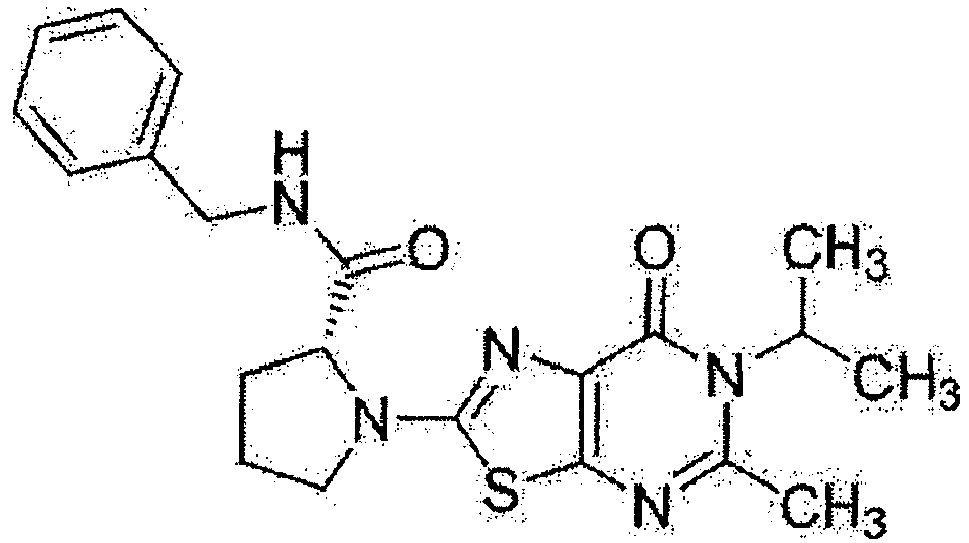
- The compound (195 mg) obtained in Reference Example 336 was treated by a method similar to that in Example 178 to give the title compound (140 mg).
MS (ESI) m/z; 412 [M+H]+ -

- The compound (140 mg) obtained in Reference Example 337 was treated by a method similar to that in Example 178 to give the title compound (180 mg).
MS (ESI) m/z; 438 [M+H]+ -

- The compound (210 mg) obtained in Reference Example 338 was treated by a method similar to that in Example 178 to give the title compound (160 mg).
MS (ESI) m/z; 452 [M+H]+ -

- The compound (215 mg) obtained in Reference Example 339 was treated by a method similar to that in Example 178 to give the title compound (230 mg).
MS (ESI) m/z; 446 [M+H]+ -

- The compound (320 mg) obtained in Reference Example 340 was treated by a method similar to that in Example 178 to give the title compound (300 mg).
MS (ESI) m/z; 464 [M+H]+ -

- To a solution (5.0 mL) of the compound (249 mg) obtained in Reference Example 269 in DMF were added (D)-proline (119 mg) and potassium carbonate (380 mg), and the reaction mixture was stirred with heating at 80°C for 3 hr. The reaction mixture was cooled to room temperature, and acidified with 1.0 mol/L hydrochloric acid. Sodium chloride was added, and the mixture was extracted twice with chloroform. The organic layer was dried over anhydrous sodium sulfate, and filtered. Chloroform was evaporated under reduced pressure from the filtrate, to the obtained mixture were added N,N-diisopropylethylamine (193 µL), benzylamine (150 µL), EDC hydrochloride (264 mg) and HOBt monohydrate (211 mg), and the reaction mixture was stirred at room temperature overnight. Water was added, and the mixture was extracted with ethyl acetate. The organic layer was dried over anhydrous sodium sulfate, filtered and concentrated. The residue was purified by silica gel column chromatography (solvent; ethyl acetate/methanol=100/0 - 90/10) to give the title compound (171 mg).
MS (ESI) m/z; 500 [M+H]+ -

- The compound (325 mg) obtained in Reference Example 270 was treated by a method similar to that in Example 203 to give the title compound (382 mg).
MS (ESI) m/z; 482 [M+H]+ -

- The compound (150 mg) obtained in Reference Example 272 was treated by a method similar to that in Example 203 to give the title compound (196 mg).
MS (ESI) m/z; 442 [M+H]+ -

- The compound (350 mg) obtained in Reference Example 274 was treated by a method similar to that in Example 203 to give the title compound (200 mg).
MS (ESI) m/z; 454 [M+H]+ -

- The compound (340 mg) obtained in Reference Example 275 was treated by a method similar to that in Example 203 to give the title compound (120 mg).
MS (ESI) m/z; 456 [M+H]+ -

- The compound (84 mg) obtained in Reference Example 282 was treated by a method similar to that in Example 203 to give the title compound (87 mg).
MS (ESI) m/z; 478 [M+H]+ -

- The compound (217 mg) obtained in Reference Example 285 was treated by a method similar to that in Example 203 to give the title compound (170 mg).
MS (ESI) m/z; 452 [M+H]+ -

- The compound (283 mg) obtained in Reference Example 286 was treated by a method similar to that in Example 203 to give the title compound (130 mg).
MS (ESI) m/z; 452 [M+H]+ -

- The compound (160 mg) obtained in Reference Example 287 was treated by a method similar to that in Example 203 to give the title compound (114 mg).
MS (ESI) m/z; 452 [M+H]+ -

- The compound (133 mg) obtained in Reference Example 287 was treated by a method similar to that in Example 203 to give the title compound (159 mg).
MS (ESI) m/z; 466 [M+H]+ -

- The compound (133 mg) obtained in Reference Example 287 was treated by a method similar to that in Example 203 to give the title compound (171 mg).
MS (ESI) m/z; 470 [M+H]+ -

- The compound (133 mg) obtained in Reference Example 287 was treated by a method similar to that in Example 203 to give the title compound (177 mg).
MS (ESI) m/z; 484 [M+H]+ -

- The compound (300 mg) obtained in Reference Example 288 was treated by a method similar to that in Example 203 to give the title compound (280 mg).
MS (ESI) m/z; 466 [M+H]+ -

- The compound (160 mg) obtained in Reference Example 288 was treated by a method similar to that in Example 203 to give the title compound (170 mg).
MS (ESI) m/z; 480 [M+H]+ -

- The compound (160 mg) obtained in Reference Example 288 was treated by a method similar to that in Example 203 to give the title compound (180 mg).
MS (ESI) m/z; 484 [M+H]+ -

- The compound (200 mg) obtained in Reference Example 288 was treated by a method similar to that in Example 203 to give the title compound (156 mg).
MS (ESI) m/z; 466 [M+H]+ -

- The compound (170 mg) obtained in Reference Example 289 was treated by a method similar to that in Example 203 to give the title compound (213 mg).
MS (ESI) m/z; 480 [M+H]+ -

- The compound (240 mg) obtained in Reference Example 290 was treated by a method similar to that in Example 203 to give the title compound (240 mg).
MS (ESI) m/z; 478 [M+H]+ -

- The compound (170 mg) obtained in Reference Example 291 was treated by a method similar to that in Example 203 to give the title compound (197 mg).
MS (ESI) m/z; 502 [M+H]+ -

- The compound (300 mg) obtained in Reference Example 292 was treated by a method similar to that in Example 203 to give the title compound (280 mg).
MS (ESI) m/z; 496 [M+H]+ -

- The compound (320 mg) obtained in Reference Example 293 was treated by a method similar to that in Example 203 to give the title compound (305 mg).
MS (ESI) m/z; 522 [M+H]+ -

- The compound (340 mg) obtained in Reference Example 296 was treated by a method similar to that in Example 203 to give the title compound (190 mg).
MS (ESI) m/z; 454 [M+H]+ -
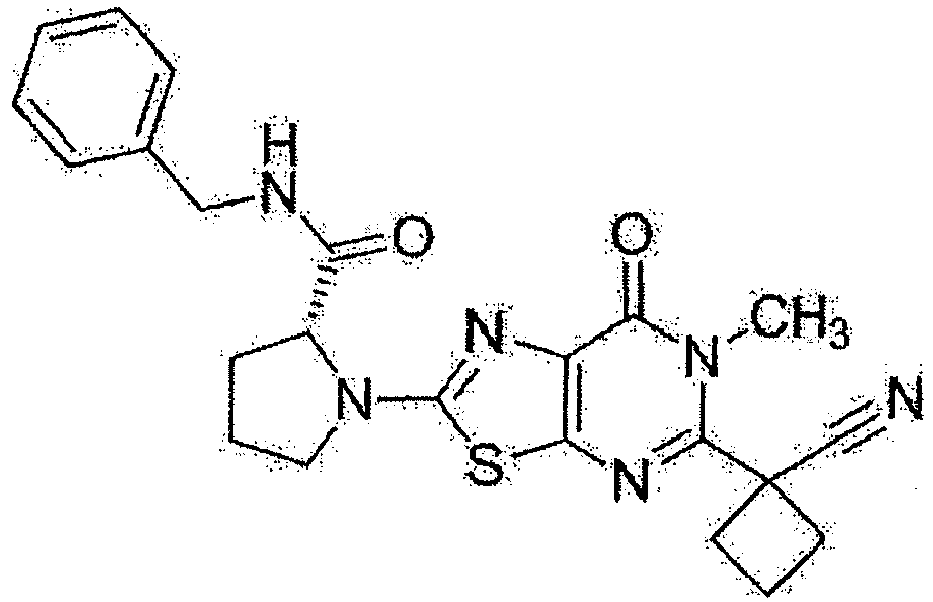
- The compound (282 mg) obtained in Reference Example 298 was treated by a method similar to that in Example 203 to give the title compound (304 mg).
MS (ESI) m/z; 449 [M+H]+ -

- The compound (130 mg) obtained in Reference Example 299 was treated by a method similar to that in Example 203 to give the title compound (101 mg).
MS (ESI) m/z; 442 [M+H]+ -

- The compound (270 mg) obtained in Reference Example 300 was treated by a method similar to that in Example 203 to give the title compound (120 mg).
MS (ESI) m/z; 508 [M+H]+ -

- The compound (2.00 g) obtained in Reference Example 301 was treated by a method similar to that in Example 203 to give the title compound (2.35 g).
MS (ESI) m/z; 410 [M+H]+ -

- The compound (250 mg) obtained in Reference Example 305 was treated by a method similar to that in Example 203 to give the title compound (277 mg).
MS (ESI) m/z; 398 [M+H]+ -

- The compound (300 mg) obtained in Reference Example 304 was treated by a method similar to that in Example 203 to give the title compound (290 mg).
MS (ESI) m/z; 412 [M+H]+ -

- The compound (300 mg) obtained in Reference Example 304 was treated by a method similar to that in Example 203 to give the title compound (283 mg).
MS (ESI) m/z; 412 [M+H]+ -

- The compound (300 mg) obtained in Reference Example 304 was treated by a method similar to that in Example 203 to give the title compound (33 mg).
MS (ESI) m/z; 386 [M+H]+ -

- The compound (250 mg) obtained in Reference Example 304 was treated by a method similar to that in Example 203 to give the title compound (307 mg).
MS (ESI) m/z; 384 [M+H]+ -

- The compound (800 mg) obtained in Reference Example 304 was treated by a method similar to that in Example 203 to give the title compound (59 mg).
MS (ESI) m/z; 412 [M+H]+ -

- The compound (353 mg) obtained in Reference Example 304 was treated by a method similar to that in Example 203 to give the title compound (114 mg).
MS (ESI) m/z; 426 [M+H]+ -

- The compound (350 mg) obtained in Reference Example 306 was treated by a method similar to that in Example 203 to give the title compound (57 mg).
MS (ESI) m/z; 426 [M+H]+ -

- The compound (368 mg) obtained in Reference Example 307 was treated by a method similar to that in Example 203 to give the title compound (169 mg).
MS (ESI) m/z; 424 [M+H]+ -

- The compound (300 mg) obtained in Reference Example 308 was treated by a method similar to that in Example 203 to give the title compound (340 mg).
MS (ESI) m/z; 424 [M+H]+ -

- The compound (350 mg) obtained in Reference Example 309 was treated by a method similar to that in Example 203 to give the title compound (104 mg).
MS (ESI) m/z; 452 [M+H]+ -

- The compound (250 mg) obtained in Reference Example 311 was treated by a method similar to that in Example 203 to give the title compound (256 mg).
MS (ESI) m/z; 452 [M+H]+ -

- The compound (6.10 g) obtained in Reference Example 312 was treated by a method similar to that in Example 203 to give the title compound (5.30 g).
MS (ESI) m/z; 482 [M+H]+ -

- The compound (91 mg) obtained in Reference Example 312 was treated by a method similar to that in Example 203 to give the title compound (71 mg).
MS (ESI) m/z; 496 [M+H]+ -

- The compound (210 mg) obtained in Reference Example 314 was treated by a method similar to that in Example 203 to give the title compound (195 mg).
MS (ESI) m/z; 508 [M+H]+ -

- The compound (6.04 g) obtained in Reference Example 315 was treated by a method similar to that in Example 203 to give the title compound (6.51 g).
MS (ESI) m/z; 508 [M+H]+ -

- The compound (12.0 g) obtained in Reference Example 315 was treated by a method similar to that in Example 203 to give the title compound (9.09 g).
MS (ESI) m/z; 522 [M+H]+ -

- The compound (300 mg) obtained in Reference Example 315 was treated by a method similar to that in Example 203 to give the title compound (190 mg).
MS (ESI) m/z; 526 [M+H]+ -

- The compound (185 mg) obtained in Reference Example 315 was treated by a method similar to that in Example 203 to give the title compound (100 mg).
MS (ESI) m/z; 494 [M+H]+ -

- The compound (185 mg) obtained in Reference Example 315 was treated by a method similar to that in Example 203 to give the title compound (95 mg).
MS (ESI) m/z; 508 [M+H]+ -

- The compound (200 mg) obtained in Reference Example 315 was treated by a method similar to that in Example 203 to give the title compound (98 mg).
MS (ESI) m/z; 508 [M+H]+ -

- The compound (380 mg) obtained in Reference Example 317 was treated by a method similar to that in Example 203 to give the title compound (330 mg).
MS (ESI) m/z; 494 [M+H]+ -

- The compound (260 mg) obtained in Reference Example 318 was treated by a method similar to that in Example 203 to give the title compound (110 mg).
MS (ESI) m/z; 480 [M+H]+ -

- The compound (280 mg) obtained in Reference Example 319 was treated by a method similar to that in Example 203 to give the title compound (210 mg).
MS (ESI) m/z; 493 [M+H]+ -

- The compound (290 mg) obtained in Reference Example 320 was treated by a method similar to that in Example 203 to give the title compound (200 mg).
MS (ESI) m/z; 509 [M+H]+ -

- The compound (300 mg) obtained in Reference Example 328 was treated by a method similar to that in Example 203 to give the title compound (190 mg).
MS (ESI) m/z; 504 [M+H]+ -

- The compound (300 mg) obtained in Reference Example 328 was treated by a method similar to that in Example 203 to give the title compound (300 mg).
MS (ESI) m/z; 518 [M+H]+ -

- The compound (137 mg) obtained in Reference Example 337 was treated by a method similar to that in Example 203 to give the title compound (66 mg).
MS (ESI) m/z; 424 [M+H]+ -

- A mixture of the compound (260 mg) obtained in Reference Example 271, the compound (630 mg) obtained in Reference Example 341 and N,N-diisopropylethylamine (1.00 g) was heated at 150°C for 4 hr. 1.0 mol/L Hydrochloric acid was added to the reaction mixture, and the mixture was extracted twice with chloroform. The organic layer was dried over anhydrous sodium sulfate, filtered and concentrated. The residue was purified by silica gel column chromatography (solvent; ethyl acetate/methanol=100/0 - 90/10), to the obtained product was added diethyl ether, and the solid was collected by filtration to give the title compound (115 mg).
MS (ESI) m/z; 440 [M+H]+ -
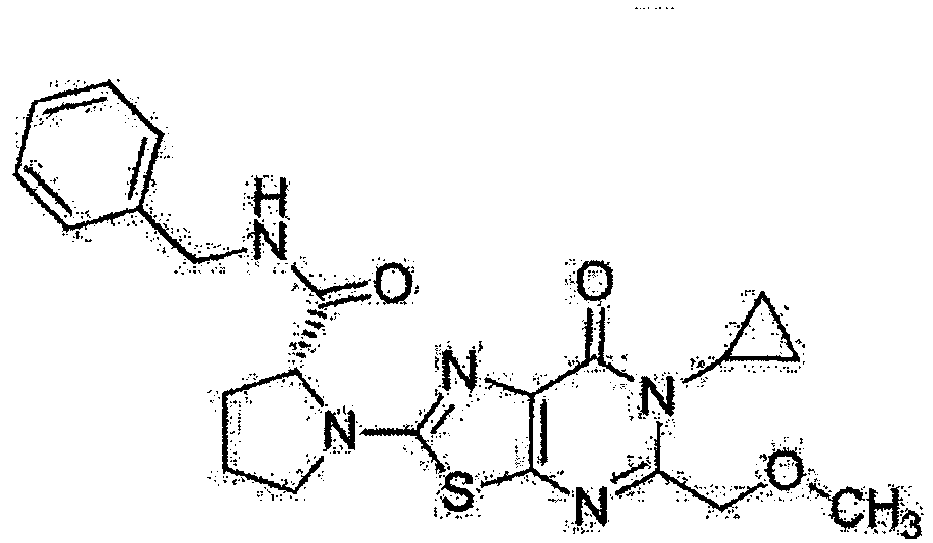
- The compound (263 mg) obtained in Reference Example 273 was treated by a method similar to that in Example 257 to give the title compound (277 mg).
MS (ESI) m/z; 440 [M+H]+ -

- The compound (200 mg) obtained in Reference Example 281 was treated by a method similar to that in Example 257 to give the title compound (215 mg).
MS (ESI) m/z; 454 [M+H]+ -

- The compound (300 mg) obtained in Reference Example 295 was treated by a method similar to that in Example 257 to give the title compound (100 mg).
MS (ESI) m/z; 428 [M+H]+ -

- The compound (155 mg) obtained in Reference Example 297 was treated by a method similar to that in Example 257 to give the title compound (140 mg).
MS (ESI) m/z; 463 [M+H]+ -

- The compound (242 mg) obtained in Reference Example 302 was treated by a method similar to that in Example 257 to give the title compound (146 mg).
MS (ESI) m/z; 414 [M+H]+ -

- The compound (200 mg) obtained in Reference Example 322 was treated by a method similar to that in Example 257 to give the title compound (95 mg).
MS (ESI) m/z; 440 [M+H]+ -

- The compound (220 mg) obtained in Reference Example 332 was treated by a method similar to that in Example 257 to give the title compound (95 mg).
MS (ESI) m/z; 521 [M+H]+ -

- To a solution (6.0 mL) of the compound (233 mg) obtained in Reference Example 268 in DMF were added (D)-proline (110 mg) and cesium carbonate (479 mg), and the reaction mixture was stirred with heating at 70°C for 1 hr. The reaction mixture was cooled to 0°C, and neutralized with concentrated hydrochloric acid. N,N-diisopropylethylamine (223 pL), benzyl-α,α-D2-amine (140 mg), EDC hydrochloride (245 mg) and HOBt monohydrate (196 mg) were added to the reaction mixture at room temperature, and the reaction mixture was stirred at room temperature overnight. Water was added to the reaction mixture, and the mixture was extracted three times with ethyl acetate. The combined organic layer was dried over anhydrous sodium sulfate, filtered and concentrated. The residue was purified by silica gel column chromatography (solvent; hexane/ethyl acetate=50/50 - 0/100) to give the title compound (210 mg).
MS (ESI) m/z; 448 [M+H]+ -

- The compound (327 mg) obtained in Reference Example 276 was treated by a method similar to that in Example 265 to give the title compound (389 mg).
MS (ESI) m/z; 434 [M+H]+ -

- The compound (194 mg) obtained in Reference Example 276 was treated by a method similar to that in Example 265 to give the title compound (226 mg).
MS (ESI) m/z; 448 [M+H]+ -

- The compound (220 mg) obtained in Reference Example 277 was treated by a method similar to that in Example 265 to give the title compound (225 mg).
MS (ESI) m/z; 428 [M+H]+ -

- The compound (54 mg) obtained in Reference Example 278 was treated by a method similar to that in Example 265 to give the title compound (54 mg).
MS (ESI) m/z; 444, 446 [M+H]+ -

- The compound (153 mg) obtained in Reference Example 277 was treated by a method similar to that in Example 265 to give the title compound (166 mg).
MS (ESI) m/z; 442 [M+H]+ -

- The compound (38 mg) obtained in Reference Example 278 was treated by a method similar to that in Example 265 to give the title compound (44 mg).
MS (ESI) m/z; 458, 460 [M+H]+ -

- The compound (254 mg) obtained in Reference Example 279 was treated by a method similar to that in Example 265 to give the title compound (303 mg).
MS (ESI) m/z; 448 [M+H]+ -

- The compound (500 mg) obtained in Reference Example 280 was treated by a method similar to that in Example 265 to give the title compound (472 mg).
MS (ESI) m/z; 497 [M+H]+ -

- The compound (356 mg) obtained in Reference Example 280 was treated by a method similar to that in Example 265 to give the title compound (328 mg).
MS (ESI) m/z; 511 [M+H]+ -

- The compound (129 mg) obtained in Reference Example 282 was treated by a method similar to that in Example 265 to give the title compound (152 mg).
MS (ESI) m/z; 464 [M+H]+ -

- The compound (157 mg) obtained in Reference Example 283 was treated by a method similar to that in Example 265 to give the title compound (125 mg).
MS (ESI) m/z; 538 [M+H]+ -

- The compound (146 mg) obtained in Reference Example 283 was treated by a method similar to that in Example 265 to give the title compound (120 mg).
MS (ESI) m/z; 552 [M+H]+ -

- The compound (251 mg) obtained in Reference Example 284 was treated by a method similar to that in Example 265 to give the title compound (117 mg).
MS (ESI) m/z; 476 [M+H]+ -

- The compound (135 mg) obtained in Reference Example 294 was treated by a method similar to that in Example 265 to give the title compound (135 mg).
MS (ESI) m/z; 478 [M+H]+ -

- The compound (300 mg) obtained in Reference Example 330 was treated by a method similar to that in Example 265 to give the title compound (371 mg).
MS (ESI) m/z; 461 [M+H]+ -

- The compound (247 mg) obtained in Reference Example 310 was treated by a method similar to that in Example 265 to give the title compound (333 mg).
MS (ESI) m/z; 420 [M+H]+ -

- The compound (200 mg) obtained in Reference Example 310 was treated by a method similar to that in Example 265 to give the title compound (253 mg).
MS (ESI) m/z; 434 [M+H]+ -

- The compound (317 mg) obtained in Reference Example 313 was treated by a method similar to that in Example 265 to give the title compound (284 mg).
MS (ESI) m/z; 478 [M+H]+ -

- The compound (250 mg) obtained in Reference Example 313 was treated by a method similar to that in Example 265 to give the title compound (283 mg).
MS (ESI) m/z; 482 [M+H]+ -

- The compound (400 mg) obtained in Reference Example 323 was treated by a method similar to that in Example 265 to give the title compound (311 mg).
MS (ESI) m/z; 479 [M+H]+ -

- The compound (200 mg) obtained in Reference Example 324 was treated by a method similar to that in Example 265 to give the title compound (114 mg).
MS (ESI) m/z; 479 [M+H]+ -

- The compound (200 mg) obtained in Reference Example 324 was treated by a method similar to that in Example 265 to give the title compound (113 mg).
MS (ESI) m/z; 493 [M+H]+ -

- The compound (140 mg) obtained in Reference Example 325 was treated by a method similar to that in Example 265 to give the title compound (147 mg).
MS (ESI) m/z; 495, 497 [M+H]+ -

- The compound (12.1 g) obtained in Reference Example 327 was treated by a method similar to that in Example 265 to give the title compound (12.4 g).
MS (ESI) m/z; 434 [M+H]+ -

- The compound (250 mg) obtained in Reference Example 327 was treated by a method similar to that in Example 265 to give the title compound (287 mg).
MS (ESI) m/z; 448 [M+H]+ -

- The compound (250 mg) obtained in Reference Example 327 was treated by a method similar to that in Example 265 to give the title compound (314 mg).
MS (ESI) m/z; 452 [M+H]+ -

- The compound (200 mg) obtained in Reference Example 327 was treated by a method similar to that in Example 265 to give the title compound (150 mg).
MS (ESI) m/z; 422 [M+H]+ -

- The compound (200 mg) obtained in Reference Example 327 was treated by a method similar to that in Example 265 to give the title compound (89 mg).
MS (ESI) m/z; 408 [M+H]+ -

- The compound (190 mg) obtained in Reference Example 331 was treated by a method similar to that in Example 265 to give the title compound (90 mg).
MS (ESI) m/z; 509 [M+H]+ -
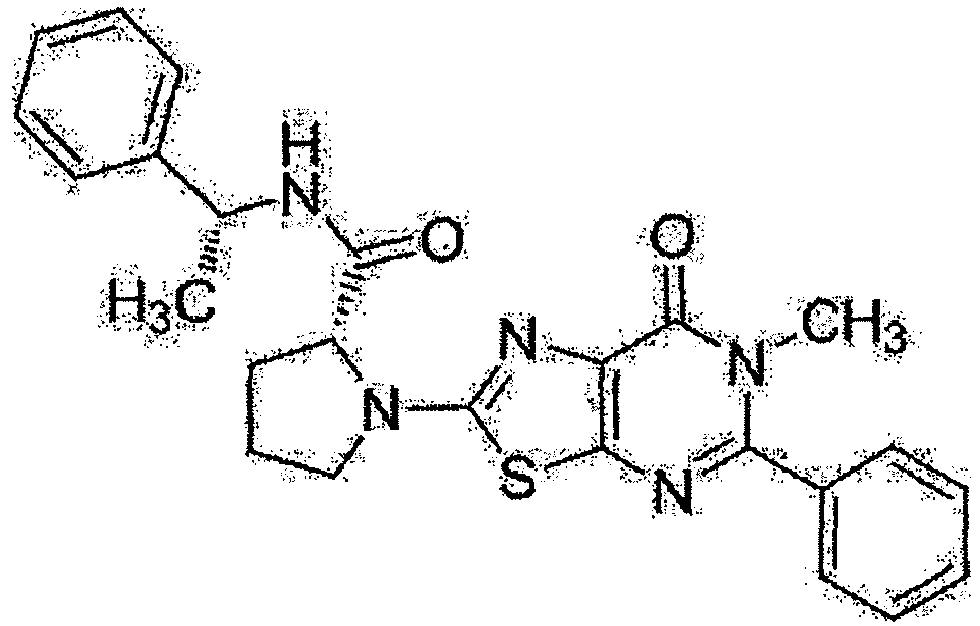
- To a solution (3.0 mL) of the compound (172 mg) obtained in Reference Example 268 in DMF were added (D)-proline (89 mg) and potassium carbonate (143 mg), and the reaction mixture was heated at 70°C for 3 hr. The reaction mixture was cooled to 0°C, and neutralized with concentrated hydrochloric acid (173 µL). N,N-diisopropylethylamine (135 µL), (R)-N-benzyl-1-phenylethylamine (139 µL), EDC hydrochloride (149 mg) and HOBt monohydrate (119 mg) were added to the reaction mixture at room temperature, and the reaction mixture was stirred at room temperature overnight. Water was added to the reaction mixture, and the mixture was extracted three times with ethyl acetate. The combined organic layer was dried over anhydrous sodium sulfate, filtered and concentrated. The residue was purified by NH silica gel column chromatography (solvent; hexane/ethyl acetate=70/30 - 0/100) to give the title compound (167 mg).
MS (ESI) m/z; 460 [M+H]+ -

- The compound (90 mg) obtained in Reference Example 321 was treated by a method similar to that in Example 295 to give the title compound (72 mg).
MS (ESI) m/z; 494 [M+H]+ -

- The compound (90 mg) obtained in Reference Example 321 was treated by a method similar to that in Example 295 to give the title compound (59 mg).
MS (ESI) m/z; 508 [M+H]+ -

- The compound (213 mg) obtained in Reference Example 329 was treated by a method similar to that in Example 295 to give the title compound (185 mg).
MS (ESI) m/z; 465 [M+H]+ -

- To a solution (4.0 mL) of the compound (200 mg) obtained in Reference Example 124 in DMF were added (R)-cyclopropylphenylmethylamine hydrochloride (160 mg), N,N-diisopropylethylamine (304 µL), EDC hydrochloride (167 mg) and HOBt monohydrate (133 mg), and the reaction mixture was stirred at room temperature overnight. Water was added to the reaction mixture, and the mixture was extracted twice with ethyl acetate. The organic layer was dried over anhydrous magnesium sulfate, filtered and concentrated. The residue was purified by silica gel column chromatography (solvent; hexane/ethyl acetate=70/30 - 20/80) to give the title compound (225 mg).
MS (ESI) m/z; 474 [M+H]+ -

- The compound (200 mg) obtained in Reference Example 124 was treated by a method similar to that in Example 299 to give the title compound (197 mg).
MS (ESI) m/z; 478 [M+H]+ -

- The compound (200 mg) obtained in Reference Example 124 was treated by a method similar to that in Example 299 to give the title compound (201 mg).
MS (ESI) m/z; 502 [M+H]+ -

- To a solution (0.5 mL) of the compound (48 mg) obtained in Reference Example 124 in DMF were added 3-cyanobenzylamine (16 mg), EDC hydrochloride (35 mg), HOBt monohydrate (24 mg) and N,N-diisopropylethylamine (23 mg), and the reaction mixture was stirred at room temperature for 3 hr. After confirmation of the completion of the reaction, water was added to the reaction mixture, and the mixture was extracted twice with chloroform. The solvent was evaporated under reduced pressure, and the residue was purified by Waters XTerra(R) column (solvent; 10 mmol/L aqueous ammonium carbonate solution/methanol) to give the title compound (21 mg).
MS (ESI) m/z; 459 [M+H]+ -

- The compound (48 mg) obtained in Reference Example 124 was treated by a method similar to that in Example 302 to give the title compound (36 mg).
MS (ESI) m/z; 476 [M+H]+ -
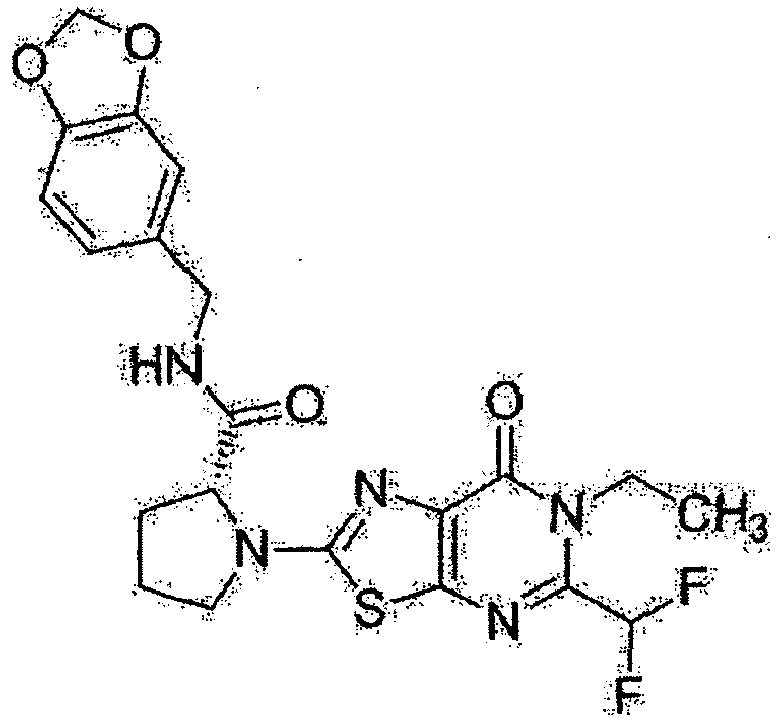
- The compound (48 mg) obtained in Reference Example 124 was treated by a method similar to that in Example 302 to give the title compound (43 mg).
MS (ESI) m/z; 478 [M+H]+ -

- The compound (48 mg) obtained in Reference Example 124 was treated by a method similar to that in Example 302 to give the title compound (43 mg).
MS (ESI) m/z; 452 [M+H]+ -

- The compound (48 mg) obtained in Reference Example 124 was treated by a method similar to that in Example 302 to give the title compound (41 mg).
MS (ESI) m/z; 477 [M+H]+ -

- The compound (48 mg) obtained in Reference Example 124 was treated by a method similar to that in Example 302 to give the title compound (43 mg).
MS (ESI) m/z; 424 [M+H]+ -

- The compound (48 mg) obtained in Reference Example 124 was treated by a method similar to that in Example 302 to give the title compound (43 mg).
MS (ESI) m/z; 464 [M+H]+ -

- The compound (48 mg) obtained in Reference Example 124 was treated by a method similar to that in Example 302 to give the title compound (46 mg).
MS (ESI) m/z; 440 [M+H]+ -

- The compound (48 mg) obtained in Reference Example 124 was treated by a method similar to that in Example 302 to give the title compound (29 mg).
MS (ESI) m/z; 494 [M+H]+ -

- The compound (48 mg) obtained in Reference Example 124 was treated by a method similar to that in Example 302 to give the title compound (39 mg).
MS (ESI) m/z; 439 [M+H]+ -

- The compound (48 mg) obtained in Reference Example 124 was treated by a method similar to that in Example 302 to give the title compound (44 mg).
MS (ESI) m/z; 452 [M+H]+ -

- The compound (48 mg) obtained in Reference Example 124 was treated by a method similar to that in Example 302 to give the title compound (45 mg) .
MS (ESI) m/z; 452 [M+B]+ -
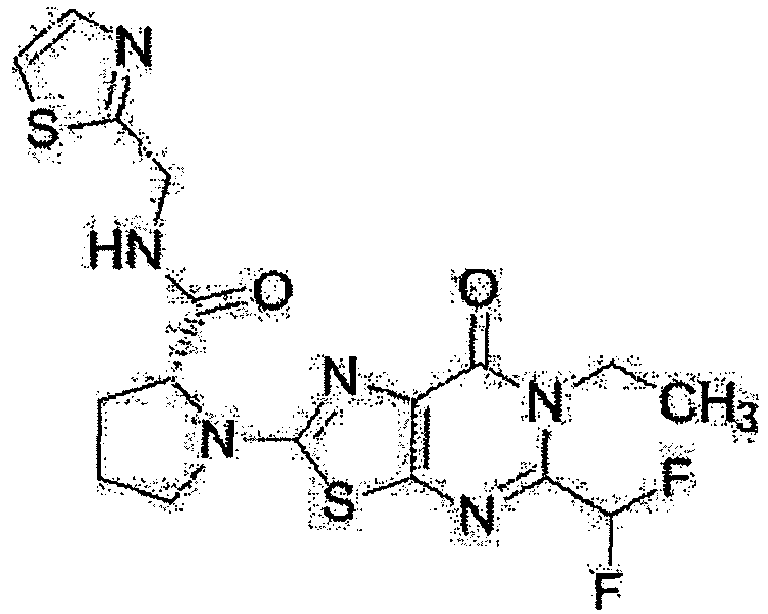
- The compound (48 mg) obtained in Reference Example 124 was treated by a method similar to that in Example 302 to give the title compound (44 mg).
MS (ESI) m/z; 441 [M+H]+ -

- The compound (48 mg) obtained in Reference Example 124 was treated by a method similar to that in Example 302 to give the title compound (44 mg).
MS (ESI) m/z; 477 [M+H]+ -

- The compound (48 mg) obtained in Reference Example 124 was treated by a method similar to that in Example 302 to give the title compound (40 mg).
MS (ESI) m/z; 459 [M+H]+ -

- The compound (48 mg) obtained in Reference Example 124 was treated by a method similar to that in Example 302 to give the title compound (47 mg).
MS (ESI) m/z; 477 [M+H]+ -

- The compound (48 mg) obtained in Reference Example 124 was treated by a method similar to that in Example 302 to give the title compound (49 mg).
MS (ESI) m/z; 491 [M+H]+ -

- The compound (48 mg) obtained in Reference Example 124 was treated by a method similar to that in Example 302 to give the title compound (31 mg)-MS (ESI) m/z; 478 [M+H]+
-

- The compound (48 mg) obt ained in Reference Example 124 was treated by a method similar to that in Example 302 to give the title compound (48 mg).
MS (ESI) m/z; 478 [M+H]+ -

- The compound (148 mg) obtained in Reference Example 355 was treated by a method similar to that in Example 178 to give the title compound (18 mg).
MS (ESI) m/z; 469 [M+H]+ -

- The compound (68 mg) obtained in Reference Example 351 was treated by a method similar to that in Example 257 to give the title compound (51 mg).
MS (ESI) m/z; 469 [M+H]+ -

- The compound (306 mg) obtained in Reference Example 352 was treated by a method similar to that in Example 257 to give the title compound (252 mg).
MS (ESI) m/z; 427 [M+H]+ -

- The compound (346 mg) obtained in Reference Example 356 was treated by a method similar to that in Example 257 to give the title compound (217 mg).
MS (ESI) m/z; 453 [M+H]+ -

- The compound (359 mg) obtained in Reference Example 357 was treated by a method similar to that in Example 257 to give the title compound (357 mg).
MS (ESI) m/z; 467 [M+H]+ -

- The compound (206 mg) obtained in Reference Example 353 was treated by a method similar to that in Example 295 to give the title compound (110 mg).
MS (ESI) m/z; 441 [M+H]+ -

- The compound (227 mg) obtained in Reference Example 354 was treated by a method similar to that in Example 295 to give the title compound (59 mg).
MS (ESI) m/z; 439 [M+H]+ -

- The compound (296 mg) obtained in Reference Example 358 was treated by a method similar to that in Example 295 to give the title compound (143 mg).
MS (ESI) m/z; 501 [M+H]+ -

- The compound (214 mg) obtained in Reference Example 359 was treated by a method similar to that in Example 295 to give the title compound (184 mg).
MS (ESI) m/z; 441 [M+H]+ -

- The compound (267 mg) obtained in Reference Example 360 was treated by a method similar to that in Example 295 to give the title compound (134 mg).
MS (ESI) m/z; 455 [M+H]+ -

- The compound (120 mg) obtained in Reference Example 361 was treated by a method similar to that in Example 295 to give the title compound (89 mg).
MS (ESI) m/z; 455 [M+H]+ -

- The compound (142 mg) obtained in Reference Example 362 was treated by a method similar to that in Example 295 to give the title compound (136 mg).
MS (ESI) m/z; 499 [M+H]+ -

- The compound (747 mg) obtained in Reference Example 363 was treated by a method similar to that in Example 295 to give the title compound (216 mg).
MS (ESI) m/z; 495 [M+H]+ -

- To a solution (4.0 mL) of the compound (174 mg) obtained in Reference Example 374 in DMF were added (D)-proline (81 mg) and cesium carbonate (344 mg), and the reaction mixture was heated at 80°C for 2 hr. The reaction mixture was cooled to room temperature, and neutralized with concentrated hydrochloric acid (180 µL). N,N-diisopropylethylamine (163 µL), benzylamine (102 µL), EDC hydrochloride (180 mg) and HOBt monohydrate (143 mg) were added to the reaction mixture, and the reaction mixture was stirred at room temperature overnight. Water was added to the reaction mixture, and the mixture was extracted three times with ethyl acetate. The combined organic layer was dried over anhydrous sodium sulfate, filtered and concentrated. The residue was purified by silica gel column chromatography (solvent; chloroform/methanol=100/0 - 95/5). To a solution (2.0 mL) of the obtained product in ethyl acetate was added hydrogen chloride (4.0 mol/L ethyl acetate solution, 57 µL), and the mixture was stirred for 5 min. The solvent was evaporated under reduced pressure, to the residue was added ethyl acetate, and the solid was collected by filtration and dried to give the title compound (75 mg).
MS (ESI) m/z; 512 [M+H]+ -

- The compound (278 mg) obtained in Reference Example 370 was treated by a method similar to that in Example 203 to give the title compound (241 mg).
MS (ESI) m/z; 413 [M+H]+ -

- The compound (274 mg) obtained in Reference Example 371 was treated by a method similar to that in Example 203 to give the title compound (108 mg).
MS (ESI) m/z; 439 [M+H]+ -

- The compound (205 mg) obtained in Reference Example 372 was treated by a method similar to that in Example 203 to give the title compound (96 mg).
MS (ESI) m/z; 453 [M+H]+ -

- The compound (277 mg) obtained in Reference Example 373 was treated by a method similar to that in Example 203 to give the title compound (74 mg).
MS (ESI) m/z; 455 [M+H]+ -

- The compound (214 mg) obtained in Reference Example 376 was treated by a method similar to that in Example 257 to give the title compound (166 mg).
MS (ESI) m/z; 455 [M+H]+ -

- The compound (49.0 mg) obtained in Reference Example 379 was treated by a method similar to that in Example 203 to give the title compound (38.0 mg) .
MS (ESI) m/z; 547 [M+H]+ -

- The compound (98 mg) obtained in Example 340 was dissolved in a mixture of trifluoroacetic acid/water/triethylsilane=90/5/5(v/v) (2 mL), and the mixture was stirred with heating at 65°C for 4 hr. The reaction mixture was concentrated, and the residue was purified by silica gel column chromatography (solvent; ethyl acetate/methanol=100/0 - 90/10). To the obtained product was added diisopropyl ether, and the solid was collected by filtration to give the title compound (80 mg).
MS (ESI) m/z; 427 [M+H]+ -

- The compound (207 mg) obtained in Reference Example 383 was treated by a method similar to that in Example 178 to give the title compound (160 mg).
MS (ESI) m/z; 428 [M+H]+ -

- The compound (122 mg) obtained in Reference Example 384 was treated by a method similar to that in Example 178 to give the title compound (77 mg).
MS (ESI) m/z; 458 [M+H]+ -

- The compound (180 mg) obtained in Reference Example 385 was treated by a method similar to that in Example 178 to give the title compound (124 mg).
MS (ESI) m/z; 472 [M+H]+ -

- The compound (147 mg) obtained in Reference Example 389 was treated by a method similar to that in Example 203 to give the title compound (164 mg).
MS (ESI) m/z; 464 [M+H]+ -

- The compound (326 mg) obtained in Reference Example 390 was treated by a method similar to that in Example 203 to give the title compound (250 mg).
MS (ESI) m/z; 476 [M+H]+ -

- The compound (350 mg) obtained in Reference Example 391 was treated by a method similar to that in Example 265 to give the title compound (363 mg).
MS (ESI) m/z; 451 [M+H]+ -

- The compound (500 mg) obtained in Reference Example 413 was treated by a method similar to that in Example 203 to give the title compound (522 mg).
MS (ESI) m/z; 593 [M+H]+ -

- The compound (500 mg) obtained in Reference Example 414 was treated by a method similar to that in Example 203 to give the title compound (486 mg).
MS (ESI) m/z; 593 [M+H]+ -

- The compound (2.40 g) obtained in Reference Example 415 was treated by a method similar to that in Example 203 to give the title compound (2.20 g).
MS (ESI) m/z; 521 [M+H-Boc]+ -

- The compound (1.36 g) obtained in Reference Example 416 was treated by a method similar to that in Example 203 to give the title compound (1.27 g).
MS (ESI) m/z; 507 [M+H-Boc]+ -

- The compound (899 mg) obtained in Reference Example 417 was treated by a method similar to that in Example 203 to give the title compound (790 mg).
MS (ESI) m/z; 507 [M+H-Boc]+ -

- The compound (1.30 g) obtained in Reference Example 418 was treated by a method similar to that in Example 203 to give the title compound (1.29 g).
MS (ESI) m/z; 507 [M+H-Boc]+ -

- The compound (700 mg) obtained in Reference Example 415 was treated by a method similar to that in Example 265 to give the title compound (540 mg).
MS (ESI) m/z; 509 [M+H-Boc]+ -

- The compound (250 mg) obtained in Reference Example 419 was treated by a method similar to that in Example 295 to give the title compound (256 mg).
MS (ESI) m/z; 581 [M+H]+ -

- To a solution (7.5 mL) of the compound (469 mg) obtained in Example 348 in methylene chloride was added trifluoroacetic acid (7.5 mL), and the reaction mixture was stirred at room temperature for 2 hr. The reaction mixture was concentrated, aqueous sodium hydrogen carbonate solution was added, and the mixture was extracted three times with chloroform. The organic layer was dried over anhydrous sodium sulfate, filtered and concentrated. The residue was purified by NH silica gel column chromatography (solvent; ethyl acetate/methanol=100/0 - 95/5), to the obtained product was added (hexane-ethyl acetate=1:1), and the solid was collected by filtration and dried to give the title compound (296 mg).
MS (ESI) m/z; 493 [M+H]+ -

- The compound (485 mg) obtained in Example 349 was treated by a method similar to that in Example 356 to give the title compound (319 mg).
MS (ESI) m/z; 493 [M+H]+ -

- The compound (2.20 g) obtained in Example 350 was treated by a method similar to that in Example 356 to give the title compound (1.75 g).
MS (ESI) m/z; 521 [M+H]+ -
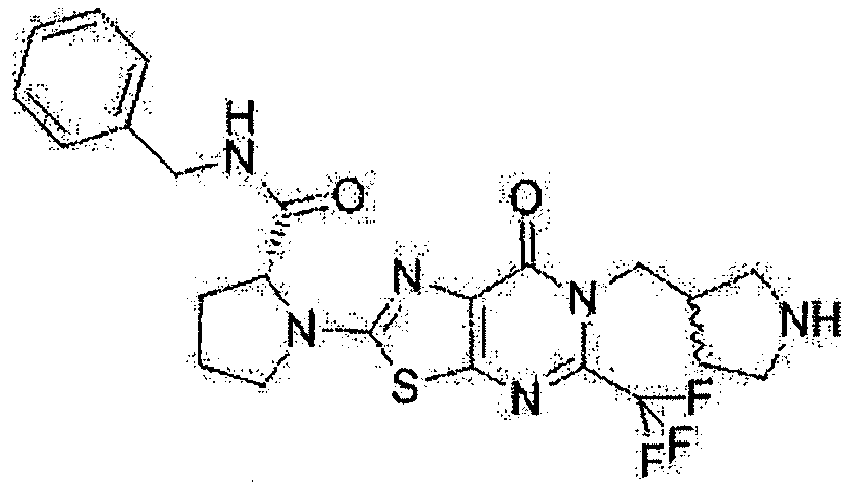
- The compound (950 mg) obtained in Example 351 was treated by a method similar to that in Example 356 to give the title compound (800 mg).
MS (ESI) m/z; 507 [M+H]+ -

- The compound (799 mg) obtained in Example 352 was treated by a method similar to that in Example 356 to give the title compound (625 mg).
MS (ESI) m/z; 507 [M+H]+ -

- The compound (1.29 g) obtained in Example 353 was treated by a method similar to that in Example 356 to give the title compound (653 mg).
MS (ESI) m/z; 507 [M+H]+ -

- The compound (540 mg) obtained in Example 354 was treated by a method similar to that in Example 356 to give the title compound (340 mg).
MS (ESI) m/z; 509 [M+H]+ -

- The compound (256 mg) obtained in Example 355 was treated by a method similar to that in Example 356 to give the title compound (155 mg).
MS (ESI) m/z; 481 [M+H]+ -

- To a solution (7.0 mL) of the compound (247 mg) obtained in Example 356 in methylene chloride was added 35 - 38% aqueous formaldehyde solution (204 mg). The reaction mixture was stirred at room temperature for 1 hr, sodium triacetoxyborohydride (319 mg) was added to the reaction mixture, and the reaction mixture was stirred at room temperature for 17 hr. Saturated aqueous sodium hydrogen carbonate solution was added to the reaction mixture, and the mixture was extracted three times with methylene chloride. The organic layer was dried over anhydrous sodium sulfate, filtered and concentrated. The residue was purified by NH silica gel column chromatography (solvent; ethyl acetate/methanol=100/0 - 93/7), to the obtained product was added (hexane/ethyl acetate=1:1), and the solid was collected by filtration and dried to give the title compound (187 mg).
MS (ESI) m/z; 507 [M+H]+ -

- The compound (174 mg) obtained in Example 357 was treated by a method similar to that in Example 364 to give the title compound (121 mg).
MS (ESI) m/z; 507 [M+H]+ -

- The compound (300 mg) obtained in Example 358 was treated by a method similar to that in Example 364 to give the title compound (180 mg).
MS (ESI) m/z; 535 [M+H]+ -
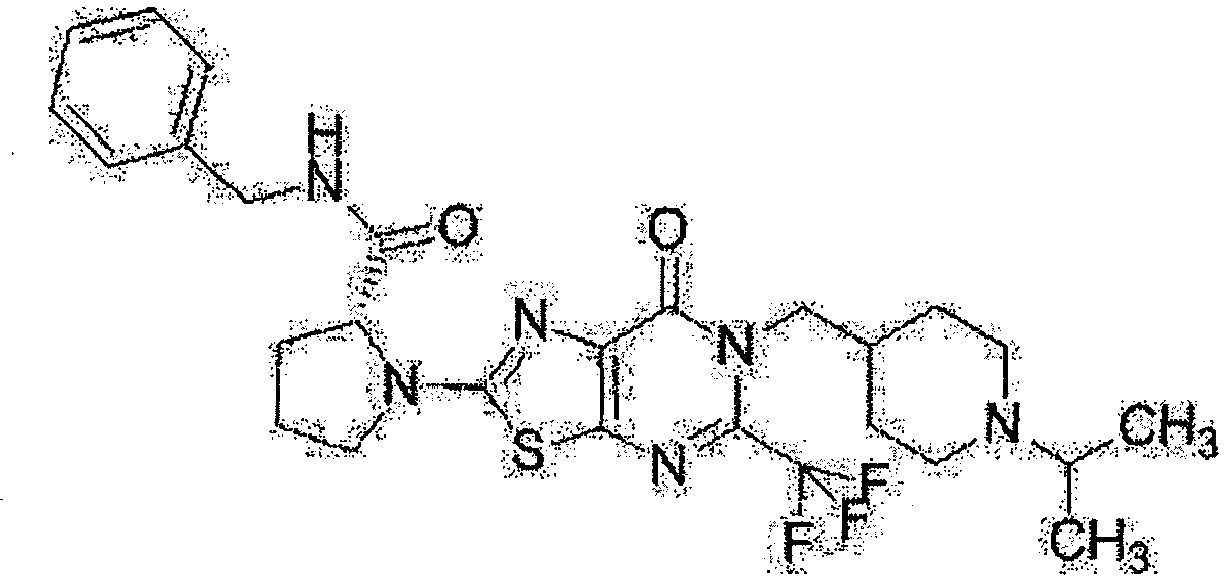
- The compound (250 mg) obtained in Example 358 was treated by a method similar to that in Example 364 to give the title compound (78.0 mg).
MS (ESI) m/z; 563 [M+H]+ -

- The compound (300 mg) obtained in Example 359 was treated by a method similar to that in Example 364 to give the title compound (250 mg).
MS (ESI) m/z; 521 [M+H]+ -

- The compound (231 mg) obtained in Example 360 was treated by a method similar to that in Example 364 to give the title compound (202 mg).
MS (ESI) m/z; 521 [M+H]+ -

- The compound (300 mg) obtained in Example 361 was treated by a method similar to that in Example 364 to give the title compound (250 mg).
MS (ESI) m/z; 521 [M+H]+ -

- The compound (270 mg) obtained in Example 362 was treated by a method similar to that in Example 364 to give the title compound (160 mg).
MS (ESI) m/z; 523 [M+H]+ -

- The compound (85.0 mg) obtained in Example 363 was treated by a method similar to that in Example 364 to give the title compound (75.0 mg).
MS (ESI) m/z; 495 [M+H]+ -

- To a solution (6.0 mL) of the compound (300 mg) obtained in Example 363 in DMF were added N,N-diisopropylethylamine (240 mg) and 2,2,2-trifluoroethyl trifluoromethanesulfonate (220 mg) under ice-cooling, and the reaction mixture was stirred at room temperature for 10 hr. Water was added to the reaction mixture, and the mixture was extracted twice with ethyl acetate. The combined organic layer was washed with saturated brine, dried over anhydrous sodium sulfate, filtered and concentrated. The residue was purified by silica gel column chromatography (solvent; chloroform/methanol=99/1 - 95/5). To a solution of the obtained crude product (300 mg) in acetone was added hydrogen chloride (4.0 mol/L ethyl acetate solution, 0.15 mL), and the mixture was stirred at room temperature for 10 min.
The solvent was evaporated under reduced pressure, to the obtained product was added hexane, and the solid was collected by filtration and dried to give the title compound (130 mg).
MS (ESI) m/z; 563 [M+H]+ -

- To a solution (2.8 mL) of the compound (162 mg) obtained in Reference Example 424 in DMF were added (D)-proline (72 mg) and potassium carbonate (116 mg), and the reaction mixture was heated at 80°C for 2 hr. The reaction mixture was cooled to 0°C, and neutralized with concentrated hydrochloric acid (494 µL). N,N-diisopropylethylamine (110 µL), benzylamine (92 µL), EDC hydrochloride (120 mg) and HOBt monohydrate (96 mg) were added to the reaction mixture at room temperature, and the reaction mixture was stirred at room temperature overnight. Water was added to the reaction mixture, and the mixture was extracted three times with ethyl acetate. The combined organic layer was dried over anhydrous sodium sulfate, filtered and concentrated. The residue was purified by NH silica gel column chromatography (solvent; hexane/ethyl acetate=70/30 - 0/100) to give the title compound (195 mg).
MS (ESI) m/z; 527 [M+H]+ -

- The compound (191 mg) obtained in Reference Example 425 was treated by a method similar to that in Example 374 to give the title compound (180 mg).
MS (ESI) m/z; 527 [M+H]+ -

- To a solution (0.5 mL) of the compound (100 mg) obtained in Example 374 in methylene chloride was added trifluoroacetic acid (1 mL), and the reaction mixture was stirred at room temperature for 3 hr. The reaction mixture was concentrated, to a solution (1.6 mL) of the residue in methylene chloride were added 35 - 38% aqueous formaldehyde solution (65 µL) and sodium triacetoxyborohydride (101 mg), and the reaction mixture was stirred at room temperature overnight. Saturated aqueous sodium hydrogen carbonate solution was added, and the mixture was extracted three times with chloroform. The organic layer was dried over anhydrous sodium sulfate, filtered and concentrated. The residue was purified by silica gel column chromatography (solvent; chloroform/methanol=100/0 - 90/10), and the obtained crude product was purified by reversed-phase HPLC (Capcelpak C18; 0.05% trifluoroacetic acid-water/acetonitrile=55/45 - 45/55). To the obtained product was added diisopropyl ether, and the solid was collected by filtration to give the title compound (38 mg).
MS (ESI) m/z; 441 [M+H]+ -

- The compound (95 mg) obtained in Example 375 was treated by a method similar to that in Example 376 to give the title compound (54 mg).
MS (ESI) m/z; 441 [M+H]+ -

- To a solution (4.0 mL) of the compound (246 mg) obtained in Reference Example 427 in DMF were added (D)-proline (101 mg) and potassium carbonate (201 mg), and the reaction mixture was heated at 70°C for 2 hr. The reaction mixture was cooled to 0°C, and neutralized with concentrated hydrochloric acid (239 µL). N,N-diisopropylethylamine (202 µL), benzylamine (127 µL), EDC hydrochloride (222 mg) and HOBt monohydrate (178 mg) were added to the reaction mixture at room temperature, and the reaction mixture was stirred at room temperature for 8 hr. Water was added to the reaction mixture, and the mixture was extracted twice with ethyl acetate. The combined organic layer was dried over anhydrous sodium sulfate, filtered and concentrated. The residue was purified by NH silica gel column chromatography (solvent; hexane/ethyl acetate=20/30 - 0/100) to give the title compound (286 mg) .
MS (ESI) m/z; 563 [M+H]+ -

- To a solution (1.0 mL) of the compound (286 mg) obtained in Example 378 in methylene chloride was added trifluoroacetic acid (2 mL), and the reaction mixture was stirred at room temperature for 6 hr. The reaction mixture was concentrated, aqueous sodium carbonate solution was added, and the mixture was extracted three times with chloroform. The organic layer was dried over anhydrous sodium sulfate, filtered and concentrated. The residue was purified by silica gel column chromatography (solvent; chloroform/methanol=100/0 - 90/10) to give the title compound (200 mg).
MS (ESI) m/z; 463 [M+H]+ -

- To a solution (1.8 mL) of the compound (100 mg) obtained in Example 379 in methylene chloride was added 35 - 38% aqueous formaldehyde solution (74 µL). The reaction mixture was stirred at room temperature for 1.5 hr, sodium triacetoxyborohydride (114 mg) was added to the reaction mixture, and the reaction mixture was stirred at room temperature overnight. Saturated aqueous sodium hydrogen carbonate solution was added to the reaction mixture, and the mixture was extracted three times with methylene chloride. The organic layer was dried over anhydrous sodium sulfate, filtered and concentrated. The residue was purified by silica gel column chromatography (solvent; chloroform/methanol=100/0 - 90/10), to the obtained product was added diisopropyl ether, and the solid was collected by filtration to give the title compound (94 mg) .
MS (ESI) m/z; 477 [M+H]+ -

- To a solution (4 mL) of the compound (260 mg) obtained in Reference Example 434 in DMF were added (D)-proline (132 mg) and potassium carbonate (211 mg), and the reaction mixture was heated at 80°C for 2.5 hr. The reaction mixture was cooled to room temperature, and acidified with 1.0 mol/L hydrochloric acid. Sodium chloride was added, and the mixture was extracted twice with chloroform. The organic layer was dried over anhydrous sodium sulfate, and filtered. Chloroform was evaporated under reduced pressure from the filtrate, to the obtained mixture were added N,N-diisopropylethylamine (199 µL), benzylamine (125 µL), EDC hydrochloride (219 mg) and HOBt monohydrate (175 mg), and the reaction mixture was stirred at room temperature for 17 hr. Water was added, and the mixture was extracted with ethyl acetate. The organic layer was dried over anhydrous sodium sulfate, filtered and concentrated. The residue was purified by silica gel column chromatography (solvent; chloroform/methanol=100/0 - 90/10). To the obtained product was added ethyl acetate/hexane=3/1, and the solid was collected by filtration to give the title compound (218.8 mg).
MS (ESI) m/z; 482 [M+H]+ -

- The compound (92 mg) obtained in Reference Example 435 was treated by a method similar to that in Example 381 to give the title compound (102 mg).
MS (ESI) m/z; 482 [M+H]+ -

- To a solution (8.0 mL) of the compound (215 mg) obtained in Example 381 and triethylamine (106 µL) in methylene chloride was added dropwise methanesulfonyl chloride (52 µL) under ice-cooling. After stirring at room temperature for 1.5 hr, the reaction mixture was concentrated. The obtained crude product was dissolved in acetonitrile (6.5 mL), and sodium iodide (134 mg) and dimethylamine (2.0 mol/L THF solution, 4.47 mL) were added. After stirring with heating at 65°C for 2 hr, the reaction mixture was concentrated. To the residue was added saturated aqueous sodium hydrogen carbonate solution, and the mixture was extracted twice with methylene chloride. The organic layer was dried over anhydrous sodium sulfate, filtered and concentrated. The residue was purified by silica gel column chromatography (solvent; ethyl acetate/methanol=100/0 - 93/7). To the obtained product was added ethyl acetate/hexane=1/1, and the solid was collected by filtration to give the title compound (123 mg).
MS (ESI) m/z; 509 [M+H]+ -

- To a solution (2.0 mL) of the compound (100 mg) obtained in Example 382 and triethylamine (76 µL) in methylene chloride was added dropwise methanesulfonyl chloride (38 µL) under ice-cooling. After stirring at room temperature for 2 hr, the reaction mixture was concentrated. The obtained crude product was dissolved in acetonitrile (3.0 mL), and sodium iodide (62 mg) and dimethylamine (2.0 mol/L THF solution, 2.08 mL) were added. After stirring with heating at 65°C for 2 hr, the reaction mixture was concentrated. To the residue was added saturated aqueous sodium hydrogen carbonate solution, and the mixture was extracted twice with methylene chloride. The organic layer was dried over anhydrous sodium sulfate, filtered and concentrated. The residue was purified by silica gel column chromatography (solvent; ethyl acetate/methanol=100/0 - 93/7). The obtained product was dissolved in ethyl acetate (2.0 mL), hydrogen chloride (4.0 mol/L ethyl acetate solution, 39 µL) was added, and the mixture was stirred for 30 min. The solvent was evaporated under reduced pressure, and the precipitated solid was collected by filtration to give the title compound (42 mg).
MS (ESI) m/z; 509 [M+H]+ -

- To a solution (18 mL) of the compound (750 mg) obtained in Reference Example 445 in DMF were added (D)-proline (480 mg) and potassium carbonate (760 mg), and the mixture was heated at 80°C for 1 hr. After cooling to 0°C, concentrated hydrochloric acid (920 µL) was added and the mixture was neutralized. N,N-diisopropylethylamine (540 mg), benzylamine (600 mg), EDC hydrochloride (800 mg) and HOBt monohydrate (640 mg) were added to the reaction mixture at room temperature, and the reaction mixture was stirred at room temperature overnight. Water was added to the reaction mixture, and the mixture was extracted three times with ethyl acetate. The combined organic layer was dried over anhydrous sodium sulfate, filtered and concentrated. The residue was purified by silica gel column chromatography (solvent; chloroform/methanol=100/0 - 90/10) to give the title compound (620 mg).
MS (ESI) m/z; 414 [M+H]+ -

- The compound (543 mg) obtained in Reference Example 446 was treated by a method similar to that in Example 385 to give the title compound (623 mg).
MS (ESI) m/z; 428 [M+H]+ -

- The compound (446 mg) obtained in Reference Example 447 was treated by a method similar to that in Example 385 to give the title compound (577 mg).
MS (ESI) m/z; 442 [M+H]+ -

- To a solution (8.0 mL) of the compound (480 mg) obtained in Example 385 and triethylamine (141 mg) in methylene chloride was added dropwise methanesulfonyl chloride (146 mg) under ice-cooling. Under ice-cooling, the reaction mixture was stirred for 1 hr. Chloroform was added to the reaction mixture, and the mixture was washed with water. The organic layer was dried over anhydrous sodium sulfate, filtered and concentrated. The obtained crude product was dissolved in acetonitrile (5.0 mL), and sodium iodide (90 mg) and dimethylamine (2.0 mol/L THF solution, 3.0 mL) were added. The reaction mixture was stirred with heating at 65°C for 2 hr, and concentrated. To the residue was added saturated aqueous sodium hydrogen carbonate solution, and the mixture was extracted three times with methylene chloride. The organic layer was dried over anhydrous sodium sulfate, filtered and concentrated. The residue was purified by silica gel column chromatography (solvent; chloroform/methanol=100/0 - 90/10). To the obtained product were added ethyl acetate and hexane, and the solid was collected by filtration and dried to give the title compound (110 mg).
MS (ESI) m/z; 441 [M+H]+ -

- The compound (240 mg) obtained in Example 385 was treated by a method similar to that in Example 388 to give the title compound (105 mg).
MS (ESI) m/z; 481 [M+H]+ -

- To a solution (1.0 mL) of the compound (60 mg) obtained in Example 386 and triethylamine (23 µL) in methylene chloride was added dropwise methanesulfonyl chloride (12 µL) under ice-cooling. Under ice-cooling, the mixture was stirred for 1.5 hr, diluted with ethyl acetate and washed with water. The organic layer was dried over anhydrous sodium sulfate, filtered and concentrated. The obtained crude product was dissolved in acetonitrile (1.0 mL), and sodium iodide (21 mg) and dimethylamine (2.0 mol/L THF solution, 700 µL) were added. After stirring with heating at 65°C for 3 hr, the reaction mixture was concentrated. Saturated aqueous sodium hydrogen carbonate solution was added, and the mixture was extracted three times with methylene chloride. The organic layer was dried over anhydrous sodium sulfate, filtered and concentrated. The residue was purified by NH silica gel column chromatography (solvent; ethyl acetate/methanol=100/0 - 90/10). The obtained product was dissolved in ethyl acetate (2.0 mL), and hydrogen chloride (4.0 mol/L ethyl acetate solution, 31 µL) was added. The precipitated solid was collected by filtration to give the title compound (43 mg).
MS (ESI) m/z; 455 [M+H]+ -

- The compound (100 mg) obtained in Example 387 was treated by a method similar to that in Example 390 to give the title compound (73 mg).
MS (ESI) m/z; 469 [M+H]+ -

- The compound (100 mg) obtained in Example 387 was treated by a method similar to that in Example 390 to give the title compound (37 mg).
MS (ESI) m/z; 455 [M+H]+ -

- To a solution (10 mL) of the compound (476 mg) obtained in Reference Example 451 in DMF were added (D)-proline (273 mg) and potassium carbonate (437 mg), and the reaction mixture was heated at 80°C for 1 hr. The reaction mixture was cooled to 0°C, and neutralized with concentrated hydrochloric acid (527 µL). N,N-diisopropylethylamine (413 µL), benzylamine (345 µL), EDC hydrochloride (454 mg) and HOBt monohydrate (363 mg) were added to the reaction mixture at room temperature, and the reaction mixture was stirred at room temperature overnight. Water was added to the reaction mixture, and the mixture was extracted three times with chloroform. The organic layer was dried over anhydrous sodium sulfate, filtered and concentrated. The residue was purified by NH silica gel column chromatography (solvent; ethyl acetate/methanol=100/0 - 95/5). To the obtained product was added diisopropyl ether, and the solid was collected by filtration to give the title compound (574 mg).
MS (ESI) m/z; 442 [M+H]+ -

- To a solution of the compound (50 mg) obtained in Example 393 in THF (1 mL) were added phthalimido (24 mg), triphenylphosphine (58 mg) and diisopropyl azodicarboxylate (1.9 mol/L toluene solution, 116 µL). The reaction mixture was stirred at room temperature for 1 hr, and concentrated. The residue was purified by NH silica gel column chromatography (solvent; hexane/ethyl acetate=50/50 - 0/100) to give the title compound (57 mg).
MS (ESI) m/z; 571 [M+H]+ -

- To a solution of the compound (57 mg) obtained in Example 394 in ethanol (1.0 mL) was added hydrazine monohydrate (49 µL), and the reaction mixture was stirred at room temperature for 6 hr. The reaction mixture was concentrated, to the residue was added methylene chloride, and the insoluble material was filtered off. The filtrate was concentrated, and the obtained crude product was dissolved in methylene chloride (1.5 mL). 35 - 38% Aqueous formaldehyde solution (86 µL) was added, and the reaction mixture was stirred at room temperature for 30 min. Sodium triacetoxyborohydride (106 mg) was added to the reaction mixture, and the reaction mixture was stirred at room temperature overnight. Saturated aqueous sodium hydrogen carbonate solution was added to the reaction mixture, and the mixture was extracted three times with methylene chloride. The organic layer was dried over anhydrous sodium sulfate, filtered and concentrated. The residue was purified by NH silica gel column chromatography (solvent; ethyl acetate/methanol=100/0 - 90/10). The obtained product was dissolved in ethyl acetate (1 mL), and hydrogen chloride (4.0 mol/L ethyl acetate solution, 30 µL) was added. The precipitated solid was collected by filtration to give the title compound (18 mg).
MS (ESI) m/z; 469 [M+H]+ -

- To a solution (9 mL) of the compound (468 mg) obtained in Reference Example 453 in DMF were added (D)-proline (247 mg) and potassium carbonate (395 mg), and the reaction mixture was heated at 80°C for 1 hr. The reaction mixture was cooled to room temperature, and acidified with 1.0 mol/L hydrochloric acid. Sodium chloride was added, and the mixture was extracted five times with chloroform. The organic layer was dried over anhydrous sodium sulfate, and filtered. Chloroform was evaporated under reduced pressure from the filtrate, to the obtained mixture were added N,N-diisopropylethylamine (374 µL), benzylamine (312 µL), EDC hydrochloride (412 mg) and HOBt monohydrate (329 mg), and the reaction mixture was stirred at room temperature overnight. Water was added, and the mixture was extracted five times with chloroform. The organic layer was dried over anhydrous sodium sulfate, filtered and concentrated. The residue was purified by NH silica gel column chromatography (solvent; hexane/ethyl acetate=70/30 - 0/100) to give the title compound (479 mg).
MS (ESI) m/z; 468 [M+H]+ -
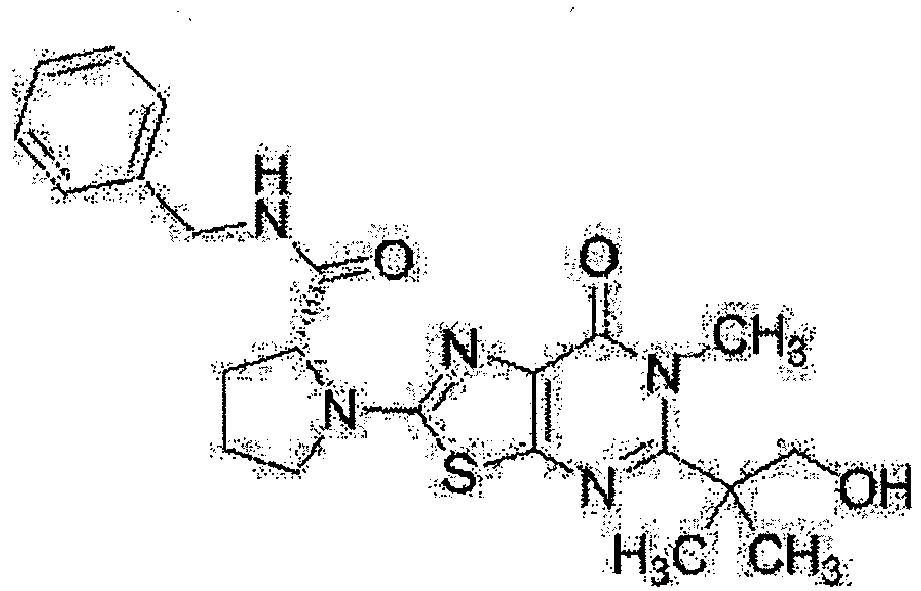
- To a solution (3.0 mL) of the compound (156 mg) obtained in Reference Example 457 in DMF solution (3.0 mL) were added (D)-proline (79 mg) and potassium carbonate (126 mg), and the reaction mixture was heated at 70°C for 3 hr. The reaction mixture was cooled to 0°C, and neutralized with concentrated hydrochloric acid (150 µL). N,N-diisopropylethylamine (119 µL), benzylamine (100 µL), EDC hydrochloride (131 mg) and HOBt monohydrate (105 mg) were added to the reaction mixture at room temperature, and the reaction mixture was stirred at room temperature overnight. Water was added to the reaction mixture, and the mixture was extracted twice with methylene chloride. The combined organic layer was dried over anhydrous sodium sulfate, filtered and concentrated. The residue was purified by NH silica gel column chromatography (solvent; ethyl acetate/methanol=100/0 - 95/5) to give the title compound (189 mg) .
MS (ESI) m/z; 442 [M+H]+ -

- To a solution (5 mL) of the compound (340 mg) obtained in Reference Example 461 in DMF were added (D)-proline (181 mg) and potassium carbonate (580 mg), and the reaction mixture was heated at 80°C for 1.5 hr. The reaction mixture was cooled to room temperature, and acidified with 1.0 mol/L hydrochloric acid. Sodium chloride was added, and the mixture was extracted twice with chloroform. The organic layer was dried over anhydrous magnesium sulfate, and filtered. Chloroform was evaporated under reduced pressure from the filtrate, to the obtained mixture were added N,N-diisopropylethylamine (295 µL), benzylamine (230 µL), EDC hydrochloride (403 mg) and HOBt monohydrate (322 mg), and the reaction mixture was stirred at room temperature overnight. Water was added, and the mixture was extracted with ethyl acetate. The organic layer was dried over anhydrous magnesium sulfate, filtered and concentrated. The residue was purified by silica gel column chromatography (solvent; chloroform/methanol=100/0 - 97/3) to give the title compound (375.2 mg).
MS (ESI) m/z; 476 [M+H]+ -

- The compound (192 mg) obtained in Reference Example 462 was treated by a method similar to that in Example 398 to give the title compound (142 mg).
MS (ESI) m/z; 476 [M+H]+ -

- The compound (136 mg) obtained in Reference Example 463 was treated by a method similar to that in Example 398 to give the title compound (155 mg).
MS (ESI) m/z; 476 [M+H]+ -

- To a solution (3.0 mL) of the compound (150 mg) obtained in Example 398 and triethylamine (100 µL) in methylene chloride was added dropwise methanesulfonyl chloride (37 µL) under ice-cooling, and the reaction mixture was stirred under ice-cooling for 30 min. Dimethylamine (2.0 mol/L THF solution, 1.6 mL) was added, and the reaction mixture was stirred with heating at room temperature for 2 hr, and concentrated. To the residue was added saturated aqueous sodium hydrogen carbonate solution, and the mixture was extracted three times with methylene chloride. The organic layer was dried over anhydrous magnesium sulfate, filtered and concentrated. The residue was purified by silica gel column chromatography (solvent; chloroform/methanol=100/0 - 97/3) to give the title compound (154 mg).
MS (ESI) m/z; 503 [M+H]+ -

- The compound (142 mg) obtained in Example 399 was treated by a method similar to that in Example 401 to give the title compound (60 mg).
MS (ESI) m/z; 503 [M+H]+ -

- The compound (155 mg) obtained in Example 400 was treated by a method similar to that in Example 401 to give the title compound (74 mg) .
MS (ESI) m/z; 503 [M+H]+ -

- To a solution (9.5 mL) of the compound (1.61 g) obtained in Reference Example 465 in DMF were added (D)-proline (690 mg) and cesium carbonate (3.0 g), and the reaction mixture was heated at 70°C for 2 hr. The reaction mixture was cooled to 0°C, and neutralized with concentrated hydrochloric acid. N,N-diisopropylethylamine (1.4 mL), benzylamine (880 µL), EDC hydrochloride (1.53 g) and HOBt monohydrate (1.23 g) were added to the reaction mixture at room temperature, and the reaction mixture was stirred at room temperature for 3 days. Water was added to the reaction mixture, and the mixture was extracted three times with ethyl acetate. The combined organic layer was dried over anhydrous magnesium sulfate, filtered and concentrated. The residue was purified by NH silica gel column chromatography (solvent; hexane/ethyl acetate=50/50 - 0/100) to give the title compound (542 mg).
MS (ESI) m/z; 543 [M+H]+ -

- To a solution (2.0 mL) of the compound (200 mg) obtained in Example 404 in methylene chloride was added trifluoroacetic acid (2 mL), and the reaction mixture was stirred at room temperature for 2 hr. The reaction mixture was concentrated, aqueous sodium hydrogen carbonate solution was added, and the mixture was extracted twice with chloroform. The organic layer was dried over anhydrous magnesium sulfate, filtered and concentrated. The residue was purified by silica gel column chromatography (solvent; chloroform/methanol=100/0 - 90/10) to give the title compound (75 mg).
MS (ESI) m/z; 443 [M+H]+ -

- To a solution (1.5 mL) of the compound (73 mg) obtained in Example 405 in methylene chloride was added 35 - 38% aqueous formaldehyde solution (57 µL). The reaction mixture was stirred at room temperature for 10 min, sodium triacetoxyborohydride (87 mg) was added to the reaction mixture, and the reaction mixture was stirred at room temperature for 2 hr. Saturated aqueous sodium hydrogen carbonate solution was added, and the mixture was extracted three times with methylene chloride. The organic layer was dried over anhydrous magnesium sulfate, filtered and concentrated. The residue was purified by silica gel column chromatography (solvent; chloroform/methanol=100/0 - 90/10) to give the title compound (45 mg).
MS (ESI) m/z; 457 [M+H]+ -
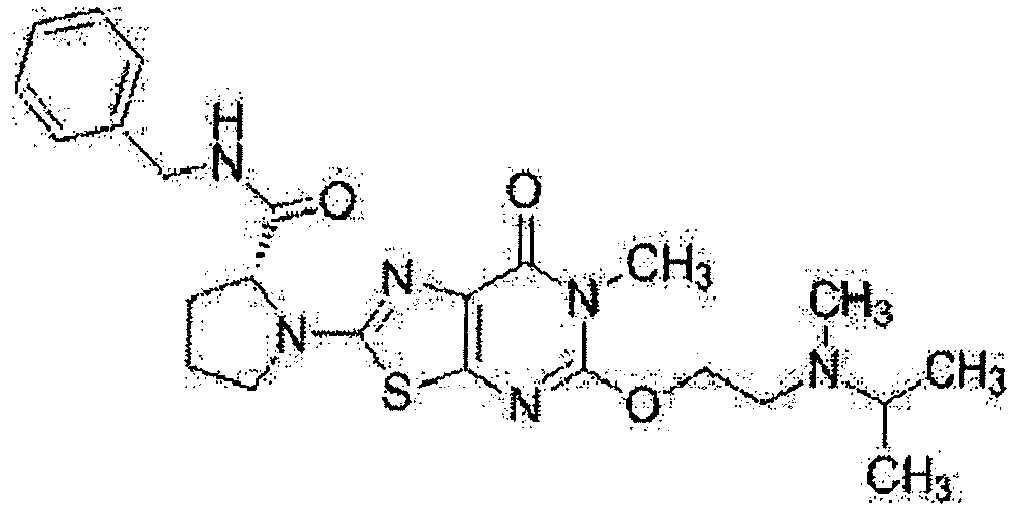
- The compound (47 mg) obtained in Example 405 and acetone (31 µL) were treated by a method similar to that in Example 406 to give the title compound (21 mg).
MS (ESI) m/z; 485 [M+H]+ -

- To a solution (2 mL) of the compound (63 mg) obtained in Reference Example 477 in DMF were added (D)-proline (44 mg) and potassium carbonate (79 mg), and the reaction mixture was heated at 80°C for 1 hr. The reaction mixture was cooled to room temperature, acidified with 1.0 mol/L hydrochloric acid, sodium chloride was added, and the mixture was extracted three times with chloroform. The organic layer was dried over magnesium sulfate, filtered and concentrated. The obtained residue was dissolved in DMF (2.0 mL), N,N-diisopropylethylamine (51 µL), benzylamine (31 µL), EDC hydrochloride (56 mg) and HOBt monohydrate (44 mg) were added, and the reaction mixture was stirred at room temperature for 2 hr. 0.5 mol/L Hydrochloric acid was added, and the mixture was extracted with ethyl acetate. The organic layer was washed with saturated brine, dried over anhydrous sodium sulfate, filtered and concentrated. The residue was purified by silica gel column chromatography (solvent; chloroform/methanol=100/0 - 95/5) to give the title compound (46 mg).
MS (ESI) m/z; 414 [M+H]+ -

- The compound (260 mg) obtained in Reference Example 478 was treated by a method similar to that in Example 408 to give the title compound (70 mg).
MS (ESI) m/z; 426 [M+H]+ -

- The compound (156 mg) obtained in Reference Example 479 was treated by a method similar to that in Example 408 to give the title compound (100 mg).
MS (ESI) m/z; 440 [M+H]+ -

- To a solution (2 mL) of the compound (100 mg) obtained in Example 408 in chloroform was added manganese dioxide (210 mg), and the reaction mixture was stirred at 60°C for 9 hr. Manganese dioxide (210 mg) was added, and the reaction mixture was heated at 60°C for 4 hr. The reaction mixture was filtered through diatomaceous earth, the filtrate was concentrated, and the residue was purified by NH silica gel column chromatography (solvent; hexane/ethyl acetate=50/50 - 0/100). To the obtained product was added diisopropyl ether, and the solid was collected by filtration to give the title compound (78 mg).
MS (ESI) m/z; 412 [M+H]+ -

- The compound (200 mg) obtained in Reference Example 482 was treated by a method similar to that in Example 408 to give the title compound (220 mg).
MS (ESI) m/z; 440 [M+H]+ -

- The compound (383 mg) obtained in Reference Example 483 was treated by a method similar to that in Example 408 to give the title compound (280 mg).
MS (ESI) m/z; 454 [M+H]+ -

- To a solution (10.0 mL) of the compound (400 mg) obtained in Reference Example 558 in DMF were added (D)-proline (162 mg) and cesium carbonate (704 mg), and the reaction mixture was stirred with heating at 70°C for 1 hr. The reaction mixture was cooled to room temperature, and neutralized with 1.0 mol/L hydrochloric acid. To the obtained mixture were added N,N-diisopropylethylamine (0.327 mL), benzylamine (0.206 mL), EDC hydrochloride (360 mg) and HOBt monohydrate (288 mg), and the reaction mixture was stirred at room temperature overnight. Water was added, and the mixture was extracted three times with ethyl acetate. The organic layer was dried over anhydrous sodium sulfate, filtered and concentrated. The residue was purified by silica gel column chromatography (solvent; hexane/ethyl acetate=70/30 - 20/80) to give the title compound (474 mg).
MS (ESI) m/z; 566 [M+H]+ -

- The compound (300 mg) obtained in Reference Example 558 was treated by a method similar to that in Example 178 to give the title compound (62 mg).
MS (ESI) m/z; 580 [M+H]+ -

- The compound (500 mg) obtained in Reference Example 560 was treated by a method similar to that in Example 178 to give the title compound (500 mg).
MS (ESI) m/z; 534 [M+H]+ -

- The compound (500 mg) obtained in Reference Example 560 was treated by a method similar to that in Example 178 to give the title compound (111 mg).
MS (ESI) m/z; 562 [M+H]+ -

- The compound (500 mg) obtained in Reference Example 560 was treated by a method similar to that in Example 178 to give the title compound (352 mg).
MS (ESI) m/z; 536 [M+H]+ -

- The compound (160 mg) obtained in Reference Example 562 was treated by a method similar to that in Example 178 to give the title compound (146 mg).
MS (ESI) m/z; 582 [M+H]+ -

- The compound (160 mg) obtained in Reference Example 562 was treated by a method similar to that in Example 178 to give the title compound (144 mg).
MS (ESI) m/z; 596 [M+H]+ -

- The compound (391 mg) obtained in Reference Example 563 was treated by a method similar to that in Example 178 to give the title compound (298 mg).
MS (ESI) m/z; 600 [M+H]+ -

- The compound (391 mg) obtained in Reference Example 563 was treated by a method similar to that in Example 178 to give the title compound (348 mg).
MS (ESI) m/z; 614 [M+H]+ -

- The compound (570 mg) obtained in Reference Example 563 was treated by a method similar to that in Example 178 to give the title compound (45 mg).
MS (ESI) m/z; 586 [M+H]+ -

- The compound (300 mg) obtained in Reference Example 563 was treated by a method similar to that in Example 178 to give the title compound (95 mg).
MS (ESI) m/z; 614 [M+H]+ -
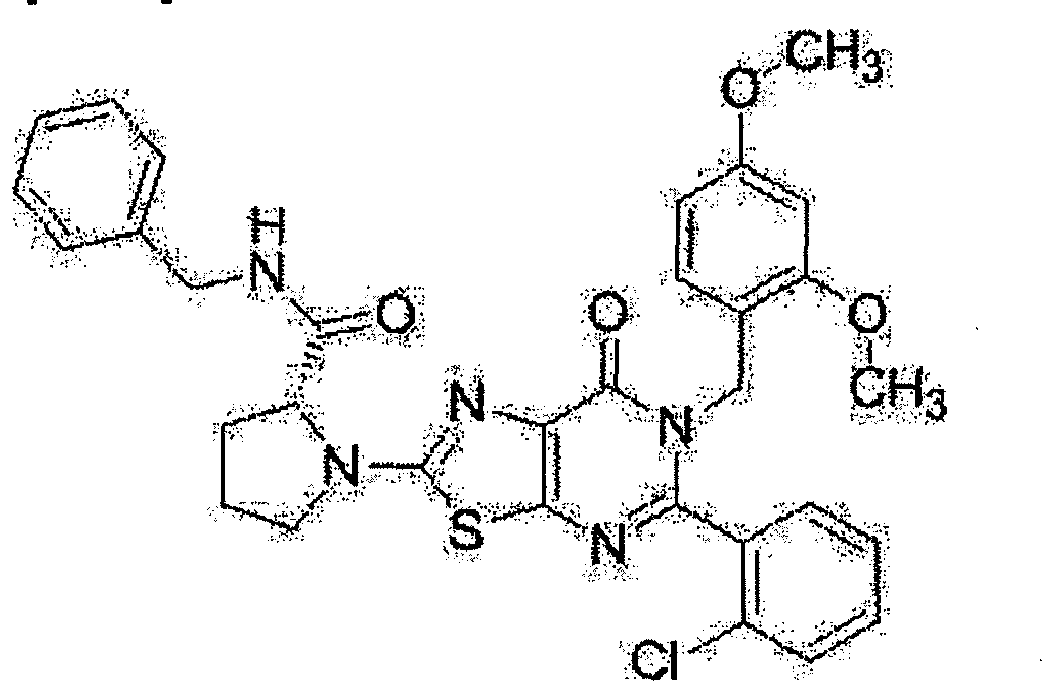
- The compound (274 mg) obtained in Reference Example 564 was treated by a method similar to that in Example 178 to give the title compound (200 mg).
MS (ESI) m/z; 616, 618 [M+H]+ -

- The compound (159 mg) obtained in Reference Example 565 was treated by a method similar to that in Example 178 to give the title compound (100 mg).
MS (ESI) m/z; 612 [M+H]+ -

- The compound (159 mg) obtained in Reference Example 565 was treated by a method similar to that in Example 178 to give the title compound (116 mg).
MS (ESI) m/z; 626 [M+H]+ -

- The compound (645 mg) obtained in Reference Example 566 was treated by a method similar to that in Example 178 to give the title compound (485 mg).
MS (ESI) m/z; 666 [M+H]+ -

- The compound (652 mg) obtained in Reference Example 567 was treated by a method similar to that in Example 178 to give the title compound (507 mg).
MS (ESI) m/z; 596 [M+H]+ -

- The compound (287 mg) obtained in Reference Example 568 was treated by a method similar to that in Example 178 to give the title compound (285 mg).
MS (ESI) m/z; 618 [M+H]+ -

- The compound (287 mg) obtained in Reference Example 568 was treated by a method similar to that in Example 178 to give the title compound (300 mg).
MS (ESI) m/z; 632 [M+H]+ -

- The compound (265 mg) obtained in Reference Example 577 was treated by a method similar to that in Example 178 to give the title compound (304 mg).
MS (ESI) m/z; 602 [M+H]+ -
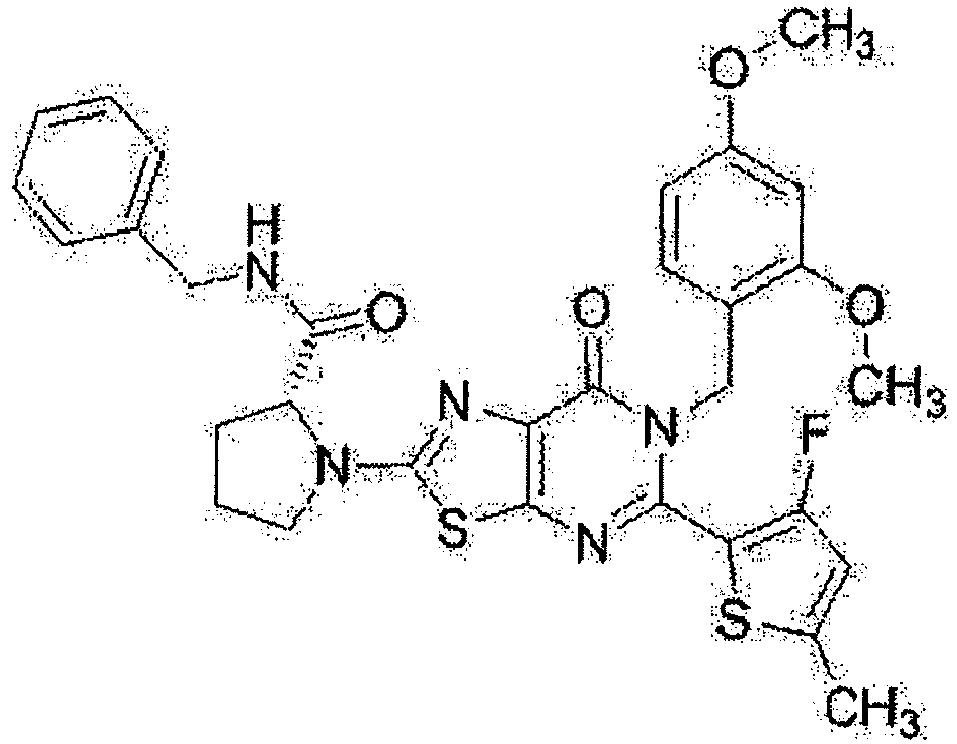
- The compound (408 mg) obtained in Reference Example 583 was treated by a method similar to that in Example 178 to give the title compound (442 mg).
MS (ESI) m/z; 620 [M+H]+ -

- The compound (440 mg) obtained in Reference Example 585 was treated by a method similar to that in Example 178 to give the title compound (359 mg).
MS (ESI) m/z; 724 [M+H]+ -
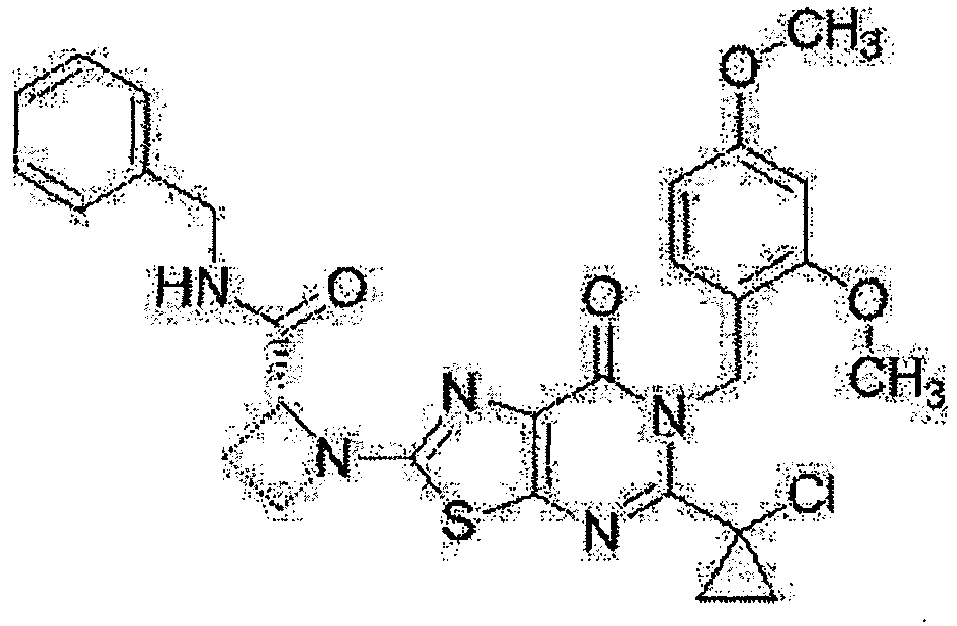
- The compound (240 mg) obtained in Reference Example 586 was treated by a method similar to that in Example 178 to give the title compound (191 mg).
MS (ESI) m/z; 566 [M+H]+ -

- The compound (300 mg) obtained in Reference Example 586 was treated by a method similar to that in Example 178 to give the title compound (171 mg).
MS (ESI) m/z; 594 [M+H]+ -

- The compound (165 mg) obtained in Reference Example 591 was treated by a method similar to that in Example 178 to give the title compound (129 mg).
MS (ESI) m/z; 570 [M+H]+ -

- The compound (101 mg) obtained in Reference Example 592 was treated by a method similar to that in Example 178 to give the title compound (63 mg).
MS (ESI) m/z; 570 [M+H]+ -

- The compound (284 mg) obtained in Reference Example 594 was treated by a method similar to that in Example 178 to give the title compound (294 mg).
MS (ESI) m/z; 588 [M+H]+ -

- The compound (300 mg) obtained in Reference Example 595 was treated by a method similar to that in Example 178 to give the title compound (197 mg).
MS (ESI) m/z; 588 [M+H]+ -

- The compound (225 mg) obtained in Reference Example 596 was treated by a method similar to that in Example 178 to give the title compound (143 mg).
MS (ESI) m/z; 588 [M+H]+ -

- The compound (159 mg) obtained in Reference Example 597 was treated by a method similar to that in Example 178 to give the title compound (136 mg).
MS (ESI) m/z; 600 [M+H]+ -

- The compound (238 mg) obtained in Reference Example 598 was treated by a method similar to that in Example 178 to give the title compound (254 mg).
MS (ESI) m/z; 580 [M+H]+ -

- The compound (164 mg) obtained in Reference Example 599 was treated by a method similar to that in Example 178 to give the title compound (130 mg).
MS (ESI) m/z; 620 [M+H]+ -

- The compound (341 mg) obtained in Reference Example 559 was treated by a method similar to that in Example 203 to give the title compound (418 mg).
MS (ESI) m/z; 534 [M+H]+ -

- The compound (511 mg) obtained in Reference Example 569 was treated by a method similar to that in Example 203 to give the title compound (515 mg).
MS (ESI) m/z; 634, 636 [M+H]+ -

- The compound (300 mg) obtained in Reference Example 578 was treated by a method similar to that in Example 203 to give the title compound (259 mg).
MS (ESI) m/z; 564 [M+H]+ -

- The compound (400 mg) obtained in Reference Example 579 was treated by a method similar to that in Example 203 to give the title compound (467 mg).
MS (ESI) m/z; 578 [M+H]+ -

- The compound (400 mg) obtained in Reference Example 580 was treated by a method similar to that in Example 203 to give the title compound (480 mg).
MS (ESI) m/z; 590 [M+H]+ -

- The compound (525 mg) obtained in Reference Example 581 was treated by a method similar to that in Example 203 to give the title compound (542 mg).
MS (ESI) m/z; 614 [M+H]+ -

- The compound (342 mg) obtained in Reference Example 582 was treated by a method similar to that in Example 203 to give the title compound (355 mg).
MS (ESI) m/z; 601 [M+H]+ -

- The compound (570 mg) obtained in Reference Example 587 was treated by a method similar to that in Example 203 to give the title compound (431 mg).
MS (ESI) m/z; 634, 636 [M+H]+ -

- The compound (528 mg) obtained in Reference Example 588 was treated by a method similar to that in Example 203 to give the title compound (534 mg).
MS (ESI) m/z; 574 [M+H]+ -

- The compound (415 mg) obtained in Reference Example 588 was treated by a method similar to that in Example 203 to give the title compound (455 mg).
MS (ESI) m/z; 588 [M+H]+ -

- The compound (187 mg) obtained in Reference Example 593 was treated by a method similar to that in Example 203 to give the title compound (220 mg).
MS (ESI) m/z; 588 [M+H]+ -

- The compound (282 mg) obtained in Reference Example 561 was treated by a method similar to that in Example 265 to give the title compound (219 mg).
MS (ESI) m/z; 550 [M+H]+ -

- The compound (200 mg) obtained in Reference Example 558 was treated by a method similar to that in Example 265 to give the title compound (232 mg).
MS (ESI) m/z; 580 [M+H]+ -

- The compound (300 mg) obtained in Reference Example 558 was treated by a method similar to that in Example 265 to give the title compound (271 mg).
MS (ESI) m/z; 554 [M+H]+ -

- The compound (369 mg) obtained in Reference Example 570 was treated by a method similar to that in Example 265 to give the title compound (457 mg).
MS (ESI) m/z; 564 [M+H]+ -

- The compound (255 mg) obtained in Reference Example 570 was treated by a method similar to that in Example 265 to give the title compound (296 mg).
MS (ESI) m/z; 578 [M+H]+ -

- The compound (127 mg) obtained in Reference Example 586 was treated by a method similar to that in Example 265 to give the title compound (117 mg).
MS (ESI) m/z; 581 [M+H]+ -

- The compound (88 mg) obtained in Reference Example 586 was treated by a method similar to that in Example 265 to give the title compound (76 mg).
MS (ESI) m/z; 595 [M+H]+ -
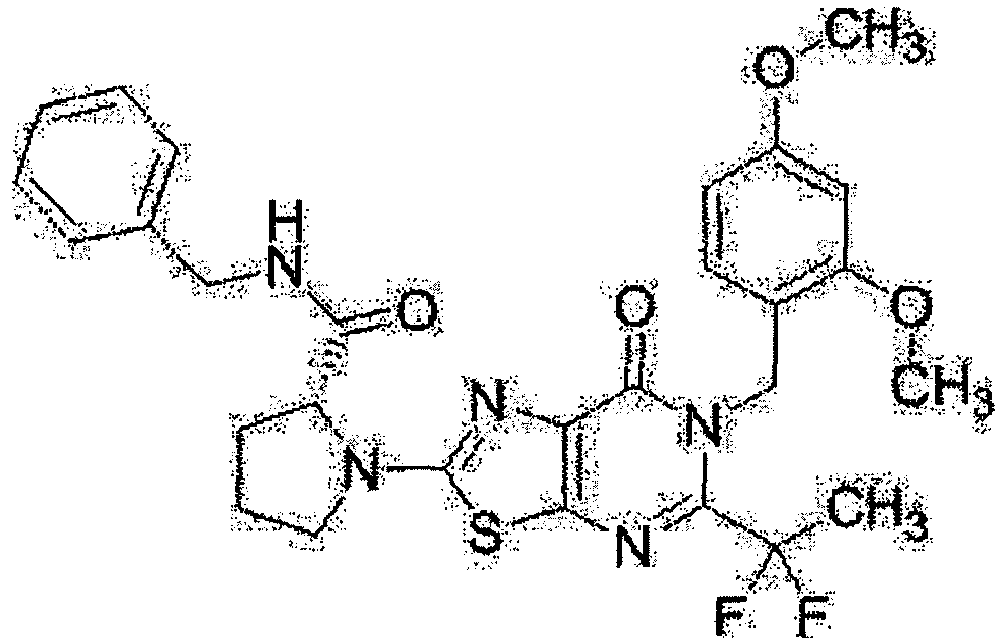
- The compound (528 mg) obtained in Reference Example 571 was treated by a method similar to that in Example 265 to give the title compound (498 mg).
MS (ESI) m/z; 570 [M+H]+ -

- The compound (570 mg) obtained in Reference Example 571 was treated by a method similar to that in Example 265 to give the title compound (596 mg).
MS (ESI) m/z; 584 [M+H]+ -
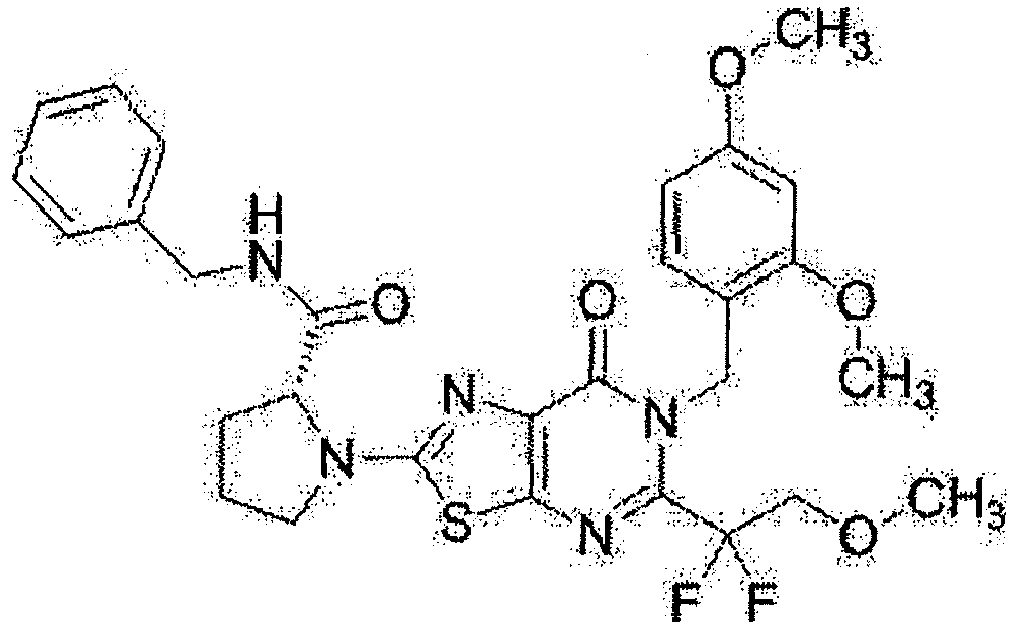
- The compound (1.05 g) obtained in Reference Example 572 was treated by a method similar to that in Example 265 to give the title compound (956 mg).
MS (ESI) m/z; 600 [M+H]+ -

- The compound (250 mg) obtained in Reference Example 572 was treated by a method similar to that in Example 265 to give the title compound (198 mg).
MS (ESI) m/z; 614 [M+H]+ -

- The compound (600 mg) obtained in Reference Example 573 was treated by a method similar to that in Example 265 to give the title compound (636 mg).
MS (ESI) m/z; 614 [M+H]+ -

- The compound (470 mg) obtained in Reference Example 573 was treated by a method similar to that in Example 265 to give the title compound (351 mg).
MS (ESI) m/z; 602 [M+H]+ -

- The compound (187 mg) obtained in Reference Example 574 was treated by a method similar to that in Example 265 to give the title compound (190 mg).
MS (ESI) m/z; 632 [M+H]+ -

- The compound (91 mg) obtained in Reference Example 574 was treated by a method similar to that in Example 265 to give the title compound (86 mg).
MS (ESI) m/z; 646 [M+H]+ -

- The compound (695 mg) obtained in Reference Example 575 was treated by a method similar to that in Example 265 to give the title compound (666 mg).
MS (ESI) m/z; 630 [M+H]+ -

- The compound (607 mg) obtained in Reference Example 576 was treated by a method similar to that in Example 265 to give the title compound (642 mg).
MS (ESI) m/z; 614 [M+H]+ -

- The compound (115 mg) obtained in Reference Example 584 was treated by a method similar to that in Example 265 to give the title compound (90 mg).
MS (ESI) m/z; 624 [M+H]+ -

- The compound (115 mg) obtained in Reference Example 584 was treated by a method similar to that in Example 265 to give the title compound (94 mg).
MS (ESI) m/z; 638 [M+H]+ -

- The compound (554 mg) obtained in Reference Example 562 was treated by a method similar to that in Example 265 to give the title compound (296 mg).
MS (ESI) m/z; 570 [M+H]+ -

- The compound (850 mg) obtained in Reference Example 563 was treated by a method similar to that in Example 265 to give the title compound (550 mg).
MS (ESI) m/z; 588 [M+H]+ -

- The compound (575 mg) obtained in Reference Example 586 was treated by a method similar to that in Example 265 to give the title compound (368 mg).
MS (ESI) m/z; 568 [M+H]+ -

- The compound (770 mg) obtained in Reference Example 570 was treated by a method similar to that in Example 265 to give the title compound (699 mg).
MS (ESI) m/z; 552 [M+H]+ -

- The compound (1.60 g) obtained in Reference Example 589 was treated by a method similar to that in Example 265 to give the title compound (1.75 g).
MS (ESI) m/z; 556 [M+H]+ -

- The compound (1.20 g) obtained in Reference Example 589 was treated by a method similar to that in Example 265 to give the title compound (1.37 g).
MS (ESI) m/z; 570 [M+H]+ -

- The compound (350 mg) obtained in Reference Example 590 was treated by a method similar to that in Example 265 to give the title compound (410 mg).
MS (ESI) m/z; 554 [M+H]+ -

- The compound (460 mg) obtained in Example 414 was dissolved in a mixture (5.0 mL) of trifluoroacetic acid/water/triethylsilane=90/5/5(v/v) under ice-cooling, and the mixture was stirred at room temperature for 2.5 hr. The reaction mixture was concentrated, and the residue was purified by silica gel column chromatography (solvent; chloroform/methanol=100/0 - 90/10) to give the title compound (304 mg).
MS (ESI) m/z; 416 [M+H]+ -

- The compound (61 mg) obtained in Example 415 was treated by a method similar to that in Example 482 to give the title compound (14 mg).
MS (ESI) m/z; 430 [M+H]+ -

- The compound (450 mg) obtained in Example 416 was treated by a method similar to that in Example 482 to give the title compound (240 mg).
MS (ESI) m/z; 384 [M+H]+ -

- The compound (110 mg) obtained in Example 417 was treated by a method similar to that in Example 482 to give the title compound (39 mg).
MS (ESI) m/z; 412 [M+H]+ -

- The compound (350 mg) obtained in Example 418 was treated by a method similar to that in Example 482 to give the title compound (175 mg).
MS (ESI) m/z; 386 [M+H]+ -

- The compound (143 mg) obtained in Example 419 was treated by a method similar to that in Example 482 to give the title compound (98 mg).
MS (ESI) m/z; 432 [M+H]+ -

- The compound (138 mg) obtained in Example 420 was treated by a method similar to that in Example 482 to give the title compound (84 mg).
MS (ESI) m/z; 446 [M+H]+ -

- The compound (19.9 g) obtained in Example 421 was treated by a method similar to that in Example 482 to give the title compound (13.9 g).
MS (ESI) m/z; 450 [M+H]+ -

- The compound (339 mg) obtained in Example 422 was treated by a method similar to that in Example 482 to give the title compound (196 mg).
MS (ESI) m/z; 464 [M+H]+ -

- The compound (44 mg) obtained in Example 423 was treated by a method similar to that in Example 482 to give the title compound (25 mg).
MS (ESI) m/z; 436 [M+H]+ -
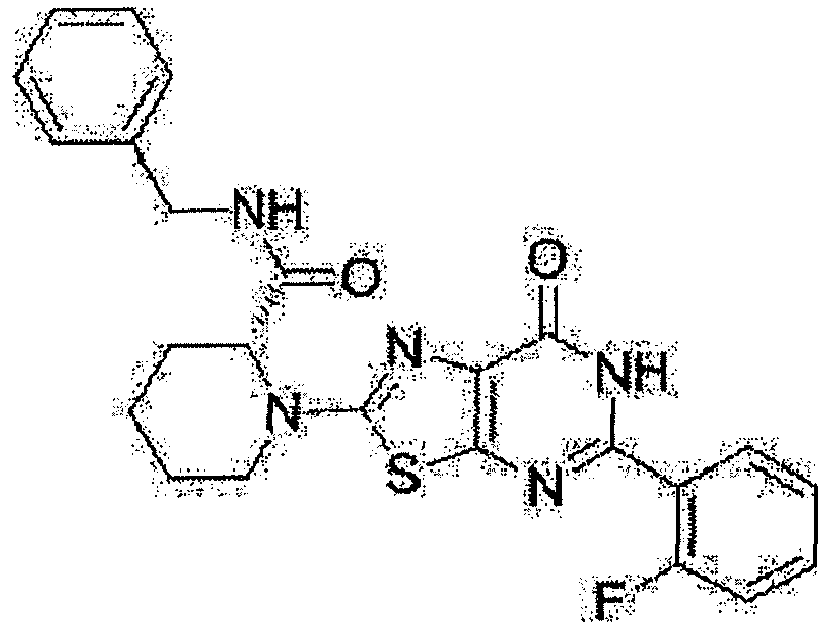
- The compound (92 mg) obtained in Example 424 was treated by a method similar to that in Example 482 to give the title compound (34 mg).
MS (ESI) m/z; 464 [M+H]+ -

- The compound (197 mg) obtained in Example 425 was treated by a method similar to that in Example 482 to give the title compound (137 mg).
MS (ESI) m/z; 466, 468 [M+H]+ -

- The compound (93 mg) obtained in Example 426 was treated by a method similar to that in Example 482 to give the title compound (41 mg).
MS (ESI) m/z; 462 [M+H]+ -

- The compound (111 mg) obtained in Example 427 was treated by a method similar to that in Example 482 to give the title compound (63 mg).
MS (ESI) m/z; 476 [M+H]+ -

- The compound (482 mg) obtained in Example 428 was treated by a method similar to that in Example 482 to give the title compound (285 mg).
MS (ESI) m/z; 516 [M+H]+ -
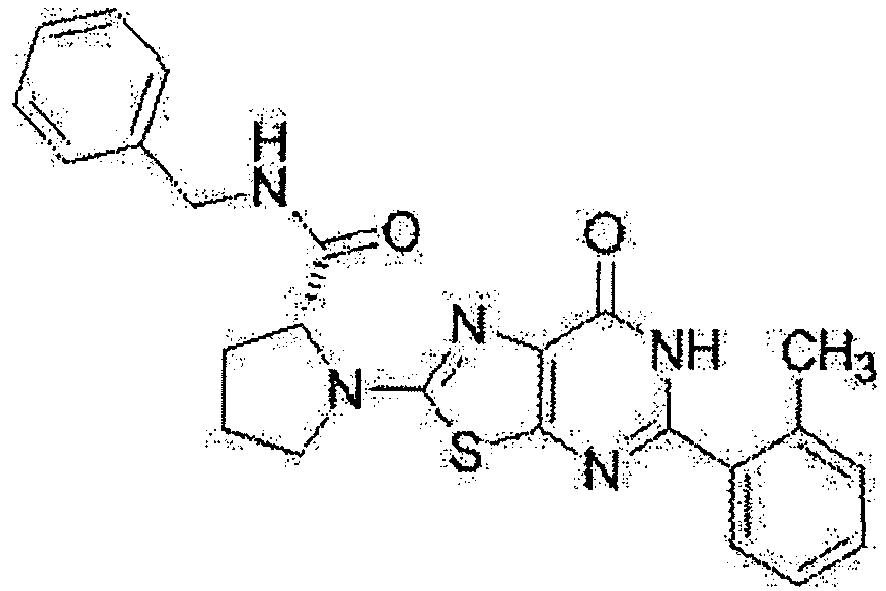
- The compound (498 mg) obtained in Example 429 was treated by a method similar to that in Example 482 to give the title compound (340 mg).
MS (ESI) m/z; 446 [M+H]+ -
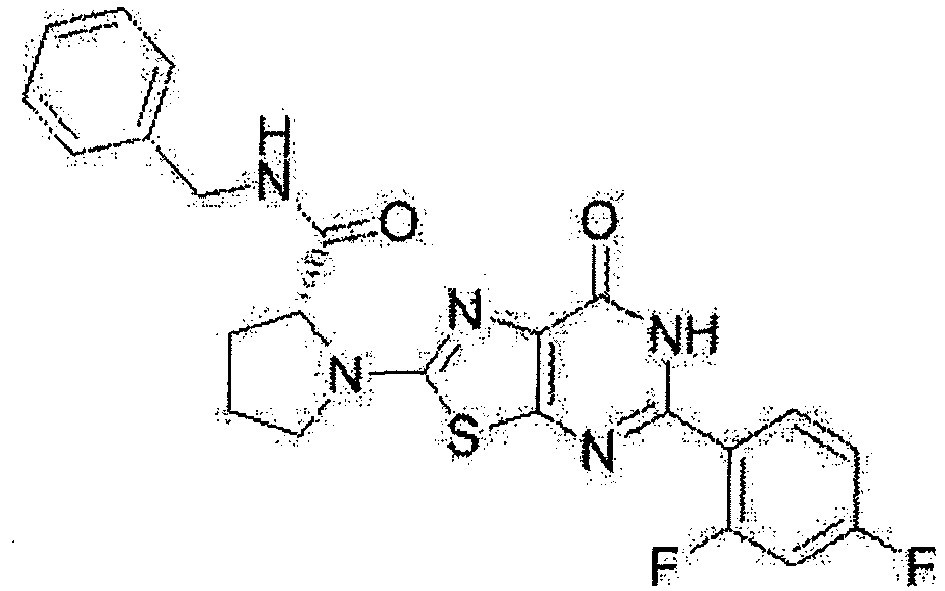
- The compound (270 mg) obtained in Example 430 was treated by a method similar to that in Example 482 to give the title compound (195 mg).
MS (ESI) m/z; 468 [M+H]+ -

- The compound (285 mg) obtained in Example 431 was treated by a method similar to that in Example 482 to give the title compound (179 mg).
MS (ESI) m/z; 482 [M+H]+ -

- The compound (300 mg) obtained in Example 432 was treated by a method similar to that in Example 482 to give the title compound (218 mg).
MS (ESI) m/z; 452 [M+H]+ -

- The compound (440 mg) obtained in Example 433 was treated by a method similar to that in Example 482 to give the title compound (319 mg).
MS (ESI) m/z; 470 [M+H]+ -

- The compound (180 mg) obtained in Example 435 was treated by a method similar to that in Example 482 to give the title compound (104 mg).
MS (ESI) m/z; 416 [M+H]+ -

- The compound (160 mg) obtained in Example 436 was treated by a method similar to that in Example 482 to give the title compound (50.0 mg).
MS (ESI) m/z; 444 [M+H]+ -

- The compound (418 mg) obtained in Example 445 was treated by a method similar to that in Example 482 to give the title compound (220 mg).
MS (ESI) m/z; 384 [M+H]+ -

- The compound (515 mg) obtained in Example 446 was treated by a method similar to that in Example 482 to give the title compound (254 mg).
MS (ESI) m/z; 484, 486 [M+H]+ -

- The compound (259 mg) obtained in Example 447 was treated by a method similar to that in Example 482 to give the title compound (100 mg).
MS (ESI) m/z; 414 [M+H]+ -

- The compound (467 mg) obtained in Example 448 was treated by a method similar to that in Example 482 to give the title compound (230 mg).
MS (ESI) m/z; 428 [M+H]+ -

- The compound (480 mg) obtained in Example 449 was treated by a method similar to that in Example 482 to give the title compound (320 mg) .
MS (ESI) m/z; 440 [M+H]+ -

- The compound (541 mg) obtained in Example 450 was treated by a method similar to that in Example 482 to give the title compound (229 mg).
MS (ESI) m/z; 464 [M+H]+ -

- The compound (344 mg) obtained in Example 451 was treated by a method similar to that in Example 482 to give the title compound (181 mg).
MS (ESI) m/z; 451 [M+H]+ -

- The compound (180 mg) obtained in Example 456 was treated by a method similar to that in Example 482 to give the title compound (147 mg).
MS (ESI) m/z; 400 [M+H]+ -

- The compound (220 mg) obtained in Example 457 was treated by a method similar to that in Example 482 to give the title compound (153 mg).
MS (ESI) m/z; 430 [M+H]+ -

- The compound (259 mg) obtained in Example 458 was treated by a method similar to that in Example 482 to give the title compound (176 mg) .
MS (ESI) m/z; 404 [M+H]+ -

- The compound (457 mg) obtained in Example 459 was treated by a method similar to that in Example 482 to give the title compound (260 mg).
MS (ESI) m/z; 414 [M+H]+ -

- The compound (296 mg) obtained in Example 460 was treated by a method similar to that in Example 482 to give the title compound (172 mg).
MS (ESI) m/z; 428 [M+H]+ -

- The compound (117 mg) obtained in Example 461 was treated by a method similar to that in Example 482 to give the title compound (48 mg).
MS (ESI) m/z; 430 [M+H]+ -

- The compound (76 mg) obtained in Example 462 was treated by a method similar to that in Example 482 to give the title compound (42 mg).
MS (ESI) m/z; 444 [M+H]+ -

- The compound (478 mg) obtained in Example 463 was treated by a method similar to that in Example 482 to give the title compound (338 mg).
MS (ESI) m/z; 420 [M+H]+ -

- The compound (575 mg) obtained in Example 464 was treated by a method similar to that in Example 482 to give the title compound (381 mg).
MS (ESI) m/z; 434 [M+H]+ -

- The compound (955 mg) obtained in Example 465 was treated by a method similar to that in Example 482 to give the title compound (649 mg).
MS (ESI) m/z; 450 [M+H]+ -
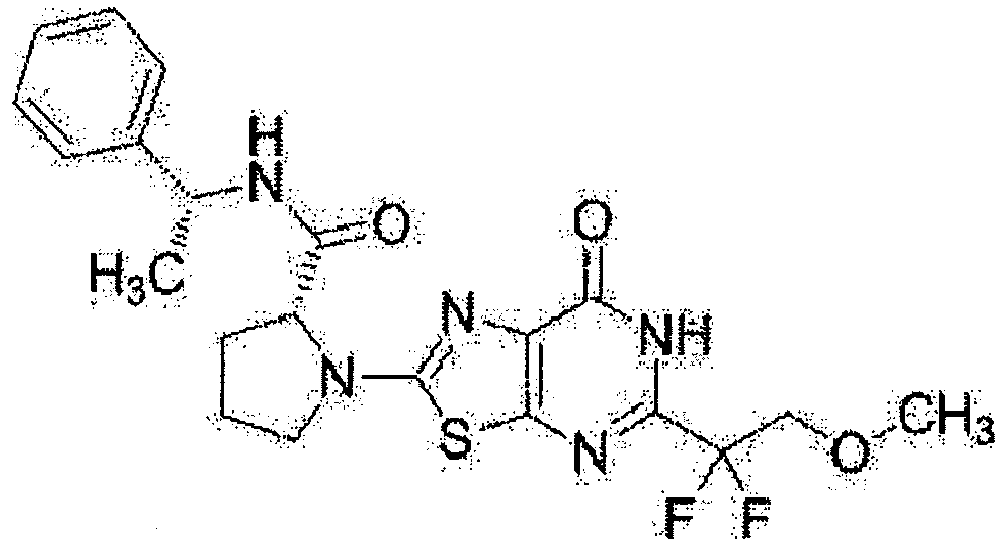
- The compound (175 mg) obtained in Example 466 was treated by a method similar to that in Example 482 to give the title compound (130 mg).
MS (ESI) m/z; 464 [M+H]+ -

- The compound (620 mg) obtained in Example 467 was treated by a method similar to that in Example 482 to give the title compound (427 mg).
MS (ESI) m/z; 464 [M+H]+ -

- The compound (233 mg) obtained in Example 468 was treated by a method similar to that in Example 482 to give the title compound (210 mg).
MS (ESI) m/z; 452 [M+H]+ -

- The compound (190 mg) obtained in Example 469 was treated by a method similar to that in Example 482 to give the title compound (118 mg).
MS (ESI) m/z; 482 [M+H]+ -
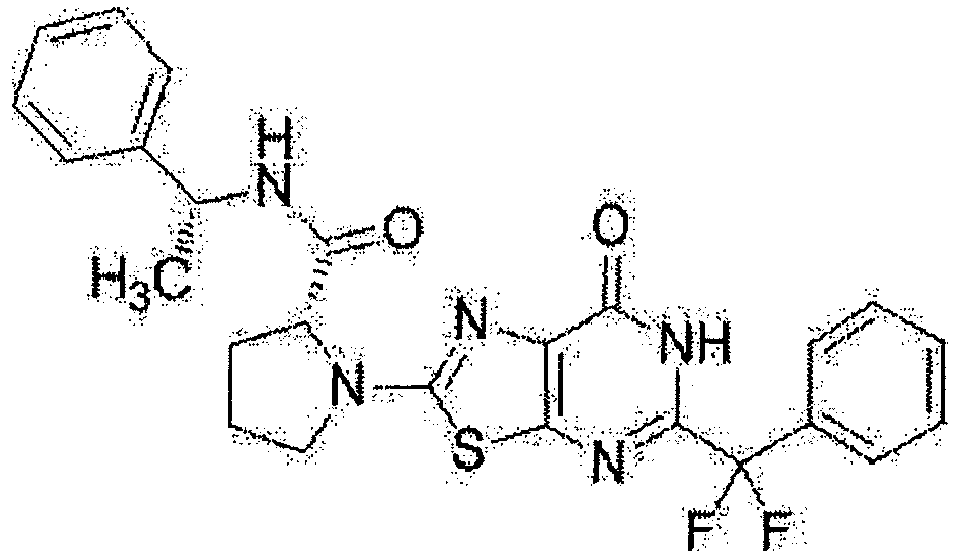
- The compound (85 mg) obtained in Example 470 was treated by a method similar to that in Example 482 to give the title compound (51 mg) .
MS (ESI) m/z; 496 [M+H]+ -

- The compound (640 mg) obtained in Example 471 was treated by a method similar to that in Example 482 to give the title compound (409 mg).
MS (ESI) m/z; 480 [M+H]+ -

- The compound (620 mg) obtained in Example 472 was treated by a method similar to that in Example 482 to give the title compound (419 mg).
MS (ESI) m/z; 464 [M+H]+ -

- The compound (89 mg) obtained in Example 473 was treated by a method similar to that in Example 482 to give the title compound (60 mg).
MS (ESI) m/z; 474 [M+H]+ -
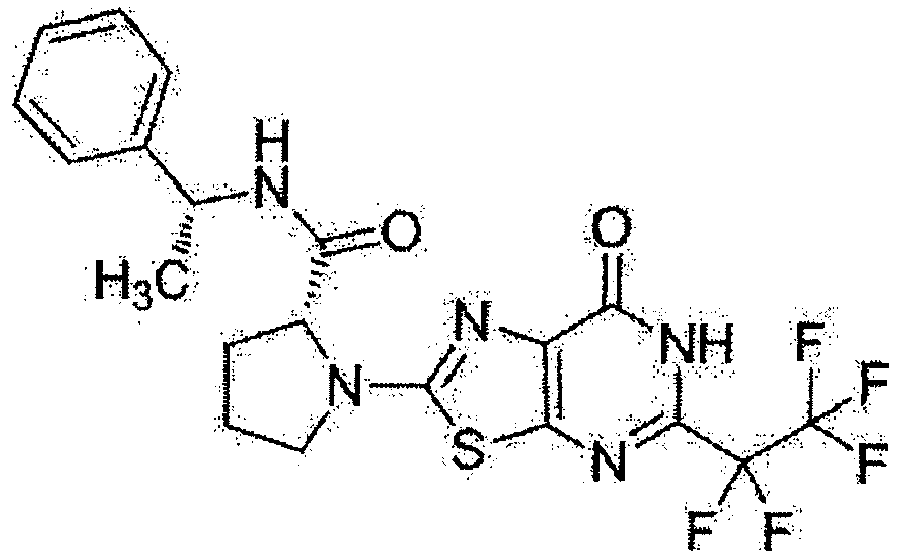
- The compound (90 mg) obtained in Example 474 was treated by a method similar to that in Example 482 to give the title compound (54 mg).
MS (ESI) m/z; 488 [M+H]+ -

- The compound (340 mg) obtained in Example 434 was treated by a method similar to that in Example 482 to give the title compound (248 mg).
MS (ESI) m/z; 574 [M+H]+ -

- The compound (280 mg) obtained in Example 475 was treated by a method similar to that in Example 482 to give the title compound (150 mg).
MS (ESI) m/z; 420 [M+H]+ -

- The compound (550 mg) obtained in Example 476 was treated by a method similar to that in Example 482 to give the title compound (318 mg).
MS (ESI) m/z; 438 [M+H]+ -

- The compound (350 mg) obtained in Example 477 was treated by a method similar to that in Example 482 to give the title compound (196 mg).
MS (ESI) m/z; 418 [M+H]+ -

- The compound (680 mg) obtained in Example 478 was treated by a method similar to that in Example 482 to give the title compound (410 mg).
MS (ESI) m/z; 402 [M+H]+ -

- The compound (431 mg) obtained in Example 452 was treated by a method similar to that in Example 482 to give the title compound (257 mg).
MS (ESI) m/z; 484, 486 [M+H]+ -

- The compound (534 mg) obtained in Example 453 was treated by a method similar to that in Example 482 to give the title compound (309 mg).
MS (ESI) m/z; 424 [M+H]+ -

- The compound (455 mg) obtained in Example 454 was treated by a method similar to that in Example 482 to give the title compound (253 mg).
MS (ESI) m/z; 438 [M+H]+ -

- The compound (1.30 g) obtained in Example 480 was treated by a method similar to that in Example 482 to give the title compound (900 mg).
MS (ESI) m/z; 420 [M+H]+ -

- The compound (1.70 g) obtained in Example 479 was treated by a method similar to that in Example 482 to give the title compound (1.29 g) .
MS (ESI) m/z; 406 [M+H]+ -

- The compound (125 mg) obtained in Example 437 was treated by a method similar to that in Example 482 to give the title compound (96 mg).
MS (ESI) m/z; 450 [M+H]+ -

- The compound (56 mg) obtained in Example 438 was treated by a method similar to that in Example 482 to give the title compound (23 mg) .
MS (ESI) m/z; 450 [M+H]+ -

- The compound (285 mg) obtained in Example 439 was treated by a method similar to that in Example 482 to give the title compound (160 mg).
MS (ESI) m/z; 468 [M+H]+ -

- The compound (194 mg) obtained in Example 440 was treated by a method similar to that in Example 482 to give the title compound (91 mg).
MS (ESI) m/z; 468 [M+H]+ -

- The compound (140 mg) obtained in Example 441 was treated by a method similar to that in Example 482 to give the title compound (62 mg).
MS (ESI) m/z; 468 [M+H]+ -
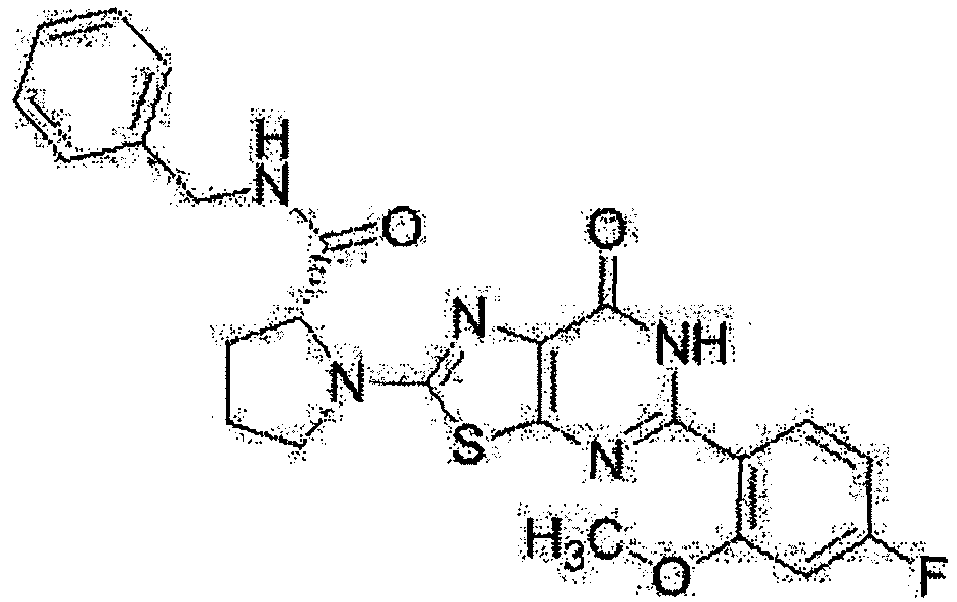
- The compound (118 mg) obtained in Example 442 was treated by a method similar to that in Example 482 to give the title compound (83 mg).
MS (ESI) m/z; 480 [M+H]+ -

- The compound (248 mg) obtained in Example 443 was treated by a method similar to that in Example 482 to give the title compound (116 mg).
MS (ESI) m/z; 460 [M+H]+ -

- The compound (125 mg) obtained in Example 444 was treated by a method similar to that in Example 482 to give the title compound (70 mg).
MS (ESI) m/z; 500 [M+H]+ -
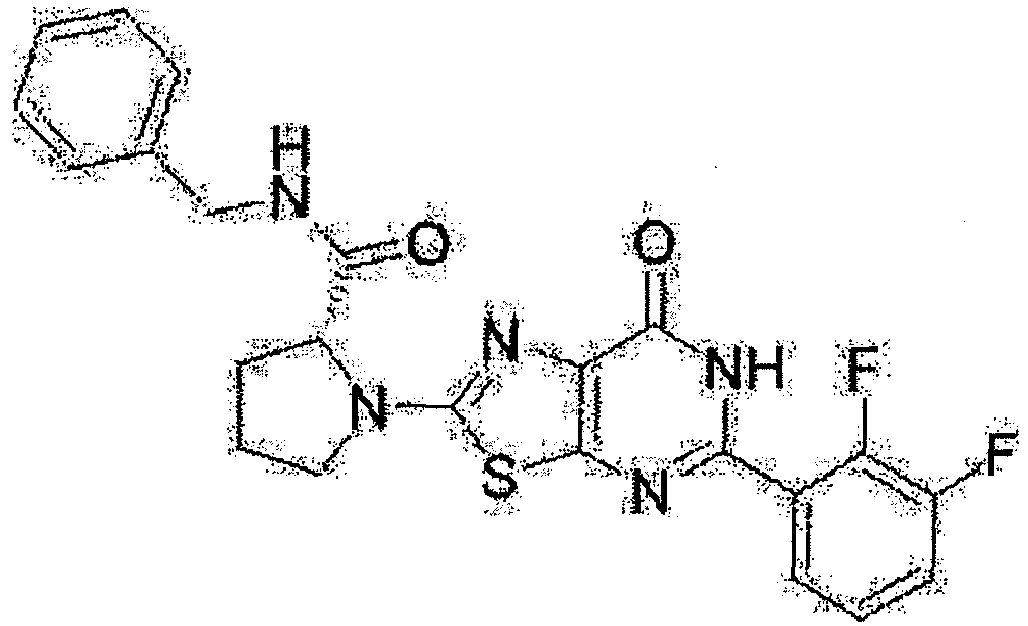
- The compound (219 mg) obtained in Example 455 was treated by a method similar to that in Example 482 to give the title compound (141 mg).
MS (ESI) m/z; 468 [M+H]+ -

- The compound (410 mg) obtained in Example 481 was treated by a method similar to that in Example 482 to give the title compound (305 mg).
MS (ESI) m/z; 434 [M+H]+ -

- The compound (280 mg) obtained in Reference Example 602 was treated by a method similar to that in Example 178 to give the title compound (200 mg).
MS (ESI) m/z; 613 [M+H]+ -

- The compound (360 mg) obtained in Reference Example 603 was treated by a method similar to that in Example 178 to give the title compound (220 mg).
MS (ESI) m/z; 613 [M+H]+ -

- The compound (200 mg) obtained in Example 550 was treated by a method similar to that in Example 482 to give the title compound (115 mg).
MS (ESI) m/z; 493 [M+H]+ -

- The compound (220 mg) obtained in Example 551 was treated by a method similar to that in Example 482 to give the title compound (100 mg).
MS (ESI) m/z; 493 [M+H]+ -

- The compound (168 mg) obtained in Reference Example 605 was treated by a method similar to that in Example 178 to give the title compound (83 mg).
MS (ESI) m/z; 574 [M+H]+ -

- The compound (60 mg) obtained in Example 554 was treated by a method similar to that in Example 482 to give the title compound (31 mg).
MS (ESI) m/z; 454 [M+H]+ -

- To a solution (5 mL) of the compound (230 mg) obtained in Example 518 in DMF were successively added potassium carbonate (114 mg) and trideuteriomethyl iodide (77 µL) at room temperature, and the reaction mixture was stirred at room temperature for 3 hr. Water was added to the reaction mixture, and the mixture was extracted with ethyl acetate. The organic layer was washed successively with water and saturated brine, dried over anhydrous sodium sulfate, filtered and concentrated under reduced pressure. The obtained residue was purified by silica gel column chromatography (solvent; hexane/ethyl acetate=60/40 - 20/80) to give the title compound (128 mg).
MS (ESI) m/z; 437 [M+H]+ -

- The compound (110 mg) obtained in Example 539 was treated by a method similar to that in Example 556 to give the title compound (57 mg).
MS (ESI) m/z; 423 [M+H]+ -

- The compound (640 mg) obtained in Example 520 was treated by a method similar to that in Example 556 to give the title compound (227 mg).
MS (ESI) m/z; 467 [M+H]+ -

- The compound (294 mg) obtained in Example 487 was treated by a method similar to that in Example 556 to give the title compound (45 mg).
MS (ESI) m/z; 449 [M+H]+ - N-[dideuterio(phenyl)methyl]-1-[7-oxo-5-phenyl-6-(trideuteriomethyl)-6,7-dihydro[1,3]thiazolo[5,4-d]pyrimidin-2-yl]pyrrolidine-2-carboxamide

- The compound (185 mg) obtained in Example 549 was treated by a method similar to that in Example 556 to give the title compound (26 mg).
MS (ESI) m/z; 451 [M+H]+ -

- The compound (110 mg) obtained in Example 500 was treated by a method similar to that in Example 556 to give the title compound (42 mg).
MS (ESI) m/z; 466 [M+H]+ -

- The compound (159 mg) obtained in Example 501 was treated by a method similar to that in Example 556 to give the title compound (23 mg).
MS (ESI) m/z; 484 [M+H]+ -

- The compound (200 mg) obtained in Example 507 was treated by a method similar to that in Example 556 to give the title compound (130 mg).
MS (ESI) m/z; 442 [M+H]+ -

- The compound (290 mg) obtained in Example 508 was treated by a method similar to that in Example 556 to give the title compound (110 mg).
MS (ESI) m/z; 454 [M+H]+ -

- To a solution (10 mL) of the compound (190 mg) obtained in Reference Example 610 in DMF were added (D)-proline (130 mg) and potassium carbonate (230 mg), and the reaction mixture was stirred with heating at 80°C for 1.5 hr. The reaction mixture was cooled to room temperature, acidified with 1.0 mol/L hydrochloric acid, and extracted twice with chloroform. The organic layer was dried over magnesium sulfate, filtered and concentrated. To the obtained residue were added benzylamine (85 mg), EDC hydrochloride (150 mg), HOBt monohydrate (120 mg) and N,N-diisopropylethylamine (100 mg), and the reaction mixture was stirred at room temperature for 15 hr. 0.5 mol/L Hydrochloric acid was added, and the mixture was extracted with ethyl acetate. The organic layer was washed with saturated brine, dried over anhydrous sodium sulfate, filtered and concentrated. The residue was purified by NH silica gel column chromatography (solvent; hexane/ethyl acetate=50/50 - 0/100) to give the title compound (120 mg).
MS (ESI) m/z; 484 [M+H]+ -

- To a solution (3 mL) of the compound (99 mg) obtained in Reference Example 613 in DMF were added (D)-proline (58 mg) and cesium carbonate (273 mg), and the reaction mixture was stirred with heating at 90°C for 1 hr. The reaction mixture was cooled to room temperature, acidified with 1.0 mol/L hydrochloric acid, and extracted twice with chloroform. The organic layer was dried over magnesium sulfate, filtered and concentrated. To a solution of the obtained residue in DMF (2.0 mL) were added benzylamine (73 µL), EDC hydrochloride (128 mg), HOBt monohydrate (103 mg) and N,N-diisopropylethylamine (120 µL), and the reaction mixture was stirred at room temperature for 3 hr. 0.5 mol/L Hydrochloric acid was added, and the mixture was extracted with ethyl acetate. The organic layer was washed with saturated aqueous sodium hydrogen carbonate solution and saturated brine, dried over anhydrous magnesium sulfate, filtered and concentrated. The residue was purified by silica gel column chromatography (solvent; ethyl acetate/methanol=100/0 - 95/5) to give the title compound (11.6 mg) .
MS (ESI) m/z; 436 [M+H]+ -

- To a solution (3.4 mL) of the compound (200 mg) obtained in Reference Example 268 in DMF were added (2R,4S)-4-[(tert-butoxycarbonyl)amino]pyrrolidine-2-carboxylic acid (226 mg) and cesium carbonate (533 mg), and the reaction mixture was heated at 70°C for 2.5 hr. The reaction mixture was cooled to room temperature, acidified with 1.0 mol/L hydrochloric acid, and extracted three times with chloroform. The organic layer was dried over magnesium sulfate, filtered and concentrated. To a solution of the obtained residue in DMF (2.0 mL) were added benzylamine (107 µL), EDC hydrochloride (188 mg), HOBt monohydrate (150 mg) and N,N-diisopropylethylamine (171 µL), and the reaction mixture was stirred at room temperature overnight. 1.0 mol/L Hydrochloric acid was added, and the mixture was extracted twice with ethyl acetate. The organic layer was washed with saturated brine, dried over anhydrous sodium sulfate, filtered and concentrated. The residue was purified by NH silica gel column chromatography (solvent; hexane/ethyl acetate=50/50 - 0/100) to give the title compound (237 mg).
MS (ESI) m/z; 561 [M+H]+ -

- The compound (200 mg) and (2R,4R)-4-[(tert-butoxycarbonyl)amino]pyrrolidine-2-carboxylic acid (226 mg) obtained in Reference Example 268 was treated by a method similar to that in Example 567 to give the title compound (227 mg) .
MS (ESI) m/z; 561 [M+H]+ -

- To a solution (3.9 mL) of the compound (179 mg) obtained in Example 567 in methanol was added hydrogen chloride (4.0 mol/L ethyl acetate solution, 0.8 mL), and the reaction mixture was stirred at room temperature for 3 hr. The resultant solid was collected by filtration, and dried to give the title compound (151 mg).
MS (ESI) m/z; 461 [M+H]+ -

- The compound (189 mg) obtained in Example 568 was treated by a method similar to that in Example 569 to give the title compound (178 mg).
MS (ESI) m/z; 461 [M+H]+ -

- To a solution (4 mL) of the compound (250 mg) obtained in Reference Example 617 in DMF were added (R)-piperidine-2-carboxylic acid (339 mg) and potassium carbonate (326 mg), and the reaction mixture was stirred with heating at 120°C for 5 hr. The reaction mixture was cooled to room temperature, and acidified with 1.0 mol/L hydrochloric acid. Sodium chloride was added, and the mixture was extracted three times with chloroform. The organic layer was dried over sodium sulfate, filtered and concentrated. To the obtained residue were added N,N-diisopropylethylamine (228 µL), benzylamine (143 µL), EDC hydrochloride (251 mg) and HOBt monohydrate (201 mg), and the reaction mixture was stirred at room temperature overnight. Ethyl acetate was added to the reaction mixture, and the mixture was washed with water and saturated brine. The organic layer was dried over anhydrous sodium sulfate, filtered and concentrated. The residue was purified by silica gel column chromatography (solvent; hexane/ethyl acetate=70/30 - 0/100), and the obtained crude product was purified by reversed-phase HPLC (Capcelpak C18; 0.05% trifluoroacetic acid-water/acetonitrile=55/45 - 45/55). To the obtained product was added ethyl acetate/diethyl eer, and the solid was collected by filtration to give the title compound (213 mg).
MS (ESI) m/z; 424 [M+H]+ -
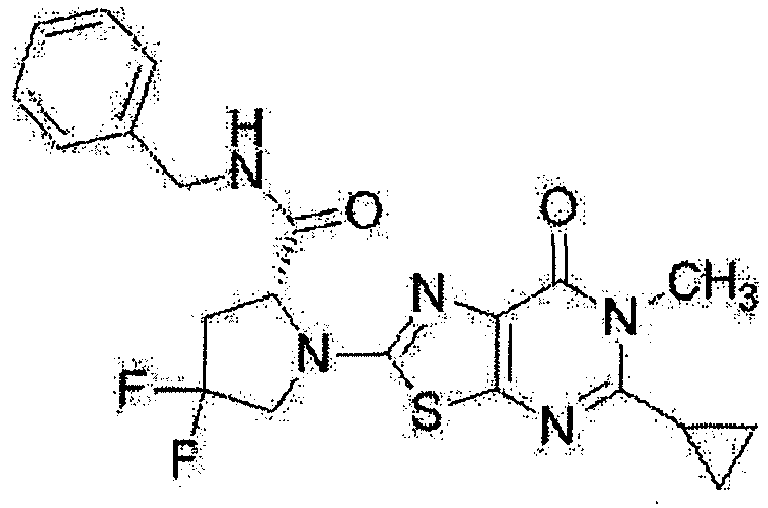
- A mixed solution of the compound (62 mg) obtained in Reference Example 617, the compound (121 mg) obtained in Reference Example 618 and N,N-diisopropylethylamine (2.0 mL) was stirred with heating at 120°C for 12 hr. The reaction mixture was cooled to room temperature, acidified with 1.0 mol/L hydrochloric acid, and extracted with chloroform. The organic layer was dried over magnesium sulfate, filtered and concentrated. The residue was purified by silica gel column chromatography (solvent; ethyl acetate/methanol=100/0 - 95/5), and the obtained crude product was purified by reversed-phase HPLC (Capcelpak C18; 0.05% trifluoroacetic acid-water/acetonitrile=55/45 - 45/55). To the obtained product was added diethyl ether, and the solid was collected by filtration and dried to give the title compound (15.5 mg).
MS (ESI) m/z; 446 [M+H]+ -
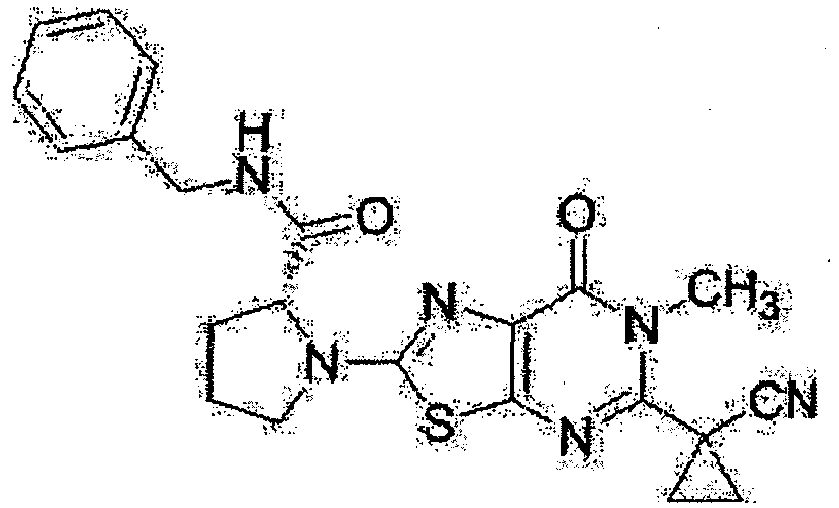
- To a solution (1.8 mL) of the compound (84 mg) obtained in Reference Example 621 in methylene chloride were added trimethylsilyl trifluoromethanesulfonate (101 µL) and triethylamine (130 µL), and the reaction mixture was stirred at room temperature for 1 hr. Saturated aqueous sodium hydroxide solution was added to the reaction mixture, and the mixture was extracted twice with ethyl acetate. The organic layer was dried over anhydrous sodium sulfate, filtered and concentrated. The residue was purified by silica gel column chromatography (solvent; ethyl acetate/methanol=100/0 - 90/10) to give the title compound (56.8 mg).
MS (ESI) m/z; 435 [M+H]+ -

- To a solution (3 mL) of oxalyl chloride (63 µL) in methylene chloride was added dimethyl sulfoxide (100 µL) at - 78°C, and the reaction mixture was stirred for 5 min. A solution (6.0 mL) of the compound (0.30 g) obtained in Reference Example 125 in methylene chloride and triethylamine (0.46 mL) were added at -78°C, and the reaction mixture was stirred for 1 hr, allowing the mixture to gradually warm to room temperature. Water was added, and the mixture was extracted once with ethyl acetate. The organic layer was washed once with water, dried over anhydrous magnesium sulfate, filtered and concentrated. The residue was purified by silica gel column chromatography (solvent; ethyl acetate/methanol=100/0 - 95/5) to give the title compound (0.19 g).
MS (ESI) m/z; 455 [M+H]+ -

- The compound (80 mg) obtained in Reference Example 126 was treated by a method similar to that in Example 574 to give the title compound (33 mg).
MS (ESI) m/z; 399 [M+H]+ -

- The compound (170 mg) obtained in Reference Example 127 was treated by a method similar to that in Example 574 to give the title compound (110 mg).
MS (ESI) m/z; 455 [M+H]+ -

- The compound (127 mg) obtained in Reference Example 128 was treated by a method similar to that in Example 574 to give the title compound (42.0 mg).
MS (ESI) m/z; 470 [M+H]+ -

- The compound (90 mg) obtained in Reference Example 129 was treated by a method similar to that in Example 574 to give the title compound (20 mg).
MS (ESI) m/z; 456 [M+H]+ -

- To a solution (2.0 mL) of oxalyl chloride (52 µL) in methylene chloride was added dimethyl sulfoxide (86 µL) at - 78°C, and the reaction mixture was stirred for 10 min. A solution (4 mL) of the compound (200 mg) obtained in Reference Example 130 in methylene chloride and triethylamine (350 µL) were added at -78°C, and the reaction mixture was stirred for 1 hr, allowing the mixture to gradually warm to room temperature. Water was added, and the mixture was extracted once with ethyl acetate. The organic layer was washed once with water, dried over anhydrous magnesium sulfate, filtered and concentrated. The residue was purified by silica gel column chromatography (solvent; ethyl acetate/methanol=100/0 - 95/5) to give the title compound (6.0 mg).
MS (ESI) m/z; 398 [M+H]+ -

- To a solution (4 mL) of oxalyl chloride (0.13 mL) in methylene chloride was added dimethyl sulfoxide (0.22 mL) at-78°C, and the reaction mixture was stirred for 5 min. A solution (8 mL) of the compound (0.43 g) obtained in Reference Example 131 in methylene chloride and triethylamine (1.0 mL) were added at -78°C, and the reaction mixture was stirred for 1 hr, allowing the mixture to gradually warm to room temperature. Water was added, and the mixture was extracted once with ethyl acetate. The organic layer was washed once with water, dried over anhydrous magnesium sulfate, filtered and concentrated. The residue was purified by silica gel column chromatography (solvent; chloroform/methanol=100/0 - 95/5) to give the title compound (0.25 g).
MS (ESI) m/z; 601 [M+H]+ -

- To a solution (5 mL) of the compound (0.25 g) obtained in Example 580 in methylene chloride were added water (0.5 mL) and trifluoroacetic acid (5.0 mL) at room temperature, and the reaction mixture was stirred for 1 hr. The reaction mixture was neutralized with saturated aqueous sodium hydrogen carbonate solution, and extracted once with chloroform. The organic layer was washed once with water, dried over anhydrous magnesium sulfate, filtered and concentrated. The residue was purified by silica gel column chromatography (solvent; chloroform/methanol=100/0 - 95/5). Ethyl acetate was added to the obtained product, and the solid was collected by filtration to give the title compound (0.17 g).
MS (ESI) m/z; 451 [M+H]+ -

- To a solution (30.0 mL) of the compound (3.00 g) obtained in Reference Example 635 in N-methylpyrrolidone were added (D)-proline (1.45 g) and potassium carbonate (3.47 g), and the reaction mixture was stirred with heating at 80°C for 1 hr.
The reaction mixture was cooled to room temperature, and acidified with 1.0 mol/L hydrochloric acid. Sodium chloride was added, and the mixture was extracted twice with chloroform. The organic layer was dried over anhydrous magnesium sulfate, and filtered. Chloroform was evaporated under reduced pressure from the filtrate, to the obtained mixture were added N,N-diisopropylethylamine (1.63 mL), benzylamine (981 mg), EDC hydrochloride (1.80 g) and HOBt monohydrate (1.50 g), and the reaction mixture was stirred at room temperature overnight. Water was added, and the mixture was extracted with ethyl acetate. The organic layer was dried over anhydrous sodium sulfate, filtered and concentrated. To the residue was added diisopropyl ether, and the solid was collected by filtration and dried to give the title compound (3.80 g).
MS (ESI) m/z; 618 [M+H]+ -
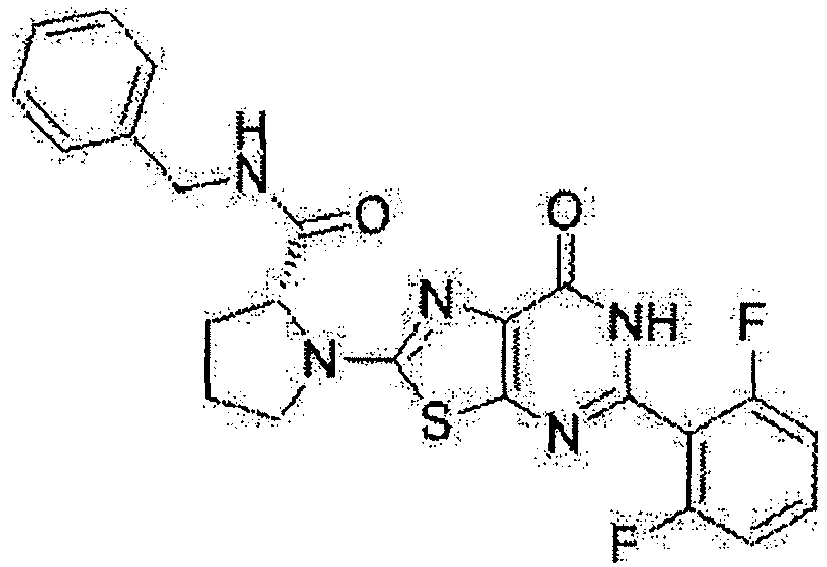
- The compound (3.78 g) obtained in Example 582 was treated by a method similar to that in Example 482 to give the title compound (2.52 g).
MS (ESI) m/z; 468 [M+H]+ -

- To a solution (5.00 mL) of the compound (0.47 g) obtained in Reference Example 66 in methylene chloride were added chlorotrimethylsilane (0.66 mL) and triethylamine (2.20 mL), and the reaction mixture was stirred at room temperature for 2 hr. Chlorotrimethylsilane (0.66 mL) and triethylamine (2.20 mL) were added, and the mixture was stirred for 3 days. Water was added to the reaction mixture, and the mixture was extracted twice with chloroform. The organic layer was dried over anhydrous magnesium sulfate, filtered and concentrated. The residue was purified by silica gel column chromatography (solvent; chloroform/methanol=100/0 - 95/5) to give the title compound (0.31 g).
MS (ESI) m/z; 439 [M+H]+ -

- To a solution (20 mL) of the compound (0.2 g) obtained in Reference Example 643 in methylene chloride was added mCPBA (69-75%, 0.18 g) at 0°C, and the reaction mixture was stirred at room temperature for 1 hr. After confirmation of the completion of the reaction, water and aqueous sodium thiosulfate solution were added to the reaction mixture, and the mixture was extracted twice with chloroform. The organic layer was washed once with water, dried over anhydrous magnesium sulfate, filtered and concentrated. The residue was washed with ethyl acetate, filtered, and dried to give a white solid. To the obtained solid were added N,N-diisopropylethylamine (3.7 mL) and the compound (0.52 g) obtained in Reference Example 341, and the reaction mixture was stirred at 160°C for 5 hr. After confirmation of the completion of the reaction, water and chloroform were added to the reaction mixture, and the mixture was neutralized with 1.0 mol/L hydrochloric acid and extracted twice with chloroform. The organic layer was washed once with water, dried over anhydrous magnesium sulfate, filtered and concentrated. The residue was purified by silica gel column chromatography (solvent; chloroform/methanol=100/0 - 90/10) to give the title compound (60 mg).
MS (ESI) m/z; 438 [M+H]+ -

- A mixture of the compound (180 mg) obtained in Reference Example 654 and the compound (2.8 mL) obtained in Reference Example 341 was stirred with heating at 150°C for 4 hr. The compound (2.56 g) obtained in Reference Example 341 and N,N-diisopropylethylamine (1.4 mL) were added, and the reaction mixture was stirred with heating at 150°C for 12 hr. The reaction mixture was cooled to room temperature, and ethyl acetate was added. The mixture was neutralized with 1.0 mol/L hydrochloric acid, and extracted twice with ethyl acetate. The organic layer was dried over anhydrous magnesium sulfate, filtered and concentrated. The residue was purified by silica gel column chromatography (solvent; ethyl acetate/methanol=100/0 - 90/10). To the obtained product was added diisopropyl ether, and the solid was collected by filtration to give the title compound (50 mg).
MS (ESI) m/z; 466 [M+H]+ -

- To a mixture of the compound (150 mg) obtained in Reference Example 655 and potassium carbonate (144 mg) in DMF (4.3 mL) was added dropwise benzyl bromide (75 µL) at 0°C. The reaction mixture was stirred at room temperature overnight, and water (20 mL) was added at 0°C. The precipitated solid was collected by filtration, dissolved in chloroform/methanol (100/1), and the obtained solution was dried over anhydrous sodium sulfate, filtered and concentrated. To the residue was added hexane/diethyl ether=10/1, and the solid was collected by filtration. To a solution (2.5 mL) of the obtained solid in DMF were added (D)-proline (80 mg) and cesium carbonate (377 mg), and the reaction mixture was heated at 75°C for 1 hr. The reaction mixture was cooled to room temperature, acidified with 1.0 mol/L hydrochloric acid, and extracted twice with chloroform. The organic layer was dried over anhydrous sodium sulfate, filtered and concentrated. To the obtained residue were added N,N-diisopropylethylamine (121 µL), benzylamine (76 µL), EDC hydrochloride (133 mg) and HOBt monohydrate (106 mg), and the reaction mixture was stirred at room temperature for 18 hr. 1.0 mol/L Hydrochloric acid was added and the mixture was extracted twice with ethyl acetate. The organic layer was washed with saturated brine, dried over anhydrous sodium sulfate, filtered and concentrated. The residue was purified by NH silica gel column chromatography (solvent; hexane/ethyl acetate=95/5 - 55/45). The obtained product was dissolved in a mixture (2.878 mL) of trifluoroacetic acid/water/triethylsilane=90/5/5(v/v), and the reaction mixture was stirred at room temperature for 1 hr, and concentrated.
The residue was purified by silica gel column chromatography (solvent; ethyl acetate/methanol=100/0 - 95/5) and purified by reversed-phase HPLC (Capcelpak C18; 0.05% trifluoroacetic acid-water/acetonitrile=55/45 - 45/55). To the obtained product was added hexane-ethyl acetate mixed solvent (1:1), and the solid was collected by filtration to give the title compound (121 mg). MS (ESI) m/z; 412 [M+H]+ -

- To a solution (22 mL) of the compound (1070 mg) obtained in Reference Example 661 in DMF were added (D)-proline (499 mg) and potassium carbonate (998 mg), and the reaction mixture was heated at 70°C for 1.5 hr. The reaction mixture was cooled to 0°C, and neutralized with concentrated hydrochloric acid (1.2 mL). N,N-diisopropylethylamine (1.01 mL), benzylamine (631 µL), EDC hydrochloride (1010 mg) and HOBt monohydrate (781 mg) were added at room temperature, and the reaction mixture was stirred at room temperature overnight. Water was added to the reaction mixture, and the mixture was extracted three times with ethyl acetate. The combined organic layer was dried over anhydrous sodium sulfate, filtered and concentrated. The residue was purified by NH silica gel column chromatography (solvent; ethyl acetate/methanol=100/0 - 90/10) to give the title compound (536.4 mg).
MS (ESI) m/z; 511 [M+H]+ -

- To a solution (2.3 mL) of the compound (535 mg) obtained in Example 588 in methylene chloride was added trifluoroacetic acid (4.6 mL), and the reaction mixture was stirred at room temperature for 1.5 hr, and concentrated. The residue was diluted with water and chloroform, and the mixture was adjusted to pH 9 with 2 mol/L aqueous sodium carbonate solution, and the mixture was extracted twice with chloroform. The combined organic layer was washed with saturated brine, dried over anhydrous sodium sulfate, filtered and concentrated. The residue was purified by NH silica gel column chromatography (solvent; chloroform/methanol=100/0 - 93/7) and silica gel column chromatography (solvent; chloroform/methanol=100/0 - 85/15), to the obtained product was added hexane/ethyl acetate=1/1, and the solid was collected by filtration to give the title compound (340.5 mg).
MS (ESI) m/z; 411 [M+H]+ -

- To a solution (1.5 mL) of the compound (80 mg) obtained in Example 589 in methylene chloride was added 35 - 38% aqueous formaldehyde solution (67 µL). The reaction mixture was stirred at room temperature for 1 hr, sodium triacetoxyborohydride (103 mg) was added to the reaction mixture, and the reaction mixture was stirred at room temperature for 1 hr. Saturated aqueous sodium hydrogen carbonate solution was added, and the mixture was extracted twice with methylene chloride. The combined organic layer was washed with saturated brine, dried over anhydrous sodium sulfate, filtered and concentrated. The residue was purified by silica gel column chromatography (solvent; chloroform/methanol=100/0 - 93/7), to the obtained product was added diethyl ether, and the solid was collected by filtration to give the title compound (76.6 mg).
MS (ESI) m/z; 425 [M+H]+ -

- The compound (80 mg) and acetone (57 µL) obtained in Example 589 was treated by a method similar to that in Example 590 to give the title compound (67.7 mg).
MS (ESI) m/z; 453 [M+H]+ -

- To a solution (1.5 mL) of the compound (85 mg) obtained in Example 589 in DMF were added N,N-diisopropylethylamine (108 µL) and 2,2,2-trifluoroethyl trifluoromethanesulfonate (72 mg) under ice-cooling, and the reaction mixture was stirred at room temperature for 14 hr. Water was added to the reaction mixture, and the mixture was extracted twice with chloroform. The combined organic layer was washed with saturated brine, dried over anhydrous sodium sulfate, filtered and concentrated. The residue was purified by silica gel column chromatography (solvent; ethyl acetate/methanol=99/1 - 85/15), to the obtained product was added hexane/ethyl acetate=10/1, and the solid was collected by filtration to give the title compound (38.2 mg) .
MS (ESI) m/z; 493 [M+H]+ -

- To a solution of the compound (90 mg) obtained in Example 589 in dichloroethane-methylene chloride mixture (1.5 mL-1.0 mL) were added, under ice-cooling, N,N-diisopropylethylamine (76 µL) and difluoroethyl trifluoromethanesulfonate (56 mg), and the reaction mixture was stirred at room temperature for 24 hr. Water was added to the reaction mixture, and the mixture was extracted twice with chloroform. The combined organic layer was washed with saturated brine, dried over anhydrous sodium sulfate, filtered and concentrated. The residue was purified by silica gel column chromatography (solvent; ethyl acetate/methanol=99/1 - 85/15), to the obtained product was added hexane/ethyl acetate=10/1, and the solid was collected by filtration to give the title compound (80.8 mg).
MS (ESI) m/z; 475 [M+H]+ -

- To a solution (8 mL) of the compound (500 mg) obtained in Reference Example 670 in DMF were added (D)-proline (215 mg) and potassium carbonate (343 mg), and the reaction mixture was stirred with heating at 80°C for 1.5 hr. The reaction mixture was cooled to 0°C, and neutralized with concentrated hydrochloric acid (414 µL). N,N-diisopropylethylamine (325 µL), benzylamine (272 µL), EDC hydrochloride (357 mg) and HOBt monohydrate (252 mg) were added at room temperature, and the reaction mixture was stirred at room temperature overnight. Water was added to the reaction mixture, the precipitate was collected by filtration, and the filtrate was extracted once with ethyl acetate. The precipitate was dissolved in ethyl acetate, and the combined organic layer was dried over anhydrous magnesium sulfate, filtered and concentrated. The residue was purified by silica gel column chromatography (solvent; ethyl acetate/methanol=100/0 - 94/6), to the obtained product was added hexane/ethyl acetate=1/1, and the solid was collected by filtration to give the title compound (275.3 mg). MS (ESI) m/z; 543 [M+H]+
-

- The compound (635 mg) obtained in Reference Example 671 was treated by a method similar to that in Example 594 to give the title compound (363.5 mg).
MS (ESI) m/z; 543 [M+H]+ -

- To a solution (8 mL) of the compound (170 mg) obtained in Example 594 and triethylamine (48 µL) in methylene chloride was added dropwise methanesulfonyl chloride (26 µL) under ice-cooling, and the reaction mixture was stirred at room temperature for 1 hr. Triethylamine (48 µL) and methanesulfonyl chloride (26 µL) were added, and the reaction mixture was further stirred for 1 hr. Saturated aqueous sodium hydrogen carbonate solution was added, and the mixture was extracted twice with methylene chloride. The combined organic layer was washed with saturated brine, dried over anhydrous sodium sulfate, filtered and concentrated. The residue was purified by silica gel column chromatography (solvent; chloroform/methanol=95/5), to the obtained product was added diethyl ether, and the solid was collected by filtration to give the title compound (333.6 mg).
MS (ESI) m/z; 621 [M+H]+ -

- The compound (362 mg) obtained in Example 595 was treated by a method similar to that in Example 596 to give the title compound (390 mg).
MS (ESI) m/z; 621 [M+H]+ -

- To a solution (1 mL) of the compound (305 mg) obtained in Example 596 in methylene chloride was added dropwise trifluoroacetic acid (1 mL) under ice-cooling. The reaction mixture was stirred at room temperature for 1.5 hr, and concentrated under reduced pressure. The residue was diluted with water (3 mL) and THF (3 mL). Under ice-cooling, the reaction mixture was adjusted to pH 9 - 10 with saturated aqueous sodium hydrogen carbonate solution, stirred at room temperature for 2 hr, and extracted twice with chloroform. The combined organic layer was dried over anhydrous magnesium sulfate, filtered and concentrated. The residue was purified by silica gel column chromatography (solvent; chloroform/methanol=98/2 - 88/12) to give the title compound (199 mg).
MS (ESI) m/z; 425 [M+H]+ -

- The compound (390 mg) obtained in Example 597 was treated by a method similar to that in Example 598 to give the title compound (211 mg).
MS (ESI) m/z; 425 [M+H]+ -

- To a solution (2 mL) of the compound (85 mg) obtained in Example 598 in methylene chloride was added dropwise 35% aqueous formaldehyde solution (69 mg), and the reaction mixture was stirred at room temperature for 1 hr. Sodium triacetoxyborohydride (106 mg) was added, and the reaction mixture was stirred at room temperature for 1 hr. Saturated aqueous sodium hydrogen carbonate solution was added, and the mixture was extracted twice with methylene chloride. The combined organic layer was dried over anhydrous sodium sulfate, filtered and concentrated. The residue was purified by NH silica gel column chromatography (solvent; chloroform/methanol=100/0 - 92/8), to the obtained product was added hexane/diethyl ether(1/2), and the solid was collected by filtration to give the title compound (50 mg).
MS (ESI) m/z; 439 [M+H]+ -

- The compound (100 mg) obtained in Example 599 was treated by a method similar to that in Example 600 to give the title compound (39.4 mg).
MS (ESI) m/z; 439 [M+H]+ -

- To a solution (11 mL) of the compound (305 mg) obtained in Reference Example 675 in N-methylpyrrolidone were added (D)-proline (390 mg) and potassium carbonate (624 mg), and the reaction mixture was stirred with heating at 130°C for 2 hr. (D)-proline (260 mg) and potassium carbonate (468 mg) were added, and the reaction mixture was stirred with heating at 130°C for 2 hr. The reaction mixture was cooled to 0°C, acidified with 1.0 mol/L hydrochloric acid, and extracted 4 times with chloroform and 2 times with chloroform/methanol (10/1). The organic layer was dried over magnesium sulfate, filtered and concentrated. To the obtained residue were added N,N-diisopropylethylamine (295 µL), benzylamine (185 µL), EDC hydrochloride (324 mg) and HOBt monohydrate (259 mg), and the reaction mixture was stirred at room temperature overnight. Water was added, and the mixture was extracted 4 times with ethyl acetate and 2 times with ethyl acetate/methanol (10/1). The organic layer was washed with saturated aqueous sodium hydrogen carbonate solution, and saturated brine, dried over anhydrous sodium sulfate, filtered and concentrated. The residue was purified by NH silica gel column chromatography (solvent; ethyl acetate/methanol=100/0 - 90/10). To the obtained product was added hexane/ethyl acetate(1/1), and the solid was collected by filtration to give the title compound (131.2 mg).
MS (ESI) m/z; 411 [M+H]+ -

- To a solution (1.5 mL) of the compound (30 mg) obtained in Reference Example 678 in N-methylpyrrolidone were added (D)-proline (26 mg) and potassium carbonate (46 mg), and the reaction mixture was stirred with heating at 130°C for 2 hr. The reaction mixture was cooled to 0°C, acidified with 1.0 mol/L hydrochloric acid, and extracted 2 times with chloroform and 3 times with chloroform/methanol (5/1). The organic layer was dried over magnesium sulfate, filtered and concentrated. To the obtained residue were added N,N-diisopropylethylamine (29 µL), benzylamine (18 µL), EDC hydrochloride (32 mg) and HOBt monohydrate (26 mg), and the reaction mixture was stirred at room temperature overnight. Water was added, and the mixture was extracted three times with ethyl acetate. To the aqueous layer was added sodium chloride, and the mixture was extracted twice with ethyl acetate. The organic layer was washed with saturated aqueous sodium hydrogen carbonate solution, and saturated brine, dried over anhydrous sodium sulfate, filtered and concentrated. The residue was purified by silica gel column chromatography (solvent; ethyl acetate/methanol=99/1 - 90/10). To the obtained product was added hexane/ethyl acetate(1/2), and the solid was collected by filtration to give the title compound (15.8 mg).
MS (ESI) m/z; 409 [M+H]+ -

- To a solution (2.0 mL) of the compound (38 mg) obtained in Reference Example 683 in DMF were added (D)-proline (23 mg) and cesium carbonate (97 mg), and the reaction mixture was stirred with heating at 70°C for 1 hr. The reaction mixture was cooled to 0°C, and neutralized with concentrated hydrochloric acid (49 µL). N,N-diisopropylethylamine (45 µL), benzylamine (28 µL), EDC hydrochloride (50 mg) and HOBt monohydrate (40 mg) were successively added, and the reaction mixture was stirred at room temperature overnight. Water was added to the reaction mixture, and the mixture was extracted three times with ethyl acetate. The combined organic layer was washed with saturated brine, dried over anhydrous sodium sulfate, filtered and concentrated under reduced pressure. The obtained residue was purified by silica gel column chromatography (solvent; hexane/ethyl acetate=40/60 - 0/100) to give the title compound (29.7 mg).
MS (ESI) m/z; 432 [M+H]+ -

- To a solution (2.0 mL) of the compound (61 mg) obtained in Reference Example 689 in DMF were added (D)-proline (34 mg) and cesium carbonate (148 mg), and the reaction mixture was stirred with heating at 70°C for 1 hr. The reaction mixture was cooled to 0°C, and neutralized with concentrated hydrochloric acid (74 µL). N,N-diisopropylethylamine (69 µL), benzylamine (43 µL), EDC hydrochloride (76 mg) and HOBt monohydrate (60 mg) were successively added, and the reaction mixture was stirred at room temperature for 5 hr. Water was added to the reaction mixture, and the mixture was extracted three times with ethyl acetate. The combined organic layer was washed with saturated brine, dried over anhydrous sodium sulfate, filtered and concentrated under reduced pressure. The obtained residue was purified by silica gel column chromatography (solvent; hexane/ethyl acetate=40/60 - 0/100) to give the title compound (56.9 mg).
MS (ESI) m/z; 446 [M+H]+ -

- To a solution of the compound (1000 mg) obtained in Example 482 in acetonitrile-water mixture (40 mL-40 mL) was added sodium hydrogen carbonate (2.10 g), and the reaction mixture was stirred with heating at 80°C for 6 hr. The reaction mixture was allowed to cool to room temperature, 1.0 mol/L hydrochloric acid (25 mL) was added, and the mixture was extracted twice with chloroform. The organic layer was washed with water, dried over anhydrous magnesium sulfate, filtered and concentrated. The residue was purified by silica gel column chromatography (solvent; chloroform/methanol=100/0 - 95/5). Ethyl acetate was added to the obtained product, and the solid was collected by filtration and dried to give the title compound (660 mg).
MS (ESI) m/z; 414 [M+H]+ -

- To a solution (30 mL) of the compound (600 mg) obtained in Example 482 in methanol was added potassium carbonate (4.00 g), and the reaction mixture was heated under reflux overnight. The reaction mixture was allowed to cool to room temperature, ethyl acetate and water were added, and the mixture was neutralized with 1.0 mol/L hydrochloric acid and extracted twice with ethyl acetate. The organic layer was washed with water, dried over anhydrous magnesium sulfate, filtered and concentrated. The residue was purified by silica gel column chromatography (solvent; ethyl acetate/hexane=50/50 - 100/0) to give the title compound (360 mg).
MS (ESI) m/z; 428 [M+H]+ -
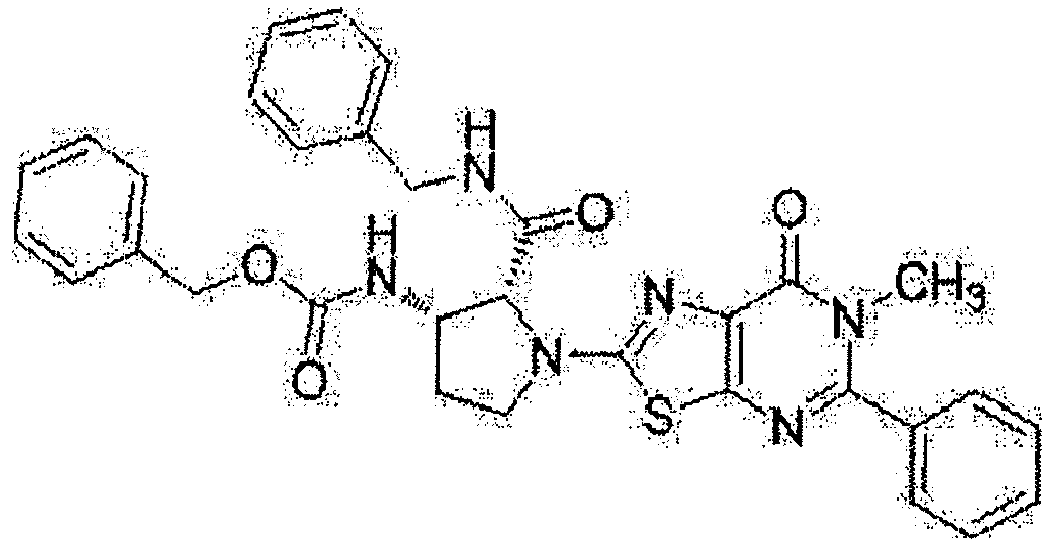
- A mixture of the compound (250 mg) obtained in Reference Example 691, the compound (600 mg) obtained in Reference Example 696 and N,N-diisopropylethylamine (0.68 mL) in 1,4-dioxane (2.5 mL) was stirred with heating at 120°C overnight. The reaction mixture was cooled to room temperature, acidified with 1.0 mol/L hydrochloric acid, and extracted with ethyl acetate. The organic layer was dried over magnesium sulfate, filtered and concentrated. The residue was purified by silica gel column chromatography (solvent; hexane/ethyl acetate=50/50 - 0/100) to give the title compound (320 mg).
MS (ESI) m/z; 595 [M+H]+ -

- The compound (0.25 g) obtained in Reference Example 691, the compound (440 mg) obtained in Reference Example 697 were treated by a method similar to that in Example 608 to give the title compound (0.36 g).
MS (ESI) m/z; 595 [M+H]+ -

- To a solution (3.0 mL) of the compound (300 mg) obtained in Example 608 in methylene chloride was added trimethylsilyl iodide (150 µL), and the reaction mixture was stirred at room temperature for 2 hr. To the reaction mixture were added water and ethyl acetate, and the mixture was extracted 3 times with 1.0 mol/L hydrochloric acid. The aqueous layer was neutralized with saturated aqueous sodium hydrogen carbonate solution, and extracted twice with chloroform. The organic layer was dried over anhydrous magnesium sulfate, filtered and concentrated. The residue was purified by silica gel column chromatography (solvent; chloroform/methanol=100/0 - 95/5). To the obtained product was added diisopropyl ether, the solid was collected by filtration, and dried to give the title compound (95.0 mg).
MS (ESI) m/z; 461 [M+H]+ -

- The compound (320 mg) obtained in Example 609 was treated by a method similar to that in Example 610 to give the title compound (80.0 mg).
MS (ESI) m/z; 461 [M+H]+ -

- To a solution (13 mL) of the compound (300 mg) obtained in Reference Example 709 in N-methylpyrrolidone were added (D)-proline (240 mg) and potassium carbonate (440 mg), and the reaction mixture was stirred with heating at 70°C for 2 hr.
The reaction mixture was cooled to room temperature, acidified with 1.0 mol/L hydrochloric acid, and extracted twice with chloroform. The organic layer was dried over anhydrous sodium sulfate, filtered and concentrated. To a solution of the obtained residue in N-methylpyrrolidone were added N,N-diisopropylethylamine (210 mg), benzylamine (170 mg), EDC hydrochloride (300 mg) and HOBt monohydrate (240 mg), and the reaction mixture was stirred at room temperature for 6 hr. To the reaction mixture was added saturated aqueous sodium hydrogen carbonate solution, and the mixture was extracted twice with ethyl acetate. The combined organic layer was washed 3 times with saturated brine, dried over anhydrous sodium sulfate, filtered and concentrated. The residue was purified by silica gel column chromatography (solvent; ethyl acetate=100) to give the title compound (170 mg).
MS (ESI) m/z; 412 [M+H]+ -

- The compound (350 mg) obtained in Reference Example 710 was treated by a method similar to that in Example 612 to give the title compound (150 mg).
MS (ESI) m/z; 468 [M+H]+ -

- The compound (300 mg) obtained in Reference Example 711 was treated by a method similar to that in Example 612 to give the title compound (340 mg).
MS (ESI) m/z; 424 [M+H]+ -

- The compound (400 mg) obtained in Reference Example 712 was treated by a method similar to that in Example 612 to give the title compound (420 mg).
MS (ESI) m/z; 398 [M+H]+ -

- The compound (350 mg) obtained in Reference Example 713 was treated by a method similar to that in Example 612 to give the title compound (230 mg).
MS (ESI) m/z; 452 [M+H]+ -

- To a solution (1.4 mL) of the compound (50.0 mg) obtained in Reference Example 736 in DMF were added potassium carbonate (46 mg) and 4-methoxybenzyl chloride (27 µL), and the reaction mixture was stirred with heating at 70°C for 2 hr. The reaction mixture was cooled to 0°C, water was added, and the mixture was extracted twice with ethyl acetate. The organic layer was dried over anhydrous magnesium sulfate, filtered and concentrated. The residue was purified by silica gel column chromatography (solvent; hexane/ethyl acetate=80/20 - 40/60). To a solution (0.70 mL) of the obtained product (31.9 mg) in DMF were added (D)-proline (12 mg) and cesium carbonate (58 mg), and the reaction mixture was stirred with heating at 70°C for 1.5 hr. The reaction mixture was cooled to room temperature, acidified with 1.0 mol/L hydrochloric acid, and extracted twice with chloroform. The organic layer was dried over anhydrous sodium sulfate, filtered and concentrated. To the obtained residue were added N,N-diisopropylethylamine (19 µL), benzylamine (12 µL), EDC hydrochloride (21 mg) and HOBt monohydrate (16 mg), and the reaction mixture was stirred at room temperature overnight. 1.0 mol/L Hydrochloric acid was added, and the mixture was extracted twice with ethyl acetate. The organic layer was washed with saturated brine, dried over anhydrous sodium sulfate, filtered and concentrated. The obtained residue was dissolved in a mixture (0.72 mL) of trifluoroacetic acid/water/triethylsilane=90/5/5(v/v), and the reaction mixture was stirred at 80°C for 4 days, cooled to room temperature, and concentrated. The residue was purified by silica gel column chromatography (solvent; ethyl acetate/methanol=100/0 - 90/10). To the obtained product was added hexane-diethyl ether mixed solvent (1:1), and the solid was collected by filtration to give the title compound (16.0 mg) .
MS (ESI) m/z; 423 [M+H]+ -

- To a solution (1.9 mL) of the compound (77.0 mg) obtained in Reference Example 737 in DMF were added potassium carbonate (63 mg) and 4-methoxybenzyl chloride (37 µL), and the reaction mixture was stirred with heating at 80°C for 2 hr. The reaction mixture was cooled to 0°C, water was added, and the mixture was extracted twice with ethyl acetate. The organic layer was dried over anhydrous magnesium sulfate, filtered and concentrated. The residue was purified by silica gel column chromatography (solvent; hexane/ethyl acetate=90/10 - 75/25). To a solution (1.20 mL) of the obtained product (60.0 mg) in DMF were added (D)-proline (23 mg) and cesium carbonate (106 mg), and the reaction mixture was stirred with heating at 70°C for 1.5 hr. The reaction mixture was cooled to room temperature, acidified with 1.0 mol/L hydrochloric acid, and extracted twice with chloroform. The organic layer was dried over anhydrous sodium sulfate, filtered and concentrated. To the obtained residue were added N,N-diisopropylethylamine (34 µL), benzylamine (21 µL), EDC hydrochloride (37 mg) and HOBt monohydrate (30 mg), and the reaction mixture was stirred at room temperature overnight. 1 mol/L Hydrochloric acid was added, and the mixture was extracted twice with ethyl acetate. The organic layer was washed with saturated brine, dried over anhydrous sodium sulfate, filtered and concentrated. To a solution (0.70 mL) of the obtained residue in methylene chloride were added trifluoroacetic acid (175 µL) and triethylsilane (42 µL), and the reaction mixture was stirred at room temperature for 1 hr. The reaction mixture was concentrated, and the residue was purified by silica gel column chromatography (solvent; chloroform/methanol=100/0 - 92/8). To the obtained product was added hexane-diethyl ether mixed solvent (4:1), and the solid was collected by filtration to give the title compound (53.5 mg).
MS (ESI) m/z; 465 [M+H]+ -

- The compound (261 mg) obtained in Reference Example 738 was treated by a method similar to that in Example 618 to give the title compound (254 mg).
MS (ESI) m/z; 397 [M+H]+ -

- The compound (245 mg) obtained in Reference Example 739 was treated by a method similar to that in Example 618 to give the title compound (143 mg).
MS (ESI) m/z; 395 [M+H]+ -

- The compound (158 mg) obtained in Reference Example 740 was treated by a method similar to that in Example 618 to give the title compound (113 mg).
MS (ESI) m/z; 449 [M+H]+ -
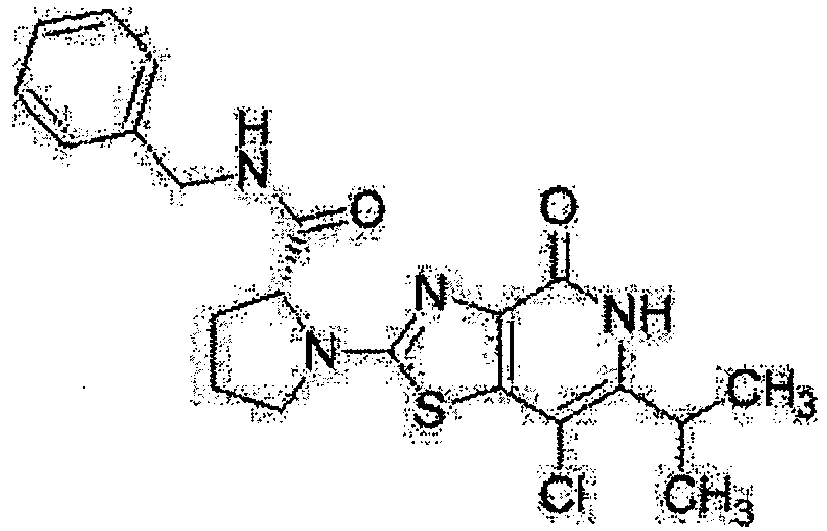
- To a solution (3.3 mL) of the compound (168 mg) obtained in Example 619 in DMF was added a solution (0.5 mL) of N-chlorosuccinimide (85 mg) in DMF at 0°C, and the reaction mixture was stirred at 60°C for 1 hr. The reaction mixture was allowed to cool to room temperature, aqueous sodium thiosulfate solution was added and the mixture was stirred at room temperature for 10 min, and extracted twice with ethyl acetate. The organic layer was dried over anhydrous sodium sulfate, filtered and concentrated. The residue was purified by silica gel column chromatography (solvent; chloroform/methanol=100/0 - 95/5). To the obtained product was added hexane-ethyl acetate mixed solvent (1:1), and the solid was collected by filtration to give the title compound (105 mg).
MS (ESI) m/z; 431, 433 [M+H]+ -

- The compound (105 mg) obtained in Example 620 was treated by a method similar to that in Example 622 to give the title compound (25.4 mg).
MS (ESI) m/z; 429, 431 [M+H]+ -
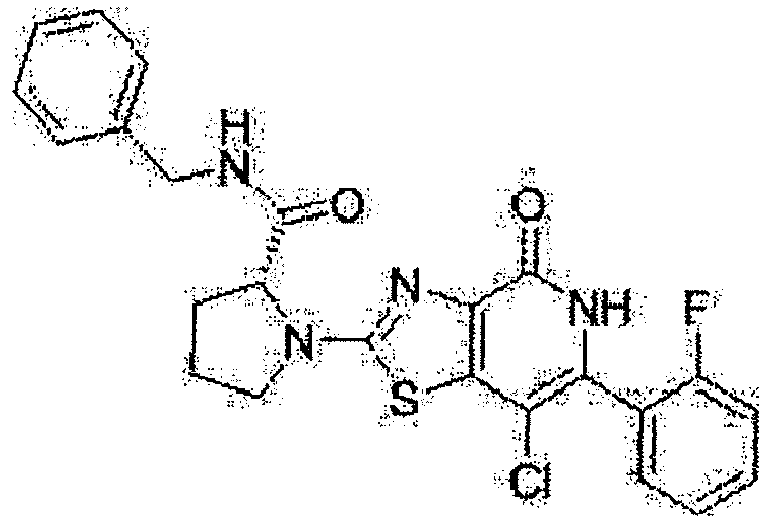
- The compound (110 mg) obtained in Example 621 was treated by a method similar to that in Example 622 to give the title compound (45.1 mg).
MS (ESI) m/z; 483, 485 [M+H]+ -

- To a solution (4.8 mL) of the compound (130 mg) obtained in Reference Example 747 in methylene chloride were added trifluoroacetic acid (480 µL) and triethylsilane (77 µL), and the reaction mixture was stirred at room temperature for 1.5 hr. Hexane was added, and the precipitated solid was collected by filtration. The obtained solid was purified by NH silica gel column chromatography (solvent; ethyl acetate/methanol=99/1 - 88/12). To the obtained product was added hexane-ethyl acetate mixed solvent (2:1), and the solid was collected by filtration, and dried to give the title compound (60.9 mg).
MS (ESI) m/z; 415 [M+H]+ -

- The compound (52 mg) obtained in Example 625 was treated by a method similar to that in Example 622 to give the title compound (25.5 mg).
MS (ESI) m/z; 449, 451 [M+H]+ -

- To a solution (1.3 mL) of the compound (62 mg) obtained in Reference Example 133 in chloroform were added N,N-diisopropylethylamine (36 µL), benzylamine (22 µL), EDC hydrochloride (39 mg) and HOBt monohydrate (31 mg), and the reaction mixture was stirred at room temperature for 20 hr. Water was added, and the mixture was extracted twice with chloroform. The organic layer was dried over anhydrous sodium sulfate, filtered and concentrated. The residue was purified by silica gel column chromatography (solvent; ethyl acetate/methanol=100/0 - 95/5) to give the title compound (45.1 mg) .
MS (ESI) m/z; 545 [M+H]+ -

- (1) To a solution (0.5 mL) of methyl iodide (106 mg) in toluene was added diethylzinc (1.0 mol/L toluene solution, 287 µL) at 0°C, and the reaction mixture was stirred at the same temperature for 10 min. A solution (0.5 mL) of the compound (43 mg) obtained in Example 627 in toluene was added, and the reaction mixture was stirred with heating at 50°C for 12 hr. Dichloroethane (0.5 mL) was further added, and the reaction mixture was stirred with heating at 70°C for 12 hr. The reaction mixture was cooled to 0°C, methylene iodide (106 mg) and diethylzinc (1.0 mol/L toluene solution, 287 µL) were added, and the reaction mixture was stirred with heating at 50°C for 12 hr.
- (2) Separately, to diethyl zinc (1.0 mol/L toluene solution, 215 µL) was added trifluoroacetic acid (18 µL) at 0°C, and the mixture was stirred for 15 min, and methylene iodide (63 mg) was added to give a mixture. The mixture was added to the reaction mixture described in (1) at 0°C. The reaction mixture was stirred at room temperature for 16 hr, saturated aqueous sodium hydrogen carbonate solution and chloroform were added at 0°C, and the mixture was filtered through diatomaceous earth. The filtrate was extracted twice with chloroform, and the organic layer was dried over anhydrous sodium sulfate, filtered and concentrated. The residue was purified by silica gel column chromatography (solvent; ethyl acetate/methanol=100/0 - 95/5) to give the title compound (14.0 mg).
-

- The compound (14 mg) obtained in Example 628 was dissolved in a mixture (556 µL) of trifluoroacetic acid/water/triethylsilane=90/5/5(v/v), and the mixture was stirred at 60°C for 6 days, cooled to room temperature, and concentrated. The residue was purified by silica gel column chromatography (solvent; ethyl acetate/methanol=100/0 - 88/12) to give the title compound (2.5 mg).
MS (ESI) m/z; 439 [M+H]+ -

- (1) To a mixture (2 mL) of the compound (180 mg) obtained in Reference Example 754 and potassium carbonate (296 mg) in DMF was added 4-methoxybenzyl bromide (229 µL), and the reaction mixture was stirred at room temperature for 1.5 hr. Water was added to the reaction mixture, and the mixture was extracted twice with ethyl acetate. The combined organic layer was washed with saturated brine, dried over anhydrous sodium sulfate, filtered and concentrated. The residue was purified by silica gel column chromatography (solvent; hexane/ethyl acetate=90/10 - 70/30) to give a product (314 mg).
- (2) The obtained product was dissolved in methylene chloride (9 mL), and mCPBA (69-75%, 172 mg) was added under ice-cooling. The reaction mixture was stirred under ice-cooling for 1 hr, aqueous sodium thiosulfate solution and saturated aqueous sodium hydrogen carbonate solution were added, and the mixture was extracted twice with methylene chloride. The aqueous layer was filtered through diatomaceous earth, and extracted twice with methylene chloride. The combined organic layer was dried over anhydrous sodium sulfate, filtered and concentrated. To the residue was added hexane/ethyl acetate=4/1, and the solid was collected by filtration, crude product (278 mg).
- (3) The obtained crude product was dissolved in N-methylpyrrolidone (6 mL), (D)-proline (125 mg) and potassium carbonate (224 mg) were added, and the reaction mixture was stirred with heating at 90°C for 3 hr. The reaction mixture was cooled to room temperature, diluted with chloroform, and acidified with 1.0 mol/L hydrochloric acid. Saturated brine was added, and the mixture was extracted twice with chloroform. The combined organic layer was washed with saturated brine, dried over anhydrous sodium sulfate, filtered and concentrated. To a solution of the obtained residue in N-methylpyrrolidone were added N,N-diisopropylethylamine (141 µL), benzylamine (89 µL), EDC hydrochloride (156 mg) and HOBt monohydrate (124 mg), and the reaction mixture was stirred at room temperature for 21 hr. Water was added to the reaction mixture, and the mixture was extracted twice with ethyl acetate. The combined organic layer was washed with saturated brine, dried over anhydrous sodium sulfate, filtered and concentrated. The residue was purified by silica gel column chromatography (solvent; hexane/ethyl acetate=70/30 - 35/75) to give a product (233 mg).
- (4) The obtained product was dissolved in a mixture (4.0 mL) of trifluoroacetic acid/water/triethylsilane=90/5/5(v/v), and the mixture was stirred with heating at 50°C for 1.5 hr. The reaction mixture was concentrated and the residue was purified by silica gel column chromatography (solvent; hexane/ethyl acetate=40/60 - 0/100), to the obtained product was added diethyl ether, and the solid was collected by filtration to give the title compound (166 mg).
-

- To a solution (1.5 mL) of the compound (60 mg) obtained in Example 630 in DMF was added potassium carbonate (29 mg), iodomethane (13 µL) was added under ice-cooling, and the reaction mixture was stirred at room temperature for 4 hr. To the reaction mixture were added saturated aqueous ammonium chloride solution and water, and the mixture was extracted twice with ethyl acetate. The combined organic layer was washed with saturated brine, dried over anhydrous sodium sulfate, filtered and concentrated under reduced pressure. The obtained residue was purified by NH silica gel column chromatography (solvent; hexane/ethyl acetate=60/40 - 0/100) to give the title compound (24 mg).
MS (ESI) m/z; 437 [M+H]+ -

- (1) To a mixture (1.8 mL) of the compound (195 mg) obtained in Reference Example 756 and potassium carbonate (179 mg) in DMF was added 4-methoxybenzyl chloride (106 µL), and the reaction mixture was stirred with heating at 70°C for 2.5 hr. Water was added to the reaction mixture, and the mixture was extracted twice with ethyl acetate. The combined organic layer was washed with saturated brine, dried over anhydrous sodium sulfate, filtered and concentrated. The residue was purified by silica gel column chromatography (solvent; hexane/ethyl acetate=92/8 - 80/20) to give a product (238 mg).
- (2) The obtained product was dissolved in methylene chloride (7.5 mL), mCPBA (69-75%, 151 mg) was added under ice-cooling, and the reaction mixture was stirred under ice-cooling for 1.5 hr. Aqueous sodium thiosulfate solution and saturated aqueous sodium hydrogen carbonate solution were added, and the mixture was extracted twice with methylene chloride. The combined organic layer was washed with saturated brine, dried over anhydrous sodium sulfate, filtered and concentrated to give a crude product (234 mg).
- (3) The obtained product was dissolved in DMF (5.8 mL), (D)-proline (121 mg) and potassium carbonate (218 mg) were added, and the reaction mixture was stirred with heating at 85°C for 3.5 hr. The reaction mixture was ice-cooled, diluted with chloroform, acidified with 1.0 mol/L hydrochloric acid, and extracted twice with chloroform. The combined organic layer was dried over anhydrous sodium sulfate, and filtered. Chloroform was evaporated under reduced pressure from the filtrate, to the obtained mixture were added N,N-diisopropylethylamine (138 µL), benzylamine (86 µL), EDC hydrochloride (151 mg) and HOBt monohydrate (121 mg), and the reaction mixture was stirred at room temperature for 18 hr. Water was added to the reaction mixture, and the mixture was extracted twice with ethyl acetate. The combined organic layer was washed with saturated brine, dried over anhydrous sodium sulfate, filtered and concentrated. The residue was purified by silica gel column chromatography (solvent; hexane/ethyl acetate=70/30 - 30/70) to give a product (263 mg).
- (4) The obtained product was dissolved in a mixture (3.2 mL) of trifluoroacetic acid/water/triethylsilane=90/5/5(v/v), and stirred with heating at 50°C for 1 hr. The reaction mixture was concentrated, and the obtained residue was purified by silica gel column chromatography (solvent; hexane/ethyl acetate=40/60 - 0/100). To the obtained product was added hexane/ethyl acetate=3/1, and the solid was collected by filtration to give the title compound (187 mg).
-

- (1) To a mixture (5.2 mL) of the compound (720 mg) obtained in Reference Example 757 and potassium carbonate (508 mg) in DMF was added 4-methoxybenzyl bromide (300 µL), and the reaction mixture was stirred at room temperature for 30 min and stirred with heating at 70°C for 3 hr. The reaction mixture was ice-cooled, neutralized with 1.0 mol/L hydrochloric acid and diluted with water. The precipitated solid was filtered, and washed with water. The obtained solid was dissolved in chloroform/methanol=10/1, and the obtained solution was dried over anhydrous sodium sulfate, filtered and concentrated under reduced pressure. To the obtained solid were added hexane/diethyl ether=5/1, and the solid was collected by filtration to give a product (888 mg).
- (2) The obtained product (400 mg) was dissolved in 1,4-dioxane (4 mL), cyclopropylboronic acid (201 mg), dichlorobis(tricyclohexylphosphine)palladium(II) (115 mg), cesium carbonate (763 mg) were successively added, and the reaction mixture was heated under reflux for 6 hr. After confirmation of the completion of the reaction, the reaction mixture was cooled to room temperature, diluted with ethyl acetate and filtered through diatomaceous earth. The filtrate was washed successively with water and saturated brine, dried over anhydrous sodium sulfate, filtered and concentrated. The obtained residue was purified by silica gel column chromatography (solvent; hexane/ethyl acetate=98/2 - 90/10) to give a product (234 mg).
- (3) The obtained product was dissolved in methylene chloride (7 mL), mCPBA (69-75%, 140 mg) was added under ice-cooling, and the reaction mixture was stirred under ice-cooling for 1.5 hr. Aqueous sodium thiosulfate solution and saturated aqueous sodium hydrogen carbonate solution were added, and the mixture was extracted twice with methylene chloride. The combined organic layer was washed with saturated brine, dried over anhydrous sodium sulfate, filtered and concentrated to give a crude product (193 mg).
- (4) The obtained product was dissolved in DMF (4.5 mL), (D)-proline (95 mg) and potassium carbonate (171 mg) were added, and the reaction mixture was stirred with heating at 90°C for 2.5 hr. The reaction mixture was ice-cooled, diluted with chloroform, acidified with 1.0 mol/L hydrochloric acid, and extracted twice with chloroform. The combined organic layer was dried over anhydrous sodium sulfate, and filtered. Chloroform was evaporated under reduced pressure from the filtrate, to the obtained mixture were added N,N-diisopropylethylamine (108 µL), benzylamine (68 µL), EDC hydrochloride (118 mg) and HOBt monohydrate (95 mg), and the reaction mixture was stirred at room temperature for 16 hr. Water was added to the reaction mixture, and the mixture was extracted twice with ethyl acetate. The combined organic layer was washed with saturated brine, dried over anhydrous sodium sulfate, filtered and concentrated. The residue was purified by silica gel column chromatography (solvent; hexane/ethyl acetate=80/20 - 40/60) to give a product (195 mg).
- (5) The obtained product was dissolved in a mixture (3.2 mL) of trifluoroacetic acid/water/triethylsilane=90/5/5(v/v), and stirred with heating at 50°C for 1.5 hr. The reaction mixture was concentrated, and the obtained residue was purified by silica gel column chromatography (solvent; hexane/ethyl acetate=40/60 - 0/100). To the obtained product was added hexane/ethyl acetate=5/1, and the solid was collected by filtration to give the title compound (130 mg).
-

- A mixture of the compound (1.38 g) obtained in Reference Example 763, the compound (1.21 g) obtained in Reference Example 341 and triethylamine (1.6 g) in THF (100 mL) was stirred with heating at 100°C for 1 hr. After confirmation of the completion of the reaction, water (20 mL) were added to the reaction mixture, and the mixture was extracted twice with ethyl acetate. The organic layer was washed once with water, dried over anhydrous magnesium sulfate, filtered and concentrated. The residue was purified by silica gel column chromatography (solvent; ethyl acetate/methanol=100/0 - 90/10). To the obtained product was added diisopropyl ether, and the solid was collected by filtration to give the title compound (1.7 g).
MS (ESI) m/z; 398 [M+H]+ -

- The compound (600 mg) obtained in Reference Example 763 was treated by a method similar to that in Example 634 to give the title compound (298 mg).
MS (ESI) m/z; 412 [M+H]+ -

- The compound (870 mg) obtained in Reference Example 764 was treated by a method similar to that in Example 634 to give the title compound (840 mg).
MS (ESI) m/z; 398 [M+H]+ -

- The compound (150 mg) obtained in Reference Example 765 was treated by a method similar to that in Example 634 to give the title compound (187 mg).
MS (ESI) m/z; 384 [M+H]+ -

- The compound (150 mg) obtained in Reference Example 766 was treated by a method similar to that in Example 634 to give the title compound (158 mg).
MS (ESI) m/z; 432 [M+H]+ -

- The compound (400 mg) obtained in Reference Example 770 was treated by a method similar to that in Example 634 to give the title compound (400 mg).
MS (ESI) m/z; 410 [M+H]+ -

- The compound (400 mg) obtained in Reference Example 772 was treated by a method similar to that in Example 634 to give the title compound (424 mg).
MS (ESI) m/z; 416 [M+H]+ -

- The compound (400 mg) obtained in Reference Example 772 was treated by a method similar to that in Example 634 to give the title compound (367 mg).
MS (ESI) m/z; 430 [M+H]+ -

- The compound (150 mg) obtained in Reference Example 774 was treated by a method similar to that in Example 634 to give the title compound (159 mg).
MS (ESI) m/z; 424 [M+H]+ -

- The compound (300 mg) obtained in Reference Example 775 was treated by a method similar to that in Example 634 to give the title compound (300 mg).
MS (ESI) m/z; 406 [M+H]+ -
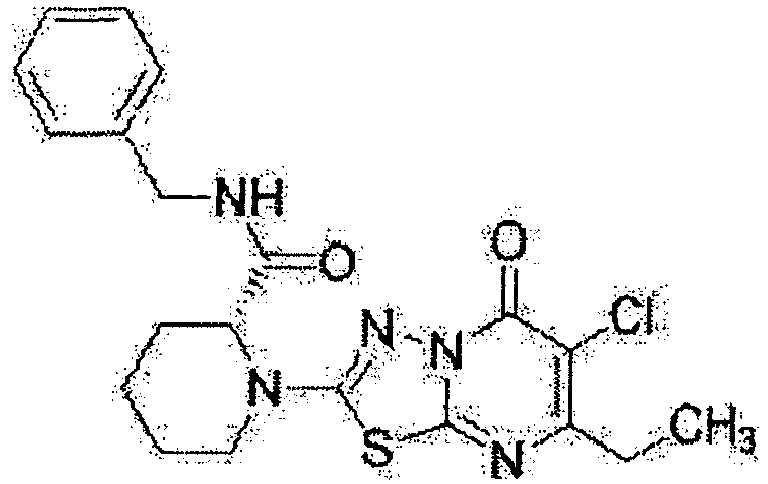
- To a solution (1.5 mL) of the compound (0.29 g) obtained in Reference Example 778 in THF were added the compound (0.25 g) obtained in Reference Example 758 and N,N-diisopropylethylamine (0.51 mL), and the reaction mixture was heated under reflux for 10 hr. After confirmation of the completion of the reaction, water was added to the reaction mixture, and the mixture was extracted twice with chloroform. The organic layer was dried over anhydrous magnesium sulfate, filtered and concentrated and the residue was purified by NH silica gel column chromatography (solvent; hexane/ethyl acetate=80/20 - 0/100). To the obtained product was added diisopropyl ether, and the solid was collected by filtration to give the title compound (0.21 g).
MS (ESI) m/z; 432 [M+H]+ -

- The compound (101 mg) obtained in Reference Example 765 was treated by a method similar to that in Example 644 to give the title compound (63.0 mg).
MS (ESI) m/z; 400 [M+H]+ -

- The compound (200 mg) obtained in Reference Example 767 was treated by a method similar to that in Example 644 to give the title compound (185 mg).
MS (ESI) m/z; 384 [M+H]+ -

- The compound (300 mg) obtained in Reference Example 768 was treated by a method similar to that in Example 644 to give the title compound (319 mg).
MS (ESI) m/z; 412 [M+H]+ -

- The compound (150 mg) obtained in Reference Example 769 was treated by a method similar to that in Example 644 to give the title compound (130 mg).
MS (ESI) m/z; 446 [M+H]+ -

- The compound (500 mg) obtained in Reference Example 771 was treated by a method similar to that in Example 644 to give the title compound (570 mg).
MS (ESI) m/z; 402 [M+H]+ -

- The compound (184 mg) obtained in Reference Example 771 was treated by a method similar to that in Example 644 to give the title compound (109 mg).
MS (ESI) m/z; 438 [M+H]+ -

- The compound (200 mg) obtained in Reference Example 772 was treated by a method similar to that in Example 644 to give the title compound (141 mg).
MS (ESI) m/z; 442 [M+H]+ -

- The compound (1.90 g) obtained in Reference Example 773 was treated by a method similar to that in Example 644 to give the title compound (1.83 g).
MS (ESI) m/z; 398 [M+H]+ -

- The compound (342 mg) obtained in Reference Example 773 was treated by a method similar to that in Example 644 to give the title compound (432 mg).
MS (ESI) m/z; 399 [M+H]+ -
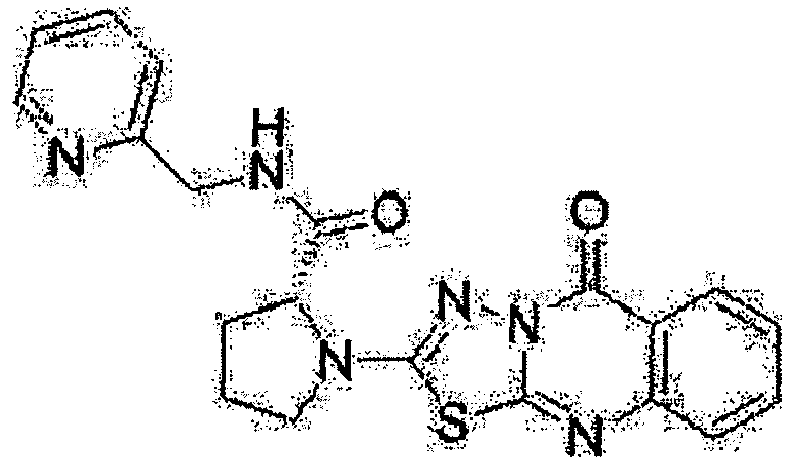
- The compound (200 mg) obtained in Reference Example 775 was treated by a method similar to that in Example 644 to give the title compound (240 mg).
MS (ESI) m/z; 407 [M+H]+ -

- The compound (200 mg) obtained in Reference Example 775 was treated by a method similar to that in Example 644 to give the title compound (223 mg).
MS (ESI) m/z; 432 [M+H]+ -

- The compound (300 mg) obtained in Reference Example 776 was treated by a method similar to that in Example 644 to give the title compound (356 mg).
MS (ESI) m/z; 426 [M+H]+ -

- The compound (246 mg) obtained in Reference Example 779 was treated by a method similar to that in Example 644 to give the title compound (278 mg).
MS (ESI) m/z; 404, 406 [M+H]+ -

- The compound (200 mg) obtained in Reference Example 780 was treated by a method similar to that in Example 644 to give the title compound (227 mg).
MS (ESI) m/z; 432, 434 [M+H]+ -

- The compound (150 mg) obtained in Reference Example 780 was treated by a method similar to that in Example 644 to give the title compound (182 mg).
MS (ESI) m/z; 446, 448 [M+H]+ -

- To a solution (5.0 mL) of the compound (0.16 g) obtained in Reference Example 777 in DMF were added the compound (0.14 g) obtained in Reference Example 341 and N,N-diisopropylethylamine (0.23 g), and the reaction mixture was stirred with heating at 80°C for 1 hr. After confirmation of the completion of the reaction, water was added to the reaction mixture, and the mixture was extracted twice with chloroform. The organic layer was dried over anhydrous magnesium sulfate, filtered and concentrated and the residue was purified by silica gel column chromatography (solvent; chloroform/methanol=100/0 - 95/5). The obtained product was dissolved in methanol (5 mL), hydrogen chloride (4.0 mol/L ethyl acetate solution, 1.0 mL) was added, and the mixture was stirred at room temperature for 10 min. The solvent was evaporated under reduced pressure, to the obtained product was added ethyl acetate, and the solid was collected by filtration to give the title compound (56 mg).
MS (ESI) m/z; 407 [M+H]+ -

- To a solution (10 mL) of the compound (0.97 g) obtained in Reference Example 764 in DMF were added cis-3-azabicyclo[3.1.0]hexane-2-carboxylic acid (0.5 g) and triethylamine (1.2 g), and the reaction mixture was stirred with heating at 80°C for 1 hr, and cooled to room temperature. Benzylamine (0.43 g), EDC hydrochloride (1.13 g), HOBt monohydrate (0.9 g) and N,N-diisopropylethylamine (0.77 g) were added, and the reaction mixture was stirred at 60°C for 1 hr. After confirmation of the completion of the reaction, water was added to the reaction mixture, and the mixture was extracted twice with ethyl acetate. The organic layer was washed once with saturated aqueous sodium hydrogen carbonate solution, dried over anhydrous magnesium sulfate, filtered and concentrated. The residue was purified by silica gel column chromatography (solvent; chloroform/methanol=100/0 - 90/10). To the obtained product was added diisopropyl ether, and the solid was collected by filtration to give the title compound (0.52 g).
MS (ESI) m/z; 382 [M+H]+ -

- To a solution (1.4 mL) of the compound (180 mg) obtained in Reference Example 134 in DMF were added (pyridin-2-yl)methylamine (0.065 mL), EDC hydrochloride (166 mg), HOBt monohydrate (132 mg) and N,N-diisopropylethylamine (0.15 mL), and the reaction mixture was stirred at room temperature for 4 hr. After confirmation of the completion of the reaction, water was added to the reaction mixture, and the mixture was extracted twice with chloroform. The organic layer was dried over anhydrous magnesium sulfate, filtered and concentrated. The residue was purified by NH silica gel column chromatography (solvent; ethyl acetate/methanol=100/0 - 90/10). To the obtained product was added diisopropyl ether, and the solid was collected by filtration to give the title compound (175 mg).
MS (ESI) m/z; 403 [M+H]+ -

- The compound (180 mg) obtained in Reference Example 134 was treated by a method similar to that in Example 662 to give the title compound (63 mg).
MS (ESI) m/z; 417 [M+H]+ -
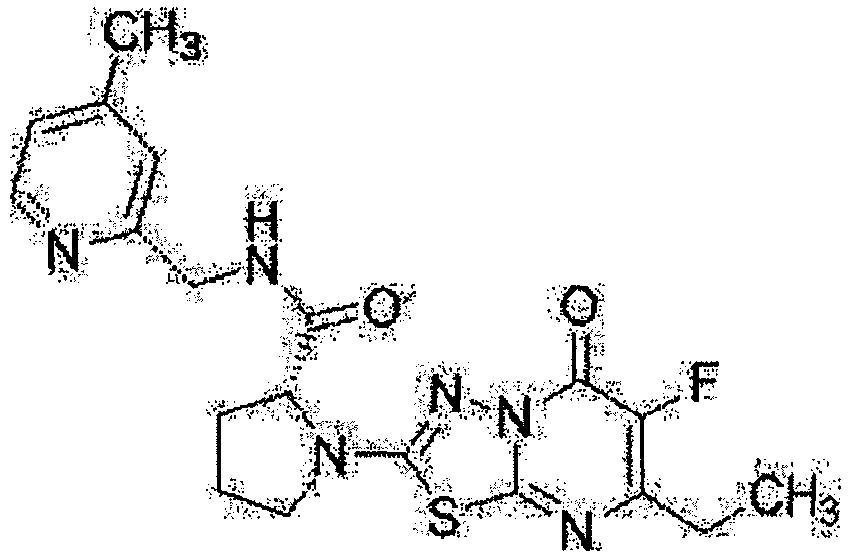
- The compound (180 mg) obtained in Reference Example 134 was treated by a method similar to that in Example 662 to give the title compound (125 mg).
MS (ESI) m/z; 417 [M+H]+ -
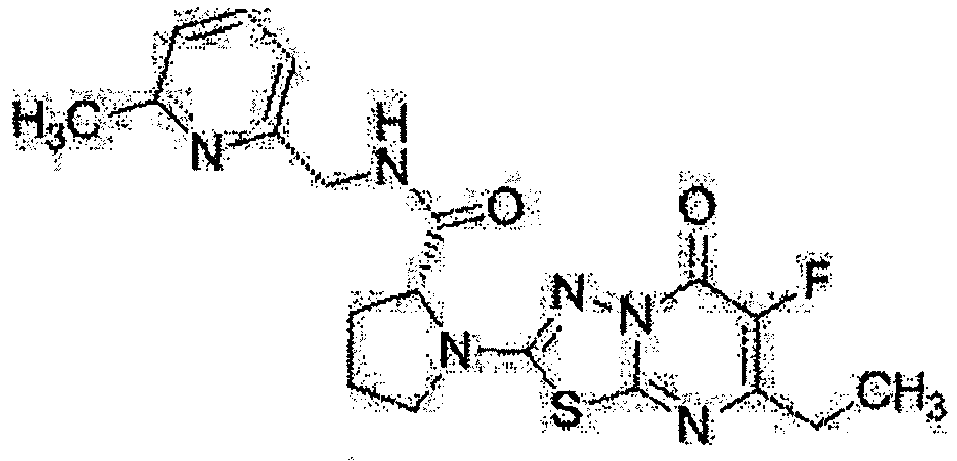
- The compound (180 mg) obtained in Reference Example 134 was treated by a method similar to that in Example 662 to give the title compound (152 mg).
MS (ESI) m/z; 417 [M+H]+ -

- The compound (180 mg) obtained in Reference Example 134 was treated by a method similar to that in Example 662 to give the title compound (133 mg).
MS (ESI) m/z; 421 [M+H]+ -
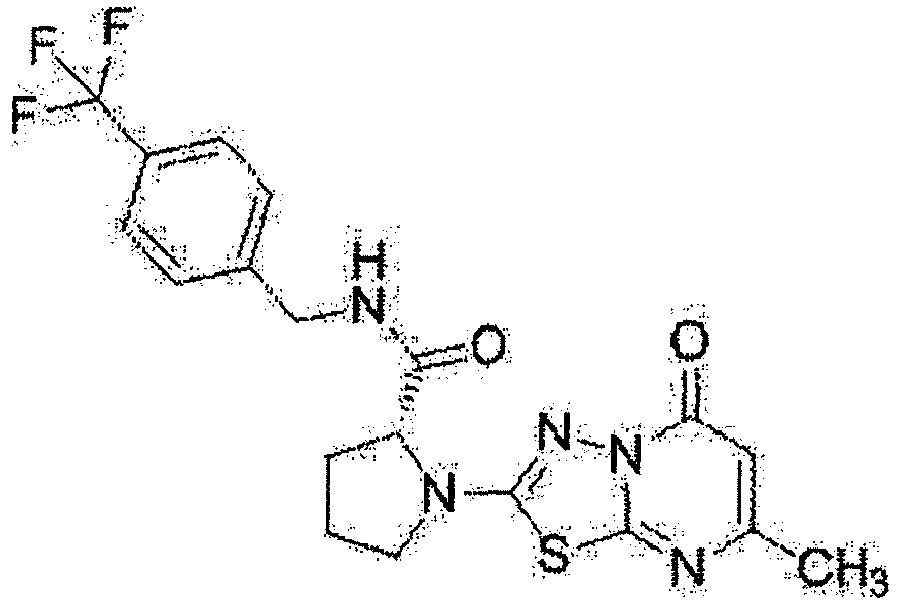
- The compound (200 mg) obtained in Reference Example 135 was treated by a method similar to that in Example 662 to give the title compound (135 mg).
MS (ESI) m/z; 438 [M+H]+ -
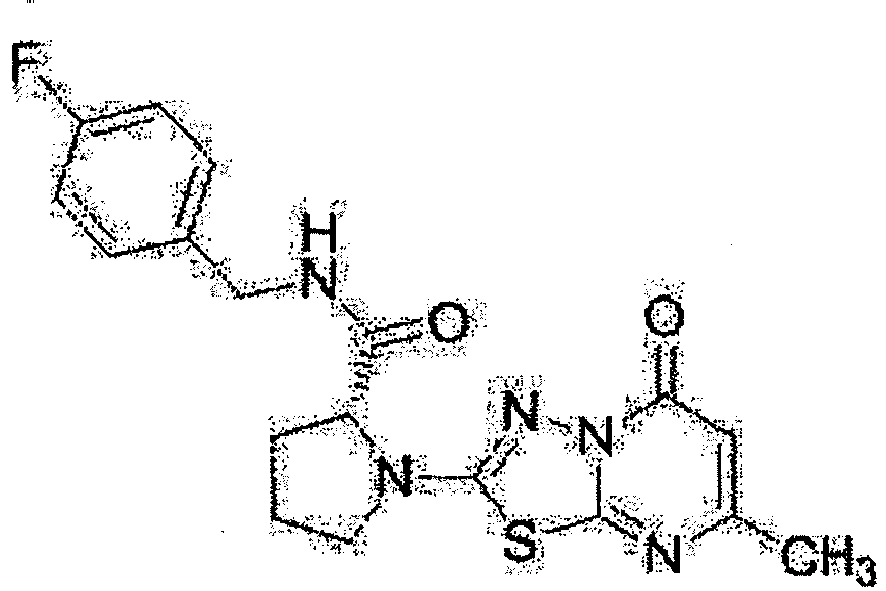
- The compound (200 mg) obtained in Reference Example 135 was treated by a method similar to that in Example 662 to give the title compound (115 mg).
MS (ESI) m/z; 388 [M+H]+ -

- The compound (200 mg) obtained in Reference Example 135 was treated by a method similar to that in Example 662 to give the title compound (135 mg).
MS (ESI) m/z; 410 [M+H]+ -
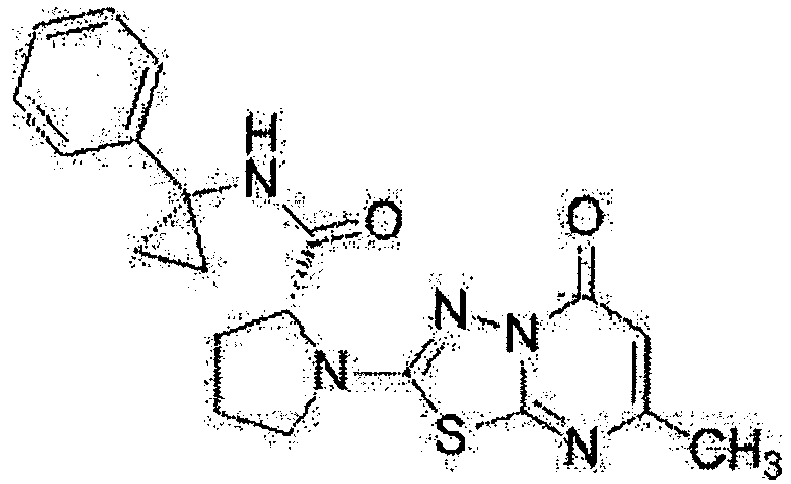
- The compound (200 mg) obtained in Reference Example 135 was treated by a method similar to that in Example 662 to give the title compound (135 mg).
MS (ESI) m/z; 396 [M+H]+ -

- To a solution (0.5 mL) of the compound (37.0 mg) obtained in Reference Example 134 in DMF were added 2-fluorobenzylamine (16 mg), EDC hydrochloride (35 mg), HOBt monohydrate (24 mg) and N,N-diisopropylethylamine (23 mg), and the reaction mixture was stirred at room temperature for 3 hr. After confirmation of the completion of the reaction, water was added to the reaction mixture, and the mixture was extracted twice with chloroform. The organic layer was concentrated, and the residue was purified by Waters XTerra(R) column (solvent; 10 mmol/L aqueous ammonium carbonate solution/methanol) to give the title compound (25.8 mg).
MS (ESI) m/z; 420 [M+H]+ -

- The compound (37.0 mg) obtained in Reference Example 134 was treated by a method similar to that in Example 671 to give the title compound (36.3 mg).
MS (ESI) m/z; 420 [M+H]+ -

- The compound (37.0 mg) obtained in Reference Example 134 was treated by a method similar to that in Example 671 to give the title compound (35.4 mg).
MS (ESI) m/z; 438 [M+H]+ -

- The compound (37.0 mg) obtained in Reference Example 134 was treated by a method similar to that in Example 671 to give the title compound (28.4 mg).
MS (ESI) m/z; 438 [M+H]+ -

- The compound (37.0 mg) obtained in Reference Example 134 was treated by a method similar to that in Example 671 to give the title compound (29.7 mg).
MS (ESI) m/z; 438 [M+H]+ -

- The compound (37.0 mg) obtained in Reference Example 134 was treated by a method similar to that in Example 671 to give the title compound (32.0 mg).
MS (ESI) m/z; 436, 438 [M+H]+ -

- The compound (37.0 mg) obtained in Reference Example 134 was treated by a method similar to that in Example 671 to give the title compound (32.5 mg).
MS (ESI) m/z; 436, 438 [M+H]+ -

- The compound (37.0 mg) obtained in Reference Example 134 was treated by a method similar to that in Example 671 to give the title compound (25.5 mg).
MS (ESI) m/z; 436, 438 [M+H]+ -

- The compound (37.0 mg) obtained in Reference Example 134 was treated by a method similar to that in Example 671 to give the title compound (17.4 mg).
MS (ESI) m/z; 470, 472 [M+H]+ -

- The compound (37.0 mg) obtained in Reference Example 134 was treated by a method similar to that in Example 671 to give the title compound (36.9 mg).
MS (ESI) m/z; 470, 472 [M+H]+ -

- The compound (37.0 mg) obtained in Reference Example 134 was treated by a method similar to that in Example 671 to give the title compound (14.4 mg).
MS (ESI) m/z; 432 [M+H]+ -

- The compound (37.0 mg) obtained in Reference Example 134 was treated by a method similar to that in Example 671 to give the title compound (19.4 mg).
MS (ESI) m/z; 432 [M+H]+ -

- The compound (37.0 mg) obtained in Reference Example 134 was treated by a method similar to that in Example 671 to give the title compound (6.10 mg).
MS (ESI) m/z; 432 [M+H]+ -

- The compound (37.0 mg) obtained in Reference Example 134 was treated by a method similar to that in Example 671 to give the title compound (26.8 mg).
MS (ESI) m/z; 404 [M+H]+ -

- The compound (37.0 mg) obtained in Reference Example 134 was treated by a method similar to that in Example 671 to give the title compound (23.0 mg).
MS (ESI) m/z; 418 [M+H]+ -

- The compound (37.0 mg) obtained in Reference Example 134 was treated by a method similar to that in Example 671 to give the title compound (20.0 mg).
MS (ESI) m/z; 443 [M+H]+ -

- The compound (37.0 mg) obtained in Reference Example 134 was treated by a method similar to that in Example 671 to give the title compound (4.30 mg).
MS (ESI) m/z; 420 [M+H]+ -

- The compound (37.0 mg) obtained in Reference Example 134 was treated by a method similar to that in Example 671 to give the title compound (22.4 mg).
MS (ESI) m/z; 470, 472 [M+H]+ -

- The compound (37.0 mg) obtained in Reference Example 134 was treated by a method similar to that in Example 671 to give the title compound (1.0 mg).
MS (ESI) m/z; 470, 472 [M+H]+ -

- To a solution (52 mL) of the compound (1.83 g) obtained in Example 652 in acetonitrile was added 1-chloromethyl-4-fluoro-1,4-diazoniabicyclo[2.2.2]octane bistetrafluoroborate (3.26 g) at room temperature, and the reaction mixture was stirred at room temperature for 7 hr. After confirmation of the completion of the reaction, chloroform was added, and the mixture was washed twice with water, dried over anhydrous sodium sulfate, filtered and concentrated. The residue was purified by NH silica gel column chromatography (solvent; hexane/ethyl acetate=50/50 - 0/100) to give the title compound (131 mg).
MS (ESI) m/z; 416 [M+H]+ -

- (1) The compound (1200 mg) obtained in Reference Example 764 was treated by a method similar to that in Example 634 to give (R)-N-benzyl-1-(7-methyl-5-oxo-5H-[1,3,4]thiadiazolo[3,2-a]pyrimidin-2-yl)pyrrolidine-2-carboxamide (1200 mg).
MS (ESI) m/z; 370 [M+H]+ - (2) The compound (360 mg) obtained in (1) was treated by a method similar to that in Example 690 to give the title compound (33.0 mg).
-

- A mixture of the compound (0.40 g) obtained in Example 634 and N-chlorosuccinimide (0.14 g) in acetonitrile (10 mL) was stirred with heating at 80°C for 5 hr. After confirmation of the completion of the reaction, the reaction mixture was cooled to room temperature, chloroform was added, and the mixture was washed twice with water. The organic layer was dried over anhydrous magnesium sulfate, filtered and concentrated. The residue was purified by silica gel column chromatography (solvent; ethyl acetate/methanol=100/0 - 90/10) to give the title compound (0.3 g).
MS (ESI) m/z; 432, 434 [M+H]+ -

- The compound (190 mg) obtained in Example 635 was treated by a method similar to that in Example 692 to give the title compound (97 mg).
MS (ESI) m/z; 446, 448 [M+H]+ -

- The compound (300 mg) obtained in Example 661 was treated by a method similar to that in Example 692 to give the title compound (217 mg).
MS (ESI) m/z; 416, 418 [M+H]+ -

- The compound (299 mg) obtained in Example 637 was treated by a method similar to that in Example 692 to give the title compound (291 mg).
MS (ESI) m/z; 418, 420 [M+H]+ -

- A mixture of the compound (200 mg) obtained in Example 653 and N-chlorosuccinimide (148 mg) in acetonitrile (3.6 mL) was stirred with heating at 60°C for 23 hr. After confirmation of the completion of the reaction, the reaction mixture was cooled to room temperature, chloroform was added, and the mixture was washed twice with water. The organic layer was dried over anhydrous magnesium sulfate, filtered and concentrated. The residue was purified by silica gel column chromatography (solvent; ethyl acetate/methanol=100/0 - 90/10). The obtained residue was dissolved in ethyl acetate (8 mL), hydrogen chloride (4.0 mol/L ethyl acetate solution, 0.1 mL) was added, and the mixture was stirred at room temperature for 10 min, and concentrated under reduced pressure to give the title compound (48 mg).
MS (ESI) m/z; 433, 435 [M+H]+ -

- A mixture of (R)-N-benzyl-1-(7-methyl-5-oxo-5H-[1,3,4]thiadiazolo[3,2-a]pyrimidin-2-yl)pyrrolidine-2-carboxamide (2.83 g) obtained by a method of Example 691(1) and N-bromosuccinimide (1.4 g) in acetonitrile (50 mL) was stirred with heating at 80°C for 3 hr. After confirmation of the completion of the reaction, the reaction mixture was cooled to room temperature, chloroform was added, and the mixture was washed once with water. The organic layer was dried over anhydrous magnesium sulfate, filtered and concentrated. Ethyl acetate was added to the obtained product, and the solid was collected by filtration to give the title compound (2.85 g).
MS (ESI) m/z; 448, 450 [M+H]+ -

- To the compound (0.40 g) obtained in Example 697 in THF (10 mL)-water (5.0 mL) mixed solvent were added 4-(4,4,5,5-tetramethyl-[1,3,2]dioxaborolan-2-yl)-3,6-dihydro-2H-pyran (0.56 g), tetrakis(triphenylphosphine)palladium(0) (60 mg) and sodium carbonate (0.30 g) at room temperature, and the reaction mixture was stirred with heating at 100°C for 4 hr. After confirmation of the completion of the reaction, the reaction mixture was cooled to room temperature, chloroform (200 mL) was added, and the mixture was washed once with water. The organic layer was dried over anhydrous magnesium sulfate, filtered and concentrated. The residue was purified by silica gel column chromatography (solvent; ethyl acetate/methanol=100/0 - 90/10) to give the title compound (0.21 g).
MS (ESI) m/z; 452 [M+H]+ -
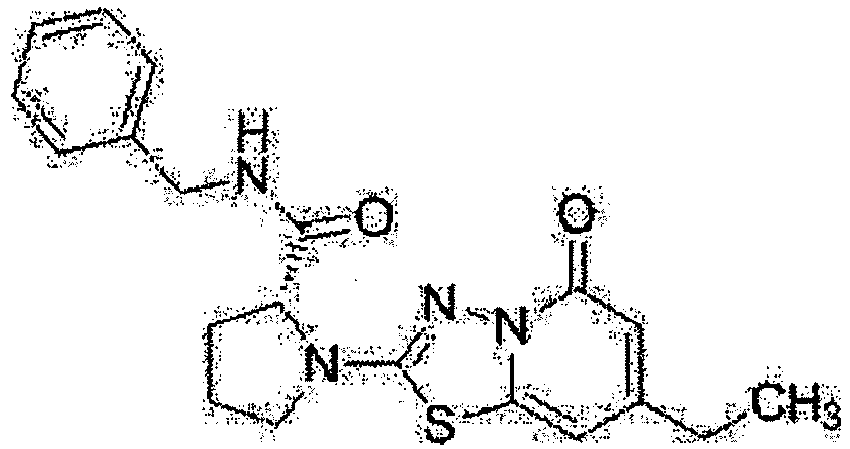
- To a solution (2 mL) of the compound (0.56 g) obtained in Reference Example 785 in pyridine were added the compound (1.29 g) obtained in Reference Example 341 and N,N-diisopropylethylamine (3.7 mL), and the reaction mixture was stirred for 5 hr at 140°C. After confirmation of the completion of the reaction, chloroform was added, and the mixture was washed once with 0.5 mol/L hydrochloric acid, and further washed once with saturated sodium hydrogen carbonate. The organic layer was dried over anhydrous sodium sulfate, filtered and concentrated. The residue was purified by silica gel column chromatography (solvent; ethyl acetate/methanol=100/0 - 95/5) to give the title compound (0.32 g).
MS (ESI) m/z; 383 [M+H]+ -

- The compound (300 mg) obtained in Reference Example 786 was treated by a method similar to that in Example 699 to give the title compound (75.0 mg).
MS (ESI) m/z; 369 [M+H]+ -
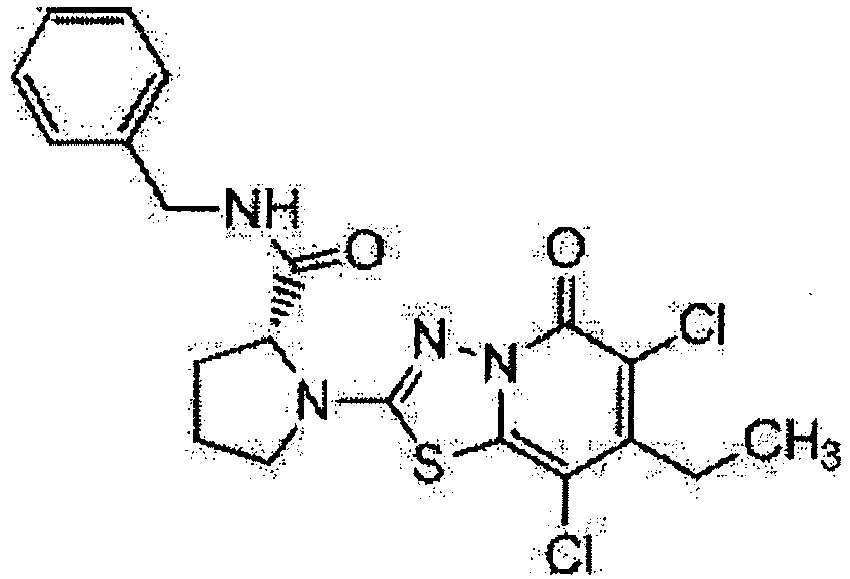
- A mixture of the compound (330 mg) obtained in Example 699 and N-chlorosuccinimide (115 mg) in acetonitrile (9 mL) was stirred with heating at 80°C for 2 hr. After confirmation of the completion of the reaction, the reaction mixture was cooled to room temperature, and concentrated. The residue was purified by Capcellpak C18 UG80 30X250 mm (solvent; 0.05% trifluoroacetic acid acetonitrile/water). The solution of the obtained product was extracted with chloroform, and the organic layer was dried over anhydrous sodium sulfate, filtered and concentrated to give the title compound (30.0 mg).
MS (ESI) m/z; 451, 453 [M+H]+ -

- The compound (100 mg) obtained in Example 700 was treated by a method similar to that in Example 701 to give the title compound (20.0 mg).
MS (ESI) m/z; 437, 439 [M+H]+ -

- A mixture of the compound (0.16 g) obtained in Reference Example 790, N,N-diisopropylethylamine (1.1 mL) and the compound (0.44 g) obtained in Reference Example 341 in pyridine (0.6 mL) was stirred at 135°C for 8 hr. After confirmation of the completion of the reaction, the solvent was evaporated under reduced pressure. The residue was purified by silica gel column chromatography (solvent; ethyl acetate/methanol=100/0 - 95/5) to give the title compound (170 mg).
MS (ESI) m/z; 392 [M+H]+ -

- The compound (60 mg) obtained in Reference Example 791 was treated by a method similar to that in Example 703 to give the title compound (55 mg).
MS (ESI) m/z; 378 [M+H]+ -

- The compound (1.56 g) obtained in Reference Example 792 was treated by a method similar to that in Example 703 to give the title compound (1.57 g).
MS (ESI) m/z; 392 [M+H]+ -

- The compound (132 mg) obtained in Reference Example 793 was treated by a method similar to that in Example 703 to give the title compound (141 mg).
MS (ESI) m/z; 446 [M+H]+ -

- The compound (230 mg) obtained in Reference Example 794 was treated by a method similar to that in Example 703 to give the title compound (312 mg).
MS (ESI) m/z; 432 [M+H]+ -

- The compound (201 mg) obtained in Reference Example 795 was treated by a method similar to that in Example 703 to give the title compound (224 mg).
MS (ESI) m/z; 446 [M+H]+ -

- A mixture of the compound (160 mg) obtained in Reference Example 800, N,N-diisopropylethylamine (2.50 mL) and the compound (0.35 g) obtained in Reference Example 341 was stirred with heating at 140°C for 3 hr. After confirmation of the completion of the reaction, ethyl acetate was added, and the reaction mixture was acidified with 1.0 mol/L hydrochloric acid. The organic layer was washed with water, dried over anhydrous magnesium sulfate, filtered and concentrated. To the residue was added diisopropyl ether, and the solid was collected by filtration and dried to give the title compound (250 mg).
MS (ESI) m/z; 542 [M+H]+ -

- The compound (300 mg) obtained in Reference Example 801 was treated by a method similar to that in Example 709 to give the title compound (360 mg).
MS (ESI) m/z; 594 [M+H]+ -

- The compound (200 mg) obtained in Reference Example 802 was treated by a method similar to that in Example 709 to give the title compound (180 mg).
MS (ESI) m/z; 424, 426 [M+H]+ -

- To the compound (250 mg) obtained in Example 709 was added a mixed solution of triethylsilane (0.11 mL) and trifluoroacetic acid (2.0 mL), and the reaction mixture was stirred at room temperature for 2 hr. The solvent was evaporated under reduced pressure, chloroform was added, and the mixture was washed with saturated aqueous sodium hydrogen carbonate solution. The organic layer was dried over anhydrous magnesium sulfate, filtered and concentrated. The residue was purified by silica gel column chromatography (solvent; ethyl acetate/methanol=100/0 - 95/5) to give the title compound (130 mg) .
MS (ESI) m/z; 392 [M+H]+ -

- The compound (360 mg) obtained in Example 710 was treated by a method similar to that in Example 712 to give the title compound (186 mg).
MS (ESI) m/z; 444 [M+H]+ -

- To a solution (6 mL) of the compound (0.20 g) obtained in Reference Example 806 in THF were added the compound (0.28 g) obtained in Reference Example 341 and triethylamine (0.24 g), and the reaction mixture was stirred with heating at 100°C for 8 hr. After confirmation of the completion of the reaction, water was added to the reaction mixture, and the mixture was extracted once with chloroform. The organic layer was dried over anhydrous magnesium sulfate, filtered and concentrated. The residue was purified by silica gel column chromatography (solvent; ethyl acetate/methanol=100/0 - 90/10) to give the title compound (0.30 g).
MS (ESI) m/z; 426 [M+H]+ -

- To a solution (10 mL) of the compound (0.40 g) obtained in Reference Example 807 in THF were added the compound (0.60 g) obtained in Reference Example 341 and N,N-diisopropylethylamine (0.86 g), and the reaction mixture was stirred with heating at 100°C for 8 hr. After confirmation of the completion of the reaction, the reaction mixture was cooled to room temperature, water was added to the reaction mixture, and the mixture was extracted once with chloroform. The organic layer was dried over anhydrous magnesium sulfate, filtered and concentrated. The residue was purified by silica gel column chromatography (solvent; ethyl acetate/methanol=100/0 - 90/10). Ethyl acetate was added to the obtained product, and the solid was collected by filtration to give the title compound (0.46 g).
MS (ESI) m/z; 410 [M+H]+ -

- The compound (400 mg) obtained in Reference Example 808 was treated by a method similar to that in Example 715 to give the title compound (440 mg).
MS (ESI) m/z; 396 [M+H]+ -

- The compound (600 mg) obtained in Reference Example 803 was treated by a method similar to that in Example 715 to give the title compound (586 mg).
MS (ESI) m/z; 392 [M+H]+ -

- The compound (300 mg) obtained in Reference Example 803 was treated by a method similar to that in Example 715 to give the title compound (360 mg).
MS (ESI) m/z; 418 [M+H]+ -

- The compound (400 mg) obtained in Reference Example 804 was treated by a method similar to that in Example 715 to give the title compound (306 mg).
MS (ESI) m/z; 378 [M+H]+ -

- The compound (300 mg) obtained in Reference Example 805 was treated by a method similar to that in Example 715 to give the title compound (83 mg).
MS (ESI) m/z; 392 [M+H]+ -

- The compound (200 mg) obtained in Reference Example 806 was treated by a method similar to that in Example 715 to give the title compound (260 mg).
MS (ESI) m/z; 452 [M+H]+ -

- To a solution (10 mL) of the compound (1.02 g) obtained in Example 720 in acetonitrile was added 1-chloromethyl-4-fluoro-1,4-diazoniabicyclo[2.2.2]octane bistetrafluoroborate (1.10 g) at room temperature, and the reaction mixture was stirred at 80°C for 6 hr. After confirmation of the completion of the reaction, chloroform was added, and the mixture was washed once with water. The organic layer was dried over anhydrous magnesium sulfate, filtered and concentrated. The residue was purified by silica gel column chromatography (solvent; ethyl acetate/methanol=100/0 - 90/10). To the obtained product was added hexane, and the solid was collected by filtration to give the title compound (116 mg).
MS (ESI) m/z; 410 [M+H]+ -
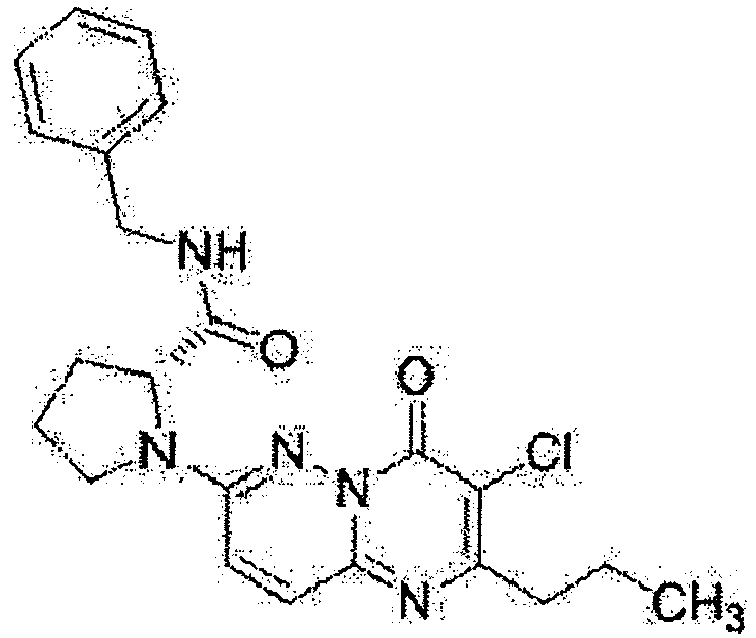
- To a solution (10 mL) of the compound (200 mg) obtained in Example 717 in acetonitrile was added N-chlorosuccinimide (63 mg) at room temperature, and the reaction mixture was stirred with heating at 80°C for 5 hr. After confirmation of the completion of the reaction, the reaction mixture was cooled to room temperature, chloroform was added, and the mixture was washed once with water. The organic layer was dried over anhydrous magnesium sulfate, filtered and concentrated. The residue was purified by silica gel column chromatography (solvent; ethyl acetate/methanol=100/0 - 90/10). Ethyl acetate was added to the obtained product, and the solid was collected by filtration to give the title compound (126 mg) .
MS (ESI) m/z; 426, 428 [M+H]+ -

- The compound (300 mg) obtained in Example 718 was treated by a method similar to that in Example 723 to give the title compound (200 mg).
MS (ESI) m/z; 452, 454 [M+H]+ -

- The compound (200 mg) obtained in Example 719 was treated by a method similar to that in Example 723 to give the title compound (129 mg).
MS (ESI) m/z; 412, 414 [M+H]+ -

- The compound (1.10 g) obtained in Example 720 was treated by a method similar to that in Example 723 to give the title compound (890 mg).
MS (ESI) m/z; 426, 428 [M+H]+ -

- To a solution (40.0 mL) of the compound (2.00 g) obtained in Reference Example 637 in N-methylpyrrolidone were added (D)-proline (1.65 g) and potassium carbonate (3.96 g), and the reaction mixture was stirred with heating at 100°C for 2 hr. The reaction mixture was cooled to room temperature, and acidified with 1.0 mol/L hydrochloric acid. Sodium chloride was added, and the mixture was extracted twice with chloroform. The organic layer was dried over anhydrous magnesium sulfate, and filtered. Chloroform was evaporated under reduced pressure from the filtrate, to the obtained mixture were added N,N-diisopropylethylamine (1.24 mL), benzylamine (775 mg), EDC hydrochloride (1.37 g) and HOBt monohydrate (1.10 g), and the reaction mixture was stirred at room temperature overnight. Water was added, and the mixture was extracted with ethyl acetate. The organic layer was dried over anhydrous sodium sulfate, filtered and concentrated. The residue was purified by silica gel column chromatography (solvent; hexane/ethyl acetate=70/30 - 10/90) to give the title compound (2.39 g).
MS (ESI) m/z; 559 [M+H]+ -

- The compound (2.39 g) obtained in Example 727 was treated by a method similar to that in Example 482 to give the title compound (1.35 g).
MS (ESI) m/z; 439 [M+H]+ -

- To a solution (500 mL) of N-carbobenzoxy-D-proline (32 g) in THF were added triethylamine (28.5 g) and isobutyl chloroformate (18.4 g) at 0°C, and the reaction mixture was stirred at room temperature for 30 min. A solution (30 mL) of 2-amino-2-cyanoacetic acid ethyl ester (15.7 g) in THF was added at room temperature, and the reaction mixture was stirred overnight. Water was added to the reaction mixture, and the mixture was extracted three times with ethyl acetate. The organic layer was dried over anhydrous magnesium sulfate, filtered and concentrated. The residue was purified by silica gel column chromatography (solvent; hexane/ethyl acetate=70/30 - 20/80) to give the title compound (40.6 g).
MS (ESI) m/z; 360 [M+H]+ -

- N-(tert-butylcarbonyl)-N-methyl-D-alanine (5.00 g) was treated by a method similar to that in Reference Example 1 to give the title compound (7.44 g).
MS (ESI) m/z; 314 [M+H]+ -

- A mixture of the compound (40.6 g) obtained in Reference Example 1, pyridine (46 mL), and Lawesson reagent (27.5 g) in toluene (600 mL) was stirred with heating at 100°C for 8 hr. The reaction mixture was allowed to cool and water was added, and the mixture was extracted three times with ethyl acetate. The organic layer was dried over anhydrous magnesium sulfate, filtered and concentrated. The residue was purified by NH silica gel column chromatography (solvent; hexane/ethyl acetate=70/30 - 20/80) to give the title compound in a free form (16.0 g). To a solution (300 mL) of the obtained free form in acetonitrile was added 4-toluenesulfonic acid monohydrate (8.1 g), and the mixture was stirred at room temperature for 30 min. The solvent was evaporated under reduced pressure, and the obtained crystal was washed with ethyl acetate, collected by filtration and dried to give the title compound (14.0 g).
MS (ESI) m/z; 376 [M+H]+ -
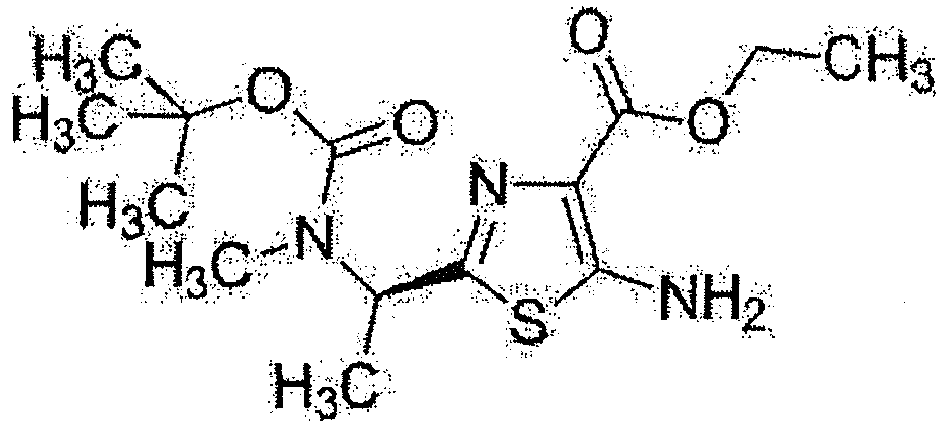
- A mixture of the compound (7.44 g) obtained in Reference Example 2 pyridine (14.4 mL), and Lawesson reagent (8.63 g) in 1,4-dioxane (150 mL) was stirred with heating at 100°C for 24 hr. The reaction mixture was allowed to cool, and the solvent was evaporated under reduced pressure. The residue was dissolved in chloroform, adsorbed to NH silica gel, and the solvent was evaporated. Ethyl acetate was added to the residue, and the mixture was filtered and washed. The filtrate was concentrated under reduced pressure, and the residue was purified by NH silica gel column chromatography (solvent; hexane/ethyl acetate=70/30 - 20/80) to give the title compound (1.27 g).
MS (ESI) m/z; 330 [M+H]+ -

- A suspension (400 mL) of the compound (18.6 g) obtained in Reference Example 3 in chloroform was alkalified with saturated aqueous sodium hydrogen carbonate solution and dissolved. The aqueous layer was separated, extracted twice with chloroform and the combined organic layer was dried over anhydrous magnesium sulfate, filtered and concentrated. To a solution (140 mL) of the residue in ethanol was added 1.0 mol/L sodium hydroxide (140 mL), and the reaction mixture was stirred with heating at 90°C for 2 hr. The reaction mixture was allowed to cool to room temperature, neutralized with 1.0 mol/L hydrochloric acid, and extracted twice with chloroform. The organic layer was dried over anhydrous magnesium sulfate, filtered and concentrated to give the title compound (11.2 g). MS (ESI) m/z; 348 [M+H]+
-

- To a solution (70.0 mL) of the compound (1.27 g) obtained in Reference Example 4 in ethanol was added 1.0 mol/L aqueous sodium hydroxide solution (15.5 mL), and the reaction mixture was stirred with heating at 80°C for 3 hr. The reaction mixture was allowed to cool to room temperature, neutralized with 1.0 mol/L hydrochloric acid, and extracted once with chloroform. The organic layer was dried over anhydrous magnesium sulfate, filtered and concentrated to give the title compound (1.12 g).
MS (ESI) m/z; 302 [M+H]+ -

- To a solution (15 mL) of the compound (1.53 g) obtained in Reference Example 5 in DMF were added N,N-diisopropylethylamine (4.6 g), methylamine hydrochloride (1.2 g), EDC hydrochloride (3.4 g) and HOBt monohydrate (2.7 g), and the reaction mixture was stirred at room temperature overnight. Water was added to the reaction mixture, and the mixture was extracted three times with ethyl acetate. The organic layer was dried over anhydrous magnesium sulfate, filtered and concentrated. The residue was purified by silica gel column chromatography (solvent; hexane/ethyl acetate=70/30 - 20/80) to give the title compound (1.1 g).
MS (ESI) m/z; 361 [M+H]+ -

- The compound (3.60 g) obtained in Reference Example 5 was treated by a method similar to that in Reference Example 7 to give the title compound (2.45 g).
MS (ESI) m/z; 389 [M+H]+ -

- The compound (500 mg) obtained in Reference Example 5 was treated by a method similar to that in Reference Example 7 to give the title compound (766 mg).
MS (ESI) m/z; 431 [M+H]+ -

- To a solution (50 mL) of 3-methyl-[1,2,4]oxadiazole-5-carboxylic acid ethyl ester (9.45 g) in ethano 1 was added an aqueous solution (20 mL) of potassium hydroxide (4.0 g) at room temperature, and the reaction mixture was stirred for 2 hr. The solvent was evaporated under reduced pressure, acetonitrile was added to the residue, and the solid was collected by filtration, and dried to give 3-methyl-[1,2,4]oxadiazole-5-carboxylic acid potassium salt (9.38 g). To a solution (60 mL) of the obtained 3-methyl-[1,2,4]oxadiazole-5-carboxylic acid potassium salt (2.8 g) in acetonitrile were added oxalyl chloride (1.4 mL) and DMF (one drop), and the reaction mixture was stirred at room temperature for 2 hr. The reaction mixture was added dropwise to a solution (90 mL) of the compound (2.44 g) obtained in Reference Example 7 and triethylamine (3.8 mL) in methylene chloride under ice-cooling, and the mixture was stirred at room temperature for 2 hr. Water was added to the reaction mixture, and the mixture was extracted twice with chloroform. The organic layer was dried over anhydrous magnesium sulfate, filtered and concentrated. The residue was purified by silica gel column chromatography (solvent; hexane/ethyl acetate=70/30 - 20/80) to give the title compound (1.68 g).
MS (ESI) m/z; 471 [M+H]+ -

- The compound (1500 mg) obtained in Reference Example 7 was treated by a method similar to that in Reference Example 10 to give the title compound (760 mg).
MS (ESI) m/z; 471 [M+H]+ -

- The compound (2400 mg) obtained in Reference Example 7 was treated by a method similar to that in Reference Example 10 to give the title compound (1800 mg) .
MS (ESI) m/z; 471 [M+H]+ -

- To a solution (10 mL) of the compound (830 mg) obtained in Reference Example 7 and N,N-diisopropylethylamine (0.48 mL) in methylene chloride was added dropwise chloroacetyl chloride (0.22 mL) under ice-cooling. The reaction mixture was stirred at room temperature for 2 hr. Water was added to the reaction mixture, and the mixture was extracted twice with chloroform. The organic layer was dried over anhydrous magnesium sulfate, filtered and concentrated. The residue was purified by silica gel column chromatography (solvent; hexane/ethyl acetate=90/10 - 20/80) to give the title compound (775 mg).
MS (ESI) m/z; 437 [M+H]+ -

- The compound (766 mg) obtained in Reference Example 9 was treated by a method similar to that in Reference Example 13 to give the title compound (285 mg).
MS (ESI) m/z; 473 [M+H]+ -

- To a solution (30 mL) of tetrahydro-2H-pyran-4-carboxylic acid (1.36 g) in acetonitrile were added oxalyl chloride (0.88 mL) and DMF (one drop), and the reaction mixture was stirred at room temperature for 2 hr. The reaction mixture was added dropwise to a solution (60 mL) of the compound (1.5 g) obtained in Reference Example 7 and triethylamine (2.4 mL) in methylene chloride under ice-cooling, and the mixture was stirred at room temperature for 2 hr. Water was added to the reaction mixture, and the mixture was extracted twice with chloroform. The organic layer was dried over anhydrous magnesium sulfate, filtered and concentrated. The residue was purified by silica gel column chromatography (solvent; hexane/ethyl acetate=70/30 - 20/80) to give the title compound (1.96 g).
MS (ESI) m/z; 473 [M+H]+ -

- To a solution (30 mL) of the compound (0.80 g) obtained in Example 1 in acetonitrile was added trimethylsilyl iodide (0.38 mL), and the reaction mixture was stirred at room temperature for 3 hr. Water and 1.0 mol/L hydrochloric acid were added to the reaction mixture, and the mixture was washed with ethyl acetate, neutralized with saturated aqueous sodium hydrogen carbonate solution, and extracted twice with chloroform. The organic layer was dried over anhydrous magnesium sulfate, filtered and concentrated. The residue was purified by silica gel column chromatography (solvent; chloroform/methanol=100/0 - 95/5) to give the title compound (0.40 g).
MS (ESI) m/z; 319 [M+H]+ -
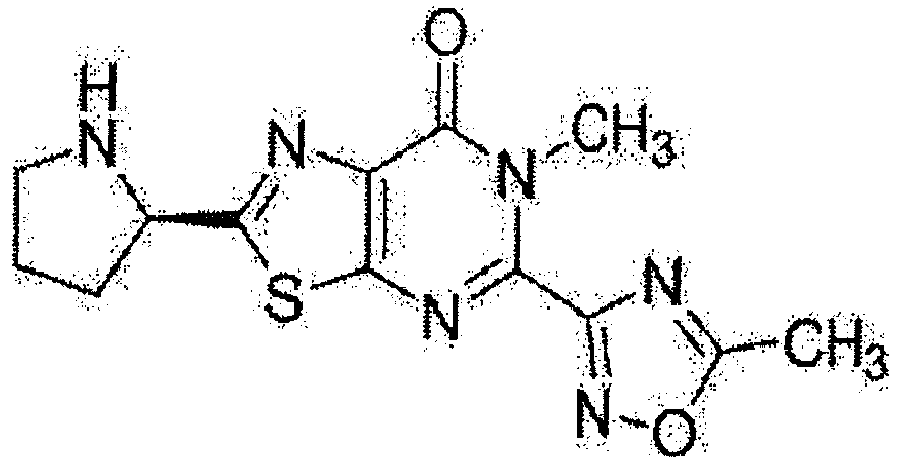
- The compound (700 mg) obtained in Example 2 was treated by a method similar to that in Reference Example 16 to give the title compound (330 mg).
MS (ESI) m/z; 319 [M+H]+ -
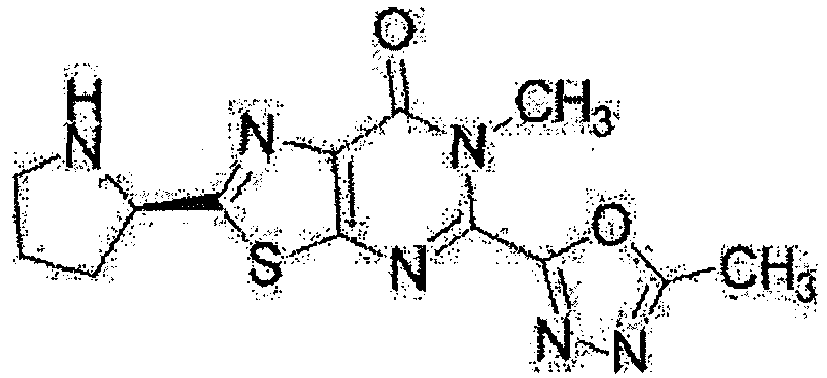
- The compound (1300 mg) obtained in Example 3 was treated by a method similar to that in Reference Example 16 to give the title compound (470 mg).
MS (ESI) m/z; 319 [M+H]+ -

- The compound (1600 mg) obtained in Example 5 was treated by a method similar to that in Reference Example 16 to give the title compound (720 mg).
MS (ESI) m/z; 321 [M+H]+ -

- To a solution (10 mL) of the compound (2.46 g) obtained in Example 6 in methylene chloride was added 30% hydrogen bromide-acetic acid solution (9.3 mL), and the reaction mixture was stirred at room temperature for 2 hr. Water and 1.0 mol/L hydrochloric acid were added to the reaction mixture, and the mixture was washed with ethyl acetate, neutralized with 1.0 mol/L aqueous sodium hydroxide solution, and extracted twice with chloroform. The organic layer was dried over anhydrous magnesium sulfate, filtered and concentrated. The residue was purified by silica gel column chromatography (solvent; ethyl acetate/methanol=100/0 - 95/5) to give the title compound (1.30 g).
MS (ESI) m/z; 333 [M+H]+ -

- The compound (100 mg) obtained in Example 7 was treated by a method similar to that in Reference Example 16 to give the title compound (23 mg).
MS (ESI) m/z; 265 [M+H]+ -

- The compound (275 mg) obtained in Example 8 was treated by a method similar to that in Reference Example 16 to give the title compound (43 mg).
MS (ESI) m/z; 336 [M+H]+ -

- To a solution (5.0 mL) of the compound (202 mg) obtained in Reference Example 14 in acetic acid was added concentrated sulfuric acid (2.0 mL), and the reaction mixture was stirred with heating at 125°C for 25 hr. The reaction mixture was cooled to room temperature, neutralized with saturated aqueous sodium hydrogen carbonate solution, and extracted twice with chloroform. The organic layer was dried over anhydrous magnesium sulfate, filtered and concentrated. The residue was purified by silica gel column chromatography (solvent; chloroform/methanol=100/0 - 95/5) to give the title compound (60 mg).
MS (ESI) m/z; 321 [M+H]+ -

- To a solution (120 mL) of the compound (11.16 g) obtained in Reference Example 5 in DMF were added N,N-diisopropylethylamine (6.3 g), 2,4-dimethoxybenzylamine (8.1 g), EDC hydrochloride (9.3 g) and HOBt monohydrate (7.4 g), and the reaction mixture was stirred at room temperature overnight. Water was added to the reaction mixture, and the mixture was extracted three times with ethyl acetate. The organic layer was dried over anhydrous magnesium sulfate, filtered and concentrated. The residue was purified by silica gel column chromatography (solvent; hexane/ethyl acetate=70/30 - 20/80) to give the title compound (16.0 g).
MS (ESI) m/z; 497 [M+H]+ -
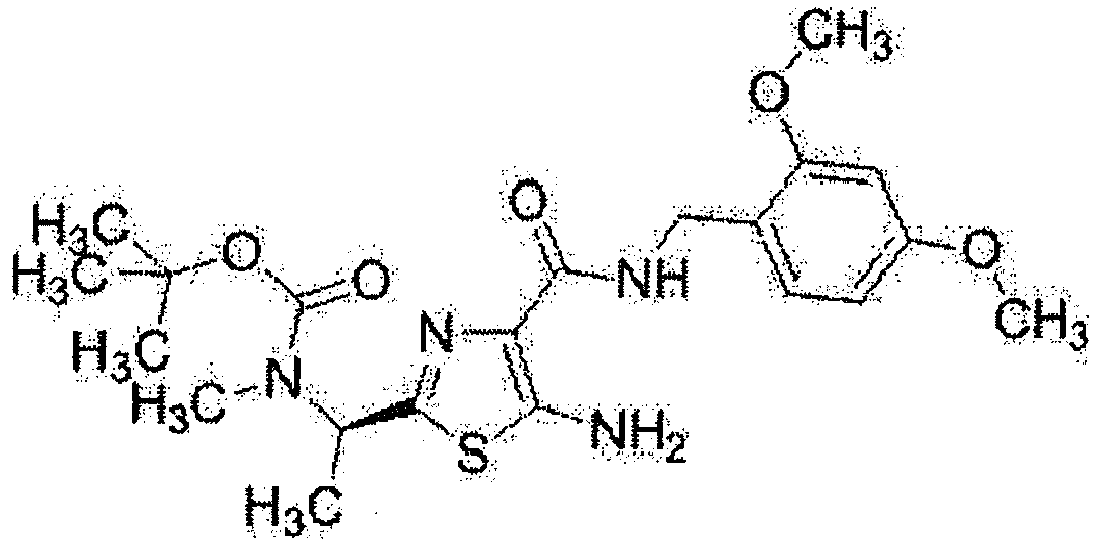
- The compound (1.12 g) obtained in Reference Example 6 was treated by a method similar to that in Reference Example 24 to give the title compound (1.46 g).
MS (ESI) m/z; 451 [M+H]+ -

- To a solution (30 mL) of the compound (1500 mg) obtained in Reference Example 24 in methylene chloride were added triethylamine (630 µL) and isobutyryl chloride (380 µL) at room temperature. The reaction mixture was stirred at room temperature for 1.5 hr. Water was added to the reaction mixture, and the mixture was extracted with chloroform. The combined organic layer was dried over anhydrous magnesium sulfate, filtered and concentrated to give the title compound (1800 mg).
MS (ESI) m/z; 567 [M+H]+ -

- The compound (1.00 g) obtained in Reference Example 24 was treated by a method similar to that in Reference Example 26 to give the title compound (1.28 g).
MS (ESI) m/z; 565 [M+H]+ -

- The compound (1.50 g) obtained in Reference Example 24 was treated by a method similar to that in Reference Example 26 to give the title compound (1.74 g).
MS (ESI) m/z; 601 [M+H]+ -

- The compound (2.00 g) obtained in Reference Example 24 was treated by a method similar to that in Reference Example 26 to give the title compound (1.90 g).
MS (ESI) m/z; 619 [M+H]+ -

- The compound (1.50 g) obtained in Reference Example 24 was treated by a method similar to that in Reference Example 26 to give the title compound (1.47 g).
MS (ESI) m/z; 637 [M+H]+ -

- The compound (1.50 g) obtained in Reference Example 24 was treated by a method similar to that in Reference Example 26 to give the title compound (1.90 g).
MS (ESI) m/z; 685 [M+H]+ -

- The compound (1.50 g) obtained in Reference Example 24 was treated by a method similar to that in Reference Example 26 to give the title compound (1.45 g).
MS (ESI) m/z; 615 [M+H]+ -

- The compound (1.50 g) obtained in Reference Example 24 was treated by a method similar to that in Reference Example 26 to give the title compound (1.90 g).
MS (ESI) m/z; 631 [M+H]+ -

- The compound (700 mg) obtained in Reference Example 25 was treated by a method similar to that in Reference Example 26 to give the title compound (800 mg).
MS (ESI) m/z; 521 [M+H]+ -

- To a solution (10 mL) of 1-fluorocyclopropylcarboxylic acid (540 mg) in methylene chloride were added oxalyl chloride (440 µL) and DMF (one drop), and the reaction mixture was stirred at room temperature for 2 hr. The reaction mixture was added dropwise to a solution (20 mL) of the compound (2.0 g) obtained in Reference Example 24 and triethylamine (2.3 mL) in methylene chloride under ice-cooling, and the mixture was stirred at room temperature for 7 hr. Water was added to the reaction mixture, and the mixture was extracted twice with chloroform. The organic layer was dried over anhydrous magnesium sulfate, filtered and concentrated. The residue was purified by silica gel column chromatography (solvent; hexane/ethyl acetate=70/30 - 20/80) to give the title compound (1.8 g).
MS (ESI) m/z; 583 [M+H]+ -

- The compound (200 mg) obtained in Reference Example 24 was treated by a method similar to that in Reference Example 35 to give the title compound (180 mg).
MS (ESI) m/z; 599 [M+H]+ -

- The compound (312 mg) obtained in Reference Example 24 was treated by a method similar to that in Reference Example 35 to give the title compound (207 mg).
MS (ESI) m/z; 589 [M+H]+ -
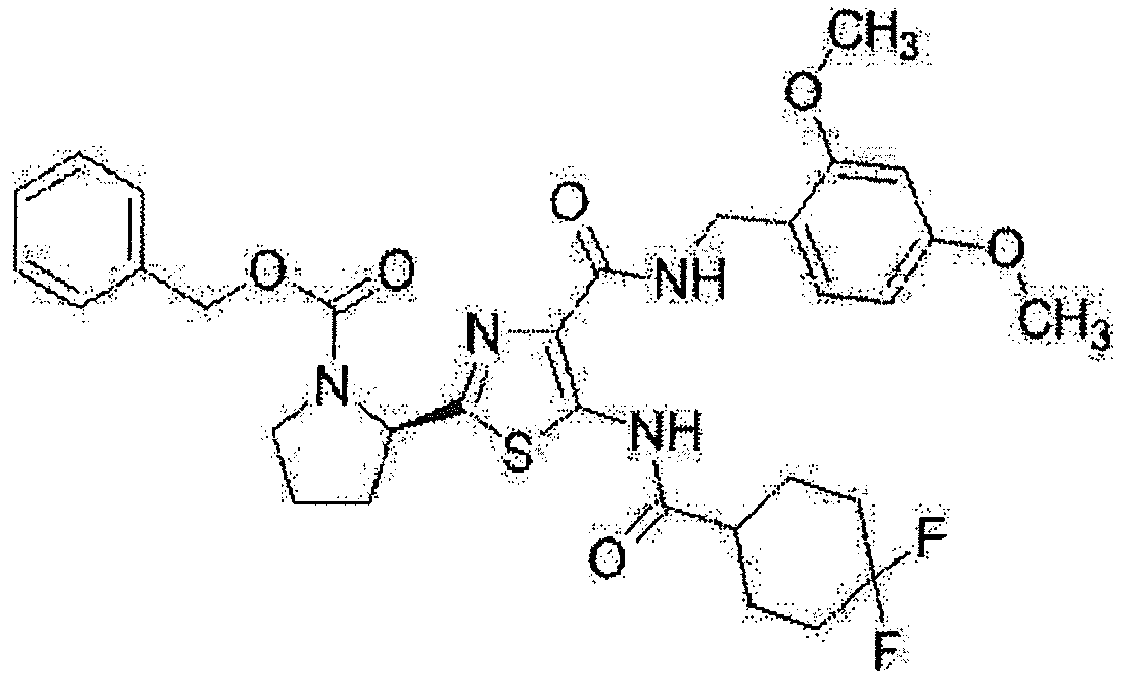
- The compound (1.50 g) obtained in Reference Example 24 was treated by a method similar to that in Reference Example 35 to give the title compound (1.90 g).
MS (ESI) m/z; 643 [M+H]+ -

- The compound (1.50 g) obtained in Reference Example 24 was treated by a method similar to that in Reference Example 35 to give the title compound (1.34 g).
MS (ESI) m/z; 625 [M+H]+ -

- The compound (1.50 g) obtained in Reference Example 24 was treated by a method similar to that in Reference Example 35 to give the title compound (1.68 g).
MS (ESI) m/z; 615 [M+H]+ -

- The compound (2.00 g) obtained in Reference Example 24 was treated by a method similar to that in Reference Example 35 to give the title compound (1.40 g).
MS (ESI) m/z; 609 [M+H]+ -

- The compound (3.50 g) obtained in Reference Example 24 was treated by a method similar to that in Reference Example 35 to give the title compound (4.10 g).
MS (ESI) m/z; 590 [M+H]+ -
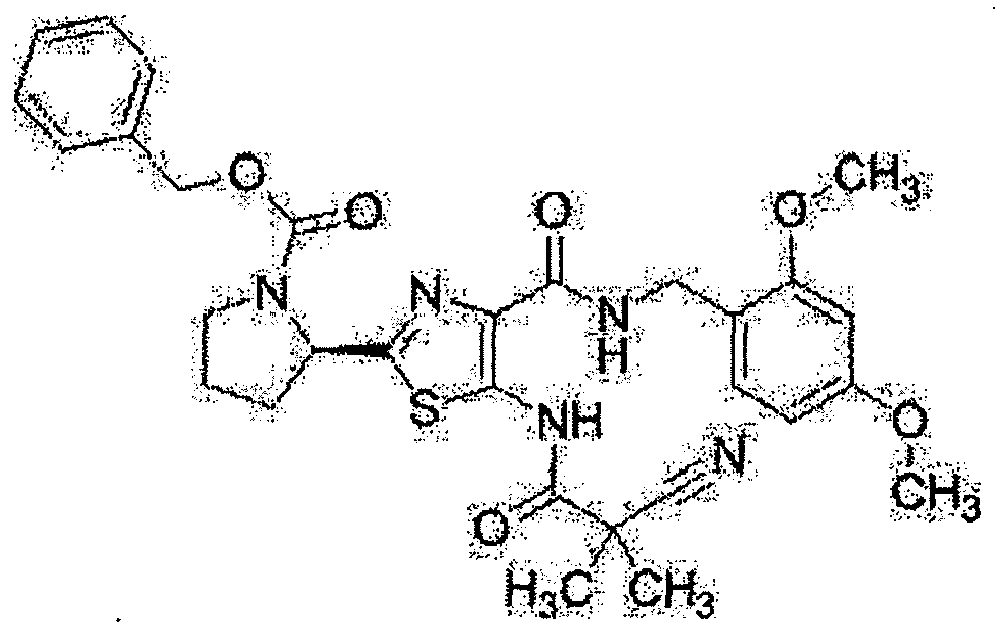
- The compound (700 mg) obtained in Reference Example 24 was treated by a method similar to that in Reference Example 35 to give the title compound (583 mg).
MS (ESI) m/z; 592 [M+H]+ -

- The compound (500 mg) obtained in Reference Example 24 was treated by a method similar to that in Reference Example 35 to give the title compound (379 mg).
MS (ESI) m/z; 597 [M+H]+ -

- The compound (1.50 g) obtained in Reference Example 24 was treated by a method similar to that in Reference Example 35 to give the title compound (1.46 g).
MS (ESI) m/z; 633 [M+H]+ -

- The compound (700 mg) obtained in Reference Example 25 was treated by a method similar to that in Reference Example 35 to give the title compound (815 mg).
MS (ESI) m/z; 553, 555 [M+H]+ -

- To a solution (10 mL) of the compound (486 mg) obtained in Reference Example 24 in methylene chloride were added dropwise trifluoroacetic anhydride (165 µL) and pyridine (158 µL), and the reaction mixture was stirred at room temperature for 5 hr. The reaction mixture was concentrated under reduced pressure, and the residue was dissolved in chloroform. The solution was washed with 1.0 mol/L hydrochloric acid and saturated aqueous sodium hydrogen carbonate solution, dried over anhydrous magnesium sulfate, filtered and concentrated to give the title compound (580 mg).
MS (ESI) m/z; 593 [M+H]+ -

- The compound (497 mg) obtained in Reference Example 24 was treated by a method similar to that in Reference Example 47 to give the title compound (567 mg).
MS (ESI) m/z; 575 [M+H]+ -

- The compound (800 mg) obtained in Reference Example 34 was treated by a method similar to that in Example 42 to give the title compound (740 mg).
MS (ESI) m/z; 503 [M+H]+ -

- The compound (815 mg) obtained in Reference Example 46 was treated by a method similar to that in Example 42 to give the title compound (765 mg).
MS (ESI) m/z; 535, 537 [M+H]+ -

- The compound (2.50 g) obtained in Reference Example 24 was treated by a method similar to that in Reference Example 35 to give the title compound (2.50 g).
MS (ESI) m/z; 609 [M+H]+ -

- To a solution (30 mL) of the compound (2.30 g) obtained in Example 95 in acetonitrile was added trimethylsilyl iodide (0.84 mL), and the reaction mixture was stirred at room temperature overnight. To the reaction mixture were added water and ethyl acetate, and the mixture was extracted 3 times with 1.0 mol/L hydrochloric acid. The aqueous layer was neutralized with saturated aqueous sodium hydrogen carbonate solution, and extracted 3 times with chloroform. The organic layer was dried over anhydrous magnesium sulfate, filtered and concentrated to give the title compound (1.00 g).
MS (ESI) m/z; 307 [M+H]+ -

- The compound (320 mg) obtained in Example 60 was treated by a method similar to that in Reference Example 52 to give the title compound (120 mg).
MS (ESI) m/z; 331 [M+H]+ -

- To a solution (10 mL) of the compound (1.48 g) obtained in Reference Example 24 in ethanol was added potassium ethyl xanthogenate (1.43 g), and the reaction mixture was heated under reflux for 17 hr. The reaction mixture was cooled to room temperature, 1.0 mol/L hydrochloric acid was added, and the mixture was extracted twice with ethyl acetate. The combined organic layer was washed with saturated brine, dried over anhydrous magnesium sulfate, filtered and concentrated to give the title compound (1.56 g).
MS (ESI) m/z; 539 [M+H]+ -

- To a solution (20 mL) of the compound (1.53 g) obtained in Reference Example 54 in DMF was added potassium carbonate (590 mg) and methyl iodide (0.27 mL) at 0°C, and the reaction mixture was stirred at room temperature for 3 hr. Water was added to the reaction mixture, and the mixture was extracted twice with ethyl acetate. The combined organic layer was washed with saturated brine, dried over anhydrous magnesium sulfate, filtered and concentrated. The residue was purified by NH silica gel column chromatography (solvent; hexane/ethyl acetate=70/30 - 50/50) to give the title compound (1.13 g). MS (ESI) m/z; 553 [M+H]+
-

- To a solution (5.0 mL) of the compound (300 mg) obtained in Reference Example 55 in methylene chloride was added mCPBA (69-75%, 147 mg) under ice-cooling. The reaction mixture was stirred under ice-cooling for 2 hr. To the reaction mixture were added aqueous sodium thiosulfate solution and saturated aqueous sodium hydrogen carbonate solution, and the mixture was extracted with chloroform. The organic layer was dried over anhydrous magnesium sulfate, filtered and concentrated. The residue was purified by silica gel column chromatography (solvent; hexane/ethyl acetate=50/50 - 0/100) to give the title compound (192 mg).
MS (ESI) m/z; 569 [M+H]+ -

- The compound (1.00 g) obtained in Reference Example 24 was treated by a method similar to that in Reference Example 26 to give the title compound (0.92 g).
MS (ESI) m/z; 553 [M+H]+ -

- The compound (1.50 g) obtained in Reference Example 24 was treated by a method similar to that in Reference Example 35 to give the title compound (1.27 g).
MS (ESI) m/z; 579 [M+H]+ -

- To a solution (50.0 mL) of 3-methyloxetane-3-carboxylic acid (1.00 g) in DMF were added the compound (2.80 g) obtained in Reference Example 24, N,N-diisopropylethylamine (2.50 mL) and HATU (3.30 g), and the reaction mixture was stirred at room temperature for 6 days. Water was added to the reaction mixture, and the mixture was extracted twice with ethyl acetate. The organic layer was dried over anhydrous magnesium sulfate, filtered and concentrated. The residue was purified by silica gel column chromatography (solvent; hexane/ethyl acetate=90/10 - 40/60) to give the title compound (2.10 g).
MS (ESI) m/z; 595 [M+H]+ -

- To a solution (70 mL) of the compound (700 mg) obtained in Example 108 in acetonitrile was added trimethylsilyl iodide (0.38 mL), and the reaction mixture was stirred at room temperature overnight. To the reaction mixture were added water and ethyl acetate, and the mixture was extracted 3 times with 1.0 mol/L hydrochloric acid. The aqueous layer was neutralized with saturated aqueous sodium hydrogen carbonate solution, and extracted 3 times with chloroform. The organic layer was dried over anhydrous magnesium sulfate, filtered and concentrated. The residue was purified by silica gel column chromatography (solvent; chloroform/methanol=100/0 - 95/5) to give the title compound (480 mg).
MS (ESI) m/z; 401 [M+H]+ -

- The compound (548 mg) obtained in Example 109 was treated by a method similar to that in Reference Example 60 to give the title compound (320 mg).
MS (ESI) m/z; 427 [M+H]+ -

- To a solution (10.0 mL) of the compound (650 mg) obtained in Example 110 in methanol was added 10% palladium hydroxide carbon (200 mg), and the reaction mixture was stirred under a hydrogen atmosphere at room temperature overnight. The reaction mixture was filtered through diatomaceous earth, and the filtrate was concentrated. The residue was purified by silica gel column chromatography (solvent; chloroform/methanol=100/0 - 95/5) to give the title compound (70.0 mg).
MS (ESI) m/z; 443 [M+H]+ -

- The compound (2.0 g) obtained in Reference Example 24 was treated by a method similar to that in Reference Example 35 to give the title compound (2.0 g).
MS (ESI) m/z; 585 [M+H]+ -

- To the compound (2.0 g) obtained in Reference Example 63 was added a mixture of triethylsilane (3.3 mL), water (3.3 mL) and trifluoroacetic acid (60 mL), and the reaction mixture was stirred at room temperature for 2 hr. The solvent was evaporated under reduced pressure, to the residue were added chloroform and saturated aqueous sodium hydrogen carbonate solution, and the mixture was extracted twice with chloroform. The organic layer was dried over anhydrous magnesium sulfate, filtered and concentrated. The residue was purified by silica gel column chromatography (solvent; hexane/ethyl acetate=70/30 - 50/50) to give the title compound (1.3 g).
MS (ESI) m/z; 435 [M+H]+ -

- The compound (1.0 g) obtained in Reference Example 24 was added to a mixed solvent of triethylsilane (2.0 mL) and trifluoroacetic acid (18 mL), and the reaction mixture was stirred at room temperature for 1 hr. The solvent was evaporated under reduced pressure, ethyl acetate and saturated aqueous sodium hydrogen carbonate solution were added to the residue, and the mixture was extracted twice with ethyl acetate. The organic layer was dried over anhydrous magnesium sulfate, filtered and concentrated. The residue was purified by silica gel column chromatography (solvent; hexane/ethyl acetate=70/30 - 20/80) to give the title compound (0.47 g).
MS (ESI) m/z; 347 [M+H]+ -

- To a solution (50 mL) of 3-methyl-[1,2,4]oxadiazole-5-carboxylic acid ethyl ester (9.45 g) in ethanol was added an aqueous solution (20 mL) of potassium hydroxide (4.0 g) at room temperature, and the reaction mixture was stirred at the same temperature for 2 hr. The solvent was evaporated under reduced pressure, acetonitrile was added to the residue, and the solid was collected by filtration, and dried to give 3-methyl-[1,2,4]oxadiazole-5-carboxylic acid potassium salt (9.38 g). To a solution (10 mL) of the obtained 3-methyl-[1,2,4]oxadiazole-5-carboxylic acid potassium salt (0.71 g) in acetonitrile were added oxalyl chloride (0.36 mL) and DMF (one drop), and the reaction mixture was stirred at room temperature for 30 min. The reaction mixture was added dropwise to a solution (10 mL) of the compound (0.34 g) obtained in Reference Example 65 in pyridine under ice-cooling, and the mixture was stirred at room temperature for 1 hr. The reaction mixture was neutralized with 1.0 mol/L hydrochloric acid, and extracted twice with ethyl acetate. The organic layer was dried over anhydrous magnesium sulfate, filtered and concentrated. The residue was purified by silica gel column chromatography (solvent; hexane/ethyl acetate=70/30 - 0/100) to give the title compound (0.47 g).
MS (ESI) m/z; 457 [M+H]+ -

- The compound (5.50 g) obtained in Reference Example 24 was treated by a method similar to that in Reference Example 35 to give the title compound (6.38 g).
MS (ESI) m/z; 623 [M+H]+ -

- The compound (2.20 g) obtained in Example 123 was treated by a method similar to that in Reference Example 52 to give the title compound (0.88 g).
MS (ESI) m/z; 293 [M+H]+ -

- To nitroethyl acetate (2.0 g) was added N,N-dimethylformamide dimethyl acetal (3.6 g), and the reaction mixture was stirred at room temperature for 1 hr and stirred with heating at 100°C for 1.5 hr. The reaction mixture was cooled to room temperature and the solvent was evaporated under reduced pressure. To the residue were added ethanol (40 mL), pivalamidine hydrochloride (2.3 g) and triethylamine (2.4 mL) at room temperature, and the reaction mixture was stirred with heating at 100°C for 8 hr. The reaction mixture was cooled to room temperature and the solvent was evaporated. The residue was purified by silica gel column chromatography (solvent; chloroform/methanol=100/0 - 90/10) to give the title compound (1.33 g).
MS (ESI) m/z; 198 [M+H]+ -

- To a mixture of the compound (1.33 g) obtained in Reference Example 69 in methanol-chloroform (20 mL-10 mL) was added 10% palladium carbon (100 mg), and the reaction mixture was stirred under a hydrogen atmosphere at room temperature for 8 hr. After confirmation of the completion of the reaction, the reaction mixture was filtered through diatomaceous earth, and the filtrate was concentrated under reduced pressure to give the title compound (1.20 g).
MS (ESI) m/z; 168 [M+H]+ -

- To a solution (30 mL) of the compound (1.20 g) obtained in Reference Example 70 in DMF was added a solution (5 mL) of N-bromosuccinimide (1.32 g) in DMF at 0°C. The reaction mixture was stirred at 0°C for 1 hr. To the reaction mixture was added aqueous sodium thiosulfate solution, and the mixture was extracted twice with ethyl acetate. The organic layer was dried over anhydrous magnesium sulfate, filtered and concentrated. The residue was purified by silica gel column chromatography (solvent; hexane/ethyl acetate=80/20 - 30/70) to give the title compound (580 mg).
MS (ESI) m/z; 246, 248 [M+H]+ -

- To a solution (10 mL) of N-carbobenzoxy-D-proline (650 mg) in methylene chloride were added oxalyl chloride (220 µL) and DMF (one drop), and the reaction mixture was stirred at room temperature for 2 hr. The reaction mixture was added dropwise to a solution (20 mL) of the compound (580 mg) obtained in Reference Example 71 and triethylamine (1.7 mL) in methylene chloride under ice-cooling, and the mixture was stirred at room temperature for 2 hr. Water was added to the reaction mixture, and the mixture was extracted twice with chloroform. The organic layer was dried over anhydrous magnesium sulfate, filtered and concentrated. To the residue was added diisopropyl ether, and the solid was collected by filtration and dried to give the title compound (960 mg).
MS (ESI) m/z; 477, 479 [M+H]+ -

- To a solution (20 mL) of the compound (960 mg) obtained in Reference Example 72 in THF were added 4-methoxybenzyl alcohol (420 mg), triphenylphosphine (790 mg) and a solution (1.6 mL) of diisopropyl azodicarboxylate in 1.9 mol/L toluene at room temperature, and the reaction mixture was stirred at the same temperature for 2 hr. The solvent was evaporated under reduced pressure, and the residue was purified by silica gel column chromatography (solvent; hexane/ethyl acetate=70/30 - 50/50) to give the title compound (1.46 g).
MS (ESI) m/z; 597, 599 [M+H]+ -

- To a solution (10 mL) of the compound (1.46 g) obtained in Reference Example 73 in toluene were added pyridine (0.83 mL) and Lawesson reagent (0.49 g), and the reaction mixture was stirred with heating at 100°C for 8 hr. Pyridine (0.43 mL) and Lawesson reagent (0.25 g) were further added, and the reaction mixture was stirred with heating at 100°C for 2 hr. The reaction mixture was allowed to cool to and the solvent was evaporated under reduced pressure. The residue was purified by NH silica gel column chromatography (solvent; chloroform/methanol=100/0 - 95/5) to give the title compound (0.41 g).
MS (ESI) m/z; 429 [M+H]+ -

- To a solution (5.0 mL) of the compound (410 mg) obtained in Reference Example 74 in DMF were added potassium carbonate (200 mg) and methyl iodide (90 µL) at 0°C, and the reaction mixture was stirred for 1 hr. To the reaction mixture were added water and aqueous sodium thiosulfate solution, and the mixture was extracted twice with ethyl acetate. The organic layer was dried over anhydrous magnesium sulfate, filtered and concentrated to give the title compound (380 mg).
MS (ESI) m/z; 443 [M+H]+ -

- To a solution (10 mL) of the compound (380 mg) obtained in Reference Example 75 in methylene chloride was added mCPBA (69-75%, 440 mg) under ice-cooling. The reaction mixture was stirred under ice-cooling for 2 hr. To the reaction mixture were added aqueous sodium thiosulfate solution and saturated aqueous sodium hydrogen carbonate solution, and the mixture was extracted with chloroform. The organic layer was dried over anhydrous magnesium sulfate, filtered and concentrated. The residue was purified by silica gel column chromatography (solvent; hexane/ethyl acetate=80/20 - 50/50) to give the title compound (400 mg).
MS (ESI) m/z; 475 [M+H]+ -

- A solution (2.0 mL) of the compound (400 mg) obtained in Reference Example 76 in DMF was added to a solution (5.0 mL) of 4-methoxybenzyl alcohol (150 mg) and sodium hydride (60% oil dispersion, 41 mg) in DMF at 0°C, and the reaction mixture was stirred for 1 hr. Water was added to the reaction mixture, and the mixture was extracted twice with ethyl acetate. The organic layer was dried over anhydrous magnesium sulfate, filtered and concentrated. The residue was purified by silica gel column chromatography (solvent; hexane/ethyl acetate=70/30 - 50/50) to give the title compound (350 mg).
MS (ESI) m/z; 533 [M+H]+ -

- To a solution (10 mL) of the compound (350 mg) obtained in Reference Example 77 in acetonitrile was added trimethylsilyl iodide (380 µL) at room temperature, and the reaction mixture was stirred for 2 hr. To the reaction mixture were added water and ethyl acetate, and the mixture was extracted 3 times with 1.0 mol/L hydrochloric acid. The aqueous layer was neutralized with saturated aqueous sodium hydrogen carbonate solution, and extracted 3 times with chloroform. The organic layer was dried over anhydrous magnesium sulfate, filtered and concentrated to give the title compound (120 mg).
MS (ESI) m/z; 279 [M+H]+ -

- To a solution (100 mL) of pyrazolidine dihydrochloride (3.0 g) in methylene chloride were added triethylamine (8.7 mL) and phenyl chloroformate (2.9 g) at 0°C, and the reaction mixture was stirred at the same temperature for 1 hr. Water was added to the reaction mixture, and the mixture was extracted twice with chloroform. The organic layer was dried over anhydrous magnesium sulfate, filtered and concentrated. The residue was purified by silica gel column chromatography (solvent; chloroform/methanol=100/0 - 95/5) to give the title compound (2.58 g).
MS (ESI) m/z; 193 [M+H]+ -

- Pyrazolidine dihydrochloride (3.0 g) was treated by a method similar to that in Reference Example 79 to give the title compound (1.58 g).
MS (ESI) m/z; 191 [M+H]+ -

- To a solution (30 mL) of 3-methylphenylacetic acid (2.8 g) in methylene chloride were added oxalyl chloride (1.6 mL) and DMF (one drop), and the reaction mixture was stirred at room temperature for 2 hr. The reaction mixture was added dropwise to a solution (100 mL) of pyrazolidine dihydrochloride (3.0 g) and triethylamine (11.5 mL) in methylene chloride at 0°C, and the mixture was stirred for 1 hr. Water was added to the reaction mixture, and the mixture was extracted twice with chloroform. The organic layer was dried over anhydrous magnesium sulfate, filtered and concentrated. The residue was purified by silica gel column chromatography (solvent; chloroform/methanol=100/0 - 95/5) to give the title compound (1.63 g).
MS (ESI) m/z; 205 [M+H]+ -

- To a solution of triphosgene (3.0 g) in toluene (30 mL) were added m-cresol (2.7 g) and pyridine (2.6 mL) under ice-cooling, and the reaction mixture was stirred at room temperature for 30 min. The solvent was evaporated under reduced pressure, and the residue was dissolved in methylene chloride and added to a solution (100 mL) of pyrazolidine dihydrochloride (3.0 g) and triethylamine (10.1 mL) in methylene chloride at 0°C, and the reaction mixture was stirred for 1 hr. Water was added to the reaction mixture, and the mixture was extracted twice with chloroform. The organic layer was dried over anhydrous magnesium sulfate, filtered and concentrated. The residue was purified by silica gel column chromatography (solvent; chloroform/methanol=100/0 - 95/5) to give the title compound (1.0 g).
MS (ESI) m/z; 207 [M+H]+ -

- To a solution (15 mL) of 2-bromo-5-[(tert-butoxycarbonyl)amino]-1,3-thiazole-4-carboxylic acid (3.2 g) synthesized by the method described in
US 2011/005996 A1 in methylene chloride was added trifluoroacetic acid (30 mL) at room temperature, and the reaction mixture was stirred at the same temperature was stirred for 2 hr. The solvent was evaporated under reduced pressure to give the title compound (2.15 g).
MS (ESI) m/z; 223, 225 [M+H]+ -

- To a solution (30 mL) of the compound (2.15 g) obtained in Reference Example 83 in DMF were added N,N-diisopropylethylamine (2.60 mL), 2,4-dimethoxybenzylamine (2.50 g), EDC hydrochloride (2.90 g) and HOBt monohydrate (2.30 g), and the reaction mixture was stirred at room temperature for 3 hr. Water was added to the reaction mixture, and the mixture was extracted three times with ethyl acetate. The organic layer was dried over anhydrous magnesium sulfate, filtered and concentrated. The residue was purified by silica gel column chromatography (solvent; hexane/ethyl acetate=70/30 - 20/80) to give the title compound (2.78 g).
MS (ESI) m/z; 372, 374 [M+H]+ -

- To a solution (30 mL) of the compound (2.78 g) obtained in Reference Example 84 in methylene chloride were added triethylamine (1.60 mL) and 2-fluorobenzoyl chloride (1.30 g) at room temperature, and the reaction mixture was stirred at the same temperature overnight. Water was added to the reaction mixture, and the mixture was extracted with chloroform. The combined organic layer was dried over anhydrous magnesium sulfate, filtered and concentrated. The residue was purified by silica gel column chromatography (solvent; hexane/ethyl acetate=70/30 - 40/60) to give the title compound (2.88 g).
MS (ESI) m/z; 494, 496 [M+H]+ -

- To a solution (10 mL) of 1-methoxycyclopropanecarboxylic acid (1.07 g) in methylene chloride were added oxalyl chloride (780 µL) and DMF (one drop), and the reaction mixture was stirred at room temperature for 2 hr. The reaction mixture was added dropwise to a solution (20 mL) of the compound (1.9 g) obtained in Reference Example 84 and triethylamine (3.6 mL) in methylene chloride under ice-cooling. The reaction mixture was stirred at room temperature overnight. Water was added to the reaction mixture, and the mixture was extracted twice with chloroform. The organic layer was dried over anhydrous magnesium sulfate, filtered and concentrated. The residue was purified by silica gel column chromatography (solvent; hexane/ethyl acetate=70/30 - 40/60) to give the title compound (2.00 g).
MS (ESI) m/z; 470, 472 [M+H]+ -

- To a solution (50 mL) of the compound (2.88 g) obtained in Reference Example 85 in methylene chloride were added chlorotrimethylsilane (15.0 mL) and triethylamine (50.0 mL), and the reaction mixture was stirred at room temperature overnight. Water and 1.0 mol/L hydrochloric acid were added to the reaction mixture, and the mixture was extracted twice with chloroform. The organic layer was dried over anhydrous magnesium sulfate, filtered and concentrated. The residue was purified by silica gel column chromatography (solvent; hexane/ethyl acetate=70/30 - 50/50) to give the title compound (1.41 g).
MS (ESI) m/z; 476, 478 [M+H]+ -

- The compound (1.70 g) obtained in Reference Example 86 was treated by a method similar to that in Reference Example 87 to give the title compound (0.68 g).
MS (ESI) m/z; 452, 454 [M+H]+ -

- The compound (1.90 g) obtained in Reference Example 84 was treated by a method similar to that in Reference Example 86 to give the title compound (2.10 g).
MS (ESI) m/z; 460, 462 [M+H]+ -

- To the compound (1.90 g) obtained in Reference Example 89 was added a mixture of triethylsilane (4.20 mL), water (4.20 mL) and trifluoroacetic acid (60 mL), and the reaction mixture was stirred at room temperature for 1 hr. The reaction mixture was neutralized with saturated aqueous sodium hydrogen carbonate solution, and extracted twice with chloroform. The organic layer was dried over anhydrous magnesium sulfate, filtered and concentrated. The residue was purified by silica gel column chromatography (solvent; hexane/ethyl acetate=80/20 - 40/60) to give the title compound (1.00 g).
MS (ESI) m/z; 310, 312 [M+H]+ -

- To a solution (20 mL) of the compound (1.00 g) obtained in Reference Example 90 in methylene chloride were added chlorotrimethylsilane (16.4 mL) and triethylamine (54.0 mL), and the reaction mixture was stirred at room temperature 14 days. Water and 1.0 mol/L hydrochloric acid were added to the reaction mixture, and the mixture was extracted twice with chloroform. The organic layer was dried over anhydrous magnesium sulfate, filtered and concentrated. The residue was purified by silica gel column chromatography (solvent; chloroform/methanol=100/0 - 95/5) to give the title compound (0.55 g).
MS (ESI) m/z; 292, 294 [M+H]+ -
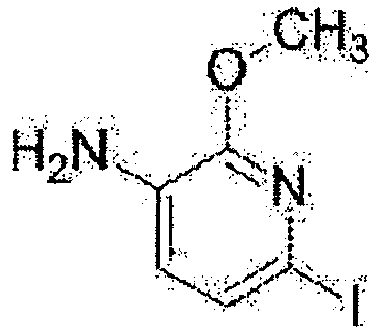
- To a solution (40 mL) of 3-amino-2-methoxypyridine (5.00 g) in DMF was added a solution (20 mL) of N-iodosuccinimide (9.97 g) in DMF at 0°C. The reaction mixture was stirred at 0°C for 2.5 hr. A solution (5.0 mL) of N-iodosuccinimide (1.81 g) in DMF was added, and the reaction mixture was stirred at room temperature for 14 hr. Aqueous sodium thiosulfate solution was added, and the mixture was stirred at room temperature for 10 min, and extracted twice with ethyl acetate. The organic layer was dried over anhydrous sodium sulfate, filtered and concentrated. The residue was purified by NH silica gel column chromatography (solvent; hexane/ethyl acetate=90/10 - 70/30) to give the title compound (2.54 g).
MS (ESI) m/z; 251 [M+H]+ -

- To a solution (25 mL) of the compound (2.54 g) obtained in Reference Example 92 in DMF was added a solution (10 mL) of N-chlorosuccinimide (1.63 g) in DMF at 0°C, and the reaction mixture was stirred with heating at 70°C for 1.5 hr. The reaction mixture was cooled to 0°C, aqueous sodium thiosulfate solution was added, and the mixture was stirred at room temperature for 10 min, and extracted twice with ethyl acetate. The organic layer was dried over anhydrous sodium sulfate, filtered and concentrated. The residue was purified by silica gel column chromatography (solvent; hexane/ethyl acetate=90/10 - 75/25) to give the title compound (1.75 g).
MS (ESI) m/z; 285 [M+H]+ -

- To a solution (3.52 mL) of the compound (500 mg) obtained in Reference Example 93 in toluene were added [1,1-bis(diphenylphosphino)ferrocene]dichloropalladium(II) methylene chloride adduct (72 mg), a solution (1.76 mL) of 2-fluorophenylboronic acid (295 mg) in ethanol and a 2.0 mol/L aqueous solution (3.52 mL) of sodium carbonate, and the reaction mixture was stirred with heating at 105°C for 30 min. The reaction mixture was cooled to room temperature, water was added, and the mixture was extracted twice with ethyl acetate. The organic layer was dried over anhydrous sodium sulfate, filtered and concentrated. The residue was purified by silica gel column chromatography (solvent; hexane/ethyl acetate=98/2 - 88/12) to give the title compound (416 mg).
MS (ESI) m/z; 253 [M+H]+ -

- To a solution (8.8 mL) of N-carbobenzoxy-D-proline (1.18 g) in methylene chloride were added dropwise oxalyl chloride (407 µL) and DMF (one drop) under ice-cooling. The reaction mixture was stirred at room temperature for 1 hr, and added dropwise to a solution (8.80 mL) of the compound (600 mg) obtained in Reference Example 94 and pyridine (955 µL) in methylene chloride under ice-cooling. The reaction mixture was stirred under ice-cooling for 1 hr. The reaction mixture was acidified with 1.0 mol/L hydrochloric acid (7 mL), and the mixture was diluted with water, and extracted twice with methylene chloride. The combined organic layer was washed with saturated brine, dried over anhydrous sodium sulfate, filtered and concentrated. The residue was purified by silica gel column chromatography (solvent; hexane/ethyl acetate=85/15 - 50/50), to the obtained product was added hexane/diethyl ether=2/1, and the solid was collected by filtration to give a product (1.18 g).
MS (ESI) m/z; 484 [M+H]+ -

- A 1.9 mol/L solution (5.64 mL) of diisopropyl azodicarboxylate in toluene was added dropwise to a solution (35 mL) of triphenylphosphine (2.81 g) in THF at room temperature. The reaction mixture was stirred at room temperature for 15 min, and a solution (5.0 mL) of 4-chloro-3-nitro-6-(trifluoromethyl)pyridin-2-ol (2.00 g) synthesized by the method described in
US 2007/197478 A1 in THF and 4-methoxybenzyl alcohol (1.23 mL) were added dropwise to the reaction mixture at room temperature. The reaction mixture was stirred at room temperature for 1 hr, and concentrated under reduced pressure. To the residue was added hexane/diethyl ether=2/1, and the precipitated solid was filtered off. The filtrate was concentrated, and the residue was purified by NH silica gel column chromatography (solvent; hexane/ethyl acetate=95/5 - 85/15) to give a product (1.28 g). - A mixture of the obtained product (817 mg), ammonium chloride (145 mg) and iron powder (503 mg) in methanol (15 mL), THF (15 mL) and water (7.5 mL) was stirred with heating at 70°C for 3 hr. The reaction mixture was cooled to room temperature, filtered through diatomaceous earth, and the filtrate was concentrated. The residue was dissolved in ethyl acetate, and washed with water and saturated brine. The organic layer was dried over anhydrous sodium sulfate, filtered and concentrated. The residue was purified by NH silica gel column chromatography (solvent; hexane/ethyl acetate=95/5 - 85/15) to give a product (666 mg).
- The obtained product (255 mg) was treated by a method similar to that in Reference Example 95 to give the title compound (272 mg).
MS (ESI) m/z; 564 [M+H]+ -

- To a solution (6.9 mL) of the compound (600 mg) obtained in Reference Example 95 in toluene were added pyridine (579 µL) and Lawesson reagent (351 mg), and the reaction mixture was stirred with heating at 110°C for 16 hr. The reaction mixture was allowed to cool, diluted with chloroform, acidified with 1.0 mol/L hydrochloric acid, and extracted twice with chloroform. The combined organic layer was washed with saturated brine, dried over anhydrous sodium sulfate, filtered and concentrated. The residue was purified by silica gel column chromatography (solvent; hexane/ethyl acetate=90/10 - 65/35) to give the title compound (339 mg).
MS (ESI) m/z; 464 [M+H]+ -

- The compound (252 mg) obtained in Reference Example 96 was treated by a method similar to that in Reference Example 97 to give the title compound (82 mg).
MS (ESI) m/z; 544 [M+H]+ -

- To a solution (90 mL) of D-proline (5.0 g) in 1.0 mol/L aqueous sodium hydroxide was added 2-nitrobenzenesulfonyl chloride (9.62 g) at 0°C, and the reaction mixture was stirred at the same temperature for 8 hr. To the reaction mixture was added 1.0 mol/L hydrochloric acid (90 mL), and the mixture was extracted twice with chloroform. The organic layer was dried over anhydrous magnesium sulfate, filtered and concentrated to give the title compound (11.1 g).
MS (ESI) m/z; 301 [M+H]+ -

- (R)-piperidine-2-carboxylic acid (4.0 g) was treated by a method similar to that in Reference Example 99 to give the title compound (3.6 g).
MS (ESI) m/z; 315 [M+H]+ -

- To a solution (110 mL) of the compound (11.1 g) obtained in Reference Example 99 in DMF were added N,N-diisopropylethylamine (5.8 g), thiosemicarbazide (3.4 g), EDC hydrochloride (8.5 g) and HOBt monohydrate (6.8 g) at room temperature, and the reaction mixture was stirred overnight. Water was added to the reaction mixture, and the mixture was extracted three times with ethyl acetate. The organic layer was dried over anhydrous magnesium sulfate, filtered and concentrated. The residue was purified by silica gel column chromatography (solvent; chloroform/methanol=100/0 - 90/10) to give the title compound (6.81 g).
MS (ESI) m/z; 374 [M+H]+ -
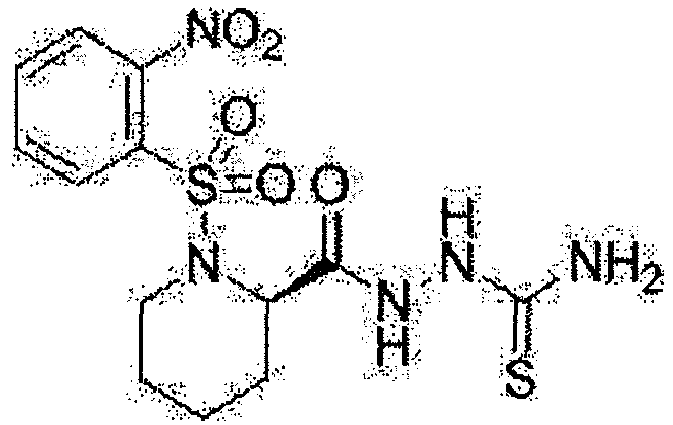
- The compound (4.1 g) obtained in Reference Example 100 was treated by a method similar to that in Reference Example 101 to give the title compound (1.75 g).
MS (ESI) m/z; 388 [M+H]+ -

- To a solution (120 mL) of the compound (5.80 g) obtained in Reference Example 101 in toluene was added methansulfonic acid (2.30 g) at room temperature, and the reaction mixture was heated under reflux for 2 hr. The reaction mixture was cooled to room temperature, chloroform and water were added, and the mixture was neutralized with 1.0 mol/L aqueous sodium hydroxide solution, and extracted twice with chloroform. The organic layer was dried over anhydrous magnesium sulfate, filtered and concentrated. The residue was purified by silica gel column chromatography (solvent; ethyl acetate/methanol=100/0 - 90/10) to give the title compound (4.27 g).
MS (ESI) m/z; 356 [M+H]+ -

- The compound (1.75 g) obtained in Reference Example 102 was treated by a method similar to that in Reference Example 103 to give the title compound (0.72 g).
MS (ESI) m/z; 370 [M+H]+ -

- To a solution (25 mL) of the compound (5.50 g) obtained in Reference Example 103 in concentrated sulfuric acid was added methyl 4-methyl-3-oxopentanoate (3.20 g) at room temperature, and the reaction mixture was stirred with heating at 80°C for 10 hr. The reaction mixture was cooled to room temperature, water was added thereto, and the mixture was extracted twice with chloroform. The organic layer was dried over anhydrous magnesium sulfate, filtered and concentrated. The residue was purified by silica gel column chromatography (solvent; ethyl acetate/methanol=100/0 - 95/5) to give the title compound (5.10 g).
MS (ESI) m/z; 450 [M+H]+ -

- The compound (2.00 g) obtained in Reference Example 103 was treated by a method similar to that in Reference Example 105 to give the title compound (2.15 g).
MS (ESI) m/z; 436 [M+H]+ -

- The compound (2.00 g) obtained in Reference Example 103 was treated by a method similar to that in Reference Example 105 to give the title compound (3.40 g).
MS (ESI) m/z; 436 [M+H]+ -

- The compound (8.58 g) obtained in Reference Example 103 was treated by a method similar to that in Reference Example 105 to give the title compound (9.80 g).
MS (ESI) m/z; 450 [M+H]+ -

- The compound (2.00 g) obtained in Reference Example 103 was treated by a method similar to that in Reference Example 105 to give the title compound (2.15 g).
MS (ESI) m/z; 462 [M+H]+ -

- The compound (0.72 g) obtained in Reference Example 104 was treated by a method similar to that in Reference Example 105 to give the title compound (0.81 g).
MS (ESI) m/z; 464 [M+H]+ -

- To a solution (50 mL) of the compound (2.0 g) obtained in Reference Example 105 in acetonitrile was added N-chlorosuccinimide (0.6 g) at room temperature, and the reaction mixture was stirred with heating at 80°C for 3 hr. The reaction mixture was cooled to room temperature, water was added thereto, and the mixture was extracted twice with chloroform. The organic layer was dried over anhydrous magnesium sulfate, filtered and concentrated. The residue was purified by silica gel column chromatography (solvent; ethyl acetate/methanol=100/0 - 95/5) to give the title compound (2.2 g).
MS (ESI) m/z; 484, 486 [M+H]+ -

- To a solution (100 mL) of the compound (4.28 g) obtained in Reference Example 103 in acetonitrile were added isoamyl nitrite (2.10 g) and copper(II) bromide (3.30 g) at 0°C, and the reaction mixture was stirred at room temperature for 3 hr. To the reaction mixture were added water and aqueous ammonia, and the mixture was extracted twice with ethyl acetate. The organic layer was dried over anhydrous magnesium sulfate, filtered and concentrated. The residue was purified by silica gel column chromatography (solvent; hexane/ethyl acetate=80/20 - 50/50) to give the title compound (3.74 g).
MS (ESI) m/z; 419, 421 [M+H]+ -

- A mixture of the compound (3.50 g) obtained in Reference Example 112 and methyl 2-amino-5-fluorobenzoate (1.42 g) was stirred with heating at 160°C for 30 min. The reaction mixture was cooled to room temperature, dissolved in chloroform and purified by silica gel column chromatography (solvent; chloroform/methanol=100/0 - 95/5) to give the title compound (2.86 g).
MS (ESI) m/z; 476 [M+H]+ -

- To a solution (120 mL) of the compound (5.10 g) obtained in Reference Example 105 in acetonitrile were added cesium carbonate (5.60 g) and 4-methylbenzenethiol (1.70 g) at room temperature, and the reaction mixture was stirred for 1 hr. The reaction mixture was cooled to room temperature, water and ethyl acetate were added, and the mixture was extracted 3 times with 1.0 mol/L hydrochloric acid. The aqueous layer was neutralized with saturated aqueous sodium hydrogen carbonate solution, and extracted twice with chloroform. The organic layer was dried over anhydrous magnesium sulfate, filtered and concentrated. The residue was purified by silica gel column chromatography (solvent; ethyl acetate/methanol=100/0 - 95/5) to give the title compound (2.47 g).
MS (ESI) m/z; 265 [M+H]+ -

- The compound (2.13 g) obtained in Reference Example 106 was treated by a method similar to that in Reference Example 114 to give the title compound (1.09 g).
MS (ESI) m/z; 251 [M+H]+ -

- The compound (9.80 g) obtained in Reference Example 107 was treated by a method similar to that in Reference Example 114 to give the title compound (4.50 g).
MS (ESI) m/z; 251 [M+H]+ -

- The compound (1.74 g) obtained in Reference Example 108 was treated by a method similar to that in Reference Example 114 to give the title compound (0.83 g).
MS (ESI) m/z; 265 [M+H]+ -

- The compound (2.15 g) obtained in Reference Example 109 was treated by a method similar to that in Reference Example 114 to give the title compound (1.05 g).
MS (ESI) m/z; 277 [M+H]+ -

- The compound (0.81 g) obtained in Reference Example 110 was treated by a method similar to that in Reference Example 114 to give the title compound (0.27 g).
MS (ESI) m/z; 279 [M+H]+ -

- The compound (2.20 g) obtained in Reference Example 111 was treated by a method similar to that in Reference Example 114 to give the title compound (0.88 g).
MS (ESI) m/z; 299, 301 [M+H]+ -

- The compound (3.00 g) obtained in Reference Example 113 was treated by a method similar to that in Reference Example 114 to give the title compound (1.65 g).
MS (ESI) m/z; 291 [M+H]+ -

- A mixture of 2-amino-5-bromo[1,3,4]thiadiazole (10 g) and ethyl 3-oxohexanoate (10.6 g) in polyphosphoric acid (60 g) was stirred with heating at 100°C for 5 hr. After confirmation of the completion of the reaction, the reaction mixture was cooled to room temperature, dissolved by adding water, and the mixture was extracted twice with chloroform. The organic layer was washed once with water, dried over anhydrous magnesium sulfate, filtered and concentrated. The residue was purified by silica gel column chromatography (solvent; hexane/ethyl acetate=80/20 - 50/50), and concentrated. To the obtained product was added diisopropyl ether, and the solid was collected by filtration to give the title compound (6.2 g).
MS (ESI) m/z; 274, 276 [M+H]+ -

- To the compound (5.39 g) obtained in Reference Example 327 were added (D)-proline tert-butyl ester (3.78 g) and N,N-diisopropylethylamine (3.85 mL), and the reaction mixture was heated at 120°C for 1 hr. 15% Aqueous citric acid solution was added to the reaction mixture, and the mixture was extracted twice with ethyl acetate. The organic layer was dried over anhydrous sodium sulfate, filtered and concentrated. The residue was purified by silica gel column chromatography (solvent; hexane/ethyl acetate=90/10 - 50/50) to give the title compound (5.96 g).
MS (ESI) m/z; 401 [M+H]+ -

- To a solution (38 mL) of the compound (5.96 g) obtained in Reference Example 123 in methylene chloride was added trifluoroacetic acid (38 mL), and the reaction mixture was stirred at room temperature for 2 hr. The reaction mixture was concentrated, azeotroped with toluene, and diisopropyl ether was added to the residue. The solid was collected by filtration to give the title compound (4.25 g).
MS (ESI) m/z; 345 [M+H]+ -

- To the compound (0.39 g) obtained in Reference Example 281 were added the compound (1.0 g) obtained in Reference Example 625 and N,N-diisopropylethylamine (2.2 mL), and the reaction mixture was stirred with heating at 120°C for 8 hr. After cooling to room temperature, chloroform was added, and the mixture was neutralized with 1.0 mol/L hydrochloric acid. The chloroform layer was washed once with water, dried over anhydrous magnesium sulfate, filtered and concentrated. The residue was purified by silica gel column chromatography (solvent; ethyl acetate/methanol=100/0 - 95/5). Ethyl acetate was added to the obtained product, and the solid was collected by filtration to give the title compound (0.36 g).
MS (ESI) m/z; 457 [M+H]+ -

- The compound (300 mg) obtained in Reference Example 304 was treated by a method similar to that in Reference Example 125 to give the title compound (149 mg).
MS (ESI) m/z; 401 [M+H]+ -

- The compound (190 mg) obtained in Reference Example 274 was treated by a method similar to that in Reference Example 125 to give the title compound (180 mg).
MS (ESI) m/z; 457 [M+H]+ -

- The compound (200 mg) obtained in Reference Example 351 was treated by a method similar to that in Reference Example 125 to give the title compound (137 mg).
MS (ESI) m/z; 472 [M+H]+ -

- The compound (200 mg) obtained in Reference Example 373 was treated by a method similar to that in Reference Example 125 to give the title compound (100 mg).
MS (ESI) m/z; 458 [M+H]+ -

- To the compound (600 mg) obtained in Reference Example 304 were added the compound (1.4 g) obtained in Reference Example 629 and N,N-diisopropylethylamine (4.0 mL), and the reaction mixture was stirred with heating at 120°C for 8 hr. The reaction mixture was cooled to room temperature, chloroform was added, and the mixture was neutralized with 1.0 mol/L hydrochloric acid. The chloroform layer was washed once with water, dried over anhydrous magnesium sulfate, filtered and concentrated. The residue was purified by silica gel column chromatography (solvent; ethyl acetate/methanol=100/0 - 95/5). Ethyl acetate was added to the obtained product, and the solid was collected by filtration to give the title compound (284 mg). MS (ESI) m/z; 400 [M+H]+
-

- To the compound (0.38 g) obtained in Reference Example 563 were added the compound (0.4 g) obtained in Reference Example 625 and N,N-diisopropylethylamine (3.0 mL), and the reaction mixture was stirred with heating at 140°C for 4 hr. The reaction mixture was cooled to room temperature, chloroform was added, and the mixture was neutralized with 1.0 mol/L hydrochloric acid. The chloroform layer was washed once with water, dried over anhydrous magnesium sulfate, filtered and concentrated. The residue was purified by silica gel column chromatography (solvent; hexane/ethyl acetate=50/50 - 20/80) to give the title compound (0.43 g).
MS (ESI) m/z; 603 [M+H]+ -

- To a solution (0.60 mL) of the compound (85 mg) obtained in Reference Example 752 in DMF were added dichlorobis(triphenylphosphine)palladium(II) (2.3 mg) and (1-ethoxyethenyl)tributylstannan (64 mg), and the reaction mixture was stirred with heating at 90°C for 1.5 hr. The reaction mixture was cooled to room temperature, aqueous potassium fluoride solution was added, and the precipitated solid was filtered off. The filtrate was extracted twice with ethyl acetate, the organic layer was dried over anhydrous sodium sulfate, filtered and concentrated. The residue was purified by silica gel column chromatography (solvent; hexane/ethyl acetate=70/30 - 0/100) to give the title compound (82.0 mg).
MS (ESI) m/z; 512 [M+H]+ -

- To a solution of methyl iodide (335 mg) in toluene (0.35 mL) was added diethylzinc (1.1 mol/L toluene solution, 569 µL) at 0°C, and the reaction mixture was stirred for 15 min. A solution of the compound (80 mg) obtained in Reference Example 132 in toluene (1.75 mL) was added, and the reaction mixture was stirred with heating at 80°C for 2 hr. The reaction mixture was cooled to room temperature, 1.0 mol/L hydrochloric acid was added, and the mixture was extracted twice with chloroform. The organic layer was dried over anhydrous sodium sulfate, filtered and concentrated. To the obtained product was added diethyl ether, and the solid was collected by filtration, and dried to give the title compound (63.5 mg).
MS (ESI) m/z; 456 [M+H]+ -

- To a solution (80 mL) of the compound (4.6 g) obtained in Reference Example 771 in THF were added D-proline-tert-butyl ester (3.8 g) and triethylamine (8.3 g), and the reaction mixture was heated under reflux for 4 hr. After confirmation of the completion of the reaction, water (20 mL) was added to the reaction mixture, and the mixture was extracted twice with ethyl acetate. The organic layer was washed once with water, dried over anhydrous magnesium sulfate, filtered and concentrated. To the residue were added methylene chloride (30 mL) and trifluoroacetic acid (39 mL), and the reaction mixture was stirred at room temperature for 4 hr. After confirmation of the completion of the reaction, the solvent was evaporated under reduced pressure. To the obtained product was added diisopropyl ether, and the solid was collected by filtration to give the title compound (4.1 g).
MS (ESI) m/z; 313 [M+H]+ -

- The compound (1000 mg) obtained in Reference Example 764 was treated by a method similar to that in Reference Example 134 to give the title compound (850 mg).
MS (ESI) m/z; 281 [M+H]+ -

- To a solution (520 mL) of 5-amino-2-methylsulfanyl-1,3-thiazole-4-carboxylic acid (52.0 g) in DMF were added EDC hydrochloride (78.5 g), HOBt monohydrate (63.0 g), N,N-diisopropylethylamine (72.0 mL) and methylamine (12 mol/L aqueous solution, 46.0 mL), and the reaction mixture was stirred at room temperature overnight. Water was added to the reaction mixture, and the mixture was extracted three times with ethyl acetate. The organic layer was dried over anhydrous magnesium sulfate, filtered and concentrated. To the residue was added hexane, and the solid was collected by filtration and dried to give the title compound (56.8 g).
MS (ESI) m/z; 204 [M+H]+ -
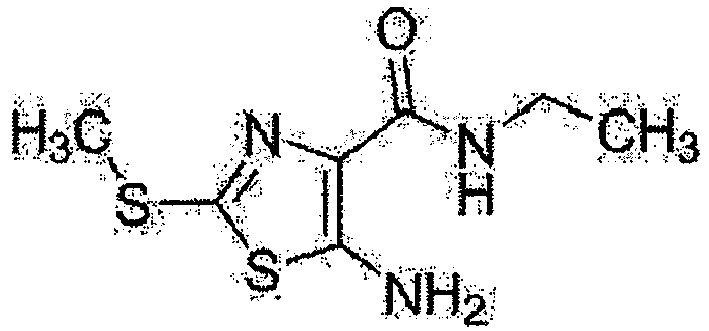
- 5-Amino-2-methylsulfanyl-1,3-thiazole-4-carboxylic acid (8.97 g) was treated by a method similar to that in Reference Example 136 to give the title compound (8.87 g).
MS (ESI) m/z; 218 [M+H]+ -

- 5-Amino-2-methylsulfanyl-1,3-thiazole-4-carboxylic acid (1.50 g) was treated by a method similar to that in Reference Example 136 to give the title compound (1.70 g).
MS (ESI) m/z; 232 [M+H]+ -

- 5-Amino-2-methylsulfanyl-1,3-thiazole-4-carboxylic acid (5.00 g) was treated by a method similar to that in Reference Example 136 to give the title compound (5.59 g).
MS (ESI) m/z; 230 [M+H]+ -
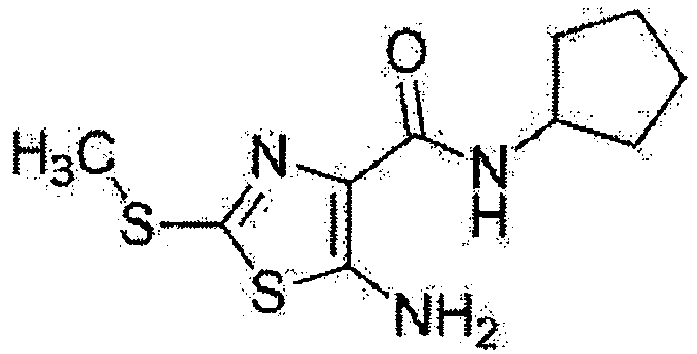
- 5-Amino-2-methylsulfanyl-1,3-thiazole-4-carboxylic acid (2.00 g) was treated by a method similar to that in Reference Example 136 to give the title compound (2.75 g).
MS (ESI) m/z; 258 [M+H]+ -

- 5-Amino-2-methylsulfanyl-1,3-thiazole-4-carboxylic acid (3.00 g) was treated by a method similar to that in Reference Example 136 to give the title compound (3.97 g).
MS (ESI) m/z; 248 [M+H]+ -

- 5-Amino-2-methylsulfanyl-1,3-thiazole-4-carboxylic acid (900 mg) was treated by a method similar to that in Reference Example 136 to give the title compound (1.10 g).
MS (ESI) m/z; 274 [M+H]+ -

- 5-Amino-2-methylsulfanyl-1,3-thiazole-4-carboxylic acid (1.50 g) was treated by a method similar to that in Reference Example 136 to give the title compound (2.15 g).
MS (ESI) m/z; 274 [M+H]+ -

- 5-Amino-2-methylsulfanyl-1,3-thiazole-4-carboxylic acid (940 mg) was treated by a method similar to that in Reference Example 136 to give the title compound (800 mg).
MS (ESI) m/z; 274 [M+H]+ -
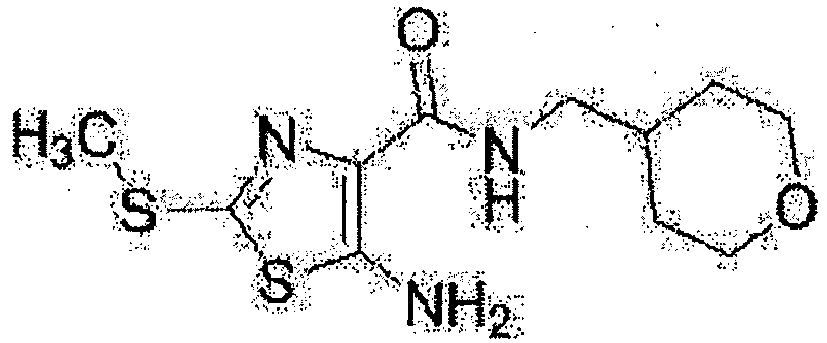
- 5-Amino-2-methylsulfanyl-1,3-thiazole-4-carboxylic acid (800 mg) was treated by a method similar to that in Reference Example 136 to give the title compound (1.04 g).
MS (ESI) m/z; 288 [M+H]+ -

- 5-Amino-2-methylsulfanyl-1,3-thiazole-4-carboxylic acid (850 mg) was treated by a method similar to that in Reference Example 136 to give the title compound (1.20 g).
MS (ESI) m/z; 276 [M+H]+ -

- 5-Amino-2-methylsulfanyl-1,3-thiazole-4-carboxylic acid (1.50 g) was treated by a method similar to that in Reference Example 136 to give the title compound (1.87 g).
MS (ESI) m/z; 254 [M+H]+ -

- 5-Amino-2-methylsulfanyl-1,3-thiazole-4-carboxylic acid (300 mg) was treated by a method similar to that in Reference Example 136 to give the title compound (355 mg).
MS (ESI) m/z; 272 [M+H]+ -

- 5-Amino-2-methylsulfanyl-1,3-thiazole-4-carboxylic acid (1.00 g) was treated by a method similar to that in Reference Example 136 to give the title compound (1.32 g).
MS (ESI) m/z; 266 [M+H]+ -

- 5-Amino-2-methylsulfanyl-1,3-thiazole-4-carboxylic acid (730 mg) was treated by a method similar to that in Reference Example 136 to give the title compound (750 mg).
MS (ESI) m/z; 260 [M+H]+ -

- 5-Amino-2-methylsulfanyl-1,3-thiazole-4-carboxylic acid (1.74 g) was treated by a method similar to that in Reference Example 136 to give the title compound (1.80 g).
MS (ESI) m/z; 246 [M+H]+ -

- 5-Amino-2-methylsulfanyl-1,3-thiazole-4-carboxylic acid (800 mg) was treated by a method similar to that in Reference Example 136 to give the title compound (1.10 g).
MS (ESI) m/z; 287 [M+H]+ -

- 5-Amino-2-methylsulfanyl-1,3-thiazole-4-carboxylic acid (600 mg) was treated by a method similar to that in Reference Example 136 to give the title compound (330 mg).
MS (ESI) m/z; 275 [M+H]+ -

- 5-Amino-2-methylsulfanyl-1,3-thiazole-4-carboxylic acid (900 mg) was treated by a method similar to that in Reference Example 136 to give the title compound (950 mg).
MS (ESI) m/z; 259 [M+H]+ -

- 5-Amino-2-methylsulfanyl-1,3-thiazole-4-carboxylic acid (800 mg) was treated by a method similar to that in Reference Example 136 to give the title compound (1.10 g).
MS (ESI) m/z; 275 [M+H]+ -

- To a solution (700 mL) of the compound (25.0 g) obtained in Reference Example 136 in methylene chloride were added triethylamine (35.0 mL) and benzoyl chloride (24.2 g) at 0°C, and the reaction mixture was stirred at room temperature overnight. To the reaction mixture were added water and saturated aqueous sodium hydrogen carbonate solution, and the mixture was extracted with chloroform. The combined organic layer was dried over anhydrous magnesium sulfate, filtered and concentrated. To the residue was added diisopropyl ether, and the solid was collected by filtration and dried to give the title compound (24.2 g) .
MS (ESI) m/z; 308 [M+H]+ -

- The compound (203 mg) obtained in Reference Example 136 was treated by a method similar to that in Reference Example 156 to give the title compound (138 mg).
MS (ESI) m/z; 362 [M+H]+ -

- The compound (291 mg) obtained in Reference Example 136 was treated by a method similar to that in Reference Example 156 to give the title compound (418 mg).
MS (ESI) m/z; 344 [M+H]+ -

- The compound (3.50 g) obtained in Reference Example 136 was treated by a method similar to that in Reference Example 156 to give the title compound (4.64 g).
MS (ESI) m/z; 272 [M+H]+ -

- The compound (500 mg) obtained in Reference Example 136 was treated by a method similar to that in Reference Example 156 to give the title compound (697 mg) .
MS (ESI) m/z; 276 [M+H]+ -

- The compound (500 mg) obtained in Reference Example 136 was treated by a method similar to that in Reference Example 156 to give the title compound (760 mg).
MS (ESI) m/z; 302 [M+H]+ -

- The compound (500 mg) obtained in Reference Example 137 was treated by a method similar to that in Reference Example 156 to give the title compound (715 mg).
MS (ESI) m/z; 323 [M+H]+ -

- The compound (820 mg) obtained in Reference Example 138 was treated by a method similar to that in Reference Example 156 to give the title compound (881 mg).
MS (ESI) m/z; 304 [M+H]+ -

- The compound (700 mg) obtained in Reference Example 139 was treated by a method similar to that in Reference Example 156 to give the title compound (897 mg).
MS (ESI) m/z; 302 [M+H]+ -

- The compound (500 mg) obtained in Reference Example 141 was treated by a method similar to that in Reference Example 156 to give the title compound (360 mg).
MS (ESI) m/z; 290 [M+H]+ -

- The compound (600 mg) obtained in Reference Example 142 was treated by a method similar to that in Reference Example 156 to give the title compound (600 mg).
MS (ESI) m/z; 316 [M+H]+ -

- The compound (2.15 g) obtained in Reference Example 143 was treated by a method similar to that in Reference Example 156 to give the title compound (1.60 g).
MS (ESI) m/z; 316 [M+H]+ -

- The compound (600 mg) obtained in Reference Example 146 was treated by a method similar to that in Reference Example 156 to give the title compound (570 mg).
MS (ESI) m/z; 318 [M+H]+ -

- To a solution (2.00 mL) of tetrahydro-2H-pyran-4-carboxylic acid (585 mg) in methylene chloride were added oxalyl chloride (762 µL) and DMF (one drop), and the reaction mixture was stirred at room temperature for 2 hr. The reaction mixture was concentrated under reduced pressure, and the residue was dissolved in methylene chloride (1.00 mL) and added dropwise to a solution (3.00 mL) of the compound (500 mg) obtained in Reference Example 136 and triethylamine (697 µL) in methylene chloride under ice-cooling, and the mixture was stirred at room temperature for 30 min. Water was added to the reaction mixture, and the mixture was extracted twice with chloroform. The organic layer was dried over anhydrous sodium sulfate, filtered and concentrated. The residue was purified by silica gel column chromatography (solvent; hexane/ethyl acetate=70/30 - 20/80) to give the title compound (555 mg). MS (ESI) m/z; 316 [M+H]+
-

- The compound (404 mg) obtained in Reference Example 136 was treated by a method similar to that in Reference Example 169 to give the title compound (561 mg).
MS (ESI) m/z; 325 [M+H]+ -

- The compound (203 mg) obtained in Reference Example 136 was treated by a method similar to that in Reference Example 169 to give the title compound (309 mg).
MS (ESI) m/z; 311 [M+H]+ -

- The compound (820 mg) obtained in Reference Example 136 was treated by a method similar to that in Reference Example 169 to give the title compound (555 mg).
MS (ESI) m/z; 296 [M+H]+ -

- The compound (300 mg) obtained in Reference Example 136 was treated by a method similar to that in Reference Example 169 to give the title compound (490 mg).
MS (ESI) m/z; 290 [M+H]+ -

- The compound (73 mg) obtained in Reference Example 136 was treated by a method similar to that in Reference Example 169 to give the title compound (98 mg).
MS (ESI) m/z; 306 [M+H]+ -

- The compound (500 mg) obtained in Reference Example 136 was treated by a method similar to that in Reference Example 169 to give the title compound (282 mg).
MS (ESI) m/z; 310 [M+H]+ -

- The compound (500 mg) obtained in Reference Example 136 was treated by a method similar to that in Reference Example 169 to give the title compound (827 mg).
MS (ESI) m/z; 359 [M+H]+ -

- The compound (241 mg) obtained in Reference Example 136 was treated by a method similar to that in Reference Example 169 to give the title compound (243 mg).
MS (ESI) m/z; 304 [M+H]+ -
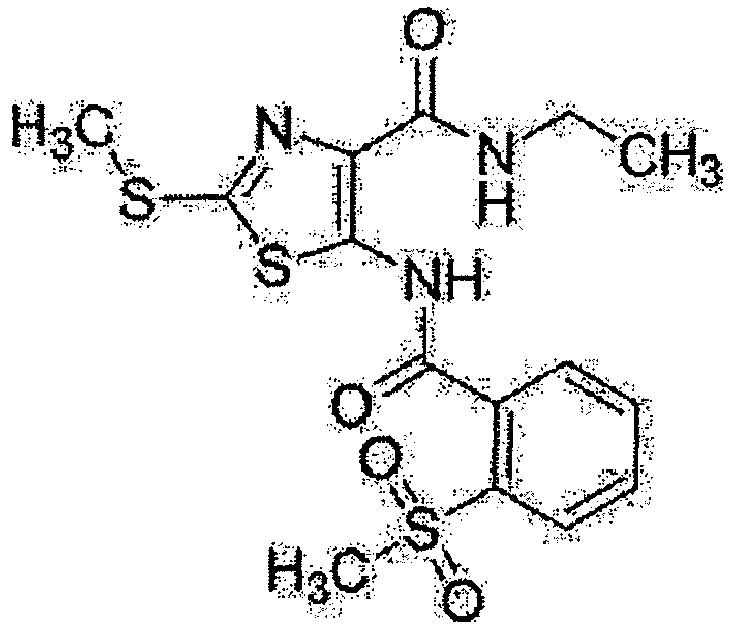
- The compound (500 mg) obtained in Reference Example 137 was treated by a method similar to that in Reference Example 169 to give the title compound (320 mg).
MS (ESI) m/z; 400 [M+H]+ -

- The compound (639 mg) obtained in Reference Example 137 was treated by a method similar to that in Reference Example 169 to give the title compound (547 mg).
MS (ESI) m/z; 324 [M+H]+ -

- The compound (3.00 g) obtained in Reference Example 136 was treated by a method similar to that in Reference Example 169 to give the title compound (3.49 g).
MS (ESI) m/z; 292 [M+H]+ -

- To a solution (50 mL) of 3-methyl-[1,2,4]oxadiazole-5-carboxylic acid ethyl ester (9.45 g) in ethanol was added an aqueous solution (20 mL) of potassium hydroxide (4.0 g) at room temperature, and the reaction mixture was stirred for 2 hr. The solvent was evaporated under reduced pressure, acetonitrile was added to the residue, and the solid was collected by filtration, and dried to give 3-methyl-[1,2,4]oxadiazole-5-carboxylic acid potassium salt (9.38 g). To a solution (10 mL) of the obtained 3-methyl-[1,2,4]oxadiazole-5-carboxylic acid potassium salt (360 mg) in acetonitrile were added oxalyl chloride (310 µL) and DMF (one drop). The reaction mixture was stirred at room temperature for 2 hr and added dropwise to a solution (30 mL) of the compound (450 mg) obtained in Reference Example 136 and triethylamine (670 mg) in methylene chloride under ice-cooling, and the mixture was stirred at room temperature for 2 hr. Water was added to the reaction mixture, and the mixture was extracted twice with chloroform. The organic layer was dried over anhydrous magnesium sulfate, filtered and concentrated. The residue was purified by silica gel column chromatography (solvent; hexane/ethyl acetate=70/30 - 20/80) to give the title compound (300 mg).
MS (ESI) m/z; 314 [M+H]+ -

- The compound (1.09 g) obtained in Reference Example 136 was treated by a method similar to that in Reference Example 182 to give the title compound (808 mg).
MS (ESI) m/z; 314 [M+H]+ -

- The compound (5.60 g) obtained in Reference Example 136 was treated by a method similar to that in Reference Example 182 to give the title compound (5.83 g).
MS (ESI) m/z; 314 [M+H]+ -

- The compound (1.51 g) obtained in Reference Example 137 was treated by a method similar to that in Reference Example 182 to give the title compound (582 mg).
MS (ESI) m/z; 328 [M+H]+ -

- The compound (850 mg) obtained in Reference Example 138 was treated by a method similar to that in Reference Example 182 to give the title compound (794 mg).
MS (ESI) m/z; 342 [M+H]+ -

- The compound (1.20 g) obtained in Reference Example 139 was treated by a method similar to that in Reference Example 182 to give the title compound (400 mg).
MS (ESI) m/z; 340 [M+H]+ -

- The compound (1.20 g) obtained in Reference Example 147 was treated by a method similar to that in Reference Example 182 to give the title compound (1.52 g).
MS (ESI) m/z; 364 [M+H]+ -
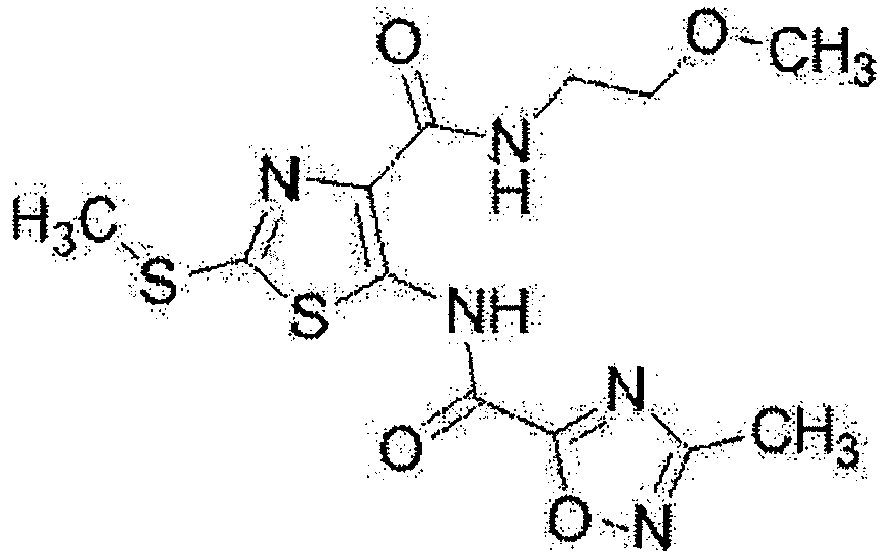
- The compound (1.30 g) obtained in Reference Example 141 was treated by a method similar to that in Reference Example 182 to give the title compound (700 mg).
MS (ESI) m/z; 358 [M+H]+ -

- The compound (1.20 g) obtained in Reference Example 143 was treated by a method similar to that in Reference Example 182 to give the title compound (1.05 g).
MS (ESI) m/z; 384 [M+H]+ -

- The compound (300 mg) obtained in Reference Example 137 was treated by a method similar to that in Reference Example 182 to give the title compound (136 mg).
MS (ESI) m/z; 340 [M+H]+ -

- The compound (1.76 g) obtained in Reference Example 136 was treated by a method similar to that in Reference Example 182 to give the title compound (165 mg).
MS (ESI) m/z; 326 [M+H]+ -

- To a solution (15 mL) of the compound (650 mg) obtained in Reference Example 144 in methylene chloride were added pyridine (230 mg) and difluoroacetic anhydride (550 mg) under ice-cooling, and the reaction mixture was stirred at 0°C for 1 hr. Water was added to the reaction mixture, and the mixture was extracted twice with chloroform. The combined organic layer was washed with aqueous citric acid solution and saturated brine, dried over anhydrous sodium sulfate, filtered and concentrated to give the title compound (750 mg).
MS (ESI) m/z; 370 [M+H]+ -
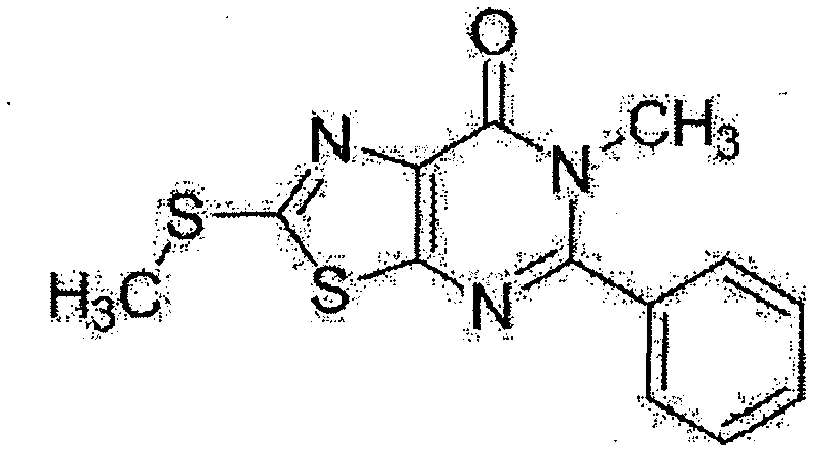
- To a solution (900 mL) of the compound (43.6 g) obtained in Reference Example 156 in methylene chloride were added chlorotrimethylsilane (90.0 mL) and triethylamine (297 mL), and the reaction mixture was stirred at room temperature overnight. The reaction mixture was poured into water (1000 mL), and the mixture was extracted three times with chloroform. The organic layer was dried over anhydrous magnesium sulfate, filtered and concentrated. To the residue was added ethyl acetate, and the solid was collected by filtration, and dried to give the title compound (37.7 g).
MS (ESI) m/z; 290 [M+H]+ -

- The compound (117 mg) obtained in Reference Example 157 was treated by a method similar to that in Reference Example 195 to give the title compound (97 mg).
MS (ESI) m/z; 344 [M+H]+ -

- The compound (181 mg) obtained in Reference Example 158 was treated by a method similar to that in Reference Example 195 to give the title compound (175 mg).
MS (ESI) m/z; 326 [M+H]+ -

- The compound (740 mg) obtained in Reference Example 161 was treated by a method similar to that in Reference Example 195 to give the title compound (600 mg).
MS (ESI) m/z; 284 [M+H]+ -

- The compound (700 mg) obtained in Reference Example 162 was treated by a method similar to that in Reference Example 195 to give the title compound (647 mg).
MS (ESI) m/z; 305 [M+H]+ -

- The compound (680 mg) obtained in Reference Example 163 was treated by a method similar to that in Reference Example 195 to give the title compound (582 mg).
MS (ESI) m/z; 286 [M+H]+ -
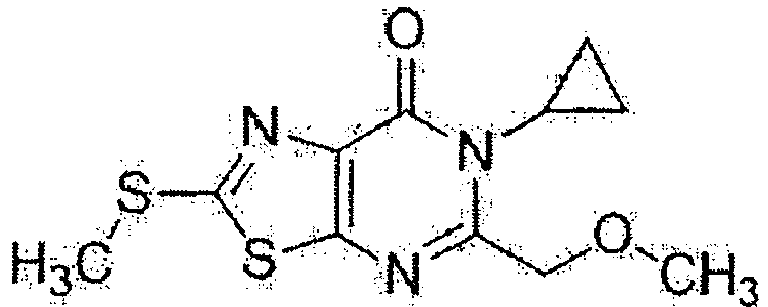
- The compound (897 mg) obtained in Reference Example 164 was treated by a method similar to that in Reference Example 195 to give the title compound (772 mg).
MS (ESI) m/z; 284 [M+H]+ -

- The compound (1.60 g) obtained in Reference Example 167 was treated by a method similar to that in Reference Example 195 to give the title compound (1.16 g).
MS (ESI) m/z; 298 [M+H]+ -

- The compound (560 mg) obtained in Reference Example 168 was treated by a method similar to that in Reference Example 195 to give the title compound (320 mg) .
MS (ESI) m/z; 300 [M+H]+ -
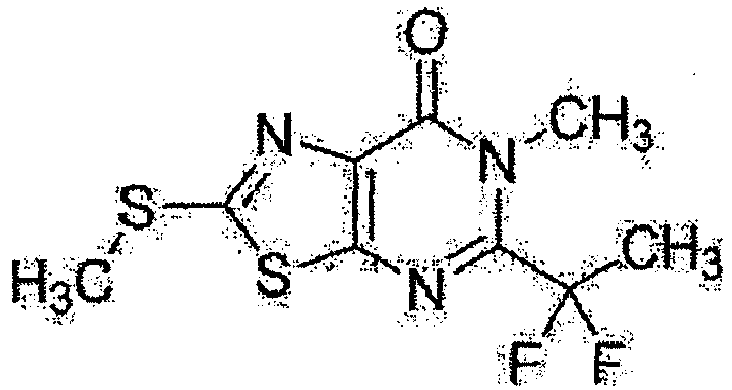
- The compound (550 mg) obtained in Reference Example 173 was treated by a method similar to that in Reference Example 195 to give the title compound (507 mg).
MS (ESI) m/z; 278 [M+H]+ -

- The compound (384 mg) obtained in Reference Example 174 was treated by a method similar to that in Reference Example 195 to give the title compound (346 mg).
MS (ESI) m/z; 272 [M+H]+ -

- The compound (96 mg) obtained in Reference Example 175 was treated by a method similar to that in Reference Example 195 to give the title compound (86 mg).
MS (ESI) m/z; 288, 290 [M+H]+ -
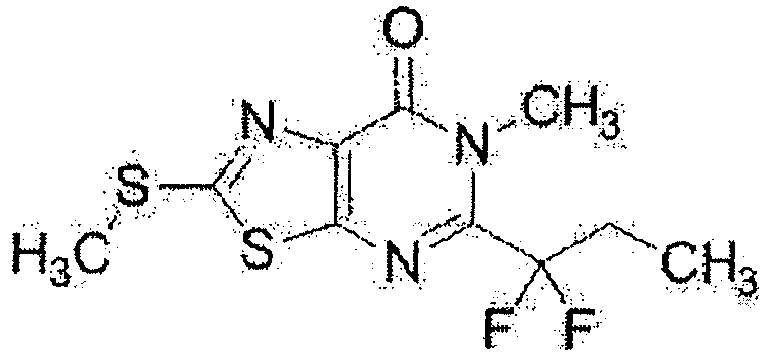
- The compound (280 mg) obtained in Reference Example 176 was treated by a method similar to that in Reference Example 195 to give the title compound (240 mg).
MS (ESI) m/z; 292 [M+H]+ -

- The compound (825 mg) obtained in Reference Example 177 was treated by a method similar to that in Reference Example 195 to give the title compound (772 mg).
MS (ESI) m/z; 341 [M+H]+ -

- The compound (691 mg) obtained in Reference Example 169 was treated by a method similar to that in Reference Example 195 to give the title compound (615 mg).
MS (ESI) m/z; 298 [M+H]+ -

- The compound (165 mg) obtained in Reference Example 192 was treated by a method similar to that in Reference Example 195 to give the title compound (122 mg).
MS (ESI) m/z; 308 [M+H]+ -

- The compound (310 mg) obtained in Reference Example 179 was treated by a method similar to that in Reference Example 195 to give the title compound (261 mg).
MS (ESI) m/z; 382 [M+H]+ -

- The compound (535 mg) obtained in Reference Example 180 was treated by a method similar to that in Reference Example 195 to give the title compound (500 mg).
MS (ESI) m/z; 306 [M+H]+ -

- The compound (300 mg) obtained in Reference Example 182 was treated by a method similar to that in Reference Example 195 to give the title compound (220 mg).
MS (ESI) m/z; 296 [M+H]+ -

- The compound (400 mg) obtained in Reference Example 183 was treated by a method similar to that in Reference Example 195 to give the title compound (310 mg).
MS (ESI) m/z; 296 [M+H]+ -

- The compound (191 mg) obtained in Reference Example 184 was treated by a method similar to that in Reference Example 195 to give the title compound (171 mg).
MS (ESI) m/z; 296 [M+H]+ -

- The compound (1.25 g) obtained in Reference Example 185 was treated by a method similar to that in Reference Example 195 to give the title compound (830 mg) .
MS (ESI) m/z; 310 [M+H]+ -

- The compound (790 mg) obtained in Reference Example 186 was treated by a method similar to that in Reference Example 195 to give the title compound (279 mg).
MS (ESI) m/z; 324 [M+H]+ -

- The compound (400 mg) obtained in Reference Example 187 was treated by a method similar to that in Reference Example 195 to give the title compound (290 mg).
MS (ESI) m/z; 322 [M+H]+ -

- The compound (1.52 g) obtained in Reference Example 188 was treated by a method similar to that in Reference Example 195 to give the title compound (1.31 g).
MS (ESI) m/z; 346 [M+H]+ -

- The compound (700 mg) obtained in Reference Example 189 was treated by a method similar to that in Reference Example 195 to give the title compound (460 mg).
MS (ESI) m/z; 340 [M+H]+ -

- The compound (1.05 g) obtained in Reference Example 190 was treated by a method similar to that in Reference Example 195 to give the title compound (410 mg).
MS (ESI) m/z; 366 [M+H]+ -

- The compound (135 mg) obtained in Reference Example 191 was treated by a method similar to that in Reference Example 195 to give the title compound (106 mg).
MS (ESI) m/z; 322 [M+H]+ -

- The compound (300 mg) obtained in Reference Example 181 was treated by a method similar to that in Reference Example 195 to give the title compound (238 mg).
MS (ESI) m/z; 274 [M+H]+ -

- To a solution (10 mL) of the compound (561 mg) obtained in Reference Example 170 in dichloroethane were added trimethylsilyl trifluoromethanesulfonate (376 µL) and triethylamine (482 µL). The reaction mixture was stirred at room temperature for 1 hr, trimethylsilyl trifluoromethanesulfonate (376 µL) and triethylamine (482 µL) were added, and the reaction mixture was further stirred at room temperature overnight. 1.0 mol/L Hydrochloric acid was added to the reaction mixture, and the mixture was extracted twice with chloroform. The organic layer was dried over anhydrous sodium sulfate, filtered and concentrated. The residue was purified by silica gel column chromatography (solvent; hexane/ethyl acetate=80/20 - 30/70) to give the title compound (287 mg).
MS (ESI) m/z; 307 [M+H]+ -

- The compound (360 mg) obtained in Reference Example 165 was treated by a method similar to that in Reference Example 224 to give the title compound (360 mg).
MS (ESI) m/z; 272 [M+H]+ -

- The compound (600 mg) obtained in Reference Example 166 was treated by a method similar to that in Reference Example 224 to give the title compound (360 mg).
MS (ESI) m/z; 298 [M+H]+ -

- The compound (309 mg) obtained in Reference Example 171 was treated by a method similar to that in Reference Example 224 to give the title compound (253 mg).
MS (ESI) m/z; 293 [M+H]+ -

- The compound (243 mg) obtained in Reference Example 178 was treated by a method similar to that in Reference Example 224 to give the title compound (171 mg).
MS (ESI) m/z; 287 [M+H]+ -

- To a solution (20 mL) of the compound (610 mg) obtained in Reference Example 194 in dichloroethane were added trifluoroacetic anhydride (1.80 g) and triethylamine (1.70 g), and the reaction mixture was stirred at room temperature for 4 hr. Aqueous citric acid solution was added, and the mixture was extracted twice with chloroform. The organic layer was washed with saturated aqueous sodium hydrogen carbonate solution, dried over anhydrous sodium sulfate, filtered and concentrated. The residue was purified by silica gel column chromatography (solvent; hexane/ethyl acetate=80/20 - 60/40) to give the title compound (450 mg).
MS (ESI) m/z; 352 [M+H]+ -

- To a solution (20 mL) of the compound (600 mg) obtained in Reference Example 159 in dichloroethane were added hexamethyldisilasane (4.70 mL), iodine (2.79 g) and N,N-diisopropylethylamine (2.0 mL), and the reaction mixture was stirred with heating at 80°C for 17 hr. The reaction mixture was cooled to room temperature, 2 mol/L hydrochloric acid was added, and the mixture was extracted twice with chloroform. The organic layer was washed with aqueous sodium thiosulfate solution, dried over anhydrous sodium sulfate, filtered and concentrated. The residue was purified by silica gel column chromatography (solvent; hexane/ethyl acetate=80/20 - 60/40) to give the title compound (420 mg).
MS (ESI) m/z; 254 [M+H]+ -

- The compound (338 mg) obtained in Reference Example 160 was treated by a method similar to that in Reference Example 230 to give the title compound (257 mg).
MS (ESI) m/z; 258 [M+H]+ -

- The compound (1.50 g) obtained in Reference Example 136 was added to trimethyl orthopropionate (3.96 g) and the mixture was heated at 120°C for 4 hr. Acetic anhydride (3.49 mL) was added, and the reaction mixture was further heated at 120°C for 8 hr. Acetic anhydride (1.00 mL) was added, and the reaction mixture was further heated at 120°C for 6 hr. The reaction mixture was cooled to room temperature, ethyl acetate was added to the resultant solid, and the solid was collected by filtration to give the title compound (1.23 g).
MS (ESI) m/z; 242 [M+H]+ -

- The compound (800 mg) obtained in Reference Example 136 was treated by a method similar to that in Reference Example 232 to give the title compound (444 mg).
MS (ESI) m/z; 228 [M+H]+ -

- The compound (2.00 g) obtained in Reference Example 137 was treated by a method similar to that in Reference Example 232 to give the title compound (1.55 g).
MS (ESI) m/z; 256 [M+H]+ -

- The compound (19.5 g) obtained in Reference Example 139 was treated by a method similar to that in Reference Example 232 to give the title compound (8.72 g).
MS (ESI) m/z; 254 [M+H]+ -

- The compound (600 mg) obtained in Reference Example 140 was treated by a method similar to that in Reference Example 232 to give the title compound (360 mg).
MS (ESI) m/z; 268 [M+H)+ -

- The compound (1.20 g) obtained in Reference Example 136 was treated by a method similar to that in Reference Example 232 to give the title compound (1.20 g).
MS (ESI) m/z; 256 [M+H]+ -

- The compound (2.00 g) obtained in Reference Example 136 was treated by a method similar to that in Reference Example 232 to give the title compound (2.00 g).
MS (ESI) m/z; 256 [M+H]+ -

- The compound (740 mg) obtained in Reference Example 137 was treated by a method similar to that in Reference Example 232 to give the title compound (480 mg).
MS (ESI) m/z; 242 [M+H]+ -
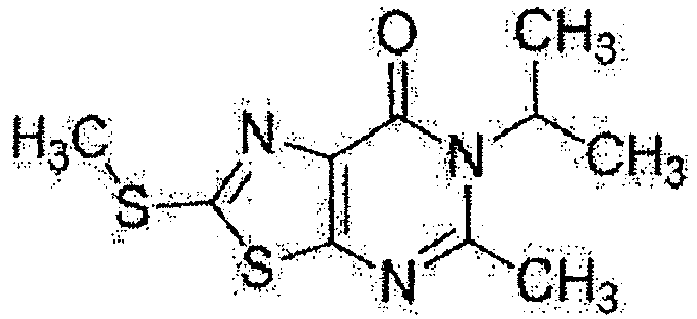
- The compound (840 mg) obtained in Reference Example 138 was treated by a method similar to that in Reference Example 232 to give the title compound (400 mg).
MS (ESI) m/z; 256 [M+H]+ -

- The compound (1.37 g) obtained in Reference Example 140 was treated by a method similar to that in Reference Example 232 to give the title compound (325 mg).
MS (ESI) m/z; 282 [M+H]+ -

- The compound (355 mg) obtained in Reference Example 148 was treated by a method similar to that in Reference Example 232 to give the title compound (190 mg).
MS (ESI) m/z; 296 [M+H]+ -

- The compound (1.32 g) obtained in Reference Example 149 was treated by a method similar to that in Reference Example 232 to give the title compound (1.45 g).
MS (ESI) m/z; 290 [M+H]+ -

- To a solution (50 mL) of the compound (2.50 g) obtained in Reference Example 136 in methylene chloride was added dropwise trifluoroacetic anhydride. The reaction mixture was stirred for 30 min, pyridine (4.96 mL) was added dropwise, and the reaction mixture was stirred at room temperature overnight. The reaction mixture was concentrated under reduced pressure, and the residue was dissolved in ethyl acetate. The solution was washed with 1.0 mol/L hydrochloric acid, dried over anhydrous sodium sulfate, filtered and concentrated. The residue was purified by silica gel column chromatography (solvent; hexane/ethyl acetate=100/0 - 60/40) to give the title compound (3.25 g).
MS (ESI) m/z; 282 [M+H]+ -

- The compound (1.00 g) obtained in Reference Example 136 was treated by a method similar to that in Reference Example 244 to give the title compound (1.08 g).
MS (ESI) m/z; 264 [M+H]+ -
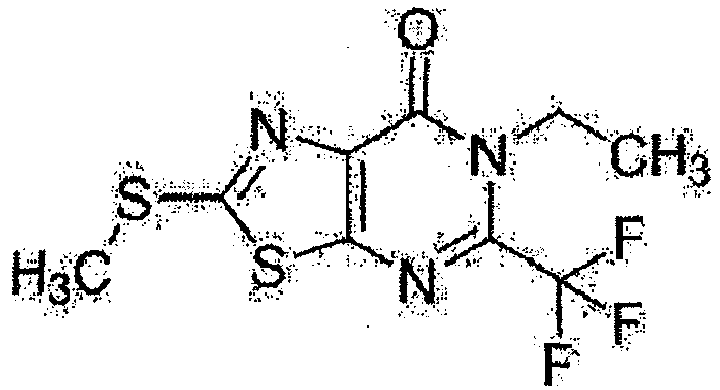
- The compound (2.50 g) obtained in Reference Example 137 was treated by a method similar to that in Reference Example 244 to give the title compound (2.83 g).
MS (ESI) m/z; 296 [M+H]+ -

- The compound (500 mg) obtained in Reference Example 141 was treated by a method similar to that in Reference Example 244 to give the title compound (570 mg).
MS (ESI) m/z; 326 [M+H]+ -

- The compound (300 mg) obtained in Reference Example 141 was treated by a method similar to that in Reference Example 244 to give the title compound (260 mg).
MS (ESI) m/z; 308 [M+H]+ -

- The compound (500 mg) obtained in Reference Example 142 was treated by a method similar to that in Reference Example 244 to give the title compound (270 mg).
MS (ESI) m/z; 352 [M+H]+ -

- The compound (600 mg) obtained in Reference Example 143 was treated by a method similar to that in Reference Example 244 to give the title compound (497 mg).
MS (ESI) m/z; 352 [M+H]+ -

- The compound (300 mg) obtained in Reference Example 143 was treated by a method similar to that in Reference Example 244 to give the title compound (104 mg).
MS (ESI) m/z; 334 [M+H]+ -

- The compound (750 mg) obtained in Reference Example 150 was treated by a method similar to that in Reference Example 244 to give the title compound (840 mg).
MS (ESI) m/z; 338 [M+H]+ -

- The compound (400 mg) obtained in Reference Example 151 was treated by a method similar to that in Reference Example 244 to give the title compound (190 mg).
MS (ESI) m/z; 324 [M+H]+ -

- The compound (500 mg) obtained in Reference Example 152 was treated by a method similar to that in Reference Example 244 to give the title compound (600 mg).
MS (ESI) m/z; 365 [M+H]+ -
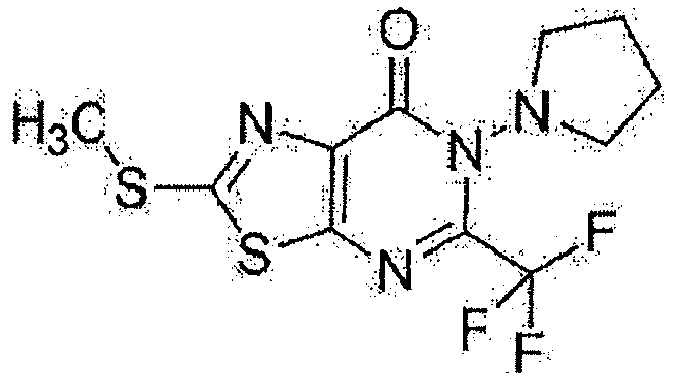
- The compound (850 mg) obtained in Reference Example 154 was treated by a method similar to that in Reference Example 244 to give the title compound (360 mg).
MS (ESI) m/z; 337 [M+H]+ -

- The compound (1.10 g) obtained in Reference Example 155 was treated by a method similar to that in Reference Example 244 to give the title compound (560 mg).
MS (ESI) m/z; 353 [M+H]+ -

- The compound (500 mg) obtained in Reference Example 139 was treated by a method similar to that in Reference Example 244 to give the title compound (370 mg).
MS (ESI) m/z; 308 [M+H]+ -

- To a solution (20 mL) of 3-nitromethylene-oxetane (1.14 g) in DMF was added 20% palladium hydroxide carbon (50% hydrate, 500 mg), and the reaction mixture was stirred under a hydrogen atmosphere, at room temperature for 8 hr. 20% Palladium hydroxide carbon (50% hydrate, 1.00 g) was added, and the reaction mixture was further stirred at room temperature for 9 hr. The reaction mixture was filtered through diatomaceous earth, and washed with DMF (40 mL). To the filtrate were added 5-amino-2-methylsulfanyl-1,3-thiazole-4-carboxylic acid (1.89 g), N,N-diisopropylethylamine (2.60 mL), EDC hydrochloride (2.85 g) and HOBt monohydrate (2.28 g), and the reaction mixture was stirred at room temperature overnight. To the reaction mixture were added water and chloroform, the mixture was filtered through diatomaceous earth, and the filtrate was extracted with chloroform. The combined organic layer was dried over anhydrous sodium sulfate, filtered and concentrated. The residue was purified by silica gel column chromatography (solvent; hexane/ethyl acetate=70/30 - 0/100) to give a crude product (461 mg). This was dissolved in methylene chloride (16 mL), triethylamine (2.48 mL) and trifluoroacetic anhydride (1.98 mL) were added , and the reaction mixture was stirred at room temperature overnight. To the reaction mixture was added 15% aqueous citric acid solution, and the mixture was extracted twice with chloroform. The combined organic layer was washed with saturated aqueous sodium hydrogen carbonate solution, dried over anhydrous sodium sulfate, filtered and concentrated. The residue was purified by NH silica gel column chromatography (solvent; hexane/ethyl acetate=90/10 - 50/50) to give the title compound (147 mg).
MS (ESI) m/z; 338 [M+H]+ -

- To a solution (8.0 mL) of the compound (330 mg) obtained in Reference Example 153 in methylene chloride were added trifluoroacetic anhydride (300 mg) and pyridine (115 mg) under ice-cooling, and the reaction mixture was stirred at room temperature for 2 hr. Trifluoroacetic anhydride (1.26 g) and triethylamine (1.22 g) were added, and the reaction mixture was stirred at room temperature overnight. Saturated aqueous sodium hydrogen carbonate solution was added to the reaction mixture, and the mixture was extracted twice with chloroform. The organic layer was washed with saturated brine, dried over anhydrous sodium sulfate, filtered and concentrated. The residue was purified by NH silica gel column chromatography (solvent; hexane/ethyl acetate=80/20 - 50/50) to give the title compound (420 mg).
MS (ESI) m/z; 353 [M+H]+ -

- To a solution (2.0 mL) of (RS)-tetrahydrofuran-3-carboxylic acid (400 mg) in methylene chloride were added oxalyl chloride (700 mg) and DMF (one drop) under ice-cooling. The reaction mixture was stirred at room temperature for 2 hr, and concentrated. The residue was dissolved in methylene chloride, and added dropwise to a solution (3.0 mL) of the compound (840 mg) obtained in Reference Example 136 and triethylamine (510 mg) in methylene chloride under ice-cooling, and the reaction mixture was stirred at room temperature for 1.5 hr. To the reaction mixture were added water and saturated aqueous sodium hydrogen carbonate solution, and the mixture was extracted twice with chloroform. The organic layer was dried over anhydrous sodium sulfate, filtered and concentrated. To a solution (20 mL) of the obtained crude product in dichloroethane were added triethylamine (5.4 g) and chlorotrimethylsilane (1.9 g), and the reaction mixture was stirred at room temperature for 5.5 hr. Water was added to the reaction mixture, and the mixture was extracted twice with chloroform. The organic layer was dried over anhydrous sodium sulfate, filtered and concentrated. The residue was purified by silica gel column chromatography (solvent; hexane/ethyl acetate=70/30 - 0/100) to give the title compound (470 mg).
MS (ESI) m/z; 284 [M+H]+ -
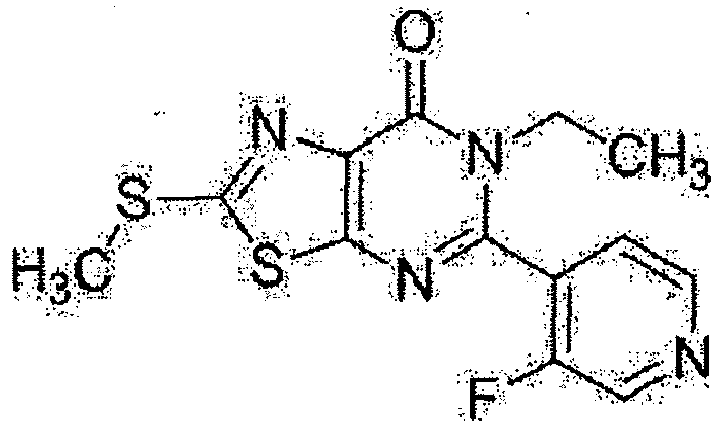
- The compound (500 mg) obtained in Reference Example 137 was treated by a method similar to that in Reference Example 260 to give the title compound (354 mg).
MS (ESI) m/z; 323 [M+H]+ -

-

- To a solution (26 mL) of 4-fluoropyridine-2-carboxylic acid (650 mg) in methylene chloride were added oxalyl chloride (779 µL) and DMF (one drop) under ice-cooling. The mixture was stirred at room temperature overnight, and concentrated. The residue was dissolved in methylene chloride, and added dropwise to a solution (12 mL) of the compound (500 mg) obtained in Reference Example 137 and triethylamine (641 µL) in methylene chloride under ice-cooling, and the reaction mixture was stirred at room temperature for 3.5 hr. To the reaction mixture were added water and saturated aqueous sodium hydrogen carbonate solution, and the mixture was extracted 4 times with chloroform. The organic layer was dried over anhydrous magnesium sulfate, filtered and concentrated and the residue was purified by silica gel column chromatography (solvent; hexane/ethyl acetate=80/20 - 50/50). To a solution (20 mL) of the obtained product in dichloroethane were added triethylamine (8.99 mL) and chlorotrimethylsilane (2.72 mL), and the reaction mixture was stirred at room temperature for 4 hr. Water was added to the reaction mixture, and the mixture was extracted twice with chloroform. The organic layer was dried over anhydrous magnesium sulfate, filtered and concentrated. The residue was purified by silica gel column chromatography (solvent; hexane/ethyl acetate=70/30 - 0/100) and subjected to TLC using silica gel to give a highly-polar compound (Reference Example 262; 393 mg) and a less polar compound (Reference Example 263; 142 mg).
Reference Example 262 (ESI) m/z; 323 [M+H]+
Reference Example 263 (ESI) m/z; 339, 341 [M+H]+ -

- To a solution (20 mL) of the compound (1.00 g) obtained in Reference Example 136 in DMF were added EDC hydrochloride (1.28 g), HOBt monohydrate (0.98 g), N,N-diisopropylethylamine (0.86 mL) and pyridine-2-carboxylic acid (0.79 g), and the reaction mixture was stirred at room temperature overnight. Water was added to the reaction mixture, and the mixture was extracted three times with ethyl acetate, and the organic layer was dried over anhydrous magnesium sulfate, filtered and concentrated. To the residue was added hexane, and the solid was collected by filtration, and dried to give a solid (1.67 g). To a solution (13 mL) of the obtained solid (0.42 g) in dichloroethane were added triethylamine (2.85 mL) and chlorotrimethylsilane (0.86 mL), and the reaction mixture was stirred at room temperature overnight. Water was added to the reaction mixture, and the mixture was extracted twice with chloroform. The organic layer was dried over anhydrous magnesium sulfate, filtered and concentrated. To the residue was added diethyl ether, and the solid was collected by filtration, and dried to give the title compound (265 mg).
m/z; 291 [M+H]+ -

- To a solution (300 mL) of the compound (12.9 g) obtained in Reference Example 137 in methylene chloride was added dropwise under ice-cooling difluoroacetic anhydride (46.7 g), and the reaction mixture was stirred for 1 hr. Pyridine (24.1 mL) was added, and the reaction mixture was stirred for 2 hr. The reaction mixture was concentrated and the residue was dissolved in ethyl acetate, and washed with saturated aqueous sodium hydrogen carbonate solution. The organic layer was dried over anhydrous sodium sulfate, filtered and concentrated. The obtained crude product was dissolved in methylene chloride (250 mL), triethylamine (20.9 mL) and chlorotrimethylsilane (6.32 mL) were added, and the reaction mixture was stirred at room temperature for 2 hr. Water was added to the reaction mixture, and the mixture was extracted three times with chloroform, and the extracted organic layer was dried over anhydrous sodium sulfate, filtered and concentrated. The obtained residue was purified by silica gel column chromatography (solvent; hexane/ethyl acetate=70/30 - 40/60) to give the title compound (12.3 g).
MS (ESI) m/z; 278 [M+H]+ -

- The compound (1.37 g) obtained in Reference Example 145 was treated by a method similar to that in Reference Example 265 to give the title compound (1.05 g).
MS (ESI) m/z; 348 [M+H]+ -

- To a solution (10 mL) of the compound (484 mg) obtained in Reference Example 136 in DMF were added HATU (2.72 g), N,N-diisopropylethylamine (2.34 mL) and 3-fluoropyridine-2-carboxylic acid (840 mg), and the reaction mixture was stirred at room temperature for 2 hr. HATU (2.72 g), N,N-diisopropylethylamine (2.34 mL) and 3-fluoropyridine-2-carboxylic acid (840 mg) were added, and the reaction mixture was stirred at room temperature for 3 days. Water was added to the reaction mixture, and the mixture was extracted three times with ethyl acetate, and the organic layer was dried over anhydrous magnesium sulfate, filtered and concentrated. To a solution (20 mL) of the obtained crude product in dichloroethane were added triethylamine (6.66 mL) and chlorotrimethylsilane (3.02 mL), and the reaction mixture was stirred at room temperature for 2 hr. Triethylamine (6.66 mL) and chlorotrimethylsilane (3.02 mL) were added, and the reaction mixture was stirred at room temperature for 3 days. Water was added to the reaction mixture, and the mixture was extracted twice with chloroform. The organic layer was dried over anhydrous magnesium sulfate, filtered and concentrated. The residue was purified by silica gel column chromatography (solvent; hexane/ethyl acetate=70/30 - 0/100) to give the title compound (543 mg).
MS (ESI) m/z; 309 [M+H]+ -

- To a solution (800 mL) of the compound (37.7 g) obtained in Reference Example 195 in methylene chloride was added mCPBA (69-75%, 33.0 g) under ice-cooling, and the reaction mixture was stirred under ice-cooling for 1 hr. To the reaction mixture were added aqueous sodium thiosulfate solution and saturated aqueous sodium hydrogen carbonate solution, and the mixture was extracted three times with chloroform. The organic layer was dried over anhydrous sodium sulfate, filtered and concentrated to give the title compound (39.4 g).
MS (ESI) m/z; 306 [M+H]+ -

- The compound (240 mg) obtained in Reference Example 196 was treated by a method similar to that in Reference Example 268 to give the title compound (252 mg).
MS (ESI) m/z; 360 [M+H]+ -

- The compound (321 mg) obtained in Reference Example 197 was treated by a method similar to that in Reference Example 268 to give the title compound (329 mg).
MS (ESI) m/z; 342 [M+H]+ -

- The compound (600 mg) obtained in Reference Example 198 was treated by a method similar to that in Reference Example 268 to give the title compound (550 mg).
MS (ESI) m/z; 300 [M+H]+ -

- The compound (370 mg) obtained in Reference Example 200 was treated by a method similar to that in Reference Example 268 to give the title compound (376 mg).
MS (ESI) m/z; 302 [M+H]+ -

- The compound (772 mg) obtained in Reference Example 201 was treated by a method similar to that in Reference Example 268 to give the title compound (773 mg).
MS (ESI) m/z; 300 [M+H]+ -

- The compound (400 mg) obtained in Reference Example 202 was treated by a method similar to that in Reference Example 268 to give the title compound (350 mg).
MS (ESI) m/z; 314 [M+H]+ -
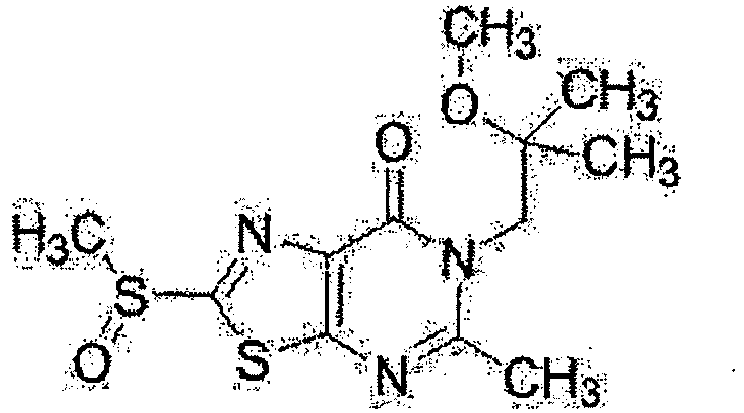
- The compound (320 mg) obtained in Reference Example 203 was treated by a method similar to that in Reference Example 268 to give the title compound (340 mg).
MS (ESI) m/z; 316 [M+H]+ -

- The compound (490 mg) obtained in Reference Example 204 was treated by a method similar to that in Reference Example 268 to give the title compound (522 mg).
MS (ESI) m/z; 294 [M+H]+ -

- The compound (350 mg) obtained in Reference Example 205 was treated by a method similar to that in Reference Example 268 to give the title compound (466 mg).
MS (ESI) m/z; 288 [M+H]+ -

- The compound (86 mg) obtained in Reference Example 175 was treated by a method similar to that in Reference Example 268 to give the title compound (92 mg).
MS (ESI) m/z; 304, 306 [M+H]+ -

- The compound (240 mg) obtained in Reference Example 207 was treated by a method similar to that in Reference Example 268 to give the title compound (254 mg).
MS (ESI) m/z; 308 [M+H]+ -

- The compound (770 mg) obtained in Reference Example 208 was treated by a method similar to that in Reference Example 268 to give the title compound (857 mg).
MS (ESI) m/z; 357 [M+H]+ -

- The compound (615 mg) obtained in Reference Example 209 was treated by a method similar to that in Reference Example 268 to give the title compound (651 mg).
MS (ESI) m/z; 314 [M+H]+ -

- The compound (1.04 g) obtained in Reference Example 210 was treated by a method similar to that in Reference Example 268 to give the title compound (1.08 g).
MS (ESI) m/z; 324 [M+H]+ -

- The compound (260 mg) obtained in Reference Example 211 was treated by a method similar to that in Reference Example 268 to give the title compound (303 mg).
MS (ESI) m/z; 398 [M+H]+ -

- The compound (500 mg) obtained in Reference Example 212 was treated by a method similar to that in Reference Example 268 to give the title compound (550 mg).
MS (ESI) m/z; 322 [M+H]+ -

- The compound (220 mg) obtained in Reference Example 213 was treated by a method similar to that in Reference Example 268 to give the title compound (217 mg).
MS (ESI) m/z; 312 [M+H]+ -

- The compound (310 mg) obtained in Reference Example 214 was treated by a method similar to that in Reference Example 268 to give the title compound (283 mg).
MS (ESI) m/z; 312 [M+H]+ -
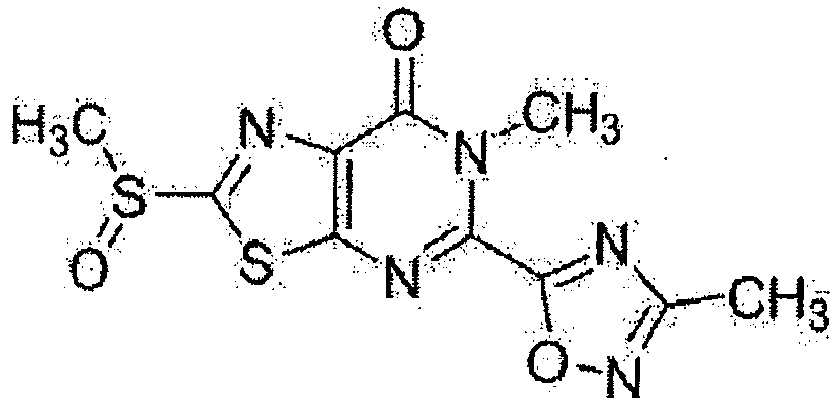
- The compound (171 mg) obtained in Reference Example 215 was treated by a method similar to that in Reference Example 268 to give the title compound (166 mg).
MS (ESI) m/z; 312 [M+H]+ -

- The compound (830 mg) obtained in Reference Example 216 was treated by a method similar to that in Reference Example 268 to give the title compound (830 mg).
MS (ESI) m/z; 326 [M+H]+ -

- The compound (170 mg) obtained in Reference Example 217 was treated by a method similar to that in Reference Example 268 to give the title compound (213 mg).
MS (ESI) m/z; 340 [M+H]+ -

- The compound (290 mg) obtained in Reference Example 218 was treated by a method similar to that in Reference Example 268 to give the title compound (240 mg).
MS (ESI) m/z; 338 [M+H]+ -

- The compound (1.30 g) obtained in Reference Example 219 was treated by a method similar to that in Reference Example 268 to give the title compound (1.25 g).
MS (ESI) m/z; 362 [M+H]+ -

- The compound (460 mg) obtained in Reference Example 220 was treated by a method similar to that in Reference Example 268 to give the title compound (420 mg).
MS (ESI) m/z; 356 [M+H]+ -

- The compound (410 mg) obtained in Reference Example 221 was treated by a method similar to that in Reference Example 268 to give the title compound (320 mg).
MS (ESI) m/z; 382 [M+H]+ -

- The compound (135 mg) obtained in Reference Example 222 was treated by a method similar to that in Reference Example 268 to give the title compound (135 mg).
MS (ESI) m/z; 338 [M+H]+ -

- The compound (350 mg) obtained in Reference Example 225 was treated by a method similar to that in Reference Example 268 to give the title compound (300 mg).
MS (ESI) m/z; 288 [M+H]+ -

- The compound (340 mg) obtained in Reference Example 226 was treated by a method similar to that in Reference Example 268 to give the title compound (340 mg).
MS (ESI) m/z; 314 [M+H]+ -

- The compound (287 mg) obtained in Reference Example 224 was treated by a method similar to that in Reference Example 268 to give the title compound (315 mg).
MS (ESI) m/z; 323 [M+H]+ -

- The compound (253 mg) obtained in Reference Example 227 was treated by a method similar to that in Reference Example 268 to give the title compound (282 mg).
MS (ESI) m/z; 309 [M+H]+ -

- The compound (171 mg) obtained in Reference Example 228 was treated by a method similar to that in Reference Example 268 to give the title compound (130 mg).
MS (ESI) m/z; 302 [M+H]+ -

- The compound (430 mg) obtained in Reference Example 229 was treated by a method similar to that in Reference Example 268 to give the title compound (280 mg).
MS (ESI) m/z; 368 [M+H]+ -

- The compound (3.58 g) obtained in Reference Example 230 was treated by a method similar to that in Reference Example 268 to give the title compound (3.19 g).
MS (ESI) m/z; 270 [M+H]+ -

- The compound (250 mg) obtained in Reference Example 231 was treated by a method similar to that in Reference Example 268 to give the title compound (249 mg).
MS (ESI) m/z; 274 [M+H]+ -

- The compound (220 mg) obtained in Reference Example 223 was treated by a method similar to that in Reference Example 268 to give the title compound (167 mg).
MS (ESI) m/z; 290 [M+H]+ -

- The compound (600 mg) obtained in Reference Example 232 was treated by a method similar to that in Reference Example 268 to give the title compound (594 mg).
MS (ESI) m/z; 258 [M+H]+ -

- The compound (834 mg) obtained in Reference Example 233 was treated by a method similar to that in Reference Example 268 to give the title compound (728 mg).
MS (ESI) m/z; 244 [M+H]+ -

- The compound (773 mg) obtained in Reference Example 234 was treated by a method similar to that in Reference Example 268 to give the title compound (733 mg).
MS (ESI) m/z; 272 [M+H]+ -

- The compound (12.0 g) obtained in Reference Example 235 was treated by a method similar to that in Reference Example 268 to give the title compound (11.0 g).
MS (ESI) m/z; 270 [M+H]+ -

- The compound (360 mg) obtained in Reference Example 236 was treated by a method similar to that in Reference Example 268 to give the title compound (400 mg).
MS (ESI) m/z; 284 [M+H]+ -
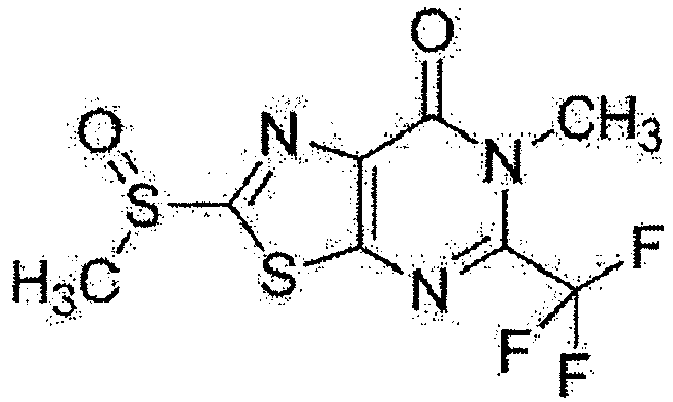
- The compound (3.25 g) obtained in Reference Example 244 was treated by a method similar to that in Reference Example 268 to give the title compound (2.30 g).
MS (ESI) m/z; 298 [M+H]+ -

- The compound (1.08 g) obtained in Reference Example 245 was treated by a method similar to that in Reference Example 268 to give the title compound (1.15 g).
MS (ESI) m/z; 280 [M+H]+ -

- The compound (1.43 g) obtained in Reference Example 246 was treated by a method similar to that in Reference Example 268 to give the title compound (1.45 g).
MS (ESI) m/z; 312 [M+H]+ -

- The compound (560 mg) obtained in Reference Example 247 was treated by a method similar to that in Reference Example 268 to give the title compound (530 mg).
MS (ESI) m/z; 342 [M+H]+ -

- The compound (250 mg) obtained in Reference Example 248 was treated by a method similar to that in Reference Example 268 to give the title compound (276 mg) .
MS (ESI) m/z; 324 [M+H]+ -

- The compound (270 mg) obtained in Reference Example 249 was treated by a method similar to that in Reference Example 268 to give the title compound (220 mg) .
MS (ESI) m/z; 368 [M+H]+ -

- The compound (894 mg) obtained in Reference Example 250 was treated by a method similar to that in Reference Example 268 to give the title compound (935 mg).
MS (ESI) m/z; 368 [M+H]+ -

- The compound (170 mg) obtained in Reference Example 251 was treated by a method similar to that in Reference Example 268 to give the title compound (182 mg).
MS (ESI) m/z; 350 [M+H]+ -

- The compound (840 mg) obtained in Reference Example 252 was treated by a method similar to that in Reference Example 268 to give the title compound (780 mg).
MS (ESI) m/z; 354 [M+H]+ -
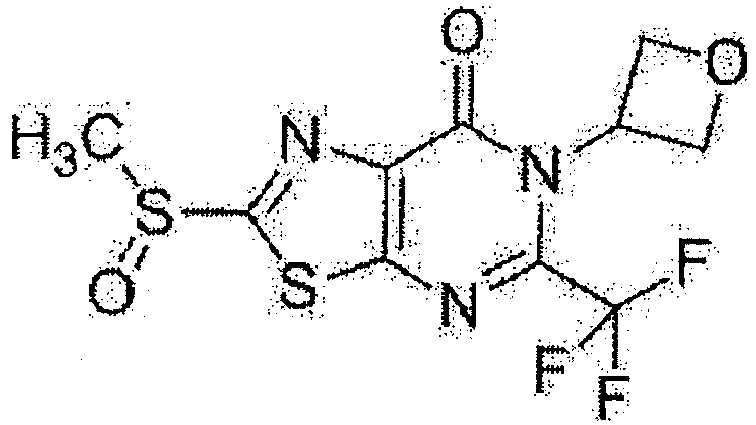
- The compound (390 mg) obtained in Reference Example 253 was treated by a method similar to that in Reference Example 268 to give the title compound (260 mg) .
MS (ESI) m/z; 340 [M+H]+ -

- The compound (330 mg) obtained in Reference Example 255 was treated by a method similar to that in Reference Example 268 to give the title compound (280 mg).
MS (ESI) m/z; 353 [M+H]+ -

- The compound (560 mg) obtained in Reference Example 256 was treated by a method similar to that in Reference Example 268 to give the title compound (580 mg).
MS (ESI) m/z; 369 [M+H]+ -
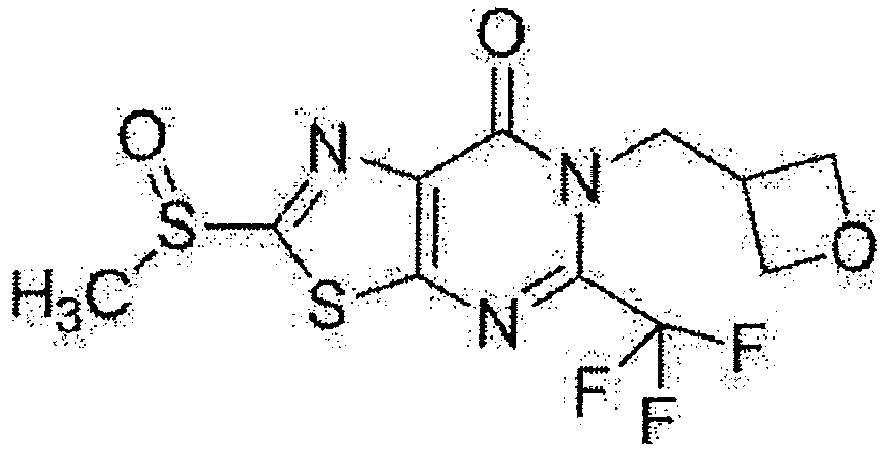
- The compound (160 mg) obtained in Reference Example 258 was treated by a method similar to that in Reference Example 268 to give the title compound (179 mg).
MS (ESI) m/z; 354 [M+H]+ -

- The compound (450 mg) obtained in Reference Example 260 was treated by a method similar to that in Reference Example 268 to give the title compound (440 mg).
MS (ESI) m/z; 300 [M+H]+ -

- The compound (340 mg) obtained in Reference Example 261 was treated by a method similar to that in Reference Example 268 to give the title compound (418 mg).
MS (ESI) m/z; 339 [M+H]+ -

- The compound (380 mg) obtained in Reference Example 262 was treated by a method similar to that in Reference Example 268 to give the title compound (400 mg).
MS (ESI) m/z; 339 [M+H]+ -

- The compound (130 mg) obtained in Reference Example 263 was treated by a method similar to that in Reference Example 268 to give the title compound (140 mg).
MS (ESI) m/z; 355, 357 [M+H]+ -

- The compound (260 mg) obtained in Reference Example 264 was treated by a method similar to that in Reference Example 268 to give the title compound (170 mg).
MS (ESI) m/z; 307 [M+H]+ -

- The compound (960 mg) obtained in Reference Example 265 was treated by a method similar to that in Reference Example 268 to give the title compound (878 mg).
MS (ESI) m/z; 294 [M+H]+ -

- The compound (1.00 g) obtained in Reference Example 266 was treated by a method similar to that in Reference Example 268 to give the title compound (1.05 g).
MS (ESI) m/z; 364 [M+H]+ -

- The compound (200 mg) obtained in Reference Example 267 was treated by a method similar to that in Reference Example 268 to give the title compound (214 mg).
MS (ESI) m/z; 325 [M+H]+ -

- To a solution (12 mL) of the compound (630 mg) obtained in Reference Example 199 in methylene chloride was added trifluoroacetic acid (337 µL) under ice-cooling, and the reaction mixture was stirred at the same temperature for 10 min. Under ice-cooling, mCPBA (69-75%, 551 mg) was added, and the reaction mixture was stirred at room temperature overnight. After confirmation of the completion of the reaction, aqueous sodium thiosulfate solution and saturated aqueous sodium hydrogen carbonate solution were added to the reaction mixture, and the mixture was extracted three times with methylene chloride. The organic layer was dried over anhydrous sodium sulfate, filtered and concentrated to give the title compound (674 mg) .
MS (ESI) m/z; 321 [M+H]+ -

- The compound (420 mg) obtained in Reference Example 259 was treated by a method similar to that in Reference Example 330 to give the title compound (190 mg).
MS (ESI) m/z; 369 [M+H]+ -

- To a solution (5.0 mL) of the compound (500 mg) obtained in Reference Example 254 in methanol was added hydrogen chloride (2 mol/L ethanol solution), and the reaction mixture was stirred at room temperature for 30 min. The solvent was evaporated under reduced pressure. To a solution (5.0 mL) of the residue in methanol was added an aqueous solution (15 mL) of ozone (2.55 g), and the reaction mixture was stirred at room temperature for 2 hr, and stirred with heating at 50°C for 1 hr. The reaction mixture was cooled to room temperature, and aqueous potassium carbonate solution was added to the reaction mixture, and the mixture was extracted 4 times with chloroform. The organic layer was dried over anhydrous sodium sulfate, filtered and concentrated to give the title compound (220 mg). MS (ESI) m/z; 381 [M+H]+
-

- To a solution (8.0 mL) of the compound (400 mg) obtained in Reference Example 237 in methylene chloride was added mCPBA (69-75%, 1.04 g) under ice-cooling, and the reaction mixture was stirred at room temperature for 6 hr. To the reaction mixture were added aqueous sodium thiosulfate solution and saturated aqueous sodium hydrogen carbonate solution, and the mixture was extracted with chloroform. The organic layer was dried over anhydrous sodium sulfate, filtered and concentrated. The residue was purified by silica gel column chromatography (solvent; hexane/ethyl acetate=70/30 - 0/100) to give the title compound (495 mg).
MS (ESI) m/z; 288 [M+H]+ -
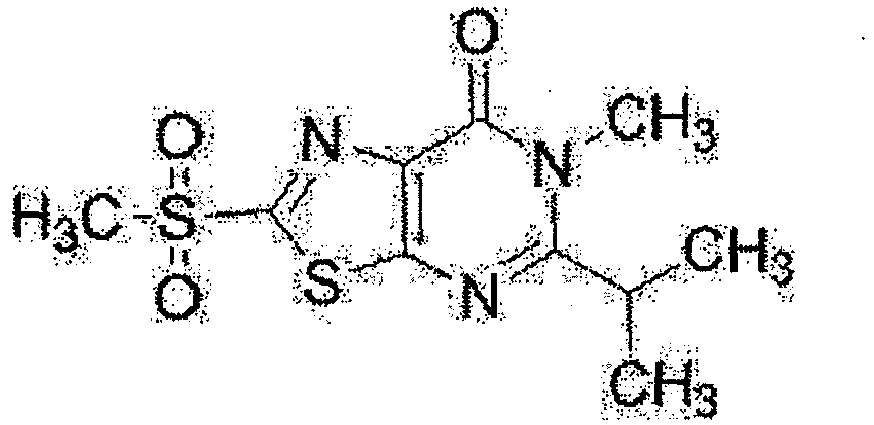
- The compound (2.00 g) obtained in Reference Example 238 was treated by a method similar to that in Reference Example 333 to give the title compound (1.96 g).
MS (ESI) m/z; 288 [M+H]+ -

- The compound (480 mg) obtained in Reference Example 239 was treated by a method similar to that in Reference Example 333 to give the title compound (520 mg) .
MS (ESI) m/z; 274 [M+H]+ -

- The compound (380 mg) obtained in Reference Example 240 was treated by a method similar to that in Reference Example 333 to give the title compound (395 mg).
MS (ESI) m/z; 288 [M+H]+ -

- The compound (325 mg) obtained in Reference Example 241 was treated by a method similar to that in Reference Example 333 to give the title compound (285 mg).
MS (ESI) m/z; 314 [M+H]+ -

- The compound (190 mg) obtained in Reference Example 242 was treated by a method similar to that in Reference Example 333 to give the title compound (210 mg).
MS (ESI) m/z; 328 [M+H]+ -

- The compound (190 mg) obtained in Reference Example 243 was treated by a method similar to that in Reference Example 333 to give the title compound (215 mg).
MS (ESI) m/z; 322 [M+H]+ -

- The compound (370 mg) obtained in Reference Example 257 was treated by a method similar to that in Reference Example 333 to give the title compound (320 mg).
MS (ESI) m/z; 340 [M+H]+ -

- To a solution (40 mL) of N-(tert-butoxycarbonyl)-D-proline (4.0 g) in DMF were added benzylamine (2.0 g), EDC hydrochloride (5.4 g), HOBt monohydrate (4.3 g) and diisopropylethylamine (3.6 g), and the reaction mixture was stirred at room temperature for 1 hr. After confirmation of the completion of the reaction, water (200 mL) were added to the reaction mixture, and the mixture was extracted twice with ethyl acetate. The organic layer was washed once with water, dried over anhydrous magnesium sulfate, filtered and concentrated. The residue was purified by silica gel column chromatography (solvent; hexane/ethyl acetate=80/20 - 50/50). The obtained product was dissolved in methanol (100 mL), hydrogen chloride (4.0 mol/L 1,4-dioxane solution, 50 mL) was added, and the reaction mixture was stirred at room temperature for 2 hr. After confirmation of the completion of the reaction, the solvent was evaporated, and ethyl acetate was added to the residue, and the solid was collected by filtration to give the title compound (3.8 g).
MS (ESI) m/z; 205 [M+H]+ -

- The compound (3.00 g) obtained in Reference Example 136 was treated by a method similar to that in Reference Example 156 to give the title compound (2.95 g).
MS (ESI) m/z; 280, 282 [M+H]+ -

- The compound (4.00 g) obtained in Reference Example 137 was treated by a method similar to that in Reference Example 156 to give the title compound (5.62 g).
MS (ESI) m/z; 294, 296 [M+H]+ -

- The compound (4.00 g) obtained in Reference Example 138 was treated by a method similar to that in Reference Example 156 to give the title compound (3.54 g).
MS (ESI) m/z; 308, 310 [M+H]+ -

- The compound (1.69 g) obtained in Reference Example 342 was treated by a method similar to that in Reference Example 195 to give the title compound (1.00 g).
MS (ESI) m/z; 262, 264 [M+H]+ -

- The compound (5.62 g) obtained in Reference Example 343 was treated by a method similar to that in Reference Example 195 to give the title compound (4.07 g).
MS (ESI) m/z; 276, 278 [M+H]+ -

- The compound (4.00 g) obtained in Reference Example 344 was treated by a method similar to that in Reference Example 195 to give the title compound (250 mg).
MS (ESI) m/z; 290, 292 [M+H]+ -

- The compound (121 mg) obtained in Reference Example 345 was treated by a method similar to that in Reference Example 268 to give the title compound (94 mg).
MS (ESI) m/z; 278, 280 [M+H]+ -

- The compound (4.07 g) obtained in Reference Example 346 was treated by a method similar to that in Reference Example 268 to give the title compound (4.26 g).
MS (ESI) m/z; 292, 294 [M+H]+ -

- The compound (250 mg) obtained in Reference Example 347 was treated by a method similar to that in Reference Example 268 to give the title compound (252 mg).
MS (ESI) m/z; 306, 308 [M+H]+ -

- To a solution (30 mL) of the compound (600 mg) obtained in Reference Example 348 in acetonitrile were added potassium carbonate (600 mg), potassium iodide (430 mg) and morpholine (290 µL), and the reaction mixture was stirred at 80°C for 2 hr. Water was added to the reaction mixture, and the mixture was extracted twice with chloroform. The organic layer was dried over anhydrous magnesium sulfate, filtered and concentrated. The residue was purified by silica gel column chromatography (solvent; ethyl acetate/methanol=100/0 - 95/5) to give the title compound (690 mg).
MS (ESI) m/z; 329 [M+H]+ -

- The compound (300 mg) obtained in Reference Example 348 was treated by a method similar to that in Reference Example 351 to give the title compound (360 mg).
MS (ESI) m/z; 287 [M+H]+ -

- The compound (200 mg) obtained in Reference Example 348 was treated by a method similar to that in Reference Example 351 to give the title compound (206 mg).
MS (ESI) m/z; 301 [M+H]+ -

- The compound (200 mg) obtained in Reference Example 348 was treated by a method similar to that in Reference Example 351 to give the title compound (227 mg).
MS (ESI) m/z; 299 [M+H]+ -

- The compound (200 mg) obtained in Reference Example 348 was treated by a method similar to that in Reference Example 351 to give the title compound (155 mg).
MS (ESI) m/z; 329 [M+H]+ -

- The compound (300 mg) obtained in Reference Example 348 was treated by a method similar to that in Reference Example 351 to give the title compound (363 mg).
MS (ESI) m/z; 313 [M+H]+ -

- The compound (300 mg) obtained in Reference Example 348 was treated by a method similar to that in Reference Example 351 to give the title compound (366 mg).
MS (ESI) m/z; 327 [M+H]+ -

- The compound (200 mg) obtained in Reference Example 348 was treated by a method similar to that in Reference Example 351 to give the title compound (296 mg).
MS (ESI) m/z; 361 [M+H]+ -

- The compound (200 mg) obtained in Reference Example 349 was treated by a method similar to that in Reference Example 351 to give the title compound (214 mg).
MS (ESI) m/z; 301 [M+H]+ -

- The compound (200 mg) obtained in Reference Example 349 was treated by a method similar to that in Reference Example 351 to give the title compound (267 mg).
MS (ESI) m/z; 315 [M+H]+ -

- The compound (126 mg) obtained in Reference Example 350 was treated by a method similar to that in Reference Example 351 to give the title compound (120 mg).
MS (ESI) m/z; 315 [M+H]+ -

- The compound (126 mg) obtained in Reference Example 350 was treated by a method similar to that in Reference Example 351 to give the title compound (142 mg).
MS (ESI) m/z; 359 [M+H]+ -

- To a solution (2.0 mL) of the compound (200 mg) obtained in Reference Example 348 in DMF were added N-methyl-N-(2,2,2-trifluoroethyl)amine hydrochloride (215 mg) and N,N-diisopropylethylamine (439 µL), and the reaction mixture was stirred with heating at 60°C for 5 hr. Water was added to the reaction mixture, and the mixture was extracted three times with ethyl acetate. The organic layer was dried over anhydrous sodium sulfate, filtered and concentrated to give the title compound (747 mg).
MS (ESI) m/z; 355 [M+H]+ -

- To a solution (1.0 mL) of 5-amino-2-methylsulfanyl-1,3-thiazole-4-carboxylic acid ethyl ester (100 mg) in ethanol were added methyl isothiocyanate (50 mg) and DBU (137 µL), and the reaction mixture was stirred with heating at 80°C for 5 hr. The reaction mixture was cooled to 0°C, acetic acid and water were added, and the precipitated solid was filtered, and dried to give the title compound (68.0 mg).
MS (ESI) m/z; 246 [M+H]+ -

- 5-Amino-2-methylsulfanyl-1,3-thiazole-4-carboxylic acid ethyl ester (5.00 g) was treated by a method similar to that in Reference Example 364 to give the title compound (4.87 g).
MS (ESI) m/z; 290 [M+H]+ -

- To a solution (40 mL) of the compound (5.03 g) obtained in Reference Example 364 in DMF was added phosphorus oxychloride (2.8 mL) under ice-cooling. The reaction mixture was stirred with heating at 70°C for 3 hr, and added to water. The precipitated solid was collected by filtration, and dried to give the title compound (3.44 g).
MS (ESI) m/z; 248, 250 [M+H]+ -

- The compound (2.00 g) obtained in Reference Example 365 was treated by a method similar to that in Reference Example 366 to give the title compound (1.50 g).
MS (ESI) m/z; 292, 294 [M+H]+ -

- The compound (2.78 g) obtained in Reference Example 366 was treated by a method similar to that in Reference Example 268 to give the title compound (2.22 g).
MS (ESI) m/z; 264, 266 [M+H]+ -

- The compound (300 mg) obtained in Reference Example 367 was treated by a method similar to that in Reference Example 268 to give the title compound (173 mg).
MS (ESI) m/z; 308, 310 [M+H]+ -

- To a solution (10 mL) of the compound (250 mg) obtained in Reference Example 368 in THF were added triethylamine (400 µL) and a 50% aqueous dimethylamine solution (120 µL), and the reaction mixture was stirred with heating at 50°C for 2.5 hr. To the reaction mixture was added 1.0 mol/L hydrochloric acid, and the mixture was extracted twice with chloroform. The organic layer was dried over anhydrous magnesium sulfate, filtered and concentrated to give the title compound (300 mg).
MS (ESI) m/z; 273 [M+H]+ -

- The compound (250 mg) obtained in Reference Example.368 was treated by a method similar to that in Reference Example 370 to give the title compound (277 mg).
MS (ESI) m/z; 299 [M+H]+ -
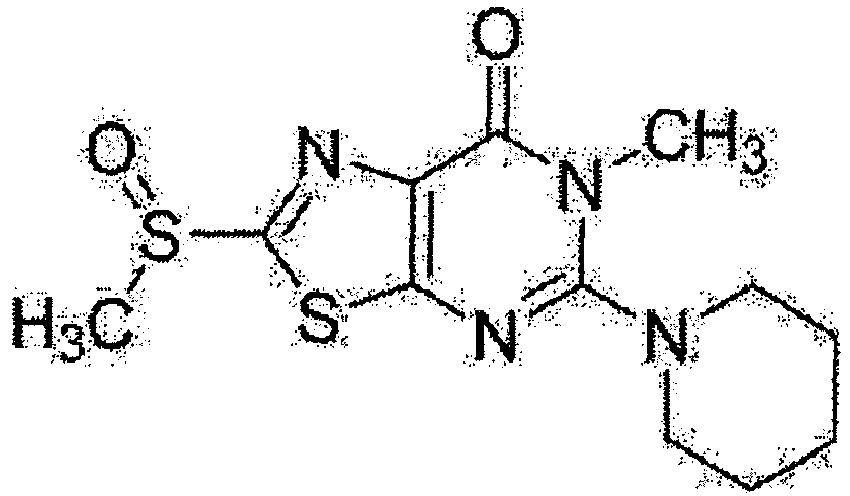
- The compound (250 mg) obtained in Reference Example 368 was treated by a method similar to that in Reference Example 370 to give the title compound (210 mg).
MS (ESI) m/z; 313 [M+H]+ -

- The compound (250 mg) obtained in Reference Example 368 was treated by a method similar to that in Reference Example 370 to give the title compound (283 mg).
MS (ESI) m/z; 315 [M+H]+ -

- The compound (168 mg) obtained in Reference Example 369 was treated by a method similar to that in Reference Example 370 to give the title compound (179 mg).
MS (ESI) m/z; 372 [M+H]+ -

- To a solution (10 mL) of the compound (268 mg) obtained in Reference Example 366 in THF were added morpholine (110 µL) and triethylamine (450 µL), and the reaction mixture was stirred with heating at 50°C for 1.5 hr. The reaction mixture was cooled to room temperature, and water was added to the reaction mixture, and the mixture was extracted three times with ethyl acetate. The organic layer was dried over anhydrous magnesium sulfate, filtered and concentrated. The residue was purified by silica gel column chromatography (solvent; chloroform/methanol=100/0 - 95/5) to give the title compound (211 mg) .
MS (ESI) m/z; 299 [M+H]+ -

- The compound (198 mg) obtained in Reference Example 375 was treated by a method similar to that in Reference Example 268 to give the title compound (218 mg).
MS (ESI) m/z; 315 [M+H]+ -

- The compound (600 mg) obtained in Reference Example 366 was treated by a method similar to that in Reference Example 375 to give the title compound (624 mg).
MS (ESI) m/z; 271 [M+H]+ -

- To a solution (2.00 mL) of the compound (319 mg) obtained in Reference Example 377 in trifluoroacetic acid was added 30% hydrogen peroxide water (285 µL) under ice-cooling. The mixture was stirred at room temperature for 2.5 hr, and the reaction mixture was ice-cooled, and water was added. The precipitated solid was collected by filtration, washed with water and dried to give the title compound (333 mg).
MS (ESI) m/z; 303 [M+H]+ -

- To a solution (2 mL) of the compound (303 mg) obtained in Reference Example 378 in DMF was added sodium hydride (60% oil dispersion, 48 mg), and the reaction mixture was stirred for 5 min. 4-Methoxybenzyl chloride (540 µL) was added dropwise, and the reaction mixture was stirred at room temperature overnight. Sodium hydride (60% oil dispersion, 48 mg) and 4-methoxybenzyl chloride (540 µL) were added, and the reaction mixture was stirred at room temperature overnight, and stirred with heating at 65°C for 7 hr. To the reaction mixture was added 1 mol/L hydrochloric acid, and the mixture was extracted three times with ethyl acetate. The combined organic layer was dried over anhydrous sodium sulfate, filtered and concentrated. The residue was purified by silica gel column chromatography (solvent; hexane/ethyl acetate=80/20 - 0/100) to give the title compound (49 mg).
MS (ESI) m/z; 423 [M+H]+ -

- To a solution (10 mL) of the compound (300 mg) obtained in Reference Example 366 and 2-propanol (110 µL) in DMF was added sodium hydride (60% oil dispersion, 58 mg) under ice-cooling. The reaction mixture was stirred at room temperature for 1.5 hr, water was added, and the mixture was extracted twice with ethyl acetate. The organic layer was dried over anhydrous magnesium sulfate, filtered and concentrated. The residue was purified by silica gel column chromatography (solvent; hexane/ethyl acetate=80/20 - 50/50) to give the title compound (236 mg).
MS (ESI) m/z; 272 [M+H]+ -

- The compound (400 mg) obtained in Reference Example 367 was treated by a method similar to that in Reference Example 380 to give the title compound (194 mg).
MS (ESI) m/z; 302 [M+H]+ -

- The compound (400 mg) obtained in Reference Example 367 was treated by a method similar to that in Reference Example 380 to give the title compound (288 mg).
MS (ESI) m/z; 316 [M+H]+ -

- The compound (220 mg) obtained in Reference Example 380 was treated by a method similar to that in Reference Example 268 to give the title compound (209 mg).
MS (ESI) m/z; 288 [M+H]+ -

- The compound (180 mg) obtained in Reference Example 381 was treated by a method similar to that in Reference Example 268 to give the title compound (129 mg).
MS (ESI) m/z; 318 [M+H]+ -

- The compound (282 mg) obtained in Reference Example 382 was treated by a method similar to that in Reference Example 268 to give the title compound (191 mg).
MS (ESI) m/z; 332 [M+H]+ -

- To a solution (16 mL) of the compound (496 mg) obtained in Reference Example 366 in dimethoxyethane were successively added 2-fluorophenylboronic acid (336 mg), tetrakis(triphenylphosphine)palladium(0) (116 mg), and an aqueous solution (4.0 mL) of sodium carbonate (848 mg) at room temperature, and the reaction mixture was stirred at 100°C for 5 hr. After confirmation of the completion of the reaction, the reaction mixture was cooled to room temperature, and diluted with methylene chloride. The organic layer was washed with saturated brine, and the aqueous layer was extracted with methylene chloride. The organic layers were combined, dried over anhydrous magnesium sulfate, filtered and concentrated. The obtained residue was purified by silica gel column chromatography (solvent; hexane/ethyl acetate=90/10 - 50/50) to give the title compound (142 mg).
MS (ESI) m/z; 308 [M+H]+ -

- The compound (496 mg) obtained in Reference Example 366 was treated by a method similar to that in Reference Example 386 to give the title compound (263 mg).
MS (ESI) m/z; 320 [M+H]+ -

- The compound (800 mg) obtained in Reference Example 366 was treated by a method similar to that in Reference Example 386 to give the title compound (307 mg).
MS (ESI) m/z; 295 [M+H]+ -

- The compound (141 mg) obtained in Reference Example 386 was treated by a method similar to that in Reference Example 268 to give the title compound (147 mg).
MS (ESI) m/z; 324 [M+H]+ -

- The compound (258 mg) obtained in Reference Example 387 was treated by a method similar to that in Reference Example 268 to give the title compound (326 mg).
MS (ESI) m/z; 336 [M+H]+ -

- The compound (298 mg) obtained in Reference Example 388 was treated by a method similar to that in Reference Example 268 to give the title compound (352 mg).
MS (ESI) m/z; 311 [M+H]+ -

- 5-Amino-2-methylsulfanyl-1,3-thiazole-4-carboxylic acid (0.92 g) was treated by a method similar to that in Reference Example 136 to give the title compound (1.84 g).
MS (ESI) m/z; 359 [M+H]+ -

- 5-Amino-2-methylsulfanyl-1,3-thiazole-4-carboxylic acid (0.60 g) was treated by a method similar to that in Reference Example 136 to give the title compound (1.12 g).
MS (ESI) m/z; 359 [M+H]+ -

- 5-Amino-2-methylsulfanyl-1,3-thiazole-4-carboxylic acid (2.00 g) was treated by a method similar to that in Reference Example 136 to give the title compound (3.90 g).
MS (ESI) m/z; 287 [M+H-Boc]+ -

- 5-Amino-2-methylsulfanyl-1,3-thiazole-4-carboxylic acid (0.85 g) was treated by a method similar to that in Reference Example 136 to give the title compound (1.54 g).
MS (ESI) m/z; 273 [M+H-Boc]+ -

- 5-Amino-2-methylsulfanyl-1,3-thiazole-4-carboxylic acid (864 mg) was treated by a method similar to that in Reference Example 136 to give the title compound (1.64 g).
MS (ESI) m/z; 373 [M+H]+ -

- 5-Amino-2-methylsulfanyl-1,3-thiazole-4-carboxylic acid (750 mg) was treated by a method similar to that in Reference Example 136 to give the title compound (1.32 g).
MS (ESI) m/z; 373 [M+H]+ -

- 5-Amino-2-methylsulfanyl-1,3-thiazole-4-carboxylic acid (2.19 g) was treated by a method similar to that in Reference Example 136 to give the title compound (3.80 g).
MS (ESI) m/z; 347 [M+H]+ -

- The compound (1.80 g) obtained in Reference Example 392 was treated by a method similar to that in Reference Example 194 to give the title compound (2.05 g).
MS (ESI) m/z; 355 [M+H-Boc]+ -

- The compound (1.07 g) obtained in Reference Example 393 was treated by a method similar to that in Reference Example 194 to give the title compound (1.66 g).
MS (ESI) m/z; 355 [M+H-Boc]+ -

- The compound (3.90 g) obtained in Reference Example 394 was treated by a method similar to that in Reference Example 194 to give the title compound (4.05 g).
MS (ESI) m/z; 383 [M+H-Boc]+ -

- The compound (1.50 g) obtained in Reference Example 395 was treated by a method similar to that in Reference Example 194 to give the title compound (1.70 g).
MS (ESI) m/z; 369 [M+H-Boc]+ -

- The compound (825 mg) obtained in Reference Example 396 was treated by a method similar to that in Reference Example 194 to give the title compound (990 mg).
MS (ESI) m/z; 369 [M+H-Boc]+ -

- The compound (1.32 g) obtained in Reference Example 397 was treated by a method similar to that in Reference Example 194 to give the title compound (1.31 g).
MS (ESI) m/z; 369 [M+H-Boc]+ -

- The compound (1.50 g) obtained in Reference Example 398 was treated by a method similar to that in Reference Example 194 to give the title compound (1.84 g).
MS (ESI) m/z; 343 [M+H-Boc]+ -

- The compound (2.00 g) obtained in Reference Example 399 was treated by a method similar to that in Reference Example 229 to give the title compound (1.16 g).
MS (ESI) m/z; 337 [M+H-Boc]+ -

- The compound (1.66 g) obtained in Reference Example 400 was treated by a method similar to that in Reference Example 229 to give the title compound (911 mg).
MS (ESI) m/z; 337 [M+H-Boc]+ -

- The compound (4.05 g) obtained in Reference Example 401 was treated by a method similar to that in Reference Example 229 to give the title compound (2.76 g).
MS (ESI) m/z; 365 [M+H-Boc]+ -

- The compound (1.70 g) obtained in Reference Example 402 was treated by a method similar to that in Reference Example 229 to give the title compound (1.43 g).
MS (ESI) m/z; 351 [M+H-Boc]+ -

- The compound (984 mg) obtained in Reference Example 403 was treated by a method similar to that in Reference Example 229 to give the title compound (802 mg).
MS (ESI) m/z; 351 [M+H-Boc]+ -

- The compound (1.31 g) obtained in Reference Example 404 was treated by a method similar to that in Reference Example 229 to give the title compound (1.15 g).
MS (ESI) m/z; 351 [M+H-Boc]+ -

- The compound (1.00 g) obtained in Reference Example 405 was treated by a method similar to that in Reference Example 229 to give the title compound (440 mg).
MS (ESI) m/z; 325 [M+H-Boc]+ -

- The compound (1.01 g) obtained in Reference Example 406 was treated by a method similar to that in Reference Example 268 to give the title compound (1.02 g).
MS (ESI) m/z; 453 [M+H]+ -

- The compound (900 mg) obtained in Reference Example 407 was treated by a method similar to that in Reference Example 268 to give the title compound (939 mg).
MS (ESI) m/z; 453 [M+H]+ -

- The compound (2.75 g) obtained in Reference Example 408 was treated by a method similar to that in Reference Example 268 to give the title compound (2.40 g).
MS (ESI) m/z; 381 [M+H-Boc]+ -

- The compound (1.40 g) obtained in Reference Example 409 was treated by a method similar to that in Reference Example 268 to give the title compound (1.36 g).
MS (ESI) m/z; 367 [M+H-Boc]+ -

- The compound (791 mg) obtained in Reference Example 410 was treated by a method similar to that in Reference Example 268 to give the title compound (899 mg).
MS (ESI) m/z; 367 [M+H-Boc]+ -

- The compound (1.15 g) obtained in Reference Example 411 was treated by a method similar to that in Reference Example 268 to give the title compound (1.30 g).
MS (ESI) m/z; 367 [M+H-Boc]+ -

- The compound (440 mg) obtained in Reference Example 412 was treated by a method similar to that in Reference Example 268 to give the title compound (449 mg).
MS (ESI) m/z; 341 [M+H-Boc]+ -

- To a solution of (R)-2-[N-(tert-butoxycarbonyl)-N-methylamino]-propionic acid (430 mg) in DMF were added the compound (287 mg) obtained in Reference Example 136, N,N-diisopropylethylamine (884 µL) and HATU (1.07 g), and the reaction mixture was stirred at room temperature for 6 days. Water was added to the reaction mixture, and the mixture was extracted three times with ethyl acetate. The organic layer was dried over anhydrous sodium sulfate, filtered and concentrated. The residue was purified by silica gel column chromatography (solvent; hexane/ethyl acetate=90/10 - 40/60) to give the title compound (302 mg).
MS (ESI) m/z; 389 [M+H]+ -

- (S)-2-[(N-tert-butoxycarbonyl)-N-methylamino]-propionic acid (601 mg) was treated by a method similar to that in Reference Example 420 to give the title compound (415 mg).
MS (ESI) m/z; 389 [M+H]+ -

- To a solution (3 mL) of the compound (302 mg) obtained in Reference Example 420 in methylene chloride were added chlorotrimethylsilane (491 µL) and triethylamine (1.62 mL), and the reaction mixture was stirred at room temperature overnight. 1.0 mol/L Hydrochloric acid was added to the reaction mixture, and the mixture was extracted twice with chloroform. The organic layer was dried over anhydrous sodium sulfate, filtered and concentrated. The residue was purified by silica gel column chromatography (solvent; hexane/ethyl acetate=95/5 - 50/50) to give the title compound (239 mg).
MS (ESI) m/z; 371 [M+H]+ -

- The compound (415 mg) obtained in Reference Example 421 was treated by a method similar to that in Reference Example 422 to give the title compound (332 mg).
MS (ESI) m/z; 371 [M+H]+ -

- To a solution (2.2 mL) of the compound (160 mg) obtained in Reference Example 422 in methylene chloride was added mCPBA (69-75%, 109 mg) under ice-cooling, and the reaction mixture was stirred under ice-cooling for 30 min. To the reaction mixture were added aqueous sodium thiosulfate solution and saturated aqueous sodium hydrogen carbonate solution, and the mixture was extracted three times with chloroform. The organic layer was dried over anhydrous sodium sulfate, filtered and concentrated to give the title compound (162 mg).
MS (ESI) m/z; 387 [M+H]+ -

- The compound (170 mg) obtained in Reference Example 423 was treated by a method similar to that in Reference Example 424 to give the title compound (191 mg).
MS (ESI) m/z; 387 [M+H]+ -
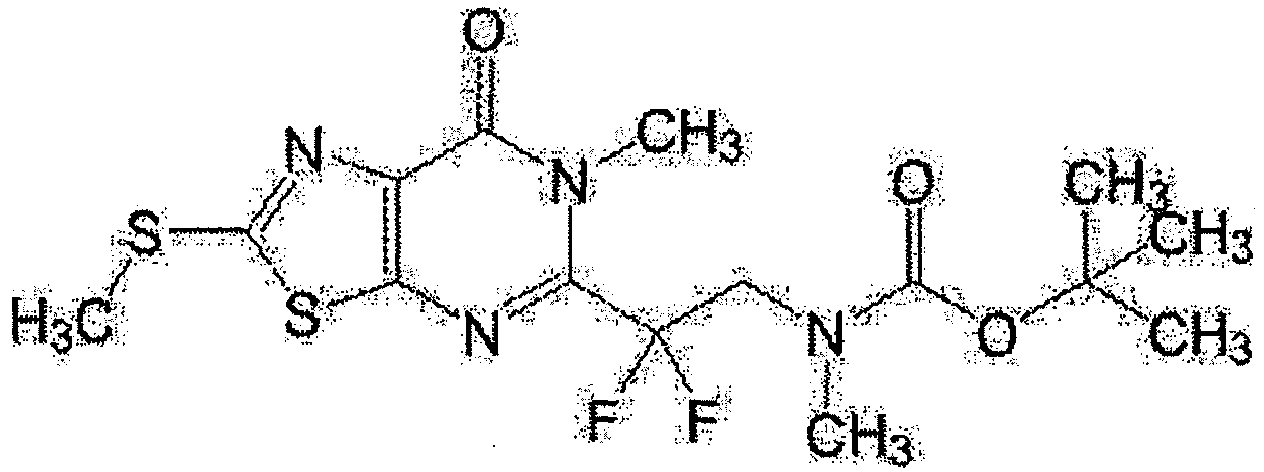
- To a solution (4 mL) of 3-[(tert-butoxycarbonyl)amino]-2,2-difluoropropionic acid potassium salt (350 mg) in THF were added methyl iodide (182 µL) and sodium hydride (60% oil dispersion, 117 mg) under ice-cooling, and the reaction mixture was stirred at room temperature overnight. Water was added, and the mixture was washed with hexane, and the aqueous layer was acidified with 1.0 mol/L hydrochloric acid, and extracted twice with ethyl acetate. The organic layer was washed with saturated brine, dried over anhydrous sodium sulfate, filtered and concentrated. To a solution (3.0 mL) of the residue in DMF were added the compound (202 mg) obtained in Reference Example 136, N,N-diisopropylethylamine (433 µL) and HATU (529 mg), and the reaction mixture was stirred at room temperature overnight. The reaction mixture was diluted with ethyl acetate, washed with saturated brine, dried over anhydrous sodium sulfate, filtered and concentrated. The obtained crude product was dissolved in dichloroethane solution (4.5 mL), triethylamine (2.08 mL) and chlorotrimethylsilane (628 µL) were added, and the reaction mixture was stirred at room temperature overnight. Water was added to the reaction mixture, and the mixture was extracted with ethyl acetate. The organic layer was washed with water and saturated brine, dried over anhydrous sodium sulfate, filtered and concentrated. The residue was purified by silica gel column chromatography (solvent; hexane/ethyl acetate=100/0 - 50/50) to give the title compound (393 mg).
MS (ESI) m/z; 407 [M+H]+ -

- To a solution (2.4 mL) of the compound (240 mg) obtained in Reference Example 426 in methylene chloride was added mCPBA (69-75%, 149 mg) under ice-cooling. The reaction mixture was stirred under ice-cooling for 1 hr, aqueous sodium thiosulfate solution and saturated aqueous sodium hydrogen carbonate solution were added to the reaction mixture, and the mixture was extracted three times with chloroform. The organic layer was dried over anhydrous sodium sulfate, filtered and concentrated to give the title compound (246 mg).
MS (ESI) m/z; 423 [M+H]+ -

- To a solution (11 mL) of 5-amino-2-methylsulfanyl-1,3-thiazole-4-carboxylic acid (500 mg) in DMF were added N,N-diisopropylethylamine (0.64 mL), (S)-2-aminopropanol (0.24 mL), EDC hydrochloride (706 mg) and HOBt monohydrate (563 mg), and the reaction mixture was stirred at room temperature for 20 hr. Water was added to the reaction mixture, and the mixture was extracted three times with chloroform. The organic layer was dried over anhydrous magnesium sulfate, filtered and concentrated. The residue was purified by silica gel column chromatography (solvent; hexane/ethyl acetate=50/50 - 0/100) to give the title compound (595 mg).
MS (ESI) m/z; 248 [M+H]+ -

- 5-Amino-2-methylsulfanyl-1,3-thiazole-4-carboxylic acid (500 mg) was treated by a method similar to that in Reference Example 428 to give the title compound (556 mg).
MS (ESI) m/z; 248 [M+H]+ -

- To a solution (15 mL) of the compound (593 mg) obtained in Reference Example 428 in methylene chloride were added pyridine (424 µL) and trifluoroacetic anhydride (666 µL) under ice-cooling, and the reaction mixture was stirred at room temperature for 3 hr. 1.0 mol/L Hydrochloric acid was added to the reaction mixture, and the mixture was extracted twice with methylene chloride. The organic layer was washed with saturated brine, dried over anhydrous sodium sulfate, filtered and concentrated to give the title compound (1.05 g).
MS (ESI) m/z; 440 [M+H]+ -

- The compound (305 mg) obtained in Reference Example 429 was treated by a method similar to that in Reference Example 430 to give the title compound (572 mg).
MS (ESI) m/z; 440 [M+H]+ -

- To a solution (19 mL) of the compound (1.05 g) obtained in Reference Example 430 in dichloroethane were added trifluoroacetic anhydride (2.67 mL) and triethylamine (3.34 mL), and the reaction mixture was stirred at room temperature for 3 days. Water was added to the reaction mixture, and the mixture was extracted twice with chloroform. The combined organic layer was washed with 1.0 mol/L hydrochloric acid and saturated brine, dried over anhydrous sodium sulfate, filtered and concentrated. The residue was diluted with methanol (15 mL), sodium hydrogen carbonate (1010 mg) was added under ice-cooling, and the reaction mixture was stirred at 0°C for 30 min. To the reaction mixture was added saturated aqueous ammonium chloride solution, methanol was evaporated under reduced pressure, and the obtained mixture was extracted twice with ethyl acetate. The combined organic layer was washed with saturated brine, dried over anhydrous sodium sulfate, filtered and concentrated. The residue was purified by NH silica gel column chromatography (solvent; ethyl acetate), to the obtained product was added diethyl ether/hexane=8/1, and the solid was collected by filtration to give the title compound (470 mg).
MS (ESI) m/z; 326 [M+H]+ -

- The compound (572 mg) obtained in Reference Example 431 was treated by a method similar to that in Reference Example 432 to give the title compound (265 mg).
MS (ESI) m/z; 326 [M+H]+ -

- To a solution (10 mL) of the compound (250 mg) obtained in Reference Example 432 in methylene chloride was added mCPBA (69-75%, 208 mg) under ice-cooling. The reaction mixture was stirred under ice-cooling for 2 hr, aqueous sodium thiosulfate solution and saturated aqueous sodium hydrogen carbonate solution were added to the reaction mixture, and the mixture was extracted twice with chloroform. The organic layer was dried over anhydrous sodium sulfate, filtered and concentrated to give the title compound (261 mg).
MS (ESI) m/z; 342 [M+H]+ -

- The compound (100 mg) obtained in Reference Example 433 was treated by a method similar to that in Reference Example 434 to give the title compound (92.3 mg).
MS (ESI) m/z; 342 [M+H]+ -

- To a solution (5.0 mL) of 3-methoxypropionic acid (875 mg) in methylene chloride were added oxalyl chloride (1.42 mL) and DMF (one drop), and the reaction mixture was stirred at room temperature for 2 hr. The reaction mixture was concentrated under reduced pressure, and the residue was dissolved in methylene chloride (1.0 mL) and added dropwise to a solution (10 mL) of the compound (1.3 g) obtained in Reference Example 136 and triethylamine (1.22 g) in methylene chloride under ice-cooling. The reaction mixture was stirred at room temperature for 1.5 hr, water was added to the reaction mixture, and the mixture was extracted twice with chloroform. The organic layer was dried over anhydrous sodium sulfate, filtered and concentrated. The residue was purified by silica gel column chromatography (solvent; hexane/ethyl acetate=50/50 - 20/80) to give the title compound (1.4 g).
MS (ESI) m/z; 290 [M+H]+ -

- The compound (1.0 g) obtained in Reference Example 137 was treated by a method similar to that in Reference Example 436 to give the title compound (1.63 g).
MS (ESI) m/z; 304 [M+H]+ -

- The compound (1.06 g) obtained in Reference Example 138 was treated by a method similar to that in Reference Example 436 to give the title compound (1.89 g).
MS (ESI) m/z; 318 [M+H]+ -

- To a solution (20 mL) of the compound (1.4 g) obtained in Reference Example 436 in dichloroethane were added chlorotrimethylsilane (2.65 g) and triethylamine (7.4 g), and the reaction mixture was stirred at room temperature overnight. 1.0 mol/L Hydrochloric acid was added to the reaction mixture, and the mixture was extracted twice with chloroform. The organic layer was dried over anhydrous sodium sulfate, filtered and concentrated. The residue was purified by silica gel column chromatography (solvent; hexane/ethyl acetate=50/50 - 0/100) to give the title compound (990 mg).
MS (ESI) m/z; 272 [M+H]+ -

- The compound (1.63 g) obtained in Reference Example 437 was treated by a method similar to that in Reference Example 439 to give the title compound (856 mg).
MS (ESI) m/z; 286 [M+H]+ -

- The compound (1.89 g) obtained in Reference Example 438 was treated by a method similar to that in Reference Example 439 to give the title compound (622 mg).
MS (ESI) m/z; 300 [M+H]+ -

- A solution (18 mL) of the compound (980 mg) obtained in Reference Example 439 in methylene chloride was ice-cooled, and 1.0 mol/L boron tribromide methylene chloride solution (4.0 mL) was added dropwise. The reaction mixture was stirred at room temperature for 1 hr, to the ice-cooled reaction mixture was added saturated aqueous sodium hydrogen carbonate solution, and the mixture was extracted three times with methylene chloride. The organic layer was dried over anhydrous sodium sulfate, filtered and concentrated. To the residue was added hexane, and the solid was collected by filtration, and dried to give the title compound (835 mg).
MS (ESI) m/z; 258 [M+H]+ -

- The compound (856 mg) obtained in Reference Example 440 was treated by a method similar to that in Reference Example 442 to give the title compound (758 mg).
MS (ESI) m/z; 272 [M+H]+ -

- The compound (622 mg) obtained in Reference Example 441 was treated by a method similar to that in Reference Example 442 to give the title compound (500 mg).
MS (ESI) m/z; 286 [M+H]+ -

- To a solution (18 mL) of the compound (820 mg) obtained in Reference Example 442 in methylene chloride was added mCPBA (69-75%, 880 mg) under ice-cooling. The reaction mixture was stirred under ice-cooling for 3 hr, to the reaction mixture were added aqueous sodium thiosulfate solution and saturated aqueous sodium hydrogen carbonate solution, and the mixture was extracted three times with chloroform. The organic layer was dried over anhydrous sodium sulfate, filtered and concentrated. The obtained residue was purified by silica gel column chromatography (solvent; chloroform/methanol=100/0 - 90/10) to give the title compound (750 mg).
MS (ESI) m/z; 274 [M+H]+ -

- The compound (758 mg) obtained in Reference Example 443 was treated by a method similar to that in Reference Example 445 to give the title compound (543 mg).
MS (ESI) m/z; 288 [M+H]+ -

- The compound (500 mg) obtained in Reference Example 444 was treated by a method similar to that in Reference Example 445 to give the title compound (446 mg).
MS (ESI) m/z; 302 [M+H]+ -
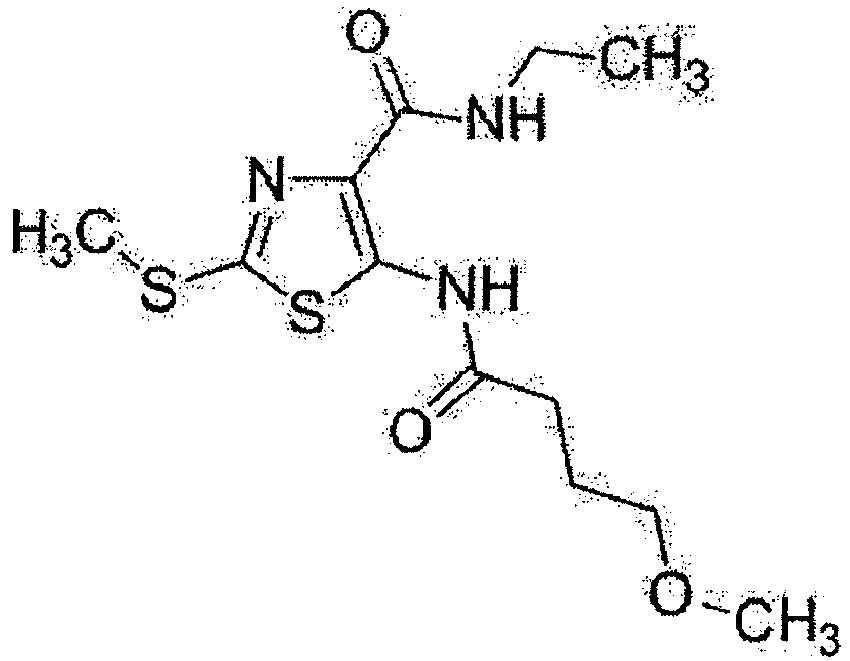
- To a solution (3.5 mL) of 4-methoxybutyric acid (761 mg) in methylene chloride were added oxalyl chloride (3.5 mL) and DMF (one drop), and the reaction mixture was stirred at room temperature for 2 hr. The reaction mixture was concentrated under reduced pressure, and the residue was dissolved in methylene chloride (1 mL), and added dropwise to a solution (9.0 mL) of the compound (1.0 g) obtained in Reference Example 137 and triethylamine (1.28 mL) in methylene chloride under ice-cooling. The reaction mixture was stirred at room temperature for 1 hr, to the reaction mixture were added water and saturated aqueous sodium hydrogen carbonate solution, and the mixture was extracted twice with chloroform. The organic layer was dried over anhydrous sodium sulfate, filtered and concentrated to give the title compound (1.7 g).
MS (ESI) m/z; 318 [M+H]+ -

- To a solution (20 mL) of the compound (1.7 g) obtained in Reference Example 448 in dichloroethane were added chlorotrimethylsilane (2.91 mL) and triethylamine (9.62 mL), and the reaction mixture was stirred at room temperature overnight. Water was added to the reaction mixture, and the mixture was extracted twice with ethyl acetate. The organic layer was dried over anhydrous sodium sulfate, filtered and concentrated. The residue was purified by silica gel column chromatography (solvent; hexane/ethyl acetate=70/30 - 0/100) to give the title compound (1.163 g).
MS (ESI) m/z; 300 [M+H]+ -

- To a solution (25 mL) of the compound (1.16 g) obtained in Reference Example 449 in methylene chloride was added dropwise 1.0 mol/L boron tribromide methylene chloride solution (3.87 mL) under ice-cooling. The reaction mixture was stirred under ice-cooling for 1 hr, to the ice-cooled reaction mixture was added saturated aqueous sodium hydrogen carbonate solution, and the mixture was extracted three times with methylene chloride. The organic layer was dried over anhydrous sodium sulfate, filtered and concentrated. The residue was purified by silica gel column chromatography (solvent; hexane/ethyl acetate=70/30 - 0/100) to give the title compound (643 mg).
MS (ESI) m/z; 286 [M+H]+ -

- To a solution (10 mL) of the compound (643 mg) obtained in Reference Example 450 in methylene chloride was added mCPBA (69-75%, 569 mg) under ice-cooling. The reaction mixture was stirred under ice-cooling for 2 hr, to the reaction mixture were added aqueous sodium thiosulfate solution and saturated aqueous sodium hydrogen carbonate solution, and the mixture was extracted three times with chloroform. The organic layer was dried over anhydrous sodium sulfate, filtered and concentrated to give the title compound (476 mg).
MS (ESI) m/z; 302 [M+H]+ -

- A solution (12 mL) of the compound (600 mg) obtained in Reference Example 247 in methylene chloride was ice-cooled, and 1.0 mol/L boron tribromide methylene chloride solution (1.84 mL) was added dropwise. The reaction mixture was stirred under ice-cooling for 1 hr, to the reaction mixture was added saturated aqueous sodium hydrogen carbonate solution, and the mixture was extracted three times with methylene chloride. The organic layer was dried over anhydrous sodium sulfate, filtered and concentrated. The residue was purified by silica gel column chromatography (solvent; hexane/ethyl acetate=80/20 - 30/70) to give the title compound (622 mg).
MS (ESI) m/z; 312 [M+H]+ -

- To a solution (10 mL) of the compound (621 mg) obtained in Reference Example 452 in methylene chloride was added mCPBA (69-75%, 482 mg) under ice-cooling. The reaction mixture was stirred under ice-cooling for 1 hr, to the reaction mixture were added aqueous sodium thiosulfate solution and saturated aqueous sodium hydrogen carbonate solution, and the mixture was extracted 4 times with methylene chloride. The organic layer was dried over anhydrous sodium sulfate, filtered and concentrated to give the title compound (468 mg).
MS (ESI) m/z; 328 [M+H]+ -

- To a solution (4.0 mL) of 3-methoxy-2,2-dimethyl-propionic acid (1.06 g) in methylene chloride were added oxalyl chloride (1.36 mL) and DMF (one drop), and the reaction mixture was stirred at room temperature for 2 hr. The reaction mixture was concentrated under reduced pressure, and the residue was dissolved in methylene chloride (1.0 mL), and added dropwise to a solution (8 mL) of the compound (1.16 g) obtained in Reference Example 136 and triethylamine (1.6 mL) in methylene chloride under ice-cooling. The reaction mixture was stirred at room temperature for 2 hr, water was added to the reaction mixture, and the mixture was extracted twice with chloroform. The organic layer was washed with saturated aqueous sodium hydrogen carbonate solution, dried over anhydrous sodium sulfate, filtered and concentrated to give the title compound (2.20 g).
MS (ESI) m/z; 318 [M+H]+ -

- To a solution (25 mL) of the compound (2.20 g) obtained in Reference Example 454 in methylene chloride were added chlorotrimethylsilane (3.62 mL) and triethylamine (12.0 mL), and the reaction mixture was stirred at room temperature overnight. Trimethylsilyl trifluoromethanesulfonate (5.20 mL) and triethylamine (12.0 mL) were added, and the reaction mixture was stirred at room temperature for 7 days. Water was added to the reaction mixture, and the mixture was extracted twice with chloroform. The organic layer was dried over anhydrous sodium sulfate, filtered and concentrated. The residue was purified by silica gel column chromatography (solvent; hexane/ethyl acetate=100/0 - 50/50) to give the title compound (322 mg).
MS (ESI) m/z; 300 [M+H]+ -

- To a solution (6.0 mL) of the compound (322 mg) obtained in Reference Example 455 in methylene chloride was added dropwise 1.0 mol/L boron tribromide methylene chloride solution (1.08 mL) under ice-cooling, and the reaction mixture was stirred under ice-cooling for 2 hr, and at room temperature for 7 hr. To the reaction mixture was added saturated aqueous sodium hydrogen carbonate solution, and the mixture was extracted three times with methylene chloride. The organic layer was dried over anhydrous sodium sulfate, filtered and concentrated. The residue was purified by silica gel column chromatography (solvent; hexane/ethyl acetate=70/30 - 0/100) to give the title compound (261 mg).
MS (ESI) m/z; 286 [M+H]+ -

- To a solution (2.3 mL) of the compound (130 mg) obtained in Reference Example 456 in methylene chloride was added mCPBA (69-75%, 115 mg) under ice-cooling. The reaction mixture was stirred under ice-cooling for 30 min, to the reaction mixture were added aqueous sodium thiosulfate solution and saturated aqueous sodium hydrogen carbonate solution, and the mixture was extracted three times with chloroform. The organic layer was dried over anhydrous sodium sulfate, filtered and concentrated to give the title compound (156 mg).
MS (ESI) m/z; 302 [M+H]+ -
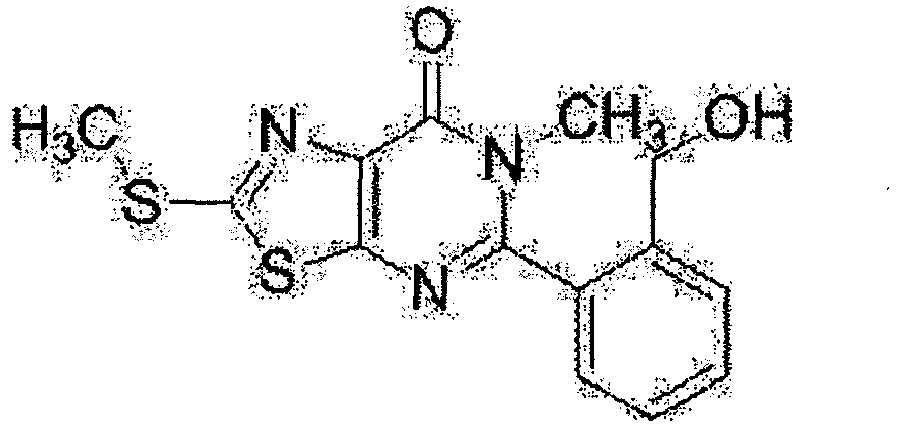
- To a solution (16 mL) of the compound (496 mg) obtained in Reference Example 366 in dimethoxyethane were successively added (2-hydroxymethylphenyl)boronic acid (365 mg), tetrakis(triphenylphosphine)palladium(0) (116 mg) and aqueous solution (4.0 mL) of sodium carbonate (848 mg) at room temperature, and the reaction mixture was stirred at 100°C for 4 hr. After confirmation of the completion of the reaction, the reaction mixture was cooled to room temperature, and extracted with chloroform. The organic layer was washed with saturated brine, dried over anhydrous magnesium sulfate, filtered and concentrated. The obtained residue was purified by silica gel column chromatography (solvent; chloroform/methanol=100/0 - 97/3) to give the title compound (210.7 mg).
MS (ESI) m/z; 320 [M+H]+ -

- The compound (496 mg) obtained in Reference Example 366 was treated by a method similar to that in Reference Example 458 to give the title compound (198 mg).
MS (ESI) m/z; 320 [M+H]+ -

- The compound (496 mg) obtained in Reference Example 366 was treated by a method similar to that in Reference Example 458 to give the title compound (164 mg).
MS (ESI) m/z; 320 [M+H]+ -

- To a solution (10 mL) of the compound (335 mg) obtained in Reference Example 458 in methylene chloride was added mCPBA (69-75%, 217 mg) under ice-cooling. The reaction mixture was stirred under ice-cooling for 6 hr, to the reaction mixture were added aqueous sodium thiosulfate solution and saturated aqueous sodium hydrogen carbonate solution, and the mixture was extracted three times with chloroform. The organic layer was dried over anhydrous magnesium sulfate, filtered and concentrated to give the title compound (340 mg).
MS (ESI) m/z; 336 [M+H]+ -

- The compound (187 mg) obtained in Reference Example 459 was treated by a method similar to that in Reference Example 461 to give the title compound (192 mg).
MS (ESI) m/z; 336 [M+H]+ -

- The compound (152 mg) obtained in Reference Example 460 was treated by a method similar to that in Reference Example 461 to give the title compound (136 mg) .
MS (ESI) m/z; 336 [M+H]+ -

- To a solution (80 mL) of the compound (2.0 g) obtained in Reference Example 366 and (2-hydroxyethyl)-methyl-carbamic acid tert-butyl ester (1.70 g) in DMF was added sodium hydride (60% oil dispersion, 400 mg) under ice-cooling. The reaction mixture was stirred at room temperature for 3 hr, water was added, and the mixture was extracted twice with ethyl acetate. The organic layer was dried over anhydrous magnesium sulfate, filtered and concentrated. The residue was purified by silica gel column chromatography (solvent; hexane/ethyl acetate=50/50 - 30/70), to the obtained product was added hexane, and the solid was collected by filtration, and dried to give the title compound (1.66 g).
MS (ESI) m/z; 387 [M+H]+ -

- To a solution (40 mL) of the compound (1.65 g) obtained in Reference Example 464 in methylene chloride was added mCPBA (69-75%, 1.17 g) under ice-cooling. The reaction mixture was stirred under ice-cooling for 1 hr, to the reaction mixture were added aqueous sodium thiosulfate solution and saturated aqueous sodium hydrogen carbonate solution, and the mixture was extracted twice with chloroform. The organic layer was dried over anhydrous sodium sulfate, filtered and concentrated to give the title compound (1.63 g).
MS (ESI) m/z; 403 [M+H]+ -

- A mixed solution of 1-hydroxycyclopropanecarboxylic acid (0.78 g) and acetic anhydride (3.1 mL) was stirred with heating at 140°C for 2 hr. The reaction mixture was cooled to room temperature, water (5.0 mL) was added, and the solvent was evaporated under reduced pressure. To the obtained product was added diisopropyl ether, and the solid was collected by filtration to give the title compound (0.33 g).
MS (ESI) m/z; 145 [M+H]+ -

- 1-hydroxycyclobutanecarboxylic acid (1.0 g) was treated by a method similar to that in Reference Example 466 to give the title compound (1.3 g).
MS (ESI) m/z; 159 [M+H]+ -

- To a solution (3.0 mL) of 2-acetoxypropionic acid (936 mg) in methylene chloride were added oxalyl chloride (1.2 mL) and DMF (one drop), and the reaction mixture was stirred at room temperature for 2 hr. The reaction mixture was concentrated under reduced pressure, and the residue was dissolved in methylene chloride (2.0 mL) and added dropwise to a solution (5.0 mL) of the compound (800 mg) obtained in Reference Example 136 and triethylamine (1.1 mL) in methylene chloride under ice-cooling. The reaction mixture was stirred at room temperature for 5 hr, to the reaction mixture was added water, and the mixture was extracted twice with ethyl acetate. The organic layer was dried over anhydrous sodium sulfate, filtered and concentrated. The residue was purified by silica gel column chromatography (solvent; hexane/ethyl acetate=70/30 - 20/80) to give the title compound (1.06 g).
MS (ESI) m/z; 318 [M+H]+ -

- The compound (0.33 g) obtained in Reference Example 466 was treated by a method similar to that in Reference Example 468 to give the title compound (0.6 g).
MS (ESI) m/z; 330 [M+H]+ -

- The compound (1.3 g) obtained in Reference Example 467 was treated by a method similar to that in Reference Example 468 to give the title compound (2.06 g).
MS (ESI) m/z; 344 [M+H]+ -
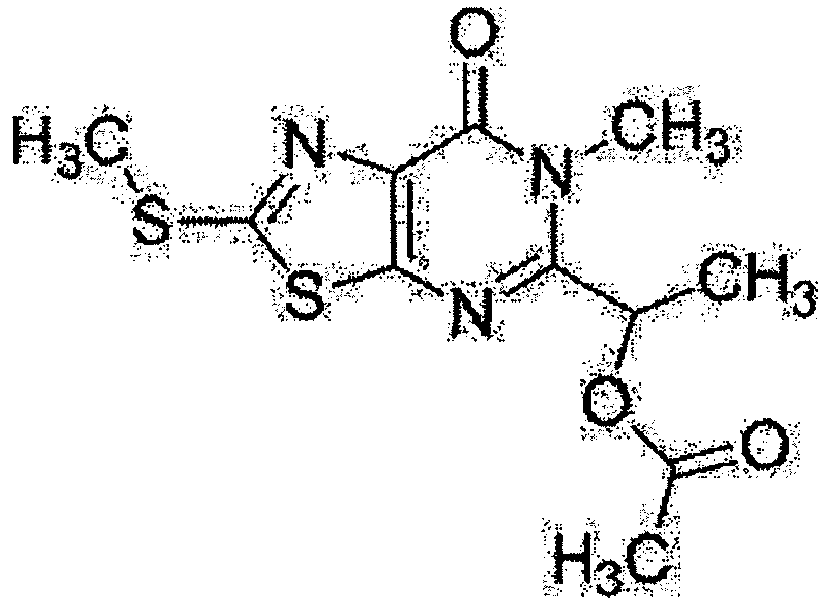
- To a solution (21 mL) of the compound (1.06 g) obtained in Reference Example 468 in dichloroethane were added chlorotrimethylsilane (2.11 mL) and triethylamine (6.98 mL), and the reaction mixture was heated at 80°C for 9 hr. The reaction mixture was cooled to room temperature, 1.0 mol/L hydrochloric acid was added to the reaction mixture, and the mixture was extracted twice with chloroform. The organic layer was dried over anhydrous sodium sulfate, filtered and concentrated. The residue was purified by silica gel column chromatography (solvent; hexane/ethyl acetate=70/30 - 0/100) to give the title compound (869 mg).
MS (ESI) m/z; 300 [M+H]+ -

- The compound (0.6 g) obtained in Reference Example 469 was treated by a method similar to that in Reference Example 471 to give the title compound (0.53 g).
MS (ESI) m/z; 312 [M+H]+ -
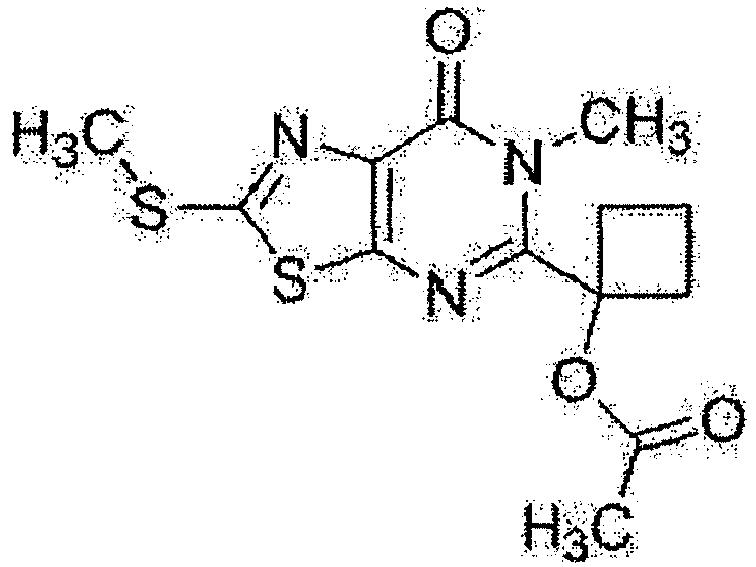
- To a solution (60 mL) of the compound (2.06 g) obtained in Reference Example 470 in methylene chloride were added trimethylsilyl trifluoromethanesulfonate (4.0 g) and triethylamine (3.7 g), and the reaction mixture was stirred at room temperature for 3 hr. Trimethylsilyl trifluoromethanesulfonate (4.0 g) and triethylamine (3.7 g) were added, and the reaction mixture was stirred at room temperature for 2 hr. 1.0 mol/L Hydrochloric acid was added to the reaction mixture, and the mixture was extracted twice with chloroform. The organic layer was dried over anhydrous magnesium sulfate, filtered and concentrated. The residue was purified by silica gel column chromatography (solvent; hexane/ethyl acetate=70/30 - 40/60) to give the title compound (660 mg).
MS (ESI) m/z; 326 [M+H]+ -

- To a solution (1.2 mL) of the compound (100 mg) obtained in Reference Example 471 in methanol was added 1.0 mol/L aqueous sodium hydroxide solution (0.4 mL), and the reaction mixture was stirred at room temperature overnight. 1.0 mol/L Hydrochloric acid were added to the reaction mixture, and the mixture was extracted three times with chloroform. The organic layer was dried over anhydrous sodium sulfate, filtered and concentrated. The residue was purified by silica gel column chromatography (solvent; hexane/ethyl acetate=70/30 - 0/100) to give the title compound (49 mg).
MS (ESI) m/z; 258 [M+H]+ -

- The compound (0.53 g) obtained in Reference Example 472 was treated by a method similar to that in Reference Example 474 to give the title compound (0.37 g).
MS (ESI) m/z; 270 [M+H]+ -

- The compound (660 mg) obtained in Reference Example 473 was treated by a method similar to that in Reference Example 474 to give the title compound (550 mg).
MS (ESI) m/z; 284 [M+H]+ -

- To a solution (1 mL) of the compound (49 mg) obtained in Reference Example 474 in methylene chloride was added mCPBA (69-75%, 48 mg) under ice-cooling. The reaction mixture was stirred under ice-cooling for 1 hr, to the reaction mixture were added aqueous sodium thiosulfate solution and saturated aqueous sodium hydrogen carbonate solution, and the mixture was extracted three times with chloroform. The organic layer was dried over anhydrous sodium sulfate, filtered and concentrated to give the title compound (63 mg).
MS (ESI) m/z; 274 [M+H]+ -

- The compound (0.37 g) obtained in Reference Example 475 was treated by a method similar to that in Reference Example 477 to give the title compound (318 mg).
MS (ESI) m/z; 286 [M+H]+ -

- The compound (150 mg) obtained in Reference Example 476 was treated by a method similar to that in Reference Example 477 to give the title compound (156 mg).
MS (ESI) m/z; 300 [M+H]+ -

- To a solution (40 mL) of the compound (1.14 g) obtained in Reference Example 475 in DMF were added methyl iodide (0.9 g) and sodium hydride (60% oil dispersion, 170 mg) at 0°C, and the reaction mixture was stirred at room temperature for 1 hr. Water was added at 0°C, and the mixture was extracted with ethyl acetate. The organic layer was washed with water, dried over anhydrous magnesium sulfate, filtered and concentrated under reduced pressure. The obtained residue was purified by silica gel column chromatography (solvent; hexane/ethyl acetate=80/20 - 40/60) to give the title compound (0.64 g). MS (ESI) m/z; 284 [M+H]+
-

- The compound (400 mg) obtained in Reference Example 476 was treated by a method similar to that in Reference Example 480 to give the title compound (386 mg).
MS (ESI) m/z; 298 [M+H]+ -

- The compound (0.64 g) obtained in Reference Example 480 was treated by a method similar to that in Reference Example 477 to give the title compound (0.64 g).
MS (ESI) m/z; 300 [M+H]+ -

- The compound (386 mg) obtained in Reference Example 481 was treated by a method similar to that in Reference Example 477 to give the title compound (383 mg).
MS (ESI) m/z; 314 [M+H]+ -

- To a solution (600 mL) of 5-amino-2-methylsulfanyl-1,3-thiazole-4-carboxylic acid (23.0 g) in DMF were added EDC hydrochloride (34.8 g), HOBt monohydrate (27.8 g), N,N-diisopropylethylamine (31.6 mL) and 2,4-dimethoxybenzylamine (27.2 mL), and the reaction mixture was stirred at room temperature overnight. Water was added to the reaction mixture, and the mixture was extracted three times with ethyl acetate. The organic layer was dried over anhydrous magnesium sulfate, filtered and concentrated. The residue was purified by silica gel column chromatography (solvent; hexane/ethyl acetate=90/10 - 50/50) to give the title compound (39.9 g).
MS (ESI) m/z; 340 [M+H]+ -

- The compound (2.00 g) obtained in Reference Example 484 was treated by a method similar to that in Reference Example 156 to give the title compound (2.34 g).
MS (ESI) m/z; 410 [M+H]+ -

- The compound (1.70 g) obtained in Reference Example 484 was treated by a method similar to that in Reference Example 156 to give the title compound (1.98 g).
MS (ESI) m/z; 396 [M+H]+ -

- The compound (6.72 g) obtained in Reference Example 484 was treated by a method similar to that in Reference Example 156 to give the title compound (7.82 g).
MS (ESI) m/z; 412 [M+H]+ -
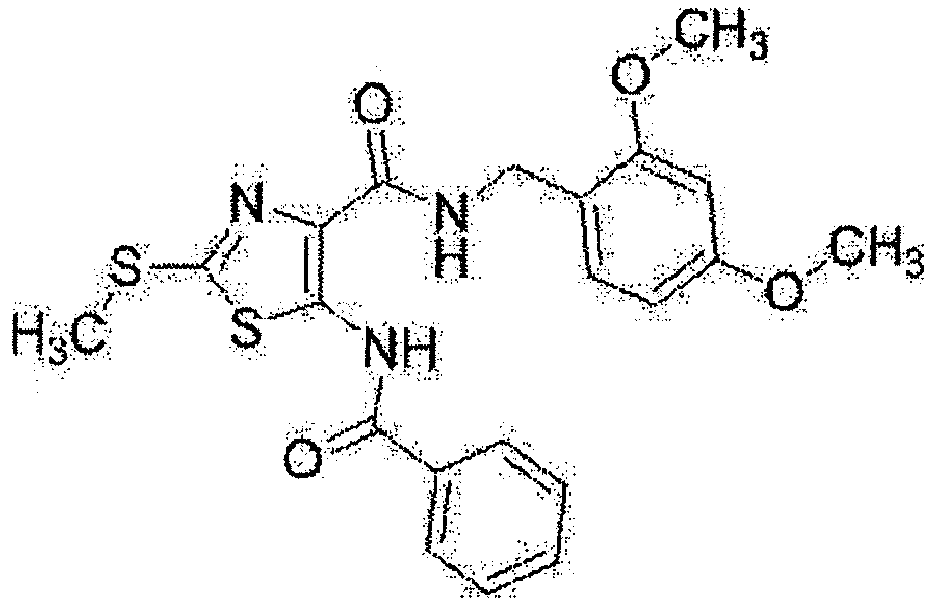
- The compound (500 mg) obtained in Reference Example 484 was treated by a method similar to that in Reference Example 156 to give the title compound (413 mg) .
MS (ESI) m/z; 444 [M+H]+ -

- The compound (2.00 g) obtained in Reference Example 484 was treated by a method similar to that in Reference Example 156 to give the title compound (2.65 g).
MS (ESI) m/z; 462 [M+H]+ -
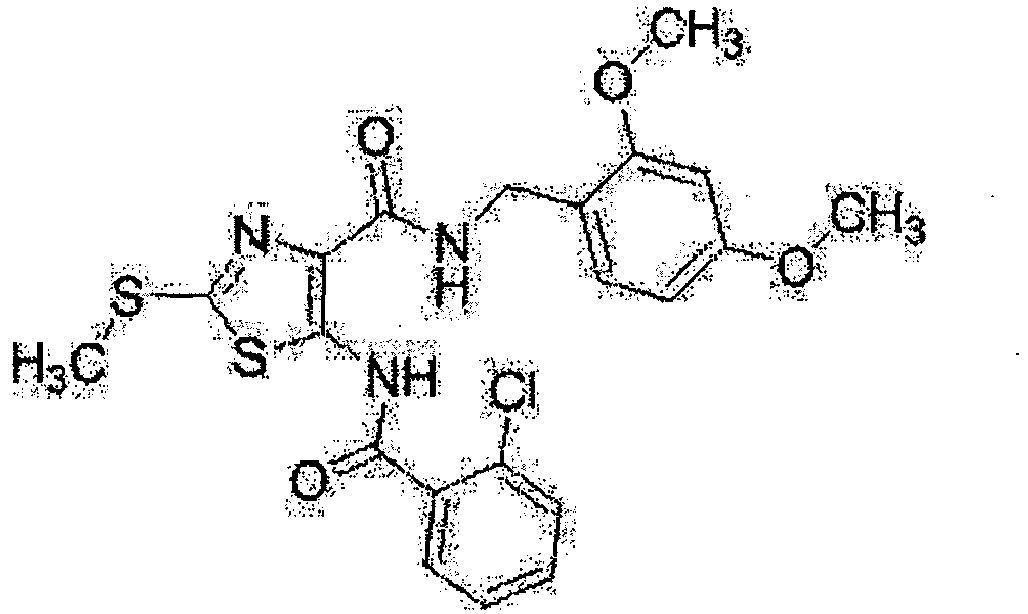
- The compound (500 mg) obtained in Reference Example 484 was treated by a method similar to that in Reference Example 156 to give the title compound (1.02 g).
MS (ESI) m/z; 478, 480 [M+H]+ -

- The compound (500 mg) obtained in Reference Example 484 was treated by a method similar to that in Reference Example 156 to give the title compound (577 mg).
MS (ESI) m/z; 474 [M+H]+ -

- The compound (500 mg) obtained in Reference Example 484 was treated by a method similar to that in Reference Example 156 to give the title compound (918 mg).
MS (ESI) m/z; 528 [M+H]+ -

- The compound (500 mg) obtained in Reference Example 484 was treated by a method similar to that in Reference Example 156 to give the title compound (867 mg).
MS (ESI) m/z; 458 [M+H]+ -

- The compound (600 mg) obtained in Reference Example 484 was treated by a method similar to that in Reference Example 156 to give the title compound (690 mg).
MS (ESI) m/z; 480 [M+H]+ -

- The compound (500 mg) obtained in Reference Example 484 was treated by a method similar to that in Reference Example 156 to give the title compound (506 mg).
MS (ESI) m/z; 496, 498 [M+H]+ -

- To a solution (11.0 mL) of 2-fluoro-2-methylpropionic acid (625 mg) in methylene chloride were added oxalyl chloride (498 µL) and DMF (one drop), and the reaction mixture was stirred at room temperature for 4 hr. The obtained solution was added dropwise to a solution (30.0 mL) of the compound (1.00 g) obtained in Reference Example 484 and triethylamine (1.23 mL) in methylene chloride under ice-cooling, and the reaction mixture was stirred at room temperature overnight. Water was added to the reaction mixture, and the mixture was extracted three times with methylene chloride. The organic layer was dried over anhydrous sodium sulfate, filtered and concentrated. The residue was purified by silica gel column chromatography (solvent; hexane/ethyl acetate=100/0 - 70/30) to give the title compound (1.25 g).
MS (ESI) m/z; 428 [M+H]+ -

- The compound (2.31 g) obtained in Reference Example 484 was treated by a method similar to that in Reference Example 169 to give the title compound (1.12 g).
MS (ESI) m/z; 432 [M+H]+ -

- To a solution (20 mL) of 2,2-difluoro-3-methoxypropionic acid methyl ester (2.00 g) in ethanol was added 1.0 mol/L aqueous sodium hydroxide solution (13 mL) at room temperature, and the reaction mixture was stirred at 50°C for 2 hr. The solvent was evaporated under reduced pressure to give 2,2-difluoro-3-methoxypropionic acid potassium salt. To a solution (40 mL) of the obtained 2,2-difluoro-3-methoxypropionic acid potassium salt in methylene chloride were added oxalyl chloride (2.2 mL) and DMF (one drop), and the reaction mixture was stirred at room temperature for 6 hr. The solvent was evaporated under reduced pressure. The obtained acid chloride in methylene chloride solution (20 mL) and triethylamine (2.72 mL) were added to a solution (50 mL) of the compound (4.41 g) obtained in Reference Example 484 in methylene chloride at room temperature, and the reaction mixture was stirred overnight. Water was added to the reaction mixture, and the mixture was extracted twice with chloroform. The organic layer was dried over anhydrous magnesium sulfate, filtered and concentrated. The residue was purified by silica gel column chromatography (solvent; hexane/ethyl acetate=100/0 - 50/50) to give the title compound (2.51 g).
MS (ESI) m/z; 462 [M+H]+ -

- The compound (800 mg) obtained in Reference Example 484 was treated by a method similar to that in Reference Example 169 to give the title compound (787 mg).
MS (ESI) m/z; 476 [M+H]+ -

- The compound (576 mg) obtained in Reference Example 484 was treated by a method similar to that in Reference Example 169 to give the title compound (332 mg).
MS (ESI) m/z; 494 [M+H]+ -

- The compound (500 mg) obtained in Reference Example 484 was treated by a method similar to that in Reference Example 169 to give the title compound (850 mg).
MS (ESI) m/z; 492 [M+H]+ -

- The compound (500 mg) obtained in Reference Example 484 was treated by a method similar to that in Reference Example 169 to give the title compound (700 mg).
MS (ESI) m/z; 476 [M+H]+ -

- The compound (600 mg) obtained in Reference Example 484 was treated by a method similar to that in Reference Example 169 to give the title compound (310 mg).
MS (ESI) m/z; 464 [M+H]+ -

- The compound (1.00 g) obtained in Reference Example 484 was treated by a method similar to that in Reference Example 169 to give the title compound (1.27 g).
MS (ESI) m/z; 438 [M+H]+ -

- The compound (700 mg) obtained in Reference Example 484 was treated by a method similar to that in Reference Example 169 to give the title compound (670 mg).
MS (ESI) m/z; 440 [M+H]+ -

- The compound (1.45 g) obtained in Reference Example 484 was treated by a method similar to that in Reference Example 169 to give the title compound (1.90 g).
MS (ESI) m/z; 452 [M+H]+ -

- To a solution (5.0 mL) of the compound (500 mg) obtained in Reference Example 484 and 2-fluoro-5-methylbenzoic acid (227 mg) in DMF were added HATU (1.40 g) and N,N-diisopropylethylamine (1.03 mL), and the reaction mixture was stirred at room temperature overnight. HATU (1.40 g) and N,N-diisopropylethylamine (1.03 mL) were added, and the reaction mixture was stirred at room temperature for 5 hr. 2-Fluoro-5-methylbenzoic acid (554 mg), HATU (1.40 g) and N,N-diisopropylethylamine (1.03 mL) were further added, and the reaction mixture was stirred at room temperature overnight. To the reaction mixture was added saturated aqueous sodium hydrogen carbonate solution, and the mixture was extracted with ethyl acetate. The organic layer was washed with saturated brine, dried over anhydrous magnesium sulfate, filtered and concentrated. The residue was purified by NH silica gel column chromatography (solvent; hexane/ethyl acetate=80/20) to give the title compound (466 mg).
MS (ESI) m/z; 476 [M+H]+ -

- The compound (500 mg) obtained in Reference Example 484 was treated by a method similar to that in Reference Example 507 to give the title compound (371 mg).
MS (ESI) m/z; 463 [M+H]+ -

- To a solution (48 mL) of 5-methylthiophene-2-carboxylic acid (3.00 g) in THF was added dropwise n-butyllithium (2.69 mol/L hexane solution, 17.3 mL) at -78°C over 5 min. The reaction mixture was stirred at -78°C for 1 hr, and a solution (48 mL) of N-fluorobenzenesulfoneamide (7.98 g) in THF was added dropwise over 15 min. The reaction mixture was stirred at -78°C for 4 hr, allowed to warm to room temperature over 2 hr and stirred at room temperature overnight. The reaction mixture was adjusted to pH 2 with 2.0 mol/L hydrochloric acid, and extracted twice with diethyl ether. The organic layer was dried over anhydrous magnesium sulfate, filtered and concentrated. The residue was purified by carboxylic acid-carrying silica gel column chromatography (solvent; hexane/ethyl acetate=92/8 - 40/60), to the obtained product was added hexane/ethyl acetate=3/1, and the solid was collected by filtration to give 3-fluoro-5-methylthiophene-2-carboxylic acid (1.20 g), to a solution (15 mL) of the obtained 3-fluoro-5-methylthiophene-2-carboxylic acid (566 mg) in THF, sodium hydride (60% oil dispersion, 138 mg) was added under ice-cooling. The reaction mixture was stirred at room temperature for 10 min, concentrated under reduced pressure, and the residue was washed with diethyl ether. The obtained solid was dried under reduced pressure, diluted with acetonitrile (5.5 mL), oxalyl chloride (296 µL) and DMF (one drop) were added thereto, and the reaction mixture was stirred at 50°C for 2 hr. Oxalyl chloride (296 µL) was further added, and the mixture was stirred at 50°C for 3 hr. The reaction mixture was concentrated under reduced pressure, and the residue was dissolved in methylene chloride (2 mL), and added dropwise to a solution (6 mL) of the compound (600 mg) obtained in Reference Example 484 and triethylamine (986 µL) in methylene chloride at room temperature. The reaction mixture was stirred at room temperature overnight, to the reaction mixture were added ethyl acetate and water, and the insoluble material was filtered off through diatomaceous earth. The filtrate was extracted twice with ethyl acetate, and the organic layer was dried over anhydrous sodium sulfate, filtered and concentrated. The residue was purified by NH silica gel column chromatography (solvent; hexane/ethyl acetate=90/10 - 55/45), to the obtained product was added diethyl ether/hexane=1/2, and the solid was collected by filtration to give the title compound (444 mg).
MS (ESI) m/z; 482 [M+H]+ -

- The compound (316 mg) obtained in Reference Example 484 was treated by a method similar to that in Reference Example 182 to give the title compound (501 mg).
MS (ESI) m/z; 586 [M+H]+ -

- The compound (500 mg) obtained in Reference Example 484 was treated by a method similar to that in Reference Example 194 to give the title compound (700 mg) .
MS (ESI) m/z; 486 [M+H]+ -

- To a solution of the compound (2.10 g) obtained in Reference Example 484 in methylene chloride (30 mL) was added a solution (5.0 mL) of 1-fluorocyclopropanecarboxylic acid (4-fluorophenyl) ester (2.04 g) synthesized by the method described in
WO 2011/148922A1 in methylene chloride. To the reaction mixture was added dropwise DBU (1.85 mL), and the reaction mixture was stirred at room temperature overnight. Water was added to the reaction mixture, and the mixture was extracted twice with methylene chloride. The combined organic layer was washed with saturated aqueous sodium hydrogen carbonate solution, dried over anhydrous sodium sulfate, filtered and concentrated. The residue was purified by silica gel (solvent; hexane/ethyl acetate=80/20) and NH silica gel column chromatography (solvent; hexane/ethyl acetate=80/20) to give the title compound (3.64 g).
MS (ESI) m/z; 426 [M+H]+ -

- To a solution (125 mL) of 4,4'-dichlorobutyrophenone (25.0 g) in chloroform was added sulfuryl chloride (15.1 mL), and the reaction mixture was stirred with heating at 50°C for 18 hr. Sulfuryl chloride (4.04 mL) was added, and the reaction mixture was stirred with heating at 50°C overnight. The reaction mixture was neutralized with aqueous sodium hydrogen carbonate solution under ice-cooling and extracted twice with chloroform. The organic layer was dried over anhydrous sodium sulfate, filtered and concentrated. The residue was purified by silica gel column chromatography (solvent; hexane/ethyl acetate=100/0 - 93/7) to give 2,4-dichloro-1-(4-chlorophenyl)butan-1-one (27.7 g). To a solution (195 mL) of the obtained 2,4-dichloro-1-(4-chlorophenyl)butan-1-one (27.7 g) in tert-butanol was added potassium tert-butoxide (19.8 g) at 0°C, and the reaction mixture was stirred with heating at 50°C for 15 min. The solvent was evaporated under reduced pressure, hexane was added, and the mixture was washed with water. The organic layer was dried over anhydrous sodium sulfate, filtered and concentrated. The residue was purified by silica gel column chromatography (solvent; hexane/diethyl ether=100/0 - 93/7) to give (1-chlorocyclopropyl)-(4-chlorophenyl)-methanone (22.6 g). To a solution (200 mL) of the obtained (1-chlorocyclopropyl)-(4-chlorophenyl)-methanone (21.1 g) in chloroform was added mCPBA (69-75%, 52.4 g), and the reaction mixture was heated under reflux for 2 days. mCPBA (69-75%, 26.2 g) was added, and the reaction mixture was heated under reflux for 2 days, mCPBA (69-75%, 13.1 g) was added, and the reaction mixture was heated under reflux overnight. The reaction mixture was allowed to cool to room temperature, aqueous sodium thiosulfate solution was added, and the mixture was stirred at room temperature for 15 min. The separated organic layer was washed with aqueous sodium hydrogen carbonate solution, dried over anhydrous sodium sulfate, filtered and concentrated. The residue was purified by silica gel column chromatography (solvent; hexane/ethyl acetate=100/0 - 90/10) to give 1-chlorocyclopropanecarboxylic acid (4-chlorophenyl) ester (13.3 g). In the following, 1-chlorocyclopropanecarboxylic acid (4-chlorophenyl) ester (1.26 g) and the compound (1.00 g) obtained in Reference Example 484 were treated by a method similar to that in Reference Example 512 to give the title compound (1.54 g).
MS (ESI) m/z; 442 [M+H]+ -
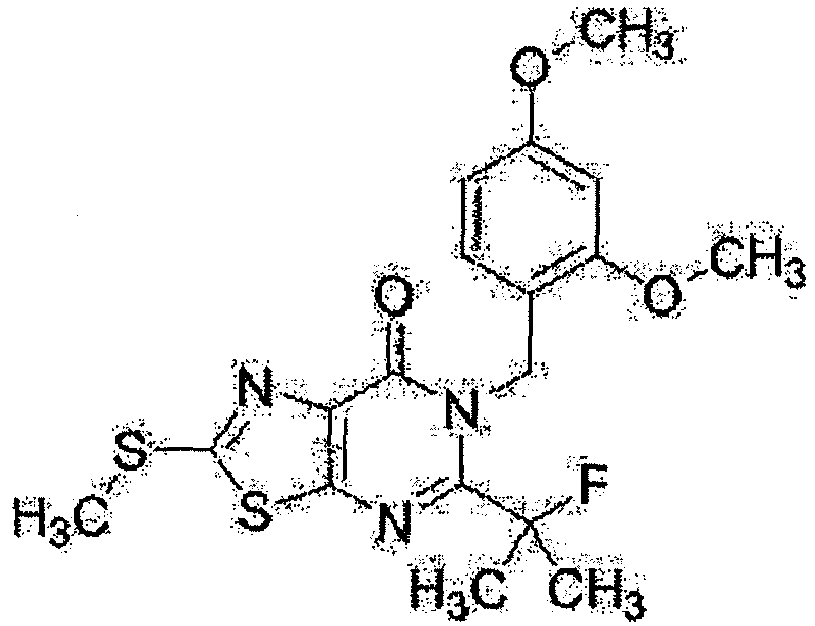
- To a solution (5.00 mL) of the compound (1.00 g) obtained in Reference Example 496 in N,N-dimethylformamide were added N,O-bis(trimethylsilyl)acetamide (2.86 mL) and triethylamine (1.63 mL), and the reaction mixture was stirred at room temperature for 2 hr. To the reaction mixture was added water (50.0 mL), and the resultant solid was collected by filtration and dried to give the title compound (900 mg).
MS (ESI) m/z; 410 [M+H]+ -

- The compound (970 mg) obtained in Reference Example 486 was treated by a method similar to that in Reference Example 195 to give the title compound (750 mg).
MS (ESI) m/z; 378 [M+H]+ -

- The compound (2.33 g) obtained in Reference Example 485 was treated by a method similar to that in Reference Example 195 to give the title compound (1.96 g).
MS (ESI) m/z; 392 [M+H]+ -

- The compound (7.81 g) obtained in Reference Example 487 was treated by a method similar to that in Reference Example 195 to give the title compound (4.00 g).
MS (ESI) m/z; 394 [M+H]+ -

- The compound (410 mg) obtained in Reference Example 488 was treated by a method similar to that in Reference Example 195 to give the title compound (366 mg).
MS (ESI) m/z; 426 [M+H]+ -

- The compound (2.65 g) obtained in Reference Example 489 was treated by a method similar to that in Reference Example 195 to give the title compound (2.30 g).
MS (ESI) m/z; 444 [M+H]+ -

- The compound (1.00 g) obtained in Reference Example 490 was treated by a method similar to that in Reference Example 195 to give the title compound (456 mg).
MS (ESI) m/z; 460, 462 [M+H]+ -

- The compound (570 mg) obtained in Reference Example 491 was treated by a method similar to that in Reference Example 195 to give the title compound (312 mg).
MS (ESI) m/z; 456 [M+H]+ -

- The compound (897 mg) obtained in Reference Example 492 was treated by a method similar to that in Reference Example 195 to give the title compound (603 mg).
MS (ESI) m/z; 510 [M+H]+ -

- The compound (844 mg) obtained in Reference Example 493 was treated by a method similar to that in Reference Example 195 to give the title compound (588 mg).
MS (ESI) m/z; 440 [M+H]+ -

- The compound (689 mg) obtained in Reference Example 494 was treated by a method similar to that in Reference Example 195 to give the title compound (540 mg).
MS (ESI) m/z; 462 [M+H]+ -

- The compound (505 mg) obtained in Reference Example 495 was treated by a method similar to that in Reference Example 195 to give the title compound (464 mg).
MS (ESI) m/z; 478, 480 [M+H]+ -

- The compound (3.64 g) obtained in Reference Example 512 was treated by a method similar to that in Reference Example 195 to give the title compound (2.31 g).
MS (ESI) m/z; 408 [M+H]+ -

- The compound (1.12 g) obtained in Reference Example 497 was treated by a method similar to that in Reference Example 195 to give the title compound (978 mg) .
MS (ESI) m/z; 414 [M+H]+ -

- The compound (2.50 g) obtained in Reference Example 498 was treated by a method similar to that in Reference Example 195 to give the title compound (2.01 g).
MS (ESI) m/z; 444 [M+H]+ -
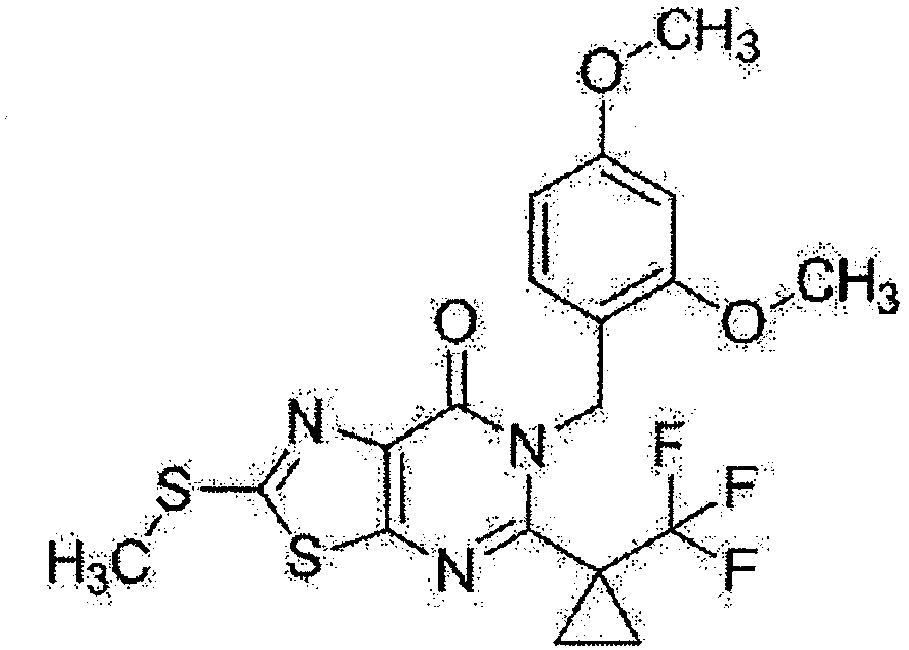
- The compound (787 mg) obtained in Reference Example 499 was treated by a method similar to that in Reference Example 195 to give the title compound (587 mg).
MS (ESI) m/z; 458 [M+H]+ -

- The compound (330 mg) obtained in Reference Example 500 was treated by a method similar to that in Reference Example 195 to give the title compound (256 mg).
MS (ESI) m/z; 476 [M+H]+ -

- The compound (850 mg) obtained in Reference Example 501 was treated by a method similar to that in Reference Example 195 to give the title compound (617 mg) .
MS (ESI) m/z; 474 [M+H]+ -

- The compound (700 mg) obtained in Reference Example 502 was treated by a method similar to that in Reference Example 195 to give the title compound (544 mg).
MS (ESI) m/z; 458 [M+H]+ -

- The compound (305 mg) obtained in Reference Example 503 was treated by a method similar to that in Reference Example 195 to give the title compound (255 mg).
MS (ESI) m/z; 446 [M+H]+ -

- The compound (1.27 g) obtained in Reference Example 504 was treated by a method similar to that in Reference Example 195 to give the title compound (1.20 g).
MS (ESI) m/z; 420 [M+H]+ -

- The compound (670 mg) obtained in Reference Example 505 was treated by a method similar to that in Reference Example 195 to give the title compound (630 mg).
MS (ESI) m/z; 422 [M+H]+ -

- The compound (1.90 g) obtained in Reference Example 506 was treated by a method similar to that in Reference Example 195 to give the title compound (1.70 g).
MS (ESI) m/z; 434 [M+H]+ -

- The compound (465 mg) obtained in Reference Example 507 was treated by a method similar to that in Reference Example 195 to give the title compound (477 mg).
MS (ESI) m/z; 458 [M+H]+ -

- The compound (709 mg) obtained in Reference Example 508 was treated by a method similar to that in Reference Example 195 to give the title compound (610 mg).
MS (ESI) m/z; 445 [M+H]+ -

- The compound (440 mg) obtained in Reference Example 509 was treated by a method similar to that in Reference Example 195 to give the title compound (429 mg).
MS (ESI) m/z; 464 [M+H]+ -

- The compound (640 mg) obtained in Reference Example 511 was treated by a method similar to that in Reference Example 195 to give the title compound (343 mg).
MS (ESI) m/z; 468 [M+H]+ -

- The compound (487 mg) obtained in Reference Example 510 was treated by a method similar to that in Reference Example 195 to give the title compound (439 mg).
MS (ESI) m/z; 568 [M+H]+ -

- The compound (1.53 g) obtained in Reference Example 513 was treated by a method similar to that in Reference Example 195 to give the title compound (989 mg).
MS (ESI) m/z; 424 [M+H]+ -

- The compound (10.0 g) obtained in Reference Example 484 was treated by a method similar to that in Reference Example 244 to give the title compound (10.1 g).
MS (ESI) m/z; 400 [M+H]+ -

- The compound (500 mg) obtained in Reference Example 484 was treated by a method similar to that in Reference Example 260 to give the title compound (576 mg).
MS (ESI) m/z; 478, 480 [M+H]+ -

- The compound (1.50 g) obtained in Reference Example 484 was treated by a method similar to that in Reference Example 265 to give the title compound (1.32 g).
MS (ESI) m/z; 418 [M+H]+ -

- To a solution (27 mL) of 5-amino-2-methylsulfanyl-1,3-thiazole-4-carboxylic acid ethyl ester (2.84 g) in ethanol were added (4-methoxybenzyl) isothiocyanate (3.50 g) and DBU (3.89 mL), and the reaction mixture was stirred at room temperature for 30 min, and stirred with heating at 80°C for 13 hr. The reaction mixture was cooled to 0°C, and acetic acid (2.0 mL) was added. Ethanol was evaporated under reduced pressure, water was added to the obtained mixture, and the mixture was extracted three times with chloroform. The combined organic layer was washed with saturated brine, dried over anhydrous magnesium sulfate, filtered and concentrated. The residue was purified by silica gel column chromatography (solvent; chloroform/methanol=100/0 - 85/15), to the obtained product was added hexane/ethyl acetate=1/2, and the solid was collected by filtration to give the title compound (1.68 g).
MS (ESI) m/z; 352 [M+H]+ -

- To a solution of the compound (1.40 g) obtained in Reference Example 546 in 1,2-dichloroethane/DMF (12 mL/1.5 mL) was added oxalyl chloride (512 µL) under ice-cooling. The reaction mixture was stirred with heating at 60°C for 2 hr, and the reaction mixture was cooled to 0°C, and saturated aqueous sodium hydrogen carbonate solution was added. Dichloroethane was evaporated under reduced pressure, the obtained mixture was diluted with ethyl acetate, and the insoluble material was removed by filtration. The filtrate was extracted twice with ethyl acetate, the combined organic layer was washed with saturated brine, dried over anhydrous sodium sulfate, filtered and concentrated. To the residue was added hexane/ethyl acetate=1/3, and the solid was collected by filtration to give the title compound (1.10 g).
MS (ESI) m/z; 354 [M+H]+ -

- To a solution (12 mL) of the compound (855 mg) obtained in Reference Example 547 in DME were successively added phenylboronic acid (737 mg), tetrakis(triphenylphosphine)palladium(0) (280 mg) and an aqueous solution (3 mL) of sodium carbonate (1.03 g) at room temperature, and the reaction mixture was stirred with heating at 100°C for 2.5 hr. After confirmation of the completion of the reaction, the reaction mixture was cooled to room temperature, water was added, and the mixture was extracted three times with methylene chloride. The combined organic layer was washed with saturated brine, dried over anhydrous sodium sulfate, filtered and concentrated. The obtained residue was purified by silica gel column chromatography (solvent; hexane/ethyl acetate=100/0 - 70/30) to give the title compound (736 mg).
MS (ESI) m/z; 396 [M+H]+ -

- The compound (140 mg) obtained in Reference Example 547 was treated by a method similar to that in Reference Example 548 to give the title compound (134 mg).
MS (ESI) m/z; 414 [M+H]+ -

- The compound (140 mg) obtained in Reference Example 547 was treated by a method similar to that in Reference Example 548 to give the title compound (96 mg).
MS (ESI) m/z; 414 [M+H]+ -

- The compound (200 mg) obtained in Reference Example 547 was treated by a method similar to that in Reference Example 548 to give the title compound (184 mg).
MS (ESI) m/z; 432 [M+H]+ -

- The compound (400 mg) obtained in Reference Example 547 was treated by a method similar to that in Reference Example 548 to give the title compound (301 mg).
MS (ESI) m/z; 432 [M+H]+ -

- The compound (350 mg) obtained in Reference Example 547 was treated by a method similar to that in Reference Example 548 to give the title compound (306 mg).
MS (ESI) m/z; 432 [M+H]+ -

- The compound (350 mg) obtained in Reference Example 547 was treated by a method similar to that in Reference Example 548 to give the title compound (196 mg).
MS (ESI) m/z; 432 [M+H]+ -

- The compound (140 mg) obtained in Reference Example 547 was treated by a method similar to that in Reference Example 548 to give the title compound (153 mg).
MS (ESI) m/z; 444 [M+H]+ -

- The compound (350 mg) obtained in Reference Example 547 was treated by a method similar to that in Reference Example 548 to give the title compound (427 mg).
MS (ESI) m/z; 424 [M+H]+ -

- The compound (300 mg) obtained in Reference Example 547 was treated by a method similar to that in Reference Example 548 to give the title compound (181 mg).
MS (ESI) m/z; 464 [M+H]+ -

- To a solution (10.0 mL) of the compound (570 mg) obtained in Reference Example 514 in methylene chloride was added mCPBA (69-75%, 377 mg) under ice-cooling, and the reaction mixture was stirred at room temperature for 4 hr. To the reaction mixture was added aqueous sodium thiosulfate solution, and the mixture was extracted three times with methylene chloride. The organic layer was washed with saturated aqueous sodium hydrogen carbonate solution, dried over anhydrous sodium sulfate, filtered and concentrated to give the title compound (631 mg). MS (ESI) m/z; 426 [M+H]+
-

- The compound (360 mg) obtained in Reference Example 515 was treated by a method similar to that in Reference Example 268 to give the title compound (341 mg).
MS (ESI) m/z; 394 [M+H]+ -

- The compound (1.94 g) obtained in Reference Example 516 was treated by a method similar to that in Reference Example 268 to give the title compound (1.79 g).
MS (ESI) m/z; 408 [M+H]+ -

- The compound (200 mg) obtained in Reference Example 517 was treated by a method similar to that in Reference Example 268 to give the title compound (282 mg).
MS (ESI) m/z; 410 [M+H]+ -

- The compound (360 mg) obtained in Reference Example 518 was treated by a method similar to that in Reference Example 268 to give the title compound (326 mg).
MS (ESI) m/z; 442 [M+H]+ -

- The compound (2.30 g) obtained in Reference Example 519 was treated by a method similar to that in Reference Example 268 to give the title compound (2.10 g).
MS (ESI) m/z; 460 [M+H]+ -

- The compound (450 mg) obtained in Reference Example 520 was treated by a method similar to that in Reference Example 268 to give the title compound (288 mg).
MS (ESI) m/z; 476, 478 [M+H]+ -

- The compound (309 mg) obtained in Reference Example 521 was treated by a method similar to that in Reference Example 268 to give the title compound (329 mg).
MS (ESI) m/z; 472 [M+H]+ -
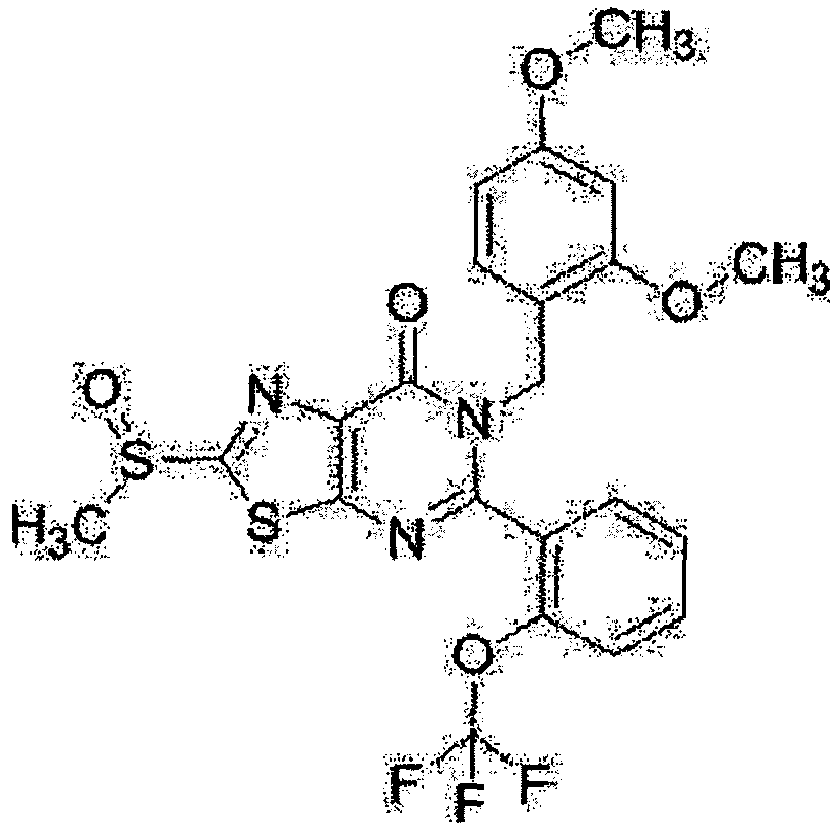
- The compound (595 mg) obtained in Reference Example 522 was treated by a method similar to that in Reference Example 268 to give the title compound (649 mg).
MS (ESI) m/z; 526 [M+H]+ -

- The compound (575 mg) obtained in Reference Example 523 was treated by a method similar to that in Reference Example 268 to give the title compound (673 mg).
MS (ESI) m/z; 456 [M+H]+ -

- The compound (534 mg) obtained in Reference Example 524 was treated by a method similar to that in Reference Example 268 to give the title compound (580 mg).
MS (ESI) m/z; 478 [M+H]+ -

- The compound (461 mg) obtained in Reference Example 525 was treated by a method similar to that in Reference Example 268 to give the title compound (511 mg).
MS (ESI) m/z; 494, 496 [M+H]+ -

- The compound (2.30 g) obtained in Reference Example 526 was treated by a method similar to that in Reference Example 268 to give the title compound (2.37 g).
MS (ESI) m/z; 424 [M+H]+ -

- The compound (967 mg) obtained in Reference Example 527 was treated by a method similar to that in Reference Example 268 to give the title compound (1.10 g).
MS (ESI) m/z; 430 [M+H]+ -

- The compound (400 mg) obtained in Reference Example 528 was treated by a method similar to that in Reference Example 268 to give the title compound (500 mg).
MS (ESI) m/z; 460 [M+H]+ -

- The compound (420 mg) obtained in Reference Example 529 was treated by a method similar to that in Reference Example 268 to give the title compound (472 mg).
MS (ESI) m/z; 474 [M+H]+ -

- The compound (256 mg) obtained in Reference Example 530 was treated by a method similar to that in Reference Example 268 to give the title compound (279 mg).
MS (ESI) m/z; 492 [M+H]+ -

- The compound (600 mg) obtained in Reference Example 531 was treated by a method similar to that in Reference Example 268 to give the title compound (695 mg).
MS (ESI) m/z; 490 [M+H]+ -

- The compound (525 mg) obtained in Reference Example 532 was treated by a method similar to that in Reference Example 268 to give the title compound (607 mg).
MS (ESI) m/z; 474 [M+H]+ -

- The compound (253 mg) obtained in Reference Example 533 was treated by a method similar to that in Reference Example 268 to give the title compound (267 mg).
MS (ESI) m/z; 462 [M+H]+ -

- The compound (1.20 g) obtained in Reference Example 534 was treated by a method similar to that in Reference Example 268 to give the title compound (890 mg).
MS (ESI) m/z; 871[2M+H]+ -

- The compound (630 mg) obtained in Reference Example 535 was treated by a method similar to that in Reference Example 268 to give the title compound (490 mg).
MS (ESI) m/z; 875[2M+H]+ -

- The compound (1.70 g) obtained in Reference Example 536 was treated by a method similar to that in Reference Example 268 to give the title compound (1.47 g).
MS (ESI) m/z; 899[2M+H]+ -

- The compound (477 mg) obtained in Reference Example 537 was treated by a method similar to that in Reference Example 268 to give the title compound (525 mg).
MS (ESI) m/z; 474 [M+H]+ -

- The compound (300 mg) obtained in Reference Example 538 was treated by a method similar to that in Reference Example 268 to give the title compound (357 mg).
MS (ESI) m/z; 461 [M+H]+ -

- The compound (375 mg) obtained in Reference Example 539 was treated by a method similar to that in Reference Example 268 to give the title compound (411 mg).
MS (ESI) m/z; 480 [M+H]+ -
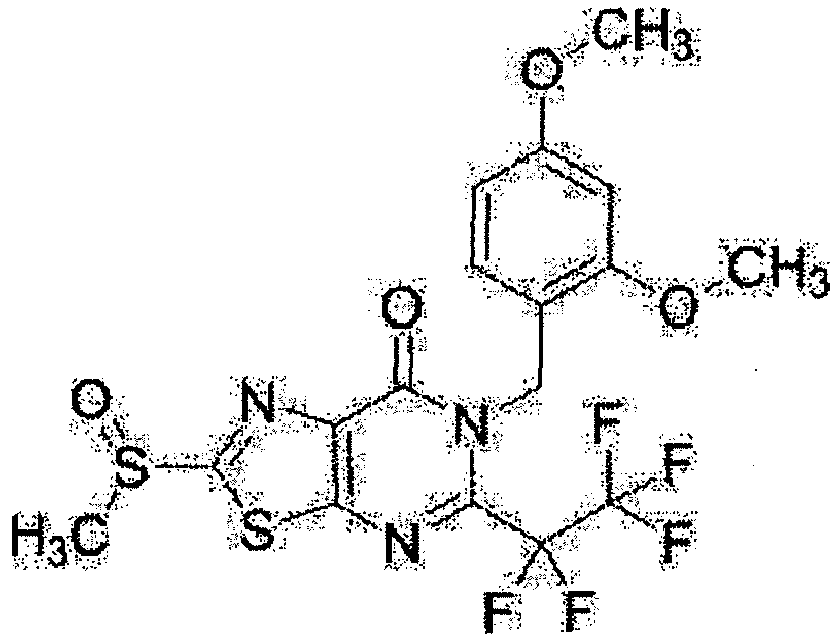
- The compound (343 mg) obtained in Reference Example 540 was treated by a method similar to that in Reference Example 268 to give the title compound (233 mg).
MS (ESI) m/z; 484 [M+H]+ -

- The compound (400 mg) obtained in Reference Example 541 was treated by a method similar to that in Reference Example 268 to give the title compound (441 mg).
MS (ESI) m/z; 584 [M+H]+ -

- The compound (988 mg) obtained in Reference Example 542 was treated by a method similar to that in Reference Example 268 to give the title compound (1.18 g).
MS (ESI) m/z; 440 [M+H]+ -

- The compound (576 mg) obtained in Reference Example 544 was treated by a method similar to that in Reference Example 268 to give the title compound (576 mg).
MS (ESI) m/z; 494, 496 [M+H]+ -

- The compound (500 mg) obtained in Reference Example 545 was treated by a method similar to that in Reference Example 268 to give the title compound (528 mg).
MS (ESI) m/z; 434 [M+H]+ -

- The compound (140 mg) obtained in Reference Example 543 was treated by a method similar to that in Reference Example 268 to give the title compound (167 mg).
MS (ESI) m/z; 416 [M+H]+ -

- The compound (736 mg) obtained in Reference Example 548 was treated by a method similar to that in Reference Example 268 to give the title compound (834 mg).
MS (ESI) m/z; 412 [M+H]+ -

- The compound (205 mg) obtained in Reference Example 549 was treated by a method similar to that in Reference Example 268 to give the title compound (127 mg).
MS (ESI) m/z; 430 [M+H]+ -

- The compound (92 mg) obtained in Reference Example 550 was treated by a method similar to that in Reference Example 268 to give the title compound (107 mg).
MS (ESI) m/z; 430 [M+H]+ -

- The compound (184 mg) obtained in Reference Example 551 was treated by a method similar to that in Reference Example 268 to give the title compound (189 mg).
MS (ESI) m/z; 448 [M+H]+ -

- The compound (295 mg) obtained in Reference Example 552 was treated by a method similar to that in Reference Example 268 to give the title compound (289 mg).
MS (ESI) m/z; 448 [M+H]+ -

- The compound (300 mg) obtained in Reference Example 553 was treated by a method similar to that in Reference Example 268 to give the title compound (317 mg).
MS (ESI) m/z; 448 [M+H]+ -

- The compound (191 mg) obtained in Reference Example 554 was treated by a method similar to that in Reference Example 268 to give the title compound (232 mg).
MS (ESI) m/z; 448 [M+H]+ -

- The compound (150 mg) obtained in Reference Example 555 was treated by a method similar to that in Reference Example 268 to give the title compound (164 mg).
MS (ESI) m/z; 460 [M+H]+ -

- The compound (424 mg) obtained in Reference Example 556 was treated by a method similar to that in Reference Example 268 to give the title compound (244 mg).
MS (ESI) m/z; 440 [M+H]+ -

- The compound (150 mg) obtained in Reference Example 557 was treated by a method similar to that in Reference Example 268 to give the title compound (174 mg).
MS (ESI) m/z; 480 [M+H]+ -

- A mixture of the compound (500 mg) obtained in Reference Example 547, (R)-2-trifluoromethylpyrrolidine (300 mg) and N,N-diisopropylethylamine (3.50 mL) was stirred with heating at 150°C for 1 hr. (R)-2-trifluoromethylpyrrolidine (600 mg) was added, and the reaction mixture was stirred with heating at 150°C for 8 hr. The reaction mixture was allowed to cool, ethyl acetate and hydrochloric acid were added, and the mixture was extracted with ethyl acetate. The combined organic layer was washed with saturated brine, dried over anhydrous magnesium sulfate, filtered and concentrated. The residue was purified by silica gel column chromatography (solvent; hexane/ethyl acetate) to give the title compound (380 mg).
MS (ESI) m/z; 457 [M+H]+ -

- The compound (500 mg) obtained in Reference Example 547 was treated by a method similar to that in Reference Example 600 to give the title compound (500 mg).
MS (ESI) m/z; 457 [M+H]+ -

- The compound (380 mg) obtained in Reference Example 600 was treated by a method similar to that in Reference Example 268 to give the title compound (280 mg).
MS (ESI) m/z; 473 [M+H]+ -

- The compound (500 mg) obtained in Reference Example 601 was treated by a method similar to that in Reference Example 268 to give the title compound (360 mg).
MS (ESI) m/z; 473 [M+H]+ -

- To a solution (10 mL) of the compound (350 mg) obtained in Reference Example 547 in DMF was added sodium hydride (60% oil dispersion, 59 mg), 2,2,2-trifluoroethanol (107 µL) was added, and the reaction mixture was stirred at room temperature for 1.5 hr. Water was added to the reaction mixture, and the mixture was extracted twice with ethyl acetate. The combined organic layer was washed with water and saturated brine, dried over anhydrous magnesium sulfate, filtered and concentrated. The residue was purified by silica gel column chromatography (solvent; hexane/ethyl acetate=90/10 - 70/30) to give the title compound (176 mg).
MS (ESI) m/z; 418 [M+H]+ -

- The compound (172 mg) obtained in Reference Example 604 was treated by a method similar to that in Reference Example 268 to give the title compound (173 mg).
MS (ESI) m/z; 434 [M+H]+ -

- To a solution (20 mL) of the compound (1.35 g) obtained in Reference Example 143 in methylene chloride were added triethylamine (700 mg) and ethyl chloroglyoxylate (710 mg) under ice-cooling, and the reaction mixture was stirred at 0°C for 1 hr. Water was added to the reaction mixture, and the mixture was extracted with chloroform. The combined organic layer was dried over anhydrous sodium sulfate, filtered and concentrated. The residue was purified by silica gel column chromatography (solvent; hexane/ethyl acetate=50/50 - 20/80) to give the title compound (1.15 g).
MS (ESI) m/z; 374 [M+H]+ -

- To a solution (20 mL) of the compound (1.15 g) obtained in Reference Example 606 in dichloroethane were added chlorotrimethylsilane (3.35 g) and triethylamine (9.4 g), and the reaction mixture was stirred at room temperature for 3 days. 1.0 mol/L Hydrochloric acid was added to the reaction mixture, and the mixture was extracted twice with chloroform. The organic layer was dried over anhydrous sodium sulfate, filtered and concentrated. The residue was purified by silica gel column chromatography (solvent; hexane/ethyl acetate=50/50 - 20/80) to give the title compound (950 mg).
MS (ESI) m/z; 356 [M+H]+ -

- To a solution (40 mL) of the compound (950 mg) obtained in Reference Example 607 in THF was added lithium aluminum hydride (100 mg) under ice-cooling. The reaction mixture was stirred at room temperature for 1 hr, to the reaction mixture were added methanol and water. The mixture was extracted with chloroform, and the organic layer was dried over anhydrous sodium sulfate, filtered and concentrated. To the residue was added diisopropyl ether, and the solid was collected by filtration, and dried to give the title compound (550 mg).
MS (ESI) m/z; 314 [M+H]+ -

- To a solution (20 mL) of the compound (550 mg) obtained in Reference Example 608 in DMF were added sodium hydride (60% oil dispersion, 95 mg) and methyl iodide (300 mg) under ice-cooling. The reaction mixture was stirred at 0°C for 1 hr, and water was added to the reaction mixture. The mixture was extracted with ethyl acetate, and the organic layer was dried over anhydrous sodium sulfate, filtered and concentrated. The residue was purified by silica gel column chromatography (solvent; hexane/ethyl acetate=50/50 - 0/100) to give the title compound (210 mg).
MS (ESI) m/z; 328 [M+H]+ -

- To a solution (8 mL) of the compound (210 mg) obtained in Reference Example 609 in methylene chloride was added mCPBA (69-75%, 165 mg) under ice-cooling. The reaction mixture was stirred at room temperature for 1.5 hr, to the reaction mixture were added aqueous sodium thiosulfate solution and saturated aqueous sodium hydrogen carbonate solution, and the mixture was extracted with methylene chloride. The organic layer was dried over anhydrous sodium sulfate, filtered and concentrated to give the title compound (190 g).
MS (ESI) m/z; 344 [M+H]+ -

- To a solution (5 mL) of the compound (300 mg) obtained in Reference Example 366 in THF was added hydrazine monohydrate (0.11 mL), and the reaction mixture was stirred at room temperature for 2 hr. Water was added to the reaction mixture, and the resultant solid was collected by filtration and dried to give the title compound (121 mg).
MS (ESI) m/z; 244 [M+H]+ -

- To a solution (8.0 mL) of the compound (110 mg) obtained in Reference Example 611 in ethanol were added 1,1,3,3-tetramethoxypropane (0.082 mL) and concentrated hydrochloric acid (0.057 mL), and the reaction mixture was heated under reflux for 1.5 hr. Under ice-cooling, the reaction mixture was neutralized with saturated sodium hydrogen carbonate, and the mixture was extracted with ethyl acetate. The organic layer was dried over anhydrous magnesium sulfate, filtered and concentrated. The obtained residue was purified by silica gel column chromatography (solvent; hexane/ethyl acetate=80/20 - 50/50) to give the title compound (93 mg).
MS (ESI) m/z; 280 [M+H]+ -

- To a solution (3.0 mL) of the compound (90 mg) obtained in Reference Example 612 in methylene chloride was added mCPBA (69-75%, 95 mg) under ice-cooling. The reaction mixture was stirred under ice-cooling for 1 hr, to the reaction mixture were added aqueous sodium thiosulfate solution and saturated aqueous sodium hydrogen carbonate solution, and the mixture was extracted with chloroform. The organic layer was dried over anhydrous sodium sulfate, filtered and concentrated to give the title compound (105 mg).
MS (ESI) m/z; 296 [M+H]+ -

- To a solution (500 mL) of ethyl 2-amino-2-cyanoacetate (51.2 g) in diisopropyl ether was added 40% methylamine methanol solution (62.1 mL) under ice-cooling, and the reaction mixture was stirred at room temperature for 1.5 hr. The resultant solid was collected by filtration, washed with diisopropyl ether-ethanol(2:1), and dried to give 2-amino-2-cyano-N-methylacetamido (28.7 g).
- A mixture of acetic anhydride (50 mL) and formic acid (24 mL) was stirred with heating at 60°C for 3 hr. The obtained mixed acid anhydride was added to a solution (190 mL) of 2-amino-2-cyano-N-methylacetamide (20.0 g) in THF under ice-cooling, and the reaction mixture was stirred at room temperature for 2 hr. The solvent was evaporated, ethyl acetate was added to the residue, and the precipitated solid was collected by filtration, washed with ethyl acetate and diisopropyl ether, and dried to give 2-cyano-2-formamide-N-methylacetamide (15.6 g).
- A mixture (18 mL) of 2-cyano-2-formamide-N-methylacetamide (1.00 g) and Lawesson reagent (1.43 g) in 1,4-dioxane was stirred with heating at 80°C for 7 hr. The solvent was evaporated under reduced pressure, and the residue was dissolved in chloroform, and washed with saturated aqueous sodium hydrogen carbonate solution. The separated aqueous layer was extracted twice with chloroform. The combined organic layer was dried over anhydrous sodium sulfate, filtered and concentrated. The residue was purified by NH silica gel column chromatography (solvent; hexane/ethyl acetate=70/30 - 20/80) to give the title compound (244 mg).
MS (ESI) m/z; 158 [M+H]+ -

- To a solution (12 mL) of the compound (1.20 g) obtained in Reference Example 614 in methylene chloride were added N,N-diisopropylethylamine (1.99 mL) and cyclopropylcarbonyl chloride (838 µL) at room temperature, and the reaction mixture was stirred at room temperature overnight. Cyclopropylcarbonyl chloride (800 µL) was added, and the reaction mixture was stirred at room temperature for 2 hr. Water was added to the reaction mixture, and the mixture was extracted with chloroform. The combined organic layer was dried over anhydrous sodium sulfate, filtered and concentrated. The residue was purified by silica gel column chromatography (solvent; hexane/ethyl acetate=80/20 - 20/80) to give the title compound (1.59 g).
MS (ESI) m/z; 226 [M+H]+ -

- To a solution (42 mL) of the compound (1.49 g) obtained in Reference Example 615 in dichloroethane were added chlorotrimethylsilane (4.18 mL) and triethylamine (13.7 mL), and the reaction mixture was stirred with heating at 80°C for 5 hr. The reaction mixture was cooled to room temperature, water was added to the reaction mixture, and the mixture was extracted twice with chloroform. The organic layer was dried over anhydrous sodium sulfate, filtered and concentrated. The residue was purified by silica gel column chromatography (solvent; hexane/ethyl acetate=70/30 - 0/100) to give the title compound (1.30 g).
MS (ESI) m/z; 208 [M+H]+ -

- A mixture of the compound (1.30 g) obtained in Reference Example 616 and N-bromosuccinimide (1.12 g) in acetonitrile (24 mL) was heated under reflux for 2 hr. N-bromosuccinimide (2.24 g) was added, and the reaction mixture was further heated under reflux for 12 hr. Ethyl acetate was added to the reaction mixture, and the mixture was washed with aqueous sodium thiosulfate solution and saturated brine, and the organic layer was dried over sodium sulfate, filtered and concentrated. The residue was purified by silica gel column chromatography (solvent; hexane/ethyl acetate=80/20 - 20/80) to give the title compound (1.26 g).
MS (ESI) m/z; 286, 288 [M+H]+ -

- To a solution (2.4 mL) of (R)N-(tert-butoxycarbonyl)-4,4-difluoropyrrolidine-2-carboxylic acid (300 mg) described in
WO 2011/130383 in DMF were added benzylamine (131 µL), EDC hydrochloride (341 mg), HOBt monohydrate (273 mg) and N,N-diisopropylethylamine (0.31 mL), and the reaction mixture was stirred at room temperature for 1 hr. After confirmation of the completion of the reaction, water was added to the reaction mixture, and the mixture was extracted twice with ethyl acetate. The organic layer was washed once with water, dried over anhydrous magnesium sulfate, filtered and concentrated. The residue was purified by silica gel column chromatography (solvent; hexane/ethyl acetate=80/20 - 50/50). The obtained product was dissolved in methanol (7.0 mL), hydrogen chloride (4.0 mol/L 1,4-dioxane solution, 1.5 mL) was added, and the mixture was stirred at room temperature overnight. The solvent was evaporated, ethyl acetate was added to the residue, and the solid was collected by filtration, and dried to give the title compound (243 mg).
MS (ESI) m/z; 241 [M+H]+ -

- To a solution (12 mL) of the compound (317 mg) obtained in Reference Example 614 in acetonitrile was added N-bromosuccinimide (360 mg), and the reaction mixture was stirred at 0°C for 30 min. The solvent was evaporated under reduced pressure, and the residue was purified by silica gel column chromatography (solvent; hexane/ethyl acetate=90/10 - 50/50) to give the title compound (373 mg).
MS (ESI) m/z; 236, 238 [M+H]+ -

- A mixed solution of the compound (2.57 g) obtained in Reference Example 619, the compound (5.24 g) obtained in Reference Example 341 and N,N-diisopropylethylamine (22 mL) was stirred with heating at 120°C for 3 hr. The reaction mixture was concentrated and the residue was purified by silica gel column chromatography (solvent; ethyl acetate/methanol=100/0 - 90/10) and concentrated to give the title compound (2.92 g). MS (ESI) m/z; 360 [M+H]+
-

- To a solution (0.7 mL) of the compound (128 mg) obtained in Reference Example 620 in DMF were added 1-cyanocyclopropanecarboxylic acid (43 mg), EDC hydrochloride (106 mg), HOBt monohydrate (84 mg) and N,N-diisopropylethylamine (0.095 mL), and the reaction mixture was stirred at room temperature for 1 hr. 1-Cyanocyclopropanecarboxylic acid (43 mg), EDC hydrochloride (106 mg), HOBt monohydrate (84 mg) and N,N-diisopropylethylamine (0.095 mL) were added, and the reaction mixture was stirred overnight. Water was added to the reaction mixture, and the mixture was extracted three times with ethyl acetate. The organic layer was dried over anhydrous sodium sulfate, filtered and concentrated. The residue was purified by silica gel column chromatography (solvent; ethyl acetate/methanol=100/0 - 90/10) to give the title compound (89 mg) .
MS (ESI) m/z; 453 [M+H]+ -

- To a solution (30 mL) of (R)-N-(tert-butoxycarbonyl)-2-(2-chloroacetyl)-pyrrolidine (2.6 g) synthesized by the method described in Tetrahedron Lett. 1997, 3175-3178 in DMF were added potassium carbonate (1.8 g), potassium iodide (2.1 g) and phenol (1.18 g) at room temperature, and the reaction mixture was stirred at room temperature overnight. After confirmation of the completion of the reaction, water was added to the reaction mixture, and the mixture was extracted twice with ethyl acetate. The organic layer was washed once with water, dried over anhydrous magnesium sulfate, filtered and concentrated. The residue was purified by silica gel column chromatography (solvent; hexane/ethyl acetate=90/10 - 80/20) to give the title compound (2.3 g).
MS (ESI) m/z; 306 [M+H]+ -
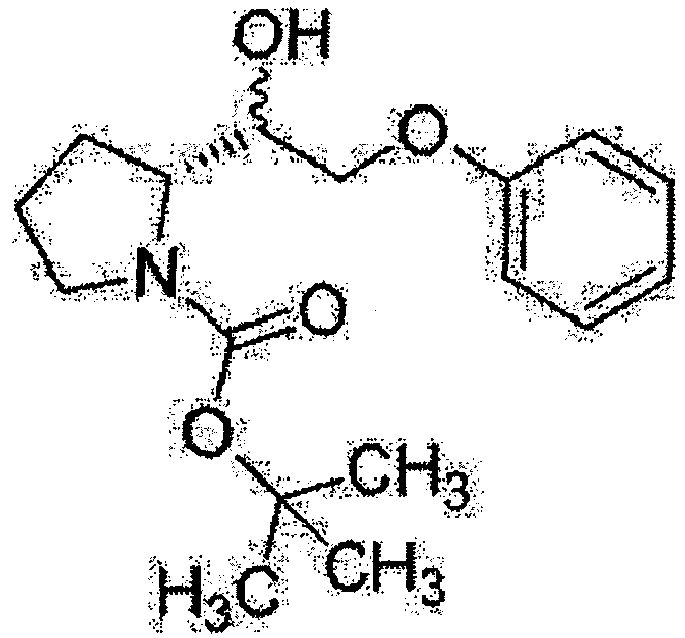
- To a solution (40 mL) of the compound (2.3 g) obtained in Reference Example 622 in methanol was added sodium borohydride (0.57 g) at 0°C, and the reaction mixture was stirred at room temperature for 1 hr. After confirmation of the completion of the reaction, water was added to the reaction mixture, and the mixture was neutralized with 1.0 mol/L hydrochloric acid and extracted twice with ethyl acetate. The organic layer was washed once with water, dried over anhydrous magnesium sulfate, filtered and concentrated. The residue was purified by silica gel column chromatography (solvent; chloroform/methanol=100/0 - 95/5) to give the title compound (TLC using silica gel (eluent chloroform/methanol=90:10) as a less polar compound (Reference Example 623; 1.64 g), and a highly-polar compound (Reference Example 624; 0.62 g)).
Reference Example 623 (ESI) m/z; 308 [M+H]+
Reference Example 624 (ESI) m/z; 308 [M+H]+ -

- To a solution (20 mL) of the compound (1.64 g) obtained in Reference Example 623 in methylene chloride were added trifluoroacetic acid (20 mL) and water (2 drops) at room temperature, and the reaction mixture was stirred at room temperature for 1 hr. After confirmation of the completion of the reaction, the solvent was evaporated under reduced pressure to give the title compound (1.7 g).
MS (ESI) m/z; 208 [M+H]+ -

- To a solution (30 mL) of (R)-N-(tert-butoxycarbonyl)-2-(2-chloroacetyl)-pyrrolidine (3.0 g) synthesized by the method described in Tetrahedron Lett. 1997, 3175-3178 in DMF were added potassium carbonate (2.0 g), potassium iodide (2.4 g) and aniline (1.35 g) at room temperature, and the reaction mixture was stirred at room temperature overnight. After confirmation of the completion of the reaction, water was added to the reaction mixture, and the mixture was extracted twice with ethyl acetate. The organic layer was washed once with water, dried over anhydrous magnesium sulfate, filtered and concentrated. The residue was purified by silica gel column chromatography (solvent; hexane/ethyl acetate=90/10 - 80/20) to give the title compound (2.16 g).
MS (ESI) m/z; 305 [M+H]+ -

- To a solution (40 mL) of the compound (2.16 g) obtained in Reference Example 626 in methanol was added sodium borohydride (0.54 g) at 0°C, and the reaction mixture was stirred at room temperature for 1 hr. After confirmation of the completion of the reaction, water was added to the reaction mixture, and the mixture was neutralized with 1.0 mol/L hydrochloric acid, and extracted once with ethyl acetate. The organic layer was washed once with water, dried over anhydrous magnesium sulfate, filtered and concentrated. The residue was purified by silica gel column chromatography (solvent; hexane/ethyl acetate=90/10 - 70/30) to give the title compound (TLC using silica gel (eluent hexane/ethyl acetate=50:50) as a less polar compound (Reference Example 627; 1.36 g), and a highly-polar compound (Reference Example 628; 0.69 g)).
Reference Example 627 (ESI) m/z; 307 [M+H]+
Reference Example 628 (ESI) m/z; 307 [M+H]+ -

- To a solution (20 mL) of the compound (1.36 g) obtained in Reference Example 627 in methylene chloride were added trifluoroacetic acid (20 mL) and water (2 drops) at room temperature, and the reaction mixture was stirred at room temperature for 1 hr. After confirmation of the completion of the reaction, the solvent was evaporated under reduced pressure to give the title compound (1.4 g).
MS (ESI) m/z; 207 [M+H]+ -

- To a solution (6 mL) of the compound (600 mg) obtained in Reference Example 484 and triethylamine (820 mL) in methylene chloride was added 2,6-difluorobenzoyl chloride (0.33 mL) at 0°C, and the reaction mixture was stirred for 1 hr at room temperature. Water was added to the reaction mixture, and the mixture was extracted twice with ethyl acetate, organic layer was dried over anhydrous magnesium sulfate, filtered and concentrated. The residue was purified by silica gel column chromatography (solvent; hexane/ethyl acetate=90/10 - 60/40) to give the title compound (681 mg).
MS (ESI) m/z; 480 [M+H]+ -

- The compound (6.72 g) obtained in Reference Example 633 was treated by a method similar to that in Reference Example 514 to give the title compound (6.17 g).
MS (ESI) m/z; 462 [M+H]+ -

- The compound (6.12 g) obtained in Reference Example 634 was treated by a method similar to that in Reference Example 268 to give the title compound (5.79 g).
MS (ESI) m/z; 478 [M+H]+ -
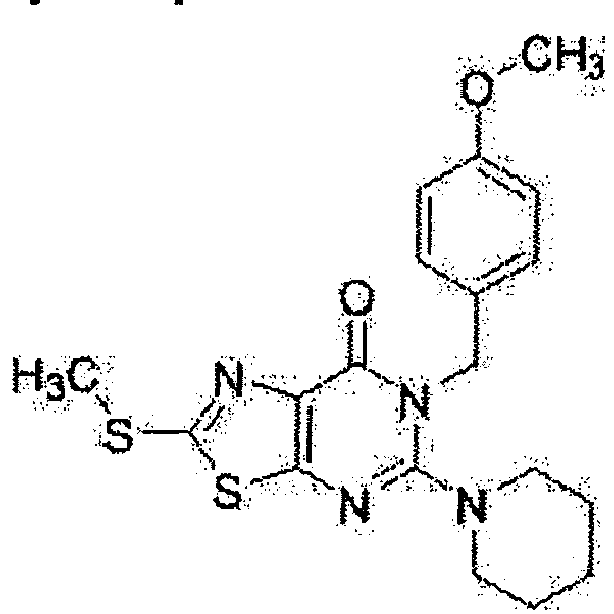
- To a solution (50.0 mL) of the compound (5.00 g) obtained in Reference Example 547 in N-methylpyrrolidone were added piperidine (2.09 mL) and N,N-diisopropylethylamine (4.89 mL), and the reaction mixture was stirred with heating at 60°C for 1 hr. The reaction mixture was allowed to cool, water was added, and the mixture was extracted with ethyl acetate. The organic layer was washed with saturated brine, dried over anhydrous magnesium sulfate, filtered and concentrated. The residue was purified by silica gel column chromatography (solvent; hexane/ethyl acetate=50/50 - 20/80) to give the title compound (5.70 g).
MS (ESI) m/z; 403 [M+H]+ -

- The compound (5.70 g) obtained in Reference Example 636 was treated by a method similar to that in Reference Example 268 to give the title compound (5.19 g).
MS (ESI) m/z; 419 [M+H]+ -

- To trifluoroacetic acid (20 mL) were added triethylsilane (5.7 mL) and the compound (2.0 g) obtained in Reference Example 484, and the mixture was stirred at room temperature for 1 hr. After confirmation of the completion of the reaction, chloroform and water were added to the reaction mixture, and the mixture was neutralized with saturated aqueous sodium hydrogen carbonate solution and extracted twice with chloroform. The organic layer was washed once with water, dried over anhydrous magnesium sulfate, filtered and concentrated. The residue was purified by silica gel column chromatography (solvent; chloroform/methanol=100/0 - 90/10) to give the title compound (0.9 g).
MS (ESI) m/z; 190 [M+H]+ -

- To a solution (50 mL) of 3-methyl-[1,2,4]oxadiazole-5-carboxylic acid ethyl ester (9.45 g) in ethanol was added an aqueous solution (20 mL) of potassium hydroxide (4.0 g) at room temperature, and the reaction mixture was stirred for 2 hr. The solvent was evaporated under reduced pressure, to the residue was added acetonitrile, and the solid was collected by filtration, and dried to give 3-methyl-[1,2,4]oxadiazole-5-carboxylic acid potassium salt (9.38 g). To a solution of the obtained 3-methyl-[1,2,4]oxadiazole-5-carboxylic acid potassium salt (3.6 g) in acetonitrile were added oxalyl chloride (1.84 mL) and DMF (2 drops) at 0°C, and the reaction mixture was stirred at room temperature for 1 hr. The solution was added to a solution (40 mL) of the compound (1.35 g) obtained in Reference Example 641 in pyridine at 0°C, and the reaction mixture was stirred at room temperature for 3 hr. After confirmation of the completion of the reaction, ethyl acetate and water were added to the reaction mixture, and the mixture was neutralized with 6.0 mol/L hydrochloric acid at room temperature, and the mixture was extracted twice with ethyl acetate. The organic layer was washed once with water, dried over anhydrous magnesium sulfate, filtered and concentrated. The residue was washed with ethyl acetate and diisopropyl ether, collected by filtration, and dried to give the title compound (1.2 g) .
MS (ESI) m/z; 300 [M+H]+ -

- To a solution (50 mL) of the compound (1.2 g) obtained in Reference Example 642 in methylene chloride were added chlorotrimethylsilane (5.1 mL) and triethylamine (17 mL), and the reaction mixture was stirred at room temperature for 2 days. After confirmation of the completion of the reaction, water was added to the reaction mixture, and the mixture was extracted twice with chloroform. The organic layer was washed once with water, dried over anhydrous magnesium sulfate, filtered and concentrated. The residue was purified by silica gel column chromatography (solvent; chloroform/methanol=100/0 - 90/10) to give the title compound (0.83 g).
MS (ESI) m/z; 282 [M+H]+ -

- To nitroethyl acetate (3.9 g) was added dimethylformamide dimethylacetal (7.0 g), and the reaction mixture was stirred at room temperature for 30 min and stirred with heating at 100°C for 2 hr. The reaction mixture was cooled to room temperature and the solvent was evaporated under reduced pressure. To the residue were added ethanol (30 mL), 3,3,3-trifluoro-2,2-dimethylpropionamidine hydrochloride (7.8 g) (synthesized by the method described in
US2011/3786
MS (ESI) m/z; 252 [M+H]+ -

- 2,2-dimethylpropionamidine hydrochloride (2.30 g) was treated by a method similar to that in Reference Example 644 to give the title compound (1.33 g).
MS (ESI) m/z; 198 [M+H]+ -

- To a mixed solution of the compound (1.46 g) obtained in Reference Example 644 in methanol-chloroform (20 mL-10 mL) was added 10% palladium carbon (0.2 g), and the reaction mixture was stirred under a hydrogen atmosphere at room temperature for 2 hr. After confirmation of the completion of the reaction, the reaction mixture was filtered through diatomaceous earth, and the filtrate was concentrated under reduced pressure to give the title compound (1.28 g).
MS (ESI) m/z; 222 [M+H]+ -

- The compound (1.33 g) obtained in Reference Example 645 was treated by a method similar to that in Reference Example 646 to give the title compound (1.20 g).
MS (ESI) m/z; 168 [M+H]+ -

- To a solution (13 mL) of the compound (1.28 g) obtained in Reference Example 646 in DMF was added a solution (5 mL) of N-bromosuccinimide (1.0 g) in DMF at 0°C. The reaction mixture was stirred at 0°C for 1 hr, to the reaction mixture was added aqueous sodium thiosulfate solution, and the mixture was extracted twice with ethyl acetate. The organic layer was dried over anhydrous magnesium sulfate, filtered and concentrated. The residue was purified by silica gel column chromatography (solvent; hexane/ethyl acetate=80/20 - 30/70) to give the title compound (1.07 g).
MS (ESI) m/z; 300, 302 [M+H]+ -

- The compound (1.20 g) obtained in Reference Example 647 was treated by a method similar to that in Reference Example 648 to give the title compound (580 mg).
MS (ESI) m/z; 246, 248 [M+H]+ -

- A solution (10 mL) of the compound (1.07 g) obtained in Reference Example 648 and potassium ethyl xanthogenate (1.15 g) in DMF was stirred with heating at 140°C for 3 hr. The reaction mixture was cooled to room temperature, and acetic acid (10 mL) and water (20 mL) were added. The precipitated solid was collected by filtration, washed with water and diisopropyl ether, and dried under reduced pressure to give the title compound (0.54 g).
MS (ESI) m/z; 296 [M+H]+ -

- The compound (640 mg) obtained in Reference Example 649 was treated by a method similar to that in Reference Example 650 to give the title compound (630 mg).
MS (ESI) m/z; 242 [M+H]+ -

- To a solution (5 mL) of the compound (200 mg) obtained in Reference Example 650 in DMF were added sodium hydrogen carbonate (70 mg) and methyl iodide (47 µL) at 0°C. The reaction mixture was stirred at room temperature for 2 hr, and sodium hydrogen carbonate (35 mg) and methyl iodide (23 µL) were added at room temperature. The reaction mixture was stirred at room temperature for 1 hr stirred, water (20 mL) was added, and the resultant solid was collected by filtration, and dried to give the title compound (176 mg).
MS (ESI) m/z; 310 [M+H]+ -

- The compound (625 mg) obtained in Reference Example 651 was treated by a method similar to that in Reference Example 652 to give the title compound (658 mg).
MS (ESI) m/z; 256 [M+H]+ -
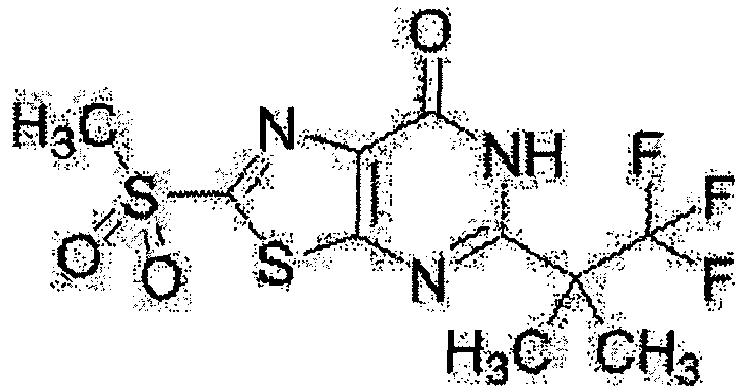
- To a solution (1.4 mL) of the compound (176 mg) obtained in Reference Example 652 in trifluoroacetic acid was added 30% aqueous hydrogen peroxide solution (140 µL) under ice-cooling. The reaction mixture was stirred at room temperature for 1 hr, water (20 mL) was added, and the resultant solid was filtered and dried to give the title compound (180 mg).
MS (ESI) m/z; 342 [M+H]+ -

- The compound (650 mg) obtained in Reference Example 653 was treated by a method similar to that in Reference Example 654 to give the title compound (688 mg).
MS (ESI) m/z; 288 [M+H]+ -

- To a solution (70 mL) of 5-amino-2-methylsulfanyl-1,3-thiazole-4-carboxylic acid (3.00 g) in DMF were added N,N-diisopropylethylamine (4.1 mL), (2-aminoethyl)-carbamic acid tert-butyl ester (3.76 mL), EDC hydrochloride (4.54 g) and HOBt monohydrate (3.63 g), and the reaction mixture was stirred at room temperature for 3 days. Water was added to the reaction mixture, and the mixture was extracted three times with ethyl acetate. The organic layer was dried over anhydrous magnesium sulfate, filtered and concentrated. The residue was purified by silica gel column chromatography (solvent; hexane/ethyl acetate=70/30 - 30/70) to give the title compound (4.48 g).
MS (ESI) m/z; 233 [M+H-Boc]+ -

- To a solution (40 mL) of the compound (2.67 g) obtained in Reference Example 656 in methylene chloride were added triethylamine (3.36 mL) and chloroacetyl chloride (958 µL) at room temperature. The reaction mixture was stirred at room temperature for 15 hr, chloroacetyl chloride (180 µL) was added, and the reaction mixture was stirred at room temperature for 1 hr. Water was added to the reaction mixture, and the mixture was extracted with ethyl acetate. The combined organic layer was dried over anhydrous sodium sulfate, collected by collected by filtration and concentrated. To the residue was added hexane/ethyl acetate=2/1 and the precipitated solid was filtered, and dried under reduced pressure to give the title compound (2.31 g).
MS (ESI) m/z; 308 [M+H-Boc]+ -

- To a solution (50 mL) of the compound (2.27 g) obtained in Reference Example 657 in dichloroethane were added chlorotrimethylsilane (3.51 mL) and triethylamine (11.60 mL), and the reaction mixture was stirred at room temperature for 1.5 hr. Water was added to the reaction mixture, and the mixture was extracted twice with ethyl acetate. The organic layer was dried over anhydrous sodium sulfate, filtered and concentrated. The residue was purified by silica gel column chromatography (solvent; hexane/ethyl acetate=80/20 - 50/50) to give the title compound (1.89 g).
MS (ESI) m/z; 391 [M+H]+ -

- To a solution (40 mL) of the compound (1.565 g) obtained in Reference Example 658 in ethyl acetate was added hydrogen chloride (4.0 mol/L ethyl acetate solution, 9 mL), and the reaction mixture was stirred with heating at 40°C for 5 hr. The reaction mixture was cooled to room temperature, to the resultant solid were added ethyl acetate, chloroform and siethyl ether, and the solid was collected by filtration to give the title compound (1.268 g).
MS (ESI) m/z; 291 [M+H]+ -

- To a mixed solution of the compound (1250 mg) obtained in Reference Example 659 in THF/water (35 mL/35 mL) was added sodium hydrogen carbonate (963 mg) under ice-cooling, and the reaction mixture was stirred at room temperature for 2.5 hr. To the reaction mixture was added di-tert-butyl dicarbonate (917 mg), and the reaction mixture was stirred at room temperature for 14 hr. THF was evaporated under reduced pressure, and the mixture was extracted twice with ethyl acetate. The combined organic layer was washed with saturated brine, dried over anhydrous sodium sulfate, filtered and concentrated. The residue was purified by silica gel column chromatography (solvent; hexane/ethyl acetate=80/20 - 20/80), to the obtained product was added hexane/ethyl acetate=2/1, and the solid was collected by filtration to give the title compound (1182 mg).
MS (ESI) m/z; 355 [M+H]+ -

- To a solution (5 mL) of the compound (235 mg) obtained in Reference Example 660 in methylene chloride was added mCPBA (69-75%, 168 mg) under ice-cooling. The reaction mixture was stirred at room temperature for 1.5 hr, to the reaction mixture were added aqueous sodium thiosulfate solution and saturated aqueous sodium hydrogen carbonate solution, and the mixture was extracted with methylene chloride. The organic layer was dried over anhydrous sodium sulfate, filtered and concentrated. To the obtained residue were added hexane/diethyl ether=1/1, and the solid was collected by filtration, and dried to give the title compound (244.6 mg).
MS (ESI) m/z; 371 [M+H]+ -

- To a solution (33 mL) of 5-amino-2-methylsulfanyl-1,3-thiazole-4-carboxylic acid (1.50 g) in DMF were added ((S)-2-aminopropyl)-carbamic acid tert-butyl ester (1.65 g) synthesized by the method described in
US2010/22518A1 , N,N-diisopropylethylamine (1.92 mL), EDC hydrochloride (2.12 g) and HOBt monohydrate (1.49 g), and the reaction mixture was stirred at room temperature for 3 days. Water was added to the reaction mixture, and the mixture was extracted three times with ethyl acetate. The organic layer was dried over anhydrous magnesium sulfate, filtered and concentrated. The residue was purified by silica gel column chromatography (solvent; hexane/ethyl acetate=70/30 - 20/80) to give the title compound (2.29 g).
MS (ESI) m/z; 347 [M+H]+ -

- 5-Amino-2-methylsulfanyl-1,3-thiazole-4-carboxylic acid (1.50 g) and ((R)-2-aminopropyl)-carbamic acid tert-butyl ester (1.65 g) synthesized by the method described in
US2010/22518A1 were treated by a method similar to that in Reference Example 662 to give the title compound (2.70 g).
MS (ESI) m/z; 347 [M+H]+ -

- To a solution (27 mL) of the compound (1.88 g) obtained in Reference Example 662 in methylene chloride were added triethylamine (1.89 mL) and acetoxyacetyl chloride (758 µL) at 0°C, and the reaction mixture was stirred at room temperature for 1.5 hr. Water was added to the reaction mixture, and the mixture was extracted with chloroform, and the organic layer was dried over anhydrous sodium sulfate, filtered and concentrated. The residue was purified by silica gel column chromatography (solvent; hexane/ethyl acetate=60/40 - 20/80) to give the title compound (2.82 g).
MS (ESI) m/z; 447 [M+H]+ -

- The compound (2.86 g) obtained in Reference Example 663 was treated by a method similar to that in Reference Example 664 to give the title compound (3.39 g).
MS (ESI) m/z; 447 [M+H]+ -

- To a solution (34 mL) of the compound (2.82 g) obtained in Reference Example 664 in dichloroethane were added chlorotrimethylsilane (5.15 mL) and triethylamine (17.0 mL) at 0°C, and the reaction mixture was stirred at room temperature for 3 hr. Water was added to the reaction mixture, and the mixture was extracted twice with chloroform. The organic layer was dried over anhydrous sodium sulfate, filtered and concentrated. The residue was purified by silica gel column chromatography (solvent; hexane/ethyl acetate=70/30 - 30/70) to give the title compound (2.16 g).
MS (ESI) m/z; 429 [M+H]+ -

- The compound (3.39 g) obtained in Reference Example 665 was treated by a method similar to that in Reference Example 666 to give the title compound (3.02 g).
MS (ESI) m/z; 429 [M+H]+ -

- To a mixed solution of the compound (2160 mg) obtained in Reference Example 666 in methanol/THF (52 mL/26 mL) was added 1.0 mol/L aqueous sodium hydroxide solution (5.29 mL) under ice-cooling, and the mixture was stirred under ice-cooling for 1 hr. To the reaction mixture was added saturated aqueous ammonium chloride solution, and methanol and THF were evaporated under reduced pressure. The obtained mixture was diluted with water, and extracted twice with ethyl acetate. The combined organic layer was washed with saturated brine, dried over anhydrous magnesium sulfate, filtered and concentrated. To the residue was added hexane/ethyl acetate=2/1, and the solid was collected by filtration to give the title compound (1621 mg).
MS (ESI) m/z; 387 [M+H]+ -

- The compound (3.02 g) obtained in Reference Example 667 was treated by a method similar to that in Reference Example 668 to give the title compound (1.99 g).
MS (ESI) m/z; 387 [M+H]+ -

- To a solution (31 mL) of the compound (1320 mg) obtained in Reference Example 668 in methylene chloride was added mCPBA (69-75%, 864 mg) under ice-cooling, and the reaction mixture was stirred at 0°C for 1.5 hr. To the reaction mixture were added aqueous sodium thiosulfate solution, and saturated aqueous sodium hydrogen carbonate solution, and the mixture was extracted with methylene chloride. The organic layer was dried over anhydrous sodium sulfate, filtered and concentrated to give the title compound (1489 mg).
MS (ESI) m/z; 403 [M+H]+ -
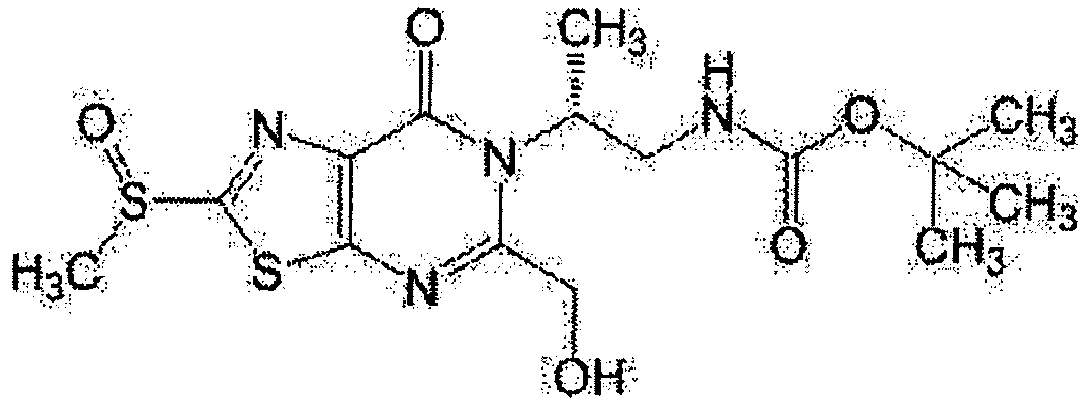
- The compound (600 mg) obtained in Reference Example 669 was treated by a method similar to that in Reference Example 670 to give the title compound (636.9 mg).
MS (ESI) m/z; 403 [M+H]+ -

- A mixed solution of the compound (600 mg) obtained in Reference Example 547 in trifluoroacetic acid/triethylsilane/water (15 mL/832 µL/832 µL) was stirred with heating at 50°C for 2 hr, and the reaction mixture was concentrated under reduced pressure. To the residue was added ethyl acetate, and the solid was collected by filtration to give the title compound (365 mg).
MS (ESI) m/z; 234 [M+H]+ -

- A mixture of the compound (375 mg) obtained in Reference Example 672, N-methylaminoethanol (282 µL) in ethanol was heated under reflux for 18 hr. The reaction mixture was diluted with water, and adjusted to pH 2 with 1.0 mol/L hydrochloric acid. The precipitated solid was collected by filtration, washed with water, 2-propanol and siethyl ether, and dried to give the title compound (400 mg).
MS (ESI) m/z; 273 [M+H]+ -

- A mixture of the compound (395 mg) obtained in Reference Example 673 and concentrated sulfuric acid (3.5 mL) was stirred with heating at 60°C for 4 hr. The reaction mixture was cooled to 0°C, and poured into ice water. The mixture was alkalified with saturated aqueous sodium hydrogen carbonate solution, and extracted twice with chloroform. The combined organic layer was washed with saturated brine, dried over anhydrous sodium sulfate, filtered and concentrated to give the title compound (350 mg).
MS (ESI) m/z; 255 [M+H]+ -

- To a solution (5 mL) of the compound (85 mg) obtained in Reference Example 674 in methylene chloride was added mCPBA (69-75%, 91 mg) under ice-cooling, and the mixture was stirred at 0°C for 1.5 hr. To the reaction mixture were added aqueous sodium thiosulfate solution and saturated aqueous sodium hydrogen carbonate solution, and the mixture was extracted with methylene chloride. The organic layer was dried over anhydrous sodium sulfate, filtered and concentrated to give the title compound (90 mg).
MS (ESI) m/z; 271 [M+H]+ -

- A mixture of the compound (160 mg) obtained in Reference Example 672 and methylamine dimethyl acetal (189 µL) in ethanol (2.4 mL) was heated under reflux for 20 hr. Ethanol was evaporated under reduced pressure, and the obtained mixture was diluted with water, and adjusted to pH 2 with 1.0 mol/L hydrochloric acid. The precipitated solid was collected by filtration, washed with water, 2-propanol and diethyl ether, and dried to give the title compound (196.6 mg).
MS (ESI) m/z; 317 [M+H]+ -

- To the compound (195 mg) obtained in Reference Example 676 was added concentrated sulfuric acid (3.0 mL), and the reaction mixture was stirred at room temperature for 20 hr and stirred with heating at 60°C for 3 hr. The reaction mixture was cooled to 0°C, and poured into ice water. The mixture was extracted 3 times with ethyl acetate. The combined organic layer was washed with saturated brine, dried over anhydrous sodium sulfate, filtered and concentrated. To the residue was added hexane/ethyl acetate(1/1), and the solid was collected by filtration to give the title compound (37.7 mg).
MS (ESI) m/z; 253 [M+H]+ -

- To a solution (6.0 mL) of the compound (32 mg) obtained in Reference Example 677 in methylene chloride was added mCPBA (69-75%, 34 mg) under ice-cooling. The reaction mixture was stirred at 0°C for 1 hr, to the reaction mixture were added aqueous sodium thiosulfate solution and saturated aqueous sodium hydrogen carbonate solution, and the mixture was extracted with methylene chloride. The organic layer was dried over anhydrous sodium sulfate, filtered and concentrated to give the title compound (31.6 mg).
MS (ESI) m/z; 269 [M+H]+ -

- To a solution (1.0 mL) of 4-(tert-butyldiphenylsilanyloxy)-2,2-difluorobutyric acid ethyl ester (
US5,712,279A ) (105 mg) in ethanol was added 1.0 mol/L aqueous sodium hydroxide solution (258 µL), and the mixture was stirred at 50°C for 3.5 hr. The reaction mixture was concentrated under reduced pressure, to the residue was added methanol and the solvent was evaporated twice by azeotropy under reduced pressure. To the obtained 4-(tert-butyldiphenylsilanyloxy)-2,2-difluorobutyric acid sodium salt was added methylene chloride (3.0 mL), to the resultant suspension were added oxalyl chloride (44 µL) and DMF (one drop) under ice-cooling, and the reaction mixture was stirred at room temperature for 2 hr. The reaction mixture was concentrated under reduced pressure, to the residue was added methylene chloride (1 mL). A solution (2.0 mL) of the compound (88 mg) obtained in Reference Example 484 in methylene chloride and triethylamine (144 µL) was added dropwise at room temperature. The reaction mixture was stirred at room temperature overnight, water was added to the reaction mixture, and the mixture was extracted twice with methylene chloride. The organic layer was washed with saturated brine, dried over anhydrous sodium sulfate, filtered and concentrated under reduced pressure. The residue was purified by silica gel column chromatography (solvent; hexane/ethyl acetate=100/0 - 70/30) to give amide intermediate (106.1 mg). To a solution (2.0 mL) of amide intermediate (106 mg) in methylene chloride were added chlorotrimethylsilane (191 µL) and triethylamine (631 µL), and the reaction mixture was stirred at room temperature for 28 hr. Under ice-cooling, water was added to the reaction mixture, and the mixture was extracted twice with methylene chloride. The organic layer was washed with saturated brine, dried over anhydrous sodium sulfate, filtered and concentrated under reduced pressure. The residue was purified by silica gel column chromatography (solvent; hexane/ethyl acetate=90/10 - 70/30) to give the title compound (97.8 mg).
MS(APCI)m/z; 682 [M+H]+ -

- To a solution (2.0 mL) of the compound (95 mg) obtained in Reference Example 679 in THF were successively added acetic acid (24 µL) and 1.0 mol/L tetrabutylammonium fluoride THF solution (279 µL) at room temperature, and the reaction mixture was stirred at room temperature for 2 hr. Water was added to the reaction mixture, and the mixture was extracted three times with ethyl acetate. The combined organic layer was washed with saturated brine, dried over anhydrous sodium sulfate, filtered and concentrated under reduced pressure. The obtained residue was purified by silica gel column chromatography (solvent; chloroform/methanol=100/0 - 90/10) to give the title compound (64.8 mg).
MS (ESI) m/z; 444 [M+H]+ -

- To the compound (64 mg) obtained in Reference Example 680 was added a mixture of trifluoroacetic acid (900 µL), triethylsilane (50 µL) and water (50 µL) under ice-cooling, and the reaction mixture was stirred at room temperature for 3 hr. The reaction mixture was concentrated under reduced pressure, methanol was added, and concentrated twice by azeotropy under reduced pressure. The obtained residue was purified by silica gel column chromatography (solvent; chloroform/methanol=100/0 - 90/10) to give the title compound (32.4 mg).
MS (ESI) m/z; 294 [M+H]+ -

- To a solution (2.0 mL) of the compound (40 mg) obtained in Reference Example 681 in DMF were successively added triethylamine (95 µL) and methyltriphenoxyphosphonium iodide (154 mg) under ice-cooling, and the reaction mixture was stirred at room temperature overnight. To the reaction mixture was added methanol (0.5 mL), and the mixture was diluted with ethyl acetate, and washed successively with 20% aqueous sodium carbonate solution and saturated brine. The organic layer was dried over anhydrous sodium sulfate, filtered and concentrated under reduced pressure. The obtained residue was purified by silica gel column chromatography (solvent; hexane/ethyl acetate=90/10 - 50/50) to give the title compound (37.6 mg). MS (ESI) m/z; 276 [M+H]+
-

- To a solution (2.0 mL) of the compound (37 mg) obtained in Reference Example 682 in methylene chloride was added mCPBA (69-75%, 34 mg) under ice-cooling, and the reaction mixture was stirred at room temperature for 2 hr. To the reaction mixture was added aqueous sodium thiosulfate solution, and the mixture was extracted three times with methylene chloride. The organic layer was washed with saturated aqueous sodium hydrogen carbonate solution, dried over anhydrous sodium sulfate, filtered and concentrated under reduced pressure to give the title compound as a crude product (38.5 mg).
MS (ESI) m/z; 292 [M+H]+ -

- To a solution (15 mL) of 2,2-difluoropentanedioic acid-5-benzyl ester-1-ethyl ester (840 mg) synthesized by the method described in Journal of Fluorine Chemistry 2003, 121, 105-107 in methanol was added 10% palladium carbon (100 mg), and the reaction mixture was stirred for 3 hr under 1 atm hydrogen atmosphere. The reaction mixture was filtered through diatomaceous earth, and the filtrate was concentrated under reduced pressure to give 2,2-difluoropentanedioic acid-1-ethyl ester as a crude product (610 mg). To a mixed solution of the obtained 2,2-difluoropentanedioic acid-1-ethyl ester (610 mg) in THF (10 mL) and methylene chloride (5.0 mL) was added borane dimethylsulfide complex (402 µL), and the reaction mixture was stirred for 17 hr with heating under reflux. After cooling to room temperature, the reaction mixture was concentrated under reduced pressure, methylene chloride was added and the mixture was concentrated twice by azeotropy under reduced pressure. The residue containing the obtained alcohol was dissolved in DMF (10 mL), tert-butyldiphenylsilyl chloride (915 µL) and imidazole (479 mg) were successively added, and the reaction mixture was stirred at room temperature overnight. Water was added to the reaction mixture, and the mixture was extracted twice with diethyl ether. The organic layer was washed with saturated brine, dried over anhydrous sodium sulfate, filtered and concentrated under reduced pressure. The residue was purified by silica gel column chromatography (solvent; hexane/ethyl acetate=100/0 - 90/10) to give the corresponding silyl ether (788 mg). The obtained silyl ether (710 mg) was dissolved in ethanol (3.4 mL), 1.0 mol/L aqueous sodium hydroxide solution (1.69 mL) was added, and the reaction mixture was stirred at 50°C for 2 hr. The reaction mixture was concentrated under reduced pressure, methanol was added to the residue, and the mixture was further concentrated twice by azeotropy under reduced pressure. To the residue was added methylene chloride (5.0 mL), to the resultant suspension were added oxalyl chloride (715 µL) and DMF (one drop) under ice-cooling, and the reaction mixture was stirred at room temperature for 3 hr. The reaction mixture was concentrated under reduced pressure, to the residue was added methylene chloride (5.0 mL), and a solution (5.0 mL) of the compound (574 mg) obtained in Reference Example 484 in methylene chloride and triethylamine (2.36 mL) were added dropwise at room temperature. The reaction mixture was stirred at room temperature overnight, water was added to the reaction mixture, and the mixture was extracted twice with methylene chloride. The organic layer was washed with saturated brine, dried over anhydrous sodium sulfate, filtered and concentrated under reduced pressure. The residue was purified by silica gel column chromatography (solvent; hexane/ethyl acetate=100/0 - 70/30) to give the title compound (1.13 g).
MS(APCI)m/z; 714 [M+H]+ -

- To a solution (10 mL) of the compound (1.13 g) obtained in Reference Example 684 in methylene chloride were added chlorotrimethylsilane (1.92 mL) and triethylamine (6.36 mL), and the reaction mixture was stirred at room temperature for 3 days. Under ice-cooling, water was added to the reaction mixture, and the mixture was extracted three times with methylene chloride. The organic layer was washed with saturated brine, dried over anhydrous sodium sulfate, filtered and concentrated under reduced pressure. The residue was purified by silica gel column chromatography (solvent; hexane/ethyl acetate=90/10 - 70/30) to give the title compound (991 mg).
MS(APCI)m/z; 696 [M+H]+ -

- To a solution (10 mL) of the compound (980 mg) obtained in Reference Example 685 in THF were successively added acetic acid (484 µL) and 1.0 mol/L solution (5.64 mL) of tetrabutylammonium fluoride in THF at room temperature, and the reaction mixture was stirred at room temperature overnight. Water was added to the reaction mixture, and the mixture was extracted three times with ethyl acetate. The combined organic layer was washed successively with saturated brine, dried over anhydrous sodium sulfate, filtered and concentrated under reduced pressure. The obtained residue was purified by silica gel column chromatography (solvent; hexane/ethyl acetate=70/30 - 20/80) to give the title compound (658 mg).
MS(APCI)m/z; 458 [M+H]+ -

- To a solution of the compound (640 mg) obtained in Reference Example 686 in methylene chloride (2 mL) were successively added triethylsilane (250 µL), water (250 µL) and trifluoroacetic acid (4.5 mL) under ice-cooling, and the reaction mixture was stirred at room temperature for 4 hr. The reaction mixture was concentrated under reduced pressure, methanol was added, and the mixture was further concentrated twice by azeotropy under reduced pressure. The obtained residue was purified by silica gel column chromatography (solvent; chloroform/methanol=100/0 - 90/10) to give the title compound (69.8 mg).
MS (ESI) m/z; 308 [M+H]+ -

- To a solution (2.0 mL) of the compound (69 mg) obtained in Reference Example 687 in DMF were successively added triethylamine (157 µL) and methyltriphenoxyphosphonium iodide (254 mg) under ice-cooling, and the reaction mixture was stirred at room temperature for 7 hr. To the reaction mixture was added methanol (0.50 mL), and the mixture was further stirred for 10 min. The reaction mixture was diluted with ethyl acetate, and washed successively with 20% aqueous sodium carbonate solution and saturated brine. The organic layer was dried over anhydrous sodium sulfate, filtered and concentrated under reduced pressure. The obtained residue was purified by silica gel column chromatography (solvent; hexane/ethyl acetate=90/10 - 50/50) to give the title compound (57 mg).
MS (ESI) m/z; 290 [M+H]+ -

- To a solution (2.0 mL) of the compound (57 mg) obtained in Reference Example 688 in methylene chloride was added mCPBA (69-75%, 53 mg) under ice-cooling. The reaction mixture was stirred at room temperature for 2.5 hr, to the reaction mixture was added aqueous sodium thiosulfate solution, and the mixture was extracted twice with methylene chloride. The organic layer was washed with saturated aqueous sodium hydrogen carbonate solution, dried over anhydrous sodium sulfate, filtered and concentrated under reduced pressure to give the title compound as a crude product (61.3 mg).
MS (ESI) m/z; 306 [M+H]+ -

- To a solution (20 mL) of the compound (1.76 g) obtained in Reference Example 619 in methylene chloride were added triethylamine (2.10 mL) and benzoyl chloride (1.30 g) at 0°C, and the reaction mixture was stirred at room temperature overnight. 1.0 mol/L Aqueous sodium hydroxide solution (10.0 mL) was added to the reaction mixture. The mixture was stirred at room temperature for 30 min and extracted 4 times with chloroform. The organic layer was dried over anhydrous magnesium sulfate, filtered and concentrated. To the residue was added ethyl acetate, and the solid was collected by filtration, and dried to give the title compound (2.20 g).
MS (ESI) m/z; 340, 342 [M+H]+ -

- To a solution (150 mL) of the compound (2.20 g) obtained in Reference Example 690 in methylene chloride were added chlorotrimethylsilane (4.10 mL) and triethylamine (13.6 mL), and the reaction mixture was stirred at room temperature overnight. The reaction mixture was added to water (200 mL), and the mixture was extracted twice with chloroform. The organic layer was dried over anhydrous magnesium sulfate, filtered and concentrated. The residue was purified by silica gel column chromatography (solvent; hexane/ethyl acetate=70/30 - 20/80) to give the title compound (1.36 g).
MS (ESI) m/z; 322, 324 [M+H]+ -

- (1) To a solution (100 mL) of (2R,3S)-N-(tert-butoxycarbonyl)-3-hydroxypyrrolidine-2-carboxylic acid ethyl ester (2.80 g) synthesized by the method described in J. Chem. Soc., Perkin Trans. 1 1993, 1313-1317 in THF were added 4-nitrobenzoic acid (3.60 g), triphenylphosphine (6.30 g) and diethyl azodicarboxylate 2.2 mol/L toluene solution (10.8 mL) at room temperature, and the reaction mixture was stirred overnight. The solvent was evaporated under reduced pressure, and the residue was purified by silica gel column chromatography (solvent; hexane/ethyl acetate=90/10 - 60/40) and further by NH silica gel column chromatography (solvent; hexane/ethyl acetate=95/5 - 80/20) to give (2R,3R)-(N-tert-butoxycarbonyl)-3-(4-nitrophenylcarbonyloxy)-pyrrolidine-2-carboxylic acid ethyl ester (3.40 g).
- (2) To a solution (60 mL) of the obtained (2R,3R)-N-(tert-butoxycarbonyl)-3-(4-nitrophenylcarbonyloxy)-pyrrolidine-2-carboxylic acid ethyl ester (0.73 g) in ethanol was added sodium azide (0.43 g) at room temperature, and the reaction mixture was stirred at 45°C overnight. The reaction mixture was cooled to room temperature, water was added, and the mixture was extracted twice with ethyl acetate. The organic layer was dried over anhydrous magnesium sulfate, filtered and concentrated. The residue was purified by silica gel column chromatography (solvent; hexane/ethyl acetate=70/30 - 40/60) to give (2R,3R)-N-(tert-butoxycarbonyl)-3-hydroxypyrrolidine-2-carboxylic acid ethyl ester (0.45 g).
- (3) To a solution (70 mL) of the obtained (2R,3R)-N-(tert-butoxycarbonyl) -3-hydroxypyrrolidine-2-carboxylic acid ethyl ester (1.73 g) in THF were added diphenylphosphoryl azide (2.40 g), triphenylphosphine (2.30 g) and diethyl azodicarboxylate 2.2 mol/L toluene solution (4.0 mL) at room temperature, and the reaction mixture was stirred overnight. The solvent was evaporated under reduced pressure, and the residue was purified by silica gel column chromatography (solvent; hexane/ethyl acetate=90/10 - 80/20) to give (2R,3S)-3-azidopyrrolidine-N-(tert-butoxycarbonyl)-2-carboxylic acid ethyl ester (1.66 g).
- (4) To a solution (80 mL) of the obtained (2R,3S)-3-azidopyrrolidine-N-(tert-butoxycarbonyl)-2-carboxylic acid ethyl ester (1.66 g) in methanol was added tin(II) chloride (3.33 g) at room temperature, and the reaction mixture was stirred overnight. The solvent was evaporated under reduced pressure, and a solution (50 mL) of the residue in acetone was slowly added to an aqueous solution (50 mL) of sodium hydrogen carbonate (4.90 g) at 0°C, an acetone solution (50 mL) of N-(carbobenzoxy)succinimide (1.75 g) was added, and the reaction mixture was stirred at room temperature overnight. Water was added, and the mixture was filtered through diatomaceous earth, and the filtrate was and the mixture was extracted twice with ethyl acetate. The organic layer was dried over anhydrous magnesium sulfate, filtered and concentrated. The residue was purified by silica gel column chromatography (solvent; hexane/ethyl acetate=90/10 - 40/60) to give the title compound (1.78 g).
-

- To a mixed solution of the compound (1.78 g) obtained in Reference Example 692 in methanol-water (48 mL-16 mL) were added lithium hydroxide monohydrate (1.90 g) and 30% hydrogen peroxide (1.83 mL) at 0°C, and the reaction mixture was stirred at room temperature overnight. Aqueous sodium thiosulfate solution was added, and the reaction mixture was stirred at room temperature for 10 min. The reaction mixture was neutralized with 1.0 mol/L hydrochloric acid, and extracted twice with chloroform. The organic layer was dried over anhydrous magnesium sulfate, filtered and concentrated to give the title compound (1.50 g).
MS (ESI) m/z; 365 [M+H]+ -
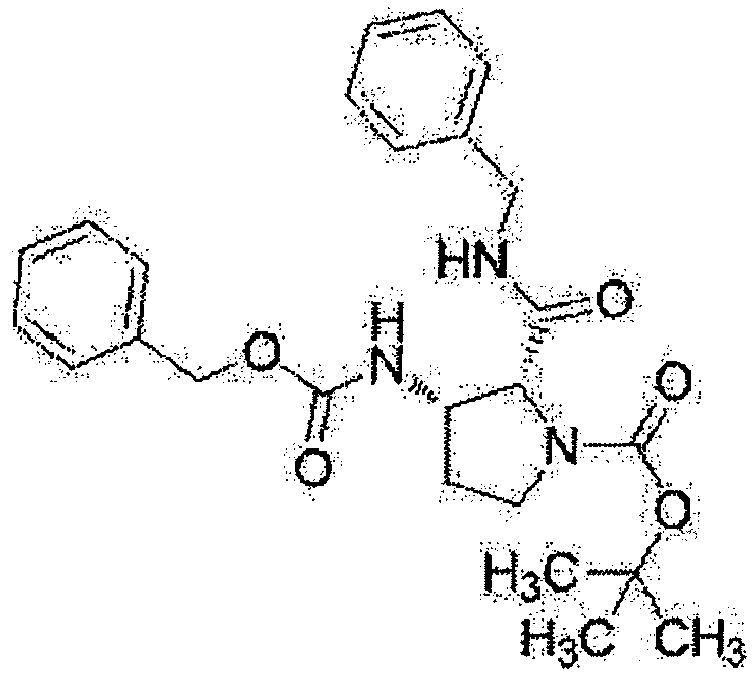
- To a solution (10 mL) of the compound (0.60 g) obtained in Reference Example 693 in DMF were added benzylamine (0.36 g), EDC hydrochloride (0.64 g), HOBt monohydrate (0.51 g) and N,N-diisopropylethylamine (0.58 mL), and the reaction mixture was stirred at room temperature overnight. Water was added to the reaction mixture, and the mixture was extracted twice with ethyl acetate. The organic layer was washed once with water, dried over anhydrous magnesium sulfate, filtered and concentrated. The residue was purified by silica gel column chromatography (solvent; hexane/ethyl acetate=80/20 - 50/50) to give the title compound (0.60 g).
MS (ESI) m/z; 454 [M+H]+ -

- (2R,3R)-N-(tert-butoxycarbonyl)-3-[(benzyloxycarbonyl)amino]pyrrolidine-2-carboxylic acid (0.70 g) synthesized by the method described in Org. Lett. 2002, 4, 3317-3319 was treated by a method similar to that in Reference Example 694 to give the title compound (0.60 g).
MS (ESI) m/z; 454 [M+H]+ -

- To a solution (6.0 mL) of the compound (0.60 g) obtained in Reference Example 694 in methylene chloride was added trifluoroacetic acid (6.0 mL), and the reaction mixture was stirred at room temperature for 3 hr. After confirmation of the completion of the reaction, the solvent was evaporated to give the title compound (0.60 g).
MS (ESI) m/z; 354 [M+H]+ -

- The compound (0.60 g) obtained in Reference Example 695 was treated by a method similar to that in Reference Example 696 to give the title compound (0.62 g).
MS (ESI) m/z; 354 [M+H]+ -

- Sodium (3.18 g) was added to ethanol (60 mL) a little by little at room temperature, and the mixture was stirred until it was dissolved. A solution (30 mL) of 2-butanone (10.0 g) in ethanol was added dropwise to the reaction mixture under ice-cooling, and the reaction mixture was stirred for 10 min and a solution (30 mL) of diethyl oxalate (20.2 g) in ethanol was added. The reaction mixture was stirred with heating at 70°C for 2.5 hr, allowed to cool, and ethanol was evaporated under reduced pressure. The residue was diluted with water, acidified with 1.0 mol/L hydrochloric acid, and extracted twice with chloroform. The combined organic layer was dried over anhydrous sodium sulfate, filtered and concentrated to give 2,4-dioxohexanoic acid ethyl ester (17.0 g).
- To a solution of 2,4-dioxohexanoic acid ethyl ester (17.0 g) in carbon tetrachloride (30 mL) was added dropwise sulfuryl chloride (13.3 g) under ice-cooling. The reaction mixture was stirred at room temperature for 1 hr, carbon tetrachloride was evaporated under reduced pressure, and the obtained residue was added to a mixture of thiourea (6.70 g) in ethanol (40 mL). The reaction mixture was stirred at room temperature for 4 hr, and ethanol was evaporated under reduced pressure. Water was added to the reaction mixture, and the mixture was extracted twice with ethyl acetate. The combined organic layer was washed with saturated aqueous sodium hydrogen carbonate solution and saturated brine, dried over anhydrous sodium sulfate, filtered and concentrated. The residue was purified by silica gel column chromatography (solvent; hexane/ethyl acetate=80/20 - 50/50), to the obtained product was added a mixture of ethyl acetate and diisopropyl ether, and the solid was collected by filtration to give the title compound (4.40 g). MS (ESI) m/z; 229 [M+H]+
-

- 4-Cyclopropyl-2,4-dioxobutyric acid ethyl ester (10.5 g) was prepared from 1-cyclopropylethanone (2.87 g) by a method similar to that in Reference Example 698, and treated by a method similar to that in Reference Example 698 to give the title compound (2.10 g).
MS (ESI) m/z; 241 [M+H]+ -
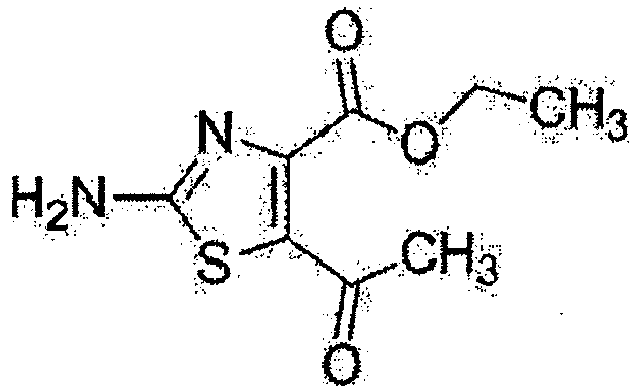
- 2,4-dioxopentanoic acid ethyl ester (7.85 g) was treated by a method similar to that in Reference Example 698 to give the title compound (5.00 g).
MS (ESI) m/z; 215 [M+H]+ -

- To a mixture of the compound (4.40 g) obtained in Reference Example 698 in ethanol (20 mL) was added 2.5 mol/L aqueous sodium hydroxide solution (20 mL), and the reaction mixture was stirred at room temperature for 2 hr. Ethanol was evaporated under reduced pressure, water was added, and the mixture was acidified with 1.0 mol/L hydrochloric acid. The precipitated solid was collected by filtration, and washed with water to give the title compound (3.55 g).
MS (ESI) m/z; 201 [M+H]+ -

- The compound (2.10 g) obtained in Reference Example 699 was treated by a method similar to that in Reference Example 701 to give the title compound (1.50 g).
MS (ESI) m/z; 213 [M+H]+ -

- The compound (3.65 g) obtained in Reference Example 700 was treated by a method similar to that in Reference Example 701 to give the title compound (2.48 g).
MS (ESI) m/z; 187 [M+H]+ -
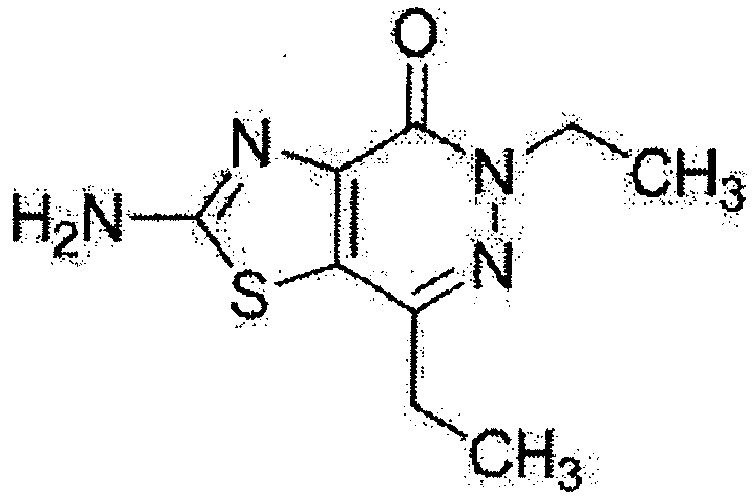
- To a mixture of the compound (1.00 g) obtained in Reference Example 701 in toluene (10 mL)/N-methylpyrrolidone (4.0 mL) was added ethylhydrazine (0.75 g), and the reaction mixture was stirred with heating at 120°C for 3 hr. The reaction mixture was allowed to cool, toluene was evaporated under reduced pressure, and water was added. The precipitated solid was collected by filtration, washed with water and diisopropyl ether, and dried to give the title compound (1.05 g).
MS (ESI) m/z; 225 [M+H]+ -

- The compound (1.00 g) obtained in Reference Example 701 was treated by a method similar to that in Reference Example 704 to give the title compound (940 mg).
MS (ESI) m/z; 281 [M+H]+ -

- The compound (1.50 g) obtained in Reference Example 702 was treated by a method similar to that in Reference Example 704 to give the title compound (1.15 g).
MS (ESI) m/z; 237 [M+H]+ -

- The compound (2.48 g) obtained in Reference Example 703 was treated by a method similar to that in Reference Example 704 to give the title compound (1.55 g).
MS (ESI) m/z; 211 [M+H]+ -

- The compound (1.20 g) obtained in Reference Example 703 was treated by a method similar to that in Reference Example 704 to give the title compound (1.19 g).
MS (ESI) m/z; 265 [M+H]+ -

- tert-Butyl nitrite (690 mg) was added dropwise to a mixture of copper(II) bromide (1.25 g) in acetonitrile (16 mL) at room temperature, and the compound (1.00 g) obtained in Reference Example 704 was added a little by little at 50°C. The reaction mixture was stirred with heating at 50°C for 30 min, and concentrated under reduced pressure. Water and 1.0 mol/L hydrochloric acid were added, and the mixture was extracted twice with chloroform. The combined organic layer was washed with saturated brine, dried over anhydrous sodium sulfate, filtered and concentrated. The residue was purified by silica gel column chromatography (solvent; hexane/ethyl acetate=80/20 - 50/50) to give the title compound (1.15 g). MS (ESI) m/z; 288, 290 [M+H]+
-

- The compound (940 mg) obtained in Reference Example 705 was treated by a method similar to that in Reference Example 709 to give the title compound (830 mg).
MS (ESI) m/z; 344, 346 [M+H]+ -

- The compound (1.15 g) obtained in Reference Example 706 was treated by a method similar to that in Reference Example 709 to give the title compound (1.12 g).
MS (ESI) m/z; 300, 302 [M+H]+ -

- The compound (1.55 g) obtained in Reference Example 707 was treated by a method similar to that in Reference Example 709 to give the title compound (1.69 g).
MS (ESI) m/z; 274, 276 [M+H]+ -

- The compound (1.18 g) obtained in Reference Example 708 was treated by a method similar to that in Reference Example 709 to give the title compound (1.17 g).
MS (ESI) m/z; 328, 330 [M+H]+ -

- To a solution (20 mL) of 2-chloro-3-nitro-5-trifluoromethylpyridine (5.53 g) in methanol was added 28% sodium methoxide methanol solution (5.18 g) at 5°C, and the reaction mixture was stirred for 10 min. The reaction mixture was added to ice water, and resultant solid was filtered and dried to give 2-methoxy-3-nitro-5-trifluoromethylpyridine (5.13 g). To a solution (30 mL) of the obtained 2-methoxy-3-nitro-5-trifluoromethylpyridine (4.00 g) in methanol was added 10% palladium carbon (400 mg), and the mixture was stirred at under a hydrogen atmosphere at room temperature for 1.5 hr. The reaction mixture was filtered through diatomaceous earth, and the filtrate was evaporated under reduced pressure. The residue was purified by silica gel column chromatography (solvent; hexane/ethyl acetate=0/100) to give the title compound (3.25 g).
MS (ESI) m/z; 193 [M+H]+ -

- To a solution (32 mL) of the compound (3.25 g) obtained in Reference Example 714 in DMF was added a solution (15 mL) of N-bromosuccinimide (3.31 g) in DMF at -40°C, and the mixture was stirred at -25°C for 2 hr. Aqueous sodium thiosulfate solution was added, and the mixture was stirred at room temperature for 10 min and extracted twice with ethyl acetate. The organic layer was dried over anhydrous sodium sulfate, filtered and concentrated. The residue was purified by silica gel column chromatography (solvent; hexane/ethyl acetate=95/5 - 60/40) to give the title compound (4.40 g).
MS (ESI) m/z; 271, 273 [M+H]+ -

- 3-Amino-2-methoxypyridine (9.85 g) was treated by a method similar to that in Reference Example 715 to give the title compound (12.6 g).
MS (ESI) m/z; 203, 205 [M+H]+ -

- To a solution (40 mL) of 3-amino-2-methoxypyridine (5.00 g) in DMF was added a solution (20 mL) of N-iodosuccinimide (9.97 g) in DMF at 0°C. The reaction mixture was stirred at 0°C for 2.5 hr, a solution (5.0 mL) of N-iodosuccinimide (1.81 g) in DMF was added, and the reaction mixture was stirred at room temperature for 14 hr. Aqueous sodium thiosulfate solution was added, and the mixture was stirred at room temperature for 10 min and extracted twice with ethyl acetate. The organic layer was dried over anhydrous sodium sulfate, filtered and concentrated. The residue was purified by NH silica gel column chromatography (solvent; hexane/ethyl acetate=90/10 - 70/30) to give the title compound (2.54 g).
MS (ESI) m/z; 251 [M+H]+ -

- To a solution (32 mL) of the compound (4.40 g) obtained in Reference Example 715 in DMF was added a solution (13 mL) of N-chlorosuccinimide (2.60 g) in DMF at 0°C, and the reaction mixture was stirred for 2 hr. Aqueous sodium thiosulfate solution was added, and the mixture was stirred at room temperature for 10 min and extracted twice with ethyl acetate. The organic layer was dried over anhydrous sodium sulfate, filtered and concentrated. The residue was purified by silica gel column chromatography (solvent; hexane/ethyl acetate=95/5 - 60/40) to give the title compound (4.62 g).
MS (ESI) m/z; 305, 307, 309 [M+H]+ -

- The compound (12.6 g) obtained in Reference Example 716 was treated by a method similar to that in Reference Example 718 to give the title compound (9.60 g).
MS (ESI) m/z; 237, 239 [M+H]+ -

- The compound (2.54 g) obtained in Reference Example 717 was treated by a method similar to that in Reference Example 718 to give the title compound (1.75 g).
MS (ESI) m/z; 285 [M+H]+ -

-

- To a solution (39 mL) of the compound (1.50 g) obtained in Reference Example 718 in 1,4-dioxane were added [1,1-bis(diphenylphosphino)ferrocene]dichloropalladium(II) methylene chloride adduct (80 mg) and diisopropylzinc 1.0 mol/L toluene solution (5.89 mL), and the reaction mixture was stirred with heating at 80°C for 15 hr. The reaction mixture was cooled to room temperature, aqueous ammonium chloride solution was added, and the mixture was extracted twice with ethyl acetate. The organic layer was dried over anhydrous sodium sulfate, filtered and concentrated. The residue was purified by silica gel column chromatography (solvent; hexane/ethyl acetate=95/5 - 85/15) to give Reference Example 721 (3-amino-4-chloro-2-methoxy-5-trifluoromethylpyridine, 382 mg) and Reference Example 722 (3-amino-4-chloro-2-methoxy-6-(propan-2-yl)-5-trifluoromethylpyridine, 285 mg).
Reference Example 721 (ESI) m/z; 227, 229 [M+H]+
Reference Example 722 (ESI) m/z; 269, 271 [M+H]+ -

- The compound (1.50 g) obtained in Reference Example 719 was treated by a method similar to that in Reference Example 722 to give the title compound (705 mg).
MS (ESI) m/z; 201, 203 [M+H]+ -

- To a solution (5.98 mL) of the compound (710 mg) obtained in Reference Example 719 in toluene were added [1,1-bis(diphenylphosphino)ferrocene]dichloropalladium(II) methylene chloride adduct (122 mg), a solution (2.99 mL) of cyclopropylboronic acid (308 mg) in ethanol and 2.0 mol/L aqueous sodium carbonate solution (5.98 mL), and the reaction mixture was stirred with heating at 100°C for 2 hr. The reaction mixture was cooled to room temperature, water was added, and the mixture was extracted twice with ethyl acetate. The organic layer was dried over anhydrous sodium sulfate, filtered and concentrated. The residue was purified by silica gel column chromatography (solvent; hexane/ethyl acetate=100/0 - 80/20) to give the title compound (338 mg).
MS (ESI) m/z; 199, 201 [M+H]+ -
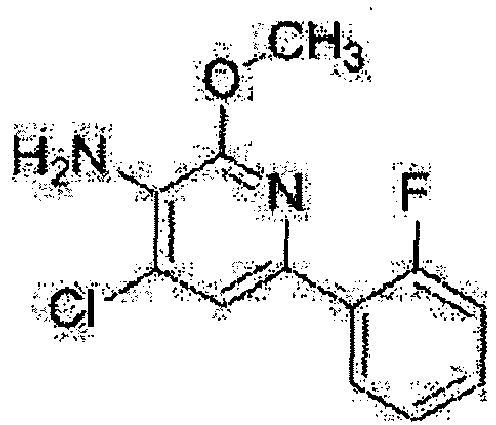
- The compound (500 mg) obtained in Reference Example 720 was treated by a method similar to that in Reference Example 724 to give the title compound (416 mg).
MS (ESI) m/z; 253 [M+H]+ -

- A solution (2.0 mL) of the compound (380 mg) obtained in Reference Example 721 and potassium ethyl xanthogenate (807 mg) in DMF was stirred with heating at 130°C for 3 hr. The reaction mixture was cooled to room temperature, acetic acid (0.48 mL) and water were added, and the mixture was extracted twice with ethyl acetate. The organic layer was dried over anhydrous sodium sulfate, filtered and concentrated. To the residue was added 25% hydrogen bromide-acetic acid solution (3.0 mL), and the reaction mixture was stirred with heating at 70°C for 1 hr. The reaction mixture was cooled to 0°C, water was added, and the precipitated solid was collected by filtration and dried to give the title compound (249 mg).
MS (ESI) m/z; 253 [M+H]+ -

- The compound (282 mg) obtained in Reference Example 722 was treated by a method similar to that in Reference Example 726 to give the title compound (250 mg).
MS (ESI) m/z; 295 [M+H]+ -

- The compound (700 mg) obtained in Reference Example 723 was treated by a method similar to that in Reference Example 726 to give the title compound (631 mg).
MS (ESI) m/z; 227 [M+H]+ -

- The compound (338 mg) obtained in Reference Example 724 was treated by a method similar to that in Reference Example 726 to give the title compound (293 mg).
MS (ESI) m/z; 225 [M+H]+ -

- The compound (410 mg) obtained in Reference Example 725 was treated by a method similar to that in Reference Example 726 to give the title compound (378 mg).
MS (ESI) m/z; 279 [M+H]+ -

- To a solution (4.3 mL) of the compound (246 mg) obtained in Reference Example 726 in DMF were added sodium hydrogen carbonate (98 mg) and methyl iodide (67 µL) at 0°C. The reaction mixture was stirred at room temperature for 3 hr, water (20 mL) was added, and the mixture was extracted twice with ethyl acetate. The organic layer was dried over anhydrous sodium sulfate, filtered and concentrated. The residue was purified by silica gel column chromatography (solvent; chloroform/methanol=100/0 - 90/10) to give the title compound (53.0 mg).
MS (ESI) m/z; 267 [M+H]+ -

- The compound (248 mg) obtained in Reference Example 727 was treated by a method similar to that in Reference Example 731 to give the title compound (88.0 mg).
MS (ESI) m/z; 309 [M+H]+ -
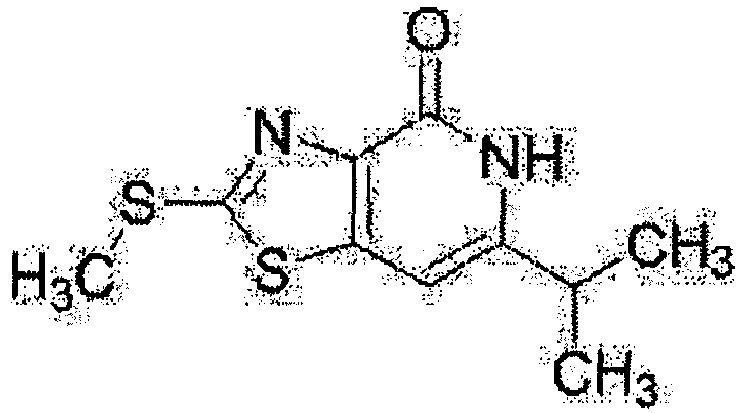
- The compound (628 mg) obtained in Reference Example 728 was treated by a method similar to that in Reference Example 731 to give the title compound (398 mg).
MS (ESI) m/z; 241 [M+H]+ -
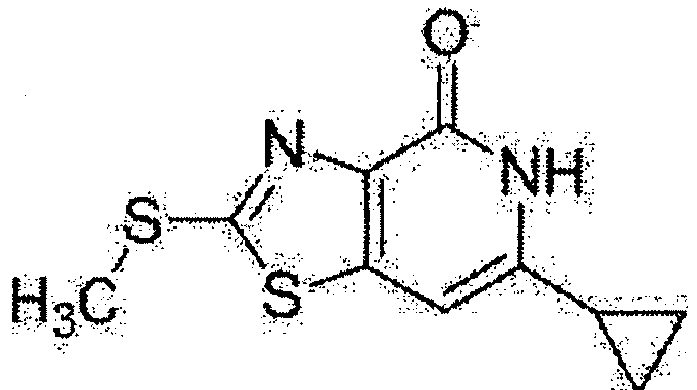
- The compound (290 mg) obtained in Reference Example 729 was treated by a method similar to that in Reference Example 731 to give the title compound (295 mg).
MS (ESI) m/z; 239 [M+H]+ -

- The compound (375 mg) obtained in Reference Example 730 was treated by a method similar to that in Reference Example 731 to give the title compound (337 mg).
MS (ESI) m/z; 293 [M+H]+ -

- To a solution (400 µL) of the compound (53.0 mg) obtained in Reference Example 731 in trifluoroacetic acid was added 30% aqueous hydrogen peroxide solution (80 µL) under ice-cooling. The reaction mixture was stirred at room temperature for 1 hr, water (20 mL) was added, and the mixture was extracted twice with chloroform. The organic layer was dried over anhydrous sodium sulfate, filtered and concentrated. The residue was purified by silica gel column chromatography (solvent; hexane/ethyl acetate=50/50 - 0/100) to give the title compound (51.4 mg).
MS (ESI) m/z; 299 [M+H]+ -

- The compound (88.0 mg) obtained in Reference Example 732 was treated by a method similar to that in Reference Example 736 to give the title compound (78.4 mg).
MS (ESI) m/z; 341 [M+H]+ -

- The compound (297 mg) obtained in Reference Example 733 was treated by a method similar to that in Reference Example 736 to give the title compound (314 mg).
MS (ESI) m/z; 273 [M+H]+ -

- The compound (292 mg) obtained in Reference Example 734 was treated by a method similar to that in Reference Example 736 to give the title compound (250 mg).
MS (ESI) m/z; 271 [M+H]+ -
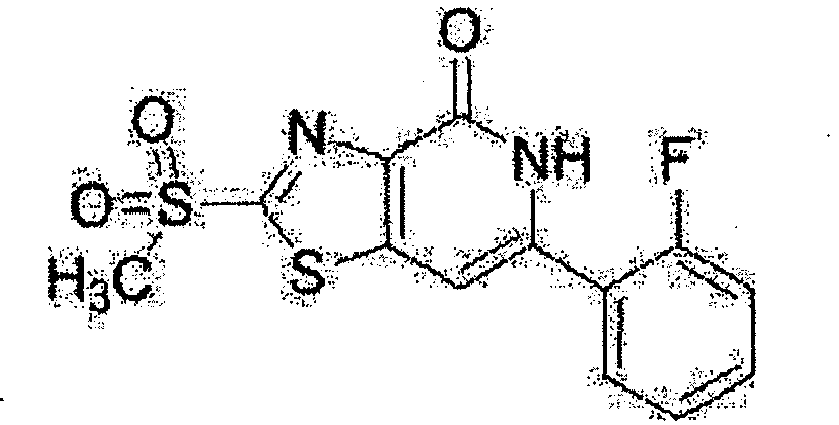
- The compound (150 mg) obtained in Reference Example 735 was treated by a method similar to that in Reference Example 736 to give the title compound (165 mg).
MS (ESI) m/z; 325 [M+H]+ -

- The compound (4.00 g) obtained in Reference Example 719 was treated by a method similar to that in Reference Example 724 to give the title compound (3.35 g).
MS (ESI) m/z; 199, 201 [M+H]+ -

- A solution (20 mL) of the compound (3.35 g) obtained in Reference Example 741 and potassium ethyl xanthogenate (8.11 g) in DMF was stirred with heating at 130°C for 4 hr. The reaction mixture was cooled to room temperature, acetic acid (7.0 mL) and water were added, and the precipitated solid was collected by filtration and dried. To the obtained solid was added 25% hydrogen bromide-acetic acid solution (25 mL), and the reaction mixture was stirred with heating at 70°C for 1 hr. The reaction mixture was cooled to 0°C, water was added, and the precipitated solid was collected by filtration and dried. To a solution (85 mL) of the obtained solid in DMF were added sodium hydrogen carbonate (1.70 g) and methyl iodide (1.05 mL) at 0°C. The reaction mixture was stirred at room temperature for 3 hr, and added to aqueous ammonium chloride solution. The precipitated solid was purified by silica gel column chromatography (solvent; ethyl acetate/methanol=100/0 - 90/10) to give the title compound (302 mg).
MS (ESI) m/z; 239 [M+H]+ -

- To a mixed solution of the compound (150 mg) obtained in Reference Example 742 in 1,4-dioxane-water (5.0 mL-2.5 mL) was added methansulfonic acid (2.5 mL), and the reaction mixture was stirred with heating at 80°C for 2 days. The reaction mixture was cooled to room temperature, extracted twice with chloroform, and the organic layer was dried over anhydrous sodium sulfate, filtered and concentrated. The residue was purified by silica gel column chromatography (solvent; ethyl acetate/methanol=100/0 - 93/7) to give the title compound (28 mg) .
MS (ESI) m/z; 257 [M+H]+ -

- To a solution (7.0 mL) of the compound (231 mg) obtained in Reference Example 743 in DMF were added potassium carbonate (249 mg) and 4-methoxybenzyl chloride (147 µL), and the reaction mixture was stirred with heating at 80°C for 2 hr. The reaction mixture was cooled to 0°C, water was added, and the mixture was extracted twice with ethyl acetate. The organic layer was dried over anhydrous magnesium sulfate, filtered and concentrated. The residue was purified by NH silica gel column chromatography (solvent; hexane/ethyl acetate=95/5 - 60/40) to give the title compound (338 mg).
MS (ESI) m/z; 377 [M+H]+ -

- To a solution (15 mL) of the compound (335 mg) obtained in Reference Example 744 in methylene chloride was added a solution (5.0 mL) of N,N-diethylaminosulfur trifluoride (175 µL) in methylene chloride at -25°C, and the reaction mixture was stirred at -20°C for 1 hr. Saturated aqueous sodium hydrogen carbonate solution was added, and the mixture was extracted twice with chloroform. The organic layer was dried over anhydrous magnesium sulfate, filtered and concentrated. The residue was purified by silica gel column chromatography (solvent; hexane/ethyl acetate=100/0 - 85/15) to give the title compound (305 mg).
MS (ESI) m/z; 379 [M+H]+ -
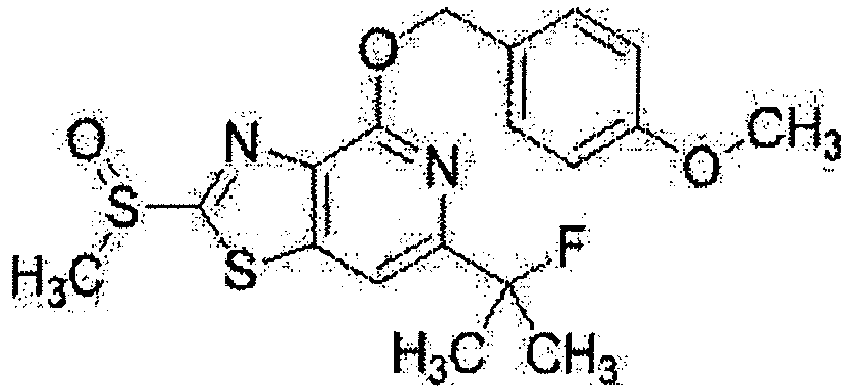
- To a solution (11 mL) of the compound (311 mg) obtained in Reference Example 745 in methylene chloride was added mCPBA (69-75%, 226 mg) under ice-cooling. The reaction mixture was stirred under ice-cooling for 1.5 hr, to the reaction mixture were added aqueous sodium thiosulfate solution and saturated aqueous sodium hydrogen carbonate solution, and the mixture was extracted twice with chloroform. The organic layer was dried over anhydrous sodium sulfate, filtered and concentrated. To the obtained residue was added hexane-diethyl ether mixed solvent (1:1), and the solid was collected by filtration, and dried to give the title compound (320 mg).
MS (ESI) m/z; 395 [M+H]+ -

- To a solution (3.0 mL) of the compound (124 mg) obtained in Reference Example 746 in DMF were added (D)-proline (54 mg) and cesium carbonate (256 mg), and the reaction mixture was heated at 70°C for 1.5 hr. The reaction mixture was cooled to room temperature, acidified with 1.0 mol/L hydrochloric acid, and extracted twice with chloroform. The organic layer was dried over anhydrous sodium sulfate, filtered and concentrated. To the obtained residue were added N,N-diisopropylethylamine (82 µL), benzylamine (52 µL), EDC hydrochloride (90 mg) and HOBt monohydrate (72 mg), and the reaction mixture was stirred at room temperature for 3 hr. Water was added, and the mixture was extracted twice with ethyl acetate. The organic layer was washed with saturated brine, dried over anhydrous sodium sulfate, filtered and concentrated. The residue was purified by silica gel column chromatography (solvent; hexane/ethyl acetate=85/15 - 20/80) to give the title compound (133 mg).
MS (ESI) m/z; 535 [M+H]+ -

- The compound (2.00 g) obtained in Reference Example 719 was treated by a method similar to that in Reference Example 726 to give the title compound (1.20 g).
MS (ESI) m/z; 263, 265 [M+H]+ -

- The compound (1.20 g) obtained in Reference Example 748 was treated by a method similar to that in Reference Example 731 to give the title compound (959 mg).
MS (ESI) m/z; 277, 279 [M+H]+ -

- To a solution (19.4 mL) of the compound (955 mg) obtained in Reference Example 749 in DMF were added potassium carbonate (952 mg) and 4-methoxybenzyl chloride (563 µL), and the reaction mixture was stirred with heating at 70°C for 2 hr. The reaction mixture was cooled to 0°C, water was added, and the mixture was extracted twice with ethyl acetate. The organic layer was dried over anhydrous magnesium sulfate, filtered and concentrated. The residue was purified by NH silica gel column chromatography (solvent; hexane/ethyl acetate=95/5 - 40/60) to give the title compound (299 mg).
MS (ESI) m/z; 397, 399 [M+H]+ -

- To a solution (10 mL) of the compound (195 mg) obtained in Reference Example 750 in methylene chloride was added mCPBA (69-75%, 120 mg) under ice-cooling. The reaction mixture was stirred under ice-cooling for 1 hr, to the reaction mixture were added aqueous sodium thiosulfate solution and saturated aqueous sodium hydrogen carbonate solution, and the mixture was extracted three times with chloroform. The organic layer was dried over anhydrous sodium sulfate, filtered and concentrated to give the title compound (204 mg).
MS (ESI) m/z; 413, 415 [M+H]+ -
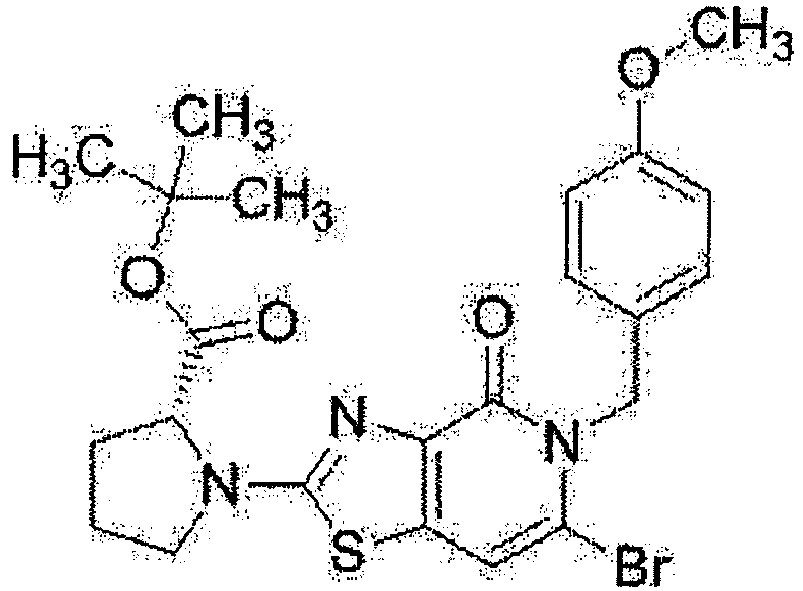
- A mixed solution of the compound (150 mg) obtained in Reference Example 751, D-proline-tert-butyl ester (124 mg) and N,N-diisopropylethylamine (1.26 mL) was stirred with heating at 140°C for 9 hr. D-proline-tert-butyl ester (248 mg) and N-methylpyrrolidone (200 µL) were added, and the reaction mixture was stirred with heating at 140°C for 4 hr. The reaction mixture was cooled to room temperature, acidified with 1.0 mol/L hydrochloric acid, and extracted twice with ethyl acetate. The organic layer was dried over anhydrous sodium sulfate, filtered and concentrated and the residue was purified by silica gel column chromatography (solvent; hexane/ethyl acetate=90/10 - 40/60). To the obtained product was added hexane-diethyl ether mixed solvent (1:1), and the solid was collected by filtration and dried to give the title compound (86.6 mg) .
MS (ESI) m/z; 520, 522 [M+H]+ -

- A mixture of 4-chloro-3-nitro-6-trifluoromethylpyridin-2-ol (1.50 g) synthesized by the method described in
US 2007/197478 A1 , ammonium chloride (397 mg) and iron powder (1.38 g) in methanol (20 mL), THF (20 mL) and water (10 mL) was stirred at 70°C for 2.5 hr. The reaction mixture was cooled to room temperature, filtered through diatomaceous earth, and the filtrate was concentrated. The residue was diluted with ethyl acetate, and filtered again through diatomaceous earth. The filtrate was washed with water and saturated brine, and the organic layer was dried over anhydrous sodium sulfate, filtered and concentrated. To the obtained solid was added hexane/ethyl acetate=2/1, and the solid was collected by filtration to give the title compound (1.21 g).
MS (ESI) m/z; 213 [M+H]+ -

- The compound (700 mg) obtained in Reference Example 753 was treated by a method similar to that in Reference Example 726 to give the title compound (716 mg).
MS (ESI) m/z; 253 [M+H]+ -

- To a mixture of the compound (600 mg) obtained in Reference Example 754 and sodium hydrogen carbonate (240 mg) in DMF (8 mL)/THF (4 mL) was added dropwise iodomethane (163 µL) at -10°C. The reaction mixture was stirred at -10°C for 30 min and stirred at room temperature for 1.5 hr. The reaction mixture was acidified with 1.0 mol/L hydrochloric acid, and water was added. The precipitated solid was collected by filtration, washed with water, and dissolved in ethyl acetate/methanol=5/1. The solution was dried over anhydrous sodium sulfate, filtered and concentrated under reduced pressure. The obtained residue was purified by NH silica gel column chromatography (solvent; hexane/ethyl acetate=60/40 - 0/100) to give the title compound (24 mg).
MS (ESI) m/z; 266 [M+H]+ -

- A mixture (5.3 mL) of the compound (530 mg) obtained in Reference Example 755 and N-chlorosuccinimide (372 mg) in DMF was stirred with heating at 70°C for 2 hr. N-chlorosuccinimide (53 mg) was added, and the mixture was further stirred with heating for 1 hr. The reaction mixture was ice-cooled, water was added, and the mixture was extracted twice with ethyl acetate. The combined organic layer was washed with saturated brine, dried over anhydrous sodium sulfate, filtered and concentrated under reduced pressure. The obtained residue was purified by silica gel column chromatography (solvent; hexane/ethyl acetate=90/10 - 40/60) to give the title compound (197 mg).
MS (ESI) m/z; 301 [M+H]+ -

- To a solution (5.5 mL) of the compound (550 mg) obtained in Reference Example 755 in DMF was added N-iodosuccinimide (511 mg). The reaction mixture was stirred at room temperature for 1 hr and stirred with heating at 70°C for 2 hr. N-iodosuccinimide (139 mg) was added, and the mixture was further stirred with heating for 2 hr. The reaction mixture was ice-cooled, and diluted with water. The precipitated solid was collected by filtration, washed with water, and dissolved in ethyl acetate/methanol=5/1. The obtained solution was dried over anhydrous sodium sulfate, filtered and concentrated under reduced pressure. To the obtained solid were added hexane/diethyl ether=3/1, and the solid was collected by filtration to give the title compound (725 mg).
MS (ESI) m/z; 393 [M+H]+ -

- (R)-N-(tert-butoxycarbonyl)-piperidine-2-carboxylic acid (7.63 g) was treated by a method similar to that in Reference Example 341 to give the title compound (6.74 g).
MS (ESI) m/z; 219 [M+H]+ -

- (R)-N-(tert-butoxycarbonyl)-morpholine-3-carboxylic acid (581 mg) was treated by a method similar to that in Reference Example 341 to give the title compound (430 mg).
MS (ESI) m/z; 221 [M+H]+ -

- N-(tert-butoxycarbonyl)-D-proline (5.00 g) was treated by a method similar to that in Reference Example 341 to give the title compound (5.04 g).
MS (ESI) m/z; 206 [M+H]+ -

- N-(tert-butoxycarbonyl)-D-proline (3.00 g) was treated by a method similar to that in Reference Example 341 to give the title compound (3.21 g).
MS (ESI) m/z; 231 [M+H]+ -

- N-(tert-butoxycarbonyl)-D-proline (6.82 g) was treated by a method similar to that in Reference Example 341 to give the title compound (8.60 g).
MS (ESI) m/z; 233 [M+H]+ -

- 2-Amino-5-bromo[1,3,4]thiadiazole (10 g) and 3-oxo-hexanoic acid ethyl ester (10.6 g) were added to polyphosphoric acid (60 g), and the reaction mixture was stirred with heating at 100°C for 5 hr. After confirmation of the completion of the reaction, the reaction mixture was cooled to room temperature, water was added, and the mixture was dissolved, and extracted twice with chloroform. The organic layer was washed once with water, dried over anhydrous magnesium sulfate, filtered and concentrated. The residue was purified by silica gel column chromatography (solvent; hexane/ethyl acetate=80/20 - 50/50). To the obtained product was added diisopropyl ether, and the solid was collected by filtration to give the title compound (6.2 g).
MS (ESI) m/z; 274, 276 [M+H]+ -

- 2-Amino-5-bromo[1,3,4]thiadiazole (27.6 g) was treated by a method similar to that in Reference Example 763 to give the title compound (24.6 g).
MS (ESI) m/z; 246, 248 [M+H]+ -
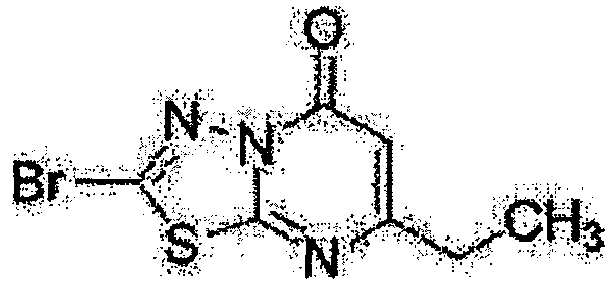
- 2-Amino-5-bromo[1,3,4]thiadiazole (3.60 g) was treated by a method similar to that in Reference Example 763 to give the title compound (2.60 g).
MS (ESI) m/z; 260, 262 [M+H]+ -

- 2-Amino-5-bromo[1,3,4]thiadiazole (3.60 g) was treated by a method similar to that in Reference Example 763 to give the title compound (410 mg).
MS (ESI) m/z; 308, 310 [M+H]+ -

- 2-Amino-5-bromo[1,3,4]thiadiazole (1000 mg) was treated by a method similar to that in Reference Example 763 to give the title compound (540 mg).
MS (ESI) m/z; 260, 262 [M+H]+ -

- 2-Amino-5-bromo[1,3,4]thiadiazole (5.00 g) was treated by a method similar to that in Reference Example 763 to give the title compound (2.69 g).
MS (ESI) m/z; 288, 290 [M+H]+ -

- 2-Amino-5-bromo[1,3,4]thiadiazole (1.00 g) was treated by a method similar to that in Reference Example 763 to give the title compound (369 mg).
MS (ESI) m/z; 322, 324 [M+H]+ -

- 2-Amino-5-bromo[1,3,4]thiadiazole (4.70 g) was treated by a method similar to that in Reference Example 763 to give the title compound (5.70 g).
MS (ESI) m/z; 286, 288 [M+H]+ -
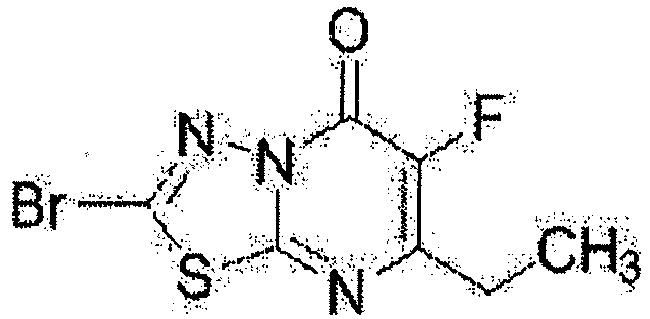
- To a solution (56 mL) of 3-oxo-pentanoic acid methyl ester (3.67 g) in acetonitrile was added 1-chloromethyl-4-fluoro-1,4-diazoniabicyclo[2.2.2]octane bistetrafluoroborate (10.0 g) at room temperature, and the reaction mixture was stirred with heating at 80°C for 8 hr. The reaction mixture was cooled to room temperature, diethyl ether was added, and the mixture was washed twice with water. The organic layer was dried over anhydrous sodium sulfate, filtered and concentrated to give 2-fluoro-3-oxo-pentanoic acid methyl ester (3.24 g). The obtained 2-fluoro-3-oxo-pentanoic acid methyl ester (3.24 g) and 2-amino-5-bromo[1,3,4]thiadiazole (3.28 g) were added to polyphosphoric acid (18.4 g), and the reaction mixture was stirred with heating at 100°C for 5 hr. The reaction mixture was cooled to room temperature, water was added, and the mixture was extracted twice with chloroform. The organic layer was washed once with water, dried over anhydrous sodium sulfate, filtered and concentrated. The residue was purified by silica gel column chromatography (solvent; hexane/ethyl acetate=80/20 - 50/50) to give the title compound (1.14 g).
MS (ESI) m/z; 278, 280 [M+H]+ -

- 2-Amino-5-bromo[1,3,4]thiadiazole (4.00 g) was treated by a method similar to that in Reference Example 771 to give the title compound (1.10 g).
MS (ESI) m/z; 292, 294 [M+H]+ -

- 2-Amino-5-bromo[1,3,4]thiadiazole (10 g) and 4-methyl-3-oxopentanoic acid methyl ester (9.6 g) were added to concentrated sulfuric acid (60 mL), and the reaction mixture was stirred at room temperature for 2 hr and stirred with heating at 60°C for 4 hr. After confirmation of the completion of the reaction, the reaction mixture was cooled to room temperature, diluted with water, and neutralized with 1.0 mol/L aqueous sodium hydroxide solution. The mixture was extracted twice with chloroform, and the organic layer was washed once with water, dried over anhydrous sodium sulfate, filtered and concentrated. The residue was purified by silica gel column chromatography (solvent; hexane/ethyl acetate=80/20 - 50/50) to give the title compound (10.9 g).
MS (ESI) m/z; 274, 276 [M+H]+ -

- 2-Amino-5-bromo[1,3,4]thiadiazole (3.60 g) was treated by a method similar to that in Reference Example 773 to give the title compound (757 mg).
MS (ESI) m/z; 300, 302 [M+H]+ -

- To a solution (30 mL) of 2-amino-5-bromo[1,3,4]thiadiazole (3.0 g) in acetic acid was added anthranilic acid (1.7 g) at room temperature, and the reaction mixture was heated under reflux for 5 hr. After confirmation of the completion of the reaction, the reaction mixture was cooled to room temperature, and the resultant solid was washed with diisopropyl ether, and collected by filtration. The obtained solid was dissolved in chloroform, and the solution was washed once with saturated aqueous sodium hydrogen carbonate solution. The organic layer was concentrated under reduced pressure, to the resultant solid was added ethyl acetate, and the insoluble material was filtered off. The filtrate was concentrated, and the residue was purified by silica gel column chromatography (solvent; hexane/ethyl acetate=80/20 - 50/50) to give the title compound (0.6 g). MS (ESI) m/z; 282, 284 [M+H]+
-

- A mixture of 2,5-dibromo[1,3,4]thiadiazole (2.0 g) and 2-amino-5-methylthiophene-3-carboxylic acid ethyl ester (1.5 g) was stirred with heating at 160°C for 30 min. After confirmation of the completion of the reaction, the reaction mixture was cooled to room temperature, dissolved in chloroform (200 mL), washed once with 1.0 mol/L hydrochloric acid (30 mL), and washed once with water. The organic layer was dried over anhydrous magnesium sulfate, filtered and concentrated and the residue was purified by silica gel column chromatography (solvent; chloroform/methanol=100/0 - 90/10). To the obtained product was added diisopropyl ether, and the solid was collected by filtration to give the title compound (0.9 g).
MS (ESI) m/z; 302, 304 [M+H]+ -

- A mixture of 2-amino-5-bromo[1,3,4]thiadiazole (2.8 g) and 2-chloropyridine-3-carboxylic acid (2.6 g) was stirred with heating at 200°C for 1 hr. After confirmation of the completion of the reaction, the reaction mixture was cooled to room temperature, dissolved in chloroform (200 mL), washed once with saturated aqueous sodium hydrogen carbonate solution, and washed once with water. The organic layer was dried over anhydrous magnesium sulfate, filtered and concentrated and the residue was purified by silica gel column chromatography (solvent; chloroform/methanol=100/0 - 90/10). Ethyl acetate was added to the obtained product, and the solid was collected by filtration to give the title compound (0.16 g).
MS (ESI) m/z; 283, 285 [M+H]+ -

- To a solution (22 mL) of the compound (1.7 g) obtained in Reference Example 765 in acetonitrile was added N-chlorosuccinimide (850 mg) at room temperature, and the reaction mixture was stirred with heating at 60°C for 7 hr. After confirmation of the completion of the reaction, the reaction mixture was cooled to room temperature, chloroform was added, and the mixture was washed twice with water. The organic layer was dried over anhydrous sodium sulfate, filtered and concentrated. The residue was purified by silica gel column chromatography (solvent; chloroform) to give the title compound (1.2 g).
MS (ESI) m/z; 294, 296 [M+H]+ -

- The compound (500 mg) obtained in Reference Example 764 was treated by a method similar to that in Reference Example 778 to give the title compound (516 mg).
MS (ESI) m/z; 280, 282 [M+H]+ -

- The compound (1350 mg) obtained in Reference Example 773 was treated by a method similar to that in Reference Example 778 to give the title compound (574 mg).
MS (ESI) m/z; 308, 310 [M+H]+ -

- To a solution (30 mL) of ethyl 2-pentynoate (10.0 g) and ethyl acetoacetate (10 mL) in ethanol was added dropwise 20% sodium ethoxide ethanol solution (6.1 mL) at 80°C over 1 hr, and the reaction mixture was stirred at the same temperature for 6 hr. The reaction mixture was cooled to room temperature, diethyl ether was added, and the mixture was washed once with 1.0 mol/L hydrochloric acid and once with water. The organic layer was dried over anhydrous magnesium sulfate, filtered and concentrated. The residue was purified by silica gel column chromatography (solvent; hexane/ethyl acetate=90/10 - 80/20) to give the title compound (12.8 g, cis:trans=>4:1).
MS (ESI) m/z; 215 [M+H]+ -

- To the compound (12.8 g) obtained in Reference Example 781 was added aqueous sodium hydroxide solution (11.9 g/67 mL), and the reaction mixture was stirred with heating at 80°C for 4 hr. The reaction mixture was cooled to room temperature, and washed once with diethyl ether. The aqueous layer was acidified with concentrated hydrochloric acid (25 mL), and extracted 3 times with diethyl ether. The organic layer was dried over anhydrous magnesium sulfate, filtered and concentrated. To the residue was added acetic anhydride (10.6 mL), and the reaction mixture was stirred with heating at 80°C for 3 hr, acetic anhydride (3.0 mL) were added, and the mixture was further stirred with heating for 2 hr. The reaction mixture was cooled to room temperature, and the solvent was evaporated under reduced pressure. The residue was evaporated under reduced pressure at 12 mmHg (160-170°C) to give the title compound (6.5 g).
MS (ESI) m/z; 141 [M+H]+ -

- To a solution (10 mL) of methyl dithiocarbazate (1.3 g) in THF was added the compound (1.5 g) obtained in Reference Example 782, and the reaction mixture was stirred at room temperature for 3 hr. The solvent was evaporated under reduced pressure, 85% phosphoric acid (10 mL) was added, and the mixture was stirred at 120°C for 2 hr. After confirmation of the completion of the reaction, chloroform was added, and the mixture was washed once with water. The organic layer was dried over anhydrous sodium sulfate, filtered and concentrated. The residue was purified by silica gel column chromatography (solvent; chloroform/methanol=100/0 - 90/10) and the solvent was evaporated under reduced pressure to give the title compound (2.3 g).
MS (ESI) m/z; 227 [M+H]+ -

- Methyl dithiocarbazate (970 mg) was treated by a method similar to that in Reference Example 783 to give the title compound (1115 mg).
MS (ESI) m/z; 213 [M+H]+ -

- To a solution (20 mL) of the compound (1.0 g) obtained in Reference Example 783 in methylene chloride was added mCPBA (69-75%, 3.52 g) at 0°C, and the reaction mixture was stirred at room temperature for 4 hr. mCPBA (69-75%, 0.8 g) was added, and the reaction mixture was stirred at room temperature for 4 hr. Aqueous sodium thiosulfate solution and chloroform were added, and the mixture was washed once with water, and once with saturated aqueous sodium hydrogen carbonate solution. The organic layer was dried over anhydrous sodium sulfate, filtered and concentrated. The residue was purified by silica gel column chromatography (solvent; chloroform/methanol=100/0 - 95/5), and the solvent was evaporated under reduced pressure to give the title compound (0.56 g).
MS (ESI) m/z; 259 [M+H]+ -

- The compound (550 mg) obtained in Reference Example 784 was treated by a method similar to that in Reference Example 785 to give the title compound (300 mg).
MS (ESI) m/z; 245 [M+H]+ -

- To a solution (5 mL) of 3-amino-6-bromopyridine-2-carboxylic acid (280 mg) synthesized by the method described in
WO 2008/106692 A1 andWO 2005/97805 A1
MS (ESI) m/z; 230, 232 [M+H]+ -

- 3-Amino-6-bromopyridine-2-carboxylic acid (280 mg) was treated by a method similar to that in Reference Example 787 to give the title compound (295 mg).
MS (ESI) m/z; 244, 246 [M+H]+ -

- 3-Amino-6-bromopyridine-2-carboxylic acid (350 mg) was treated by a method similar to that in Reference Example 787 to give the title compound (459 mg).
MS (ESI) m/z; 298, 300 [M+H]+ -

- A mixture of the compound (260 mg) obtained in Reference Example 787, trimethyl orthopropionate (2.2 mL) and acetic anhydride (2.2 mL) was heated under reflux for 20 hr. The reaction mixture was allowed to cool to room temperature, and the solvent was evaporated under reduced pressure. The residue was purified by silica gel column chromatography (solvent; hexane/ethyl acetate=90/20 - 70/30) to give the title compound (160 mg) .
MS (ESI) m/z; 268, 270 [M+H]+ -

- The compound (70 mg) obtained in Reference Example 787 was treated by a method similar to that in Reference Example 790 to give the title compound (60 mg).
MS (ESI) m/z; 254, 256 [M+H]+ -

- The compound (295 mg) obtained in Reference Example 788 was treated by a method similar to that in Reference Example 790 to give the title compound (200 mg).
MS (ESI) m/z; 268, 270 [M+H]+ -

- The compound (250 mg) obtained in Reference Example 789 was treated by a method similar to that in Reference Example 790 to give the title compound (162 mg).
MS (ESI) m/z; 322, 324 [M+H]+ -

- A mixture of the compound (200 mg) obtained in Reference Example 787, trifluoroacetic anhydride (0.6 mL) and pyridine (0.35 mL) was heated under reflux for 8 hr. The reaction mixture was allowed to cool to room temperature, and the solvent was evaporated under reduced pressure. The residue was purified by silica gel column chromatography (solvent; hexane/ethyl acetate=90/20 - 70/30) to give the title compound (230 mg) .
MS (ESI) m/z; 308, 310 [M+H]+ -

- The compound (145 mg) obtained in Reference Example 788 was treated by a method similar to that in Reference Example 794 to give the title compound (210 mg).
MS (ESI) m/z; 322, 324 [M+H]+ -

- To a solution (30 mL) of 3-amino-6-bromopyridine-2-carboxylic acid (3.00 g) in DMF were added N,N-diisopropylethylamine (3.6 mL), 2,4-dimethoxybenzylamine (3.50 g), EDC hydrochloride (4.00 g) and HOBt monohydrate (3.20 g), and the reaction mixture was stirred at room temperature overnight. Water was added to the reaction mixture, and the mixture was extracted three times with ethyl acetate. The organic layer was dried over anhydrous magnesium sulfate, filtered and concentrated. The residue was purified by silica gel column chromatography (solvent; hexane/ethyl acetate=70/30 - 20/80) to give the title compound (5.00 g).
MS (ESI) m/z; 366, 368 [M+H]+ -

- To a solution (20 mL) of the compound (1000 mg) obtained in Reference Example 796 in methylene chloride were added triethylamine (760 µL) and isobutyryl chloride (350 mg) at room temperature. The reaction mixture was stirred at room temperature for 4 hr, water was added to the reaction mixture, and the mixture was extracted with chloroform. The combined organic layer was dried over anhydrous magnesium sulfate, filtered and concentrated. To the crude product was added diisopropyl ether, and the solid was collected by filtration, and dried to give the title compound (1140 mg).
MS (ESI) m/z; 436, 438 [M+H]+ -

- The compound (1000 mg) obtained in Reference Example 796 was treated by a method similar to that in Reference Example 797 to give the title compound (1330 mg).
MS (ESI) m/z; 488, 490 [M+H]+ -

- To a solution (10 mL) of 1-chlorocyclopropanecarboxylic acid (660 mg) in methylene chloride were added oxalyl chloride (470 µL) and DMF (one drop), and the reaction mixture was stirred at room temperature for 2 hr. The reaction mixture was added dropwise to a solution (20 mL) of the compound (1000 mg) obtained in Reference Example 796 and triethylamine (1.60 mL) in methylene chloride under ice-cooling. The reaction mixture was stirred at room temperature overnight, water was added to the reaction mixture, and the mixture was extracted twice with chloroform. The organic layer was dried over anhydrous magnesium sulfate, filtered and concentrated. The residue was purified by silica gel column chromatography (solvent; chloroform) to give the title compound (1280 mg).
MS (ESI) m/z; 468, 470 [M+H]+ -

- To a solution (10 mL) of the compound (1.14 g) obtained in Reference Example 797 in methylene chloride were added chlorotrimethylsilane (3.30 mL) and triethylamine (11.0 mL), and the reaction mixture was stirred at room temperature overnight. Water and 1.0 mol/L hydrochloric acid were added to the reaction mixture, and the mixture was extracted twice with chloroform. The organic layer was dried over anhydrous magnesium sulfate, filtered and concentrated. The residue was purified by silica gel column chromatography (solvent; hexane/ethyl acetate=70/30 - 0/100) to give the title compound (0.80 g).
MS (ESI) m/z; 418, 420 [M+H]+ -

- The compound (1.33 g) obtained in Reference Example 798 was treated by a method similar to that in Reference Example 800 to give the title compound (1.07 g).
MS (ESI) m/z; 470, 472 [M+H]+ -

- To the compound (1.20 g) obtained in Reference Example 799 was added a mixed solution of triethylsilane (0.70 mL) and trifluoroacetic acid (12.0 mL), and the reaction mixture was stirred at room temperature overnight. The solvent was evaporated under reduced pressure, chloroform was added, and the mixture was washed with saturated aqueous sodium hydrogen carbonate solution. The organic layer was dried over anhydrous magnesium sulfate, filtered and concentrated. To the residue was added diisopropyl ether, and the solid was collected by filtration and dried to give the title compound (570 mg).
MS (ESI) m/z; 300, 302 [M+H]+ -

- 3-Oxo-hexanoic acid ethyl ester (5.90 g) and 3-amino-6-chloropyridazine (4.00 g) were added to polyphosphoric acid (40 g), and the reaction mixture was stirred with heating at 120°C for 3 hr. After confirmation of the completion of the reaction, the reaction mixture was cooled to room temperature, and water (200 mL) was added. The mixture was extracted twice with chloroform. The organic layer was washed once with water, dried over anhydrous magnesium sulfate, filtered and concentrated. The residue was purified by silica gel column chromatography (solvent; ethyl acetate/methanol=100/0 - 95/5) and the solvent was evaporated under reduced pressure. To the obtained product was added diisopropyl ether, and the solid was collected by filtration to give the title compound (2.37 g).
MS (ESI) m/z; 224, 226 [M+H]+ -

- 3-Amino-6-chloropyridazine (3.00 g) was treated by a method similar to that in Reference Example 803 to give the title compound (1.62 g).
MS (ESI) m/z; 210, 212 [M+H]+ -

- 3-Amino-6-chloropyridazine (6.00 g) was treated by a method similar to that in Reference Example 803 to give the title compound (940 mg).
MS (ESI) m/z; 224, 226 [M+H]+ -
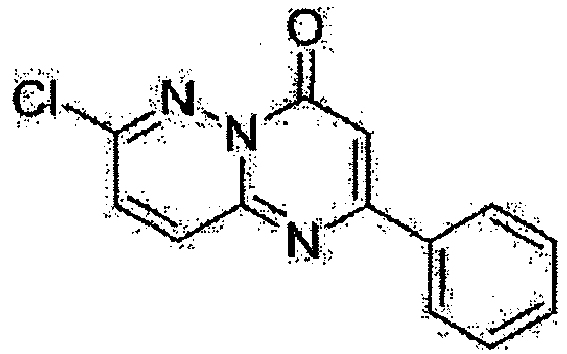
- 3-Amino-6-chloropyridazine (5.00 g) was treated by a method similar to that in Reference Example 803 to give the title compound (900 mg) .
MS (ESI) m/z; 258, 260 [M+H]+ -

- To a solution (140 mL) of 3-oxo-hexanoic acid ethyl ester (10.2 g) in acetonitrile was added 1-chloromethyl-4-fluoro-1,4-diazoniabicyclo[2.2.2]octane bistetrafluoroborate (25.0 g) at room temperature, and the reaction mixture was stirred with heating at 100°C for 6 hr. The reaction mixture was cooled to room temperature, ethyl acetate was added, and the mixture was washed once with water. The organic layer was dried over anhydrous magnesium sulfate, filtered and concentrated. The residue was purified by silica gel column chromatography (solvent; hexane/ethyl acetate=90/10 - 80/20) to give 2-fluoro-3-oxo-hexanoic acid ethyl ester (8.40 g). A mixture of the obtained 2-fluoro-3-oxo-hexanoic acid ethyl ester (4.1 g), 3-amino-6-chloropyridazine (2.70 g) and polyphosphoric acid (30 g) was stirred with heating at 120°C for 3 hr. After confirmation of the completion of the reaction, the reaction mixture was cooled to room temperature, and water (200 mL) was added. The precipitated solid was collected by filtration, washed once with water, and dissolved in chloroform. The obtained solution was dried over anhydrous magnesium sulfate, filtered and concentrated. To the obtained product was added diisopropyl ether, and the solid was collected by filtration to give the title compound (1.74 g).
MS (ESI) m/z; 242, 244 [M+H]+ -

- 3-Amino-6-chloropyridazine (3.00 g) was treated by a method similar to that in Reference Example 807 to give the title compound (2.08 g).
MS (ESI) m/z; 228, 230 [M+H]+ - KAT-II inhibitory test
- The compounds described in the above-mentioned Examples were used for the KAT-II inhibitory test.
- Human recombinant KAT-II was prepared as follows.
- His tag and maltose binding protein tag were added to the N-terminal of a gene encoding human KAT-II (Genbank accession number: AF481738.1), and the obtained gene was incorporated into pET32 (Merck Nihon Millipore), which is an Escherichia coli expression vector. Human recombinant KAT-II produced by BL21 (DE3) Escherichia coli (Merck Nihon Millipore, 69450) transformed using the plasmid was purified using an amylose resin column (New England Biolabs, #800-21 L).
- The inhibitory action of the test compound on human recombinant KAT-II was determined by the following method.
- To a reaction mixture (45 µL) containing 3.0 µmol/L kynurenine, 10 µmol/L pyridoxal phosphate, 2.0 ng/µL human recombinant KAT-II, and 150 mmol/L tris(hydroxymethyl)aminomethane-acetate buffer (pH 8.0) was added a 10% dimethyl sulfoxide solution (5 µL) of each test compound prepared, and the mixture was reacted at 37°C for 1 hr. After the reaction, 50% trichloroacetic acid (5 µL) was added to terminate the reaction.
- The resultant kynurenic acid was quantified as follows by high performance liquid chromatography. An enzyme reaction mixture was separated by an octadecylsilane reversed-phase column (SC-5ODS, Eicom Corporation; mobile phase: 250 mmol/L zinc acetate, 50 mmol/L sodium acetate, and 5.0% acetonitrile (pH 6.2)) incubated at 30°C, and kynurenic acid was quantified using a fluorescence detector (RF-20Axs, Shimadzu Corporation) at excitation wavelength 354 nm, detection wavelength 460 nm. The analytical curve was drawn every time by an external standard method. Each test compound was tested by dual measurement at each concentration. The kynurenic acid level in the presence of a test compound at each concentration was converted into % relative to kynurenic acid resulting from a reaction with an enzyme alone as 100%, and the obtained values were fitted to S-curve to determine IC50.
- The IC50 values of respective test compounds are shown in the following Table 1 - Table 3.
Table 1 test compound (Example No.) KAT-II inhibitory test IC50 (µmol/L) test compound (Example No.) KAT-II inhibitory test IC50 (µmol/L) 8 0.61 132 0.051 9 0.25 133 0.15 11 6.2 134 0.23 12 0.13 135 0.023 13 0.56 137 0.069 14 0.057 138 0.39 15 1.1 140 0.077 17 1.6 142 0.98 19 0.043 143 2.2 28 0.025 144 0.72 32 0.40 145 1.5 36 0.018 146 0.14 63 0.015 148 0.23 65 0.025 149 0.16 67 0.014 153 0.048 69 0.040 155 0.32 74 0.084 157 0.47 80 0.0086 158 0.17 85 0.17 160 5.2 94 0.0061 166 0.19 96 0.019 167 0.090 97 0.013 168 0.41 98 0.037 170 0.88 104 0.073 171 1.8 105 0.065 172 0.84 106 0.069 175 3.7 107 0.046 176 0.52 111 0.27 178 0.012 114 0.029 183 0.032 116 0.014 190 0.026 120 0.0047 191 0.031 131 0.11 194 0.076 Table 2 test compound (Example No.) KAT-II inhibitory test IC50 (µmol/L) test compound (Example No.) KAT-II inhibitory test IC50 (µmol/L) 203 0.014 314 0.61 204 0.0070 321 0.070 211 0.0073 322 0.020 213 0.016 323 0.078 221 0.0048 328 0.017 227 0.072 333 0.049 229 0.021 335 0.0056 233 0.12 337 0.0044 236 0.24 339 0.0079 238 0.016 341 0.011 244 0.011 345 0.0087 251 0.040 347 0.016 252 0.019 363 0.12 253 0.089 366 0.15 254 0.011 372 0.039 258 0.18 373 0.0080 259 0.0043 376 0.014 264 0.16 396 0.076 265 0.0054 406 0.37 267 0.022 411 0.015 268 0.0088 414 0.043 273 0.0056 482 0.0097 281 0.027 486 0.015 294 0.17 489 0.0060 298 0.026 499 0.0071 299 0.46 500 0.041 300 0.18 501 0.017 301 2.6 524 0.0040 304 0.021 530 0.019 307 0.12 532 0.017 309 0.061 536 0.0069 311 0.34 539 0.022 313 1.1 553 0.043 Table 3 test compound (Example No.) KAT-II inhibitory test IC50 (µmol/L) test compound (Example No.) KAT-II inhibitory test IC50 (µmol/L) 555 1.1 639 0.049 559 0.016 642 0.078 560 0.011 645 1.6 565 0.010 647 0.058 572 0.086 648 0.046 573 0.035 650 2.2 575 0.019 653 0.19 578 0.028 655 0.029 579 0.010 656 0.044 583 0.0090 661 3.9 585 0.012 664 0.56 590 0.28 669 7.3 593 0.051 678 0.019 601 0.14 684 11 602 0.031 685 2.2 603 0.0049 686 32 605 0.0082 688 0.029 606 0.0076 698 0.067 611 0.57 699 0.23 612 0.052 701 0.05 613 0.022 703 0.11 614 0.016 706 0.17 616 0.073 707 0.68 617 0.24 711 0.19 623 0.022 712 0.062 624 0.015 713 0.088 626 0.015 714 0.59 629 0.047 718 0.31 631 0.055 720 0.55 635 0.97 722 0.089 636 1.5 728 0.024 638 0.029 - - - Compound (I) or a pharmacologically acceptable salt thereof of the present invention shows a KAT-II inhibitory action. Therefore, compound (I) or a pharmacologically acceptable salt thereof of the present invention is useful for the prophylaxis or treatment of various diseases (e.g., schizophrenia) involving KAT-II.
- This application is based on a patent application No.
2014-089185

(A) when X1 is a carbon atom and X2 is a nitrogen atom, a group represented by the following formula (i-a):

(B) when X1 is a nitrogen atom and X2 is a carbon atom, a group represented by the following formula (i-b):


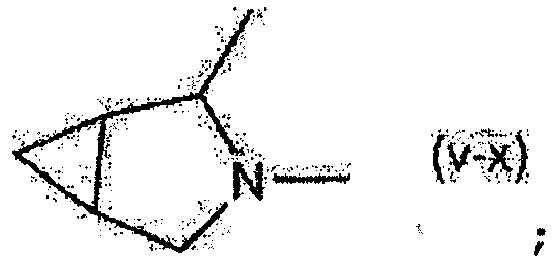
(a-3) Z2 is CH, and Z3 is a nitrogen atom, and a part represented by the following formula in the formula (I):


(b) when a part represented by the following formula in the aforementioned formula (I):


Claims (25)
- A compound represented by the formula (I):
 one of X1 and X2 is a carbon atom, and the other is a nitrogen atom,X3 is a nitrogen atom, or CR2,X4 is a nitrogen atom, or CR3,X5 is a sulfur atom, or -CH=CH-,Z1 is an oxygen atom, -C(R6)(R7)-, -NH-, -C(R6)(R7)-NH-,-NH-C(R6)(R7)-, -C(R6)(R7)-O-, -O-C(R6)(R7)-, or a single bond (where the left end shows a bond to ring A, and the right end shows a bond to the adjacent carbonyl),one of Z2 and Z3 is CH and the other is a nitrogen atom, or both are nitrogen atoms,R1 is a hydrogen atom, optionally substituted alkyl, optionally substituted cycloalkyl, optionally substituted aryl, an optionally substituted nonaromatic heterocyclic group, or a halogen atom,R2 is a hydrogen atom, optionally substituted alkyl, optionally substituted cycloalkyl, optionally substituted amino, optionally substituted aryl, an optionally substituted nonaromatic heterocyclic group, optionally substituted heteroaryl, optionally substituted alkoxy, or optionally substituted cycloalkoxy,or, R1 and R2 are bonded to each other to form, together with the adjacent X2 and carbon atom, an optionally substituted ring,R3 is a hydrogen atom, optionally substituted alkyl, optionally substituted cycloalkyl, or a halogen atom,R4 and R5 are each independently a hydrogen atom, or optionally substituted alkyl,or, R4 and R5 are bonded to each other to form, together with the adjacent Z2 and Z3, an optionally substituted nitrogen-containing non-aromatic heterocycle,R6 and R7 are each independently a hydrogen atom, optionally substituted alkyl, or optionally substituted cycloalkyl,or, R6 and R7 are bonded to each other to form, together with the adjacent carbon atom, an optionally substituted cycloalkane,a part represented by the following formula in the aforementioned formula (I):is
 (A) when X1 is a carbon atom and X2 is a nitrogen atom, a group represented by the following formula (i-a):
 (B) when X1 is a nitrogen atom and X2 is a carbon atom, a group represented by the following formula (i-b):provided (a) when a part represented by the following formula in the aforementioned formula (I) :

 (a-1) Z2 is a nitrogen atom, and Z3 is CH or a nitrogen atom;(a-2) Z2 is CH, and Z3 is a nitrogen atom, and a part represented by the following formula in the formula (I):
 (a-3) Z2 is CH, and Z3 is a nitrogen atom, and a part represented by the following formula in the formula (I):is a group represented by the formula (v-y):

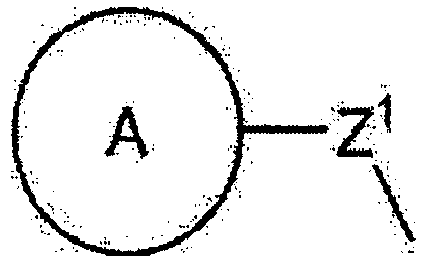

(b) when a part represented by the following formula in the aforementioned formula (I):
 (b-1) Z2 is a nitrogen atom, and Z3 is CH or a nitrogen atom; or(b-2) Z2 is CH, and Z3 is a nitrogen atom,R4 and R5 are bonded to each other to form, together with the adjacent Z2 and Z3, an optionally substituted nitrogen-containing non-aromatic heterocycle, and a part represented by the following formula in the formula (I):

- The compound according to claim 1, wherein, in the formula (I), the part represented by the following formula:


- The compound according to claim 1 or 2, whereinring A is a 5- to 11-membered monocyclic or bicyclic aromatic group optionally containing, besides carbon atom, 1-4 hetero atoms selected from the group consisting of oxygen atom, sulfur atom and nitrogen atom (said aromatic group is optionally substituted by the same or different 1, 2 or 3 groups selected from the group consisting of (1) alkyl optionally substituted by the same or different 1-7 groups selected from the group consisting of amino optionally substituted by 1 or 2 alkyls, alkoxy, and a halogen atom; (2) cyano; (3) amino optionally substituted by 1 or 2 alkyls; (4) alkoxy optionally substituted by 1-7 halogen atoms; and (5) a halogen atom),R1 is (a) a hydrogen atom; (b) alkyl optionally substituted by the same or different 1-7 groups selected from the group consisting of amino (said amino is optionally substituted by the same or different 1 or 2 groups selected from the group consisting of alkyl, halogenoalkyl, and alkoxycarbonyl), hydroxy, alkoxy, a halogen atom, phenyl, alkoxyphenyl, and a 4- to 7-membered monocyclic nonaromatic heterocyclic group containing, besides carbon atom, 1 or 2 hetero atoms selected from the group consisting of oxygen atom, sulfur atom and nitrogen atom (said nonaromatic heterocyclic group is optionally substituted by the same or different 1, 2 or 3 groups selected from the group consisting of alkyl, and alkoxycarbonyl); (c) cycloalkyl optionally substituted by 1, 2 or 3 alkoxyalkyls; (d) a halogen atom; (e) phenyl; or (f) a 4-to 7-membered monocyclic nonaromatic heterocyclic group containing, besides carbon atom, 1 or 2 hetero atoms selected from the group consisting of oxygen atom, sulfur atom and nitrogen atom (said nonaromatic heterocyclic group is optionally substituted by the same or different 1, 2 or 3 groups selected from the group consisting of alkyl, and alkoxycarbonyl),R2 is (a) a hydrogen atom; (b) alkyl optionally substituted by the same or different 1-7 groups selected from the group consisting of alkylidene, cyano, amino (said amino is optionally substituted by the same or different 1 or 2 groups selected from the group consisting of alkyl, alkoxyalkyl, halogenoalkyl, and alkoxycarbonyl), hydroxy, alkoxy, alkylsulfonyloxy, oxo, phenylsulfonyl, a halogen atom, phenyl, 5- to 11-membered monocyclic or bicyclic heteroaryl containing, besides carbon atom, 1-4 hetero atoms selected from the group consisting of oxygen atom, sulfur atom and nitrogen atom (said heteroaryl is optionally substituted by 1 or 2 oxos), and a 4-to 7-membered monocyclic nonaromatic heterocyclic group containing, besides carbon atom, 1 or 2 hetero atoms selected from the group consisting of oxygen atom, sulfur atom and nitrogen atom (said nonaromatic heterocyclic group is optionally substituted by alkoxy); (c) cycloalkyl optionally substituted by the same or different 1, 2 or 3 groups selected from the group consisting of alkyl, alkoxyalkyl, halogenoalkyl, cyano, hydroxy, alkoxy, alkanoyloxy, and a halogen atom; (d) amino optionally substituted by the same or different 1 or 2 groups selected from the group consisting of alkyl and alkoxyphenylalkyl; (e) alkoxy optionally substituted by the same or different 1, 2 or 3 groups selected from the group consisting of amino (said amino is optionally substituted by the same or different 1 or 2 groups selected from the group consisting of alkyl, and alkoxycarbonyl), and a halogen atom; (f) cycloalkoxy optionally substituted by alkyl; (g) phenyl optionally substituted by the same or different 1, 2 or 3 groups selected from the group consisting of alkyl (said alkyl is optionally substituted by the same or different 1, 2 or 3 groups selected from the group consisting of alkylamino, dialkylamino, hydroxy, and a halogen atom), alkoxy optionally substituted by 1, 2 or 3 halogen atoms, alkylsulfonyl, and a halogen atom; (h) 5- to 6-membered monocyclic heteroaryl containing, besides carbon atom, 1-4 hetero atoms selected from the group consisting of oxygen atom, sulfur atom and nitrogen atom (said heteroaryl is optionally substituted by the same or different 1, 2 or 3 groups selected from the group consisting of alkyl, alkoxy, and a halogen atom); or (i) a 4- to 7-membered monocyclic nonaromatic heterocyclic group containing, besides carbon atom, 1 or 2 hetero atoms selected from the group consisting of oxygen atom, sulfur atom and nitrogen atom (said nonaromatic heterocyclic group is optionally substituted by the same or different 1, 2 or 3 groups selected from the group consisting of alkyl, halogenoalkyl, and alkoxy),or, R1 and R2 are bonded to each other to form, together with the adjacent X2 and carbon atom, a ring selected from the group consisting of 4- to 7-membered (C4-C7) cycloalkene, benzene, a 4- to 7-membered monocyclic non-aromatic heterocycle containing, besides carbon atom, 1 or 2 hetero atoms selected from the group consisting of oxygen atom, sulfur atom and nitrogen atom, and 5- to 6-membered monocyclic heteroarene containing, besides carbon atom, 1-4 hetero atoms selected from the group consisting of oxygen atom, sulfur atom and nitrogen atom (said ring is optionally substituted by the same or different 1, 2 or 3 groups selected from the group consisting of alkyl, halogenoalkyl, alkoxycarbonyl, and a halogen atom),R3 is (a) a hydrogen atom; (b) alkyl optionally substituted by 1, 2 or 3 halogen atoms; (c) cycloalkyl; or (d) a halogen atom,R4 and R5 are each independently a hydrogen atom, or alkyl,or, R4 and R5 are bonded to each other to form, together with the adjacent Z2 and Z3, 4- to 12-membered monocyclic or bicyclic nitrogen-containing non-aromatic heterocycle containing, besides carbon atom, at least one nitrogen atom and 1-4 hetero atoms selected from the group consisting of oxygen atom, sulfur atom and nitrogen atom (said nitrogen-containing non-aromatic heterocycle is optionally substituted by the same or different 1, 2 or 3 groups selected from the group consisting of amino optionally substituted by a group selected from the group consisting of alkoxycarbonyl and phenylalkoxycarbonyl, and a halogen atom), andR6 and R7 are each independently (a) a hydrogen atom; (b) alkyl optionally substituted by the same or different 1, 2 or 3 groups selected from the group consisting of alkoxy, and a halogen atom; or (c) cycloalkyl,or, R6 and R7 are bonded to each other to form, together with the adjacent carbon atom, cycloalkane, or a pharmacologically acceptable salt thereof.
- The compound according to any one of claims 1 to 3, wherein, in the formula (I), the part represented by the following formula:


- The compound according to claim 1 or 4, wherein Z1 is-C(R6)(R7)-NH-, or a pharmacologically acceptable salt thereof.
- The compound according to any one of claims 1 to 3, wherein, in the formula (I), the part represented by the following formula:


- The compound according to claim 6, wherein R4 and R5 are bonded to each other to form, together with the adjacent nitrogen atom and carbon atom, pyrrolidine, or a pharmacologically acceptable salt thereof.
- The compound according to any one of claims 1 and 4 to 7, wherein, in the formula (I), the part represented by the following formula:


- The compound according to claim 8, wherein the part represented by the following formula:

- The compound according to claim 8, wherein the part represented by the following formula:

- The compound according to claim 1, wherein, in the formula (I), the part represented by the following formula:

 R1a is (a) a hydrogen atom; (b) alkyl optionally substituted by 1-7 groups selected from the group consisting of amino (said amino is optionally substituted by 1 or 2 groups selected from the group consisting of alkyl, halogenoalkyl, and alkoxycarbonyl), hydroxy, alkoxy, a halogen atom, phenyl, alkoxyphenyl, and a 4- to 7-membered monocyclic nonaromatic heterocyclic group containing, besides carbon atom, 1 or 2 hetero atoms selected from the group consisting of oxygen atom and nitrogen atom (said nonaromatic heterocyclic group is optionally substituted by 1, 2 or 3 groups selected from the group consisting of alkyl, and alkoxycarbonyl); (c) cycloalkyl; (d) phenyl; or (e) a 4- to 7-membered monocyclic nonaromatic heterocyclic group containing, besides carbon atom, 1 or 2 hetero atoms selected from the group consisting of oxygen atom and nitrogen atom (said nonaromatic heterocyclic group is optionally substituted by 1, 2 or 3 groups selected from the group consisting of alkyl, and alkoxycarbonyl),R2a is (a) a hydrogen atom; (b) alkyl optionally substituted by 1-7 groups selected from the group consisting of cyano, amino (said amino is optionally substituted by 1 or 2 groups selected from the group consisting of alkyl, alkoxyalkyl, halogenoalkyl, and alkoxycarbonyl), hydroxy, alkoxy, alkylsulfonyloxy, oxo, phenylsulfonyl, a halogen atom, phenyl, pyridyl, isoindolyl optionally substituted by 1 or 2 oxos, and a 4- to 7-membered monocyclic nonaromatic heterocyclic group containing, besides carbon atom, 1 or 2 hetero atoms selected from the group consisting of oxygen atom, and nitrogen atom (said nonaromatic heterocyclic group is optionally substituted by alkoxy); (c) cycloalkyl optionally substituted by 1, 2 or 3 groups selected from the group consisting of alkyl, alkoxyalkyl, halogenoalkyl, cyano, hydroxy, alkoxy, alkanoyloxy, and a halogen atom; (d) amino optionally substituted by 1 or 2 groups selected from the group consisting of alkyl and alkoxyphenyl; (e) alkoxy optionally substituted by 1, 2 or 3 groups selected from the group consisting of amino (said amino is optionally substituted by 1 or 2 groups selected from the group consisting of alkyl, and alkoxycarbonyl), and a halogen atom; (f) cycloalkoxy optionally substituted by alkyl; (g) phenyl optionally substituted by 1, 2 or 3 groups selected from the group consisting of alkyl (said alkyl is optionally substituted by 1, 2 or 3 groups selected from the group consisting of alkylamino, dialkylamino, hydroxy, and a halogen atom), alkoxy optionally substituted by 1, 2 or 3 halogen atoms, alkylsulfonyl, and a halogen atom; (h) 5- to 6-membered monocyclic heteroaryl containing, besides carbon atom, 1, 2 or 3 hetero atoms selected from the group consisting of oxygen atom, sulfur atom and nitrogen atom (said heteroaryl is optionally substituted by 1, 2 or 3 groups selected from the group consisting of alkyl, alkoxy, and a halogen atom); or (i) a 4- to 7-membered monocyclic nonaromatic heterocyclic group containing, besides carbon atom, 1 or 2 hetero atoms selected from the group consisting of oxygen atom, and nitrogen atom (said nonaromatic heterocyclic group is optionally substituted by 1, 2 or 3 groups selected from the group consisting of alkyl, halogenoalkyl, and alkoxy),or R1a and R2a are bonded to each other to form, together with the adjacent nitrogen atom and carbon atom, (a) a 4- to 7-membered monocyclic nitrogen-containing non-aromatic heterocycle containing 1 or 2 nitrogen atoms besides carbon atom (said nitrogen-containing non-aromatic heterocycle is optionally substituted by 1, 2 or 3 groups selected from the group consisting of alkyl, halogenoalkyl, alkoxycarbonyl, and a halogen atom); or (b) 5- to 6-membered monocyclic nitrogen-containing heteroarene containing, besides carbon atom, at least one nitrogen atom and 1 or 2 hetero atoms selected from the group consisting of sulfur atom and nitrogen atom (said nitrogen-containing heteroarene is optionally substituted by 1, 2 or 3 groups selected from the group consisting of alkyl, halogenoalkyl, alkoxycarbonyl, and a halogen atom), and the part represented by the following formula:
 Z1a is an oxygen atom, -C(R6a)(R7a)-, -NH-, -C(R6a)(R7a)-NH-, -NH-C(R6a)(R7a)-, -C(R6a)(R7a)-O-, -O-C(R6a)(R7a)-, or a single bond (wherein the left end shows a bond to ring A-1, and the right end shows a bond to the adjacent carbonyl),(a) one of Z2a and Z3a is CH and the other is a nitrogen atom, or (b) both of them are nitrogen atoms,R4a and R5a are each independently a hydrogen atom, or alkyl,or, R4a and R5a are bonded to each other to form, together with the adjacent Z2a and Z3a, 4- to 7-membered monocyclic nitrogen-containing non-aromatic heterocycle containing, besides carbon atom, at least one nitrogen atom and 1 or 2 hetero atoms selected from the group consisting of oxygen atom, and nitrogen atom (said nitrogen-containing non-aromatic heterocycle is optionally substituted by 1, 2 or 3 groups selected from the group consisting of amino optionally substituted by a group selected from the group consisting of alkoxycarbonyl and phenylalkoxycarbonyl, and a halogen atom), andR6a and R7a are each independently (a) a hydrogen atom; (b) alkyl optionally substituted by 1, 2 or 3 groups selected from the group consisting of alkoxy, and a halogen atom; or (c) cycloalkyl, or R6a and R7a are bonded to each other to form, together with the adjacent carbon atom, cycloalkane,R8a, R8b and R8c are each independently (a) a hydrogen atom; (b) alkyl optionally substituted by 1, 2 or 3 groups selected from the group consisting of alkylamino, dialkylamino, alkoxy, and a halogen atom; (c) cyano; (d) amino optionally substituted by 1 or 2 alkyls; (e) alkoxy optionally substituted by 1-7 halogen atoms; or (f) a halogen atom, andn is 0 or 1, or a pharmacologically acceptable salt thereof.
 - The compound according to claim 11, wherein Z2a is CH, and Z3a is a nitrogen atom, or a pharmacologically acceptable salt thereof.
- The compound according to claim 11, wherein Z2a is a nitrogen atom, and Z3a is CH, or a pharmacologically acceptable salt thereof.
- The compound according to claim 12 or 13, whereinring A-1 is phenyl, indanyl, tetrahydronaphthyl, furyl, thienyl, pyrazolyl, isoxazolyl, thiazolyl, dihydrobenzofuranyl, benzodioxolanyl, or tetrahydroquinolyl,Z1a is an oxygen atom, -C (R6a)(R7a)-, -NH-, -C (R6a)(R7a)-NH-, -NH-C(R6a)(R7a)-, -C(R6a)(R7a)-O-, or -O-C(R6a)(R7a)-,R1a is (a) a hydrogen atom; (b) alkyl optionally substituted by 1-7 groups selected from the group consisting of amino (said amino is optionally substituted by 1 or 2 groups selected from the group consisting of alkyl, halogenoalkyl, and alkoxycarbonyl), hydroxy, alkoxy, a halogen atom, phenyl, alkoxyphenyl, and a nonaromatic heterocyclic group selected from the group consisting of pyrrolidyl, piperidyl, oxetanyl, and tetrahydropyranyl (said nonaromatic heterocyclic group is optionally substituted by 1, 2 or 3 groups selected from the group consisting of alkyl, and alkoxycarbonyl); (c) cycloalkyl; (d) phenyl; or (e) a nonaromatic heterocyclic group selected from the group consisting of pyrrolidyl, piperidyl, morpholinyl, oxetanyl, tetrahydrofuranyl, and tetrahydropyranyl (said nonaromatic heterocyclic group is optionally substituted by 1, 2 or 3 groups selected from the group consisting of alkyl, and alkoxycarbonyl),R2a is (a) a hydrogen atom; (b) alkyl optionally substituted by 1-7 groups selected from the group consisting of cyano, amino (said amino is optionally substituted by 1 or 2 groups selected from the group consisting of alkyl, alkoxyalkyl, halogenoalkyl, and alkoxycarbonyl), hydroxy, alkoxy, alkylsulfonyloxy, oxo, phenylsulfonyl, a halogen atom, phenyl, pyridyl, isoindolyl optionally substituted by 1 or 2 oxos, and a monocyclic nonaromatic heterocyclic group selected from the group consisting of azetidinyl, pyrrolidyl, piperidyl, and morpholinyl (said nonaromatic heterocyclic group is optionally substituted by alkoxy); (c) cycloalkyl optionally substituted by 1, 2 or 3 groups selected from the group consisting of alkyl, alkoxyalkyl, halogenoalkyl, cyano, hydroxy, alkoxy, and a halogen atom; (d) amino optionally substituted by 1 or 2 groups selected from the group consisting of alkyl and alkoxyphenyl; (e) alkoxy optionally substituted by 1, 2 or 3 groups selected from the group consisting of amino (said amino is optionally substituted by 1 or 2 groups selected from the group consisting of alkyl, and alkoxycarbonyl), and a halogen atom; (f) cycloalkoxy optionally substituted by alkyl; (g) phenyl optionally substituted by 1, 2 or 3 groups selected from the group consisting of alkyl (said alkyl is optionally substituted by 1, 2 or 3 groups selected from the group consisting of alkylamino, dialkylamino, hydroxy, and a halogen atom), alkoxy optionally substituted by 1, 2 or 3 halogen atoms, alkylsulfonyl, and a halogen atom; (h) heteroaryl selected from the group consisting of thienyl, pyrazolyl, oxadiazolyl, pyridyl, and pyrimidinyl (said heteroaryl is optionally substituted by 1, 2 or 3 groups selected from the group consisting of alkyl, alkoxy, and a halogen atom); or (i) a nonaromatic heterocyclic group selected from the group consisting of azetidinyl, pyrrolidyl, piperidyl, tetrahydrofuryl, tetrahydropyranyl, piperazinyl, and morpholinyl (said nonaromatic heterocyclic group is optionally substituted by 1, 2 or 3 groups selected from the group consisting of alkyl, halogenoalkyl, and alkoxy), or
R1a and R2a are bonded to each other to form, together with the adjacent nitrogen atom and carbon atom, a nitrogen-containing non-aromatic heterocycle selected from the group consisting of pyrrolidine, piperidine, dihydroimidazole, imidazolidine, and piperazine (said nitrogen-containing non-aromatic heterocycle is optionally substituted by 1, 1, 2 or 3 groups selected from the group consisting of alkyl, halogenoalkyl, alkoxycarbonyl, and a halogen atom),R4a and R5a are each alkyl, or R4a and R5a are bonded to each other to form, together with the adjacent Z2a and Z3a, a nitrogen-containing non-aromatic heterocycle selected from the group consisting of azetidine, pyrrolidine, and piperidine (said nitrogen-containing non-aromatic heterocycle is optionally substituted by 1, 2 or 3 groups selected from the group consisting of amino optionally substituted by one group selected from the group consisting of alkoxycarbonyl and phenylalkoxycarbonyl, and a halogen atom),R6a and R7a are each independently a hydrogen atom, or alkyl,R8a, R8b and R8c are each independently (a) a hydrogen atom; (b) alkyl optionally substituted by one group selected from the group consisting of dialkylamino, and alkoxy; (c) cyano; (d) amino optionally substituted by 1 or 2 alkyls; (e) alkoxy; or (f) a halogen atom, andn is 1, or a pharmacologically acceptable salt thereof. - The compound according to claim 11, wherein the part represented by the following formula:
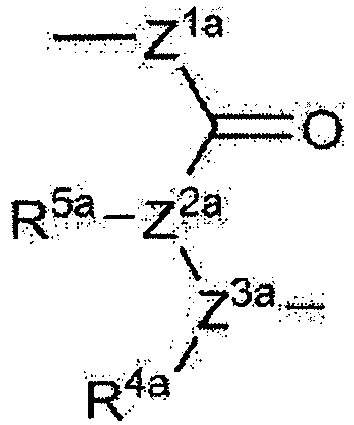

- The compound according to claim 12 or 15, whereinR4a and R5a are bonded to each other to form, together with the adjacent nitrogen atom and carbon atom, pyrrolidine, andR6a and R7a are each a hydrogen atom, or a pharmacologically acceptable salt thereof.
- The compound according to claim 12 or 15, whereinR4a is C1-C6 alkyl,R5a is C1-C6 alkyl, andR6a and R7a are each a hydrogen atom, or a pharmacologically acceptable salt thereof.
- The compound according to claim 11, whereinthe part represented by the following formula:

 R2b is (a) a hydrogen atom; (b) alkyl optionally substituted by 1-7 groups selected from the group consisting of cyano, amino (said amino is optionally substituted by 1 or 2 groups selected from the group consisting of alkyl, alkoxyalkyl, halogenoalkyl, and alkoxycarbonyl), hydroxy, alkoxy, alkylsulfonyloxy, oxo, phenylsulfonyl, a halogen atom, phenyl, pyridyl, isoindolyl optionally substituted by 1 or 2 oxos, and a 4- to 7-membered monocyclic nonaromatic heterocyclic group containing, besides carbon atom, 1 or 2 hetero atoms selected from the group consisting of oxygen atom, and nitrogen atom (said nonaromatic heterocyclic group is optionally substituted by alkoxy); (c) cycloalkyl optionally substituted by 1, 2 or 3 groups selected from the group consisting of alkyl, alkoxyalkyl, halogenoalkyl, cyano, hydroxy, alkoxy, alkanoyloxy, and a halogen atom; (d) amino optionally substituted by 1 or 2 groups selected from the group consisting of alkyl and alkoxyphenyl; (e) alkoxy optionally substituted by 1, 2 or 3 groups selected from the group consisting of amino (said amino is optionally substituted by 1 or 2 groups selected from the group consisting of alkyl, and alkoxycarbonyl), and a halogen atom; (f) cycloalkoxy optionally substituted by alkyl; (g) phenyl optionally substituted by 1, 2 or 3 groups selected from the group consisting of alkyl (said alkyl is optionally substituted by 1, 2 or 3 groups selected from the group consisting of alkylamino, dialkylamino, hydroxy, and a halogen atom), alkoxy optionally substituted by 1, 2 or 3 halogen atoms, alkylsulfonyl, and a halogen atom; (h) 5- to 6-membered monocyclic heteroaryl containing, besides carbon atom, 1, 2 or 3 hetero atoms selected from the group consisting of oxygen atom, sulfur atom and nitrogen atom (said heteroaryl is optionally substituted by 1, 2 or 3 groups selected from the group consisting of alkyl, alkoxy, and a halogen atom); or (i) a 4- to 7-membered monocyclic nonaromatic heterocyclic group containing, besides carbon atom, 1 or 2 hetero atoms selected from the group consisting of oxygen atom, and nitrogen atom (said nonaromatic heterocyclic group is optionally substituted by 1, 2 or 3 groups selected from the group consisting of alkyl, halogenoalkyl, and alkoxy), and
the part represented by the following formula:

- The compound according to claim 18, whereinring A-1 is phenyl,Z1a is an oxygen atom,R1b is (a) a hydrogen atom; (b) alkyl optionally substituted by phenyl (said phenyl is optionally substituted by 1, 2 or 3 alkoxys); or (c) tetrahydropyranyl,R2b is (a) alkyl optionally substituted by 1, 2 or 3 groups selected from the group consisting of cyano, a halogen atom, and morpholinyl; (b) cycloalkyl optionally substituted by 1, 2 or 3 groups selected from the group consisting of alkyl, alkoxyalkyl, halogenoalkyl, cyano, alkoxy, and a halogen atom; (c) amino optionally substituted by 1 or 2 alkyls; (d) alkoxy optionally substituted by 1, 2 or 3 halogen atoms; (e) cycloalkoxy optionally substituted by alkyl; (f) phenyl optionally substituted by 1, 2 or 3 groups selected from the group consisting of alkyl, alkoxy optionally substituted by 1, 2 or 3 halogen atoms, and a halogen atom; (g) oxadiazolyl optionally substituted by alkyl; or (i) a nonaromatic heterocyclic group selected from the group consisting of piperidyl, oxetanyl, and tetrahydropyranyl (said nonaromatic heterocyclic group is optionally substituted by 1, 2 or 3 alkyls),R8a, R8b and R8c are each independently a hydrogen atom, alkyl optionally substituted by 1, 2 or 3 halogen atoms, alkoxy optionally substituted by 1, 2 or 3 halogen atoms, or a halogen atom, andn is 1,or a pharmacologically acceptable salt thereof.
- A compound selected from the group consisting of (R)-2-[6-methyl-5-(3-methyl-[1,2,4]oxadiazol-5-yl)-7-oxo-6,7-dihydro[1,3]thiazolo[5,4-d]pyrimidin-2-yl]pyrrolidine-1-carboxylic acid phenyl ester; (R)-2-(5-ethyl-6-methyl-7-oxo-6,7-dihydro[1,3]thiazolo[5,4-d]pyrimidin-2-yl)pyrrolidine-1-carboxylic acid phenyl ester; (R)-2-[7-oxo-5-(propan-2-yl)-6,7-dihydro[1,3]thiazolo[5,4-d]pyrimidin-2-yl]pyrrolidine-1-carboxylic acid phenyl ester; (R)-2-(5-ethyl-7-oxo-6,7-dihydro[1,3]thiazolo[5,4-d]pyrimidin-2-yl)pyrrolidine-1-carboxylic acid phenyl ester; (R)-2-[5-(3-methyl-[1,2,4]oxadiazol-5-yl)-7-oxo-6,7-dihydro[1,3]thiazolo[5,4-d]pyrimidin-2-yl]pyrrolidine-1-carboxylic acid phenyl ester; and (R)-2-[6-methyl-7-oxo-5-(propan-2-yl)-6,7-dihydro[1,3]thiazolo[5,4-d]pyrimidin-2-yl]pyrrolidine-1-carboxylic acid phenyl ester, or a pharmacologically acceptable salt thereof.
- A compound selected from the group consisting of (R)-N-benzyl-1-(6-methyl-7-oxo-5-phenyl-6,7-dihydro[1,3]thiazolo[5,4-d]pyrimidin-2-yl)pyrrolidine-2-carboxamide; (R)-N-benzyl-1-(6-methyl-7-oxo-5-trifluoromethyl-6,7-dihydro-[1,3]thiazolo[5,4-d]pyrimidin-2-yl)pyrrolidine-2-carboxamide; (R)-N-benzyl-1-[5-(2,6-difluorophenyl)-6-methyl-7-oxo-6,7-dihydro[1,3]thiazolo[5,4-d]pyrimidin-2-yl]pyrrolidine-2-carboxamide; (R)-N-benzyl-1-[6-methyl-5-(3-methyl-1,2,4-oxadiazol-5-yl)-7-oxo-6,7-dihydro[1,3]thiazolo[5,4-d]pyrimidin-2-yl]pyrrolidine-2-carboxamide; (R)-N-benzyl-1-[7-oxo-6-(tetrahydro-2H-pyran-4-yl)-5-trifluoromethyl-6,7-dihydro-[1,3]thiazolo[5,4-d]pyrimidin-2-yl]pyrrolidine-2-carboxamide; (R)-N-benzyl-1-[5-(1-fluorocyclopropyl)-6-methyl-7-oxo-6,7-dihydro[1,3]thiazolo[5,4-d]pyrimidin-2-yl]pyrrolidine-2-carboxamide; (R)-N-benzyl-1-(5-difluoromethyl-6-methyl-7-oxo-6,7-dihydro-[1,3]thiazolo[5,4-d]pyrimidin-2-yl)pyrrolidine-2-carboxamide; (R)-N-benzyl-1-[6-methyl-7-oxo-5-(piperidin-1-yl)-6,7-dihydro[1,3]thiazolo[5,4-d]pyrimidin-2-yl]pyrrolidine-2-carboxamide; (R)-N-benzyl-1-[5-(2-fluorophenyl)-6-methyl-7-oxo-6,7-dihydro[1,3]thiazolo[5,4-d]pyrimidin-2-yl]pyrrolidine-2-carboxamide; (R)-N-benzyl-1-[5-(2-fluoropropan-2-yl)-7-oxo-6,7-dihydro[1,3]thiazolo[5,4-d]pyrimidin-2-yl]pyrrolidine-2-carboxamide; (R)-N-benzyl-1-[5-(2-fluorophenyl)-7-oxo-6,7-dihydro[1,3]thiazolo[5,4-d]pyrimidin-2-yl]pyrrolidine-2-carboxamide; (R)-N-benzyl-1-(7-oxo-5-trifluoromethyl-6,7-dihydro[1,3]thiazolo[5,4-d]pyrimidin-2-yl)pyrrolidine-2-carboxamide; (R)-N-benzyl-1-(5-difluoromethyl-7-oxo-6,7-dihydro[1,3]thiazolo[5,4-d]pyrimidin-2-yl)pyrrolidine-2-carboxamide; (R)-N-benzyl-1-[5-(2,6-difluorophenyl)-7-oxo-6,7-dihydro[1,3]thiazolo[5,4-d]pyrimidin-2-yl]pyrrolidine-2-carboxamide; (R)-N-benzyl-1-[5-(3-methyl-[1,2,4]oxadiazol-5-yl)-1-oxo-6,1-dihydro[1,3]thiazolo[5,4-d]pyrimidin-2-yl]pyrrolidine-2-carboxamide; (R)-N-benzyl-1-[5-(2-hydroxypropan-2-yl)-7-oxo-6,7-dihydro[1,3]thiazolo[5,4-d]pyrimidin-2-yl]pyrrolidine-2-carboxamide; and (R)-N-benzyl-1-[7-oxo-5-(piperidin-1-yl)-6,7-dihydro[1,3]thiazolo[5,4-d]pyrimidin-2-yl]pyrrolidine-2-carboxamide, or a pharmacologically acceptable salt thereof.
- A pharmaceutical composition comprising a compound represented by the formula (I):
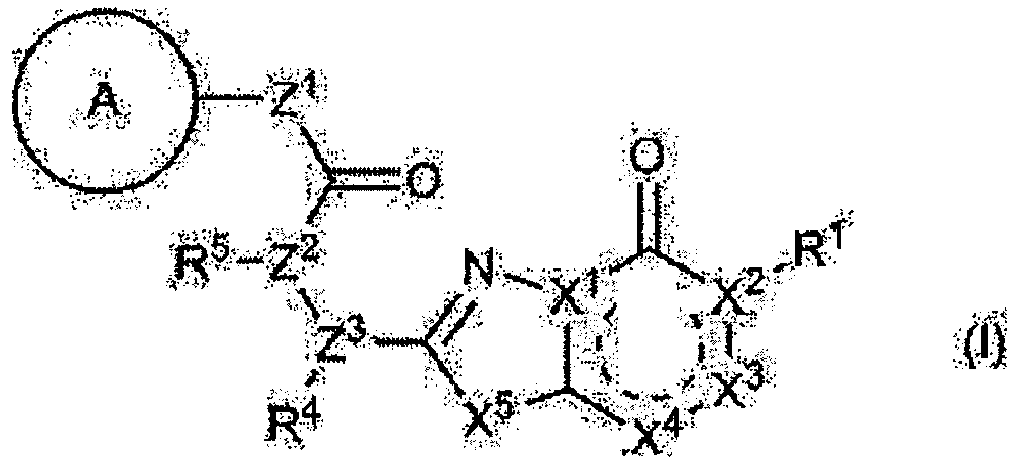 wherein ring A is an optionally substituted aromatic group,one of X1 and X2 is a carbon atom, and the other is a nitrogen atom,X3 is a nitrogen atom, or CR2,X4 is a nitrogen atom, or CR3,X5 is a sulfur atom, or -CH=CH-,Z1 is an oxygen atom, -C(R6)(R7)-, -NH-, -C(R6)(R7)-NH-,-NH-C(R6)(R7)-, -C(R6)(R7)-O-, -O-C(R6)(R7)-, or a single bond (where the left end shows a bond to ring A, and the right end shows a bond to the adjacent carbonyl),one of Z2 and Z3 is CH and the other is a nitrogen atom, or both are nitrogen atoms,R1 is a hydrogen atom, optionally substituted alkyl, optionally substituted cycloalkyl, optionally substituted aryl, an optionally substituted nonaromatic heterocyclic group, or a halogen atom,R2 is a hydrogen atom, optionally substituted alkyl, optionally substituted cycloalkyl, optionally substituted amino, optionally substituted aryl, an optionally substituted nonaromatic heterocyclic group, optionally substituted heteroaryl, optionally substituted alkoxy, or optionally substituted cycloalkoxy,or, R1 and R2 are bonded to each other to form, together with the adjacent X2 and carbon atom, an optionally substituted ring,R3 is a hydrogen atom, optionally substituted alkyl, optionally substituted cycloalkyl, or a halogen atom,R4 and R5 are each independently a hydrogen atom, or optionally substituted alkyl,or, R4 and R5 are bonded to each other to form, together with the adjacent Z2 and Z3, an optionally substituted nitrogen-containing non-aromatic heterocycle,R6 and R7 are each independently a hydrogen atom, optionally substituted alkyl, or optionally substituted cycloalkyl,or, R6 and R7 are bonded to each other to form, together with the adjacent carbon atom, an optionally substituted cycloalkane,a part represented by the following formula in the aforementioned formula (I):or a pharmacologically acceptable salt thereof.
 (A) when X1 is a carbon atom and X2 is a nitrogen atom, a group represented by the following formula (i-a):
 (B) when X1 is a nitrogen atom and X2 is a carbon atom, a group represented by the following formula (i-b):
- Use of a compound represented by the formula (I):
 wherein ring A is an optionally substituted aromatic group,one of X1 and X2 is a carbon atom, and the other is a nitrogen atom,X3 is a nitrogen atom, or CR2,X4 is a nitrogen atom, or CR3,X5 is a sulfur atom, or -CH=CH-,Z1 is an oxygen atom, -C(R6)(R7)-, -NH-, -C(R6)(R7)-NH-,-NH-C(R6)(R7)-, -C(R6)(R7)-O-, -O-C(R6)(R7)-, or a single bond (where the left end shows a bond to ring A, and the right end shows a bond to the adjacent carbonyl),one of Z2 and Z3 is CH and the other is a nitrogen atom, or both are nitrogen atoms,R1 is a hydrogen atom, optionally substituted alkyl, optionally substituted cycloalkyl, optionally substituted aryl, an optionally substituted nonaromatic heterocyclic group, or a halogen atom,R2 is a hydrogen atom, optionally substituted alkyl, optionally substituted cycloalkyl, optionally substituted amino, optionally substituted aryl, an optionally substituted nonaromatic heterocyclic group, optionally substituted heteroaryl, optionally substituted alkoxy, or optionally substituted cycloalkoxy,or, R1 and R2 are bonded to each other to form, together with the adjacent X2 and carbon atom, an optionally substituted ring,R3 is a hydrogen atom, optionally substituted alkyl, optionally substituted cycloalkyl, or a halogen atom,R4 and R5 are each independently a hydrogen atom, or optionally substituted alkyl,or, R4 and R5 are bonded to each other to form, together with the adjacent Z2 and Z3, an optionally substituted nitrogen-containing non-aromatic heterocycle,R6 and R7 are each independently a hydrogen atom, optionally substituted alkyl, or optionally substituted cycloalkyl,or, R6 and R7 are bonded to each other to form, together with the adjacent carbon atom, an optionally substituted cycloalkane,a part represented by the following formula in the aforementioned formula (I):or a pharmacologically acceptable salt thereof, in the production of a medicament.
 (A) when X1 is a carbon atom and X2 is a nitrogen atom, a group represented by the following formula (i-a):
 (B) when X1 is a nitrogen atom and X2 is a carbon atom, a group represented by the following formula (i-b):
- A pharmaceutical composition comprising the compound according to any one of claims 3 to 21, or a pharmacologically acceptable salt thereof.
- The pharmaceutical composition according to claim 22 or 24, for use for the prophylaxis or a treatment a disease in which inhibition of KAT-II activity is expected to improve the pathology.
Applications Claiming Priority (3)
| Application Number | Priority Date | Filing Date | Title |
|---|---|---|---|
| JP2014089185 | 2014-04-23 | ||
| PCT/JP2015/062165 WO2015163339A1 (en) | 2014-04-23 | 2015-04-22 | Novel bicyclic or tricyclic heterocyclic compound |
| EP15782852.6A EP3135674A4 (en) | 2014-04-23 | 2015-04-22 | Novel bicyclic or tricyclic heterocyclic compound |
Related Parent Applications (1)
| Application Number | Title | Priority Date | Filing Date |
|---|---|---|---|
| EP15782852.6A Division EP3135674A4 (en) | 2014-04-23 | 2015-04-22 | Novel bicyclic or tricyclic heterocyclic compound |
Publications (2)
| Publication Number | Publication Date |
|---|---|
| EP3683222A1 true EP3683222A1 (en) | 2020-07-22 |
| EP3683222B1 EP3683222B1 (en) | 2021-10-06 |
Family
ID=54332502
Family Applications (2)
| Application Number | Title | Priority Date | Filing Date |
|---|---|---|---|
| EP15782852.6A Withdrawn EP3135674A4 (en) | 2014-04-23 | 2015-04-22 | Novel bicyclic or tricyclic heterocyclic compound |
| EP20158740.9A Active EP3683222B1 (en) | 2014-04-23 | 2015-04-22 | Novel bicyclic or tricyclic heterocyclic compound |
Family Applications Before (1)
| Application Number | Title | Priority Date | Filing Date |
|---|---|---|---|
| EP15782852.6A Withdrawn EP3135674A4 (en) | 2014-04-23 | 2015-04-22 | Novel bicyclic or tricyclic heterocyclic compound |
Country Status (13)
| Country | Link |
|---|---|
| US (1) | US10065972B2 (en) |
| EP (2) | EP3135674A4 (en) |
| JP (1) | JP6442485B2 (en) |
| KR (1) | KR102458990B1 (en) |
| CN (1) | CN106661017B (en) |
| AU (1) | AU2015251207B2 (en) |
| BR (1) | BR112016024455B1 (en) |
| CA (1) | CA2946702C (en) |
| MX (1) | MX381182B (en) |
| PH (1) | PH12016502091B1 (en) |
| RU (1) | RU2702113C2 (en) |
| TW (1) | TWI693227B (en) |
| WO (1) | WO2015163339A1 (en) |
Families Citing this family (12)
| Publication number | Priority date | Publication date | Assignee | Title |
|---|---|---|---|---|
| WO2017069275A1 (en) * | 2015-10-22 | 2017-04-27 | 田辺三菱製薬株式会社 | Novel bicyclic heterocyclic compound |
| GB201810092D0 (en) * | 2018-06-20 | 2018-08-08 | Ctxt Pty Ltd | Compounds |
| PH12021553107A1 (en) | 2019-06-18 | 2022-08-01 | Ctxt Pty Ltd | Benzisoxazole sulfonamide derivatives |
| US12473289B2 (en) | 2019-11-25 | 2025-11-18 | Amgen Inc. | Heterocyclic compounds as delta-5 desaturase inhibitors and methods of use |
| US11512097B2 (en) | 2019-11-25 | 2022-11-29 | Amgen Inc. | Heterocyclic compounds as Delta-5 desaturase inhibitors and methods of use |
| KR20230004575A (en) * | 2020-04-08 | 2023-01-06 | 레믹스 테라퓨틱스 인크. | Compounds and methods for modulating splicing |
| WO2022216627A1 (en) * | 2021-04-05 | 2022-10-13 | Inipharm, Inc. | Thiazole/isothiazole hsd17b13 inhibitors and uses thereof |
| TW202330552A (en) * | 2021-10-13 | 2023-08-01 | 美商雷密克斯醫療公司 | Compounds and methods for modulating splicing |
| CN114315760A (en) * | 2021-12-29 | 2022-04-12 | 内蒙古久日新材料有限公司 | Preparation method and application of 2-chloro-1- (4-morpholinylphenyl) -1-butanone |
| CN115925618A (en) * | 2023-01-06 | 2023-04-07 | 河南省科学院化学研究所有限公司 | A kind of synthetic method of 2-(2,2,2-trifluoroethoxy)-6-chloro-3-aminopyridine |
| CN116574084A (en) * | 2023-04-17 | 2023-08-11 | 华南理工大学 | A kind of thiophene derivative and its synthesis method and application |
| WO2026023672A1 (en) * | 2024-07-24 | 2026-01-29 | 田辺三菱製薬株式会社 | New crystal of (2r)-n-benzyl-1-[5-(2-fluoropropane-2-yl)-7-oxo-6,7-dihydro[1,3]thiazolo[5,4-d]pyrimidin-2-yl]pyrrolidine-2-carboxamide, and method for producing same |
Citations (5)
| Publication number | Priority date | Publication date | Assignee | Title |
|---|---|---|---|---|
| WO1995004714A1 (en) | 1993-08-06 | 1995-02-16 | University Of Maryland At Baltimore | Substituted kynurenines, a process for their preparation, and use as medicaments |
| WO1999006375A1 (en) * | 1997-07-30 | 1999-02-11 | Pharmacia & Upjohn S.P.A. | Fused heterocyclic compounds and their use as kynurenine-3-hydroxylase inhibitors |
| WO2010146488A1 (en) | 2009-06-18 | 2010-12-23 | Pfizer Inc. | Bicyclic and tricyclic compounds as kat ii inhibitors |
| WO2012073143A1 (en) | 2010-12-01 | 2012-06-07 | Pfizer Inc. | Kat ii inhibitors |
| WO2013186666A1 (en) | 2012-06-15 | 2013-12-19 | Pfizer Inc. | Tricyclic compounds as kat ii inhibitors |
Family Cites Families (2)
| Publication number | Priority date | Publication date | Assignee | Title |
|---|---|---|---|---|
| JP2010518080A (en) * | 2007-02-08 | 2010-05-27 | メルク・シャープ・エンド・ドーム・コーポレイション | Remedy |
| CA2819106C (en) * | 2010-12-01 | 2015-12-29 | Pfizer Inc. | Kat ii inhibitors |
-
2015
- 2015-04-22 AU AU2015251207A patent/AU2015251207B2/en active Active
- 2015-04-22 WO PCT/JP2015/062165 patent/WO2015163339A1/en not_active Ceased
- 2015-04-22 US US14/891,845 patent/US10065972B2/en active Active
- 2015-04-22 MX MX2016013913A patent/MX381182B/en unknown
- 2015-04-22 CA CA2946702A patent/CA2946702C/en active Active
- 2015-04-22 KR KR1020167032460A patent/KR102458990B1/en active Active
- 2015-04-22 EP EP15782852.6A patent/EP3135674A4/en not_active Withdrawn
- 2015-04-22 RU RU2016145602A patent/RU2702113C2/en active
- 2015-04-22 TW TW104112838A patent/TWI693227B/en active
- 2015-04-22 EP EP20158740.9A patent/EP3683222B1/en active Active
- 2015-04-22 BR BR112016024455-9A patent/BR112016024455B1/en active IP Right Grant
- 2015-04-22 JP JP2016514958A patent/JP6442485B2/en active Active
- 2015-04-22 CN CN201580021257.8A patent/CN106661017B/en active Active
-
2016
- 2016-10-20 PH PH12016502091A patent/PH12016502091B1/en unknown
Patent Citations (5)
| Publication number | Priority date | Publication date | Assignee | Title |
|---|---|---|---|---|
| WO1995004714A1 (en) | 1993-08-06 | 1995-02-16 | University Of Maryland At Baltimore | Substituted kynurenines, a process for their preparation, and use as medicaments |
| WO1999006375A1 (en) * | 1997-07-30 | 1999-02-11 | Pharmacia & Upjohn S.P.A. | Fused heterocyclic compounds and their use as kynurenine-3-hydroxylase inhibitors |
| WO2010146488A1 (en) | 2009-06-18 | 2010-12-23 | Pfizer Inc. | Bicyclic and tricyclic compounds as kat ii inhibitors |
| WO2012073143A1 (en) | 2010-12-01 | 2012-06-07 | Pfizer Inc. | Kat ii inhibitors |
| WO2013186666A1 (en) | 2012-06-15 | 2013-12-19 | Pfizer Inc. | Tricyclic compounds as kat ii inhibitors |
Non-Patent Citations (21)
| Title |
|---|
| A. RASSOULPOUR ET AL., JOURNAL OF NEUROCHEMISTRY, vol. 93, 2005, pages 762 - 765 |
| A. ZMAROWSKI ET AL., EUROPEAN JOURNAL OF NEUROSCIENCE, vol. 29, 2009, pages 529 - 538 |
| A.B. GOLD ET AL., JOURNAL OF NEUROINFLAMMATION, vol. 8, 2011, pages 17 |
| A.C. CHESS ET AL., BEHAVIOURAL BRAIN RESEARCH, vol. 170, 2006, pages 326 - 332 |
| A.C. CHESS ET AL., BEHAVIOURAL BRAIN RESEARCH, vol. 201, 2009, pages 325 - 331 |
| A.C. CHESS ET AL., SCHIZOPHRENIA BULLETIN, vol. 33, 2007, pages 797 - 804 |
| B. CAMPBELL ET AL.: "Advancing Drug Discovery for Schizophrenia", 9 March 2011, THE NEW YORK ACADEMY OF SCIENCES |
| D.S. MCGEHEE, TRENDS IN NEUROSCIENCES, vol. 25, 2002, pages 171 - 172 |
| E.X. ALBUQUERQUE ET AL., PHYSIOLOGICAL REVIEWS, vol. 89, 2009, pages 73 - 120 |
| G. HENDERSON ET AL., JOURNAL OF PHYSIOLOGY, vol. 430, 1990, pages 189 - 212 |
| H. BARAN ET AL., INTERNATIONAL JOURNAL OF TRYPTOPHAN RESEARCH, vol. 5, 2012, pages 49 - 64 |
| H. BARAN ET AL., JOURNAL OF NEURAL TRANSMISSION, vol. 106, 1999, pages 165 - 181 |
| H.-Q. WU ET AL., JOURNAL OF MOLECULAR NEUROSCIENCE, vol. 40, 2010, pages 204 - 210 |
| K.R. LINDERHOLM ET AL., SCHIZOPHRENIA BULLETIN, vol. 38, 2012, pages 426 - 432 |
| M. ALKONDON ET AL., THE JOURNAL OF NEUROSCIENCE, vol. 24, 2004, pages 4635 - 4648 |
| M.C. POTTER ET AL., NEUROPSYCHOPHARMACOLOGY, vol. 35, 2010, pages 1734 - 1742 |
| R. SCHWARCZ ET AL., NATURE REVIEWS NEUROSCIENCE, vol. 13, 2012, pages 465 - 477 |
| R.G.M. MORRIS ET AL., PHILOSOPHICAL TRANSACTIONS OF THE ROYAL SOCIETY OF LONDON, vol. 329, 1990, pages 187 - 204 |
| S.K. OLSSONA ET AL., BIPOLAR DISORDERS, vol. 14, 2012, pages 719 - 726 |
| S.M. MCTIGHE ET AL., PLOS ONE, vol. 8, 2013, pages e62189 |
| T.W. GREENE ET AL.: "Protective Groups in Organic Synthesis", 2006, JOHN WILEY & SONS |
Also Published As
| Publication number | Publication date |
|---|---|
| KR102458990B1 (en) | 2022-10-25 |
| MX381182B (en) | 2025-03-12 |
| EP3135674A1 (en) | 2017-03-01 |
| CN106661017A (en) | 2017-05-10 |
| AU2015251207B2 (en) | 2019-08-22 |
| JPWO2015163339A1 (en) | 2017-04-20 |
| TW201602115A (en) | 2016-01-16 |
| US20160376289A1 (en) | 2016-12-29 |
| CA2946702C (en) | 2022-06-28 |
| EP3683222B1 (en) | 2021-10-06 |
| US10065972B2 (en) | 2018-09-04 |
| MX2016013913A (en) | 2016-11-15 |
| PH12016502091B1 (en) | 2020-01-29 |
| PH12016502091A1 (en) | 2017-01-09 |
| CN106661017B (en) | 2019-09-24 |
| CA2946702A1 (en) | 2015-10-29 |
| RU2702113C2 (en) | 2019-10-04 |
| AU2015251207A1 (en) | 2016-12-08 |
| JP6442485B2 (en) | 2018-12-19 |
| BR112016024455A2 (en) | 2017-08-15 |
| BR112016024455B1 (en) | 2023-02-07 |
| EP3135674A4 (en) | 2017-12-20 |
| RU2016145602A (en) | 2018-05-23 |
| RU2016145602A3 (en) | 2018-11-14 |
| KR20160144025A (en) | 2016-12-15 |
| TWI693227B (en) | 2020-05-11 |
| WO2015163339A1 (en) | 2015-10-29 |
Similar Documents
| Publication | Publication Date | Title |
|---|---|---|
| EP3683222B1 (en) | Novel bicyclic or tricyclic heterocyclic compound | |
| EP4081521B1 (en) | Substituted tricyclic compounds | |
| EP3468971B1 (en) | New (hetero)aryl-substituted-piperidinyl derivatives, a process for their preparation and pharmaceutical compositions containing them | |
| EP3372601B1 (en) | Novel bicyclic heterocyclic compound | |
| EP2417138B1 (en) | Pyrazolo[1, 5-a]pyrimidine derivatives as mtor inhibitors | |
| EP2807159B1 (en) | New indolizine derivatives, method for preparing same and pharmaceutical compositions containing them for the treatment of cancer | |
| EP2473510B1 (en) | Jak2 inhibitors and their use for the treatment of myeloproliferative diseases and cancer | |
| EP3172211B1 (en) | Tricyclic imidazo-pyrimidinone derivatives for the treatment of diseases mediated by lp-pla2 | |
| EP2852596B1 (en) | Thienopyrimidines | |
| EP3632915A1 (en) | 4,5,6,7-tetrahydro-1 h-pyrazolo[4,3-c]pyridin-3-amine compounds as cbp and/or ep300 inhibitors | |
| EP3112370A1 (en) | Tricyclic heterocyclic compounds and jak inhibitors | |
| EP2951175B1 (en) | Substituted pyrazolopyrimidinylamino-indazoles | |
| EP2829539A1 (en) | New pyrrole derivatives, method of preparing same and pharmaceutical compositions containing them | |
| JP2023537244A (en) | NITROGEN-CONTAINING FUSED RING DERIVATIVE INHIBITORS, METHODS FOR THEIR PREPARATION AND USES THEREOF | |
| CA2885783A1 (en) | Substituted indazol-pyrrolopyrimidines useful in the treatment of hyperproliferative diseases | |
| HK1223362A1 (en) | Substituted pyrazolo-pyridinamines | |
| EP4293023A1 (en) | Imidazole-containing condensed ring derivative, preparation method therefor, and application thereof in medicine | |
| JP6791717B2 (en) | Pharmaceutical composition | |
| WO2014048894A1 (en) | Substituted indazol-pyrrolopyrimidines useful in the treatment of hyperfoliferative disorders | |
| HK40036760B (en) | Novel bicyclic or tricyclic heterocyclic compound | |
| HK40036760A (en) | Novel bicyclic or tricyclic heterocyclic compound | |
| WO2015181063A1 (en) | Substituted tetrahydropyridothienopyrimidines | |
| HK40071288A (en) | Pyrazolone and pyrimidine compound, and preparation method and use therefor | |
| HK1232539A1 (en) | Tricyclic heterocyclic compounds and jak inhibitors | |
| HK40007202A (en) | New (hetero)aryl-substituted-piperidinyl derivatives, a process for their preparation and pharmaceutical compositions containing them |
Legal Events
| Date | Code | Title | Description |
|---|---|---|---|
| PUAI | Public reference made under article 153(3) epc to a published international application that has entered the european phase |
Free format text: ORIGINAL CODE: 0009012 |
|
| STAA | Information on the status of an ep patent application or granted ep patent |
Free format text: STATUS: THE APPLICATION HAS BEEN PUBLISHED |
|
| AC | Divisional application: reference to earlier application |
Ref document number: 3135674 Country of ref document: EP Kind code of ref document: P |
|
| AK | Designated contracting states |
Kind code of ref document: A1 Designated state(s): AL AT BE BG CH CY CZ DE DK EE ES FI FR GB GR HR HU IE IS IT LI LT LU LV MC MK MT NL NO PL PT RO RS SE SI SK SM TR |
|
| STAA | Information on the status of an ep patent application or granted ep patent |
Free format text: STATUS: REQUEST FOR EXAMINATION WAS MADE |
|
| 17P | Request for examination filed |
Effective date: 20201215 |
|
| RBV | Designated contracting states (corrected) |
Designated state(s): AL AT BE BG CH CY CZ DE DK EE ES FI FR GB GR HR HU IE IS IT LI LT LU LV MC MK MT NL NO PL PT RO RS SE SI SK SM TR |
|
| GRAP | Despatch of communication of intention to grant a patent |
Free format text: ORIGINAL CODE: EPIDOSNIGR1 |
|
| STAA | Information on the status of an ep patent application or granted ep patent |
Free format text: STATUS: GRANT OF PATENT IS INTENDED |
|
| INTG | Intention to grant announced |
Effective date: 20210421 |
|
| REG | Reference to a national code |
Ref country code: HK Ref legal event code: DE Ref document number: 40036760 Country of ref document: HK |
|
| GRAS | Grant fee paid |
Free format text: ORIGINAL CODE: EPIDOSNIGR3 |
|
| GRAA | (expected) grant |
Free format text: ORIGINAL CODE: 0009210 |
|
| STAA | Information on the status of an ep patent application or granted ep patent |
Free format text: STATUS: THE PATENT HAS BEEN GRANTED |
|
| AC | Divisional application: reference to earlier application |
Ref document number: 3135674 Country of ref document: EP Kind code of ref document: P |
|
| AK | Designated contracting states |
Kind code of ref document: B1 Designated state(s): AL AT BE BG CH CY CZ DE DK EE ES FI FR GB GR HR HU IE IS IT LI LT LU LV MC MK MT NL NO PL PT RO RS SE SI SK SM TR |
|
| REG | Reference to a national code |
Ref country code: GB Ref legal event code: FG4D |
|
| REG | Reference to a national code |
Ref country code: CH Ref legal event code: EP Ref country code: AT Ref legal event code: REF Ref document number: 1436154 Country of ref document: AT Kind code of ref document: T Effective date: 20211015 |
|
| REG | Reference to a national code |
Ref country code: DE Ref legal event code: R096 Ref document number: 602015074047 Country of ref document: DE |
|
| REG | Reference to a national code |
Ref country code: IE Ref legal event code: FG4D |
|
| REG | Reference to a national code |
Ref country code: LT Ref legal event code: MG9D |
|
| REG | Reference to a national code |
Ref country code: NL Ref legal event code: MP Effective date: 20211006 |
|
| REG | Reference to a national code |
Ref country code: AT Ref legal event code: MK05 Ref document number: 1436154 Country of ref document: AT Kind code of ref document: T Effective date: 20211006 |
|
| PG25 | Lapsed in a contracting state [announced via postgrant information from national office to epo] |
Ref country code: RS Free format text: LAPSE BECAUSE OF FAILURE TO SUBMIT A TRANSLATION OF THE DESCRIPTION OR TO PAY THE FEE WITHIN THE PRESCRIBED TIME-LIMIT Effective date: 20211006 Ref country code: LT Free format text: LAPSE BECAUSE OF FAILURE TO SUBMIT A TRANSLATION OF THE DESCRIPTION OR TO PAY THE FEE WITHIN THE PRESCRIBED TIME-LIMIT Effective date: 20211006 Ref country code: FI Free format text: LAPSE BECAUSE OF FAILURE TO SUBMIT A TRANSLATION OF THE DESCRIPTION OR TO PAY THE FEE WITHIN THE PRESCRIBED TIME-LIMIT Effective date: 20211006 Ref country code: BG Free format text: LAPSE BECAUSE OF FAILURE TO SUBMIT A TRANSLATION OF THE DESCRIPTION OR TO PAY THE FEE WITHIN THE PRESCRIBED TIME-LIMIT Effective date: 20220106 Ref country code: AT Free format text: LAPSE BECAUSE OF FAILURE TO SUBMIT A TRANSLATION OF THE DESCRIPTION OR TO PAY THE FEE WITHIN THE PRESCRIBED TIME-LIMIT Effective date: 20211006 |
|
| PG25 | Lapsed in a contracting state [announced via postgrant information from national office to epo] |
Ref country code: IS Free format text: LAPSE BECAUSE OF FAILURE TO SUBMIT A TRANSLATION OF THE DESCRIPTION OR TO PAY THE FEE WITHIN THE PRESCRIBED TIME-LIMIT Effective date: 20220206 Ref country code: SE Free format text: LAPSE BECAUSE OF FAILURE TO SUBMIT A TRANSLATION OF THE DESCRIPTION OR TO PAY THE FEE WITHIN THE PRESCRIBED TIME-LIMIT Effective date: 20211006 Ref country code: PT Free format text: LAPSE BECAUSE OF FAILURE TO SUBMIT A TRANSLATION OF THE DESCRIPTION OR TO PAY THE FEE WITHIN THE PRESCRIBED TIME-LIMIT Effective date: 20220207 Ref country code: PL Free format text: LAPSE BECAUSE OF FAILURE TO SUBMIT A TRANSLATION OF THE DESCRIPTION OR TO PAY THE FEE WITHIN THE PRESCRIBED TIME-LIMIT Effective date: 20211006 Ref country code: NO Free format text: LAPSE BECAUSE OF FAILURE TO SUBMIT A TRANSLATION OF THE DESCRIPTION OR TO PAY THE FEE WITHIN THE PRESCRIBED TIME-LIMIT Effective date: 20220106 Ref country code: NL Free format text: LAPSE BECAUSE OF FAILURE TO SUBMIT A TRANSLATION OF THE DESCRIPTION OR TO PAY THE FEE WITHIN THE PRESCRIBED TIME-LIMIT Effective date: 20211006 Ref country code: LV Free format text: LAPSE BECAUSE OF FAILURE TO SUBMIT A TRANSLATION OF THE DESCRIPTION OR TO PAY THE FEE WITHIN THE PRESCRIBED TIME-LIMIT Effective date: 20211006 Ref country code: HR Free format text: LAPSE BECAUSE OF FAILURE TO SUBMIT A TRANSLATION OF THE DESCRIPTION OR TO PAY THE FEE WITHIN THE PRESCRIBED TIME-LIMIT Effective date: 20211006 Ref country code: GR Free format text: LAPSE BECAUSE OF FAILURE TO SUBMIT A TRANSLATION OF THE DESCRIPTION OR TO PAY THE FEE WITHIN THE PRESCRIBED TIME-LIMIT Effective date: 20220107 Ref country code: ES Free format text: LAPSE BECAUSE OF FAILURE TO SUBMIT A TRANSLATION OF THE DESCRIPTION OR TO PAY THE FEE WITHIN THE PRESCRIBED TIME-LIMIT Effective date: 20211006 |
|
| REG | Reference to a national code |
Ref country code: DE Ref legal event code: R097 Ref document number: 602015074047 Country of ref document: DE |
|
| PG25 | Lapsed in a contracting state [announced via postgrant information from national office to epo] |
Ref country code: SM Free format text: LAPSE BECAUSE OF FAILURE TO SUBMIT A TRANSLATION OF THE DESCRIPTION OR TO PAY THE FEE WITHIN THE PRESCRIBED TIME-LIMIT Effective date: 20211006 Ref country code: SK Free format text: LAPSE BECAUSE OF FAILURE TO SUBMIT A TRANSLATION OF THE DESCRIPTION OR TO PAY THE FEE WITHIN THE PRESCRIBED TIME-LIMIT Effective date: 20211006 Ref country code: RO Free format text: LAPSE BECAUSE OF FAILURE TO SUBMIT A TRANSLATION OF THE DESCRIPTION OR TO PAY THE FEE WITHIN THE PRESCRIBED TIME-LIMIT Effective date: 20211006 Ref country code: EE Free format text: LAPSE BECAUSE OF FAILURE TO SUBMIT A TRANSLATION OF THE DESCRIPTION OR TO PAY THE FEE WITHIN THE PRESCRIBED TIME-LIMIT Effective date: 20211006 Ref country code: DK Free format text: LAPSE BECAUSE OF FAILURE TO SUBMIT A TRANSLATION OF THE DESCRIPTION OR TO PAY THE FEE WITHIN THE PRESCRIBED TIME-LIMIT Effective date: 20211006 Ref country code: CZ Free format text: LAPSE BECAUSE OF FAILURE TO SUBMIT A TRANSLATION OF THE DESCRIPTION OR TO PAY THE FEE WITHIN THE PRESCRIBED TIME-LIMIT Effective date: 20211006 |
|
| PLBE | No opposition filed within time limit |
Free format text: ORIGINAL CODE: 0009261 |
|
| STAA | Information on the status of an ep patent application or granted ep patent |
Free format text: STATUS: NO OPPOSITION FILED WITHIN TIME LIMIT |
|
| 26N | No opposition filed |
Effective date: 20220707 |
|
| PG25 | Lapsed in a contracting state [announced via postgrant information from national office to epo] |
Ref country code: AL Free format text: LAPSE BECAUSE OF FAILURE TO SUBMIT A TRANSLATION OF THE DESCRIPTION OR TO PAY THE FEE WITHIN THE PRESCRIBED TIME-LIMIT Effective date: 20211006 |
|
| PG25 | Lapsed in a contracting state [announced via postgrant information from national office to epo] |
Ref country code: SI Free format text: LAPSE BECAUSE OF FAILURE TO SUBMIT A TRANSLATION OF THE DESCRIPTION OR TO PAY THE FEE WITHIN THE PRESCRIBED TIME-LIMIT Effective date: 20211006 |
|
| REG | Reference to a national code |
Ref country code: CH Ref legal event code: PL |
|
| REG | Reference to a national code |
Ref country code: BE Ref legal event code: MM Effective date: 20220430 |
|
| PG25 | Lapsed in a contracting state [announced via postgrant information from national office to epo] |
Ref country code: MC Free format text: LAPSE BECAUSE OF FAILURE TO SUBMIT A TRANSLATION OF THE DESCRIPTION OR TO PAY THE FEE WITHIN THE PRESCRIBED TIME-LIMIT Effective date: 20211006 Ref country code: LU Free format text: LAPSE BECAUSE OF NON-PAYMENT OF DUE FEES Effective date: 20220422 Ref country code: LI Free format text: LAPSE BECAUSE OF NON-PAYMENT OF DUE FEES Effective date: 20220430 Ref country code: CH Free format text: LAPSE BECAUSE OF NON-PAYMENT OF DUE FEES Effective date: 20220430 |
|
| PG25 | Lapsed in a contracting state [announced via postgrant information from national office to epo] |
Ref country code: BE Free format text: LAPSE BECAUSE OF NON-PAYMENT OF DUE FEES Effective date: 20220430 |
|
| PG25 | Lapsed in a contracting state [announced via postgrant information from national office to epo] |
Ref country code: IE Free format text: LAPSE BECAUSE OF NON-PAYMENT OF DUE FEES Effective date: 20220422 |
|
| PG25 | Lapsed in a contracting state [announced via postgrant information from national office to epo] |
Ref country code: IT Free format text: LAPSE BECAUSE OF FAILURE TO SUBMIT A TRANSLATION OF THE DESCRIPTION OR TO PAY THE FEE WITHIN THE PRESCRIBED TIME-LIMIT Effective date: 20211006 |
|
| P01 | Opt-out of the competence of the unified patent court (upc) registered |
Effective date: 20230324 |
|
| PG25 | Lapsed in a contracting state [announced via postgrant information from national office to epo] |
Ref country code: MK Free format text: LAPSE BECAUSE OF FAILURE TO SUBMIT A TRANSLATION OF THE DESCRIPTION OR TO PAY THE FEE WITHIN THE PRESCRIBED TIME-LIMIT Effective date: 20211006 Ref country code: CY Free format text: LAPSE BECAUSE OF FAILURE TO SUBMIT A TRANSLATION OF THE DESCRIPTION OR TO PAY THE FEE WITHIN THE PRESCRIBED TIME-LIMIT Effective date: 20211006 |
|
| PG25 | Lapsed in a contracting state [announced via postgrant information from national office to epo] |
Ref country code: HU Free format text: LAPSE BECAUSE OF FAILURE TO SUBMIT A TRANSLATION OF THE DESCRIPTION OR TO PAY THE FEE WITHIN THE PRESCRIBED TIME-LIMIT; INVALID AB INITIO Effective date: 20150422 |
|
| PG25 | Lapsed in a contracting state [announced via postgrant information from national office to epo] |
Ref country code: TR Free format text: LAPSE BECAUSE OF FAILURE TO SUBMIT A TRANSLATION OF THE DESCRIPTION OR TO PAY THE FEE WITHIN THE PRESCRIBED TIME-LIMIT Effective date: 20211006 |
|
| PG25 | Lapsed in a contracting state [announced via postgrant information from national office to epo] |
Ref country code: MT Free format text: LAPSE BECAUSE OF FAILURE TO SUBMIT A TRANSLATION OF THE DESCRIPTION OR TO PAY THE FEE WITHIN THE PRESCRIBED TIME-LIMIT Effective date: 20211006 |
|
| PGFP | Annual fee paid to national office [announced via postgrant information from national office to epo] |
Ref country code: DE Payment date: 20250305 Year of fee payment: 11 |
|
| REG | Reference to a national code |
Ref country code: DE Ref legal event code: R081 Ref document number: 602015074047 Country of ref document: DE Owner name: TANABE PHARMA CORPORATION, JP Free format text: FORMER OWNER: MITSUBISHI TANABE PHARMA CORPORATION, OSAKA-SHI, OSAKA, JP |
|
| PGFP | Annual fee paid to national office [announced via postgrant information from national office to epo] |
Ref country code: GB Payment date: 20260313 Year of fee payment: 12 |
|
| PGFP | Annual fee paid to national office [announced via postgrant information from national office to epo] |
Ref country code: FR Payment date: 20260309 Year of fee payment: 12 |