EP3680795A1 - Signature server, signature method, and signature program - Google Patents
Signature server, signature method, and signature program Download PDFInfo
- Publication number
- EP3680795A1 EP3680795A1 EP19214400.4A EP19214400A EP3680795A1 EP 3680795 A1 EP3680795 A1 EP 3680795A1 EP 19214400 A EP19214400 A EP 19214400A EP 3680795 A1 EP3680795 A1 EP 3680795A1
- Authority
- EP
- European Patent Office
- Prior art keywords
- user
- transaction
- signature
- permission
- remittance
- Prior art date
- Legal status (The legal status is an assumption and is not a legal conclusion. Google has not performed a legal analysis and makes no representation as to the accuracy of the status listed.)
- Granted
Links
Images








Classifications
-
- G—PHYSICS
- G06—COMPUTING OR CALCULATING; COUNTING
- G06Q—INFORMATION AND COMMUNICATION TECHNOLOGY [ICT] SPECIALLY ADAPTED FOR ADMINISTRATIVE, COMMERCIAL, FINANCIAL, MANAGERIAL OR SUPERVISORY PURPOSES; SYSTEMS OR METHODS SPECIALLY ADAPTED FOR ADMINISTRATIVE, COMMERCIAL, FINANCIAL, MANAGERIAL OR SUPERVISORY PURPOSES, NOT OTHERWISE PROVIDED FOR
- G06Q20/00—Payment architectures, schemes or protocols
- G06Q20/38—Payment protocols; Details thereof
- G06Q20/382—Payment protocols; Details thereof insuring higher security of transaction
- G06Q20/3825—Use of electronic signatures
-
- G—PHYSICS
- G06—COMPUTING OR CALCULATING; COUNTING
- G06F—ELECTRIC DIGITAL DATA PROCESSING
- G06F21/00—Security arrangements for protecting computers, components thereof, programs or data against unauthorised activity
- G06F21/30—Authentication, i.e. establishing the identity or authorisation of security principals
- G06F21/31—User authentication
- G06F21/33—User authentication using certificates
- G06F21/335—User authentication using certificates for accessing specific resources, e.g. using Kerberos tickets
-
- G—PHYSICS
- G06—COMPUTING OR CALCULATING; COUNTING
- G06Q—INFORMATION AND COMMUNICATION TECHNOLOGY [ICT] SPECIALLY ADAPTED FOR ADMINISTRATIVE, COMMERCIAL, FINANCIAL, MANAGERIAL OR SUPERVISORY PURPOSES; SYSTEMS OR METHODS SPECIALLY ADAPTED FOR ADMINISTRATIVE, COMMERCIAL, FINANCIAL, MANAGERIAL OR SUPERVISORY PURPOSES, NOT OTHERWISE PROVIDED FOR
- G06Q20/00—Payment architectures, schemes or protocols
- G06Q20/38—Payment protocols; Details thereof
- G06Q20/40—Authorisation, e.g. identification of payer or payee, verification of customer or shop credentials; Review and approval of payers, e.g. check credit lines or negative lists
- G06Q20/401—Transaction verification
-
- G—PHYSICS
- G06—COMPUTING OR CALCULATING; COUNTING
- G06Q—INFORMATION AND COMMUNICATION TECHNOLOGY [ICT] SPECIALLY ADAPTED FOR ADMINISTRATIVE, COMMERCIAL, FINANCIAL, MANAGERIAL OR SUPERVISORY PURPOSES; SYSTEMS OR METHODS SPECIALLY ADAPTED FOR ADMINISTRATIVE, COMMERCIAL, FINANCIAL, MANAGERIAL OR SUPERVISORY PURPOSES, NOT OTHERWISE PROVIDED FOR
- G06Q20/00—Payment architectures, schemes or protocols
- G06Q20/30—Payment architectures, schemes or protocols characterised by the use of specific devices or networks
- G06Q20/36—Payment architectures, schemes or protocols characterised by the use of specific devices or networks using electronic wallets or electronic money safes
- G06Q20/367—Payment architectures, schemes or protocols characterised by the use of specific devices or networks using electronic wallets or electronic money safes involving electronic purses or money safes
-
- G—PHYSICS
- G06—COMPUTING OR CALCULATING; COUNTING
- G06Q—INFORMATION AND COMMUNICATION TECHNOLOGY [ICT] SPECIALLY ADAPTED FOR ADMINISTRATIVE, COMMERCIAL, FINANCIAL, MANAGERIAL OR SUPERVISORY PURPOSES; SYSTEMS OR METHODS SPECIALLY ADAPTED FOR ADMINISTRATIVE, COMMERCIAL, FINANCIAL, MANAGERIAL OR SUPERVISORY PURPOSES, NOT OTHERWISE PROVIDED FOR
- G06Q20/00—Payment architectures, schemes or protocols
- G06Q20/38—Payment protocols; Details thereof
- G06Q20/382—Payment protocols; Details thereof insuring higher security of transaction
- G06Q20/3821—Electronic credentials
-
- G—PHYSICS
- G06—COMPUTING OR CALCULATING; COUNTING
- G06Q—INFORMATION AND COMMUNICATION TECHNOLOGY [ICT] SPECIALLY ADAPTED FOR ADMINISTRATIVE, COMMERCIAL, FINANCIAL, MANAGERIAL OR SUPERVISORY PURPOSES; SYSTEMS OR METHODS SPECIALLY ADAPTED FOR ADMINISTRATIVE, COMMERCIAL, FINANCIAL, MANAGERIAL OR SUPERVISORY PURPOSES, NOT OTHERWISE PROVIDED FOR
- G06Q20/00—Payment architectures, schemes or protocols
- G06Q20/38—Payment protocols; Details thereof
- G06Q20/382—Payment protocols; Details thereof insuring higher security of transaction
- G06Q20/3823—Payment protocols; Details thereof insuring higher security of transaction combining multiple encryption tools for a transaction
-
- G—PHYSICS
- G06—COMPUTING OR CALCULATING; COUNTING
- G06Q—INFORMATION AND COMMUNICATION TECHNOLOGY [ICT] SPECIALLY ADAPTED FOR ADMINISTRATIVE, COMMERCIAL, FINANCIAL, MANAGERIAL OR SUPERVISORY PURPOSES; SYSTEMS OR METHODS SPECIALLY ADAPTED FOR ADMINISTRATIVE, COMMERCIAL, FINANCIAL, MANAGERIAL OR SUPERVISORY PURPOSES, NOT OTHERWISE PROVIDED FOR
- G06Q20/00—Payment architectures, schemes or protocols
- G06Q20/38—Payment protocols; Details thereof
- G06Q20/385—Payment protocols; Details thereof using an alias or single-use codes
-
- G—PHYSICS
- G06—COMPUTING OR CALCULATING; COUNTING
- G06Q—INFORMATION AND COMMUNICATION TECHNOLOGY [ICT] SPECIALLY ADAPTED FOR ADMINISTRATIVE, COMMERCIAL, FINANCIAL, MANAGERIAL OR SUPERVISORY PURPOSES; SYSTEMS OR METHODS SPECIALLY ADAPTED FOR ADMINISTRATIVE, COMMERCIAL, FINANCIAL, MANAGERIAL OR SUPERVISORY PURPOSES, NOT OTHERWISE PROVIDED FOR
- G06Q40/00—Finance; Insurance; Tax strategies; Processing of corporate or income taxes
- G06Q40/04—Trading; Exchange, e.g. stocks, commodities, derivatives or currency exchange
-
- H—ELECTRICITY
- H04—ELECTRIC COMMUNICATION TECHNIQUE
- H04L—TRANSMISSION OF DIGITAL INFORMATION, e.g. TELEGRAPHIC COMMUNICATION
- H04L63/00—Network architectures or network communication protocols for network security
- H04L63/08—Network architectures or network communication protocols for network security for authentication of entities
- H04L63/0807—Network architectures or network communication protocols for network security for authentication of entities using tickets, e.g. Kerberos
-
- H—ELECTRICITY
- H04—ELECTRIC COMMUNICATION TECHNIQUE
- H04L—TRANSMISSION OF DIGITAL INFORMATION, e.g. TELEGRAPHIC COMMUNICATION
- H04L9/00—Cryptographic mechanisms or cryptographic arrangements for secret or secure communications; Network security protocols
- H04L9/06—Cryptographic mechanisms or cryptographic arrangements for secret or secure communications; Network security protocols the encryption apparatus using shift registers or memories for block-wise or stream coding, e.g. DES systems or RC4; Hash functions; Pseudorandom sequence generators
- H04L9/0618—Block ciphers, i.e. encrypting groups of characters of a plain text message using fixed encryption transformation
- H04L9/0637—Modes of operation, e.g. cipher block chaining [CBC], electronic codebook [ECB] or Galois/counter mode [GCM]
-
- H—ELECTRICITY
- H04—ELECTRIC COMMUNICATION TECHNIQUE
- H04L—TRANSMISSION OF DIGITAL INFORMATION, e.g. TELEGRAPHIC COMMUNICATION
- H04L9/00—Cryptographic mechanisms or cryptographic arrangements for secret or secure communications; Network security protocols
- H04L9/32—Cryptographic mechanisms or cryptographic arrangements for secret or secure communications; Network security protocols including means for verifying the identity or authority of a user of the system or for message authentication, e.g. authorization, entity authentication, data integrity or data verification, non-repudiation, key authentication or verification of credentials
- H04L9/321—Cryptographic mechanisms or cryptographic arrangements for secret or secure communications; Network security protocols including means for verifying the identity or authority of a user of the system or for message authentication, e.g. authorization, entity authentication, data integrity or data verification, non-repudiation, key authentication or verification of credentials involving a third party or a trusted authority
- H04L9/3213—Cryptographic mechanisms or cryptographic arrangements for secret or secure communications; Network security protocols including means for verifying the identity or authority of a user of the system or for message authentication, e.g. authorization, entity authentication, data integrity or data verification, non-repudiation, key authentication or verification of credentials involving a third party or a trusted authority using tickets or tokens, e.g. Kerberos
-
- H—ELECTRICITY
- H04—ELECTRIC COMMUNICATION TECHNIQUE
- H04L—TRANSMISSION OF DIGITAL INFORMATION, e.g. TELEGRAPHIC COMMUNICATION
- H04L9/00—Cryptographic mechanisms or cryptographic arrangements for secret or secure communications; Network security protocols
- H04L9/32—Cryptographic mechanisms or cryptographic arrangements for secret or secure communications; Network security protocols including means for verifying the identity or authority of a user of the system or for message authentication, e.g. authorization, entity authentication, data integrity or data verification, non-repudiation, key authentication or verification of credentials
- H04L9/3247—Cryptographic mechanisms or cryptographic arrangements for secret or secure communications; Network security protocols including means for verifying the identity or authority of a user of the system or for message authentication, e.g. authorization, entity authentication, data integrity or data verification, non-repudiation, key authentication or verification of credentials involving digital signatures
-
- H—ELECTRICITY
- H04—ELECTRIC COMMUNICATION TECHNIQUE
- H04L—TRANSMISSION OF DIGITAL INFORMATION, e.g. TELEGRAPHIC COMMUNICATION
- H04L2209/00—Additional information or applications relating to cryptographic mechanisms or cryptographic arrangements for secret or secure communication H04L9/00
- H04L2209/56—Financial cryptography, e.g. electronic payment or e-cash
-
- H—ELECTRICITY
- H04—ELECTRIC COMMUNICATION TECHNIQUE
- H04L—TRANSMISSION OF DIGITAL INFORMATION, e.g. TELEGRAPHIC COMMUNICATION
- H04L9/00—Cryptographic mechanisms or cryptographic arrangements for secret or secure communications; Network security protocols
- H04L9/50—Cryptographic mechanisms or cryptographic arrangements for secret or secure communications; Network security protocols using hash chains, e.g. blockchains or hash trees
Definitions
- the embodiments discussed herein are related to a signature server, a signature method, and a signature program capable of performing a process for digital signature issue.
- a blockchain is used as a management system for a virtual currency, and requires a safe operation. Types of the virtual currency or the blockchain are explosively increased, and linking between different virtual currencies and blockchains is increasingly required.
- different authentication information is required for transaction execution. It is difficult for a general user of this service to keep such authentication information himself or herself, and issue a digital signature and execute a transaction. Therefore, a web application which manages authentication information, issues a digital signature and executes the transaction on behalf of the user with permission is required.
- a virtual currency management device transmits an exchange request including an exchange rate between a virtual currency and a legal currency to a server in which a blockchain is stored so as to add a block to the blockchain, and receive an exchange rate after an exchange between the virtual currency and the legal currency (for example, see Japanese Laid-open Patent Publication No. 2018-136657 ).
- the signature server is permitted to issue a signature only for a specific transaction content by a request from a user via the web application, and issues a digital signature when receiving a request for a transaction permitted in advance from the web application.
- the web application issues a transaction in the blockchain using the digital signature received from the signature server.
- an object of the present embodiment is to collate permission contents with transaction contents of a user.
- a signature server includes: a processing unit that, in response to reception of a token issue request including transaction information from a user, generates a permission rule for determining a permission range of transaction contents based on the transaction information and transmits a token corresponding to the permission rule to a web application which processes a proxy transaction for the user, and in response to reception of a signature issue request based on a transaction request by the user including the token from the web application, determines whether or not to issue a digital signature corresponding to the signature issue request, based on whether or not the transaction contents included in the transaction request are within the permission range determined by the permission rule corresponding to the token included in the signature issue request.
- the disclosed technology may be applied to, for example, a proxy transaction by a blockchain and a signature server which performs a process related to digital signature issue.
- the signature server calculates a permission range of a parameter (for example, a permission range of the remittance amount) in the transaction process based on transaction information of a user, and sets a permission rule to which information on the permission range is given.
- the signature server keeps and holds authentication information (a secret key) of the user.
- the signature server sets a permission rule including a permission range of the remittance amount as a permission range of a parameter in the transaction process.
- the signature server determines whether or not the remittance amount of the remittance request is within the permission range of the set remittance amount. Therefore, when the remittance amount of the remittance request is within the permission range of the set remittance amount, the signature server issues a digital signature and executes a remittance transaction in the web application (web app).
- the web application includes, for example, a server and client type web application, a smart contract in a blockchain, a program in the blockchain, and the like.
- a proxy transaction for example, user authority is transferred to the web application, and the web application executes transaction on behalf of the user himself or herself.
- the signature server may collate permission contents with the transaction contents of the user at the time of the proxy transaction.
- the signature server issues a digital signature, and the user may perform a remittance transaction.
- the signature server does not permit the remittance transaction and the user may not perform the remittance transaction. Therefore, the user may perform remittance within the permission range of the remittance amount set in the signature server.
- FIG. 1 is a block diagram of a function of a signature server related to a transaction process according to Embodiment 1.
- a signature server A 100
- a web application 160 160
- a blockchain BC a blockchain
- step S1 the user L transmits an access token issue request to the signature server A (100) (step S1). Therefore, transaction information is registered in the signature server A (100).
- the signature server A (100) includes each of functions of a request reception and response unit 101, a permission range calculation unit 102, a permission rule registration unit 103, an access token creation unit 104, a permission rule determination unit 105, and a digital signature creation unit 106.
- the request reception and response unit 101 respectively receives an access token issue request and a signature issue request.
- the signature issue request includes an access token and transaction information.
- the permission range calculation unit 102 calculates a permission range of a permission rule (a permission range of the remittance amount) (step S2).
- the permission rule registration unit 103 records the permission range of the permission rule (the permission range of the remittance amount) calculated by the permission range calculation unit 102 in a recording unit (step S3).
- the access token creation unit 104 records the access token in association with (associated with) the transaction information (the remittance amount) and the permission rule in the recording unit (step S4). At this time, the request reception and response unit 101 issues an access token to the web application 160 (step S5).
- the user L actually transmits a remittance transaction request to the web application 160 (step S6). Therefore, the web application 160 transmits a signature issue request (to which the access token and the transaction information (the remittance amount) are attached) to the signature server A (100) (step S7).
- the permission rule determination unit 105 determines whether or not the transaction information (the remittance amount) sent from the web application 160 satisfies the permission rule recorded in the recording unit (step S8). As described below, the permission rule determination unit 105 generates a digital signature and sends the digital signature to the web application 160 only when the transaction information (the remittance amount) satisfies the permission rule recorded in the recording unit.
- the digital signature creation unit 106 creates a digital signature of a transaction corresponding to the access token in the signature issue request (step S9). At this time, the digital signature creation unit 106 creates the digital signature by using a secret key 110 held inside the signature server A (100).
- the secret key 110 corresponds to authentication information for authenticating an account of the user L for a transaction process.
- the request reception and response unit 101 of the signature server A (100) sends the digital signature of the transaction corresponding to the access token to the web application 160 (step S10).
- the web application 160 issues a remittance transaction to which the digital signature sent from the signature server A (100) is attached to the blockchain BC (step S11).
- FIG. 2 is a diagram illustrating an example of the transaction process according to Embodiment 1.
- Embodiment 1 one blockchain (BC) and one signature server A (100) are provided, and an example of performing remittance as a transaction process from the user L to a user S will be described.
- the web application 160 illustrated in FIG. 2 is a display screen when the web application 160 executes a process in a terminal such as a smartphone or the like held by the user L.
- a reference numeral 150 denotes a server which actually executes the process of the web application 160.
- FIG. 3 is a diagram illustrating an example of a hardware configuration of the signature server according to Embodiment 1.
- the signature server A (100) illustrated in FIG. 1 may be configured by hardware illustrated in FIG. 3 , for example.
- the signature server A (100) includes a central processing unit (CPU) 301, a memory 302, a network interface (IF) 303, a recording medium IF 304, and a recording medium 305.
- 300 is a bus which couples each unit.
- the CPU 301 is an arithmetic processing device which functions as a processing unit which controls the entire process of the signature server 100.
- the memory 302 includes non-volatile memory and volatile memory.
- the non-volatile memory is, for example, a read-only memory (ROM) which stores a program of the CPU 301.
- the volatile memory is, for example, dynamic random-access memory (DRAM), static random-access memory (SRAM), or the like used as a work area of the CPU 301.
- DRAM dynamic random-access memory
- SRAM static random-access memory
- the network IF 303 is communicatively coupled to an external terminal (such as a PC, a smartphone, or the like of the user) via a network 310 such as a local area network (LAN), a wide area network (WAN), the Internet, or the like.
- a network 310 such as a local area network (LAN), a wide area network (WAN), the Internet, or the like.
- the recording medium IF 304 is an interface for reading and writing information processed by the CPU 301 from and to the recording medium 305.
- the recording medium 305 is a recording device which assists the memory 302.
- As the recording medium 305 for example, a hard disk drive (HDD), a solid state drive (SSD), a Universal Serial Bus (USB) flash drive, or the like may be used.
- HDD hard disk drive
- SSD solid state drive
- USB Universal Serial Bus
- the CPU 301 executes a program recorded in the memory 302 or the recording medium 305 so as to realize each function of the signature server A (100) illustrated in FIG. 1 .
- the memory 302 and the recording medium 305 may realize the function of the recording unit which records and holds information such as the access token, the permission rule, the digital signature, and the like illustrated in FIG. 1 .
- the hardware configuration illustrated in FIG. 3 is the same in the web application server 150 illustrated in FIG. 2 or the terminal of the user (a smartphone or the like) which executes the web application 160, and a system of the embodiment may be realized by using a general-purpose hardware configuration.
- FIGs. 4A and 4B are flowcharts illustrating an example of a transaction process according to Embodiment 1.
- FIG. 4A illustrates a flow of each process in registration phases of a permission rule (corresponding to steps S201 to S203 in FIG. 2 ) mainly executed by a processing unit (the CPU 301) of the signature server A (100).
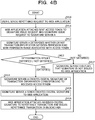
- FIG. 4B illustrates a flow of each process in remittance phases (corresponding to steps S204 to S208 in FIG. 2 ) mainly executed by a processing unit (the CPU 301) of the signature server A (100) and the web application 160 (for example, the CPU 301 of the web application server 150).
- steps S405 and S406 are sub-processes for verifying a permission rule for the user L.
- the signature server A (100) may execute step S407 after the process in step S404.
- the signature server A which keeps the secret key 110 of an account of a virtual currency of the user L is prepared (step S401).
- the user L attaches transaction information for designating a remittance source (the account a), a remittance destination (the account b), and the remittance amount, to an access token issue request and sends the access token issue request to the signature server A (step S402).
- the signature server A (100) calculates a permission range of a permission rule (step S403).
- the signature server A (100) sends the permission rule attached to the permission range (the permission range of the remittance amount) to the user L (step S404).
- the signature server A (100) determines a response (permission or rejection) of the user L for the permission rule (step S405).
- the signature server A (100) proceeds to the process in step S407.
- the response of the user L is rejection (No in step S405), based on the parameter permission range (the permission range of the remittance amount) by the user L, a permission rule with a permission range is generated (step S406), and the process proceeds in step S407.
- the signature server A (100) registers the permission rule with the permission range to which the generated parameter permission range is given inside the signature server A (step S407).
- the signature server A (100) creates a new access token and registers the access token inside the signature server A in association with the transaction information received in step S402 and the registered permission rule (step S408).
- the signature server A (100) issues the created new access token to the web application 160 (step S409).
- the signature server A (100) terminates series of processes related to the registration phases of the permission rule.
- the user L sends a remittance request including information on the remittance amount to the web application 160 (step S410).
- the web application 160 attaches the sent access token to a signature issue request and the signature issue request to the signature server A (100) (step S411).
- the signature server A (100) determines whether or not the transaction information including the remittance amount satisfies the permission rule with the permission range (the permission range of the remittance amount) associated with the access token (step S412).
- the signature server A (100) proceeds to the process in step S414.
- the signature server A (100) proceeds to the process in step S417.
- step S414 the signature server A (100) creates a digital signature of the transaction information corresponding to the received access token (step S414).
- the signature server A (100) sends the created digital signature to the web application 160 (step S415).
- the web application 160 attaches the received digital signature to a remittance transaction and issues the remittance transaction in the blockchain BC (step S416).
- the signature server A (100) replies that a digital signature is not issued to the web application 160 (step S417).
- the signature server A (100) terminates series of processes related to the remittance phases.
- step S401 the user L has the account a in the blockchain BC, and the user S has the account b in the blockchain BC.
- a secret key of the account a is managed by the signature server A (100) for blockchain.
- step S402 in a case of an access token issue request by the user L, a virtual currency in the account a of the user L is remitted to the account b of the user S.
- a legal currency for example, dollar $, yen ⁇ , or the like
- dollar $ is treated as the legal currency.
- FIG. 5 is a chart illustrating an example of transaction information when a signature is permitted according to Embodiment 1.
- FIG. 5 illustrates an example of transaction information 500 sent to the signature server A (100) in a case of an access token issue request from the user L in step S402.
- a remittance source is "the account a of the user L”
- a remittance partner is "the account b of the user S”
- the remittance amount is "virtual currency 200 points”.
- the signature server A creates a permission range according to the following procedure.
- a permission range described in the following equation (1) is calculated for a remittance amount Y included in a remittance request.
- K is a constant satisfying 0 ⁇ K ⁇ 1)
- a rate of dollar to virtual currency is 3.0 [dollar/virtual currency A].
- a range of the remittance amount is within a range of 420 to 780 dollars by legal currency exchange.
- FIG. 6 is a chart illustrating an example of a permission rule generated by the signature server according to Embodiment 1.
- the signature server A includes information of a remittance source of "the account a of the user L", a remittance partner of "the account b of the user S", and a range of the remittance amount of "420 to 780 dollars by dollar exchange”.
- the signature server A (100) creates an appropriate character string (for example, "P8mOcv + 6SW") as a new access token.
- the signature server A (100) associates the permission rule (or the permission rule generated by the user L in step S407) created in step S404 with the access token and adds the permission rule as a new permission rule to the recording unit (a table) inside the signature server A (100).
- FIG. 7 is a chart illustrating an example of a table of a permission rule held by the signature server according to Embodiment 1.
- the signature server A adds a new line 701 of the permission rule to a table 700 of the permission rule.
- the permission rule of the new line 701 includes each information of a new access token of "P8mOcv + 6SW", a remittance source of "the account a of the user L", a remittance partner of "the account b of the user S", and a range of the remittance amount of "420 to 780 dollars by dollar exchange".
- the signature server A (100) issues the new access token of "P8mOcv + 6SW" to the web application 160.
- FIG. 8 is a chart illustrating an example of a remittance request according to Embodiment 1.
- the user L sends a remittance request 800 to the web application 160.
- the remittance request 800 includes information on a remittance source of "the account a of the user L", a remittance partner of "the account b of the user S", and the remittance amount of "virtual currency 200 points".
- FIG. 9 is a chart illustrating an example of a remittance request sent from a web application to a signature server according to Embodiment 1.
- the web application 160 attaches a received access token to a remittance request 900 and the remittance request 900 to the signature server A (100).
- the remittance request 900 includes information on a remittance source of "the account a of the user L", a remittance partner of "the account b of the user S", the remittance amount of "virtual currency 200 points", and an access token of "P8mOcv + 6SW".
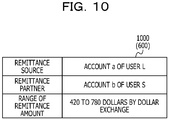
- FIG. 10 is a chart illustrating an example of a permission rule extracted by the signature server according to Embodiment 1.
- the signature server A (100) extracts the line 701 of which an access token matches with the access token, from the table 700 of the permission rule held by the signature server A (100).
- a permission rule 1000 included in the extracted line 701 is extracted.
- the permission rule 1000 illustrated in FIG. 10 has the same information as FIG.
- step S413 the signature server A (100) determines whether the remittance amount of the received remittance request 900 satisfies the extracted permission rule 1000.
- the remittance request 900 it is assumed that a virtual currency rate fluctuates from 3.0 when a signature is permitted to 3.2 [dollar/virtual currency].
- the remittance amount is 640 dollars by dollar exchange (since the rate is 3.2 [dollar/virtual currency])
- the remittance amount is within a range of the remittance amount of the permission rule 1000 (see FIG. 10 ), so the signature server A (100) determines that "the permission rule is satisfied" (Yes in step S413).
- the signature server A (100) determines that "the permission rule is not satisfied" (No in step S413). In this case, according to the process in step S417, the signature server A (100) replies that a signature is not issued to the web application 160.
- step S414 the signature server A (100) creates a digital signature corresponding to transaction information only when it is determined that "the permission rule is satisfied (Yes in step S413)" in step S413.
- step S415 the signature server A (100) sends the created digital signature to the web application 160.
- step S416 the web application 160 attaches the received digital signature to a remittance transaction and issues the remittance transaction in the blockchain BC.
- one blockchain (BC) and one signature server A (100) are provided, and as a currency rate fluctuates in a case of performing remittance as a transaction process from the user L to the user S, it is possible to collate permission contents of the transaction of the user L with transaction contents at a time of performing an actual remittance.
- the signature server A (100) calculates a permission range of the remittance amount, and issues a digital signature only in a case where the remittance amount at the time of the actual remittance is within the permission range. A transaction process of the remittance is permitted.
- the user L who performs a remittance operation of a virtual currency in the blockchain BC may verify whether or not the remittance amount is within an intended permission content even in a case where there is a time difference or a difference situation between when the transaction is permitted and when a transaction request is actually sent. Since the secret key 110 of the user L is held in the signature server A (100) without being deposited in the web application 160, a proxy transaction may be safely executed.
- FIG. 11 is a diagram illustrating an example of a transaction process according to Embodiment 2.
- Embodiment 2 an example in which a transaction permission rule is determined based on the current remittance amount will be described.
- the same components as those in Embodiment 1 are denoted by the same reference numerals.
- Embodiment 2 it is assumed that the user L has respectively the accounts a and b in a blockchain A (a virtual currency A) and a blockchain B (a virtual currency B).
- a blockchain A a virtual currency A
- a blockchain B a virtual currency B
- the secret key 110 of the account a is managed by the signature server A (100) for the blockchain A.
- the secret key 110 of the account b is managed by a signature server B (100) for the blockchain B.
- the virtual currency A is exchanged for the virtual currency B, and the signature server A (100) performs the process.
- the signature server B for the blockchain B as a payment source is required.
- FIGs. 12B and 12B are flowcharts illustrating an example of a transaction process according to Embodiment 2.
- FIG. 12A illustrates a flow of each process in registration phases of a permission rule (corresponding to steps S1101 to S1103 in FIG. 11 ) mainly executed by a processing unit (the CPU 301) of the signature server A (100).
- FIG. 12B illustrates a flow of each process in remittance phases (corresponding to steps S1104 to S1108 in FIG. 11 ) mainly executed by a processing unit (CPU 301) of the signature server A (100) and the web application 160 (for example, the CPU 301 of the web application server 150).
- step S1205 and S1206 are sub-processes for verifying a permission rule for the user L.
- the signature server A (100) may execute step S1207 after the process in step S1204.
- the signature server A which keeps the secret key 110 of an account of a virtual currency of the user L is prepared (step S1201).
- the user L attaches transaction information for designating a remittance source (the account a), a remittance destination (the account b), and the remittance amount, to an access token issue request and sends the access token issue request to the signature server A (step S1202).
- the signature server A (100) calculates a permission range of a permission rule (step S1203).
- the signature server A (100) sends the permission rule attached to the permission range (the permission range of the remittance amount) to the user L (step S1204).
- the signature server A (100) determines a response (permission or rejection) of the user L for the permission rule (step S1205).
- the signature server A (100) proceeds to the process in step S1207.
- the response of the user L is rejection (No in step S1205), based on the parameter permission range (the permission range of the remittance amount) by the user L, a permission rule with a permission range is generated (step S1206), and the process proceeds in step S1207.
- the signature server A (100) registers the permission rule with the permission range to which the generated parameter permission range is given inside the signature server A (step S1207).
- the signature server A (100) creates a new access token and registers the access token inside the signature server A in association with the transaction information received in step S1202 and the registered permission rule (step S1208).
- the signature server A (100) issues the created new access token to the web application 160 (step S1209).
- the signature server A (100) terminates series of processes related to the registration phases of the permission rule.
- the user L sends a remittance request including information on the remittance amount to the web application 160 (step S1210).
- the web application 160 attaches the sent access token to a signature issue request and the signature issue request to the signature server A (100) (step S1211).
- the signature server A (100) determines whether or not the transaction information including the remittance amount satisfies the permission rule with the permission range (the permission range of the remittance amount) associated with the access token (step S1212).
- the signature server A (100) proceeds to the process in step S1214.
- the signature server A (100) proceeds to the process in step S1217.
- step S1214 the signature server A (100) creates a digital signature of the transaction information corresponding to the received access token (step S1214).
- the signature server A (100) sends the created digital signature to the web application 160 (step S1215).
- the web application 160 attaches the received digital signature to a remittance transaction and issues the remittance transaction in the blockchains A and B (step S1216).
- the signature server A (100) replies that a digital signature is not issued to the web application 160 (step S1217).
- the signature server A (100) terminates series of processes related to the remittance phases.
- step S1201 the user L has respectively the accounts a and b in the blockchain A (the virtual currency A) and the blockchain B (the virtual currency B).
- the secret key of the account a is managed by the signature server A for the blockchain A.
- the signature server B 100 for the blockchain B as a payment source is required.
- step S1202 the user L exchanges the virtual currency A in the account a for the virtual currency B in the account b.
- the virtual currency B is more stable in value, and it is considered to construct a signature issue rule based on a value in the legal currency B.
- a remittance source is the virtual currency A and the secret key is managed by the signature server A (100)
- the signature server A (100) sets a permission rule for a transaction.
- FIG. 13 is a chart illustrating an example of transaction information when a signature is permitted according to Embodiment 2.
- FIG. 13 illustrates an example of transaction information 1300 sent to the signature server A (100) in a case of an access token issue request from the user L in step S1202.
- a remittance source is "the account a (the virtual currency A) of the user L”
- a remittance partner is "the account b (the virtual currency B) of the user L”
- the remittance amount is "virtual currency A 200 points”.
- step S1203 the signature server A (100) creates a permission range according to the following procedure.
- a permission range described in the following equation (3) is calculated for the remittance amount Y included in a remittance request.
- K is a constant satisfying 0 ⁇ K ⁇ 1)
- a rate of the virtual currency B to the virtual currency A is 3.0 [virtual currency B/virtual currency A].
- a range of the remittance amount is within a range of 420 to 780 points in virtual currency B exchange.
- FIG. 14 is a chart illustrating an example of a permission rule generated by a signature server according to Embodiment 2.
- the signature server A (100) creates a permission rule (a permission range of the remittance amount) 1400.
- the permission rule (the permission range of the remittance amount) 1400 includes information of a remittance destination of "the account a (the virtual currency A) of the user L", a remittance partner of "the account b (the virtual currency B) of the user L", and a range of the remittance amount of "420 to 780 points by virtual currency B exchange".
- the signature server A (100) creates an appropriate character string (for example, "P8mOcv + 6SW") as a new access token.
- the signature server A (100) associates the permission rule (or the permission rule generated by the user L in step S1207) created in step S1204 with the access token and adds the permission rule as a new permission rule to the recording unit (a table) inside the signature server A (100).
- FIG. 15 is a chart illustrating an example of a table of the permission rule held by the signature server according to Embodiment 2.
- the signature server A adds a new line 1501 of the permission rule to a table 1500 of the permission rule.
- the new line 1501 includes each information of a new access token of "P8mOcv + 6SW", a remittance source of "the account a (the virtual currency A) of the user L", a remittance destination of "the account b (the virtual currency B) of the user L”, and a range of the remittance amount of "420 to 780 points by virtual currency B exchange".
- the signature server A (100) issues the new access token of "P8mOcv + 6SW" to the web application 160.
- FIG. 16 is a chart illustrating an example of a remittance request according to Embodiment 2.
- the user L sends a remittance request 1600 to the web application 160.
- the remittance request 1600 includes information of a remittance source of "the account a (the virtual currency A) of the user L", a remittance partner is "the account b (the virtual currency B) of the user L", and the remittance amount of "virtual currency A 200 points".
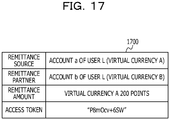
- FIG. 17 is a chart illustrating an example of a remittance request sent from a web application to the signature server according to Embodiment 2.
- the web application 160 attaches a received access token to a remittance request 900 and a remittance request 1700 to the signature server A (100).
- the remittance request 1700 includes information on a remittance source of "the account a (the virtual currency A) of the user L", a remittance partner of "the account b (the virtual currency B) of the user L", the remittance amount of "virtual currency A 200 points", and an access token of "P8mOcv + 6SW".
- FIG. 18 is a chart illustrating an example of a permission rule extracted by the signature server according to Embodiment 2.
- the signature server A (100) extracts the line 1501 of which an access token matches with the access token, from the table 1500 of the permission rule held by the signature server A (100).
- a permission rule 1800 included in the extracted line 1501 is extracted.
- the permission rule 1800 illustrated in FIG. 18 has the same information as that in FIG.
- step S1213 the signature server A (100) determines whether the remittance amount of the received remittance request 1700 satisfies the extracted permission rule 1800. For example, in the case of the remittance request 1700, it is assumed that a virtual currency rate fluctuates from 3.0 when a signature is permitted to 3.2 [virtual currency B/virtual currency A]. At this time, the remittance amount is 640 points by virtual currency B exchange (since the rate is 3.2 [virtual currency B/virtual currency A]). Since the remittance amount of 640 points is within a range of the remittance amount of the permission rule 1800 (see FIG. 18 ), the signature server A (100) determines that "the permission rule is satisfied" (Yes in step S1213).
- the signature server A (100) determines that "the permission rule is not satisfied" (No in step S1213). In this case, according to the process in step S1217, the signature server A (100) replies that a signature is not issued to the web application 160.
- step S1214 the signature server A (100) creates a digital signature corresponding to transaction information only when it is determined that "the permission rule is satisfied (Yes in step S1213)" in step S1213.
- step S1215 the signature server A (100) sends the created digital signature to the web application 160.
- step S1216 the web application 160 attaches the received digital signature to a remittance transaction and issues the remittance transaction in the blockchains A and B.
- Embodiment 2 as a currency rate fluctuates in a case where the user L performs remittance of exchanging between the virtual currencies A and B in the two blockchains A and B, it is possible to collate permission contents of the transaction of the user L with transaction contents at a time of performing an actual remittance.
- the signature server A 100 calculates a permission range of the remittance amount, and issues a digital signature only in a case where the remittance amount at the time of the actual remittance is within the permission range. A transaction process of the remittance is permitted.
- the user L who performs a remittance operation of the virtual currency A in the blockchain A may verify whether or not the remittance amount is within an intended permission content even in a case where there is a time difference or a difference situation between when the transaction is permitted and when a transaction request is actually sent. Since the secret key 110 of the user L is held in the signature server A (100) without being deposited in the web application 160, a proxy transaction may be safely executed.
- Embodiment 3 an example in which a transaction permission rule is determined based on a past transaction of the user L will be described.
- the signature server A (100) described in Embodiments 1 and 2 calculates a permission range of the remittance amount (corresponding to step S403 and step S1203) will be described.
- the signature server A calculates a permission range described in the following equation (5) for the remittance amount Y included in the remittance request (900 and 1700).
- X * M / U ⁇ Y ⁇ X * M / L M is an average of currency exchange rates for a most recent certain period, L is a lower limit of a 95% confidence interval of the currency exchange rate for the most recent certain period, and U is an upper limit of a 95% confidence interval of the currency exchange rate for the most recent certain period.
- the processing unit (the CPU 301) of the signature server A (100) records the currency exchange rate for the most recent certain period and the lower and upper limits of the confidence interval in a recording unit (such as the recording medium 305 or the like).
- the currency exchange rate uses a rate of [virtual currency/base currency] after determining a base currency (a currency which is a center of a currency exchange).
- a base currency a currency which is a center of a currency exchange.
- FIG. 19 is a chart illustrating another example of determining a permission rule according to Embodiment 3.
- the remittance amount included in the transaction information (500 and 1300) at a time of creating a permission rule is virtual currency 100 points, and a currency exchange rate [virtual currency/US dollar] for most recent one week is in a state illustrated in FIG. 19 .
- Embodiment 3 it is possible to calculate the permission range of the remittance amount based on a currency exchange rate of transactions performed for the past certain period. Therefore, based on information on a transaction process actually performed by the user L, it is possible to create the permission rule along an intended transaction of the user L.
- the permission range of the remittance amount is calculated based on the transactions performed by the user L for the past certain period, but the permission range of the remittance amount may be calculated based on transactions performed by another user for the past certain period without being limited thereto.
- the user L may use the permission range of the remittance amount calculated based on transactions performed by the other user for the past certain period, and even a user with a small number of transactions may perform an appropriate remittance.
- Embodiment 4 variations of a smart contract (an application example to various systems) will be described.
- the application example to the proxy authentication system for remittance of the virtual currency is described. Without being limited thereto, the same may be applied to a proxy authentication function of the web application 160 for issuing and operating a smart contract in a blockchain.
- a permission rule with a permission range may be set for an argument value.
- the signature server A (100) calculates the permission range of the remittance amount so as to create a permission rule.
- a smart contract of a side dish section in a supermarket for example.
- the user gives surveying instrument an authority to "pay for 300 grams of side dish with one point of virtual currency" in advance.
- a smart contract interlocked with the surveying instrument may perform payment with the virtual currency on behalf of the user.
- a parameter (a setting value or a condition of the permission range) of a smart contract in various transaction processes including a transaction with a point card may be set in the same manner as in the embodiment described above. Therefore, it becomes possible to collate permission contents of the transaction of the user with transaction contents when using the actual system.
- the user of the web application may execute the transaction process with the remittance amount or the like along an intended permission content even in a case where there is a time difference or a difference situation between when the transaction is permitted and when a transaction request is actually sent.
- an OAuth 2.0 technology is widely known as a mechanism for transferring an authority of a user to another application.
- This technology includes a mechanism in which an access authority of the user is partly transferred to a web application by using an access token so that the web application performs a process on behalf of the user.
- the access token is a symbol (a character string) indicating that only a specific operation is permitted on behalf of the user.
- FIG. 20 is a diagram illustrating an example of proxy authentication of user authority in the related art.
- the user L has access authority to a video posting site 2010 (a video posting site server 2011) and an SNS site 2020 (an SNS site server 2021).
- the user L permits that "the video posting site 2010 performs posting on the SNS site 2020 on behalf of the user L himself or herself' for the SNS site 2020 (step S2001).
- the SNS site 2020 issues an access token to the video posting site 2010 (step S2002).
- the video posting site 2010 attaches the access token to the SNS site 2020 on behalf of the user L and posts the video (step S2004).
- the user L registers a video in the video posting site 2010, by using an access token registered in advance, it is possible to perform proxy authentication when the video posting site 2010 automatically posts the video or the like to the SNS site 2020 with authority of the user L.
- FIG. 21 is a diagram illustrating a configuration example of a proxy transaction system for a blockchain in the related art. It is assumed that a virtual currency transaction system including proxy authentication as illustrated in FIG. 21 is configured by using the OAuth 2.0 technology described above.
- Signature servers A and B (2101) hold a secret key 2110 of the user L for the blockchains A and B. As illustrated in FIG. 21 , the user L may access a web application 2160 (a web application server 2150).
- the user L permits the signature servers A and B (2101) to issue a signature only for a specific remittance request (a remittance source, a remittance partner, and the remittance amount) (step S2101).
- the signature servers A and B (2101) register an access token in association with transaction information (step S2102).
- the signature servers A and B (2101) issue the access token to the web application 2160 (step S2103).
- the web application 2160 requests the signature servers A and B (2101) to issue a digital signature (step S2105).
- the signature servers A and B (2101) use mechanism of the access token so as to verify whether transaction contents coincide with permission contents of the user L (step S2106), and issue a signature to the web application 2160 when the transaction contents coincide with the permission contents (step S2107). Therefore, the web application 2160 issues a transaction in the blockchains A and B as a proxy transaction of the user L by using the signature received from the signature servers A and B (2101) (step S2108).
- a rate of the virtual currency to a base currency fluctuates, and a permission rule of the signature servers A and B (2101) is configured based on a value of the base currency.
- a signature is permitted ("use date: September 14, 2018, 15:00", in step S2101), it is assumed that "a rate of US dollar to virtual currency A is 2.0 USD/virtual currency A”.
- a value in US dollars is 200 USD.
- the signature servers A and B (2101) set a signature issue rule as "pass a signature when a user sends a transaction corresponding to 200 USD to a designated destination".
- step S2104 it is assumed that the rate of the virtual currency fluctuates until the remittance is actually permitted ("use date: September 14, 2018, 15:30", in step S2104) and "a rate of US dollar to the virtual currency A is 1.8 USD/virtual currency A".
- a value in US dollar is 180 USD, and the signature servers A and B (2101) may not issue a signature in step S2107 for this transaction.
- the web application held the secret key of the user and exchanges information with the blockchain during the transaction process. Since the secret key is held by the web application, there is also a concern that proxy transactions may not be safely executed.
- the signature server sets a permission rule obtained by calculating a permission range of the remittance amount based on transaction information of the user, and determines whether or not a remittance request of the user is within the permission rule. Therefore, even when a currency exchange rate fluctuates due to a time difference or a difference situation between when the user of the web application permits the transaction and when the remittance request is actually sent, the signature server may verify whether the remittance amount of the user is within the intended permission range based on the permission rule. In addition, the user may perform remittance within the permission range of the remittance amount, and may reduce unintentional under or over the remittance amount.
- the signature server since the signature server holds the secret key of the user, a proxy transaction may be safely performed as compared with the related art. Even when linking a plurality of blockchain, the corresponding plurality of signature server respectively and distributively hold secret keys of the user, so that the proxy transaction may be safely executed even when linking the plurality of blockchain.
- the signature server in response to reception of a token issue request including transaction information from a user, the signature server generates a permission rule for determining a permission range of transaction contents based on the transaction information, and transmits a token corresponding to the permission rule to the web application which processes a proxy transaction of the user.
- the signature server determines whether or not to issue a digital signature corresponding to the signature issue request is determined, based on whether or not the transaction contents included in the transaction request are within the permission range determined by the permission rule corresponding to the token included in the signature issue request. Therefore, collation between permission contents of the transaction at the time of the token issue request and actual transaction contents is performed.
- the signature server determines whether or not the actual transaction contents satisfy the permission range of the permission rule, and when the actual transaction contents satisfy the permission range, the signature server issues a digital signature and causes the web application (the Web app) to execute the remittance transaction.
- the transaction process performed in the embodiment may be applied to a proxy transaction by a blockchain and a signature server.
- the signature server determines a permission range of the remittance amount for a permission rule.
- the remittance amount included in the remittance request is within the permission range in the permission rule. Therefore, it becomes possible to collate permission contents of the user at the time of the proxy transaction with actual transaction contents by applying to the remittance in the virtual currency or the like.
- a currency exchange rate fluctuates in a short time in the virtual currency or the like, there may be a situation in which even in a case of the same remittance amount, the transaction amount differs between when being permitted by the user (at a time of issuing an access token) and when the user actually issues a remittance request via the web application due to a change of the currency exchange rate.
- the signature server may determine that issue of a digital signature of the transaction information to the web application is permitted and issue the digital signature to the web application. Therefore, at the time of the remittance request when the user actually performs remittance, in a case where the remittance amount is within the permission range, the signature server issues a digital signature, and the user may perform a remittance transaction. On the other hand, when the remittance amount is outside the permission range, the remittance transaction is not permitted. The user may perform the remittance within the permission range of the remittance amount set in the signature server.
- the signature server may hold authentication information for authenticating the transaction process by the user, and create a digital signature by using the authentication information.
- authentication information a secret key
- the signature server may hold and holding the authentication information (a secret key) of the user in the signature server, it is not required for the web application to hold the secret key in the related art, and a proxy transaction may be safely executed.
- the signature server For each token issue request including transaction information from the user, the signature server additionally creates information in which a remittance source, a remittance destination, a permission range of the remittance amount, and a token for each user are associated with each other in a table, as information of the permission rule.
- a permission rule corresponding to the remittance request may be extracted by referring to the permission rule of the table, and it may be determined whether or not the remittance amount of the extracted permission rule is within the permission range of the remittance amount. Therefore, each time the user performs a transaction, a history of the transaction contents may be tabulated and accumulated, and a permission rule appropriate to each user may be created and remittance may be appropriately processed based on the appropriate permission rule for each user.
- the signature server may calculate a value obtained by multiplying the remittance amount included in the transaction information at the time of creating the permission rule by a predetermined coefficient as a maximum value and a minimum value defining the permission range of the remittance amount. Therefore, the permission range of the remittance amount may be appropriately set, and an actual remittance process may be appropriately executed by using the permission range.
- the signature server may calculate the permission range of the remittance amount by using the currency exchange rate included in the current or past transaction information of the user or another user. Therefore, it becomes possible to appropriately set the permission range of the remittance amount according to a transaction status of the user, and it becomes possible to appropriately process the remittance based on the permission rule appropriate to each user. Even a user with a small number of transactions may perform appropriate remittance by using transaction information of the other user.
- the signature server may notify the user of the calculated permission rule, perform a determination using the permission rule by permission of the user, and perform the determination using a permission rule created by the user when being rejected by the user. Therefore, according to the permission rule created by the signature server, the remittance may be appropriately performed based on the permission of the user. Since the remittance may be performed by using the permission rule created by the user when the user rejects the permission rule created by the signature server, a transaction of the remittance according to the intention of the user may be performed.
- the transaction may be a smart contract using one or a plurality of blockchain accounts, and at the time of a transaction when the smart contract is executed, a determination is performed by using a permission rule for a request for issuing a digital signature from the web application. Therefore, the transaction process described in the embodiment may be applied to various systems, and the transaction process in the applied various systems may be appropriately executed by using the permission rule.
- the signature method described in the embodiment of the present disclosure may be enabled by causing a processor such as a server or the like to execute a program prepared in advance.
- the present signature method is recorded in a computer-readable recording medium such as a hard disk, a compact disc-read only memory (CD-ROM), a flash memory, or the like, and executed by being read from the recording medium by the computer.
- the present signing method may be distributed via a network such as the Internet.
Landscapes
- Engineering & Computer Science (AREA)
- Business, Economics & Management (AREA)
- Accounting & Taxation (AREA)
- Computer Security & Cryptography (AREA)
- Finance (AREA)
- Theoretical Computer Science (AREA)
- Physics & Mathematics (AREA)
- General Physics & Mathematics (AREA)
- Strategic Management (AREA)
- General Business, Economics & Management (AREA)
- Computer Networks & Wireless Communication (AREA)
- Signal Processing (AREA)
- Computer Hardware Design (AREA)
- General Engineering & Computer Science (AREA)
- Marketing (AREA)
- Technology Law (AREA)
- Economics (AREA)
- Development Economics (AREA)
- Software Systems (AREA)
- Computing Systems (AREA)
- Financial Or Insurance-Related Operations Such As Payment And Settlement (AREA)
Abstract
Description
- The embodiments discussed herein are related to a signature server, a signature method, and a signature program capable of performing a process for digital signature issue.
- A blockchain is used as a management system for a virtual currency, and requires a safe operation. Types of the virtual currency or the blockchain are explosively increased, and linking between different virtual currencies and blockchains is increasingly required. When linking different virtual currencies and blockchains, different authentication information is required for transaction execution. It is difficult for a general user of this service to keep such authentication information himself or herself, and issue a digital signature and execute a transaction. Therefore, a web application which manages authentication information, issues a digital signature and executes the transaction on behalf of the user with permission is required.
- In the related art, as a technology related to management of a blockchain and a virtual currency, there is a technology for executing an account operation interlocked with transaction using the blockchain and determining success or failure of the transaction by matching execution results (for example, see Japanese Laid-open Patent Publication No.
2018-139067 2018-521437 2018-136657 - Regarding the requirement of the web application, when authentication information is managed in a server of the web application accessed by many users, there is a risk that the authentication information will be leaked to the outside. For this reason, an operation mode in which a signature server which performs a process according to digital signature issue is separately prepared and the signature server permits only access of the web application is considered. At this time, the signature server is permitted to issue a signature only for a specific transaction content by a request from a user via the web application, and issues a digital signature when receiving a request for a transaction permitted in advance from the web application. The web application issues a transaction in the blockchain using the digital signature received from the signature server.
- When performing the operation, for example, in an exchange of the virtual currency, a currency exchange rate fluctuates in a short time, so there may be a situation in which the transaction amount differs between when the user permits the transaction signature and when the user actually performs a remittance. In this case, in the related art, it is impossible to collate the permission content intended by the user with the actual transaction content.
- In one aspect, an object of the present embodiment is to collate permission contents with transaction contents of a user.
- According to an aspect of the embodiments, a signature server includes: a processing unit that, in response to reception of a token issue request including transaction information from a user, generates a permission rule for determining a permission range of transaction contents based on the transaction information and transmits a token corresponding to the permission rule to a web application which processes a proxy transaction for the user, and in response to reception of a signature issue request based on a transaction request by the user including the token from the web application, determines whether or not to issue a digital signature corresponding to the signature issue request, based on whether or not the transaction contents included in the transaction request are within the permission range determined by the permission rule corresponding to the token included in the signature issue request.
-
-
FIG. 1 is a block diagram of a function of a signature server related to a transaction process according to Embodiment 1; -
FIG. 2 is a diagram illustrating an example of the transaction process according to Embodiment 1; -
FIG. 3 is a diagram illustrating an example of a hardware configuration of the signature server according to Embodiment 1; -
FIG. 4A is a flowchart illustrating an example (Part 1) of the transaction process according to Embodiment 1; -
FIG. 4B is a flowchart illustrating the example (Part 2) of the transaction process according to Embodiment 1; -
FIG. 5 is a chart illustrating an example of transaction information when a signature is permitted according to Embodiment 1; -
FIG. 6 is a chart illustrating an example of a permission rule generated by the signature server according to Embodiment 1; -
FIG. 7 is a chart illustrating an example of a table of the permission rule held by the signature server according to Embodiment 1; -
FIG. 8 is a chart illustrating an example of a remittance request according to Embodiment 1; -
FIG. 9 is a chart illustrating an example of a remittance request sent from a web application to the signature server according to Embodiment 1; -
FIG. 10 is a chart illustrating an example of a permission rule extracted by the signature server according to Embodiment 1; -
FIG. 11 is a diagram illustrating an example of a transaction process according toEmbodiment 2; -
FIG. 12A is a flowchart illustrating an example (Part 1) of the transaction process according toEmbodiment 2; -
FIG. 12B is a flowchart illustrating the example (Part 2) of the transaction process according toEmbodiment 2; -
FIG. 13 is a chart illustrating an example of transaction information when a signature is permitted according toEmbodiment 2; -
FIG. 14 is a chart illustrating an example of a permission rule generated by a signature server according to Embodiment 2; -
FIG. 15 is a chart illustrating an example of a table of the permission rule held by the signature server according to Embodiment 2; -
FIG. 16 is a chart illustrating an example of a remittance request according toEmbodiment 2; -
FIG. 17 is a chart illustrating an example of a remittance request sent from a web application to the signature server according to Embodiment 2; -
FIG. 18 is a chart illustrating an example of a permission rule extracted by the signature server according to Embodiment 2; -
FIG. 19 is a chart illustrating another example of determining a permission rule according to Embodiment 3; -
FIG. 20 is a diagram illustrating an example of proxy authentication of user authority in the related art; and -
FIG. 21 is a diagram illustrating a configuration example of a proxy transaction system for a blockchain in the related art. - Hereinafter, embodiments of a signature server, a signature method, and a signature program according to the present disclosure are described in detail with reference to the drawings.
- The disclosed technology may be applied to, for example, a proxy transaction by a blockchain and a signature server which performs a process related to digital signature issue. In this case, in advance, the signature server calculates a permission range of a parameter (for example, a permission range of the remittance amount) in the transaction process based on transaction information of a user, and sets a permission rule to which information on the permission range is given. In the disclosed technology, the signature server keeps and holds authentication information (a secret key) of the user.
- For example, at a time of requesting issue of an access token of the user, the signature server sets a permission rule including a permission range of the remittance amount as a permission range of a parameter in the transaction process. After then, when the user actually performs a remittance request after a time elapses, the signature server determines whether or not the remittance amount of the remittance request is within the permission range of the set remittance amount. Therefore, when the remittance amount of the remittance request is within the permission range of the set remittance amount, the signature server issues a digital signature and executes a remittance transaction in the web application (web app). The web application includes, for example, a server and client type web application, a smart contract in a blockchain, a program in the blockchain, and the like. In the proxy transaction, for example, user authority is transferred to the web application, and the web application executes transaction on behalf of the user himself or herself.
- Since a currency exchange rate fluctuates in a short time in a case of a virtual currency or the like, there may be a situation in which the transaction amount differs between when the user permits transaction (for example, at a time of issuing an access token) and when the user actually issues a remittance request via the web application. In this case, in the embodiment, the signature server may collate permission contents with the transaction contents of the user at the time of the proxy transaction. At the time of the remittance request when the user actually performs remittance, in a case where the remittance amount is within the permission range even when the currency exchange rate fluctuates, the signature server issues a digital signature, and the user may perform a remittance transaction. When the remittance amount is outside the permission range, the signature server does not permit the remittance transaction and the user may not perform the remittance transaction. Therefore, the user may perform remittance within the permission range of the remittance amount set in the signature server.
-
FIG. 1 is a block diagram of a function of a signature server related to a transaction process according to Embodiment 1. In addition to a signature server A (100) according to a transaction process, a user L, aweb application 160, and a blockchain BC are illustrated. - A flow of the transaction process will be described. First, the user L transmits an access token issue request to the signature server A (100) (step S1). Therefore, transaction information is registered in the signature server A (100).
- The signature server A (100) includes each of functions of a request reception and
response unit 101, a permissionrange calculation unit 102, a permissionrule registration unit 103, an accesstoken creation unit 104, a permissionrule determination unit 105, and a digitalsignature creation unit 106. - The request reception and
response unit 101 respectively receives an access token issue request and a signature issue request. The signature issue request includes an access token and transaction information. - Based on the transaction information of the access token issue request, the permission
range calculation unit 102 calculates a permission range of a permission rule (a permission range of the remittance amount) (step S2). The permissionrule registration unit 103 records the permission range of the permission rule (the permission range of the remittance amount) calculated by the permissionrange calculation unit 102 in a recording unit (step S3). - The access
token creation unit 104 records the access token in association with (associated with) the transaction information (the remittance amount) and the permission rule in the recording unit (step S4). At this time, the request reception andresponse unit 101 issues an access token to the web application 160 (step S5). - Next, the user L actually transmits a remittance transaction request to the web application 160 (step S6). Therefore, the
web application 160 transmits a signature issue request (to which the access token and the transaction information (the remittance amount) are attached) to the signature server A (100) (step S7). - The permission
rule determination unit 105 determines whether or not the transaction information (the remittance amount) sent from theweb application 160 satisfies the permission rule recorded in the recording unit (step S8). As described below, the permissionrule determination unit 105 generates a digital signature and sends the digital signature to theweb application 160 only when the transaction information (the remittance amount) satisfies the permission rule recorded in the recording unit. - The digital
signature creation unit 106 creates a digital signature of a transaction corresponding to the access token in the signature issue request (step S9). At this time, the digitalsignature creation unit 106 creates the digital signature by using asecret key 110 held inside the signature server A (100). Thesecret key 110 corresponds to authentication information for authenticating an account of the user L for a transaction process. - The request reception and
response unit 101 of the signature server A (100) sends the digital signature of the transaction corresponding to the access token to the web application 160 (step S10). Theweb application 160 issues a remittance transaction to which the digital signature sent from the signature server A (100) is attached to the blockchain BC (step S11). -
FIG. 2 is a diagram illustrating an example of the transaction process according to Embodiment 1. In Embodiment 1, one blockchain (BC) and one signature server A (100) are provided, and an example of performing remittance as a transaction process from the user L to a user S will be described. - It is assumed that the user L has an account a in the blockchain BC, and the user S also has an account b in the blockchain BC. It is assumed that the user L remits a virtual currency in the account a to the account b of the user S via the
web application 160 linked to the blockchain BC. Theweb application 160 illustrated inFIG. 2 is a display screen when theweb application 160 executes a process in a terminal such as a smartphone or the like held by the user L. Areference numeral 150 denotes a server which actually executes the process of theweb application 160. - Hereinafter, based on the description of
FIG. 2 , processing contents mainly performed by the signature server A (100) will be sequentially described. - 1. The user L permits the signature server A (100) to issue a signature on behalf of the user L only for a specific remittance request (step S201).
- 2. The signature server A (100) creates a permission rule obtained by calculating a permission range of the remittance amount based on transaction information of the user L, and associates an access token with the permission rule and registers the permission rule in the recording unit (step S202).
- 3. The signature server A (100) issues an access token to the web application 160 (step S203).
- 4. The user L sends the remittance request including information on the remittance amount to the web application 160 (step S204).
- 5. The
web application 160 sends the sent access token and a signature issue request including the transaction information such as the remittance amount to the signature server A (100) (step S205). - 6. The signature server A (100) determines whether or not the transaction information including the received remittance amount satisfies the permission rule (the permission range of the remittance amount) associated with the received access token. In a case where the determination result satisfies the permission rule, the signature server A (100) creates a digital signature of the transaction information corresponding to the received access token (step S206).
- 7. The signature server A (100) sends the created digital signature to the web application 160 (step S207).
- 8. The
web application 160 attaches the received digital signature to a remittance transaction and issues the remittance transaction in the blockchain BC. -
FIG. 3 is a diagram illustrating an example of a hardware configuration of the signature server according to Embodiment 1. The signature server A (100) illustrated inFIG. 1 may be configured by hardware illustrated inFIG. 3 , for example. - For example, the signature server A (100) includes a central processing unit (CPU) 301, a
memory 302, a network interface (IF) 303, a recording medium IF 304, and arecording medium 305. 300 is a bus which couples each unit. - The
CPU 301 is an arithmetic processing device which functions as a processing unit which controls the entire process of thesignature server 100. Thememory 302 includes non-volatile memory and volatile memory. The non-volatile memory is, for example, a read-only memory (ROM) which stores a program of theCPU 301. The volatile memory is, for example, dynamic random-access memory (DRAM), static random-access memory (SRAM), or the like used as a work area of theCPU 301. - The network IF 303 is communicatively coupled to an external terminal (such as a PC, a smartphone, or the like of the user) via a
network 310 such as a local area network (LAN), a wide area network (WAN), the Internet, or the like. - The recording medium IF 304 is an interface for reading and writing information processed by the
CPU 301 from and to therecording medium 305. Therecording medium 305 is a recording device which assists thememory 302. As therecording medium 305, for example, a hard disk drive (HDD), a solid state drive (SSD), a Universal Serial Bus (USB) flash drive, or the like may be used. - The
CPU 301 executes a program recorded in thememory 302 or therecording medium 305 so as to realize each function of the signature server A (100) illustrated inFIG. 1 . Thememory 302 and therecording medium 305 may realize the function of the recording unit which records and holds information such as the access token, the permission rule, the digital signature, and the like illustrated inFIG. 1 . - The hardware configuration illustrated in
FIG. 3 is the same in theweb application server 150 illustrated inFIG. 2 or the terminal of the user (a smartphone or the like) which executes theweb application 160, and a system of the embodiment may be realized by using a general-purpose hardware configuration. -
FIGs. 4A and4B are flowcharts illustrating an example of a transaction process according to Embodiment 1.FIG. 4A illustrates a flow of each process in registration phases of a permission rule (corresponding to steps S201 to S203 inFIG. 2 ) mainly executed by a processing unit (the CPU 301) of the signature server A (100).FIG. 4B illustrates a flow of each process in remittance phases (corresponding to steps S204 to S208 inFIG. 2 ) mainly executed by a processing unit (the CPU 301) of the signature server A (100) and the web application 160 (for example, theCPU 301 of the web application server 150). - Meanwhile, the following steps S405 and S406 are sub-processes for verifying a permission rule for the user L. When the permission rule verification of the user L is not required, the signature server A (100) may execute step S407 after the process in step S404.
- In the process of the registration phases for the permission rule illustrated in
FIG. 4A , first, as an advance preparation, the signature server A (100) which keeps thesecret key 110 of an account of a virtual currency of the user L is prepared (step S401). - The user L attaches transaction information for designating a remittance source (the account a), a remittance destination (the account b), and the remittance amount, to an access token issue request and sends the access token issue request to the signature server A (step S402).
- Therefore, based on the transaction information of the issue request, the signature server A (100) calculates a permission range of a permission rule (step S403). The signature server A (100) sends the permission rule attached to the permission range (the permission range of the remittance amount) to the user L (step S404).
- The signature server A (100) determines a response (permission or rejection) of the user L for the permission rule (step S405). When the response of the user L is permission (Yes in step S405), the signature server A (100) proceeds to the process in step S407. On the other hand, when the response of the user L is rejection (No in step S405), based on the parameter permission range (the permission range of the remittance amount) by the user L, a permission rule with a permission range is generated (step S406), and the process proceeds in step S407.
- Next, the signature server A (100) registers the permission rule with the permission range to which the generated parameter permission range is given inside the signature server A (step S407). The signature server A (100) creates a new access token and registers the access token inside the signature server A in association with the transaction information received in step S402 and the registered permission rule (step S408). The signature server A (100) issues the created new access token to the web application 160 (step S409). The signature server A (100) terminates series of processes related to the registration phases of the permission rule.
- Next, in the process of the remittance phases illustrated in
FIG. 4B , first, the user L sends a remittance request including information on the remittance amount to the web application 160 (step S410). Next, theweb application 160 attaches the sent access token to a signature issue request and the signature issue request to the signature server A (100) (step S411). - Therefore, the signature server A (100) determines whether or not the transaction information including the remittance amount satisfies the permission rule with the permission range (the permission range of the remittance amount) associated with the access token (step S412). When the determination result satisfies the permission rule (the remittance amount is within the permission range) (Yes in step S413), the signature server A (100) proceeds to the process in step S414. On the other hand, when the determination result does not satisfy the permission rule (the remittance amount is outside the permission range) (No in step S413), the signature server A (100) proceeds to the process in step S417.
- In the process in step S414, the signature server A (100) creates a digital signature of the transaction information corresponding to the received access token (step S414). Next, the signature server A (100) sends the created digital signature to the web application 160 (step S415).
- Therefore, the
web application 160 attaches the received digital signature to a remittance transaction and issues the remittance transaction in the blockchain BC (step S416). In step S417, the signature server A (100) replies that a digital signature is not issued to the web application 160 (step S417). After the processes in step S416 or step S417, the signature server A (100) terminates series of processes related to the remittance phases. - Next, a specific example of remittance will be described for the transaction process described with reference to
FIGs. 4A and4B . In the advance preparation in step S401, the user L has the account a in the blockchain BC, and the user S has the account b in the blockchain BC. A secret key of the account a is managed by the signature server A (100) for blockchain. - In step S402, in a case of an access token issue request by the user L, a virtual currency in the account a of the user L is remitted to the account b of the user S. As compared with the virtual currency, a legal currency (for example, dollar $, yen ¥, or the like) is generally more stable in value, and it is considered to construct a signature issue rule based on a value in the legal currency. In the following description, dollar $ is treated as the legal currency.
-
FIG. 5 is a chart illustrating an example of transaction information when a signature is permitted according to Embodiment 1.FIG. 5 illustrates an example oftransaction information 500 sent to the signature server A (100) in a case of an access token issue request from the user L in step S402. In thetransaction information 500, it is assumed that a remittance source is "the account a of the user L", a remittance partner is "the account b of the user S", and the remittance amount is "virtual currency 200 points". - Next, in step S403, the signature server A (100) creates a permission range according to the following procedure. When the remittance amount included in transaction information at a time of setting a permission rule is X, a permission range described in the following equation (1) is calculated for a remittance amount Y included in a remittance request.

(K is a constant satisfying 0 < K < 1) - At this time, for example, when the signature server A (100) sets K = 0.3 in advance and the remittance amount included in the transaction information at the time of creating a permission rule is
virtual currency 100 points, the signature server A (100) creates the permission rule described in the following equation (2) as the permission range of the remittance amount Y included in the remittance request.
- For example, when K = 0.3 and the signature server A (100) receives a transaction of the
transaction information 500 illustrated inFIG. 5 , it is assumed that a rate of dollar to virtual currency is 3.0 [dollar/virtual currency A]. At this time, based on the permission rule described above, a range of the remittance amount is within a range of 420 to 780 dollars by legal currency exchange. -
FIG. 6 is a chart illustrating an example of a permission rule generated by the signature server according to Embodiment 1. According to the process in step S403, as a permission rule (the permission range of the remittance amount) 600, the signature server A (100) includes information of a remittance source of "the account a of the user L", a remittance partner of "the account b of the user S", and a range of the remittance amount of "420 to 780 dollars by dollar exchange". - In the process in step S408, the signature server A (100) creates an appropriate character string (for example, "P8mOcv + 6SW") as a new access token. The signature server A (100) associates the permission rule (or the permission rule generated by the user L in step S407) created in step S404 with the access token and adds the permission rule as a new permission rule to the recording unit (a table) inside the signature server A (100).
-
FIG. 7 is a chart illustrating an example of a table of a permission rule held by the signature server according to Embodiment 1. According to the process in step S408, the signature server A (100) adds anew line 701 of the permission rule to a table 700 of the permission rule. The permission rule of thenew line 701 includes each information of a new access token of "P8mOcv + 6SW", a remittance source of "the account a of the user L", a remittance partner of "the account b of the user S", and a range of the remittance amount of "420 to 780 dollars by dollar exchange". - Next, in the process in step S409, the signature server A (100) issues the new access token of "P8mOcv + 6SW" to the
web application 160. -
FIG. 8 is a chart illustrating an example of a remittance request according to Embodiment 1. In step S410, the user L sends aremittance request 800 to theweb application 160. Theremittance request 800 includes information on a remittance source of "the account a of the user L", a remittance partner of "the account b of the user S", and the remittance amount of "virtual currency 200 points". -
FIG. 9 is a chart illustrating an example of a remittance request sent from a web application to a signature server according to Embodiment 1. In step S411, theweb application 160 attaches a received access token to aremittance request 900 and theremittance request 900 to the signature server A (100). Theremittance request 900 includes information on a remittance source of "the account a of the user L", a remittance partner of "the account b of the user S", the remittance amount of "virtual currency 200 points", and an access token of "P8mOcv + 6SW". -
FIG. 10 is a chart illustrating an example of a permission rule extracted by the signature server according to Embodiment 1. In step S412, based on the access token of "P8mOcv + 6SW" included in theremittance request 900, the signature server A (100) extracts theline 701 of which an access token matches with the access token, from the table 700 of the permission rule held by the signature server A (100). Apermission rule 1000 included in the extractedline 701 is extracted. Thepermission rule 1000 illustrated inFIG. 10 has the same information asFIG. 6 , and includes information of a remittance source of "the account a of the user L", a remittance partner of "the account b of the user S", and a range of the remittance amount of "420 to 780 dollars by dollar exchange". - In step S413, the signature server A (100) determines whether the remittance amount of the received
remittance request 900 satisfies the extractedpermission rule 1000. For example, in the case of theremittance request 900, it is assumed that a virtual currency rate fluctuates from 3.0 when a signature is permitted to 3.2 [dollar/virtual currency]. At this time, although the remittance amount is 640 dollars by dollar exchange (since the rate is 3.2 [dollar/virtual currency]), the remittance amount is within a range of the remittance amount of the permission rule 1000 (seeFIG. 10 ), so the signature server A (100) determines that "the permission rule is satisfied" (Yes in step S413). - On the other hand, for example, in the case of the
remittance request 900, it is assumed that a virtual currency rate largely fluctuates from 3.0 when the signature is permitted to 2.0 [dollar/virtual currency]. In this case, since a value of the remittance amount in dollars is 400 dollars and outside the range of the remittance amount of thepermission rule 1000, the signature server A (100) determines that "the permission rule is not satisfied" (No in step S413). In this case, according to the process in step S417, the signature server A (100) replies that a signature is not issued to theweb application 160. - Next, in step S414, the signature server A (100) creates a digital signature corresponding to transaction information only when it is determined that "the permission rule is satisfied (Yes in step S413)" in step S413. Next, in step S415, the signature server A (100) sends the created digital signature to the
web application 160. - In step S416, the
web application 160 attaches the received digital signature to a remittance transaction and issues the remittance transaction in the blockchain BC. - According to Embodiment 1, one blockchain (BC) and one signature server A (100) are provided, and as a currency rate fluctuates in a case of performing remittance as a transaction process from the user L to the user S, it is possible to collate permission contents of the transaction of the user L with transaction contents at a time of performing an actual remittance. When issuing the access token at a time of permitting the transaction, the signature server A (100) calculates a permission range of the remittance amount, and issues a digital signature only in a case where the remittance amount at the time of the actual remittance is within the permission range. A transaction process of the remittance is permitted.
- Therefore, the user L who performs a remittance operation of a virtual currency in the blockchain BC may verify whether or not the remittance amount is within an intended permission content even in a case where there is a time difference or a difference situation between when the transaction is permitted and when a transaction request is actually sent. Since the
secret key 110 of the user L is held in the signature server A (100) without being deposited in theweb application 160, a proxy transaction may be safely executed. -
FIG. 11 is a diagram illustrating an example of a transaction process according toEmbodiment 2. InEmbodiment 2, an example in which a transaction permission rule is determined based on the current remittance amount will be described. InEmbodiment 2, the same components as those in Embodiment 1 are denoted by the same reference numerals. - In
Embodiment 2, it is assumed that the user L has respectively the accounts a and b in a blockchain A (a virtual currency A) and a blockchain B (a virtual currency B). An example in which the user L exchanges the virtual currency A in the account a for the virtual currency B in the account b via theweb application 160 linked with the blockchains will be described. - The
secret key 110 of the account a is managed by the signature server A (100) for the blockchain A. Thesecret key 110 of the account b is managed by a signature server B (100) for the blockchain B. In the transaction process to be described below, the virtual currency A is exchanged for the virtual currency B, and the signature server A (100) performs the process. In a case where the virtual currency B is exchanged for the virtual currency A, the signature server B for the blockchain B as a payment source is required. - Hereinafter, based on the description of
FIG. 11 , processing contents mainly performed by the signature server A (100) will be sequentially described. - 1. The user L permits the signature server A (100) to issue a signature on behalf of the user L only for a specific remittance request (step S1101).
- 2. The signature server A (100) creates a permission rule obtained by calculating a permission range of the remittance amount based on transaction information of the user L, and associates an access token with the permission rule and registers the permission rule in the recording unit (step S1102).
- 3. The signature server A (100) issues an access token to the web application 160 (step S1103).
- 4. The user L sends the remittance request including information on the remittance amount to the web application 160 (step S1104).
- 5. The
web application 160 sends the sent access token and a signature issue request including the transaction information such as the remittance amount to the signature server A (100) (step S1105). - 6. The signature server A (100) determines whether or not the transaction information including the received remittance amount satisfies the permission rule (the permission range of the remittance amount) associated with the received access token. In a case where the determination result satisfies the permission rule, the signature server A (100) creates a digital signature of the transaction information corresponding to the received access token (step S1106).
- 7. The signature server A (100) sends the created digital signature to the web application 160 (step S1107).
- 8. The
web application 160 attaches the received digital signature to a remittance transaction and issues the remittance transaction in the blockchains A and B (step S1108). -
FIGs. 12B and 12B are flowcharts illustrating an example of a transaction process according toEmbodiment 2.FIG. 12A illustrates a flow of each process in registration phases of a permission rule (corresponding to steps S1101 to S1103 inFIG. 11 ) mainly executed by a processing unit (the CPU 301) of the signature server A (100).FIG. 12B illustrates a flow of each process in remittance phases (corresponding to steps S1104 to S1108 inFIG. 11 ) mainly executed by a processing unit (CPU 301) of the signature server A (100) and the web application 160 (for example, theCPU 301 of the web application server 150). - Meanwhile, the following steps S1205 and S1206 are sub-processes for verifying a permission rule for the user L. When the permission rule verification of the user L is not required, the signature server A (100) may execute step S1207 after the process in step S1204.
- In the process of the registration phases for the permission rule illustrated in
FIG. 12A , first, as an advance preparation, the signature server A (100) which keeps thesecret key 110 of an account of a virtual currency of the user L is prepared (step S1201). - The user L attaches transaction information for designating a remittance source (the account a), a remittance destination (the account b), and the remittance amount, to an access token issue request and sends the access token issue request to the signature server A (step S1202).
- Therefore, based on the transaction information of the issue request, the signature server A (100) calculates a permission range of a permission rule (step S1203). The signature server A (100) sends the permission rule attached to the permission range (the permission range of the remittance amount) to the user L (step S1204).
- The signature server A (100) determines a response (permission or rejection) of the user L for the permission rule (step S1205). When the response of the user L is permission (Yes in step S1205), the signature server A (100) proceeds to the process in step S1207. On the other hand, when the response of the user L is rejection (No in step S1205), based on the parameter permission range (the permission range of the remittance amount) by the user L, a permission rule with a permission range is generated (step S1206), and the process proceeds in step S1207.
- Next, the signature server A (100) registers the permission rule with the permission range to which the generated parameter permission range is given inside the signature server A (step S1207). The signature server A (100) creates a new access token and registers the access token inside the signature server A in association with the transaction information received in step S1202 and the registered permission rule (step S1208). The signature server A (100) issues the created new access token to the web application 160 (step S1209). The signature server A (100) terminates series of processes related to the registration phases of the permission rule.
- Next, in the process of the remittance phases illustrated in
FIG. 12B , first, the user L sends a remittance request including information on the remittance amount to the web application 160 (step S1210). Next, theweb application 160 attaches the sent access token to a signature issue request and the signature issue request to the signature server A (100) (step S1211). - Therefore, the signature server A (100) determines whether or not the transaction information including the remittance amount satisfies the permission rule with the permission range (the permission range of the remittance amount) associated with the access token (step S1212). When the determination result satisfies the permission rule (the remittance amount is within the permission range) (Yes in step S1213), the signature server A (100) proceeds to the process in step S1214. On the other hand, when the determination result does not satisfy the permission rule (the remittance amount is outside the permission range) (No in step S1213), the signature server A (100) proceeds to the process in step S1217.
- In the process in step S1214, the signature server A (100) creates a digital signature of the transaction information corresponding to the received access token (step S1214). Next, the signature server A (100) sends the created digital signature to the web application 160 (step S1215).
- Therefore, the
web application 160 attaches the received digital signature to a remittance transaction and issues the remittance transaction in the blockchains A and B (step S1216). In step S1217, the signature server A (100) replies that a digital signature is not issued to the web application 160 (step S1217). After the processes in step S1216 or step S1217, the signature server A (100) terminates series of processes related to the remittance phases. - Next, a specific example of remittance will be described for the transaction process described with reference to
FIGs. 12A and12B . In the advance preparation in step S1201, the user L has respectively the accounts a and b in the blockchain A (the virtual currency A) and the blockchain B (the virtual currency B). The secret key of the account a is managed by the signature server A for the blockchain A. Although the example in which the virtual currency A is exchanged for the virtual currency B is described, in a case where the virtual currency B is exchanged for the virtual currency A, the signature server B (100) for the blockchain B as a payment source is required. - In step S1202, the user L exchanges the virtual currency A in the account a for the virtual currency B in the account b. As compared with the virtual currency A, the virtual currency B is more stable in value, and it is considered to construct a signature issue rule based on a value in the legal currency B. In this example, since a remittance source is the virtual currency A and the secret key is managed by the signature server A (100), it is assumed that the signature server A (100) sets a permission rule for a transaction.
-
FIG. 13 is a chart illustrating an example of transaction information when a signature is permitted according toEmbodiment 2.FIG. 13 illustrates an example oftransaction information 1300 sent to the signature server A (100) in a case of an access token issue request from the user L in step S1202. In thetransaction information 1300, it is assumed that a remittance source is "the account a (the virtual currency A) of the user L", a remittance partner is "the account b (the virtual currency B) of the user L", and the remittance amount is "virtual currency A 200 points". - Next, in step S1203, the signature server A (100) creates a permission range according to the following procedure. When the remittance amount included in transaction information at a time of setting a permission rule is X, a permission range described in the following equation (3) is calculated for the remittance amount Y included in a remittance request.

(K is a constant satisfying 0 < K < 1) - At this time, when the signature server A (100) sets K = 0.3 in advance and the remittance amount included in the transaction information at the time of creating a permission rule is
virtual currency 100 points, the signature server A (100) creates the permission rule described in the following equation (4) as the permission range of the remittance amount Y included in the remittance request.
- For example, when K = 0.3 and the signature server A (100) receives a transaction of the
transaction information 1300 illustrated inFIG. 13 , it is assumed that a rate of the virtual currency B to the virtual currency A is 3.0 [virtual currency B/virtual currency A]. At this time, based on the permission rule described above, a range of the remittance amount is within a range of 420 to 780 points in virtual currency B exchange. -
FIG. 14 is a chart illustrating an example of a permission rule generated by a signature server according toEmbodiment 2. According to the process in step S1203, the signature server A (100) creates a permission rule (a permission range of the remittance amount) 1400. The permission rule (the permission range of the remittance amount) 1400 includes information of a remittance destination of "the account a (the virtual currency A) of the user L", a remittance partner of "the account b (the virtual currency B) of the user L", and a range of the remittance amount of "420 to 780 points by virtual currency B exchange". - In the process in step S1208, the signature server A (100) creates an appropriate character string (for example, "P8mOcv + 6SW") as a new access token. The signature server A (100) associates the permission rule (or the permission rule generated by the user L in step S1207) created in step S1204 with the access token and adds the permission rule as a new permission rule to the recording unit (a table) inside the signature server A (100).
-
FIG. 15 is a chart illustrating an example of a table of the permission rule held by the signature server according toEmbodiment 2. According to the process in step S1208, the signature server A (100) adds anew line 1501 of the permission rule to a table 1500 of the permission rule. Thenew line 1501 includes each information of a new access token of "P8mOcv + 6SW", a remittance source of "the account a (the virtual currency A) of the user L", a remittance destination of "the account b (the virtual currency B) of the user L", and a range of the remittance amount of "420 to 780 points by virtual currency B exchange". - Next, in the process in step S1209, the signature server A (100) issues the new access token of "P8mOcv + 6SW" to the
web application 160. -
FIG. 16 is a chart illustrating an example of a remittance request according toEmbodiment 2. In step S1210, the user L sends aremittance request 1600 to theweb application 160. Theremittance request 1600 includes information of a remittance source of "the account a (the virtual currency A) of the user L", a remittance partner is "the account b (the virtual currency B) of the user L", and the remittance amount of "virtual currency A 200 points". -
FIG. 17 is a chart illustrating an example of a remittance request sent from a web application to the signature server according toEmbodiment 2. In step S1211, theweb application 160 attaches a received access token to aremittance request 900 and aremittance request 1700 to the signature server A (100). Theremittance request 1700 includes information on a remittance source of "the account a (the virtual currency A) of the user L", a remittance partner of "the account b (the virtual currency B) of the user L", the remittance amount of "virtual currency A 200 points", and an access token of "P8mOcv + 6SW". -
FIG. 18 is a chart illustrating an example of a permission rule extracted by the signature server according toEmbodiment 2. In step S1212, based on the access token of "P8mOcv + 6SW" of theremittance request 1700, the signature server A (100) extracts theline 1501 of which an access token matches with the access token, from the table 1500 of the permission rule held by the signature server A (100). Apermission rule 1800 included in the extractedline 1501 is extracted. Thepermission rule 1800 illustrated inFIG. 18 has the same information as that inFIG. 14 , and includes information of a remittance destination of "the account a (the virtual currency A) of the user L", a remittance partner of "the account b (the virtual currency B) of the user L", and a range of the remittance amount of "420 to 780 points by virtual currency B exchange". - In step S1213, the signature server A (100) determines whether the remittance amount of the received
remittance request 1700 satisfies the extractedpermission rule 1800. For example, in the case of theremittance request 1700, it is assumed that a virtual currency rate fluctuates from 3.0 when a signature is permitted to 3.2 [virtual currency B/virtual currency A]. At this time, the remittance amount is 640 points by virtual currency B exchange (since the rate is 3.2 [virtual currency B/virtual currency A]). Since the remittance amount of 640 points is within a range of the remittance amount of the permission rule 1800 (seeFIG. 18 ), the signature server A (100) determines that "the permission rule is satisfied" (Yes in step S1213). - On the other hand, for example, in the case of the
remittance request 1700, it is assumed that a virtual currency rate largely fluctuates from 3.0 when the signature is permitted to 2.0 [virtual currency B/virtual currency A]. In this case, since a value of the remittance amount in virtual currency B is 400 points and outside the range of the remittance amount of thepermission rule 1800, the signature server A (100) determines that "the permission rule is not satisfied" (No in step S1213). In this case, according to the process in step S1217, the signature server A (100) replies that a signature is not issued to theweb application 160. - Next, in step S1214, the signature server A (100) creates a digital signature corresponding to transaction information only when it is determined that "the permission rule is satisfied (Yes in step S1213)" in step S1213. Next, in step S1215, the signature server A (100) sends the created digital signature to the
web application 160. - In step S1216, the
web application 160 attaches the received digital signature to a remittance transaction and issues the remittance transaction in the blockchains A and B. - According to
Embodiment 2, as a currency rate fluctuates in a case where the user L performs remittance of exchanging between the virtual currencies A and B in the two blockchains A and B, it is possible to collate permission contents of the transaction of the user L with transaction contents at a time of performing an actual remittance. When issuing the access token at a time of permitting the transaction, the signature server A (100) calculates a permission range of the remittance amount, and issues a digital signature only in a case where the remittance amount at the time of the actual remittance is within the permission range. A transaction process of the remittance is permitted. - Therefore, the user L who performs a remittance operation of the virtual currency A in the blockchain A may verify whether or not the remittance amount is within an intended permission content even in a case where there is a time difference or a difference situation between when the transaction is permitted and when a transaction request is actually sent. Since the
secret key 110 of the user L is held in the signature server A (100) without being deposited in theweb application 160, a proxy transaction may be safely executed. - In Embodiment 3, an example in which a transaction permission rule is determined based on a past transaction of the user L will be described. Another example in which the signature server A (100) described in
Embodiments 1 and 2 calculates a permission range of the remittance amount (corresponding to step S403 and step S1203) will be described. - When the remittance amount included in transaction information (500 and 1300) at a time of setting a permission rule is X, the signature server A (100) calculates a permission range described in the following equation (5) for the remittance amount Y included in the remittance request (900 and 1700).

(M is an average of currency exchange rates for a most recent certain period, L is a lower limit of a 95% confidence interval of the currency exchange rate for the most recent certain period, and U is an upper limit of a 95% confidence interval of the currency exchange rate for the most recent certain period.) - The processing unit (the CPU 301) of the signature server A (100) records the currency exchange rate for the most recent certain period and the lower and upper limits of the confidence interval in a recording unit (such as the
recording medium 305 or the like). - The currency exchange rate uses a rate of [virtual currency/base currency] after determining a base currency (a currency which is a center of a currency exchange). When calculating the upper and lower limits of the confidence interval, distribution of the value of the currency exchange rate is assumed to be normal distribution.
-
FIG. 19 is a chart illustrating another example of determining a permission rule according to Embodiment 3. For example, it is assumed that the remittance amount included in the transaction information (500 and 1300) at a time of creating a permission rule isvirtual currency 100 points, and a currency exchange rate [virtual currency/US dollar] for most recent one week is in a state illustrated inFIG. 19 . In this case, the signature server A (100) calculates M = 15.83, L = 13.20, and U = 18.46 by calculating an average and a 95% confidence interval. At this time, X∗(M/U) = 85.8 and X∗(M/L) = 119.9, and 85.8 ≤ Y ≤ 119.9 is calculated as a permission range of the remittance amount Y included in a remittance request. - According to Embodiment 3, it is possible to calculate the permission range of the remittance amount based on a currency exchange rate of transactions performed for the past certain period. Therefore, based on information on a transaction process actually performed by the user L, it is possible to create the permission rule along an intended transaction of the user L. In the example described above, the permission range of the remittance amount is calculated based on the transactions performed by the user L for the past certain period, but the permission range of the remittance amount may be calculated based on transactions performed by another user for the past certain period without being limited thereto. For example, in a case or the like in which the user L does not perform a transaction in the past certain period, the user L may use the permission range of the remittance amount calculated based on transactions performed by the other user for the past certain period, and even a user with a small number of transactions may perform an appropriate remittance.
- In Embodiment 4, variations of a smart contract (an application example to various systems) will be described. In each of the embodiments described above, the application example to the proxy authentication system for remittance of the virtual currency is described. Without being limited thereto, the same may be applied to a proxy authentication function of the
web application 160 for issuing and operating a smart contract in a blockchain. - When the signature server A (100) verifies a request of issuing a digital signature from the
web application 160, in a case of a transaction of executing a smart contract, a permission rule with a permission range may be set for an argument value. In this regard, in each of the embodiments described above, at the time of a remittance request, the signature server A (100) calculates the permission range of the remittance amount so as to create a permission rule. - As an application example to various systems, there is a smart contract of a side dish section in a supermarket, for example. The user gives surveying instrument an authority to "pay for 300 grams of side dish with one point of virtual currency" in advance. When the surveying instrument measures the side dish within a range of 250 to 350 grams, a smart contract interlocked with the surveying instrument may perform payment with the virtual currency on behalf of the user.
- Without being limited to the virtual currency, a parameter (a setting value or a condition of the permission range) of a smart contract in various transaction processes including a transaction with a point card may be set in the same manner as in the embodiment described above. Therefore, it becomes possible to collate permission contents of the transaction of the user with transaction contents when using the actual system. The user of the web application may execute the transaction process with the remittance amount or the like along an intended permission content even in a case where there is a time difference or a difference situation between when the transaction is permitted and when a transaction request is actually sent.
- A difference between the related art and the embodiment will be described. In the related art, for example, an OAuth 2.0 technology is widely known as a mechanism for transferring an authority of a user to another application. This technology includes a mechanism in which an access authority of the user is partly transferred to a web application by using an access token so that the web application performs a process on behalf of the user. As described above, the access token is a symbol (a character string) indicating that only a specific operation is permitted on behalf of the user.
-
FIG. 20 is a diagram illustrating an example of proxy authentication of user authority in the related art. In the example inFIG. 20 , it is assumed that the user L has access authority to a video posting site 2010 (a video posting site server 2011) and an SNS site 2020 (an SNS site server 2021). In advance, the user L permits that "thevideo posting site 2010 performs posting on theSNS site 2020 on behalf of the user L himself or herself' for the SNS site 2020 (step S2001). In this case, theSNS site 2020 issues an access token to the video posting site 2010 (step S2002). - It is assumed that the user L posts a video to the video posting site 2010 (step S2003). In this case, the
video posting site 2010 attaches the access token to theSNS site 2020 on behalf of the user L and posts the video (step S2004). In this manner, in a case where the user L registers a video in thevideo posting site 2010, by using an access token registered in advance, it is possible to perform proxy authentication when thevideo posting site 2010 automatically posts the video or the like to theSNS site 2020 with authority of the user L. -
FIG. 21 is a diagram illustrating a configuration example of a proxy transaction system for a blockchain in the related art. It is assumed that a virtual currency transaction system including proxy authentication as illustrated inFIG. 21 is configured by using the OAuth 2.0 technology described above. Signature servers A and B (2101) hold asecret key 2110 of the user L for the blockchains A and B. As illustrated inFIG. 21 , the user L may access a web application 2160 (a web application server 2150). - In order to sequentially describe a flow of proxy authentication in the system configuration illustrated in
FIG. 21 , first, the user L permits the signature servers A and B (2101) to issue a signature only for a specific remittance request (a remittance source, a remittance partner, and the remittance amount) (step S2101). The signature servers A and B (2101) register an access token in association with transaction information (step S2102). The signature servers A and B (2101) issue the access token to the web application 2160 (step S2103). - After then, when there is a remittance request by the user L (step S2104), the
web application 2160 requests the signature servers A and B (2101) to issue a digital signature (step S2105). The signature servers A and B (2101) use mechanism of the access token so as to verify whether transaction contents coincide with permission contents of the user L (step S2106), and issue a signature to theweb application 2160 when the transaction contents coincide with the permission contents (step S2107). Therefore, theweb application 2160 issues a transaction in the blockchains A and B as a proxy transaction of the user L by using the signature received from the signature servers A and B (2101) (step S2108). - In the system configuration in the related art, it is difficult to collate permission content intended by a user with actual transaction contents. For example, in an exchange of a virtual currency, a currency exchange rate fluctuates in a short time. For this reason, the transaction amount differs between when the user L permits the signature (at a time of issuing an access token in step S2101) and when the user actually performs remittance via the web application 2160 (at a time of issuing a remittance request in step S2104).
- For description using a specific example, in a transaction system of a virtual currency, it is assumed that a rate of the virtual currency to a base currency (for example, US dollar) fluctuates, and a permission rule of the signature servers A and B (2101) is configured based on a value of the base currency. When a signature is permitted ("use date: September 14, 2018, 15:00", in step S2101), it is assumed that "a rate of US dollar to virtual currency A is 2.0 USD/virtual currency A". In this case, when 100 points of the virtual currency A are transferred, a value in US dollars is 200 USD. The signature servers A and B (2101) set a signature issue rule as "pass a signature when a user sends a transaction corresponding to 200 USD to a designated destination".
- Meanwhile, it is assumed that the rate of the virtual currency fluctuates until the remittance is actually permitted ("use date: September 14, 2018, 15:30", in step S2104) and "a rate of US dollar to the virtual currency A is 1.8 USD/virtual currency A". In this case, even in a transaction for transferring 100 points of the same virtual currency A, a value in US dollar is 180 USD, and the signature servers A and B (2101) may not issue a signature in step S2107 for this transaction.
- In this manner, in the related art, in the virtual currency transaction system with proxy authentication to which the OAuth 2.0 technology is simply applied to, there is a time difference or a difference situation between when the user L permits a transaction and when a transaction request is actually sent, so it is not possible to collate permission contents with transaction contents. In this case, for example, the user may not verify whether or not the remittance amount is within an intended permission range of the remittance amount. In a case where the signature server does not issue a signature, the transaction itself may not be performed.
- In the related art, the web application held the secret key of the user and exchanges information with the blockchain during the transaction process. Since the secret key is held by the web application, there is also a concern that proxy transactions may not be safely executed.
- On the other hand, in the embodiment described above, the signature server sets a permission rule obtained by calculating a permission range of the remittance amount based on transaction information of the user, and determines whether or not a remittance request of the user is within the permission rule. Therefore, even when a currency exchange rate fluctuates due to a time difference or a difference situation between when the user of the web application permits the transaction and when the remittance request is actually sent, the signature server may verify whether the remittance amount of the user is within the intended permission range based on the permission rule. In addition, the user may perform remittance within the permission range of the remittance amount, and may reduce unintentional under or over the remittance amount.
- In the embodiment, since the signature server holds the secret key of the user, a proxy transaction may be safely performed as compared with the related art. Even when linking a plurality of blockchain, the corresponding plurality of signature server respectively and distributively hold secret keys of the user, so that the proxy transaction may be safely executed even when linking the plurality of blockchain.
- According to the embodiment described above, in response to reception of a token issue request including transaction information from a user, the signature server generates a permission rule for determining a permission range of transaction contents based on the transaction information, and transmits a token corresponding to the permission rule to the web application which processes a proxy transaction of the user. According to receiving a signature issue request based on a transaction request by the user including the token from the web application, whether or not to issue a digital signature corresponding to the signature issue request is determined, based on whether or not the transaction contents included in the transaction request are within the permission range determined by the permission rule corresponding to the token included in the signature issue request. Therefore, collation between permission contents of the transaction at the time of the token issue request and actual transaction contents is performed. For example, it is possible to verify whether or not the remittance amount of the user is within the permission range of the intended remittance amount. The signature server determines whether or not the actual transaction contents satisfy the permission range of the permission rule, and when the actual transaction contents satisfy the permission range, the signature server issues a digital signature and causes the web application (the Web app) to execute the remittance transaction. The transaction process performed in the embodiment may be applied to a proxy transaction by a blockchain and a signature server.
- In a case where a transaction is remittance of an amount of money or points with currency values by a user, at a time of a token issue request from the user, the signature server determines a permission range of the remittance amount for a permission rule. At the time of an actual remittance request by the user, it is determined whether or not the remittance amount included in the remittance request is within the permission range in the permission rule. Therefore, it becomes possible to collate permission contents of the user at the time of the proxy transaction with actual transaction contents by applying to the remittance in the virtual currency or the like. Since a currency exchange rate fluctuates in a short time in the virtual currency or the like, there may be a situation in which even in a case of the same remittance amount, the transaction amount differs between when being permitted by the user (at a time of issuing an access token) and when the user actually issues a remittance request via the web application due to a change of the currency exchange rate. In this case, it is possible to verify whether or not the remittance amount is within the permission range, and even when the remittance amount fluctuates at the currency exchange rate at the time of actual remittance, in a case where the remittance amount is within the permission range, a digital signature is issued and a proxy transactions by the web application may be appropriately performed.
- Only in a case where the remittance amount included in the remittance request is within the permission range in the permission rule, the signature server may determine that issue of a digital signature of the transaction information to the web application is permitted and issue the digital signature to the web application. Therefore, at the time of the remittance request when the user actually performs remittance, in a case where the remittance amount is within the permission range, the signature server issues a digital signature, and the user may perform a remittance transaction. On the other hand, when the remittance amount is outside the permission range, the remittance transaction is not permitted. The user may perform the remittance within the permission range of the remittance amount set in the signature server.
- The signature server may hold authentication information for authenticating the transaction process by the user, and create a digital signature by using the authentication information. By keeping and holding the authentication information (a secret key) of the user in the signature server, it is not required for the web application to hold the secret key in the related art, and a proxy transaction may be safely executed.
- For each token issue request including transaction information from the user, the signature server additionally creates information in which a remittance source, a remittance destination, a permission range of the remittance amount, and a token for each user are associated with each other in a table, as information of the permission rule. At the time of the actual remittance request by the user, a permission rule corresponding to the remittance request may be extracted by referring to the permission rule of the table, and it may be determined whether or not the remittance amount of the extracted permission rule is within the permission range of the remittance amount. Therefore, each time the user performs a transaction, a history of the transaction contents may be tabulated and accumulated, and a permission rule appropriate to each user may be created and remittance may be appropriately processed based on the appropriate permission rule for each user.
- The signature server may calculate a value obtained by multiplying the remittance amount included in the transaction information at the time of creating the permission rule by a predetermined coefficient as a maximum value and a minimum value defining the permission range of the remittance amount. Therefore, the permission range of the remittance amount may be appropriately set, and an actual remittance process may be appropriately executed by using the permission range.
- The signature server may calculate the permission range of the remittance amount by using the currency exchange rate included in the current or past transaction information of the user or another user. Therefore, it becomes possible to appropriately set the permission range of the remittance amount according to a transaction status of the user, and it becomes possible to appropriately process the remittance based on the permission rule appropriate to each user. Even a user with a small number of transactions may perform appropriate remittance by using transaction information of the other user.
- The signature server may notify the user of the calculated permission rule, perform a determination using the permission rule by permission of the user, and perform the determination using a permission rule created by the user when being rejected by the user. Therefore, according to the permission rule created by the signature server, the remittance may be appropriately performed based on the permission of the user. Since the remittance may be performed by using the permission rule created by the user when the user rejects the permission rule created by the signature server, a transaction of the remittance according to the intention of the user may be performed.
- The transaction may be a smart contract using one or a plurality of blockchain accounts, and at the time of a transaction when the smart contract is executed, a determination is performed by using a permission rule for a request for issuing a digital signature from the web application. Therefore, the transaction process described in the embodiment may be applied to various systems, and the transaction process in the applied various systems may be appropriately executed by using the permission rule.
- The signature method described in the embodiment of the present disclosure may be enabled by causing a processor such as a server or the like to execute a program prepared in advance. The present signature method is recorded in a computer-readable recording medium such as a hard disk, a compact disc-read only memory (CD-ROM), a flash memory, or the like, and executed by being read from the recording medium by the computer. The present signing method may be distributed via a network such as the Internet.
Claims (11)
- A signature server comprising:a processing unit that, in response to reception of a token issue request including transaction information from a user, generates a permission rule for determining a permission range of transaction contents based on the transaction information and transmits a token corresponding to the permission rule to a web application which processes a proxy transaction for the user, andin response to reception of a signature issue request based on a transaction request by the user including the token from the web application, determines whether or not to issue a digital signature corresponding to the signature issue request, based on whether or not the transaction contents included in the transaction request are within the permission range determined by the permission rule corresponding to the token included in the signature issue request.
- The signature server according to claim 1,
wherein in a case where the transaction is remittance of an amount of money or points with currency values by the user, the processing unit
determines a permission range of a remittance amount in the permission rule at a time of the token issue request from the user, and
determines whether or not the remittance amount included in the remittance request is within the permission range in the permission rule at a time of a remittance request by the user. - The signature server according to claim 2,
wherein only in a case where the remittance amount included in the remittance request is within the permission range in the permission rule, the processing unit determines that issue of a digital signature of the transaction information to the web application is permitted and issues the digital signature to the web application. - The signature server according to claim 3,
wherein the processing unit holds authentication information for authenticating a transaction process by the user, and creates the digital signature by using the authentication information. - The signature server according to any one of claims 2 to 4,
wherein for each token issue request including transaction information from the user, the processing unit additionally creates information in which information about a remittance source, a remittance destination, a permission range of the remittance amount, and a token for each user are associated with each other in a table, as information about the permission rule, and
extracts the permission rule corresponding to the remittance request by referring to the permission rule of the table, and determines whether or not the remittance amount of the extracted permission rule is within the permission range of the remittance amount, at a time of the remittance request by the user. - The signature server according to any one of claims 2 to 5,
wherein the processing unit calculates a value obtained by multiplying the remittance amount included in the transaction information at the time of creating the permission rule by a predetermined coefficient, as a maximum value and a minimum value defining the permission range of the remittance amount. - The signature server according to any one of claims 2 to 6,
wherein the processing unit calculates the permission range of the remittance amount by using a currency exchange rate included in current or past transaction information of the user or another user. - The signature server according to any one of claims 2 to 7,
wherein the processing unit notifies the user of the calculated permission rule and performs a determination using the permission rule by permission of the user, and
performs the determination using the permission rule created by the user at a time of rejection by the user. - The signature server according to any one of claims 1 to 8,
wherein the transaction is a smart contract using one or a plurality of blockchain accounts, and
at a time of the transaction to execute the smart contract, a determination is performed by using the permission rule in response to a request for issuing a digital signature from the web application. - A signature method causing a computer to execute a process, the process comprising:in response to a token issue request including transaction information from a user, generating a permission rule for determining a permission range of transaction contents based on the transaction information and transmitting a token corresponding to the permission rule to a web application which processes a proxy transaction for the user, andin response to a signature issue request including the token from the web application based on a transaction request by the user, determining whether or not to issue a digital signature corresponding to the signature issue request, based on whether or not the transaction contents included in the transaction request are within the permission range determined by the permission rule corresponding to the token included in the signature issue request.
- A signature program causing a computer to execute a process, the process comprising:in response to a token issue request including transaction information from a user, generating a permission rule for determining a permission range of transaction contents based on the transaction information and transmitting a token corresponding to the permission rule to a web application which processes a proxy transaction for the user, andin response to a signature issue request including the token from the web application based on a transaction request by the user, determining whether or not to issue a digital signature corresponding to the signature issue request, based on whether or not the transaction contents included in the transaction request are within the permission range determined by the permission rule corresponding to the token included in the signature issue request.
Applications Claiming Priority (1)
| Application Number | Priority Date | Filing Date | Title |
|---|---|---|---|
| JP2019003858A JP7172618B2 (en) | 2019-01-11 | 2019-01-11 | Signature server, signature method and signature program |
Publications (2)
| Publication Number | Publication Date |
|---|---|
| EP3680795A1 true EP3680795A1 (en) | 2020-07-15 |
| EP3680795B1 EP3680795B1 (en) | 2022-05-04 |
Family
ID=68835114
Family Applications (1)
| Application Number | Title | Priority Date | Filing Date |
|---|---|---|---|
| EP19214400.4A Active EP3680795B1 (en) | 2019-01-11 | 2019-12-09 | Signature server, signature method, and signature program |
Country Status (4)
| Country | Link |
|---|---|
| US (1) | US20200226596A1 (en) |
| EP (1) | EP3680795B1 (en) |
| JP (1) | JP7172618B2 (en) |
| CN (1) | CN111435502A (en) |
Families Citing this family (5)
| Publication number | Priority date | Publication date | Assignee | Title |
|---|---|---|---|---|
| JP6852776B1 (en) * | 2019-11-26 | 2021-03-31 | ダイキン工業株式会社 | Blockchain system, program and network connection device |
| JP2021077422A (en) * | 2021-02-17 | 2021-05-20 | 忠久 中谷 | Peer-to-peer distributed ledger integration system and peer-to-peer distributed ledger recording method for digital asset token transfer transaction |
| JP7680900B2 (en) * | 2021-07-29 | 2025-05-21 | 株式会社東芝 | Electronic contract method, electronic contract system, and program |
| US11546358B1 (en) * | 2021-10-01 | 2023-01-03 | Netskope, Inc. | Authorization token confidence system |
| GB202308438D0 (en) * | 2023-06-06 | 2023-07-19 | Mastercard International Inc | Secure payment communications network |
Citations (4)
| Publication number | Priority date | Publication date | Assignee | Title |
|---|---|---|---|---|
| US20180191685A1 (en) * | 2016-12-31 | 2018-07-05 | The Western Union Company | Recurring transfer notifications and secure transfers |
| JP2018521437A (en) | 2015-07-09 | 2018-08-02 | リキッド マーケッツ グループ インコーポレイテッド | System and method for buying, selling, settling and clearing securities transactions using blockchain technology |
| JP2018136657A (en) | 2017-02-21 | 2018-08-30 | 株式会社三菱Ufj銀行 | Virtual currency management device, virtual currency management method, and program |
| JP2018139067A (en) | 2017-02-24 | 2018-09-06 | 株式会社三井住友銀行 | Financial transaction method and system using blockchain |
Family Cites Families (4)
| Publication number | Priority date | Publication date | Assignee | Title |
|---|---|---|---|---|
| CN103441857A (en) | 2013-09-18 | 2013-12-11 | Tcl集团股份有限公司 | Value-added service integration method and system for network television user |
| CA2981586C (en) | 2015-04-05 | 2024-06-18 | Donald R. Wilson, Jr. | Digital asset intermediary electronic settlement platform |
| JP2018092446A (en) | 2016-12-05 | 2018-06-14 | キヤノン株式会社 | Authentication authorization system, information processing apparatus, authentication authorization method and program |
| US20180375791A1 (en) | 2017-06-23 | 2018-12-27 | Ca, Inc. | Authorization of varying levels of access to a resource server |
-
2019
- 2019-01-11 JP JP2019003858A patent/JP7172618B2/en active Active
- 2019-12-09 EP EP19214400.4A patent/EP3680795B1/en active Active
- 2019-12-12 US US16/712,147 patent/US20200226596A1/en not_active Abandoned
- 2019-12-31 CN CN201911416433.4A patent/CN111435502A/en active Pending
Patent Citations (4)
| Publication number | Priority date | Publication date | Assignee | Title |
|---|---|---|---|---|
| JP2018521437A (en) | 2015-07-09 | 2018-08-02 | リキッド マーケッツ グループ インコーポレイテッド | System and method for buying, selling, settling and clearing securities transactions using blockchain technology |
| US20180191685A1 (en) * | 2016-12-31 | 2018-07-05 | The Western Union Company | Recurring transfer notifications and secure transfers |
| JP2018136657A (en) | 2017-02-21 | 2018-08-30 | 株式会社三菱Ufj銀行 | Virtual currency management device, virtual currency management method, and program |
| JP2018139067A (en) | 2017-02-24 | 2018-09-06 | 株式会社三井住友銀行 | Financial transaction method and system using blockchain |
Non-Patent Citations (3)
| Title |
|---|
| ANONYMOUS: "Coinbase Connect (Oauth2)", 27 February 2017 (2017-02-27), XP055688672, Retrieved from the Internet <URL:https://web.archive.org/web/20170226221023/https://developers.coinbase.com/docs/wallet/coinbase-connect/> [retrieved on 20200423] * |
| ANONYMOUS: "Transaction - Bitcoin Wiki", 1 March 2015 (2015-03-01), XP055246094, Retrieved from the Internet <URL:https://en.bitcoin.it/w/index.php?title=Transaction&oldid=54777> [retrieved on 20160129] * |
| KAWASAKI TAKAHIKO: "Diagrams And Movies Of All The OAuth 2.0 Flows", 26 March 2017 (2017-03-26), XP055688712, Retrieved from the Internet <URL:https://medium.com/@darutk/diagrams-and-movies-of-all-the-oauth-2-0-flows-194f3c3ade85> [retrieved on 20200423] * |
Also Published As
| Publication number | Publication date |
|---|---|
| CN111435502A (en) | 2020-07-21 |
| JP7172618B2 (en) | 2022-11-16 |
| US20200226596A1 (en) | 2020-07-16 |
| JP2020113085A (en) | 2020-07-27 |
| EP3680795B1 (en) | 2022-05-04 |
Similar Documents
| Publication | Publication Date | Title |
|---|---|---|
| EP3680795B1 (en) | Signature server, signature method, and signature program | |
| US10412060B2 (en) | Token enrollment system and method | |
| CA2474215C (en) | Memphis: multiple electronic money payment high-level integrated security | |
| US10140470B2 (en) | System for external validation of distributed resource status | |
| US11087312B2 (en) | Account tokenization for virtual currency resources | |
| CN112912909A (en) | System and method for facilitating transactions using digital currency | |
| JP6867769B2 (en) | Deposit account information disclosure system for virtual currency addresses | |
| JP7728652B2 (en) | Data processing device and data processing method | |
| CN110033370B (en) | Account creation method and device, electronic equipment and storage medium | |
| CN114207652B (en) | Non-native account processing | |
| US20170364917A1 (en) | Assurance of identity information | |
| CN110009323B (en) | Blockchain transaction method and device, electronic device, storage medium | |
| KR20180023603A (en) | System for loan intermediation and intermediation server therefor | |
| KR20220072576A (en) | Cryptocurrency withdrawal processing method and exchange system | |
| JP2016181192A (en) | Information processing apparatus, information processing system, information processing method, and program | |
| CN112767153A (en) | Block chain transaction method and device, electronic equipment and storage medium | |
| JP7366116B2 (en) | Balance linkage system, balance linkage method, and program | |
| JP4351242B2 (en) | Cash payment system, financial institution terminal device and cash payment method | |
| JP6993475B1 (en) | Account management system, account management method and account management program | |
| JP2020166797A (en) | System for evaluating big data of individuals (corporations) | |
| Munaro | The Payment Services Directive 2 in the era of cryptocurrencies: analysis of their relation in the payments landscape | |
| EP4492318A1 (en) | A method for requesting an invoice advance or an assignment of receivables | |
| HK40039099A (en) | Blockchain transaction method and device, electronic equipment and storage medium | |
| KR20200009961A (en) | The Smart Contract which protects investers during ICO |
Legal Events
| Date | Code | Title | Description |
|---|---|---|---|
| PUAI | Public reference made under article 153(3) epc to a published international application that has entered the european phase |
Free format text: ORIGINAL CODE: 0009012 |
|
| STAA | Information on the status of an ep patent application or granted ep patent |
Free format text: STATUS: THE APPLICATION HAS BEEN PUBLISHED |
|
| AK | Designated contracting states |
Kind code of ref document: A1 Designated state(s): AL AT BE BG CH CY CZ DE DK EE ES FI FR GB GR HR HU IE IS IT LI LT LU LV MC MK MT NL NO PL PT RO RS SE SI SK SM TR |
|
| AX | Request for extension of the european patent |
Extension state: BA ME |
|
| STAA | Information on the status of an ep patent application or granted ep patent |
Free format text: STATUS: REQUEST FOR EXAMINATION WAS MADE |
|
| 17P | Request for examination filed |
Effective date: 20201111 |
|
| RBV | Designated contracting states (corrected) |
Designated state(s): AL AT BE BG CH CY CZ DE DK EE ES FI FR GB GR HR HU IE IS IT LI LT LU LV MC MK MT NL NO PL PT RO RS SE SI SK SM TR |
|
| RIC1 | Information provided on ipc code assigned before grant |
Ipc: H04L 29/06 20060101ALI20211221BHEP Ipc: G06F 21/33 20130101AFI20211221BHEP |
|
| GRAP | Despatch of communication of intention to grant a patent |
Free format text: ORIGINAL CODE: EPIDOSNIGR1 |
|
| STAA | Information on the status of an ep patent application or granted ep patent |
Free format text: STATUS: GRANT OF PATENT IS INTENDED |
|
| RIC1 | Information provided on ipc code assigned before grant |
Ipc: G06F 21/33 20130101AFI20220117BHEP |
|
| INTG | Intention to grant announced |
Effective date: 20220211 |
|
| GRAS | Grant fee paid |
Free format text: ORIGINAL CODE: EPIDOSNIGR3 |
|
| GRAA | (expected) grant |
Free format text: ORIGINAL CODE: 0009210 |
|
| STAA | Information on the status of an ep patent application or granted ep patent |
Free format text: STATUS: THE PATENT HAS BEEN GRANTED |
|
| AK | Designated contracting states |
Kind code of ref document: B1 Designated state(s): AL AT BE BG CH CY CZ DE DK EE ES FI FR GB GR HR HU IE IS IT LI LT LU LV MC MK MT NL NO PL PT RO RS SE SI SK SM TR |
|
| REG | Reference to a national code |
Ref country code: GB Ref legal event code: FG4D |
|
| REG | Reference to a national code |
Ref country code: CH Ref legal event code: EP |
|
| REG | Reference to a national code |
Ref country code: AT Ref legal event code: REF Ref document number: 1489858 Country of ref document: AT Kind code of ref document: T Effective date: 20220515 |
|
| REG | Reference to a national code |
Ref country code: IE Ref legal event code: FG4D Ref country code: DE Ref legal event code: R096 Ref document number: 602019014435 Country of ref document: DE |
|
| REG | Reference to a national code |
Ref country code: LT Ref legal event code: MG9D |
|
| REG | Reference to a national code |
Ref country code: NL Ref legal event code: MP Effective date: 20220504 |
|
| REG | Reference to a national code |
Ref country code: AT Ref legal event code: MK05 Ref document number: 1489858 Country of ref document: AT Kind code of ref document: T Effective date: 20220504 |
|
| PG25 | Lapsed in a contracting state [announced via postgrant information from national office to epo] |
Ref country code: SE Free format text: LAPSE BECAUSE OF FAILURE TO SUBMIT A TRANSLATION OF THE DESCRIPTION OR TO PAY THE FEE WITHIN THE PRESCRIBED TIME-LIMIT Effective date: 20220504 Ref country code: PT Free format text: LAPSE BECAUSE OF FAILURE TO SUBMIT A TRANSLATION OF THE DESCRIPTION OR TO PAY THE FEE WITHIN THE PRESCRIBED TIME-LIMIT Effective date: 20220905 Ref country code: NO Free format text: LAPSE BECAUSE OF FAILURE TO SUBMIT A TRANSLATION OF THE DESCRIPTION OR TO PAY THE FEE WITHIN THE PRESCRIBED TIME-LIMIT Effective date: 20220804 Ref country code: NL Free format text: LAPSE BECAUSE OF FAILURE TO SUBMIT A TRANSLATION OF THE DESCRIPTION OR TO PAY THE FEE WITHIN THE PRESCRIBED TIME-LIMIT Effective date: 20220504 Ref country code: LT Free format text: LAPSE BECAUSE OF FAILURE TO SUBMIT A TRANSLATION OF THE DESCRIPTION OR TO PAY THE FEE WITHIN THE PRESCRIBED TIME-LIMIT Effective date: 20220504 Ref country code: HR Free format text: LAPSE BECAUSE OF FAILURE TO SUBMIT A TRANSLATION OF THE DESCRIPTION OR TO PAY THE FEE WITHIN THE PRESCRIBED TIME-LIMIT Effective date: 20220504 Ref country code: GR Free format text: LAPSE BECAUSE OF FAILURE TO SUBMIT A TRANSLATION OF THE DESCRIPTION OR TO PAY THE FEE WITHIN THE PRESCRIBED TIME-LIMIT Effective date: 20220805 Ref country code: FI Free format text: LAPSE BECAUSE OF FAILURE TO SUBMIT A TRANSLATION OF THE DESCRIPTION OR TO PAY THE FEE WITHIN THE PRESCRIBED TIME-LIMIT Effective date: 20220504 Ref country code: ES Free format text: LAPSE BECAUSE OF FAILURE TO SUBMIT A TRANSLATION OF THE DESCRIPTION OR TO PAY THE FEE WITHIN THE PRESCRIBED TIME-LIMIT Effective date: 20220504 Ref country code: BG Free format text: LAPSE BECAUSE OF FAILURE TO SUBMIT A TRANSLATION OF THE DESCRIPTION OR TO PAY THE FEE WITHIN THE PRESCRIBED TIME-LIMIT Effective date: 20220804 Ref country code: AT Free format text: LAPSE BECAUSE OF FAILURE TO SUBMIT A TRANSLATION OF THE DESCRIPTION OR TO PAY THE FEE WITHIN THE PRESCRIBED TIME-LIMIT Effective date: 20220504 |
|
| PG25 | Lapsed in a contracting state [announced via postgrant information from national office to epo] |
Ref country code: RS Free format text: LAPSE BECAUSE OF FAILURE TO SUBMIT A TRANSLATION OF THE DESCRIPTION OR TO PAY THE FEE WITHIN THE PRESCRIBED TIME-LIMIT Effective date: 20220504 Ref country code: PL Free format text: LAPSE BECAUSE OF FAILURE TO SUBMIT A TRANSLATION OF THE DESCRIPTION OR TO PAY THE FEE WITHIN THE PRESCRIBED TIME-LIMIT Effective date: 20220504 Ref country code: LV Free format text: LAPSE BECAUSE OF FAILURE TO SUBMIT A TRANSLATION OF THE DESCRIPTION OR TO PAY THE FEE WITHIN THE PRESCRIBED TIME-LIMIT Effective date: 20220504 Ref country code: IS Free format text: LAPSE BECAUSE OF FAILURE TO SUBMIT A TRANSLATION OF THE DESCRIPTION OR TO PAY THE FEE WITHIN THE PRESCRIBED TIME-LIMIT Effective date: 20220904 |
|
| PG25 | Lapsed in a contracting state [announced via postgrant information from national office to epo] |
Ref country code: SM Free format text: LAPSE BECAUSE OF FAILURE TO SUBMIT A TRANSLATION OF THE DESCRIPTION OR TO PAY THE FEE WITHIN THE PRESCRIBED TIME-LIMIT Effective date: 20220504 Ref country code: SK Free format text: LAPSE BECAUSE OF FAILURE TO SUBMIT A TRANSLATION OF THE DESCRIPTION OR TO PAY THE FEE WITHIN THE PRESCRIBED TIME-LIMIT Effective date: 20220504 Ref country code: RO Free format text: LAPSE BECAUSE OF FAILURE TO SUBMIT A TRANSLATION OF THE DESCRIPTION OR TO PAY THE FEE WITHIN THE PRESCRIBED TIME-LIMIT Effective date: 20220504 Ref country code: EE Free format text: LAPSE BECAUSE OF FAILURE TO SUBMIT A TRANSLATION OF THE DESCRIPTION OR TO PAY THE FEE WITHIN THE PRESCRIBED TIME-LIMIT Effective date: 20220504 Ref country code: DK Free format text: LAPSE BECAUSE OF FAILURE TO SUBMIT A TRANSLATION OF THE DESCRIPTION OR TO PAY THE FEE WITHIN THE PRESCRIBED TIME-LIMIT Effective date: 20220504 Ref country code: CZ Free format text: LAPSE BECAUSE OF FAILURE TO SUBMIT A TRANSLATION OF THE DESCRIPTION OR TO PAY THE FEE WITHIN THE PRESCRIBED TIME-LIMIT Effective date: 20220504 |
|
| REG | Reference to a national code |
Ref country code: DE Ref legal event code: R097 Ref document number: 602019014435 Country of ref document: DE |
|
| PLBE | No opposition filed within time limit |
Free format text: ORIGINAL CODE: 0009261 |
|
| STAA | Information on the status of an ep patent application or granted ep patent |
Free format text: STATUS: NO OPPOSITION FILED WITHIN TIME LIMIT |
|
| PG25 | Lapsed in a contracting state [announced via postgrant information from national office to epo] |
Ref country code: AL Free format text: LAPSE BECAUSE OF FAILURE TO SUBMIT A TRANSLATION OF THE DESCRIPTION OR TO PAY THE FEE WITHIN THE PRESCRIBED TIME-LIMIT Effective date: 20220504 |
|
| 26N | No opposition filed |
Effective date: 20230207 |
|
| PG25 | Lapsed in a contracting state [announced via postgrant information from national office to epo] |
Ref country code: SI Free format text: LAPSE BECAUSE OF FAILURE TO SUBMIT A TRANSLATION OF THE DESCRIPTION OR TO PAY THE FEE WITHIN THE PRESCRIBED TIME-LIMIT Effective date: 20220504 |
|
| REG | Reference to a national code |
Ref country code: CH Ref legal event code: PL |
|
| REG | Reference to a national code |
Ref country code: BE Ref legal event code: MM Effective date: 20221231 |
|
| PG25 | Lapsed in a contracting state [announced via postgrant information from national office to epo] |
Ref country code: LU Free format text: LAPSE BECAUSE OF NON-PAYMENT OF DUE FEES Effective date: 20221209 |
|
| PG25 | Lapsed in a contracting state [announced via postgrant information from national office to epo] |
Ref country code: LI Free format text: LAPSE BECAUSE OF NON-PAYMENT OF DUE FEES Effective date: 20221231 Ref country code: IE Free format text: LAPSE BECAUSE OF NON-PAYMENT OF DUE FEES Effective date: 20221209 Ref country code: CH Free format text: LAPSE BECAUSE OF NON-PAYMENT OF DUE FEES Effective date: 20221231 |
|
| PG25 | Lapsed in a contracting state [announced via postgrant information from national office to epo] |
Ref country code: BE Free format text: LAPSE BECAUSE OF NON-PAYMENT OF DUE FEES Effective date: 20221231 |
|
| PG25 | Lapsed in a contracting state [announced via postgrant information from national office to epo] |
Ref country code: IT Free format text: LAPSE BECAUSE OF FAILURE TO SUBMIT A TRANSLATION OF THE DESCRIPTION OR TO PAY THE FEE WITHIN THE PRESCRIBED TIME-LIMIT Effective date: 20220504 |
|
| PG25 | Lapsed in a contracting state [announced via postgrant information from national office to epo] |
Ref country code: HU Free format text: LAPSE BECAUSE OF FAILURE TO SUBMIT A TRANSLATION OF THE DESCRIPTION OR TO PAY THE FEE WITHIN THE PRESCRIBED TIME-LIMIT; INVALID AB INITIO Effective date: 20191209 |
|
| PG25 | Lapsed in a contracting state [announced via postgrant information from national office to epo] |
Ref country code: CY Free format text: LAPSE BECAUSE OF FAILURE TO SUBMIT A TRANSLATION OF THE DESCRIPTION OR TO PAY THE FEE WITHIN THE PRESCRIBED TIME-LIMIT Effective date: 20220504 |
|
| PG25 | Lapsed in a contracting state [announced via postgrant information from national office to epo] |
Ref country code: MK Free format text: LAPSE BECAUSE OF FAILURE TO SUBMIT A TRANSLATION OF THE DESCRIPTION OR TO PAY THE FEE WITHIN THE PRESCRIBED TIME-LIMIT Effective date: 20220504 |
|
| PG25 | Lapsed in a contracting state [announced via postgrant information from national office to epo] |
Ref country code: MC Free format text: LAPSE BECAUSE OF FAILURE TO SUBMIT A TRANSLATION OF THE DESCRIPTION OR TO PAY THE FEE WITHIN THE PRESCRIBED TIME-LIMIT Effective date: 20220504 |
|
| PG25 | Lapsed in a contracting state [announced via postgrant information from national office to epo] |
Ref country code: TR Free format text: LAPSE BECAUSE OF FAILURE TO SUBMIT A TRANSLATION OF THE DESCRIPTION OR TO PAY THE FEE WITHIN THE PRESCRIBED TIME-LIMIT Effective date: 20220504 Ref country code: MC Free format text: LAPSE BECAUSE OF FAILURE TO SUBMIT A TRANSLATION OF THE DESCRIPTION OR TO PAY THE FEE WITHIN THE PRESCRIBED TIME-LIMIT Effective date: 20220504 |
|
| PG25 | Lapsed in a contracting state [announced via postgrant information from national office to epo] |
Ref country code: MT Free format text: LAPSE BECAUSE OF FAILURE TO SUBMIT A TRANSLATION OF THE DESCRIPTION OR TO PAY THE FEE WITHIN THE PRESCRIBED TIME-LIMIT Effective date: 20220504 |
|
| PG25 | Lapsed in a contracting state [announced via postgrant information from national office to epo] |
Ref country code: BG Free format text: LAPSE BECAUSE OF FAILURE TO SUBMIT A TRANSLATION OF THE DESCRIPTION OR TO PAY THE FEE WITHIN THE PRESCRIBED TIME-LIMIT Effective date: 20220504 |
|
| PG25 | Lapsed in a contracting state [announced via postgrant information from national office to epo] |
Ref country code: BG Free format text: LAPSE BECAUSE OF FAILURE TO SUBMIT A TRANSLATION OF THE DESCRIPTION OR TO PAY THE FEE WITHIN THE PRESCRIBED TIME-LIMIT Effective date: 20220504 |
|
| PGFP | Annual fee paid to national office [announced via postgrant information from national office to epo] |
Ref country code: DE Payment date: 20251126 Year of fee payment: 7 |
|
| PGFP | Annual fee paid to national office [announced via postgrant information from national office to epo] |
Ref country code: GB Payment date: 20251119 Year of fee payment: 7 |
|
| PGFP | Annual fee paid to national office [announced via postgrant information from national office to epo] |
Ref country code: FR Payment date: 20251119 Year of fee payment: 7 |