EP3680675A1 - Method for diagnosing state of reuse of battery - Google Patents
Method for diagnosing state of reuse of battery Download PDFInfo
- Publication number
- EP3680675A1 EP3680675A1 EP18854151.0A EP18854151A EP3680675A1 EP 3680675 A1 EP3680675 A1 EP 3680675A1 EP 18854151 A EP18854151 A EP 18854151A EP 3680675 A1 EP3680675 A1 EP 3680675A1
- Authority
- EP
- European Patent Office
- Prior art keywords
- state
- battery
- soh
- reusable
- soc
- Prior art date
- Legal status (The legal status is an assumption and is not a legal conclusion. Google has not performed a legal analysis and makes no representation as to the accuracy of the status listed.)
- Granted
Links
Images

Classifications
-
- G—PHYSICS
- G01—MEASURING; TESTING
- G01R—MEASURING ELECTRIC VARIABLES; MEASURING MAGNETIC VARIABLES
- G01R31/00—Arrangements for testing electric properties; Arrangements for locating electric faults; Arrangements for electrical testing characterised by what is being tested not provided for elsewhere
- G01R31/36—Arrangements for testing, measuring or monitoring the electrical condition of accumulators or electric batteries, e.g. capacity or state of charge [SoC]
- G01R31/392—Determining battery ageing or deterioration, e.g. state of health
-
- G—PHYSICS
- G01—MEASURING; TESTING
- G01R—MEASURING ELECTRIC VARIABLES; MEASURING MAGNETIC VARIABLES
- G01R31/00—Arrangements for testing electric properties; Arrangements for locating electric faults; Arrangements for electrical testing characterised by what is being tested not provided for elsewhere
- G01R31/36—Arrangements for testing, measuring or monitoring the electrical condition of accumulators or electric batteries, e.g. capacity or state of charge [SoC]
- G01R31/389—Measuring internal impedance, internal conductance or related variables
-
- G—PHYSICS
- G01—MEASURING; TESTING
- G01R—MEASURING ELECTRIC VARIABLES; MEASURING MAGNETIC VARIABLES
- G01R31/00—Arrangements for testing electric properties; Arrangements for locating electric faults; Arrangements for electrical testing characterised by what is being tested not provided for elsewhere
- G01R31/36—Arrangements for testing, measuring or monitoring the electrical condition of accumulators or electric batteries, e.g. capacity or state of charge [SoC]
- G01R31/3644—Constructional arrangements
- G01R31/3648—Constructional arrangements comprising digital calculation means, e.g. for performing an algorithm
-
- G—PHYSICS
- G01—MEASURING; TESTING
- G01R—MEASURING ELECTRIC VARIABLES; MEASURING MAGNETIC VARIABLES
- G01R31/00—Arrangements for testing electric properties; Arrangements for locating electric faults; Arrangements for electrical testing characterised by what is being tested not provided for elsewhere
- G01R31/36—Arrangements for testing, measuring or monitoring the electrical condition of accumulators or electric batteries, e.g. capacity or state of charge [SoC]
- G01R31/374—Arrangements for testing, measuring or monitoring the electrical condition of accumulators or electric batteries, e.g. capacity or state of charge [SoC] with means for correcting the measurement for temperature or ageing
-
- G—PHYSICS
- G01—MEASURING; TESTING
- G01R—MEASURING ELECTRIC VARIABLES; MEASURING MAGNETIC VARIABLES
- G01R31/00—Arrangements for testing electric properties; Arrangements for locating electric faults; Arrangements for electrical testing characterised by what is being tested not provided for elsewhere
- G01R31/36—Arrangements for testing, measuring or monitoring the electrical condition of accumulators or electric batteries, e.g. capacity or state of charge [SoC]
- G01R31/382—Arrangements for monitoring battery or accumulator variables, e.g. SoC
-
- G—PHYSICS
- G01—MEASURING; TESTING
- G01R—MEASURING ELECTRIC VARIABLES; MEASURING MAGNETIC VARIABLES
- G01R31/00—Arrangements for testing electric properties; Arrangements for locating electric faults; Arrangements for electrical testing characterised by what is being tested not provided for elsewhere
- G01R31/36—Arrangements for testing, measuring or monitoring the electrical condition of accumulators or electric batteries, e.g. capacity or state of charge [SoC]
- G01R31/382—Arrangements for monitoring battery or accumulator variables, e.g. SoC
- G01R31/3835—Arrangements for monitoring battery or accumulator variables, e.g. SoC involving only voltage measurements
-
- G—PHYSICS
- G01—MEASURING; TESTING
- G01R—MEASURING ELECTRIC VARIABLES; MEASURING MAGNETIC VARIABLES
- G01R31/00—Arrangements for testing electric properties; Arrangements for locating electric faults; Arrangements for electrical testing characterised by what is being tested not provided for elsewhere
- G01R31/36—Arrangements for testing, measuring or monitoring the electrical condition of accumulators or electric batteries, e.g. capacity or state of charge [SoC]
- G01R31/385—Arrangements for measuring battery or accumulator variables
-
- H—ELECTRICITY
- H01—ELECTRIC ELEMENTS
- H01M—PROCESSES OR MEANS, e.g. BATTERIES, FOR THE DIRECT CONVERSION OF CHEMICAL ENERGY INTO ELECTRICAL ENERGY
- H01M10/00—Secondary cells; Manufacture thereof
- H01M10/42—Methods or arrangements for servicing or maintenance of secondary cells or secondary half-cells
- H01M10/4285—Testing apparatus
Definitions
- the present invention relates to a method for diagnosing a state of reusable of a battery, and more particularly, to a new concept method for diagnosing a state of reusable of a battery capable of diagnosing the state of reusable of a battery that is related to both a state of health and a state of power.
- a battery with electrical characteristics such as high ease of application and high energy density according to product family is also called a storage cell or a secondary battery, and is attracting attention as a new energy source for green and energy efficiency in that there are no by-products accompanied by energy use as well as the primary advantage of reducing the use of fossil fuel.
- a battery is commonly applied to an electric vehicle (EV), an energy storage system (ESS), and the like, which are driven by an electrical driving source, in addition to portable devices, and for more efficient battery management, research and development for a battery management system (BMS), a battery balancing circuit, a relay circuit, and the like is being actively conducted.
- EV electric vehicle
- ESS energy storage system
- BMS battery management system
- the BMS may manage a state of charging (SOC), a state of health (SOH), a maximum allowable amount of input/output power, an output voltage, and the like of a battery based on state information of a battery.
- SOC state of charging
- SOH state of health
- a maximum allowable amount of input/output power an output voltage, and the like of a battery based on state information of a battery.
- a technology of estimating replacement time of a battery by estimating a service life of the battery has become a key technology for more stable system operation.
- SOH state of health
- BMS battery management system
- a secondary battery may lose a function as a secondary battery for abnormal use such as overdischarging or overcharging, but even when the secondary battery is used normally, capacity, which is an ability to store electrical energy, gradually decreases with a charge/discharge frequency.
- capacity which is an ability to store electrical energy
- the secondary battery is used until the minimum function required as the secondary battery is lost according to the intended use, and when the minimum function is lost, the secondary battery is replaced with a new secondary battery and used.
- the capacity of the secondary battery is reduced to 80% to 50% of initial capacity, the secondary battery is replaced.
- the secondary battery is generally expensive, and the secondary battery replaced in this way often has the ability to store electrical energy for use in other applications even if the secondary battery does not meet the intended use of an electric vehicle. Therefore, rather than disposing the secondary battery replaced from the electric vehicle since the secondary battery is not suitable for use in the electric vehicle, recycling/reusing the secondary battery for other applications that require the energy storage capacity of the replaced secondary battery can not only prevent waste of resources, but also reduce manufacturing costs of the electric vehicle and other such devices.
- the reusable capacity for determining whether the battery can be reusable or calculating how much the battery can be reusable for the reuse of the battery has not been known or studied in the past.
- Korean Patent No. 10-1399362 as a patent document
- Korean Patent Laid-Open Publication No. 10-2010-0063343 as a patent document.
- the present invention provides a new method for estimating a state of reusable of a battery in consideration of a state of power of the battery as well as a state of charging of the battery in order to solve the problem of clearly predicting the state of reusable of the battery in an environment requiring the reuse of the battery.
- a method for diagnosing a state of reusable of a battery includes: estimating a state of charge (SOC) according to a change in an open circuit voltage (OCV); estimating a state of health (SOH); calculating a state of power (SOP); and calculating a state of reusable (SOR) by using the SOH and the SOP.
- SOC state of charge
- OCV open circuit voltage
- SOH state of health
- SOP state of power
- SOR state of reusable
- the state of reusable means a reusable life when diagnosing, grading, and reusing the battery that is used and is then no longer used.
- the state of reusable is not simply determined by any one of the state of health (SOH) or the state of power (SOP) and is determined by establishing a predetermined relationship between the state of health (SOH) and the state of power (SOP).
- the state of reusable (SOR) is represented by the following Equation 1.
- SOR a ⁇ SOH + b ⁇ SOP
- the state of power (SOP) is represented by the following Equation 2.
- SOP V 0 ⁇ I s ⁇ R s ′ + R p ′ V 0 ⁇ I s ⁇ R s 0 + R p 0 ⁇ 100
- a method for diagnosing a state of reusable of a battery may include estimating a state of charge (SOC) of a battery according to a change in an open circuit voltage (OCV); estimating a state of health (SOH) of the battery; calculating a state of power (SOP) of the battery; and calculating a a state of reusable (SOR) using the state of health (SOH) and the state of power (SOP).
- SOC state of charge
- OCV open circuit voltage
- SOH state of health
- SOP state of power
- SOR state of power
- the SOC means a state of charge and represents a usable capacity of the battery, that is, a state of charging as a percentage. That is, the SOC represents 100% in a full charge state and the SOC represents 0% in a minimum charge state.
- the SOC is estimated according to the change in the OCV.
- ⁇ and ⁇ are values according to characteristics and temperature of a battery, respectively, and Vocv represents an open circuit voltage.
- FIG. 2 illustrates the OCV according to the temperature-SOC.
- the OCV becomes 370.0V when the SOC is 50% at 25°C.
- the state of health (SOH) represents a degree of aging of a battery.
- the state of health (SOH) defines, as fresh, a state in which the battery is not fully aged, where the SOH is represented as 100%.
- a state in which the battery cannot be used due to aging is defined as Aged, and in this case, the SOH is represented as 0%.
- the state of health (SOH) compares the capacity of the battery in a fresh state with a battery capacity in an aged state to a certain degree, and is a value considering only a current capacity of a battery without other factors (for example, a voltage and the like of a device using a battery).
- the state of health may be represented by the following Equation.
- SOH R ′ , current resistance R i , initial resistance ⁇ 1
- a current resistance may represent a current value of an internal resistance
- an initial resistance may represent the initial value of the internal resistance
- the SOH of the battery is estimated using a ratio of a current integration and an SOC variation of the battery.
- a method for measuring internal impedance has been used for diagnosing the state of charge (SOC) of the battery.
- SOC state of charge
- As a method for diagnosing a state of health of a battery by measuring an internal impedance there are an AC measuring method for measuring AC impedance, a DC measuring method for measuring DC resistance, and the like.
- the internal impedance of the AC measuring method in the battery equivalent circuit may be represented as the following Equation.
- Z R s + R p 1 + jwC p R p
- Z represents the internal impedance of the battery
- Cp represents the battery capacity
- Rs represents an instantaneous internal resistance instantaneously dropping when measuring the OCV
- Rp is the internal resistance exponentially dropping in parallel with the capacitance (Cp).
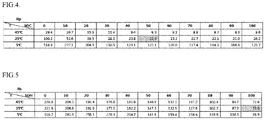
- FIG. 4 illustrates the Rp according to the temperature-SOC.
- the relationship between the temperature, the SOC, and the Rp can be represented as a constant value through experimental measurements, mathematical equations, or the like.
- the Rp can be estimated through the SOC according to the temperature change. In FIG. 4 , for example, it can be seen that the Rp becomes 23.6m ⁇ when the SOC is 50% at 25°C.
- FIG. 5 illustrates the Rs according to the temperature-SOC. Since the available capacity of the battery may decrease or the resistance may increase according to the temperature change or the used period of the battery, the state of health (SOH) may vary depending on the internal resistance Rs and the temperature of the battery. The relationship between the SOH and the Rs can be expressed through the experimental measurements, the mathematical equations, or the like. The Rs can be estimated through the relationship between the SOH and the Rs according to the temperature change as illustrated in FIG. 5 . For example, referring to FIG. 5 , it can be seen that the Rs becomes 73.0m ⁇ when the SOH is 100% at 25°C.
- the state of power (SOP) indicating how much power the current battery can output is calculated by comparing the voltage of the battery in the fresh state with the voltage of the battery aged to a certain degree in consideration of the internal resistance of the battery.
- the state of power may be represented by the following ⁇ Equation 2>.
- SOP V 0 ⁇ I s ⁇ R s ′ + R p ′ V 0 ⁇ I s ⁇ R s 0 + R p 0 ⁇ 100
- the Rpo and the Rp' may be obtained, and in FIG. 5 , the Rso and the Rs' may be obtained.
- the SOH is 80% at 25°C
- the Rpo is 23.6m ⁇
- the Rso is 73.0m ⁇
- the Rs' is 102.7m ⁇ .
- the state of reusable is diagnosed in consideration of both the estimated state of health (SOH) and the calculated state of power (SOP).
- the state of reusable may be represented by the following ⁇ Equation 1>.
- SOR a ⁇ SOH + b ⁇ SOP
- the state of reusable may be represented by characteristics of only the state of health (SOH) or the state of power (SOP) by setting values of a and b in the above Equation 1, and may be related to both the state of health (SOH) and the state of power (SOP).
- the state of reusable (SOR) is determined only by the state of health (SOH), and if the value of a is 0 and the value of b is 1, the state of reusable (SOR) is determined only by the state of power (SOP).
- SOH state of health
- SOP state of power
- the state of reusable (SOR) is determined by both the state of health and the state of power, and is determined by further weighting the state of power (SOP).
- the method for diagnosing a state of reusable of a battery may set the state of reusable of a battery in consideration of the state of power (SOP) reflecting an output as well as the state of health (SOH) by setting the values of a and b.
- SOP state of power
- SOH state of health
- the method for diagnosing a state of reusable of a battery newly defines and calculates the state of reusable of the battery in consideration of both the state of health and the state of power of the battery, and thus can determine whether to reuse the battery so as to meet a user-planned life span.
Landscapes
- Physics & Mathematics (AREA)
- General Physics & Mathematics (AREA)
- Engineering & Computer Science (AREA)
- Manufacturing & Machinery (AREA)
- Chemical & Material Sciences (AREA)
- Chemical Kinetics & Catalysis (AREA)
- Electrochemistry (AREA)
- General Chemical & Material Sciences (AREA)
- Secondary Cells (AREA)
- Tests Of Electric Status Of Batteries (AREA)
Abstract
Description
- The present invention relates to a method for diagnosing a state of reusable of a battery, and more particularly, to a new concept method for diagnosing a state of reusable of a battery capable of diagnosing the state of reusable of a battery that is related to both a state of health and a state of power.
- A battery with electrical characteristics such as high ease of application and high energy density according to product family is also called a storage cell or a secondary battery, and is attracting attention as a new energy source for green and energy efficiency in that there are no by-products accompanied by energy use as well as the primary advantage of reducing the use of fossil fuel.
- Therefore, a battery is commonly applied to an electric vehicle (EV), an energy storage system (ESS), and the like, which are driven by an electrical driving source, in addition to portable devices, and for more efficient battery management, research and development for a battery management system (BMS), a battery balancing circuit, a relay circuit, and the like is being actively conducted.
- In particular, the BMS may manage a state of charging (SOC), a state of health (SOH), a maximum allowable amount of input/output power, an output voltage, and the like of a battery based on state information of a battery. Among those, a technology of estimating replacement time of a battery by estimating a service life of the battery has become a key technology for more stable system operation.
- Recently, as the use of various devices, such as an electric vehicle, which use a battery, surges, interest and research on a technology of accurately estimating a state of health (SOH) of a battery using a battery management system (BMS) is rapidly increasing. When the SOH of the battery is incorrectly estimated, unexpected system shutdown may occur, or serious accidents such as fire or explosion due to overcharging or overdischarging of the battery may occur.
- A secondary battery may lose a function as a secondary battery for abnormal use such as overdischarging or overcharging, but even when the secondary battery is used normally, capacity, which is an ability to store electrical energy, gradually decreases with a charge/discharge frequency. As a result, in order to meet the intended use, the secondary battery is used until the minimum function required as the secondary battery is lost according to the intended use, and when the minimum function is lost, the secondary battery is replaced with a new secondary battery and used. Typically, in the case of the electric vehicle, when the capacity of the secondary battery is reduced to 80% to 50% of initial capacity, the secondary battery is replaced.
- The secondary battery is generally expensive, and the secondary battery replaced in this way often has the ability to store electrical energy for use in other applications even if the secondary battery does not meet the intended use of an electric vehicle. Therefore, rather than disposing the secondary battery replaced from the electric vehicle since the secondary battery is not suitable for use in the electric vehicle, recycling/reusing the secondary battery for other applications that require the energy storage capacity of the replaced secondary battery can not only prevent waste of resources, but also reduce manufacturing costs of the electric vehicle and other such devices.
- However, the reusable capacity for determining whether the battery can be reusable or calculating how much the battery can be reusable for the reuse of the battery has not been known or studied in the past.
- Related arts include Korean Patent No.
10-1399362 10-2010-0063343 - The present invention provides a new method for estimating a state of reusable of a battery in consideration of a state of power of the battery as well as a state of charging of the battery in order to solve the problem of clearly predicting the state of reusable of the battery in an environment requiring the reuse of the battery.
- In an aspect, a method for diagnosing a state of reusable of a battery includes: estimating a state of charge (SOC) according to a change in an open circuit voltage (OCV); estimating a state of health (SOH); calculating a state of power (SOP); and calculating a state of reusable (SOR) by using the SOH and the SOP.
- In the method for diagnosing a state of reusable of a battery according to the present invention, the state of reusable (SOR) means a reusable life when diagnosing, grading, and reusing the battery that is used and is then no longer used.
- In the method for diagnosing a state of reusable of a battery according to the present invention, the state of reusable (SOR) is not simply determined by any one of the state of health (SOH) or the state of power (SOP) and is determined by establishing a predetermined relationship between the state of health (SOH) and the state of power (SOP).
- In the method for diagnosing a state of reuse of a battery according to the present invention, the state of reusable (SOR) is represented by the following Equation 1.

- (Where 0 ≤ a ≤ 1, 0 ≤ b ≤ 1, and a + b = 1 in the above Equation 1).
- In the method for diagnosing a state of reusable of a battery according to the present invention, the state of power (SOP) is represented by the following Equation 2.

- Here, Rso represents the Rs value when the SOH is 100% and the SOC is 50% at 25°C,
- Rp0 represents the Rp value when the SOH is 100% and the SOC is 50% at 25°C,
- Rs' represents the Rs value when the current SOH value and the SOC are 50% at 25°C,
- Rp' represents the Rp value when the current SOH value and the SOC are 50% at 25°C, and
- Is represents a standard C rate current value.
-
-
FIG. 1 is a diagram illustrating steps of a method for diagnosing a state of reusable of a battery according to the present invention. -
FIG. 2 is a diagram illustrating OCV according to temperature-SOC. -
FIG. 3 is a diagram illustrating a battery equivalent circuit according to the present invention. -
FIG. 4 is a diagram illustrating Rp according to the temperature-SOC. -
FIG. 5 is a diagram illustrating Rs according to the temperature- SOH. - Hereinafter, preferred embodiments of a method for diagnosing a state of reusable of a battery according to the present invention will be described in detail with reference to the accompanying drawings. Terms and words used below are not to be construed as a general or dictionary meaning but are to be construed as meaning and concepts meeting the technical ideas of the present invention based on a principle that the inventors can appropriately define the concepts of terms in order to describe their own inventions in best mode.
- Referring to
FIG. 1 , a method for diagnosing a state of reusable of a battery according to the present invention may include estimating a state of charge (SOC) of a battery according to a change in an open circuit voltage (OCV); estimating a state of health (SOH) of the battery; calculating a state of power (SOP) of the battery; and calculating a a state of reusable (SOR) using the state of health (SOH) and the state of power (SOP). - In the method for diagnosing a state of reusable of a battery according to the present invention, the SOC means a state of charge and represents a usable capacity of the battery, that is, a state of charging as a percentage. That is, the SOC represents 100% in a full charge state and the SOC represents 0% in a minimum charge state.
- In the method for diagnosing a state of reusable of a battery according to the present invention, the SOC is estimated according to the change in the OCV.
- As an example of the relationship between the OCV and the
- SOC, the following Equation has been known.

- Here, α and β are values according to characteristics and temperature of a battery, respectively, and Vocv represents an open circuit voltage.
- The relationship between the temperature, the OCV, and the SOC can be represented as a constant value through experimental measurements or mathematical equations.
FIG. 2 illustrates the OCV according to the temperature-SOC. InFIG. 2 , for example, it can be seen that the OCV becomes 370.0V when the SOC is 50% at 25°C. - In the method for diagnosing a state of reusable of a battery according to the present invention, the state of health (SOH) represents a degree of aging of a battery. The state of health (SOH) defines, as fresh, a state in which the battery is not fully aged, where the SOH is represented as 100%. On the contrary, a state in which the battery cannot be used due to aging is defined as Aged, and in this case, the SOH is represented as 0%. The state of health (SOH) compares the capacity of the battery in a fresh state with a battery capacity in an aged state to a certain degree, and is a value considering only a current capacity of a battery without other factors (for example, a voltage and the like of a device using a battery).
- In the method for diagnosing a state of reusable of a battery according to the present invention, the state of health (SOH) may be represented by the following Equation.

- Here, a current resistance may represent a current value of an internal resistance, and an initial resistance may represent the initial value of the internal resistance.
- Describing the related art, the SOH of the battery is estimated using a ratio of a current integration and an SOC variation of the battery. Conventionally, a method for measuring internal impedance has been used for diagnosing the state of charge (SOC) of the battery. As a method for diagnosing a state of health of a battery by measuring an internal impedance, there are an AC measuring method for measuring AC impedance, a DC measuring method for measuring DC resistance, and the like.
- In the case of the AC measuring method having an AC voltage frequency of 1 kHz to 0.1 kHz, referring to
FIG. 3 , the internal impedance of the AC measuring method in the battery equivalent circuit may be represented as the following Equation.
- In the above Equation, Z represents the internal impedance of the battery, Cp represents the battery capacity, Rs represents an instantaneous internal resistance instantaneously dropping when measuring the OCV, and Rp is the internal resistance exponentially dropping in parallel with the capacitance (Cp). By the above Equation, the Rs, Rp, and Cp values can be obtained.
-
FIG. 4 illustrates the Rp according to the temperature-SOC. The relationship between the temperature, the SOC, and the Rp can be represented as a constant value through experimental measurements, mathematical equations, or the like. InFIG. 4 , the Rp can be estimated through the SOC according to the temperature change. InFIG. 4 , for example, it can be seen that the Rp becomes 23.6mΩ when the SOC is 50% at 25°C. -
FIG. 5 illustrates the Rs according to the temperature-SOC. Since the available capacity of the battery may decrease or the resistance may increase according to the temperature change or the used period of the battery, the state of health (SOH) may vary depending on the internal resistance Rs and the temperature of the battery. The relationship between the SOH and the Rs can be expressed through the experimental measurements, the mathematical equations, or the like. The Rs can be estimated through the relationship between the SOH and the Rs according to the temperature change as illustrated inFIG. 5 . For example, referring toFIG. 5 , it can be seen that the Rs becomes 73.0mΩ when the SOH is 100% at 25°C. - In the method for diagnosing a state of reusable of a battery according to the present invention, in the calculating of the state of power (SOP), the state of power (SOP) indicating how much power the current battery can output is calculated by comparing the voltage of the battery in the fresh state with the voltage of the battery aged to a certain degree in consideration of the internal resistance of the battery.
- In the method for diagnosing a state of reusable of a battery according to the present invention, the state of power (SOP) may be represented by the following <Equation 2>.

- Here, Rso represents the Rs value when the SOH is 100% and the SOC is 50% at 25°C,
- Rp0 represents the Rp value when the SOH is 100% and the SOC is 50% at 25°C,
- Rs' represents the Rs value when the current SOH value and the SOC are 50% at 25°C,
- Rp' represents the Rp value when the current SOH value and the SOC are 50% at 25°C, and
- Is represents a standard C rate current value.
- In
FIG. 4 , the Rpo and the Rp' may be obtained, and inFIG. 5 , the Rso and the Rs' may be obtained. For example, it can be seen that if the SOH is 80% at 25°C, inFIG. 4 , the Rpo is 23.6mΩ, inFIG. 5 , the Rso is 73.0mΩ, and the Rs' is 102.7mΩ. - In the method for diagnosing a state of reusable of a battery according to the present invention, the state of reusable (SOR) is diagnosed in consideration of both the estimated state of health (SOH) and the calculated state of power (SOP).
- Specifically, in the method for diagnosing a state of reusable of a battery according to the present invention, the state of reusable (SOR) may be represented by the following <Equation 1>.

- (Where 0 ≤ a ≤ 1, 0 ≤ b ≤ 1, and a + b = 1 in the above Equation 1).
- In the method for diagnosing a state of reusable of a battery according to the present invention, the state of reusable (SOR) may be represented by characteristics of only the state of health (SOH) or the state of power (SOP) by setting values of a and b in the above Equation 1, and may be related to both the state of health (SOH) and the state of power (SOP).
- For example, if the value of a is 1 and the value of b is 0, the state of reusable (SOR) is determined only by the state of health (SOH), and if the value of a is 0 and the value of b is 1, the state of reusable (SOR) is determined only by the state of power (SOP). In addition, when the value of a is 0.3 and the value of b is 0.7, the state of reusable (SOR) is determined by both the state of health and the state of power, and is determined by further weighting the state of power (SOP).
- As a result, the method for diagnosing a state of reusable of a battery according to the present invention may set the state of reusable of a battery in consideration of the state of power (SOP) reflecting an output as well as the state of health (SOH) by setting the values of a and b.
- Hereinabove, although the present disclosure has been described with reference to exemplary embodiments and the accompanying drawings, the present disclosure is not limited thereto, but may be variously modified and altered by those skilled in the art to which the present disclosure pertains without departing from the spirit and scope of the present disclosure claimed in the following claims.
- The method for diagnosing a state of reusable of a battery according to the present invention newly defines and calculates the state of reusable of the battery in consideration of both the state of health and the state of power of the battery, and thus can determine whether to reuse the battery so as to meet a user-planned life span.
Claims (3)
- A method for diagnosing a state of reusable of a battery, comprising:estimating a state of charge (SOC) according to a change in an open circuit voltage (OCV);estimating a state of health (SOH) by using the SOC;calculating a state of power (SOP) in consideration of an output of a current battery; andcalculating a state of reusable (SOR) by using the SOH and the SOP.
- The method for claim 1, wherein the state of reusable (SOR) is represented by the following Equation 1.

- The method for claim 1, wherein the state of power (SOP) is represented by the following Equation 2.
 Here, Rso represents the Rs value when the SOH is 100% and the SOC is 50% at 25°C,Rp0 represents the Rp value when the SOH is 100% and the SOC is 50% at 25°CRs' represents the Rs value when the current SOH value and the SOC are 50% at 25°C,Rp' represents the Rp value when the current SOH value and the SOC are 50% at a 25°C, andIs represents a standard C rate current value.
Applications Claiming Priority (2)
| Application Number | Priority Date | Filing Date | Title |
|---|---|---|---|
| KR1020170113720A KR101944751B1 (en) | 2017-09-06 | 2017-09-06 | Remaining life evaluation method for reusing of battery |
| PCT/KR2018/010379 WO2019050279A1 (en) | 2017-09-06 | 2018-09-05 | Method for diagnosing state of reuse of battery |
Publications (4)
| Publication Number | Publication Date |
|---|---|
| EP3680675A1 true EP3680675A1 (en) | 2020-07-15 |
| EP3680675A4 EP3680675A4 (en) | 2021-06-02 |
| EP3680675B1 EP3680675B1 (en) | 2025-04-09 |
| EP3680675C0 EP3680675C0 (en) | 2025-04-09 |
Family
ID=65367784
Family Applications (1)
| Application Number | Title | Priority Date | Filing Date |
|---|---|---|---|
| EP18854151.0A Active EP3680675B1 (en) | 2017-09-06 | 2018-09-05 | Method for diagnosing state of reuse of battery |
Country Status (7)
| Country | Link |
|---|---|
| US (1) | US11391783B2 (en) |
| EP (1) | EP3680675B1 (en) |
| KR (1) | KR101944751B1 (en) |
| ES (1) | ES3020739T3 (en) |
| HU (1) | HUE072211T2 (en) |
| PL (1) | PL3680675T3 (en) |
| WO (1) | WO2019050279A1 (en) |
Cited By (3)
| Publication number | Priority date | Publication date | Assignee | Title |
|---|---|---|---|---|
| DE102020201697B3 (en) * | 2020-02-11 | 2021-04-29 | Volkswagen Aktiengesellschaft | Method for categorizing a battery with regard to its further suitability for handling, battery, battery recycling system and motor vehicle |
| CN117930027A (en) * | 2024-03-18 | 2024-04-26 | 中国汽车技术研究中心有限公司 | Power battery capacity abnormality detection method, device and platform |
| DE102023210096A1 (en) | 2023-10-16 | 2025-04-17 | Robert Bosch Gesellschaft mit beschränkter Haftung | Procedure for the allocation and selection of used portable batteries for further use |
Families Citing this family (9)
| Publication number | Priority date | Publication date | Assignee | Title |
|---|---|---|---|---|
| CN110133532A (en) * | 2019-05-29 | 2019-08-16 | 东北电力大学 | A Calculation Method of State of Health Based on Battery Open Circuit Voltage |
| CN110146823A (en) * | 2019-06-06 | 2019-08-20 | 重庆大学 | A SOC Estimation Method for Series Battery Packs Based on Information Fusion |
| US12261275B2 (en) * | 2019-07-04 | 2025-03-25 | Volvo Construction Equipment Ab | Method that consists to give a second life to used electric vehicle battery packs by reusing them as a power source for a battery charger |
| CN112540317B (en) * | 2020-12-16 | 2022-12-02 | 武汉理工大学 | Battery health state estimation and residual life prediction method based on real vehicle data |
| KR102569876B1 (en) * | 2021-02-24 | 2023-08-23 | 주식회사 피엠그로우 | Apparatus and method for evaluating reusable batteries according to their use |
| KR102684350B1 (en) * | 2023-02-07 | 2024-07-12 | 주식회사 에스앤에스 | Battery performance evaluation apparatus and method |
| JP2024128696A (en) * | 2023-03-10 | 2024-09-24 | 株式会社Kri | Determination device, determination method, and determination program |
| KR102881464B1 (en) * | 2023-08-16 | 2025-11-06 | 주식회사 피엠그로우 | Method for determining battery pack evaluation score |
| CN120149598B (en) * | 2025-05-15 | 2025-07-25 | 云储新能源科技有限公司 | A life protection method and device for a dynamically reconfigurable energy storage system |
Family Cites Families (9)
| Publication number | Priority date | Publication date | Assignee | Title |
|---|---|---|---|---|
| KR20100063343A (en) | 2008-12-03 | 2010-06-11 | 기아자동차주식회사 | Estimating apparatus and method of soh of a battery in a hybrid car |
| US9285433B2 (en) * | 2010-06-24 | 2016-03-15 | Toyota Jidosha Kabushiki Kaisha | Battery management system, battery management apparatus, method of reusing battery, and information communication terminal apparatus |
| JP5247874B2 (en) * | 2011-12-06 | 2013-07-24 | パナソニック株式会社 | Storage battery transfer support device and storage battery transfer support method |
| KR20130066283A (en) * | 2011-12-12 | 2013-06-20 | 삼성에스디아이 주식회사 | Simulation device of battery system |
| KR101545306B1 (en) * | 2012-03-05 | 2015-08-18 | 주식회사 엘지화학 | Battery balancing system for reusing of energy and method thereof |
| JP5733275B2 (en) | 2012-07-13 | 2015-06-10 | トヨタ自動車株式会社 | Battery pack control device and battery pack reuse determination method |
| KR101399362B1 (en) | 2012-11-28 | 2014-05-30 | 에스케이씨앤씨 주식회사 | Method and apparatus for estimating state of health using current integrated offset |
| KR20150049557A (en) * | 2013-10-30 | 2015-05-08 | 주식회사 엘지화학 | Method for reusing and recycling battery of electric vehicle |
| JP2017134894A (en) | 2016-01-25 | 2017-08-03 | トヨタ自動車株式会社 | Reuse method of secondary battery |
-
2017
- 2017-09-06 KR KR1020170113720A patent/KR101944751B1/en active Active
-
2018
- 2018-09-05 US US16/643,874 patent/US11391783B2/en active Active
- 2018-09-05 EP EP18854151.0A patent/EP3680675B1/en active Active
- 2018-09-05 WO PCT/KR2018/010379 patent/WO2019050279A1/en not_active Ceased
- 2018-09-05 HU HUE18854151A patent/HUE072211T2/en unknown
- 2018-09-05 PL PL18854151.0T patent/PL3680675T3/en unknown
- 2018-09-05 ES ES18854151T patent/ES3020739T3/en active Active
Cited By (4)
| Publication number | Priority date | Publication date | Assignee | Title |
|---|---|---|---|---|
| DE102020201697B3 (en) * | 2020-02-11 | 2021-04-29 | Volkswagen Aktiengesellschaft | Method for categorizing a battery with regard to its further suitability for handling, battery, battery recycling system and motor vehicle |
| US11955610B2 (en) | 2020-02-11 | 2024-04-09 | Volkswagen Aktiengesellschaft | Method for categorizing a battery, battery, battery recycling system, and motor vehicle |
| DE102023210096A1 (en) | 2023-10-16 | 2025-04-17 | Robert Bosch Gesellschaft mit beschränkter Haftung | Procedure for the allocation and selection of used portable batteries for further use |
| CN117930027A (en) * | 2024-03-18 | 2024-04-26 | 中国汽车技术研究中心有限公司 | Power battery capacity abnormality detection method, device and platform |
Also Published As
| Publication number | Publication date |
|---|---|
| EP3680675B1 (en) | 2025-04-09 |
| US11391783B2 (en) | 2022-07-19 |
| WO2019050279A1 (en) | 2019-03-14 |
| PL3680675T3 (en) | 2025-08-18 |
| EP3680675A4 (en) | 2021-06-02 |
| ES3020739T3 (en) | 2025-05-23 |
| HUE072211T2 (en) | 2025-10-28 |
| KR101944751B1 (en) | 2019-02-01 |
| US20200249280A1 (en) | 2020-08-06 |
| EP3680675C0 (en) | 2025-04-09 |
Similar Documents
| Publication | Publication Date | Title |
|---|---|---|
| US11391783B2 (en) | Method for diagnosing state of reuse of battery | |
| US12455326B2 (en) | Method and apparatus for detecting lithium plating, and method and apparatus for obtaining polarization proportion | |
| EP3958006B1 (en) | Battery diagnosis apparatus and method | |
| EP3961233B1 (en) | Battery cell diagnosis device and method | |
| EP3428669B1 (en) | Apparatus and method for detecting state of health of battery | |
| EP3564693B1 (en) | Method and device for calculating a state of charge of a battery in real time | |
| EP3623829B1 (en) | Apparatus and method for estimating state of charge of secondary battery | |
| US10534028B2 (en) | Methodology for charging batteries safely | |
| EP2700966B1 (en) | Apparatus and method for estimating battery state | |
| US12447862B2 (en) | Method for predicting an electric load imparted on each battery unit in an electric energy storage system | |
| EP3982140A1 (en) | Device for managing battery and method for managing battery | |
| US8930070B2 (en) | Method for determining the charge state of a battery pack | |
| US20210098995A1 (en) | Battery system and method for detecting state of health of battery | |
| WO2019054020A1 (en) | Battery management device, battery system, and battery management method | |
| KR20220131703A (en) | Battery diagnostic device and method | |
| Todeschini et al. | An experimentally validated capacity degradation model for Li-ion batteries in PHEVs applications | |
| EP3499255A1 (en) | Apparatus and method for processing battery cell voltage data | |
| KR102020044B1 (en) | Battery charging system, and method for controlling maximum capacity charging in battery module using the same | |
| US12451715B2 (en) | Battery, electric apparatus, and charging method and apparatus for battery | |
| EP4195357B1 (en) | BATTERY MONITORING DEVICE, BATTERY MONITORING METHOD, BATTERY PACK AND ELECTRIC VEHICLE | |
| EP4575538A1 (en) | System and method for diagnosing deterioration state of battery | |
| EP4297236A1 (en) | Battery equipment discharge balancing method | |
| EP4653894A1 (en) | Battery deterioration determination method and battery deterioration determination device | |
| KR102892976B1 (en) | Battery diagnostic program using battery internal resistance stored in recording media | |
| Eseosa et al. | Optimizing state of charge (SOC), temperature, and state of health (SOH) of lithium-ion batteries |
Legal Events
| Date | Code | Title | Description |
|---|---|---|---|
| STAA | Information on the status of an ep patent application or granted ep patent |
Free format text: STATUS: THE INTERNATIONAL PUBLICATION HAS BEEN MADE |
|
| PUAI | Public reference made under article 153(3) epc to a published international application that has entered the european phase |
Free format text: ORIGINAL CODE: 0009012 |
|
| STAA | Information on the status of an ep patent application or granted ep patent |
Free format text: STATUS: REQUEST FOR EXAMINATION WAS MADE |
|
| 17P | Request for examination filed |
Effective date: 20200221 |
|
| AK | Designated contracting states |
Kind code of ref document: A1 Designated state(s): AL AT BE BG CH CY CZ DE DK EE ES FI FR GB GR HR HU IE IS IT LI LT LU LV MC MK MT NL NO PL PT RO RS SE SI SK SM TR |
|
| AX | Request for extension of the european patent |
Extension state: BA ME |
|
| DAV | Request for validation of the european patent (deleted) | ||
| DAX | Request for extension of the european patent (deleted) | ||
| A4 | Supplementary search report drawn up and despatched |
Effective date: 20210503 |
|
| RIC1 | Information provided on ipc code assigned before grant |
Ipc: G01R 31/36 20200101AFI20210427BHEP Ipc: G01R 31/382 20190101ALI20210427BHEP Ipc: G01R 31/392 20190101ALI20210427BHEP |
|
| STAA | Information on the status of an ep patent application or granted ep patent |
Free format text: STATUS: EXAMINATION IS IN PROGRESS |
|
| 17Q | First examination report despatched |
Effective date: 20230504 |
|
| REG | Reference to a national code |
Ref country code: DE Ref legal event code: R079 Free format text: PREVIOUS MAIN CLASS: G01R0031360000 Ipc: G01R0031374000 Ref country code: DE Ref legal event code: R079 Ref document number: 602018081023 Country of ref document: DE Free format text: PREVIOUS MAIN CLASS: G01R0031360000 Ipc: G01R0031374000 |
|
| GRAP | Despatch of communication of intention to grant a patent |
Free format text: ORIGINAL CODE: EPIDOSNIGR1 |
|
| STAA | Information on the status of an ep patent application or granted ep patent |
Free format text: STATUS: GRANT OF PATENT IS INTENDED |
|
| RIC1 | Information provided on ipc code assigned before grant |
Ipc: G01R 31/392 20190101ALI20240927BHEP Ipc: G01R 31/389 20190101ALI20240927BHEP Ipc: G01R 31/3835 20190101ALI20240927BHEP Ipc: G01R 31/374 20190101AFI20240927BHEP |
|
| INTG | Intention to grant announced |
Effective date: 20241104 |
|
| GRAS | Grant fee paid |
Free format text: ORIGINAL CODE: EPIDOSNIGR3 |
|
| GRAA | (expected) grant |
Free format text: ORIGINAL CODE: 0009210 |
|
| STAA | Information on the status of an ep patent application or granted ep patent |
Free format text: STATUS: THE PATENT HAS BEEN GRANTED |
|
| AK | Designated contracting states |
Kind code of ref document: B1 Designated state(s): AL AT BE BG CH CY CZ DE DK EE ES FI FR GB GR HR HU IE IS IT LI LT LU LV MC MK MT NL NO PL PT RO RS SE SI SK SM TR |
|
| REG | Reference to a national code |
Ref country code: GB Ref legal event code: FG4D |
|
| REG | Reference to a national code |
Ref country code: CH Ref legal event code: EP |
|
| REG | Reference to a national code |
Ref country code: DE Ref legal event code: R096 Ref document number: 602018081023 Country of ref document: DE |
|
| REG | Reference to a national code |
Ref country code: IE Ref legal event code: FG4D |
|
| U01 | Request for unitary effect filed |
Effective date: 20250414 |
|
| U07 | Unitary effect registered |
Designated state(s): AT BE BG DE DK EE FI FR IT LT LU LV MT NL PT RO SE SI Effective date: 20250423 |
|
| REG | Reference to a national code |
Ref country code: ES Ref legal event code: FG2A Ref document number: 3020739 Country of ref document: ES Kind code of ref document: T3 Effective date: 20250523 |
|
| PG25 | Lapsed in a contracting state [announced via postgrant information from national office to epo] |
Ref country code: GR Free format text: LAPSE BECAUSE OF FAILURE TO SUBMIT A TRANSLATION OF THE DESCRIPTION OR TO PAY THE FEE WITHIN THE PRESCRIBED TIME-LIMIT Effective date: 20250710 |
|
| PGFP | Annual fee paid to national office [announced via postgrant information from national office to epo] |
Ref country code: PL Payment date: 20250812 Year of fee payment: 8 Ref country code: TR Payment date: 20250808 Year of fee payment: 8 |
|
| PGFP | Annual fee paid to national office [announced via postgrant information from national office to epo] |
Ref country code: HU Payment date: 20250822 Year of fee payment: 8 Ref country code: GB Payment date: 20250903 Year of fee payment: 8 |
|
| PG25 | Lapsed in a contracting state [announced via postgrant information from national office to epo] |
Ref country code: HR Free format text: LAPSE BECAUSE OF FAILURE TO SUBMIT A TRANSLATION OF THE DESCRIPTION OR TO PAY THE FEE WITHIN THE PRESCRIBED TIME-LIMIT Effective date: 20250409 |
|
| PG25 | Lapsed in a contracting state [announced via postgrant information from national office to epo] |
Ref country code: RS Free format text: LAPSE BECAUSE OF FAILURE TO SUBMIT A TRANSLATION OF THE DESCRIPTION OR TO PAY THE FEE WITHIN THE PRESCRIBED TIME-LIMIT Effective date: 20250709 |
|
| U20 | Renewal fee for the european patent with unitary effect paid |
Year of fee payment: 8 Effective date: 20250916 |
|
| PG25 | Lapsed in a contracting state [announced via postgrant information from national office to epo] |
Ref country code: IS Free format text: LAPSE BECAUSE OF FAILURE TO SUBMIT A TRANSLATION OF THE DESCRIPTION OR TO PAY THE FEE WITHIN THE PRESCRIBED TIME-LIMIT Effective date: 20250809 |
|
| REG | Reference to a national code |
Ref country code: HU Ref legal event code: AG4A Ref document number: E072211 Country of ref document: HU |
|
| PGFP | Annual fee paid to national office [announced via postgrant information from national office to epo] |
Ref country code: NO Payment date: 20251002 Year of fee payment: 8 |
|
| PG25 | Lapsed in a contracting state [announced via postgrant information from national office to epo] |
Ref country code: SM Free format text: LAPSE BECAUSE OF FAILURE TO SUBMIT A TRANSLATION OF THE DESCRIPTION OR TO PAY THE FEE WITHIN THE PRESCRIBED TIME-LIMIT Effective date: 20250409 |
|
| PG25 | Lapsed in a contracting state [announced via postgrant information from national office to epo] |
Ref country code: CZ Free format text: LAPSE BECAUSE OF FAILURE TO SUBMIT A TRANSLATION OF THE DESCRIPTION OR TO PAY THE FEE WITHIN THE PRESCRIBED TIME-LIMIT Effective date: 20250409 |
|
| PG25 | Lapsed in a contracting state [announced via postgrant information from national office to epo] |
Ref country code: SK Free format text: LAPSE BECAUSE OF FAILURE TO SUBMIT A TRANSLATION OF THE DESCRIPTION OR TO PAY THE FEE WITHIN THE PRESCRIBED TIME-LIMIT Effective date: 20250409 |
|
| PGFP | Annual fee paid to national office [announced via postgrant information from national office to epo] |
Ref country code: ES Payment date: 20251003 Year of fee payment: 8 |
|
| PLBE | No opposition filed within time limit |
Free format text: ORIGINAL CODE: 0009261 |
|
| STAA | Information on the status of an ep patent application or granted ep patent |
Free format text: STATUS: NO OPPOSITION FILED WITHIN TIME LIMIT |
|
| REG | Reference to a national code |
Ref country code: CH Ref legal event code: L10 Free format text: ST27 STATUS EVENT CODE: U-0-0-L10-L00 (AS PROVIDED BY THE NATIONAL OFFICE) Effective date: 20260218 |
|
| 26N | No opposition filed |
Effective date: 20260112 |