EP3680244A1 - Organic electroluminescence device and polycyclic compound for organic electroluminescence device - Google Patents
Organic electroluminescence device and polycyclic compound for organic electroluminescence device Download PDFInfo
- Publication number
- EP3680244A1 EP3680244A1 EP19212247.1A EP19212247A EP3680244A1 EP 3680244 A1 EP3680244 A1 EP 3680244A1 EP 19212247 A EP19212247 A EP 19212247A EP 3680244 A1 EP3680244 A1 EP 3680244A1
- Authority
- EP
- European Patent Office
- Prior art keywords
- group
- substituted
- ring
- carbon atoms
- unsubstituted
- Prior art date
- Legal status (The legal status is an assumption and is not a legal conclusion. Google has not performed a legal analysis and makes no representation as to the accuracy of the status listed.)
- Pending
Links
- 0 *c1cc(N(c2ccccc2)c2c(B3c4c(N5c6ccccc6)[s]c6c4cccc6)c5ccc2)c3cc1 Chemical compound *c1cc(N(c2ccccc2)c2c(B3c4c(N5c6ccccc6)[s]c6c4cccc6)c5ccc2)c3cc1 0.000 description 2
- IYEGXIPDDHBZQW-UHFFFAOYSA-N c(cc1)ccc1N(c1c2[s]c3ccccc13)c1cccc3c1B2c(cccc1)c1N3c1ccccc1 Chemical compound c(cc1)ccc1N(c1c2[s]c3ccccc13)c1cccc3c1B2c(cccc1)c1N3c1ccccc1 IYEGXIPDDHBZQW-UHFFFAOYSA-N 0.000 description 1
Images
Classifications
-
- C—CHEMISTRY; METALLURGY
- C07—ORGANIC CHEMISTRY
- C07F—ACYCLIC, CARBOCYCLIC OR HETEROCYCLIC COMPOUNDS CONTAINING ELEMENTS OTHER THAN CARBON, HYDROGEN, HALOGEN, OXYGEN, NITROGEN, SULFUR, SELENIUM OR TELLURIUM
- C07F9/00—Compounds containing elements of Groups 5 or 15 of the Periodic Table
- C07F9/02—Phosphorus compounds
- C07F9/547—Heterocyclic compounds, e.g. containing phosphorus as a ring hetero atom
- C07F9/6564—Heterocyclic compounds, e.g. containing phosphorus as a ring hetero atom having phosphorus atoms, with or without nitrogen, oxygen, sulfur, selenium or tellurium atoms, as ring hetero atoms
- C07F9/6581—Heterocyclic compounds, e.g. containing phosphorus as a ring hetero atom having phosphorus atoms, with or without nitrogen, oxygen, sulfur, selenium or tellurium atoms, as ring hetero atoms having phosphorus and nitrogen atoms with or without oxygen or sulfur atoms, as ring hetero atoms
- C07F9/6584—Heterocyclic compounds, e.g. containing phosphorus as a ring hetero atom having phosphorus atoms, with or without nitrogen, oxygen, sulfur, selenium or tellurium atoms, as ring hetero atoms having phosphorus and nitrogen atoms with or without oxygen or sulfur atoms, as ring hetero atoms having one phosphorus atom as ring hetero atom
-
- H—ELECTRICITY
- H10—SEMICONDUCTOR DEVICES; ELECTRIC SOLID-STATE DEVICES NOT OTHERWISE PROVIDED FOR
- H10K—ORGANIC ELECTRIC SOLID-STATE DEVICES
- H10K85/00—Organic materials used in the body or electrodes of devices covered by this subclass
- H10K85/60—Organic compounds having low molecular weight
- H10K85/658—Organoboranes
-
- C—CHEMISTRY; METALLURGY
- C07—ORGANIC CHEMISTRY
- C07F—ACYCLIC, CARBOCYCLIC OR HETEROCYCLIC COMPOUNDS CONTAINING ELEMENTS OTHER THAN CARBON, HYDROGEN, HALOGEN, OXYGEN, NITROGEN, SULFUR, SELENIUM OR TELLURIUM
- C07F5/00—Compounds containing elements of Groups 3 or 13 of the Periodic Table
- C07F5/02—Boron compounds
- C07F5/027—Organoboranes and organoborohydrides
-
- C—CHEMISTRY; METALLURGY
- C07—ORGANIC CHEMISTRY
- C07F—ACYCLIC, CARBOCYCLIC OR HETEROCYCLIC COMPOUNDS CONTAINING ELEMENTS OTHER THAN CARBON, HYDROGEN, HALOGEN, OXYGEN, NITROGEN, SULFUR, SELENIUM OR TELLURIUM
- C07F7/00—Compounds containing elements of Groups 4 or 14 of the Periodic Table
- C07F7/02—Silicon compounds
- C07F7/08—Compounds having one or more C—Si linkages
- C07F7/0803—Compounds with Si-C or Si-Si linkages
- C07F7/081—Compounds with Si-C or Si-Si linkages comprising at least one atom selected from the elements N, O, halogen, S, Se or Te
- C07F7/0812—Compounds with Si-C or Si-Si linkages comprising at least one atom selected from the elements N, O, halogen, S, Se or Te comprising a heterocyclic ring
- C07F7/0816—Compounds with Si-C or Si-Si linkages comprising at least one atom selected from the elements N, O, halogen, S, Se or Te comprising a heterocyclic ring said ring comprising Si as a ring atom
-
- C—CHEMISTRY; METALLURGY
- C09—DYES; PAINTS; POLISHES; NATURAL RESINS; ADHESIVES; COMPOSITIONS NOT OTHERWISE PROVIDED FOR; APPLICATIONS OF MATERIALS NOT OTHERWISE PROVIDED FOR
- C09K—MATERIALS FOR MISCELLANEOUS APPLICATIONS, NOT PROVIDED FOR ELSEWHERE
- C09K11/00—Luminescent materials, e.g. electroluminescent or chemiluminescent
- C09K11/06—Luminescent materials, e.g. electroluminescent or chemiluminescent containing organic luminescent materials
-
- H—ELECTRICITY
- H10—SEMICONDUCTOR DEVICES; ELECTRIC SOLID-STATE DEVICES NOT OTHERWISE PROVIDED FOR
- H10K—ORGANIC ELECTRIC SOLID-STATE DEVICES
- H10K50/00—Organic light-emitting devices
- H10K50/10—OLEDs or polymer light-emitting diodes [PLED]
- H10K50/11—OLEDs or polymer light-emitting diodes [PLED] characterised by the electroluminescent [EL] layers
- H10K50/12—OLEDs or polymer light-emitting diodes [PLED] characterised by the electroluminescent [EL] layers comprising dopants
-
- H—ELECTRICITY
- H10—SEMICONDUCTOR DEVICES; ELECTRIC SOLID-STATE DEVICES NOT OTHERWISE PROVIDED FOR
- H10K—ORGANIC ELECTRIC SOLID-STATE DEVICES
- H10K50/00—Organic light-emitting devices
- H10K50/10—OLEDs or polymer light-emitting diodes [PLED]
- H10K50/14—Carrier transporting layers
- H10K50/15—Hole transporting layers
-
- H—ELECTRICITY
- H10—SEMICONDUCTOR DEVICES; ELECTRIC SOLID-STATE DEVICES NOT OTHERWISE PROVIDED FOR
- H10K—ORGANIC ELECTRIC SOLID-STATE DEVICES
- H10K50/00—Organic light-emitting devices
- H10K50/10—OLEDs or polymer light-emitting diodes [PLED]
- H10K50/14—Carrier transporting layers
- H10K50/16—Electron transporting layers
-
- H—ELECTRICITY
- H10—SEMICONDUCTOR DEVICES; ELECTRIC SOLID-STATE DEVICES NOT OTHERWISE PROVIDED FOR
- H10K—ORGANIC ELECTRIC SOLID-STATE DEVICES
- H10K85/00—Organic materials used in the body or electrodes of devices covered by this subclass
- H10K85/30—Coordination compounds
- H10K85/321—Metal complexes comprising a group IIIA element, e.g. Tris (8-hydroxyquinoline) gallium [Gaq3]
- H10K85/322—Metal complexes comprising a group IIIA element, e.g. Tris (8-hydroxyquinoline) gallium [Gaq3] comprising boron
-
- H—ELECTRICITY
- H10—SEMICONDUCTOR DEVICES; ELECTRIC SOLID-STATE DEVICES NOT OTHERWISE PROVIDED FOR
- H10K—ORGANIC ELECTRIC SOLID-STATE DEVICES
- H10K85/00—Organic materials used in the body or electrodes of devices covered by this subclass
- H10K85/40—Organosilicon compounds, e.g. TIPS pentacene
-
- H—ELECTRICITY
- H10—SEMICONDUCTOR DEVICES; ELECTRIC SOLID-STATE DEVICES NOT OTHERWISE PROVIDED FOR
- H10K—ORGANIC ELECTRIC SOLID-STATE DEVICES
- H10K85/00—Organic materials used in the body or electrodes of devices covered by this subclass
- H10K85/60—Organic compounds having low molecular weight
- H10K85/649—Aromatic compounds comprising a hetero atom
- H10K85/657—Polycyclic condensed heteroaromatic hydrocarbons
-
- C—CHEMISTRY; METALLURGY
- C09—DYES; PAINTS; POLISHES; NATURAL RESINS; ADHESIVES; COMPOSITIONS NOT OTHERWISE PROVIDED FOR; APPLICATIONS OF MATERIALS NOT OTHERWISE PROVIDED FOR
- C09K—MATERIALS FOR MISCELLANEOUS APPLICATIONS, NOT PROVIDED FOR ELSEWHERE
- C09K2211/00—Chemical nature of organic luminescent or tenebrescent compounds
- C09K2211/10—Non-macromolecular compounds
- C09K2211/1003—Carbocyclic compounds
- C09K2211/1007—Non-condensed systems
-
- C—CHEMISTRY; METALLURGY
- C09—DYES; PAINTS; POLISHES; NATURAL RESINS; ADHESIVES; COMPOSITIONS NOT OTHERWISE PROVIDED FOR; APPLICATIONS OF MATERIALS NOT OTHERWISE PROVIDED FOR
- C09K—MATERIALS FOR MISCELLANEOUS APPLICATIONS, NOT PROVIDED FOR ELSEWHERE
- C09K2211/00—Chemical nature of organic luminescent or tenebrescent compounds
- C09K2211/10—Non-macromolecular compounds
- C09K2211/1018—Heterocyclic compounds
-
- C—CHEMISTRY; METALLURGY
- C09—DYES; PAINTS; POLISHES; NATURAL RESINS; ADHESIVES; COMPOSITIONS NOT OTHERWISE PROVIDED FOR; APPLICATIONS OF MATERIALS NOT OTHERWISE PROVIDED FOR
- C09K—MATERIALS FOR MISCELLANEOUS APPLICATIONS, NOT PROVIDED FOR ELSEWHERE
- C09K2211/00—Chemical nature of organic luminescent or tenebrescent compounds
- C09K2211/10—Non-macromolecular compounds
- C09K2211/1018—Heterocyclic compounds
- C09K2211/1025—Heterocyclic compounds characterised by ligands
- C09K2211/1029—Heterocyclic compounds characterised by ligands containing one nitrogen atom as the heteroatom
- C09K2211/1037—Heterocyclic compounds characterised by ligands containing one nitrogen atom as the heteroatom with sulfur
-
- C—CHEMISTRY; METALLURGY
- C09—DYES; PAINTS; POLISHES; NATURAL RESINS; ADHESIVES; COMPOSITIONS NOT OTHERWISE PROVIDED FOR; APPLICATIONS OF MATERIALS NOT OTHERWISE PROVIDED FOR
- C09K—MATERIALS FOR MISCELLANEOUS APPLICATIONS, NOT PROVIDED FOR ELSEWHERE
- C09K2211/00—Chemical nature of organic luminescent or tenebrescent compounds
- C09K2211/10—Non-macromolecular compounds
- C09K2211/1018—Heterocyclic compounds
- C09K2211/1025—Heterocyclic compounds characterised by ligands
- C09K2211/1029—Heterocyclic compounds characterised by ligands containing one nitrogen atom as the heteroatom
- C09K2211/104—Heterocyclic compounds characterised by ligands containing one nitrogen atom as the heteroatom with other heteroatoms
-
- C—CHEMISTRY; METALLURGY
- C09—DYES; PAINTS; POLISHES; NATURAL RESINS; ADHESIVES; COMPOSITIONS NOT OTHERWISE PROVIDED FOR; APPLICATIONS OF MATERIALS NOT OTHERWISE PROVIDED FOR
- C09K—MATERIALS FOR MISCELLANEOUS APPLICATIONS, NOT PROVIDED FOR ELSEWHERE
- C09K2211/00—Chemical nature of organic luminescent or tenebrescent compounds
- C09K2211/10—Non-macromolecular compounds
- C09K2211/1018—Heterocyclic compounds
- C09K2211/1025—Heterocyclic compounds characterised by ligands
- C09K2211/1044—Heterocyclic compounds characterised by ligands containing two nitrogen atoms as heteroatoms
- C09K2211/1048—Heterocyclic compounds characterised by ligands containing two nitrogen atoms as heteroatoms with oxygen
-
- C—CHEMISTRY; METALLURGY
- C09—DYES; PAINTS; POLISHES; NATURAL RESINS; ADHESIVES; COMPOSITIONS NOT OTHERWISE PROVIDED FOR; APPLICATIONS OF MATERIALS NOT OTHERWISE PROVIDED FOR
- C09K—MATERIALS FOR MISCELLANEOUS APPLICATIONS, NOT PROVIDED FOR ELSEWHERE
- C09K2211/00—Chemical nature of organic luminescent or tenebrescent compounds
- C09K2211/10—Non-macromolecular compounds
- C09K2211/1018—Heterocyclic compounds
- C09K2211/1025—Heterocyclic compounds characterised by ligands
- C09K2211/1044—Heterocyclic compounds characterised by ligands containing two nitrogen atoms as heteroatoms
- C09K2211/1051—Heterocyclic compounds characterised by ligands containing two nitrogen atoms as heteroatoms with sulfur
-
- C—CHEMISTRY; METALLURGY
- C09—DYES; PAINTS; POLISHES; NATURAL RESINS; ADHESIVES; COMPOSITIONS NOT OTHERWISE PROVIDED FOR; APPLICATIONS OF MATERIALS NOT OTHERWISE PROVIDED FOR
- C09K—MATERIALS FOR MISCELLANEOUS APPLICATIONS, NOT PROVIDED FOR ELSEWHERE
- C09K2211/00—Chemical nature of organic luminescent or tenebrescent compounds
- C09K2211/10—Non-macromolecular compounds
- C09K2211/1018—Heterocyclic compounds
- C09K2211/1025—Heterocyclic compounds characterised by ligands
- C09K2211/1044—Heterocyclic compounds characterised by ligands containing two nitrogen atoms as heteroatoms
- C09K2211/1055—Heterocyclic compounds characterised by ligands containing two nitrogen atoms as heteroatoms with other heteroatoms
-
- C—CHEMISTRY; METALLURGY
- C09—DYES; PAINTS; POLISHES; NATURAL RESINS; ADHESIVES; COMPOSITIONS NOT OTHERWISE PROVIDED FOR; APPLICATIONS OF MATERIALS NOT OTHERWISE PROVIDED FOR
- C09K—MATERIALS FOR MISCELLANEOUS APPLICATIONS, NOT PROVIDED FOR ELSEWHERE
- C09K2211/00—Chemical nature of organic luminescent or tenebrescent compounds
- C09K2211/10—Non-macromolecular compounds
- C09K2211/1018—Heterocyclic compounds
- C09K2211/1025—Heterocyclic compounds characterised by ligands
- C09K2211/1059—Heterocyclic compounds characterised by ligands containing three nitrogen atoms as heteroatoms
- C09K2211/1062—Heterocyclic compounds characterised by ligands containing three nitrogen atoms as heteroatoms with oxygen
-
- C—CHEMISTRY; METALLURGY
- C09—DYES; PAINTS; POLISHES; NATURAL RESINS; ADHESIVES; COMPOSITIONS NOT OTHERWISE PROVIDED FOR; APPLICATIONS OF MATERIALS NOT OTHERWISE PROVIDED FOR
- C09K—MATERIALS FOR MISCELLANEOUS APPLICATIONS, NOT PROVIDED FOR ELSEWHERE
- C09K2211/00—Chemical nature of organic luminescent or tenebrescent compounds
- C09K2211/10—Non-macromolecular compounds
- C09K2211/1018—Heterocyclic compounds
- C09K2211/1025—Heterocyclic compounds characterised by ligands
- C09K2211/1059—Heterocyclic compounds characterised by ligands containing three nitrogen atoms as heteroatoms
- C09K2211/107—Heterocyclic compounds characterised by ligands containing three nitrogen atoms as heteroatoms with other heteroatoms
-
- C—CHEMISTRY; METALLURGY
- C09—DYES; PAINTS; POLISHES; NATURAL RESINS; ADHESIVES; COMPOSITIONS NOT OTHERWISE PROVIDED FOR; APPLICATIONS OF MATERIALS NOT OTHERWISE PROVIDED FOR
- C09K—MATERIALS FOR MISCELLANEOUS APPLICATIONS, NOT PROVIDED FOR ELSEWHERE
- C09K2211/00—Chemical nature of organic luminescent or tenebrescent compounds
- C09K2211/10—Non-macromolecular compounds
- C09K2211/1018—Heterocyclic compounds
- C09K2211/1025—Heterocyclic compounds characterised by ligands
- C09K2211/1074—Heterocyclic compounds characterised by ligands containing more than three nitrogen atoms as heteroatoms
- C09K2211/1085—Heterocyclic compounds characterised by ligands containing more than three nitrogen atoms as heteroatoms with other heteroatoms
-
- H—ELECTRICITY
- H10—SEMICONDUCTOR DEVICES; ELECTRIC SOLID-STATE DEVICES NOT OTHERWISE PROVIDED FOR
- H10K—ORGANIC ELECTRIC SOLID-STATE DEVICES
- H10K2101/00—Properties of the organic materials covered by group H10K85/00
- H10K2101/10—Triplet emission
-
- H—ELECTRICITY
- H10—SEMICONDUCTOR DEVICES; ELECTRIC SOLID-STATE DEVICES NOT OTHERWISE PROVIDED FOR
- H10K—ORGANIC ELECTRIC SOLID-STATE DEVICES
- H10K2101/00—Properties of the organic materials covered by group H10K85/00
- H10K2101/20—Delayed fluorescence emission
-
- H—ELECTRICITY
- H10—SEMICONDUCTOR DEVICES; ELECTRIC SOLID-STATE DEVICES NOT OTHERWISE PROVIDED FOR
- H10K—ORGANIC ELECTRIC SOLID-STATE DEVICES
- H10K50/00—Organic light-emitting devices
- H10K50/10—OLEDs or polymer light-emitting diodes [PLED]
- H10K50/11—OLEDs or polymer light-emitting diodes [PLED] characterised by the electroluminescent [EL] layers
Definitions
- the present disclosure herein relates to an organic electroluminescence device and a polycyclic compound used therefor.
- the organic electroluminescence display device is a self-luminescent display device in which holes and electrons injected from a first electrode and a second electrode are recombined in an emission layer, and a light emission material, which is an organic compound included in the emission layer, emits light to realize a display of images.
- the organic electroluminescence device In the application of an organic electroluminescence device to a display device, the organic electroluminescence device is required to have a low driving voltage, a high luminous efficiency and a long life-time, and accordingly, development of materials for an organic electroluminescence device capable of stably (suitably) realizing the requirements is continuously required.
- TTA triplet-triplet annihilation
- One or more aspects of embodiments of the present disclosure are directed toward an organic electroluminescence device having a long life-time and high efficiency, and a polycyclic compound used therefor.
- Embodiments of the present disclosure are also directed toward an organic electroluminescence device including a thermally activated delayed fluorescence emission material, and a polycyclic compound used as a thermally activated delayed fluorescence emission material.
- An embodiment of the inventive concept provides an organic electroluminescence device including: a first electrode; a hole transport region on the first electrode; an emission layer on the hole transport region; an electron transport region on the emission layer; and a second electrode on the electron transport region, wherein the emission layer includes a polycyclic compound represented by Formula 1:
- Ring A and Ring B are each independently a substituted or unsubstituted aryl group having 6 to 30 carbon atoms for forming a ring, or a substituted or unsubstituted heteroaryl group having 2 to 30 carbon atoms for forming a ring, and at least one selected from Ring A and Ring B is a substituted or unsubstituted heteroaryl group having 2 to 30 carbon atoms for forming a ring;
- Z is BAr 2 , POAr 3 , PSAr 4 , SiAr 5 Ar 6 , or GeAr 7 Ar 8 ;
- Ar 1 is a substituted or unsubstituted aryl group having 6 to
- At least one selected from Ring A and Ring B in Formula 1 may be represented by Formula 2:
- X and Y are each independently a direct bond, O, S, SO, SO 2 , Se, NR 3 , PR 4 , POR 5 , PSR 6 , SiR 7 R 8 , GeR 9 R 10 , or BR 11 , provided that X and Y are not both a direct bond at the same time; and R 1 to R 11 are each independently a hydrogen atom, a deuterium atom, a halogen atom, a cyano group, a substituted or unsubstituted oxy group, a substituted or unsubstituted thiol group, a substituted or unsubstituted amine group, a phosphine oxide group, a phosphine sulfide group, a silyl group, a carbonyl group, a boron group, a substituted or unsubstituted alkyl group having 1 to
- the emission layer may be configured to emit delayed fluorescence.
- the emission layer may be a delayed fluorescence emission layer including a host and a dopant, wherein the dopant may be the polycyclic compound of Formula 1.
- the emission layer may be a thermally activated delayed fluorescence emission layer configured to emit blue light.
- Formula 1 may be represented by Formula 3:
- Z' is BAr 2 , POAr 3 , PSAr 4 , SiAr 5 Ar 6 , or GeAr 7 Ar 8 ;
- Ring L is a substituted or unsubstituted aryl group having 6 to 30 carbon atoms for forming a ring, or a substituted or unsubstituted heteroaryl group having 2 to 30 carbon atoms for forming a ring; and Ring A, Ring B, and Z are the same as defined in Formula 1.
- Z and Z' may be the same.
- Formula 1 may be represented by Formula 4:
- Z is B, PO, PS, SiAr 5 , or GeAr 7 ;
- Ring M is a substituted or unsubstituted aryl group having 6 to 30 carbon atoms for forming a ring, or a substituted or unsubstituted heteroaryl group having 2 to 30 carbon atoms for forming a ring;
- Ar 1 ' is a substituted or unsubstituted alkyl group having 1 to 10 carbon atoms, a substituted or unsubstituted aryl group having 6 to 30 carbon atoms for forming a ring, a substituted or unsubstituted aralkyl group having 7 to 30 carbon atoms, or a substituted or unsubstituted heteroaryl group having 2 to 30 carbon atoms for forming a ring; and Ring A, Ring B, Ar 1 , Ar 5 , and Ar 7 are the same as defined in Formula 1.
- Z may be BAr 2 .
- V 1 to V 5 are each independently CR 12 or N;
- R 12 is a hydrogen atom, a deuterium atom, a halogen atom, a cyano group, a substituted or unsubstituted oxy group, a substituted or unsubstituted thiol group, a substituted or unsubstituted amine group, a phosphine oxide group, a phosphine sulfide group, a silyl group, a carbonyl group, a boron group, a substituted or unsubstituted alkyl group having 1 to 10 carbon atoms, a substituted or unsubstituted aralkyl group having 7 to 30 carbon atoms, a substituted or unsubstituted aryl group having 6 to 30 carbon atoms for forming a ring, or a substituted or unsubstituted heteroaryl group having 2 to 30 carbon atoms for
- V 1 to V 5 may each independently be CR 12 , wherein R 12 may be a hydrogen atom, a deuterium atom, or a substituted or unsubstituted alkyl group having 2 to 10 carbon atoms.
- At least one selected from Ring A and Ring B may be substituted or unsubstituted pyrrole, substituted or unsubstituted thiophene, substituted or unsubstituted oxazine, or substituted or unsubstituted furan.
- Formula 1 may be represented by Formula 6:
- a 1 is a hydrogen atom, a deuterium atom, a halogen atom, a cyano group, a substituted or unsubstituted oxy group, a substituted or unsubstituted thiol group, a substituted or unsubstituted amine group, a phosphine oxide group, a phosphine sulfide group, a silyl group, a carbonyl group, a boron group, a substituted or unsubstituted alkyl group having 1 to 10 carbon atoms, a substituted or unsubstituted aralkyl group having 7 to 30 carbon atoms, a substituted or unsubstituted aryl group having 6 to 30 carbon atoms for forming a ring, or a substituted or unsubstituted heteroaryl group having 2 to 30 carbon atoms for forming a ring, wherein A 1 may
- the polycyclic compound represented by Formula 1 may be selected from compounds collectively denoted as Compound Group 1.
- One or more embodiments of the inventive concept provide a polycyclic compound represented by Formula 1.
- inventive concept may have various modifications and may be embodied in different forms, and example embodiments will be explained in more detail with reference to the accompanying drawings.
- inventive concept may, however, be embodied in different forms and should not be construed as limited to the embodiments set forth herein. Rather, all modifications, equivalents, and substituents which are included in the spirit and technical scope of the inventive concept should be included in the inventive concept.
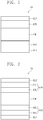
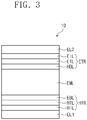
- an organic electroluminescence device 10 includes a first electrode EL1, a hole transport region HTR, an emission layer EML, an electron transport region ETR, and a second electrode EL2, which are sequentially laminated.
- the first electrode EL1 and the second electrode EL2 are disposed (e.g., positioned or located) to face each other, and a plurality of organic layers are disposed between the first electrode EL1 and the second electrode EL2.
- the plurality of organic layers include a hole transport region HTR, an emission layer EML, and an electron transport region ETR.
- the organic electroluminescence device 10 includes a polycyclic compound of embodiments of the present disclosure in the emission layer EML.
- FIG. 2 illustrates a cross-sectional view of an organic electroluminescence device 10 according to an embodiment, wherein a hole transport region HTR includes a hole injection layer HIL and a hole transport layer HTL, and an electron transport region ETR includes an electron injection layer EIL and an electron transport layer ETL.
- FIG. 3 illustrates a cross-sectional view of an organic electroluminescence device 10 according to an embodiment, wherein a hole transport region HTR includes a hole injection layer HIL, a hole transport layer HTL and an electron blocking layer EBL, and an electron transport region ETR includes an electron injection layer EIL, an electron transport layer ETL and a hole blocking layer HBL.
- the first electrode EL1 may have conductivity.
- the first electrode EL1 may be formed of a metal alloy or a conductive compound.
- the first electrode EL1 may be an anode.
- the first electrode EL1 may be a transmissive electrode, a transflective electrode, or a reflective electrode.
- the first electrode EL1 may be formed of a transparent metal oxide, for example, indium tin oxide (ITO), indium zinc oxide (IZO), zinc oxide (ZnO), indium tin zinc oxide (ITZO), etc.
- the first electrode EL1 When the first electrode EL1 is a transflective electrode or a reflective electrode, the first electrode EL1 may include Ag, Mg, Cu, Al, Pt, Pd, Au, Ni, Nd, Ir, Cr, Li, Ca, LiF/Ca, LiF/Al, Mo, Ti, or a compound or mixture thereof (for example, a mixture of Ag and Mg).
- the first electrode EL1 may have a structure which has a plurality of layers including: a reflective layer or a transflective layer formed of any of the described materials; and a transparent conductive layer formed of ITO, IZO, ZnO, ITZO, etc.
- the first electrode EL1 may have a multi-layer structure of ITO/Ag/ITO.
- the hole transport region HTR may be disposed on the first electrode EL1.
- the hole transport region HTR may include at least one selected from a hole injection layer HIL, a hole transport layer HTL, a hole buffer layer, and an electron blocking layer EBL.
- the hole transport region HTR may have a structure of: a single layer formed of a single material; a single layer formed of a plurality of different materials; or a multi-layer having a plurality of layers formed of a plurality of different materials.
- the hole transport region HTR may have a structure of a single layer which is a hole injection layer HIL or a hole transport layer HTL, or may have a structure of a single layer formed of a hole injection material and a hole transport material.
- the hole transport region HTR may have a structure of a single layer formed of a plurality of different materials, or may have a structure of, sequentially laminated from the first electrode EL1, hole injection layer HIL/hole transport layer HTL, hole injection layer HIL/hole transport layer HTL/hole buffer layer, hole injection layer HIL/hole buffer layer, hole transport layer HTL/hole buffer layer, or hole injection layer HIL/hole transport layer HTL/electron blocking layer EBL, but embodiments are not limited thereto.
- the hole transport region HTR may be formed by using one or more suitable methods such as a vacuum deposition method, a spin coating method, a casting method, a Langmuir-Blodgett (LB) method, an inkjet printing method, a laser printing method, and/or a laser induced thermal imaging (LITI) method.
- suitable methods such as a vacuum deposition method, a spin coating method, a casting method, a Langmuir-Blodgett (LB) method, an inkjet printing method, a laser printing method, and/or a laser induced thermal imaging (LITI) method.
- the hole injection layer HIL of an organic electroluminescence device 10 of one or more embodiments may include any suitable hole injection material, for example, triphenylamine-containing polyetherketone (TPAPEK), 4-isopropyl-4'-methyldiphenyliodoniumtetrakis(pentafluorophenyl)borate (PPBI), N,N'-diphenyl-N,N'-bis-[4-(phenyl-m-tolyl-amino)-phenyl]-phenyl-4,4'-diamine (DNTPD), a phthalocyanine compound such as copper phthalocyanine, 4,4',4"-tris[(3-methylphenyl)phenylamino]triphenylamine (m-MTDATA), N,N'-di(1-naphthyl)-N,N'-diphenylbenzidine (NPB), N,N'-bis(1-naphthyl)-N,N'-
- the hole transport layer HTL of an organic electroluminescence device 10 of one or more embodiments may include any suitable hole transport material, for example, 1,1-bis[(di-4-tolylamino)phenyl]cyclohexane (TAPC), a carbazole derivative such as N-phenylcarbazole or polyvinylcarbazole, N,N'-bis(3-methylphenyl)-N,N'-diphenyl-(1,1-biphenyl)-4,4'-diamine (TPD), 4,4',4"-tris(N-carbazolyl)triphenylamine (TCTA), N,N'-di(1-naphthyl)-N,N'-diphenylbenzidine (NPB), N,N'-bis(1-naphthyl)-N,N'-diphenyl-4,4'-diamine (a-NPD), etc., but embodiments of the present disclosure are not limited thereto.
- the hole transport region HTR may further include an electron blocking layer EBL, and the electron blocking layer EBL may be disposed between the hole transport layer HTL and the emission layer EML.
- the electron blocking layer EBL may serve to prevent or reduce electron injection from the electron transport region ETR to the hole transport region HTR.
- the electron blocking layer EBL may include any suitable material, for example, a carbazole-based derivative such as N-phenylcarbazole and/or polyvinylcarbazole, a fluorene-based derivative, a triphenylamine-based derivative such as N,N'-bis(3-methylphenyl)-N,N'-diphenyl-(1,1-biphenyl)-4,4'-diamine (TPD) and/or 4,4',4"-tris(N-carbazolyl)triphenylamine (TCTA), N,N'-di(naphthalene-I-yl)-N,N'-diphenyl-benzidine (NPB), 4,4'-cyclohexylidene-bis[N,N-bis(4-methylphenyl)benzenamine] (TAPC), 4,4'-bis[N,N'-(3-tolyl)amino]-3,3'-dimethylbiphenyl (HMT
- a thickness of the hole transport region HTR may be about 100 ⁇ to about 10,000 ⁇ , for example, about 100 ⁇ to about 5,000 ⁇ , about 100 ⁇ to about 3,000 ⁇ , about 100 ⁇ to about 1,000 ⁇ , about 500 ⁇ to about 1,000 ⁇ or about 800 ⁇ to about 1,000 ⁇ .
- a thickness of the hole injection layer HIL may be, for example, about 30 ⁇ to about 1,000 ⁇ , and a thickness of the hole transport layer HTL may be about 10 ⁇ to about 1,000 ⁇ .
- a thickness of the electron blocking layer EBL may be about 10 ⁇ to about 1,000 ⁇ .
- the hole transport region HTR may further include, in addition to the described materials, a charge generating material to improve conductivity.
- the charge generating material may be uniformly or nonuniformly dispersed in the hole transport region HTR.
- the charge generating material may be, for example, a p-dopant.
- the p-dopant may be selected from a quinone derivative, a metal oxide, and a cyano group-containing compound, but embodiments of the present disclosure are not limited thereto.
- the non-limited examples of the p-dopant may be, for example, a quinone derivative (such as tetracyanoquinodimethane (TCNQ) and/or 2,3,5,6-tetrafluoro-tetracyanoquinodimethane (F4-TCNQ)), a metal oxide (such as tungsten oxide and/or molybdenum oxide), etc., but embodiments of the present disclosure are not limited thereto.
- a quinone derivative such as tetracyanoquinodimethane (TCNQ) and/or 2,3,5,6-tetrafluoro-tetracyanoquinodimethane (F4-TCNQ)
- a metal oxide such as tungsten oxide and/or molybdenum oxide
- the hole transport region HTR may further include at least one selected from the hole buffer layer and the electron blocking layer EBL, in addition to the hole injection layer HIL and the hole transport layer HTL.
- the hole buffer layer may improve luminous efficiency by compensating a resonance distance according to the wavelength of the light emitted from the emission layer EML. Any of the materials contained in the hole transport region HTR may also be used as materials contained in the hole buffer layer.
- the emission layer EML may be disposed on the hole transport region HTR.
- the emission layer EML may have a thickness of, for example, about 100 ⁇ to about 600 ⁇ or about 200 ⁇ to about 400 ⁇ .
- the emission layer EML may have a structure of: a single layer formed of a single material; a single layer formed of a plurality of different materials; or a multi-layer having a plurality of layers formed of a plurality of different materials.
- the emission layer EML may emit one selected from red light, green light, blue light, white light, yellow light, and cyan light.
- the emission layer EML may include a fluorescence emission material and/or a phosphorescence emission material.
- the emission layer EML may be a fluorescence emission layer.
- some of the light emitted from the emission layer EML may be emitted by thermally activated delayed fluorescence (TADF).
- TADF thermally activated delayed fluorescence
- the emission layer EML may include emission components which emit thermally activated delayed fluorescence, and in one or more embodiments, the emission layer EML may be an emission layer which emits thermally activated delayed fluorescence of blue light.
- - * may refer to a connecting position
- substituted or unsubstituted may refer to a group that is unsubstituted or is substituted with at least one substituent selected from a deuterium atom, a halogen atom, a cyano group, a silyl group, an oxy group, a thio group, an amino group, an alkyl group, an alkoxy group, a hydrocarbon ring group, an aryl group, and a heterocyclic group.
- each of the substituents exemplified above may itself be substituted or unsubstituted.
- a biphenyl group may be an aryl group or a phenyl group substituted with a phenyl group.
- the expression "may be combined with an adjacent group to form a ring” may refer to forming a substituted or unsubstituted hydrocarbon ring, or a substituted or unsubstituted heterocycle via the combination with an adjacent group.
- the hydrocarbon ring includes an aliphatic hydrocarbon ring and an aromatic hydrocarbon ring.
- the heterocycle (or heterocyclic group) includes an aliphatic heterocycle and an aromatic heterocycle.
- the ring formed by the combination with an adjacent group may be a monocyclic ring or a polycyclic ring.
- the ring formed via the combination may be combined with another ring to form a spiro structure.
- adjacent group may refer to a pair of substituent groups where the first substituent is connected to an atom which is directly connected with another atom substituted with the second substituent, a pair of substituent groups connected to the same atoms (where the pair of substituent groups may be different from each other), or a pair of substituent groups where the first substituent is sterically positioned at the nearest position to the second substituent.
- two methyl groups may be "adjacent groups" to each other
- 1,1-diethylcyclopentene two ethyl groups may be "adjacent groups" to each other.
- atoms for forming a ring may refer to ring-forming atoms.
- the halogen atom may be, for example, a fluorine atom, a chlorine atom, a bromine atom, and/or an iodine atom.
- the alkyl group may be a linear, branched, or cyclic type.
- the carbon number of the alkyl group may be 1 to 50, 1 to 30, 1 to 20, 1 to 10, or 1 to 6.
- Examples of the alkyl group may include a methyl group, an ethyl group, an n-propyl group, an isopropyl group, an n-butyl group, an s-butyl group, a t-butyl group, an i-butyl group, a 2-ethylbutyl group, a 3,3-dimethylbutyl group, an n-pentyl group, an i-pentyl group, a neopentyl group, a t-pentyl group, a cyclopentyl group, a 1-methylpentyl group, a 3-methylpentyl group, a 2-ethylpentyl group, a 4-methyl-2-pentyl group, an
- the aryl group may refer to an aromatic hydrocarbon ring functional group or substituent.
- the aryl group may be a monocyclic aryl group or a polycyclic aryl group.
- the number of ring-forming carbon atoms in the aryl group may be 6 to 36, 6 to 30, 6 to 20, or 6 to 15.
- aryl group may include a phenyl group, a naphthyl group, a fluorenyl group, an anthracenyl group, a phenanthryl group, a biphenyl group, a terphenyl group, a quaterphenyl group, a quinqphenyl group, a sexiphenyl group, a triphenylenyl group, a pyrenyl group, a benzofluoranthenyl group, a chrysenyl group, etc., but embodiments of the present disclosure are not limited thereto.
- the fluorenyl group may be substituted, and two substituents may optionally be combined with each other to form a spiro structure.
- Examples of a substituted fluorenyl group are as follows, but embodiments of the present disclosure are not limited thereto:
- the heteroaryl group may be a cyclic aromatic group including one or more of O, N, P, Si, or S as a ring-forming heteroatom.
- the number of ring-forming carbon atoms in the heteroaryl group may be 2 to 30 or 2 to 20.
- the heteroaryl group may be a monocyclic heteroaryl group or a polycyclic heteroaryl group.
- the polycyclic heteroaryl group may have, for example, a bicyclic structure or a tricyclic structure.
- heteroaryl group may include a thiophenyl group, a furanyl group, a pyrrolyl group, an imidazolyl group, a thiazolyl group, an oxazolyl group, an oxadiazolyl group, a triazolyl group, a pyridyl group, a bipyridyl group, a pyrimidyl group, a triazinyl group, an acridyl group, a pyridazinyl group, a pyrazinyl group, a quinolinyl group, a quinazolinyl group, a quinoxalinyl group, a phenoxazyl group, a phthalazinyl group, a pyrido pyrimidinyl group, a pyrido pyrazinyl group, a pyrazino pyrazinyl group, an isoquinolinyl group,
- the silyl group includes an alkylsilyl group and an arylsilyl group.
- the silyl group may include a trimethylsilyl group, a triethylsilyl group, a t-butyldimethylsilyl group, a vinyldimethylsilyl group, a propyldimethylsilyl group, a triphenylsilyl group, a diphenylsilyl group, a phenylsilyl group, etc., but embodiments of the present disclosure are not limited thereto.
- the carbon number of the amine group is not particularly limited, but may be 1 to 30.
- the amine group may include an alkylamine group and an arylamine group. Examples of the amine group may include a methylamine group, a dimethylamine group, a phenylamine group, a naphthylamine group, a 9-methyl-anthracenylamine group, a triphenylamine group, etc., but embodiments of the present disclosure are not limited thereto.
- the phosphine oxide group may be substituted with, for example, at least one of alkyl or aryl.
- the phosphine sulfide group may be substituted with, for example, at least one of alkyl or aryl.
- the hydrocarbon ring may be an optional functional group or substituent derived from an aliphatic hydrocarbon ring, or an optional functional group or substituent derived from an aromatic hydrocarbon ring.
- the carbon number for forming the ring in the hydrocarbon ring may be 5 to 60, 5 to 50, 5 to 40, 5 to 30, or 5 to 20.
- thio group may include an alkylthio group and an arylthio group.
- oxy group may include an alkoxy group and an aryloxy group.
- the alkoxy group may include a linear, branched, or cyclic chain.
- the carbon number of the alkoxy group is not specifically limited and may be, for example, 1 to 20, or 1 to 10.
- Non-limiting examples of the alkoxy group include methoxy, ethoxy, n-propoxy, isopropoxy, butoxy, pentyloxy, hexyloxy, octyloxy, nonyloxy, decyloxy, etc.
- embodiments of the present disclosure are not limited thereto.
- the emission layer EML includes a polycyclic compound represented by Formula 1:
- Ring A and Ring B are each independently a substituted or unsubstituted aryl group having 6 to 30 carbon atoms for forming a ring, or a substituted or unsubstituted heteroaryl group having 2 to 30 carbon atoms for forming a ring.
- Ring A and Ring B may each independently be a substituted or unsubstituted aryl group having 6 to 20 carbon atoms for forming a ring, or a substituted or unsubstituted heteroaryl group having 2 to 20 carbon atoms for forming a ring.
- Ring A and Ring B may each independently be a substituted or unsubstituted aryl group having 6 to 15 carbon atoms for forming a ring, or a substituted or unsubstituted heteroaryl group having 2 to 15 carbon atoms for forming a ring.
- Ring A and Ring B may each independently be a substituted or unsubstituted aryl group having 6 to 10 carbon atoms for forming a ring, or a substituted or unsubstituted heteroaryl group having 2 to 10 carbon atoms for forming a ring.
- Ring A and Ring B may each independently be a substituted or unsubstituted aryl group having 6 carbon atoms for forming a ring, or a substituted or unsubstituted heteroaryl group having 2 to 4 carbon atoms for forming a ring.
- At least one selected from Ring A and Ring B is a substituted or unsubstituted heteroaryl group having 2 to 30 carbon atoms for forming a ring.
- both Ring A and Ring B are not heteroaryl groups, molecular stability may be lowered, thereby deteriorating luminous efficiency and/or life-time of an organic electroluminescence device in which the polycyclic compound is used.
- Z is BAr 2 , POAr 3 , PSAr 4 , SiAr 5 Ar 6 , or GeAr 7 Ar 8 .
- Ar 1 is a substituted or unsubstituted aryl group having 6 to 30 carbon atoms for forming a ring, a substituted or unsubstituted aralkyl group having 7 to 30 carbon atoms, or a substituted or unsubstituted heteroaryl group having 2 to 30 carbon atoms for forming a ring, and Ar 1 may be combined with an adjacent group to form a ring.
- Ar 1 may be a substituted or unsubstituted aryl group having 6 to 20 carbon atoms for forming a ring, a substituted or unsubstituted aralkyl group having 7 to 20 carbon atoms, or a substituted or unsubstituted heteroaryl group having 2 to 20 carbon atoms for forming a ring, and Ar 1 may be combined with an adjacent group to form a ring.
- Ar 1 may be a substituted or unsubstituted aryl group having 6 to 15 carbon atoms for forming a ring, a substituted or unsubstituted aralkyl group having 7 to 15 carbon atoms, or a substituted or unsubstituted heteroaryl group having 2 to 15 carbon atoms for forming a ring, and Ar 1 may be combined with an adjacent group to form a ring.
- Ar 1 may be a substituted or unsubstituted aryl group having 6 to 10 carbon atoms for forming a ring, a substituted or unsubstituted aralkyl group having 7 to 10 carbon atoms, or a substituted or unsubstituted heteroaryl group having 2 to 10 carbon atoms for forming a ring, and Ar 1 may be combined with an adjacent group to form a ring.
- Ar 1 may be a substituted or unsubstituted aryl group having 6 to 10 carbon atoms for forming a ring, and Ar 1 may be combined with an adjacent group to form a ring.
- Ar 1 may be a substituted or unsubstituted aryl group having 6 carbon atoms for forming a ring, and Ar 1 may be combined with an adjacent group to form a ring.
- Ar 2 to Ar 8 are each independently a substituted or unsubstituted amino group, a substituted or unsubstituted oxy group, a substituted or unsubstituted alkyl group having 1 to 10 carbon atoms, a substituted or unsubstituted aryl group having 6 to 30 carbon atoms for forming a ring, a substituted or unsubstituted aralkyl group having 7 to 30 carbon atoms, or a substituted or unsubstituted heteroaryl group having 2 to 30 carbon atoms for forming a ring, and one or more selected from Ar 2 to Ar 8 may be combined with an adjacent group to form a ring.
- Ar 2 to Ar 8 may each independently be a substituted or unsubstituted amino group, a substituted or unsubstituted oxy group, a substituted or unsubstituted alkyl group having 1 to 6 carbon atoms, a substituted or unsubstituted aryl group having 6 to 20 carbon atoms for forming a ring, a substituted or unsubstituted aralkyl group having 7 to 20 carbon atoms, or a substituted or unsubstituted heteroaryl group having 2 to 20 carbon atoms for forming a ring, and one or more selected from Ar 2 to Ar 8 may be combined with an adjacent group to form a ring.
- Ar 2 to Ar 8 may each independently be a substituted or unsubstituted amino group, a substituted or unsubstituted oxy group, a substituted or unsubstituted alkyl group having 1 to 6 carbon atoms, a substituted or unsubstituted aryl group having 6 to 15 carbon atoms for forming a ring, a substituted or unsubstituted aralkyl group having 7 to 15 carbon atoms, or a substituted or unsubstituted heteroaryl group having 2 to 15 carbon atoms for forming a ring, and one or more selected from Ar 2 to Ar 8 may be combined with an adjacent group to form a ring.
- Ar 2 to Ar 8 may each independently be a substituted or unsubstituted amino group, a substituted or unsubstituted oxy group, a substituted or unsubstituted alkyl group having 1 to 6 carbon atoms, a substituted or unsubstituted aryl group having 6 to 10 carbon atoms for forming a ring, a substituted or unsubstituted aralkyl group having 7 to 10 carbon atoms, or a substituted or unsubstituted heteroaryl group having 2 to 10 carbon atoms for forming a ring, and one or more selected from Ar 2 to Ar 8 may be combined with an adjacent group to form a ring.
- At least one selected from Ring A and Ring B in Formula 1 may be represented by Formula 2:
- X and Y are each independently a direct bond, O, S, SO, SO 2 , Se, NR 3 , PR 4 , POR 5 , PSR 6 , SiR 7 R 8 , GeR 9 R 10 , or BR 11 .
- X and Y may each independently be a direct bond, O, S, SO, SO 2 , NR 3 , PR 4 , POR 5 , PSR 6 , SiR 7 R 8 , or BR 11 .
- X and Y may each independently be a direct bond, O, S, NR 3 , PR 4 , POR 5 , PSR 6 , SiR 7 R 8 , or BR 11 .
- X and Y may each independently be a direct bond, O, S, NR 3 , or SiR 7 R 8 .
- R 1 to R 11 are each independently a hydrogen atom, a deuterium atom, a halogen atom, a cyano group, a substituted or unsubstituted oxy group, a substituted or unsubstituted thiol group, a substituted or unsubstituted amine group, a phosphine oxide group, a phosphine sulfide group, a silyl group, a carbonyl group, a boron group, a substituted or unsubstituted alkyl group having 1 to 10 carbon atoms, a substituted or unsubstituted aralkyl group having 7 to 30 carbon atoms, a substituted or unsubstituted aryl group having 6 to 30 carbon atoms for forming a ring, or a substituted or unsubstituted heteroaryl group having 2 to 30 carbon atoms for forming a ring, and one or more selected from R 1 to R
- R 1 to R 11 may each independently be a hydrogen atom, a deuterium atom, a halogen atom, a cyano group, a substituted or unsubstituted oxy group, a substituted or unsubstituted thiol group, a substituted or unsubstituted amine group, a phosphine oxide group, a phosphine sulfide group, a silyl group, a carbonyl group, a boron group, a substituted or unsubstituted alkyl group having 1 to 6 carbon atoms, a substituted or unsubstituted aralkyl group having 7 to 20 carbon atoms, a substituted or unsubstituted aryl group having 6 to 20 carbon atoms for forming a ring, or a substituted or unsubstituted heteroaryl group having 2 to 20 carbon atoms for forming a ring, and one or more selected from
- R 1 to R 11 may each independently be a hydrogen atom, a deuterium atom, a halogen atom, a cyano group, a substituted or unsubstituted oxy group, a substituted or unsubstituted thiol group, a substituted or unsubstituted amine group, a phosphine oxide group, a phosphine sulfide group, a silyl group, a carbonyl group, a boron group, a substituted or unsubstituted alkyl group having 1 to 6 carbon atoms, a substituted or unsubstituted aralkyl group having 7 to 15 carbon atoms, a substituted or unsubstituted aryl group having 6 to 15 carbon atoms for forming a ring, or a substituted or unsubstituted heteroaryl group having 2 to 15 carbon atoms for forming a ring, and one or more selected from
- R 1 to R 11 may each independently be a hydrogen atom, a deuterium atom, a halogen atom, a cyano group, a substituted or unsubstituted oxy group, a substituted or unsubstituted thiol group, a substituted or unsubstituted amine group, a phosphine oxide group, a phosphine sulfide group, a silyl group, a carbonyl group, a boron group, a substituted or unsubstituted alkyl group having 1 to 6 carbon atoms, a substituted or unsubstituted aralkyl group having 7 to 10 carbon atoms, a substituted or unsubstituted aryl group having 6 to 10 carbon atoms for forming a ring, or a substituted or unsubstituted heteroaryl group having 2 to 10 carbon atoms for forming a ring, and one or more selected from
- Formula 2 represents an embodiment in which one selected from Ring A and Ring B in Formula 1 is a heteroaryl ring (heteroaryl group), and a case in which X and Y in Formula 2 are both direct bonds at the same time is excluded.
- Ar 1 in Formula 1 may be a substituted or unsubstituted aryl group having 6 to 30 carbon atoms for forming a ring, or a substituted or unsubstituted heteroaryl group having 2 to 30 carbon atoms for forming a ring, and Ar 1 may be combined with an adjacent group to form a ring.
- Ar 1 in Formula 1 may be a substituted or unsubstituted aryl group having 6 to 20 carbon atoms for forming a ring, or a substituted or unsubstituted heteroaryl group having 2 to 20 carbon atoms for forming a ring, and Ar 1 may be combined with an adjacent group to form a ring.
- Ar 1 in Formula 1 may be a substituted or unsubstituted aryl group having 6 to 15 carbon atoms for forming a ring, or a substituted or unsubstituted heteroaryl group having 2 to 15 carbon atoms for forming a ring, and Ar 1 may be combined with an adjacent group to form a ring.
- Ar 1 in Formula 1 may be a substituted or unsubstituted aryl group having 6 to 10 carbon atoms for forming a ring, or a substituted or unsubstituted heteroaryl group having 2 to 10 carbon atoms for forming a ring, and Ar 1 may be combined with an adjacent group to form a ring.
- Ar 1 may be a substituted or unsubstituted aryl group having 6 carbon atoms for forming a ring, and Ar 1 may be combined with an adjacent group to form a ring.
- Formula 1 when Ar 1 in Formula 1 is an aryl group or a heteroaryl group which is bonded to an adjacent group to form a ring, Formula 1 may be represented by Formula 3: In Formula 3, Z' is BAr 2 , POAr 3 , PSAr4, SiAr 5 Ar 6 , or GeAr 7 Ar 8 .
- Z' may be BAr 2 , POAr 3 , or SiAr 5 Ar 6 .
- Ring L is a substituted or unsubstituted aryl group having 6 to 30 carbon atoms for forming a ring, or a substituted or unsubstituted heteroaryl group having 2 to 30 carbon atoms for forming a ring.
- Ring L may be a substituted or unsubstituted aryl group having 6 to 20 carbon atoms for forming a ring, or a substituted or unsubstituted heteroaryl group having 2 to 20 carbon atoms for forming a ring.
- Ring L may be a substituted or unsubstituted aryl group having 6 to 15 carbon atoms for forming a ring, or a substituted or unsubstituted heteroaryl group having 2 to 15 carbon atoms for forming a ring.
- Ring L may be a substituted or unsubstituted aryl group having 6 to 10 carbon atoms for forming a ring, or a substituted or unsubstituted heteroaryl group having 2 to 10 carbon atoms for forming a ring.
- Ring L may be a substituted or unsubstituted aryl group having 6 to 10 carbon atoms for forming a ring.
- Ring L may be a substituted or unsubstituted aryl group having 6 carbon atoms for forming a ring.
- Ring A, Ring B, and Z are the same as defined in Formula 1.
- Z and Z' in Formula 3 may be the same as each other.
- Ar 2 to Ar 8 in Formula 1 may each independently be a substituted or unsubstituted aryl group having 6 to 30 carbon atoms for forming a ring, a substituted or unsubstituted aralkyl group having 7 to 30 carbon atoms, or a substituted or unsubstituted heteroaryl group having 2 to 30 carbon atoms for forming a ring, and one or more selected from Ar 2 to Ar 8 may be combined with an adjacent group to form a ring.
- Ar 2 to Ar 8 in Formula 1 may each independently be a substituted or unsubstituted aryl group having 6 to 20 carbon atoms for forming a ring, a substituted or unsubstituted aralkyl group having 7 to 20 carbon atoms, or a substituted or unsubstituted heteroaryl group having 2 to 20 carbon atoms for forming a ring, and one or more selected from Ar 2 to Ar 8 may be combined with an adjacent group to form a ring.
- Ar 2 to Ar 8 in Formula 1 may each independently be a substituted or unsubstituted aryl group having 6 to 15 carbon atoms for forming a ring, a substituted or unsubstituted aralkyl group having 7 to 15 carbon atoms, or a substituted or unsubstituted heteroaryl group having 2 to 15 carbon atoms for forming a ring, and one or more selected from Ar 2 to Ar 8 may be combined with an adjacent group to form a ring.
- Ar 2 to Ar 8 in Formula 1 may each independently be a substituted or unsubstituted aryl group having 6 to 10 carbon atoms for forming a ring, a substituted or unsubstituted aralkyl group having 7 to 10 carbon atoms, or a substituted or unsubstituted heteroaryl group having 2 to 10 carbon atoms for forming a ring, and one or more selected from Ar 2 to Ar 8 may be combined with an adjacent group to form a ring.
- Formula 1 when Ar 2 to Ar 8 in Formula 1 are each independently an aryl or a heteroaryl group which is bonded to an adjacent group to form a ring, Formula 1 may be represented by Formula 4: In Formula 4, Z is B, PO, PS, SiAr 5 , or GeAr 7 .
- Z may be B, PO, or SiAr 5 .
- Ring M is a substituted or unsubstituted aryl group having 6 to 30 carbon atoms for forming a ring, or a substituted or unsubstituted heteroaryl group having 2 to 30 carbon atoms for forming a ring.
- Ring M may be a substituted or unsubstituted aryl group having 6 to 20 carbon atoms for forming a ring, or a substituted or unsubstituted heteroaryl group having 2 to 20 carbon atoms for forming a ring.
- Ring M may be a substituted or unsubstituted aryl group having 6 to 15 carbon atoms for forming a ring, or a substituted or unsubstituted heteroaryl group having 2 to 15 carbon atoms for forming a ring.
- Ring M may be a substituted or unsubstituted aryl group having 6 to 10 carbon atoms for forming a ring, or a substituted or unsubstituted heteroaryl group having 2 to 10 carbon atoms for forming a ring.
- Ring M may be a substituted or unsubstituted aryl group having 6 carbon atoms for forming a ring, or a substituted or unsubstituted heteroaryl group having 2 to 10 carbon atoms for forming a ring.
- Ar 1 ' is a substituted or unsubstituted alkyl group having 1 to 10 carbon atoms, a substituted or unsubstituted aryl group having 6 to 30 carbon atoms for forming a ring, a substituted or unsubstituted aralkyl group having 7 to 30 carbon atoms, or a substituted or unsubstituted heteroaryl group having 2 to 30 carbon atoms for forming a ring.
- Ar 1 ' may be a substituted or unsubstituted alkyl group having 1 to 6 carbon atoms, a substituted or unsubstituted aryl group having 6 to 20 carbon atoms for forming a ring, a substituted or unsubstituted aralkyl group having 7 to 20 carbon atoms, or a substituted or unsubstituted heteroaryl group having 2 to 20 carbon atoms for forming a ring.
- Ar 1 ' may be a substituted or unsubstituted alkyl group having 1 to 6 carbon atoms, a substituted or unsubstituted aryl group having 6 to 15 carbon atoms for forming a ring, a substituted or unsubstituted aralkyl group having 7 to 15 carbon atoms, or a substituted or unsubstituted heteroaryl group having 2 to 15 carbon atoms for forming a ring.
- Ar 1 ' may be a substituted or unsubstituted alkyl group having 1 to 6 carbon atoms, a substituted or unsubstituted aryl group having 6 to 10 carbon atoms for forming a ring, a substituted or unsubstituted aralkyl group having 7 to 10 carbon atoms, or a substituted or unsubstituted heteroaryl group having 2 to 10 carbon atoms for forming a ring.
- Ar 1 ' may be a substituted or unsubstituted aryl group having 6 to 10 carbon atoms for forming a ring.
- Ar 1 ' may be a substituted or unsubstituted aryl group having 6 carbon atoms for forming a ring.
- Ring A, Ring B, Ar 1 , Ar 5 , and Ar 7 are the same as defined in Formula 1.
- Z in Formula 1 may be BAr 2 .
- Z in Formula 1 when Z in Formula 1 is BAr 2 , Z may be represented by Formula 5:
- V 1 to V 5 are each independently CR 12 or N. At least one selected from V 1 to V 5 may be CR 12 .
- R 12 is a hydrogen atom, a deuterium atom, a halogen atom, a cyano group, a substituted or unsubstituted oxy group, a substituted or unsubstituted thiol group, a substituted or unsubstituted amine group, a phosphine oxide group, a phosphine sulfide group, a silyl group, a carbonyl group, a boron group, a substituted or unsubstituted alkyl group having 1 to 10 carbon atoms, a substituted or unsubstituted aralkyl group having 7 to 30 carbon atoms, a substituted or unsubstituted aryl group having 6 to 30 carbon atoms for forming a ring, or a substituted or unsubstituted heteroaryl group having 2 to 30 carbon atoms for forming a ring, and one or more R 12 may be bonded to adjacent group to form
- R 12 is a hydrogen atom, a deuterium atom, a halogen atom, a cyano group, a substituted or unsubstituted oxy group, a substituted or unsubstituted thiol group, a substituted or unsubstituted amine group, a phosphine oxide group, a phosphine sulfide group, a silyl group, a carbonyl group, a boron group, a substituted or unsubstituted alkyl group having 1 to 6 carbon atoms, a substituted or unsubstituted aralkyl group having 7 to 20 carbon atoms, a substituted or unsubstituted aryl group having 6 to 20 carbon atoms for forming a ring, or a substituted or unsubstituted heteroaryl group having 2 to 20 carbon atoms for forming a ring, and one or more R 12 may be bonded to adjacent
- R 12 is a hydrogen atom, a deuterium atom, a halogen atom, a cyano group, a substituted or unsubstituted oxy group, a substituted or unsubstituted thiol group, a substituted or unsubstituted amine group, a phosphine oxide group, a phosphine sulfide group, a silyl group, a carbonyl group, a boron group, a substituted or unsubstituted alkyl group having 1 to 6 carbon atoms, a substituted or unsubstituted aralkyl group having 7 to 15 carbon atoms, a substituted or unsubstituted aryl group having 6 to 15 carbon atoms for forming a ring, or a substituted or unsubstituted heteroaryl group having 2 to 15 carbon atoms for forming a ring, and one or more R 12 may be bonded to adjacent
- R 12 is a hydrogen atom, a deuterium atom, a halogen atom, a cyano group, a substituted or unsubstituted oxy group, a substituted or unsubstituted thiol group, a substituted or unsubstituted amine group, a phosphine oxide group, a phosphine sulfide group, a silyl group, a carbonyl group, a boron group, a substituted or unsubstituted alkyl group having 1 to 6 carbon atoms, a substituted or unsubstituted aralkyl group having 7 to 10 carbon atoms, a substituted or unsubstituted aryl group having 6 to 10 carbon atoms for forming a ring, or a substituted or unsubstituted heteroaryl group having 2 to 10 carbon atoms for forming a ring, and one or more R 12 may be bonded to adjacent
- R 12 may be a hydrogen atom, a deuterium atom, or a substituted or unsubstituted alkyl group having 1 to 6 carbon atoms, and one or more R 12 may be bonded to adjacent group to form a ring.
- V 1 to V 5 in Formula 5 may each independently be CR 12 , wherein R 12 may be a hydrogen atom, a deuterium atom, or a substituted or unsubstituted alkyl group having 2 to 10 carbon atoms.
- V 1 to V 5 in Formula 5 may each independently be CR 12 , wherein R 12 may be a hydrogen atom, a deuterium atom, or a substituted or unsubstituted alkyl group having 2 to 6 carbon atoms.
- At least one selected from Ring A and Ring B in Formula 1 may be substituted or unsubstituted pyrrole, substituted or unsubstituted thiophene, substituted or unsubstituted oxazine, or substituted or unsubstituted furan.
- Formula 1 may be represented by Formula 6:
- a 1 is a hydrogen atom, a deuterium atom, a halogen atom, a cyano group, a substituted or unsubstituted oxy group, a substituted or unsubstituted thiol group, a substituted or unsubstituted amine group, a phosphine oxide group, a phosphine sulfide group, a silyl group, a carbonyl group, a boron group, a substituted or unsubstituted alkyl group having 1 to 10 carbon atoms, a substituted or unsubstituted aralkyl group having 7 to 30 carbon atoms, a substituted or unsubstituted aryl group having 6 to 30 carbon atoms for forming a ring, or a substituted or unsubstituted heteroaryl group having 2 to 30 carbon atoms for forming a ring
- a 1 may be a hydrogen atom, a deuterium atom, a halogen atom, a cyano group, a substituted or unsubstituted oxy group, a substituted or unsubstituted thiol group, a substituted or unsubstituted amine group, a phosphine oxide group, a phosphine sulfide group, a silyl group, a carbonyl group, a boron group, a substituted or unsubstituted alkyl group having 1 to 6 carbon atoms, a substituted or unsubstituted aralkyl group having 7 to 20 carbon atoms, a substituted or unsubstituted aryl group having 6 to 20 carbon atoms for forming a ring, or a substituted or unsubstituted heteroaryl group having 2 to 20 carbon atoms for forming a ring, and one or more A 1 may be bonded to
- a 1 may be a hydrogen atom, a deuterium atom, a halogen atom, a cyano group, a substituted or unsubstituted oxy group, a substituted or unsubstituted thiol group, a substituted or unsubstituted amine group, a phosphine oxide group, a phosphine sulfide group, a silyl group, a carbonyl group, a boron group, a substituted or unsubstituted alkyl group having 1 to 6 carbon atoms, a substituted or unsubstituted aralkyl group having 7 to 15 carbon atoms, a substituted or unsubstituted aryl group having 6 to 15 carbon atoms for forming a ring, or a substituted or unsubstituted heteroaryl group having 2 to 15 carbon atoms for forming a ring, and one or more A 1 may be bonded to
- a 1 may be a hydrogen atom, a deuterium atom, a halogen atom, a cyano group, a substituted or unsubstituted oxy group, a substituted or unsubstituted thiol group, a substituted or unsubstituted amine group, a phosphine oxide group, a phosphine sulfide group, a silyl group, a carbonyl group, a boron group, a substituted or unsubstituted alkyl group having 1 to 6 carbon atoms, a substituted or unsubstituted aralkyl group having 7 to 10 carbon atoms, a substituted or unsubstituted aryl group having 6 to 10 carbon atoms for forming a ring, or a substituted or unsubstituted heteroaryl group having 2 to 10 carbon atoms for forming a ring, and one or more A 1 may be bonded to
- n is an integer of 0 to 5.
- a plurality of A 1 s may be the same as or different from each other.
- X and Y may each independently be a direct bond, O, S, SO, SO 2 , Se, NR 3 , PR 4 , POR 5 , PSR 6 , SiR 7 R 8 , GeR 9 R 10 , or BR 11 .
- X and Y may each independently be a direct bond, O, S, SO, SO 2 , NR 3 , PR 4 , POR 5 , PSR 6 , SiR 7 R 8 , or BR 11 .
- X and Y may each independently be a direct bond, O, S, NR 3 , PR 4 , POR 5 , PSR 6 , SiR 7 R 8 , or BR 11 .
- X and Y may each independently be a direct bond, O, S, NR 3 , or SiR 7 R 8 .
- R 1 to R 11 are each independently a hydrogen atom, a deuterium atom, a halogen atom, a cyano group, a substituted or unsubstituted oxy group, a substituted or unsubstituted thiol group, a substituted or unsubstituted amine group, a phosphine oxide group, a phosphine sulfide group, a silyl group, a carbonyl group, a boron group, a substituted or unsubstituted alkyl group having 1 to 10 carbon atoms, a substituted or unsubstituted aralkyl group having 7 to 30 carbon atoms, a substituted or unsubstituted aryl group having 6 to 30 carbon atoms for forming a ring, or a substituted or unsubstituted heteroaryl group having 2 to 30 carbon atoms for forming a ring, and one or more selected from R 1 to R
- R 1 to R 11 may each independently be a hydrogen atom, a deuterium atom, a halogen atom, a cyano group, a substituted or unsubstituted oxy group, a substituted or unsubstituted thiol group, a substituted or unsubstituted amine group, a phosphine oxide group, a phosphine sulfide group, a silyl group, a carbonyl group, a boron group, a substituted or unsubstituted alkyl group having 1 to 6 carbon atoms, a substituted or unsubstituted aralkyl group having 7 to 20 carbon atoms, a substituted or unsubstituted aryl group having 6 to 20 carbon atoms for forming a ring, or a substituted or unsubstituted heteroaryl group having 2 to 20 carbon atoms for forming a ring, and one or more selected from
- R 1 to R 11 may each independently be a hydrogen atom, a deuterium atom, a halogen atom, a cyano group, a substituted or unsubstituted oxy group, a substituted or unsubstituted thiol group, a substituted or unsubstituted amine group, a phosphine oxide group, a phosphine sulfide group, a silyl group, a carbonyl group, a boron group, a substituted or unsubstituted alkyl group having 1 to 6 carbon atoms, a substituted or unsubstituted aralkyl group having 7 to 15 carbon atoms, a substituted or unsubstituted aryl group having 6 to 15 carbon atoms for forming a ring, or a substituted or unsubstituted heteroaryl group having 2 to 15 carbon atoms for forming a ring, and one or more selected from
- R 1 to R 11 may each independently be a hydrogen atom, a deuterium atom, a halogen atom, a cyano group, a substituted or unsubstituted oxy group, a substituted or unsubstituted thiol group, a substituted or unsubstituted amine group, a phosphine oxide group, a phosphine sulfide group, a silyl group, a carbonyl group, a boron group, a substituted or unsubstituted alkyl group having 1 to 6 carbon atoms, a substituted or unsubstituted aralkyl group having 7 to 10 carbon atoms, a substituted or unsubstituted aryl group having 6 to 10 carbon atoms for forming a ring, or a substituted or unsubstituted heteroaryl group having 2 to 10 carbon atoms for forming a ring, and one or more selected from
- Ar 1 is the same as defined in Formula 1.
- the polycyclic compound of the present embodiments represented by Formula 1 may be a delayed fluorescence emission material.
- the polycyclic compound of the present embodiments may be a thermally activated delayed fluorescence material.
- the polycyclic compound represented by Formula 1 may have a small difference between a singlet energy level (S1) and a triplet energy level (T1), thereby being used as a thermally activated delayed fluorescence material.
- the polycyclic compound of an embodiment represented by Formula 1 may be represented by any one selected from the compounds in Compound Group 1:
- the described polycyclic compound represented by Formula 1 may be used in the organic electroluminescence device 10 of one or more embodiments to improve the efficiency and/or life-time of the organic electroluminescence device.
- the described polycyclic compound represented by Formula 1 may be used in the emission layer EML of the organic electroluminescence device 10 to improve the luminous efficiency and/or life-time of the organic electroluminescence device.
- the emission layer EML may include a host and a dopant, and the host may be for delayed fluorescence emission and the dopant may be for delayed fluorescence emission.
- the polycyclic compound represented by Formula 1 may be contained (included) as a dopant material in the emission layer EML.
- the polycyclic compound represented by Formula 1 may be used as a TADF dopant.
- the emission layer EML may include any suitable host material, for example, tris(8-hydroxyquinolino)aluminium (Alq 3 ), 4,4'-bis(N-carbazolyl)-1,1'-biphenyl (CBP), poly(n-vinylcarbazole) (PVK), 9,10-di(naphthalene-2-yl)anthracene (ADN), 4,4',4"-tris(carbazol-9-yl)-triphenylamine (TCTA), 1,3,5-tris(N-phenylbenzimidazole-2-yl)benzene (TPBi), 3-tert-butyl-9,10-di(naphth-2-yl)anthracene (TBADN), distyrylarylene (DSA), 4,4'-bis(9-carbazolyl)-2,2'-dimethyl-biphenyl (CDBP), 2-methyl-9,10-bis(Alq 3 ),
- the emission layer EML of the organic electroluminescence device 10 of the present embodiments may include any suitable dopant material, for example, a styryl derivative (such as 1,4-bis[2-(3-N-ethylcarbazoryl)vinyl]benzene (BCzVB), 4-(di-p-tolylamino)-4'-[(di-p-tolylamino)styryl]stilbene (DPAVB), and/or N-(4-((E)-2-(6-((E)-4-(diphenylamino)styryl)naphthalen-2-yl)vinyl)phenyl)-N-phenylbenzenamine (N-BDAVBi)), perylene and/or a derivative thereof (such as 2,5,8,11-tetra-t-butylperylene (TBP)), pyrene and/or a derivative thereof (such as 1,1-dipyrene, 1,4-dipyrenylbenzen
- the electron transport region ETR may be disposed on the emission layer EML.
- the electron transport region ETR may include at least one selected from a hole blocking layer HBL, an electron transport layer ETL, and an electron injection layer EIL, but embodiments of the present disclosure are not limited thereto.
- the electron transport region ETR may have a structure of: a single layer formed of a single material; a single layer formed of a plurality of different materials; or a multi-layer having a plurality of layers formed of a plurality of different materials.
- the electron transport region ETR may have a structure of a single layer which is an electron injection layer EIL or an electron transport layer ETL, or may have a structure of a single layer formed of an electron injection material and an electron transport material.
- the electron transport region ETR may have a structure of a single layer formed of a plurality of different materials, or may have a structure of, sequentially laminated from the first electrode EL1, electron transport layer ETL/electron injection layer EIL or hole blocking layer HBL/electron transport layer ETUelectron injection layer EIL, but embodiments of the present disclosure are not limited thereto.
- a thickness of the electron transport region ETR may be, for example, from about 100 ⁇ to about 1,500 ⁇ .
- the electron transport region ETR may be formed using one or more suitable methods such as a vacuum deposition method, a spin coating method, a casting method, a Langmuir-Blodgett (LB) method, an inkjet printing method, a laser printing method, and/or a laser induced thermal imaging (LITI) method.
- suitable methods such as a vacuum deposition method, a spin coating method, a casting method, a Langmuir-Blodgett (LB) method, an inkjet printing method, a laser printing method, and/or a laser induced thermal imaging (LITI) method.
- the electron transport region ETR may include, for example, tris(8-hydroxyquinolinato)aluminium (Alq 3 ), 1,3,5-tri[(3-pyridyl)-phen-3-yl]benzene, 2,4,6-tris(3'-(pyridin-3-yl)biphenyl-3-yl)-1,3,5-triazine, 2-(4-(N-phenylbenzoimidazolyl-1-ylphenyl)-9,10-dinaphthylanthracene, 1,3,5-tri(1-phenyl-1H-benzo[d]imidazol-2-yl)benzene (TPBi), 2,9-dimethyl-4,7-diphenyl-1,10-phenanthroline (BCP), 4,7-diphenyl-1,10-phenanthroline (Bphen), 3-(4-biphenylyl)-4-phenyl-5-tert
- Alq 3 tris(8-hydroxyquinolinato
- a thickness of the electron transport layer ETL may be about 100 ⁇ to about 1,000 ⁇ , for example, about 150 ⁇ to about 500 ⁇ , or about 200 ⁇ to about 400 ⁇ .
- satisfactory (or suitable) electron transport performance may be achieved without substantial rise of a driving voltage.
- the electron transport region ETR may include, for example, a halogenated metal such as LiF, NaCl, CsF, RbCl, Rbl, and/or Kl, a lanthanide metal such as Yb, a metal oxide such as Li 2 O, BaO, and/or lithium quinolate (LiQ), and/or the like, but embodiments of the present disclosure are not limited thereto.
- the electron injection layer EIL may also be formed of a mixture of an electron transport material and an insulating organometallic salt.
- the organometallic salt may be a material having an energy band gap of about 4 eV or more.
- the organometallic salt may contain, for example, a metal acetate, a metal benzoate, a metal acetoacetate, a metal acetylacetonate, and/or a metal stearate.
- a thickness of the electron injection layer EIL may be about 1 ⁇ to about 100 ⁇ or about 3 ⁇ to about 90 ⁇ , or about 3 ⁇ to about 20 ⁇ .
- satisfactory (or suitable) electron injection performance may be achieved without substantial rise of a driving voltage.
- the electron transport region ETR may include a hole blocking layer HBL as described above.
- the hole blocking layer HBL may include, for example, at least one selected from 2,9-dimethyl-4,7-diphenyl-1,10-phenanthroline (BCP) and 4,7-diphenyl-1,10-phenanthroline (Bphen), but embodiments of the present disclosure are not limited thereto.
- the second electrode EL2 may be disposed on the electron transport region ETR.
- the second electrode EL2 may have conductivity.
- the second electrode EL2 may be formed of a metal alloy and/or a conductive compound.
- the second electrode EL2 may be a cathode.
- the second electrode EL2 may be a transmissive electrode, a transflective electrode, or a reflective electrode.
- the second electrode EL2 may be formed of a transparent metal oxide, for example, indium tin oxide (ITO), indium zinc oxide (IZO), zinc oxide (ZnO), indium tin zinc oxide (ITZO), etc.
- the second electrode EL2 When the second electrode EL2 is a transflective electrode or a reflective electrode, the second electrode EL2 may include Ag, Mg, Cu, Al, Pt, Pd, Au, Ni, Nd, Ir, Cr, Li, Ca, LiF/Ca, LiF/Al, Mo, Ti, or a compound or mixture thereof (for example, a mixture of Ag and Mg).
- the second electrode EL2 may be a structure which has a plurality of layers including: a reflective layer or a transflective layer formed of any of the described materials; and a transparent conductive layer formed of ITO, IZO, ZnO, ITZO, etc.
- the second electrode EL2 may be connected to an auxiliary electrode.
- the resistance of the second electrode EL2 may be reduced.
- the holes injected from the first electrode EL1 may move through the hole transport region HTR to the emission layer EML, and the electrons injected from the second electrode EL2 may move through the electron transport region ETR to the emission layer EML.
- the electrons and the holes may be recombined in the emission layer EML to generate excitons, and the excitons may emit light when the excitons fall back from an excited state to a ground state.
- the first electrode EL1 When the organic electroluminescence device 10 is a top emission type (e.g., a top emission organic electroluminescence device), the first electrode EL1 may be a reflective electrode and the second electrode EL2 may be a transmissive electrode or a transflective electrode.
- the organic electroluminescence device 10 is a bottom emission type (e.g., bottom emission organic electroluminescence device)
- the first electrode EL1 may be a transmissive electrode or a transflective electrode and the second electrode EL2 may be a reflective electrode.
- the organic electroluminescence device may exhibit improved luminous efficiency and life-time characteristics using the described polycyclic compound of the present embodiments as an emission layer material.
- Ring A and Ring B are each independently a substituted or unsubstituted aryl group having 6 to 30 carbon atoms for forming a ring, or a substituted or unsubstituted heteroaryl group having 2 to 30 carbon atoms for forming a ring.
- At least one selected from Ring A and Ring B is a substituted or unsubstituted heteroaryl group having 2 to 30 carbon atoms for forming a ring.
- both Ring A and Ring B are not heteroaryl groups, molecular stability may be lowered, thereby deteriorating luminous efficiency and/or life-time when the polycyclic compound is applied to an organic electroluminescence device.
- Z is BAr 2 , POAr 3 , PSAr 4 , SiAr 5 Ar 6 , or GeAr 7 Ar 8 .
- Ar 1 is a substituted or unsubstituted aryl group having 6 to 30 carbon atoms for forming a ring, a substituted or unsubstituted aralkyl group having 7 to 30 carbon atoms, or a substituted or unsubstituted heteroaryl group having 2 to 30 carbon atoms for forming a ring, and Ar 1 may be combined with an adjacent group to form a ring.
- Ar 2 to Ar 8 are each independently a substituted or unsubstituted amino group, a substituted or unsubstituted oxy group, a substituted or unsubstituted alkyl group having 1 to 10 carbon atoms, a substituted or unsubstituted aryl group having 6 to 30 carbon atoms for forming a ring, a substituted or unsubstituted aralkyl group having 7 to 30 carbon atoms, or a substituted or unsubstituted heteroaryl group having 2 to 30 carbon atoms for forming a ring, and one or more selected from Ar 2 to Ar 8 may be combined with an adjacent group to form a ring.
- At least one selected from Ring A and Ring B in Formula 1 may be represented by Formula 2:
- X and Y are each independently a direct bond, O, S, SO, SO 2 , Se, NR 3 , PR 4 , POR 5 , PSR 6 , SiR 7 R 8 , GeR 9 R 10 , or BR 11 .
- R 1 to R 11 are each independently a hydrogen atom, a deuterium atom, a halogen atom, a cyano group, a substituted or unsubstituted oxy group, a substituted or unsubstituted thiol group, a substituted or unsubstituted amine group, a phosphine oxide group, a phosphine sulfide group, a silyl group, a carbonyl group, a boron group, a substituted or unsubstituted alkyl group having 1 to 10 carbon atoms, a substituted or unsubstituted aralkyl group having 7 to 30 carbon atoms, a substituted or unsubstituted aryl group having 6 to 30 carbon atoms for forming a ring, or a substituted or unsubstituted heteroaryl group having 2 to 30 carbon atoms for forming a ring, and one or more selected from R 1 to R
- Formula 2 represents an embodiment in which one selected from Ring A and Ring B in Formula 1 is a heteroaryl group, and a case in which X and Y in Formula 2 are both directly bonds at the same time is excluded.
- the polycyclic compound according to the embodiment may be any one selected from the compounds collectively denoted as the Compound Group 1.
- a polycyclic compound according to an embodiment of the inventive concept may be synthesized, for example, as following examples.
- the synthesis method of the polycyclic compound according to an embodiment of the inventive concept is not limited thereto.
- a polycyclic Compound 8 according to an embodiment of the inventive concept may be synthesized, for example, as follows:
- N 1 -(2,3-dichlorophenyl)-N 1 ,N 3 ,N 3 -triphenyl-1,3-benzenediamine 9.63 g (20 mmol), aniline 2.0 mL (22 mmol), (Amphos)PdCl 2 0.71 g (1.0 mmol), and NaOtBu 2.11 g (22 mmol) were added to a 300 mL three-neck flask under Ar atmosphere, and the mixture was stirred at 120°C for 1 hour in a 100 mL xylene solvent. After air cooling, water was added thereto to separate the organic layer, and the solvent was distilled off.
- the obtained crude product was purified by column chromatography (silica gel) to obtain 7.40 g of Compound A (yield of 69%) as a white solid.
- the molecular weight of Compound A measured by Fast Atom Bombardment-Mass Spectrometry (FAB-MS) was 537.
- a dehydrated t-butylbenzene solution 50 mL of Compound B 6.78 g (9.3 mmol) was added to a 300 mL three-neck flask under Ar atmosphere and stirred at - 78°C, and then, a pentane solution 19.5 mL (37 mmol) of 1.9 M t-BuLi was dropped (added dropwise) thereto. After completion of the dropping, the temperature was raised to 60°C, and the mixture was stirred for 2 hours, and thereafter, components having a lower boiling point than that of t-butylbenzene were distilled off under reduced pressure. The resulting mixture was cooled to -30°C, and BBr 3 1.8 mL (19 mmol) was dropped thereto.
- a polycyclic Compound 10 according to an embodiment of the inventive concept may be synthesized, for example, as follows:
- a polycyclic Compound 11 according to an embodiment of the inventive concept may be synthesized, for example, as follows:
- a dehydrated THF solution 100 mL of Compound G 4.93 g (9.7 mmol) was added to a 500 mL three-neck flask under Ar atmosphere and stirred at -78°C. Then, a hexane solution 12.5 mL (20 mmol) of 1.6 M n-BuLi was dropped (added dropwise) thereto and stirred for 2 hours, and thereafter, BBr 3 1.0 mL (10 mmol) was dropped thereto and stirred at -78°C for 1 hour and stirred at room temperature for 3 hours.
- a polycyclic Compound 12 according to an embodiment of the inventive concept may be synthesized, for example, as follows:
- a dehydrated t-butylbenzene solution 160 mL of Compound K 23.13 g (40.9 mmol) was added to a 1000 mL three-neck flask under Ar atmosphere and stirred at - 78°C, and then, a pentane solution 129 mL (245 mmol) of 1.9 M t-BuLi was dropped (added dropwise) thereto. After completion of the dropping, the temperature was raised to room temperature, and the mixture was stirred for 2 hours. Thereafter, the mixture was cooled to -30°C, and BBr 3 7.8 mL (82 mmol) was dropped thereto. After completion of the dropping, the temperature was raised to room temperature, and the mixture was stirred for 2 hours.
- the organic electroluminescence devices in Examples 1 to 4 were fabricated using the polycyclic compounds of the described compounds 8, 10, 11, and 12 as emission layer materials.
- the compounds used in the emission layers of Examples 1 to 4 are shown below:
- the organic electroluminescence devices in Examples 1 to 4 and Comparative Examples 1 to 4 were each independently formed by performing the following process: ITO having a thickness of 1500 ⁇ was patterned on a glass substrate and washed with ultrapure water and treated with UV ozone for 10 minutes; Thereafter, HAT-CN was deposited to have a thickness of 100 ⁇ , and ⁇ -NPD was deposited to have a thickness of 800 ⁇ , and mCP was deposited to have a thickness of 50 ⁇ , and thus, a hole transport region was formed;
- the emission layer was formed by co-depositing the respective polycyclic compound of the present embodiments or the respective Comparative Compound and DPEPO at a ratio of 20:80 to form a layer having a thickness of 200 ⁇ ;
- a layer having a thickness of 100 ⁇ was formed using DPEPO. Accordingly, the emission layers formed by the co-deposition were deposited by mixing Compounds 8, 10, 11, and 12, respectively, with DPEPO in Examples 1 to 4, and by mixing Comparative Compounds R-1, R -2, R-3, and R-4, respectively, with DPEPO in Comparative Examples 1 to 4;
- a layer having a thickness of 300 ⁇ was formed on the emission layer using TPBi, and a layer having a thickness of 5 ⁇ was formed using LiF, and thus, an electron transport region was formed. Subsequently, a second electrode having a thickness of 1,000 ⁇ was formed using aluminium (Al).
- the hole transport region, the emission layer, the electron transport region, and the second electrode were formed using a vacuum deposition apparatus.
- a maximum emission wavelength (nm) and an external quantum yield (%) were measured to evaluate the characteristics of the organic electroluminescence devices according to Examples and Comparative Examples.
- luminance orientation characteristic measuring apparatus of Hamamatsu Photonics C9920-11 was used as measuring apparatus.
- Life-time represents the luminance half-time from the initial luminance of 100 cd/m 2
- EQE external quantum efficiency or external quantum yield refers to a value at 10 mA/cm 2 .
- the compounds in Examples may be used as thermally activated delayed fluorescence materials having high efficiency and long life-time.
- the organic electroluminescence device may exhibit high luminous efficiency by including the polycyclic compounds of the present embodiments.
- Comparative Examples 1 to 4 Compared with Examples, it could be found that the organic electroluminescence devices of Comparative Examples 1 to 4 exhibited low external quantum efficiency and low device life-time since Comparative Compounds R-1 to R-4 did not contain a suitably stable heteroaryl ring (heteroaryl group) in a core molecule.
- any numerical range recited herein is intended to include all subranges of the same numerical precision subsumed within the recited range.
- a range of "1.0 to 10.0" is intended to include all subranges between (and including) the recited minimum value of 1.0 and the recited maximum value of 10.0, that is, having a minimum value equal to or greater than 1.0 and a maximum value equal to or less than 10.0, such as, for example, 2.4 to 7.6.
- Any maximum numerical limitation recited herein is intended to include all lower numerical limitations subsumed therein and any minimum numerical limitation recited in this specification is intended to include all higher numerical limitations subsumed therein.
Landscapes
- Chemical & Material Sciences (AREA)
- Organic Chemistry (AREA)
- Materials Engineering (AREA)
- Engineering & Computer Science (AREA)
- Physics & Mathematics (AREA)
- Spectroscopy & Molecular Physics (AREA)
- Optics & Photonics (AREA)
- Health & Medical Sciences (AREA)
- Life Sciences & Earth Sciences (AREA)
- Biochemistry (AREA)
- General Health & Medical Sciences (AREA)
- Molecular Biology (AREA)
- Inorganic Chemistry (AREA)
- Electroluminescent Light Sources (AREA)
Abstract

Description
- The present disclosure herein relates to an organic electroluminescence device and a polycyclic compound used therefor.
- Recently, the development of an organic electroluminescence display device as an image display device has been actively conducted. Unlike a liquid crystal display device, the organic electroluminescence display device is a self-luminescent display device in which holes and electrons injected from a first electrode and a second electrode are recombined in an emission layer, and a light emission material, which is an organic compound included in the emission layer, emits light to realize a display of images.
- In the application of an organic electroluminescence device to a display device, the organic electroluminescence device is required to have a low driving voltage, a high luminous efficiency and a long life-time, and accordingly, development of materials for an organic electroluminescence device capable of stably (suitably) realizing the requirements is continuously required.
- For example, to realize an organic electroluminescence device with high efficiency, in recent years, technology of phosphorescence emission using a triplet state energy or delayed fluorescence emission using triplet-triplet annihilation (TTA), which is a phenomenon of generating a singlet exciton by collision of a triplet exciton excitation, has been developed, and development of a thermally activated delayed fluorescence (TADF) material using the delayed fluorescence phenomenon is actively conducted.
- One or more aspects of embodiments of the present disclosure are directed toward an organic electroluminescence device having a long life-time and high efficiency, and a polycyclic compound used therefor.
- Embodiments of the present disclosure are also directed toward an organic electroluminescence device including a thermally activated delayed fluorescence emission material, and a polycyclic compound used as a thermally activated delayed fluorescence emission material.
- An embodiment of the inventive concept provides an organic electroluminescence device including: a first electrode; a hole transport region on the first electrode; an emission layer on the hole transport region; an electron transport region on the emission layer; and a second electrode on the electron transport region, wherein the emission layer includes a polycyclic compound represented by Formula 1:

- At least one selected from Ring A and Ring B in Formula 1 may be represented by Formula 2:

- The emission layer may be configured to emit delayed fluorescence.
- The emission layer may be a delayed fluorescence emission layer including a host and a dopant, wherein the dopant may be the polycyclic compound of Formula 1.
- The emission layer may be a thermally activated delayed fluorescence emission layer configured to emit blue light.
- Formula 1 may be represented by Formula 3:

- In Formula 3, Z and Z' may be the same.
- Formula 1 may be represented by Formula 4:

- In Formula 1, Z may be BAr2.
- Z may be represented by Formula 5:

- In Formula 5, V1 to V5 may each independently be CR12, wherein R12 may be a hydrogen atom, a deuterium atom, or a substituted or unsubstituted alkyl group having 2 to 10 carbon atoms.
- In Formula 1, at least one selected from Ring A and Ring B may be substituted or unsubstituted pyrrole, substituted or unsubstituted thiophene, substituted or unsubstituted oxazine, or substituted or unsubstituted furan.
- Formula 1 may be represented by Formula 6:


- The polycyclic compound represented by Formula 1 may be selected from compounds collectively denoted as Compound Group 1.
- One or more embodiments of the inventive concept provide a polycyclic compound represented by Formula 1.
- At least some of the above and other features of the invention are set out in the claims.
- The accompanying drawings are included to provide a further understanding of the inventive concept, and are incorporated in and constitute a part of this specification. The drawings illustrate example embodiments of the inventive concept and, together with the description, serve to explain principles of the inventive concept. In the drawings:
-
FIG. 1 is a cross-sectional view schematically illustrating an organic electroluminescence device according to an embodiment of the inventive concept; -
FIG. 2 is a cross-sectional view schematically illustrating an organic electroluminescence device according to an embodiment of the inventive concept; and -
FIG. 3 is a cross-sectional view schematically illustrating an organic electroluminescence device according to an embodiment of the inventive concept. - The present inventive concept may have various modifications and may be embodied in different forms, and example embodiments will be explained in more detail with reference to the accompanying drawings. The inventive concept may, however, be embodied in different forms and should not be construed as limited to the embodiments set forth herein. Rather, all modifications, equivalents, and substituents which are included in the spirit and technical scope of the inventive concept should be included in the inventive concept.
- Like reference numerals refer to like elements throughout. In the drawings, the dimensions of structures are exaggerated for clarity of illustration. It will be understood that, although the terms first, second, etc. may be used herein to describe various elements, these elements should not be limited by these terms. These terms are only used to distinguish one element from another element. Thus, a first element could be termed a second element without departing from the teachings of the present invention. Similarly, a second element could be termed a first element. As used herein, the singular forms are intended to include the plural forms as well, unless the context clearly indicates otherwise.
- In the description, it should be understood that the terms "comprise," "include," and/or "have" intend to mean that there may be specified features, numerals, steps, operations, elements, parts, or combinations thereof, but do not exclude the possibility of the presence or addition of one or more other specified features, numerals, steps, operations, elements, parts, or combinations thereof. It will also be understood that when a layer, a film, a region, a plate, etc. is referred to as being "on" another part, it can be "directly on" the other part, or intervening parts may also be present. Conversely, when a layer, a film, a region, a plate, etc. is referred to as being "directly on" another part, no intervening parts may be present.
- Expressions such as "at least one of," "one of," and "selected from," when preceding a list of elements, modify the entire list of elements and do not modify the individual elements of the list. Further, the use of "may" when describing embodiments of the present invention refers to "one or more embodiments of the present invention."
- Hereinafter, an organic electroluminescence device according to an embodiment of the inventive concept will be explained with reference to
FIGS. 1 to 3 . - Referring to
FIGS. 1 to 3 , anorganic electroluminescence device 10 according to an embodiment includes a first electrode EL1, a hole transport region HTR, an emission layer EML, an electron transport region ETR, and a second electrode EL2, which are sequentially laminated. - The first electrode EL1 and the second electrode EL2 are disposed (e.g., positioned or located) to face each other, and a plurality of organic layers are disposed between the first electrode EL1 and the second electrode EL2. The plurality of organic layers include a hole transport region HTR, an emission layer EML, and an electron transport region ETR. The
organic electroluminescence device 10 includes a polycyclic compound of embodiments of the present disclosure in the emission layer EML. - Compared with
FIG. 1, FIG. 2 illustrates a cross-sectional view of anorganic electroluminescence device 10 according to an embodiment, wherein a hole transport region HTR includes a hole injection layer HIL and a hole transport layer HTL, and an electron transport region ETR includes an electron injection layer EIL and an electron transport layer ETL. In addition, compared withFIG. 1 ,FIG. 3 illustrates a cross-sectional view of anorganic electroluminescence device 10 according to an embodiment, wherein a hole transport region HTR includes a hole injection layer HIL, a hole transport layer HTL and an electron blocking layer EBL, and an electron transport region ETR includes an electron injection layer EIL, an electron transport layer ETL and a hole blocking layer HBL. - In an
organic electroluminescence device 10 of one or more embodiments, the first electrode EL1 may have conductivity. The first electrode EL1 may be formed of a metal alloy or a conductive compound. The first electrode EL1 may be an anode. - The first electrode EL1 may be a transmissive electrode, a transflective electrode, or a reflective electrode. When the first electrode EL1 is a transmissive electrode, the first electrode EL1 may be formed of a transparent metal oxide, for example, indium tin oxide (ITO), indium zinc oxide (IZO), zinc oxide (ZnO), indium tin zinc oxide (ITZO), etc. When the first electrode EL1 is a transflective electrode or a reflective electrode, the first electrode EL1 may include Ag, Mg, Cu, Al, Pt, Pd, Au, Ni, Nd, Ir, Cr, Li, Ca, LiF/Ca, LiF/Al, Mo, Ti, or a compound or mixture thereof (for example, a mixture of Ag and Mg). In one or more embodiments, the first electrode EL1 may have a structure which has a plurality of layers including: a reflective layer or a transflective layer formed of any of the described materials; and a transparent conductive layer formed of ITO, IZO, ZnO, ITZO, etc. For example, the first electrode EL1 may have a multi-layer structure of ITO/Ag/ITO.
- The hole transport region HTR may be disposed on the first electrode EL1. The hole transport region HTR may include at least one selected from a hole injection layer HIL, a hole transport layer HTL, a hole buffer layer, and an electron blocking layer EBL.
- The hole transport region HTR may have a structure of: a single layer formed of a single material; a single layer formed of a plurality of different materials; or a multi-layer having a plurality of layers formed of a plurality of different materials.
- For example, the hole transport region HTR may have a structure of a single layer which is a hole injection layer HIL or a hole transport layer HTL, or may have a structure of a single layer formed of a hole injection material and a hole transport material. In one or more embodiments, the hole transport region HTR may have a structure of a single layer formed of a plurality of different materials, or may have a structure of, sequentially laminated from the first electrode EL1, hole injection layer HIL/hole transport layer HTL, hole injection layer HIL/hole transport layer HTL/hole buffer layer, hole injection layer HIL/hole buffer layer, hole transport layer HTL/hole buffer layer, or hole injection layer HIL/hole transport layer HTL/electron blocking layer EBL, but embodiments are not limited thereto.
- The hole transport region HTR may be formed by using one or more suitable methods such as a vacuum deposition method, a spin coating method, a casting method, a Langmuir-Blodgett (LB) method, an inkjet printing method, a laser printing method, and/or a laser induced thermal imaging (LITI) method.
- The hole injection layer HIL of an organic electroluminescence device 10 of one or more embodiments may include any suitable hole injection material, for example, triphenylamine-containing polyetherketone (TPAPEK), 4-isopropyl-4'-methyldiphenyliodoniumtetrakis(pentafluorophenyl)borate (PPBI), N,N'-diphenyl-N,N'-bis-[4-(phenyl-m-tolyl-amino)-phenyl]-phenyl-4,4'-diamine (DNTPD), a phthalocyanine compound such as copper phthalocyanine, 4,4',4"-tris[(3-methylphenyl)phenylamino]triphenylamine (m-MTDATA), N,N'-di(1-naphthyl)-N,N'-diphenylbenzidine (NPB), N,N'-bis(1-naphthyl)-N,N'-diphenyl-4,4'-diamine (a-NPD), 4,4'4"-tris(N,N-diphenyl-amino)-triphenylamine (TDATA), 4,4',4"-tris(N,N-2-naphthyl-phenylamino)-triphenylamine (2-TNATA), polyaniline/dodecyl benzene sulfonic acid (PANI/DBSA), poly(3,4-ethylenedioxythiophene)/poly(4-styrenesulfonate) (PEDOT/PSS), polyaniline/camphorsulfonic acid (PANI/CSA), polyaniline/poly(4-styrenesulfonate) (PANI/PSS), dipyrazino[2,3-f:2',3'-h]quinoxaline-2,3,6,7,10,11-hexacarbonitrile (HAT-CN), etc., but embodiments of the present disclosure are not limited thereto.
- The hole transport layer HTL of an
organic electroluminescence device 10 of one or more embodiments may include any suitable hole transport material, for example, 1,1-bis[(di-4-tolylamino)phenyl]cyclohexane (TAPC), a carbazole derivative such as N-phenylcarbazole or polyvinylcarbazole, N,N'-bis(3-methylphenyl)-N,N'-diphenyl-(1,1-biphenyl)-4,4'-diamine (TPD), 4,4',4"-tris(N-carbazolyl)triphenylamine (TCTA), N,N'-di(1-naphthyl)-N,N'-diphenylbenzidine (NPB), N,N'-bis(1-naphthyl)-N,N'-diphenyl-4,4'-diamine (a-NPD), etc., but embodiments of the present disclosure are not limited thereto. - The hole transport region HTR may further include an electron blocking layer EBL, and the electron blocking layer EBL may be disposed between the hole transport layer HTL and the emission layer EML. The electron blocking layer EBL may serve to prevent or reduce electron injection from the electron transport region ETR to the hole transport region HTR.
- The electron blocking layer EBL may include any suitable material, for example, a carbazole-based derivative such as N-phenylcarbazole and/or polyvinylcarbazole, a fluorene-based derivative, a triphenylamine-based derivative such as N,N'-bis(3-methylphenyl)-N,N'-diphenyl-(1,1-biphenyl)-4,4'-diamine (TPD) and/or 4,4',4"-tris(N-carbazolyl)triphenylamine (TCTA), N,N'-di(naphthalene-I-yl)-N,N'-diphenyl-benzidine (NPB), 4,4'-cyclohexylidene-bis[N,N-bis(4-methylphenyl)benzenamine] (TAPC), 4,4'-bis[N,N'-(3-tolyl)amino]-3,3'-dimethylbiphenyl (HMTPD), mCP, etc., and the electron blocking layer EBL may also include the polycyclic compound according to embodiments of the inventive concept as described herein.
- A thickness of the hole transport region HTR may be about 100 Å to about 10,000 Å, for example, about 100 Å to about 5,000 Å, about 100 Å to about 3,000 Å, about 100 Å to about 1,000 Å, about 500 Å to about 1,000 Å or about 800 Å to about 1,000 Å. A thickness of the hole injection layer HIL may be, for example, about 30 Å to about 1,000 Å, and a thickness of the hole transport layer HTL may be about 10 Å to about 1,000 Å. For example, a thickness of the electron blocking layer EBL may be about 10 Å to about 1,000 Å. When the thicknesses of the hole transport region HTR, the hole injection layer HIL, the hole transport layer HTL and the electron blocking layer EBL satisfy any of the described ranges, satisfactory (or suitable) hole transport performance may be achieved without substantial rise of a driving voltage.
- The hole transport region HTR may further include, in addition to the described materials, a charge generating material to improve conductivity. The charge generating material may be uniformly or nonuniformly dispersed in the hole transport region HTR. The charge generating material may be, for example, a p-dopant. The p-dopant may be selected from a quinone derivative, a metal oxide, and a cyano group-containing compound, but embodiments of the present disclosure are not limited thereto. The non-limited examples of the p-dopant may be, for example, a quinone derivative (such as tetracyanoquinodimethane (TCNQ) and/or 2,3,5,6-tetrafluoro-tetracyanoquinodimethane (F4-TCNQ)), a metal oxide (such as tungsten oxide and/or molybdenum oxide), etc., but embodiments of the present disclosure are not limited thereto.
- The hole transport region HTR may further include at least one selected from the hole buffer layer and the electron blocking layer EBL, in addition to the hole injection layer HIL and the hole transport layer HTL. The hole buffer layer may improve luminous efficiency by compensating a resonance distance according to the wavelength of the light emitted from the emission layer EML. Any of the materials contained in the hole transport region HTR may also be used as materials contained in the hole buffer layer.
- The emission layer EML may be disposed on the hole transport region HTR. The emission layer EML may have a thickness of, for example, about 100 Å to about 600 Å or about 200 Å to about 400 Å. The emission layer EML may have a structure of: a single layer formed of a single material; a single layer formed of a plurality of different materials; or a multi-layer having a plurality of layers formed of a plurality of different materials.
- The emission layer EML may emit one selected from red light, green light, blue light, white light, yellow light, and cyan light. The emission layer EML may include a fluorescence emission material and/or a phosphorescence emission material.
- In one or more embodiments, the emission layer EML may be a fluorescence emission layer. For example, some of the light emitted from the emission layer EML may be emitted by thermally activated delayed fluorescence (TADF). For example, the emission layer EML may include emission components which emit thermally activated delayed fluorescence, and in one or more embodiments, the emission layer EML may be an emission layer which emits thermally activated delayed fluorescence of blue light.
- In the present description, - * may refer to a connecting position.
- In the present description, the term "substituted or unsubstituted" may refer to a group that is unsubstituted or is substituted with at least one substituent selected from a deuterium atom, a halogen atom, a cyano group, a silyl group, an oxy group, a thio group, an amino group, an alkyl group, an alkoxy group, a hydrocarbon ring group, an aryl group, and a heterocyclic group. In addition, each of the substituents exemplified above may itself be substituted or unsubstituted. For example, a biphenyl group may be an aryl group or a phenyl group substituted with a phenyl group.
- In the present description, the expression "may be combined with an adjacent group to form a ring" may refer to forming a substituted or unsubstituted hydrocarbon ring, or a substituted or unsubstituted heterocycle via the combination with an adjacent group. The hydrocarbon ring includes an aliphatic hydrocarbon ring and an aromatic hydrocarbon ring. The heterocycle (or heterocyclic group) includes an aliphatic heterocycle and an aromatic heterocycle. The ring formed by the combination with an adjacent group may be a monocyclic ring or a polycyclic ring. In addition, the ring formed via the combination may be combined with another ring to form a spiro structure.
- In the present description, the term "adjacent group" may refer to a pair of substituent groups where the first substituent is connected to an atom which is directly connected with another atom substituted with the second substituent, a pair of substituent groups connected to the same atoms (where the pair of substituent groups may be different from each other), or a pair of substituent groups where the first substituent is sterically positioned at the nearest position to the second substituent. For example, in 1,2-dimethylbenzene, two methyl groups may be "adjacent groups" to each other, and in 1,1-diethylcyclopentene, two ethyl groups may be "adjacent groups" to each other.
- In the present description, "atoms for forming a ring" may refer to ring-forming atoms.
- In the present description, the halogen atom may be, for example, a fluorine atom, a chlorine atom, a bromine atom, and/or an iodine atom.
- In the present description, the alkyl group may be a linear, branched, or cyclic type. The carbon number of the alkyl group may be 1 to 50, 1 to 30, 1 to 20, 1 to 10, or 1 to 6. Examples of the alkyl group may include a methyl group, an ethyl group, an n-propyl group, an isopropyl group, an n-butyl group, an s-butyl group, a t-butyl group, an i-butyl group, a 2-ethylbutyl group, a 3,3-dimethylbutyl group, an n-pentyl group, an i-pentyl group, a neopentyl group, a t-pentyl group, a cyclopentyl group, a 1-methylpentyl group, a 3-methylpentyl group, a 2-ethylpentyl group, a 4-methyl-2-pentyl group, an n-hexyl group, a 1-methylhexyl group, a 2-ethylhexyl group, a 2-butylhexyl group, a cyclohexyl group, a 4-methylcyclohexyl group, a 4-t-butylcyclohexyl group, an n-heptyl group, a 1-methylheptyl group, a 2,2-dimethylheptyl group, a 2-ethylheptyl group, a 2-butylheptyl group, an n-octyl group, t-octyl group, a 2-ethyloctyl group, a 2-butyloctyl group, a 2-hexyloctyl group, a 3,7-dimethyloctyl group, a cyclooctyl group, an n-nonyl group, an n-decyl group, an adamantyl group, a 2-ethyldecyl group, a 2-butyldecyl group, a 2-hexyldecyl group, a 2-octyldecyl group, an n-undecyl group, an n-dodecyl group, a 2-ethyldodecyl group, a 2-butyldodecyl group, a 2-hexyldocecyl group, a 2-octyldodecyl group, an n-tridecyl group, an n-tetradecyl group, an n-pentadecyl group, an n-hexadecyl group, a 2-ethylhexadecyl group, a 2-butylhexadecyl group, a 2-hexylhexadecyl group, a 2-octylhexadecyl group, an n-heptadecyl group, an n-octadecyl group, an n-nonadecyl group, an n-eicosyl group, a 2-ethyleicosyl group, a 2-butyleicosyl group, a 2-hexyleicosyl group, a 2-octyleicosyl group, an n-heneicosyl group, an n-docosyl group, an n-tricosyl group, an n-tetracosyl group, an n-pentacosyl group, an n-hexacosyl group, an n-heptacosyl group, an n-octacosyl group, an n-nonacosyl group, an n-triacontyl group, etc., but embodiments of the present disclosure are not limited thereto.
- In the present description, the aryl group may refer to an aromatic hydrocarbon ring functional group or substituent. The aryl group may be a monocyclic aryl group or a polycyclic aryl group. The number of ring-forming carbon atoms in the aryl group may be 6 to 36, 6 to 30, 6 to 20, or 6 to 15. Examples of the aryl group may include a phenyl group, a naphthyl group, a fluorenyl group, an anthracenyl group, a phenanthryl group, a biphenyl group, a terphenyl group, a quaterphenyl group, a quinqphenyl group, a sexiphenyl group, a triphenylenyl group, a pyrenyl group, a benzofluoranthenyl group, a chrysenyl group, etc., but embodiments of the present disclosure are not limited thereto.
- In the present description, the fluorenyl group may be substituted, and two substituents may optionally be combined with each other to form a spiro structure. Examples of a substituted fluorenyl group are as follows, but embodiments of the present disclosure are not limited thereto:

- In the present description, the heteroaryl group may be a cyclic aromatic group including one or more of O, N, P, Si, or S as a ring-forming heteroatom. The number of ring-forming carbon atoms in the heteroaryl group may be 2 to 30 or 2 to 20. The heteroaryl group may be a monocyclic heteroaryl group or a polycyclic heteroaryl group. The polycyclic heteroaryl group may have, for example, a bicyclic structure or a tricyclic structure. Examples of the heteroaryl group may include a thiophenyl group, a furanyl group, a pyrrolyl group, an imidazolyl group, a thiazolyl group, an oxazolyl group, an oxadiazolyl group, a triazolyl group, a pyridyl group, a bipyridyl group, a pyrimidyl group, a triazinyl group, an acridyl group, a pyridazinyl group, a pyrazinyl group, a quinolinyl group, a quinazolinyl group, a quinoxalinyl group, a phenoxazyl group, a phthalazinyl group, a pyrido pyrimidinyl group, a pyrido pyrazinyl group, a pyrazino pyrazinyl group, an isoquinolinyl group, indolyl group, a carbazolyl group, an N-arylcarbazolyl group, an N-heteroarylcarbazolyl group, an N-alkylcarbazolyl group, a benzoxazolyl group, a benzoimidazolyl group, a benzothiazolyl group, a benzocarbazolyl group, a benzothiophenyl group, a dibenzothiophenyl group, a thienothiophenyl group, a benzofuranyl group, a phenanthrolinyl group, a thiazolyl group, an isooxazolyl, an oxadiazolyl group, a thiadiazolyl group, a benzothiazolyl group, a phenothiazinyl group, a dibenzosilolyl group, a dibenzofuranyl group, etc., but embodiments of the present disclosure are not limited thereto.
- In the present description, the silyl group includes an alkylsilyl group and an arylsilyl group. Examples of the silyl group may include a trimethylsilyl group, a triethylsilyl group, a t-butyldimethylsilyl group, a vinyldimethylsilyl group, a propyldimethylsilyl group, a triphenylsilyl group, a diphenylsilyl group, a phenylsilyl group, etc., but embodiments of the present disclosure are not limited thereto.
- In the present description, the carbon number of the amine group is not particularly limited, but may be 1 to 30. The amine group may include an alkylamine group and an arylamine group. Examples of the amine group may include a methylamine group, a dimethylamine group, a phenylamine group, a naphthylamine group, a 9-methyl-anthracenylamine group, a triphenylamine group, etc., but embodiments of the present disclosure are not limited thereto.
- In the description, the phosphine oxide group may be substituted with, for example, at least one of alkyl or aryl.
- In the description, the phosphine sulfide group may be substituted with, for example, at least one of alkyl or aryl.
- In the description, the hydrocarbon ring may be an optional functional group or substituent derived from an aliphatic hydrocarbon ring, or an optional functional group or substituent derived from an aromatic hydrocarbon ring. The carbon number for forming the ring in the hydrocarbon ring may be 5 to 60, 5 to 50, 5 to 40, 5 to 30, or 5 to 20.
- In the description, the term "thio group" may include an alkylthio group and an arylthio group.
- In the description, the term "oxy group" may include an alkoxy group and an aryloxy group. The alkoxy group may include a linear, branched, or cyclic chain. The carbon number of the alkoxy group is not specifically limited and may be, for example, 1 to 20, or 1 to 10. Non-limiting examples of the alkoxy group include methoxy, ethoxy, n-propoxy, isopropoxy, butoxy, pentyloxy, hexyloxy, octyloxy, nonyloxy, decyloxy, etc. However, embodiments of the present disclosure are not limited thereto.
- In one or more embodiments, the emission layer EML includes a polycyclic compound represented by Formula 1:

- For example, in Formula 1, Ring A and Ring B may each independently be a substituted or unsubstituted aryl group having 6 to 20 carbon atoms for forming a ring, or a substituted or unsubstituted heteroaryl group having 2 to 20 carbon atoms for forming a ring. For example, in Formula 1, Ring A and Ring B may each independently be a substituted or unsubstituted aryl group having 6 to 15 carbon atoms for forming a ring, or a substituted or unsubstituted heteroaryl group having 2 to 15 carbon atoms for forming a ring. For example, in Formula 1, Ring A and Ring B may each independently be a substituted or unsubstituted aryl group having 6 to 10 carbon atoms for forming a ring, or a substituted or unsubstituted heteroaryl group having 2 to 10 carbon atoms for forming a ring. For example, in Formula 1, Ring A and Ring B may each independently be a substituted or unsubstituted aryl group having 6 carbon atoms for forming a ring, or a substituted or unsubstituted heteroaryl group having 2 to 4 carbon atoms for forming a ring.
- In Formula 1, at least one selected from Ring A and Ring B is a substituted or unsubstituted heteroaryl group having 2 to 30 carbon atoms for forming a ring. In contrast, when both Ring A and Ring B are not heteroaryl groups, molecular stability may be lowered, thereby deteriorating luminous efficiency and/or life-time of an organic electroluminescence device in which the polycyclic compound is used.
- In Formula 1, Z is BAr2, POAr3, PSAr4, SiAr5Ar6, or GeAr7Ar8.
- In Formula 1, Ar1 is a substituted or unsubstituted aryl group having 6 to 30 carbon atoms for forming a ring, a substituted or unsubstituted aralkyl group having 7 to 30 carbon atoms, or a substituted or unsubstituted heteroaryl group having 2 to 30 carbon atoms for forming a ring, and Ar1 may be combined with an adjacent group to form a ring.
- For example, in Formula 1, Ar1 may be a substituted or unsubstituted aryl group having 6 to 20 carbon atoms for forming a ring, a substituted or unsubstituted aralkyl group having 7 to 20 carbon atoms, or a substituted or unsubstituted heteroaryl group having 2 to 20 carbon atoms for forming a ring, and Ar1 may be combined with an adjacent group to form a ring. For example, in Formula 1, Ar1 may be a substituted or unsubstituted aryl group having 6 to 15 carbon atoms for forming a ring, a substituted or unsubstituted aralkyl group having 7 to 15 carbon atoms, or a substituted or unsubstituted heteroaryl group having 2 to 15 carbon atoms for forming a ring, and Ar1 may be combined with an adjacent group to form a ring. For example, in Formula 1, Ar1 may be a substituted or unsubstituted aryl group having 6 to 10 carbon atoms for forming a ring, a substituted or unsubstituted aralkyl group having 7 to 10 carbon atoms, or a substituted or unsubstituted heteroaryl group having 2 to 10 carbon atoms for forming a ring, and Ar1 may be combined with an adjacent group to form a ring. For example, in Formula 1, Ar1 may be a substituted or unsubstituted aryl group having 6 to 10 carbon atoms for forming a ring, and Ar1 may be combined with an adjacent group to form a ring. For example, in Formula 1, Ar1 may be a substituted or unsubstituted aryl group having 6 carbon atoms for forming a ring, and Ar1 may be combined with an adjacent group to form a ring.
- In Formula 1, Ar2 to Ar8 are each independently a substituted or unsubstituted amino group, a substituted or unsubstituted oxy group, a substituted or unsubstituted alkyl group having 1 to 10 carbon atoms, a substituted or unsubstituted aryl group having 6 to 30 carbon atoms for forming a ring, a substituted or unsubstituted aralkyl group having 7 to 30 carbon atoms, or a substituted or unsubstituted heteroaryl group having 2 to 30 carbon atoms for forming a ring, and one or more selected from Ar2 to Ar8 may be combined with an adjacent group to form a ring.
- For example, in Formula 1, Ar2 to Ar8 may each independently be a substituted or unsubstituted amino group, a substituted or unsubstituted oxy group, a substituted or unsubstituted alkyl group having 1 to 6 carbon atoms, a substituted or unsubstituted aryl group having 6 to 20 carbon atoms for forming a ring, a substituted or unsubstituted aralkyl group having 7 to 20 carbon atoms, or a substituted or unsubstituted heteroaryl group having 2 to 20 carbon atoms for forming a ring, and one or more selected from Ar2 to Ar8 may be combined with an adjacent group to form a ring. For example, in Formula 1, Ar2 to Ar8 may each independently be a substituted or unsubstituted amino group, a substituted or unsubstituted oxy group, a substituted or unsubstituted alkyl group having 1 to 6 carbon atoms, a substituted or unsubstituted aryl group having 6 to 15 carbon atoms for forming a ring, a substituted or unsubstituted aralkyl group having 7 to 15 carbon atoms, or a substituted or unsubstituted heteroaryl group having 2 to 15 carbon atoms for forming a ring, and one or more selected from Ar2 to Ar8 may be combined with an adjacent group to form a ring. For example, in Formula 1, Ar2 to Ar8 may each independently be a substituted or unsubstituted amino group, a substituted or unsubstituted oxy group, a substituted or unsubstituted alkyl group having 1 to 6 carbon atoms, a substituted or unsubstituted aryl group having 6 to 10 carbon atoms for forming a ring, a substituted or unsubstituted aralkyl group having 7 to 10 carbon atoms, or a substituted or unsubstituted heteroaryl group having 2 to 10 carbon atoms for forming a ring, and one or more selected from Ar2 to Ar8 may be combined with an adjacent group to form a ring.
- In one or more embodiments, at least one selected from Ring A and Ring B in Formula 1 may be represented by Formula 2:
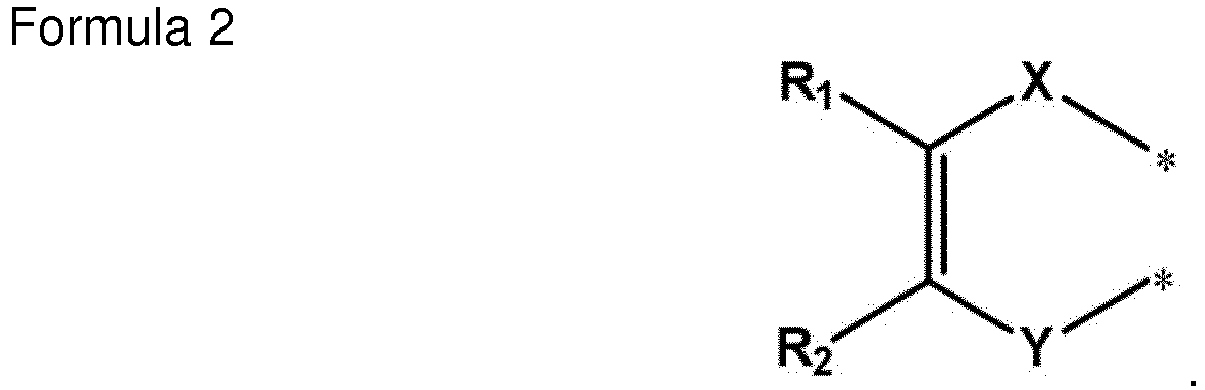
- In Formula 2, R1 to R11 are each independently a hydrogen atom, a deuterium atom, a halogen atom, a cyano group, a substituted or unsubstituted oxy group, a substituted or unsubstituted thiol group, a substituted or unsubstituted amine group, a phosphine oxide group, a phosphine sulfide group, a silyl group, a carbonyl group, a boron group, a substituted or unsubstituted alkyl group having 1 to 10 carbon atoms, a substituted or unsubstituted aralkyl group having 7 to 30 carbon atoms, a substituted or unsubstituted aryl group having 6 to 30 carbon atoms for forming a ring, or a substituted or unsubstituted heteroaryl group having 2 to 30 carbon atoms for forming a ring, and one or more selected from R1 to R11 may be combined with an adjacent group to form a ring.
- For example, in Formula 2, R1 to R11 may each independently be a hydrogen atom, a deuterium atom, a halogen atom, a cyano group, a substituted or unsubstituted oxy group, a substituted or unsubstituted thiol group, a substituted or unsubstituted amine group, a phosphine oxide group, a phosphine sulfide group, a silyl group, a carbonyl group, a boron group, a substituted or unsubstituted alkyl group having 1 to 6 carbon atoms, a substituted or unsubstituted aralkyl group having 7 to 20 carbon atoms, a substituted or unsubstituted aryl group having 6 to 20 carbon atoms for forming a ring, or a substituted or unsubstituted heteroaryl group having 2 to 20 carbon atoms for forming a ring, and one or more selected from R1 to R11 may be combined with an adjacent group to form a ring. For example, in Formula 2, R1 to R11 may each independently be a hydrogen atom, a deuterium atom, a halogen atom, a cyano group, a substituted or unsubstituted oxy group, a substituted or unsubstituted thiol group, a substituted or unsubstituted amine group, a phosphine oxide group, a phosphine sulfide group, a silyl group, a carbonyl group, a boron group, a substituted or unsubstituted alkyl group having 1 to 6 carbon atoms, a substituted or unsubstituted aralkyl group having 7 to 15 carbon atoms, a substituted or unsubstituted aryl group having 6 to 15 carbon atoms for forming a ring, or a substituted or unsubstituted heteroaryl group having 2 to 15 carbon atoms for forming a ring, and one or more selected from R1 to R11 may be combined with an adjacent group to form a ring. For example, in Formula 2, R1 to R11 may each independently be a hydrogen atom, a deuterium atom, a halogen atom, a cyano group, a substituted or unsubstituted oxy group, a substituted or unsubstituted thiol group, a substituted or unsubstituted amine group, a phosphine oxide group, a phosphine sulfide group, a silyl group, a carbonyl group, a boron group, a substituted or unsubstituted alkyl group having 1 to 6 carbon atoms, a substituted or unsubstituted aralkyl group having 7 to 10 carbon atoms, a substituted or unsubstituted aryl group having 6 to 10 carbon atoms for forming a ring, or a substituted or unsubstituted heteroaryl group having 2 to 10 carbon atoms for forming a ring, and one or more selected from R1 to R11 may be combined with an adjacent group to form a ring.
- Formula 2 represents an embodiment in which one selected from Ring A and Ring B in Formula 1 is a heteroaryl ring (heteroaryl group), and a case in which X and Y in Formula 2 are both direct bonds at the same time is excluded.
- In one or more embodiments, Ar1 in Formula 1 may be a substituted or unsubstituted aryl group having 6 to 30 carbon atoms for forming a ring, or a substituted or unsubstituted heteroaryl group having 2 to 30 carbon atoms for forming a ring, and Ar1 may be combined with an adjacent group to form a ring. For example, Ar1 in Formula 1 may be a substituted or unsubstituted aryl group having 6 to 20 carbon atoms for forming a ring, or a substituted or unsubstituted heteroaryl group having 2 to 20 carbon atoms for forming a ring, and Ar1 may be combined with an adjacent group to form a ring. For example, Ar1 in Formula 1 may be a substituted or unsubstituted aryl group having 6 to 15 carbon atoms for forming a ring, or a substituted or unsubstituted heteroaryl group having 2 to 15 carbon atoms for forming a ring, and Ar1 may be combined with an adjacent group to form a ring. For example, Ar1 in Formula 1 may be a substituted or unsubstituted aryl group having 6 to 10 carbon atoms for forming a ring, or a substituted or unsubstituted heteroaryl group having 2 to 10 carbon atoms for forming a ring, and Ar1 may be combined with an adjacent group to form a ring. For example, in Formula 1, Ar1 may be a substituted or unsubstituted aryl group having 6 carbon atoms for forming a ring, and Ar1 may be combined with an adjacent group to form a ring.
- In one or more embodiments, when Ar1 in Formula 1 is an aryl group or a heteroaryl group which is bonded to an adjacent group to form a ring, Formula 1 may be represented by Formula 3:

- For example, in Formula 3, Z' may be BAr2, POAr3, or SiAr5Ar6.
- In Formula 3, Ring L is a substituted or unsubstituted aryl group having 6 to 30 carbon atoms for forming a ring, or a substituted or unsubstituted heteroaryl group having 2 to 30 carbon atoms for forming a ring.
- For example, in Formula 3, Ring L may be a substituted or unsubstituted aryl group having 6 to 20 carbon atoms for forming a ring, or a substituted or unsubstituted heteroaryl group having 2 to 20 carbon atoms for forming a ring. For example, in Formula 3, Ring L may be a substituted or unsubstituted aryl group having 6 to 15 carbon atoms for forming a ring, or a substituted or unsubstituted heteroaryl group having 2 to 15 carbon atoms for forming a ring. For example, in Formula 3, Ring L may be a substituted or unsubstituted aryl group having 6 to 10 carbon atoms for forming a ring, or a substituted or unsubstituted heteroaryl group having 2 to 10 carbon atoms for forming a ring. For example, in Formula 3, Ring L may be a substituted or unsubstituted aryl group having 6 to 10 carbon atoms for forming a ring. For example, in Formula 3, Ring L may be a substituted or unsubstituted aryl group having 6 carbon atoms for forming a ring.
- In Formula 3, Ring A, Ring B, and Z are the same as defined in Formula 1.
- In one or more embodiments, Z and Z' in Formula 3 may be the same as each other.
- In one or more embodiments, Ar2 to Ar8 in Formula 1 may each independently be a substituted or unsubstituted aryl group having 6 to 30 carbon atoms for forming a ring, a substituted or unsubstituted aralkyl group having 7 to 30 carbon atoms, or a substituted or unsubstituted heteroaryl group having 2 to 30 carbon atoms for forming a ring, and one or more selected from Ar2 to Ar8 may be combined with an adjacent group to form a ring. For example, Ar2 to Ar8 in Formula 1 may each independently be a substituted or unsubstituted aryl group having 6 to 20 carbon atoms for forming a ring, a substituted or unsubstituted aralkyl group having 7 to 20 carbon atoms, or a substituted or unsubstituted heteroaryl group having 2 to 20 carbon atoms for forming a ring, and one or more selected from Ar2 to Ar8 may be combined with an adjacent group to form a ring. For example, Ar2 to Ar8 in Formula 1 may each independently be a substituted or unsubstituted aryl group having 6 to 15 carbon atoms for forming a ring, a substituted or unsubstituted aralkyl group having 7 to 15 carbon atoms, or a substituted or unsubstituted heteroaryl group having 2 to 15 carbon atoms for forming a ring, and one or more selected from Ar2 to Ar8 may be combined with an adjacent group to form a ring. For example, Ar2 to Ar8 in Formula 1 may each independently be a substituted or unsubstituted aryl group having 6 to 10 carbon atoms for forming a ring, a substituted or unsubstituted aralkyl group having 7 to 10 carbon atoms, or a substituted or unsubstituted heteroaryl group having 2 to 10 carbon atoms for forming a ring, and one or more selected from Ar2 to Ar8 may be combined with an adjacent group to form a ring.
- In one or more embodiments, when Ar2 to Ar8 in Formula 1 are each independently an aryl or a heteroaryl group which is bonded to an adjacent group to form a ring, Formula 1 may be represented by Formula 4:

- For example, in Formula 4, Z may be B, PO, or SiAr5.
- In Formula 4, Ring M is a substituted or unsubstituted aryl group having 6 to 30 carbon atoms for forming a ring, or a substituted or unsubstituted heteroaryl group having 2 to 30 carbon atoms for forming a ring.
- For example, in Formula 4, Ring M may be a substituted or unsubstituted aryl group having 6 to 20 carbon atoms for forming a ring, or a substituted or unsubstituted heteroaryl group having 2 to 20 carbon atoms for forming a ring. For example, in Formula 4, Ring M may be a substituted or unsubstituted aryl group having 6 to 15 carbon atoms for forming a ring, or a substituted or unsubstituted heteroaryl group having 2 to 15 carbon atoms for forming a ring. For example, in Formula 4, Ring M may be a substituted or unsubstituted aryl group having 6 to 10 carbon atoms for forming a ring, or a substituted or unsubstituted heteroaryl group having 2 to 10 carbon atoms for forming a ring. For example, in Formula 4, Ring M may be a substituted or unsubstituted aryl group having 6 carbon atoms for forming a ring, or a substituted or unsubstituted heteroaryl group having 2 to 10 carbon atoms for forming a ring.
- In Formula 4, Ar1' is a substituted or unsubstituted alkyl group having 1 to 10 carbon atoms, a substituted or unsubstituted aryl group having 6 to 30 carbon atoms for forming a ring, a substituted or unsubstituted aralkyl group having 7 to 30 carbon atoms, or a substituted or unsubstituted heteroaryl group having 2 to 30 carbon atoms for forming a ring.
- For example, in Formula 4, Ar1' may be a substituted or unsubstituted alkyl group having 1 to 6 carbon atoms, a substituted or unsubstituted aryl group having 6 to 20 carbon atoms for forming a ring, a substituted or unsubstituted aralkyl group having 7 to 20 carbon atoms, or a substituted or unsubstituted heteroaryl group having 2 to 20 carbon atoms for forming a ring. For example, in Formula 4, Ar1' may be a substituted or unsubstituted alkyl group having 1 to 6 carbon atoms, a substituted or unsubstituted aryl group having 6 to 15 carbon atoms for forming a ring, a substituted or unsubstituted aralkyl group having 7 to 15 carbon atoms, or a substituted or unsubstituted heteroaryl group having 2 to 15 carbon atoms for forming a ring. For example, in Formula 4, Ar1' may be a substituted or unsubstituted alkyl group having 1 to 6 carbon atoms, a substituted or unsubstituted aryl group having 6 to 10 carbon atoms for forming a ring, a substituted or unsubstituted aralkyl group having 7 to 10 carbon atoms, or a substituted or unsubstituted heteroaryl group having 2 to 10 carbon atoms for forming a ring. For example, in Formula 4, Ar1' may be a substituted or unsubstituted aryl group having 6 to 10 carbon atoms for forming a ring. For example, in Formula 4, Ar1' may be a substituted or unsubstituted aryl group having 6 carbon atoms for forming a ring.
- In Formula 4, Ring A, Ring B, Ar1, Ar5, and Ar7 are the same as defined in Formula 1.
- In one or more embodiments, Z in Formula 1 may be BAr2.
- In one or more embodiments, when Z in Formula 1 is BAr2, Z may be represented by Formula 5:

- In Formula 5, R12 is a hydrogen atom, a deuterium atom, a halogen atom, a cyano group, a substituted or unsubstituted oxy group, a substituted or unsubstituted thiol group, a substituted or unsubstituted amine group, a phosphine oxide group, a phosphine sulfide group, a silyl group, a carbonyl group, a boron group, a substituted or unsubstituted alkyl group having 1 to 10 carbon atoms, a substituted or unsubstituted aralkyl group having 7 to 30 carbon atoms, a substituted or unsubstituted aryl group having 6 to 30 carbon atoms for forming a ring, or a substituted or unsubstituted heteroaryl group having 2 to 30 carbon atoms for forming a ring, and one or more R12 may be bonded to adjacent group to form a ring.
- For example, in Formula 5, R12 is a hydrogen atom, a deuterium atom, a halogen atom, a cyano group, a substituted or unsubstituted oxy group, a substituted or unsubstituted thiol group, a substituted or unsubstituted amine group, a phosphine oxide group, a phosphine sulfide group, a silyl group, a carbonyl group, a boron group, a substituted or unsubstituted alkyl group having 1 to 6 carbon atoms, a substituted or unsubstituted aralkyl group having 7 to 20 carbon atoms, a substituted or unsubstituted aryl group having 6 to 20 carbon atoms for forming a ring, or a substituted or unsubstituted heteroaryl group having 2 to 20 carbon atoms for forming a ring, and one or more R12 may be bonded to adjacent group to form a ring. For example, in Formula 5, R12 is a hydrogen atom, a deuterium atom, a halogen atom, a cyano group, a substituted or unsubstituted oxy group, a substituted or unsubstituted thiol group, a substituted or unsubstituted amine group, a phosphine oxide group, a phosphine sulfide group, a silyl group, a carbonyl group, a boron group, a substituted or unsubstituted alkyl group having 1 to 6 carbon atoms, a substituted or unsubstituted aralkyl group having 7 to 15 carbon atoms, a substituted or unsubstituted aryl group having 6 to 15 carbon atoms for forming a ring, or a substituted or unsubstituted heteroaryl group having 2 to 15 carbon atoms for forming a ring, and one or more R12 may be bonded to adjacent group to form a ring. For example, in Formula 5, R12 is a hydrogen atom, a deuterium atom, a halogen atom, a cyano group, a substituted or unsubstituted oxy group, a substituted or unsubstituted thiol group, a substituted or unsubstituted amine group, a phosphine oxide group, a phosphine sulfide group, a silyl group, a carbonyl group, a boron group, a substituted or unsubstituted alkyl group having 1 to 6 carbon atoms, a substituted or unsubstituted aralkyl group having 7 to 10 carbon atoms, a substituted or unsubstituted aryl group having 6 to 10 carbon atoms for forming a ring, or a substituted or unsubstituted heteroaryl group having 2 to 10 carbon atoms for forming a ring, and one or more R12 may be bonded to adjacent group to form a ring. For example, in Formula 5, R12 may be a hydrogen atom, a deuterium atom, or a substituted or unsubstituted alkyl group having 1 to 6 carbon atoms, and one or more R12 may be bonded to adjacent group to form a ring.
- In one or more embodiments, V1 to V5 in Formula 5 may each independently be CR12, wherein R12 may be a hydrogen atom, a deuterium atom, or a substituted or unsubstituted alkyl group having 2 to 10 carbon atoms. For example, V1 to V5 in Formula 5 may each independently be CR12, wherein R12 may be a hydrogen atom, a deuterium atom, or a substituted or unsubstituted alkyl group having 2 to 6 carbon atoms.
- In one or more embodiments, at least one selected from Ring A and Ring B in Formula 1 may be substituted or unsubstituted pyrrole, substituted or unsubstituted thiophene, substituted or unsubstituted oxazine, or substituted or unsubstituted furan.
- In one or more embodiments, Formula 1 may be represented by Formula 6:

- For example, in Formula 6, A1 may be a hydrogen atom, a deuterium atom, a halogen atom, a cyano group, a substituted or unsubstituted oxy group, a substituted or unsubstituted thiol group, a substituted or unsubstituted amine group, a phosphine oxide group, a phosphine sulfide group, a silyl group, a carbonyl group, a boron group, a substituted or unsubstituted alkyl group having 1 to 6 carbon atoms, a substituted or unsubstituted aralkyl group having 7 to 20 carbon atoms, a substituted or unsubstituted aryl group having 6 to 20 carbon atoms for forming a ring, or a substituted or unsubstituted heteroaryl group having 2 to 20 carbon atoms for forming a ring, and one or more A1 may be bonded to adjacent group to form a ring. For example, in Formula 6, A1 may be a hydrogen atom, a deuterium atom, a halogen atom, a cyano group, a substituted or unsubstituted oxy group, a substituted or unsubstituted thiol group, a substituted or unsubstituted amine group, a phosphine oxide group, a phosphine sulfide group, a silyl group, a carbonyl group, a boron group, a substituted or unsubstituted alkyl group having 1 to 6 carbon atoms, a substituted or unsubstituted aralkyl group having 7 to 15 carbon atoms, a substituted or unsubstituted aryl group having 6 to 15 carbon atoms for forming a ring, or a substituted or unsubstituted heteroaryl group having 2 to 15 carbon atoms for forming a ring, and one or more A1 may be bonded to adjacent group to form a ring. For example, in Formula 6, A1 may be a hydrogen atom, a deuterium atom, a halogen atom, a cyano group, a substituted or unsubstituted oxy group, a substituted or unsubstituted thiol group, a substituted or unsubstituted amine group, a phosphine oxide group, a phosphine sulfide group, a silyl group, a carbonyl group, a boron group, a substituted or unsubstituted alkyl group having 1 to 6 carbon atoms, a substituted or unsubstituted aralkyl group having 7 to 10 carbon atoms, a substituted or unsubstituted aryl group having 6 to 10 carbon atoms for forming a ring, or a substituted or unsubstituted heteroaryl group having 2 to 10 carbon atoms for forming a ring, and one or more A1 may be bonded to adjacent group to form a ring.
- In Formula 6, n is an integer of 0 to 5. When n is 2 or larger, a plurality of A1s may be the same as or different from each other.
- In Formula 6, X and Y may each independently be a direct bond, O, S, SO, SO2, Se, NR3, PR4, POR5, PSR6, SiR7R8, GeR9R10, or BR11. For example, in Formula 6, X and Y may each independently be a direct bond, O, S, SO, SO2, NR3, PR4, POR5, PSR6, SiR7R8, or BR11. For example, in Formula 6, X and Y may each independently be a direct bond, O, S, NR3, PR4, POR5, PSR6, SiR7R8, or BR11. For example, in Formula 6, X and Y may each independently be a direct bond, O, S, NR3, or SiR7R8.
- In Formula 6, R1 to R11 are each independently a hydrogen atom, a deuterium atom, a halogen atom, a cyano group, a substituted or unsubstituted oxy group, a substituted or unsubstituted thiol group, a substituted or unsubstituted amine group, a phosphine oxide group, a phosphine sulfide group, a silyl group, a carbonyl group, a boron group, a substituted or unsubstituted alkyl group having 1 to 10 carbon atoms, a substituted or unsubstituted aralkyl group having 7 to 30 carbon atoms, a substituted or unsubstituted aryl group having 6 to 30 carbon atoms for forming a ring, or a substituted or unsubstituted heteroaryl group having 2 to 30 carbon atoms for forming a ring, and one or more selected from R1 to R11 may be combined with an adjacent group to form a ring.
- For example, in Formula 6, R1 to R11 may each independently be a hydrogen atom, a deuterium atom, a halogen atom, a cyano group, a substituted or unsubstituted oxy group, a substituted or unsubstituted thiol group, a substituted or unsubstituted amine group, a phosphine oxide group, a phosphine sulfide group, a silyl group, a carbonyl group, a boron group, a substituted or unsubstituted alkyl group having 1 to 6 carbon atoms, a substituted or unsubstituted aralkyl group having 7 to 20 carbon atoms, a substituted or unsubstituted aryl group having 6 to 20 carbon atoms for forming a ring, or a substituted or unsubstituted heteroaryl group having 2 to 20 carbon atoms for forming a ring, and one or more selected from R1 to R11 may be combined with an adjacent group to form a ring. For example, in Formula 6, R1 to R11 may each independently be a hydrogen atom, a deuterium atom, a halogen atom, a cyano group, a substituted or unsubstituted oxy group, a substituted or unsubstituted thiol group, a substituted or unsubstituted amine group, a phosphine oxide group, a phosphine sulfide group, a silyl group, a carbonyl group, a boron group, a substituted or unsubstituted alkyl group having 1 to 6 carbon atoms, a substituted or unsubstituted aralkyl group having 7 to 15 carbon atoms, a substituted or unsubstituted aryl group having 6 to 15 carbon atoms for forming a ring, or a substituted or unsubstituted heteroaryl group having 2 to 15 carbon atoms for forming a ring, and one or more selected from R1 to R11 may be combined with an adjacent group to form a ring. For example, in Formula 6, R1 to R11 may each independently be a hydrogen atom, a deuterium atom, a halogen atom, a cyano group, a substituted or unsubstituted oxy group, a substituted or unsubstituted thiol group, a substituted or unsubstituted amine group, a phosphine oxide group, a phosphine sulfide group, a silyl group, a carbonyl group, a boron group, a substituted or unsubstituted alkyl group having 1 to 6 carbon atoms, a substituted or unsubstituted aralkyl group having 7 to 10 carbon atoms, a substituted or unsubstituted aryl group having 6 to 10 carbon atoms for forming a ring, or a substituted or unsubstituted heteroaryl group having 2 to 10 carbon atoms for forming a ring, and one or more selected from R1 to R11 may be combined with an adjacent group to form a ring.
- In Formula 6, Ar1 is the same as defined in Formula 1.
- The polycyclic compound of the present embodiments represented by Formula 1 may be a delayed fluorescence emission material. The polycyclic compound of the present embodiments may be a thermally activated delayed fluorescence material.
- For example, the polycyclic compound represented by Formula 1 may have a small difference between a singlet energy level (S1) and a triplet energy level (T1), thereby being used as a thermally activated delayed fluorescence material. The polycyclic compound of an embodiment represented by Formula 1 may be represented by any one selected from the compounds in Compound Group 1:
-


- The described polycyclic compound represented by Formula 1 may be used in the
organic electroluminescence device 10 of one or more embodiments to improve the efficiency and/or life-time of the organic electroluminescence device. For example, the described polycyclic compound represented by Formula 1 may be used in the emission layer EML of theorganic electroluminescence device 10 to improve the luminous efficiency and/or life-time of the organic electroluminescence device. - In one or more embodiments, the emission layer EML may include a host and a dopant, and the host may be for delayed fluorescence emission and the dopant may be for delayed fluorescence emission. The polycyclic compound represented by Formula 1 may be contained (included) as a dopant material in the emission layer EML. For example, the polycyclic compound represented by Formula 1 may be used as a TADF dopant.
- In one or more embodiments, the emission layer EML may include any suitable host material, for example, tris(8-hydroxyquinolino)aluminium (Alq3), 4,4'-bis(N-carbazolyl)-1,1'-biphenyl (CBP), poly(n-vinylcarbazole) (PVK), 9,10-di(naphthalene-2-yl)anthracene (ADN), 4,4',4"-tris(carbazol-9-yl)-triphenylamine (TCTA), 1,3,5-tris(N-phenylbenzimidazole-2-yl)benzene (TPBi), 3-tert-butyl-9,10-di(naphth-2-yl)anthracene (TBADN), distyrylarylene (DSA), 4,4'-bis(9-carbazolyl)-2,2'-dimethyl-biphenyl (CDBP), 2-methyl-9,10-bis(naphthalen-2-yl)anthracene (MADN), bis[2-(diphenylphosphino)phenyl] ether oxide (DPEPO), hexaphenyl cyclotriphosphazene (CP1), 1,4-bis(triphenylsilyl)benzene (UGH2), hexaphenylcyclotrisiloxane (DPSiO3), octaphenylcyclotetrasiloxane (DPSiO4), 2,8-bis(diphenylphosphoryl)dibenzofuran (PPF), etc. However, embodiments of the present disclosure are not limited thereto, and in addition to the described host materials, any suitable delayed fluorescence emission host material may be contained (included).
- Furthermore, the emission layer EML of the
organic electroluminescence device 10 of the present embodiments may include any suitable dopant material, for example, a styryl derivative (such as 1,4-bis[2-(3-N-ethylcarbazoryl)vinyl]benzene (BCzVB), 4-(di-p-tolylamino)-4'-[(di-p-tolylamino)styryl]stilbene (DPAVB), and/or N-(4-((E)-2-(6-((E)-4-(diphenylamino)styryl)naphthalen-2-yl)vinyl)phenyl)-N-phenylbenzenamine (N-BDAVBi)), perylene and/or a derivative thereof (such as 2,5,8,11-tetra-t-butylperylene (TBP)), pyrene and/or a derivative thereof (such as 1,1-dipyrene, 1,4-dipyrenylbenzene, and/or 1,4-bis(N,N-diphenylamino)pyrene), etc. - Referring to
FIGS. 1 to 3 again, in theorganic electroluminescence device 10 of an embodiment, the electron transport region ETR may be disposed on the emission layer EML. The electron transport region ETR may include at least one selected from a hole blocking layer HBL, an electron transport layer ETL, and an electron injection layer EIL, but embodiments of the present disclosure are not limited thereto. - The electron transport region ETR may have a structure of: a single layer formed of a single material; a single layer formed of a plurality of different materials; or a multi-layer having a plurality of layers formed of a plurality of different materials.
- For example, the electron transport region ETR may have a structure of a single layer which is an electron injection layer EIL or an electron transport layer ETL, or may have a structure of a single layer formed of an electron injection material and an electron transport material. In one or more embodiments, the electron transport region ETR may have a structure of a single layer formed of a plurality of different materials, or may have a structure of, sequentially laminated from the first electrode EL1, electron transport layer ETL/electron injection layer EIL or hole blocking layer HBL/electron transport layer ETUelectron injection layer EIL, but embodiments of the present disclosure are not limited thereto. A thickness of the electron transport region ETR may be, for example, from about 100 Å to about 1,500 Å.
- The electron transport region ETR may be formed using one or more suitable methods such as a vacuum deposition method, a spin coating method, a casting method, a Langmuir-Blodgett (LB) method, an inkjet printing method, a laser printing method, and/or a laser induced thermal imaging (LITI) method.
- When the electron transport region ETR includes the electron transport layer ETL, the electron transport region ETR may include, for example, tris(8-hydroxyquinolinato)aluminium (Alq3), 1,3,5-tri[(3-pyridyl)-phen-3-yl]benzene, 2,4,6-tris(3'-(pyridin-3-yl)biphenyl-3-yl)-1,3,5-triazine, 2-(4-(N-phenylbenzoimidazolyl-1-ylphenyl)-9,10-dinaphthylanthracene, 1,3,5-tri(1-phenyl-1H-benzo[d]imidazol-2-yl)benzene (TPBi), 2,9-dimethyl-4,7-diphenyl-1,10-phenanthroline (BCP), 4,7-diphenyl-1,10-phenanthroline (Bphen), 3-(4-biphenylyl)-4-phenyl-5-tert-butylphenyl-1,2,4-triazole (TAZ), 4-(naphthalen-1-yl)-3,5-diphenyl-4H-1,2,4-triazole (NTAZ), 2-(4-biphenylyl)-5-(4-tert-butylphenyl)-1,3,4-oxadiazole (tBu-PBD), bis(2-methyl-8-quinolinolato-N1,O8)-(1,1'-biphenyl-4-olato)aluminium (BAlq), berylliumbis(benzoquinolin-10-olate) (Bebq2), and/or 9,10-di(naphthalene-2-yl)anthracene (ADN), but embodiments of the present disclosure are not limited thereto.
- When the electron transport region ETR includes the electron transport layer ETL, a thickness of the electron transport layer ETL may be about 100 Å to about 1,000 Å, for example, about 150 Å to about 500 Å, or about 200 Å to about 400 Å. When the thickness of the electron transport layer ETL satisfies the described range, satisfactory (or suitable) electron transport performance may be achieved without substantial rise of a driving voltage.
- When the electron transport region ETR includes the electron injection layer EIL, the electron transport region ETR may include, for example, a halogenated metal such as LiF, NaCl, CsF, RbCl, Rbl, and/or Kl, a lanthanide metal such as Yb, a metal oxide such as Li2O, BaO, and/or lithium quinolate (LiQ), and/or the like, but embodiments of the present disclosure are not limited thereto. The electron injection layer EIL may also be formed of a mixture of an electron transport material and an insulating organometallic salt. The organometallic salt may be a material having an energy band gap of about 4 eV or more. In one or more embodiments, the organometallic salt may contain, for example, a metal acetate, a metal benzoate, a metal acetoacetate, a metal acetylacetonate, and/or a metal stearate.
- When the electron transport region ETR includes the electron injection layer EIL, a thickness of the electron injection layer EIL may be about 1 Å to about 100 Å or about 3 Å to about 90 Å, or about 3 Å to about 20 Å. When the thickness of the electron injection layer EIL satisfies the described range, satisfactory (or suitable) electron injection performance may be achieved without substantial rise of a driving voltage.
- The electron transport region ETR may include a hole blocking layer HBL as described above. The hole blocking layer HBL may include, for example, at least one selected from 2,9-dimethyl-4,7-diphenyl-1,10-phenanthroline (BCP) and 4,7-diphenyl-1,10-phenanthroline (Bphen), but embodiments of the present disclosure are not limited thereto.
- The second electrode EL2 may be disposed on the electron transport region ETR. The second electrode EL2 may have conductivity. The second electrode EL2 may be formed of a metal alloy and/or a conductive compound. The second electrode EL2 may be a cathode. The second electrode EL2 may be a transmissive electrode, a transflective electrode, or a reflective electrode. When the second electrode EL2 is a transmissive electrode, the second electrode EL2 may be formed of a transparent metal oxide, for example, indium tin oxide (ITO), indium zinc oxide (IZO), zinc oxide (ZnO), indium tin zinc oxide (ITZO), etc.
- When the second electrode EL2 is a transflective electrode or a reflective electrode, the second electrode EL2 may include Ag, Mg, Cu, Al, Pt, Pd, Au, Ni, Nd, Ir, Cr, Li, Ca, LiF/Ca, LiF/Al, Mo, Ti, or a compound or mixture thereof (for example, a mixture of Ag and Mg). In one or more embodiments, the second electrode EL2 may be a structure which has a plurality of layers including: a reflective layer or a transflective layer formed of any of the described materials; and a transparent conductive layer formed of ITO, IZO, ZnO, ITZO, etc.
- In one or more embodiments, the second electrode EL2 may be connected to an auxiliary electrode. When the second electrode EL2 is connected to the auxiliary electrode, the resistance of the second electrode EL2 may be reduced.
- In the
organic electroluminescence device 10, as a voltage is applied to the first electrode EL1 and the second electrode EL2 respectively, the holes injected from the first electrode EL1 may move through the hole transport region HTR to the emission layer EML, and the electrons injected from the second electrode EL2 may move through the electron transport region ETR to the emission layer EML. The electrons and the holes may be recombined in the emission layer EML to generate excitons, and the excitons may emit light when the excitons fall back from an excited state to a ground state. - When the
organic electroluminescence device 10 is a top emission type (e.g., a top emission organic electroluminescence device), the first electrode EL1 may be a reflective electrode and the second electrode EL2 may be a transmissive electrode or a transflective electrode. When theorganic electroluminescence device 10 is a bottom emission type (e.g., bottom emission organic electroluminescence device), the first electrode EL1 may be a transmissive electrode or a transflective electrode and the second electrode EL2 may be a reflective electrode. - The organic electroluminescence device according to one or more embodiments of the inventive concept may exhibit improved luminous efficiency and life-time characteristics using the described polycyclic compound of the present embodiments as an emission layer material.
- An embodiment of the inventive concept provides a polycyclic compound represented by Formula 1 :

- In Formula 1, at least one selected from Ring A and Ring B is a substituted or unsubstituted heteroaryl group having 2 to 30 carbon atoms for forming a ring. In contrast, when both Ring A and Ring B are not heteroaryl groups, molecular stability may be lowered, thereby deteriorating luminous efficiency and/or life-time when the polycyclic compound is applied to an organic electroluminescence device.
- In Formula 1, Z is BAr2, POAr3, PSAr4, SiAr5Ar6, or GeAr7Ar8.
- In Formula 1, Ar1 is a substituted or unsubstituted aryl group having 6 to 30 carbon atoms for forming a ring, a substituted or unsubstituted aralkyl group having 7 to 30 carbon atoms, or a substituted or unsubstituted heteroaryl group having 2 to 30 carbon atoms for forming a ring, and Ar1 may be combined with an adjacent group to form a ring.
- In Formula 1, Ar2 to Ar8 are each independently a substituted or unsubstituted amino group, a substituted or unsubstituted oxy group, a substituted or unsubstituted alkyl group having 1 to 10 carbon atoms, a substituted or unsubstituted aryl group having 6 to 30 carbon atoms for forming a ring, a substituted or unsubstituted aralkyl group having 7 to 30 carbon atoms, or a substituted or unsubstituted heteroaryl group having 2 to 30 carbon atoms for forming a ring, and one or more selected from Ar2 to Ar8 may be combined with an adjacent group to form a ring.
- In one or more embodiments, at least one selected from Ring A and Ring B in Formula 1 may be represented by Formula 2:

- In Formula 2, R1 to R11 are each independently a hydrogen atom, a deuterium atom, a halogen atom, a cyano group, a substituted or unsubstituted oxy group, a substituted or unsubstituted thiol group, a substituted or unsubstituted amine group, a phosphine oxide group, a phosphine sulfide group, a silyl group, a carbonyl group, a boron group, a substituted or unsubstituted alkyl group having 1 to 10 carbon atoms, a substituted or unsubstituted aralkyl group having 7 to 30 carbon atoms, a substituted or unsubstituted aryl group having 6 to 30 carbon atoms for forming a ring, or a substituted or unsubstituted heteroaryl group having 2 to 30 carbon atoms for forming a ring, and one or more selected from R1 to R11 may be combined with an adjacent group to form a ring.
- Formula 2 represents an embodiment in which one selected from Ring A and Ring B in Formula 1 is a heteroaryl group, and a case in which X and Y in Formula 2 are both directly bonds at the same time is excluded.
- The description for the polycyclic compound provided above in connection with the organic electroluminescence device of the present embodiments may be equally applied to the polycyclic compound represented by Formula 1 of this embodiment.
- The polycyclic compound according to the embodiment may be any one selected from the compounds collectively denoted as the Compound Group 1.
- Hereinafter, the inventive concept will be explained in more detail with reference to Examples and Comparative Examples. However, the following embodiments are only examples intended to assist in understanding of the inventive concept, and the scope of the inventive concept is not limited thereto.
- A polycyclic compound according to an embodiment of the inventive concept may be synthesized, for example, as following examples. However, the synthesis method of the polycyclic compound according to an embodiment of the inventive concept is not limited thereto.
- A polycyclic Compound 8 according to an embodiment of the inventive concept may be synthesized, for example, as follows:

- N1-(2,3-dichlorophenyl)-N1,N3,N3-triphenyl-1,3-benzenediamine 9.63 g (20 mmol), aniline 2.0 mL (22 mmol), (Amphos)PdCl2 0.71 g (1.0 mmol), and NaOtBu 2.11 g (22 mmol) were added to a 300 mL three-neck flask under Ar atmosphere, and the mixture was stirred at 120°C for 1 hour in a 100 mL xylene solvent. After air cooling, water was added thereto to separate the organic layer, and the solvent was distilled off. The obtained crude product was purified by column chromatography (silica gel) to obtain 7.40 g of Compound A (yield of 69%) as a white solid. The molecular weight of Compound A measured by Fast Atom Bombardment-Mass Spectrometry (FAB-MS) was 537.
- Compound A 7.37 g (13.7 mmol), 2-bromo-1-phenyl-1H-indole 4.08 g (15.0 mmol), Pd2(dba)3 0.13 g (0.14 mmol), Ruphos 0.26 g (0.55 mmol), and NaOtBu 1.44 g (15.0 mmol) were added to a 200 mL three-neck flask under Ar atmosphere, and the mixture was stirred at 100°C for 3 hours in a 70 mL toluene solvent. After air cooling, water was added thereto to separate the organic layer, and the solvent was distilled off. The obtained crude product was purified by column chromatography (silica gel) to obtain 6.79 g of Compound B (yield of 68%) as a white solid. The molecular weight of Compound B measured by FAB-MS was 728.
- A dehydrated t-butylbenzene solution 50 mL of Compound B 6.78 g (9.3 mmol) was added to a 300 mL three-neck flask under Ar atmosphere and stirred at - 78°C, and then, a pentane solution 19.5 mL (37 mmol) of 1.9 M t-BuLi was dropped (added dropwise) thereto. After completion of the dropping, the temperature was raised to 60°C, and the mixture was stirred for 2 hours, and thereafter, components having a lower boiling point than that of t-butylbenzene were distilled off under reduced pressure. The resulting mixture was cooled to -30°C, and BBr3 1.8 mL (19 mmol) was dropped thereto. After completion of the dropping, the temperature was raised to room temperature, and the mixture was stirred for 2 hours. Thereafter, the mixture was cooled again to 0°C, and N,N-diisopropylethylamine 1.7 mL (9.8 mmol) was dropped thereto. After completion of the dropping, the temperature was raised to room temperature, and the mixture was stirred for 1 hour, and then, the temperature was raised to 120°C, and the mixture was heated and stirred for 8 hours. The obtained reaction solution was cooled to room temperature, and an NaOAc aqueous solution cooled in an ice bath and toluene were added to separate the solution. Subsequently, the solution was purified by short column chromatography (silica gel) and recrystallized with a toluene/hexane solvent to obtain 5.09 g of Compound 8 (yield of 78%) as a yellow solid.
- Compound 8 measured by FAB-MS and NMR was confirmed. The molecular weight of Compound 8 measured by FAB-MS was 702, and the chemical shift value δ of Compound 8 measured by 1H-NMR (CDCl3) was: 8.43 (1H), 7.94 (1H), 7.69-7.48 (6H), 7.37-7.22 (11H), 7.10-6.98 (12H), and 6.86-6.81 (4H).
- A
polycyclic Compound 10 according to an embodiment of the inventive concept may be synthesized, for example, as follows:
- 2,3-dichloro-N,N-diphenyl-1,3-benzenediamine 6.28 g (20 mmol), aniline 2.0 mL (22 mmol), (Amphos)PdCl2 0.71 g (1.0 mmol), and NaOtBu 2.11 g (22 mmol) were added to a 300 mL three-neck flask under Ar atmosphere, and the mixture was stirred at 120°C for 1 hour in a 100 mL xylene solvent. After air cooling, water was added thereto to separate the organic layer, and the solvent was distilled off. The obtained crude product was purified by column chromatography (silica gel) to obtain 6.00 g of Compound C (yield of 81 %) as a white solid. The molecular weight of Compound C measured by FAB-MS was 370.
- Compound C 5.97 g (16.1 mmol), 3-bromo-6-chloro-benzo[b]thiophene 4.38 g (17.7 mmol), Pd2(dba)3 0.15 g (0.16 mmol), Ruphos 0.30 g (0.64 mmol), and NaOtBu 1.70 g (17.7 mmol) were added to a 200 mL three-neck flask under Ar atmosphere, and the mixture was stirred at 100°C for 3 hours in an 80 mL toluene solvent. After air cooling, water was added thereto to separate the organic layer, and the solvent was distilled off. The obtained crude product was purified by column chromatography (silica gel) to obtain 5.27 g of Compound D (yield of 61 %) as a white solid. The molecular weight of Compound D measured by FAB-MS was 536.
- Compound D 5.26 g (9.8 mmol), diphenylamine 1.66 g (9.8 mmol), Pd2(dba)3 0.18 g (0.20 mmol), Ruphos 0.36 g (0.78 mmol), and NaOtBu 1.04 g (10.8 mmol) were added to a 200 mL three-neck flask under Ar atmosphere, and the mixture was stirred at 110°C for 8 hours in a 50 mL toluene solvent. After air cooling, water was added thereto to separate the organic layer, and the solvent was distilled off. The obtained crude product was purified by column chromatography (silica gel) to obtain 5.05 g of Compound E (yield of 77%) as a white solid. The molecular weight of Compound E measured by FAB-MS was 669.
- A dehydrated t-butylbenzene solution 40 mL of Compound E 5.03 g (7.5 mmol) was added to a 300 mL three-neck flask under Ar atmosphere and stirred at - 78°C, and then, a pentane solution 15.8 mL (30 mmol) of 1.9 M t-BuLi was dropped (added dropwise) thereto. After completion of the dropping, the temperature was raised to 60°C, and the mixture was stirred for 2 hours, and thereafter, components having a lower boiling point than that of t-butylbenzene were distilled off under reduced pressure. The mixture was cooled to -30°C, and BBr3 1.4 mL (15 mmol) was dropped thereto. After completion of the dropping, the temperature was raised to room temperature, and the mixture was stirred for 2 hours. Thereafter, the mixture was cooled again to 0°C, and N,N-diisopropylethylamine 1.4 mL (8.0 mmol) was dropped thereto. After completion of the dropping, the temperature was raised to room temperature, and the mixture was stirred for 1 hour, and then, the temperature was raised to 120°C, and the mixture was heated and stirred for 8 hours. The obtained reaction solution was cooled to room temperature, and an NaOAc aqueous solution cooled in an ice bath and toluene were added to separate the solution. Subsequently, the solution was purified by short column chromatography (silica gel) and recrystallized with a toluene/hexane solvent to obtain 4.00 g of Compound 10 (yield of 83%) as a yellow solid.
-
Compound 10 measured by FAB-MS and NMR was confirmed. The molecular weight ofCompound 10 measured by FAB-MS was 643, and the chemical shift value δ ofCompound 10 measured by 1H-NMR (CDCl3) was: 8.01 (1H), 7.77 (1H), 7.71 (1H), 7.43 (1H), 7.31-7.16 (11H), 7.10-6.98 (13H), and 6.86-6.82 (2H). - A polycyclic Compound 11 according to an embodiment of the inventive concept may be synthesized, for example, as follows:

- A dehydrated THF solution 100 mL of 6-chloro-1-phenyl-1H-indole 4.55 g (20 mmol) was added to a 500 mL three-neck flask under Ar atmosphere and stirred at -78°C. Then, a hexane solution 13 mL (21 mmol) of 1.6 M n-BuLi was dropped (added dropwise) thereto and stirred for 2 hours, and thereafter, stirred at room temperature for 3 hours. After the reaction, the mixture was washed with water. The obtained organic phase was concentrated to obtain a viscous material. The obtained crude product was purified by column chromatography (silica gel) to obtain 6.00 g of Compound F (yield of 85%) as a white solid. The molecular weight of Compound F measured by FAB-MS was 353.
- Compound F 5.98 g (16.9 mmol), 2-bromo-5-chloro-N-phenyl-benzenamine 4.78 g (16.9 mmol), Pd2(dba)3 0.16 g (0.17 mmol), dppf 0.25 g (0.34 mmol), and NaOtBu 1.79 g (18.6 mmol) were added to a 300 mL three-neck flask under Ar atmosphere, and the mixture was stirred at 80°C for 6 hours in an 85 mL toluene solvent. After air cooling, water was added thereto to separate the organic layer, and the solvent was distilled off. The obtained crude product was purified by column chromatography (silica gel) to obtain 4.96 g of Compound G (yield of 58%) as a white solid. The molecular weight of Compound G measured by FAB-MS was 506.
- A dehydrated THF solution 100 mL of Compound G 4.93 g (9.7 mmol) was added to a 500 mL three-neck flask under Ar atmosphere and stirred at -78°C. Then, a hexane solution 12.5 mL (20 mmol) of 1.6 M n-BuLi was dropped (added dropwise) thereto and stirred for 2 hours, and thereafter, BBr3 1.0 mL (10 mmol) was dropped thereto and stirred at -78°C for 1 hour and stirred at room temperature for 3 hours. The mixture was cooled to 0°C, and thereafter, a
THF solution 10 mL (10 mmol) of 1.0 M 2,4,6-triisopropylphenylmagnesium bromide was dropped thereto and stirred at 0°C for 2 hours and stirred at room temperature for 3 hours. After the reaction, the mixture was washed with water. The obtained organic phase was concentrated to obtain a viscous material. The obtained crude product was purified by column chromatography (silica gel) to obtain 4.36 g of Compound H (yield of 70%) as a yellow solid. The molecular weight of Compound H measured by FAB-MS was 640. - Compound H 4.35 g (6.8 mmol), diphenylamine 2.30 g (13.6 mmol), Pd2(dba)3 0.31 g (0.34 mmol), Ruphos 0.63 g (1.36 mmol), and NaOtBu 1.44 g (15.0 mmol) were added to a 200 mL three-neck flask under Ar atmosphere, and the mixture was stirred at 110°C for 8 hours in a 70 mL toluene solvent. After air cooling, water was added thereto to separate the organic layer, and the solvent was distilled off. The obtained crude product was purified by column chromatography (silica gel) to obtain 3.20 g of Compound 11 (yield of 52%) as a yellow solid.
- Compound 11 measured by FAB-MS and NMR was confirmed. The molecular weight of Compound 11 measured by FAB-MS was 906, and the chemical shift value δ of Compound 11 measured by 1H-NMR (CDCl3) was: 8.39 (1H), 7.69-7.56 (5H), 7.31-7.22 (12H), 7.10-6.98 (15H), 6.86-6.81 (2H), 6.40 (1H), 2.90-2.85 (3H), and 1.22-1.16 (18H).
- A polycyclic Compound 12 according to an embodiment of the inventive concept may be synthesized, for example, as follows:
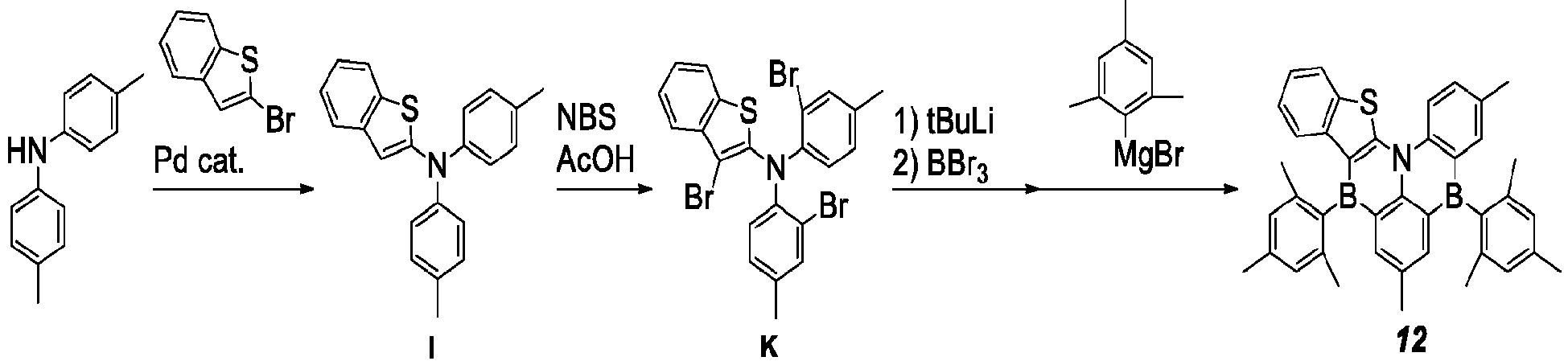
- p,p'-ditolylamine 9.86 g (50 mmol), 2-bromo-benzo[b]thiophene 10.65 g (50 mmol), Pd2(dba)3 0.46 g (0.50 mmol), Ruphos 0.93 g (2.0 mmol), and NaOtBu 5.29 g (55 mmol) were added to a 500 mL three-neck flask under Ar atmosphere, and the mixture was stirred at 100°C for 2 hours in a 250 mL toluene solvent. After air cooling, water was added thereto to separate the organic layer, and the solvent was distilled off. The obtained crude product was purified by column chromatography (silica gel) to obtain 15.15 g of Compound I (yield of 92%) as a white solid. The molecular weight of Compound I measured by FAB-MS was 329.
- Compound I 15.13 g (46 mmol) and N-bromosuccinimide 25.45 g (143 mmol) were added to a 1000 mL round-bottom flask, and acetic acid 30 mL was added thereto, and the mixture was stirred at 0°C for 2 hours in a 300 mL chloroform solvent. After air cooling, a sodium thiosulfate aqueous solution was added to separate the organic layer, and the solvent was distilled off. The obtained crude product was purified by column chromatography (silica gel) to obtain 23.16 g of Compound K (yield of 89%) as a white solid. The molecular weight of Compound K measured by FAB-MS was 562.
- A dehydrated t-butylbenzene solution 160 mL of Compound K 23.13 g (40.9 mmol) was added to a 1000 mL three-neck flask under Ar atmosphere and stirred at - 78°C, and then, a pentane solution 129 mL (245 mmol) of 1.9 M t-BuLi was dropped (added dropwise) thereto. After completion of the dropping, the temperature was raised to room temperature, and the mixture was stirred for 2 hours. Thereafter, the mixture was cooled to -30°C, and BBr3 7.8 mL (82 mmol) was dropped thereto. After completion of the dropping, the temperature was raised to room temperature, and the mixture was stirred for 2 hours. And then, the temperature was raised to 160°C, and the mixture was heated and stirred for 10 hours. The reaction solution was cooled to 0°C, and a THF solution 164 mL (164 mmol) of 1.0 M 2,4,6-trimethylphenylmagnesium bromide was dropped thereto and stirred at 0°C for 2 hours and stirred at room temperature for 3 hours. After the reaction, a phosphate buffer solution (pH 6) and toluene were added to separate the solution. Subsequently, the solution was purified by column chromatography (silica gel) and recrystallized with a toluene/hexane solvent to obtain 4.55 g of Compound 12 (yield of 19%) as a yellow solid.
- Compound 12 measured by FAB-MS and NMR was confirmed. The molecular weight of Compound 12 measured by FAB-MS was 585, and the chemical shift value δ of Compound 12 measured by 1H-NMR (CDCl3) was: 8.05 (1H), 7.93 (1H), 7.51-7.40 (2H), 7.19-7.11 (5H), 6.99-6.95 (4H), 2.38-2.31 (18H), and 2.20-2.16 (6H).
- The organic electroluminescence devices in Examples 1 to 4 were fabricated using the polycyclic compounds of the described
compounds 8, 10, 11, and 12 as emission layer materials. The compounds used in the emission layers of Examples 1 to 4 are shown below: -


- The organic electroluminescence devices of Comparative Examples 1 to 4 were fabricated using Comparative Compounds R-1 to R-4 shown below as emission layer materials:
-


- The organic electroluminescence devices in Examples 1 to 4 and Comparative Examples 1 to 4 were each independently formed by performing the following process: ITO having a thickness of 1500 Å was patterned on a glass substrate and washed with ultrapure water and treated with UV ozone for 10 minutes; Thereafter, HAT-CN was deposited to have a thickness of 100 Å, and α-NPD was deposited to have a thickness of 800 Å, and mCP was deposited to have a thickness of 50 Å, and thus, a hole transport region was formed;
- Next, the emission layer was formed by co-depositing the respective polycyclic compound of the present embodiments or the respective Comparative Compound and DPEPO at a ratio of 20:80 to form a layer having a thickness of 200 Å; Next, a layer having a thickness of 100 Å was formed using DPEPO. Accordingly, the emission layers formed by the co-deposition were deposited by mixing
Compounds 8, 10, 11, and 12, respectively, with DPEPO in Examples 1 to 4, and by mixing Comparative Compounds R-1, R -2, R-3, and R-4, respectively, with DPEPO in Comparative Examples 1 to 4; - A layer having a thickness of 300 Å was formed on the emission layer using TPBi, and a layer having a thickness of 5 Å was formed using LiF, and thus, an electron transport region was formed. Subsequently, a second electrode having a thickness of 1,000 Å was formed using aluminium (Al).
- The hole transport region, the emission layer, the electron transport region, and the second electrode were formed using a vacuum deposition apparatus.
- A maximum emission wavelength (nm) and an external quantum yield (%) were measured to evaluate the characteristics of the organic electroluminescence devices according to Examples and Comparative Examples. In the measurement, luminance orientation characteristic measuring apparatus of Hamamatsu Photonics C9920-11 was used as measuring apparatus. Life-time represents the luminance half-time from the initial luminance of 100 cd/m2, and EQE (external quantum efficiency or external quantum yield) refers to a value at 10 mA/cm2.
Table 1 Division Dopant of emission layer External quantum yield (%) Life-time LT50 (h) Example 1 Compound 8 15.3 19.4 Example 2 Compound 1019.8 33.4 Example 3 Compound 11 16.3 10.8 Example 4 Compound 12 21.2 11.4 Comparative Example 1 Comparative Compound R-1 12.8 2.9 Comparative Example 2 Comparative Compound R-2 14.4 3.8 Comparative Example 3 Comparative Compound R-3 6.9 9.8 Comparative Example 4 Comparative Compound R-4 7.2 8.5 - Referring to Table 1, it could be found that the organic electroluminescence devices in Examples 1 to 4 in which the polycyclic compounds of the present embodiments were used as dopant materials in the emission layer exhibited high external quantum efficiency compared to the organic electroluminescence devices of Comparative Examples 1 to 4. It could also be found that the organic electroluminescence devices in Examples 1 to 4 in which the polycyclic compounds of the present embodiments were used as dopant materials of the emission layer exhibited a long life-time compared to the organic electroluminescence devices of Comparative Examples 1 to 4.
- Referring to the results in Table 1, it is believed that the compounds in Examples may be used as thermally activated delayed fluorescence materials having high efficiency and long life-time.
- The organic electroluminescence device may exhibit high luminous efficiency by including the polycyclic compounds of the present embodiments.
- Compared with Examples, it could be found that the organic electroluminescence devices of Comparative Examples 1 to 4 exhibited low external quantum efficiency and low device life-time since Comparative Compounds R-1 to R-4 did not contain a suitably stable heteroaryl ring (heteroaryl group) in a core molecule.
- As used herein, the terms "use," "using," and "used" may be considered synonymous with the terms "utilize," "utilizing," and "utilized," respectively.
- In addition, the terms "substantially," "about," and similar terms are used as terms of approximation and not as terms of degree, and are intended to account for the inherent deviations in measured or calculated values that would be recognized by those of ordinary skill in the art.
- Also, any numerical range recited herein is intended to include all subranges of the same numerical precision subsumed within the recited range. For example, a range of "1.0 to 10.0" is intended to include all subranges between (and including) the recited minimum value of 1.0 and the recited maximum value of 10.0, that is, having a minimum value equal to or greater than 1.0 and a maximum value equal to or less than 10.0, such as, for example, 2.4 to 7.6. Any maximum numerical limitation recited herein is intended to include all lower numerical limitations subsumed therein and any minimum numerical limitation recited in this specification is intended to include all higher numerical limitations subsumed therein.
- Although the example embodiments of the present invention have been described, it is understood that the present invention should not be limited to these example embodiments, but that various changes and modifications can be made by one of ordinary skilled in the art within the scope of the present invention as defined by the following claims and equivalents thereof.
- Therefore, the technical scope of the present invention should not be limited to the contents described in the detailed description of the specification, but should be defined by the claims and their equivalents.
Claims (12)
- A polycyclic compound represented by Formula 1:
 Ring A and Ring B are each independently a substituted or unsubstituted aryl group having 6 to 30 carbon atoms for forming a ring, or a substituted or unsubstituted heteroaryl group having 2 to 30 carbon atoms for forming a ring, and at least one selected from Ring A and Ring B is a substituted or unsubstituted heteroaryl group having 2 to 30 carbon atoms for forming a ring,Z is BAr2, POAr3, PSAr4, SiAr5Ar6, or GeAr7Ar8,Ar1 is a substituted or unsubstituted aryl group having 6 to 30 carbon atoms for forming a ring, a substituted or unsubstituted aralkyl group having 7 to 30 carbon atoms, or a substituted or unsubstituted heteroaryl group having 2 to 30 carbon atoms for forming a ring, and Ar1 is optionally combined with an adjacent group to form a ring, andAr2 to Ar8 are each independently a substituted or unsubstituted amino group, a substituted or unsubstituted oxy group, a substituted or unsubstituted alkyl group having 1 to 10 carbon atoms, a substituted or unsubstituted aryl group having 6 to 30 carbon atoms for forming a ring, a substituted or unsubstituted aralkyl group having 7 to 30 carbon atoms, or a substituted or unsubstituted heteroaryl group having 2 to 30 carbon atoms for forming a ring, wherein one or more selected from Ar2 to Ar8 are optionally combined with an adjacent group to form a ring.
 - A polycyclic compound according to claim 1, wherein at least one selected from Ring A and Ring B is represented by Formula 2:
 X and Y are each independently a direct bond, O, S, SO, SO2, Se, NR3, PR4, POR5, PSR6, SiR7R8, GeR9R10, or BR11, provided that X and Y are not both a direct bond at the same time, andR1 to R11 are each independently a hydrogen atom, a deuterium atom, a halogen atom, a cyano group, a substituted or unsubstituted oxy group, a substituted or unsubstituted thiol group, a substituted or unsubstituted amine group, a phosphine oxide group, a phosphine sulfide group, a silyl group, a carbonyl group, a boron group, a substituted or unsubstituted alkyl group having 1 to 10 carbon atoms, a substituted or unsubstituted aralkyl group having 7 to 30 carbon atoms, a substituted or unsubstituted aryl group having 6 to 30 carbon atoms for forming a ring, or a substituted or unsubstituted heteroaryl group having 2 to 30 carbon atoms for forming a ring, wherein one or more selected from R1 to R11 are optionally combined with an adjacent group to form a ring.
 - A polycyclic compound according to claim 1 or claim 2, wherein Formula 1 is represented by Formula 3:

 Z' is BAr2, POAr3, PSAr4, SiAr5Ar6, or GeAr7Ar8,Ring L is a substituted or unsubstituted aryl group having 6 to 30 carbon atoms for forming a ring, or a substituted or unsubstituted heteroaryl group having 2 to 30 carbon atoms for forming a ring, andRing A, Ring B, and Z are the same as defined in Formula 1.
 - A polycyclic compound according to claim 1 or claim 2, wherein Formula 1 is represented by Formula 4:
 Z is B, PO, PS, SiAr5, or GeAr7,Ring M is a substituted or unsubstituted aryl group having 6 to 30 carbon atoms for forming a ring, or a substituted or unsubstituted heteroaryl group having 2 to 30 carbon atoms for forming a ring,Ar1' is a substituted or unsubstituted alkyl group having 1 to 10 carbon atoms, a substituted or unsubstituted aryl group having 6 to 30 carbon atoms for forming a ring, a substituted or unsubstituted aralkyl group having 7 to 30 carbon atoms, or a substituted or unsubstituted heteroaryl group having 2 to 30 carbon atoms for forming a ring, andRing A, Ring B, Ar1, Ar5, and Ar7 are the same as defined in Formula 1.
 - A polycyclic compound according to any one of claims 1 to 4, wherein Z is BAr2.
- A polycyclic compound according to claim 5, wherein Z is represented by Formula 5:
 V1 to V5 are each independently CR12 or N, andR12 is a hydrogen atom, a deuterium atom, a halogen atom, a cyano group, a substituted or unsubstituted oxy group, a substituted or unsubstituted thiol group, a substituted or unsubstituted amine group, a phosphine oxide group, a phosphine sulfide group, a silyl group, a carbonyl group, a boron group, a substituted or unsubstituted alkyl group having 1 to 10 carbon atoms, a substituted or unsubstituted aralkyl group having 7 to 30 carbon atoms, a substituted or unsubstituted aryl group having 6 to 30 carbon atoms for forming a ring, or a substituted or unsubstituted heteroaryl group having 2 to 30 carbon atoms for forming a ring, wherein R12 is optionally bonded to adjacent group to form a ring.
 - A polycyclic compound according to claim 6,
wherein V1 to V5 are each independently CR12, and
R12 is a hydrogen atom, a deuterium atom, or a substituted or unsubstituted alkyl group having 2 to 10 carbon atoms. - A polycyclic compound according to claim 1, wherein the polycyclic compound represented by Formula 1 is selected from compounds collectively denoted as Compound Group 1:
Compound Group 1


- An organic electroluminescence device comprising:a first electrode;a hole transport region on the first electrode;an emission layer on the hole transport region;an electron transport region on the emission layer; anda second electrode on the electron transport region,wherein the emission layer comprises a polycyclic compound according to any one of claims 1 to 8.
- An organic electroluminescence device according to claim 9, wherein the emission layer is configured to emit delayed fluorescence.
- An organic electroluminescence device according to claim 9 or claim 10,
wherein the emission layer is a delayed fluorescence emission layer comprising a host and a dopant,
wherein the dopant is the polycyclic compound of Formula 1. - An organic electroluminescence device according to any one of claims 9 to 11, wherein the emission layer is a thermally activated delayed fluorescence emission layer configured to emit blue light.
Applications Claiming Priority (1)
| Application Number | Priority Date | Filing Date | Title |
|---|---|---|---|
| KR1020190003819A KR102858390B1 (en) | 2019-01-11 | 2019-01-11 | Organic electroluminescence device and polycyclic compound for organic electroluminescence device |
Publications (1)
| Publication Number | Publication Date |
|---|---|
| EP3680244A1 true EP3680244A1 (en) | 2020-07-15 |
Family
ID=68732727
Family Applications (1)
| Application Number | Title | Priority Date | Filing Date |
|---|---|---|---|
| EP19212247.1A Pending EP3680244A1 (en) | 2019-01-11 | 2019-11-28 | Organic electroluminescence device and polycyclic compound for organic electroluminescence device |
Country Status (5)
| Country | Link |
|---|---|
| US (2) | US11825733B2 (en) |
| EP (1) | EP3680244A1 (en) |
| JP (2) | JP2020111569A (en) |
| KR (2) | KR102858390B1 (en) |
| CN (2) | CN111434666B (en) |
Cited By (2)
| Publication number | Priority date | Publication date | Assignee | Title |
|---|---|---|---|---|
| EP4023654A1 (en) * | 2020-12-29 | 2022-07-06 | LG Display Co., Ltd. | Emitting compound and organic light emitting device including the same |
| EP4137497A4 (en) * | 2020-04-16 | 2024-06-19 | SFC Co., Ltd. | NOVEL BORON COMPOUND AND ORGANIC ELECTROLUMINESCENT ELEMENT COMPRISING SAME |
Families Citing this family (16)
| Publication number | Priority date | Publication date | Assignee | Title |
|---|---|---|---|---|
| KR102773699B1 (en) * | 2019-03-05 | 2025-02-28 | 삼성디스플레이 주식회사 | Organic electroluminescence device and polycyclic compound for organic electroluminescence device |
| KR102786853B1 (en) * | 2019-07-08 | 2025-03-28 | 삼성디스플레이 주식회사 | Organic electroluminescence device and fused polycyclic compound for organic electroluminescence device |
| US12439821B2 (en) | 2019-07-08 | 2025-10-07 | Samsung Display Co., Ltd. | Light emitting device and fused polycyclic compound for light emitting device |
| KR20210067845A (en) | 2019-11-29 | 2021-06-08 | 주식회사 엘지화학 | Compound and organic light emitting device comprising same |
| CN113493475B (en) * | 2020-04-07 | 2024-07-16 | 材料科学有限公司 | Organic compound and organic electroluminescent element comprising same |
| KR102302965B1 (en) * | 2020-04-14 | 2021-09-27 | 머티어리얼사이언스 주식회사 | Organic compound and organic electroluminescent device comprising the same |
| KR102250355B1 (en) * | 2020-05-15 | 2021-05-11 | 머티어리얼사이언스 주식회사 | Organic compound and organic electroluminescent device comprising the same |
| CN116391456A (en) | 2020-09-18 | 2023-07-04 | 三星显示有限公司 | Organic Electroluminescent Devices |
| US20230014761A1 (en) * | 2020-10-12 | 2023-01-19 | Universal Display Corporation | Organic electroluminescent materials and devices |
| WO2022086125A1 (en) * | 2020-10-19 | 2022-04-28 | 에스에프씨 주식회사 | Organic light-emitting device |
| EP4011872A1 (en) * | 2020-12-08 | 2022-06-15 | SFC Co., Ltd. | Organic electroluminescent compound and organic electroluminescent device including the same |
| CN112920211A (en) * | 2021-02-02 | 2021-06-08 | 吉林奥来德光电材料股份有限公司 | Boron-containing polycyclic aromatic compound, preparation method thereof and organic electroluminescent device |
| CN112940026B (en) * | 2021-02-02 | 2022-12-02 | 吉林奥来德光电材料股份有限公司 | A kind of polycyclic compound and its preparation method and application |
| CN112961174A (en) * | 2021-02-05 | 2021-06-15 | 吉林奥来德光电材料股份有限公司 | Polycyclic aromatic compound and preparation method and application thereof |
| CN115703800A (en) * | 2021-08-10 | 2023-02-17 | 广州华睿光电材料有限公司 | Boron-containing organic compound, mixture, composition and organic electronic device |
| CN115772187B (en) * | 2022-11-30 | 2025-04-15 | 广东省大湾区华南理工大学聚集诱导发光高等研究院 | A triphenylethylene derivative containing a boron heterocycle and an organic electroluminescent device containing the same |
Citations (8)
| Publication number | Priority date | Publication date | Assignee | Title |
|---|---|---|---|---|
| US20110279019A1 (en) * | 2010-05-14 | 2011-11-17 | Universal Display Corporation | Azaborinine compounds as host materials and dopants for pholeds |
| EP3109253A1 (en) * | 2014-02-18 | 2016-12-28 | Kwansei Gakuin Educational Foundation | Polycyclic aromatic compound |
| US20170194562A1 (en) * | 2016-01-04 | 2017-07-06 | Universal Display Corporation | Organic electroluminescent materials and devices |
| US20180123057A1 (en) * | 2016-11-01 | 2018-05-03 | Samsung Display Co., Ltd. | Polycyclic compound and organic electroluminescence device including the same |
| WO2018216990A1 (en) * | 2017-05-22 | 2018-11-29 | 머티어리얼사이언스 주식회사 | Organic compound and organic electroluminescent element comprising same |
| WO2019052939A1 (en) * | 2017-09-12 | 2019-03-21 | Cynora Gmbh | Organic molecules, in particular for use in optoelectronic devices |
| WO2019164331A1 (en) * | 2018-02-23 | 2019-08-29 | 주식회사 엘지화학 | Heterocyclic compound and organic light-emitting device comprising same |
| EP3608320A1 (en) * | 2018-08-10 | 2020-02-12 | Samsung Display Co., Ltd. | Organic electroluminescence device and condensed cyclic compound for organic electroluminescence device |
Family Cites Families (30)
| Publication number | Priority date | Publication date | Assignee | Title |
|---|---|---|---|---|
| DE19838742A1 (en) | 1998-08-26 | 2000-03-02 | Celanese Chem Europe Gmbh | Valeraldehyde and process for its preparation |
| US7703119B2 (en) * | 2001-06-25 | 2010-04-20 | Jlb Ventures Llc | Customer self service in interactive TV environment for TV programming packages |
| US20030230980A1 (en) * | 2002-06-18 | 2003-12-18 | Forrest Stephen R | Very low voltage, high efficiency phosphorescent oled in a p-i-n structure |
| US20060145599A1 (en) * | 2005-01-04 | 2006-07-06 | Reza Stegamat | OLEDs with phosphors |
| TW201012293A (en) * | 2008-09-03 | 2010-03-16 | Jwo-Huei Jou | Organic light-emitting diode and method of fabricating the same |
| US9073948B2 (en) | 2010-05-14 | 2015-07-07 | Universal Display Corporation | Azaborine compounds as host materials and dopants for PHOLEDs |
| EP2699571B1 (en) * | 2011-04-18 | 2018-09-05 | Merck Patent GmbH | Materials for organic electroluminescent devices |
| JP5724588B2 (en) * | 2011-04-28 | 2015-05-27 | コニカミノルタ株式会社 | ORGANIC ELECTROLUMINESCENT ELEMENT MATERIAL, ORGANIC ELECTROLUMINESCENT ELEMENT, DISPLAY DEVICE AND LIGHTING DEVICE |
| JP6195823B2 (en) | 2011-05-05 | 2017-09-13 | メルク パテント ゲーエムベーハー | Compounds for electronic devices |
| KR20150041508A (en) | 2013-10-08 | 2015-04-16 | 제일모직주식회사 | Compound, organic optoelectronic device and display device |
| US10374166B2 (en) * | 2014-02-18 | 2019-08-06 | Kwansei Gakuin Educational Foundation | Polycyclic aromatic compound |
| WO2016046350A1 (en) | 2014-09-26 | 2016-03-31 | Basf Se | Fluorescent organic light emitting elements having high efficiency |
| TWI688137B (en) | 2015-03-24 | 2020-03-11 | 學校法人關西學院 | Organic electric field light-emitting element, display device and lighting device |
| JP2016181637A (en) * | 2015-03-25 | 2016-10-13 | 三星ディスプレイ株式會社Samsung Display Co.,Ltd. | Material for organic electroluminescent device and electroluminescent device using the same |
| JP6696971B2 (en) | 2015-03-25 | 2020-05-20 | 学校法人関西学院 | Polycyclic aromatic compound and composition for forming light emitting layer |
| WO2017092508A1 (en) | 2015-12-04 | 2017-06-08 | 广州华睿光电材料有限公司 | D-a type compound and application thereof |
| JP6634838B2 (en) | 2016-01-12 | 2020-01-22 | コニカミノルタ株式会社 | Electronic device material, organic electroluminescence element, display device, and lighting device |
| WO2017126443A1 (en) | 2016-01-21 | 2017-07-27 | 学校法人関西学院 | Polycyclic aromatic compound |
| KR20250078582A (en) * | 2016-02-10 | 2025-06-02 | 가꼬우 호징 관세이 가쿠잉 | Delayed fluorescent organic electric field light-emitting element |
| KR20220084200A (en) | 2016-04-26 | 2022-06-21 | 가꼬우 호징 관세이 가쿠잉 | Organic Electroluminescence Device |
| CN109155370B (en) | 2016-05-13 | 2021-05-28 | 柯尼卡美能达株式会社 | Materials for organic electroluminescence elements, organic electroluminescence elements, display devices, and lighting devices |
| CN106467554A (en) | 2016-07-29 | 2017-03-01 | 江苏三月光电科技有限公司 | A kind of boracic organic electroluminescent compounds and its application |
| CN106467553B (en) | 2016-07-29 | 2019-08-23 | 江苏三月光电科技有限公司 | A boron-containing organic electroluminescent compound and its application in OLED devices |
| US10686141B2 (en) | 2016-09-07 | 2020-06-16 | Kwansei Gakuin Educational Foundation | Polycyclic aromatic compound |
| WO2018047639A1 (en) * | 2016-09-07 | 2018-03-15 | 学校法人関西学院 | Polycyclic aromatic compound |
| JP7213181B2 (en) | 2017-06-30 | 2023-01-26 | 住友化学株式会社 | Polymer compound useful for light-emitting device and its manufacture |
| CN107501311A (en) | 2017-07-14 | 2017-12-22 | 瑞声科技(南京)有限公司 | Electroluminescent organic material and its luminescent device |
| CN107266484A (en) | 2017-07-14 | 2017-10-20 | 瑞声科技(南京)有限公司 | Electroluminescent organic material and its luminescent device |
| CN107417715A (en) | 2017-07-14 | 2017-12-01 | 瑞声科技(南京)有限公司 | A kind of electroluminescent organic material and its luminescent device |
| KR102207385B1 (en) | 2018-02-23 | 2021-01-26 | 주식회사 엘지화학 | Heterocyclic compound and organic light emitting device comprising the same |
-
2019
- 2019-01-11 KR KR1020190003819A patent/KR102858390B1/en active Active
- 2019-09-11 US US16/568,068 patent/US11825733B2/en active Active
- 2019-11-28 EP EP19212247.1A patent/EP3680244A1/en active Pending
-
2020
- 2020-01-07 CN CN202010012614.7A patent/CN111434666B/en active Active
- 2020-01-07 CN CN202510224355.7A patent/CN120058758A/en active Pending
- 2020-01-09 JP JP2020001960A patent/JP2020111569A/en active Pending
-
2023
- 2023-10-26 US US18/495,661 patent/US20240107871A1/en active Pending
-
2024
- 2024-09-06 JP JP2024154334A patent/JP7841040B2/en active Active
-
2025
- 2025-09-08 KR KR1020250127073A patent/KR20250137096A/en active Pending
Patent Citations (9)
| Publication number | Priority date | Publication date | Assignee | Title |
|---|---|---|---|---|
| US20110279019A1 (en) * | 2010-05-14 | 2011-11-17 | Universal Display Corporation | Azaborinine compounds as host materials and dopants for pholeds |
| EP3109253A1 (en) * | 2014-02-18 | 2016-12-28 | Kwansei Gakuin Educational Foundation | Polycyclic aromatic compound |
| US20170194562A1 (en) * | 2016-01-04 | 2017-07-06 | Universal Display Corporation | Organic electroluminescent materials and devices |
| US20180123057A1 (en) * | 2016-11-01 | 2018-05-03 | Samsung Display Co., Ltd. | Polycyclic compound and organic electroluminescence device including the same |
| WO2018216990A1 (en) * | 2017-05-22 | 2018-11-29 | 머티어리얼사이언스 주식회사 | Organic compound and organic electroluminescent element comprising same |
| WO2019052939A1 (en) * | 2017-09-12 | 2019-03-21 | Cynora Gmbh | Organic molecules, in particular for use in optoelectronic devices |
| EP3681972A1 (en) * | 2017-09-12 | 2020-07-22 | cynora GmbH | Organic molecules, in particular for use in optoelectronic devices |
| WO2019164331A1 (en) * | 2018-02-23 | 2019-08-29 | 주식회사 엘지화학 | Heterocyclic compound and organic light-emitting device comprising same |
| EP3608320A1 (en) * | 2018-08-10 | 2020-02-12 | Samsung Display Co., Ltd. | Organic electroluminescence device and condensed cyclic compound for organic electroluminescence device |
Non-Patent Citations (1)
| Title |
|---|
| KOICHI MITSUDO ET AL: "Synthesis and Properties of Dithieno-Fused 1,4-Azaborine Derivatives", ORGANIC LETTERS, vol. 20, no. 22, 16 November 2018 (2018-11-16), pages 7336 - 7340, XP055679497, ISSN: 1523-7060, DOI: 10.1021/acs.orglett.8b03316 * |
Cited By (2)
| Publication number | Priority date | Publication date | Assignee | Title |
|---|---|---|---|---|
| EP4137497A4 (en) * | 2020-04-16 | 2024-06-19 | SFC Co., Ltd. | NOVEL BORON COMPOUND AND ORGANIC ELECTROLUMINESCENT ELEMENT COMPRISING SAME |
| EP4023654A1 (en) * | 2020-12-29 | 2022-07-06 | LG Display Co., Ltd. | Emitting compound and organic light emitting device including the same |
Also Published As
| Publication number | Publication date |
|---|---|
| KR20250137096A (en) | 2025-09-17 |
| CN120058758A (en) | 2025-05-30 |
| US20200227639A1 (en) | 2020-07-16 |
| KR20200087906A (en) | 2020-07-22 |
| US20240107871A1 (en) | 2024-03-28 |
| US11825733B2 (en) | 2023-11-21 |
| JP2024170578A (en) | 2024-12-10 |
| CN111434666B (en) | 2025-03-21 |
| JP2020111569A (en) | 2020-07-27 |
| JP7841040B2 (en) | 2026-04-06 |
| CN111434666A (en) | 2020-07-21 |
| KR102858390B1 (en) | 2025-09-15 |
Similar Documents
| Publication | Publication Date | Title |
|---|---|---|
| US20240107871A1 (en) | Organic electroluminescence device and polycyclic compound for organic electroluminescence device | |
| KR102745916B1 (en) | Organic electroluminescence device and polycyclic compound for organic electroluminescence device | |
| EP3543230B1 (en) | Organic electroluminescence device and polycyclic compound for organic electroluminescence device | |
| KR102739202B1 (en) | Organic electroluminescence device and polycyclic compound for organic electroluminescence device | |
| KR102706953B1 (en) | Organic electroluminescence device and polycyclic compound for organic electroluminescence device | |
| KR102719524B1 (en) | Organic electroluminescence device and polycyclic compound for organic electroluminescence device | |
| KR102668795B1 (en) | Organic electroluminescence device and polycyclic compound for organic electroluminescence device | |
| KR102773699B1 (en) | Organic electroluminescence device and polycyclic compound for organic electroluminescence device | |
| KR102767901B1 (en) | Organic electroluminescence device and polycyclic compound for organic electroluminescence device | |
| EP3805227B1 (en) | Luminescence device and polycyclic compound for luminescence device | |
| KR102757686B1 (en) | Organic electroluminescence device and spiro compound for organic electroluminescence device | |
| EP3653606A1 (en) | Organic electroluminescence device and compound for organic electroluminescence device | |
| KR102734910B1 (en) | Heterocyclic compound and organic electroluminescence device including the same | |
| EP3460863B1 (en) | Compound including nitrogen and organic electroluminescence device including the same | |
| KR102783283B1 (en) | Aromatic compound and organic electroluminescence device including the same | |
| EP3476847B1 (en) | Nitrogen-containing compound and organic electroluminescence device including the same | |
| EP3428173B1 (en) | Dibenzo[b,e][1,4]oxasiline compounds and organic electroluminescence devices including the same | |
| KR102428159B1 (en) | Polycyclic compound and organic electroluminescence device including the same | |
| KR102736371B1 (en) | Organic light-emitting compound and organic electroluminescent device using the same | |
| JP2020100613A (en) | Organic electroluminescent device and polycyclic compound for organic electroluminescent device | |
| EP3753995B1 (en) | Organic electroluminescence device and compound for organic electroluminescence device | |
| JP2021077892A (en) | Organic electroluminescent element and polycyclic compound for organic electroluminescent element | |
| KR102734835B1 (en) | Organic electroluminescence device and polycyclic compound for organic electroluminescence device | |
| KR102704187B1 (en) | Organic electroluminescence device and silicon-containing compound for organic electroluminescence device | |
| KR102515592B1 (en) | Compound including nitrogen and organic electroluminescence device including the same |
Legal Events
| Date | Code | Title | Description |
|---|---|---|---|
| PUAI | Public reference made under article 153(3) epc to a published international application that has entered the european phase |
Free format text: ORIGINAL CODE: 0009012 |
|
| STAA | Information on the status of an ep patent application or granted ep patent |
Free format text: STATUS: THE APPLICATION HAS BEEN PUBLISHED |
|
| AK | Designated contracting states |
Kind code of ref document: A1 Designated state(s): AL AT BE BG CH CY CZ DE DK EE ES FI FR GB GR HR HU IE IS IT LI LT LU LV MC MK MT NL NO PL PT RO RS SE SI SK SM TR |
|
| AX | Request for extension of the european patent |
Extension state: BA ME |
|
| STAA | Information on the status of an ep patent application or granted ep patent |
Free format text: STATUS: REQUEST FOR EXAMINATION WAS MADE |
|
| 17P | Request for examination filed |
Effective date: 20210105 |
|
| RBV | Designated contracting states (corrected) |
Designated state(s): AL AT BE BG CH CY CZ DE DK EE ES FI FR GB GR HR HU IE IS IT LI LT LU LV MC MK MT NL NO PL PT RO RS SE SI SK SM TR |
|
| STAA | Information on the status of an ep patent application or granted ep patent |
Free format text: STATUS: EXAMINATION IS IN PROGRESS |
|
| 17Q | First examination report despatched |
Effective date: 20210514 |
|
| P01 | Opt-out of the competence of the unified patent court (upc) registered |
Effective date: 20230516 |