EP3678140A1 - Method and device for simulating atomic dynamics - Google Patents
Method and device for simulating atomic dynamics Download PDFInfo
- Publication number
- EP3678140A1 EP3678140A1 EP19209742.6A EP19209742A EP3678140A1 EP 3678140 A1 EP3678140 A1 EP 3678140A1 EP 19209742 A EP19209742 A EP 19209742A EP 3678140 A1 EP3678140 A1 EP 3678140A1
- Authority
- EP
- European Patent Office
- Prior art keywords
- unit
- positions
- generative
- atoms
- time
- Prior art date
- Legal status (The legal status is an assumption and is not a legal conclusion. Google has not performed a legal analysis and makes no representation as to the accuracy of the status listed.)
- Withdrawn
Links
Images



Classifications
-
- G—PHYSICS
- G06—COMPUTING OR CALCULATING; COUNTING
- G06F—ELECTRIC DIGITAL DATA PROCESSING
- G06F30/00—Computer-aided design [CAD]
- G06F30/20—Design optimisation, verification or simulation
-
- G—PHYSICS
- G16—INFORMATION AND COMMUNICATION TECHNOLOGY [ICT] SPECIALLY ADAPTED FOR SPECIFIC APPLICATION FIELDS
- G16C—COMPUTATIONAL CHEMISTRY; CHEMOINFORMATICS; COMPUTATIONAL MATERIALS SCIENCE
- G16C10/00—Computational theoretical chemistry, i.e. ICT specially adapted for theoretical aspects of quantum chemistry, molecular mechanics, molecular dynamics or the like
-
- G—PHYSICS
- G06—COMPUTING OR CALCULATING; COUNTING
- G06F—ELECTRIC DIGITAL DATA PROCESSING
- G06F17/00—Digital computing or data processing equipment or methods, specially adapted for specific functions
- G06F17/10—Complex mathematical operations
- G06F17/18—Complex mathematical operations for evaluating statistical data, e.g. average values, frequency distributions, probability functions, regression analysis
-
- G—PHYSICS
- G06—COMPUTING OR CALCULATING; COUNTING
- G06N—COMPUTING ARRANGEMENTS BASED ON SPECIFIC COMPUTATIONAL MODELS
- G06N3/00—Computing arrangements based on biological models
- G06N3/02—Neural networks
- G06N3/04—Architecture, e.g. interconnection topology
- G06N3/045—Combinations of networks
-
- G—PHYSICS
- G06—COMPUTING OR CALCULATING; COUNTING
- G06N—COMPUTING ARRANGEMENTS BASED ON SPECIFIC COMPUTATIONAL MODELS
- G06N3/00—Computing arrangements based on biological models
- G06N3/02—Neural networks
- G06N3/04—Architecture, e.g. interconnection topology
- G06N3/047—Probabilistic or stochastic networks
-
- G—PHYSICS
- G06—COMPUTING OR CALCULATING; COUNTING
- G06N—COMPUTING ARRANGEMENTS BASED ON SPECIFIC COMPUTATIONAL MODELS
- G06N3/00—Computing arrangements based on biological models
- G06N3/02—Neural networks
- G06N3/04—Architecture, e.g. interconnection topology
- G06N3/0475—Generative networks
-
- G—PHYSICS
- G06—COMPUTING OR CALCULATING; COUNTING
- G06N—COMPUTING ARRANGEMENTS BASED ON SPECIFIC COMPUTATIONAL MODELS
- G06N3/00—Computing arrangements based on biological models
- G06N3/02—Neural networks
- G06N3/04—Architecture, e.g. interconnection topology
- G06N3/0499—Feedforward networks
-
- G—PHYSICS
- G06—COMPUTING OR CALCULATING; COUNTING
- G06N—COMPUTING ARRANGEMENTS BASED ON SPECIFIC COMPUTATIONAL MODELS
- G06N3/00—Computing arrangements based on biological models
- G06N3/02—Neural networks
- G06N3/08—Learning methods
-
- G—PHYSICS
- G06—COMPUTING OR CALCULATING; COUNTING
- G06N—COMPUTING ARRANGEMENTS BASED ON SPECIFIC COMPUTATIONAL MODELS
- G06N3/00—Computing arrangements based on biological models
- G06N3/02—Neural networks
- G06N3/08—Learning methods
- G06N3/094—Adversarial learning
-
- G—PHYSICS
- G16—INFORMATION AND COMMUNICATION TECHNOLOGY [ICT] SPECIALLY ADAPTED FOR SPECIFIC APPLICATION FIELDS
- G16C—COMPUTATIONAL CHEMISTRY; CHEMOINFORMATICS; COMPUTATIONAL MATERIALS SCIENCE
- G16C20/00—Chemoinformatics, i.e. ICT specially adapted for the handling of physicochemical or structural data of chemical particles, elements, compounds or mixtures
- G16C20/70—Machine learning, data mining or chemometrics
-
- G—PHYSICS
- G16—INFORMATION AND COMMUNICATION TECHNOLOGY [ICT] SPECIALLY ADAPTED FOR SPECIFIC APPLICATION FIELDS
- G16C—COMPUTATIONAL CHEMISTRY; CHEMOINFORMATICS; COMPUTATIONAL MATERIALS SCIENCE
- G16C20/00—Chemoinformatics, i.e. ICT specially adapted for the handling of physicochemical or structural data of chemical particles, elements, compounds or mixtures
- G16C20/80—Data visualisation
Definitions
- the present disclosure relates to a method and a device for simulating atomic dynamics, and in particular to a method and a device for simulating atomic dynamics by utilizing a deep neural network.
- Molecular dynamics simulation aims to study physical movements of atoms and molecules. With the development of computer technology, the molecular dynamics simulation and the application thereof is attracting increasing attention. On one hand, the molecular dynamics simulation can quantitatively explore mechanisms and laws in nature. On the other hand, the molecular dynamics simulation promotes research and development in an economic, efficient and predictable way.
- LAMMPS Large-scale Atomic/Molecular Massively Parallel Simulator
- Sandia National Laboratory The LAMMPS can support systems consisting of millions of atoms/molecules in gas, liquid and solid form.
- a simulation domain is divided into small three-dimensional sub-domains by utilizing spatial decomposition technology, and each sub-domain is to be processed by a processor.
- simulation by the LAMMPS still requires a lot of computing resources and time.
- a method of simulating atomic dynamics includes: setting initial positions for multiple specific atoms in a specific scene; calculating, based on the initial positions, positions of the multiple specific atoms at each time in a first time series by utilizing a LAMMPS configured with respect to the specific scene, as real positions; calculating, based on the initial positions, positions of the multiple specific atoms at each time in the first time series by utilizing a generative adversarial network, as predicted positions; improving a configuration of the generative adversarial network based on the real position and the predicted position at the same time; setting initial positions for multiple atoms to be simulated; and calculating positions of the multiple atoms to be simulated at each time in a second time series by utilizing the improved generative adversarial network.
- a device for simulating atomic dynamics includes a memory and one or more processors.
- the processor is configured to: set initial positions for multiple specific atoms in a specific scene; calculate, based on the initial positions, positions of the multiple specific atoms at each time in a first time series by utilizing a LAMMPS configured with respect to the specific scene, as real positions; calculate, based on the initial positions, positions of the multiple specific atoms at each time in the first time series by utilizing a generative adversarial network, as predicted positions; improve a configuration of the generative adversarial network based on the real position and the predicted position at the same time; set initial positions for multiple atoms to be simulated; and calculate positions of the multiple atoms to be simulated at each time in a second time series by utilizing the improved generative adversarial network.
- a recording medium having stored thereon a program is provided.
- the program when executed by a computer, causes the computer to perform the method for simulating atomic dynamics described above.
- Figure 1 is a general flowchart showing a method of simulating atomic dynamics according to the present disclosure.
- a generative adversarial network is trained by performing steps S110 to S130, and the trained GAN is applied in actual simulations in step S140.
- GAN generative adversarial network
- an atom in the training phase is hereinafter referred to as “training atom”
- an atom in the actual simulation phase is hereinafter referred to as “atom to be simulated”.
- a position of an atom may be represented by a three-dimensional coordinate of the atom.
- the three-dimensional coordinate of the atom is normalized within an interval of [0, 1].
- step S120 positions of the training atoms at the same moments are acquired by utilizing the GAN, as predicted positions of the training atoms at the corresponding moments.
- the GAN may be implemented with a deep neural network.
- step S130 the GAN is trained based the real position and the predicted position of the training atom at the same moment.
- step S140 positions of atoms which are actual simulation targets at future moments are calculated by utilizing the trained GAN.
- the position of the atom to be simulated at any future moment may be obtained from the calculation result, thereby obtaining the future movement state of the atom.
- the future position of an atom is an example of the atomic dynamics
- simulation of the atomic dynamics is not limited to simulation of the future position of the atom.
- nuclear charge of the atom may be simulated.
- the atomic dynamics is simulated by utilizing a trained deep neural network, which has advantages of small amount of computations and low complexity in actual simulations, requiring fewer computing resources and less time compared with the conventional tool LAMMPS.
- Figure 2 is a flowchart showing a process for training a GAN.
- initial positions for multiple training atoms at an initial moment are set with respect to a specific scene. For example, in a case that microscopic properties of copper are simulated and studied, initial positions for multiple copper atoms are set based on states such as initial temperature, pressure and density.
- step S220 based on the initial positions, real positions of the multiple training atoms at a plurality of moments after the initial moment are calculated by utilizing the LAMMPS.
- the plurality of moments may be set at a predetermined interval or may be set irregularly.
- step S230 predicted positions of the multiple training atoms at the same moments are calculated by utilizing the GAN based on the initial positions. Since the GAN has not yet been trained, the initial configuration of the GAN is applied.
- step S240 the GAN is trained based on the real position and the predicted position at the same moment obtained in steps S220 and S230, such that the predicted position calculated by utilizing the GAN can be as close as possible to the real position calculated by utilizing the LAMMPS.
- the training for the GAN is completed when the predicted position can be deemed to be substantially the same as the real position.
- Figure 3 is a schematic block diagram of a GAN.
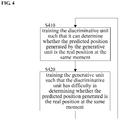
- Figure 4 shows a specific process of step S240 shown in Figure 2 .
- the GAN includes a generative unit 310 and a discriminative unit 320.
- the generative unit 310 and the discriminative unit 320 may be implemented with neural networks.
- the generative unit 310 is configured to generate predicted positions for training atoms at the next moment based on the input initial positions (or current positions) of the training atoms.
- the discriminative unit 320 is configured to receive the predicted positions from the generative unit 310, and determine a probability that the received predicted position is the real position at the next moment. In a case that the determined probability is greater than 50%, the discriminative unit 320 outputs a determination result of "1" representing that the predicted position is the real position. In a case that the determined probability is less than 50%, the discriminative unit 320 outputs a determination result of "0" representing that the predicted position is not the real position.
- the discriminative unit 320 makes efforts to determine whether the received predicted position is the real position at the same moment. If the determined probability is large (greater than 50%), the discriminative unit 320 is more convinced that the predicted position is the real position. If the determined probability is small (less than 50%), the discriminative unit 320 is more convinced that the predicted position is not the real position.
- the generative unit 310 makes efforts to generate the predicted position as close as possible to the real position, so that the discriminative unit 320 has difficulty in distinguishing the predicted position from the real position. In other words, if the discriminative unit 320 has difficulty in determining whether the received predicted position is the real position, that is, if the probability determined by the discriminative unit 320 is 50% or approximate to 50%, the generative unit 310 reaches an ideal state.
- the generative unit 310 and the discriminative unit 320 constituting the GAN are trained based on the objects as described above. As shown in Figure 4 , the discriminative unit 320 is firstly trained in step S410, so that the discriminative unit 320 is capable of determining whether the predicted position received from the generative unit 310 is the real position at the same moment, i.e., such that the discriminative unit 320 is capable of determining whether the probability is greater than 50% or less than 50%.
- the discriminative unit 320 may be trained in a manner of maximizing the following loss function L D .
- G(x i ) represents predicted position of the i-th training atom generated by the generative unit 310
- D ( ) represents a probability that a position indicated by the term within the parentheses is the real position.
- the generative unit 310 is trained in step S420, so that the discriminative unit 320 has difficulty in determining whether the predicted position generated by the generative unit 310 is the real position at the same moment, i.e., so that the probability determined by the discriminative unit 320 is 50% or approximate to 50%.
- the generative unit 310 may be trained in a manner of minimizing the following loss function L G .
- G(x') represents predicted position of the i-th training atom generated by the generative unit 310
- D(G(x i )) represents a probability determined by the discriminative unit 320 that the predicted position is the real position
- L MSE represents mean square error between the real position and the predicted position at the same moment
- ⁇ represents a weighting parameter which may be set as for example 0.5 or 1. It can be seen from the formula (2) that the mean square error L MSE is required to be minimized in order to minimize the loss function L G . Further, the L MSE may be calculated from the following formula (3).
- the generative unit 310 and the discriminative unit 320 may be alternately and iteratively trained by repeatedly performing steps S410 and S420.
- the probability determined by the discriminative unit 320 is 50% or approximate to 50%, it is indicated that the discriminative unit 320 has difficulty in distinguishing the predicted position from the real position.
- the predicted position generated by the generative unit 310 can be considered to be the same as the real position calculated by utilizing the LAMMPS. Since the generative unit 310 is capable of generating the same output as the LAMMPS, the generative unit 310 can be applied in actual simulations to take place of the LAMMPS. As such, the training for the GAN is completed.
- Figures 5 and 6 respectively schematically show neural network structures of the generative unit 310 and the discriminative unit 320, in which a circle represents a neural cell.
- a position coordinate x(t) of an atom at time t is input at an input end of the generative unit 310
- a predicted position coordinate x'(t+n) of the atom at time t+n is output at an output end of the generative unit 310.
- the predicted position coordinate x'(t+n) output by the generative unit 310 and a real position coordinate x(t+n) of the atom at time t+n calculated by the LAMMPS are input at an input end of the discriminative unit 320, and a determination result "0" or "1" is output at an output end of the discriminative unit 320.
- the position of the atom is just an example of the atomic dynamics, and simulating the atomic dynamics is not limited to simulating the future position of the atom.
- properties such as the nuclear charge of the atom may also be simulated. Therefore, the position coordinates such as x(t) and x'(t+n) shown in Figures 5 and 6 may be extended to include other properties of the atom.
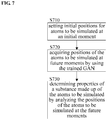
- FIG. 7 is a flowchart showing a process of simulating atomic dynamics by utilizing the trained GAN.
- step S710 initial positions of multiple atoms which are actual simulation targets at an initial moment are set.
- step S720 positions of atoms to be simulated at one or more moments after the initial moment are acquired by utilizing the trained GAN based on the initial positions, as the simulation result.
- the one or more moments at which the simulation result is expected may be set based on practical requirements.
- step S730 properties of a substance made up of the atoms are determined by analyzing the simulation result. For example, it is assumed that positions of multiple copper atoms at a plurality of moments are acquired as the simulation result in step S720. Information on the copper atoms, such as movement track, movement direction and speed, may be obtained by analyzing the positions of the copper atoms at the moments in step S730, thereby obtaining properties of copper made up of the copper atoms, such as temperature, form and density.
- the trained GAN can produce the same simulation result as the LAMMPS, which has advantages of small amount of computations and low complexity in actual applications, requiring fewer computing resources and less time.
- the method described in the above embodiments may be performed by software, hardware, or a combination of software and hardware.
- Programs included in the software may be stored in advance in a storage medium provided inside or outside the device. As an example, during execution, these programs are written to a random-access memory (RAM) and executed by a processor (such as CPU), so as to perform the processes described herein.
- RAM random-access memory
- processor such as CPU
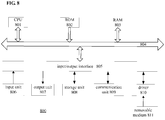
- Figure 8 is a block diagram showing a configuration example of computer hardware for performing the method according to the present disclosure based on programs.
- the computer hardware is an example of the device for simulating atomic dynamics according to the present disclosure.
- a central processing unit (CPU) 801, a read-only memory (ROM) 802, and a random-access memory (RAM) 803 are connected to each other via a bus 804.
- An input/output interface 805 is further connected to the bus 804.
- the input/output interface 805 is connected with the following components: an input unit 806 including keyboard, mouse, microphone and the like; an output unit 807 including display, speaker and the like; a storage unit 808 including hard disk, nonvolatile memory and the like; a communication unit 809 including network interface card (such as local area network (LAN) card, modem); and a driver 810 that drives a removable medium 811 such as magnetic disk, optical disk, magneto-optical disk, or semiconductor memory.
- LAN local area network
- the CPU 801 loads a program stored in the storage unit 808 into the RAM 803 via the input/output interface 805 and the bus 804, and executes the program so as to perform the method described above.
- a program to be executed by the computer (CPU 801) may be recorded on the removable medium 811 as a package medium including a magnetic disk (including floppy disk), an optical disk (including compact disk-read only memory (CD-ROM)), digital versatile disk (DVD), and the like), a magneto-optical disk, or a semiconductor memory, and the like.
- the program to be executed by the computer (CPU 801) may also be provided via wired or wireless transmission medium, such as local area network, the Internet, or digital satellite broadcast.
- the program may be installed in the storage unit 808 via the input/output interface 805.
- the program may be received by the communication unit 809 via the wired or wireless transmission medium, and then the program may be installed in the storage unit 808.
- the program may be installed in the ROM 802 or the storage unit 808 in advance.
- the program to be executed by the computer may be a program that executes the process according to the order described in the present specification or may be a program that executes the process in parallel or executes the process when needed (for example, when called).
- Units or devices described herein are merely logical in nature and do not strictly correspond to physical devices or entities.
- the functionality of each unit described herein may be implemented by multiple physical entities or the functionality of multiple units described herein may be implemented by a single physical entity.
- features, components, elements or steps, and the like described in an embodiment are not limited to this embodiment, but may also be applied to other embodiments, for example, may substitute for specific features, components, elements, or steps, and the like in other embodiments or may be combined with them.
Landscapes
- Engineering & Computer Science (AREA)
- Theoretical Computer Science (AREA)
- Physics & Mathematics (AREA)
- Data Mining & Analysis (AREA)
- Computing Systems (AREA)
- Life Sciences & Earth Sciences (AREA)
- General Physics & Mathematics (AREA)
- Health & Medical Sciences (AREA)
- General Health & Medical Sciences (AREA)
- Mathematical Physics (AREA)
- General Engineering & Computer Science (AREA)
- Software Systems (AREA)
- Evolutionary Computation (AREA)
- Artificial Intelligence (AREA)
- Molecular Biology (AREA)
- Biomedical Technology (AREA)
- Biophysics (AREA)
- Computational Linguistics (AREA)
- Bioinformatics & Cheminformatics (AREA)
- Bioinformatics & Computational Biology (AREA)
- Computational Mathematics (AREA)
- Pure & Applied Mathematics (AREA)
- Mathematical Optimization (AREA)
- Mathematical Analysis (AREA)
- Probability & Statistics with Applications (AREA)
- Databases & Information Systems (AREA)
- Crystallography & Structural Chemistry (AREA)
- Spectroscopy & Molecular Physics (AREA)
- Chemical & Material Sciences (AREA)
- Evolutionary Biology (AREA)
- Operations Research (AREA)
- Algebra (AREA)
- Computer Hardware Design (AREA)
- Geometry (AREA)
- Medical Informatics (AREA)
- Computer Vision & Pattern Recognition (AREA)
- Management, Administration, Business Operations System, And Electronic Commerce (AREA)
- Supply And Distribution Of Alternating Current (AREA)
Abstract
Description
- The present disclosure relates to a method and a device for simulating atomic dynamics, and in particular to a method and a device for simulating atomic dynamics by utilizing a deep neural network.
- Molecular dynamics simulation aims to study physical movements of atoms and molecules. With the development of computer technology, the molecular dynamics simulation and the application thereof is attracting increasing attention. On one hand, the molecular dynamics simulation can quantitatively explore mechanisms and laws in nature. On the other hand, the molecular dynamics simulation promotes research and development in an economic, efficient and predictable way.
- Known tools for molecular dynamics simulation include a Large-scale Atomic/Molecular Massively Parallel Simulator (LAMMPS) developed by Sandia National Laboratory. The LAMMPS can support systems consisting of millions of atoms/molecules in gas, liquid and solid form. In the LAMMPS, a simulation domain is divided into small three-dimensional sub-domains by utilizing spatial decomposition technology, and each sub-domain is to be processed by a processor. In spite of this, simulation by the LAMMPS still requires a lot of computing resources and time.
- In addition, methods based on deep neural network have been greatly developed in various applications in recent years. In these methods, the deep neural network is typically trained based on a data set, and then the trained deep neural network is deployed in actual applications.
- The present disclosure provides a solution where molecular dynamics simulation is performed by utilizing a deep neural network. According to an embodiment of a first aspect of the present disclosure, a method of simulating atomic dynamics is provided. The method includes: setting initial positions for multiple specific atoms in a specific scene; calculating, based on the initial positions, positions of the multiple specific atoms at each time in a first time series by utilizing a LAMMPS configured with respect to the specific scene, as real positions; calculating, based on the initial positions, positions of the multiple specific atoms at each time in the first time series by utilizing a generative adversarial network, as predicted positions; improving a configuration of the generative adversarial network based on the real position and the predicted position at the same time; setting initial positions for multiple atoms to be simulated; and calculating positions of the multiple atoms to be simulated at each time in a second time series by utilizing the improved generative adversarial network.
- According to an embodiment of another aspect of the present disclosure, a device for simulating atomic dynamics is provided. The device includes a memory and one or more processors. The processor is configured to: set initial positions for multiple specific atoms in a specific scene; calculate, based on the initial positions, positions of the multiple specific atoms at each time in a first time series by utilizing a LAMMPS configured with respect to the specific scene, as real positions; calculate, based on the initial positions, positions of the multiple specific atoms at each time in the first time series by utilizing a generative adversarial network, as predicted positions; improve a configuration of the generative adversarial network based on the real position and the predicted position at the same time; set initial positions for multiple atoms to be simulated; and calculate positions of the multiple atoms to be simulated at each time in a second time series by utilizing the improved generative adversarial network.
- According to an embodiment of another aspect of the present disclosure, a recording medium having stored thereon a program is provided. The program, when executed by a computer, causes the computer to perform the method for simulating atomic dynamics described above.
-
-
Figure 1 is a general flowchart showing a method of simulating atomic dynamics according to the present disclosure; -
Figure 2 is a flowchart showing a process of training a generative adversarial network; -
Figure 3 is a schematic block diagram of the generative adversarial network; -
Figure 4 shows a specific process of step S240 shown inFigure 2 ; -
Figure 5 schematically shows a generative unit implemented with a neural network; -
Figure 6 schematically shows a discriminative unit implemented with a neural network; -
Figure 7 is a flowchart showing a process of simulating atomic dynamics by utilizing the trained generative adversarial network; and -
Figure 8 is a block diagram showing a configuration example of computer hardware for implementing the present disclosure. -
Figure 1 is a general flowchart showing a method of simulating atomic dynamics according to the present disclosure. - As shown in
Figure 1 , a generative adversarial network (GAN) is trained by performing steps S110 to S130, and the trained GAN is applied in actual simulations in step S140. For clarity, an atom in the training phase is hereinafter referred to as "training atom", and an atom in the actual simulation phase is hereinafter referred to as "atom to be simulated". - Specifically, in step S110, positions of training atoms at a plurality of moments after an initial moment are calculated by utilizing the LAMMPS, as real positions of the training atoms at the corresponding moments. In the present disclosure, a position of an atom may be represented by a three-dimensional coordinate of the atom. Preferably, the three-dimensional coordinate of the atom is normalized within an interval of [0, 1].
- In step S120, positions of the training atoms at the same moments are acquired by utilizing the GAN, as predicted positions of the training atoms at the corresponding moments. The GAN may be implemented with a deep neural network.
- In step S130, the GAN is trained based the real position and the predicted position of the training atom at the same moment.
- Next, in step S140, positions of atoms which are actual simulation targets at future moments are calculated by utilizing the trained GAN. The position of the atom to be simulated at any future moment may be obtained from the calculation result, thereby obtaining the future movement state of the atom.
- It should be noted that, in the present disclosure, the future position of an atom is an example of the atomic dynamics, and simulation of the atomic dynamics is not limited to simulation of the future position of the atom. For example, nuclear charge of the atom may be simulated.
- As shown in
Figure 1 , in the method according to the present disclosure, the atomic dynamics is simulated by utilizing a trained deep neural network, which has advantages of small amount of computations and low complexity in actual simulations, requiring fewer computing resources and less time compared with the conventional tool LAMMPS. - The process of training the GAN is described in detail below with reference to
Figures 2 to 4 .Figure 2 is a flowchart showing a process for training a GAN. - As shown in
Figure 2 , in step S210, initial positions for multiple training atoms at an initial moment are set with respect to a specific scene. For example, in a case that microscopic properties of copper are simulated and studied, initial positions for multiple copper atoms are set based on states such as initial temperature, pressure and density. - In step S220, based on the initial positions, real positions of the multiple training atoms at a plurality of moments after the initial moment are calculated by utilizing the LAMMPS. For example, the plurality of moments may be set at a predetermined interval or may be set irregularly.
- In step S230, predicted positions of the multiple training atoms at the same moments are calculated by utilizing the GAN based on the initial positions. Since the GAN has not yet been trained, the initial configuration of the GAN is applied.
- Next, in step S240, the GAN is trained based on the real position and the predicted position at the same moment obtained in steps S220 and S230, such that the predicted position calculated by utilizing the GAN can be as close as possible to the real position calculated by utilizing the LAMMPS. The training for the GAN is completed when the predicted position can be deemed to be substantially the same as the real position.
-
Figure 3 is a schematic block diagram of a GAN.Figure 4 shows a specific process of step S240 shown inFigure 2 . - As shown in
Figure 3 , the GAN includes agenerative unit 310 and adiscriminative unit 320. In the present disclosure, thegenerative unit 310 and thediscriminative unit 320 may be implemented with neural networks. Thegenerative unit 310 is configured to generate predicted positions for training atoms at the next moment based on the input initial positions (or current positions) of the training atoms. Thediscriminative unit 320 is configured to receive the predicted positions from thegenerative unit 310, and determine a probability that the received predicted position is the real position at the next moment. In a case that the determined probability is greater than 50%, thediscriminative unit 320 outputs a determination result of "1" representing that the predicted position is the real position. In a case that the determined probability is less than 50%, thediscriminative unit 320 outputs a determination result of "0" representing that the predicted position is not the real position. - The
discriminative unit 320 makes efforts to determine whether the received predicted position is the real position at the same moment. If the determined probability is large (greater than 50%), thediscriminative unit 320 is more convinced that the predicted position is the real position. If the determined probability is small (less than 50%), thediscriminative unit 320 is more convinced that the predicted position is not the real position. - The
generative unit 310 makes efforts to generate the predicted position as close as possible to the real position, so that thediscriminative unit 320 has difficulty in distinguishing the predicted position from the real position. In other words, if thediscriminative unit 320 has difficulty in determining whether the received predicted position is the real position, that is, if the probability determined by thediscriminative unit 320 is 50% or approximate to 50%, thegenerative unit 310 reaches an ideal state. - The
generative unit 310 and thediscriminative unit 320 constituting the GAN are trained based on the objects as described above. As shown inFigure 4 , thediscriminative unit 320 is firstly trained in step S410, so that thediscriminative unit 320 is capable of determining whether the predicted position received from thegenerative unit 310 is the real position at the same moment, i.e., such that thediscriminative unit 320 is capable of determining whether the probability is greater than 50% or less than 50%. - It is assumed that the number of training atoms is m, and real positions of the m training atoms calculated by utilizing the LAMMPS are expressed as x1, x2, ..., xm respectively. The
discriminative unit 320 may be trained in a manner of maximizing the following loss function LD.
generative unit 310, and D ( ) represents a probability that a position indicated by the term within the parentheses is the real position. - Then, the
generative unit 310 is trained in step S420, so that thediscriminative unit 320 has difficulty in determining whether the predicted position generated by thegenerative unit 310 is the real position at the same moment, i.e., so that the probability determined by thediscriminative unit 320 is 50% or approximate to 50%. - Specifically, the
generative unit 310 may be trained in a manner of minimizing the following loss function LG.
generative unit 310, D(G(xi)) represents a probability determined by thediscriminative unit 320 that the predicted position is the real position, LMSE represents mean square error between the real position and the predicted position at the same moment, and λ represents a weighting parameter which may be set as for example 0.5 or 1. It can be seen from the formula (2) that the mean square error LMSE is required to be minimized in order to minimize the loss function LG. Further, the LMSE may be calculated from the following formula (3).
- The
generative unit 310 and thediscriminative unit 320 may be alternately and iteratively trained by repeatedly performing steps S410 and S420. In a case that the probability determined by thediscriminative unit 320 is 50% or approximate to 50%, it is indicated that thediscriminative unit 320 has difficulty in distinguishing the predicted position from the real position. In this case, the predicted position generated by thegenerative unit 310 can be considered to be the same as the real position calculated by utilizing the LAMMPS. Since thegenerative unit 310 is capable of generating the same output as the LAMMPS, thegenerative unit 310 can be applied in actual simulations to take place of the LAMMPS. As such, the training for the GAN is completed. -
Figures 5 and 6 respectively schematically show neural network structures of thegenerative unit 310 and thediscriminative unit 320, in which a circle represents a neural cell. As shown inFigure 5 , a position coordinate x(t) of an atom at time t is input at an input end of thegenerative unit 310, and a predicted position coordinate x'(t+n) of the atom at time t+n is output at an output end of thegenerative unit 310. As shown inFigure 6 , the predicted position coordinate x'(t+n) output by thegenerative unit 310 and a real position coordinate x(t+n) of the atom at time t+n calculated by the LAMMPS are input at an input end of thediscriminative unit 320, and a determination result "0" or "1" is output at an output end of thediscriminative unit 320. - It should be noted that, as described in the above, the position of the atom is just an example of the atomic dynamics, and simulating the atomic dynamics is not limited to simulating the future position of the atom. For example, properties such as the nuclear charge of the atom may also be simulated. Therefore, the position coordinates such as x(t) and x'(t+n) shown in
Figures 5 and 6 may be extended to include other properties of the atom. - The process of applying the trained GAN in actual simulations is described below with reference to
Figure 7 , which is a flowchart showing a process of simulating atomic dynamics by utilizing the trained GAN. - In step S710, initial positions of multiple atoms which are actual simulation targets at an initial moment are set. Next, in step S720, positions of atoms to be simulated at one or more moments after the initial moment are acquired by utilizing the trained GAN based on the initial positions, as the simulation result. The one or more moments at which the simulation result is expected may be set based on practical requirements.
- In step S730, properties of a substance made up of the atoms are determined by analyzing the simulation result. For example, it is assumed that positions of multiple copper atoms at a plurality of moments are acquired as the simulation result in step S720. Information on the copper atoms, such as movement track, movement direction and speed, may be obtained by analyzing the positions of the copper atoms at the moments in step S730, thereby obtaining properties of copper made up of the copper atoms, such as temperature, form and density.
- Technical solutions of the present disclosure are described above in combination with the embodiments. With the technical solutions of the present disclosure, the trained GAN can produce the same simulation result as the LAMMPS, which has advantages of small amount of computations and low complexity in actual applications, requiring fewer computing resources and less time.
- The method described in the above embodiments may be performed by software, hardware, or a combination of software and hardware. Programs included in the software may be stored in advance in a storage medium provided inside or outside the device. As an example, during execution, these programs are written to a random-access memory (RAM) and executed by a processor (such as CPU), so as to perform the processes described herein.
-
Figure 8 is a block diagram showing a configuration example of computer hardware for performing the method according to the present disclosure based on programs. The computer hardware is an example of the device for simulating atomic dynamics according to the present disclosure. - As shown in
Figure 8 , in acomputer 800, a central processing unit (CPU) 801, a read-only memory (ROM) 802, and a random-access memory (RAM) 803 are connected to each other via abus 804. - An input/
output interface 805 is further connected to thebus 804. The input/output interface 805 is connected with the following components: aninput unit 806 including keyboard, mouse, microphone and the like; anoutput unit 807 including display, speaker and the like; astorage unit 808 including hard disk, nonvolatile memory and the like; acommunication unit 809 including network interface card (such as local area network (LAN) card, modem); and adriver 810 that drives aremovable medium 811 such as magnetic disk, optical disk, magneto-optical disk, or semiconductor memory. - In the computer having the above configuration, the
CPU 801 loads a program stored in thestorage unit 808 into theRAM 803 via the input/output interface 805 and thebus 804, and executes the program so as to perform the method described above. - A program to be executed by the computer (CPU 801) may be recorded on the
removable medium 811 as a package medium including a magnetic disk (including floppy disk), an optical disk (including compact disk-read only memory (CD-ROM)), digital versatile disk (DVD), and the like), a magneto-optical disk, or a semiconductor memory, and the like. In addition, the program to be executed by the computer (CPU 801) may also be provided via wired or wireless transmission medium, such as local area network, the Internet, or digital satellite broadcast. - In a case where the
removable medium 811 is installed in thedriver 810, the program may be installed in thestorage unit 808 via the input/output interface 805. In addition, the program may be received by thecommunication unit 809 via the wired or wireless transmission medium, and then the program may be installed in thestorage unit 808. Alternatively, the program may be installed in theROM 802 or thestorage unit 808 in advance. - The program to be executed by the computer may be a program that executes the process according to the order described in the present specification or may be a program that executes the process in parallel or executes the process when needed (for example, when called).
- Units or devices described herein are merely logical in nature and do not strictly correspond to physical devices or entities. For example, the functionality of each unit described herein may be implemented by multiple physical entities or the functionality of multiple units described herein may be implemented by a single physical entity. In addition, it should be noted that features, components, elements or steps, and the like described in an embodiment are not limited to this embodiment, but may also be applied to other embodiments, for example, may substitute for specific features, components, elements, or steps, and the like in other embodiments or may be combined with them.
- The scope of the present disclosure is not limited to those embodiments described herein. It should be understood by those skill in the art that various modifications or changes in the embodiments discussed herein can be made without departing from the spirit and principle of the present disclosure, depending on design requirements and other factors. The scope of the present disclosure is defined by the appended claims and their equivalents.
- Notes:
- (1) A method for simulating atomic dynamics, including:
- setting initial positions for multiple specific atoms in a specific scene;
- calculating, based on the initial positions, positions of the multiple specific atoms at each time in a first time series by utilizing a Large-scale Atomic/Molecular Massively Parallel Simulator (LAMMPS) configured with respect to the specific scene, as real positions;
- calculating, based on the initial positions, positions of the multiple specific atoms at each time in the first time series by utilizing a generative adversarial network, as predicted positions;
- improving a configuration of the generative adversarial network based on the real position and the predicted position at the same time;
- setting initial positions for multiple atoms to be simulated; and
- calculating positions of the multiple atoms to be simulated at each time in a second time series by utilizing the improved generative adversarial network.
- (2) The method according to (1), further including:
- calculating the predicted positions of the multiple specific atoms at each time in the first time series by utilizing a generative unit in the generative adversarial network;
- determining a probability that the predicted position is the real position at the same time by utilizing a discriminative unit in the generative adversarial network; and
- improving configurations of the generative unit and the discriminative unit based on the predicted position and the real position at the same time, until the probability determined by the discriminative unit is 50%.
- (3) The method according to (2), further including:
improving the discriminative unit in such a manner that the discriminative unit is capable of determining whether the predicted position is the real position at the same time. - (4) The method according to (3), further including:
improving the generative unit in such a manner that the discriminative unit has difficulty in determining whether the predicted position calculated by the generative unit is the real position at the same time. - (5) The method according to (3), further including:
improving the generative unit in a manner of minimizing mean square error between the real position and the predicted position at the same time. - (6) The method according to (1), further including:
determining properties of a substance made up of the multiple atoms to be simulated by analyzing the positions of the multiple atoms to be simulated at each time in the second time series. - (7) The method according to (1), wherein the generative unit and the discriminative unit are implemented with neural networks.
- (8) A device for stimulating atomic dynamics, including: a memory, and one or more processors configured to:
- set initial positions for multiple specific atoms in a specific scene;
- calculate, based on the initial positions, positions of the multiple specific atoms at each time in a first time series by utilizing a Large-scale Atomic/Molecular Massively Parallel Simulator (LAMMPS) configured with respect to the specific scene, as real positions;
- calculate, based on the initial positions, positions of the multiple specific atoms at each time in the first time series by utilizing a generative adversarial network, as predicted positions;
- improve a configuration of the generative adversarial network based on the real position and the predicted position at the same time;
- set initial positions for multiple atoms to be simulated; and
- calculate positions of the multiple atoms to be simulated at each time in a second time series by utilizing the improved generative adversarial network.
- (9) The device according to (8), wherein the processor is further configured to:
- calculate the predicted positions of the multiple specific atoms at each time in the first time series by utilizing a generative unit in the generative adversarial network;
- determine a probability that the predicted position is the real position at the same time by utilizing a discriminative unit in the generative adversarial network; and
- improve configurations of the generative unit and the discriminative unit based on the predicted position and the real position at the same time, until the probability determined by the discriminative unit is 50%.
- (10) The device according to (9), wherein the processor is further configured to:
- improve the discriminative unit in such a manner that the discriminative unit is capable of determining whether the predicted position is the real position at the same time; and
- improve the generative unit in such a manner that the discriminative unit has difficulty in determining whether the predicted position calculated by the generative unit is the real position at the same time.
- (11) A recording medium having stored thereon a program that, when executed by a computer, causes the computer to perform the method for simulating atomic dynamics according to any one of (1) to (7).
Claims (10)
- A method of simulating atomic dynamics, comprising:setting initial positions for a plurality of specific atoms in a specific scene;calculating, based on the initial positions, positions of the plurality of specific atoms at each time in a first time series by utilizing a Large-scale Atomic/Molecular Massively Parallel Simulator - LAMMPS - configured with respect to the specific scene, as real positions;calculating, based on the initial positions, positions of the plurality of specific atoms at each time in the first time series by utilizing a generative adversarial network, as predicted positions;improving a configuration of the generative adversarial network based on the real position and the predicted position at the same time;setting initial positions for a plurality of atoms to be simulated; andcalculating positions of the plurality of atoms to be simulated at each time in a second time series by utilizing the improved generative adversarial network.
- The method according to claim 1, further comprising:calculating the predicted positions of the plurality of specific atoms at each time in the first time series by utilizing a generative unit in the generative adversarial network;determining a probability that the predicted position is the real position at the same time by utilizing a discriminative unit in the generative adversarial network; andimproving configurations of the generative unit and the discriminative unit based on the predicted position and the real position at the same time, until the probability determined by the discriminative unit is 50%.
- The method according to claim 2, further comprising:
improving the discriminative unit in such a manner that the discriminative unit is capable of determining whether the predicted position is the real position at the same time. - The method according to claim 3, further comprising:
improving the generative unit in such a manner that the discriminative unit has difficulty in determining whether the predicted position calculated by the generative unit is the real position at the same time. - The method according to claim 3, further comprising:
improving the generative unit in a manner of minimizing mean square error between the real position and the predicted position at the same time. - The method according to any preceding claim, further comprising:
determining properties of a substance made up of the plurality of atoms to be simulated by analyzing the positions of the plurality of atoms to be simulated at each time in the second time series. - The method according to any preceding claim, wherein the generative unit and the discriminative unit are implemented with neural networks.
- A device for stimulating atomic dynamics, comprising: a memory, and one or more processors configured to:set initial positions for a plurality of specific atoms in a specific scene;calculate, based on the initial positions, positions of the plurality of specific atoms at each time in a first time series by utilizing a Large-scale Atomic/Molecular Massively Parallel Simulator - LAMMPS - configured with respect to the specific scene, as real positions;calculate, based on the initial positions, positions of the plurality of specific atoms at each time in the first time series by utilizing a generative adversarial network, as predicted positions;improve a configuration of the generative adversarial network based on the real position and the predicted position at the same time;set initial positions for a plurality of atoms to be simulated; andcalculate positions of the plurality of atoms to be simulated at each time in a second time series by utilizing the improved generative adversarial network.
- The device according to claim 8, wherein the processor is further configured to:calculate the predicted positions of the plurality of specific atoms at each time in the first time series by utilizing a generative unit in the generative adversarial network;determine a probability that the predicted position is the real position at the same time by utilizing a discriminative unit in the generative adversarial network; andimprove configurations of the generative unit and the discriminative unit based on the predicted position and the real position at the same time, until the probability determined by the discriminative unit is 50%.
- The device according to claim 9, wherein the processor is further configured to:improve the discriminative unit in such a manner that the discriminative unit is capable of determining whether the predicted position is the real position at the same time; andimprove the generative unit in such a manner that the discriminative unit has difficulty in determining whether the predicted position calculated by the generative unit is the real position at the same time.
Applications Claiming Priority (1)
| Application Number | Priority Date | Filing Date | Title |
|---|---|---|---|
| CN201811444034.4A CN111243680B (en) | 2018-11-29 | 2018-11-29 | Method and apparatus for simulating atomic dynamics |
Publications (1)
| Publication Number | Publication Date |
|---|---|
| EP3678140A1 true EP3678140A1 (en) | 2020-07-08 |
Family
ID=68609996
Family Applications (1)
| Application Number | Title | Priority Date | Filing Date |
|---|---|---|---|
| EP19209742.6A Withdrawn EP3678140A1 (en) | 2018-11-29 | 2019-11-18 | Method and device for simulating atomic dynamics |
Country Status (4)
| Country | Link |
|---|---|
| US (1) | US11386248B2 (en) |
| EP (1) | EP3678140A1 (en) |
| JP (1) | JP2020087456A (en) |
| CN (1) | CN111243680B (en) |
Families Citing this family (4)
| Publication number | Priority date | Publication date | Assignee | Title |
|---|---|---|---|---|
| JP7302621B2 (en) * | 2021-04-02 | 2023-07-04 | 株式会社豊田中央研究所 | Organic material transport property evaluation device and organic material transport property evaluation method |
| KR20240114536A (en) * | 2023-01-17 | 2024-07-24 | 삼성전자주식회사 | Apparatus and method for processing data |
| CN117807782B (en) * | 2023-12-29 | 2024-06-07 | 南京仁高隆软件科技有限公司 | Method for realizing three-dimensional simulation model |
| CN119314570A (en) * | 2024-10-18 | 2025-01-14 | 中国科学院青岛生物能源与过程研究所 | A method to quickly reorient the center of a nanowire based on geometry |
Citations (1)
| Publication number | Priority date | Publication date | Assignee | Title |
|---|---|---|---|---|
| WO2019098154A1 (en) * | 2017-11-14 | 2019-05-23 | 学校法人慶應義塾 | Time-sequential data generation device and program |
Family Cites Families (4)
| Publication number | Priority date | Publication date | Assignee | Title |
|---|---|---|---|---|
| CN1661368A (en) * | 2004-02-26 | 2005-08-31 | 富士通株式会社 | Fast prediction method for assuring ion distribution |
| US9373059B1 (en) * | 2014-05-05 | 2016-06-21 | Atomwise Inc. | Systems and methods for applying a convolutional network to spatial data |
| JP6610182B2 (en) * | 2015-11-09 | 2019-11-27 | 富士通株式会社 | Binding free energy calculation pre-processing method, binding free energy calculation method and apparatus, and program |
| US9996329B2 (en) * | 2016-02-16 | 2018-06-12 | Microsoft Technology Licensing, Llc | Translating atomic read-modify-write accesses |
-
2018
- 2018-11-29 CN CN201811444034.4A patent/CN111243680B/en not_active Expired - Fee Related
-
2019
- 2019-11-12 JP JP2019204930A patent/JP2020087456A/en active Pending
- 2019-11-18 EP EP19209742.6A patent/EP3678140A1/en not_active Withdrawn
- 2019-11-26 US US16/695,834 patent/US11386248B2/en active Active
Patent Citations (1)
| Publication number | Priority date | Publication date | Assignee | Title |
|---|---|---|---|---|
| WO2019098154A1 (en) * | 2017-11-14 | 2019-05-23 | 学校法人慶應義塾 | Time-sequential data generation device and program |
Non-Patent Citations (2)
| Title |
|---|
| WEI OUYANG ET AL: "Deep learning massively accelerates super-resolution localization microscopy", NATURE BIOTECHNOLOGY, vol. 36, no. 5, 16 April 2018 (2018-04-16), us, pages 460 - 468, XP055697959, ISSN: 1087-0156, DOI: 10.1038/nbt.4106 * |
| ZHAOCHENG LIU ET AL: "Simulating the Ising Model with a Deep Convolutional Generative Adversarial Network", ARXIV.ORG, CORNELL UNIVERSITY LIBRARY, 201 OLIN LIBRARY CORNELL UNIVERSITY ITHACA, NY 14853, 13 October 2017 (2017-10-13), XP080828673 * |
Also Published As
| Publication number | Publication date |
|---|---|
| CN111243680B (en) | 2023-06-09 |
| JP2020087456A (en) | 2020-06-04 |
| US20200175126A1 (en) | 2020-06-04 |
| CN111243680A (en) | 2020-06-05 |
| US11386248B2 (en) | 2022-07-12 |
Similar Documents
| Publication | Publication Date | Title |
|---|---|---|
| EP3678140A1 (en) | Method and device for simulating atomic dynamics | |
| EP3688673B1 (en) | Neural architecture search | |
| Alimoradi et al. | Machine-learning methods for earthquake ground motion analysis and simulation | |
| EP4252151A1 (en) | Data source correlation techniques for machine learning and convolutional neural models | |
| Bortnik et al. | Artificial neural networks for determining magnetospheric conditions | |
| US20220070266A1 (en) | Systems and methods for estimating typed graphlets in large data | |
| Fix et al. | Simultaneous autoregressive models for spatial extremes | |
| Cartwright et al. | Emulation of greenhouse‐gas sensitivities using variational autoencoders | |
| CN112766381A (en) | Attribute-guided SAR image generation method under limited sample | |
| Lee et al. | NAS-TasNet: Neural architecture search for time-domain speech separation | |
| JP2017049907A (en) | Neural network, learning method thereof, and computer program | |
| Ma et al. | GLFER-Net: a polyphonic sound source localization and detection network based on global-local feature extraction and recalibration | |
| Vereno et al. | Exploiting quantum power flow in smart grid co-simulation | |
| WO2024037098A1 (en) | Artificial intelligence-based molecular processing method and apparatus, electronic device, computer-readable storage medium, and computer program product | |
| CN116503685A (en) | Optical-ISAR Image Conversion Method and Device Based on Hierarchical Domain Prior | |
| Carey et al. | Neural operator surrogate models of plasma edge simulations: feasibility and data efficiency | |
| CN102521202B (en) | Automatic discovery method of complex system oriented MAXQ task graph structure | |
| Nakano | Hybrid algorithm of ensemble transform and importance sampling for assimilation of non-Gaussian observations | |
| CN117592582A (en) | Language model training method, device, computer equipment and medium | |
| KR20250165375A (en) | Predicting equilibrium distributions for molecular systems | |
| CN111312276B (en) | A method, device, device and medium for audio signal processing | |
| Torkamani | Hyperchaotic and delayed oscillators for system identification with application to damage assessment | |
| CN107919136A (en) | A kind of digital speech samples frequency estimating methods based on gauss hybrid models | |
| Murakami et al. | Models in quantitative geography | |
| Kaushal et al. | nuGAN: Generative Adversarial Emulator for Cosmic Web with Neutrinos |
Legal Events
| Date | Code | Title | Description |
|---|---|---|---|
| PUAI | Public reference made under article 153(3) epc to a published international application that has entered the european phase |
Free format text: ORIGINAL CODE: 0009012 |
|
| STAA | Information on the status of an ep patent application or granted ep patent |
Free format text: STATUS: THE APPLICATION HAS BEEN PUBLISHED |
|
| AK | Designated contracting states |
Kind code of ref document: A1 Designated state(s): AL AT BE BG CH CY CZ DE DK EE ES FI FR GB GR HR HU IE IS IT LI LT LU LV MC MK MT NL NO PL PT RO RS SE SI SK SM TR |
|
| AX | Request for extension of the european patent |
Extension state: BA ME |
|
| STAA | Information on the status of an ep patent application or granted ep patent |
Free format text: STATUS: REQUEST FOR EXAMINATION WAS MADE |
|
| 17P | Request for examination filed |
Effective date: 20210105 |
|
| RBV | Designated contracting states (corrected) |
Designated state(s): AL AT BE BG CH CY CZ DE DK EE ES FI FR GB GR HR HU IE IS IT LI LT LU LV MC MK MT NL NO PL PT RO RS SE SI SK SM TR |
|
| STAA | Information on the status of an ep patent application or granted ep patent |
Free format text: STATUS: EXAMINATION IS IN PROGRESS |
|
| 17Q | First examination report despatched |
Effective date: 20230519 |
|
| STAA | Information on the status of an ep patent application or granted ep patent |
Free format text: STATUS: THE APPLICATION HAS BEEN WITHDRAWN |
|
| 18W | Application withdrawn |
Effective date: 20231030 |