EP3677707A1 - Electrolytic copper foil, method for producing same, and anode for high capacity li secondary battery including same - Google Patents
Electrolytic copper foil, method for producing same, and anode for high capacity li secondary battery including same Download PDFInfo
- Publication number
- EP3677707A1 EP3677707A1 EP18851880.7A EP18851880A EP3677707A1 EP 3677707 A1 EP3677707 A1 EP 3677707A1 EP 18851880 A EP18851880 A EP 18851880A EP 3677707 A1 EP3677707 A1 EP 3677707A1
- Authority
- EP
- European Patent Office
- Prior art keywords
- copper foil
- electrolytic copper
- oxygen
- protective layer
- thickness
- Prior art date
- Legal status (The legal status is an assumption and is not a legal conclusion. Google has not performed a legal analysis and makes no representation as to the accuracy of the status listed.)
- Granted
Links
Images


Classifications
-
- C—CHEMISTRY; METALLURGY
- C23—COATING METALLIC MATERIAL; COATING MATERIAL WITH METALLIC MATERIAL; CHEMICAL SURFACE TREATMENT; DIFFUSION TREATMENT OF METALLIC MATERIAL; COATING BY VACUUM EVAPORATION, BY SPUTTERING, BY ION IMPLANTATION OR BY CHEMICAL VAPOUR DEPOSITION, IN GENERAL; INHIBITING CORROSION OF METALLIC MATERIAL OR INCRUSTATION IN GENERAL
- C23C—COATING METALLIC MATERIAL; COATING MATERIAL WITH METALLIC MATERIAL; SURFACE TREATMENT OF METALLIC MATERIAL BY DIFFUSION INTO THE SURFACE, BY CHEMICAL CONVERSION OR SUBSTITUTION; COATING BY VACUUM EVAPORATION, BY SPUTTERING, BY ION IMPLANTATION OR BY CHEMICAL VAPOUR DEPOSITION, IN GENERAL
- C23C22/00—Chemical surface treatment of metallic material by reaction of the surface with a reactive liquid, leaving reaction products of surface material in the coating, e.g. conversion coatings, passivation of metals
- C23C22/05—Chemical surface treatment of metallic material by reaction of the surface with a reactive liquid, leaving reaction products of surface material in the coating, e.g. conversion coatings, passivation of metals using aqueous solutions
- C23C22/06—Chemical surface treatment of metallic material by reaction of the surface with a reactive liquid, leaving reaction products of surface material in the coating, e.g. conversion coatings, passivation of metals using aqueous solutions using aqueous acidic solutions with pH less than 6
- C23C22/24—Chemical surface treatment of metallic material by reaction of the surface with a reactive liquid, leaving reaction products of surface material in the coating, e.g. conversion coatings, passivation of metals using aqueous solutions using aqueous acidic solutions with pH less than 6 containing hexavalent chromium compounds
- C23C22/26—Chemical surface treatment of metallic material by reaction of the surface with a reactive liquid, leaving reaction products of surface material in the coating, e.g. conversion coatings, passivation of metals using aqueous solutions using aqueous acidic solutions with pH less than 6 containing hexavalent chromium compounds containing also organic compounds
- C23C22/27—Acids
-
- C—CHEMISTRY; METALLURGY
- C25—ELECTROLYTIC OR ELECTROPHORETIC PROCESSES; APPARATUS THEREFOR
- C25D—PROCESSES FOR THE ELECTROLYTIC OR ELECTROPHORETIC PRODUCTION OF COATINGS; ELECTROFORMING; APPARATUS THEREFOR
- C25D1/00—Electroforming
- C25D1/04—Wires; Strips; Foils
-
- C—CHEMISTRY; METALLURGY
- C25—ELECTROLYTIC OR ELECTROPHORETIC PROCESSES; APPARATUS THEREFOR
- C25D—PROCESSES FOR THE ELECTROLYTIC OR ELECTROPHORETIC PRODUCTION OF COATINGS; ELECTROFORMING; APPARATUS THEREFOR
- C25D3/00—Electroplating: Baths therefor
- C25D3/02—Electroplating: Baths therefor from solutions
- C25D3/38—Electroplating: Baths therefor from solutions of copper
-
- C—CHEMISTRY; METALLURGY
- C25—ELECTROLYTIC OR ELECTROPHORETIC PROCESSES; APPARATUS THEREFOR
- C25D—PROCESSES FOR THE ELECTROLYTIC OR ELECTROPHORETIC PRODUCTION OF COATINGS; ELECTROFORMING; APPARATUS THEREFOR
- C25D5/00—Electroplating characterised by the process; Pretreatment or after-treatment of workpieces
- C25D5/48—After-treatment of electroplated surfaces
-
- H—ELECTRICITY
- H01—ELECTRIC ELEMENTS
- H01M—PROCESSES OR MEANS, e.g. BATTERIES, FOR THE DIRECT CONVERSION OF CHEMICAL ENERGY INTO ELECTRICAL ENERGY
- H01M10/00—Secondary cells; Manufacture thereof
- H01M10/05—Accumulators with non-aqueous electrolyte
- H01M10/052—Li-accumulators
-
- H—ELECTRICITY
- H01—ELECTRIC ELEMENTS
- H01M—PROCESSES OR MEANS, e.g. BATTERIES, FOR THE DIRECT CONVERSION OF CHEMICAL ENERGY INTO ELECTRICAL ENERGY
- H01M10/00—Secondary cells; Manufacture thereof
- H01M10/05—Accumulators with non-aqueous electrolyte
- H01M10/052—Li-accumulators
- H01M10/0525—Rocking-chair batteries, i.e. batteries with lithium insertion or intercalation in both electrodes; Lithium-ion batteries
-
- H—ELECTRICITY
- H01—ELECTRIC ELEMENTS
- H01M—PROCESSES OR MEANS, e.g. BATTERIES, FOR THE DIRECT CONVERSION OF CHEMICAL ENERGY INTO ELECTRICAL ENERGY
- H01M4/00—Electrodes
- H01M4/02—Electrodes composed of, or comprising, active material
- H01M4/04—Processes of manufacture in general
- H01M4/0438—Processes of manufacture in general by electrochemical processing
-
- H—ELECTRICITY
- H01—ELECTRIC ELEMENTS
- H01M—PROCESSES OR MEANS, e.g. BATTERIES, FOR THE DIRECT CONVERSION OF CHEMICAL ENERGY INTO ELECTRICAL ENERGY
- H01M4/00—Electrodes
- H01M4/02—Electrodes composed of, or comprising, active material
- H01M4/64—Carriers or collectors
- H01M4/66—Selection of materials
- H01M4/661—Metal or alloys, e.g. alloy coatings
-
- H—ELECTRICITY
- H01—ELECTRIC ELEMENTS
- H01M—PROCESSES OR MEANS, e.g. BATTERIES, FOR THE DIRECT CONVERSION OF CHEMICAL ENERGY INTO ELECTRICAL ENERGY
- H01M4/00—Electrodes
- H01M4/02—Electrodes composed of, or comprising, active material
- H01M4/64—Carriers or collectors
- H01M4/66—Selection of materials
- H01M4/665—Composites
- H01M4/667—Composites in the form of layers, e.g. coatings
-
- Y—GENERAL TAGGING OF NEW TECHNOLOGICAL DEVELOPMENTS; GENERAL TAGGING OF CROSS-SECTIONAL TECHNOLOGIES SPANNING OVER SEVERAL SECTIONS OF THE IPC; TECHNICAL SUBJECTS COVERED BY FORMER USPC CROSS-REFERENCE ART COLLECTIONS [XRACs] AND DIGESTS
- Y02—TECHNOLOGIES OR APPLICATIONS FOR MITIGATION OR ADAPTATION AGAINST CLIMATE CHANGE
- Y02E—REDUCTION OF GREENHOUSE GAS [GHG] EMISSIONS, RELATED TO ENERGY GENERATION, TRANSMISSION OR DISTRIBUTION
- Y02E60/00—Enabling technologies; Technologies with a potential or indirect contribution to GHG emissions mitigation
- Y02E60/10—Energy storage using batteries
Definitions
- the present invention relates to an electrolytic copper foil, and more particularly, to an electrolytic copper foil having superior adhesion to an active material of a Li secondary battery.
- an anode current collector is generally made of an electrolytic copper foil.
- the electrolytic copper foil is manufactured by means of an electroplating process so that a shiny surface of relatively low roughness is formed at one surface of the electrolytic copper foil and a matte surface of relatively high roughness is formed at the other surface.
- An active material of such as a carbon-based slurry is coated on the matte surface of the electrolytic copper foil.
- the adhesion strength between the active material and the electrolytic copper foil used as a current collector depends on the surface status of the electrolytic copper foil, and the yield and capacity of the lithium secondary battery may be determined by the adhesion strength. Particularly, if the adhesion strength between the current collector and the active material is low, the active material may be separated from the current collector during the lifespan of the secondary battery, thereby causing a problem such as an internal short.
- An aspect of the present invention to achieve the technical demand as described above is to provide an electrolytic copper foil for a Li secondary battery, which has superior adhesion to an active material and low electric resistance.
- an electrolytic copper foil having a first exposed surface and a second exposed surface opposite to the first exposed surface, the electrolytic copper foil comprising: a first protective layer at the first exposed surface; a second protective layer at the second exposed surface; and a copper film between the first and second protective layers, wherein an oxygen-containing part at the second exposed surface has a thickness (OT) of not less than 1.5 nm and less than 8.0 nm, the thickness of the oxygen-containing part at the second exposed surface is a SiO 2 conversion thickness of a portion of the second protective layer, and the portion of the second protective layer is a portion showing a concentration of oxygen component of not less than 10 atom% when measured with AES (Auger Electron Microscopy) from the second exposed surface.
- OT thickness
- AES Alger Electron Microscopy
- the first protective layer and the second protective layer comprise a chromate.
- the concentration of the oxygen component measured from the second exposed surface has a tendency to increase and then decrease as the depth from the second exposed surface becomes deeper.
- the thickness of the oxygen-containing part is preferably less than 8.0 nm.
- the electrolytic copper foil would have a breaking strength of 25 to 57 kgf/mm 2 .
- a difference between a thickness of an oxygen-containing part at the first exposed surface and the thickness of the oxygen-containing part at the second exposed surface is preferably not more than 5.8 nm.
- a method for manufacturing an electrolytic copper foil comprising: electroplating a copper film on a rotary cathode drum by applying an electric current between an anode plate and the rotary cathode drum which are disposed apart from each other in an electrolyte contained in an electrolytic bath; winding the copper film; and performing an anticorrosion treatment by immersing the copper film into an anticorrosion treatment solution, wherein an air is injected into the anticorrosion treatment solution when the anticorrosion treatment is performed.
- the injection of the air may be performed by means of a blower. It is desirable that a dissolved oxygen content of the anticorrosion treatment solution be maintained at 3 to 12 ppm.
- TIC concentration of the electrolyte be maintained at not more than 0.05 g/L and Fe concentration of the electrolyte be maintained at not more than 0.3 g/L.
- an anode for a Li secondary battery comprising: a current collector including an electrolytic copper foil having a first surface and a second surface opposite to the first surface; and anode active material layers on the first and second surfaces, wherein the electrolytic copper foil comprises: a first protective layer at the first surface; a second protective layer at the second surface; and a copper film between the first and second protective layers, wherein an oxygen-containing part at the second surface has a thickness (OT) of not less than 1.5 nm, the thickness of the oxygen-containing part at the second surface is a SiO 2 conversion thickness of a portion of the second protective layer, and the portion of the second protective layer is a portion showing a concentration of oxygen component of not less than 10 atom% when measured with AES (Auger Electron Microscopy) from the second surface.
- OT thickness
- an electrolytic copper foil current collector for a Li secondary battery which has low electric resistance and high adhesion to an active material, can be provided.
- the present invention can provide an electrolytic copper foil current collector the surface oxygen concentration profile of which is adjusted in such a way that the current collector can have a superior adhesion to an active material.
- the present invention can provide an anode of a Li secondary battery of high discharging capacity retention.
- FIG. 1 is a cross sectional view of an electrolytic copper foil according to an embodiment of the present invention.
- the electrolytic copper foil 110 has a first exposed surface 110a and a second exposed surface 110b opposite to the first exposed surface 110a, and comprises a first protective layer 112 forming the first exposed surface 110a, a second protective layer 113 forming the second exposed surface 110b, and a copper film 111 between the first and second protective layers 112 and 113.
- the electrolytic copper foil 110 has a certain thickness, for example, a thickness of 4 to 30 ⁇ m. If the thickness of the copper foil is less than 4 ⁇ m, deterioration of workability in a battery-manufacturing process is caused. If the thickness of the copper foil is more than 30 ⁇ m, it is difficult to produce a Li secondary battery of high capacity with such a thick copper foil.
- the copper film 111 is formed on a rotary cathode drum by an electroplating process, and has a shiny surface (S-surface) 111a, which is a surface contacting the rotary cathode drum during the electroplating process, and a matte surface (M-surface) 111b opposite thereto.
- S-surface shiny surface
- M-surface matte surface
- the first and second protective layers 112 and 113 comprise anticorrosion coating layers.
- the anticorrosion coating layer comprise a chromate.
- the first and second protective layers 112 and 113 prevent the copper film 111 from being oxidized or corroded, and improve the adhesion to an active material.
- the oxygen component profile of the electrolytic copper foil along the thickness direction has the following features.
- the oxygen-containing part at the M-surface 111b of the electrolytic copper foil preferably has a thickness (OT) of not less than 15 nm.
- the thickness (OT) of the oxygen-containing part at the M-surface 111b is a SiO 2 conversion thickness of a portion of the second protective layer 113, and the portion of the second protective layer 113 is a portion showing a concentration of oxygen component of not less than 10 atom% when measured with AES (Auger Electron Microscopy) from the M-surface 111b.
- the thickness of the oxygen-containing part at the M-surface 111b is preferably less than 8.0 nm.
- the thickness of the oxygen-containing part is less than 1.5 nm, the number of the active sites of the oxygen, which contribute to the hydrophilic property of the surface, is too small to provide a sufficient adhesion strength between an anode material and the surface of the copper foil. Thus, when a produced Li secondary battery is evaluated by repetition of charging and discharging, the anode material is easily separated from the copper foil and the charging efficiency of the battery decreases rapidly. If the thickness of the oxygen-containing part is more than 8.0 nm, the resistance at the surface of the copper foil increases and the high resistance causes the charging efficiency of a Li secondary battery to drop.
- the difference between the thicknesses (OT) of the oxygen-containing parts at the M-surface 111b and S-surface 111a is preferably not more than 5.8 nm.
- the thickness (OT) of the oxygen-containing part at the S-surface 111a is a SiO 2 conversion thickness of a portion of the first protective layer 112, wherein the portion of the first protective layer 112 is a portion showing a concentration of oxygen component of not less than 10 atom% when measured with AES from the surface adjacent to the S-surface 111a.
- the electrode plate produced by coating anode materials onto both surfaces of the copper foil and drying the same is bent owing to the difference between the adhesion of both surfaces of the copper foil to the anode materials and folded during a roll-to-roll process to produce a Li secondary battery.
- the electrolytic copper foil would have a breaking strength of 25-57 kgf/mm 2 . If the breaking strength is lower than 25 kgf/mm 2 , when a Li secondary battery produced by applying an active material containing Si is evaluated by repetition of charging and discharging, such insufficient strength of the copper foil itself causes a disconnection which, in turn, rapidly decreases the charging efficiency of the battery. If the breaking strength is higher than 57 kgf/mm 2 , the copper foil would have remarkably low stretch property. Thus, when a Li secondary battery is evaluated by repetition of charging and discharging, the copper foil which cannot endure its volume expansion may cause a disconnection of the electrode which, in turn, rapidly decreases the charging efficiency of the battery.
- the weight deviation of the electrolytic copper foil along the width direction thereof is desirably lower than 5%. If the weight deviation is higher than 5%, a wrinkle may occur during the processes for manufacturing the copper foil and Li secondary battery.
- the maximum height (Rp) in the surface profile of the M-surface 111b is preferably in the range of 0.36-1.69 ⁇ m. If the maximum height in the surface profile of the electrolytic copper foil is lower than 0.36 ⁇ m, the surface of the copper foil cannot provide sufficient active sites for a uniform coating of the active material, and thus the active material cannot be uniformly coated thereon. Further, if the maximum height is higher than 1.69 ⁇ m, the peak height of the copper foil surface is too high to uniformly coat the active material, and thus the same problem as mentioned above occurs. The non-uniform coating of the active material causes local separations of the coated active material at the electrode surface.
- the first and second protective layers 112 and 113 may further comprise a roughening treatment layer.
- the roughening treatment layer may be formed by electroplating one of copper, cobalt and nickel or by electroplating an alloy containing not less than two thereof.
- the roughening treatment layer may be disposed between the anticorrosion coating layer and copper film.
- FIG. 2 is a cross sectional view of an anode for a Li secondary battery according to an embodiment of the present invention.
- the electrolytic copper foil 110 having a first surface 110a and a second surface 110b comprises a first protective layer 112 forming the first surface 110a, a second protective layer 113 forming the second surface 110b, and a copper film 111 between the first and second protective layers 112 and 113.
- Anode active material layers 120 are provided on the first and second protective layers 112 and 113.
- the anode active material layer 120 may include a carbon-based compound such as graphite, coke, and so on. Further, the active material of the anode active material layer 120 may comprise at least one metal selected from the group consisting of Si, Ge, Sn, Li, Zn, Mg, Cd, Ce, Ni and Fe; an alloy comprising the metal; or a compound containing the metal.
- the active material of the anode active material layer 120 may be a composite material of the metal and carbon.
- the anode active material layer 120 may further include a conductive material and a binder.
- FIG. 3 schematically shows an apparatus for manufacturing an electrolytic copper foil of the present invention.
- the apparatus of FIG 3 for manufacturing an electrolytic copper foil illustrates a roll-to-roll process comprising a film-forming step and a subsequent step for anticorrosion treatment.
- anode plate 30 and a rotary cathode drum 40 which are disposed apart from each other in an electrolyte 20 contained in an electrolytic bath 10.
- the rotary cathode drum 40 rotates in a certain direction.
- an electric current is applied, the current flows between the cathode drum 40 and anode plate 30 through the electrolyte 20 as a medium, and the electroplating is performed.
- the copper film 100 electroplated on the surface of the cathode drum 40 is winded by the guide roll 50.
- a plating solution of copper sulfate, copper pyrophosphate or copper sulfamate may be used as the electrolyte 20 for the deposition of the electrolytic copper foil.
- a copper sulfate plating solution is preferably used as the electrolyte.
- the anode plate 30 may comprise a first anode plate 31 and a second anode plate 32 which are electrically insulated from each other.
- the current density provided by the anode plate 30, i.e., the current density provided by each of the first and second anode plates 31 and 32, may be 40 to 80 A/dm 2 .
- the electrolyte 20 may include 70 to 90 g/L of copper ion and 80 to 120 g/L of sulfuric acid.
- the amount of the total inorganic carbon (TIC) in the electrolyte should be maintained not more than 0.05 g/L and the amount of Fe therein should be maintained not more than 0.3 g/L. If the TIC concentration is more than 0.05 g/L, the inorganic organic components accelerate the growth of the plating layer, thereby decreasing the breaking strength thereof. If the Fe concentration is more than 0.3 g/L, Fe component is co-deposited with copper and the alloy thus formed excessively increases the breaking strength.
- the electrolyte 60 is maintained at 50 to 60 °C and the flux of the electrolyte 20 introduced into the electrolytic bath 10 is kept at 40 to 46 m 3 /hour. If the flux of the electrolyte 20 is not more than 40 m 3 /hour, the copper ions cannot be supplied onto the surface of the rotary cathode drum 40 sufficiently, thereby causing a non-uniformly plated thin film. If the flux of the electrolyte 20 is more than 46 m 3 /hour, the flow rate of the electrolyte 20 passing through a filter is excessively high, which causes the lifespan of the filter to decrease rapidly.
- the copper film produced by the plating is introduced into the anticorrosion treatment bath 50 by the guide roll 80.
- the anticorrosion treatment solution 60 includes a chromate.
- a mixed aqueous solution made by mixing a dichromate such as M 2 Cr 2 O 7 (wherein, M is a monovalent metal) or a chromic acid such as CrO 3 with alkali hydroxide and acid may be used.
- the anticorrosion treatment solution may further include a zinc salt such as ZnO or ZnSO 4 ⁇ 7H 2 O. If necessary, the anticorrosion treatment solution may further include an organic additive.
- the dissolved oxygen content of the anticorrosion treatment solution is maintained at a certain level.
- a blower 70 in the anticorrosion treatment bath is provided.
- the flux of the blower 70 is adjusted to control the dissolved oxygen content of the anticorrosion treatment solution 60.
- the dissolved oxygen content is maintained within a range of 3 ppm to 12 ppm.
- the anticorrosion treatment may be performed by simple immersion or electrodeposition, more preferably by electrodeposition.
- a surface (e.g., S-surface 111a) of the copper film 111 which comes into contact with the guide roll during the anticorrosion treatment is coated with a relatively small amount of anticorrosion treatment solution 60 compared to the opposite surface (e.g., M-surface 111b) exposed to the anticorrosion solution 60. Consequently, the difference between the electrodeposition amounts on the S-surface 111a and M-surface 111b of the copper film 111 may cause the folding and/or rolling (wrinkle) of the electrolytic copper foil 110. Therefore, according to the present invention, the contact time of the copper film and guide roll may be minimized. For example, it is desirable to use a method such as a horizontal anticorrosion treatment.
- a copper film was formed on a rotary cathode drum by using an apparatus as illustrated in FIG. 3 and allowing an electric current to flow between the rotary cathode drum and anode plate disposed apart from each other in an electrolyte contained in an electrolytic bath.
- the electrolyte was made of 75 g/L of copper ion and 100 g/L of sulfuric acid. Copper films were produced under the different conditions with respect to TIC and Fe concentrations of the electrolyte. The electrolyte was maintained at about 55 °C, the current density was 60 A/dm 2 , and the flux of the electrolyte was 42 m 3 /hour.
- the anticorrosion solution was made as follows. First, CrO 3 powder was dispersed in an aqueous solution until the concentration of Cr ion reaches 2.2 g/L. At this time, the pH of the anticorrosion solution was maintained at 1.8-2.2. Citric acid was added thereto in an amount of 0.2-0.4 g/L. The pH of the anticorrosion solution thus obtained was adjusted with sulfuric acid or sodium hydroxide. The resulting copper foils were immersed in the anticorrosion solutions of different dissolved oxygen contents at room temperature (30°C) for 10 seconds. The anticorrosion solutions of different dissolved oxygen contents were made by injecting different amounts of air to the solution by means of a blower.
- the measuring methods were as follows.
- a sample of the electrolytic copper foil was grabbed at both ends thereof and then stretched with UTM. The strength at break was measured. The width of the sample was 12.7 mm, the distance between the grips was 50 mm, and the measuring speed was 50 mm/min.
- the depth profile of the oxygen concentration from the M-surface of the resulting electrolytic copper foil was analyzed under the following conditions by means of PHI 700 model, an AES analysis apparatus provided by ULVAC-PHI Inc.
- the conversion depth of the point at which the measured oxygen concentration was 10 atom% was considered as the thickness (OT) of the oxygen-containing part.
- OT at the S-surface was measured with the same method as described above, and the difference between the OTs at the M-surface and S-surface was calculated.
- the anode active material to be coated on the current collectors was made by mixing carbon and SiO 2 with a weight ratio of 9:1. 100 parts by weight of the anode active material was mixed with 2 parts by weight of SBR (styrene butadiene rubber) and 2 parts by weight of CMC (carboxymethyl cellulose), and a slurry was produced using distilled water as a solvent.
- the anode active material was coated with a thickness of 60 ⁇ m by means of a doctor blade, dried at 120 °C, and pressed with a pressure of 1 ton/cm 2 to produce the anodes.
- Lithium manganese oxide Li 1.1 Mn 1.85 Al 0.05 O 4
- lithium manganese oxide o-LiMnO 2
- the cathode active material, carbon black, and PVDF poly(vinylidene fluoride)] which is a binder were mixed in a weight ratio of 85:10:5 and were further mixed with an organic solvent, NMP, to prepare a slurry.
- Both surfaces of an aluminum foil having a thickness of 20 ⁇ m were coated with the slurry and dried to produce a cathode.
- a Li secondary battery cell was produced with the cathode, anode, and electrolyte, and then the properties of the secondary battery were evaluated.
- the capacity of the battery produced with the anode, electrolyte, and cathode was measured using a charging operation voltage of 4.3V and a discharging operation voltage of 3.4V.
- a charging & discharging test of 500 cycles was conducted with a charge/discharge rate of 0.2 C at high temperature of 50 °C and the discharging capacity retention was calculated.
- the discharging capacity retention was the arithmetic mean of the values obtained by testing a sample 5 times.
- Example 1 Referring to Tables 1 and 2, the comparison of the Example 1 and Comparative Example 1 of the same conditions other than the dissolved oxygen content shows that OT of Example 1 is higher than that of Comparative Example 1.
- the electrolytic copper foil of Example 1 can provide more oxygen active sites at the surface than that of Comparative Example 1.
- Example 1 showed the discharging capacity retention of not less than 90% while that of Comparative Example 1 was less than 90%.
- Such a low discharging capacity retention of Comparative Example 1 resulted from the fact that the active material could not adhere to the surface of the copper foil sufficiently strongly and thus the charging efficiency decreased rapidly during the charging & discharging test.
- Example 2 The comparison of the Example 2 and Comparative Example 2 in both of which higher dissolved oxygen content condition was applied shows that OT of Example 2 of relatively low dissolved oxygen content (11.7 ppm) is lower than that of Comparative Example 1 of relatively high dissolved oxygen content (12.5 ppm). Further, it is shown that the battery produced with the current collector of Example 2 has a higher discharging capacity retention than the battery produced with the current collector of Comparative Example 2. Thus, it can be found that the excessive OT level increases the surface resistance of the copper foil, which in turn decreases the discharging capacity retention.
- FIG. 4 is a graph showing a concentration profile of each component obtained by measuring the M-surface of the electrolytic copper foil of Example 1 with AES device
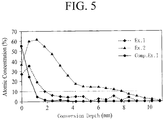
- FIG. 5 is a graph showing the oxygen concentration profiles obtained by measuring the M-surfaces of the electrolytic copper foils of Examples 1 & 2 and Comparative Example 2.
- the oxygen concentration of Comparative Example 1 rapidly decreases from the surface and becomes less than 10 atomic% at the conversion depth of about 1.3 nm.
- the oxygen concentrations of Examples 1 & 2 tend to slightly increase and then decrease between the surface and OT, and the decrease slope of the oxygen concentration in the decrease section tends to be gradual.
- the OT range is preferably 1.5-8.0 nm.
- the property data of the Example 3 and Comparative Example 3 in both of which the same dissolved oxygen content condition was applied shows that the slightly more TIC content of the Comparative Example 3 made the breaking strength less than 25 kg/mm 2 . Further, since such insufficient strength of the copper foil itself causes a disconnection when a Si-mixed active material is applied, a sharp drop of the charging efficiency occurred in the Comparative Example 3 when the charging & discharging test was conducted.
- Example 4 and Comparative Example 4 to which different Fe concentration conditions were applied show that the Fe concentration lower than 0.3 g/L as applied in the Comparative Example 4 leads to a breaking strength higher than 57 kg/mm 2 , which in turn remarkably decreases the stretch property of the copper foil.
- the copper foil cannot endure its volume expansion and may cause a disconnection of the electrode so that the charging efficiency rapidly decreases.
- the Examples 1 to 4 show relatively low OTD while the Comparative Examples 1 to 4 show high OTD of not lower than 5.9. As a result, the folding was observed in all of the Comparative Examples.
- Such a high OTD may cause an electrode plate produced by coating an anode material onto both surfaces of the copper foil and drying the same to be bent by making the adhesion of the copper foil to the active material at both surfaces thereof different, and may be a main cause of the folding of the copper foil during a roll-to-roll process to produce a Li secondary battery.
Landscapes
- Chemical & Material Sciences (AREA)
- Engineering & Computer Science (AREA)
- Chemical Kinetics & Catalysis (AREA)
- Electrochemistry (AREA)
- Materials Engineering (AREA)
- General Chemical & Material Sciences (AREA)
- Metallurgy (AREA)
- Organic Chemistry (AREA)
- Manufacturing & Machinery (AREA)
- Composite Materials (AREA)
- Mechanical Engineering (AREA)
- Cell Electrode Carriers And Collectors (AREA)
- Chemical Treatment Of Metals (AREA)
- Other Surface Treatments For Metallic Materials (AREA)
Abstract
Description
- The present invention relates to an electrolytic copper foil, and more particularly, to an electrolytic copper foil having superior adhesion to an active material of a Li secondary battery.
- As the consumer electronics such as a mobile phone, a laptop computer and so on are widely used and hybrid vehicles are popularized, a demand for a Li battery has rapidly increased.
- In a lithium secondary battery, an anode current collector is generally made of an electrolytic copper foil. The electrolytic copper foil is manufactured by means of an electroplating process so that a shiny surface of relatively low roughness is formed at one surface of the electrolytic copper foil and a matte surface of relatively high roughness is formed at the other surface. An active material of such as a carbon-based slurry is coated on the matte surface of the electrolytic copper foil.
- The adhesion strength between the active material and the electrolytic copper foil used as a current collector depends on the surface status of the electrolytic copper foil, and the yield and capacity of the lithium secondary battery may be determined by the adhesion strength. Particularly, if the adhesion strength between the current collector and the active material is low, the active material may be separated from the current collector during the lifespan of the secondary battery, thereby causing a problem such as an internal short.
- It is known that oxygen at a surface of an electrolytic copper foil, which has hydrophilic property, increases the adhesion of the copper foil to the active material. A drawback of the oxygen at the surface layer of the copper foil, however, is that it increases the surface resistance. Hence, a control over the surface layer of the copper foil is required to provide a reliable Li secondary battery.
- An aspect of the present invention to achieve the technical demand as described above is to provide an electrolytic copper foil for a Li secondary battery, which has superior adhesion to an active material and low electric resistance.
- It is another aspect of the present invention to provide an electrolytic copper foil having a surface oxygen layer profile capable of imparting the high adhesion and low electric resistance to the copper foil.
- It is a further aspect of the present invention to provide a method for manufacturing the aforementioned electrolytic copper foil.
- It is a still further aspect of the present invention to provide an anode for a Li secondary battery of high discharging capacity retention, which comprises the aforementioned electrolytic copper foil.
- In accordance with the present invention to solve the aforementioned technical problems, there is provided an electrolytic copper foil having a first exposed surface and a second exposed surface opposite to the first exposed surface, the electrolytic copper foil comprising: a first protective layer at the first exposed surface; a second protective layer at the second exposed surface; and a copper film between the first and second protective layers, wherein an oxygen-containing part at the second exposed surface has a thickness (OT) of not less than 1.5 nm and less than 8.0 nm, the thickness of the oxygen-containing part at the second exposed surface is a SiO2 conversion thickness of a portion of the second protective layer, and the portion of the second protective layer is a portion showing a concentration of oxygen component of not less than 10 atom% when measured with AES (Auger Electron Microscopy) from the second exposed surface.
- It is preferable in the present invention that the first protective layer and the second protective layer comprise a chromate.
- The concentration of the oxygen component measured from the second exposed surface has a tendency to increase and then decrease as the depth from the second exposed surface becomes deeper.
- According to an embodiment of the present invention, the thickness of the oxygen-containing part is preferably less than 8.0 nm.
- Further, according to an embodiment of the present invention, it is desirable that, after a heat treatment at 110 °C for 10 minutes, the electrolytic copper foil would have a breaking strength of 25 to 57 kgf/mm2.
- Additionally, according to an embodiment of the present invention, a difference between a thickness of an oxygen-containing part at the first exposed surface and the thickness of the oxygen-containing part at the second exposed surface is preferably not more than 5.8 nm.
- In accordance with the further aspect of the present invention, there is provided a method for manufacturing an electrolytic copper foil, the method comprising: electroplating a copper film on a rotary cathode drum by applying an electric current between an anode plate and the rotary cathode drum which are disposed apart from each other in an electrolyte contained in an electrolytic bath; winding the copper film; and performing an anticorrosion treatment by immersing the copper film into an anticorrosion treatment solution, wherein an air is injected into the anticorrosion treatment solution when the anticorrosion treatment is performed. The injection of the air may be performed by means of a blower. It is desirable that a dissolved oxygen content of the anticorrosion treatment solution be maintained at 3 to 12 ppm.
- It is preferable in the present invention that TIC concentration of the electrolyte be maintained at not more than 0.05 g/L and Fe concentration of the electrolyte be maintained at not more than 0.3 g/L.
- In accordance with the still further aspect of the present invention, there is provided an anode for a Li secondary battery, the anode comprising: a current collector including an electrolytic copper foil having a first surface and a second surface opposite to the first surface; and anode active material layers on the first and second surfaces, wherein the electrolytic copper foil comprises: a first protective layer at the first surface; a second protective layer at the second surface; and a copper film between the first and second protective layers, wherein an oxygen-containing part at the second surface has a thickness (OT) of not less than 1.5 nm, the thickness of the oxygen-containing part at the second surface is a SiO2 conversion thickness of a portion of the second protective layer, and the portion of the second protective layer is a portion showing a concentration of oxygen component of not less than 10 atom% when measured with AES (Auger Electron Microscopy) from the second surface.
- According to the present invention, an electrolytic copper foil current collector for a Li secondary battery, which has low electric resistance and high adhesion to an active material, can be provided.
- In addition, the present invention can provide an electrolytic copper foil current collector the surface oxygen concentration profile of which is adjusted in such a way that the current collector can have a superior adhesion to an active material.
- Furthermore, the present invention can provide an anode of a Li secondary battery of high discharging capacity retention.
-
-
FIG. 1 is a cross sectional view of an electrolytic copper foil according to an embodiment of the present invention. -
FIG. 2 is a cross sectional view of an anode for a Li secondary battery according to an embodiment of the present invention. -
FIG. 3 schematically shows an apparatus for manufacturing an electrolytic copper foil of the present invention. -
FIG. 4 is a graph showing a concentration profile of each component obtained by measuring the M-surface of the electrolytic copper foil of Example 1 with AES device. -
FIG. 5 is a graph showing the oxygen concentration profile obtained by measuring the M-surface of the electrolytic copper foil with AES device according to an embodiment of the present invention. - Hereinafter, preferable embodiments of the present invention will be described with reference to the annexed drawings.
-
FIG. 1 is a cross sectional view of an electrolytic copper foil according to an embodiment of the present invention. - Referring to
FIG. 1 , theelectrolytic copper foil 110 has a first exposedsurface 110a and a second exposedsurface 110b opposite to the first exposedsurface 110a, and comprises a firstprotective layer 112 forming the first exposedsurface 110a, a secondprotective layer 113 forming the second exposedsurface 110b, and acopper film 111 between the first and secondprotective layers - In the present invention, the
electrolytic copper foil 110 has a certain thickness, for example, a thickness of 4 to 30 µm. If the thickness of the copper foil is less than 4 µm, deterioration of workability in a battery-manufacturing process is caused. If the thickness of the copper foil is more than 30 µm, it is difficult to produce a Li secondary battery of high capacity with such a thick copper foil. - The
copper film 111 is formed on a rotary cathode drum by an electroplating process, and has a shiny surface (S-surface) 111a, which is a surface contacting the rotary cathode drum during the electroplating process, and a matte surface (M-surface) 111b opposite thereto. - Preferably, the first and second
protective layers protective layers copper film 111 from being oxidized or corroded, and improve the adhesion to an active material. - According to the present invention, the oxygen component profile of the electrolytic copper foil along the thickness direction has the following features. The oxygen-containing part at the M-
surface 111b of the electrolytic copper foil preferably has a thickness (OT) of not less than 15 nm. Here, the thickness (OT) of the oxygen-containing part at the M-surface 111b is a SiO2 conversion thickness of a portion of the secondprotective layer 113, and the portion of the secondprotective layer 113 is a portion showing a concentration of oxygen component of not less than 10 atom% when measured with AES (Auger Electron Microscopy) from the M-surface 111b. In addition, the thickness of the oxygen-containing part at the M-surface 111b is preferably less than 8.0 nm. If the thickness of the oxygen-containing part is less than 1.5 nm, the number of the active sites of the oxygen, which contribute to the hydrophilic property of the surface, is too small to provide a sufficient adhesion strength between an anode material and the surface of the copper foil. Thus, when a produced Li secondary battery is evaluated by repetition of charging and discharging, the anode material is easily separated from the copper foil and the charging efficiency of the battery decreases rapidly. If the thickness of the oxygen-containing part is more than 8.0 nm, the resistance at the surface of the copper foil increases and the high resistance causes the charging efficiency of a Li secondary battery to drop. - Further, in the present invention, the difference between the thicknesses (OT) of the oxygen-containing parts at the M-
surface 111b and S-surface 111a is preferably not more than 5.8 nm. Just like the thickness (OT) of the oxygen-containing part at the M-surface 111b, the thickness (OT) of the oxygen-containing part at the S-surface 111a is a SiO2 conversion thickness of a portion of the firstprotective layer 112, wherein the portion of the firstprotective layer 112 is a portion showing a concentration of oxygen component of not less than 10 atom% when measured with AES from the surface adjacent to the S-surface 111a. - If the difference between the thicknesses of the oxygen-containing parts at the M-
surface 111b and S-surface 111a is more than 5.8 nm, the electrode plate produced by coating anode materials onto both surfaces of the copper foil and drying the same is bent owing to the difference between the adhesion of both surfaces of the copper foil to the anode materials and folded during a roll-to-roll process to produce a Li secondary battery. - In the present invention, it is desirable that, after a heat treatment at 110 °C for 10 minutes, the electrolytic copper foil would have a breaking strength of 25-57 kgf/mm2. If the breaking strength is lower than 25 kgf/mm2, when a Li secondary battery produced by applying an active material containing Si is evaluated by repetition of charging and discharging, such insufficient strength of the copper foil itself causes a disconnection which, in turn, rapidly decreases the charging efficiency of the battery. If the breaking strength is higher than 57 kgf/mm2, the copper foil would have remarkably low stretch property. Thus, when a Li secondary battery is evaluated by repetition of charging and discharging, the copper foil which cannot endure its volume expansion may cause a disconnection of the electrode which, in turn, rapidly decreases the charging efficiency of the battery.
- According to the present invention, the weight deviation of the electrolytic copper foil along the width direction thereof is desirably lower than 5%. If the weight deviation is higher than 5%, a wrinkle may occur during the processes for manufacturing the copper foil and Li secondary battery.
- In the present invention, the maximum height (Rp) in the surface profile of the M-
surface 111b is preferably in the range of 0.36-1.69 µm. If the maximum height in the surface profile of the electrolytic copper foil is lower than 0.36 µm, the surface of the copper foil cannot provide sufficient active sites for a uniform coating of the active material, and thus the active material cannot be uniformly coated thereon. Further, if the maximum height is higher than 1.69 µm, the peak height of the copper foil surface is too high to uniformly coat the active material, and thus the same problem as mentioned above occurs. The non-uniform coating of the active material causes local separations of the coated active material at the electrode surface. - Optionally, in the present invention, the first and second
protective layers -
FIG. 2 is a cross sectional view of an anode for a Li secondary battery according to an embodiment of the present invention. - Referring to
FIG. 2 , as described in connection withFIG. 1 , theelectrolytic copper foil 110 having afirst surface 110a and asecond surface 110b comprises a firstprotective layer 112 forming thefirst surface 110a, a secondprotective layer 113 forming thesecond surface 110b, and acopper film 111 between the first and secondprotective layers - Anode active material layers 120 are provided on the first and second
protective layers - The anode
active material layer 120 may include a carbon-based compound such as graphite, coke, and so on. Further, the active material of the anodeactive material layer 120 may comprise at least one metal selected from the group consisting of Si, Ge, Sn, Li, Zn, Mg, Cd, Ce, Ni and Fe; an alloy comprising the metal; or a compound containing the metal. The active material of the anodeactive material layer 120 may be a composite material of the metal and carbon. The anodeactive material layer 120 may further include a conductive material and a binder. -
FIG. 3 schematically shows an apparatus for manufacturing an electrolytic copper foil of the present invention. - The apparatus of
FIG 3 for manufacturing an electrolytic copper foil illustrates a roll-to-roll process comprising a film-forming step and a subsequent step for anticorrosion treatment. - As illustrated in
FIG. 3 , there are ananode plate 30 and arotary cathode drum 40 which are disposed apart from each other in anelectrolyte 20 contained in anelectrolytic bath 10. Therotary cathode drum 40 rotates in a certain direction. When an electric current is applied, the current flows between thecathode drum 40 andanode plate 30 through theelectrolyte 20 as a medium, and the electroplating is performed. Thecopper film 100 electroplated on the surface of thecathode drum 40 is winded by theguide roll 50. - A plating solution of copper sulfate, copper pyrophosphate or copper sulfamate may be used as the
electrolyte 20 for the deposition of the electrolytic copper foil. In the present invention, a copper sulfate plating solution is preferably used as the electrolyte. - The
anode plate 30 may comprise afirst anode plate 31 and asecond anode plate 32 which are electrically insulated from each other. The current density provided by theanode plate 30, i.e., the current density provided by each of the first andsecond anode plates - According to an embodiment of the present invention, the
electrolyte 20 may include 70 to 90 g/L of copper ion and 80 to 120 g/L of sulfuric acid. - According to the present invention, the amount of the total inorganic carbon (TIC) in the electrolyte should be maintained not more than 0.05 g/L and the amount of Fe therein should be maintained not more than 0.3 g/L. If the TIC concentration is more than 0.05 g/L, the inorganic organic components accelerate the growth of the plating layer, thereby decreasing the breaking strength thereof. If the Fe concentration is more than 0.3 g/L, Fe component is co-deposited with copper and the alloy thus formed excessively increases the breaking strength.
- Further, it is desirable that the
electrolyte 60 is maintained at 50 to 60 °C and the flux of theelectrolyte 20 introduced into theelectrolytic bath 10 is kept at 40 to 46 m3/hour. If the flux of theelectrolyte 20 is not more than 40 m3/hour, the copper ions cannot be supplied onto the surface of therotary cathode drum 40 sufficiently, thereby causing a non-uniformly plated thin film. If the flux of theelectrolyte 20 is more than 46 m3/hour, the flow rate of theelectrolyte 20 passing through a filter is excessively high, which causes the lifespan of the filter to decrease rapidly. - The copper film produced by the plating is introduced into the
anticorrosion treatment bath 50 by theguide roll 80. - According to the present invention, the
anticorrosion treatment solution 60 includes a chromate. A mixed aqueous solution made by mixing a dichromate such as M2Cr2O7 (wherein, M is a monovalent metal) or a chromic acid such as CrO3 with alkali hydroxide and acid may be used. The anticorrosion treatment solution may further include a zinc salt such as ZnO or ZnSO4·7H2O. If necessary, the anticorrosion treatment solution may further include an organic additive. - According to an embodiment of the present invention, in order to control the thickness of the oxygen-containing part at the surface of the copper foil within an appropriate range, the dissolved oxygen content of the anticorrosion treatment solution is maintained at a certain level. To do this, there is provided a
blower 70 in the anticorrosion treatment bath. The flux of theblower 70 is adjusted to control the dissolved oxygen content of theanticorrosion treatment solution 60. As described below regarding an embodiment of the present invention, the dissolved oxygen content is maintained within a range of 3 ppm to 12 ppm. - According to the present invention, the anticorrosion treatment may be performed by simple immersion or electrodeposition, more preferably by electrodeposition.
- A surface (e.g., S-
surface 111a) of thecopper film 111 which comes into contact with the guide roll during the anticorrosion treatment is coated with a relatively small amount ofanticorrosion treatment solution 60 compared to the opposite surface (e.g., M-surface 111b) exposed to theanticorrosion solution 60. Consequently, the difference between the electrodeposition amounts on the S-surface 111a and M-surface 111b of thecopper film 111 may cause the folding and/or rolling (wrinkle) of theelectrolytic copper foil 110. Therefore, according to the present invention, the contact time of the copper film and guide roll may be minimized. For example, it is desirable to use a method such as a horizontal anticorrosion treatment. - Hereinafter, a preferable embodiment of the present invention will be described in detail.
- A copper film was formed on a rotary cathode drum by using an apparatus as illustrated in
FIG. 3 and allowing an electric current to flow between the rotary cathode drum and anode plate disposed apart from each other in an electrolyte contained in an electrolytic bath. - The electrolyte was made of 75 g/L of copper ion and 100 g/L of sulfuric acid. Copper films were produced under the different conditions with respect to TIC and Fe concentrations of the electrolyte. The electrolyte was maintained at about 55 °C, the current density was 60 A/dm2, and the flux of the electrolyte was 42 m3/hour.
- The anticorrosion solution was made as follows. First, CrO3 powder was dispersed in an aqueous solution until the concentration of Cr ion reaches 2.2 g/L. At this time, the pH of the anticorrosion solution was maintained at 1.8-2.2. Citric acid was added thereto in an amount of 0.2-0.4 g/L. The pH of the anticorrosion solution thus obtained was adjusted with sulfuric acid or sodium hydroxide. The resulting copper foils were immersed in the anticorrosion solutions of different dissolved oxygen contents at room temperature (30°C) for 10 seconds. The anticorrosion solutions of different dissolved oxygen contents were made by injecting different amounts of air to the solution by means of a blower. The dissolved oxygen content in the anticorrosion treatment solution was measured with a dissolved oxygen meter of TOADKK Corp. in Japan. Subsequently, anticorrosion coating layers were formed on both surfaces of each copper film by drying the coated chromic oxide solution. Electrolytic copper foils having a thickness of 4 µm were produced. The film-making conditions and anticorrosion treatment conditions applied for the copper foils are shown in the following Table 1.
[Table 1] TIC(g/L) Fe(g/L) Dissolved oxygen content (ppm) Ex. 1 0.02 0.12 3.2 Ex. 2 0.02 0.12 11.7 Ex. 3 0.04 0.12 7.5 Ex. 4 0.02 0.29 7.5 Comp. Ex. 1 0.02 0.12 2.7 Comp. Ex. 2 0.02 0.12 12.5 Comp. Ex. 3 0.06 0.12 7.5 Comp. Ex. 4 0.02 0.34 7.5 - Subsequently, the properties of the resulting electrolytic copper foils were measured. The measuring methods were as follows.
- A sample of the electrolytic copper foil was grabbed at both ends thereof and then stretched with UTM. The strength at break was measured. The width of the sample was 12.7 mm, the distance between the grips was 50 mm, and the measuring speed was 50 mm/min.
- The depth profile of the oxygen concentration from the M-surface of the resulting electrolytic copper foil was analyzed under the following conditions by means of PHI 700 model, an AES analysis apparatus provided by ULVAC-PHI Inc.
- Electron energy analyzer : CMA (Cylindrical Mirror Analyzer)
- Electron beam energy : 5 keV
- Target current: 10 nA
- Ion energy, Sputtering speed : 2 kV Ar, 60 Å/min (SiO2 conversion)
- Ion beam spot size : 2×2 mm2
- Thickness of oxygen-containing part The depth at which the oxygen concentration was measured by AES was obtained from the sputtering etching time in accordance with the following formula (SiO2 conversion method).

- The conversion depth of the point at which the measured oxygen concentration was 10 atom% was considered as the thickness (OT) of the oxygen-containing part.
- OT at the S-surface was measured with the same method as described above, and the difference between the OTs at the M-surface and S-surface was calculated.
- Whether a folding of the electrolytic copper foil occurs or not during a roll-to-roll process for manufacturing a secondary battery was observed with the naked eyes.
- Current collectors of 10cm width were prepared with the aforementioned electrolytic copper foils produced in the Examples 1-4 and Comparative Examples 1-4. The anode active material to be coated on the current collectors was made by mixing carbon and SiO2 with a weight ratio of 9:1. 100 parts by weight of the anode active material was mixed with 2 parts by weight of SBR (styrene butadiene rubber) and 2 parts by weight of CMC (carboxymethyl cellulose), and a slurry was produced using distilled water as a solvent. The anode active material was coated with a thickness of 60 µm by means of a doctor blade, dried at 120 °C, and pressed with a pressure of 1 ton/cm2 to produce the anodes.
- 1 M of LiPF6, a solute, was dissolved in a non-aqueous organic solvent containing a mixture of ethylene carbonate (EC) and ethyl methyl carbonate (EMC) the ratio of which is 1:2 to prepare a basic electrolytic solution, and then, 99.5 wt.% of the basic electrolytic solution was mixed with 0.5 wt.% of succinic anhydride to produce the non-aqueous electrolyte.
- Lithium manganese oxide (Li1.1Mn1.85Al0.05O4) was mixed with lithium manganese oxide (o-LiMnO2) of orthorhombic crystal structure in a weight ratio of 90:10 to produce a cathode active material. The cathode active material, carbon black, and PVDF [poly(vinylidene fluoride)] which is a binder were mixed in a weight ratio of 85:10:5 and were further mixed with an organic solvent, NMP, to prepare a slurry. Both surfaces of an aluminum foil having a thickness of 20 µm were coated with the slurry and dried to produce a cathode.
- A Li secondary battery cell was produced with the cathode, anode, and electrolyte, and then the properties of the secondary battery were evaluated. The capacity of the battery produced with the anode, electrolyte, and cathode was measured using a charging operation voltage of 4.3V and a discharging operation voltage of 3.4V. In order to evaluate the high temperature lifespan, a charging & discharging test of 500 cycles was conducted with a charge/discharge rate of 0.2 C at high temperature of 50 °C and the discharging capacity retention was calculated. Here, the discharging capacity retention was the arithmetic mean of the values obtained by testing a sample 5 times.
- The properties of the electrolytic copper foils of Examples 1-4 and Comparative Examples 1-4 are shown in the following Table 2. Further, the discharging capacity retentions of the Li secondary battery cells including the corresponding electrolytic copper foils as the current collectors thereof are also shown.
[Table 2] M-surface OT (nm) OTD (nm) Breaking strength (kgf/mm2) Discharging capacity retention (%) Folded or Not Ex. 1 1.6 5.7 45.2 92 Good Ex. 2 7.8 1.4 45.7 90 Good Ex. 3 4.4 2.5 25.3 91 Good Ex. 4 4.7 2.8 56.2 93 Good Comp. Ex. 1 1.3 6.5 45.2 83 Folded Comp. Ex. 2 8.1 6.1 45.7 87 Folded Comp. Ex. 3 4.5 5.9 24.1 76 Folded Comp. Ex. 4 4.7 5.9 58.3 72 Folded - Referring to Tables 1 and 2, the comparison of the Example 1 and Comparative Example 1 of the same conditions other than the dissolved oxygen content shows that OT of Example 1 is higher than that of Comparative Example 1. This means that the electrolytic copper foil of Example 1 can provide more oxygen active sites at the surface than that of Comparative Example 1. Further, Example 1 showed the discharging capacity retention of not less than 90% while that of Comparative Example 1 was less than 90%. Such a low discharging capacity retention of Comparative Example 1 resulted from the fact that the active material could not adhere to the surface of the copper foil sufficiently strongly and thus the charging efficiency decreased rapidly during the charging & discharging test. The comparison of the Example 2 and Comparative Example 2 in both of which higher dissolved oxygen content condition was applied shows that OT of Example 2 of relatively low dissolved oxygen content (11.7 ppm) is lower than that of Comparative Example 1 of relatively high dissolved oxygen content (12.5 ppm). Further, it is shown that the battery produced with the current collector of Example 2 has a higher discharging capacity retention than the battery produced with the current collector of Comparative Example 2. Thus, it can be found that the excessive OT level increases the surface resistance of the copper foil, which in turn decreases the discharging capacity retention.
-
FIG. 4 is a graph showing a concentration profile of each component obtained by measuring the M-surface of the electrolytic copper foil of Example 1 with AES device, andFIG. 5 is a graph showing the oxygen concentration profiles obtained by measuring the M-surfaces of the electrolytic copper foils of Examples 1 & 2 and Comparative Example 2. - Referring to
FIG. 5 , it is found that the oxygen concentration of Comparative Example 1 rapidly decreases from the surface and becomes less than 10 atomic% at the conversion depth of about 1.3 nm. On the other hand, the oxygen concentrations of Examples 1 & 2 tend to slightly increase and then decrease between the surface and OT, and the decrease slope of the oxygen concentration in the decrease section tends to be gradual. As explained above with respect to the Examples and Comparative Examples, in the present invention, the OT range is preferably 1.5-8.0 nm. - Referring back to Tables 1 and 2, the property data of the Example 3 and Comparative Example 3 in both of which the same dissolved oxygen content condition was applied shows that the slightly more TIC content of the Comparative Example 3 made the breaking strength less than 25 kg/mm2. Further, since such insufficient strength of the copper foil itself causes a disconnection when a Si-mixed active material is applied, a sharp drop of the charging efficiency occurred in the Comparative Example 3 when the charging & discharging test was conducted.
- The Example 4 and Comparative Example 4 to which different Fe concentration conditions were applied show that the Fe concentration lower than 0.3 g/L as applied in the Comparative Example 4 leads to a breaking strength higher than 57 kg/mm2, which in turn remarkably decreases the stretch property of the copper foil. Thus, when the charging & discharging evaluation is conducted, the copper foil cannot endure its volume expansion and may cause a disconnection of the electrode so that the charging efficiency rapidly decreases.
- The Examples 1 to 4 show relatively low OTD while the Comparative Examples 1 to 4 show high OTD of not lower than 5.9. As a result, the folding was observed in all of the Comparative Examples. Such a high OTD may cause an electrode plate produced by coating an anode material onto both surfaces of the copper foil and drying the same to be bent by making the adhesion of the copper foil to the active material at both surfaces thereof different, and may be a main cause of the folding of the copper foil during a roll-to-roll process to produce a Li secondary battery.
- Although the present invention has been described above in detail using some embodiments of the present invention, the aforementioned embodiments are given by way of illustration of the technical aspects of the present invention only, and those skilled in the art will appreciate that various changes and modifications are possible without departing from the essential features of the invention. Accordingly, the embodiments of the present disclosure are not for limiting the technical aspects of the present invention but for explaining them, and the scope of the invention should not be limited by such embodiments. The protection scope of the present invention should be interpreted based on the accompanying claims, and all the equivalents to the claimed inventions should be interpreted as being within the scope of the present invention.
Claims (11)
- An electrolytic copper foil having a first exposed surface and a second exposed surface opposite to the first exposed surface, the electrolytic copper foil comprising:a first protective layer at the first exposed surface;a second protective layer at the second exposed surface; anda copper film between the first and second protective layers,wherein an oxygen-containing part at the second exposed surface has a thickness (OT) of not less than 1.5 nm and less than 8.0 nm,the thickness of the oxygen-containing part at the second exposed surface is a SiO2 conversion thickness of a portion of the second protective layer, andthe portion of the second protective layer is a portion showing a concentration of oxygen component of not less than 10 atom% when measured with AES (Auger Electron Microscopy) from the second exposed surface.
- The electrolytic copper foil according to claim 1, wherein the first protective layer and the second protective layer comprise a chromate.
- The electrolytic copper foil according to claim 1, wherein the concentration of the oxygen component measured from the second exposed surface increases and then decreases as a depth from the second exposed surface becomes deeper.
- The electrolytic copper foil according to claim 1, wherein, after a heat treatment at 110 °C for 10 minutes, the electrolytic copper foil would have a breaking strength of 25 to 57 kgf/mm2.
- The electrolytic copper foil according to claim 1, wherein a difference between a thickness of an oxygen-containing part at the first exposed surface and the thickness of the oxygen-containing part at the second exposed surface is not more than 5.8 nm.
- A method for manufacturing an electrolytic copper foil, the method comprising:electroplating a copper film on a rotary cathode drum by applying an electric current between an anode plate and the rotary cathode drum which are disposed apart from each other in an electrolyte contained in an electrolytic bath;winding the copper film; andperforming an anticorrosion treatment by immersing the copper film into an anticorrosion treatment solution,wherein an air is injected into the anticorrosion treatment solution when the anticorrosion treatment is performed.
- The method according to claim 6, wherein, when the anticorrosion treatment is performed, a dissolved oxygen content of the anticorrosion treatment solution is maintained at 3 to 12 ppm.
- The method according to claim 7, wherein injection of the air is performed by means of a blower.
- The method according to claim 6, wherein TIC concentration of the electrolyte is maintained at not more than 0.05 g/L.
- The method according to claim 6, wherein Fe concentration of the electrolyte is maintained at not more than 0.3 g/L.
- An anode for a Li secondary battery, the anode comprising:a current collector including an electrolytic copper foil having a first surface and a second surface opposite to the first surface; andanode active material layers on the first and second surfaces,wherein the electrolytic copper foil comprises:a first protective layer at the first surface;a second protective layer at the second surface; anda copper film between the first and second protective layers,wherein an oxygen-containing part at the second surface has a thickness (OT) of not less than 1.5 nm,the thickness of the oxygen-containing part at the second surface is a SiO2 conversion thickness of a portion of the second protective layer, andthe portion of the second protective layer is a portion showing a concentration of oxygen component of not less than 10 atom% when measured with AES (Auger Electron Microscopy) from the second surface.
Applications Claiming Priority (2)
| Application Number | Priority Date | Filing Date | Title |
|---|---|---|---|
| KR1020170110100A KR102473030B1 (en) | 2017-08-30 | 2017-08-30 | Copper Film, Manufacturing Methods Thereof, And Anode For Li Secondary Battery Comprising The Same |
| PCT/KR2018/009862 WO2019045387A1 (en) | 2017-08-30 | 2018-08-27 | Electrolytic copper foil, method for producing same, and anode for high capacity li secondary battery including same |
Publications (3)
| Publication Number | Publication Date |
|---|---|
| EP3677707A1 true EP3677707A1 (en) | 2020-07-08 |
| EP3677707A4 EP3677707A4 (en) | 2021-05-19 |
| EP3677707B1 EP3677707B1 (en) | 2024-09-25 |
Family
ID=65525941
Family Applications (1)
| Application Number | Title | Priority Date | Filing Date |
|---|---|---|---|
| EP18851880.7A Active EP3677707B1 (en) | 2017-08-30 | 2018-08-27 | Electrolytic copper foil, method for producing same, and anode for high capacity li secondary battery including same |
Country Status (10)
| Country | Link |
|---|---|
| US (1) | US11949110B2 (en) |
| EP (1) | EP3677707B1 (en) |
| JP (1) | JP2020532836A (en) |
| KR (1) | KR102473030B1 (en) |
| CN (1) | CN111279019B (en) |
| ES (1) | ES2996879T3 (en) |
| HU (1) | HUE068563T2 (en) |
| PL (1) | PL3677707T3 (en) |
| TW (1) | TWI684651B (en) |
| WO (1) | WO2019045387A1 (en) |
Families Citing this family (11)
| Publication number | Priority date | Publication date | Assignee | Title |
|---|---|---|---|---|
| CN110660963B (en) * | 2018-12-29 | 2021-04-27 | 宁德时代新能源科技股份有限公司 | An electrode pole piece and electrochemical device |
| CN110676460B (en) | 2018-12-29 | 2022-01-18 | 宁德时代新能源科技股份有限公司 | Electrode plate and electrochemical device |
| CN110660957B (en) * | 2018-12-29 | 2020-12-04 | 宁德时代新能源科技股份有限公司 | An electrode pole piece and electrochemical device |
| CN110943200B (en) | 2019-04-15 | 2021-03-09 | 宁德时代新能源科技股份有限公司 | An electrode pole piece and electrochemical device |
| CN110943201B (en) | 2019-04-15 | 2021-02-26 | 宁德时代新能源科技股份有限公司 | A positive electrode plate and electrochemical device |
| CN110943222B (en) | 2019-04-15 | 2021-01-12 | 宁德时代新能源科技股份有限公司 | Electrode plate and electrochemical device |
| CN111180665A (en) | 2019-06-28 | 2020-05-19 | 宁德时代新能源科技股份有限公司 | An electrode pole piece and electrochemical device |
| CN113481496A (en) * | 2021-06-25 | 2021-10-08 | 铜陵市华创新材料有限公司 | Anti-oxidation process for zero discharge of copper foil of 4.5-micron negative current collector |
| WO2023057068A1 (en) * | 2021-10-07 | 2023-04-13 | Circuit Foil Luxembourg | Copper foil with high engery at break and secondary battery comprising the same |
| JP1744471S (en) * | 2022-06-17 | 2023-05-18 | Anode plate for copper foil manufacturing equipment | |
| CN116960362B (en) * | 2023-09-15 | 2025-11-25 | 河北海伟电子新材料科技股份有限公司 | Composite copper foil, manufacturing method and lithium-ion battery |
Family Cites Families (17)
| Publication number | Priority date | Publication date | Assignee | Title |
|---|---|---|---|---|
| JP2754157B2 (en) * | 1994-03-31 | 1998-05-20 | 三井金属鉱業株式会社 | Manufacturing method of electrolytic copper foil for printed wiring board |
| US6086743A (en) * | 1997-08-06 | 2000-07-11 | Gould Electronics, Inc. | Adhesion enhancement for metal foil |
| JP3581784B2 (en) | 1998-03-19 | 2004-10-27 | 古河電気工業株式会社 | Copper foil for negative electrode current collector of non-aqueous solvent secondary battery |
| JP2000160357A (en) * | 1998-11-19 | 2000-06-13 | Mitsubishi Shindoh Co Ltd | Surface treated metal foil |
| JP4632272B2 (en) | 2000-01-06 | 2011-02-16 | 日立マクセル株式会社 | Lithium secondary battery and electrolytic copper foil |
| WO2010004988A1 (en) | 2008-07-07 | 2010-01-14 | 古河電気工業株式会社 | Electrolytic copper foil and copper-clad laminate |
| TWI530586B (en) * | 2010-06-30 | 2016-04-21 | Mitsui Mining & Smelting Co | Copper foil for negative electrode current collector and method of manufacturing the same |
| JP5666839B2 (en) * | 2010-06-30 | 2015-02-12 | 古河電気工業株式会社 | Negative electrode for secondary battery, negative electrode current collector, secondary battery, and production method thereof |
| JP2013211229A (en) * | 2012-03-30 | 2013-10-10 | Jx Nippon Mining & Metals Corp | Copper foil, negative electrode collector and negative electrode material for lithium ion secondary battery using copper foil, and lithium ion secondary battery |
| KR20150086222A (en) | 2013-04-30 | 2015-07-27 | 후루카와 덴키 고교 가부시키가이샤 | Copper foil for lithium-ion secondary battery negative electrode collector |
| KR101737028B1 (en) * | 2014-07-10 | 2017-05-17 | 엘에스엠트론 주식회사 | Method for producing electrolytic copper foil |
| JP6557493B2 (en) * | 2015-03-30 | 2019-08-07 | Jx金属株式会社 | Copper foil with carrier, laminate, printed wiring board, electronic device, method for producing copper foil with carrier, and method for producing printed wiring board |
| JP6842232B2 (en) | 2015-03-31 | 2021-03-17 | Jx金属株式会社 | Manufacturing method of metal foil with carrier, laminate, printed wiring board, electronic device, metal foil with carrier and manufacturing method of printed wiring board |
| JP2016194112A (en) | 2015-03-31 | 2016-11-17 | Jx金属株式会社 | Metal foil with carrier, laminate, printed wiring board, electronic device, manufacturing method of metal foil with carrier and manufacturing method of printed wiring board |
| US10593952B2 (en) * | 2015-05-19 | 2020-03-17 | 24M Technologies Inc. | Mechanical systems and methods for providing edge support and protection in semi-solid electrodes |
| KR102158241B1 (en) | 2015-06-24 | 2020-09-21 | 에스케이넥실리스 주식회사 | Electrolytic Copper Foil, Current Collector Comprising The Same, Electrode Comprising The Same, Secondary Battery Comprising The Same, and Method for Manufacturing The Same |
| KR102473557B1 (en) | 2015-09-24 | 2022-12-01 | 에스케이넥실리스 주식회사 | Electrolytic Copper Foil, Electrode Comprising The Same, Secondary Battery Comprising The Same, and Method for Manufacturing The Same |
-
2017
- 2017-08-30 KR KR1020170110100A patent/KR102473030B1/en active Active
-
2018
- 2018-08-27 JP JP2020512743A patent/JP2020532836A/en active Pending
- 2018-08-27 EP EP18851880.7A patent/EP3677707B1/en active Active
- 2018-08-27 PL PL18851880.7T patent/PL3677707T3/en unknown
- 2018-08-27 ES ES18851880T patent/ES2996879T3/en active Active
- 2018-08-27 CN CN201880070096.5A patent/CN111279019B/en active Active
- 2018-08-27 US US16/643,773 patent/US11949110B2/en active Active
- 2018-08-27 HU HUE18851880A patent/HUE068563T2/en unknown
- 2018-08-27 WO PCT/KR2018/009862 patent/WO2019045387A1/en not_active Ceased
- 2018-08-29 TW TW107130157A patent/TWI684651B/en active
Also Published As
| Publication number | Publication date |
|---|---|
| EP3677707A4 (en) | 2021-05-19 |
| EP3677707B1 (en) | 2024-09-25 |
| PL3677707T3 (en) | 2025-01-20 |
| KR20190023810A (en) | 2019-03-08 |
| HUE068563T2 (en) | 2025-01-28 |
| ES2996879T3 (en) | 2025-02-13 |
| JP2020532836A (en) | 2020-11-12 |
| TWI684651B (en) | 2020-02-11 |
| US11949110B2 (en) | 2024-04-02 |
| TW201912805A (en) | 2019-04-01 |
| CN111279019B (en) | 2022-08-05 |
| CN111279019A (en) | 2020-06-12 |
| KR102473030B1 (en) | 2022-11-30 |
| WO2019045387A1 (en) | 2019-03-07 |
| US20210167397A1 (en) | 2021-06-03 |
Similar Documents
| Publication | Publication Date | Title |
|---|---|---|
| EP3677707B1 (en) | Electrolytic copper foil, method for producing same, and anode for high capacity li secondary battery including same | |
| JP6837409B2 (en) | Copper foil with uniform thickness and its manufacturing method | |
| EP3121885B1 (en) | Electrolytic copper foil, and collector, negative electrode, and lithium battery comprising same | |
| US9966608B2 (en) | Electrolytic copper foil, method of producing electrolytic copper foil, lithium ion secondary cell using electrolytic copper foil as collector | |
| TWI516642B (en) | Electrolytic copper foil and secondary battery with negative current collector | |
| EP3376574B1 (en) | Method for manufacturing an electrolytic copper foil, electrolytic copper foil obtainable by the method, electrode comprising the same, and secondary battery comprising the same | |
| EP3121884A1 (en) | Electrolytic copper foil, and collector, negative electrode, and lithium battery comprising same | |
| KR101958507B1 (en) | Method for manufacturing porous aluminum foil, porous aluminum foil, positive electrode collector for electricity storage device, electrode for electricity storage device, and electricity storage device | |
| US11346014B2 (en) | Electrolytic copper foil, method for producing same, and high-capacity Li secondary battery negative electrode including same | |
| EP3748044A1 (en) | Electrolytic copper foil having high-temperature dimensional stability and texture stability, and manufacturing method therefor | |
| Nurpeissova et al. | Synergistic effect of 3D current collector structure and Ni inactive matrix on the electrochemical performances of Sn-based anodes for lithium-ion batteries | |
| KR20180080512A (en) | Electrolytic Copper Foil with Optimized Peak Roughness, Electrode Comprising The Same, Secondary Battery Comprising The Same, and Method for Manufacturing The Same | |
| EP3404755A1 (en) | Copper foil, method for manufacturing same, electrode comprising same, and secondary battery comprising same | |
| EP3757256B1 (en) | Electrodeposited copper foil | |
| EP4621087A1 (en) | Copper foil, current collector and lithium ion secondary battery | |
| EP4621086A1 (en) | Copper foil, current collector and lithium ion secondary battery |
Legal Events
| Date | Code | Title | Description |
|---|---|---|---|
| STAA | Information on the status of an ep patent application or granted ep patent |
Free format text: STATUS: THE INTERNATIONAL PUBLICATION HAS BEEN MADE |
|
| PUAI | Public reference made under article 153(3) epc to a published international application that has entered the european phase |
Free format text: ORIGINAL CODE: 0009012 |
|
| STAA | Information on the status of an ep patent application or granted ep patent |
Free format text: STATUS: REQUEST FOR EXAMINATION WAS MADE |
|
| 17P | Request for examination filed |
Effective date: 20200317 |
|
| AK | Designated contracting states |
Kind code of ref document: A1 Designated state(s): AL AT BE BG CH CY CZ DE DK EE ES FI FR GB GR HR HU IE IS IT LI LT LU LV MC MK MT NL NO PL PT RO RS SE SI SK SM TR |
|
| AX | Request for extension of the european patent |
Extension state: BA ME |
|
| DAV | Request for validation of the european patent (deleted) | ||
| DAX | Request for extension of the european patent (deleted) | ||
| RAP1 | Party data changed (applicant data changed or rights of an application transferred) |
Owner name: SK NEXILIS CO., LTD. |
|
| A4 | Supplementary search report drawn up and despatched |
Effective date: 20210416 |
|
| RIC1 | Information provided on ipc code assigned before grant |
Ipc: C25D 1/04 20060101AFI20210412BHEP Ipc: C25D 5/48 20060101ALI20210412BHEP Ipc: C25D 3/38 20060101ALI20210412BHEP Ipc: H01M 4/66 20060101ALI20210412BHEP Ipc: H01M 10/052 20100101ALI20210412BHEP Ipc: C23C 22/27 20060101ALI20210412BHEP |
|
| STAA | Information on the status of an ep patent application or granted ep patent |
Free format text: STATUS: EXAMINATION IS IN PROGRESS |
|
| 17Q | First examination report despatched |
Effective date: 20230216 |
|
| GRAP | Despatch of communication of intention to grant a patent |
Free format text: ORIGINAL CODE: EPIDOSNIGR1 |
|
| STAA | Information on the status of an ep patent application or granted ep patent |
Free format text: STATUS: GRANT OF PATENT IS INTENDED |
|
| INTG | Intention to grant announced |
Effective date: 20240319 |
|
| P01 | Opt-out of the competence of the unified patent court (upc) registered |
Effective date: 20240517 |
|
| GRAS | Grant fee paid |
Free format text: ORIGINAL CODE: EPIDOSNIGR3 |
|
| GRAA | (expected) grant |
Free format text: ORIGINAL CODE: 0009210 |
|
| STAA | Information on the status of an ep patent application or granted ep patent |
Free format text: STATUS: THE PATENT HAS BEEN GRANTED |
|
| AK | Designated contracting states |
Kind code of ref document: B1 Designated state(s): AL AT BE BG CH CY CZ DE DK EE ES FI FR GB GR HR HU IE IS IT LI LT LU LV MC MK MT NL NO PL PT RO RS SE SI SK SM TR |
|
| REG | Reference to a national code |
Ref country code: GB Ref legal event code: FG4D |
|
| REG | Reference to a national code |
Ref country code: CH Ref legal event code: EP |
|
| REG | Reference to a national code |
Ref country code: DE Ref legal event code: R096 Ref document number: 602018074789 Country of ref document: DE |
|
| REG | Reference to a national code |
Ref country code: SE Ref legal event code: TRGR |
|
| REG | Reference to a national code |
Ref country code: IE Ref legal event code: FG4D |
|
| REG | Reference to a national code |
Ref country code: LT Ref legal event code: MG9D |
|
| PG25 | Lapsed in a contracting state [announced via postgrant information from national office to epo] |
Ref country code: GR Free format text: LAPSE BECAUSE OF FAILURE TO SUBMIT A TRANSLATION OF THE DESCRIPTION OR TO PAY THE FEE WITHIN THE PRESCRIBED TIME-LIMIT Effective date: 20241226 Ref country code: FI Free format text: LAPSE BECAUSE OF FAILURE TO SUBMIT A TRANSLATION OF THE DESCRIPTION OR TO PAY THE FEE WITHIN THE PRESCRIBED TIME-LIMIT Effective date: 20240925 |
|
| PG25 | Lapsed in a contracting state [announced via postgrant information from national office to epo] |
Ref country code: BG Free format text: LAPSE BECAUSE OF FAILURE TO SUBMIT A TRANSLATION OF THE DESCRIPTION OR TO PAY THE FEE WITHIN THE PRESCRIBED TIME-LIMIT Effective date: 20240925 |
|
| PG25 | Lapsed in a contracting state [announced via postgrant information from national office to epo] |
Ref country code: LV Free format text: LAPSE BECAUSE OF FAILURE TO SUBMIT A TRANSLATION OF THE DESCRIPTION OR TO PAY THE FEE WITHIN THE PRESCRIBED TIME-LIMIT Effective date: 20240925 |
|
| PG25 | Lapsed in a contracting state [announced via postgrant information from national office to epo] |
Ref country code: RS Free format text: LAPSE BECAUSE OF FAILURE TO SUBMIT A TRANSLATION OF THE DESCRIPTION OR TO PAY THE FEE WITHIN THE PRESCRIBED TIME-LIMIT Effective date: 20241225 |
|
| REG | Reference to a national code |
Ref country code: HU Ref legal event code: AG4A Ref document number: E068563 Country of ref document: HU |
|
| REG | Reference to a national code |
Ref country code: NL Ref legal event code: MP Effective date: 20240925 |
|
| PG25 | Lapsed in a contracting state [announced via postgrant information from national office to epo] |
Ref country code: RS Free format text: LAPSE BECAUSE OF FAILURE TO SUBMIT A TRANSLATION OF THE DESCRIPTION OR TO PAY THE FEE WITHIN THE PRESCRIBED TIME-LIMIT Effective date: 20241225 Ref country code: LV Free format text: LAPSE BECAUSE OF FAILURE TO SUBMIT A TRANSLATION OF THE DESCRIPTION OR TO PAY THE FEE WITHIN THE PRESCRIBED TIME-LIMIT Effective date: 20240925 Ref country code: GR Free format text: LAPSE BECAUSE OF FAILURE TO SUBMIT A TRANSLATION OF THE DESCRIPTION OR TO PAY THE FEE WITHIN THE PRESCRIBED TIME-LIMIT Effective date: 20241226 Ref country code: FI Free format text: LAPSE BECAUSE OF FAILURE TO SUBMIT A TRANSLATION OF THE DESCRIPTION OR TO PAY THE FEE WITHIN THE PRESCRIBED TIME-LIMIT Effective date: 20240925 Ref country code: BG Free format text: LAPSE BECAUSE OF FAILURE TO SUBMIT A TRANSLATION OF THE DESCRIPTION OR TO PAY THE FEE WITHIN THE PRESCRIBED TIME-LIMIT Effective date: 20240925 |
|
| REG | Reference to a national code |
Ref country code: ES Ref legal event code: FG2A Ref document number: 2996879 Country of ref document: ES Kind code of ref document: T3 Effective date: 20250213 |
|
| REG | Reference to a national code |
Ref country code: AT Ref legal event code: MK05 Ref document number: 1726695 Country of ref document: AT Kind code of ref document: T Effective date: 20240925 |
|
| PG25 | Lapsed in a contracting state [announced via postgrant information from national office to epo] |
Ref country code: NL Free format text: LAPSE BECAUSE OF FAILURE TO SUBMIT A TRANSLATION OF THE DESCRIPTION OR TO PAY THE FEE WITHIN THE PRESCRIBED TIME-LIMIT Effective date: 20240925 |
|
| PG25 | Lapsed in a contracting state [announced via postgrant information from national office to epo] |
Ref country code: IS Free format text: LAPSE BECAUSE OF FAILURE TO SUBMIT A TRANSLATION OF THE DESCRIPTION OR TO PAY THE FEE WITHIN THE PRESCRIBED TIME-LIMIT Effective date: 20250125 Ref country code: PT Free format text: LAPSE BECAUSE OF FAILURE TO SUBMIT A TRANSLATION OF THE DESCRIPTION OR TO PAY THE FEE WITHIN THE PRESCRIBED TIME-LIMIT Effective date: 20250127 |
|
| PG25 | Lapsed in a contracting state [announced via postgrant information from national office to epo] |
Ref country code: RO Free format text: LAPSE BECAUSE OF FAILURE TO SUBMIT A TRANSLATION OF THE DESCRIPTION OR TO PAY THE FEE WITHIN THE PRESCRIBED TIME-LIMIT Effective date: 20240925 Ref country code: SM Free format text: LAPSE BECAUSE OF FAILURE TO SUBMIT A TRANSLATION OF THE DESCRIPTION OR TO PAY THE FEE WITHIN THE PRESCRIBED TIME-LIMIT Effective date: 20240925 |
|
| PG25 | Lapsed in a contracting state [announced via postgrant information from national office to epo] |
Ref country code: EE Free format text: LAPSE BECAUSE OF FAILURE TO SUBMIT A TRANSLATION OF THE DESCRIPTION OR TO PAY THE FEE WITHIN THE PRESCRIBED TIME-LIMIT Effective date: 20240925 Ref country code: AT Free format text: LAPSE BECAUSE OF FAILURE TO SUBMIT A TRANSLATION OF THE DESCRIPTION OR TO PAY THE FEE WITHIN THE PRESCRIBED TIME-LIMIT Effective date: 20240925 |
|
| PG25 | Lapsed in a contracting state [announced via postgrant information from national office to epo] |
Ref country code: SK Free format text: LAPSE BECAUSE OF FAILURE TO SUBMIT A TRANSLATION OF THE DESCRIPTION OR TO PAY THE FEE WITHIN THE PRESCRIBED TIME-LIMIT Effective date: 20240925 |
|
| REG | Reference to a national code |
Ref country code: DE Ref legal event code: R097 Ref document number: 602018074789 Country of ref document: DE |
|
| PG25 | Lapsed in a contracting state [announced via postgrant information from national office to epo] |
Ref country code: DK Free format text: LAPSE BECAUSE OF FAILURE TO SUBMIT A TRANSLATION OF THE DESCRIPTION OR TO PAY THE FEE WITHIN THE PRESCRIBED TIME-LIMIT Effective date: 20240925 |
|
| PGFP | Annual fee paid to national office [announced via postgrant information from national office to epo] |
Ref country code: NO Payment date: 20250626 Year of fee payment: 8 |
|
| PGFP | Annual fee paid to national office [announced via postgrant information from national office to epo] |
Ref country code: LU Payment date: 20250623 Year of fee payment: 8 Ref country code: BE Payment date: 20250623 Year of fee payment: 8 |
|
| PGFP | Annual fee paid to national office [announced via postgrant information from national office to epo] |
Ref country code: FR Payment date: 20250624 Year of fee payment: 8 |
|
| PGFP | Annual fee paid to national office [announced via postgrant information from national office to epo] |
Ref country code: TR Payment date: 20250624 Year of fee payment: 8 |
|
| PGFP | Annual fee paid to national office [announced via postgrant information from national office to epo] |
Ref country code: CZ Payment date: 20250627 Year of fee payment: 8 |
|
| PGFP | Annual fee paid to national office [announced via postgrant information from national office to epo] |
Ref country code: SE Payment date: 20250624 Year of fee payment: 8 |
|
| PLBE | No opposition filed within time limit |
Free format text: ORIGINAL CODE: 0009261 |
|
| STAA | Information on the status of an ep patent application or granted ep patent |
Free format text: STATUS: NO OPPOSITION FILED WITHIN TIME LIMIT |
|
| 26N | No opposition filed |
Effective date: 20250626 |
|
| PGFP | Annual fee paid to national office [announced via postgrant information from national office to epo] |
Ref country code: HU Payment date: 20250721 Year of fee payment: 8 |
|
| PGFP | Annual fee paid to national office [announced via postgrant information from national office to epo] |
Ref country code: ES Payment date: 20250911 Year of fee payment: 8 |
|
| PGFP | Annual fee paid to national office [announced via postgrant information from national office to epo] |
Ref country code: DE Payment date: 20250624 Year of fee payment: 8 |
|
| PGFP | Annual fee paid to national office [announced via postgrant information from national office to epo] |
Ref country code: PL Payment date: 20250626 Year of fee payment: 8 Ref country code: IT Payment date: 20250624 Year of fee payment: 8 |
|
| PGFP | Annual fee paid to national office [announced via postgrant information from national office to epo] |
Ref country code: CH Payment date: 20250901 Year of fee payment: 8 |
|
| PG25 | Lapsed in a contracting state [announced via postgrant information from national office to epo] |
Ref country code: HR Free format text: LAPSE BECAUSE OF FAILURE TO SUBMIT A TRANSLATION OF THE DESCRIPTION OR TO PAY THE FEE WITHIN THE PRESCRIBED TIME-LIMIT Effective date: 20240925 |
|
| PG25 | Lapsed in a contracting state [announced via postgrant information from national office to epo] |
Ref country code: MC Free format text: LAPSE BECAUSE OF FAILURE TO SUBMIT A TRANSLATION OF THE DESCRIPTION OR TO PAY THE FEE WITHIN THE PRESCRIBED TIME-LIMIT Effective date: 20240925 |